


Nothing special happening, no special events. Just people going about their Saturday afternoon.
At Yonge & Dundas


Along Queen Street


At Nathan Phillips Square


Nothing special happening, no special events. Just people going about their Saturday afternoon.
At Yonge & Dundas
Along Queen Street
At Nathan Phillips Square
The other day I heard rumours of a subway protest – i.e. a protest over the potential uploading of the responsibility for the TTC from the city to the province. On the 27th of March there was a “day of action” at 40 subway stations during the morning rush, starting at 7:30 a.m.
below: Walking toward Eglinton subway station with the sun shining from behind me. Golden glass.
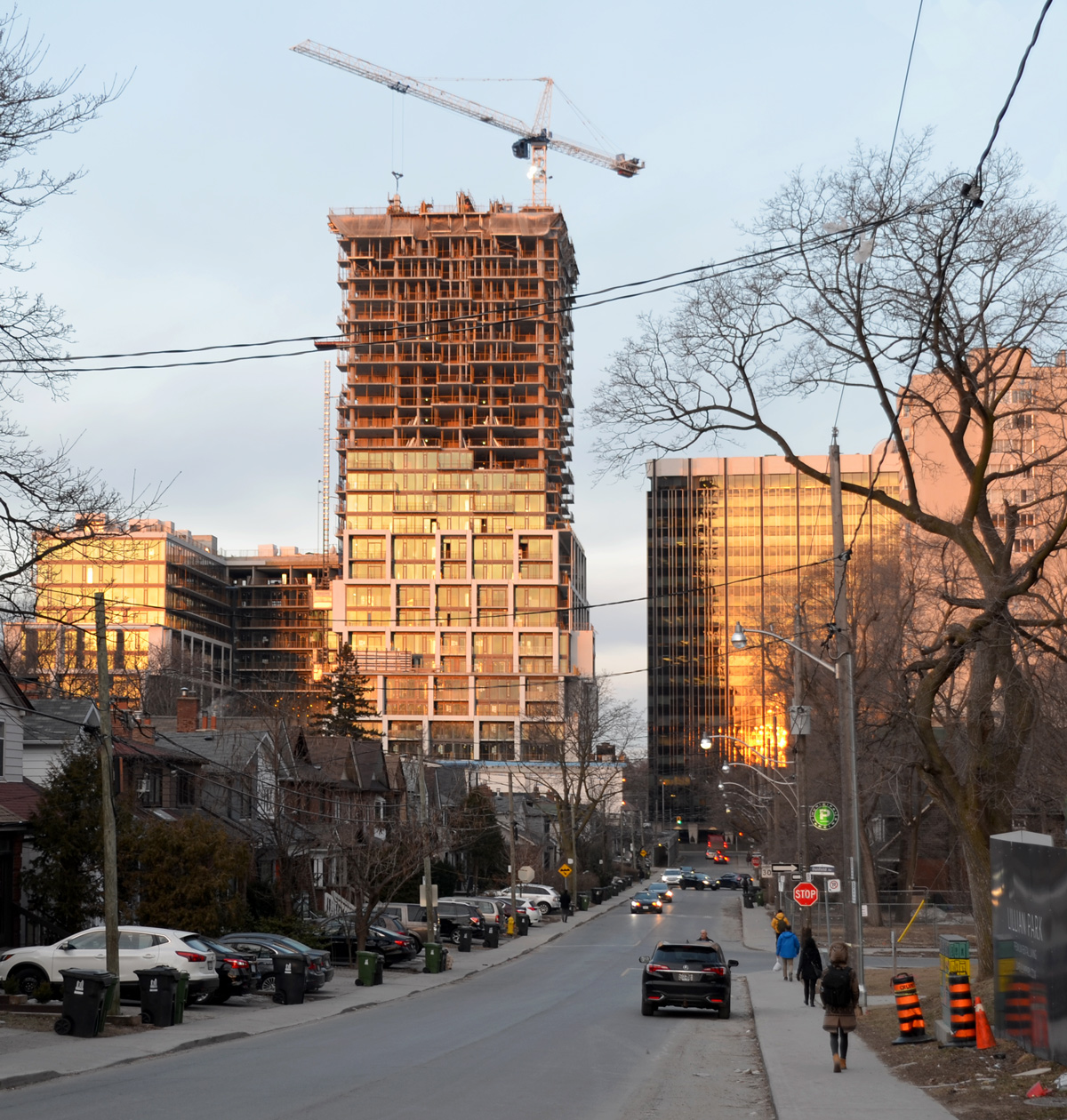
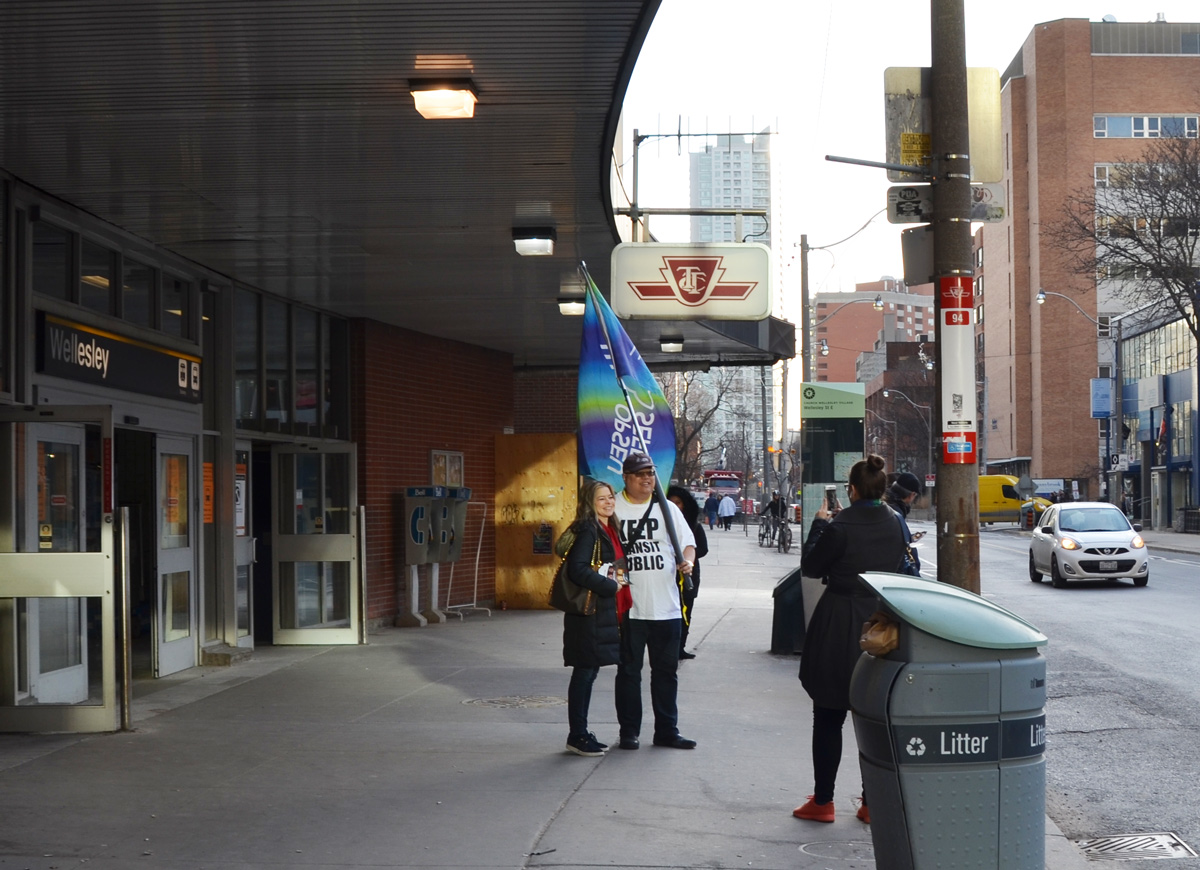
I couldn’t find anyone at Eglinton station (was I too early?) but there were 4 people handing out leaflets inside Bloor station. I also saw this guy with an OPSEU flag by Wellesley station.
So much for the idea of a blog post about this day of action. But it was a beautiful morning so I enjoyed the walk down Yonge street. I don’t often walk here that early and I was surprised how quiet it was. The light was also interesting.

below: A mix of old and new architecture, looking south towards the old St. Charles tavern clock tower that is being incorporated into a new development.

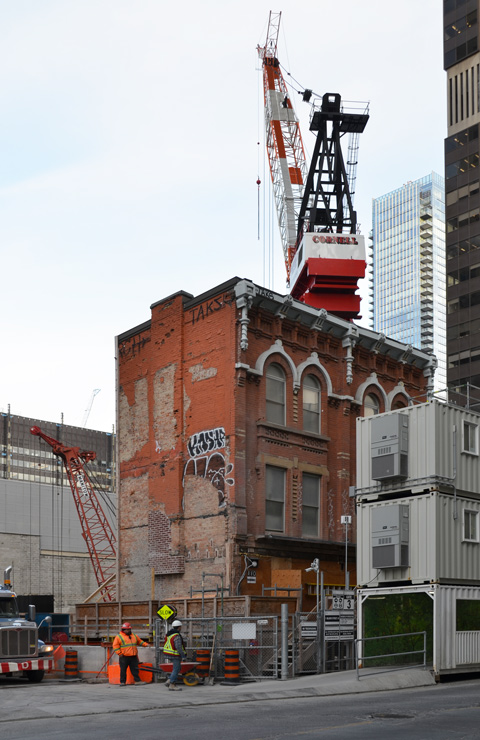
below: Near Yonge & Bloor. Preservation of an old building… and very big crane.

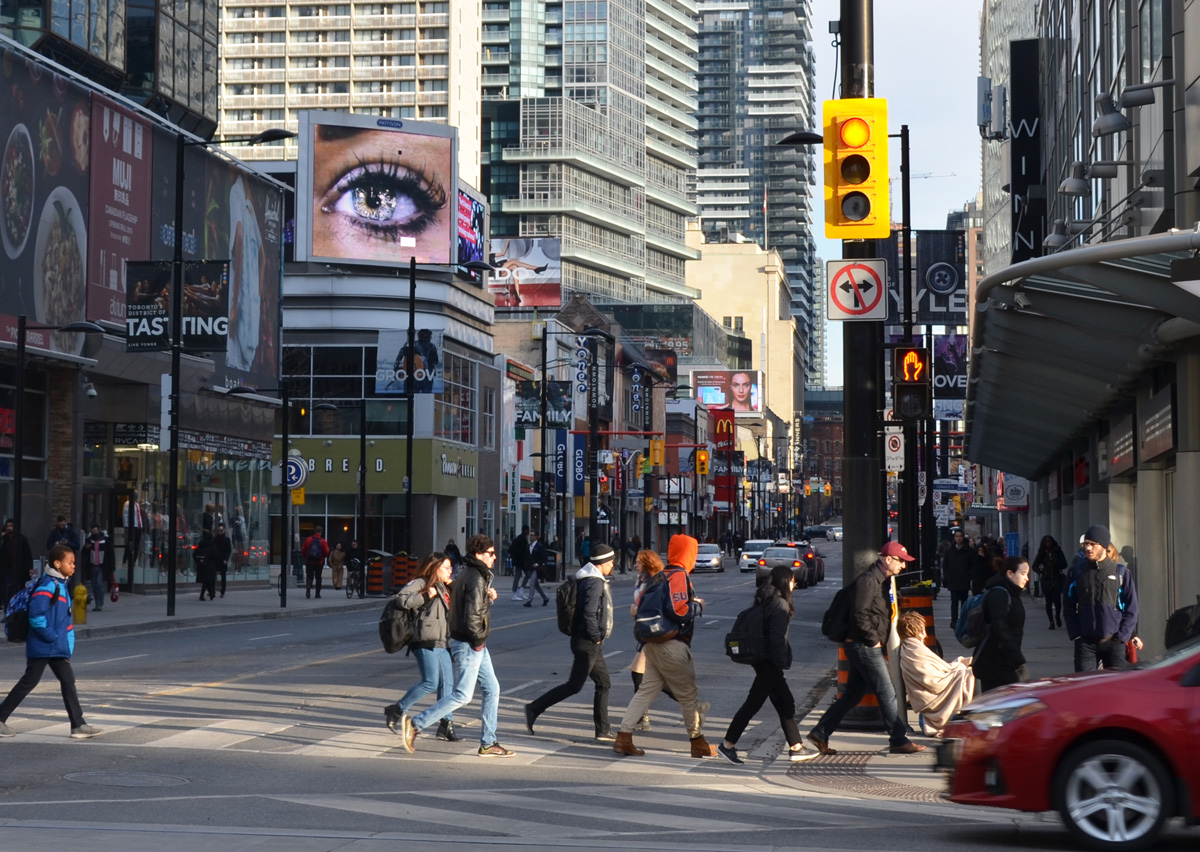
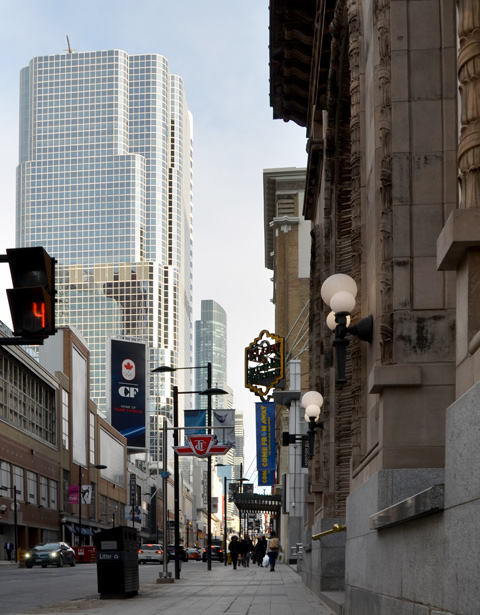
below: Looking north from Dundas under a watchful eye.


below: Looking north from Queen Street. The Eaton Centre is on the left in the foreground. Play the game of ‘name that building’ or ‘I remember when’.


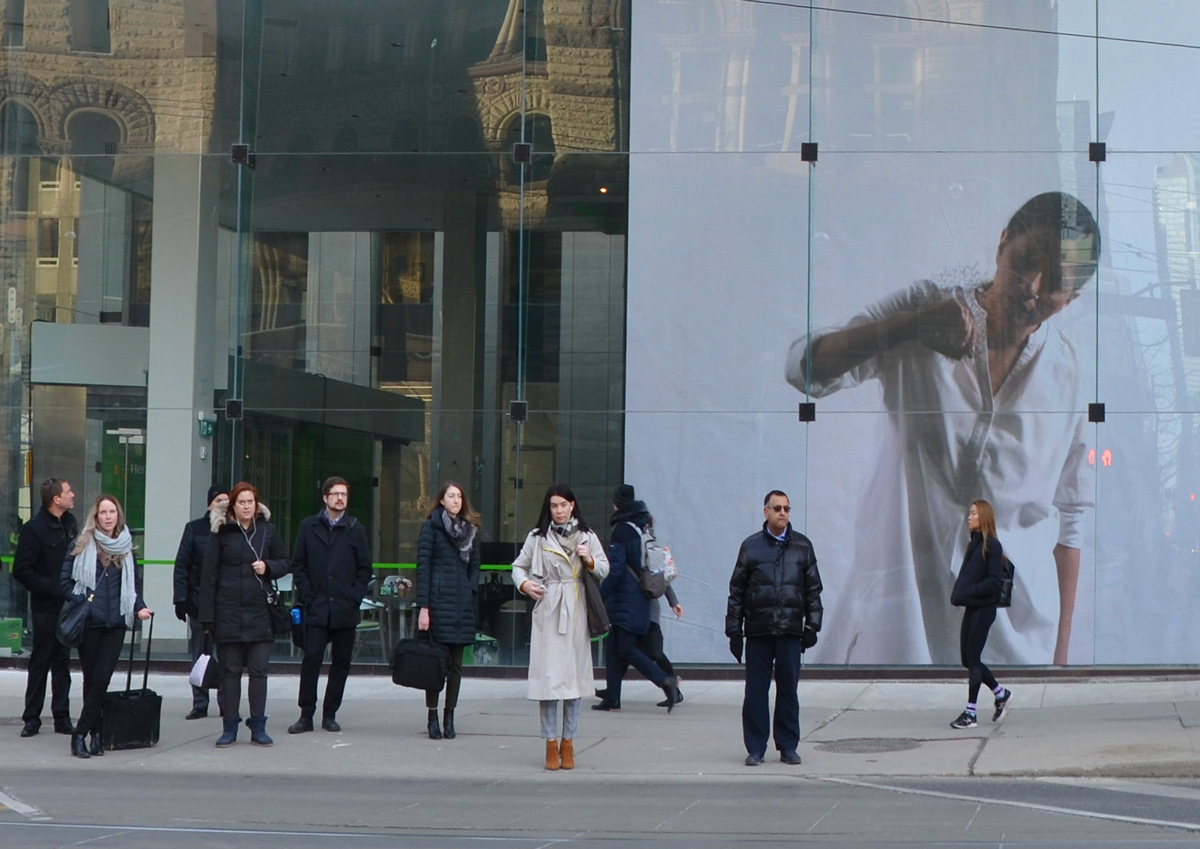
below: This was the largest group of “protesters” that I saw. It was more of an information session than a protest, and there’s nothing wrong with that.

below: People headed to work as I started home.

The Last Day of February
below: These boots are made for walking… walking through the snow and slush on a sunny day.

February has come to a close but it’s still winter and there’s still lots of snow on the ground. There was a bit of a respite from the cold the other day but rumour has it we’re headed back to some very cold temperatures in the near future. Of course, slightly warmer temperatures mean slush and puddles on the streets and sidewalks of Toronto.
below: The CN Tower is reflected in an oily puddle.

below: The cows don’t seem to mind the snow!

below: And the dogs at Berczy Park are all sporting scarves!

below: Slow thaw. Melting and dripping down the window.

below: Rust and snow

below: Outside smoke break shadows. Brrrrr

below: Sun and reflections, southwest corner of King St and University Ave

below: Flip yourself around…. and now looking north up University Ave past the northeast corner of University and King Street West.

below: Wet tree branches glistening in the sun

below: More tree branches, but soft and feathery this time

below: These two little birds now watch over the dogs in Berczy Park.

below: A section of a picture on display at Union Station. It is part of an exhibit called “A Thousand Paths Home” and is the work of Torontonian Yung Yemi aka Adeyemi Adegbesan aka SoTeeOh. A write up of his work appeared in Afropunk.

below: There were also some real people at Union Station, or at least parts of people.

below: Looking north up Lower Simcoe Street towards the railway bridge

below: Salt and dirt and slush and snow, yes, the city in winter.

below: It’s nice to still find lovebots!


Falling snow and ice from above, and slush under foot. That was February.

A walk along Queens Quay West
My reason for walking along the waterfront was to see the 2019 version of ‘Ice Breakers’. This year there are five art installations spaced out along Queens Quay. The white PVC tubes you see in the photo below is half of one of these installations, Stellar Spectra. The other half is identical and was behind me when I took this picture. They are placed at each end of the little bridge. These hollow structures were designed by Torontonians Rob Shostak and Dionisios Vriniotis. There is room for a person or two inside and once inside, look up! The tops of the tubes are covered with coloured acrylic.

below: I was trying to think of a way to describe the bridge that sits on, but a picture paints a thousand words so here’s the bridge from a different angle. You can also see the two white structures on the bridge in the background. In addition, there are green signs on poles that once floated in the water but are now frozen in the ice. The signs, like protest signs, are ‘Chroma Key Protest’ by Andrew Edmundson of Solve Architects.

below: Twenty five green signs

below: A pair of long-tailed ducks enjoy an small bit of open water.

below: Another installation, ‘Tweeta Gate’ over a very icy path. There were lots of barriers along the waterfront along with signs that warned of “no winter maintenance”. It was very slippery. These 10 arches are supposed to lead you to the waterfront but I didn’t see anyone brave enough to walk there. ‘Ice Breakers’ remain until the 24th of February so there is still time for the ice to melt (it will, won’t it?) Each arch represents a different architectural style. It was designed by Eleni Papadimitriou and Stefanos Ziras.

below: ‘Connectors’ is an entanglement of four orange tubes made of drainage pipes – if you speak into one end, which of the other 7 ends is the sound going to come out of? This was designed by Alexandra Griess and Jorel Heid from Hamburg Germany.


below: At H2O beach

below: The beach was fairly quiet. It was also covered with a layer of ice.

below: More ice surrounds the base of ‘Tripix’, a structure that was designed by a group of Ryerson students.

below: The panels that cover its surface are reflective and the angles in which they are arranged make for a kaleidoscopic effect when viewed from inside the installation.

below: And yes, another CN Tower picture

below: It’s not part of the ‘Ice Breakers’ series, but three large photographs are on display at Ontario Square. These are the series “Our Desires Fail Us” by Sean Martindale and J.P. King. They are mirrored images of Toronto garbage (mirrored in that one side of the photo is a mirror image of the other).

below: A close up look at one of the other photos [art is garbage vs garbage is art? – sorry, couldn’t help myself]

below: Recently, the off-ramp from the Gardiner Expressway that circled onto York Street was removed. The bents that held the road up remain in what is now a park at the corner of York Street and Queens Quay.

As I write this post, I keep wondering if I missed something because of the ice. I might have to make a second trip if the temperatures warm up enough before the 24th of February. In the meantime, don’t slip!

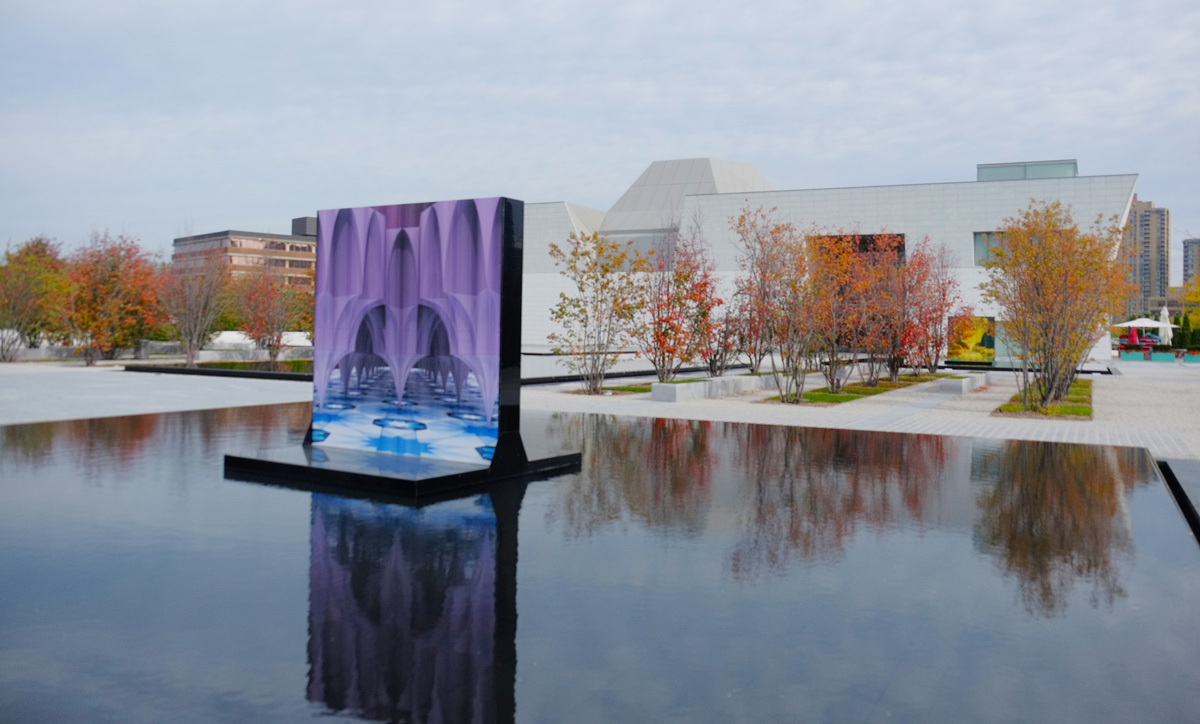
below: ‘The Encompassing’ by street artist Javid (aka JAH) stands in one of the reflecting pools between the Ismaili Centre and the Aga Khan Museum. This is one of a number of pieces on display. Each is painted on reclaimed corrugated metal. They are an examination of the geometry in Islamic patterns and architecture. His work will remain on display until the 31st of October.
below: On the other side of the above painting, is this one – “Beyond”, also by Javid. The Ismaili Centre is in the background with its large pale blue dome over the prayer room.
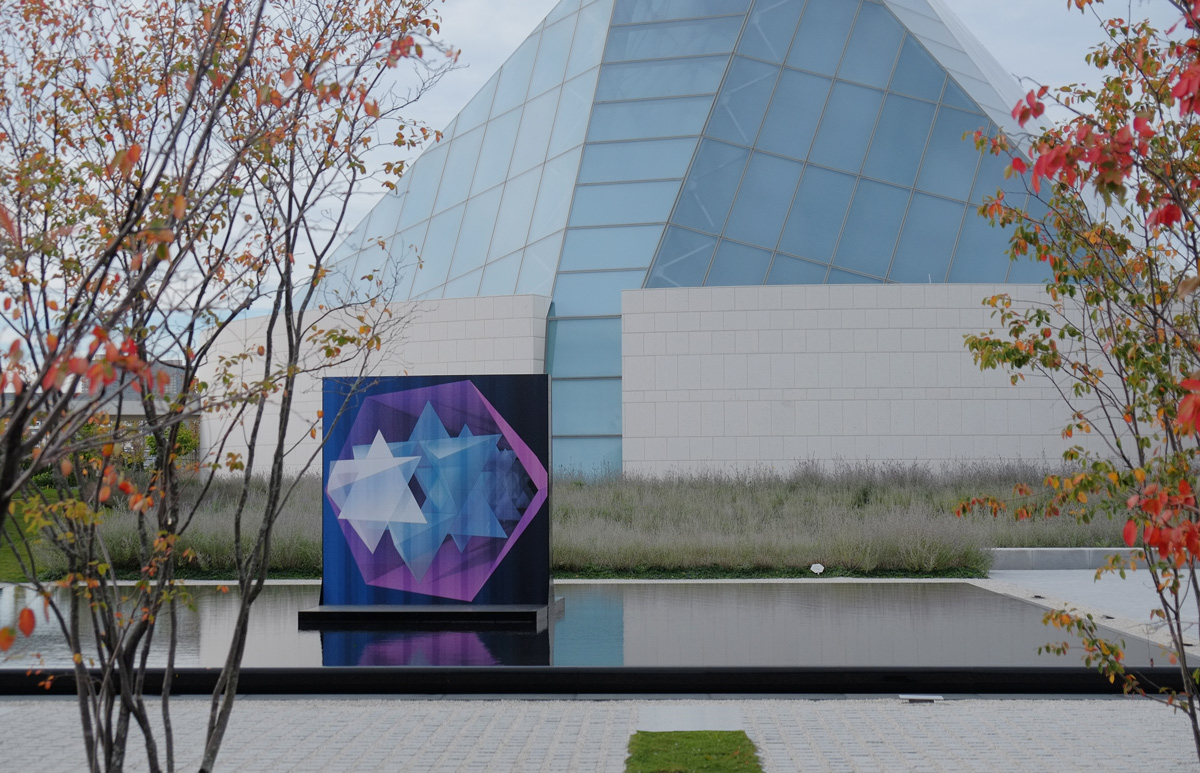
below: The large wood beams that cover the entrance to the Ismaili Centre were being re-stained this morning.

The Toronto Ismaili Centre is one of 6 around the world. It was designed by Indian architect Charles Correa and opened in 2014. If you go on the tour of the inside of the Ismaili Centre, you will see a building that is filled with natural light, as well as natural woods and stone.
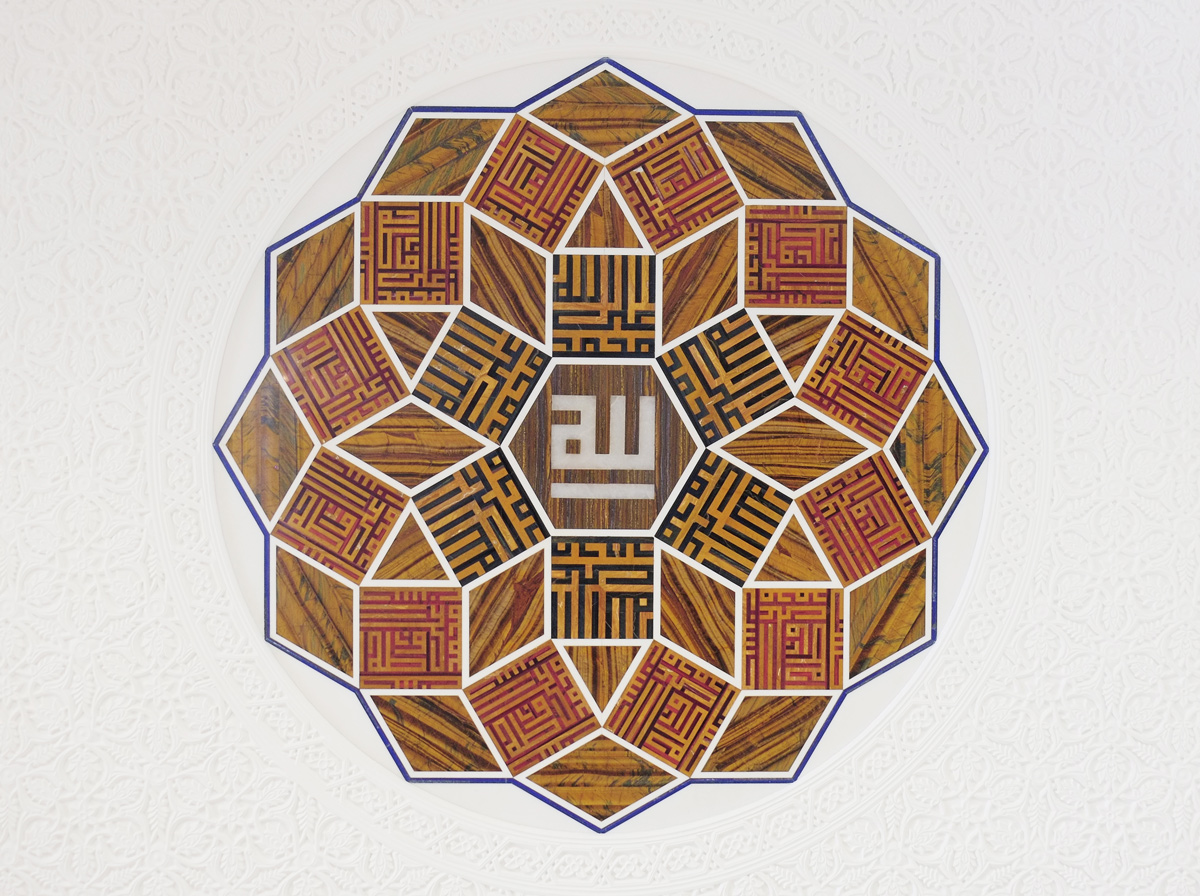
below: A calligraphy based medallion made of stone is on a white wall. The Arabic word ‘allah’ is in the center and surrounding it are the ninety nine attributes of God, written in Arabic.
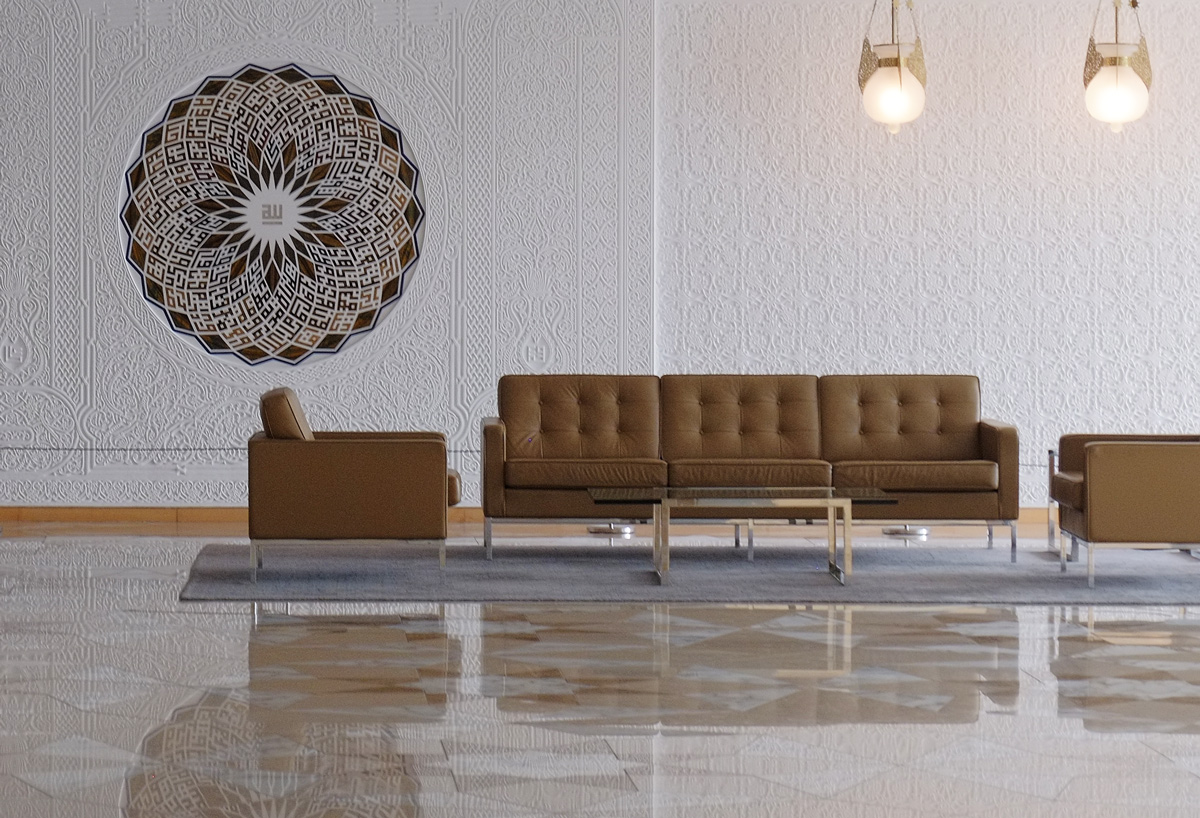
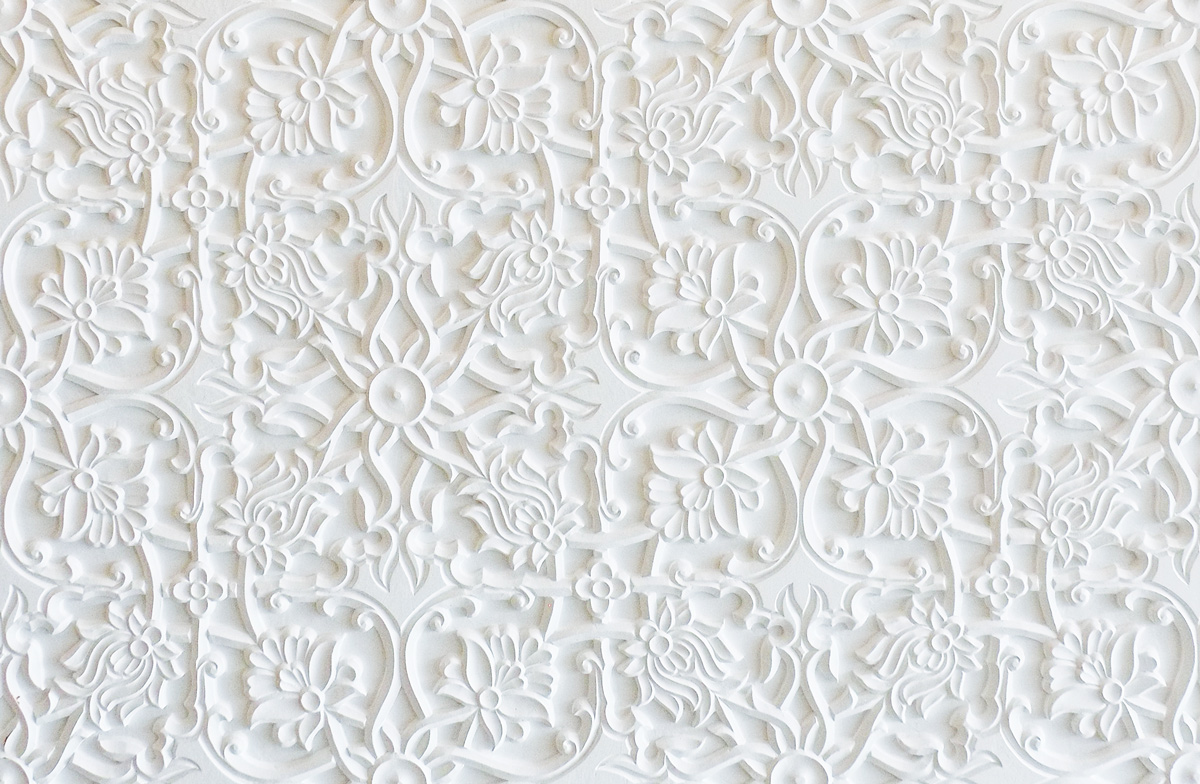
below: A closer look at the wall. It took two men, a father and son, fourteen months to carve the design into this wall and a matching wall on the other side of the room. They worked six days a week . The arabesque design was penciled on using a stencil and then carved by hand.
below: A second medallion is on a wall across the room from the one above (on the other wall that was carved).
Crossing back past the reflecting pools to the Aga Khan Museum….
below: Another Javid Jah painting, this time “The Manifest”. (To the left, you can see a metal sculpture called “Big Heech” ). Like all of Jah’s paintings here, this one is based on geometry. The basic shape here is a pentagon (sacral chakra) and it is seen on the floor. This type of archway is called a muqarna and it is unique to muslim architecture. Here the shape of the indentations in the muqarna are based on the pentagon.

The “Big Heech” is the work of Parviz Tanavoli, made from stainless steel in 2014. It is derived from the Persian word for “nothingness” and it is an important word in Perian Sufism.
“Emperors and Jewels: Treasures of the Indian Court from the Al-Sabah Collection in Kuwait”, is a temporary exhibit at the Aga Khan Museum featuring artworks and historical objects from the treasuries of Mughal emperors. The Mughal Empire ruled most of present day Pakistan and India in the 16th and 17th centuries. The Mughals were Muslim but the majority of the population were Hindu.
below: Part of a larger picture depicting a hunting scene, reproduced and enlarged especially for the exhibit.

below: Three glass bottles

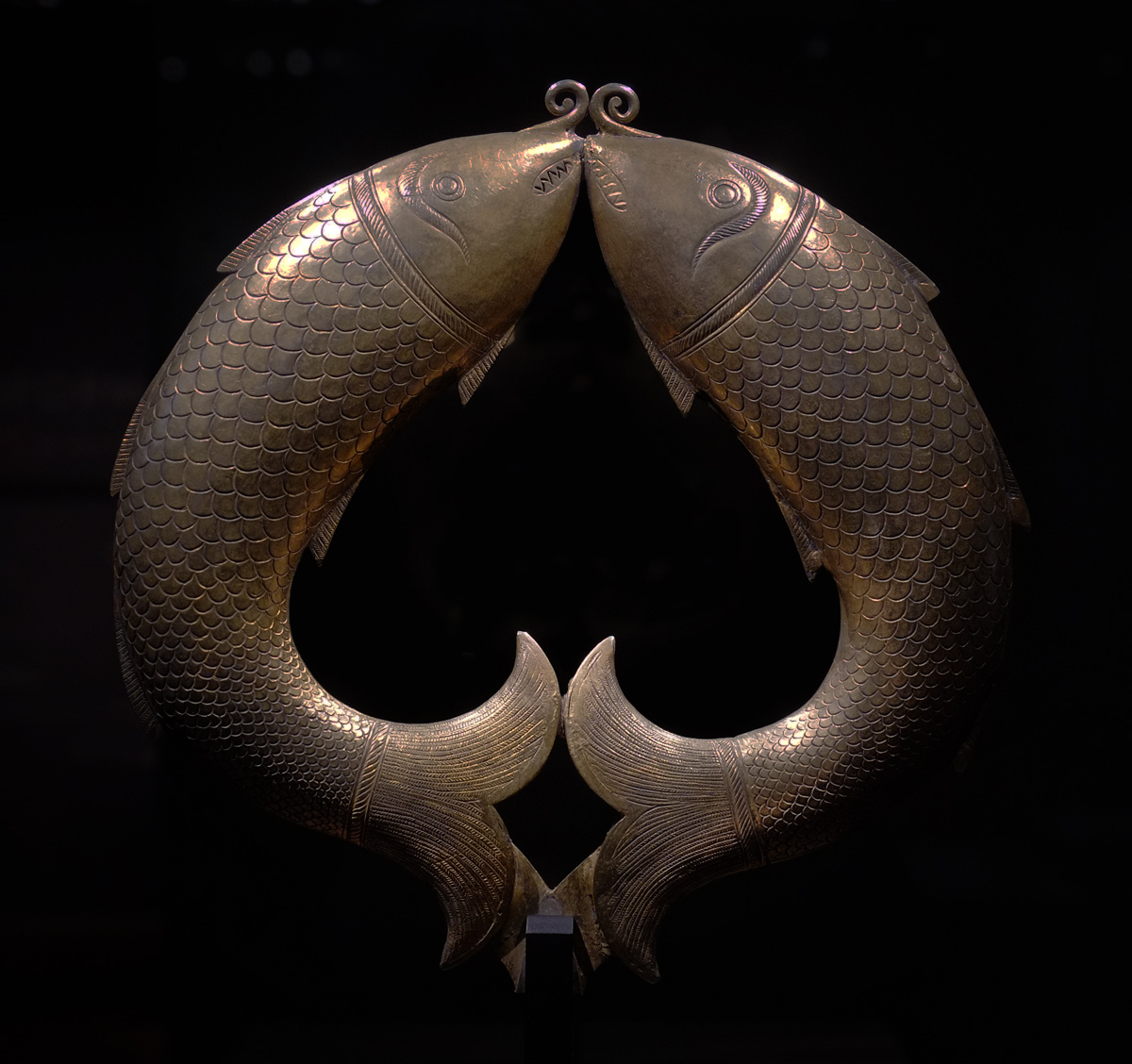
below: Two fish joined to make a circle, a standard. From India, late 18th century. Made from silver. There are many myths and symbols that feature fish. In Hindu tradition, the fish was associated with Brahma and Manu, a progenitor of mankind. In addition, one myth is that a fish was believed to hold up the globe.
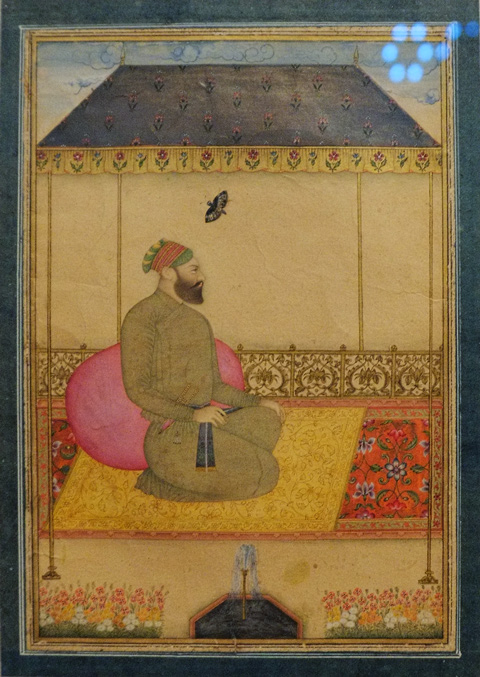
below: A portrait of Nawab Bairam Khan, painted around 1710-40, watercolour and gold on paper. He is pictured in profile, sitting alone in his peaceful garden.
below: Knife with jade handle carved in the shape of a horse head and neck.

This year’s Nuit Blanche was on September 28th and 29th. The night’s activities were spread over a large number of locations around the city. That was a few days ago so yes, I am a bit behind. I was laid low for a couple of days with this cold that’s been going around… or I took a few days to recover from being up until 3:30 a.m.!
below: Part of ‘Continuum: Pushing Towards the Light’ by Brandy Leary and the Anandam Dancetheatre. They made they way across the glass enclosed bridge over Queen Street between the Eaton Centre and The Bay store.

below: From behind the burlap (or tarp?) Nathan Phillips Square, from an installation ‘Radical Histories 2012-2018’ by Ibrahaim Mahama.

below: More from the same installation, this time from the “right” side. It was great for making shadow figures. Thanks to Jude for starting off the evening with me… and getting creative (silly?) too.

below: We found a photo shoot on Bay Street.

below: On Bloor Street, nothing to do with Nuit Blanche but it looked cool. Reflections and lights.

below: Eaton Centre, a quieter moment that night.

below: Checking the map. Yonge Dundas Square – the installation there was very unimpressive so I took people pics instead.

below: At Church of the Redeemer (Avenue Road and Bloor), Korean Dancers. “Star Moon Water Stone” by Ensemble Jeng Yi

below: Drummers, same venue as above.

below: ‘This Storm is You’ at the Ontario Science Centre, an installation by Zahra Saleki. Photography on the walls and stories on the floor.

below: Walk among the stories. “Every story deserves to be lit. Grab a sharpie and write yours.”

below: Smile!.. and a testament to the start of love. Two of many lit stories.

below: Saleki’s photos displayed here are abstract dance photographs in black and white. Negative images and slowing the camera to produce the blur of motion.


below: This is what you saw when you first got off the subway (is the SRT a subway?) at Scarborough Town Centre. It’s part of the ‘The Things They Carried’ Babel series. The motifs are similar to those on the installation at Yonge -Dundas Square, that oops, I don’t have a picture of.

below: At Scarborough Civic Centre, ‘Everything I Wanted to Tell You’ by Hiba Abdallah. A series of words in lights projected onto several buildings. The words changed every few seconds to tell a story or two.

below: More of the words. “People hold on so tightly to a specific narrative of this place”.

below: More projections at Scarborough Civic Centre. Sorry, not sure which installation this is.

below: Scarborough Town Centre (mall) had a mountain of inflatable globes you could walk under, or just look at. ‘Walk Among Worlds’ by Maximo Gonzalez

below: Weaving stories, ‘Interlacing’ by Community Arts Guild, at Scarborough Town Centre.

below: Watching a performance at the Scarborough Civic Centre.

below: Running through the lights.

below: Reflections, Aga Khan Museum

below: more Aga Khan

below: Showing ‘Insomnia’, a video filmed in Tehran showing simply the view out his bedroom window, by Simin Keramati, Aga Khan Museum


below: Trash at Yonge Dundas Square. Nothing to do with Nuit Blanche, just an ordinary day’s worth of garbage. It just happened to catch my eye as I was walking down the stairs to the subway.

Ending with rubbish would be a weird way to end a post, so here’s another mannequin. I saw lots of them that night too, unfazed by the activity around them, unmoved by the night’s events.
below: I’m out here every night. Nice of you to finally notice….

A new mural in town,
Equilibrium, by Okuda San Miguel, aka Okudart
below: As seen from Sherbourne street. It’s tall! 23 storeys tall in fact. Not just a new mural but also a new landmark.

below: As seen from Allan Gardens.

below: It’s painted on the side of the Parkside student residence (once the Primrose Hotel) on the SW corner of Jarvis and Carlton streets. It looks finished although the ropes and lifts are still in place. No one was painting when I walked past this afternoon. The artist, Okudart, has already signed the piece.

below: The very top portion. A blue conical beak and feathery wings on a female human like figure who is sitting on three large heads.

below: Just a bit lower on the mural – more beaks but this time they look like carrots. A black and white globe with a mouth in Africa. One blue eye in the Atlantic Ocean and one orange eye in Asia. Is that a man on the left?

below: Under the globe another female figure with a blue nose. Nude but discreetly so.

The background of the mural consists of large rainbow coloured stripes on top and black on the bottom. These were painted by local artists before Okudart finished the piece.
below: Street level

below: The church across the street does not have stained glass windows. The colours are reflections from the mural.


The mural was part of the STEPS Initiative Program and it also involved StART (StreetARToronto), the owners of the residence, and a number of other partners.
A trip to Toronto Islands on a sunny spring day.
Photos and stories – an eclectic mix of history and nature that resulted from wandering around the eastern portion of the islands.
below: From the ferry, looking toward the glass and steel of the city.

Toronto Islands is a collection of at least 12 small islands. In the early years the island archipelago was really a peninsula of sandbars and ponds; it was connected to the mainland by a narrow strip of sandy shoreline. This landform was created over centuries by the action of waves, winds and lake currents – washing away portions of the Scarborough Bluffs and depositing this material to the west in a five-mile-long hooked shape. This process of natural “landscaping” continued until the spring of 1858, when a particularly powerful hurricane created a channel four to five feet deep through the peninsula. By June of that year, the Eastern Gap was a waterway, and the Toronto Islands came into being.
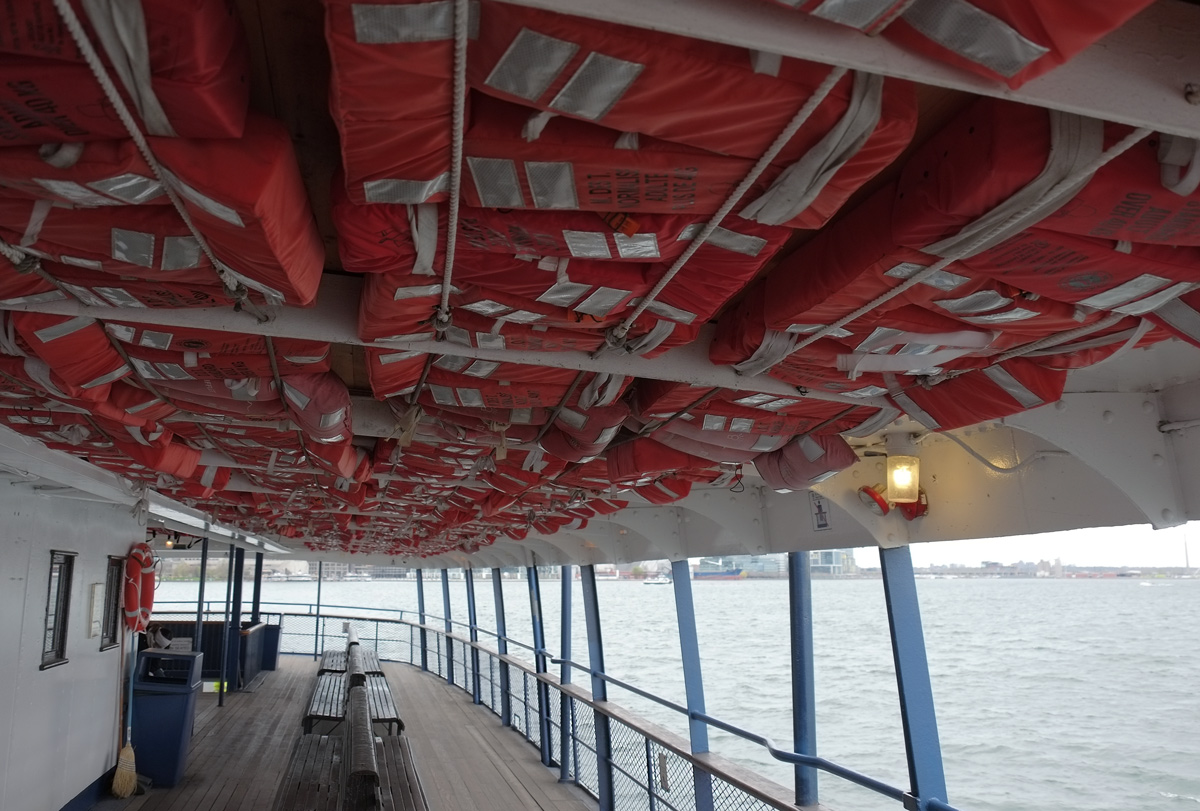
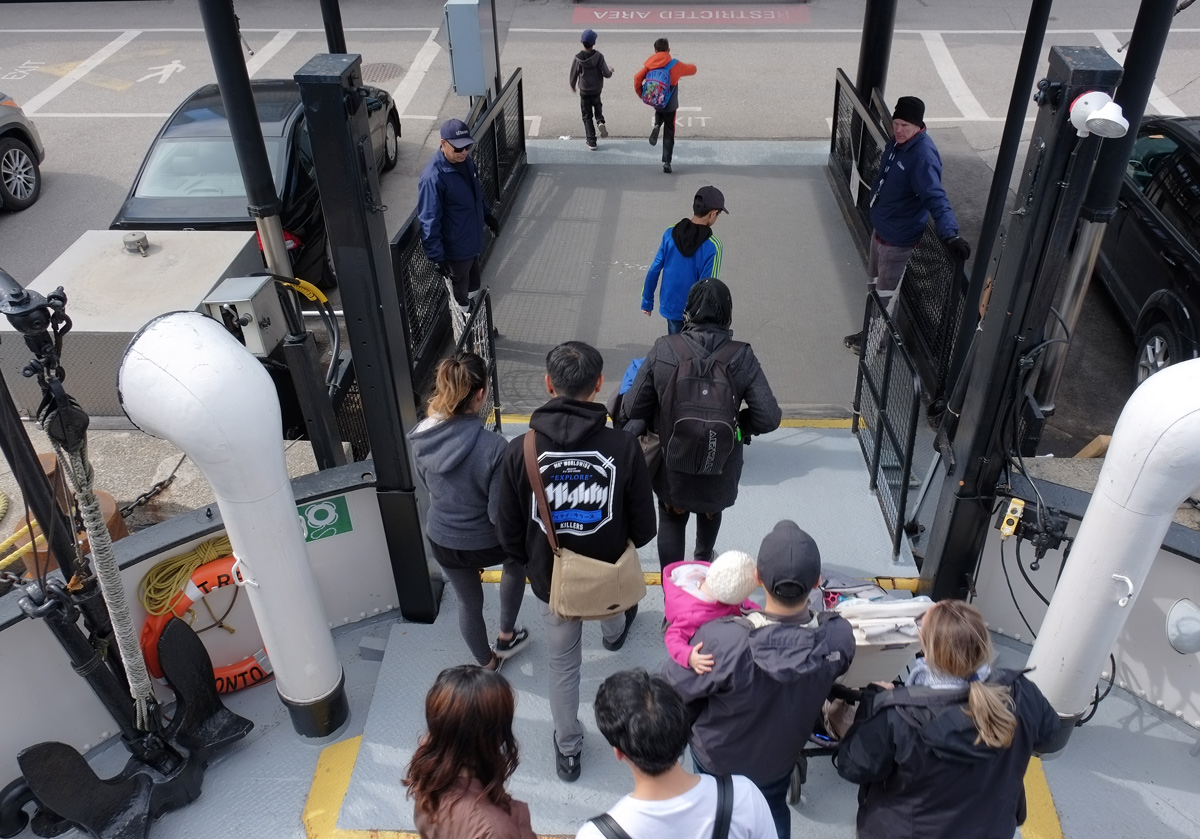
below: On the ferry between the city and Centre Island.

The first buildings on the islands were the Blockhouse Bay garrison built in the 1794 by the British at Gibraltar Point – it included a blockhouse and storage structures. A second blockhouse and a guard house were built soon after, only to be destroyed by the Americans in the Battle of York in April 1813. The lighthouse at Gibraltar Point built in 1809 still stands (sorry, no photo).
In 1833 Michael O’Connor built a hotel on one the islands. He used a horse-drawn boat to ferry customers across from the mainland to his hotel. At that time, there was still access by road but it was a toll road. In 1836 it cost sixpence for every four-wheeled carriage drawn by two horses. Smaller ‘vehicles’ paid less. In 1858 the hotel (now Quinns Hotel) was destroyed during the same hurricane that turned the peninsula into an island. The hotels were destroyed but the islands remained popular. With no road access, ferries were needed and many people ran private ferry services until they were bought out or amalgamated into the Toronto Ferry Company in 1892. It was privately owned until 1926 when it was purchased by the City of Toronto for $337,500.

Many houses and businesses, (hotels, restaurants, bowling alley, laundry, theatre etc) were established over the years from Hanlon’s Point in the west to Wards Island in the east. Today, residences are only in the eastern section of Wards Island and on Algonquin Island.
The Ward’s Island community began in the 1880s as a settlement of tents. Up until then, that eastern end of the islands was mostly wetlands. The first summer colony on Ward’s in 1899 consisted of just eight tenants, each of whom had paid a fee of $10 rent for the season. The number of tents grew each year. In 1913, the city felt it necessary to organize the community into streets. The evolution from tents to cottage structures progressed in stages with the building of floors, the addition of kitchens and then porches, resulting in the creation of the homes.

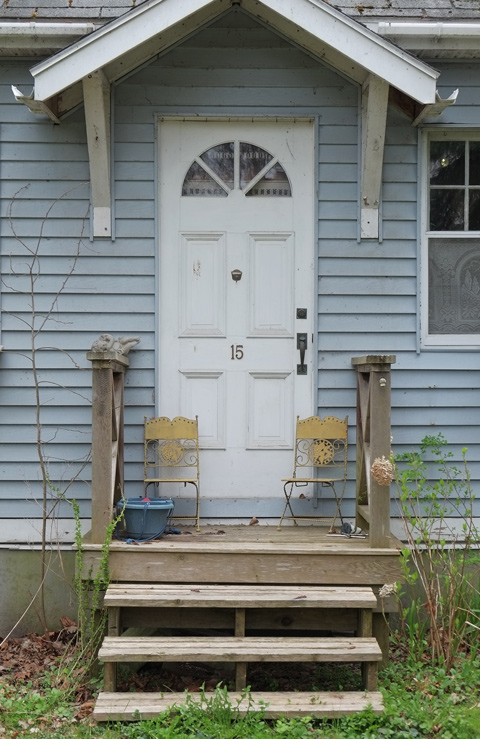
In 1953 the municipal government changed their policy toward the Toronto Islands landscape and its residents. Businesses were removed and the systematic demolition and burning of homes began. More of the islands became parkland. There are 262 houses on Wards and Algonquin Islands today, down from about 630 residences on all the islands. The last of the Lakeshore houses was removed in 1968 but traces of them still remain.


below: The pier on the Lake Ontario side.

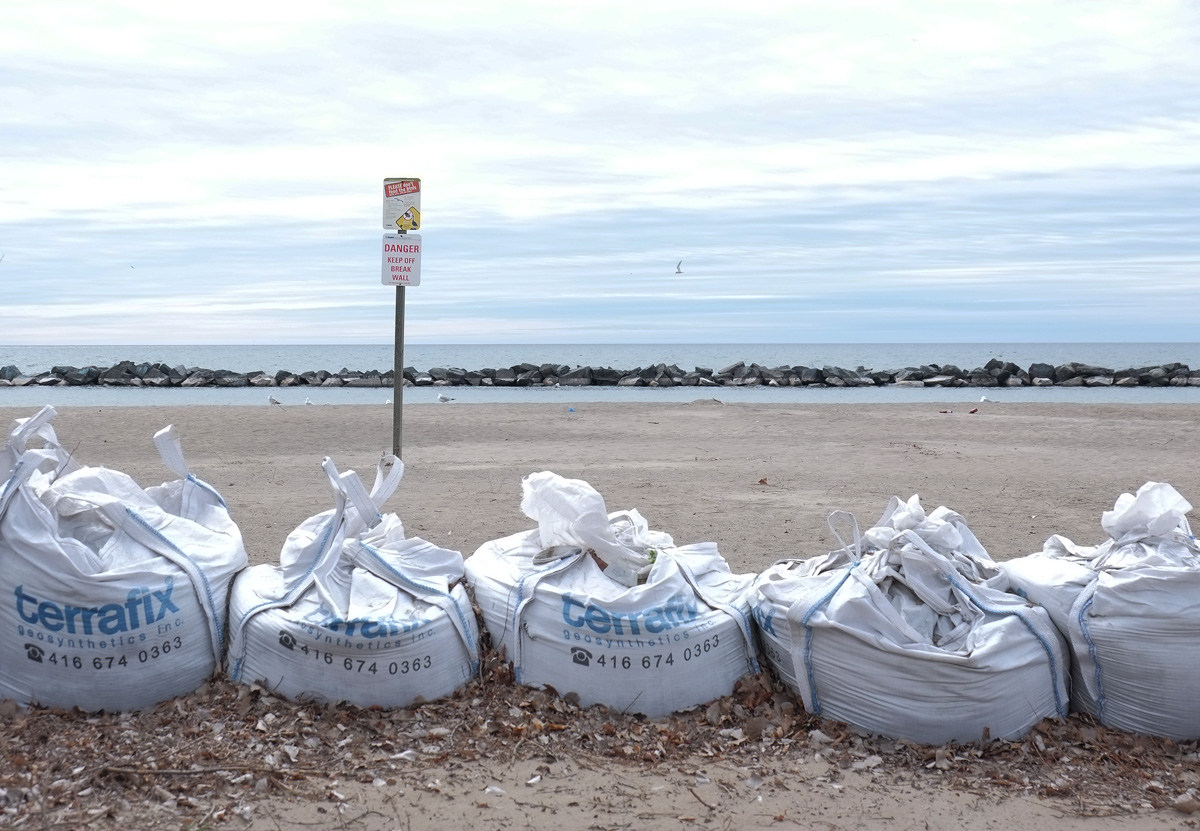
below: Sandbags along the shore. Last spring there was a lot of flooding here and the island was closed to visitors – sort of. Ferries didn’t run and the park facilities were closed. The islands are very flat and low so it doesn’t take much extra water to flood.

below: There is a small amusement park, Centreville, on Centre Island.
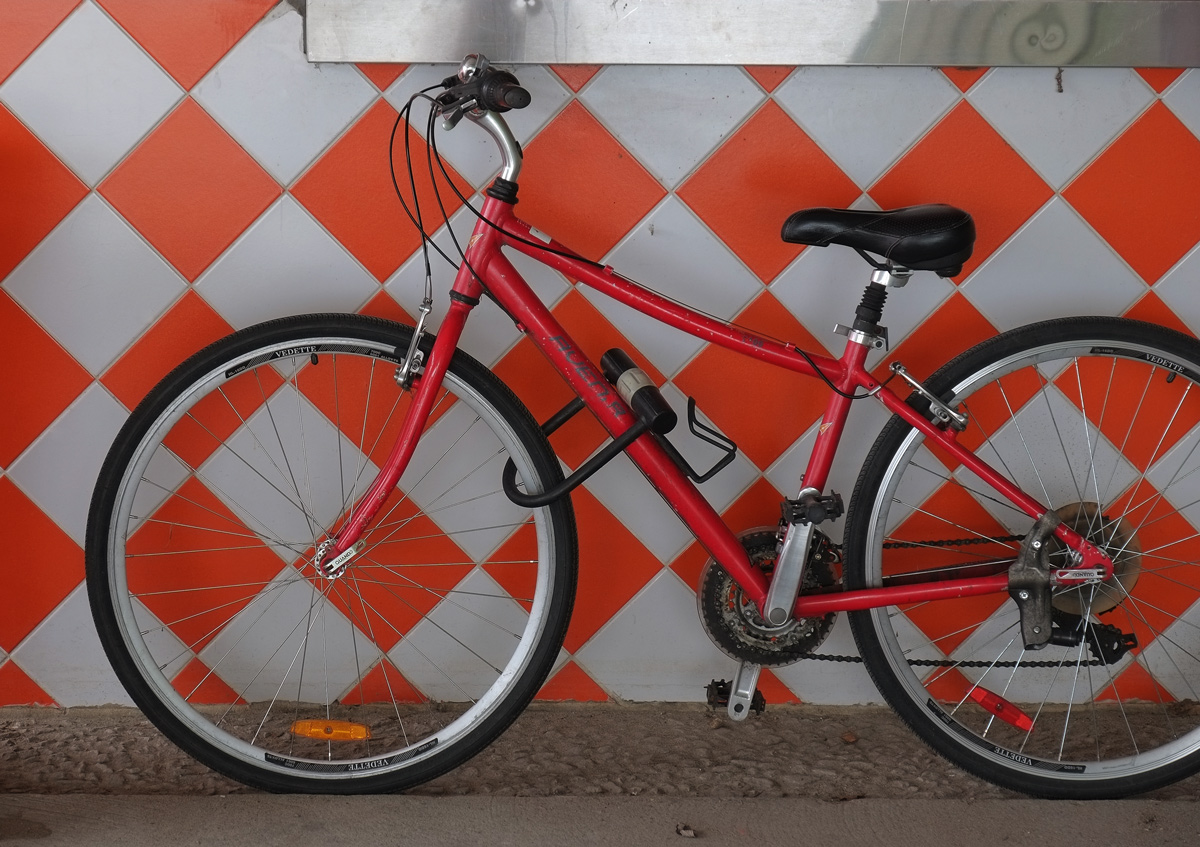
below: Island transport that can be rented if you don’t want to walk.

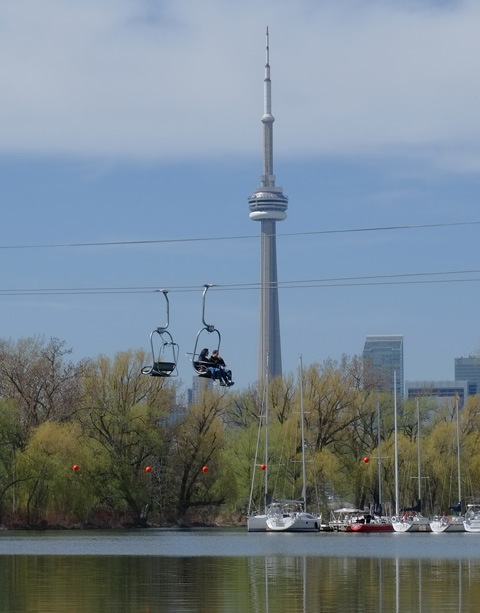
below: Boats moored QCYC (Queen City Yacht Club), one of the three yacht clubs on the islands.

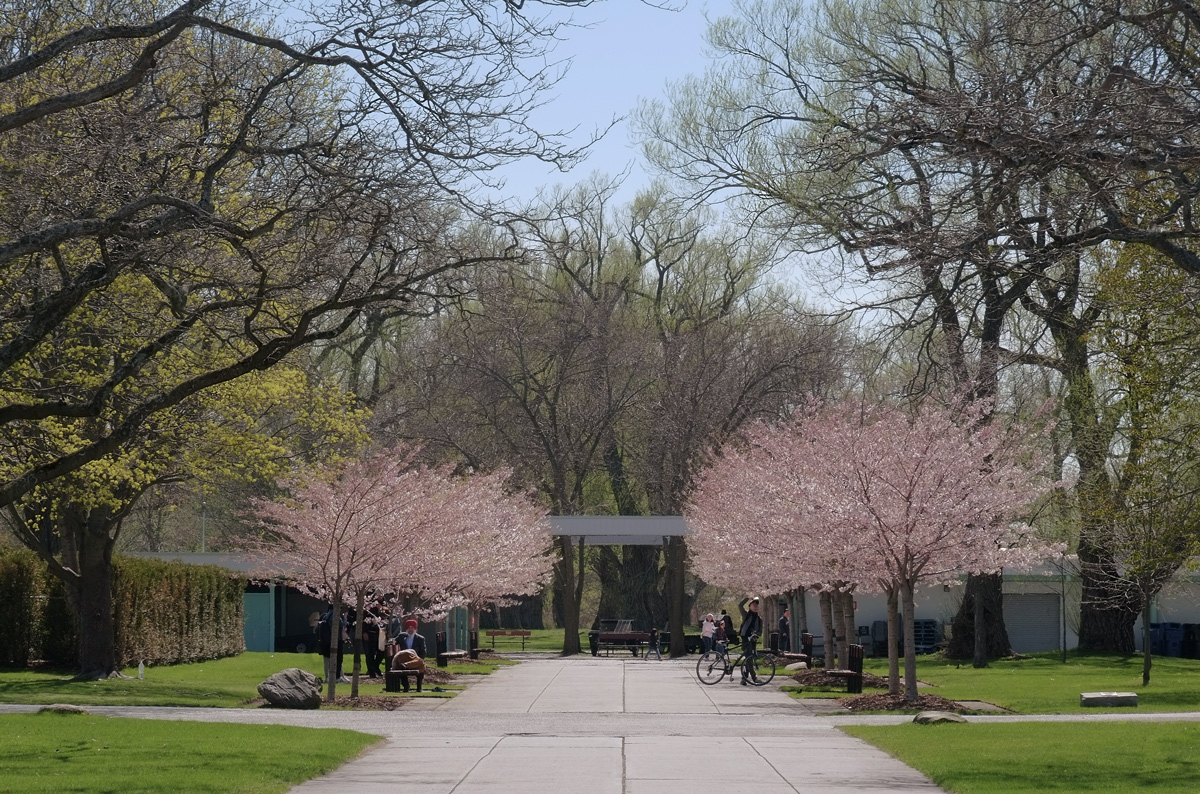
below: Sakura trees in bloom. The trees were donated by the Sakura Project. The aim of this project was to strengthen Japanese Canadian relations by planting cherry trees in visible locations across Ontario. Between 2000 and 2012, 3,082 trees were planted at 58 locations. The trees on Centre Island were planted in 2011.
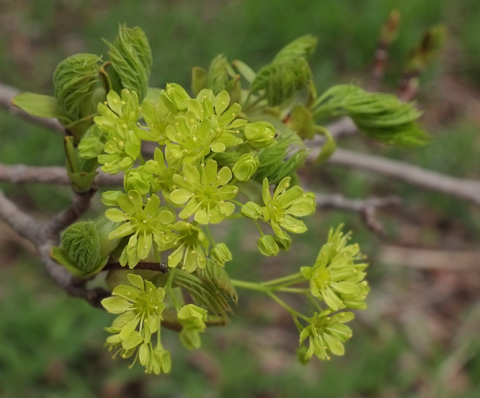
below: Catkins from a red alder tree. They almost look like raspberries packed tight together.

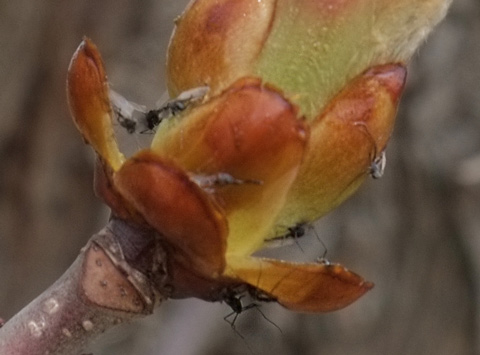
below: An early family of Canada geese.

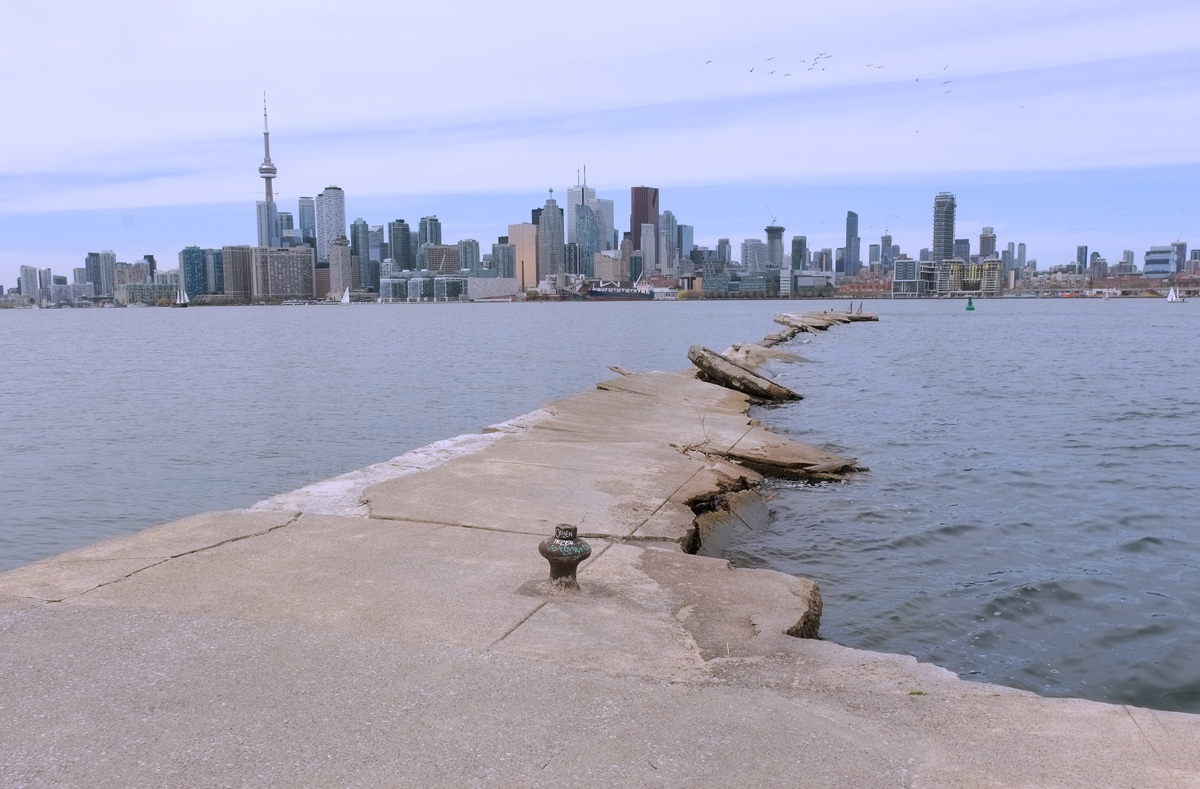
below: The pier at the eastern end of Wards Island is bad need of repair. To the right is the entry into the Eastern Channel (or Eastern Gap).
below: Looking over to Algonquin Island. Once upon a time this island was just a sandbar.
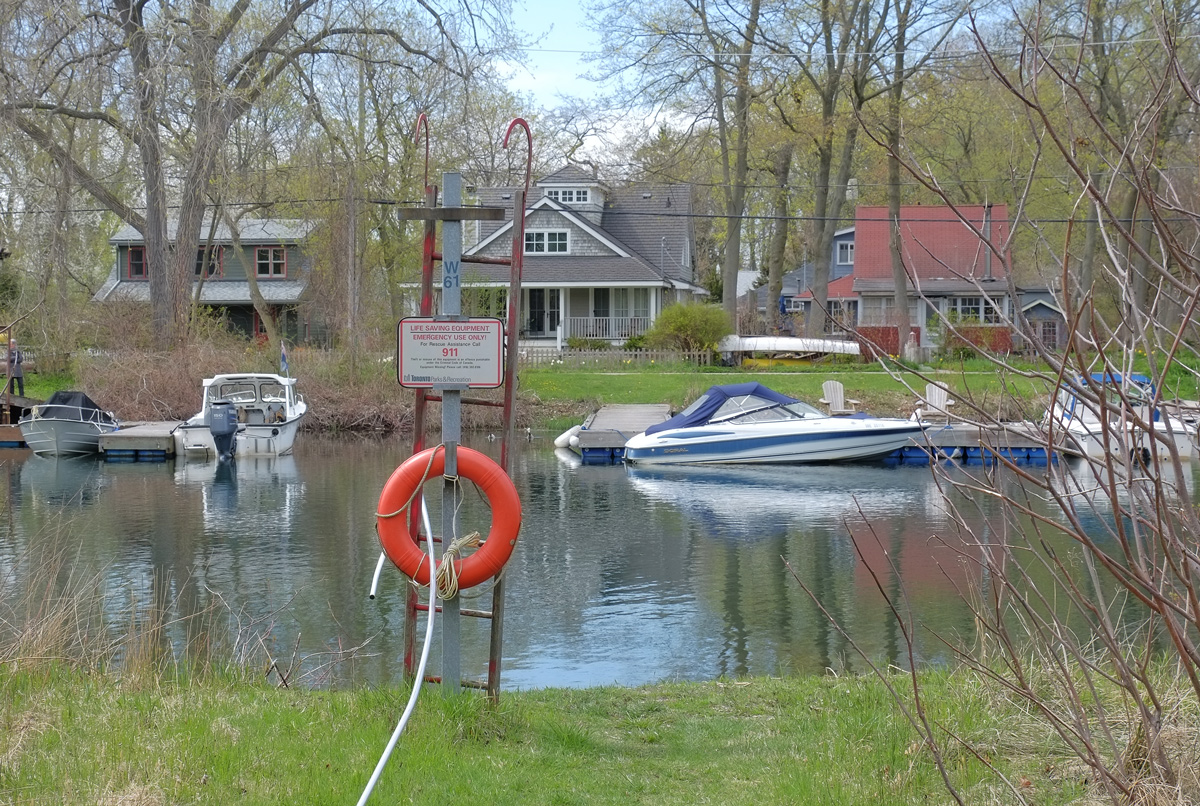
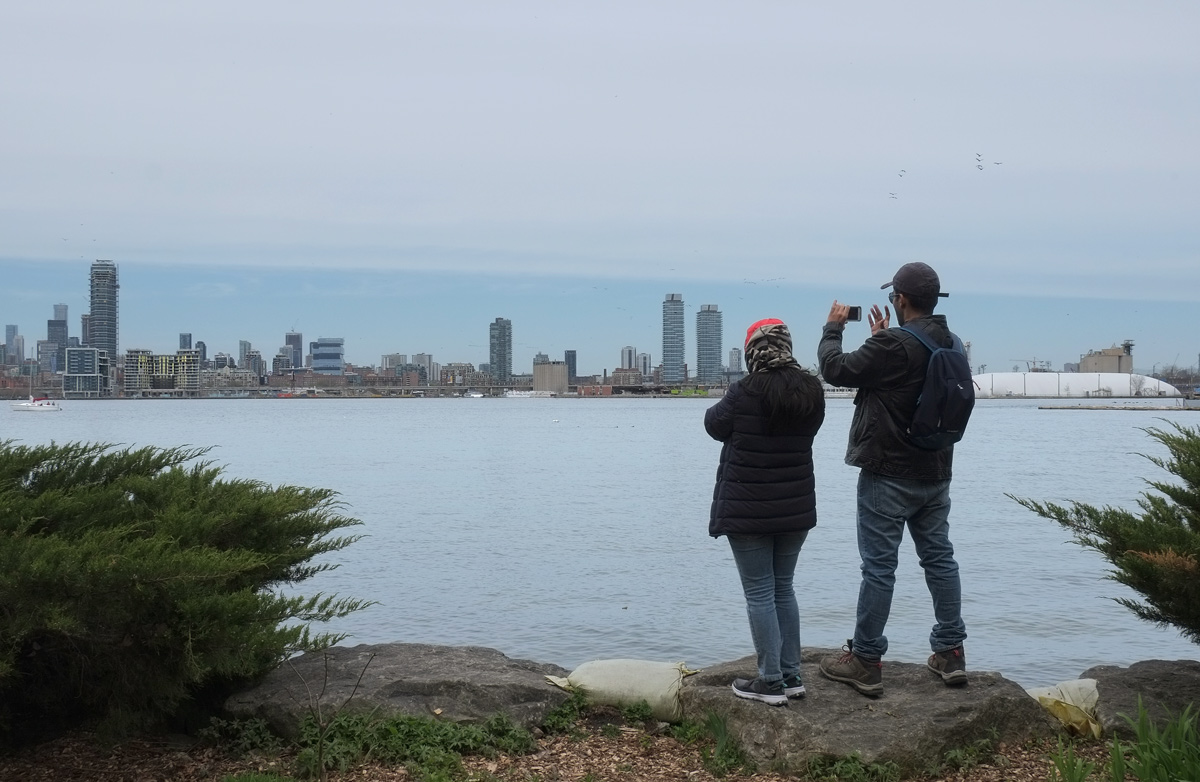
and back to the mainland.
Today. Wonderful
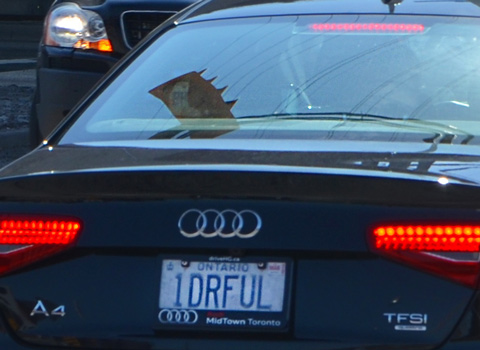
and Shiny.
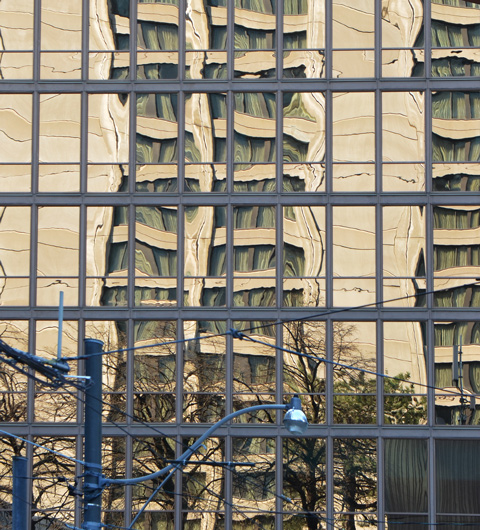
I am not usually a morning person but how could I resist not getting up and moving on this gorgeous spring day? With my metropass in my back pocket….

… and my walking sandals on (Yes! Sandals!) I headed out to explore the day.

(early enough to beat the crowds!)

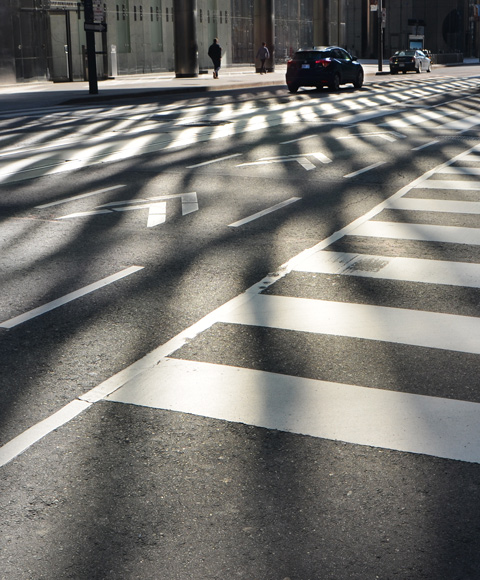
The early morning criss cross shadows and reflections.
The soft greens, and almost yellows, of new leaves.
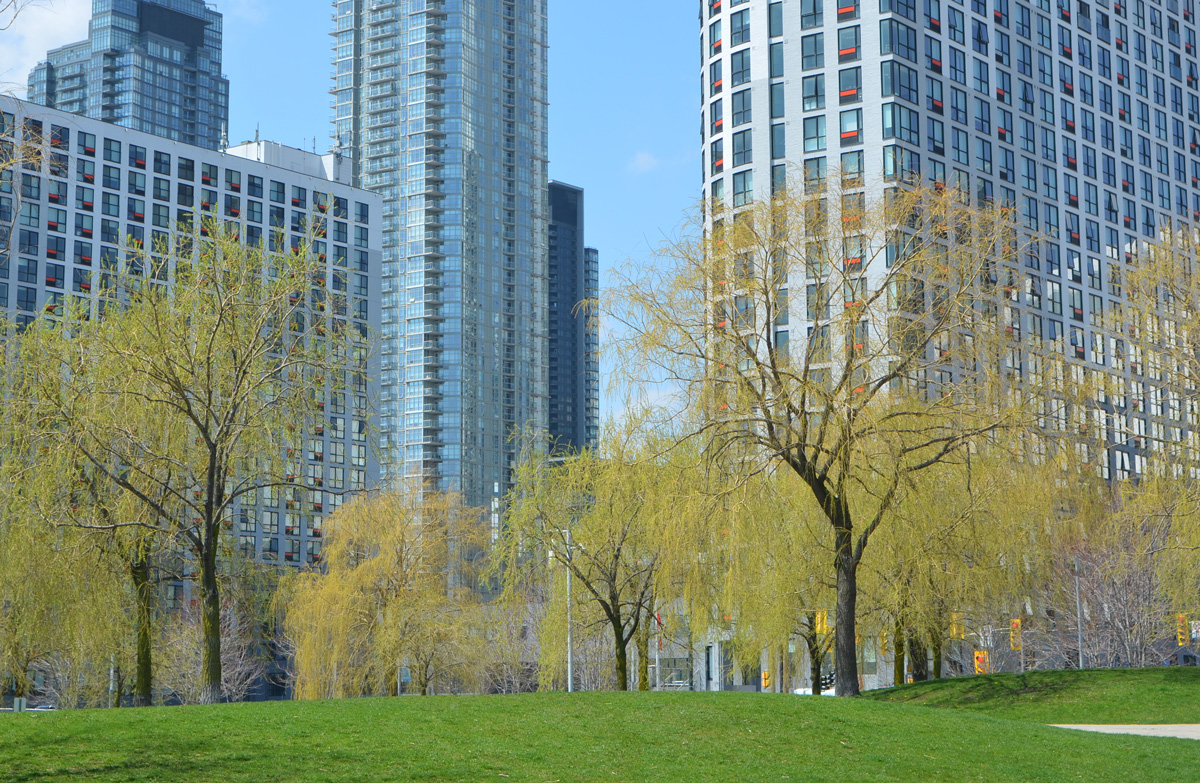
The flowers – tulips, daffodils and hyacinths – that have spring up in planters around the city.

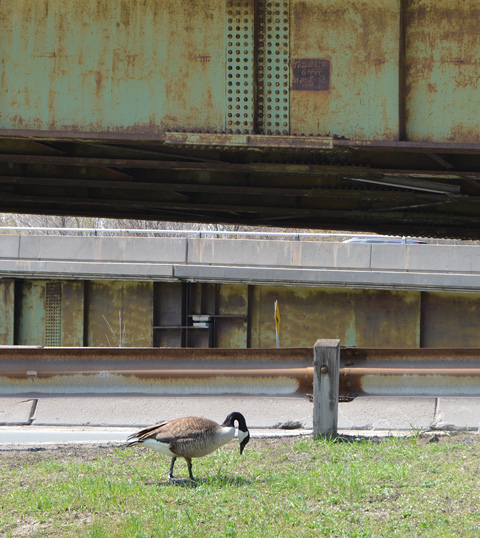
Oh no. The geese are back (or did they never leave?).
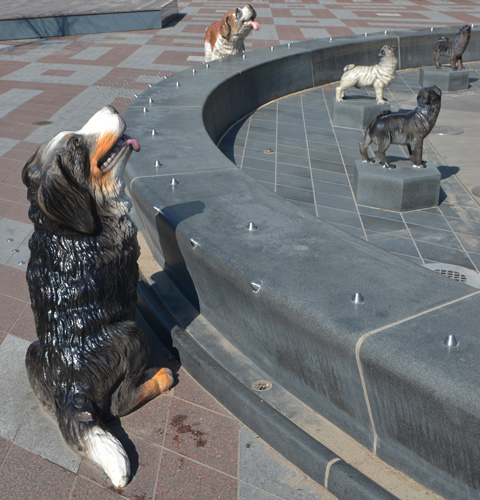
The dogs are still waiting for the water to be turned on.
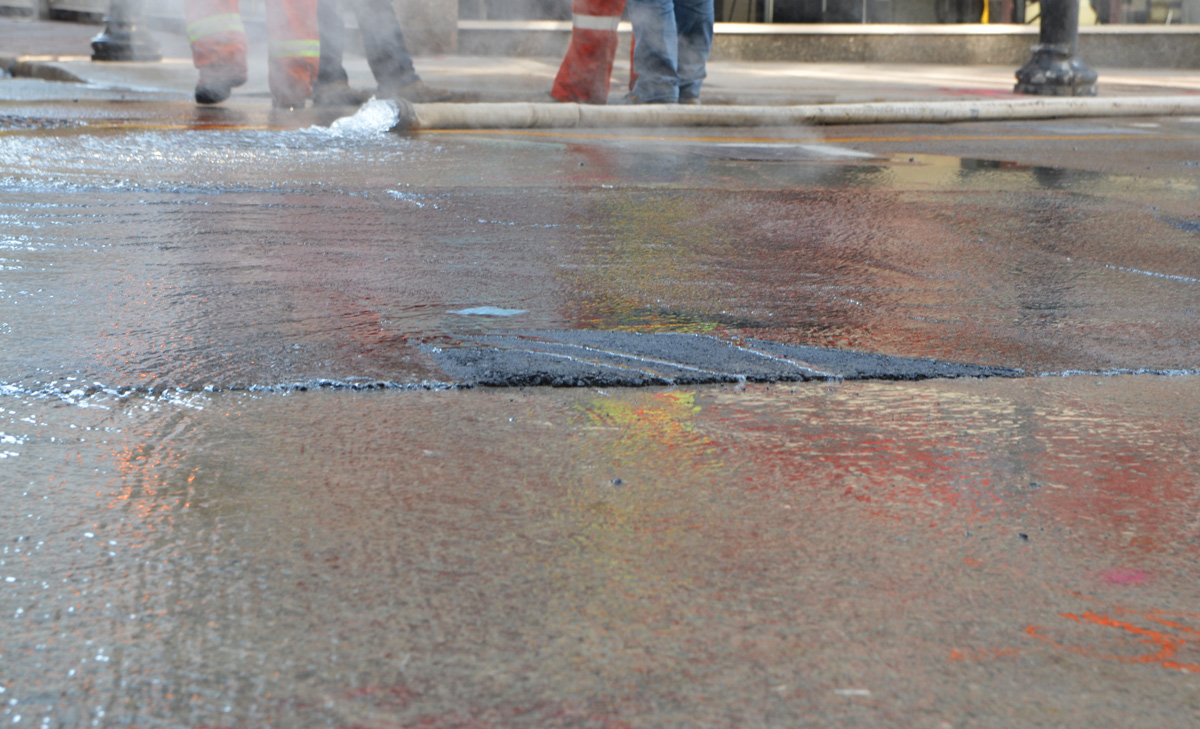
On Yonge Street (near Wellington), there has been too much water. The street has been closed while water main issues are straightened out (it has since been opened).

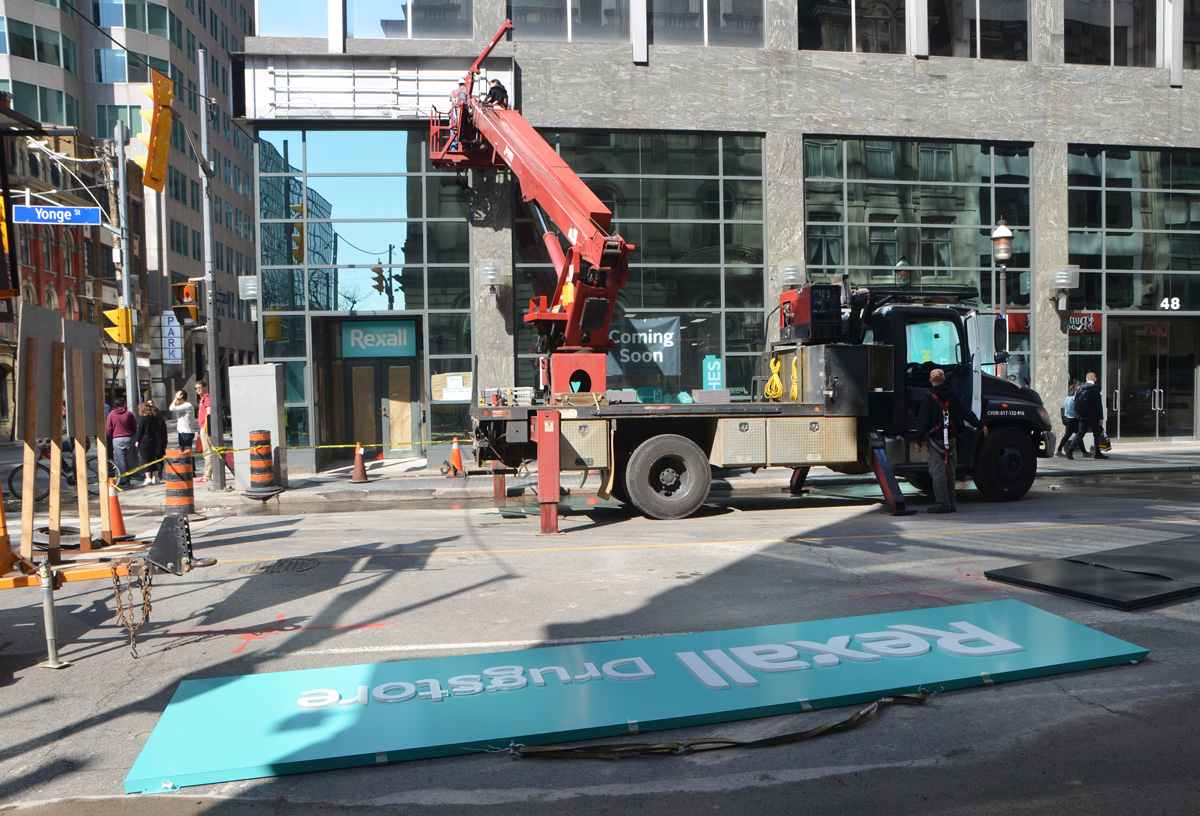
While Yonge was closed anyhow, workmen install a new sign at the corner of Yonge & Wellington.
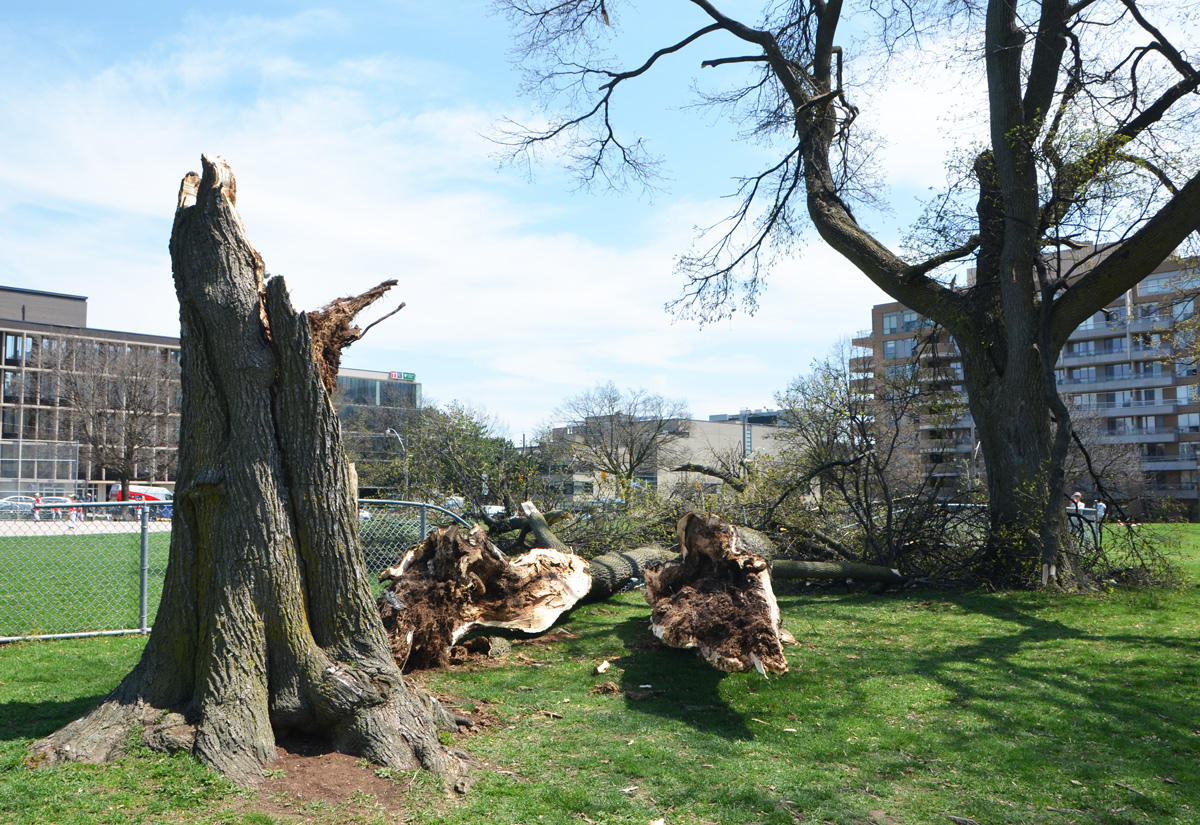
Also needing fixing – yesterday’s wind storm left a lot of damage around the city including this very large tree that lost a very large branch. Actually the whole tree has come down.
Lots of wires were down too.

Not everybody was up with the sun this morning.

I hope that your day was shiny and bright too!
I can’t wait to see what tomorrow brings!
below: The reigning champ and I!

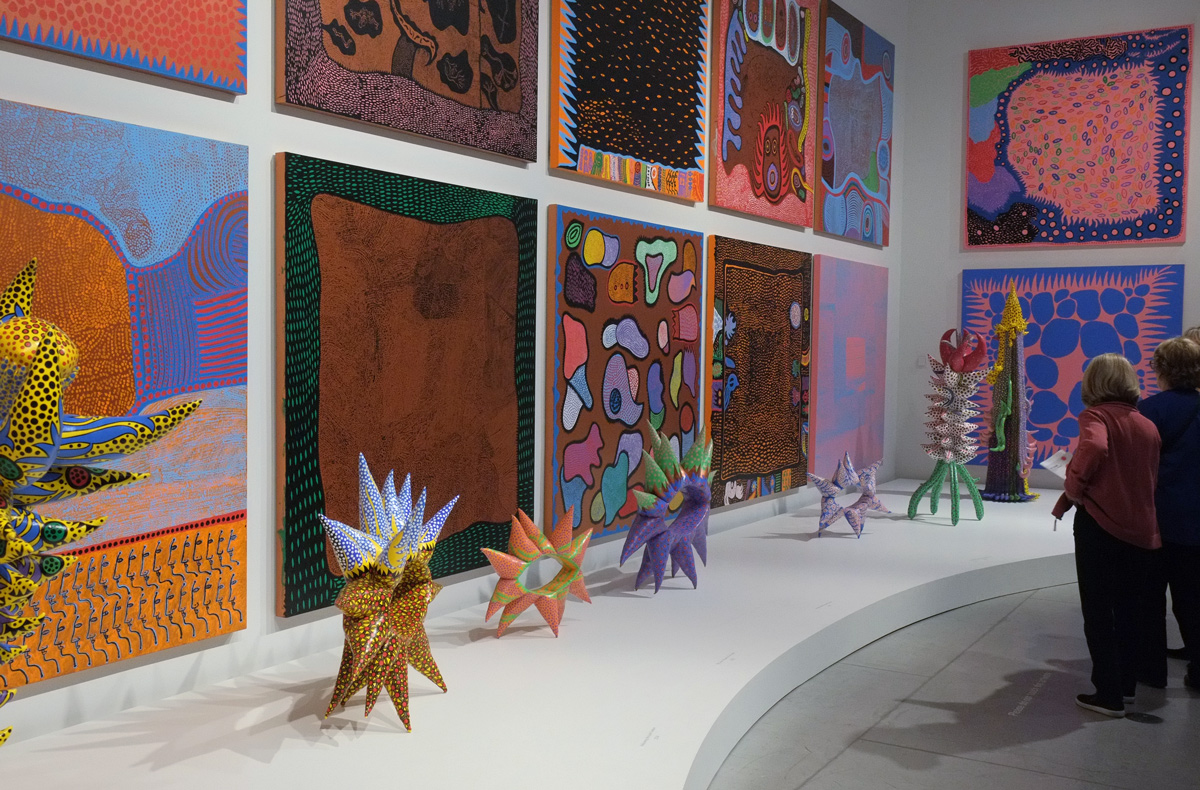
Dots, dots, dots. Millions of dots? Dots and lights worth waiting for.
‘Infinity Mirrors’, Yayoi Kusama, AGO

Kusama’s polka-dot paintings were based on visual hallucinations she has experienced throughout her life, often based on “a miserable childhood as an unwanted child born of unloving parents.” These hallucinations often involve repeating patterns that engulf her field of vision, a process she refers to as “obliteration”. Painting has helped to keep her demons at bay, to obliterate her anxieties.
In 1968 she returned to Japan. In 1977 she checked herself into the Tokyo mental hospital where she has lived ever since. She has a studio where she works during the day but she returns to the hospital at night.
below: In an effort to keep the waiting times down, the AGO is letting three people at a time into the rooms. I’m not sure who the man is, but he seemed to put up with Joanne and I and our cameras! This was the first room in the exhibit and it was a bit of a let down – it was the only one that wasn’t impressive. Minor gripe – why not a mirror on the ceiling?
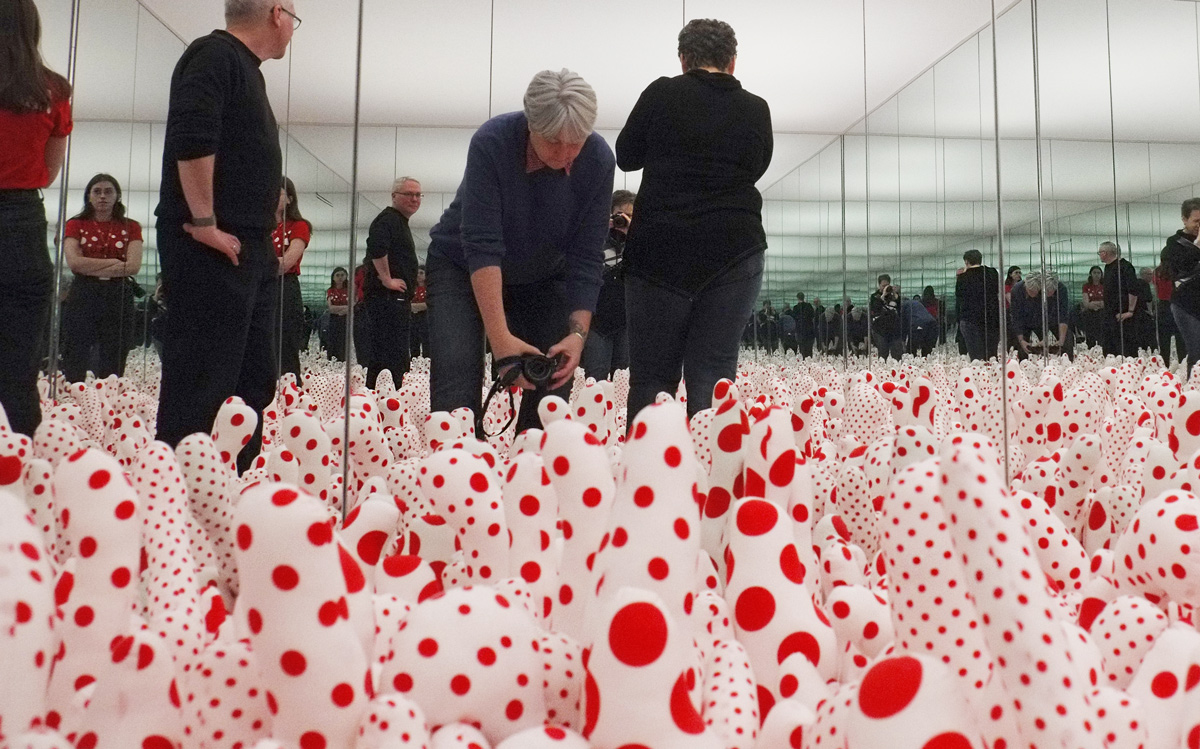
below: 30 seconds per visit. All timed – note the stopwatch!

below: Stars and planets into infinite. Small specks in the vastness of the universe. Obliteration of the self as we become just a very tiny, minuscule dot in the infinite of space. This exhibit is “The Souls of Millions of Light Years Away” and is made with hundreds of hanging LED lights.

below: The words on the wall say, “The souls of millions of light years away”. This is the line-up for the room above. It was one of the shorter lines.

Kusama was born in Japan in 1929 and trained originally in traditional Japanese painting. One of the only American painters that she knew of was Georgia O’Keefe, having seen her work in an art book. She wrote to Georgia O’Keefe asking for advice on how to break into the New York art world. In 1958 she moved to New York City where she became part of the avant-garde art scene. She was into pop art and hippie counterculture. She organized a series of anti-war public performances featuring naked people who were painted with brightly colored polka dots.
below: This room was fun especially since I got to spend a few seconds alone in it. Dancing with pink balls.

below: Looking into “Love Forever” – a small hexagonal box with some mirrors on the outside and two small windows (peepholes!) as seen from the outside. This structure/exhibit was first shown in 1966.

below: Looking in the window…. It’s amazing what can be done with mirrors and lights in a small space. Mirrors combined with the technology of LED lights that can change colours with computer controlled programs made for an impressive display. An endless repetition of patterns.
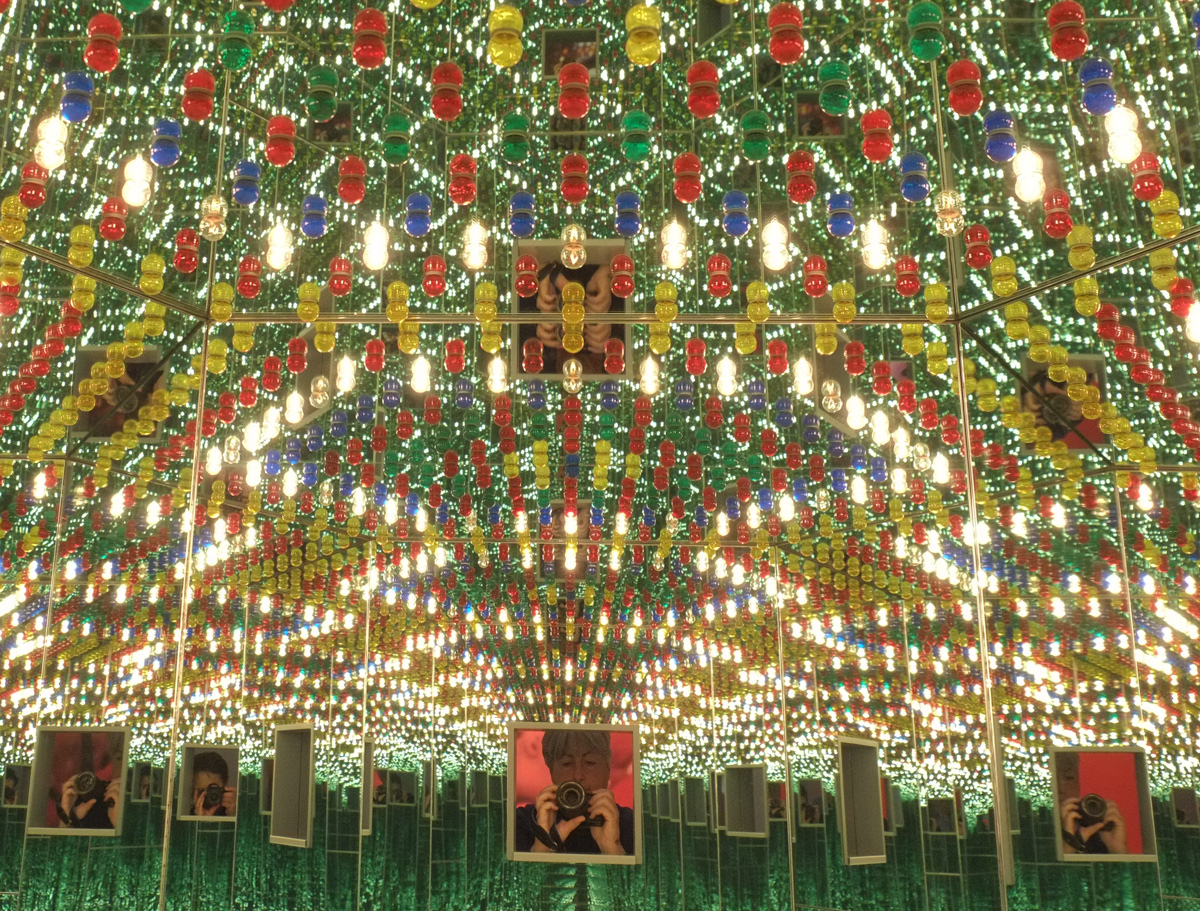
below: Same room, different colours

below: Obliteration Room – multicoloured stickers that people have added to an all white room with all white furniture and accessories like wine glasses and dog dishes. As more people pass through, the more colourful the room becomes. The dots make it difficult to see the details in the room. Can you tell what is on the table?

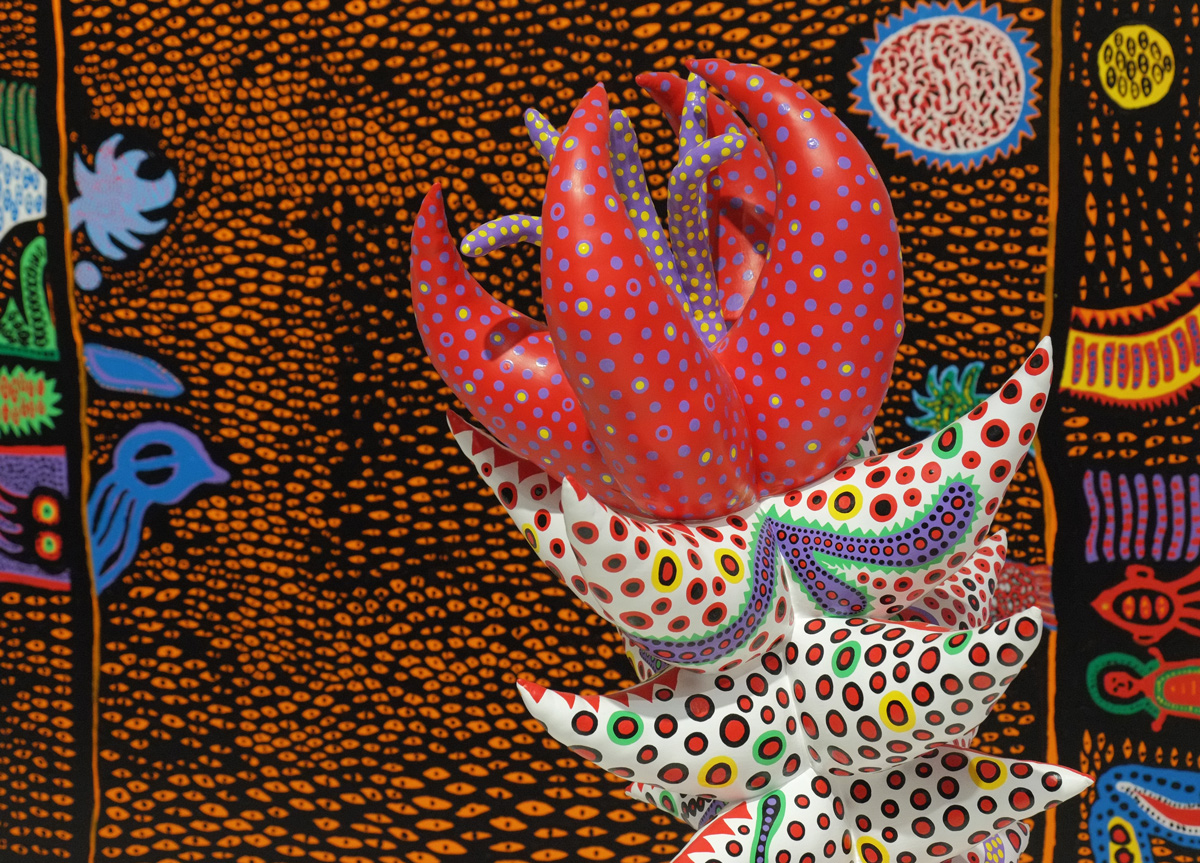
Kusama also paints and makes sculptures.

Thanks to Joanne of My Live Lived Full for playing with me!

