Posts Tagged ‘abandoned’

A story in three parts


There has been a lot of talk about Ontario Place in the news lately so I thought that I would take some time to explore that part of the city.

below: My walk started in Liberty Village where I discovered that others are trying to promote walking around and exploring here. If you are interested, Walk Liberty is online.  It is a fairly comprehensive guide to the history of the area.

small public space in liberty village with sign posted red liberty village walks

below: Cut into the back of this bench are the words “Is it not the reason we are here”.  This bench was designed by Jose Andres Mora was part of the Liberty Village BIA Artist Bench series from 2019.  My reason? …  Well, I was only passing by because it was a convenient place to have a cup of coffee before walking towards Ontario Place.

red metal bench with words laser cut into the back that say

below:  Comfortable shoes as we keep on walking

part of a large mural by jarus, someone wearing blue jeans and white running shoes

When I reached Atlantic Avenue I discovered that most of the south end of the street was now part of a construction site – both sides of the street have Metrolinx Ontario Line hoardings.

low rise older brick building, light industrial, with black hoardings in front, with signs advertising metrolinx ontario line,

below: The Liberty Trail is closed.  This sign was posted by Ontario Transit Group.  They are the group who are building some of the infrastructure for the Ontario Line.  There are a number of companies included in this group with the two leads being Ferrovial Construction Canada Inc., and VINCI Construction Grands Projects.  They were awarded the six billion dollar contract in Nov 2022 and if you want to see a list of what that money should buy us, the information is on an Infrastructure Ontario website (while you’re there, spot the typo!).

2 signs on a fence, one is a danger due to demolition and the other says liberty trail is closed, Second sign was posted by ontario transit group

hoardings and danger due to demolition sign around a brick structure

below: Looking north on Atlantic Avenue
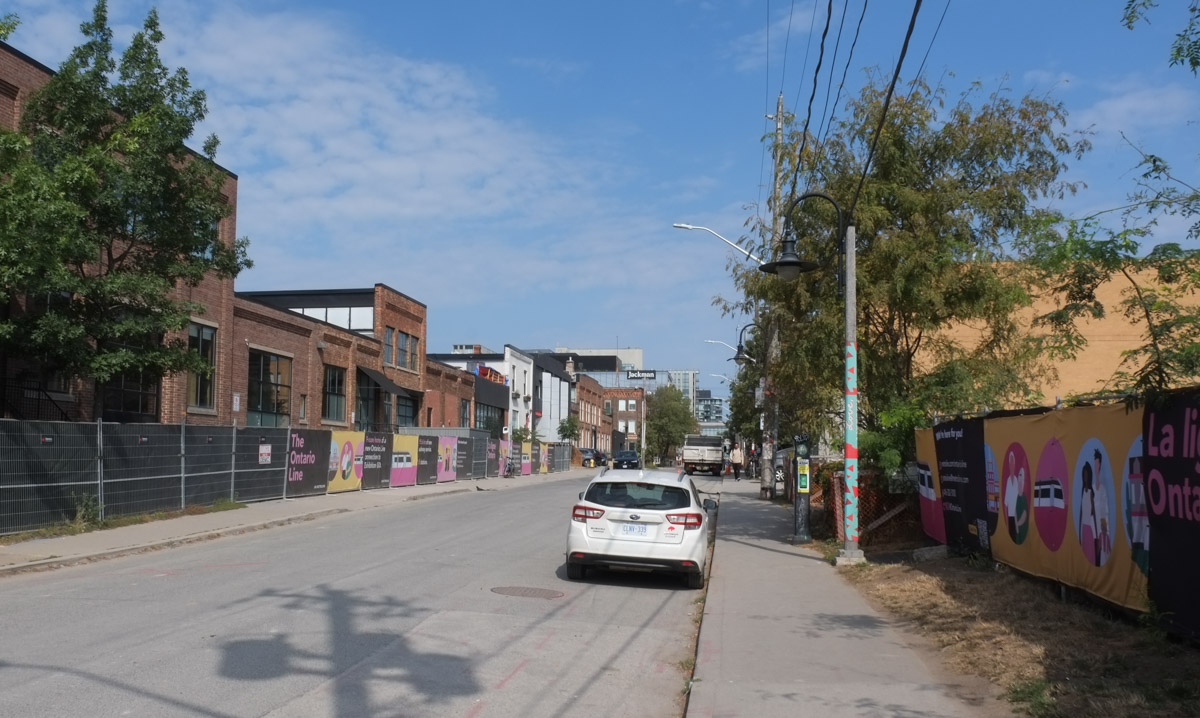
looking north on Atlantic Avenue from the south end, a white car parked there, many buildings now empty with hoardings in front for metrolinx onstruction

below: The Exhibition GO station is at the south end of Atlantic Ave.  The new Ontario line will also have a station here. The ability to transfer between GO and TTC services here will impact a lot of people who commute from the western side of the GTA as they may be able to bypass Union Station.

a man with a backpack walks towards Exhibition station where there is a green and white GO train already in the station

path towards exhibition station GO line, from Atlantic Ave in Liberty Village

graffiti on metrolinx ontario line hoardings that says tax $ this is a real money pit

below: From Exhibition station east towards the city centre, north side.   A new street that parallels the railway tracks is being built here.  If the plans are correct, the new street will connect Strachan Ave in the east with Dufferin St in the west.

cn tower in the distance, metrolinx ontario line construction at atlantic avenue in the foreground

below: Construction on the north side of the tracks at Exhibition station where a new concourse area is being built above the tracks
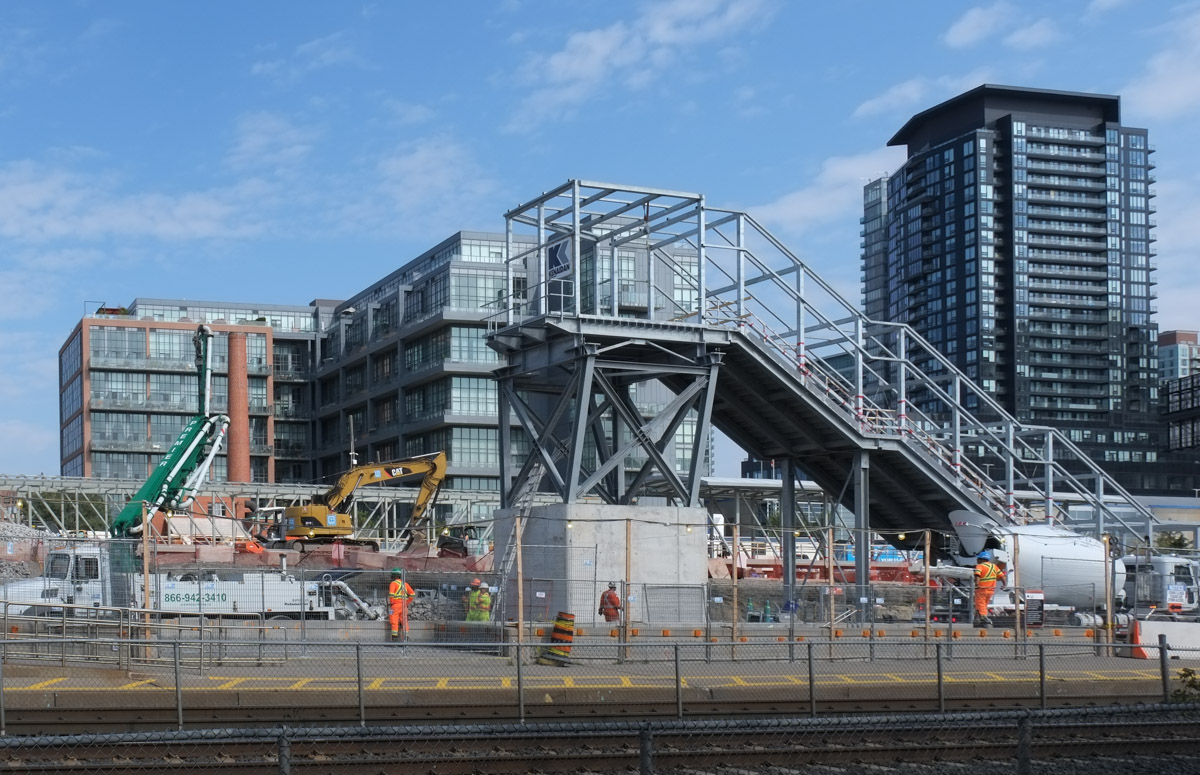
construction on north side of GO tracks at Exhibition station

below: Looking eastward from the south side

looking eastward along the north side of the GO tracks from Exhibition station, looking towards downtown

After walking through the tunnel under the tracks at Exhibition GO station, you emerge under the Gardiner Expressway, right beside the Exhibition  grounds.  …. And so begins Part 2.   A quick note – when Metrolinx describes Exhibition station on the Ontario Line, they usually add “Ontario Place” to it, i.e. it’s Exhibition/Ontario Place station.
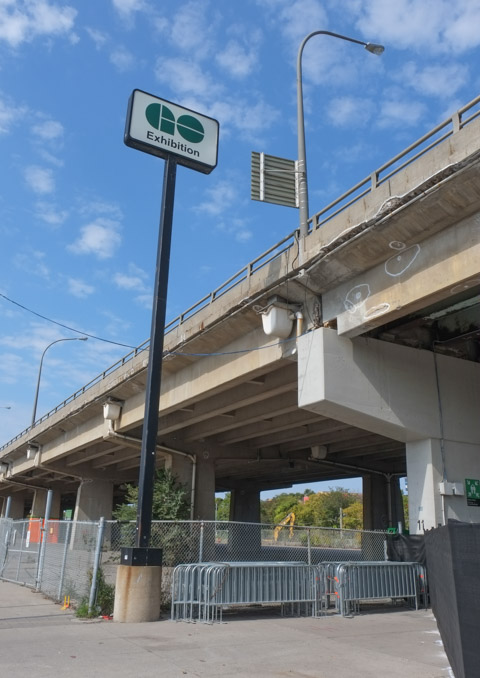
green and white GO transit sign for exhibition station rises high beside the Gardiner expressway

The first building that you encounter on the south side is the Horse Palace

below: South entrance of the Horse Palace.  Three levels of government contributed to the construction of this building which opened in 1931.  It is two storeys high and covers 4 acres.  Originally it accommodated 1200 horses.  Today it is home to Toronto’s mounted police unit.
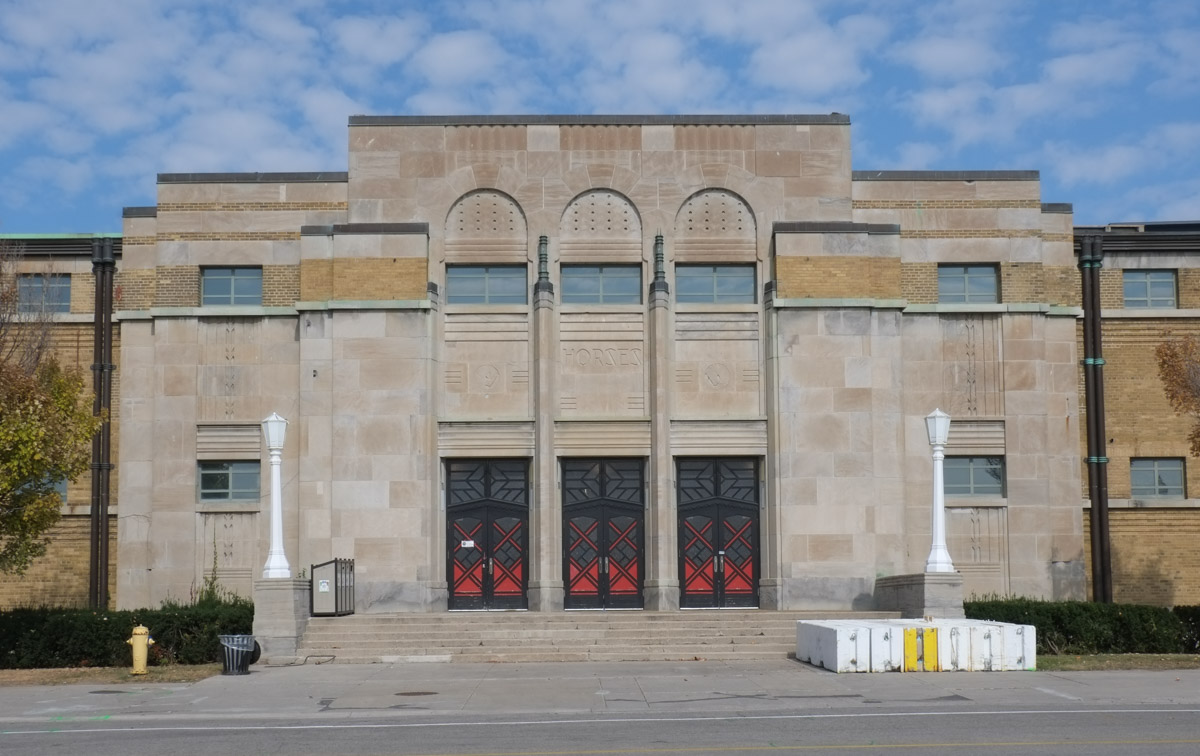
stone work at entrance of horse palace at exhibition grounds

below: Horse in the art deco style, carved in the limestone facade of the Horse Palace.

art deco bas relief in stone on horse palace at the CNE grounds, a horse with one front hoof raised

In August it is busy here as it is the home of the Canadian National Exhibition (CNE) but September is another story!  I didn’t see many people as I wandered around.  The buildings are locked up tight.
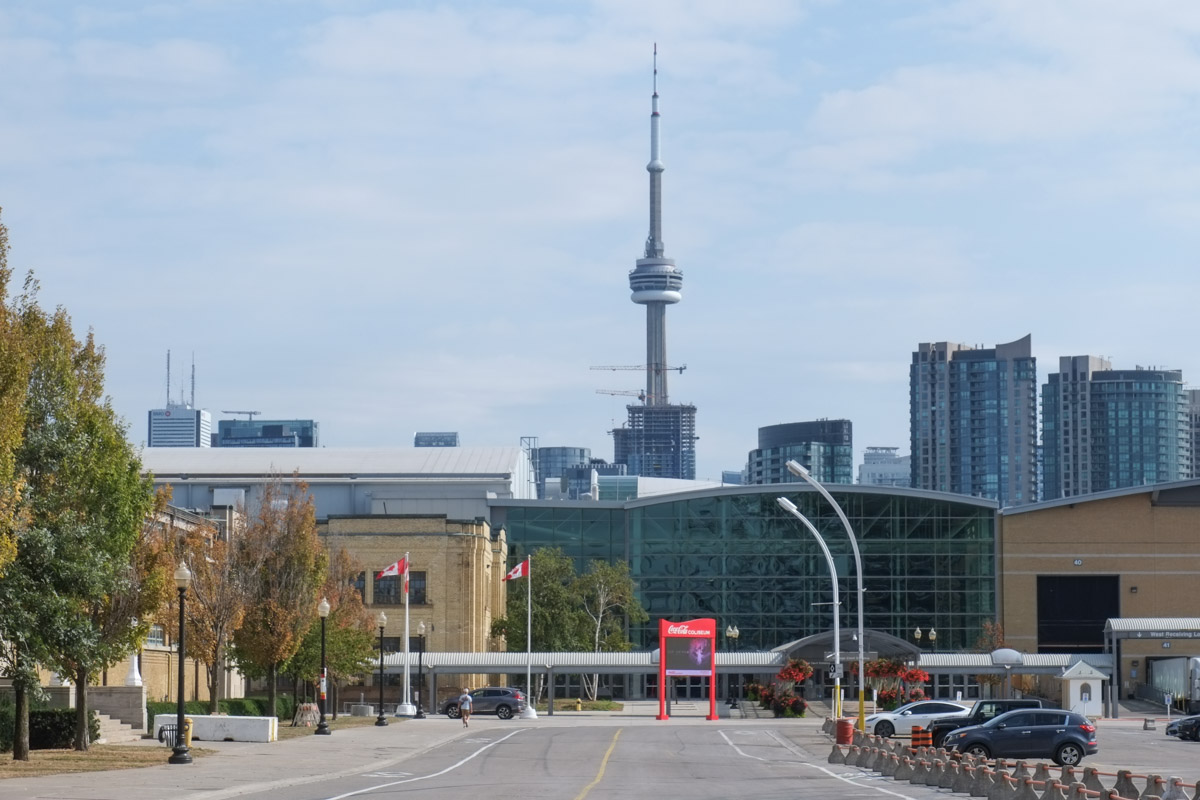
CN Tower innackground, horse palace on the left, parking lot in front

One of the dominant features of the area is BMO field which was built as a large soccer stadium.  In 2016 it also became the home of the Toronto Argonauts, the other Toronto football team.

interior of BMO soccer field, red seating, large awning over seats, green grass on field

below: Mural above the entrance, gate 6 BMO Field. This mural can be difficult to see from outside because it is behind a window. It confused me at first because why is there a hockey themed picture at BMO field? – they don’t play hockey here. As I was trying to get a closer look at it from outside, a group of men walked past and one of them asked me if I needed help…. here’s the story:  Once upon a time the Hockey Hall of Fame was here. When the building was demolished in 2006 to make way for the soccer field, portions of it were retained including the entrance and this mural,  “Face Off” by Ronald Satok.

hockey theme mural over entrance gate at BMO Field

below: The Hockey Hall of Fame building (1961-1993) at the Exhibition.  The mural is behind the glass in the entrance way.
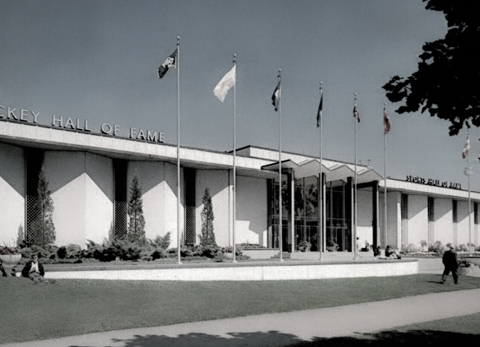
vintage photo of the front of the hockey hall of fame at the exhibition grounds in the 1970s

below: Also at BMO Field is a Wall of Honour commemorating iconic moments and MLS Honours (e.g. coach of the year, MVP players, etc).  Red and white are the colours of Toronto FC (Football Club) whose home is here at BMO stadium.   Note: (MLS = Maple Leaf Sports, owners of the Toronto FC  )

wall of honour at BMO field, a red wall with plaques commemorating different players and events

After WW2, the popularity of the CNE was booming and more modern spaces were needed.  The Hockey Hall of Fame building was a great success so the Food Building (1954), followed by the Queen Elizabeth Building (1957), and the Better Living Centre (1962) resulted.  These buildings still stand.  All were very modern buildings for their time.

below: Food Building

low rise horizontal building with food written in large letters above the glass entrance

below: Queen Elizabeth Building

Queen Elizabeth building on the CNE grounds

below: Better Living Centre, symmetry of the side entrances.  In the 1960s this building housed exhibits during the CNE that featured different rooms decorated with the latest trends and gadgets… like colour TVs! and other consumer goods.

side entrance of better living building

below: Front entrance with its wide stairs leading to the doors as well as one of its curved walls
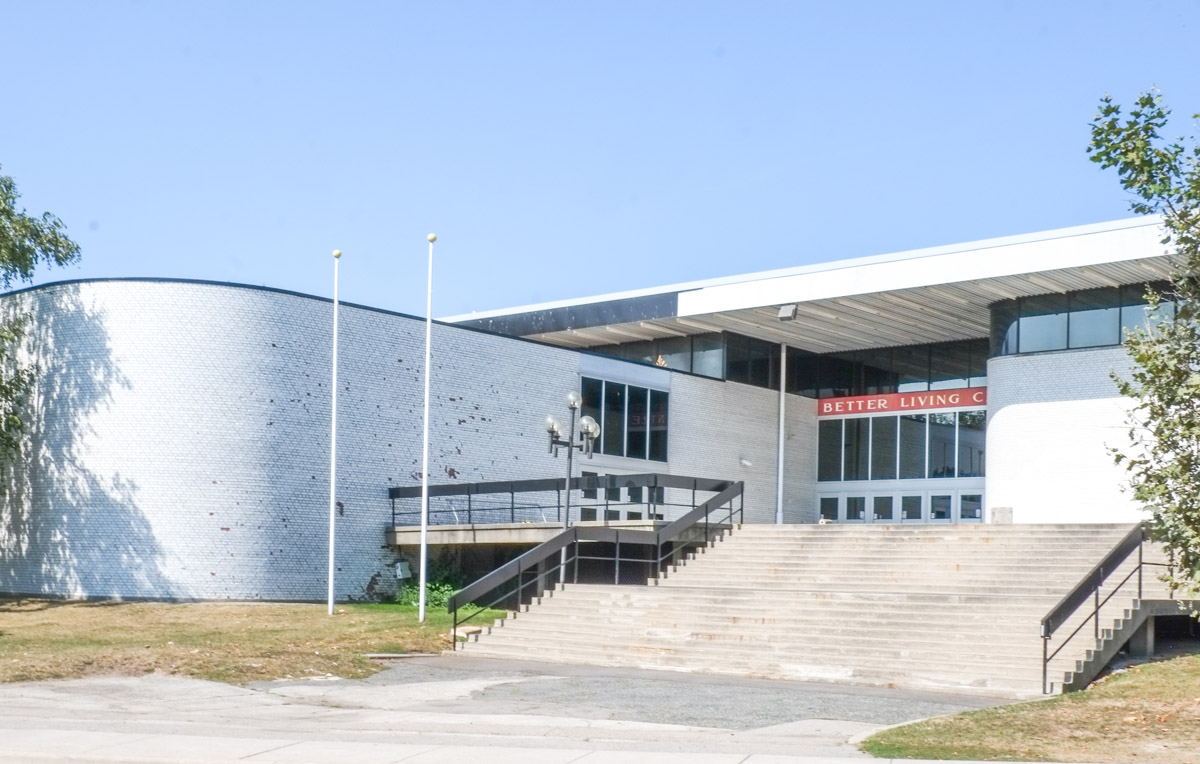
front entrance of better living centre at cne, low white tiles, curved wall, large staircase

below: Artwork on the roof of the Better Living Centre is a three dimensional grid of steel with different coloured plexiglass panels in some of the squares.

rectangles and squares, colours, art structure above better living building

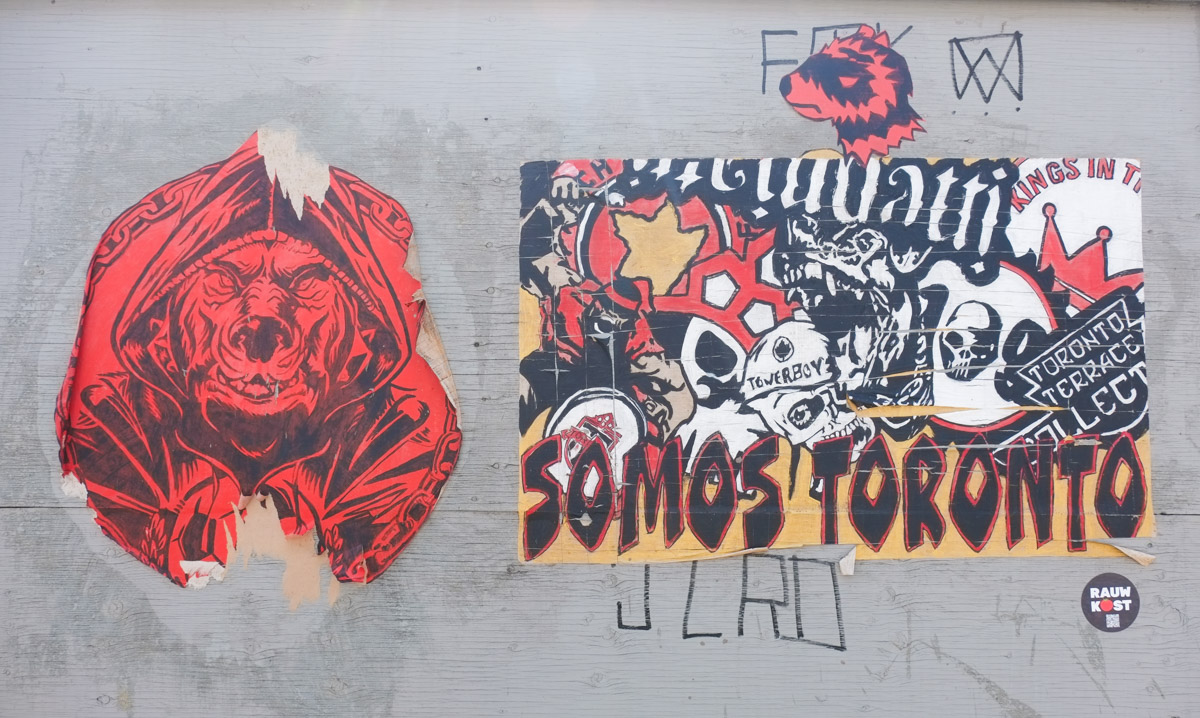
paste up graffiti on exhibition grounds

graffiti sticker on a danger high voltage sign, exhibition grounds

We entered the Exhibition grounds by tunnel and we will leave by bridge over Lakeshore Blvd…. so to Part 3, Ontario Place

bridge to ontario place

below: Looking west from the bridge over Lakeshore Blvd

looking west along lakeshore blvd from bridge to ontario place

Ontario Place consists of three different areas, East Island, West Island, and the pods in the middle.  When Ontario Place first opened in 1971, the eastern portion was a children’s adventure playground.  Today it is Trillium Park.  I didn’t go there last week, but if you are interested, I blogged about it on two previous visits (a rainy day from June 2019, and Ontario Place 2.0 from July 2017)

The middle section of the park is where you find the “pods”, the elevated structures with water below, and the marina.

pod buildings at ontario place

The contentious part at the moment is West Island.

As far as any plan can be trusted, this is from Infrastructure Ontario, dated April 2023.    The majority of the West Island becomes covered with a 12 acre waterpark and spa to be built by an Austrian company, Therme.   The majority of that is housed in glass buildings.
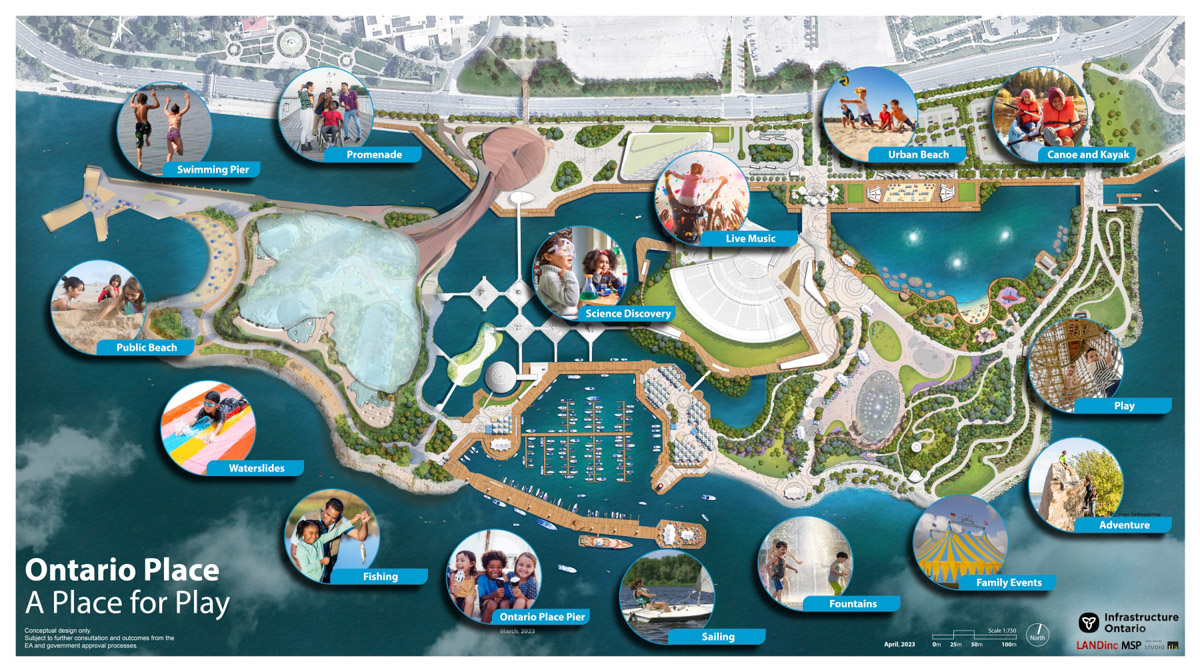
map of Infrastructure Ontario's vision for ontario place

This is a conceptual drawing from Therme’s website.  That’s a lot of glass.  If you know West Island, you’ll realize that this drawing looks nothing like it.  That’s because everything is to be removed, leveled, and a lot of landfill added.
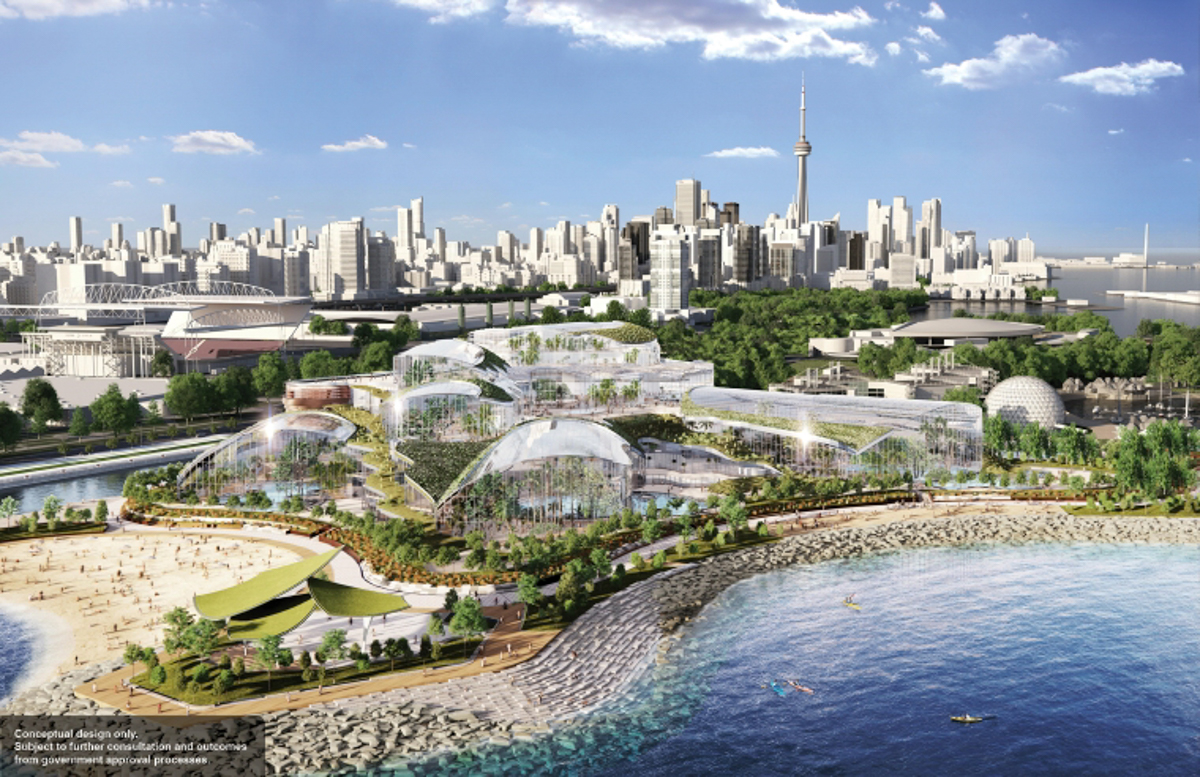
rendering of a concept of therme spa to be built on west island, from their website

Already gone is a bell, the Goh Ohn Bell.  This is the Japanese Canadian Centennial Temple Bell.   I took this picture on the 20th of Sept and by the 25th it was gone.  Despite a protest on the weekend, it was removed to storage.  The Temple Bell was installed in 1977 in a structure designed by Raymond Moriyama (1929 – Sept 2023); it was a gift to the province Japanese Canadians living in Ontario to mark the centennial of Japanese settlement in Canada.   Now it is in the way of the Therme spa.  Even though the project has not been approved, the provincial government is plowing ahead.

large metal bell in memorial structure, memorial to Japanese Canadians, marks 100 years of Japanese in Canada

large metal temple bell, Japanese Canadian , Raymond Moriyama

Some say that the West Island is under used now anyhow…..

Perhaps.  But the biggest reason for that is the neglect (negligence actually) that it’s been subjected to over the years.
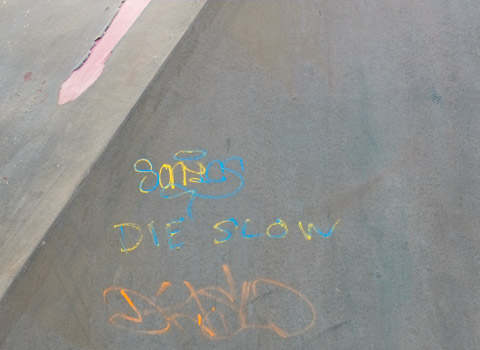
graffiti on grey wall that says die slow

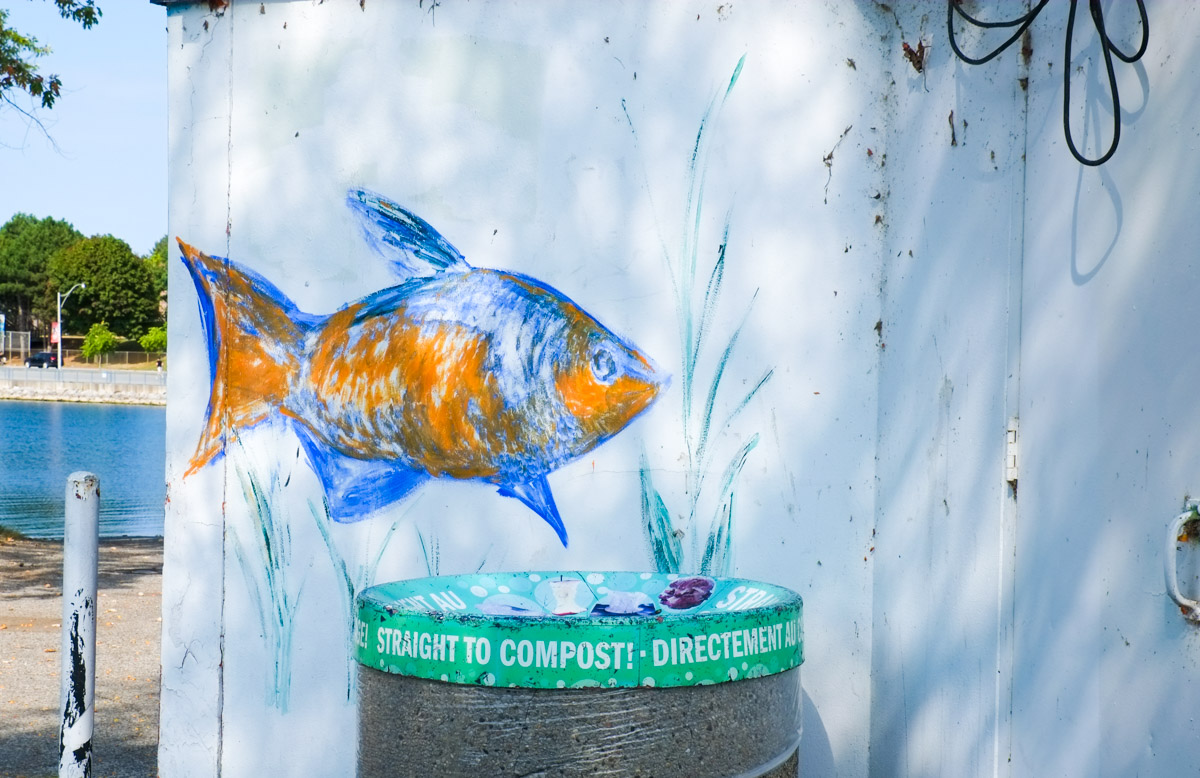
painting of an orange and blue fish on a white wall close to a compost garbage bin

old faded paintings on the exterior of a grey silo type structure

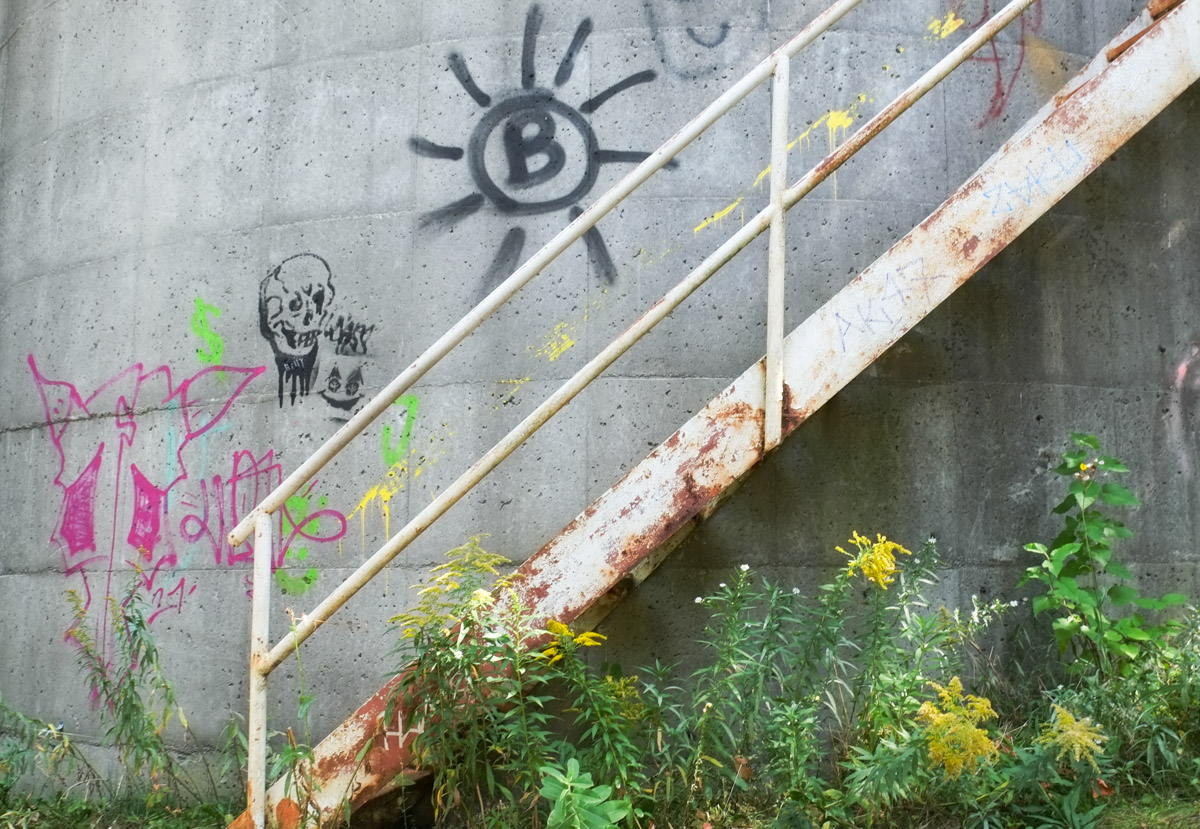
exterior rusted white metal stairs on the side of grey concrete building, goldenrod growing below it, some graffiti above including a black line drawn skull

Once their were restaurants here but they closed years ago.  Their ghosts remain.

below: Pizza anyone?

old pizza pizza restaurant location at ontario place. faded awning with remains of sign, overgrown,

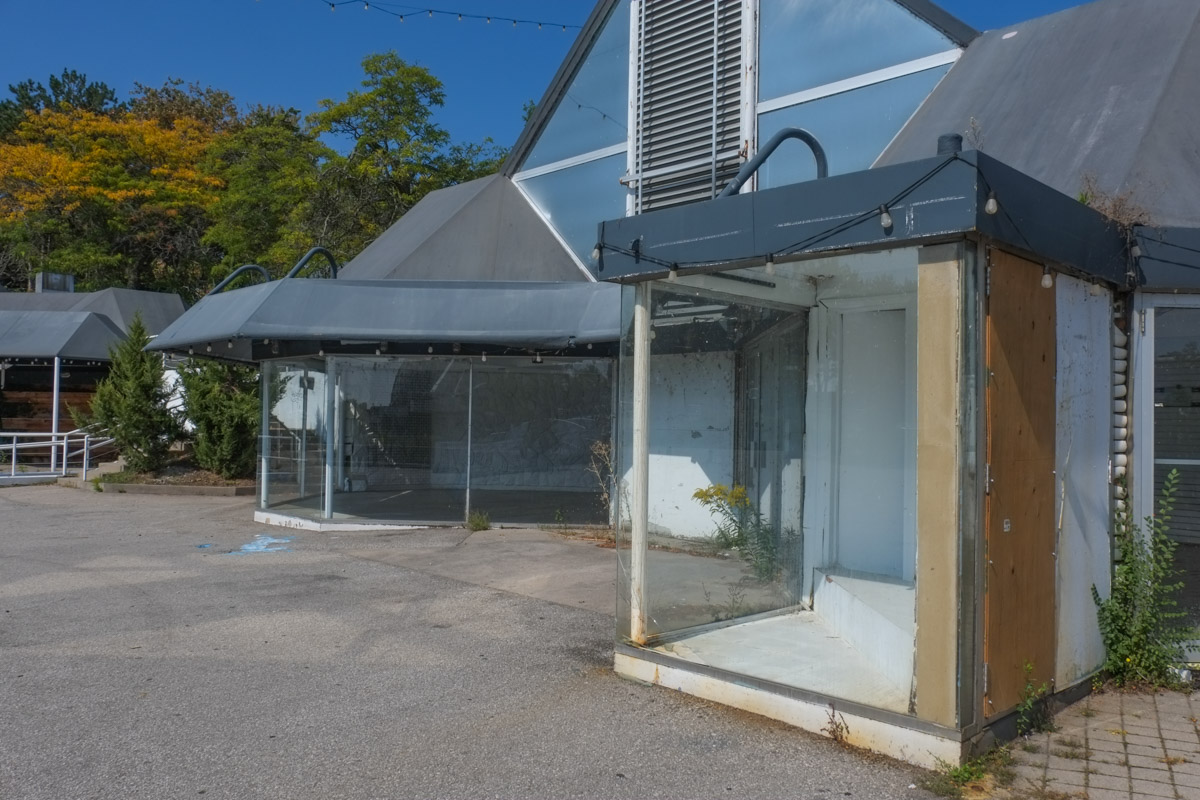
empty structures at Ontarioplace that were used as food outlets or little stores

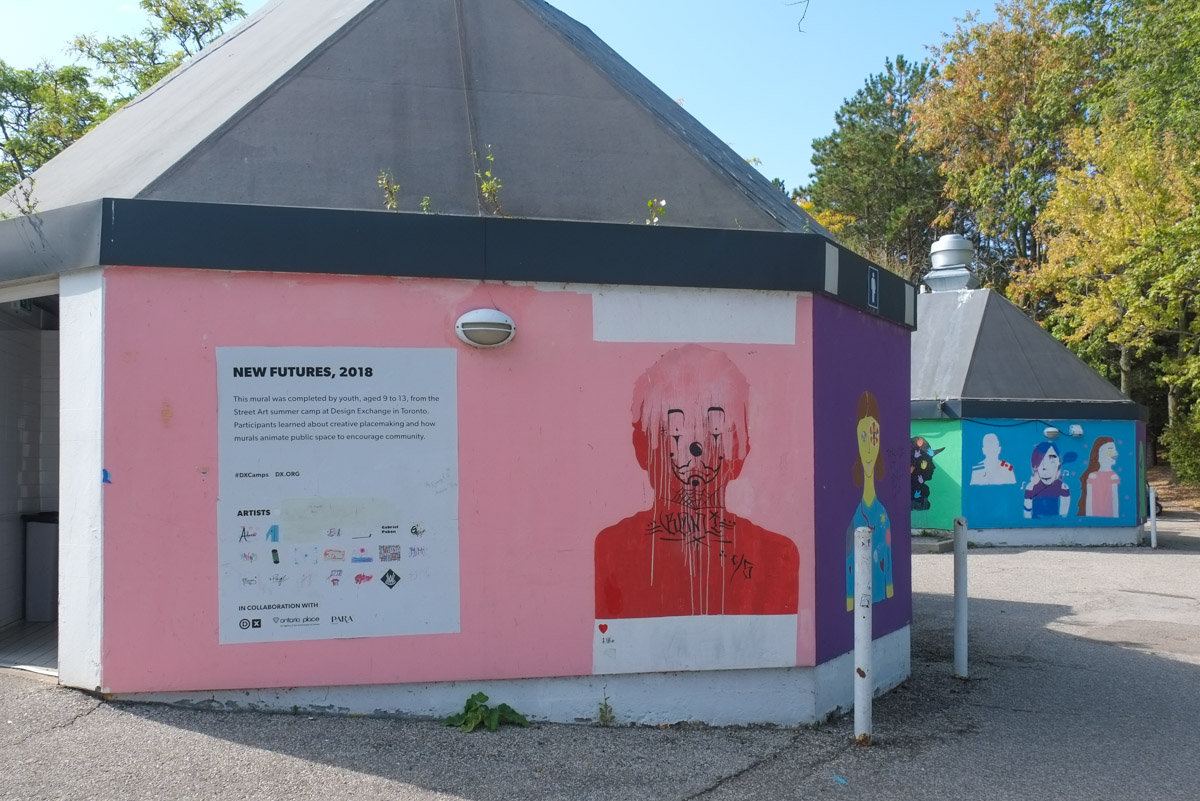
art exhibit from 2018 that hasn't been upgraded, defaced pictures,

Once there were amusement rides here, those ghosts too still haunt the place.
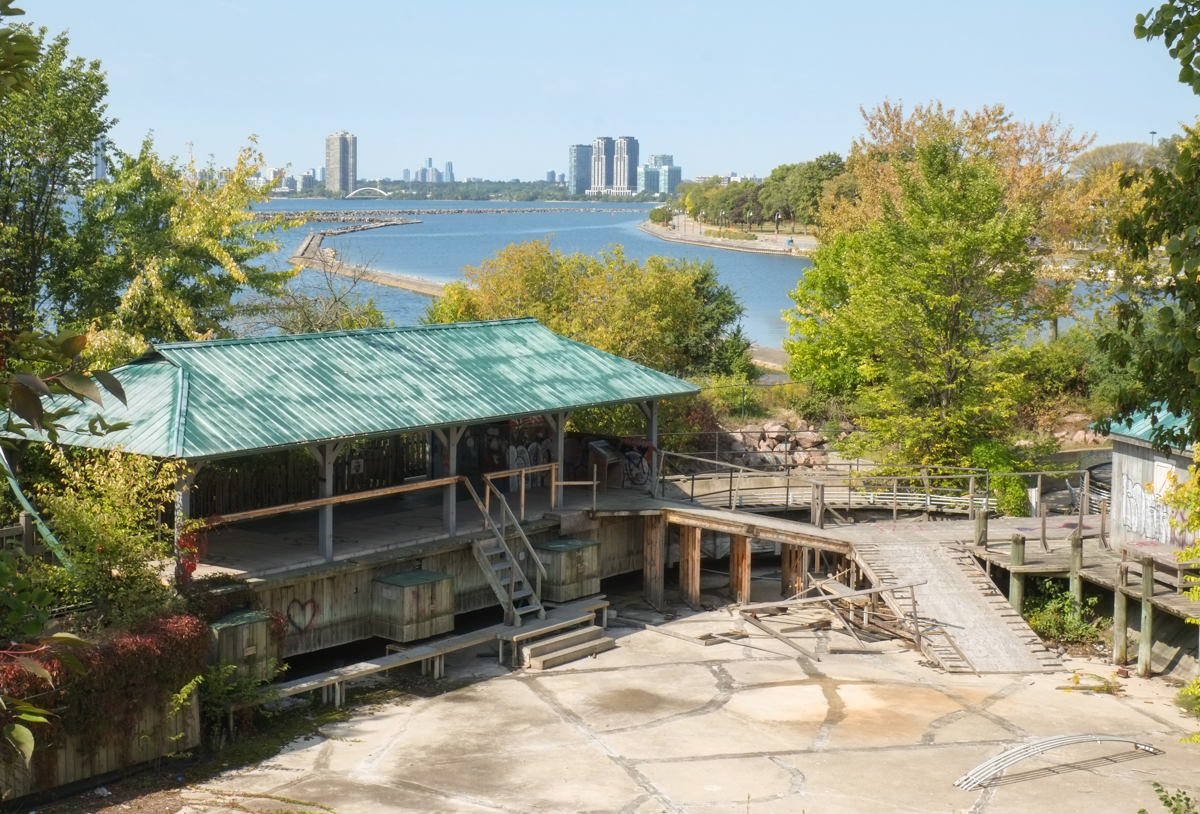
abandoned waiting area and starting place for an old amusement ride, outdoors, overgrown, neglected

below: Yellow lines to stand behind while you waited your turn for a ride.
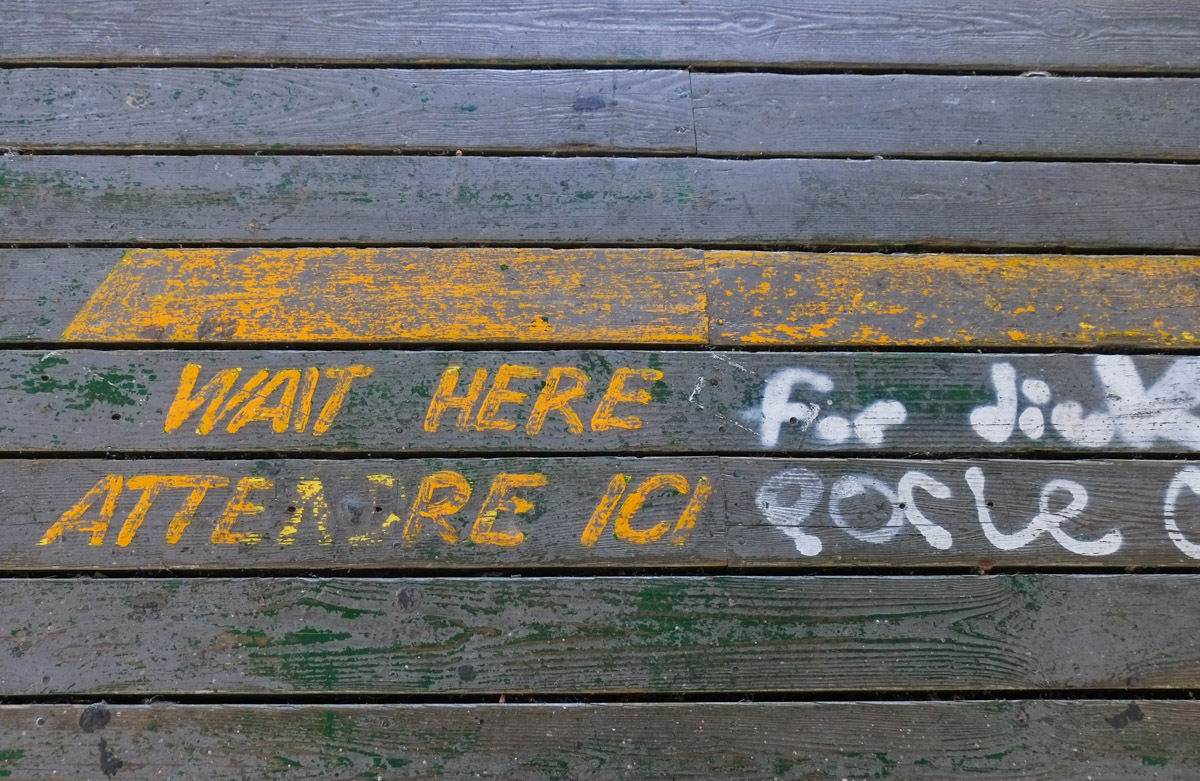
painted on wood floor, instructions for lining up at a ride, says wait here in french and english

Once upon a time there was some attempt to make something of the place.  Then it was  abandoned and ignored.  In those quiet years the beach and paths were used by those who knew about them. It became a peaceful spot.

muskoka chairs along the top of a hill, under pine trees, overlooking lake ontario

two people sitting on the beah at ontario place, lake ontario, mississauga and western GTA in the background

Unknowns – there are many because there has been nothing transparent about any of the dealings between Therme and the provincial government.  Therme gets a 95 year lease but what are the terms?  The provincial government is going to pay for an underground (under the water table!) parking lot for 2000+ cars apparently.  They will also be responsible for all those little details that you can’t see –  like where does the water go when you flush the toilet? –  those little pesky things.  Rather than go into more detail here, I highly recommend John Lorinc’s article in Spacing magazine, Below Grade Scandal

Not everyone is happy with the plans…..

construction site, someone has written in yellow marker the words fuck doug ford

a small Canadian flag has been stuck into a poster notice on a TTC bus stop pole

First, let’s get our bearings….

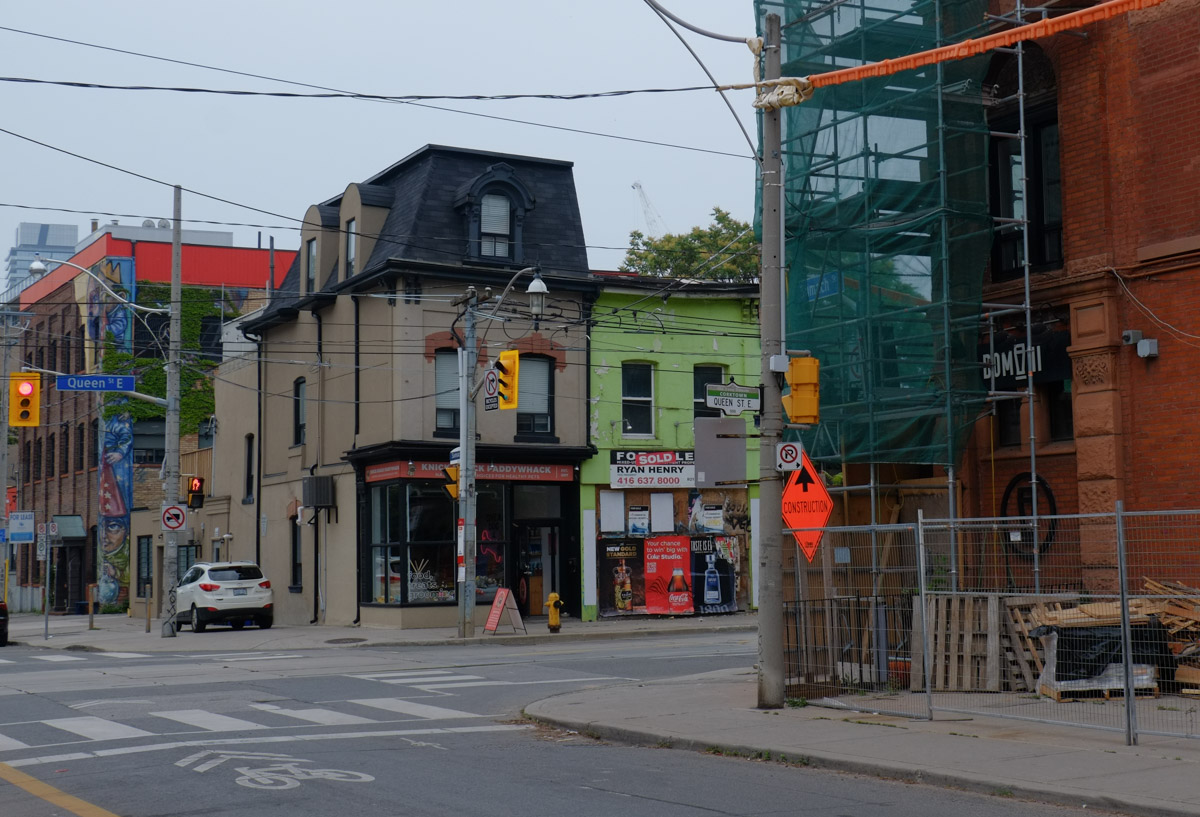
below: This was, until recently, the Dominion Pub. It is on the northwest corner of Queen St East  and Sumach. It was a popular spot with a decent patio.  When I saw that the Dominion was closed and the property for lease I decided that I’d better document the area.  There is just so much happening, or about to happen, here in terms of development.

northwest corner of Queen and Sumach, Dominion pub, old brick building, now covered with green, building for lease, once part of Dominion Hotel and Brewery

below: Directly opposite, on the northeast corner, is this row of buildings – 502, 506, and 508 Queen Street East. The buildings appear to be empty but there is no development notice sign.  Only 502, Sweet Marie Variety, is considered of any historic value.

row of three old buildings, two storey store fronts, all empty. Sweet Marie convenience store on the left, at corner of Queen and Sumach

below: Just to the east, more of the same.   One is for sale – It’s just over 1600 sq ft,  and can be yours for $1,800,000.  These pictures were taken on the 1st of July and as I write this almost two weeks later, it is still on the market.  Care to be a commercial landlord?  Or maybe hold onto it in hopes that a developer wants to buy you out?

two old 2 storey storefronts on Queen St. East, one is for sale, the other is a barber shop

below: One more change of viewpoint…   South side of Queen, looking west to Sumach Street

south side of Queen st east, looking east towards Charry Street, vacant lot, then a bright green building,

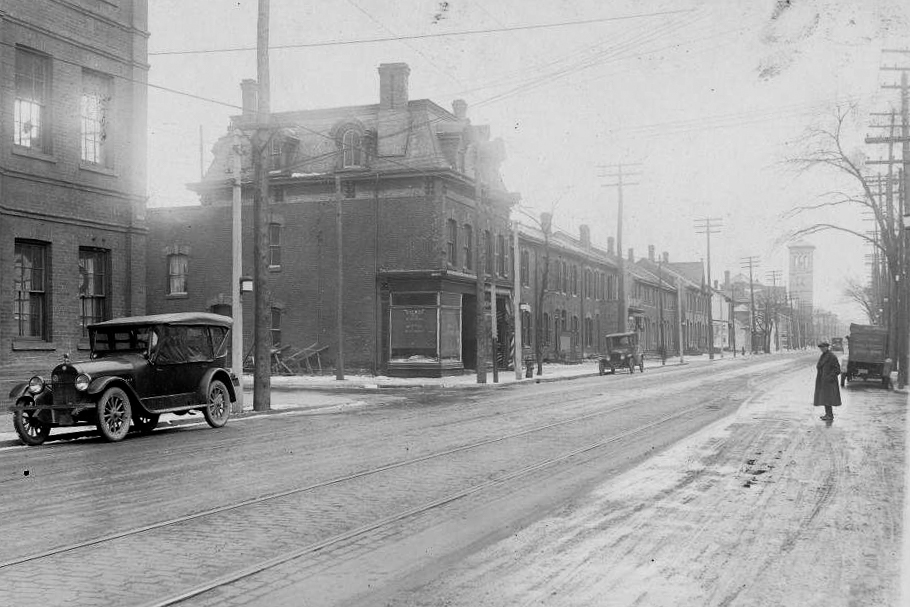
below: Stepping back in time (can anyone date the cars?), to the same intersection but from the other side, Queen Street looking west at Cherry Street.

black and white vintage photo of Queen street, looking west, at Cherry street

City of Toronto Archives, Fonds 1488, Series 1230, Item 2285, plus some enhancing with Photoshop

below: The building on the corner with the mansard roof is still there.  The bright green part of the building lost its roof in a fire a few years ago.  Both buildings date from before 1884.

looking south on Sumach, west side, from Queen, renovations at Dominion pub on the right, two older buildings on the south side, one with black mansard roof, and the other painted bright green

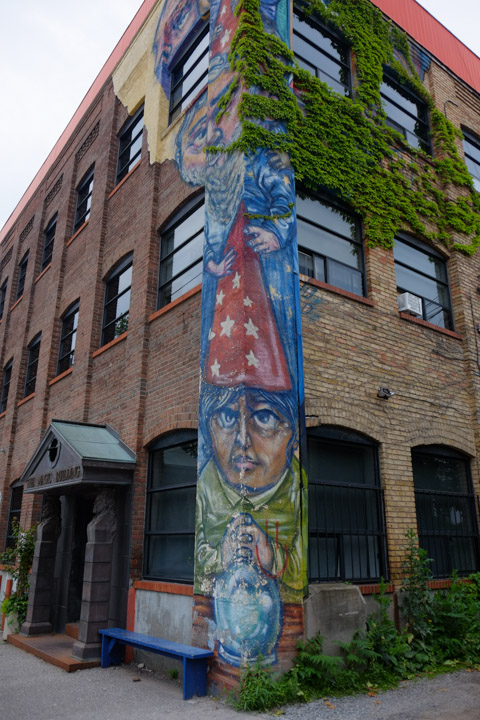
below: The fire also destroyed one of the row houses immediately beside, leaving a vacant lot in its place.  469 Queen is a terrace house built in 1877.  The ivy covered building (the Magic Building) faces Sumach Street.

old brick house beside a vacant lot, building in next street behind can be seen, it is covered in ivy

below: The brick warehouse/factory at 489 Queen Street East was built in 1884.  This building has been renovated and turned into office space.

renovated post and beam brick building, three storeys high, once a warehouse and now office space

below: Just east of the old warehouse is another short row of terrace houses from the same time period.

a row of two storey brick terrace houses, row houses, built in the 1880s, Queen St East in Toronto,

below: A little further east

old brick semi detached house, red brick, with black roof, central peak, on Queen East, heritage property

below: And a little more…. a row of flat roofs on two storey brick store fronts.  They also all have three narrow windows on the upper floor.

a row of two storey brick store fronts, one has a lot of light blue trim,

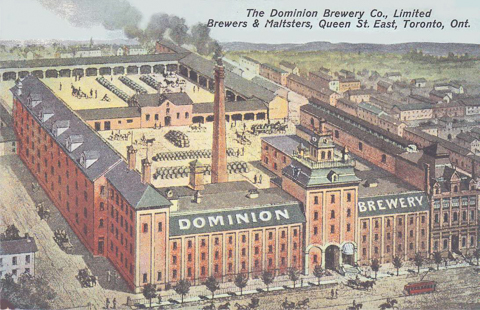
Jumping back to the start, the Dominion Brewery opened in 1878 and was in operation until 1936.  The original owner was Robert T. Davies who bought the site in 1877; he had worked previously at his brother’s brewery, Don Brewery which was only about two blocks away.  A large part of this structure still stands, especially the part facing Queen Street.  The lower right corner of this image shows the Dominion Hotel which was attached to the brewery but wasn’t part of it.

image of an old painting or drawing of the DominionBrewery complex on Queen Street East in the late 1800s or early 1900s

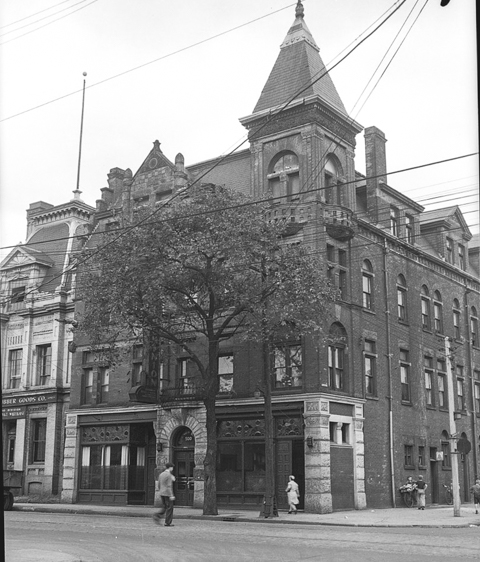
below: The Dominion Hotel as it appeared in 1945.  The little tower and fourth floor no longer exist.  The hotel was built in 1889 by Robert Davies (same as first owner of the brewery).

An older black and white photo of the Dominion Hotel. Once upon a time it had a tower.

This image was found on Wikipedia but is originally from the City of Toronto Archives, listed under the archival citation Fonds 1257, Series 1057, Item 520. (public domain).

below: Painting by Rowell Soller on Queen Street

a small painting by Rowell, blue background, person head and shoulders,

below: From under the scaffolding in front of the Dominion Pub.

looking through scaffolding covering sidewalk to bus stop and people on the other side of the street

below: The front entrance of the Magic Building on Sumach Street, south of Queen (that’s the ivy covered one a few photos above).

front entrance to a building, words over door say The Magic Building

below: Not only does the building have a lot of ivy on its walls, it also has a painting by Elicser Elliott with a red-capped man at ground level.

on the corner of a building, tall vertical mural by Elicser Elliott, a wizard in a red cap with white stars all over it.

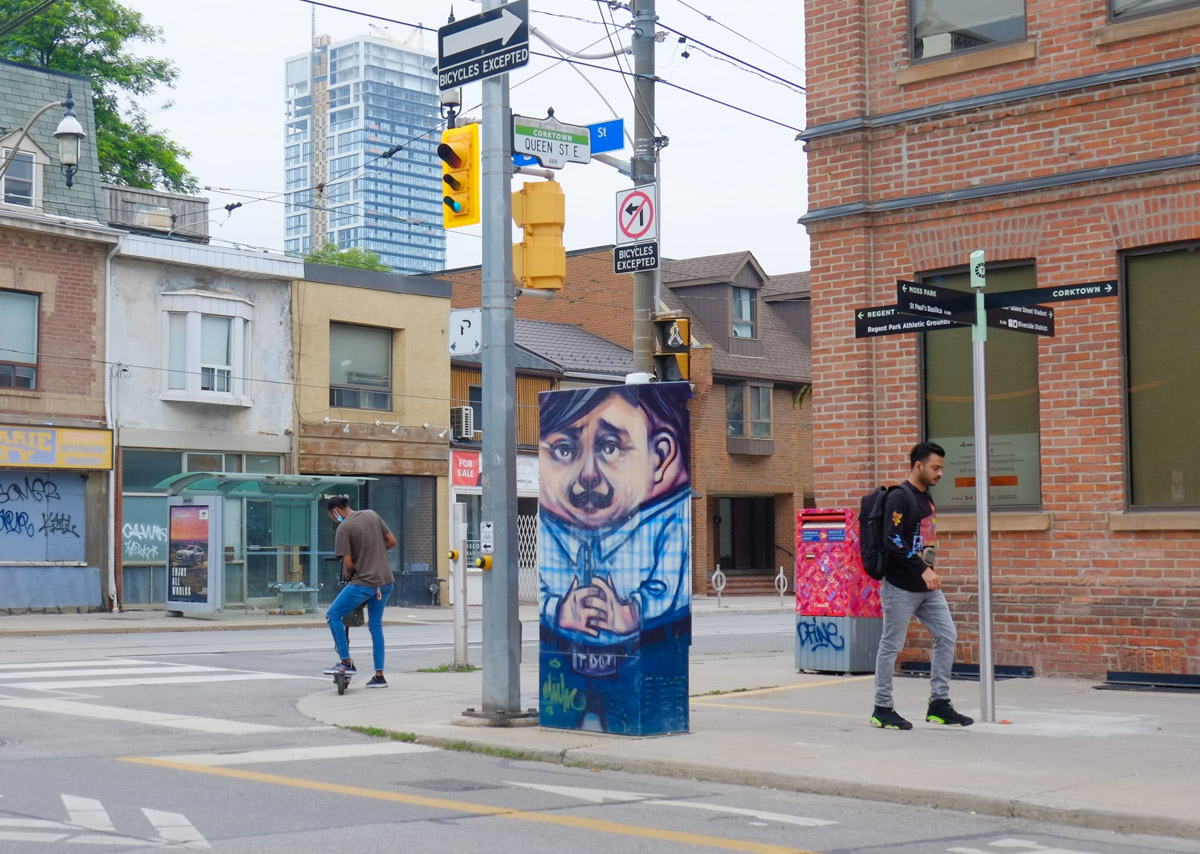
below: The box on the sidewalk across the street from the wizard painting has also been decorated by Elicser Elliott.

at Queen East and Sumach, a sidewalk box painted by Elicser Elliott of a man in a blue shirt, short dark hair. A man walks by, another man is sorting out his scooter while waiting for a traffic light

If you walk south on Sumach, it is a short block to King.

below: Looking down the alley to another street of row houses, Ashby Place, with newer Corkdown developments behind that.


two white houses with black trim, semi, with an alley beside, looking down the alley to row houses on another street

below: A closer look at a couple of the houses on Ashby Place – they’re small!

small row houses on Ashby Place, dormer windows on upper floor,

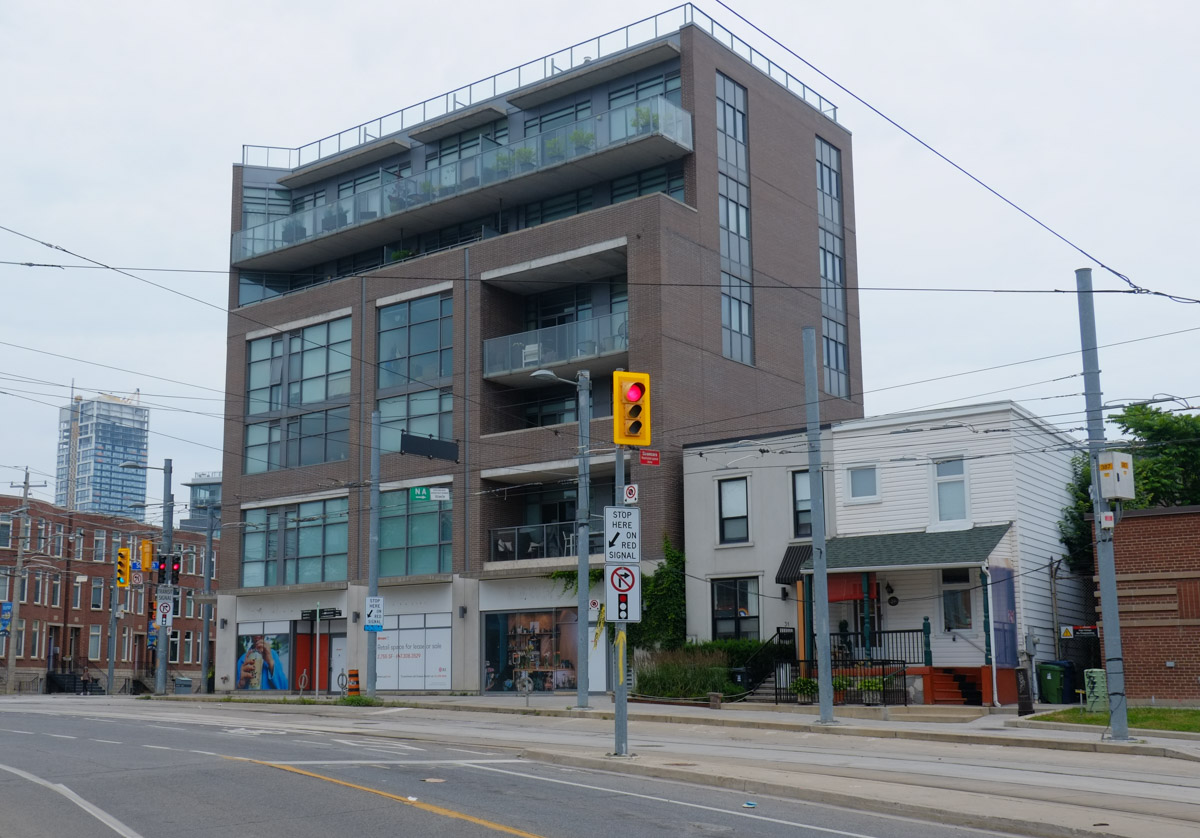
below: This is the northeast corner of King and Sumach. This intersection has more than 30 of poles, or at least I lost count at 30. Most of them are for the 504 streetcars.

newer low rise apartment building, or row houses on the northeast corner of King and Sumach

below: Southeast corner of King & Sumach… a mix of old and new

southeast corner of King and Sumach, newer 4 storey apartment building, 2 older square roofed family homes beside that

below: On the northwest side of the intersection are a couple of old brick houses that still survive.

two houses in a row, one is light blue with a large rose bush in front, to the right is a mechanic shop, Central Auto

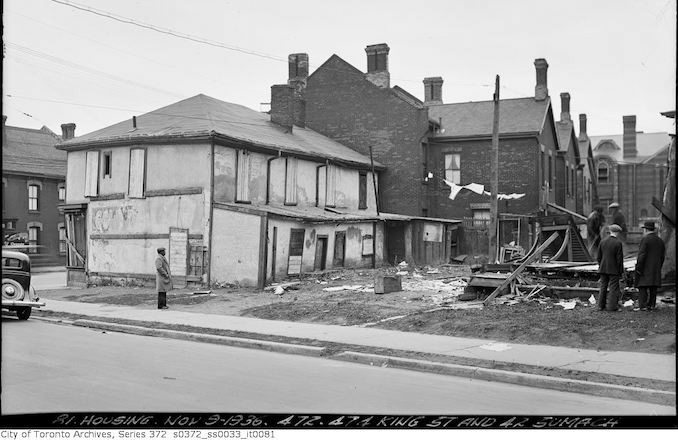
below: When I looked for old photos of the area, I found this one…. If I am not mistaken, it is the same location as the photo above but from a different angle.  The building that looks like it’s going to collapse any minute has been replaced by Central Auto.   On the right hand side of this photo there is a striped brick building in the background.  This is a church at the corner of King and Bright.

old vintage black and white photo of housing at King and Sumach

Housing – Nov 3, 1936, 472 and 474 King St. and 42 Sumach.   City of Toronto Archives, Series 372,

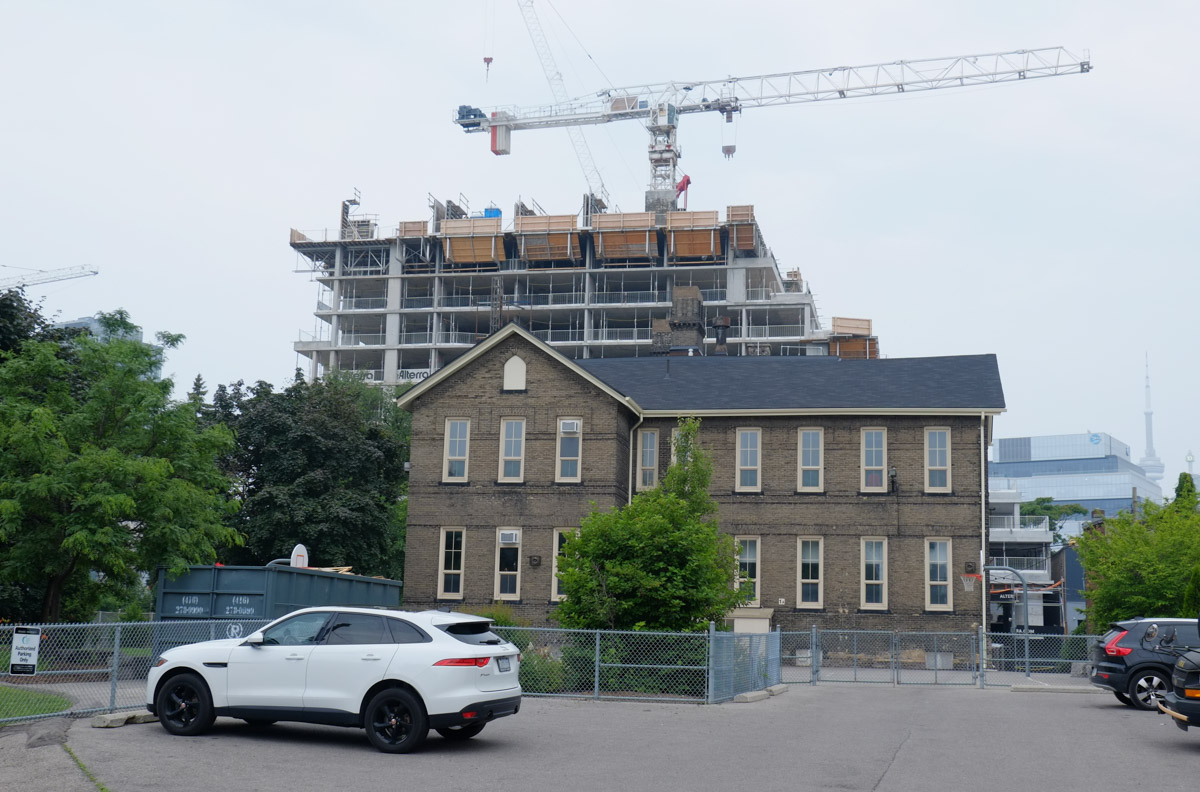
South of King Street, Sumach curves to join Cherry Street at Eastern Avenue.  As you travel south, Inglenook School is on your right. Between 1834 and 1890 this site was the home of Lucie and Thornton Blackburn, refugee former slaves from Kentucky who started Toronto’s first taxicab company. The school was designed by William George Storm (1826-1892) as Sackville Street School.  Storm also added the tower to St. James Cathedral and designed the wrought iron fence around Osgoode Hall amongst other things.

white car parked in frontof an old school building, brick, two storey, with condo development going on behind, is now Inglenook community school.

Inglenook School’s claim to fame is that it is located in the oldest continually-operated school building in the Toronto District School Board.

From here Sumach Street becomes Cherry Street.  The Distillery District is the next attraction on the route before Cherry crosses the Lakeshore (closed at the moment) and heads through the Port Lands to Cherry Beach.  But all that excitement will have to be found in other blog posts!

graffiti wheatpaste on the side of a Canada Post mailbox, words that say the more you feel your feelings the easier it gets

rusty mailbox at 504

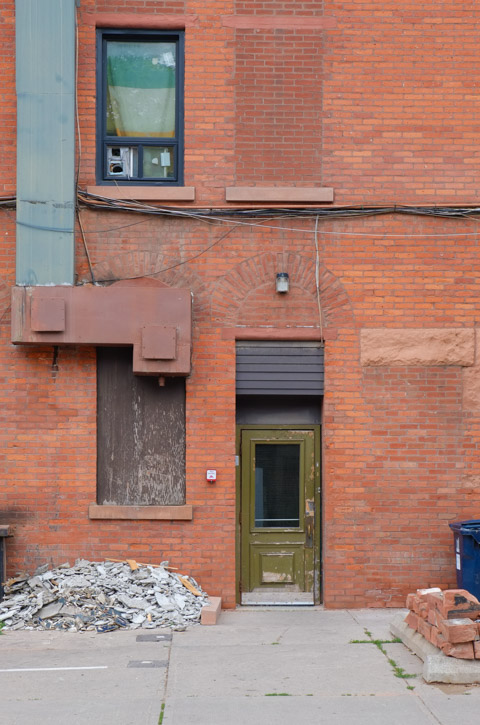
greenish colour door in brick building, side door of old Dominion Pub

This row of old two storey row houses has been vacant for years. Recently the developer that owns the properties provided a couple of Toronto artists the opportunity paint the exterior.  This is the result.

large street art painting by nick sweetman and luvs aka moises on a row of empty houses at Broadview and Eastern

If you look carefully, you can see that Nick Sweetman and Luvs (aka Moises) have painted the word CHANGE across the front of the buildings.   As a theme for a mural on a redevelopment site in a city bursting at the seams with such sites, change seems very appropriate.

below: I’ve played with the colours a bit to highlight some of the letters.  You should be able to see C, H, and A across this image.

part of a street art mural with the word change written in gold and yellow on a multi coloured background, on old houses with boarded up windows

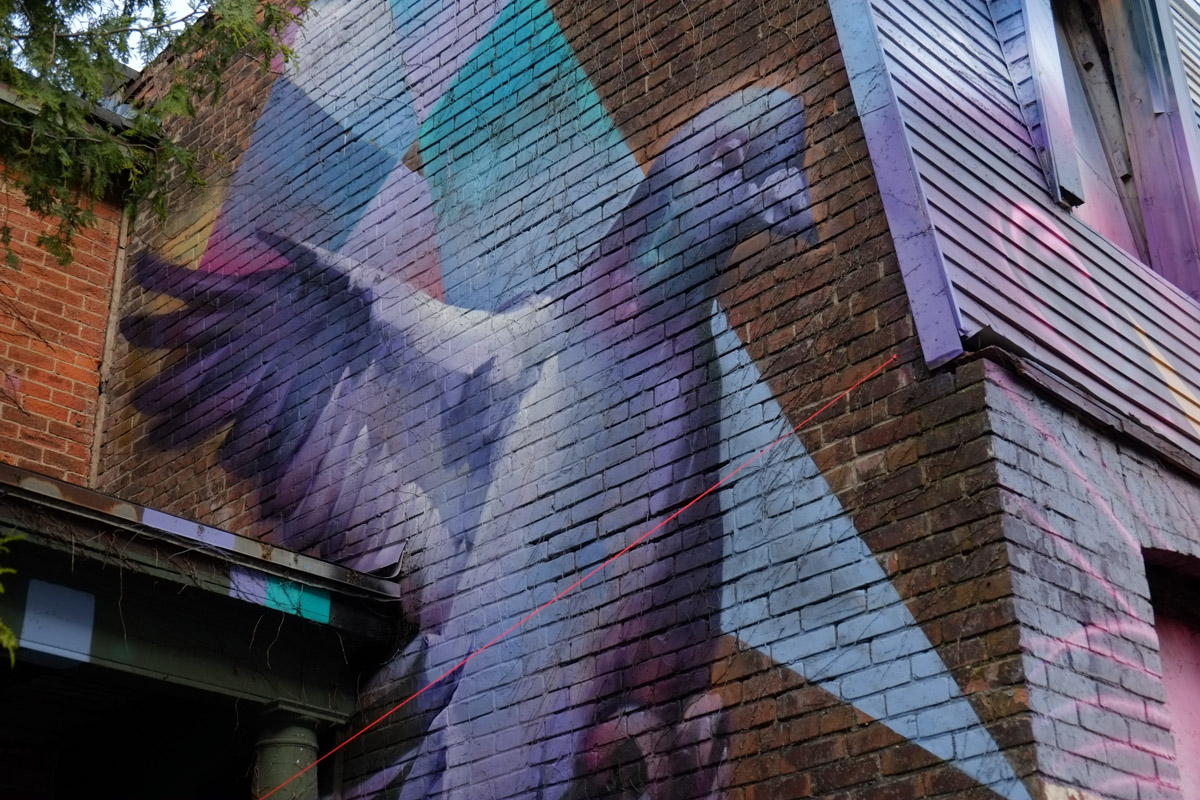
But the mural is more than colour and letters.  There are three animals featured here – pigeon, raccoon, and coyote  – all of which have adapted to changes and now thrive in urban environments.

below: A blue pigeon

street art mural of a large blue pigeon on the side of an empty old house

below: A pinkish marroonish reddish raccoon

a large street art raccoon on an old house, part of a mural by nick sweetman and luvs moises

below: A coyote with a dead leaf and new buds.

large mural with a coyote face, a large dead orange leaf,

Funding provided by Streetcar Developments

a row of old brick houses with boarded up windows has been covered with a large mural

upper window of an old vacant house now covered in many colours, mural

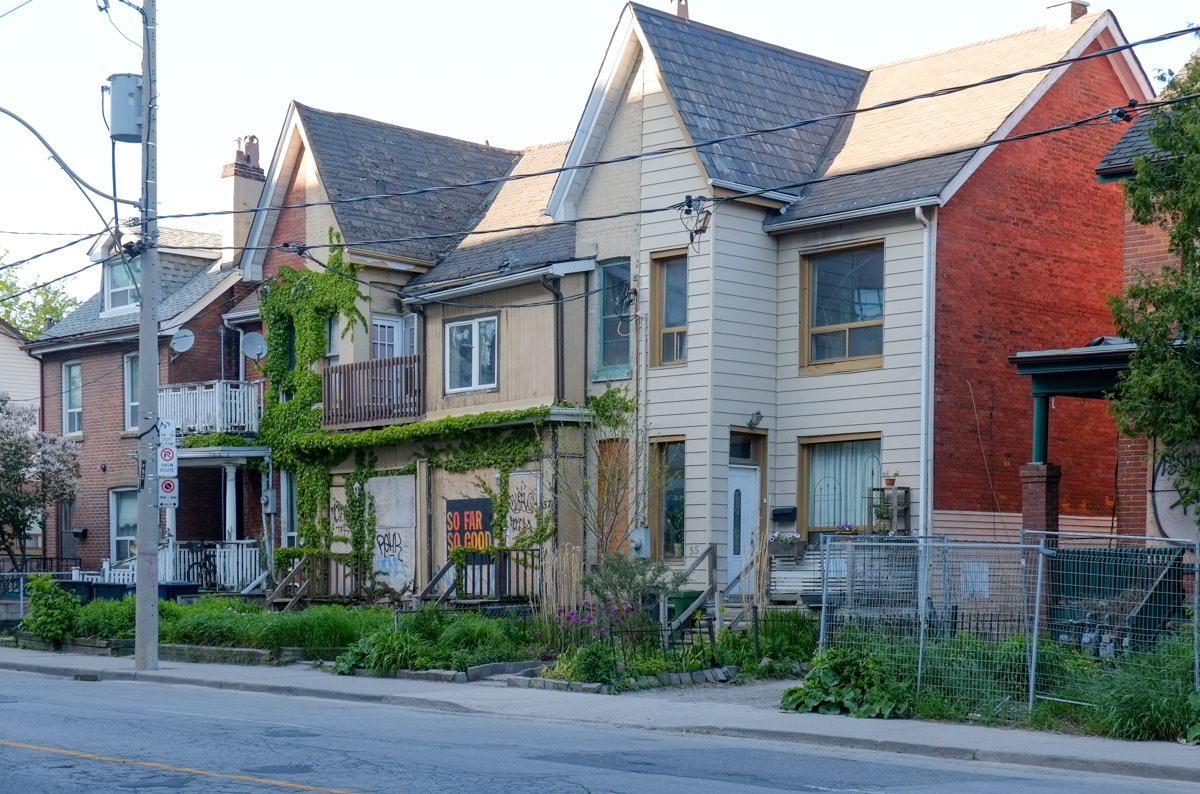
below: The houses to the north….

row of houses on the east side of Broadview near Eastern, two story, peaked roof,

poster on a boarded up window that says so far so good

Photos taken 25 May 2023

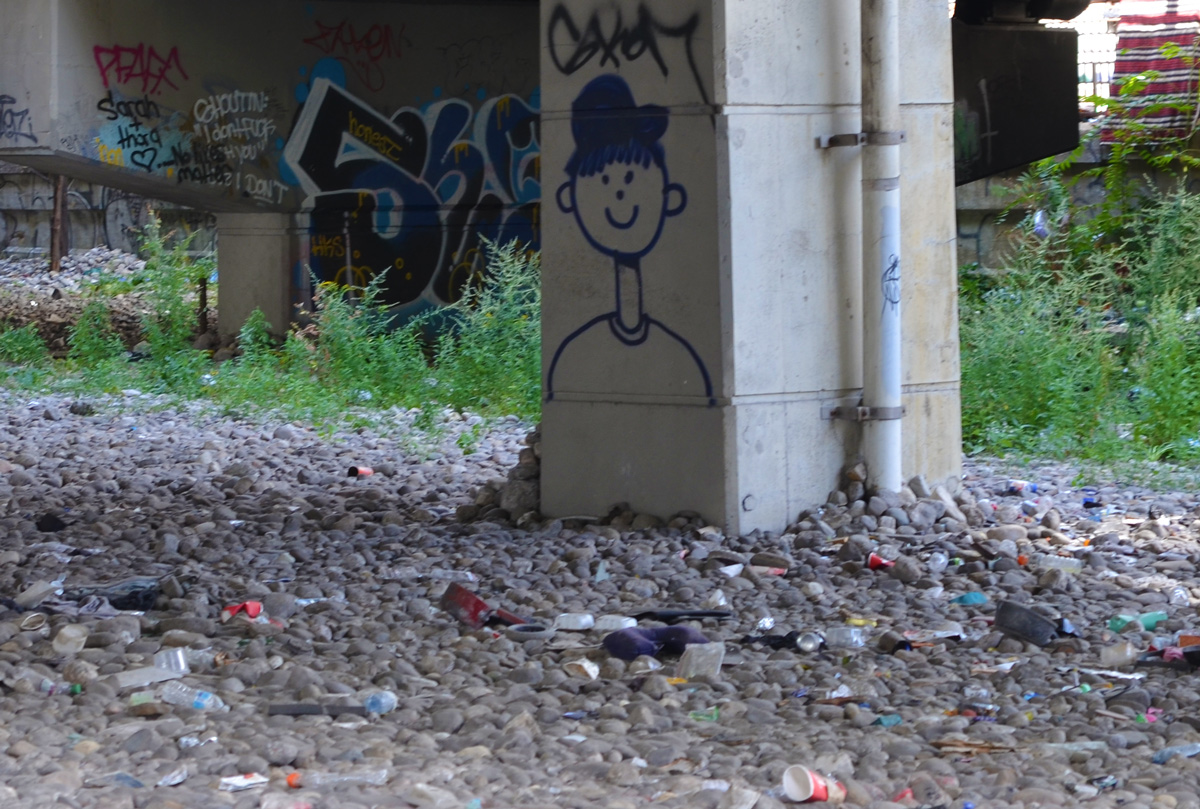
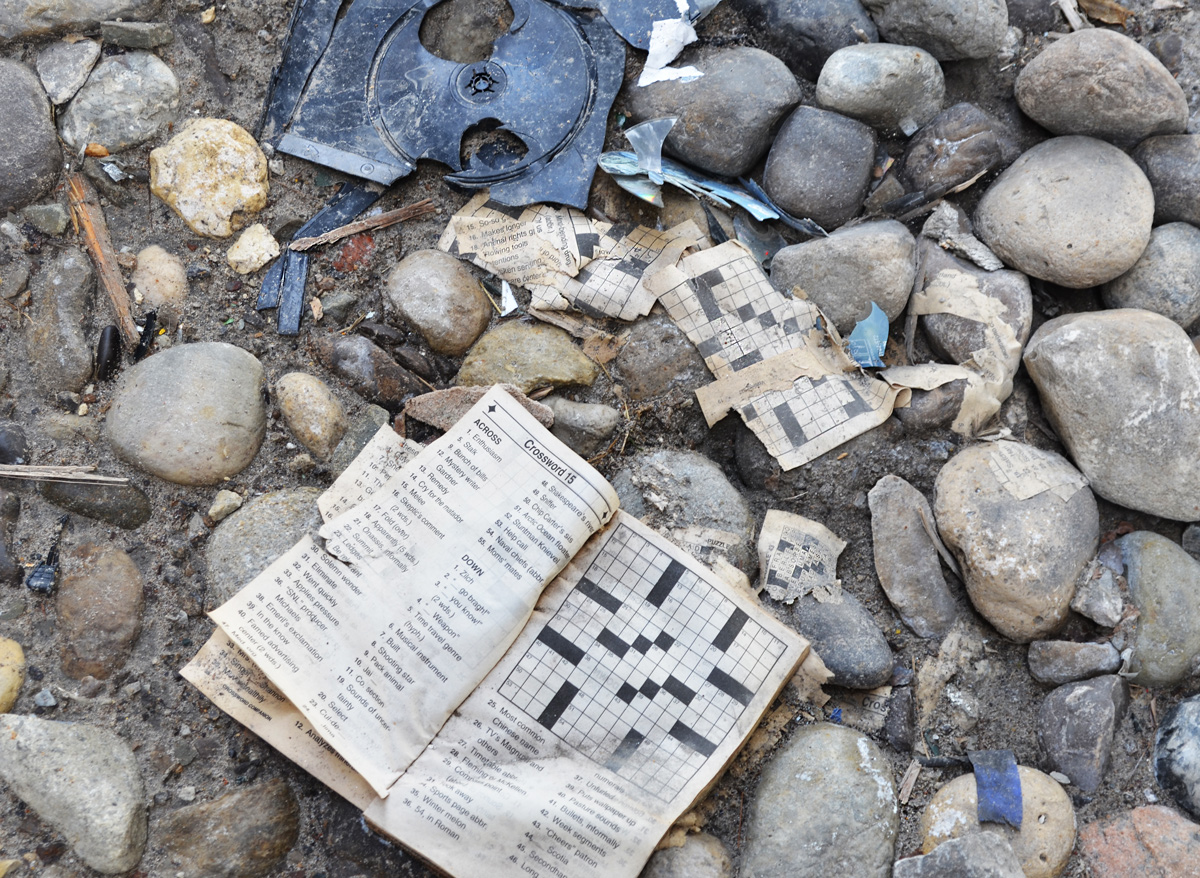
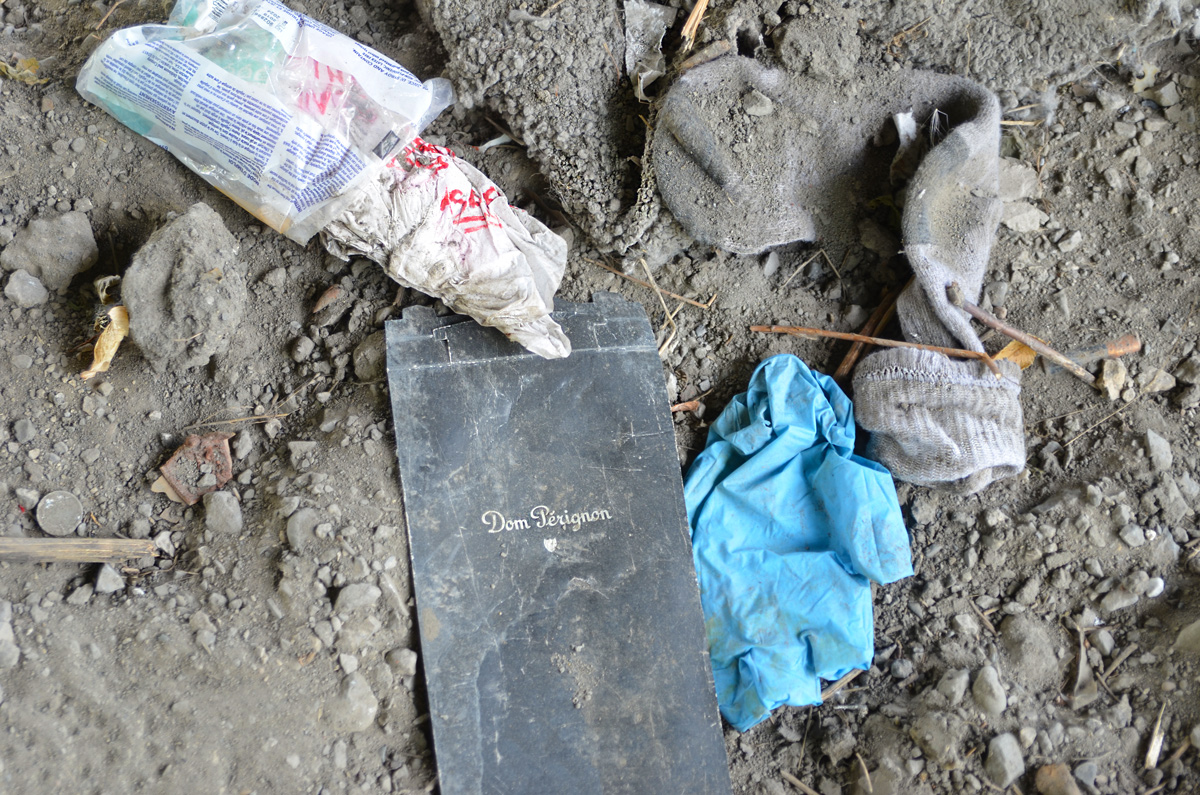
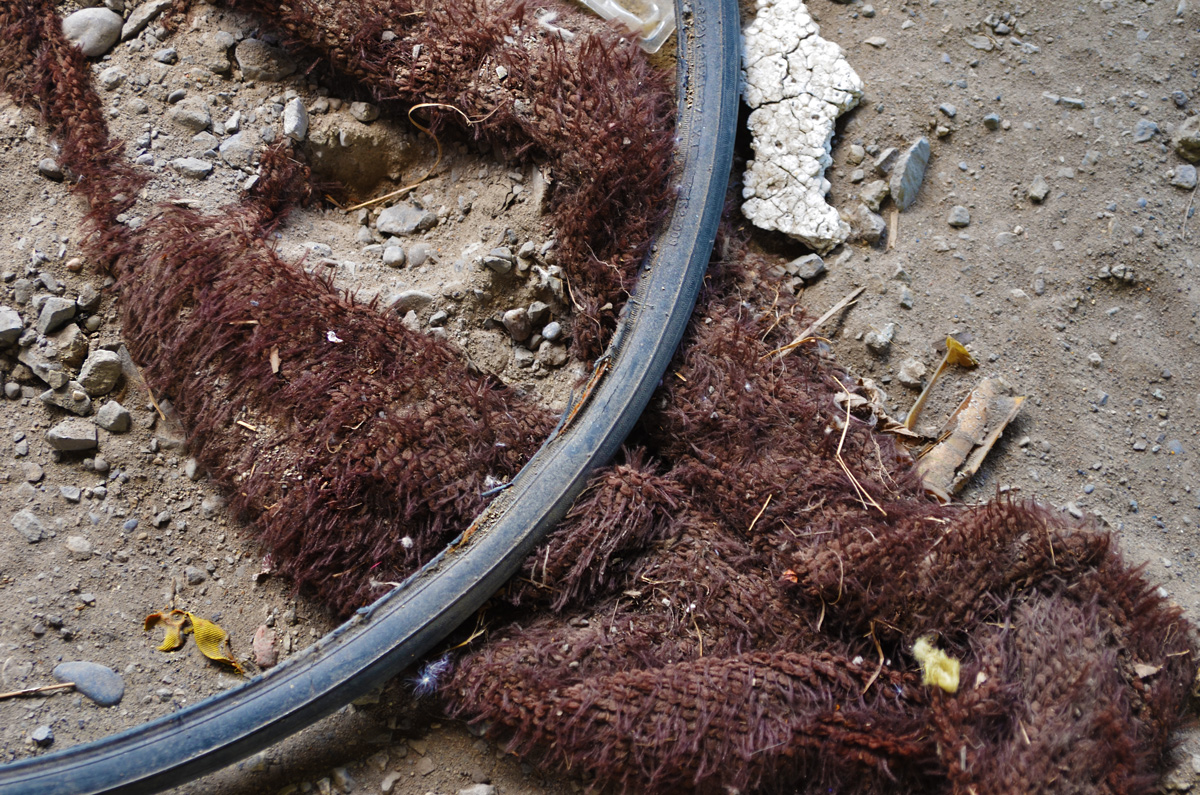
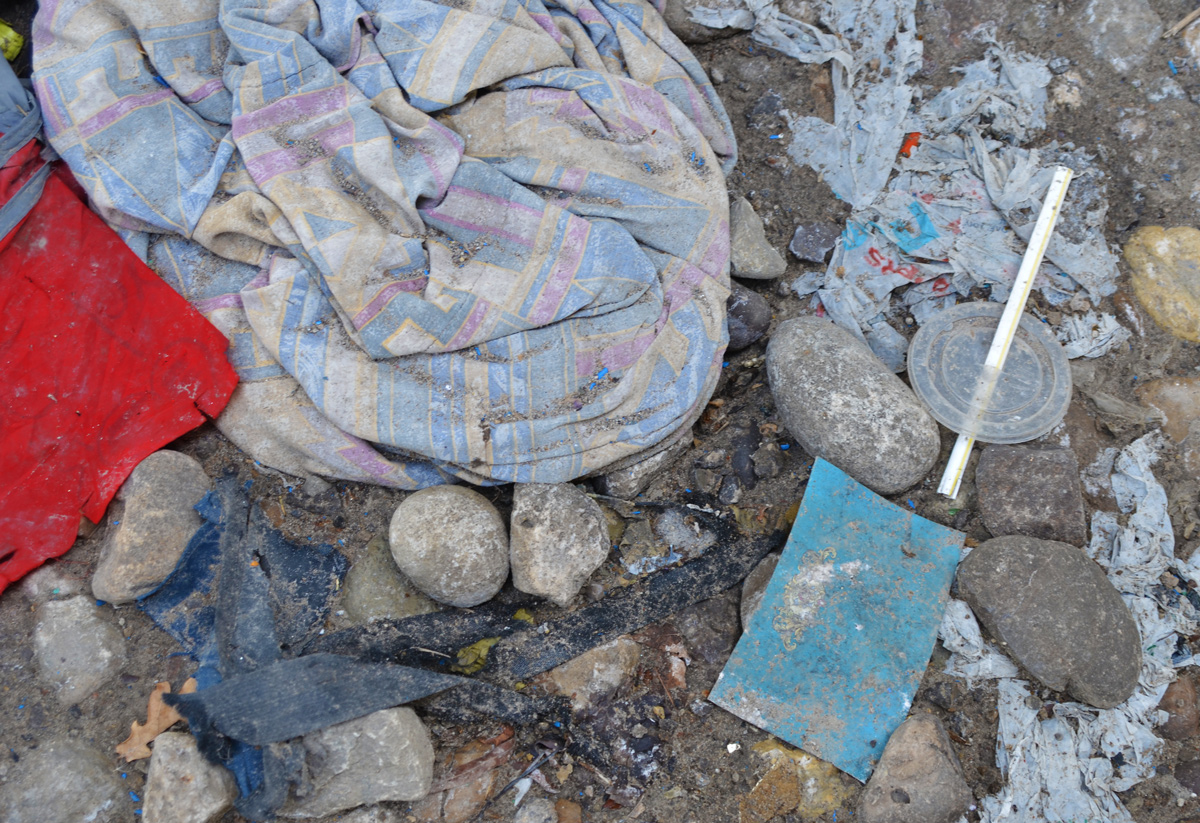
While walking under the Gardiner Expressway a few days ago, I came across the debris left behind by those who once camped here. Or maybe it was trash that was thrown here.

on a pillar for the Gardiner, a drawing of a man with a smiley face and a black hat, head and shoulders only. Stones cover the ground around it, lots of rubbish among the stones

Whatever the source, I found it rather fascinating to see what there was. Detritus as subject matter whether for photography or sociology or as anthropology in centuries to come.

trash left behind, on the rocks under the Gardiner, a smashed plastic DVD or CD case and a paperback crossword puzzle book open to a crossword puzzle, with some bits of torn pages

a flattened empty black Dom Perignon box, blue plastic disposable gloves, dirty torn wool socks, empty plastic bag, garbage found in the dirt and rocks under the Gardiner

an old bicycle tire inner tube lies on top of a bronw furry piece of cloth, i n the dirt

a red and black naloxone case on the ground, in the weeds, also a flattened milk carton

an old black boot lying on its side, laces undone, well worn, old, scuffed up, lying in the dirt, a black plastic garbage bag crumpled up is behind the shoe

a broken plastic Starbucks cup and a torn piece of paper with the words after death written on it

old clothing discarded and left on the ground, also a straw and a plastic lid

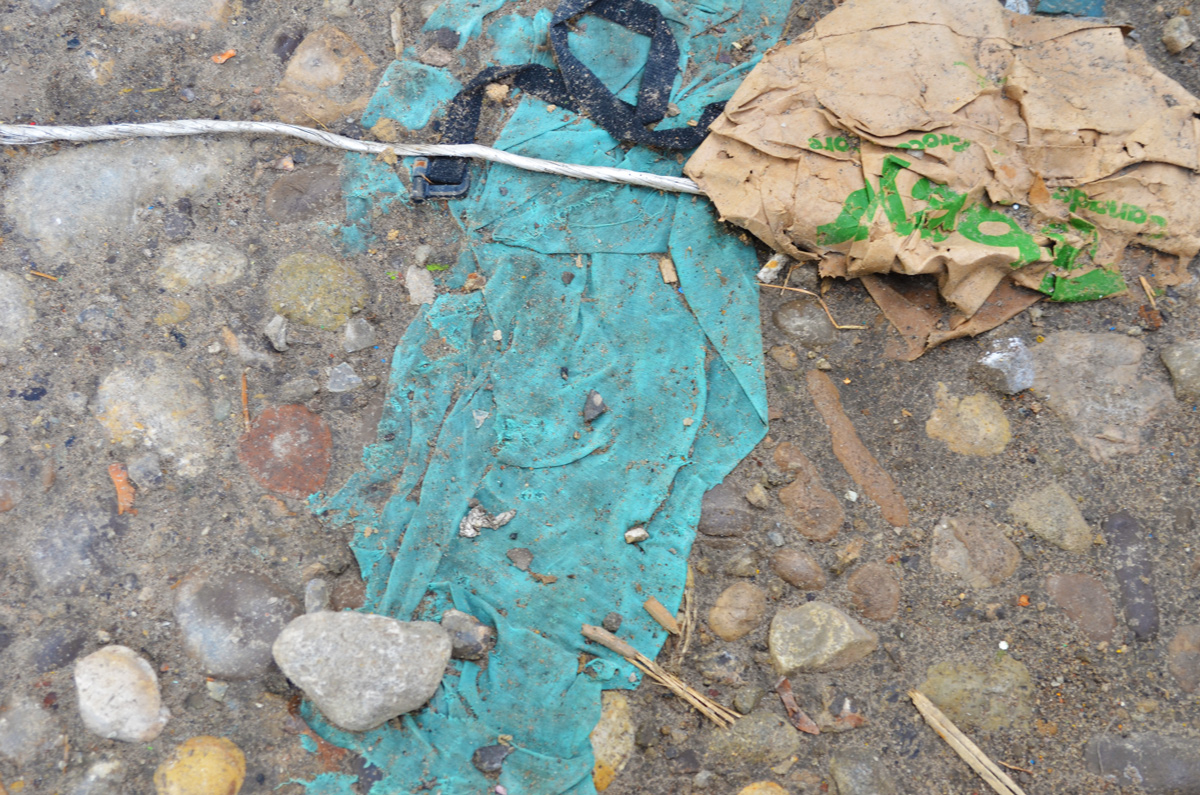
a blue belt, a length of rope and a brown Sobeys bag, trash on the ground along with a an old and torn turquoise shirt, dirt and rocks on the ground

short pillars columns holding up a ramp to the Gardiner Expressway, street art and graffiti on them, rocks underneath, garbage in among the rocks

a black and blue running shoe with black laces on the ground under the Gardiner, among other pieces of garbage strewn about

trash on the rocks, a green and black backpack, a red sock, and a rolled up blue article of clothing

2 small wheels, not the same, and some pieces of wood, in the dirt,

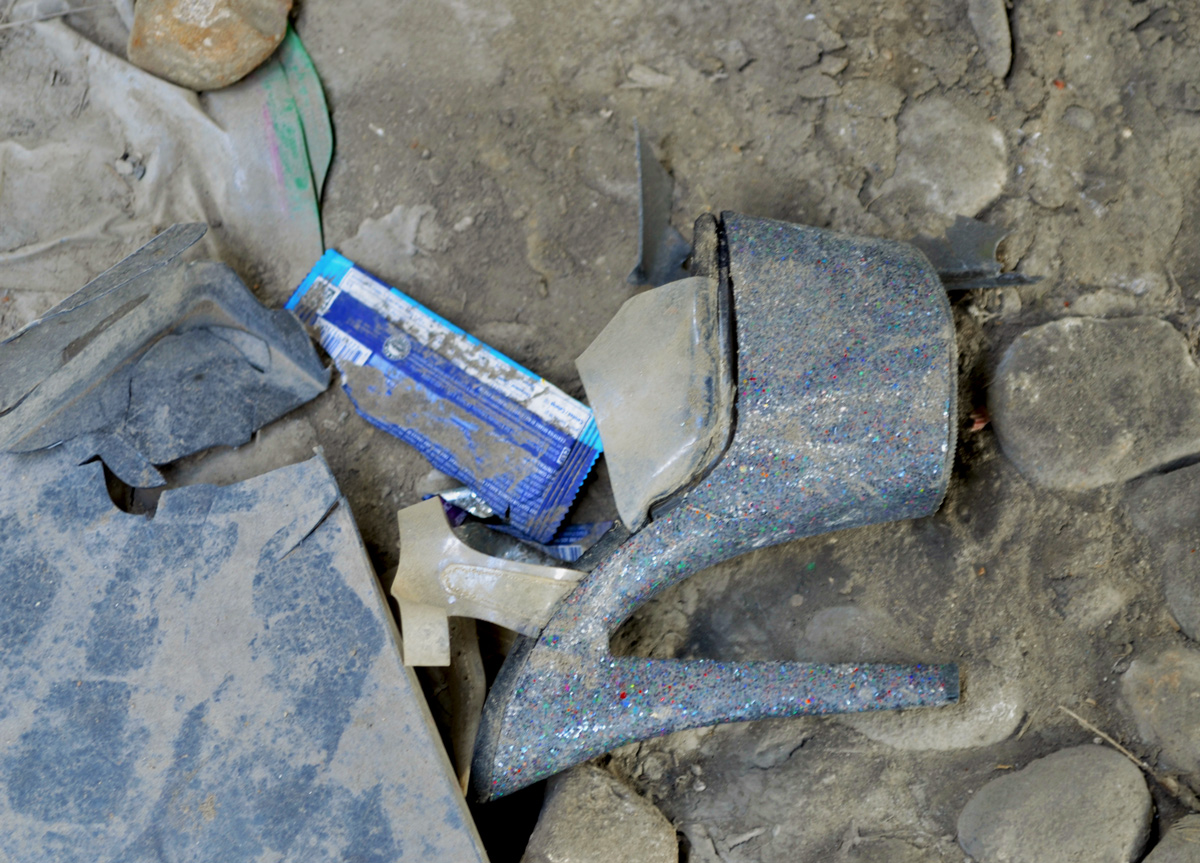
a high heel platform shoe in glittery silver and blue, very dirty, lying on its side in the dirt under the Gardiner, left behind garbage

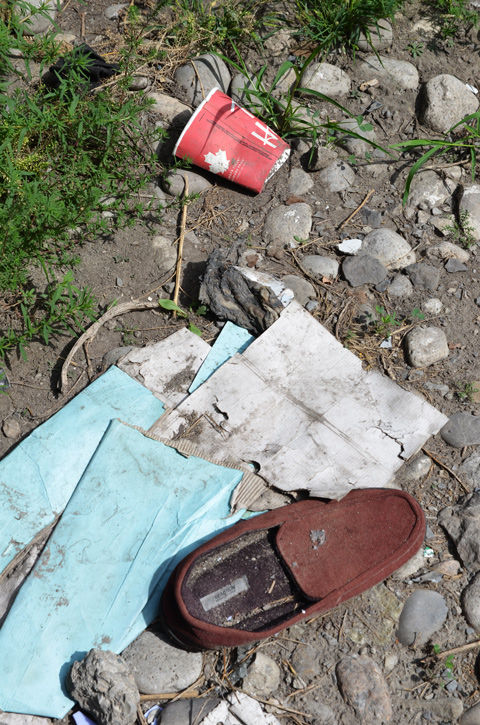
an old brown slipper, some turquoise and white paper, and an empty and squashed red Tims coffee cup, all rubbish lying on the ground

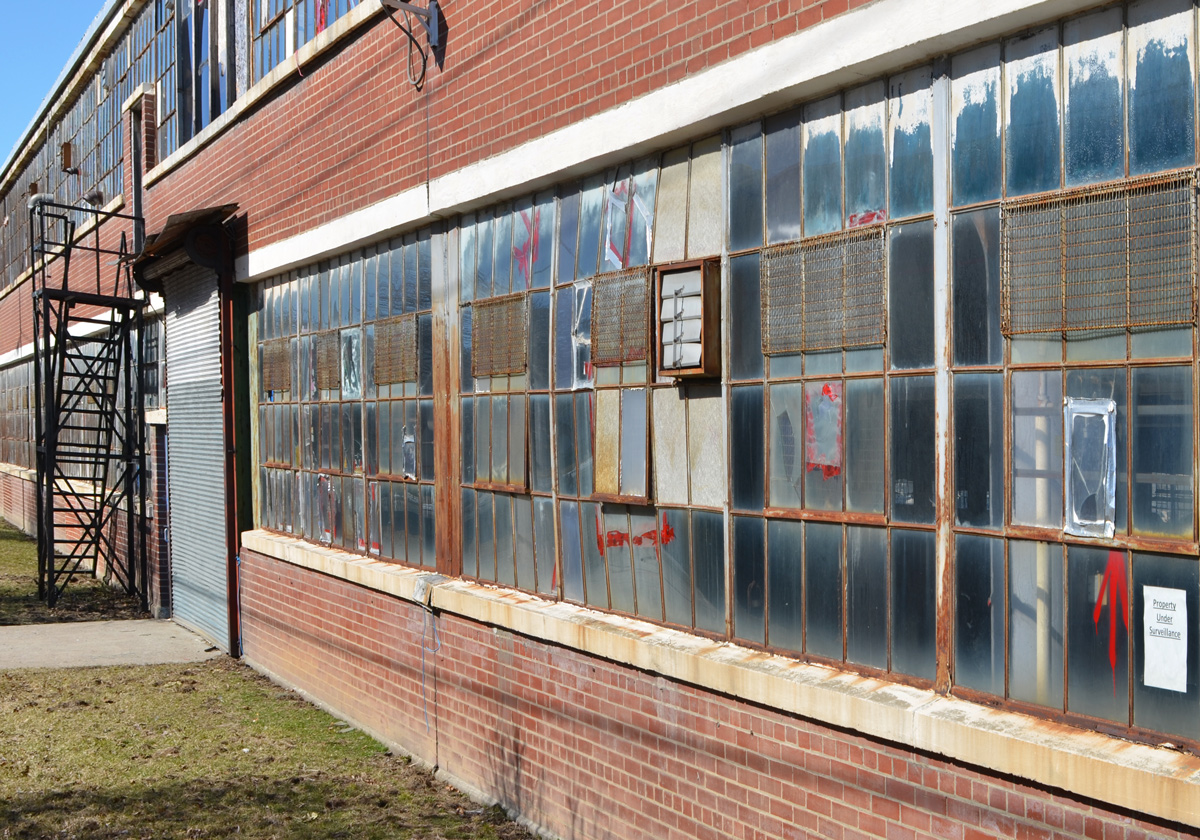
Until a few years ago this was part of Parkhurst Knitwear but today it sits empty. Today when I passed by the lighting was good for taking pictures of the south exterior wall.  There is a fence between the street and the building but there is ample room for photography.   I am now on many surveillance videos (if the warning signs were for real).

20 Research Road in Leaside, the Parkhurst factory, previously Dorothea Knitting Mills, built in 1942

This building started its life as Radio Stores Building No. 16.  It was constructed in 1942 and the chimney was added in 1946.  Building No. 16 was part of a complex of buildings occupying 55 acres of land east of Laird Drive and south of Eglinton that was owned by Research Enterprises Ltd. (REL).  During WW1 this land was an aerodrome.

horizontal window in a brick building made of rows of small rectangular panes of glass

In 1940 REL was incorporated in response to the outbreak of World War II; it was a Crown Corporation created through the Munitions and Supply Act of Parliament in September 1939.

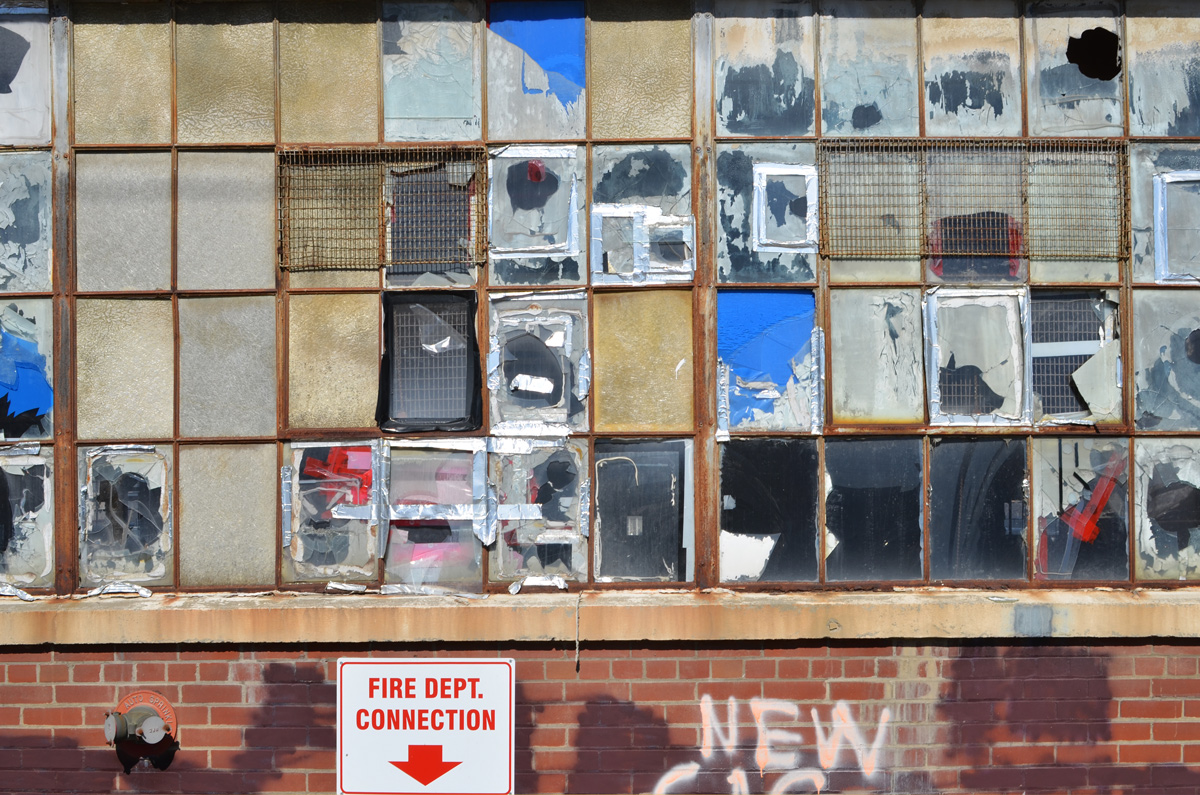
looking along the exterior wall of two storey brick building with long horizontal ribbons of window panes, many glass pieces are broken or cracked and then fixed with tape

REL’s mandate was the production of technology equipment such as optical instruments and radio and radar equipment to assist with pilots with night flight.  During its 6 years of operation, REL employed 7,500 people.

broken and patched panes of glass in a larger horizontal window

After the war, this building was sold to Dorothea Knitting Mills (1947).  Dorothea ultimately became part of Parkhurst Knitwear.

smokestack at east end of old Parkhurst knitting mill building, now abandoned

This building is part of a larger story – the slow disappearance of industries in Leaside as commercial and residential developments proliferate. Prior to 2010, the area was zoned industrial but developers fought for, and won, changes to the zoning in the area.

south wall of Parkhurst knitting mills, empty and abandoned, many glass panes cracked or broken, old curtains in the window

I can’t remember how long this building has been empty. If was still a functioning knitting mill in 2013.  In 2019 the city of Toronto moved to have the building listed as a Heritage site.  Last year there was a large sign on the building advertising the fact that it was soon to be a self-storage facility.  Is that still its fate?

old brown pipe inside, looking through old window


Palimpsest.  I had to look up the word too.  No, it’s not the superlative form of palimps.  As it turns out, palimsest has to do with surfaces that have been reused or altered while still retaining traces of its earlier form.

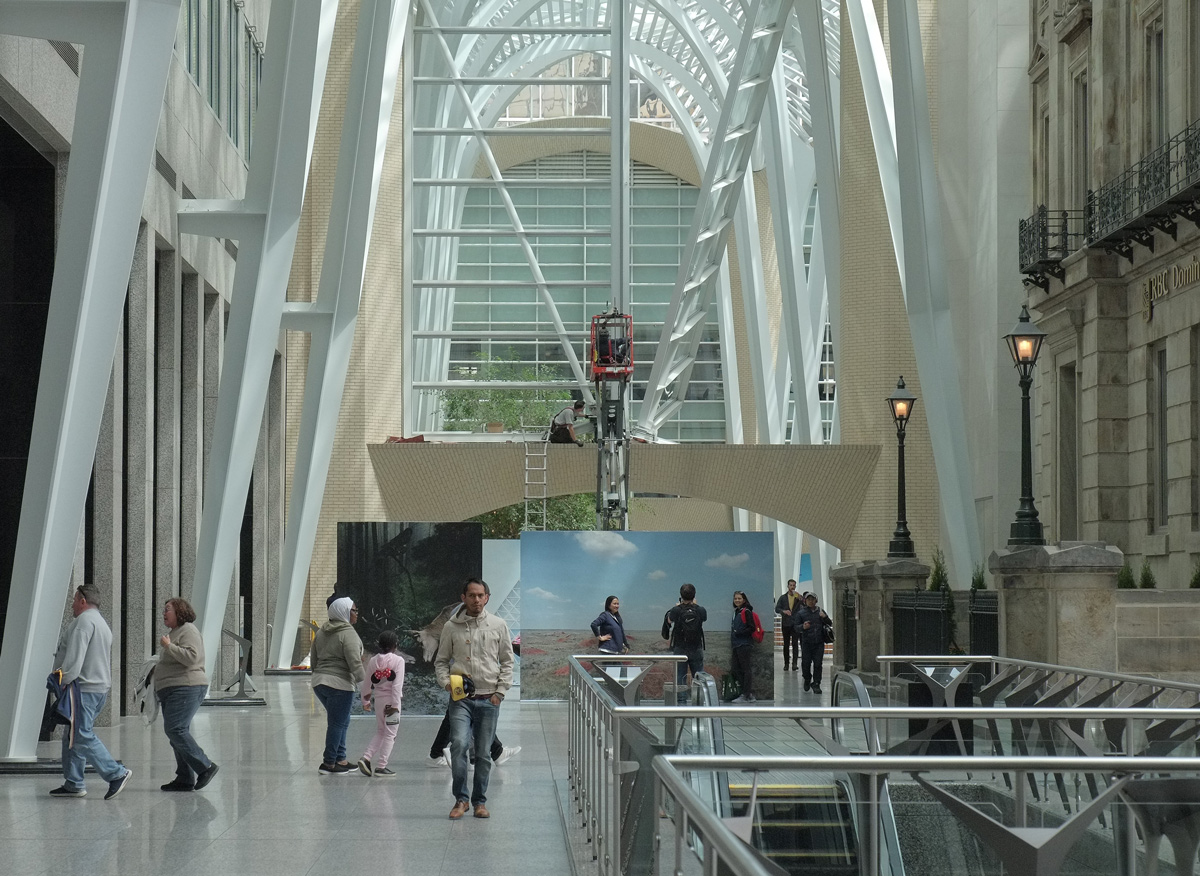
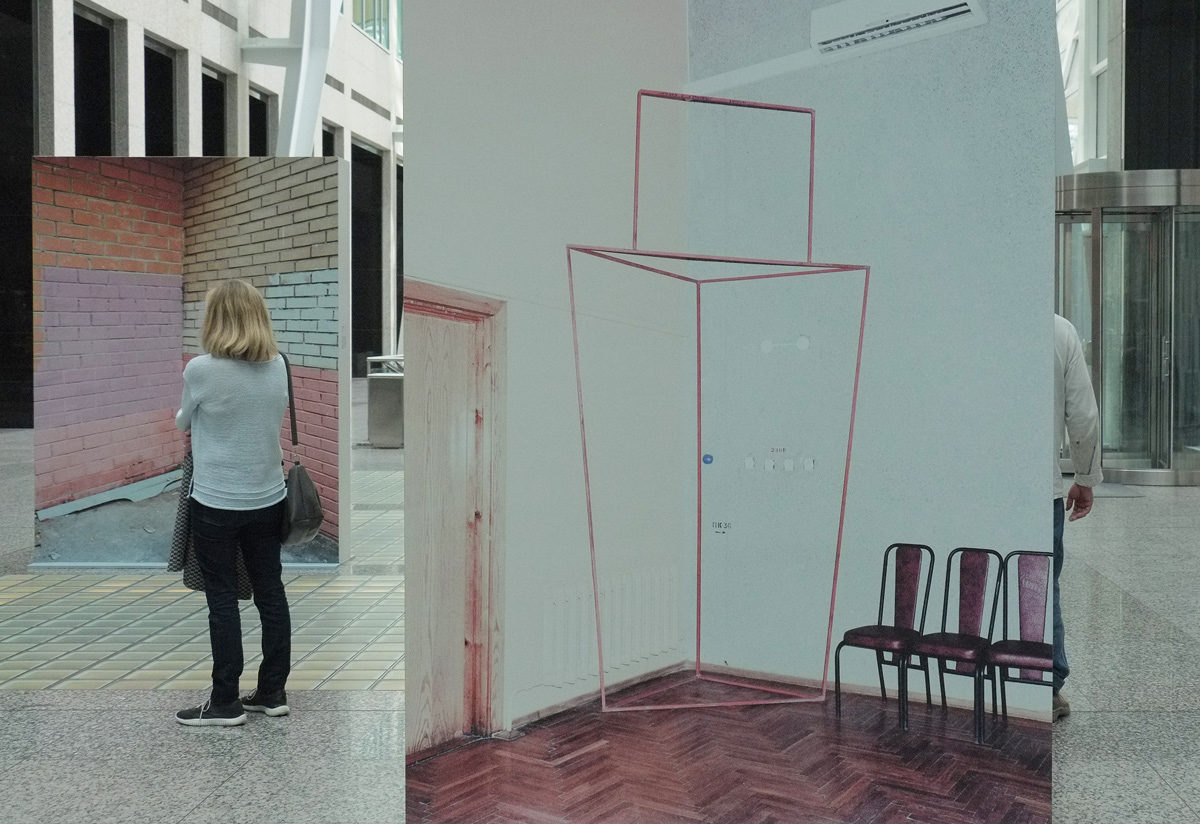
What does it have to do with this blog post?  It is the name of an exhibit of photos by a Poland-based collective, Sputnik Photos.  Between 2008 and 2016 this group compiled their ‘Lost Territories Archive‘; this is a project that documents the “physical, political, and sociocultural” aspects of the former Soviet republics.  Some of the thousands of images that they collected are on display in the Allan Lambert Galleria at Brookfield Place as part of this year’s CONTACT Photography Festival. It is on view for the month of May.

people in Allan Lambert Galleria, a couple of large photos, a workman on a crane,

below: “A sculptural model in a student atelier, Spitak Armenia, 2014”.

large picture of an old white statue, Brookfield Place, 2 men looking at it. Photo's title is A sculptural model in a student atelier, Spitak Armenia

below: “Cafeteria at the Heydar Aliev Centre, Gobustan Azerbijan, 2016”.   In 2013, to mark the 10th anniversary of the former president of Azerbijan, Heydar Aliyev, his son and successor, Ilham Aliyev, ordered the country’s 70 district capitals to each build a monumental centre named after his father.

people walking past a large photo in Allan Lambert Galleria at Brookfield Place. Photo by Sputnik Photos, title is Cafeteria at the Heydar Aliev Centre, Gobustan Azerbijan,

below: “Semipalatynsk Nuclear Test Site, Kazakhstan, 2016”.  The Soviet Union conducted over 400 nuclear tests at this site in northeast Kazakhstan between 1949 and 1989.  The impact of radiation exposure was hidden by Soviet authorities and didn’t become known until the site closed in 1991.

a couple walk past a large picture, small reddih mounds of dirt on a barren grassy field, flat land, no trees or other plants

 below: ‘Homemade construction for growing grapes, Yerevan Armenia, 2013’.  Urban farming was popular during the post-Soviet crisis in the 1990’s.  Today grapes are grown in every neighbourhood using homemade constructions for supporting the vines.

a large picture on display in Allan Lambert Galleria of a homemade structure to hold up grape vines in a back yard in Yerevan Armenia

below: “Anaklia Georgia, 2013”  Anaklia is a village on the Black Sea.  In 2011, Mikheil Saakashvili, the president of Georgia, announced a program to transform the village into a luxury resort.  Construction began in 2012.  Saakashvili’s party lost the parliamentary elections in 2013 and he fled the country.  Work on this project was discontinued.

large photo of a oval shaped structure on the top of a tower, on the coast, surrounded by barren land, abandoned building, in Anaklia Georgia (former USSR republic)

below: “Slutsk Belarus, 2013”.  This image is of ‘Cultural Space’, an installation in the sugar factory Saharny Zavod.  The factory was given an award for best ideological work in a contest organized by a regional committee for ‘admiration structures’.

two large photos on exhibit, with a woman standing in front of one of them.

Members of Sputnik Photos: Andrej Balco, Jan Brykczynski, Andrei Liankevich, Michal Luczak, Rafal Milach, Adam Panczuk, and Agnieszka Rayss.

***

More about the word palimpsest:

In Ancient Greek, it was παλίμψηστος (palímpsēstos) and in Latin it was palimpsestus meaning “scraped clean and ready to be used again”.  It was originally applied to wax covered tablets that the ancient Greeks and Romans used to “write” on by scratching out the letters with a stylus.  Smoothing the wax would erase the words.   Around the 6th century vellum, or parchment prepared from animal skins, became more commonly used.  It was expensive.  Early on, writing on parchment could be washed away using milk and oat bran but over time it would come back, but faintly.   In the later Middle Ages, writing was removed with powdered pumice which was more permanent.

Along with the historical definition, palimpsest has a more modern definition.  The Merriam-Webster Dictionary gives this newer meaning as, “something having usually diverse layers or aspects apparent beneath the surface”  while the Cambridge English Dictionary uses these words, “something such as work of art that has many levels of meaning, types of style, etc. that build on each other.”

Sort of like window shopping but different….

three grey femail mannequins dressed in pale blue in a store window

below:  Peering through the window at the remains of Yuk Wing cleaners on Gerrard St. East

interior of now closed dry cleaners, looking through the front window of Yuk Wing cleaners, pale green counter, old signs, still remain

below: Sometimes you can’t look in the window – something is in the way!  It wasn’t until I was looking at the picture on my computer that I noticed that the newspaper is in a language that I don’t understand.   I typed the headline to the left of the heart into google translate, “Niemiecka chemia zapanuje nad swiatem” and it told me that the words were Polish and translate to “German chemistry will dominate the world”.  The article is about the purchase of Monsanto by Bayer.

a small red heart is painted on the window of a store that is now empty and newspaper covers the inside of the window.

below: A portion of the black cowboy silhouette remains in the now empty Tortilla Flats restaurant.

looking in the window of an empty restaurant, green and black walls, red bench, bike, top part of a silhouette of a cowboy on the wall

below:  The effects of morning light shining into the Thai Luna restaurant.

looking into the window of the Thai Luna restaurant, sun behind, shadow of the words of the window show up on the maroon coloured bench, black tables

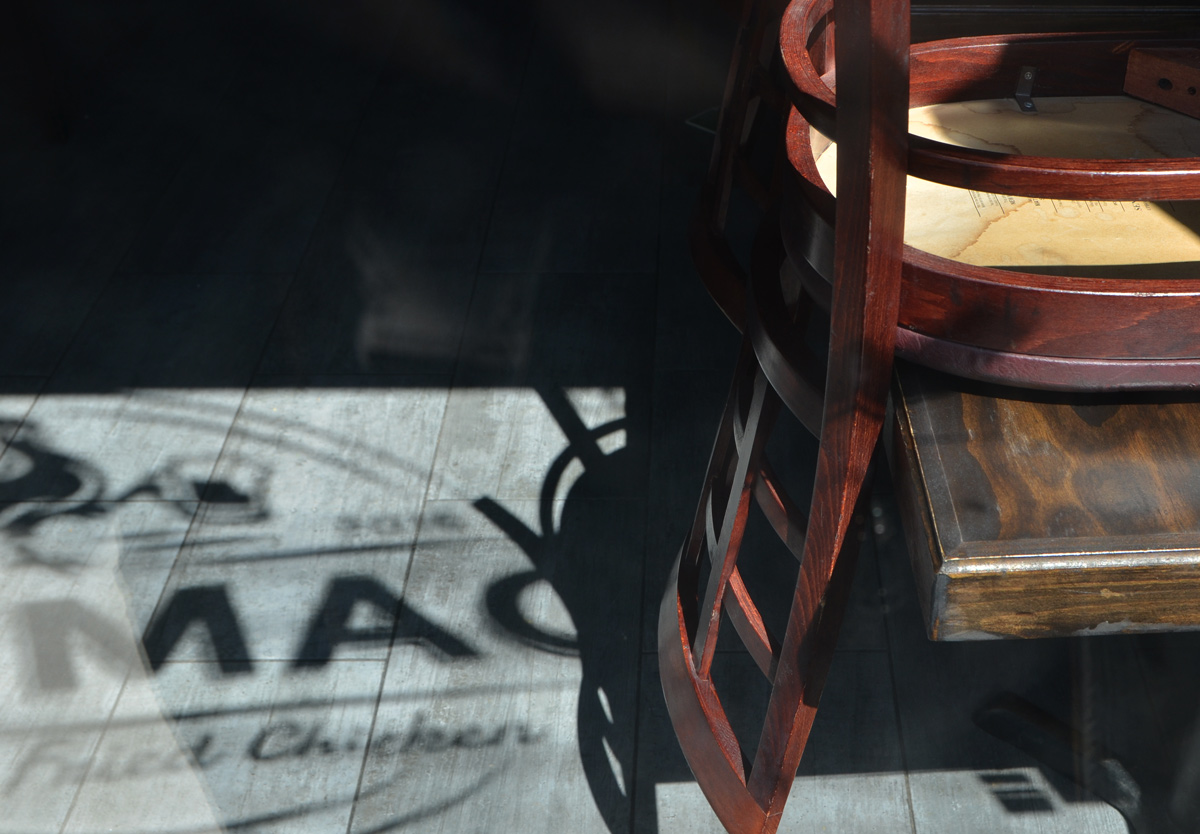
below: More morning sunlight, this time it leaves traces of fried chicken.

looking into the window of a fried chicken restaurant, chair upside down on table, words on the window show up on the floor because of the sunlight coming in the window

below: Strutting in the window with miniature camels

looking in the window and doorway of a womens clothing store in the Eaton Centre, mannequins in the window, saleswoman in the door,

below: Laundry day, with 24 hour surveillance

looking in a laundromat window, people, washing machines,

below: The chicken, and its head, really was that colour.

looking in a restaurant window, meat hanging in a windiw including a rather yellow chicken, some ribs,

below: What little remains.

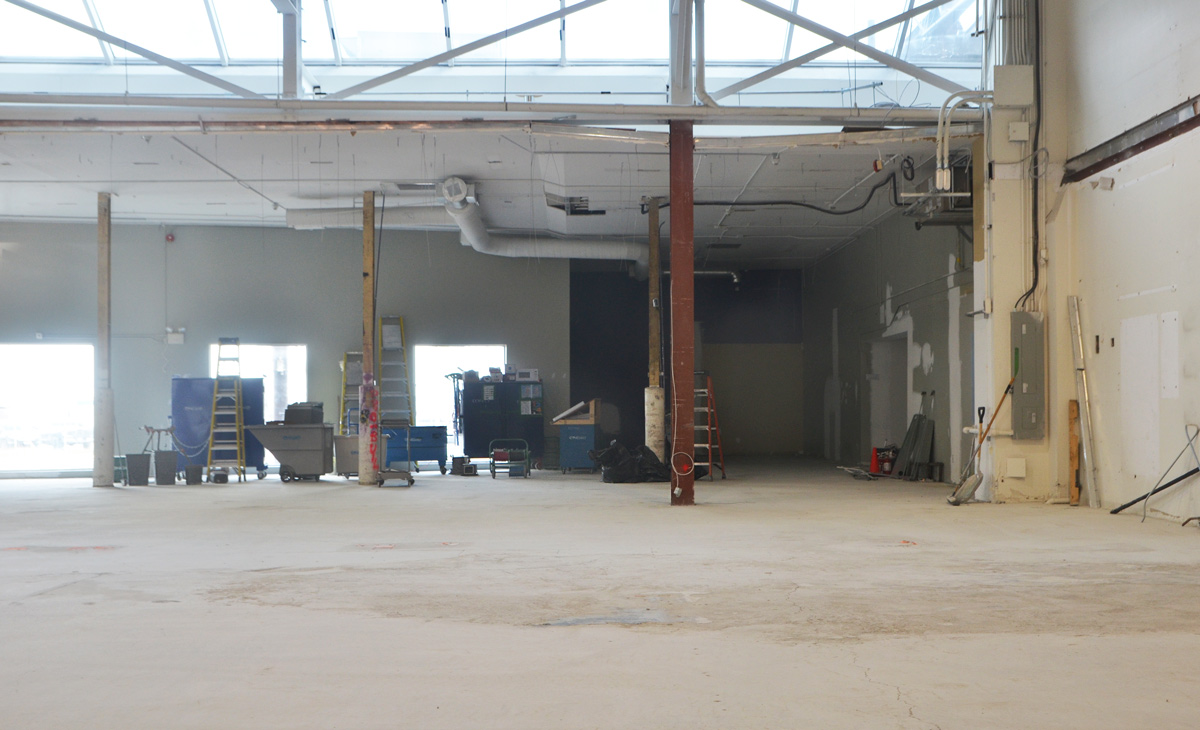
looking through a window into a large open space, some construction equipment is against the far wall, large door open across the room

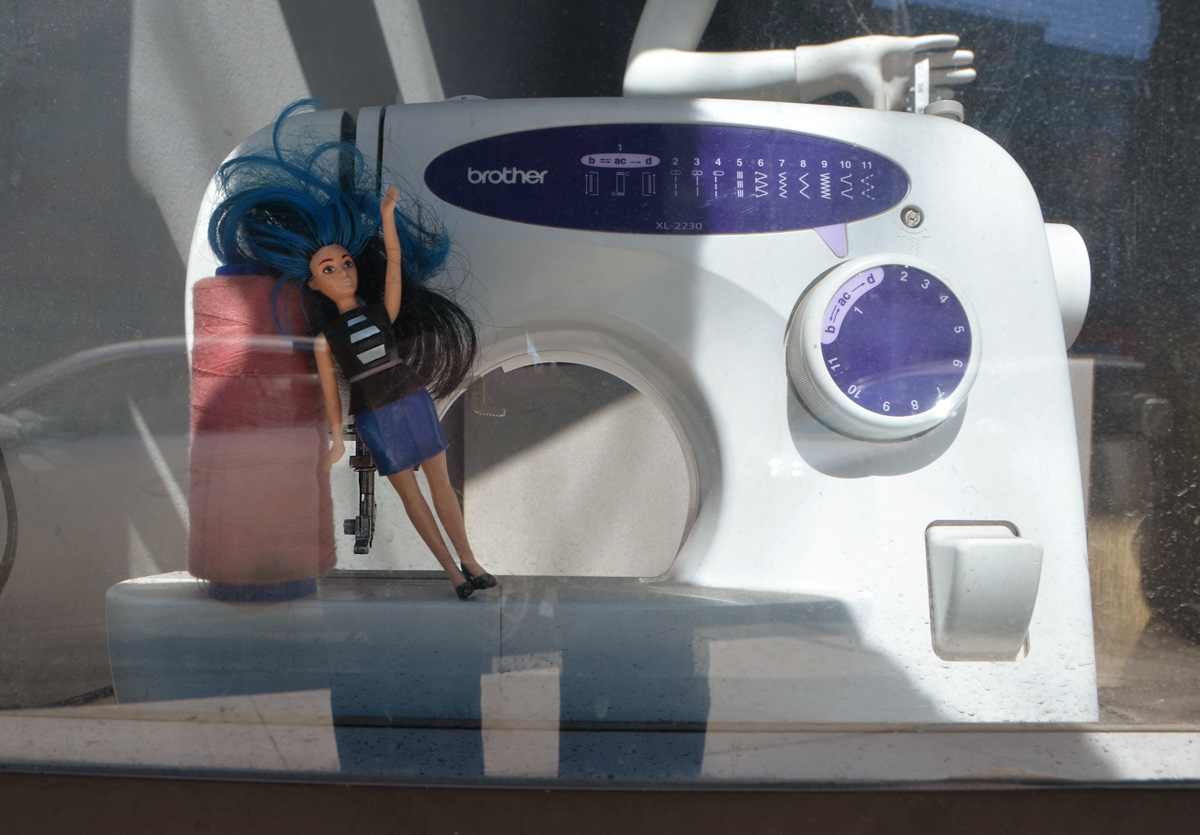
in the window of a store, dirty window, brother sewing machine, with small barbie doll standing against it and leaning against a large spool of pink thread

Another story of changes underway;
more documentation of buildings about to disappear.

trees and overgrown yard, two large signs advertising townhouse developments to come

On a leafy stretch of Bayview Avenue, there are some buildings that now sit empty.  The weeds have taken over the yards, as have large signs advertising the townhouse development that will be built there.   Actually the signs are only on one yard, this one:

below:  There are curtains in the window but some shingles are missing and the frontyard is overgrown with weeds – 2716 Bayview Avenue, sitting empty.   If you drive past it on Bayview you’d probably miss it because of the large trees between the house and the street.

small brick house with attached garage, overgrown front yard, tiger lilies growing by the front, piles of mulch on driveway, some ivy on front of house, some shingles missing from the roof

below: Nature takes over very quickly if you let it.  The lilies haven’t lost to the thistles yet though.

thistles, orange tiger lilies, and ivy, growing in a garden at the front of a house

below: The backyard was very overgrown too. The side door was open but I didn’t go in.  The basement appears to be in good shape.

an open basement door on the side of a house, overgrown yard, pile of debris in the foreground

If you go to their website, only 7 townhouses are shown in the drawings while the properties on either side of it (4 in total) are included in the plans as “future development”.   If you look at the original application on the City of Toronto website, the whole plan called for 20 townhouses facing Bayview Ave and a single family dwelling facing the street behind.  Each townhouse is 4 storeys (including basement level which is half garage and driveway) and 18’9″ wide.  The above ground levels are 47′ deep.   The site drawings and architectural plans were from June 2017.   I am not sure why the discrepancy.  It’s not uncommon for changes to occur between the planning stage and the final product…   So take the measurements that I just gave you with a grain of salt.

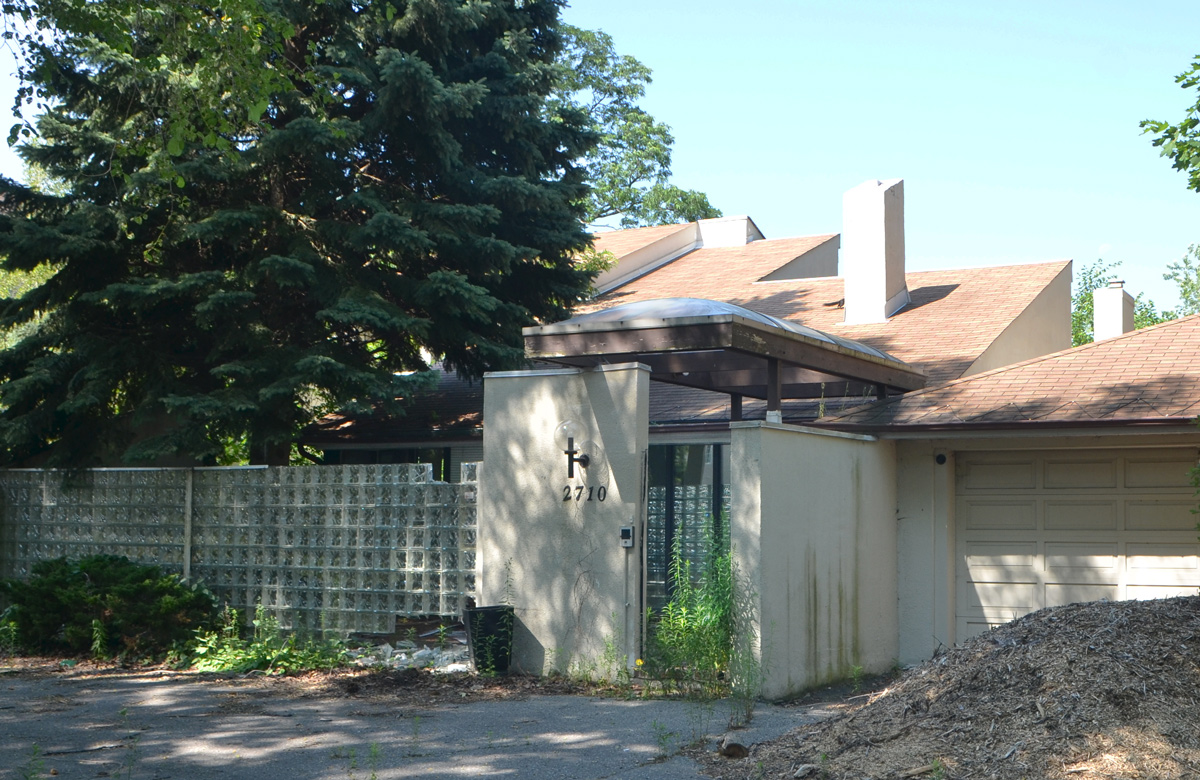
below:  One house to the south, 2710 Bayview.  A newer style house than its neighbour with part of its front yard hidden behind a glass block wall.   It too is set back a large distance from the street.  Once upon a time, someone put some love and care into this house.   I hoped that it was well used in its time.

modern style house with glass brick wall in front, around a front porch, large spruce tree, overgrown driveway,

modern style house with glass brick wall in front, around a front porch, large spruce tree, overgrown driveway,

double red doors, front entrance way to an empty modern design house

below:  Moving north, this is 2720 Bayview.  There is evidence that large trees have already been cut down.  At the moment all the evidence is well hidden from passers-by.   A year ago, farther south on Bayview a developer cut down 30+ large trees without permits from the city because they were building townhouses on the site  The outcry was big but the penalty is small.

white stucco bungalow with the remains of a chopped up tree in front

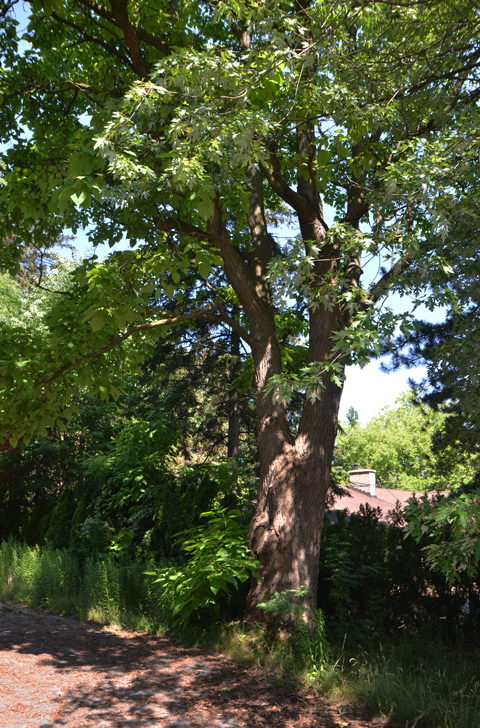
below: But….  if you have permission to build townhouses, there is no way the trees can stay.  Any plan that involves creating 20 new townhouses in less space than four single houses doesn’t leave room for large trees.  Those will be a thing of the past on this stretch of Bayview.  The one below was so big that I couldn’t reach around the trunk of the tree.

a large mature broadleaf tree in summer, green

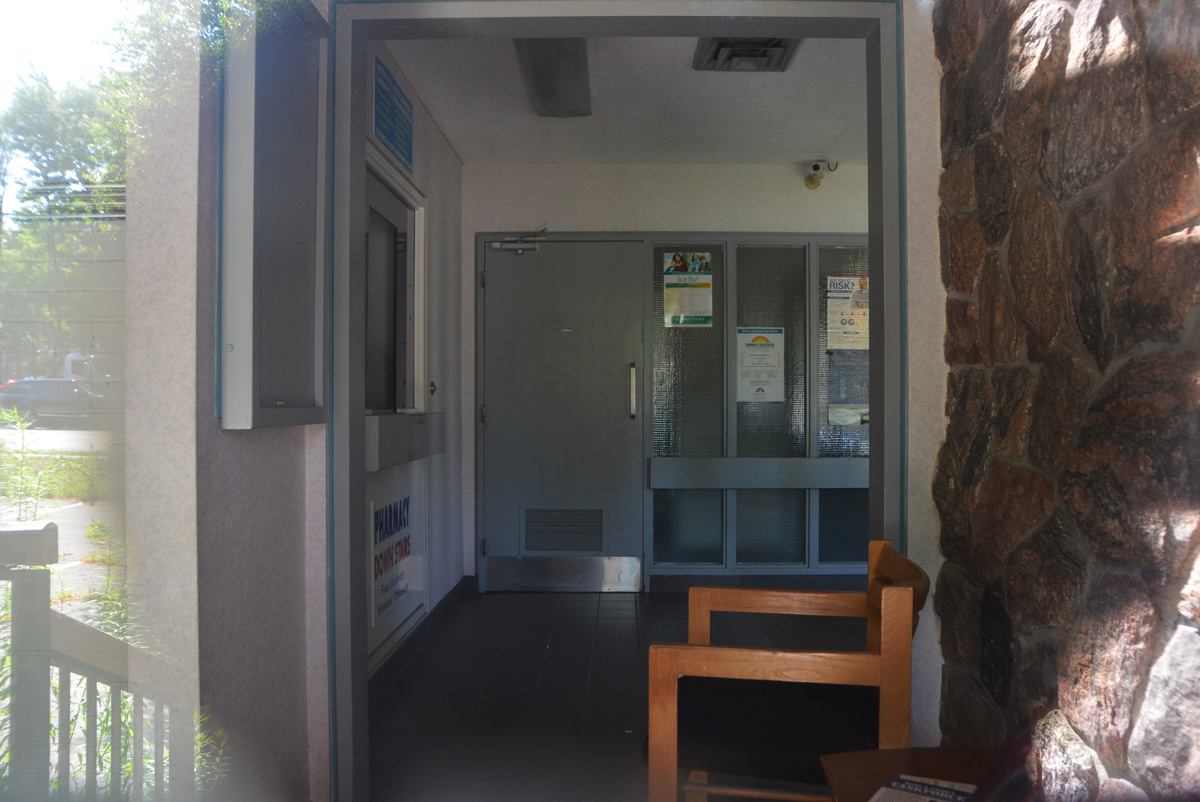
below: The fourth building, 2722 Bayview, was originally built as a residence, but it has been a medical clinic for decades.  If you peer in the window, there are still posters on the wall (Is It Flu?) and even reading material on the table ([something] Task Force).  There is a sign on the front door that says that 2 June 2017 was the last day the clinic was open.

interior of medical clinic, no longer used, looking in the window, chair, posters on wall,

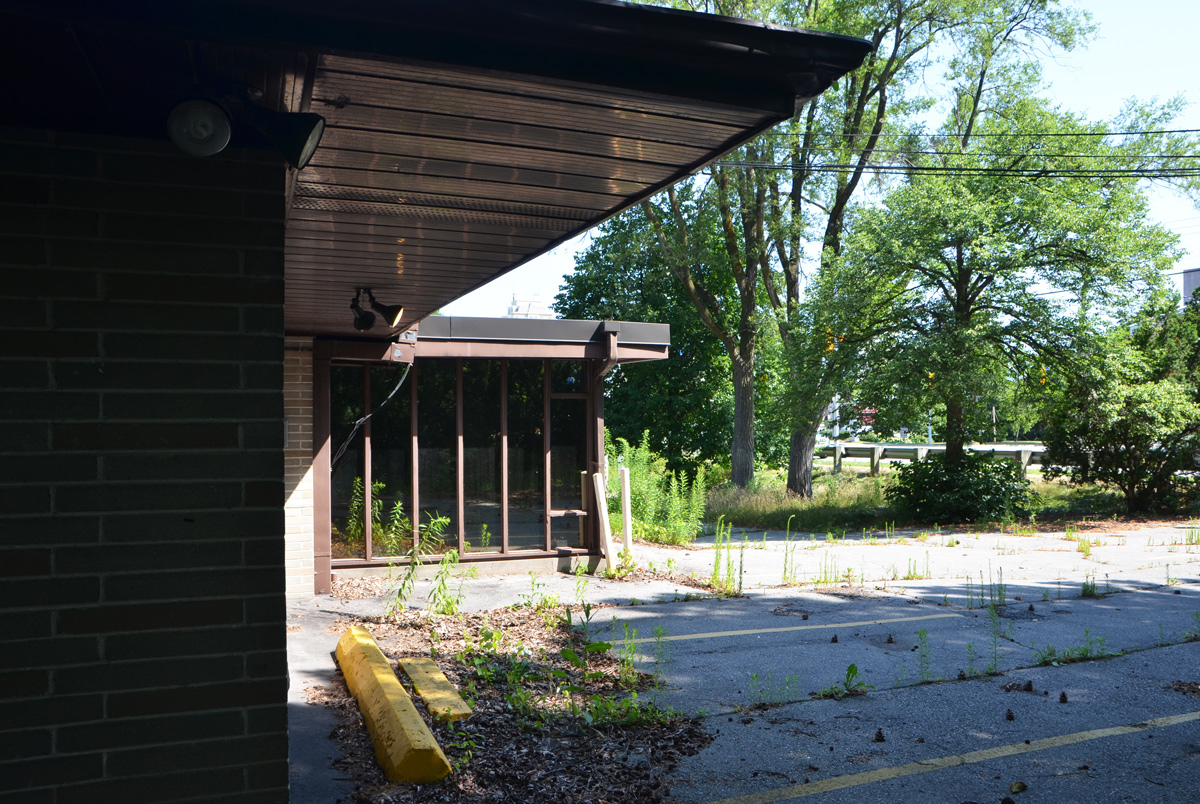
weeds coing up through the cracks in the pavement of a parking lot in front of an unused medical clinic, front entrance of the clinic, full length windows

Lastly, I took a picture of this house too as it is beside the ones above.   The “Notice” sign on the fence was a bit of a surprise considering how new the house was.  My original assumption was that the house was going to be demolished.  In fact, the planning application says that the house will be moved to the back of the property and three townhouses will be built in front.  One driveway down the north side of the property will access both the new townhouses and the moved house.

Apparently the application was submitted in December 2016 –  However, I noticed that the original application called for three 3 storey townhouses (and is on the City of Toronto website as such).  The sign says three 4 storey townhouses and a three storey single family dwelling.  The house in the photo is only 2 storeys.

a city of Toronto blue and white notice of development sign is on a black wrought iron fence in front of a large stone faced two storey house with a large front yard, grass and shrubs

What I’ve also learned while researching these properties, is that there is an official document called, “Bayview Townhouse Design Guidelines” that covers Bayview Avenue from the 401 south to Lawrence Avenue East.  It was adopted by City Council late in 2015.   In fact, large portions of the city have design guidelines and you can find them online.

I was curious to find out how many ongoing development proposals/applications there are in the city.  There is an interactive searchable map online that I used.  When I searched on ward 25 (where the above sites are), it showed 52 locations.  When I tried searching on the whole city, there were too many results.  If you’re interested in development, you can play with the website too!

thistles, close up of flower part of thistle, one purple flower

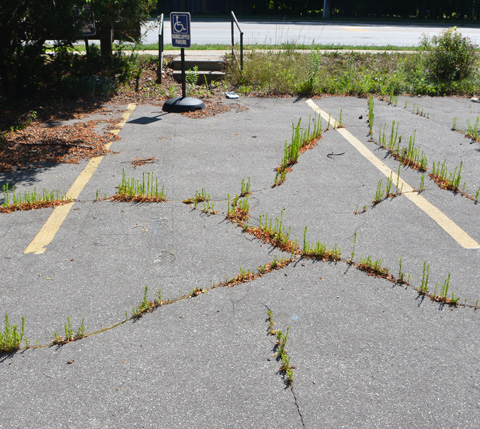
weeds growing out of cracks in the pavement of a parking lot, handicapped parking sign still there.

A trip to Toronto Islands on a sunny spring day.
Photos and stories – an eclectic mix of history and nature that resulted from wandering around the eastern portion of the islands.

below: From the ferry, looking toward the glass and steel of the city.

sail boats in Inner Harbour of Lake Ontario, in front of the Toronto skyline with highrises and skyscrapers also ship moored at Redpath Sugar refinery

Toronto Islands is a collection of at least 12 small islands.  In the early years the island archipelago was really a peninsula of sandbars and ponds; it was connected to the mainland by a narrow strip of sandy shoreline. This landform was created over centuries by the action of waves, winds and lake currents – washing away portions of the Scarborough Bluffs and depositing this material to the west in a five-mile-long hooked shape. This process of natural “landscaping” continued until the spring of 1858, when a particularly powerful hurricane created a channel four to five feet deep through the peninsula.  By June of that year, the Eastern Gap was a waterway, and the Toronto Islands came into being.

below: On the ferry between the city and Centre Island.

people lined up along the front railing of a ferry from Centre Island to the city of Toronto, looking at skyline and taking picture of it. Toronto is in the background.

The first buildings on the islands were the Blockhouse Bay garrison built in the 1794 by the British at Gibraltar Point – it included a blockhouse and storage structures.  A second blockhouse and a guard house were built soon after, only to be destroyed by the Americans in the Battle of York in April 1813.   The lighthouse at Gibraltar Point built in 1809 still stands (sorry, no photo).

In 1833 Michael O’Connor built a hotel on one the islands.  He used a horse-drawn boat to ferry customers across from the mainland to his hotel.  At that time, there was still access by road but it was a toll road.  In 1836 it cost sixpence for every four-wheeled carriage drawn by two horses.  Smaller ‘vehicles’ paid less.   In 1858 the hotel (now Quinns Hotel) was destroyed during the same hurricane that turned the peninsula into an island.  The hotels were destroyed but the islands remained popular.  With no road access, ferries were needed and many people ran private ferry services until they were bought out or amalgamated into the Toronto Ferry Company in 1892.  It was privately owned until 1926 when it was purchased by the City of Toronto for $337,500.

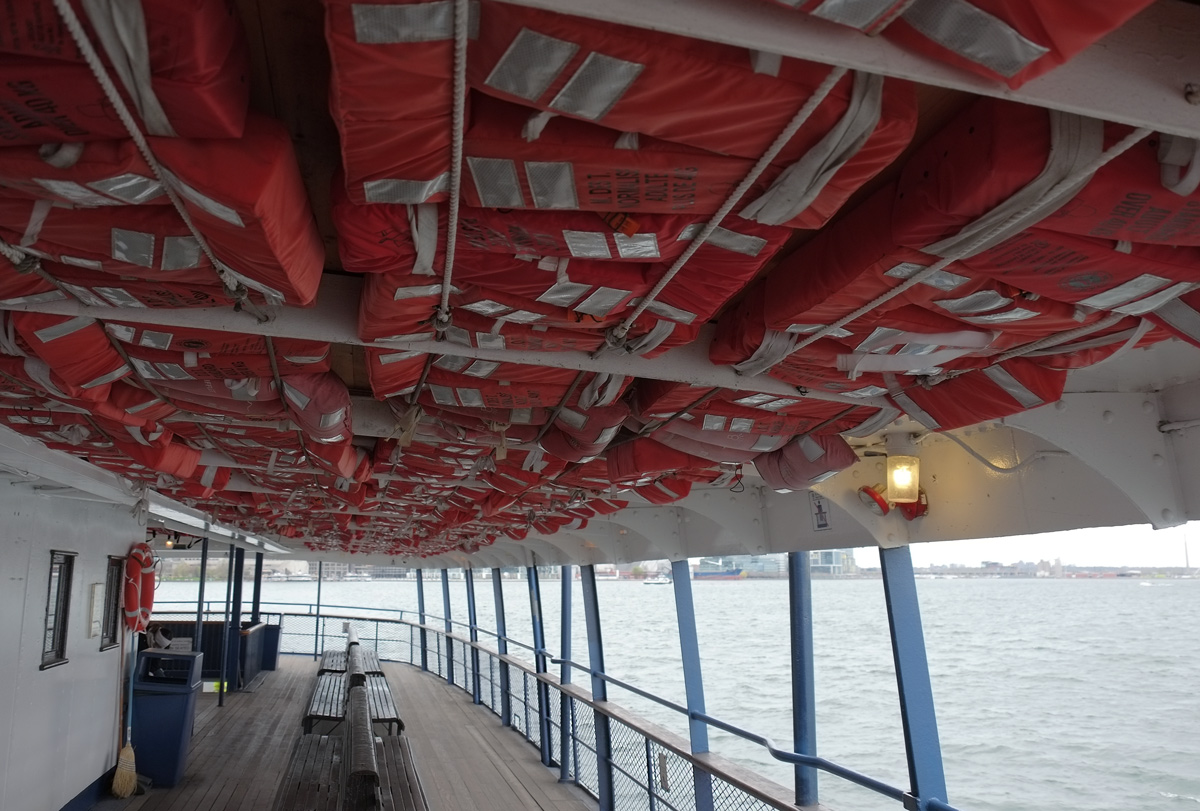
ferry, ceiling is full of orange life jackets, railings along edge, Lake Ontario, benches to sit on but no people

blue abstract from two blue doors with cut out where handle should be

Many houses and businesses, (hotels, restaurants, bowling alley, laundry, theatre etc) were established over the years from Hanlon’s Point in the west to Wards Island in the east.   Today, residences are only in the eastern section of Wards Island and on Algonquin Island.

The Ward’s Island community began in the 1880s as a settlement of tents. Up until then, that eastern end of the islands was mostly wetlands.  The first summer colony on Ward’s in 1899 consisted of just eight tenants, each of whom had paid a fee of $10 rent for the season. The number of tents grew each year.  In 1913, the city felt it necessary to organize the community into streets. The evolution from tents to cottage structures progressed in stages with the building of floors, the addition of kitchens and then porches, resulting in the creation of the homes.

two houses on Wards Island, small wood housses, one bright blue and the other is white

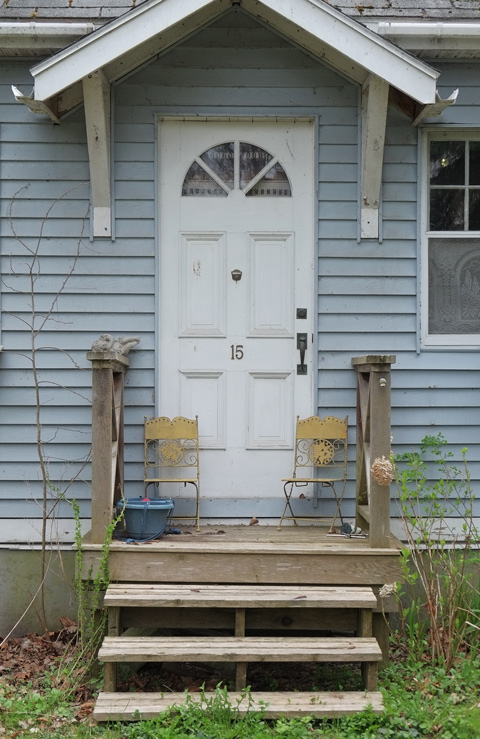
grey wood siding on house with white door and small porch. Two yellow and metal chairs on the porch

In 1953 the municipal government changed their policy toward the Toronto Islands landscape and its residents. Businesses were removed and the systematic demolition and burning of homes began.  More of the islands became parkland.    There are 262 houses on Wards and Algonquin Islands today, down from about 630 residences on all the islands.  The last of the Lakeshore houses was removed in 1968 but traces of them still remain.

wood boardwalk along the foreground of the photo with a concrete path leading away from it, into an overgrown area

part of old concrete breakwater, once there was house here, number 170 embedded in the concrete

below: The pier on the Lake Ontario side.

metal fence in the foreground, beach, pier and Lake Ontario in the middle and background

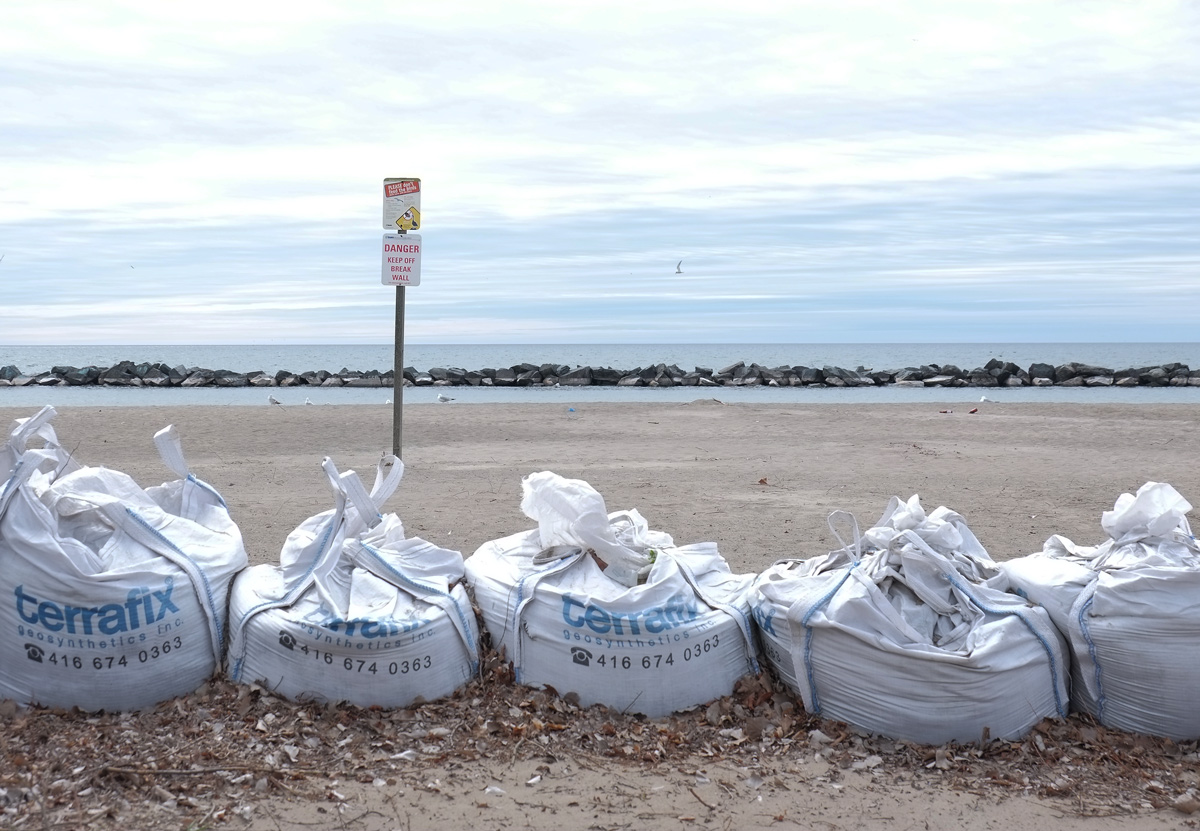
below: Sandbags along the shore.  Last spring there was a lot of flooding here and the island was closed to visitors – sort of.  Ferries didn’t run and the park facilities were closed.  The islands are very flat and low so it doesn’t take much extra water to flood.

large white sandbags along the shore, beach on the other side, Lake Ontario in background with a row of rocks as breakwater a short distance from the shore, sign on the beach

sign fallen over and under water, surrounded by rocks, Lake Ontario

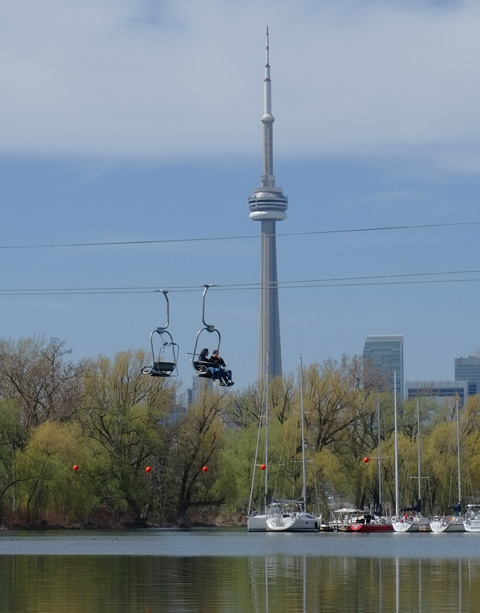
below: There is a small amusement park, Centreville, on Centre Island.

CN tower in the background, people on the Skyline ride at Centre Island passing over water, with large boats docked farther up the river

below: Island transport that can be rented if you don’t want to walk.

people cycling in 2 quadricycles, a four wheeled bicycle like vehicle, on paths,

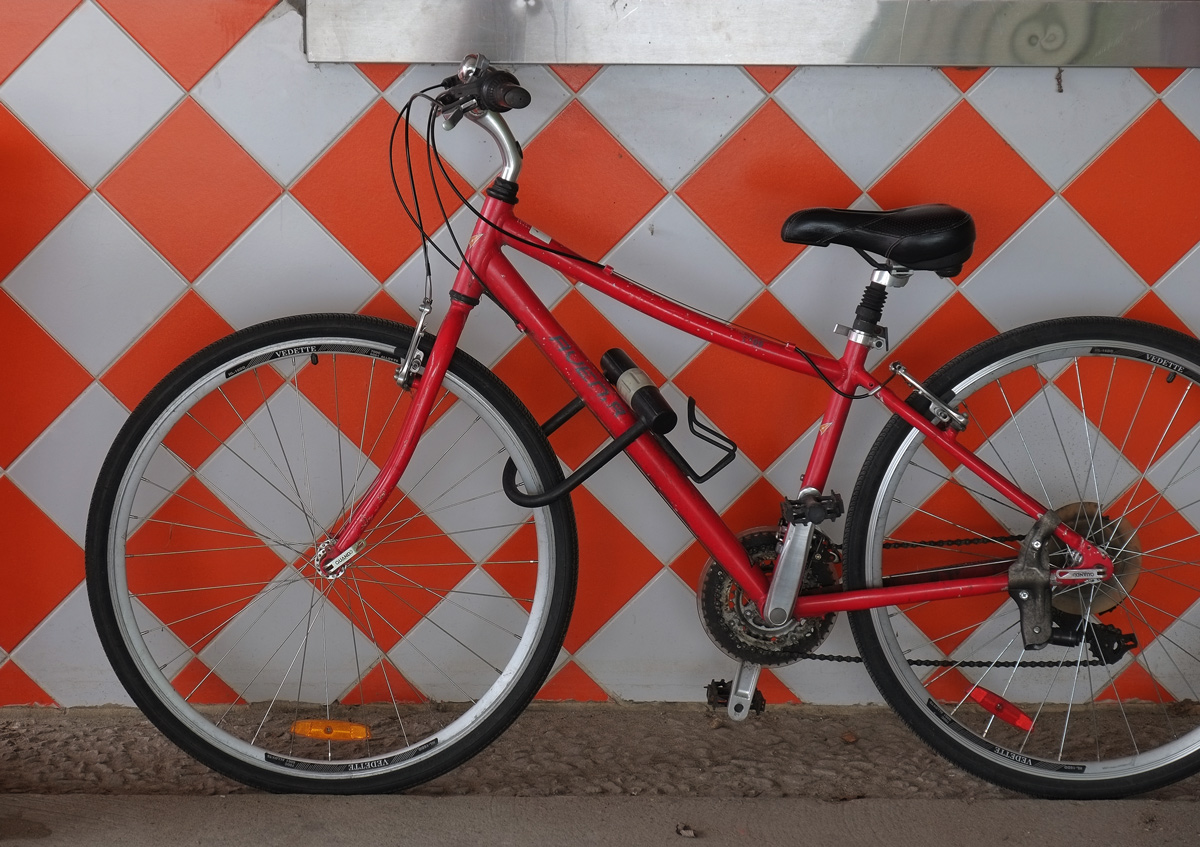
the orange and white wall tile pattern of Pizza Pizza with a red bike parked in front of it.

below: Boats moored QCYC (Queen City Yacht Club), one of the three yacht clubs on the islands.

sailboats moored at a wood dock, QCYC

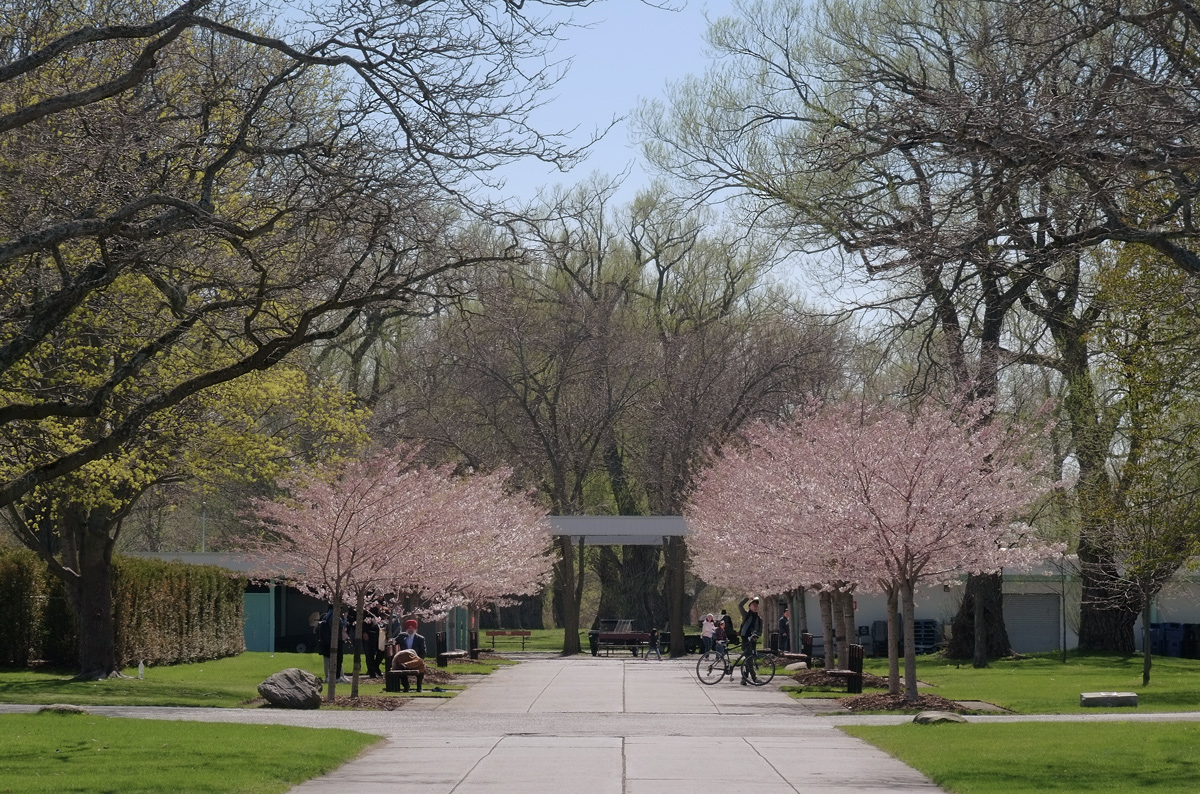
below: Sakura trees in bloom.   The trees were donated by the Sakura Project.  The aim of this project was to strengthen Japanese Canadian relations by planting cherry trees in visible locations across Ontario.   Between 2000 and 2012,  3,082 trees were planted at 58 locations.  The trees on Centre Island were planted in 2011.

path, sakura (cherry) trees on either side with their pink and white blossoms, other large trees around them with pale green of new leaves

below: Catkins from a red alder tree.  They almost look like raspberries packed tight together.

red fuzzy blossoms droop from the end of a tree branch

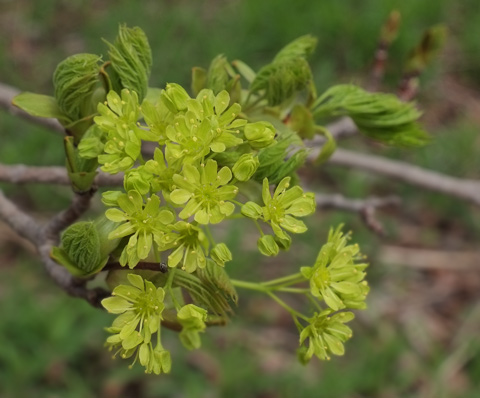
new yellowish green flowers on a tree, also leaf buds just opening,

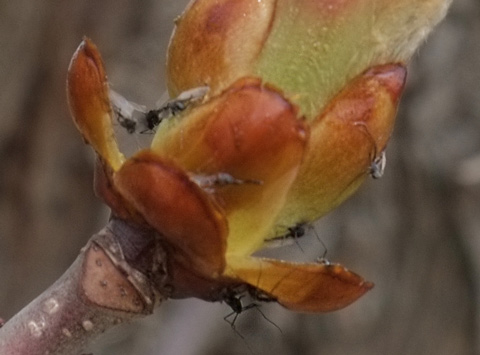
ants in the bud on a tree

below: An early family of Canada geese.

family of Canada geese, 2 adults and 7 or 8 fluffy little goslings swimming in the water

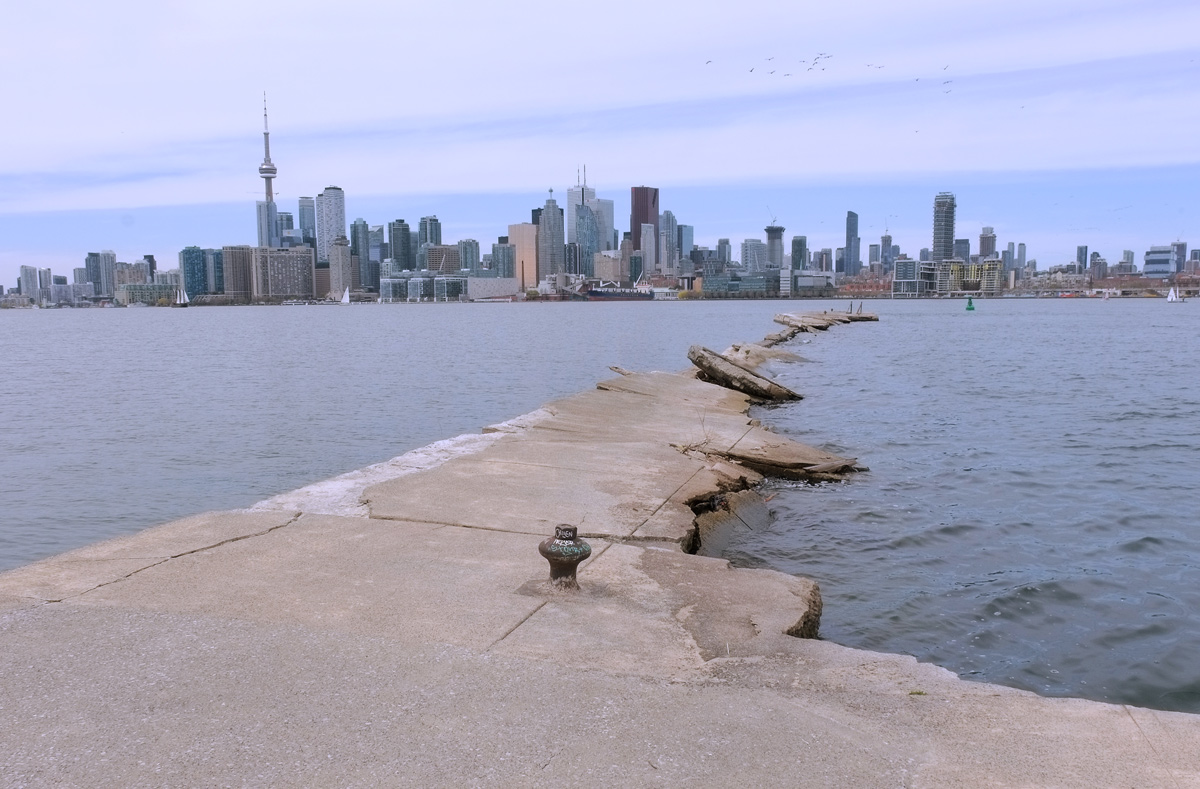
below: The pier at the eastern end of Wards Island is bad need of repair.  To the right is the entry into the Eastern Channel (or Eastern Gap).

broken concrete pier into Inner Harbour of Lake Ontario, with Toronto skyline and CN Tower in the distance

below: Looking over to Algonquin Island.  Once upon a time this island was just a sandbar.

waterway, orange life ring and ladder on one side of the river, houses and docks, and boats on the other. r

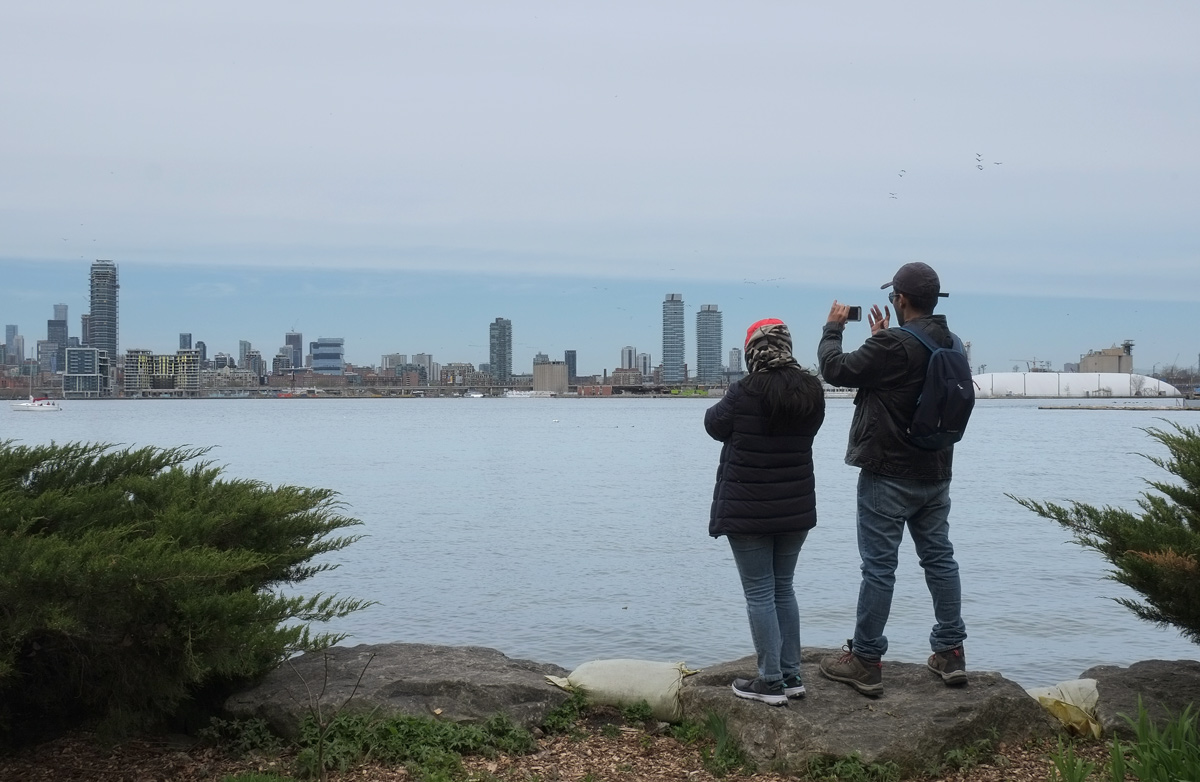
two people standing on the shore of Center Island, looking at the Toronto skyline and taking pictures of it.

and back to the mainland.

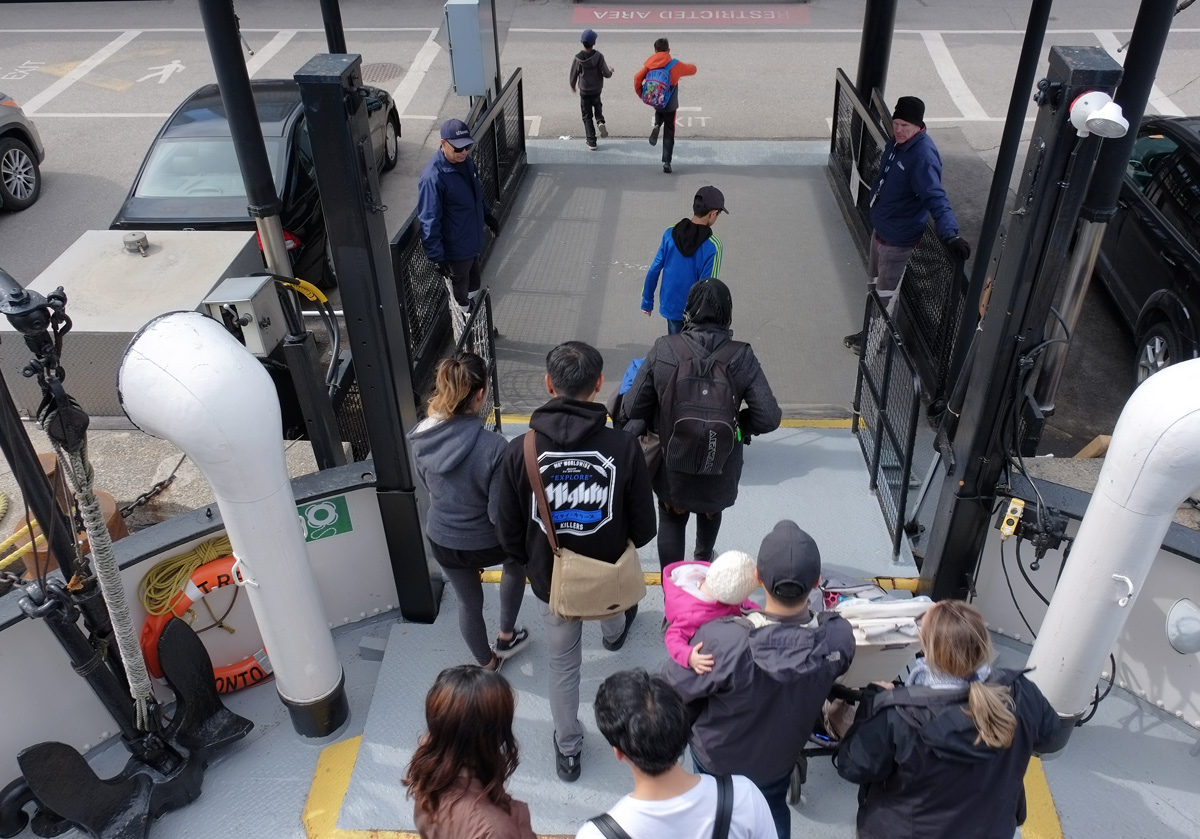
people exiting a ferry, from above

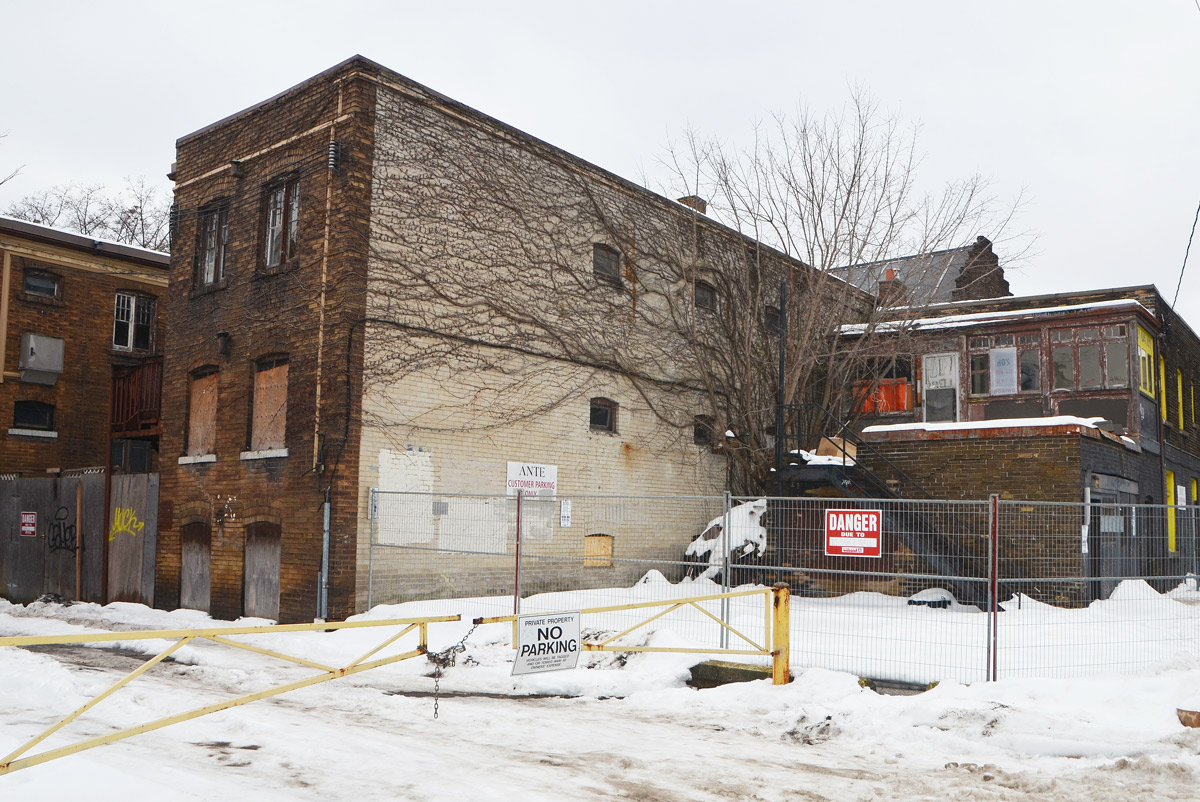
This is the story of one building at one intersection, Yonge and Belsize (just south of Eglinton) but it’s also a story that is being repeated over and over again in the city.  The story of demolition and rebuilding.  The story of loss of the older wood and brick structures as they are replaced by glass and steel.

By December 2016 all of the businesses had closed down.

row of two storey store fronts, old brick building, that is now empty and about to be demolished, on Yonge Street

Mars advert on Belsize convenience store, old brick building with large windows and blue window frame, snow banks on sidewalk, now empty

signs in the window of a store that has just closed down. one is a permit to demolish the building and the other is a hand written sign on orange paper that is a thank you note from the managers of the store to the public

below: The back of the building

back of a brick building, winter time, with snow on the ground, construction fence around it, windows boarded up

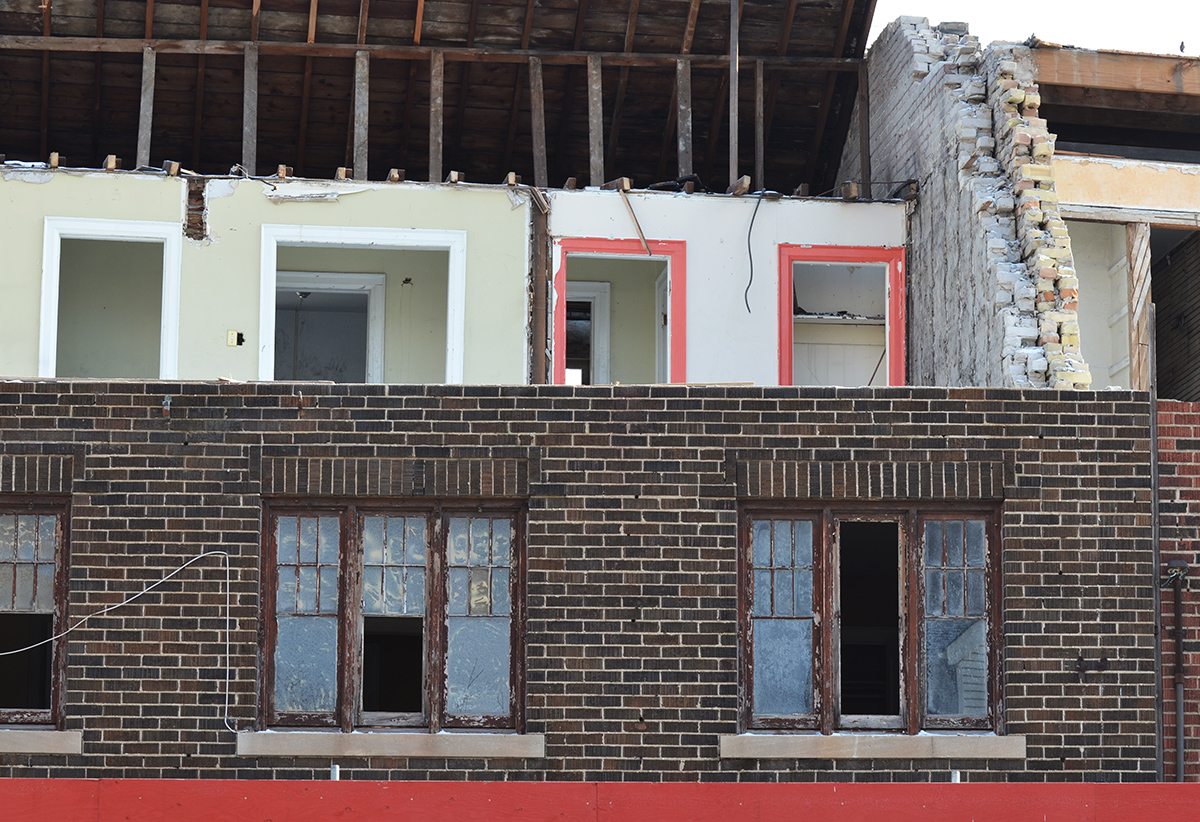
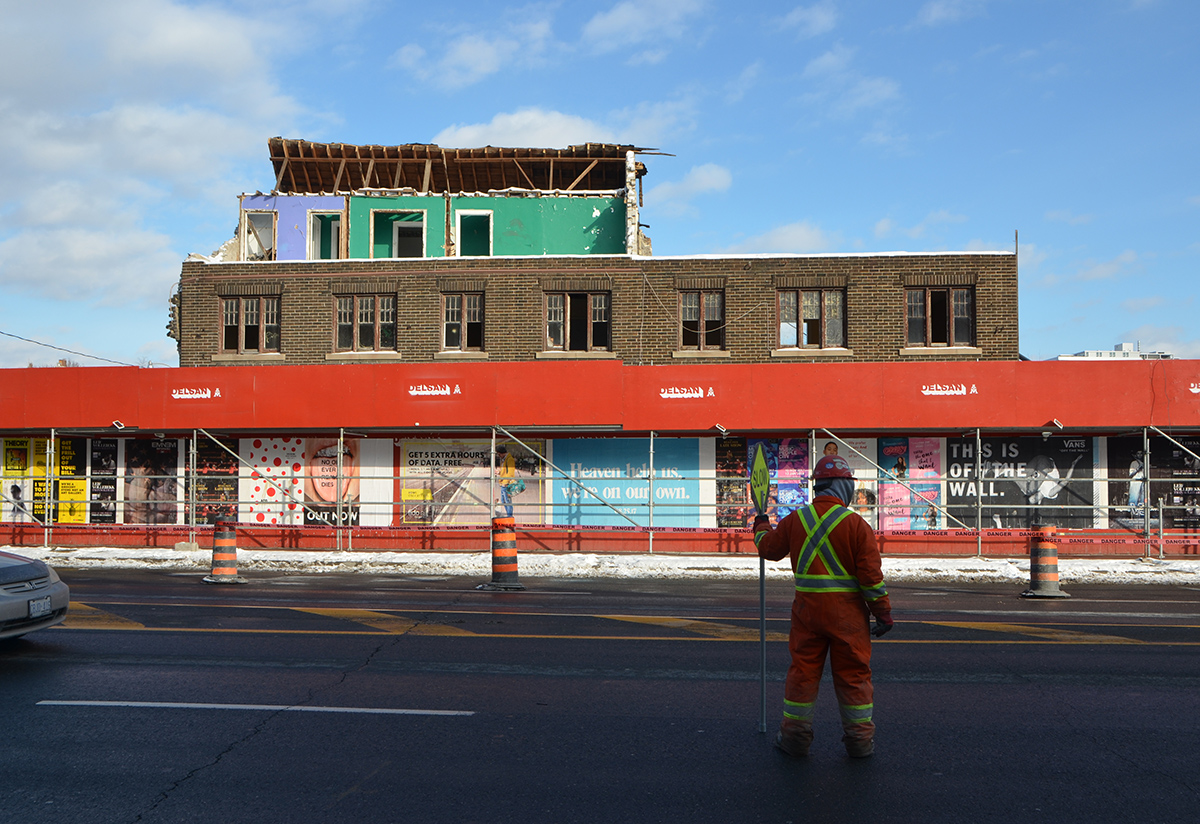
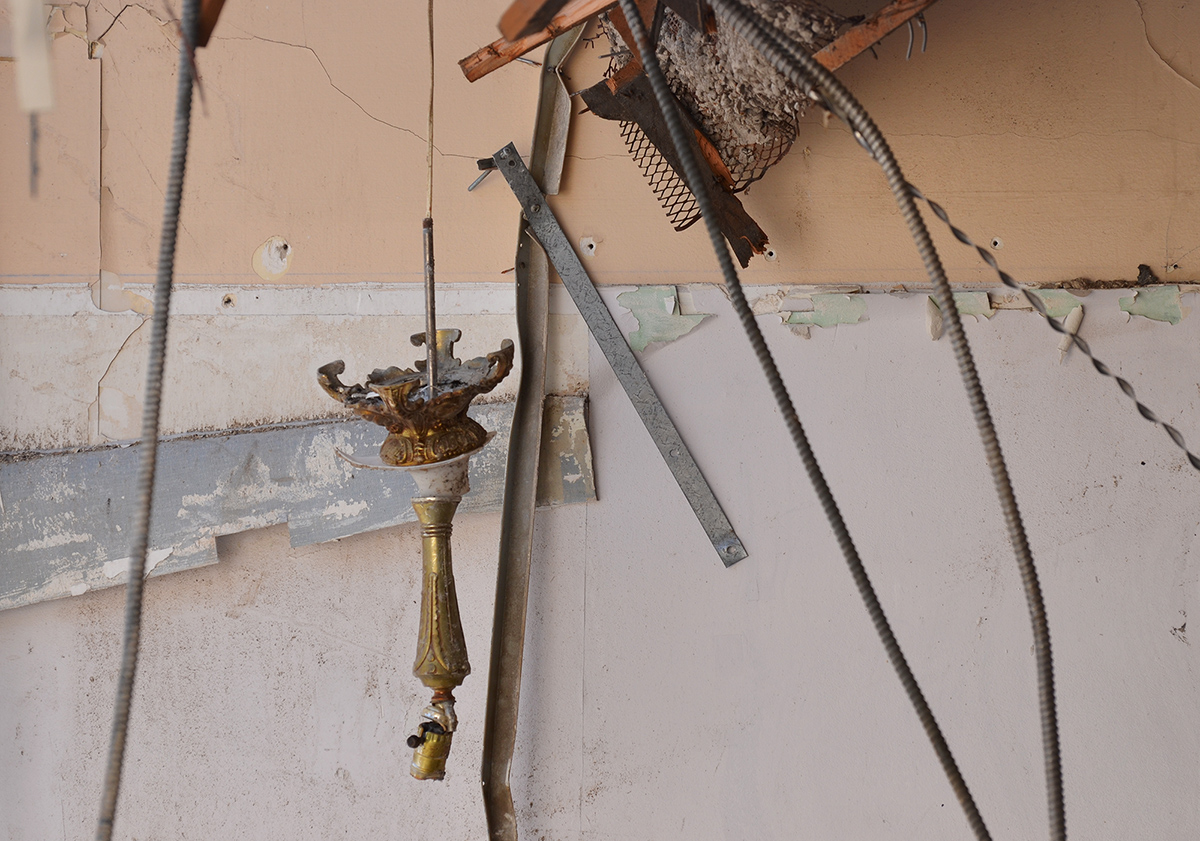
Just over a year later demolition began in earnest.

back upper storey of building being torn down, exposing office furniture that was abandoned

interiorwallson upper storey are exposedin building being demolished

a construction worker in heavy winter orange clothes and yellow helmet, holds a stop sign to stop the traffic on Yonge street in front of a building being demolished

workmen standing around beside a front end loader that is being used to tear down an old brick building

exterior of building being demolished, black door uperlevel with drop below

old metal water pipes exposed on green and blue interior wall when building being demolished

red plastic danger tape blows in the wind. one end is tied to a blue fence and one strand is also tied to a building being demolished

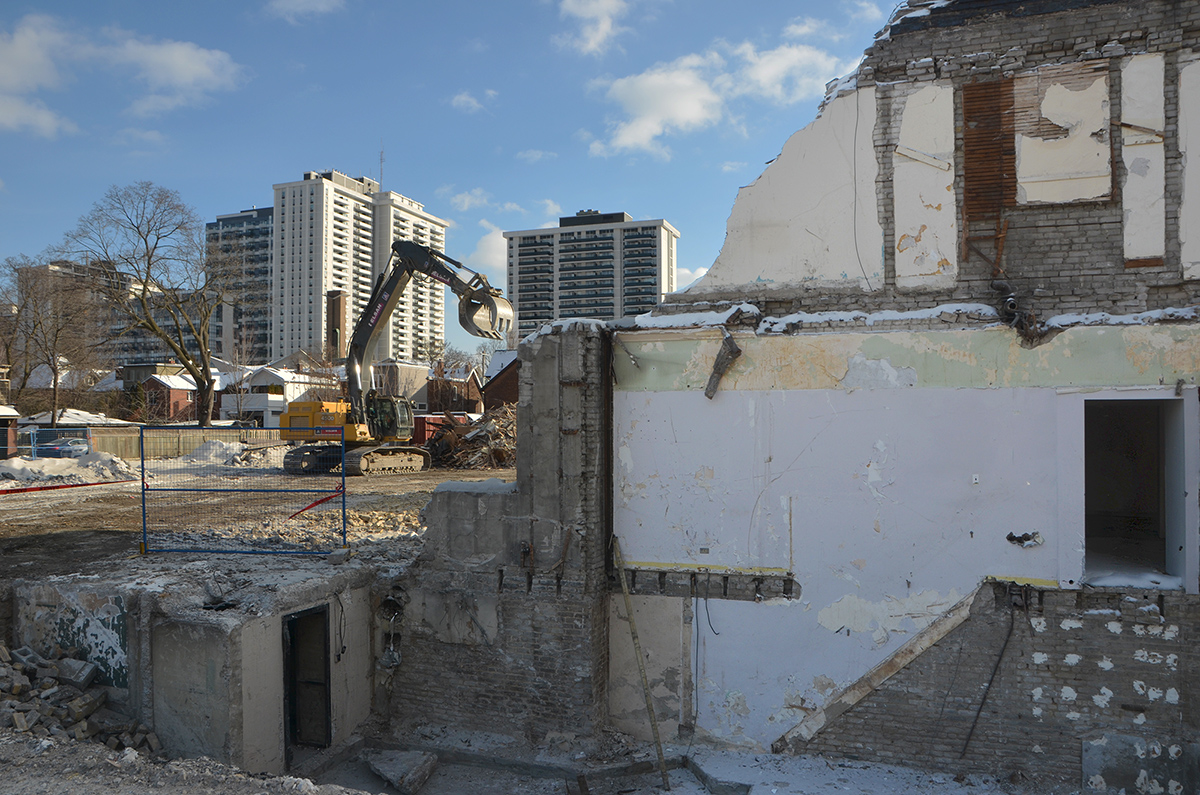
remains of an old building being torn down in the foreground, a front end loader in the middle, and apartment buildings in the background.

on old metal chair frame sitsin a room with a lot of wood debris around it