Archive for the ‘locations’ Category

As you all know, the TTC is replacing their older streetcars with new longer Bombardier streetcars.   Or at least they are trying to 🙂  Because they are longer, they don’t fit into existing “garages”, hence the new Leslie Barns facility.  Located on Leslie St., south of Queen, it is the new streetcar “home”.  It is where streetcars are parked, maintained and repaired.  It has been in operation since Nov 2015 but the first chance the public got to peak inside the finished complex was at Doors Open on the 28th of May.

below: While waiting for a streetcar at the corner of Queen and Broadview on the way to visit the Leslie Barns, I saw this renovated TTC streetcar from the 1950’s.
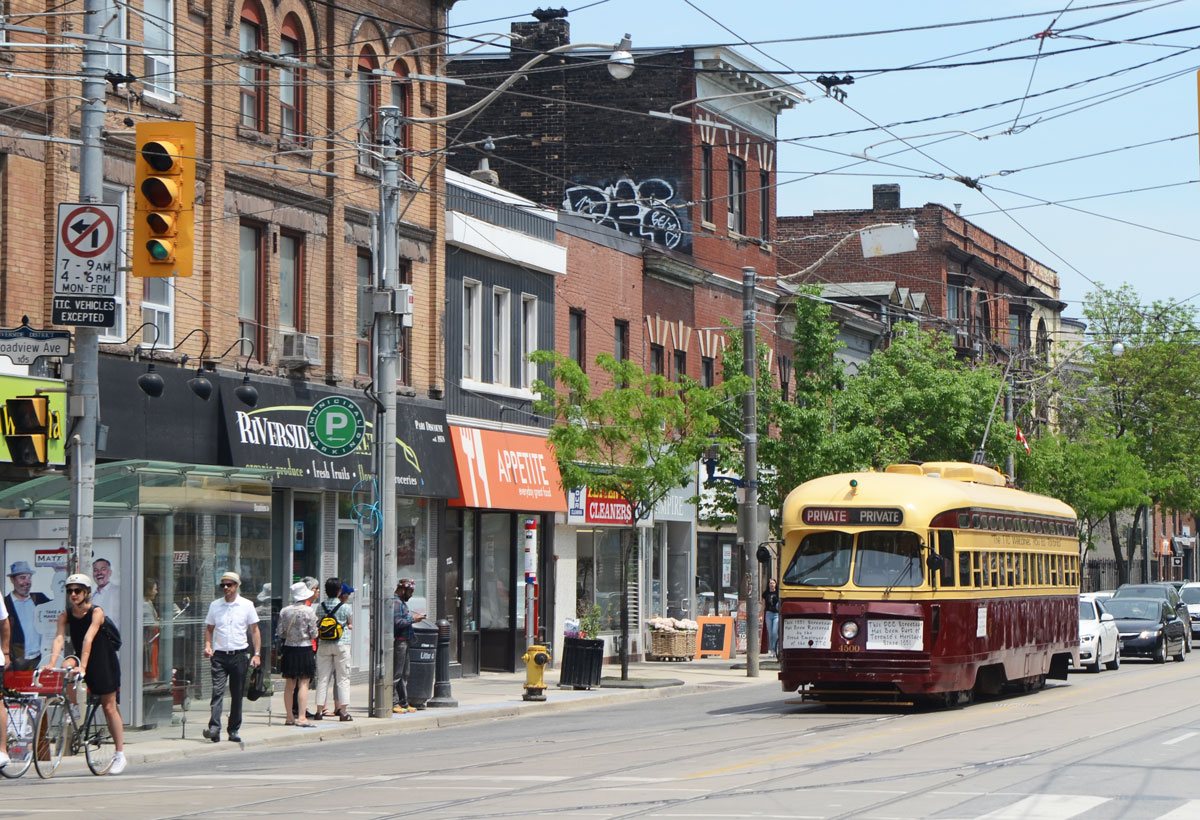
An old restored TTC streetcar, maroon and yellow, on Queen St. East

below:  The streetcar tour involved riding a new streetcar through a maintenance bay in the building and then around the parking lot out back.

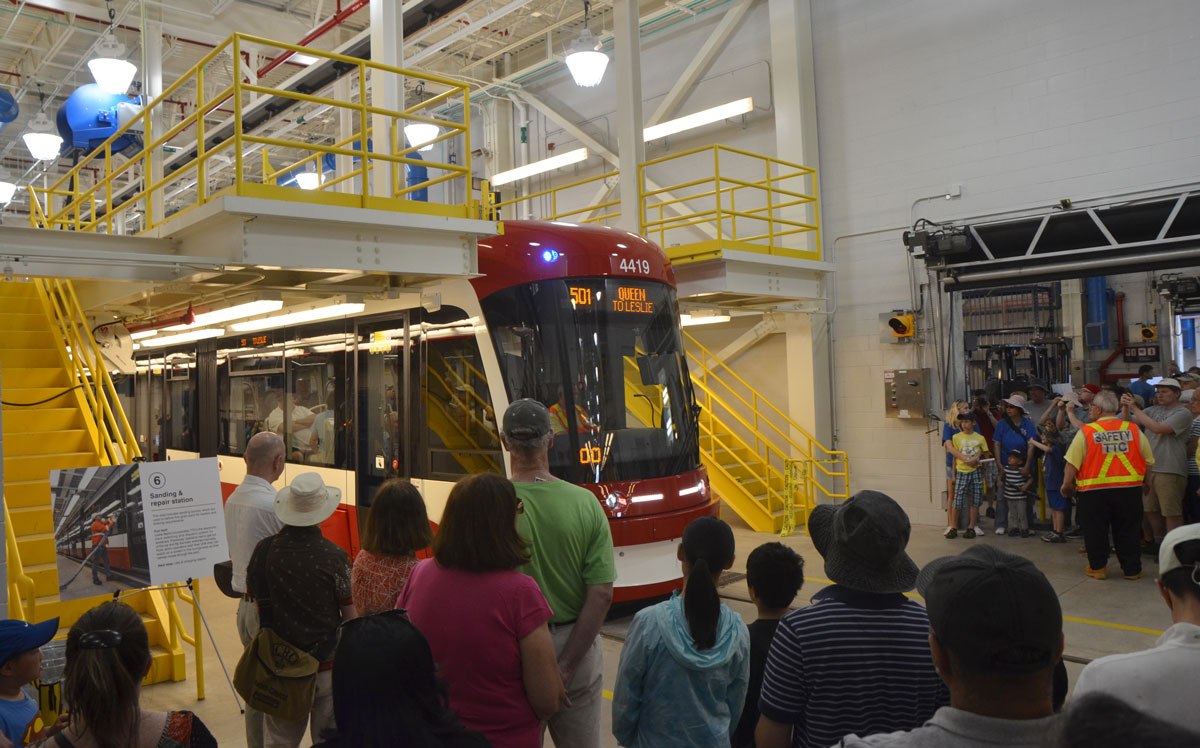
People at Doors Open in TOronto, at the TTC LEslie Barns streetcar facitlity, lining up for , or just getting off of, streetcar tours, riding the new streetcars around Leslie Barns

A group of people inside Leslie Barns streetcar facility, standing aside to make way for a new streetcar that is taking other people on a tour.

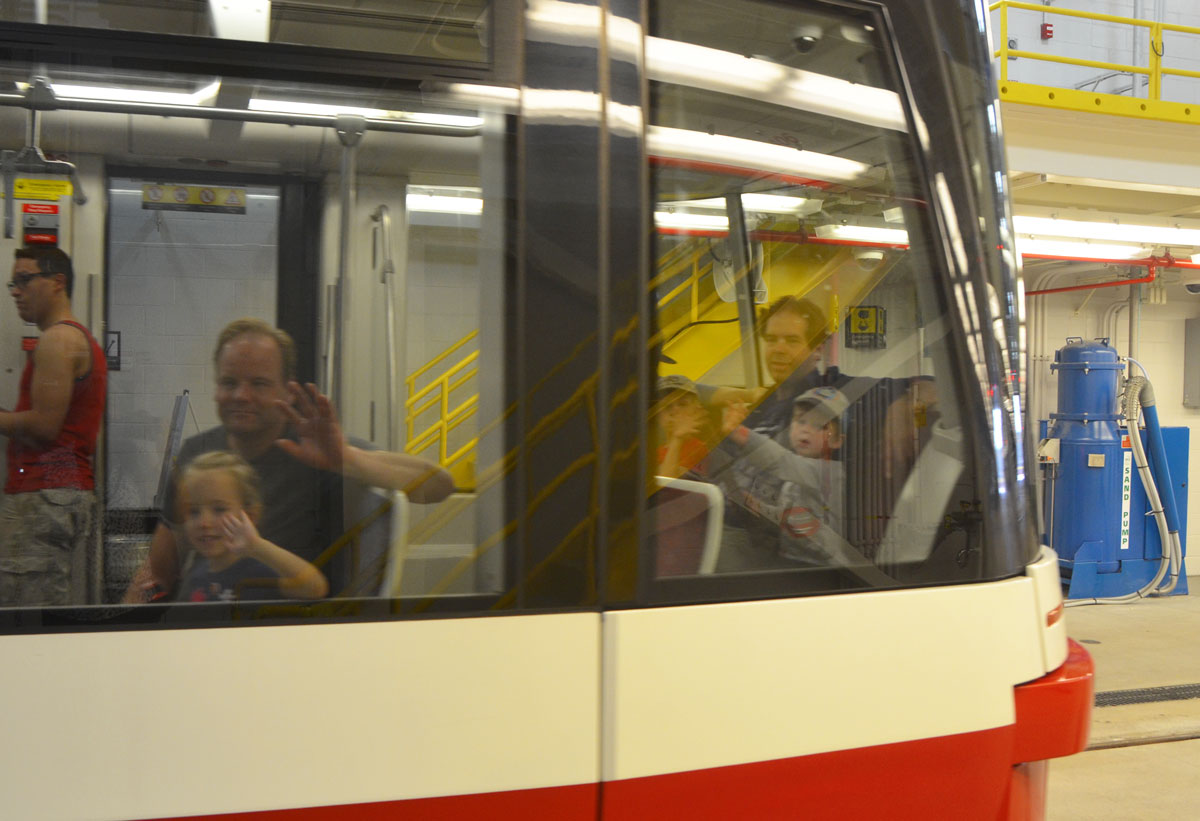
people riding in a new streetcar, photo taken from the outside, most of them are waving

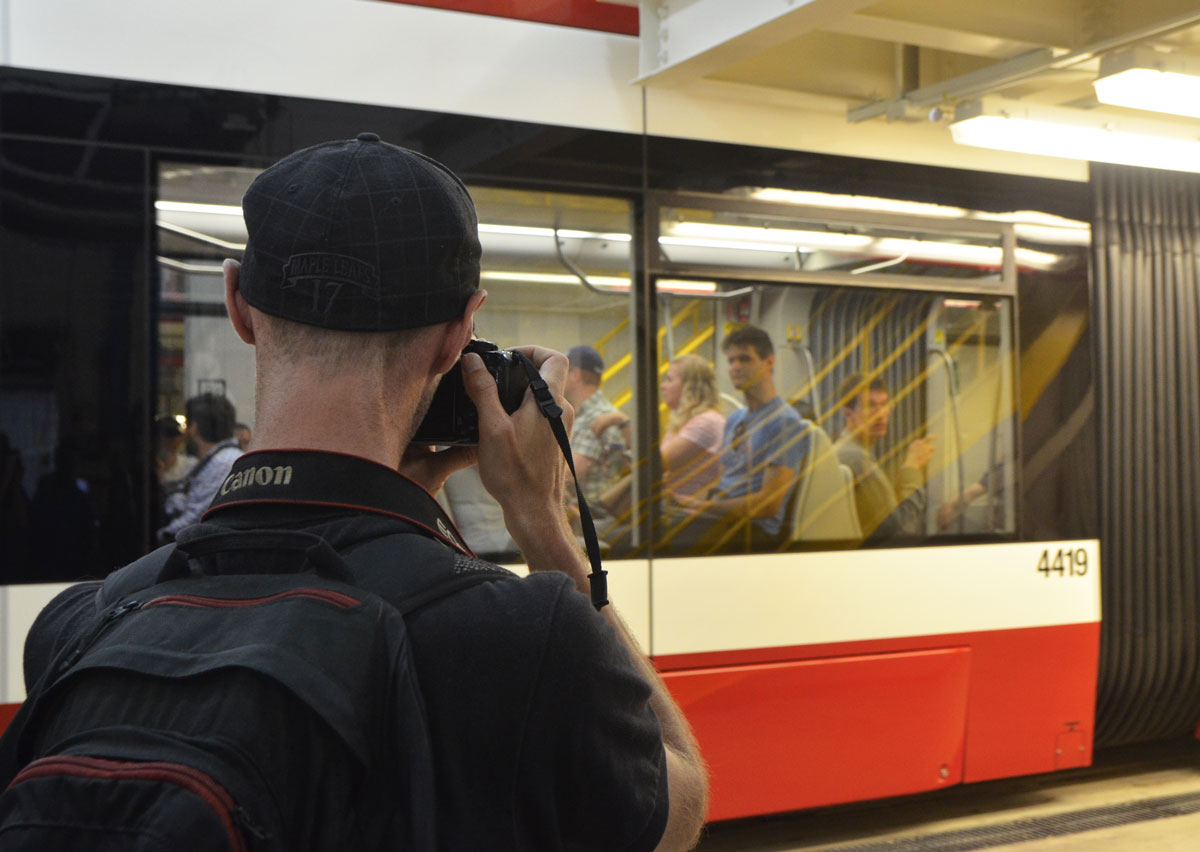
A man in black T-shirt and black cap is taking a picture of people riding in the new streetcar, inside Leslie Barns at Doors Open

below: Exterior, parking space for at least 100 streetcars

the massive concrete parking lot for streetcars with all the overhead wires. The building that houses the workshops and cleaning and office for the ttc is in the background.

below: Special bays have been constructed with space for workers to access both the underneath and the top of the streetcars.  Because the cars have been designed to ride low, a lot of their workings such as the HVAC and propulsion systems are built into the roof of the car.
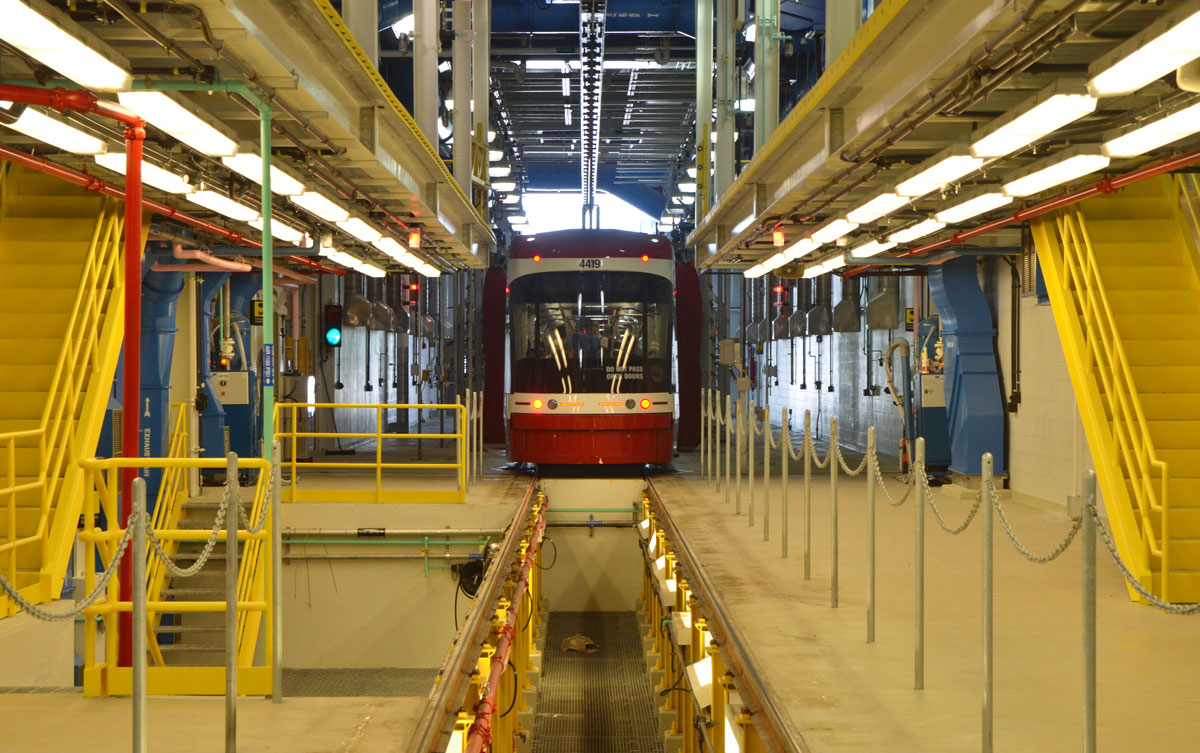
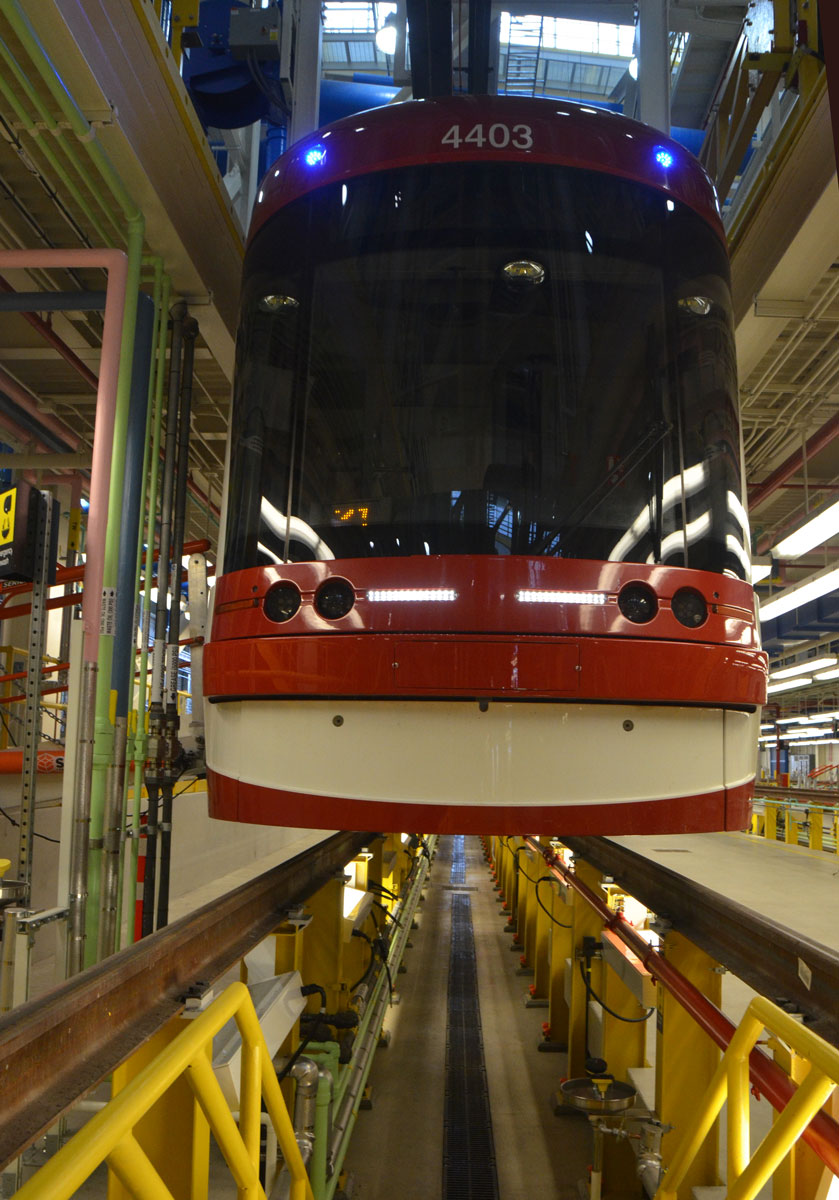
the back of a new streetcar as it passes through interior of Leslie Barns streetcar facility, a large, tall interior space with lots of pipes

A streetcar sits in a repair bay of the Leslie Barns, space underneath the streetcar for workers to go down and work on the underside of the streetcar.

below: It’s a big space!  …. 17,510 square metres (188,500 sq ft) in fact.

interior of Leslie Barns streetcar facility, a large, tall interior space with lots of pipes

below: A spic and span shiny paint room

interior of the paint room at Leslie Barns, where streetcars go to get painted.

below: A myriad of colour coded pipes
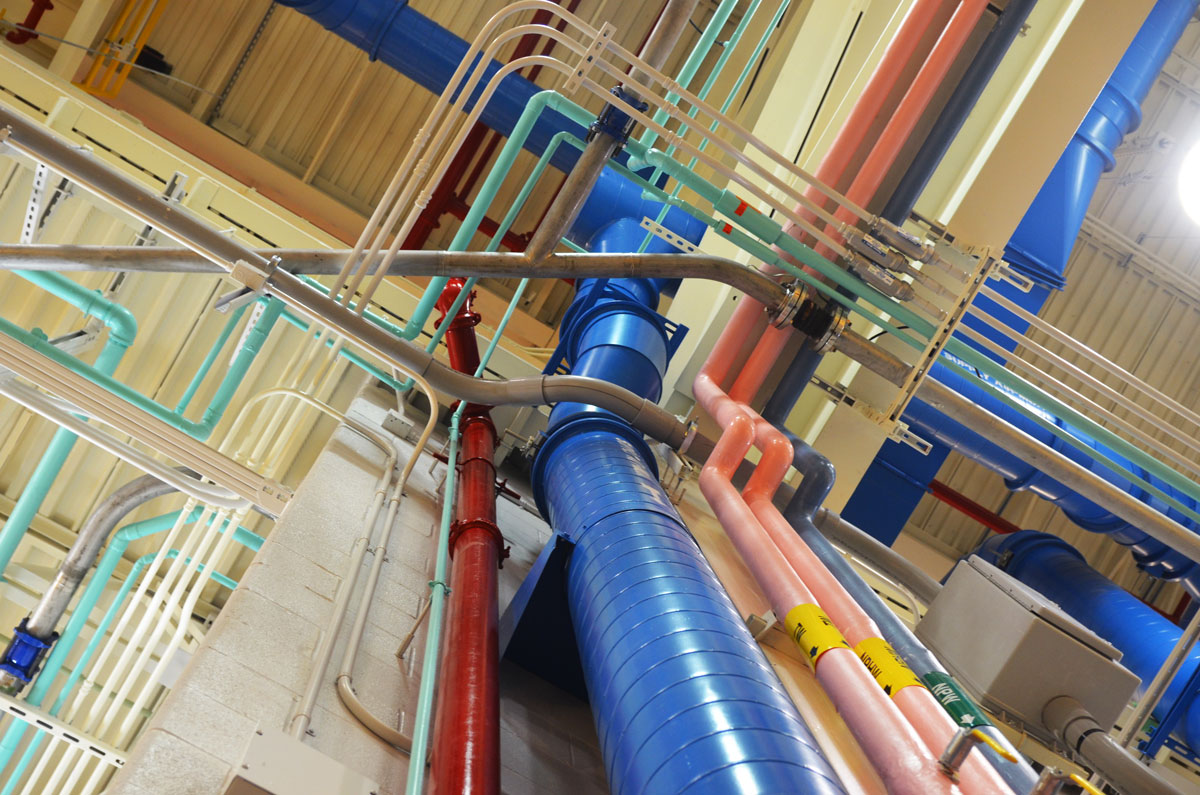
A myriad of pipes running up walls and across the ceiling, blue, pink, red, grey, all colour coded, interior, Leslie Barns

below: There were renovated vintage streetcars on display.  On the left is a 1921 Peter Witt streetcar and next to it is a PCC streetcar from the early 1950’s.
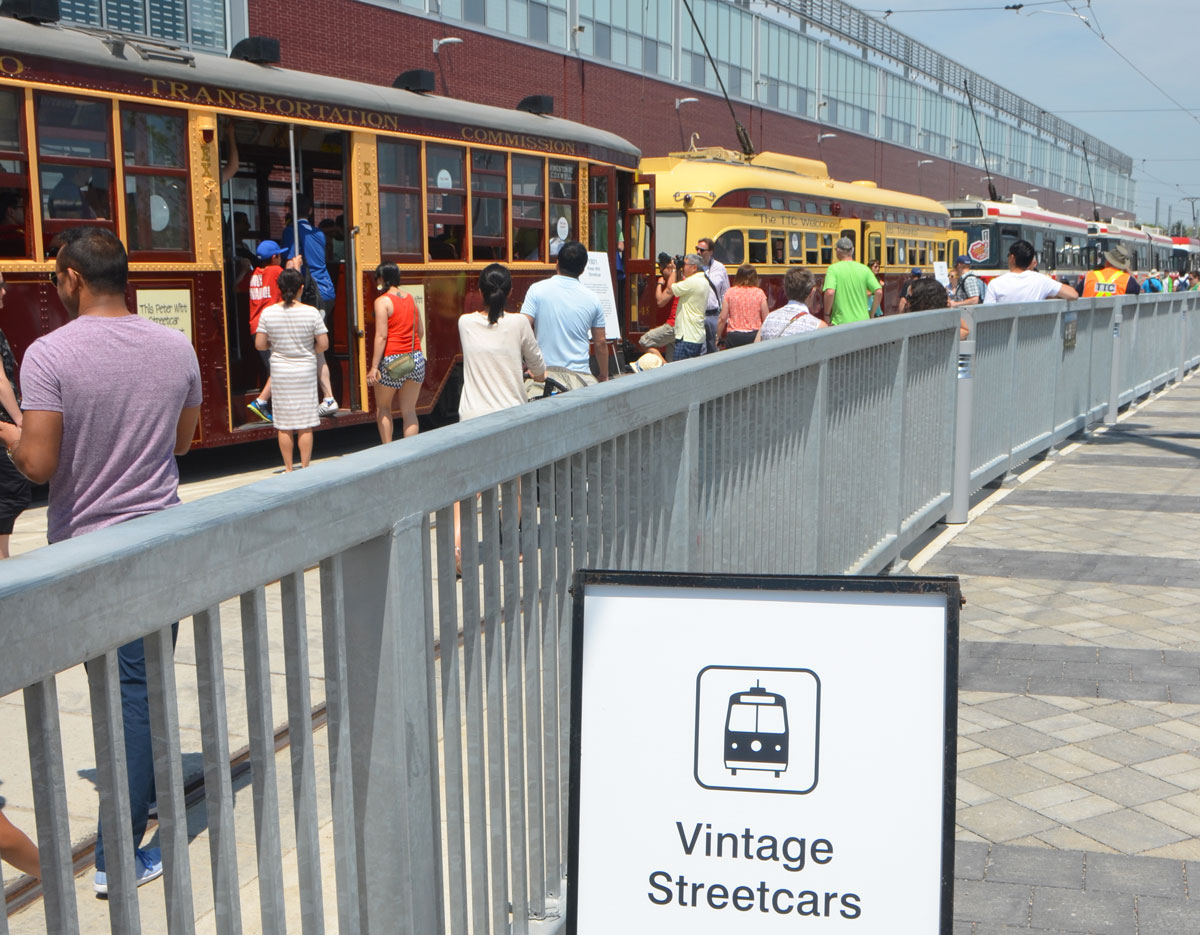
a number of people waiting to go inside old renovated vintage TTC streetcars

below: Interior of a refurbished Peter Witt streetcar with its wood trim.  The Witt cars were built for the newly formed TTC in 1921.  They entered service on Broadview in October of that year.  By 1923 they were operating on seven routes.  The last Witt streetcar was retired in 1963.
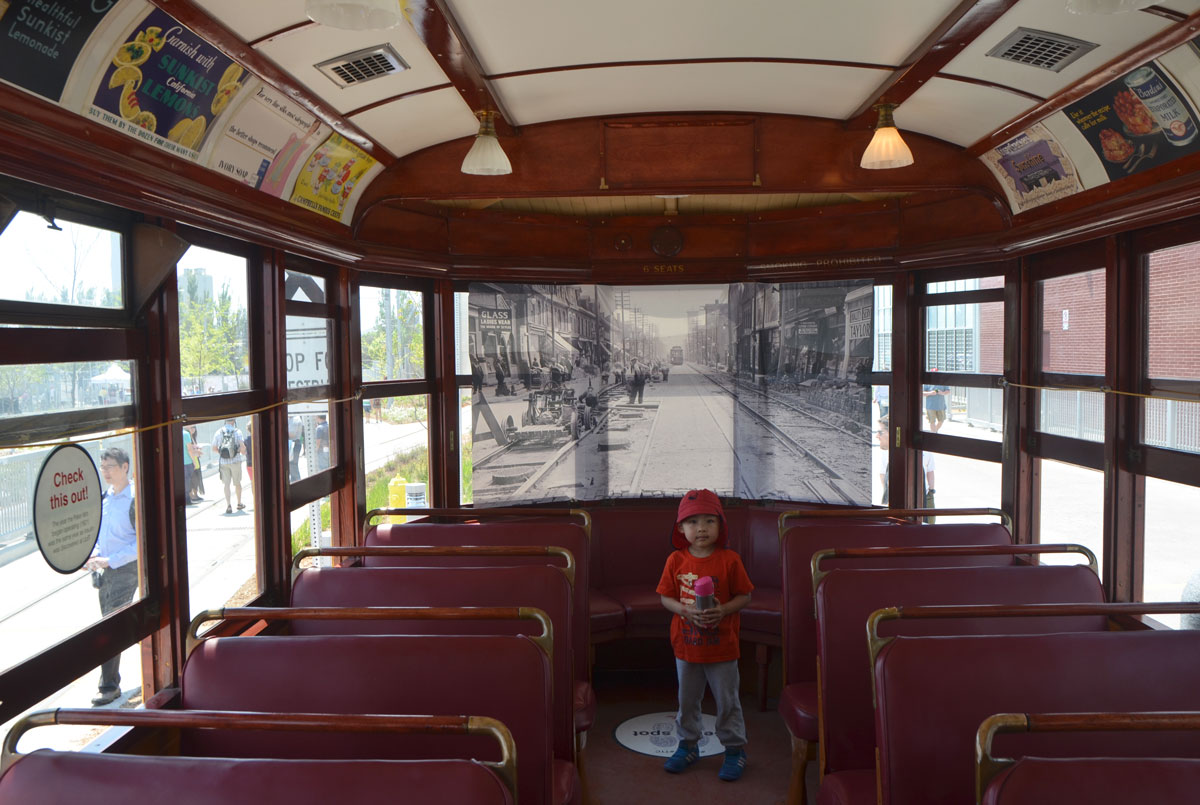
A young boy stands in the back of an old restored ttc streetcar. A black and white picture of an old street scene has been put across the back window to show you what the view out the window might have looked like at the time the streetcar was functional. Old ads on the upper part of the interior, wood trim

below: Looking out the window of a PCC streetcar built in 1951.  PCC stands for Presidents’ Conference Committee, which was a group of operators from the USA and Canada  who got together in 1938 to design a new electric railway car.  By the late 1950s, the TTC owned the largest fleet of PCC’s in the world.  The last one was retired in 1995.

A young boy wearing a hat looks out the window of an old restored streetcar while his father takes a picture out the window

below: Streetcar wire maintenance truck.

a special TTC truck sits outside Leslie Barns TTC facility on Doors Open day, the truck is designed to run on streetcar tracks and is used to repair tracks and wires. There are people looking at the truck

#DOT16 | #TTC

A sweet post.

This is what 37,000 tons of raw sugar looks like.
The Raw Sugar Shed at Redpath Sugar is 27m high,  155m long, and 43 m wide.  It’s a big space!

a man is leaning on a temporary metal barricade in front of a very large pile of raw sugar in a large warehouse.

Raw sugar is brought to the Redpath Sugar facility by ship.  When it is off-loaded from the ship it is brought into the warehouse by conveyor belts that run down the middle of the ceiling.

below: There isn’t a ship in the harbour at the moment so the green crane waits.

a little girl in the foreground, standing beside a squared opening in the harbour for ships to come in, beside the Redpath Sugar refinery building on the waterfront with its green cranes and greenish blue building

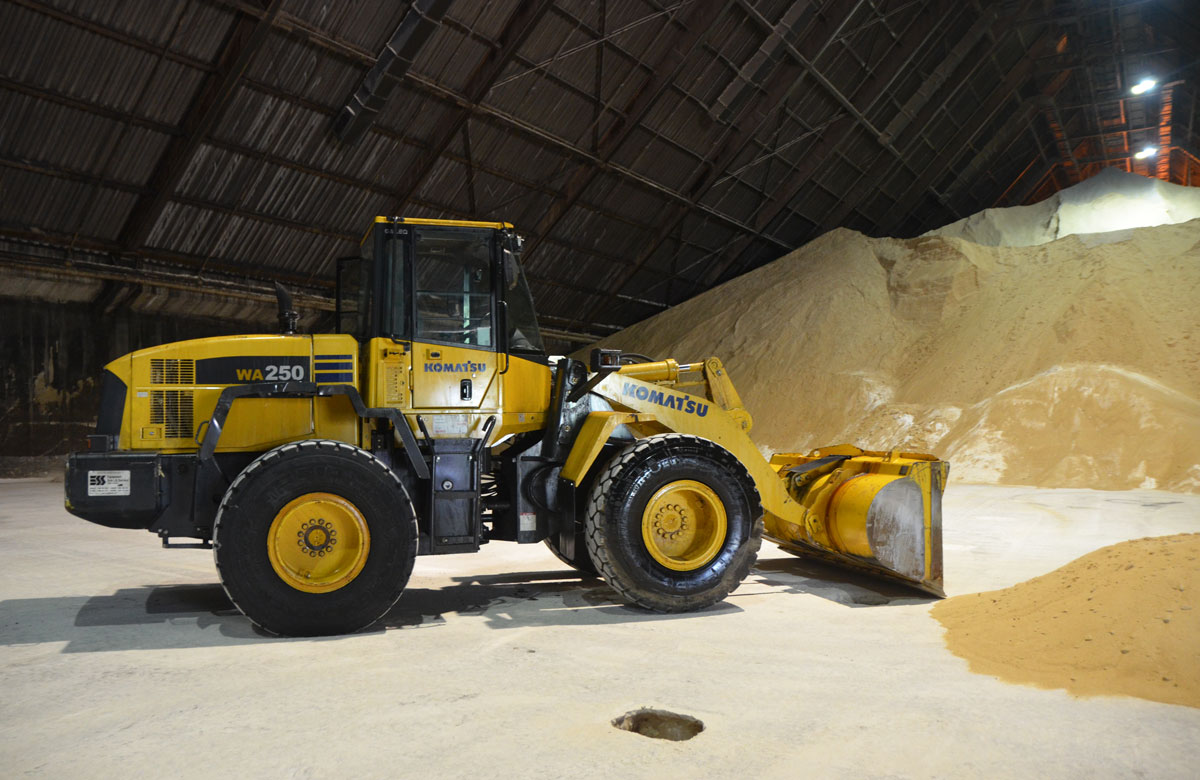
below:  You can see a holes in the foreground of the next photo.  This is one of many holes in the floor of the Raw Sugar Shed.  The raw sugar is pushed through these holes to another series of conveyor belts below.

a large yellow front end loaded is parked inside a warehouse. A large pile of raw sugar is in the background.

three warning signs on the outside of a door of the Redpath Sugar shed, a warehouse for storing raw sugar. One says "Beware of Heavy Equipment", the second says "Sound horn before entering" and the third says "Canadian Government Customs Bonded Warehouse no. 60"

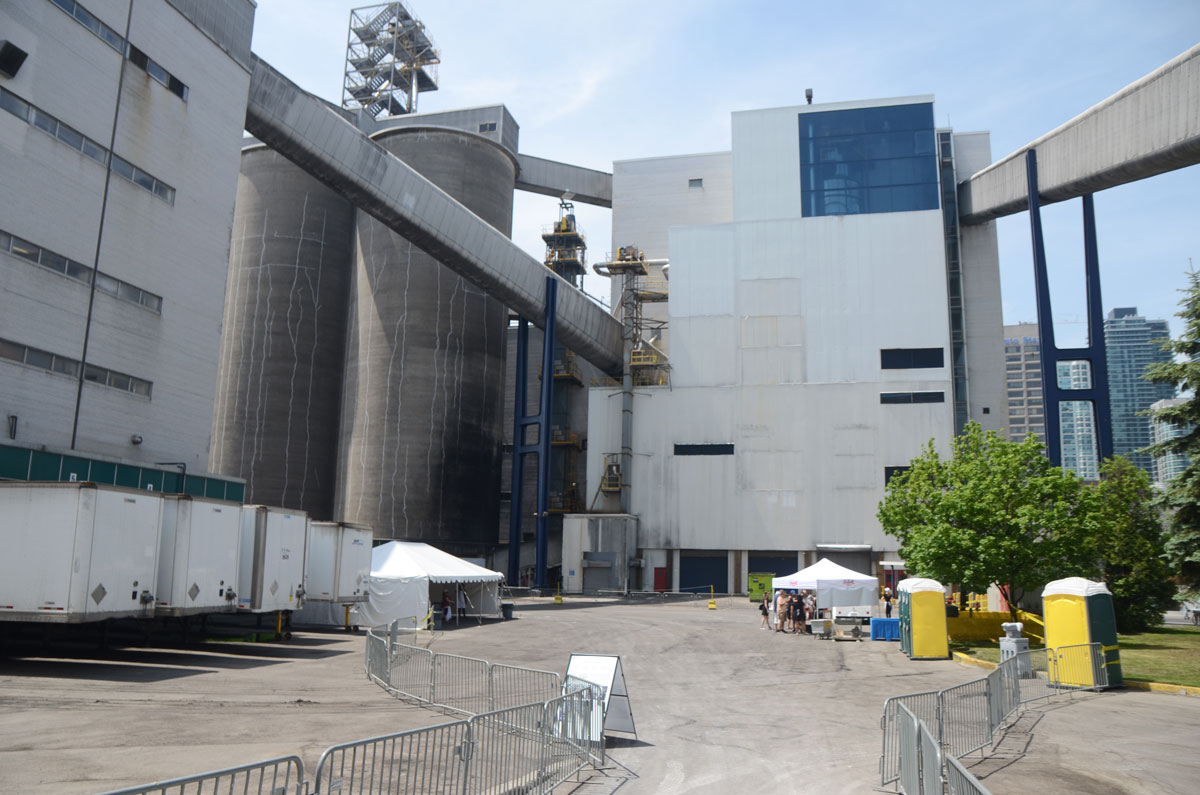
below: Photo taken from the entrance to the Raw Sugar Shed, taken at Doors Open.  Raw sugar is taken by conveyor belt (upper far right) to the processing plant next door.

sugar processing area of Redpath Sugar refinery, some white tents and metal barricades for crowd control as it is Doors Open day.

close up of the white Redpath Sugar processing plant, grey metal covers on conveyor belt tunnels and vents

below: A lingering remnant, railway crossing signs from when a railway ran here.
A guard sits by the entrance to Redpath Sugar.

a wire fence with barbed wire across the top, behind the fence is round yellow railway crossing sign as well as a large blue metal pole and a small shrub. There is also an old warning sign for a railway that once ran past here.

The railway serviced the industries that were built along the Toronto waterfront,  The LBCO, Loblaws, the ‘Toronto Star’ newspaper, Molson Breweries, Dominion Malting and others, relied on the railways.   Completed in 1959, the Redpath refinery was the last industry built along the waterfront.  You can just see the railway tracks in the photo below, running between Queens Quay East and the Redpath building where they dead end.  Since the tracks only dead ended there in 1985, that helps date the picture.   Rail service ended in 2008.

aerial view of the East Wharf portion of the Toronto wateterfront, vintage photo from the 1970's or 1980's

photo credit: Originally from City of Toronto Archives but found online at Old Time Trains.

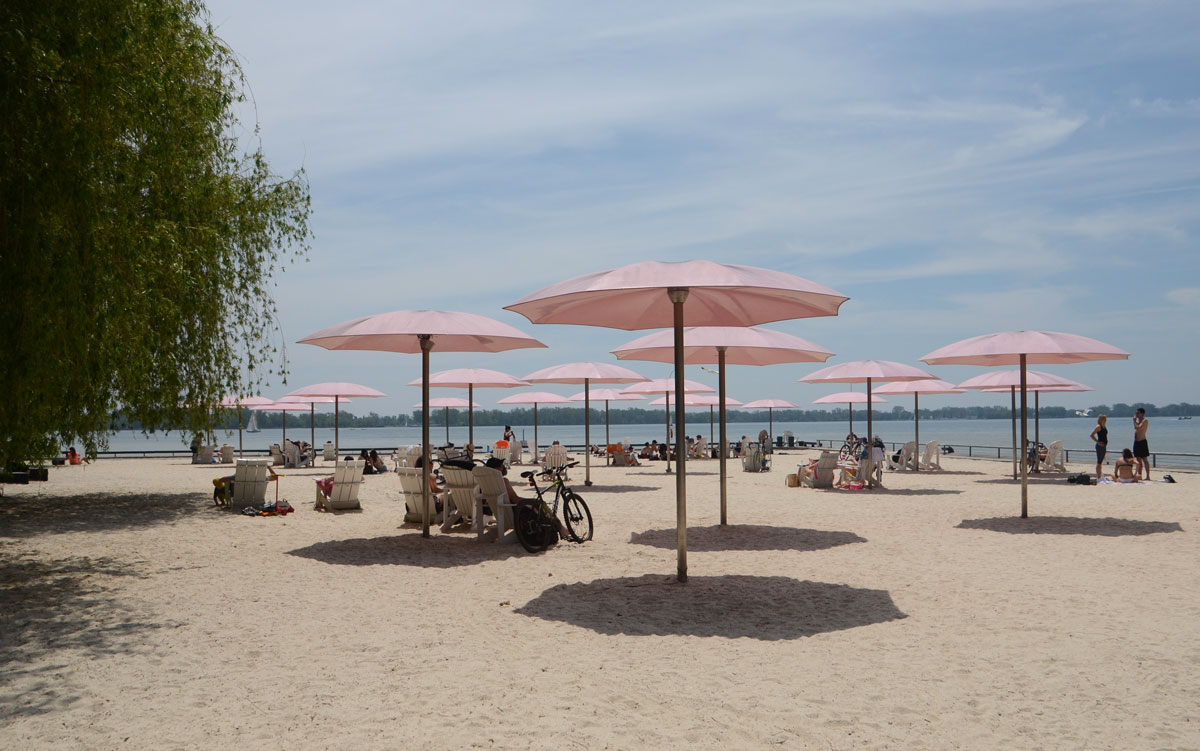
Today, Redpath Sugar is one of the last industries operating on the waterfront; The area around it is rapidly being redeveloped, including the space right next door that is aptly called Sugar Beach.

people sitting on white chairs under pale pink umbrellas at Sugar Beach. sand, water and blue sky, beside Lake Ontario

a man sits on a chair between a blue shipping containter and a building,

On Friday morning, my original goal was to find ‘Residents of the Esplanade’, a CONTACT Photography Festival outdoor exhibit at David Crombie Park but it was such a beautiful morning that I didn’t stop there. I found more than just the ‘Residents’.

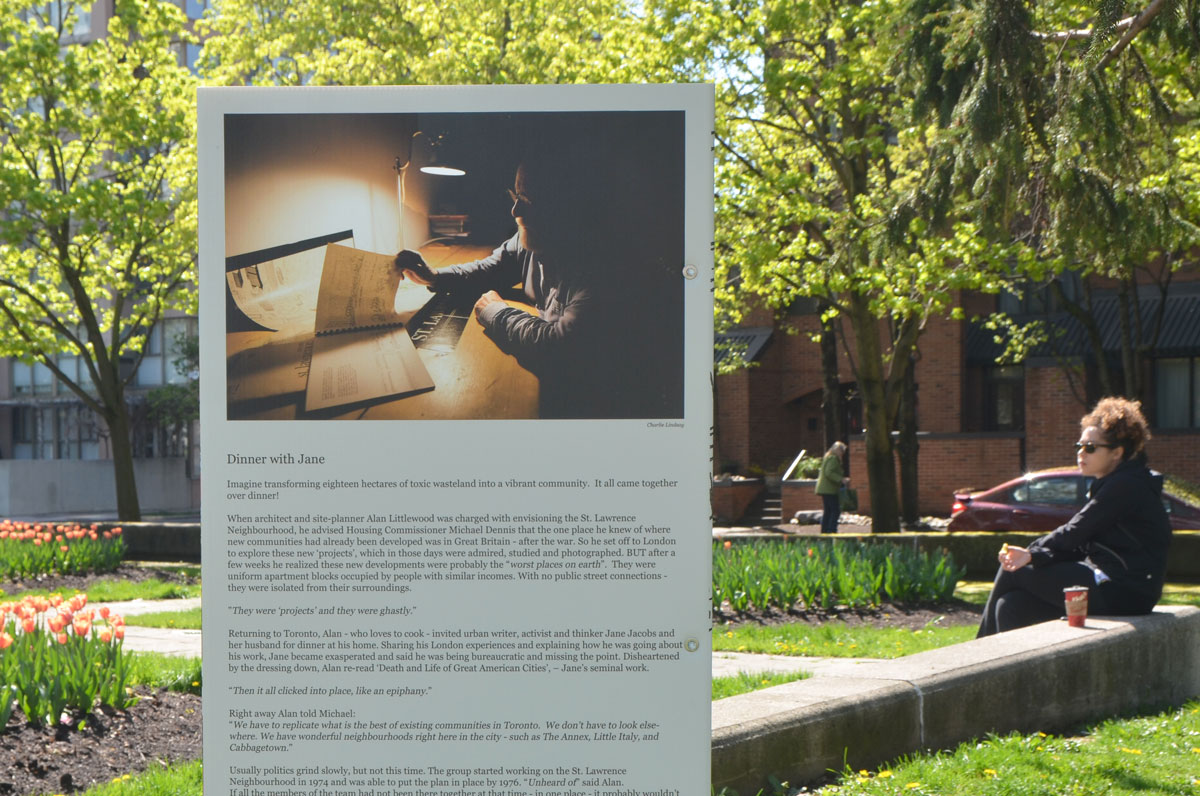
Forty years ago, May 1976, the site plan for The Esplanade neighbourhood was approved. Since then, it has become home to a very diverse group of people. And it is those people that this installation celebrates on the 40th anniversary of the founding of the neighbourhood.

Crombie Park runs along the south side of The Esplanade between Berkeley street and Lower Jarvis.  The installation consists of a number of small white rectangular pillars with the picture and story of person on either side.

A photo from the CONTACT photography festival, installation called 'Residents of The Esplanade' - story of Mysha from Pakistan

A photo from the CONTACT photography festival, installation called 'Residents of The Esplanade' - photo of Solomon from on top of a basketball hoop

A photo from the CONTACT photography festival, installation called 'Residents of The Esplanade' - photo of Alan working at a desk, tulips and a woman sitting in the park are in the background

People were out enjoying the morning; school kids were playing basketball at recess.

kids playing basketball on an outdoor court. The wall behind the basketball hoop has been painted with a mural of hands making a heart shape with the fingers, by Bruno Smokey and Shalak Attack.

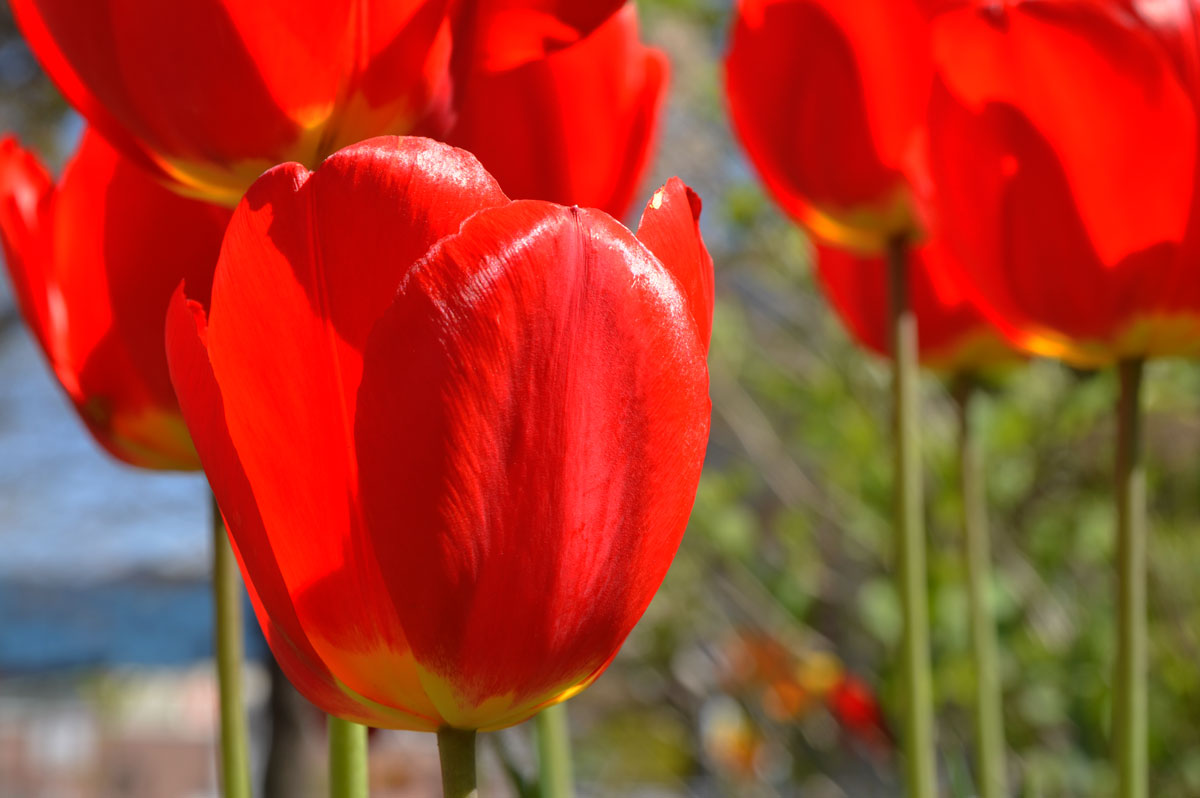
Flowers were blooming.

close up photo of red tulips in full bloom on a sunny day

tulips in a garden in a park, orange and yellow tulips, with some greenery. Grassy area with trees behind, and people walking on a sidewalk in the background.

below: Looking towards Lower Jarvis Street and downtown Toronto.

at the corner of The Esplanade and George Street, looking west towards downtown and St. Lawrence market. Playground on the left with children playing.

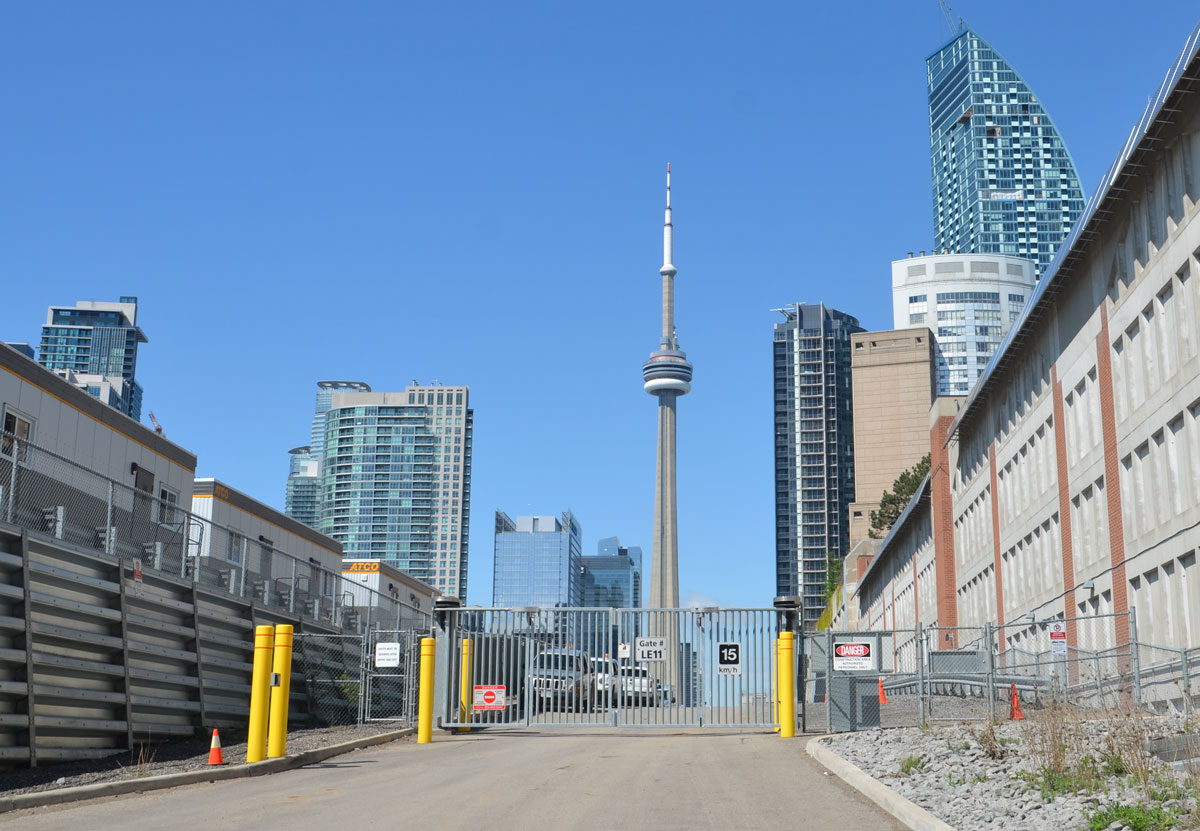
below:  One street beyond Lower Jarvis is Market Street.  It dead ends at the railway tracks.  The long structure on the right is a parking garage.

looking west towards the CN Tower, with the railway tracks to the left (but they are elevated and behind maintenance buildings so you can't see the tracks). Parking structure to the right, with city buildings behind it.

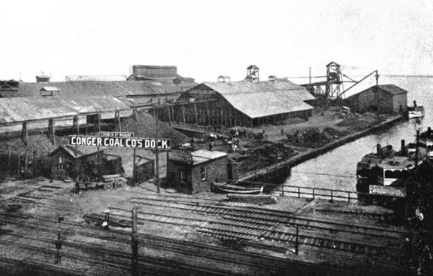
below: After a small backtrack up Market Street, I went through Conger Coal Lane to Church Street.  I don’t think I have walked this way before.  The lane was named in commemoration of the Conger Coal Company whose yard and wharf was nearby.   It was one of the many companies that provided Toronto with coal back in the day when coal fueled the city.  It was started in 1870 by Mr. P.D. Conger.   In 1913, Sterling Coal company bought Conger and the name was changed to Conger Lehigh Coal Co.

a downtown Toronto lane, very clean, no graffiti, taller, newer buildings on either side of the lane. CN tower in the distance,

below: A very old photo of the Conger Coal Company dock at the foot of Church Street, back when Church street ended at Lake Ontario

historical picture of the old COnger COal Co wharf at the bottom of Church street.

below: Tucked into a corner on Church street immediately south of Front Street, is an art installation by Paul Raff called ‘Shoreline Commemorative’.  A topography of limestone forms the base of the work.  A glass ball representing the line between sky and water sits on top of a tripod that tries to evoke a land surveyor’s tripod.  The words on the wall say “For 10,000 years this was the location of Lake Ontario’s shoreline.  This brick wall stands where water and land met, with a vista horizon”

Shoreline Commemorative by Paul Raff, an art installation on Church St., south of King, that marks where the shoreline of Lake Ontario used to be. It involves words on a brick wall and a model of the shoreline of Toronto showing the different elevations of the land.

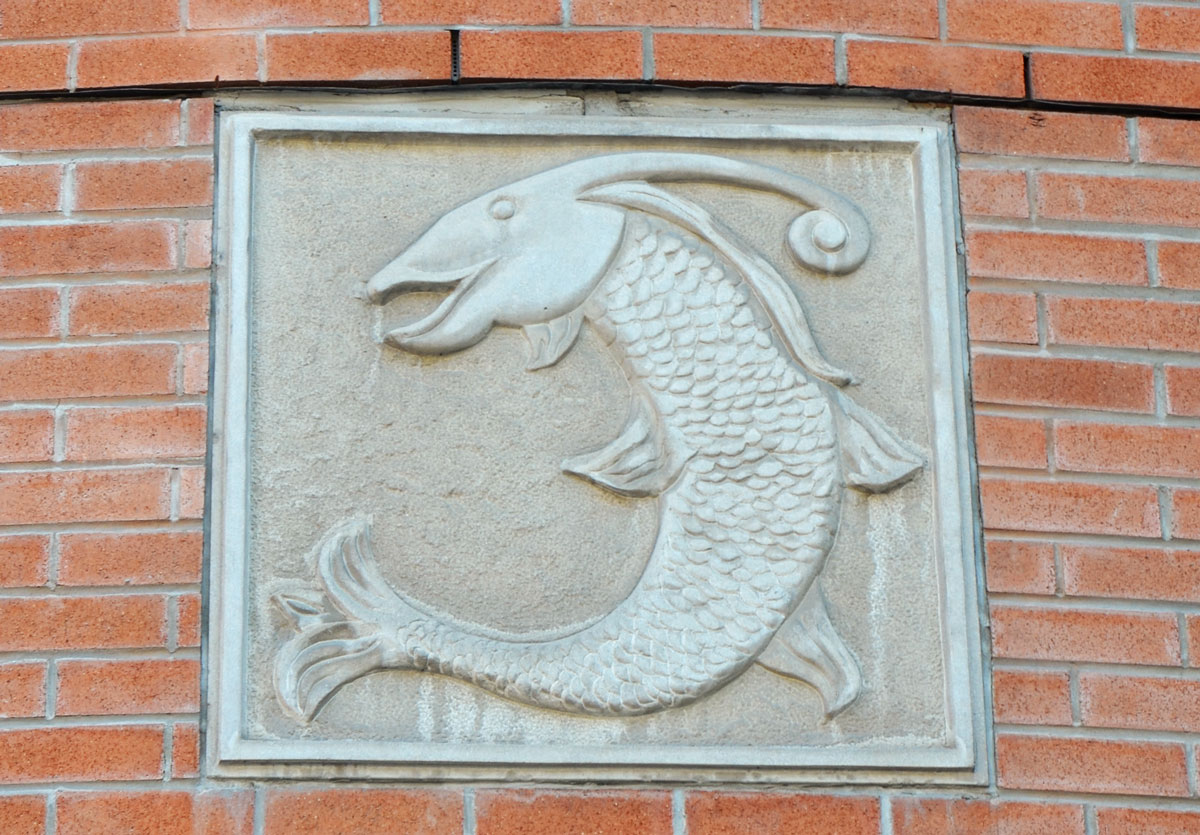
below: Continuing the lake theme, a little fish out of water, jumping over the entrance to a condo.

bas relief sculpture of a fish, square stone on a brick wall above the entrance way to a condo building.

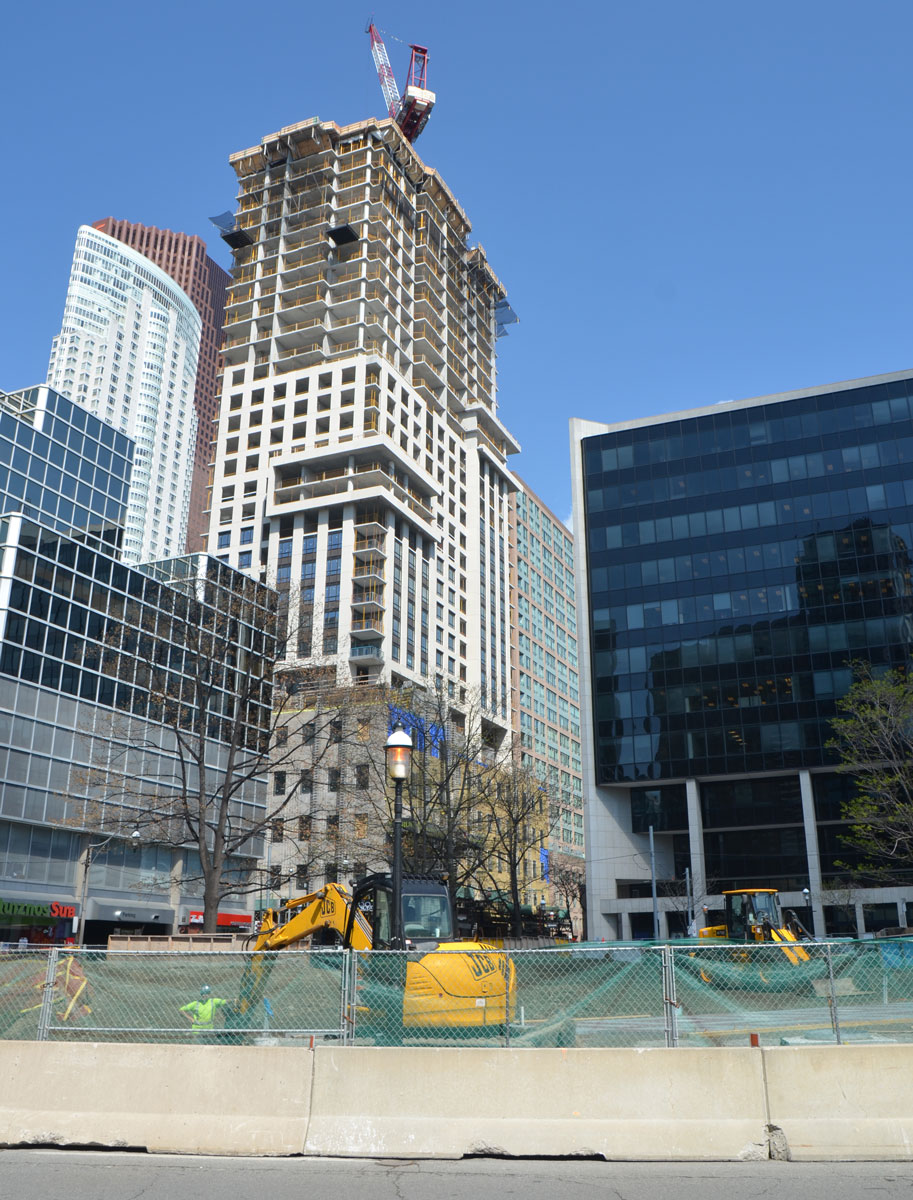
below: From the lake theme to another common theme in the city, construction. Spring is the beginning of construction season and here Berczy Park is being upgraded. In the background a new condo is being built but as we all know condo construction ‘season’ never ends. In fact, the challenge might be to find a place in this city where there isn’t a condo being built.

workmen redoing a park, Berczy Park in Toronto, with a digger and another piece of equipment, cityscape behind with a tall condo building under construction. A red and white crane is on top.

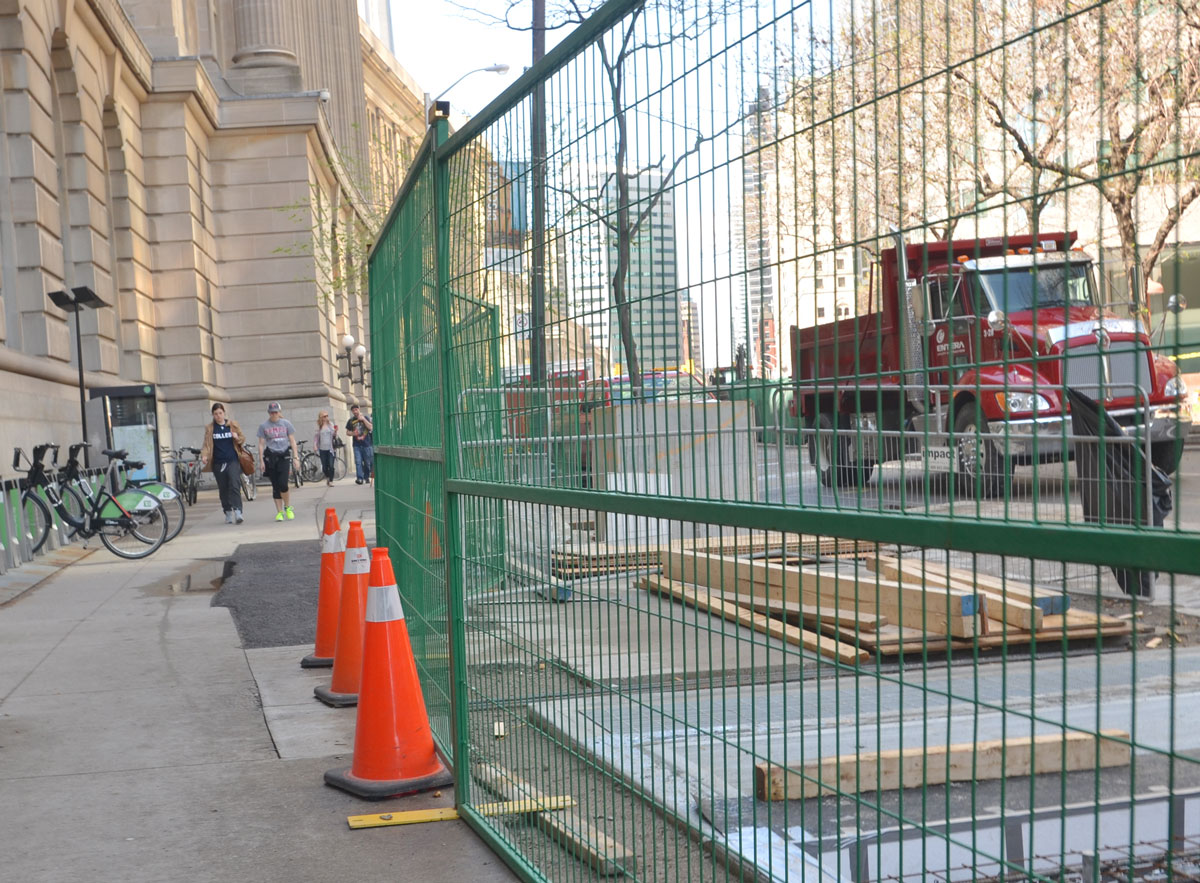
below: I walked past the never ending Front Street construction.  Construction in front of Union station seems to be finished, but this stretch of Front Street just west of the station is still being worked on.   There have been fences here so long that I can’t remember a time when they weren’t here.

Front street constrcution, behind a greenwire fence is a rd truck and piles of construction materials. Between the fence and a stone building is the sidewalk on which some people are walking.

a shirtless man in sitting on a stool at the corner of Front and Union streets. He has four signs (behind, above, in front, and beside him) asking for spare change or for you to buy his novel that is well rated on both Amazon and Goodreads.

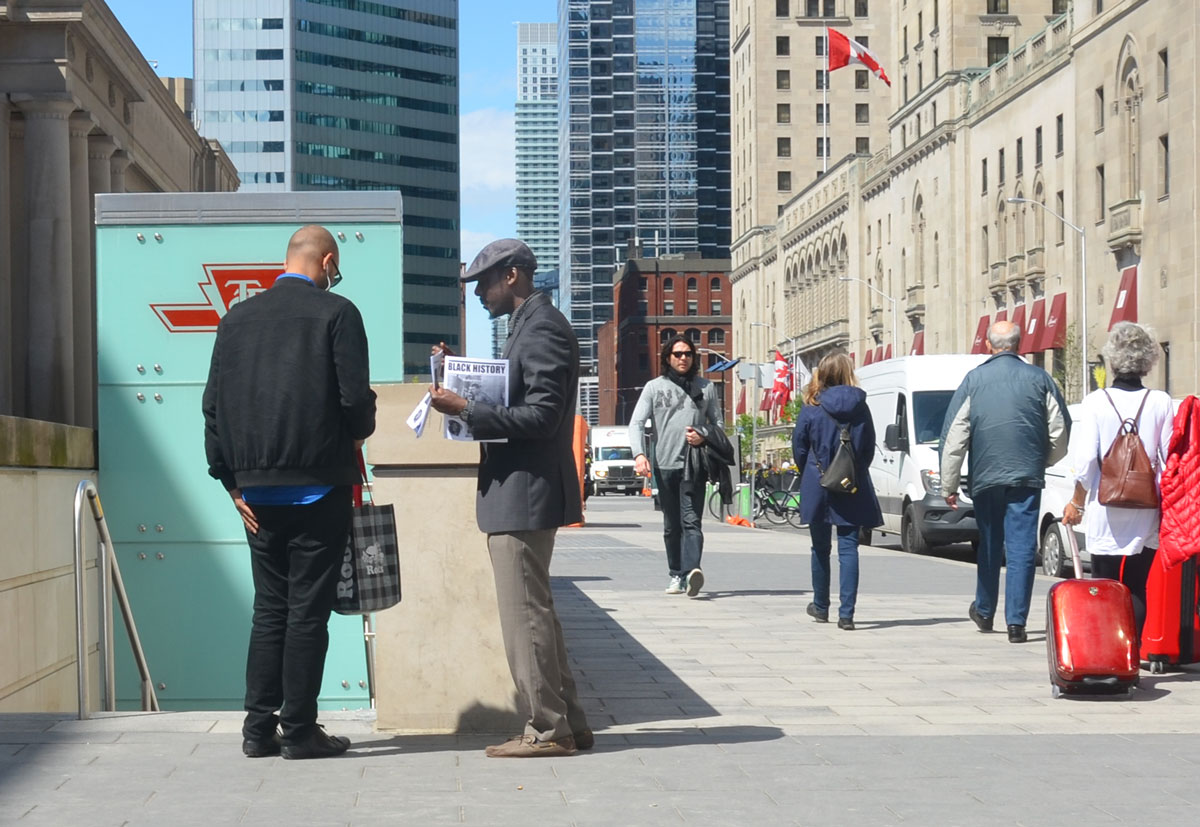
A man is selling Black History newspaper to another man in front of the TTC subwayentrance at Union station.
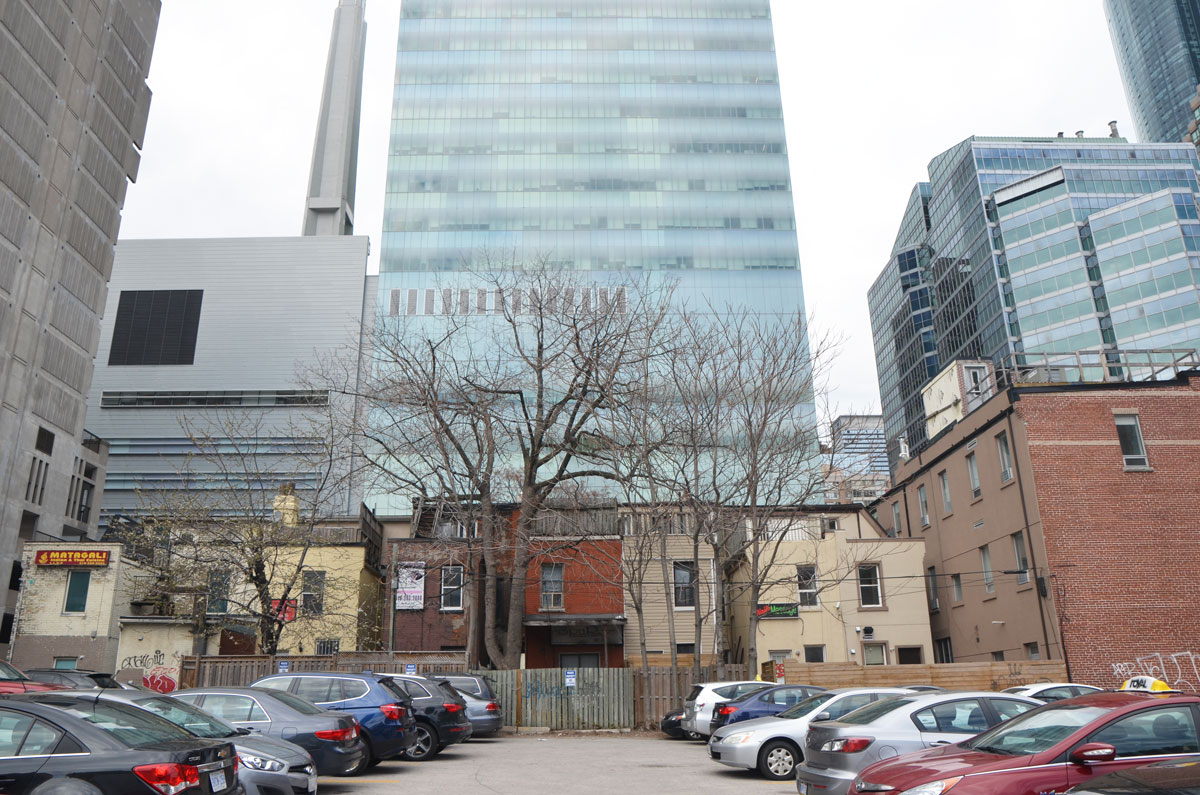


There is no theme to this blog post.  I never really had a purpose in mind as I walked yesterday.  I walked to enjoy the spring day.  I walked wherever my feet took me…  and they took me on a route that wove between Bay Street and University Avenue and from Grenville south to Dundas.

two women dressed up and walking down the street. One is in a puffy black dress, black tights and black shoes. The other woman has long red hair and a polka dot sweater on.

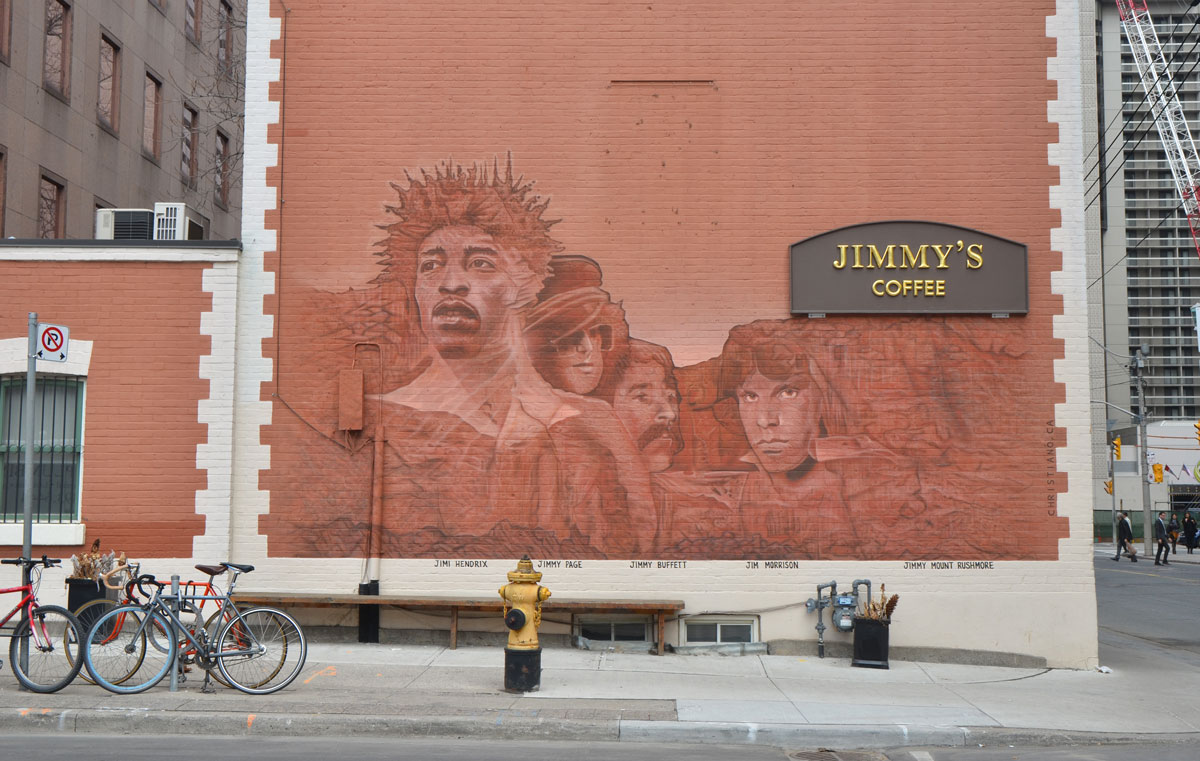
below: “Jimmy Mount Rushmore” mural on the side of Jimmy’s Coffee featuring four famous musical Jimmys: Jimi Hendrix, Jimmy Page, Jimmy Buffet and Jim Morrison.

mural on the side of Jimmys coffee, monochromatic in rust, pictures of what Mount Jimmy Rushmore would like, four famous Jimmys, Jimi Hendrix, Jimmy Page, Jimmy Buffett and Jim Morrison

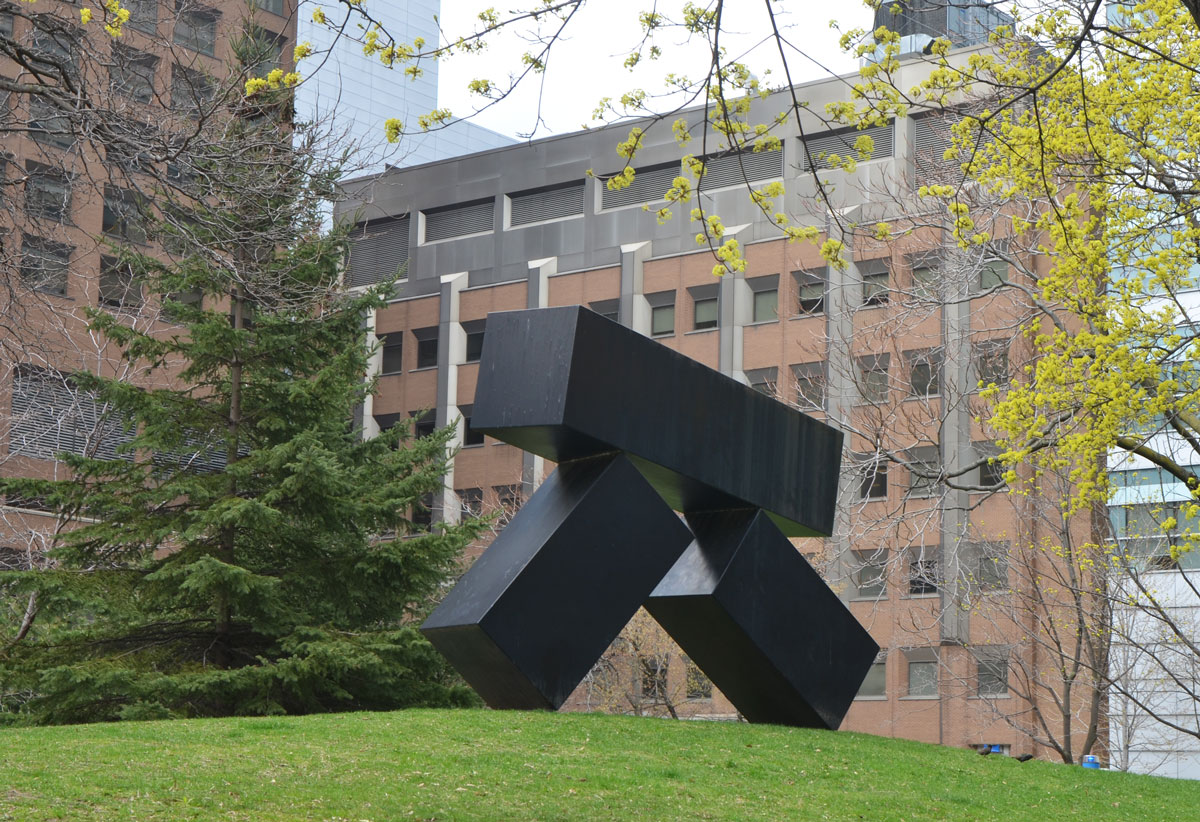
below: ‘Inner City Gate’ by Kosso Eloul.  1978.  A balancing act of stainless steel boxes on the lawn of the R. Fraser Elliott building (part of the old Toronto General Hospital), Elizabeth Street.

black metal sculpture of three boxes precariously balanced, the upper box is almost horizontal and it is being supported by the other two who are falling down but still balancing

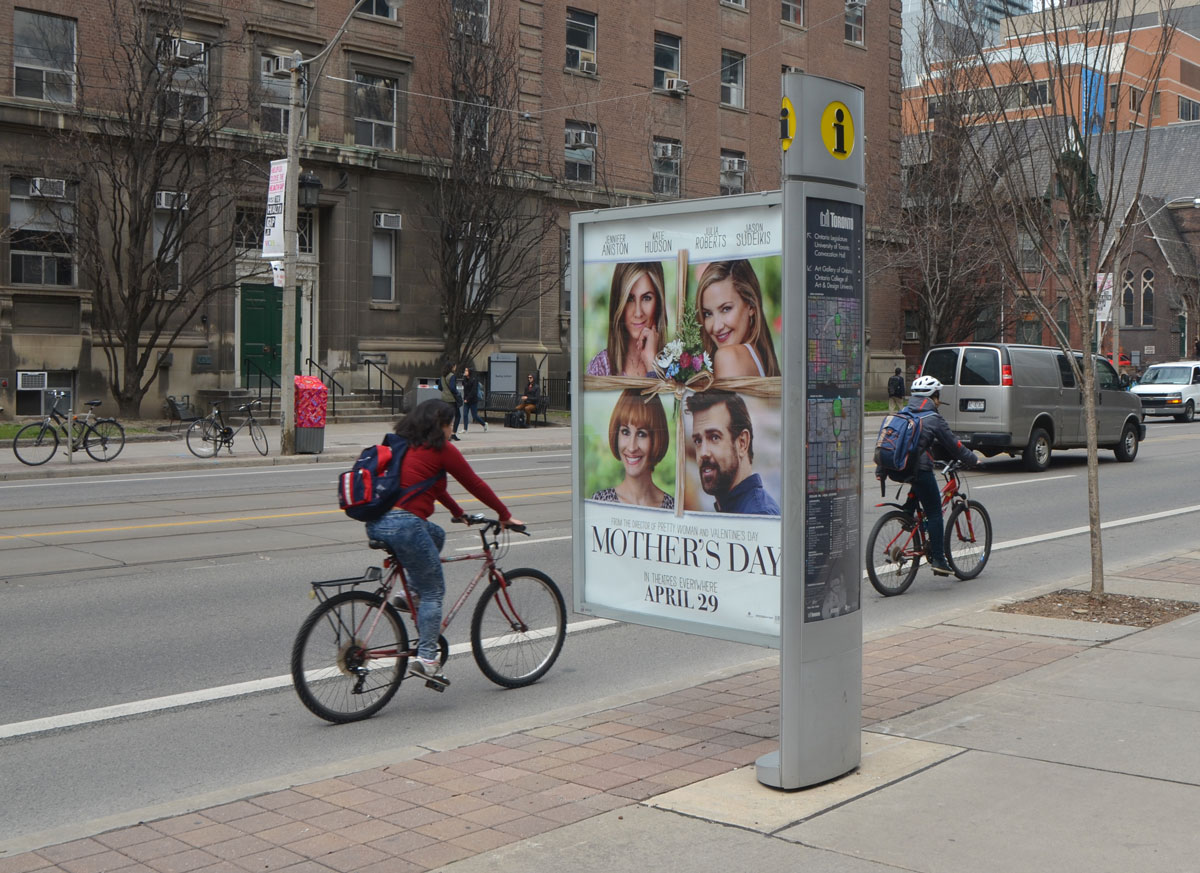
below:  A blight on the sidewalk, so-called information pillars that are really just a sell-out to Astral Media.  They needlessly obstruct the sidewalk and obstruct the view of  cyclists and motorists.  Unfortunately they are part of a 20 year contract that the city has with Astral Media which doesn’t expire until 2027.

cyclists ride by an information pillar that has a large ad jutting out towards the street.

below: Incised into limestone blocks on the Edward Street side of McClelland House (originally the McLean Hunter building) is half of an artwork by Elizabeth Wynn Wood (1903 – 1966) called “Communication”.  The woman is sending a message to a man who is apparently shown on the other side of the building.  Sadly, I missed the man so there is no photograph of him here.  When the work was completed in 1958, the incised lines were inlayed with gold colour.

outline drawing of a woman floating in the sky, incised into limestone facade of a building. She is releasing a bird.

below: Across the street from the ‘floating woman’, 480 University Avenue is getting a facelift.

lower part of building have its facade upgraded to glass panels
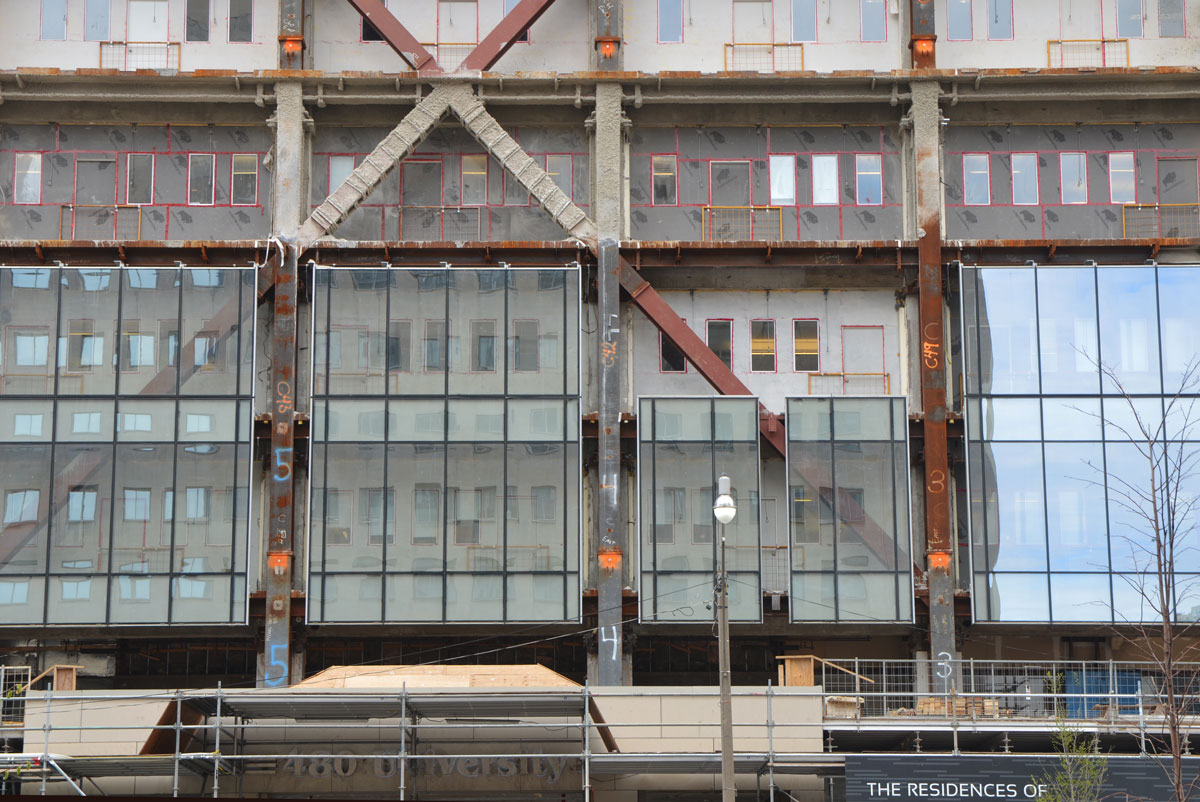
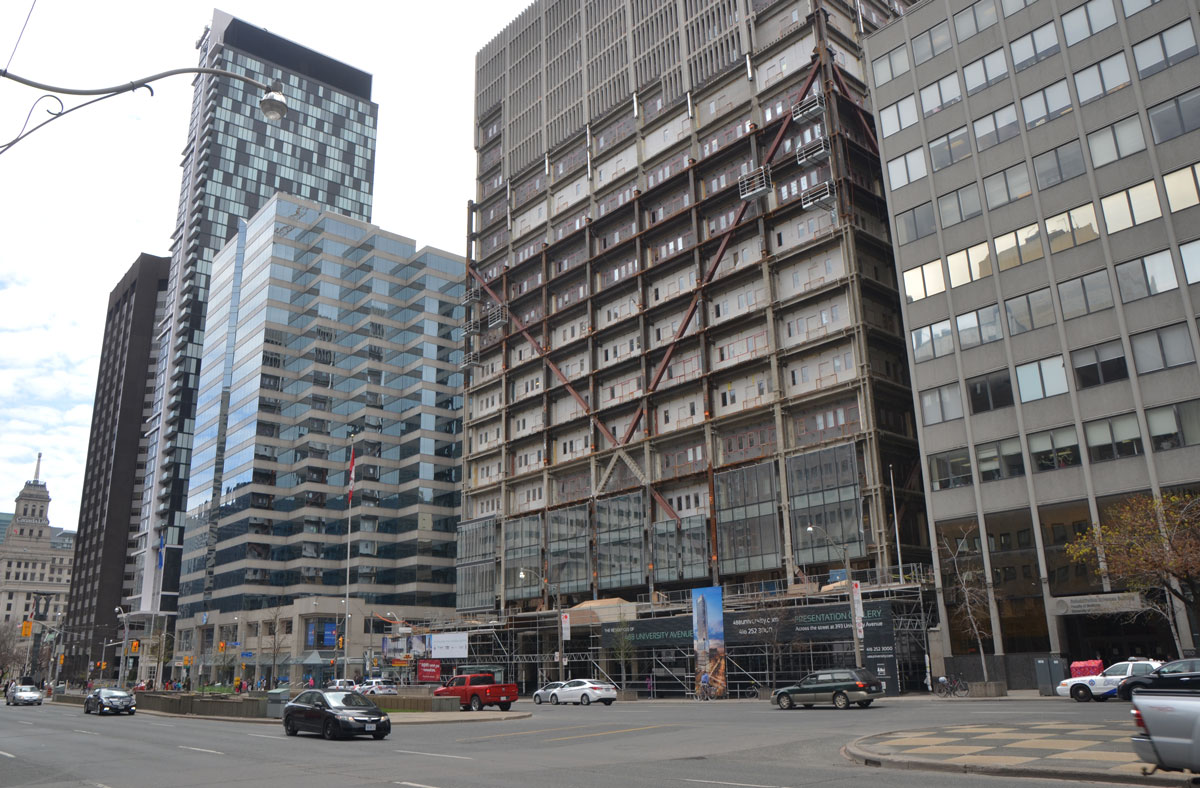
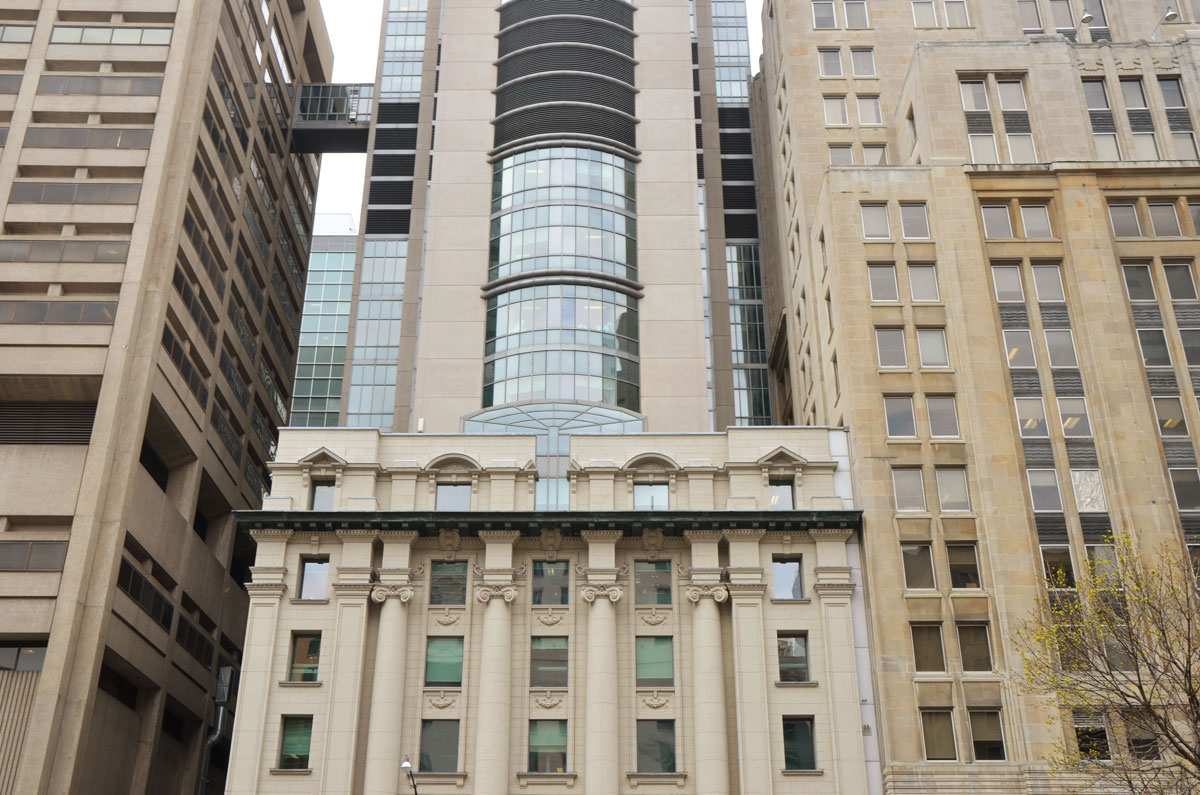
below:  This picture shows most of the front of 480 University and you can see the different stages of the recladding process.  At the top of the building, the precast concrete grille that was part of the original 1968 Global House office tower is still in place while new glass panels have already been installed on the lower floors.   It is interesting to watch the metamorphosis of an 18 storey office building into a 55 storey condo tower.   Four levels of underground parking have also been added to the site and a new indoor entrance to St. Patrick subway station is in the works.

Tall office building is having its concrete facade replaced with glass. The upper floors are still concrete, the middle floors are bare and the lower floors have new glass

below: Abstract in blues and greys

very close detail shot of glass and reflections that make diamond shaped abstract in blue and grey

There is a lot of building and redevelopment in the area where I walked.

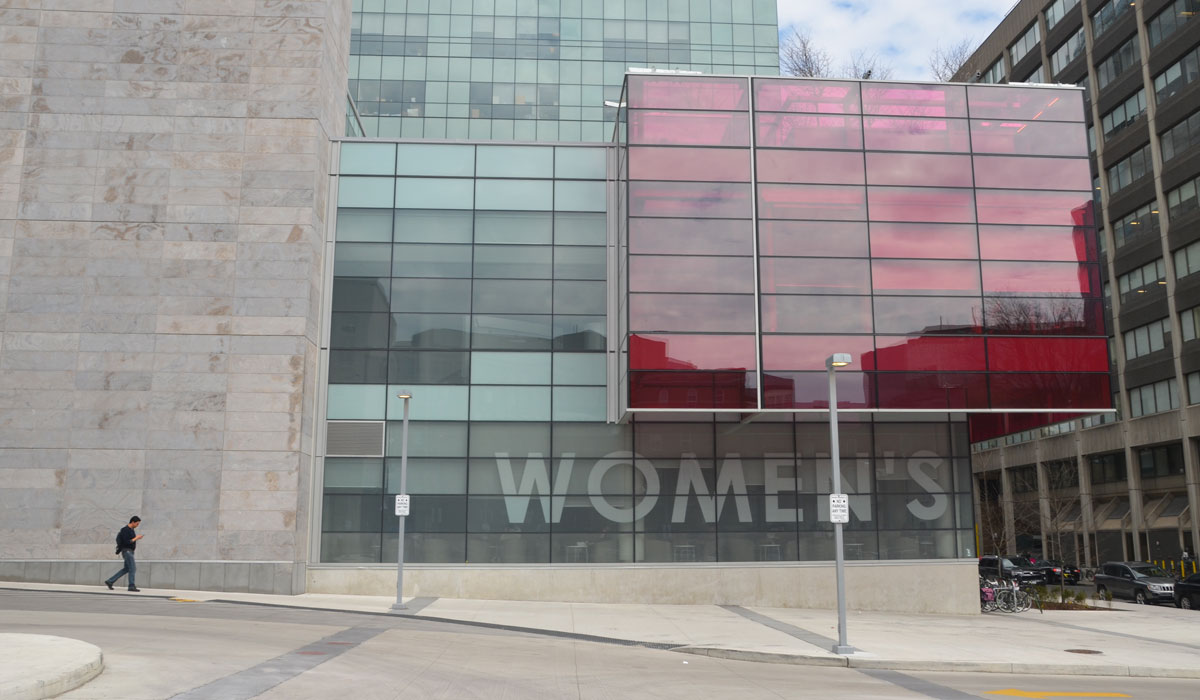
below: Womens College Hospital is totally new.

a lone man walks by the new Womens College Hospital building with its light grey stone facade, large glass section, and large pink glass section.

below: The corner of College and Bay, looking southeast, is now a wall of glass.

cyclist rides through the intersection of College and Bay streets. A wall of glass condos in the background.

below: The new wing of Sick Kids Hospital dwarfs the older buildings on Elm Street.

view from a parking lot, a row of the back of older two storey brick buildings with some mature trees, then taller modern glass buildings.

below:  The old and the new integrated into one building, Princess Margaret Hospital.

Princess Margaret Hospital, with the older stone building at the bottom, and the new modern addition above and beside it.

below: Even the street is being redone.  The center of Bay Street from Dundas to Elm is torn up because of  TTC streetcar track replacement.
A digger and other equipment working on a torn up section of Bay street.

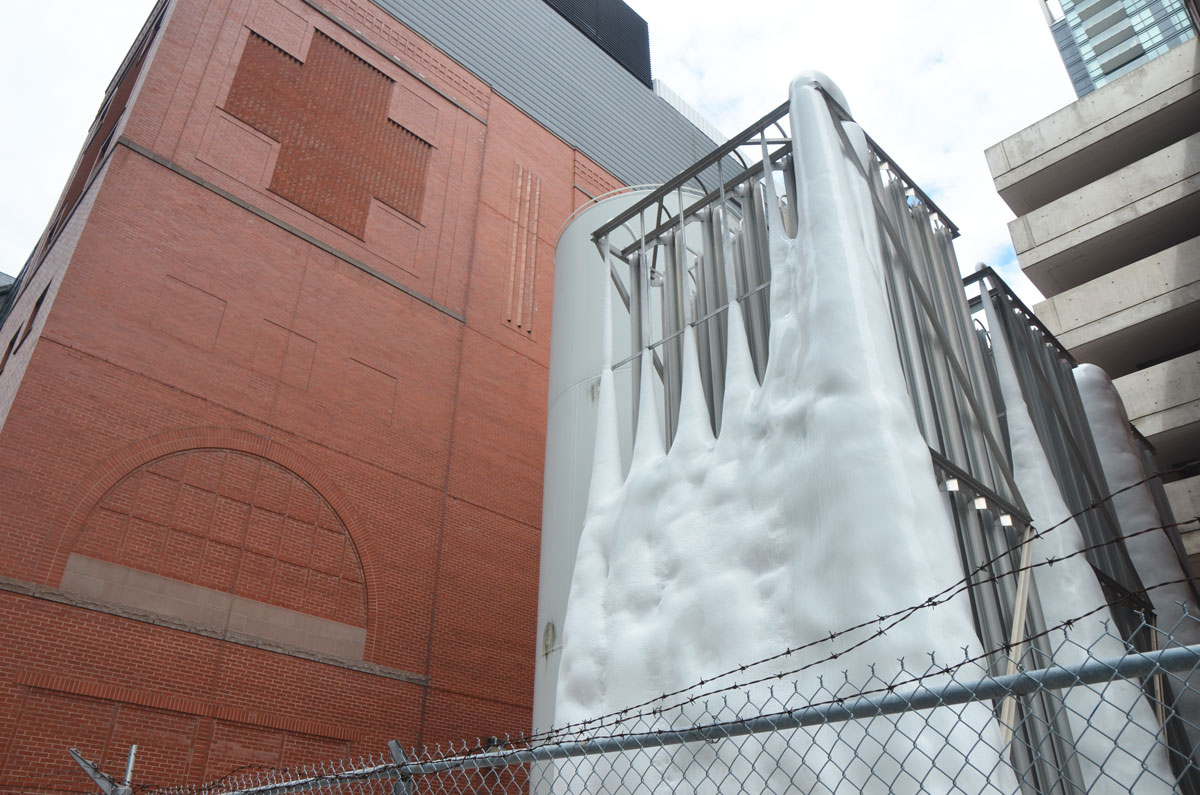
below: Little quirky details:  First, the cross shapes made of contrasting brick on the back of the Red Cross building.  Second, the workings (or barrier?) of the compressed gas tanks that have been made to look like ice.

part of the addition that was added to the Red Cross building, two cross shaped features in contrasting brick on the upper levels. In front of that building are large compressed gas tanks.

below:  Another piece of public art, ‘Liquid Echo’ by Catherine Widgery, 1999, is in front of 750 Bay Street.  They look like stiff and lifeless frozen metallic fountains… or maybe just 12 pencils 🙂 .   Circular vent shafts for the underground parking have been incorporated into the artwork.

public art installation outside 750 Bay street

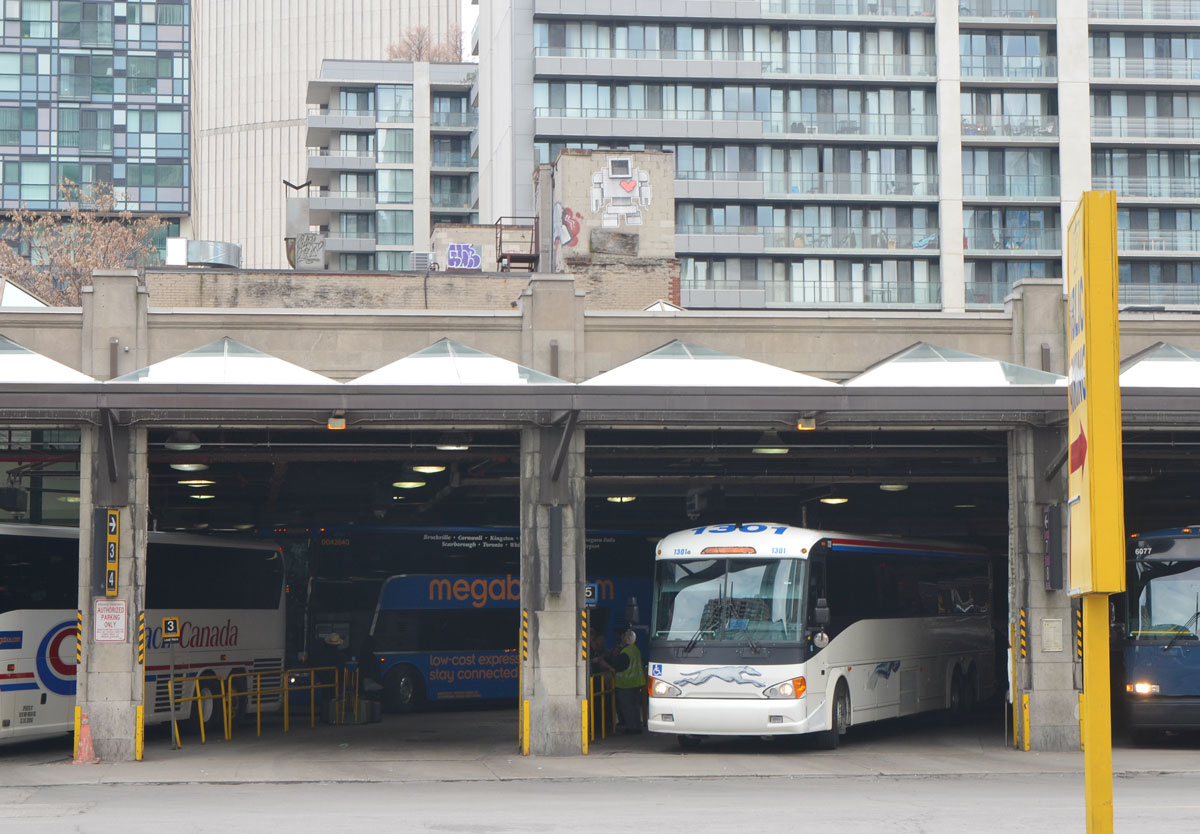
below: A  lovebot watches over the people passing through the bus station, unaware that he is there.

large lovebot wheatepaste paste up above the downtown Toronto bus terminal. A white bus is parked in one of the bus bays. Condos in the background.

below: And last, a colourful collection of squares and rectangles. Blue and green.  Red and white.

green and blue glass of a building's facade, with a storefront below. The windows of the store are filled with red and white pillows arranged in a grid.

There is a railway bridge, just west of Caledonia Rd where the GO line to Aurora passes over St. Clair West.
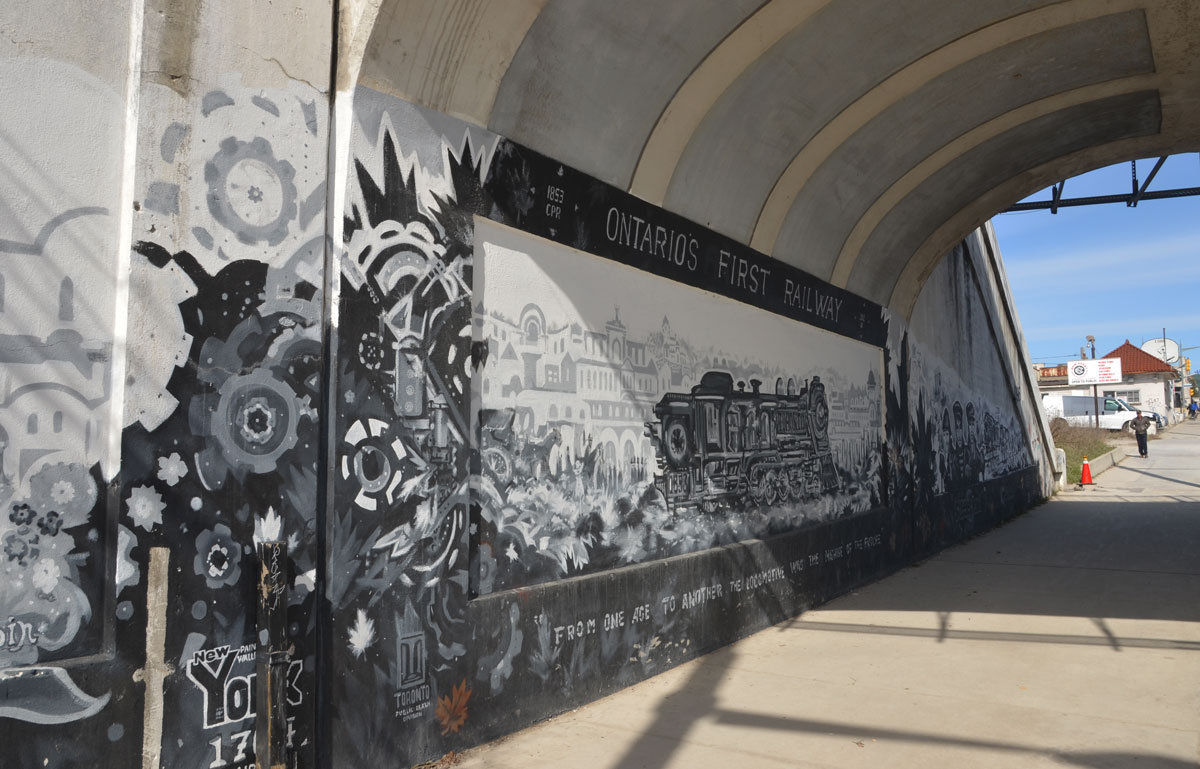
On the north side of the underpass is a mural in black, white and grey tones.

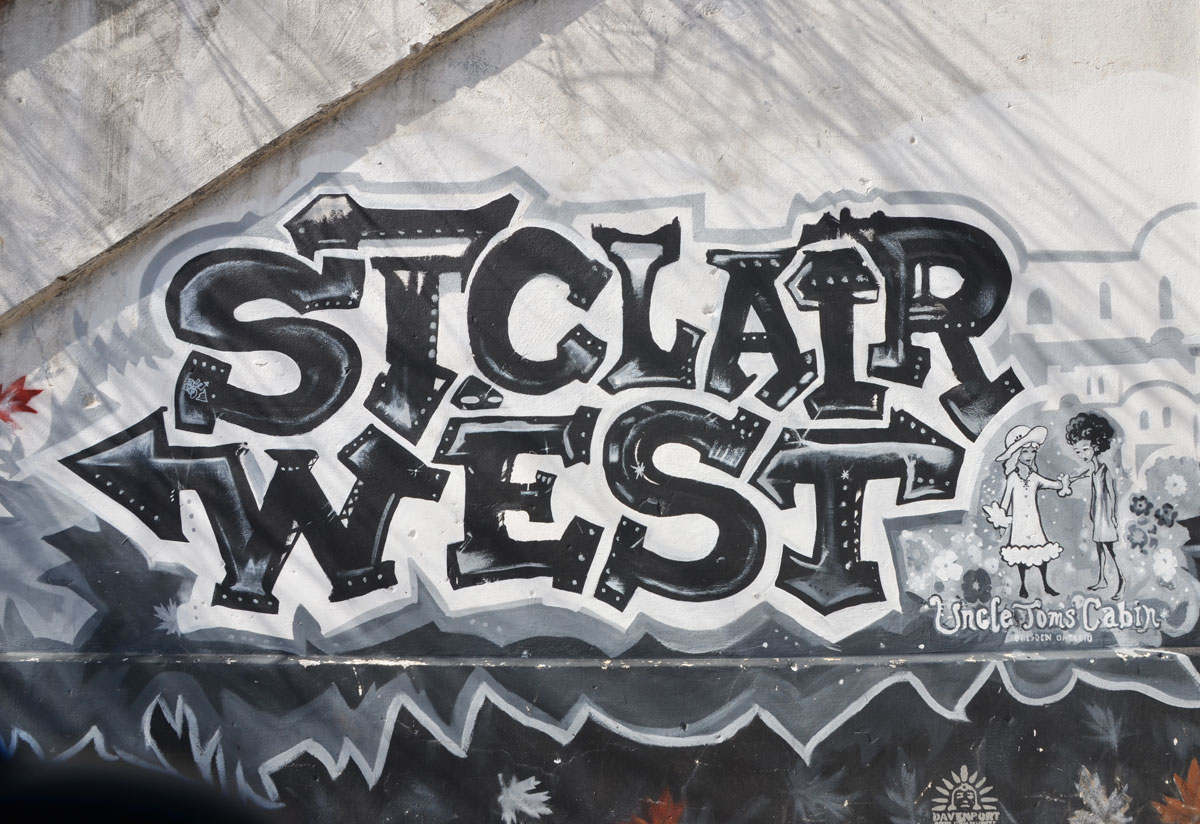
mural in black, white, and grey about the first railway in Ontario, 1853, that was built here, and where the railway still runs as the GO line to Aurora - the words St. Clair West in large letters

The theme of the mural is “Ontario’s first railway” as this railway line has been in operation since 1853 when the Ontario, Simcoe and Huron railway was built here.

mural in black, white, and grey about the first railway in Ontario, 1853, that was built here, and where the railway still runs as the GO line to Aurora - a photo of the mural from across the street, with its three parts, the words St. Clair West on the left, the locomotive in the middle and the railway workers on the right
The first locomotive built in Canada was a steam powered engine built by the Toronto Locomotive Works, a company founded by James Good.  Named “Toronto”, it was finished in April 1853 and in mid-May 1853 it pulled a short (4 cars) train from downtown Toronto 30 miles north to Machells Corners (now Aurora).   Service on the Ontario, Simcoe and Huron line had begun!

below: “From one age to another.  The locomotive was the machine of the future.”
mural in black, white, and grey about the first railway in Ontario, 1853, that was built here, and where the railway still runs as the GO line to Aurora - a painting of an old locomotive with the words 'Ontario's First Railway' on the top of the mural and the words: "from one age to another. The locomotive was the machine of the future. " at the bottom

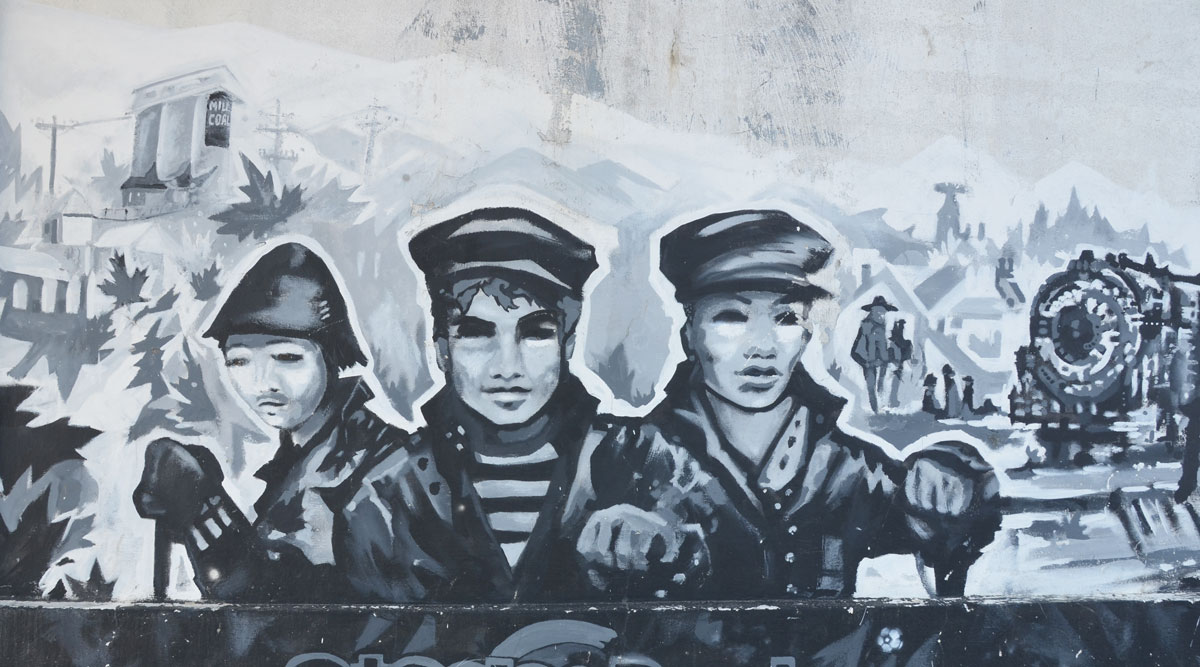
mural in black, white, and grey about the first railway in Ontario, 1853, that was built here, and where the railway still runs as the GO line to Aurora - three railway workers in jackets and caps

The mural was painted in September 2012 by Marcelo Pinero, Aelwynn Swanson, and Pia Ferrari from the Davenport Arts Community.

blog_mural_first_railway

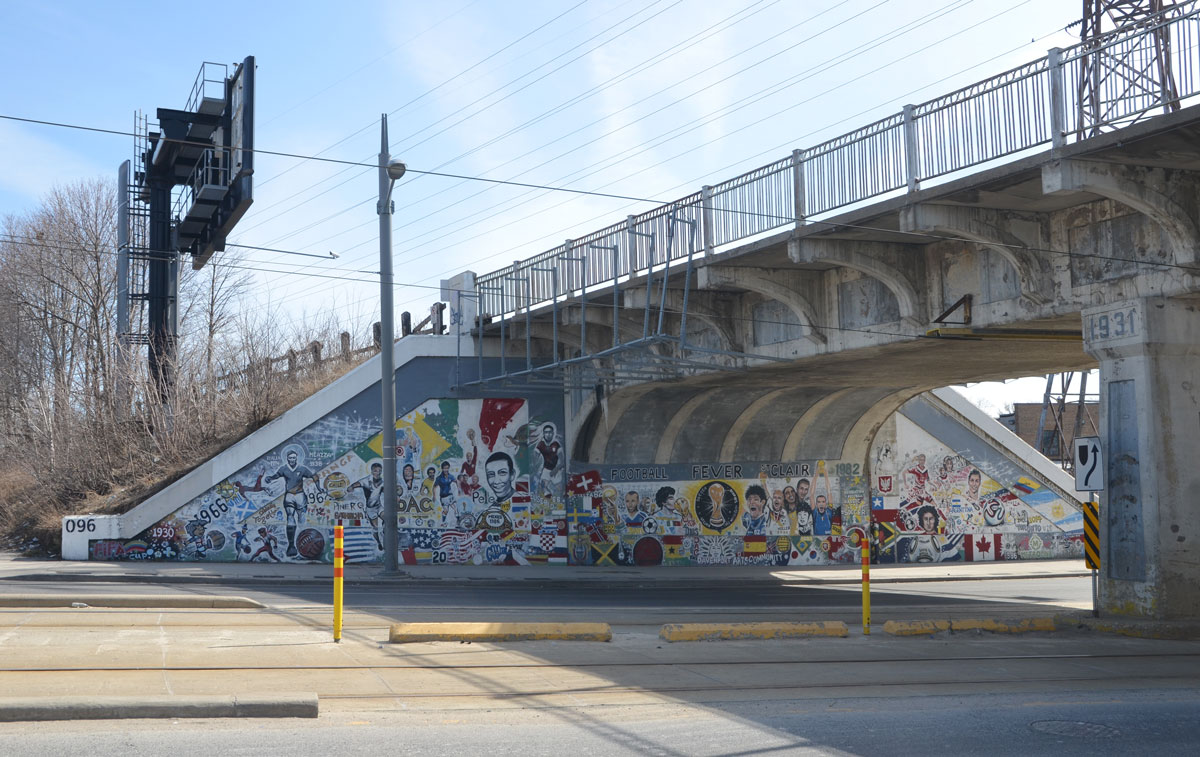
There is also a mural on the south side of the underpass; it has a soccer theme.

mural on a railway bridge underpass that has a soccer theme. Flags of different countries, soccer players, words,

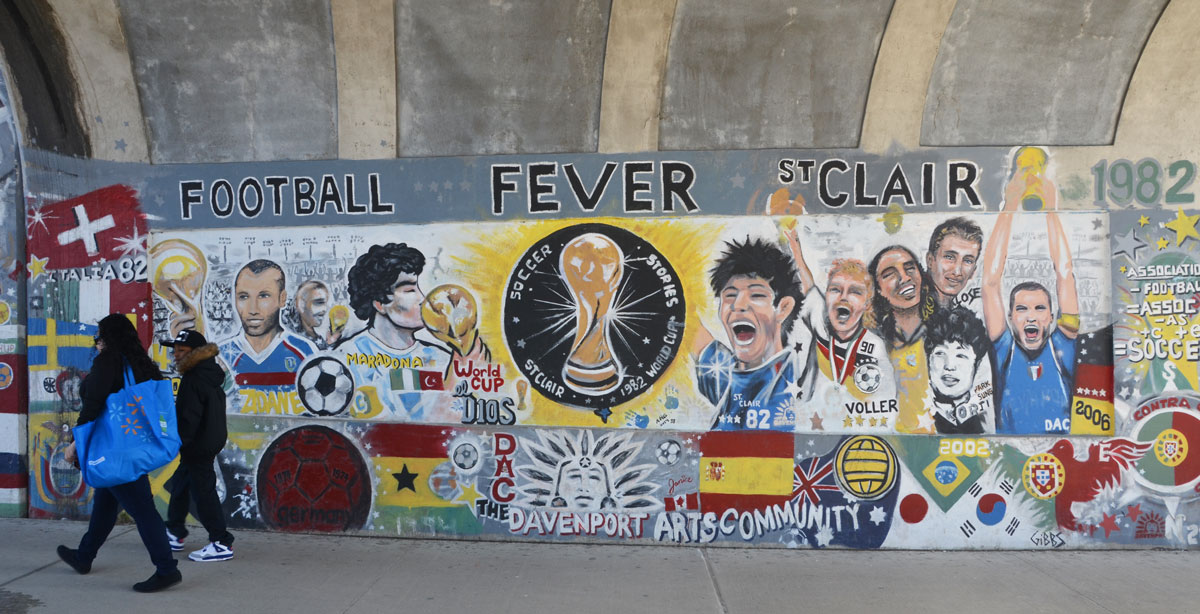
It too was painted by Davenport Arts Community.

part of a mural with a soccer theme with words that say Football Fever St. Clair 1982. also with pictures of football players and flags from different countries.

part of a mural with a soccer theme with words that say Football Fever St. Clair 1982. also with pictures of football players and flags from different countries.

below: Silverthorn Sunrise mural painted late in 2012 by Marcelo Pinero and Aelwynn Swanson.  It is painted on the side of Whiteside Pharmacy which is on the NE corner of St. Clair and Silverthorn.   Silverthorn was also the name of this neighbourhood prior to 1998 when it was amalgamated into the City of Toronto.

Silverthorn Sunrise mural by the Davenport Arts Community, with the word Silverthorn, a sun rising over a bridge while a new TTC streetcar passes under the bridge, the words "shop St. Clair". The mural is on the side of a red brick building, beside a pharmacy.

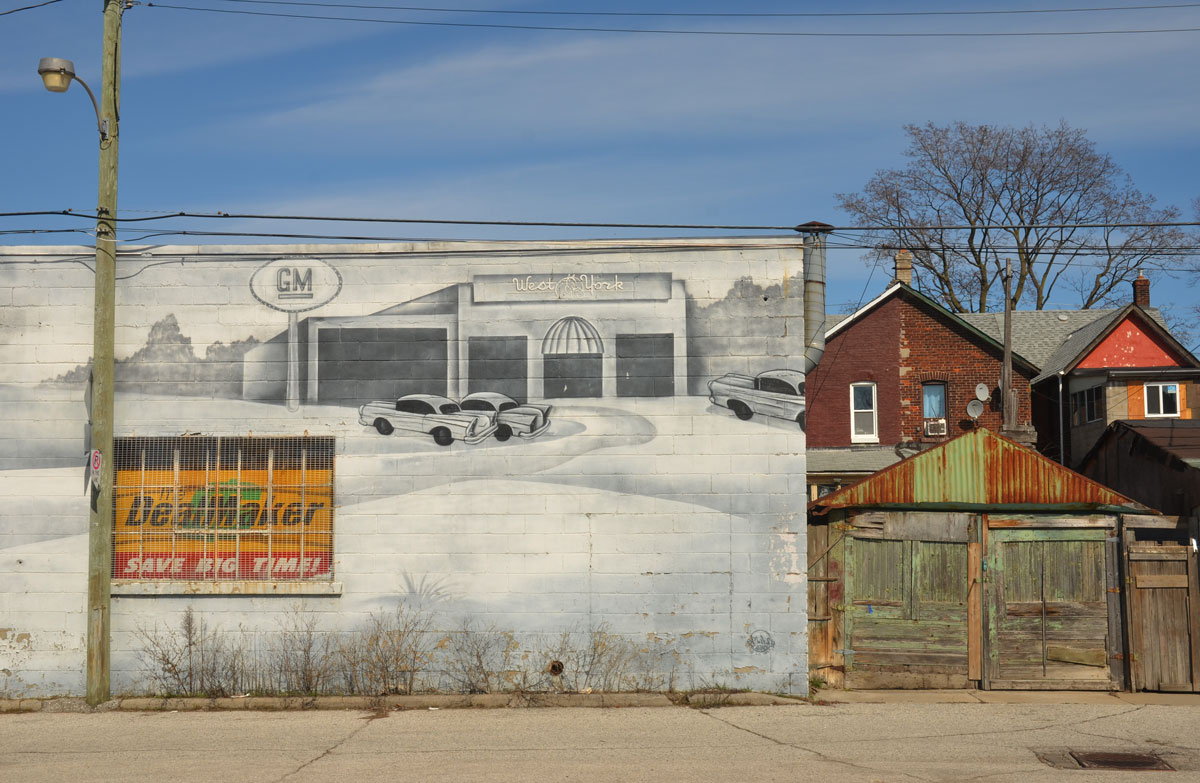
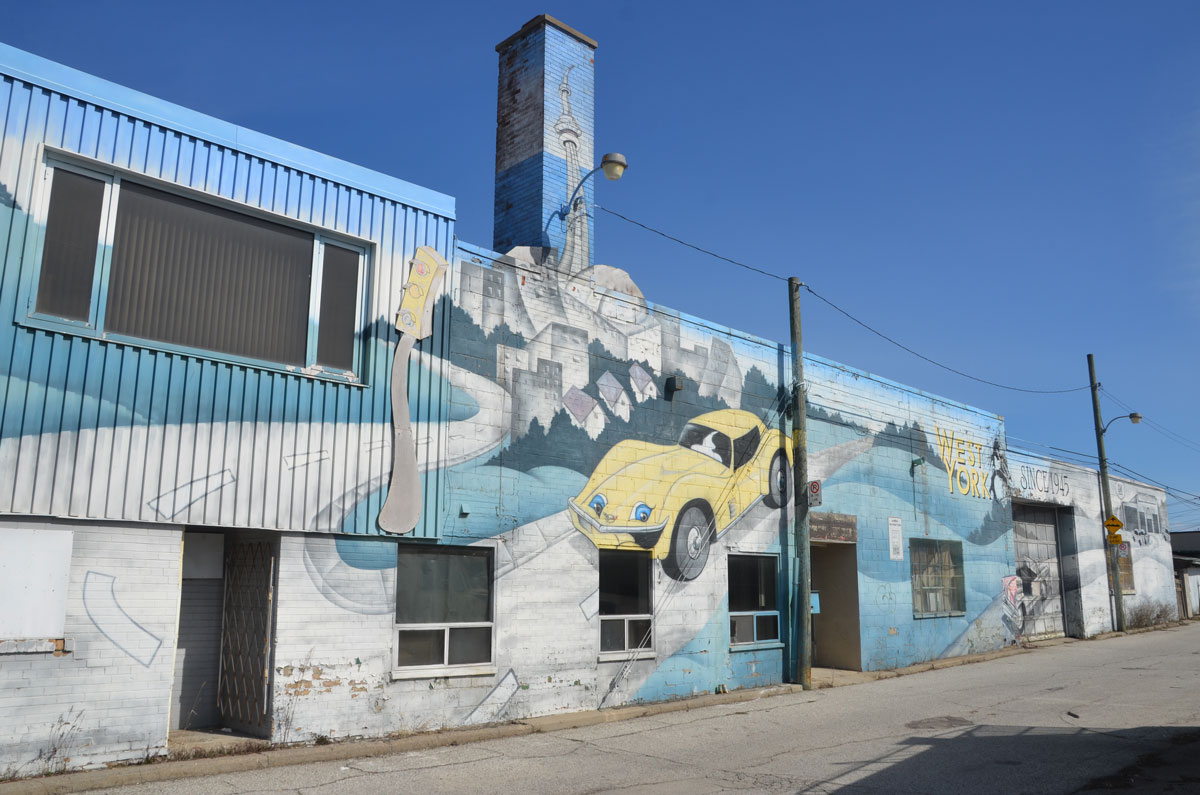
And last, a mural that is actually on the side of business, West York Motors, which is located on St. Clair West between Ford and Osler streets.
It was painted by Splash Murals.

mural on the side of West York motors on St. Clair West - a view of the mural from across the almost empty parking lot.

mural on the side of West York motors on St. Clair West near Osler - south end of the mural showing cars parked in front of a garagethe backs of two houses are also in the picture,

mural on the side of West York motors on St. Clair West - looking down the length of the mural including the narrow chimney on which the CN TOwer is painted.

mural on the side of West York motors on St. Clair West - the part of the mural with the words "West York since 1945" also an old convertible with its door open and top down.

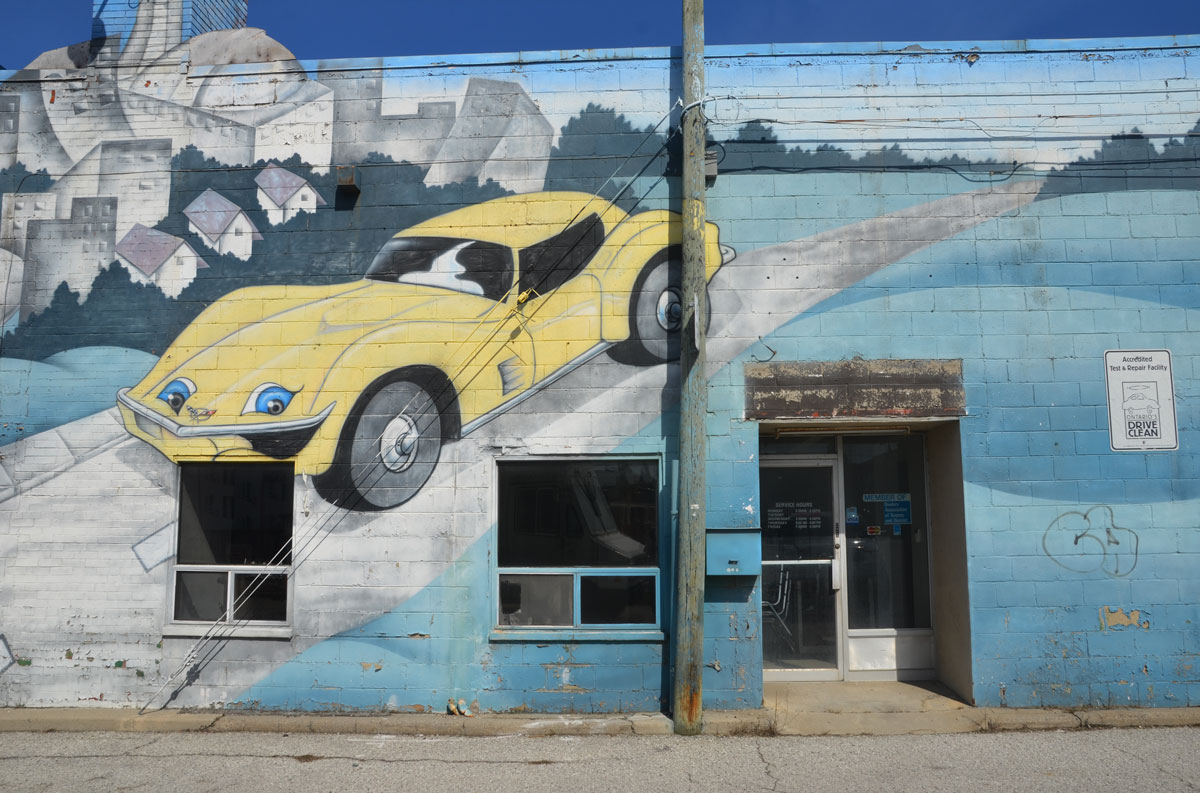
mural on the side of West York motors on St. Clair West - a yellow sports car is painted on the wall near the entrance to the building

more information about the Davenport Arts Community

A walk along Queen Street East from Broadview to Greenwood.

A no smoking sign written on a piece of paper that is upside down, as viewed from the other side of the window. Looking out onto a patio.

below: Welcome to Riverside, mural at the corner of Queen and Grant streets featuring the sign on the Queen bridge as it crosses over the Don River.

People walking past the intersection where there a mural for Riverside area of Toronto, TTC streetcar in the mural. It is on the upper floor of a two storey brick building.
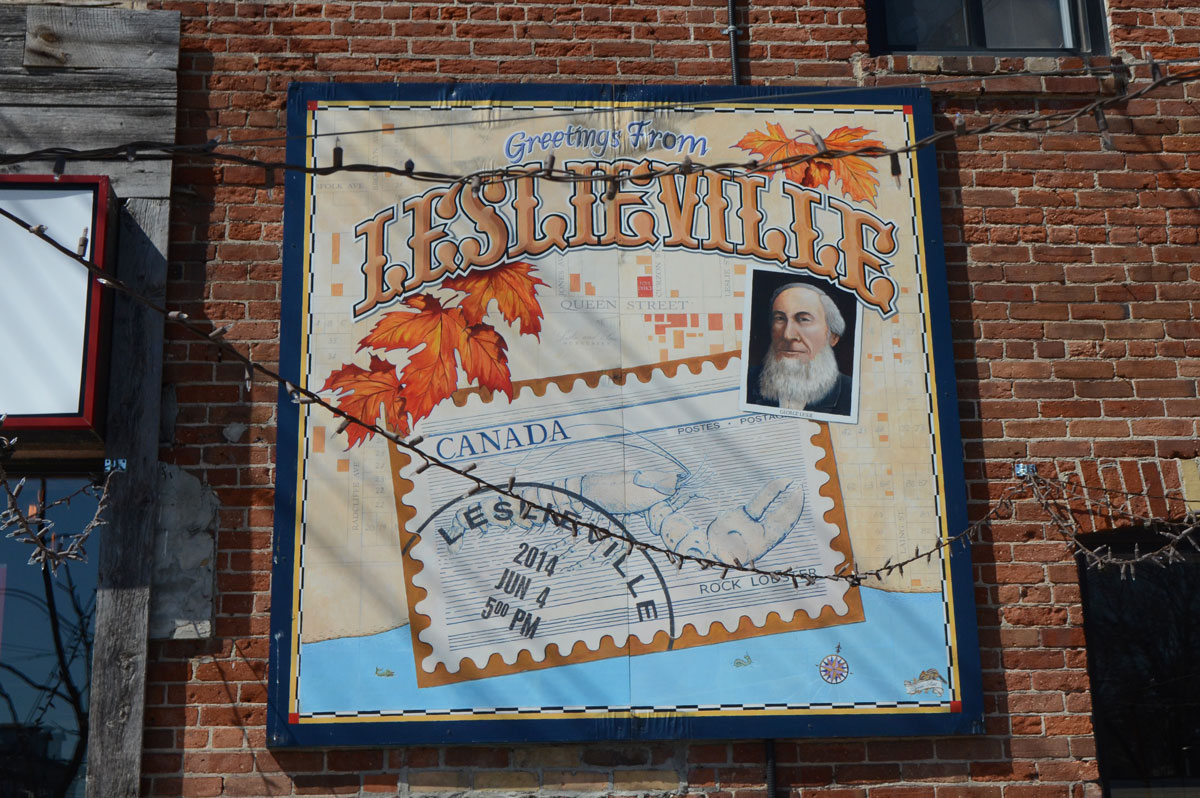
below: Farther east on Queen Street, at Curzon,  there is this ‘Greetings from Leslieville’ mural.

One of the Leslieville murals. Greetings from Leslieville with a postcard on it.

There are many interesting little stores on this stretch of Queen Street.
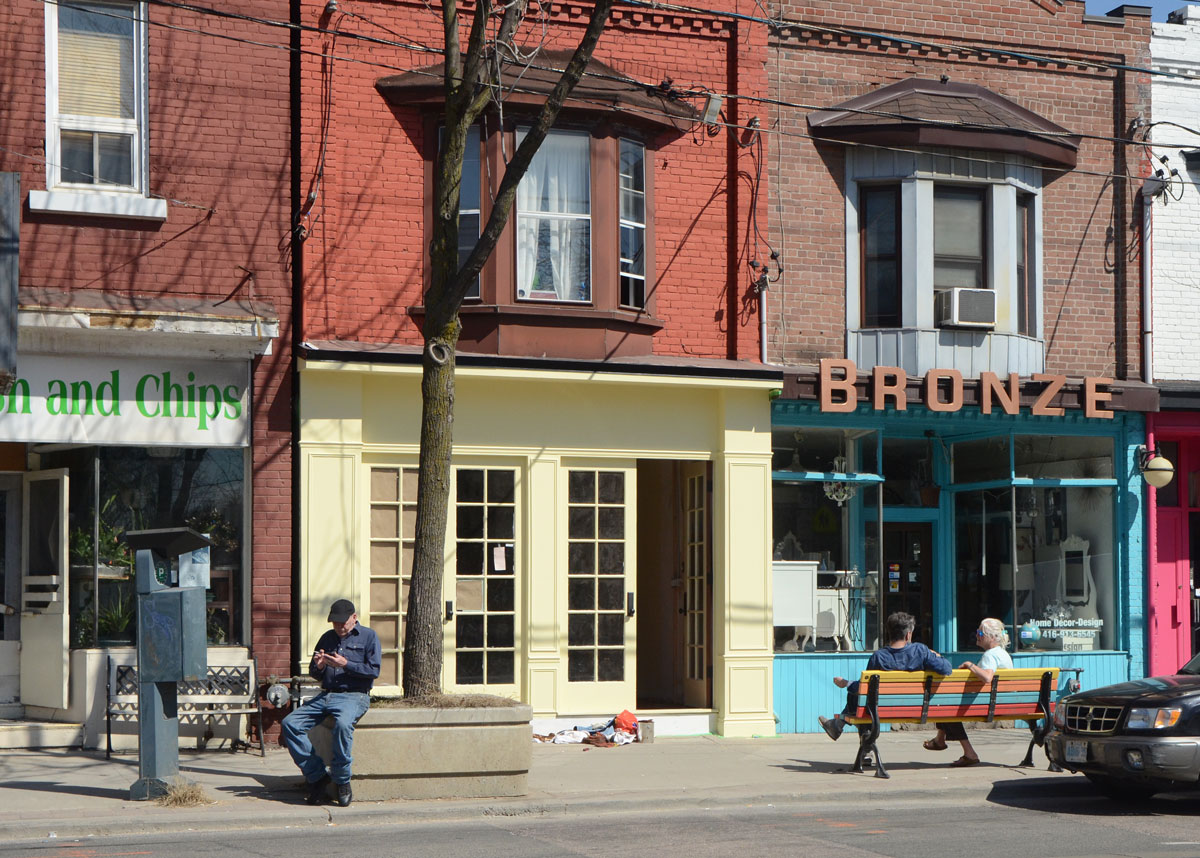
All the benches have been painted in cheerful colourful stripes.

Looking across the street at a man sitting on the edge of a concrete planter for a tree as well as a multicoloured striped bench with two women sitting on it. They are in front of two storey brick buildings with stores on the bottom level and apartments on the top. One of the stores is Bronze.

Rubiks cubes and large red and white dice in a store window, some real and some reflected in a a mirror on the wall.

looking into the window of a pharmacy, a toy troll is in a white mug. The mug has red lettering - Yours pharmacy. Also a mortar and pestle in the window along with a box with medicines for influenza

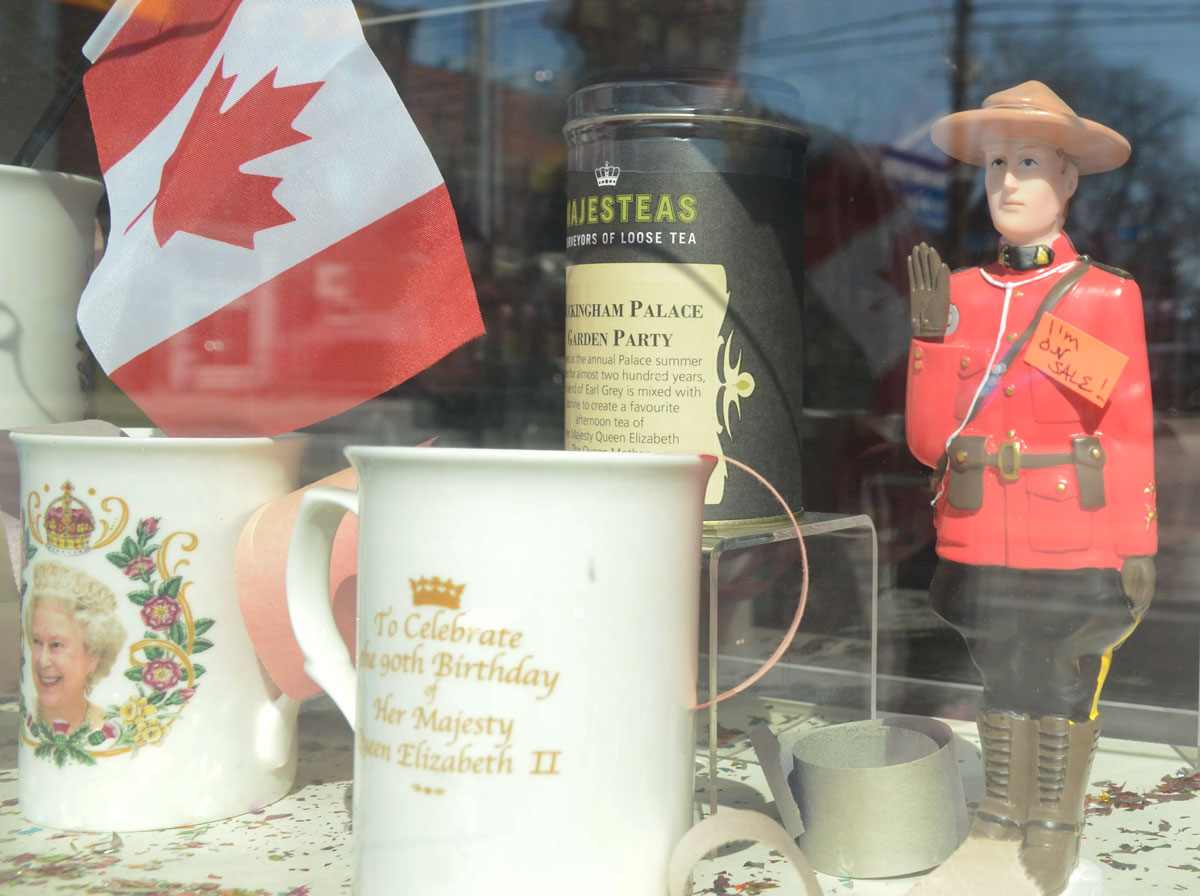
below: On the 21st of April (yesterday), Queen Elizabeth II celebrated her 90th birthday.
A number of stores and restaurants had displays in her honour.

items in a store window. A Canadian flag, a mountie figurine that waves, two mugs featuring Queen Elizabeth and a container of tea.

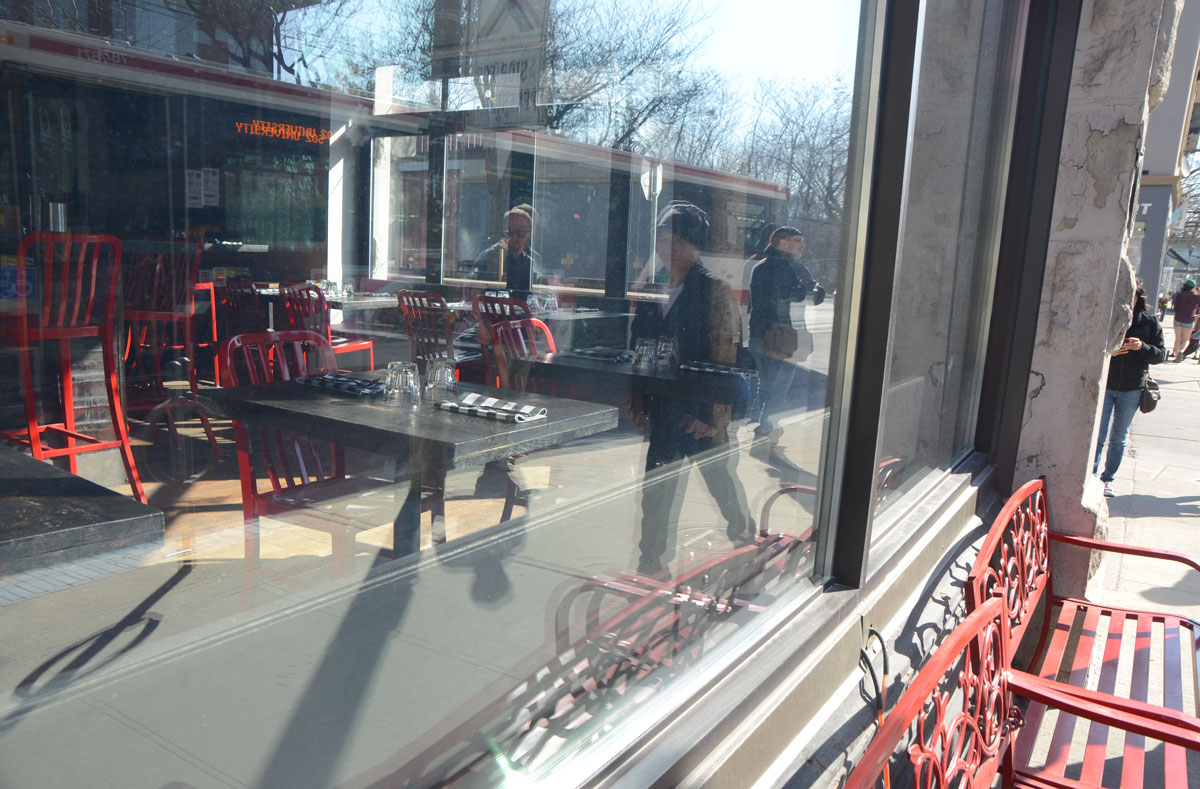
A picture of Queen Elizabeth hangs on a wall in a cafe, seen through the window with reflections of the sky. There are red chairs in the cafe

Queen Street East was developed as long ago as the mid 1800’s and remnants of various decades can be found as one explores the area.
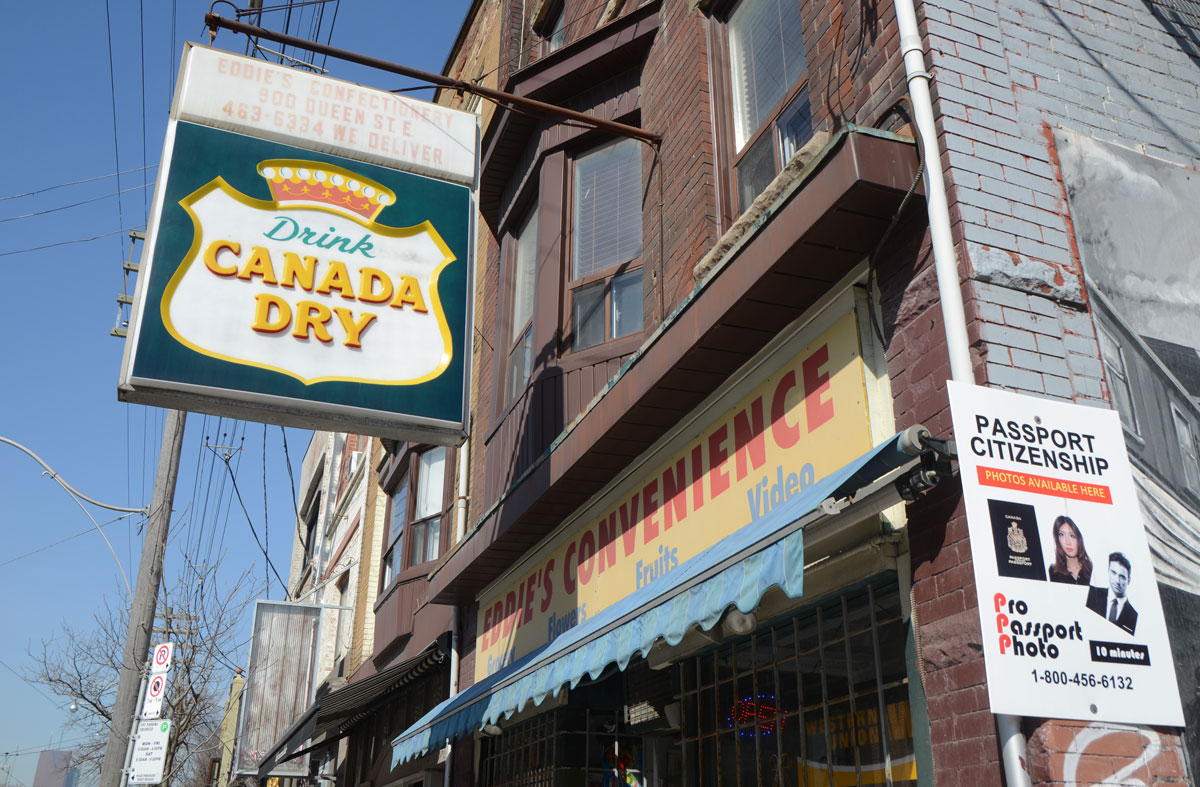
below: … details such as this fading Canada Dry sign.  The formula for Canada Dry ginger ale was developed in the early 1900’s by John J. McLaughlin, of the same McLaughlin family whose early automobile factory led to the start of General Motors.  This ginger ale was patented in Toronto in 1907.  Usually the words ‘Canada Dry’ are written in red, not yellow.   Is there a time when Canada Dry used yellow lettering?

An older Canada Dry advertisement sign hangs over the entrance to Eddies Convenience Store on Queen St East.

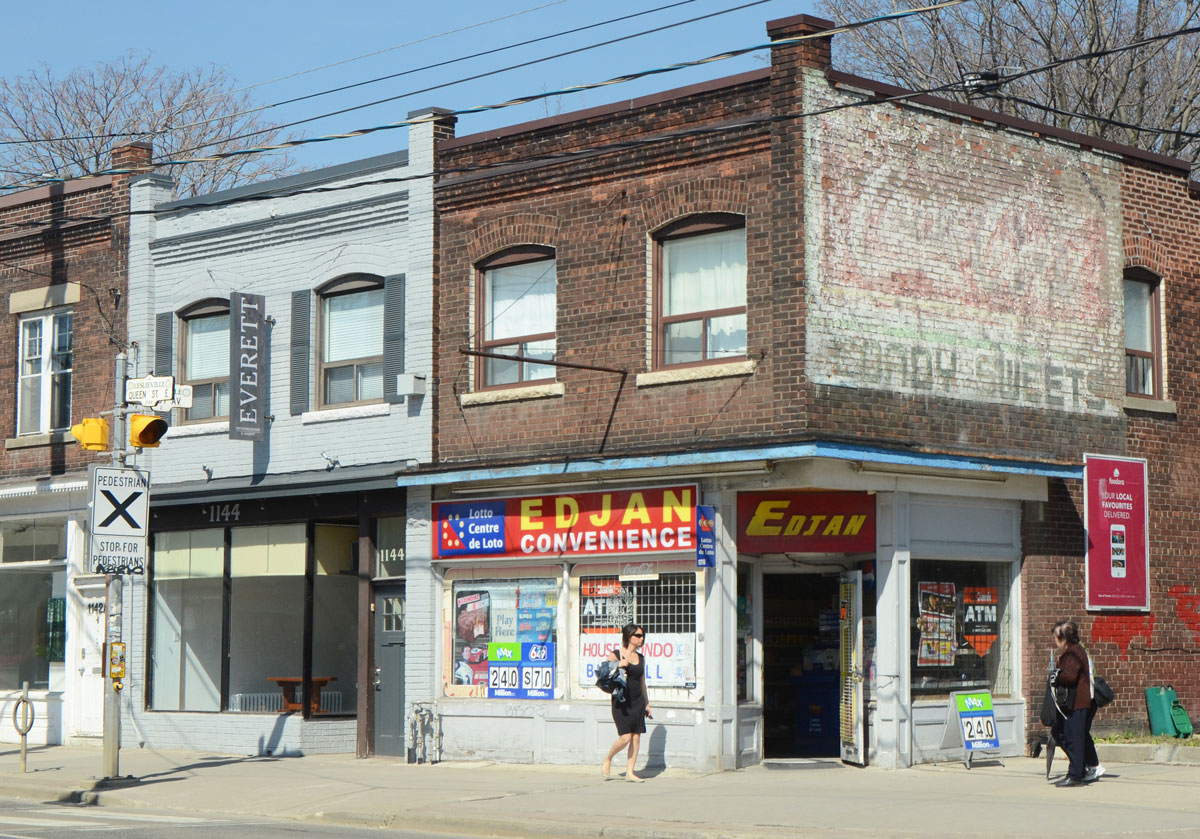
below:  At the corner of Queen and Coady there is also a ghost sign for Coady Sweets as well as an advertisement for Coca-Cola.

On a corner, Edjan Convenience Store with people walking past it. On the side of the upper floor of the two storey brick building is a ghost sign advertising coca cola and Coady Sweets. At the corner of Coady and Queen St. East in Leslieville Toronto
  below: Call it luck – even a vintage car drove past while I was there.

A black vintage car drives by on Queen St East

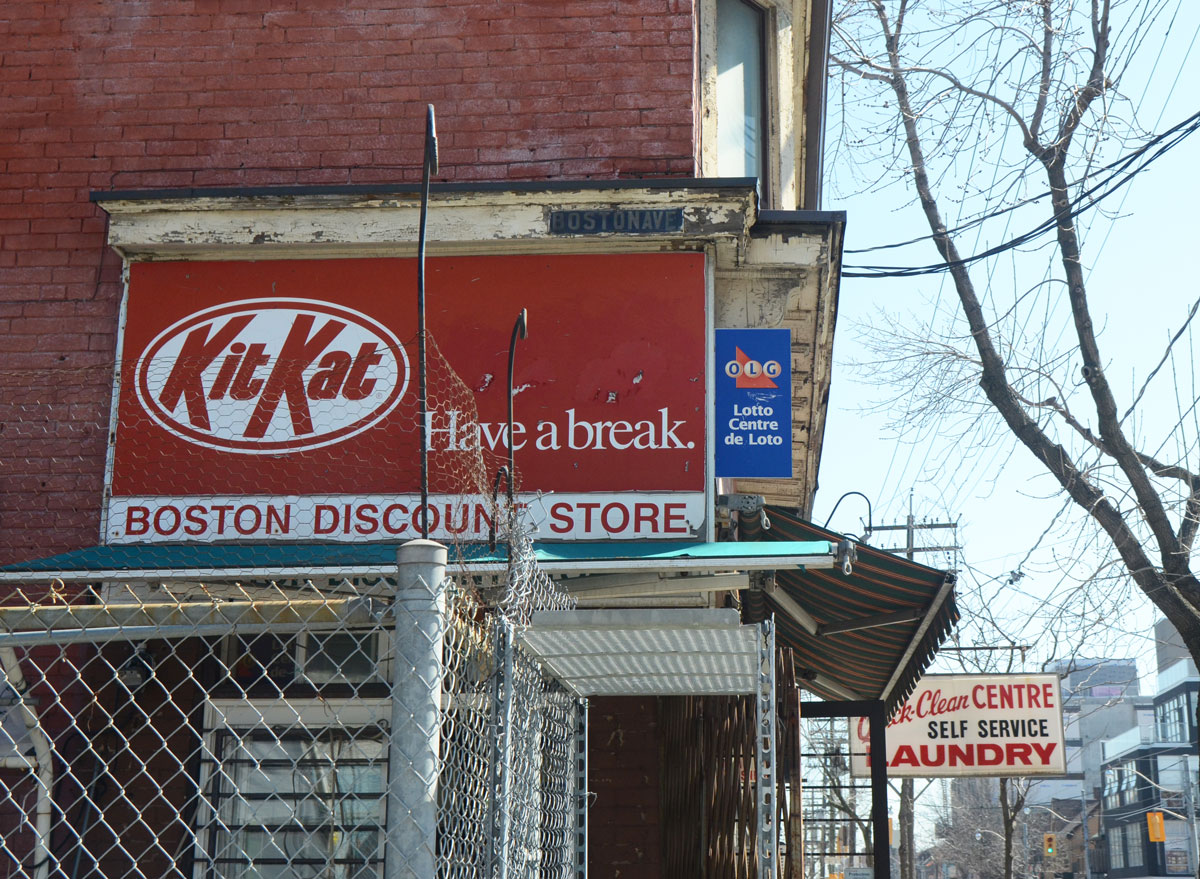
below: An old KitKat advertisement on the side of Boston Discount Store.  If you look closely, there is also an original Boston Ave street sign at the top right of the KitKat ad.

Side of a convenience store with an ad for KitKat, have a break, is painted on the side. Boston Discount Store on the corner of Queen St. East and Boston Ave

below: Even older are the buildings in the mural of Queen St. East circa 1926.  I am not sure if this an accurate depiction of a particular stretch of Queen Street.  It might be interesting to do some research to find out if the picture can be retaken, 90 years later.  So far I have been unable to find out anything about a Jackson Brothers store on Queen East.

Black and white mural of historical picture of Queen St East

below:  A sign of the new, some of the new TTC streetcars are now running along Queen Street.
The side of a new TTC streetcar behind a striped bench on a sidewalk

below: A mural depicting Frank Zappa along with the words
“Stupidity has a certain charm.  Ignorance does not.”

A mural of Frank Zappa on the upper floor of a two storey building. Also includes the words Stupidity has a certain charm, ignorance does not.

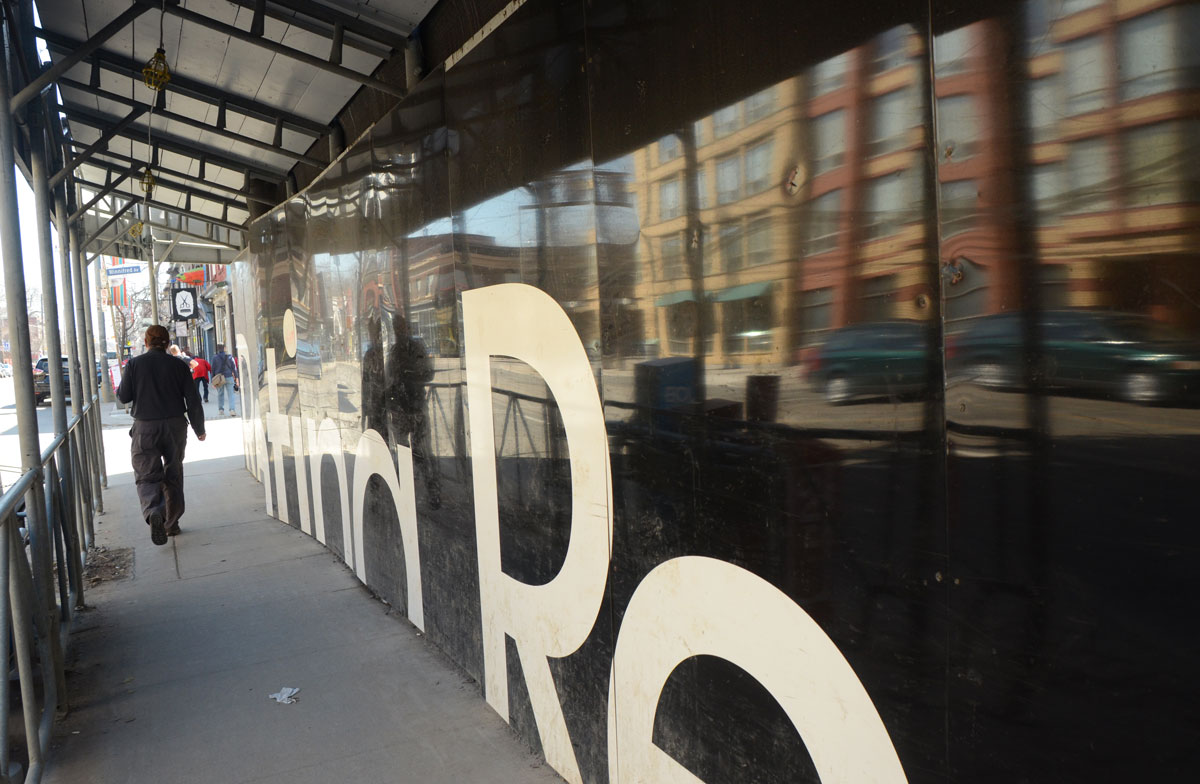
below: Like so many places and streets in Toronto, there are condos going up here too.

reflections in the shiny black hoardings around a condo construction site. buildings, car, people

A young man walks past the Value Village Donation Center that has a large window with 3 mannequins in it. A bike is parked in front.

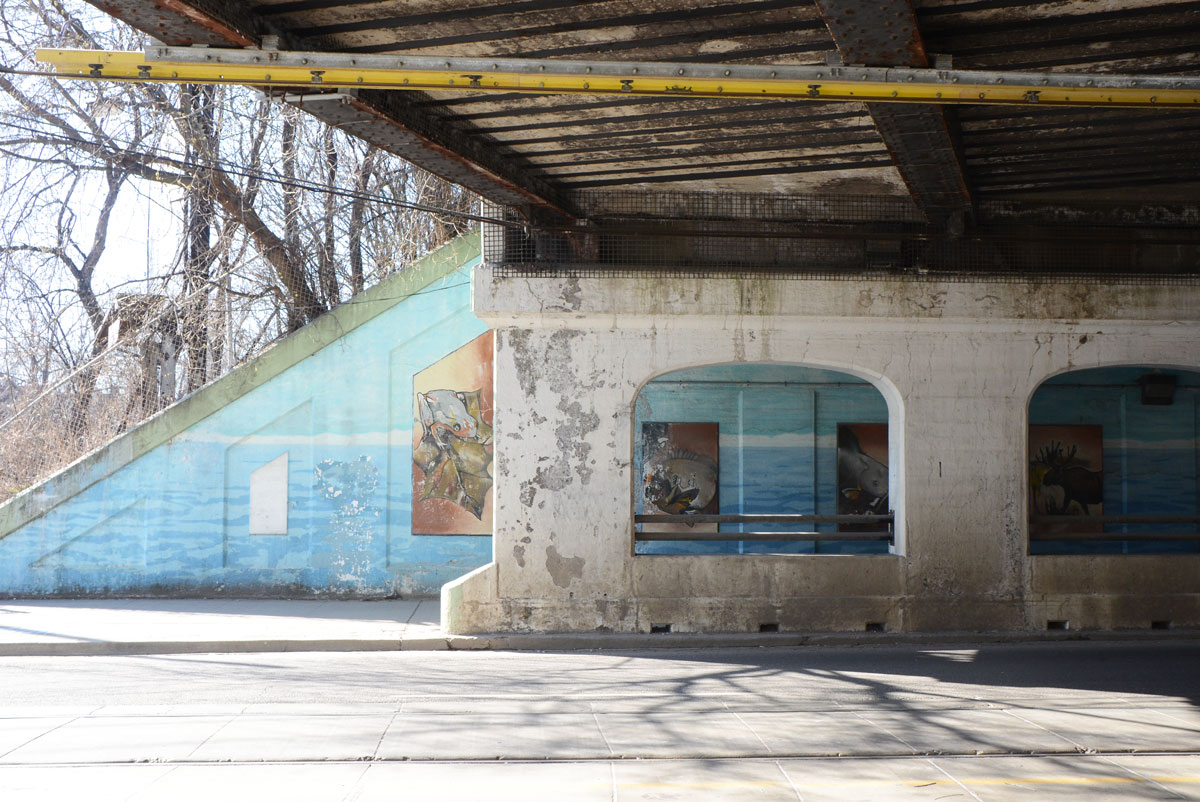
below: The railway tracks pass over Queen Street.  A number of years ago the underpass was decorated with paintings of different animals and those paintings remain in good shape.

A small section of the railway bridge over Queen St. East near De Grassi. The far wall is painted light blue and there are picture of animals on it.

below: Once upon a time trains served this area.  There was a railway station here but it is long gone.

historical plaque describing the history of Riverdale train station at Queen St. East and De Grassi St in Toronto

transcription:

“In 1896, the Grand Trunk Railway opened its Queen East Station to serve Toronto’s growing east end.  Renamed Riverdale Station in 1907, the building stood here on De Grassi Street at Queen Street East.  Its dramatic turret, bay window, and a deep overhanging roof were defining features typical of small railway stations of the period.

In 1904, a streetcar collided with a freight train at the level crossing on Queen Street East, killing three people and injuring 18.  This and subsequent accidents led to the elevation of the new Union Station railway corridor above city streets and sidewalks.  The station was moved in 1927 to accommodate the new embankment for the underpass, the first of nine to be completed.  Dwindling passenger numbers during the Great Depression led to the closure of Riverdale Station in 1932 and its demolition in 1974.”

below: Looking west from under the railway bridge.

Photo taken from under a bridge, looking west along Queen St. East, cars on the street, a restaurant on the corner, and some women on the sidewalk.

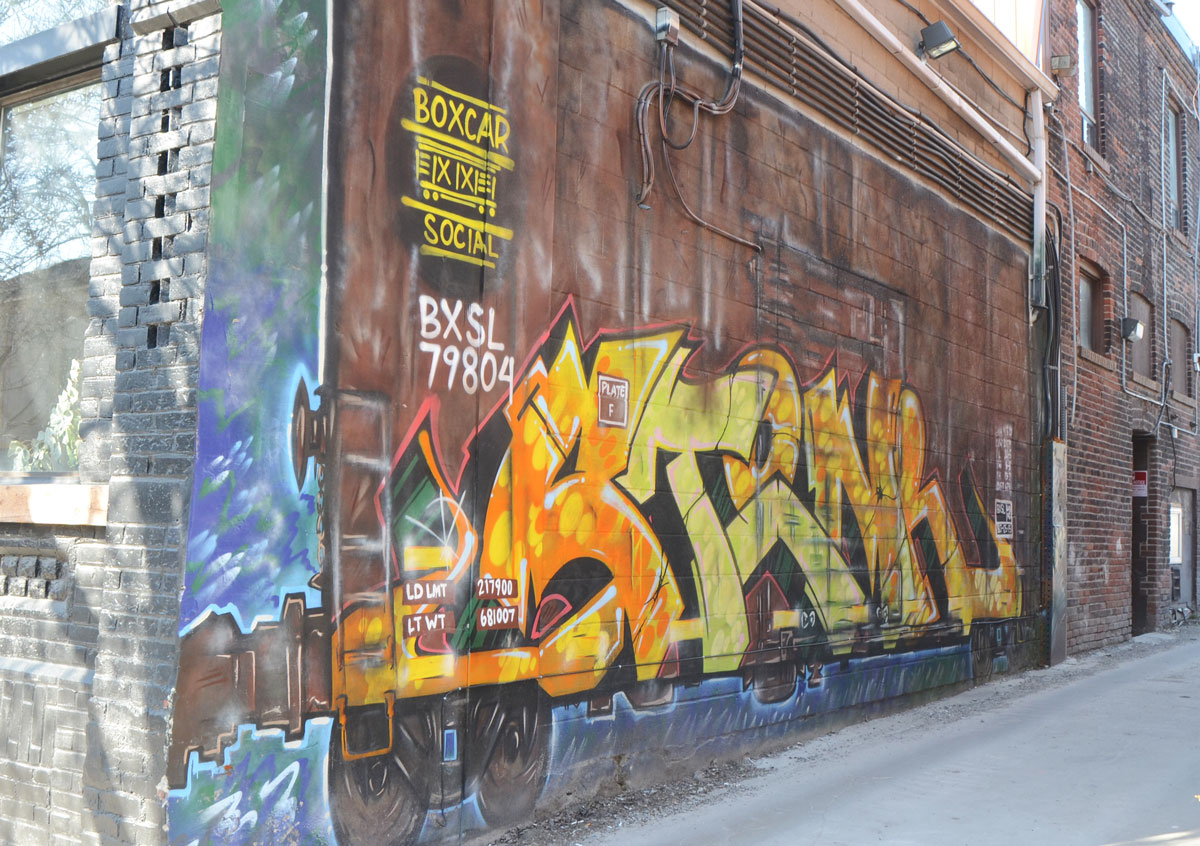
below: A train themed mural in an alley just off Queen Street.

Street art painting of a brown train boxcar, with a yellow and orange tag on it, on the side of a building in an alley.

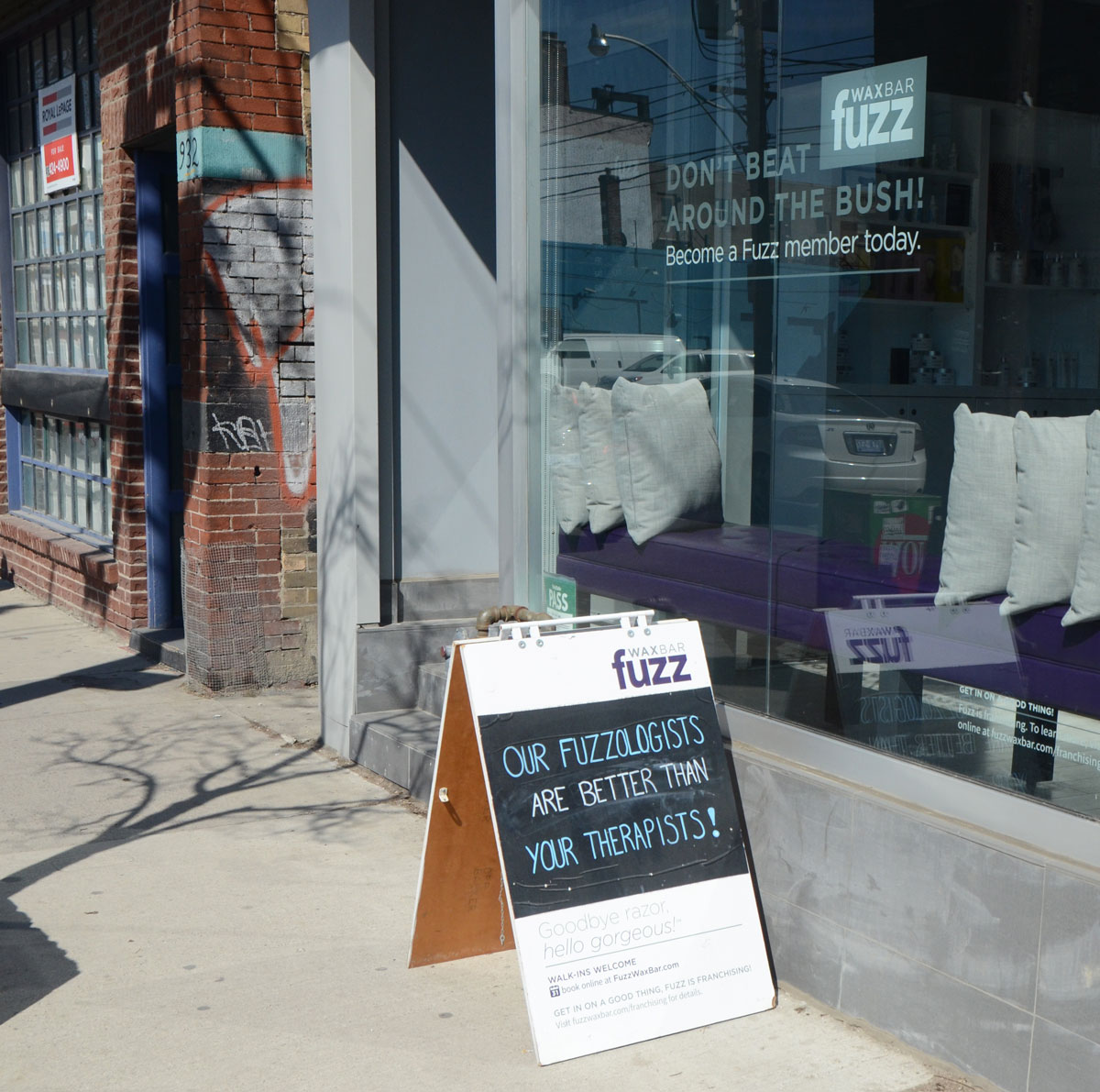
board outside Fuzz salon.

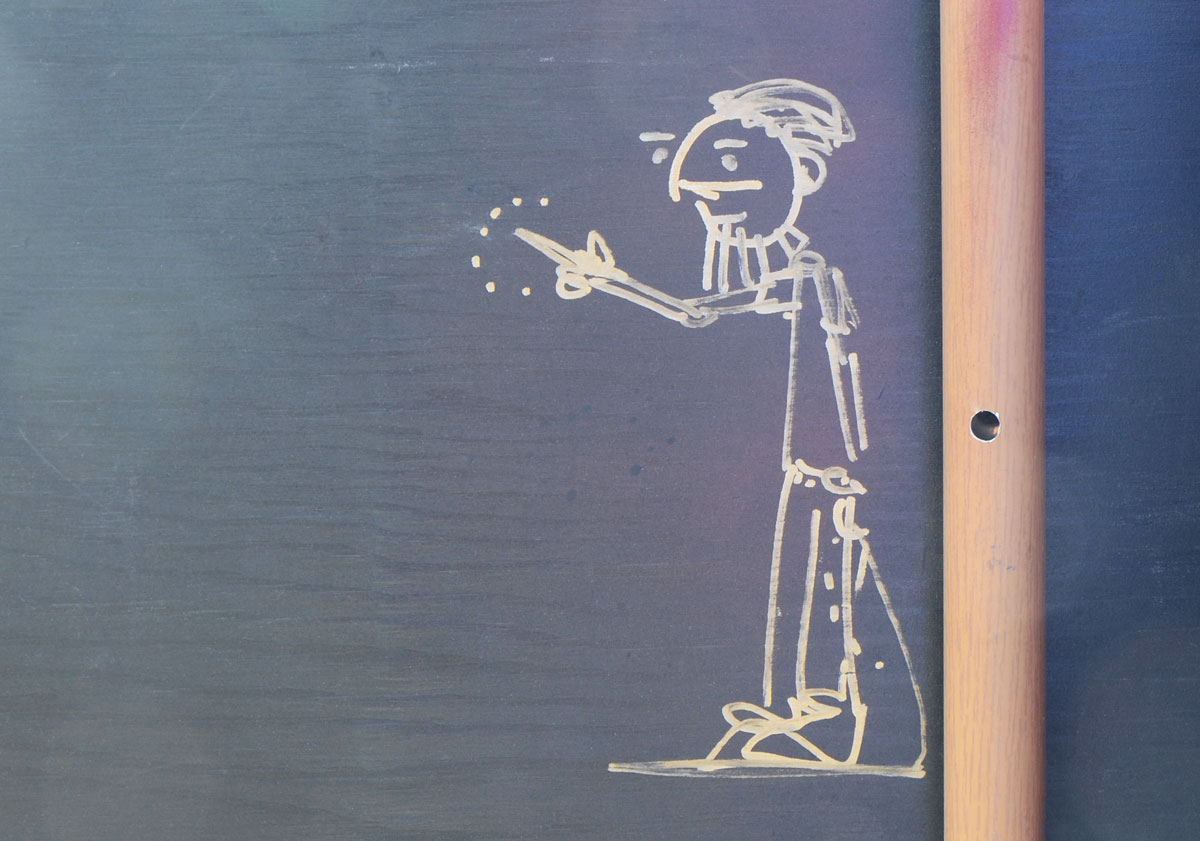
graffiti, white stick drawing of a man with a beard pointing his finger, or giving someone the finger, hard to tell

Two brick stores on Queen St East, two storey. One is the OKOK diner with a mural on the side of it that features an older version TTC streetcar.
reflections in the window of a cafe. Red benches are outside the window. People, TTC streetcar

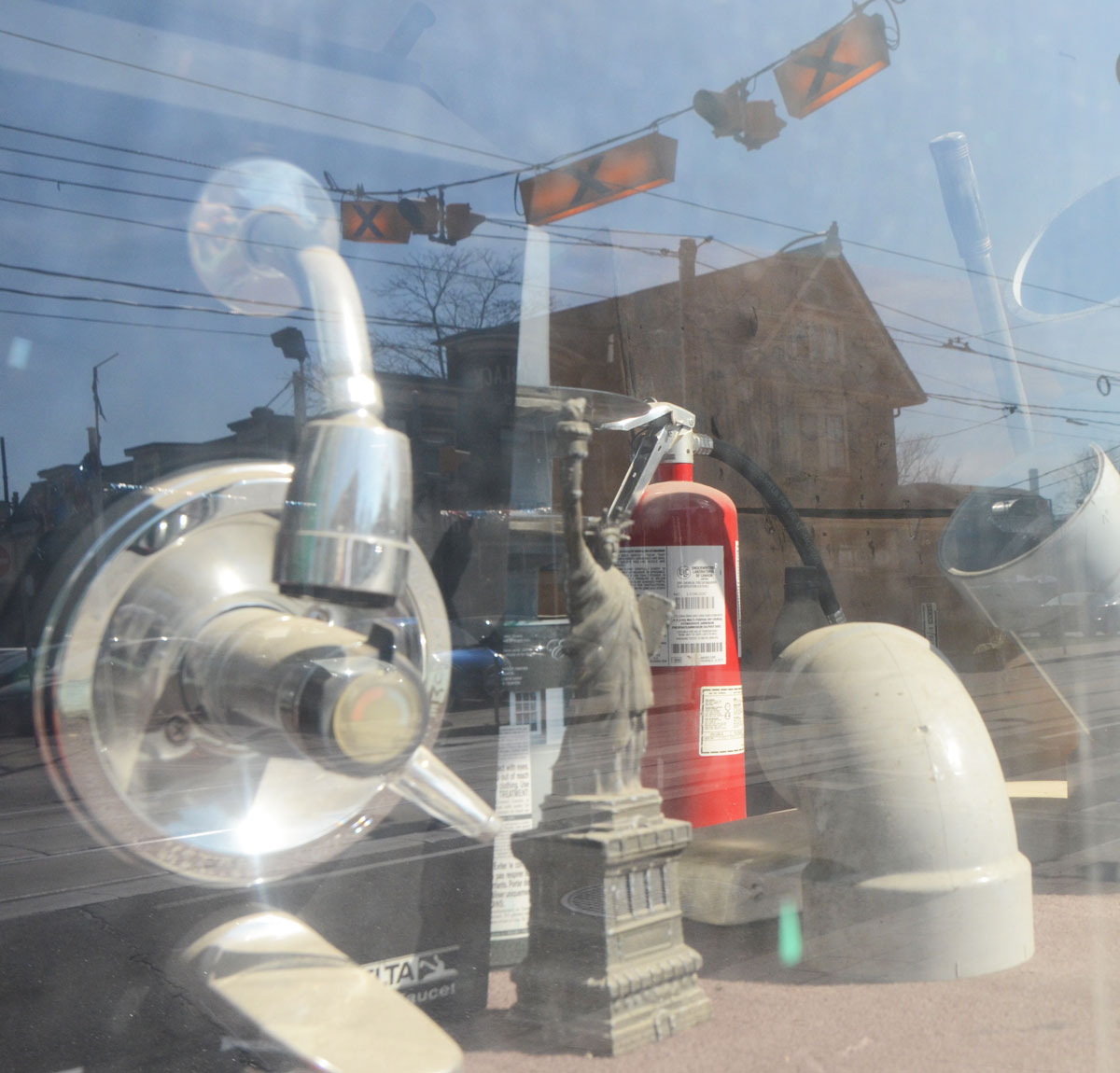
Looking into a store window. A small model of the Statue of Liberty, a fire extinguisher, a pump and some PVC pipe parts. Reflections of sky, buildings from across the street and a yellow set of lights above a cross walk.

The painted sign on the door of Dangerous Dan's restaurant that says, No bathrooms, no change, no outside food, no kidding.

Within the past week or so, the fences around the new Canary District have come down.  Toronto’s newest development is now open to the public so I thought I would check it out.

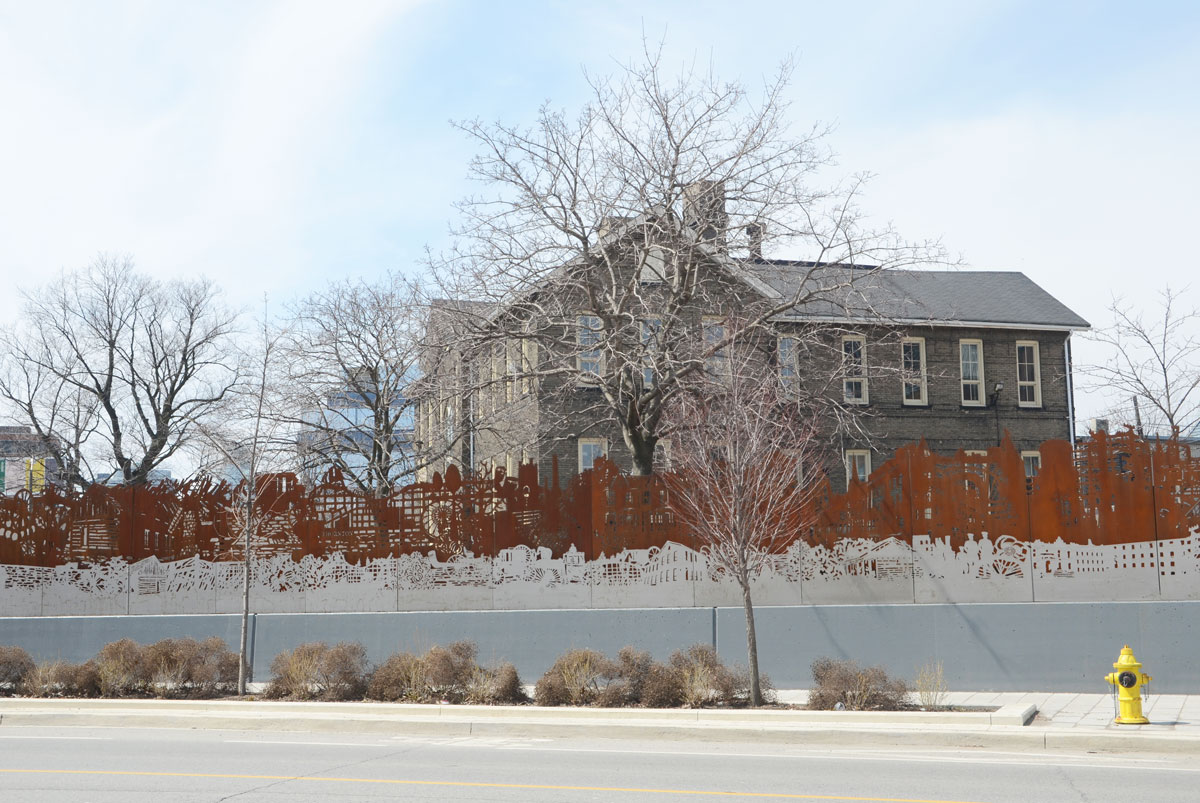
I started my walk from the streetcar stop at King and Sumach.  Walking down Sumach Street I passed the metal fence that separates the school property from the street.  This stone building was built in 1887 as Sackville Street School and it has been used as a school ever since.  At the moment it is home to Inglenook Community School.  The fence with it’s double layer of metal – rusted in the back and shiny in the front – is interesting in the daytime but even more so at night when it is lit with a series of lights located between the layers  and near the base of the fence.

public art on Sumach St., rusted metal and shiny metal fence with cut outs, looking across the street at it, with older stone building behind it.

When I took the above picture I was standing on the new streetcar tracks that run south from King Street.  The tracks are ready and the wires have been installed.  Streetcars will begin servicing the route in June as part of route 514.  No map or schedule appears on the TTC website yet but apparently this route will run between the Dufferin Gate Loop and the new loop on Cherry Street via King Street

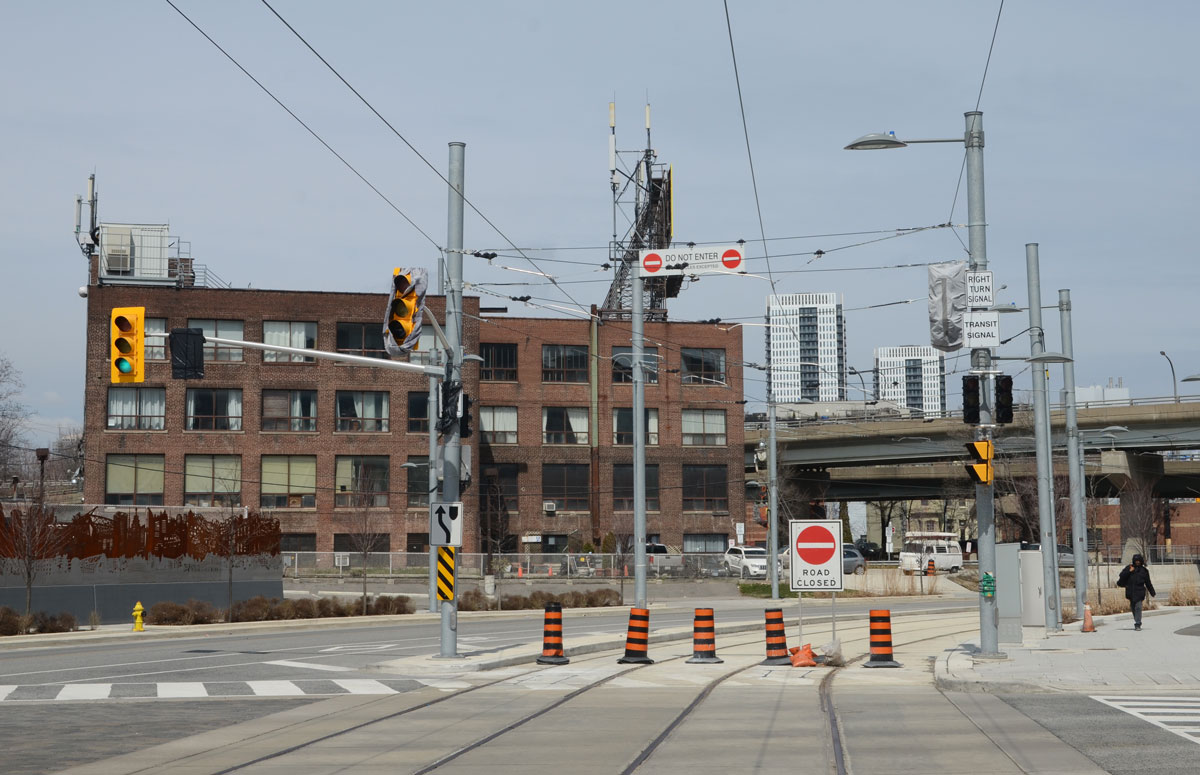
below: Looking north from Eastern Avenue at the new streetcar tracks on Sumach Street.

looking north on Sumach Street from Eastern Ave at the new streetcar tracks. They are blocked by 5 large black and orange traffic cones as well as a large do not enter sign. Overhead wires for the streetcars are in place.

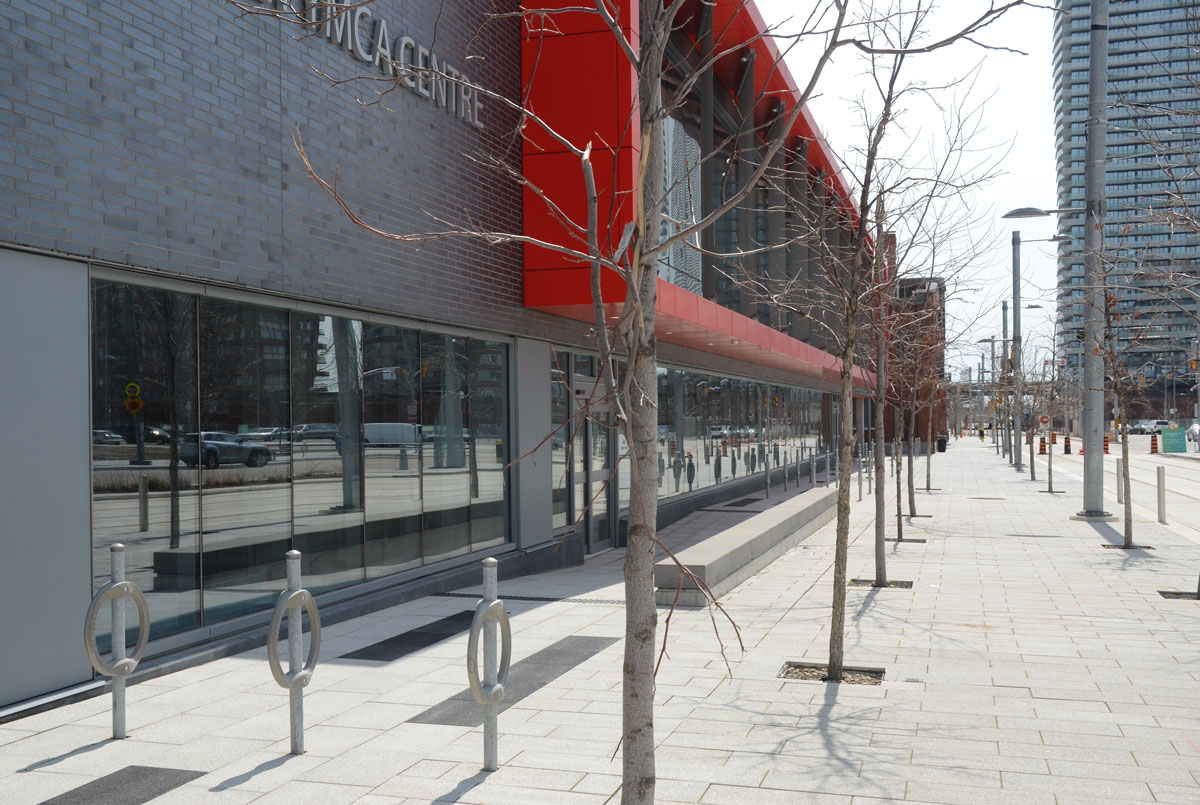
At Eastern Avenue, Sumach Street becomes Cherry Street.   The new Cherry Street YMCA is on the east side of the street.  The sidewalk is wide but at the moment the branches of the young trees are at face level and you have to be careful where you walk.

looking south on Cherry Street from Eastern Ave, past the new Cherry Street YMCA on the left and all the new trees that have been planted.

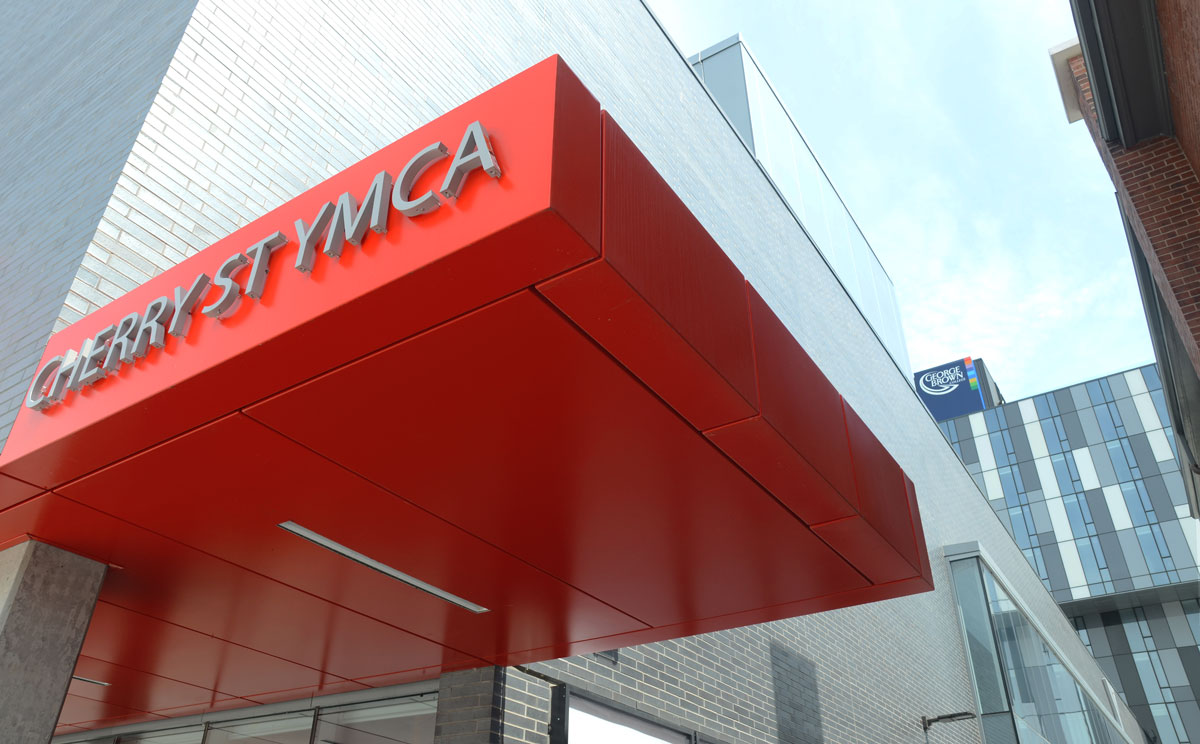
below: The bright red detailing on the YMCA building continues over the entry way.  Part of the new residences for George Brown College peak out from behind.

roofline over the entry of Cherry Street YMCA with it's bright red colour. Corner of George Brown College building is in the background.

Front Street now has wide sidewalks.  None of the businesses have moved into the ground level retail spaces yet but the signs in the windows suggest that a number of cafes, restaurants, and food stores will soon be opening.   A couple of public art pieces are also on the sidewalk.

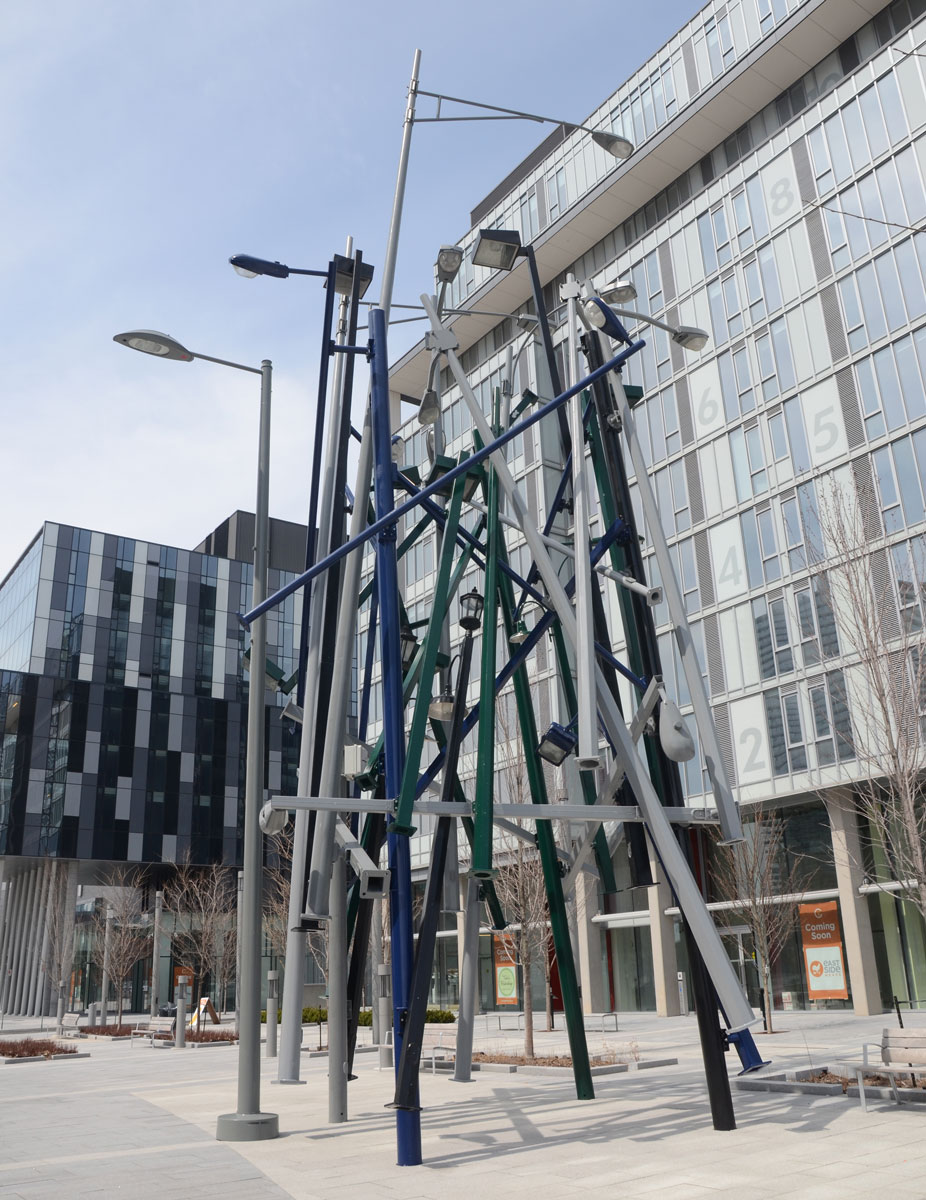
below: ‘Lampposts’ by Tadashi Kawabata

A tall art installation as public art on Front Street in the Canary District, Lampposts by Tadashi Kawabata, construction from many different styles of street lamp posts all arranged in a cluster

below: Looking up from underneath the artwork.

looking up at the lights from underneath the artwork,Lampposts by Tadashi Kawabata

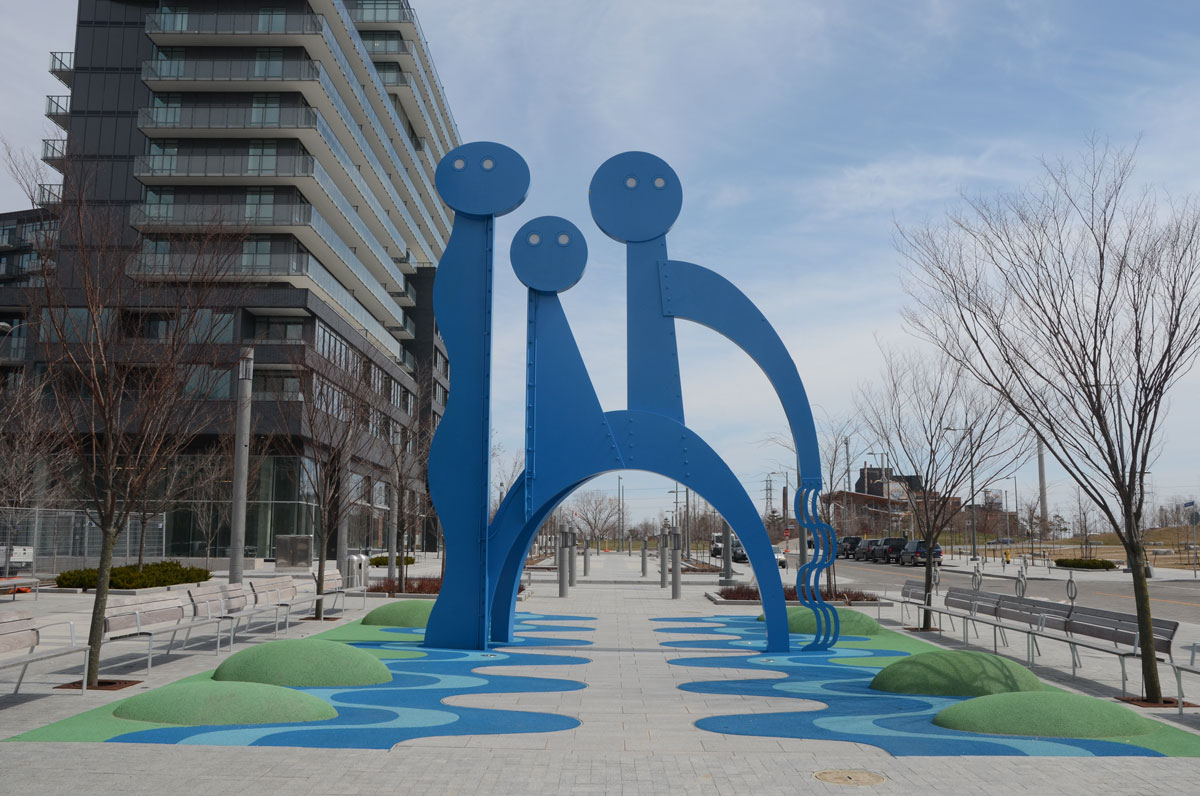
below: ‘The Water Guardians’ stand over a soft squishy playpad.
It was designed by Jennifer Marman and Daniel Borins.

'Tje Water Guardians', A tall art installation as public art on Front Street in the Canary District, 3 stylized abstracted human forms with legs in an arc shape over a squishy playpad in green, blue and white. The blue represents water. The green parts are raised slightly in bumps.

below: There are a lot of little design elements that have been incorporated into the this development including what I think is a bench.  With a light underneath?

A curved black metal bench on a sidewalk

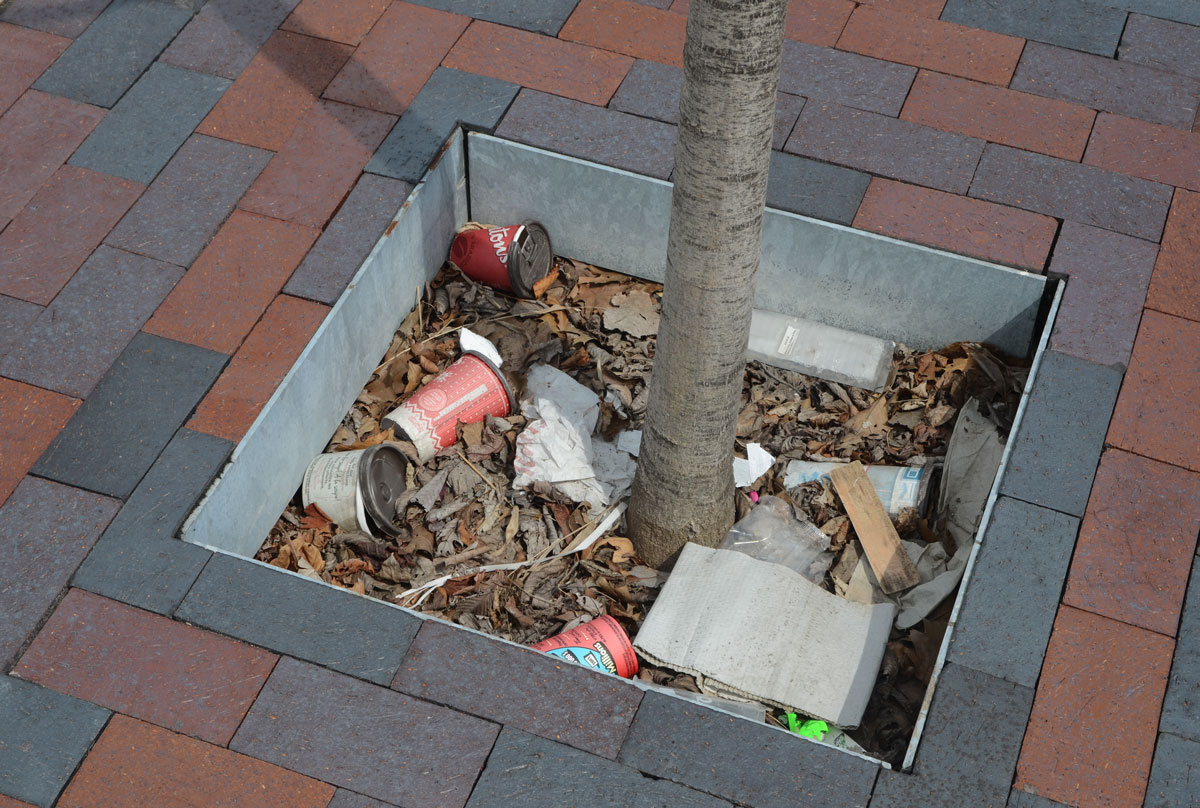
below: The sidewalk around the trees is made from two colours of brick.  The opening for the tree is just the right size to collect garbage.  Whether or not these traps get cleaned out remains to be seen.

square hole in the brickwork of the sidewalk to allow a tree to grow. The hole is shallow, a few cm. deep but it collects garbage such as empty coffe cups and discarded papers that blow in the wind.

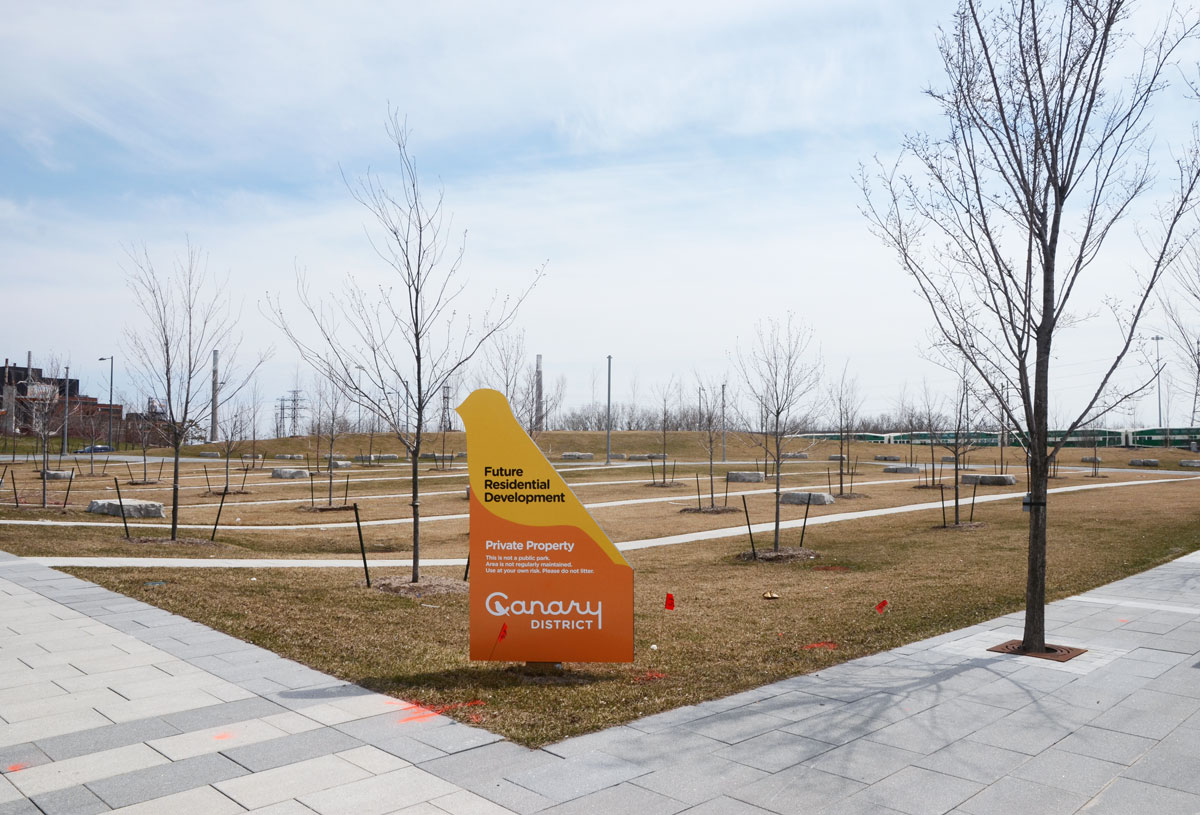
below:  The Canary District is not yet finished as this sign clearly states.

A large plot of land with rocks and newly planted trees in a grid. An orange and yellow sign advertises the Canary District. It also says that this land is slated for future residential development

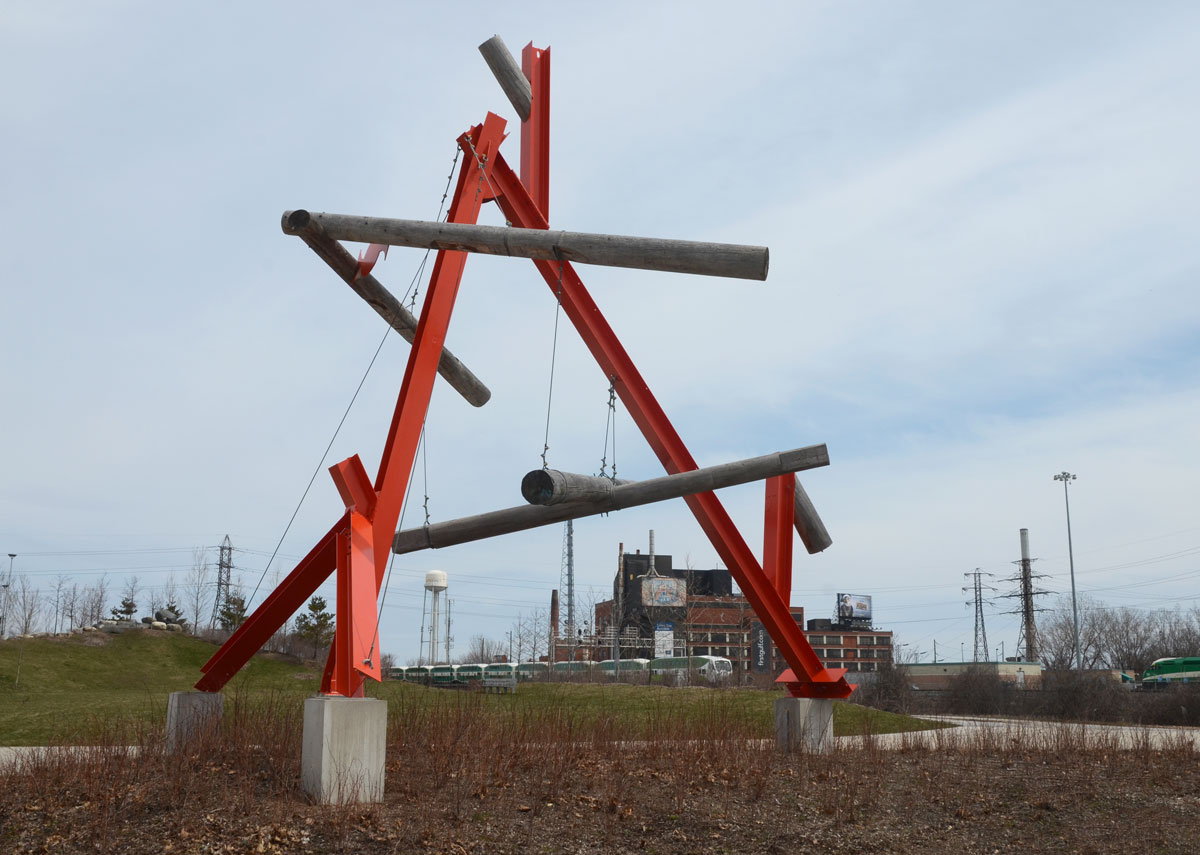
below: The sculpture ‘No Shoes’ by Mark di Suvero is now accessible.   The artwork was completed in 1967 and originally installed in High Park.   In 2013 it was renovated and moved to Corktown Common.

The sculpture 'No Shoes', red metal beams and wood poles, very large, stands in a park with some buildings in the background.

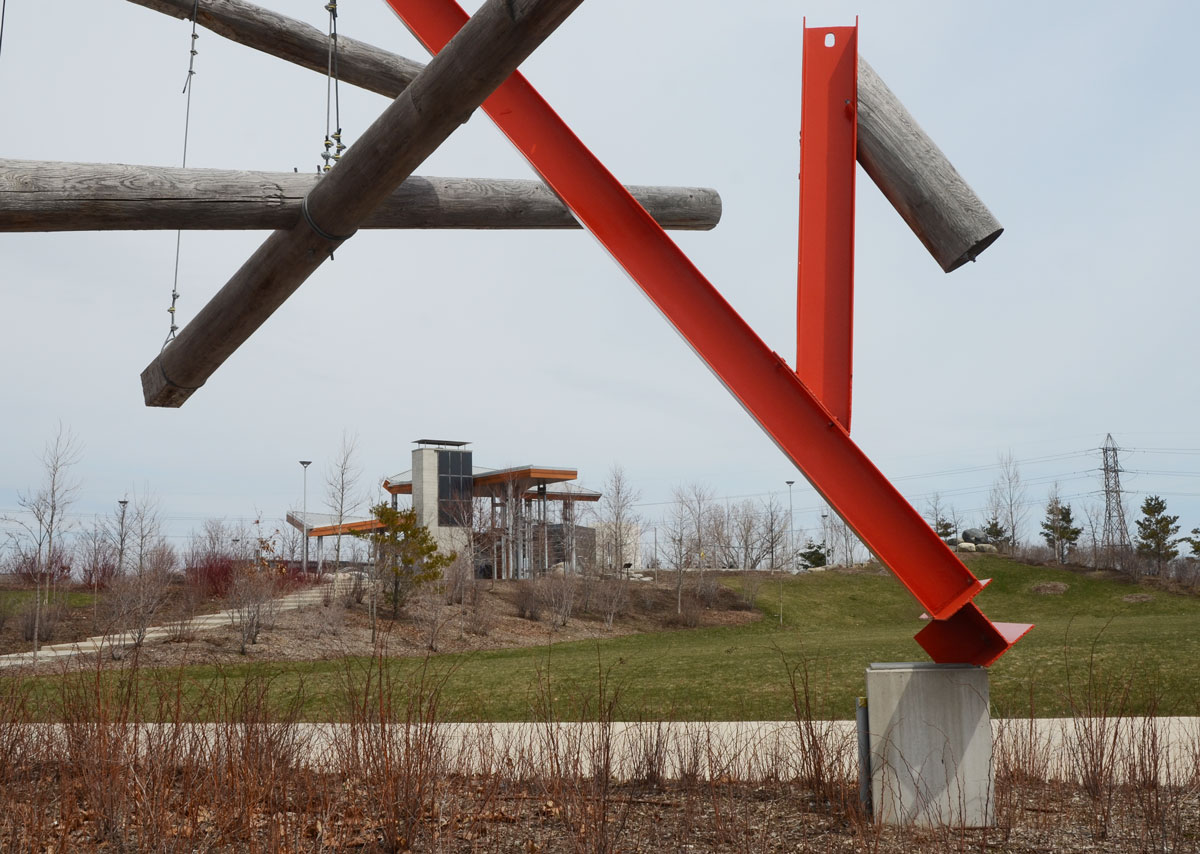
below: The pavillion at Corktown Commons in the distance.

The pavillion at Corktown Commons i the background as seen through the bottom part of the sculpture 'No Shoes'

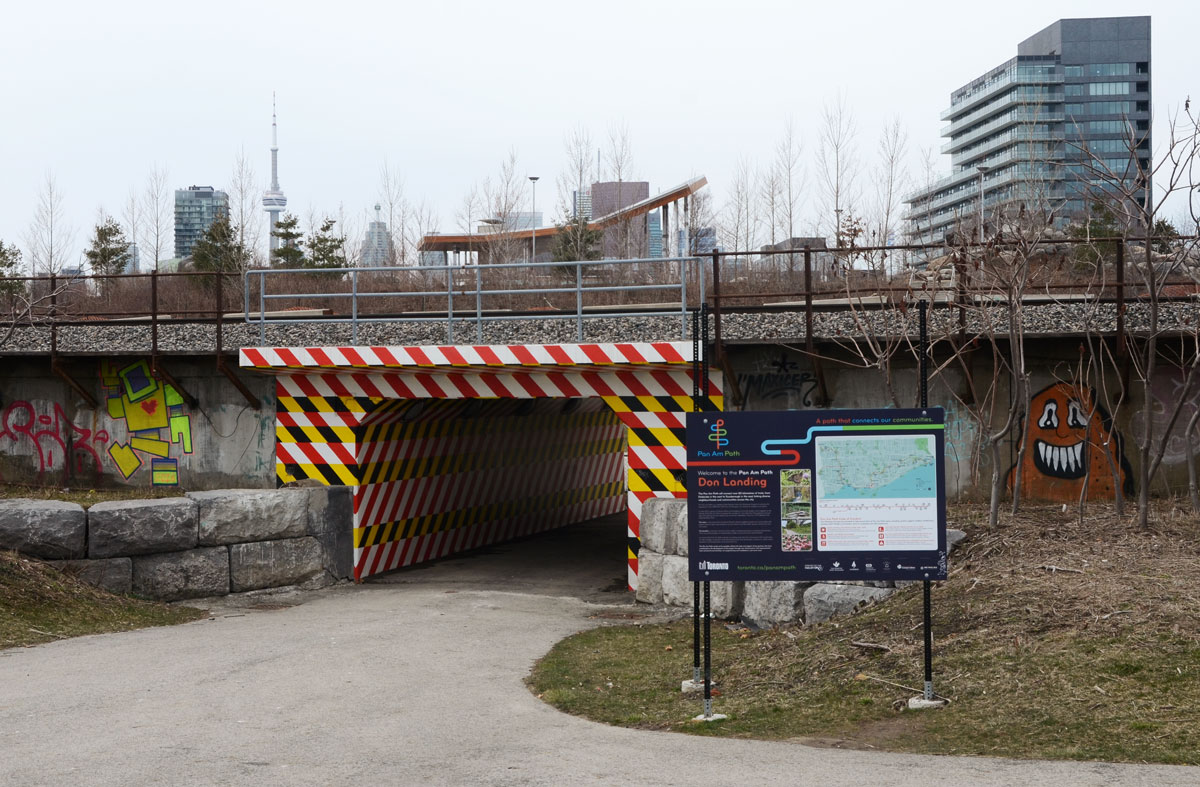
below:  The Bala Pedestrian Underpass, aka the south exit from Corktown Commons, goes under the railway tracks and merges with the Don Landing part of the Lower Don Valley trail.  The artwork was designed by Rolande Souliere and is part of the StreetARToronto initiative.   A yellow Lovebot and a happy orange monster have been added to the scene too!

pedestrian underpass under railway tracks that has been painted in bright stripes, yellow, red and black. The left of it is a large yellowlovebot and to the right is a sign with a map and a description of the Don Pathway, part of the Pan Am Path.

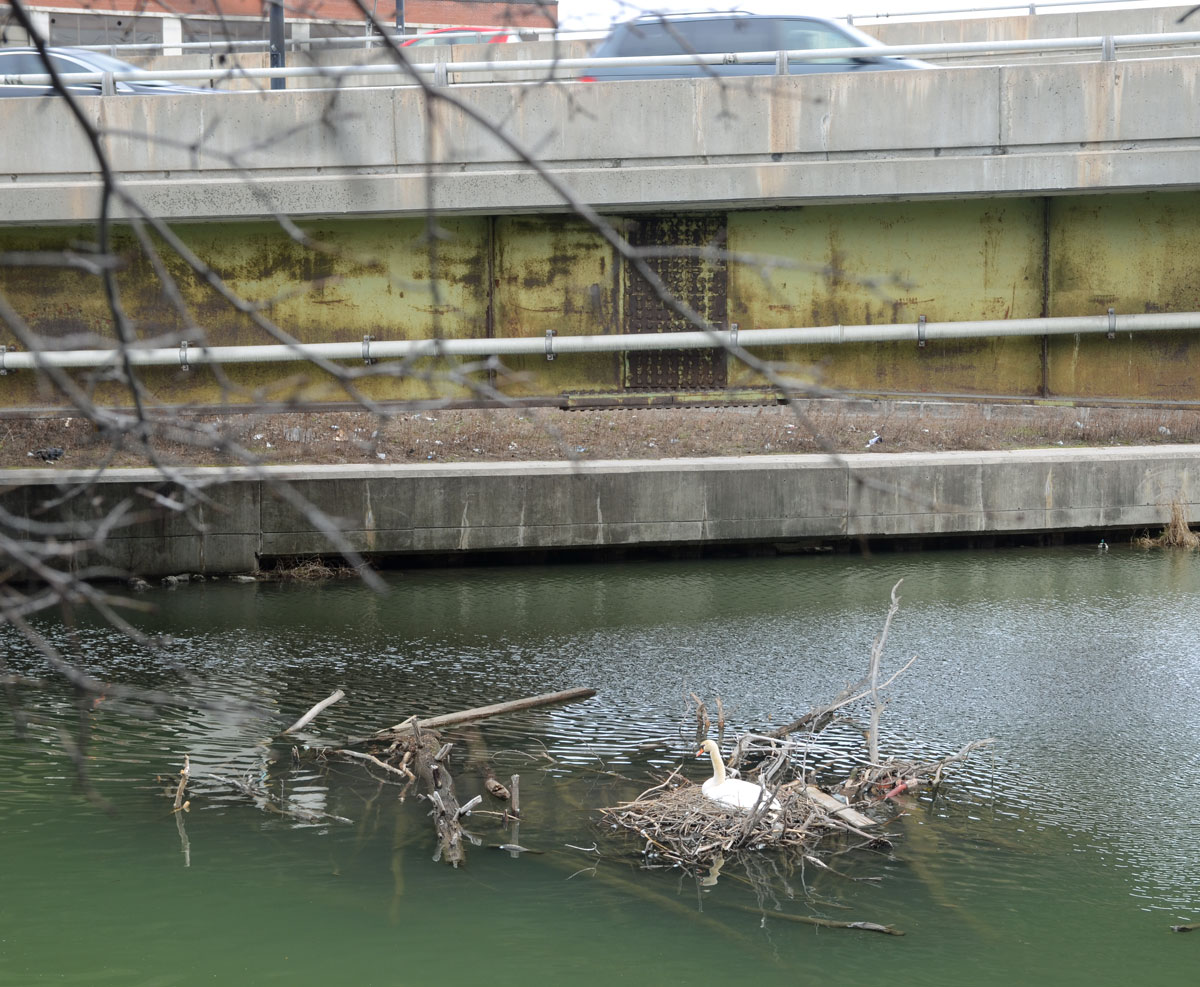
below: Nature in the city.  Birds of a different feather.  On the Don River, just south of Corktown Common a pair of swans is nesting.  One of the swans was swimming a short distance away while the other was sitting on the nest.   Cars pass by on the Don Valley Parkway unaware of the domestic scene below them.

A swan is sitting on a nest in the Don River, it is beside the Don Valley Parkway, a busy road in Toronto, two cars are passing by above the swan.

The eastern end of the Kay Gardner Belt Line Park crosses over Yonge St and the subway just south of Davisville station.  It then runs across the north side of Mt. Pleasant cemetery.  It comes to an end at Mt. Pleasant Road where the trail merges into the roads that run through the cemetery.

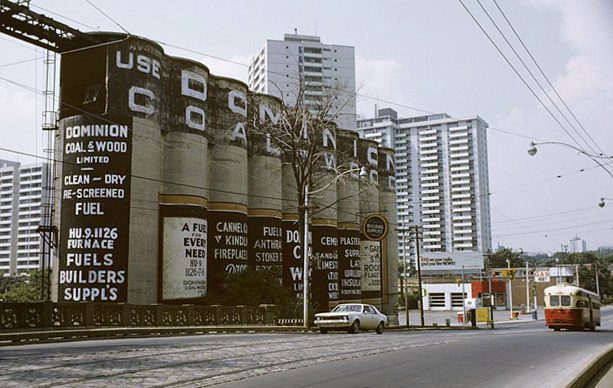
In 2014 students from Greenwood School painted a mural at this location.  The mural has three main elements.  A train to represent the Belt Line, the name of the community that it is located in (Mt Pleasant Village), and the words ‘use Dominion Coal and Wood’.    The last part is because not long ago, on this site, stood the large concrete silos that the Dominion Coal and Wood company used to store coal and wood.   The shape of the black background is very similar to the shape of the silos if viewed from above.

below: Mural, with Mt. Pleasant Road above it.

blog_domiion_mural_greenwood

mural celebrating mt pleasant village and the old dominion coal and wood silos that used to be at that location. At the end of the belt line trail where it merges into mt pleasant cemetery

below: Plaque located on the site of the old silos (now in the bushes beside a condo)

City of Toronto historical plaque describing the history of the Dominion Coal and Wood silos that used to be on Mt. Pleasant Ave near the old Belt Line Railway tracks.

transcription of the Heritage Toronto plaque:

“Dominion Coal and Wood

Originally located on Danforth Avenue, the Dominion Coal and Wood Company was founded in 1912 by William H. Smith.  In 1929, the company opened a landmark facility on this site.  Its nine adjoining concrete silos were designed by E.P. Muntz Engineering Company.  Coal and wood were transported here by rail car along the former Belt Line Railway and then sold as heating fuel to local businesses and home owners.

Originally just one among many similar suppliers in the city, Dominion Coal and Wood outlasted most of its competitors.  The company expanded into building supplies as coal sales dwindled, but continued to sell coal here until the site was closed in 1999.  Although recognized as an increasingly rare type of industrial architecture, the historic silos were demolished in 2001. “


below: The nine silos, about 1972.  The photo is from City of Toronto Archives and was found online at JB’s Warehouse (a good source if you are interested in more information at Dominion Coal and Wood)

picture of the Dominion Coal and Wood silos on Mt. Pleasant, from city of Toronto Archives, taken about 1972. With an old Mt. Pleasant streetcar on the street by the silos.

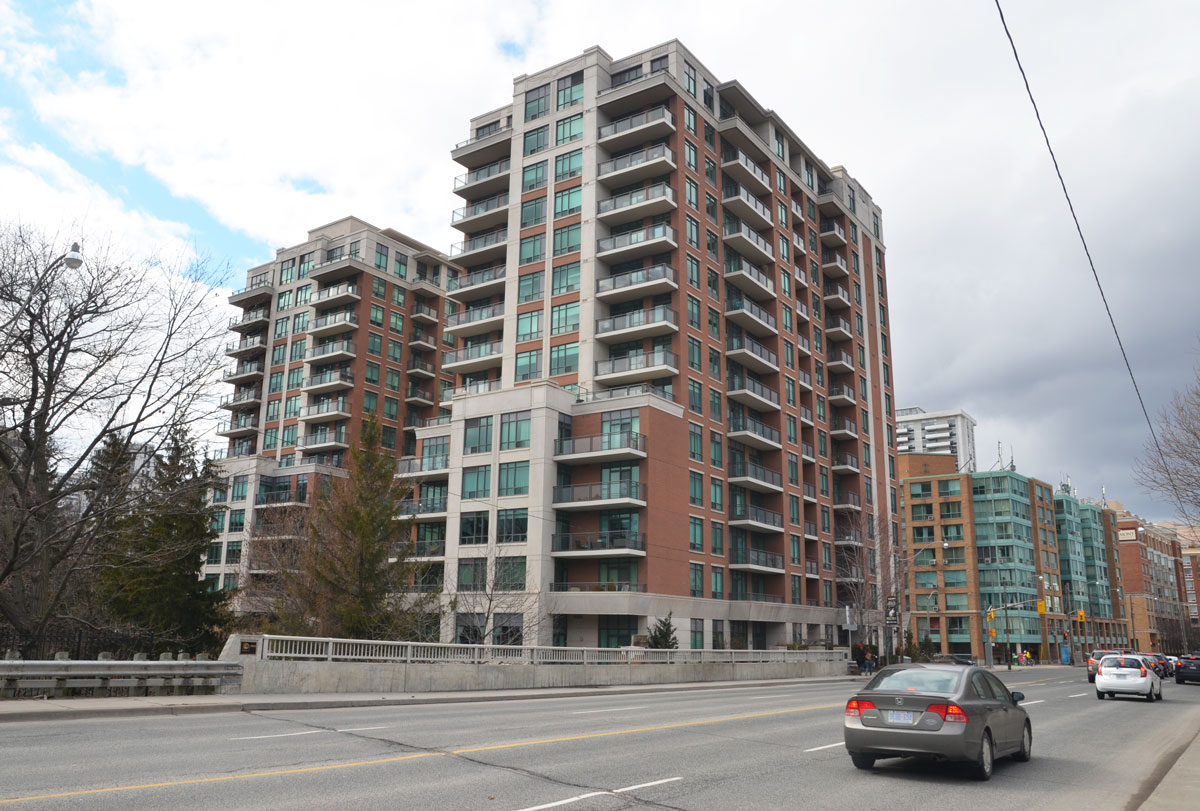
below: I tried to replicate the above photo, about 42 years later.  The Mt. Pleasant streetcars are long gone as is the gas station on the NW corner of Merton and Mt. Pleasant.  A corner of the tall white apartment building on the right can be seen peaking from behind newer condo buildings.  Of course, the dominant part of the picture is the condo development that was built on the site of the Dominion silos in 2002.

condo building across the street, about 12 storeys high, made of brick and glass, a couple of cars are on the street

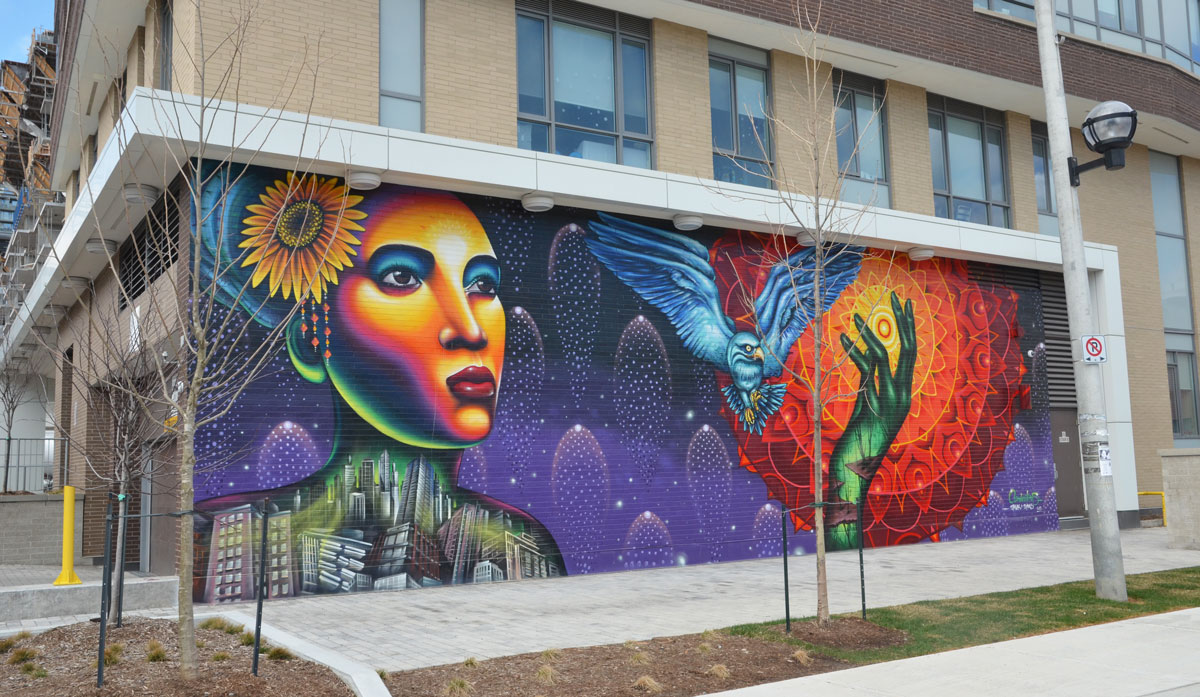
Sackville Street, just south of Dundas, is right in the midst of the Regent Park renewal project.  It is also the site of two murals.  First, there is bright and colourful mural which is painted on the side of a new apartment building.

mural painted by Shalak Attack and Bruno Smoky in Regent park Toronto, showing a brightly coloured woman;s face, with a flower in her hair and her body (from the shoulders up) made of buildings in a jumble as well as a blue owl (large bird) in flight, passing in front of the sun that is represented by circles of orange and red radiating out from the bright yellow center. A green hand is reaching up towards the sun

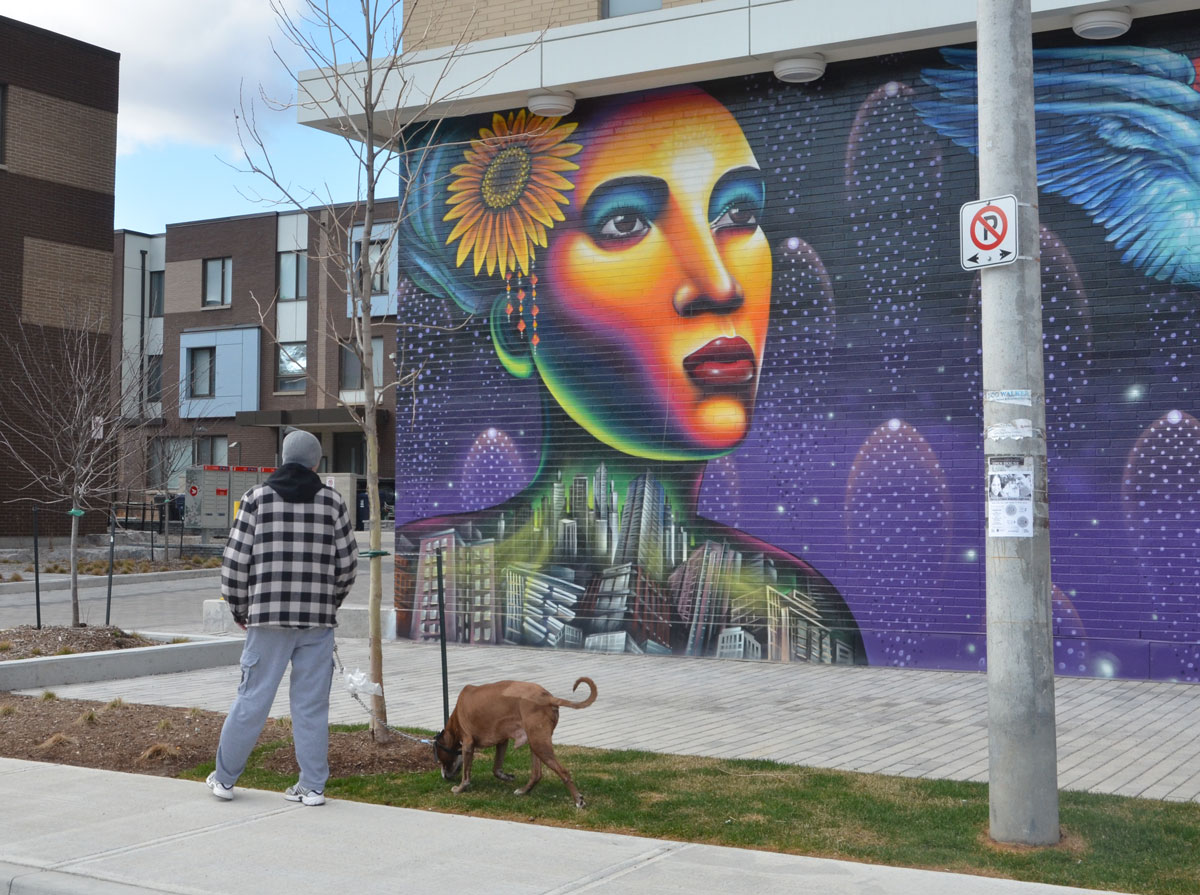
A man with a dog an a leash is walking by a mural of a brightly coloured woman;s face, with a flower in her hair and her body (from the shoulders up) made of buildings in a jumble. Painted by Shalak Attack in Regent Park

close up of a mural by Shalak Attack and Bruno Smoky of a blue owl (large bird) in flight, passing in front of the sun that is represented by circles of orange and red radiating out from the bright yellow center. A green hand is reaching up towards the sun

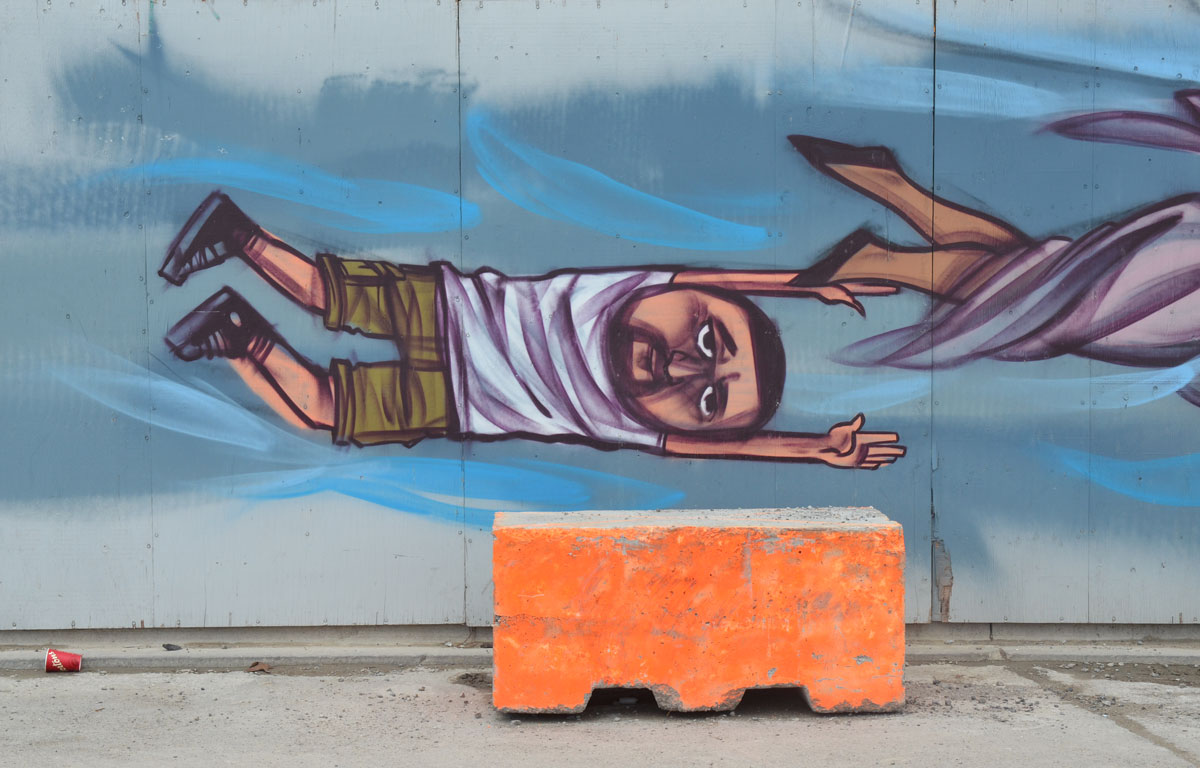
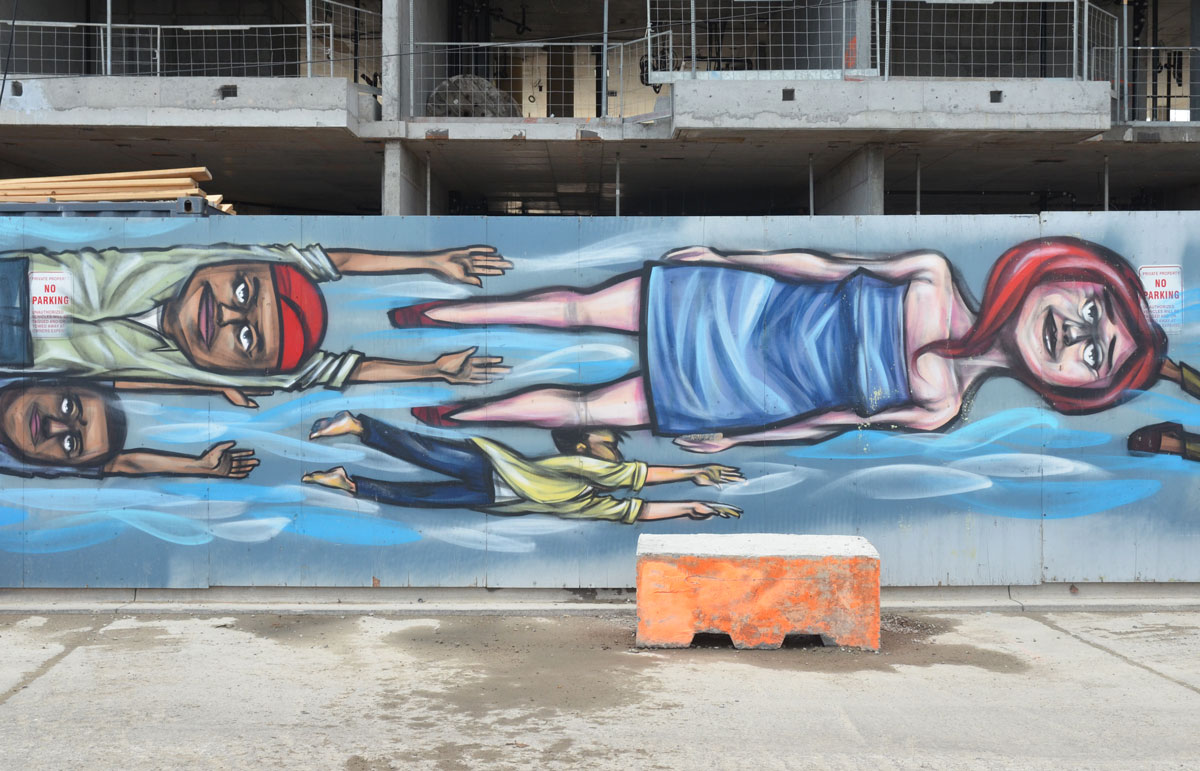
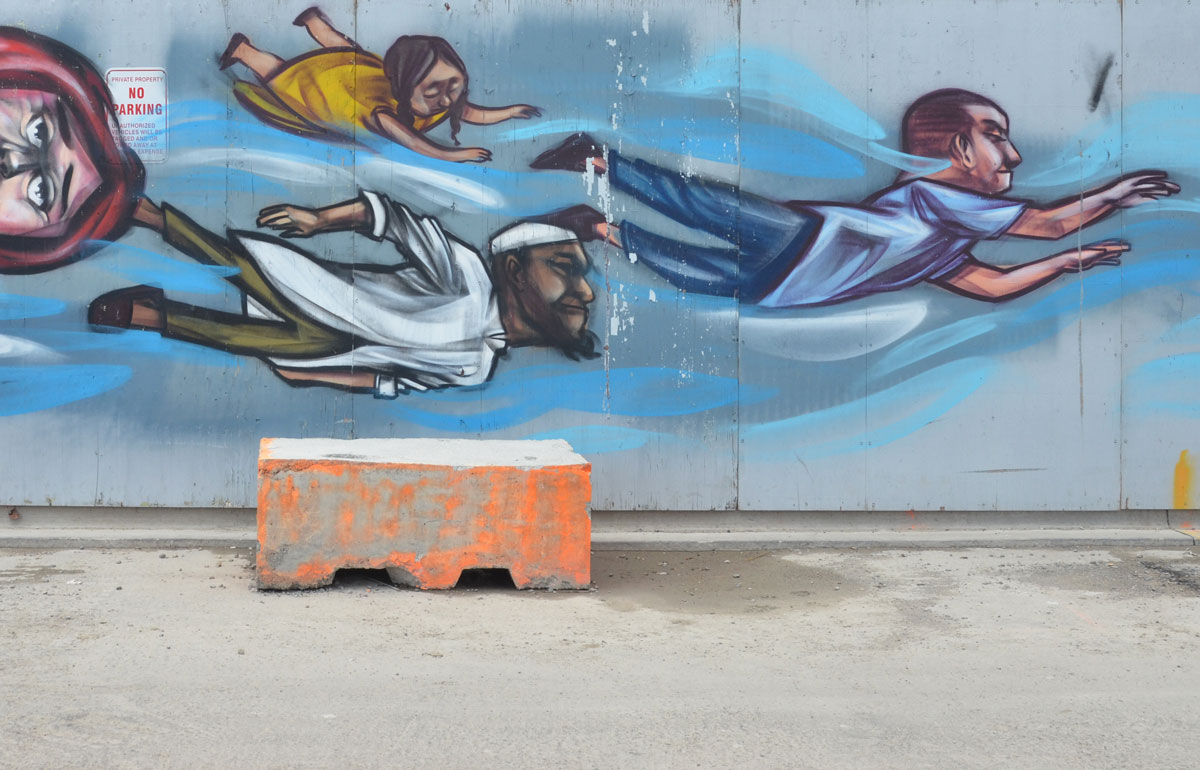
The other mural is a painting by elicser on hoardings around a building under construction.

a long mural by elicser painted on hoardings around a building under construction. People flying past in the mural

below: With the ubiquitous Timmie’s cup on the ground.

the end of a mural, a man is sideways, arm above his head, painted on a mural, a large orange concrete block is in front of the wall, an empty Tim Hortons cup (Timmies cup) is on the ground.
part of a mural of flying people by elicser, a woman in a light purple dress and head scarf as well s a boy in beige Tshirt and blue shorts

Two people painted flying sideways on a mural, a brown man with no shirt on and a much smaller person below him with a yellow T-shirt. An orange concrete block is on the sidewalk in front of the mural along with an orange and white traffic cone

people flying sideways on a mural by elicser, including a girl in a pink dress

people flying sideways on a mural by elicser, including a woman in a blue dress and a man with a red hat.

flying people mural by elicser

the words Regent Park are written in pink paint on a light blue background, painted on wooden hoardings around a construction site.

Graffiti and street art on walls and garage doors in the alleys surrounding Sorauren Park.

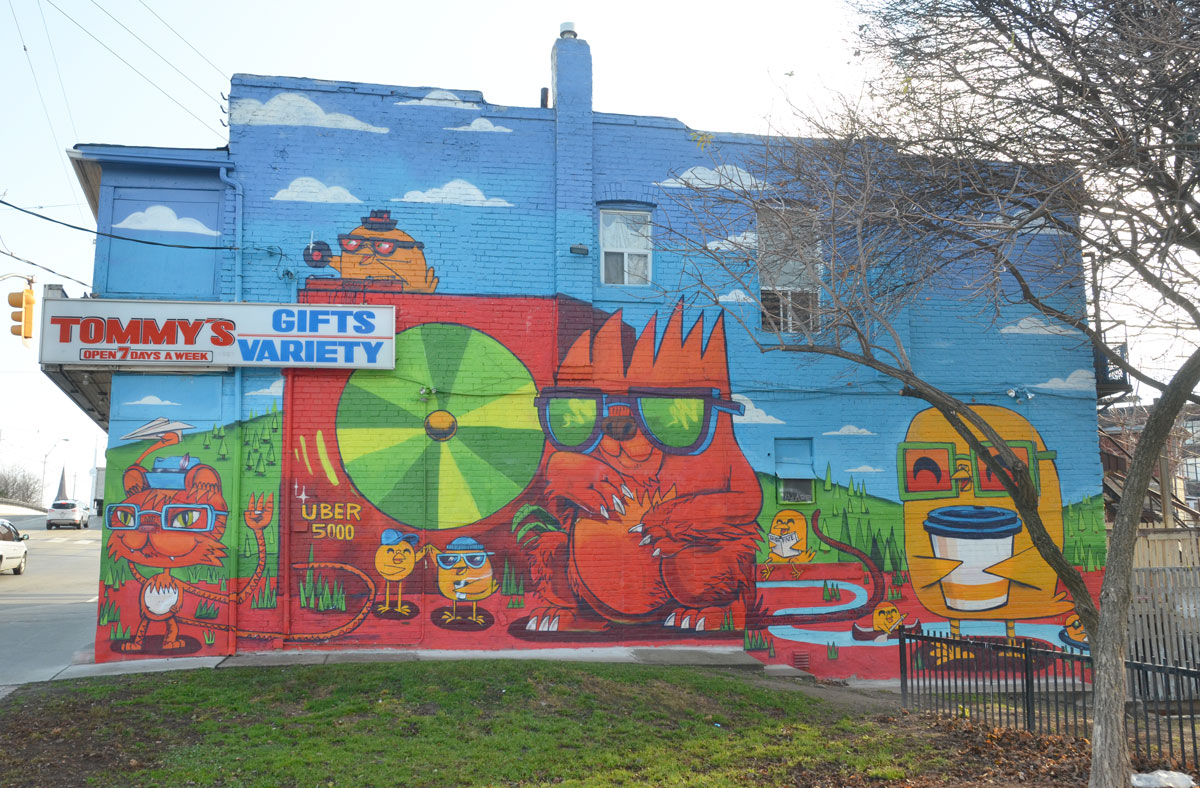
below: If you are walking eastward along Dundas West, this is the first mural that you see.

Uber5000 mural on the side of Tommys Gift and Variety store on Dundas WEst. Uber birdie with a white coffee cup, cat listening to a giant CD player

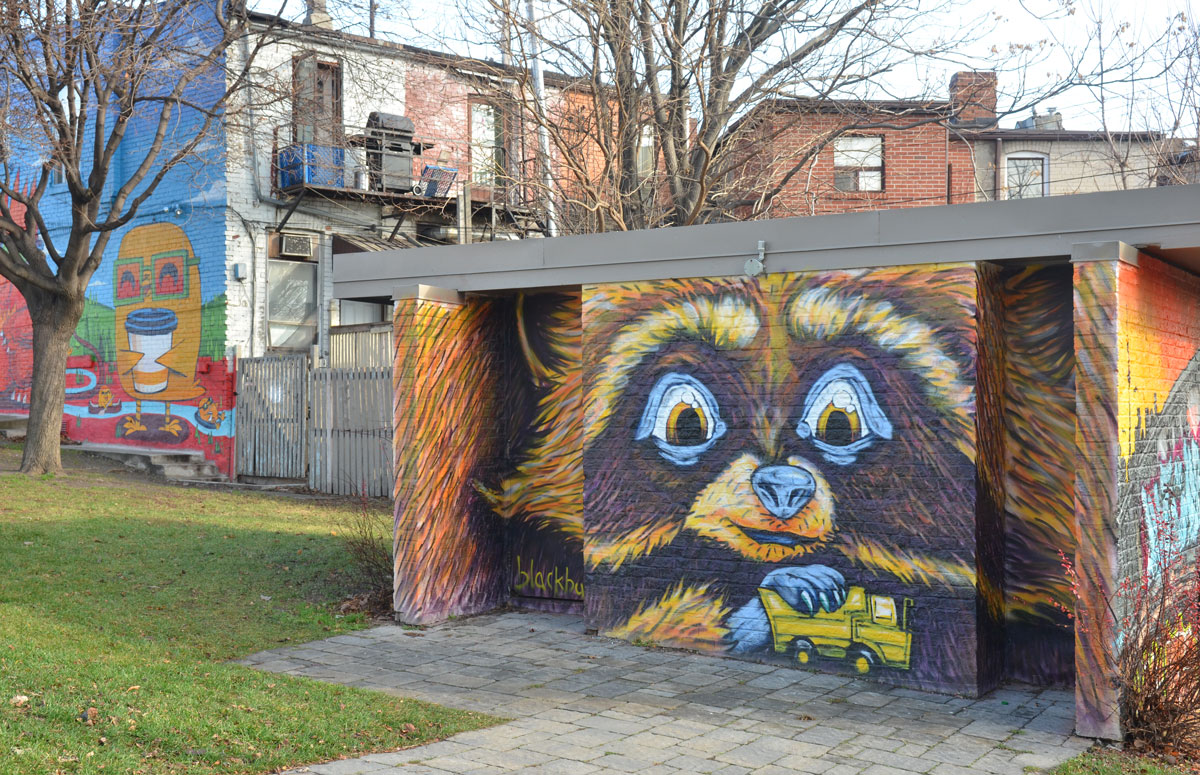
below:  A friendly fuzzy blackburn animal playing in the park

mural by blackburn of a raccoon, or similar creature, playing with a yellow toy truck, painted on the side of a building in a park

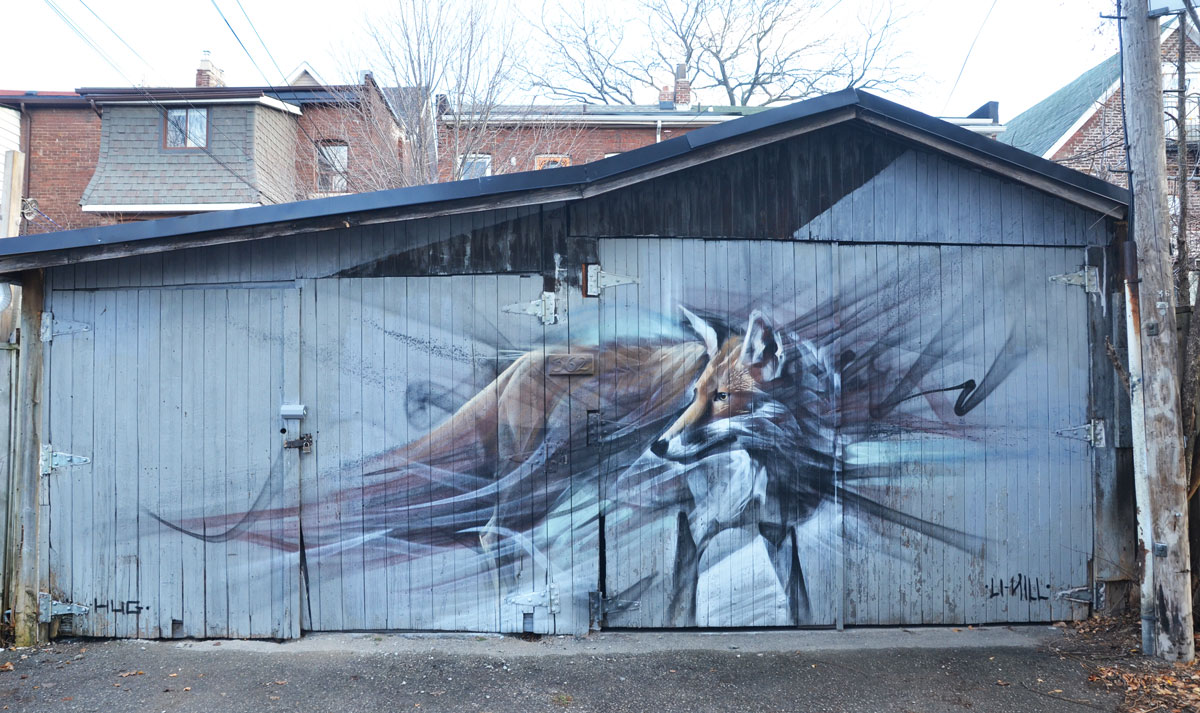
below: Dog (wolf?) by Aaron Li-Hill

very realistic painting of a wolf (or a dog) on a garage door in a lane.

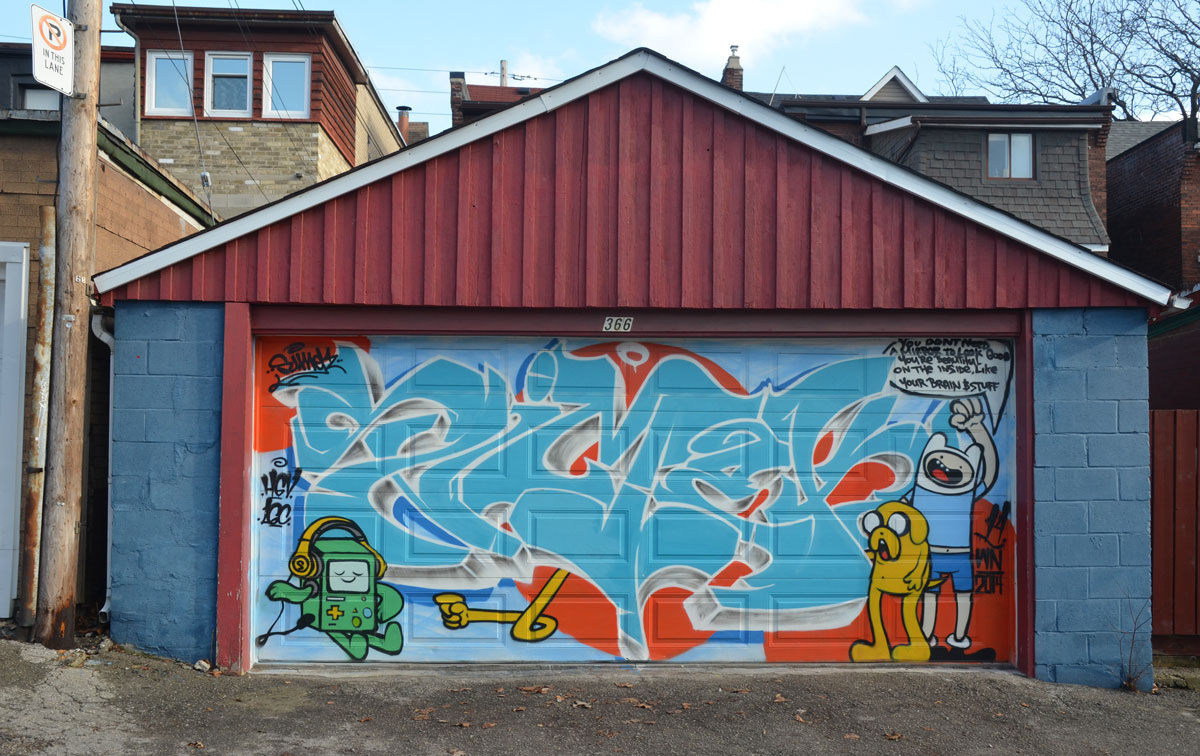
below: The guy in the blue shorts is saying: “You don’t need a mirror to look good, you’re beautiful on the inside, like you’re brain and stuff.”

garage door in an alley painted with a mural, light blue backgrouns and some cartoon-like characters, a little green guy with a square head, a yellow dog-like creature on two legs, and a blue guy

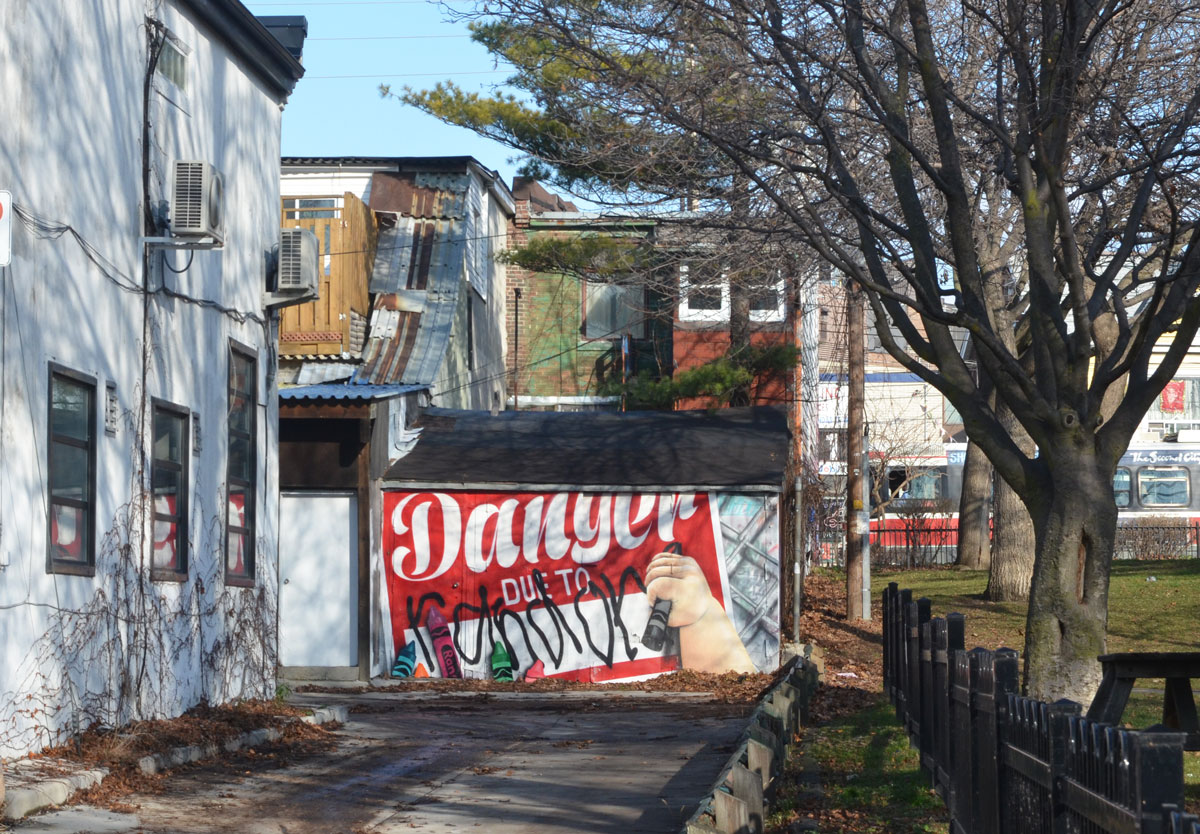
garage door painted with a large red and white danger due to sign as street art. A hand is writing in black marker on the sign, rondor

CBS mediah geometric spray paint pience on a garage door.

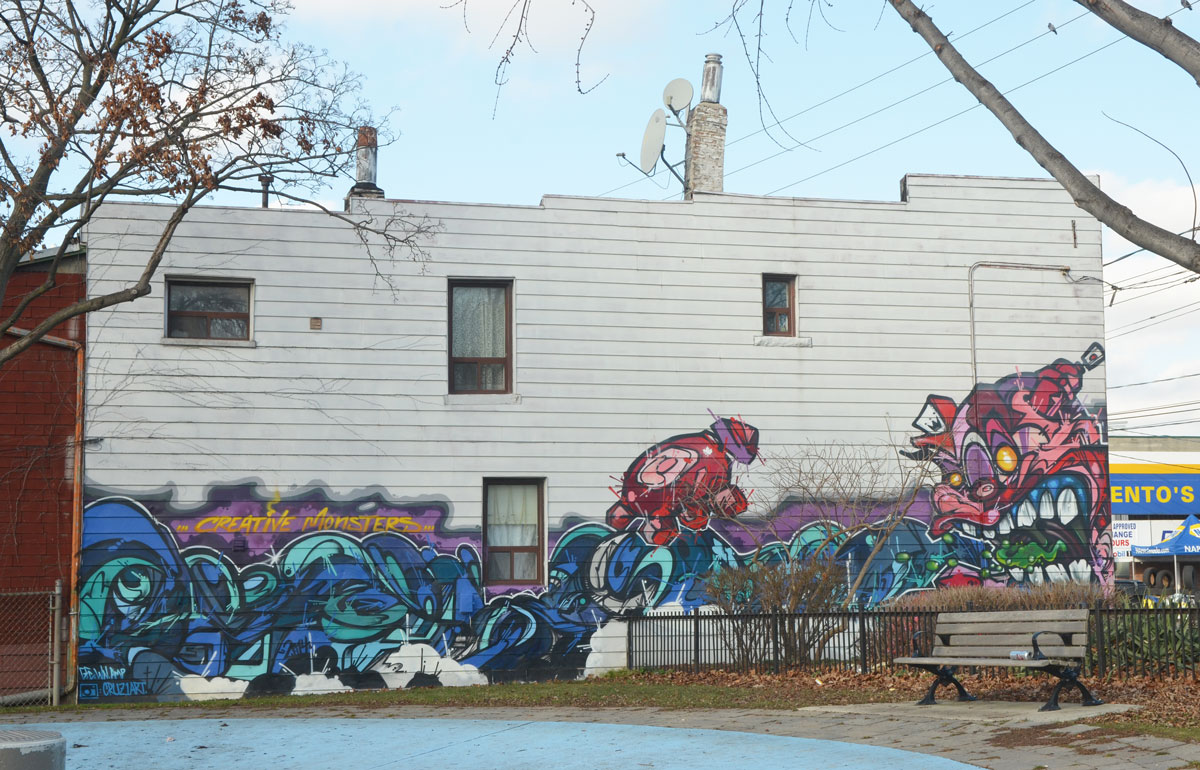
creative monsters mural on the side of a white building beside Sorauren Park

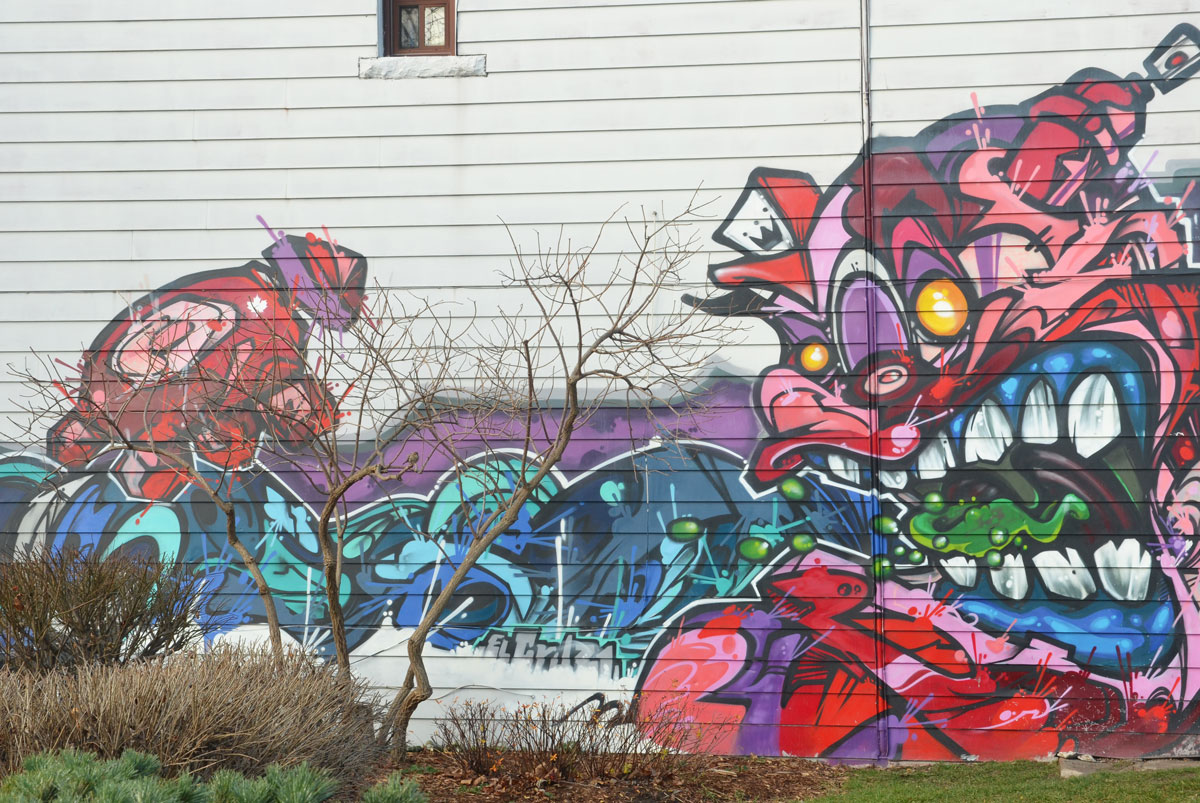
close up of creative monsters mural on the side of a white building beside Sorauren Park

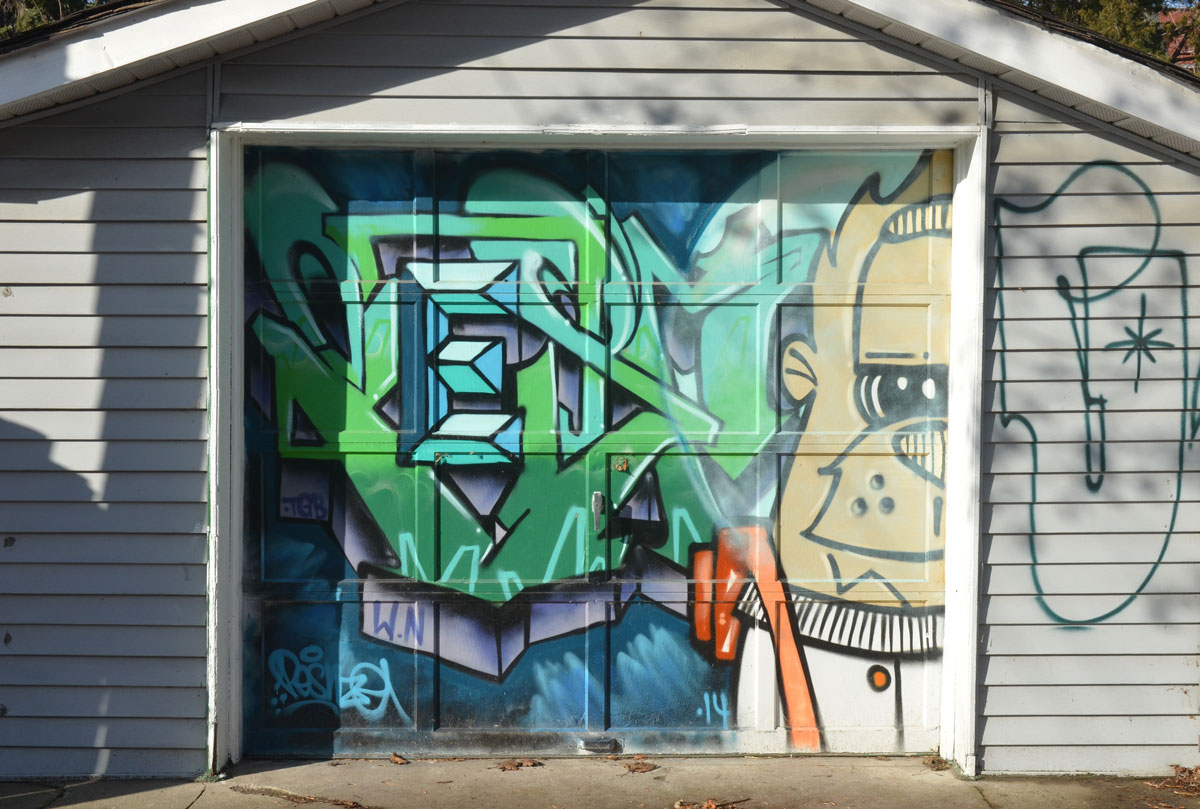
garage door with street art on it, half of a large man plus green and blue tag around the letter E

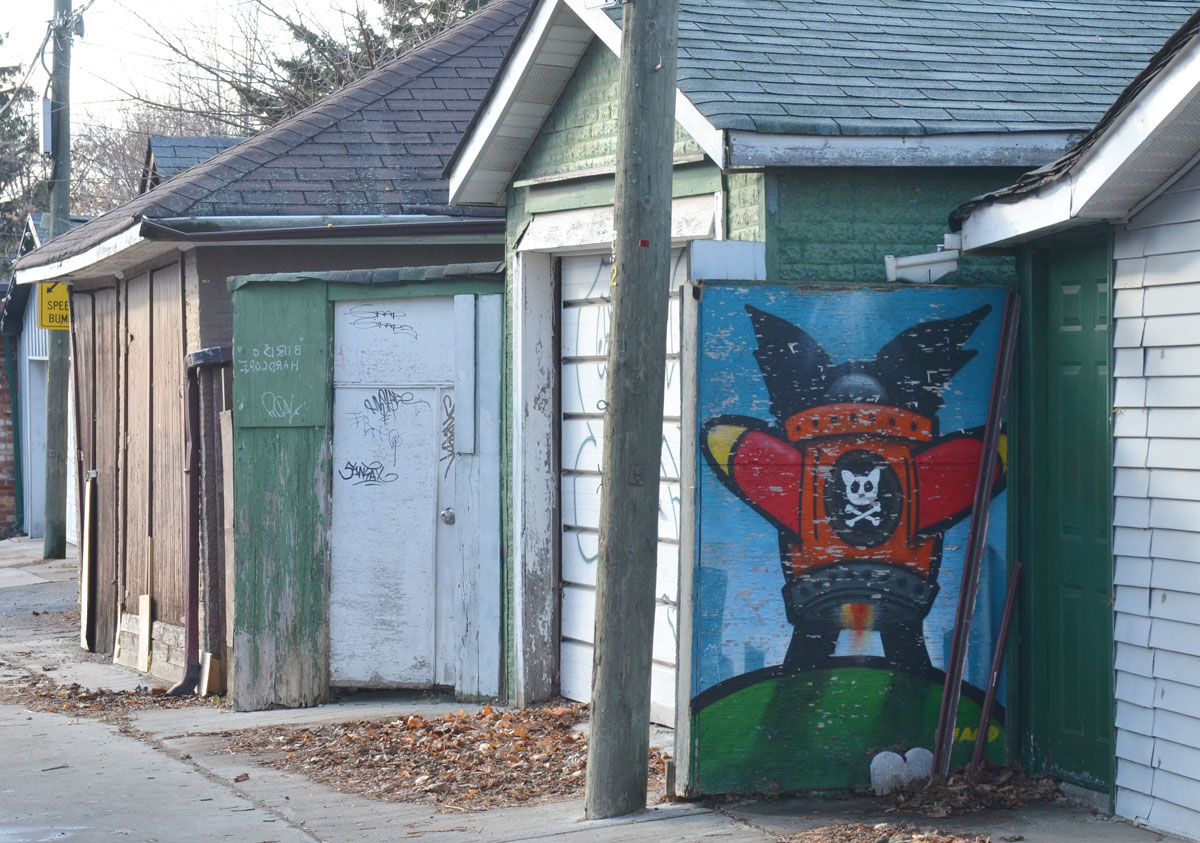
man-like shaped rocket on a wall, red wings outstretched, cat skull motif on the front

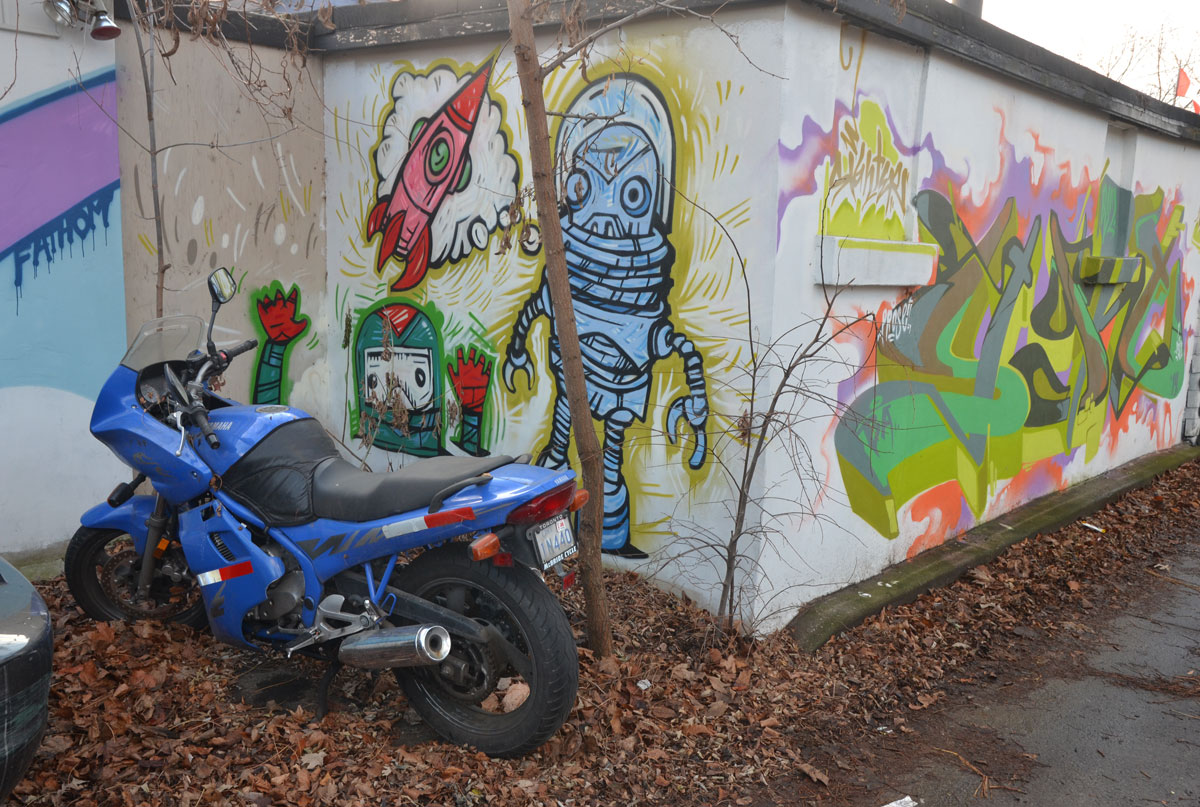
A blue motorcycle is parked in front of a street art painting of three spacemen creatures

line of garages in an alley. The garage door in the foreground has a bent tulip painted on it.

below: Spudbomb mural

spudbomb mural on a garage door.

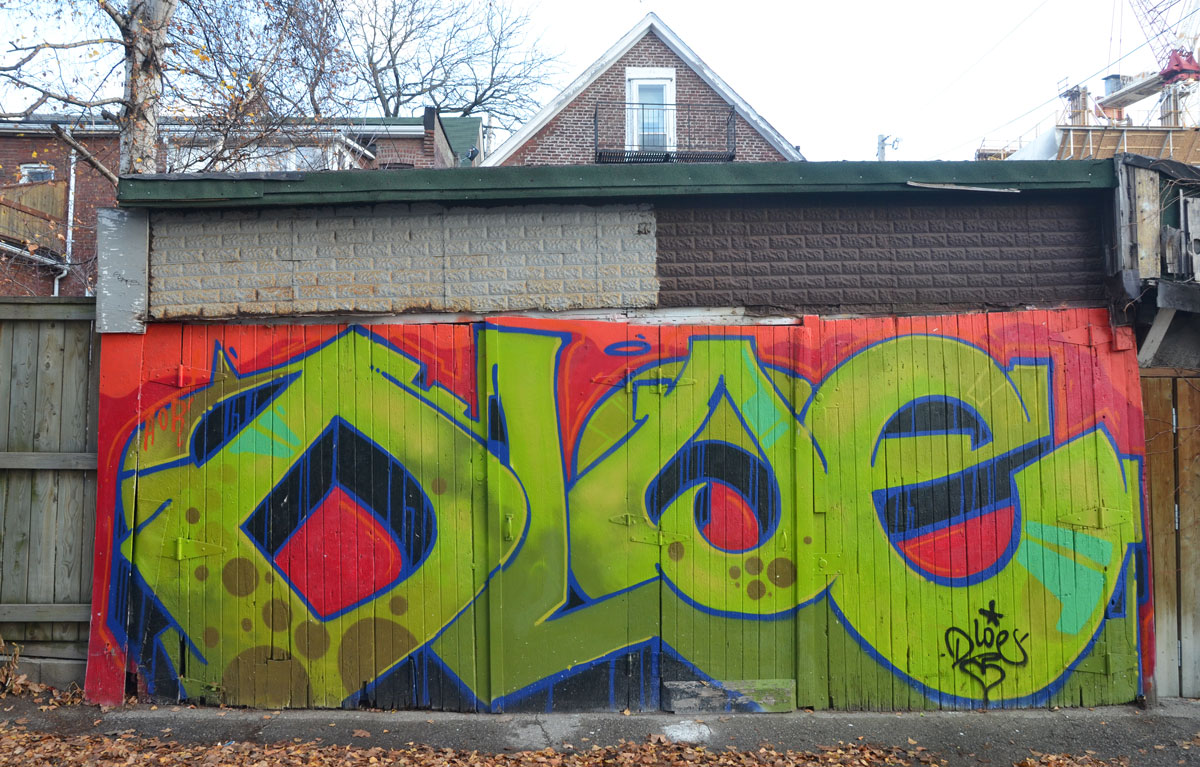
D loe tag graffiti on a wood garage door, green letters on orange background

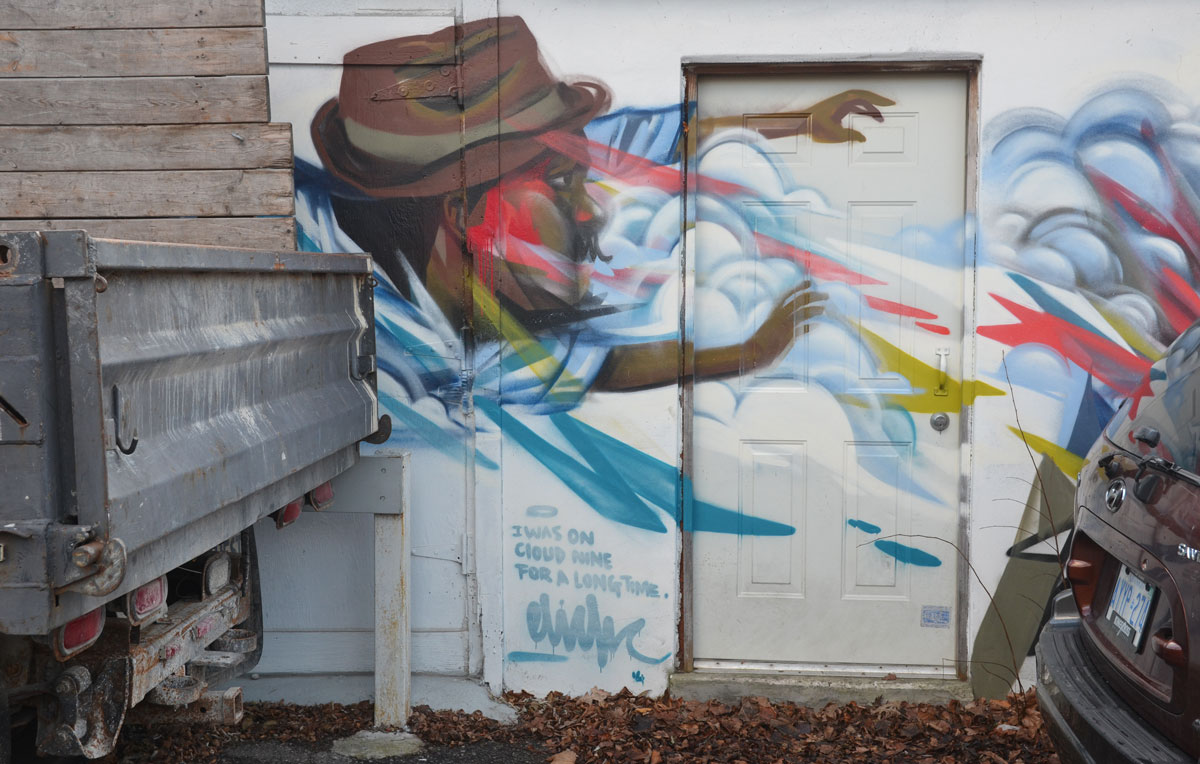
below: by elicser, I was on cloud nine for a long time.

part of an elicser piece on a garage door but a car and a truck are parked in front of the rest. A man in a brown hat is blowing against a door, streams of wind coming from his mouth and clouds are around him, words say I was on cloud nine for a long time.

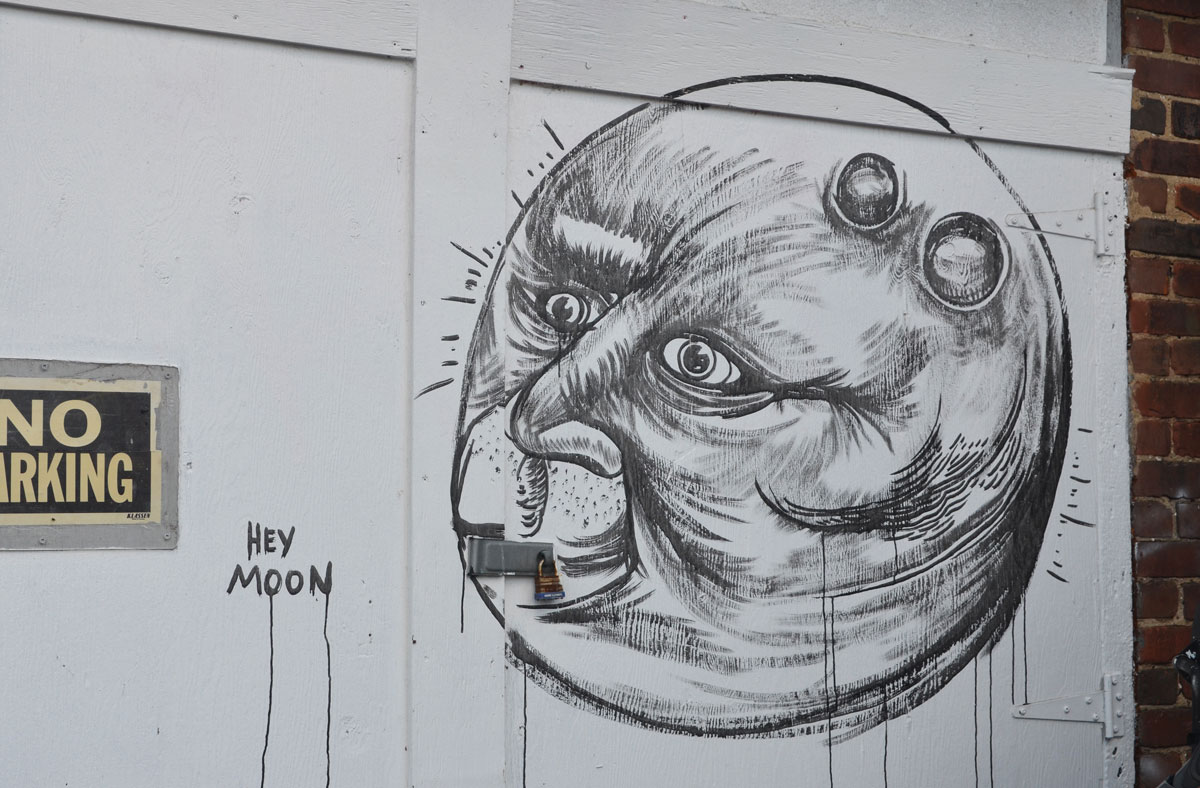
black line drawing on a white garage door in an alley. Round moon shape witha face in the moon.

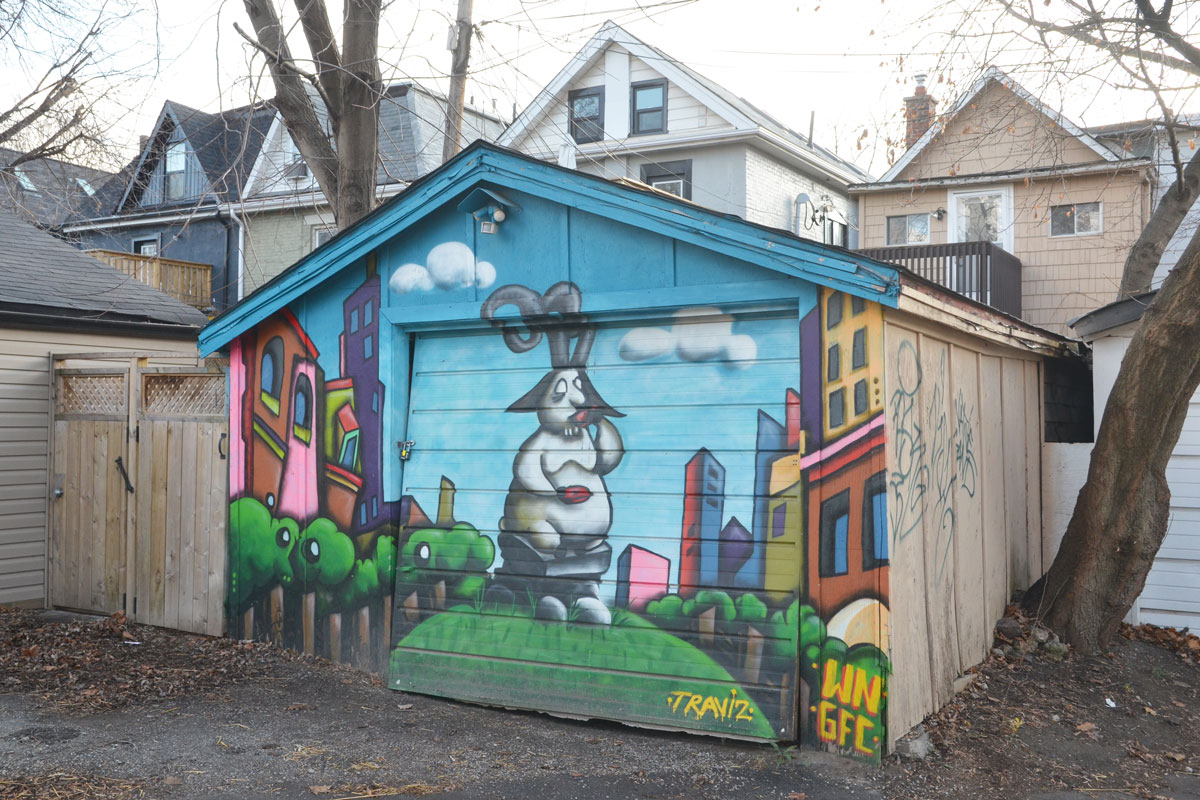
Garage door covered with a mural by traziv. Rabbit like creature standing on a grass mound eating a carrot. buildings around hime, blue sky and a fluffy cloud too.

Two sides of a small building, each side with a mural on it.  One side is a TTC subway with Kipling as its destination, the other is of two kids, one boy is flying on an open book and a girl is on a scooter and wearing a helmet.  The words between the two kids say Ready Let's Rock

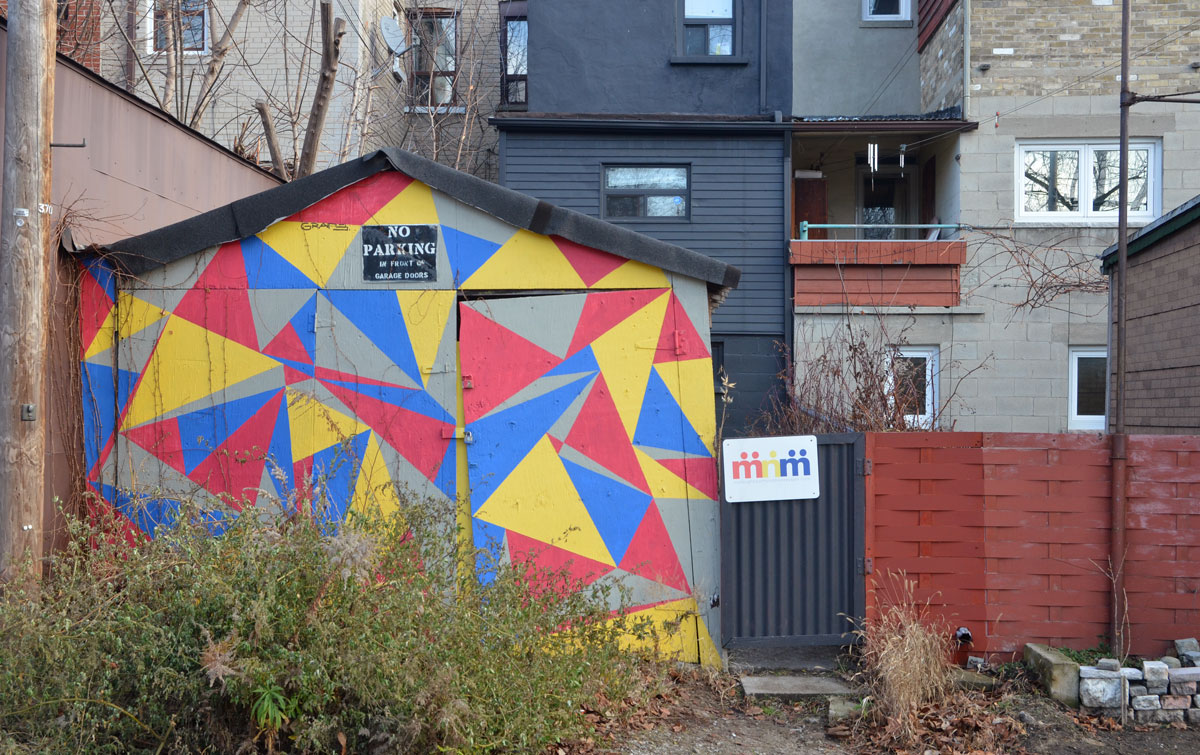
old garage door painted light grey with triangles in blue, yellow and red
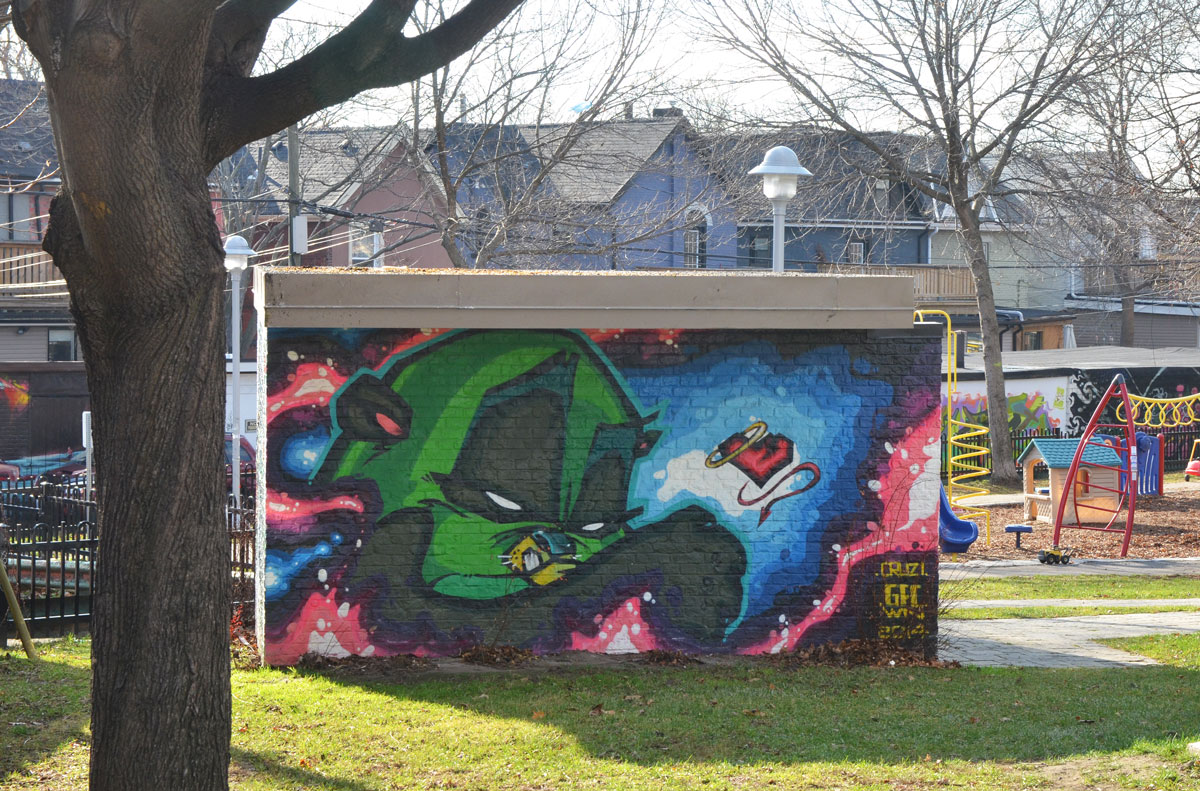
side of a small building covered with a mural of a green bird-like character, playground and houses in the background

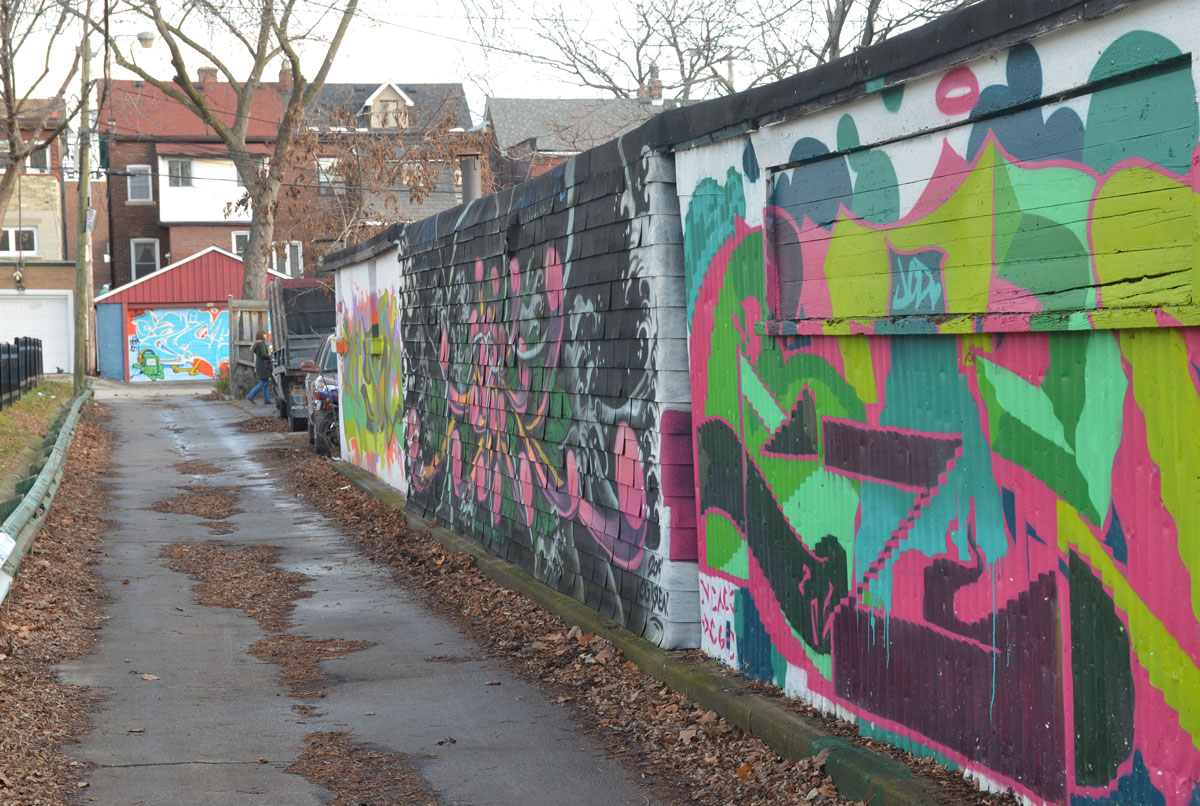
street art on garage doors in a lane
street art painting on a laneway garage door, pink and grey swirls and blobs, plant-like shapes.

graffiti on a corrugated metal garage.

below: by elicser, It’s almost dark.  One more wave, then we go in.

woman in a red bikini sitting on a long board in the water, painted on a garage door, car parked in front partially obscuring it.