Posts Tagged ‘Kosso Eloul’

This blog post is the result of a walk along Bloor Street East between Yonge & Glen Road (with the usual diversion or two).  Bloor Street acquired its name about 1855 and is named for Joseph Bloor (or Bloore).
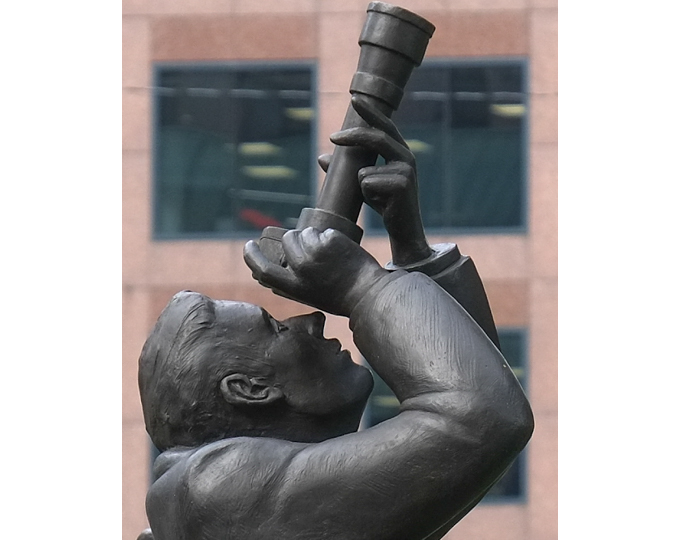
man with camera pointed upwards, part of a sculpture called Community, by Kirk Newman

below: Bloor Street, looking west towards the intersection of Yonge & Bloor.
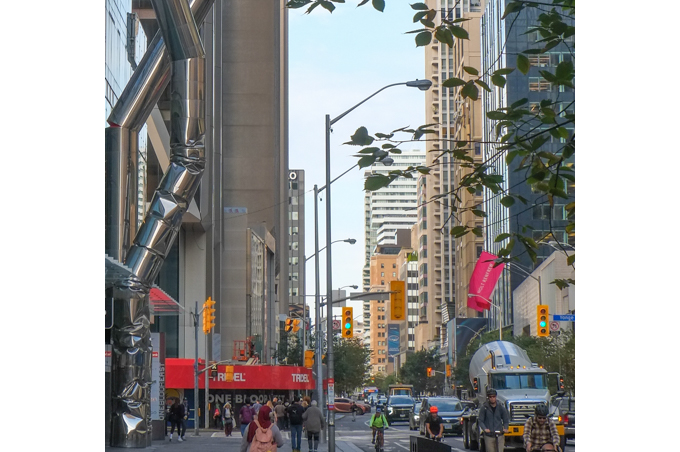
downtown Toronto, tall buildings at Bloor and Yonge, glass and steel condo towers

below: “Safe Hands” by Ron Arad, towering 88 feet over Bloor Street in front of One Bloor East (at Yonge).  Look up… way up!!
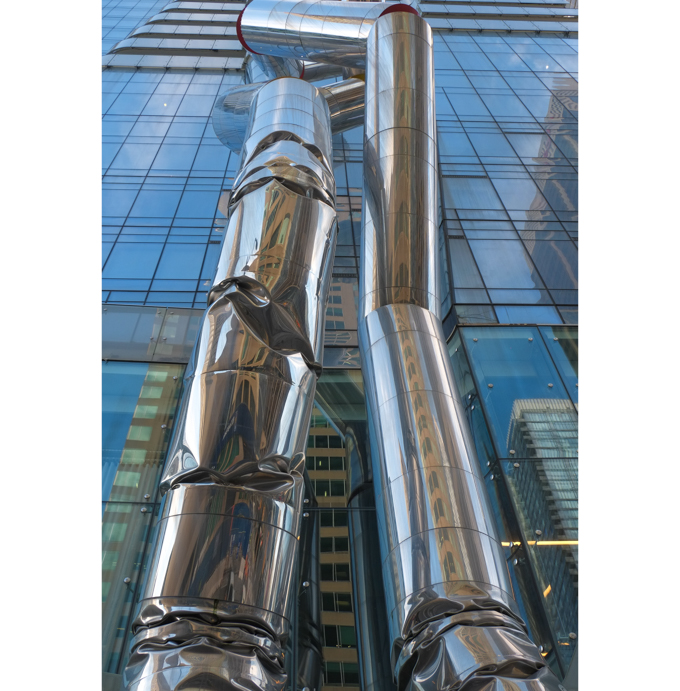
metal sculpture on Bloor Street, Safe hands by Ron Arad

below: More up!  Glass and steel towers at Yonge and Bloor.
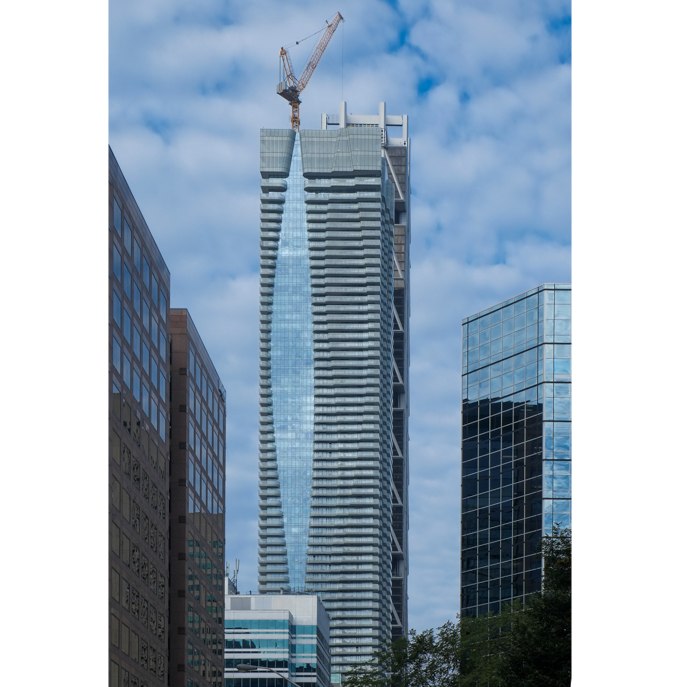
downtown Toronto, tall buildings at Bloor and Yonge, glass and steel condo towers

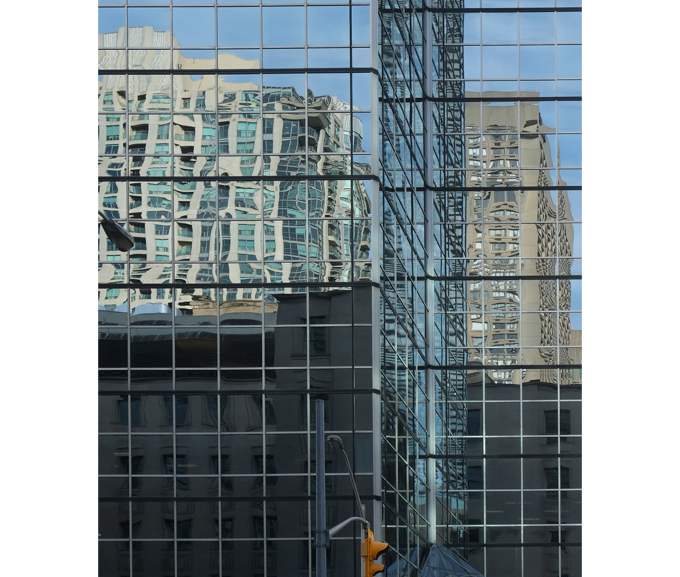
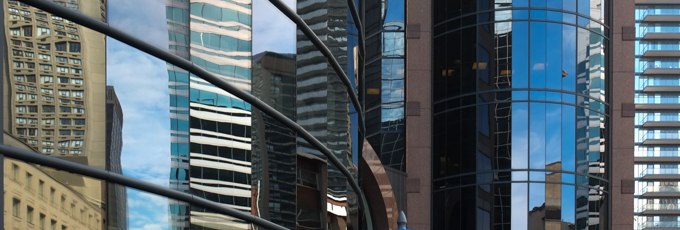
reflections in tall city glass buildings

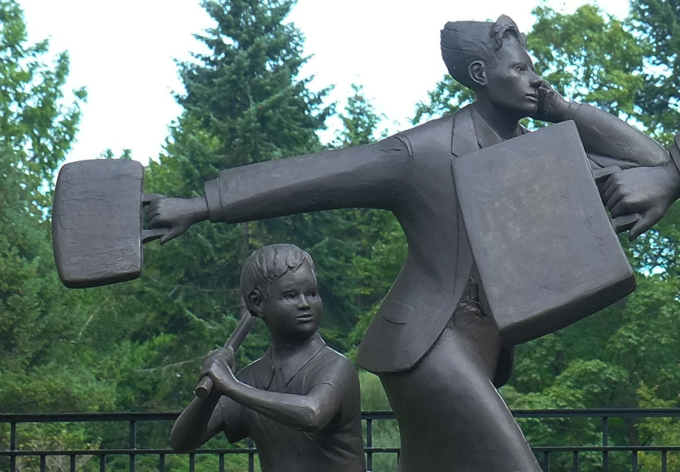
below: “Community” by Kirk Newman.  Busy people going about their day.
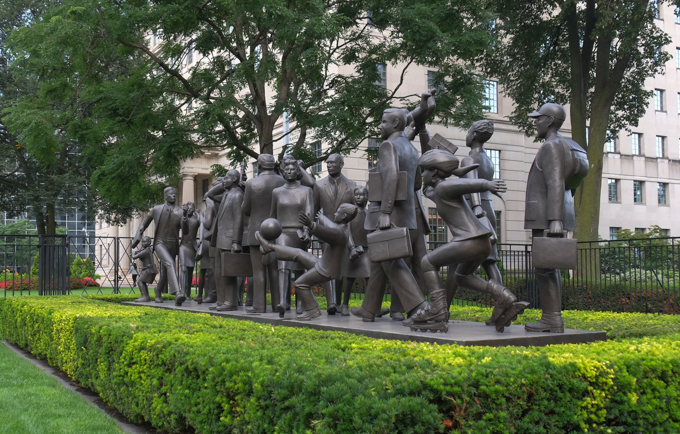
sculpture, Community by Kirk Newman, many people walking or running down the street,

part of sculpture titled community, by Kirk Newman, life sized people going about their day, woman carrying briefcase, boy with a baseball bat

below: Not an art installation, but large ventilation shafts (for the subway?) just behind Bloor
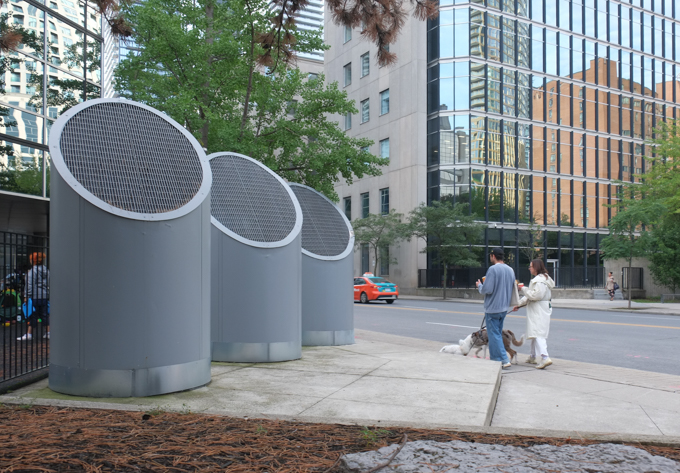
large grey ventilation shafts rising from the sidewalk behind 160 Bloor East, people walking past

below: Relief sculptures on the limestone exterior of the former Crown Life Building.  They were designed by Canadian sculptor Cleeve Horne and carved by stone cutter Louis Temporale in 1953.
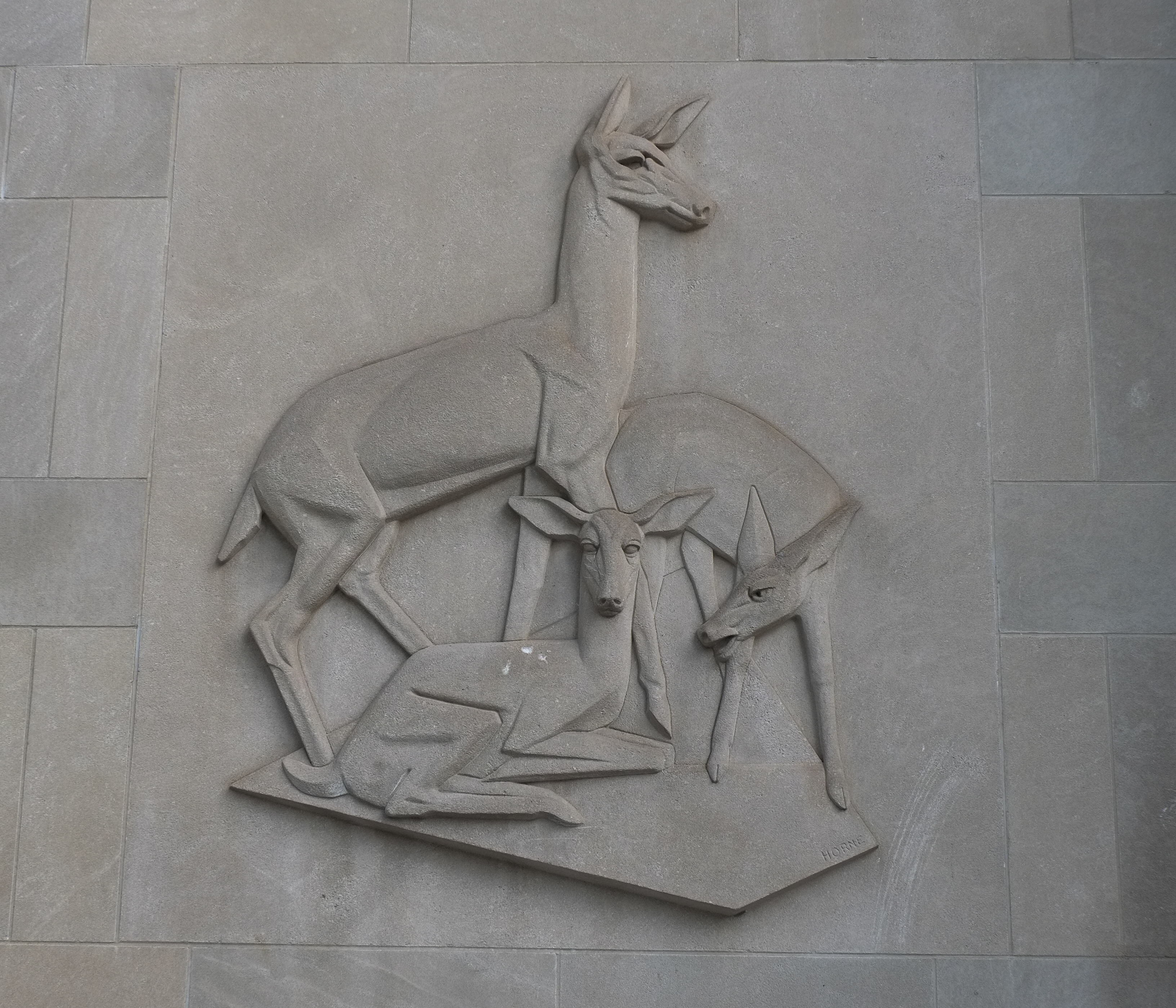
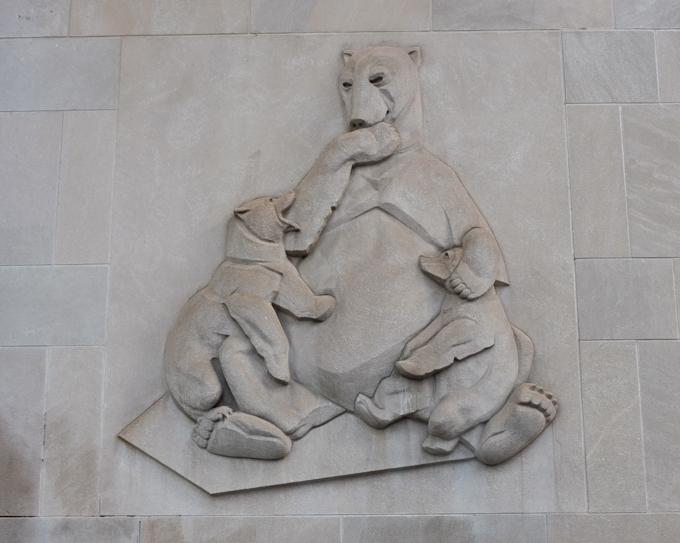
stone relief sculptures on side of building, deer family

stone relief sculptures on side of building, bear family

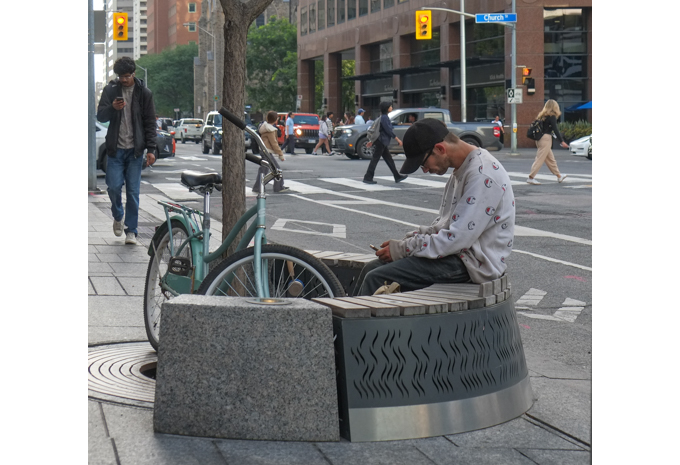
young man sitting on round seat outside, uner small tree, bike parked nearby, reading on phone

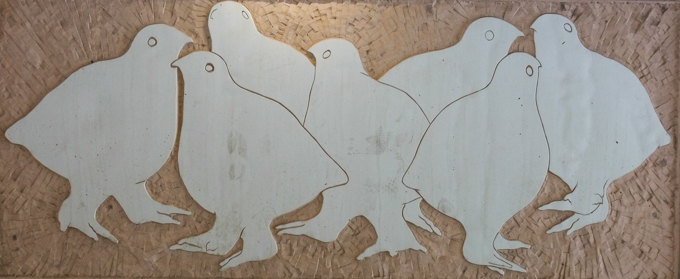
below: Sculpture by Kosso Eloul on the northeast corner of Church and Bloor.
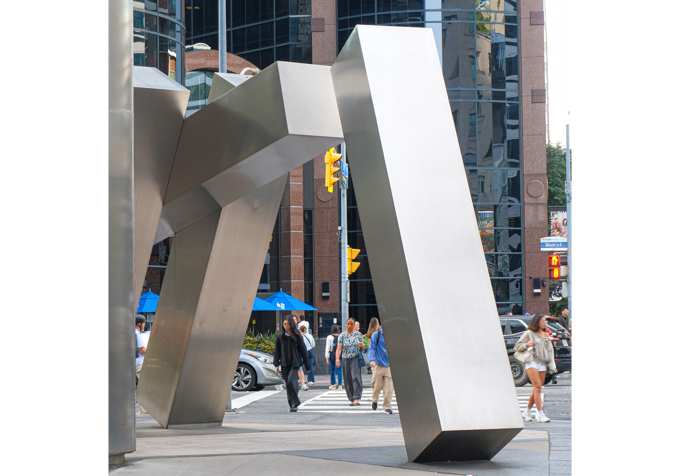
sculpture by Kosso Eloul, at northeast corner of Church and Bloor

below: St. Pauls Bloor Street, Anglican church.   The original church was built in 1842 and has undergone a few expansions and renovations since then.
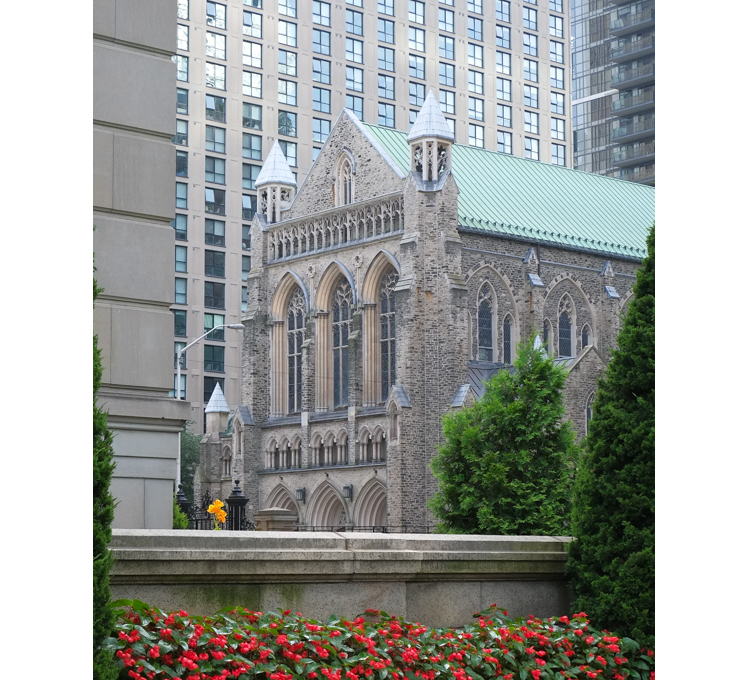
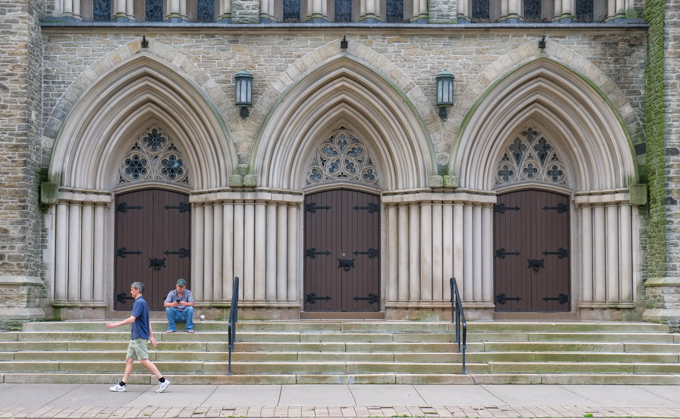
St. Pauls Bloor Street, church, stone,

man sitting on steps of St. Pauls church, wide steps, three doors, another man walks past

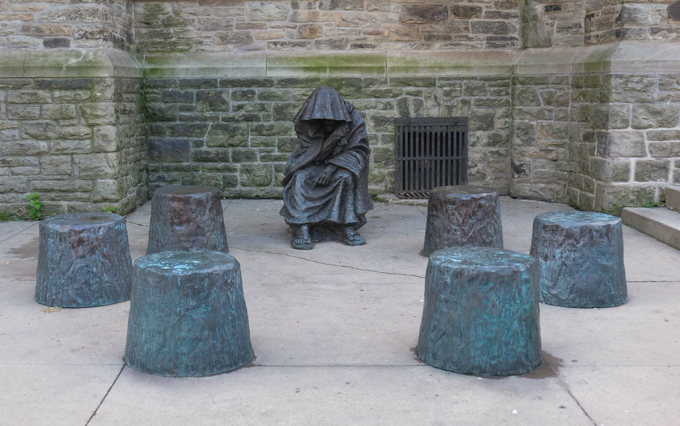
below: A space to sit.

sculpture of homeless person begging, covered in hooded robe

below: Just down the street from St. Pauls Bloor Street, but set back from the street,  is St. Andrews United church. Joseph Bloore lived at Bloor and Park Road, across the street from what was then Bloor Street Methodist Church.   This tablet is a replica of the one that was  installed in the Methodist Church late in 1862.  In the 1980s, the church that this memorial was in was demolished and the tablet moved to the city archives.  Because of a number of church mergers, this was St. Andrews United Church.  He is buried nearby in the Toronto Necropolis.
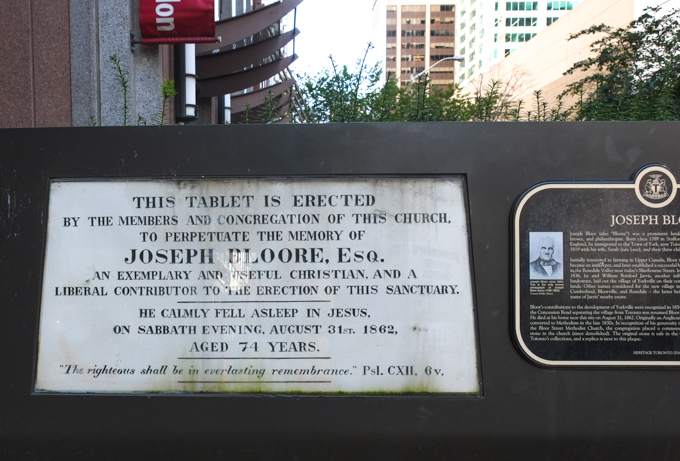
stone tablet memorial to Joseph Bloore that used to be in a church

“This tablet is erected by the members and congregation of this church, to perpetuate the memory of Joseph Bloore Esq., an exemplary and useful Christian, and a liberal contributor to the erection of this sanctuary.  He calmly fell aslepp in Jesus on Sabbath evening, August 31st 1862, aged 74 years,  The righteous shall be in everlasting remembrance.  Pslam CXII, 6 v.”

below: St. Andrews United church with its front courtyard.
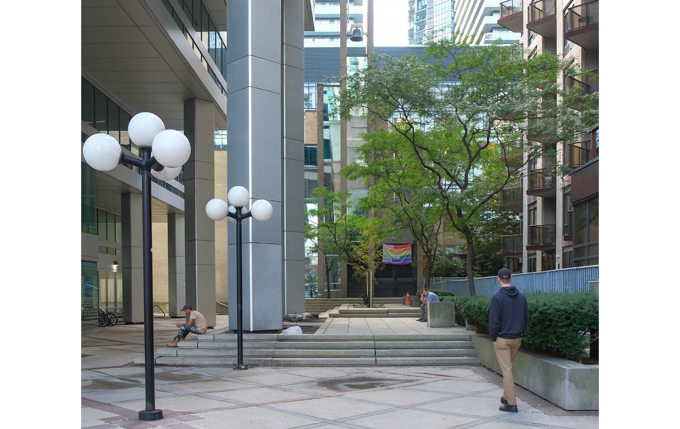
courtyard in front of St. Andrews United church on Boor street

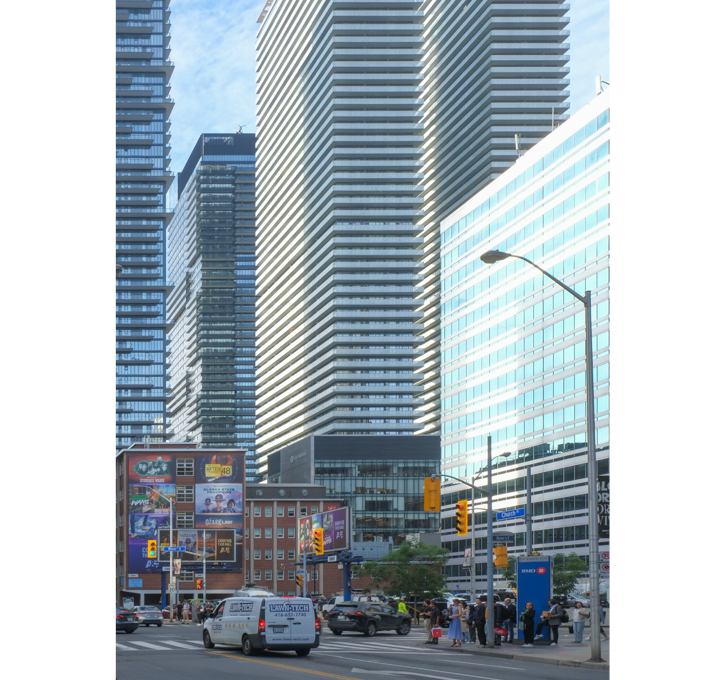
below: Bloor and Church streets, looking southwest
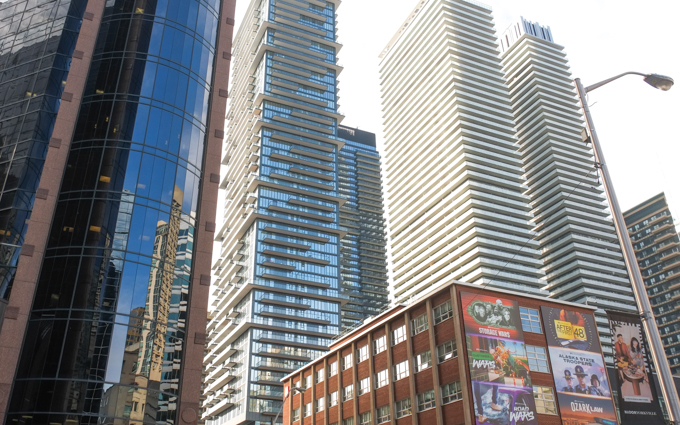
Bloor and Church looking southwest

reflections in glass buildings, bloor and church

Bloor and Church, south on Church towards Bloor

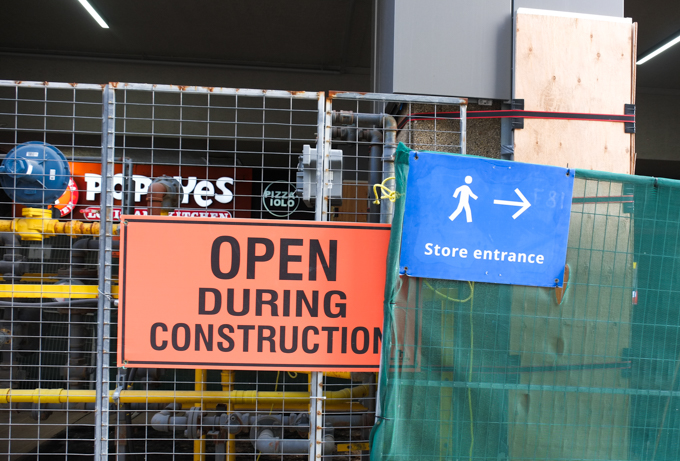
sign that syas stores open during construction, mounted on hoardings

below:  A couple of 1960s/70s brutalist concrete buildings with recessed windows – a fairly common Toronto architectural style.
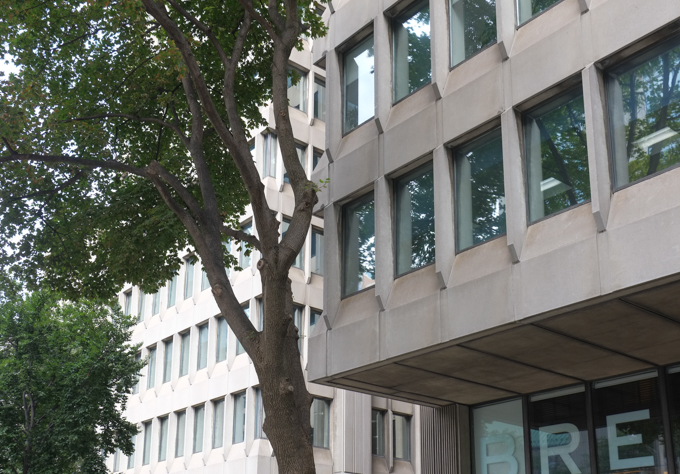
A couple of 1960s/70s brutalist concrete buildings with recessed windows

below: Sherbourne Street bridge, north of Bloor, over Rosedale Valley Road.  This is the first bridge referred to in the title (yes, it took a while to get here!)
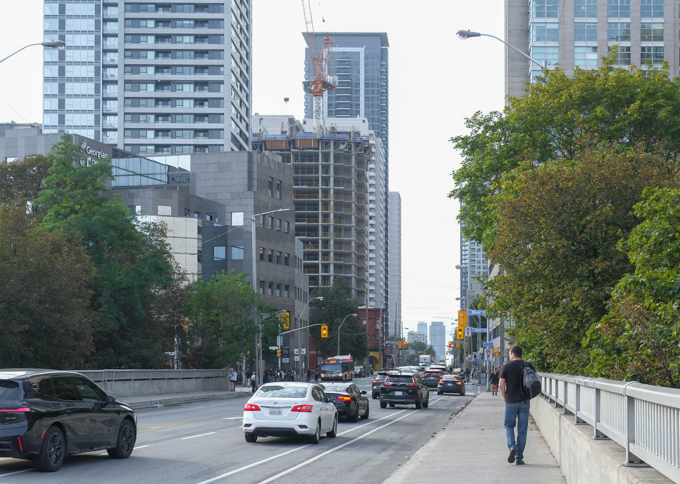
bridge, sherbourne street over the Rosedale ravine

below: Rosedale Valley Road passes under Sherbourne Street as it winds its way along the bottom of the ravine from Bayview to Yonge (approximately!).
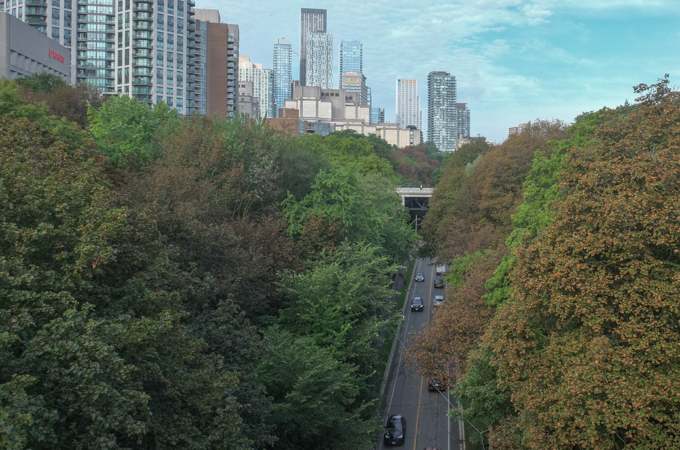
Rosedale Valley Road passes under Sherbourne Street, buildings of downtown Toronto in the distance

below: Once upon a time, the corner of Bloor and Sherbourne was home to the Sherbourne Blockhouse, shown here in a drawing by R. J. Brough (October 1862).  There isn’t much to the road!…. but there is a church steeple in the background.  This blockhouse was one of three built to defend the city from possible ‘invasion’ by rebels  and other rabble rousers in 1837.  That was the time of the Upper Canada Rebellion led by William Lyon Mackenzie against the British colonial government and the  Family Compact (the unelected local ‘government’ of the day).  The blockhouse wasn’t needed for defense and fell into disrepair. It is long gone.
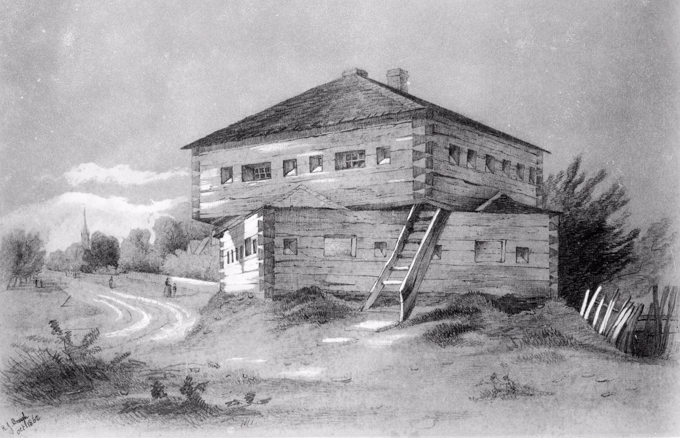
pencil drawing by R. J. Brough in 1862 of Sherbourne Blockhouse,

. Photo Credit: Toronto Public Library file E4-82a, Public Domain (found on Wikipedia).

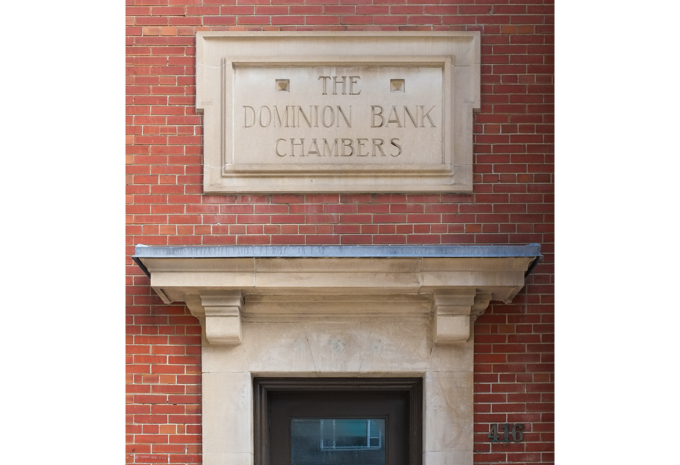
below: Part of the Bloor and Sherbourne intersection today.  The red brick building on the right was once a Dominion Bank building – and is now a TD (Toronto Dominion) bank.   The Dominion Bank was formed in the late 1860s.  In 1955 it merged with the then 100 year old Bank of Toronto to form the Toronto Dominion bank.
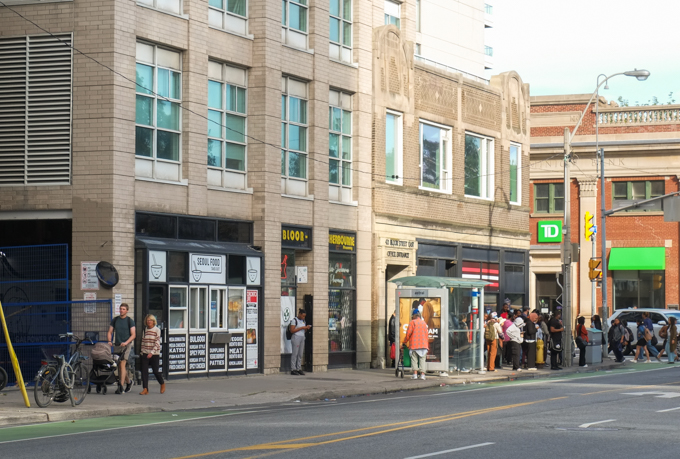
doorway in red brick bank building with sign over door carved stone, that says The Dominion Bank Chambers

below:  The beginnings of Bloor Street east of Sherbourne – This photo was taken about 1908 and as you can see there wasn’t much of a road there.   It would be 10 or 11 years later that the Prince Edward Bridge (aka the Bloor Viaduct) opened to the east thereby providing easy access across the Don River via Bloor.   But that’s a whole other bridge, and a whole other story best left for another day.  Note the Dominion Bank building at Bloor and Sherbourne – still there more than 100 years later.  Also, there was already a Sherbourne Street bridge over the ravine.
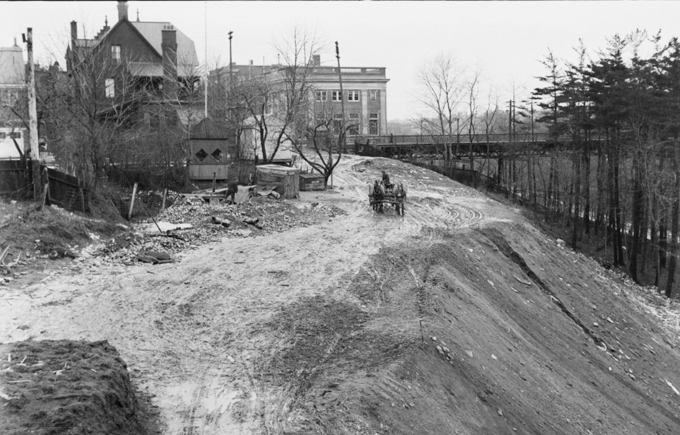
old black and white photo from about 1908, by William James, from City Archives, showing Bloor east of Sherbourne when it was a dirt road

Photo credit: City of Toronto Archives, fonds 1244, item 7244

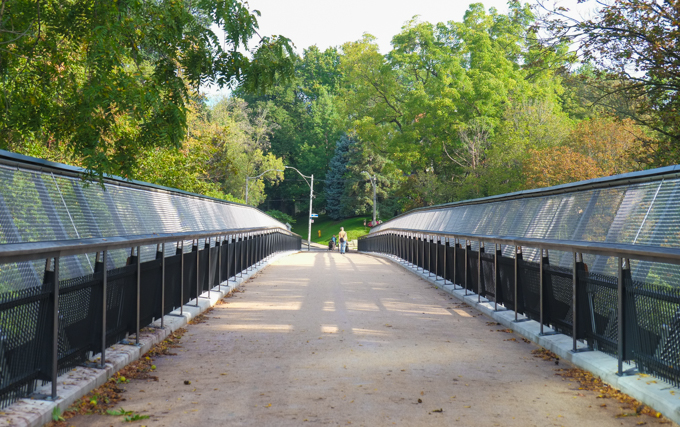
below: Glen Road Pedestrian Bridge connects Rosedale to St. James Town.  It is officially called the Morley Callaghan Footbridge and for our purposes, it is bridge number two.
below: “Rise together thru these clouds, as on wings”  This is actually part of the lyrics to a song, “Sunday” by David Bowie.
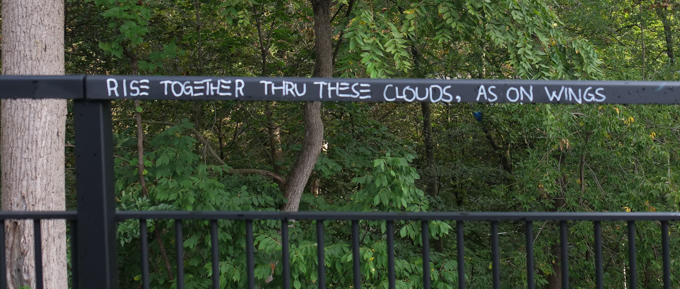
written graffiti in white on black railing on bridge

below: This is the plaque that is mounted on a wall near the bridge.  It mentions Edgar Jarvis, one of the early land owners in the area.  It was Jarvis who teamed up with Joseph Bloore to develop the land that became the village of Yorkville.   The plaque’s title mentions the name Morley Callaghan then says nothing about him in the write-up.  Callaghan (1903-1990) was a Toronto novelist/writer; he also appeared on TV and radio.
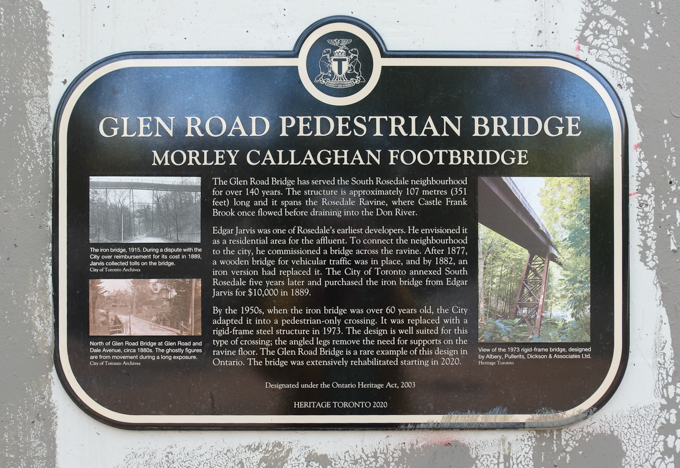
plaque by Glen Road bridge, also known as Morley Callaghan bridge

Glen Road Pedestrian Bridge – Morley Callaghan Footbridge. The Glen Road Bridge has served the South Rosedale neighbourhood for over 140 years.  The structure is approximately 107 metres (351 feet) long and it spans the Rosedale Ravine where Castle Frank Brook once flowed before draining into the Don River.  Edgar Jarvis was one of Rosedale’s earliest developers.  He envisioned it as a residential area for the affluent.   To connect the neighbourhood to the city, he commissioned a bridge across the ravine.  After 1877, a wooden bridge for vehicular traffic was in place, and by 1882, an iron version had replaced it.  The City of Toronto annexed South Rosedale five years later and purchased the iron bridge from Edgar Jarvis for $10,000 in 1889.   By the 1950s when the iron bridge was over 60 years old, the City adapted it into a pedestrian only crossing.  It was replaced with a rigid-frame steel structure in 1973.  The design is well suited for this type of crossing; the angled legs remove the need for supports on the ravine floor.  The Glen Road Bridge is a rare example of this design in Ontario.  The bridge was extensively rehabilitated starting in 2020.  Designated under the Ontario Heritage Act, 2003.

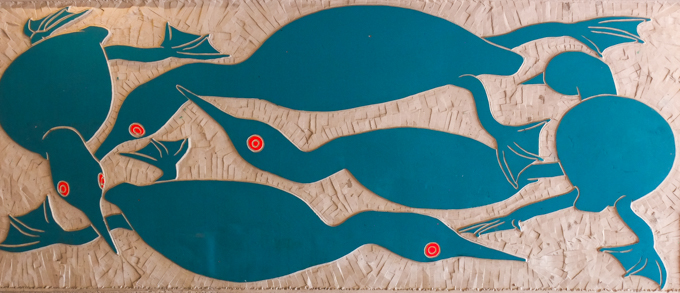
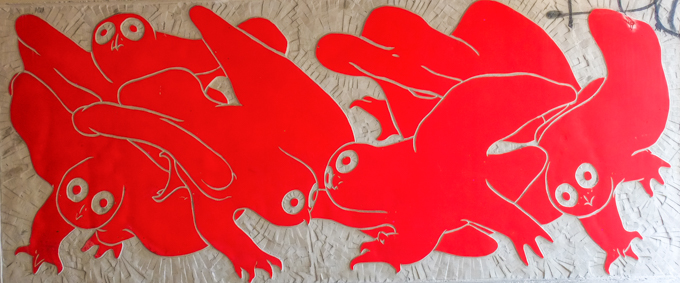
below: At the south end, the Glen Road bridge leads to a tunnel that goes under Bloor Street.  The walls of the tunnel have recently been renovated and are now lined with three new pieces of art by Inuit artist Couzyn van Heuvelen .
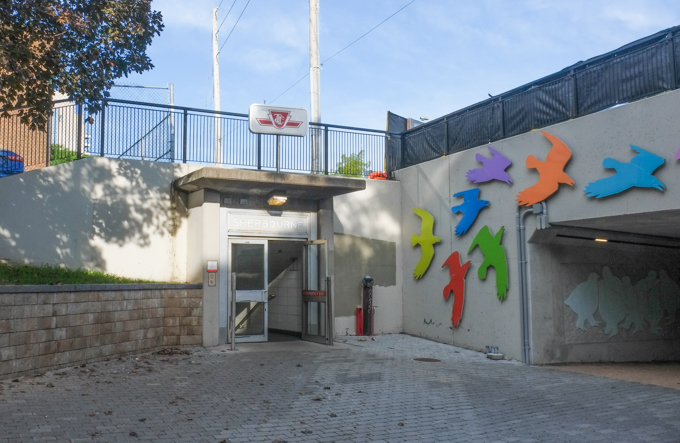
below: The Glen Road entrance to Sherbourne subway station.
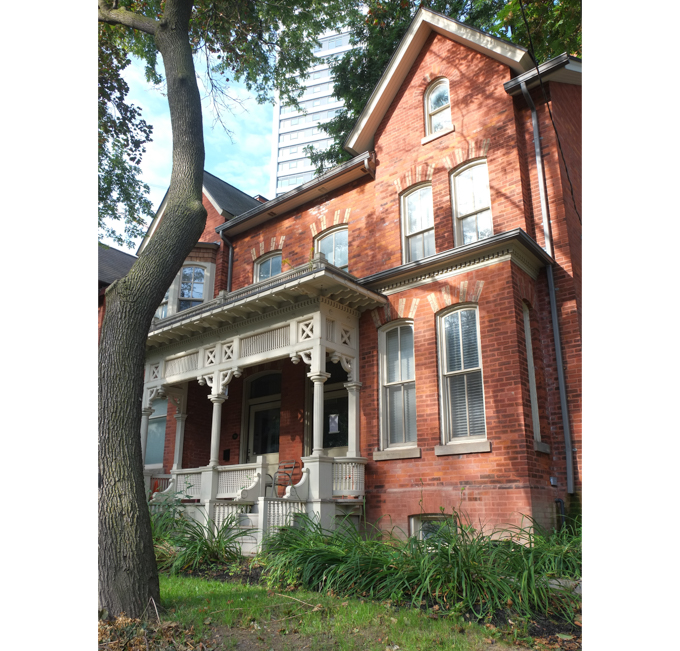
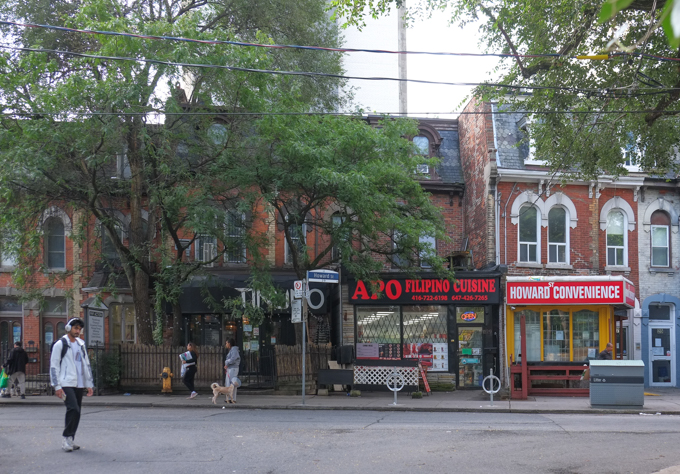
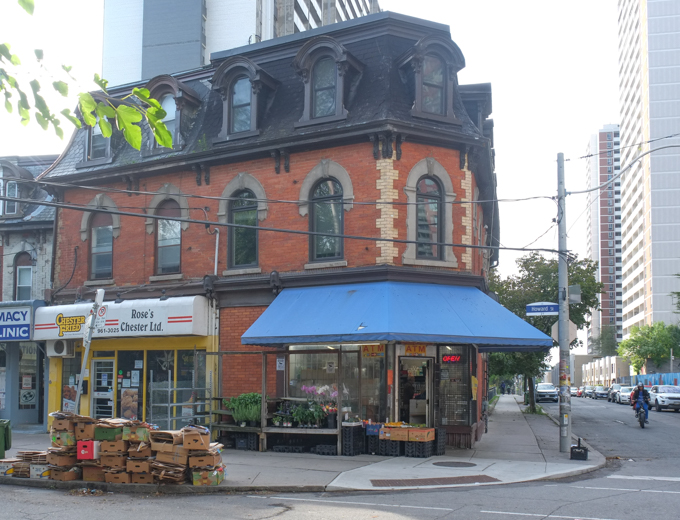
below: Glen Road ends at Howard where a few old houses still remain.
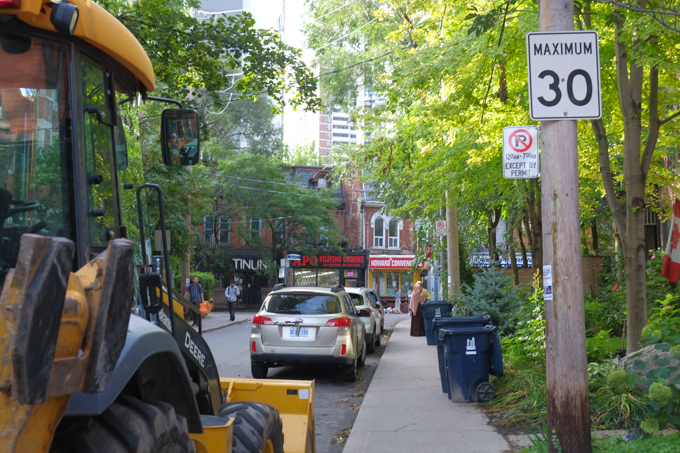
 few businesses on Howard St., in old brick houses, including Apo Filipino restaurant and Howard convenience store

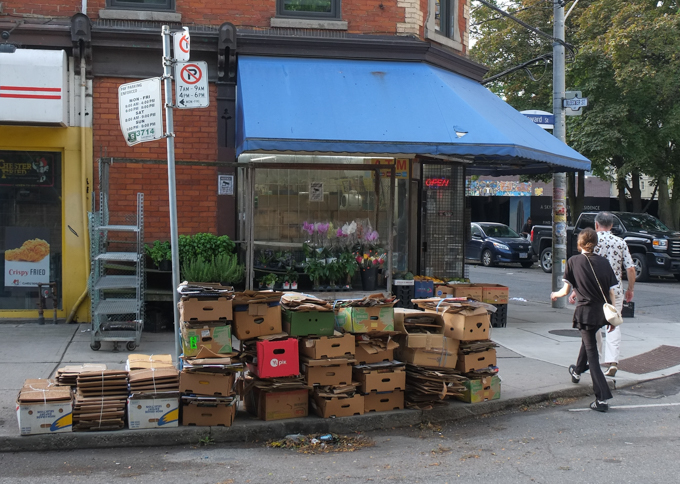
empty cardboard boxes stacked up on the sidewalk outside of a store, waiting for garbage or recycling collection
old brick building, second empire style, with black roof, large blue awning over front door,

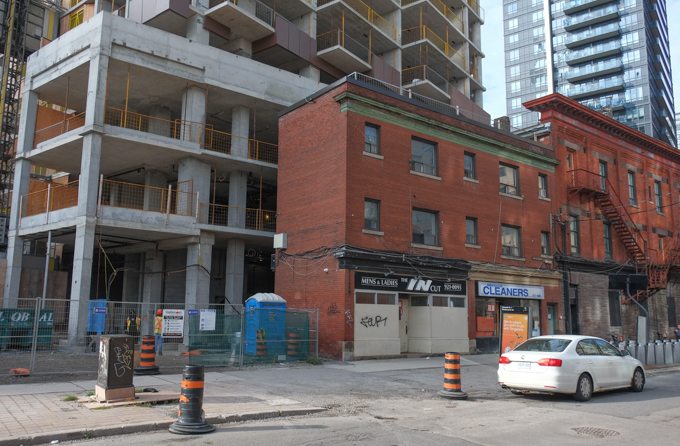
redevelopment of older buildings on Howard Street, building more housing

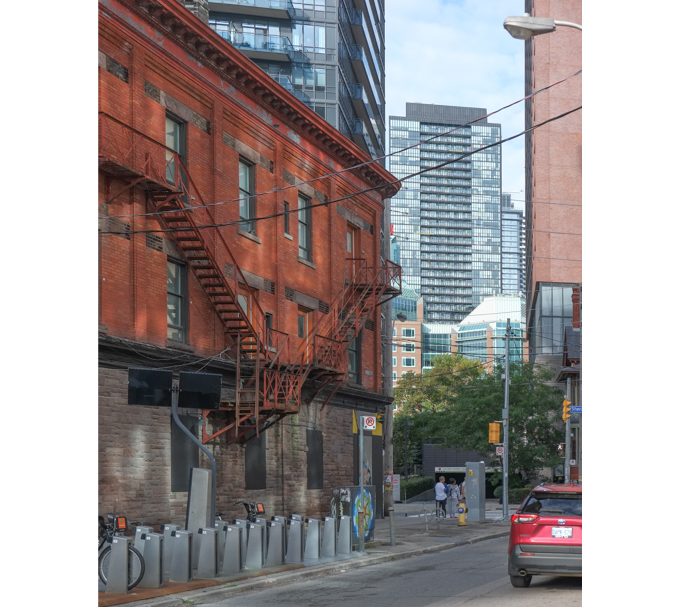
older three storey red brick building on Howard Street, with newer buildings in the background, a red car on the street

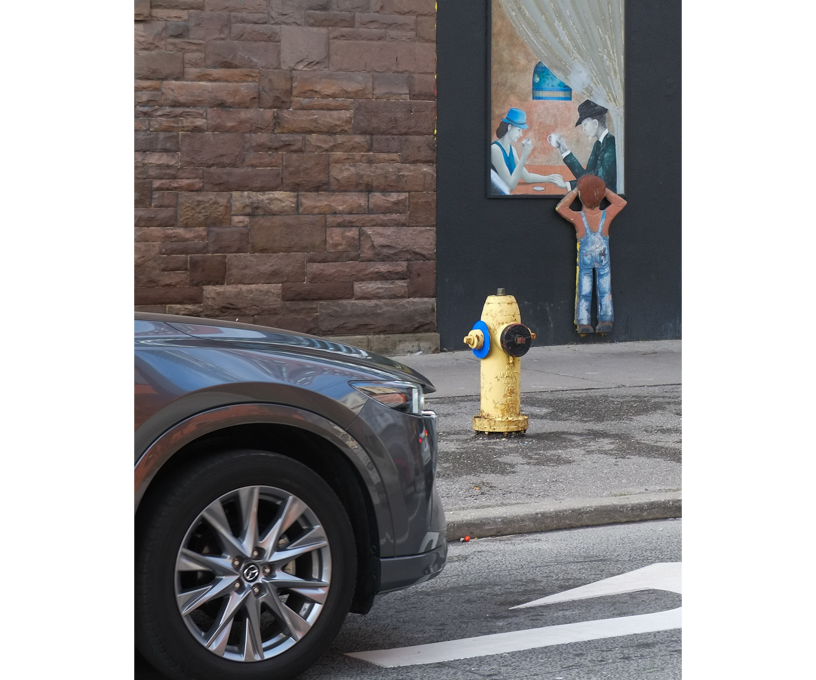
car parked in front of building where fake window with a painting of a young boy looking into the window of a restaurant

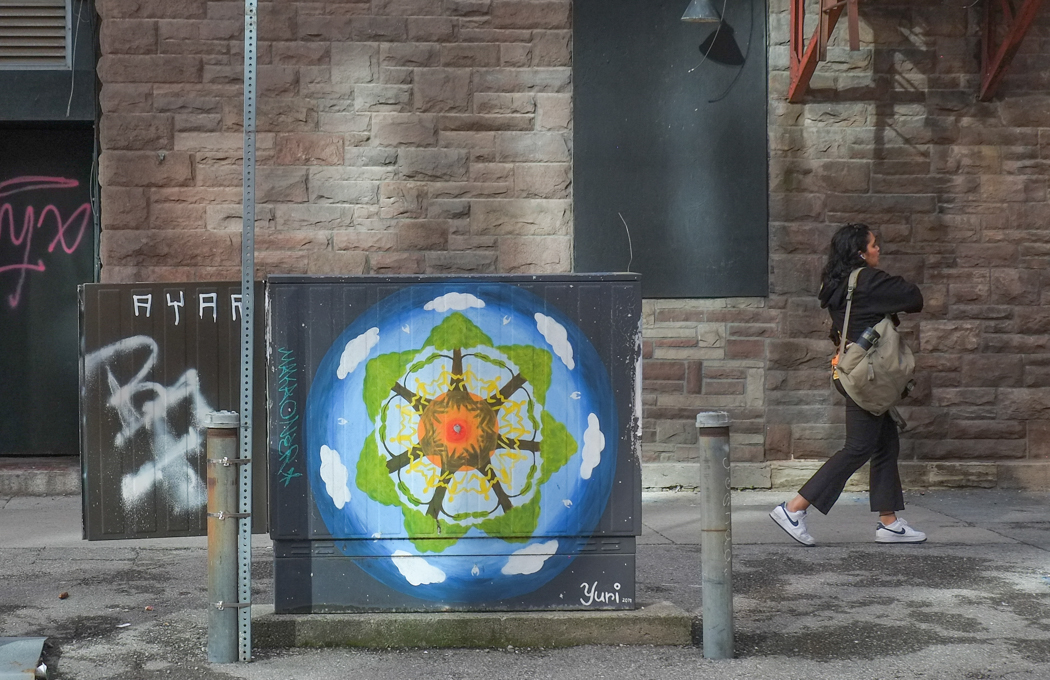
woman walking past a sidewalk box that has been painted

below: The view from Howard & Sherbourne, looking west, a mix of old and new.
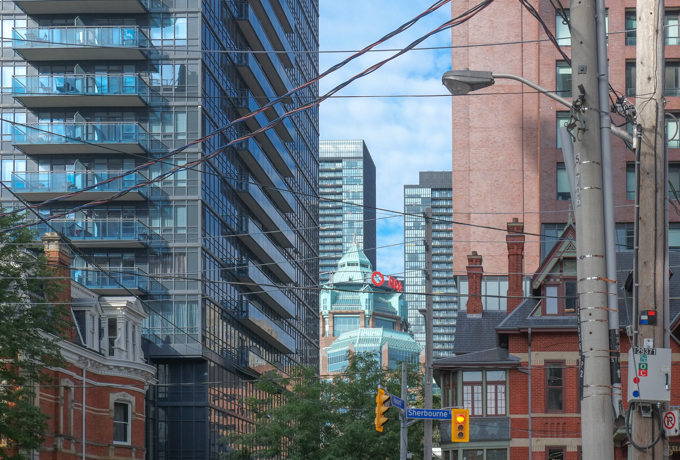
below: Maison Selby, on Sherbourne, this Queen Anne Revival-style building has is now a French restaurant.  It has seen many changes over its 140 year history.  The first occupants were members of the Gooderham family (the whiskey people).  It was briefly home to Branksome Hall girls’ school before they moved to a larger space.  In 1912 it became a hotel and it has generally been a hotel, bar, or restaurant space since then, albeit under many different owners.
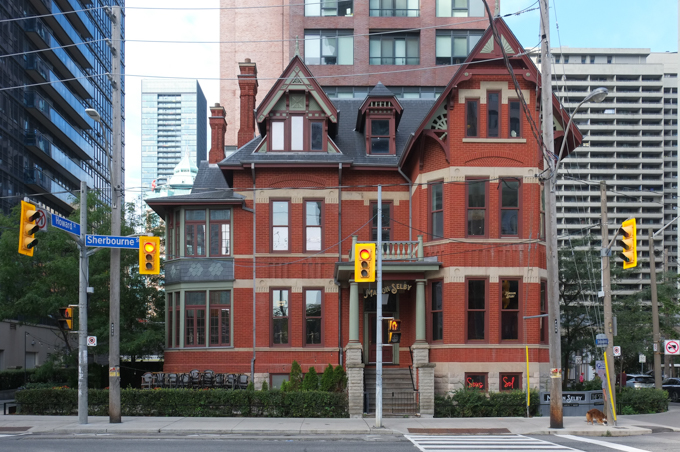
Maison Selby, old Victorian brick building

below: Trinity Lutheran Church, also on Sherbourne.
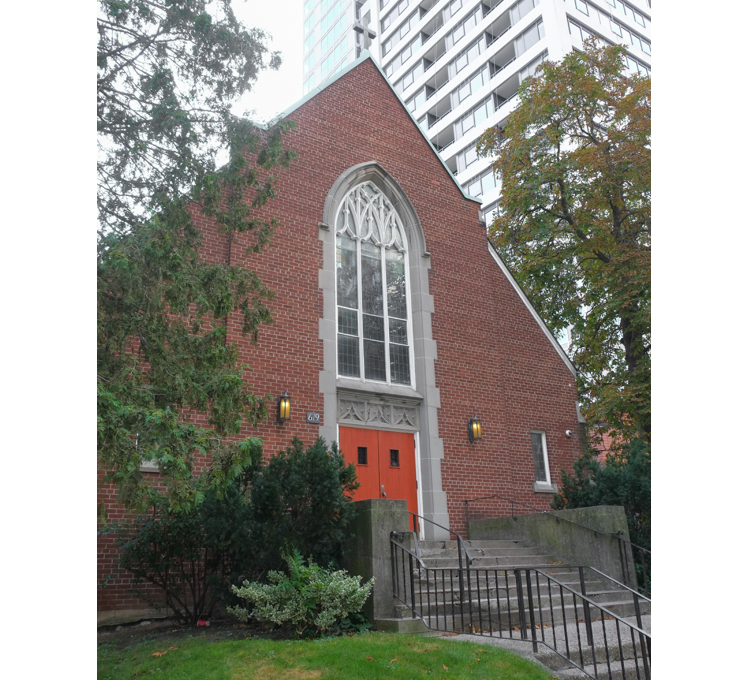
Trinity Lutheran church on Sherbourne

below: “For Sinners Only” says their sign – very inclusive!
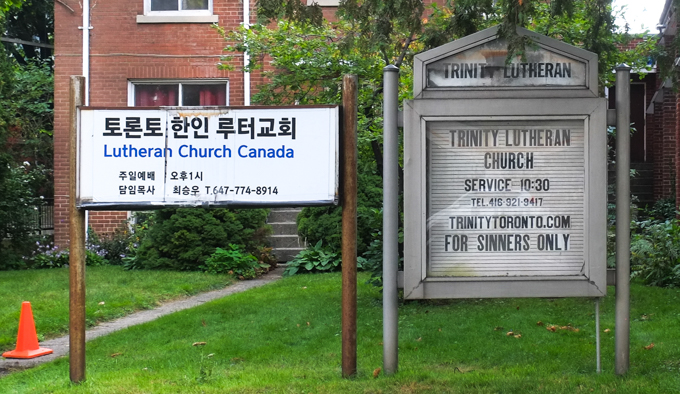
sign in front of Trinity Lutheran church that says for sinners only

below: Back on Bloor Street where Rogers dominates the corner of Bloor and Mount Pleasant (another of those concrete buildings with recessed windows).
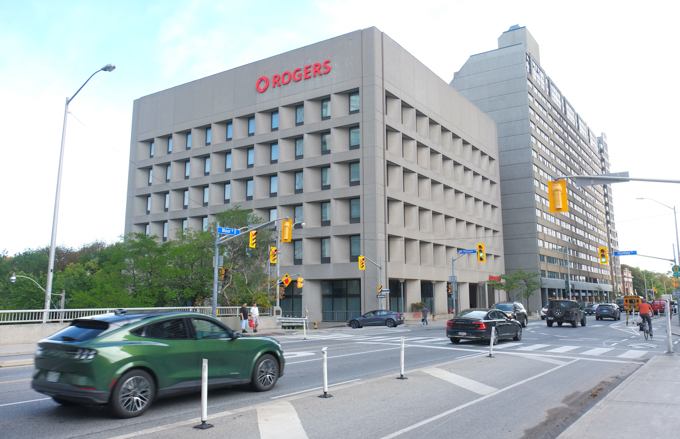
Rogers building at Bloor and Mount Pleasant

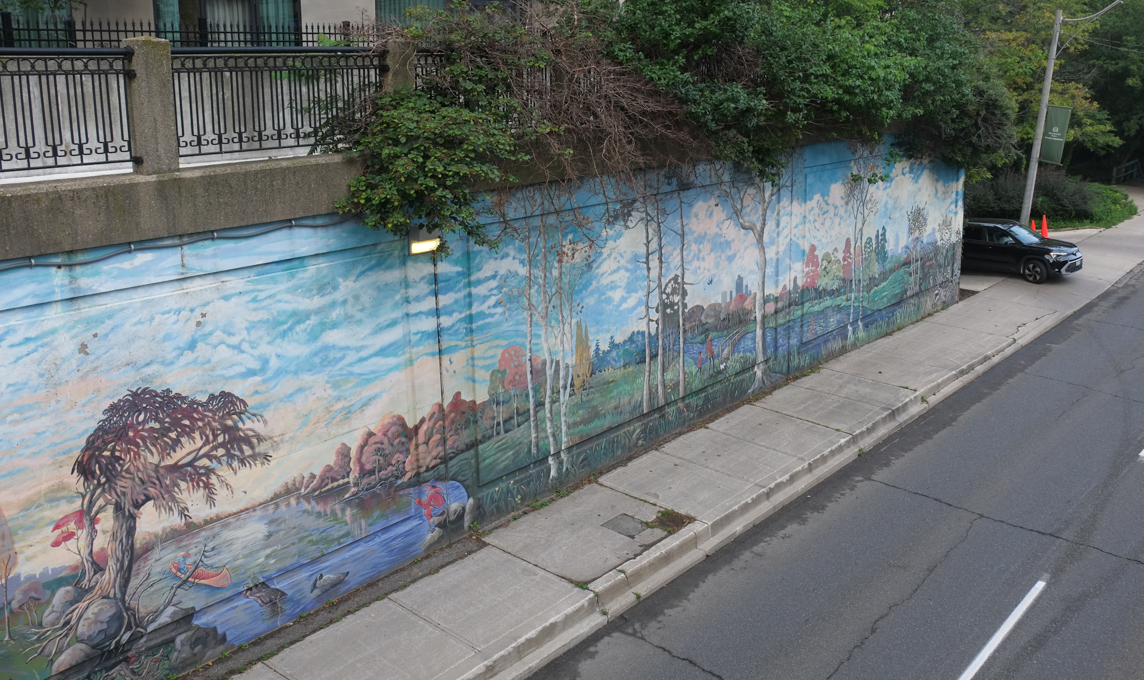
below: Mount Pleasant passes underneath Bloor.  The walls are covered with murals by Ian Leventhal.
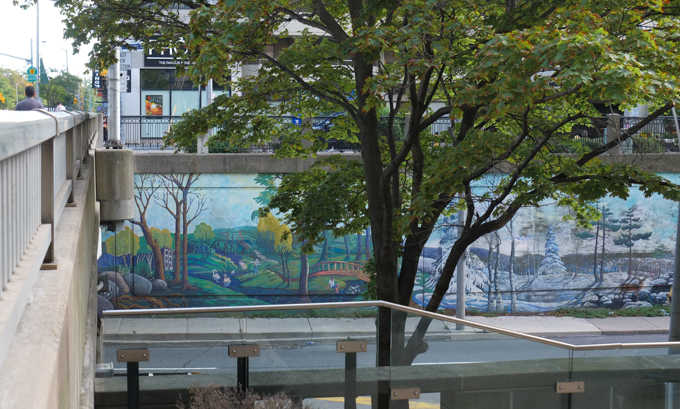
mural by Ian Leventhal, landscape, on walls of bridge, bloor over mount pleasant

mural by Ian Leventhal, landscape, on walls of bridge, bloor over mount pleasant

below: The south end of Mount Pleasant just before it becomes Jarvis Street…  and that makes bridge number three.
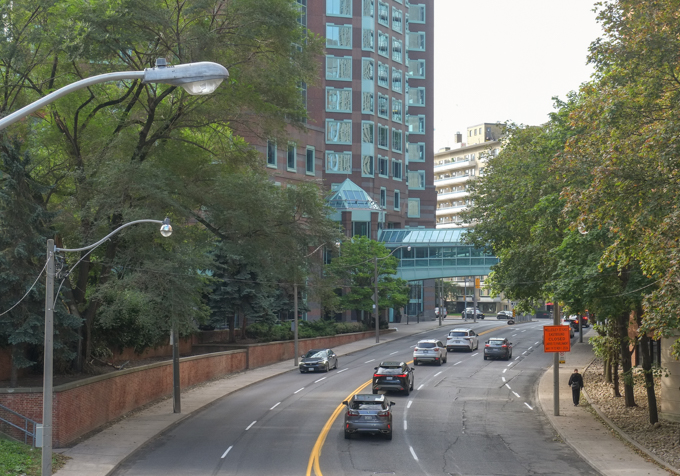
Mount Pleasant Avenue as it passes south of Bloor

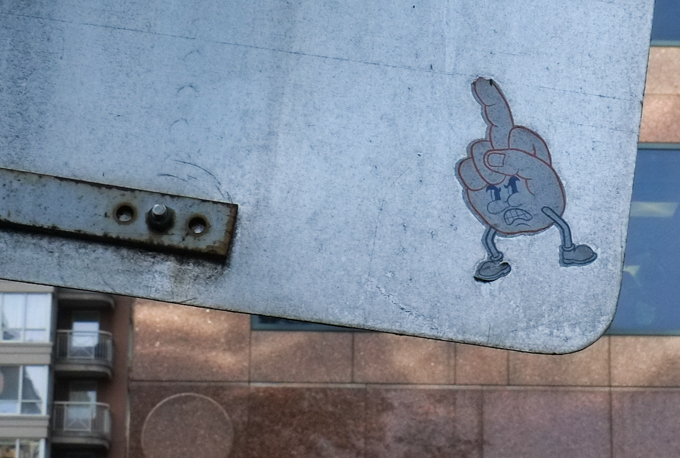
below: It’s not the most positive note to end on but hey, someone took the time to make this sticker and then find a home for it.  May they change their mind one day!
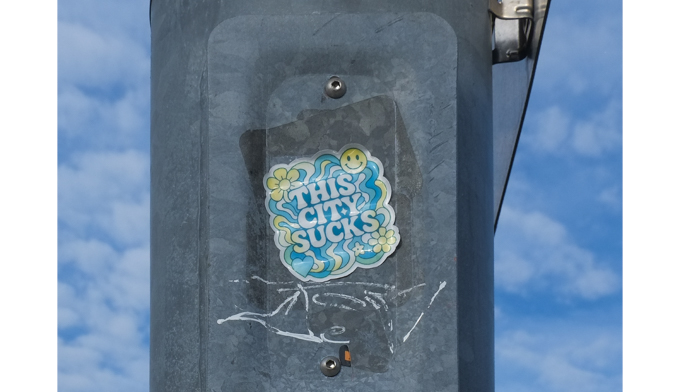
graffiti sticker

graffiti on the back of a city sign that is a growling character made of a hand giving the figure

There is no theme to this blog post.  I never really had a purpose in mind as I walked yesterday.  I walked to enjoy the spring day.  I walked wherever my feet took me…  and they took me on a route that wove between Bay Street and University Avenue and from Grenville south to Dundas.

two women dressed up and walking down the street. One is in a puffy black dress, black tights and black shoes. The other woman has long red hair and a polka dot sweater on.

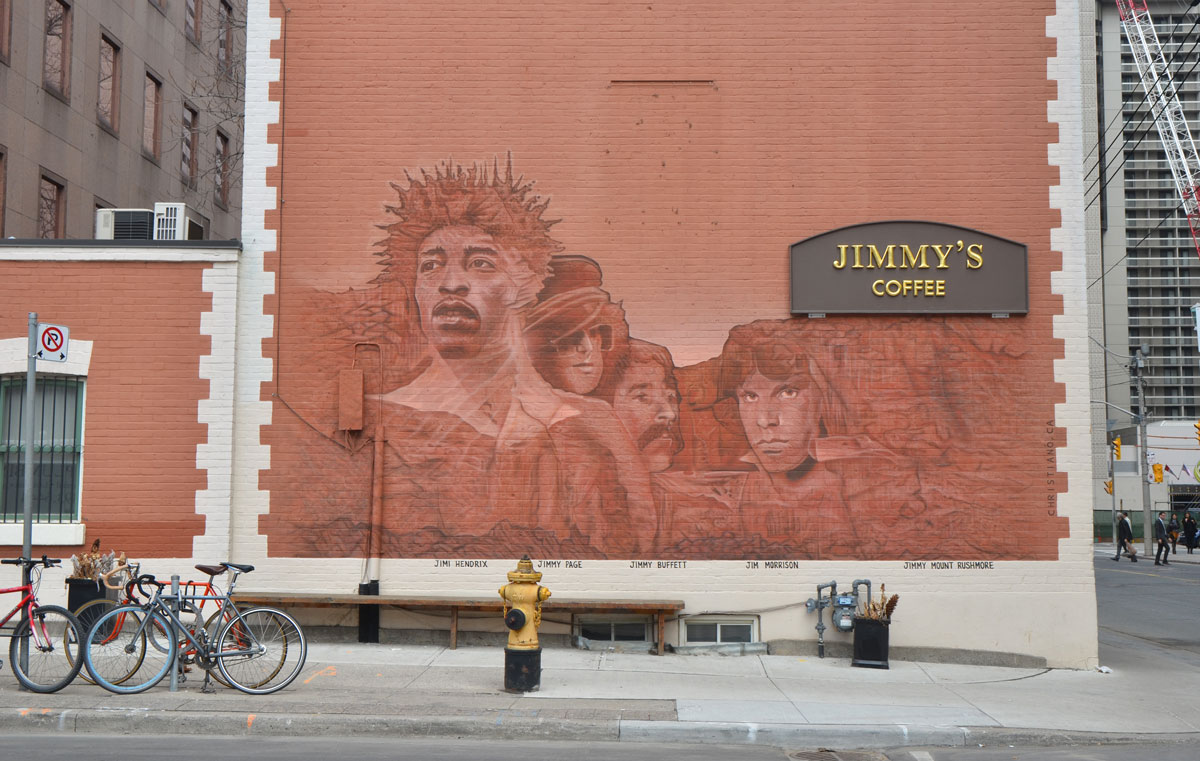
below: “Jimmy Mount Rushmore” mural on the side of Jimmy’s Coffee featuring four famous musical Jimmys: Jimi Hendrix, Jimmy Page, Jimmy Buffet and Jim Morrison.

mural on the side of Jimmys coffee, monochromatic in rust, pictures of what Mount Jimmy Rushmore would like, four famous Jimmys, Jimi Hendrix, Jimmy Page, Jimmy Buffett and Jim Morrison

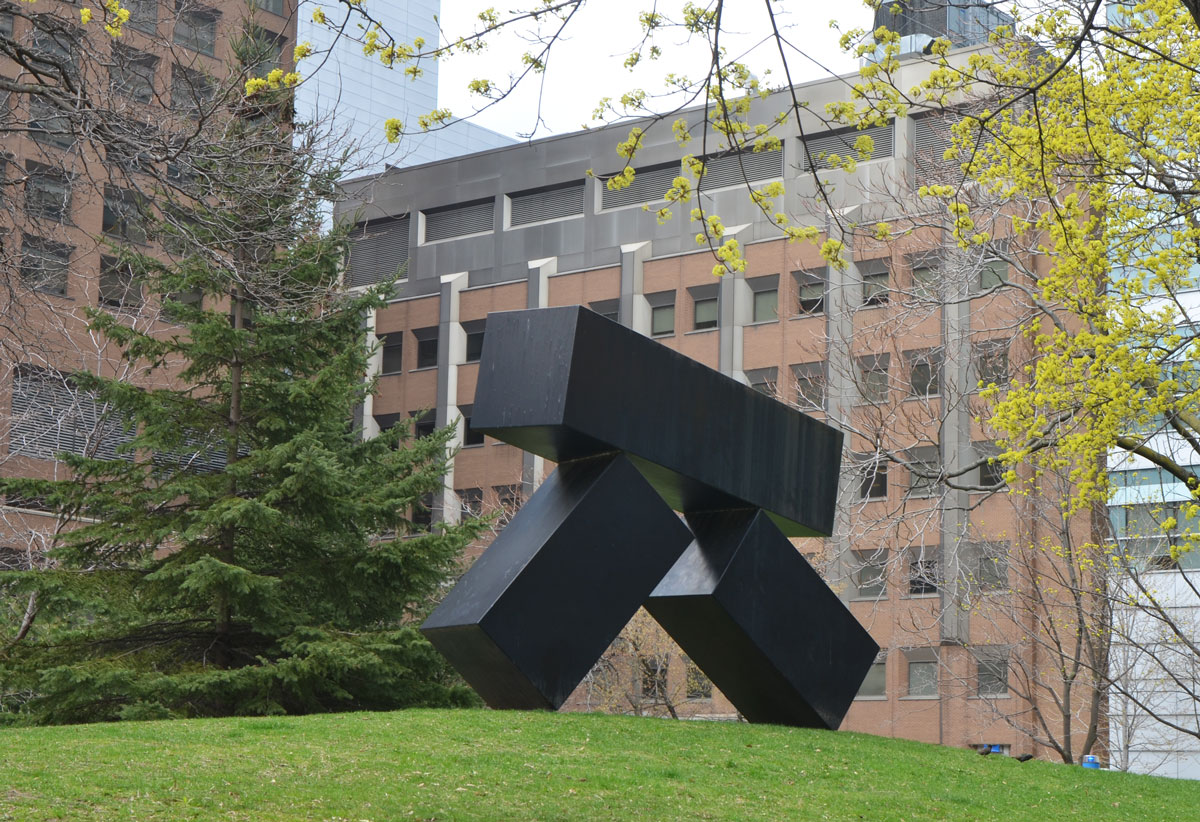
below: ‘Inner City Gate’ by Kosso Eloul.  1978.  A balancing act of stainless steel boxes on the lawn of the R. Fraser Elliott building (part of the old Toronto General Hospital), Elizabeth Street.

black metal sculpture of three boxes precariously balanced, the upper box is almost horizontal and it is being supported by the other two who are falling down but still balancing

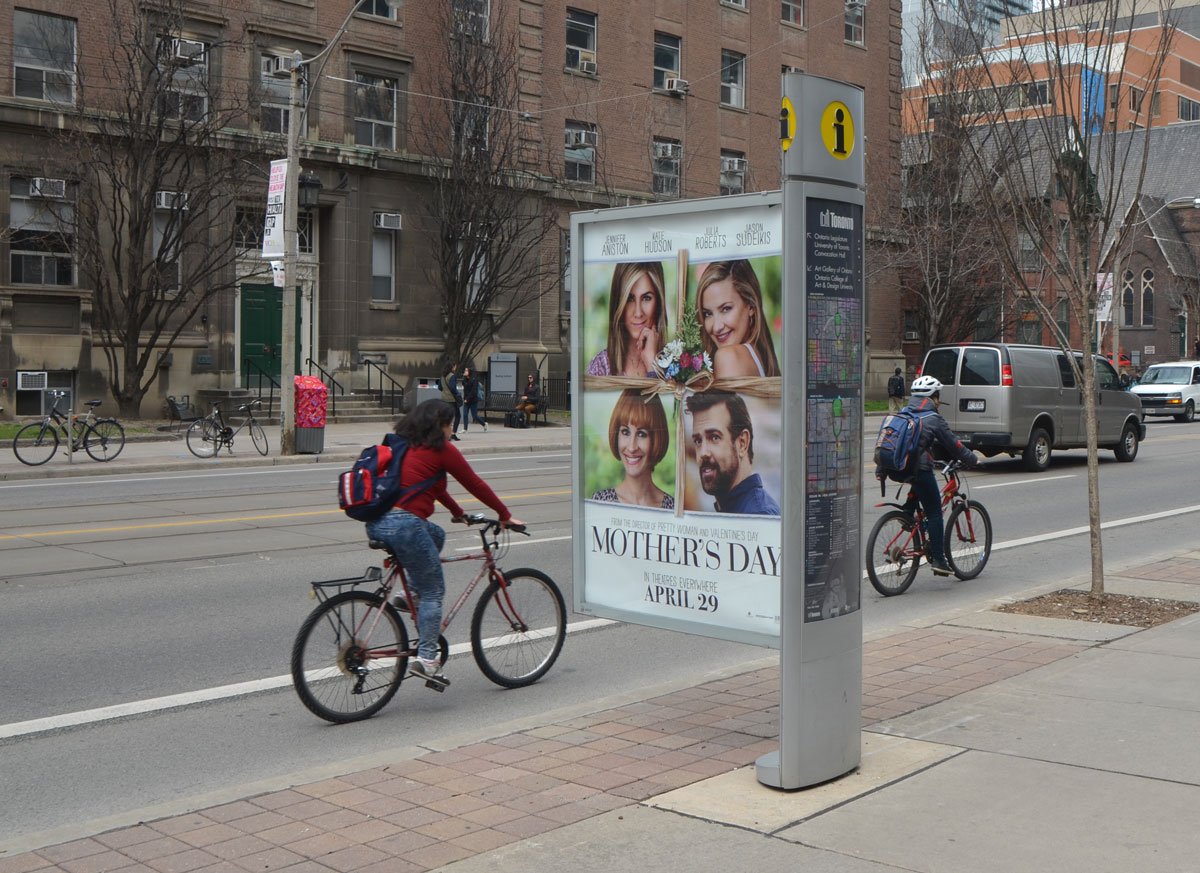
below:  A blight on the sidewalk, so-called information pillars that are really just a sell-out to Astral Media.  They needlessly obstruct the sidewalk and obstruct the view of  cyclists and motorists.  Unfortunately they are part of a 20 year contract that the city has with Astral Media which doesn’t expire until 2027.

cyclists ride by an information pillar that has a large ad jutting out towards the street.

below: Incised into limestone blocks on the Edward Street side of McClelland House (originally the McLean Hunter building) is half of an artwork by Elizabeth Wynn Wood (1903 – 1966) called “Communication”.  The woman is sending a message to a man who is apparently shown on the other side of the building.  Sadly, I missed the man so there is no photograph of him here.  When the work was completed in 1958, the incised lines were inlayed with gold colour.

outline drawing of a woman floating in the sky, incised into limestone facade of a building. She is releasing a bird.

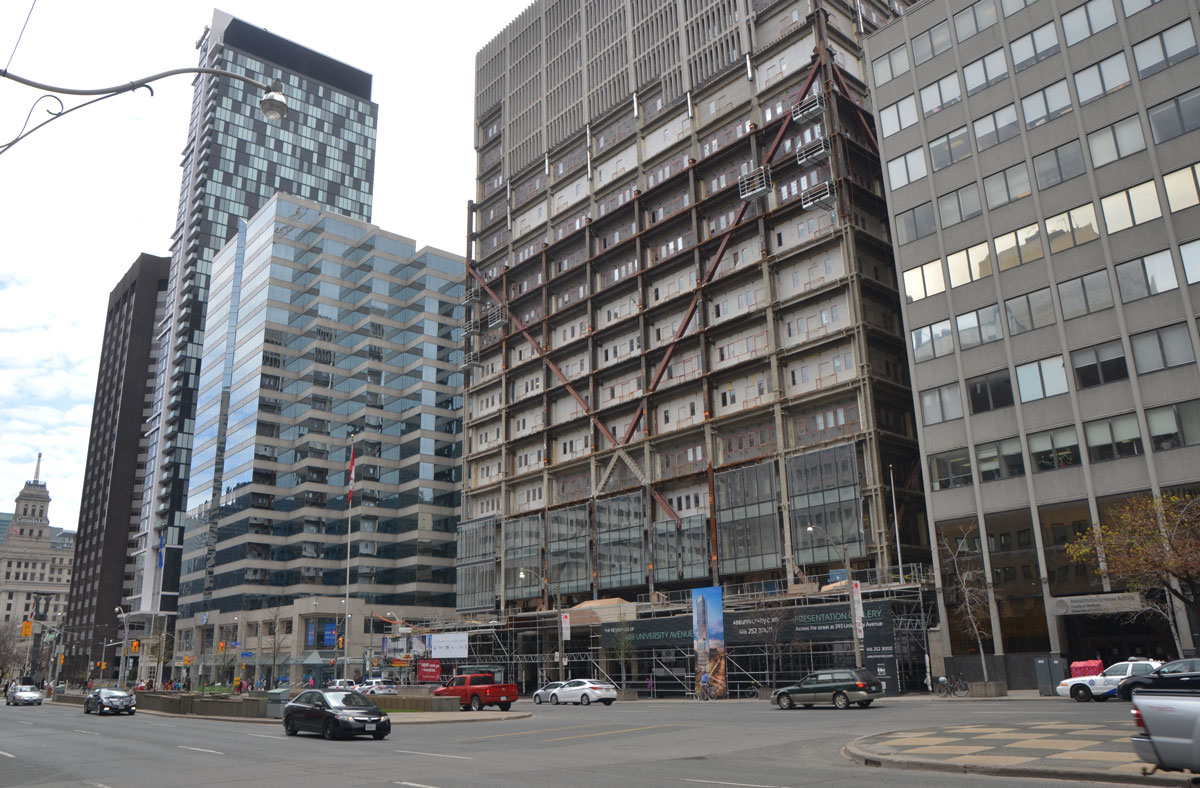
below: Across the street from the ‘floating woman’, 480 University Avenue is getting a facelift.

lower part of building have its facade upgraded to glass panels
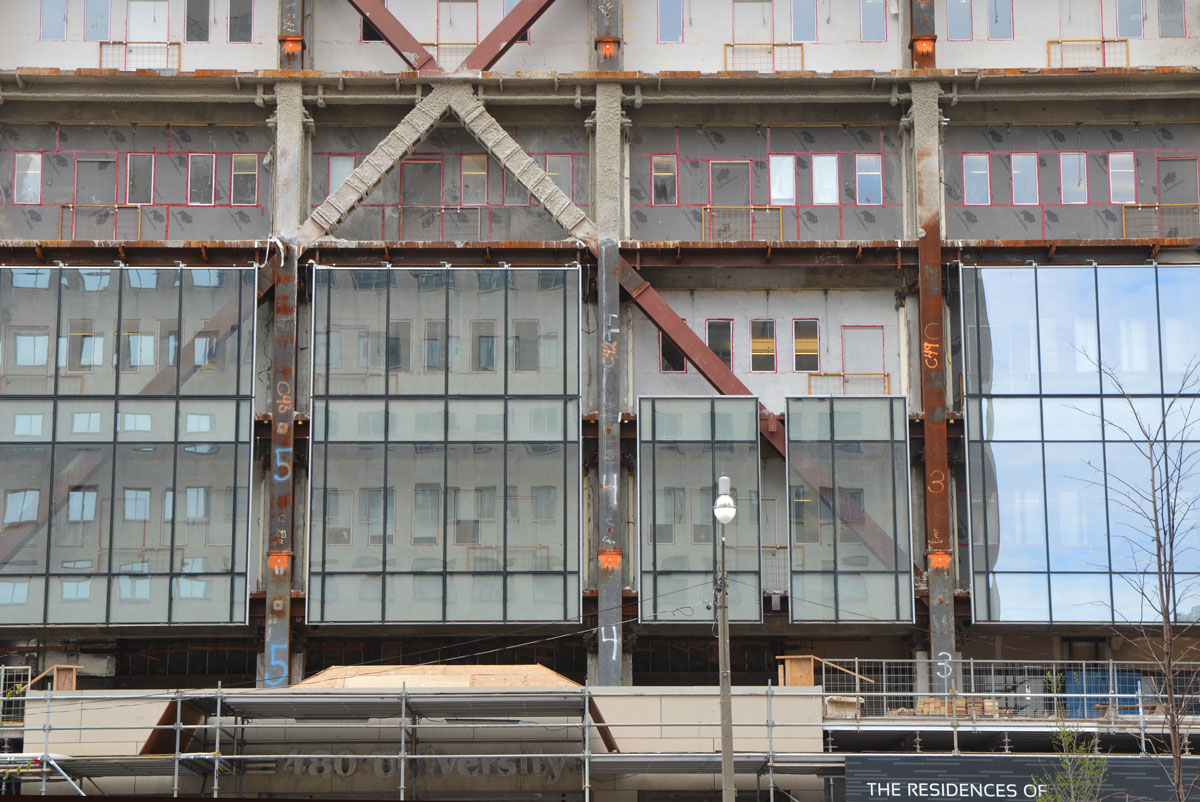
below:  This picture shows most of the front of 480 University and you can see the different stages of the recladding process.  At the top of the building, the precast concrete grille that was part of the original 1968 Global House office tower is still in place while new glass panels have already been installed on the lower floors.   It is interesting to watch the metamorphosis of an 18 storey office building into a 55 storey condo tower.   Four levels of underground parking have also been added to the site and a new indoor entrance to St. Patrick subway station is in the works.

Tall office building is having its concrete facade replaced with glass. The upper floors are still concrete, the middle floors are bare and the lower floors have new glass

below: Abstract in blues and greys

very close detail shot of glass and reflections that make diamond shaped abstract in blue and grey

There is a lot of building and redevelopment in the area where I walked.

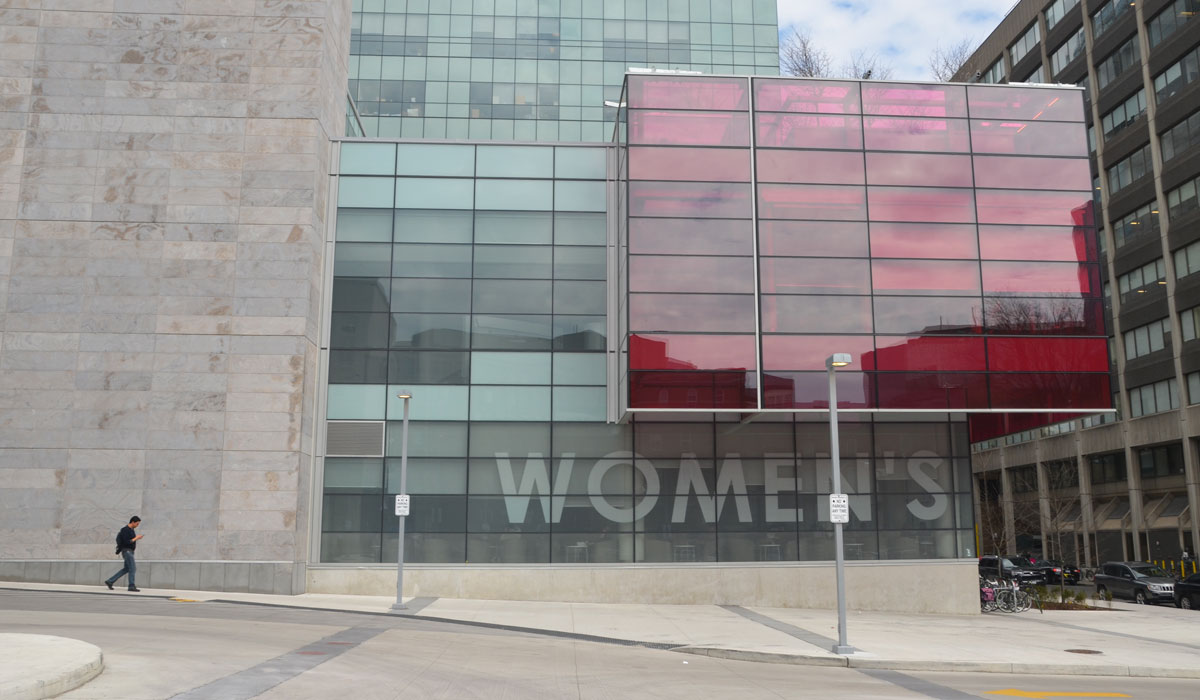
below: Womens College Hospital is totally new.

a lone man walks by the new Womens College Hospital building with its light grey stone facade, large glass section, and large pink glass section.

below: The corner of College and Bay, looking southeast, is now a wall of glass.

cyclist rides through the intersection of College and Bay streets. A wall of glass condos in the background.

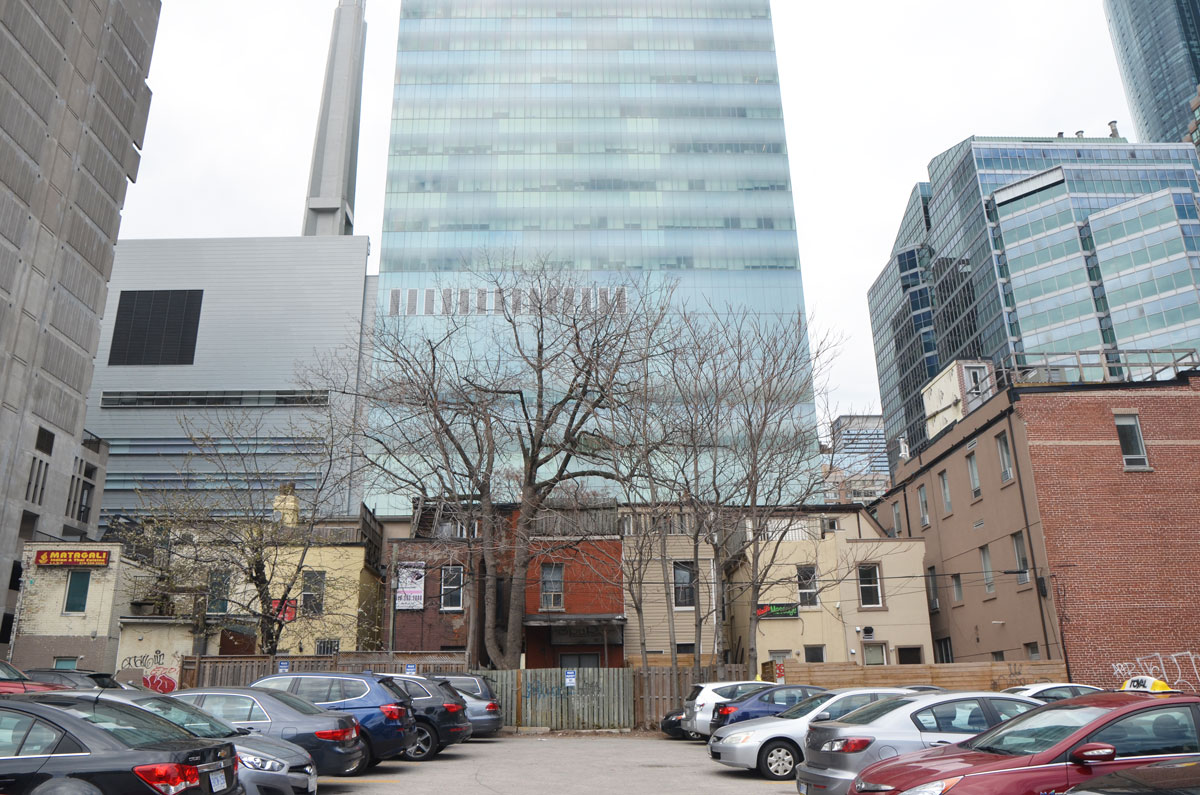
below: The new wing of Sick Kids Hospital dwarfs the older buildings on Elm Street.

view from a parking lot, a row of the back of older two storey brick buildings with some mature trees, then taller modern glass buildings.

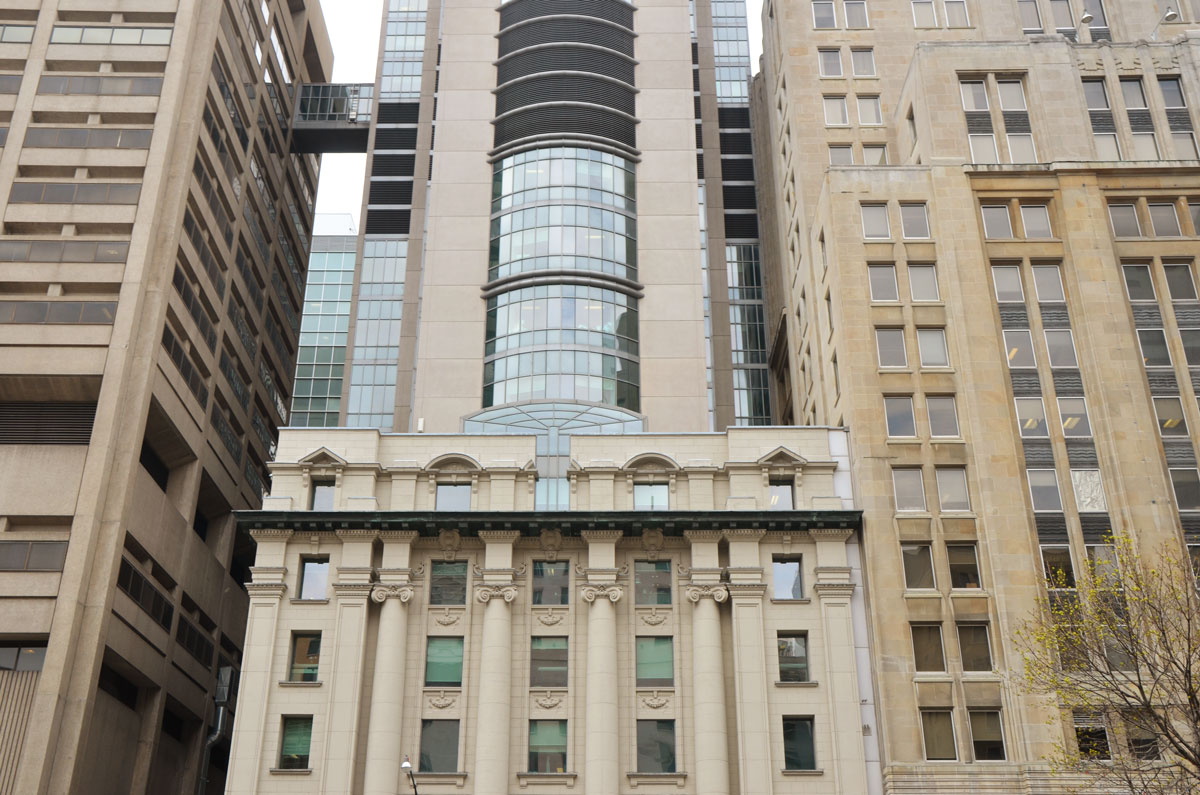
below:  The old and the new integrated into one building, Princess Margaret Hospital.

Princess Margaret Hospital, with the older stone building at the bottom, and the new modern addition above and beside it.

below: Even the street is being redone.  The center of Bay Street from Dundas to Elm is torn up because of  TTC streetcar track replacement.

A digger and other equipment working on a torn up section of Bay street.

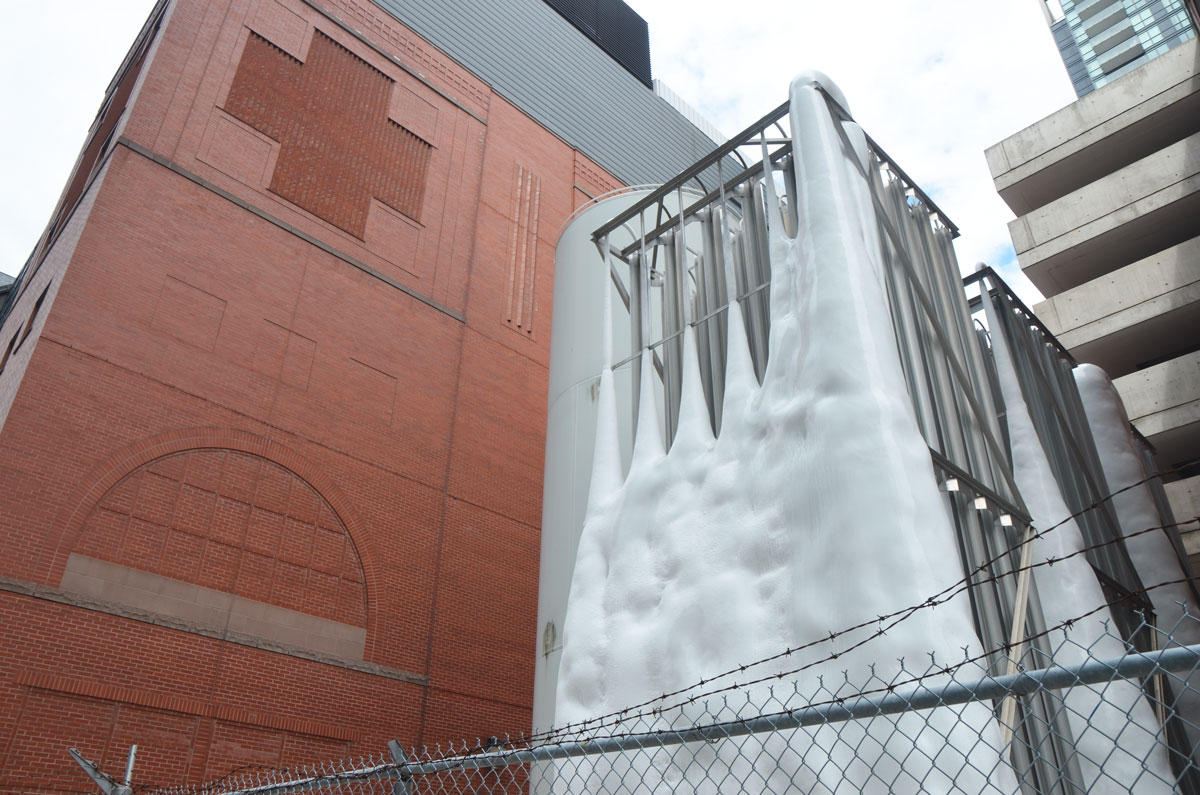
below: Little quirky details:  First, the cross shapes made of contrasting brick on the back of the Red Cross building.  Second, the workings (or barrier?) of the compressed gas tanks that have been made to look like ice.

part of the addition that was added to the Red Cross building, two cross shaped features in contrasting brick on the upper levels. In front of that building are large compressed gas tanks.

below:  Another piece of public art, ‘Liquid Echo’ by Catherine Widgery, 1999, is in front of 750 Bay Street.  They look like stiff and lifeless frozen metallic fountains… or maybe just 12 pencils 🙂 .   Circular vent shafts for the underground parking have been incorporated into the artwork.

public art installation outside 750 Bay street

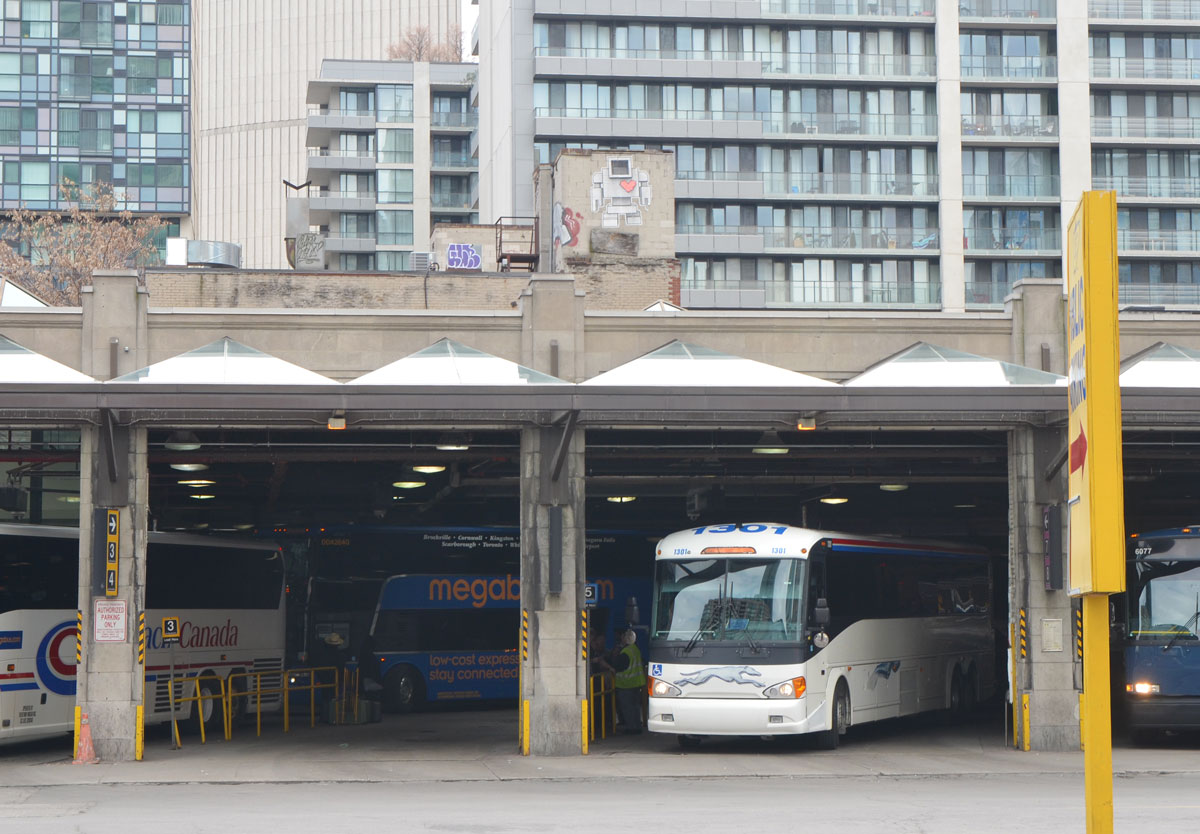
below: A  lovebot watches over the people passing through the bus station, unaware that he is there.

large lovebot wheatepaste paste up above the downtown Toronto bus terminal. A white bus is parked in one of the bus bays. Condos in the background.

below: And last, a colourful collection of squares and rectangles. Blue and green.  Red and white.

green and blue glass of a building's facade, with a storefront below. The windows of the store are filled with red and white pillows arranged in a grid.