Posts Tagged ‘urban’

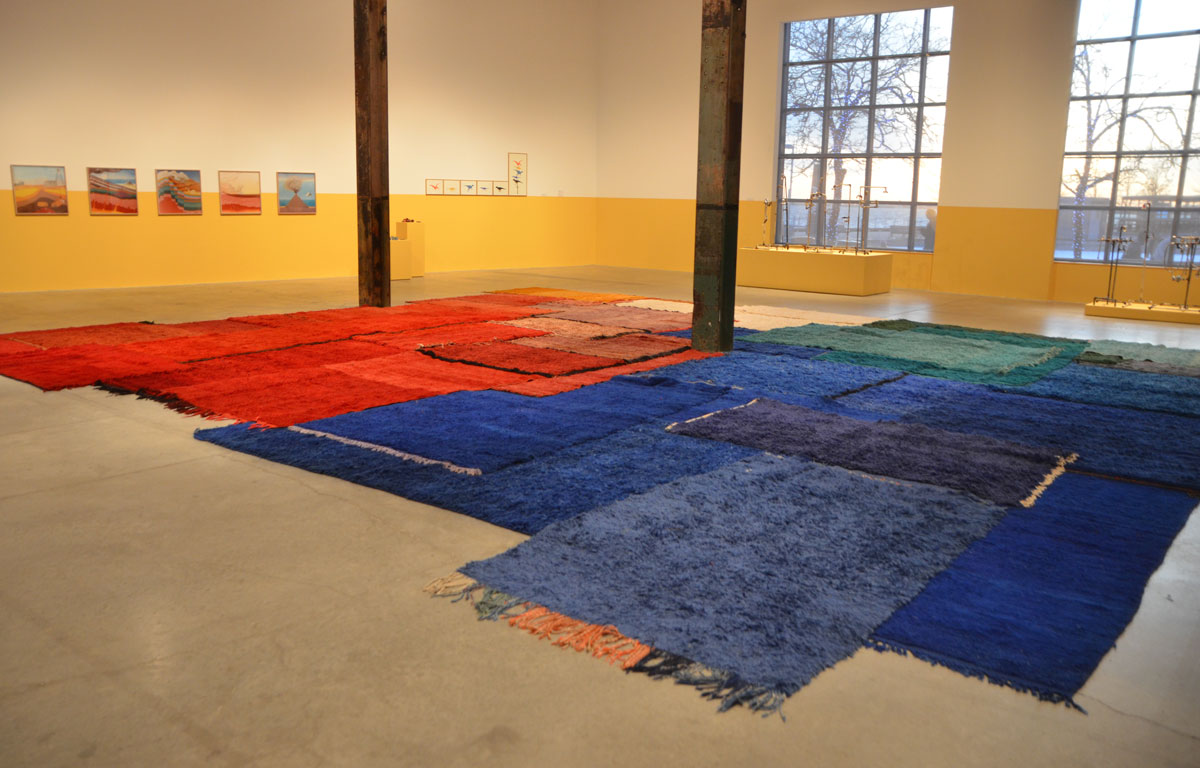
Yesterday afternoon I wandered into The Power Plant Art Gallery.  It was late enough in the day that the sun was already low in the sky.  It shone through the large windows in the main gallery and cast a warm glow on the current exhibit, works by Yto Barrada titled ‘Faux Guide’ .

The first thing you see when you enter the rooms is a collection of carpets.  This is ‘Geological Time Scale’ and it consists of bright and bold red, blue, and green carpets – Beni Mguild, Marmoucha and Ait Sgougou pile rugs from Western Central, Middle Atlas, Morocco.   It’s definitely eye catching and it definitely draws the viewer into the exhibit.

main exhibit room of The Power Plant Contemporary Art Gallery, large room with two large windows in which the low afternoon sun is shining. Exhibit by Yto Barrada consisting of red, green and blue carpets on the floor. some framed pictures on the far wall, walls have been painted yellow up to about 4 feet from the floor.

A series of  small exhibits are arranged around the room and most of them are the result of the artist’s research on Moroccan dinosaurs, fossils, and the industry that has built up around them including the trade in fake fossils sold to tourists and museums.   I have not shown most of these exhibits – I will leave it up to you to discover them.

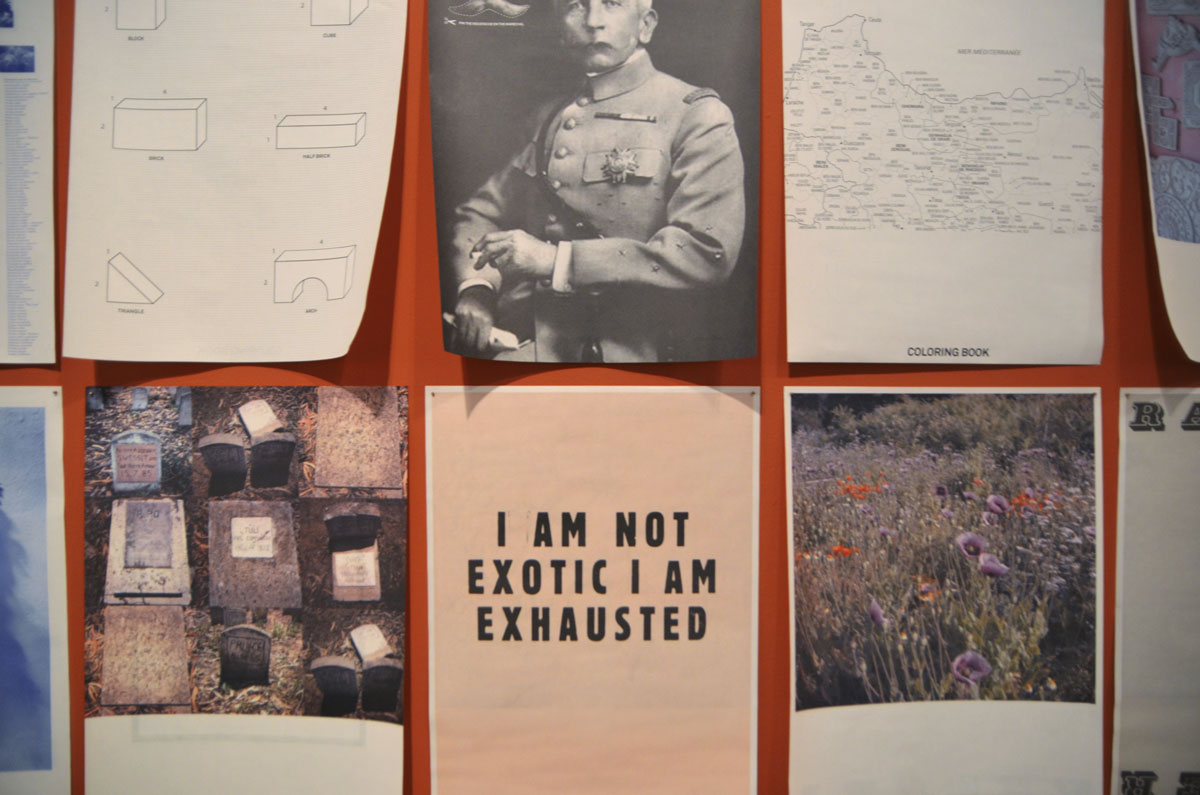
below: “I am not exotic I am exhausted”.  I suspect that this comes as Barrada’s response to living in a place (Tangiers Morroco) where tourists come to see “exotic things”.  But it is also the lament of anyone trying to live and work in a place that is also a “tourist attraction”.

Part of an exhibit by Yto Barrada of a series of posters printed on paper and loosely tacked to the wall, of images and words. 6 shown in this photo. Including one that only has a few word on it, I am not exotic I am exhausted.

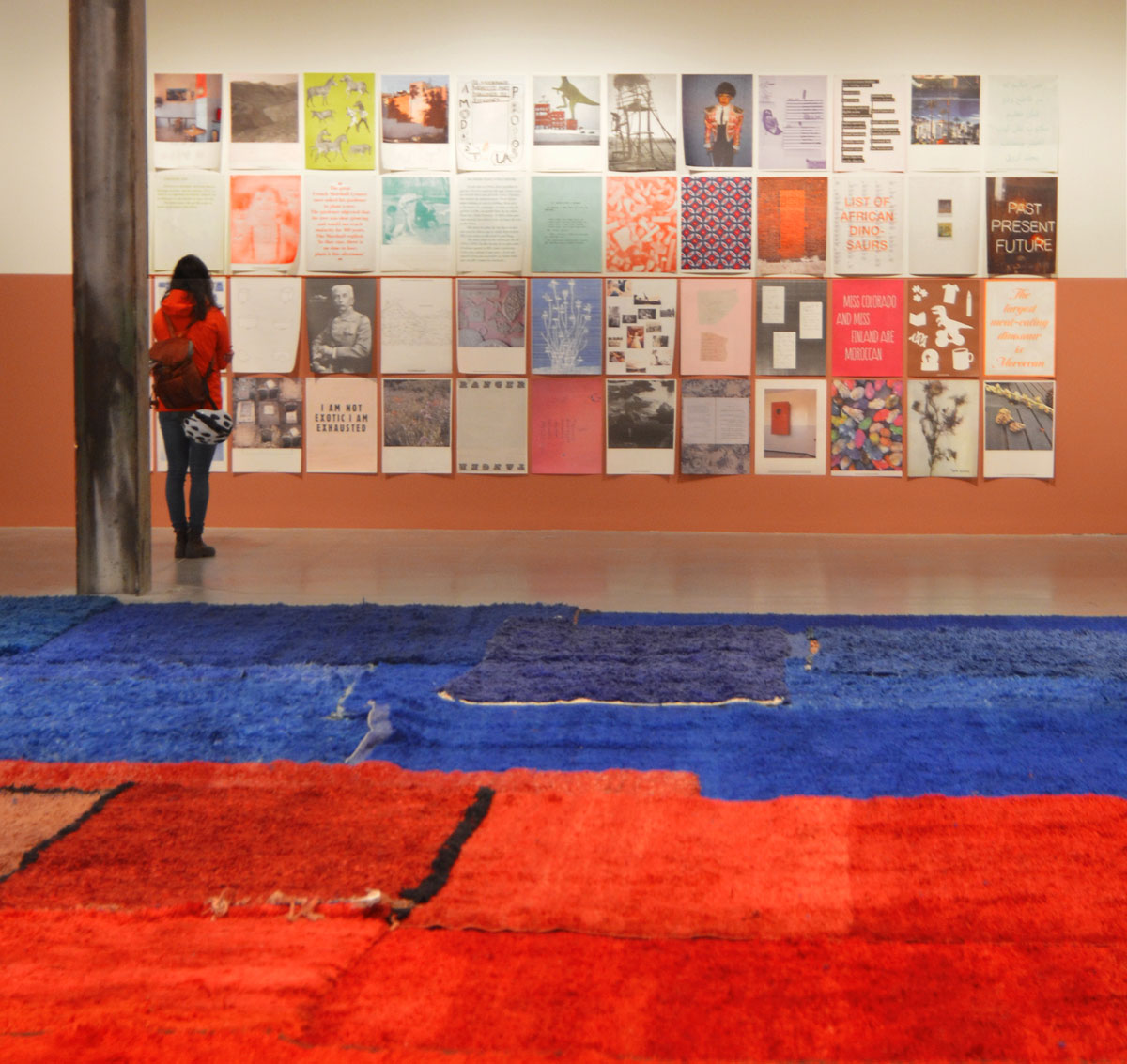
below: The whole of ‘A Modest Proposal’ and ‘Faux Guide’, 2015.  A set of 48 posters loosely tacked to the wall.  A mix of humorous and poignant.  One is an alphabetical listing of all the types of dinosaurs found in Morocco.  One says “Miss Colorado and Miss Finland are Moroccan” – which did happen in 2012.

Part of an exhibit by Yto Barrada of a series of posters printed on paper and loosely tacked to the wall, of images and words. They are arranged in a grid of 12 x 8 pictures. A woman is standing in front of them, reading the words on one. Blue and red carpets are on the floor in the foreground.

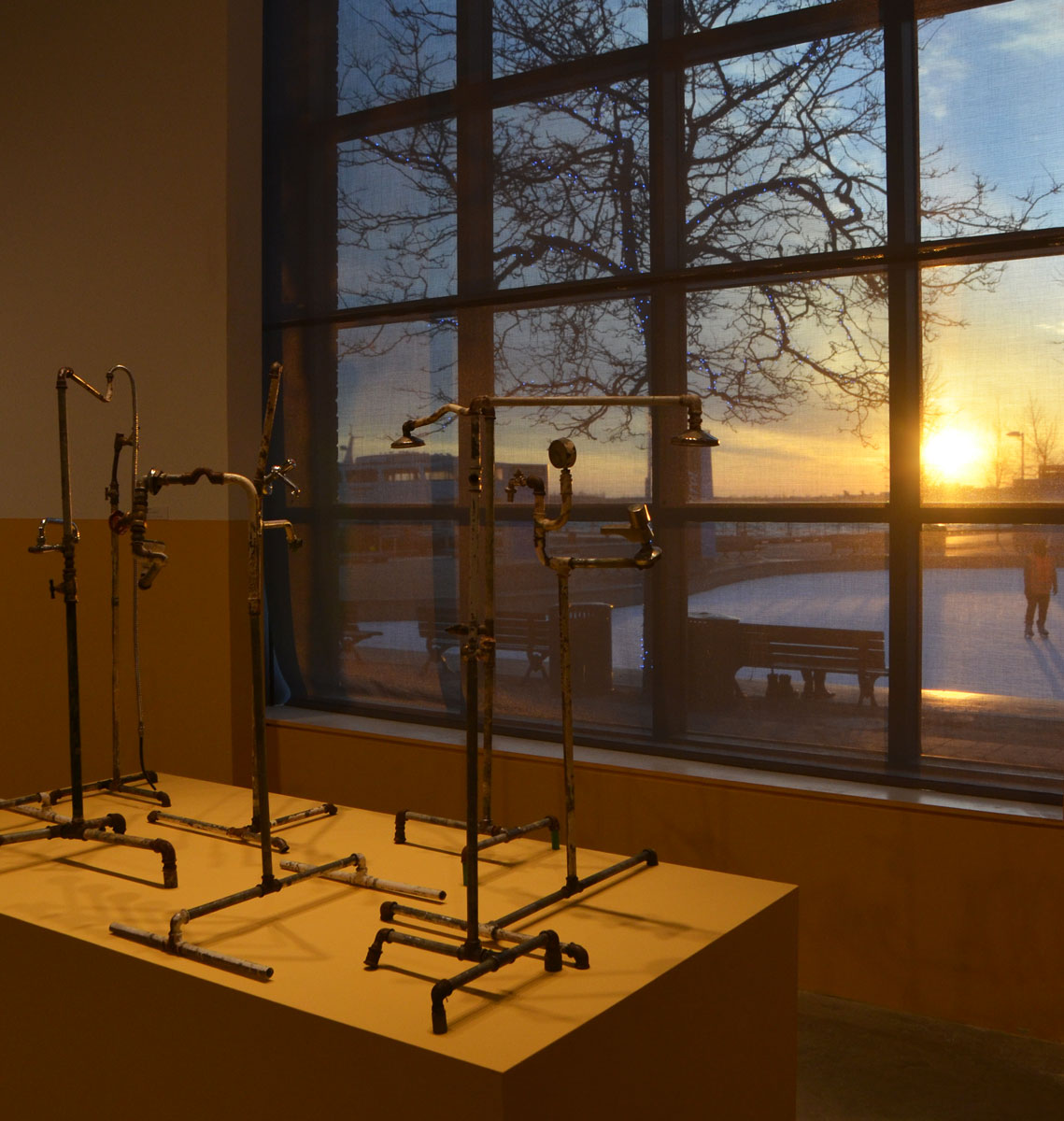
below: ‘Plumber Assemblage’ by the window, with skaters outside in the fading light.

plumber assemblage, an artwork by Yto Barrada consisting of a few sculpture like pieces made from pipes, faucets, taps, shower heads and other plumbing things.

There are many, many things that you can take from this exhibit.  Many things to think about.

An article in the  Toronto Star claims that Barrada  “explores the cultural heritage of her homeland through a colonial lens” and how that heritage has been used to make money from tourists.   But….   Is this the making of money by exploiting one’s culture and history?  Or the exploiting of Moroccan culture and history by the tourists?

Tourists go searching for the foreign and the exotic.  Many of them are souvenir hunters – Sometimes it’s a selfie in front of every “famous” place (or interesting building or whatever) and sometimes it’s a “find”.  But we live in a world that is full of  ‘made in China’ souvenirs and we are a people that don’t care to distinguish between the real and the fake.  We just want a story to tell the folks back home.

There were once dinosaurs living in a tropical land in what is now Morocco….  how the world has changed, and is changing.   Insert your opinions on climate change here.

Because it is a collection of exhibits under one umbrella, it has been compared to a museum.  Very trendy.   One description of the exhibit claims that it is “Meant to make us question the ways in which museums confer value on things”.  Can I take that one step further by asking, how do art galleries confer status on art and artists?  Museums make curatorial choices and so do art galleries.  Barrada too has surely made choices as have I.

You are probably wondering what carpets on the floor have to do with all those words that I just wrote.  Good question.  I think that Yto Barrada is on to something – an exhibit that has visual appeal, offends no one, and is flexible in its interpretation (i.e. it says something different to everyone and fits nicely into most people’s narratives).   You can agree with me, or disagree.  Best to go and see it for yourself and form your own opinions…. mine just might be fake.

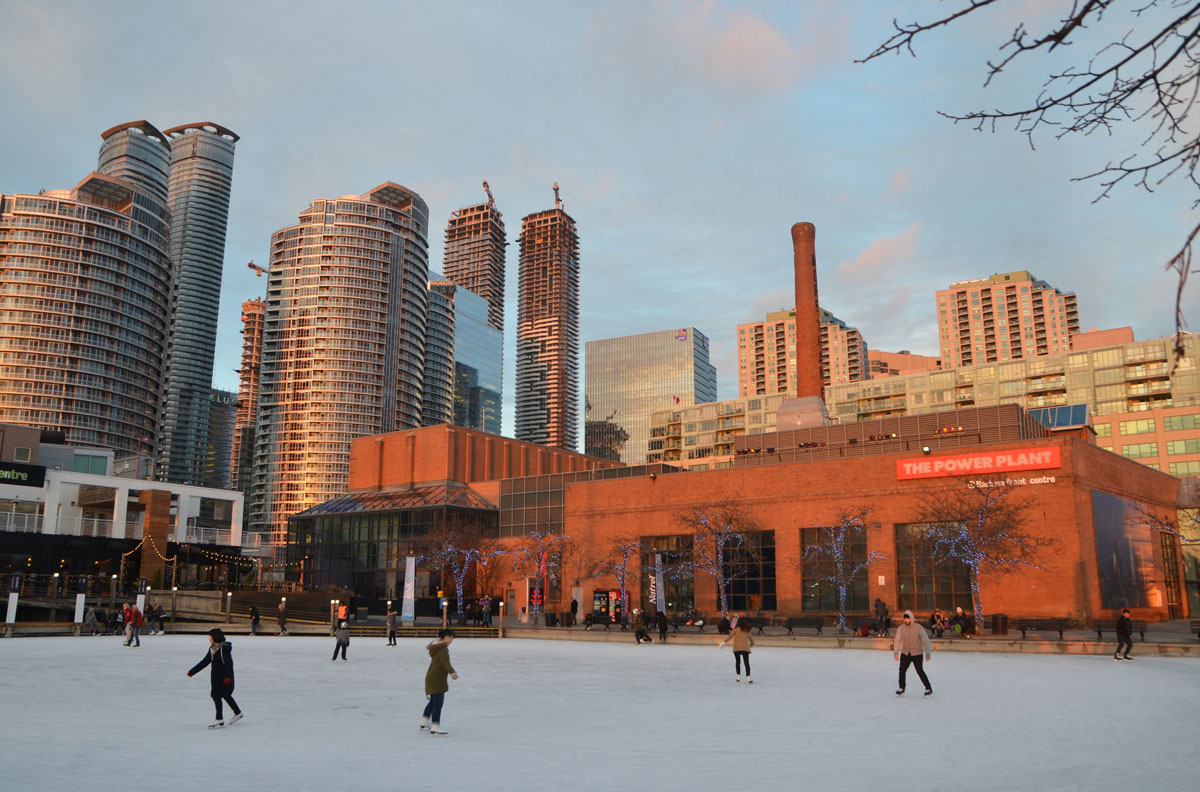
below: People skating on the frozen Natrel Pond beside The Power Plant.

late afternoon with the sun low in the sky casting yellowish glow on the world, Toronto skyline in the background with its condos and construction cranes, also The Power Plant Center and art gallery. In the foreground is the frozen Natrel Pond of Harbourfront and on it people are skating.

Yto Barrada’s exhibit will be on at The Power Plant until the 2nd of January.

Back in mid October I blogged about the new murals on the south side Wilson Ave as it passes under the Allen Expressway (where Wilson subway station is).

below: Looking across Wilson Avenue to part of the mural on the south side.

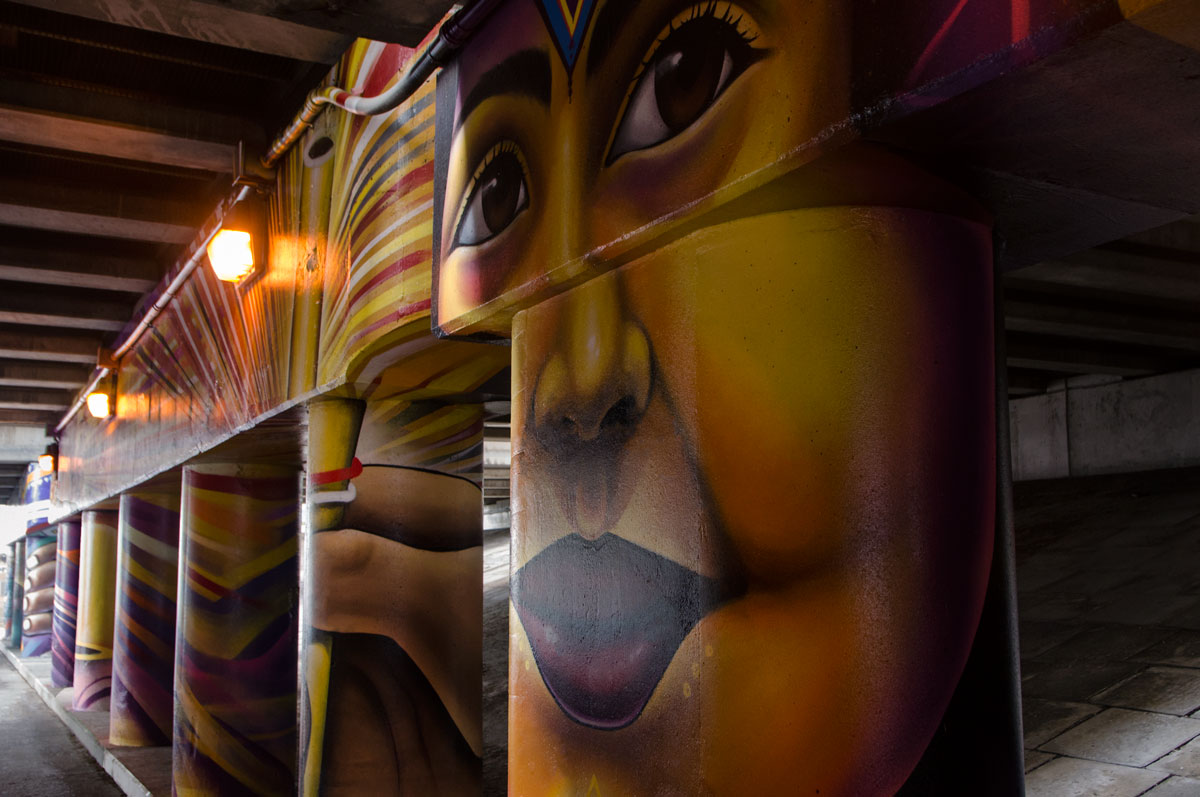
looking across Wilson Avenue, under the Allen Expressway towards a mural that has been painted on the pillars and supports on the other side. A face is painted there.

When I was there last,  the murals on the north side were not completed.   The other day I remembered that I hadn’t seen the finished work, so I took the subway back to Wilson station to see what the pillars on the north side look like.   There is more light on the north side as there are entrances to the subway along the sidewalk here.   There is also more pedestrian traffic.

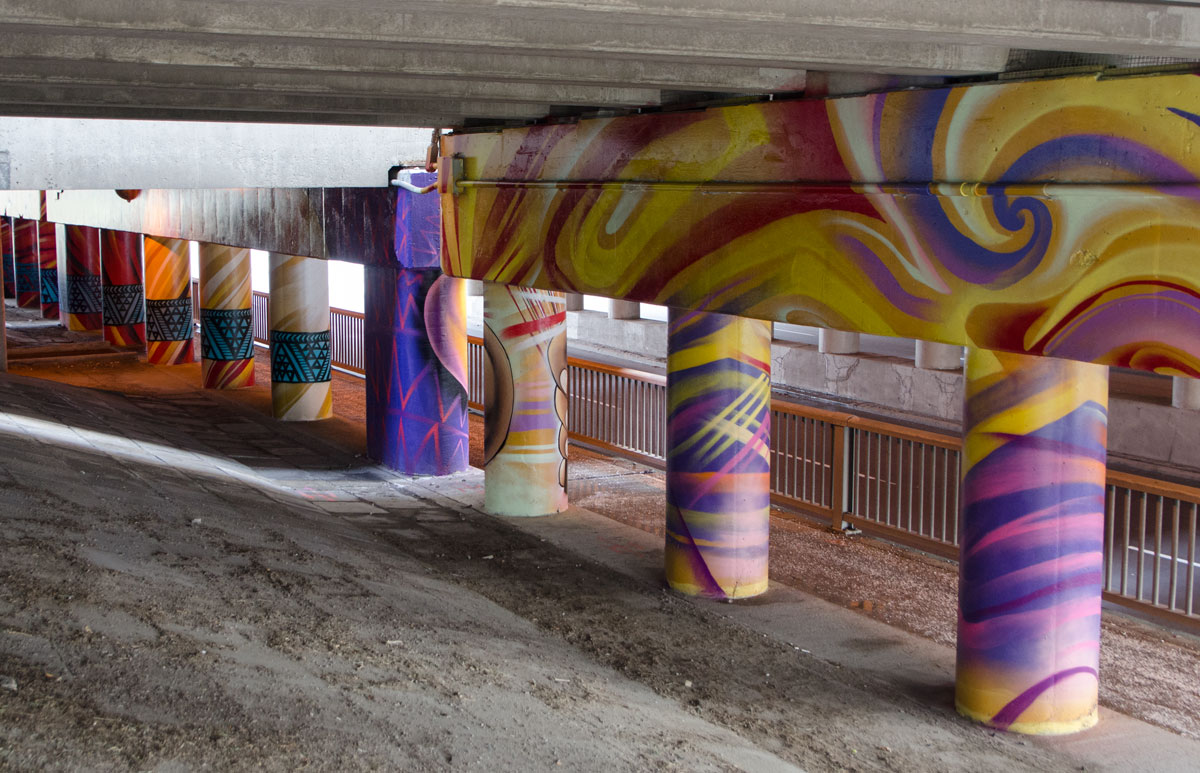
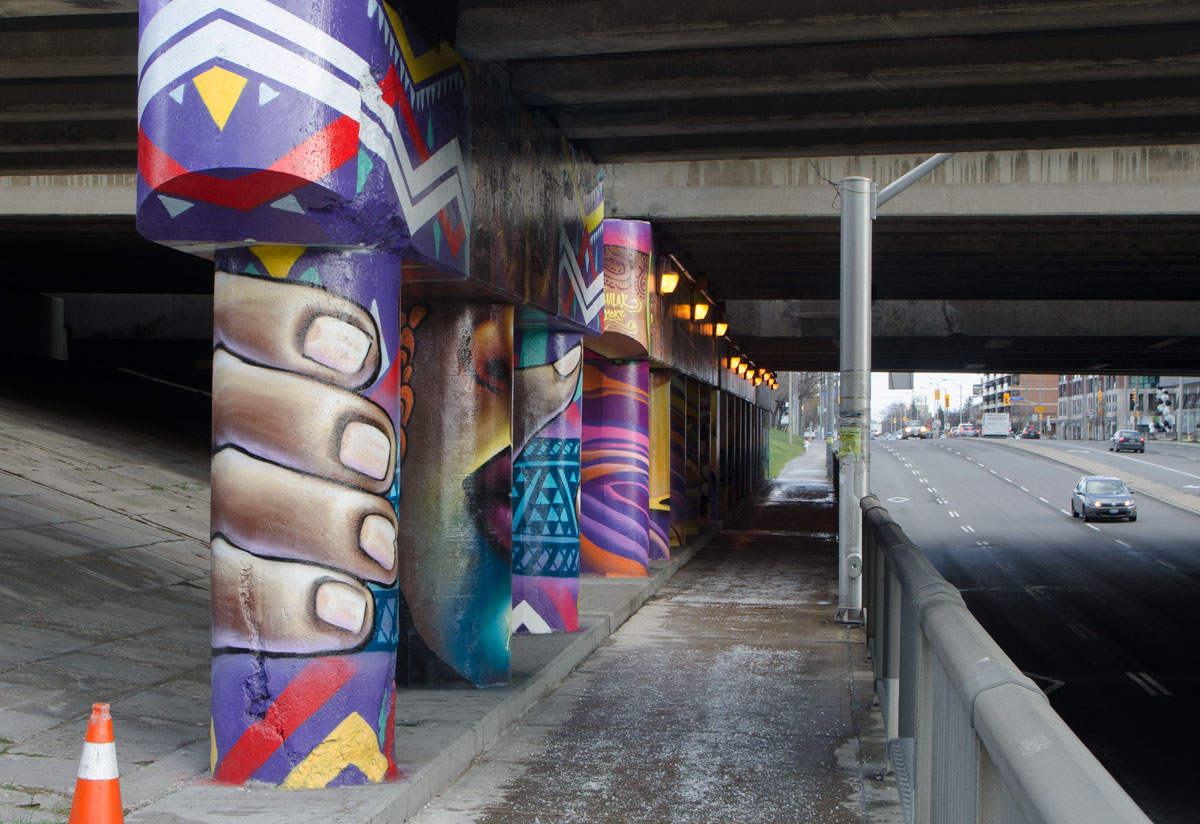
pillars and supports under an overpass that have been painted in bright colours by smoky and shalak

This side was also painted by shalak and smoky (as was the south side).

pillars and supports under an overpass that have been painted in bright colours by smoky and shalak - swirls of purples and yellows

below: In the center by one of the well-lit subway entrances.

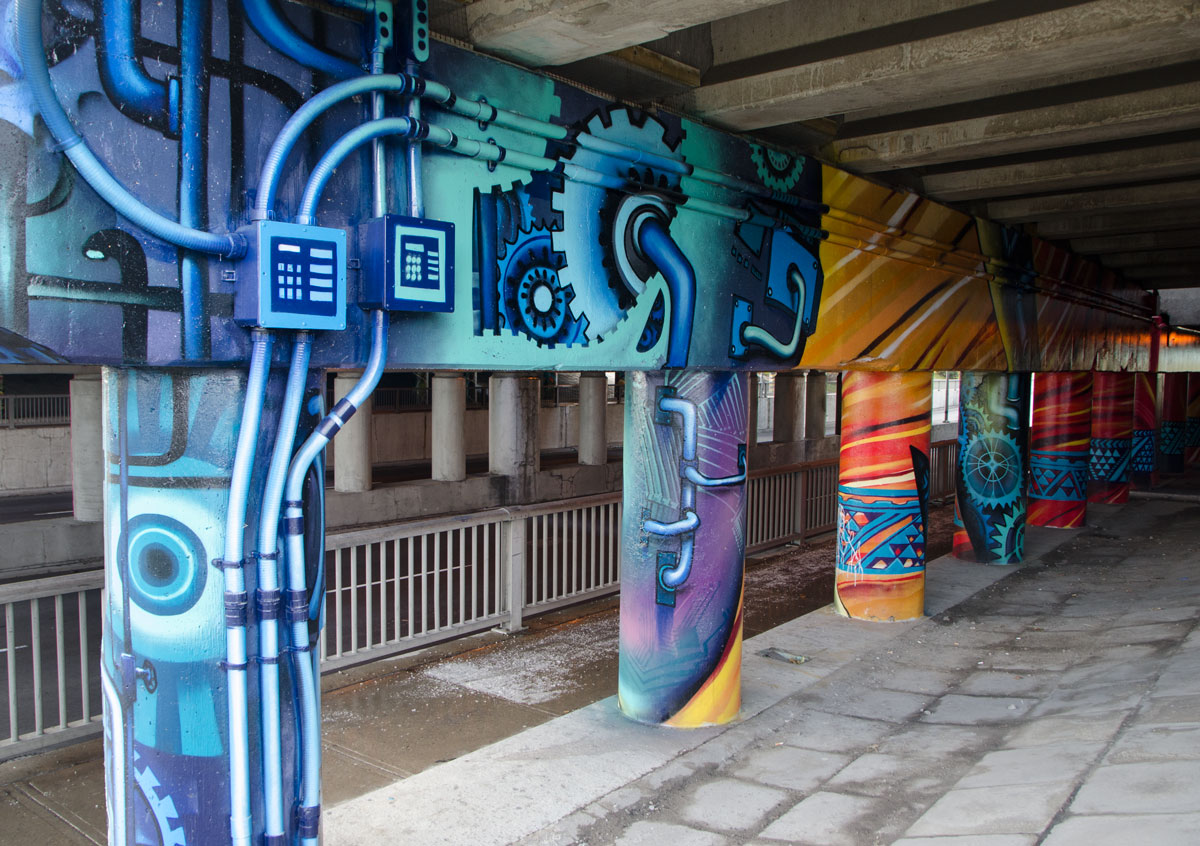
pillars and supports under an overpass that have been painted in bright colours by smoky and shalak - red pillars with blue geometric patterns in a band around it near the bottom

pillars and supports under an overpass that have been painted in bright colours by smoky and shalak

pillars and supports under an overpass that have been painted in bright colours by smoky and shalak - a face showing eyes and top of nose

below: Looking east along Wilson Avenue.

pillars and supports under an overpass that have been painted in bright colours by smoky and shalak - a large face in the center pillar, with hands gripping the outer pillars on each side of the face

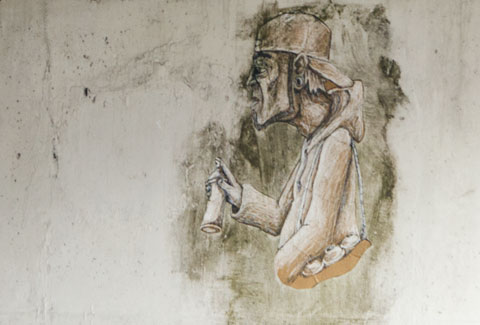
below: A little street artist with his can of spray paint has been left in a corner.
He’s not easily spotted.

a grey tones painting of a man with a spray can in his hand, from the waist up


This is another meandering blog post… a post about being out and about on yet another wonderful autumn day, going wherever my feet and eyes take me.

below: The first picture of my day was this intriguing wall made of old wooden doors.  Bathurst Street.

a tall narrow wall about three storeys high made of old white doors.

below: A small elicser mural tucked away at the end of a parking lot.   The man has his back to the viewer but I can’t figure out what’s behind him or what he might be doing.

small mural on a fence, a man's head is back to the viewer

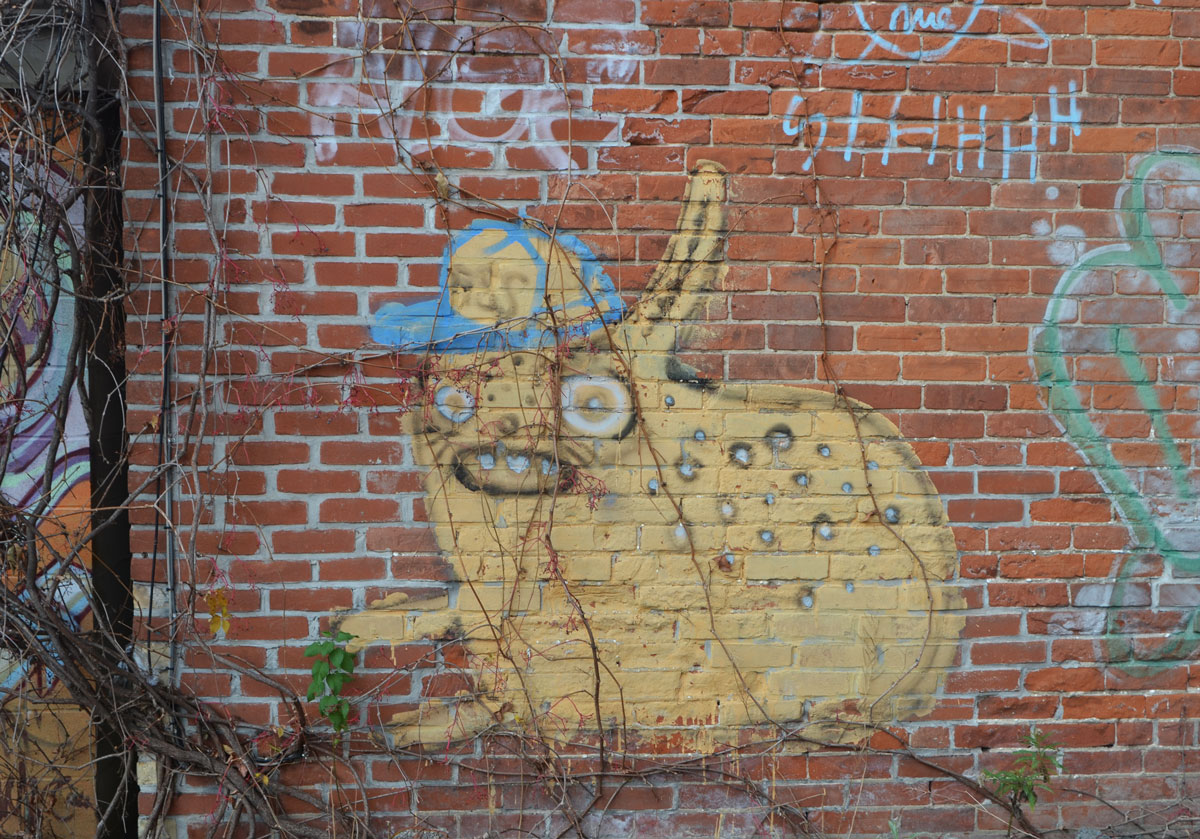
below: The leaves have fallen off the vines to reveal a yellowish creature with his baseball cap askew.

graffiti painting of a yellow animal like creature wearing a blue and yellow baseball cap. The creature is yellow. On a red brick wall, with spots on its back

below: Toronto’s tallest icon framed by a construction crane.

CN Tower in the distance, condo construction in the foreground, with a red crane

below: And on a similar note, a vacant lot cleared and ready for the next stage of its life.

a box beside a fence that has been scrawled over with blue spray paint. Behind it is a fence around a vacant empty lot. There are some small trees growing in front of the fence.

below: No more cranes here (and not many vacant lots either for that matter).  A view showing how much development there has been on the south side of the railway tracks.   Fort York is between the tracks and the condo towers.

a VIA Rail train passes by on one set of many tracks, in the background is Fort York and then a series of new condo buildings.

below: And what’s this? An old blue canoe beached on the tracks?

looking at the scene from a above, a blue canoe has been used to plant plants in. It lies across an old railway track, a chainlink fence separates the canoe from the main railway tracks that still function.

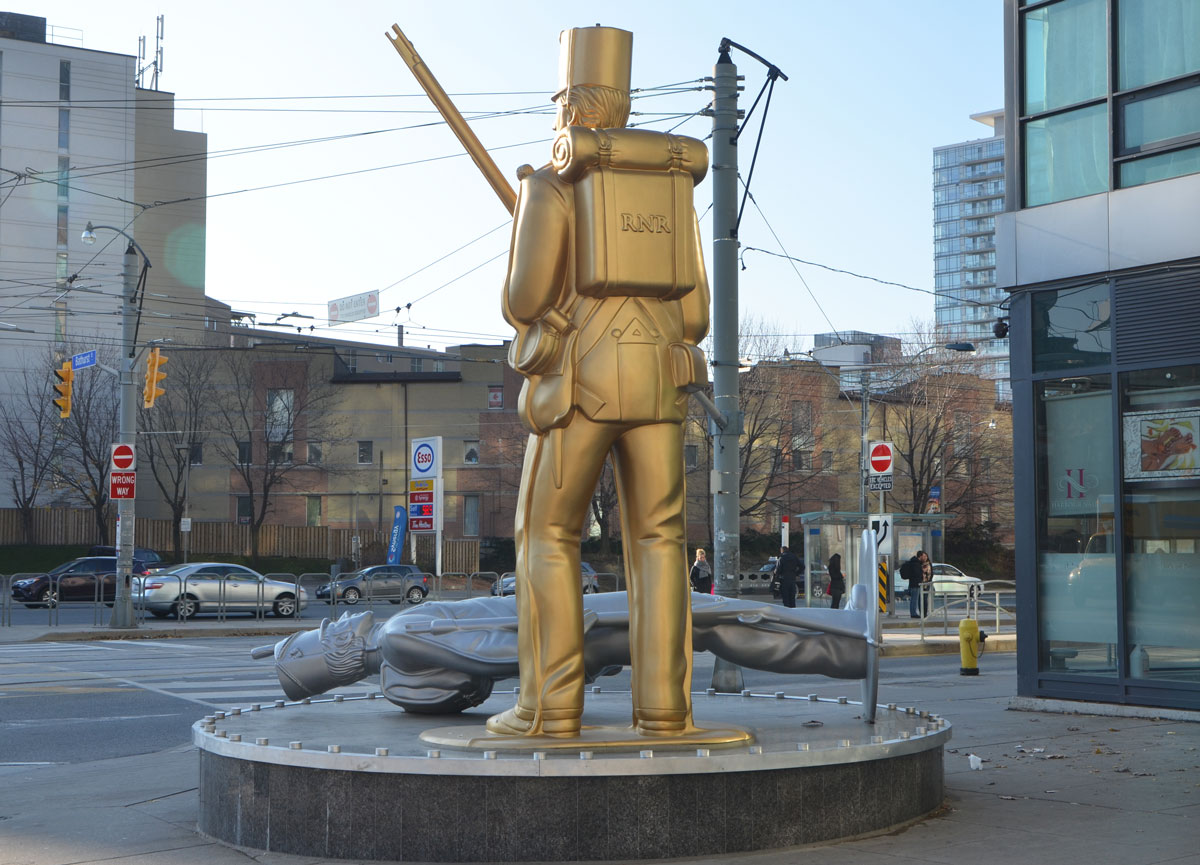
below: Standing guard over Bathurst Street, Fleet street and the Lakeshore, is one larger than life gold replica of a Royal Newfoundland Regiment and his fallen silver American foe. A sculpture by Douglas Copeland entitled “A Monument to the War of 1812”, a nod to nearby Fort York and the history of Toronto.

Douglas Copeland's sculpture of two tin soldiers, a gold one standing with backpack on and rifle in hand, and a silver one lying on its back on the ground, uniforms circa War of 1812, seen from the back, figures are much large than life sized and they are on a corner at an intersection, Bathurst St. and Fleet St.

below: My favorite example of bad grammar still exists!  Off-leash dog area at Coronation Park.

a wood fence around a dog park, in autumn with lots of leaves on the ground, on the fence is a white sign with black letters re the Toronto municipal code 608,

A beautiful day in the park.  A slight November nip was in the air but it was sunny and the sky was a brilliant shade of blue.  Coronation Park is named in honour of the coronation of King George VI who was crowned on 12 May 1937.  At that time nearly 150 trees were planted here.

Apparently, an oak tree was planted to honour the king.  Surrounding it, a ring of silver maples was planted.  This was to symbolize the countries of the British Empire.  I wish I had known that bit of trivia before I walked through the park because now I am curious if these trees are still there.   Some of the trees are quite substantial.

below: Long shadows for the morning sun, low in the sky.

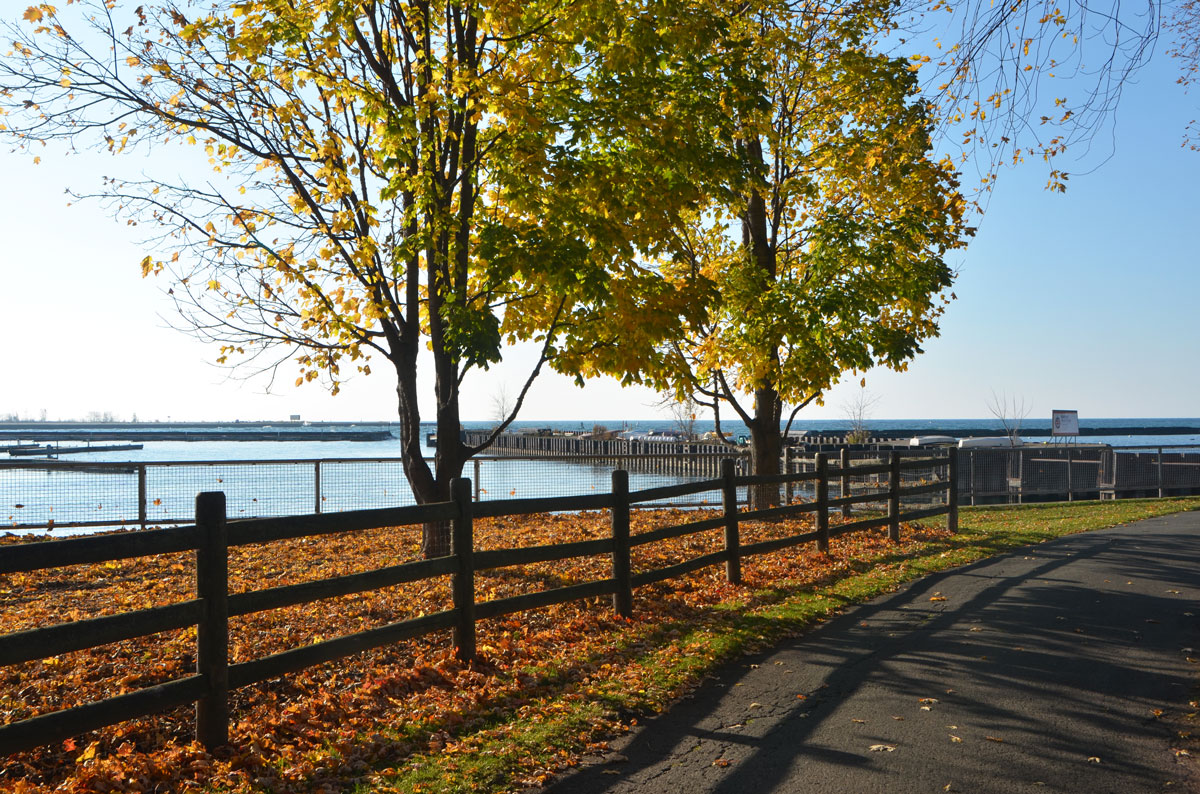
morning in the park, autumn, trees with some leaves still on, many leaves on the ground, wood railing fence, shadows, Lake Ontario, path, Coronation Park.

below: Looking back towards the city center, past the empty docks of the National Yacht Club to the residences on Stadium Road.   A small group of people were making a video in the dog park.

morning in the park, autumn, trees with some leaves still on, many leaves on the ground, wood railing fence, shadows, Lake Ontario, path, Coronation Park. a small group of people in the distance are filming a video

below: This Victory Peace Monument was unveiled on 14 November 1995 to commemorate the 50th anniversary of the end of World War 2 and honour those who died in that war.   It was designed by John McEwen; the bronze pieces resemble the bow of a ship.

Metal partial cylindrical shapes on a concrete circular monument. World War 2 memorial

below: On the inside of one of the bronze pieces is a map of eastern Canada and the Atlantic Ocean.  Each boat on the map represents a ship or U-boat that was sunk during the war.  The Canadian ships are located on the map at “their last known position”.  I hadn’t realized that so many ships were lost so close to North America.

relief map of eastern Canada and the Atlantic Ocean, in bronze on a WW2 memorial. Little ships are shown on the ocean where they were sunk during WW2.

Trees were also planted to represent the four divisions of the Canadian Expeditionary Force (WW1) and its units as well as those who fought in the Fenian Raids of 1866-1870, the Northwest Rebellion of 1885, and the Boer War (1899-1902).  Once upon a time, brass plaques were placed at the foot of each tree to indicate the units the tree stood for.  If any plaques remain, I didn’t see them.

below: Another memorial is close by, a  “Memorial to Lieut. Tommy Hobbs gallant British Canadian soldier in the Great War 1914 – 1918.  Died on active service November 10, 1940.  Beloved and remembered by his comrades.”   Tommy Hobbs was involved in the creation of this park.

a memorial in a park made of a small pile of rocks. The top rock is inscribed, memorial to Tommy Hobbs, died 1940, in Coronation Park

below: A little farther on I noticed another rock, one that was painted red.   The bronze plaque on the rock says that 20 trees have been planted here in commemoration of the G20 Summit held in Toronto in 2010.

a large rock with a bronze plaque on it. The rock has been crudely painted red

below:  A 30 foot tall Inukshuk stands looking out over Lake Ontario.  Approximately 50 tonnes of mountain rose granite was used to create the Inukshuk, which was made by Inuit artist Kellypalik Qimirpik from Cape Dorset, Nunavut.

a tall stone inuksuk on a raised mound of warth

below: Streetcars across the baseball outfield.

Looking across the outfield of a baseball diamond towards a street. A line of mature trees by the street with two red and white TTC streetcars on the street, condo towers behind.

below: A closer look at that brown octagonal structure in the middle of the streetcar loop for the 509 and 511 cars.  Apparently it’s the Queens Wharf lighthouse, one of a pair built in 1861.

a brown structure, the Queens WHarf Lighthouse, sits on a patch of grass beside TTC streetcar tracks in front of a new condo.

The lighthouses marked the entrance to the Toronto Harbour from 1861 until the Western Channel was built in the early 1900’s.   This one stood on Queen’s Wharf which used to be at the foot of Bathurst Street, adjoining Fort York.  The wharf was built by the military; in 1833 it was a pier 42 feet long.    The pier no longer exists; a hundred years ago it was buried under what is now Bathurst Quay.

below:  A picture of an historical map (1886 or 1887) of the area showing Toronto Harbour, Fort York and the railway lands.  Queen’s Wharf is the pier on the left.   At that time, Front Street was the southern most street in this part of the city.   All the present day development south of the train tracks is on reclaimed land.

picture of historical map of part of Toronto Harbour from 1886, showing Fort York, Front St., and Bathurst St., and the railway lands and wharves into Lake Ontario,

below:   Taken from google maps, what the layout of the city looks like now.   As you can see, there have been many changes!

present day map taken from google maps of Coronation Park and Bathurst Quay including Fort York

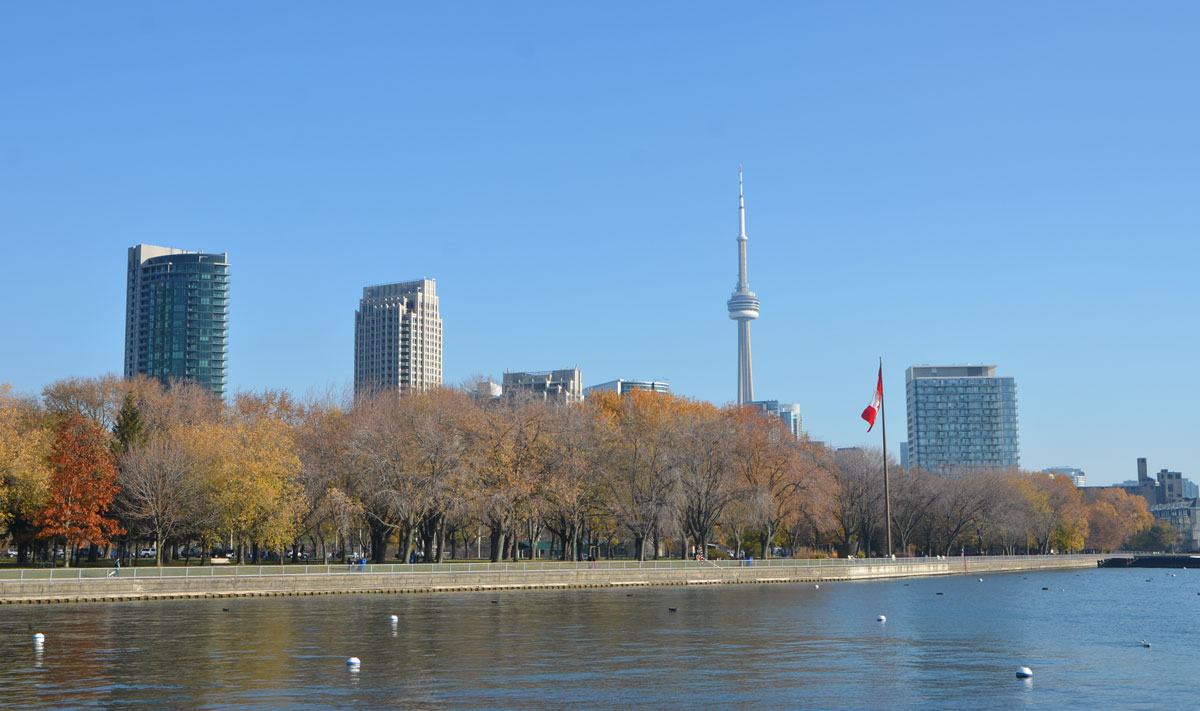
Lake Ontario in the foreground, trees in Coronation Park in the middle and Toronto skyline in the distance with the CN Tower and a large Canadian flag.
a sticker of a rainbow in a heart shape. A small purple heart is in the center, then a blue heart is drawn around it, moving outwards in rainbow colours.

Just before Dupont Street ends at Dundas West, it passes under a set of railway tracks…
and of course another underpass means another mural.

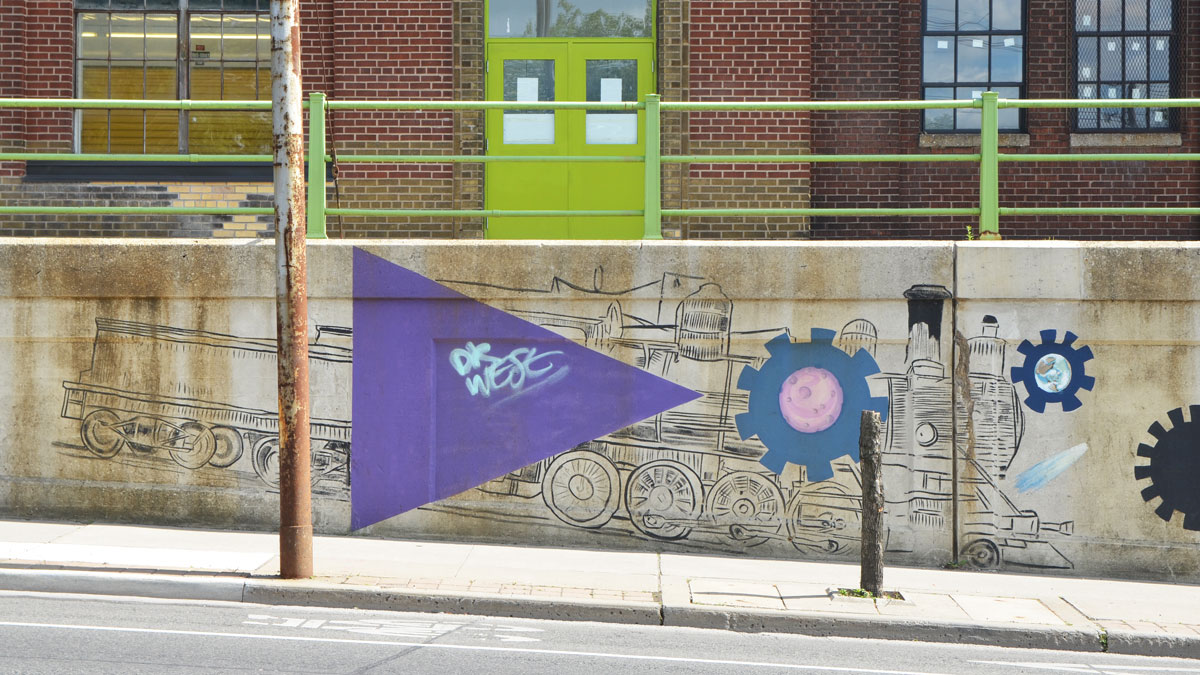
It is an Art Starts project “honouring the Junction and paying homage to its industrial past rooted in the railway and celebrating its development as a diverse neighbourhood oriented community. ”  Lead artists Joshua Barndt and Jamie Bradbury along with 5 youth artists took 4 weeks to complete the mural.

mural on a concrete wall beside a sidewalk, just before the road goes under an underpass - large purple triangel, drawing of a locomotive and a couple of gears

The mural was funded by the City of Toronto’s Graffiti Transformation Program.

mural on a concrete wall beside a sidewalk, just before the road goes under an underpass, gears, plus a stylized industrial machine in black and blue

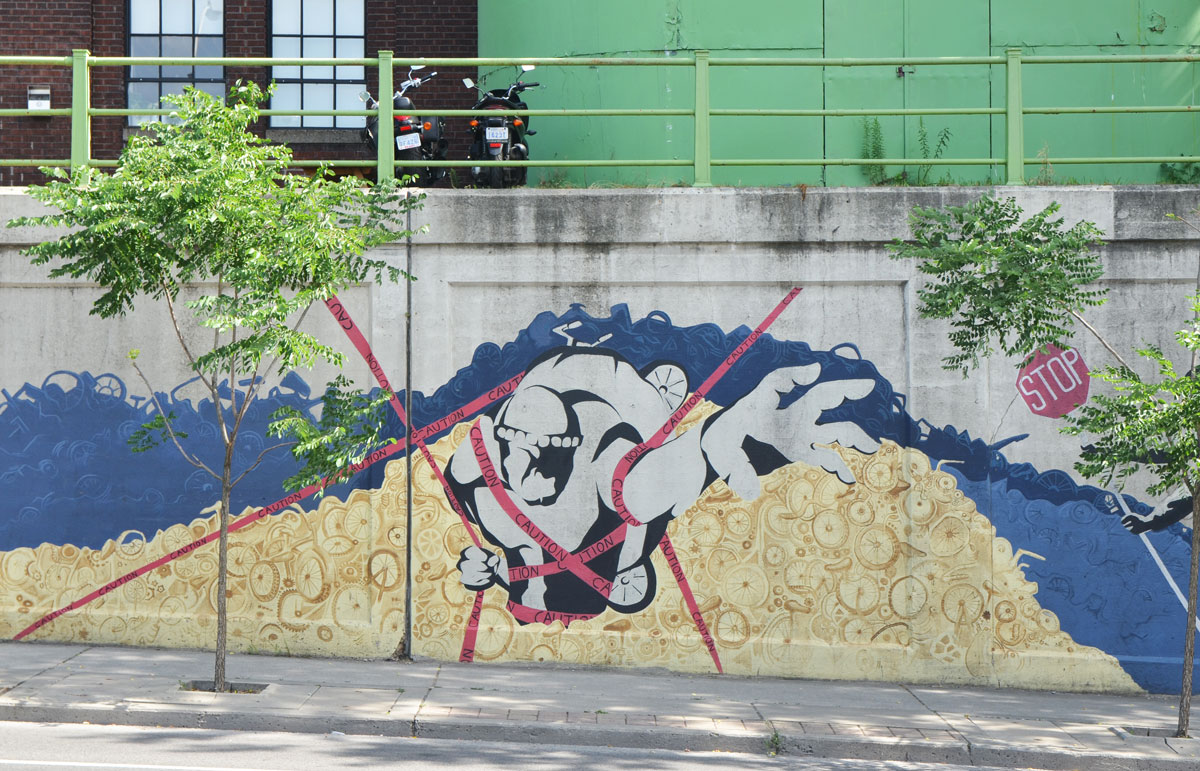
mural on a wall showing a picture of worker in a hard hat, reaching upwards, standing on a pile of bicycle wheels.

mural on the wall of an underpass, in the Junction, on Dupont, a line drawing of a railway car, with a large blue bike superimposed on top of it, a person holding a stop sign,

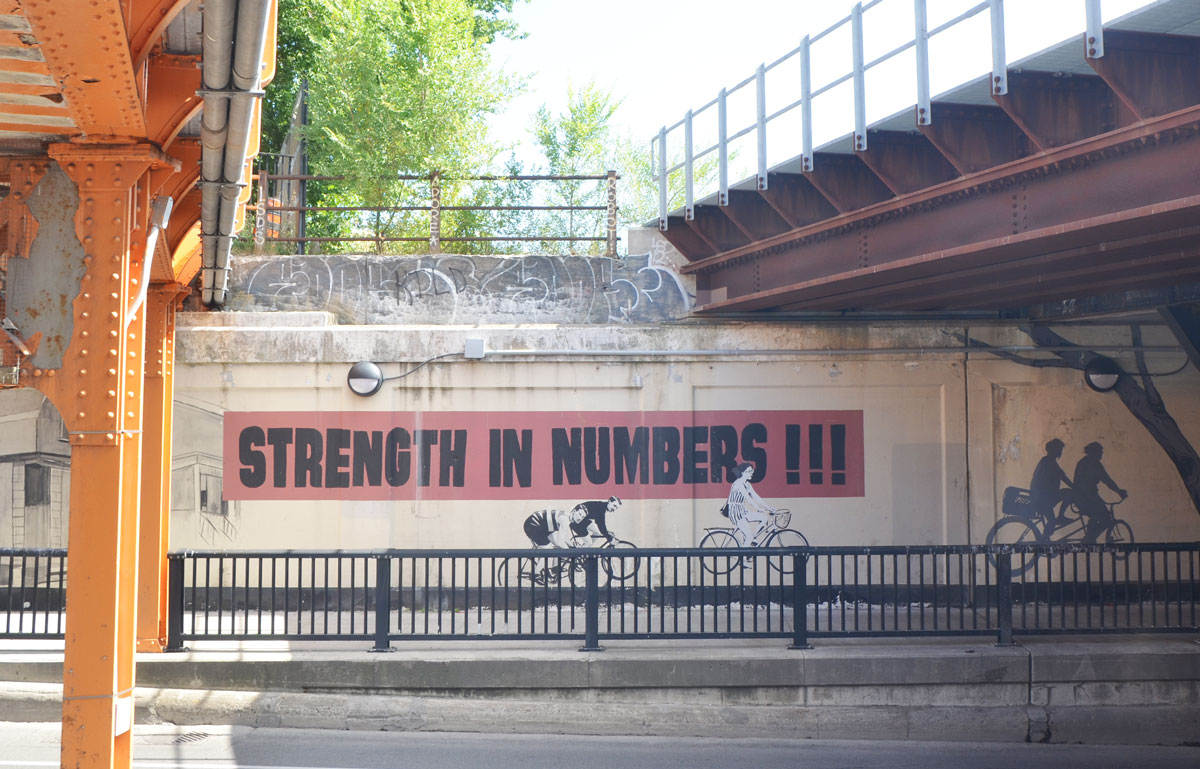
Cycling is used as a theme and as a way of traveling from the past to the future in the mural.

mural on the walls of an underpass, orange metal bridge, mural of cyclists riding their bikes

mural under a bridge of people riding bikes

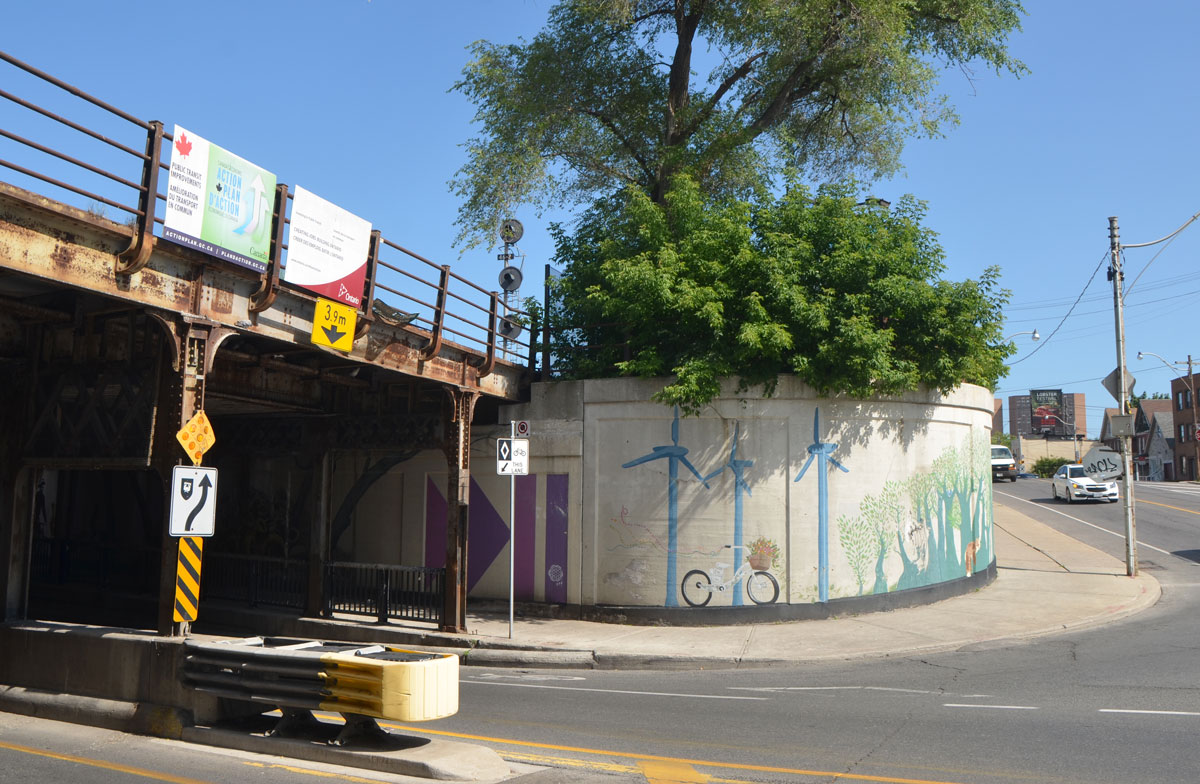
a wall of an underpass curves as it exits the railway bridge. on the curve is the continuation of a mural that was painted on the walls of the underpass. Windmills and bikes.

mural on a curved concrete wall, beside an intersection, showing windmills with bike parked in front, and a forest with some animals in it, fox and wolf

below: The final panel in the mural, a future friendly city.

part of a mural, the word city is used to make a futuristic urban scene in blue tones. The future is friendly.

logo of two black gears side by side with the words Art Starts written across the middle of them. a small graffiti painting of a girl's head with a heart above it

The Frederick G. Gardiner Expressway, commonly just called the Gardiner, has been in the news a lot lately.  This 18 km stretch of road between the city and the lake was completed in 1965 after years of planning and building.  At the time that it was built, Toronto’s waterfront was largely industrial and there wasn’t much objection to having a 4 to 6 lane expressway, with many sections elevated, built there.   The railway had begun the process of dividing the city from its waterfront a hundred years previously.

As the city changes and grows, more and more people live in the downtown core.  Industry has moved out and residents have moved in.  For so long the land south of the Gardiner as well as under the Gardiner was neglected, especially from a city planning point of view.  But now, the city is looking differently at that swath of land.  The far east elevated section between the Don Valley Parkway and Leslie Street was demolished in 2001 and there have been calls for the next section (Jarvis to the DVP) to be demolished as well.   There has been some controversy as to whether to demolish it or move it… and if move it, where to? I am not even sure what the plans are at the moment.   On the other hand, the western section of the elevated expressway (Strachan to Spadina) will remain standing.  Work is underway to refurbish the structure – the city doesn’t want any more stories of pieces of concrete dropping onto cars beneath!  Plans are being implemented to use the land under the Gardiner much more efficiently.  To make it work for the public.

The Bentway is the name that has been given to this new park, or public space, beneath the Gardiner Expressway from Strachan 1.4 kilometres east to Spadina. The first phase is due to open Canada Day 2017 and it involves the stretch between Strachan and Bathurst.  Many of you have probably driven on the Gardiner but do any of you know what is under it now?  Let’s take a look.

below: The Gardiner passes over Strachan Avenue which  in turn passes over the railway tracks.

bridge over a street, many orange and black construction cones down the center of the road, some pedestrians on the sidewalk

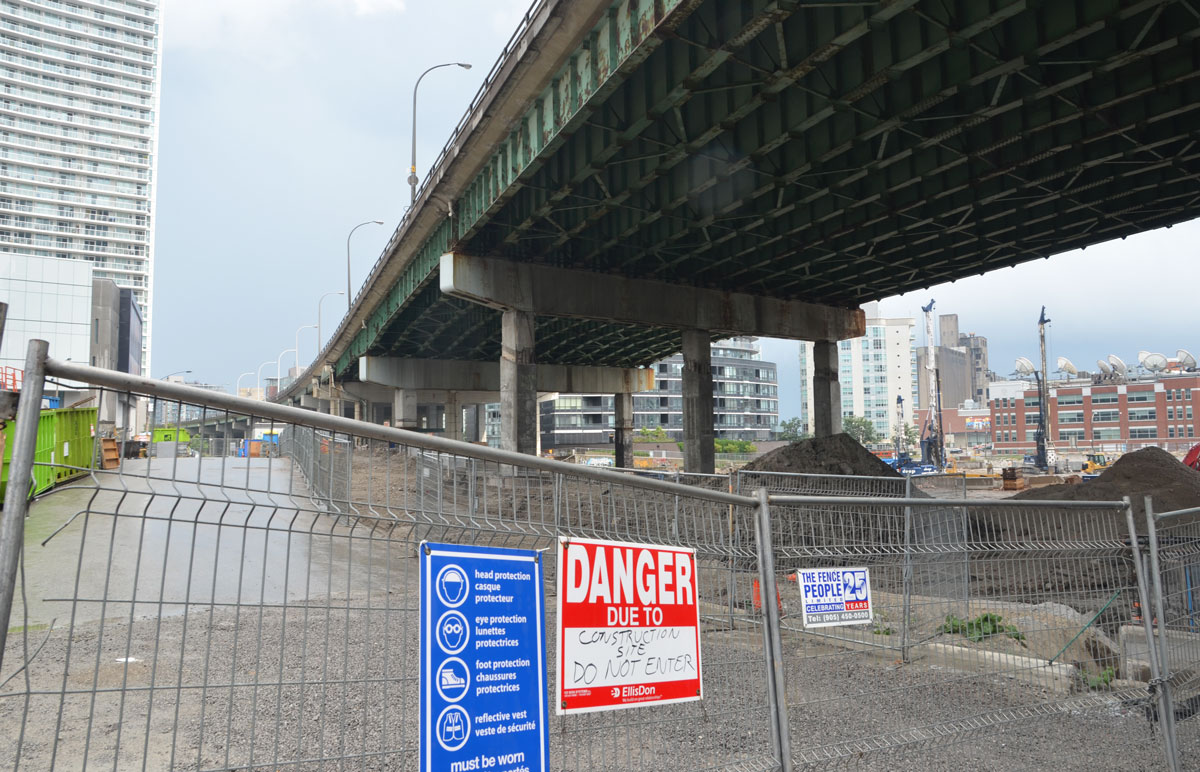
below:  On Strachan Ave looking west.   Condo development in this area has extended right to the railway line.  The Exhibition GO train station is in the distance.  You can also see the Gardiner to the left of the tracks.  Here the north side of the under part of the expressway is walled in and the enclosed space is used by Exhibition Place.  At this time there is no plan for the Bentway to extend this far; I have used this photo to provide more context as to the location of the park.

railway tracks in the center of the picture, condos on the right. On the left is the elevated Gardiner expressway, but under it is a concrete wall that makes it look more like a concrete building than a road

below: A closer look at the Gardiner on the west side of Strachan Avenue.  Maybe there is potential to expand the park westward? to Exhibition GO station? And by the way, those concrete structures holding up the expressway – those are called ‘bents’ and that is why the park is called what it is.
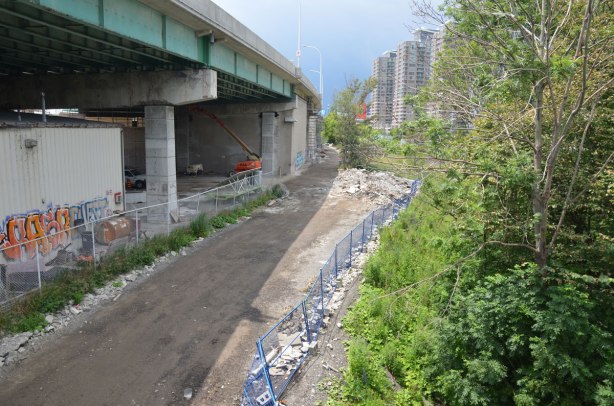
a dirt road runs alongside the Gardiner Expressway, some condos in the distance

below: This photo was taken as I stood on Garrison Common and looking towards Strachan Avenue.  This will be the western end of the new park. You can see the underside of the Gardiner as it passes over Strachan Ave which in turn is also a bridge.  This bridge once crossed the Grand Trunk Railway tracks that were built in the 1850s.  New entrances to the park are planned that incorporate the present sloped embankment of the bridge.

The elevated Gardiner Expressway passes over Strachan Ave which in turn has a bridge over what used to be a rail line. The bottom part of the bridge is covered with graffiti. The whole area is a construction site at the moment.

below: A quick aside:  It’s a slightly different angle, but here is a photo of the Strachan Avenue bridge from 1959, before the Gardiner was built.  I suspect that there has been upgrades made to the bridge since then.  Photo credit: R.L. Kennedy, found online (also a good source for the history of the Grand Trunk Railway in Toronto).  Garrison Common is to the right.
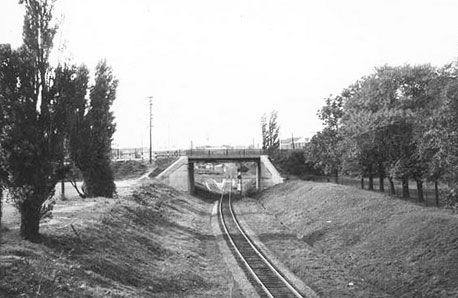
vintage photo from 1959, GTR tracks pass besidde Garrison Common park and under the bridge at Strachan Ave

Garrison Common is the green space surrounding Fort York.  It will abut (be continuous with?) the new Bentway.  Fort York is a National Historic Site and on its 43 acre site are original buildings from the War of 1812 as well as an 1813 battle site.  Did you know that the Americans beat us here in 1813 and controlled the city of York (as Toronto was known then) for a few days?

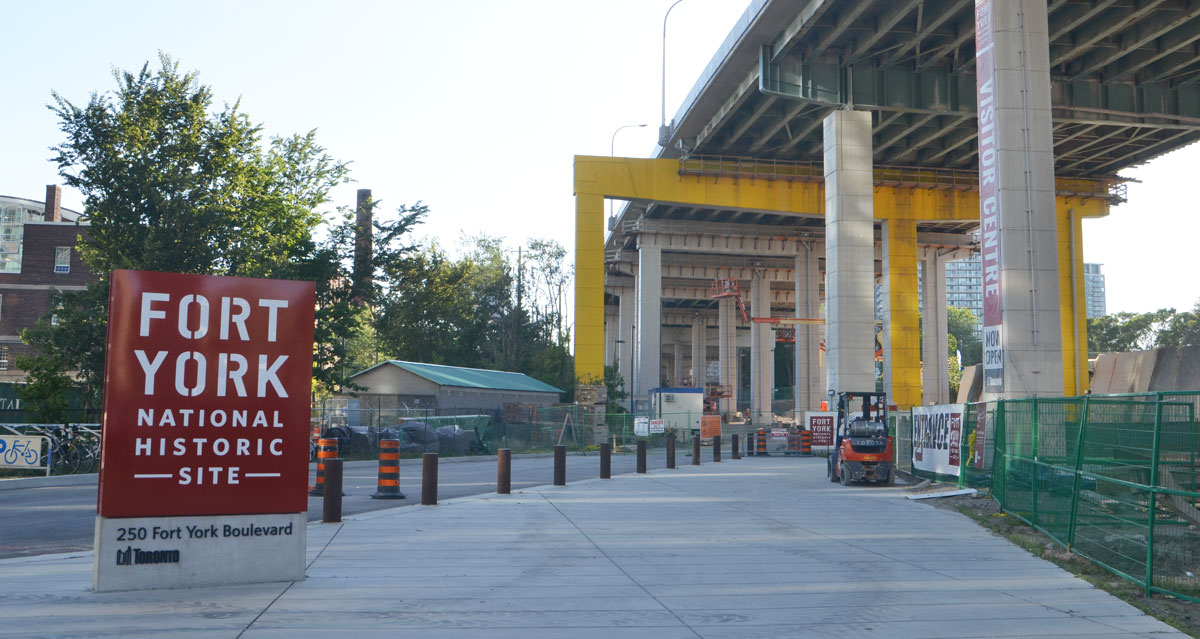
below: The new Fort York Visitors Centre is now open. There is still being work done both inside and outside, but it is open to visitors. For so long the fort was hidden away and difficult to get to; it is nice to see it receiving more attention.

entrance to Fort York, under the Gardiner, still a construction site but nearing completion

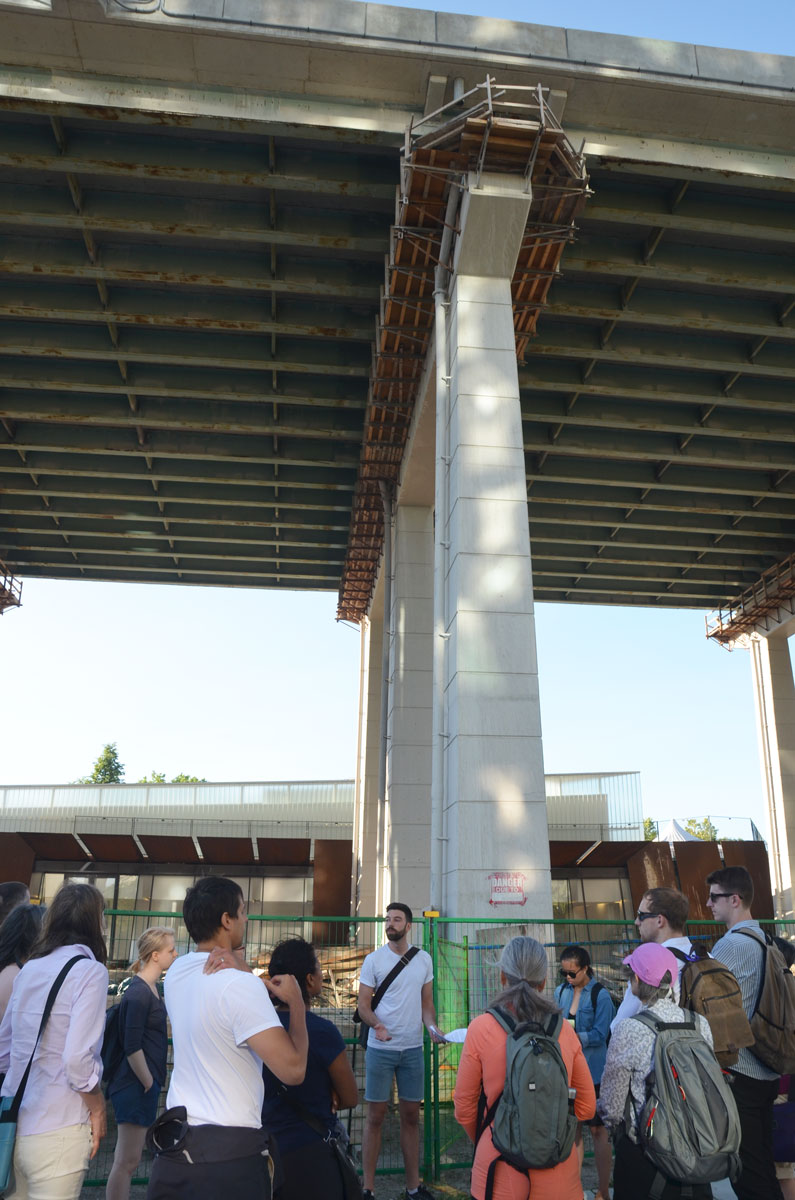
below: Jake from Park People, one of the groups helping to design the new park, stands under the Gardiner as he talks to a group of us on a tour.    Here, by Fort York, the Gardiner is the equivalent of 5 storeys from ground level, the highest it reaches as it crosses the city.
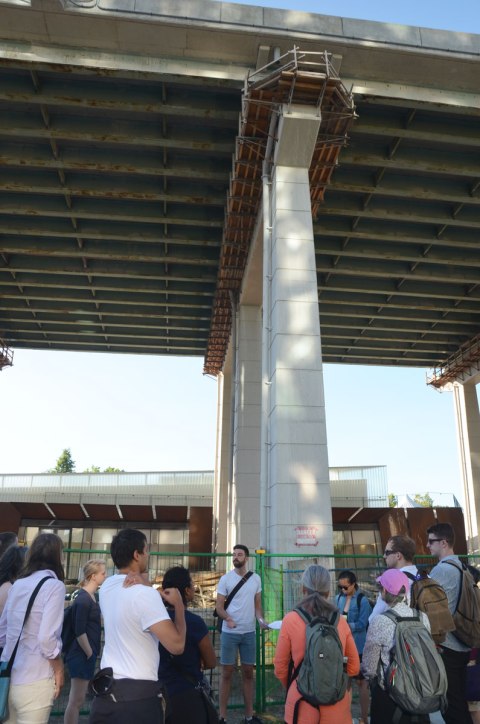
a man is standing in front of a group of people on a walking tour, he is standing under the Gardiner Expressway where it is 5 storeys above ground level.

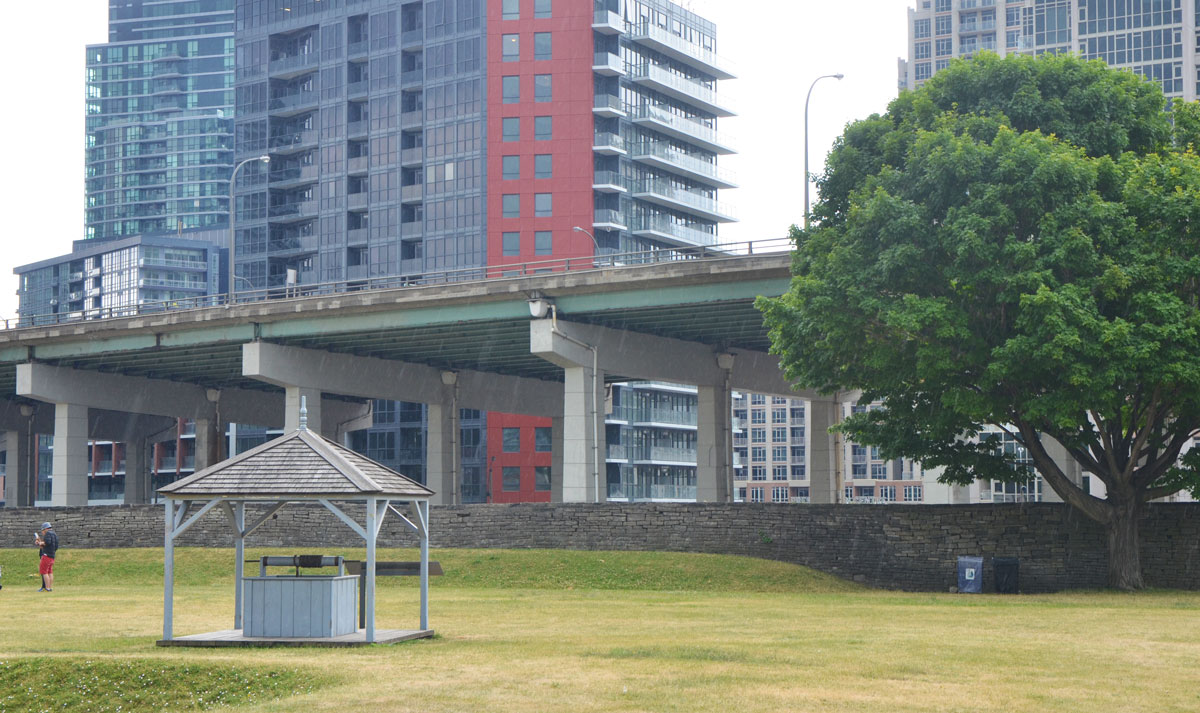
below: Standing on the grounds of Fort York.  The Bentway will be beyond the stone wall.  You can get a good idea of the spacing between the bents.  These spaces are being referred to as ‘rooms’ and there are 55 of them between Strachan and Spadina.
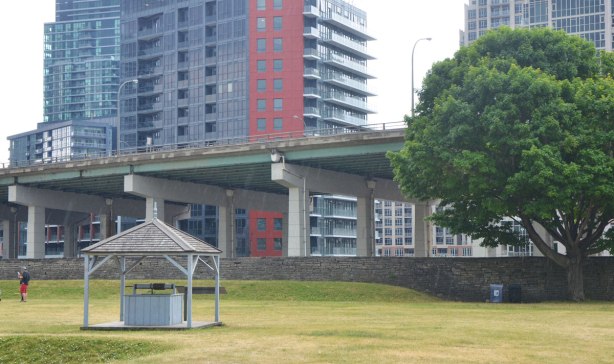
from the grounds of Fort York looking south to the Gardiner and the condos built beyond it. Grass field in the foreground.

below: One obstacle is the fact that Fort York Blvd passes under the Gardiner on a diagonal.  Plans are to build a pedestrian/cycle bridge over the street.  Also in the photo, note the TTC bus – Fort York and vicinity are finally on a bus route.  Route 121 runs between the Portlands and Fort York via Union Station.

fort york blvd is in the foreground, a TTC bus and a car are on it, the Gardiner is to the right and a short condo building is in the background along with the CN tower

below: The section under the Gardiner Expressway between Bathurst Street and Fort York Blvd is not city owned. It is owned, and has already been developed, by the Onni Group who built the Garrison at Fort York condominiums on either side of it.  This is the eastern end of phase 1.
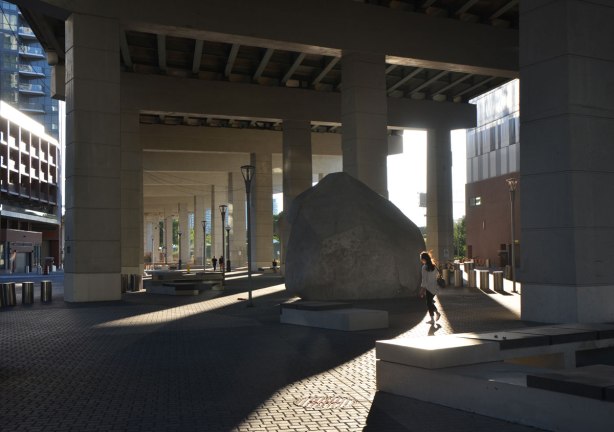
evening, low angle sunlight shines under the Gardiner Expressway where it has been developed with paving stones and some large rocks.

below: Northbound traffic on Bathurst passes under the Gardiner.
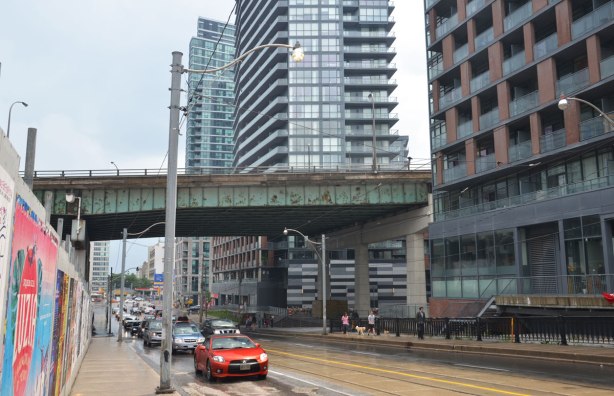
some traffic on Bathurst street on a rainy day, as the street passes under the Gardiner Expressway, condos on the right, construction hoardings on the left.

Phase 2 of the park’s development involves land between Bathurst and Spadina. This is an area that is undergoing a lot of changes at the moment, i.e. a lot of construction.

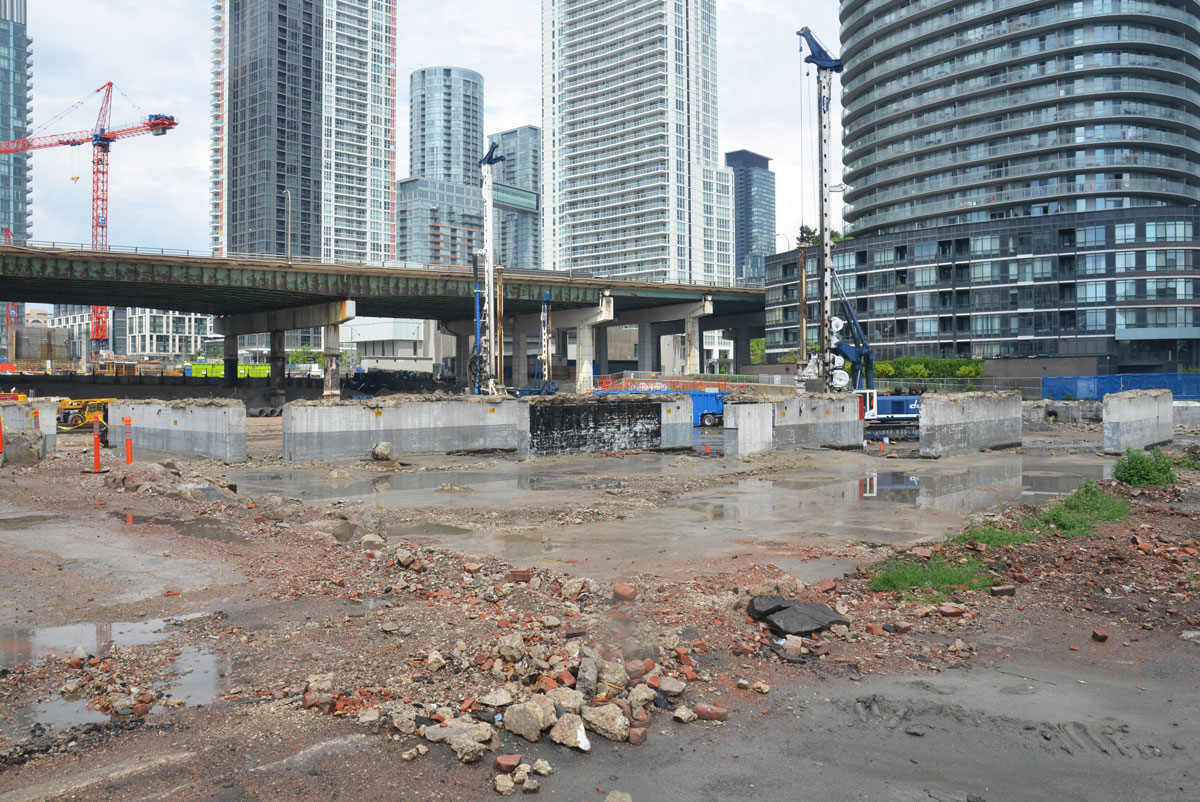
below: Immediately south of the Gardiner on the northeast corner of Bathurst and Lakeshore is a construction site.  Demolition of the old 1928 Loblaws warehouse building is now complete.  The facade of the old building was disassembled rather than demolished; after cleaning and refurbishing of the bricks, it will be rebuilt in its original location.  Two condo towers are planned for the space between Loblaws and the Gardiner.  Yes, more condo towers to face the Gardiner and add to the tunnel effect that you get when you drive on the expressway.

construction site in downtown Toronto, Gardiner Expressway runs behind the site, rubble in the foreground, a few remaining remnants of the old Loblaws building that was there, high rises in the background.

below: The development of this site is a collaboration between a number of developers.  I found a photo of one rendition (source) of what the space under the Gardiner will look like here in the future.  Public space including a cafe are part of the plans.  Check back in a couple of years to see what really happens here!
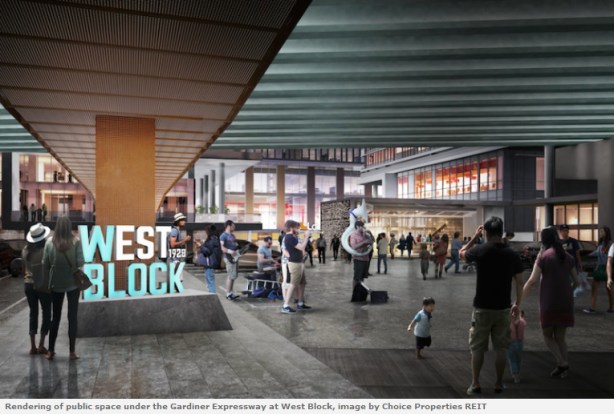
artist's rendering of what a planned development for under the Gardiner would look like, part of a larger condo and retail development.

below:  Standing on Bathurst Street, looking east along what will be Housey Street.  This is just north of where the Loblaws development (above) will be.  As you can see, you can’t walk there yet.

the elevated road, the Gardiner Expressway passes over a construction site on the right, a new street being built on the left.

below: Southeast corner of Bathurst and Fort York Blvd.  This is the section of land just north of Housey Street.  Construction hoardings and cranes – familiar sights in this area.  It also means that taking photos of under the Gardiner here are difficult!
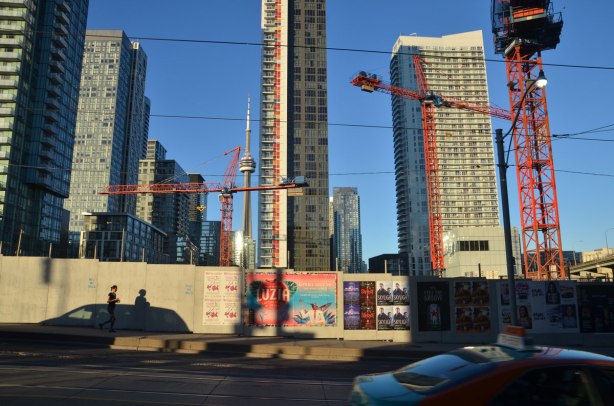
late afternoon, long shadows, yellowish tint to the photo, looking east from Bathurst, south of Front, north of the Gardiner, wood construction hoardings with posters on it, many orange cranes, some condos already built, a woman jogging past, cars on the street.

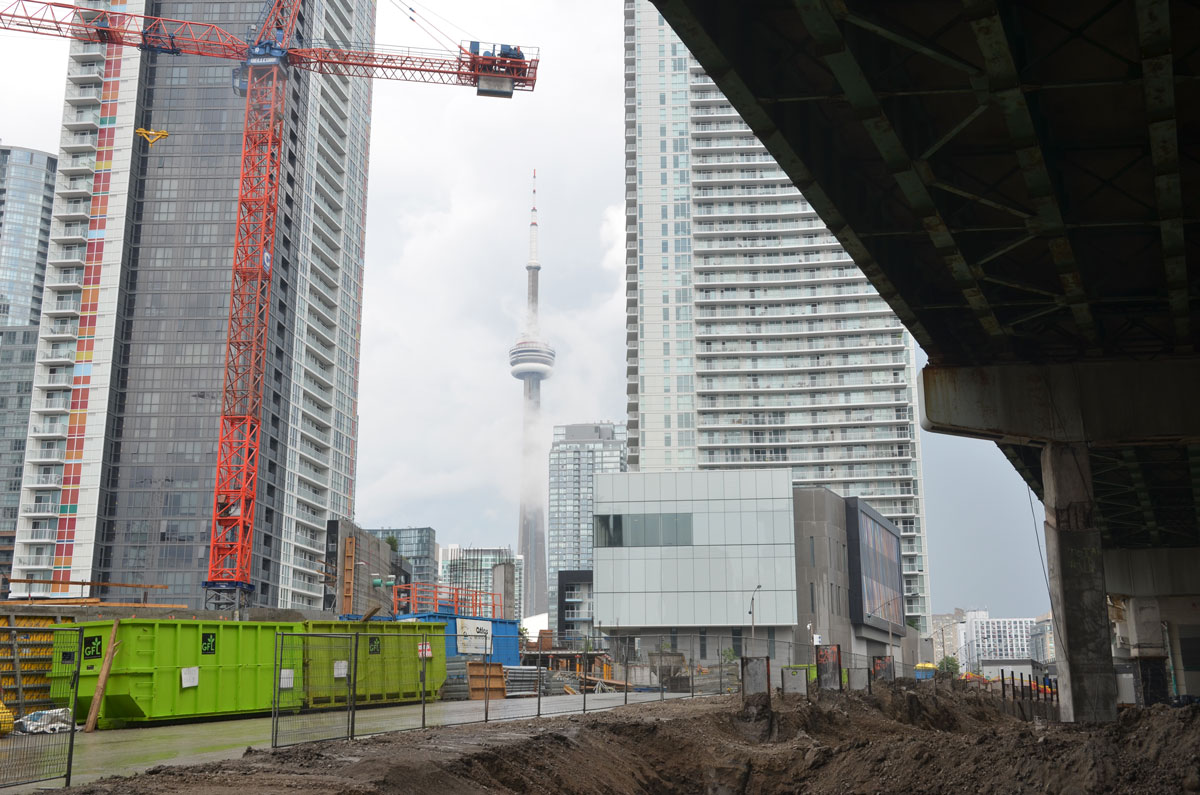
below: Development north of the Gardiner between Bathurst and Dan Leckie Way.
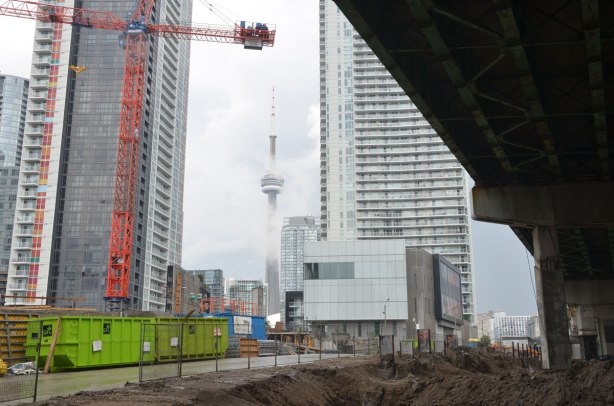
construction site under the Gardiner, cranes and condos being developed on the left, CN tower in the fog in the distance.

Dan Leckie Way is a north-south road that runs under the Gardiner just east of Bathurst.  It is the western boundary of Canoe Landing Park.  This park is north of the Gardiner and the Lakeshore.

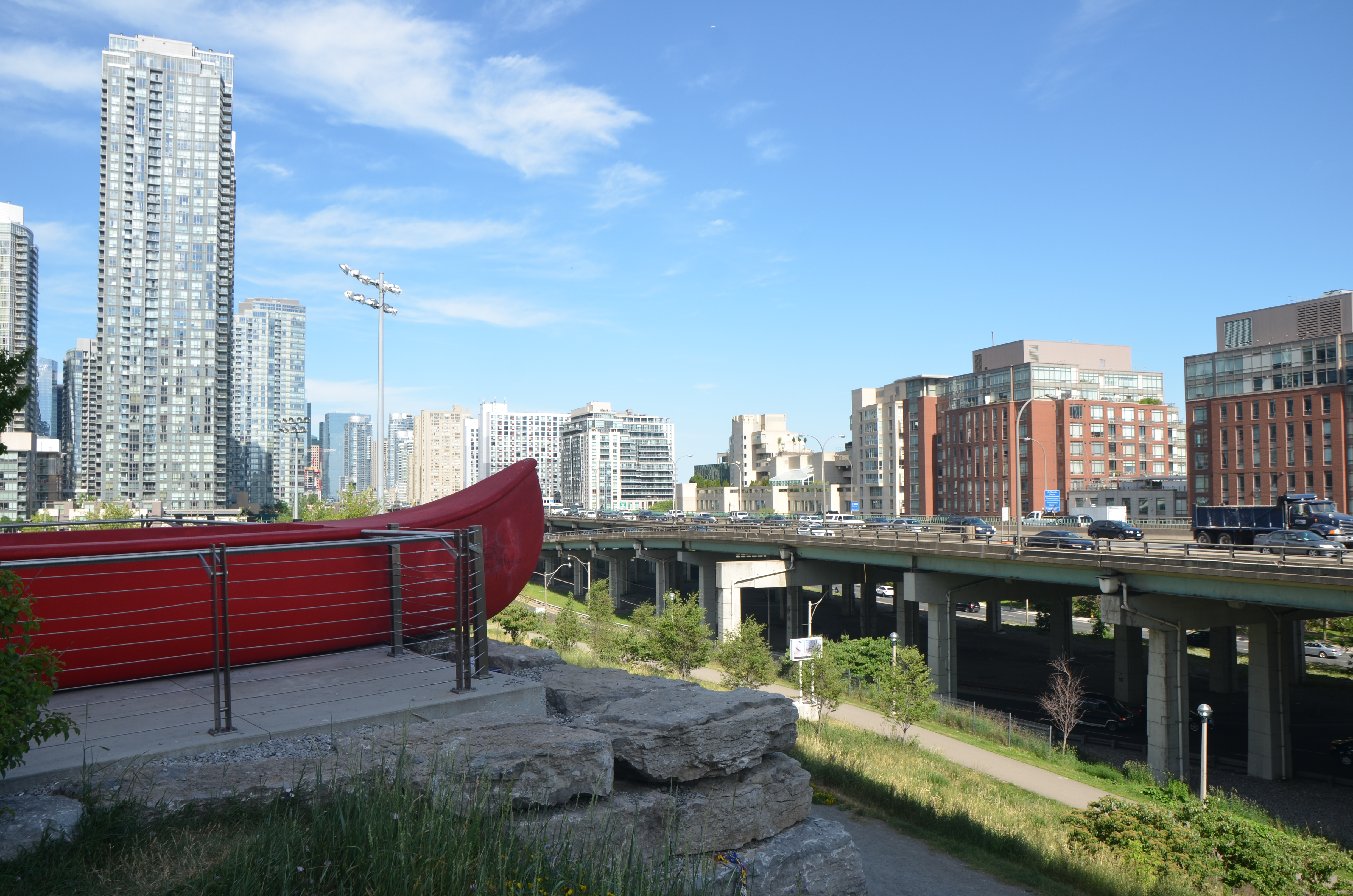
below: ‘Tom Thomson’s Canoe’, by Douglas Coupland sits at the highest point of land in the area; it’s almost at the same level as the Gardiner and is very visible as you drive by.   This park extends down the hill.
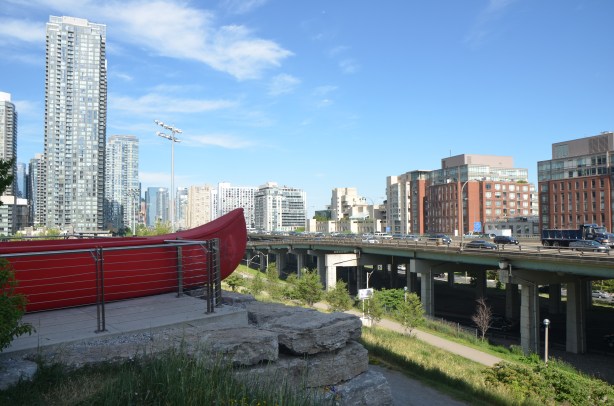
The end of a large red canoe, an artwork by Douglas Coupland called 'Tom Thomson's Canoe' sits in a park, high above the surrounding scenery. Looking southwest towards the elevated Gardiner Expressway and the condo developments south of it.

below: Looking the other way from the same vantage point. The street running under the Gardiner here is Dan Leckie Way . Up until this point the Lakeshore is south of the Gardiner.
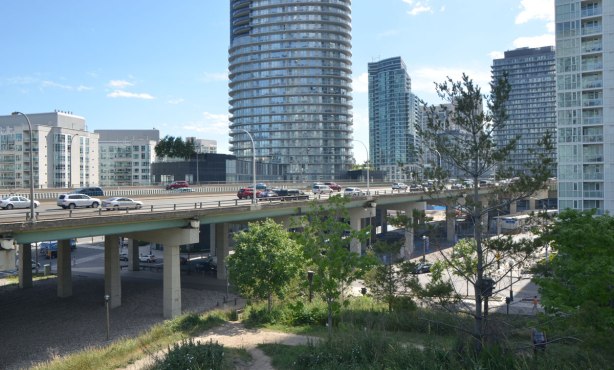
The elevated Gardiner Expressway with traffic is in the middleground, some trees and parkland in the foreground, and condo developments in the background.

At Dan Leckie Way, the Lakeshore is still south of the Gardiner and the space under the expressway is wide open.   By Spadina, one major block east, the situation changes.   The Lakeshore splits and westbound traffic lanes go north of the Gardiner and eastbound lanes stay south.  Shortly after Spadina, the Lakeshore runs under the Gardiner and there is no room for any further development under the road.

below: Standing on Spadina, just south of the Gardiner and looking west.  Here there is a lot of road to cross for pedestrians on Spadina.  Not only has the Lakeshore split to run on either side of the Gardiner, but there are also ramps between the Gardiner and the Lakeshore.
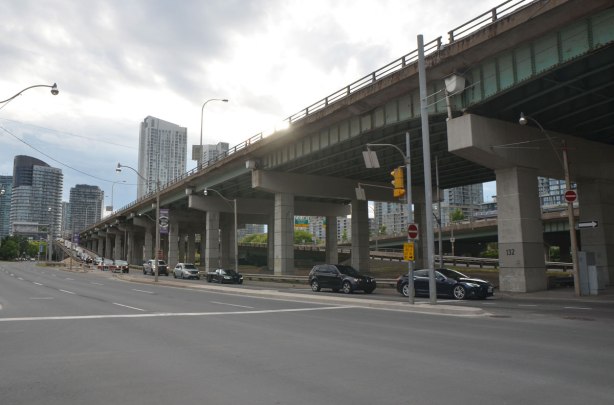
major road with traffic under an elevated expressway in a city, long ramp from the upper level to the lower. Gardiner Expressway and Lakeshore Blvd in Toronto, at Spadina looking west

below:   Still on Spadina, and still looking west, but now under the Gardiner.  The space under the road is not as high as it was previously.  Its lower and darker and not as inviting.   It will be interesting to see what phase 2 of the Bentway development will look like in this space.  I am not sure when it will to be finished but I will keep an eye on it!
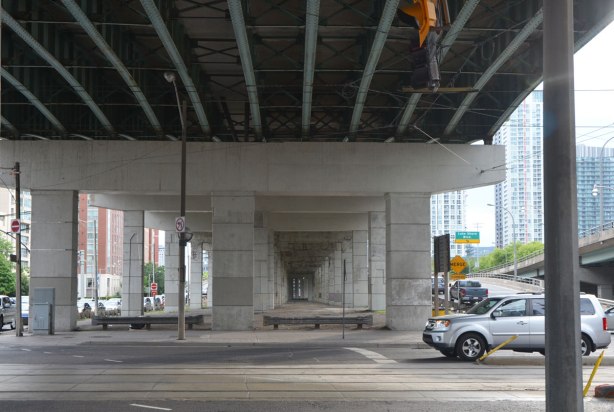
under an elevated section of the Gardiner Expressway, at Spadina.

As for the eastern Gardiner, what does that look like?  Well, that’s a whole other blog post!

 Project: Under Gardiner  On this site you’ll find detailed maps and diagrams of this area as well as information about the plans for the various sections of the space.


Graffiti and street art, sometimes it stays around a while and other times it disappears, hidden by someone else’s work.   Tags and words also appear where they often shouldn’t.  When I walk an alley that I’ve seen before, I never know what to expect but there is always something to discover to make it worth a repeat visit.   So it was this morning when I found myself back at Scarfo Lane.  Back in Nov 2014 (a year and a half ago!  … time flies by!) I posted about some of the street art and murals that I saw there.   Most of it is still there.

Today’s contributions follow – at least one is new and the others I’m not sure about, I might have omitted them last time.  The whims of the day and of the photographer.

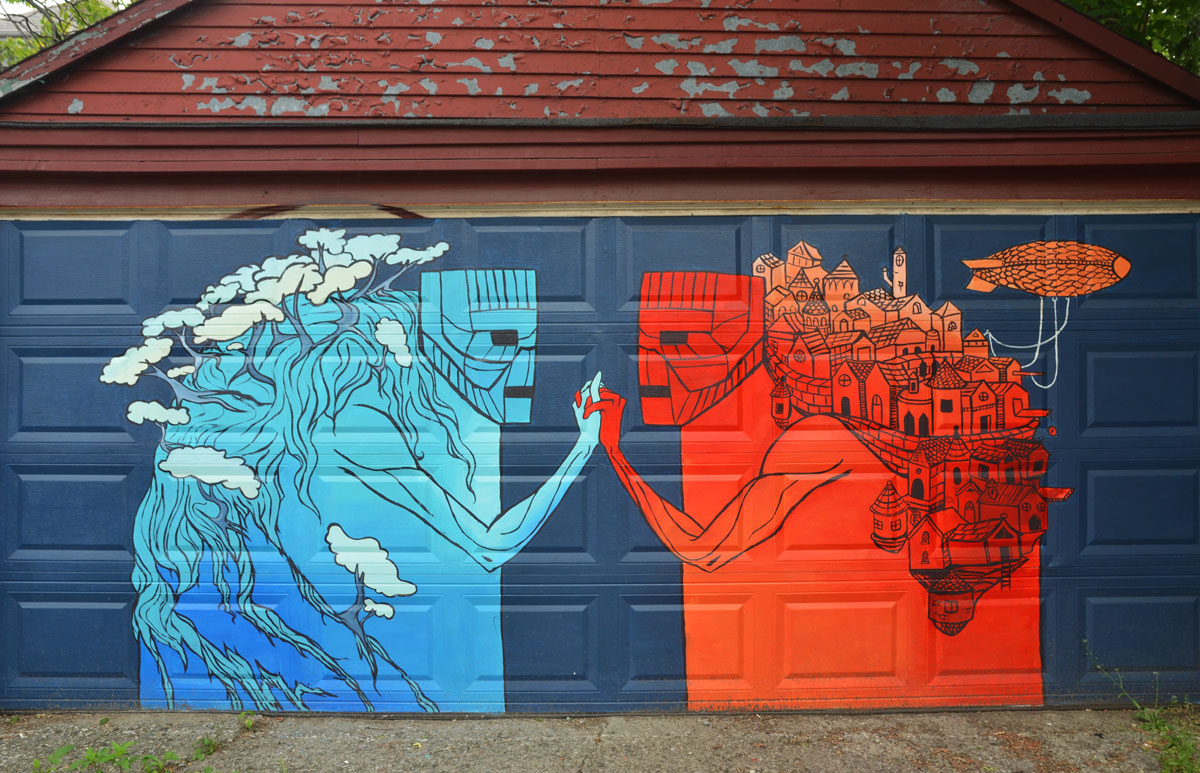
below: Blue cool nature meets red hot city, friends, joined together & working together. Mural by ‘Insect Cabaret’ which is the name that artists Aisha Ali and Andalah Ali have given to themselves and their work.

a mural on a garage door, a blue figure on the left and an orange figure on the right. Blue represents nature and red represents the urban city

below: Swimming in the lane.

marine scene street art on a garage door in a lane, a red octopus, a green turtle swimming and a ship in the distance

The next two are from the same garage door.

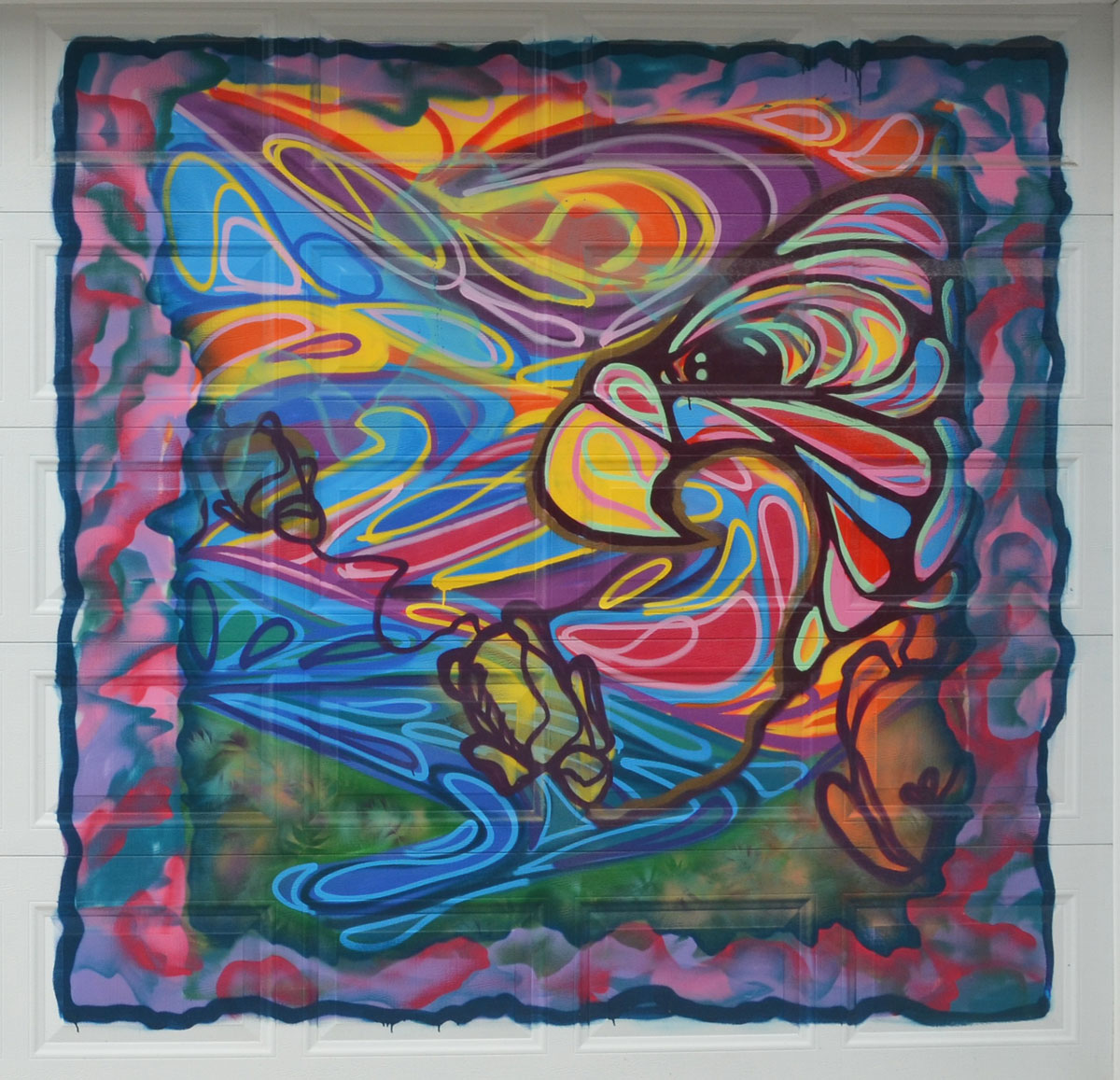
colourful mural on a laneway garage door

colourful mural on a laneway garage door

And in case you’re curious  –

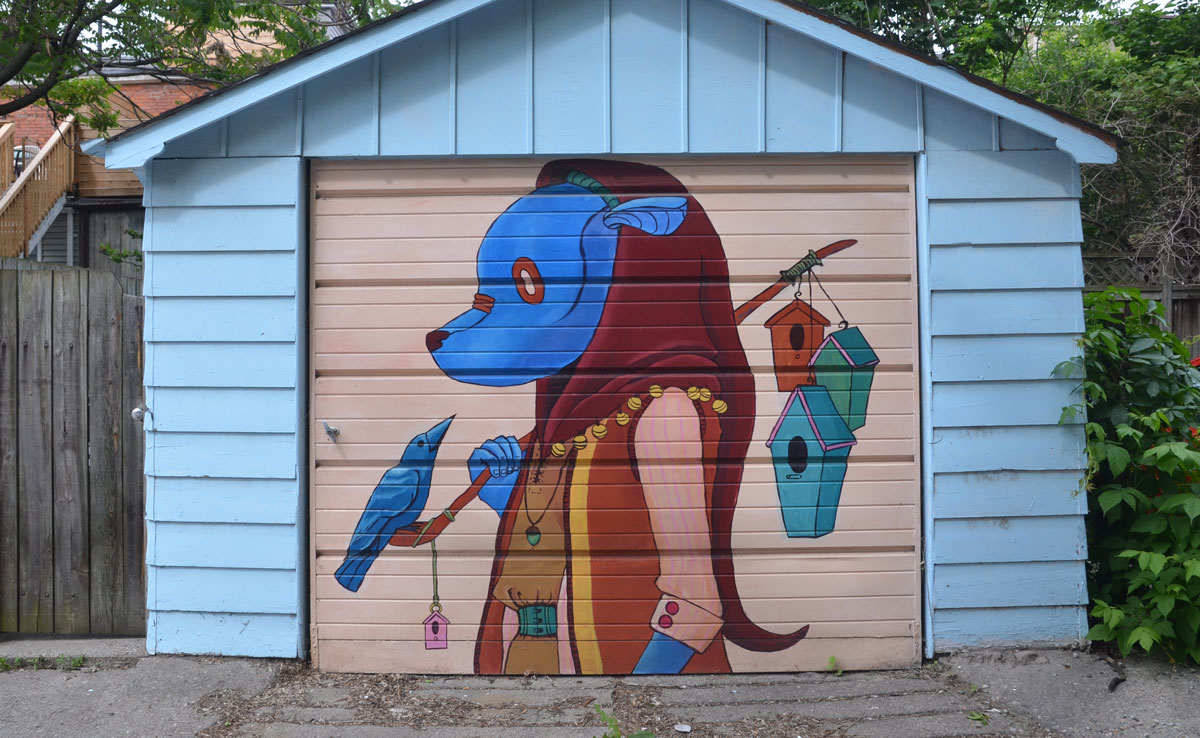
below: The blue bird and bird houses are still as bright as they were before…

blue faced animal wearing clothes and walking upright, with pole over shoulder, 3 bird houses hanging from the pole. A bluebird is sitting on the front of the pole, mural on a garage door in a lane

below: … and the little red birds are still floating along on their logs

part of a mural on a garage door in a laneway, a purple headed animal creature wearing a blue top and holding onto strings attached to floating logs with little red birds on them.


Spring is in the air. 

the word love is written in lights in capital letters in a window of a store. Reflected in the window is a group of older people sitting on benches across from the window

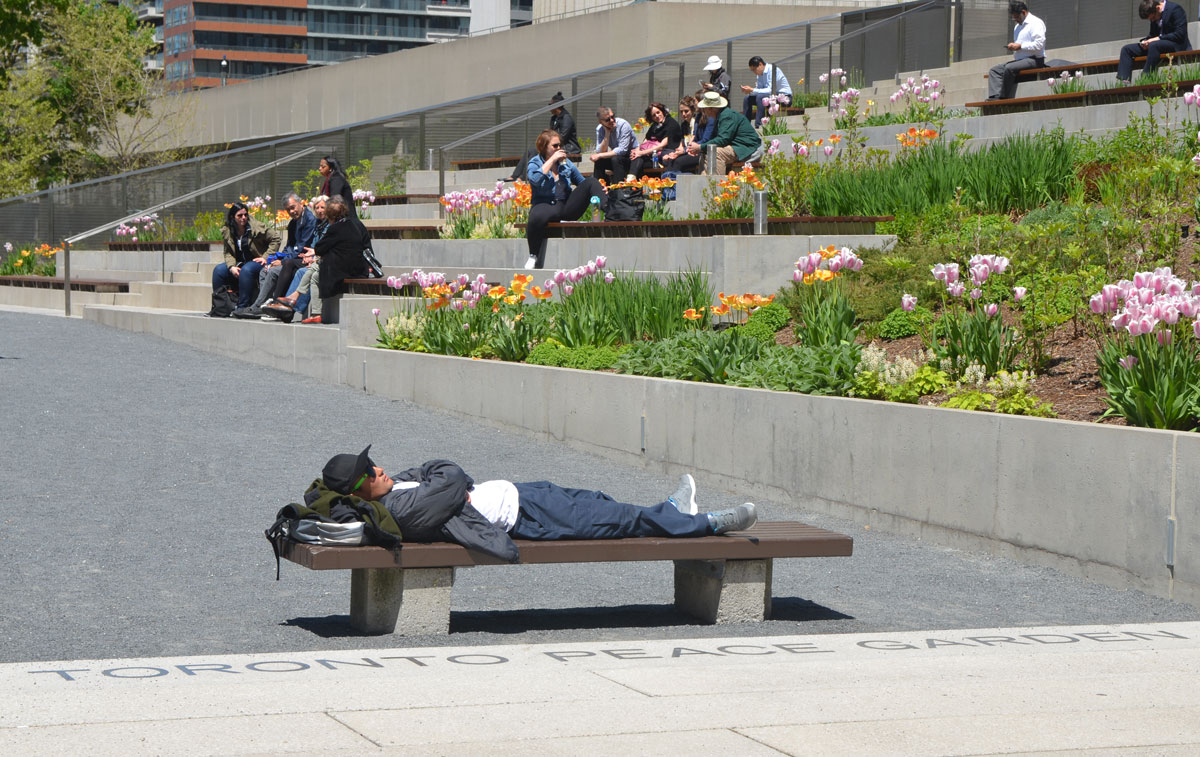
A young man is lying on a bench in the Toronto peace garden, the words of which are written beside him, metal inlay in the stone on the ground.

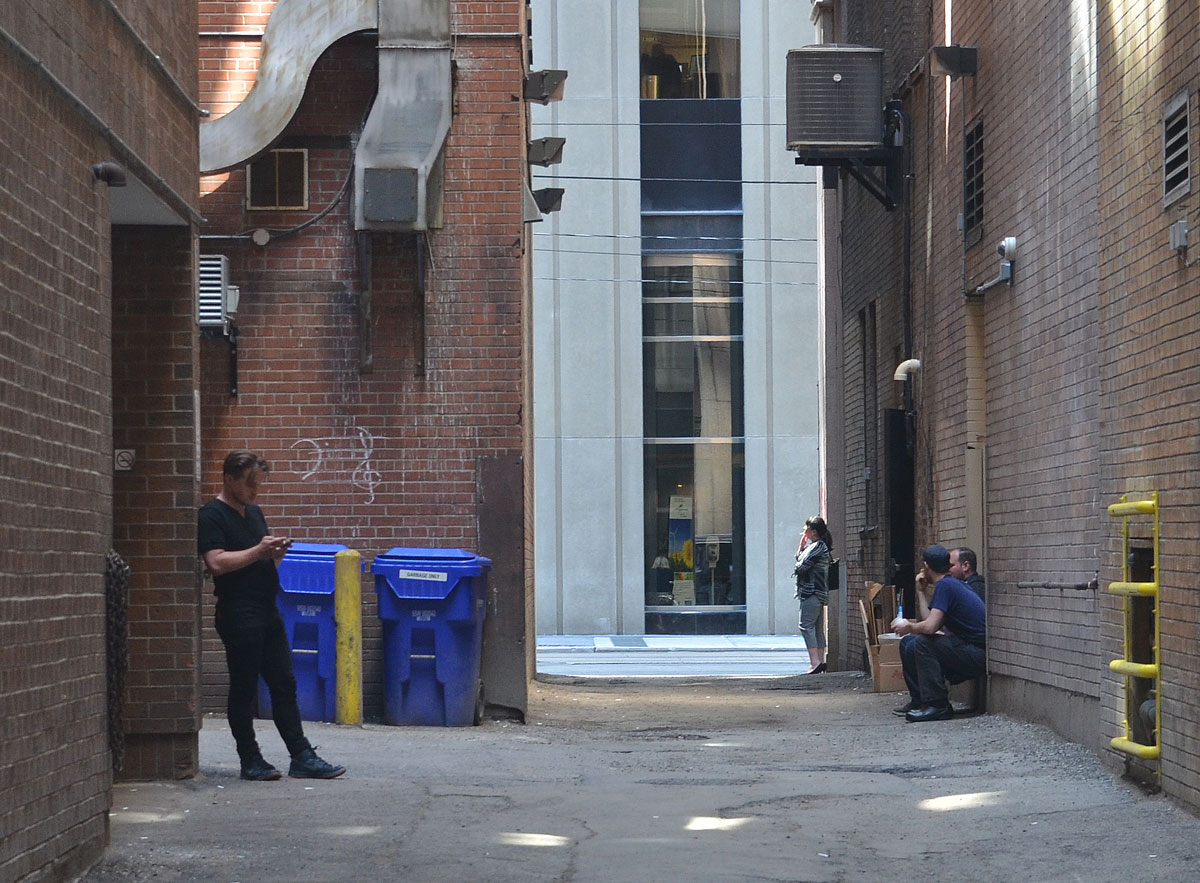
people sitting and standing in an alley, one man is on his cellphone, tall buildings on either side of the lane as well as at the end of the lane

A woman in black high heel shoes is sitting on a low stone wall outside. You can only see her from the thigh down. He legs are crossed at the ankle.

three people sitting outside, two men who are talking together and a woman who is sitting on her own, they are in a square and are surrounded by tall glass buildings, half in shadow and half in light

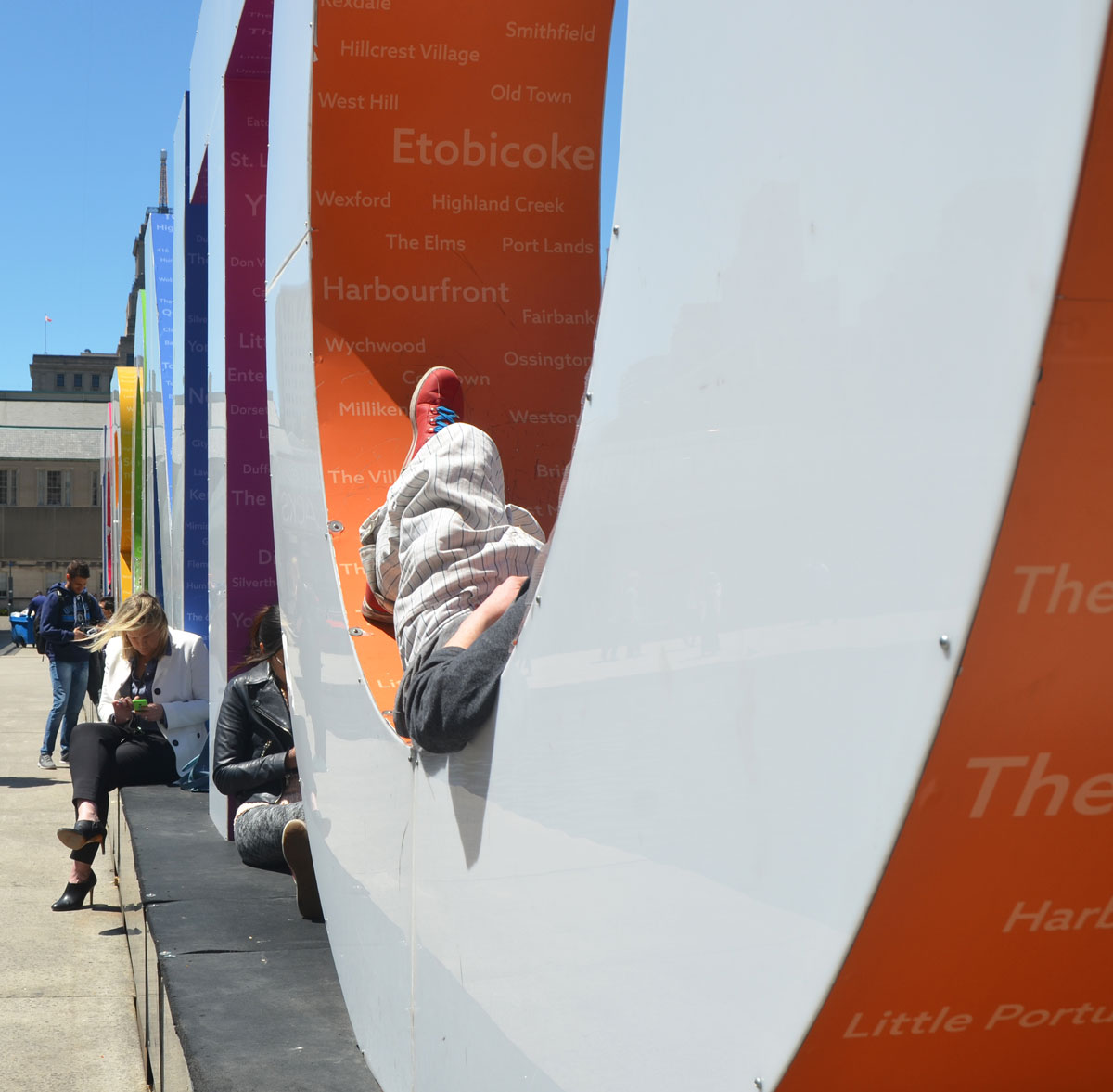
a young man is lying in the the O of the Toronto 3D sign. The O is orange, you can't see the man's face but you can see one red shoe and his light coloured pant leg.

blog_resting_O_toronto3D_sign

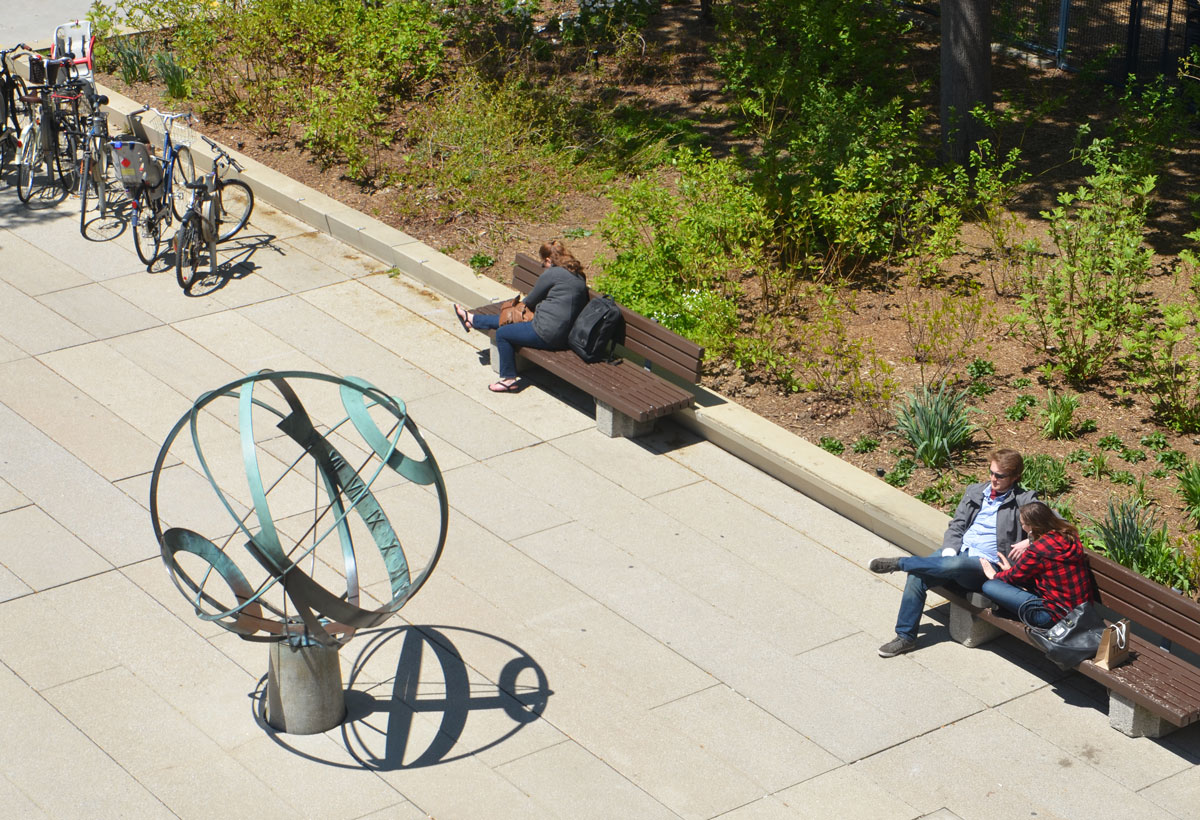
blog_sundial_nathan_phillips_square

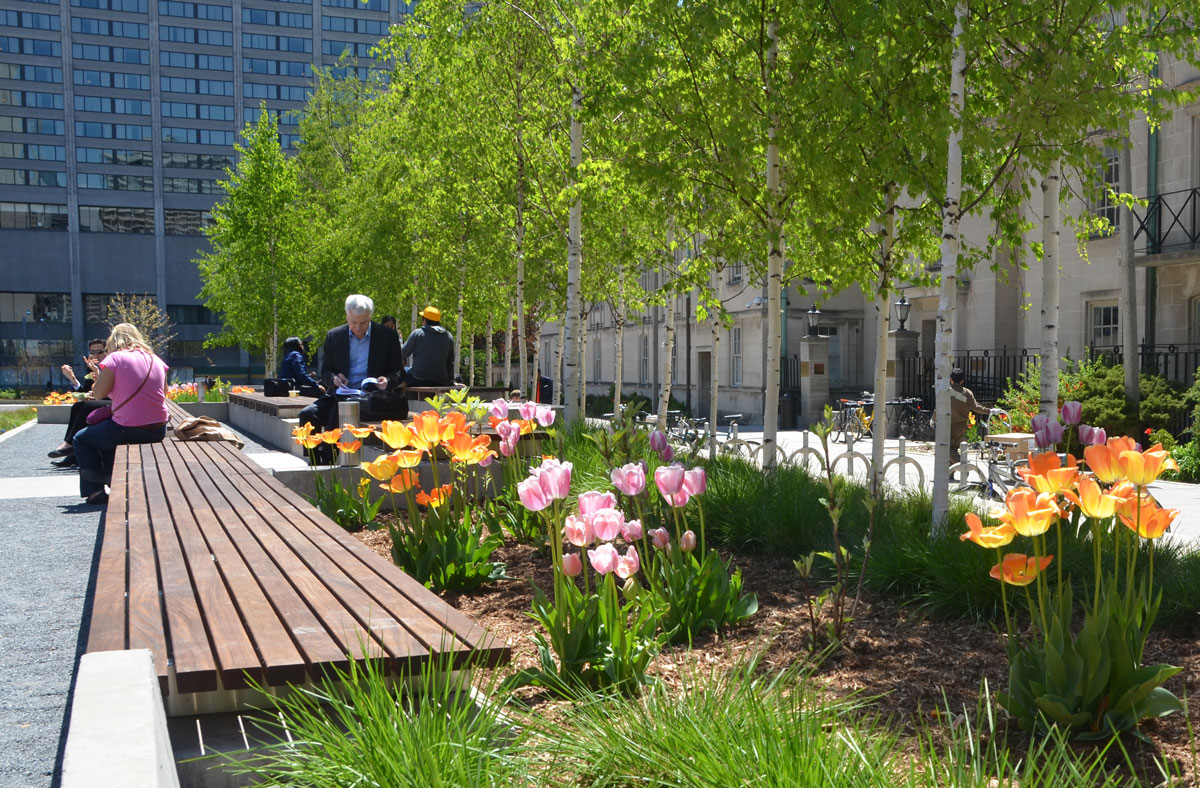
people sitting on benches amongst the tulips and birch trees of the peace garden at Nathan Phillips Square

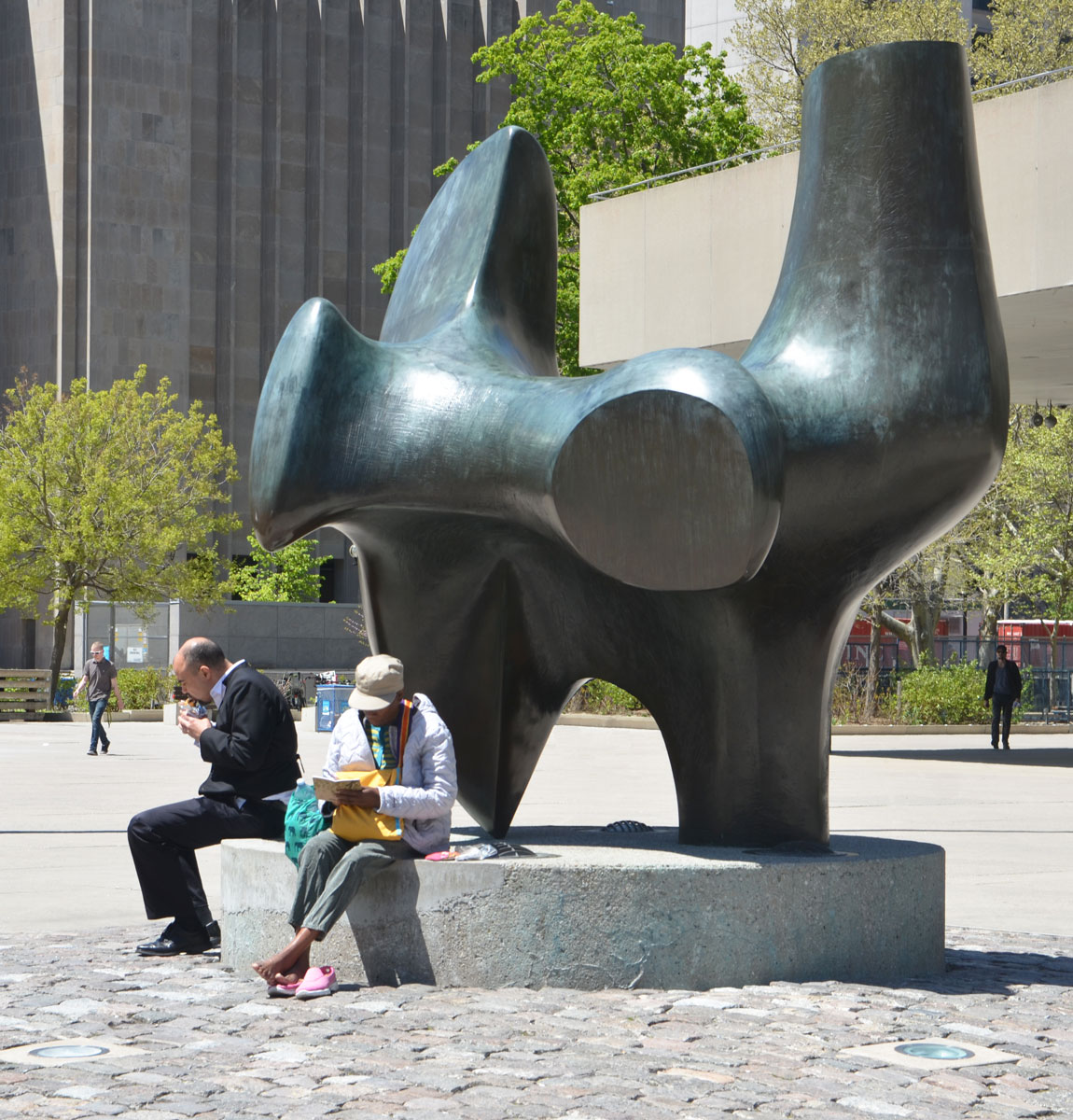
Two people sitting at the base of Henry Moore's 'Archer' sculpture at Nathan Phillips Square. One man is eating and the other is reading.

I’ll be lazing on a sunny
lazing on a sunny
lazing on a sunny afternoon.
(with apologies to Queen)

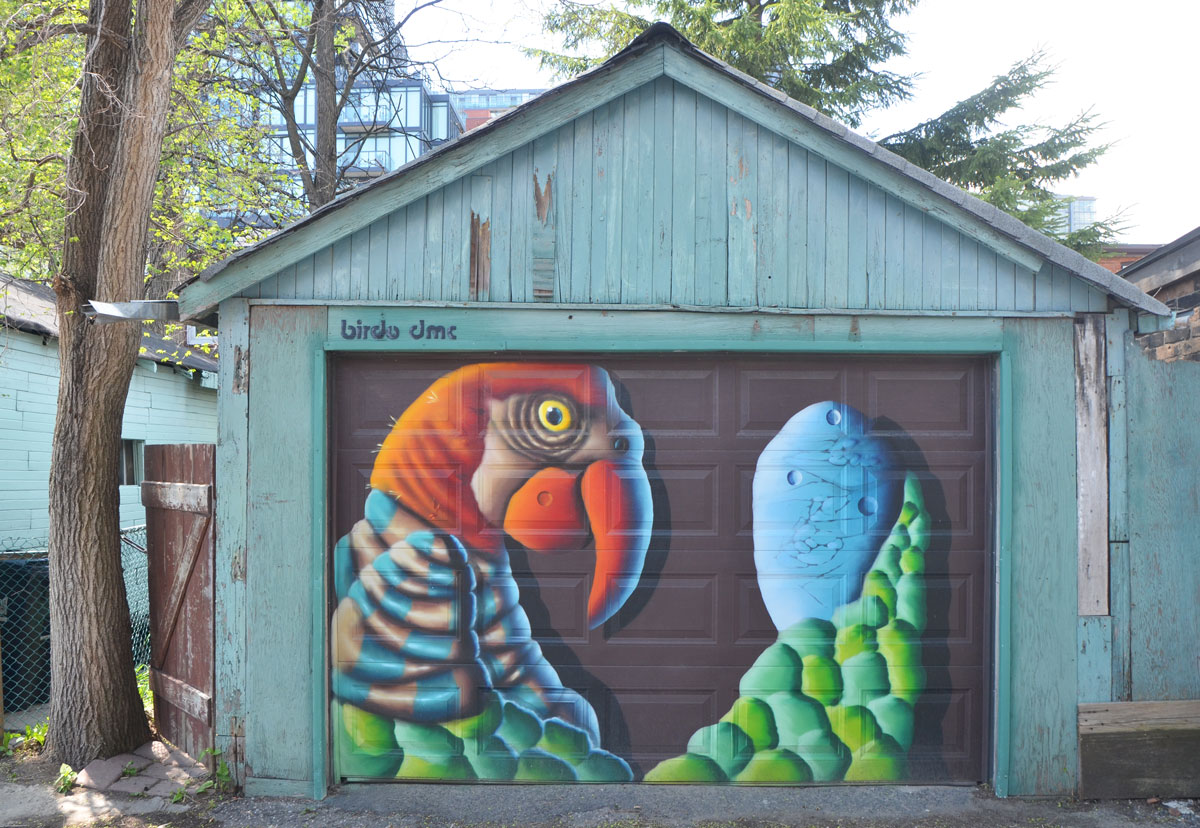
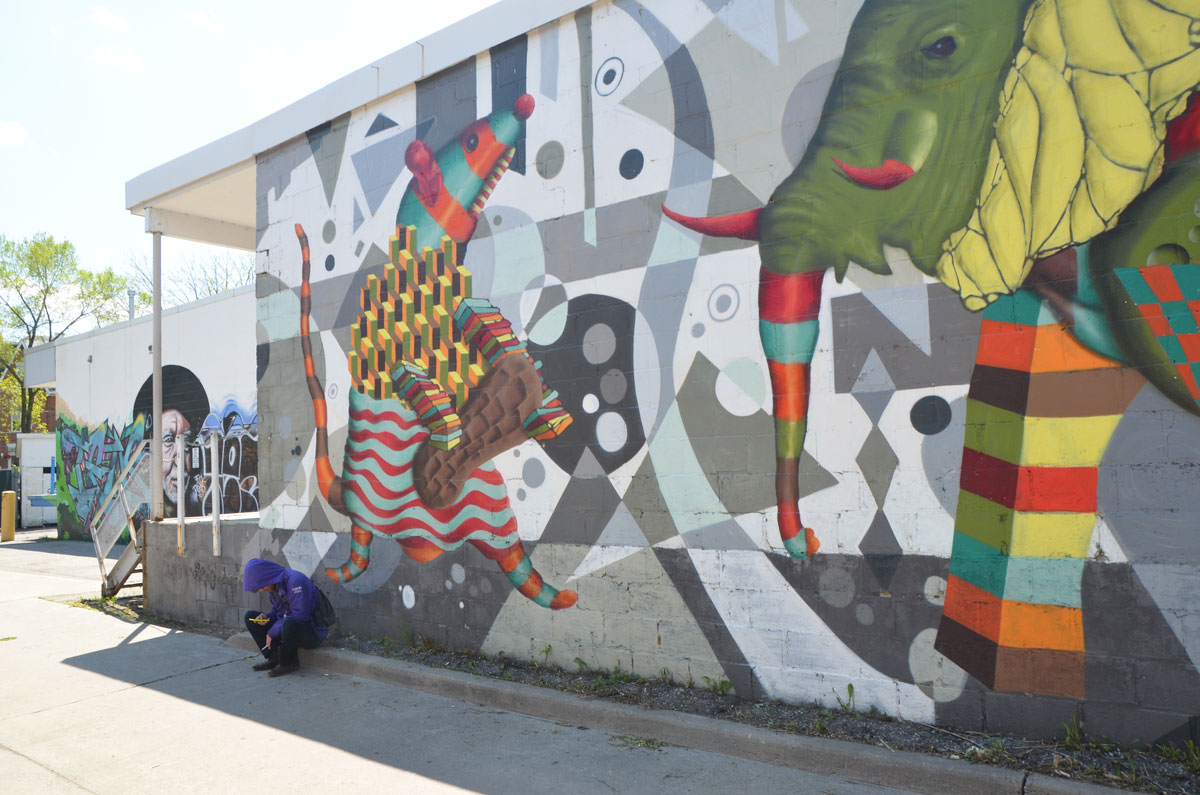
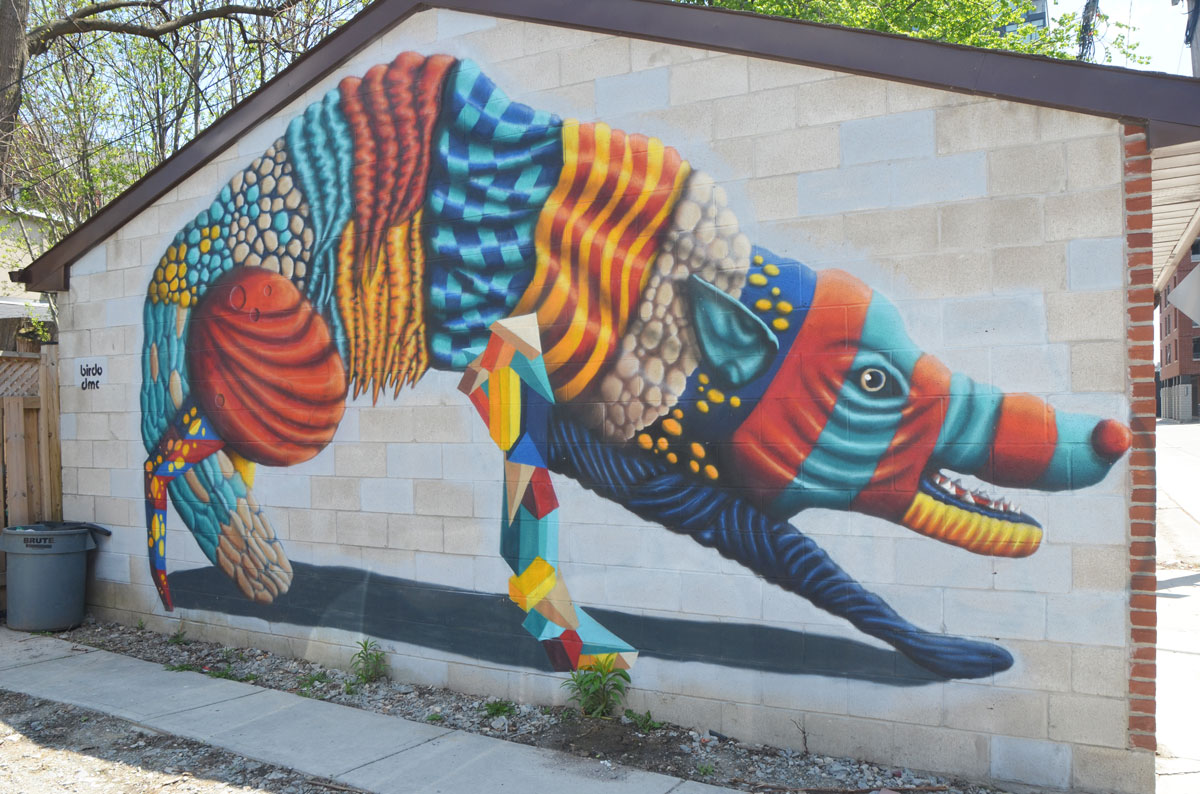
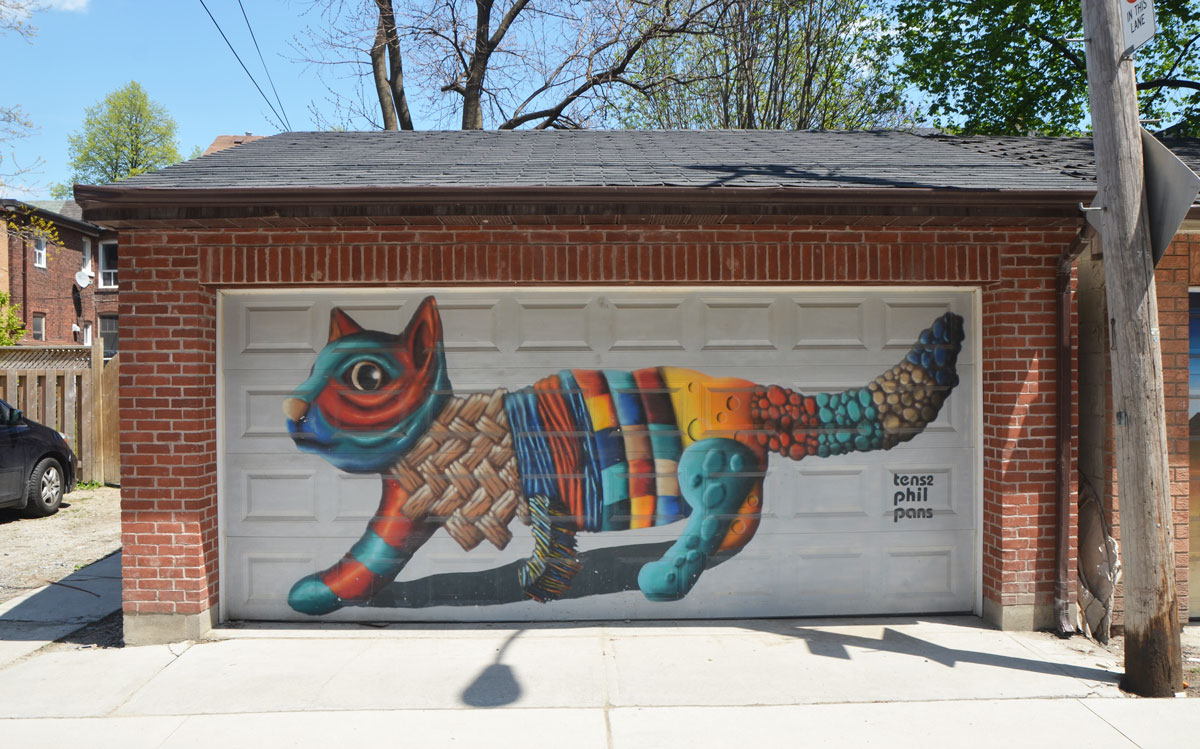
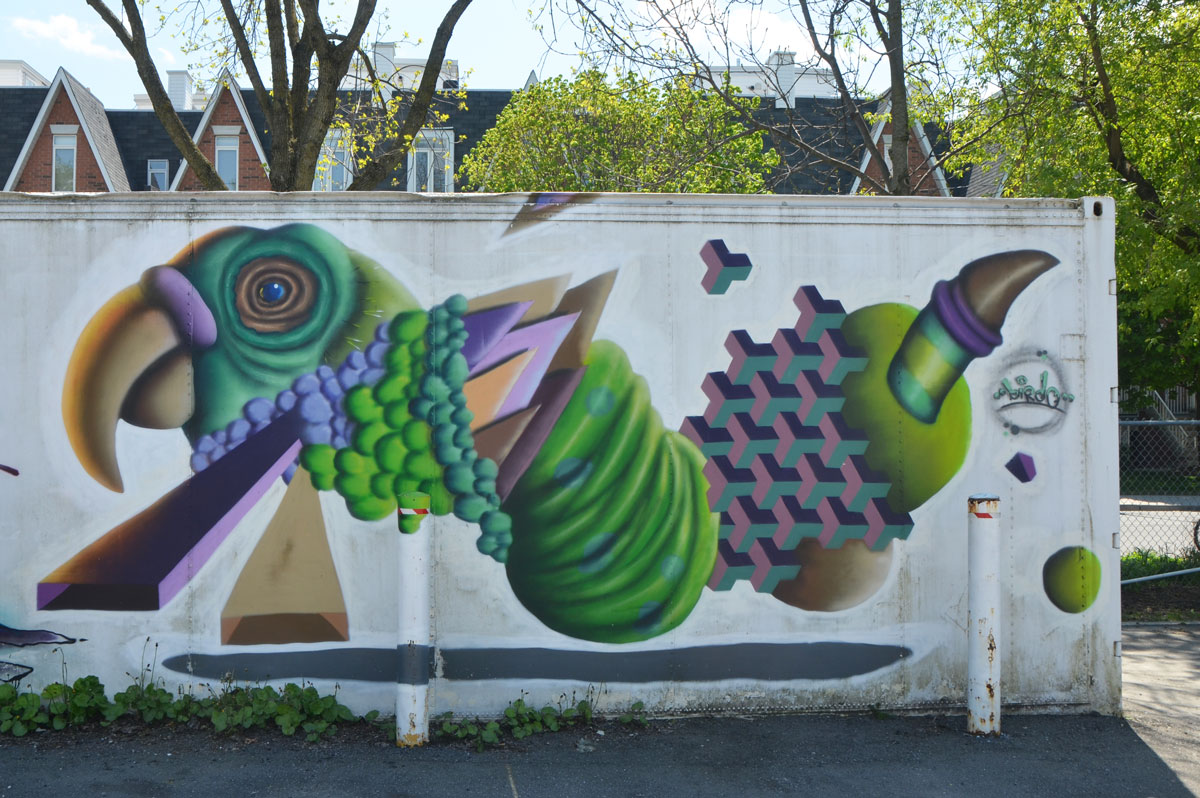
This blog post is about a flock of birdos, meaning that I found a lot of alley garages decorated with paintings by street artist birdo.  Or maybe ‘a menagerie of birdos’ would be a more accurate description as most of the pictures were of different animals such as elephant, cat, dog, coyote, and mouse along with a number of different birds.

These photographs were are all taken in alleys behind the south part of Dovercourt Road (between Queen and Sudbury streets).  The majority of the paintings that I saw were result of birdo’s work but there were examples of  and I have included them in this post too.

 below: Two birdo birds with eggs, with a slice of mushroom and pepperoni pizza by Shalak.

Three garages in an alley, with trees growing between them. The first two have garage doors with birdo murals on them and the third has a pizza street art painting by Shalak

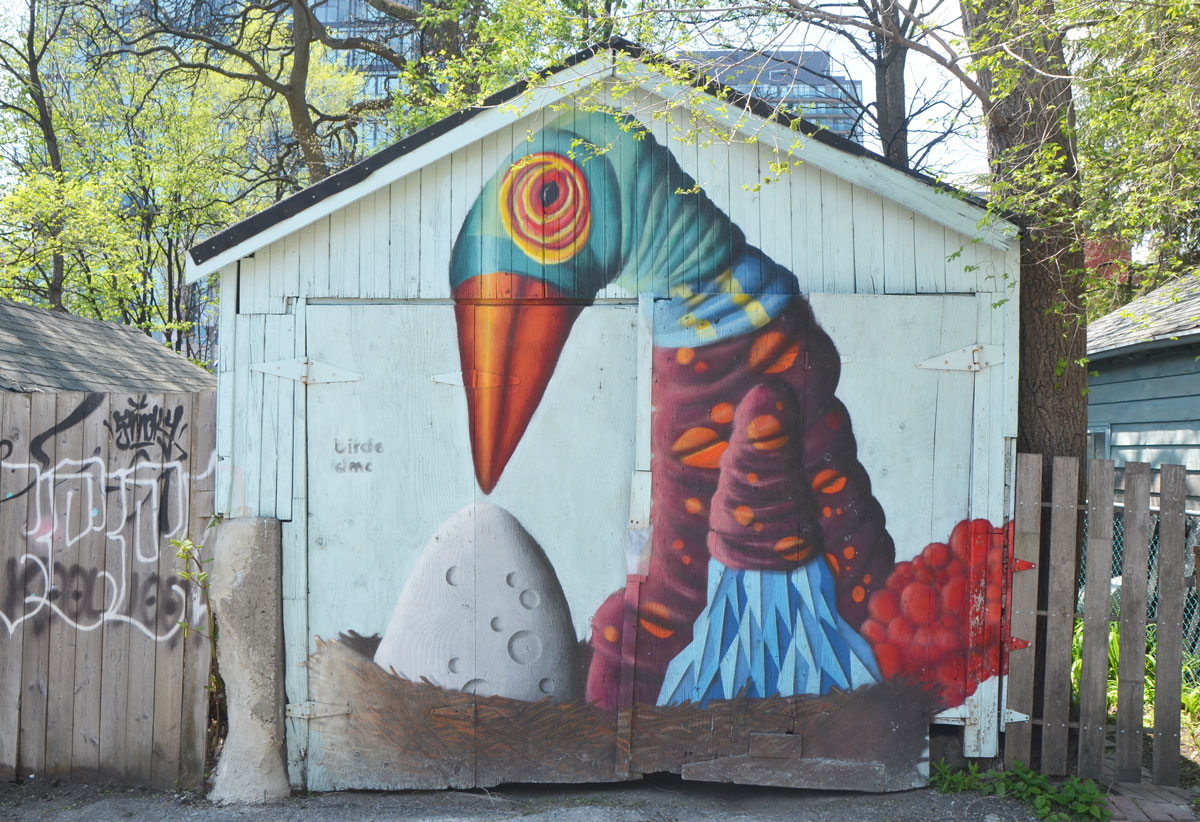
street art mural on a garage door in an alley by birdo - a large bird with blue head and orange beak sitting in a nest looking down at a large white egg

street art mural on a garage door in an alley by birdo - a parrot holding a large blue egg

An old wood garage in an alley that is painted by Shalak, a slice of pizza with pepperoni pieces flying off it (or onto it!)

a person is sitting on a kerb in an alley, beside a wall with a large mural by birdo of an elephant and a mouse

street art mural on a wall in an alley by birdo - an elephant with a green head

below: Howling at the moon, with a cactus and a scorpion too.

street art mural on a garage door in an alley by birdo - a coyote howling at the moon in the desert with a large cactus in the picture as well as a scorpion. words: birdo homes spud

below: Blue dog, pink lava lamp

street art mural on a garage door in an alley by birdo - a blue dog beside a pink lava lamp on a table. words: birdo dmc, phil pans tense

street art mural on a garage door in an alley by birdo - a four legged animal looks to be growling at something

street art mural on a garage door in an alley by birdo - a large multicoloured cat. words: tense phil pans

below:  A rooted turtle and cool owl with sparkly shades

street art mural on a garage door in an alley by birdo - a lavendar turtle and an owl with blue eyes and orange beak

street art mural on a garage door in an alley by birdo - a creature with a green and purple body and head that looks like a parrot

street art mural on a wall in an alley, a girls face, two little brown pigtails, 2 hearts and a turtle head

an old mattress leans against an old brick wall that has two pieces of graffiti on it. One is a blue and yellow egg shape with a blue arm and hand sticking out of a crack in it. The words "It's alive" are written beside it. The other is a small blue creature like shape

On a gararge door in a laneway, painted like the Canadian flag except there is a pineapple in the middle instead of a maple leaf. On the right hand side red stripe are the words "have a nice day"

A mural by bruno smoky on the side of a white container. It is a purple faced creature with blue tag like shapes around it.

below: “Just a robot that doesn’t like technology”

a lovebot on a silver garage door with the words "Just a robot that doesn't like technology, I'd rather be free"- signed Tasha

number 66 in a lane, garage door, door and walls covered with circles and triangles in different colours.

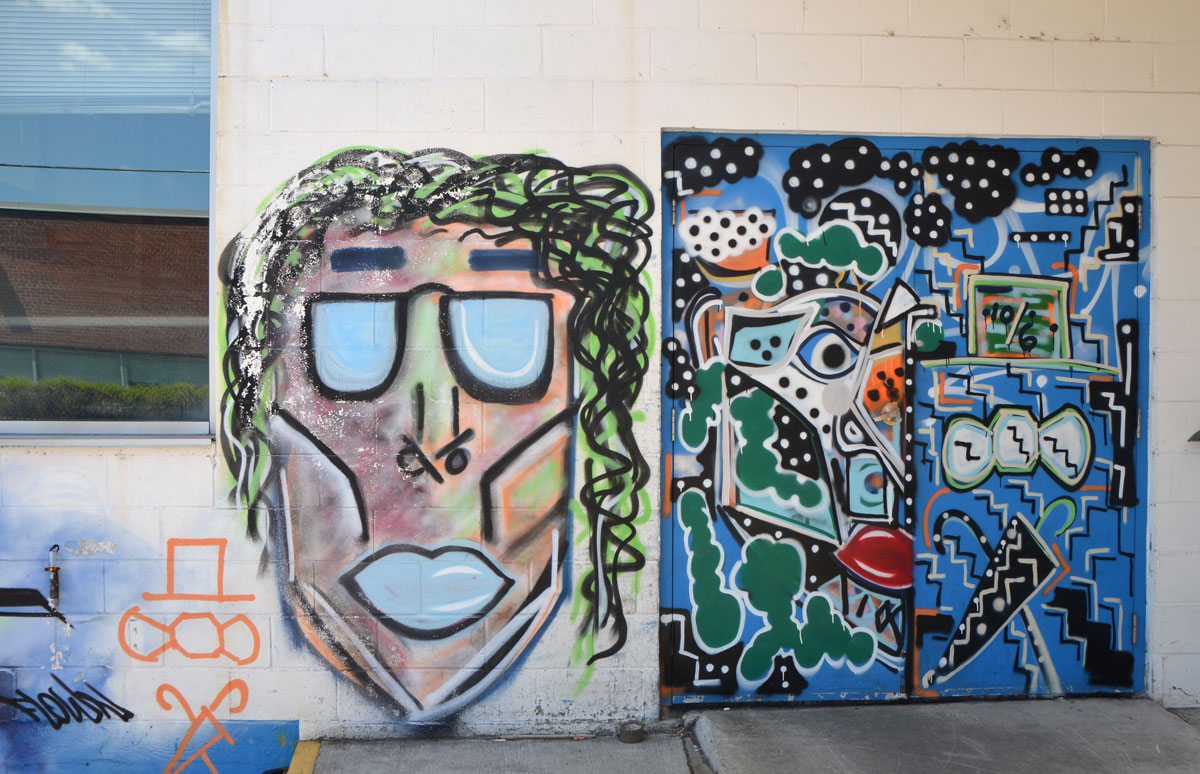
A door covered with a very abstract face painting and another graffiti face beside the door.

On Friday morning, my original goal was to find ‘Residents of the Esplanade’, a CONTACT Photography Festival outdoor exhibit at David Crombie Park but it was such a beautiful morning that I didn’t stop there. I found more than just the ‘Residents’.

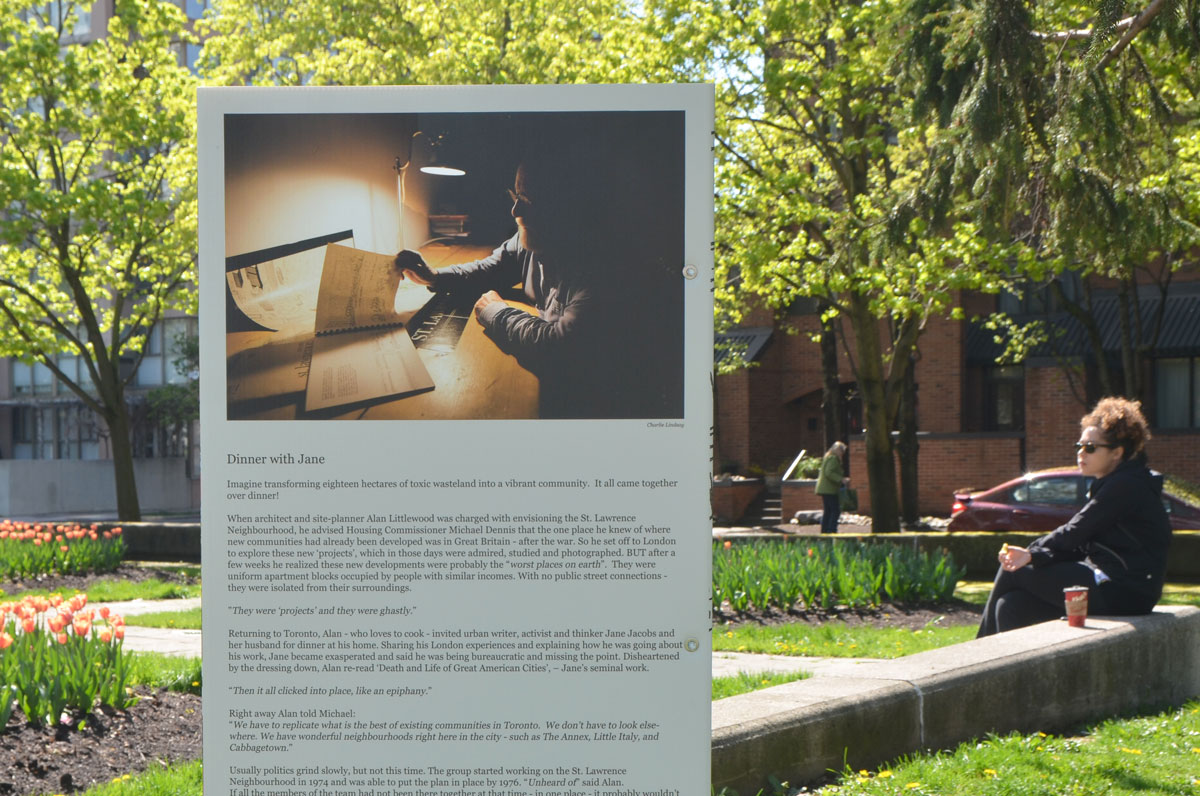
Forty years ago, May 1976, the site plan for The Esplanade neighbourhood was approved. Since then, it has become home to a very diverse group of people. And it is those people that this installation celebrates on the 40th anniversary of the founding of the neighbourhood.

Crombie Park runs along the south side of The Esplanade between Berkeley street and Lower Jarvis.  The installation consists of a number of small white rectangular pillars with the picture and story of person on either side.

A photo from the CONTACT photography festival, installation called 'Residents of The Esplanade' - story of Mysha from Pakistan

A photo from the CONTACT photography festival, installation called 'Residents of The Esplanade' - photo of Solomon from on top of a basketball hoop

A photo from the CONTACT photography festival, installation called 'Residents of The Esplanade' - photo of Alan working at a desk, tulips and a woman sitting in the park are in the background

People were out enjoying the morning; school kids were playing basketball at recess.

kids playing basketball on an outdoor court. The wall behind the basketball hoop has been painted with a mural of hands making a heart shape with the fingers, by Bruno Smokey and Shalak Attack.

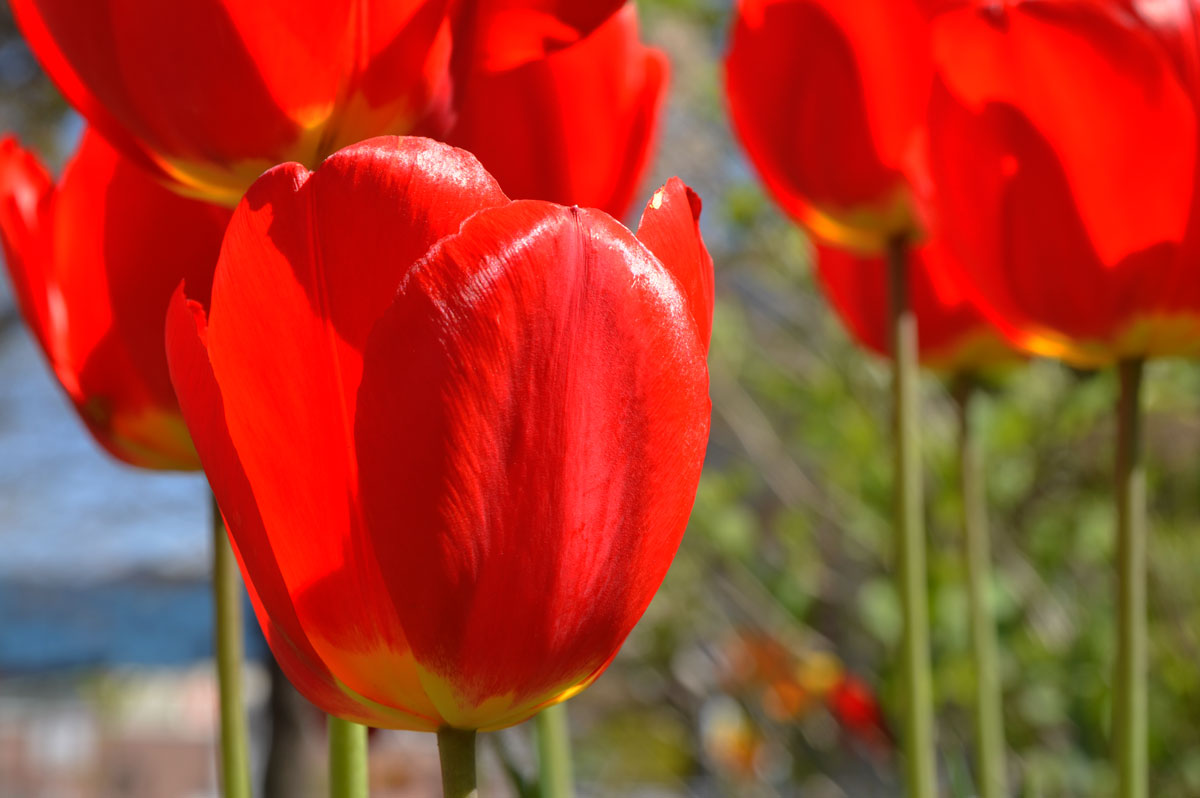
Flowers were blooming.

close up photo of red tulips in full bloom on a sunny day

tulips in a garden in a park, orange and yellow tulips, with some greenery. Grassy area with trees behind, and people walking on a sidewalk in the background.

below: Looking towards Lower Jarvis Street and downtown Toronto.

at the corner of The Esplanade and George Street, looking west towards downtown and St. Lawrence market. Playground on the left with children playing.

below:  One street beyond Lower Jarvis is Market Street.  It dead ends at the railway tracks.  The long structure on the right is a parking garage.

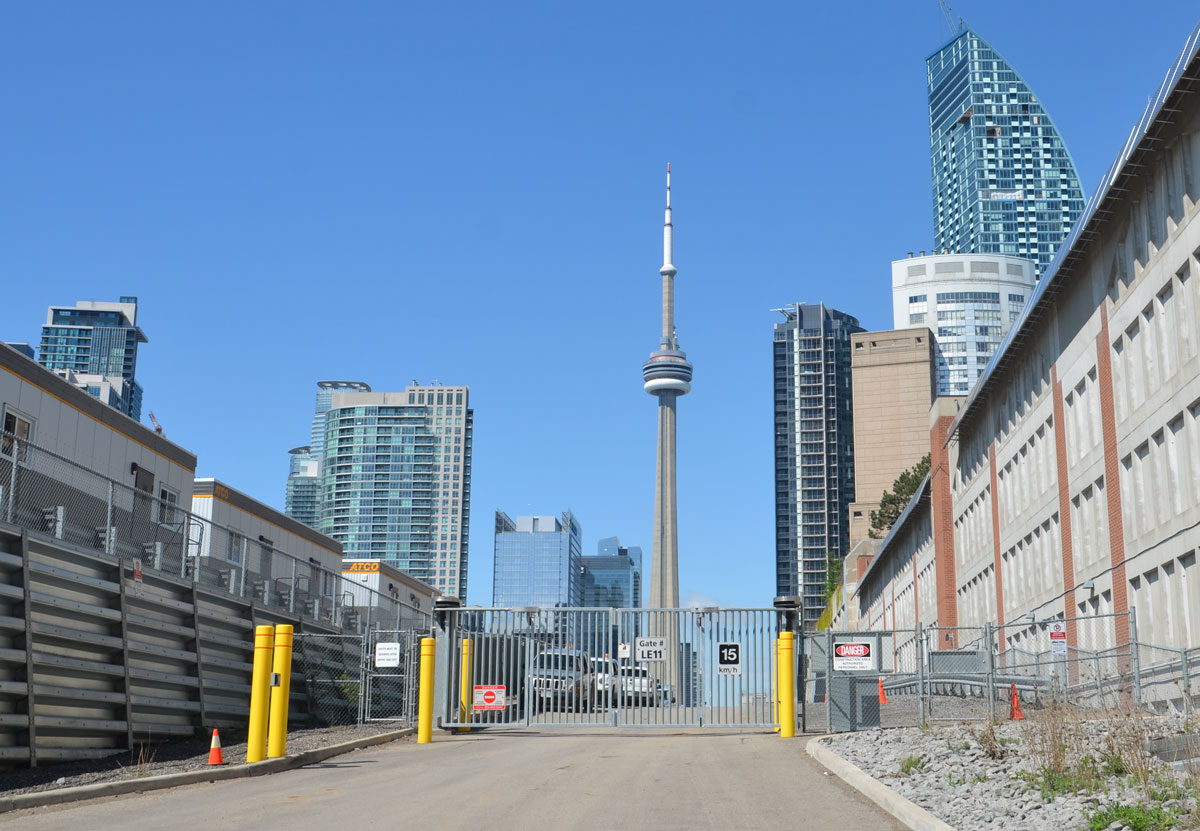
looking west towards the CN Tower, with the railway tracks to the left (but they are elevated and behind maintenance buildings so you can't see the tracks). Parking structure to the right, with city buildings behind it.

below: After a small backtrack up Market Street, I went through Conger Coal Lane to Church Street.  I don’t think I have walked this way before.  The lane was named in commemoration of the Conger Coal Company whose yard and wharf was nearby.   It was one of the many companies that provided Toronto with coal back in the day when coal fueled the city.  It was started in 1870 by Mr. P.D. Conger.   In 1913, Sterling Coal company bought Conger and the name was changed to Conger Lehigh Coal Co.

a downtown Toronto lane, very clean, no graffiti, taller, newer buildings on either side of the lane. CN tower in the distance,

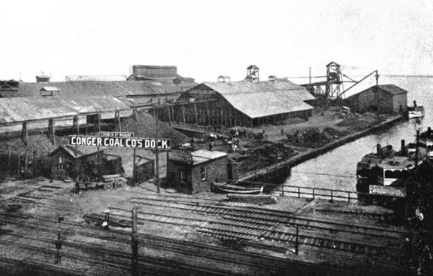
below: A very old photo of the Conger Coal Company dock at the foot of Church Street, back when Church street ended at Lake Ontario

historical picture of the old COnger COal Co wharf at the bottom of Church street.

below: Tucked into a corner on Church street immediately south of Front Street, is an art installation by Paul Raff called ‘Shoreline Commemorative’.  A topography of limestone forms the base of the work.  A glass ball representing the line between sky and water sits on top of a tripod that tries to evoke a land surveyor’s tripod.  The words on the wall say “For 10,000 years this was the location of Lake Ontario’s shoreline.  This brick wall stands where water and land met, with a vista horizon”

Shoreline Commemorative by Paul Raff, an art installation on Church St., south of King, that marks where the shoreline of Lake Ontario used to be. It involves words on a brick wall and a model of the shoreline of Toronto showing the different elevations of the land.

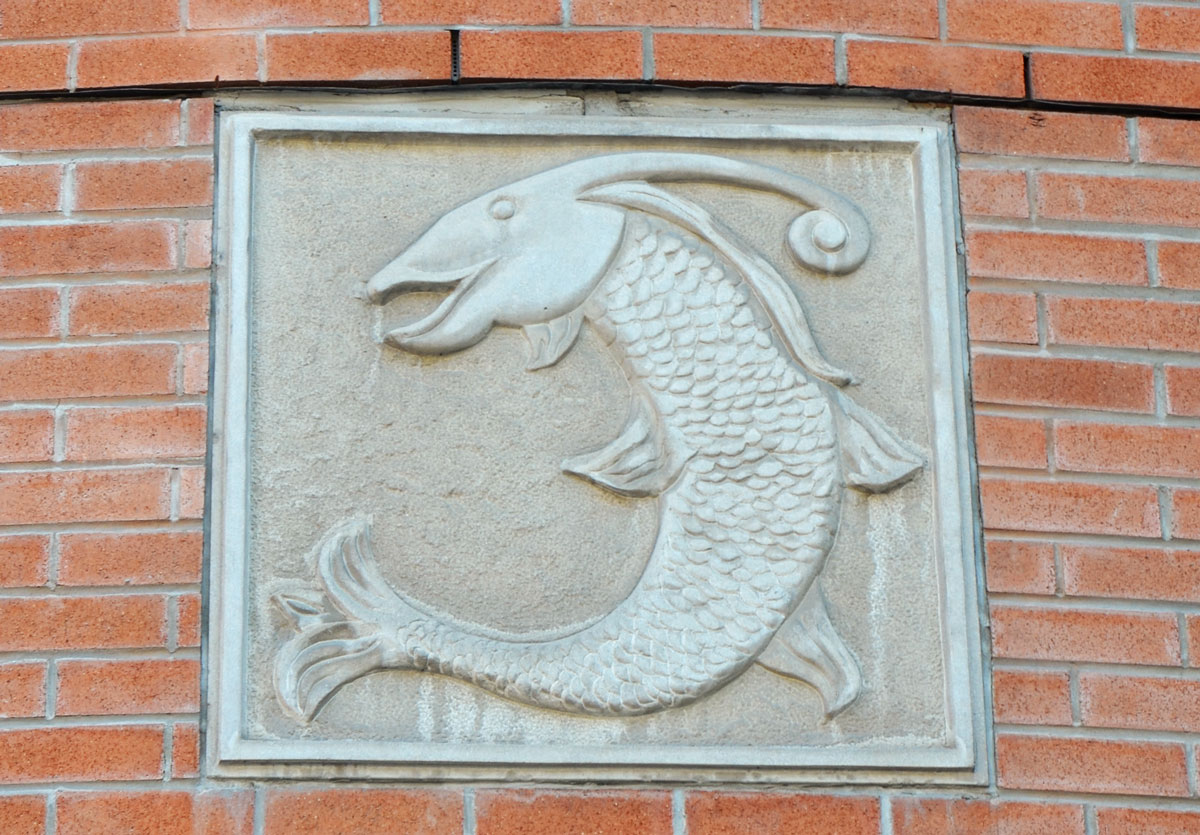
below: Continuing the lake theme, a little fish out of water, jumping over the entrance to a condo.

bas relief sculpture of a fish, square stone on a brick wall above the entrance way to a condo building.

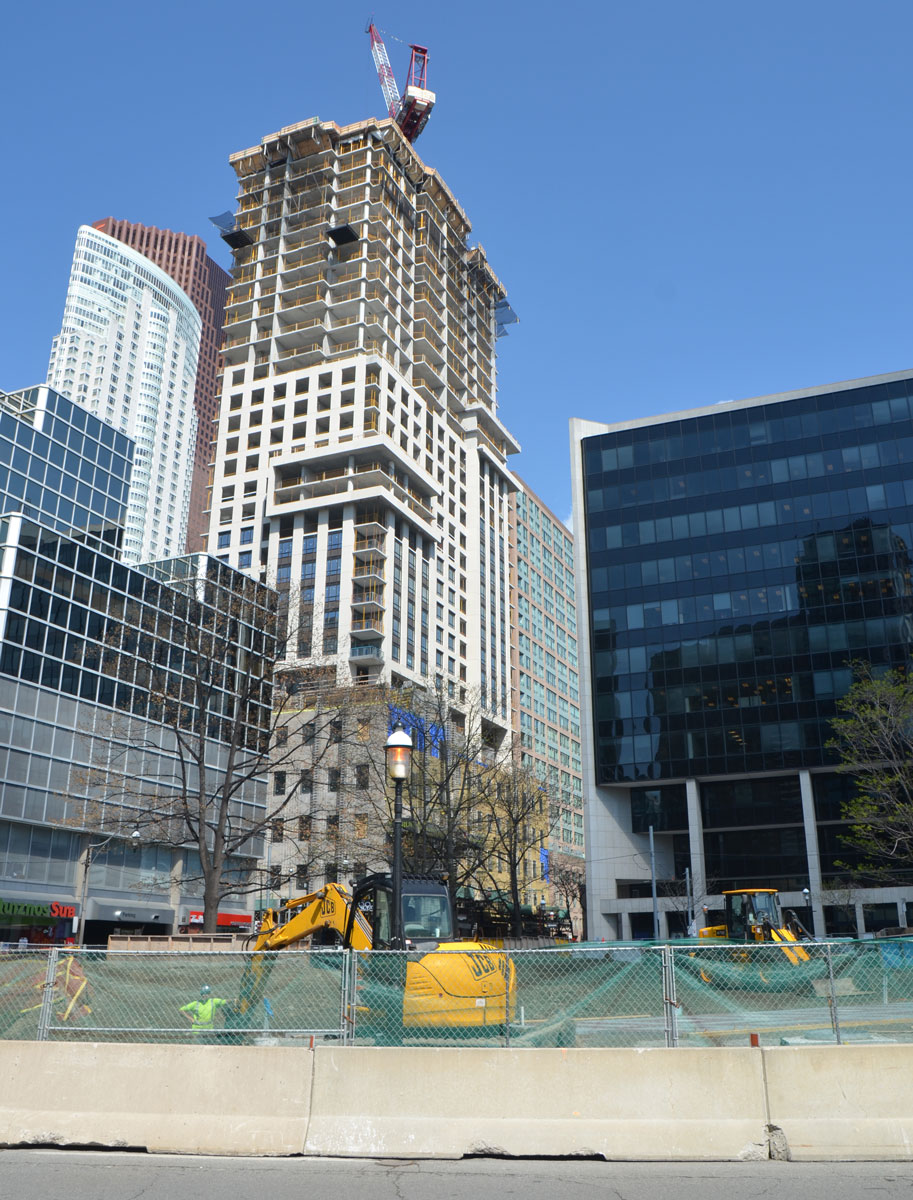
below: From the lake theme to another common theme in the city, construction. Spring is the beginning of construction season and here Berczy Park is being upgraded. In the background a new condo is being built but as we all know condo construction ‘season’ never ends. In fact, the challenge might be to find a place in this city where there isn’t a condo being built.

workmen redoing a park, Berczy Park in Toronto, with a digger and another piece of equipment, cityscape behind with a tall condo building under construction. A red and white crane is on top.

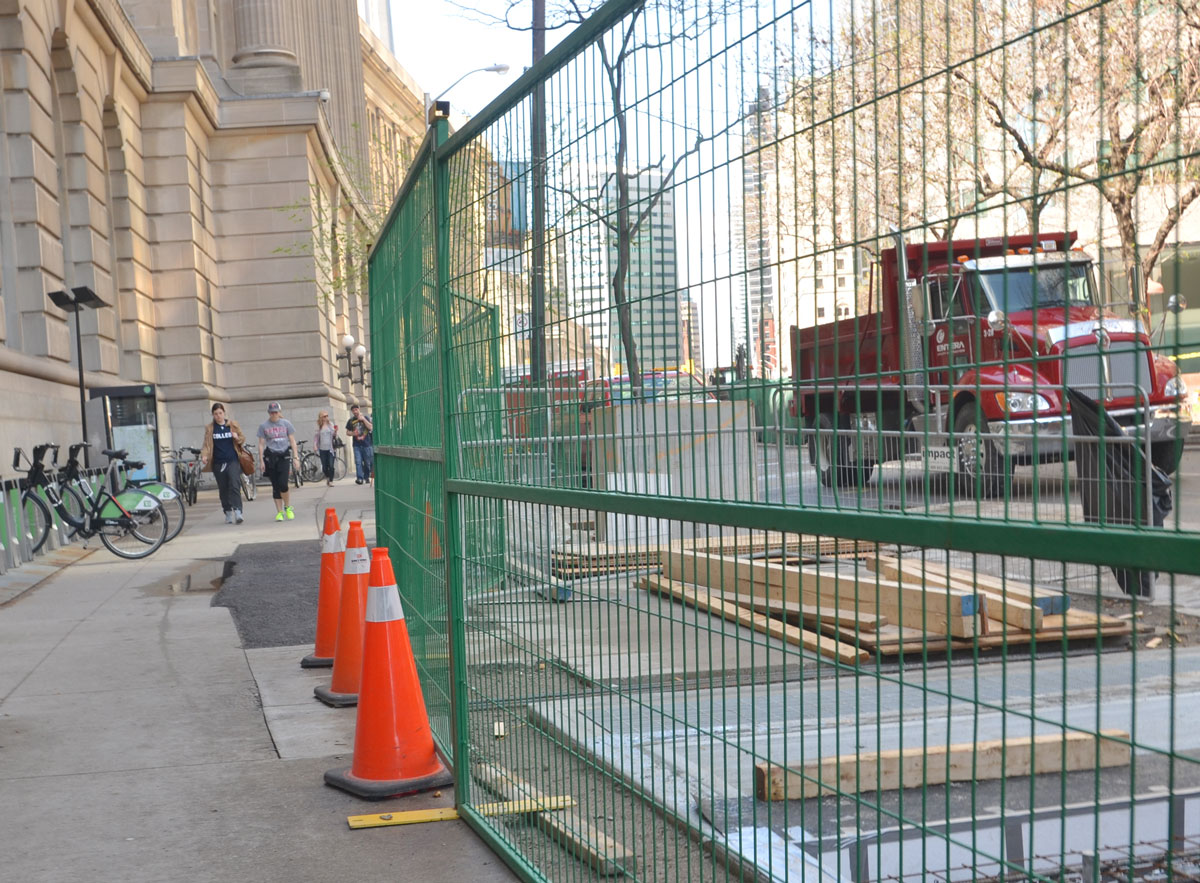
below: I walked past the never ending Front Street construction.  Construction in front of Union station seems to be finished, but this stretch of Front Street just west of the station is still being worked on.   There have been fences here so long that I can’t remember a time when they weren’t here.

Front street constrcution, behind a greenwire fence is a rd truck and piles of construction materials. Between the fence and a stone building is the sidewalk on which some people are walking.

a shirtless man in sitting on a stool at the corner of Front and Union streets. He has four signs (behind, above, in front, and beside him) asking for spare change or for you to buy his novel that is well rated on both Amazon and Goodreads.

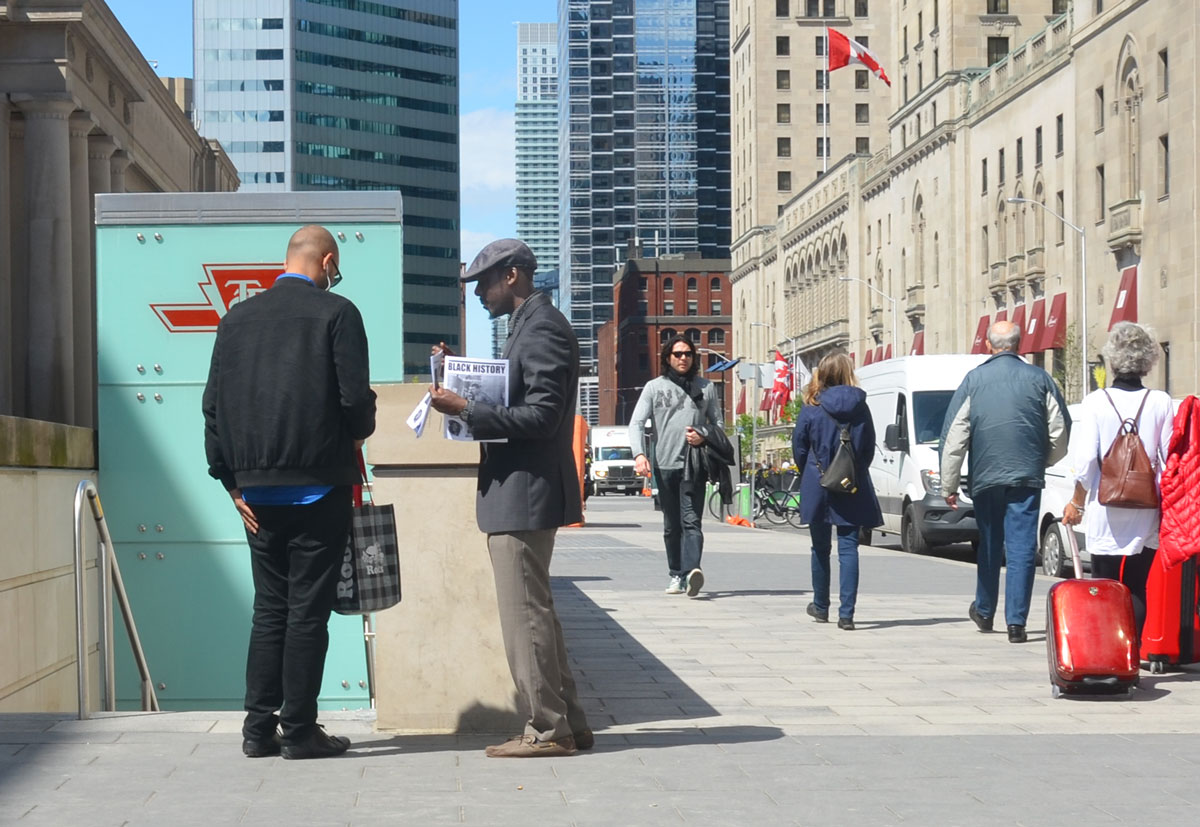
A man is selling Black History newspaper to another man in front of the TTC subwayentrance at Union station.


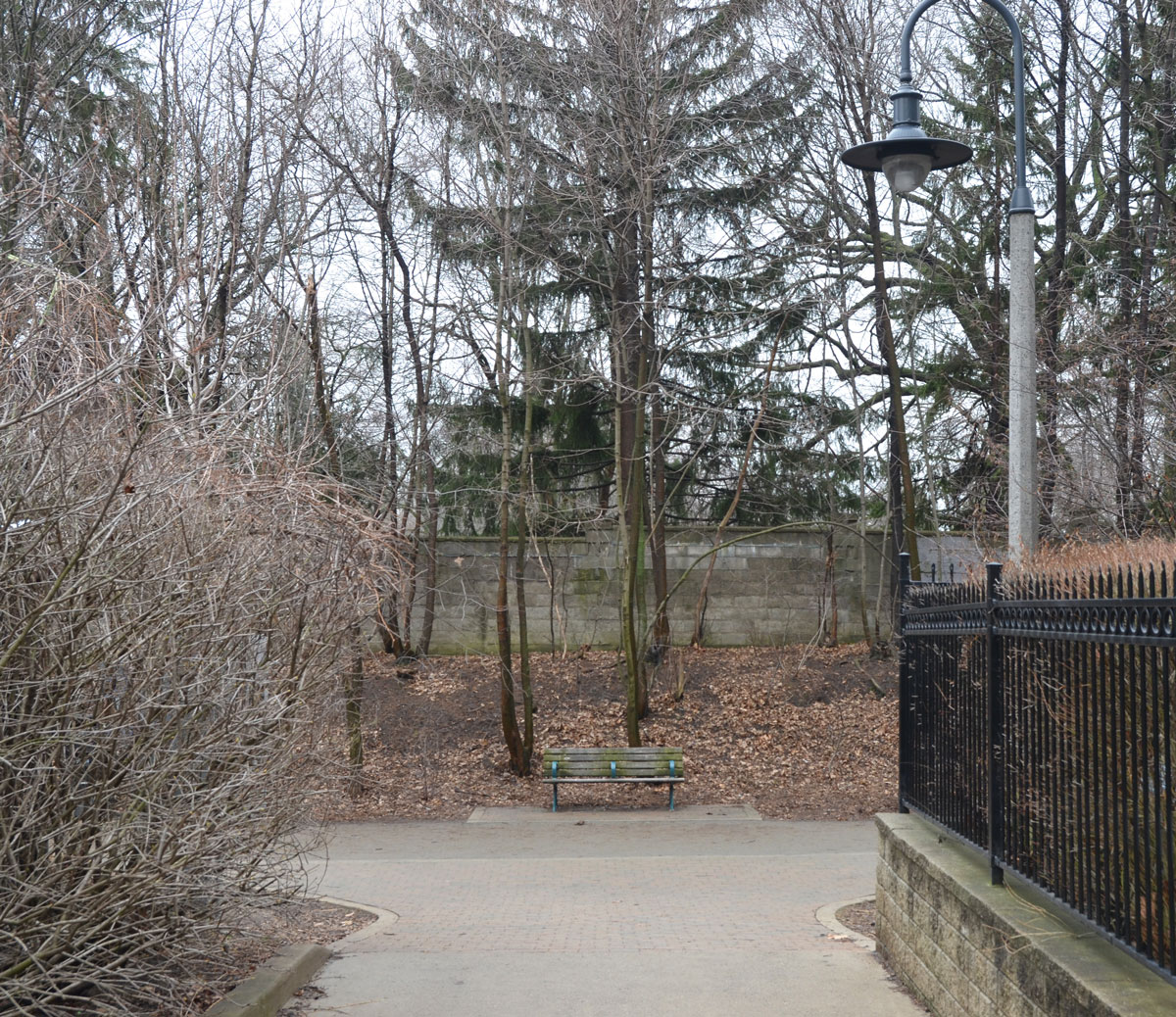
There is time between winter and spring that is a dreary time of greyness and dullness.  It is a time when the the snow is gone but nature hasn’t come out of hibernation.  It is also a time best forgotten.

between winter and spring, the snow has melted, there are no leaves on the trees, the weather is grey, looking down a path that comes to an end in front of a bench. Behind the bench are trees, dead leaves on the ground, and a grey stone fence. dreary, grey
Luckily we don’t have to wait long.

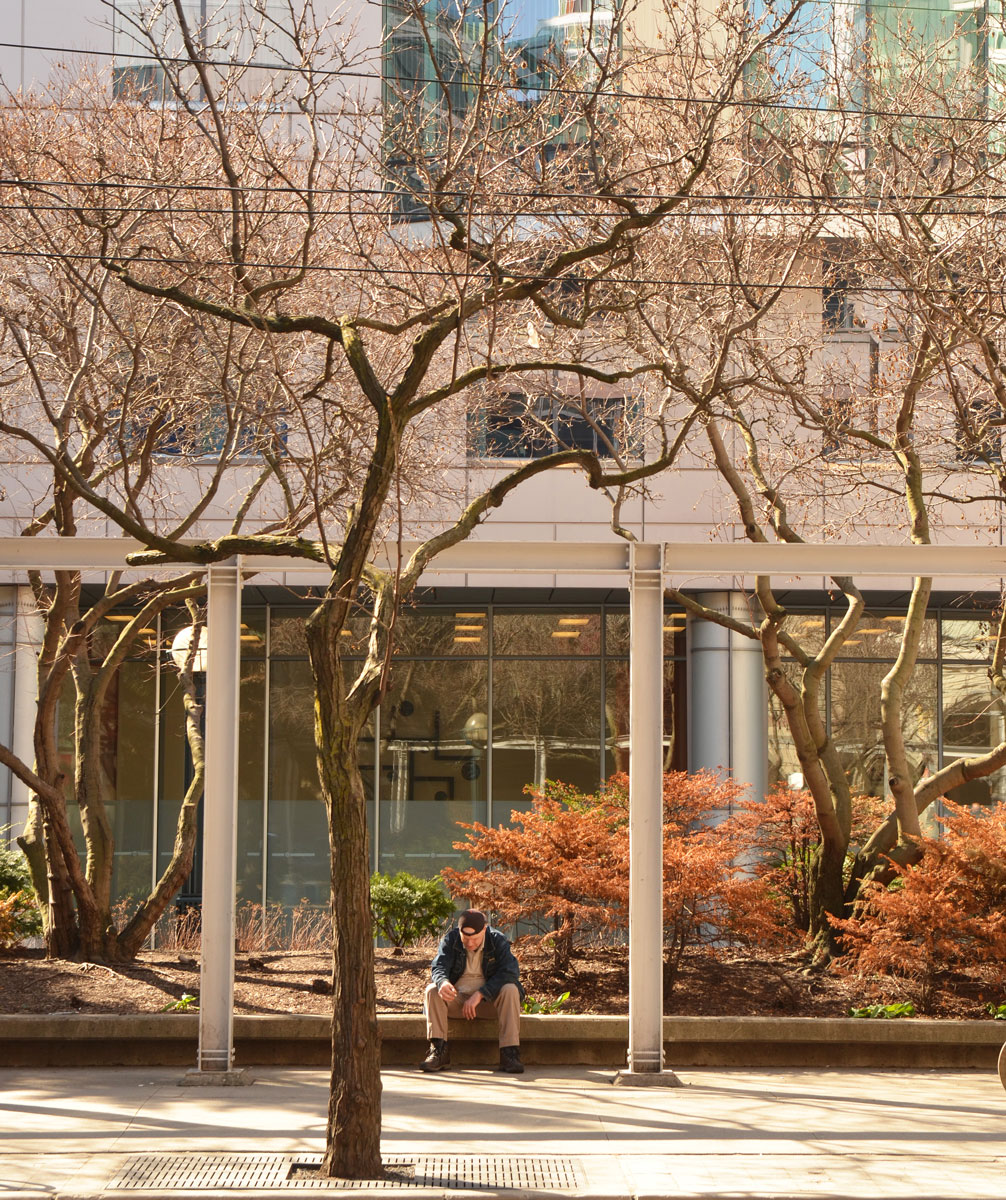
A man sits on the edge of a large planter with trees and shrubs in it in front of Roy Thomson Hall. There are no leaves on the tree yet.

… just a little longer ….

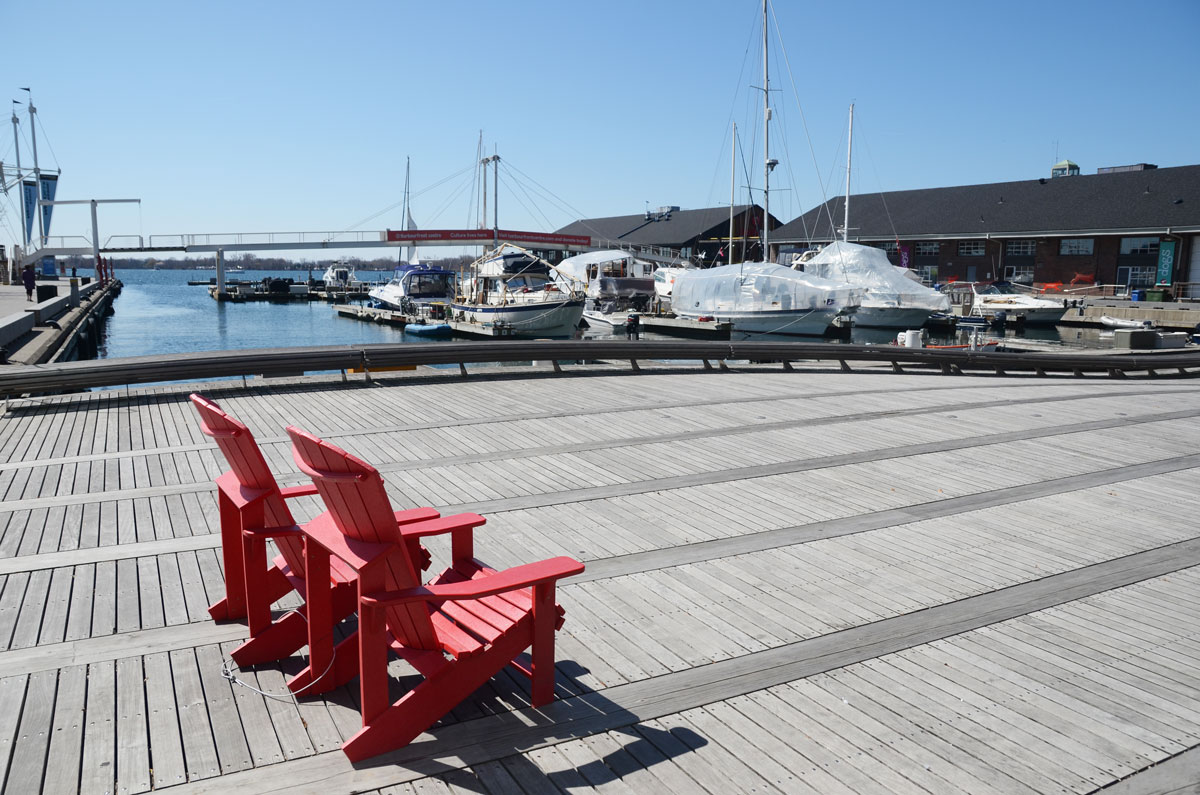
Two red Muskoka chairs sit on the Wave Deck at the waterfront in Toronto. Boats in the harbour are in the background, some with plastic wrap still on them from winter storage.

or if you can’t wait, there’s always plastic!

a garden full of fake flowers, colourful plastic flowers instead of real flowers.
From the time the first spring flowers start to show

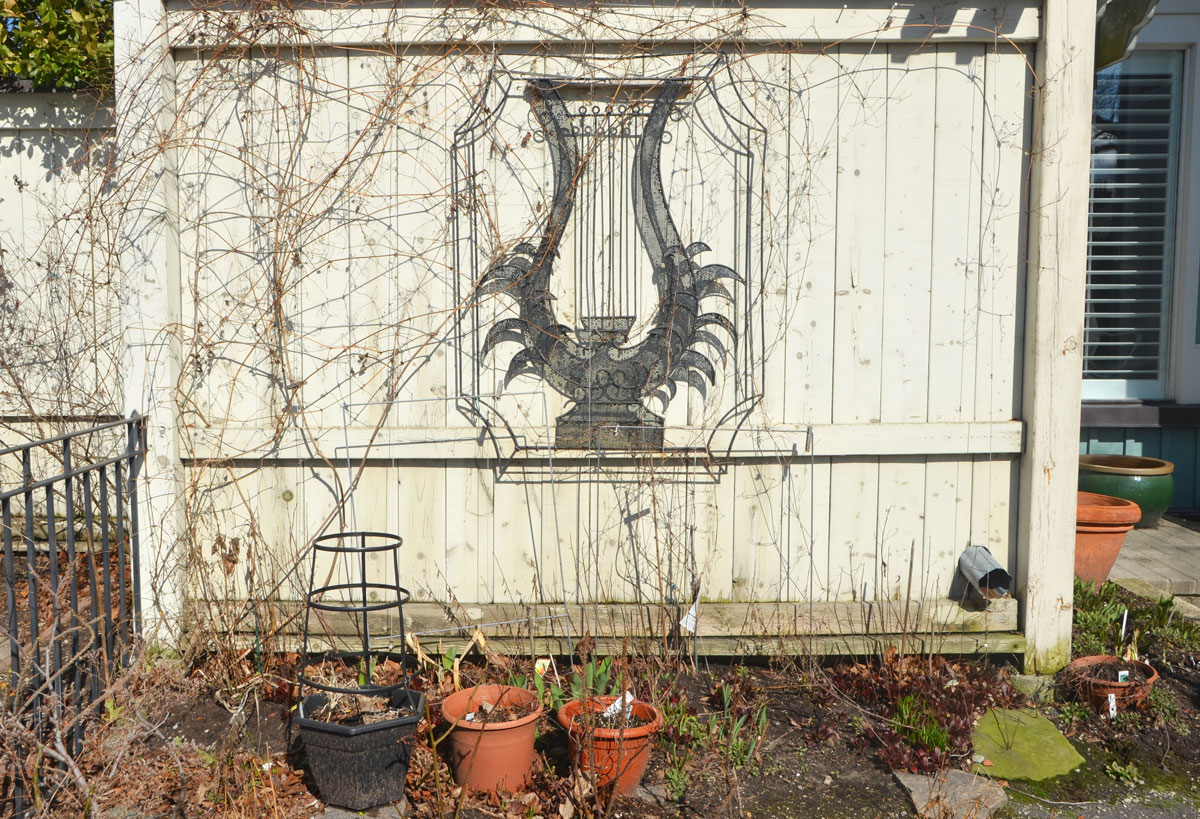
A small white fence with some empty planters in front of it. Old vines are on it (no leaves). There is a frame for plants to cling to in the shape of a lyre that is attached to the fence

until the time they are in full bloom is usually only a matter of days.

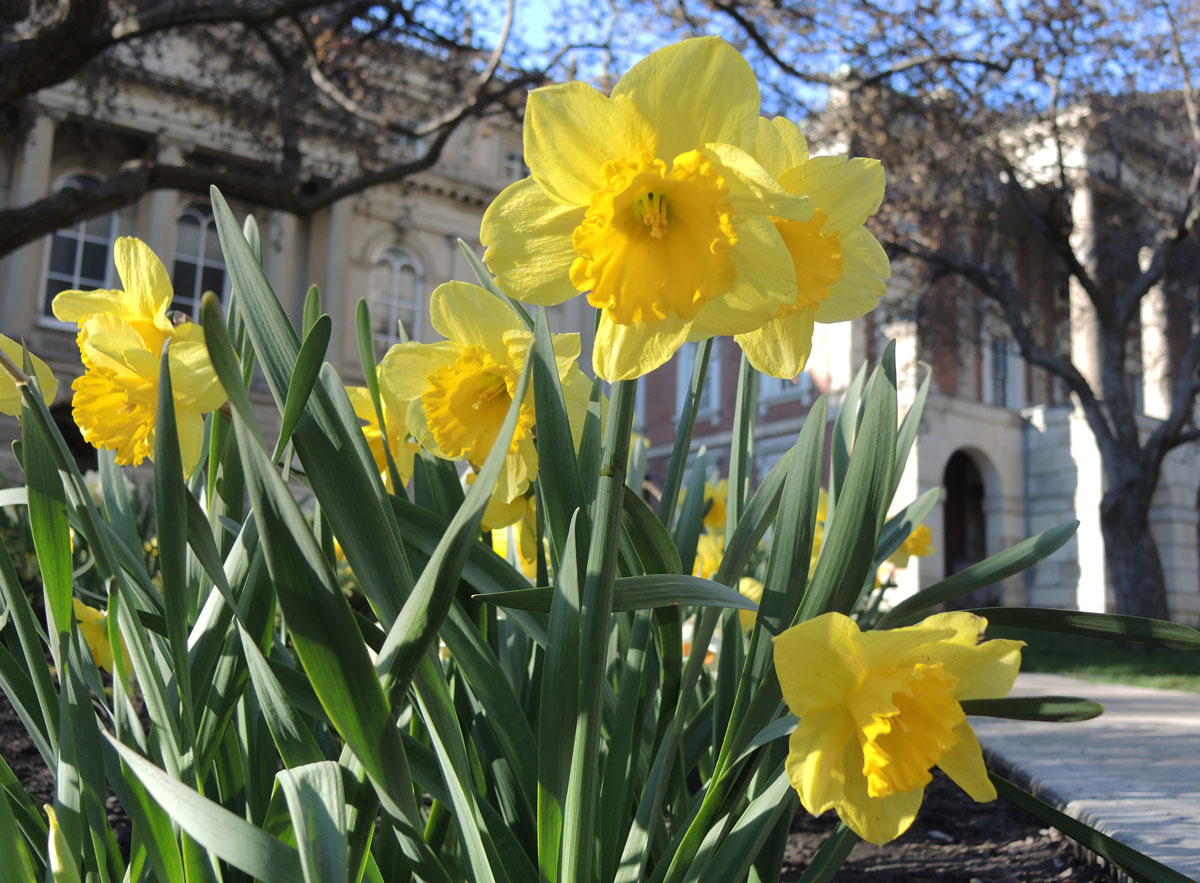
A group of bright yellow daffodils in the sunshine in full bloom with the front of Osgoode Hall on a warm sunny spring day. Blue sky.

Trees too soon show their colours.  The yellows of the willow trees usually appear first.

downtown Toronto, the white curved roof of the Rogers Centre with the CN Tower beside it. WIllow trees and grassy park are in front.
Almost daily the trees are greener…

Budding leaves - The light yellowish green new spring growth on a tree that is growing beside a greenish blue tinted window. Some tree reflections in the window too.

… or full of flowers.

looking upwards from below the branches of a magnolia tree in full bloom. Lots of pink and white flowers, no leaves, on the tree. Bright blue sky in the background. A sunny spring day.

And for another year we forget the last grey days of winter

A rack of geraniums in bloom for sale sitting outside a store. The sidewalk by the store is shaded with white, green and red umbrellas.