Archive for the ‘transportation’ Category

Something a little different, a change from streets and alleys.   Sometimes the GTAA (Greater Toronto Aviation Authority) runs “behind the scenes” tours of Pearson airport, tours that take you by bus out onto the tarmac for an up close and personal view of the aircraft.  I had the opportunity to take part in one of these tours this week.

I’m not an authority on types of airplanes – not since my son was little and we used to spend time identifying airplanes in books and at Heathrow airport.  ‘Concorde’ was one of his early words as it was often parked at the edge of the airport near the motorway.  Extra trivia – did you know the Russians had their version of the Concorde?  It was the Tupolev T-144, a prototype of which flew 2 months before the Concorde (in Dec of 1968).   The story of the T-144 is not the biggest success story.  One of them crashed at the 1973 Paris Air Show and only 55 passenger flights were made before the plane was relegated to cargo flights.

Back to the present –

below: One of the stars of the show was this large Emirates airline Airbus 380.  It flies in and out Pearson three times a week.  Here it has already unloaded its passengers and been moved to the holding area away from the gates.

emirates airlines Airbus A380 parked at Pearson airport, front door open with stairway as crew is cleaning the airplane , trucks and carts beside it.

below: In case you’ve ever wondered what happens after you flush an airplane toilet (and even if such thoughts have never crossed your mind!).   Sorry about the reflections – sometimes we had to take pictures through the bus window.

truck with the words lavatory waste is parked beside a large aircraft that has just unloaded

below: The Airbus 380 has a wingspan of 80 metres.

wing and one engine of an airbus A380 with another Air Canada jet on the runway in the background

below: Refueling a Boeing 787 Dreamliner – with its curved wing dominating the photo.

a large Air Canada plane being refueled

below: The view out the front window as we drove past the gates of Terminal 1.

looking through the front window of a bus as it drives on the tarmac behind aiplanes parked at gates

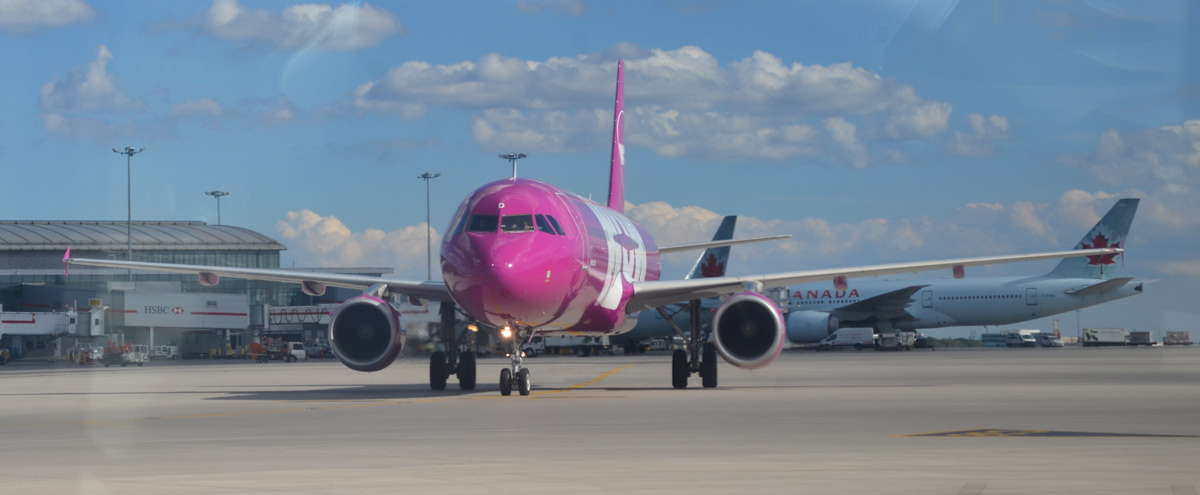
below: A smaller pink airplane, WOW airline from Iceland, taxis to a gate.

pink airplane from Wow airlines taxis to a gate at the airport

below: There’s a lot of room under an airplane!  A Luthansa 747 named Dresden.  It seems that Lufthansa has named their airplanes after places in Germany.

the back of a large airplane is in the top part of the photo, service trucks and other airplanes in the background are in the lower part.

below: Planes and service vehicles at Terminal 3

view of a large airplane from the back, parked at a gate at airport

below: The large yellow cable supplies electrical power to the aircraft when it’s not running.  C-GGOK is a De Haviland Dash 8-400 turbo twinprop airplane that was scheduled to leave for YQB (Quebec City) shortly after this picture was taken.

large yellow cable connects the back underside of a small airplane, an electrical connection while the airplane is not running its engines

a young man waving, a luggage cart at an airport

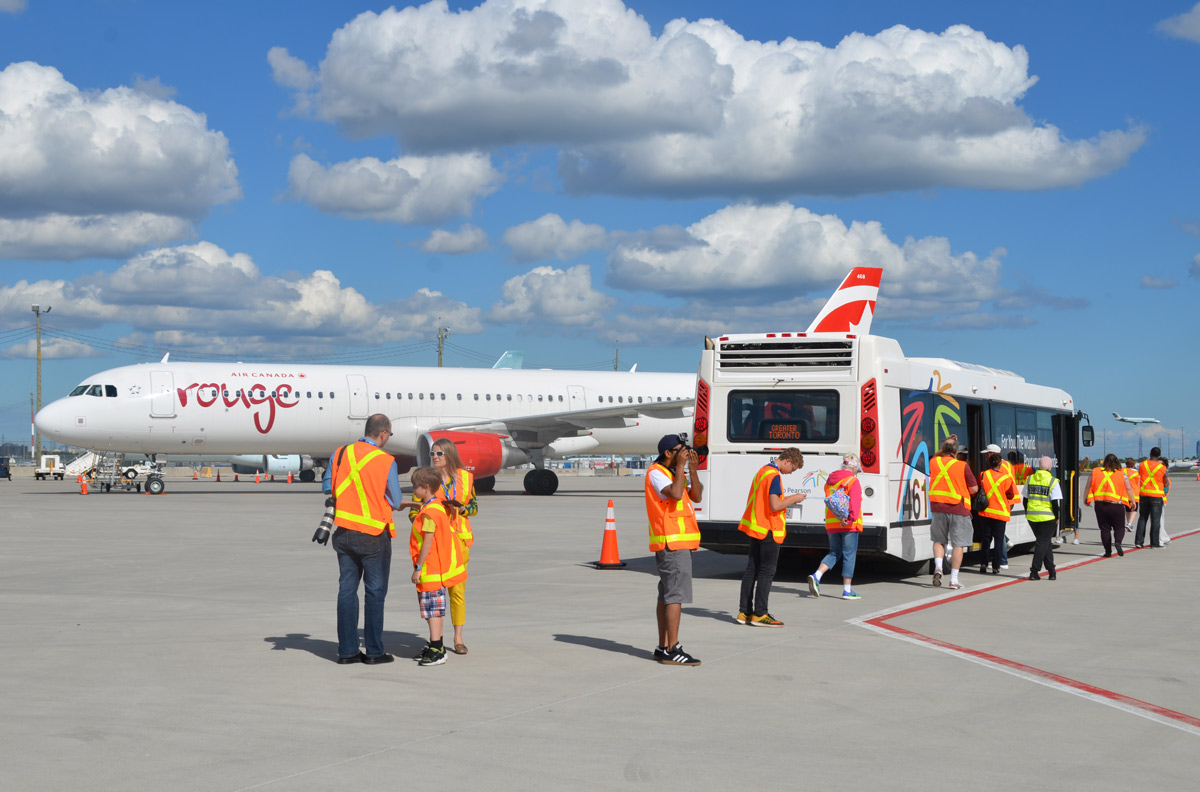
below: Our group, our bus, and puffy white clouds.

a group of people in orange safety vests standing by a bus parked on the tarmac at an airport.  Many of them are taking pictures, an Air Canada Rouge aircraft is parked behind.

Tomorrow it’s back to the streets!

Monday’s walk was a meandering route downtown, once again going where my feet and eyes take me.  No particular plan in mind and no set destination…   just trying to explore where I haven’t been recently.   No theme jumped out and tapped me on the shoulder but a few “stories” emerged.

below: There is now a 3D sign between the CN Tower and the Aquarium that says Canada 150.

a young boy is leaping from the D of the 3D Canada 150 sign in front of the CN Tower, and is leaping onto the top of the A. His hands are on the top of the A, one foot is one the side of the A and the other foot is near the top of the D

below:  …and another 3D sign by the CN Tower (you can see part of the back of the Canada 150 sign through the tree). I wonder how many there are in this city now?   Another bit of information (trivia?) – this area is called Bobbie Rosenfeld Park and has been since 1991. Fanny (“Bobbie”) Rosenfeld was a Canadian athlete who won two track medals  in the 1928 Olympics.   She also played softball and hockey in the 1920s and 30s.  When arthritis force her to stop playing she turned to sports journalism, working for the ‘Globe and Mail’ until her retirement in 1955.

3D sign for the CN tower with tourists taking pictures in front of it. Canada 150 3D sign in the background as well as some people sitting around on benches

One of the routes from the CN Tower into the downtown core of the city is via the Skywalk, a glass enclosed elevated walkway over the railway tracks.  The next few photos were taken as I walked that route.

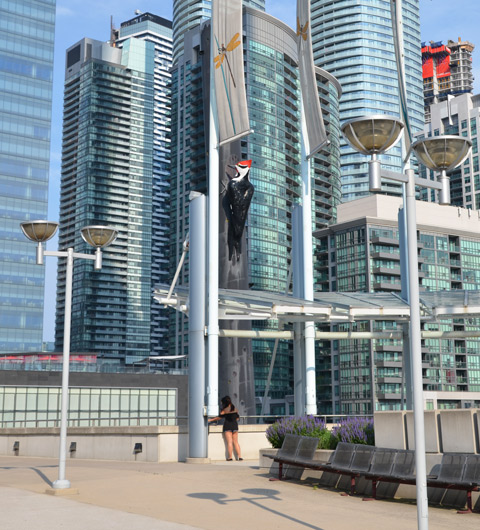
below: A Toronto species of woodpecker in its native habitat – a forest of glass and steel. This artwork was completed in 1997 and is the creation of Dai Skuse and Kim Kozzi who together are known as Fastwurms.

large sculpture of a woodpecker on a pole in the foreground, many glass skyscrapers condos in the background

below: The above photo was taken from a quiet little terrace that I accessed from the Skywalk. Now you can see just how big the woodpecker is!  The ‘tree trunk’ pole is 30m high.  What you can’t see is the second woodpecker who is on the other side of the pole and slightly farther down it.

a concrete terrace, with benches and planters with purple flowers, lots of condos in the background, one person standing there

below:  The glass of the Skywalk creates some interesting reflections and shadows.  The glass was fairly clean the other day when I walked through it.  I have seen it when it’s been quite dirty and it’s not a pretty sight.

reflections of a woman walking on the Skywalk between Union Station and the convention center, with views of the street below and buildings beyond also in the frame
reflected in the red glass of the entrance to the CN tower are two women walking

below: Union Station, looking east from the Skywalk.   The new roof over the station platforms is taking shape.  Someday soon I’m going to have to take a look at the insides of the station; I can’t wait for all the renovations to be completed.

union station as seen from the west, from the skywalk, with open air tracks as well as the covered platforms. New roof over the platforms, tall buildings in the background

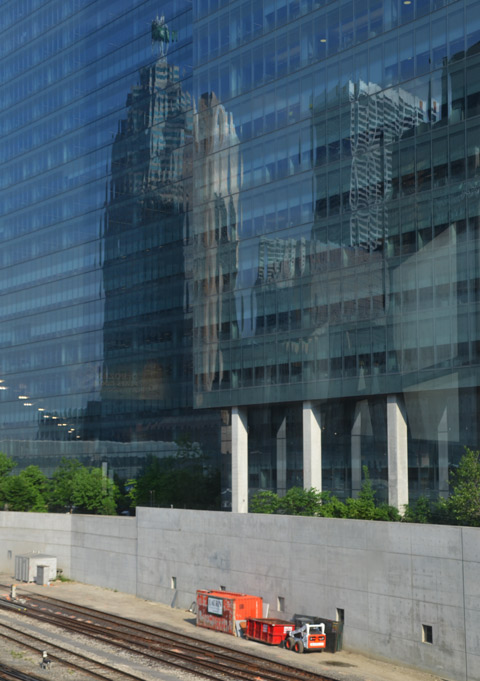
below: Part of the south “wall” along the railway tracks.

buildings reflected in another glass building right beside the trains tracks south of Union Station

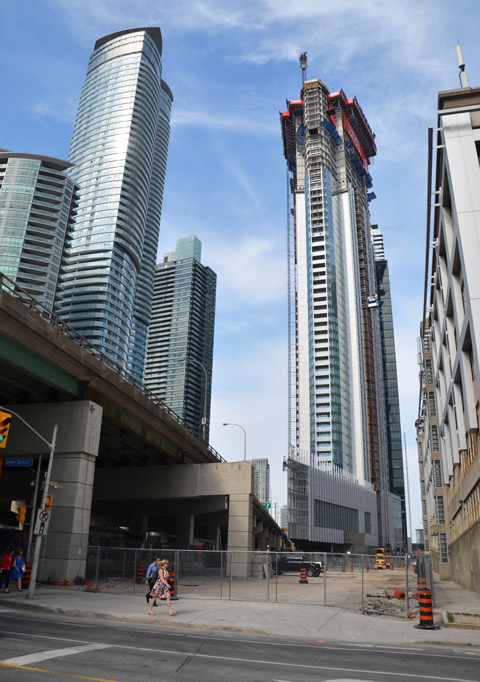
below: Looking east from lower Simcoe along the south edge of the Gardiner Expressway.   The podium of the new condo under construction at 10 York Street is quite the wedge!

construction of a tall condo beside the gardiner expressway. The bottom of the condo is a wedge shape to maximize the space available

below: I played a bit on google maps street view and this is what I found for the above scene (taken Nov 2016).  If you compare the photos (above & below), it’s obvious that one of the ramps for the Gardiner Expressway has been demolished.   The eastbound exit to Yonge/York/Bay was removed a couple of months ago.  If you are a regular user of the Gardiner, I’m sure you have already experienced the consequences of this!

screenshot of google maps street view of Lower Simoce stret just south of the Lakeshore, one of the offramps for the Gardiner, a new condo under construction

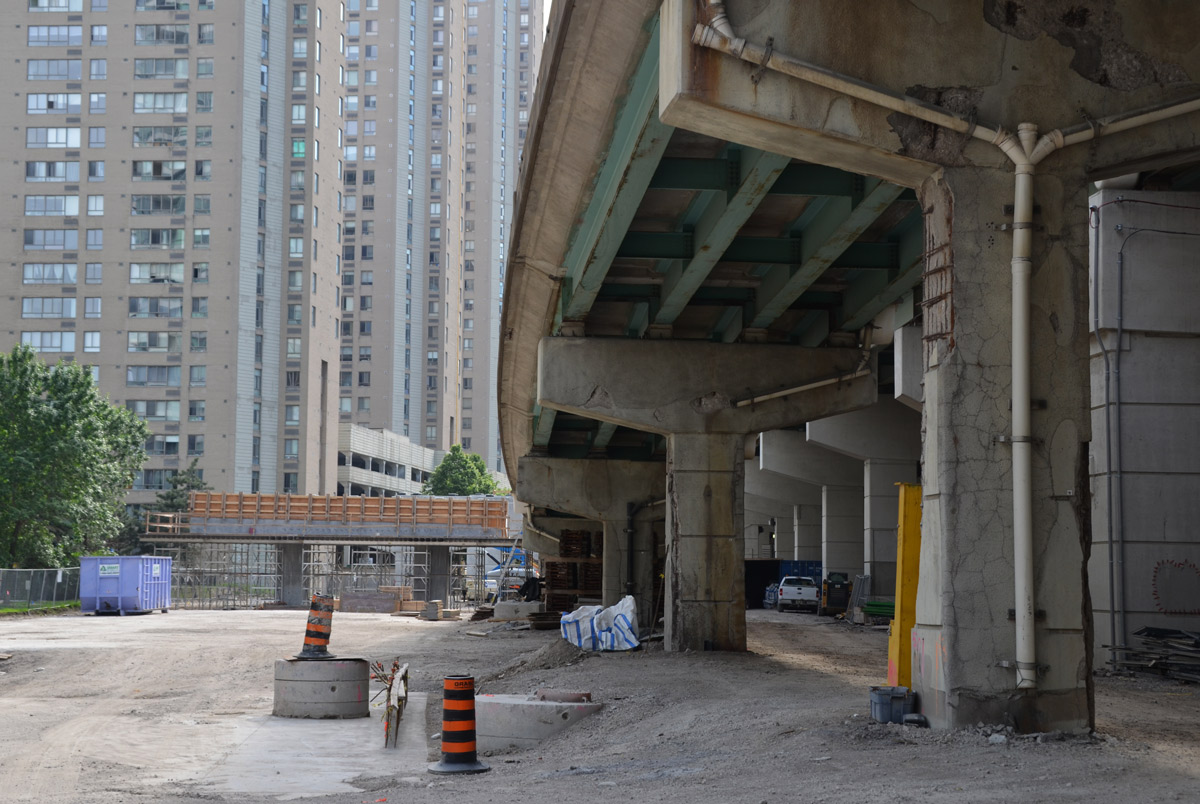
below: Standing on the same spot, but turning around 180 degrees – looking west from Lower Simcoe.  An old ramp in the foreground…. and what looks like new construction in the background.  Those are new bents (the structures that hold up the road).

under one of the Gardiner Expressway ramps, with new bents being built for a new ramp in the background.

below: To get a closer look at what was happening here, I ventured around to the other side .  This is the view from closer to Rees Street. There is car on the old ramp so it must still be open (onramps still functional, just the offramp was removed).

two "cherry pickers" parked in front of new bents being constructed for a new ramp for the Gardiner Expressway

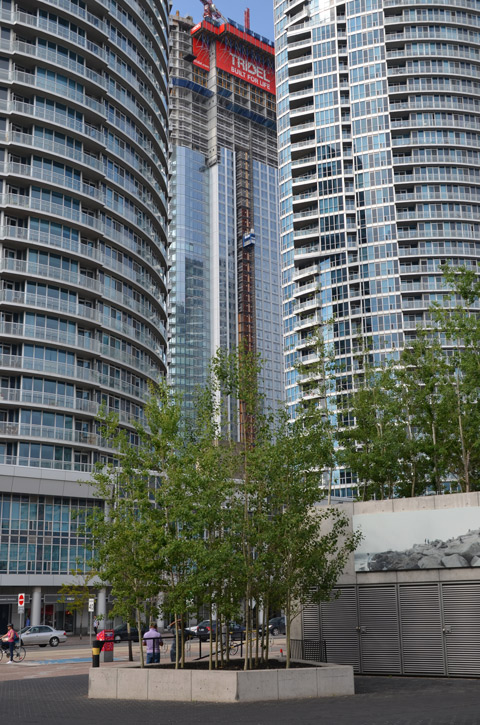
below: The trees are growing at Canada Square (Harbourfront), but so are the condos.  Yes, this new building is the same one with the wedge shaped lower floors.

view from Canada Place (Queens Quay West) with a clump of birch trees in the foreground and 3 highrise buildings in the background - two older ones and one in the middle that is under construction.
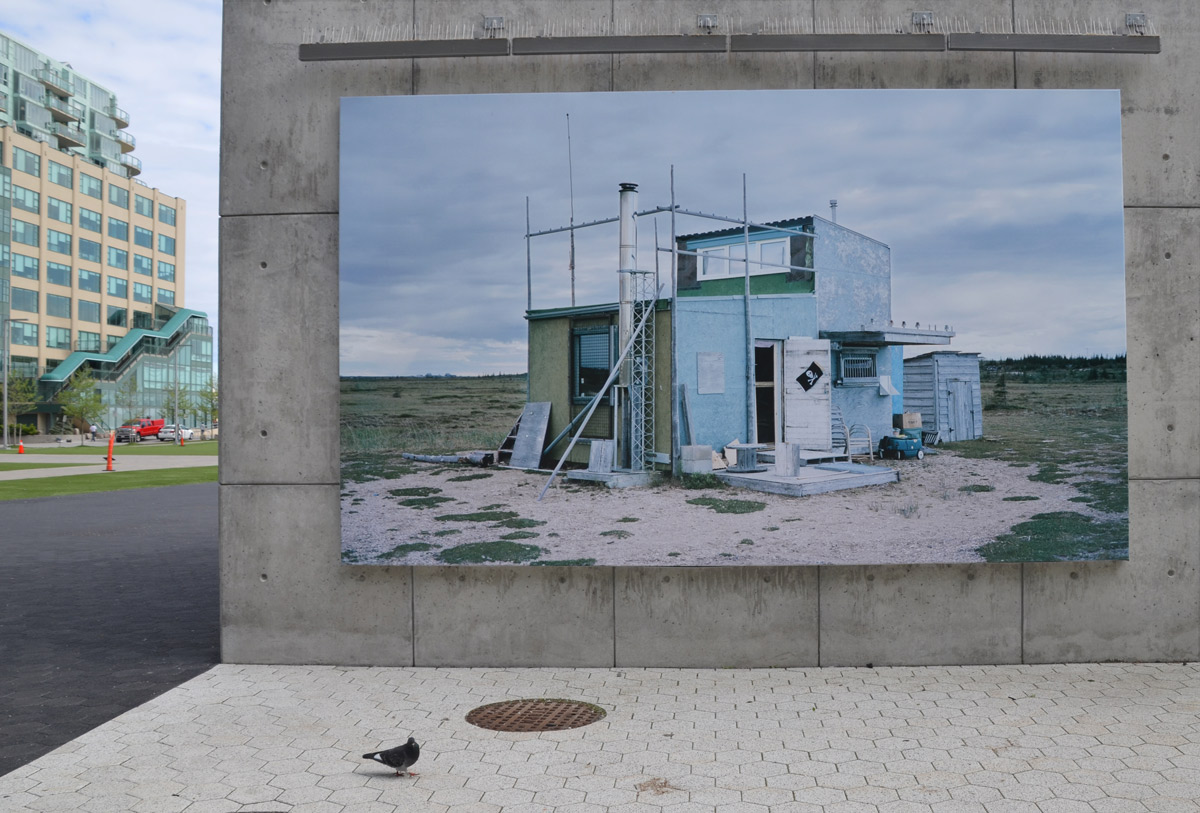
below: Also at Canada Square, there are three large photographs by Johan Hallberg-Campbell, a series called “Coastal”.   This one of them:

a large photograph of a run down building, northern, on the side of a concrete structure that is an entrance to the underground parking

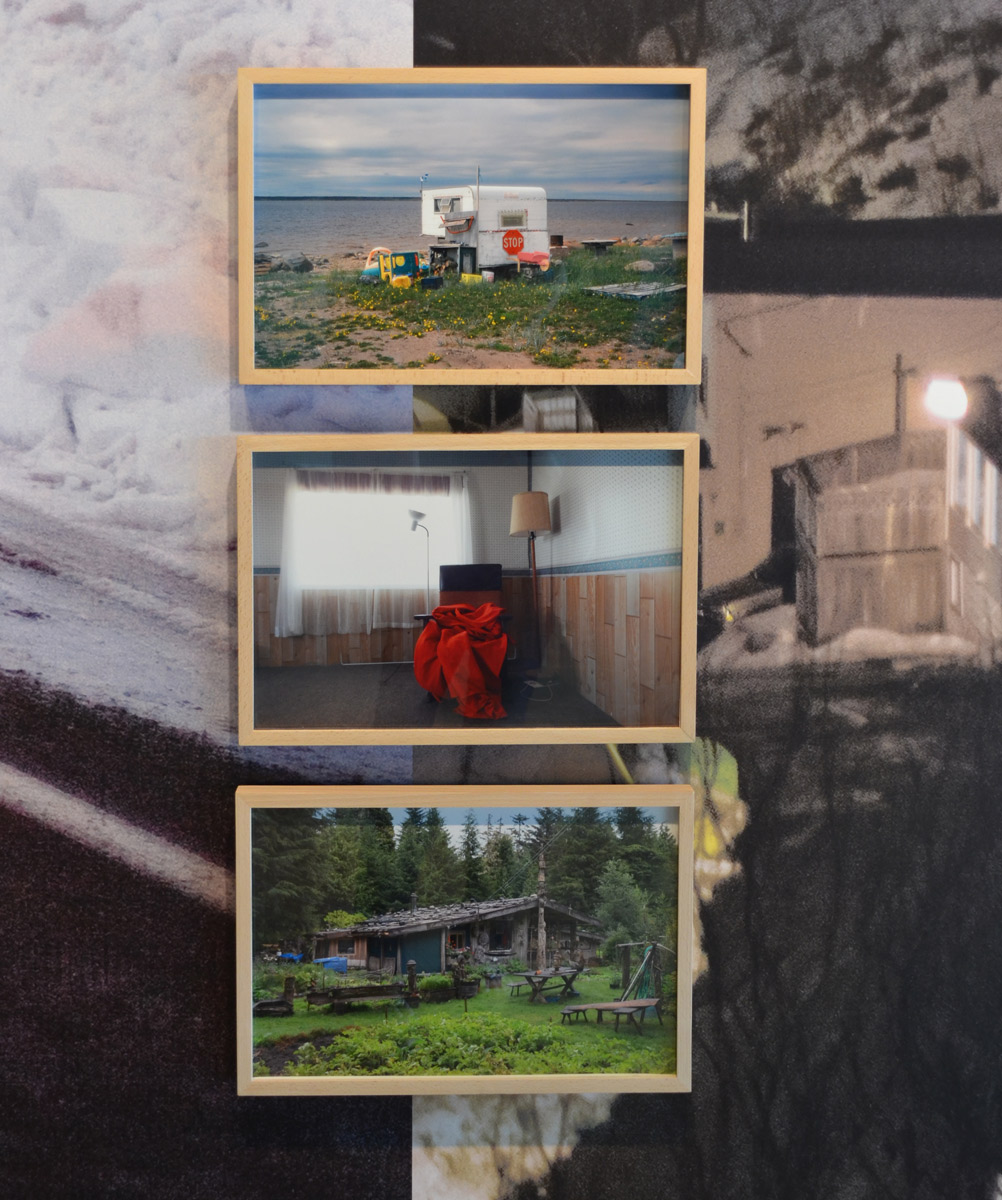
below: More of Hallberg-Campbell’s work can be seen inside in the Artport Gallery (Harbourfront building) – here, many photographs with simple wood frames are mounted on a wall that is covered with large images.  “Coastal” is the product of the artist’s travels to coastal areas of Canada, from Newfoundland to northern Manitoba to British Columbia and many places in between.   Life on the edge, so to speak.  (Note: gallery show ends 18th June)

three colour photos in simple light wood frames mounted on a wall that is covered with large images

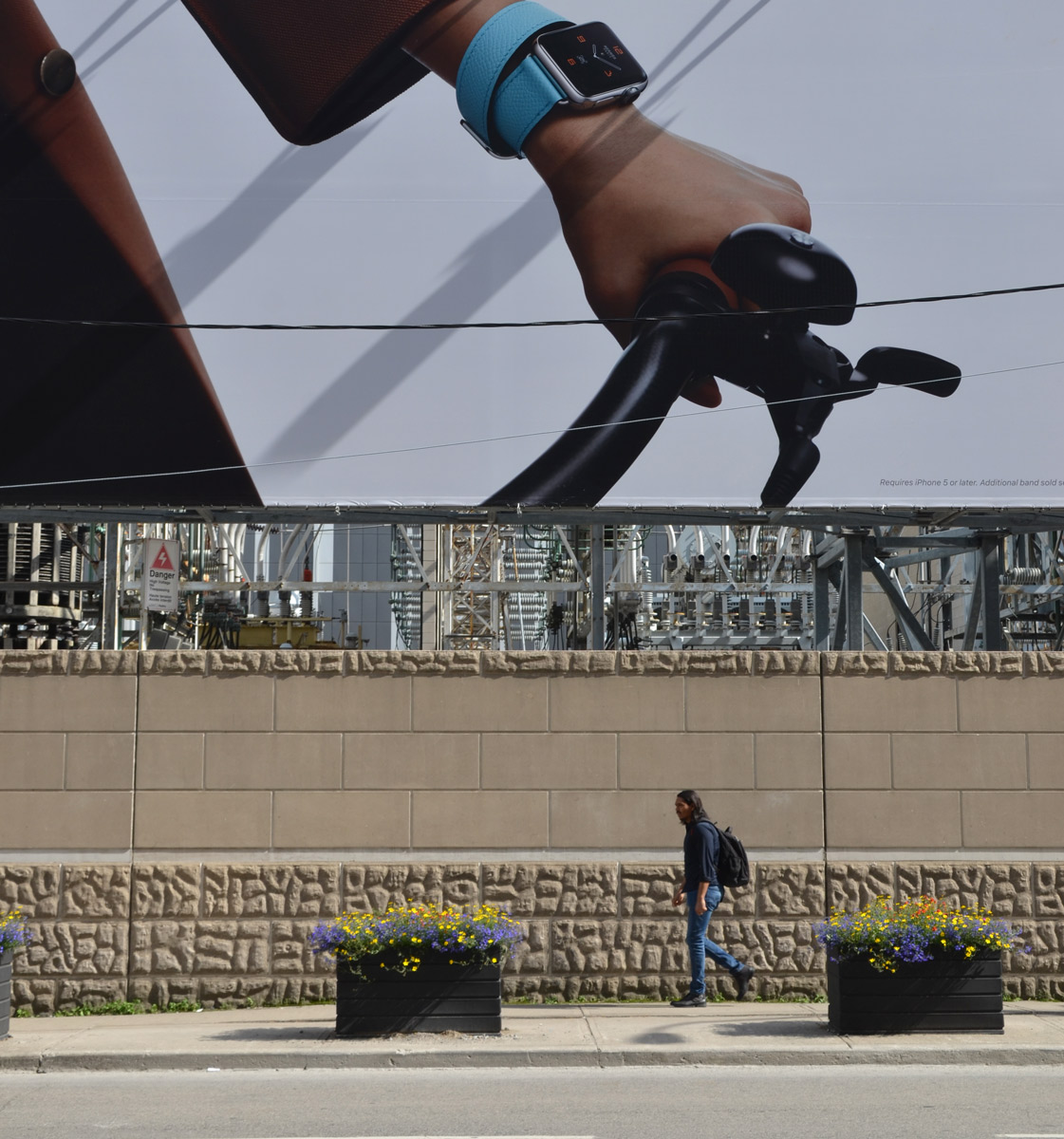
below: It’s not art but sometimes the line between public art and advertising campaigns is fuzzy.

a man walks on the sidewalk below a largef ad for Apple watches.  The photo is cropped so that the only part of the ad that shows is a hand on the handle bar of a bike.  A bright turquoise watch is on the person's wrist

Not all is shiny and new.   And that’s the way it should be.

metal grille, part of a barricade along the side of a parking structure, rusted,

parking structure on the top, old door and wall on the bottom. A wood picnic table in disrepair is in front of the door

This is a Thursday Doors post. 

I wanted to find a poem or a quote or something like that to accompany this post.  A post about opening doors to get home.  I only found poetry best said at a funeral…  not so good for a sunny March afternoon.   I’ll save the poetry in case I ever do a series of cemetery doors.

How many doors do you go through in a day?

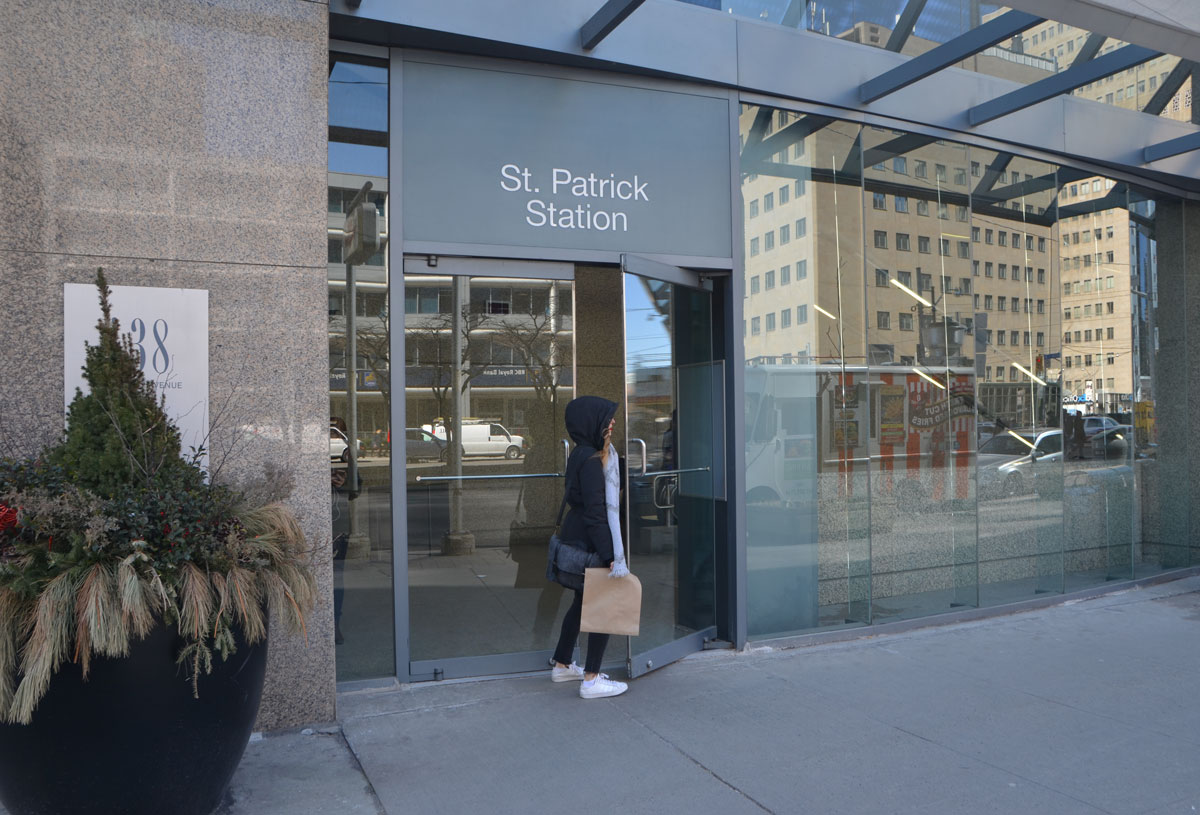
You aren’t going to find any historical doors here nor have I taken any pictures of colourful, ornate, or classy doors for this post.  Instead, I decided to use photos of a few of the doors that I had to pass through on my way home the last time I went exploring, starting with the subway at St. Patrick station.

a woman is opening the glass doors of St. Patrick station, at street level, on University Ave

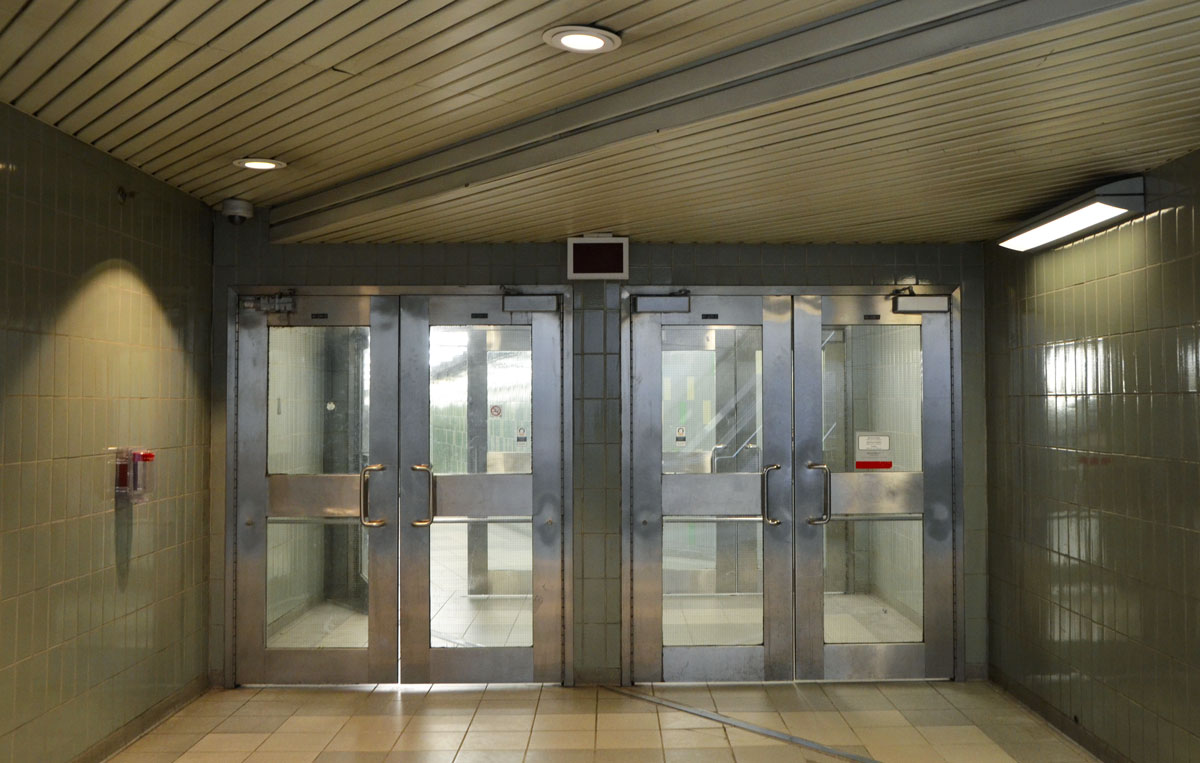
two sets of double doors, TTC subway station, metal doors with glass insets.

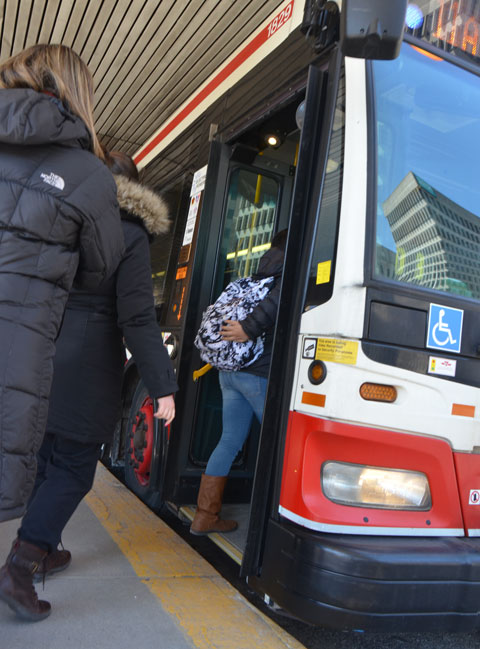
doors to bus platform at Davisville station, bus platform, are slightly ajar, a bus has just pulled up (and facing the camera) and people are getting ready to get on it.

people getting on a TTC bus at Davisville station

These are doors that I pass through frequently yet I rarely notice them.   Usually I see them more as an impediment to where I want to go.   Maybe I should pay them more attention?

***

For Thursday Door posts by other people, see Norm Frampton’s blog at Norm 2.0.  He is the originator of the Thursday Door idea and he also keeps track of which other blogs have participated.


What to do on a cold day when the wind is vicious and blows right through you?   It blows through my hat, my ears and my brain.  It makes my head hurt.  Not the ideal walking day even with all my winter layers on.   I have been thinking about my walk along Sheppard Avenue and some of the issues with public transit and while doing so I realized that I had never been on the Scarborough Rapid Transit.  With all the talk about Sheppard subway vs LRT, I decided that maybe I should check it out.  So instead of a walk, I went for a ride and took the SRT to McCowan and back.

First I had to get to the SRT which starts at Kennedy subway station.

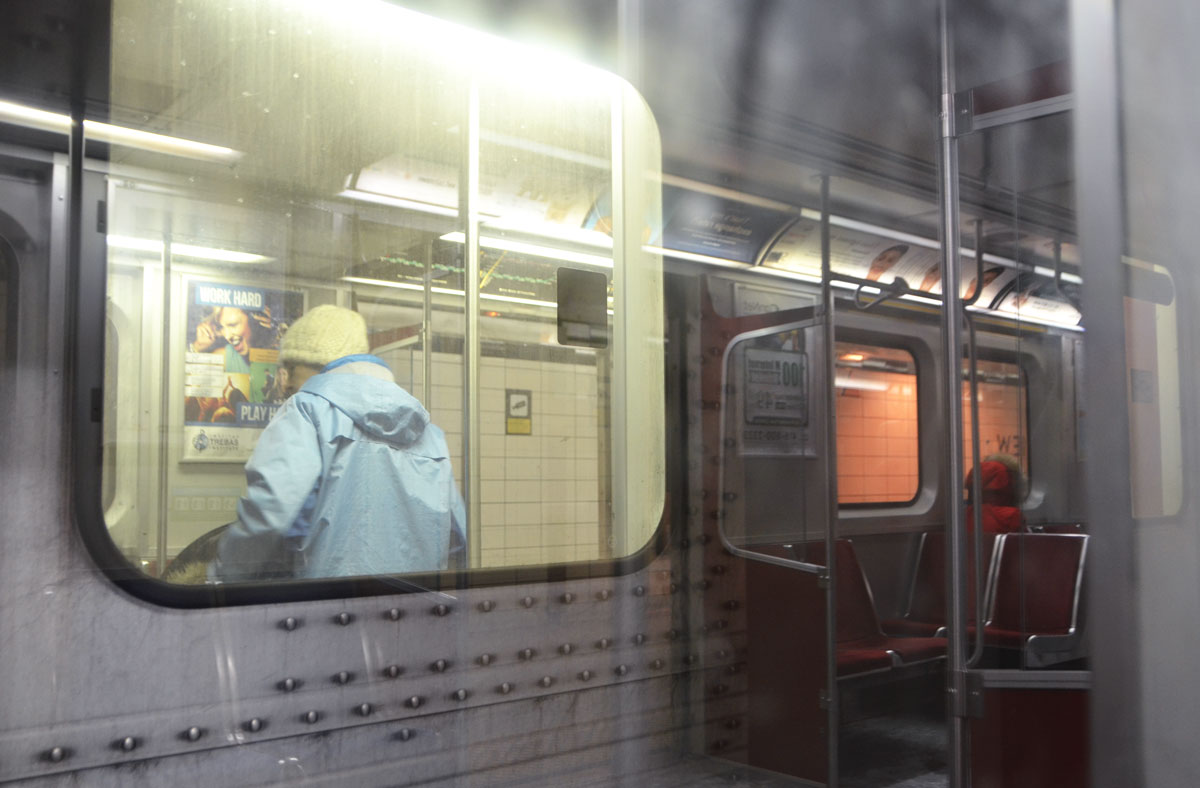
reflections of a woman in a red jacket sitting on the subway, reflected in the window beside a woman who is standing on the platform

At Kennedy I was a lost tourist as I searched for the route between the subway and the SRT.  Here the SRT trains run above street level so it took a couple of escalators and some stairs to reach the platform.

below: Standing on the platform and waiting for the train.  Kennedy station is at Kennedy & Eglinton and I think that this is the view looking east from there.

SRT tracks curve away from platform, outside, apartment building in the background, some snow on the tracks

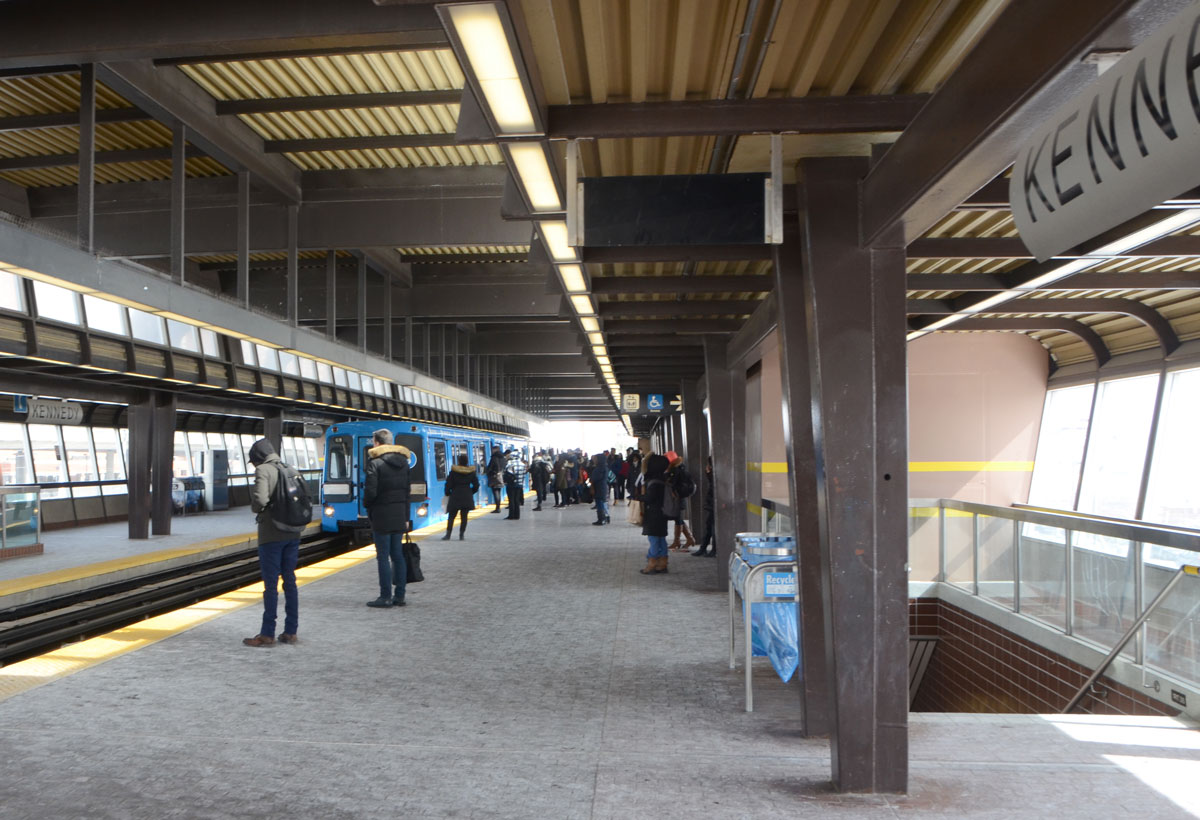
below: The train arrives.

platform at Kennedy SRT station with people waiting as a blue train arrives

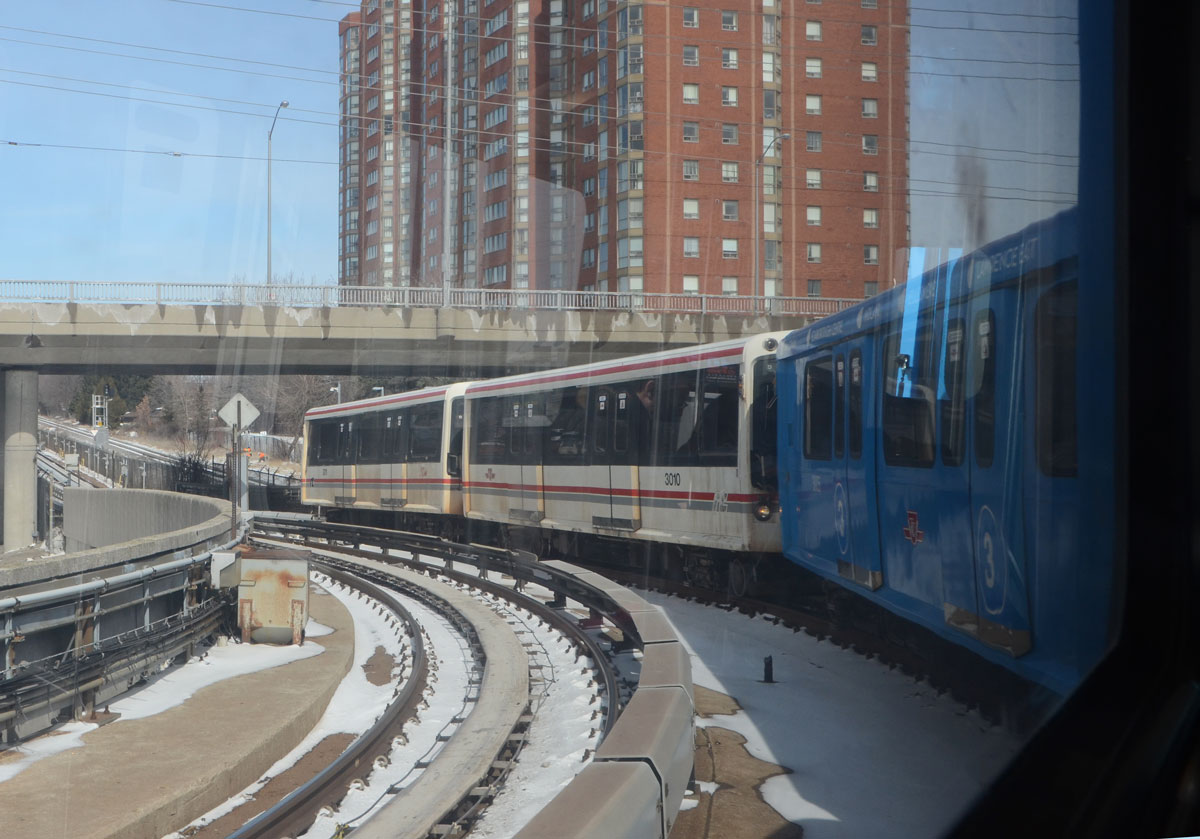
below: Leaving Kennedy station.   The first part of the route is north and runs parallel to the CNR & Stouffville GO line train tracks.     The red and white cars are the original colour from when the SRT opened in 1985.  In 2015 the TTC began painting the cars blue to match the colour scheme that now goes with “Line 3” on the TTC maps.  They also began two switch over the name of the SRT to Line 3 Scarborough.

the Scarborough RT train as it leaves Kennedy station, the track curves so you can see the front of the train out the window

below: I wasn’t the only tourist on the train!  After being on the subway, it felt a bit like being on a toy train.  The cars are smaller.  The trains are powered by linear induction motors which are quite different from conventional motors.  They push themselves along the tracks using alternating flat magnets.   That’s a very simplistic description of the science of induction motors but I’m sure that you can use google to find more information if you are interested!

looking down the length of an SRT car, two young women are looking out the back window. seats down either side, red on one side and blue on the other

below: The Scarborough RT,  also referred to as TTC line 3, covers  6.4 km on its route from Kennedy station to McCowan station.  There are six stops, Kennedy, Lawrence East, Ellesmere, Midland, Scarborough Centre, and McCowan.  Note the blue colour on the map!

a map of the SRT route is on the wall behind two red seats of an SRT car, view out the window is not easy to see but it is the platform at Lawrence East station

below: Ellesmere station. Apparently it is the least used station in the system, less even than Bessarion.

interior wall of Ellesmere station, covered (plastic?) glass wall, large black letters saying Ellesmere, and a bright red bench, snow on the curved translucent roof

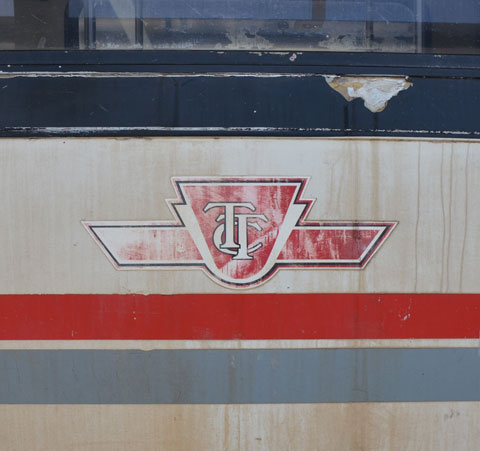
faded TTC symbol on the exterior of a rapid transit vehicle

below: Looking out the back window.  The tracks are standard gauge whereas the subway runs on tracks that are wider so the TTC can’t run their subway cars on these tracks.

looking out the dirty window at the back of a SRT vehicle, tracks and some cityscape

below: This is the view at McCowan station, the end of the line. Although it was a very quiet ride to McCowan, the train was full on the ride back to Kennedy with Scarborough Centre being the most crowded station.   It took 40 minutes to go from McCowan to Bloor/Yonge.

a SRT train is stopped at McCowan station,

***

blurry person standing on the platform at Greenwood station, with reflections of people sitting on the subway

reflections in the subway window along with people sitting on the train

This looks like an ordinary entrance into a TTC subway station.  It is.
It’s Bessarion station on Line 4, the Sheppard Line.

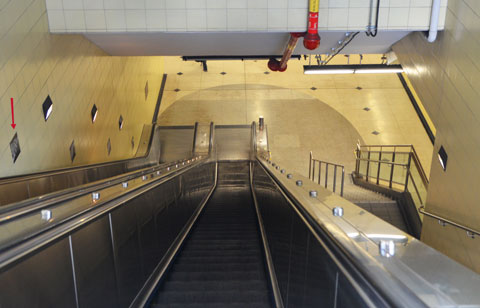
escalator down into Bessarion station

The red arrow points to one of a series of little photographs of hands that run beside the escalator to street level.

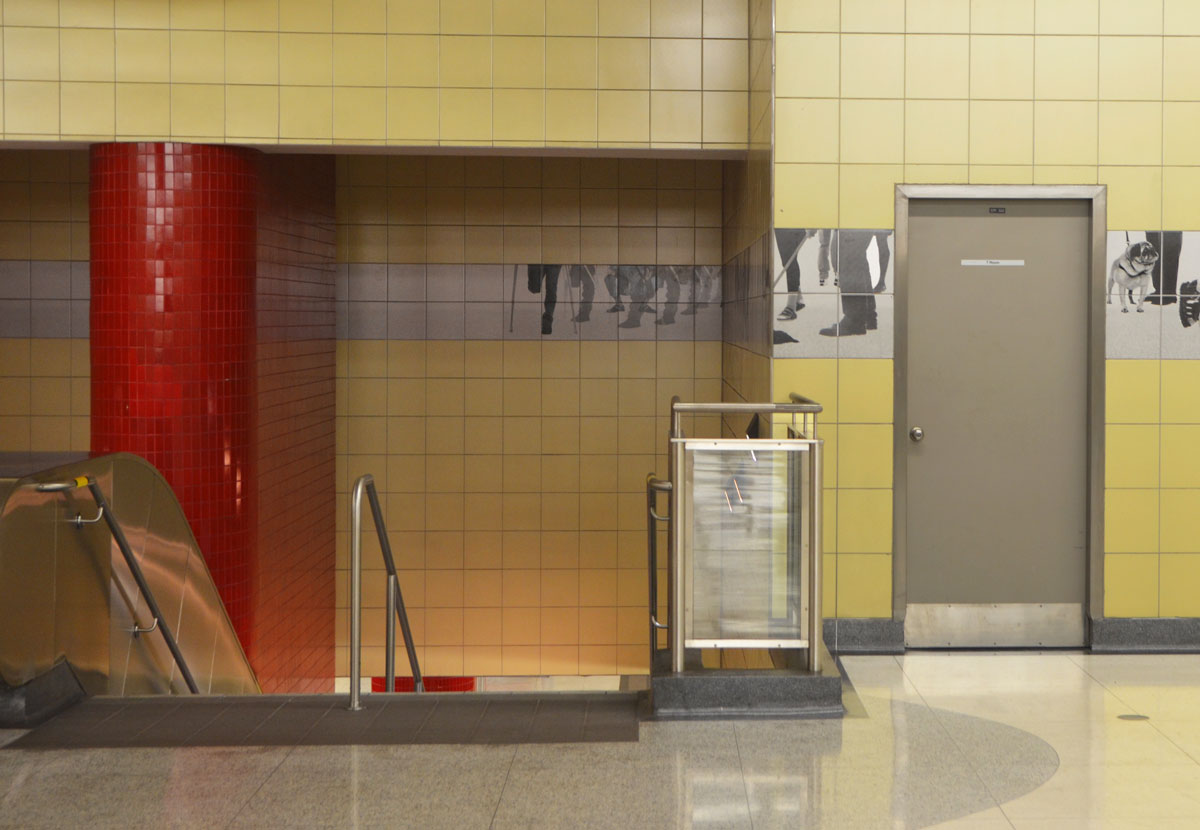
I’d be willing to bet that none of you have been to Bessarion subway station.  If you’ve heard of the station it’s probably in the context of complaints that no one uses the station so why did the city spend so much money building it.   One of the reasons for the low volume of traffic is that there are no bus routes (besides Sheppard) that serve this station.  Apparently in 2014 an average of 2380 people used the station on weekdays.  If true, then 2379 plus me where there today (although the stats may have increased since then).    I took some pictures for you – you will now have an idea of what the station looks like without having to go there.

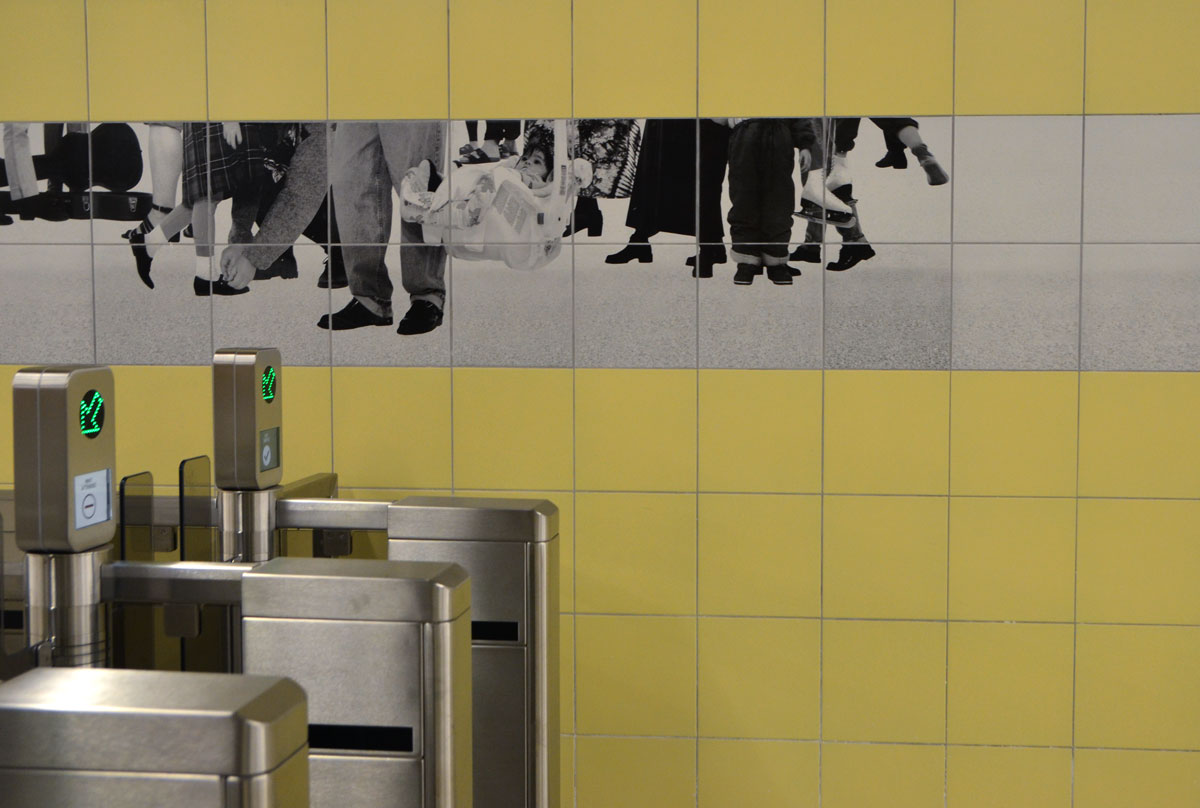
photos of peoples legs and feet in black and white on tiles on a yellow tiled subway station wall, over the metal turnstiles for entry into the station, artwork by Sylvie Belanger

below: An art installation called ‘Passing’ dominates the yellow walls of the station concourse level.  It consists of a band of black and white photographs of legs and feet taken by Sylvie Belanger.  The little pictures of hands that I mentioned at the beginning of this blog are also part of this installation.

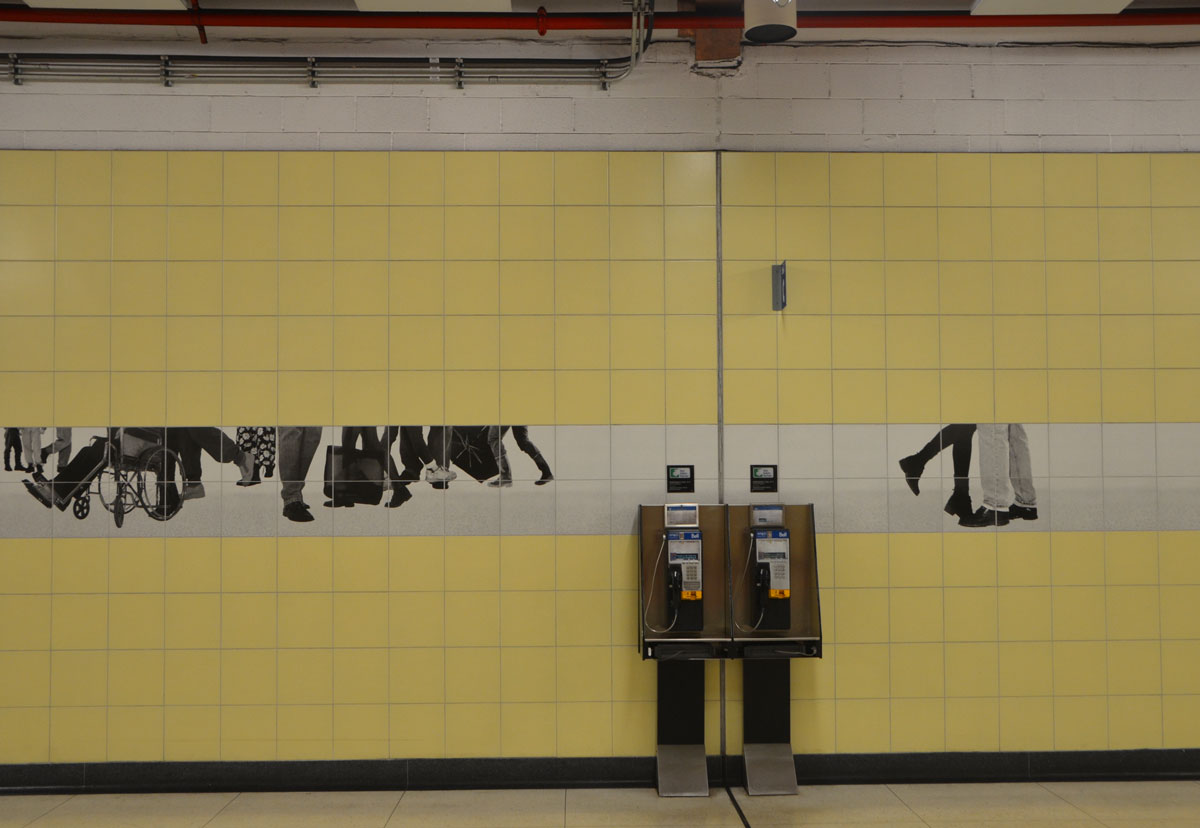
photos of peoples legs and feet in black and white on tiles on a yellow tiled subway station wall, over and beside two Bell pay phones, artwork by Sylvie Belanger

below: The pictures of legs and feet run around the whole concourse level of the station.

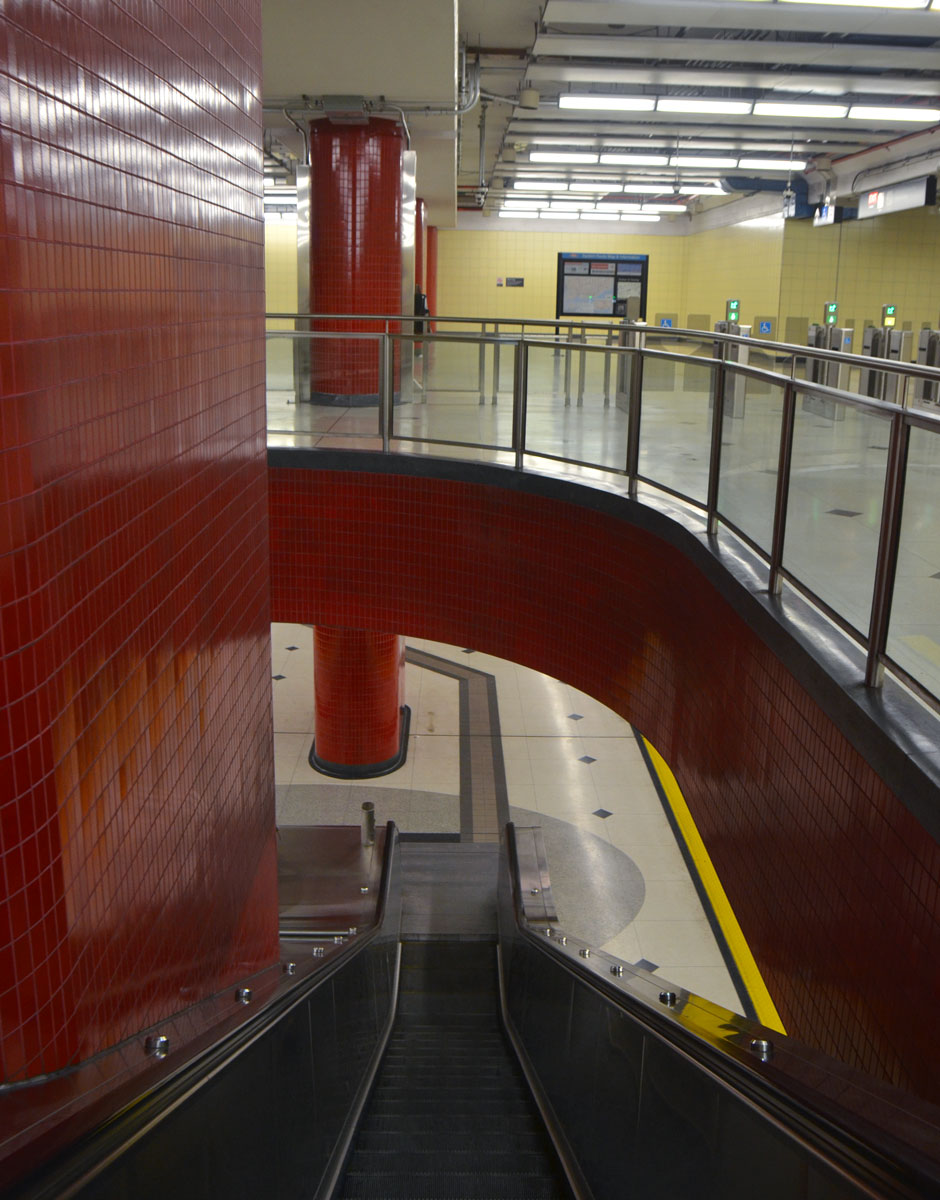
below: Down the escalator to the lower level.

looking down the main escalator at Bessarion subway station, the upper level has yellow walls and the lower level (track level) can also be seen.

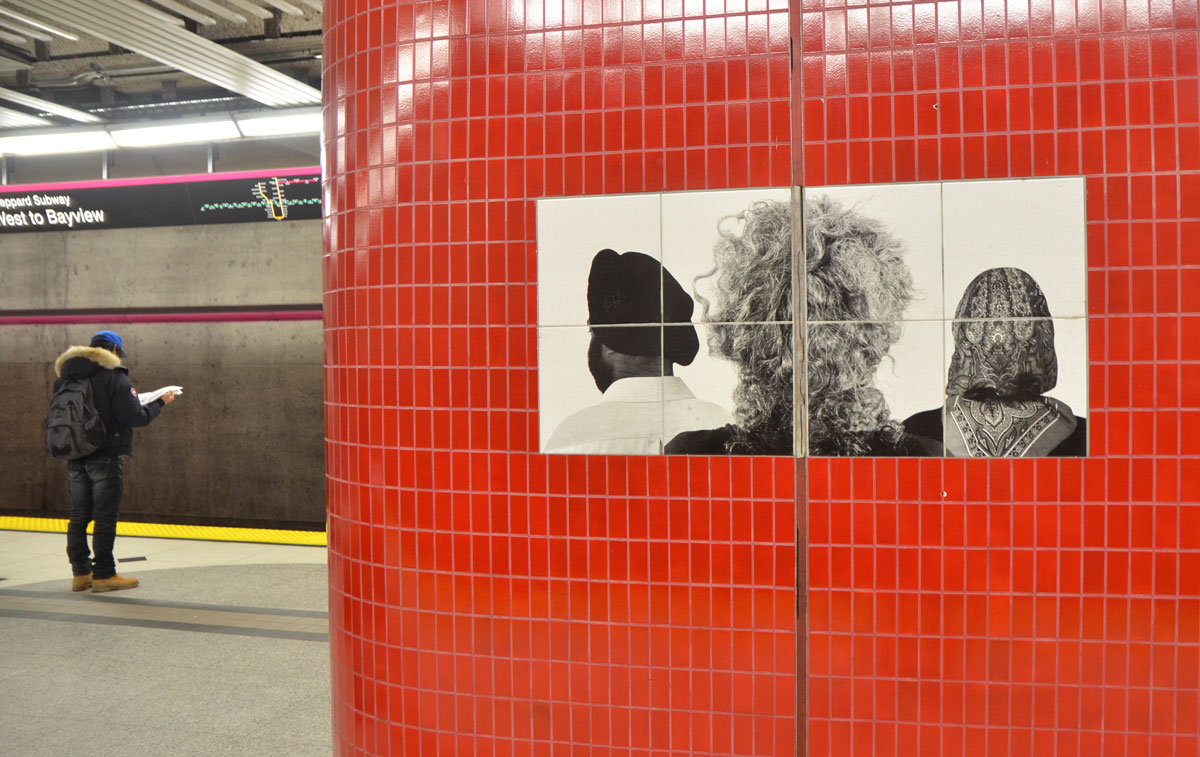
below: I was not alone!

pillar covered in red tiles and with a black and white photo of the back of three peoples head, a man with a turban and a woman in a head scarf and someone with curly hair.

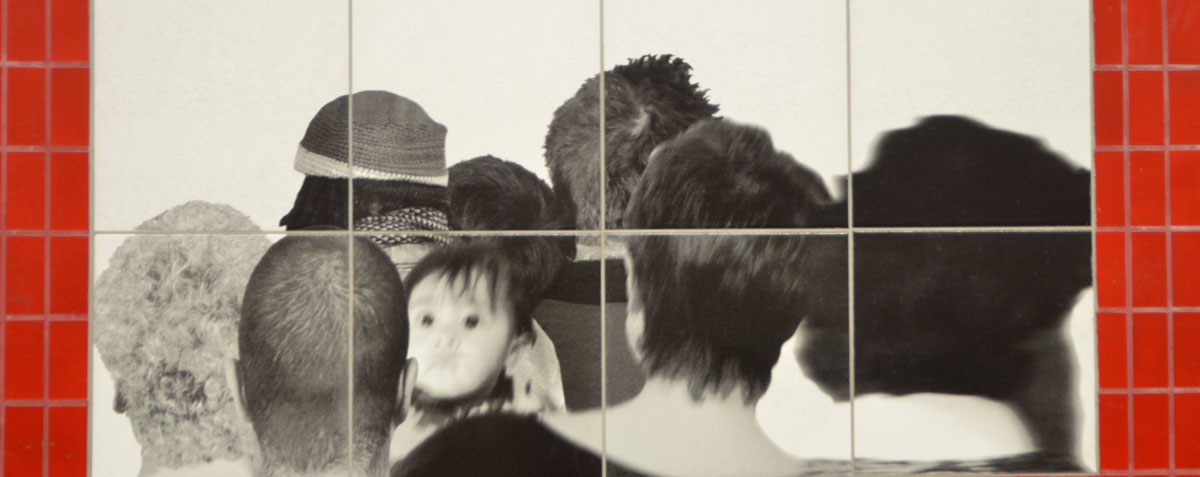
below: The artwork at track level is a continuation of the photographs by Sylvie Belanger.  This time the pictures are of the backs of people’s heads and they are incorporated into the red pillars.

close up of black and white photo of the back of peoples heads, one child's face turns to the camera and is slightly out of focus, Passing by Sylvie Belanger at Bessarion subway station

below: The outer walls are bare concrete and there are very few ads or posters on the walls.

from the subway platform at Bessarion subway station looking toward the concrete wall at the edge of the tracks, signs for the station, and direction signs.

Another nice day, another ramble.

below: My starting point the other day was Castle Frank subway station (Bloor Street East, close to the top of Parliament Street).  This station opened in 1966 although the entrance that you see in the photo was an addition that was added only a few years ago.

photo taken from sidewalk on north side Bloor Street East, just outside of Castle Frank subway station, looking west towards downtown. Subway station in the foreground, high rise buildings in the background

below: An interesting round window in the station entrance.  You can see part of the window in the picture above, peaking from around the side of the tree trunk.

a round window with a metal grille inside. Grille is made of trapezoid shapes in a repeating pattern.

below: The subway “tunnel” between Sherbourne and Castle Frank stations isn’t really a tunnel at all.  This view surprised me – I know that I have driven under this structure on Rosedale Valley Road.  I don’t recall knowing that it was for the subway.

Downtown Toronto is in the distance. The subway tunnel between Sherbourne and Castle Frank stations is in the foreground. It's really a covered bridge as it passes over Rosedale Valley Road.

below: “It’s never too cold for rainbow shoelaces.”  Sage advice for the winter time.

words spray painted on a low concrete fence, It's never too cold for rainbow shoelaces.

below: Graffiti under the bridge…  even though I am drawn to bridges I didn’t go down the hill to investigate.  That can be another blog post at another not so muddy time.   This spot can be accessed from the Rekai Family Parkette which is at the SE corner of Bloor and Parliament, tucked in between Bloor and St. James Cemetery.

graffiti under the arches of a bridge, white skull painting, lots of trees, winter time but no snow. No leaves on the trees, brown ground.

below: More graffiti seen from the parkette.

graffiti on the side of a concrete bridge, based on the letter P C and E.

below: St. James Cemetery was opened in July of 1844 at a time when the population of Toronto was around 18,000 and most of them lived south of Queen Street.   The cemetery would have been out in the country but now, more than 150 years later, the cemetery is in the middle of the city.  There are 89,000 interments here including two of my great x 2 (or 3?) grandparents and some of their descendants (they’re not shown in the picture though!).

many tombstones in a cemetery, different shapes and sizes, a couple of crosses, a couple of rectangles with rounded tops, a tall one in the shape of a skinny keyhole, trees in the background, no leaves

below: A little reminder that Christmas wasn’t all that long ago.

a small statue of an angel sitting on a pedestal in a cemetery, a Christmas wreath in green with red bows and brown pine cones is behind the angel.

The fastest route from Castle Frank to Cabbagetown is straight down Parliament Street.  But of course, the direct route is rarely the one that I take.  The area is full of little alleys and lanes and they all call to me.

below: These animals are part of a mural painted in support of Riverdale Farm which is nearby.

on Darling Lane (street sign in the picture), a mural of two horses, part of a larger mural featuring farm animals

below: Reading the news, many newses.

a street art piece, a bench and man are painted on a wall, the man is holding a newspaper that is a made of paste ups of the word news many times.

below: In Flos Williams Lane there are a number of stenciled words.  “Guilty until proven rich” I first saw here a couple of years ago.  I don’t walk this lane very often so I’m not sure how long ago the other sayings appeared.

below: Like most walks, there were interesting windows to be seen.

two windows on a red brick house with stone foundation, basement window and first storey window. The upper one has a red curtain

below: …and doors too. A very bright orange door!

a very bright orange front door.

below: But unlike most walks, there was a giant gecko or lizard.

a life like model of a giant green gecko on the small roof over a window of a pet store.

One of the appeals of Cabbagetown is the number of older houses, many of which are heritage buildings.

below: This house was built in 1858 and its first resident was Charles MacKay, a customs official who lived here from 1858 to 1865.  The infill line of townhouses behind it are a much more recent development.

an old historic brick house with black and white trim, a small statue in the front yard, set back from the sidewalk, large tree,

below:  Cabbagetown has more of these ‘workers cottages’ or ‘gothic cottages’ than anywhere else I’ve walked.   This arrangement of three identical houses in a row is especially rare (but not unique, at least not yet).

a row of three gothic cottages joined together, all pale yellow with dark green trim

below:  This cottage is in the middle of another threesome but they are not identical.  The yellow door on the pale blue house is a wonderful colour combination.  A little bit of sunshine.

a gothic cottage painted pale blue with white trim,also a bright yellow front door.

below:  Even though it has been renovated and an addition added to the back, this house still retains some of its historical roots.

a renovated and modernized gothic cottage with an addition out the back.

below: And more history…  I was attracted to this building by the beautiful double doors.  Once I was close to the house, I noticed the ghost sign hiding behind the tree branches. The Daily Herald is no longer but it the mark it made here remains.   A mysterious mark though because I can find no record of such a publication.  In fact, probably “the sign had been part of a play or film that the home’s owner was involved in and he installed the sign on an act of whimsy.”  (source, bottom of page)  You gotta love whimsy!

an old brick building, two storeys, now a house, with double doors in a dark teal colour. Ghost sign above the window that says Daily Herald

below: Whimsy you say?  Bright pink flamingo whimsy in a store window.   They look like they’re ready for a rainy day.

three bright flamingo heads as umbrella handles in a shop window. Pink flamingos and pink umbrellas.

below:  There were also some store windows that were a bit more serious.

store window, selling statues of religios figures, many statues of Mary and Jesus.

below:   I think that Carlton and Parliament is one of the most colourful intersections in the city and I always enjoy passing this way.  This is the view if you are standing in the middle of Carlton street and looking east towards Parliament.

looking down Carlton street towards parliment, brick stores directly ahead, some cars on the street,

below: This large colourful mural on the wall of Cabbagetown Corner Convenience,  NE corner of Carlton and Parliament, has become a landmark since it was painted by Ryan Dineen in 2005.

mural on the side of a building in cabbagetown. people in old fashioned clothing plus swirls of colour. street scene beside it, people on sidewalk walking in front of stores.

below: The 506 Carlton streetcar makes its left turn from Parliament.   It’s never a quick and easy turn.  In fact, it’s usually frustratingly slow.

TTC streetcar, Carlton car, turns from Parliament street onto Carlton, stores, sidewalk and people in the background, reflections in street car windows.
And in case you were wondering, yes, you can find cabbages in cabbagetown. This big one is on the Cabbagetown mural on the side of the LCBO building.

painting of a cabbage in a mural

And yes, there is a lot more to Cabbagetown than this…
and I will use that as an excuse to return another time!

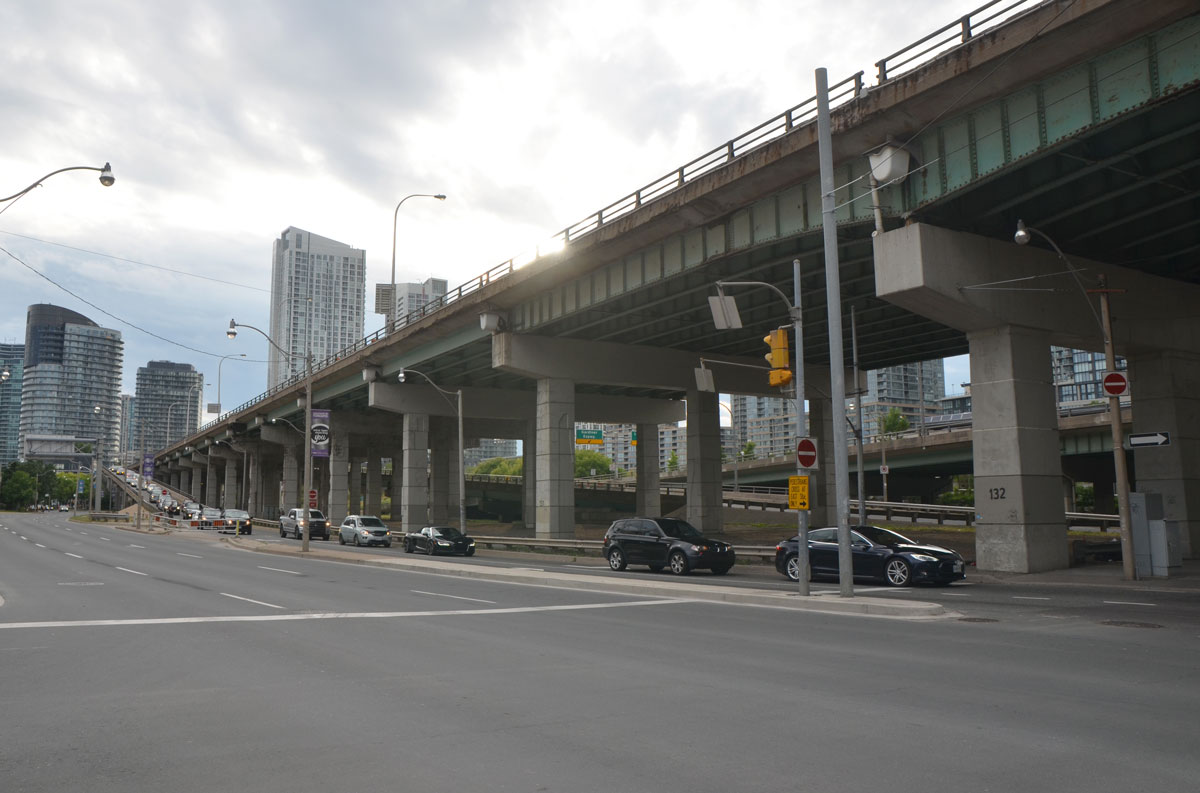
The Frederick G. Gardiner Expressway, commonly just called the Gardiner, has been in the news a lot lately.  This 18 km stretch of road between the city and the lake was completed in 1965 after years of planning and building.  At the time that it was built, Toronto’s waterfront was largely industrial and there wasn’t much objection to having a 4 to 6 lane expressway, with many sections elevated, built there.   The railway had begun the process of dividing the city from its waterfront a hundred years previously.

As the city changes and grows, more and more people live in the downtown core.  Industry has moved out and residents have moved in.  For so long the land south of the Gardiner as well as under the Gardiner was neglected, especially from a city planning point of view.  But now, the city is looking differently at that swath of land.  The far east elevated section between the Don Valley Parkway and Leslie Street was demolished in 2001 and there have been calls for the next section (Jarvis to the DVP) to be demolished as well.   There has been some controversy as to whether to demolish it or move it… and if move it, where to? I am not even sure what the plans are at the moment.   On the other hand, the western section of the elevated expressway (Strachan to Spadina) will remain standing.  Work is underway to refurbish the structure – the city doesn’t want any more stories of pieces of concrete dropping onto cars beneath!  Plans are being implemented to use the land under the Gardiner much more efficiently.  To make it work for the public.

The Bentway is the name that has been given to this new park, or public space, beneath the Gardiner Expressway from Strachan 1.4 kilometres east to Spadina. The first phase is due to open Canada Day 2017 and it involves the stretch between Strachan and Bathurst.  Many of you have probably driven on the Gardiner but do any of you know what is under it now?  Let’s take a look.

below: The Gardiner passes over Strachan Avenue which  in turn passes over the railway tracks.

bridge over a street, many orange and black construction cones down the center of the road, some pedestrians on the sidewalk

below:  On Strachan Ave looking west.   Condo development in this area has extended right to the railway line.  The Exhibition GO train station is in the distance.  You can also see the Gardiner to the left of the tracks.  Here the north side of the under part of the expressway is walled in and the enclosed space is used by Exhibition Place.  At this time there is no plan for the Bentway to extend this far; I have used this photo to provide more context as to the location of the park.

railway tracks in the center of the picture, condos on the right. On the left is the elevated Gardiner expressway, but under it is a concrete wall that makes it look more like a concrete building than a road

below: A closer look at the Gardiner on the west side of Strachan Avenue.  Maybe there is potential to expand the park westward? to Exhibition GO station? And by the way, those concrete structures holding up the expressway – those are called ‘bents’ and that is why the park is called what it is.
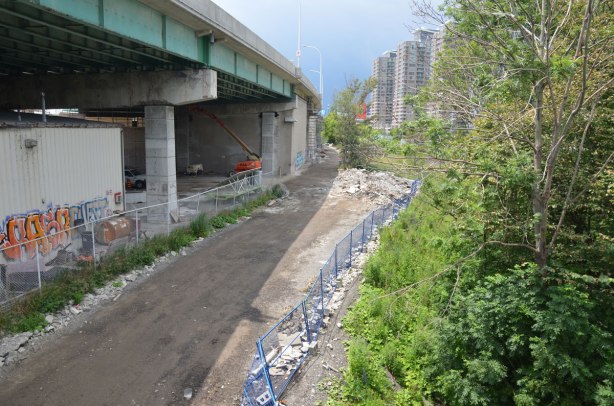
a dirt road runs alongside the Gardiner Expressway, some condos in the distance

below: This photo was taken as I stood on Garrison Common and looking towards Strachan Avenue.  This will be the western end of the new park. You can see the underside of the Gardiner as it passes over Strachan Ave which in turn is also a bridge.  This bridge once crossed the Grand Trunk Railway tracks that were built in the 1850s.  New entrances to the park are planned that incorporate the present sloped embankment of the bridge.

The elevated Gardiner Expressway passes over Strachan Ave which in turn has a bridge over what used to be a rail line. The bottom part of the bridge is covered with graffiti. The whole area is a construction site at the moment.

below: A quick aside:  It’s a slightly different angle, but here is a photo of the Strachan Avenue bridge from 1959, before the Gardiner was built.  I suspect that there has been upgrades made to the bridge since then.  Photo credit: R.L. Kennedy, found online (also a good source for the history of the Grand Trunk Railway in Toronto).  Garrison Common is to the right.
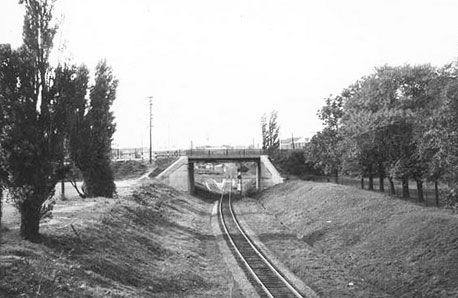
vintage photo from 1959, GTR tracks pass besidde Garrison Common park and under the bridge at Strachan Ave

Garrison Common is the green space surrounding Fort York.  It will abut (be continuous with?) the new Bentway.  Fort York is a National Historic Site and on its 43 acre site are original buildings from the War of 1812 as well as an 1813 battle site.  Did you know that the Americans beat us here in 1813 and controlled the city of York (as Toronto was known then) for a few days?

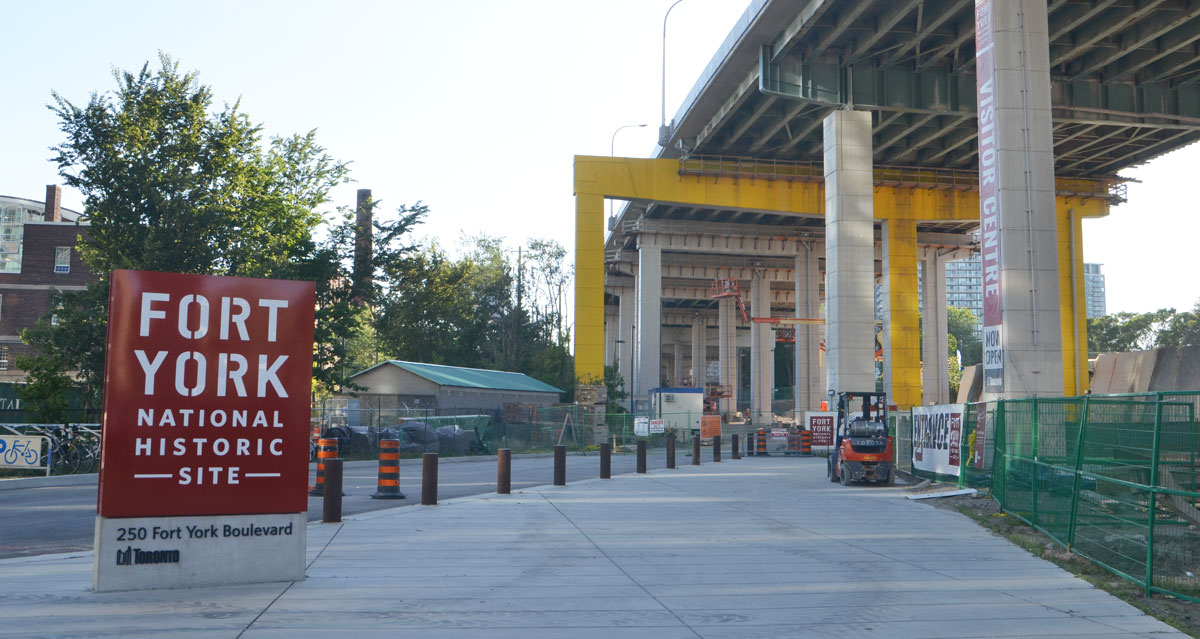
below: The new Fort York Visitors Centre is now open. There is still being work done both inside and outside, but it is open to visitors. For so long the fort was hidden away and difficult to get to; it is nice to see it receiving more attention.

entrance to Fort York, under the Gardiner, still a construction site but nearing completion

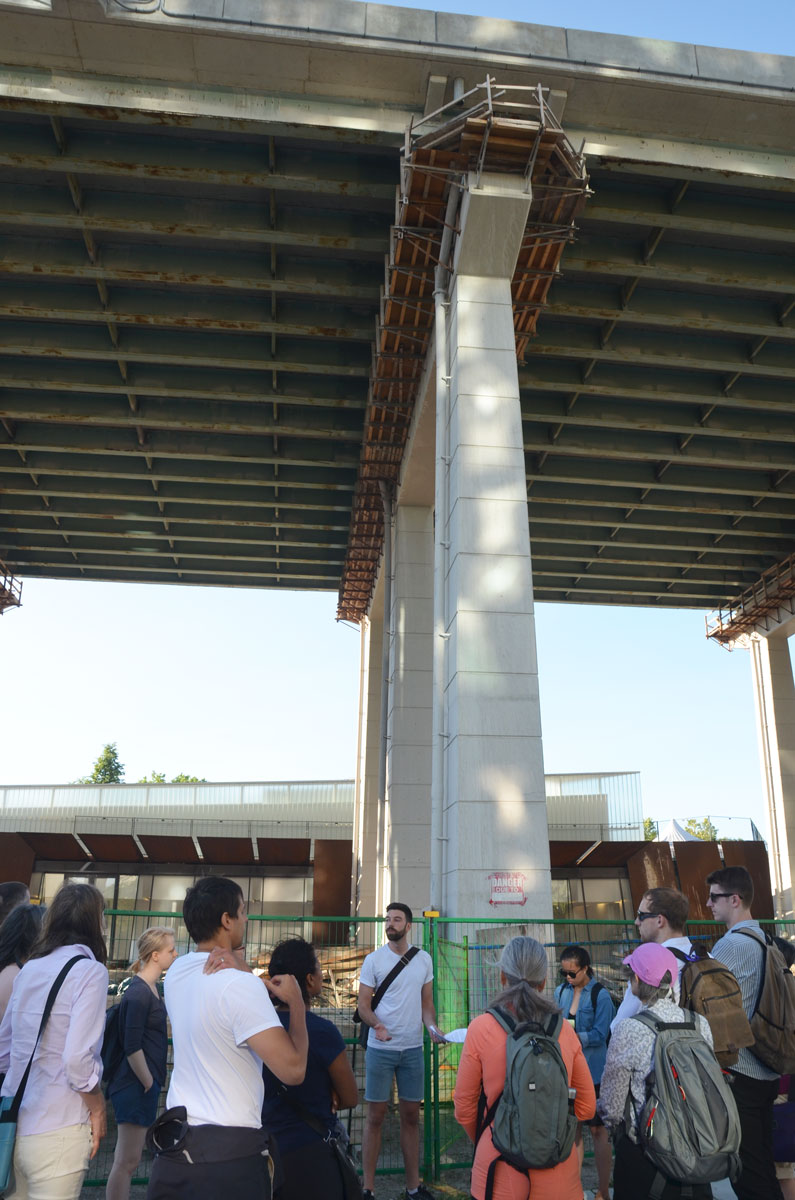
below: Jake from Park People, one of the groups helping to design the new park, stands under the Gardiner as he talks to a group of us on a tour.    Here, by Fort York, the Gardiner is the equivalent of 5 storeys from ground level, the highest it reaches as it crosses the city.
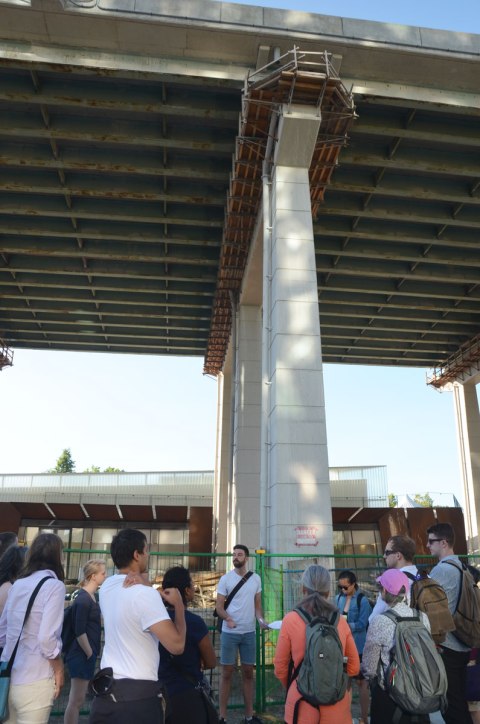
a man is standing in front of a group of people on a walking tour, he is standing under the Gardiner Expressway where it is 5 storeys above ground level.

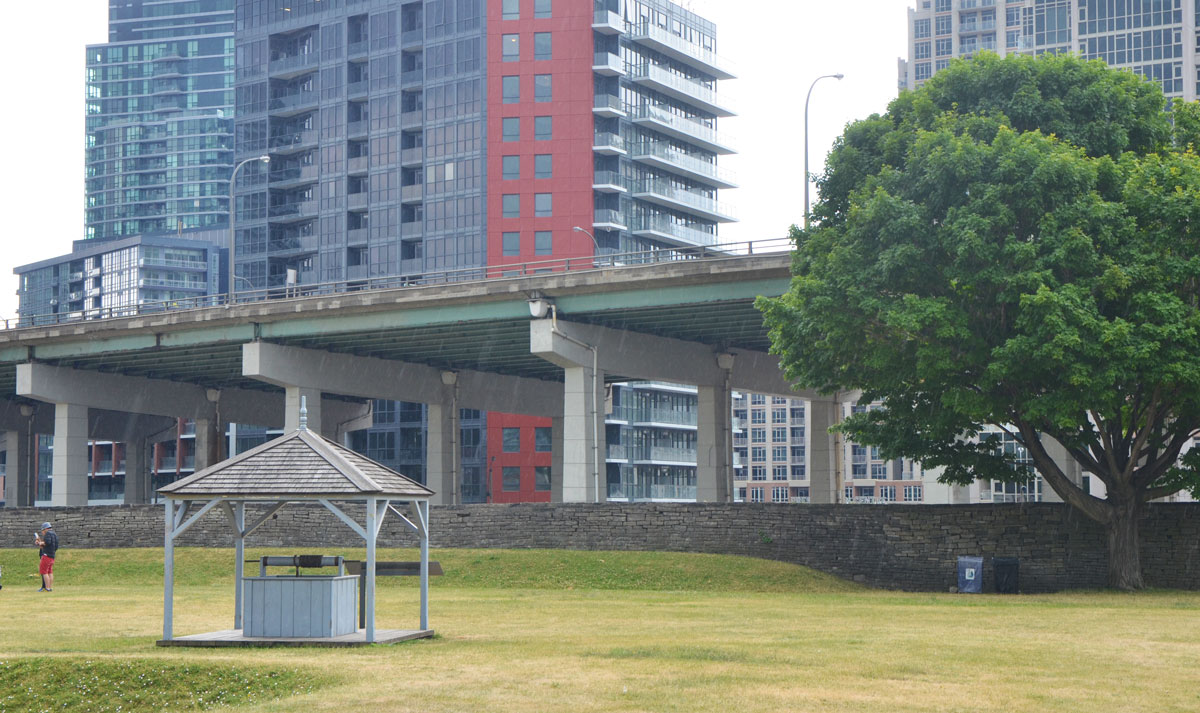
below: Standing on the grounds of Fort York.  The Bentway will be beyond the stone wall.  You can get a good idea of the spacing between the bents.  These spaces are being referred to as ‘rooms’ and there are 55 of them between Strachan and Spadina.
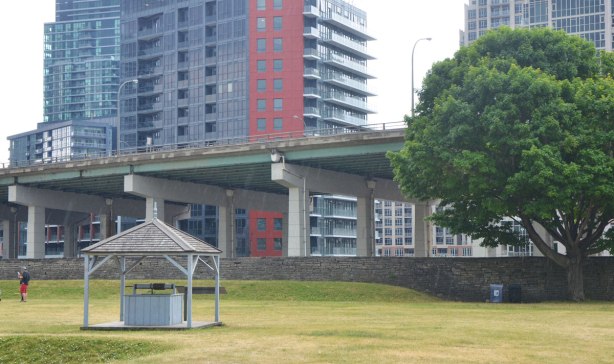
from the grounds of Fort York looking south to the Gardiner and the condos built beyond it. Grass field in the foreground.

below: One obstacle is the fact that Fort York Blvd passes under the Gardiner on a diagonal.  Plans are to build a pedestrian/cycle bridge over the street.  Also in the photo, note the TTC bus – Fort York and vicinity are finally on a bus route.  Route 121 runs between the Portlands and Fort York via Union Station.

fort york blvd is in the foreground, a TTC bus and a car are on it, the Gardiner is to the right and a short condo building is in the background along with the CN tower

below: The section under the Gardiner Expressway between Bathurst Street and Fort York Blvd is not city owned. It is owned, and has already been developed, by the Onni Group who built the Garrison at Fort York condominiums on either side of it.  This is the eastern end of phase 1.
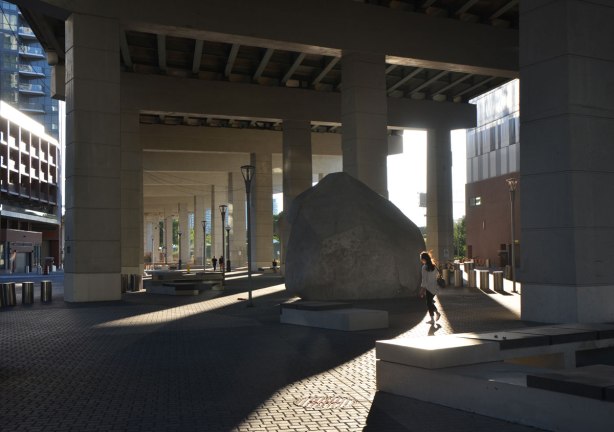
evening, low angle sunlight shines under the Gardiner Expressway where it has been developed with paving stones and some large rocks.

below: Northbound traffic on Bathurst passes under the Gardiner.
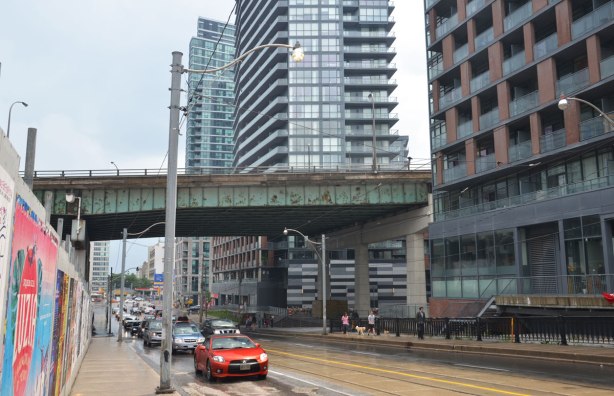
some traffic on Bathurst street on a rainy day, as the street passes under the Gardiner Expressway, condos on the right, construction hoardings on the left.

Phase 2 of the park’s development involves land between Bathurst and Spadina. This is an area that is undergoing a lot of changes at the moment, i.e. a lot of construction.

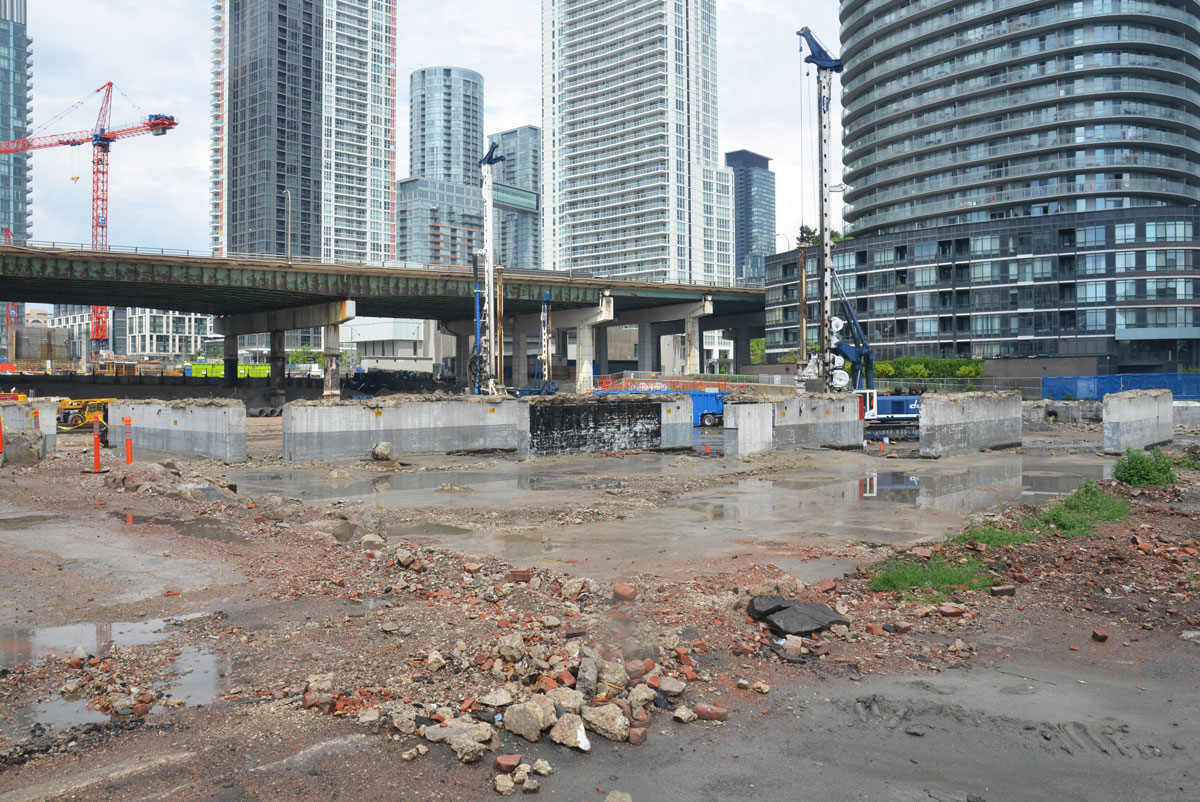
below: Immediately south of the Gardiner on the northeast corner of Bathurst and Lakeshore is a construction site.  Demolition of the old 1928 Loblaws warehouse building is now complete.  The facade of the old building was disassembled rather than demolished; after cleaning and refurbishing of the bricks, it will be rebuilt in its original location.  Two condo towers are planned for the space between Loblaws and the Gardiner.  Yes, more condo towers to face the Gardiner and add to the tunnel effect that you get when you drive on the expressway.

construction site in downtown Toronto, Gardiner Expressway runs behind the site, rubble in the foreground, a few remaining remnants of the old Loblaws building that was there, high rises in the background.

below: The development of this site is a collaboration between a number of developers.  I found a photo of one rendition (source) of what the space under the Gardiner will look like here in the future.  Public space including a cafe are part of the plans.  Check back in a couple of years to see what really happens here!
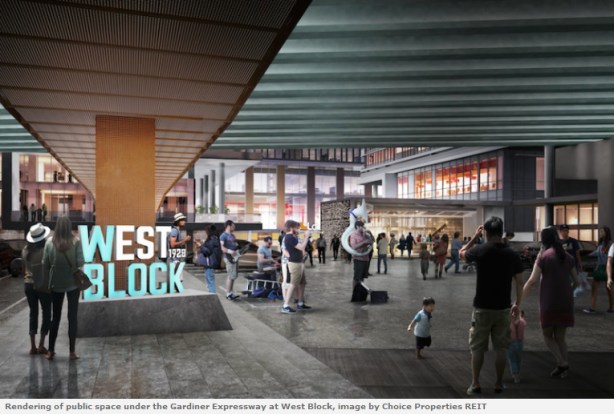
artist's rendering of what a planned development for under the Gardiner would look like, part of a larger condo and retail development.

below:  Standing on Bathurst Street, looking east along what will be Housey Street.  This is just north of where the Loblaws development (above) will be.  As you can see, you can’t walk there yet.

the elevated road, the Gardiner Expressway passes over a construction site on the right, a new street being built on the left.

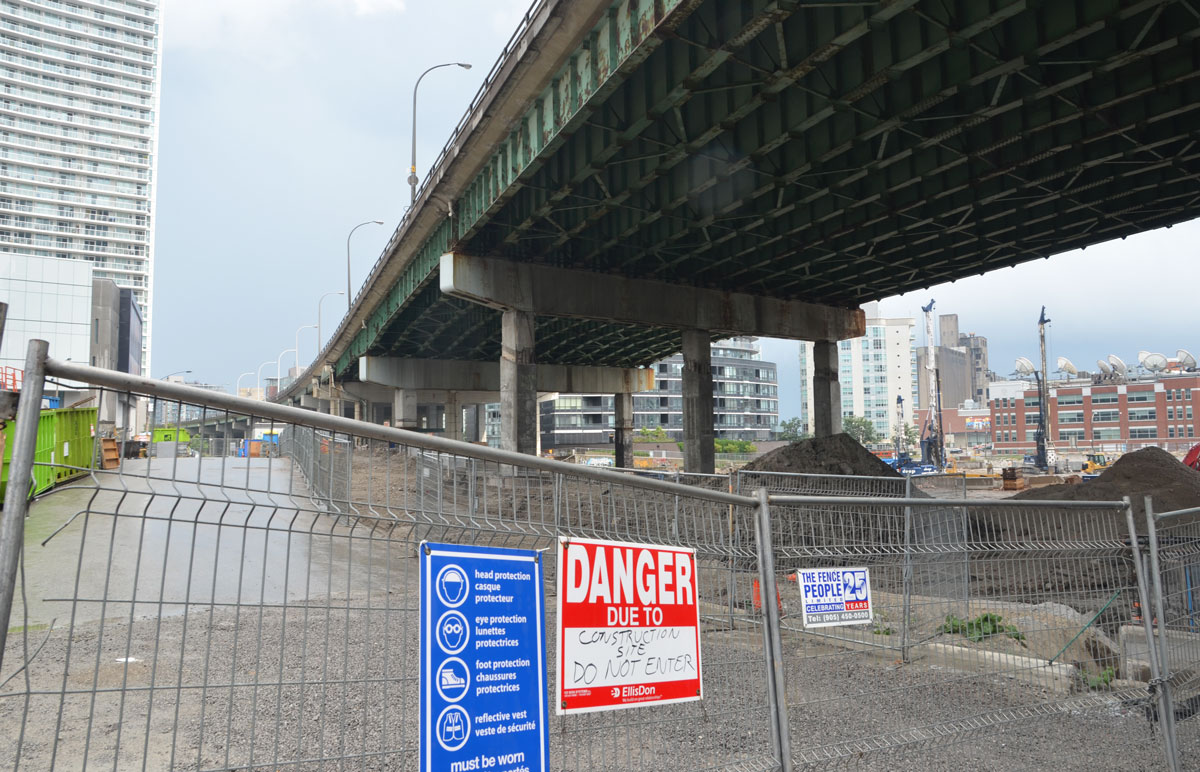
below: Southeast corner of Bathurst and Fort York Blvd.  This is the section of land just north of Housey Street.  Construction hoardings and cranes – familiar sights in this area.  It also means that taking photos of under the Gardiner here are difficult!
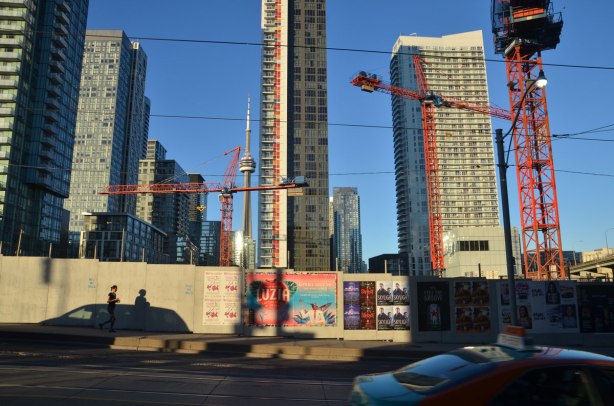
late afternoon, long shadows, yellowish tint to the photo, looking east from Bathurst, south of Front, north of the Gardiner, wood construction hoardings with posters on it, many orange cranes, some condos already built, a woman jogging past, cars on the street.

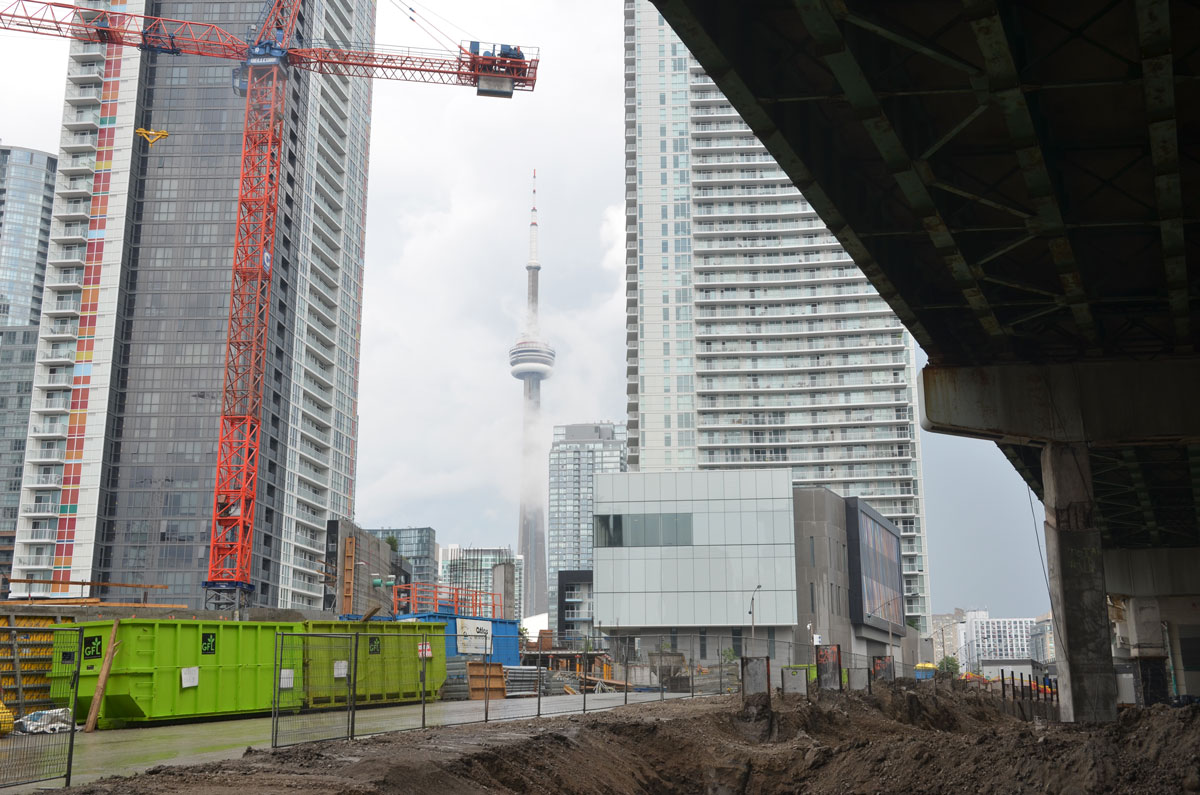
below: Development north of the Gardiner between Bathurst and Dan Leckie Way.
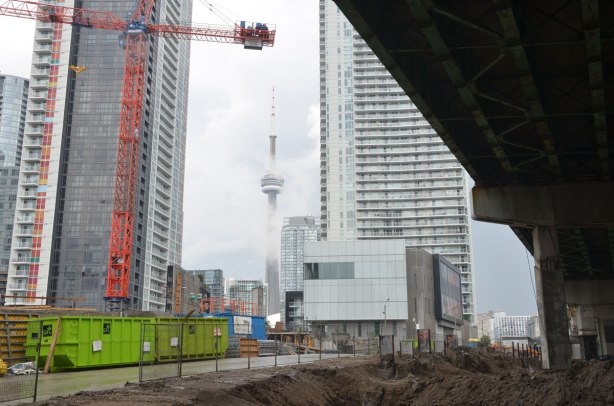
construction site under the Gardiner, cranes and condos being developed on the left, CN tower in the fog in the distance.

Dan Leckie Way is a north-south road that runs under the Gardiner just east of Bathurst.  It is the western boundary of Canoe Landing Park.  This park is north of the Gardiner and the Lakeshore.

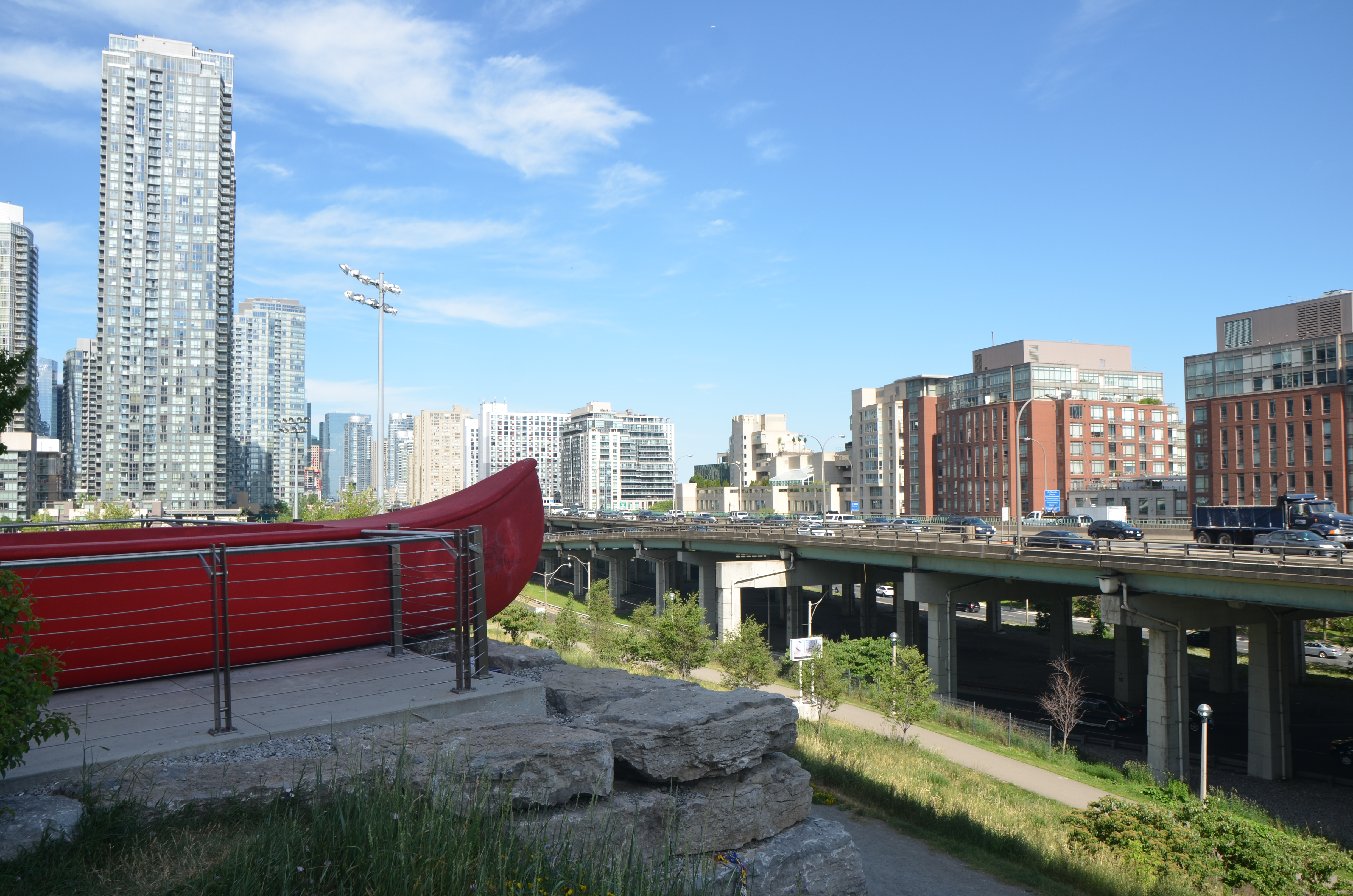
below: ‘Tom Thomson’s Canoe’, by Douglas Coupland sits at the highest point of land in the area; it’s almost at the same level as the Gardiner and is very visible as you drive by.   This park extends down the hill.
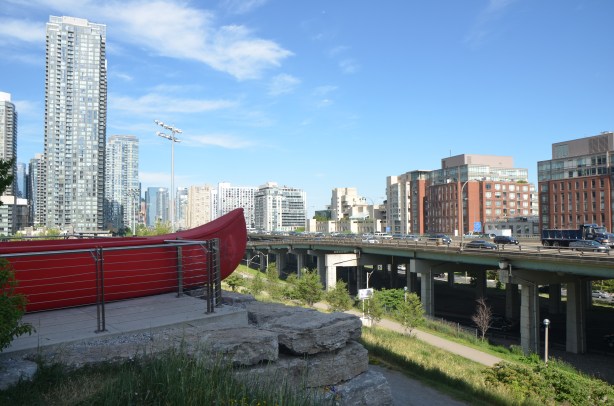
The end of a large red canoe, an artwork by Douglas Coupland called 'Tom Thomson's Canoe' sits in a park, high above the surrounding scenery. Looking southwest towards the elevated Gardiner Expressway and the condo developments south of it.

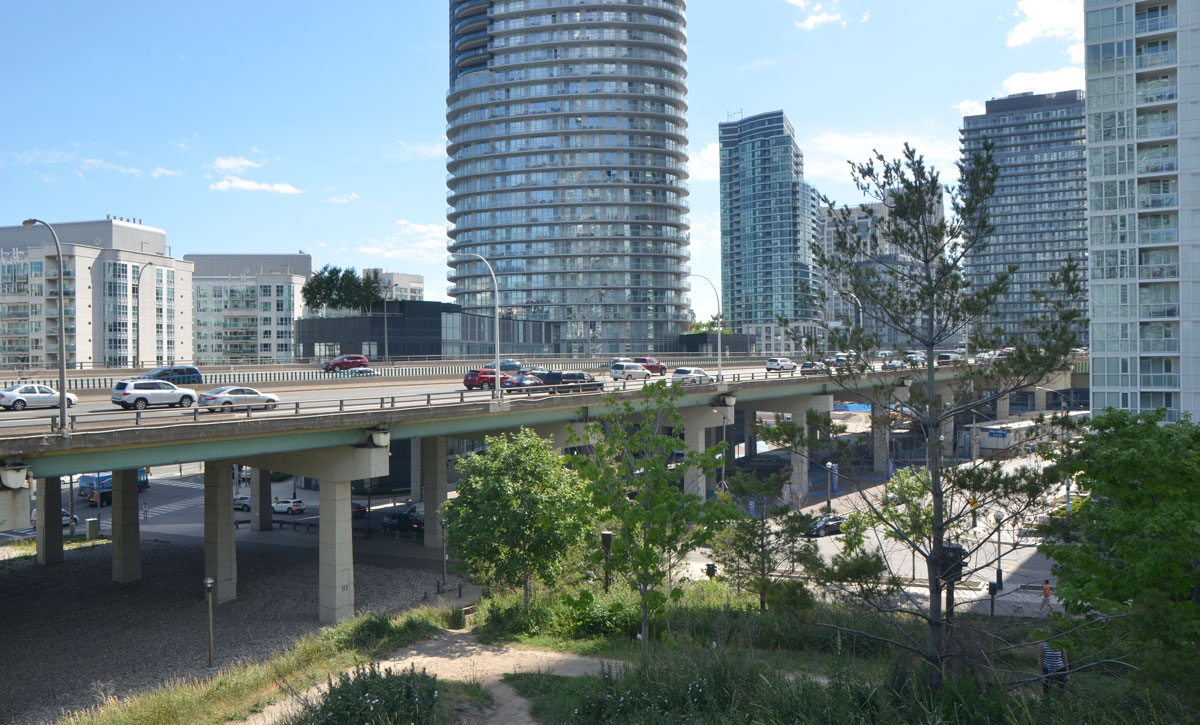
below: Looking the other way from the same vantage point. The street running under the Gardiner here is Dan Leckie Way . Up until this point the Lakeshore is south of the Gardiner.
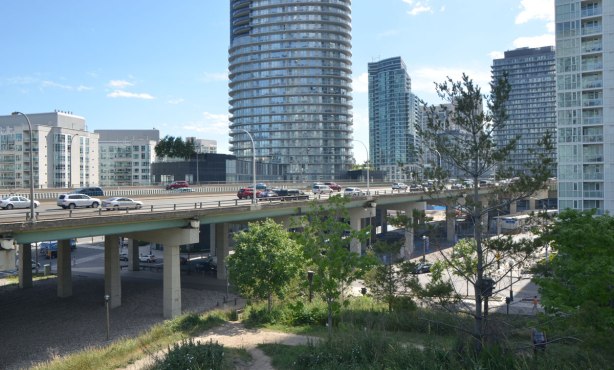
The elevated Gardiner Expressway with traffic is in the middleground, some trees and parkland in the foreground, and condo developments in the background.

At Dan Leckie Way, the Lakeshore is still south of the Gardiner and the space under the expressway is wide open.   By Spadina, one major block east, the situation changes.   The Lakeshore splits and westbound traffic lanes go north of the Gardiner and eastbound lanes stay south.  Shortly after Spadina, the Lakeshore runs under the Gardiner and there is no room for any further development under the road.

below: Standing on Spadina, just south of the Gardiner and looking west.  Here there is a lot of road to cross for pedestrians on Spadina.  Not only has the Lakeshore split to run on either side of the Gardiner, but there are also ramps between the Gardiner and the Lakeshore.
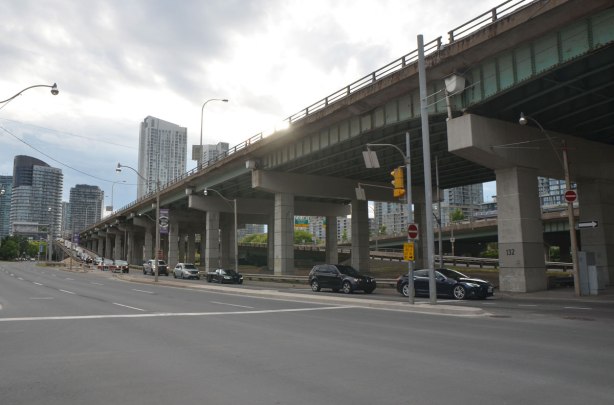
major road with traffic under an elevated expressway in a city, long ramp from the upper level to the lower. Gardiner Expressway and Lakeshore Blvd in Toronto, at Spadina looking west

below:   Still on Spadina, and still looking west, but now under the Gardiner.  The space under the road is not as high as it was previously.  Its lower and darker and not as inviting.   It will be interesting to see what phase 2 of the Bentway development will look like in this space.  I am not sure when it will to be finished but I will keep an eye on it!
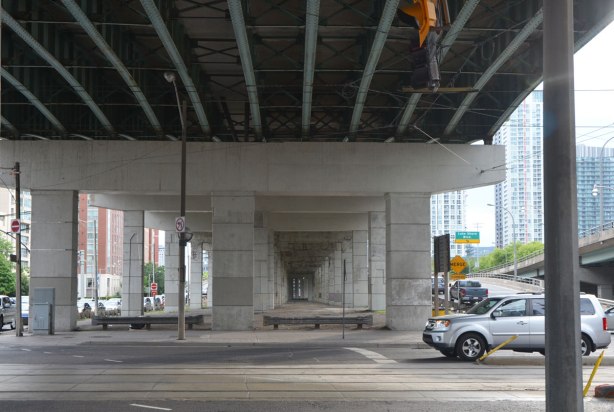
under an elevated section of the Gardiner Expressway, at Spadina.

As for the eastern Gardiner, what does that look like?  Well, that’s a whole other blog post!

 Project: Under Gardiner  On this site you’ll find detailed maps and diagrams of this area as well as information about the plans for the various sections of the space.


As you all know, the TTC is replacing their older streetcars with new longer Bombardier streetcars.   Or at least they are trying to 🙂  Because they are longer, they don’t fit into existing “garages”, hence the new Leslie Barns facility.  Located on Leslie St., south of Queen, it is the new streetcar “home”.  It is where streetcars are parked, maintained and repaired.  It has been in operation since Nov 2015 but the first chance the public got to peak inside the finished complex was at Doors Open on the 28th of May.

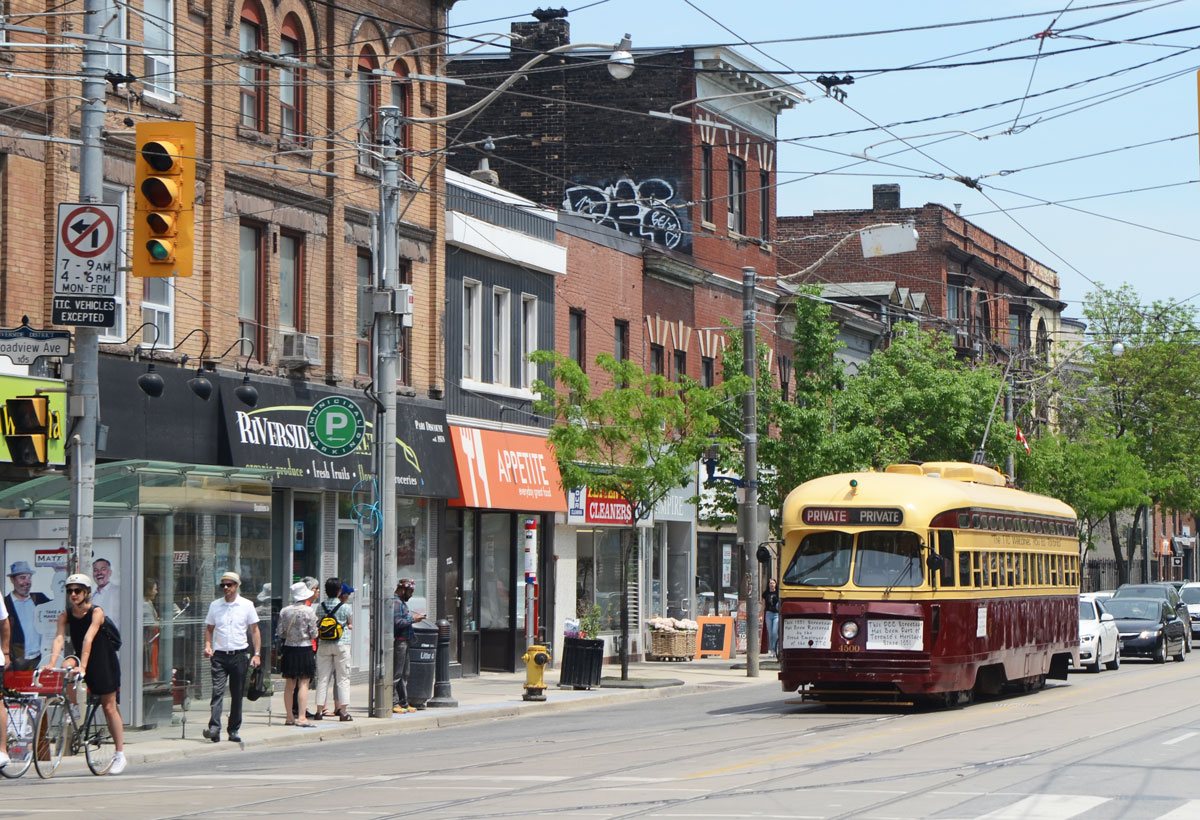
below: While waiting for a streetcar at the corner of Queen and Broadview on the way to visit the Leslie Barns, I saw this renovated TTC streetcar from the 1950’s.

An old restored TTC streetcar, maroon and yellow, on Queen St. East

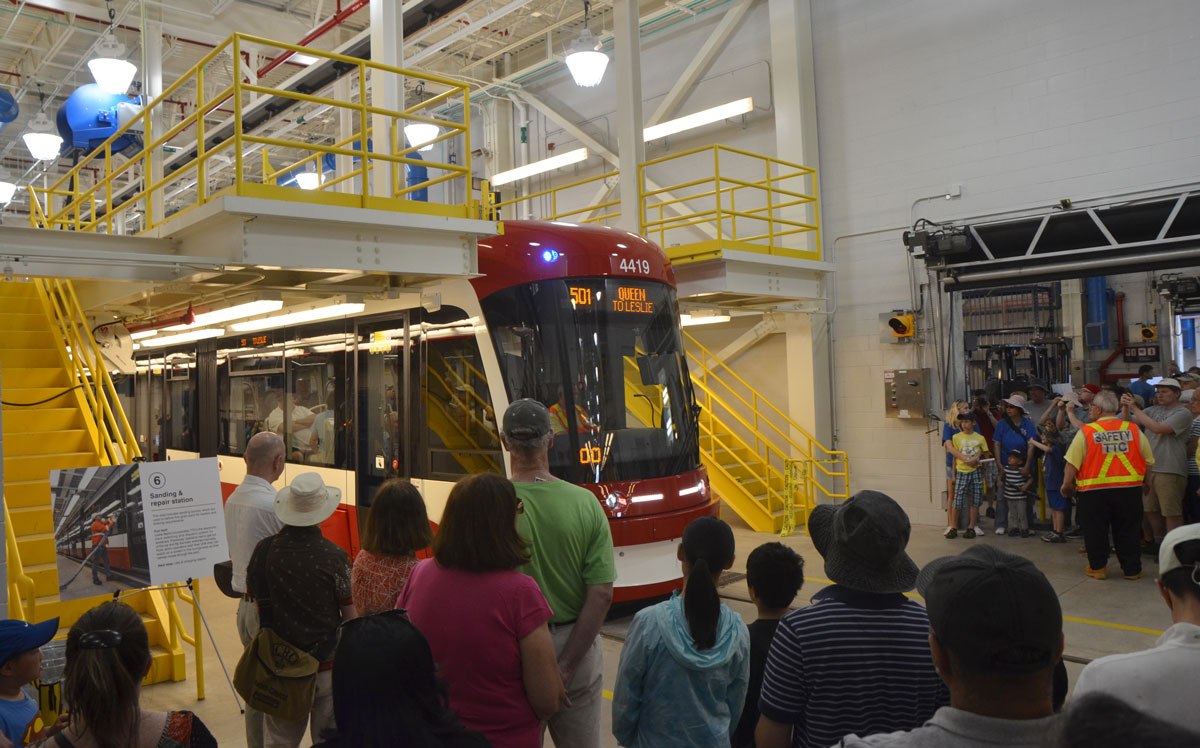
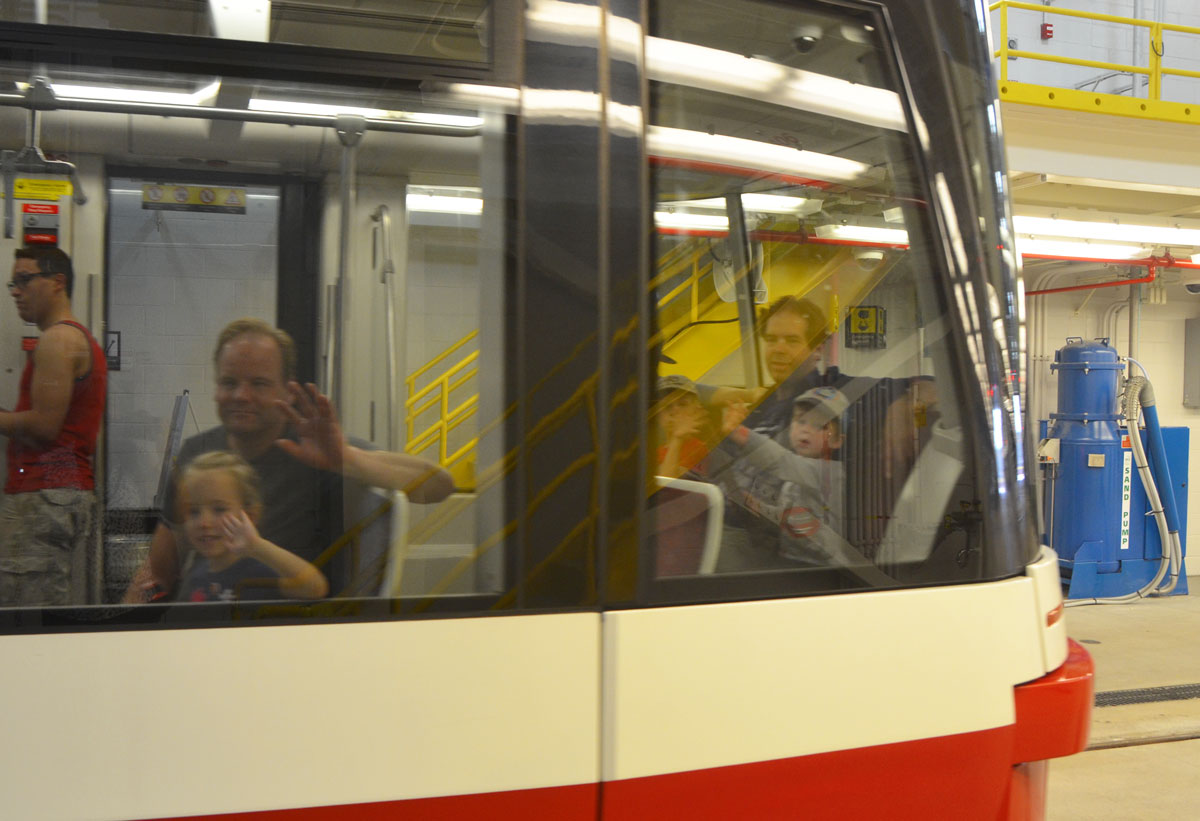
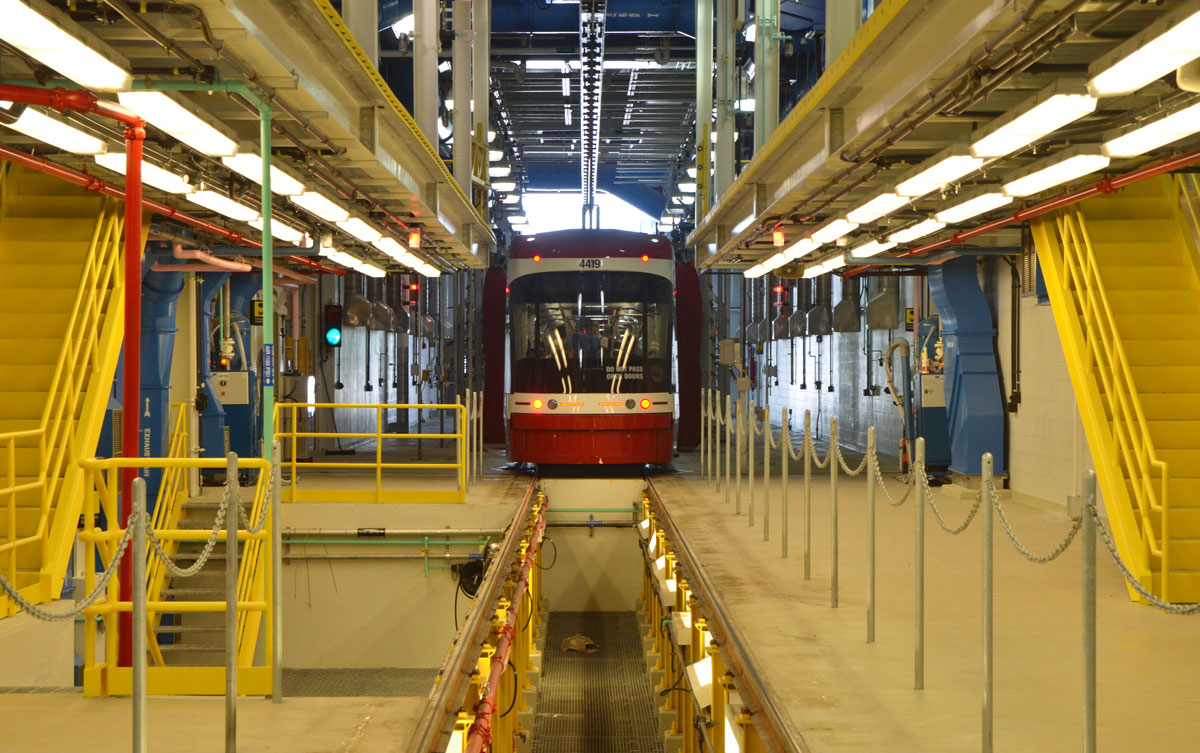
below:  The streetcar tour involved riding a new streetcar through a maintenance bay in the building and then around the parking lot out back.

People at Doors Open in TOronto, at the TTC LEslie Barns streetcar facitlity, lining up for , or just getting off of, streetcar tours, riding the new streetcars around Leslie Barns

A group of people inside Leslie Barns streetcar facility, standing aside to make way for a new streetcar that is taking other people on a tour.

people riding in a new streetcar, photo taken from the outside, most of them are waving

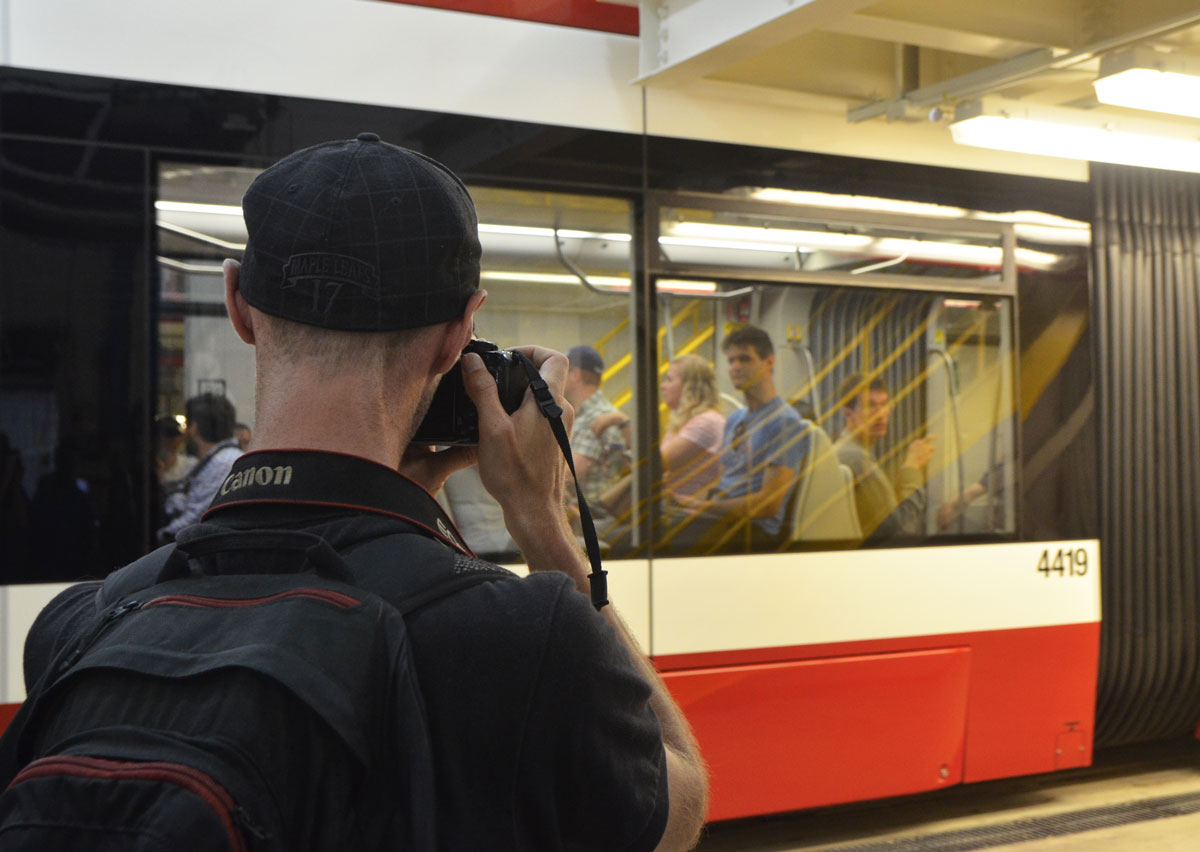
A man in black T-shirt and black cap is taking a picture of people riding in the new streetcar, inside Leslie Barns at Doors Open

below: Exterior, parking space for at least 100 streetcars

the massive concrete parking lot for streetcars with all the overhead wires. The building that houses the workshops and cleaning and office for the ttc is in the background.

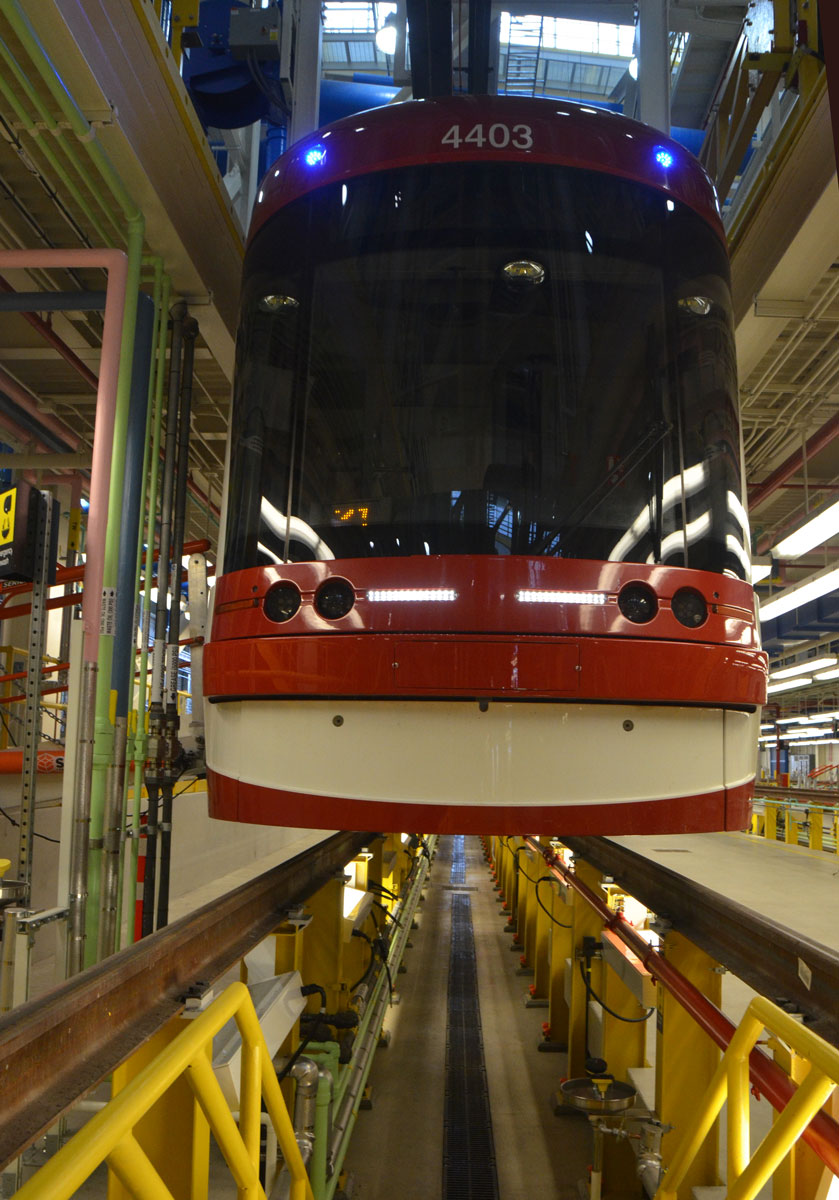
below: Special bays have been constructed with space for workers to access both the underneath and the top of the streetcars.  Because the cars have been designed to ride low, a lot of their workings such as the HVAC and propulsion systems are built into the roof of the car.

the back of a new streetcar as it passes through interior of Leslie Barns streetcar facility, a large, tall interior space with lots of pipes

A streetcar sits in a repair bay of the Leslie Barns, space underneath the streetcar for workers to go down and work on the underside of the streetcar.

below: It’s a big space!  …. 17,510 square metres (188,500 sq ft) in fact.

interior of Leslie Barns streetcar facility, a large, tall interior space with lots of pipes

below: A spic and span shiny paint room

interior of the paint room at Leslie Barns, where streetcars go to get painted.

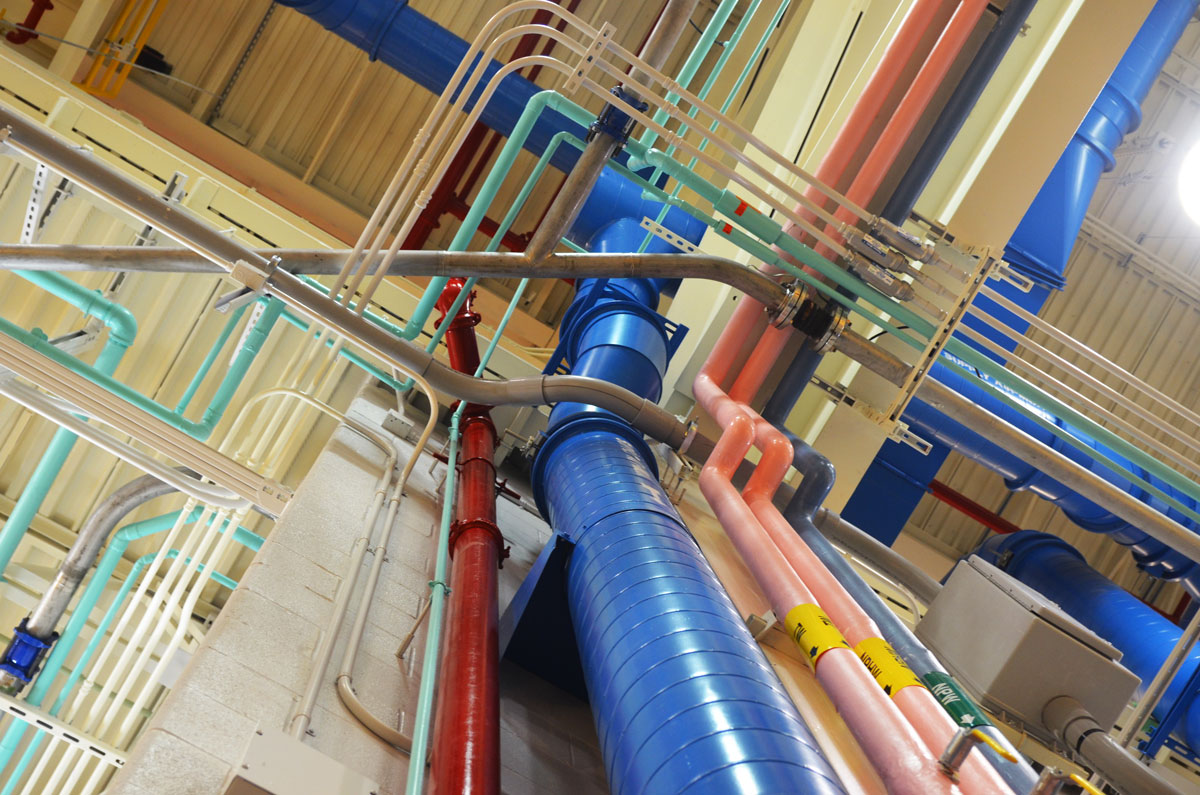
below: A myriad of colour coded pipes

A myriad of pipes running up walls and across the ceiling, blue, pink, red, grey, all colour coded, interior, Leslie Barns

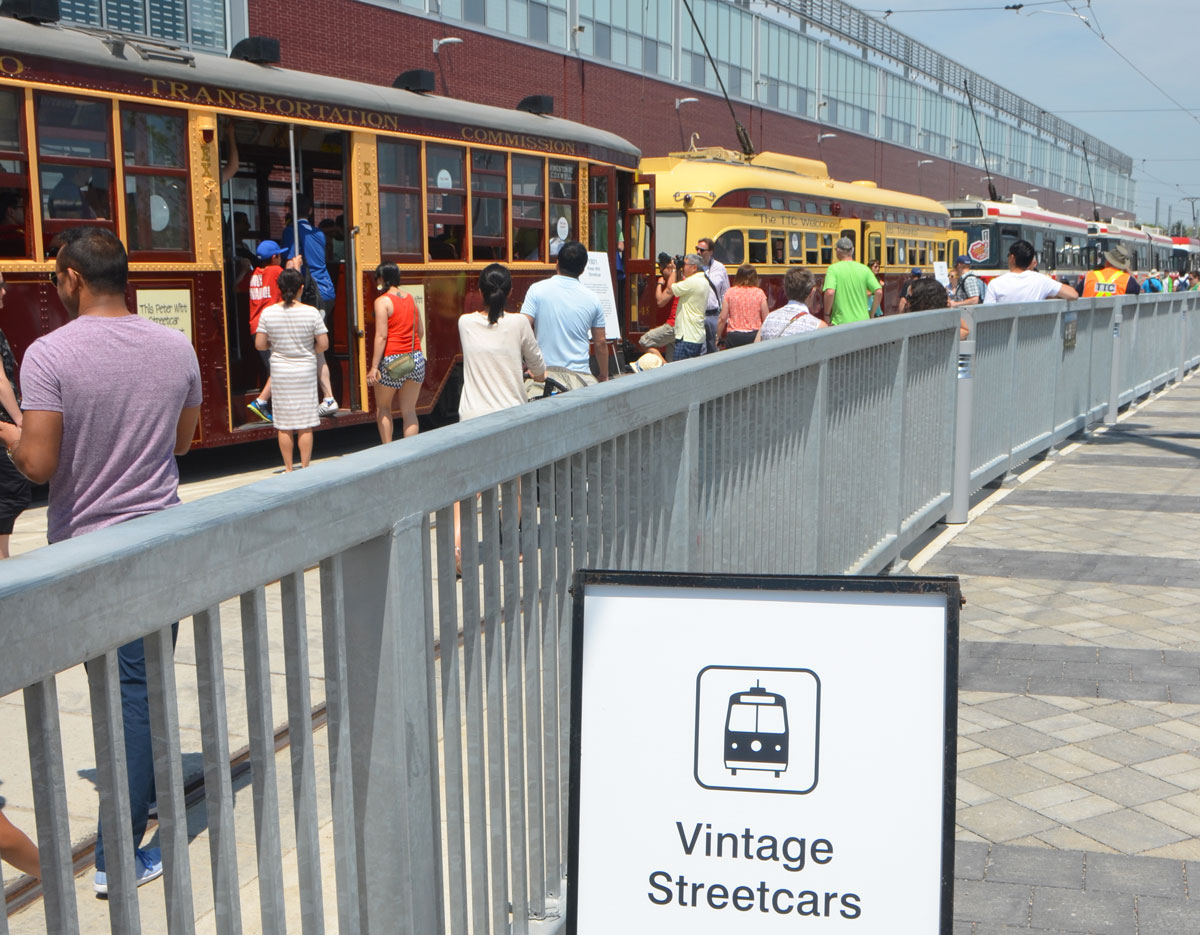
below: There were renovated vintage streetcars on display.  On the left is a 1921 Peter Witt streetcar and next to it is a PCC streetcar from the early 1950’s.

a number of people waiting to go inside old renovated vintage TTC streetcars

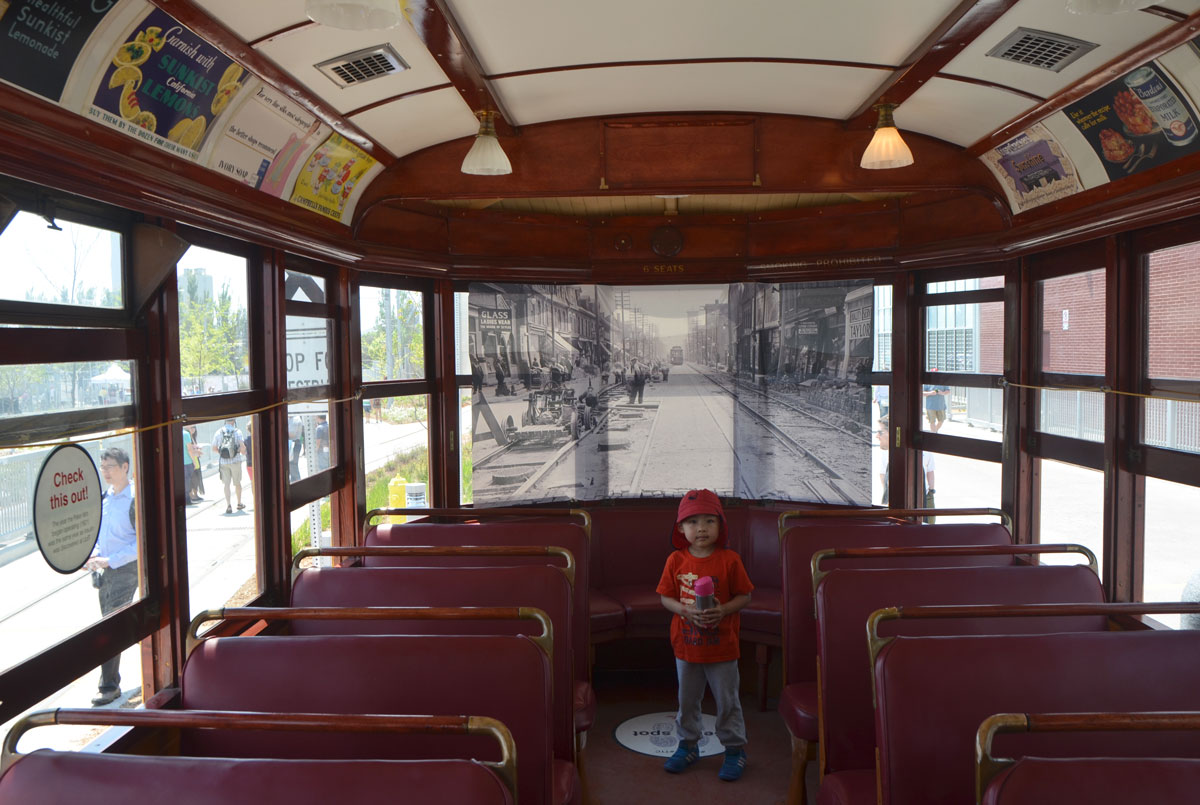
below: Interior of a refurbished Peter Witt streetcar with its wood trim.  The Witt cars were built for the newly formed TTC in 1921.  They entered service on Broadview in October of that year.  By 1923 they were operating on seven routes.  The last Witt streetcar was retired in 1963.

A young boy stands in the back of an old restored ttc streetcar. A black and white picture of an old street scene has been put across the back window to show you what the view out the window might have looked like at the time the streetcar was functional. Old ads on the upper part of the interior, wood trim

below: Looking out the window of a PCC streetcar built in 1951.  PCC stands for Presidents’ Conference Committee, which was a group of operators from the USA and Canada  who got together in 1938 to design a new electric railway car.  By the late 1950s, the TTC owned the largest fleet of PCC’s in the world.  The last one was retired in 1995.

A young boy wearing a hat looks out the window of an old restored streetcar while his father takes a picture out the window

below: Streetcar wire maintenance truck.

a special TTC truck sits outside Leslie Barns TTC facility on Doors Open day, the truck is designed to run on streetcar tracks and is used to repair tracks and wires. There are people looking at the truck

#DOT16 | #TTC

The plan was to start walking westward from Eglinton subway station.

below:  The first photo I took was right after I got off a bus at the station.   With the ongoing reconstruction at Eglinton, there is now easy access to the old bus bays.  There is still a fence around them, but at least they can be seen and photographed.  These bays have not been used since 2004 and the area has been fenced off and unused since then.  Now they sit empty in the shadow of the ever increasing tall buildings around them.

abandoned bus bays at Eglinton subway station in the foreground and the newer taller buildings in the area in the background

abandoned part of Eglinton subway station, behind chain link fence

below: Looking west along Eglinton Avenue after the completion of Eglinton station in 1954.  The street running north-south just beyond the bus bays is Duplex Avenue.  There is now a police station on the SE corner of that intersection.   On the NW corner you can see the brick Toronto Hydro-Electric Building with its large front ‘door’.  It is still there.
historical black and white photo, aerial, from Yonge Street looking west along Eglinton Ave showing the bus bays at Eglinton subway station, up to Duplex Ave is shown clearly.

source: City of Toronto Archives, online

.

below: (taken later in the afternoon, on the way home) The intersection of Eglinton and Duplex from west side with the brick Toronto Hydro-Electric building now between glass buildings.

looking east along Eglinton Avenue towards Yonge street with Duplex Ave in the foreground. The old Toronto Hydro-Electric building is in the picture, with a newer structure with a glass front beside it. New buildings between Duplex and Yonge on the north side of Eglinton are also in the picture.

below: After leaving Eglinton station, this caught my eye.  The glass cube-like building on the NE corner of Eglinton and Duplex reflects the afternoon sun onto the walls of the Toronto Hydro-Electric building across the street.

brick building with wavy shadows on it cast by the sun being reflected off the glass building across the street

brick building with wavy shadows on it cast by the sun being reflected off the glass building across the street

below: On Duplex, right behind this brick building is an intriguing building.  The highly textured concrete exterior and the 3D patterned wall are suggestive of the 1960s although I could be wrong.  It’s ugly yet fascinating at the same time.   Now that the leaves have fallen from the trees in front of it, the pattern of trapezoids, diamonds and rectangles is revealed…. as is the dirt and grime on the concrete.  The fact that there are no windows and doors facing the street provides a clue that this is yet another Toronto Hydro building.

Three tree with no leaves are in front of a concrete wall that is built in 3D pattern of trapezoids and rectangles. There are no windows or doors.

Somethings old

below: A sign with an old Toronto HU (Hudson) exchange phone number.  HU1 would be 481.  This number is probably from the late 1950s.  In the early days, Toronto phone numbers had only 6 digits.  In the mid 1950s a seventh digit was added and then between 1961 and 1966 the letter prefixes were phased out, replaced by numbers.

old sign on the side of an small apartment building, the Latimer Apartments, with an old Toronto phone number starting with the letters HU

below:  The Eglinton Grand, art deco building from 1936; National Historic site since 2003.

The Eglinton Grand, a cinema theatre built in art deco style in 1936.

 Somethings new

many curved and disjointed reflections of buildings in a tall glass building. Afternoon sun so there's a yellowish tint to the reflections

 And some window ‘shopping’ to do

below: Marbles wedged between glass make an excellent decorative touch.

a layer of marbles wedged into a window to look a bit like stained glass

A line of toy figurines on a window sill in the window of a restaurant

below: little Japanese wooden dolls in the window of the Sake Bar

three little Japanese wooden dolls with white hair and white kimonos standing inside a window. Reflections of the stores across the street are behind them.

below:  And even a lovebot hangs out here

a 3D concrete lovebot stands on the sidewalk beside a store as people walk by

below:  A little chuckle at this sign….

I small sign hanging over a doorway of a hot dog restaurant called Bite Me

below:  And then later I saw this.

A sign on the wall outside a store that says Bite Me More

sticker on a pole on a sidewalk. One man is kicking another, pixelated picture, with the letters X G G L on it.

Rather than wait for a bus I decided to keep walking home but unfortunately it’s that time of year when the daylight hours are just too short.   One last look at where I had just been before putting my camera away and heading home.

very late afternoon sun, as it disappears behind buildings, looking down a street, sun is reflecting off some windows, a large part of the street is in shadow, a TTC is there, with its lights on, some construction on the street, some cars,