Posts Tagged ‘historic’

a small Canadian flag has been stuck into a poster notice on a TTC bus stop pole

First, let’s get our bearings….

below: This was, until recently, the Dominion Pub. It is on the northwest corner of Queen St East  and Sumach. It was a popular spot with a decent patio.  When I saw that the Dominion was closed and the property for lease I decided that I’d better document the area.  There is just so much happening, or about to happen, here in terms of development.

northwest corner of Queen and Sumach, Dominion pub, old brick building, now covered with green, building for lease, once part of Dominion Hotel and Brewery

below: Directly opposite, on the northeast corner, is this row of buildings – 502, 506, and 508 Queen Street East. The buildings appear to be empty but there is no development notice sign.  Only 502, Sweet Marie Variety, is considered of any historic value.

row of three old buildings, two storey store fronts, all empty. Sweet Marie convenience store on the left, at corner of Queen and Sumach

below: Just to the east, more of the same.   One is for sale – It’s just over 1600 sq ft,  and can be yours for $1,800,000.  These pictures were taken on the 1st of July and as I write this almost two weeks later, it is still on the market.  Care to be a commercial landlord?  Or maybe hold onto it in hopes that a developer wants to buy you out?

two old 2 storey storefronts on Queen St. East, one is for sale, the other is a barber shop

below: One more change of viewpoint…   South side of Queen, looking west to Sumach Street

south side of Queen st east, looking east towards Charry Street, vacant lot, then a bright green building,

below: Stepping back in time (can anyone date the cars?), to the same intersection but from the other side, Queen Street looking west at Cherry Street.
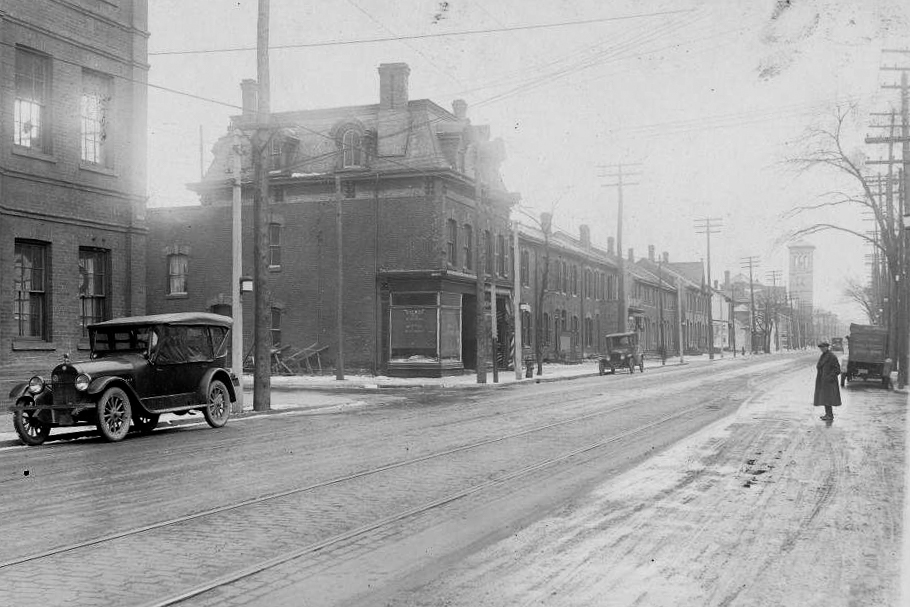
black and white vintage photo of Queen street, looking west, at Cherry street

City of Toronto Archives, Fonds 1488, Series 1230, Item 2285, plus some enhancing with Photoshop

below: The building on the corner with the mansard roof is still there.  The bright green part of the building lost its roof in a fire a few years ago.  Both buildings date from before 1884.
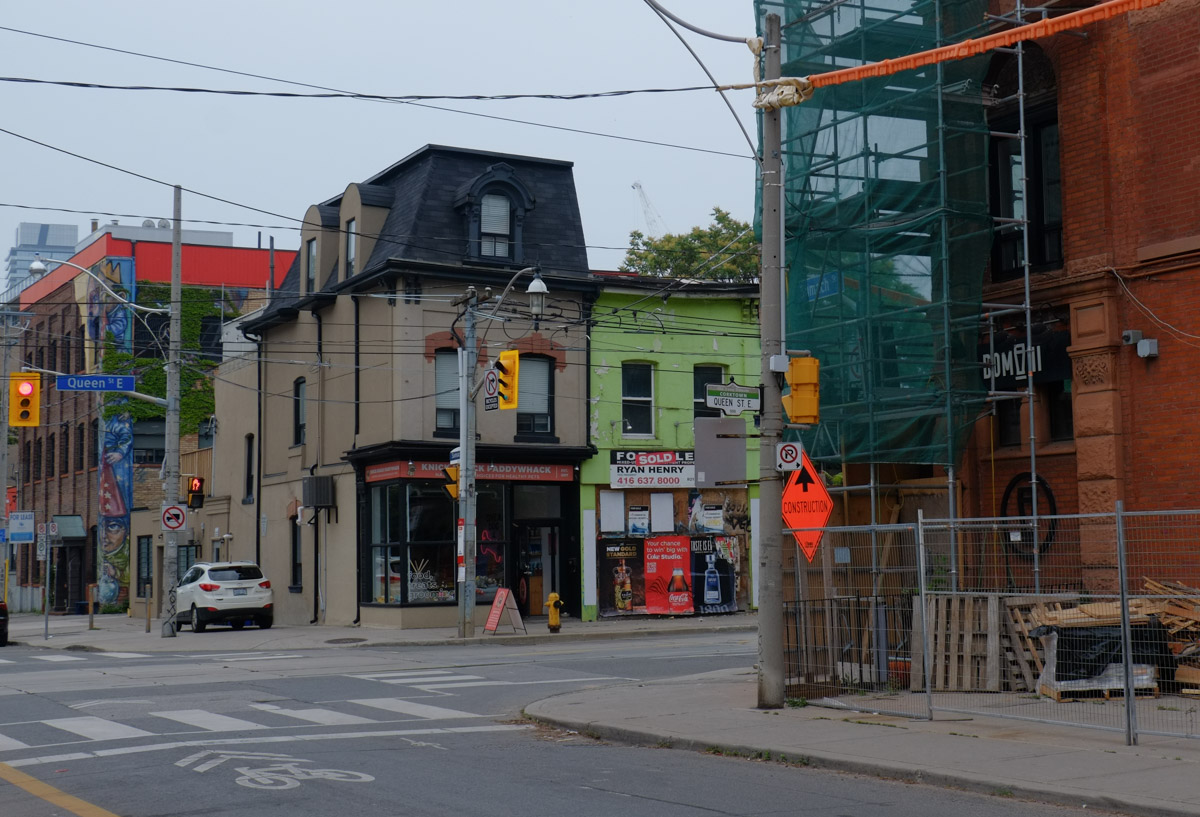
looking south on Sumach, west side, from Queen, renovations at Dominion pub on the right, two older buildings on the south side, one with black mansard roof, and the other painted bright green

below: The fire also destroyed one of the row houses immediately beside, leaving a vacant lot in its place.  469 Queen is a terrace house built in 1877.  The ivy covered building (the Magic Building) faces Sumach Street.

old brick house beside a vacant lot, building in next street behind can be seen, it is covered in ivy

below: The brick warehouse/factory at 489 Queen Street East was built in 1884.  This building has been renovated and turned into office space.

renovated post and beam brick building, three storeys high, once a warehouse and now office space

below: Just east of the old warehouse is another short row of terrace houses from the same time period.

a row of two storey brick terrace houses, row houses, built in the 1880s, Queen St East in Toronto,

below: A little further east

old brick semi detached house, red brick, with black roof, central peak, on Queen East, heritage property

below: And a little more…. a row of flat roofs on two storey brick store fronts.  They also all have three narrow windows on the upper floor.

a row of two storey brick store fronts, one has a lot of light blue trim,

Jumping back to the start, the Dominion Brewery opened in 1878 and was in operation until 1936.  The original owner was Robert T. Davies who bought the site in 1877; he had worked previously at his brother’s brewery, Don Brewery which was only about two blocks away.  A large part of this structure still stands, especially the part facing Queen Street.  The lower right corner of this image shows the Dominion Hotel which was attached to the brewery but wasn’t part of it.
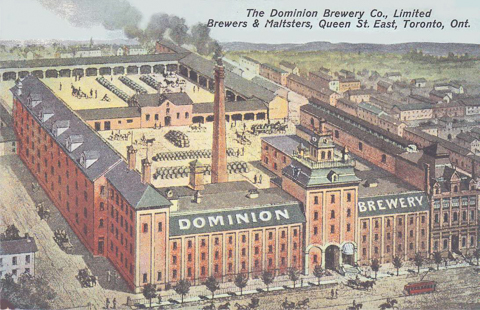
image of an old painting or drawing of the DominionBrewery complex on Queen Street East in the late 1800s or early 1900s

below: The Dominion Hotel as it appeared in 1945.  The little tower and fourth floor no longer exist.  The hotel was built in 1889 by Robert Davies (same as first owner of the brewery).
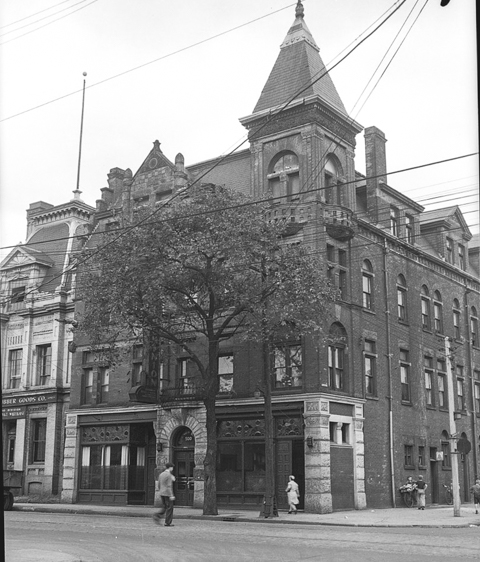
An older black and white photo of the Dominion Hotel. Once upon a time it had a tower.

This image was found on Wikipedia but is originally from the City of Toronto Archives, listed under the archival citation Fonds 1257, Series 1057, Item 520. (public domain).

below: Painting by Rowell Soller on Queen Street

a small painting by Rowell, blue background, person head and shoulders,

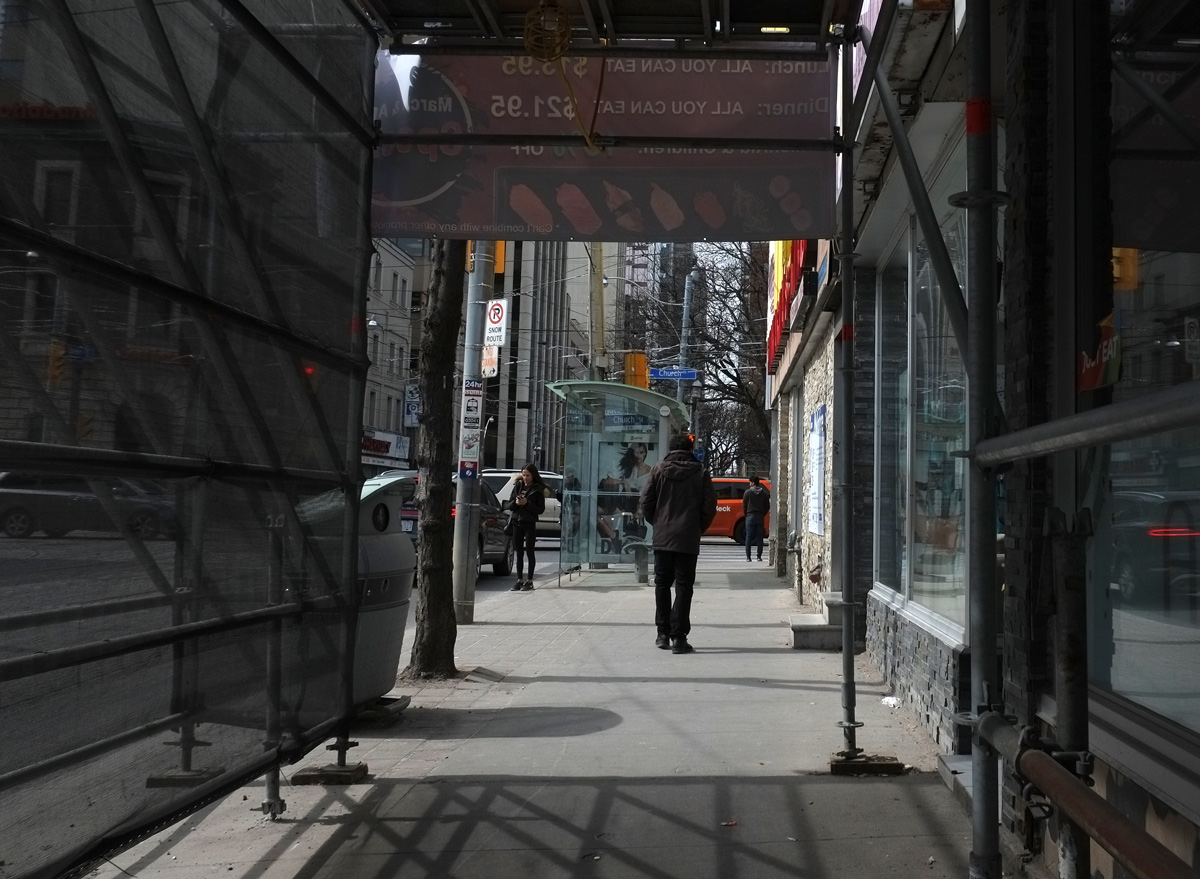
below: From under the scaffolding in front of the Dominion Pub.

looking through scaffolding covering sidewalk to bus stop and people on the other side of the street

below: The front entrance of the Magic Building on Sumach Street, south of Queen (that’s the ivy covered one a few photos above).

front entrance to a building, words over door say The Magic Building

below: Not only does the building have a lot of ivy on its walls, it also has a painting by Elicser Elliott with a red-capped man at ground level.
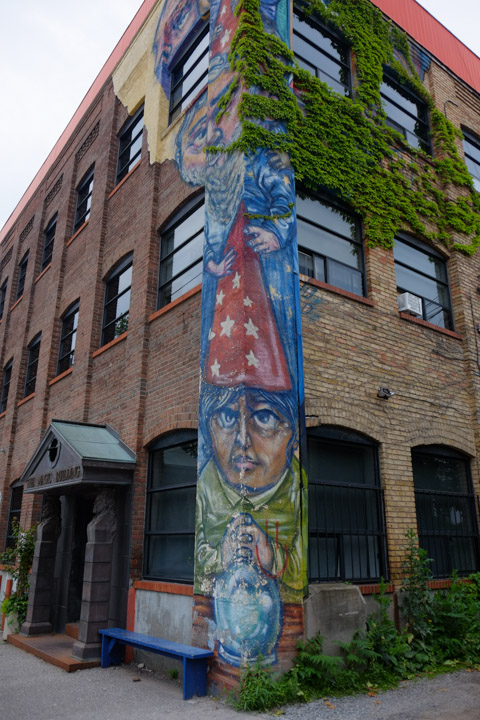
on the corner of a building, tall vertical mural by Elicser Elliott, a wizard in a red cap with white stars all over it.

below: The box on the sidewalk across the street from the wizard painting has also been decorated by Elicser Elliott.
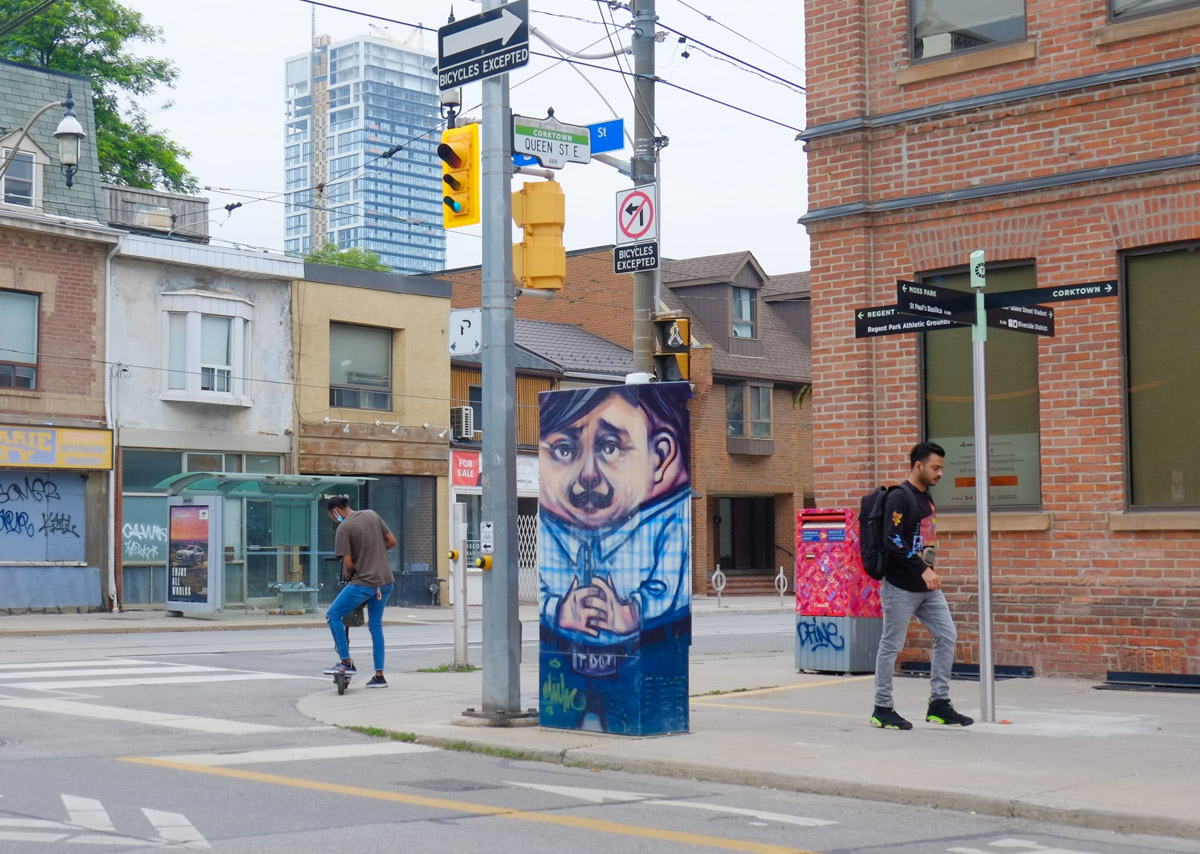
at Queen East and Sumach, a sidewalk box painted by Elicser Elliott of a man in a blue shirt, short dark hair. A man walks by, another man is sorting out his scooter while waiting for a traffic light

If you walk south on Sumach, it is a short block to King.

below: Looking down the alley to another street of row houses, Ashby Place, with newer Corkdown developments behind that.


two white houses with black trim, semi, with an alley beside, looking down the alley to row houses on another street

below: A closer look at a couple of the houses on Ashby Place – they’re small!

small row houses on Ashby Place, dormer windows on upper floor,

below: This is the northeast corner of King and Sumach. This intersection has more than 30 of poles, or at least I lost count at 30. Most of them are for the 504 streetcars.

newer low rise apartment building, or row houses on the northeast corner of King and Sumach

below: Southeast corner of King & Sumach… a mix of old and new
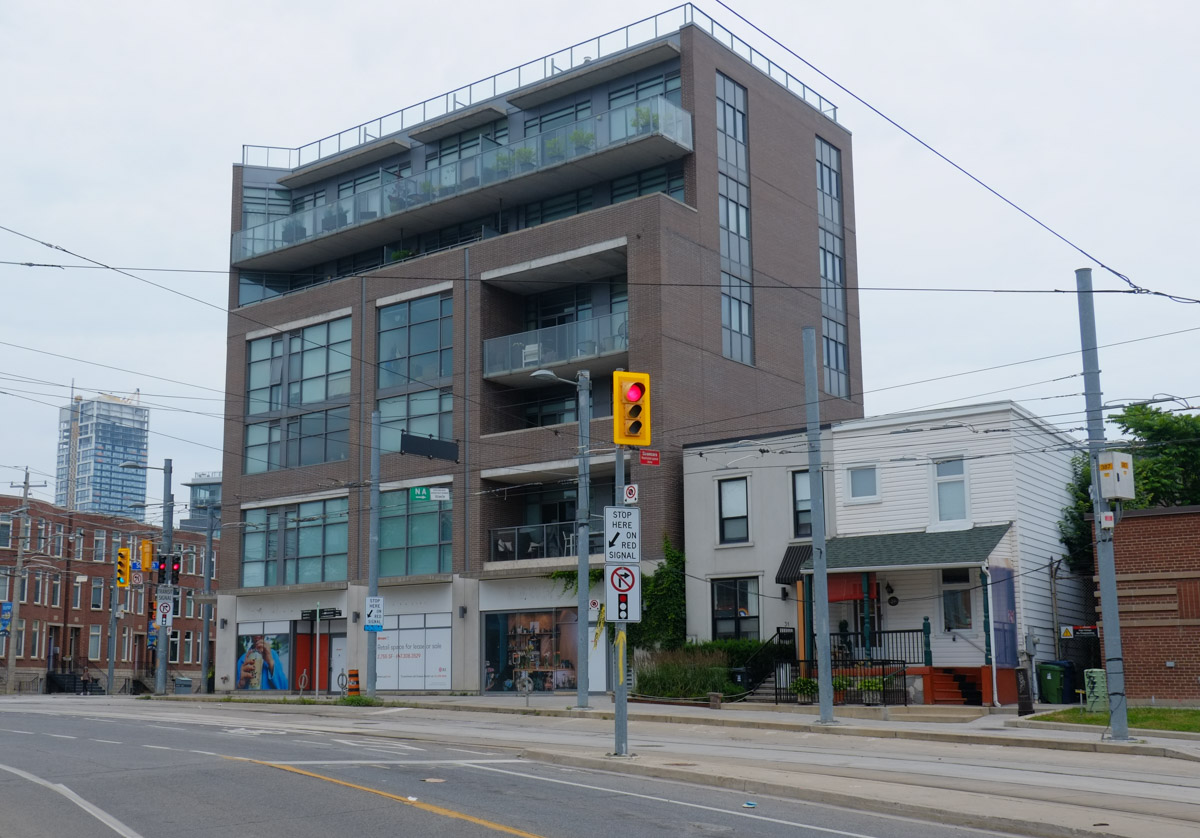
southeast corner of King and Sumach, newer 4 storey apartment building, 2 older square roofed family homes beside that

below: On the northwest side of the intersection are a couple of old brick houses that still survive.

two houses in a row, one is light blue with a large rose bush in front, to the right is a mechanic shop, Central Auto

below: When I looked for old photos of the area, I found this one…. If I am not mistaken, it is the same location as the photo above but from a different angle.  The building that looks like it’s going to collapse any minute has been replaced by Central Auto.   On the right hand side of this photo there is a striped brick building in the background.  This is a church at the corner of King and Bright.
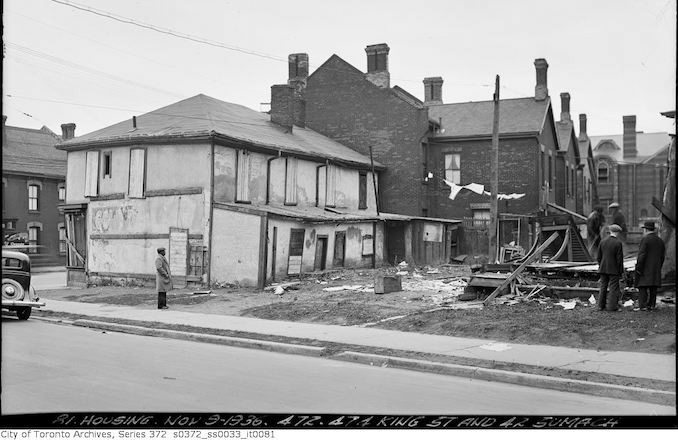
old vintage black and white photo of housing at King and Sumach

Housing – Nov 3, 1936, 472 and 474 King St. and 42 Sumach.   City of Toronto Archives, Series 372,

South of King Street, Sumach curves to join Cherry Street at Eastern Avenue.  As you travel south, Inglenook School is on your right. Between 1834 and 1890 this site was the home of Lucie and Thornton Blackburn, refugee former slaves from Kentucky who started Toronto’s first taxicab company. The school was designed by William George Storm (1826-1892) as Sackville Street School.  Storm also added the tower to St. James Cathedral and designed the wrought iron fence around Osgoode Hall amongst other things.
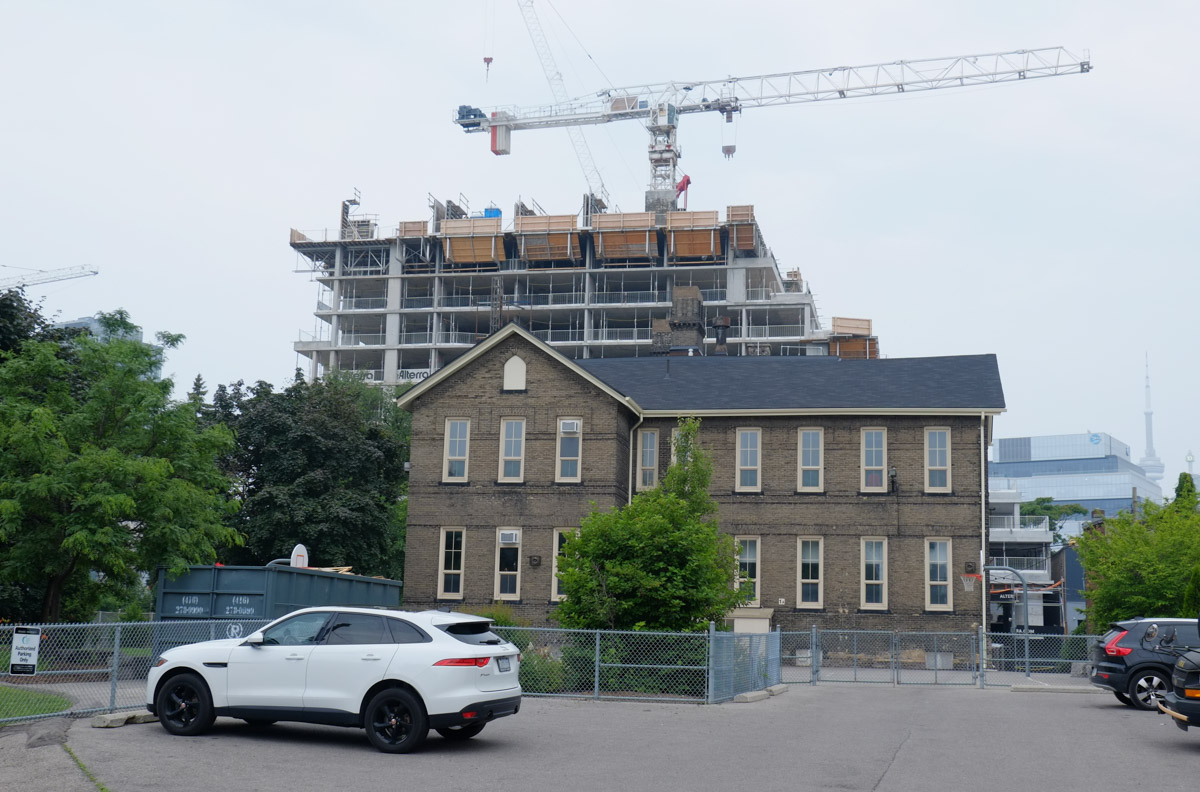
white car parked in frontof an old school building, brick, two storey, with condo development going on behind, is now Inglenook community school.

Inglenook School’s claim to fame is that it is located in the oldest continually-operated school building in the Toronto District School Board.

From here Sumach Street becomes Cherry Street.  The Distillery District is the next attraction on the route before Cherry crosses the Lakeshore (closed at the moment) and heads through the Port Lands to Cherry Beach.  But all that excitement will have to be found in other blog posts!

graffiti wheatpaste on the side of a Canada Post mailbox, words that say the more you feel your feelings the easier it gets

rusty mailbox at 504

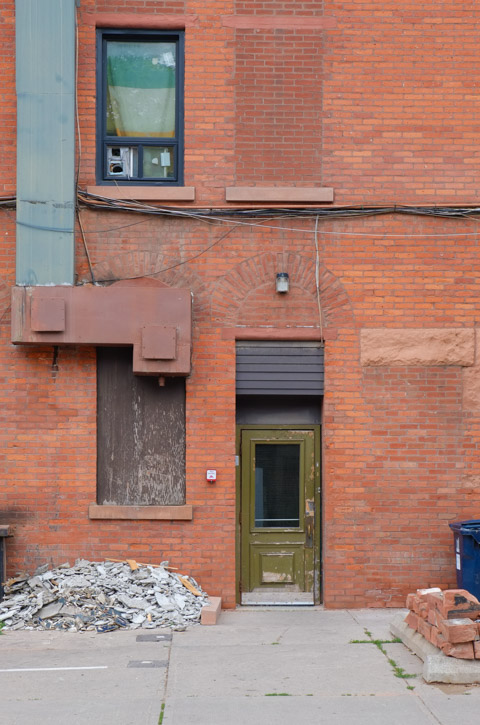
greenish colour door in brick building, side door of old Dominion Pub

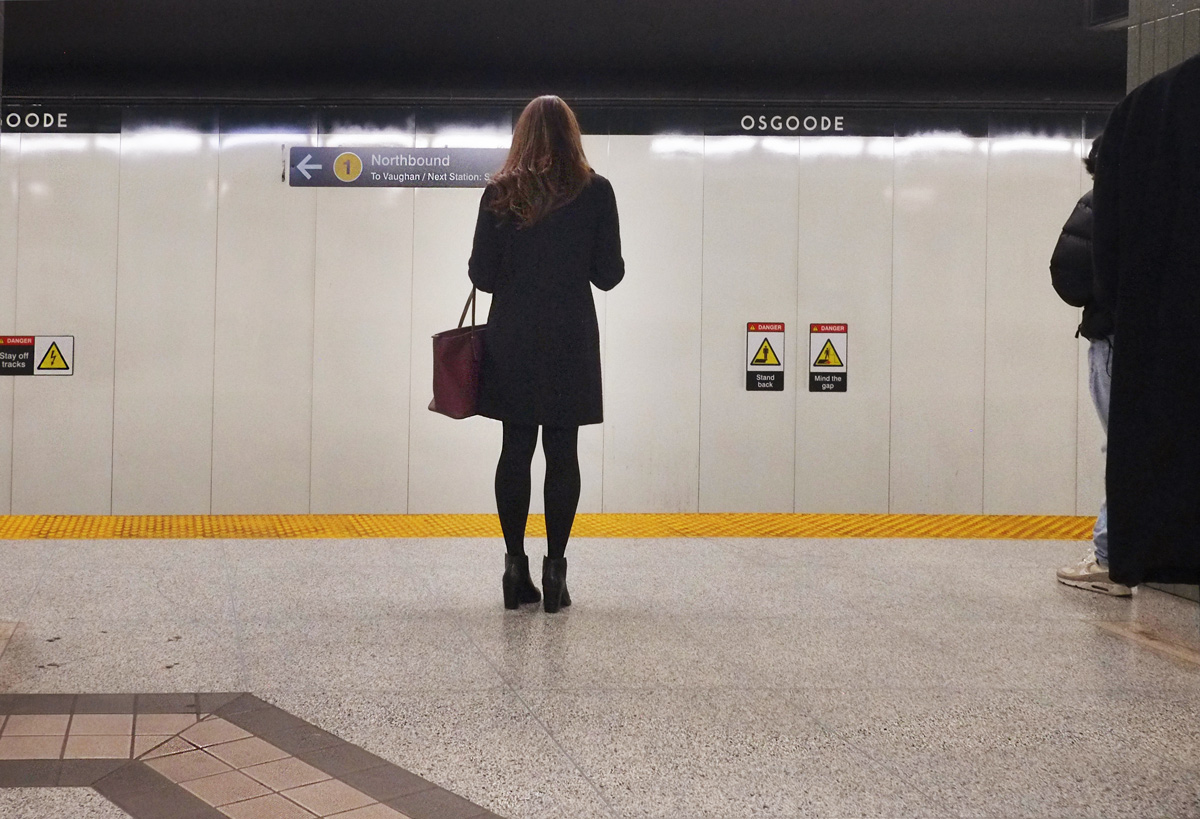
Welcome to Osgoode subway station.

young woman in short coat, boots, and a reddish handbag stands on the osgoode subway station platform

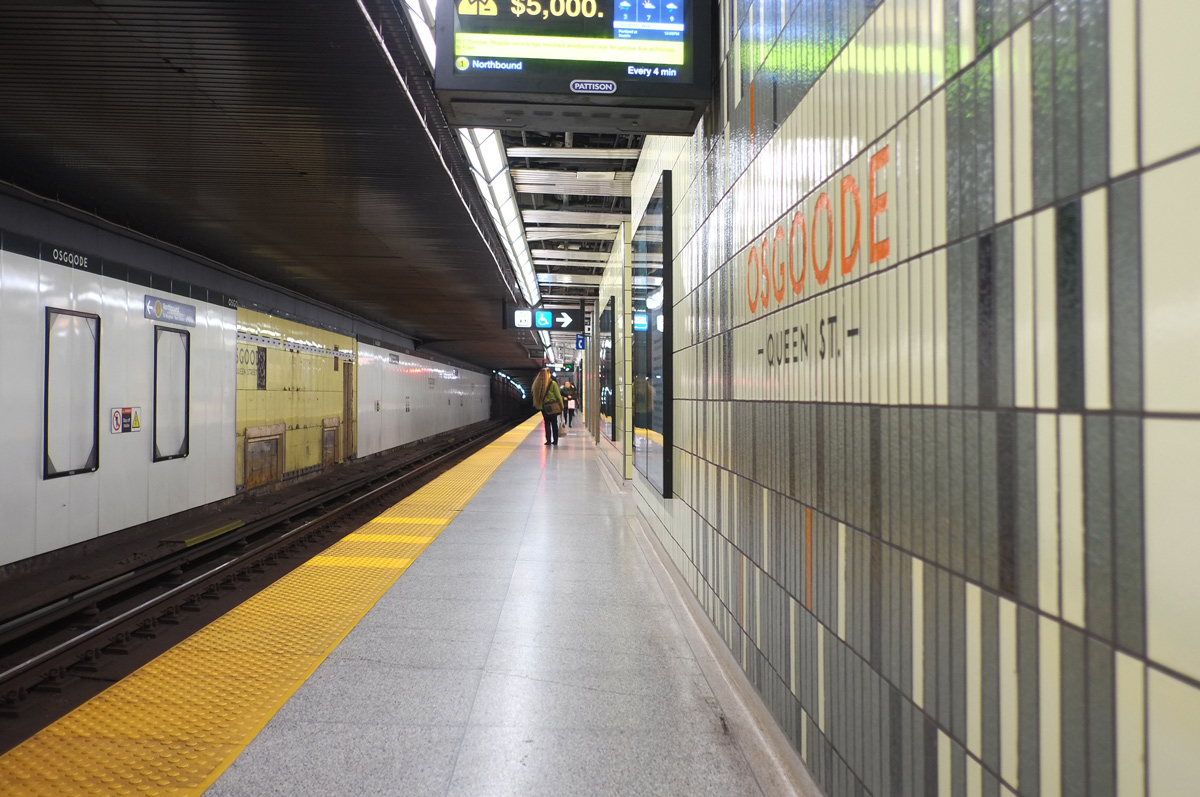
It’s not the busiest station on the University Line but changes are in the works.  It is going to become one of the transfer stations with the new Ontario Line.  This line will cross downtown underground with stations at: Corktown, Moss Park, Queen, Osgoode, Queen/Spadina, and King/Bathurst.

Osgoode subway platform

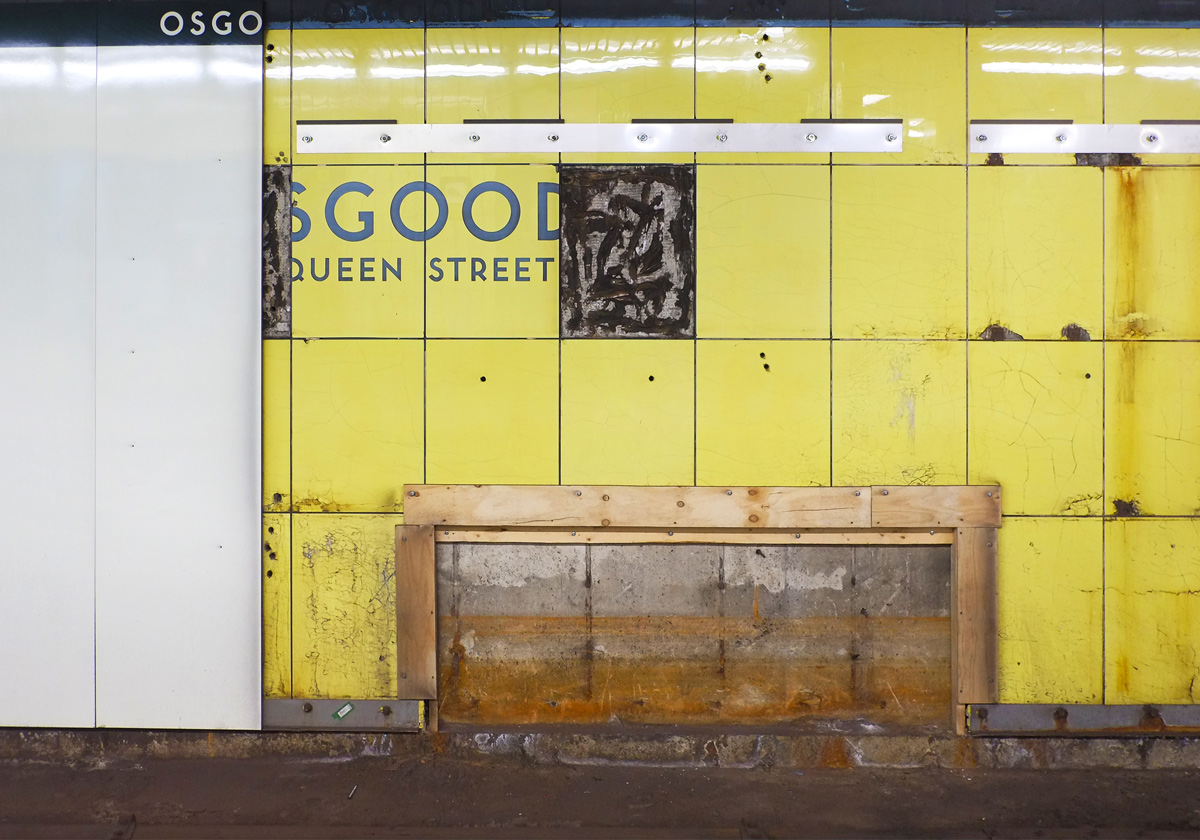
When the University Line was built in 1966, Osgoode station was yellow with greenish accents.

section of wall at osgoode subway station, original yellow tiles have been revealed when part of new white cladding was removed

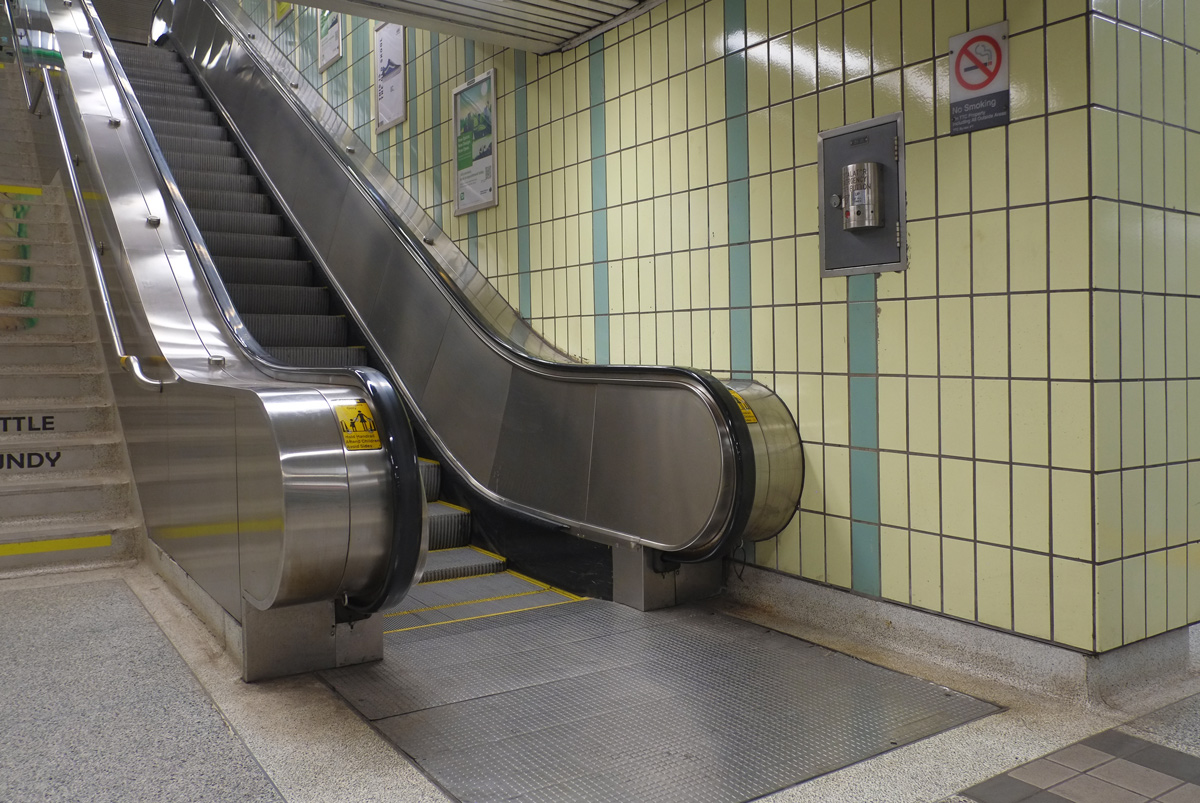
Like other University Line station, it is nondescript and built with the minimum of fuss.

escalator from platform level at osgoode ttc subway station, yellow and green tiles on the walls

One could say the bare minimum

tunnel to an exit at Osgoode station, green tiles on walls, grey institutional flooring, overhead lights, exit sign at the end of the tunnel

One of the only extras that have been added to the station recently is direct access to the  Four Seasons Centre on the southeast corner.

stairs connecting osgoode subway station with Four Seasons centre

The other three corners of the University and Queen West intersection have stairwells on the sidewalks that connect to Osgoode station.   But…. I didn’t really mean to dwell on the station itself….

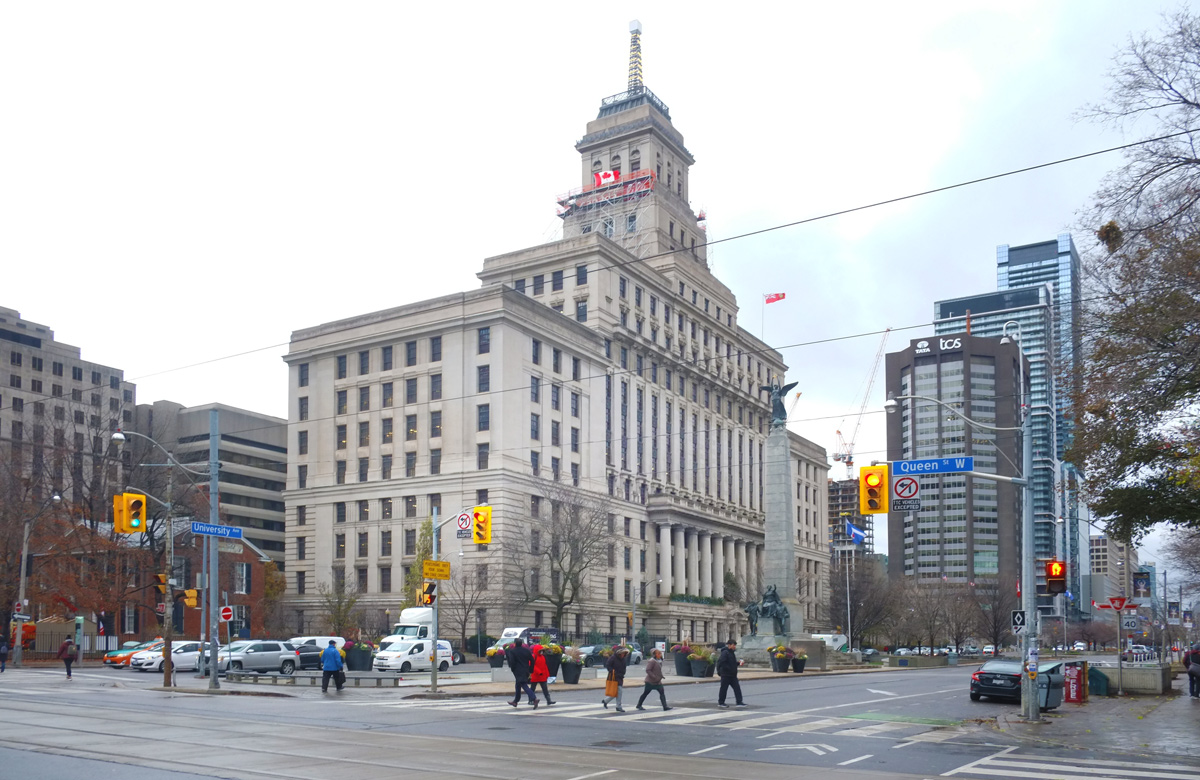
below: Canada Trust building on University Avenue
Canada Trust building on the west side of University Ave., just north of Queen, people crossing University Ave at the intersection, rainy day

I came here to document the intersection as it is now, pre-Ontario Line construction (and years of disruption!)

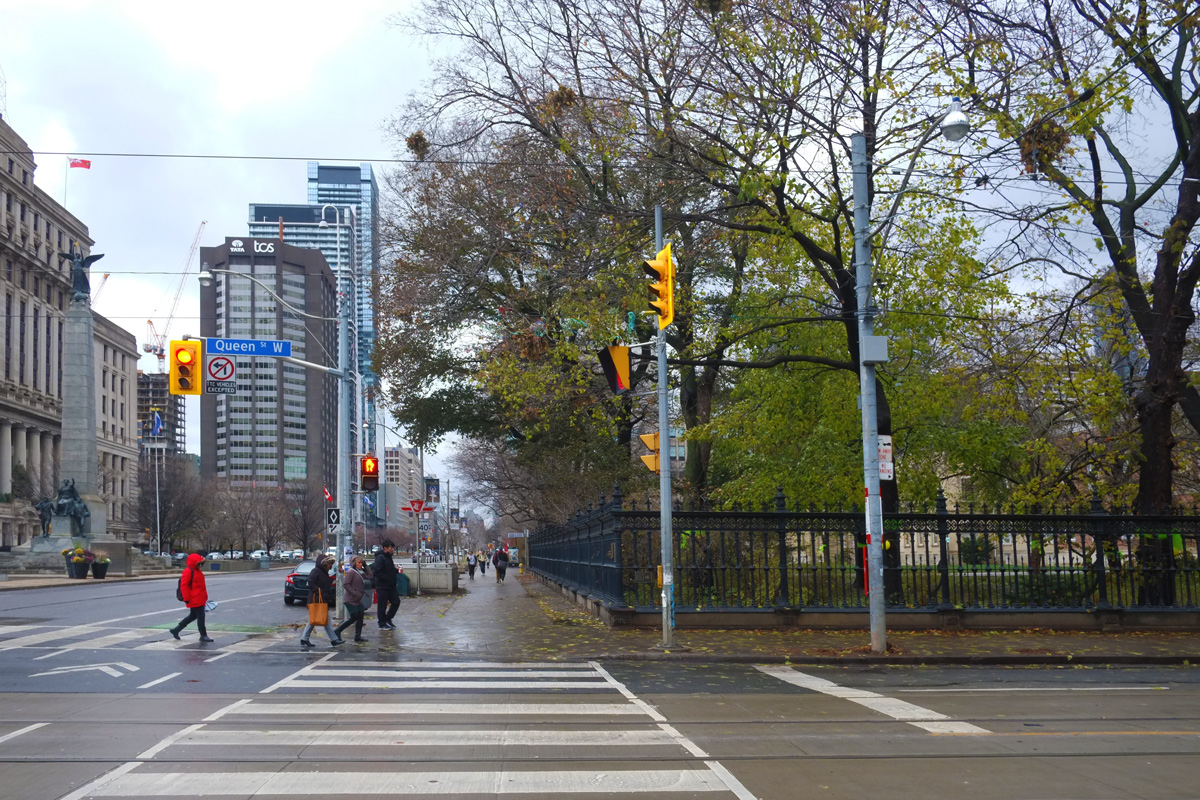
below: Looking north up University Avenue from Queen, east side of University (including the present subway entrance on the sidewalk – close to where the pedestrians are in the photo).

looking north up University Avenue, east side, from Queen, Osgoode law school with green grass and trees in front, surrounded by black wrought iron fence

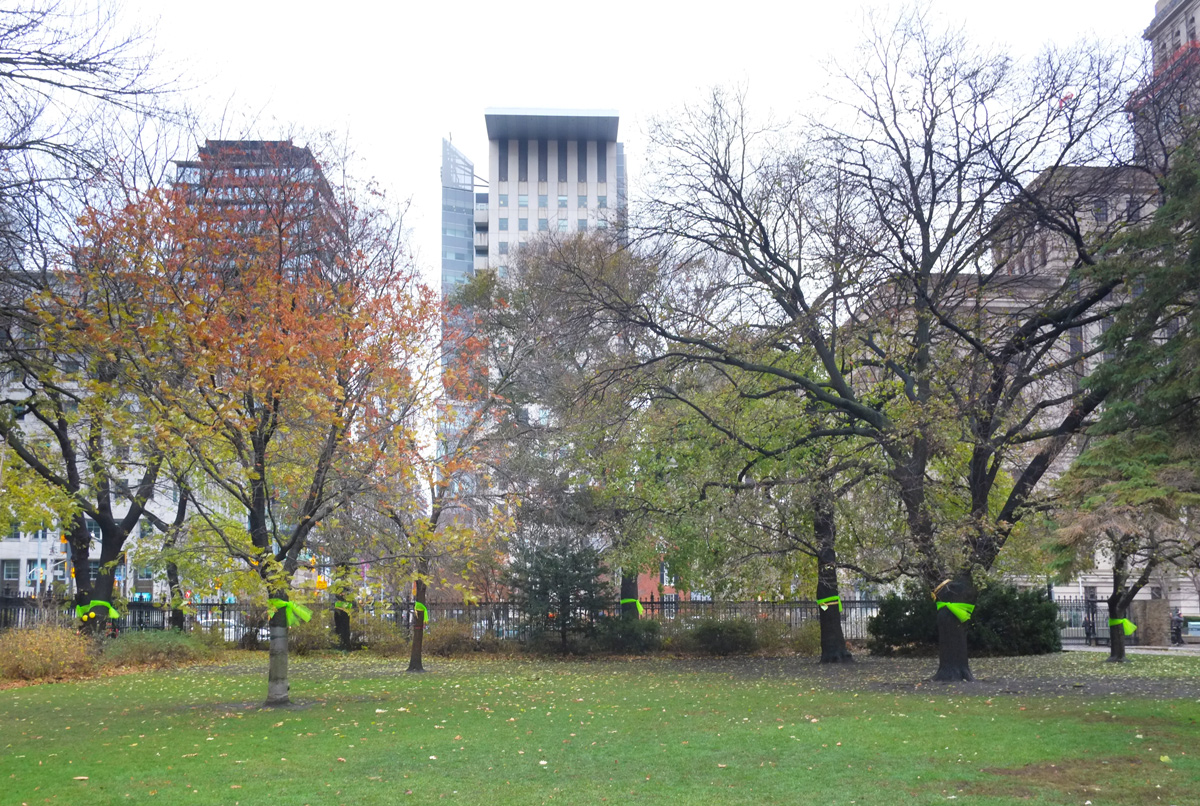
Behind the black wrought iron fence is the former Osgoode Law School (for which the subway is named).  There is public access to the grounds and it is an oasis of green and shade in the summer time.  Green ribbons have been tied around the large trees.

trees in a park, late autumn, early winter, green ribbons are tied around the large trees

… and at least one tree has been tagged as an historic tree.

a large tree trunk with a gold ribbon and green tag on it. Tag says historic tree

Metrolinx wants to build another subway entrance here.  Apparently a third-party independent review of alternative station designs is in the process but hasn’t been completed yet.  Metrolinx decided that in the meantime they’d cut down the trees on the 5th of December (this coming week) anyhow.    If you want to see one of the ideas for the plan, there are artist’s renderings on their website:   The Ontario Line – Neighbourhood Updates – Downtown – Osgoode Station.  As usual, what is pictured now is never guaranteed to be the end product!

The Law Society of Ontario is the custodian of this greenspace and they have formally objected to Metrolinx trying to short-circuit the process.

green space in front of Osgoode Hall, trees, grass, tall buildings in the background (looking south)

Yet another location to keep an eye on!

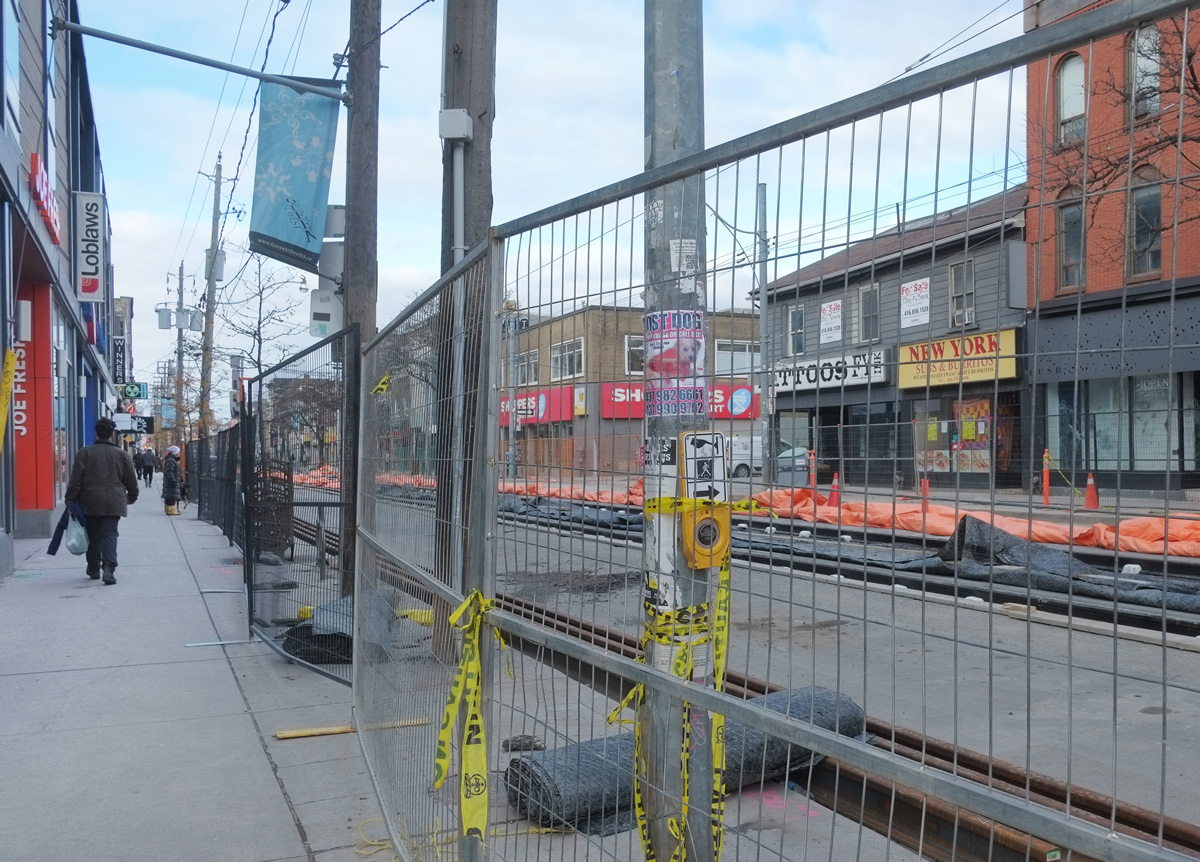
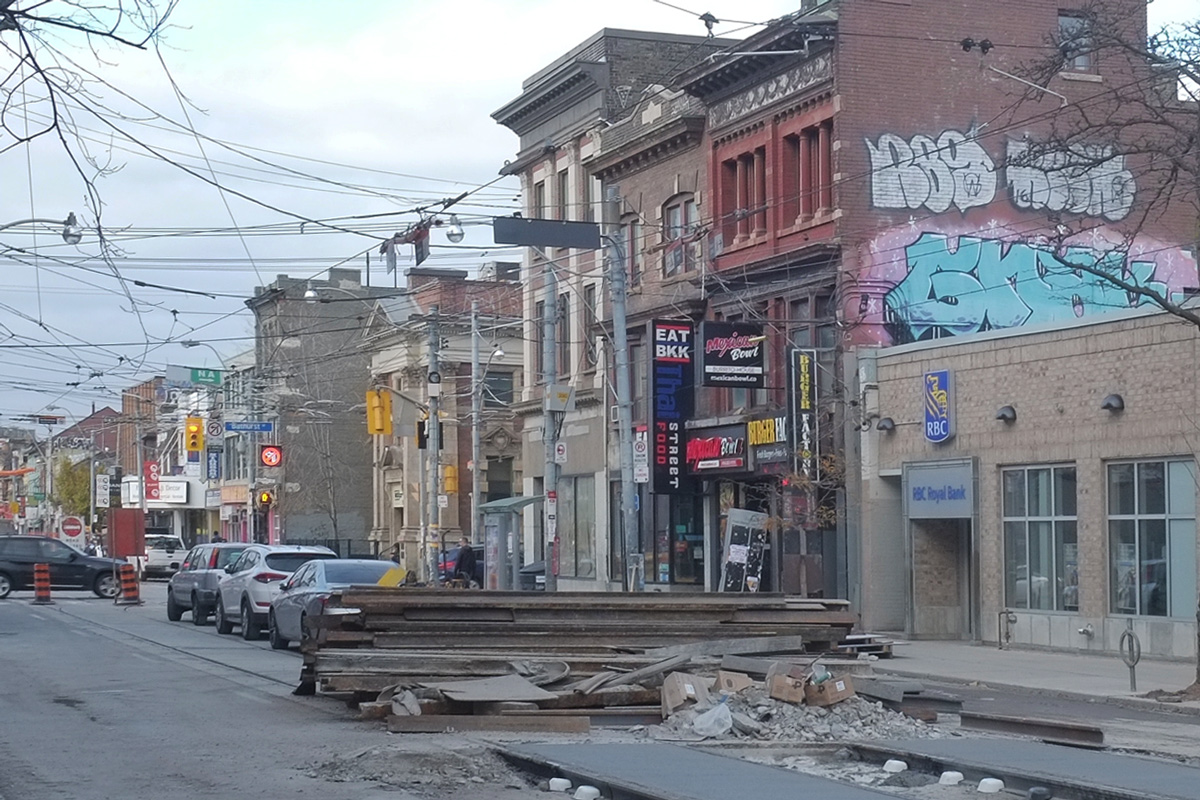
The recent closure of Queen Street West for streetcar track work provided an opportunity to take a few photos without traffic or parked cars in the way.  Straight documentation and not much more.  But that way, when you next walk Queen West and it’s wall to wall new condo development you can check back here and say, “I remember when”….

two cyclists on queen street west

below: On the northeast corner of Queen West and  Augusta – The Wool House, Drinks & Deli, and One Stop Shop

row of stores on Queen West with construction fence in front

below: Queen and Augusta – Java Hut on one corner and an empty KFC on the northwest.

empty KFC Kentucky Fried Chicken on Queen West at Augusta

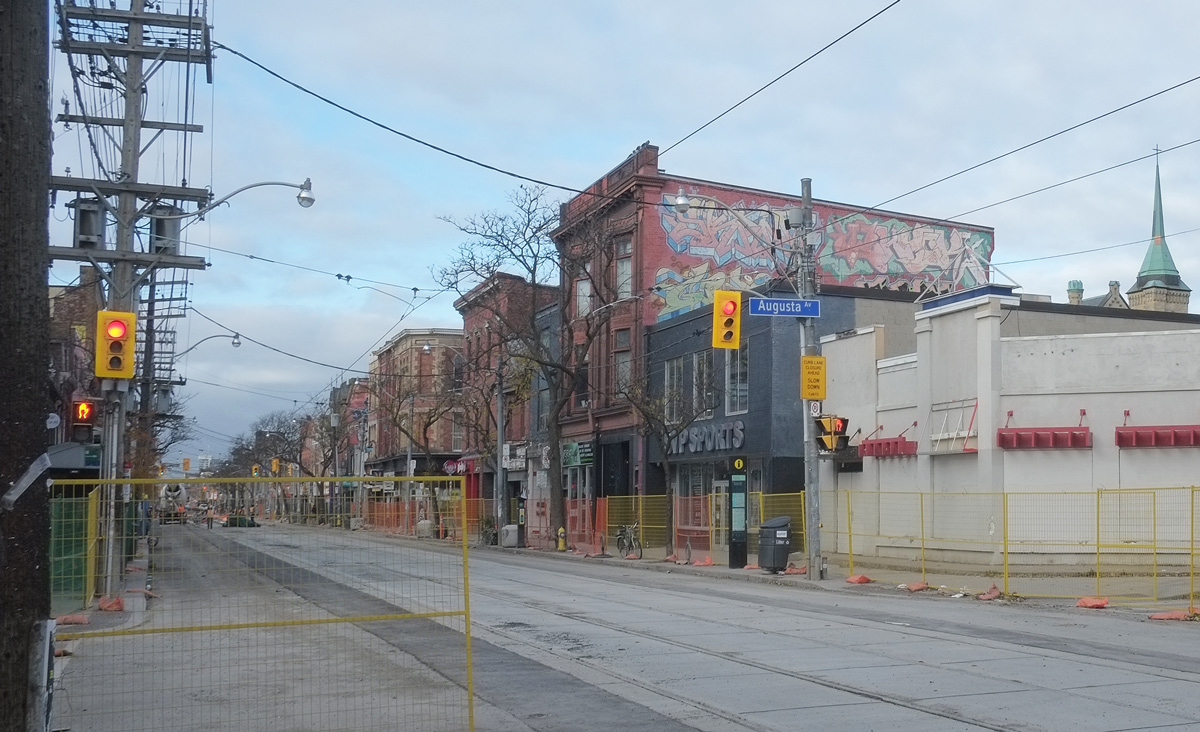
below: Looking west from Augusta

looking west along Queen Street West from Augusta

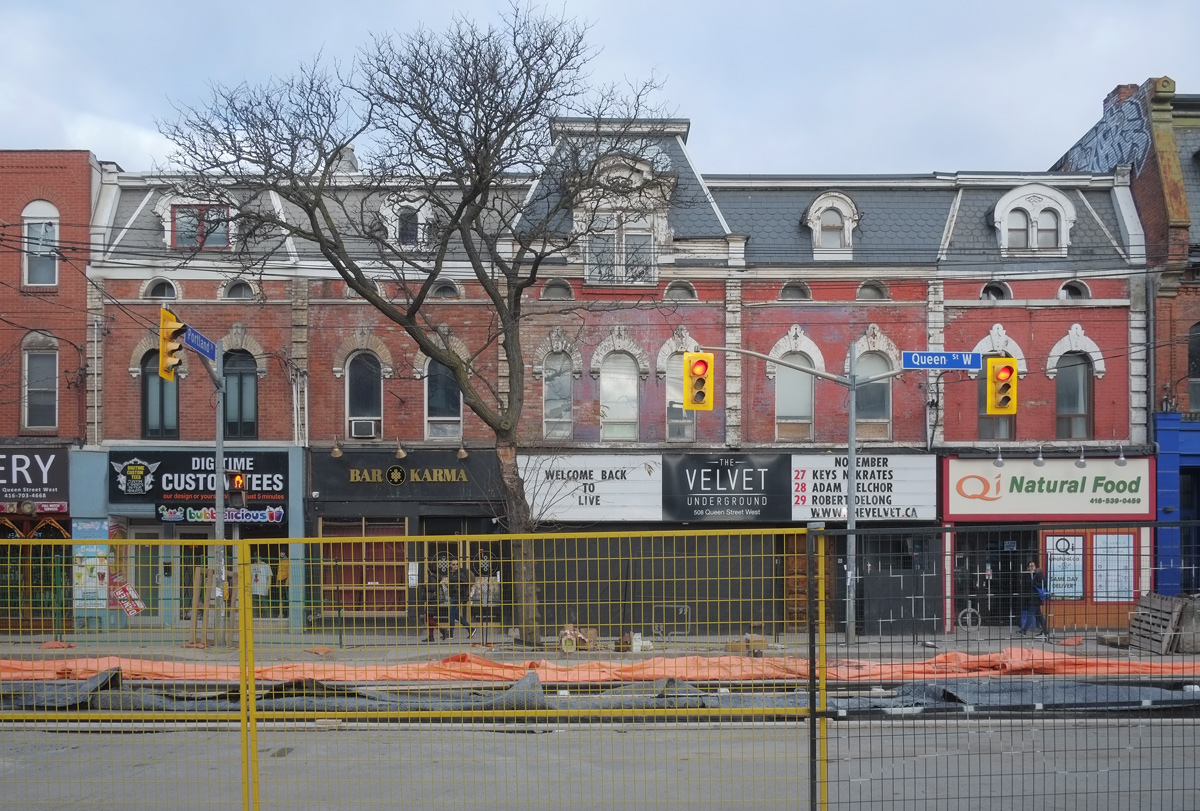
below: working on the TTC streetcar tracks just east of Portland

workmen working on the TTC streetcar tracks on Queen West

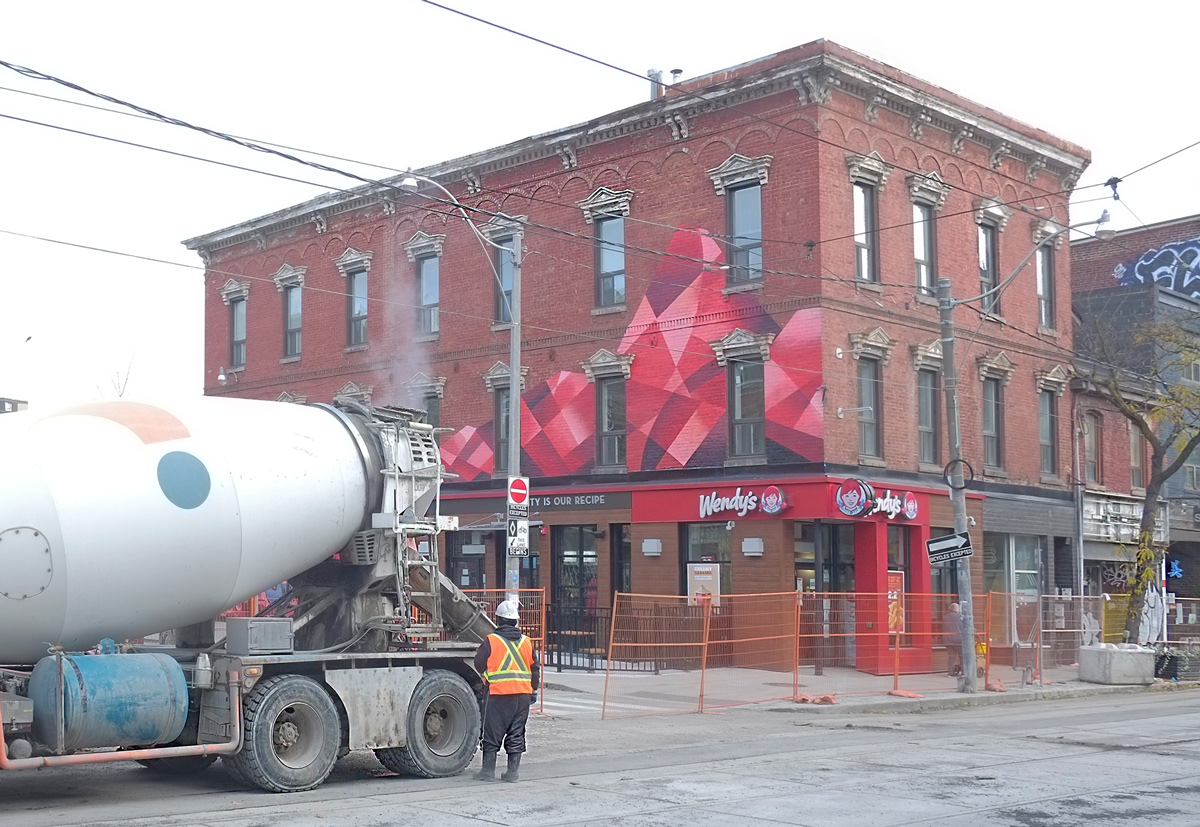
below: Black and red mural on the outside of Wendys at Denison Ave

cement truck with a workman standing beside it, on Queen West, by a Wendys restaurant in a three storey brick building with a mural in red and black on the outside

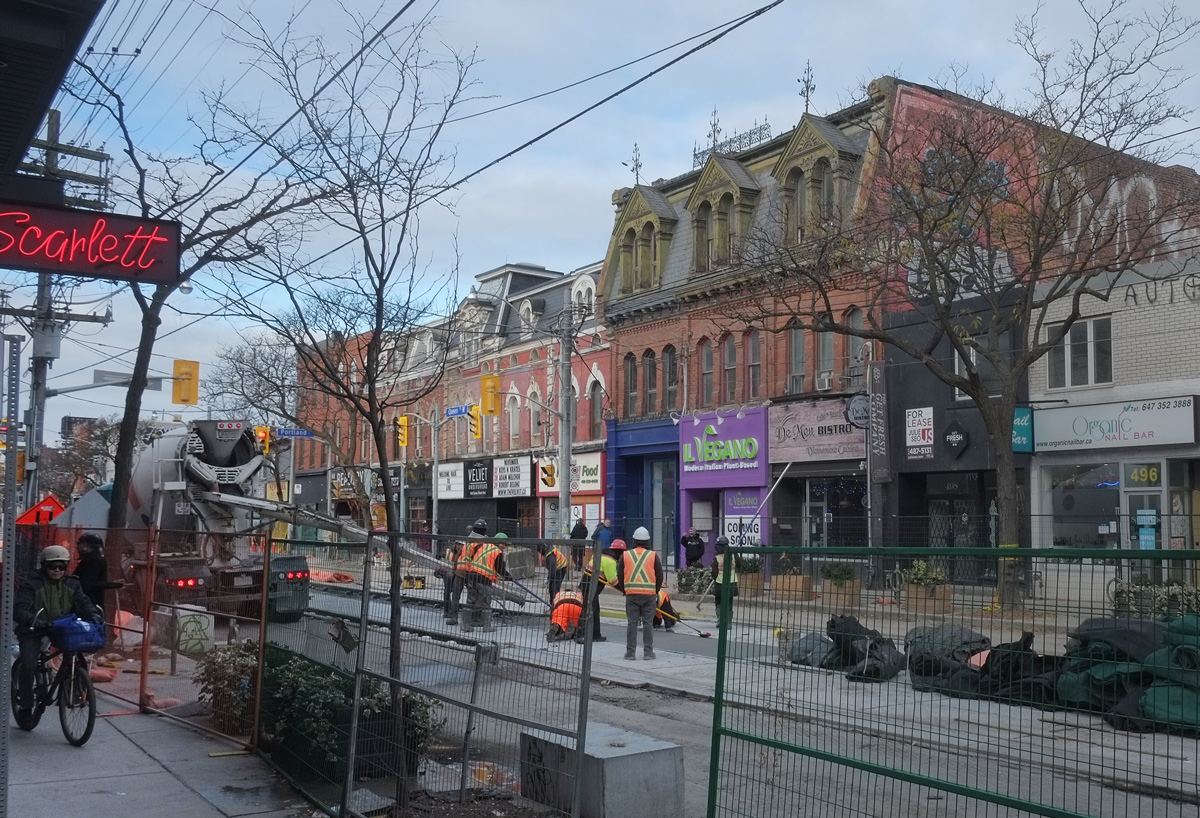
below: Queen Street West, north side, at the end of Portland Street.

old building, now stores, on Queen Street West at the top of Portland Street

below: Walking westward away from Portland

woman walking on the sidewalk between store fronts and construction fence, TTC track work being done on Queen West

below: Looking west from Tecumseth and Palmerston

looking west along Queen Street West from Tecumseth and Palmerston

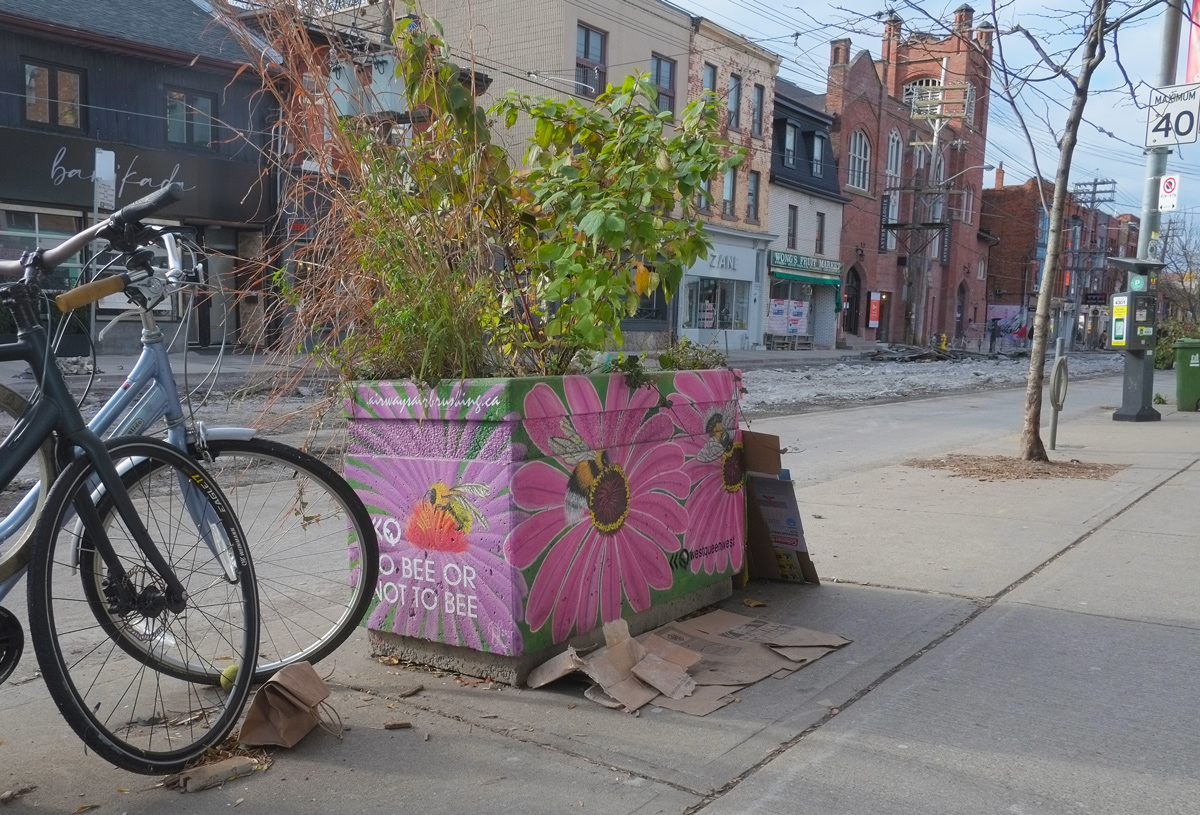
below: Daisies and bees as Queen West approaches Euclid

concrete planter on Queen West painted pink with picture of daisies and bees with words to bee or not to bee

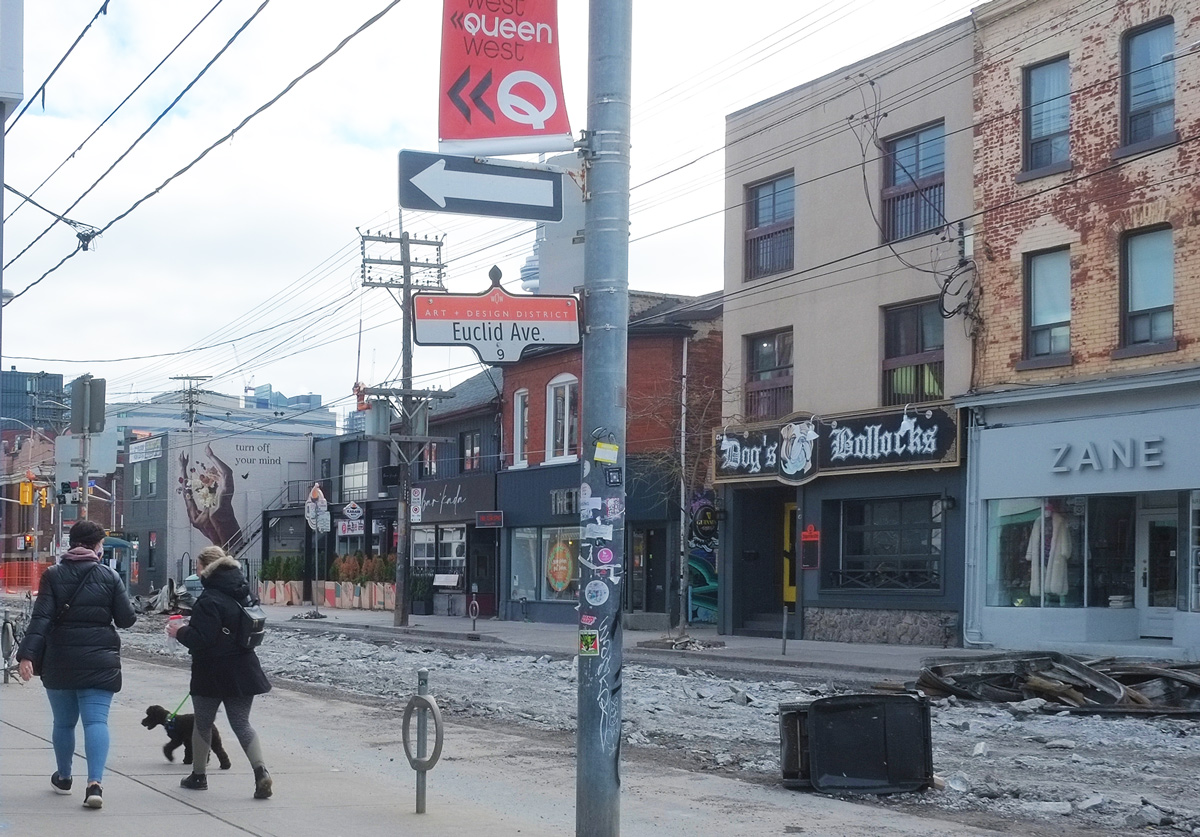
below: at Euclid

two women walking dogs on Queen West at Euclid

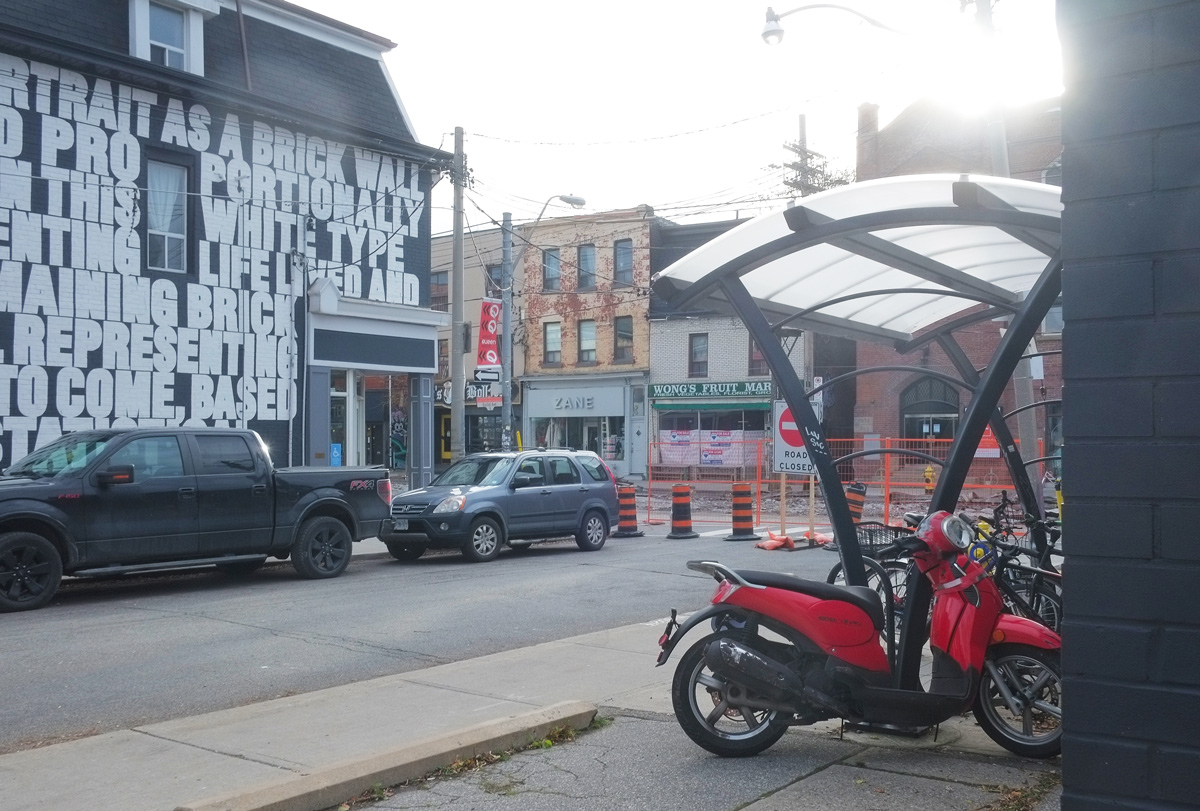
a red motorbike is parked in a bike parking lot on the sidewalk, building across the street has street art -- a lot of large white letters that take up almost the whole side of the building

below: Looking back eastward to Euclid

a yellow digger is the middle of Queen Street West removing street car tracks, west of Euclid

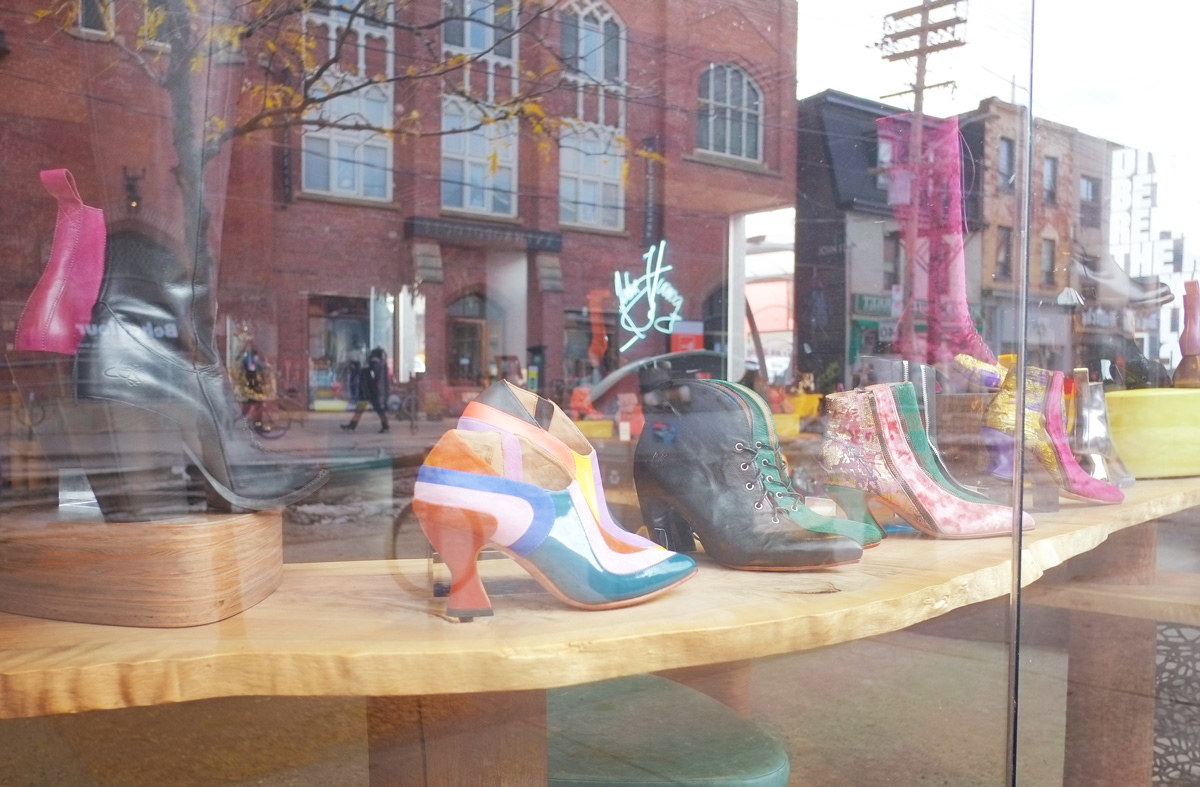
below: Reflections of Queen West in the window of John Fluevog shoe store

reflections of street scene in window of John Fluevog shoes on Queen West

below: North side, at Bathurst.  The construction ends and traffic resumes.

Queen Street west, north side looking towards intersection with Bathurst

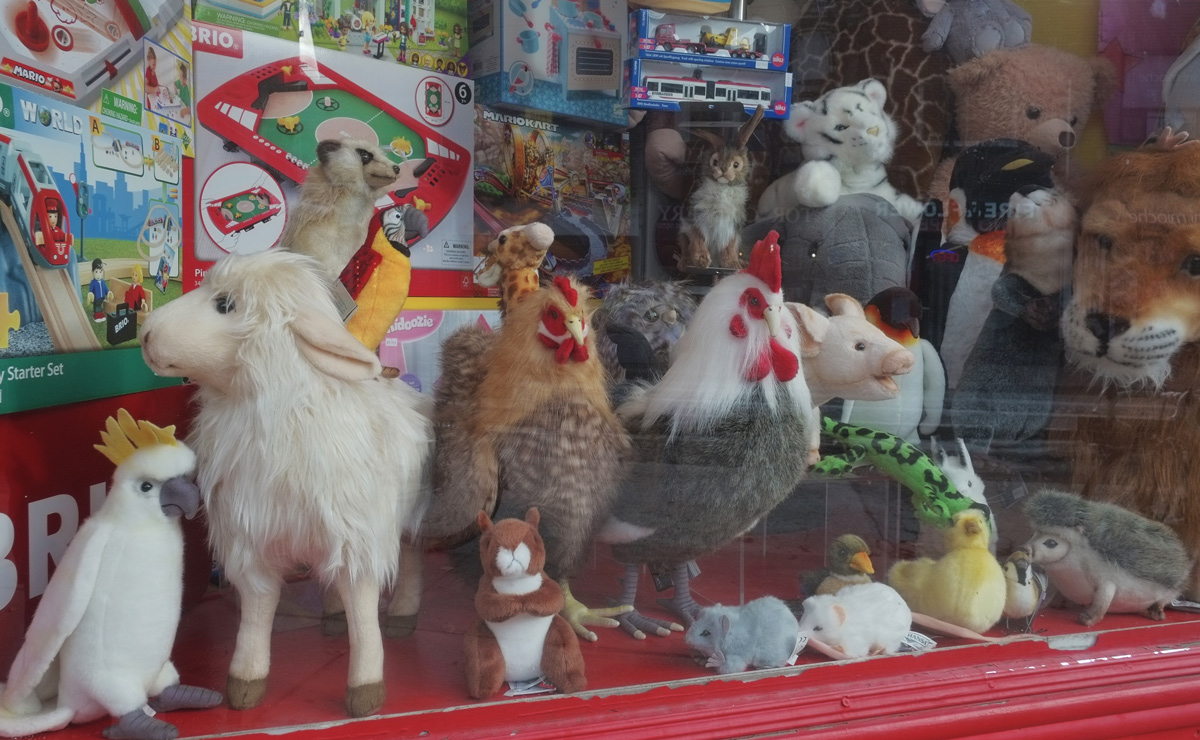
games and stuffed animals in the window of a toy store - chickens, pig, snake, mice, goat, sheep

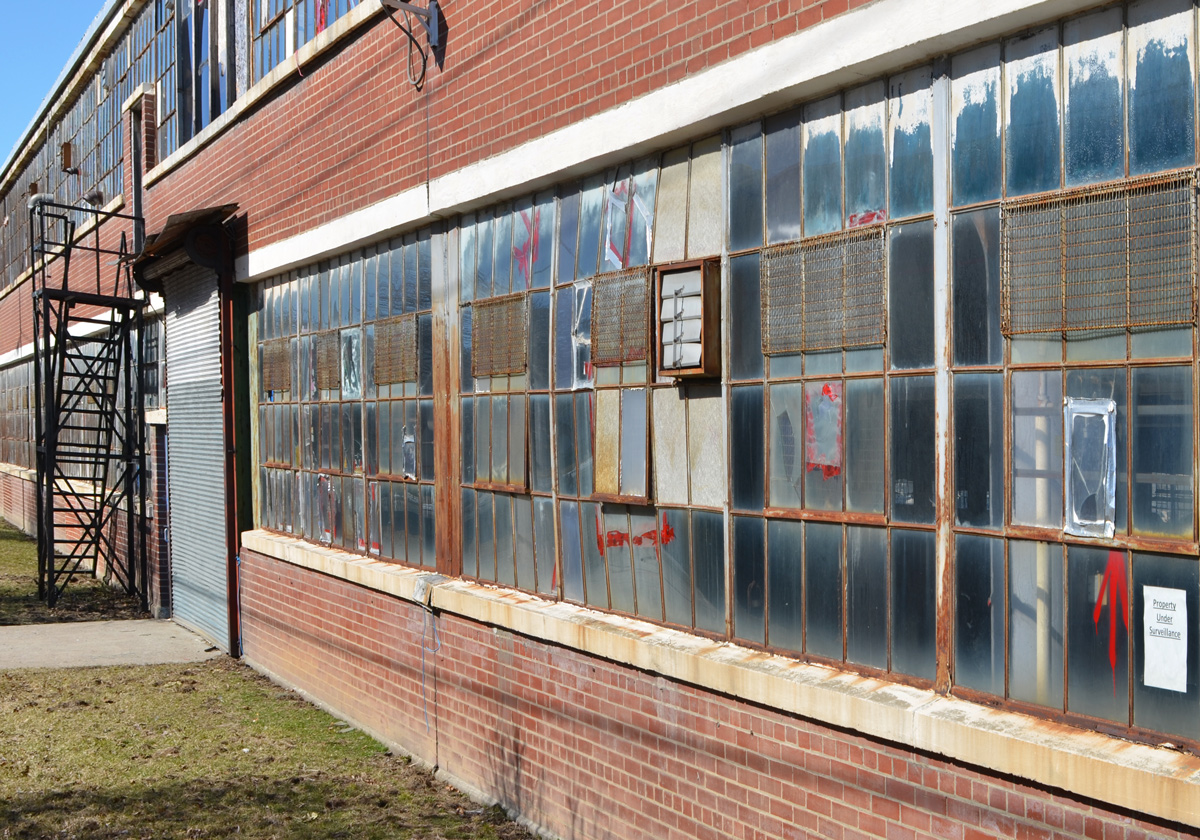
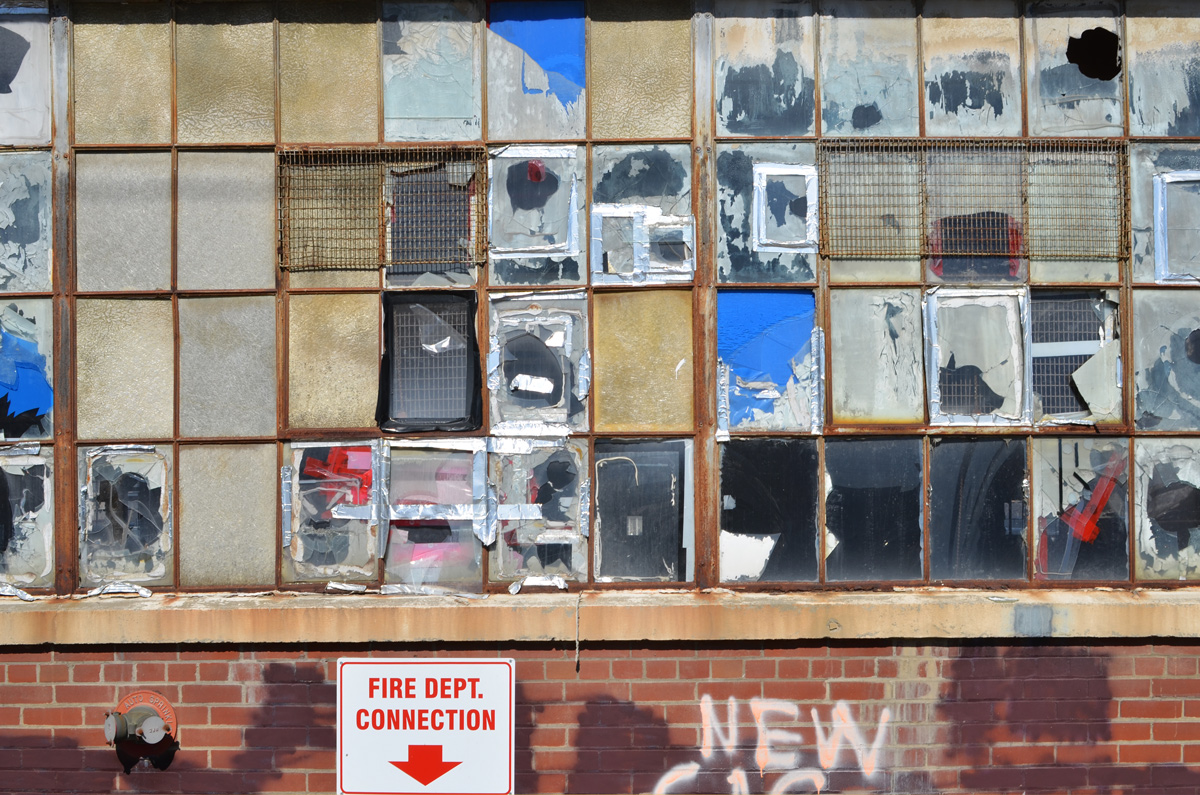
Until a few years ago this was part of Parkhurst Knitwear but today it sits empty. Today when I passed by the lighting was good for taking pictures of the south exterior wall.  There is a fence between the street and the building but there is ample room for photography.   I am now on many surveillance videos (if the warning signs were for real).

20 Research Road in Leaside, the Parkhurst factory, previously Dorothea Knitting Mills, built in 1942

This building started its life as Radio Stores Building No. 16.  It was constructed in 1942 and the chimney was added in 1946.  Building No. 16 was part of a complex of buildings occupying 55 acres of land east of Laird Drive and south of Eglinton that was owned by Research Enterprises Ltd. (REL).  During WW1 this land was an aerodrome.

horizontal window in a brick building made of rows of small rectangular panes of glass

In 1940 REL was incorporated in response to the outbreak of World War II; it was a Crown Corporation created through the Munitions and Supply Act of Parliament in September 1939.

looking along the exterior wall of two storey brick building with long horizontal ribbons of window panes, many glass pieces are broken or cracked and then fixed with tape

REL’s mandate was the production of technology equipment such as optical instruments and radio and radar equipment to assist with pilots with night flight.  During its 6 years of operation, REL employed 7,500 people.

broken and patched panes of glass in a larger horizontal window

After the war, this building was sold to Dorothea Knitting Mills (1947).  Dorothea ultimately became part of Parkhurst Knitwear.

smokestack at east end of old Parkhurst knitting mill building, now abandoned

This building is part of a larger story – the slow disappearance of industries in Leaside as commercial and residential developments proliferate. Prior to 2010, the area was zoned industrial but developers fought for, and won, changes to the zoning in the area.

south wall of Parkhurst knitting mills, empty and abandoned, many glass panes cracked or broken, old curtains in the window

I can’t remember how long this building has been empty. If was still a functioning knitting mill in 2013.  In 2019 the city of Toronto moved to have the building listed as a Heritage site.  Last year there was a large sign on the building advertising the fact that it was soon to be a self-storage facility.  Is that still its fate?

old brown pipe inside, looking through old window


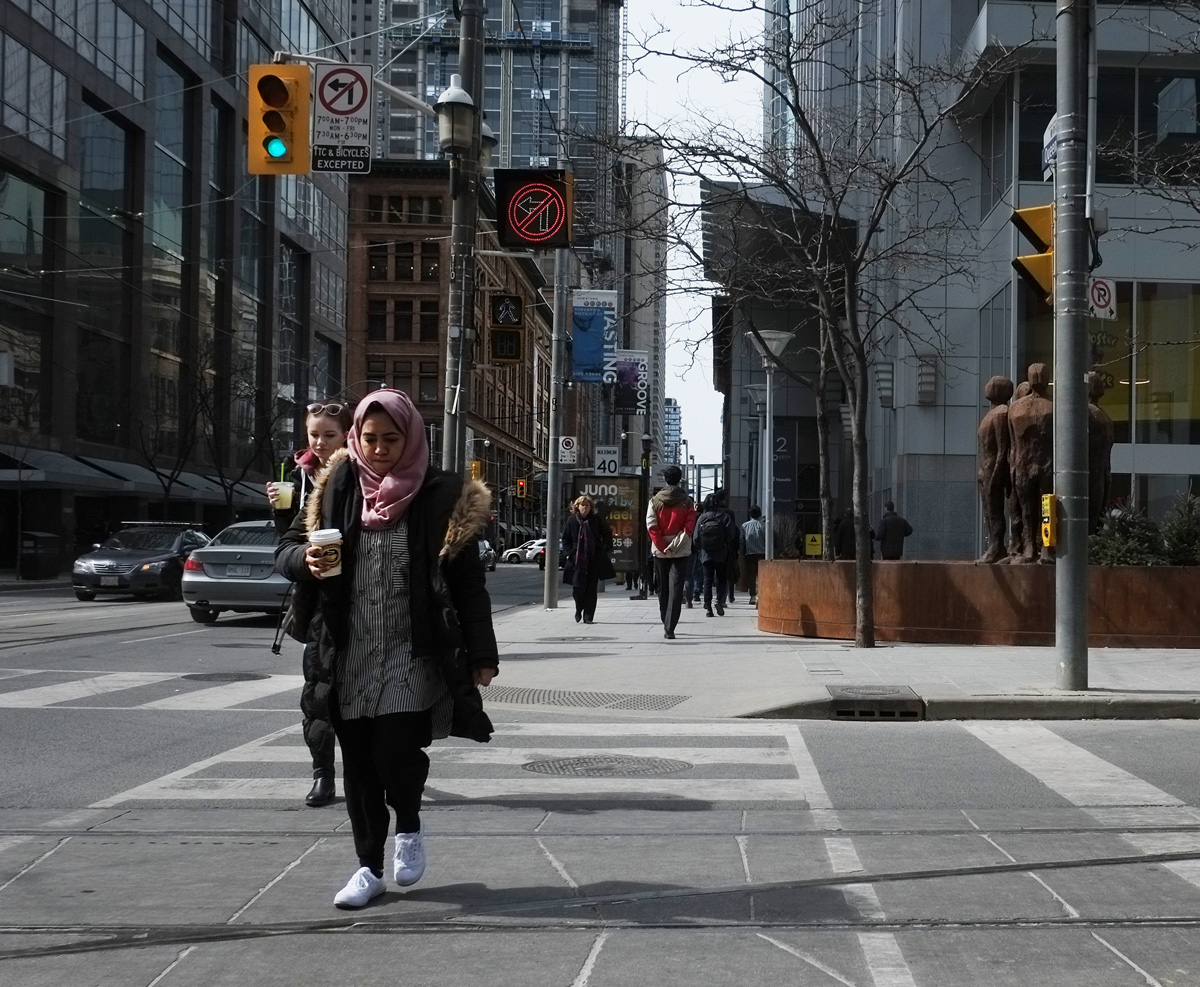
two women holding cups of coffee walk across Victoria St. on Queen Street East

Just after I wrote the previous blog post about some of the buildings on Yonge Street that are in the middle of an area being redeveloped, I walked across Queen Street East.  I noticed that there were a lot of similar three storey buildings here to those around the corner on Yonge.  Toronto must have been a booming city in the late 1800’s and early 1900’s when these stores and warehouses were built.

below: What I also noticed is how many of the storefronts are empty.   This is the northeast corner of Queen and Mutual.

the northeast corner of Queen street east and Mutual street, with an empty building on the corner.

What I don’t have is a photo of the northwest corner – it is about to be developed, or at least there is a plan to develop it, into a 29 storey glass tower.   Urban Toronto called this location, “a spot that currently feels disconnected from the rest of the City. ”  … maybe because the Moss Park neighbourhood is on the lower part of the socioeconomic spectrum?    Urban Toronto is a website that is, their words, “populated by the tastemakers, condo aficionados, buyers, builders and realtors”.   I try to stay neutral in the pro/con condo development argument but it irks me to read things like, “Redefining the urban experience” and variations thereof over and over and over again to describe mediocrity.

To be fair, this 88 Queen West project is redeveloping a parking lot.  Why is it a parking lot?  Because in the 1950’s a parking lot was more important that the buildings, including Cooke’s Presbyterian Church (1857), that originally stood there.   Perhaps we get what we deserve.


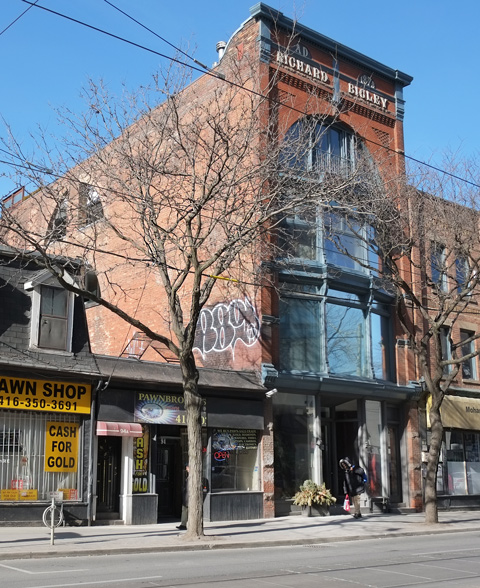
below: Richard Bigley (1853-1933) started off as a woodworker but soon switched to selling stoves. He sold the ‘Happy Thought’ line of stoves. He holds two US patents, one for a water heater and one for a sectional water heater. The building was converted into loft apartments, one loft per floor, back in the late 1990’s.

tall brick building, Richard Bigley 1876 written in white at the top (4 storeys), large glass windows in front, once an old store and warehouse, now a 3 loft apartments. 98 Queen Street East

below: Two views at the corner of Queen East and Jarvis.  You can just see the Moss Park Armoury building on the right side of this picture.  This Canadian Forces facility was built in 1960’s and it takes up a large chunk of land.  Development  rising in the north…

Queen and Jarvis intersection looking north to tall towers being built on Dundas
below: … and development rising in the west.

the intersection of Queen and Jarvis, looking northwest, with a foodora cyclist in pink in the intersection, traffic, street car, and in the distance, development on Yonge and westward, cranes, glass towers

large blue public parking sign, also a large box shaped sign on a tall pole. The sign is wearing out

below: At Ontario Street, the street sign says, Old Town Toronto.  In 1797 the city limits were moved north to Queen Street (then called Lot Street).  Ontario Street was one of the most easterly streets at that time.   And, oh yes, the city was still York.  It officially became Toronto in 1834.

toronto street sign for Ontario Street with the top part that says Old Town Toronto

below: Posters on a boarded up window – once it was a barber shop?  Posters on Queen East for events on Queen West.

posters on an empty building, exterior wall, bottom of wall has barber pole stripes painted on it.

below: A blue and white Development Notice. I still haven’t found out how many of these there are hanging around the city.  My best guess is ‘hundreds’.

blue and white city of toronto development notice sign on a chainlink fence in front of a vacant lot wehre cars and trucks are parked. For 245 to 285 Queen Street East, Bridgen Place and Richond.

At the risk of another anti-development rant, I just want to say a couple of things about the above photo.  The development here involves the closure of two public lanes, McFarrens Lane and Brigden Place.  There will be pedestrian access (public access on private land) between Queen and Richmond, between two large buildings with three towers built above them – 39, 39, and 49 storeys high.

From a City of Toronto report written in April 2016…”City Planning staff is not in support of the proposal in its current form, as the proposal not only represent over development, but also fails to recognize the existing built-form character and scale of the King-Parliament Secondary Plan Area by departing from the existing warehouse and main street typology where the site is located.”

I am not sure what the status of the project is at the moment, but the developer has a website for this project, Queen & Sherbourne, that describes it exactly as the original proposal – Three glass towers on two boring bland base buildings. It’s yet another development that looks flashy from above but is blah ick at street level.

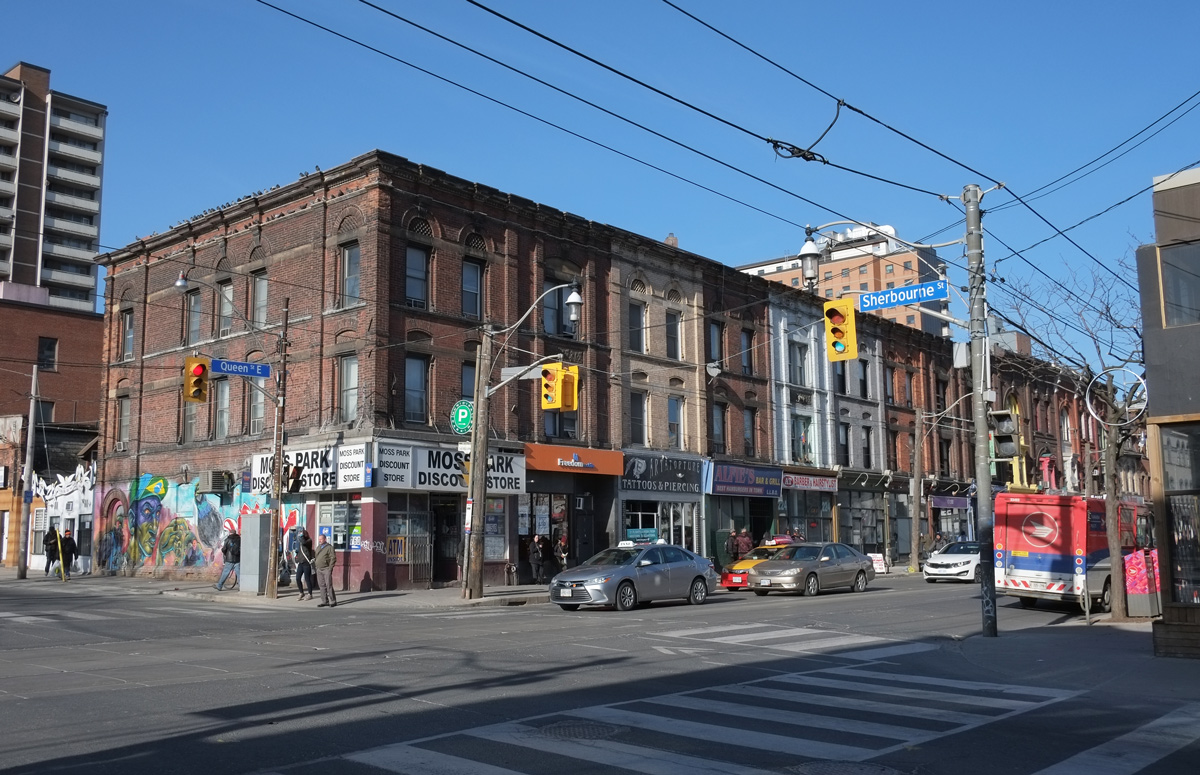
below: The northwest corner of Queen and Sherbourne

northwest corner of Queen and Sherbourne, Moss Park variety store on the corner, three storey brick Victorian buildings, cars, people,
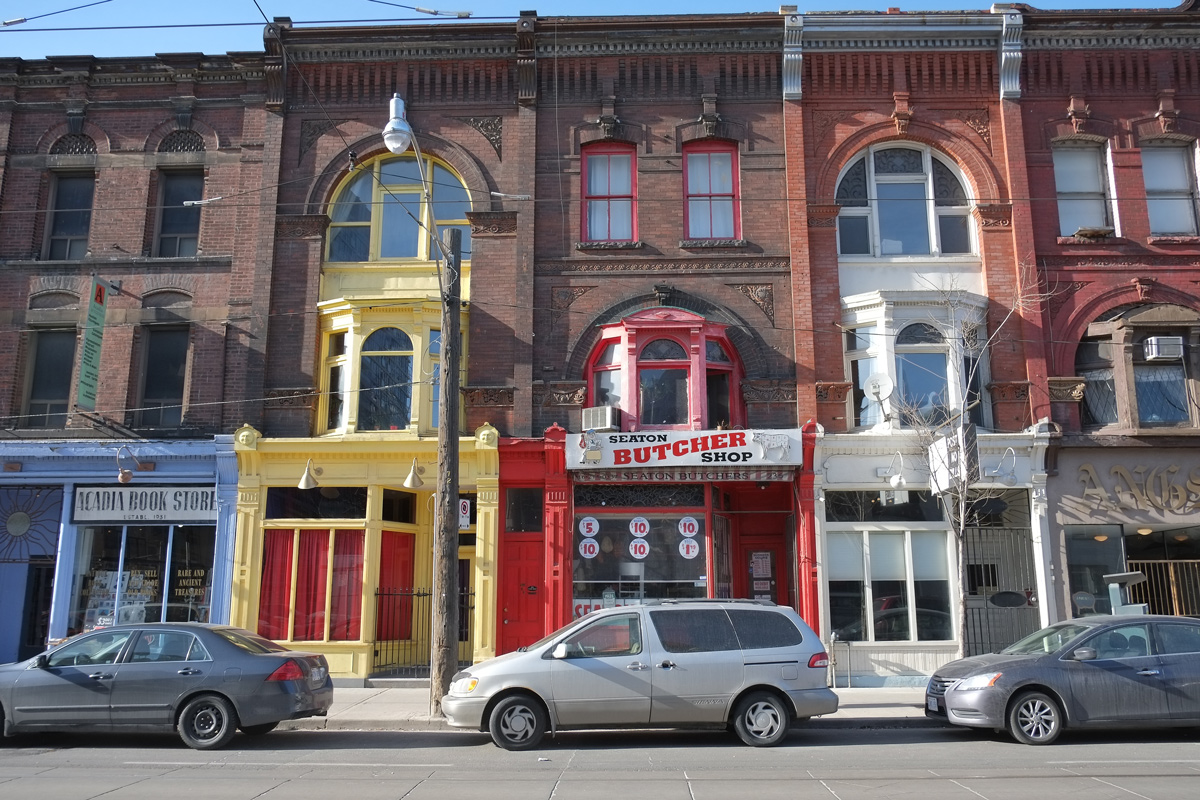
below: Bright and cheerful.

three storey victorian buildings includia Acadia Book Store, established 1931 and Seaton Butcher

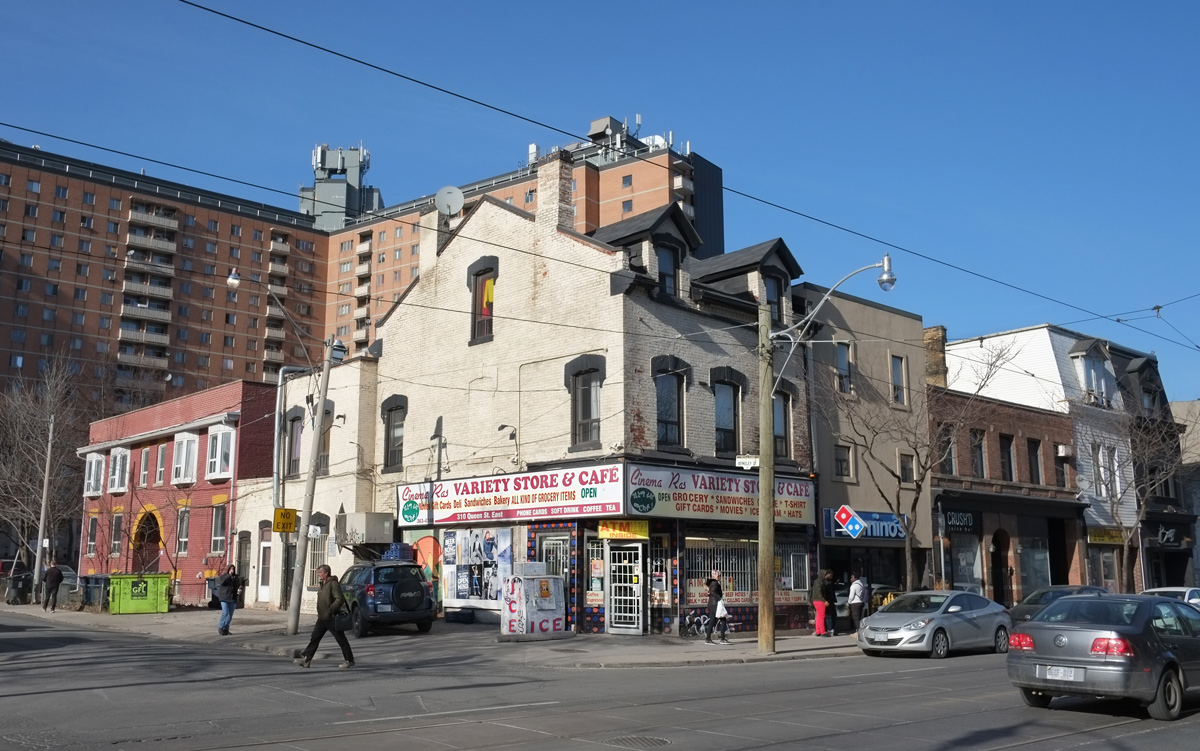
below: 310 Queen East at the corner of Queen and Berkeley.

below: Moving slightly east to the corner of Queen and Parliament (NE).  That looks like a solid old bank building on the corner.

northeast corner of queen and parliament, old brick buildings,

flat roofed old brick buildings, with oriel windows on third floor, Ray's Discount Convenience and Supermarket on the ground floor. A bus shelter on the sidewalk, people waiting for the bus, building painted rust red colour,

below: 354 and 356 Queen Street East

two narrow three storey buildings squished in between two slightly larger buildings. On the ground floor of the building on the left is Redline Coffee and Espresso while Ryans Restaurant is on the right.

below: 380, 382, and 384 Queen Street West.

two storey store fronts on queen street east, 380 Queen, 382 Queen and 384 queen.

below:  Wherever you walk there is construction.  Some of it good, some of it poor.  That’s Toronto these days.

a man walks through a covered sidewalk, past a construction site and towards a bus shelter

It’s early November and autumn is here – I think.   Some leaves, like on the locust and maple trees below, have turned colours and begun to fall but others remain green and on the tree.  After the warm than usual October that we were fortunate to have, the weather has turned to grey and damp and all too seasonally November.   Luckily, a heavier coat and a scarf is all that is required – so off we go!

autumn street scene with locust tree with yellow leaves, sidewalk, some dead leaves on the ground, grass still green, orange leaves on the tree in the background

below: I spotted these little rusted Coke and Sprite signs on a house on Christie street.   Like the autumn leaves, the weather has changed their colours and I especially like the pale turquoise that the Sprite bottle has become.  It nicely matches the trim on the neighbour’s house.

three old rusted advertising signs for coca cola and sprite, metal signs, upper level of a building

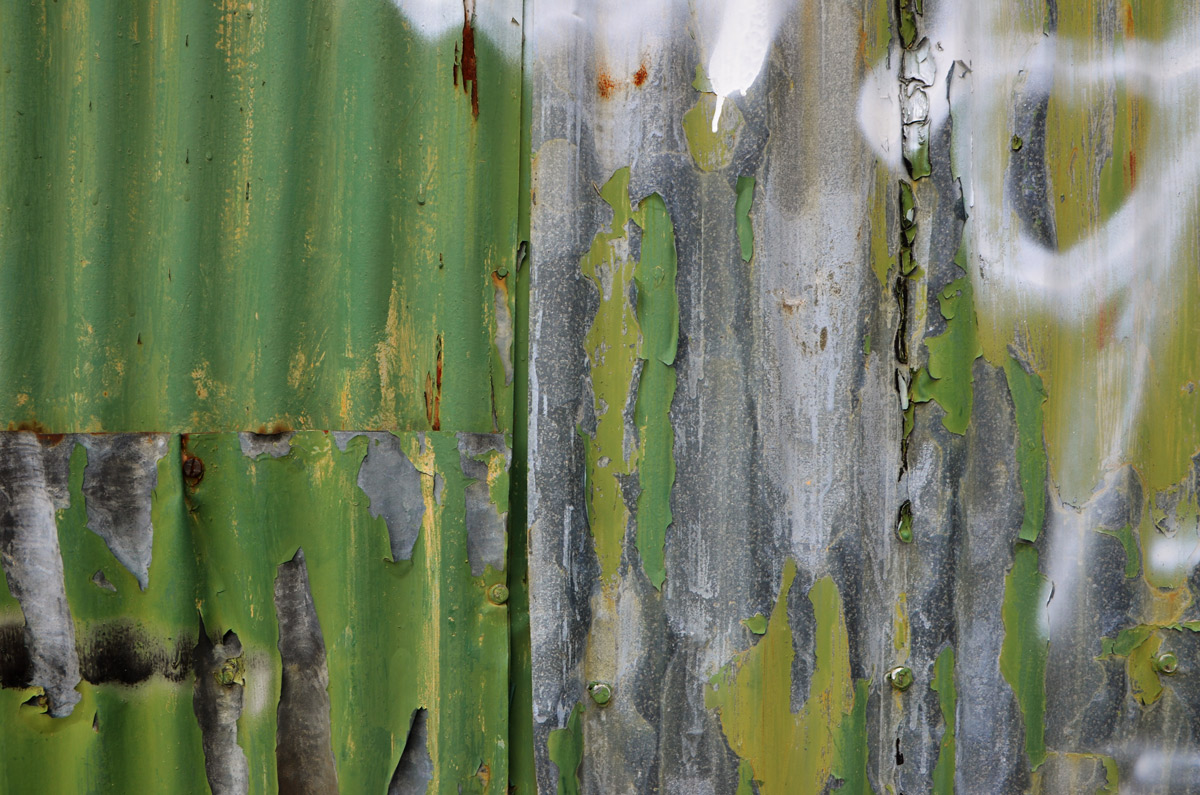
below: Another example of the effects of time on metal.  A little less rust here but there are some interesting shapes and forms created by the peeling paint.

metal corrugated metal wall, close up detail of peeling green paint and rust

below: Looking into a shop window to see a sad and lonely cat.  Sad eyes?  or are they eyes of a cat dreaming of the outside world and wishing it wasn’t relegated to a shelf of old and empty things.

looking into a window of an antique store, a porcelain cat, sitting upright, with sad look on its face, on a shelf with empty bottles and jugs

below: More old, but certainly not sad.   It’s a bright, shiny and obviously well-loved Chrysler.

an old orangish brown Chrysler car parked in a driveway, front facing the street,

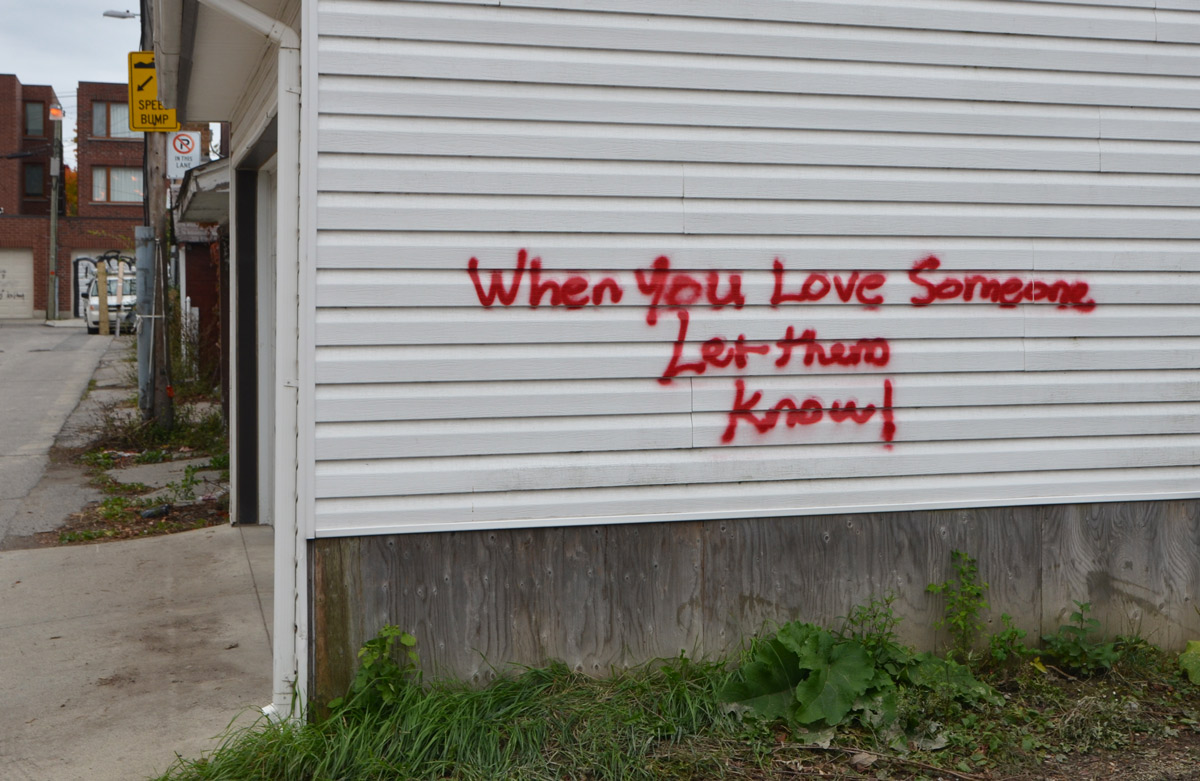
below: Advice to heed.

red words painted on the side of a white building in an alley, words say - When you love someone, let them know

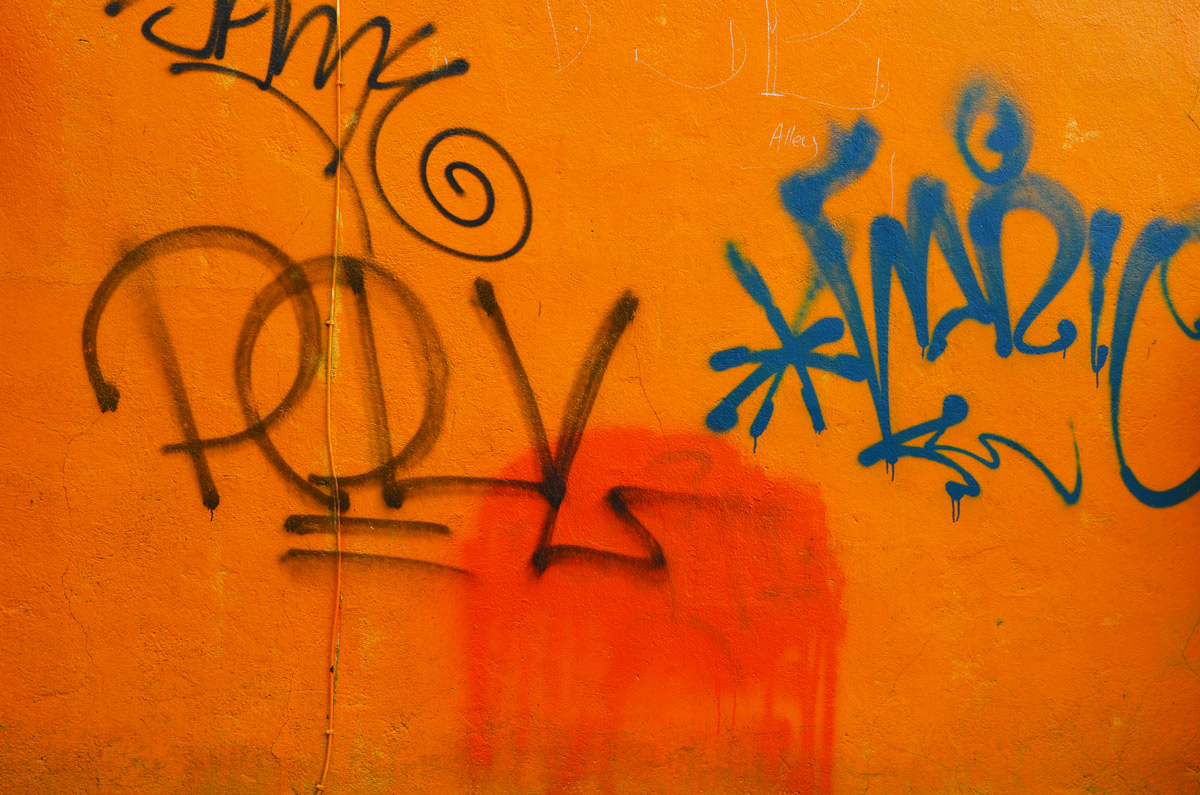
below: No wise words here – just scrawls and tags.  But isn’t the orange a fantastic colour for a wall?

orange stucco wall with graffiti on it.

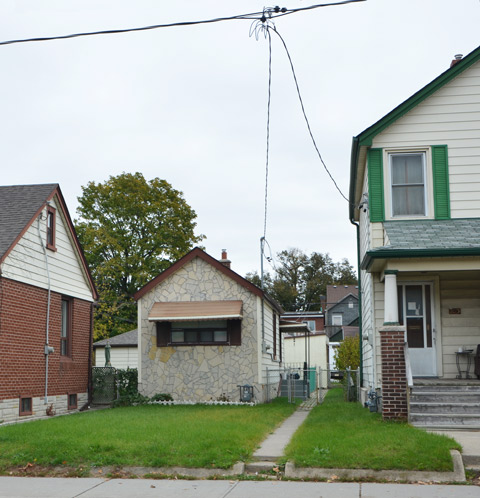
below: Tiny! A teensie tiny little house with a lawn that’s sparse but neatly kept.  Once you start looking for these little treasures, you realize that there are quite a few of them in Toronto.  I wonder if anyone has documented them?

very small one storey house between two large houses, green lawns, sidewalk in front,

Warning – tangent ahead!  This reminds of a children’s story called “Benjamin Budge and Barnaby Ball” written by Florence Heide Parry.  It’s a story of two men living in two different houses.  Benjamin was a very big man living in a very small house while Barnaby was a very small man living in a big house.  The illustrations of Benjamin squeezing into his mini sized house were wonderful (by Sally Matthews).  Of course, to live happily ever after the two men trade houses.

“Benjamin Budge was a great big man,
A great big huge TREMENDOUS man,
But his tiny house was so very small,
There wasn’t room for him at all!”

below: Benjamin Budge sleeps ‘in’ his bedillustration by Sally Matthews of a picture of a large man sleeping half on the floor and half on his tiny bed in his tiny bedroom. From the children's book Benjamin Budge and Barnaby Small

below: Veering back to the subject of architecture… this style of apartment building was very common in the 1920’s.  Three storeys, no elevator and probably no parking but with charming little details in the brickwork.  If I remember correctly, this building is on Bathurst street just south of Dupont.

three storey brick apartment building with central white door entranceway

Little vegetable gardens in both back and front yards are very numerous here, probably because of the combination of the large number of Italian and Portuguese immigrants who settled here and the popularity of ‘urban farming’ – veggies instead of grass. Being November, there were only a few remnants of this year’s harvest – a few tomato plants here and some Swiss chard there.

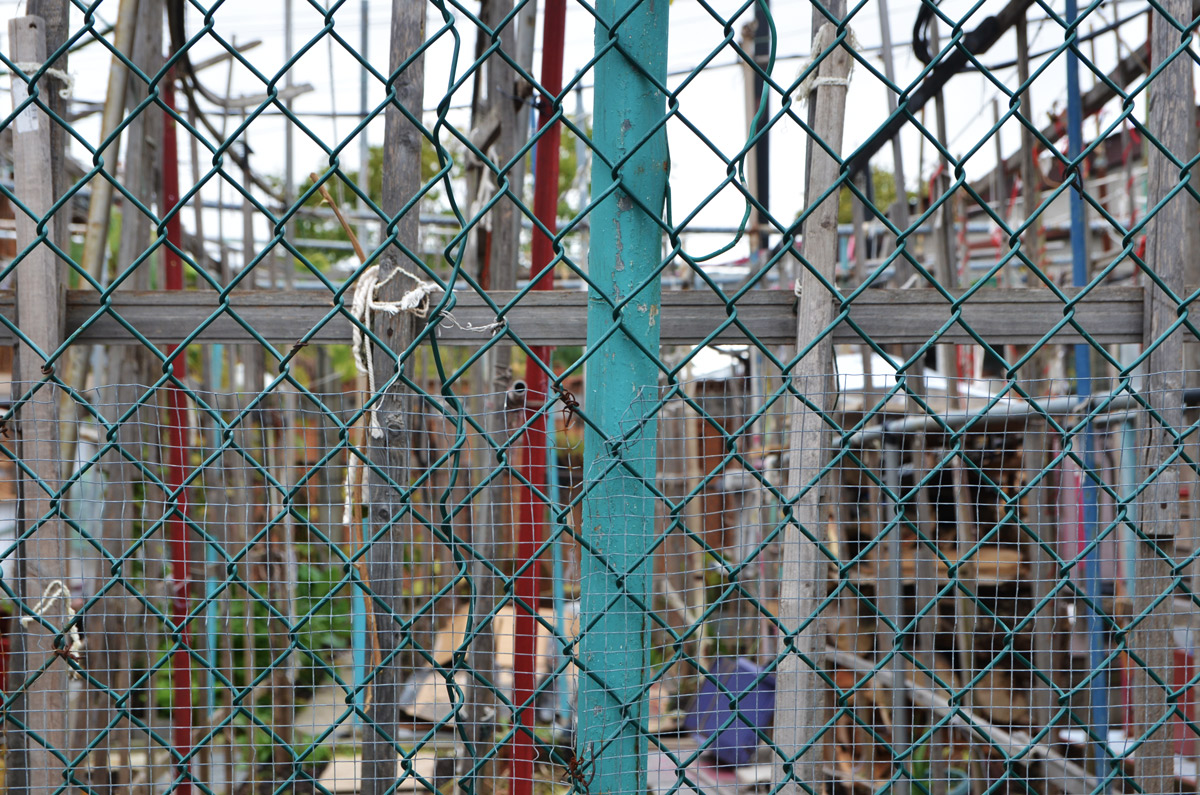
below: One back yard still has all its wooden stakes standing on guard. A forest of stakes.

chain link fence in front of a large number of wooden stakes that were used in a vegetable garden earlier in the season, but now autumn so there are no plants

below: Another way to garden in the city!

patio outside a house is covered with plastics bins of different kinds, all of which have been turned into planters, autumn now so plants no longer alive but boxes and coolers and bins remain.

below: Xena the warrior princess still watches over Vermont Avenue. She’s faded a bit since I last took her picture two years ago. You can see her (and others) in Neighbourhood watch good guys that I posted in 2015.

altered neighbourhood watch sign, with a picture in the center,

 There are lots of lanes and alleys in Seaton village (this part of the city).   One of last year’s blog posts ‘same, same, but different‘ is about some of the lanes.  There is some street art in these alleys but not too much – here are a couple from yesterday’s visit.

below: Art follows life or is it vice verse?

red leaves on a vine growing in front of a white fence that had a mural of birdhouse and plants and flowers painted on it.

below: Flowers? Or just smudges on a pole?

smudges on a metal pole that look a bit like flowers

below: Playing basketball beside Toronto – a rather lopsided photo I’m afraid.

basketball hoop above a garage door that has a large map of Toronto, in blue and green painted on it.

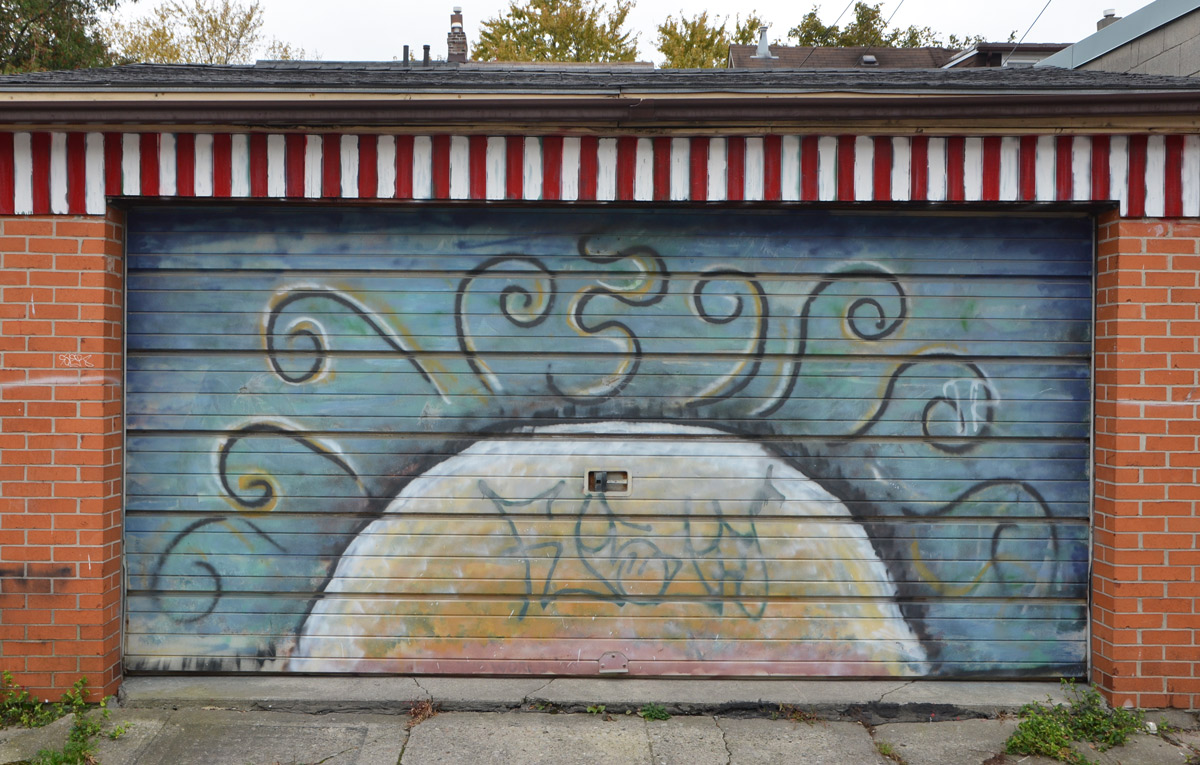
white garage door with some of the rectangles painted in turquoise, orange and purple, with swirls under the rectanagles that look like G's

semi circle covering bottom half of garage door, looks like bald head with a few curly hairs growing upwards from the scalp

mural on an exterior wall outside Kos restaurant on Bathurst Street, the mural is in the front of the restaurant by the patio, no one sitting outside, blue umbrellas are down.

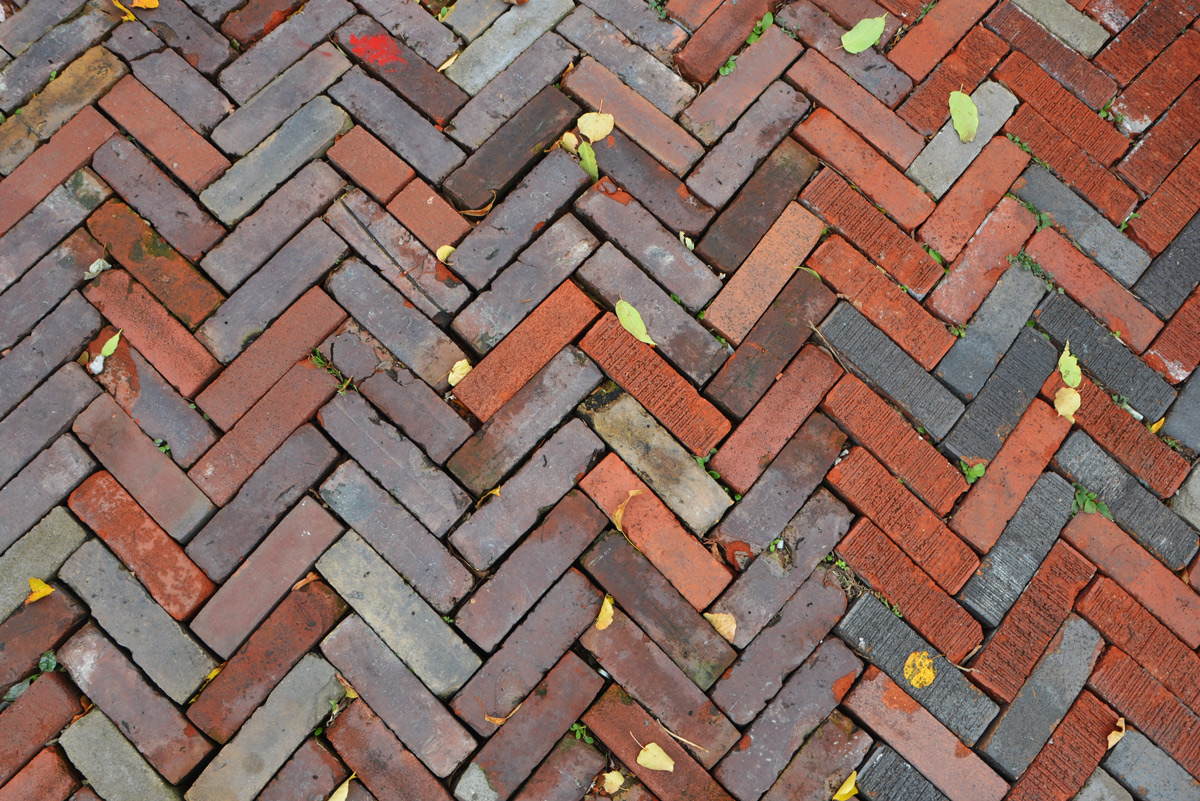
below: Herringbone pattern made from bricks.

chevron pattern (herring bone pattern) of bricks on a driveway, some autumn leaves on the bricks

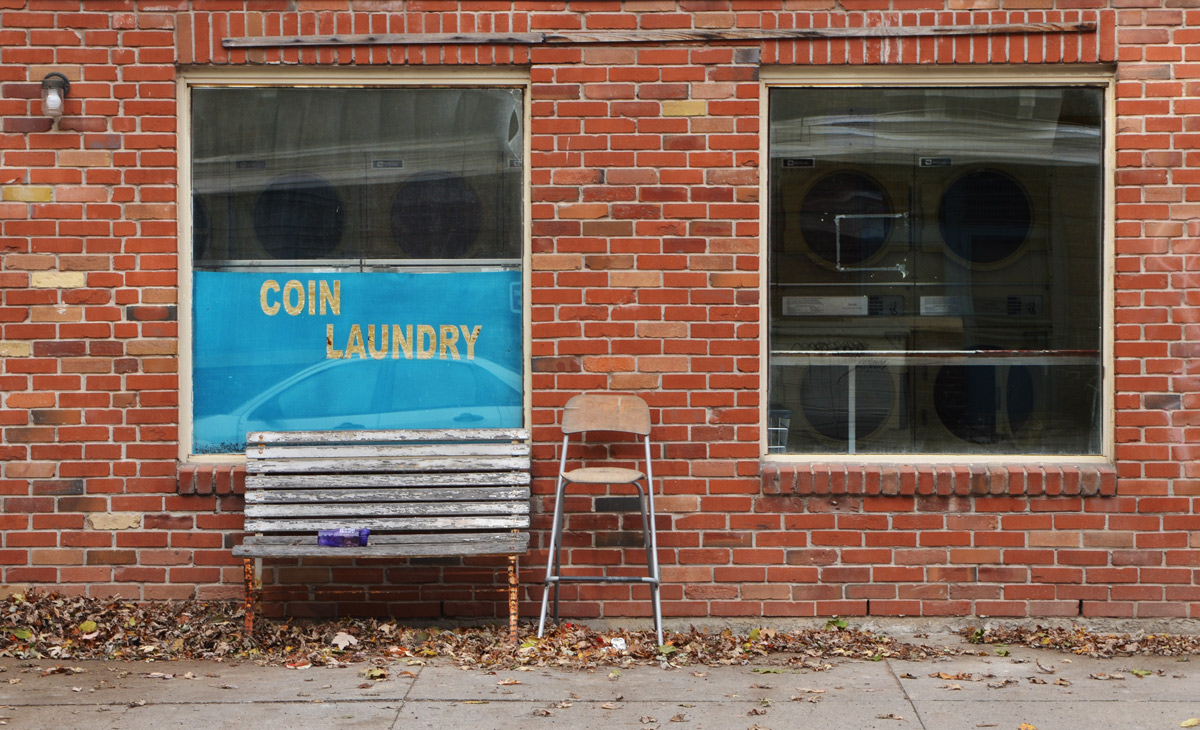
below: A rather forlorn looking bench and seat outside the laundromat.

front of a laundromat. blue sign that says coin laundry, an old bench and an old chair sitting outside by the front door. two windows through which you can see the washing machines

below: A newspaper rack decorated with a garland of fake ivy.  Insert fake news reference here ….

a newspaper rack outside a corner convenience store, the newspapers (there aren't many) are held down with bricks, the rack is decorated with a fake ivy garland

an old chair on a porch, side view.

looking through a park to a street with a blue house and a red house, cars parked in front, autumn leaves,

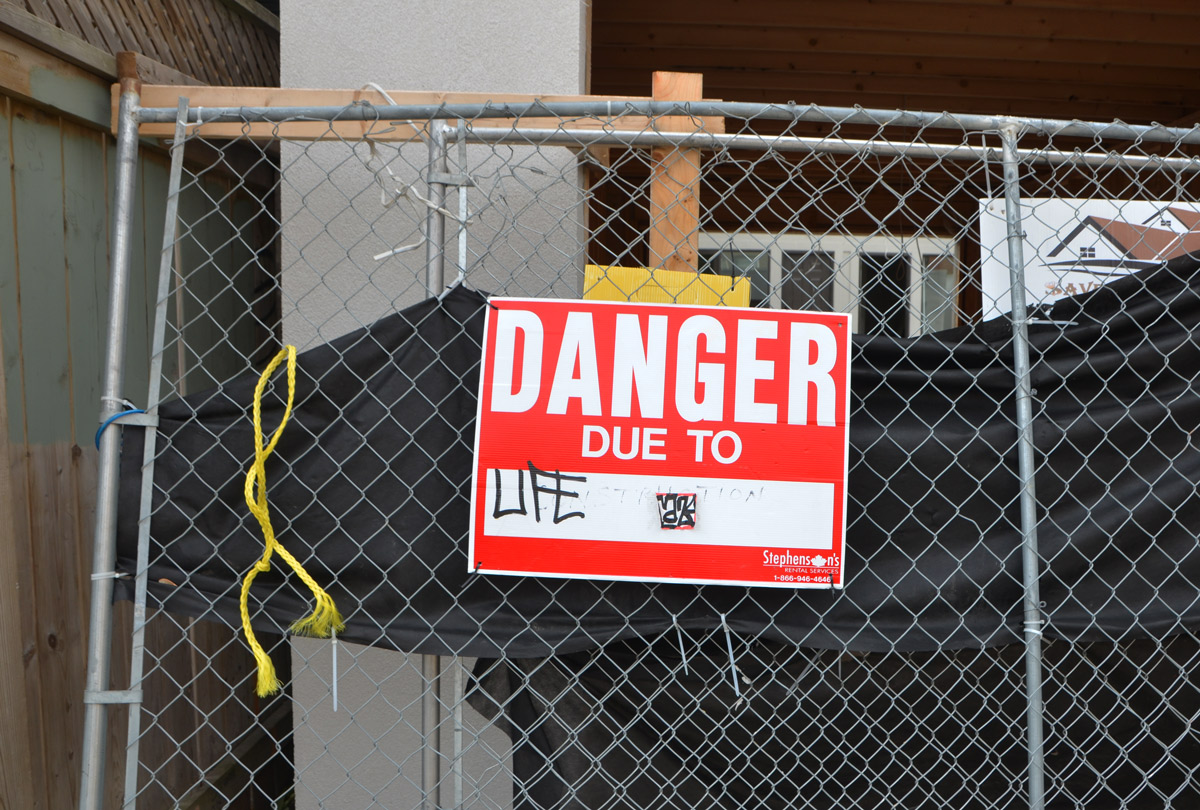
below: Today I’m going to end on a dangerous note.  Keep walking and Stay safe!

construction site with a danger due to sign that has been altered to say danger due to life

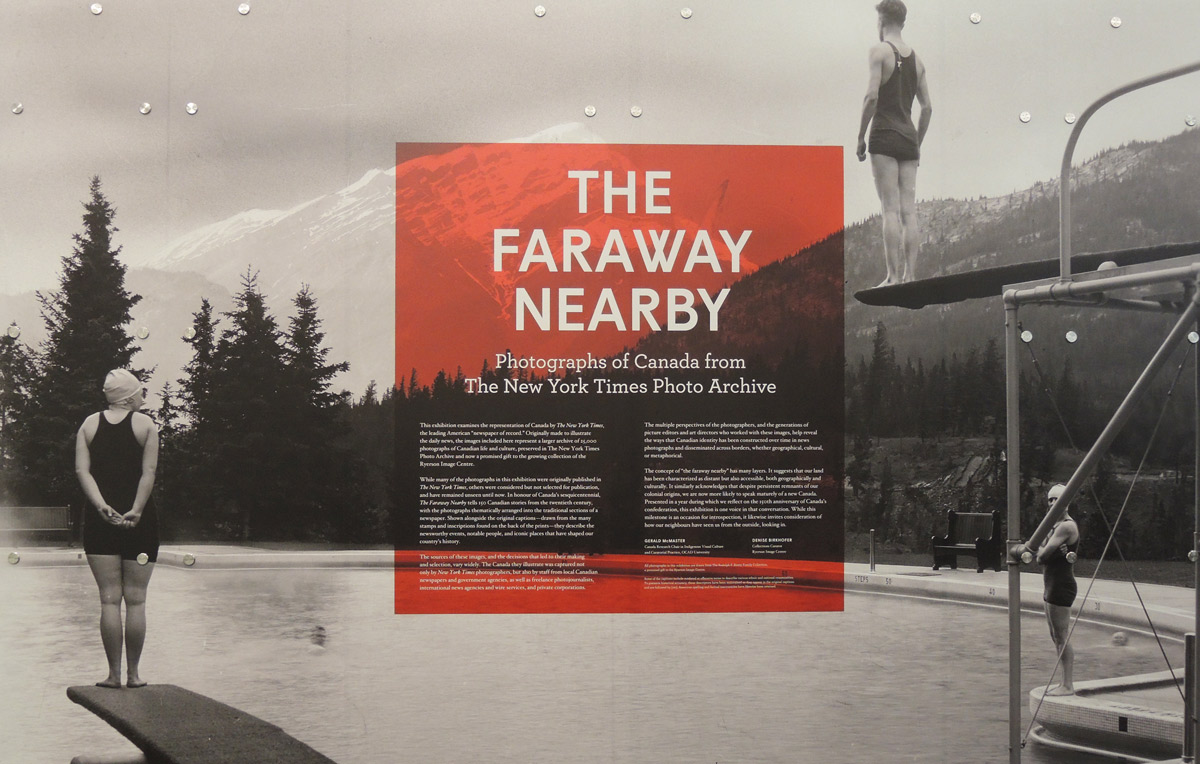
There are a group of photography exhibits now showing at the Ryerson Image Centre.  Two of them showcase older photos of Canada.  The largest exhibit is ‘Faraway Nearby’ and it consists of photographs of Canada from the New York Times photo archive…   25,000 vintage photos of Canada taken over the past 100 years have been gifted to Ryerson by Chris Bratty in honour of his father Rudolph (Rudy), a property developer in the GTA.   ‘Faraway Nearby’ is a wonderful selection of them covering a wide cross section of subjects.

vintage black and white photo of people in bath suits standing on diving boards beside a lake

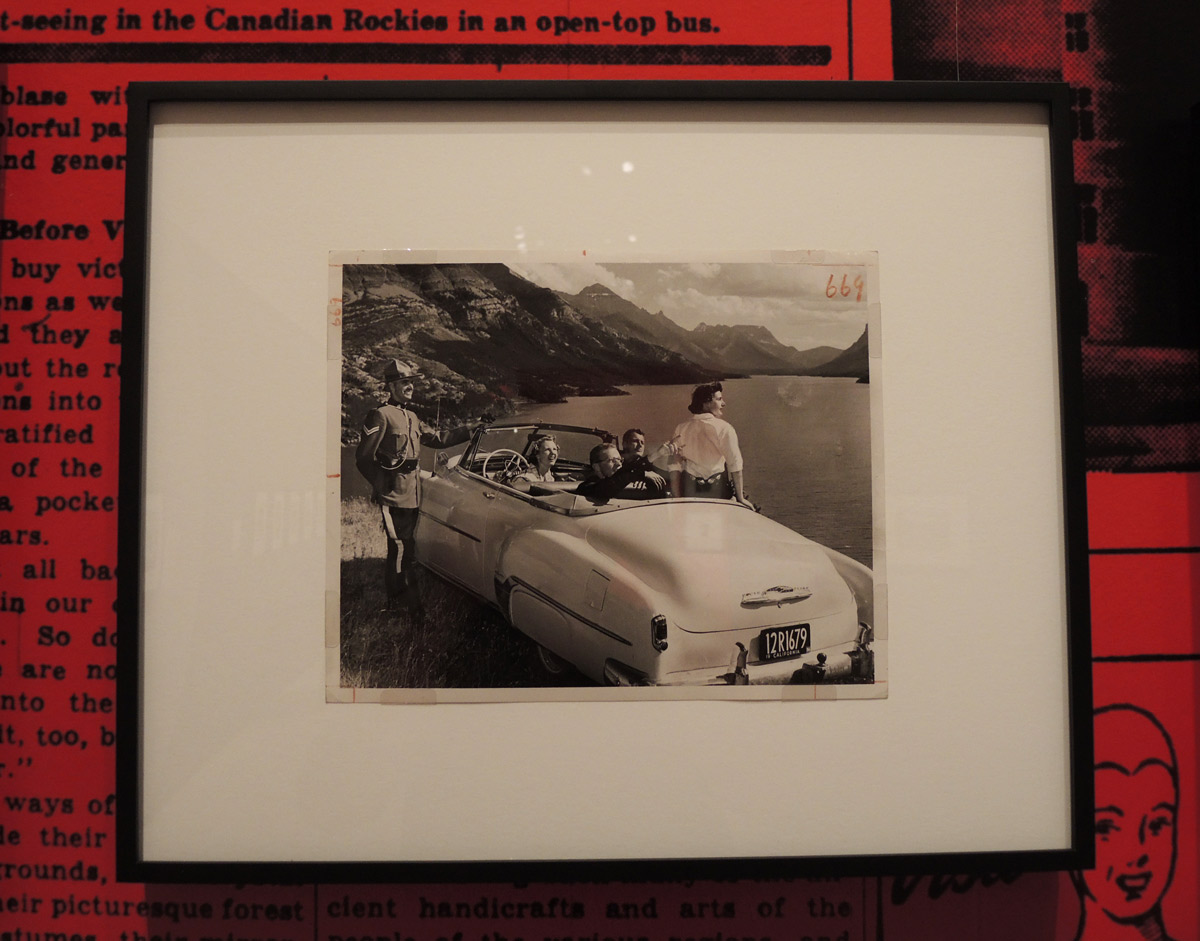
below: There is a section devoted to tourist type photos that you would find in the travel section of a newspaper.  Yes, that’s an RCMP officer standing beside the car, a convertible with California plates.  I’d say it was kitschy to have the RCMP guy there but even today the red uniform of the RCMP is iconic; they are featured on many postcards and souvenirs.   Tourists still take photos with them I’m sure.

photo in an exhibit of a group of tourists in a convertible car with California plates parked beside the road and overlooking a mountain lake. An RCMP officer stands beside the car.

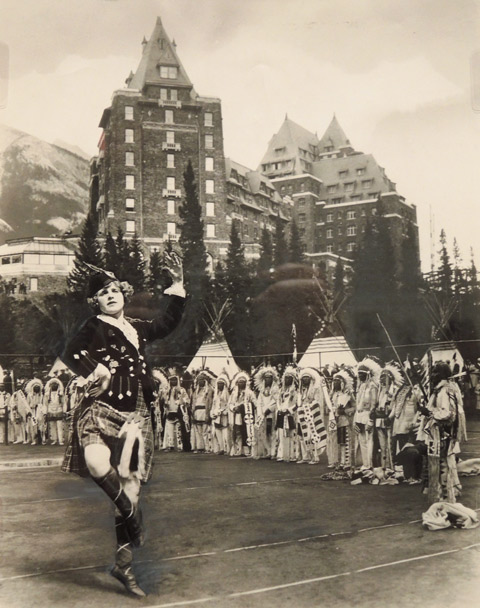
below:  Oh dear, Highland dancers and Native Americans all dressed up.   Is that the Banff Springs Hotel?  The exhibit taken as a whole is a fascinating look at Canadian history; how far we’ve come in some respects and how we haven’t really changed in others.

vintage black and white photo of a highland dancer with a line of native Americans in traditional dress behind her. Some teepees in the background, also a hotel.

below:  Loggers clearing their way through a sea of timber that is being guided into a newsprint mill in Hull Quebec, about 1946.  Unknown photographer.  (Almost all the photos are by ‘unknown’).

vintage black and white photo of two shirtless men on legs with poles as the move logs and timber by river to a newsprint paper mill on the other shore.

Being a newspaper, a large number of the subjects were political such as this photo of Joe Clark, Prime Minister of Canada from June 1979 to March 1980, on a visit to Cameroon  in the summer of 1979.

black and white photo from 1979 of Joe Clark, then Prime Minister of Canada, riding in a motorcade with the President of Cameroon, in Cameroon.

below: Prime Minister Trudeau (the first one) meeting President Nixon, “Tricky Dick”, of the USA.  Love the sunglasses! (or is that just a trick of the lighting?).
vintage photo of Richard Nixon, President of the United States, greeting Pierre Elliott Trudeau, Prime Minister of Canada

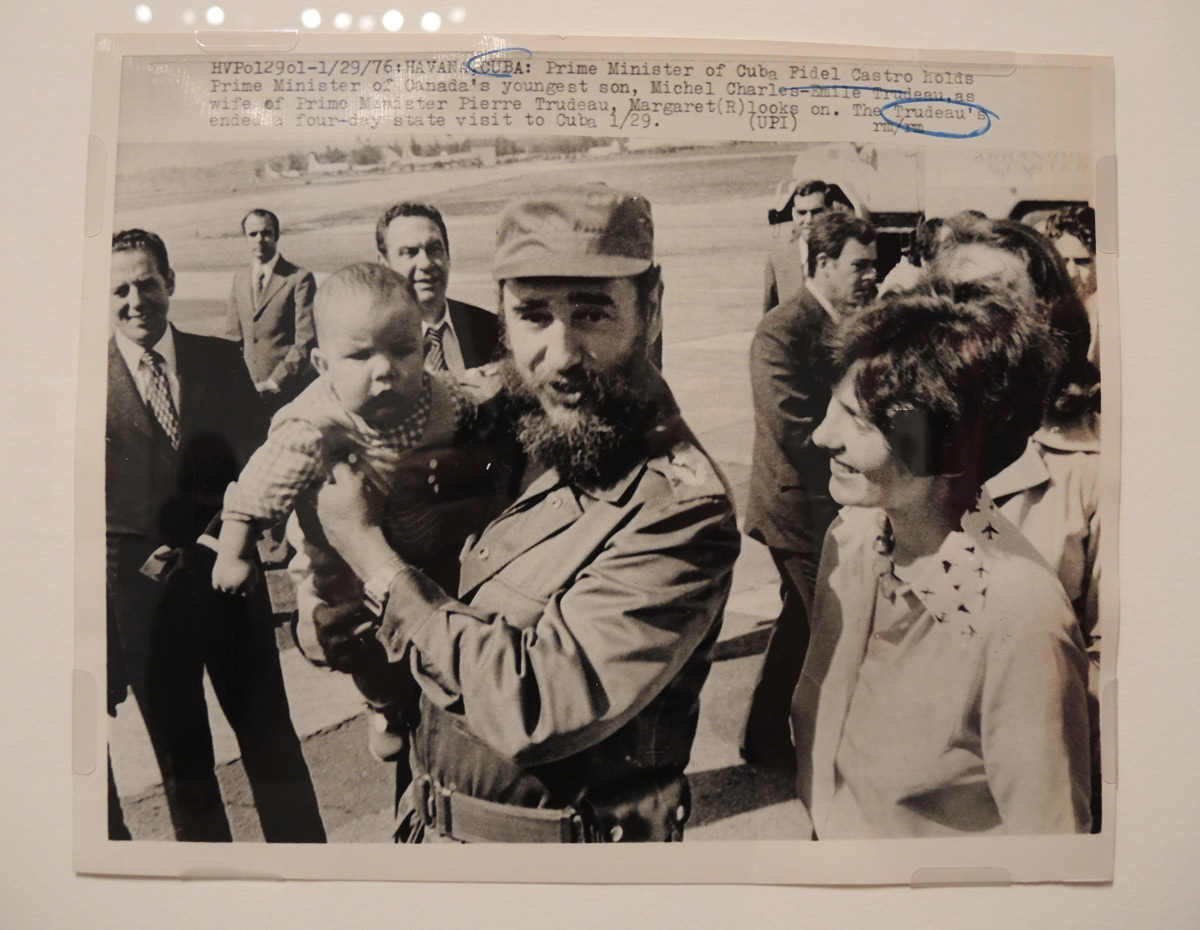
below: While on the topic of the Trudeau’s, here’s Margaret with Fidel Castro.  Castro is holding Margaret’s youngest son Michel.  The photo was taken in Havana in 1976 when the Trudeau’s were in Cuba on a 4 day state visit.

vintage black and white photo of Margaret Trudeau and Fidel Castro. Castro is holding one of the Trudeau sons.

below: There are also some photos taken during various Royal visits.  Here are a group of men by Lake Nipigon in 1919.  The man holding the dead duck (3rd from the left) is Edward, Prince of Wales (b.1894 – d.1972).   He was 25 years old in this picture.   On 20 January 1936 he became King Edward VIII but he abdicated the throne in December of the same year after reigning for only 326 days.

a vintage black and white photo of a group of men in northern Ontario, by a lake, one is holding a duck that has been shot

below: A photo by an unknown photographer for the Canadian War Records Office and the American Press Association, Vimy, France, April 1917.  The description of the photo reads: “Giving Fritz some of his own pills.  Canadians firing a German 4.2 on the retreating Boche.  Some of the guns left behind by the retreating Germans were in excellent condition, and the Canadians at once  undertook to return some of the shells to their former owners in the most effective manner.”

vintage world war one photo

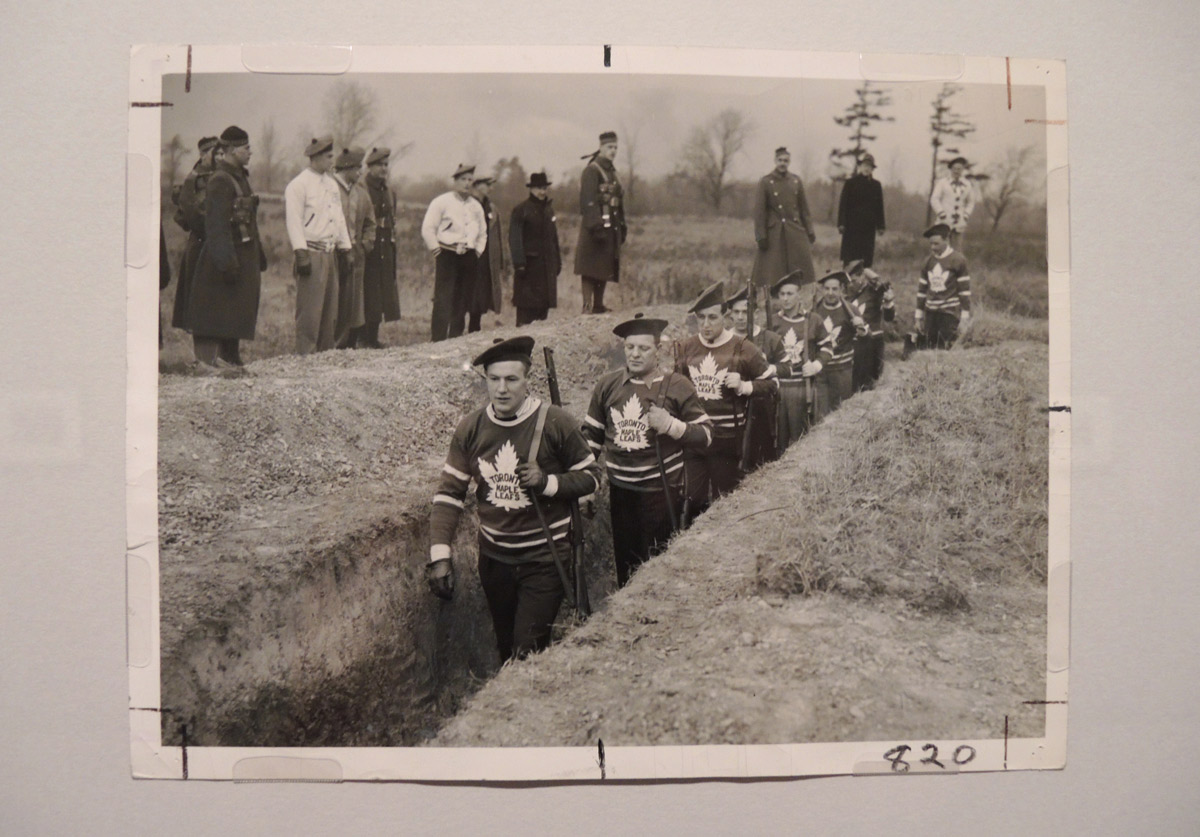
below: A slightly lighter look at war, this time WW2.  Photograph by Nat Turofsky (d. 1956) for Alexandra Studio.  Distributed by the Star Newspaper Service and the New York Times.  Location unknown. 1939.  Nat and his brother Lou were well known Toronto photographers in their day. Back in 2009, The Torontoist published an excellent story about them and the Alexandra Studio which they owned.

The description of the photo reads: “Shouldering guns instead of hockey sticks.  Member of the Toronto Maple Leaf hockey team, led by Bob Davidson, Goalie “Turk” Broda, and “Sweeney Shriner, marching into the trenches at a machine gun target range during a military training session.  The team is in constant training so that they will be ready for duty if called to the colors.”

vintage photo of men in Maple Leafs hockey sweaters walking through war trenches

***

The second, and smaller, exhibit is ‘The Notman Studio:  1858-1915’.  William Notman was a photographer based in Montreal who traveled across Canada documenting what he saw.   He was also a studio photographer who took hundreds of portraits.   This is a small sample of his work.

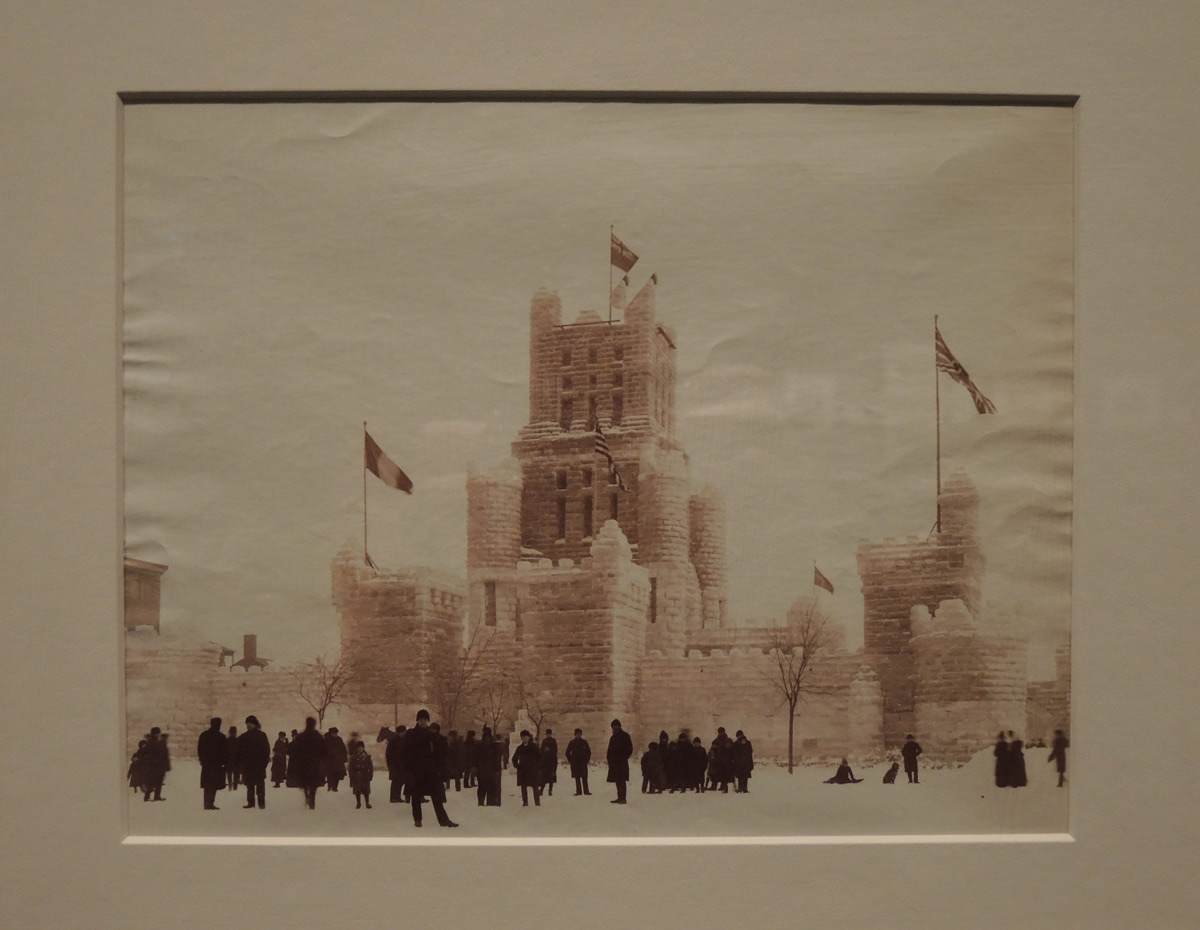
below:  ‘Ice Castle’ about 1857, Montreal Quebec, Albumen print.

old photo of a large ice castle

below: ‘Esquimalt Dry Dock’, 1887, Victoria B.C. Albumen print.   You’ll have to pardon the reflections in the pictures.  The glass in the frames acts like a mirror and although I have tried to minimize the amount of reflection, getting rid of it entirely was not always possible.

vintage photo, 1887 ship being built, wood, in Victoria B.C.

below: Standing outside his teepee with his rifle and his horse.

vintage photo of a native American man in traditional clothes holding a rifle and a horse and a lead. Standing outside a teepee

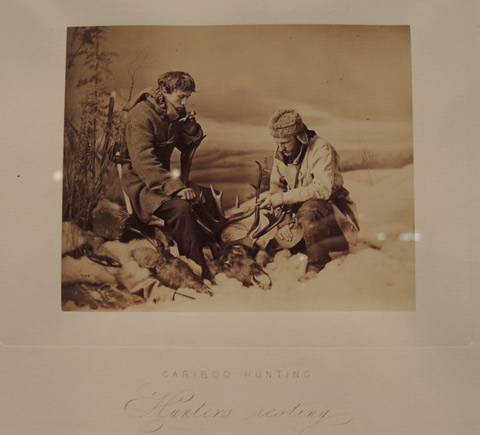
below: There were a series of Cariboo Hunting photos.  They were small and all focused on the two men.   Especially considering their age, they are in excellent condition and beautiful to look at.

vintage photo of two men hunting caribou. Resting with their rifles.

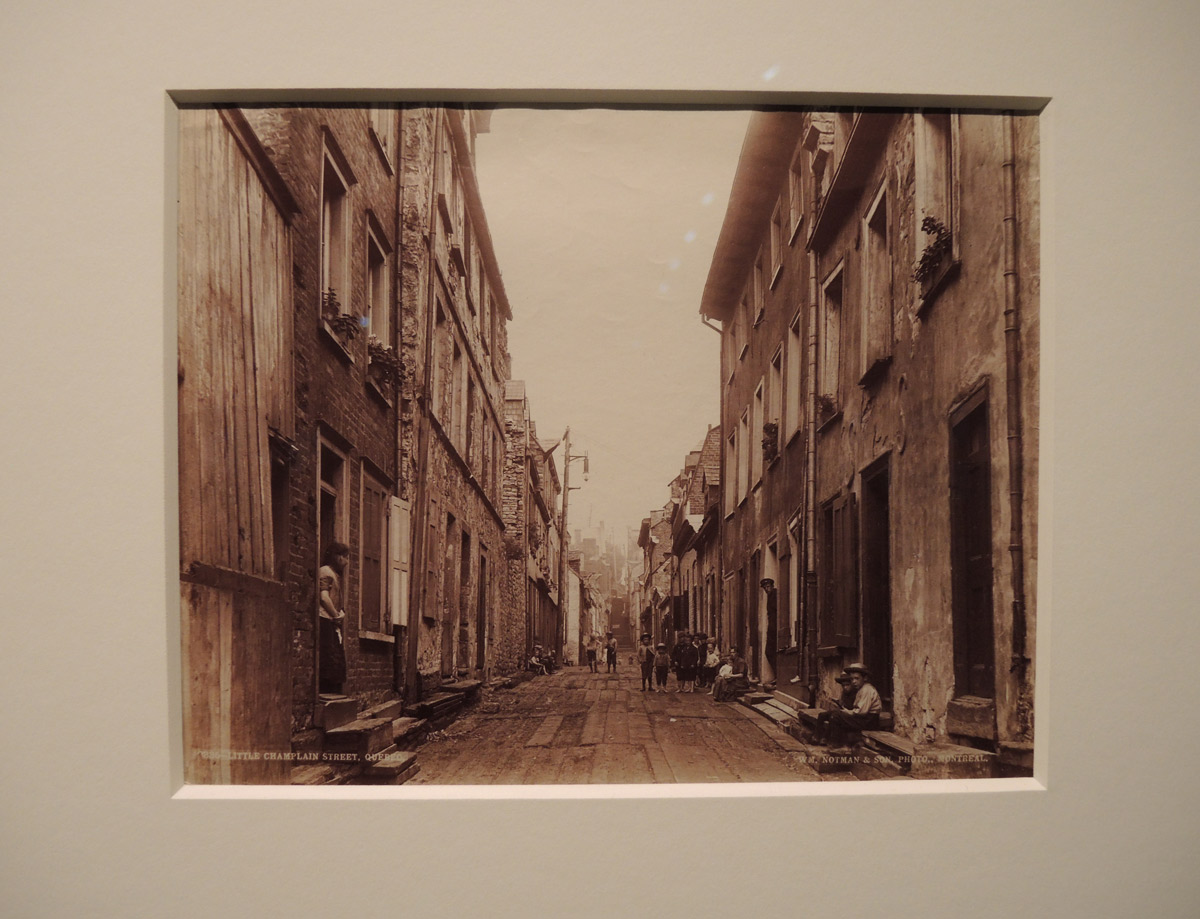
below: ‘Little Champlain Street’  1890, Quebec City.   I looked for photos of Toronto in the collection that was on display but there weren’t any.

vintage albumen print photo, 1890, Little Champlain street in Quebec City. row houses, kids in the street

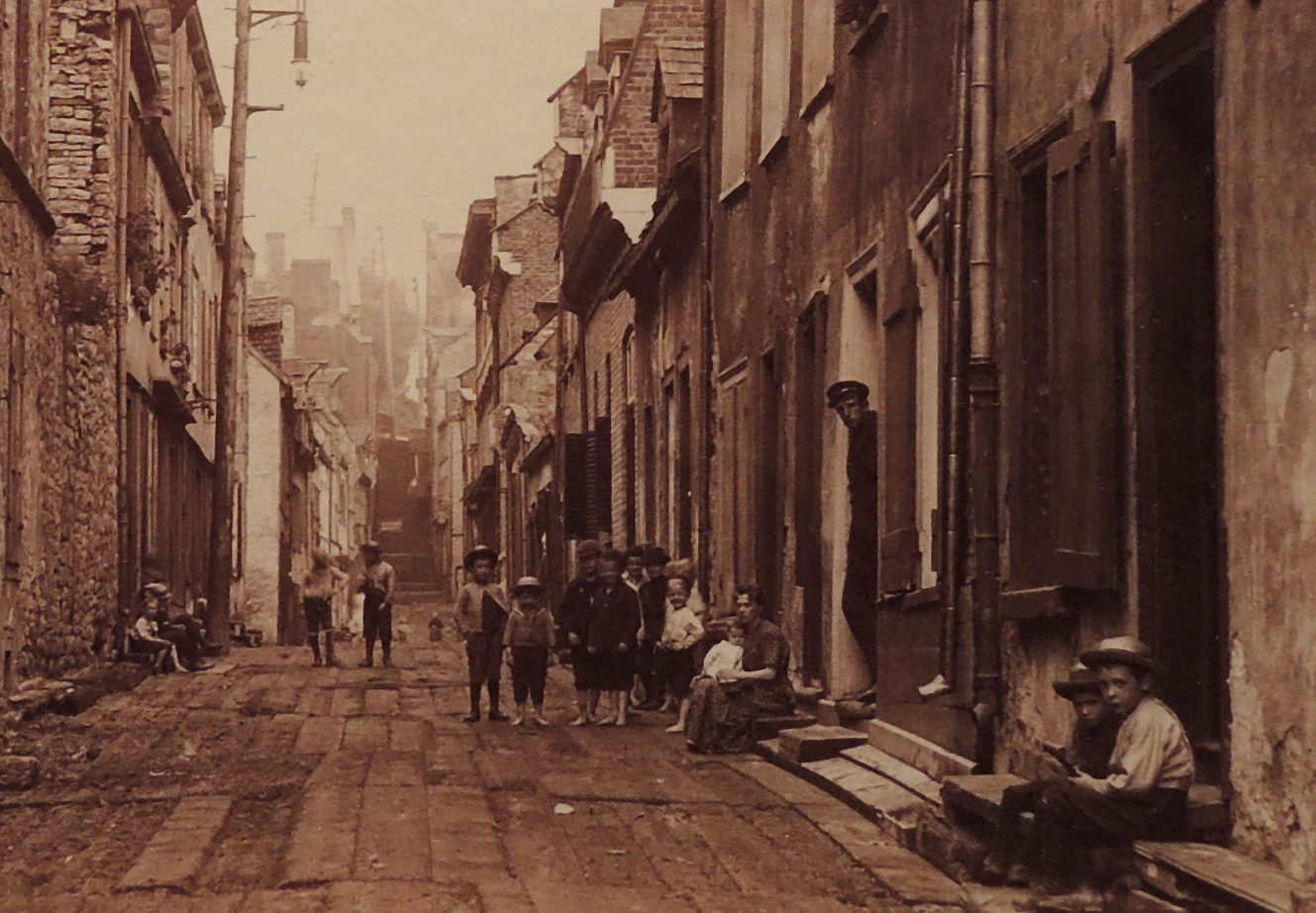
below: There is an incredible amount of detail in the above picture so I cropped it quite a bit to highlight some of the details.   The shabby brick and plaster row houses, the solitary street light, the planks that form the narrow road, and the kids wearing hats as they keep an eye on the photographer.  Although it is Quebec City, I can imagine parts of Toronto looking quite similar at the time.

details of a vintage photo, street scene, kids, row houses,

In case you were wondering, albumen prints refers to a process whereby the photographic paper that is used to print the images from a negative was made using egg whites.  The main constituent of egg whites is the protein albumen.  It is sticky and forms a glossy finish when it dries.  The stickiness of the albumen is used to bind salt (sodium chloride, your basic table salt, or ammonium chloride) to the paper.  Once the paper dries, it is dipped into a solution of silver nitrate thereby making the paper sensitive to UV light.   This method was developed in 1847 and was the first commercially viable method of producing photographic paper.  It remained in use until the 20th century.

By the entrance to the Notman exhibit is this wonderful, and still relevant, quote attributed to William Notman: “To consider Photography a mere mechanical art, is a great mistake.  The too prevalent desire for cheapness, and the ease with which a little may be done in Photography, has induced many to embrace the profession lacking the necessary qualifications…”

Both exhibits continue until 10 Dec 2017.

Sometimes when you search for one thing you find another.

The other day I posted pictures of the Cliffside murals in Scarborough.  When researching, them I discovered that there are other murals in Scarborough thanks to Mural Routes.  Of course, I had to go exploring!

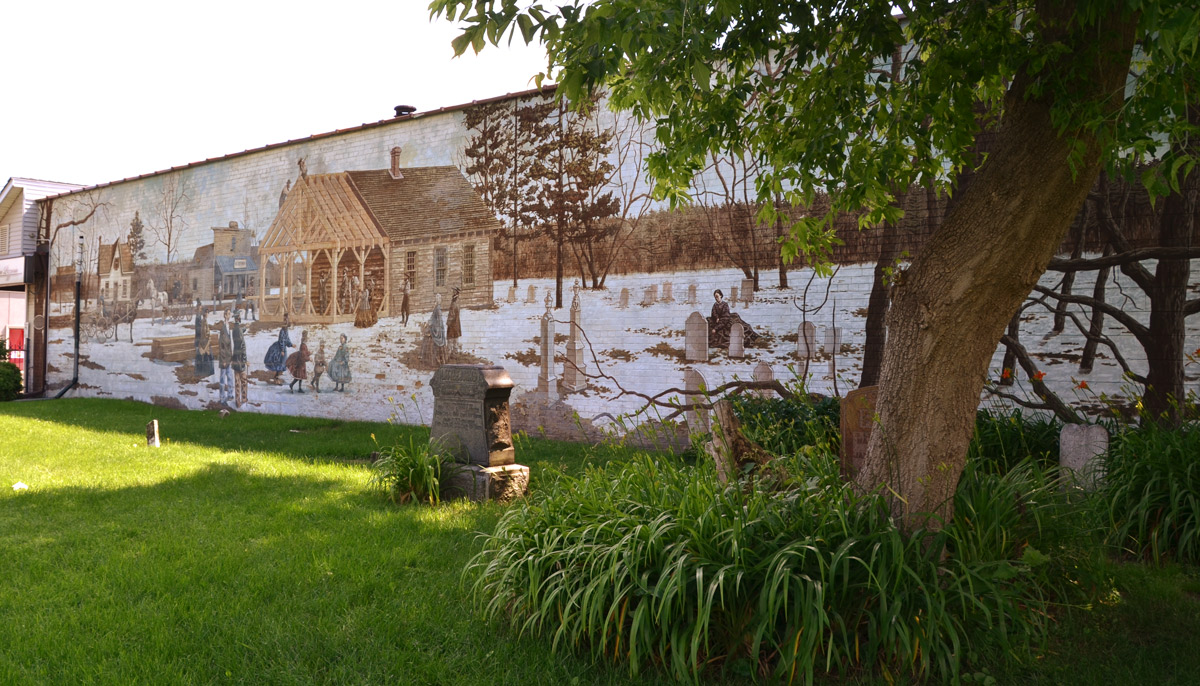
Murals are often in parking lots or in alleys.  Last weekend I found one in a cemetery.   “Building the Addition to the Wesley Methodist Chapel, Highland Creek, Winter 1867” is on the side of a building that abuts the Wesleyan Methodist cemetery on the east end of Old Kingston Road.

below: Most of the mural.  Design and artwork by John Hood , assisted by Alexandra Hood and Zeb Salmaniw, 1994.  There is a small portion of the mural missing in this picture.  On the right is a panel that tells the story of the mural.

mural, winter scene, from about 1867, adding an addition, wood frame, onto a church, old house and store in the background. cemetery around the church, trees.

This is what the words say:

The following is an extract from the ‘The Christian Guardian’, a Methodist newspaper:
Your numerous readers will be glad to hear of the success of the Wesleyan Methodist Church at the Highland Creek, on the Scarboro’ Circuit. The above church was found to be entirely too small for the accommodation of its increasing congregation. The friends therefore decided to put an addition to the church 18 feet by 24 feet. It was re-opened and dedicated to God by divine service last Sabbath…” Wm. Tredway, Scarboro Dec 20, 1867
This mural depicts this event as it may have appeared from the northeast corner of this cemetery, looking southwest, across Old Kingston Road in mid November of 1867.

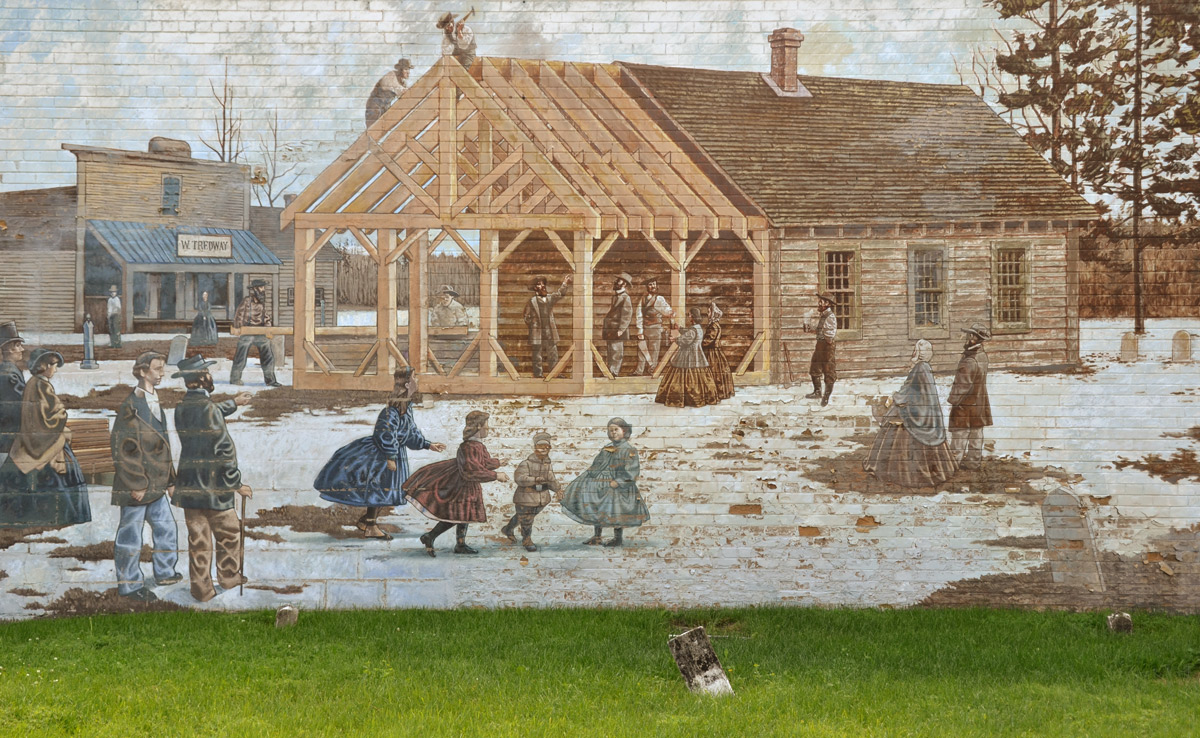
below: The William Tredway mentioned on the mural opened his first general store   at the corner of Eglinton Ave & Kingston Rd.  In 1865 he sold it and started over with a store on Old Kingston Road at Morrish Road.   It is this second store that is shown in the mural.  Tredway sold that store in 1878 to devote himself to politics as well as a career as a Justice of the Peace.

part of a mural, historic scene, old store with name W. Tedway above the door, people in period costumes, circa 1867. winter scene

part of a mural, horse drawn wagon, one man sitting at the front of the wagon, another man standing at the rear loading the wagon with lumber

men up on the roof of a new addition on a building, constructing roof joists, winter scene, old fashioned

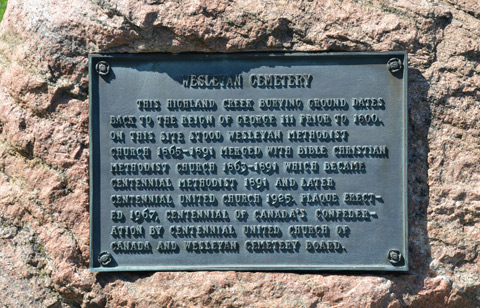
below: The bronze plaque near the entrance to the cemetery.

bronze plaque on a stone wall in the Wesleyan cemetery on Old Kingston Road, Highland Creek, Scarborough

“This Highland Creek burying ground dates back to the reign of George III prior to 1800. On this site stood Wesleyan Methodist Church 1865-1891 merged with Bible Christian Methodist Church 1863-1891 which became Centennial Methodist in 1891 and later Centennial United Church 1925, plaque erected 1967, Centennial of Canada’s Confederation by Centennial United Church of Canada and Wesleyan Cemetery Board. “

The cemetery consists of a 1/2 acre plot.  Back in 1834 it was part of 500 acres that was acquired by Jordan and Melinda Post in trade for their 15 acres at King & Yonge.   Some of the stones predate 1834 and as mentioned on the plaque, there was a burying ground here before 1800.  The oldest stone might be that for William Pearce, son of John and Susan who died 18 Aug 1813 at age 11 years & 5 months.   Local legend says it became a burial ground when a passenger on a passing stage coach died there.

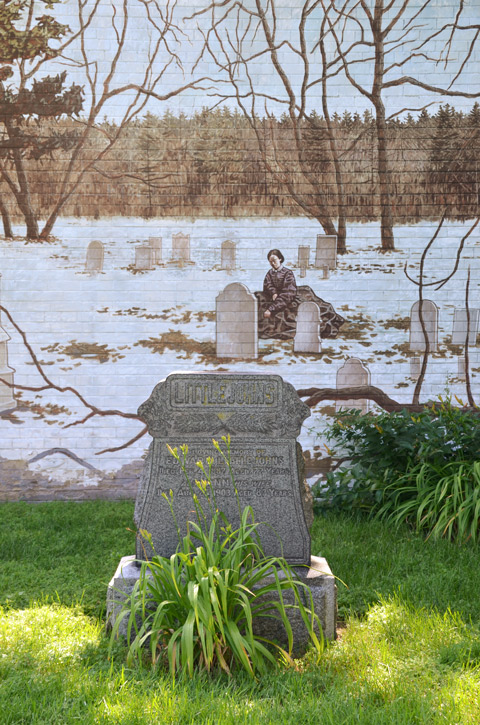
a real tombstone, surname Littlejohns, in a cemetery, with a mural in the background showing a woman kneeling by a grave in the winter, small amount of snow, no leaves on the trees

Jordan Post (1767-1845) and his wife Melinda (nee Woodruff, abt 1780-1838) were both born in Connecticut but were married in York (Toronto) in 1804.  Jordan was a watch maker and when he arrived in York in 1802 he was the first watch maker in the town.   He had other businesses as well but he probably made most of his money speculating in land.  In 1834 he moved to Scarborough township, to the location of this cemetery, where he built a sawmill.  Both Jordan and Melinda are buried here along with an unknown number of others, including other Posts and Woodruffs.   There are stones for 76 people including Ann (d. 1903) and Edward Littlejohns (d. 1887) pictured above.

below: An interesting juxtaposition – The real monument on the left is for Edith, infant daughter of Henry and Eleanor Lanktree, died 26 Sept 1872 at age 16 months.   The bottom part of other stone also mentions Henry and Eleanor Lanktree but I can’t read the inscription on the top part.

two real but old and weathered tombstones in a cemetery, with a mural of trees in winter around a cemetery where a woman sits by a grave

The church is no longer there.  It once stood next to the location of the mural with the cemetery around it.  Today the cemetery is maintained by the community.

Cliffside is an area around Kingston Road in the west  side of the city and the ‘cliff’ in the name refers to the Scarborough Bluffs.    The murals in this post are all on Kingston Road just west of Midland Ave.    They are the result of work of Mural Routes, an organization “dedicated to the creation, development and promotion of public wall art” since 1990.

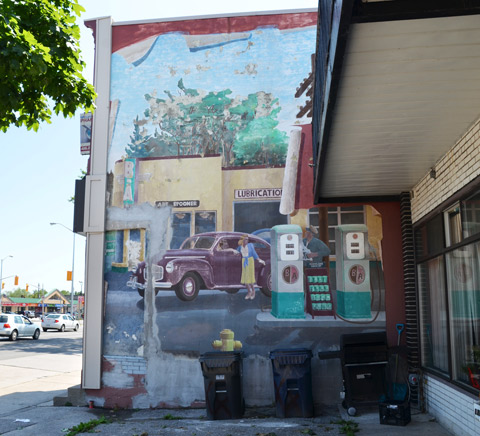
below: ‘Spooners Garage’ by Phillip Woolf, 1992.   Art Spooner’s garage in Cliffside was built in 1926 (and rebuilt in 1947).   The mural has two parts, each showing a different time period.  They face each other.

mural of gas station, Spooners Garage, from the 1920s or 1930s

mural of gas station, Spooners Garage, from the 1920s or 1930s

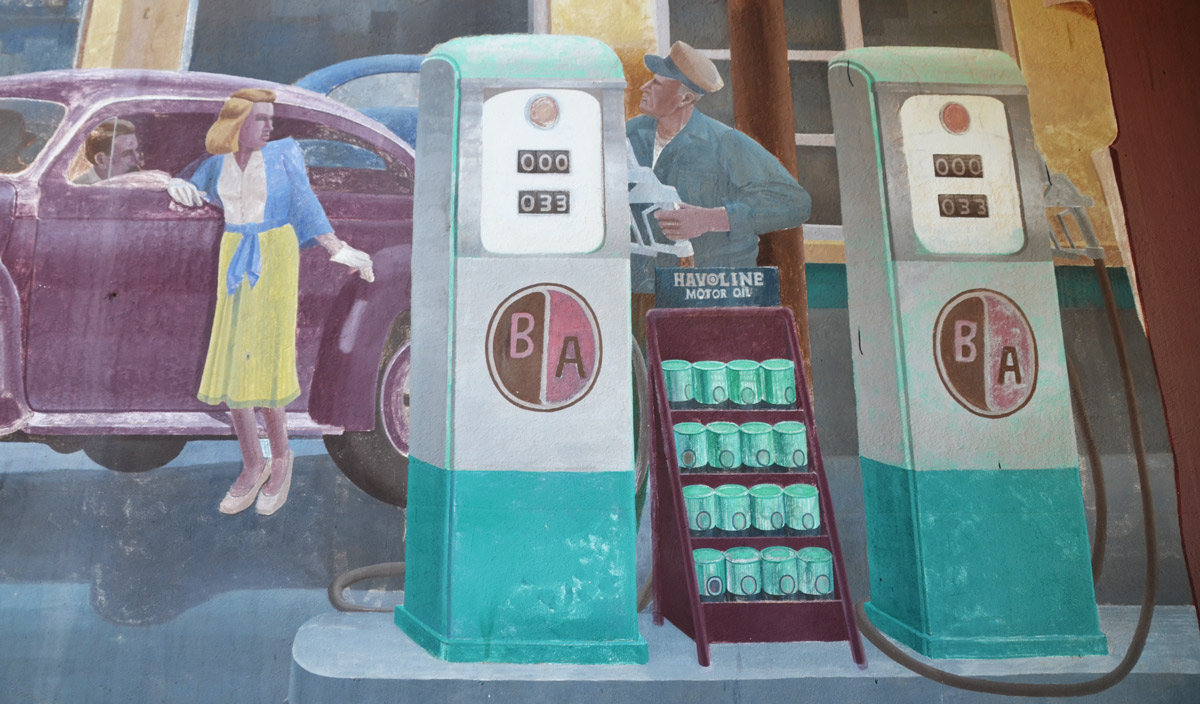
below:  … and the later version

part of a mural showing a gas station from the 1940s or 1950s

part of a mural showing a gas station from the 1940s or 1950s

below: ‘H.M. Schooner, Onondaga c. 1793’ by Jeff Jackson 1992.  The Onondaga was built near Kingston in 1790 and it served with the Provincial Marine until 1797.  It was the ship in which John Graves Simcoe and his wife Elizabeth sailed across Lake Ontario to York (now Toronto) to establish the capital of Upper Canada.

painted mural of a schooner from the 1790s sailing on Lake Ontario

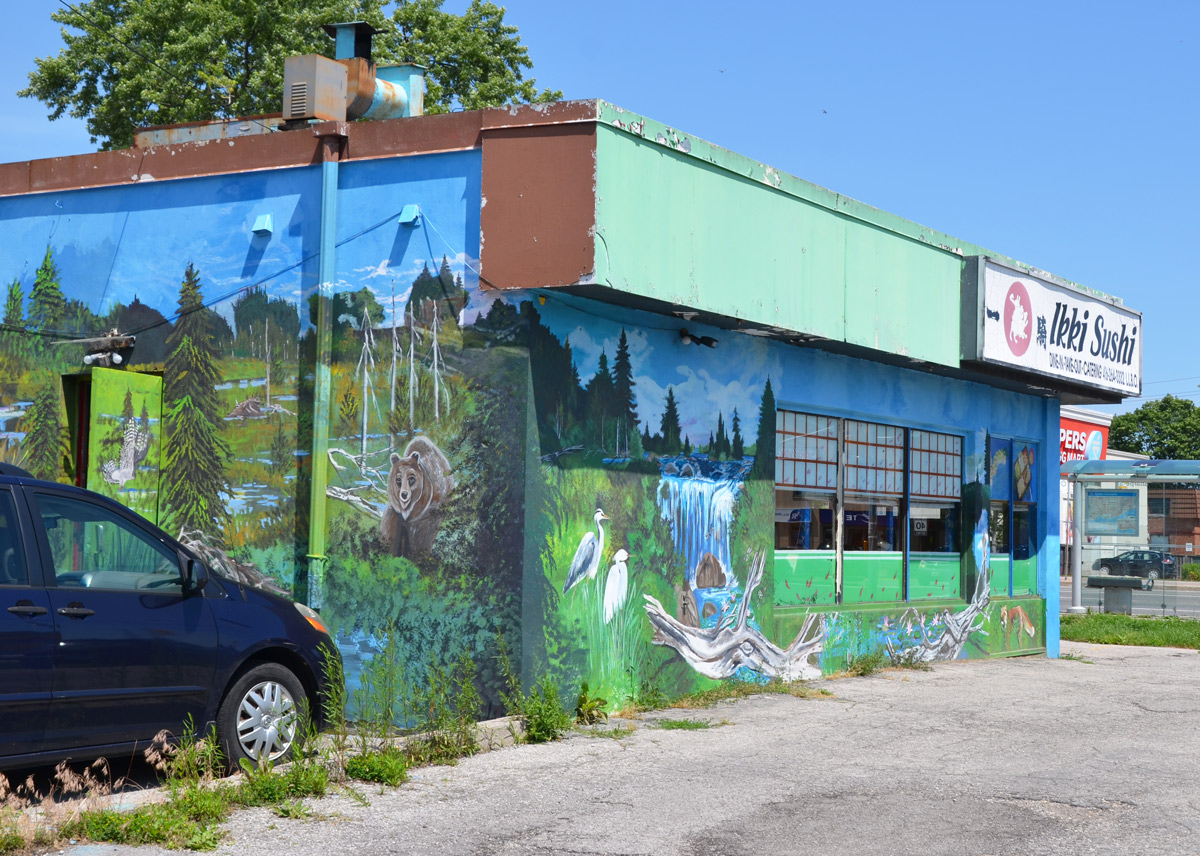
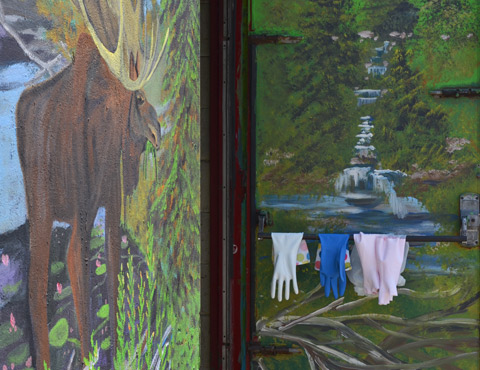
below: ‘Let’s Take a Walk on the Wildside’ by B.C. Johnson, 2016.   Canadian plants and animals cover all four sides of Ikki Sushi – herons, bears, moose, beaver, and fox among the pine trees. Creeks, swamp, and waterfalls can also be seen.  More of Johnson’s work can be seen at Sandown Lane Cliffside blog post

Ikki Sushi restaurant covered with a mural with scenes of Canadian flora and fauna,

back of restaurant with open door. Ikki Sushi restaurant covered with a mural with scenes of Canadian flora and fauna, inside of door is painted too

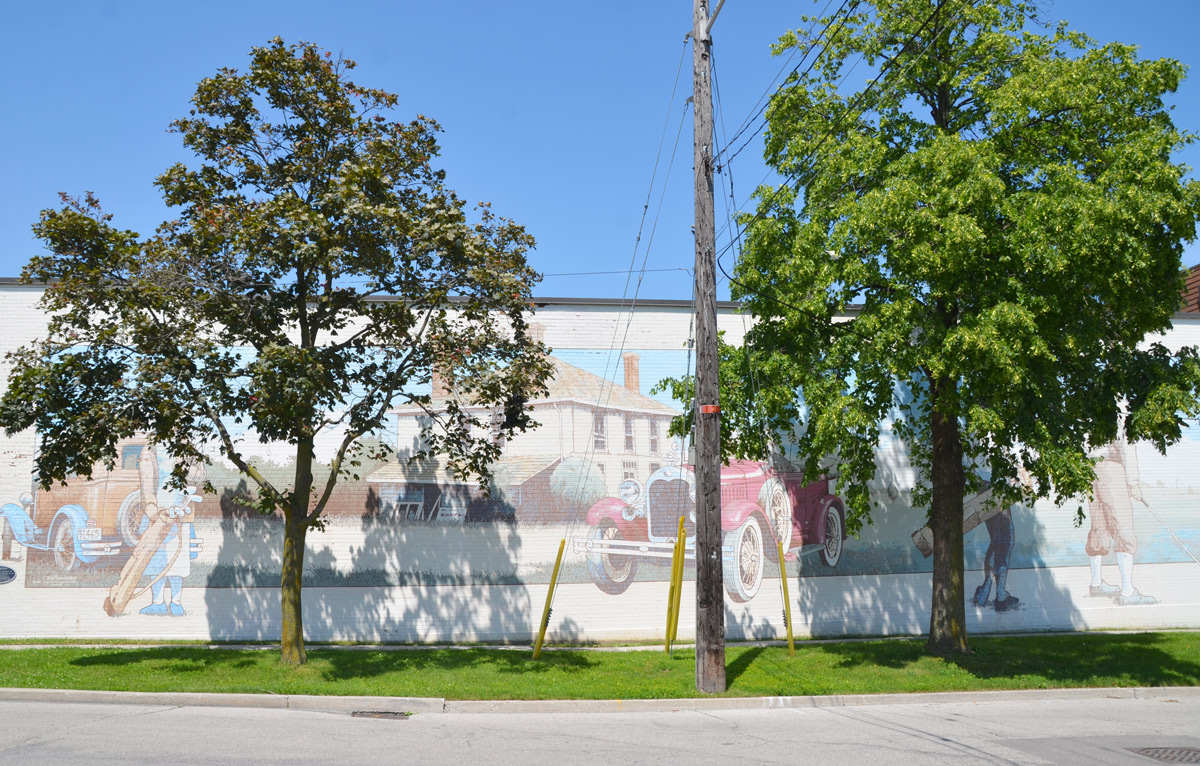
below: ‘Cliffside Golf Course’ by Dan Sawatzky, 1991.   Founded by George McCordick in 1931, the Cliffside Golfcourse was south of Kingston Road and overlooked Lake Ontario.    It closed in 1950.  The mural is faded and partially obscured by two trees.

two trees obscure a faded mural

below: The words on the mural tell the story of the golf course.

mural of two men golfing. One is swinging a golf club and the other has a golf bag slung over his shoulderh

red vintage car in a mural

mural, woman from the 1930's standing behind a vintage car and holding a set of golf clubs

The last two murals have appeared in a previous blog post that I wrote once upon a time when I didn’t know how many Scarborough murals there were.  Even now I’ve hardly scratched the surface.

below:  ‘The Half Way House’ by John Hood, 1990.  The mural is at the corner of Midland Avenue & Kingston Road which is where the inn and stage coach stop was located.   The  building was moved to Black Creek Pioneer Village in 1965.

mural depicting the Half Way House, an old inn that used to be at the corner of Kingston Road and Midland. Two men are sitting on the stairs in front of the mural

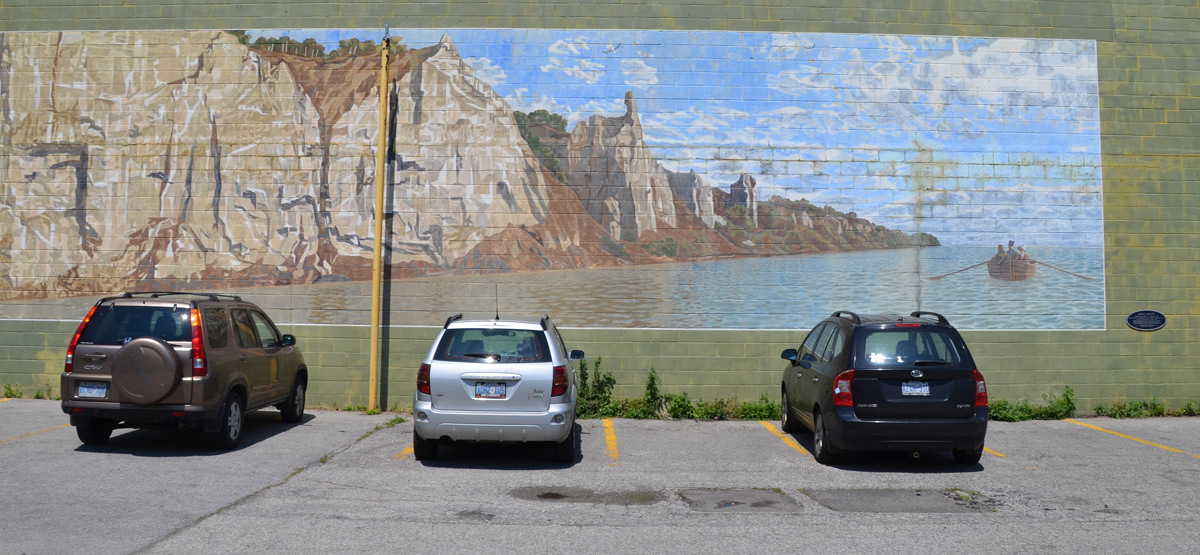
below: ‘The Bluffs as Viewed by Elizabeth Simcoe c. 1793’ by Risto Turunen, 1992.   The story is that Elizabeth Simcoe was so impressed by the view of the cliffs she persuaded her husband, John Graves Simcoe, to name the area after Scarborough England where there are similar cliffs.

Three cars are parked in front of a large mural of the Scarborough Bluffs, there is a small row boat on Lake Ontario in front of the cliffs.

There are more murals on old Kingston Road both to the east and west of these, but that will be a story for another day.

also see: Heritage Trail Mural 8 – Old Kingston Road 

‘Cutlines’, an exhibit of old photographs from the Globe & Mail,
part of the CONTACT Photography Festival

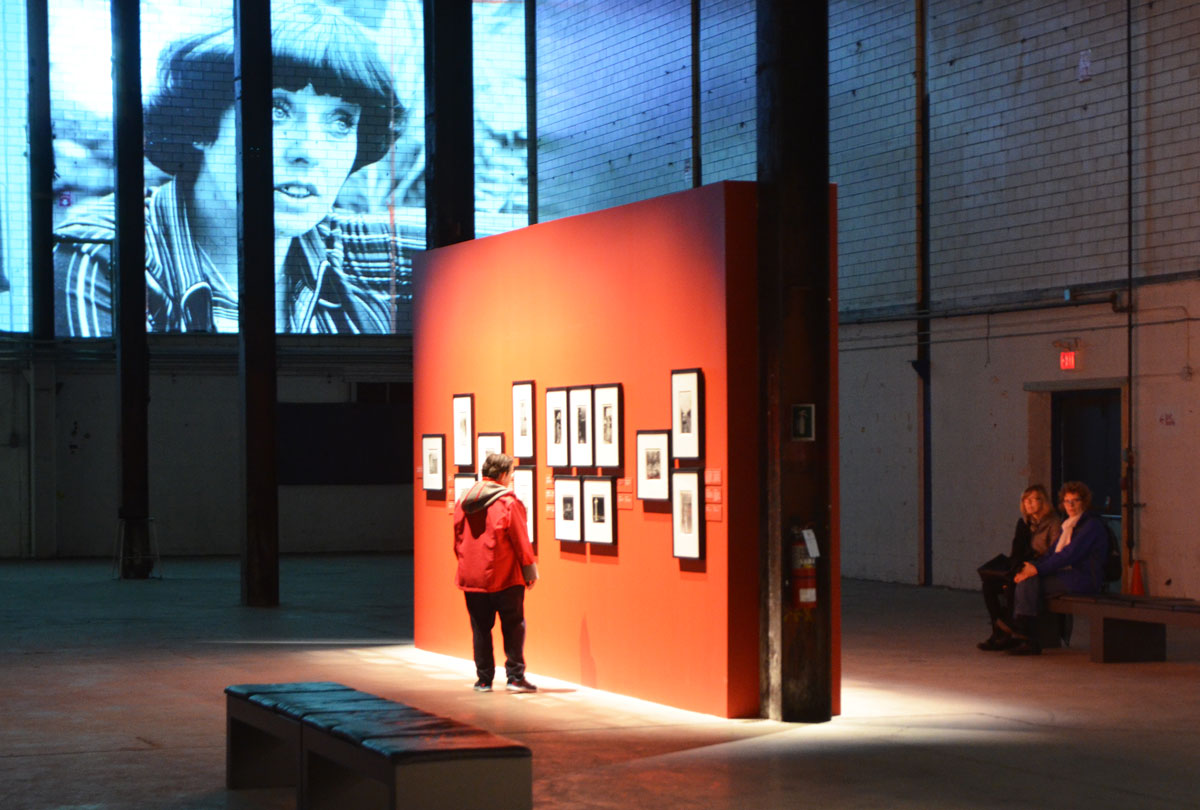
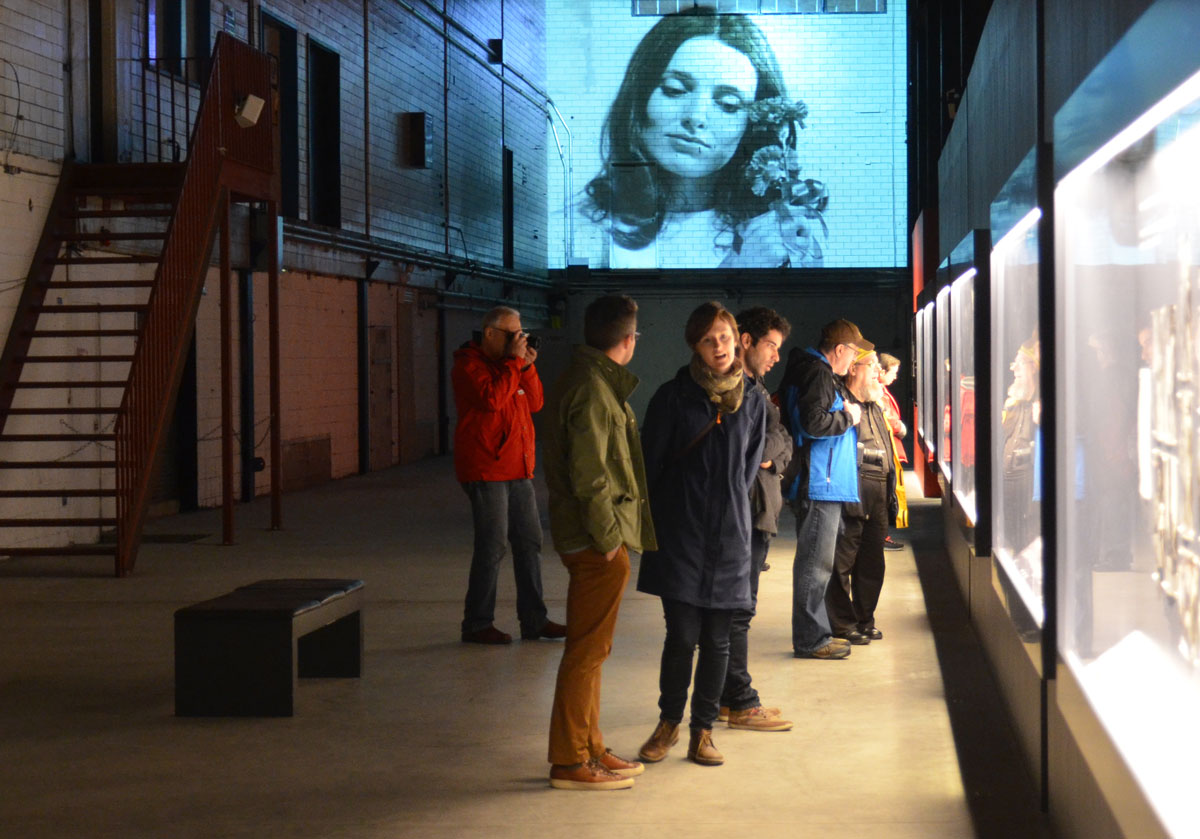
people standing in a large room, the old Press Hall at the Globe and Mail newspaper, looking at an exhibit of old photos. Some photos are being projected onto a wall

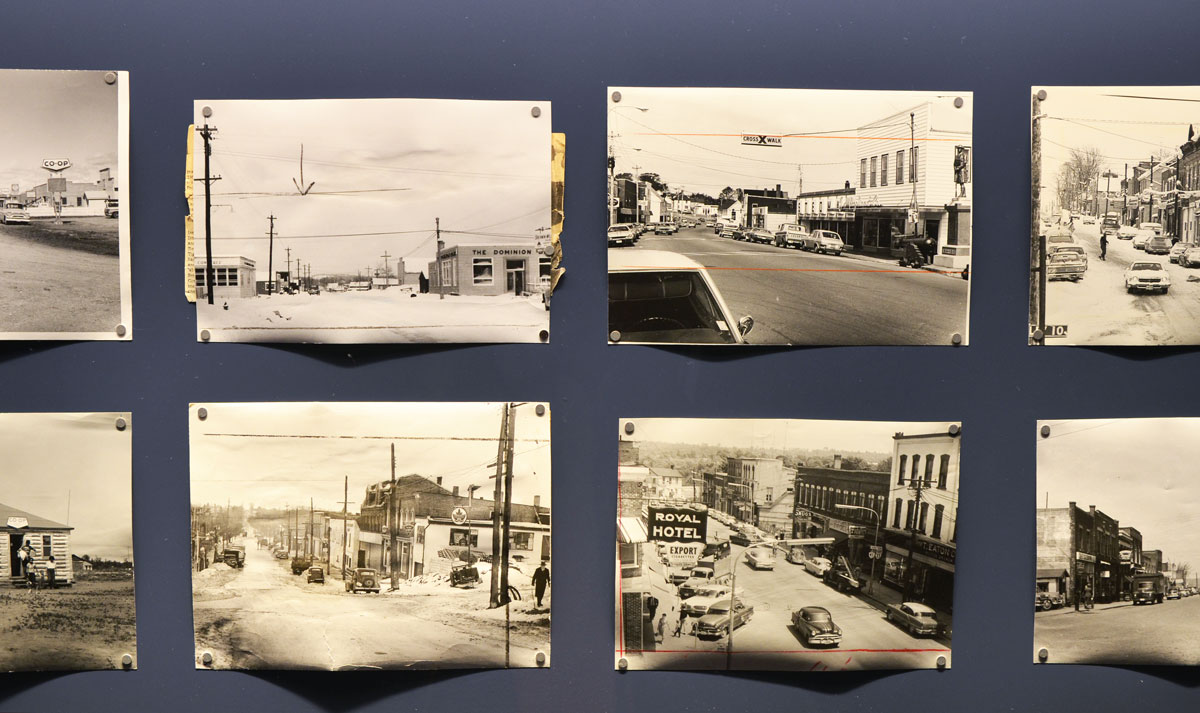
below: A small sample of the 175 vintage black and white photos from the vast collection held by the Globe and Mail newspaper on display.

old photographs, black and white, of small towns, in a display case, as part of an exhibit called Cutlines, old photos from the Globe and Mail collection

below:  The exhibit is being held at the Press Hall on Wellington Street (near Spadina).  This old building is slated for demolition in the near future as the Globe and Mail is in the midst of moving to a new home.  Prints were in cabinets in the center of the room while other images were projected high on the walls.

people standing in a large room, the old Press Hall at the Globe and Mail newspaper, looking at an exhibit of old photos. Some photos are being projected onto a wall

The Globe & Mail has amassed a collection of about 750,000 photographs.  As they transition from print to digital images, they are ‘cleaning house’ with respect to their photo archives.  About 100,000 of the prints are going to be digitized and a portion of those donated to the new Canadian Photography Institute at the National Gallery of Canada in Ottawa.

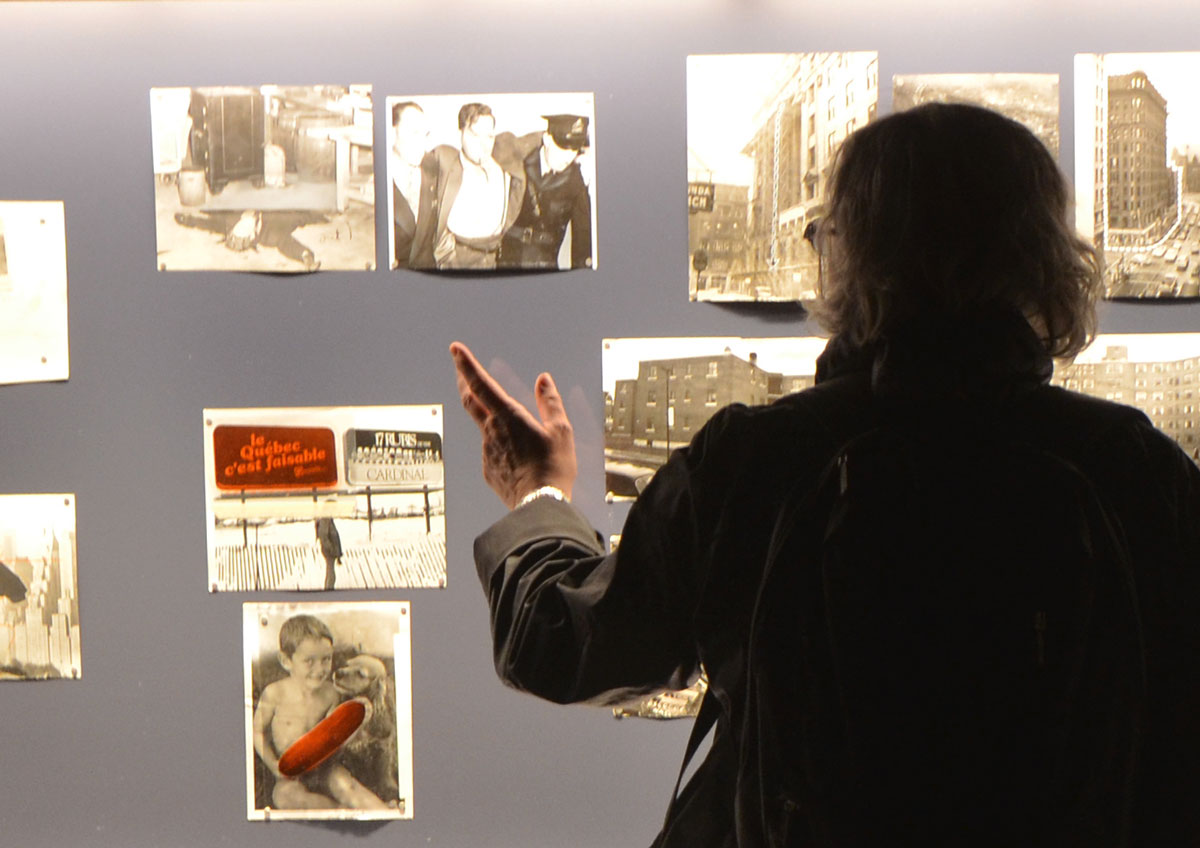
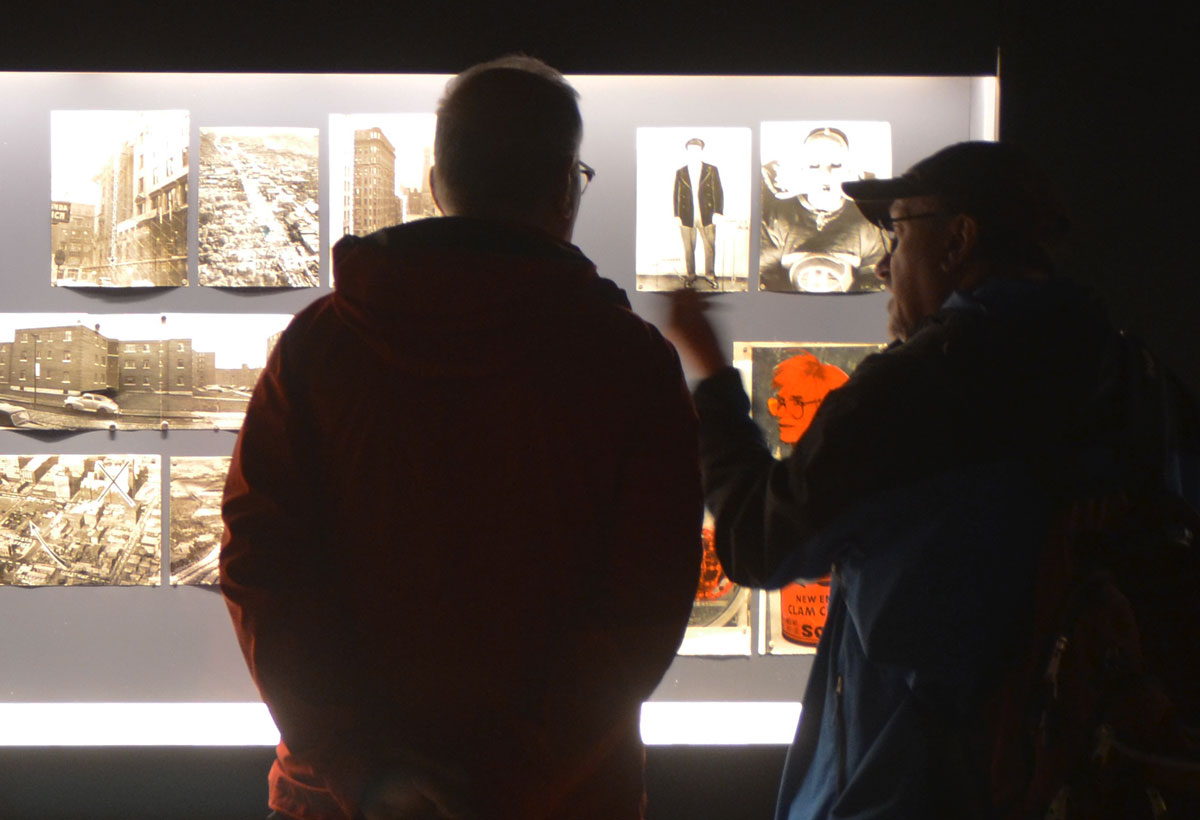
below: Some of the pictures were covered with red, with what is known as a rubylith mask.  When the images were printed, the portions covered in red remained as they were while the rest of the picture could be changed to suit the needs of the story of the day.

silhouette of a woman standing in front of a lit display case of old photographs

people standing in a large room, the old Press Hall at the Globe and Mail newspaper, looking at an exhibit of old photos. Some photos are being projected onto a wall

people standing in a large room, the old Press Hall at the Globe and Mail newspaper, looking at an exhibit of old photos. Some photos are being projected onto a wall

people standing in a large room, the old Press Hall at the Globe and Mail newspaper, looking at an exhibit of old photos. Some photos are being projected onto a wall

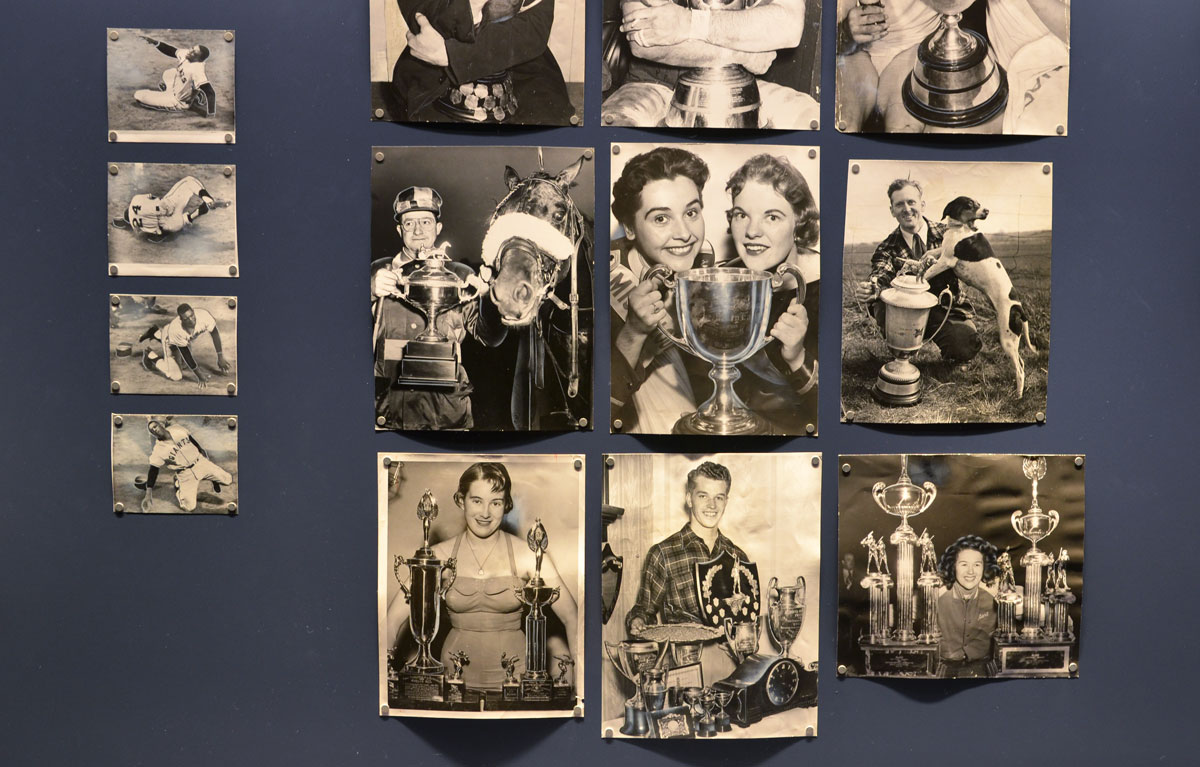
below: The woman with the two trophies, bottom left, is Marilyn Bell who swam across Lake Ontario.  I know that the man beside her is from a story about a cowboy championship of some sort in Calgary and my apologies for not remembering more of the details.

old photographs, black and white, of people with trophies, in a display case, as part of an exhibit called Cutlines, old photos from the Globe and Mail collection

silhouette of two men standing in front of a lit display case of old photographs

On view at 425 Wellington St. West until 26 June 2016

#CONTACT16