Posts Tagged ‘TTC’

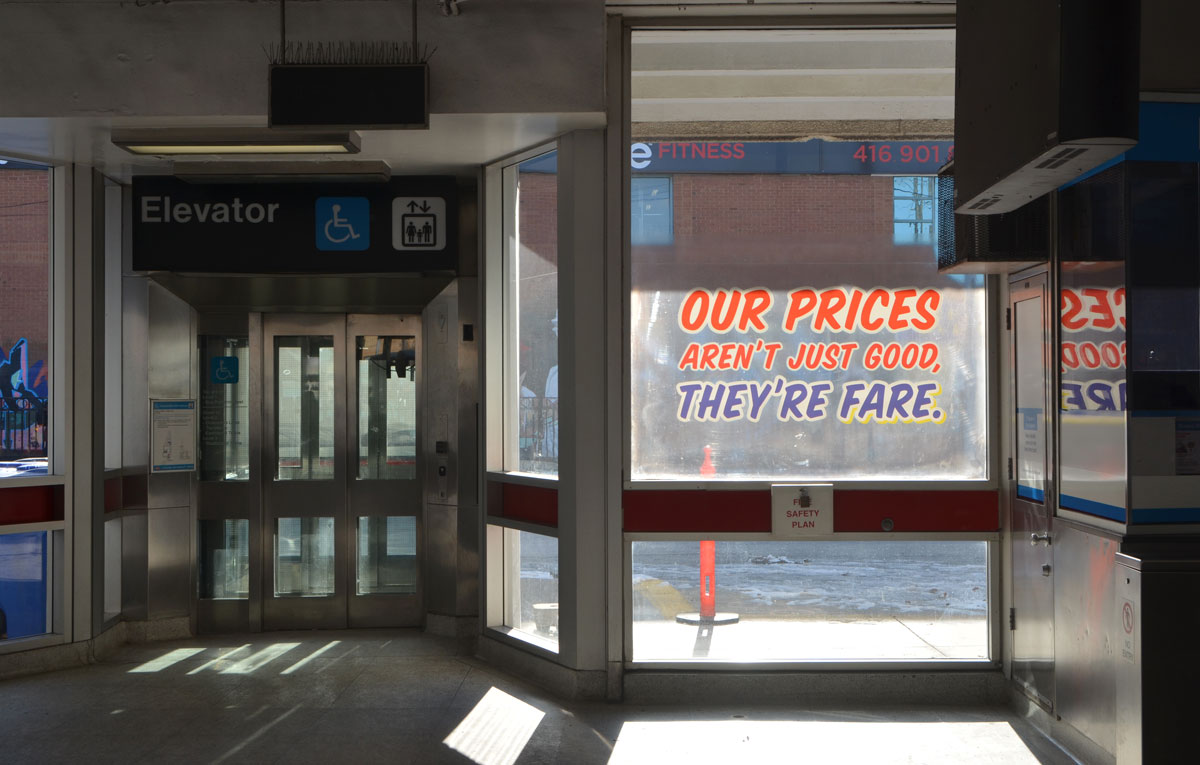
Someone has redone the signs in Bathurst subway station….
now they look like they belong at Honest Eds store!

sign maker from Honest Eds store has redone some of the signs in Bathurst subway station plus, he has added some Honest Ed type promo signs around the station - the direction sign to subway and to exits.

… and when I came up to street level I discovered that the station has been decorated with Honest Eds type ‘adverts’ complete with awful puns

sign maker from Honest Eds store has redone some of the signs in Bathurst subway station plus, he has added some Honest Ed type promo signs around the station - on the window of the station, Our prices aren't always good but they're fare

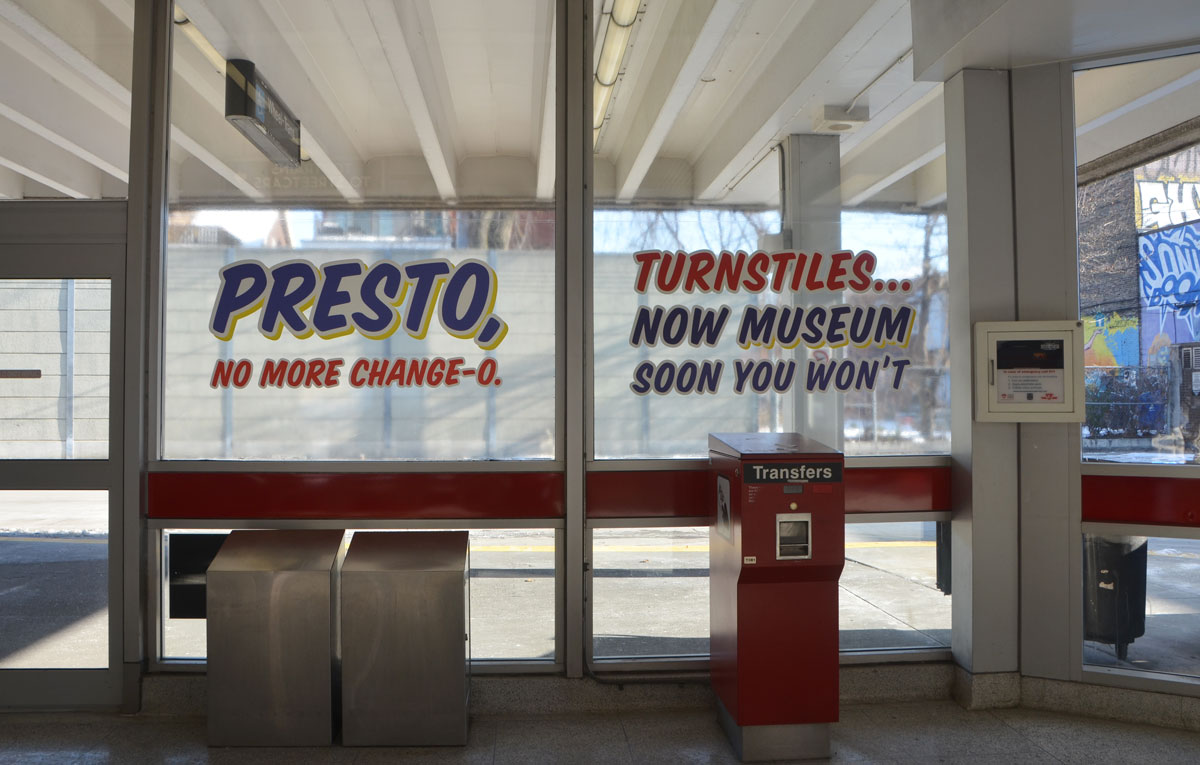
…. including word play based on subway station names such as “Turnstiles, now museum, soon you won’t”.  Groan.  Smile.

sign maker from Honest Eds store has redone some of the signs in Bathurst subway station plus, he has added some Honest Ed type promo signs around the station - on the window of the station are two signs, one says Presto no more change-o and the other says Turnstiles now museum soon you won't

below: The main entrance to the station now looks like an Honest Eds window.

sign maker from Honest Eds store has redone some of the signs in Bathurst subway station plus, he has added some Honest Ed type promo signs around the station - on the window of the station, The window beside the main entrance has been covered with fake ads.

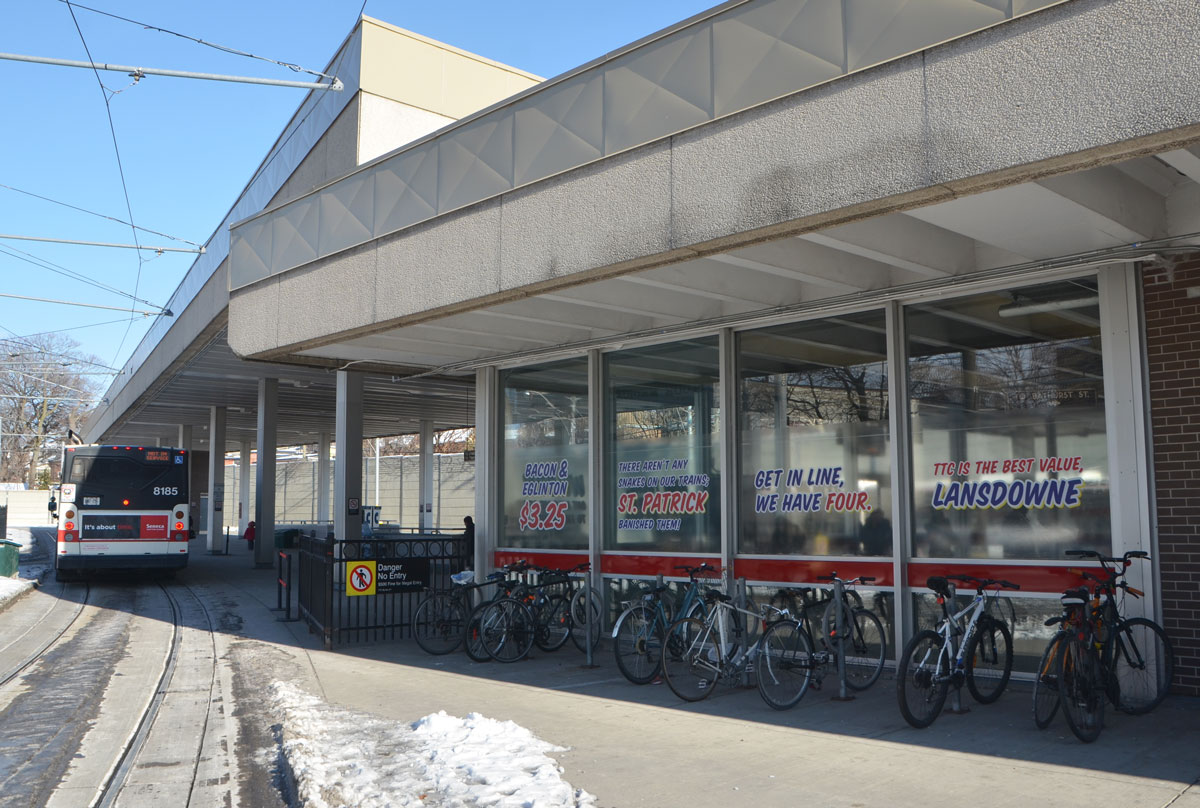
below: They aren’t too easy to read in this picture, but the two signs on the left are, first, “Bacon & Eglinton $3.25” and second, “There aren’t any snakes on our tracks, St. Patrick banished them”.   Were you expecting better?  [laughing]

sign maker from Honest Eds store has redone some of the signs in Bathurst subway station plus, he has added some Honest Ed type promo signs around the station - on the window of the station, exterior of station by streetcar and bus loop has four signs in the windows that are puns based on the names of TTC stations.

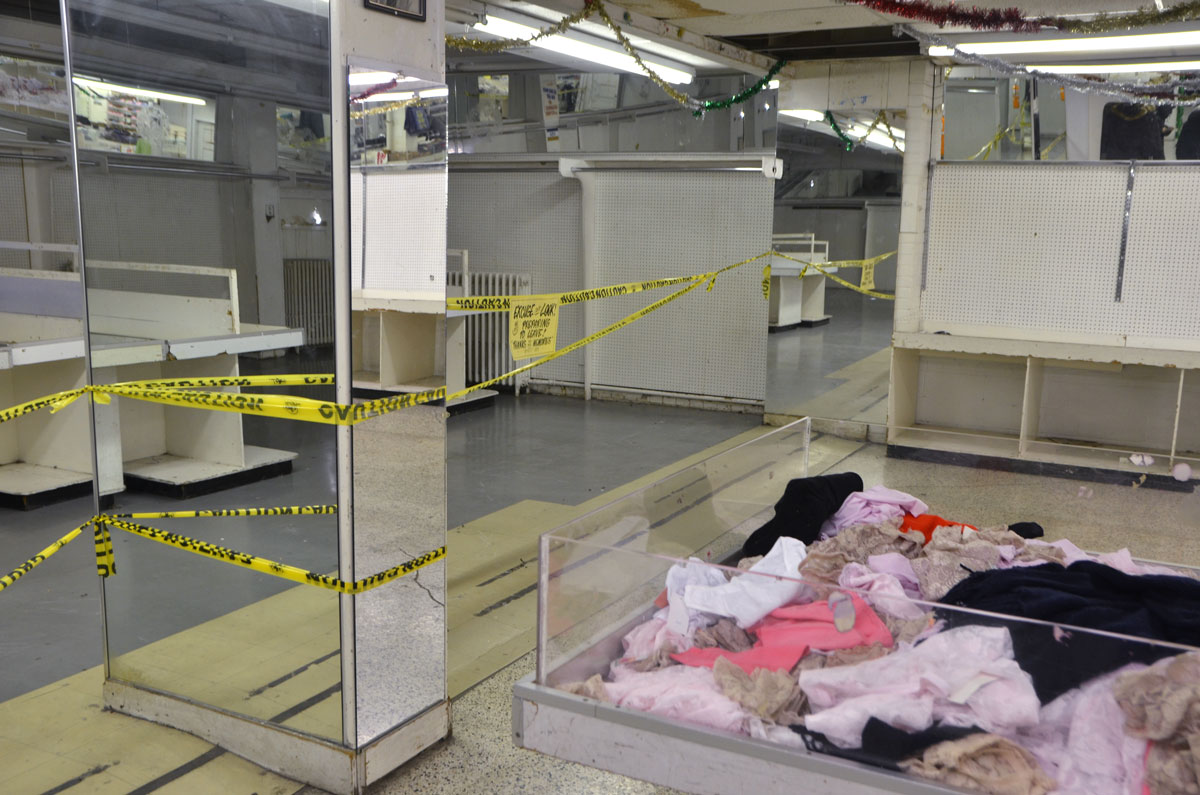
Nearby is the real Honest Ed’s store, a landmark for many years.  Eighteen months ago, I posted some pictures of the store and at the end of that post I mentioned that the store was scheduled to close at the end of 2016.  Well, the end of 2016 is drawing nigh and Honest Ed’s is slowly winding down.  The decorating of Bathurst Station is part of the good-bye process.

At the moment, the interior of the store is a shadow of its former self.  It is still in business but the goods are getting scarce.  There are definitely still bargains to be had.  I have a new hat that I bought there today, red polar fleece, that set me back 50 cents… plus tax.

interior of Honest Eds store as it gets ready to close down. a bin of lipstick and other makeup. Someone has written the word Riley in pink lipstick on the side of the bin

interior of Honest Eds store as it gets ready to close down. A bin of men's underwear for $4.99

interior of Honest Eds store as it gets ready to close down. The bedding section is being torn apart and dismantled

below: Ed Mirvish and a crowd of shoppers back in the day.
The picture still hangs in one of the many corners of the store.

interior of Honest Eds store as it gets ready to close down. An old picture of Ed Mirvish surrounded by a crowd of people hangs on a wall above a Bell payphone.

interior of Honest Eds store as it gets ready to close down. a few shower curtains on display as well as some checkered tea towels. The rest of the shelves and wall space are empty

interior of Honest Eds store as it gets ready to close down. ladies underwear in a bin for sale, surrounded by empty bins and wall space, lots of mirrors. Yellow caution tape marks off a section of the store that is now closed.

interior of Honest Eds store as it gets ready to close down. a black and white photo of a young woman on a wall beside a convex mirror showing the stairwell. also an ad printed right on the mirror for bradasol lozenges

below: Photo taken from the walkway between the two buildings that make up Honest Ed’s store.  Looking south.

looking down at an icy alley where four people are walking between buildings, sign on building says Honest Eds Annex,

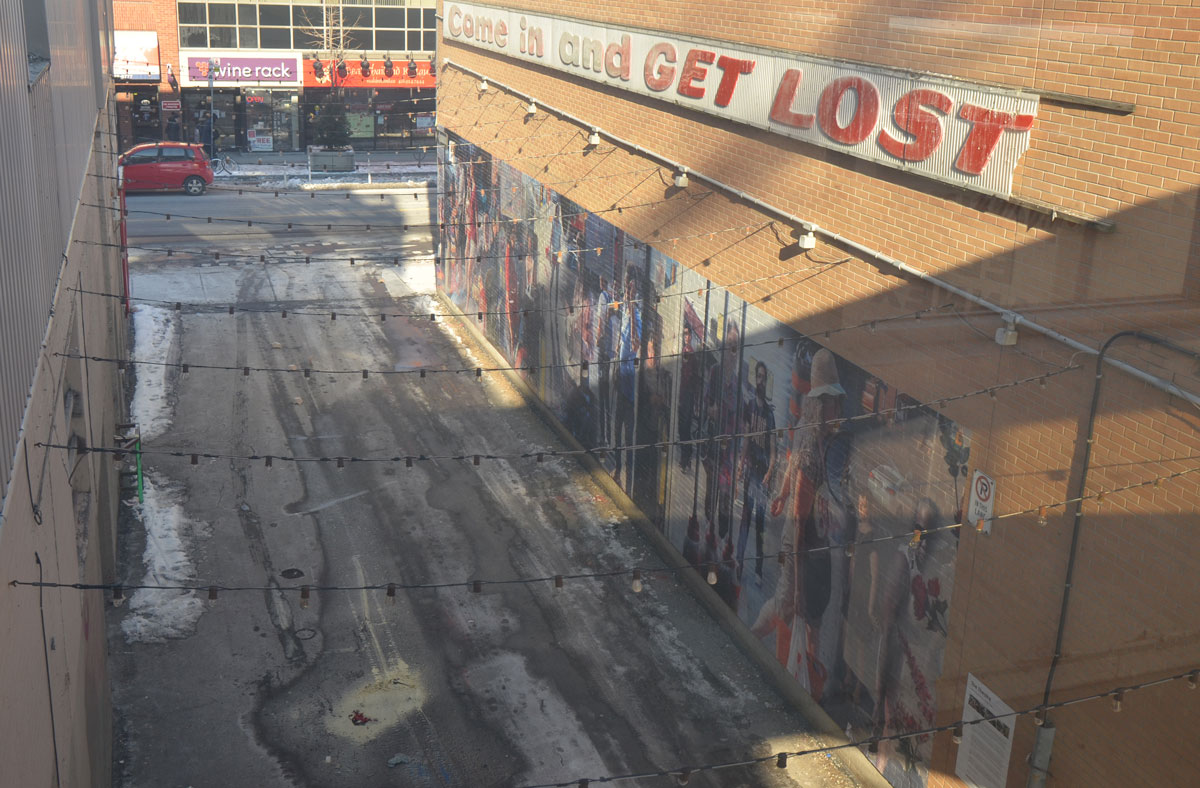
below: From the same vantage point, but looking north.  From here I spotted a new mural.

looking down on an alley, there is a mural along the side of one of the buildings.

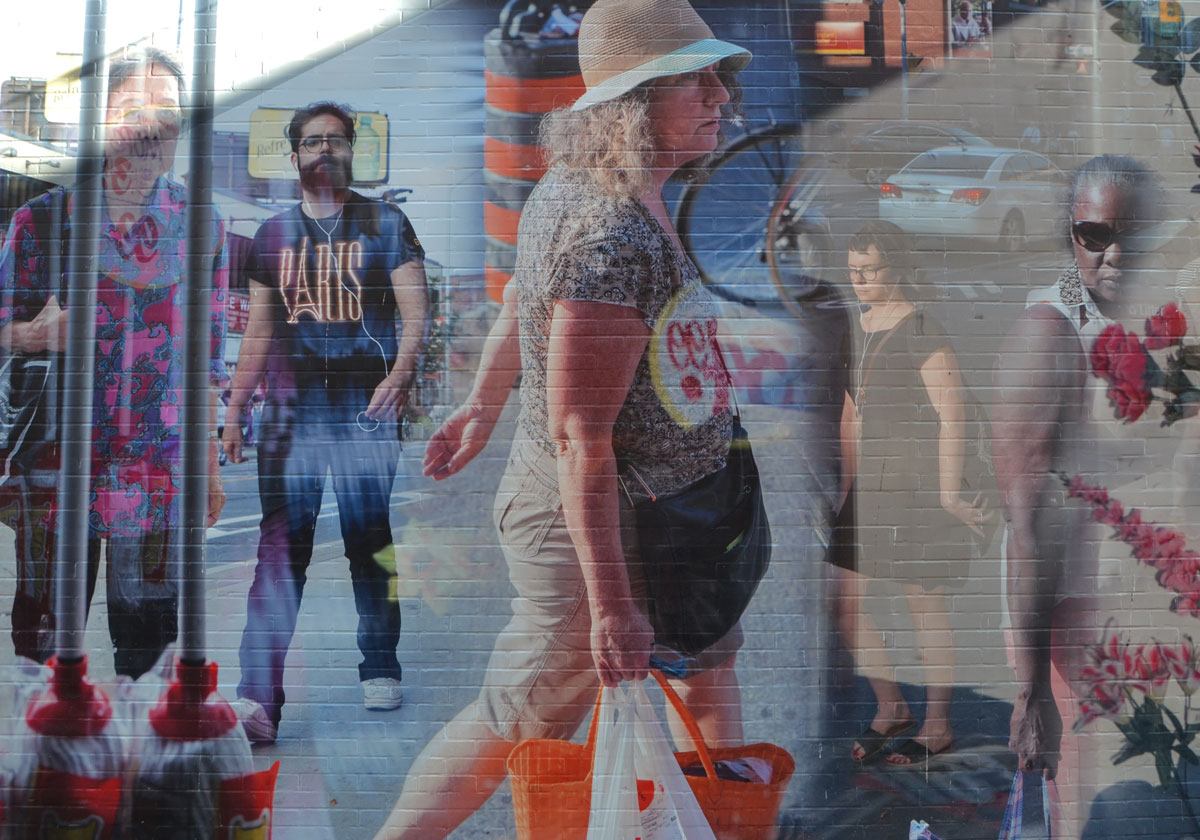
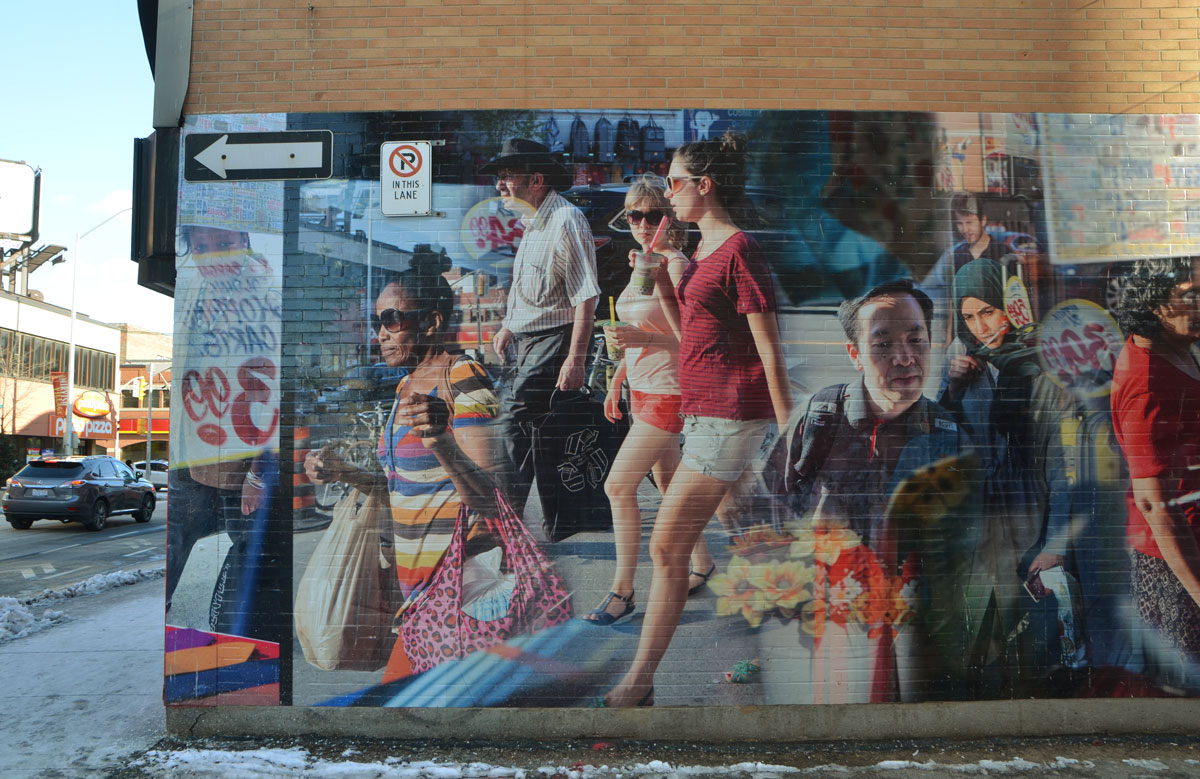
below: The mural is a large scale photo montage of people passing by the Bloor Street windows of Honest Ed’s. It catches the reflections of both the window contents and the life on the street.  It is “The Theatre” and it is the creation of Matthew Monteith.

part of a mural in Honest Eds Alley by Matthew Monteith showing people walking past the windows of Honest Ed's store, large scale photo

part of a mural in Honest Eds Alley by Matthew Monteith showing people walking past the windows of Honest Ed's store, large scale photo

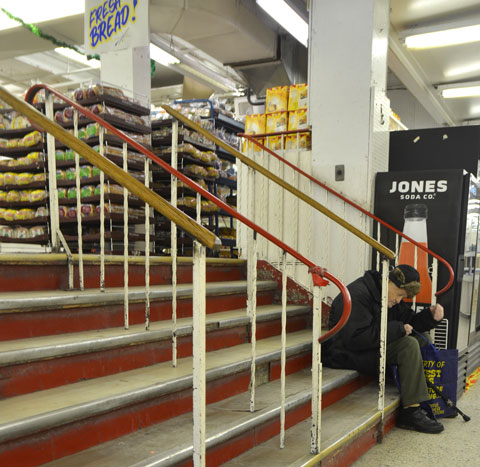
interior of Honest Eds store as it gets ready to close down. an old man with a cane sits on the steps between two sections of the store

Back in mid October I blogged about the new murals on the south side Wilson Ave as it passes under the Allen Expressway (where Wilson subway station is).

below: Looking across Wilson Avenue to part of the mural on the south side.

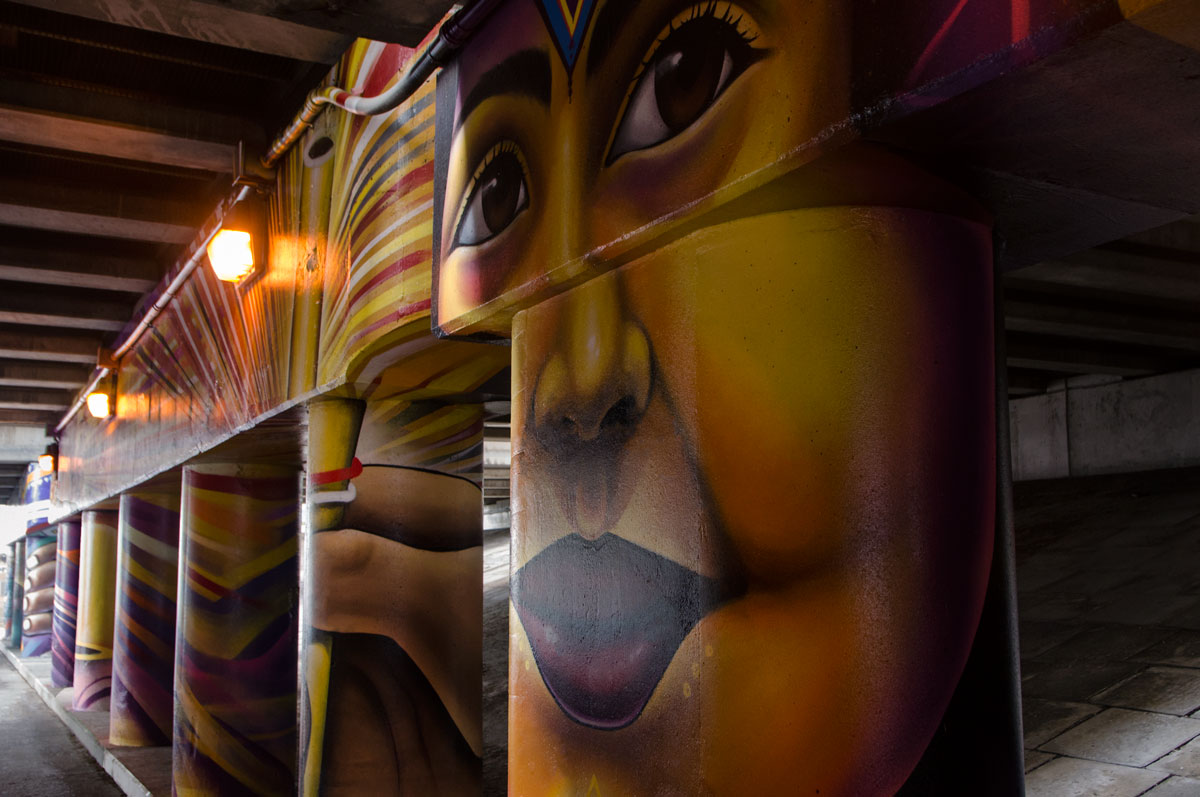
looking across Wilson Avenue, under the Allen Expressway towards a mural that has been painted on the pillars and supports on the other side. A face is painted there.

When I was there last,  the murals on the north side were not completed.   The other day I remembered that I hadn’t seen the finished work, so I took the subway back to Wilson station to see what the pillars on the north side look like.   There is more light on the north side as there are entrances to the subway along the sidewalk here.   There is also more pedestrian traffic.

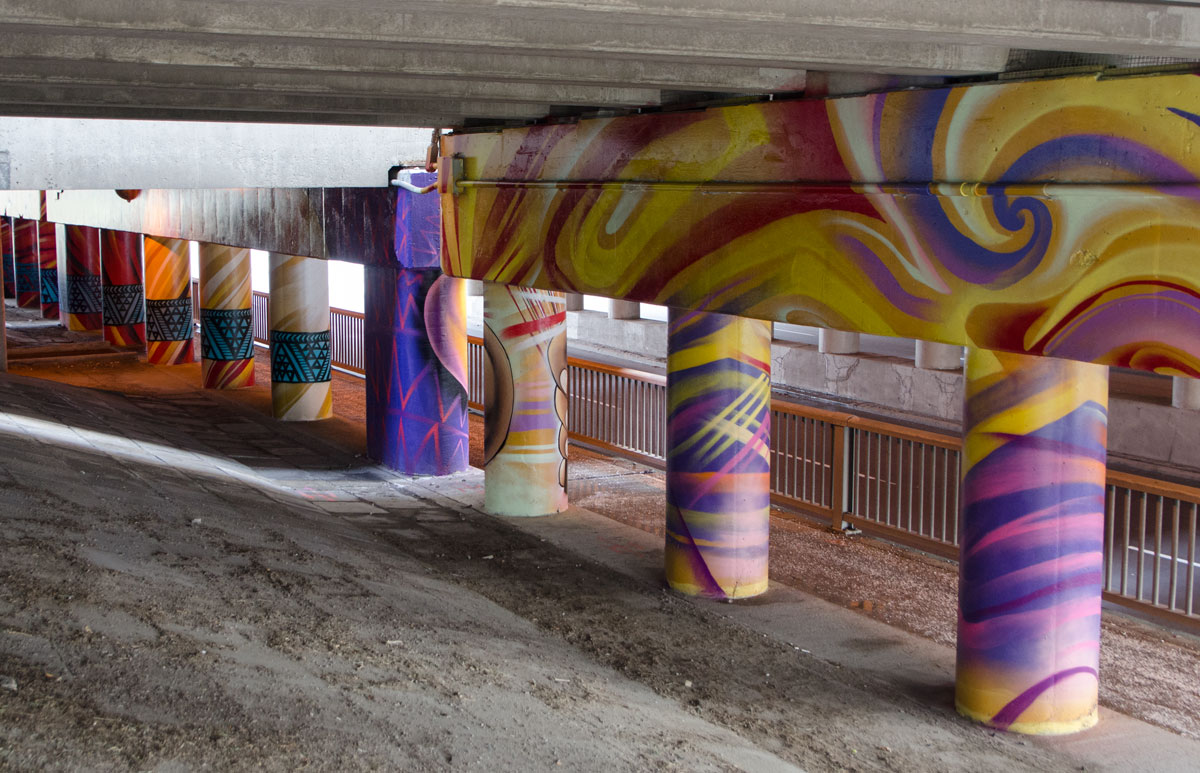
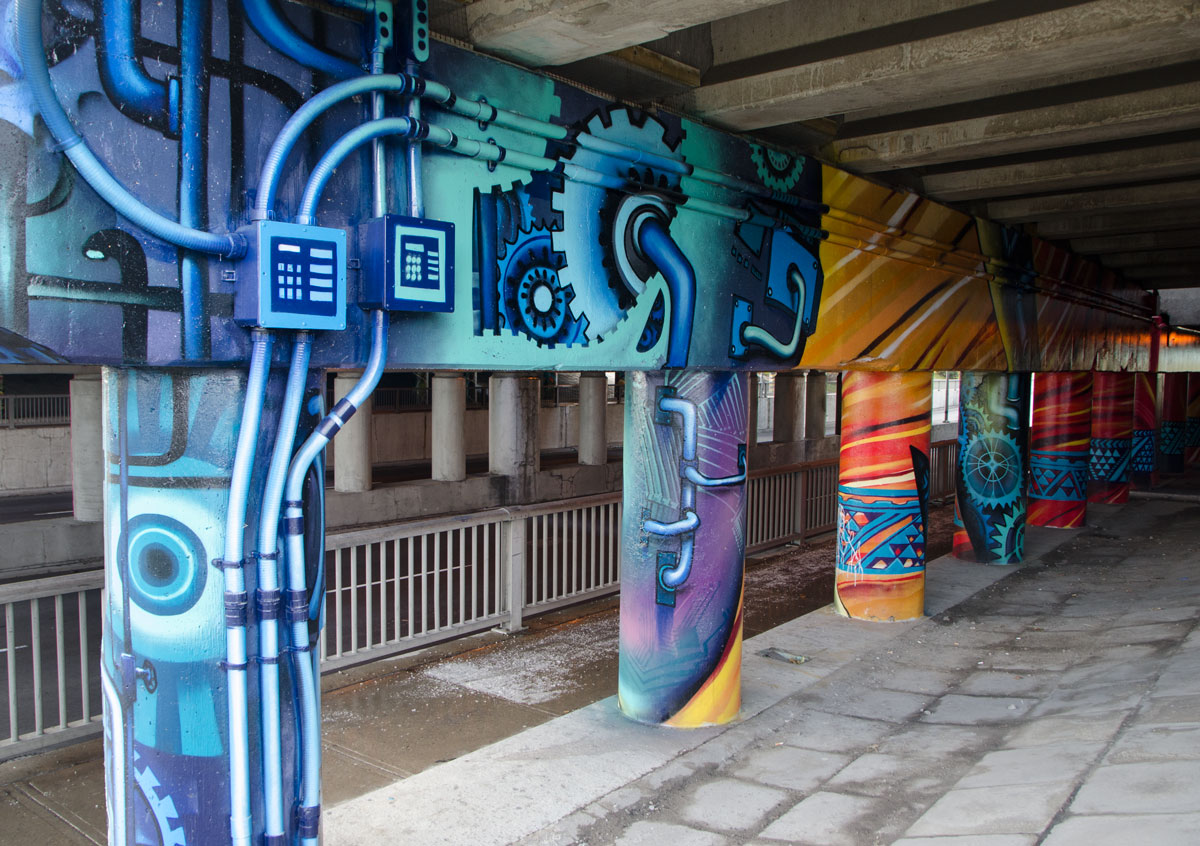
pillars and supports under an overpass that have been painted in bright colours by smoky and shalak

This side was also painted by shalak and smoky (as was the south side).

pillars and supports under an overpass that have been painted in bright colours by smoky and shalak - swirls of purples and yellows

below: In the center by one of the well-lit subway entrances.

pillars and supports under an overpass that have been painted in bright colours by smoky and shalak - red pillars with blue geometric patterns in a band around it near the bottom

pillars and supports under an overpass that have been painted in bright colours by smoky and shalak

pillars and supports under an overpass that have been painted in bright colours by smoky and shalak - a face showing eyes and top of nose

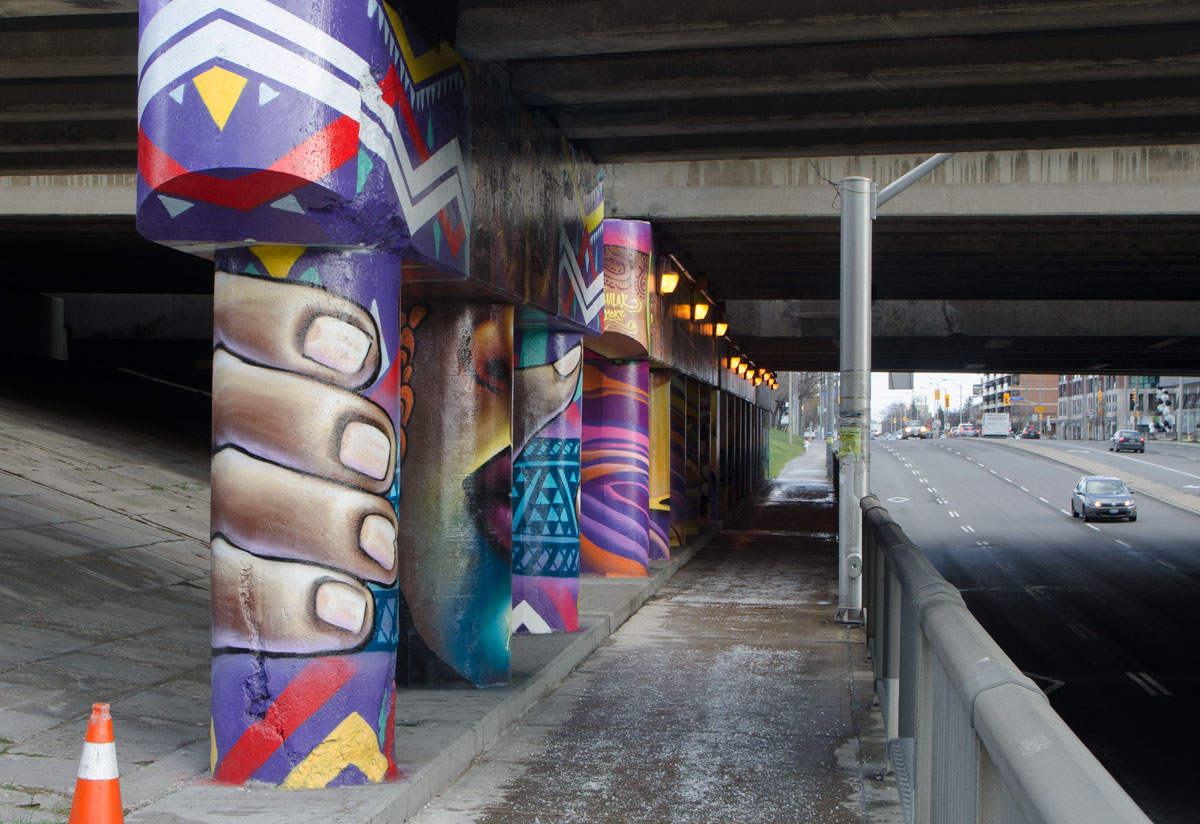
below: Looking east along Wilson Avenue.

pillars and supports under an overpass that have been painted in bright colours by smoky and shalak - a large face in the center pillar, with hands gripping the outer pillars on each side of the face

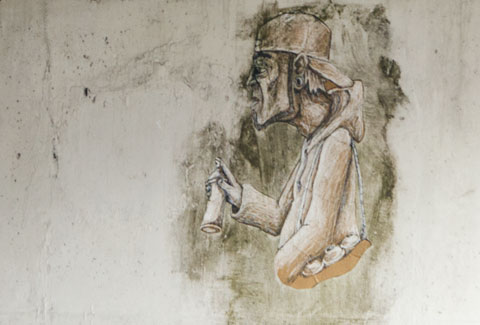
below: A little street artist with his can of spray paint has been left in a corner.
He’s not easily spotted.

a grey tones painting of a man with a spray can in his hand, from the waist up


In the lead role, the hero of our story, the Tim Hortons coffee cup, a bright red Canadian icon with its usual black top and brown sleeve.  He gets around.  The city is his playground.  Whether it’s standing out against a minimalist black and white background….

an empty red Tim Hortons coffee cup sits on a white ledge on a white wall with a black door on either side of it.

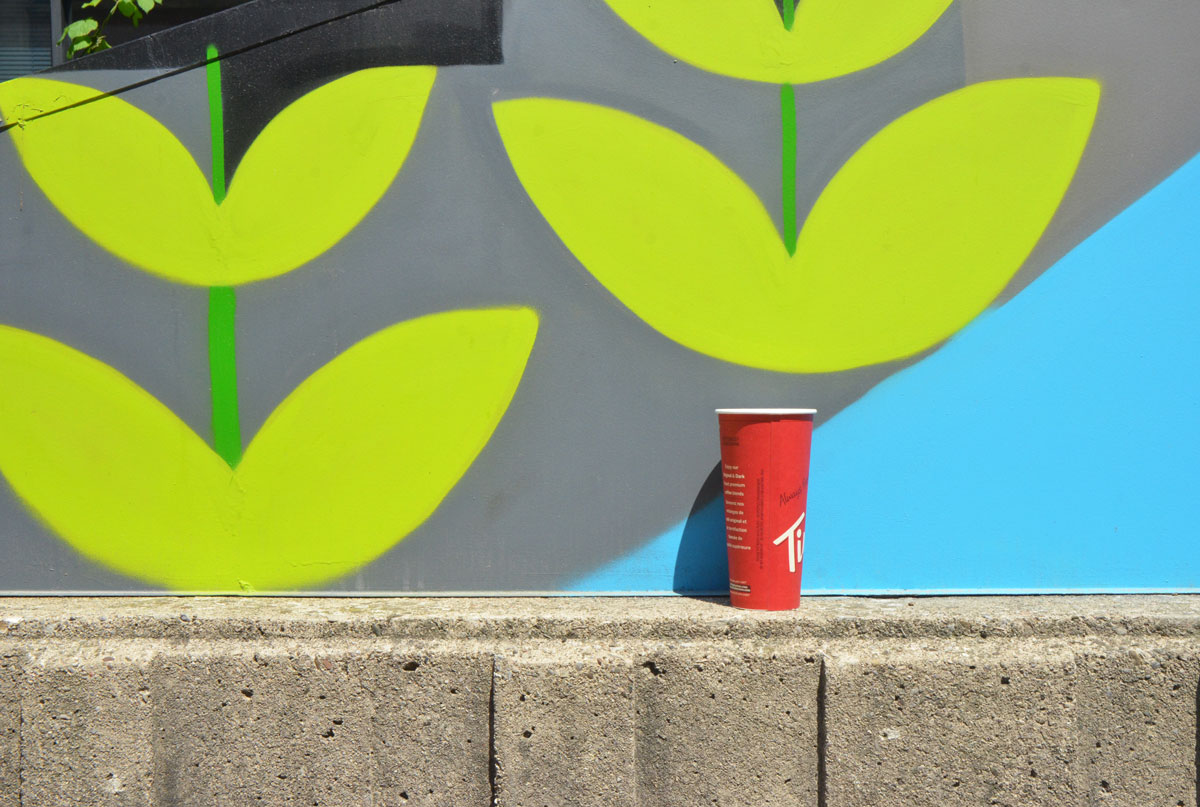
or trying hard to fit into the colours of the city.

painting of stems with leaves, stylized, with a red Tim Hortons coffee cup at the bottom of one of the stems.

There are times when he’s on top of the world. King of the castle so to speak.

a red tim horton cup on a grey metal box on the street, traffic including a TTC streetcar are in the background

.. and he rides in style with his private seat on the TTC.

an empty red tim hortons coffee cup lies on a red TTC streetcar seat. No one is sitting there.

But it’s not always an easy life. Sometimes he’s down in the dumps facing hurdles that are too high.   He’s left feeling abandoned and neglected.  Vacant.

a tim hortons cup discarded onto a gravel section of a vacant lot, behind a chainlink fence

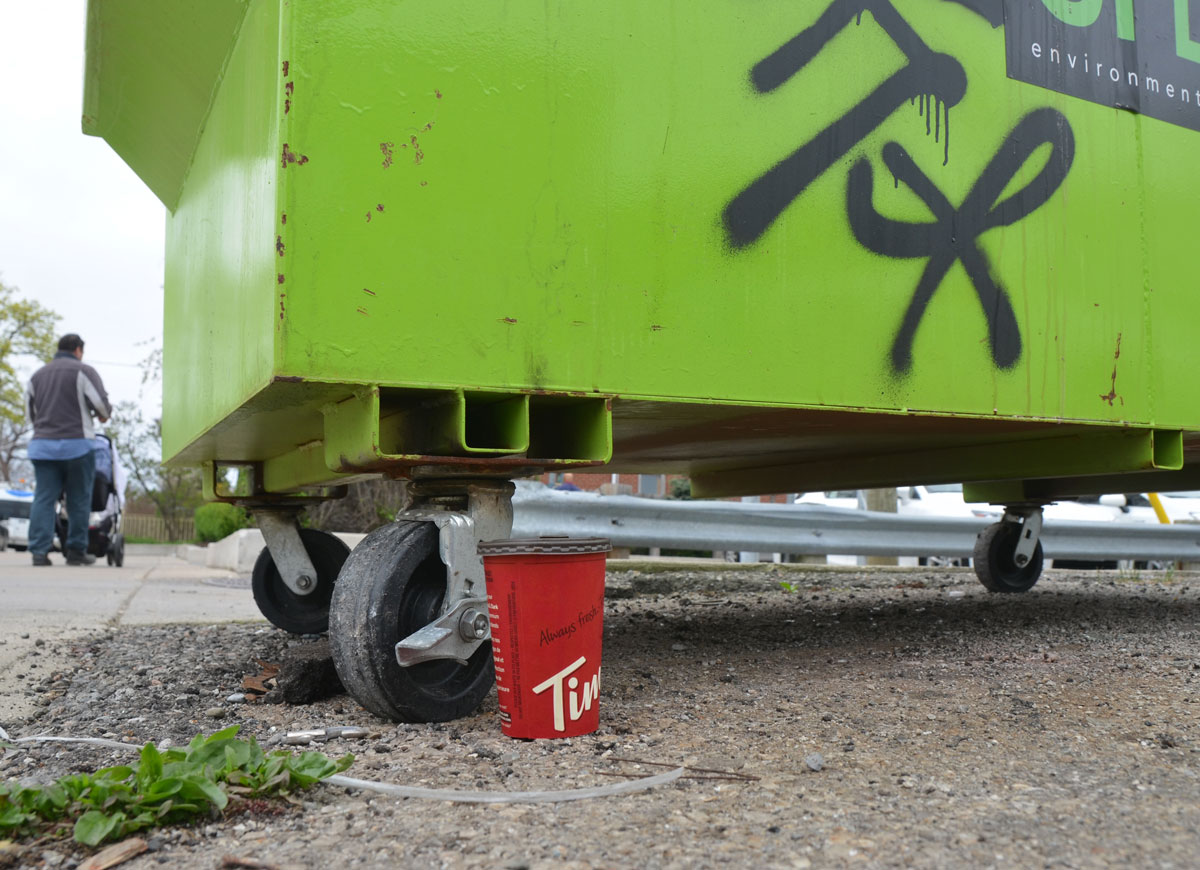
And he has even considered ending it all.

a red tim hortons cup standing on the ground beside a green rubbish bin

But he’s an urban guy.   He knows that life is what you make of it.

a red ti hortons coffee cup sits on a ledge, people around it, all with their backs to the cup

 And there are always others just like him that he can count on for a chat or for a shoulder to cry on.

Two red Tim Hortons coffee cups beside two water supply

He has many fine traits.  He can be a curious fellow but he knows his limits.

an empty red tim hortons cup lies discarded on the ground, beside yellow police tape

He knows that sometimes you have to be patient… but that doors usually open.

a red tim hortons coffee cup sits on the stone step in front of a double set of doors. on a street

He’s frequently warm and often ready to lend a hand.  In case of fire, he’s there!

a red tim hortons cup sits on a red shelf beside fire emergency equipment

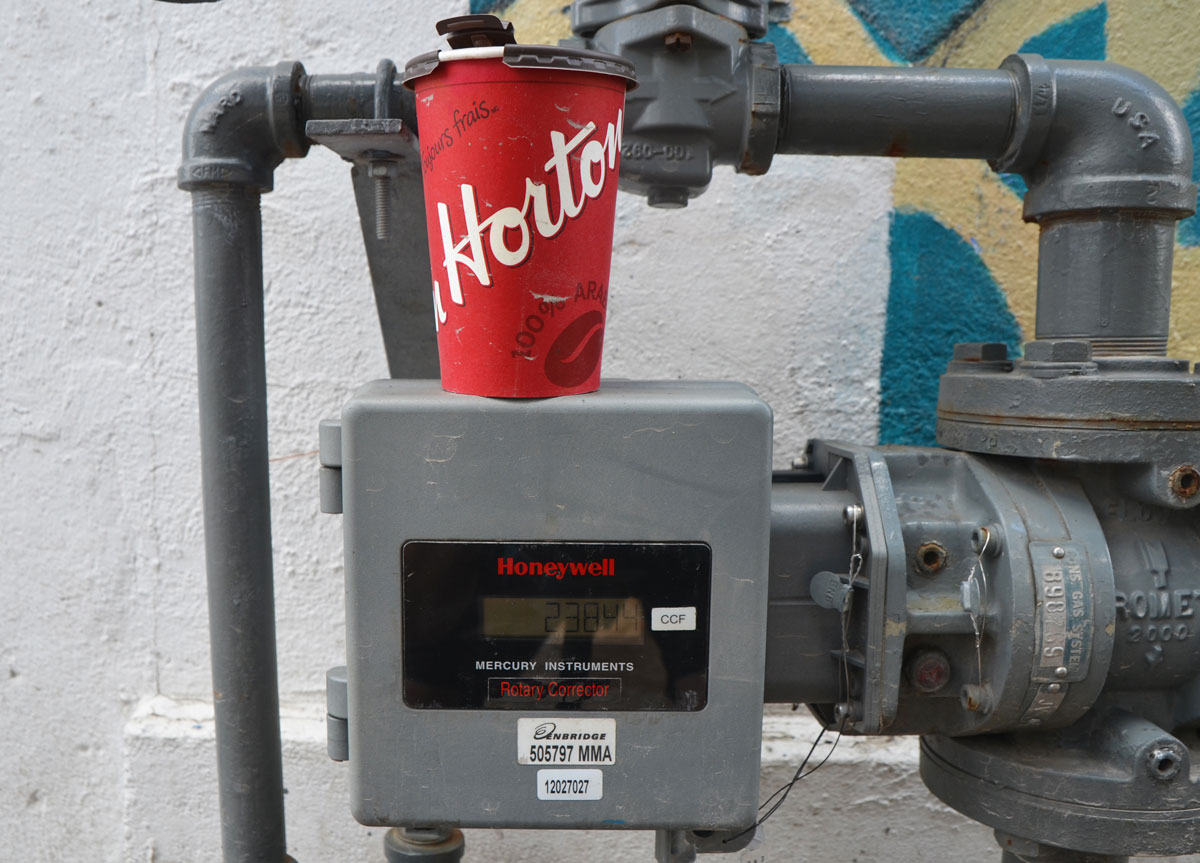
You’ll find him in many places around the city, watching, waiting, and keeping an eye on the situation in his own quiet way.  He too is part of this city.

a red tim hortons coffee cup sits on top of a grey Honeywell meter outdoors

Casting by Tim Hortons.
No cups were disturbed in the making of this story.
Look for the sequel, ‘A Tim’s Christmas’ playing in a street near you.


This is another meandering blog post… a post about being out and about on yet another wonderful autumn day, going wherever my feet and eyes take me.

below: The first picture of my day was this intriguing wall made of old wooden doors.  Bathurst Street.

a tall narrow wall about three storeys high made of old white doors.

below: A small elicser mural tucked away at the end of a parking lot.   The man has his back to the viewer but I can’t figure out what’s behind him or what he might be doing.

small mural on a fence, a man's head is back to the viewer

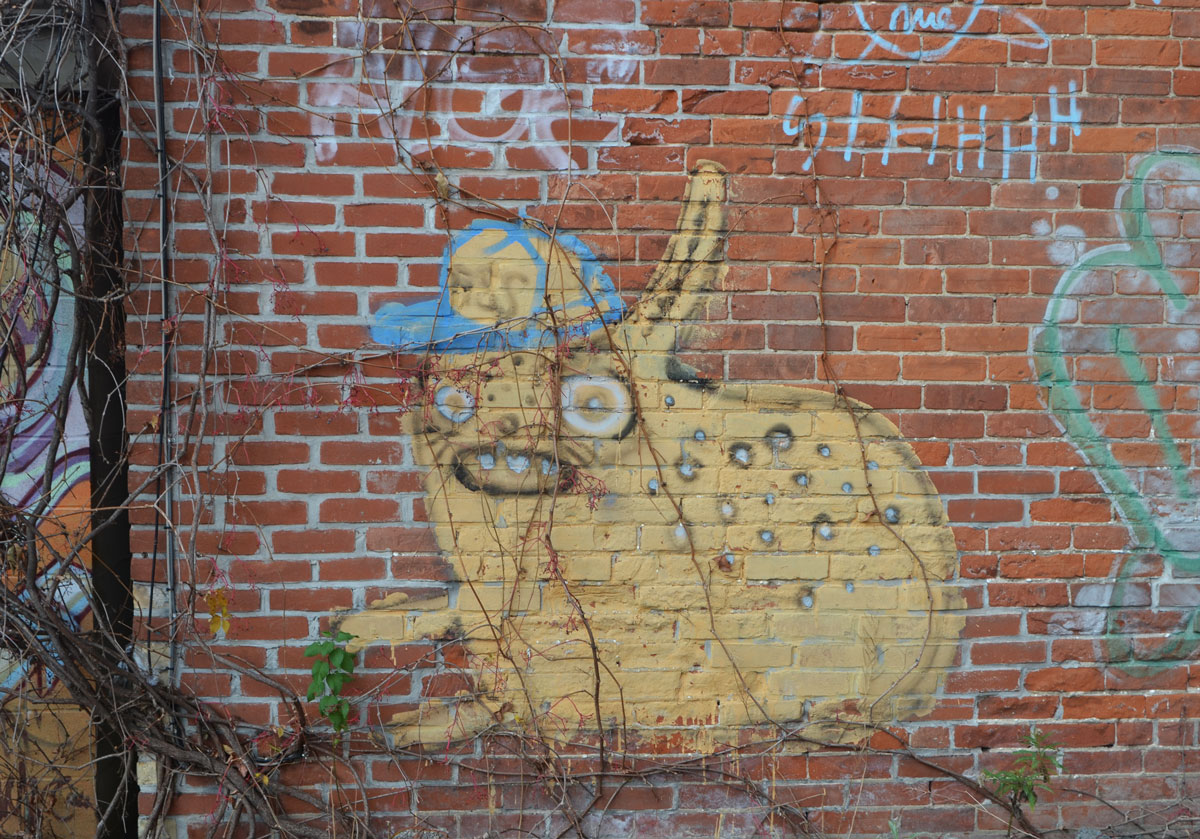
below: The leaves have fallen off the vines to reveal a yellowish creature with his baseball cap askew.

graffiti painting of a yellow animal like creature wearing a blue and yellow baseball cap. The creature is yellow. On a red brick wall, with spots on its back

below: Toronto’s tallest icon framed by a construction crane.

CN Tower in the distance, condo construction in the foreground, with a red crane

below: And on a similar note, a vacant lot cleared and ready for the next stage of its life.
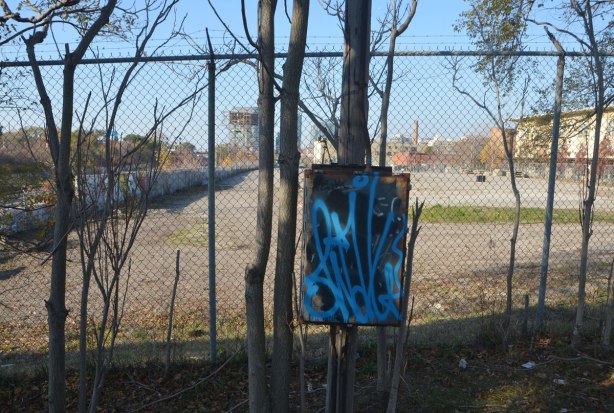
a box beside a fence that has been scrawled over with blue spray paint. Behind it is a fence around a vacant empty lot. There are some small trees growing in front of the fence.

below: No more cranes here (and not many vacant lots either for that matter).  A view showing how much development there has been on the south side of the railway tracks.   Fort York is between the tracks and the condo towers.

a VIA Rail train passes by on one set of many tracks, in the background is Fort York and then a series of new condo buildings.

below: And what’s this? An old blue canoe beached on the tracks?
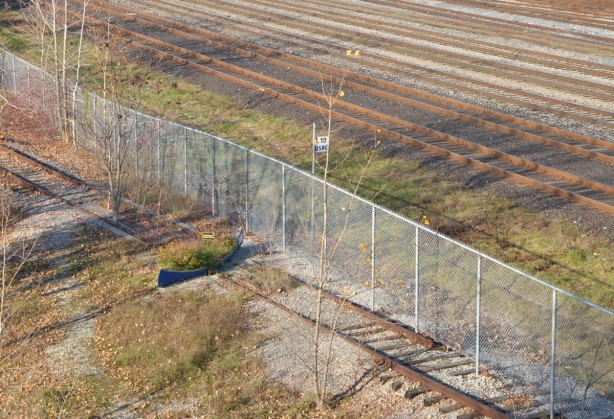
looking at the scene from a above, a blue canoe has been used to plant plants in. It lies across an old railway track, a chainlink fence separates the canoe from the main railway tracks that still function.

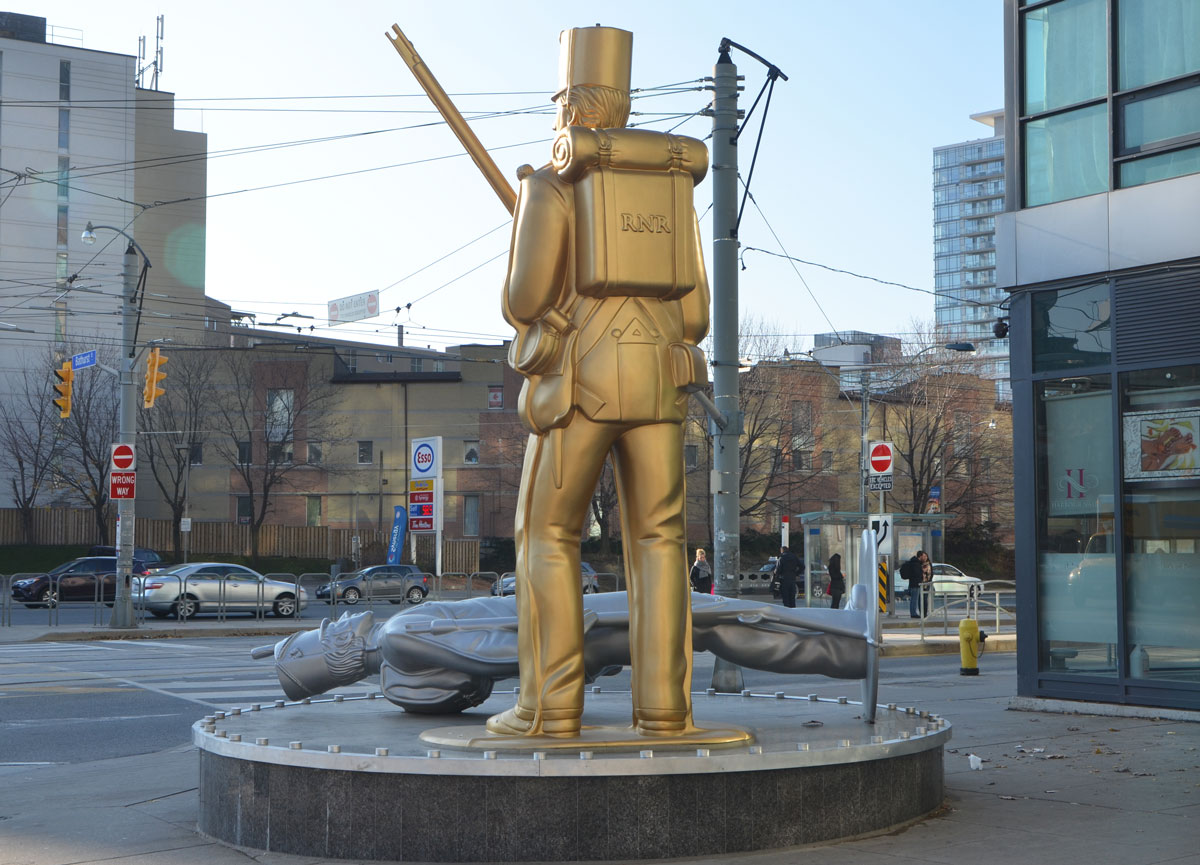
below: Standing guard over Bathurst Street, Fleet street and the Lakeshore, is one larger than life gold replica of a Royal Newfoundland Regiment and his fallen silver American foe. A sculpture by Douglas Copeland entitled “A Monument to the War of 1812”, a nod to nearby Fort York and the history of Toronto.

Douglas Copeland's sculpture of two tin soldiers, a gold one standing with backpack on and rifle in hand, and a silver one lying on its back on the ground, uniforms circa War of 1812, seen from the back, figures are much large than life sized and they are on a corner at an intersection, Bathurst St. and Fleet St.

below: My favorite example of bad grammar still exists!  Off-leash dog area at Coronation Park.

a wood fence around a dog park, in autumn with lots of leaves on the ground, on the fence is a white sign with black letters re the Toronto municipal code 608,

A beautiful day in the park.  A slight November nip was in the air but it was sunny and the sky was a brilliant shade of blue.  Coronation Park is named in honour of the coronation of King George VI who was crowned on 12 May 1937.  At that time nearly 150 trees were planted here.

Apparently, an oak tree was planted to honour the king.  Surrounding it, a ring of silver maples was planted.  This was to symbolize the countries of the British Empire.  I wish I had known that bit of trivia before I walked through the park because now I am curious if these trees are still there.   Some of the trees are quite substantial.

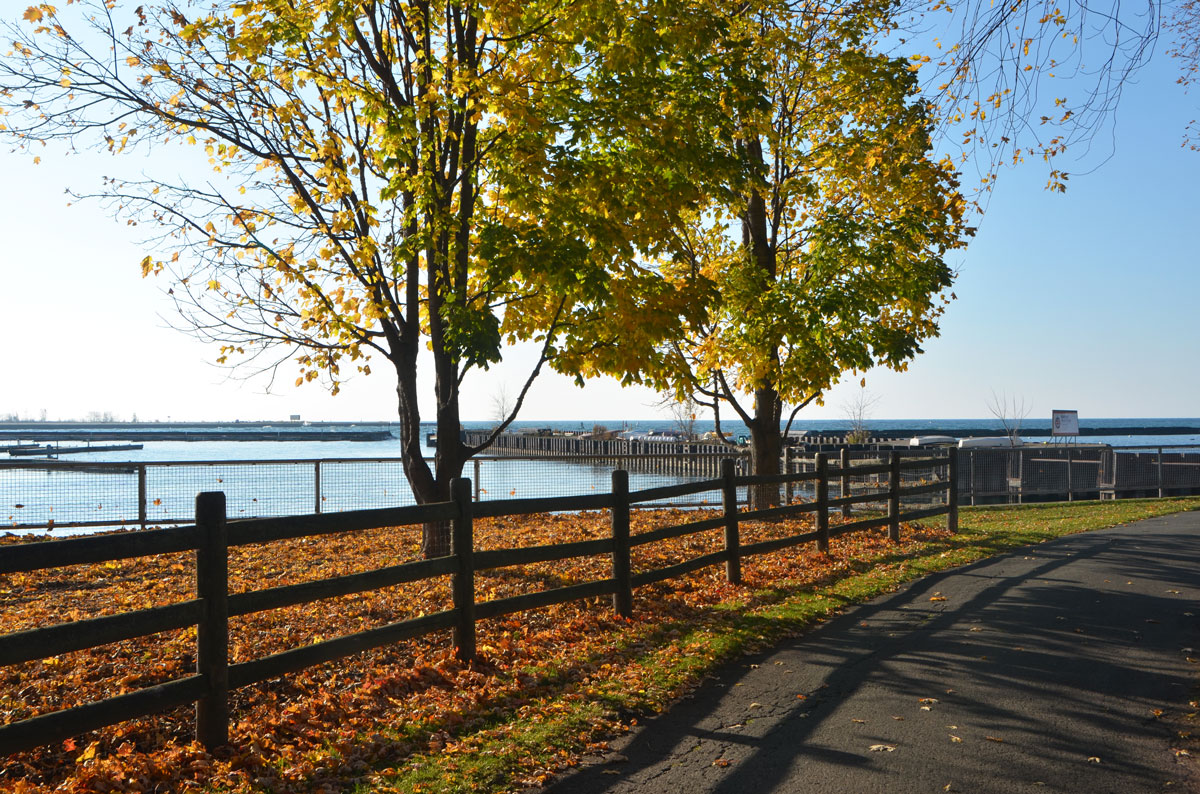
below: Long shadows for the morning sun, low in the sky.

morning in the park, autumn, trees with some leaves still on, many leaves on the ground, wood railing fence, shadows, Lake Ontario, path, Coronation Park.

below: Looking back towards the city center, past the empty docks of the National Yacht Club to the residences on Stadium Road.   A small group of people were making a video in the dog park.

morning in the park, autumn, trees with some leaves still on, many leaves on the ground, wood railing fence, shadows, Lake Ontario, path, Coronation Park. a small group of people in the distance are filming a video

below: This Victory Peace Monument was unveiled on 14 November 1995 to commemorate the 50th anniversary of the end of World War 2 and honour those who died in that war.   It was designed by John McEwen; the bronze pieces resemble the bow of a ship.

Metal partial cylindrical shapes on a concrete circular monument. World War 2 memorial

below: On the inside of one of the bronze pieces is a map of eastern Canada and the Atlantic Ocean.  Each boat on the map represents a ship or U-boat that was sunk during the war.  The Canadian ships are located on the map at “their last known position”.  I hadn’t realized that so many ships were lost so close to North America.

relief map of eastern Canada and the Atlantic Ocean, in bronze on a WW2 memorial. Little ships are shown on the ocean where they were sunk during WW2.

Trees were also planted to represent the four divisions of the Canadian Expeditionary Force (WW1) and its units as well as those who fought in the Fenian Raids of 1866-1870, the Northwest Rebellion of 1885, and the Boer War (1899-1902).  Once upon a time, brass plaques were placed at the foot of each tree to indicate the units the tree stood for.  If any plaques remain, I didn’t see them.

below: Another memorial is close by, a  “Memorial to Lieut. Tommy Hobbs gallant British Canadian soldier in the Great War 1914 – 1918.  Died on active service November 10, 1940.  Beloved and remembered by his comrades.”   Tommy Hobbs was involved in the creation of this park.

a memorial in a park made of a small pile of rocks. The top rock is inscribed, memorial to Tommy Hobbs, died 1940, in Coronation Park

below: A little farther on I noticed another rock, one that was painted red.   The bronze plaque on the rock says that 20 trees have been planted here in commemoration of the G20 Summit held in Toronto in 2010.

a large rock with a bronze plaque on it. The rock has been crudely painted red

below:  A 30 foot tall Inukshuk stands looking out over Lake Ontario.  Approximately 50 tonnes of mountain rose granite was used to create the Inukshuk, which was made by Inuit artist Kellypalik Qimirpik from Cape Dorset, Nunavut.

a tall stone inuksuk on a raised mound of warth

below: Streetcars across the baseball outfield.
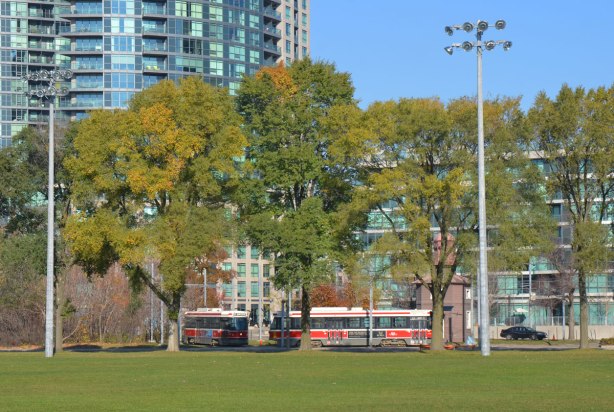
Looking across the outfield of a baseball diamond towards a street. A line of mature trees by the street with two red and white TTC streetcars on the street, condo towers behind.

below: A closer look at that brown octagonal structure in the middle of the streetcar loop for the 509 and 511 cars.  Apparently it’s the Queens Wharf lighthouse, one of a pair built in 1861.

a brown structure, the Queens WHarf Lighthouse, sits on a patch of grass beside TTC streetcar tracks in front of a new condo.

The lighthouses marked the entrance to the Toronto Harbour from 1861 until the Western Channel was built in the early 1900’s.   This one stood on Queen’s Wharf which used to be at the foot of Bathurst Street, adjoining Fort York.  The wharf was built by the military; in 1833 it was a pier 42 feet long.    The pier no longer exists; a hundred years ago it was buried under what is now Bathurst Quay.

below:  A picture of an historical map (1886 or 1887) of the area showing Toronto Harbour, Fort York and the railway lands.  Queen’s Wharf is the pier on the left.   At that time, Front Street was the southern most street in this part of the city.   All the present day development south of the train tracks is on reclaimed land.

picture of historical map of part of Toronto Harbour from 1886, showing Fort York, Front St., and Bathurst St., and the railway lands and wharves into Lake Ontario,

below:   Taken from google maps, what the layout of the city looks like now.   As you can see, there have been many changes!

present day map taken from google maps of Coronation Park and Bathurst Quay including Fort York

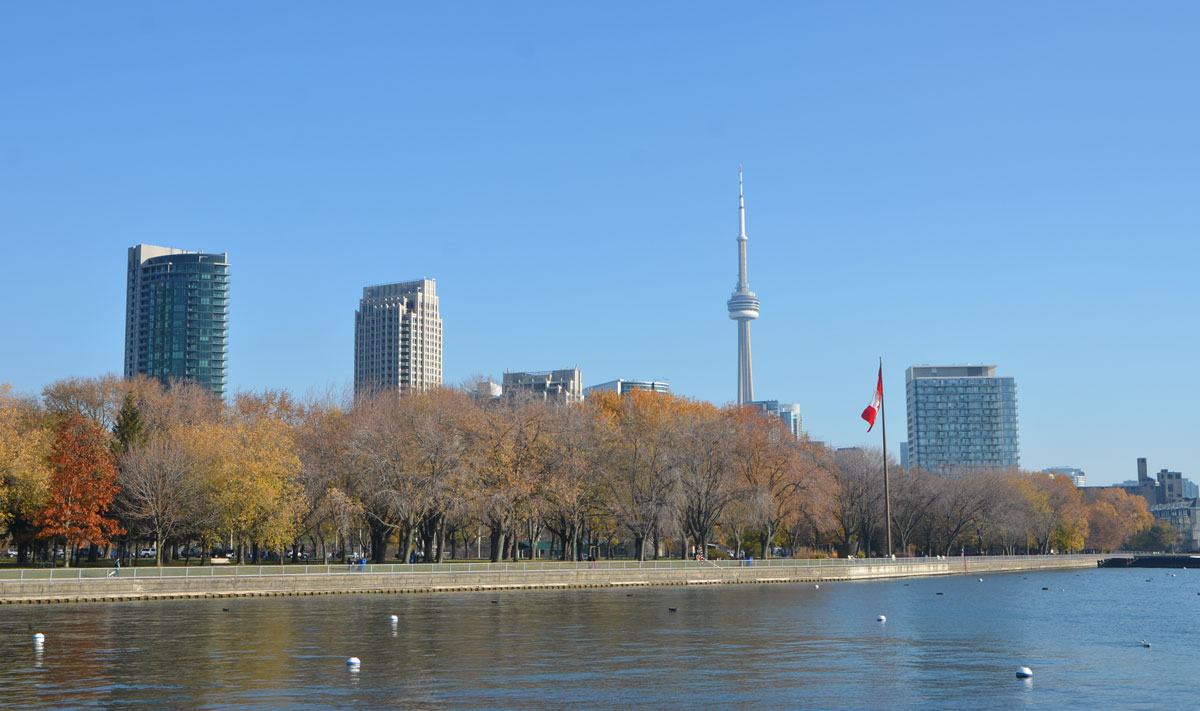
Lake Ontario in the foreground, trees in Coronation Park in the middle and Toronto skyline in the distance with the CN Tower and a large Canadian flag.
a sticker of a rainbow in a heart shape. A small purple heart is in the center, then a blue heart is drawn around it, moving outwards in rainbow colours.

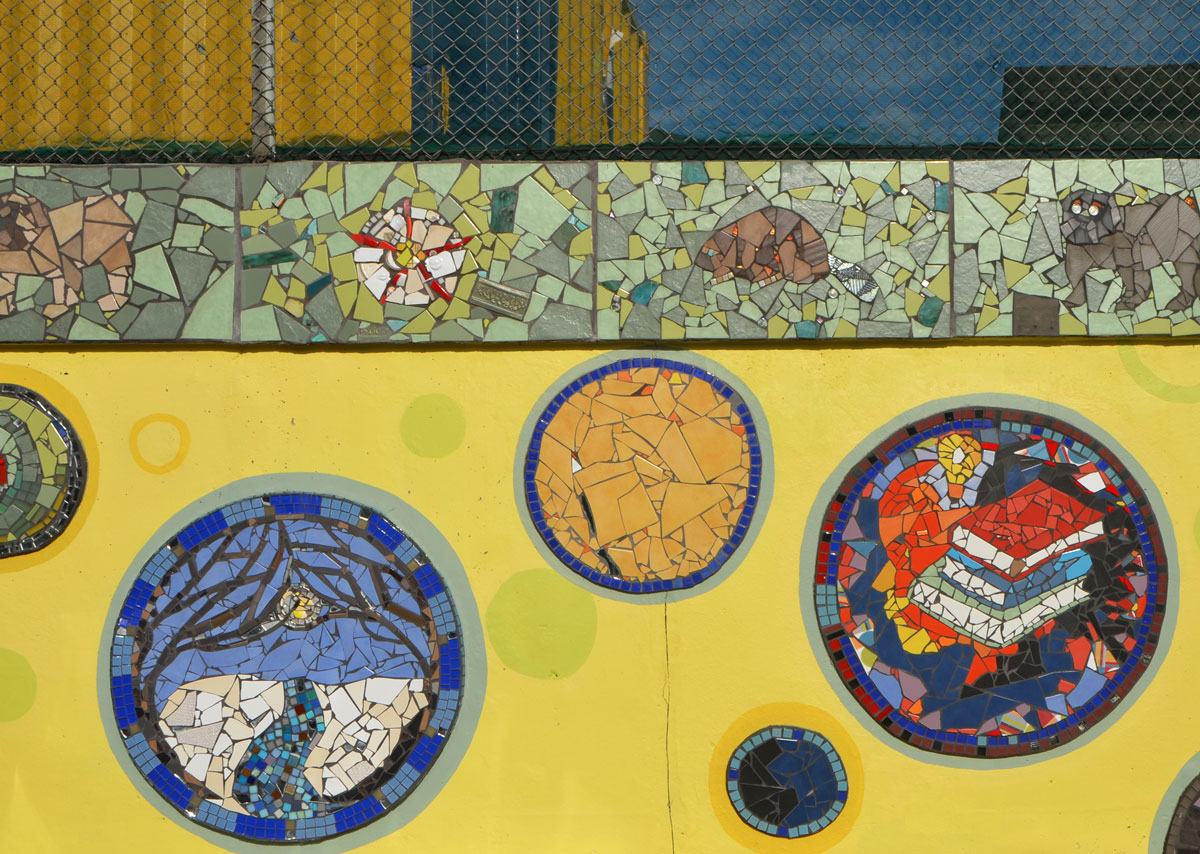
mosaic artwork in greens and yellows

Coxwell subway station is still in the midst of its renovations and upgrades.  As part of the project, the wall on the west and south sides of the station have been painted a bright yellow.   This yellow was then the canvas for a large number of mosaic creations.

some of the mosaic medallions on the Coxwell mosaic mural

below: The new mosaic mural covers the wall alongside the pathway that leads from Coxwell station to the Danforth.  The murals painted on the side of the Sunset Grill restaurant, on the opposite wall of the path, were there previously.

yellow Coxwell pathway mosiac mural with the murals from the restaurants beside the pathway

below: A beaver made from bits and pieces – with round eye and two large teeth.

a beaver made with mosaic tiles and pieces of glass

below: At the corners of the mural are seed pods that have released their seeds to the wind.

mosaic representation of a large seed pod that hs released its seeds.

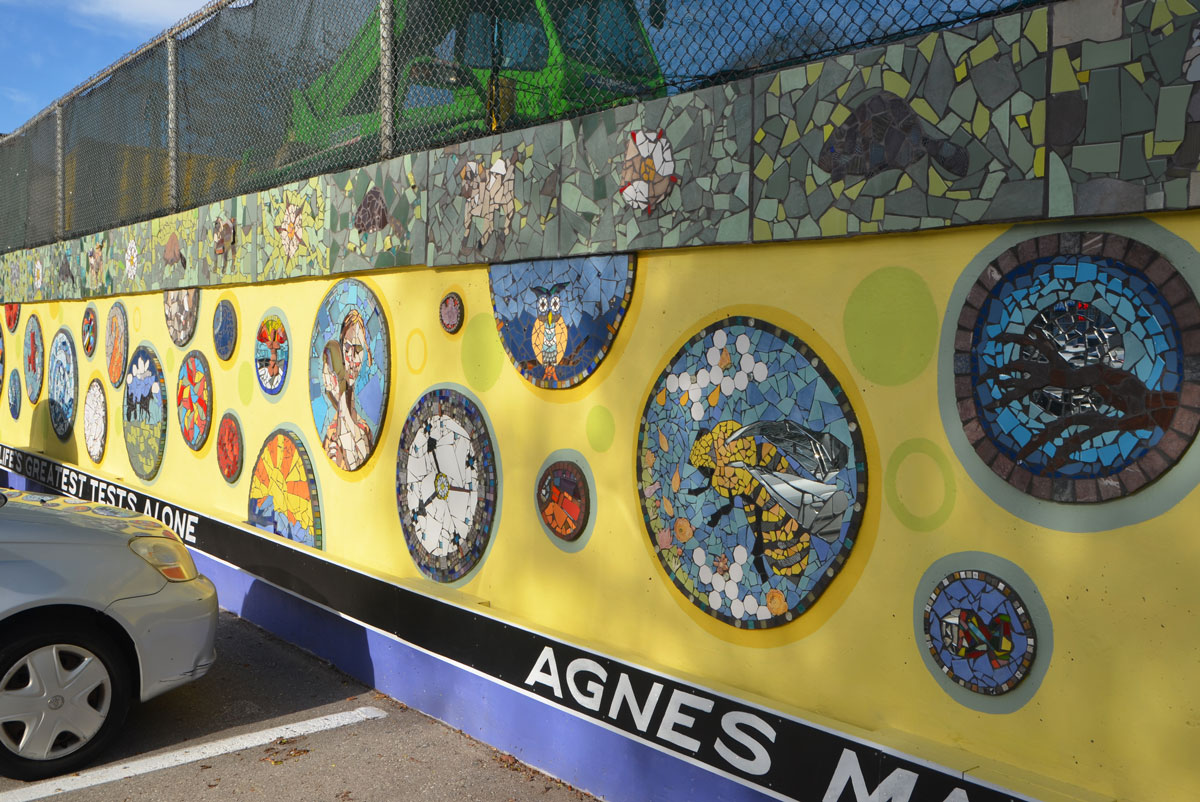
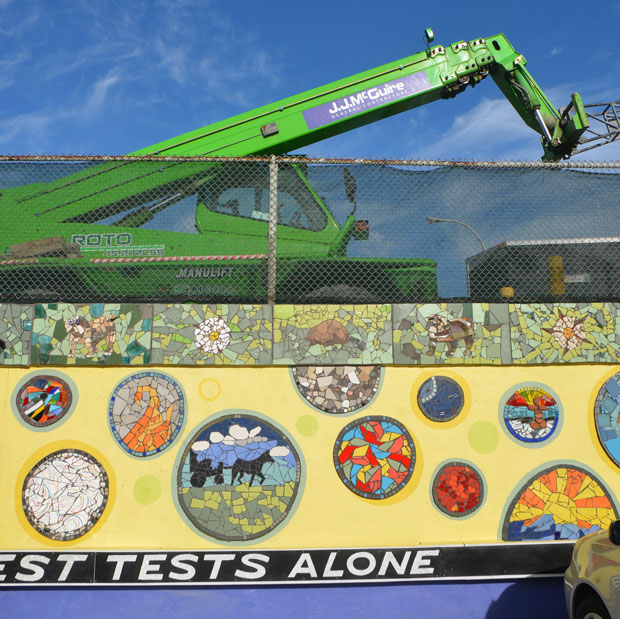
below: The south side of the subway station is adjacent to a Green P parking lot on Danforth.  Along this wall, a quote by Agnes MacPhail has been added below the mural.  “We meet all life’s greatest tests alone”.  Agnes MacPhail (1890-1954) was the first woman to be elected to the Canadian House of Commons where she served from 1921 to 1940.  After her time in federal politics, she represented the provincial riding of York East in the Ontario Legislature.  In 1951 she was responsible for Ontario’s first equal pay legislation.

A wall with a chainlink fence above it, a large green construction crane is behind the wire fence. The wall has been covered with a mural, yellow background and mosaic pictures on it. A quote runs along the bottom at ground level, white letters on black background, quote by Agnes MacPhail

A wall with a chainlink fence above it, a large green construction crane is behind the wire fence. The wall has been covered with a mural, yellow background and mosaic pictures on it. A quote runs along the bottom at ground level, white letters on black background,

below: West side of the wall, looking towards Strathmore Blvd.

west side of the mural, yellow wall, Coxwell station, mosaic pictures

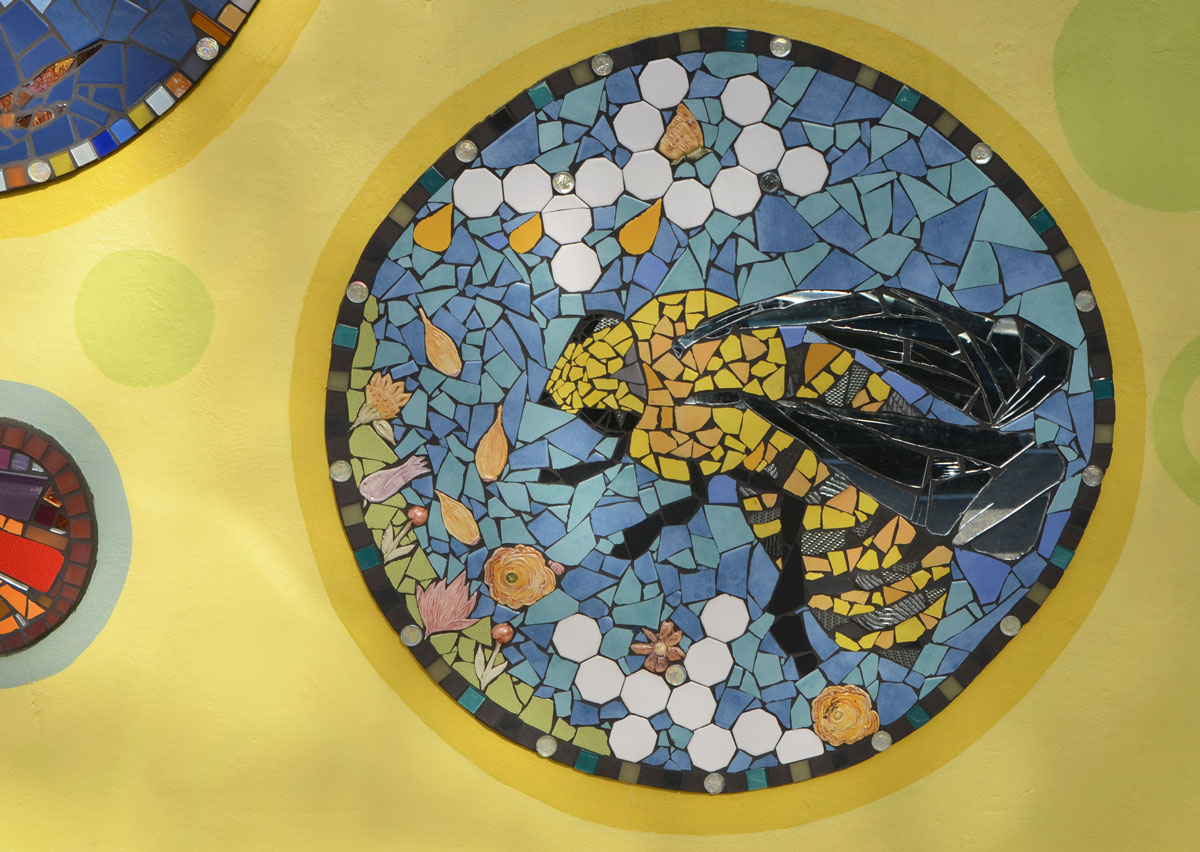
below: A mosiac bee amongst the flowers…

a circular mosaic picture of a bee amongst white and orange flowers on a blue background, all on a yellow wall. Part of a larger mural

below: … and a real bee sitting beside a mosaic red rose.

mosaic picture of a red rose with green foilage, with a real wasp sitting on it.

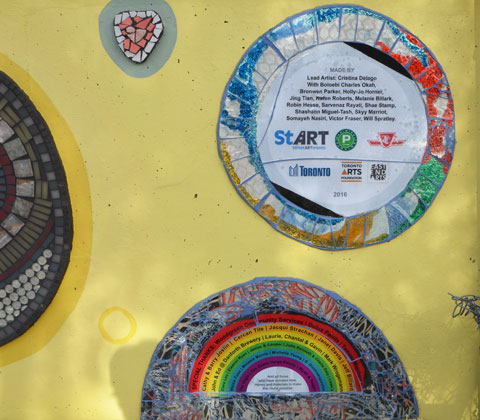
below: Two mosaic pieces, a circle with the names of the artists and a semi-circle rainbow with the names of those who contributed to the creation of the mural.  The transcription of the words is given below.

on a yellow wall, some circles made of mosaics. One is the list of people who made the whole mosaic mural and the other is a semi-circle, rainbow colours, of people of contributed to the mural

Lead Artist: Cristina Delago,
With Boloebi Charles Okah, Bronwen Parker, Holly-Jo Horner, Jing Tian, Karen Roberts, Melanie Billark, Robin Hesse, Sarvenaz Rayati, Shae Stamp, Shashann Miguel-Tash, Skyy Marriot, Somayeh Nasiri, Victor Fraser, Will Spratley.

Special Thanks: Woodgreen Community Services, Dulux Painter, Tomasz Majcherczyn, Cathy & Barry Joslin, Cercan Tile, Jacqui Strachan, City Councillor Janet Davis, Jeff Billiard, John & Ed at Danforth Brewery, Mark Wrogemann, Clara Lou, Eleanor Ryan, James & Cooper, John Kenneth & Cherie Daly, Lowe’s, Maisie Fuss, Melanie Morris, Michelle Yeung, S. Dimitrakpoulos,  The Vogls, The Zeelie-Varga Family, Wyatt & Teagan, as well as Laurie, Chantal and Gavin

blog_small_details_mosaic

As you all know, the TTC is replacing their older streetcars with new longer Bombardier streetcars.   Or at least they are trying to 🙂  Because they are longer, they don’t fit into existing “garages”, hence the new Leslie Barns facility.  Located on Leslie St., south of Queen, it is the new streetcar “home”.  It is where streetcars are parked, maintained and repaired.  It has been in operation since Nov 2015 but the first chance the public got to peak inside the finished complex was at Doors Open on the 28th of May.

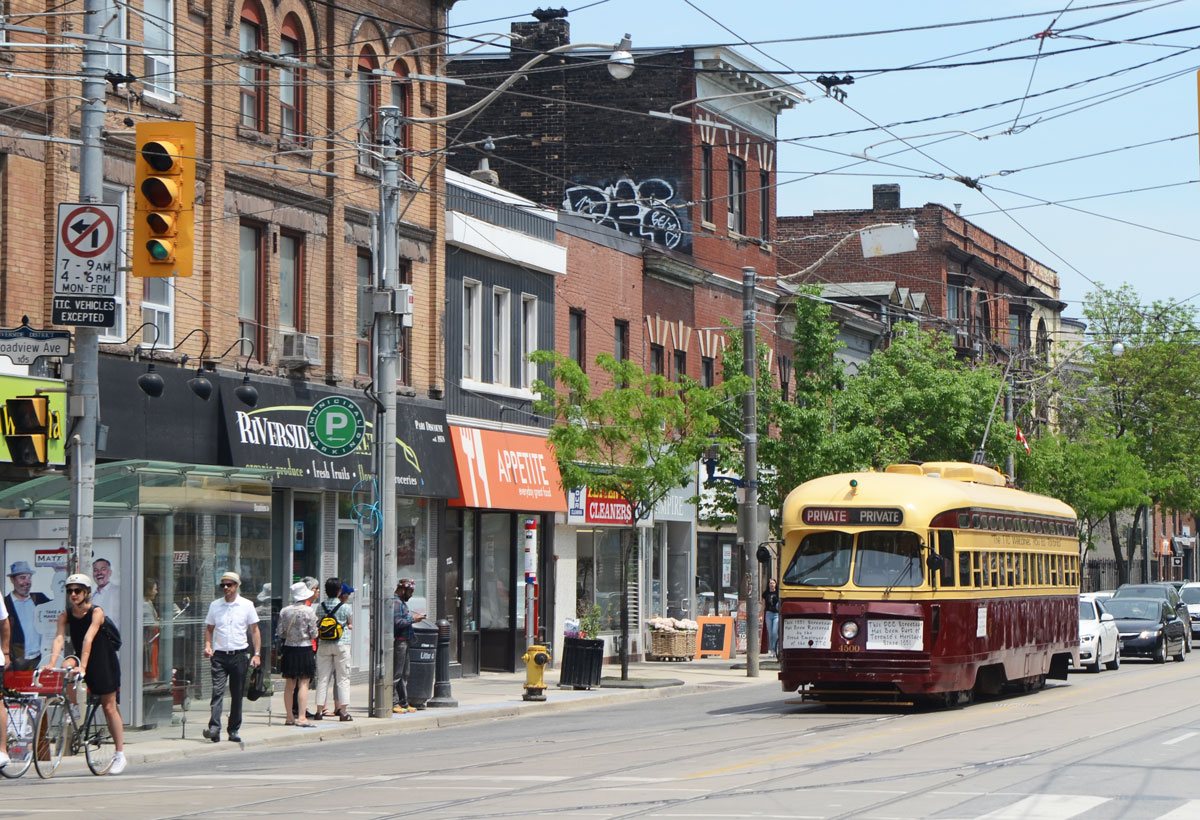
below: While waiting for a streetcar at the corner of Queen and Broadview on the way to visit the Leslie Barns, I saw this renovated TTC streetcar from the 1950’s.

An old restored TTC streetcar, maroon and yellow, on Queen St. East

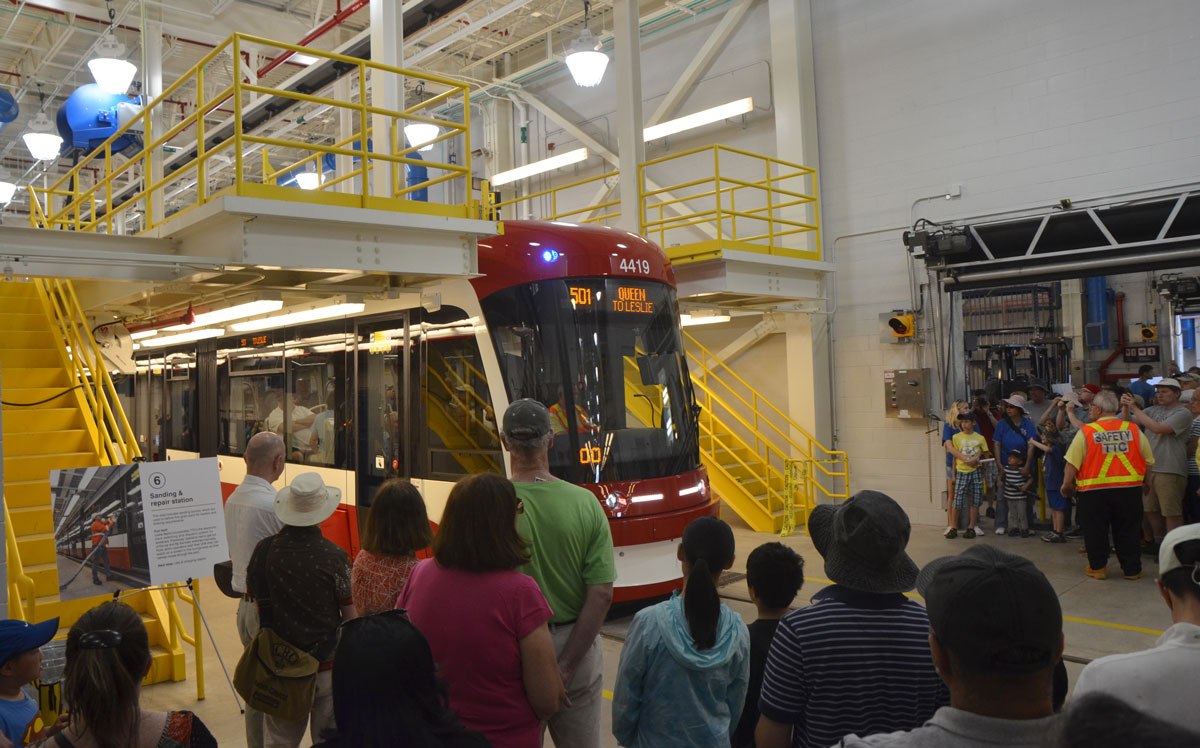
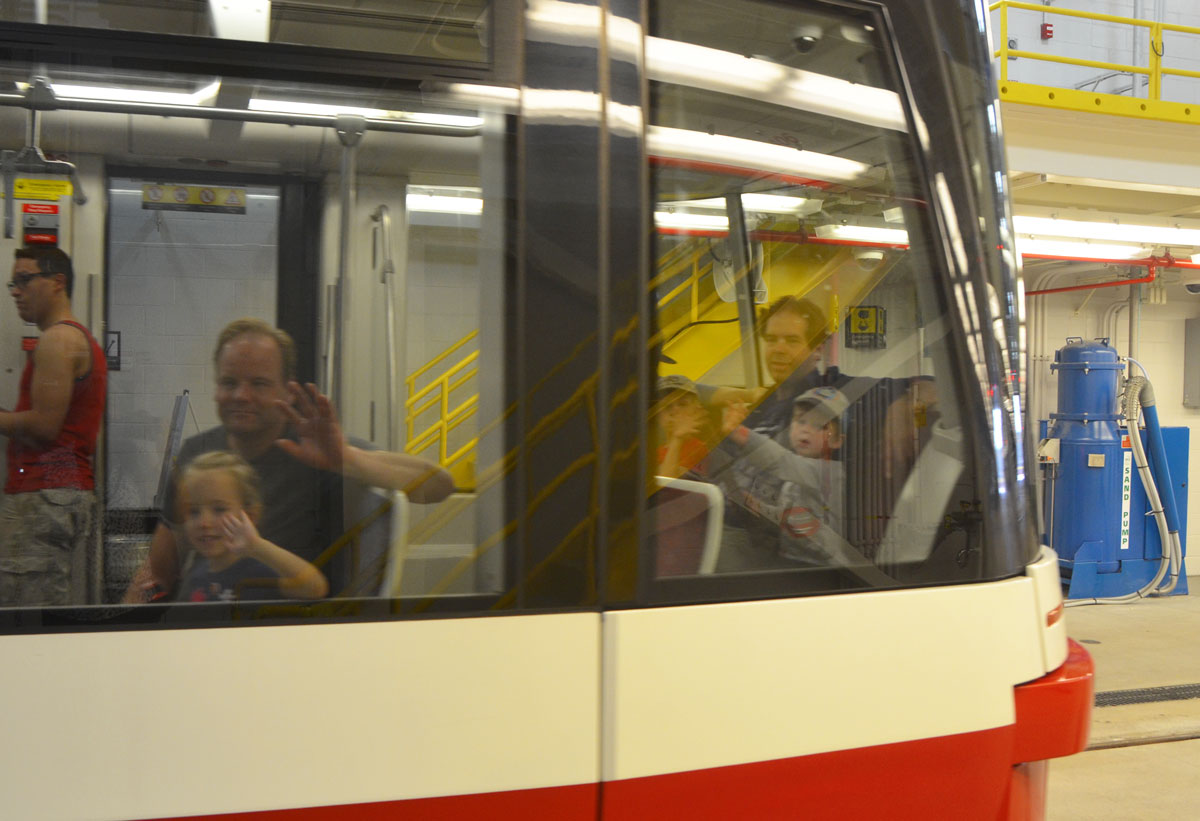
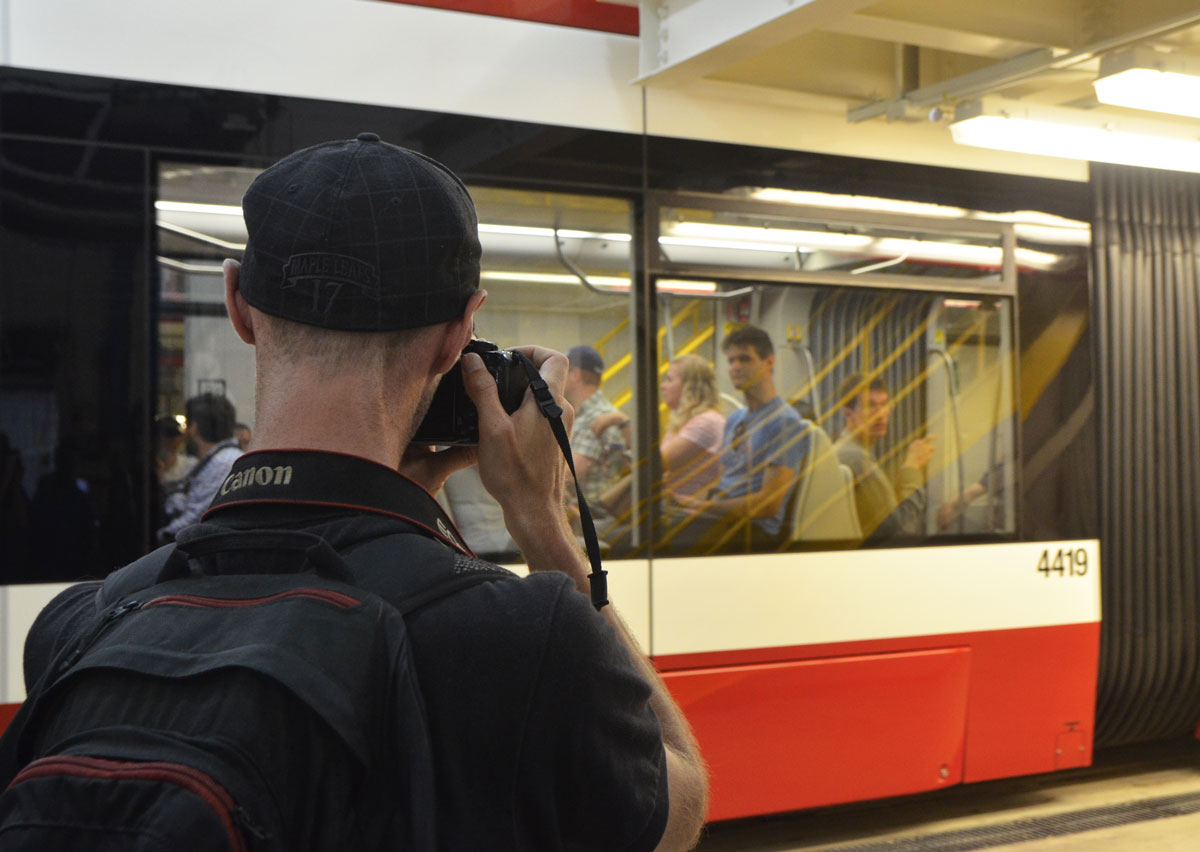
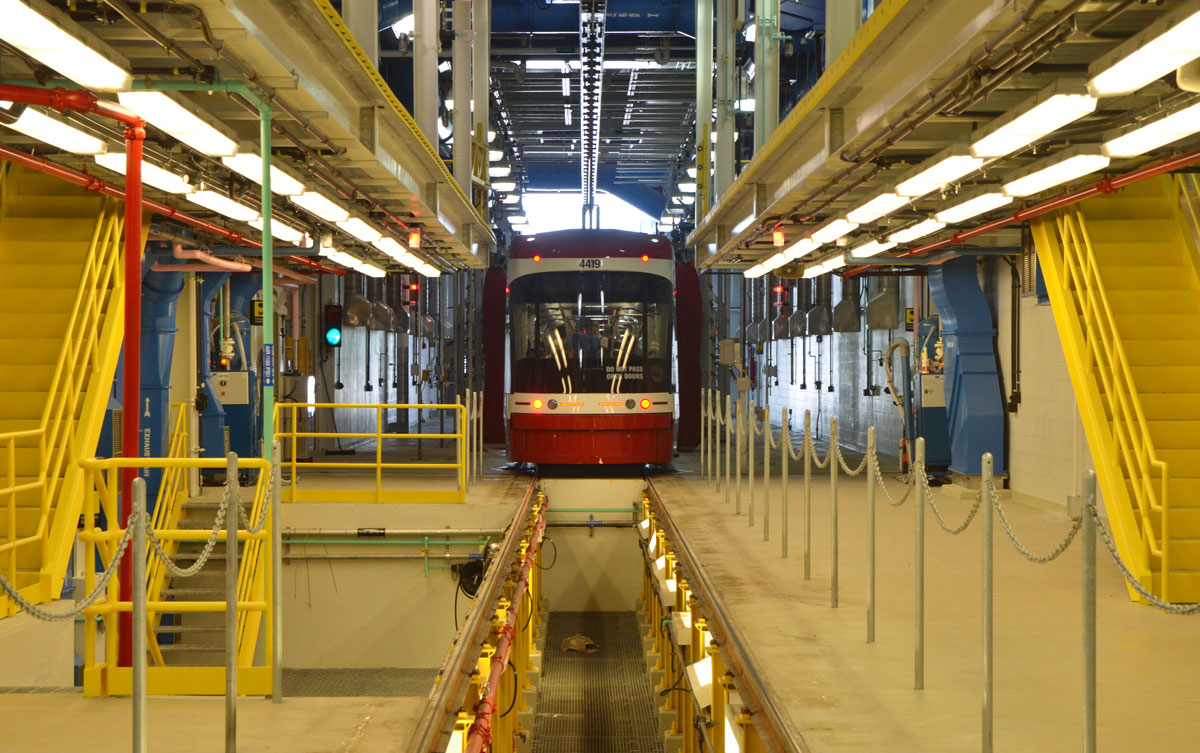
below:  The streetcar tour involved riding a new streetcar through a maintenance bay in the building and then around the parking lot out back.

People at Doors Open in TOronto, at the TTC LEslie Barns streetcar facitlity, lining up for , or just getting off of, streetcar tours, riding the new streetcars around Leslie Barns

A group of people inside Leslie Barns streetcar facility, standing aside to make way for a new streetcar that is taking other people on a tour.

people riding in a new streetcar, photo taken from the outside, most of them are waving

A man in black T-shirt and black cap is taking a picture of people riding in the new streetcar, inside Leslie Barns at Doors Open

below: Exterior, parking space for at least 100 streetcars

the massive concrete parking lot for streetcars with all the overhead wires. The building that houses the workshops and cleaning and office for the ttc is in the background.

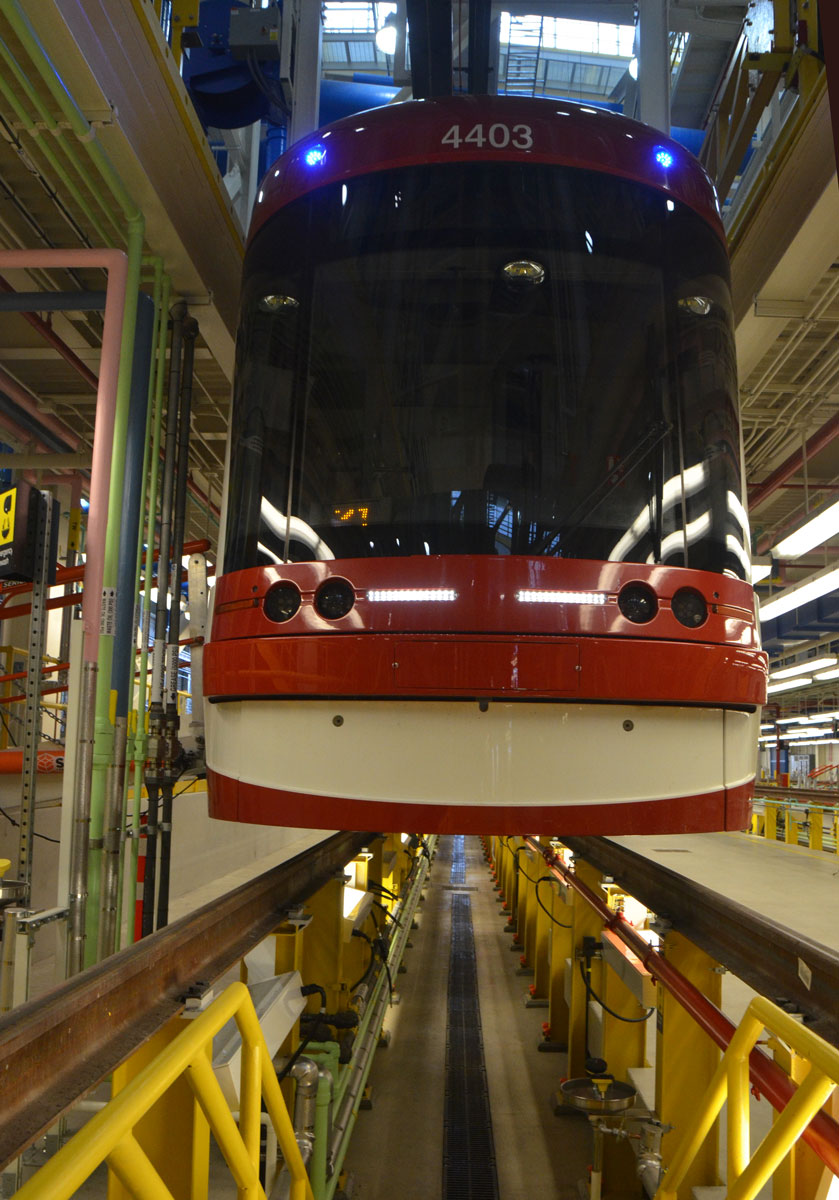
below: Special bays have been constructed with space for workers to access both the underneath and the top of the streetcars.  Because the cars have been designed to ride low, a lot of their workings such as the HVAC and propulsion systems are built into the roof of the car.

the back of a new streetcar as it passes through interior of Leslie Barns streetcar facility, a large, tall interior space with lots of pipes

A streetcar sits in a repair bay of the Leslie Barns, space underneath the streetcar for workers to go down and work on the underside of the streetcar.

below: It’s a big space!  …. 17,510 square metres (188,500 sq ft) in fact.

interior of Leslie Barns streetcar facility, a large, tall interior space with lots of pipes

below: A spic and span shiny paint room

interior of the paint room at Leslie Barns, where streetcars go to get painted.

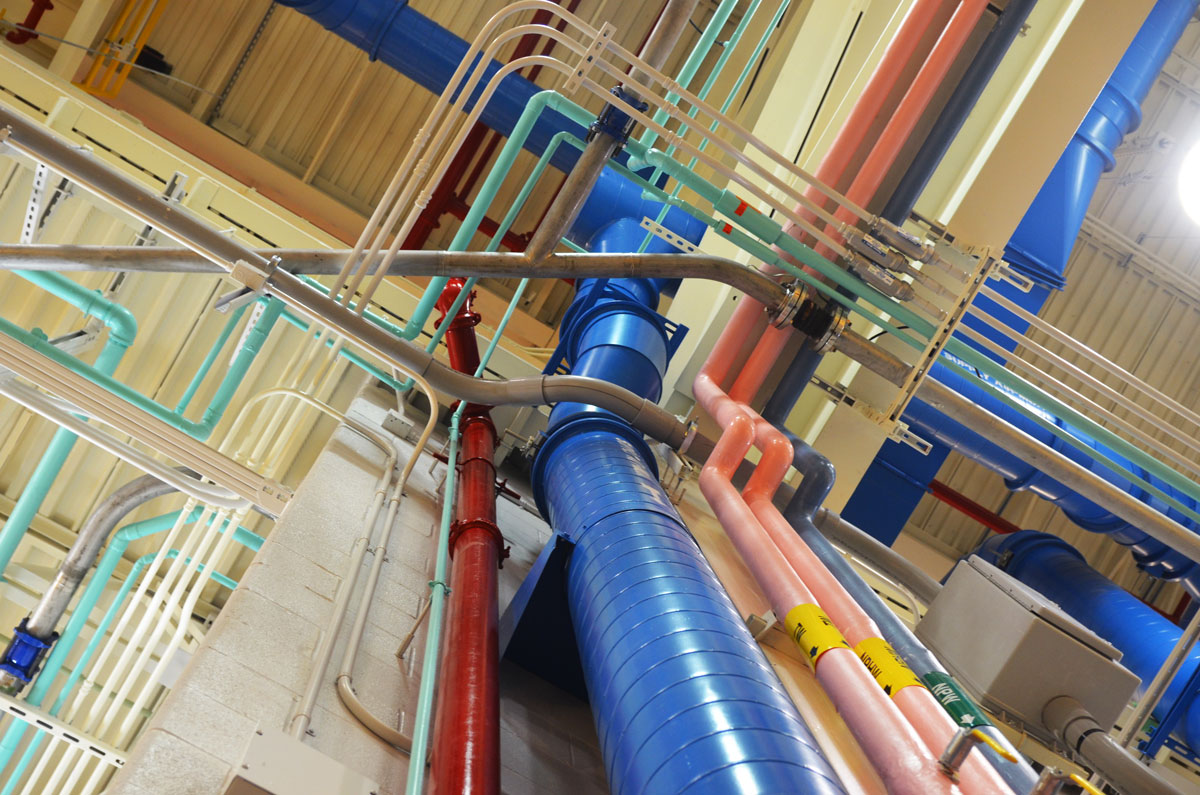
below: A myriad of colour coded pipes

A myriad of pipes running up walls and across the ceiling, blue, pink, red, grey, all colour coded, interior, Leslie Barns

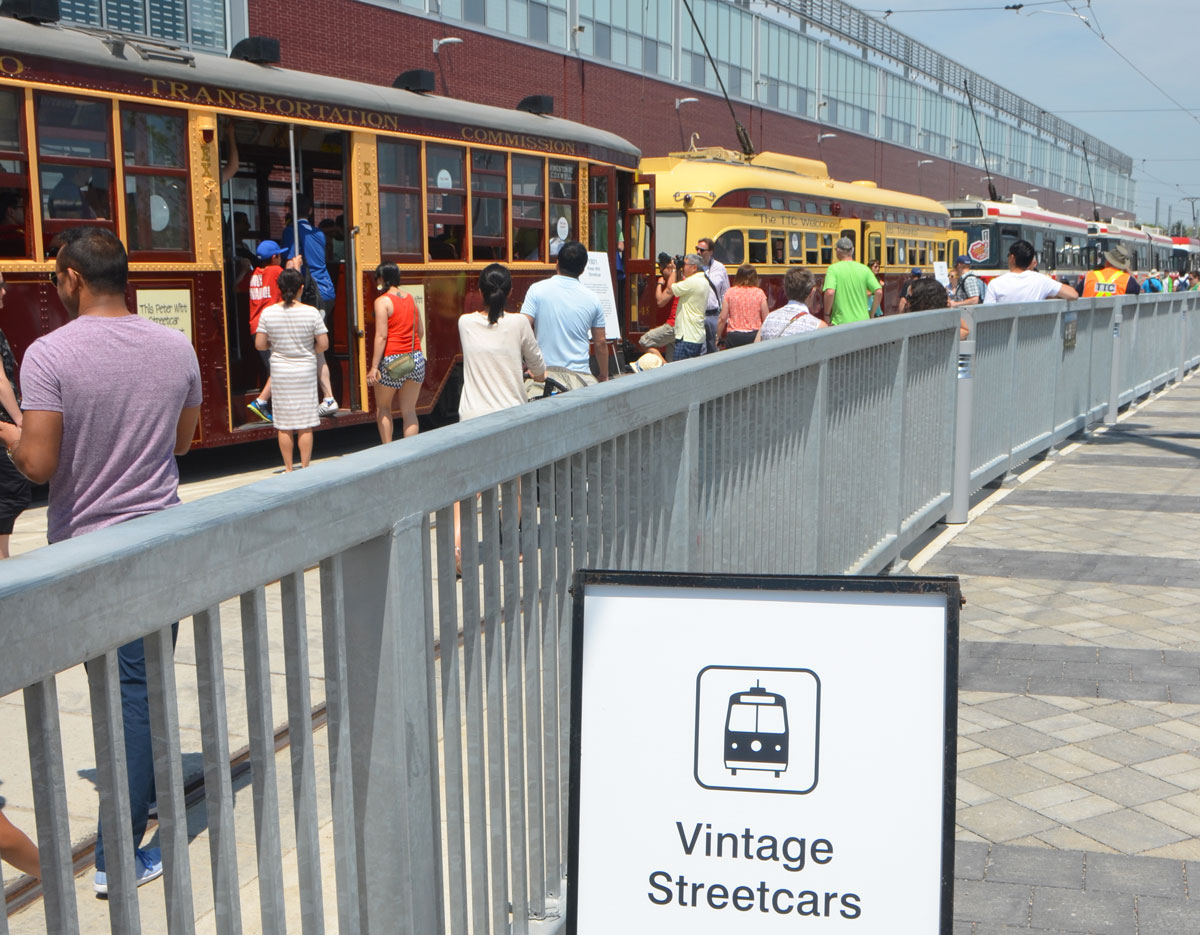
below: There were renovated vintage streetcars on display.  On the left is a 1921 Peter Witt streetcar and next to it is a PCC streetcar from the early 1950’s.

a number of people waiting to go inside old renovated vintage TTC streetcars

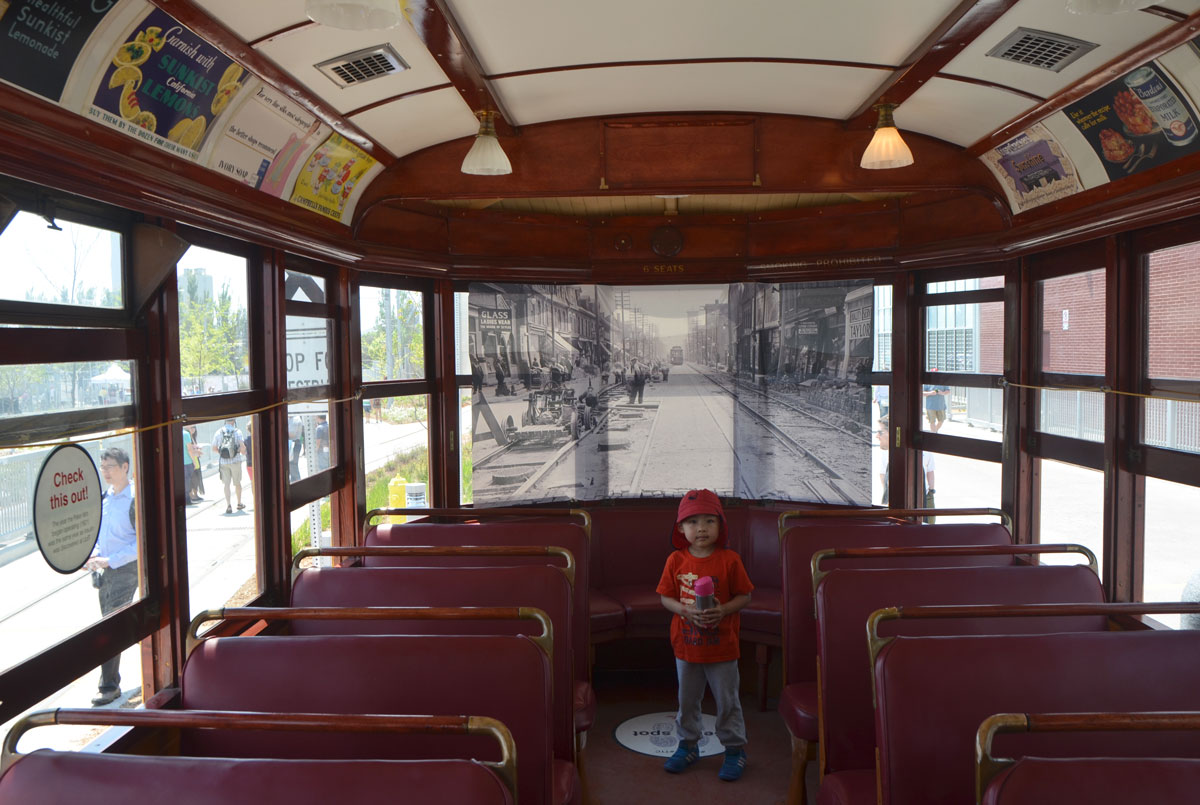
below: Interior of a refurbished Peter Witt streetcar with its wood trim.  The Witt cars were built for the newly formed TTC in 1921.  They entered service on Broadview in October of that year.  By 1923 they were operating on seven routes.  The last Witt streetcar was retired in 1963.

A young boy stands in the back of an old restored ttc streetcar. A black and white picture of an old street scene has been put across the back window to show you what the view out the window might have looked like at the time the streetcar was functional. Old ads on the upper part of the interior, wood trim

below: Looking out the window of a PCC streetcar built in 1951.  PCC stands for Presidents’ Conference Committee, which was a group of operators from the USA and Canada  who got together in 1938 to design a new electric railway car.  By the late 1950s, the TTC owned the largest fleet of PCC’s in the world.  The last one was retired in 1995.

A young boy wearing a hat looks out the window of an old restored streetcar while his father takes a picture out the window

below: Streetcar wire maintenance truck.

a special TTC truck sits outside Leslie Barns TTC facility on Doors Open day, the truck is designed to run on streetcar tracks and is used to repair tracks and wires. There are people looking at the truck

#DOT16 | #TTC

Within the past week or so, the fences around the new Canary District have come down.  Toronto’s newest development is now open to the public so I thought I would check it out.

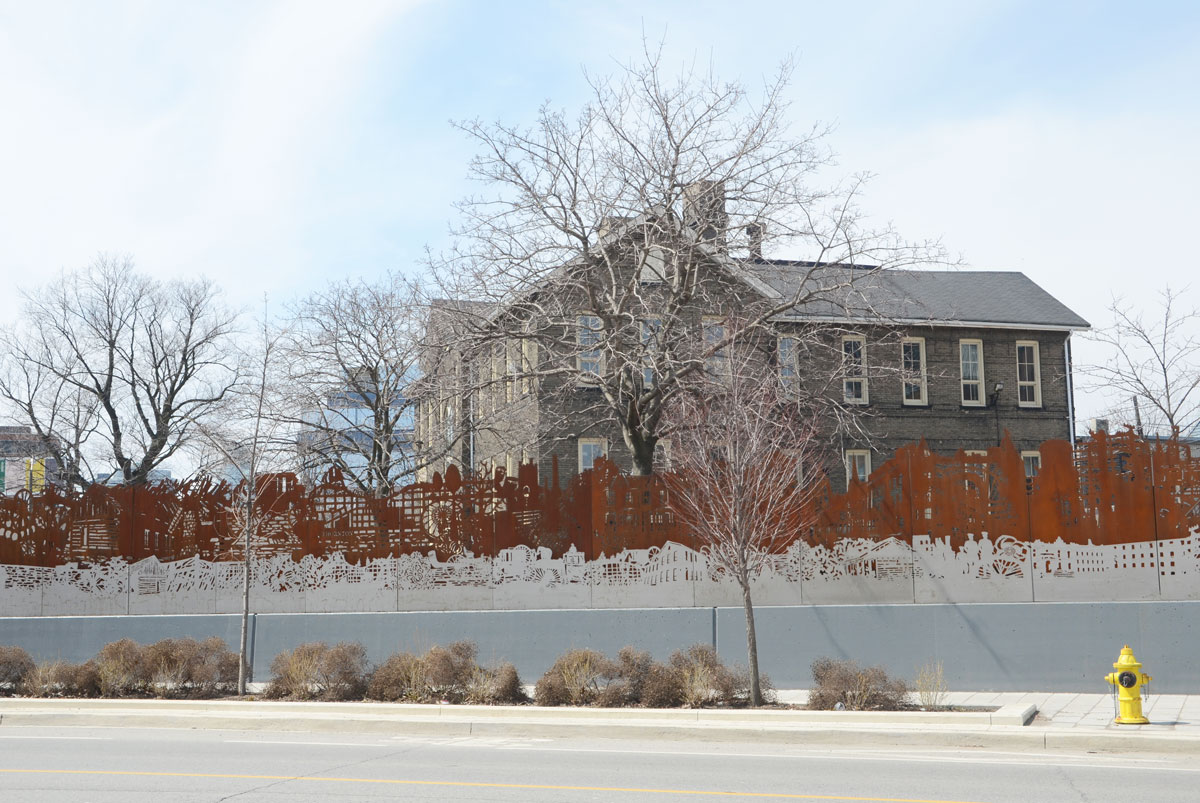
I started my walk from the streetcar stop at King and Sumach.  Walking down Sumach Street I passed the metal fence that separates the school property from the street.  This stone building was built in 1887 as Sackville Street School and it has been used as a school ever since.  At the moment it is home to Inglenook Community School.  The fence with it’s double layer of metal – rusted in the back and shiny in the front – is interesting in the daytime but even more so at night when it is lit with a series of lights located between the layers  and near the base of the fence.

public art on Sumach St., rusted metal and shiny metal fence with cut outs, looking across the street at it, with older stone building behind it.

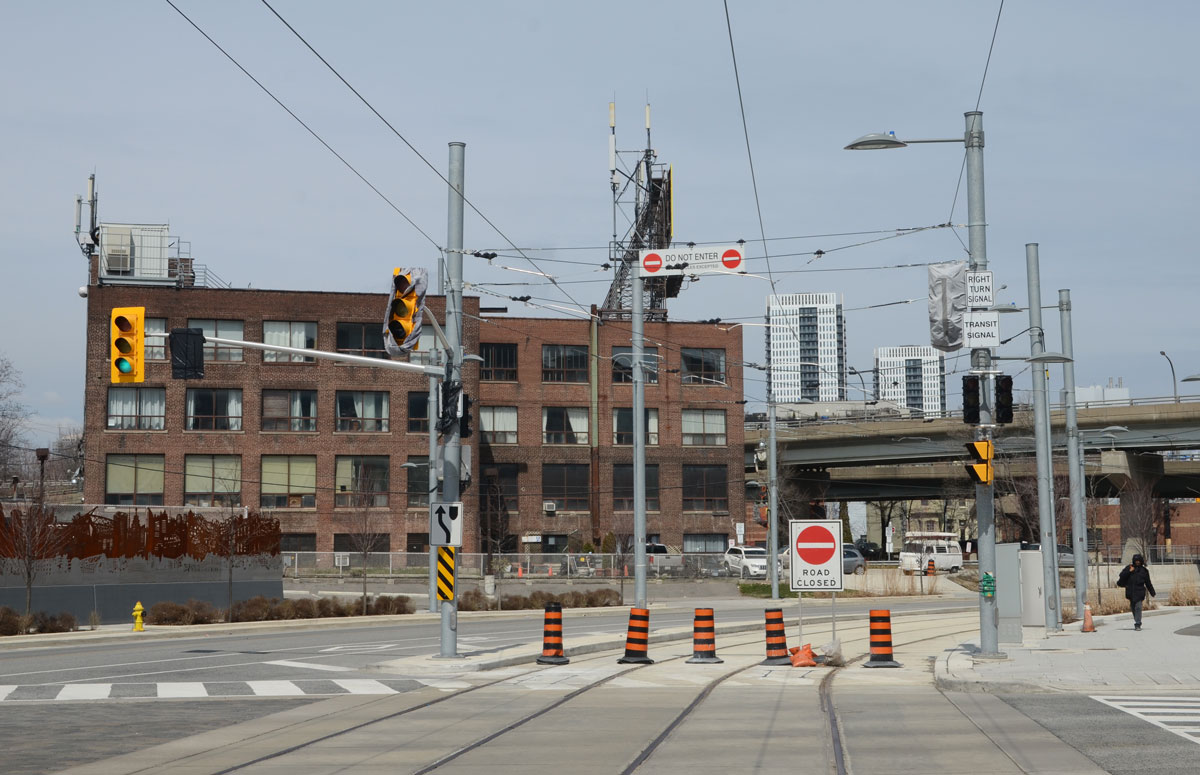
When I took the above picture I was standing on the new streetcar tracks that run south from King Street.  The tracks are ready and the wires have been installed.  Streetcars will begin servicing the route in June as part of route 514.  No map or schedule appears on the TTC website yet but apparently this route will run between the Dufferin Gate Loop and the new loop on Cherry Street via King Street

below: Looking north from Eastern Avenue at the new streetcar tracks on Sumach Street.

looking north on Sumach Street from Eastern Ave at the new streetcar tracks. They are blocked by 5 large black and orange traffic cones as well as a large do not enter sign. Overhead wires for the streetcars are in place.

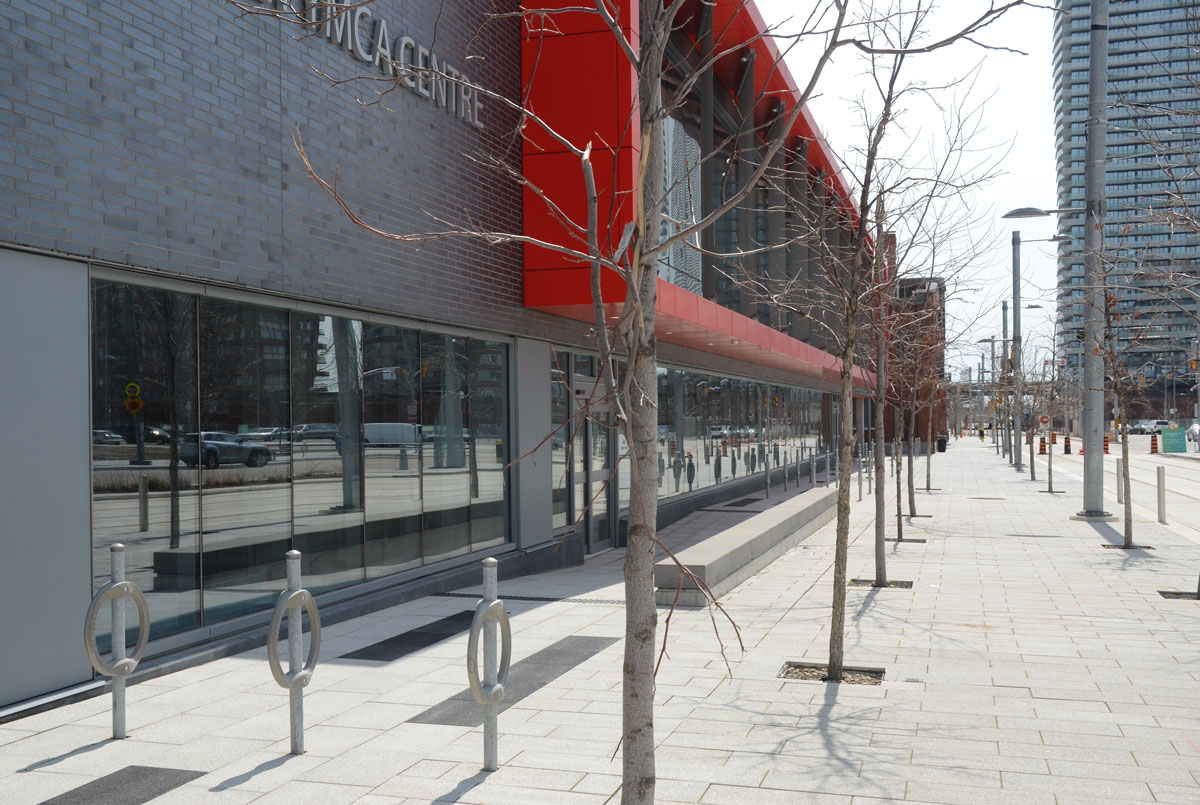
At Eastern Avenue, Sumach Street becomes Cherry Street.   The new Cherry Street YMCA is on the east side of the street.  The sidewalk is wide but at the moment the branches of the young trees are at face level and you have to be careful where you walk.

looking south on Cherry Street from Eastern Ave, past the new Cherry Street YMCA on the left and all the new trees that have been planted.

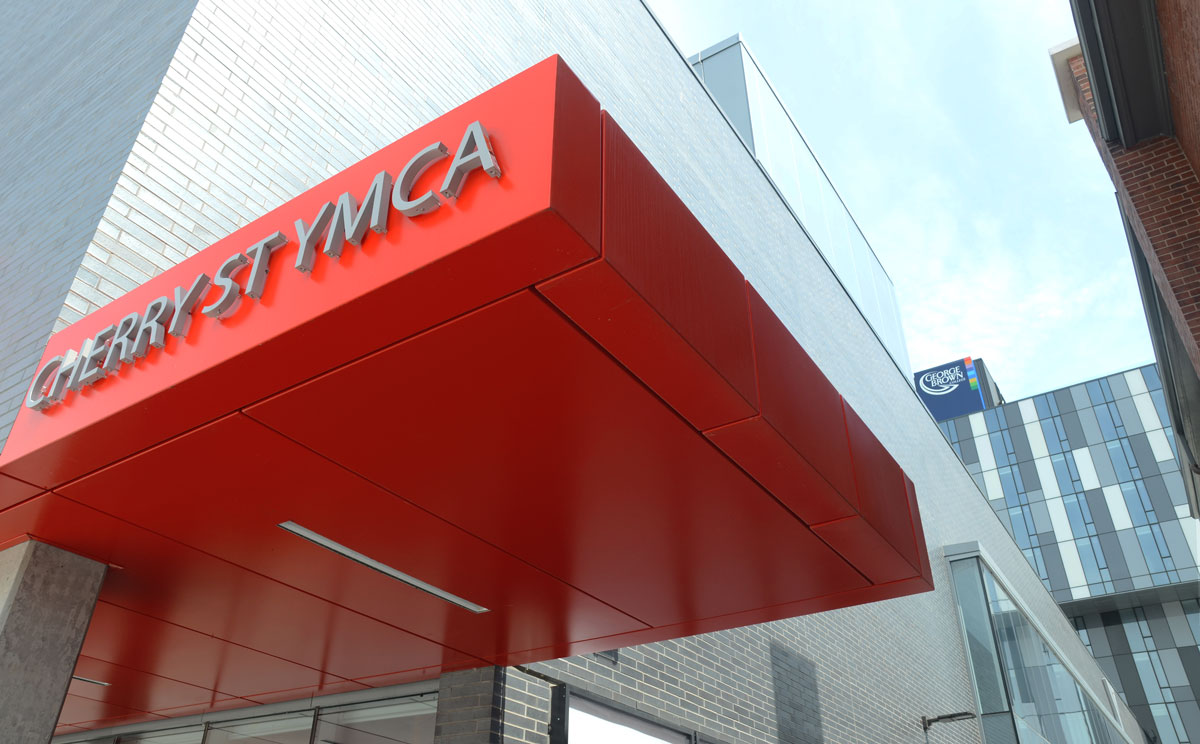
below: The bright red detailing on the YMCA building continues over the entry way.  Part of the new residences for George Brown College peak out from behind.

roofline over the entry of Cherry Street YMCA with it's bright red colour. Corner of George Brown College building is in the background.

Front Street now has wide sidewalks.  None of the businesses have moved into the ground level retail spaces yet but the signs in the windows suggest that a number of cafes, restaurants, and food stores will soon be opening.   A couple of public art pieces are also on the sidewalk.

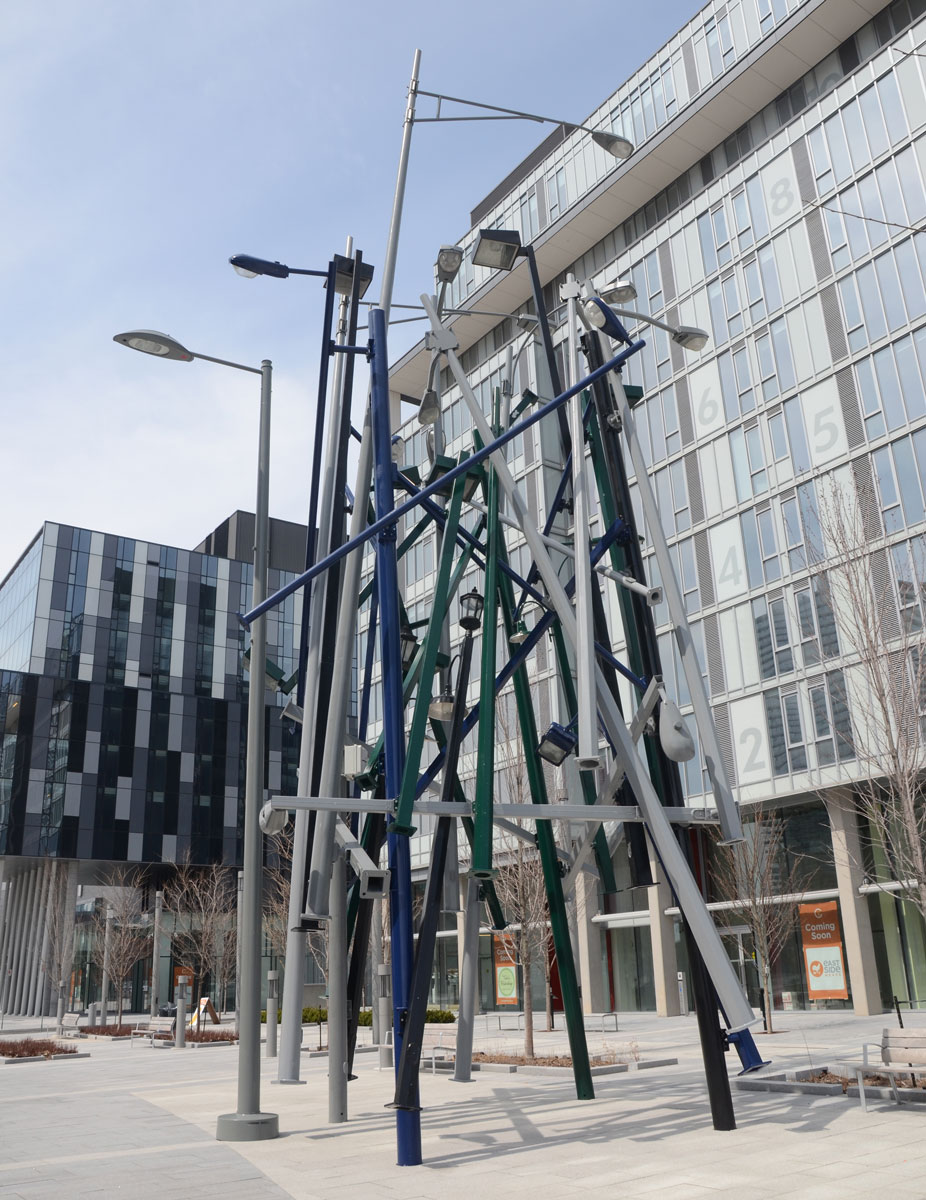
below: ‘Lampposts’ by Tadashi Kawabata

A tall art installation as public art on Front Street in the Canary District, Lampposts by Tadashi Kawabata, construction from many different styles of street lamp posts all arranged in a cluster

below: Looking up from underneath the artwork.

looking up at the lights from underneath the artwork,Lampposts by Tadashi Kawabata

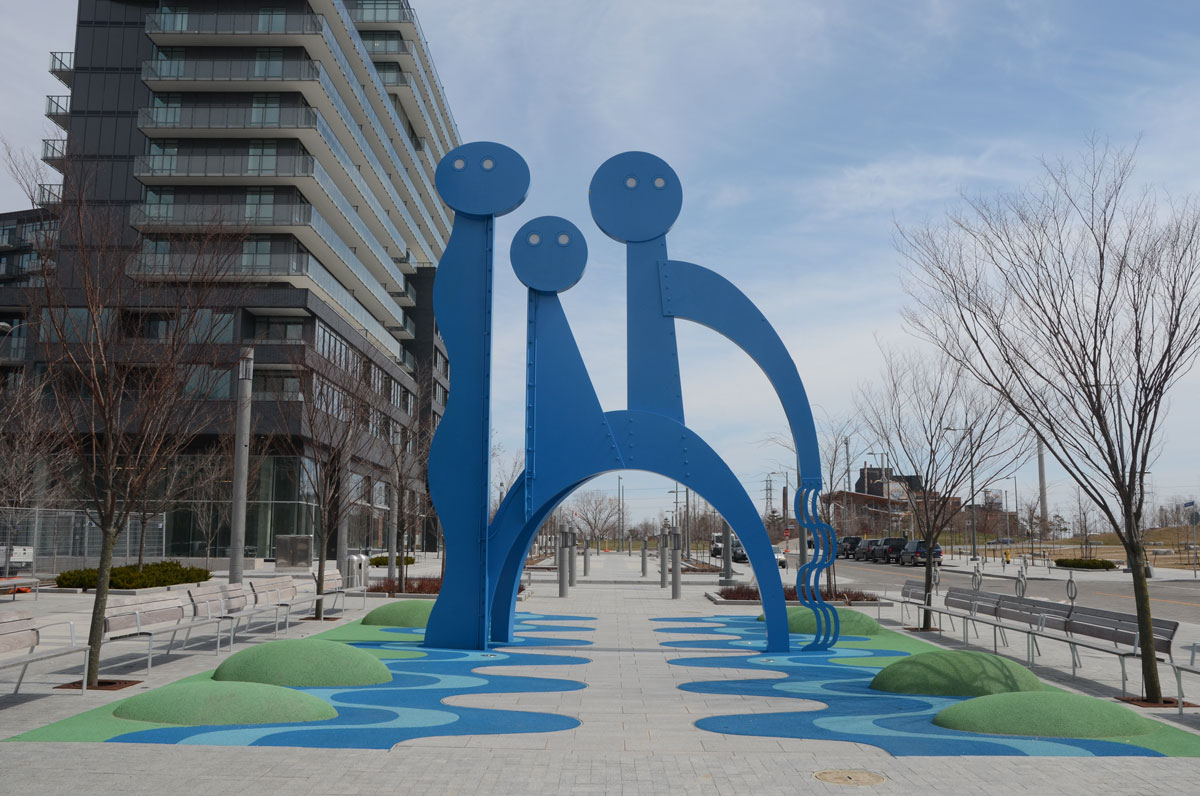
below: ‘The Water Guardians’ stand over a soft squishy playpad.
It was designed by Jennifer Marman and Daniel Borins.

'Tje Water Guardians', A tall art installation as public art on Front Street in the Canary District, 3 stylized abstracted human forms with legs in an arc shape over a squishy playpad in green, blue and white. The blue represents water. The green parts are raised slightly in bumps.

below: There are a lot of little design elements that have been incorporated into the this development including what I think is a bench.  With a light underneath?

A curved black metal bench on a sidewalk

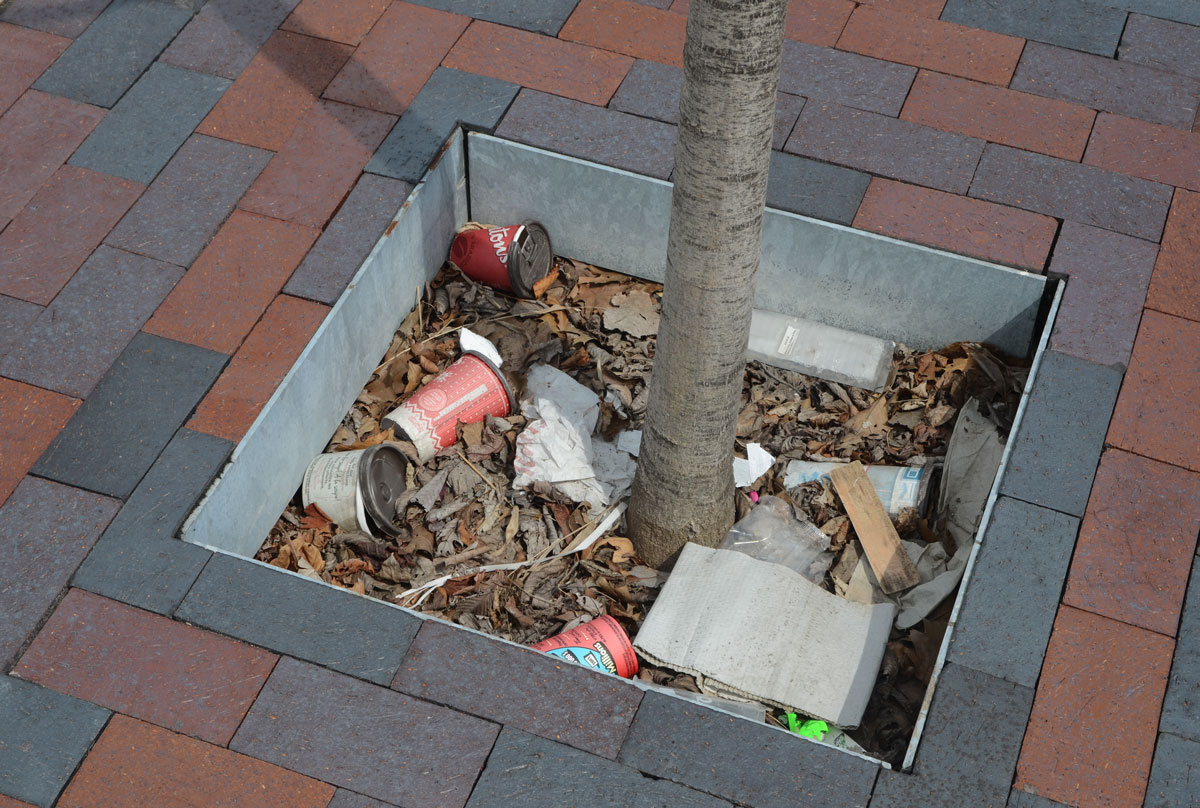
below: The sidewalk around the trees is made from two colours of brick.  The opening for the tree is just the right size to collect garbage.  Whether or not these traps get cleaned out remains to be seen.

square hole in the brickwork of the sidewalk to allow a tree to grow. The hole is shallow, a few cm. deep but it collects garbage such as empty coffe cups and discarded papers that blow in the wind.

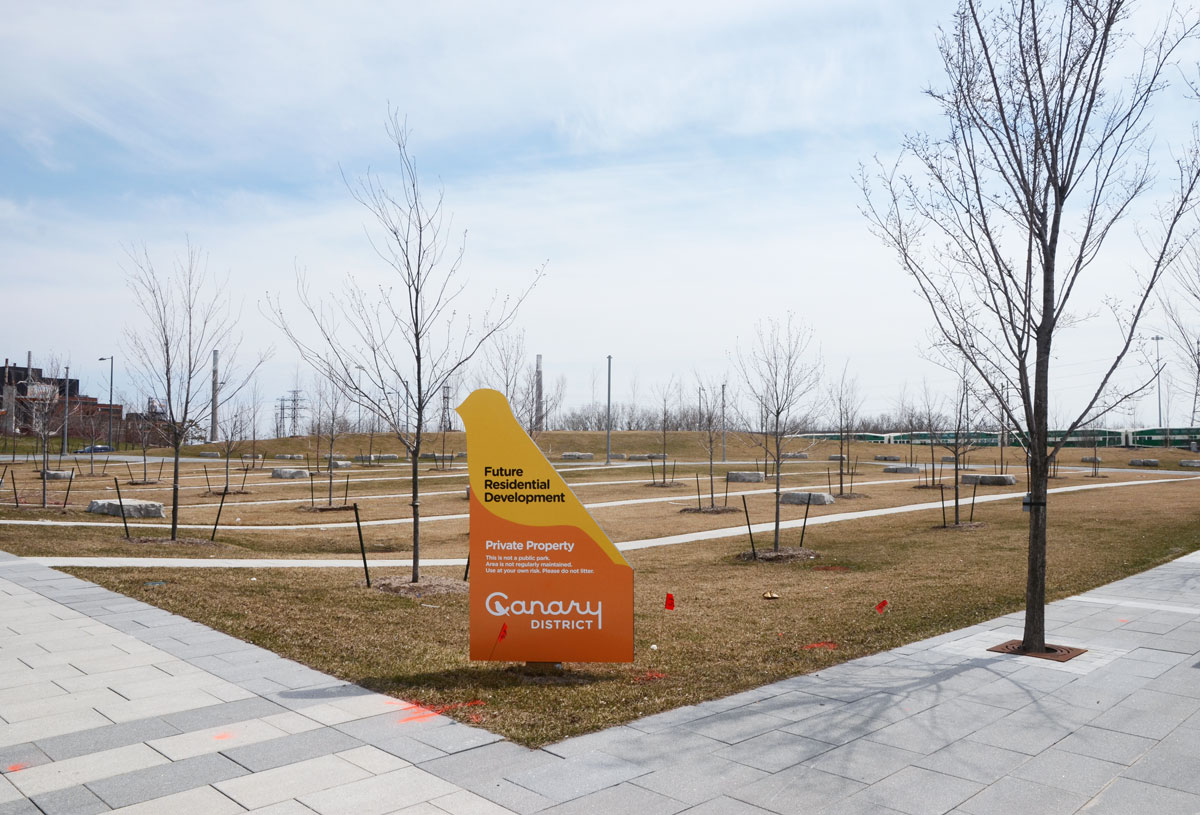
below:  The Canary District is not yet finished as this sign clearly states.

A large plot of land with rocks and newly planted trees in a grid. An orange and yellow sign advertises the Canary District. It also says that this land is slated for future residential development

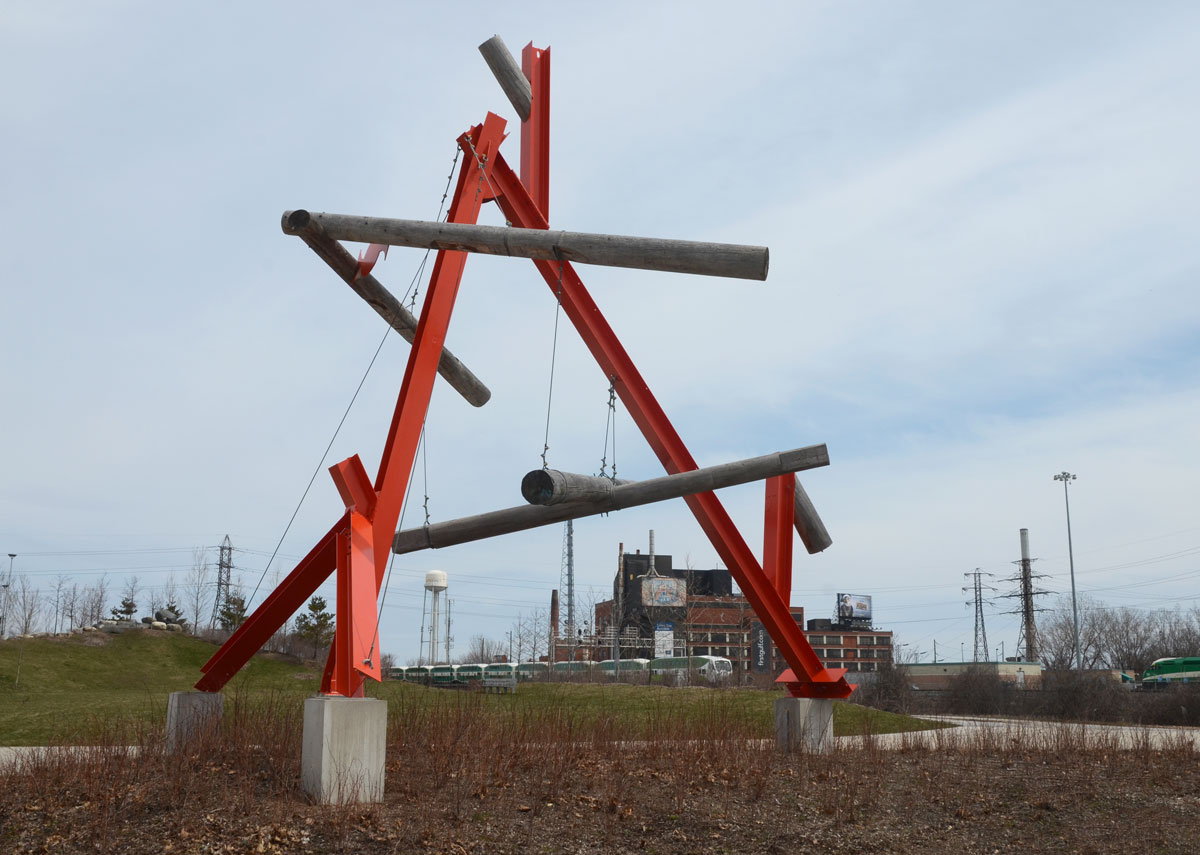
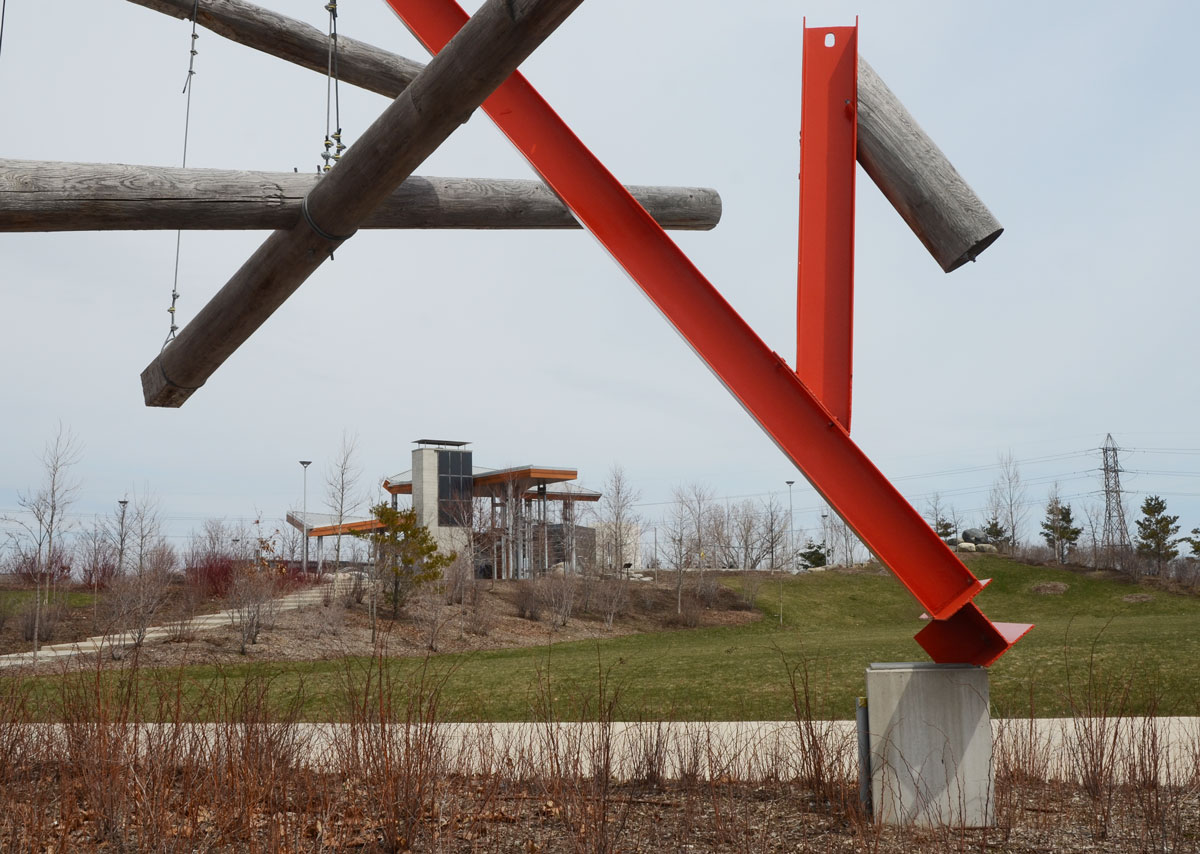
below: The sculpture ‘No Shoes’ by Mark di Suvero is now accessible.   The artwork was completed in 1967 and originally installed in High Park.   In 2013 it was renovated and moved to Corktown Common.

The sculpture 'No Shoes', red metal beams and wood poles, very large, stands in a park with some buildings in the background.

below: The pavillion at Corktown Commons in the distance.

The pavillion at Corktown Commons i the background as seen through the bottom part of the sculpture 'No Shoes'

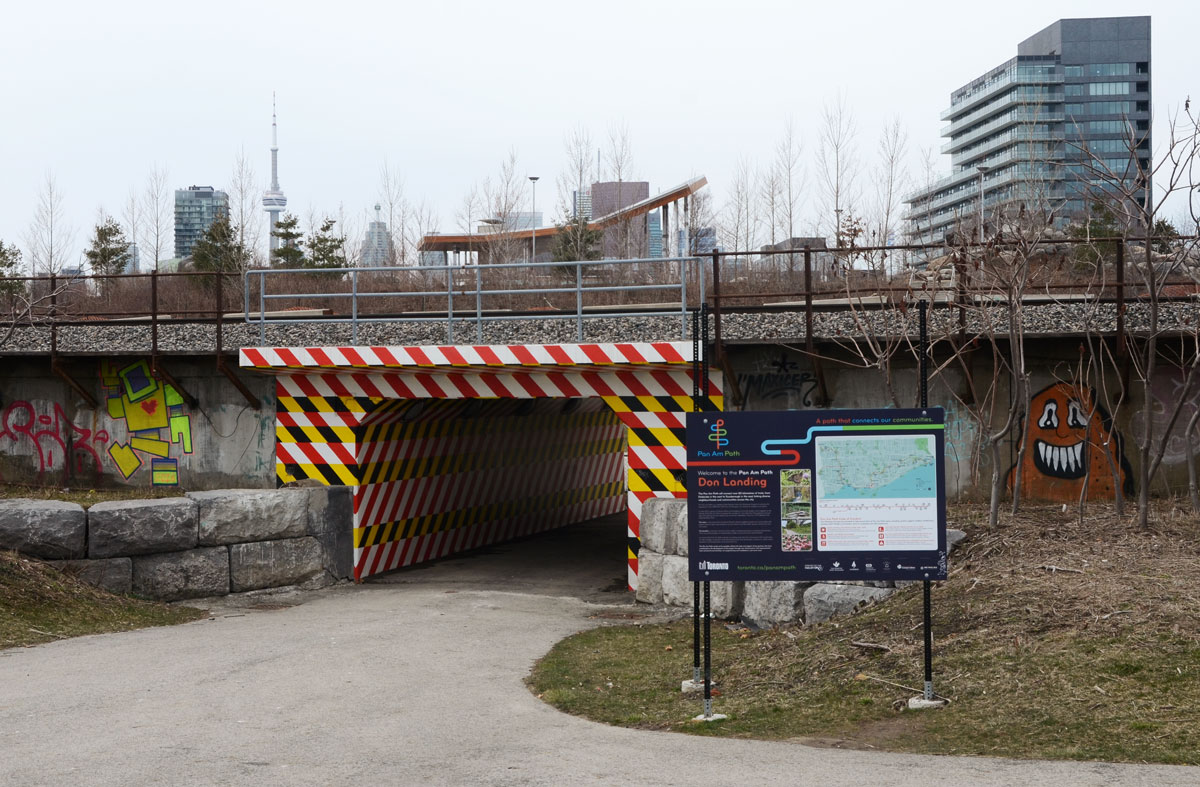
below:  The Bala Pedestrian Underpass, aka the south exit from Corktown Commons, goes under the railway tracks and merges with the Don Landing part of the Lower Don Valley trail.  The artwork was designed by Rolande Souliere and is part of the StreetARToronto initiative.   A yellow Lovebot and a happy orange monster have been added to the scene too!

pedestrian underpass under railway tracks that has been painted in bright stripes, yellow, red and black. The left of it is a large yellowlovebot and to the right is a sign with a map and a description of the Don Pathway, part of the Pan Am Path.

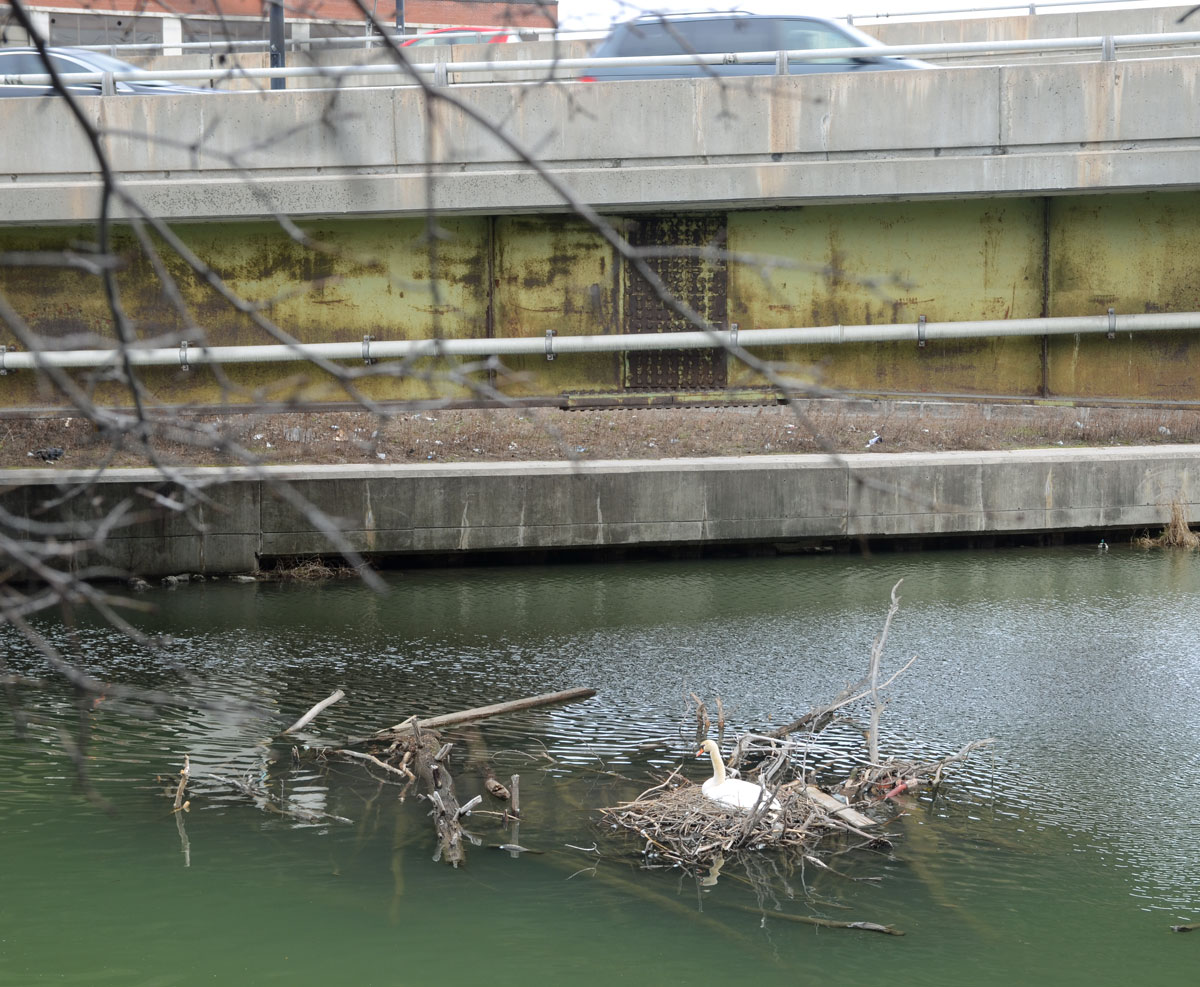
below: Nature in the city.  Birds of a different feather.  On the Don River, just south of Corktown Common a pair of swans is nesting.  One of the swans was swimming a short distance away while the other was sitting on the nest.   Cars pass by on the Don Valley Parkway unaware of the domestic scene below them.

A swan is sitting on a nest in the Don River, it is beside the Don Valley Parkway, a busy road in Toronto, two cars are passing by above the swan.

In the world of graffiti and street art, change is usually inevitable and sometimes interesting.  One exception seems to be the alley that you can see from subway between Keele and Dundas West stations.  The building on the corner of Bloor West and Indian Road is new, but otherwise little is changed.  Even though most of the street art is the same as before, I don’t think that I have posted it in the past.  Here is documentation of most of it.

below: King Midas still looks over the TTC parking lot at Keele station.  Well, I’ve always assumed that it was King Midas although he was the guy whose touch turned everything to gold, not grey.

mural of older man in grey tones, with open book on his lap, beside him is the Midas logo (auto repair).

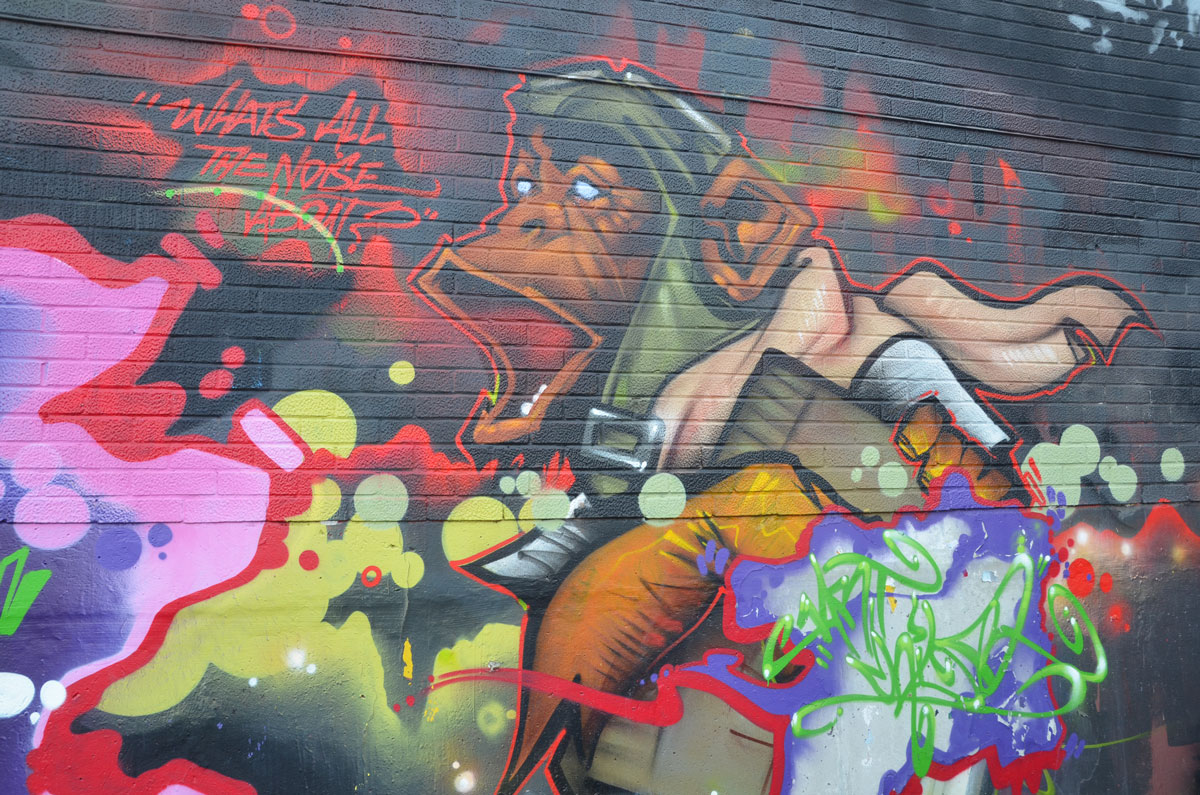
below: And this monkey is still asking what the noise is all about.

mural on an exterior wall, a monkey in old fashioned aviator's helmet and pink scarf is shouting "What's all the noise about"

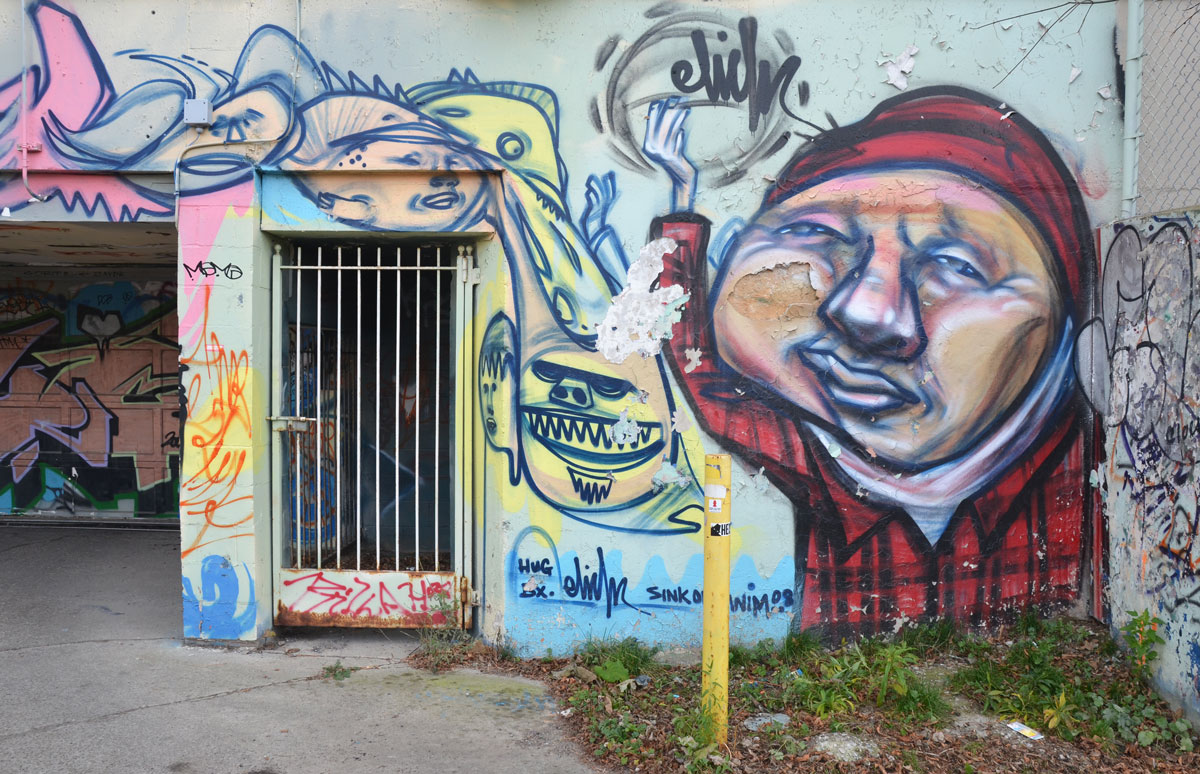
below: ‘Sink or Swim’ by elicser

graffiti street art in an alley - a mural by elicser called sink or swim. A large man with a red toque and a red plaid shirt.

below: A lovebot shares wall space with an Uber5000 birdie….

graffiti street art in an alley - a lovebot wheatpaste on a wll beside a Uber5000 yellow bird holding a Canadian flag

below: … because Everybody’s a Winner

graffiti street art in an alley - a mural by Uber5000 titled Everyone's a WInner. Yellow birdies sitting around a table. There is also a lovebot wheatpaste on the wall.

below: Laser, not loser.   Now with laser vision.

graffiti street art in an alley - a Uber5000 mural of a man with reg glasses and red flashes coming from his eyes. A little birdie is sitting on top of a ghetto blaster

graffiti street art in an alley - a large salt shaker with the words Salt o' the Earth written below it. A garbage bin is beside it.

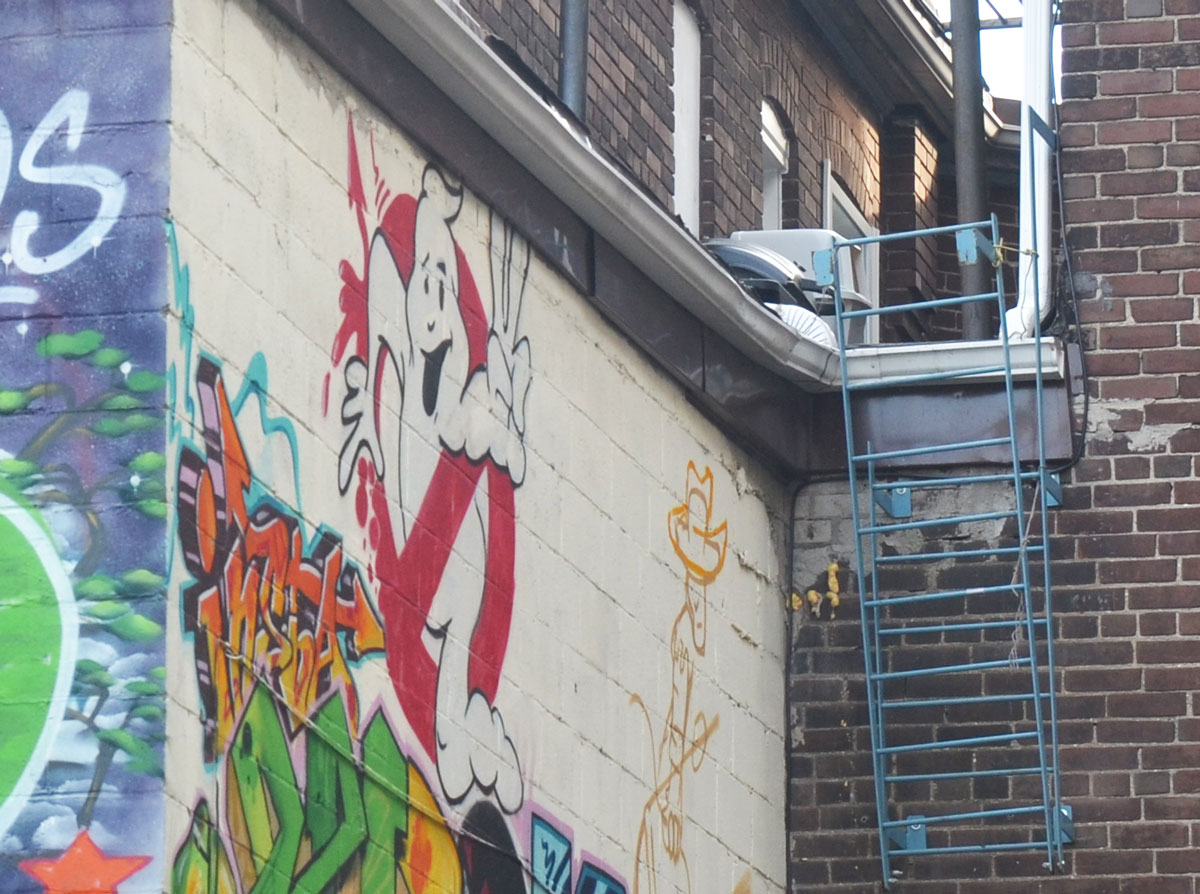
  below:  Ghostbusters in a hard to reach place

A ghostbuster logo painted on the side of a building in an alley

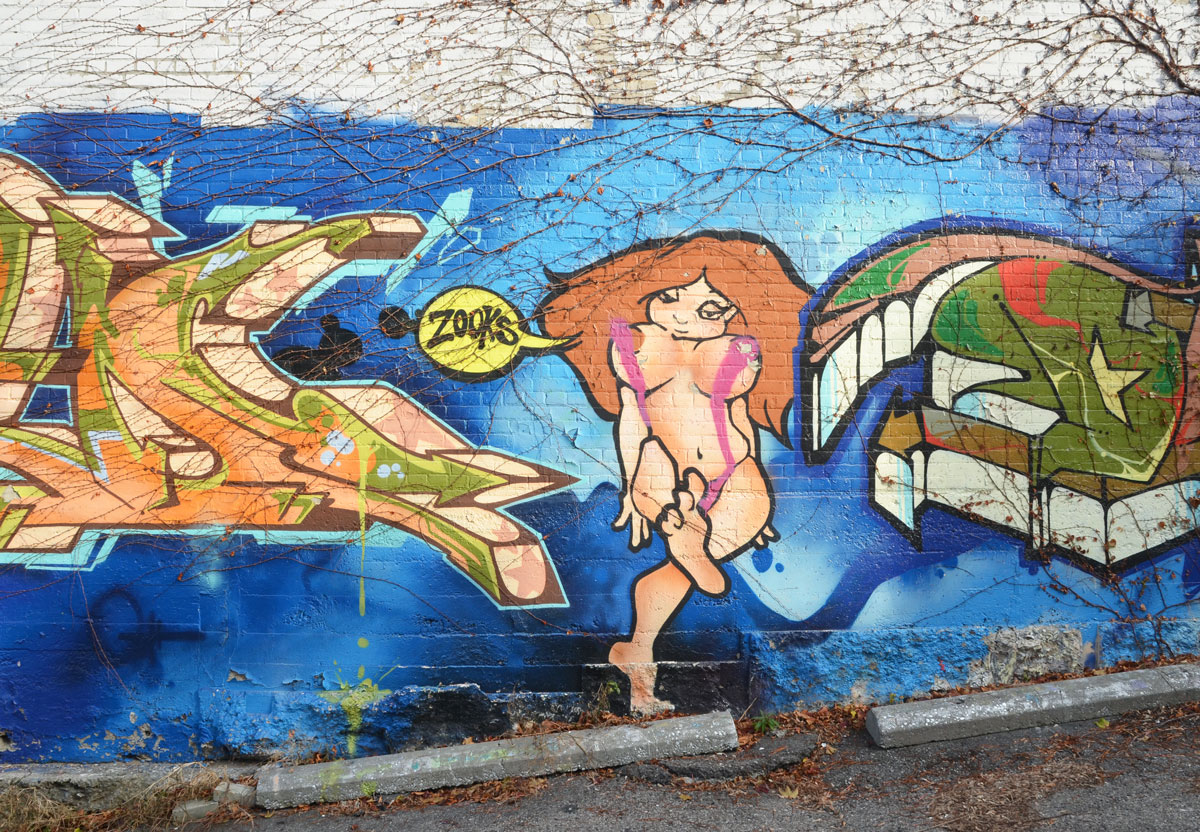
below:  Zooks is still on her wall.

street art on a wall in a laneway. Blue background, naked woman with long brown hair, standing between two tags

below: This turtle has seen better days

A green turtle character painted on a wall in a lane. Wearing glasses, standing up. The paint in the lower part of the piece is peeling badly.

grey and light blue tag street art on a multi coloured background, two butterflies as well, one pink butterfly and one blue butterfly

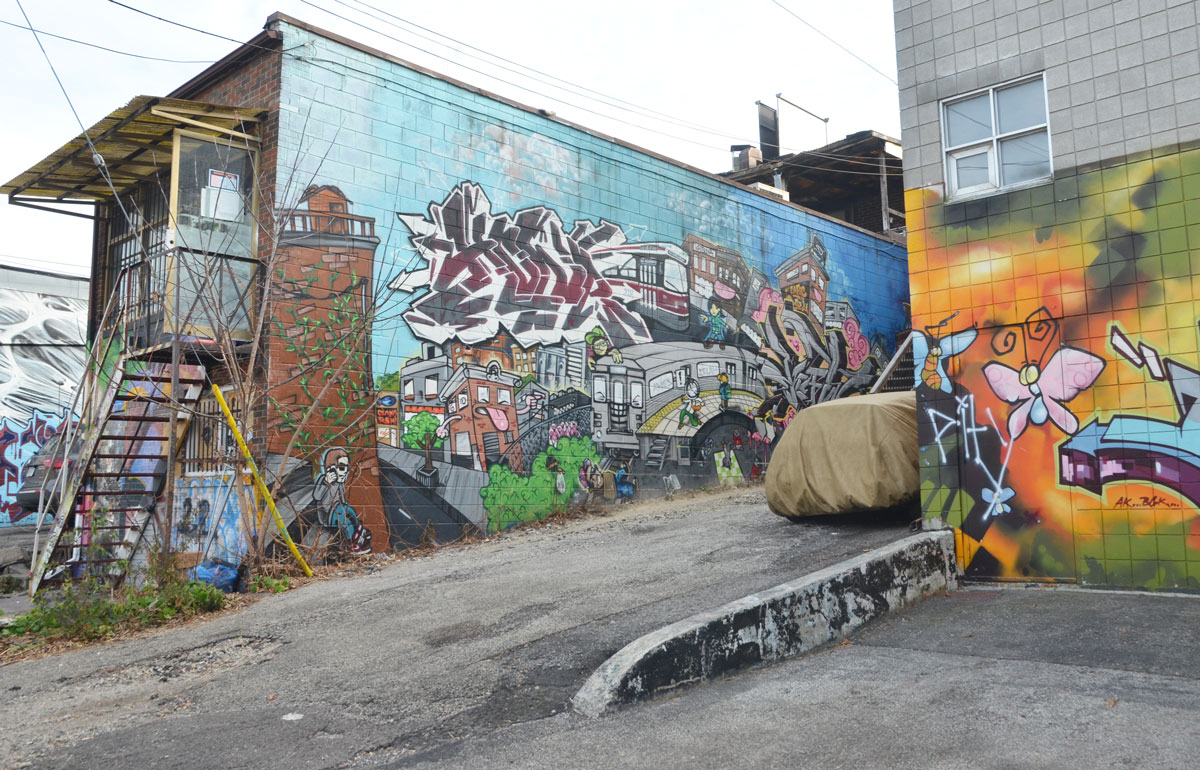
mural on the side of building in an alley, TTC streetcar, buildings, people, subway, with another building in the foreground
mural on the side of building in an alley, TTC streetcar, buildings, people, subway,

below:  Guard dog at the bottom of the stairs

painting of a large black dog on a door at the bottom of an exterior stair case. Graffiti dog, street art dog. It looks like he is sitting in front of the door looking at people as they walk towards the door.

blog_train_street_art

below: She seems to turn when the door opens, a mural by EGR art


a large mural of a woman with wings that takes up the entire back of a two storey building in a laneway. There is also a metal staircase with a small porch. The door at the top is open so part of the woman in the mural opens up too. The mural is by EGR art.

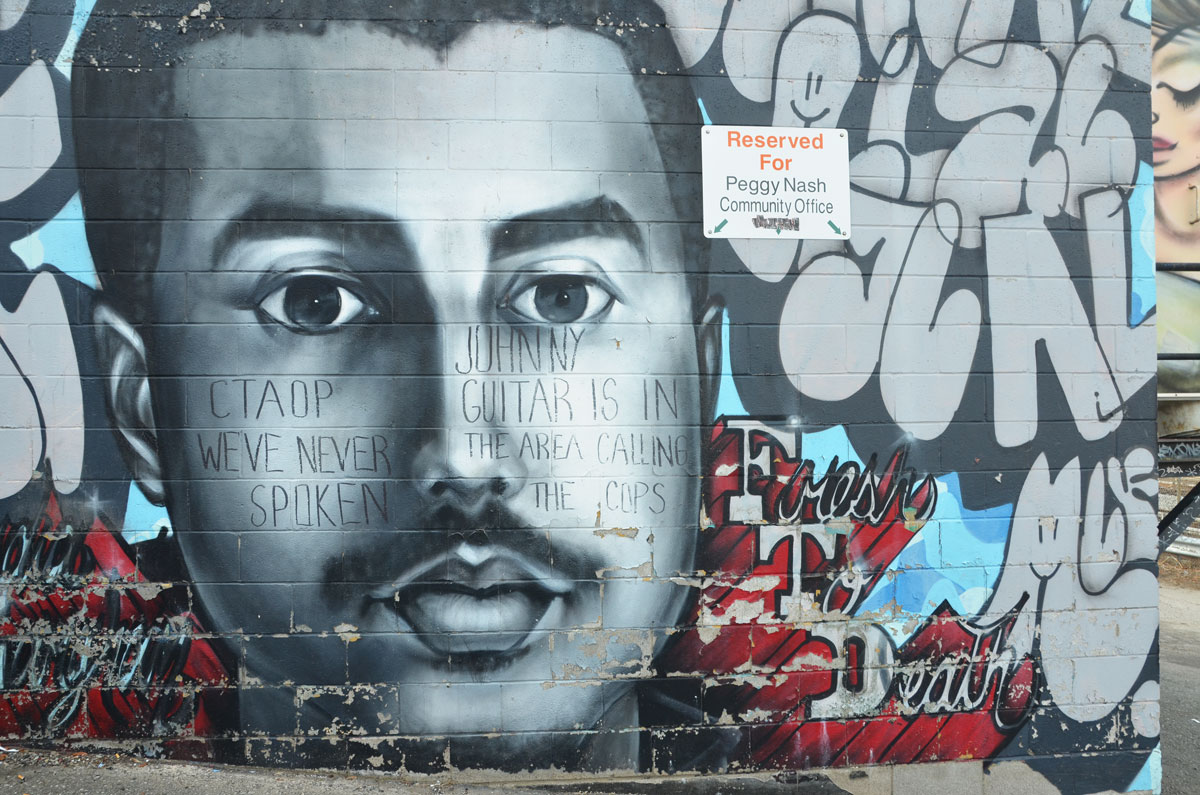
large mural of a young man's face in grey tones. Small moustache, head only,

below:  He (she?) still keeps goal on the back porch.

painting of a hockey goalie in full pads and helmet painted on a blue door by a small porch in a laneway.

looking down a laneway towards a large brick apartment building. The side of a truck has some graffiti on it - the truck is backed into a parking spot in the lane. The buildings in the lane have graffiti on them.

part of a mural with a lot of heads, a man, a green character, amongst others, high on a wall

rabid raccoon in blues, street art

street art in an alley, a white skull with a black baseball cap. Cap says Big Dirt on it. Words above the skull are Mary Recka Pantilo (could be Mozy not Mary)

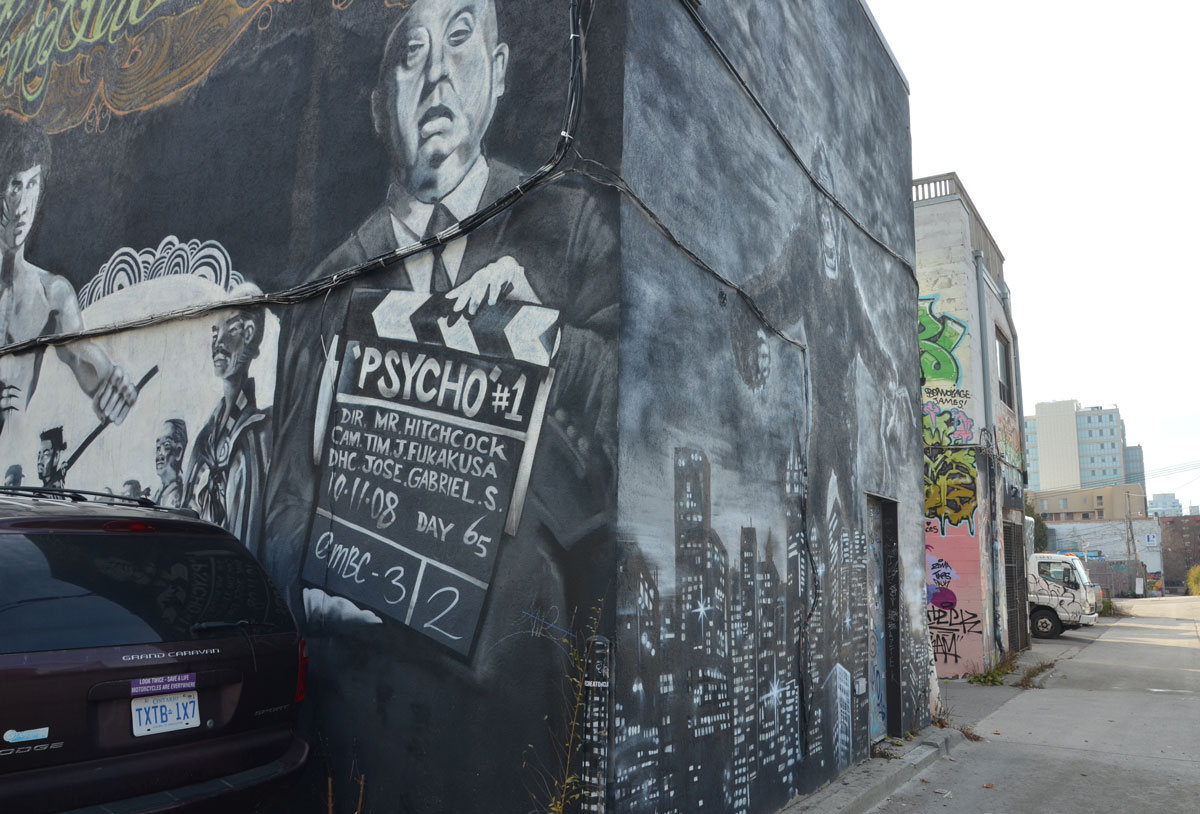
below:  This mural also has a painting of Marilyn Monroe in it along with Bruce Lee and Alfred Hitchcock.  There were too many cars parked in front of it when I walked past the other day.

part of a larger mural, Alfred Hitchcock holding a sign for the filming of Psycho, Bruce Lee is also in the picture, a car is parked in front of the wall, in an alley

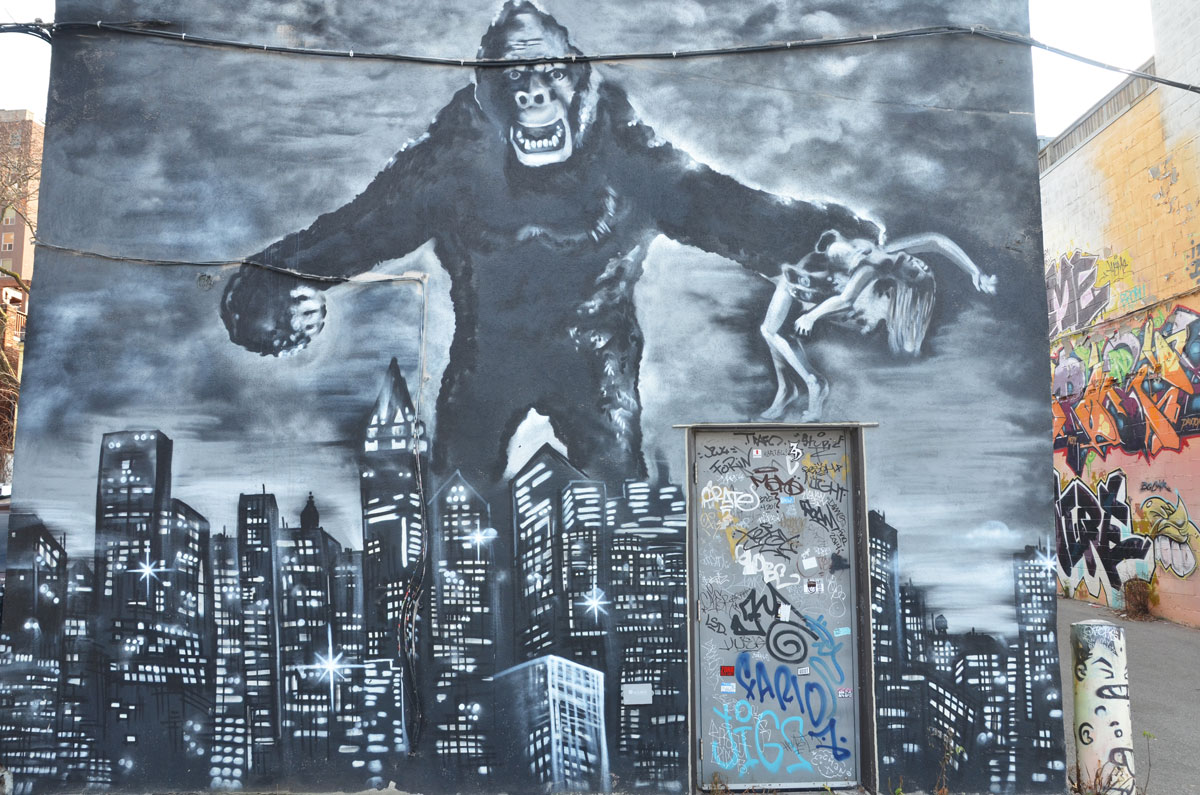
below: King Kong dominates this wall.

Grey toned mural of King Kong holding a woman over a tall building as he walks through a large city, and towers over it.

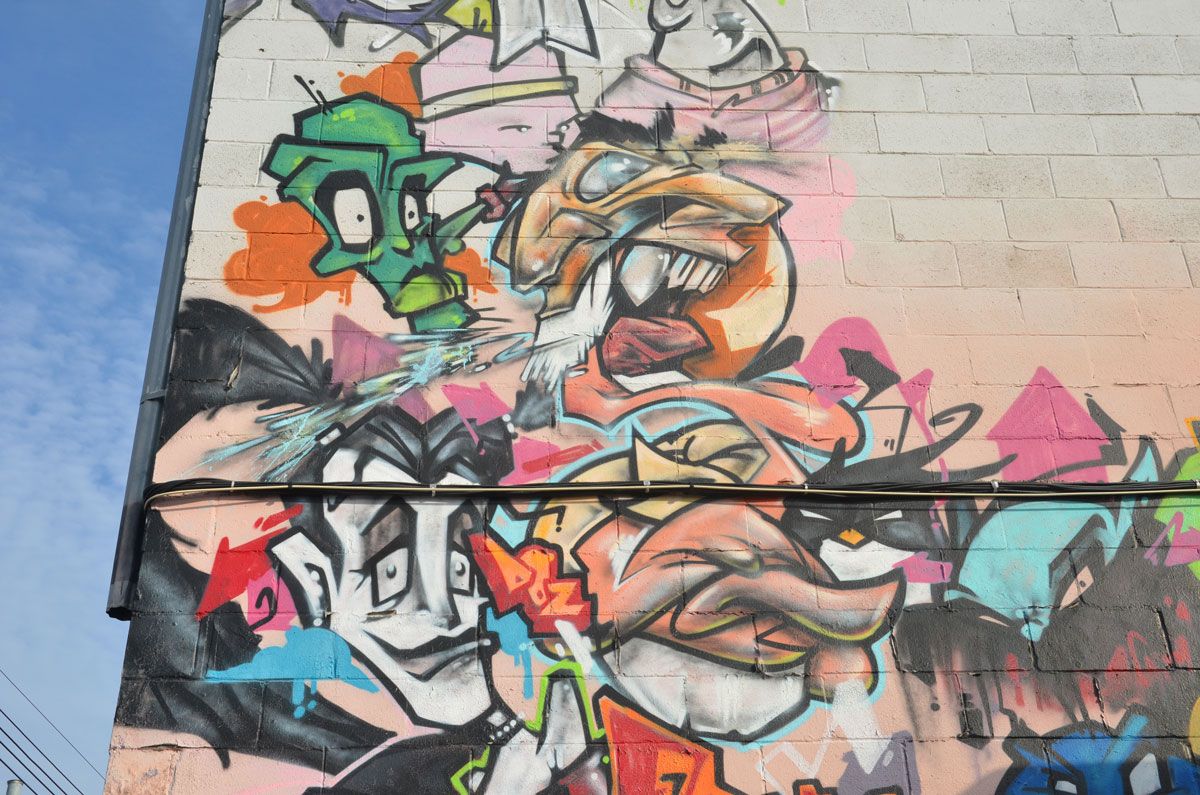
street art painting of a grimacing big fat yellow male face with eyes closed and big white teeth showing

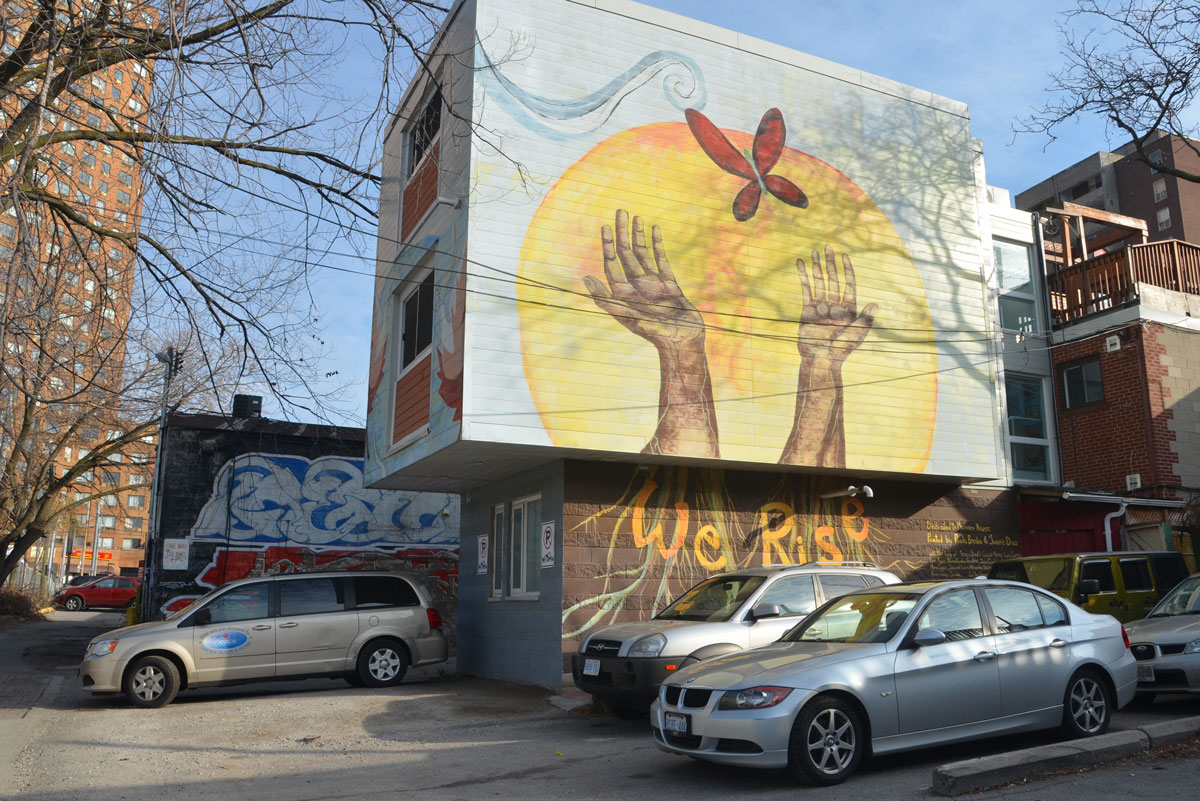
below: We Rise Up

large mural of upreached open hands releasing a red butterfly
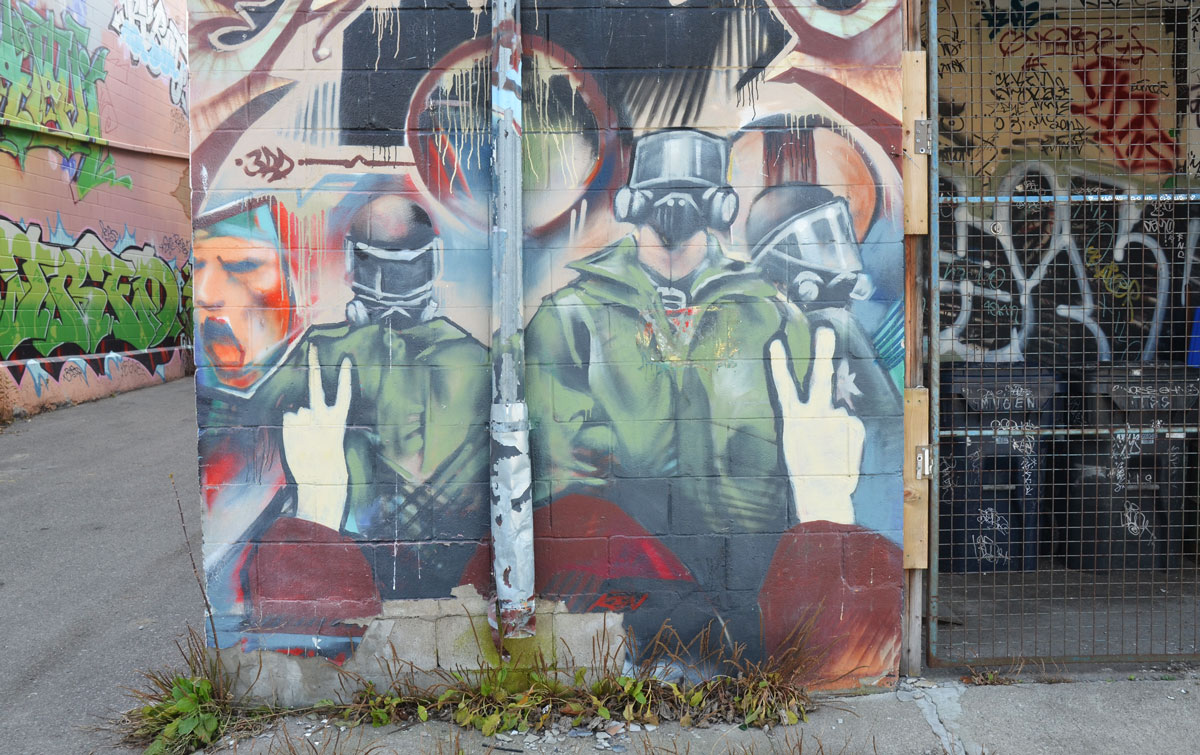
below: War and Peace

mural of police in riot gear confronting a person with both hands giving a peace sign

A green four eyed blov with a peace sign shaped nostrils, and a necklace with a gold H on it.

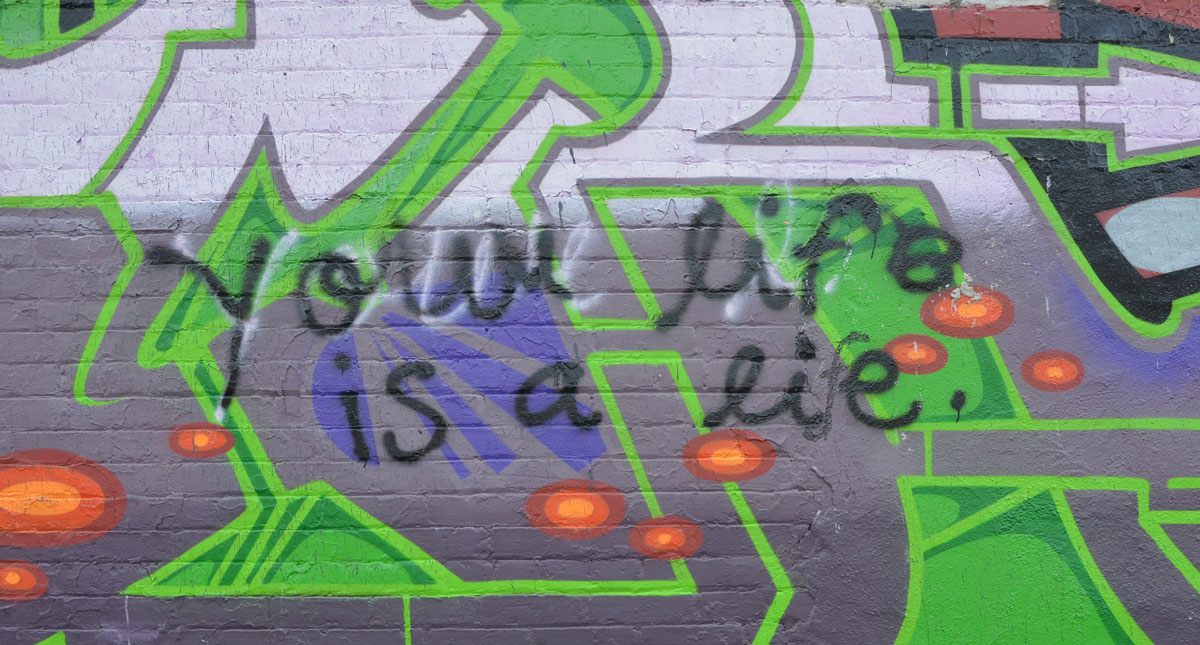
Someone has scrawled Your life is a lie in black over a piece of street art. Someone else has changed lie to life by adding an f

graffiti street art in an alley - an angry bird bird with the words Rainy Days

graffiti street art in an alley - Two black and white hearts, one with a face drawn on it. The words cloud + glare = [heart]

Along a short stretch of Coxwell Avenue

Upgrades to Coxwell subway station include work on the north side of Strathmore Blvd.  Two murals were created to brighten the hoardings around the construction site.  Both murals are the work of a program called ‘City on the Move – Young Artists in Transit’.  If you use Coxwell subway station you can’t help but see these murals as they are right across the street from the entrance.

below: ‘Today Reassembling Yesterday’ shows people standing within a miniature old East York.  On both sides of the mural is a replica of a Hollinger Bus line ticket.  This bus company was founded in 1921 by John Hollinger and it serviced the growing neighbourhood of East York.  By the time the TTC took it over in 1954, Hollinger had 96 employees and a fleet of 56 buses that traveled twelve routes on such streets as Woodbine, O’Connor and Coxwell.

mural in front of a construction site, the tops of two brick houses are visible behind the fence, a large green crane is working at the site

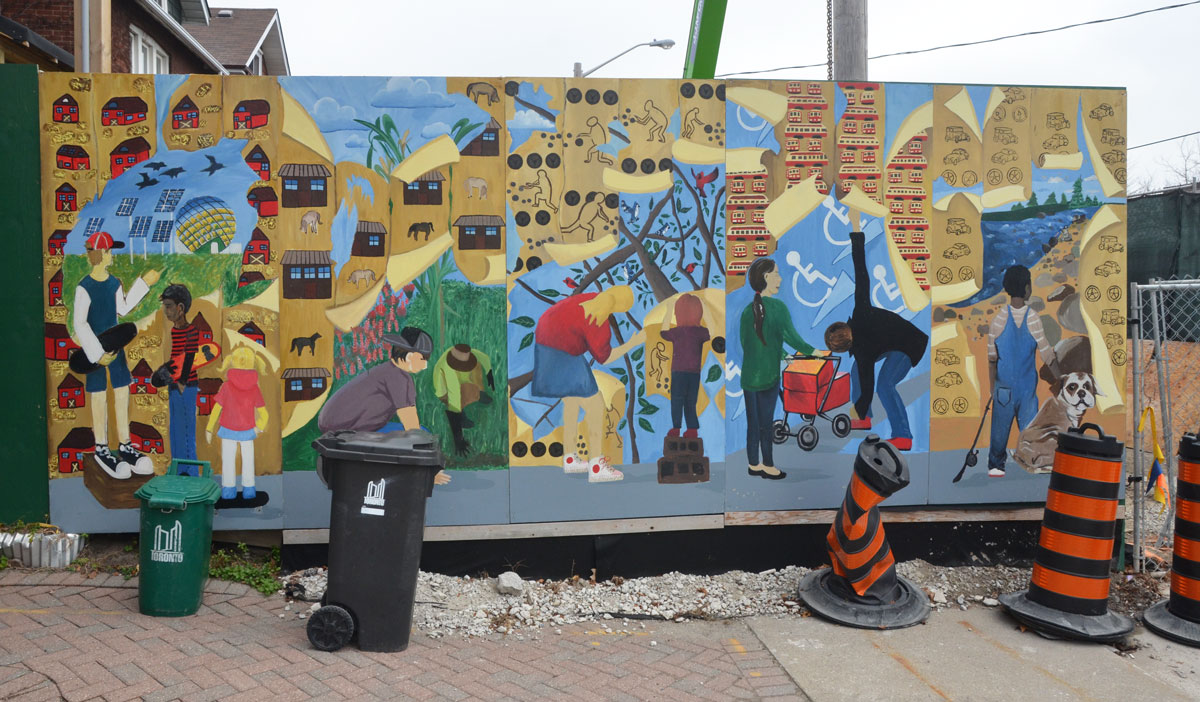
below: In this mural, five panels are covered with wallpaper of pictures of the past.  Residents, the present day, peel back the layers of the past to reveal their visions and hopes for the future.  On the left, red barns and hay stacks make way for solar panels over fields with bird filled skies.  The next panel is also inspired by agriculture – healthy corn fields and other crops under a layer with horses and stables.  The middle panel puzzles me.  I’m note sure what the pictures on the brown paper represent but birds in a tree are under it.  The fourth panel suggests accessible public transit.  Lastly, cars and trucks make way for rivers to fish in.

A mural of kids peeling away layers of wallpaper with pictures on it.

‘New Revelation, at Coxwell’

a poem by George Elliott Clarke, Poet Laureate of Toronto 2012-15
to accompany the mural at Coxwell station

As wallpaper peels to windowpanes, spy
Grass, insurgent, urging all our future
Is Spring: Sunlight sparks sweat and dream; wind drives
Machines. Thrilled, birds wing and sing so sprightly,
Everyone delights. Blossoms float perfumes.
Branches brandish emerald bouquets. Our lungs
Flood with surging airs, clean as chlorophyll,
Mint-new, mint-tangy, so song is born,
Just by breathing. Wheels become our earthly
Wings, so infant and elder, builder and
Dreamer, can flit – transit – through the city
As public millions that public millions
Uphold, so that the lame, too, can take
The air and wheel down to creek, stream, and lake.
Suddenly glittering, afresh with fish.

The TTC also owns property on the southeast corner of Coxwell and Danforth.  Back in 1915 this facility was built as the Danforth carhouse for the streetcars that ran along the Danforth.  When the Bloor Danforth subway line opened in 1966, these streetcars were retired and the carhouse was converted to handle TTC buses instead.   In 2002 the Danforth carhouse (or Coxwell Barns) was shut down.  Some of the property has been sold off but the TTC still has a presence there.

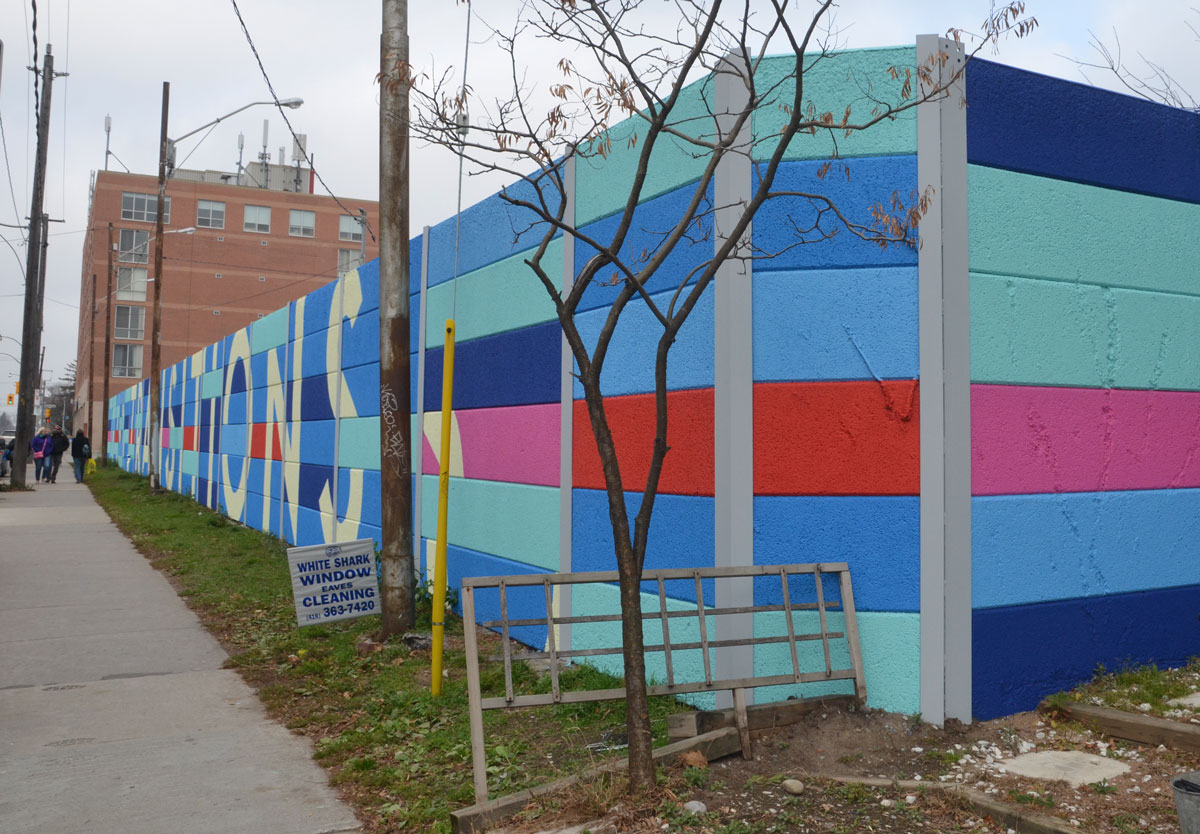
below:  Along Coxwell Avenue, south of the Danforth, there is a fence that separates TTC property from the street.  It was a typically drab TTC concrete barrier.  Recently it was painted by a group of volunteers.  The word ‘transition’ now pops out at passersby from a colourful mural designed by Sean Martindale.

Transitions written in block letters in a large geometric mural that matches the grid of the concrete that makes up the fence

close up of the letter N and part of S in the Transitions mural on a TTC fence on Coxwell ave.

Transitions written in block letters in a large geometric mural that matches the grid of the concrete that makes up the fence

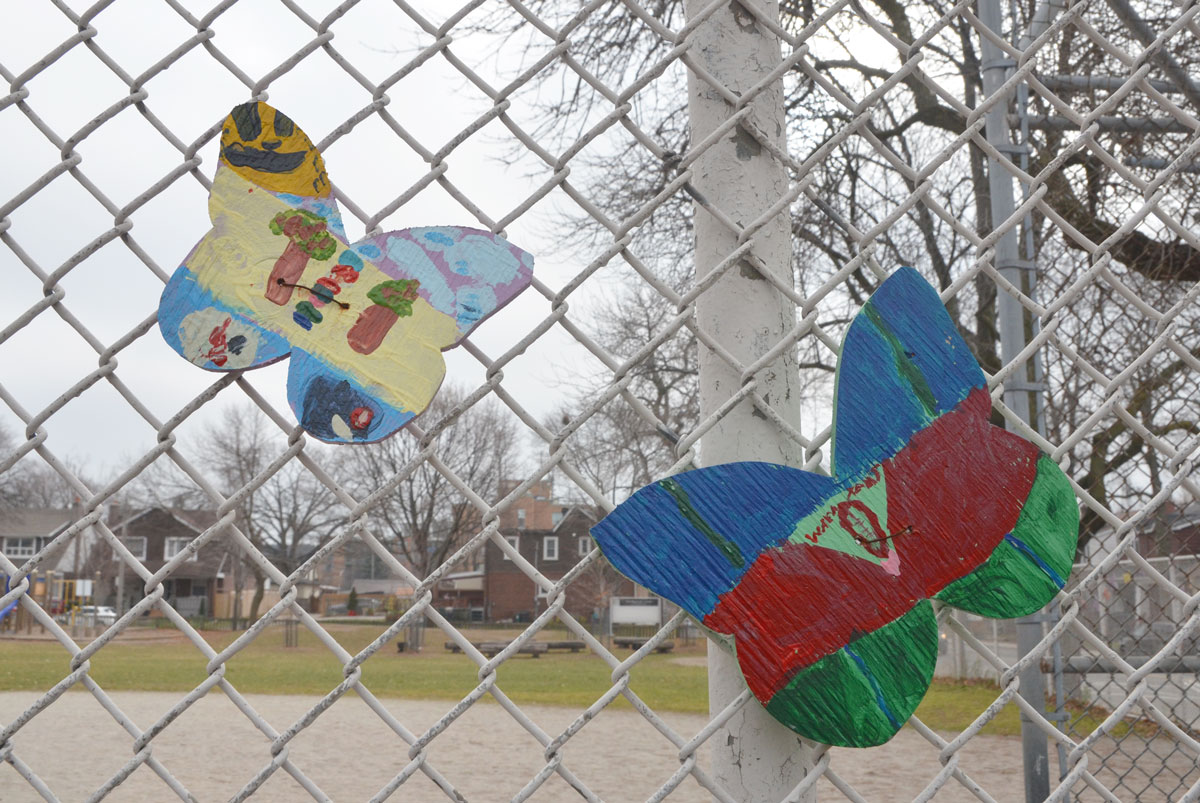
If you walk a few more blocks south on Coxwell, you will come to a fence where many butterflies have stopped to rest.

two wood butterfly shapes that have been hand painted by kids and then attached to a chain link fence around a school playground.

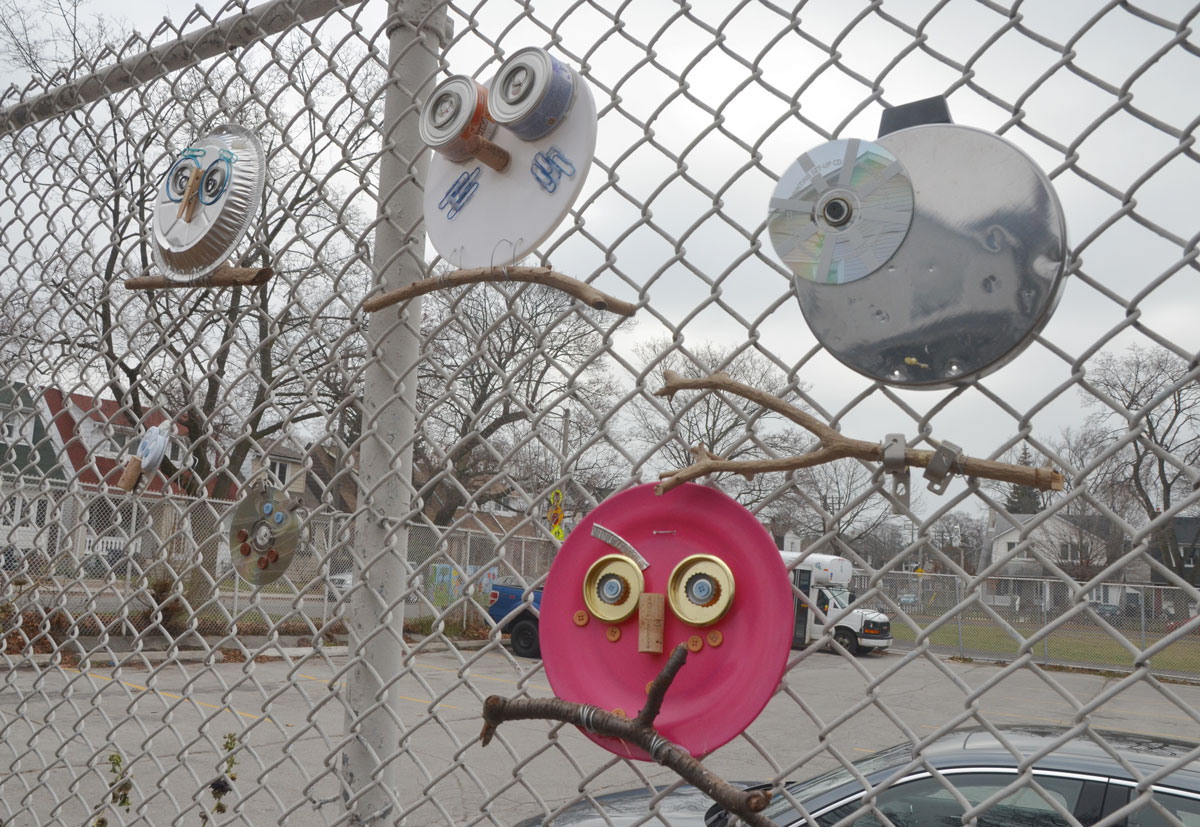
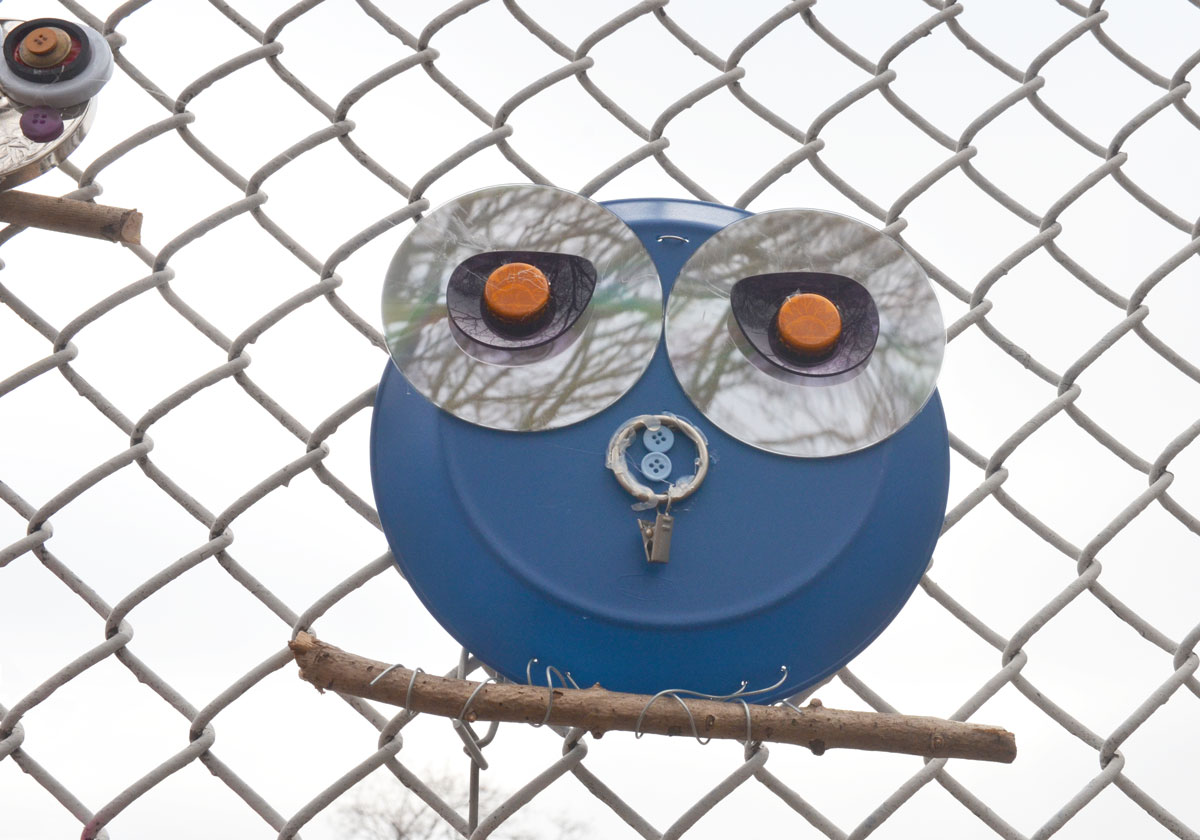
They share a fence with a few creative owls wisely made out of recycled materials.  Tin cans, CDs, buttons, bottle tops, corks, paper clips, sunglass lenses, clothes pegs, foil plates, and bits of plastic repurposed.


four owls made of recycled goods, foil pie plates, CDs, bottle tops, there feet are wrapped around twigs and they are attached to a chainlink fence

owls made of recycled goods, foil pie plates, CDs, bottle tops, there feet are wrapped around twigs and they are attached to a chainlink fence - two corks for horns

owls made of recycled goods, foil pie plates, CDs, bottle tops, there feet are wrapped around twigs and they are attached to a chainlink fence - also blue buttons for the nose

below: A little red fairy door, home of the Earl Haig gardener.  This past summer there was a project called  Danny’s Urban Fairies.  Fairy doors that were hand crafted by local artists started appearing in stores and parks along Danforth East  (from Jones to Westlake).  Some of the fairy doors remain but many were auctioned off in November to raise money to support the non-profit East End Music Project.

A little red screen door, fairy door, at the base of a tree with two little signs. One sign says Earl Haig gardener and the other says Do not litter.

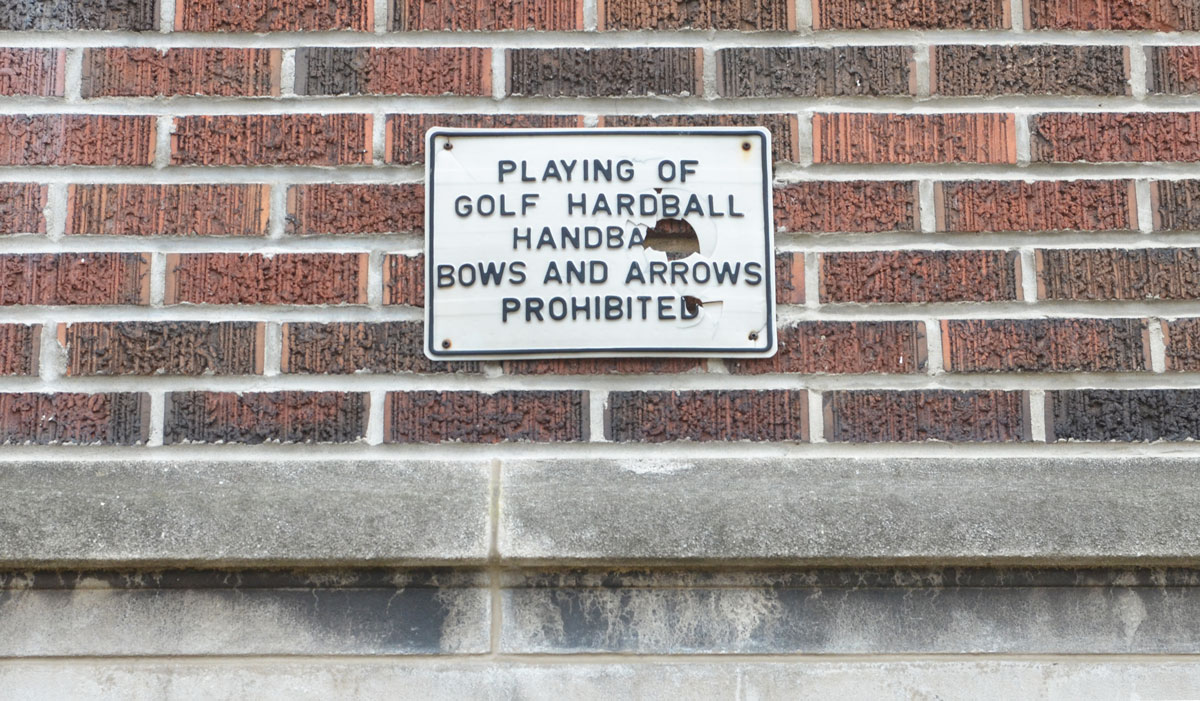
below: No bows and arrows allowed!

old sign on the exterior wall of a school that says: Playing of golf, hardball, handball, bows and arrows prohibited


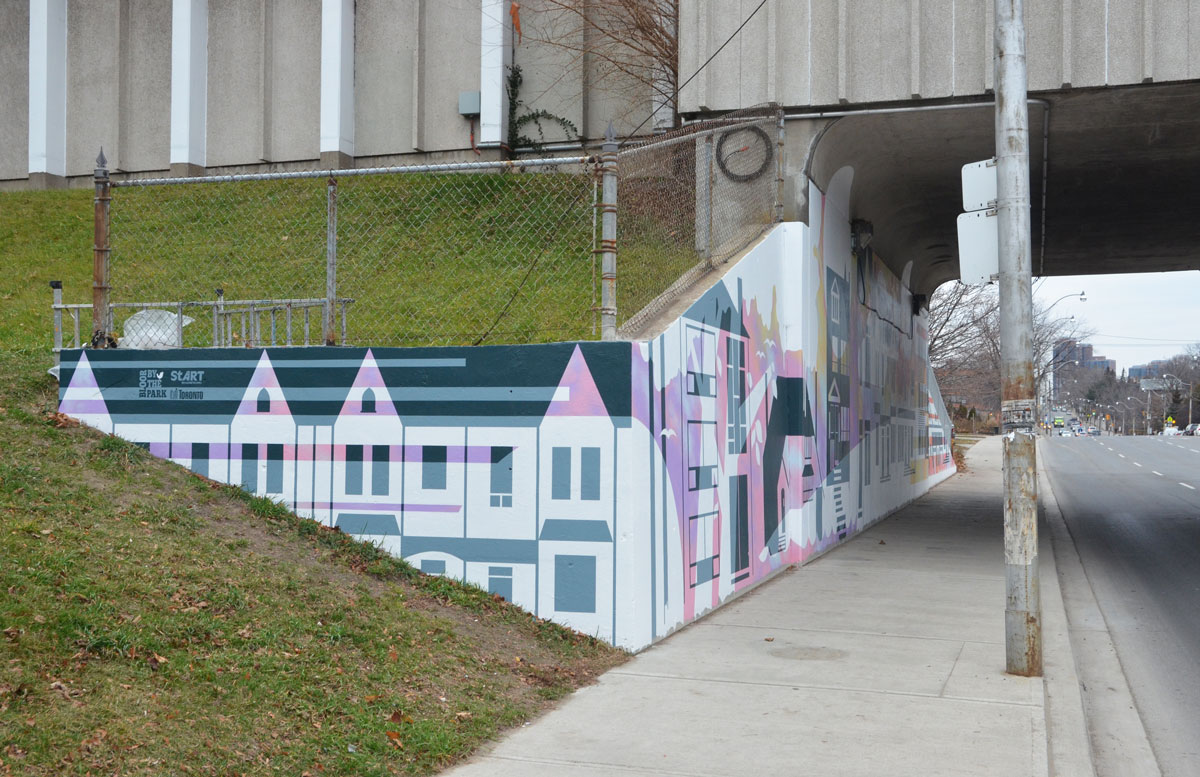
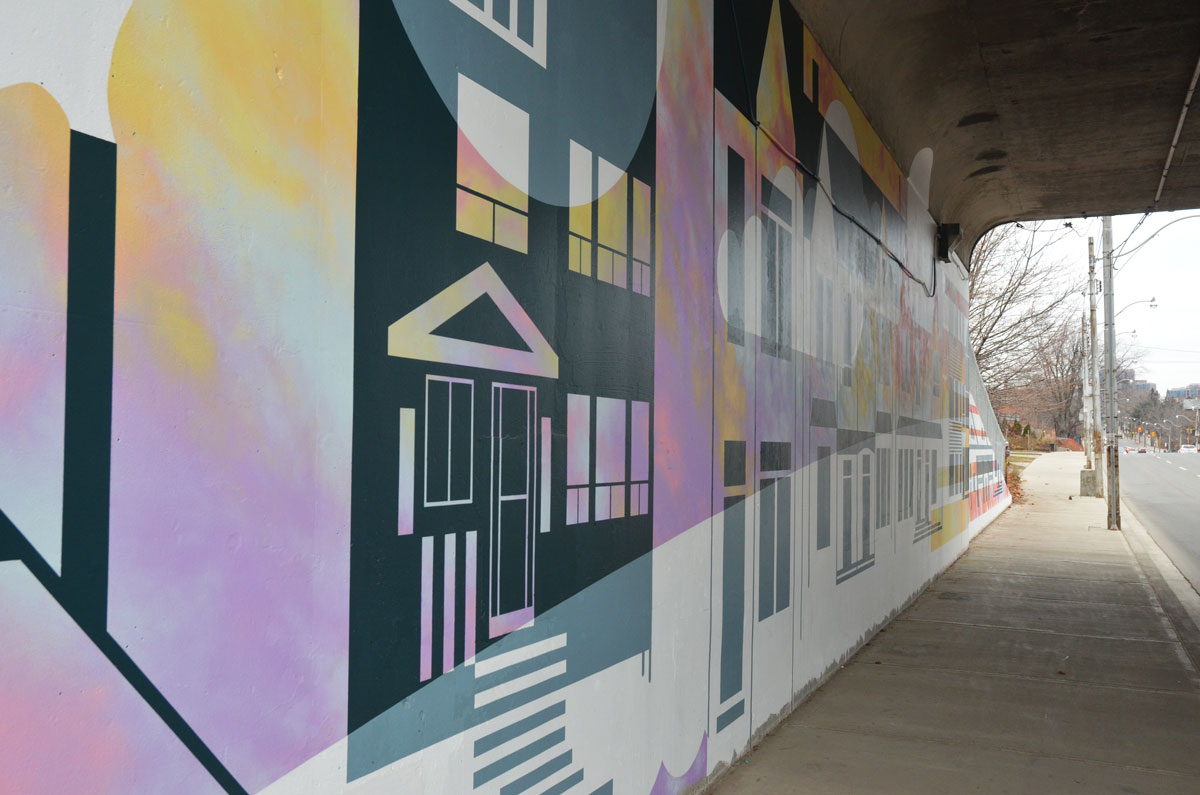
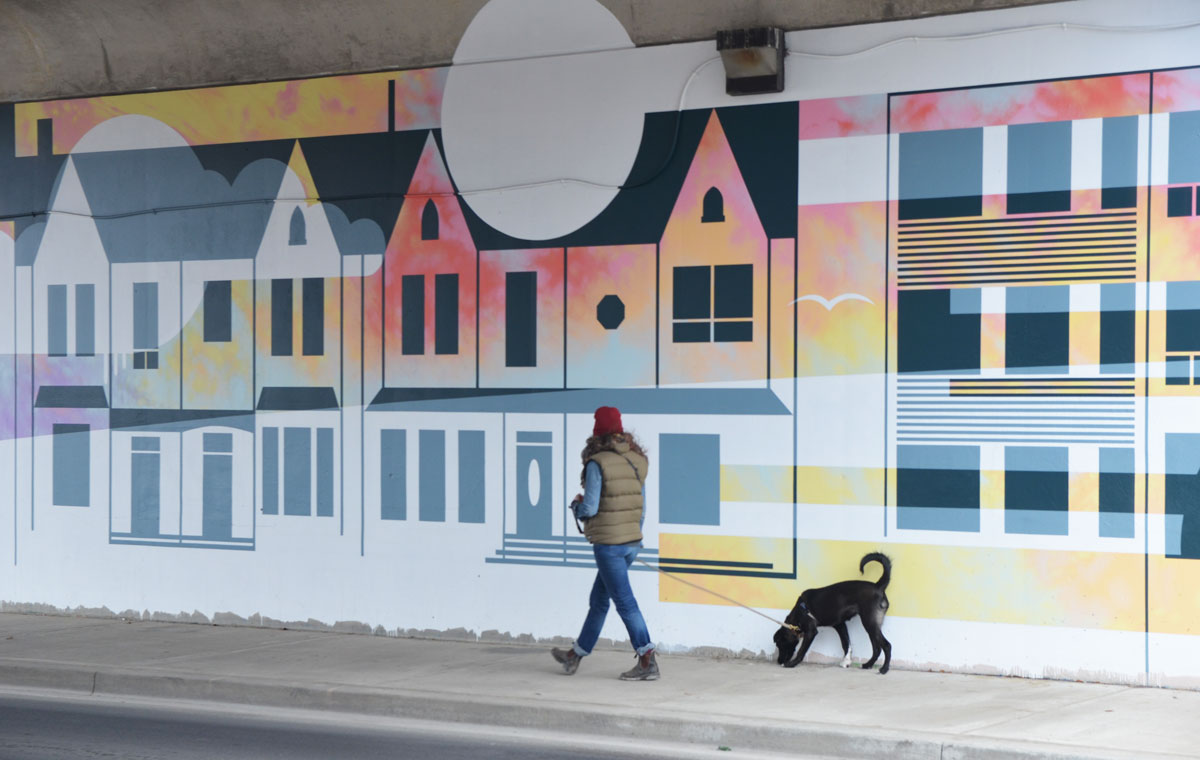
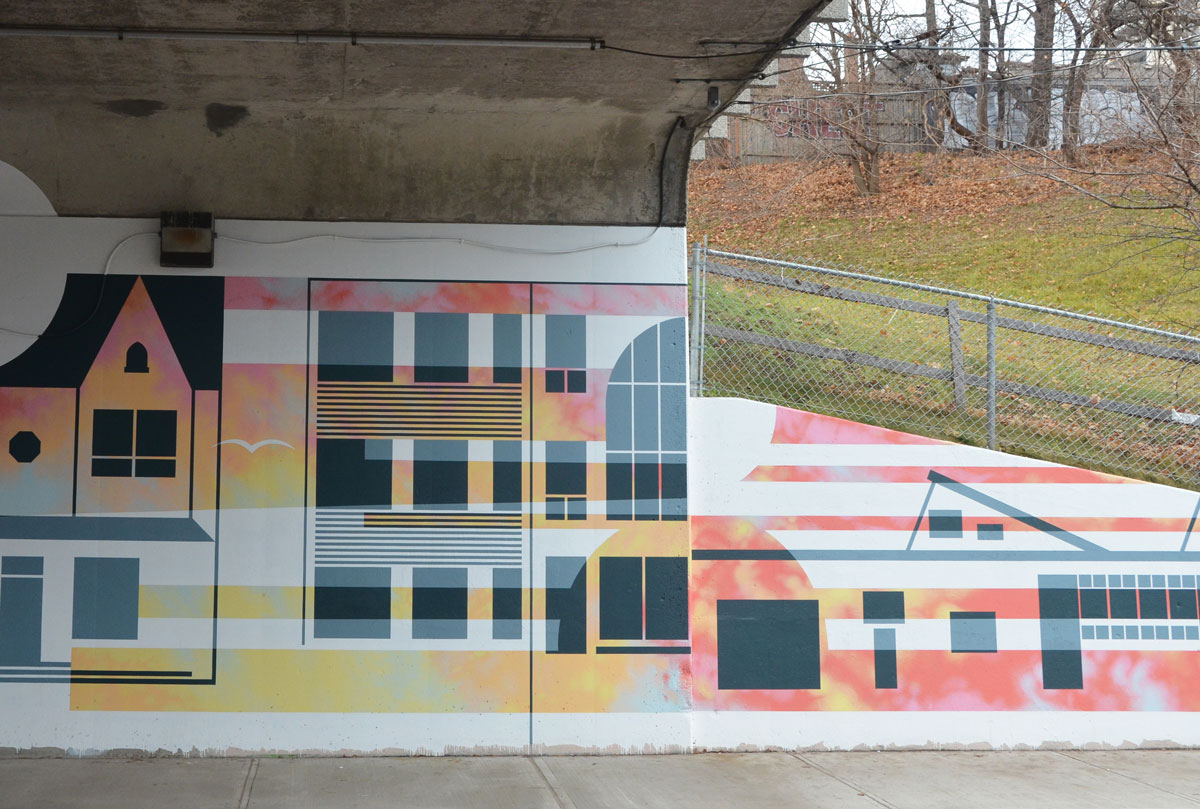
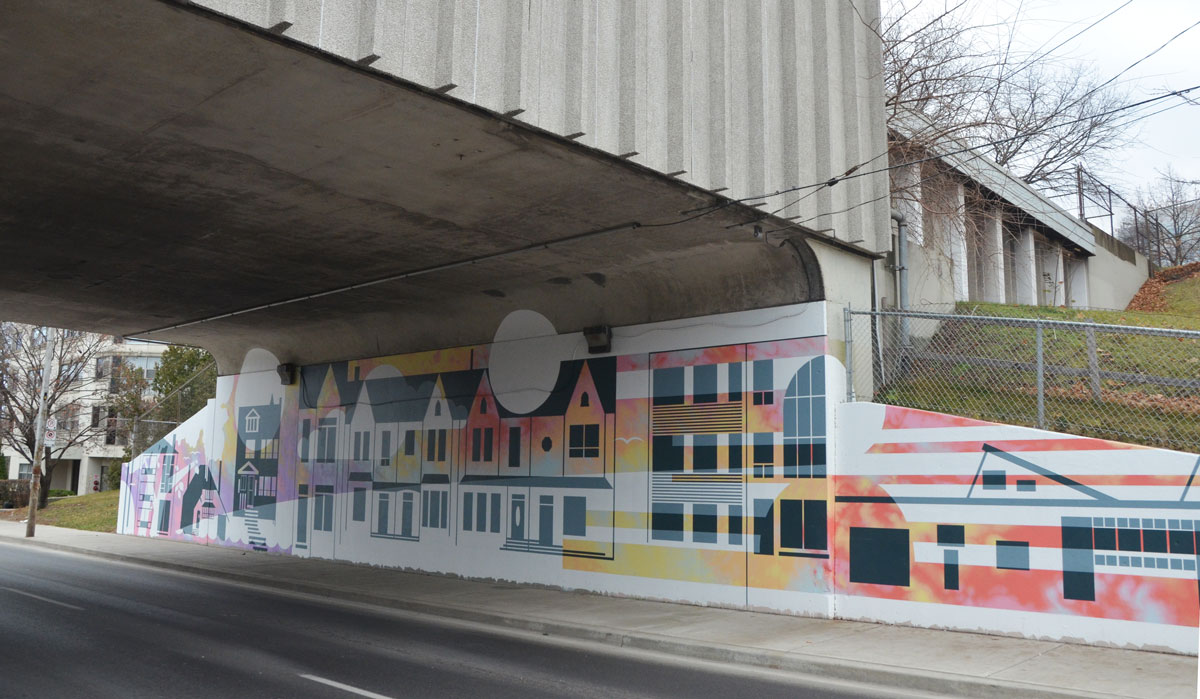
There’s another new mural in town.

part of a mural by Rob Matejka and Tommy Matejka on the wall on a TTC subway underpass at Keele, a mural of houses on a street, looking north on Keele Street
This one is on Keele street, just north of Bloor.

part of a mural by Rob Matejka and Tommy Matejka on the wall on a TTC subway underpass at Keele, a mural of houses on a street, south corner
It is under the subway bridge, directly across the street from the Keele subway station.

part of a mural by Rob Matejka and Tommy Matejka on the wall on a TTC subway underpass at Keele, a mural of houses on a street

It was painted by Rob Matejka and Tommy Matejka.

part of a mural by Rob Matejka and Tommy Matejka on the wall on a TTC subway underpass at Keele, a mural of houses on a street

The mural was a collaboration between StreetARToronto, Bloor by the Park BIA, and the City of Toronto.

part of a mural showing two houses, with two real houses in the background


part of a mural by Rob Matejka and Tommy Matejka on the wall on a TTC subway underpass at Keele, a mural of houses on a street

part of a mural by Rob Matejka and Tommy Matejka on the wall on a TTC subway underpass at Keele, a mural of houses on a street, north end of mural

part of a mural by Rob Matejka and Tommy Matejka on the wall on a TTC subway underpass at Keele, a mural of houses on a street