Posts Tagged ‘history’

…. another visit to Yonge and Eglinton

people crossing Eglinton Ave towards entrance to building on southwest corner of Yonge & Eglinton where there are images of people painted on the window

Of course, this is also the location of the Eglinton station on the mysterious Eglinton LRT.  The underground walkways between it and the Yonge – University subway line are complete, as is the entrance on the south side of Eglinton.   The latter is a large building and it will definitely help with the flow of traffic… but it sits idle.
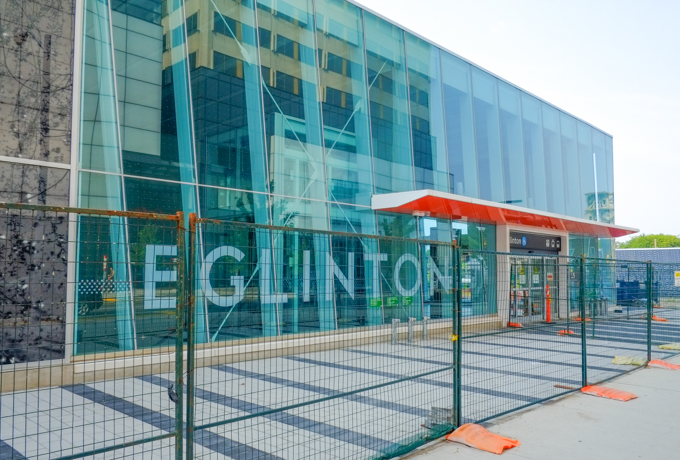
northern new entrance to Eglinton station on LRT line, behind fence, no public access

new entrance to Eglinton station on LRT line, behind fence, no public access, on west side, with old Canada Square development behind

below: All of the old Eglinton station bus bays are long gone.
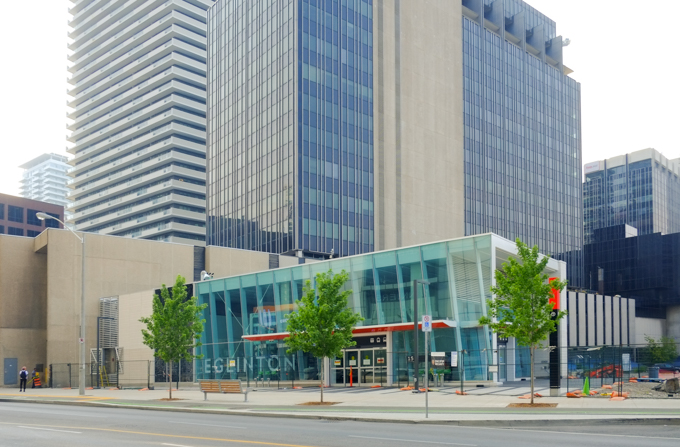
new Eglinton station Metrolinx entrance for LRT and subway, still closed to the public, with older Canada Square buildings around it

below: Canada Square, home to Canadian Tire head office for more than 50 years, was built in the 1960s and 70s.  It consists of two towers connected by a lower section – it is this middle connecting piece that has the vertical concrete slabs on the exterior. These verticals are on both the Yonge Street side (below) and this motif is repeated on the back of the building (see photo above, behind the new station entrance).   Earlier this year, Canadian Tire announced that they had renewed their lease for another 20 years and that the building was going to be redeveloped/upgraded/modernized in the near future.
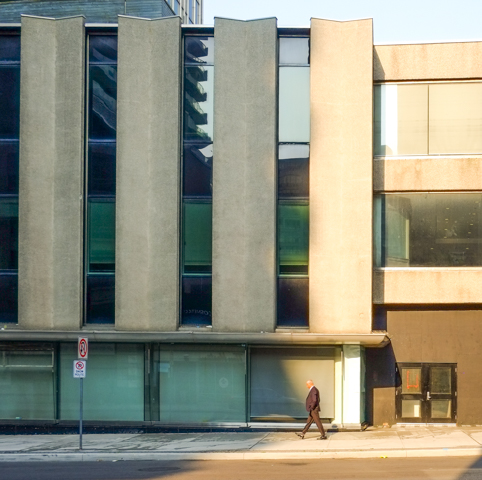
a man walks down Yonge St., past vertical concrete slabs on canada square building, light and shadows

below: Northwest corner of Yonge and Eglinton

reflections in the glass on the northwest corner of yonge and Eglinton with Cineplex theatre, Winners store, Pickle barrel restaurant, and Rexall drug store, 2200 Yonge Street

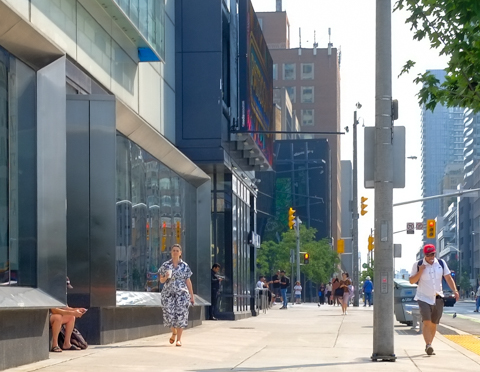
people walking on the west side of Yonge, north of Eglinton

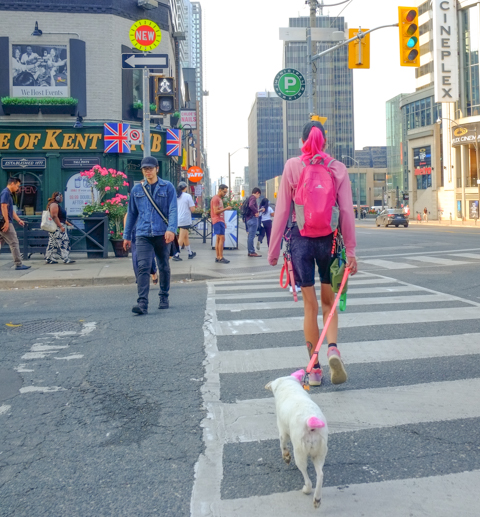
below: The Duke of York pub at Yonge and Roehampton

corner of Roehampton and Yonge, Duke of Kent pub on the corner, along with Chloes Nails, the Stag Shop

below: The old Postal Station K has been incorporated into a new condo development. The older building dates from 1936; it was built on the site of Montgomery’s Tavern (made famous in 1837 when it was the epicenter of William Lyon MacKenzie’s rebellion). It was a big square building but with Art Deco elements around the entrance. Because it was built in 1936, it actually featured (and still does) the Royal Insignia of King Edward VIII whose reign was very short-lived because he abdicated the throne only 11 months after being crowned.
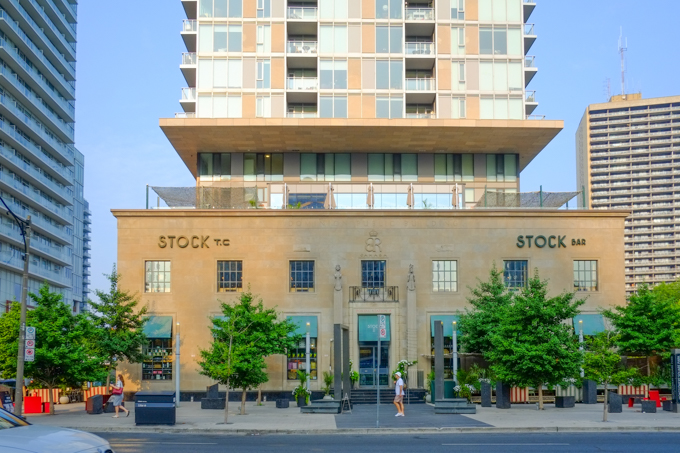
old post office on Yonge street, is now the bottom part of a new condo development

below: North of Montgomery/Broadway more development.  More cranes.

looking north on Yonge street towards Montgomery, old brick and stone building on the corner, many cranes in the background

below:  About 15 years ago, North Toronto Collegiate  (NTCI) was rebuilt on Broadway.  The new school was incorporated into a condo development.  At the north entrance to the school is an artwork by Catherine Widgery’s called “Mindshadows”. It is a 20 foot high stainless steel cube on legs that is covered with numbers, letters, and words. Serene, provoke, laugh, loud, big, spirit, and up are some of the words.
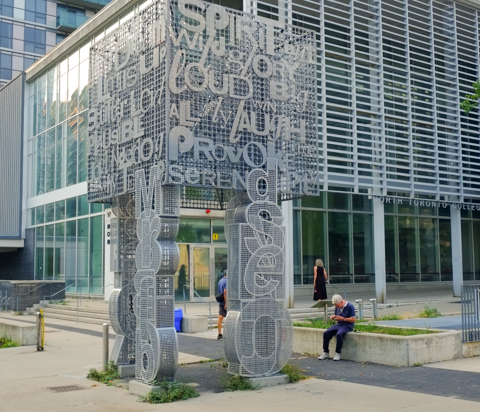
entrance to North Toronto collegiate institute, with public art in front.

below:  View from Broadway of the North Toronto football field and track and some of the condos that surround it.

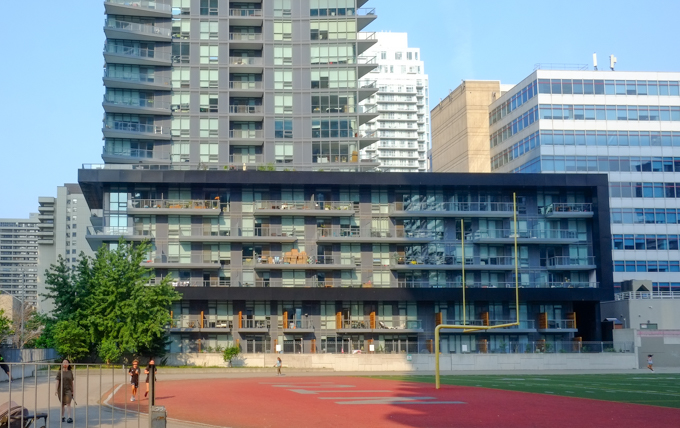
football field and track, par tof North Toronto Collegiate, surrounded by tall condos and apartment buildings

view west from football field and track, partof North Toronto Collegiate, many tall condos

below: Looking north from Roehampton
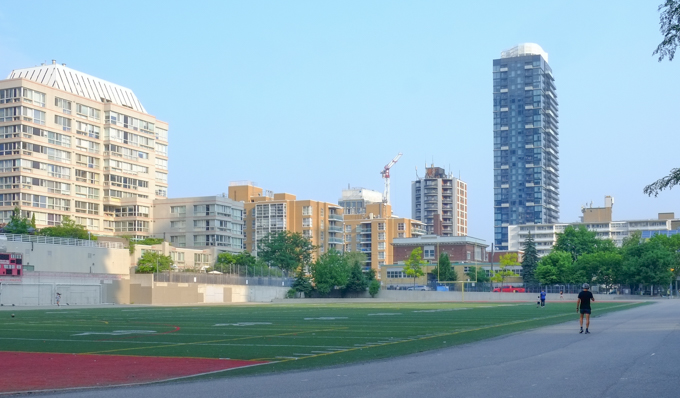
looking south from Broadway, football field and track, part of North Toronto Collegiate

below: At the south entrance to NTCI (on Roehampton) is another public art installation.  “What’s your name?” by Ilan Sandler (2011) contains the first names of all the NTCI students since the school opened in 1912.  Each name only appears once – but there are still 2053 different names such as Sven, Connie, Marlee, Janis, Lola, Ephraim, Bryan, and Snezana.
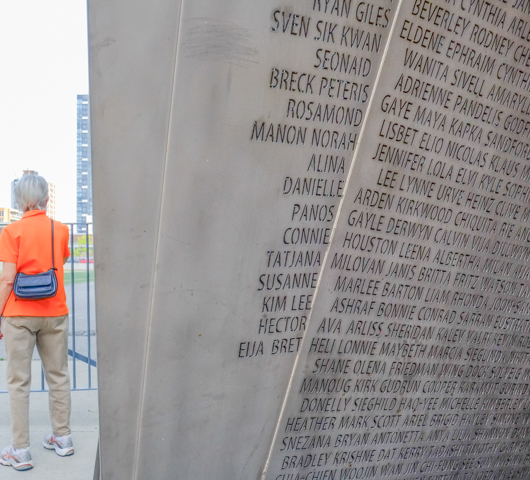
Part of What's your name, an art installation by Ilan Sandler, a list of over 2000 names, in concrete,

The neighbourhood that is north of Eglinton and east of Yonge has been the home of many apartment buildings for at least a few decades.  A growing number of them have been replaced by taller glass and steel condo developments, especially since the city has targeted the area for “… tall buildings and an intense concentration of office, retail, institutional and residential uses…” (quote comes from Yonge Eglinton Secondary Plan, 2018)

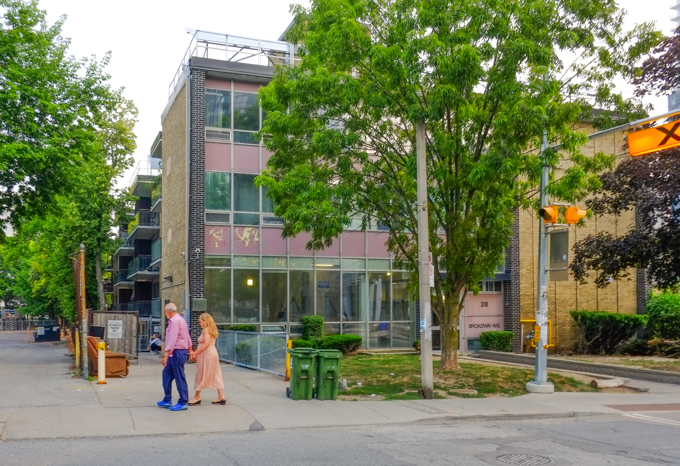
exterior staircase beside a building, narrow space between two older brick apartment buildings

older lowrise apartment building

below: Old style (1920s?) 4 storey walk-up apartments.  There was a time when this type of architecture was common and these apartment buildings are (were) scattered around the city.  There aren’t as many as there used to be although some, like this one, has been renovated and kept in good shape…. a testament to their good design.
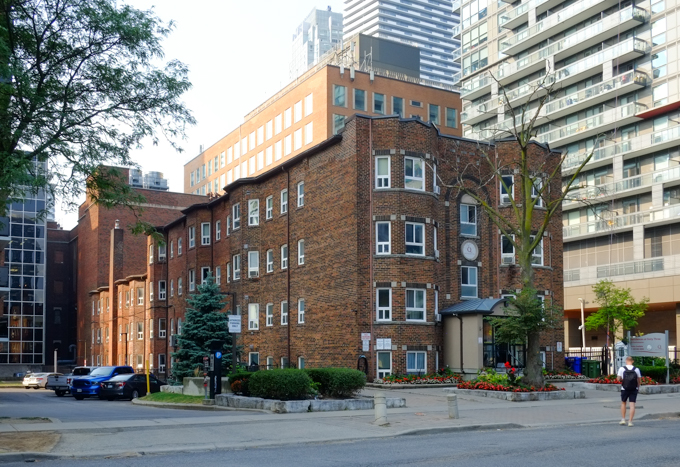
4 storey brick apartment building

below: Concrete building from the 1970s at 2323 Yonge …
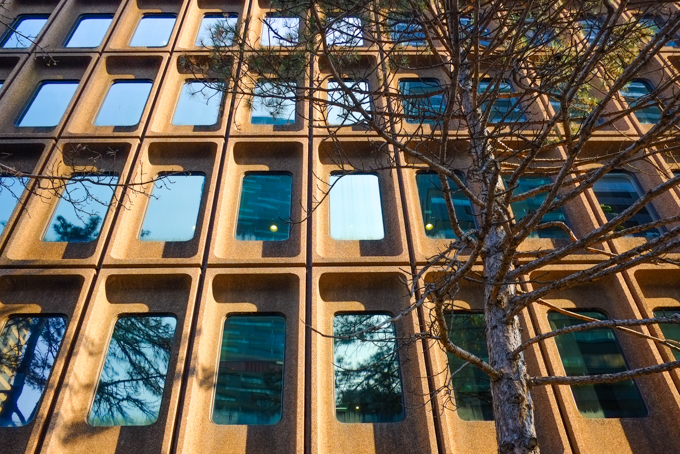
reflections in the windows of a 1970s concrete building, vertical windows with deeply recessed windows

below:  …   but it too has a blue and white development notice on the side of this building.  Fifty eight stories with 40 car parking spots but room for 350 bikes.
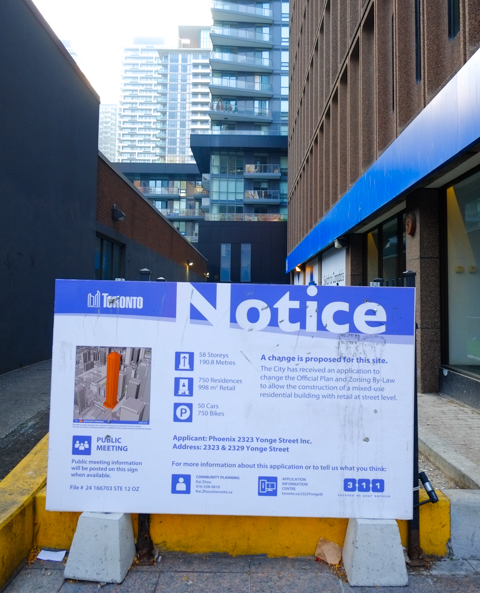
blue and white city of toronto development notice sign on yonge street

below: St. Monicas church, an A-frame structure built in 1959, is set well back from the street with a parking lot in front.
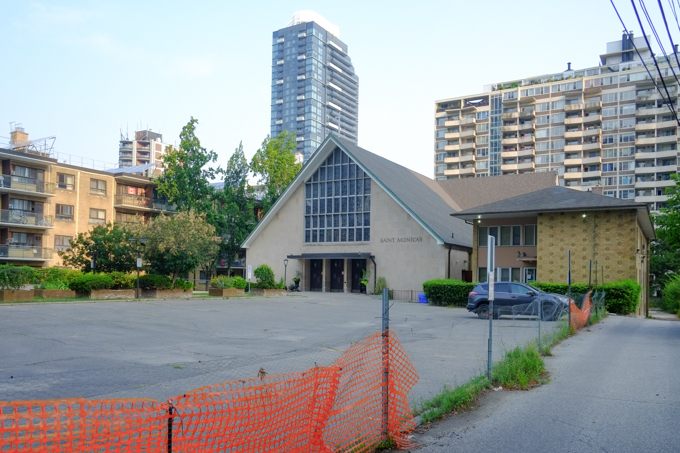
st monicas church, A frame building from 1959, and parish hall, with large parking lot in front

below: One of the many stained glass windows inside St. Monica’s church.  This image shows a window that features gold crossed keys which are a symbol associated with St. Peter.  These are the keys to the Gates of Heaven.  The church website describes this window as representing the (Catholic) Sacrament of Reconciliation (the pardoning of confessed sins).
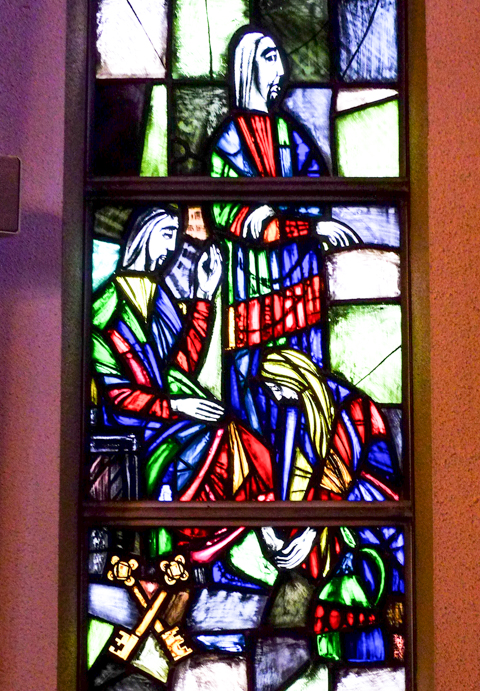
stained glass window in St. Monicas church


below: Redesigned.   From the KPMB website, this is rendering of the proposed new St. Monica’s church.  It has been brought forward closer to the street which also allows for a new condo tower behind.  That’s the plan.

rendering of new redeveloped St. Monicas church on Broadway Ave., as proposed by KPMB, image taken from their website

below: Beside the church is St. Monica’s school.  The original brick building was built in 1916.  A few additions have been added over the years.
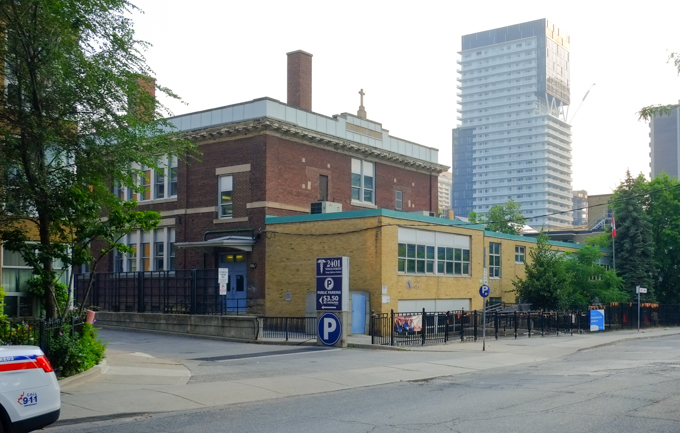
st Monicas school, brick building built 1917, with yellow brick addition from the 1960s

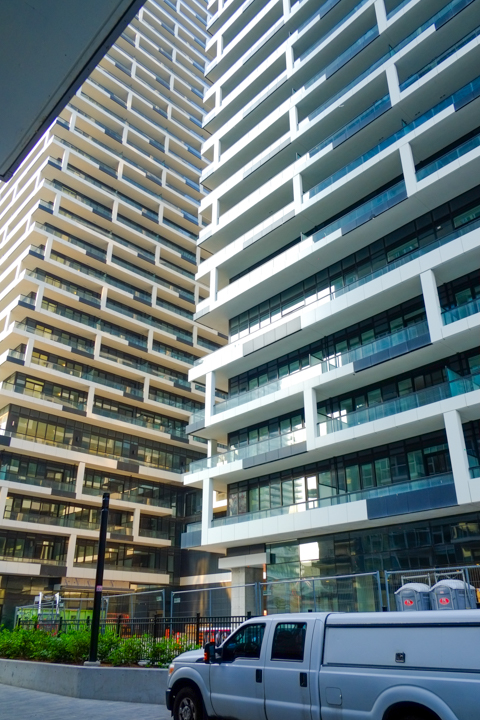
reflections of new glass and steel condos in the back window of a small white van or truck

red and black machine parked by hole at construction site

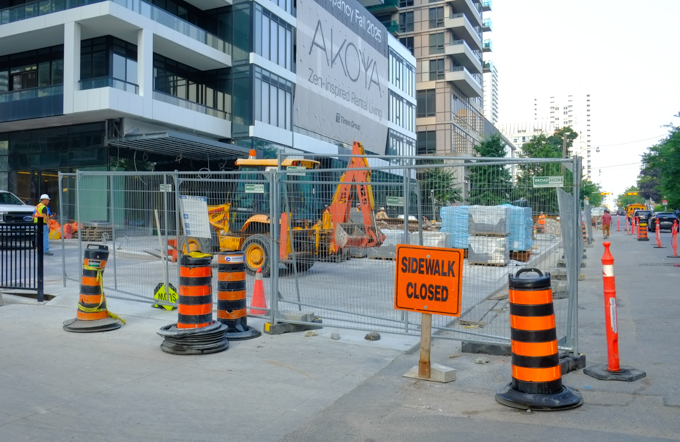
sidewalk closed in front of Akoya, new condo on Broadway, as they finish work on the front entrance and landscaping of the building

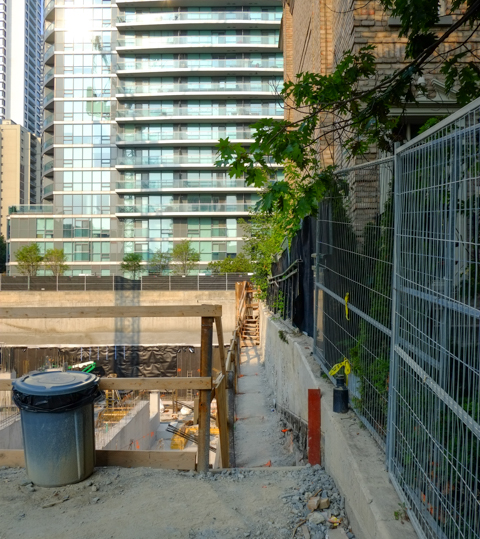
narrow walkway with wooden rail, above a large hole in the ground at a construction site

density of residences, highrise condos and apartments around Yonge and Eglinton, glass and steel towers, new developments

density of residences, highrise condos and apartments around Yonge and Eglinton, glass and steel towers, new developments

density of residences, highrise condos and apartments around Yonge and Eglinton, glass and steel towers, new developments

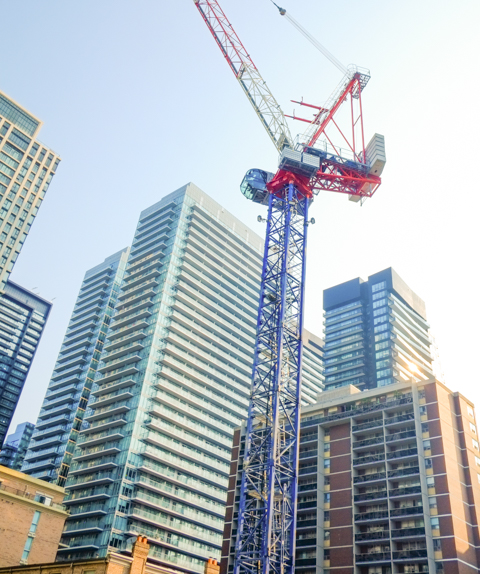
crane used in construction of new tall glass and steel condos, in front of other new high rise buildings near Yonge and Eglinton

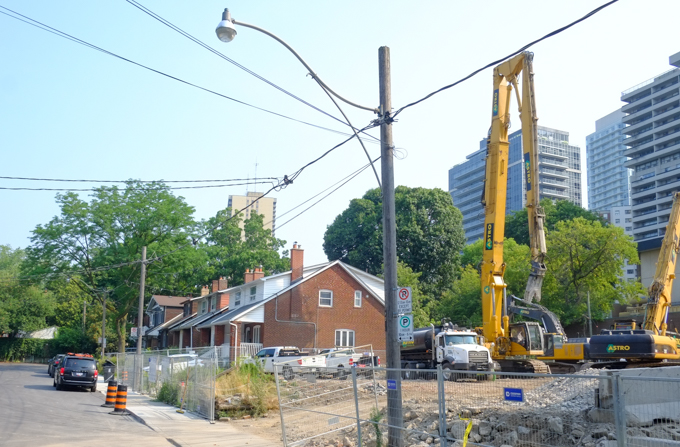
below: Changes are also happening to the west of Yonge Street. For instance, this building on Eglinton between Duplex and Henning is coming down.

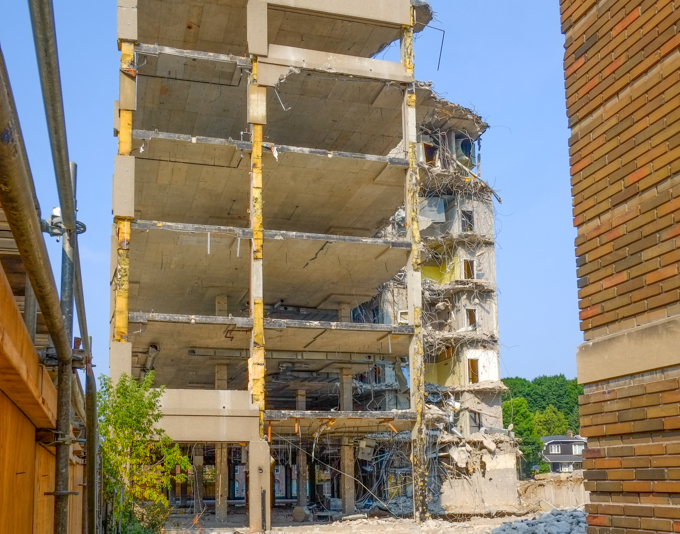
development notice signs beside a demolition site, partially demolished building, on henning ave,

multi level building in the process of being demolished, exterior walls all gone.

below: Old, new, and in between

Henning Ave., older single family homes with construction of new condos started beside them, crane,

below: Remnants of what used to be.

2 old sets of stairs, side by side, once lead to houses, houses now demolished, stairs now behind construction fence, diggers and other equipment in the background

demolition, debris hanging from ceiling

demolition site

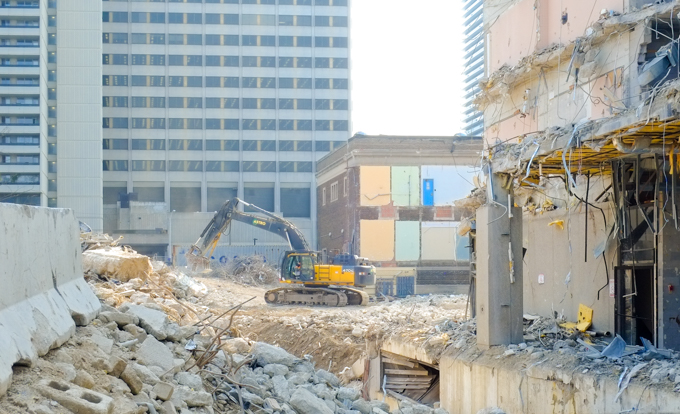
yellow digger, at construction site where a building is being demolished, revealing older interior walls painted in bright colours

below: As I am sure you are aware, I have blogged about Eglinton Avenue before.  Back in 2015 (ten years ago!!) I posted this photo of Eglinton and Duplex.  Both glass buildings are now gone.  The Toronto Hydro Systems building (the short brick one) at the northwest corner of Duplex and Eglinton remains – it is the one with the coloured patches on the wall in the photo above.
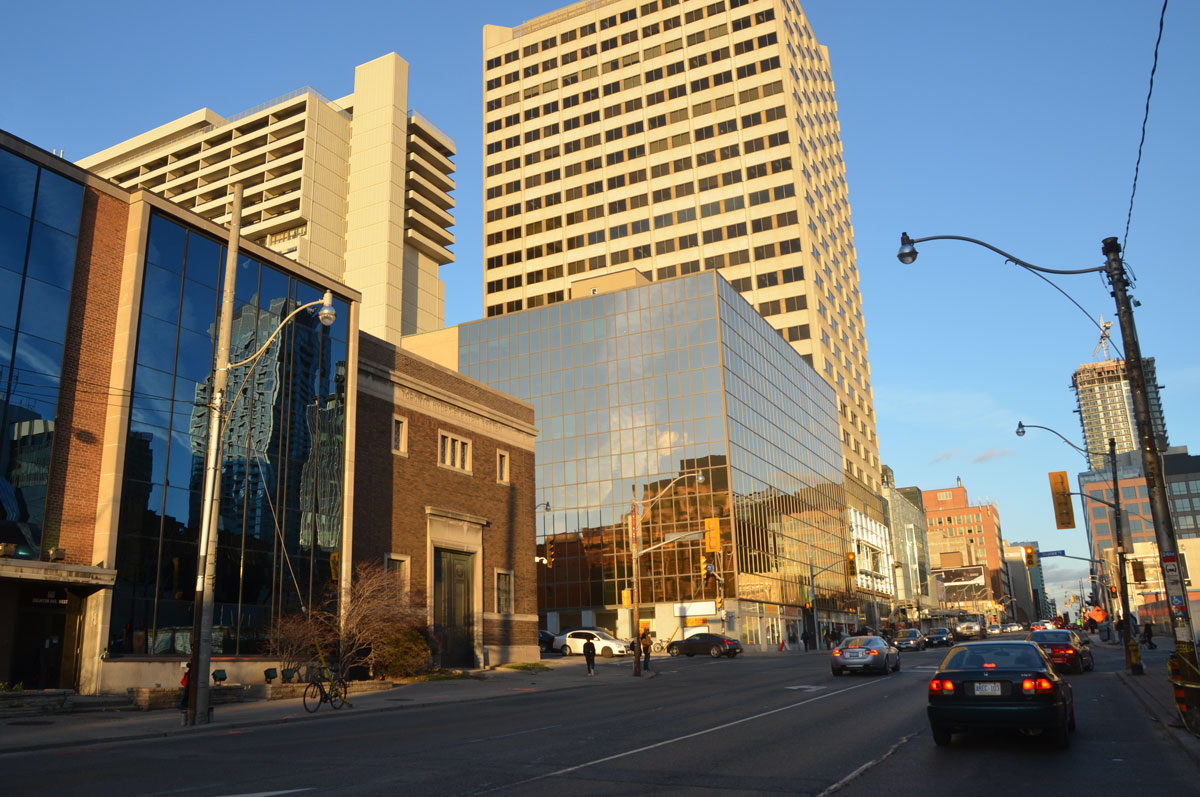
looking east along Eglinton Avenue towards Yonge street with Duplex Ave in the foreground. The old Toronto Hydro-Electric building is in the picture, with a newer structure with a glass front beside it. New buildings between Duplex and Yonge on the north side of Eglinton are also in the picture.

below: Same corner, slightly different angle, taken this past week.
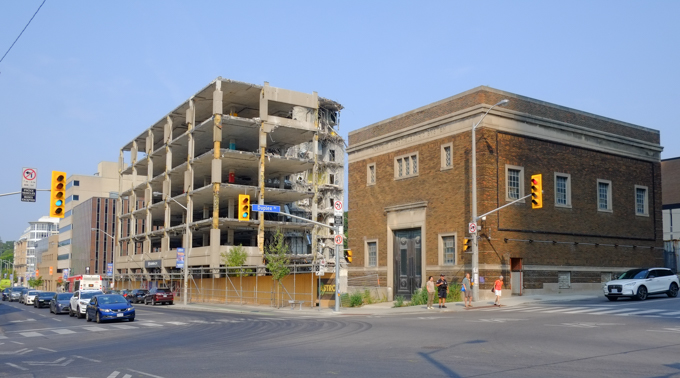
looking west along the north side of Eglinton, toronto hydro electric systems brick building on the corner, demolition of other buildings beside it

below: After the glass clad building on the northeast corner of Duplex and Eglinton came down, the backside of the Yonge Eglinton Center was exposed (on the right) as well as another tower (in an area that needs to be explored more!).

concrete tower


young woman with a pink ponytail, pink top, and pink backpack, walks a dog on a leash, crossing street on Yonge, dog is small and white with pink tail and pink ears.

sign that says slow, upside down and leaning against a fence, construction site in the background

below: With thanks to my mother who walked with me that day.
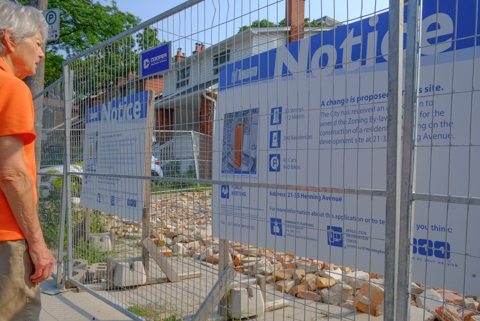
older woman standing in front a fence with two development notice signs

a woman holding a cup of coffee walks on sidewalk, along Eglinton, while a man sits of the steps of a building

defaced TTC bus stops sign on Eglinton, for routes 13, 32, and 61

This walk started from Royal York subway station.  In general, I walked westward first along Bloor Street (to Islington) and then on Dundas West.   The stretch of Bloor West at Royal York is part of The Kingsway neighbourhood.


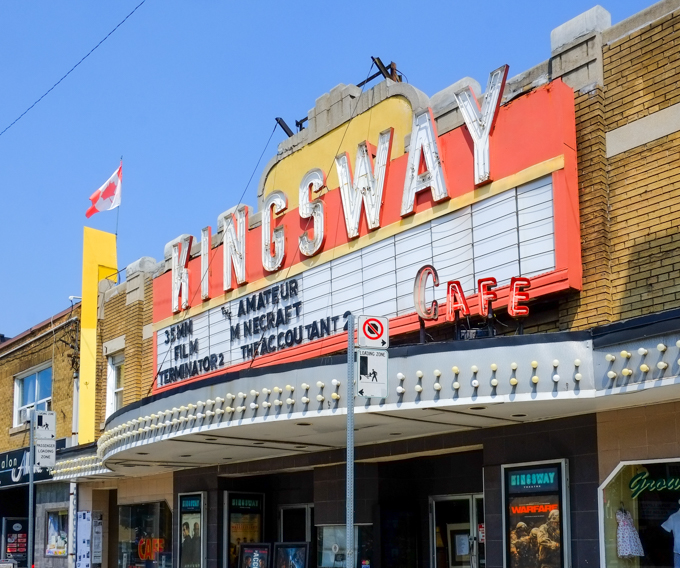
front of Kingsway cinema on Bloor Street West

blue sign that says welcome to the kingsway, on bloor street west near royal york

two blue chairs beside a metal table, in an open window of a restaurant beside the sidewalk

below: Squares of yarn, some crocheted and some knit, cover a red frame heart similar to others that ShowLoveTO have placed around the city.

crocheted squares or knit squares cover a heart shaped frame, yarn,

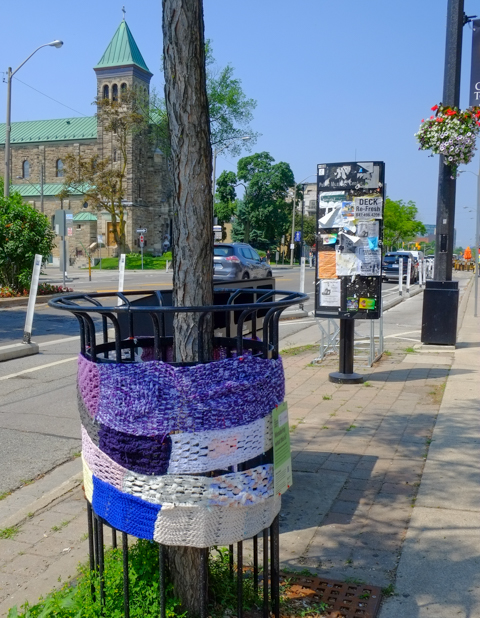
below: There are more yarn decorations around the metal frame protecting this tree on Bloor Street West.

yarn squares encircle a pole on bloor street west

below: Also, a little Zen Garden Planter to support the CNIB since June was Deafblind Awareness Month – the planter accessories were provided by The Gardener, a local flower store.

in a sidewalk planter on Bloor West, a little brown miniature pagoda and a sign that says Zen Garden Planter for CNIB donated by The Gardener

below: Bloor West – bike lanes, sidewalk patios, and construction.  Welcome to summer in the city!

construction signs on Bloor Street West, with bike lanes, and sidewalk patios

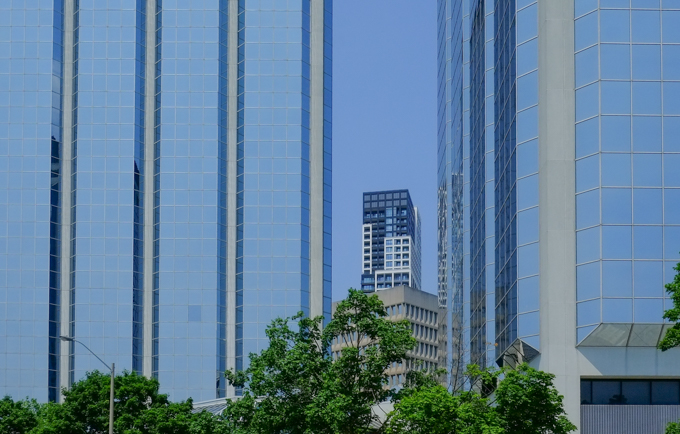
below: Bloor West glass towers

tall uilding in background seen between two tall closer glass office buildngs

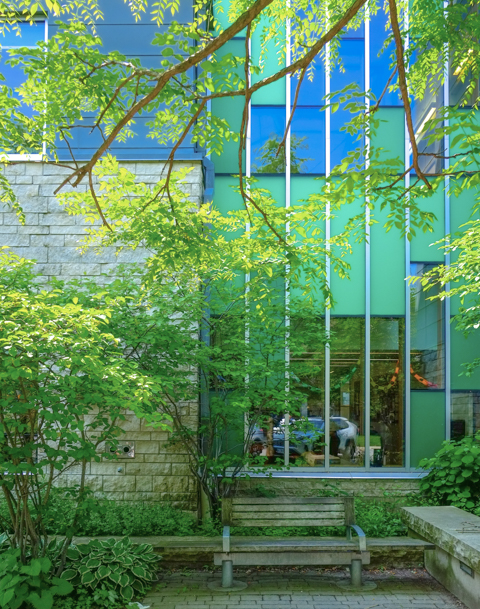
below: One wall of Brentwood Library and the small garden on the north side of the building.

large windows at brentwood Library, some clear, some green, and some blue, trees and a bench in front, some reflections in the glass

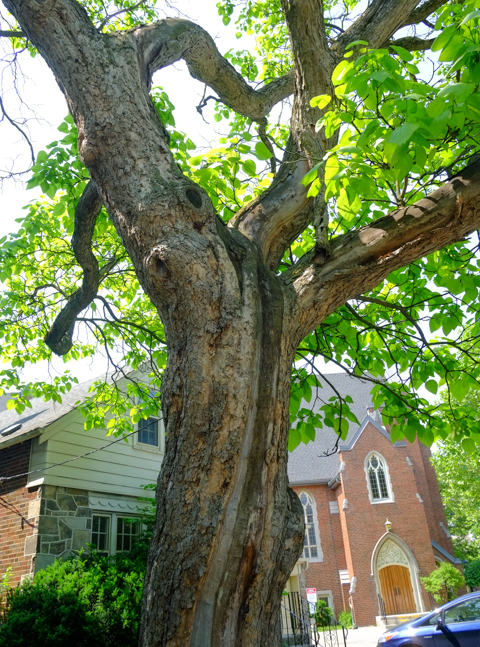
below: Old gnarly tree with Kingsway Baptist church in the background

old tree with rough bark on trunk, and large twisty branches, house and church in the background,

below: Just west of Royal York, at Montgomery Road, the subway emerges from underground.

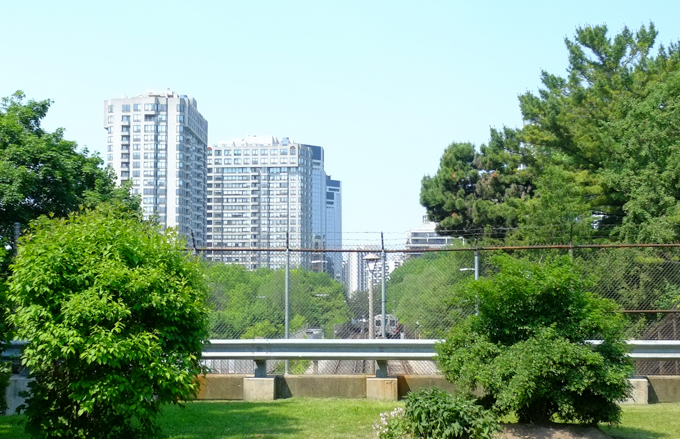
looking west from Montgomery Road towards high rises near Islington, TTC subway tracks in the image as well

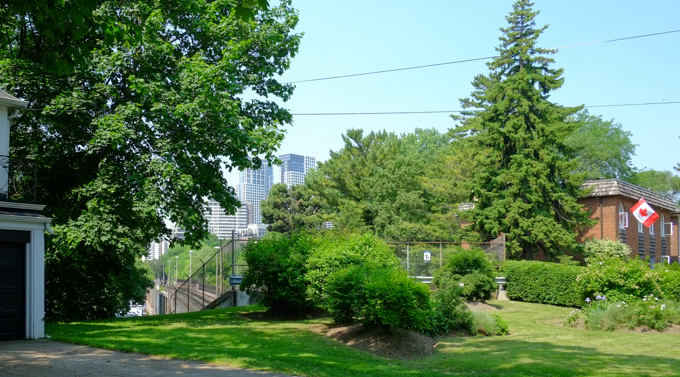
small park on Montgomery Road, between two houses, with TTC subway tracks below

The Mimico Creek passes under Bloor between Royal York and Islington.  Tom Riley Park follows the creek on both sides north of Bloor  until it then passes under Islington close to the intersection of Islington & Dundas West.

workmen, up on a crane, city of toronto works department, trimming and pruning trees in a park

a mother and two kids watching a duck on the shores of mimico creek on a summer day, leaves, reflections in the calm water

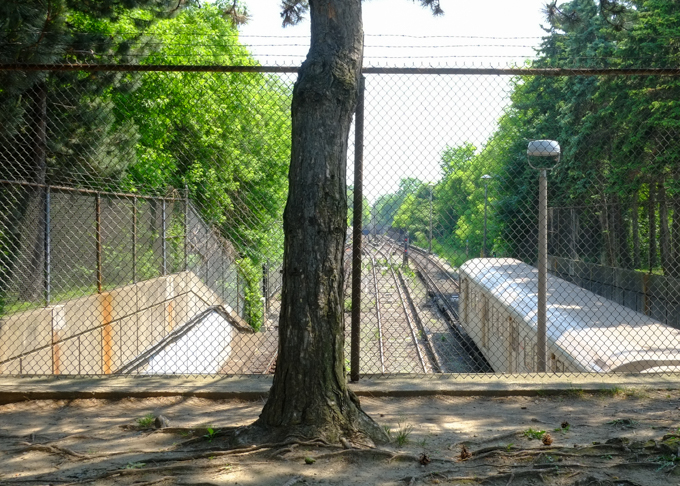
below: Another angle of the subway at ground level.  Here is looking east as it runs through Tom Riley Park (and if you could see further, you could see where it goes back underground at Montgomery)

pine tree growing in front of opening for entrance to subway, train coming out of tunnel, TTC

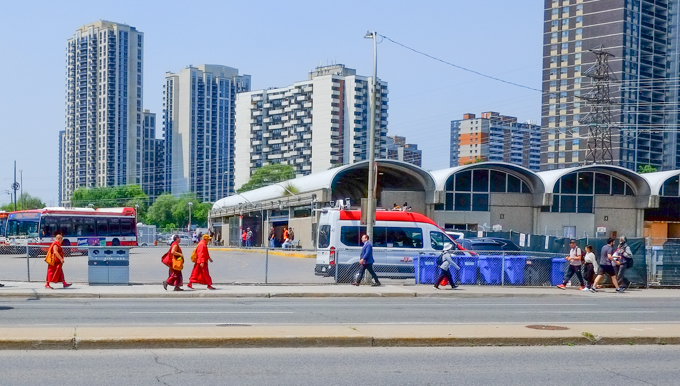
below: Islington subway station and bus bays.  A very large parcel of land on the northwest corner of Islington and Bloor is taken up.  Opened May 1968.

buddhist monks and other pedestrians, walking on sidewalk on islington past islington subway station, curved roof of bus bays at station, ttc, highrises in the background

below: A messy corner, at Aberfoyle & Islington (just north of Bloor)

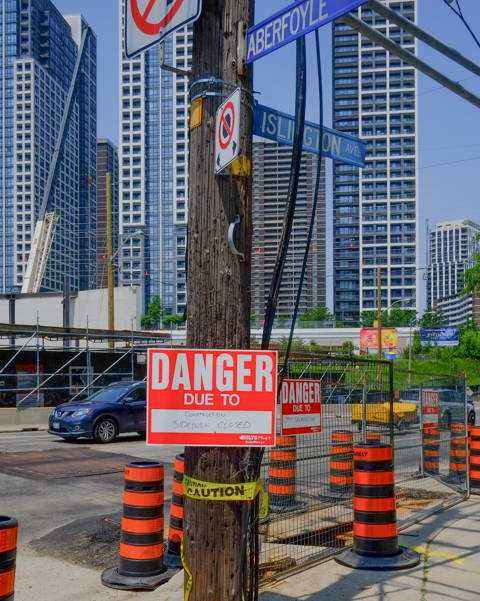
danger due to construction sign at the corner of Aberfoyle ad Islington

long set of stairs up hill to apartment building

below: Just north of Bloor, Islington passes under railway tracks.

looking north on islington, underpass under railway, traffic ign for exit to burnhamthorpe road and dundas street west

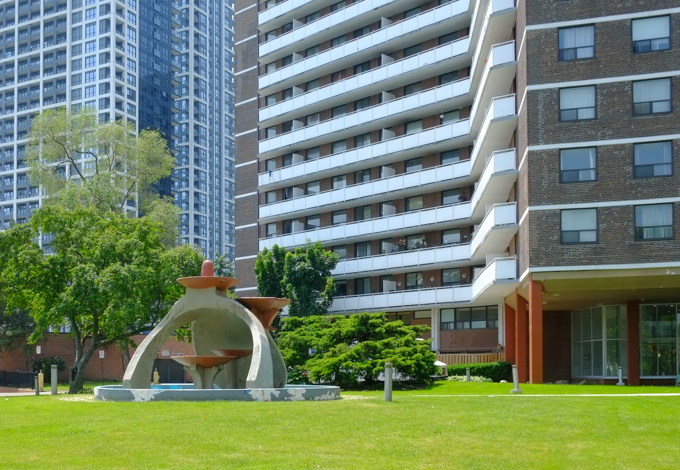
below: Islington Towers with a fountain in front. The parts of the fountain that are brown were once blue.  It was designed and constructed by Alfio Bartoletti in the 1960s.

islington towers, apartment building from the late 1960s, with a fountain in the front

below: Across the street from the Islington Towers, a highrise with a more modern design (for better or worse, your decision!).

entrance of new condo tower being built on islington

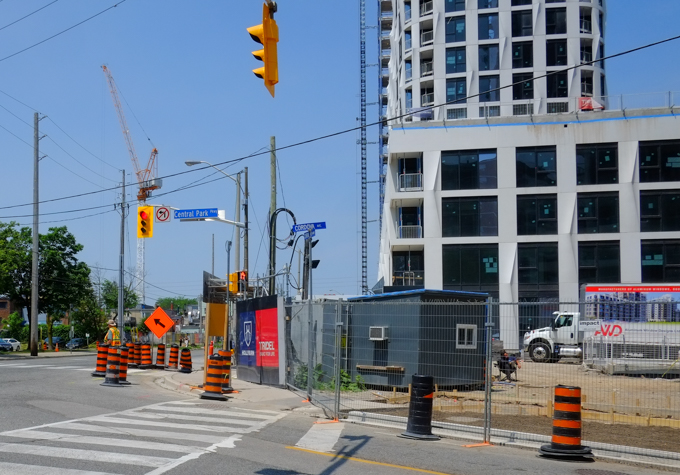
below: Corner of Cordova and Central Park Blvd with new condo development

corner of Cordova and Central Park Blvd, new ondo being built on the corner, construction fence, and signs, traffic light
woman with gray hair, wearing jeans, walking on sidewalk part vacant lot with fence,
blue and white development notice sign, fallen on ground, behind metal construction fence

In this part of Toronto, Dundas is north of Bloor.

intersection of Dundas West and Cordova and Burnhamthorpe Road, people waiting to cross intersection, with crossing guard

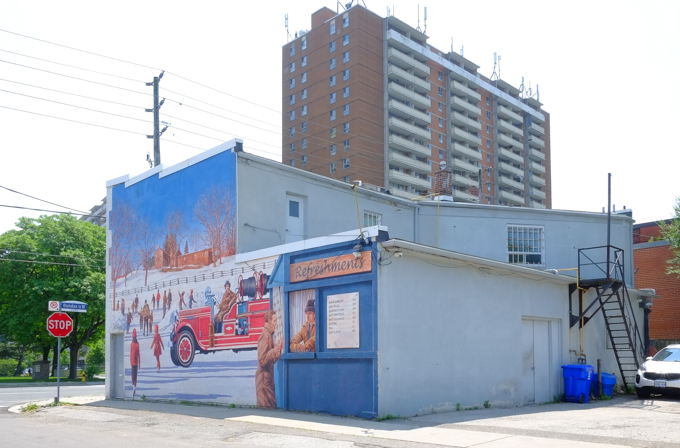
Now you are in Islington village, home to over 20 murals depicting scenes from the history of the neighbourhood.  I documented these back in 2014 in a blog post, Islington Heritage Murals.  The murals are still there and are in good shape.

one of the Islington heritage murals

one of the Islington heritage murals, winter scene, with firetruck, people skating, also painting of a refreshment stand with food and drink for sale

one of the Islington heritage murals

Are cars always getting in the way of public transit?

a white car is parked in front of one of the Islington heritage murals, boy hanging off side of a local train

woman standing in front of one of the Islington heritage murals, children fishing in a creek, with fish and other marine life in the water

below: Not a heritage mural, but painted by Moises Frank for a collaborative project between Arts Etobicoke and the City of Toronto, the Dundas West #NoVacancy project.

mural by moises frank, sleeping person, slightly abstract

below: On the same building as the above mural, is this painting.  Once it was the Chinese Food Gallery, now it is vacant and surrounded by a fence.  A development notice sign on the fence says that a permit for a five storey mixed use building has been applied for.

two storey building, with sign, chinese food gallery, now all boarded up, with mural on the front as well

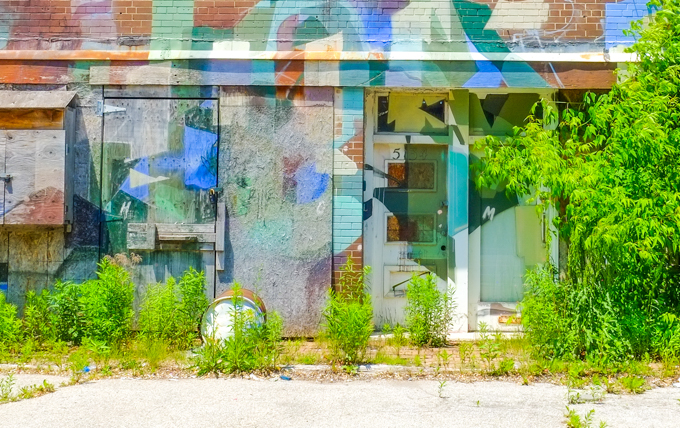
weeds growing in front of door and building now boarded up, particle board, painted with abstract mural now faded and peeling.

As you walk west on Dundas, you approach the intersections of Dundas, Bloor, and Kipling.   There is a lot of construction,  happening here, mostly condos.

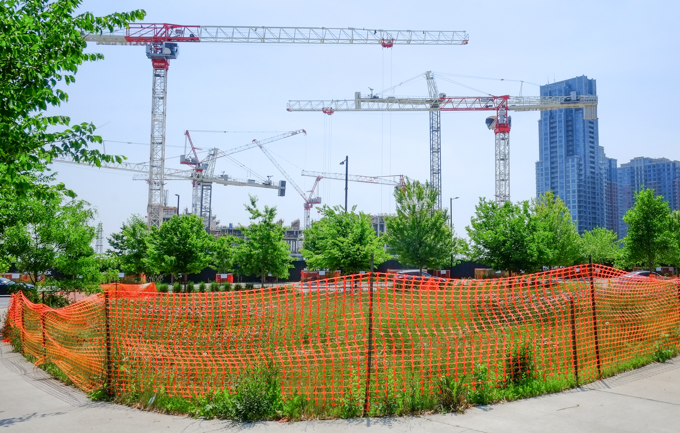
many construction cranes in the background, a fenced off park area in the foreground

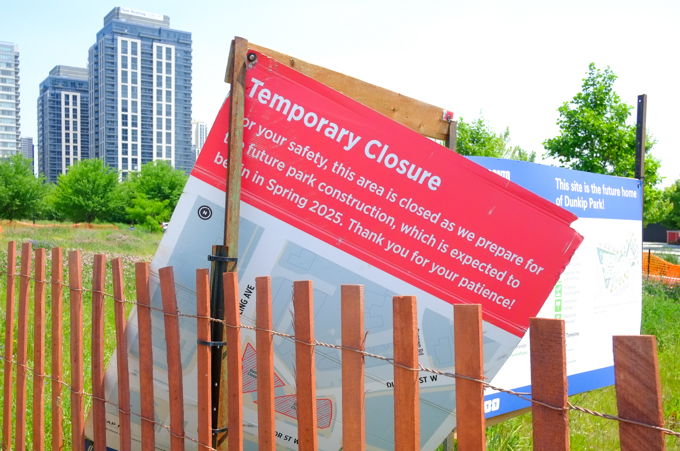
below: A park, Dunkip Park, is also being created.  Dun as in Dundas plus kip as in Kipling.


new park being developed, dunkip park, at dundas and kipling

temporary closure sign, falling over, against wood snow fence, by park that is being developed

man crossing street, wide intersection, car approaching as man now has red light

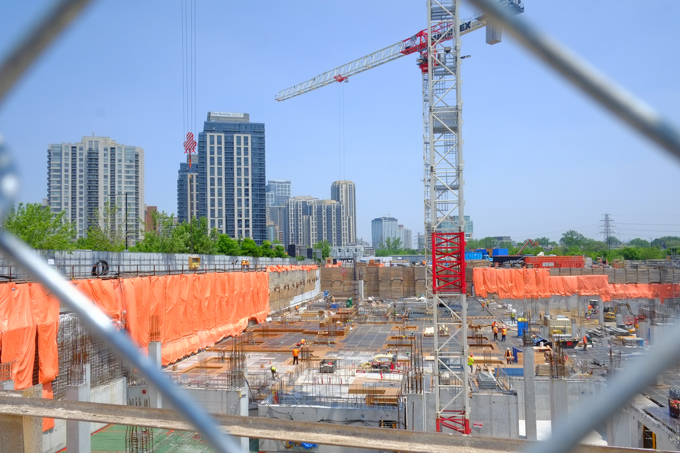
below: A very big hole in the ground.

large hole for construction of condos on kipling

below: Kipling Street bridge over the railway tracks

kipling bridge over railway tracks, looking north

below: Looking east along the railway tracks from on top of the bridge at Kipling (back towards Islington).

looking east along tracks from on top of bridge at kipling

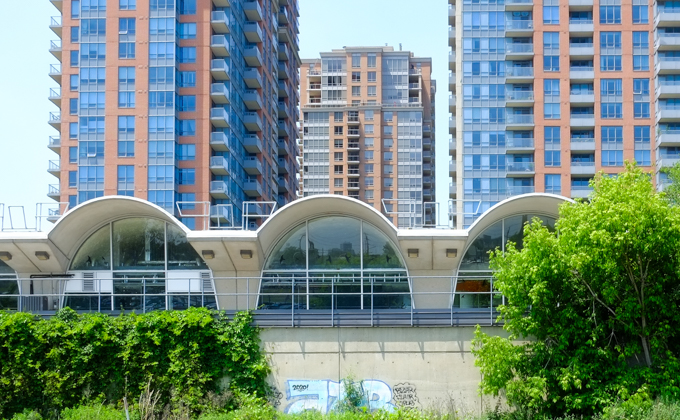
below: Kipling subway station is the west terminus of the TTC Line 2 and was opened in November 1980.  It connected Line 2 of the subway with GO service to the west.  Pictured here is part of the south side showing three of its twenty concrete arches. These are similar to the arches at Islington station, but not identical to them.

rounded roof of Kipling TTC subway station, semi circles, with three newer condo buildings behind

below: North side of Kipling station, back in 1980 when it first opened, north side bus bays

Toronto Public Library, TOronto Star archives, 1980 photo of Kipling subway station, black and white photo

below: Graffiti stickers in the parking lot.  A well-suited duck in a hurry by giacco.ca and a boxy snail by Sketch Nate (aka Nate Galbraith)

two graffiti stickers on a red box in a parking lot, on top is a duck wearing blue clothes and on bottom is a snail with a box on its back
below: Eastbound out of Kipling station. The older Line 2 subway trains still have a window that you can look out.

looking out the front window of a TTC subway train as it leaves Kipling station, traveling east

In 1869, Canadian photographer Alexander Henderson (1831-1913) was commissioned to take a series of photos along the route of the new Grand Trunk Railway between Montreal and Toronto.  These images were for a travel book, “All-round Route Guide” to sell to tourists and settlers along the route.  This Montreal to Toronto section followed the north shore of the St. Lawrence for most of its route.  The railway had opened in 1856 and more routes had been added (to Portland Maine! to Sarnia!) or were planned. 

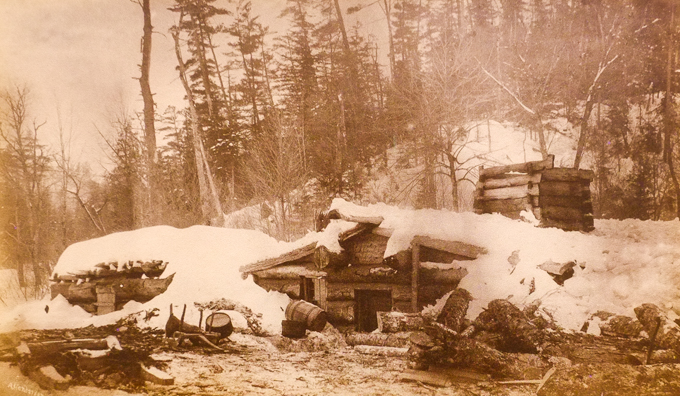
below: Lumberer’s Shanty, Lievre River, Quebec, before 1865

albumen print, vintage black and white photo by Alexander Henderson of a lumberer's shanty in winter, small log cabin structure covered with snow, Quebec

A recent exhibit at Artspace TMU (at 401 Richmond) showcased albumen prints of some of Henderson’s photos along with photos taken by Dawson Cox.  All of Cox’s images were mounted on particle board.  The exhibit was titled, “Like the Seams of a Coat”.

below: Camera store, corner of Clark and St Antoine, Montreal.

photo in a gallery, by Dawson Cox, of stores in Montreal,

below: Victoria Square, Montreal, about 1872

old photo by Alexander Henderson, of Victoria Square in Montreal, albumen print, in a gallery, taken in 1872

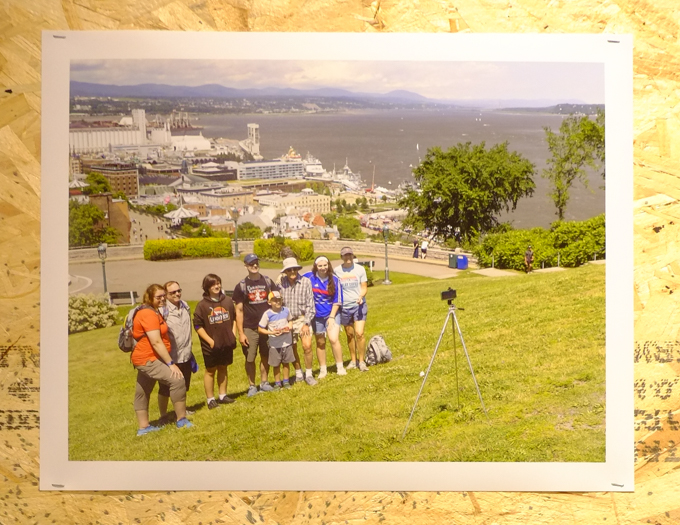
below: Group shot

group photo, on a hill above a small town

below: Group shot, 1870s style – G. Company of 78th Highlanders, taken by Alexander Henderson

vintage black and white phiti, Group of G. Company of 78th highlanders, taken around 1870 by Alexander Henderson

Coat seams are usually hidden but they are essential to holding everything together. Important yet unseen.

below: Cox’s photo of torn graffiti on an old brick wall

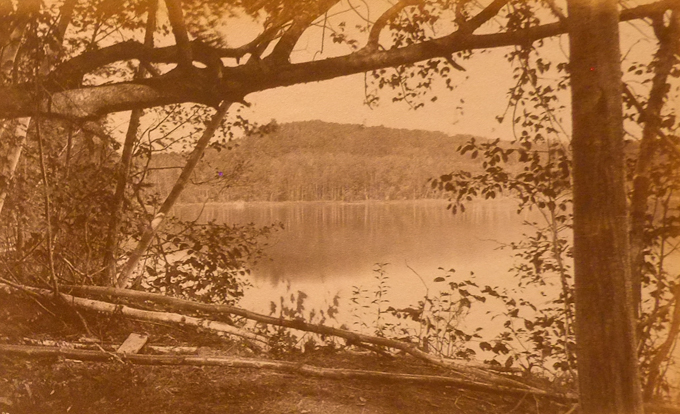
below: Lake, Saint Bruno Mountain, Quebec, before 1865

old photo of a lake and st Bruno Mountain in Quebec, 1860s
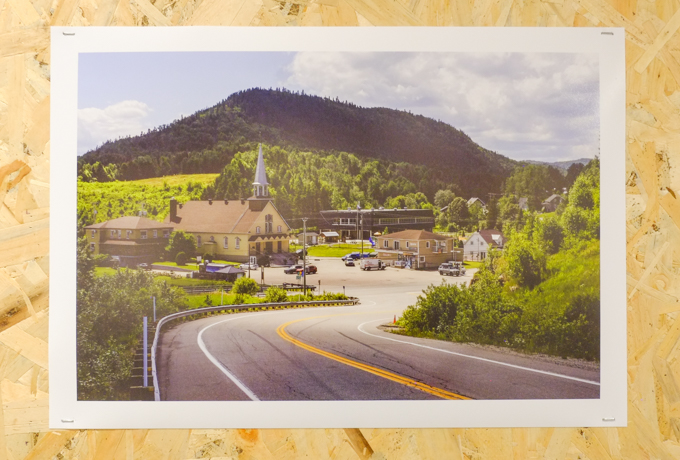
photo of a village with a church
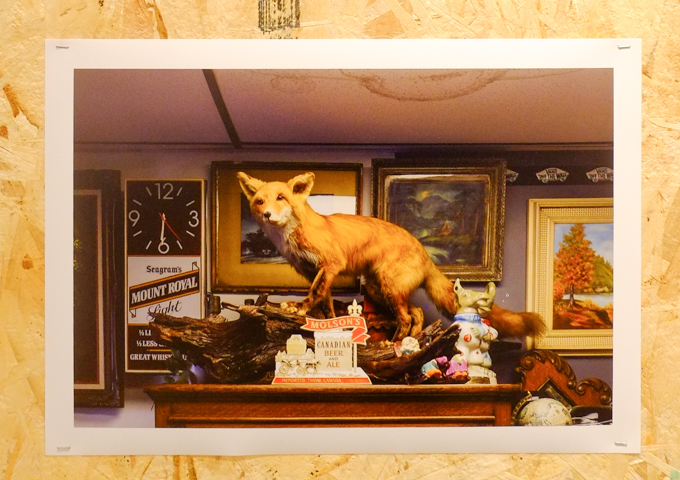
photo of a stuffed fox, mounted standing on all fours and seeming to walk

below: L’Anse a l’Eau, Saguenay River, Quebec, 1868

old black and white photo, a lone scrawny pine tree on a rock overlooking the Saguenay River in Quebec, with village below, village of L'Anse a L'Eau

… and a few things more from TMU Image Centre exhibits.

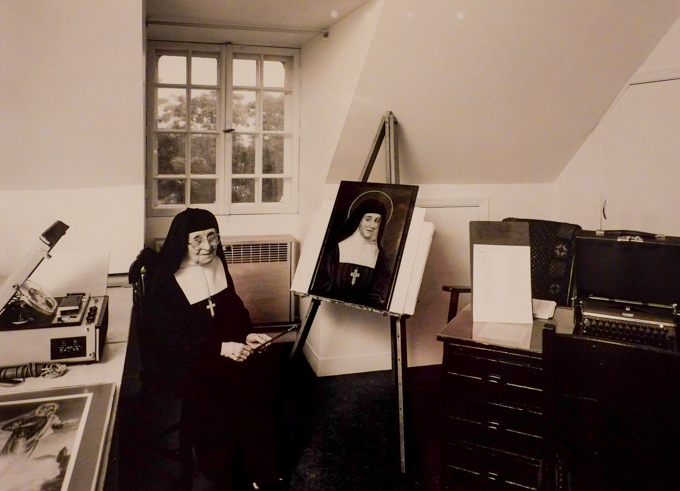
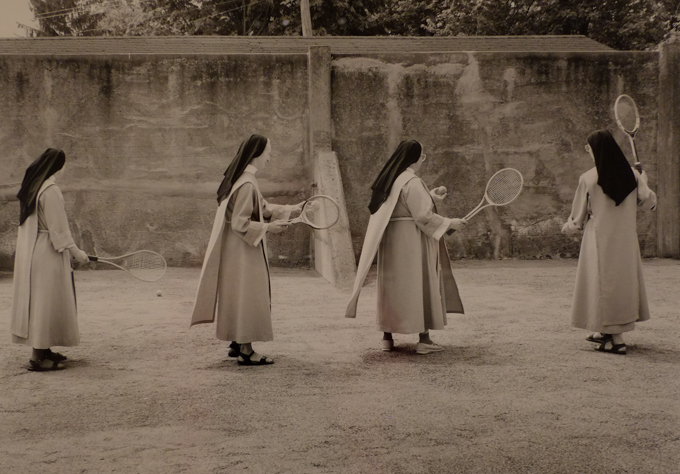
First, the main gallery of the Image Centre is showing a collection of the work of Clara Gutsche, winner of the 2024 ScotiabankCONTACT Photography award.  One of her series features photos of Quebec nuns, “The Convent Series”, taken before 1999.   Hence “nuns” in my title –   The “weddings” in the title comes from another exhibit here – a collection of portraits of brides and grooms over the years.

a woman looks at framed photographs on a gallery wall, TMU Image Centre gallery, Clara Gutsche show

black and white photo from convent series by clara gutsche, nun with painting, on display at TMU Image Centre

framed black and white photo from convent series by clara gutsche, nuns in black and white habits lined up in a hallway

framed black and white photo from convent series by clara gutsche, nuns outside hitting tennis balls with tennis racquets, against a wall

framed colour photo from convent series by clara gutsche, nuns in red playing croquet outside

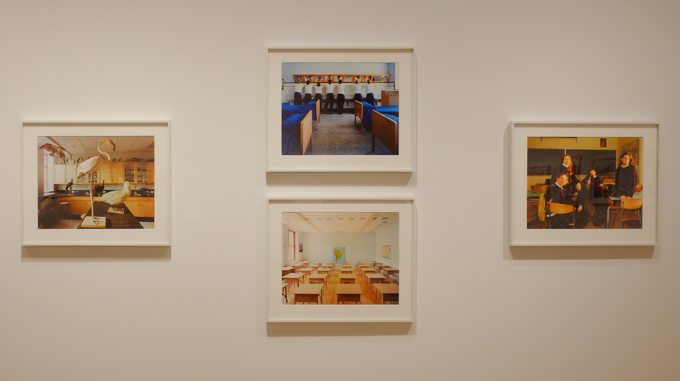
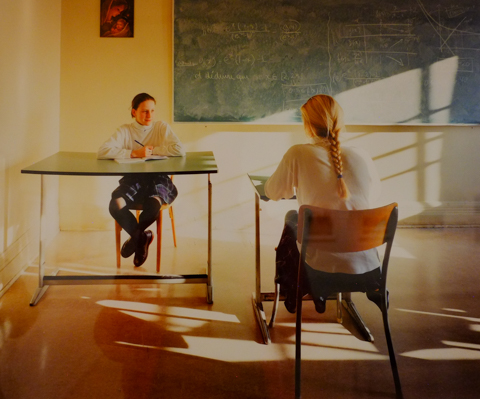
There are other series of her work also on view including some taken inside a Catholic high school.

4 framedcolour photos on a gallery wall, all are interior shots of a catholic high school

girls sitting at desks in a school by clara gutsche

This is only a small sample of Gutsche’s work.  You can see more at the Image Centre until 2nd August 2025 – The originals look better than my copies!!


Let’s move on to the happy couples….

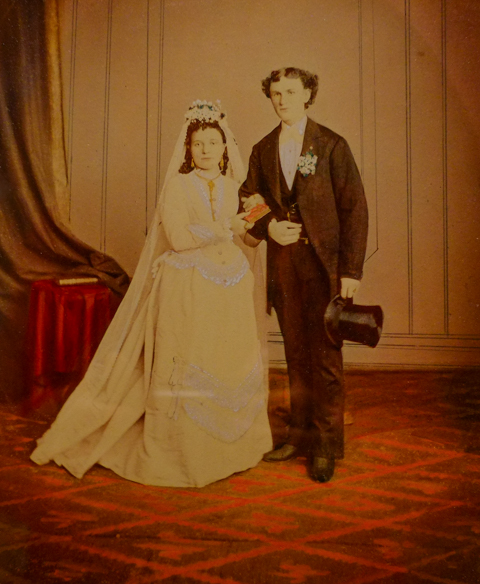
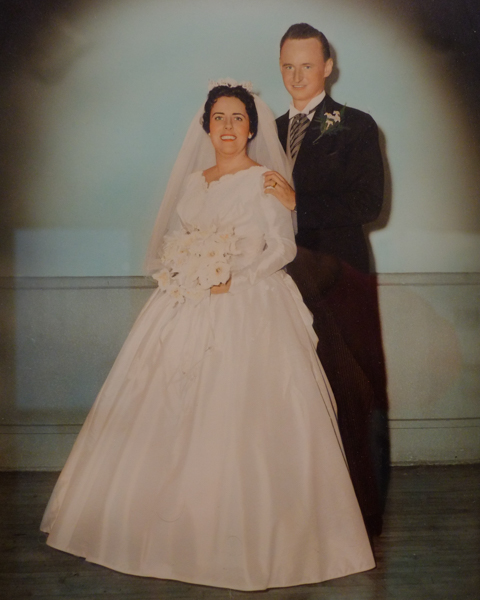
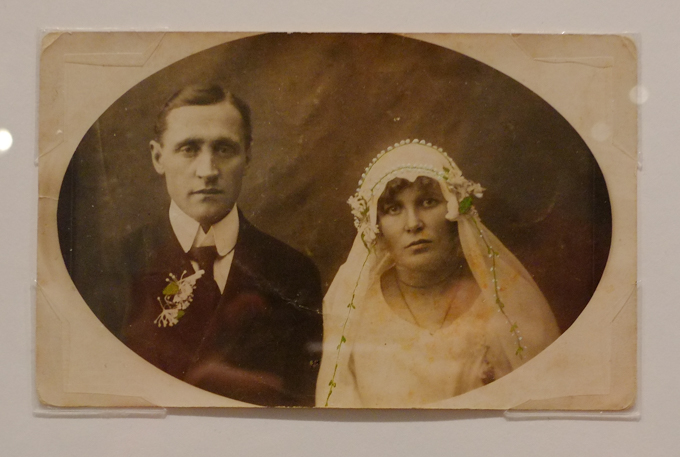
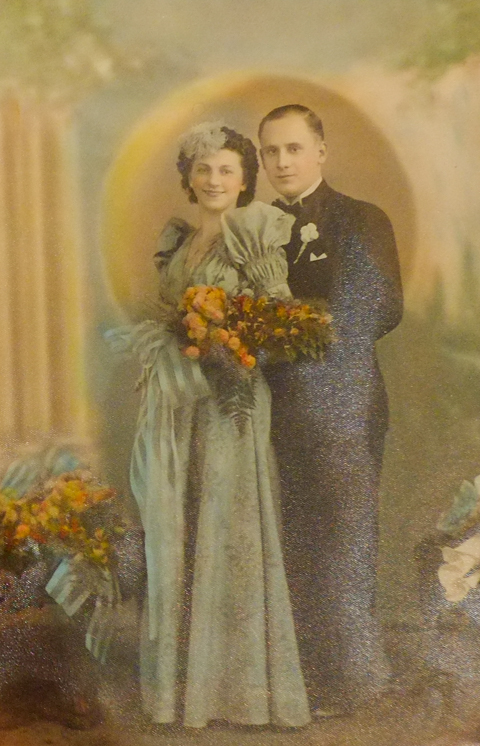
“Something Old; Something New – The Wedding Photography Collection of Stephen Bulger and Catherine Lash” is  the full title of the exhibit.  The title says it all.  The exhibit gives a glimpse into the history of photography and the techniques used to produce images.  It also takes a look at a sliver of social history… especially with respect to clothing styles.  All the photos were donated to the Image Centre by Bulger and Lash in 2023.

photo of a wedding party, from Something Old Something New, a collection of wedding photos over the years, collected by Stephen Bulger and Catherine Lash, and then donated to the TMU Image Centre

photo by Karl Speiss, 1855, black and white, of a bride and groom, from Something Old Something New, a collection of wedding photos over the years, collected by Stephen Bulger and Catherine Lash, and then donated to the TMU Image Centre

portrait of bride and groom in a fancy oval frame, from Something Old Something New, a collection of wedding photos over the years, collected by Stephen Bulger and Catherine Lash, and then donated to the TMU Image Centre

bride and groom portrait, old, on red carpet, man with top hat,

on a gallery wall, image of bride and groom, from Something Old Something New, a collection of wedding photos over the years, collected by Stephen Bulger and Catherine Lash, and then donated to the TMU Image Centre

from Something Old Something New, a collection of wedding photos over the years, collected by Stephen Bulger and Catherine Lash, and then donated to the TMU Image Centre

bride and groom, bride with head covering typical of roaring 20's

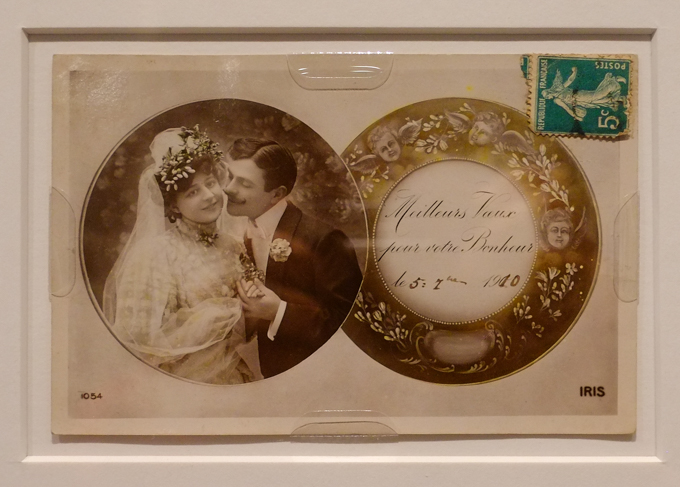
below: “Meilleurs Vaux pour votre Bonheur”, 5th of Jan, 1910

French postcard made with image of bride and groom portrait, Meilleurs Vaux pour votre Bonhour, 1910, with green 5 cent stamp

from Something Old Something New, a collection of wedding photos over the years, collected by Stephen Bulger and Catherine Lash, and then donated to the TMU Image Centre

from Something Old Something New, a collection of wedding photos over the years, collected by Stephen Bulger and Catherine Lash, and then donated to the TMU Image Centre. Groom in a top hat, bride in a white coat with many small buttons, and a high collar

Unfortunately the exhibit has ended.


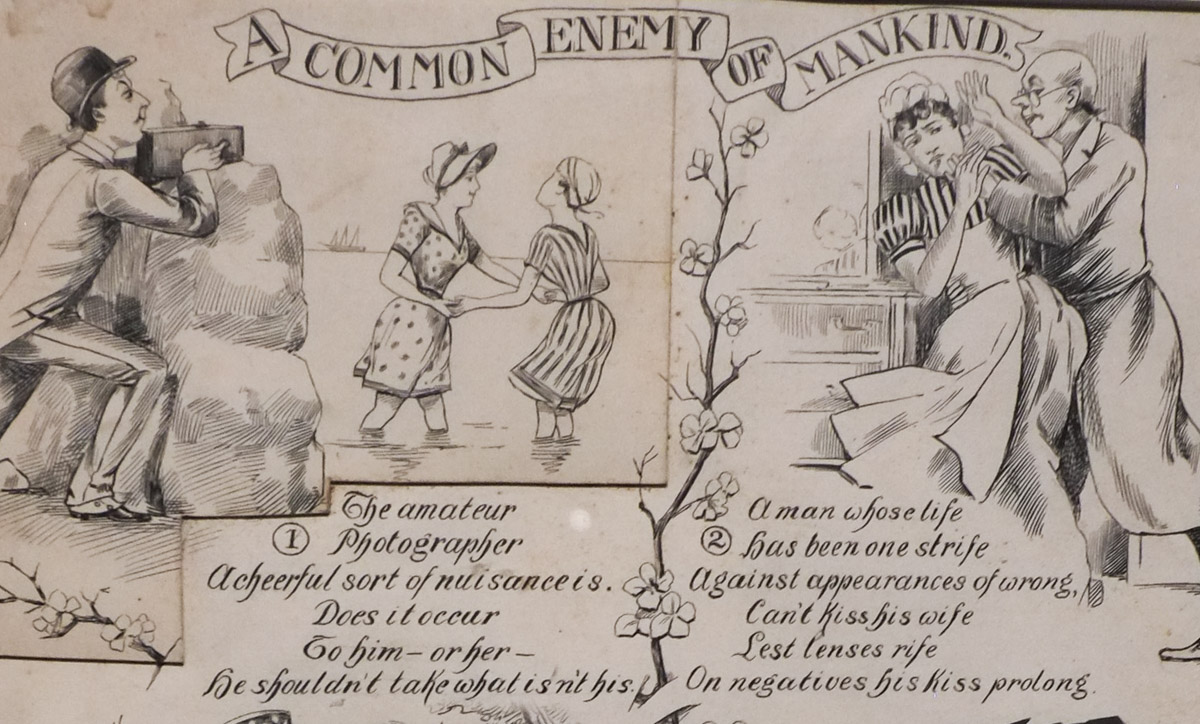
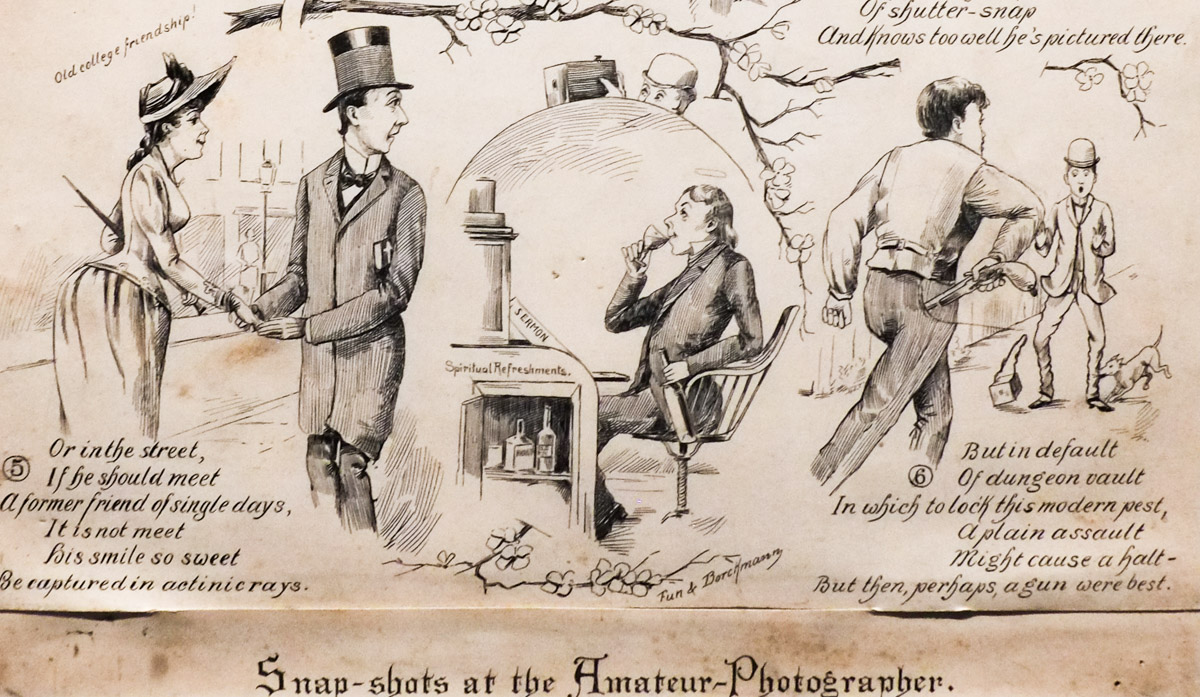
One of the pieces on display at TMU’s The Image Centre is this is pen and ink drawing signed by “Fun & Borckmann” from about 1895.  It is part of the exhibit, “Hypervisibility: Early Photography and Privacy in North America, 1839-1900.”  The drawing is on loan from the collection of Stephen Bulgar and Catherine Lash.   As you can see, across the top is the title, “A Common Enemy of Mankind”.  If you start at the first panel on the top left, you might think it is etiquette suggestions for photographers, but on closer inspection, is it?

an ink drawing from the late 1800s as seen in a gallery, framed and behind glass

Let’s take a look!

Panel 1 (below): ” The amateur
Photographer
A cheerful sort of nuisance is.
Does it occur To him – or her –
He shouldn’t take what isn’t his

part of an ink drawing by Fun and Borckman from about 1895 on the etiquette of photography, a common enemy of mankind

Panel 2 (above): A man whose life
Has been one strife
Against appearances of wrong,
Can’t kiss his wife
Lest lenses rife
On negatives his kiss prolong

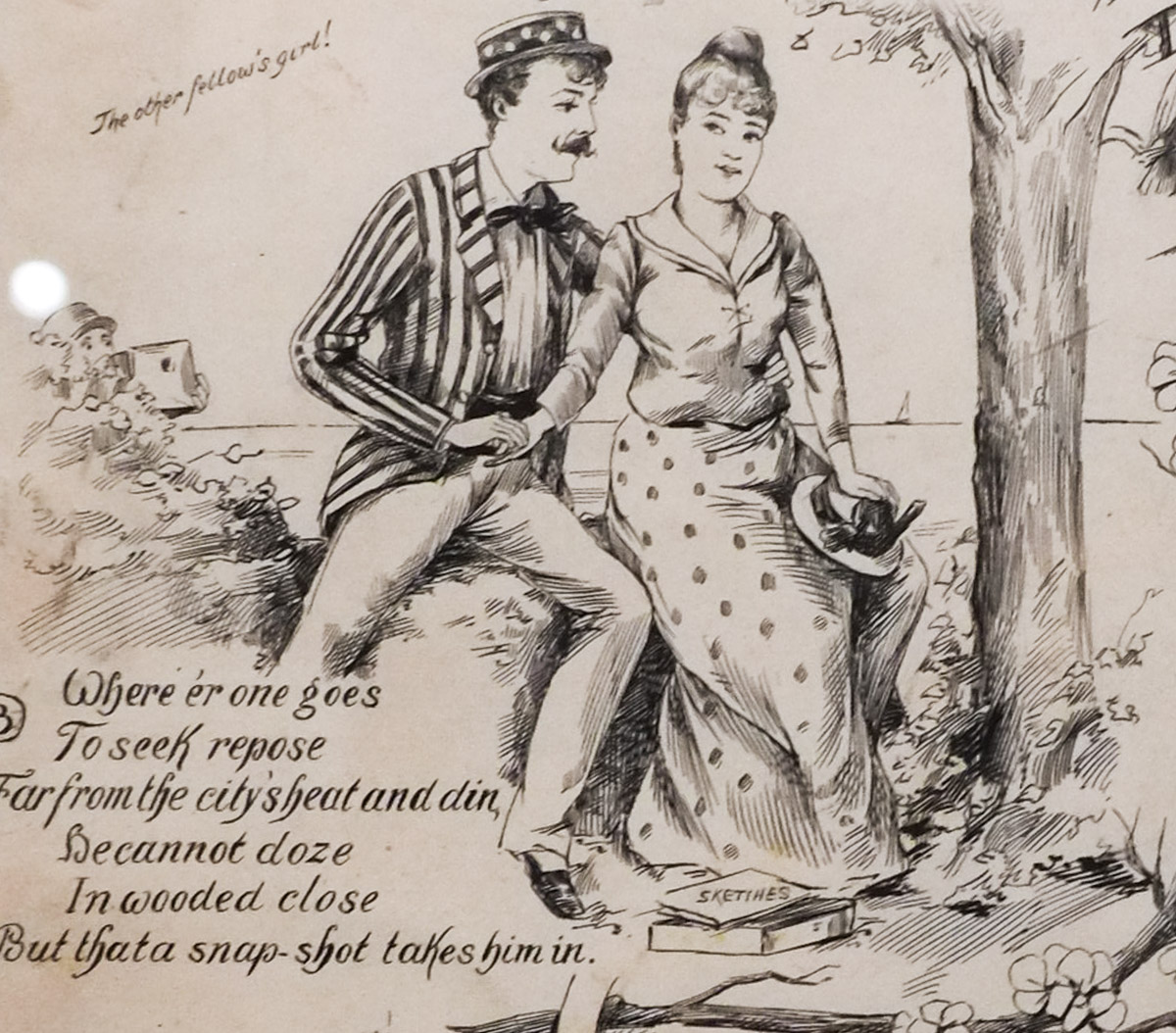
Panel 3 (below) – along with “The other fellow’s girl!”
“Where’er one goes
To seek repose
Far from the city’s heat and din
Be cannot doze
In wooded close
But that a snap-shot takes him in.”

Can I call him a jaunty looking fellow with his striped blazer and the polka dot band on his hat?

ink drawing from circa 1895, a young man and a woman are sitting together outside, another man with a camera is hiding in the bushes behind them

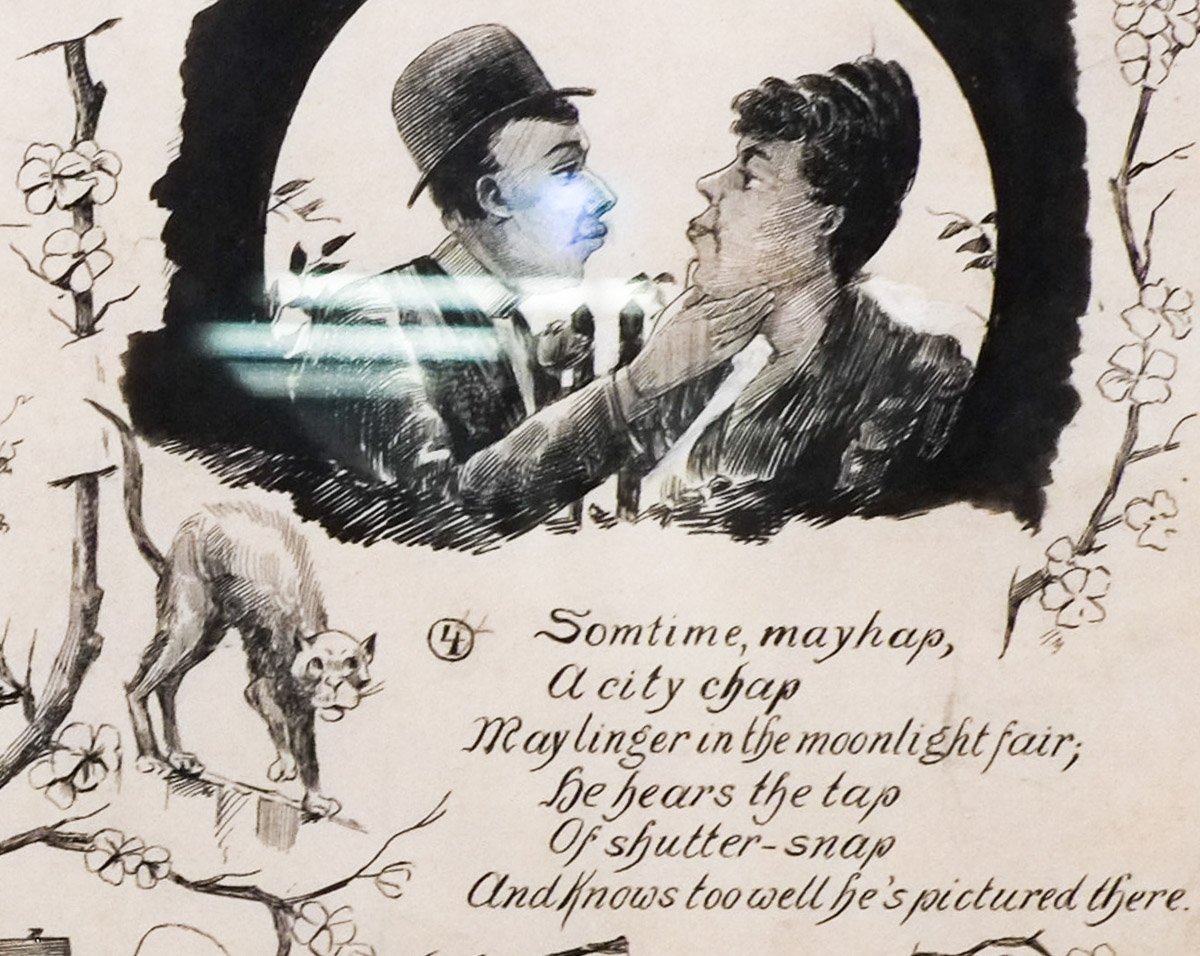
Panel 4 (below): “Sometime mayhap,
A city chap
May linger in the moonlight fair;
He hears the tap
Of shutter-snap
And knows too well he’s pictured there.”

ink drawing with etiquette rules for photographers, or is it a guide to the follies of mankind? picture of two men about to kiss

Panel 5 (below): “Or in the street,
If he should meet
A former friend of single days,
It’s not meet
His smile so sweet
Be captured in actinic rays.”

bottom panel of drawings, a common enemy of mankind, with bottom title of Snap-Shots at the Amateur Photographer, about 1895 by Fun and Borckmann

Panel 6 (above): “But in default
Of dungeon vault
In which to lock this modern pest,
A plain assault
Might cause a halt –
But then, perhaps, a gun were best.”

Life’s little indiscretions now preserved in little snap-shots!   Please don’t shoot the photographer!

Extra litte note or two: Peter Borckmann was an artist whose pen and ink drawings appeared in the “New York Fun Magazine”. In the 1880s and 1890s, this art form became very popular as demand for humorous illustrations grew along with the increasing popularity of magazines and journals at that time. The “Fun Magazine” was published in the 1880s and early 1890s.

Oh, in case you were wondering about that word ‘actinic’.  I looked it up….According to Merriam Webster:  “of, relating to, resulting from, or exhibiting chemical changes produced by radiant energy especially in the visible and ultraviolet parts of the spectrum.”   Sounds a lot like old-fashioned, pre-digital, light hitting chemically treated film, photography to me!


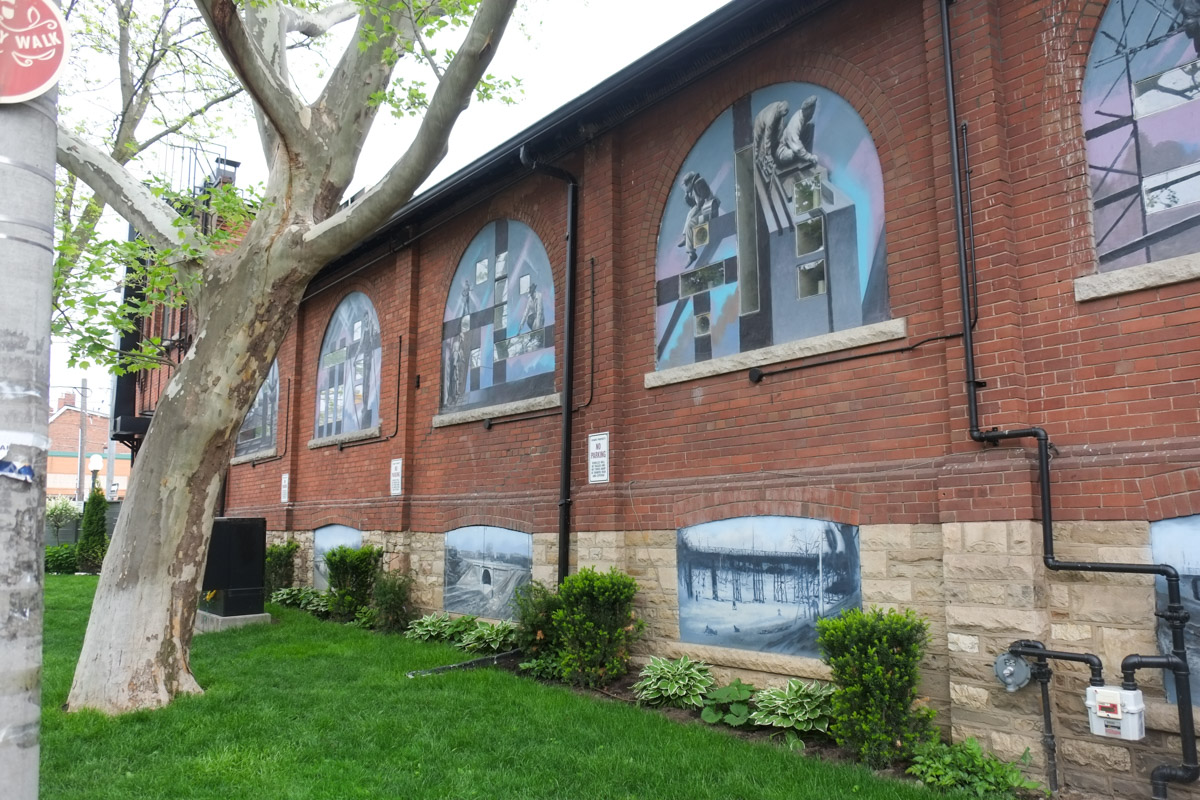
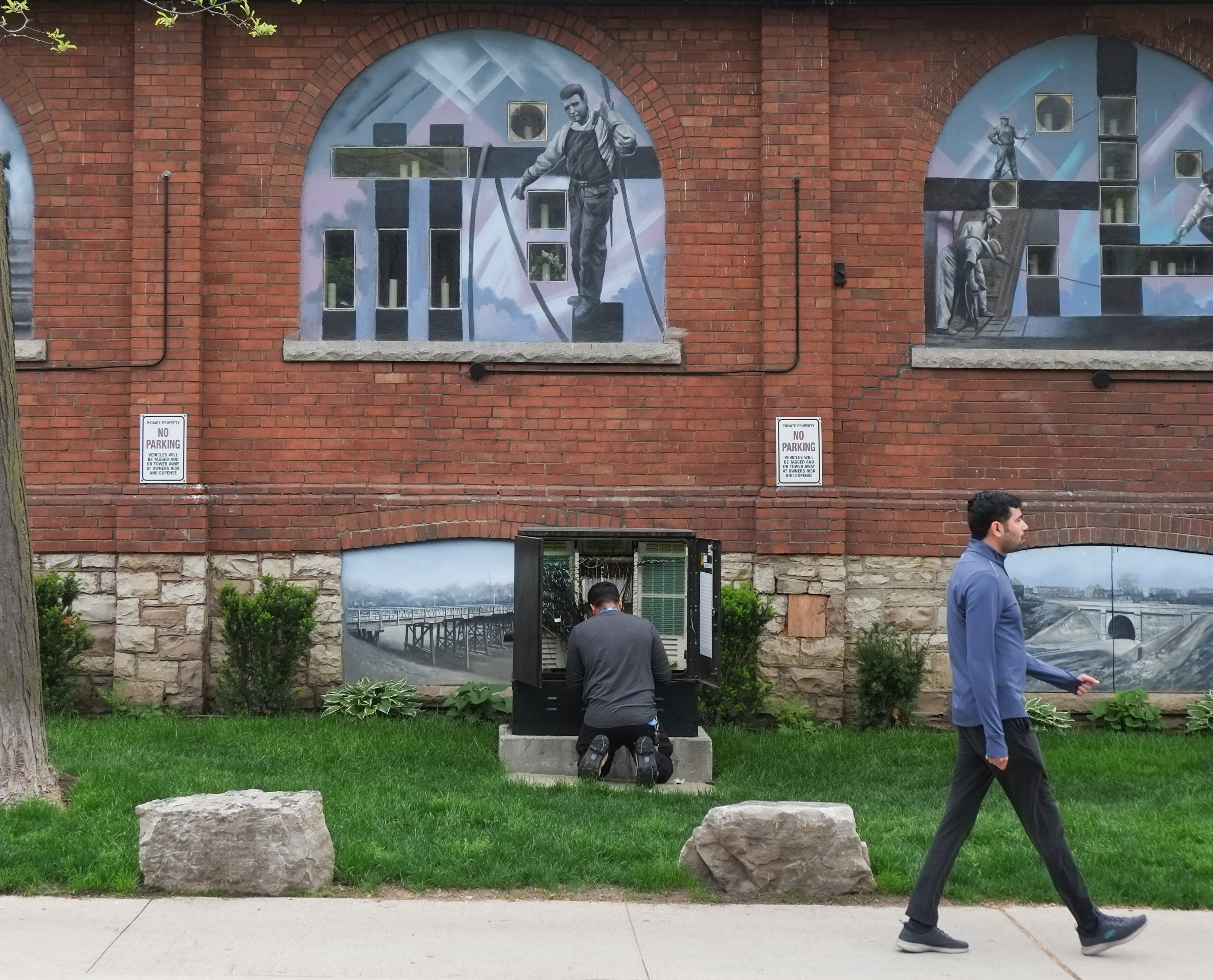
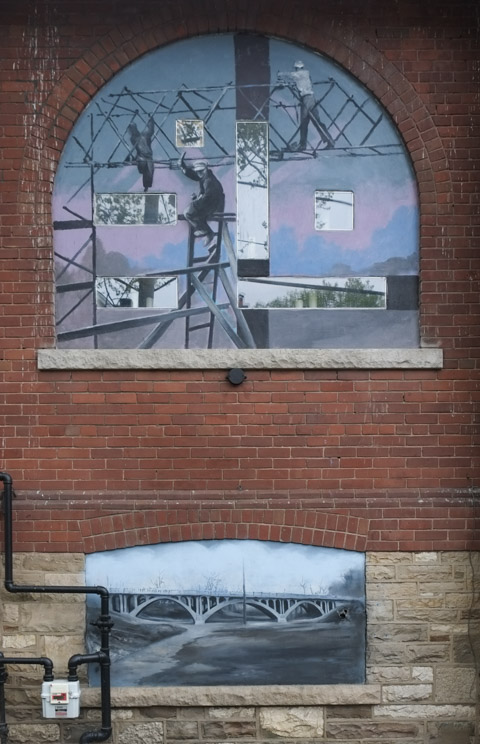
On the west wall of Revival Nightclub at Shaw and College is a series of paintings by John Nobrega that recall some of the history of the area.

single storey red brick building with arched windows that now have artwork in them, murals by John Norbrega in tribute to the workmen who built some of the infrastructure, such as bridges, in the area

John Nobrega mural, laborers working on a bridge, historic image

John Nobrega mural, laborers working historic images, man walking past on sidewalk, another man working on cable box beside the sidewalk

John Nobrega mural, laborers working on a bridge, historic image

below: The image at the bottom is the bridge over the Garrison Creek at Crawford Street, about 1915.  It has been since covered over (in the northwest part of Trinity Bellwoods Park).

2 paintings on wondow coverings on revival nightclub, red brick building, painted by John Nobrega

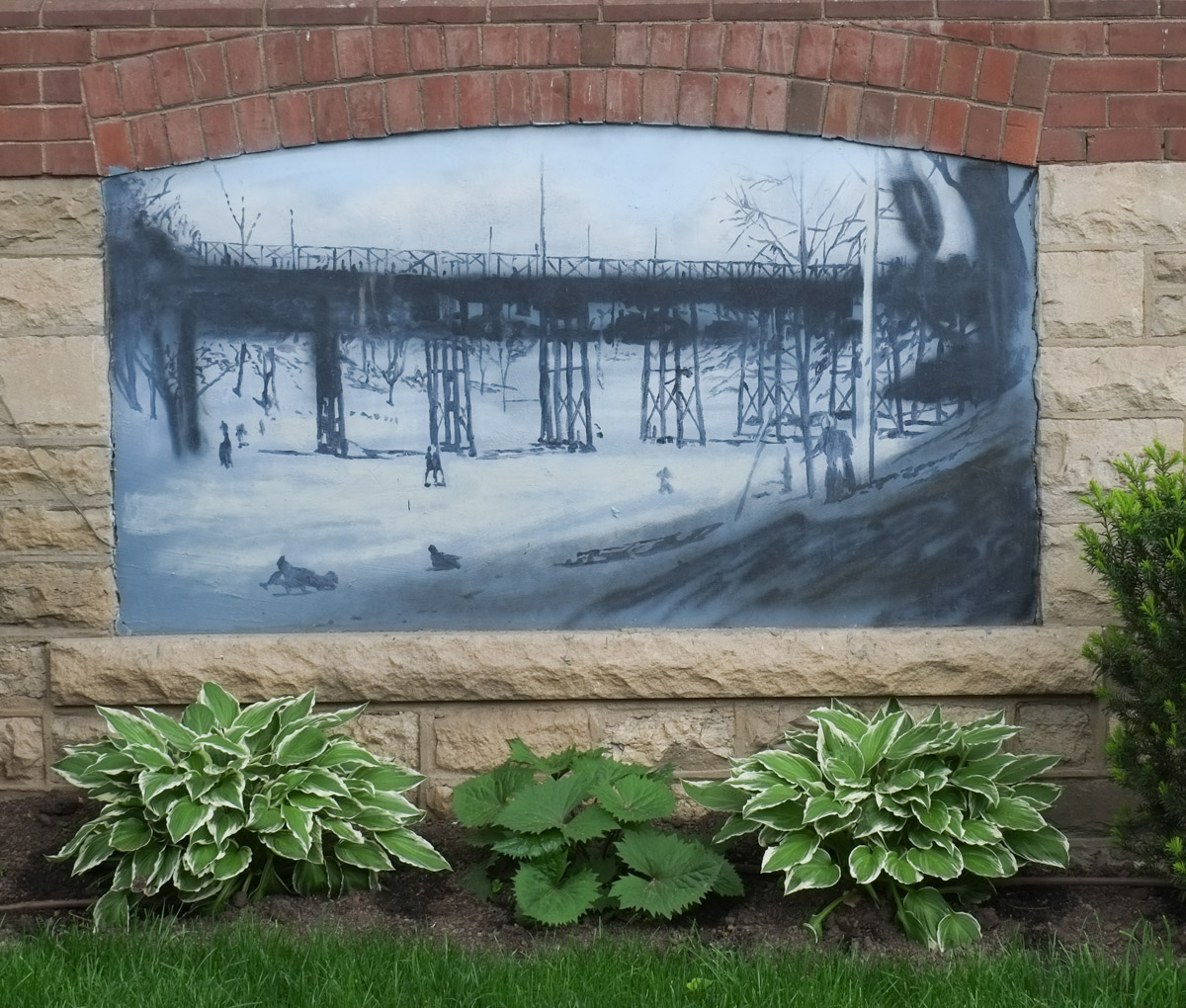
below: Trinity Bellwoods Park and wooden bridge in winter

mural, painting of a trinity bellwoods wooden bridge

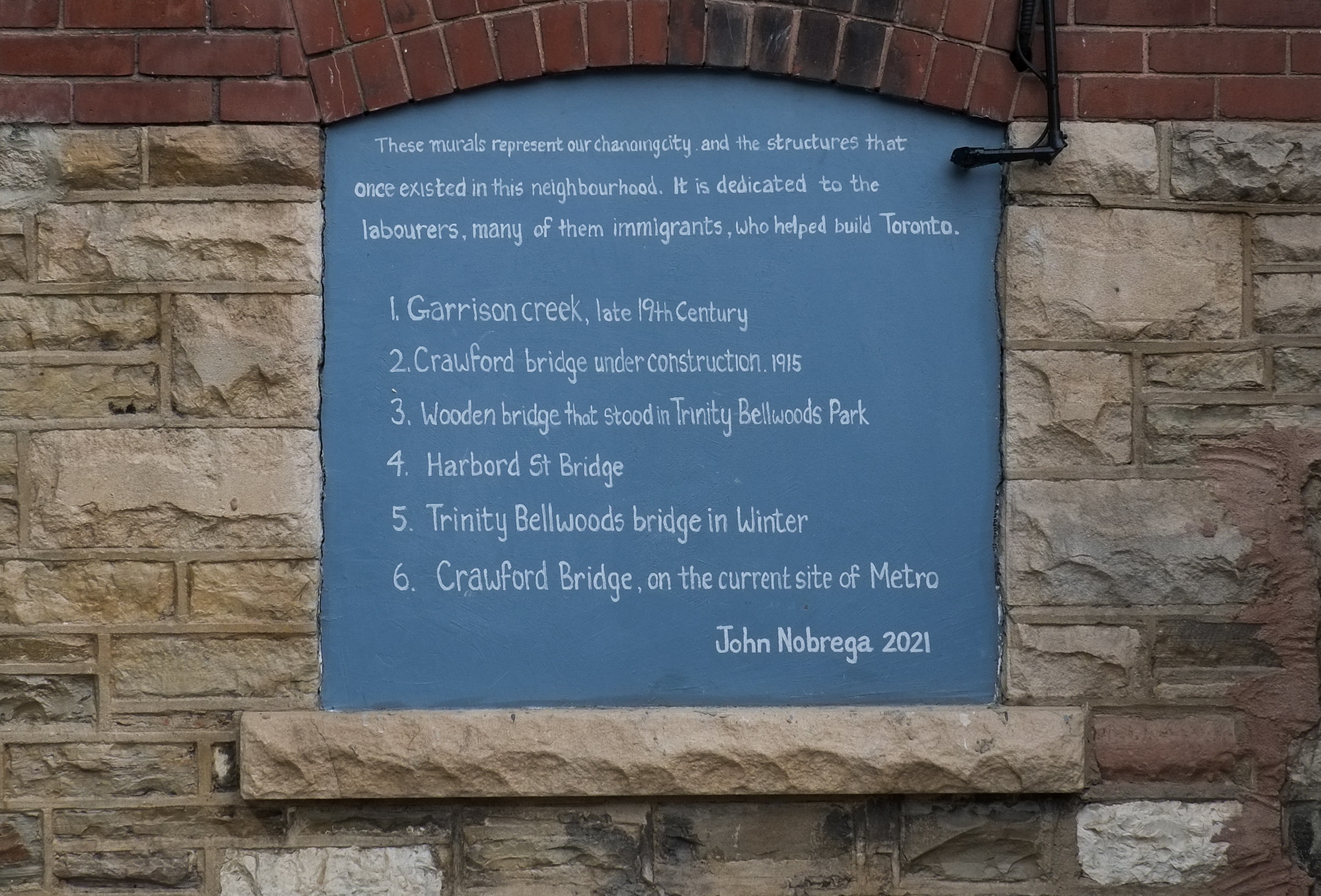
below: The credits and descriptions:

window in a brick building covered with blue. White text on the blue describing the artwork elsewhere on the building.

“These mural represent our changing city and the structures that once existed in the neighbourhood. It is dedicated to the laborer, many of them immigrants, who helped build Toronto.”
1. Garrison Creek, late 19th century
2. Crawford bridge, under construction, 1915
3. Wooden bridge that stood in Trinity Bellwoods Park
4. Harbord Street Bridge
5. Trinity Bellwoods bridge in Winter
6. Crawford Bridge, on the current site of Metro
John Nobrega, 2021


Note: The Harbord Street Bridge mentioned above was also over the Garrison Creek.  It still survives today but only the top part is visible, between Montrose and Grace.  Bickford Park is to the north and Art Eggleton Park is to the south.  Both parks are where the Garrison Creek ran.

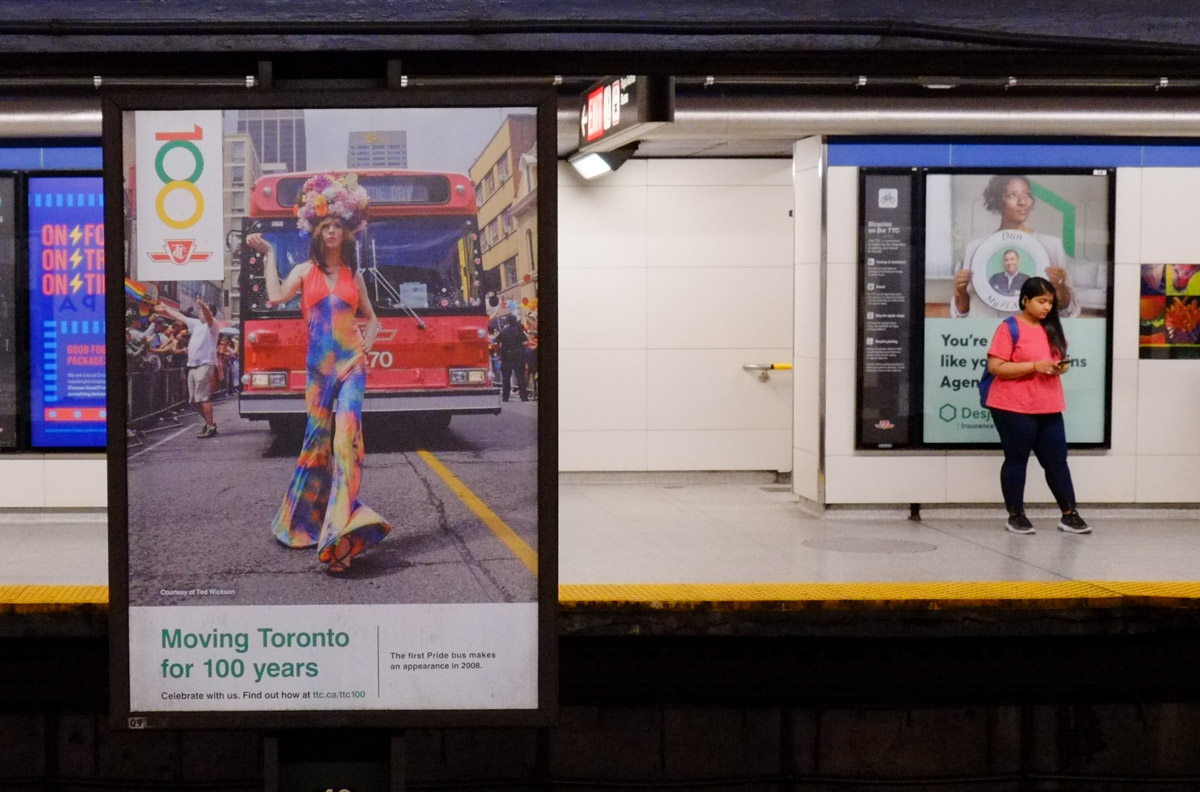
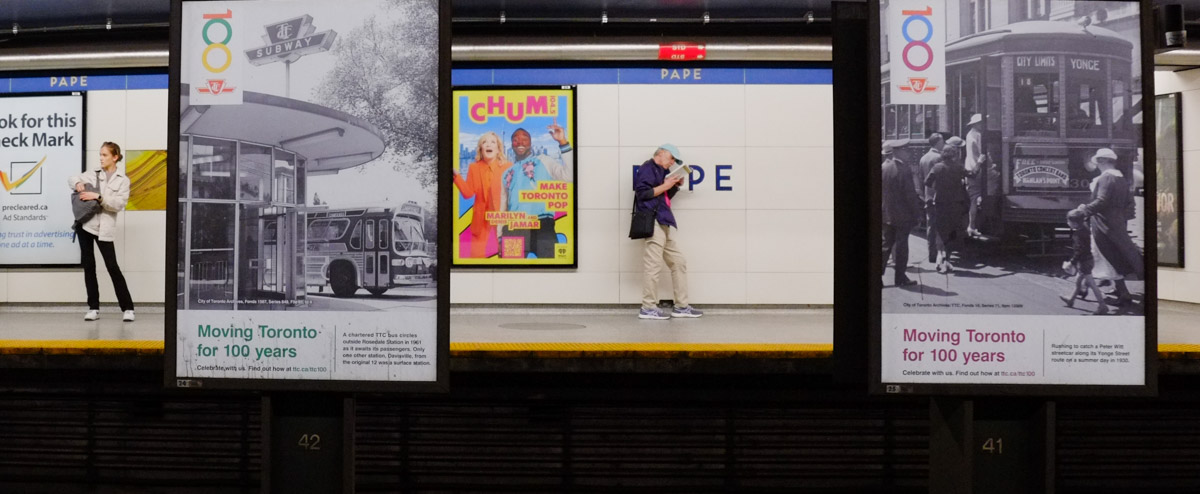
…for 100 years.  At the moment there is a selection of old TTC photos on display at Pape subway station in celebration of 100 years of Toronto Transit.

below: Already  lining the walls at Pape Station are images of Pape station itself and the surrounding neighbourhood. This is ‘Sources/Derivations’ by Allan Harding MacKay.   You can see the reflections of one of the old TTC photos in this section of MacKay’s artwork.
reflections of pape station sign, from the artwork on the walls of that station

The TTC posters are at platform level between the westbound and eastbound trains so you can look at them while waiting for a train.

below: First Pride bus, 2008

photo on display at pape subway station, from 2008, first Pride bus at Pride parade in Toronto, a woman in colourful clothes is walking in front of the bus

below: People waiting for the North Yonge bus at Eglinton station, 1950s

old photos of the TTC on display at Pape subway station, black and white photo old North Yonge bus at Eglinton station 1950s with people waiting to get on the bus. A stopped TTC subway car is behind the poster, a man in red is standing by the window

below: Waiting for the subway. “Line 1 customers ride the higher capacity Toronto Rocket (TR) subway train on its 2011 launch. By 2017, Line 1 had grown by 8.6 km.”
A subway train is stopped behind a poster at the station. on the poster is the back of a woman in a black parka with fur lined hood as she in turn is standing by a ttc subway train

below: Two posters, two eras. On the left: “A chartered TTC bus circles outside Rosedale station in 1961 as it awaits passengers.  Only one other station, Davisville, from the original 12 was a surface station.”  On the right: “Rushing to catch a Peter Witt streetcar along its Yonge Street route on a summer day in 1930.

people waiting on the platform of pape station, with posters of history of ttc on display

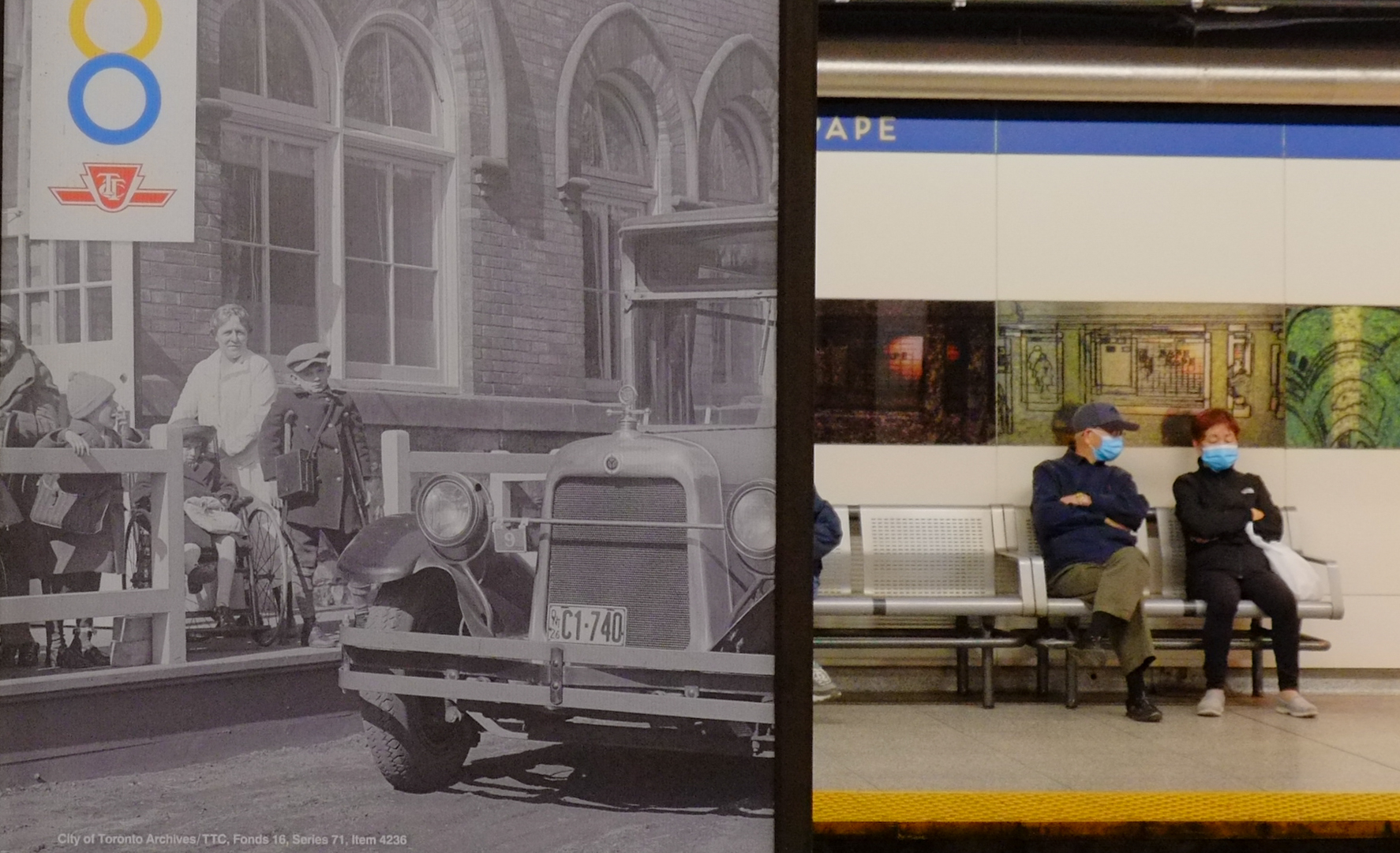
below: “A TTC car picks up scholars with disabilities outside their school in the 1920s.”  A couple with their COVID masks on sit in front of more images from ‘Sources/Derivations’ by artist Allan Harding MacKay.
an older Asian couple in covid masks sit on a bench at pape station platform, waiting for a train, posters of black and white old ttc photos on display between the tracks

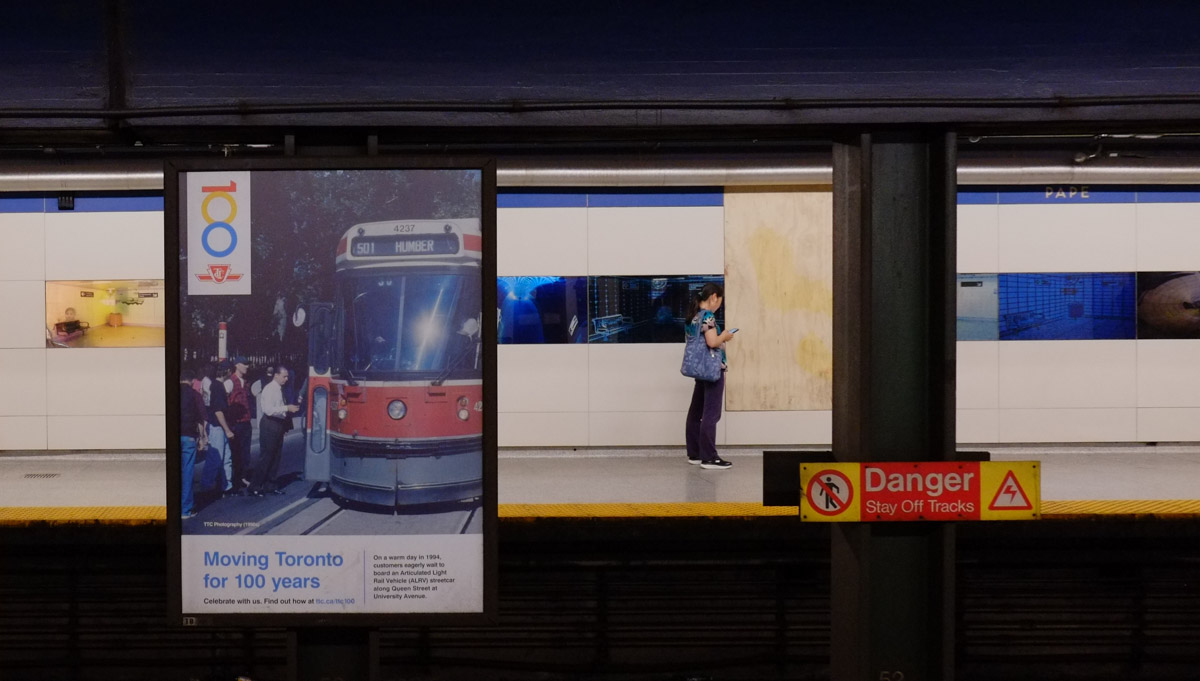
below: “On a warm day in 1994, customers eagerly wait to board an Articulated Light Rail Vehicle streetcar along Queen Street at University Avenue.

platform level of pape subway station, woman on phone, artwork on walls by MacKay, poster of old TTC streetcar

reflections of building on Danforth ear Pape, tower with green domed roof, from the artwork on the walls of that station

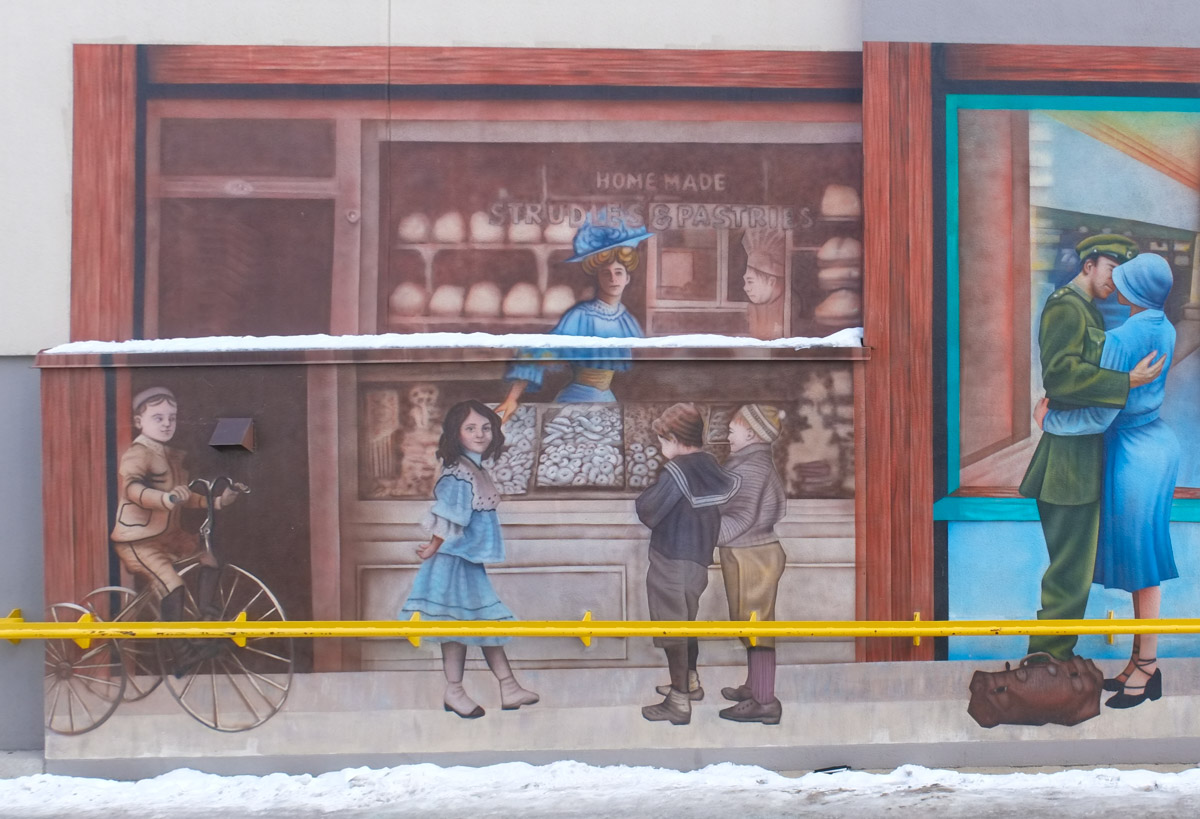
‘Out and About – Windows of Time’ is a large mural by Christiano De Araujo that features scenes from the social history of Weston village.  Unfortunately, the (painted) young man who is sitting on the sidewalk and playing a guitar is hidden by the (real) car parked in front of the mural.

part of mural by Christiano De Araujoo, windows of time, in Weston, history series, starting with kids in front of bakery window from the 1880s

part of mural by Christiano De Araujo, windows of time, in Weston, history series, a WW2 couple kissing soldier and woman in blue with blue hat, also a couple dancing from the 1960s. Another window shows interior of soda parlor

part of mural by Christiano De Araujoo, windows of time, in Weston, history series, Out and About, people doing things

part of mural by Christiano De Araujo, windows of time, in Weston, history series, woman in yellow head scarf pushes a stroller past a restaurant window while a young boy wearing glasses chases birds

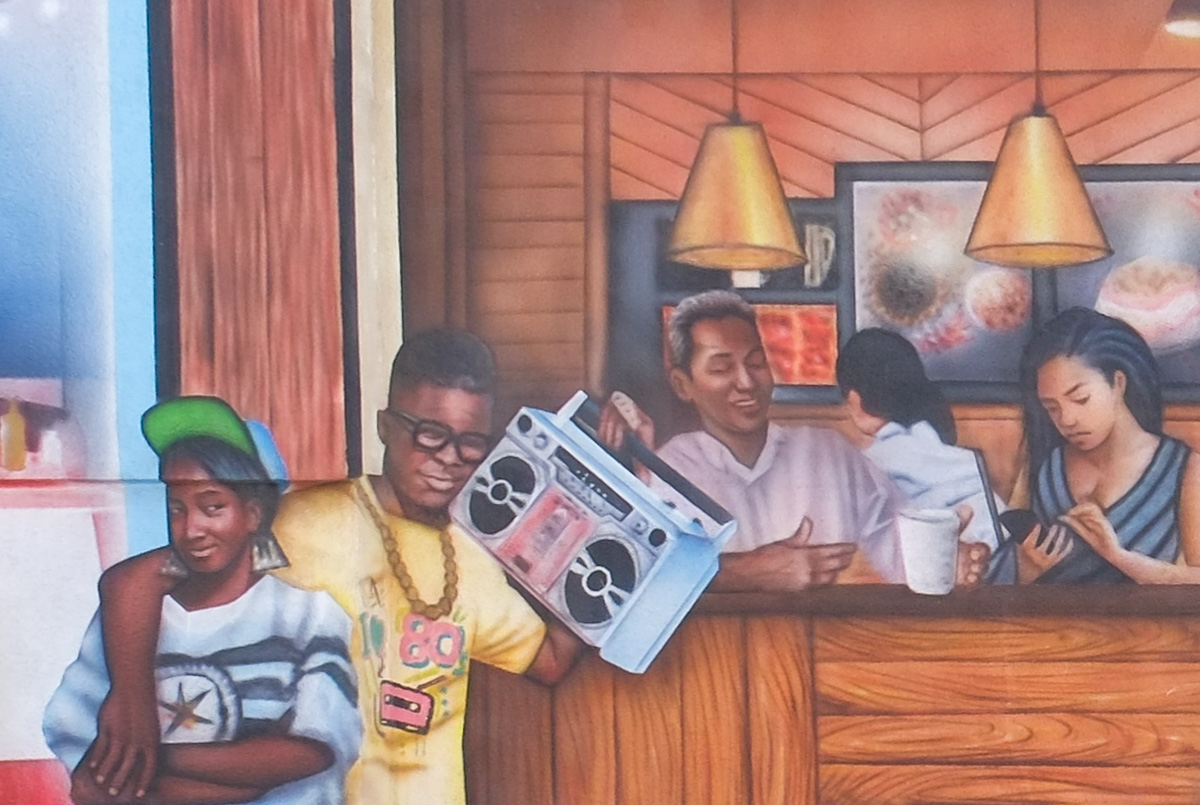
part of a mural by Christiano De Araujo, a young man has a ghetto blater to his ear and his arm around a young woman, in front of a restaurant window where there are people sitting

This post is actually a continuation of today’s other post, “A Little Piece of Weston”.  You’ll find other murals and street art there as well as a few little odds and ends about the Weston neighbourhood.

notes here

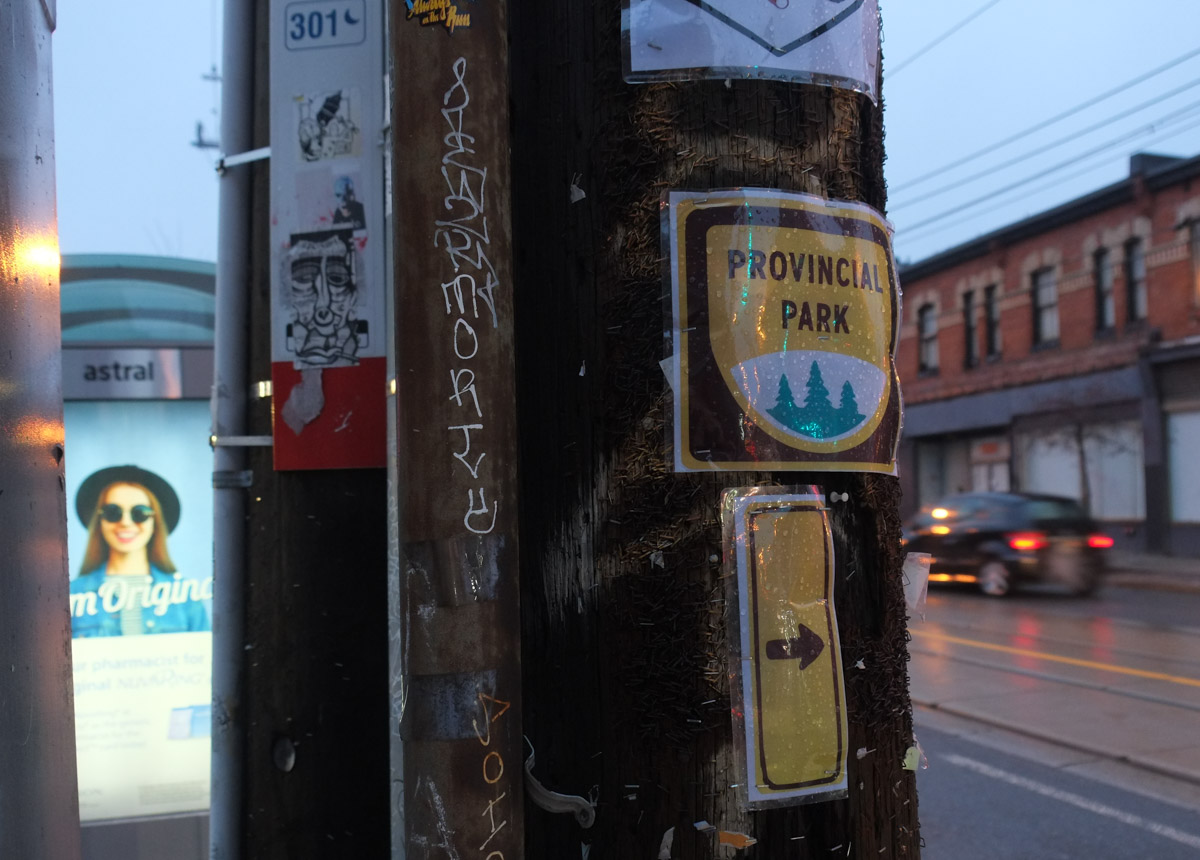
signs on a utility pole on Queen Streeet East, early morning, rainy day, homemade signs arrow pointing to Provincial Park,

There’s a new provincial park in Toronto!

hand painted sign in green and white that say Parkdale Provincial Park, on a metal construction fence around a vacant lot waiting for redevelopment on Brock Ave.., also a hand drawn sign that mimics the blue and white Ontario Parks sign

… but sadly it’s just a vacant lot

small table in a vacant lot, behind a fence, houses on Brock Ave in the background

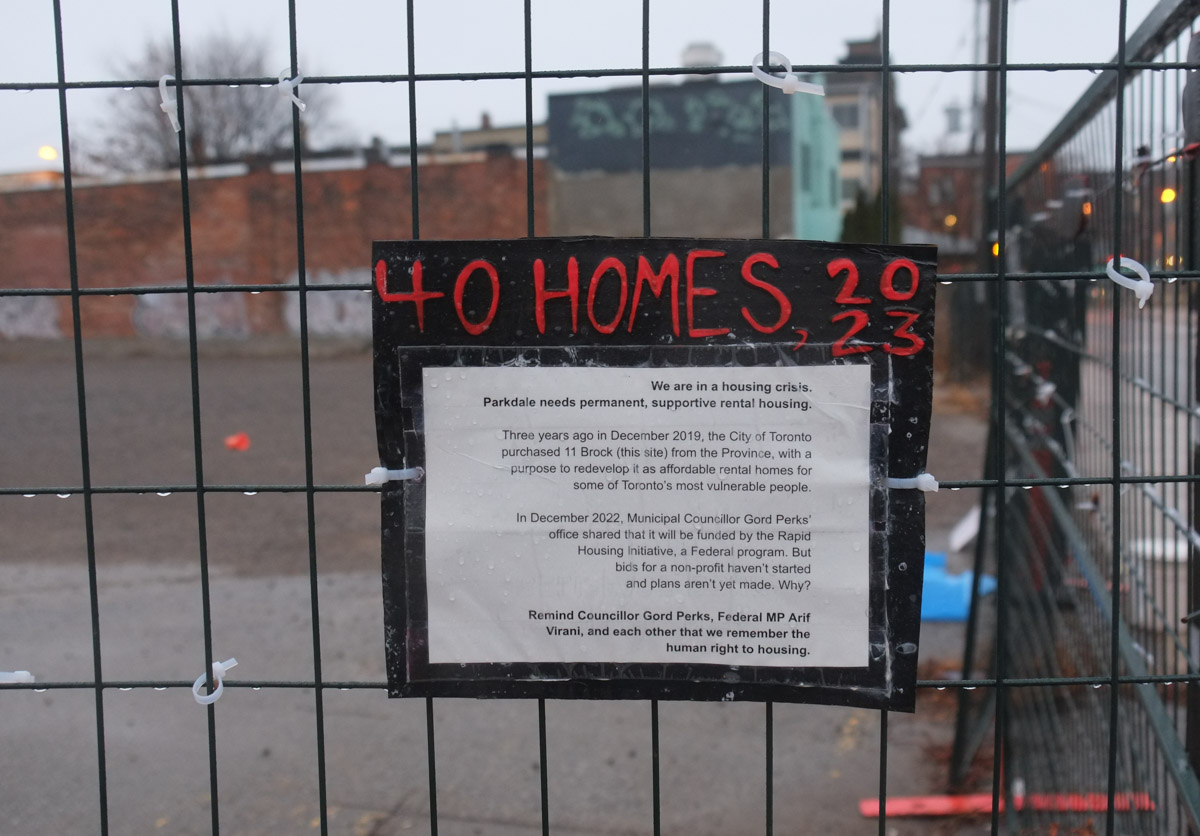
The city has owned the land for a few years and has already torn down the LCBO that used to be here.  The plan is to build supportive housing for those in need.  So far nothing else has happened – has the project stalled?

sign on a metal construction fence around a vacant lot with title 40 homes 2023, description of fight to build affordable housing

“We are in a housing crisis.
Parkdale needs permanent supportive housing.
Three years ago in December 2019, the City of Toronto purchased 11 Brock (this site) from the Province, with a purpose to redevelop it as affordable rental homes for some of Toronto’s most vulnerable people.
In December 2022, Municipal Councillor Gord Perks’s office shared that it will be funded by the Rapid Housing Initiative, a Federal program.  But bids for a non-profit haven’t started and plans aren’t yet made.  Why?  NP Remind Councillor Gord Perks, Federal MP Arif Virani, and each other that we remember the human right to housing.”


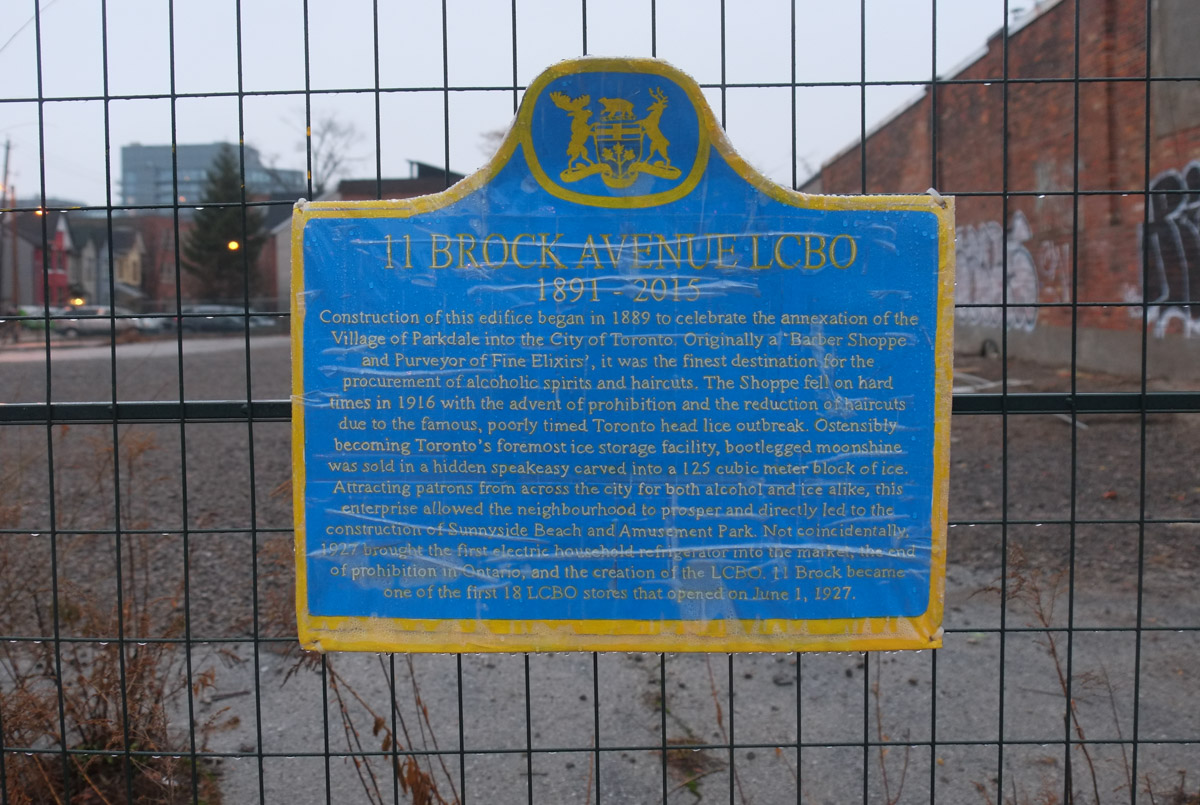
handmade sign that looks like a provincial heritage plaque, description of history of Brock Avenue LCBO, now a vacant lot

11 Brock Avenue LCBO
1891-2016
Construction of this edifice began in 1889 to celebrate the annexation of the Village of Parkdale into the City of Toronto.  Originally a “Barber Shoppe and Purveyor of Fine Elixirs”, it was the finest destination for the procurement of alcoholic spirits and haircuts.  The Shoppe fell on hard times in 1916 with the advent of prohibition and the reduction in haircuts due to the famous poorly times Toronto head lice outbreak.  Ostensibly becoming Toronto’s foremost storage facility, bootlegged moonshine was sold in a hidden speakeasy carved into a 125 cubic meter block of ice.  Attracting patrons from across the city for both alcohol and ice alike, this enterprise allowed the neighbourhood to prosper and directly led to the construction of Sunnyside Beach and Amusement Park.  Not coincidentally, 1927 brought the first electric household refrigerator into the market, the end of prohibition in Ontario, and the creation of the LCBO.  11 Brock became one of the first 18 LCBO stores that opened on June 1, 1927.


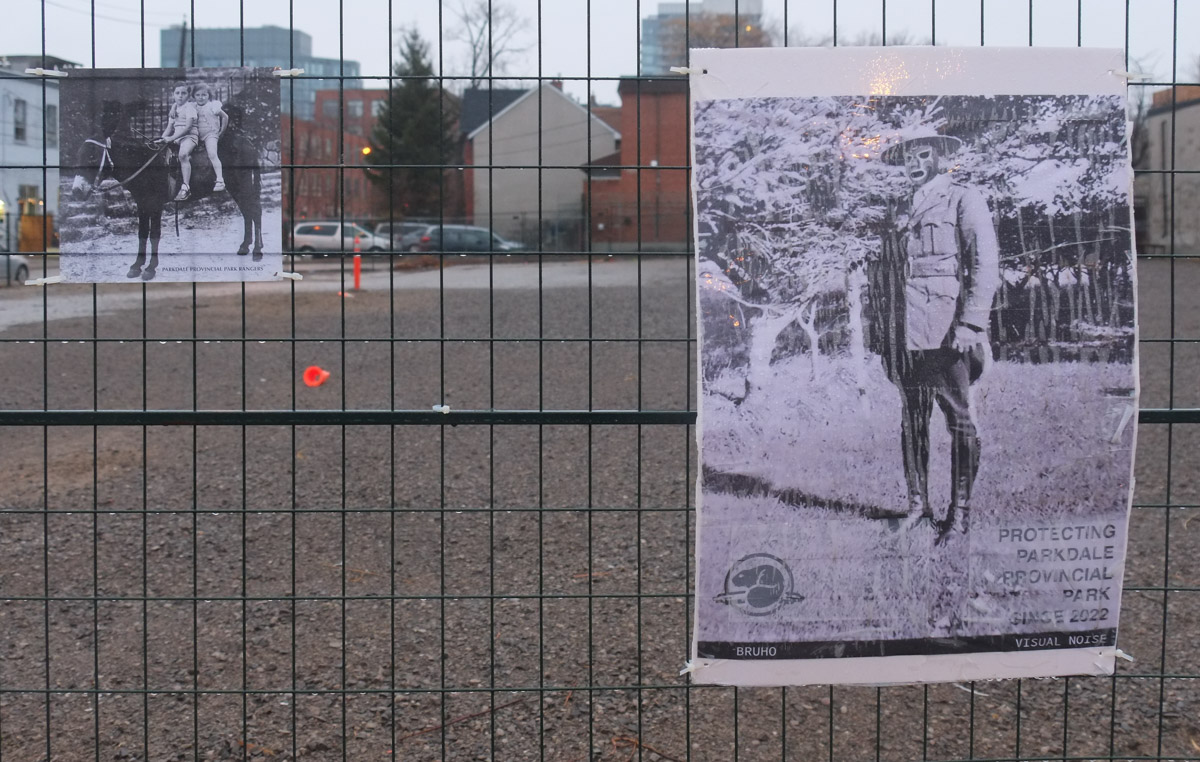
black and white photo of park ranger in mask, along with a drawing of a person in a sleeping bag with caption, need home

two black and white photos, one of kids on horse back, on metal fence around a vacant lot, part of Parkdale Provincial Park protest

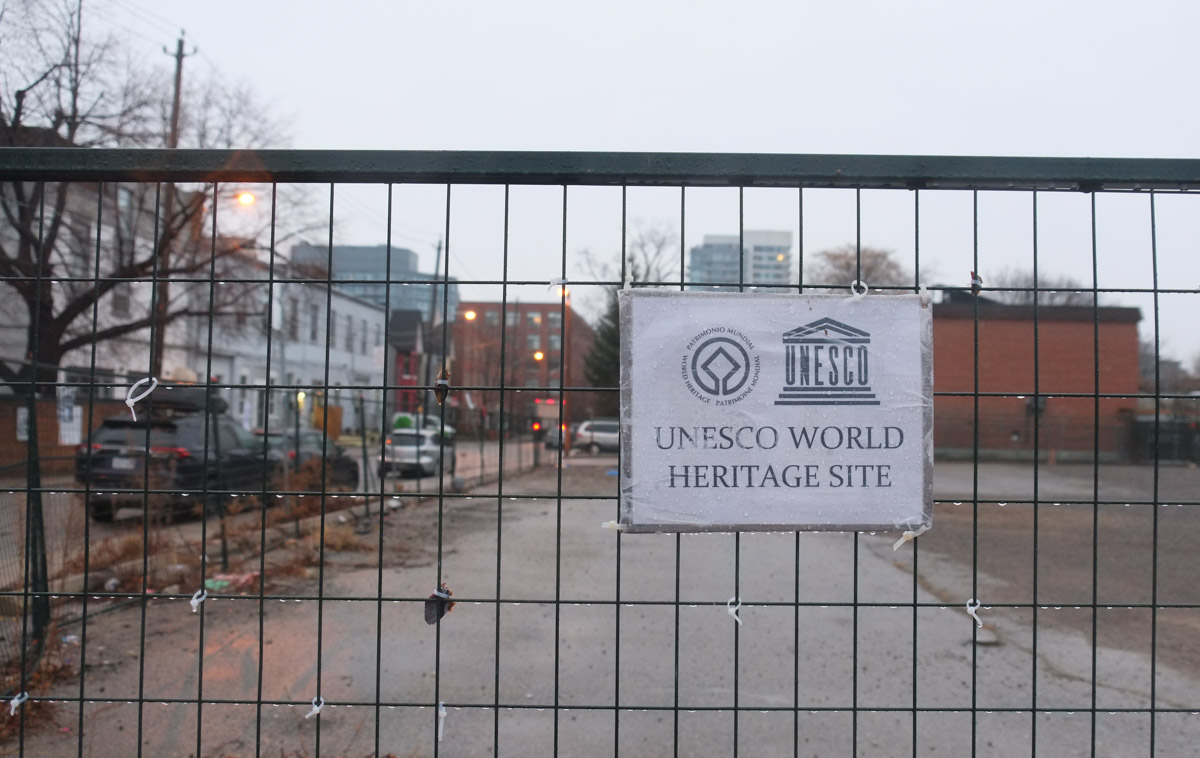
unesco world heritage site sign, on installation of parkdale provincial park, on brock ave, vacant lot where LCBO building was torn down

the word Ontario written on a log, with a cute little black and white animal (skunk? bear?) sitting on it

Getting there:  11 Brock Avenue, just north of Queen St. East

Accommodation: none (or bring your own sleeping bag)

Food & Drink: Check out Sam James bakery right across the street from the park entrance (if there was one).

 large black and white painting of 6 hands coming together, radial symmetry, on wall of Sam James Coffee Bar


Walking up Yonge Street on a grey damp September day – from Adelaide to Dundas

below:  Southeast corner of Adelaide & Yonge: the (sort of) dome shaped entrance way with the stained glass roof is under renovation.

a couple walks on the sidewalk, along Adelaide, near northeast corner of Yonge, construction on the southeast corner, renovation of entranceway to office building

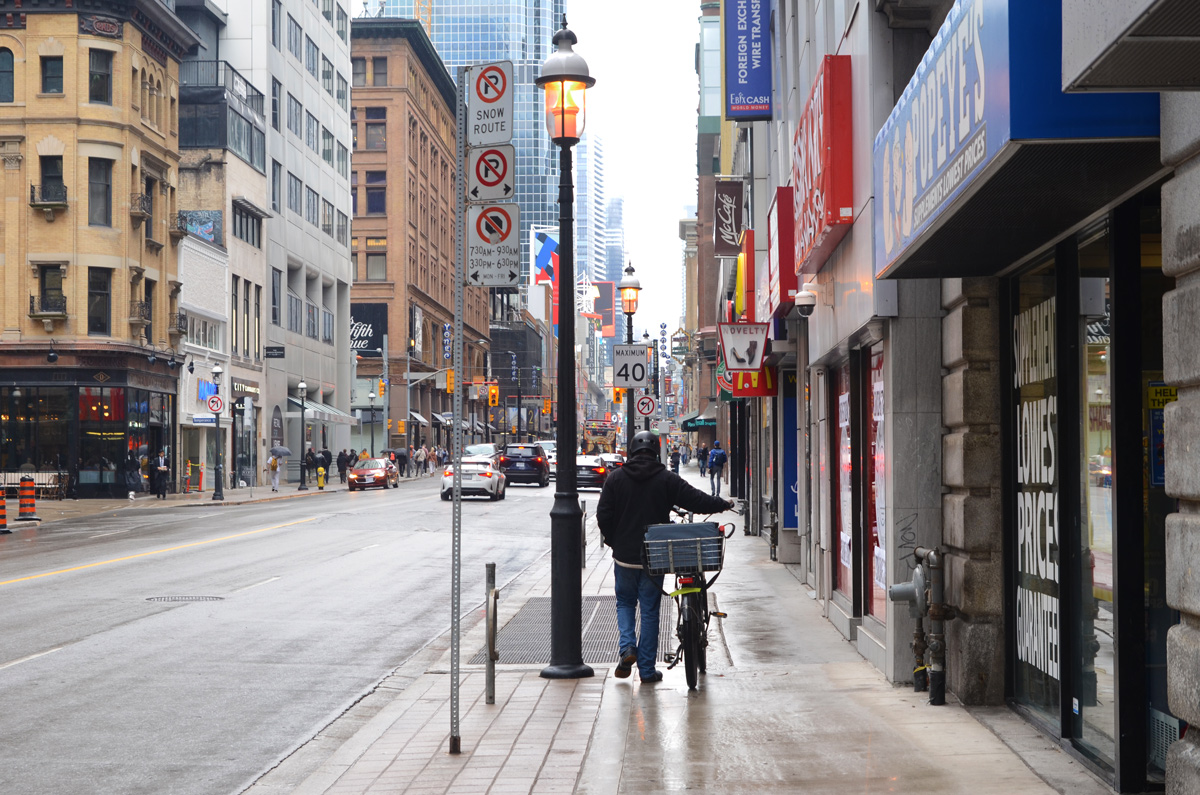
below: Walking his bike up Yonge Street

a man walks his bike on the sidewalk, northbound on Yonge street, east side, north of Adelaide

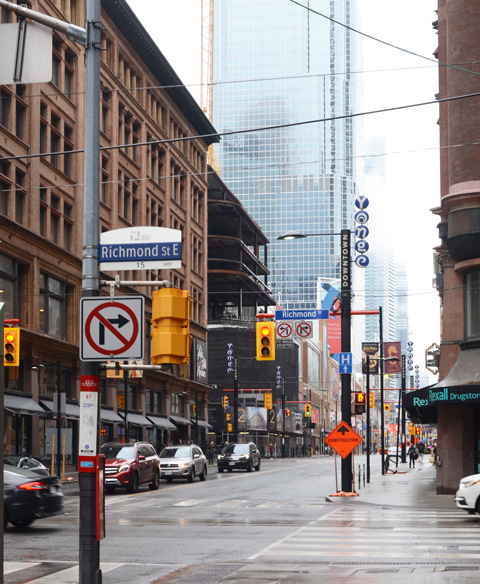
below: Looking north up Yonge Street from Richmond

looking north up Yonge street from Richmond

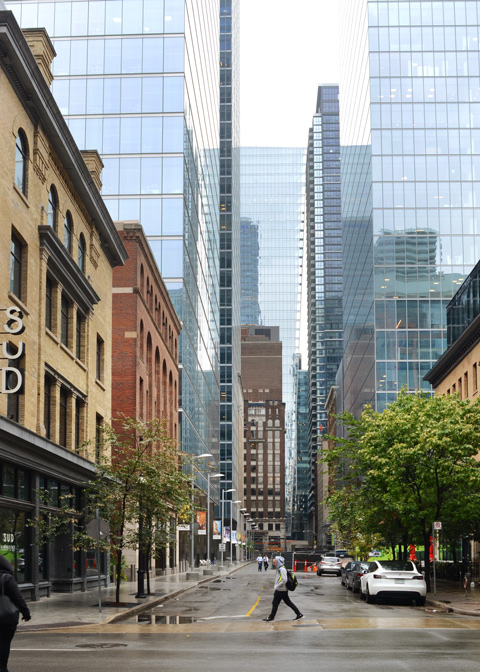
below: Looking west on Temperance Street towards a wall of glass

lookingwest on Temperance Street from Yonge street, a young man is crossing the street, a wall of glass condos rises in the west

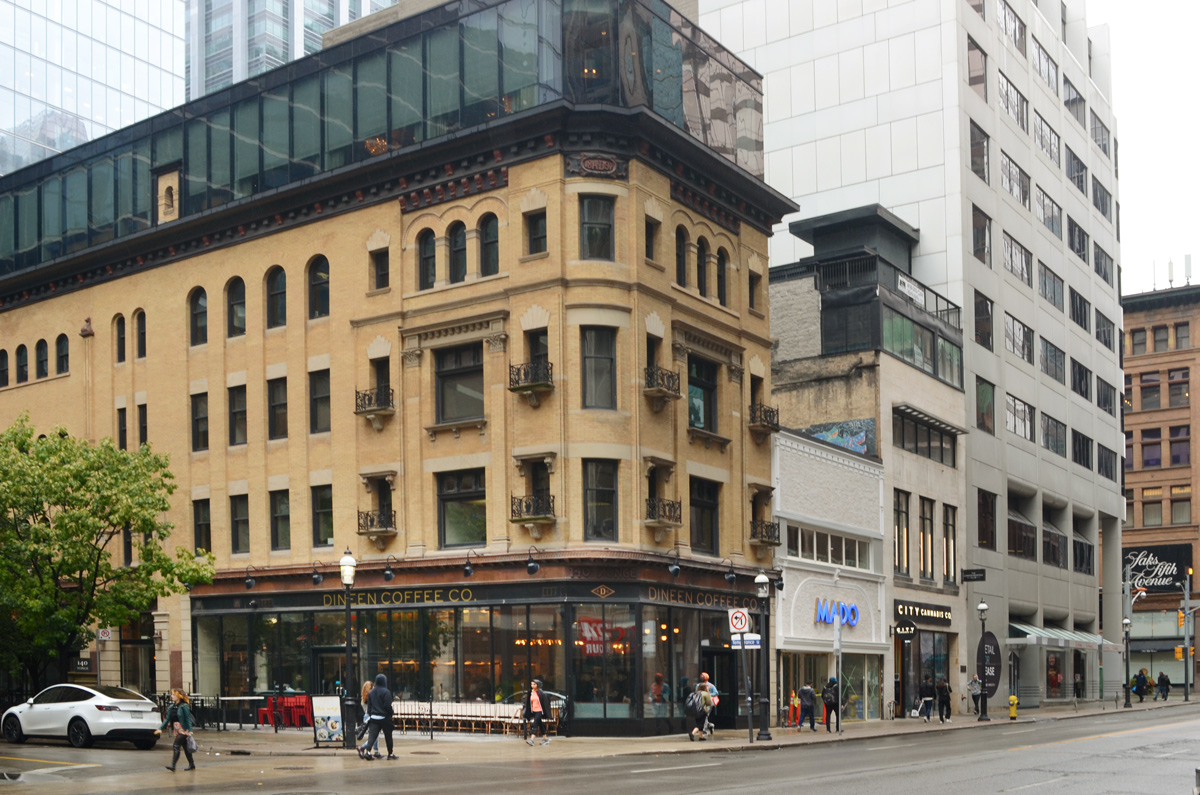
below: Dineen Coffee on the ground floor the old building on the northwest corner of Yonge and Temperance streets. The coffee company took its name from the building – the Dineen Building, once home to furriers W. and D. Dineen Co. (until the 1930s). The building was built in 1897 and was added to the City of Toronto Heritage list in 1973. Ceilings in it were made of bronze and aluminum plates; this was the first time that aluminum was used as a building material in Canada.

Dineen coffee, an old building on the northwest corner of Yonge and Temperance streets.

below: Dineen Building, 1927.  The 2012 restoration was very faithful to the original facade.

vintage 1927 black and white photo of the Dineen Building in Toronto, source, TPL, Toronto Public Library

Source: Online,  Toronto Public Library Archives. Unknown photographer for the Toronto Star newspaper.

.

Yonge street on a rainy day, two people with black umbrellas walk past mado, an empty storefront

below: Streetcars on Queen West under the redesigned pedestrian walkway.

TTC streetcar on Queen Street at Yonge, outside Eaton Centre

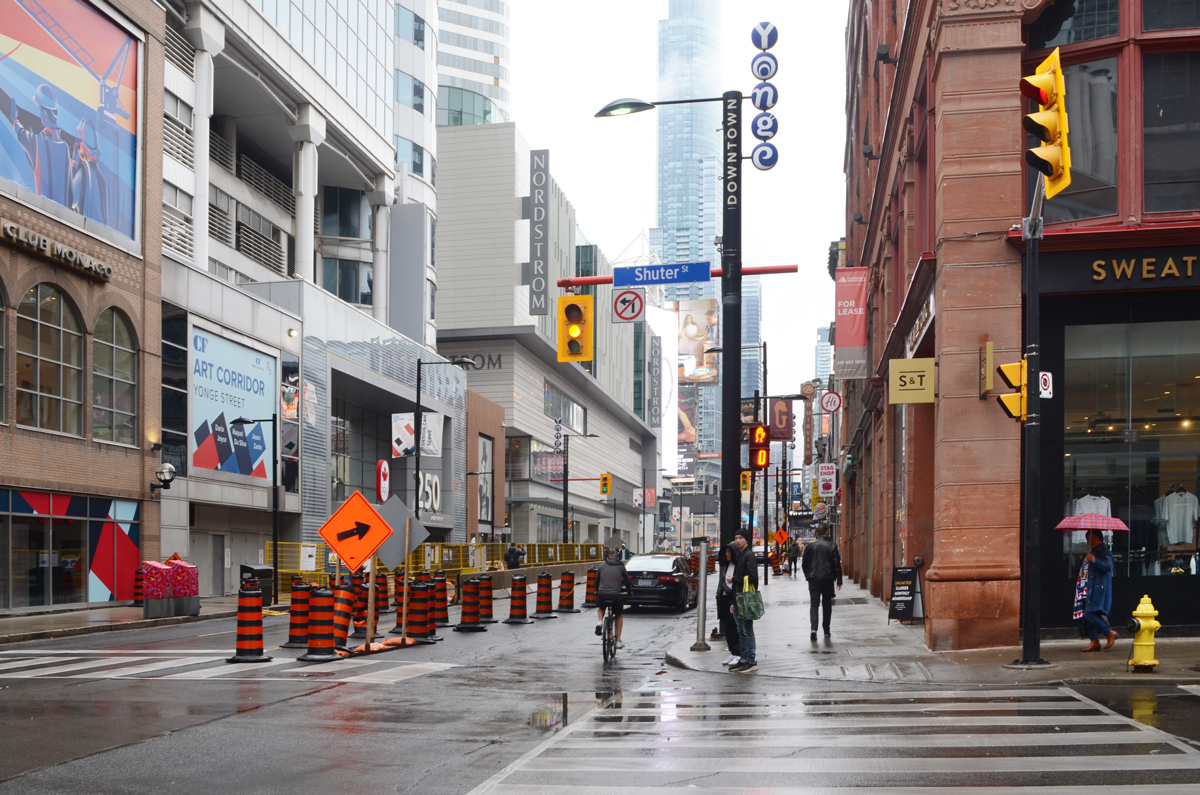
below: Looking north from Shuter Street.  Since the late 1970s, the west side of this block has been dominated by the Eaton Centre.  When the mall was first completed, it destroyed any street scene that had existed there.  Subsequent alterations have improved this block at street level a bit.

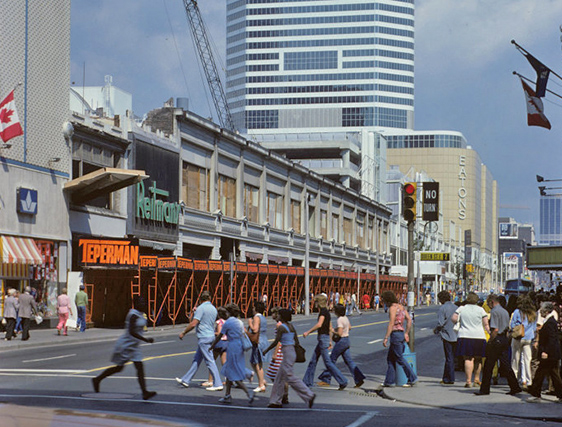
below: Looking north up Yonge Street from Queen back at a time when the new Eatons store at the north end of the Eaton Centre was built (at Dundas, completed 1977) but the old stores on the west side of Yonge hadn’t been completely demolished. This photo was found online on blogTO – here’s the link to their site if you are interested in the history of the Eaton Centre construction.

1970s faded colour photo of Eaton centre development, found on blogTO website, original photo from Toronto Archives, people crossing Yonge street in front of construction, one tall building in the background, as well as new Eatons building at north end of Eaton Centre

hand written sign on ground leaning against an information and map stand on Yonge Street, poster says Iran needs help

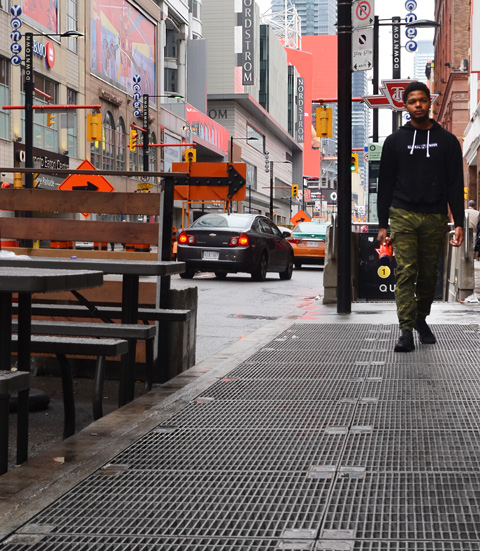
a young man walks south on Yonge, over a metal grid in the sidewalk that is an air vent for the subway that runs underneath, picnic benches for a patio beside the sidewalk, traffic, construction signs on the street including a large arrow directing traffic into the righthand lane

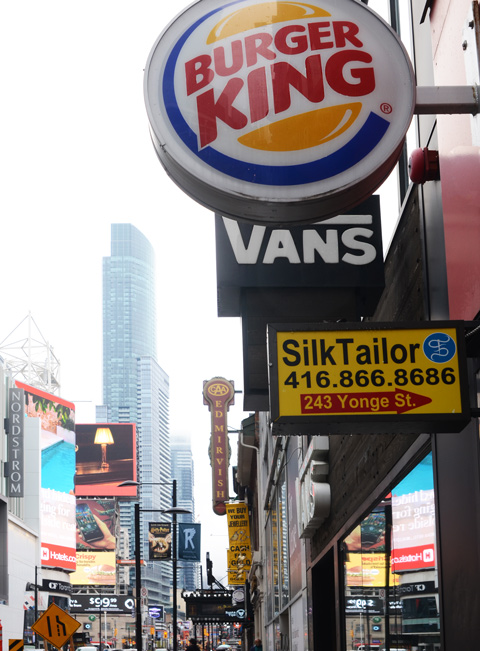
store signs on Yonge Street, Burger King, a tailor shop, vans, and Ed Mirvish theatre

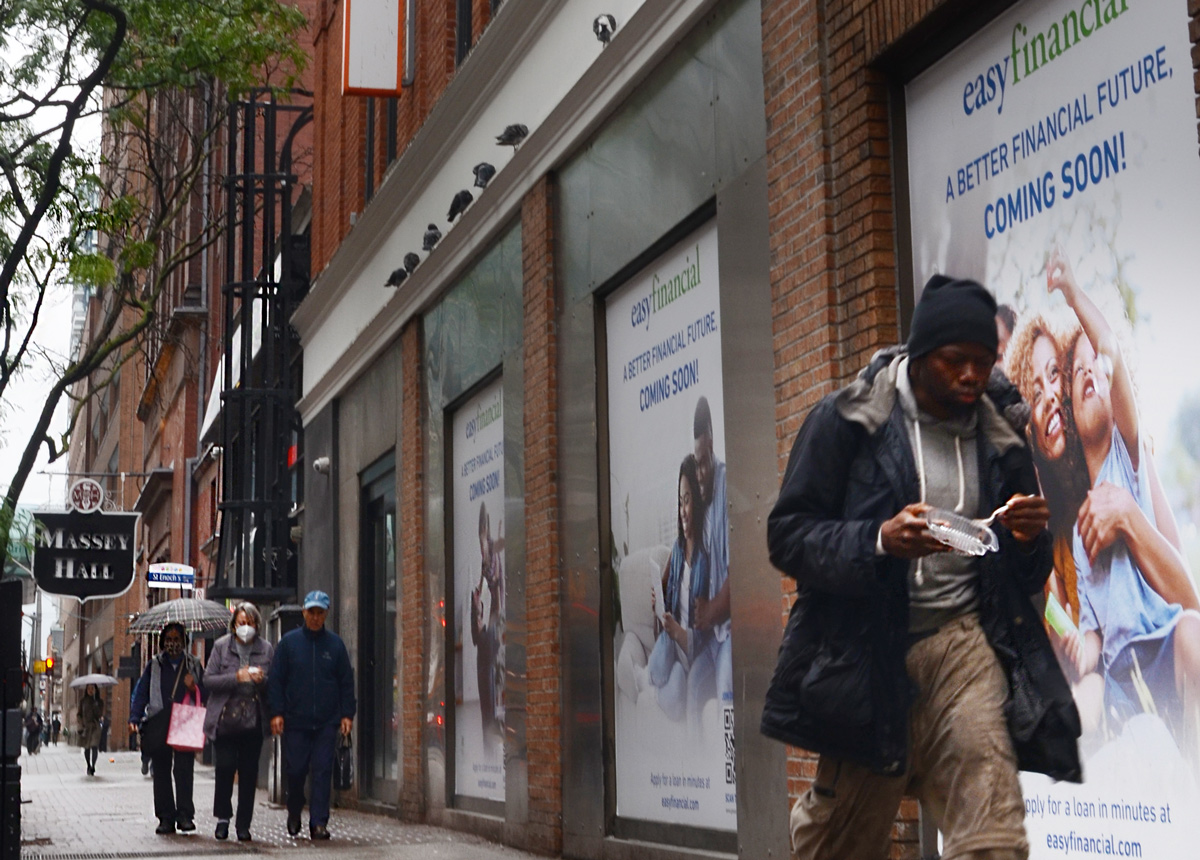
below: Massey Hall, Shuter Street

a man is eating as he walks past ads for a bank and financial security, Massey Hall sign in the background

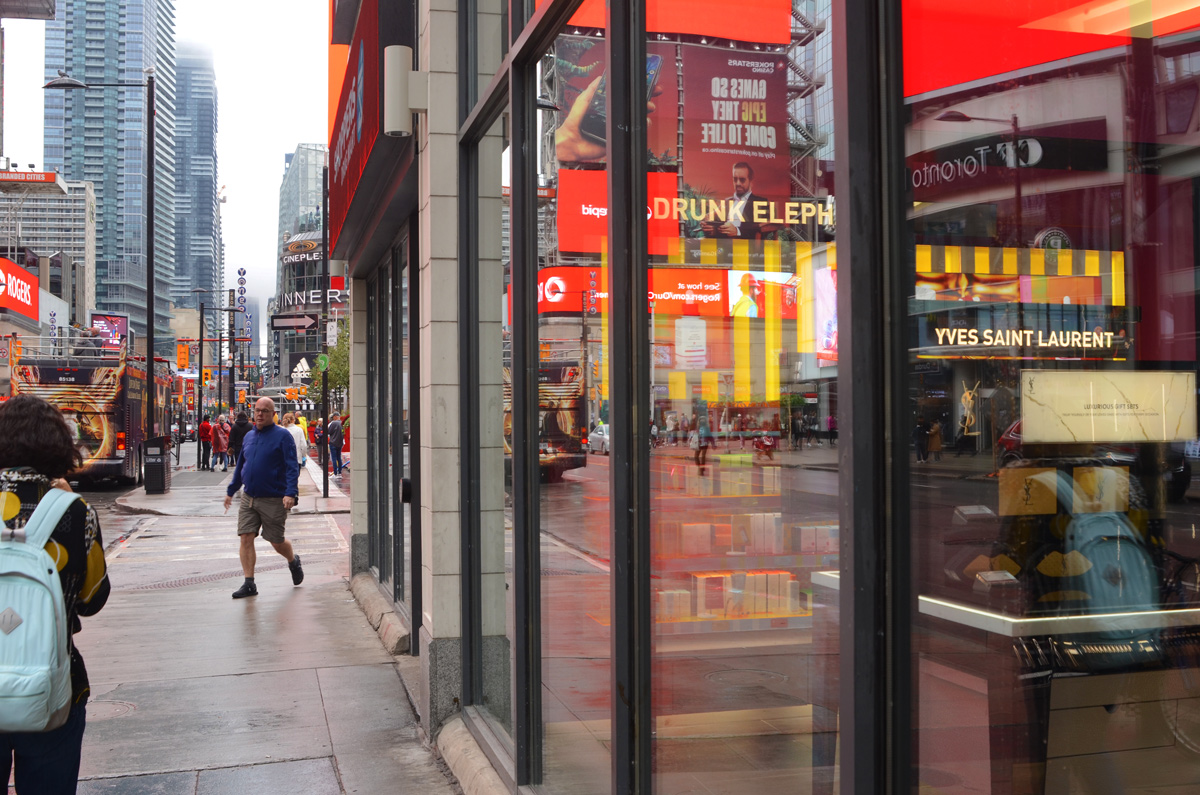
below: Reflections in the windows as you approach Dundas. I’m not sure what the relevance of “drunk elephant” is!

a man walking towards the camera, beside a large store front window with reflections, including the words drunk elephants

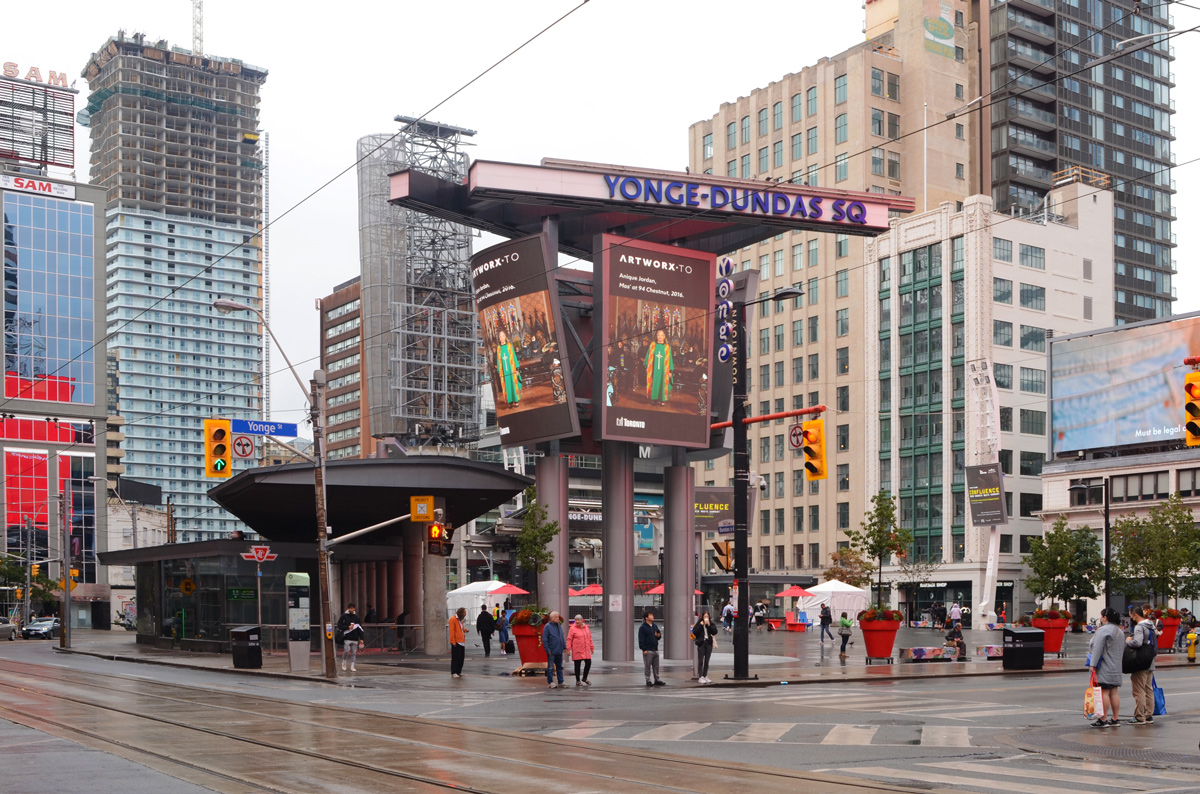
below: Tourists in the city; cameras out at Yonge Dundas Square.

people standing on the upper level of a double decker bus, hop on hop off tour bus in Toronto that is covered with Harry Potter ad, at Dundas Square with large billboards in the background with ads for Disney - the rebellion begins, poker stars casinos epic games, and Andor

looking towards Yonge Dundas Square on the southeast corner of Yonge and Dundas

people walking with umbrellas on wet sidewalk on Yonge, at Edward, going south towards Dundas

There are more rainy day photos of people at Yonge and Dundas in the next blog post.