Archive for the ‘old buildings’ Category

The other day I discovered that there is a small gallery on the 3rd floor of Ryerson’s School of Image Arts.  If you want to find it too, it’s in a building that it’s in is attached at the ground floor level to the Ryerson Image Centre on Gould Street.   At the moment, there is a small exhibit of photos by Avard Woolaver.

the back of a man looking at a wall in a gallery, old photos of Toronto

below:  The photos are ones that Woolaver took in Toronto in the late 70s and early 80s.
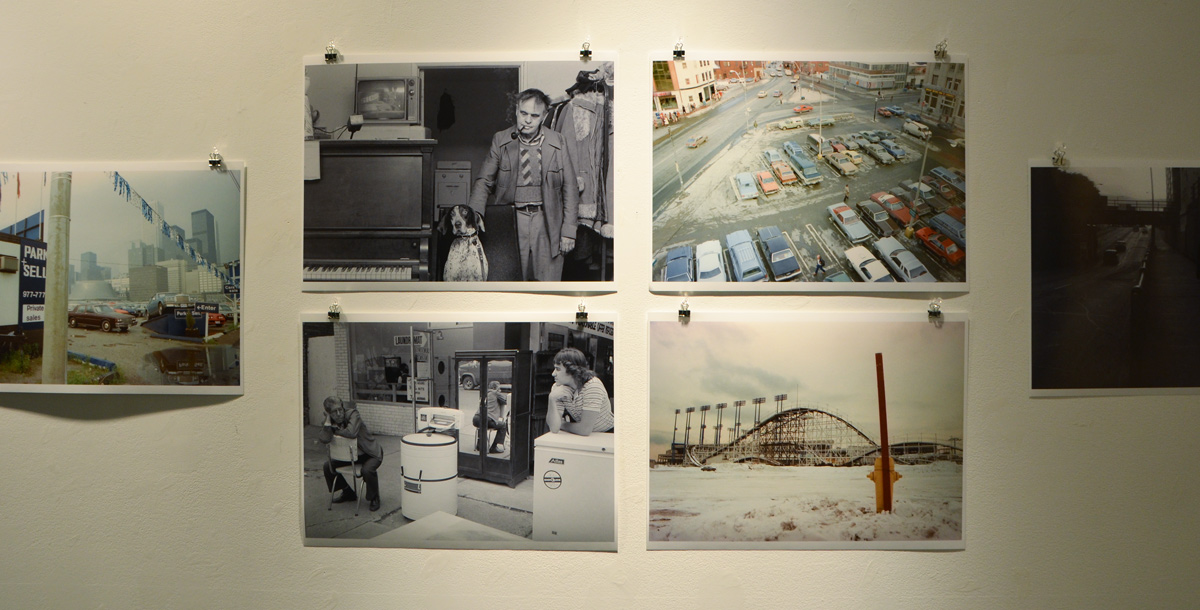
old photos of Toronto from the 1980s by Avard Woolaver.

below: This photo is one of Woolaver’s – it is looking towards the northwest corner of Spadina and Queen Street West.  For those of us who lived in Toronto at the time, it’s a bit of nostalgia.  Somethings are very familiar – the older TTC buses, the car styles, and a lot of the architecture, for example.   This photo in particular lends itself nicely to the game of ‘Spot the Differences’….. compare this with

photo by Avard Woolaver of Toronto in the 1980s, this view is the north west corner of Queen and Spadina

below: …..this. Here is the same intersection, at a similar angle, last week.   The large brick building is still there but without a billboard.   The poles are no longer wood but they are covered in posters and remnants of posters – so no change there.    The street signs have been updated and there is now a streetcar lane in the middle.   All in all, I was surprised how little had actually changed in 30ish years.
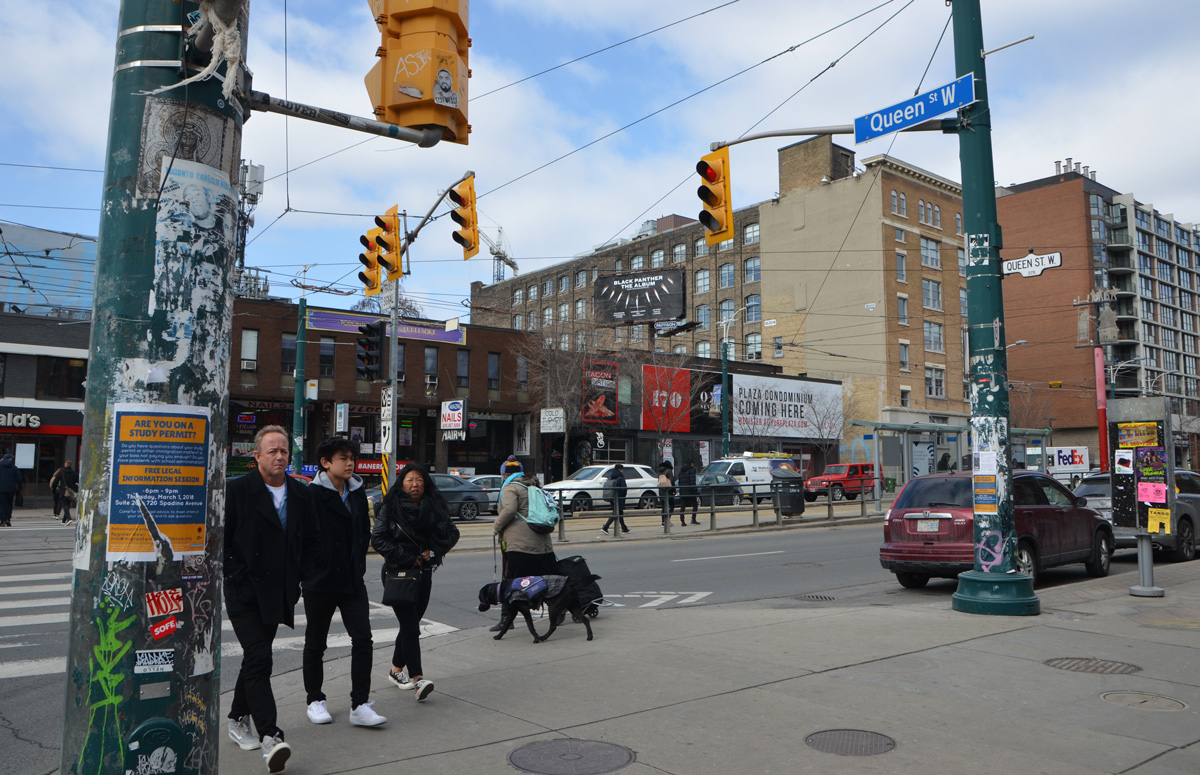
the northwest corner of Queen and Spadina in 2018, pedestrians, buildings, street scene

below: I found this photo online (originally from the Toronto City Archives, 1950?) but before we can play another round of ‘Spot the Differences’, we have to identify these buildings?  Any ideas?
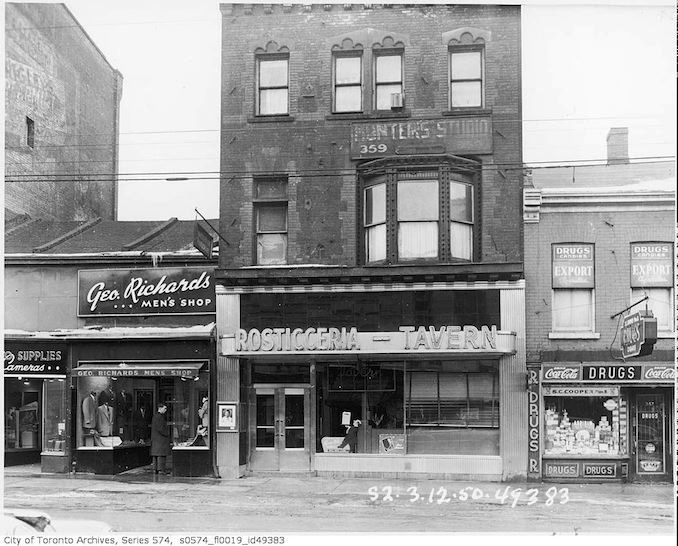
vintage photo of 357, 359, and 361 Yonge street, black and white, 3 storefronts,

below: Here is the same location in the 1980’s (not a photo from the exhibit).  Not too many changes.   The building that housed George Richards Men’s shop, 361 Yonge Street, was replaced by a dull and boring two storey brick building but the other changes were just to the facades and the owners/tenants.   The tavern is still a tavern and the drug store is still a drug store.  The large brown building on the top right that you can only see part of is Ryerson College.   Unfortunately the Wrigleys ghost sign on the taller building on the left has been covered.
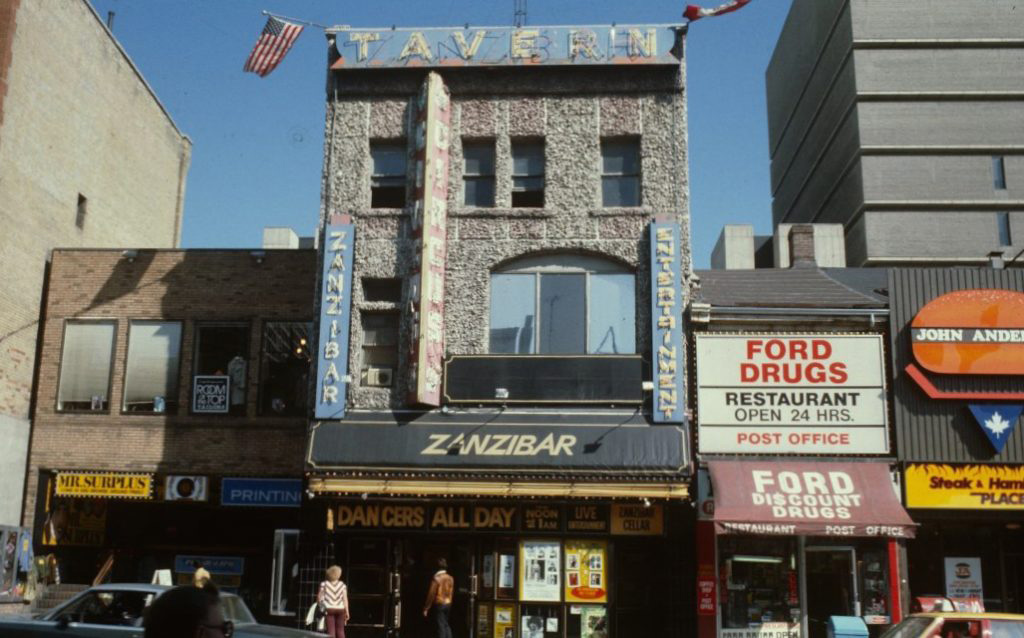
357, 359, and 361 Yonge street in the 1980s including the Zanzibar tavern

photo source BuzzBuzzNews online

below: Fast forward another 30 years.  The Zanzibar is all bright lights and dazzle while the building that housed the drug store is now for sale.  Ryerson is now a University and has expanded out to Yonge Street – that’s the large blue building in case you are not familiar with the area.

Yonge stree, easy side, just north of Dundas, about 357, 359 and 361 Yonge Street including the Zanzibar Tavern. The blue glass wall of Ryerson University behind the Zanzibar,

below: If you pull back a bit, and look just a bit farther north on that stretch of Yonge Street, you’ll see that there are many empty buildings
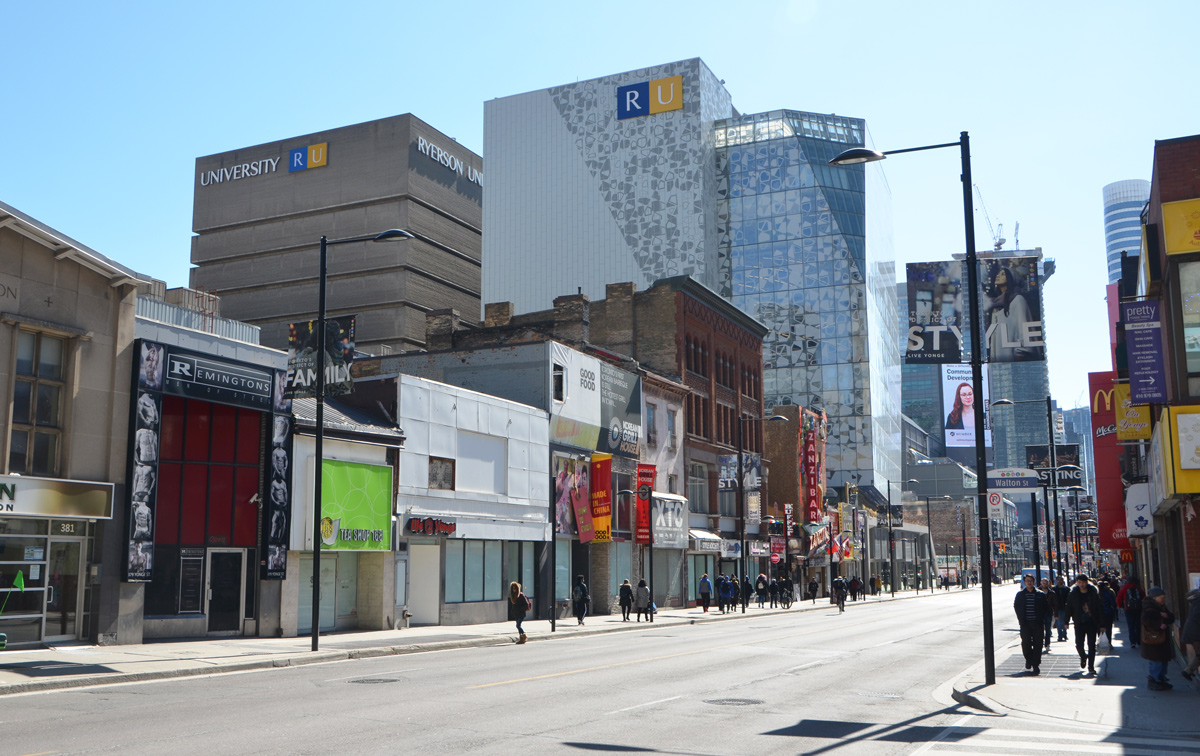
yonge street, between gerrard and dundas, most storefronts are closed and boarded up waiting for redevelopment of that stretch

below: … including what was until recently the XTC clothing company.  It looks like it has gone through a number of ‘renovations’, not all of which were good.  Some traces of its original brick facade can be seen at the top but at street level it is (was?) a mess.

empty two storey building, once was X T C clothing store

 There is a plan to build a 98 storey mixed-use building on this site including just over 900 residential units ranging in size from 520 to 2000 square feet.    It will be the tallest residential building in Canada.   In the promotional material for YSL Residences, as they will be called, is this: “The epitome of luxury living, designed to elevate the fortunate few who will call it home.”


below:  Back to Ryerson, also on the 3rd floor of the School of Image Arts, there was a small series of photographs like this one hanging on the wall in the hallway.  There was no sign as to the name of the artist that I could find either on the wall or online.   I quite like the technique and the resulting image.  Two ideas melded into one.  Two time frames in one frame.  Two artistic styles combined to create another.
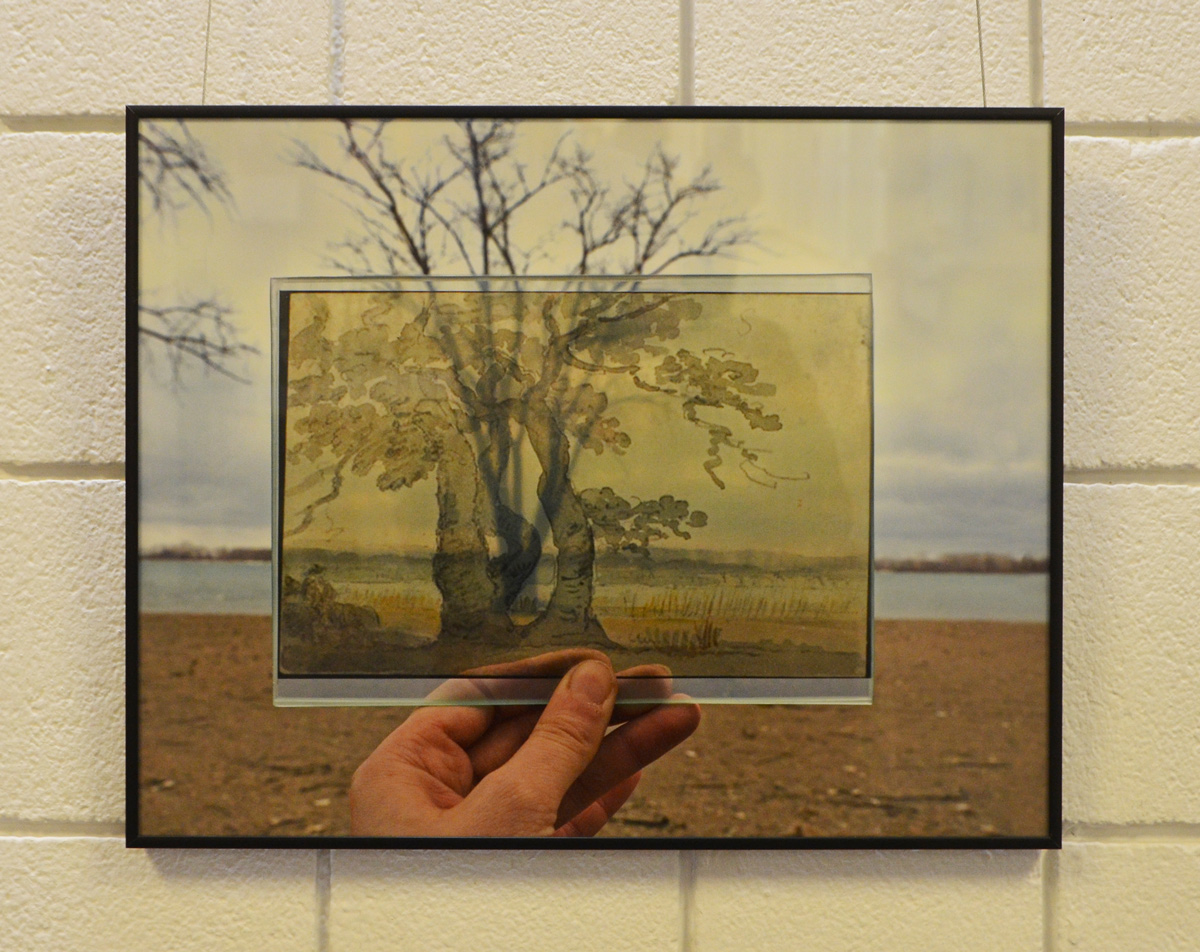
a photograph on a gallery wall, a hand holding a photo printed on glass in the middle of another photo, superimposed landscapes

If you are interested in Woolaver’s work, you can find more on his blog.
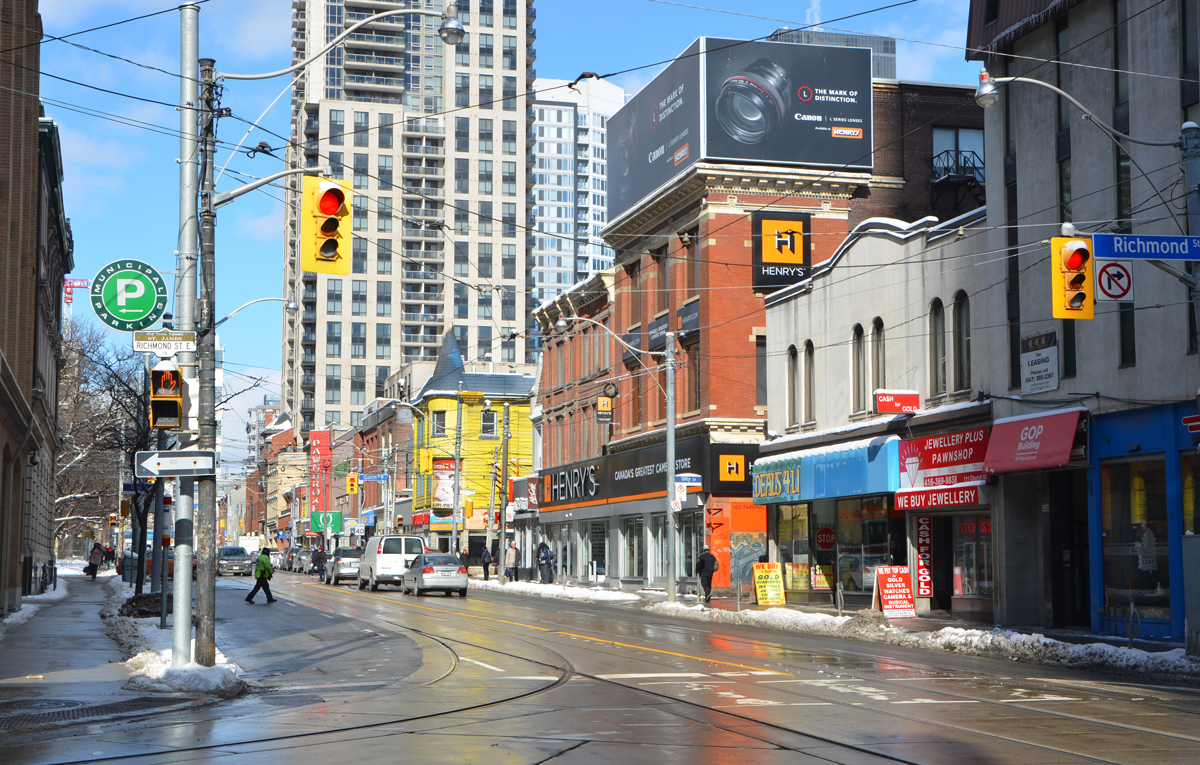
I was meeting a friend at Queen and Church for walkies and coffee last Monday. I was there a few minutes early so of course I took a few pictures while I was waiting. I had come across King Street because the streetcars tend to be faster on King these days. Plus, it was a nice day for a walk.
below: Looking north up Church Street from Richmond.

looking north on Church St. from Richmond Street, stores, street, people, street scene,

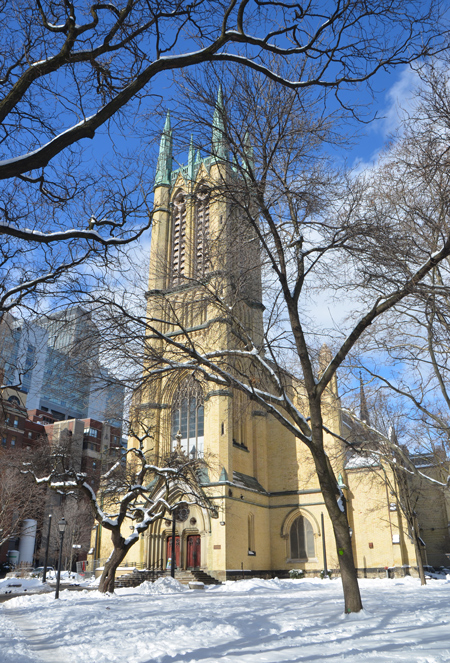
below: Metropolitan United Church is on the NW corner of Queen and Church. Even if you aren’t religious, there is something inspiring about the architecture. In this case, the setting adds to the grace and beauty of the building.  Usually there are people around but it was surprisingly quiet that day (too cold outside?)

front of Metropolitan United Church, with the snow covered park in front, snow, large trees, red door

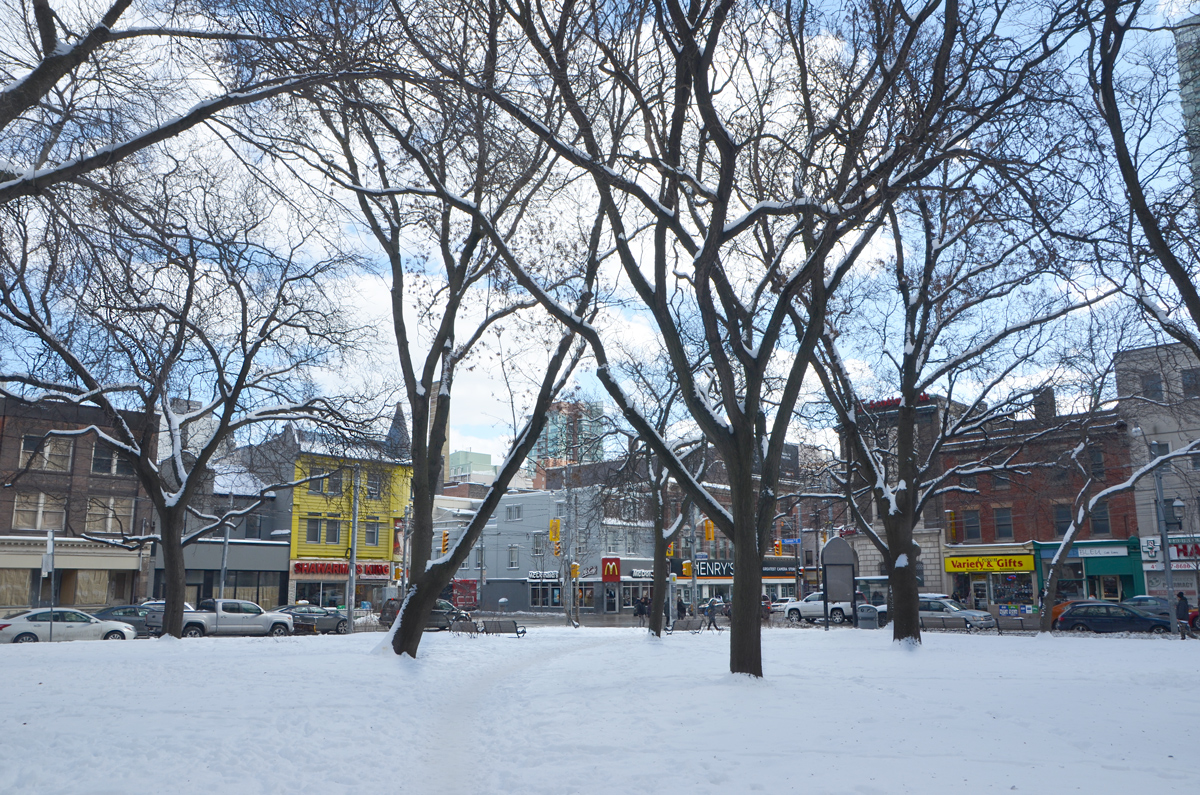
below: Take a few more steps towards Metropolitan United and then turn around. This is the view that awaits you. The intersection of Queen and Church from a different angle.
looking at the intersection of Queen and Church, through the park, with yellow building and other stores in the background

below: As I walked back to the intersection, this man walked in front of the streetcar. I think that he called himself either Cowboy Bob or Cowboy Bill.

man in long coat and hat stands in front of a TTC street car with his arm up in the air.

below: Church #2. Jarvis Street Baptist Church.

Jarvis Street Baptist Church, from diagonally across the intersection

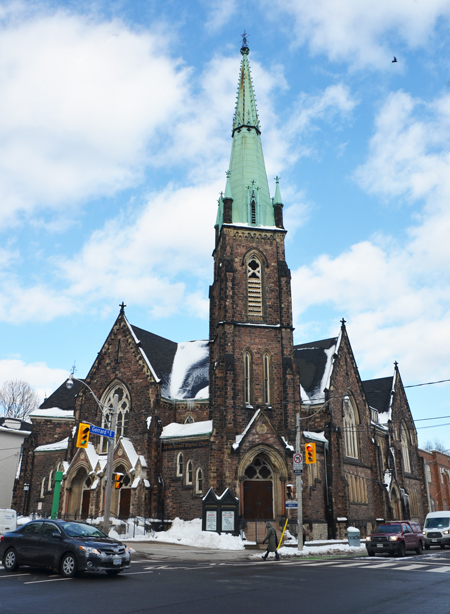
below: Yes, there are a lot of churches in this section of downtown. This is the third (and last for today’s blog) but there are many more. Grace Church through the trees.

park, in winter, with large mature trees, in the background is Grace Church, brick building with green roofed steeple

below: A stop at Allan Gardens conservatory for warm and a washroom. If this picture is looking a little fuzzy around the edges, my camera lens kept steaming up faster than I could wipe it off.

inside shot at Allan Gardens conservatory, with two people looking at the plants, glass roof, large yellow flowers

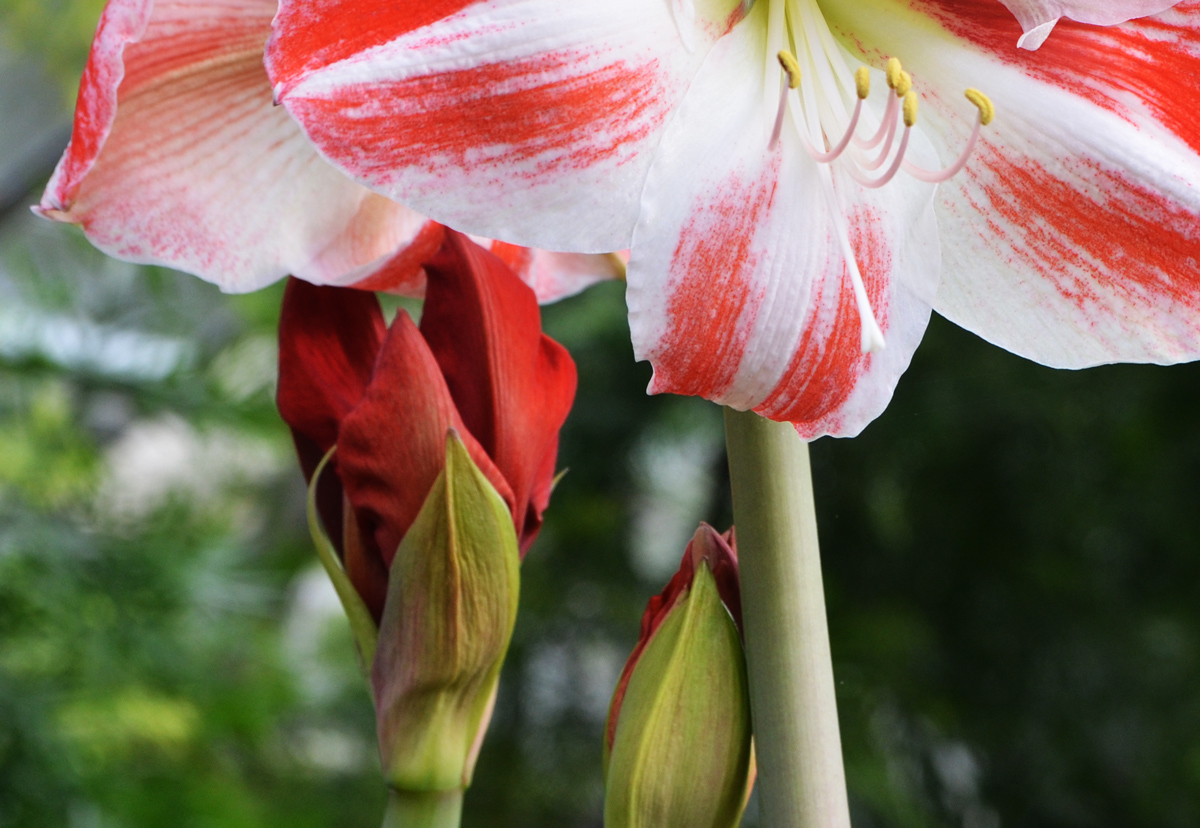
below: Every Christmas, the conservatory at Allan Gardens is decorated with many amaryllis plants. The other day, many were looking a little worse for wear. These buds were a few of the exceptions. At some point (soon?), the Christmas plants will be switched out for spring plants.

close up of two small red amaryllis buds at the bottom of a red and white amaryllis.

below: Barrel cacti in differing sizes in the Allan Gardens conservatory.

4 barrel cacti of differing sizes in a semi-circle in a conservatory, glass house, with some succulents in front and some taller cacti behind

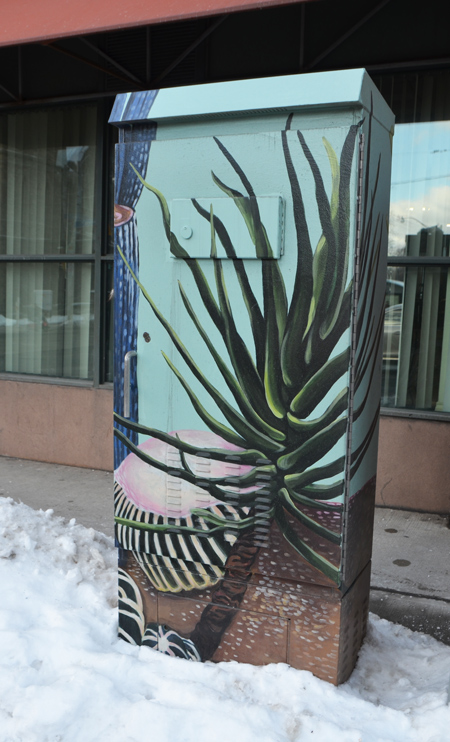
below: And just around the corner from Allan Gardens there is this painted cactus (or is it a succulent?) standing in the cold.

a metal telephone or traffic box on the sidewalk that has been painted with a picture of a cactus.

below: This part of Church Street is now in McGill Granby Village. There is even a lovebot on the pole.

street sign for Church St., with the top part being McGill Granby Village

below: “Enough is enough”, a large Church Street mural.

large mural on the side of a two storey building, with metal fire escapes on the side of the building as well. Mural is enough is enough, rainbow flag and other things

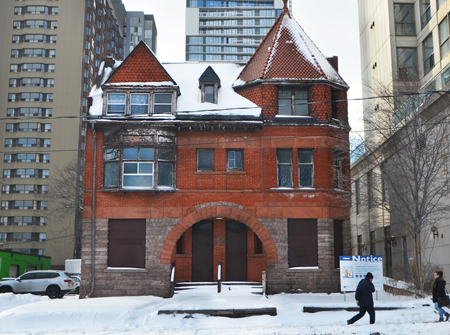
below: On Church Street, another redevelopment victim.

old, large, three storey red brick house with boarded up windows, about to be redeveloped, people walking past on the sidewalk, winter, street scene,

below: And just up the street, another.

an older two storey house house boarded up with construction hoardings in front, looking at it through a park with large trees, winter

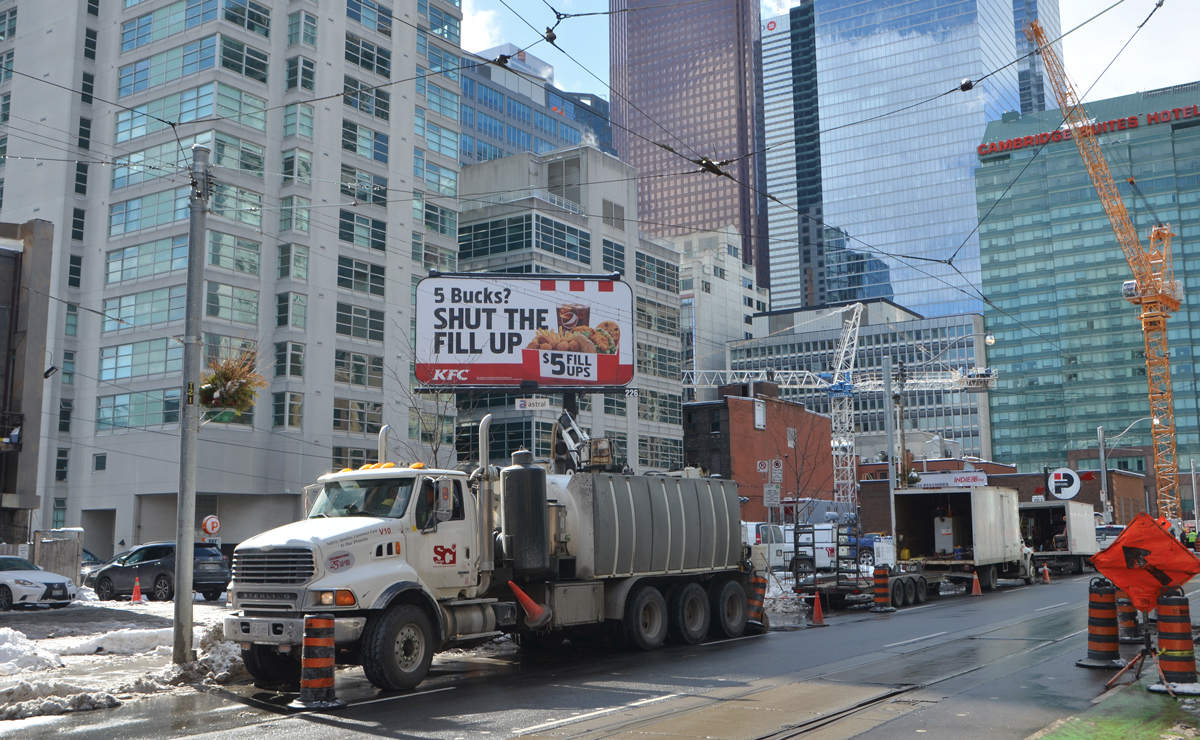
below: Trucks, construction, and condos. Ho hum. Been there, done that.

large truck parked on a street with tall buildings behind, and a large billboard with a KFC ad on it

below: One set of construction hoardings has been decorated with kids’ paintings.   Bright and cheerful.

white construction hoardings with childrens paintings on it. a painting of a soccer ball, kids playing, words too

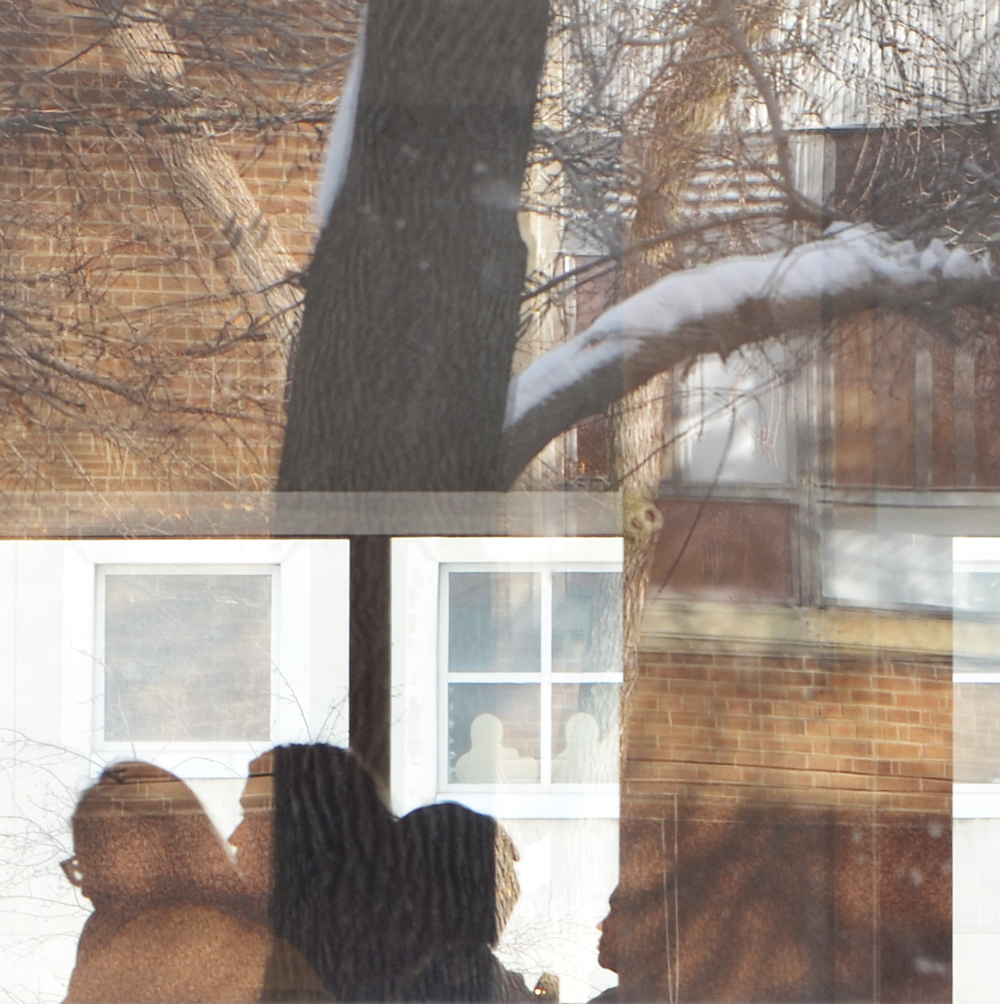
below: Through the layers

looking in a window, people sitting inside, looking through the window on the other side as well, a large tree is reflected in the window too

below: Icicles!

older yellowish brick building with green bay window, with icicles on the eaves of bopth roof and window

below: Trudeau senior looks down on the world.

 a large black and white picture of Pierre Elliott Trudeau in the window of the Ryerson Image Center, with a tree in front of it, some snow on the tree

below: The guys over the entrance to the Chang School at Ryerson are wearing little puffy white hats.

stone sculpture of the door of the Chang School at Ryerson, two men with interlocking arms, looking at each other, wheat, apples, and other produce in their hands, covered with snow


below
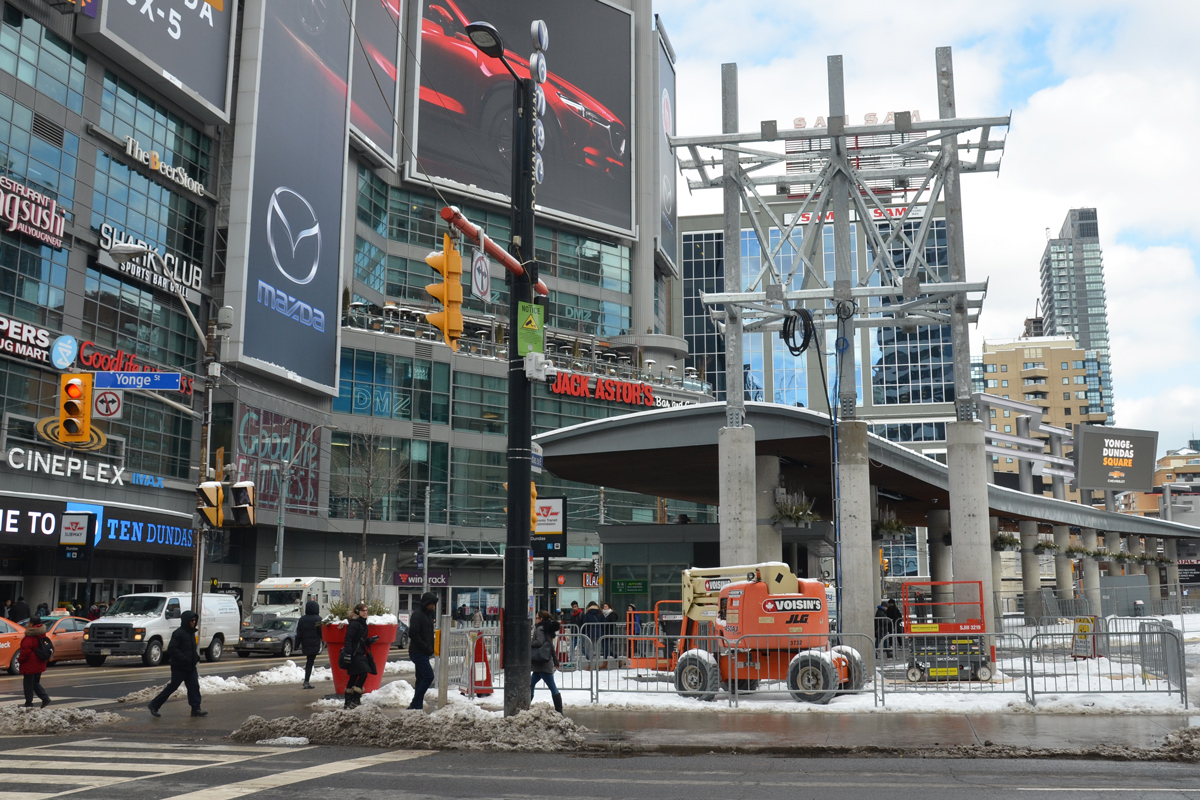
: As we walked past Yonge Dundas Square, I stopped, took another look, and then said: “Isn’t that a new sign?”. My walking partner replied that she wasn’t sure. Neither was I.

Yonge Dundas Square, men working on sign

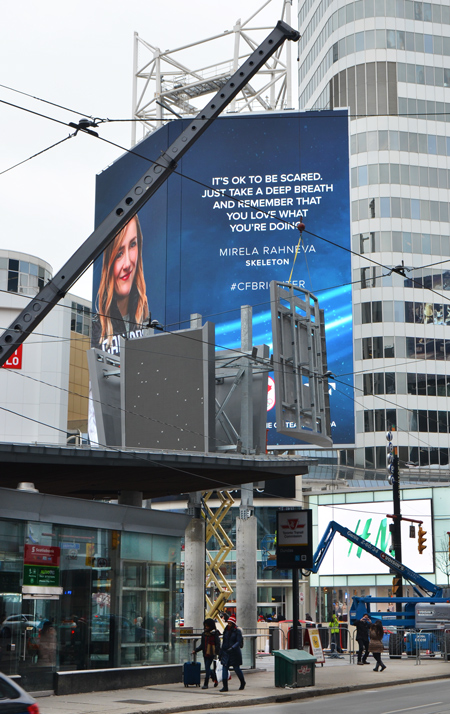
I happened to walk past Yonge Dundas Square again yesterday, and yes, there is a new sign. A big one.

below: “It’s OK to be scared, just take a deep breath” as the fourth panel of the new sign is installed.

a large crane is putting part of a new light sign in place at Dundas Square, large billboards and lighted signs behind, people walking past, street scene

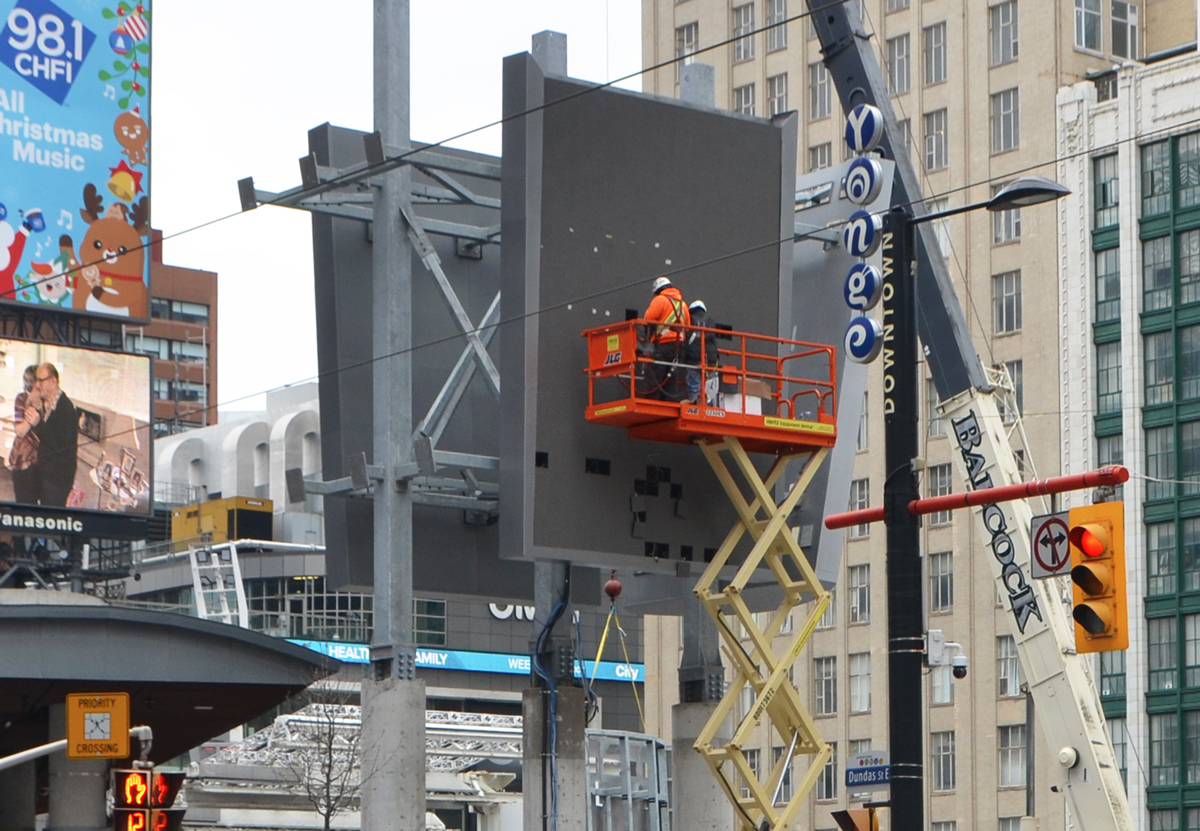
below: Working on the new sign. That billboard on the left, 98.1 CHFI is all Christmas music? Still? In February?

two men on a lift are working on a new elevated sign at Dundas square

C’est too for now friends!

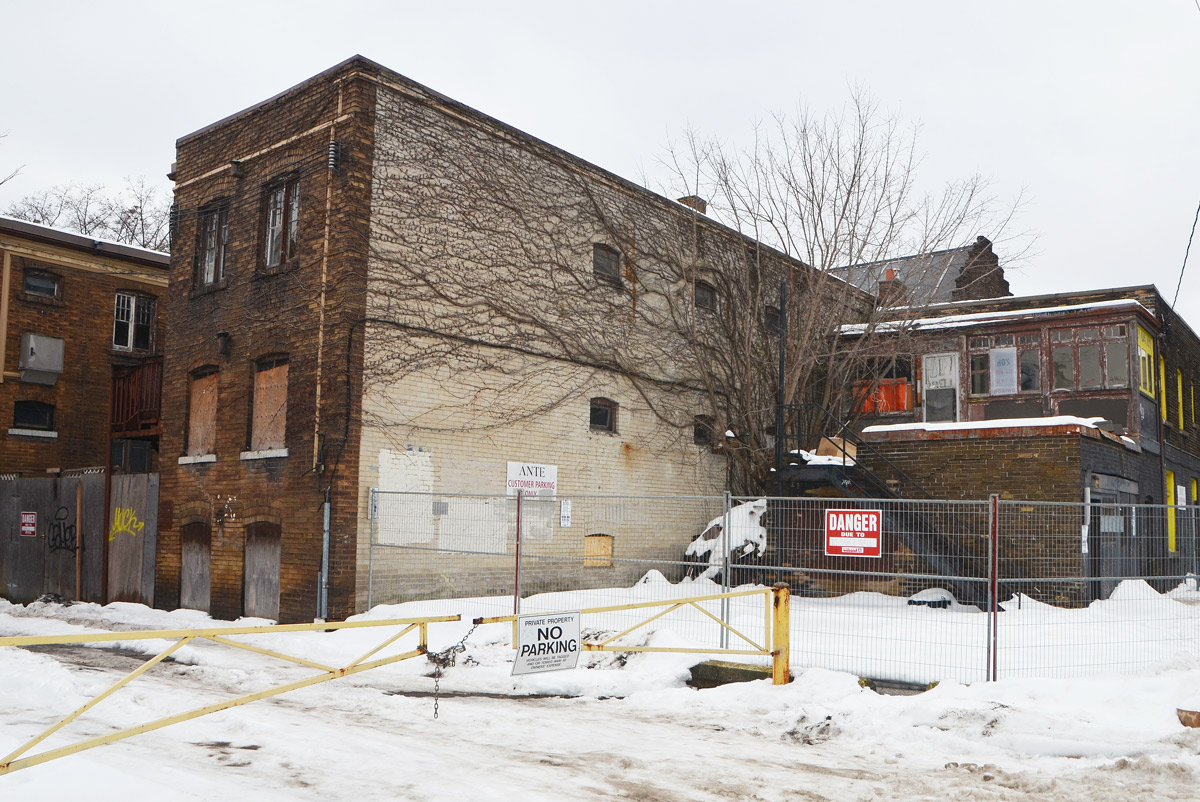
This is the story of one building at one intersection, Yonge and Belsize (just south of Eglinton) but it’s also a story that is being repeated over and over again in the city.  The story of demolition and rebuilding.  The story of loss of the older wood and brick structures as they are replaced by glass and steel.

By December 2016 all of the businesses had closed down.

row of two storey store fronts, old brick building, that is now empty and about to be demolished, on Yonge Street

Mars advert on Belsize convenience store, old brick building with large windows and blue window frame, snow banks on sidewalk, now empty

signs in the window of a store that has just closed down. one is a permit to demolish the building and the other is a hand written sign on orange paper that is a thank you note from the managers of the store to the public

below: The back of the building

back of a brick building, winter time, with snow on the ground, construction fence around it, windows boarded up

Just over a year later demolition began in earnest.

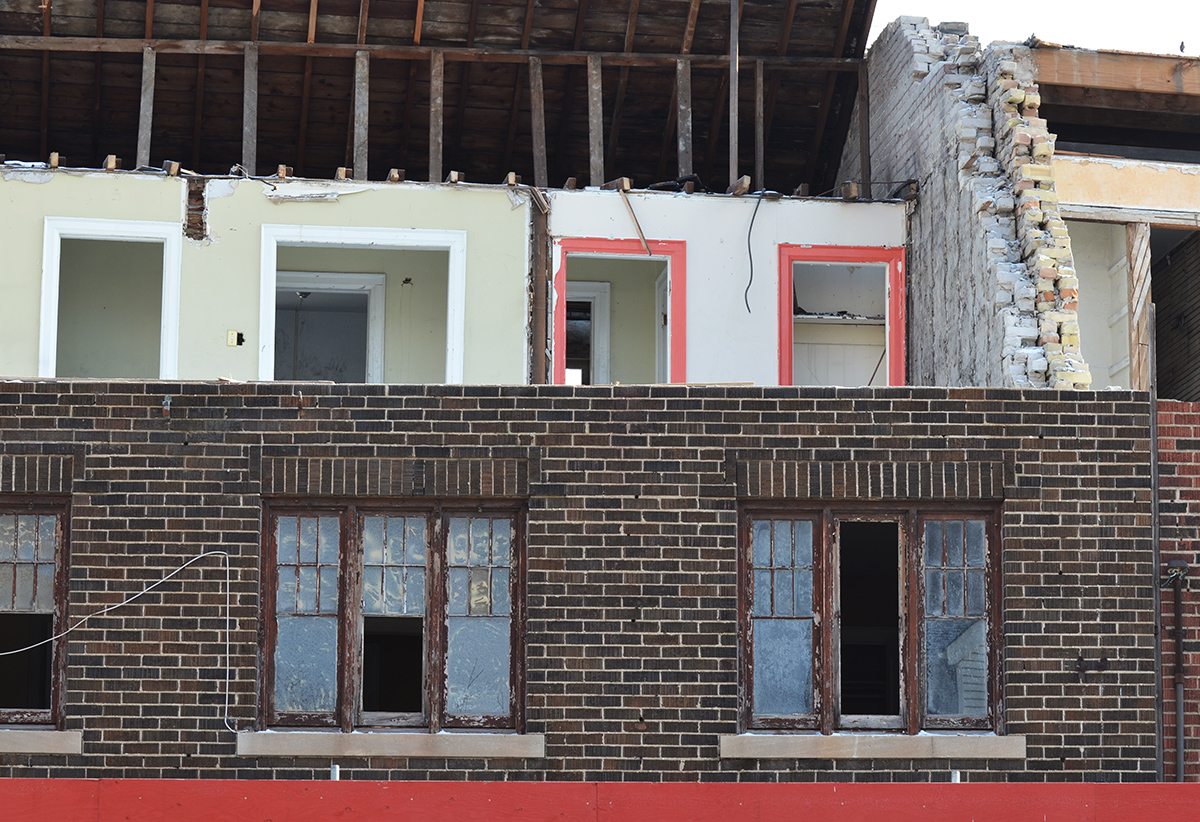
back upper storey of building being torn down, exposing office furniture that was abandoned

interiorwallson upper storey are exposedin building being demolished

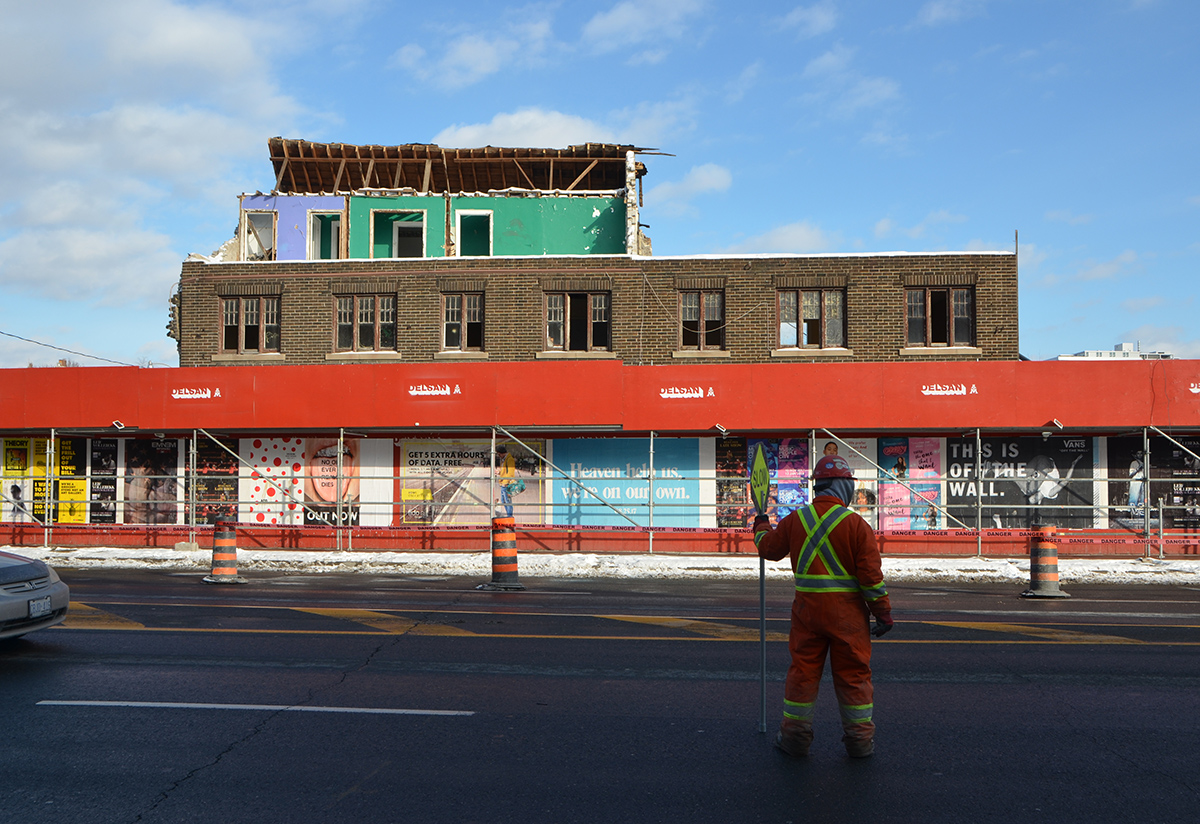
a construction worker in heavy winter orange clothes and yellow helmet, holds a stop sign to stop the traffic on Yonge street in front of a building being demolished

workmen standing around beside a front end loader that is being used to tear down an old brick building

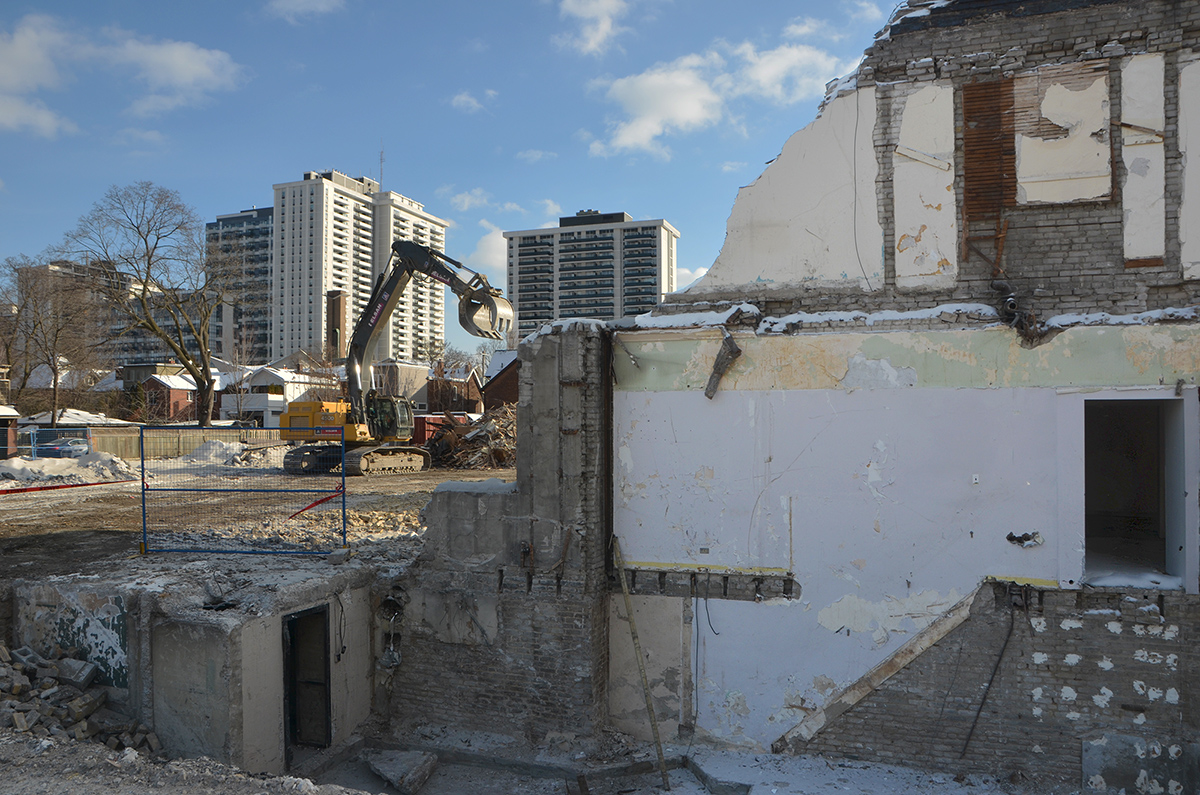
exterior of building being demolished, black door uperlevel with drop below

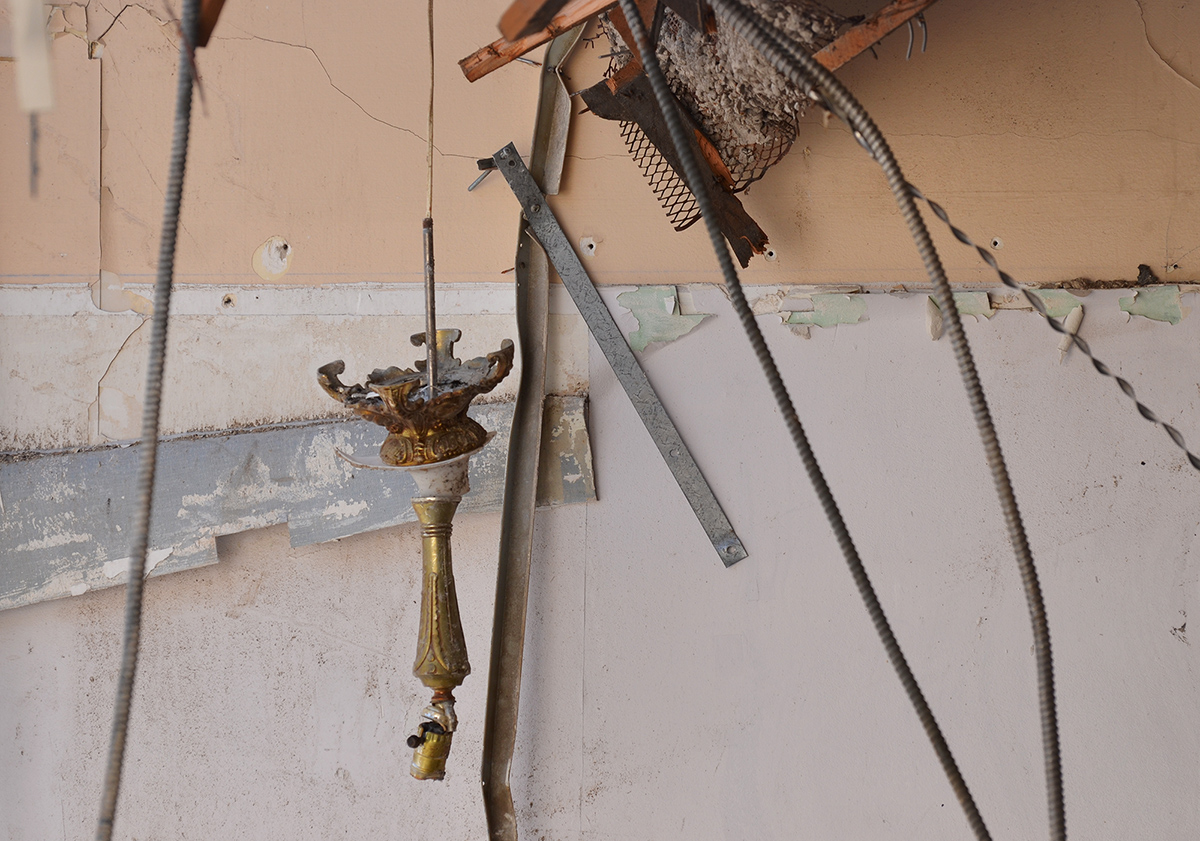
old metal water pipes exposed on green and blue interior wall when building being demolished

red plastic danger tape blows in the wind. one end is tied to a blue fence and one strand is also tied to a building being demolished

remains of an old building being torn down in the foreground, a front end loader in the middle, and apartment buildings in the background.

on old metal chair frame sitsin a room with a lot of wood debris around it

This is part of my ‘end of the year clean up and sort through photos’ process that I start most years at this time – I don’t always finish but that’s a whole other story.  One of the drafts that I found this morning was this post which I was in the midst of writing when the fan on my laptop died.   The technological hiccups have been dealt with and  on we go…. .   back in the fall I spent some time around Bloor and Spadina and this is the result.

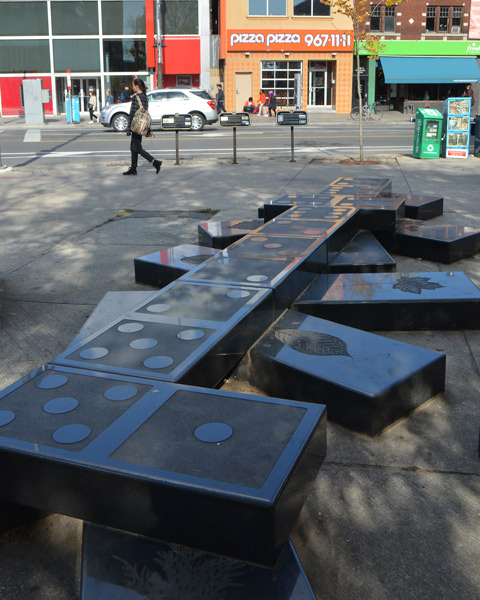
below: On the SE corner of Spadina and Bloor are these supersized Dominoes. It’s rather silly but I like the juxtaposition of Dominoes and Pizza Pizza.  This is also part of Matt Cohen Park.

sculpture of very large black dominoes on sidewalk, street and shops in the background, including a Pizza Pizza restaurant

below: The hoardings went up around Honest Eds late in October.   By the time you read this, most (if not all) of the building will be gone.

the start of grey hoardings going up around the old Honest Eds store on Bloor Street as preparations are made to demolish it

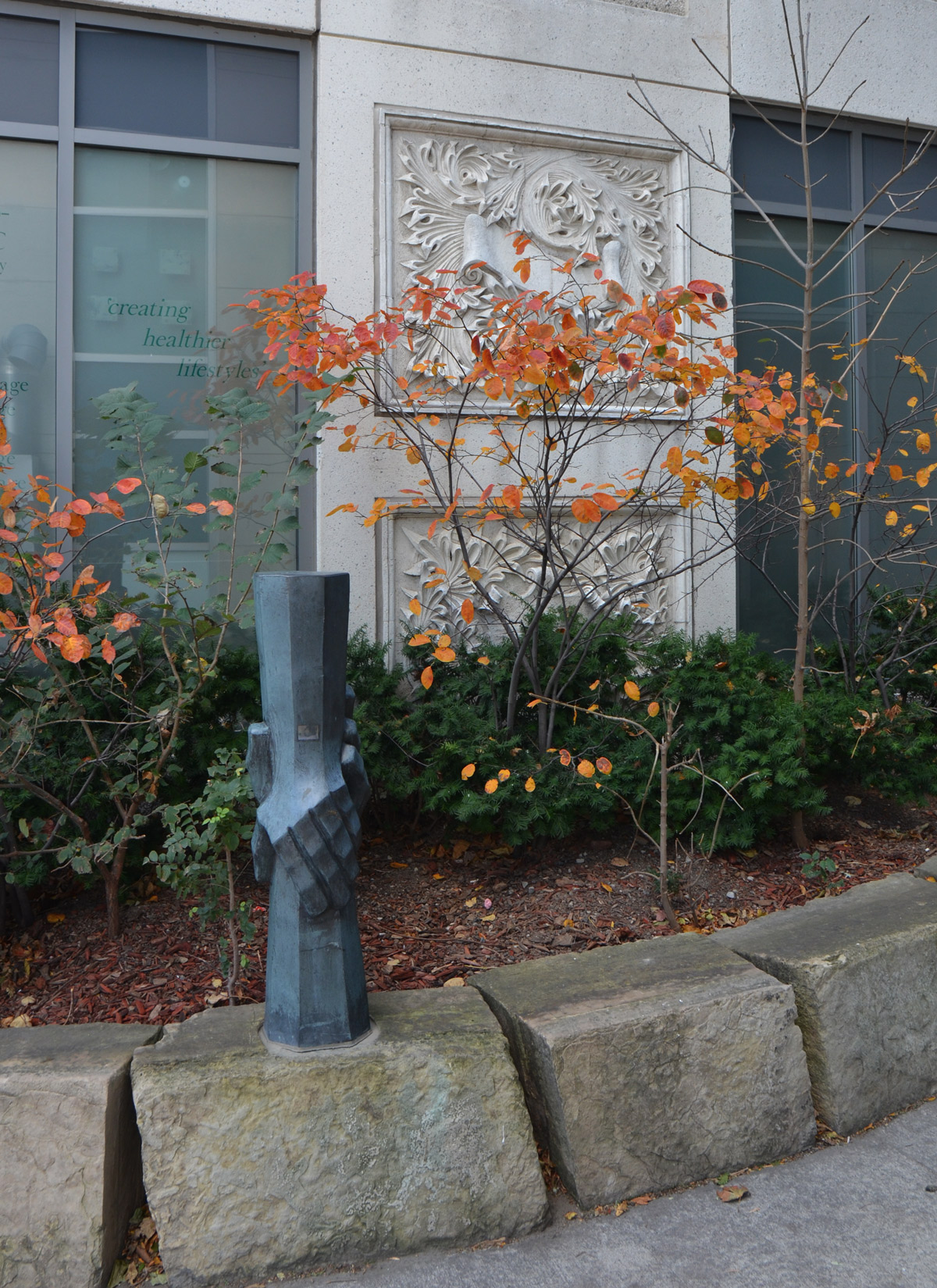
below: Jimi Hendrix Sculpture Garden includes the bronze sculpture “People helping People” 1990, by Al Green.  The sculpture also appears on the property of an apartment complex in Davisville – the connection being that the two properties were developed by the same family company (the Green family as it turns out).  The garden also includes two bas-relief sculptures on the wall.  These are reproductions of some of the decorative facades of the Victorian houses (1890’s) that used to be on this site until they were torn down in 2004.

a small sculpture of two hands holding, vertical, one hand from above and the other from below, in a small garden with some shrubs with autumn foilage, orange colours

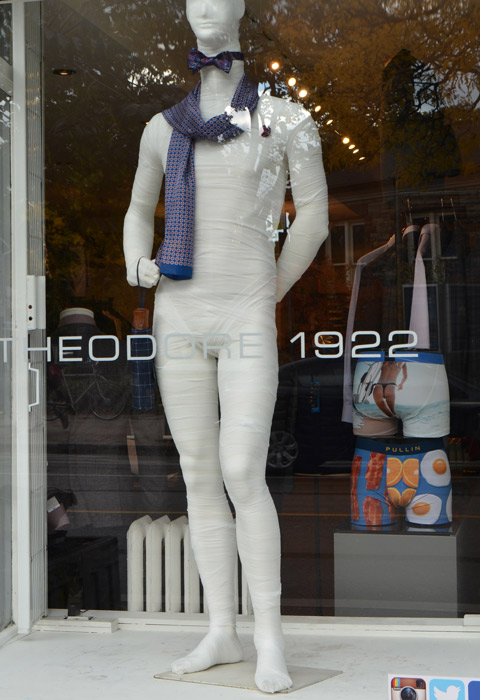
below: What the well dressed mummy was wearing this fall season.

a mannequin in a window of a men's clothing store, Theodore 1922, wrapped up like a mummy, scarf loosely draped around his neck, wearing a bowtie, and holding a folded up compact umbrella

below: There is not a lot of street art as you get closer to Spadina (there is more closer to Bathurst).  This garage door is one of the few pieces.

mural on an alley garage, black and blue predominant colours, some flowers, and birds

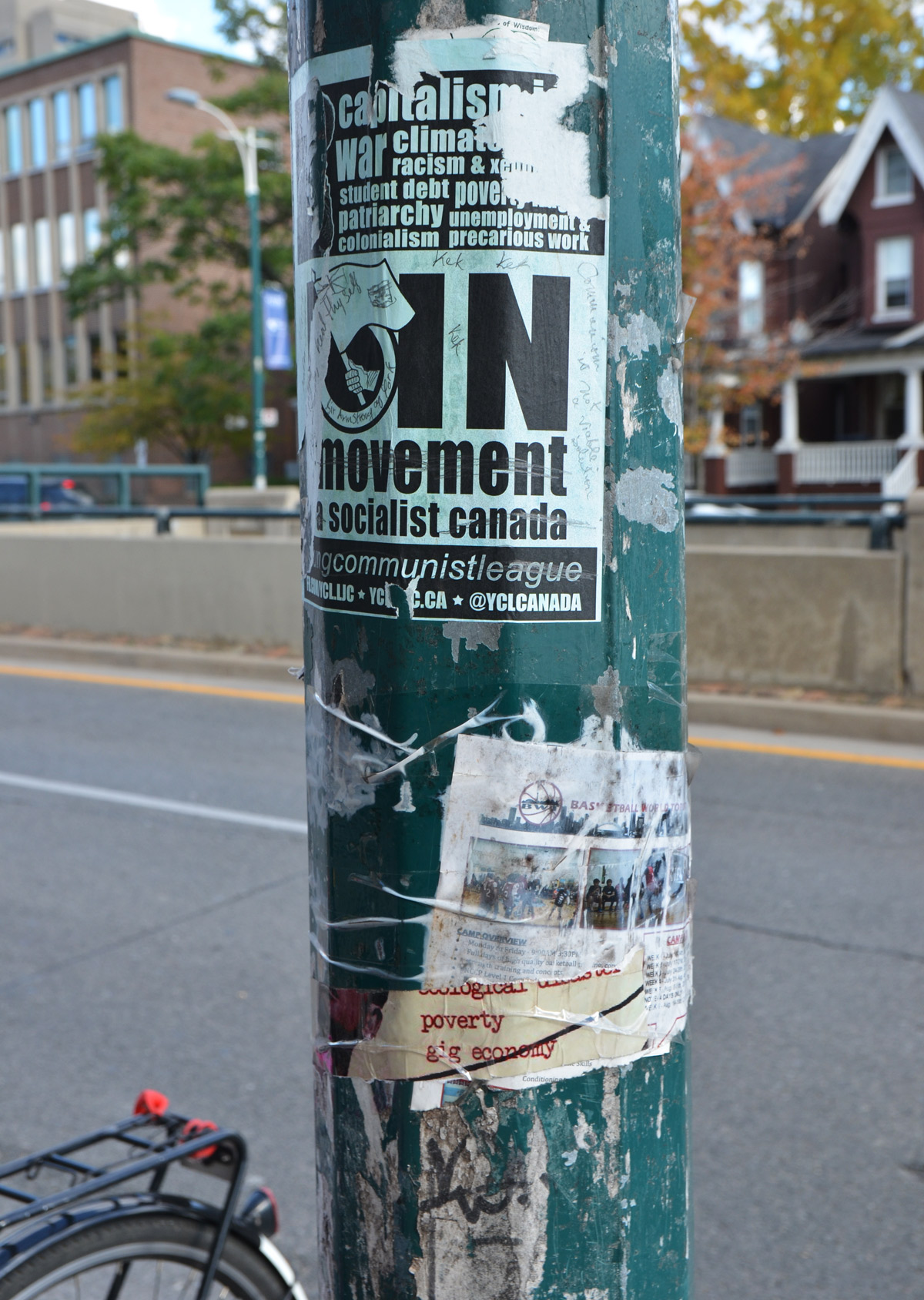
below: Poster for the YCL (Young Communist League) of Canada.

old posters on a a green utility pole, Join the socialist movement in Canada, gig economy,

below: The Ten Editions books store which sits on University of Toronto property.  There is some debate/discussion going on at the moment re the development of this site.  Ten Editions has been there since 1984.  At that time, the building was 100 years old as it was started its life 1885 as the John James Funstan Grocery Store.   The University of Toronto wants to tear it down so they can build a 23 storey residence on the site.

Ten Editions, a used book store on a corner, blue trim, large windows covered with white paper, door is open, stack of boos can be seen inside, old brick building

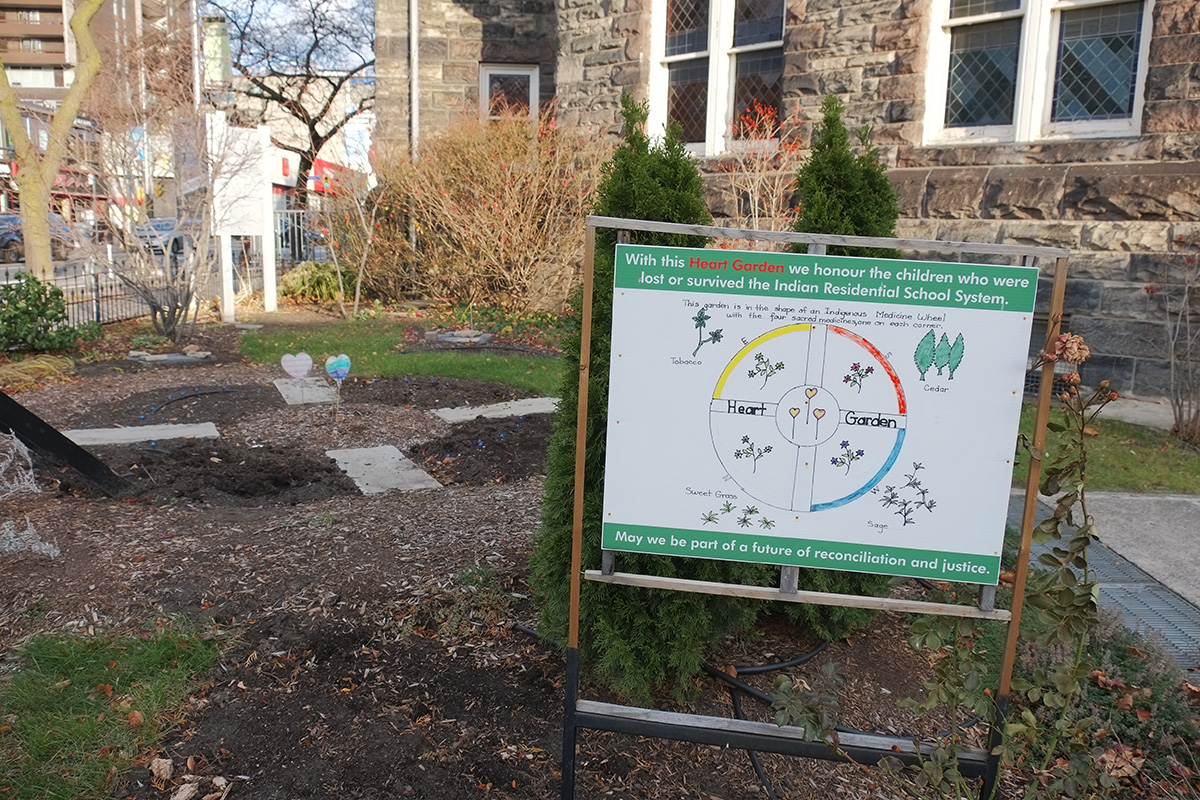
below: On the grounds of Trinity St. Paul Church is a sign that marks the spot of another garden.  This one is the Heart Garden and it is there to honour the children who were lost in or survived the residential school system.  “May we be part of a future of reconciliation and justice”.  It is designed in the shape of an Indigenous Medicine Wheel.  You can see the four concrete ‘paths’ that divide the wheel into four sections.  I have never noticed this garden before and it is unfortunate that the first time was late in the autumn when nothing was growing.  I will come back in the spring and/or summer to take a closer look.   Apparently it is part of a project, just one of many heart gardens across the country.

sign in a garden beside a church on a corner, autumn so there isn'tmusch growing in it, recnciliation garden

below: Walmer Road street sign.  Most of these green Annex signs have faded over time and it is rare now to find one in good shape like this one.

Toronto street sign, Annex neighbourhood, Walmer Road, top part of the sign is green with 4 houses on it.

As I type this, there is still snow falling from the sky, the tail end (I hope!) of the latest snow fall. ..  so you can expect some snowier pictures in the near future!

Traces left behind, reminders of the past

oldworn sign painted above the door to a store


Along Spadina on a cold November day – from King to College.

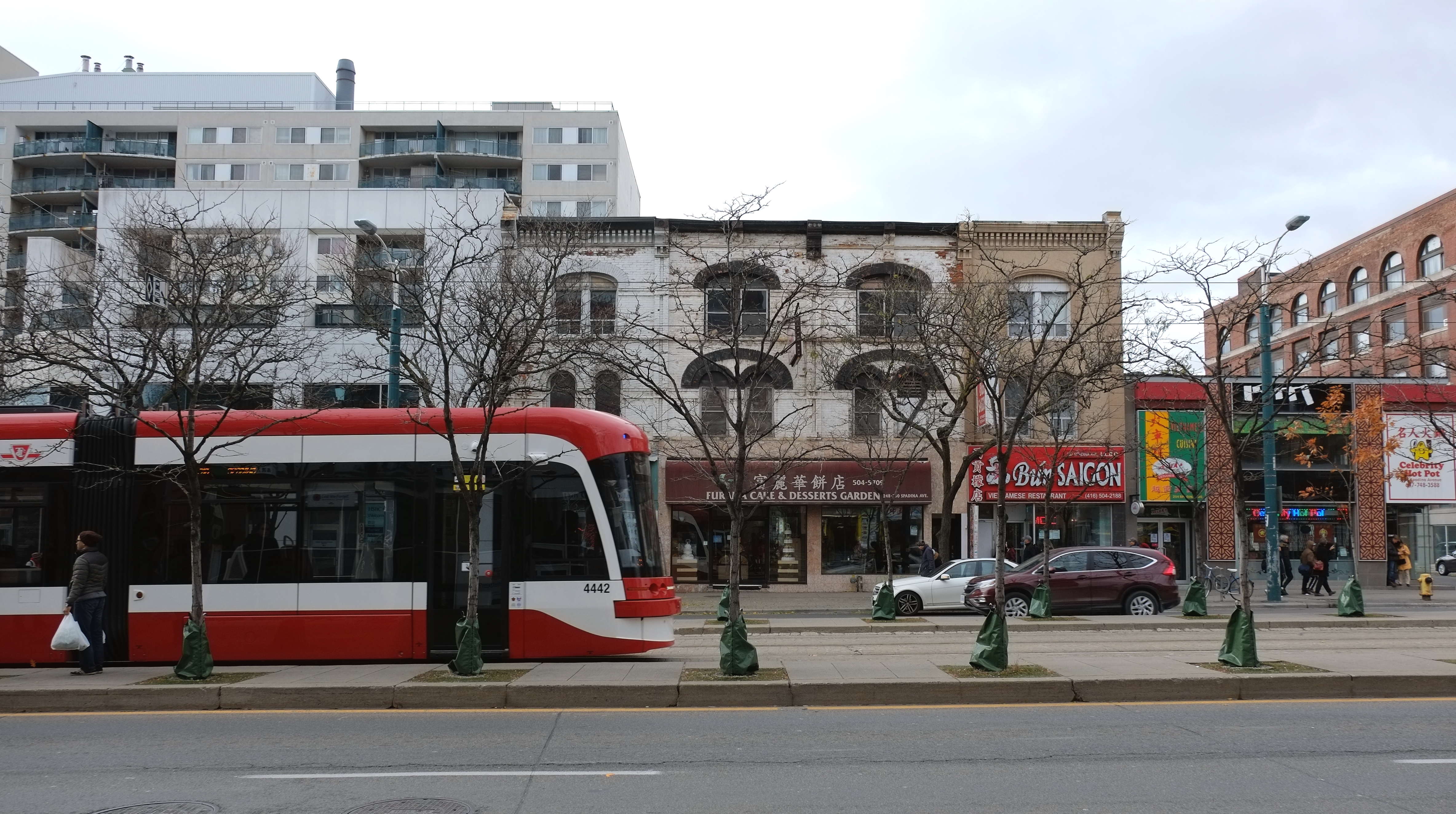
below: A streetcar passes by, down the middle of the road with young trees growing alongside the tracks.  In the background is an old white brick building  with rounded brown arches over the upper windows that now houses the Furama Cake & Dessert Garden – one of the many restaurants, coffee shops and bakeries along this stretch of Spadina.

a new ttc streetcar on Spadina, down the middle of the street, with young trees growing along side the tracks, old brck building in the background, some cars,

 Construction of Spadina Avenue began in 1815.  It was always a wide street, running between Bloor and Queen.

Spadina, and neighbouring Kensington market, was the center of Jewish life in Toronto in the early 1900’s with synagogues, delis, tailors, a Yiddish theatre, and more.  About 80% of Toronto’s Jews lived in the area.   It was also home to the garment district (also known as the fashion district) with its numerous furriers, clothing factories and warehouses – what we’d probably call sweat shops today.

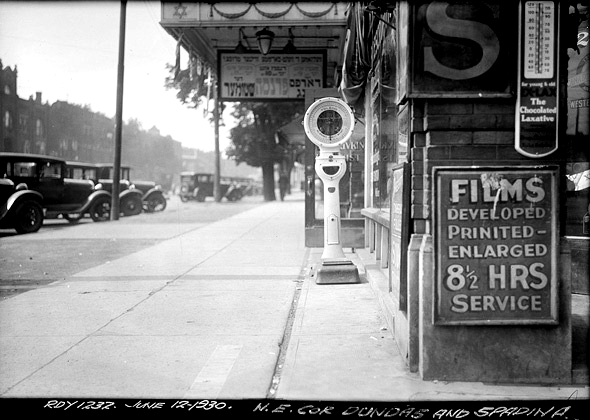
below: The northeast corner of Dundas and Spadina, June 1930 showing the sign over the door of ‘The Standard’ a Yiddish theatre that opened in 1921.  It was converted into a (mainstream) cinema in 1934 and renamed ‘The Strand’.   Another renaming occurred in 1941 when it became ‘The Victory’.  Twenty years later it became the Victory Burlesque.  The doors closed permanently in 1975.  Photo found on Bygone Theatre website.

vintage black and white phot of the sidewalk and front of Jewish cinema at the corner of Dundas and Spadina in 1930. old cars parked in front,

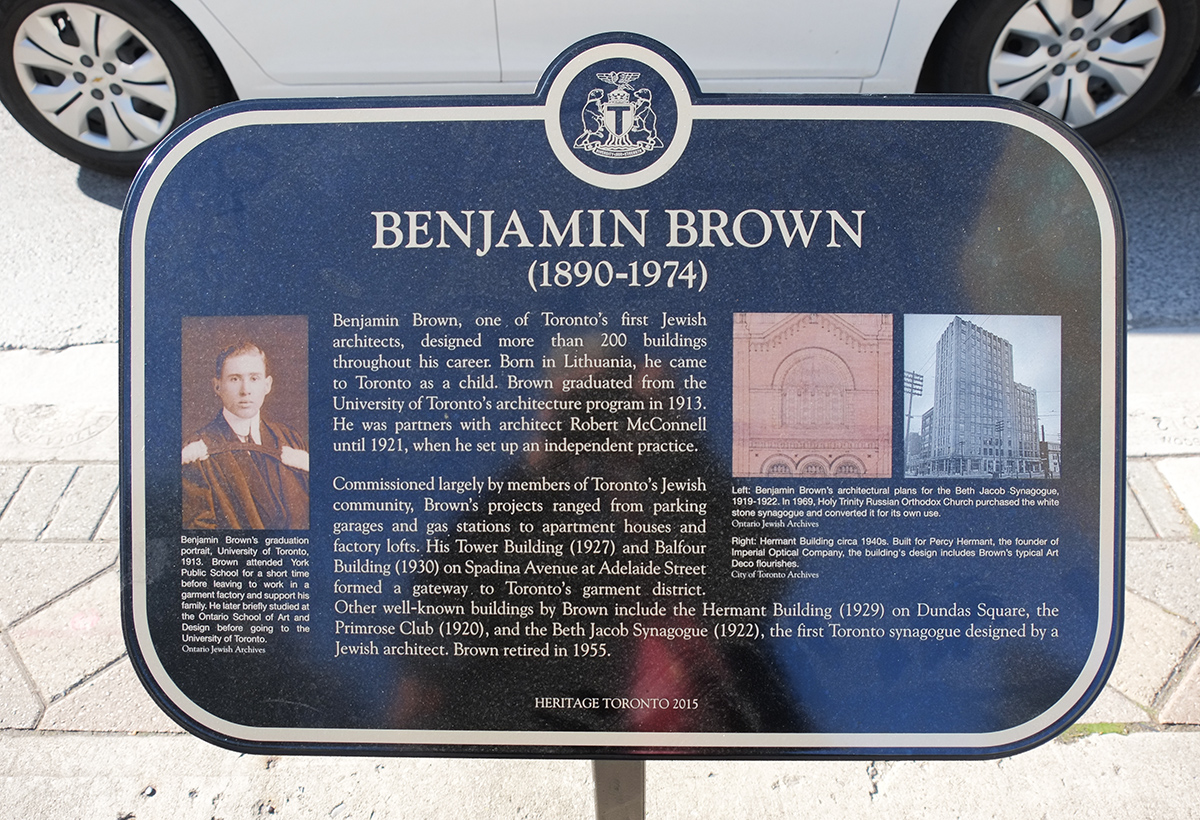
below: This plaque is on the west side of Spadina, just north of King Street.  It describes the contributions of Benjamin Brown (1890-1974), architect, to the area.

Benjamin Brown, one of Toronto’s first Jewish architects, designed more than 200 buildings throughout his career.  Born in Lithuania, he came to Canada as a child.  Brown graduated from the University of Toronto’s architecture program in 1913.  He was partners with architect Robert McConnell until 1921, when he set up an independent practice.

Commissioned largely by members of Toronto’s Jewish community, Brown’s projects ranged from parking garages and gas stations to apartment houses and factory lofts.   His Tower Building (1927) and Balfour Building (1930) on Spadina Avenue at Adelaide Street formed a gateway to Toronto’s garment district.  Other well known buildings by Brown include the Hermant Building (1929 on Dundas Square, the Primrose Club (1920) and the Beth Jacob Synagogue (1922), the first Toronto synagogue designed by a Jewish architect.  Brown retired in 1955.

toronto historic sites plaque to benjamin brown

Both the Tower Building and the Balfour Building still stand.  The later, pictured on the plaque is on the NE corner of Spadina & Adelaide.  It was named for Arthur J. Balfour, British statesman, the author of the 1917 Balfour Declaration that pledged British support for a Jewish homeland in Palestine.

below:  This is ‘Uniform Measure/Stack’ by Stephen Cruise and it includes that giant thimble on a stack of buttons,  a few button shaped tree planters, and a tape measure carved into the sidewalk as it goes around the corner (you can see a bit of it at the bottom right of the photo).  This tribute to the garment district, or rag trade if you want to call it that,  dates back to 1997.   A few years ago the tape measure was painted yellow – but not by the artist.  It has since been cleaned up.  Recent sidewalk work has scarred the tape measure but most of it remains intact.

public art on the corner of Richmond and Spadina, giant thimble and giant buttons

below: Another piece of garment district history – an old Singer sewing machine as an ornament above a narrow alley between two buildings.

an old SInger sewing machine sits on a beam that crosses a small alley bewteen two buildings, it's about 8 feet above the street level

In the 1960s and 70s, the Jewish population moved out and the Chinese moved in.  In keeping with the changes that were occurring on Spadina, The Victory was sold in 1975 and subdivided  into shops on the main floor and a Chinese language cinema upstairs, first named the Golden Harvest and then the Mandarin. This cinema closed in 1994.

In the late 60s and early 70s, the city demolished a large section of land to make way for the new city hall.  At that time, Chinatown was centered around Dundas and Elizabeth streets.  Many of the Chinese who were displaced by the construction moved west along Dundas to Spadina.  Although many of the Chinese businesses and residents have moved north to Markham & vicinity, this stretch of Spadina is still considered to be Chinatown.

below: A panda eating bamboo, painted by Murals by Marg with support from Chinatown BIA & StreetARToronto.

mural on a wall of a panda bear sitting on the ground and chewing on bamboo

below: Another Chinese themed mural, with tags unfortunately.

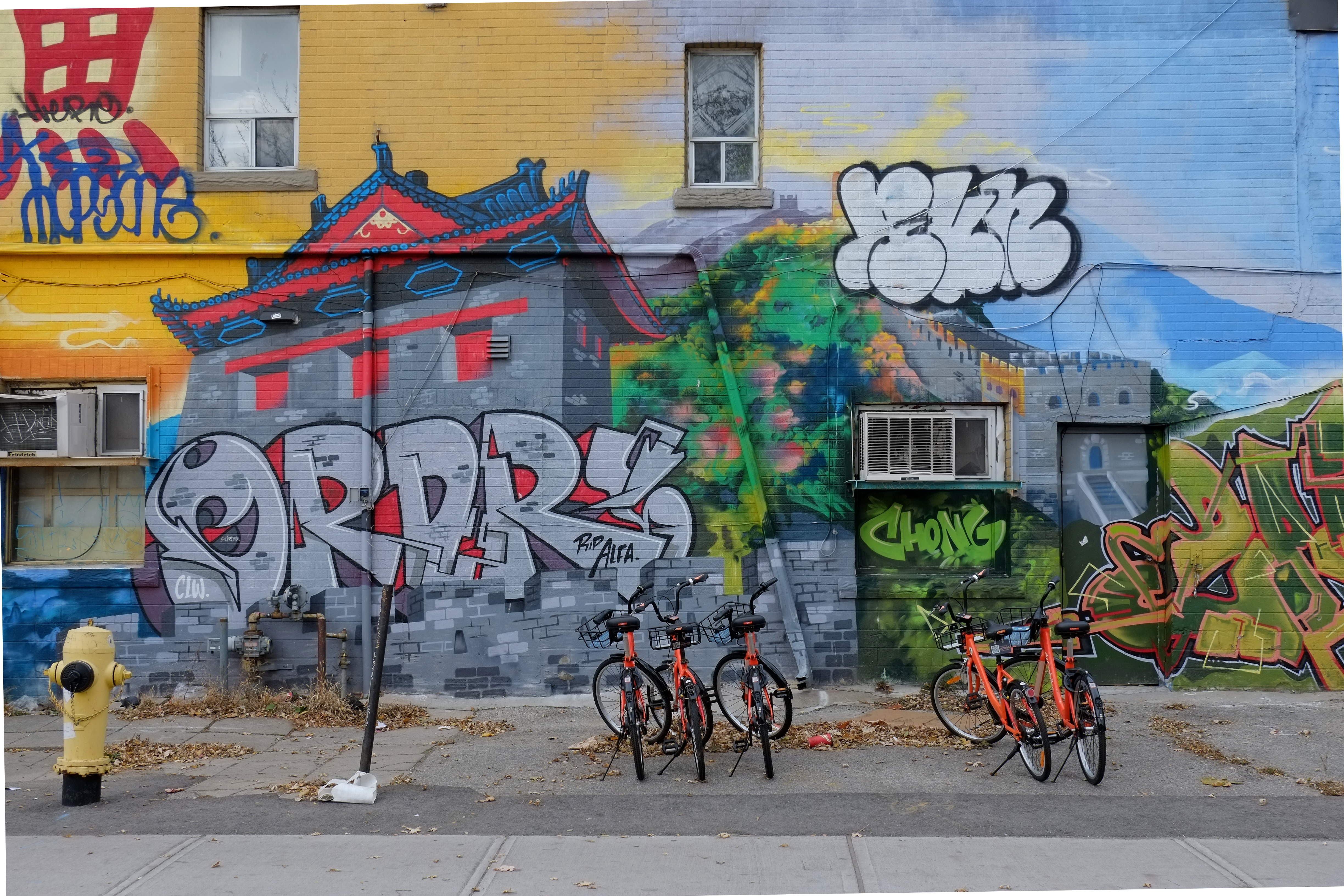
orange bikes parked outside a building that had a mural of a Chinese scene that has been tagged over.

below: This caught my attention – Does it look like fresh ginger?   And no, there was nothing in front of the sign either.  Smile.

box of pineapples for sale outside a Chinese grocery store, the sign by the box says fresh ginger

below: Even on cold days you can buy fruits and vegetables on the sidewalk outside the Chinese grocery stores.

a woman is buying tomatos from a vendor with a large table of tomatoes outside a Chinese grocery store on Spadina, in CHinatown.

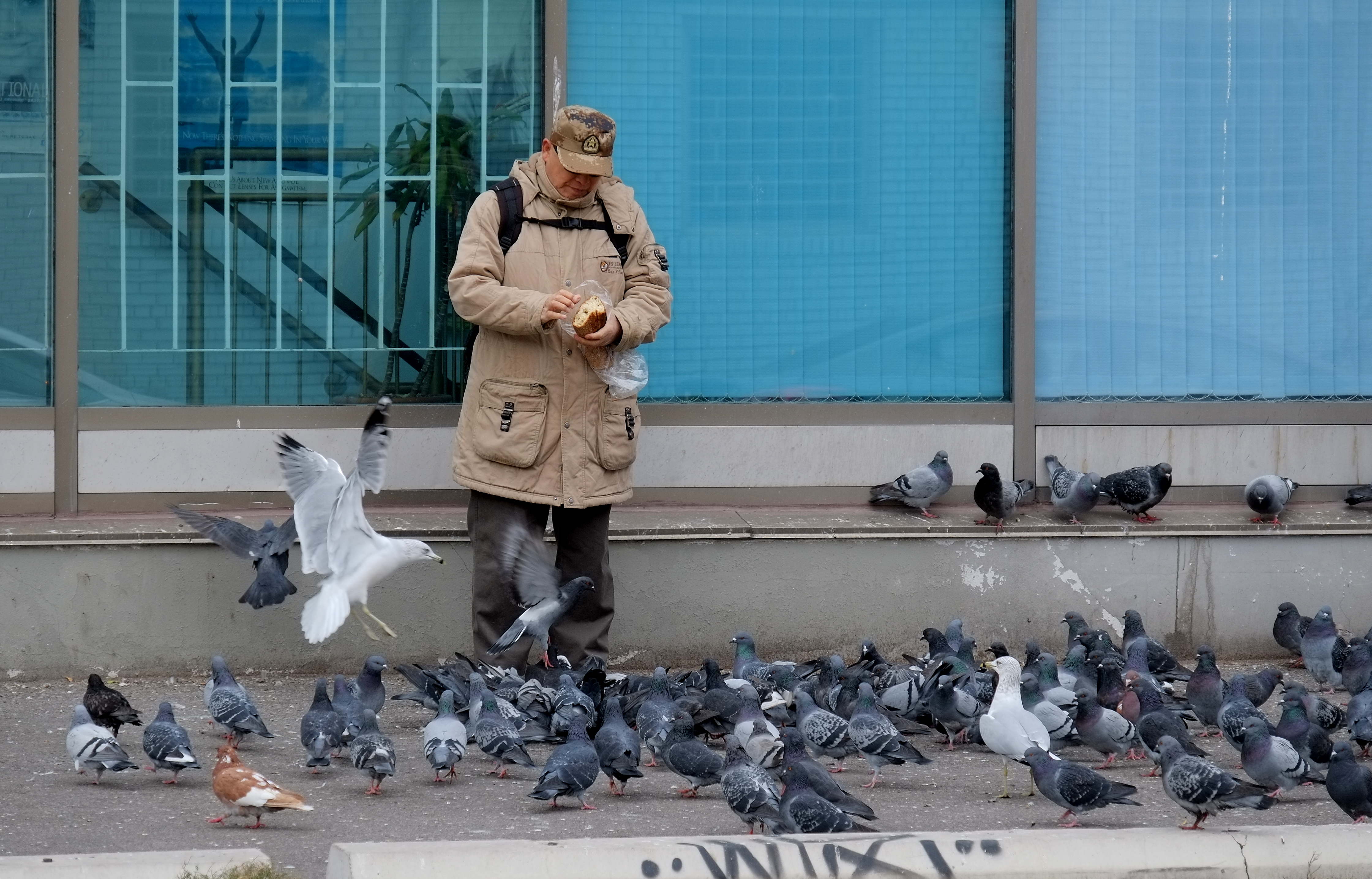
below: Feeding the pigeons.

a man is feeding pigeons outside on a cold day. He is wearing a heavy coat and a hat.

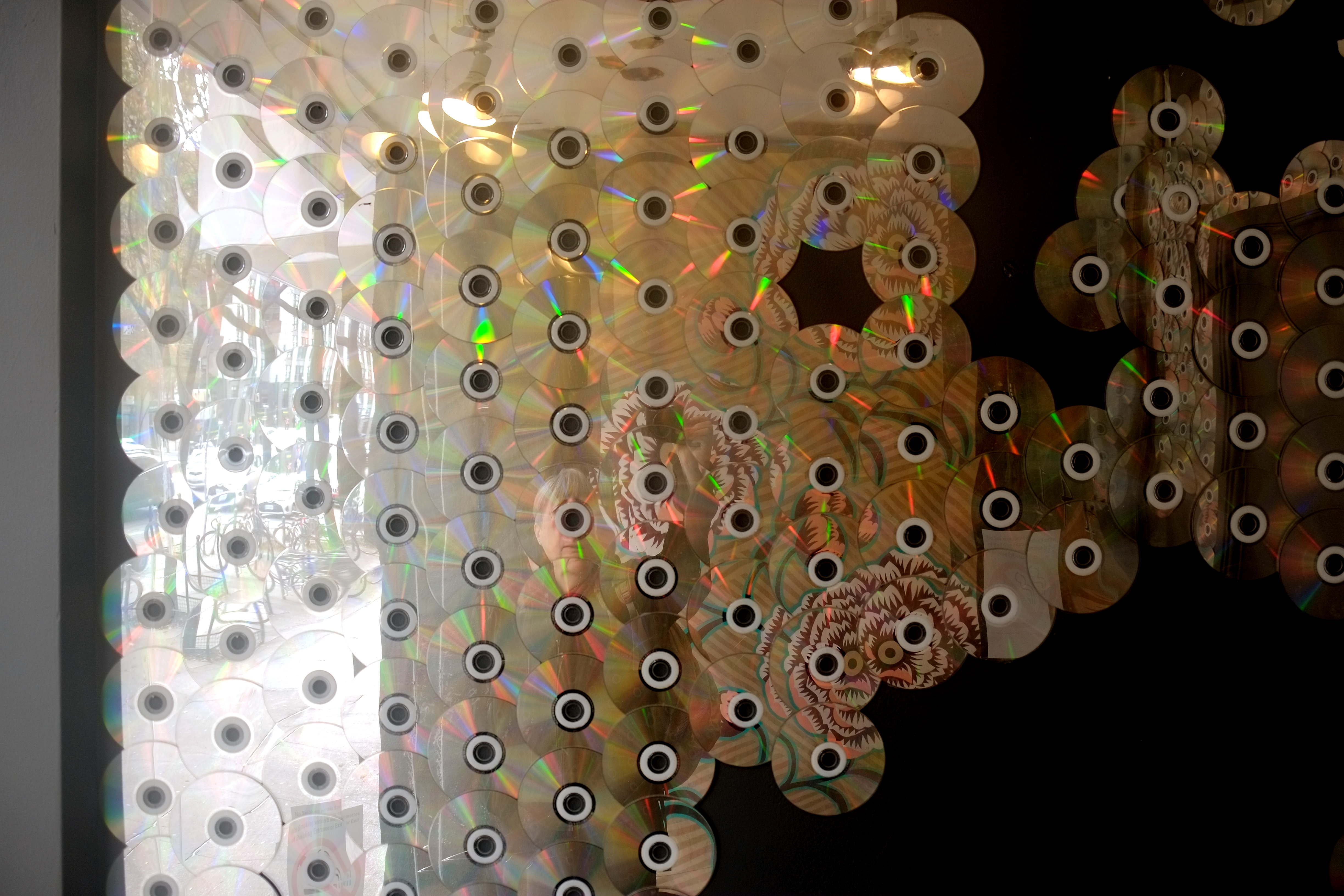
below:  This is an old display of CD’s mounted on a wall inside a window of an empty store.  The window is dirty but if you step into the recess of the entrance way, you can see the possibility of reflection, light and colour playing together.   This was actually the first picture that I took when I walked up Spadina the other day.   After I saw this window I started paying closer attention to other empty stores.

design and pattern made with many old CD's mounted on a wall inside the window of an empty store.

There are quite a few empty stores and sections of Spadina are quite grubby looking.  As I mentioned above, many of the Chinese businesses have move on and once again the area is the middle of a change.

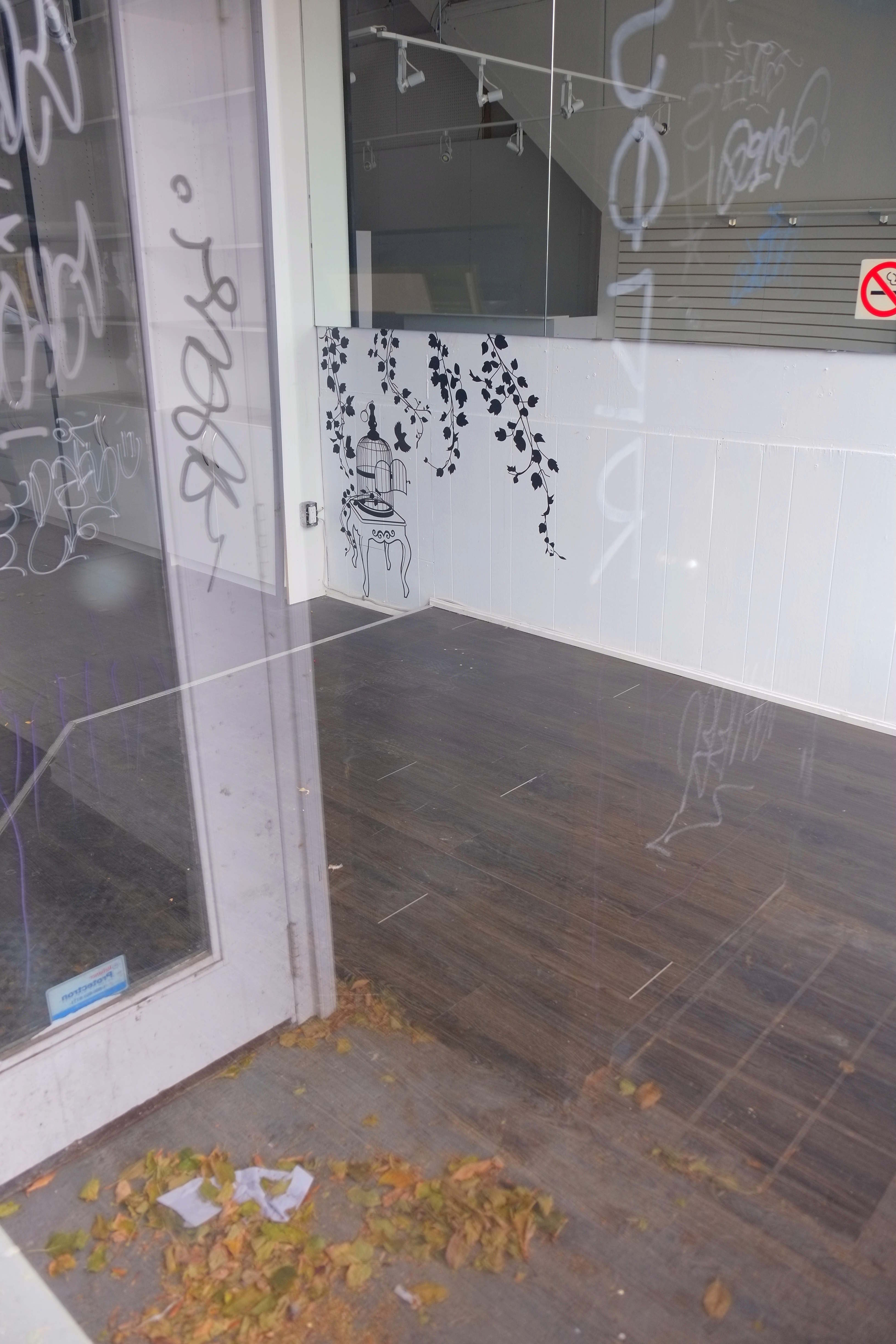
below: Someone cared enough to paint this delicate birdcage and ivy scene on the wall.  Doesn’t it make you wonder who did it?  and why?  and what happened to them?

looking through a window into an abandoned and empty store, leaves have blown in and are on the floor.

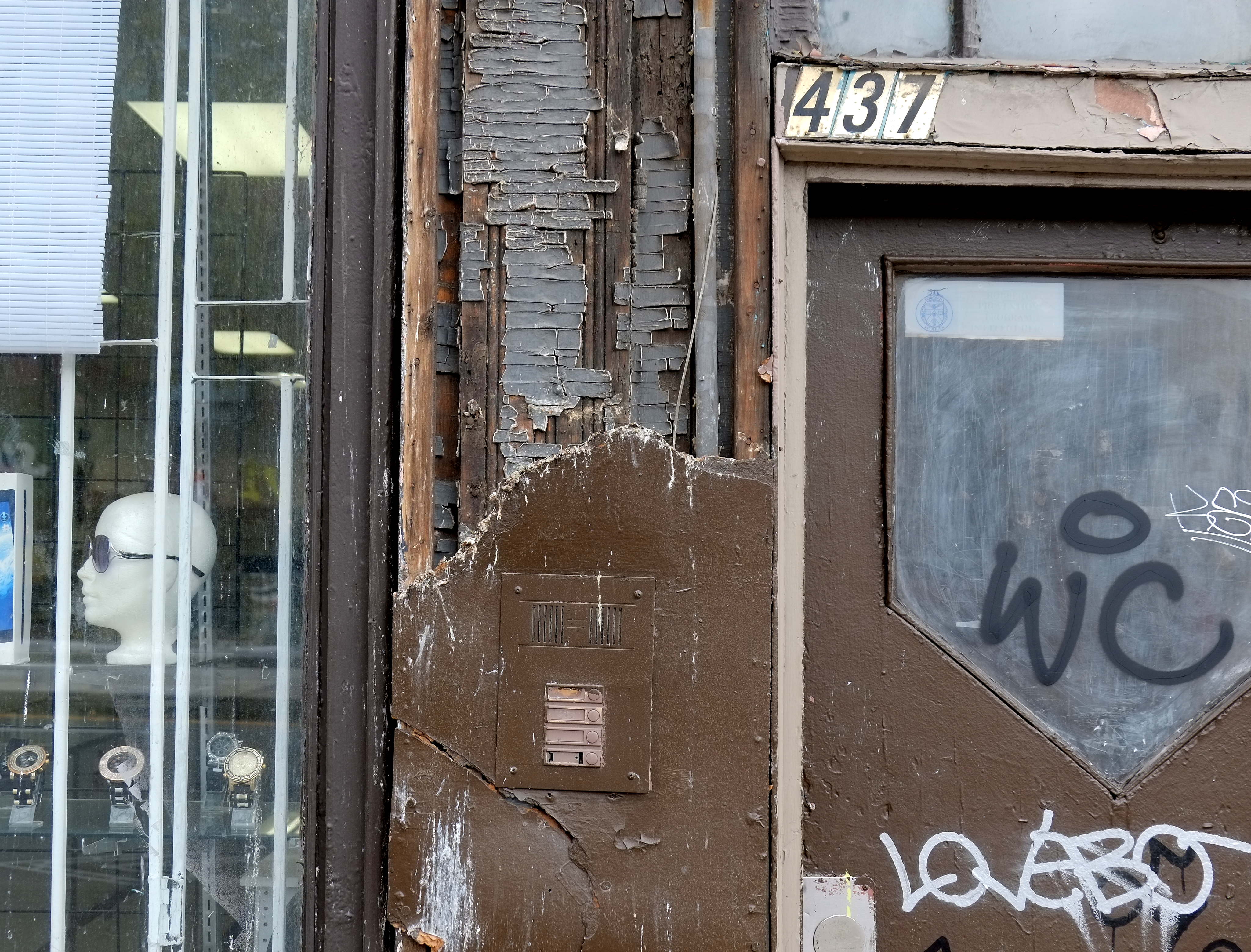
below: A painted over intercom –  a remnant of the past.  But the plywood that the intercom was mounted on is partially torn away to reveal an even older, more hidden, past.     Does anyone live or work at 437 anymore?  What lies behind the door?

exterior wall, brown paint, number of 437 above the door, cracked wood plywood beside the door, old and broken intercom system that has been painted over, next door window is a store, with mannequin head on a shelf

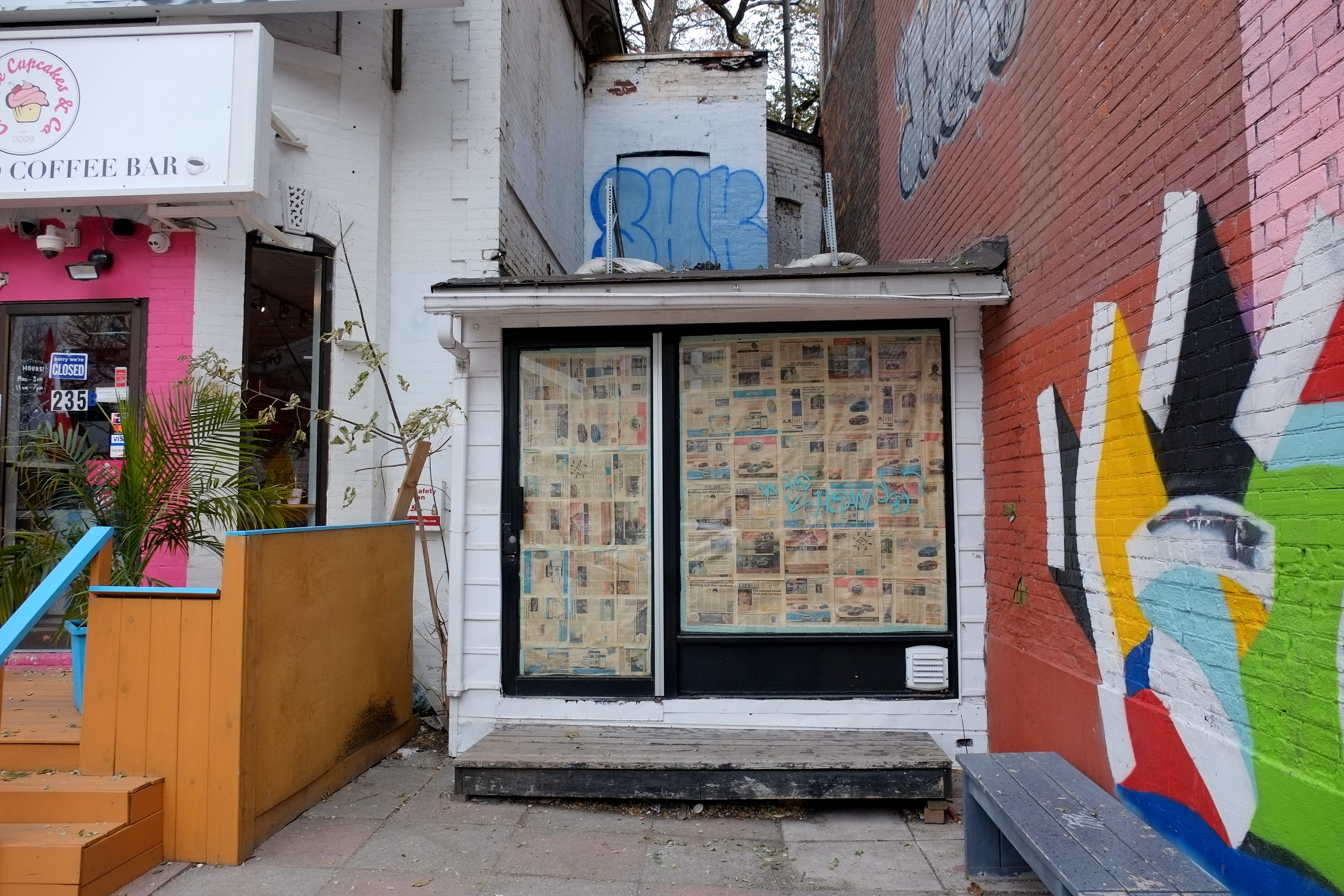
below: This little place had a short life as a store – but for the life of me I can’t remember what it was.   I think that once upon a time it was an 8 Eleven (play on 7 Eleven stores) but that was long ago and I know that it closed before I first saw this space.    How easy it is to forget.

very small building with door and window papered over.

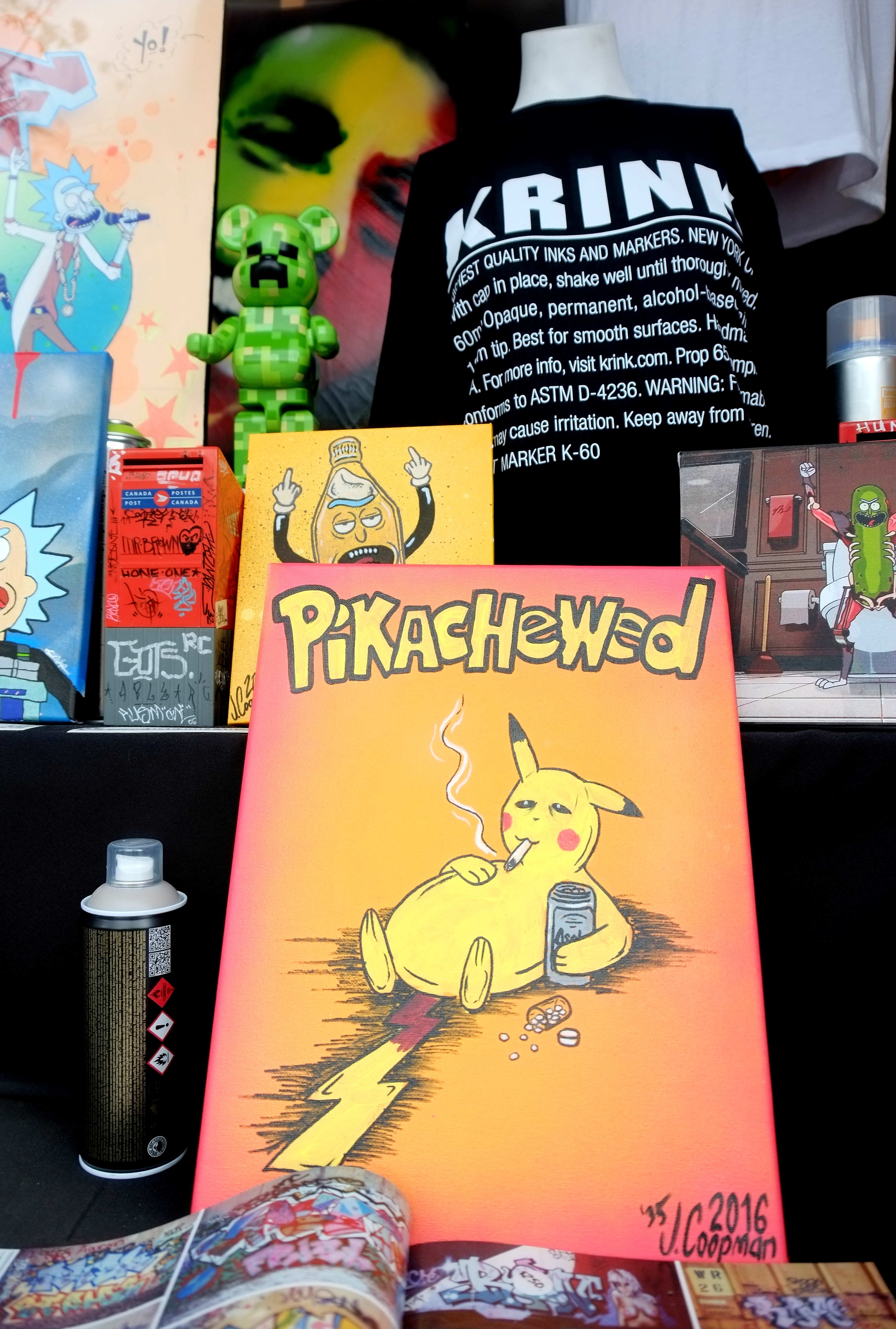
below:  As I passed by this window, I thought to myself “How cute, pikachu.”  Then I stopped and went back.  No, not pikachu.  Part of the seedier side of Spadina Avenue.

articles for sale in the window of a store

below:  Layers.  On the left, hoardings around an old building being demolished and on the right, a staid brick building.  Behind them is a newer development with its bright east wall.

street scene, Kensington, with hoardings for demolition, a building from the70's and a newer apartment building in the background with bright coloured squares on the side.

cracked brick wall and decorative carving, on upper storey of an old building

a pair of Bell telephone boxeswith a grey wall behind


It’s early November and autumn is here – I think.   Some leaves, like on the locust and maple trees below, have turned colours and begun to fall but others remain green and on the tree.  After the warm than usual October that we were fortunate to have, the weather has turned to grey and damp and all too seasonally November.   Luckily, a heavier coat and a scarf is all that is required – so off we go!

autumn street scene with locust tree with yellow leaves, sidewalk, some dead leaves on the ground, grass still green, orange leaves on the tree in the background

below: I spotted these little rusted Coke and Sprite signs on a house on Christie street.   Like the autumn leaves, the weather has changed their colours and I especially like the pale turquoise that the Sprite bottle has become.  It nicely matches the trim on the neighbour’s house.

three old rusted advertising signs for coca cola and sprite, metal signs, upper level of a building

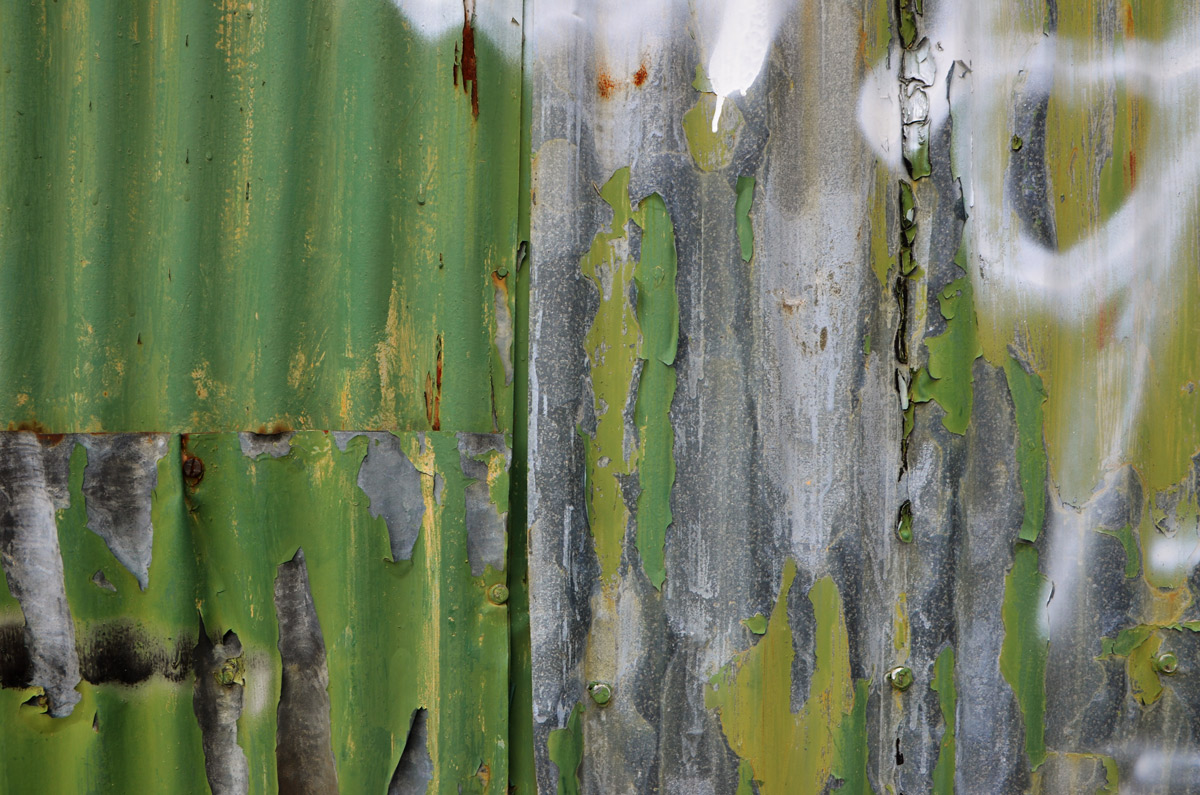
below: Another example of the effects of time on metal.  A little less rust here but there are some interesting shapes and forms created by the peeling paint.

metal corrugated metal wall, close up detail of peeling green paint and rust

below: Looking into a shop window to see a sad and lonely cat.  Sad eyes?  or are they eyes of a cat dreaming of the outside world and wishing it wasn’t relegated to a shelf of old and empty things.

looking into a window of an antique store, a porcelain cat, sitting upright, with sad look on its face, on a shelf with empty bottles and jugs

below: More old, but certainly not sad.   It’s a bright, shiny and obviously well-loved Chrysler.

an old orangish brown Chrysler car parked in a driveway, front facing the street,

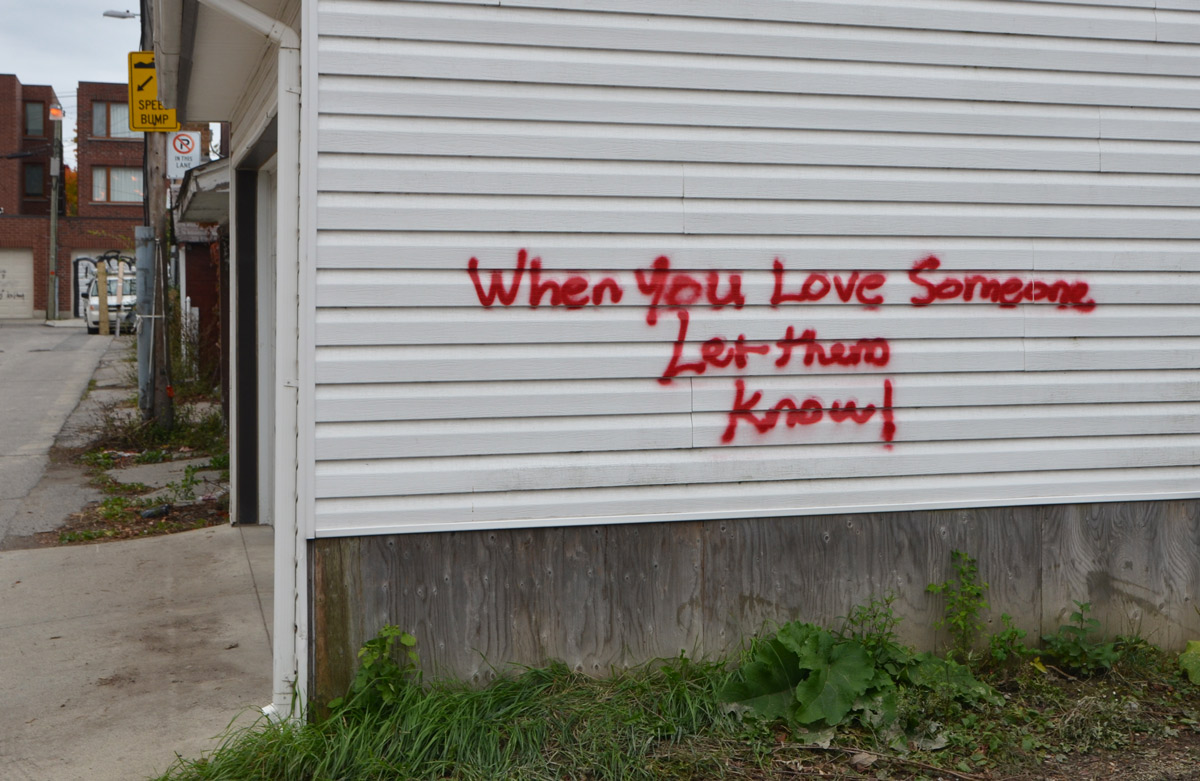
below: Advice to heed.

red words painted on the side of a white building in an alley, words say - When you love someone, let them know

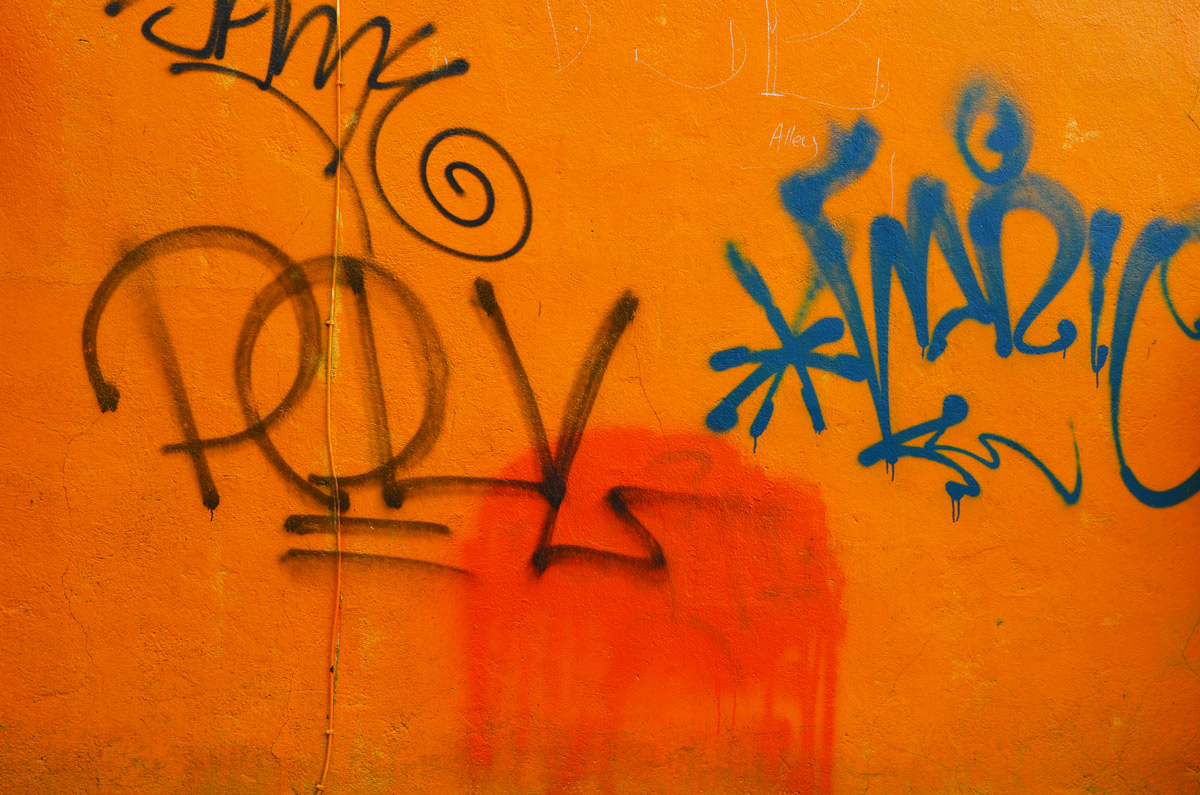
below: No wise words here – just scrawls and tags.  But isn’t the orange a fantastic colour for a wall?

orange stucco wall with graffiti on it.

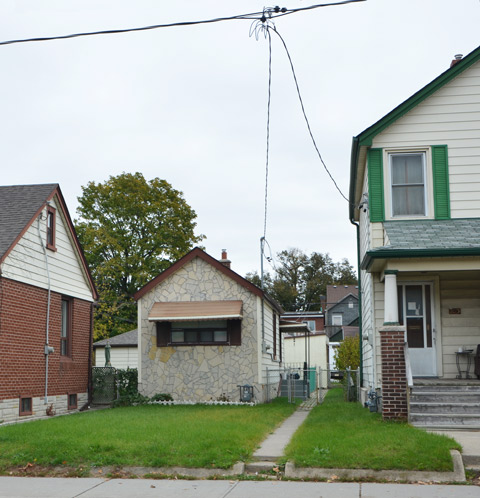
below: Tiny! A teensie tiny little house with a lawn that’s sparse but neatly kept.  Once you start looking for these little treasures, you realize that there are quite a few of them in Toronto.  I wonder if anyone has documented them?

very small one storey house between two large houses, green lawns, sidewalk in front,

Warning – tangent ahead!  This reminds of a children’s story called “Benjamin Budge and Barnaby Ball” written by Florence Heide Parry.  It’s a story of two men living in two different houses.  Benjamin was a very big man living in a very small house while Barnaby was a very small man living in a big house.  The illustrations of Benjamin squeezing into his mini sized house were wonderful (by Sally Matthews).  Of course, to live happily ever after the two men trade houses.

“Benjamin Budge was a great big man,
A great big huge TREMENDOUS man,
But his tiny house was so very small,
There wasn’t room for him at all!”

below: Benjamin Budge sleeps ‘in’ his bedillustration by Sally Matthews of a picture of a large man sleeping half on the floor and half on his tiny bed in his tiny bedroom. From the children's book Benjamin Budge and Barnaby Small

below: Veering back to the subject of architecture… this style of apartment building was very common in the 1920’s.  Three storeys, no elevator and probably no parking but with charming little details in the brickwork.  If I remember correctly, this building is on Bathurst street just south of Dupont.

three storey brick apartment building with central white door entranceway

Little vegetable gardens in both back and front yards are very numerous here, probably because of the combination of the large number of Italian and Portuguese immigrants who settled here and the popularity of ‘urban farming’ – veggies instead of grass. Being November, there were only a few remnants of this year’s harvest – a few tomato plants here and some Swiss chard there.

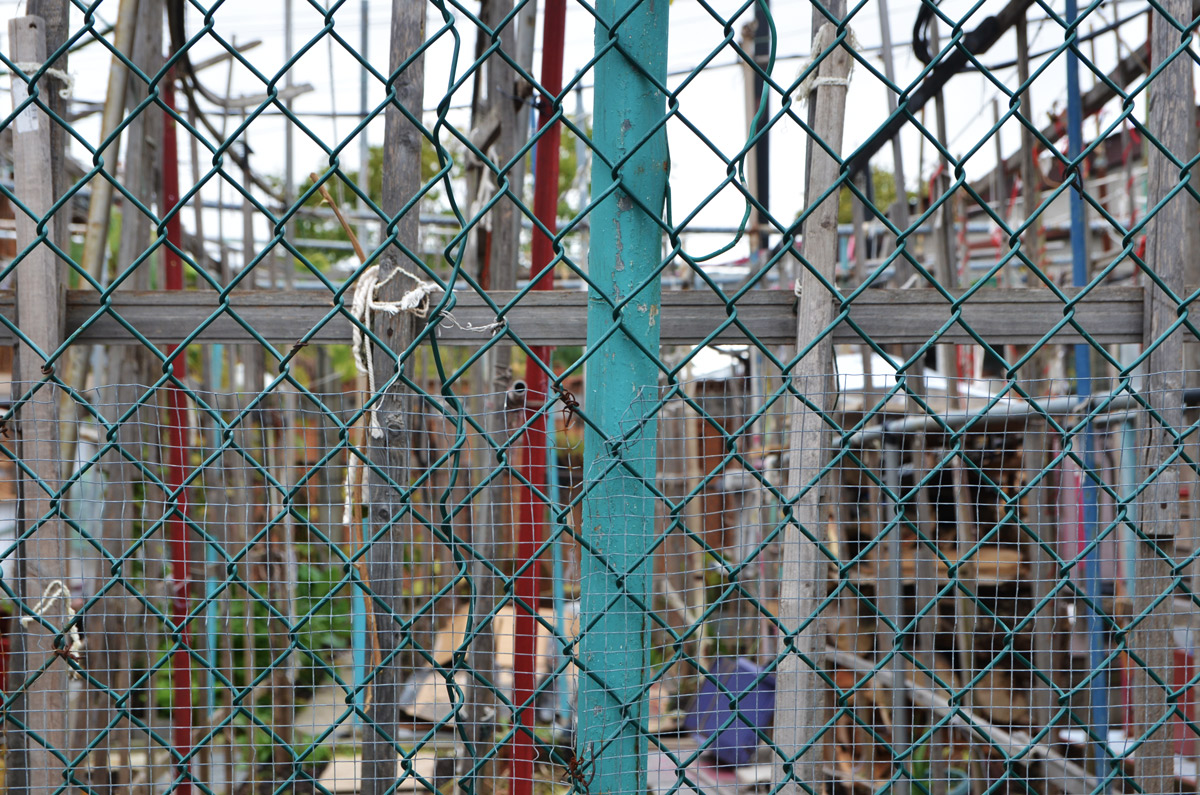
below: One back yard still has all its wooden stakes standing on guard. A forest of stakes.

chain link fence in front of a large number of wooden stakes that were used in a vegetable garden earlier in the season, but now autumn so there are no plants

below: Another way to garden in the city!

patio outside a house is covered with plastics bins of different kinds, all of which have been turned into planters, autumn now so plants no longer alive but boxes and coolers and bins remain.

below: Xena the warrior princess still watches over Vermont Avenue. She’s faded a bit since I last took her picture two years ago. You can see her (and others) in Neighbourhood watch good guys that I posted in 2015.

altered neighbourhood watch sign, with a picture in the center,

 There are lots of lanes and alleys in Seaton village (this part of the city).   One of last year’s blog posts ‘same, same, but different‘ is about some of the lanes.  There is some street art in these alleys but not too much – here are a couple from yesterday’s visit.

below: Art follows life or is it vice verse?

red leaves on a vine growing in front of a white fence that had a mural of birdhouse and plants and flowers painted on it.

below: Flowers? Or just smudges on a pole?

smudges on a metal pole that look a bit like flowers

below: Playing basketball beside Toronto – a rather lopsided photo I’m afraid.

basketball hoop above a garage door that has a large map of Toronto, in blue and green painted on it.

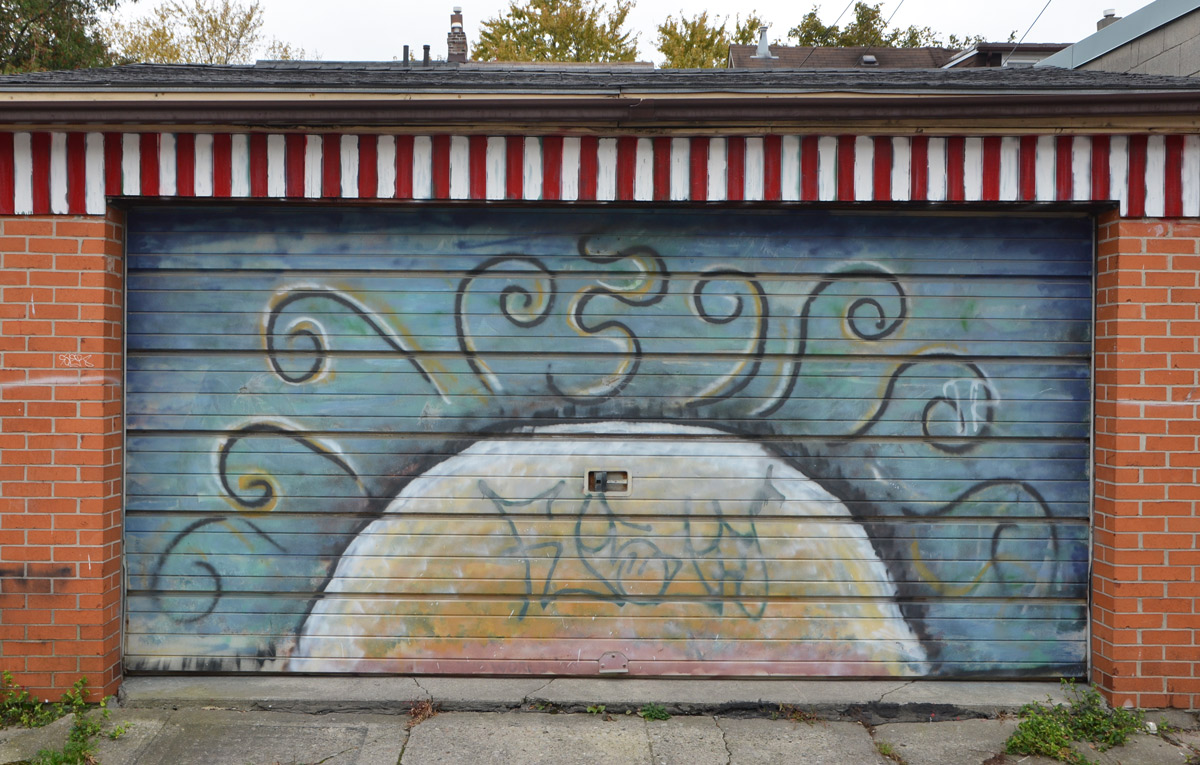
white garage door with some of the rectangles painted in turquoise, orange and purple, with swirls under the rectanagles that look like G's

semi circle covering bottom half of garage door, looks like bald head with a few curly hairs growing upwards from the scalp

mural on an exterior wall outside Kos restaurant on Bathurst Street, the mural is in the front of the restaurant by the patio, no one sitting outside, blue umbrellas are down.

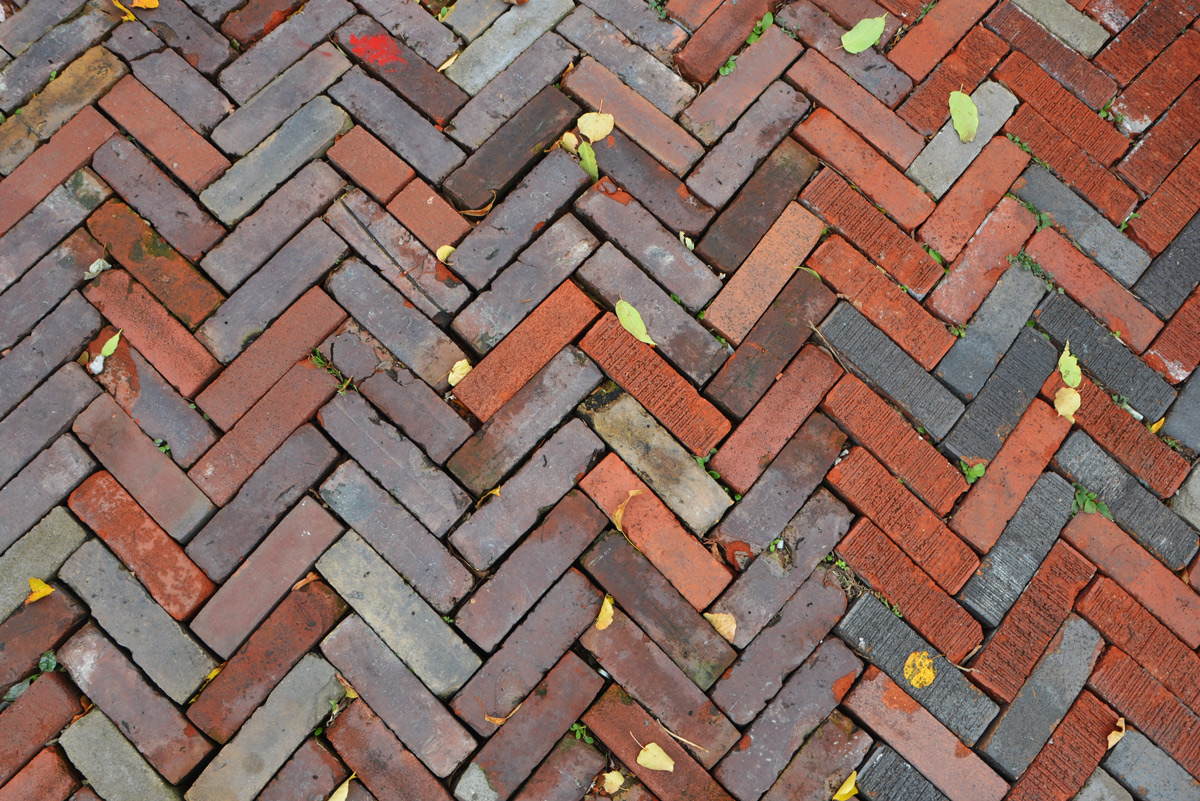
below: Herringbone pattern made from bricks.

chevron pattern (herring bone pattern) of bricks on a driveway, some autumn leaves on the bricks

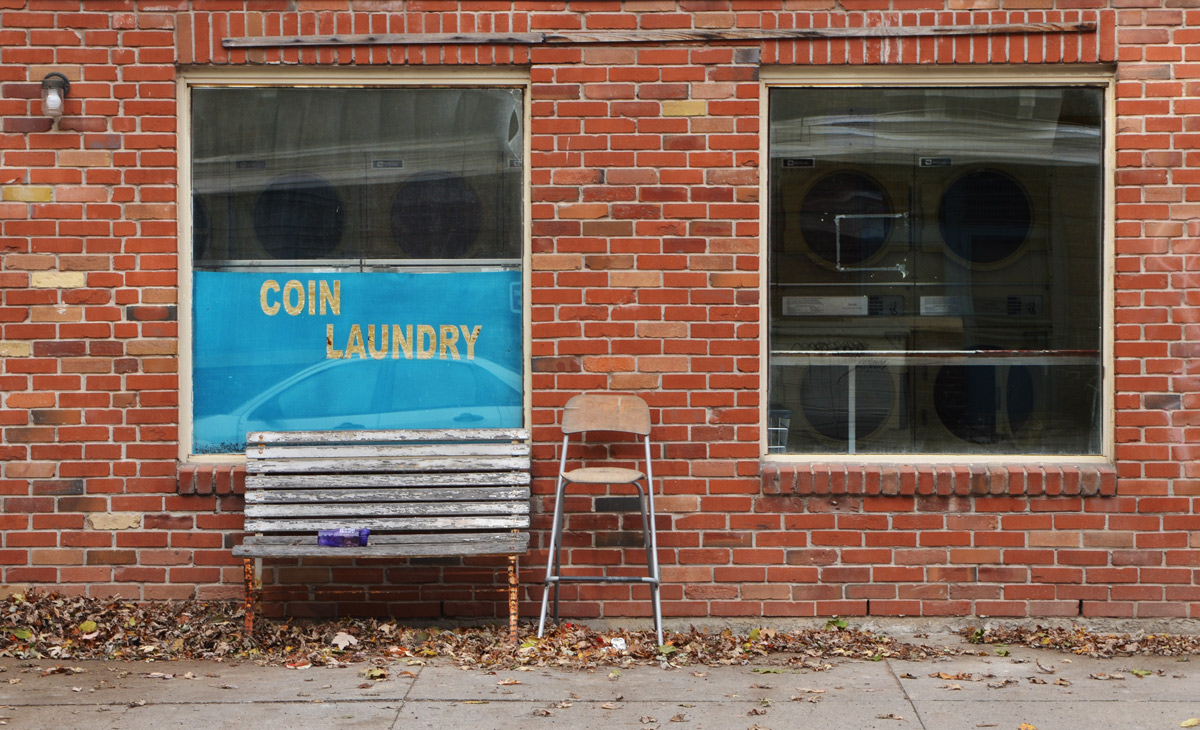
below: A rather forlorn looking bench and seat outside the laundromat.

front of a laundromat. blue sign that says coin laundry, an old bench and an old chair sitting outside by the front door. two windows through which you can see the washing machines

below: A newspaper rack decorated with a garland of fake ivy.  Insert fake news reference here ….

a newspaper rack outside a corner convenience store, the newspapers (there aren't many) are held down with bricks, the rack is decorated with a fake ivy garland

an old chair on a porch, side view.

looking through a park to a street with a blue house and a red house, cars parked in front, autumn leaves,

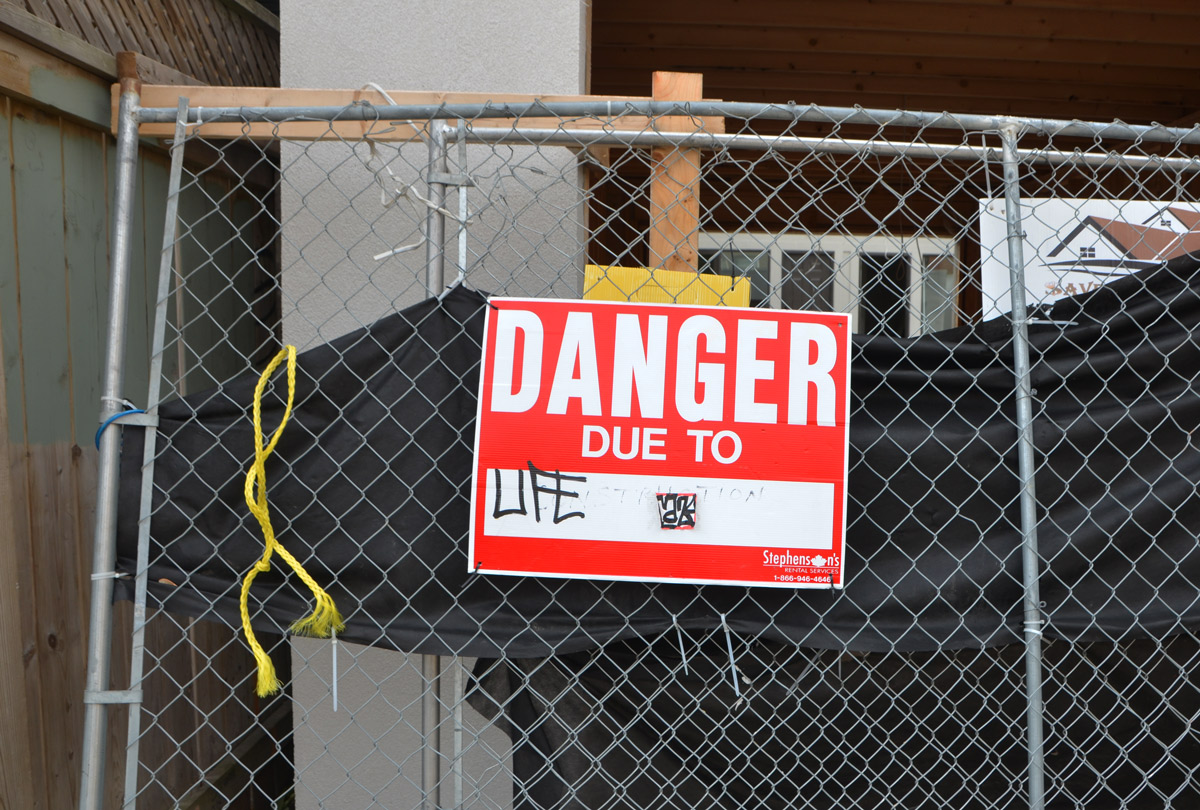
below: Today I’m going to end on a dangerous note.  Keep walking and Stay safe!

construction site with a danger due to sign that has been altered to say danger due to life

International Market in this case refers to an area in Toronto, approximately around the intersection of Dufferin and Eglinton West.

street sins on a pole, a one way sign, plus two signs with street names, Belgravia Ave and Dufferin Street, both with orange tops that have the words International Market

There is definitely a diverse (as in multicultural) feel to the area

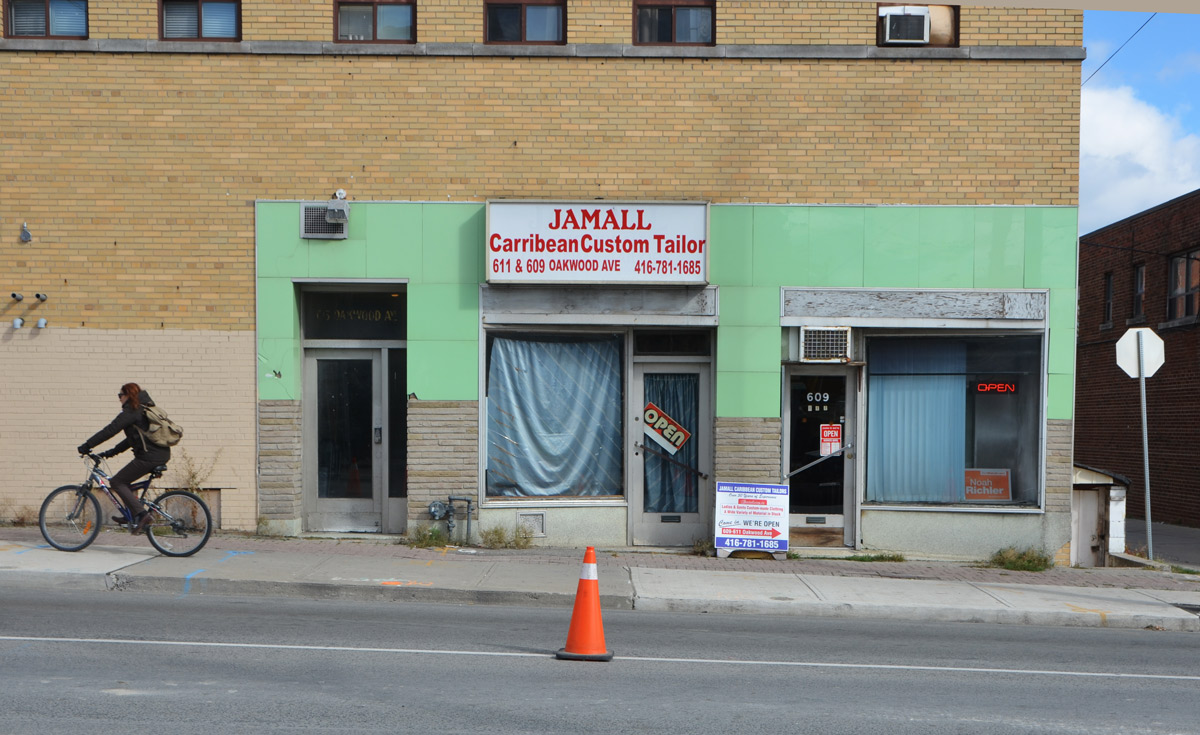
below: … such as Jamall, Carribean Custom Tailor

older building, with some green around the doors, sign says Jamall Carribean

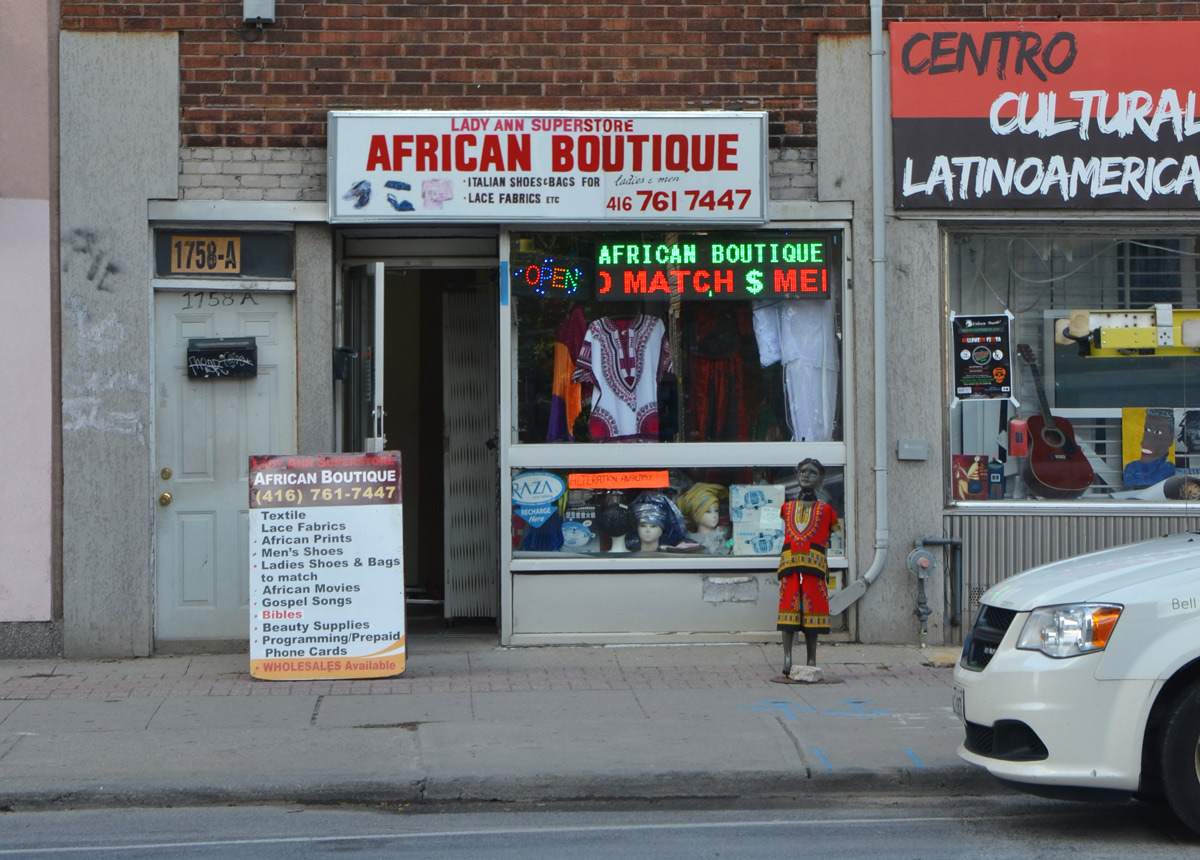
below:  and the Lady Ann Superstore African Boutique with the adjacent Centro Cultural Latino American.

storefront, Lady Ann Superstore African Boutique with a mannequin, child size, on the sidewalk outside dressed in red African style clothes.

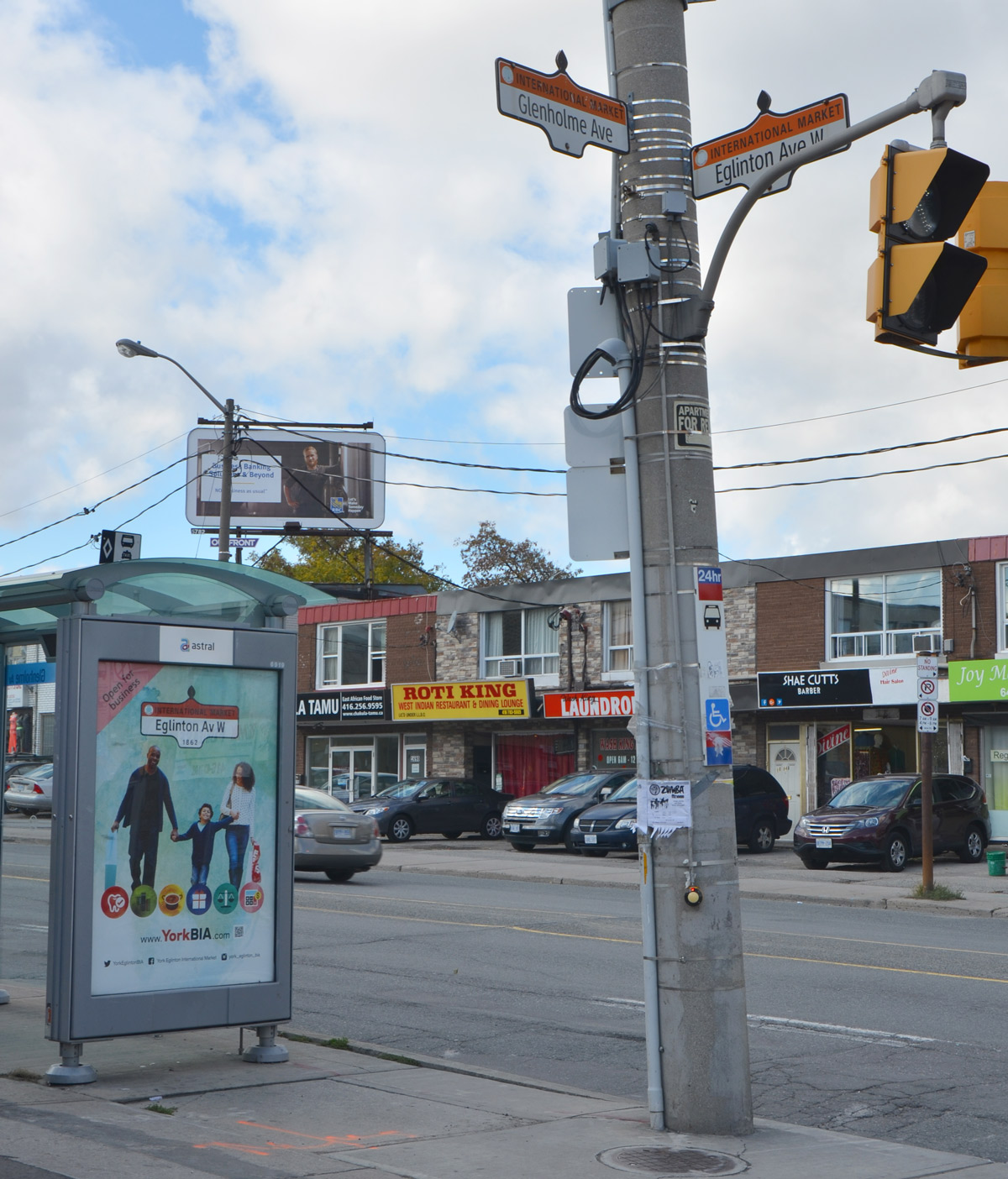
Because Eglinton Avenue runs through the area….


street scene on Eglinton Ave with bus shelter, utility pole, street signs, stores, and billboard

there is a lot of upheaval caused by construction of the Eglinton Crosstown line.

wire fence in front of a construction site, lots of dirt, street and buildings in the background.

below: Completion of the subway/LRT isn’t scheduled until 2021.  That seems like a long way off doesn’t it?

a surveyor at work, behind construction fence and cones and in front of stores, Chamsine, and Shantys take-out, which are two storey brick buildings

below: A subway station is being built at Oakwood Avenue.   Because the space is too small for a conventional crane like the ones you see all over the city, this green horizontal structure is being used instead.  It is supported by the metal beams and can slide along the top rail.

a large horizontal crane stretches over a vacant lot where a subway station is being built

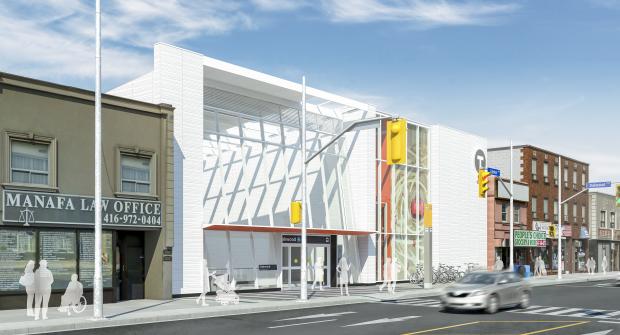
below: Rendering of Oakwood station that I found on the Eglinton Crosstown website.

drawing of Oakwood Crosstown station, design plans, taken from Crosstown website.

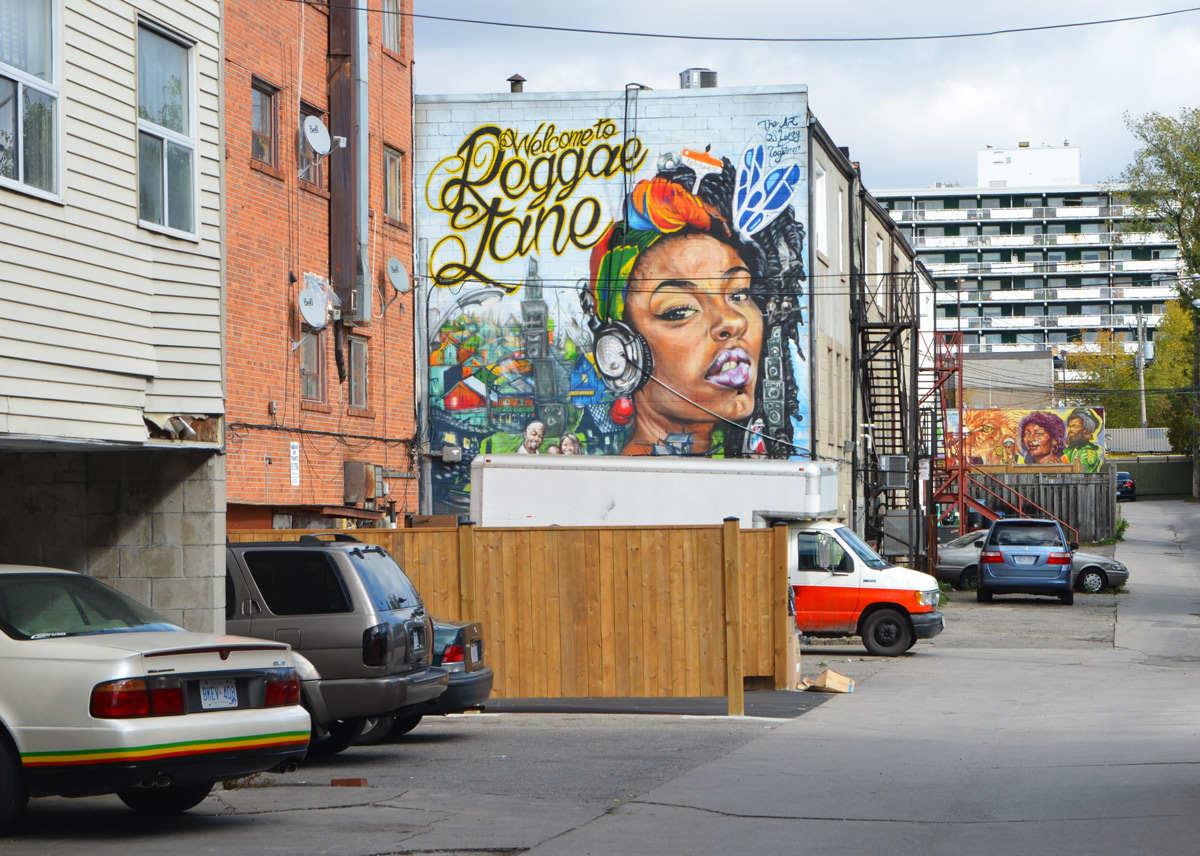
below: Immediately south of Eglinton is a small lane, Reggae Lane.  Welcome to Reggae Lane was the second mural painted here.  You can see the original Reggae Lane mural in the background.  I blogged about it when it was first painted two years ago.

view looking down an alley, cars parked behind buildings, two murals, Welcome to Reggae Lane,

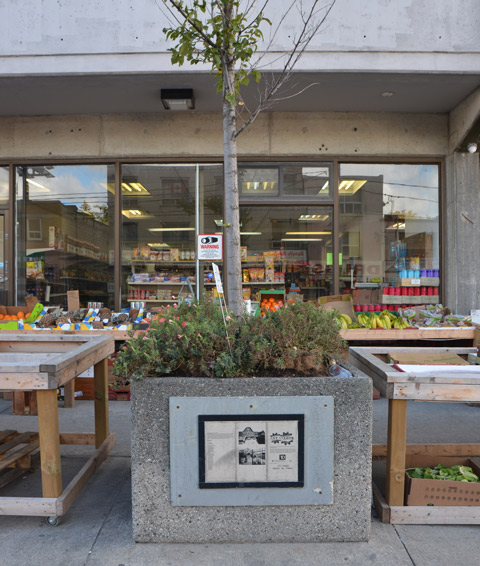
below: Some of the concrete planters on Eglinton have old black and white photos on the sides.  This was an Art Starts project.

a small tree grows in a concrete planter in front of a grocery store

below: The pictures are small and difficult to see but they are historical photos of the area – stores, people, parks, etc.

small, old black and white photos reproduced and mounted on the side of a concrete planter outside

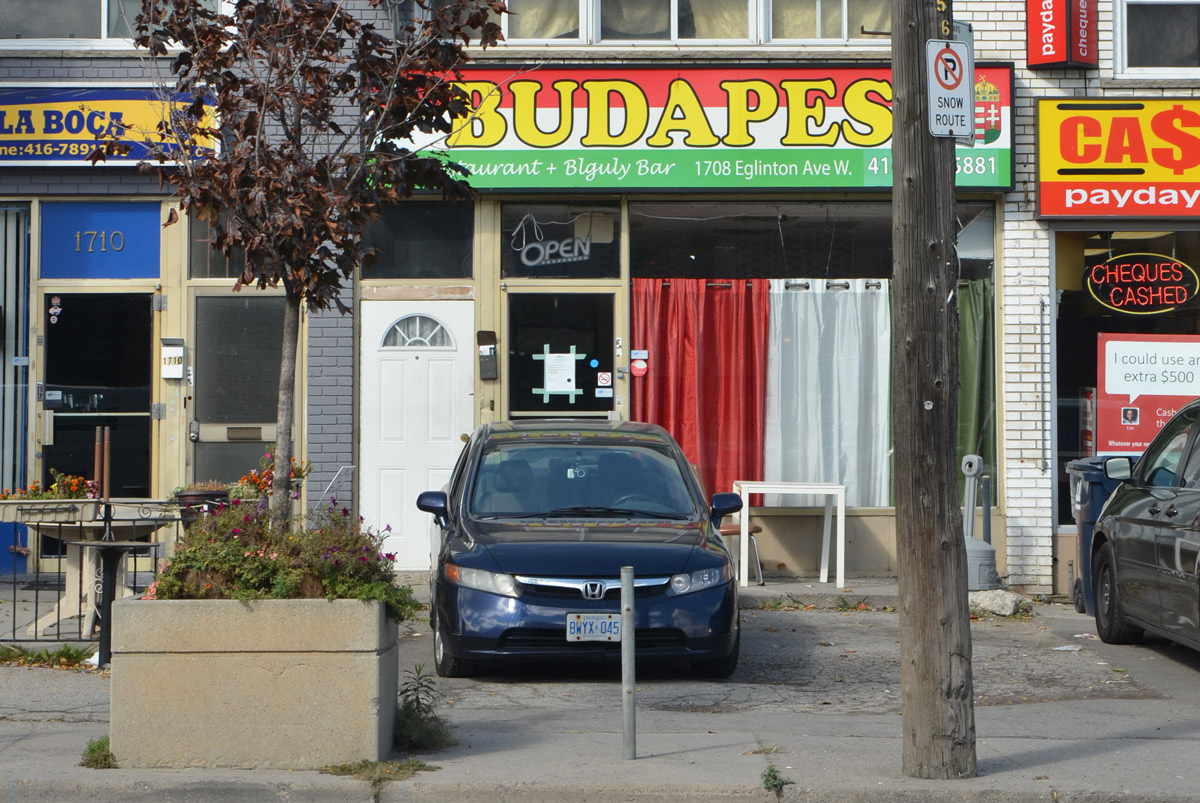
below:  One of many restaurants on Eglinton, the Budapest Restaurant and Biguly Bar, obviously Hungarian.

a car parked in front a Hungarian restaurant, the Budapest

below: There is also Uzbek cuisine, the Taj Restaurant.   Uzbekistan is one of the “stans” found in central Asia (near Afghanistan) that gained independence from the former Soviet Union 25 years ago.

a blue food truck is parked in front of the Taj Restaurant, an Uzbek restaurant

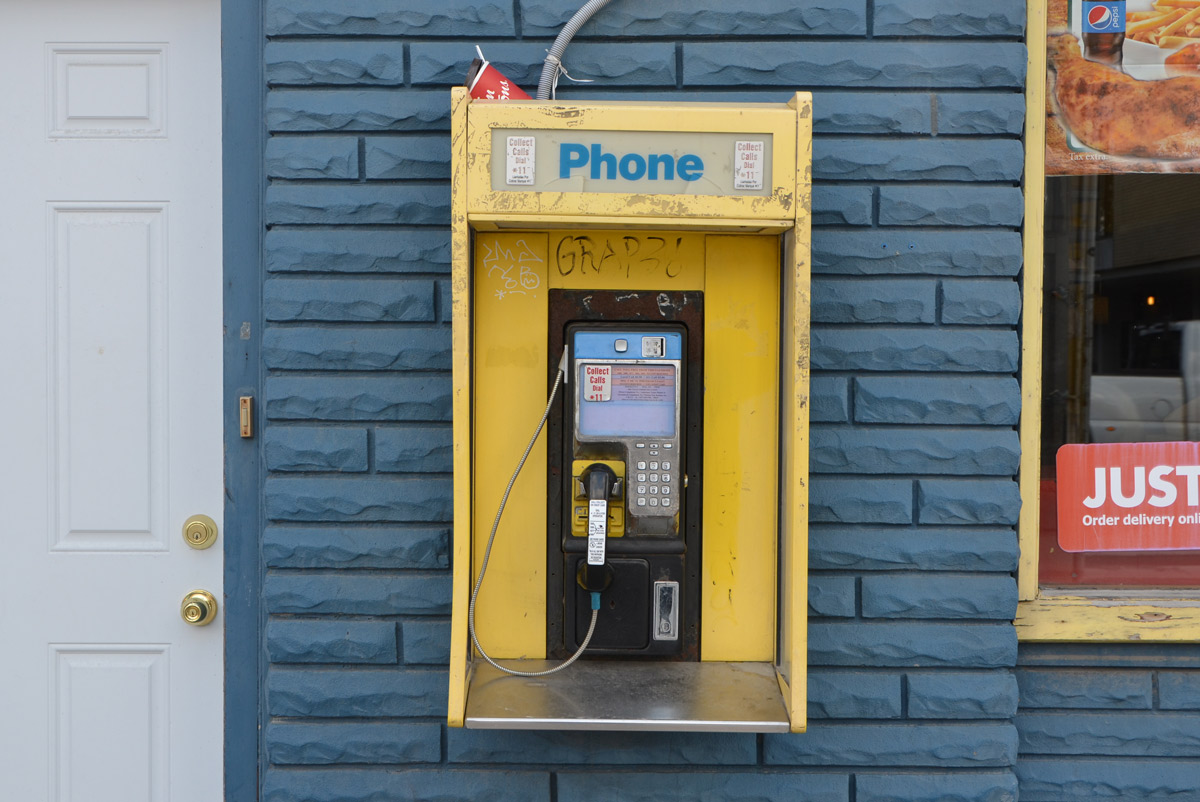
below: A yellow phone booth?

a public phone, small yellow phone booth mounted on a blue brick wall

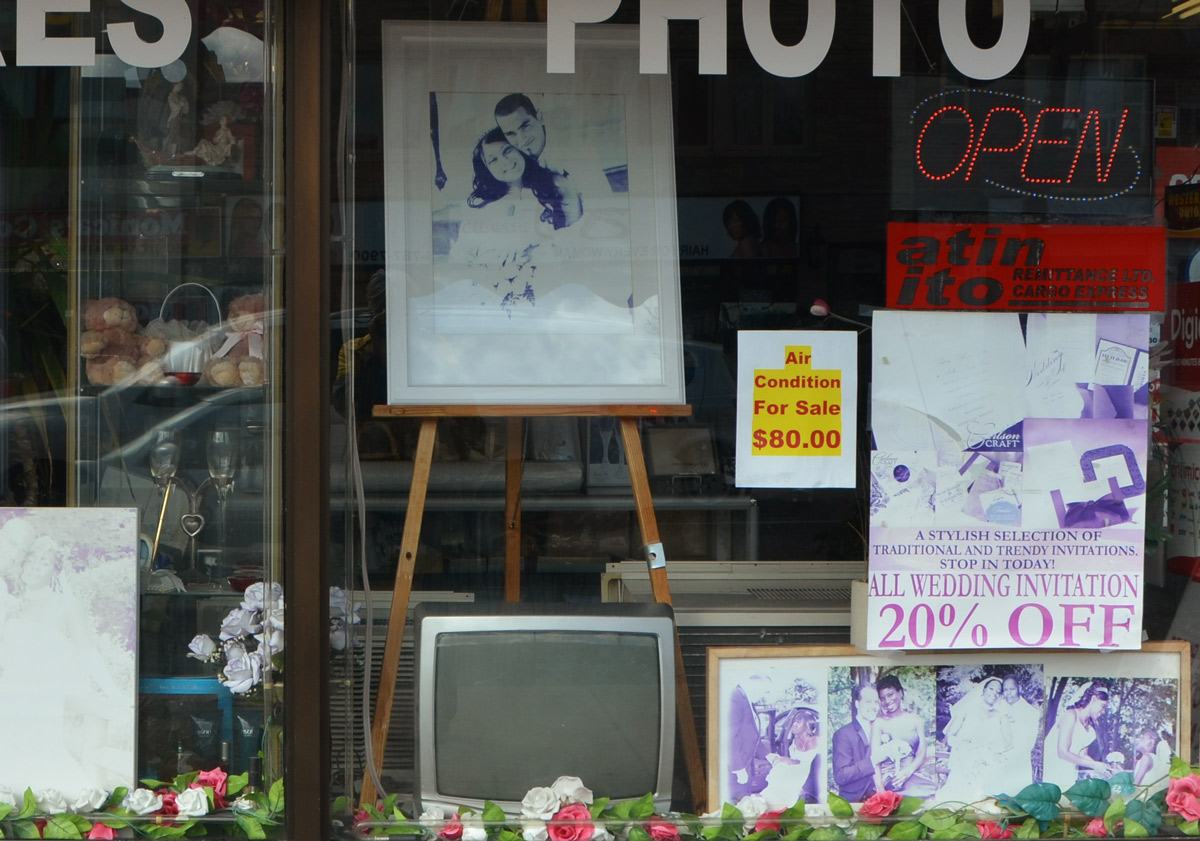
below: Faded memories of years gone by.

looking in the window of a store that sells photo frames and such, an old TV sits in the window too. The pictures are all faded to shades of blue and purple

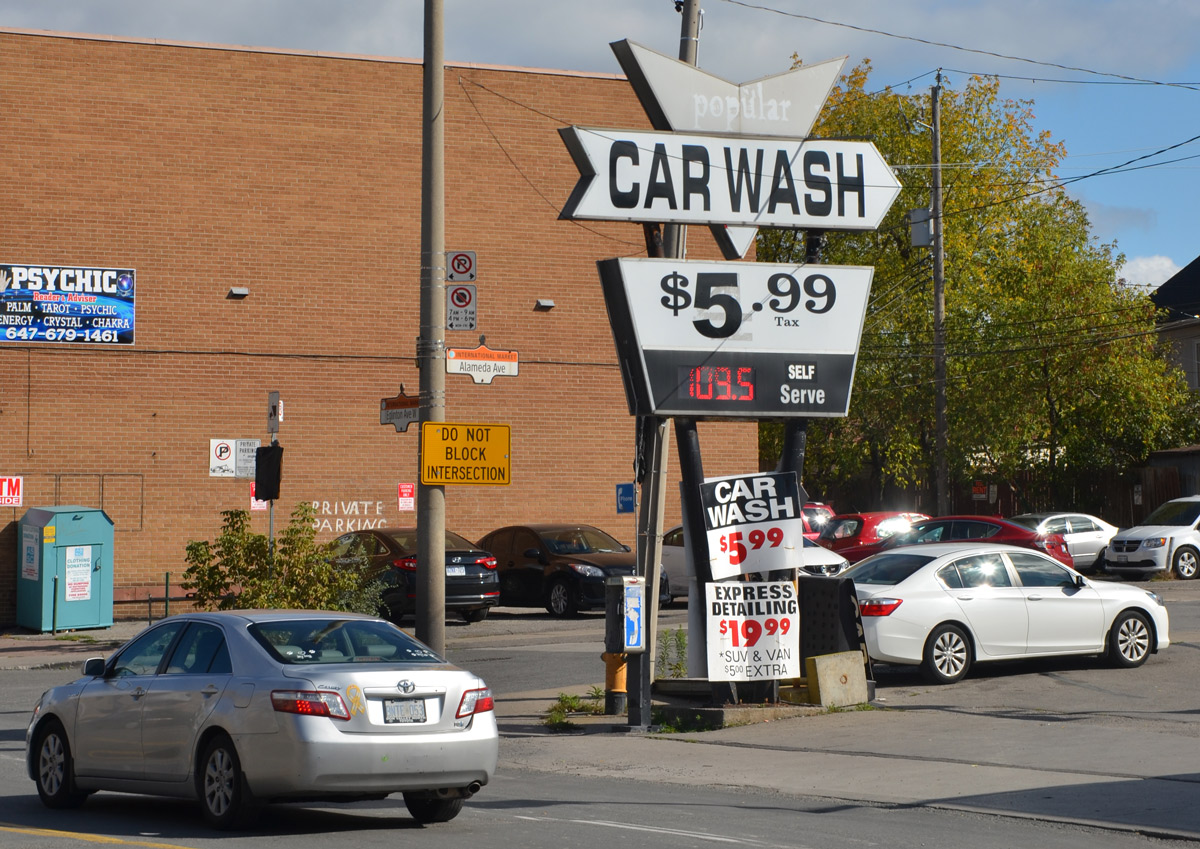
below: The Popular Car Wash – a great price for a car wash.

an old sign for popular car wah, $5.99 in front of a gas station

I’ll leave you with a few more images of the area.  It’s seen better times but it was an interesting place to walk around.   There are signs of improvement – and we’ll see what impact the subway has once it’s finally finished.

street scene with construction cones and signs, some traffic, sidewalk, pedestrians, and stores,

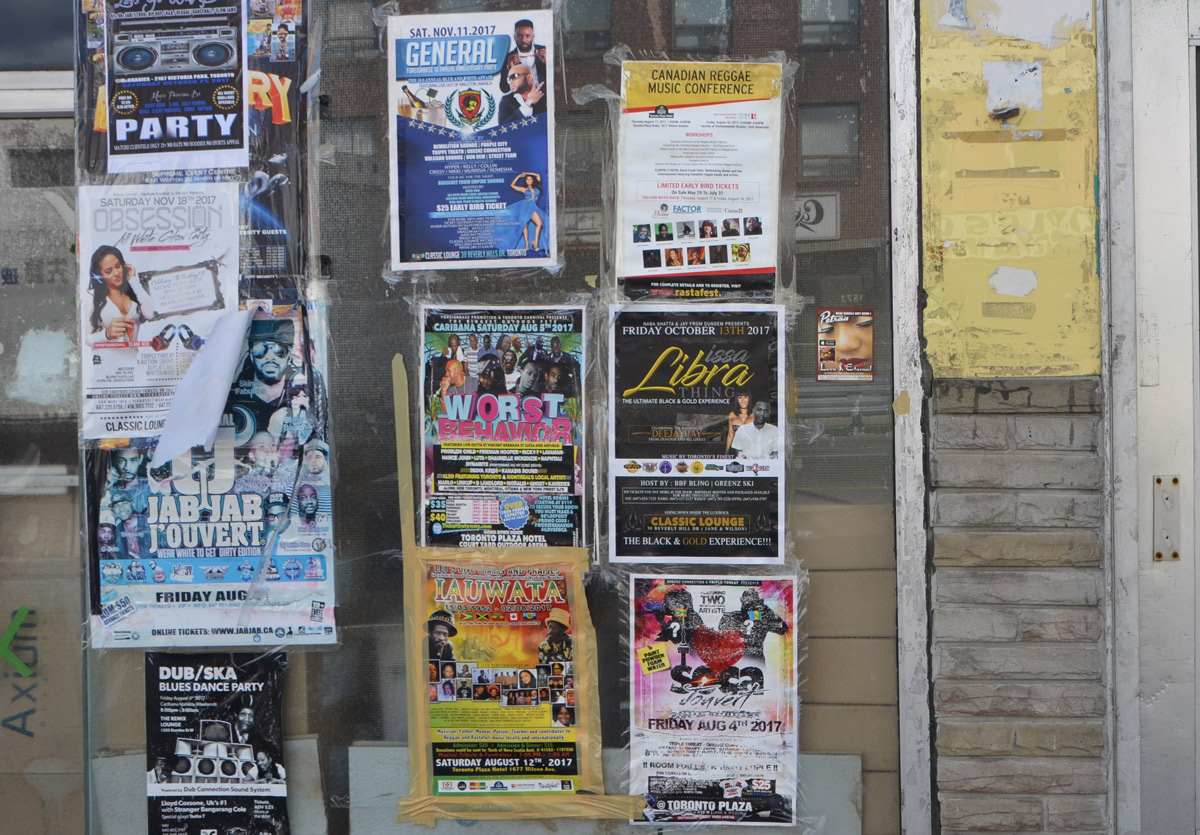
a window of an empty store that is covered with posters

5 black mailboxes arranged vertically in a row between two doors.

three storey brick building with stores on the ground level, traffic in front,

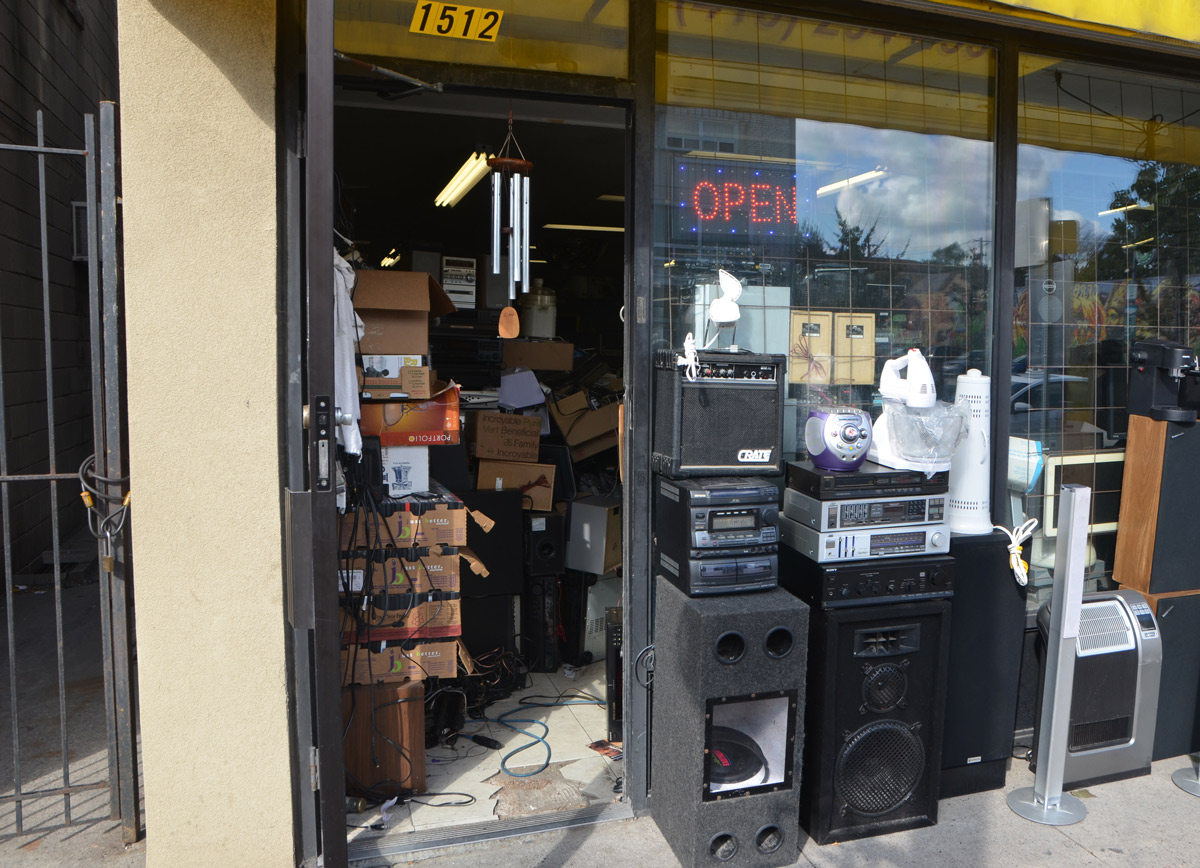
open door of an electronics store, with some speakers and other electronics on display outside too

looking across Eglinton Avenue to some stores, construction traffic cones in front,

Yesterday I was out near Dundas West and Dufferin to visit an art gallery, the Stephen Bulger Gallery, as they have a showing of photos of the Union Station renovation by Larry Towell.  I don’t have any photos from that exhibit, but it is on for another week if you’re interested.

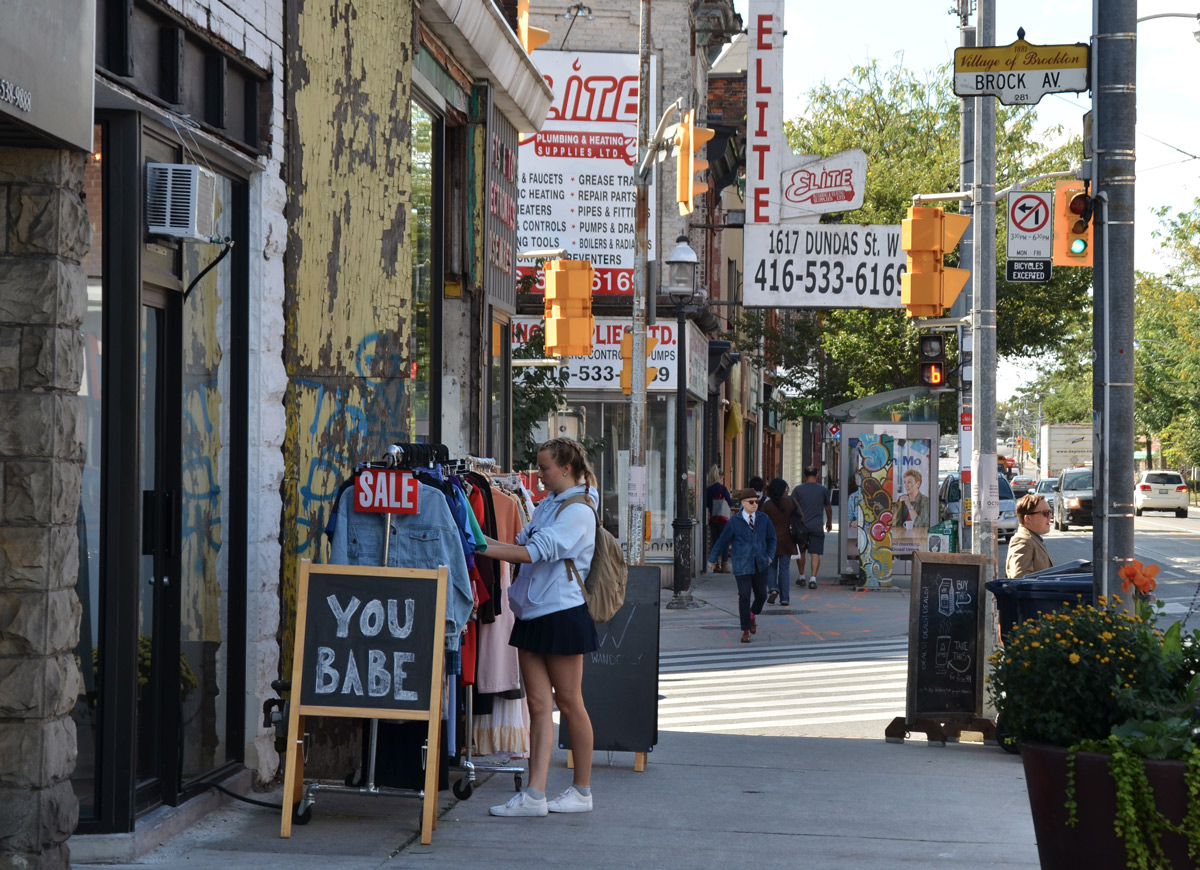
a woman is looking at clothes on a rack that are for sale outside a store, chalk board syas You Babe, other people on the sidewalk, store in background is Elite Plumbing and Heating

Instead, I have photos from the walk that I took afterwards.  I started walking west on Dundas and south on Dufferin, looking for interesting doors, windows, and stores.  I wasn’t disappointed.  Of course, I was distracted (alleys!) along the way (graffiti!) but I have tried to stick to the architectural shots for this post.  Sort of.  In no particular order….

below: There was a car parked in front of this building so I cropped off the bottom.  The optical illusion covered the whole front of the building.  It’s definitely unique!

the front exterior wall of a building is decorated with a painting of 3D cubes arranged in an optical illusion

below: Two people walk past a forest of trees and shrubs.

lower part of a brick building has been covered with a mural that is orange background, and cut out (wood) flat green trees in various shapes. A real tree grows in front of it, a metal traffic box is painted with a scene of two people walking with the same orange background

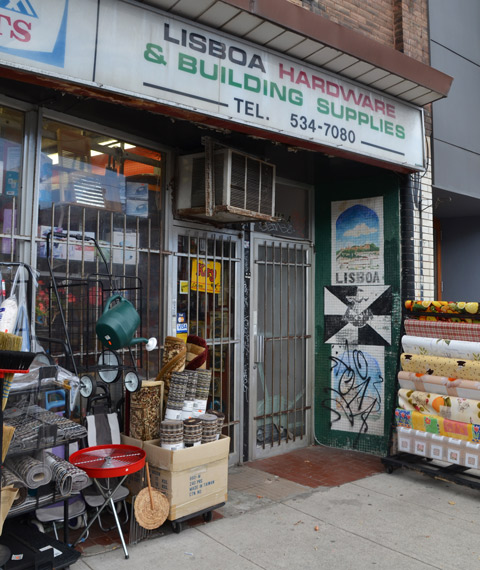
below: Lisboa Hardware and Building Supplies with many household items on display outside – including barbecues, watering cans, and carpets. Old paintings linger on the tile wall.

The entrance to the Lisboa Hardware and building supply store with lots of household merchandise outside

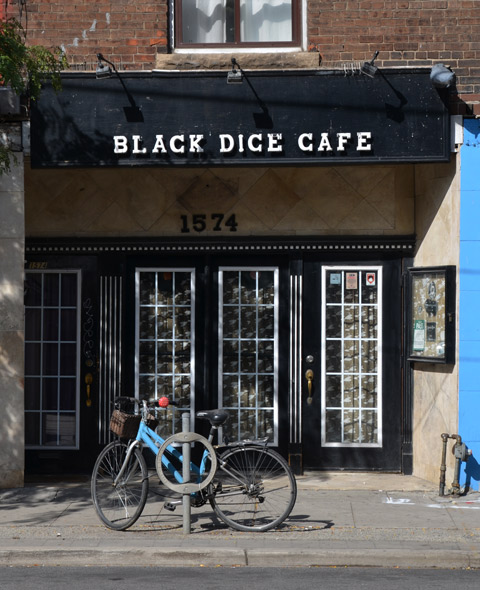
below: A blue bike is parked in front of the french doors of the Black Dice Cafe.

a blue bike is parked outside the glass windows and door of the black dice cafe

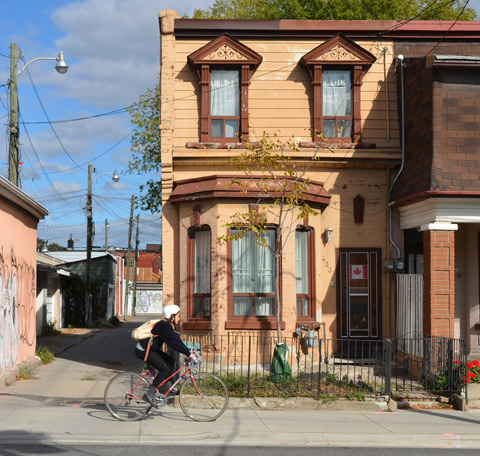
below: A very typical two storey house in this part of Toronto.  This was the predominate style of architecture of residential buildings at a certain time – late 1800’s and early 1900’s I think (and maybe longer?).    I like the Canadian flag in the window and the new tree in the tiny front yard.

a girl on a bike rides past the entrance to an alley. Behind her is a two storey house in tan coloured siding, with darker tan trim, bay window, Canadian flad in the doorway,

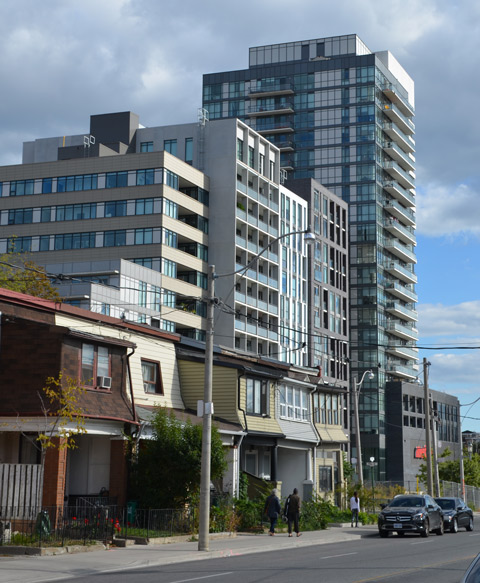
below: On Dufferin Street, an increasingly common scene as glass towers pop up all over the city.  The west side of Dufferin Street, just north of Queen.

In the background, two large high rise buildings, modern, in the foreground, a row of older two storey houses

below: A similar scene on a smaller street nearby.

a row of two storey houses on a small street with a two aprtment blocks behind them.

below: Distractions in an alley – this one was a dead end (with the dead end behind me).  One of the disadvantages of having your garage in an alley like this is that getting your lawn mower from the garage to the yard involves a bit of a walk.    But look at all those doors and windows in buildings that look like they’ve been painted from the same palate.

a man walks a lawn mower down a short alley, garage doors on both sides of him as well as in front of him, back of houses behind the garages and taller apartment buildings behind that.

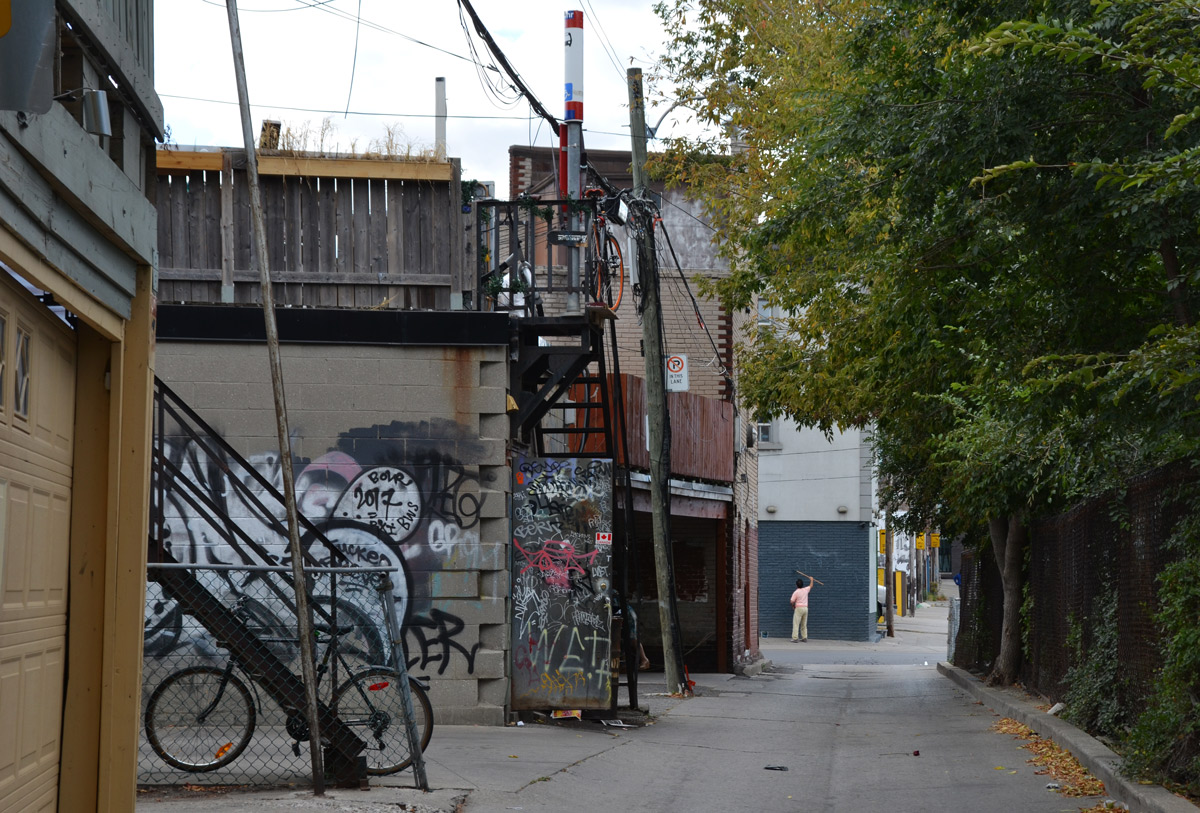
below: Another alley with a different character.  An open door covered with graffiti, balconies above the garages, and what is that?  – a TTC pole at the top of the stairs?

view down an alley,

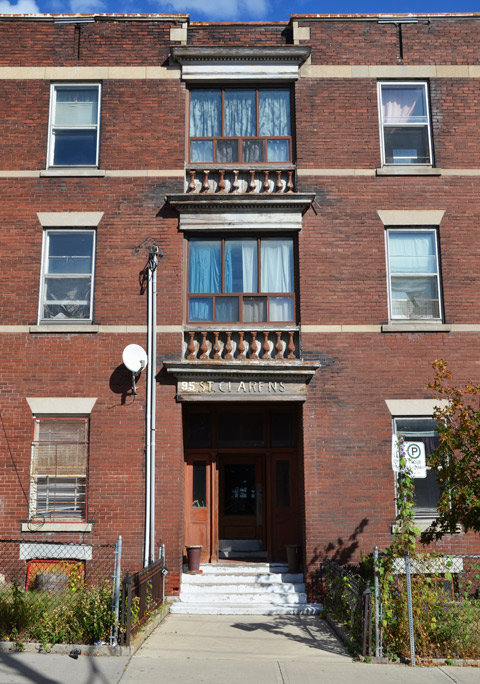
below: The entranceway of an older brick low-rise apartment building on St. Clarens Ave.

The entrance to a three storey apartment building, with wood railings on fake balconies and some brick work too

below: Another distraction!  A crochet bombed pole beside a bright pink wall.

a utility pole is wrapped in crocheted squares in many colours, the house beside the pole is bright pink

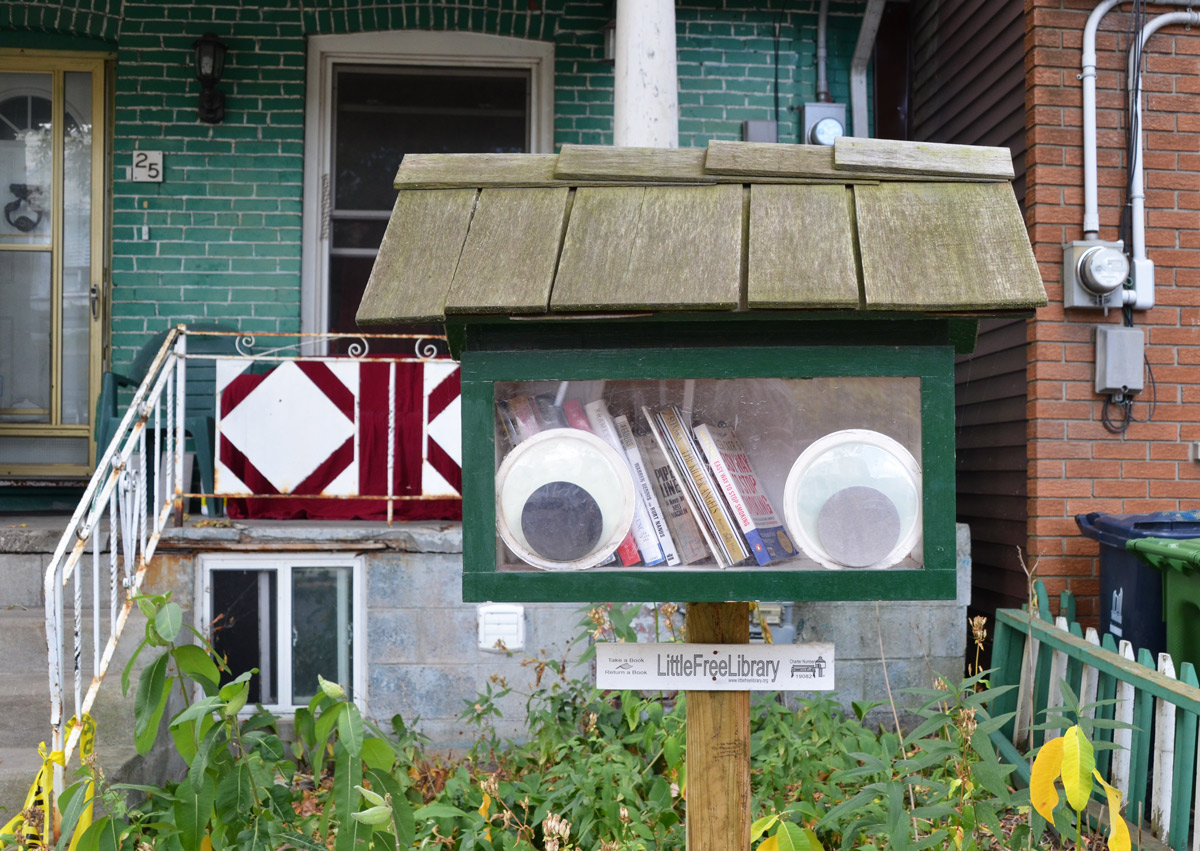
below: I happened upon this cute little free library too –    so cute and whimsical with its big eyes keeping watch.   There has been some controversy about these in Toronto recently.  One owner of little library was ticketed for violating a city bylaw that disallows structures on a person’s property within 3.5 metres of a sidewalk.  It was ordered removed within 14 days or a $100 fine would be levied.   Yesterday City Hall decided not to pursue this.

a little free library in front of a green coloured house. Inside the window of the library are two large googly eyes

below: Nearby was another little free library with a little latched door.  It seems that here you can also pick up a pair of shoes along with a book!

white box on stilts, a little free library, trees and shrubs around it, a pair of shoes on the sidewalk in front of it.

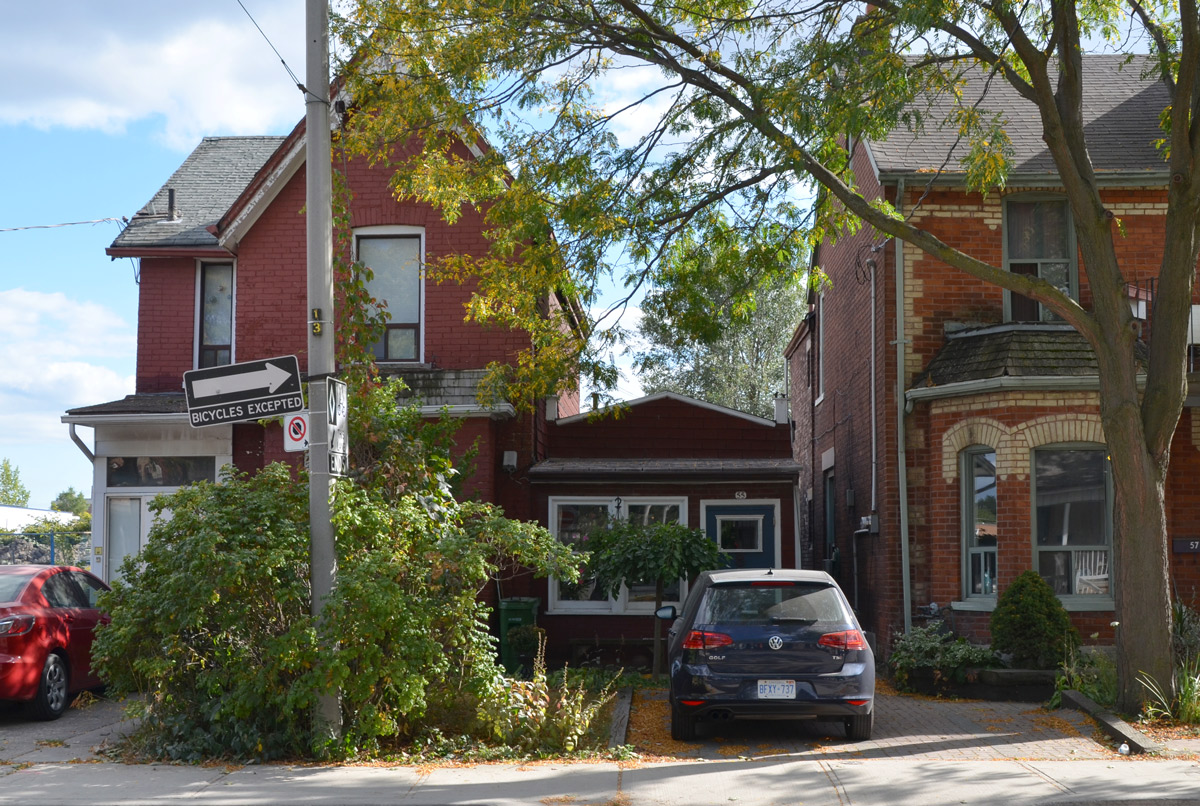
below:  Did I find Toronto’s smallest house?

a car is parked in front of a very small one storey house that is between two large and taller houses,

below: Somewhere in the jungle is a front door or two!  A shared sidewalk to squabble over in the winter – who gets to shovel it.

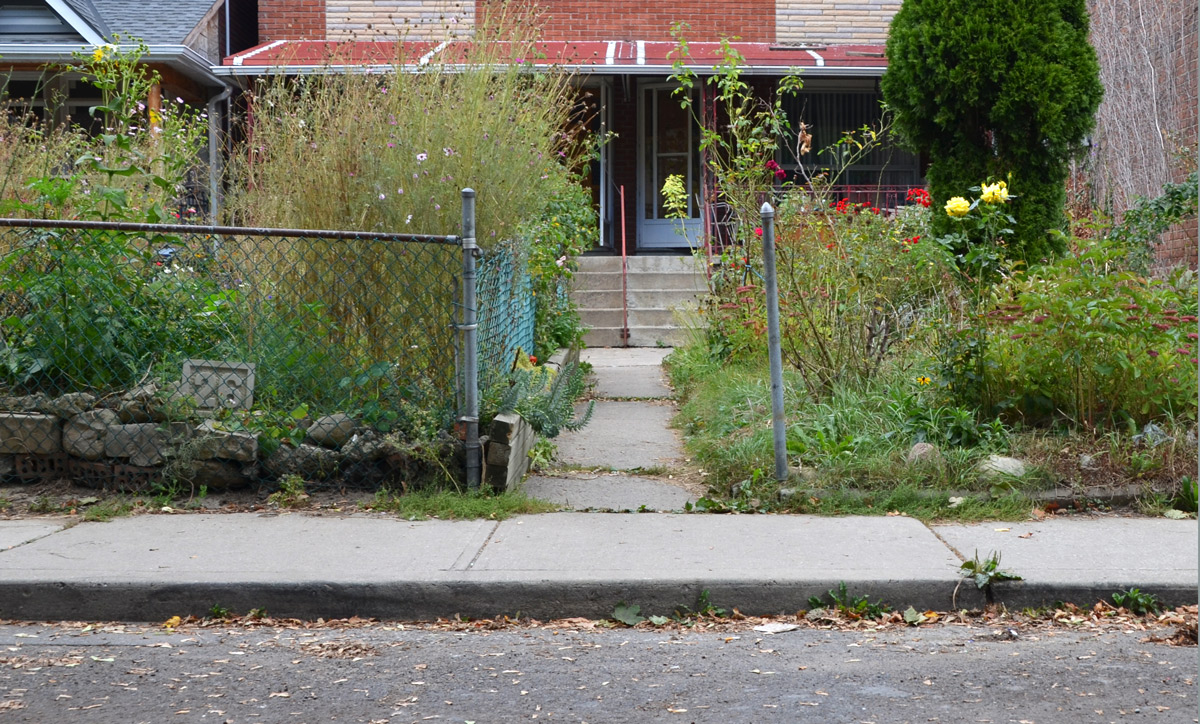
two overgrown front yards with a sidewalk down the middle, a semi divided brick house in the background.

below:   Gates.  I’ve never understood the reason for little gates like these.  Back in their youth they probably looked quite trim and proper.  Now they are sagging and rusted and showing their age; perhaps that’s a reflection of their owners?  Not a complaint – a rusted gate has great photographic potential.

a fence across the front of two houses, each with their own sidewalk and gate.


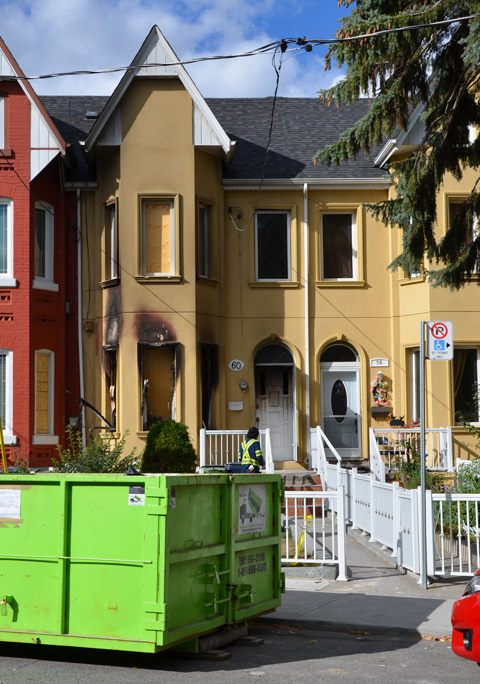
below: Fire damage that is now being repaired.  The neighbours seem to have built a thriving shrine (good luck charm?, religious offering?  is there a name for these?) beside their front door.

A row of houses where one is damaged from a recent fire.  Burned front door.  Windows have been boarded over, a skip for garbage isin front, workmen on the site

below: We have our share of ugly doors on ugly walls.

two white doors side by side on a dirty concrete block wall that someone has written the words In Toronto it's okay to hate transvestites

below: Have a seat

two grey wicker chairs in front of two adjacent white doors on a concrete wall. the building beside is orange

below:  On Dufferin Street between Dundas and Queen – Once upon a time this house was totally decorated in pink and white.  Some of it remains – the arch in front of the door as well as the fence at the side of the house.  Now it is bigger, squarer, and uglier.   Even the grominator graffiti on the wall can’t overcome the ‘boringness’ of the renovated structure.

sqaure two storey brick house under renovation, with pink and white metal fence around it. a grominator graffiti on the side

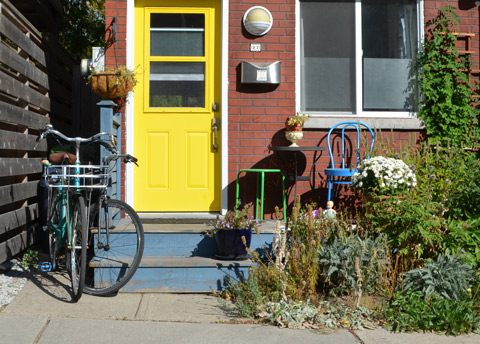
below: I don’t want to end this post on an ugly note, so here’s a cheerful bright yellow door!

yellow door on a rust house

Shorter day light hours + autumn weather (no snow yet!) = an evening of playing with light and shadow.  I came out of the subway at Queen station and decide to “chase the light”.  It was a perfect evening for a walk and I wanted to make it last as long as possible.   For the most part I stayed on Queen Street although I will admit to straying onto Shuter for a block or two.  It’s not the prettiest part of the city but every place has potential, from a photographic perspective anyhow.

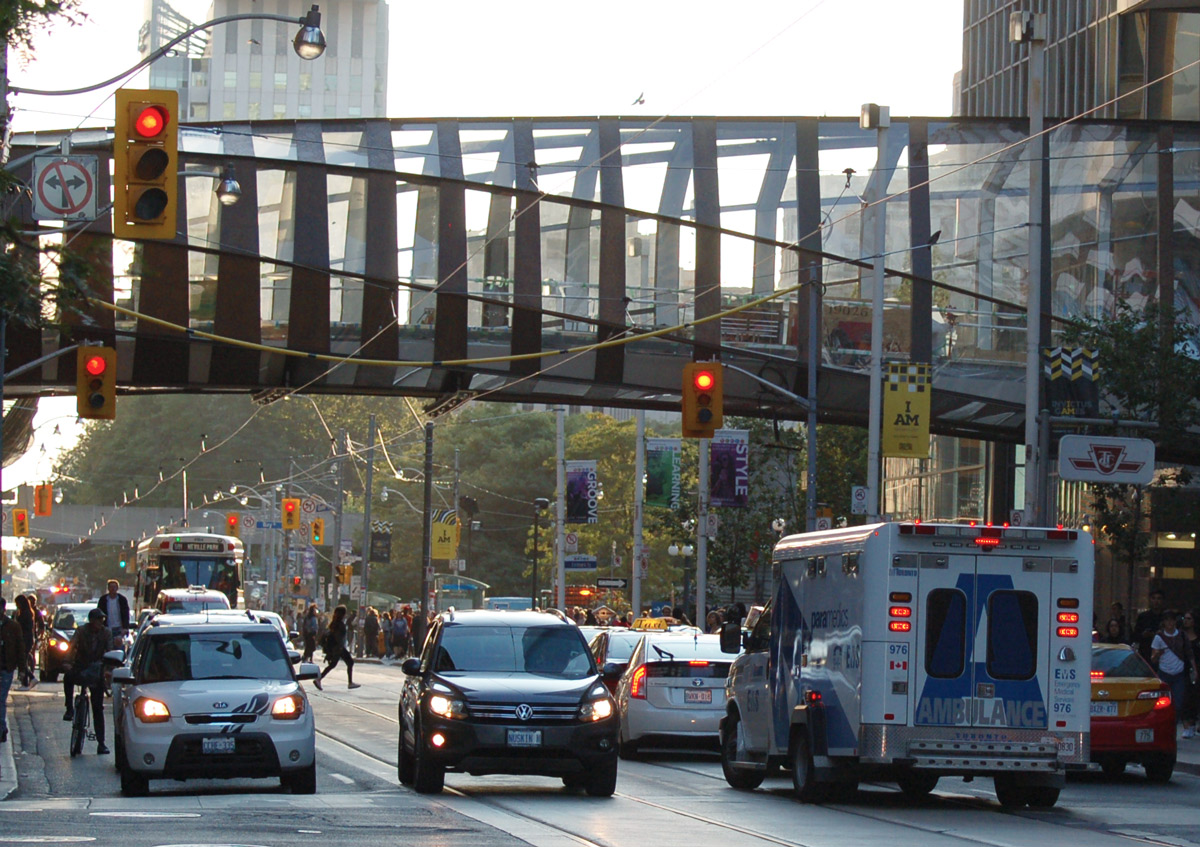
below: The new (replacement) pedestrian walkway over Queen Street that will link the Eaton Centre with The Bay.

glass pedestrian bridge over a street, Queen Street, with traffic and people as well as an ambulance, late afternoon

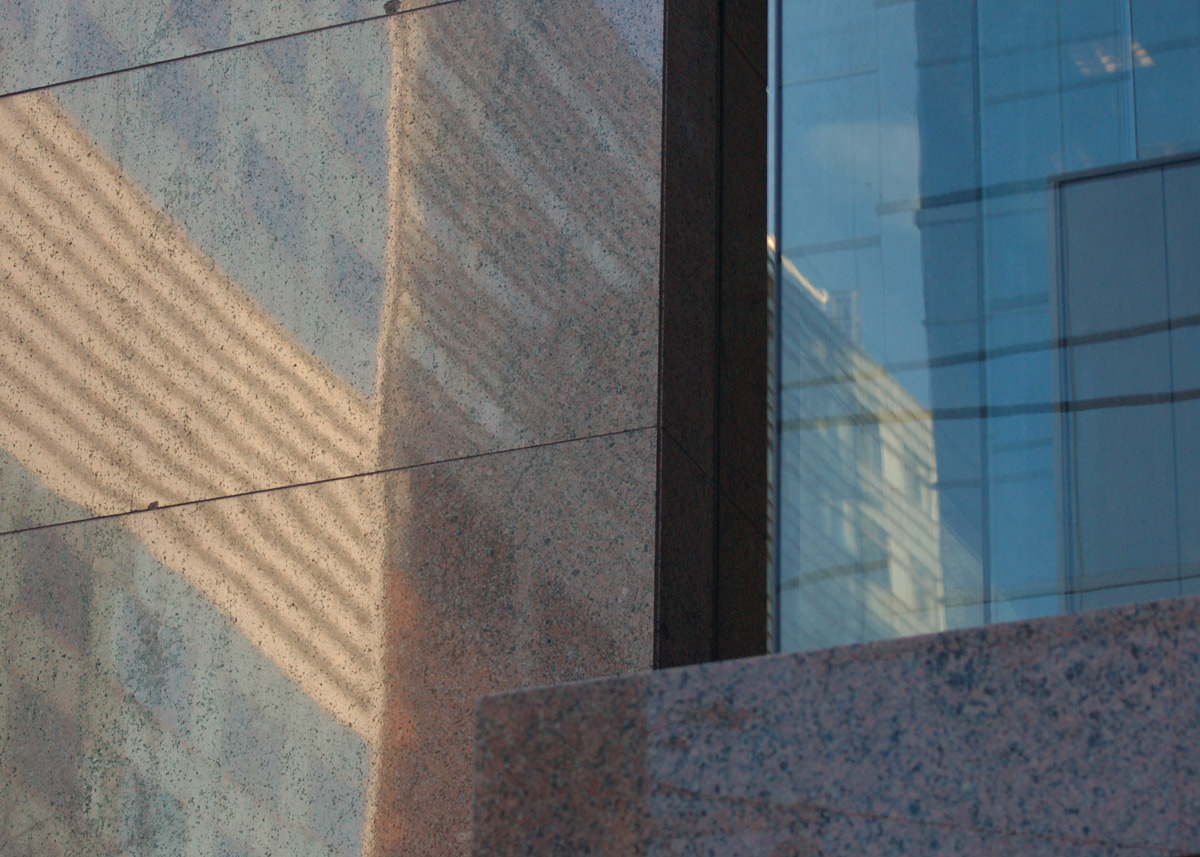
below: City reflections in both glass and polished stone.

reflections in a stone and glass building

below: The curve of street car wires at Queen and Church.  A wall of peeling paint, as well as a ghost sign, provides the backdrop

the curve of the streetcar wires in front of a wall that was painted white but the paint is peeling to reveal the brick below.

below: The east wall of St. Michaels Cathedral (RC) with reflected light, as seen across a construction site.

one end of St. Michaels Cathedral with reflected light falling on it, new buildings and construction surround it

below: The same church from a slightly different angle.

close up of part of a church roof and window with reflected light on it.

below: Angels

wooden angel cutouts decorate the roofline of a small building

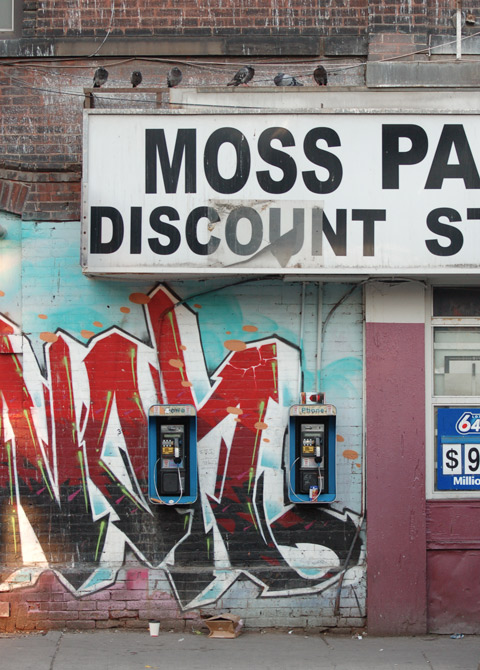
below: Pigeons, old Bell phones and the Moss Park Discount Store.  Not so much light here but I liked the wall.

two Bell telephone booths, small version, mounted on a wall with street art painted on it, beside the window of a convenience store with a 649 ad in the window. Sign over the window says Moss Park Discount Store

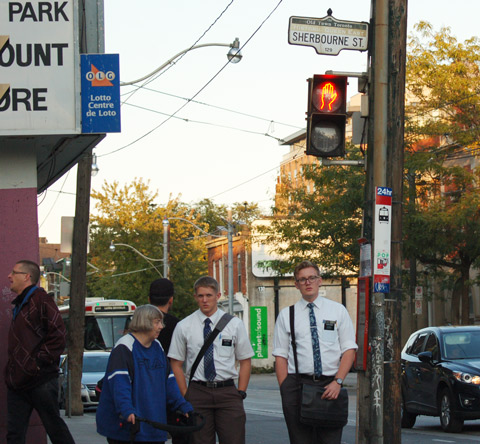
below: A long way from home.

people standing on a corner waiting to cross the street, including a woman dressed in blue who is using a walker, plus two Morman men in their white shirts and black ties.

below: A large double billboard is black beside the old building.   The building is at the corner of Ontario Street and Brigden Place.   It was built in 1911 as a 4 1/2 storey warehouse for the Newell Company and their Dominion Envelope Company.  It was one of three buildings that they owned in the area.   After WW2 the building was purchased by J.D. Carrier Shoe Company (the ghost sign!).  Today it has been renovated as lofts and studios.

evening light shines on an old white brick building, a large billboard as seen from the end, is in front

below: A small section of the back of the Moss Park Armoury, a Canadian Forces building constructed in the 1960’s.

part of a wall, vertical stripes of brick sections and white sections, narrow windows in the white sections, 3 windows in total

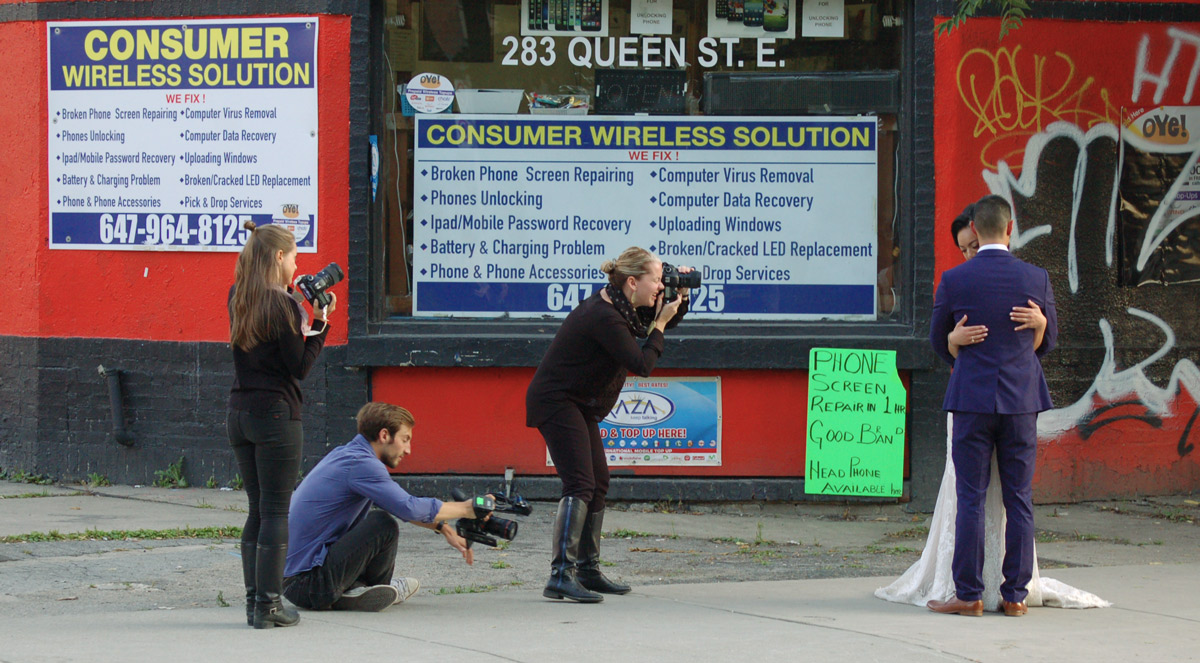
below: A quick break from chasing light…. you never know what you’re going to encounter downtown, and of course you have to stop and take advantage of the opportunities when they arise, so here we have a slight diversion!  I’m going to assume that the background of their pictures is much better than the background of this picture!

a bride and groom embrace while three photographers take their picture. on a sidewalk of a city street

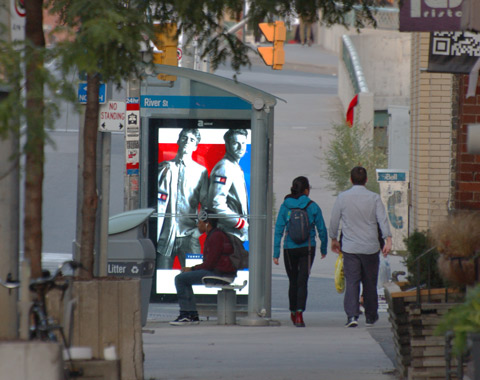
below: As evening falls, the lights come on in the bus shelters.
You can thank (or curse) Astral Media for that.

a lit advertisement in a bus shelter of two men in Roots clothes, a young man sits on the bench in the bus shelter while two people walk past it on the sidewalk

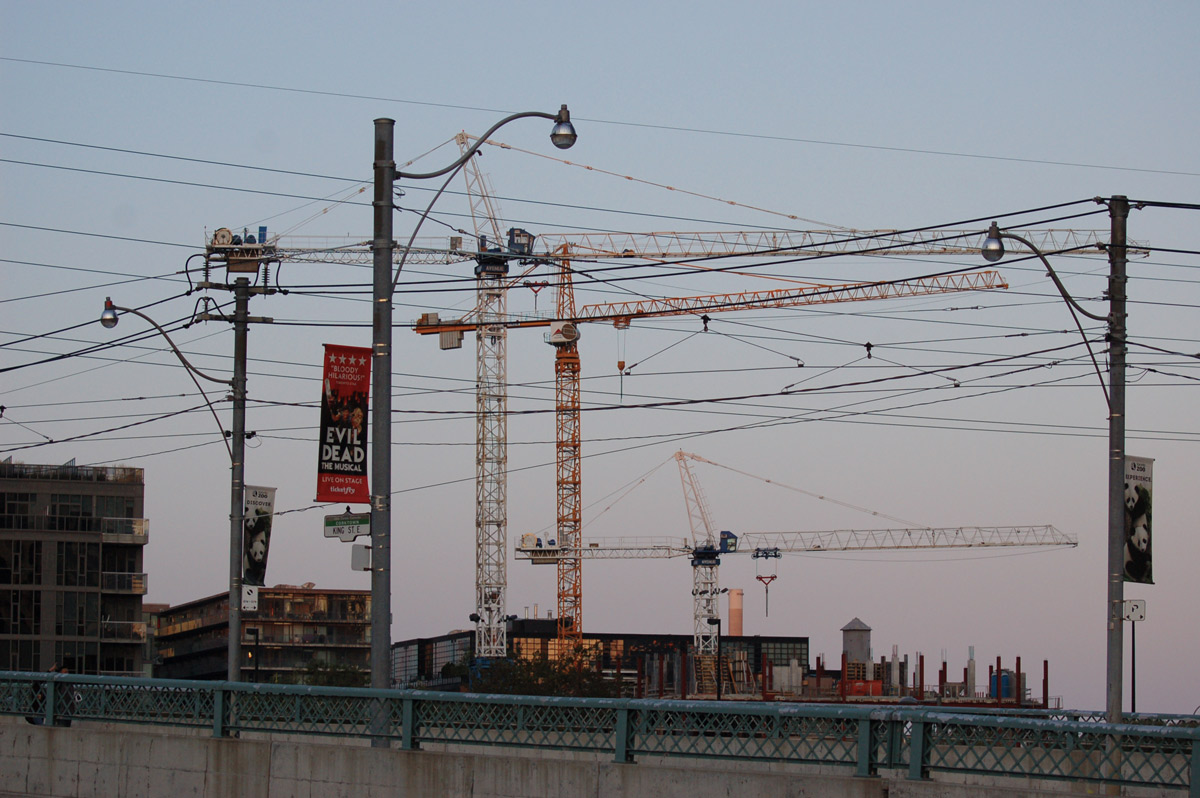
below: King Street and Queen Street merge just before they pass over the Don River and the Don Valley Parkway.   The green railing in the photo below is on the bridge over the DVP, the buildings and cranes are on the other side of the river.

evening light, cityscape with many construction cranes, light poles and utility poles and wires, evening,

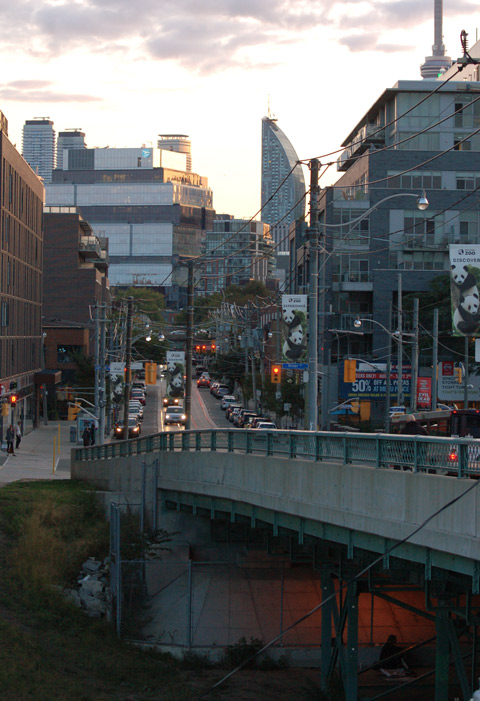
below:  Upstairs, downstairs.  Looking west along King Street from the Don River.

looking along King street from beside ramp over the railway tracks - light under the bridge shows someone sitting there, city scene in the rest of the photo

Once the light fades beyond a certain point, contrast is limited and dullness creeps into the resulting photos.  It’s too late for well lit photos and too early for pictures of city lights.  But it’s a great time to stop and find some dinner!

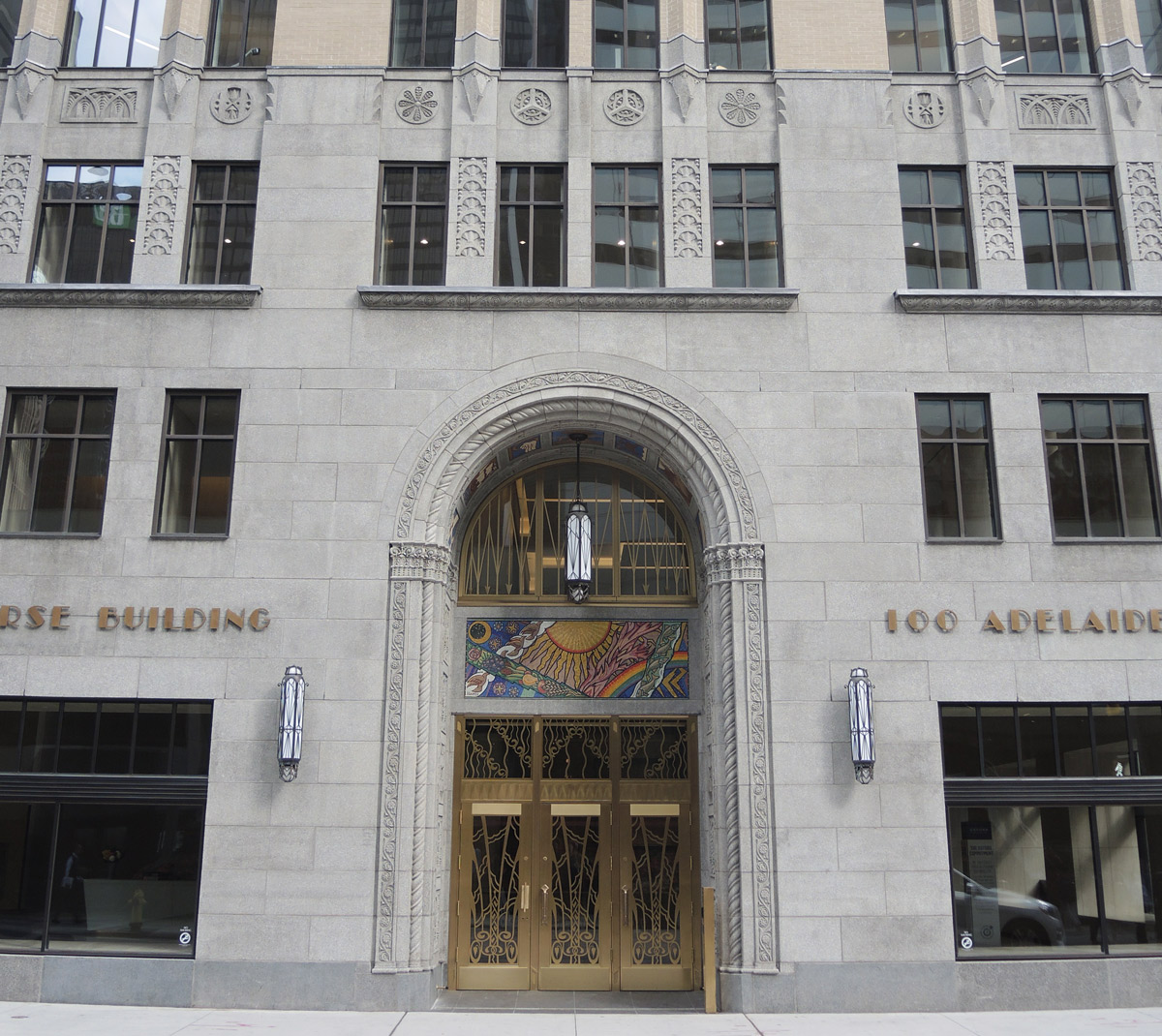
The 16 storey Concourse Building at 100 Adelaide Street West was built in 1928. It was an Art Deco building designed by Martin, Baldwin and Green.  Recently, the building as amalgamated into a new 40 storey office tower.  The Concourse Building was gutted but the south and east facades were saved.  Also saved was the entranceway (portal) that was designed by J.E.H. MacDonald, one of Canada’s Group of Seven painters.

entrance to 100 Adelaide West, a stone building, with brass decorated doors and mosaic pictures decorating it. The concourse building, with stone relief work between the third and fourth storey windows as well

below: The entrance is 2 storeys high, topped with a Roman arch.   The rectangular panel above the door contains the four elements, earth (produce from the fields), air (stars and birds), fire, and water (fish swimming).

entrance to 100 Adelaide West, a stone building, with brass decorated doors and mosaic pictures decorating it.

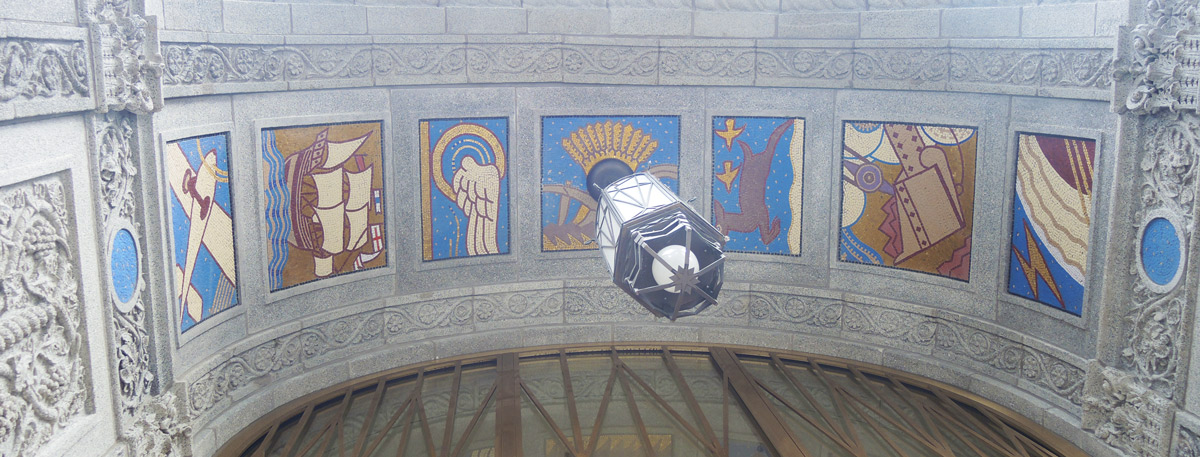
below: The mosaics under the arch represent Canadian industry and nature.   Here, ship building and aircraft are depicted.

two of the panels designed by J.E. H. MacDonald on the Concourse building, a ship with sails, and an airplane

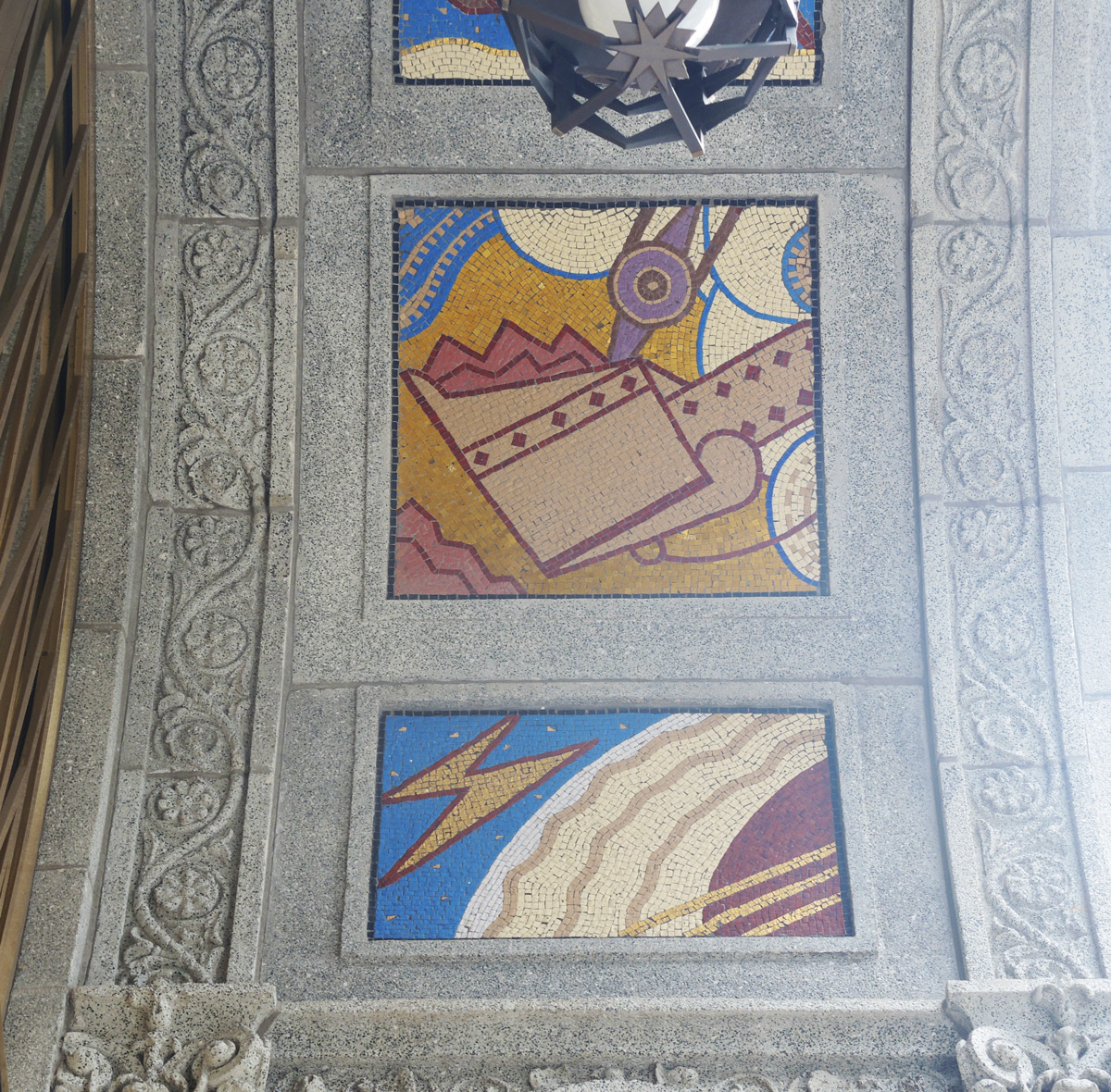
below: On the other side, a steam shovel and what looks like lightning in the sky.

two of the panels designed by J.E. H. MacDonald on the Concourse building, a steam shovel in action, and a panel with a lightning bolt

below: The stone panels surrounding the door are carved with motifs of grapes and grape vines.

a square panel of stone carved with grapes and grape vines

below: All seven mosaic pictures under the arch.

the panel of mosaic pictures under the arch, a lamp hanging down from the center,

This is a #Thursdaydoors post.  Lots of other blogs participate so if you are interested in doors of all kinds, check out this link.