Archive for the ‘galleries’ Category

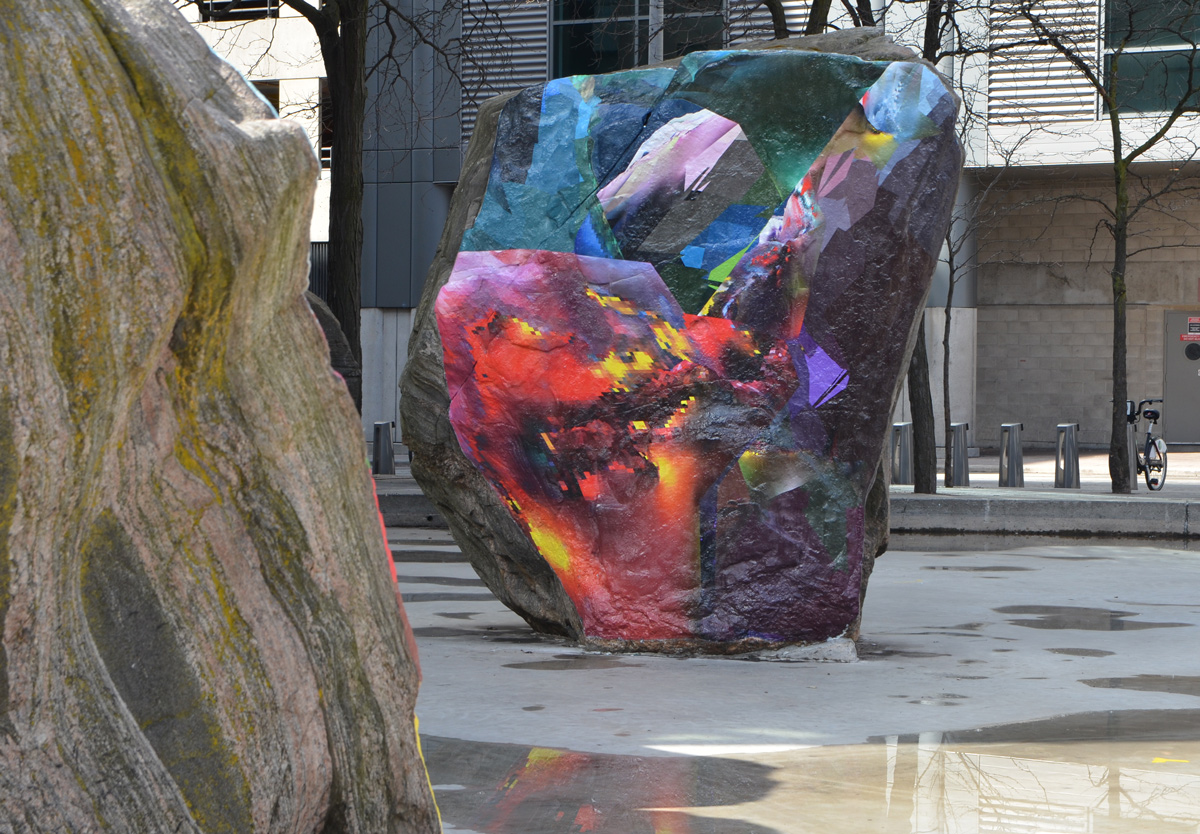
May is CONTACT Photography month in Toronto and like in previous years, some galleries start the month early.  One of these galleries is the Ryerson Image Centre.  This year, in the main gallery they are featuring the work of Shelley Niro, the 2017 winner of the Scotiabank Photography Award.  You may have seen some of her work at the AGO where her shirts series of photos is also on display.   Outside the building, in Devonian Square, there are large colourful abstract images glued onto large rocks.  These are the work of Scott Benesiinaabandan, a Montreal-based artist from the Obishikokaang Anishinabe First Nation.

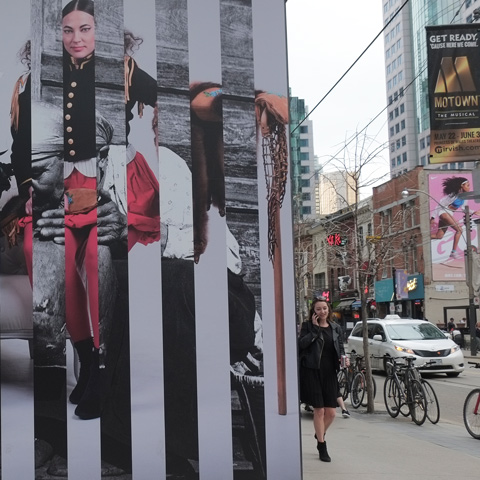
below: First, the poster/sign at the entrance to the Ryerson Image Centre.  The four images on the left are from Niro’s shirt series of pictures – the full series is shown inside the gallery.  There is also a video from 2003 that features this woman and the T-shirts standing in this location.

4 photos by Shelley Niro, of indigenous woman wearing a white t shirt with words on them, plus aboriginal/original pictures of the artist.

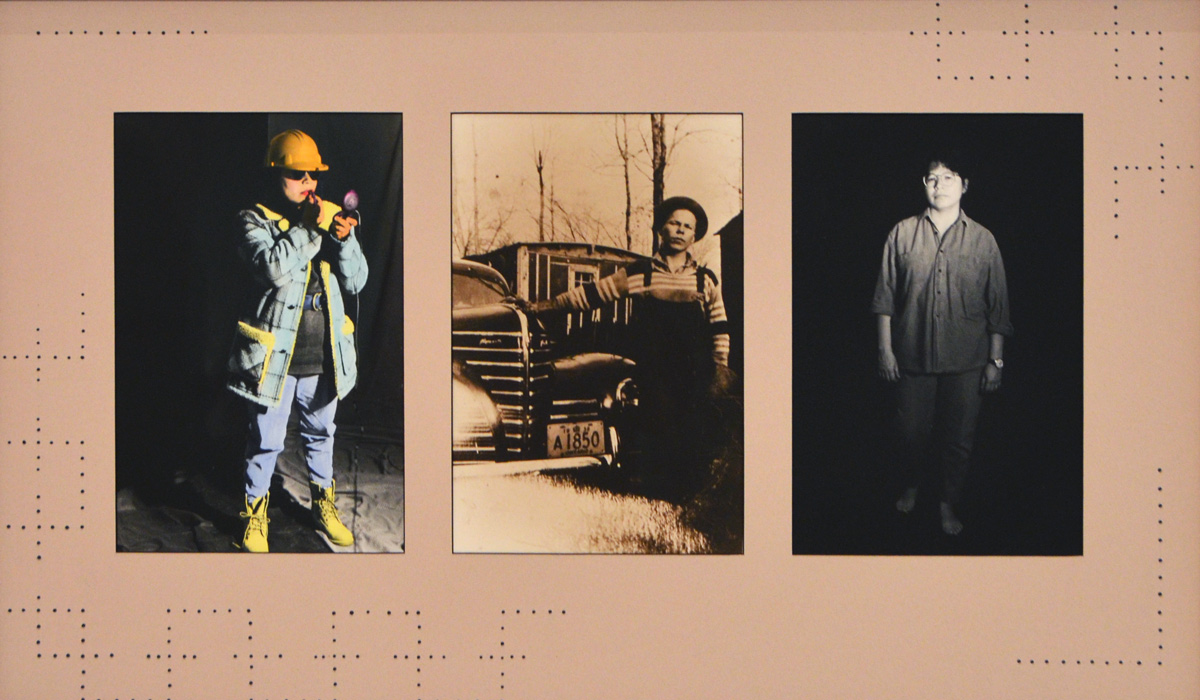
below: A series of three photos framed together titled ‘Mohawk Worker’.  It is one of a series of six triples called ‘This Land is Mime Land’ (Apparently there are 12 in the series, but only 6 are on display here).  Each set in the series has an old sepia toned black and white photo in the center, a casual posed photo on the right (of the same woman in each), and a posed, hand coloured ‘parody’ photo on the left.  In this case, she is dressed in working clothes and a hard hat, but she’s applying lipstick and has a small compact mirror in her left hand.   Other works in this series include,  ‘Love Me Tender’ with the woman dressed as Elvis, and ‘Final Frontier’ with the woman dressed in a Star Trek outfit.

three pictures frames together, on the left is a woman in workmen's clothes and hard hat but putting on lipstick, in the middle is a vintage black and white photo

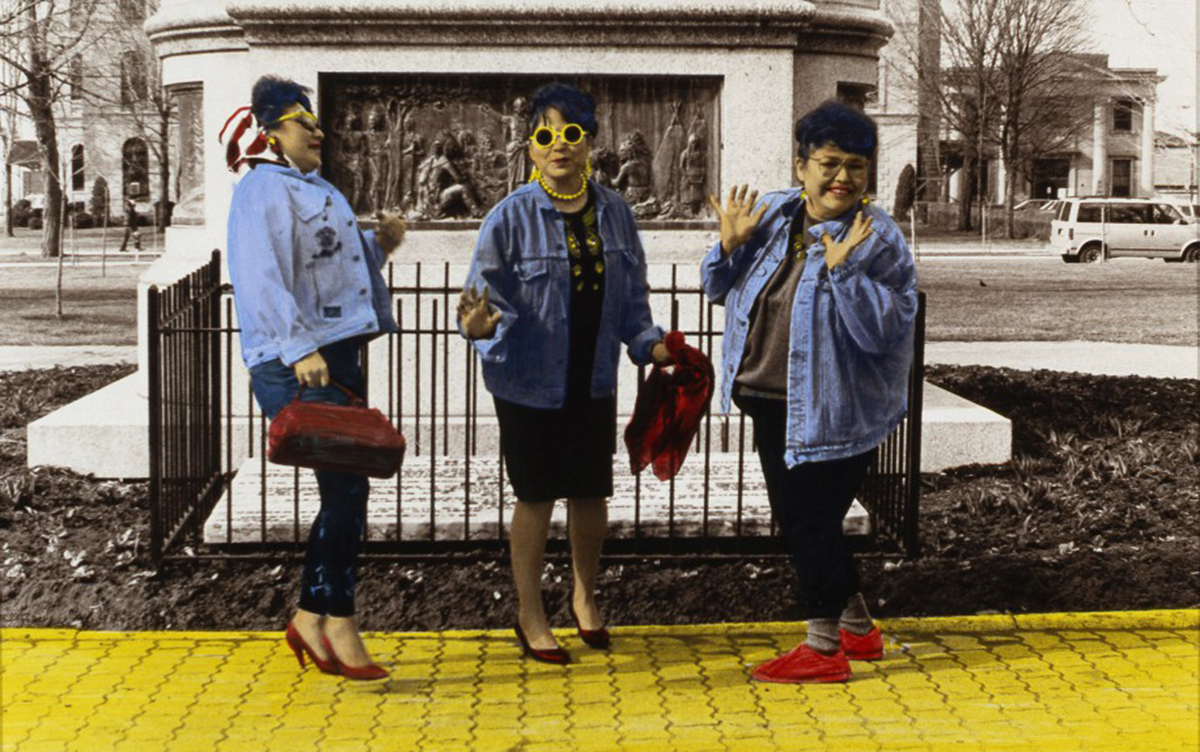
below: One of another set of pictures.  Hand painted black and white photos of these women posing (hamming it up) for the camera.  They are on the yellow brick road, and like Dorothy on her way to see the Wizard, they are wearing red shoes.  “Red Heels Hord” 1991.   It, like a lot of her work, challenges the stereotypes and cliches of Native American women.

a colourized black and white photo of three women hamming it up for the camera. All wearing red shoes and walking on a yellow sidewalk, beside a metal fence. by Shelley Niro

Shelley Niro was born in 1954 in Niagara Falls NY and grew up on the Six Nations of the Grand River Reserve near Brantford.  She graduated from OCA and a masters in Fine Art from the University of Western Ontario.

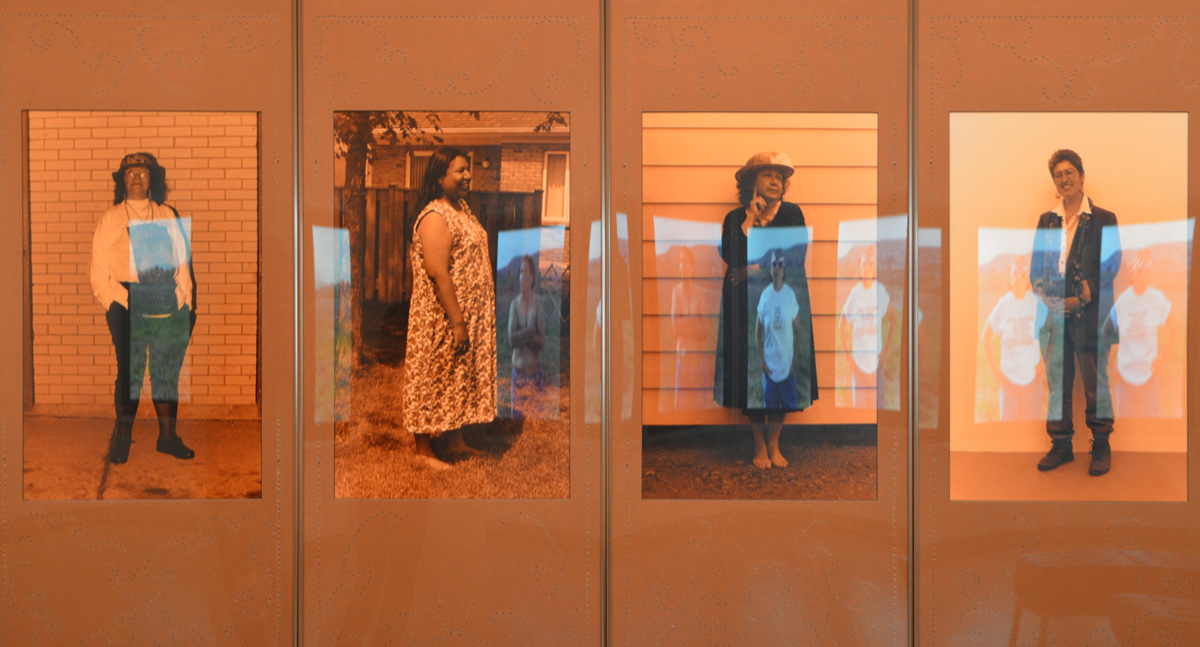
below: Four photos from “Are You My Sister?” 1994.   This is only part (4/12) of the series.  The glass was very reflective so you can see the shirt series that was on the opposite wall.  Like most of her work, the matte has been hand decorated.  In this case, patterns are made with performations in the matte.

four pictures of women, standing, matted in orange, orange tone to the photos, relfections of other photos in the glass, art by Shelley Niro

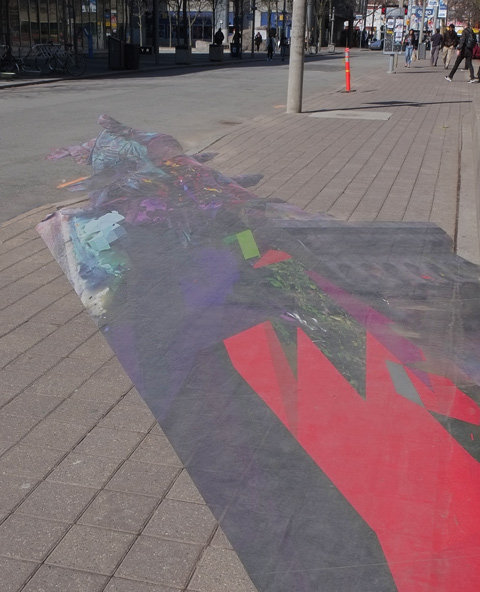
Scott Benesiinaabandan’s installation, ‘newlandia: debaabaminaagwad’  is in two parts.  First, on the sidewalk in front of the statue of Egerton Ryerson, the man who founded the University, is an image that has been glued to the ground.   Parts of that statue have been used in the making of the image – it’s not too easy to see in this photo, but the top part of the image is the same shape as the top of the statue of Ryerson.  Maybe you can see the purple draped head and the outstretched arm.  It’s like the statue has been draped with cloth and/or pictures.  In fact, the images used to create this were taken from photographs that Benesiinaabandan took of three First Nations flags.

below: The other part of ‘newlandia: debaabaminaagwad’ consists of large images adhere to rocks in the square, taking on the texture of the rocks.

Devonian Square in Toronto, large open area with wading pool (empty at the moment) and large boulders, small trees growing around the edge of the pool, two people walking through the pool area, a woman walking her dog on the sidewalk beside, rocks covered with artwork

rock covered with a digital image, glued on it, outside, trees around

Both of these artist have their own websites:
1.  Scott Benesiinaabandan
2.  Shelley Niro

Dots, dots, dots.  Millions of dots? Dots and lights worth waiting for.

‘Infinity Mirrors’, Yayoi Kusama, AGO

on a mannequin, a white t-shirt and a polka dot scarf. The t-shirt has writing that says, My life is a dot lost among thousands of other dots, Kusama

Kusama’s polka-dot paintings were based on visual hallucinations she has experienced throughout her life, often based on “a miserable childhood as an unwanted child born of unloving parents.”  These hallucinations often involve repeating patterns that engulf her field of vision, a process she refers to as “obliteration”.  Painting has  helped to keep her demons at bay, to obliterate her anxieties.

In 1968 she returned to Japan.  In 1977 she checked herself into the Tokyo mental hospital where she has lived ever since.  She has a studio where she works during the day but she returns to the hospital at night.

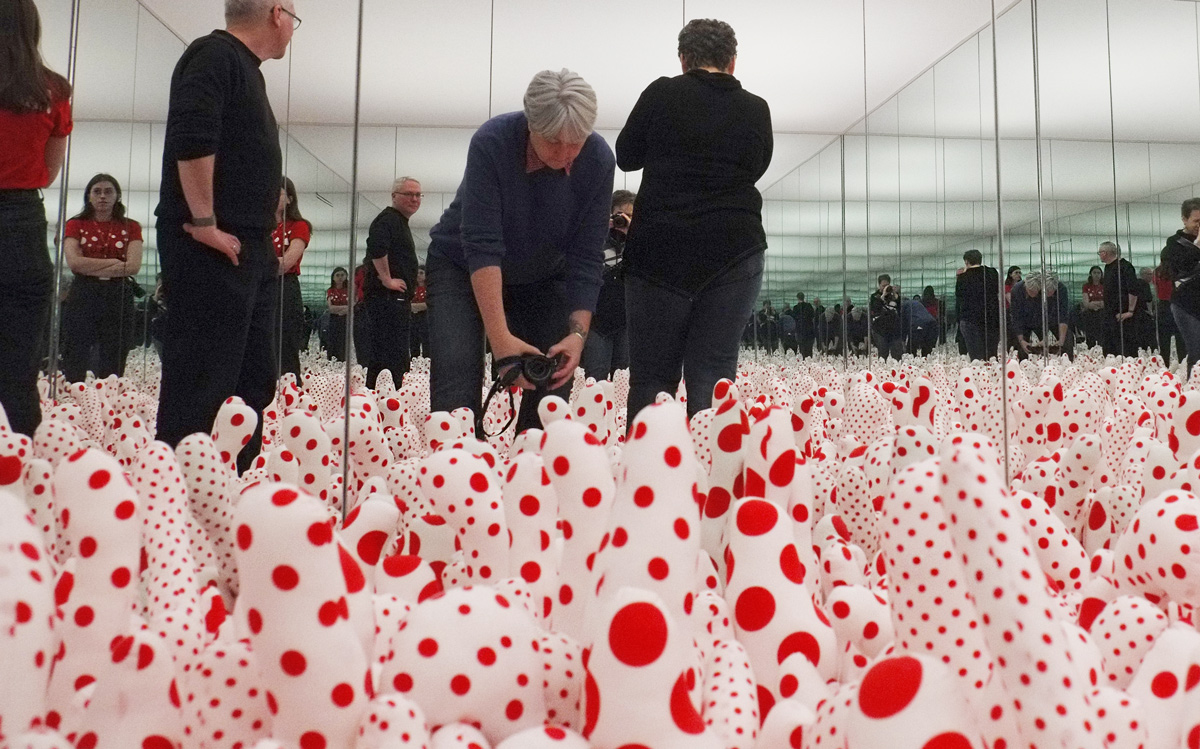
below: In an effort to keep the waiting times down, the AGO is letting three people at a time into the rooms.   I’m not sure who the man is, but he seemed to put up with Joanne and I and our cameras!  This was the first room in the exhibit and it was a bit of a let down – it was the only one that wasn’t impressive.  Minor gripe – why not a mirror on the ceiling?

phallie fields, white with red dots, mirrored room, mirrored walls, people,

below: 30 seconds per visit.  All timed – note the stopwatch!

a woman is entering Kusama's room with many lights and mirrors

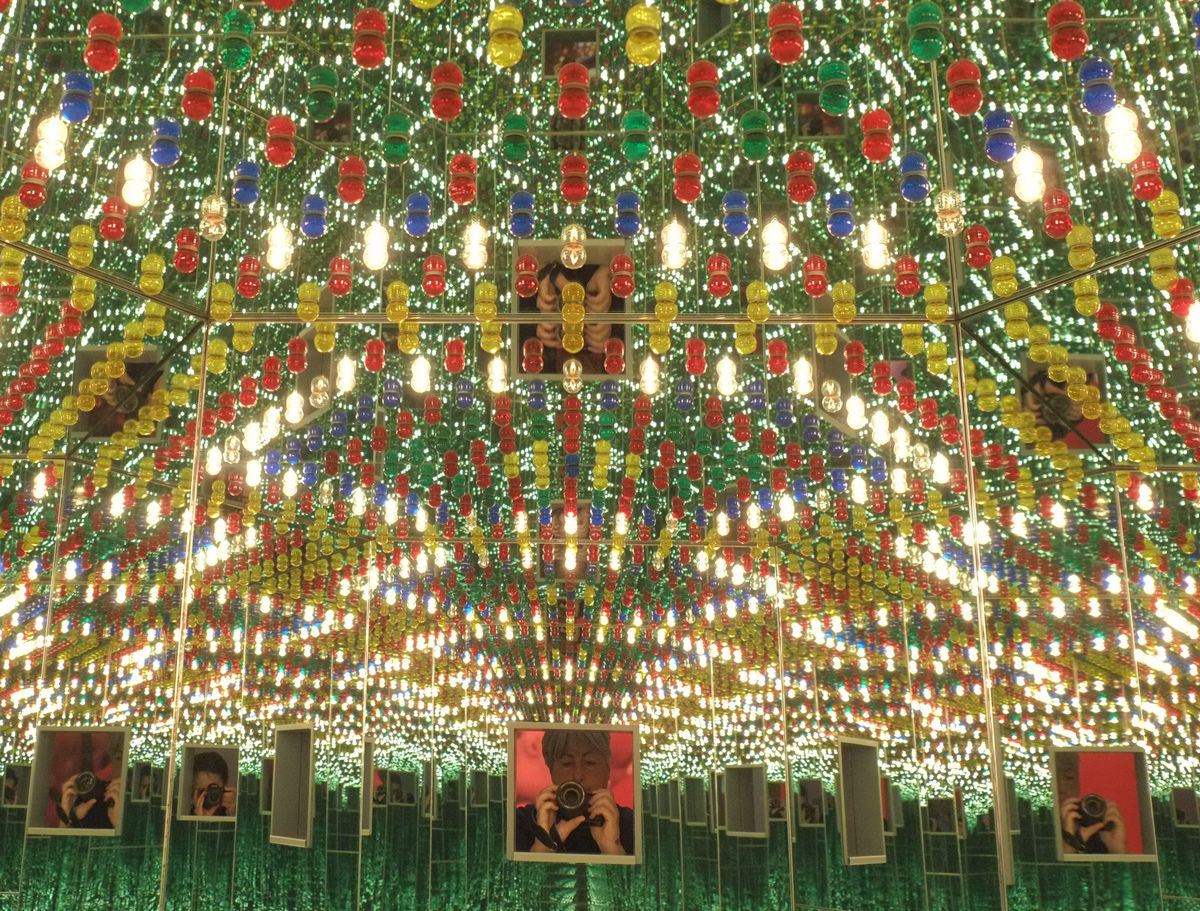
below: Stars and planets into infinite.  Small specks in the vastness of the universe.  Obliteration of the self as we become just a very tiny, minuscule dot in the infinite of space.  This exhibit is “The Souls of Millions of Light Years Away” and is made with hundreds of hanging LED lights.

dark room with lights that look like planets and stars, mirrors on walls and ceiling.

below: The words on the wall say, “The souls of millions of light years away”. This is the line-up for the room above. It was one of the shorter lines.

people lining up inside an art gallery

Kusama was born in Japan in 1929 and trained originally in traditional Japanese painting. One of the only American painters that she knew of was Georgia O’Keefe, having seen her work in an art book. She wrote to Georgia O’Keefe asking for advice on how to break into the New York art world. In 1958 she moved to New York City where she became part of the avant-garde art scene. She was into pop art and hippie counterculture. She organized a series of anti-war public performances featuring naked people who were painted with brightly colored polka dots.


below: This room was fun especially since I got to spend a few seconds alone in it.  Dancing with pink balls.

in a room with mirrored walls and ceiling, many large pink balls with black polka dots on them.

below: Looking into “Love Forever” – a small hexagonal box with some mirrors on the outside and two small windows (peepholes!) as seen from the outside.  This structure/exhibit was first shown in 1966.

a woman is looking through a small window into a box with mirrors and lights.

below: Looking in the window…. It’s amazing what can be done with mirrors and lights in a small space.  Mirrors combined with the technology of LED lights that can change colours with computer controlled programs made for an impressive display.  An endless repetition of patterns.

lights, mirrors in a room with a window. Looking in through the window.

below: Same room, different colours

teal blue lights and mirrors, reflections, kusama infinite mirrors

below: Obliteration Room – multicoloured stickers that people have added to an all white room with all white furniture and accessories like wine glasses and dog dishes.  As more people pass through, the more colourful the room becomes.  The dots make it difficult to see the details in the room.  Can you tell what is on the table?


a room all white, including white furniture is covered with dots in many colours, stickers that different people have added to the room. Part of exhibit at AGO of work by Yayoi Kusama

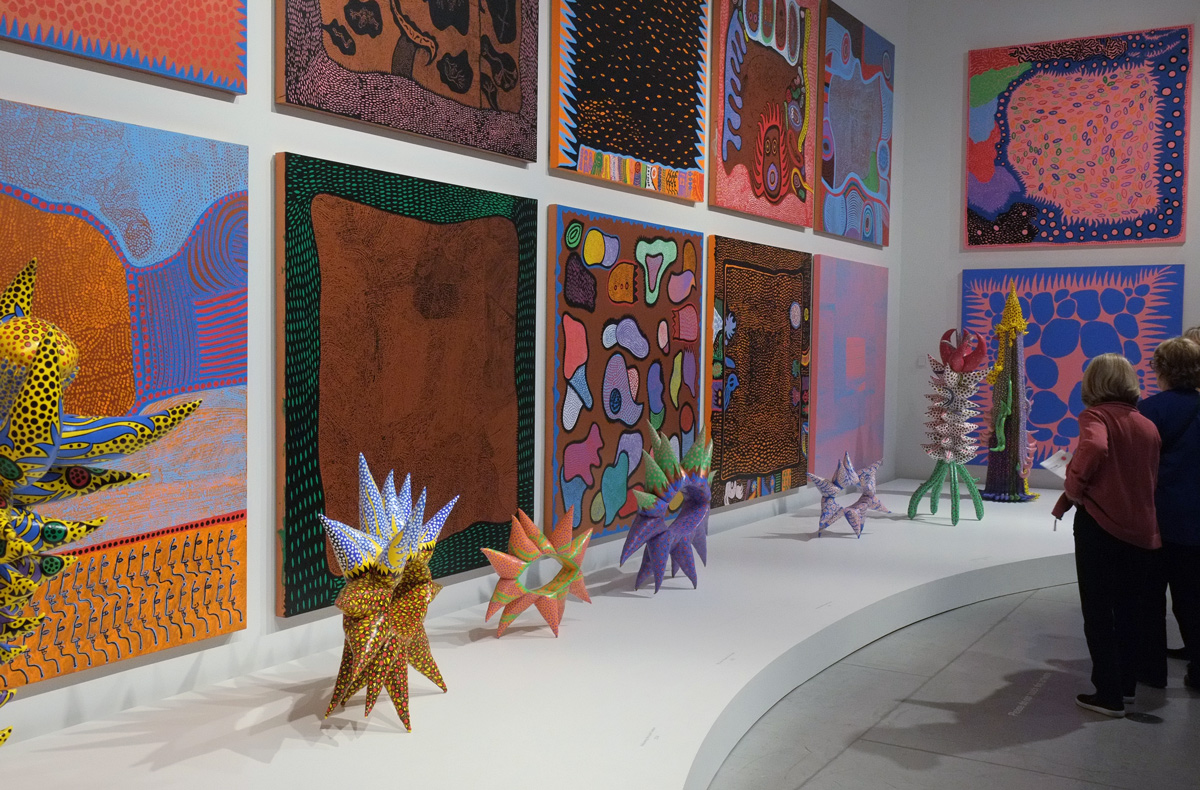
Kusama also paints and makes sculptures.

a wall of bright lively paintings by Yayoi Kusama on the wall of the Art Gallery of Ontario. Some women are standing nearby, looking at the paintings.

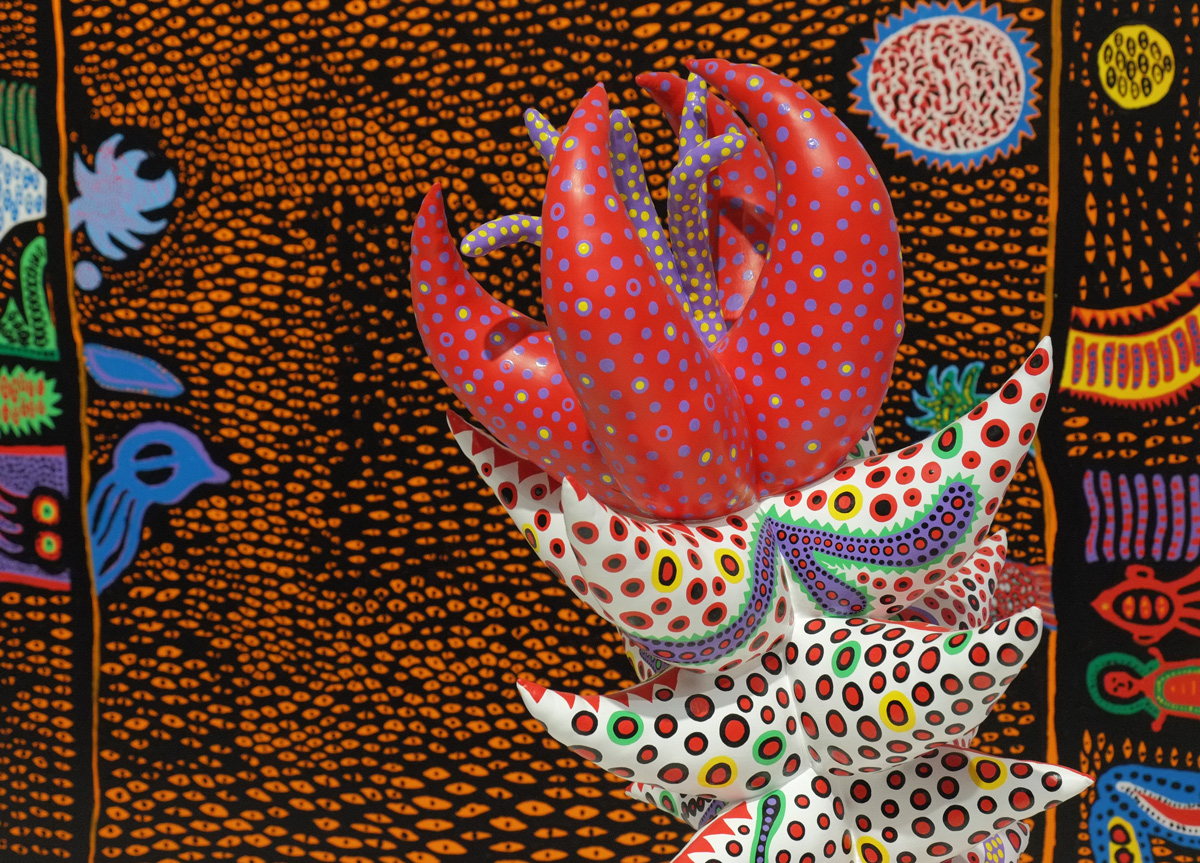
dot covered sculpture in front of a dot covered painting

the windows on the staircase that runs behind the Art Gallery of Ontario back wall, from 5th to 4th floor, are covered with big red dots in honour of the exhibit by Yayui Kusama

Thanks to Joanne of My Live Lived Full for playing with me!

A return to St. Helens Avenue and the galleries there.

A few galleries devoted to contemporary art can be found on St. Helens Ave.  I know that I have mentioned some of their past exhibits in previous blog posts.  Exhibits change and so back we go.   The three exhibits that I saw today have little in common with each other.  Three artists with different views; three men trying to turn their thoughts and ideas into something visual.  The first gallery that I visited today is the Clint Roenisch Gallery where the exhibit is “Hot Takes, No Sax”, by Torontonian Niall McClelland.   It will be there until 21st April.

From Wiktionary: “Noun[edit]. hot take (plural hot takes). A bold, broad, and subjective moral generalization on a situation, with little or no original analysis or insight, especially by a journalist.”   Something written quickly and without much thought put into it.   Although some people associate it with journalism, you could also apply it to a lot of things online – think about the comments section after a news article, or something on your facebook or twitter feed.   Sometimes I think that that expression applies well to contemporary art – thrown together to provoke but not much actually went into it.

below: Running diagonally across the room is a line of trunks and metal cases that are covered with bumper stickers.  On the wall are 4 images, each with a black and white background.  The frames are covered with more bumper stickers.  This is only part of the exhibit.

room in an art gallery, a line of trunks runs diagonally across the room, they are covered with bumper stickers.

below: These are the three images on the wall in the photo above.  The frame on one side of the image on the left has the names of four American politicians from the not so recent past – Nixon, Goldwater, McGovern, and Carter.  Some of the images may be familiar to you as well.

three pictures on a gallery wall, in black and white checkerboard backgrounds, blue images on that. Artist is Niall McClelland

below: More of the stickers.  Is there a theme to them?  How do these relate to hot takes?   Which side is the artist on?  “Urban farmer”, “When you sit down for dinner, thank a farmer”, “Impeach Trump”, “Give a hoot”, “The times they are a changin”, “Be green”, “Bio fuels: no war required”, “Who’s your farmer?”, “I’d rather be gardening”, “Nasty woman”, “Break the chains, shop at independent stores”,  “Saving seed is a basic human need”, “Localvore”,  “Whatever happens to the water, happens to the people”, “What is the proper way to fold an anarchist flag?”

sticker covered metal cases on the floor of an art gallery with a picture on the wall behind, the work of Niall McClelland at the Clint Roenisch gallery

Next is Douglas Coupland’s “Tsunami” at Daniel Faria Gallery, until 28th April.  Trashy in a certain way.  Coupland has collected, cleaned and painted various plastic containers and other disposable items he found along the shore in British Columbia.  A number of the items probably crossed the Pacific Ocean after the earthquake and tsunami in Japan in 2011. Trash on display?  We’ve all heard the expression “reduce, reuse, recycle” which may be facetious here?  Is it too pretty to be a statement about the environmental impact of plastics?

plastic containers and other items found washed up on the shore of British Columbia, cleaned up and painted and put in sealed clear plastic boxes, art gallery exhibit, artis is Douglas Coupland

below: The large gold piece is a collection of more debris that Coupland has amassed and painted.  Another one,  all in black, is on a different wall (not shown here).

plastic containers and other items found washed up on the shore of British Columbia, cleaned up and painted and put in sealed clear plastic boxes, art gallery exhibit, artis is Douglas Coupland, with large structure behind made of gold painted containers and other items

This spring, Coupland will transform the Vancouver Aquarium into a vision of the Great Pacific Garbage Patch by filling aquarium tanks with some of the trash that Coupland has collected – by some I mean 20 tons of it.  Twenty tons of found rubbish.  Twenty tons of plastic and other debris.   Jet streams will simulate ocean currents and the garbage will “float, bounce, disperse and gather along the tank, fragments flowing into one another like an overwhelming and exhausted assemblage”.

below: Tucked away in the back room of the gallery are four paintings like this, also by Douglas Coupland.

part of a Douglas Coupland painting, with a black and white picture of a man's face in the center of swirls of colours. Apainting by Douglas Coupland


Part three is the exhibit “Raw War” by Bruce Eves that is on at the Robert Kananaj Gallery until 21st April. Eves was just given one of the 2018 Governor General’s Awards in Visual and Media Arts.

“taps into a zeitgeist fraught with peril”

below: Part of Work #901 by Bruce Eves.  There are seven panels in total.  Every hour for a week in February 2014 he took his heart rate.  The numbers in the squares are his heart rate.  It’s difficult to see in this picture, but each square also has the date and time.  In addition, each panel is a day.   Something happened on Friday February 14th at 16:00 to elevate his heart rate to 123 beats/minute!

Part of a set of 7 paintings by Bruce Eves on a gallery wall, each painting is squares with numbers in them. The numbers are Eves' heart rate taken every hour for a week.

Eves has also painted a sequence of numbers that are actually nine blood pressure readings.  It was after he learned that he had a heart condition that Eves started using his health (and the monitoring thereof) as subject matter.   A self-portrait based on data about oneself, so to speak.  How his doctor sees him.

A few things to think about?

(P.S. My apologies for the title)


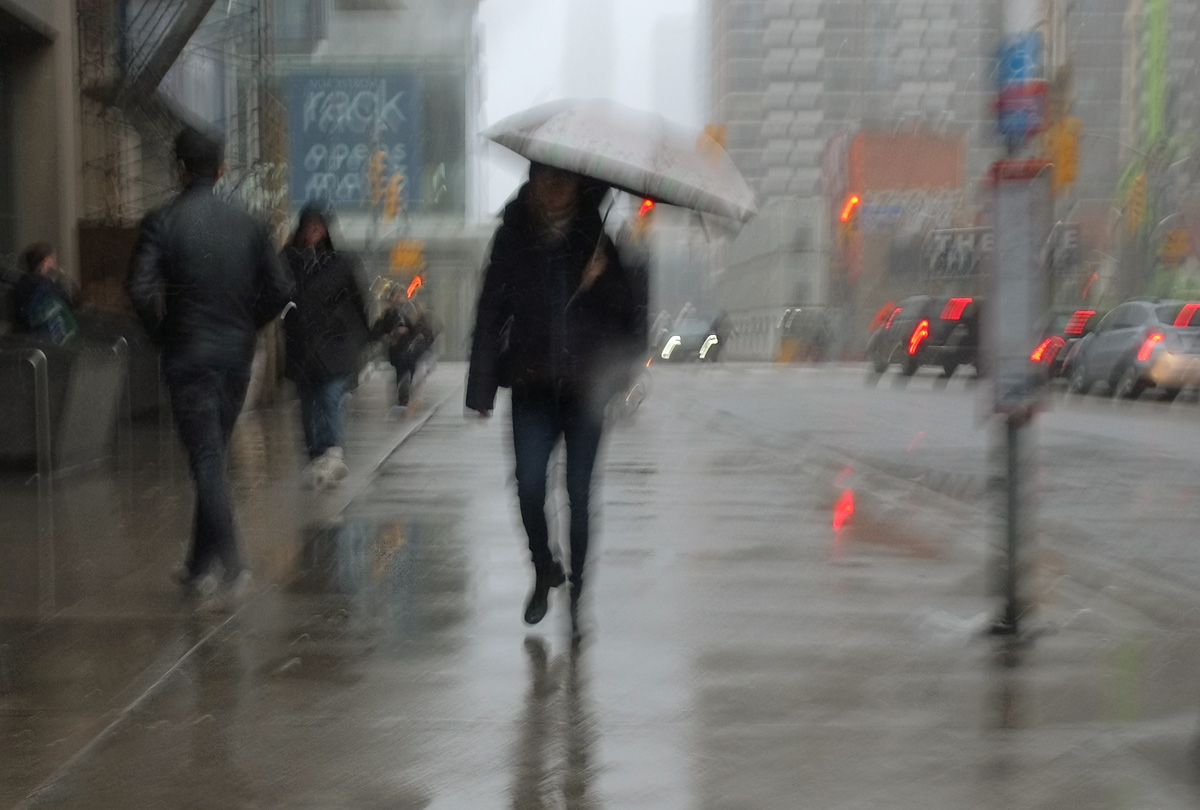
Well, that was quite a weekend.  An April winter storm with snow, sleet, ice pellets, freezing rain, and even some just plain rain.   The streets were icy and the sidewalks were slushy and wet.   Chunks of ice have fallen off roofs, tree branches have broken off with the weight of the ice that formed on them.  And then there was the wind that blew hard.   Of course I went out!

hazy, blurry picture of a person walking with an umbrella up Yonge street with other people, cars, wet sidewalk,

below: Dressed in our April finery. Black parkas.

people walking in the rain, downtown Toronto

below:  There is a small, but interesting, exhibit at the Toronto Reference Library at Yonge and Asquith that I wanted to see.  It’s called ‘Toronto Revealed’ and it’s in the TD Gallery on the main floor.   It features drawings and paintings of Toronto’s past.

sign in the window of the Toronto Reference library re the display at the TD gallery, Toronto Revealed, pictures and paintings of Toronto in the past

below: One of the paintings in the exhibit is this one, ‘Cherry Street Hotel’ by Gerard Lazare (1978).  The Cherry Street Hotel was built in 1890 at the corner of Cherry and Front Streets.  It later became the Canary Restaurant (1965-2010).  The building is still there but it stands empty.

painting of the Canary restaurant on the corner of Cherry and Front streets

below: There was a display of small artworks by Nicholas Hornyansky (1896-1965), including this one of St. James Cathedral (1938).  Hornyansky was born in Hungary and immigrated to Canada in 1929.  He is known for the etchings and aquatints (another print making technique) that he did of Toronto buildings and landscapes.

small framed painting of Saint James cathedral in Toronto, by Nicholas Hornyansky, painted in 1938 .

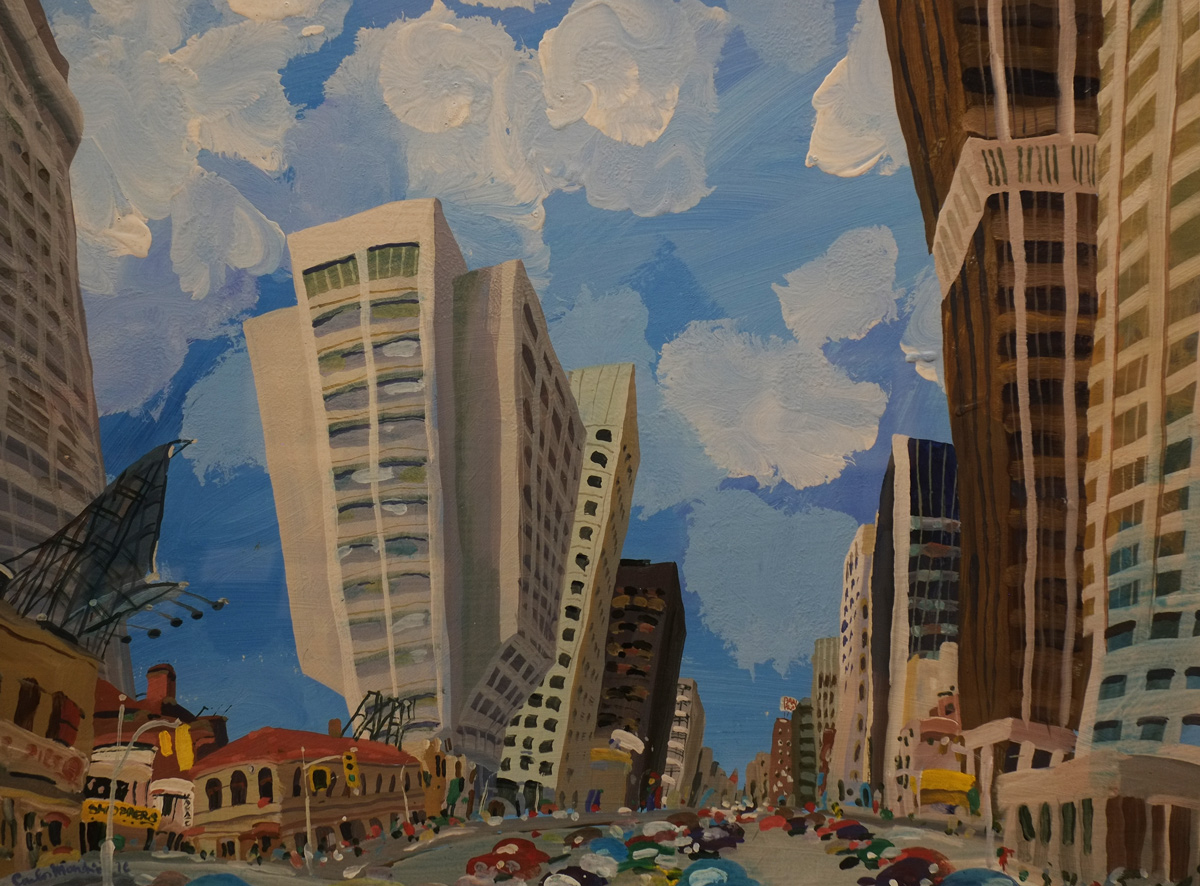
below: Most of the paintings were very realistic (documentary) except this one – a wacky view of Bloor Street looking west from Yonge towards Bay by Carlos Marchiori, painted in acrylic in 1976.   Even then, it is fairly true to reality.  The darker tower on the right is on the NW corner of Bloor and Yonge.  Stollerys store (the low building on the SW corner) is long gone.

bright painting of city landscapre, Yonge & Bloor, bendy buildings, cars as coloured blobs on the streets, puffy clouds in bright blue sky, by Carlos Marchiori

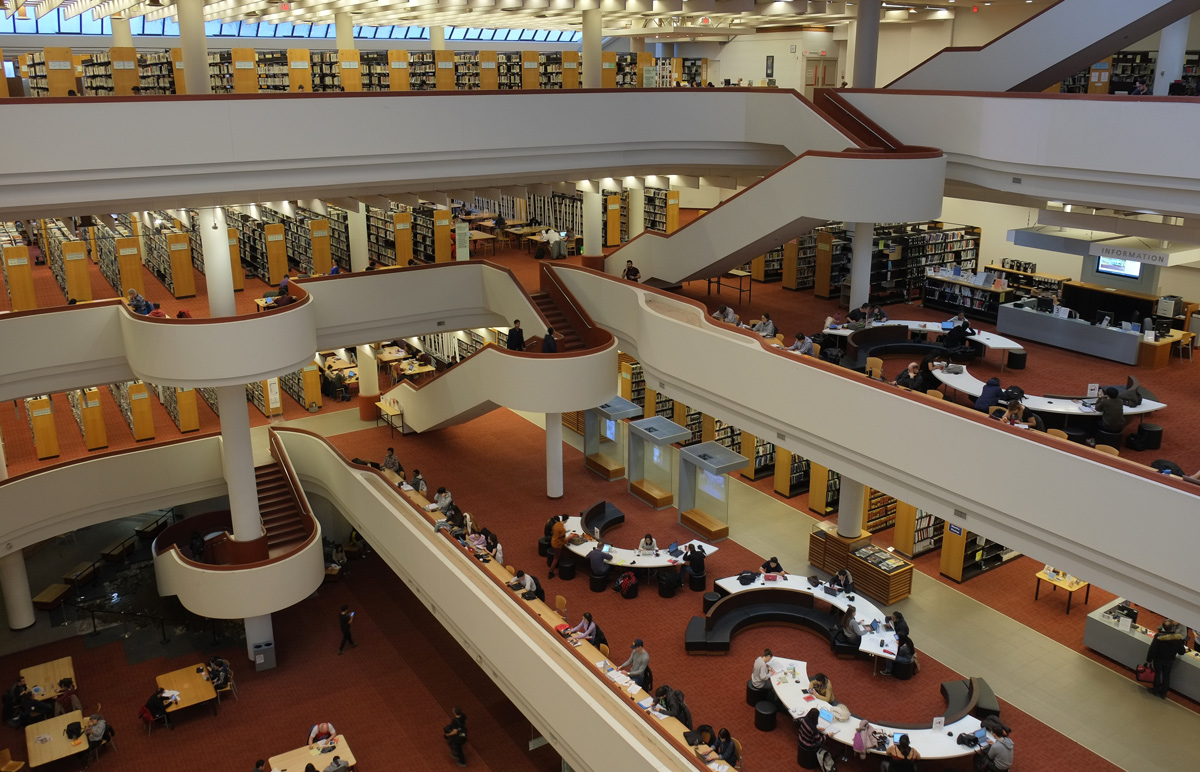
While I was at the library, I wandered around and took a few pictures of its vast open spaces.  It was warm and dry!  I was expecting to be told to put my camera away, but no one seemed to care.

interior of the Toronto Reference Library from the fifth floor, semi circular tables, reddish carpet, open concept architecture, rows of books,

below: Most were too busy working to notice.

looking down an aisle between two stacks of books (book shelves), a woman is sitting at a table studying and writing, there is a window behind her

below: One more picture from the ‘Toronto Revealed’ exhibit is this painting of the intersection of King and Jarvis by Vernon Mould.   It was painted in 1979.  Was gas really 20 cents a gallon in 1979?  No! That was the year that prices went metric and a litre of gas was 20 cents.    I came back to this picture because I chose to chase down that intersection to see what it looks like today.

painting, in mostly brown tones of a three story building at the corner of King and Jarvis, Toronto, with a small gas station across the street, sign says gas 20 cents, 2 gas pumps,

below: Et voici, same intersection, approximately the same angle.  There is now a building (with a Second Cup on the ground floor) where Mould would have stood.   By the looks of it, the three storey brick building on the NE corner has been fixed up since 1979.  So glad to see that it hasn’t been replaced by a glass condo tower!

intersection of King and Jarvis, looking north, three story brick building,

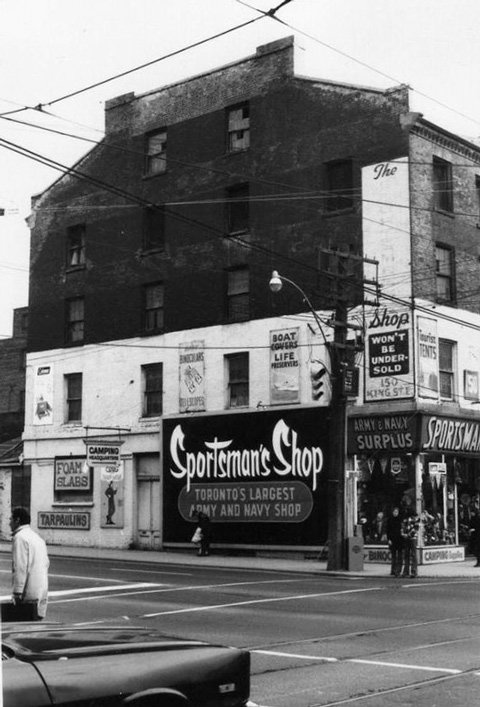
below: I wanted to find out more about the building, so I googled Sportsman’s Shop and I found a wonderful old picture of it from the 1970’s, obviously taken before it was renovated.    Apparently, it was fixed up in the early 1980s.

old black and white photo of the Sportsmans Shop at 150 King East in Toronto, three storey brick building

photo credit: Gary Switzer, source: Urban Toronto

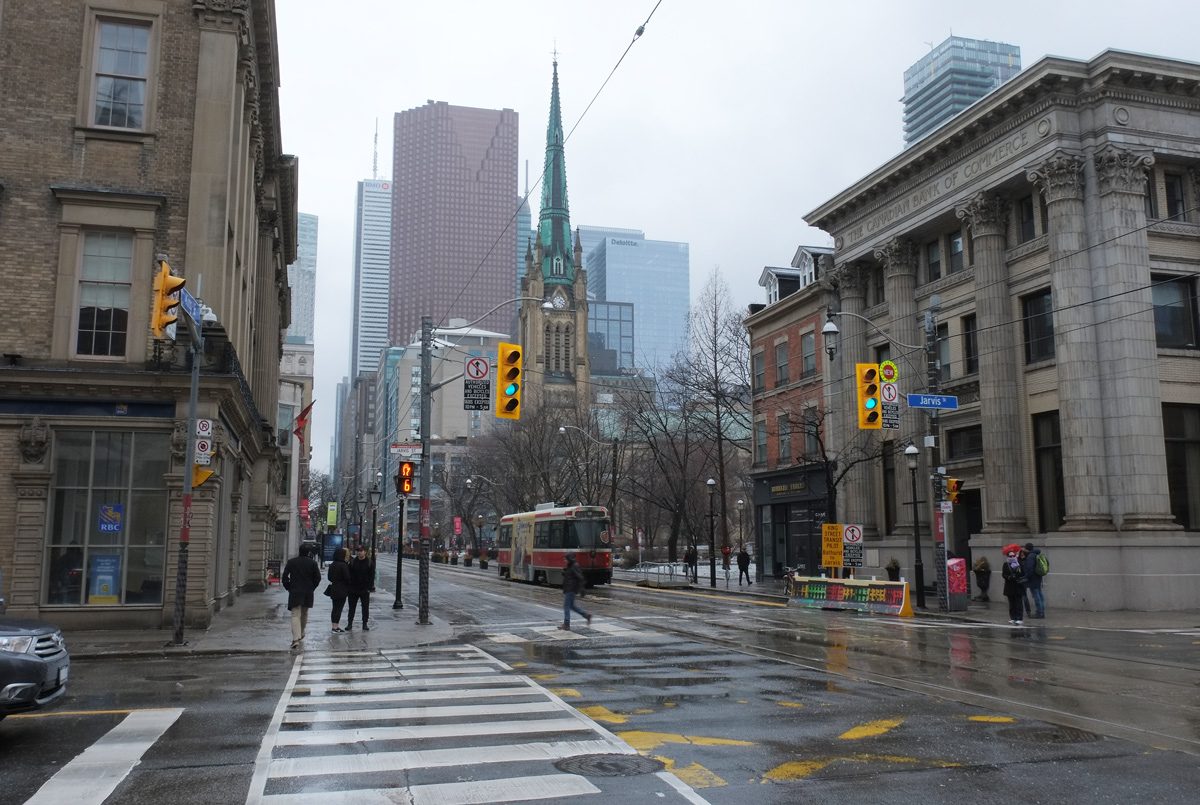
below:  The next photo was taken as I stood on the same corner of King and Jarvis, but pointing my camera in different direction – looking west on King towards St. James Cathedral.  This is the eastern limit of the King Street streetcar project which is why the multicoloured barricades block part of the righthand westbound lane.

looking west on King street from Jarvis, St. James Cathedral and park on the right, downtown towers and office buildings in the distance, rainy day, TTC streetcar,

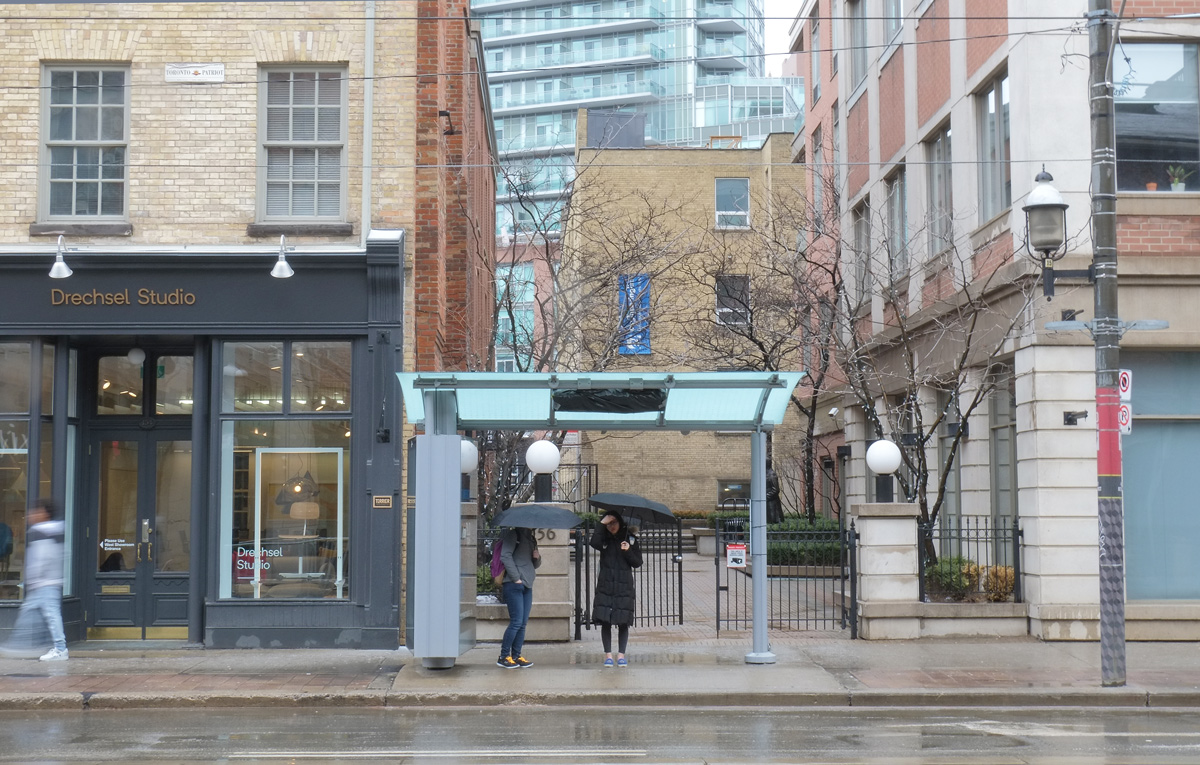
below:  These women are waiting in the wrong place.  Although the city changed the location of the streetcar stops along King Street, the bus shelters haven’t been moved yet.   At least they were (sort of) out of the rain.   They soon realized their mistake.

below: Looking back, the prerequisite photo of a TTC streetcar through a rainy day window.

looking out the back window of a streetcar, rainy day, raindrops on the glass, another streetcar is passing by

It’s always better to end a blog post on a happy note, right?  It may be a dream (I hope not!) but spring can’t be too far away.  April showers bring May flowers, right?  On my second warm up stop I saw this cheerful, hopeful drawing tacked to a wall.   It was one of many on the wall, all the work of Maihyet Burton.  They were at the Artscape building at the Distillery District.

a pen and ink drawing of spring flowers, poppies, in blues and purples, and fiddleheads in bright green

below: Headed home again.

two people with their back to the camera wait on the subway platform as a train arrives

Don’t put away your boots and hats yet!

The other day I discovered that there is a small gallery on the 3rd floor of Ryerson’s School of Image Arts.  If you want to find it too, it’s in a building that it’s in is attached at the ground floor level to the Ryerson Image Centre on Gould Street.   At the moment, there is a small exhibit of photos by Avard Woolaver.

the back of a man looking at a wall in a gallery, old photos of Toronto

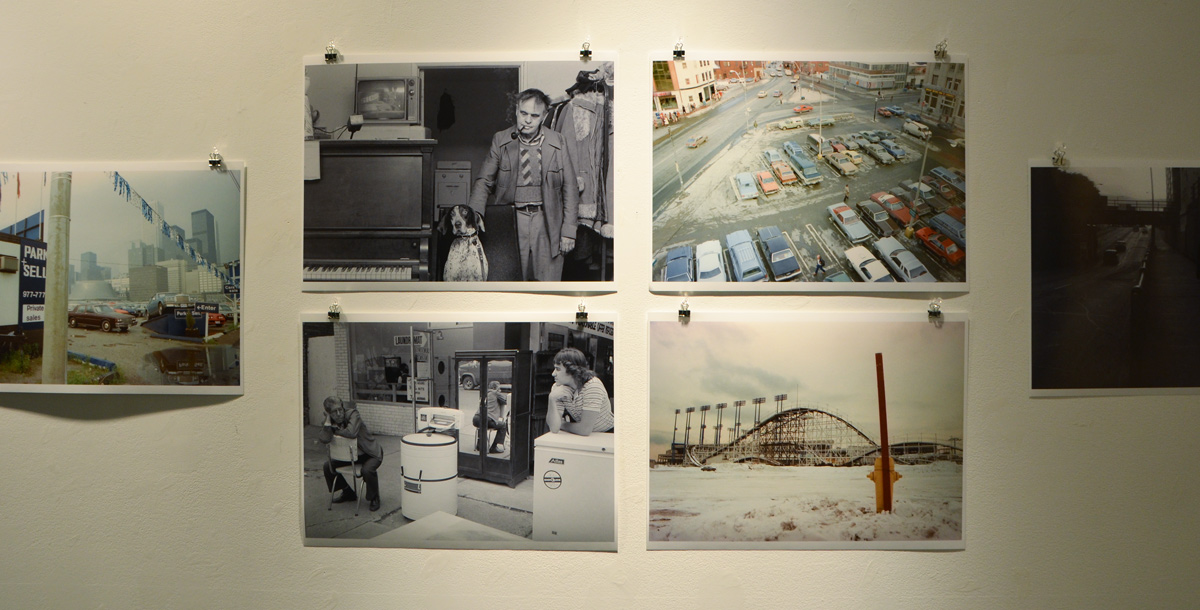
below:  The photos are ones that Woolaver took in Toronto in the late 70s and early 80s.

old photos of Toronto from the 1980s by Avard Woolaver.

below: This photo is one of Woolaver’s – it is looking towards the northwest corner of Spadina and Queen Street West.  For those of us who lived in Toronto at the time, it’s a bit of nostalgia.  Somethings are very familiar – the older TTC buses, the car styles, and a lot of the architecture, for example.   This photo in particular lends itself nicely to the game of ‘Spot the Differences’….. compare this with

photo by Avard Woolaver of Toronto in the 1980s, this view is the north west corner of Queen and Spadina

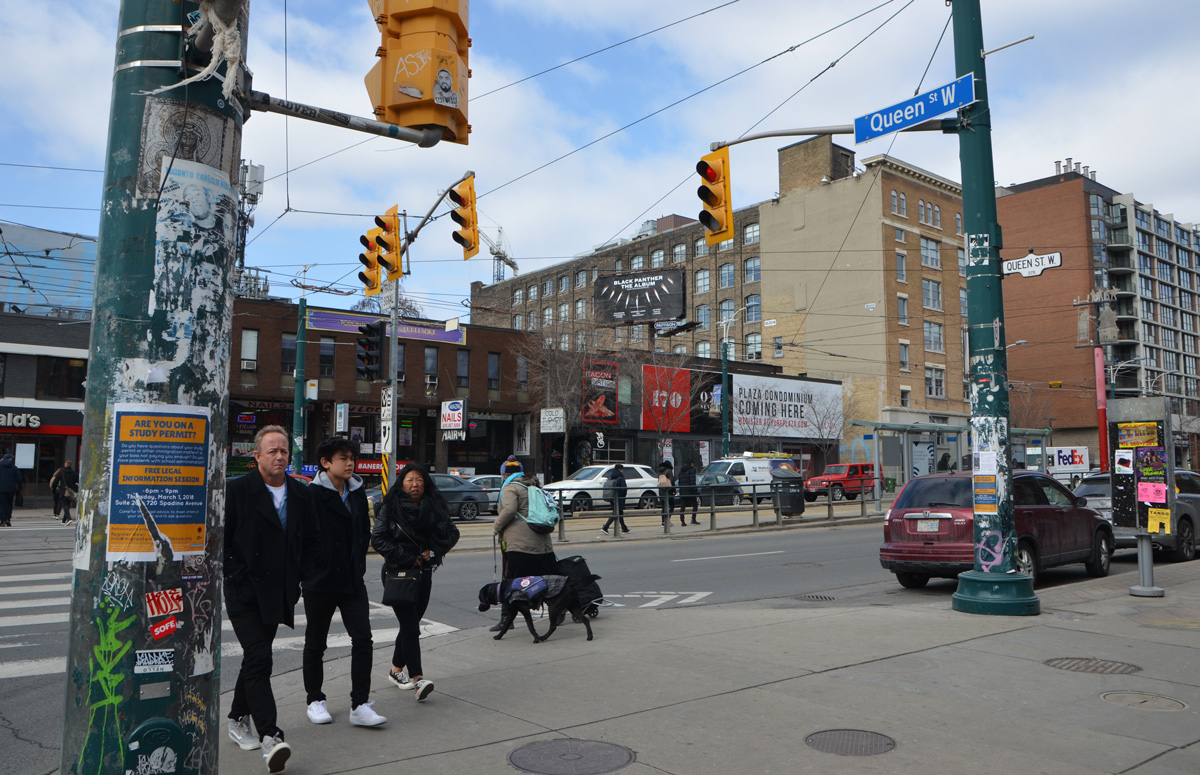
below: …..this. Here is the same intersection, at a similar angle, last week.   The large brick building is still there but without a billboard.   The poles are no longer wood but they are covered in posters and remnants of posters – so no change there.    The street signs have been updated and there is now a streetcar lane in the middle.   All in all, I was surprised how little had actually changed in 30ish years.

the northwest corner of Queen and Spadina in 2018, pedestrians, buildings, street scene

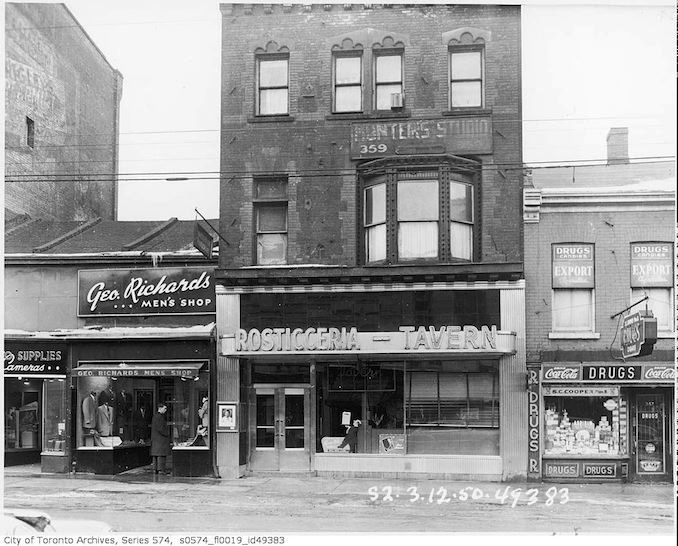
below: I found this photo online (originally from the Toronto City Archives, 1950?) but before we can play another round of ‘Spot the Differences’, we have to identify these buildings?  Any ideas?

vintage photo of 357, 359, and 361 Yonge street, black and white, 3 storefronts,

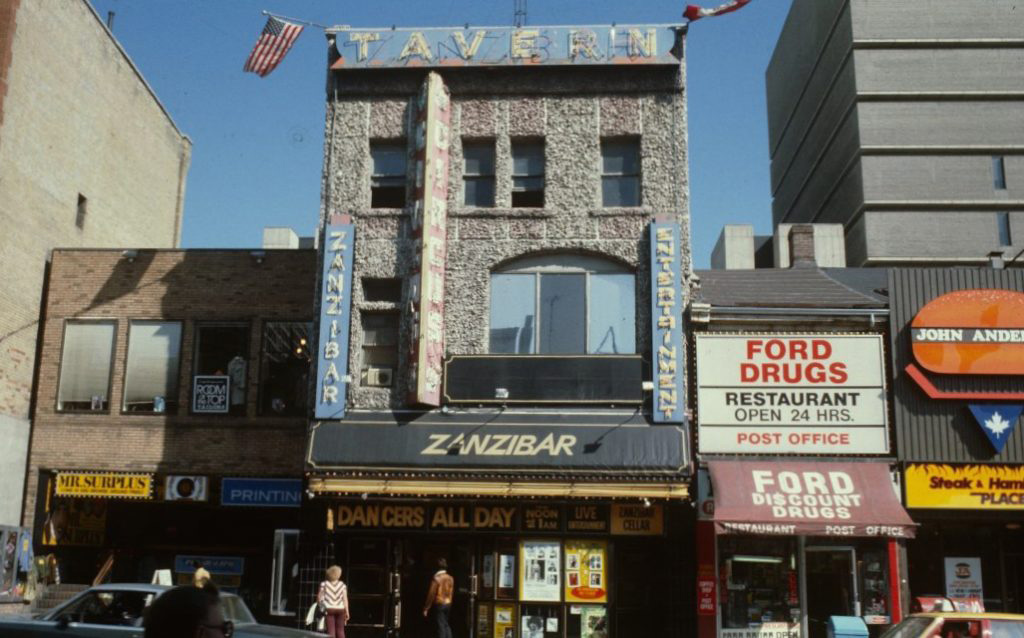
below: Here is the same location in the 1980’s (not a photo from the exhibit).  Not too many changes.   The building that housed George Richards Men’s shop, 361 Yonge Street, was replaced by a dull and boring two storey brick building but the other changes were just to the facades and the owners/tenants.   The tavern is still a tavern and the drug store is still a drug store.  The large brown building on the top right that you can only see part of is Ryerson College.   Unfortunately the Wrigleys ghost sign on the taller building on the left has been covered.

357, 359, and 361 Yonge street in the 1980s including the Zanzibar tavern

photo source BuzzBuzzNews online

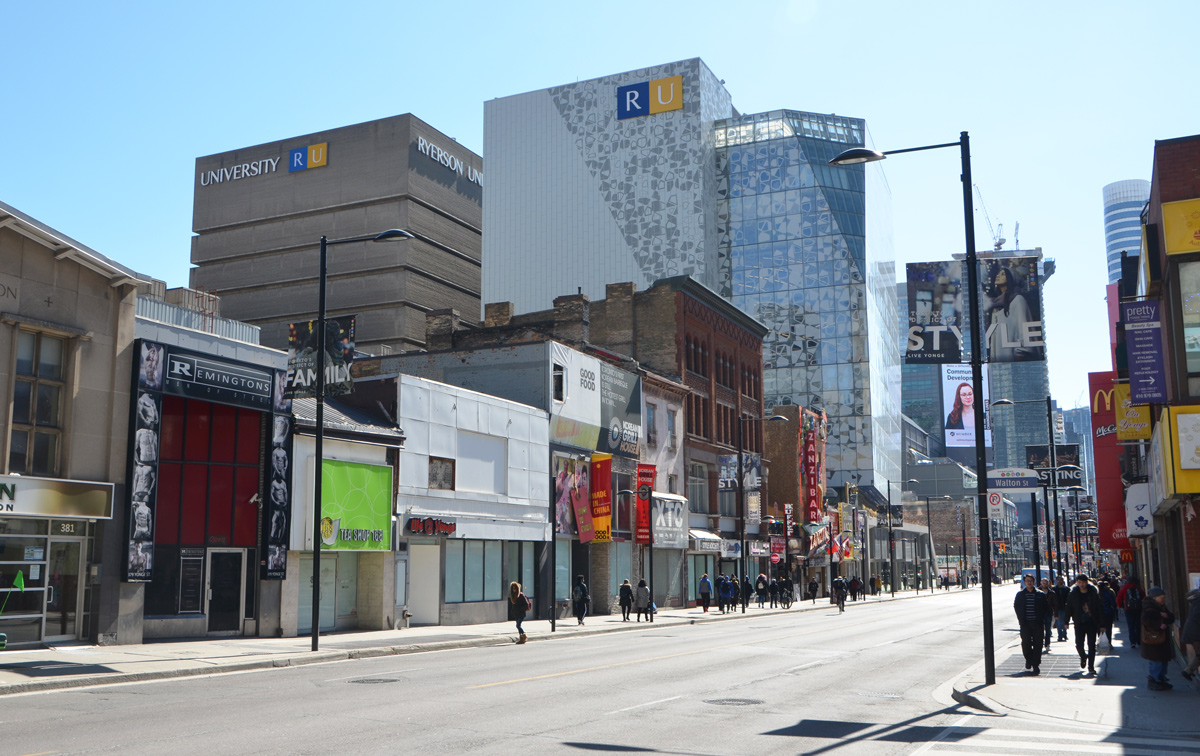
below: Fast forward another 30 years.  The Zanzibar is all bright lights and dazzle while the building that housed the drug store is now for sale.  Ryerson is now a University and has expanded out to Yonge Street – that’s the large blue building in case you are not familiar with the area.

Yonge stree, easy side, just north of Dundas, about 357, 359 and 361 Yonge Street including the Zanzibar Tavern. The blue glass wall of Ryerson University behind the Zanzibar,

below: If you pull back a bit, and look just a bit farther north on that stretch of Yonge Street, you’ll see that there are many empty buildings

yonge street, between gerrard and dundas, most storefronts are closed and boarded up waiting for redevelopment of that stretch

below: … including what was until recently the XTC clothing company.  It looks like it has gone through a number of ‘renovations’, not all of which were good.  Some traces of its original brick facade can be seen at the top but at street level it is (was?) a mess.

empty two storey building, once was X T C clothing store

 There is a plan to build a 98 storey mixed-use building on this site including just over 900 residential units ranging in size from 520 to 2000 square feet.    It will be the tallest residential building in Canada.   In the promotional material for YSL Residences, as they will be called, is this: “The epitome of luxury living, designed to elevate the fortunate few who will call it home.”


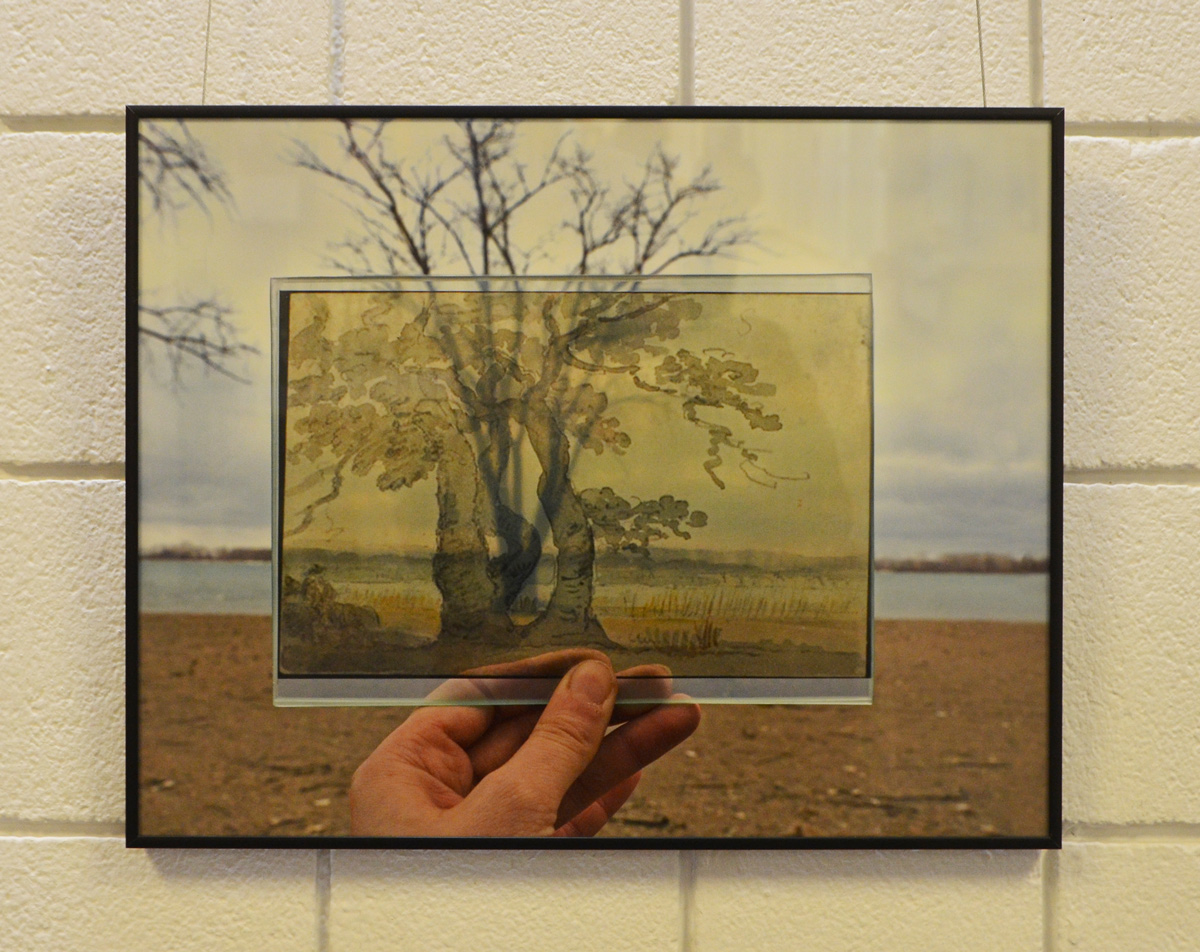
below:  Back to Ryerson, also on the 3rd floor of the School of Image Arts, there was a small series of photographs like this one hanging on the wall in the hallway.  There was no sign as to the name of the artist that I could find either on the wall or online.   I quite like the technique and the resulting image.  Two ideas melded into one.  Two time frames in one frame.  Two artistic styles combined to create another.

a photograph on a gallery wall, a hand holding a photo printed on glass in the middle of another photo, superimposed landscapes

If you are interested in Woolaver’s work, you can find more on his blog.

There are a few exhibits showing at the Ryerson Image Centre at the moment but the one that I want to highlight today is “Rich and Poor” by Jim Goldberg.  Goldberg took portraits of people in the San Francisco area in their home environments between 1977 and 1985.  They are divided into two sections, “rich” and “poor”.

Ryerson Image Centre (RIC) gallery, Jim Goldberg portraits "Rich and Poor' exhibition of black and white portraits in San Francisco in the 1980s

below: Each portrait is accompanied by a comment from the person being portrayed, in their own handwriting.  This woman, Nell, provides the wonderful quote: “If you want to stunt your growth, be rich.”

Ryerson Image Centre (RIC) gallery, Jim Goldberg portraits "Rich and Poor' exhibition of black and white portraits in San Francisco in the 1980s

below: The pictures are fascinating, and the words reveal more details of the subjects.  “My wife is acceptable”.   The poor woman.  In the picture she is off to the side and almost disappears into the background as she looks at the floor.   I thought of the words ‘abject’ and ‘woeful’ when I first saw her but I think that maybe the best word to describe the look on her face is ‘blank’.

Ryerson Image Centre (RIC) gallery, Jim Goldberg portraits "Rich and Poor' exhibition of black and white portraits in San Francisco in the 1980s

below: Whether you’re rich or poor, or more likely some where in between, what you say about yourself if you were the subject?

Ryerson Image Centre (RIC) gallery, Jim Goldberg portraits "Rich and Poor' exhibition of black and white portraits in San Francisco in the 1980s

This show continues until April 8th

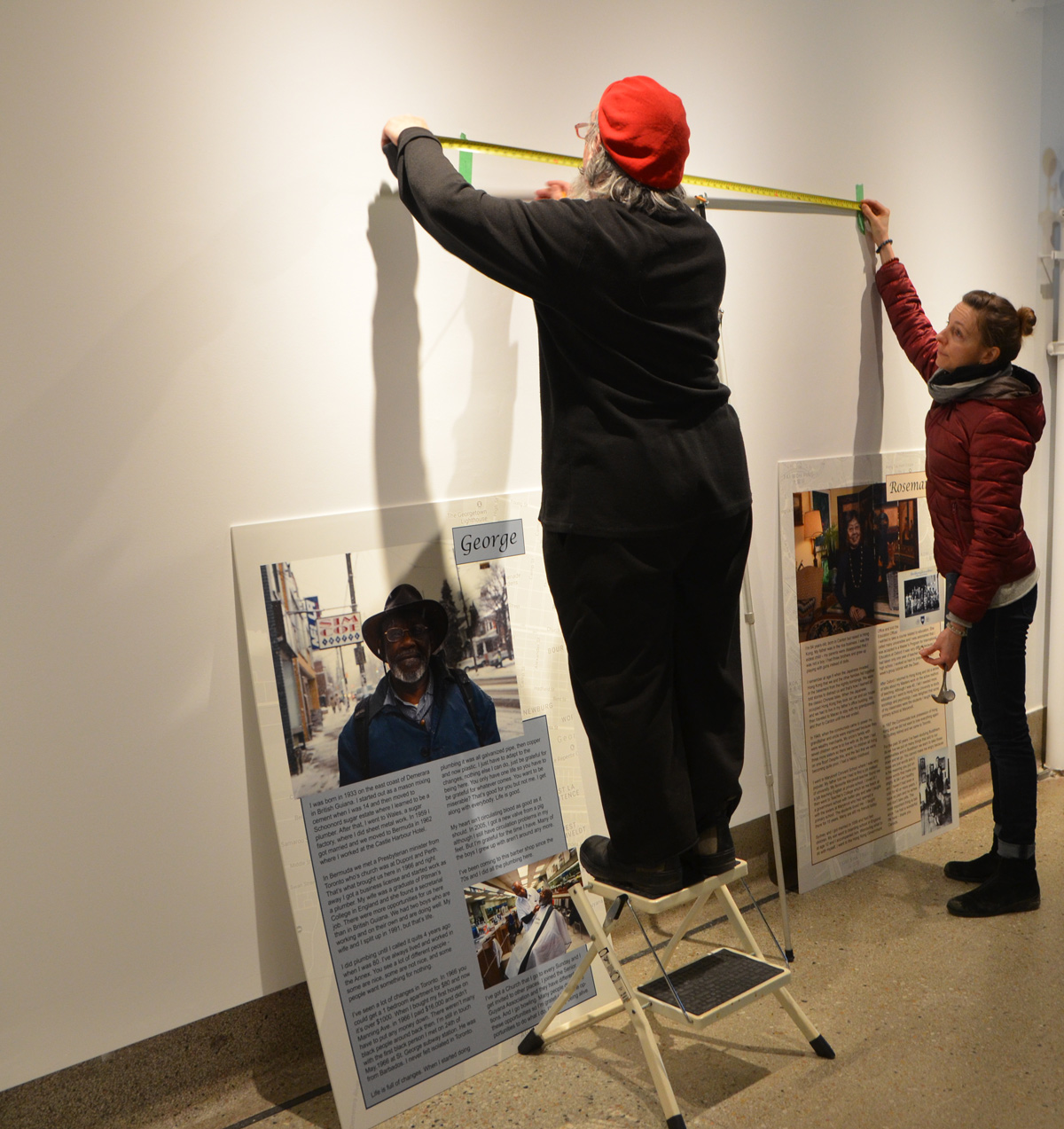
On exhibit now at Artscape Youngplace is a photo documentary on seniors in Toronto called ‘Focus on Our Elders’.  It is being shown in the 3rd floor gallery until the 17th of March.   There are 24 panels in the exhibit, one for each participant in the project.   The main feature of each panel is a portrait of the individual and it is accompanied by at least one other photo of something relevant to the participant’s life, as well as text that tells some of the stories of their lives.

a man looking at panels on the wall of a gallery, focus on our elders photo documentary project, 3 panels on the wall, one for each of three participants with a portrait plus words from an interview with them.

With thanks to Penny for taking this picture!

The project was funded my Myseum of Toronto and is part of their 3rd annual Intersections festival.

description of the focus on our elders project

two people hanging pictures in an art gallery

Link to The 6ix Clicks websit

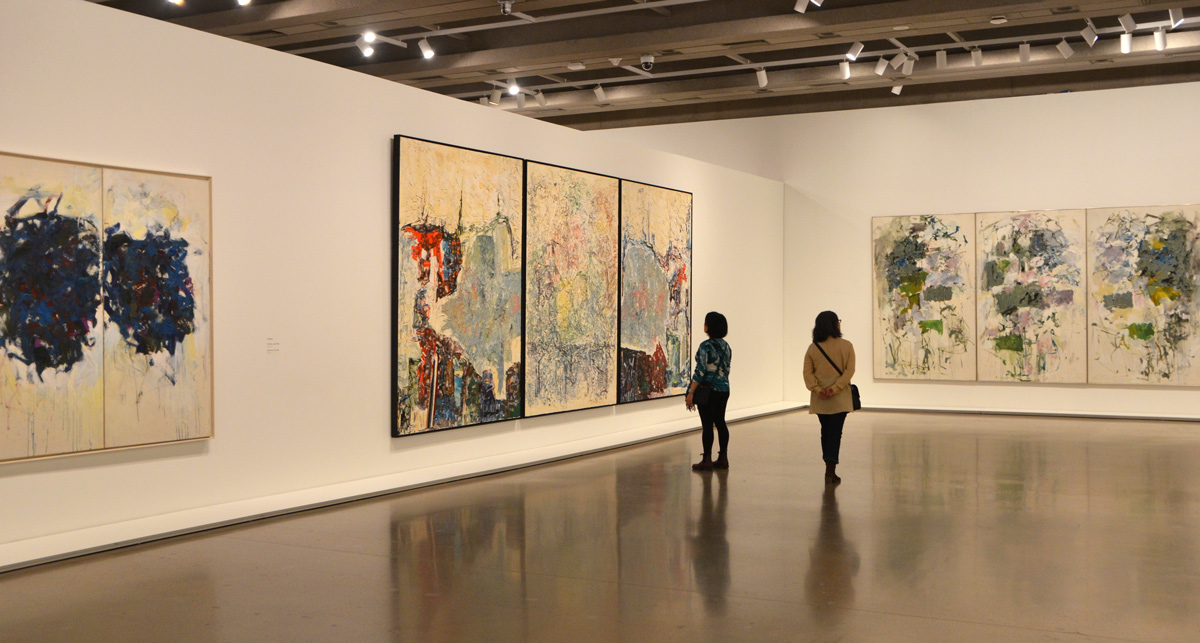
Lots of shiny silver balls, like bowling balls with bling, and lots of paint on large canvases…. on the surface these two things don’t really have anything in common.  But because they are two things that I saw at the Art Gallery of Ontario, I’m going to throw them together in this blog post.  The shiny spheres are part of a display by Yayoi Kusama  while the paintings I refer to are those by J.P. Riopelle and Joan Mitchell.

I saw the balls first.   There has been a lot of hype and publicity for the latest AGO exhibit, “Infinity Mirrors” by Yayoi Kusama that just opened this past weekend.  You’ve probably seen the all the red and white polka dots on the TTC and elsewhere around the city.   Last week when I was at the AGO I noticed that another Kusama exhibit was in the works, one that didn’t involve buying a “hard to get” ticket.  I was curious.  I’ve seen some photos of “Infinity Mirrors” so I went with great expectations.   Maybe that was my mistake.

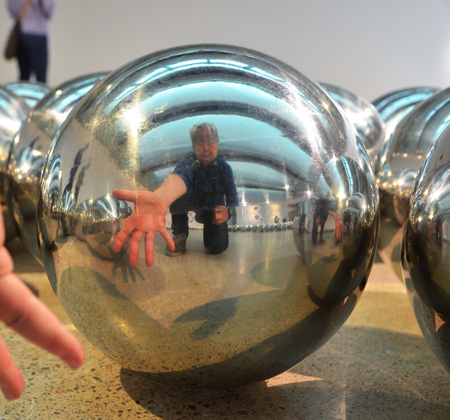
below: “Narcissus Garden” consists of a large room with hundreds of shiny silver spheres laid out on the floor.

a large room, with 3 women looking at hundred of silver balls arranged on the floor. The balls are about the size of bowling balls

“Narcissus Garden” dates back to 1966 when it was a performance piece by Kusama at the Venice Bienalle.  She walked among the balls, picking them up, and looking at herself in them.   Here, at the AGO, they lie on the floor.   The ceiling is reflected over and over again.   It’s a dull ceiling.   The balls are scuffed up.   You might be able to lie on the floor to get a good look at the reflections bouncing around and that might be interesting.  As it is, “listless” is the word that I would use to describe it.  It’s the tag along mangy mutt to the main event.

reflections of a person in a few shiny silver balls

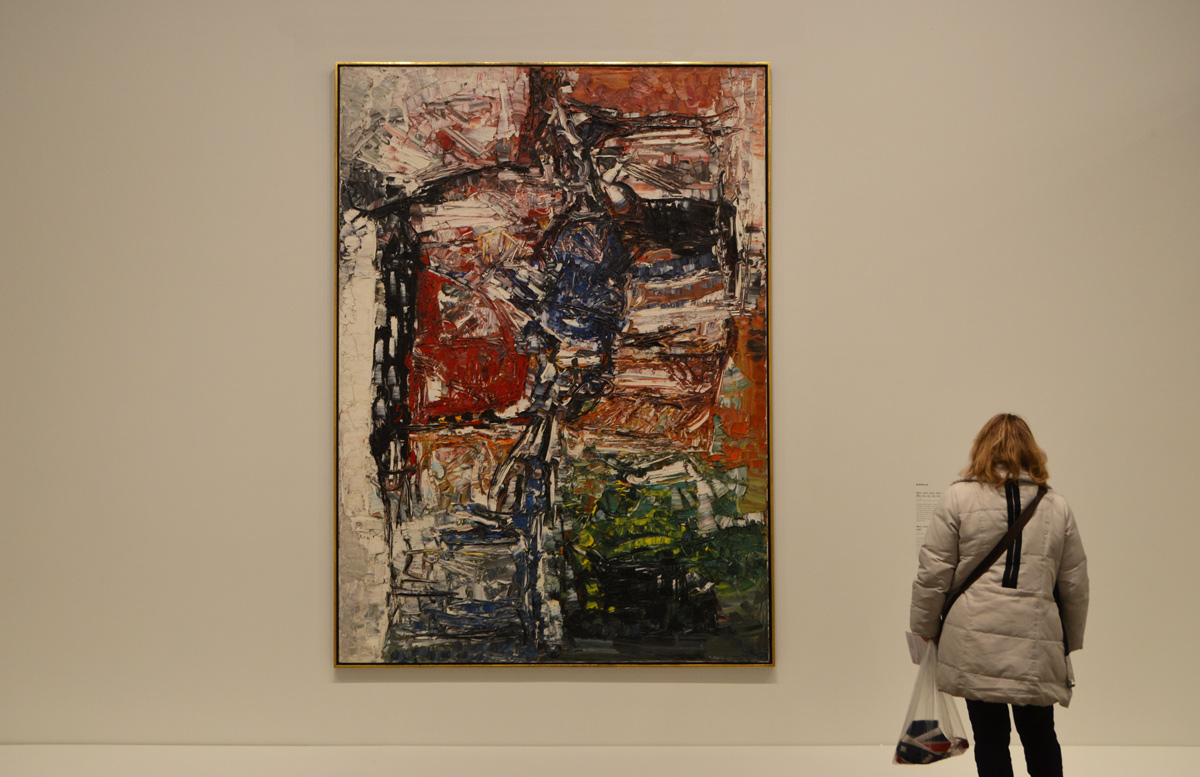
I spent a few minutes trying to figure out how to improve the presentation but, meh, no.  Instead I went upstairs to take a second look at the lesser known “new” exhibit at the AGO, the marvellous Mitchell and Riopelle show, “Nothing in Moderation”.  American abstract painter Joan Mitchell (1925 -1992) and Canadian abstract painter Jean Paul Riopelle (1923-2002) met in Paris in 1955.  For 24 years they were colleagues, friends, and lovers.  This exhibit consists of more than 50 of their works on loan from collectors around the world and shown together.

below: Looking at (part of) ” Tilleul (the Linden Tree)”, 1992 by Mitchell.

A woman in dark bright pink hair, with matching purse and shoes stands in front of a large painting by Joan Mitchell in an art gallery

below: Three degrees of interest in “Chasse Interdit (Hunting Prohibited)” by Mitchell, 1973.  On loan from the George Pompidou Centre in Paris.   The title of the painting refers to a ban on hunting – apparently Riopelle loved hunting and Mitchell loathed it.

Three people are looking at a large Riopelle painting in an art gallery, two are sitting on a couch and the third is standing closer to the painting.

below: The painting here is “Avatac” by Riopelle, 1971.  It is acrylic paint on top of lithographs on canvas

an emptry art gallery room except for a security guard standing on one side, a brown couch is in the middle of the room and a large abstract painting by Riopelle is one one wall, you can see into the next room where there is also a painting on a wall.

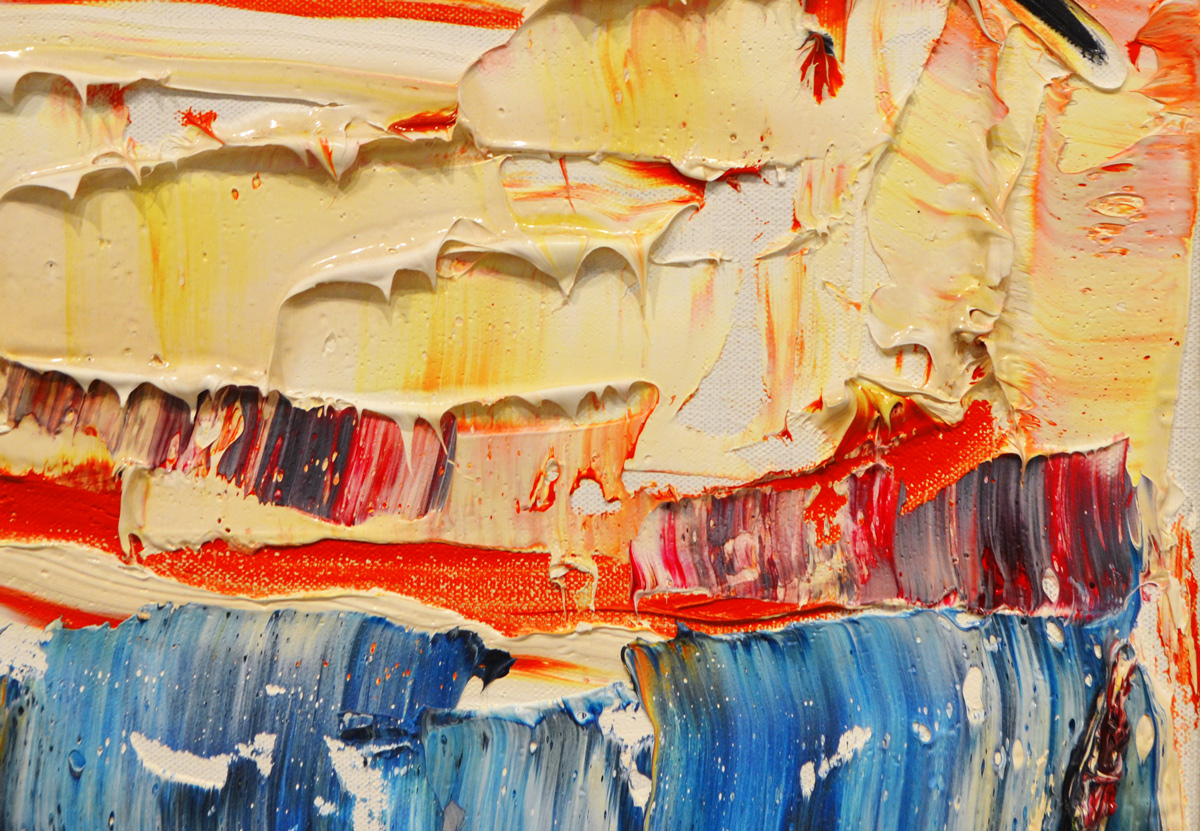
below: This is a photo of a small part of the above painting.  If you look closely, you can see the lithograph peeping through.   I can see a small animal head near the top left (a cat?) and there seems to be another lower down.

acrylic paint on top of lithograph, a detail of a large work by J P Riopelle called Avatac, created in 1971.  abstract art.

below: One thing that intrigued me about Riopelle’s painting was that even though there is a lot of paint (palette knife?), there are still some places where the canvas is visible.  Just small bits.

a close up of a large abstract painting with lots of acrylic paint on it

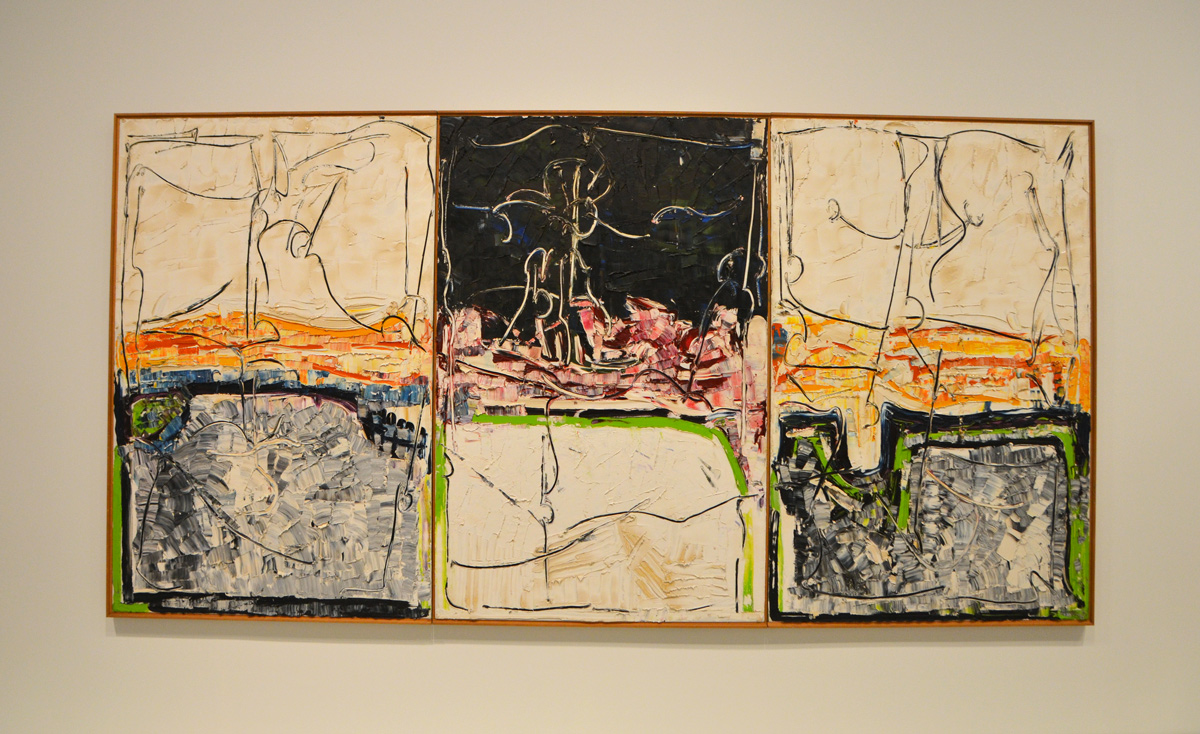
below: The details in the above photo are from the top left square in ” Mitchikanabikong ” by Riopelle.

large painting by Riopelle called Mitchikanabikong which is sort of divided into 6 quares, 3 across the top row and 3 on the bottom.  they alternate light and dark

below: The gallery was quiet on Wednesday morning.   Both of these paintings are by Joan Mitchell.   On the left, on loan from the Smithsonian American Art Museum in Washington DC is “Marlin”, 1960.  The other is “Untitled” from 1961 and it is on loan from the Joan Mitchell Foundation in New York.

a flat bench in front of two paintings on a gallery wall

And to end, a couple more for you to enjoy.

two women looking at large paintings in an art gallery

a woman with her back to the camera is looking at a large painting in an art gallery, AGO, Art gallery of Ontario,


A morning exploring some of the art galleries at the University of Toronto.

below: Robarts Library, a large concrete building, is part of the University of Toronto and is their main humanities and social sciences library. It opened in 1973 and has been called Fort Book ever since.

intersection of Harbord and St. George streets, Robarts Library, large concrete building

I have walked past this library many times but I have never gone inside. What I didn’t know about this building is that it is also home to the Thomas Fisher Rare Book Library.  It is named after a Thomas Fisher (1792-1874), who came from Yorkshire to Upper Canada in 1821 and settled by the Humber River.  In 1973, his grandsons, Sidney and Charles Fisher, donated many books to U of T .  Since then, the library has grown to approximately 740,000 volumes including hundreds of versions of Alice in Wonderland in many different languages.  They also collect manuscripts, photographs,  and other rare materials.   You can search their holdings online.

below: The view from the 4th floor observation deck.

interior of Thomas Fisher Rare Book library, looking down from the upper level to the tables below. Shelves of books line all the walls, ceiling is open to 4 or 5 storeys up , large central light fixture

At the moment, the Thomas Fisher Library has an exhibition called “Fleeting Moments, Floating Worlds, and the Beat Generation: The Photography of Allen Ginsberg”. Ginsberg (1926-1997) is known for his poetry but he also took pictures. The Thomas Fisher library has the largest collection of Ginsberg prints in the world.

exhibit of photos by Allen Ginsberg displayed in the Thomas Fisher Rare Books Library at U of T, some black and white photos in a case, some books too, shelves of books in the background

below: Mr. Ginsberg took bathroom mirror selfies.  I wonder what he’d think of instagram?

picture of a black and white photo taken by Allen Ginsberg of himself sitting naked and cross legged in front of a bathroom mirror

Ginsberg became friends with William Burroughs and Jack Kerouac, and the trio later established themselves as the main players in the Beat Movement with their unconventional writing and wild (for the times) lifestyles.  Ginsberg’s first published work was “Howl” in 1956.  It was called “an angry, sexually explicit poem”.   The San Francisco Police Department declared it to be obscene and arrested the publisher.  The court ruled that it was not obscene.  I can see it being “ahead of its time” in 1956 but today it’s fairly tame.

The opening lines:

“I saw the best minds of my generation destroyed by madness, starving hysterical naked,

dragging themselves through the negro streets at dawn looking for an angry fix,

angelheaded hipsters burning for the ancient heavenly connection to the starry dynamo in the machinery of night,

who poverty and tatters and hollow-eyed and high sat up smoking in the supernatural darkness of

cold-water flats floating across the tops of cities contemplating jazz,”

below: Three books about The Beats.

display in a glass top case, three books by Alan Ginsberg, the one in the middle has a yellow cover and is The Beats

The Ginsberg exhibit continues until the 27th of April.

A short walk through part of the St. George campus….did I mention that it was snowing at the time?… to another art gallery on campus.

snow is falling, snow on the ground, tree in foreground, also black wrought iron fence, looking across the playing field of the U of T St. George campus to a building, tower,

below: We passed a moose standing in the snow.

a flat metal sculpture of a moose stands in a small space beside a tree, snow on the ground, snow falling from the sky. public art

The second gallery was the Art Museum at Hart House.   One of the exhibits showing there is “Figures of Sleep”.  Straight from the gallery website is this description of the exhibit: ” [it]…considers the cultural anxieties manifest in the popular and critical imagination around the collapsing biological function of sleep under economic, social and technological transformation”.  What it is is a collection of videos, photographs, and artwork depicting sleep, i.e. people sleeping by a number of different artists.  This exhibit ends on 3rd March.

below: Watching videos of people sleeping

a person watching a large video display in an art gallery

below: She’s very life like.  She’s also much smaller than life sized but even so, she was a bit creepy. “Untitled (old woman in bed)”, 2000-2002, by Ron Mueck.

very realistic and life like scupture of an old woman with grey asleep under a blanket with her head on a pillow

below: “Dream Catcher” by Rebecca Belmore, 2014 .  This wall hanging is quite large.

dream catcher by Rebecca Belmore, a large wall hanging of a person sleeping on the sidewalk, under a blanket with a picture of a lion on it.

below:  The Malcove Collection is in the same gallery.  The collection includes about 500 pieces, not all of which are on display at the moment.  Dr. Lillian Malcove (1902-1981) was born in Russia just before her parents emigrated to Canada and settling in Winnipeg.  She graduated from the University of Manitoba with an M.D. and then spent most of her adult life as a Freudian psychoanalyst in New York City.  Over her life time she amassed a collection of art that she bequeathed to U of T.

wall display cases in an art gallery, religious pieces on display, old, antiquities

below: From the Malcove collection, ‘Male Dedicant’, made of limestone, Coptic, late 4th century or early 5th century

antique stone carving (relief) of a man with curly hair, both hands raised, one hand holding a spherical object and the other hand holding a cross

below:  Detail from “The Burning Bush”, 19th century.

very old painting, religious, virgin mary and baby jesus in the center surrounded by other religous scenes


below: Last but not least, and having nothing to do with art, is this plaque on a wall near the art gallery at Hart House.  It commemorates the relationship between the Canadian and Polish Armies during WW1.  A transcription of it appears below.


plaque on an exterior brick wall commemorating the role of the Polish Army

In the early months of 1917, twenty three Polish probationary officers were trained here by the staff of the Canadian School of Infantry in Toronto.  They were the forerunners of more than 20,000 North American volunteers of Polish descent who were trained in Canada (mostly at Niagara on the Lake) to serve in the French Army, ultimately commanded by Joseph Haller.  The existence of this Polish Army in France went far to assure the presence of Poland at the Peace Conference at the end of the war and played a significant role in the reconstitution of a reunited and independent Poland after 123 years of partition. 
The Canadian Polish Congress has placed this tablet to commemorate the ardent Polish patriotism of so many Polish volunteers from the United States and Canada.   The Congress also wishes to honour the Canadian officers who trained the volunteers, including notably Lieutenant Colonel A.D. Lepan of the staff of this university and his principal subordinates, all from this university as well as Major C.R. Young, Major H.H. Madill, Major W.F. Kirk and Major F.B. Kenrick. A.D. 1990


a bike parked outside an old brick building on St. George campus of U of T, snow covered

More information about:

Allen Ginsberg exhibition

Figures of Sleep, and others, at Hart House Art Museum

Illustrations of the holdings of the Malcove Collection


‘Demonstration’ by Michael Landry
at the Power Plant Contemporary Art Gallery

Now showing in the narrow Fleck Clerestory is an installation that consists of a collection of red and white paintings on paper.  Each is a male and/or female shaped silhouette figure with a protest sign.    They are pinned to the wall, from top to bottom.   Every one has a different slogan, phrase and/or image on the placard they are holding.

below: Looking down on the Fleck Clerestory from the upper level.

red and white paintings of demonstration signs being held by stick figure men part of an art exhibit at fleck conservatory on both walls, looking down from the upper level to see whole exhibit, two women on the lower level looking at it.
The work has grown, i.e. more pieces have been added, since it was installed late in September.   Landry has been asking the public to contribute their thoughts and feelings which he then draws.  Over the course of the next few months, it will evolve and grow as more people submit their ideas and suggestions.   In the end there will be a “wall of protest”, or perhaps more aptly, it will be a snapshot of the hopes and concerns that we have.

below: Some of the issues addressed from the serious (stop fracking, end hate, no more marijuana arests, opioid overdoses) to the more lighthearted (such as ‘go topless day’, and ‘we the north’).

red and white paintings of demonstration signs being held by stick figure men part of an art exhibit at fleck conservatory

If you have an image, slogan, or words, and you want to participate in this project, check out the submission guidelines by following this link

red and white paintings of demonstration signs being held by stick figure men part of an art exhibit at fleck conservatory

below: “No pipeline” and  “lorsque les mots perdent leur sens, les gens perdent leur liberte”.

red and white paintings of demonstration signs being held by stick figure men part of an art exhibit at fleck conservatory - sign says no pipeline

below: “Stop premature Christmas decorating!”

red and white paintings of demonstraion signs being held by stick figure men part of an art exhibit at fleck conservatory - sign says stop premature Christmas decorations

The exhibit continues until mid-May.