Archive for the ‘galleries’ Category

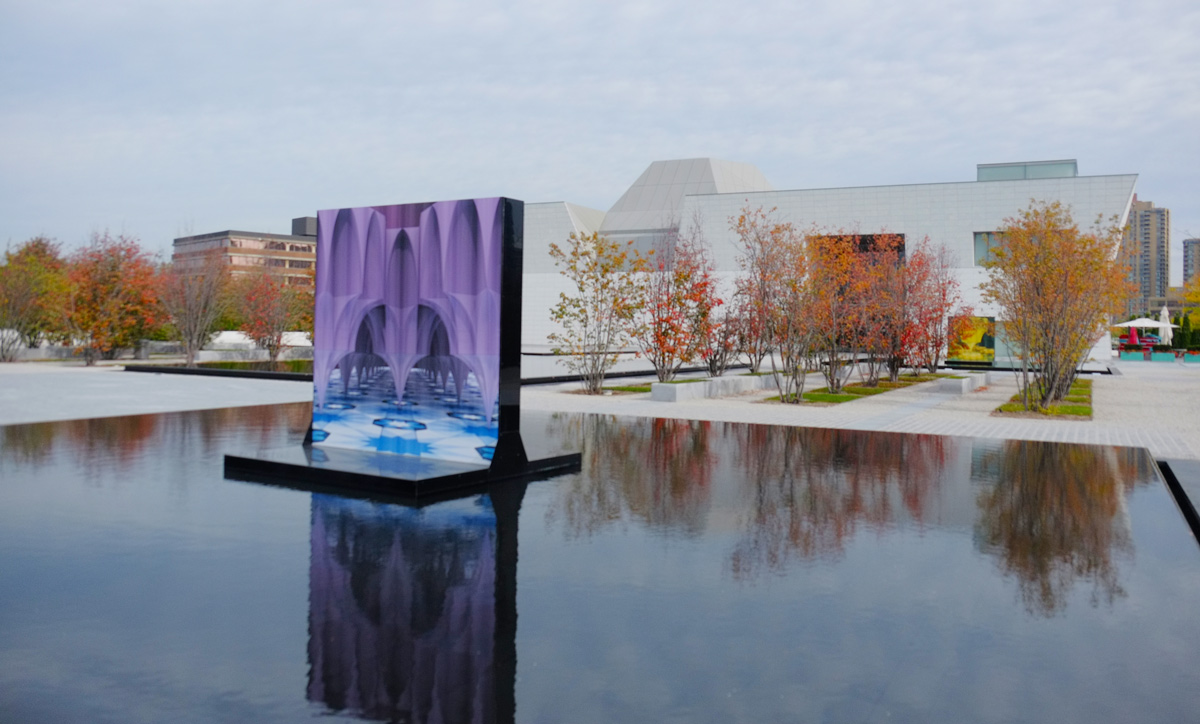
below: ‘The Encompassing’ by street artist Javid (aka JAH) stands in one of the reflecting pools between the Ismaili Centre and the Aga Khan Museum.   This is one of a number of pieces on display.  Each is painted on reclaimed corrugated metal.  They are an examination of the geometry in Islamic patterns and architecture.  His work will remain on display until the 31st of October.

a painting called The Encompassing stands in a reflecting pool in front of the Aga Khan Museum.

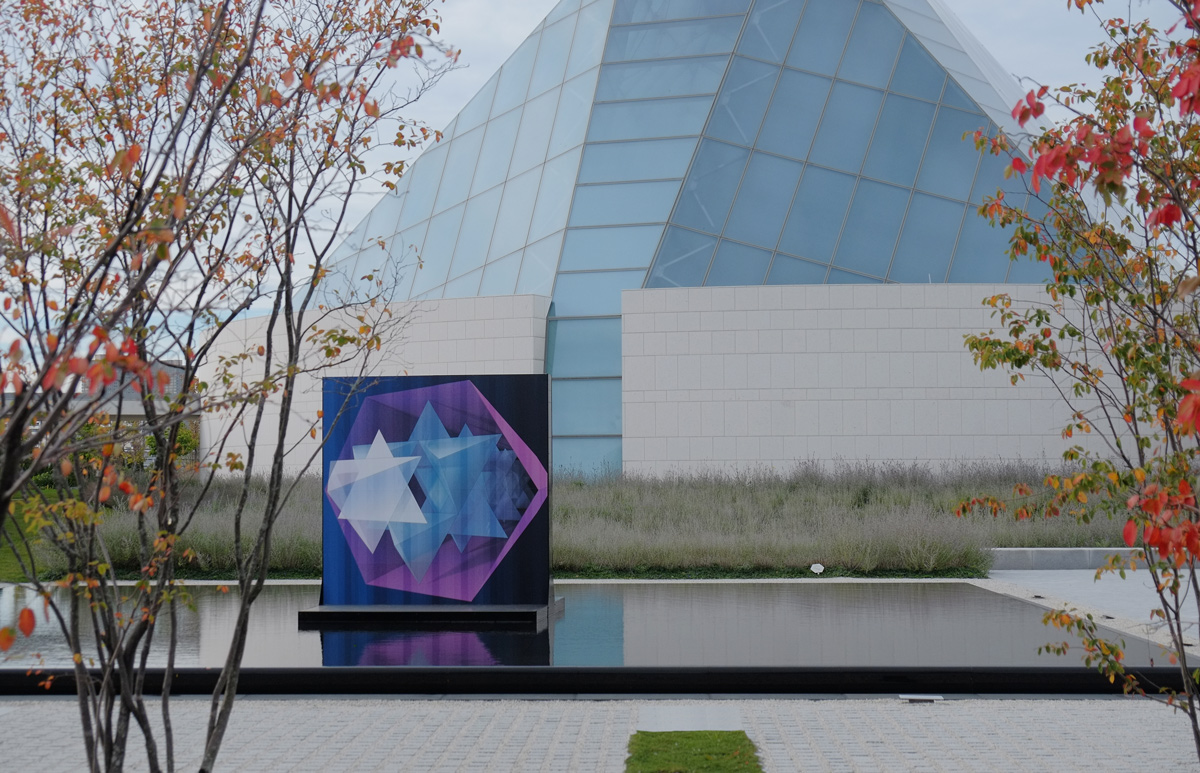
below: On the other side of the above painting, is this one – “Beyond”, also by Javid.  The Ismaili Centre is in the background with its large pale blue dome over the prayer room.

A painting in blue, pink, and purple, of stars, by Jacid Jah, in a reflecting pool with the Ismaili Centre behind it

 below: The large wood beams that cover the entrance to the Ismaili Centre were being re-stained this morning.

a pick up truck and a lift in front of the entrance to the Ismaili Centre, workmen are re-staining the large wood beams that support the glass roof.

The Toronto Ismaili Centre is one of 6 around the world.  It was designed by Indian architect Charles Correa and opened in 2014.  If you go on the tour of the inside of the Ismaili Centre, you will see a building that is filled with natural light, as well as natural woods and stone.

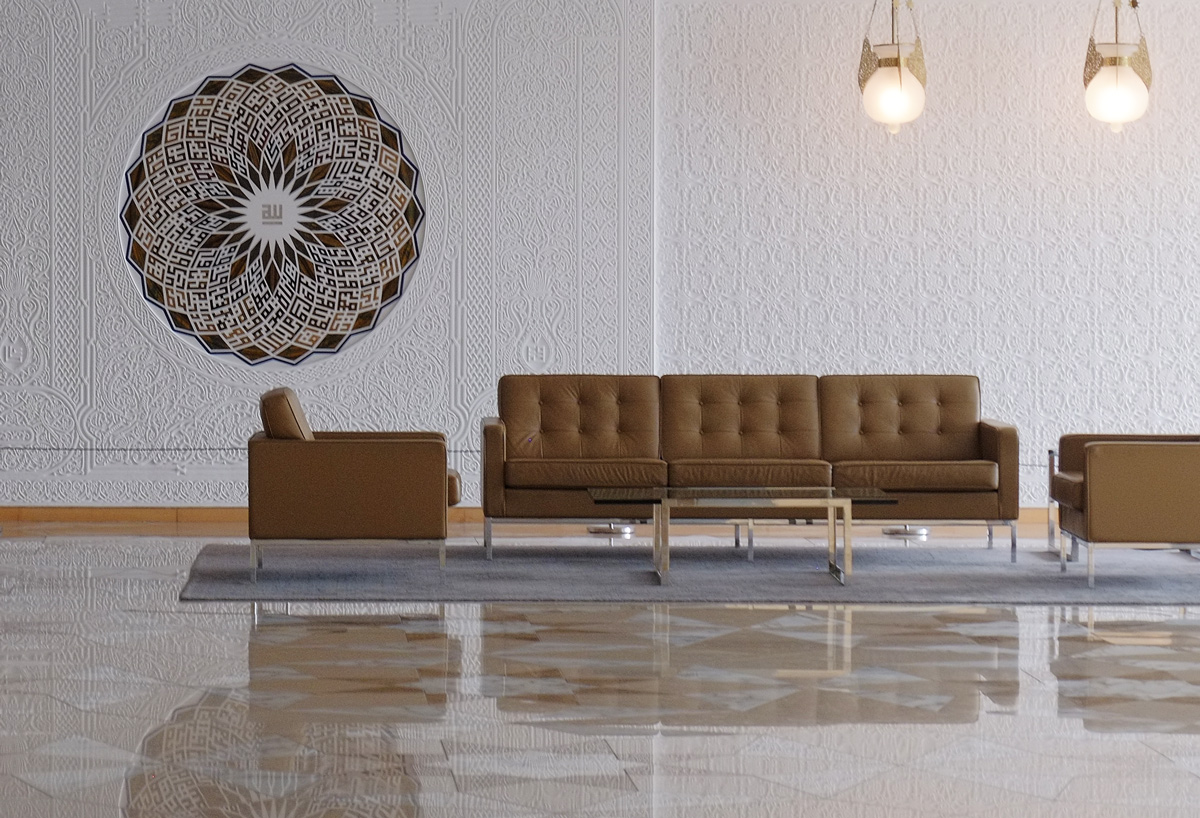
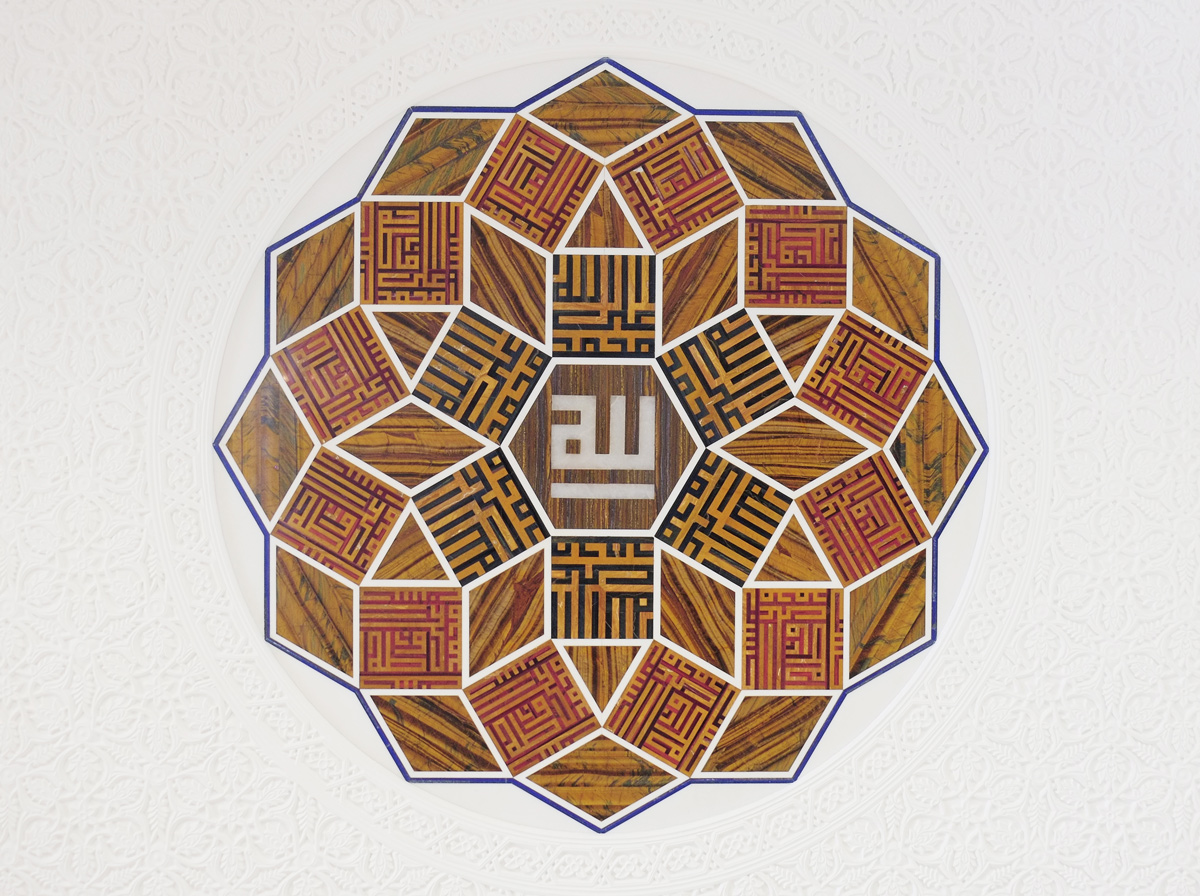
below: A calligraphy based medallion made of stone is on a white wall.  The Arabic word ‘allah’ is in the center and surrounding it are the ninety nine attributes of God, written in Arabic.

chairs and sofa in a large room, on grey carpet, most of floor is polished stone, medallion of stone on the white wall.

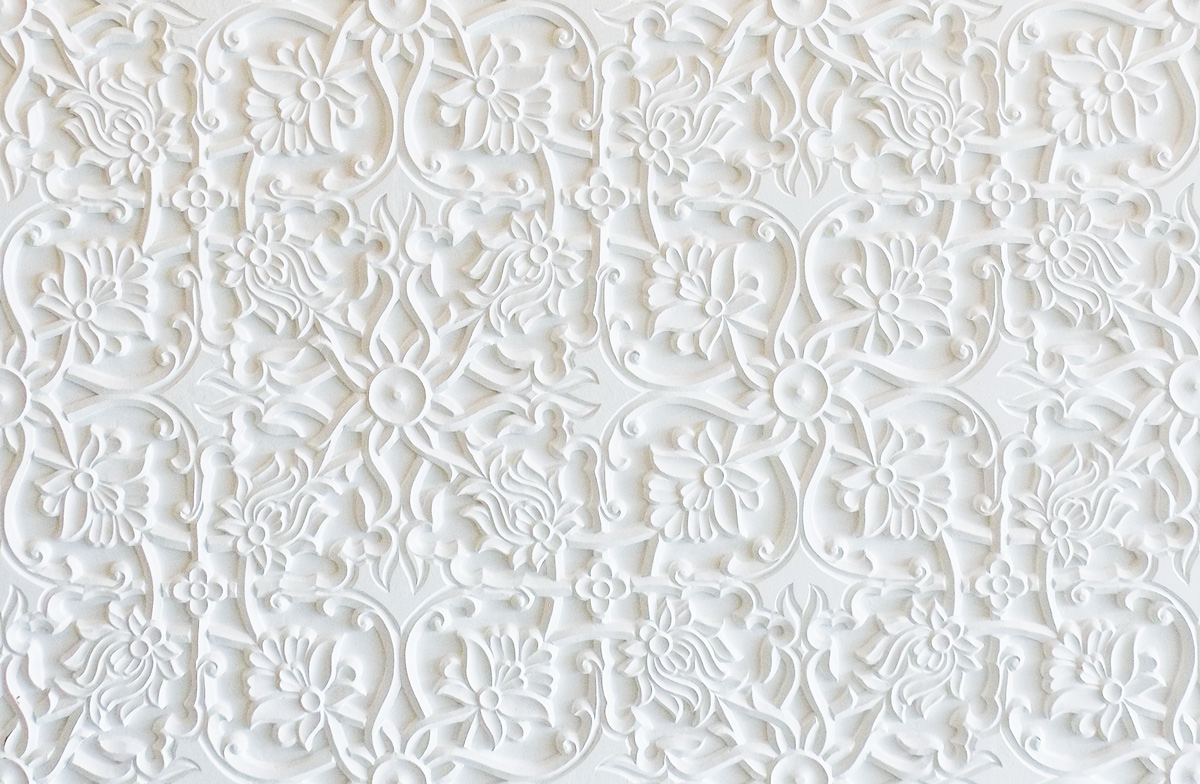
below: A closer look at the wall.  It took two men, a father and son, fourteen months to carve the design into this wall and a matching wall on the other side of the room.  They worked six days a week .  The arabesque design was penciled on using a stencil and then carved by hand.

carved white wall, plaster

below: A second medallion is on a wall across the room from the one above (on the other wall that was carved).

medallion of stone, calligraphy, arabic, on a white wall

Crossing back past the reflecting pools to the Aga Khan Museum….

below: Another Javid Jah painting, this time “The Manifest”.   (To the left, you can see a metal sculpture called “Big Heech” ).   Like all of Jah’s paintings here, this one is based on geometry.  The basic shape here is a pentagon (sacral chakra) and it is seen on the floor.  This type of archway is called a muqarna and it is unique to muslim architecture.  Here the shape of the indentations in the muqarna are based on the pentagon.

a painting called The Encompassment stands in a reflecting pool in front of the Aga Khan Museum.  Painted by Javid Jah, blue arch over red entranceway

The “Big Heech” is the work of Parviz Tanavoli, made from stainless steel in 2014.   It is derived from the Persian word for “nothingness” and it is an important word in Perian Sufism.

“Emperors and Jewels: Treasures of the Indian Court from the Al-Sabah Collection in Kuwait”, is a temporary exhibit at the Aga Khan Museum featuring artworks and historical objects from the treasuries of Mughal emperors.  The Mughal Empire ruled most of present day Pakistan and India in the 16th and 17th centuries.   The Mughals were Muslim but the majority of the population were Hindu.

below: Part of a larger picture depicting a hunting scene, reproduced and enlarged especially for the exhibit.

part of a painting at the Aga Khan museum of a moghul ruler on a horse in a hunting scene

below: Three glass bottles

on display at the Aga Khan Museum, 3 glass bottles, rounded bottoms and narrow tops, one is marroon, one is teal and the last is royal blue

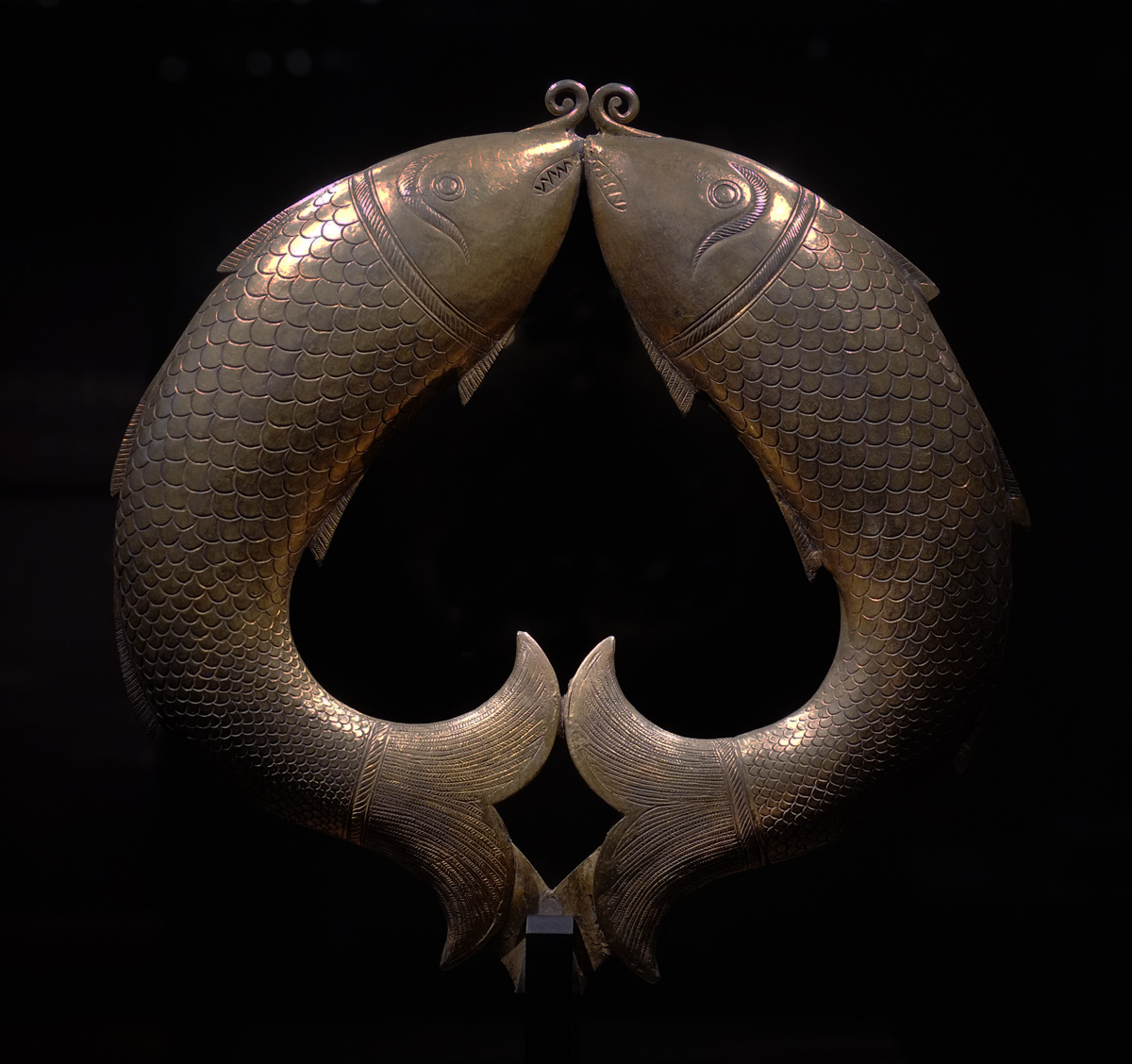
below: Two fish joined to make a circle, a standard.  From India, late 18th century.   Made from silver.  There are many myths and symbols that feature fish.  In Hindu tradition, the fish was associated with Brahma and Manu, a progenitor of mankind.  In addition, one myth is that a fish was believed to hold up the globe.

on display at the Aga Khan Museum, two fish joined in a circle, a standard, for the top of a pole

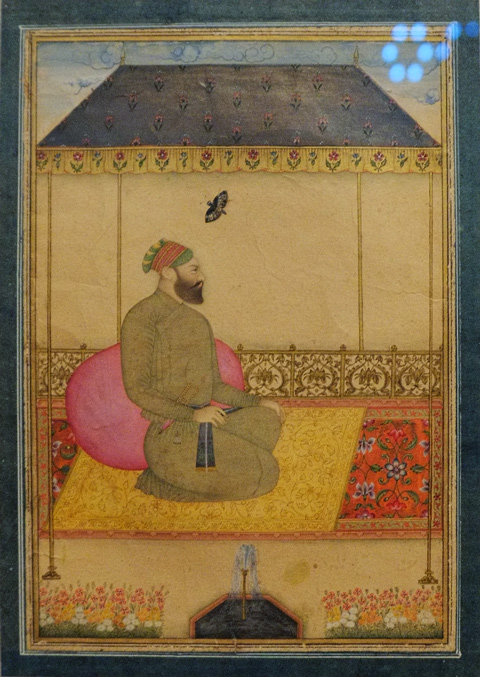
below: A portrait of Nawab Bairam Khan, painted around 1710-40, watercolour and gold on paper.  He is pictured in profile, sitting alone in his peaceful garden.

on display at the Aga Khan Museum, a painting, portrait of Nawab Bairam Khan, painted around 1710 to 1840, watercolour and gold on paper, scene is a man sitting on a carpet, under a tent roof, leaning on a large pink pillow

below: Knife with jade handle carved in the shape of a horse head and neck.

on display at the Aga Khan Museum, a metal knife iwth a jade handle that is carved into the shape of a horse head and neack, decorated with gold bridle

Anthropocene
an exhibit of photographs by Edward Burtynsky
highlighting the mark that man is leaving on the environment.

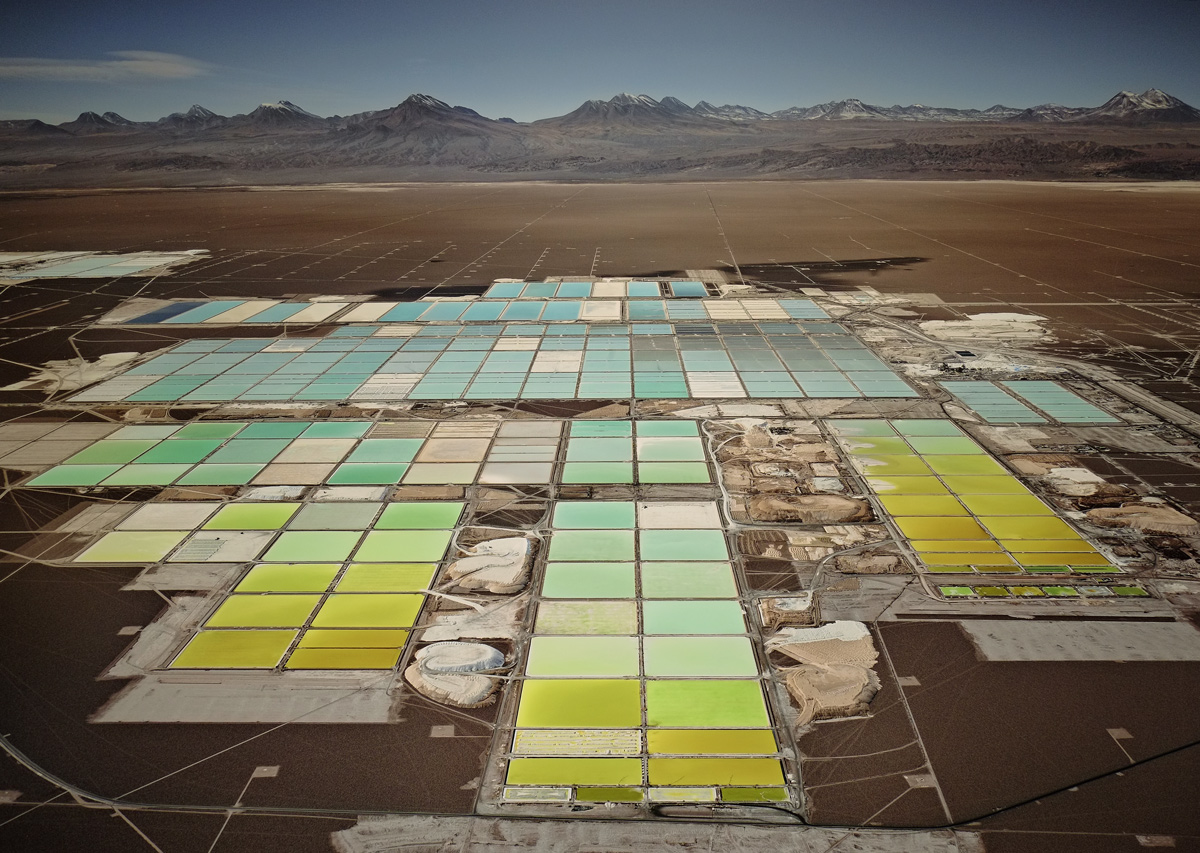
below:  Lithium Mine #1, Salt Flats, Atacama Desert, Chile, 2017 .  The Salar de Atacama is the largest salt flat in Chille, located in the driest non-polar desert in the world.  This is also the world’s greatest source of lithium.  The shades of yellow, green, and blue represent the different stages of lithium evaporation.

coloured ponds in a lithium mine in Chile, shades of yellows, greens and blues

below: A plastics recycling plant, Dandora landfill in Nairobi, Kenya, 2016

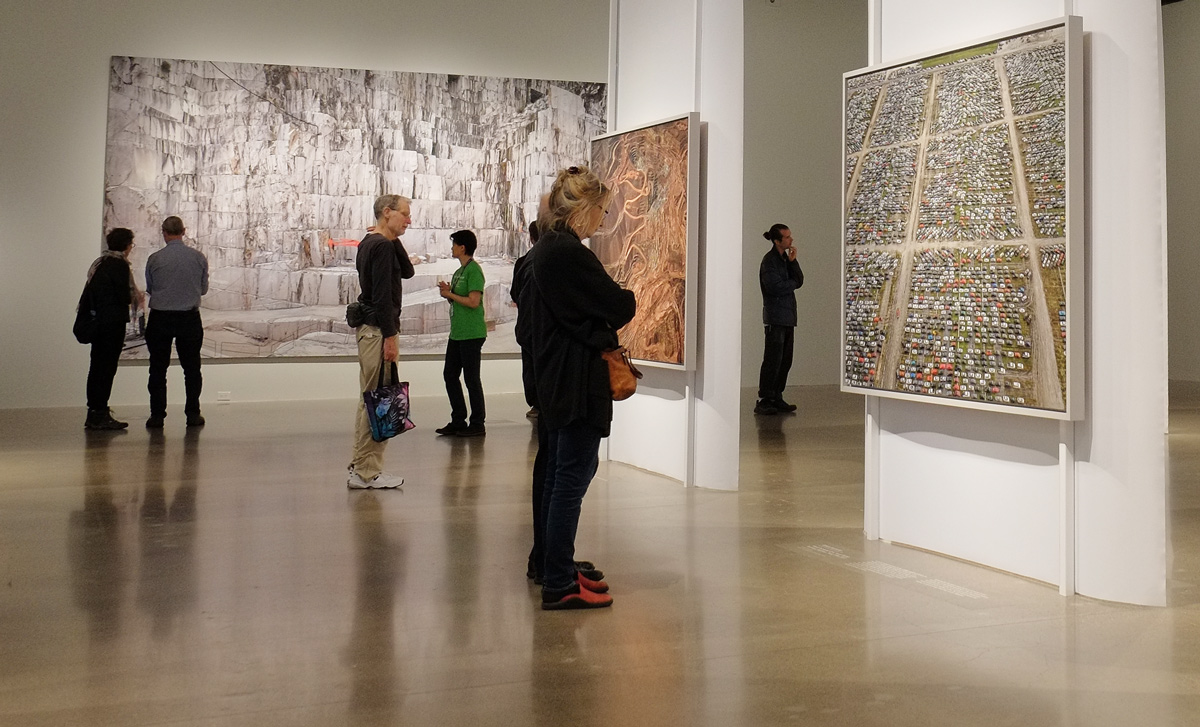
in an art gallery, a large photo of people and a dog among a large garbage dump

people viewing art exhibit at AGO, photos by Edward Burtynsky

below: Uralkali Potash Mine #4, Berezniki Russia, 2017.  This Russian mine includes about 3000 km of underground tunnels created by machines called combines used in the potash extraction process.   These spaces are dark.   The spiral patterns are left by the combines.

photo by Edward Burtynsky of the interior of an underground tunnel in a potash mine in Russia.

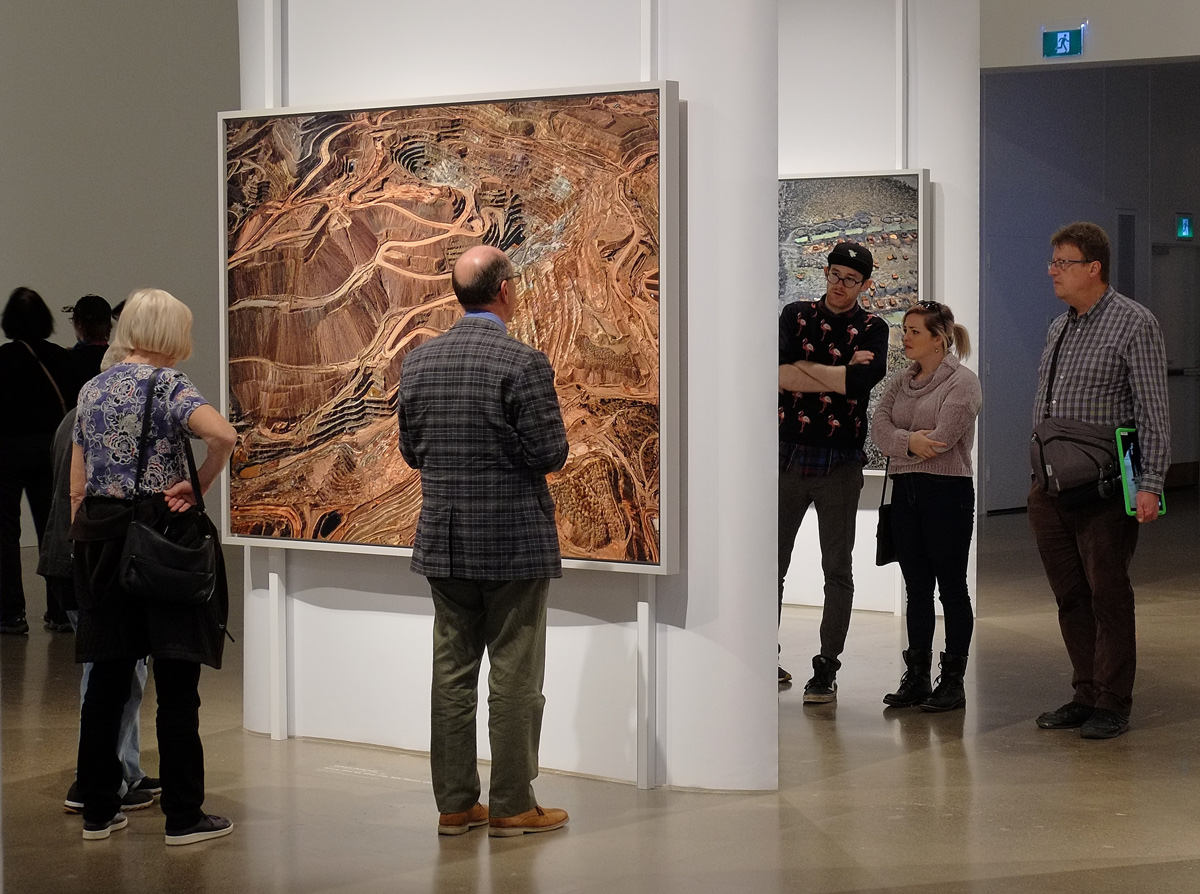
below: Morenci Mine #2, Clifton Arizona USA, 2012.  Part of this photo shows the liquid reserves of waste left over from the copper extraction process.  The marble like colours are the result of leached heavy metals.   Copper smelting requires between 1500 and 3000 litres of water for every to of processed ore.

large copper mine photograph

people viewing large coloured photos by Edward Burtynsky at the Art Gallery of Ontario


One of my stops the other day was the Ryerson Image Centre.

below: Students enjoying the un-autumn-like weather while the pond is almost empty.

the pond outside Ryerson Image Centre is almost dry, there are tables, chairs and yellow umbrellas set up in the pond area, students sitting there.

The main exhibit at the Ryerson Image Centre is based on the work of Gordon Parks, specifically his ‘Flavio’ photo essay.  Gordon Parks was an African-American, born in Kansas in 1912.   He bought his first camera in a pawn shop.  In 1948 he began a 23 year career at LIFE magazine where he created many photo essays including ‘Flavio’.   In the 1960’s Parks  went to Rio de Janeiro in Brazil to document the poverty there.  He  centered the project around a boy, Flavio, and his impoverished family, the Da Silvas.  When the photographs and story appeared in ‘LIFE’ magazine in June 1961, it caused quite a stir, especially in Brazil.  In return, a Brazilian photographer, Henri Billot , visited the poorer parts of Manhattan to prove that the poverty in the United States was as bad as the poverty in Brazil.   The family that Billot concentrated on was the Gonzalez family.   There is also some discussion about candid photos vs images that are staged in documentary photography.

As a reaction to the LIFE article, Flavio was brought to the USA for two years to treat his asthma.  Money was also raised to relocate the Da Silva family to a new home.

below: Some of the photos by Gordon Parks.

five black and white photos on a dark grey wall, photos by Gordon Parks of poverty in Rio de Janeiro in the 1960s

below: Flavio and his brother Mario on the promenade in Rio during their first trip outside the favela. 1961.  Favela is Brazilian Portuguese word for slum, or low income area a city (usually on the outskirts).   In the 1960s the favelas were populated mostly by migrants from rural areas who couldn’t afford living in the city.   These areas didn’t have running water, electricity, or sanitation.

two boys in front of a row of apartment buildings, photo by Gorodn Parks

below: Photo by Henri Billot

old photo from the 1960s, 3 children play on the sidewalk by a car that is parked on the street

below:  Neighbourhood of the Gonzalez family, Manhattan, 1961, by Henri Billot (my apologies for the reflections).

Gonzalez building, tenement slums of New York (Manhattan), black and white phot by Brazilian photographer, Henri Billot

below: Flavio and his wife Cleuza da Silva in Rio in 1976 when Gordon Parks returned to see how the Da Silva had fared since his earlier visits.

black and white phot of Flavio and Cleuza da Silva taken in 1976 in Rio by Gordon Parks

In the student gallery was a small exhibit of the work of Alia Youssef.  Her project ‘The Sisters Project’ features portraits of Canadian Muslim women of all ages all with a narrative of their own.   Their portraits were on the wall of the gallery but their portraits and stories are on the website (it’s well worth a visit!)

two photographs by Alia Youssef, each of a muslim woman in a field or park, the one on top is a younger black woman, the bottom is an older whiter woman with a head scarf

In light of the recent earthquake in Indonesia, the third exhibit at the Ryerson Image Centre seems timely.  It is a display of photographs taken in the aftermath of the earthquake in Mexico City on 19th September 1985.  At the time it was the strongest earthquake on record.  Large portions of the city center and the neighbourhoods next to it were leveled.

below: Photo by Barbara Laing.

an old black and white photograph of Mexico city after the 1985 earthquake, a pair of pants and a clock on top of a flattened building, some people in the distance

woman dressed in black in a gallerywith black walls,looking at black and white photos on the wall

below: Photo by Pedro Mayer.

an old black and white photograph from the aftermath of the Mexico City earthquake of 1985, s pile of rubble with people standing on top of it.

the pond outside Ryerson Image Cetnre is almost dry, there are tables, chairs and yellow umbrellas set up in the pond area, students sitting there. aas seen from inside the Image Center

The annual World Press Photo Exhibit is on at the Alan Lambert Galleria once again.

below:  Finding Freedom in the Water by Anna Boyiazis, 2nd place, People stories.

World press photo exhibit at Alan Lambert Galleria - a woman stands in front of a series of photos of African women learning how to swim

below: Walking past four photos by Luca Locatelli about the environment, 2nd prize stories.   These were taken in the Netherlands, a country that is the world’s second largest exporter of food (by value, after the USA).

World press photo exhibit at Alan Lambert Galleria, a group of people walk past 4 of the photos from the environmental category, photos taken at an experimental farm in the Netherlands

below: On the right is “Jump”, by Thomas P. Peschak featuring a group of Rockhopper Penguins on Marion Island.   Second prize, nature singles.

World press photo exhibit at Alan Lambert Galleria, a man comes up the escalator towards some of the photos in the nature category and the people who are looking at them.

below: ‘Rohingya Refugees Flee into Bangladesh’, by Kevin Frayer.  General news, 2nd prize stories.

a woman stands in front of a photo of a crowd of people, with a boy in the front of the crowd who is crying

below: “Wasteland” by Kadir van Lohuizen.  A look at garbage in different countries.   First prize, environment stories.

World press photo exhibit at Alan Lambert Galleria, two men looking at one of the photos, one man is pointing to something in that photo

below: First prize winner in Long Term Projects,  stories, “Ich Bin Waldviertel ” by Carla Kogelman –  The life of two rural Austrian girls since 2012.

World press photo exhibit at Alan Lambert Galleria - a black and white series of photos about two girls in Austria.

Edwards Gardens

lots of flowers and plants in a garden around the base of a tree, a stone sculpture sits among the flowers, a woman is removing weeds from the garden, at Edwards Gardens

ZimSculpt is the name of the exhibit now on at Edwards Gardens.   Placed around the gardens are a large number of stone sculptures by Zimbabwean artists.  There are also small pieces on display inside a tent-like structure near the parking lot.   All items are for sale along with some baskets and jewellery.  Here are some of the sculptures:

below: Giving Advice by Boet Nyariri, carved in springstone

sculpture of two women (mother and daughter?), one slightly behind the other, with hand on other's shoulder,

below: (after the garden was watered!), Mother and Son, by Joe Mutasa, carved in springstone.

black stone sculpture of a mother holding her son, in a garden, with pink, red and orange flowers around the bottom of the sculpture

below:  Nesting Cormorant, by Lucknos Chingwaro, springstone

tall black sculpture at Edwards Gardens

below: Windy Day by David White, opal stone,

sculpture of a woman's head, eyes closed, with lots of rings of lighter stone hair, title is Windy Day

below: Evolving, by Edmore Sango, opal stone.

tall stone sculpture among plants in a garden

below: Shoal, by John Gutsa, springstone

a sculpture titled Shoal, 4 striped fish, one on top of the other, sculpture with flowers in front and greenery behind, Edwards Gardens

below: Free Flow, by Stuart Chapenga, springstone

black stone sculpture called free flow in Edwards Gardens.

head of a bird carved in black and white stone

close up photo of two yellow flowers with dark brown centers, from the side

close up photo of a monarch butterfly on a pink flower

ZimSculpt lasts until the end of September.

Two Canadian First Nations women, Jane Ash Poitras and Rebecca Belmore,  have their art on display at the moment.  Both women are concerned about the effects of history on their culture and heritage.  Both mix politics into their art.   How do you rise out of oppression while preserving your heritage?  What are the issues surrounding acculturation and do you deal with them?   But as you can see, they approach their art in very different ways.

At the Royal Ontario Museum (ROM) are four paintings by Jane Ash Poitras (b. Fort Chipeywan Alberta 1951).   Poitras is Cree.  She was orphaned at the age of 6 and raised by a Catholic German woman in Edmonton.  Before turning to art, she earned a BSc in microbiology.

below: ‘Buffalo Seed’, mixed media, 2004.  Old black and white photos are used in this collage along with sunflower petals and fabulous colours of oil paint.

colourful collage and painting by Jane Ash Poitras. Uses old black and white photos

below: “Potato Peeling 101 to Ethnobotany 101”,  Placed side by side, these two large works serve to contrast traditional indigenous knowledge of medicinal plants with the teachings imposed on indigenous youth by the residential school system.

2 large assemblages, collages, by Jane Ash Poitras, called Potato Peeling 101 to Ethnobotany 101, on display at the Royal Ontario Museum

below: There is a lot of detail in the two boards that get lost in a photo like the one above so here is a closer look at some of the photos in the collage above

collection of old black and white photos of First Nations kids in schools

text of a quote by Rebecca Belmore that says "for decades I have been working amongst my people, calling to the past, witnessing the present, standing forward, facing the monumental


“Facing the Monumental” is the title of the Rebecca Belmore exhibit at the Art Gallery of Ontario.  It covers three decades of her work and includes photographs, sculptures, and videos of her performance art.   Her art is more conceptual.

Belmore is an Anishinaabe woman from the Lac Seul First Nation.  She spent her childhood in northwestern Ontario with her maternal grandparents where she spoke Ojibwa.  For high school, she boarded with a white family in Thunder Bay.  Many First Nations communities are too small to support a high school so students are sent to live elsewhere while they complete their education.  It is a system with many problems.  It’s probably fair to say that the whole “system” is problematic.

below: ‘Sister’ 2001.  An ambiguous image – why does the woman have her arms stretched out?  What is happening here?

Sisters, art by Rebecca Belmore at the AGO from 2001

below: “Tower”, 2018.  A condo tower of shopping carts around a clay core – the carts symbolize the homeless.

art by Rebecca Belmore at the AGO

below: “Mixed Blessing”, 2011.  Two cultures.  Blending?  Fighting each other?  Hiding in embarrassment?

art by Rebecca Belmore at the AGO

below: And last, “Fringe” 2007.  Like two of the three artworks above, Belmore uses the body to address violence against First Nations people, especially women.   The image draws you in and repels you at the same time.   You don’t want it to be real but there is the possibility that it is.   If it makes you feel better, the diagonal scar is created using make-up and what looks like blood are strings of beads.

fringe, by Rebecca Belmore, a photo of a woman's back as she's lying down, scar and beads

Jane Ash Poitras is at the ROM until April 2020.

Rebecca Belmore is the AGO until 21 October 2018.

Now on in the Rotunda at Metro Hall, the second showing of ‘Focus on Our Elders’, a photo documentary project by The 6ix Clicks.

panels on exhibit at the rotunda at Toronto Metro Hall, Focus on Our Elders exhibit by the 6ix clicks photography group. Portraits and interviews of seniors in Toronto.

Portraits of, and interviews with, 24 Toronto seniors from diverse backgrounds.

panels on exhibit at the rotunda at Toronto Metro Hall, Focus on Our Elders exhibit by the 6ix clicks photography group. Portraits and interviews of seniors in Toronto.

The exhibit is only on this week, 13 to 17 August, inclusive.  The Rotunda is on the ground floor of Metro Hall and the building is open from 7:30 to 9 p.m.

For more information about these interviews: 6ix Clicks website

What are words?   How do we use them?

below: “Excuses injurieuses” 2007, by June Clark.  One of her “Wine and Tea” pieces.  It consists of the words Invective and Apology written over and over again starting from the top left corner and moving inwards toward the center.  Instead of a spiral it is a pyramid shape.  Perhaps it rises upwards, or perhaps it sinks down.  It’s only 40cm x 40 cm so the words are tiny.  I’d love to know how many words there are but I think that I’d be screaming profanities before I finished counting.  What I can tell you is that the pair of words ‘invective apology’ is written 32 times on the outer square.  If  invective is a noun that means, expletive, or abusive language, what does ‘invective apology’ mean and is that the same as the french title, ‘Excuses injurieuses’?

close up artwork of words written over and over again, invective apology, in smaller and smaller circles.

June Clark was born in Harlem NY but moved to Toronto in 1968.   At the moment, the AGO is featuring some of her work.  For whatever reason, I was more attracted to the pieces with words.

below: More of Clark’s “Wine and Tea” series, 2007.  Each one is a 40cm x 40 cm square and they are made with wine, tea and paper except for the one on the top left.  It is “Poubelle Lune” and the circle is a rusted lid that fits in a circle that has been cut out of the canvas.

a grid of 8 square artworks by June Clark on a gallery wall

below: Close up of another of the eight squares, a collage of sorts, the silhouettes of two people (men?) in front of flags, one American and one ? Titled: “All Some Many”.  If you look closely, you can see small words cut out of newspapers or magazines, some, all.

close up of an artwork, ink and collage. Brown squares in checkerboard shapes, with one shape being a photo, 4 small words from a newspaper, all (twice) and some (twice).

below: The next two photos are panels from “Formative Triptych” 1989/1990.  The first one says “I always imagine that I never received anything as a child, but I do remember being disappointed that the chocolate Easter Bunny was hollow and then of course there was the red broom and dustpan set.”
old black and white photo of a black girl, smiling, in dress, with words beside that say "

below: The words say “I decided that I must become so famous and so recognizable so the they could never let me die in an emergency room.”
picture of the head and shoulders of a middle aged black woman, old black and white photo, with words beside that say "

below: More collage and more words, this time it’s “Homecominghome”, words on paper towel.   Words like proactive, dulled integrity, impotent, hostage, elation, victim, underwhelmed, illusion, and satisfied surface desires.   These are only some, there were many more, each in their own little black frame.  Paper towel, that stuff we use once and then throw away.  Can we throw away the words?  Or what is behind the words?  Do we want to?

Actually there was a story about why paper towels were used – “…was made during a residency in New York City.  I had been cleaning the space so it was empty aside from paper towels.  It was a way of dealing with my emotions around how I felt living back in Harlem.  Cutting out the words, I felt like I was captive but free – a sort of ransom situation, of calls for help and demands for responsibility. ”  Quote taken from the words on the wall at the exhibit.

a grid of 8 square artworks by June Clark on a gallery wall - black frames around pieces of paper towel with words on them formed from cut outs from newspapers,

Words are fascinating.

June Clark’s work is on exhibit at the Art Gallery of Ontario until December 2018.


And while we’re on the subject of words and the AGO, there is a whole room of panels like the one below.  This is “Jack and the Jack Paintings: Jack Goldstein and Ron Terada”

Goldstein was an artist who published his memoirs in 2003, just before he committed suicide.  Terada has taken words from the book and made them into 14 panels, sorry, I mean test-based paintings.  They are Goldstein’s words? Or are they now Terada’s words?  Whose story are they telling?

below: A large painting by Jack Goldstein (lightning) and four of the panels by Ron Terada.

The Jack exhibit continues until 16 September.

‘Trans Am Apocalypse No. 3’ by John Scott

a 1980 Pontiac firebird trans am, painted in black house paint and then words scratched into it, the words from Revelations in the New Testament of the bible, every part of the black surface is covered with words, in an art gallery

This is a 1980 Pontiac Firebird Trans Am painted with black house paint.   The words from the book of Revelation from the New Testament of the bible scratched into it, covering the whole surface of the car.

below: “Faithful until death” stands out on the door handle.  From Revelation 2:10 “Do not fear what you are about to suffer. Behold, the devil is about to throw some of you into prison, that you may be tested, and for ten days you will have tribulation. Be faithful unto death, and I will give you the crown of life.

words from Revelations in the New Testament of the bible scratched into paint covering the whole surface of a trans am car, close up of door handle with the words faithful until death on it,

This is actually the third car that Scott produced. The first, finished in 1988 ended up being crushed into a cube of metal. The second, finished in 1993, is now in the National Gallery in Ottawa.  This one was finished in 2000 but it was homeless for a while.   In 2007 it was donated to the AGO (at that time it was housed in a barn). It was first displayed in 2016.

below: All 22 chapters of the Revelation to John fits on the car, including the part seen here: “He who overcomes, I will make him a pillar in the temple of My God, and he will not go out from it anymore; and I will write on him the name of My God, and the name of the city of My God, the new Jerusalem, which comes down out of heaven from My God, and My new name.”   This is Revelations 3:12.

words from Revelations in the New Testament of the bible scratched into paint covering the whole surface of a trans am car, close up of the side of the car by the front passenger door, and front tire

The book of Revelation is written in a very symbolic language and there are different interpretations of its meaning.  One interpretation is that it was written to give ancient Christians hope for dealing with their own problems –  to stand firm in their faith despite the threat of death from the Roman government.

Another interpretation is that our world is doomed, that Revelation is a description of the “end of days” sometime in the future. This is the futurist interpretation of Revelation with its premise  that the prophecies in Revelation still await a future, literal fulfillment.  In this interpretation, the four horsemen described in the sixth chapter symbolize the evils to come at the end of the world.   This seems to be the interpretation that gets a lot of attention. 

I have no intention of writing an essay on this but I wanted to mention the horsemen because some of the words used by the AGO to describe John Scott’s car are “A symbol of American consumerism and machismo, the vehicle has been modified to produce a contemporary mode of transport fit for the Four Horsemen of the Apocalypse”.   The Trans Am, a doomsday vehicle on the highway to hell.


words from Revelations in the New Testament of the bible scratched into paint covering the whole surface of a trans am car, close up of the front corner of the car, headlights and part of hood

What drives a person to scratch out these biblical words, not once, but three times?  What goes through a person’s head while they’re working on it?

And I have one more question – wouldn’t a Mustang be a more appropriate vehicle for the four horsemen?

‘This Mountain Loves You’

is a mountain of positive messages stitched into a quilt-like artwork at the AGO.  Fabric squares were decorated with pictures and messages and then hand stitched together.  It is the creation of the AGO Youth Council, overseen by artist Ani Castillo.

 AGO, Art Gallery of Ontario, This Mountain Loves You, by AGO youth council, view from second level of the gallery

black and white art by Ani Castillo of 'Toronto in the Summer', many whimsical scenes of the city in the summer, birds, trees, kids on scooters, lots, of legs, all kinds of flowers, picnics, the island, sun, the ex,

An example of her work, black and white drawings with a little bit of whimsy and a lot of heart…. ‘Toronto in the Summer’ by Ani Castillo. Found online at Bored Panda.


AGO, Art Gallery of Ontario, This Mountain Loves You, by AGO youth council, close up of some of the squares of fabric

“I love my black hair and my black loves me”.
“It’s me and it’s you and we’re the universe too”.

Castillo worked with a group of young people (ages 14 to 24) over seven weeks and this was one of the results.   I’m not sure how high it was, 4 or 5 metres perhaps?

AGO, Art Gallery of Ontario, This Mountain Loves You, by AGO youth council, close up of some of the squares of fabric

Part of the AGO description of ‘This Mountain Loves You’ mentions that it is a tribute to, and a recreation of, Salvation Mountain in southern California.

Photo credit: by Kevin Key, found online at Los Angeles Magazine in an interesting article about the site and its creator, Larry Knight who worked on it for 30 years before his death in 2014.

As you can see in the above photo, Salvation Mountain is predominantly about God and Jesus whereas the fabric mountain proclaims a message of secular love, hope, and acceptance.  Messages such as “trust in your abilities”, “love ahead!”, and “keep families together”.

AGO, Art Gallery of Ontario, This Mountain Loves You, by AGO youth council,

Today was the last day that this ‘mountain’ was on display.