Archive for the ‘galleries’ Category

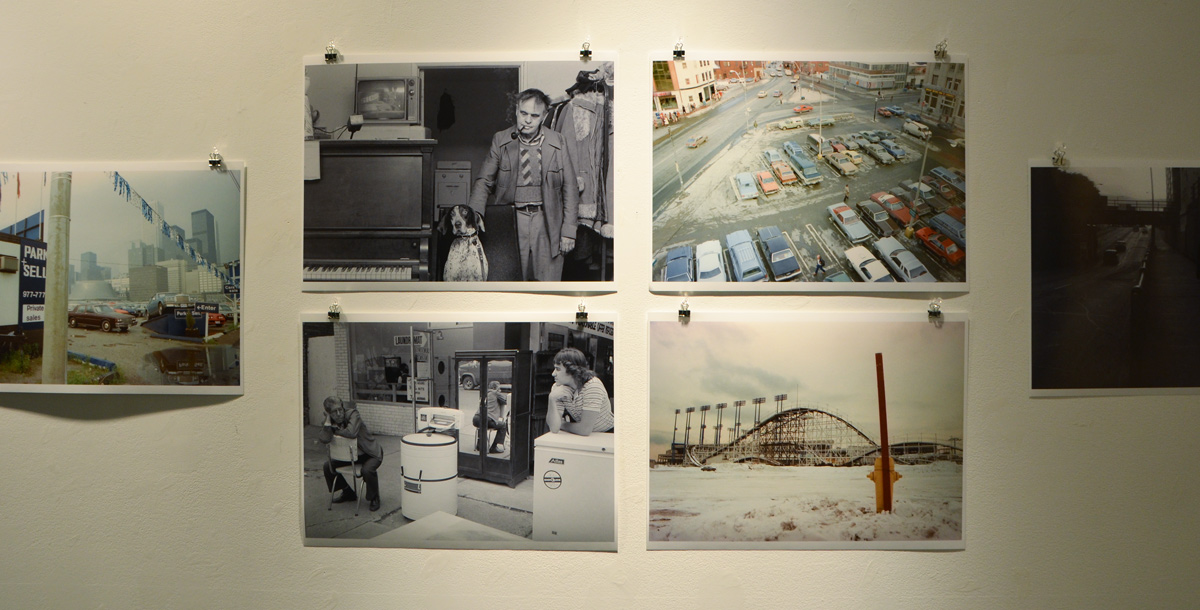
The other day I discovered that there is a small gallery on the 3rd floor of Ryerson’s School of Image Arts.  If you want to find it too, it’s in a building that it’s in is attached at the ground floor level to the Ryerson Image Centre on Gould Street.   At the moment, there is a small exhibit of photos by Avard Woolaver.

the back of a man looking at a wall in a gallery, old photos of Toronto

below:  The photos are ones that Woolaver took in Toronto in the late 70s and early 80s.

old photos of Toronto from the 1980s by Avard Woolaver.

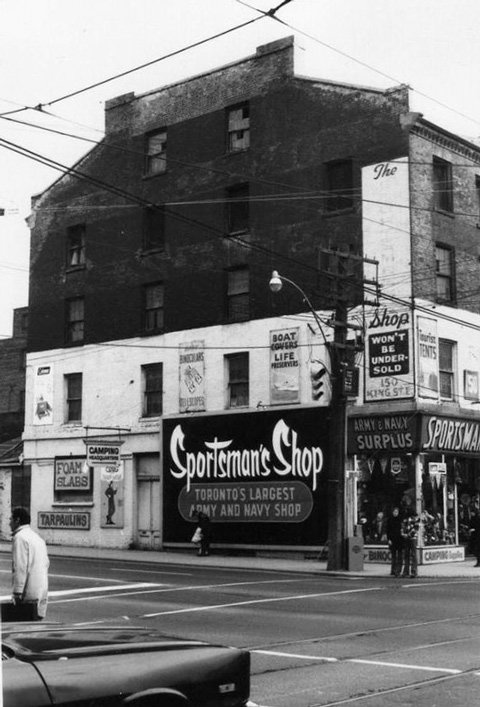
below: This photo is one of Woolaver’s – it is looking towards the northwest corner of Spadina and Queen Street West.  For those of us who lived in Toronto at the time, it’s a bit of nostalgia.  Somethings are very familiar – the older TTC buses, the car styles, and a lot of the architecture, for example.   This photo in particular lends itself nicely to the game of ‘Spot the Differences’….. compare this with

photo by Avard Woolaver of Toronto in the 1980s, this view is the north west corner of Queen and Spadina

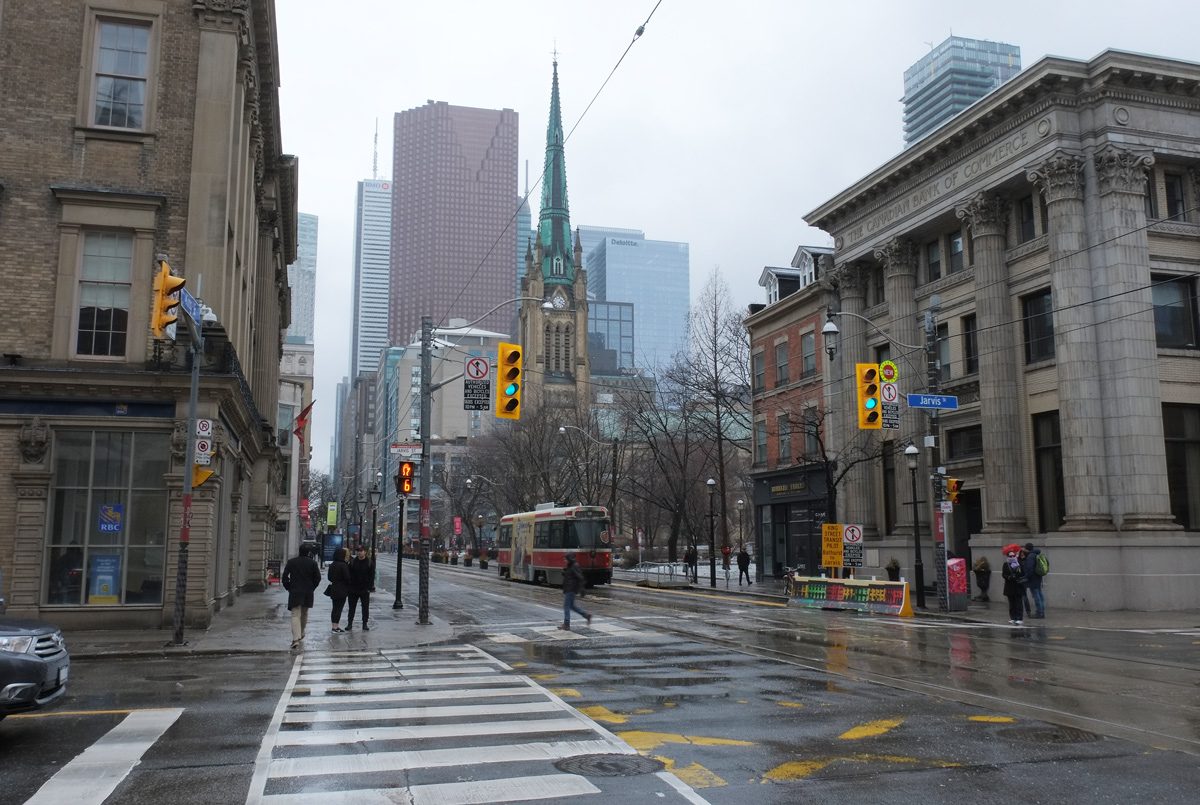
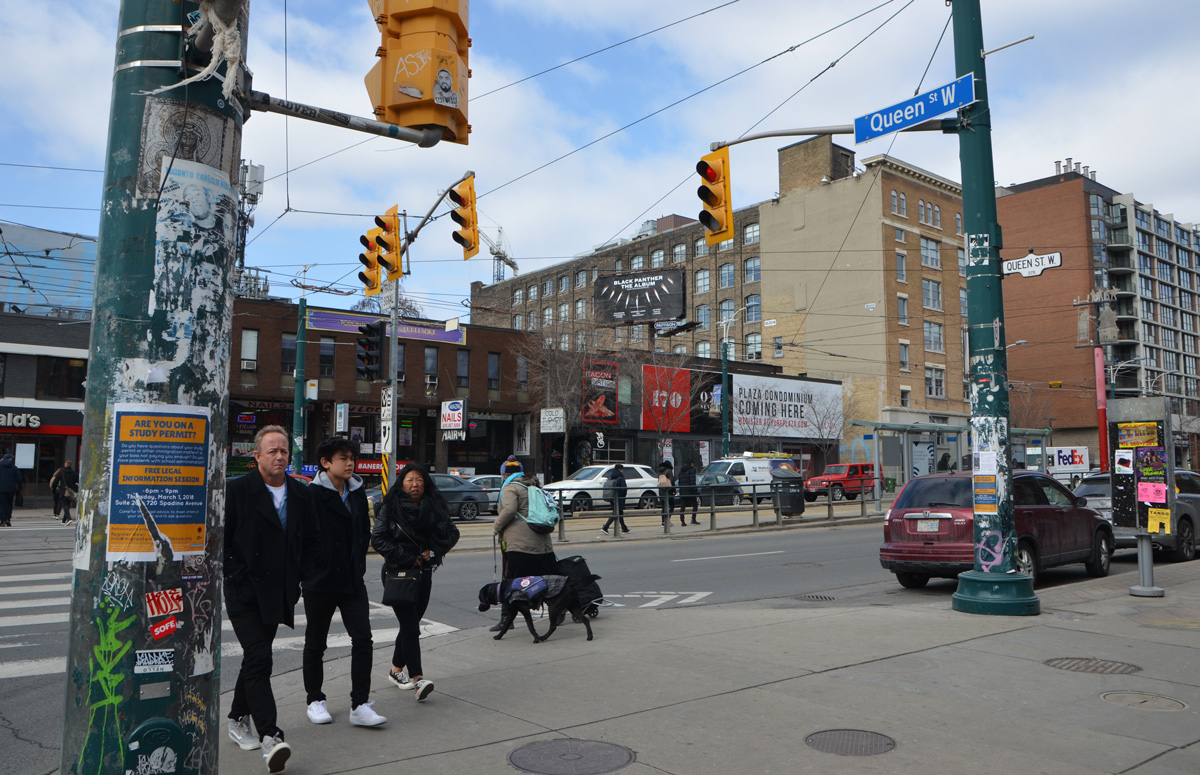
below: …..this. Here is the same intersection, at a similar angle, last week.   The large brick building is still there but without a billboard.   The poles are no longer wood but they are covered in posters and remnants of posters – so no change there.    The street signs have been updated and there is now a streetcar lane in the middle.   All in all, I was surprised how little had actually changed in 30ish years.

the northwest corner of Queen and Spadina in 2018, pedestrians, buildings, street scene

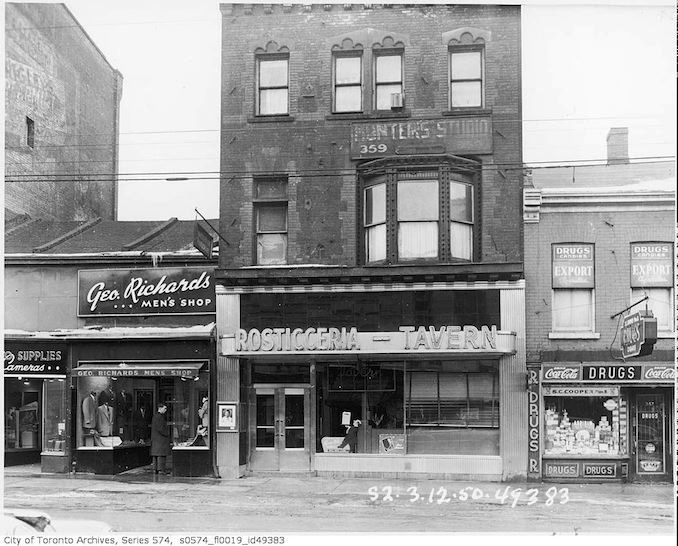
below: I found this photo online (originally from the Toronto City Archives, 1950?) but before we can play another round of ‘Spot the Differences’, we have to identify these buildings?  Any ideas?

vintage photo of 357, 359, and 361 Yonge street, black and white, 3 storefronts,

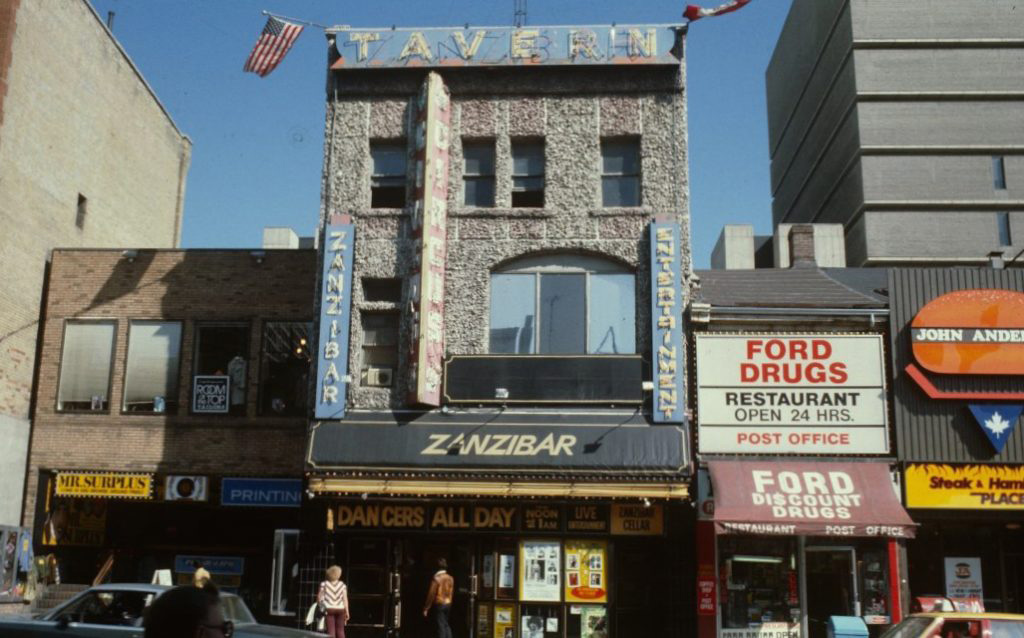
below: Here is the same location in the 1980’s (not a photo from the exhibit).  Not too many changes.   The building that housed George Richards Men’s shop, 361 Yonge Street, was replaced by a dull and boring two storey brick building but the other changes were just to the facades and the owners/tenants.   The tavern is still a tavern and the drug store is still a drug store.  The large brown building on the top right that you can only see part of is Ryerson College.   Unfortunately the Wrigleys ghost sign on the taller building on the left has been covered.

357, 359, and 361 Yonge street in the 1980s including the Zanzibar tavern

photo source BuzzBuzzNews online

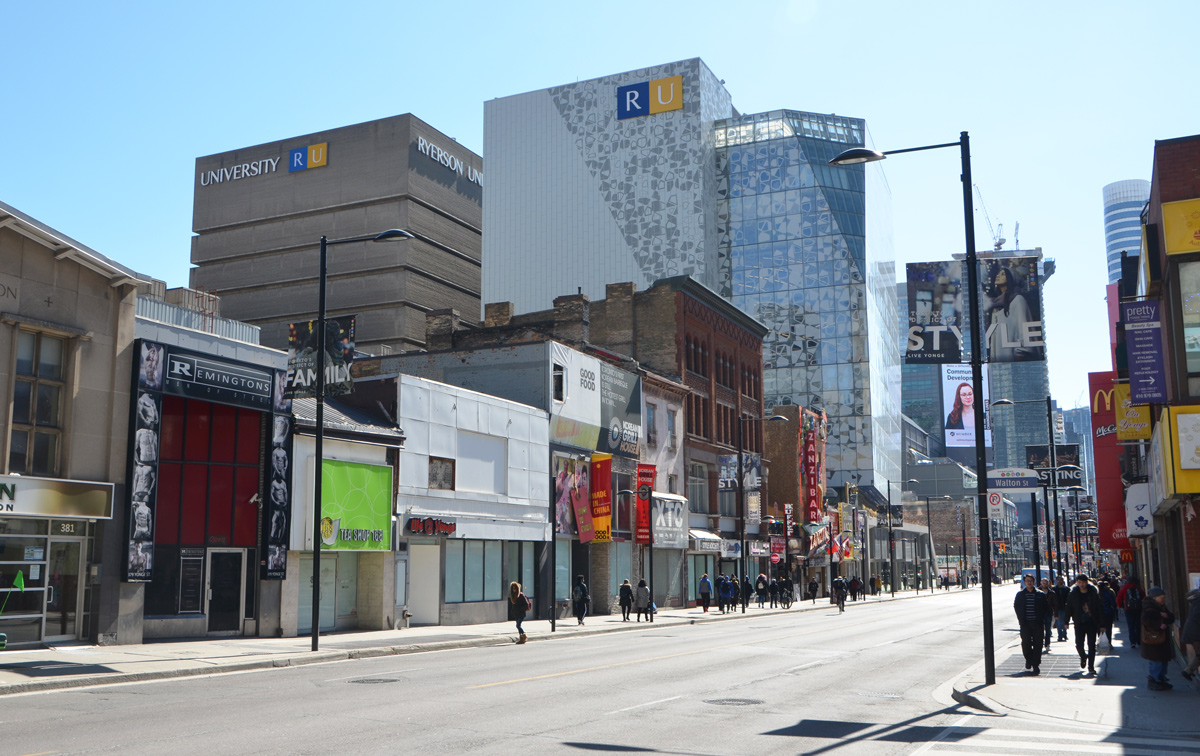
below: Fast forward another 30 years.  The Zanzibar is all bright lights and dazzle while the building that housed the drug store is now for sale.  Ryerson is now a University and has expanded out to Yonge Street – that’s the large blue building in case you are not familiar with the area.

Yonge stree, easy side, just north of Dundas, about 357, 359 and 361 Yonge Street including the Zanzibar Tavern. The blue glass wall of Ryerson University behind the Zanzibar,

below: If you pull back a bit, and look just a bit farther north on that stretch of Yonge Street, you’ll see that there are many empty buildings

yonge street, between gerrard and dundas, most storefronts are closed and boarded up waiting for redevelopment of that stretch

below: … including what was until recently the XTC clothing company.  It looks like it has gone through a number of ‘renovations’, not all of which were good.  Some traces of its original brick facade can be seen at the top but at street level it is (was?) a mess.

empty two storey building, once was X T C clothing store

 There is a plan to build a 98 storey mixed-use building on this site including just over 900 residential units ranging in size from 520 to 2000 square feet.    It will be the tallest residential building in Canada.   In the promotional material for YSL Residences, as they will be called, is this: “The epitome of luxury living, designed to elevate the fortunate few who will call it home.”


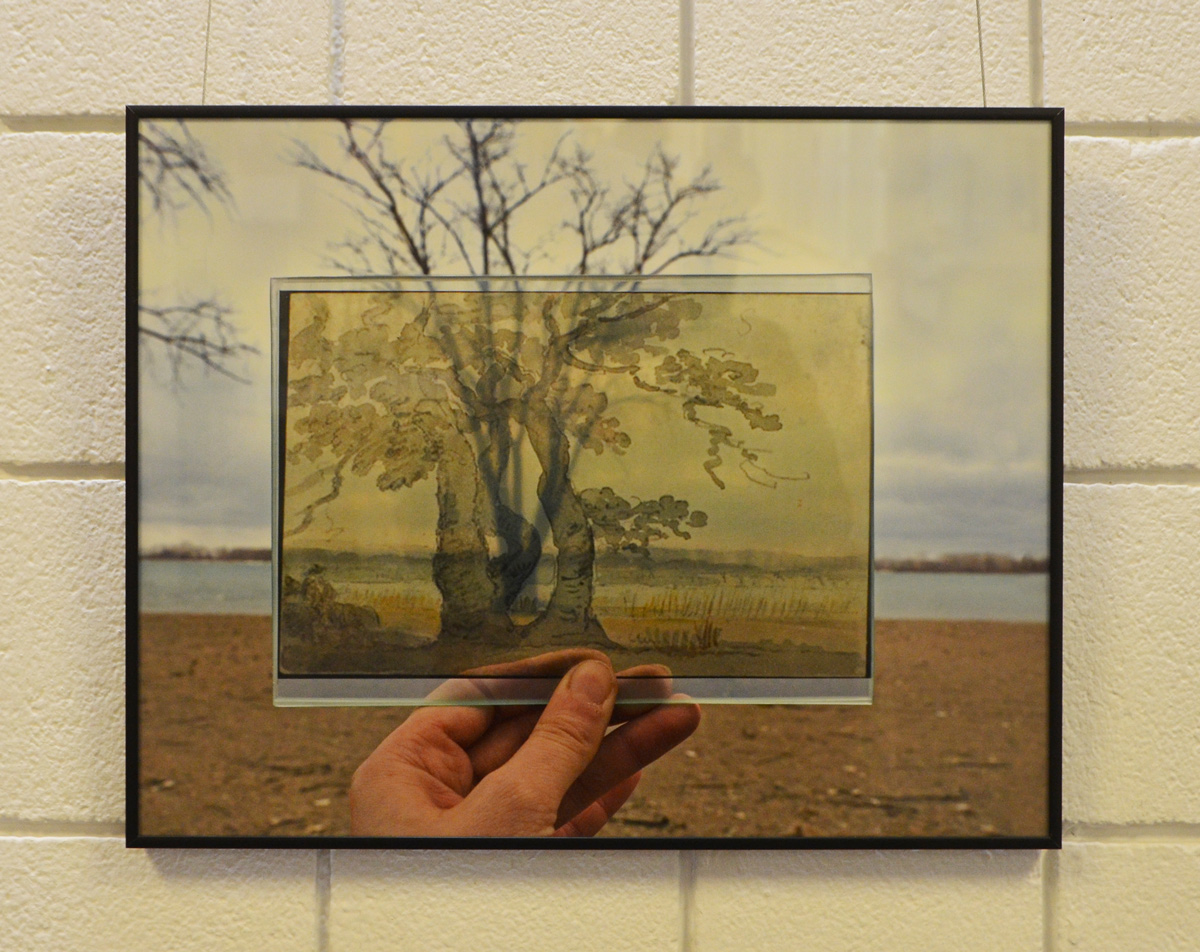
below:  Back to Ryerson, also on the 3rd floor of the School of Image Arts, there was a small series of photographs like this one hanging on the wall in the hallway.  There was no sign as to the name of the artist that I could find either on the wall or online.   I quite like the technique and the resulting image.  Two ideas melded into one.  Two time frames in one frame.  Two artistic styles combined to create another.

a photograph on a gallery wall, a hand holding a photo printed on glass in the middle of another photo, superimposed landscapes

If you are interested in Woolaver’s work, you can find more on his blog.

There are a few exhibits showing at the Ryerson Image Centre at the moment but the one that I want to highlight today is “Rich and Poor” by Jim Goldberg.  Goldberg took portraits of people in the San Francisco area in their home environments between 1977 and 1985.  They are divided into two sections, “rich” and “poor”.

Ryerson Image Centre (RIC) gallery, Jim Goldberg portraits "Rich and Poor' exhibition of black and white portraits in San Francisco in the 1980s

below: Each portrait is accompanied by a comment from the person being portrayed, in their own handwriting.  This woman, Nell, provides the wonderful quote: “If you want to stunt your growth, be rich.”

Ryerson Image Centre (RIC) gallery, Jim Goldberg portraits "Rich and Poor' exhibition of black and white portraits in San Francisco in the 1980s

below: The pictures are fascinating, and the words reveal more details of the subjects.  “My wife is acceptable”.   The poor woman.  In the picture she is off to the side and almost disappears into the background as she looks at the floor.   I thought of the words ‘abject’ and ‘woeful’ when I first saw her but I think that maybe the best word to describe the look on her face is ‘blank’.

Ryerson Image Centre (RIC) gallery, Jim Goldberg portraits "Rich and Poor' exhibition of black and white portraits in San Francisco in the 1980s

below: Whether you’re rich or poor, or more likely some where in between, what you say about yourself if you were the subject?

Ryerson Image Centre (RIC) gallery, Jim Goldberg portraits "Rich and Poor' exhibition of black and white portraits in San Francisco in the 1980s

This show continues until April 8th

On exhibit now at Artscape Youngplace is a photo documentary on seniors in Toronto called ‘Focus on Our Elders’.  It is being shown in the 3rd floor gallery until the 17th of March.   There are 24 panels in the exhibit, one for each participant in the project.   The main feature of each panel is a portrait of the individual and it is accompanied by at least one other photo of something relevant to the participant’s life, as well as text that tells some of the stories of their lives.

a man looking at panels on the wall of a gallery, focus on our elders photo documentary project, 3 panels on the wall, one for each of three participants with a portrait plus words from an interview with them.

With thanks to Penny for taking this picture!

The project was funded my Myseum of Toronto and is part of their 3rd annual Intersections festival.

description of the focus on our elders project

two people hanging pictures in an art gallery

Link to The 6ix Clicks websit

Lots of shiny silver balls, like bowling balls with bling, and lots of paint on large canvases…. on the surface these two things don’t really have anything in common.  But because they are two things that I saw at the Art Gallery of Ontario, I’m going to throw them together in this blog post.  The shiny spheres are part of a display by Yayoi Kusama  while the paintings I refer to are those by J.P. Riopelle and Joan Mitchell.

I saw the balls first.   There has been a lot of hype and publicity for the latest AGO exhibit, “Infinity Mirrors” by Yayoi Kusama that just opened this past weekend.  You’ve probably seen the all the red and white polka dots on the TTC and elsewhere around the city.   Last week when I was at the AGO I noticed that another Kusama exhibit was in the works, one that didn’t involve buying a “hard to get” ticket.  I was curious.  I’ve seen some photos of “Infinity Mirrors” so I went with great expectations.   Maybe that was my mistake.

below: “Narcissus Garden” consists of a large room with hundreds of shiny silver spheres laid out on the floor.

a large room, with 3 women looking at hundred of silver balls arranged on the floor. The balls are about the size of bowling balls

“Narcissus Garden” dates back to 1966 when it was a performance piece by Kusama at the Venice Bienalle.  She walked among the balls, picking them up, and looking at herself in them.   Here, at the AGO, they lie on the floor.   The ceiling is reflected over and over again.   It’s a dull ceiling.   The balls are scuffed up.   You might be able to lie on the floor to get a good look at the reflections bouncing around and that might be interesting.  As it is, “listless” is the word that I would use to describe it.  It’s the tag along mangy mutt to the main event.

reflections of a person in a few shiny silver balls

I spent a few minutes trying to figure out how to improve the presentation but, meh, no.  Instead I went upstairs to take a second look at the lesser known “new” exhibit at the AGO, the marvellous Mitchell and Riopelle show, “Nothing in Moderation”.  American abstract painter Joan Mitchell (1925 -1992) and Canadian abstract painter Jean Paul Riopelle (1923-2002) met in Paris in 1955.  For 24 years they were colleagues, friends, and lovers.  This exhibit consists of more than 50 of their works on loan from collectors around the world and shown together.

below: Looking at (part of) ” Tilleul (the Linden Tree)”, 1992 by Mitchell.

A woman in dark bright pink hair, with matching purse and shoes stands in front of a large painting by Joan Mitchell in an art gallery

below: Three degrees of interest in “Chasse Interdit (Hunting Prohibited)” by Mitchell, 1973.  On loan from the George Pompidou Centre in Paris.   The title of the painting refers to a ban on hunting – apparently Riopelle loved hunting and Mitchell loathed it.

Three people are looking at a large Riopelle painting in an art gallery, two are sitting on a couch and the third is standing closer to the painting.

below: The painting here is “Avatac” by Riopelle, 1971.  It is acrylic paint on top of lithographs on canvas

an emptry art gallery room except for a security guard standing on one side, a brown couch is in the middle of the room and a large abstract painting by Riopelle is one one wall, you can see into the next room where there is also a painting on a wall.

below: This is a photo of a small part of the above painting.  If you look closely, you can see the lithograph peeping through.   I can see a small animal head near the top left (a cat?) and there seems to be another lower down.

acrylic paint on top of lithograph, a detail of a large work by J P Riopelle called Avatac, created in 1971.  abstract art.

below: One thing that intrigued me about Riopelle’s painting was that even though there is a lot of paint (palette knife?), there are still some places where the canvas is visible.  Just small bits.

a close up of a large abstract painting with lots of acrylic paint on it

below: The details in the above photo are from the top left square in ” Mitchikanabikong ” by Riopelle.

large painting by Riopelle called Mitchikanabikong which is sort of divided into 6 quares, 3 across the top row and 3 on the bottom.  they alternate light and dark

below: The gallery was quiet on Wednesday morning.   Both of these paintings are by Joan Mitchell.   On the left, on loan from the Smithsonian American Art Museum in Washington DC is “Marlin”, 1960.  The other is “Untitled” from 1961 and it is on loan from the Joan Mitchell Foundation in New York.

a flat bench in front of two paintings on a gallery wall

And to end, a couple more for you to enjoy.

two women looking at large paintings in an art gallery

a woman with her back to the camera is looking at a large painting in an art gallery, AGO, Art gallery of Ontario,


A morning exploring some of the art galleries at the University of Toronto.

below: Robarts Library, a large concrete building, is part of the University of Toronto and is their main humanities and social sciences library. It opened in 1973 and has been called Fort Book ever since.

intersection of Harbord and St. George streets, Robarts Library, large concrete building

I have walked past this library many times but I have never gone inside. What I didn’t know about this building is that it is also home to the Thomas Fisher Rare Book Library.  It is named after a Thomas Fisher (1792-1874), who came from Yorkshire to Upper Canada in 1821 and settled by the Humber River.  In 1973, his grandsons, Sidney and Charles Fisher, donated many books to U of T .  Since then, the library has grown to approximately 740,000 volumes including hundreds of versions of Alice in Wonderland in many different languages.  They also collect manuscripts, photographs,  and other rare materials.   You can search their holdings online.

below: The view from the 4th floor observation deck.

interior of Thomas Fisher Rare Book library, looking down from the upper level to the tables below. Shelves of books line all the walls, ceiling is open to 4 or 5 storeys up , large central light fixture

At the moment, the Thomas Fisher Library has an exhibition called “Fleeting Moments, Floating Worlds, and the Beat Generation: The Photography of Allen Ginsberg”. Ginsberg (1926-1997) is known for his poetry but he also took pictures. The Thomas Fisher library has the largest collection of Ginsberg prints in the world.

exhibit of photos by Allen Ginsberg displayed in the Thomas Fisher Rare Books Library at U of T, some black and white photos in a case, some books too, shelves of books in the background

below: Mr. Ginsberg took bathroom mirror selfies.  I wonder what he’d think of instagram?

picture of a black and white photo taken by Allen Ginsberg of himself sitting naked and cross legged in front of a bathroom mirror

Ginsberg became friends with William Burroughs and Jack Kerouac, and the trio later established themselves as the main players in the Beat Movement with their unconventional writing and wild (for the times) lifestyles.  Ginsberg’s first published work was “Howl” in 1956.  It was called “an angry, sexually explicit poem”.   The San Francisco Police Department declared it to be obscene and arrested the publisher.  The court ruled that it was not obscene.  I can see it being “ahead of its time” in 1956 but today it’s fairly tame.

The opening lines:

“I saw the best minds of my generation destroyed by madness, starving hysterical naked,

dragging themselves through the negro streets at dawn looking for an angry fix,

angelheaded hipsters burning for the ancient heavenly connection to the starry dynamo in the machinery of night,

who poverty and tatters and hollow-eyed and high sat up smoking in the supernatural darkness of

cold-water flats floating across the tops of cities contemplating jazz,”

below: Three books about The Beats.

display in a glass top case, three books by Alan Ginsberg, the one in the middle has a yellow cover and is The Beats

The Ginsberg exhibit continues until the 27th of April.

A short walk through part of the St. George campus….did I mention that it was snowing at the time?… to another art gallery on campus.

snow is falling, snow on the ground, tree in foreground, also black wrought iron fence, looking across the playing field of the U of T St. George campus to a building, tower,

below: We passed a moose standing in the snow.

a flat metal sculpture of a moose stands in a small space beside a tree, snow on the ground, snow falling from the sky. public art

The second gallery was the Art Museum at Hart House.   One of the exhibits showing there is “Figures of Sleep”.  Straight from the gallery website is this description of the exhibit: ” [it]…considers the cultural anxieties manifest in the popular and critical imagination around the collapsing biological function of sleep under economic, social and technological transformation”.  What it is is a collection of videos, photographs, and artwork depicting sleep, i.e. people sleeping by a number of different artists.  This exhibit ends on 3rd March.

below: Watching videos of people sleeping

a person watching a large video display in an art gallery

below: She’s very life like.  She’s also much smaller than life sized but even so, she was a bit creepy. “Untitled (old woman in bed)”, 2000-2002, by Ron Mueck.

very realistic and life like scupture of an old woman with grey asleep under a blanket with her head on a pillow

below: “Dream Catcher” by Rebecca Belmore, 2014 .  This wall hanging is quite large.

dream catcher by Rebecca Belmore, a large wall hanging of a person sleeping on the sidewalk, under a blanket with a picture of a lion on it.

below:  The Malcove Collection is in the same gallery.  The collection includes about 500 pieces, not all of which are on display at the moment.  Dr. Lillian Malcove (1902-1981) was born in Russia just before her parents emigrated to Canada and settling in Winnipeg.  She graduated from the University of Manitoba with an M.D. and then spent most of her adult life as a Freudian psychoanalyst in New York City.  Over her life time she amassed a collection of art that she bequeathed to U of T.

wall display cases in an art gallery, religious pieces on display, old, antiquities

below: From the Malcove collection, ‘Male Dedicant’, made of limestone, Coptic, late 4th century or early 5th century

antique stone carving (relief) of a man with curly hair, both hands raised, one hand holding a spherical object and the other hand holding a cross

below:  Detail from “The Burning Bush”, 19th century.

very old painting, religious, virgin mary and baby jesus in the center surrounded by other religous scenes


below: Last but not least, and having nothing to do with art, is this plaque on a wall near the art gallery at Hart House.  It commemorates the relationship between the Canadian and Polish Armies during WW1.  A transcription of it appears below.


plaque on an exterior brick wall commemorating the role of the Polish Army

In the early months of 1917, twenty three Polish probationary officers were trained here by the staff of the Canadian School of Infantry in Toronto.  They were the forerunners of more than 20,000 North American volunteers of Polish descent who were trained in Canada (mostly at Niagara on the Lake) to serve in the French Army, ultimately commanded by Joseph Haller.  The existence of this Polish Army in France went far to assure the presence of Poland at the Peace Conference at the end of the war and played a significant role in the reconstitution of a reunited and independent Poland after 123 years of partition. 
The Canadian Polish Congress has placed this tablet to commemorate the ardent Polish patriotism of so many Polish volunteers from the United States and Canada.   The Congress also wishes to honour the Canadian officers who trained the volunteers, including notably Lieutenant Colonel A.D. Lepan of the staff of this university and his principal subordinates, all from this university as well as Major C.R. Young, Major H.H. Madill, Major W.F. Kirk and Major F.B. Kenrick. A.D. 1990


a bike parked outside an old brick building on St. George campus of U of T, snow covered

More information about:

Allen Ginsberg exhibition

Figures of Sleep, and others, at Hart House Art Museum

Illustrations of the holdings of the Malcove Collection


‘Demonstration’ by Michael Landry
at the Power Plant Contemporary Art Gallery

Now showing in the narrow Fleck Clerestory is an installation that consists of a collection of red and white paintings on paper.  Each is a male and/or female shaped silhouette figure with a protest sign.    They are pinned to the wall, from top to bottom.   Every one has a different slogan, phrase and/or image on the placard they are holding.

below: Looking down on the Fleck Clerestory from the upper level.

red and white paintings of demonstration signs being held by stick figure men part of an art exhibit at fleck conservatory on both walls, looking down from the upper level to see whole exhibit, two women on the lower level looking at it.

The work has grown, i.e. more pieces have been added, since it was installed late in September.   Landry has been asking the public to contribute their thoughts and feelings which he then draws.  Over the course of the next few months, it will evolve and grow as more people submit their ideas and suggestions.   In the end there will be a “wall of protest”, or perhaps more aptly, it will be a snapshot of the hopes and concerns that we have.

below: Some of the issues addressed from the serious (stop fracking, end hate, no more marijuana arests, opioid overdoses) to the more lighthearted (such as ‘go topless day’, and ‘we the north’).

red and white paintings of demonstration signs being held by stick figure men part of an art exhibit at fleck conservatory

If you have an image, slogan, or words, and you want to participate in this project, check out the submission guidelines by following this link

red and white paintings of demonstration signs being held by stick figure men part of an art exhibit at fleck conservatory

below: “No pipeline” and  “lorsque les mots perdent leur sens, les gens perdent leur liberte”.

red and white paintings of demonstration signs being held by stick figure men part of an art exhibit at fleck conservatory - sign says no pipeline

below: “Stop premature Christmas decorating!”

red and white paintings of demonstraion signs being held by stick figure men part of an art exhibit at fleck conservatory - sign says stop premature Christmas decorations

The exhibit continues until mid-May.

‘Straying Continents’ is a large hanging artwork that is on display at the ROM (Royal Ontario Museum).  The artist,  El Anatsui, constructed it out of aluminum and copper wire in 2010.

artwork hung on a wall, covers the wall, by El Anatsui, a Ghanese artist, made of different colours of liquor bottle caps, metal, close up

Thousands of recycled aluminum liquor bottle caps of different colours were cut and shaped (twisted or flattened) and sewn together with copper wire.  In some places the caps are flat and tightly packed while in other places they are twisted into rope-like pieces and loosely woven into the design.

below: The grey in the bottom part of the picture is the wall showing through. The lighting also creates shadows within the artwork.

artwork hung on a wall, covers the wall, by El Anatsui, a Ghanese artist, made of different colours of liquor bottle caps, metal, close up

Viewed as a whole, it is a fascinating piece. It does look like two continents separated by an ocean.  At the same time, innumerable interesting compositions can also be found by looking at it in sections.

artwork hung on a wall, covers the wall, by El Anatsui, a Ghanese artist, made of different colours of liquor bottle caps, metal, close up

recycled liquor bottle cap artwork

below: The piece doesn’t hang straight which creates folds, shadows, and more interest.

artwork hung on a wall, covers the wall, by El Anatsui, a Ghanese artist, made of different colours of liquor bottle caps, metal, close up

below: It also provides material to play with.

abstract of circles and partial circles made from bottle cap artwork


I went on a whim.   No one has ever called me ‘fashionable’ when it comes to clothing!

I went not knowing what to expect and was very pleasantly surprised at what I encountered.   The majority of the exhibit consists of dresses designed by Christian Dior from 1947 to 1957.

people looking at the Christian Dior exhibit at the ROM, Royal Ontario Museum

Christian Dior was born in a seaside town in northern France in 1905.  He began his career in fashion by selling fashion sketches in the early 1930’s after a failed attempt to run an art gallery.  This led to a job as a design assistant with Paris couturier Robert Piguet.   His career took off after WW2 when he started his own business, House of Dior (Maison Dior), in 1947.

a red knee-length dress in the foreground, a black one in the background, also a black and white striped dress, part of a museum display of Christian Dior clothing

below: This simple but classy two piece dress with black cummerbund is from Dior’s 1948 autumn-winter collection.   It is made with black velvet with iridescent bead work.  The bottom part is a mid-calf length skirt with the same beading.   Actually, the words simple and classy describe most of the dresses here.

two headless mannequins with black dresses, upper parts only are shown, part of a ROyal Ontario museum exhibit dress in foreground has iridescent beads sewn on it

below:  Embroidery with beads and stacked sequins in intricate designs.

close up shot of the back of dress that is heavily ebroidered and beaded in blue and purple floral motifs

below: The fabulous colours of fabric samples – this is only a small part of the display of fabrics with “a silk warp and a dupion weft”.  Warp and weft are weaving terms – warp refers to the threads that run lengthwise down the fabric while weft refers to the crosswise threads.   Dupion is similar to silk but it is thicker and more uneven.

silk fabric samples of many different colour

below: This dress is made from the silk fabric described above.

pale blue grey silk Christian Dior dress in the background, a red and a black dress are in the background, ROM exhibit,

beige suit, jacket and skirt. Jacket has tailored waist and 6 very large mother of pearl buttons,

Christian Dior’s success as a designer and a businessman continued until 1957 when he died while on vacation in Italy.  Yves Saint Laurent spent a few years as the Artistic Director immediately after Dior’s death although he was only 21.  There have been countless designers and many changes since then but the the company still exists as part of LVMH.   I was surprised to learn that the full name of the company is LVMH Moet Hennessy Louis Vuitton SE.  I also hadn’t realized that many of the luxury brands that we recognize the names of are actually controlled/owned by 3 companies: LVMH, Kering, and Richemont.  If you have a few minutes, take a cruise through wikipedia.

part of an orange dress with cloth covered orange buttons on both the front and side

below: There was a small display of jewelry, including this necklace by Maison Gripoix.   It is a string of lily of the valley flowers made from green and white handmade glass paste.   Glass paste, or pâte de verre, is made by mixing finely ground glass, binding agents, and colour.  The resulting ‘paste; is molded and then kiln fired.  Apparently the lily of the valley was Christian Dior’s “lucky flower”.

Dior necklace with green glass leaves and white flowers made of beads, gold as well, large and short

The exhibit is presented by Holt Renfrew and you can find it on the 4th floor of the ROM…. until 18 March 2018. In the meantime, you can find more information on the ROM website.


#ROMDIOR

Florine Stettheimer: Painting Poetry,
an exhibit at the Art Gallery of Ontario

Florine Stettheimer (1871-1944) was the 4th child of five, daughter of  Joseph and Rosetta.  Joseph, a banker, abandoned the family early on and was never mentioned again.  Older siblings Walter and Stella married and moved out while the younger three girls, Ettie, Florine and Carrie remained in the same household with their mother until their deaths.   They became known as “the Stetties”.  They hosted salons in Manhattan and lived a life of leisure and artistic pleasure.

below:  Family Portrait II, 1933, This painting has flowers, New York City references, and Florine Stettheimer’s immediate family portrayed in a theatrical setting/arrangement.  These are themes that occur over and over again in Stettheimer’s work.  Here Ettie is reading, Rosetta is playing cards, Florine is painting, and Carrie is playing hostess.

painting by Florine Stettheimer on display at the Art Gallery of Ontario

The Stettheimer children were born in Rochester NY.  Between 1906 and 1914 Florine and her mother and sisters lived in Europe before settling in Manhattan.

A portion of the exhibit features  a collection of designs for costumes for a ballet that Florine wrote while she was in Paris in 1912.  ‘Orphee of the Quat-z-Arts’ (or ‘Revellers of the Four Arts Ball’) was based on a costume parade organized by Parisian art students and in it the main character, Georgette, encounters the ancient Greek minstrel Orpheus and a parade of mythical creatures, as she and her father walk down the Champs Elysee.  The ballet was never performed.

below: One of 42 sketches and 9 relief maquettes, Georgette.

costume design mockup by Florine Stettheimer, AGO exhibit,

below: People, both men and women, were painted with elongated willowy shaped bodies.

a woman looking at a painting by Florine Stettheimer, AGO,

Florine also wrote poetry and she liked to send her poems to her friends.  In 1949 her sister Ettie published a book of Florine’s poems titled ‘Crystal Flowers’.  This is one of the poems:

And Things I Loved
a poem by Florine Stettheimer

Mother in a low-cut dress
Her neck like alabaster
A laced up bodice of Veronese green
A skirt all puffs of deeper shades
With flounces of point lace
Shawls of Blonde and Chantilly
Fichues of Honeton and Point d’Espirit
A silk jewel box painted with morning glories
Filled with ropes of Roman pearls
Mother playing the Beautiful Blue Danube
We children dancing to her tunes
Embroidered dresses of White Marseilles
Adored sashes of pale watered silk
Ribbons with gay Roman stripes
A carpet strewn with flower bouquets
Sevres vases and gilt console tables
When sick in bed with childhood ills –
All loved and unforgettable thrills.


below:  The painting in the foreground of this picture is ‘Self-Portrait with Palette (Painter and Faun)’, 1910s.  According to the words that accompany the painting, the faun behind her symbolizes a memory inspired by Russian ballet star Vaslav Nijinsky whom she saw perform in Paris in 1912.  After the performance, Florine wrote: “Nijinsky the faun was marvelous.  He seemed to be truly half beast… He knew not civilization – he was archaic – so were the nymphs.  He is the most wonderful male dancer I have seen”.

people at the Art Gallery of Ontario in a gallery featuring paintings by Florine Stettheimer,

below: Self-portrait, 1933

two women looking at a portrait painted by FLorine Stettheimer,

“For a long time
I gave myself
To the arrested moment
To the unfulfilled moment
To the moment of quiet expectation
I painted the trance moment
The promise moment
The moment in the balance
In mellow golden tones…
Then I saw
Time
Noise
Color
Outside me
Around me
Knocking me
Jarring me
Hurting me
Rousing me
Smiling
Singing
Forcing me in joy to paint them…”

This exhibit continues at the AGO until 28 January 2018

‘Room for Mystics’
An exhibit at the Art Gallery of Ontario by Sandra Meigs and Christopher Butterfield.

artwork by sandra Meigs at the Art Gallery of Ontario, paintings back to back, standing on the floor, bright colours, banners hanging on the walls of concentric yellow circles on white

Scattered around the room are bright coloured, simple paintings that are displayed back to back.  Banners with concentric yellow circles hang on the walls.  The solid colour boxes beside the paintings hide speakers.

artwork by sandra Meigs at the Art Gallery of Ontario, paintings back to back, standing on the floor, bright colours, banners hanging on the walls of concentric yellow circles on white

A large red mobile hangs from the ceiling, happiness with closed eyes.  Happiness and joy are two of the emotions that this room evokes.  Walking through the room is definitely a positive experience!  You can’t help but smile.

artwork by sandra Meigs at the Art Gallery of Ontario, paintings back to back, standing on the floor, bright colours, banners hanging on the walls of concentric yellow circles on white plus a large mobile of a red smile and two ele lashes from closed eyes

The paintings and mobile are the work of Sandra Meigs, a Canadian artist based in British Columbia.   Accompanying the exhibit is a ‘sound installation’ composed by Christopher Butterfield.

artwork by sandra Meigs at the Art Gallery of Ontario, paintings back to back, standing on the floor, bright colours, banners hanging on the walls of concentric yellow circles on white

artwork by sandra Meigs at the Art Gallery of Ontario, paintings back to back, standing on the floor, bright colours, banners hanging on the walls of concentric yellow circles on white

The exhibit continues until 14 January 2018