Archive for the ‘galleries’ Category

There are always options….
and sometimes they are polar opposites.

a yellow construction fence in front of a stairs between two buildings, two signs on the fence, both are green arrows but they point in opposite directions.

Also, plans are made for changing.

I was going to go to Brookfield Place to see the World Press Photo exhibit – a good activity for a grey and wet day.  Just before I left, the rain stopped so I switched plans and turned the outing into a walk.   There was a protest in the afternoon at Queens Park, a march against white supremacy.  I knew that I probably missed it (it would have been wet!) but I went in that direction just in case there were still some remnants.  But all was quiet and the people were long gone.   So I wandered on.

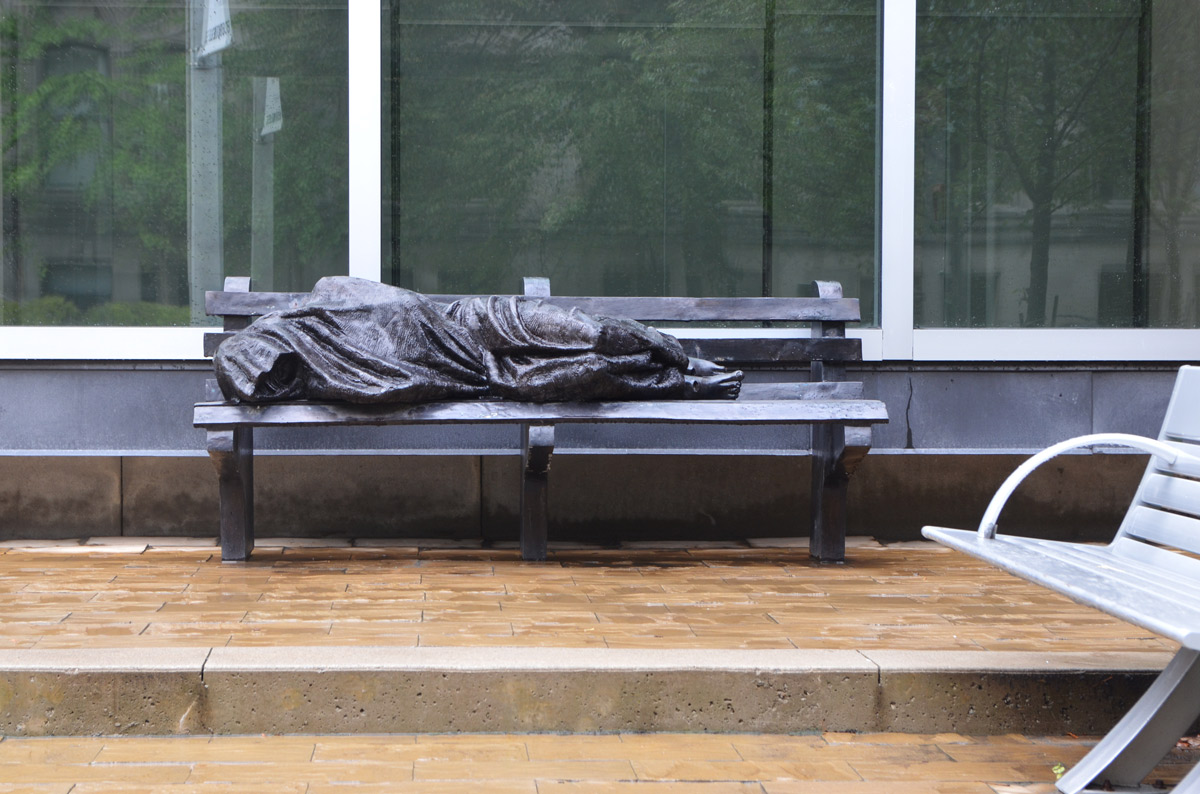
below: In front of St. Regis College, a sculpture called ‘Homeless Jesus’ by Timothy Schmalz.  In memory of Joseph and Mary Benninger.

a sculpture of a cloth covered person sleeping on a bench, in front of a large window, with a white bench nearby

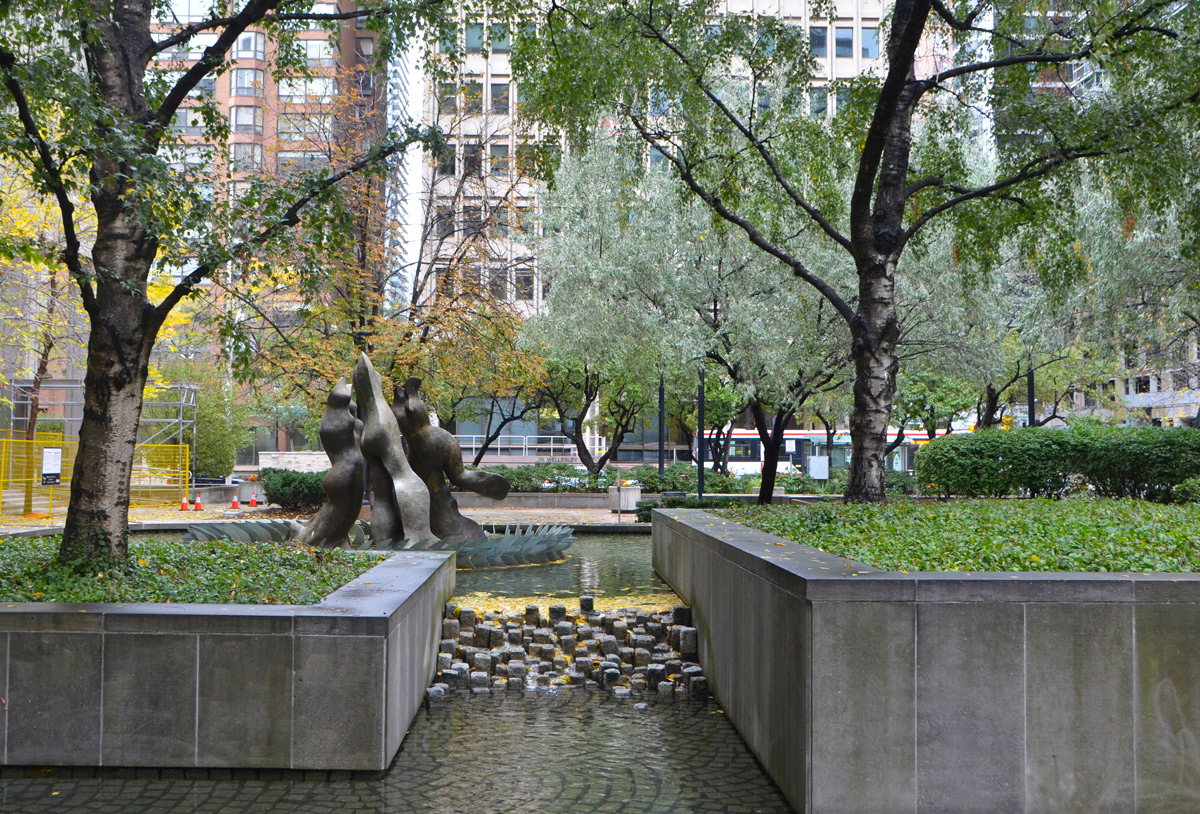
There is a small park at the corner of Bay and Wellesley with trees, water, and sculptures.

a small waterfall, over rocks, between two concrete fence around grassy areas, trees, small park

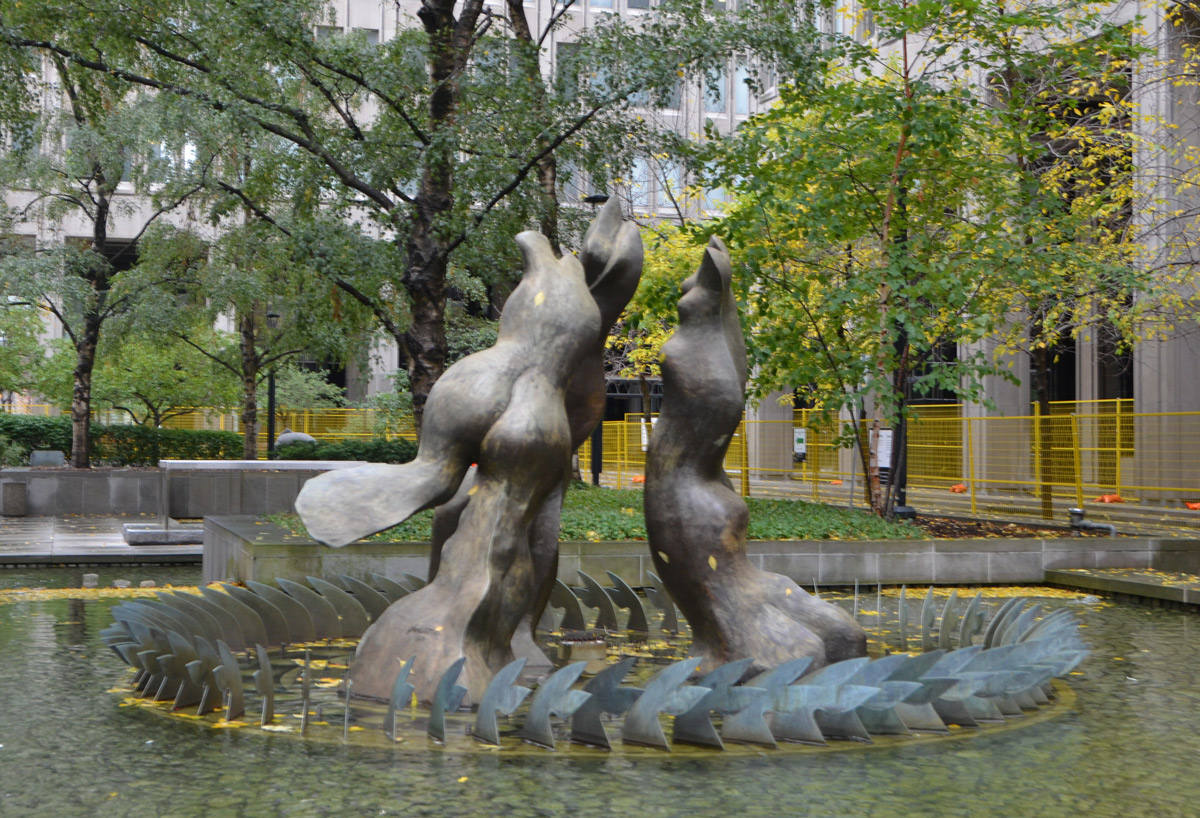
below: ‘The Three Graces’, 1971  by Gerald Gladstone (1929-2005).  Part of the Governement of Ontario Art Collection.

a fountain sculpture called Three Graces, in a circle, surrounded by a shallow pool of water

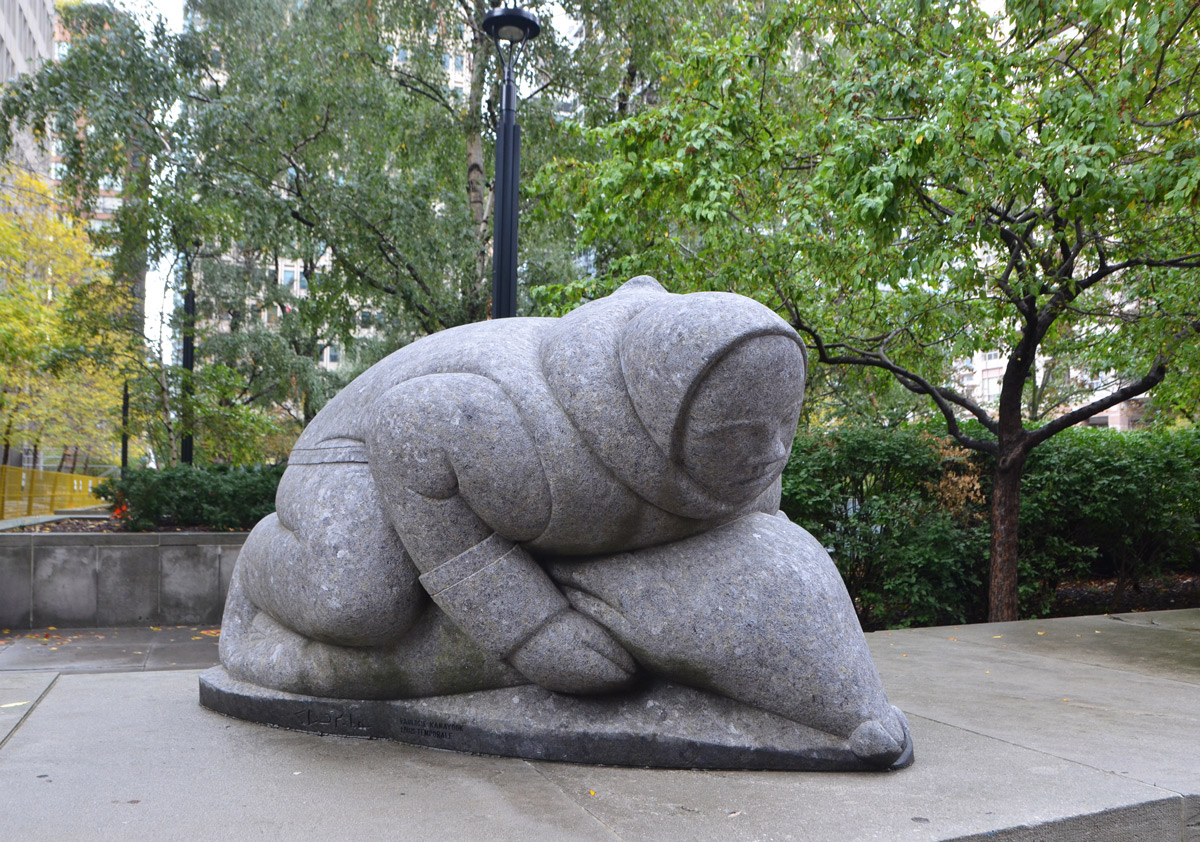
below: ‘Hunter With Seal’ c. 1966-1968.  Sculpted in Canadian black granite by Louis Temporale after a soapstone carving by Paulosie Kanayook.

stone sculpture of an Eskimo hunter with a seal, on a short stone wall, trees behind

below:  Workers in stone – surveyors, men with shovels and picks and wheelbarrows, and a scientist with a microscope.  Part of the artwork above the door of the old Stock Exchange Building on Bay street.

relief sculpture across the top of the door of the old Stock Exchange Building on Bay street, scenes of people working

below: At one point the sun even came out – shining on the almost blank west wall of Commerce Court North.   This 34 storey building was built in 1931 and at the time it was the tallest building in the British Empire and remained so until 1962.

large mostly black stone wall of a building with a large shadow, flowers in planters at the bottom as well as three people walking past

below: When the site was redeveloped in the 1970’s, Commerce Court North was preserved.  It is now surrounded by glass and steel high rises.

two people walk across a courtyard behind an old stone building that is surrounded by newer glass and steel high rises.

below:  The mama and baby elephants that stand behind Commerce Court are under wraps.  I could say something about going into hibernation for the winter but I think that they are in the midst of being renovated.

a sculpture in a public square is covered by grey plastic

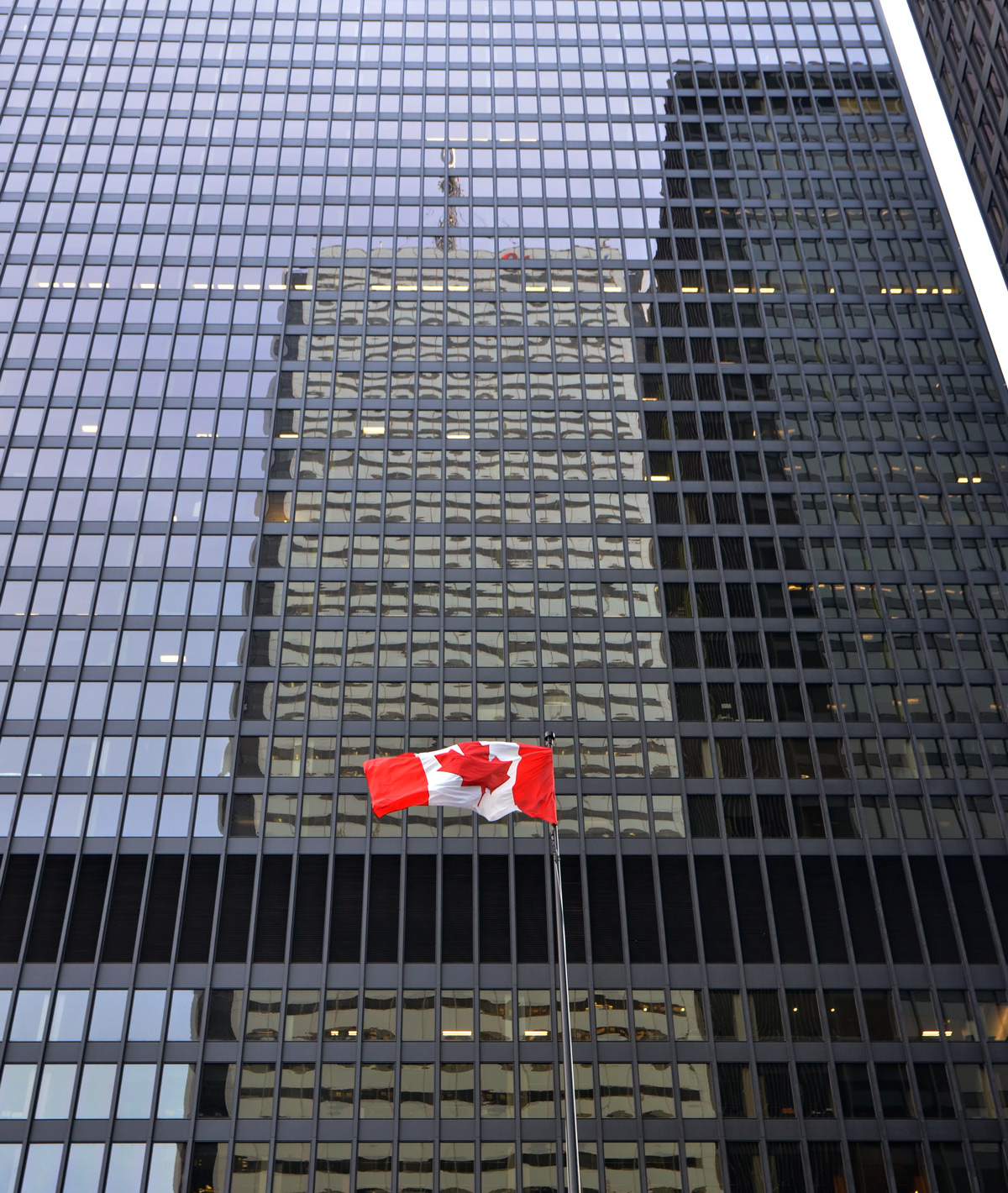
below: Just down the street,  one of Toronto’s early skyscrapers is celebrating its 50th anniversary.      The black towers of the Toronto-Dominion Centre are icons of the Toronto cityscape.    They were designed by architect Ludwig Mies van der Rohe.    The 56 storey Toronto Dominion Bank Building was completed in 1967.  Two years later the adjacent 46 storey Royal Trust Tower was finished.   The buildings are steel structures and are clad with bronze-coloured glass and black painted steel.

reflections in the black Commerce Court buildings, with a Canadian flag flying in front of the building.

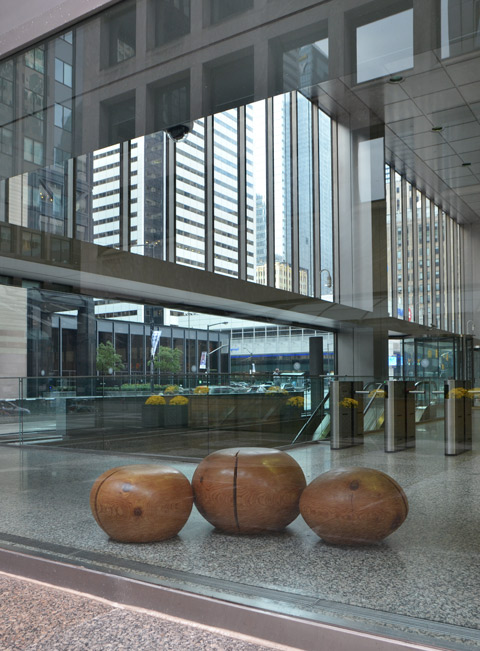
below: Rocks? Large balls of wood? Plastic made to look like something else? They were inside and I was outside so I didn’t get a close up look.

three rock-like sculptures inside a window

In case you’re wondering, I did get to Brookfield Place.

glass ceiling of the Alan Lambert Galleria in Brookfield place with the world press photo exhibit underway, people looking at the posters

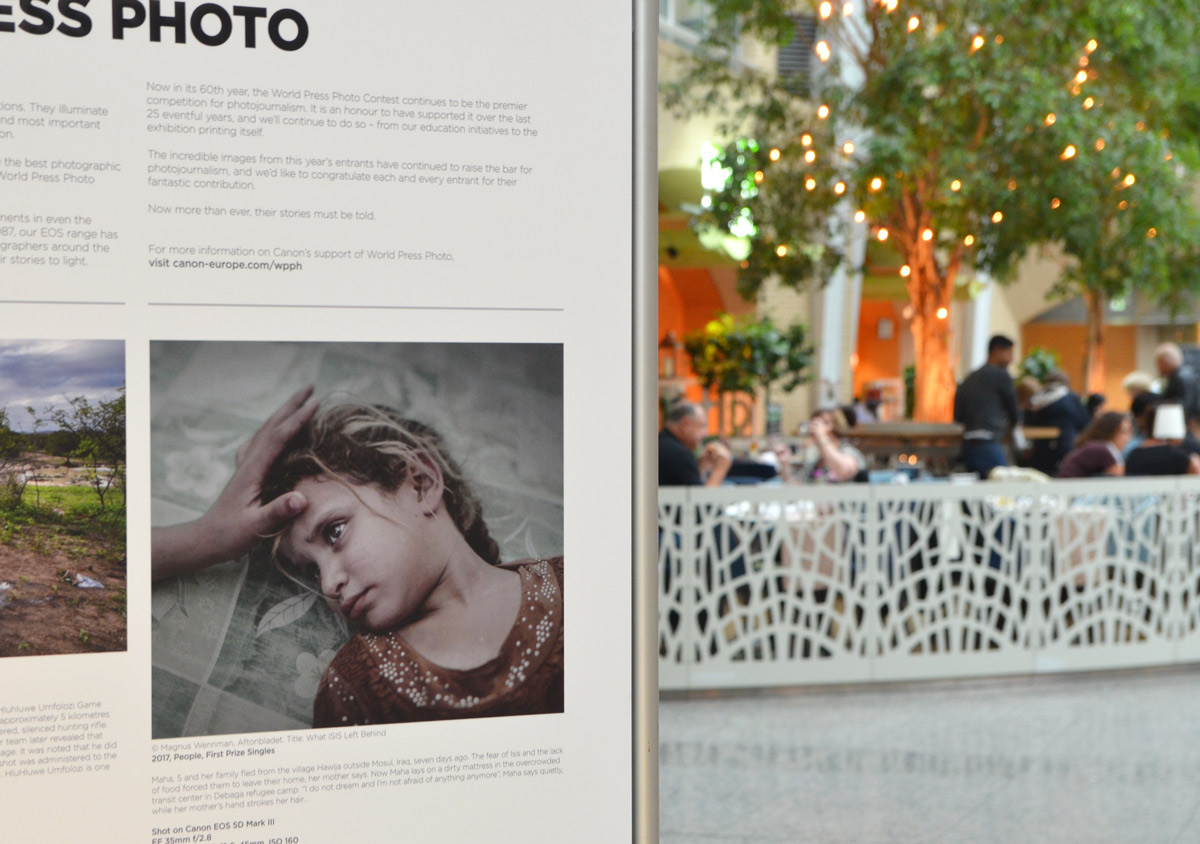
below: Photo is the winning photo in the people category, ‘What ISIS Left Behind’ by Magnus Wennman.  It shows a girl,  Maha age 5, at Debaga Refugee Center.

part of a world press photo display at Brookfield Place, with a picture of sick young girl, in the background, people are sitting in a cafe

below: Center photo is by Canadian photographer Amber Bracken and it was taken at the Dakota Access Pipeline protest at Lake Oahe at Standing Rock Sioux reservation.

photos at an exhibition at Brookfield Place (Alan Lambert Galleria), of portest of Dakota Access Pipeline, by Canadian photographer Amber Bracken

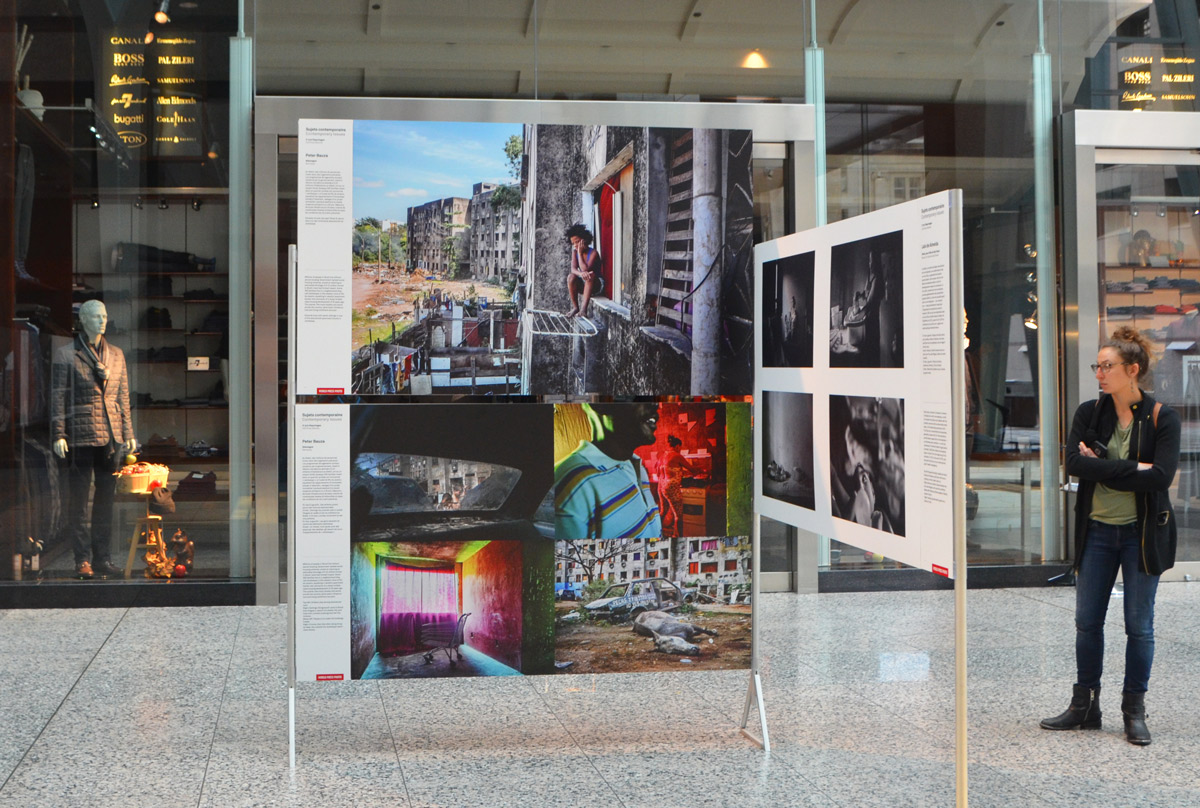
below:  Four coloured photos by Peter Bauza.   Third prize in the Contemporary Issues category – a series of pictures taken in the Jambalaya neighbourhood in western Rio de Janeiro where people squat in derelict apartment blocks that lack basic infrastructure.

display of photos in front of a store with a male mannequin dressed for fall, also a woman on the other side looking at the pictures


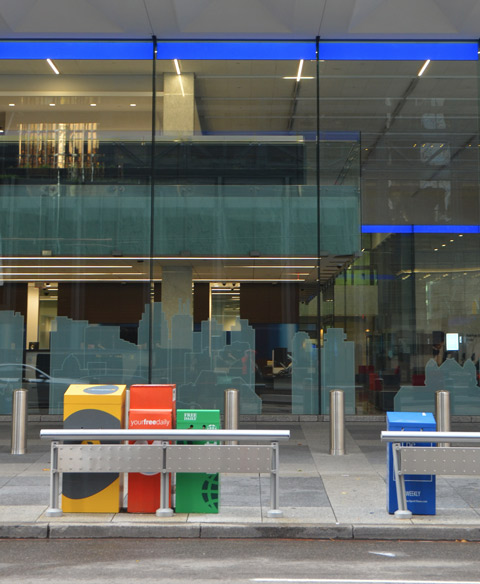
newspaper boxes in different colours in front of a large window of the BMO building, a city scape is etched into the window. Some reflections in the window too


Progress is a spiral upward is the title of an exhibit at the Tangled Arts Gallery at 410 Richmond.  It is a series of collages of ink and/or paint drawings by Toronto artist sab maynert.

three people in an art gallery looking at drawings by sab meynert.

“for sight beyond seeing
for seeing in order to know”

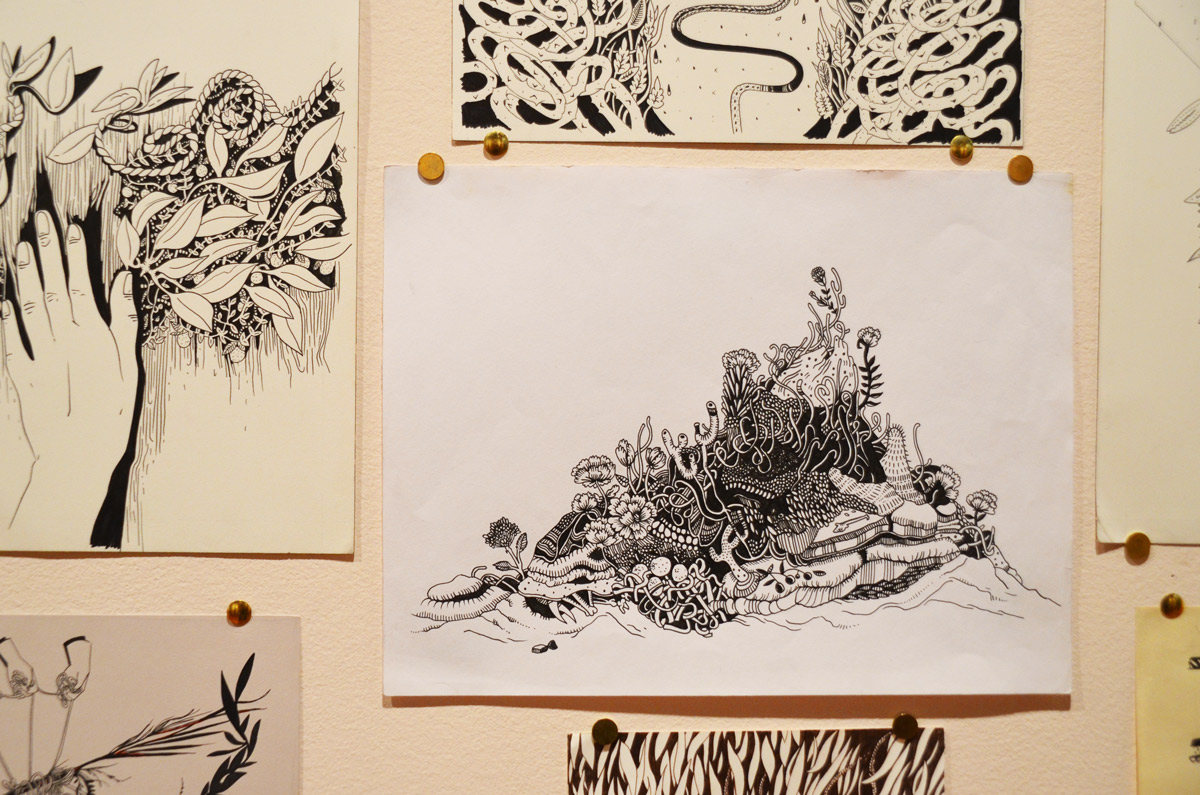
pen and ink, and paint, drawings by sab meynert on a gallery wall, thumb tacked to the wall, black and white, intricate

“let the flow carry you, rest in the soil, let the seed push you to the sun,
palms out to the sky,
let go, make room”

pen and ink, and paint, drawings by sab meynert on a gallery wall, thumb tacked to the wall,

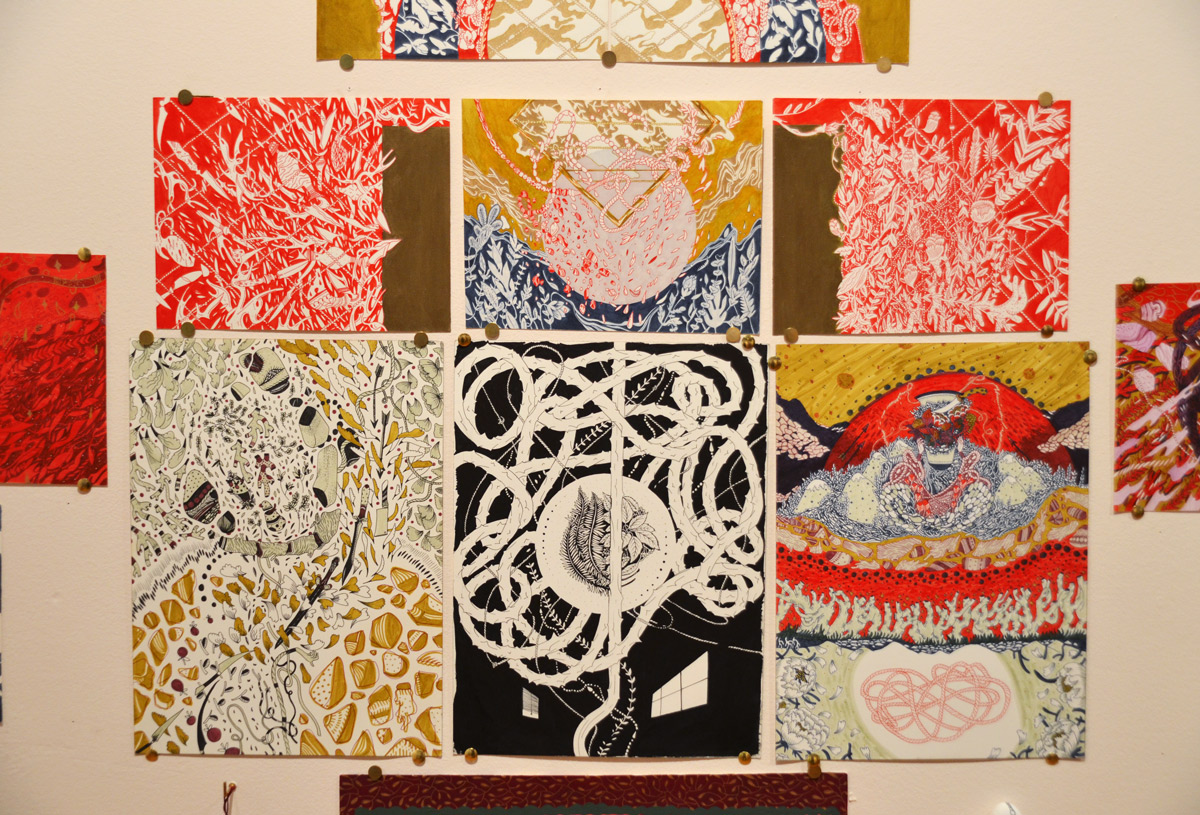
below: The piece in the middle is “By Proximity”, 24″ x 24″, gouache and ink on paper.

pen and ink, and paint, drawings by sab meynert on a gallery wall, thumb tacked to the wall,

below: bottom left (yellow and black): “You Give Everything”, ink on paper, 9″ x 12″ while bottom right (with the red ‘knot’) is “Decisions we Made”, ink on paper, 9″ x 12″.

pen and ink, and paint, drawings by sab meynert on a gallery wall, thumb tacked to the wall,

“pull yourself out of the thornbush
you smell like flowers”

pen and ink, and paint, drawings by sab meynert on a gallery wall, thumb tacked to the wall,

The quotes that I’ve used in this blog post are lines that I have pulled from the writing that accompanies the exhibit, a poem with the same title, “Progess is a Spiral Upward”.

The exhibit continues until the 14th of October.
Link to sab meynert’s website


There are a group of photography exhibits now showing at the Ryerson Image Centre.  Two of them showcase older photos of Canada.  The largest exhibit is ‘Faraway Nearby’ and it consists of photographs of Canada from the New York Times photo archive…   25,000 vintage photos of Canada taken over the past 100 years have been gifted to Ryerson by Chris Bratty in honour of his father Rudolph (Rudy), a property developer in the GTA.   ‘Faraway Nearby’ is a wonderful selection of them covering a wide cross section of subjects.

vintage black and white photo of people in bath suits standing on diving boards beside a lake

below: There is a section devoted to tourist type photos that you would find in the travel section of a newspaper.  Yes, that’s an RCMP officer standing beside the car, a convertible with California plates.  I’d say it was kitschy to have the RCMP guy there but even today the red uniform of the RCMP is iconic; they are featured on many postcards and souvenirs.   Tourists still take photos with them I’m sure.

photo in an exhibit of a group of tourists in a convertible car with California plates parked beside the road and overlooking a mountain lake. An RCMP officer stands beside the car.

below:  Oh dear, Highland dancers and Native Americans all dressed up.   Is that the Banff Springs Hotel?  The exhibit taken as a whole is a fascinating look at Canadian history; how far we’ve come in some respects and how we haven’t really changed in others.

vintage black and white photo of a highland dancer with a line of native Americans in traditional dress behind her. Some teepees in the background, also a hotel.

below:  Loggers clearing their way through a sea of timber that is being guided into a newsprint mill in Hull Quebec, about 1946.  Unknown photographer.  (Almost all the photos are by ‘unknown’).

vintage black and white photo of two shirtless men on legs with poles as the move logs and timber by river to a newsprint paper mill on the other shore.

Being a newspaper, a large number of the subjects were political such as this photo of Joe Clark, Prime Minister of Canada from June 1979 to March 1980, on a visit to Cameroon  in the summer of 1979.

black and white photo from 1979 of Joe Clark, then Prime Minister of Canada, riding in a motorcade with the President of Cameroon, in Cameroon.

below: Prime Minister Trudeau (the first one) meeting President Nixon, “Tricky Dick”, of the USA.  Love the sunglasses! (or is that just a trick of the lighting?).

vintage photo of Richard Nixon, President of the United States, greeting Pierre Elliott Trudeau, Prime Minister of Canada

below: While on the topic of the Trudeau’s, here’s Margaret with Fidel Castro.  Castro is holding Margaret’s youngest son Michel.  The photo was taken in Havana in 1976 when the Trudeau’s were in Cuba on a 4 day state visit.

vintage black and white photo of Margaret Trudeau and Fidel Castro. Castro is holding one of the Trudeau sons.

below: There are also some photos taken during various Royal visits.  Here are a group of men by Lake Nipigon in 1919.  The man holding the dead duck (3rd from the left) is Edward, Prince of Wales (b.1894 – d.1972).   He was 25 years old in this picture.   On 20 January 1936 he became King Edward VIII but he abdicated the throne in December of the same year after reigning for only 326 days.

a vintage black and white photo of a group of men in northern Ontario, by a lake, one is holding a duck that has been shot

below: A photo by an unknown photographer for the Canadian War Records Office and the American Press Association, Vimy, France, April 1917.  The description of the photo reads: “Giving Fritz some of his own pills.  Canadians firing a German 4.2 on the retreating Boche.  Some of the guns left behind by the retreating Germans were in excellent condition, and the Canadians at once  undertook to return some of the shells to their former owners in the most effective manner.”

vintage world war one photo

below: A slightly lighter look at war, this time WW2.  Photograph by Nat Turofsky (d. 1956) for Alexandra Studio.  Distributed by the Star Newspaper Service and the New York Times.  Location unknown. 1939.  Nat and his brother Lou were well known Toronto photographers in their day. Back in 2009, The Torontoist published an excellent story about them and the Alexandra Studio which they owned.

The description of the photo reads: “Shouldering guns instead of hockey sticks.  Member of the Toronto Maple Leaf hockey team, led by Bob Davidson, Goalie “Turk” Broda, and “Sweeney Shriner, marching into the trenches at a machine gun target range during a military training session.  The team is in constant training so that they will be ready for duty if called to the colors.”

vintage photo of men in Maple Leafs hockey sweaters walking through war trenches

***

The second, and smaller, exhibit is ‘The Notman Studio:  1858-1915’.  William Notman was a photographer based in Montreal who traveled across Canada documenting what he saw.   He was also a studio photographer who took hundreds of portraits.   This is a small sample of his work.

below:  ‘Ice Castle’ about 1857, Montreal Quebec, Albumen print.

old photo of a large ice castle

below: ‘Esquimalt Dry Dock’, 1887, Victoria B.C. Albumen print.   You’ll have to pardon the reflections in the pictures.  The glass in the frames acts like a mirror and although I have tried to minimize the amount of reflection, getting rid of it entirely was not always possible.

vintage photo, 1887 ship being built, wood, in Victoria B.C.

below: Standing outside his teepee with his rifle and his horse.

vintage photo of a native American man in traditional clothes holding a rifle and a horse and a lead. Standing outside a teepee

below: There were a series of Cariboo Hunting photos.  They were small and all focused on the two men.   Especially considering their age, they are in excellent condition and beautiful to look at.

vintage photo of two men hunting caribou. Resting with their rifles.

below: ‘Little Champlain Street’  1890, Quebec City.   I looked for photos of Toronto in the collection that was on display but there weren’t any.

vintage albumen print photo, 1890, Little Champlain street in Quebec City. row houses, kids in the street

below: There is an incredible amount of detail in the above picture so I cropped it quite a bit to highlight some of the details.   The shabby brick and plaster row houses, the solitary street light, the planks that form the narrow road, and the kids wearing hats as they keep an eye on the photographer.  Although it is Quebec City, I can imagine parts of Toronto looking quite similar at the time.

details of a vintage photo, street scene, kids, row houses,

In case you were wondering, albumen prints refers to a process whereby the photographic paper that is used to print the images from a negative was made using egg whites.  The main constituent of egg whites is the protein albumen.  It is sticky and forms a glossy finish when it dries.  The stickiness of the albumen is used to bind salt (sodium chloride, your basic table salt, or ammonium chloride) to the paper.  Once the paper dries, it is dipped into a solution of silver nitrate thereby making the paper sensitive to UV light.   This method was developed in 1847 and was the first commercially viable method of producing photographic paper.  It remained in use until the 20th century.

By the entrance to the Notman exhibit is this wonderful, and still relevant, quote attributed to William Notman: “To consider Photography a mere mechanical art, is a great mistake.  The too prevalent desire for cheapness, and the ease with which a little may be done in Photography, has induced many to embrace the profession lacking the necessary qualifications…”
Both exhibits continue until 10 Dec 2017.

Identity.  What springs to mind when you hear the word identity?  And how does that relate to art?

Let’s now take those general questions and narrow it down to the work of three artists, or photographers to be more precise: Suzy Lake, Lori Blondeau, and Shelley Niro.  I haven’t chosen those women randomly; I’m writing about them because their work is on view if you go to the Ryerson Image Centre.  Suzy Lake’s photos are on display in the main gallery inside while Lori Blondeau and Shelley Niro’s are showing outside.  The latter two were installed as part of the CONTACT Photography Festival.
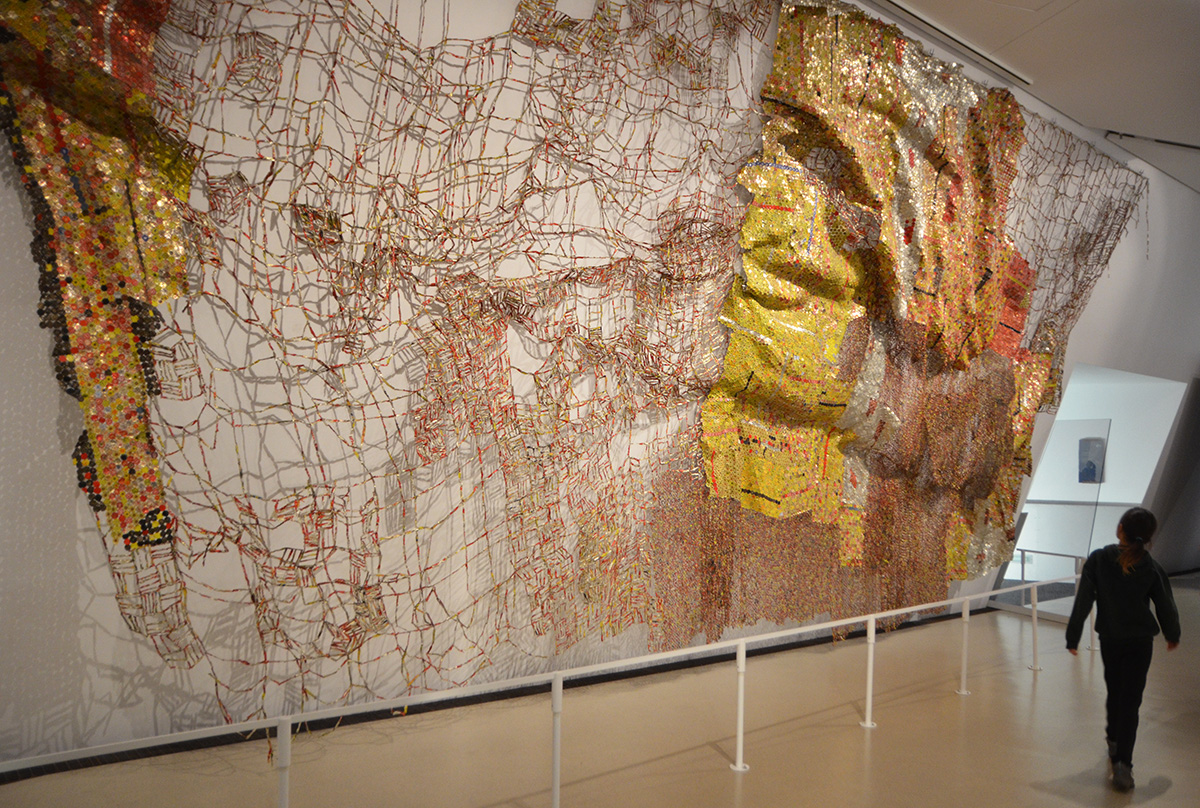
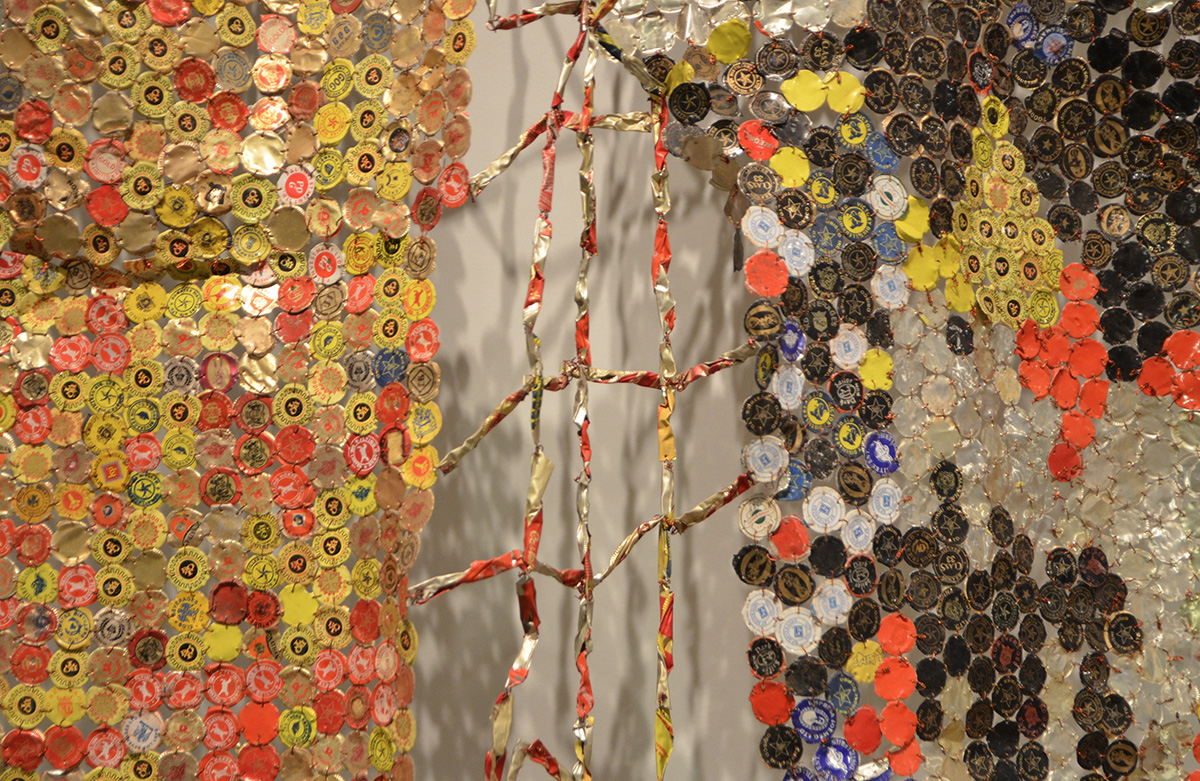
below:  Three large images of the Lori Blondeau draped in red while standing on a rock adorn three of the large boulders in Devonian Square.   They are part of her “Asiniy Iskwew” work.  The title is Cree and translates to “Rock Woman”.    In this work, the rocks on which she stands refer back to Mistaseni which was a large sacred boulder that once marked a gathering place.   The Saskatchewan government dynamited it in the 1960’s to make room for a man made lake.

photograph or painting of a woman in red standing on a rock, directly onto the surface of a large rock in a shallow pool of water outside Ryerson Image Center, three large black and white photographs of people's heads are above and behind the artwork

The words on the wall say that Blondeau questions (“interrogates”) how the definitions of Indigenous identity are influenced by popular media and culture, not just in this exhibit but in the rest of her art as well.   Her point here is that pictures of strong woman run counter to how popular culture portrays Indigenous women.

photograph or painting of a woman in red standing on a rock, directly onto the surface of a large rock in a shallow pool of water

My questions – What and/or who shapes your identity?  That question can mean “Your” as in you the individual and it can mean “Your” as in some collective group that you belong to.     How does identity evolve?  Can it be changed?

How does history affect your identity?  As one who has done a lot of genealogy research I understand the importance of history to some people.  I have traced my Canadian ancestors – I know where they’re buried and I know where they lived.   For me that is a comfort.  But I also know that if you want to kill a conversation just bring up the subject of genealogy.  Not everyone is interested.

Back to photography and history –

A second indigenous woman artist is Shelley Niro whose work is titled “Battlefield of my Ancestors”.  It consists of 6 photographs that were taken in upstate New York and in southwestern Ontario.  The pictures are in the garden with the statue of Egerton Ryerson (1803 – 1880), the man who Ryerson University is named after.   He was many things including a Methodist minister, a founder of Victoria College (part of the University of Toronto), a Chief Superintendent of Education for Upper Canada, and the person who wrote a report/study on Native education (1847) that became the model for the residential schools thirty years later.

below: Ryerson standing in the greenery with a picture on either side of him.  On the left is a picture of a plaque in New York state that says: “Site of Indian village Gar-Non-De-Yo destroyed during Sullivan campaign Sept 21, 1779”.  On the right is a black and white picture of the Mohawk River in New York state.

statue of Egerton Ryerson in a small garden with shrubs and small trees. Two large photographs also in the picture, one on each side of the statue

below:  Photo taken of a rock at Cayuga Lake.

photo of a small plaque on a rock exhibited amongst shrubs and greenery outside

The plaque says:
Site of “A very pretty Indian town of ten houses” burned September 21, 1779. See page 76 “Journals of the military expedition of Major General John Sullivan” published by the state

Back a few lines I called Niro an “indigenous woman artist”.   I don’t know if she’d be comfortable with that.  Maybe yes, maybe no.   I used those words because they help to understand her work in the context of this blog.   Should I then use the description “white woman artist” to talk about the third person, Suzy Lake?

Lake’s photography career began in the 1970’s and for the first two decades was primarily concerned with female identity.  In almost all her photos, she is the subject.  The 1970’s were the days of  Women’s Lib and the rise of “Feminism” – the quest for political reforms on issues such as reproductive rights, domestic violence, maternity leave, and equal pay.  It was also a time of increased questioning of cultural norms with regard to women’s roles.  In many ways it resembled the increase of awareness of indigenous identity, rights, and problems that we see today.

large black and white photograph in a gallery, two men on top of a large frame are controlling the movements of a human puppet

 large photo in a gallery of a women dressed just in a long slip, sweeping up debris from the floor. Debris is bits and chunks of plaster that have been removed from the wall

below: Her most recent work involves pictures of her standing in an environment of some sort.  The photo is a one hour exposure and the end result is an image where only she and inanimate objects are present and in focus.  Here is “Extended Breathing in the Rivera Frescos” 2013-2014.   The painting behind her is one in a series by Mexican artist Diego Rivera at the Detroit Institute of the Arts.

three suzy lake photos, one of her in front of a mural and two are close ups of her face

colour photo of close up of a woman's face, just mouth, bottom part of nose and some cheek. She is wearing bright red lipstick

As I’ve mentioned before, I tried to see as many of the CONTACT Photography exhibits as I could in the last few days of May.  I blogged about two weeks ago about the ‘blocks’ at Brookfield Place.  I have been meaning to finish posting about the other exhibits I saw but there’s so much happening in the city.  I’ve been spending a lot of time walking with my camera instead of sitting in front of my computer.

Two of the exhibits that I saw were on King St West, one by Metro Hall and the other on the corner of the TIFF Lightbox building.   I haven’t been able to figure out what to say about the photos so they have sat in a folder on my hard drive.   Unfortunately they are not alone.  Yesterday I went back to take another look at the exhibits and think through a few thoughts, but the photos are gone.  Procrastination has its pitfalls.  TIFF Lightbox is now promoting their “Canada on Screen” program – all year, all free – as part of the Canada 150 celebrations.

I’ll just let the pictures do the talking.

below: The corner of Widmer and King back in May.  The photos are “On Location” by Sam Cotter.

large photo on the corner of a building, taken during a movie shoot on the streets of Toronto (Bay St), a young man is sitting against the other side of the corner of the building asking passers by for money.

bikes parked in front of a large photo mounted on the side of the TIFF lightbox building, showing an orange movie shoot cone and a fake city street sign.

below: A similar viewpoint, taken yesterday.  Different pictures.. and different bikes.

bikes parked in front of a large poster advertising TIFF's Canada on Screen program, a collage of black and white pictures taken from movies.

The other exhibit was “The Sum of All Parts” by Jalani Morgan.

The water levels in Lake Ontario are higher than normal this spring – some beaches are under water and a large percent of the Toronto Islands are flooded.  In front of the Power Plant Art Gallery the water level is even with with the concrete walkway… but not high enough to deter people from enjoying the waterfront this past weekend.

a young couple sits by the waterfront, on a stone bench. He has his arm around her. There is yellow caution tape behind them because the water level in Lake Ontario is high.

It seems appropriate that the artwork on the exterior wall (facing the lake) of the Power Plant features an image of water – white crested waves on a large lake.  The piece is “Bound, Hupfield 2017” by Maria Hupfield; it is 19 feet high and 31 feet wide.   The central image is a seascape painted by the artist’s mother, Peggy Miller, many years ago.  It is being wrapped (unwrapped?) with grey felt-like material.
Is it a treasured artwork that is being readied for storage?
Is it a painful memory that is being covered up to be forgotten?
Is it a family heirloom that is being brought out for someone to admire?

a large art installation on the south exterior wall of the Power Plant contemporary art gallery, with a small tree in front of it.

a girl sits on the rail between the walkway on the waterfront and the water while she reaches a hand out towards a duck. Her mother and younger sister watch.

a mother crouches down beside a young child who is wearing a helmet and is on a scooter, the mother is waving at the Kajama as it docks, the Kajama is a boat with sails that gives tourists rides on Lake Ontario

If you are interested in more information about Maria Hupfield, check the CONTACT website.

“Objects contain meanings beyond their materiality, meanings that we bring to them or receive from them. Objects are the result of an action, entail a trace of a human gesture, and trigger reactions and memories. They have the potential to be read collectively or personally. In her artistic practice, Maria Hupfield reveals the interrelational potential triggered by objects between humans or cultural environments.”

I was away for most of the month of May so I missed a lot of the annual Contact Photography Festival.  In the few days that I had to catch up, I visited a few of the exhibits.  One of these was ‘Nous ne somme pas des heros’ (We are not heroes) by Valerie Blass at the Allen Lambert Galleria in Brookfield Place.

two large cubes constructed from pieces of photos of different people in different positions sit in the middle of Brookfield Place, under the glass arched roof.

Blass arranged people in sculpture-like poses and then photographed them from different angles.  The photographs were then cut into sections, glued on blocks,  and then the ‘sculptures’ were re-assembled.

a large stack of blocks with black and white photos of people on them by Valerie Blass.

The subjects of the sculptures are anonymous.  Their “bodies fold inward, their differences intertwine and merge into single entities” (source).

photographs of the back of a person with another person sitting on his shoulders, upper person is leaning forward with head down, the blocks on which the photos are printed are in the walkway at Brookfield Place

bottom part of photos by Valerie Blass on a block at Brookfield Place as part of Scotiabank Contact photography festival, feet. Also the feet of people walking past.

small painting of a red headed woman torso, amrs, and head, in a gold frame on a wall with lots of other paintings, except on e is missing and there is a white sign saying why its missing

All kinds of thoughts went through my head as I stood and looked at this painting at the Art Gallery of Ontario (AGO).  A little ho hum and a little melancholy and a little well what next.  There were no new exhibits since the last time that I visited the AGO and quite a few galleries were being prepared for new showings (i.e. closed).   A little bit of that’s a waste of time.   Even here there’s a painting missing.  … no, it’s only a waste of time if I let it be.

I stood and studied her face, the expression on her face, the tilt of her head and one hand held up.  What was going through her head?  Was the artist trying to tell us something about her?  Or was he just playing with composition in a limited space?  And that’s when the game began – what expressions hang on the walls of the AGO?  A sample:


below: part of “Time Dissolve” created around 1992 by Carl Beam (M’Chigeeng Ontario 1943-2000) using photo emulsion, acrylic and pencil on canvas.

part of Time Dissolve, an artwork by Carl Beam. Old photo of a woman seated on the ground bRed letters saying my mother are written on the woman and a red circle is around the boy's head

below: manipulating a series of portraits by Will Gorlitz (b. Argentina 1952).  The paintings were done in 1984 and are called Genre IV, Genre XVI, etc.  Nameless.   Unless her name was Genre and he’s painted her 6 times (one of the paintings in the row is not included here).

a series of 5 women's faces hung in a row on the art gallery wall, paintings by Will Gorlitz

below: Two pieces.  A sculpture called  “Eskimo Mother and Child” (about 1938) by Frances Loring and the portrait “Bess” by Canadian painter Lawren Harris.   I have talked about Loring in a previous post.

a sculpture of a woman with a child on her back, called Eskimo Mother and child by Frances Loring. She stands by a painting by Lawren Harris called Bess which a portrait of a woman in a black hat and black coat

below: part of “Melancholy”, oil on canvas, by Hendrick Terbrugghen (The Netherlands, 1588-1629)

a painting of a young woman sitting, with her hand resting on her hand, elbow on table, lit by candle light, called Melancholy painted by Hendrick Terbrugghen

below: part of “Waitress”, oil on canvas, by Shelley Niro, 1986  (b. USA 1954)

a painting of a waitress wearing black glasses serving a plate of food to a surprised looking red head woman with green eyes, called Waitress, painted by Shelley Niro

below: Engraving on paper, “Drunken Men at a Table” by Gillis Van Breen, Dutch, around 1600.

engraving on paper called Drunken men at a table, by Karel Van Mander, done late in the 1500's

below: The last picture is obviously from a painting with a religious theme. Unfortunately, the photo that I took of the tag with the artist’s name is too blurry to read.  I tried a google search on the image and the first hit was the Wikipedia page for Paul Bernardo.  Oh dear, Google that’s a fail… apparently it’s similar to a figure in a painting by Bernardo Carbone who was a painter in the 1600’s.   So Google put 2 and 2 together and got 17.   Hopefully you (and I) don’t get many 17’s!

part of a religious painting of a young man in a red robe kneeling before another man in white who has one hand on the young man's shoulder.

This is a story about an exhibit that is showing at the Art Gallery of Ontario at the moment, “A Story of Negotiation” by Francis Alys.  The exhibit is a look at three of Alys’s large projects.  For each project there were many studies, notes, and sketches.  Drawings and paintings dot the walls and cover many tables.  There are three large videos to watch (not the ones shown below).  It is a fairly complex installation and only a small part of it is included here.

two women looking over a table with art displays on it , in an art gallery

below: In 2006 Alys tried to organize two lines of fishing boats, one from Florida and one from Cuba, that would form a bridge between the United States and Florida.  It was unsuccessful.  He repeated the project in 2008, this time between Spain and Morocco.

a young man is looking at two video screens that are mounted on the wall

a line of little sailboats on the floor, all parallel to each other, the base of the boat (hull) is a flip flop or sandal.

below: More on borders, pairs of words that depend on which side you’re on.
Words such as leave/return and us/them.

4 small green and yellow pictures on a pink wall

Alys also spent time embedded with British forces in Afghanistan.

a display of pictures, paintings, drawings, sketches, and notes as part of an art exhibit

below: Alys made a videos on kids flying kites in Afghanistan.  There was also a video of kids rolling a large reel of film through the streets and alleys in an Afghan city.

3 wood benches in front of a table mounted to a wall, art on the table, a video screen on the wall with a movie about kids in Afghanistan flying kites, some people in the background

below: Weapons made of found objects

in a yellow room with two small pictures hanging crookedly on the wall. A table in the middle of the room, glass covering artwork on the table. Sitting on the table is an automatic rifle (artwork) made of found objects

below: Instead of a round of ammunition, there is a reel of film. This is true in all of Alys’s ‘automatic rifles’ that are displayed here

close up of a sculpture of an automatic rifle where the round of ammo is replaced by a reel of film

a circle of art weapons, automatic rifles, made of found objects, with barrels all pointed inwards,

The exhibit continues at the AGO until April 2nd.

a little wooden human figure is doing the front crawl, one arm outstretched, on a bubble of clear plastic on a table top

Myseum of Toronto is a fairly new addition to the cultural fabric of the city.  It is a museum without walls.  It is an organization that helps deliver programming to different locations in the GTA.  Last night, March 6, at City Hall, Myseum of Toronto launched its second annual festival of events and exhibitions.  This festival, Myseum Intersections,  consists of 36 different events and exhibits spread around the city throughout the month of March.   “One Toronto.  Infinite Perspectives” is the motto of this year’s festival.

In keeping with that motto is an exhibit called ‘Cosmopolis Toronto: The World in One City’.   It was showcased at the Myseum Intersections launch party.   A few months ago it was on display at 18 libraries around the city but it has been brought together in one exhibit for the festival.   At the moment it can be seen on the ground floor of City Hall but it will also spend some time at Metro Hall and then end the month at the North York Civic Center.   (schedule at the bottom of the post).

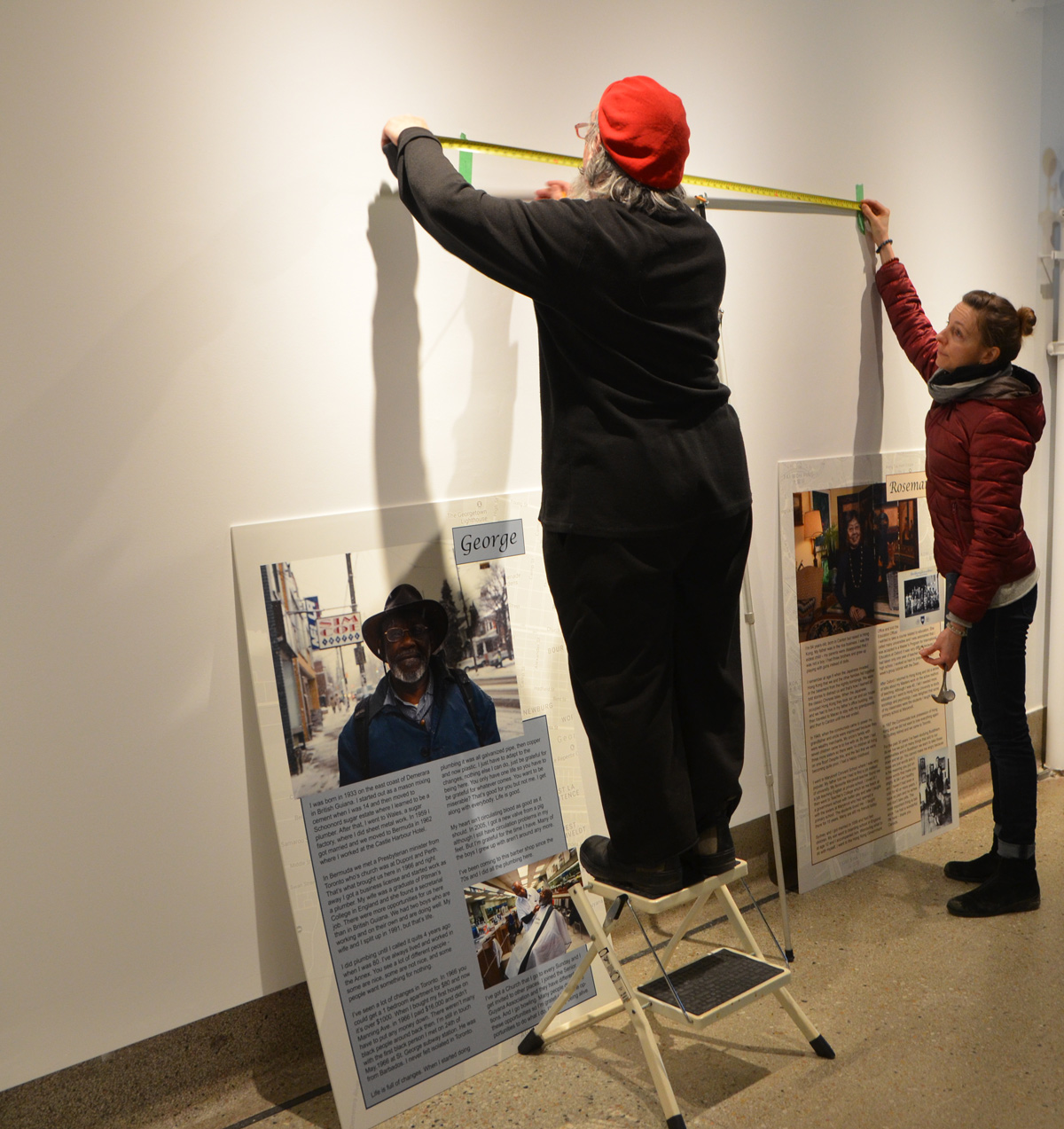
people looking at an exhibit of photos and stories that are printed on upright posters standing on the floor.

“Cosmopolis” consists of a series of portraits and interviews by Colin Boyd Shafer.   The goal was to find a person from every country in the world who now calls Toronto home, hence its tagline “Photographing the world, one Torontonian at a time”.   I am not sure if that goal was attained, but the series is a fascinating look at a very diverse group of people.

Cosmopolis posters on display at City Hall as part of Myseum Intersections festival

Cosmopolis posters of Andrea from the Congo and Nevena from Serbia

Two photos were taken of each person.     The first was a portrait taken in a Toronto location where they felt “at home”.  The second was of an object that they felt connected them to their country of birth.

cosmopolis posters of immigrants to Toronto from different countries

The Cosmopolis website has more information as well as the portraits and stories of many more new Torontonians.

portrait and story about Yosvani from Cuba, a violin player

cosmopolis posters of immigrants to Toronto from different countries

***

EXHIBITION DATES & TIMES:
MARCH 5 – 8 & 13 – 19
MONDAY – FRIDAY, 8:30AM – 4:30PM
City Hall
100 Queen St W, Toronto

MARCH 9 – 12
MONDAY – FRIDAY, 7:30 AM – 9:30 PM
SATURDAY & SUNDAY, 8AM – 6PM
Metro Hall
55 John St, Toronto

MARCH 20 – APRIL 2
MONDAY – FRIDAY, 7:30AM – 9:30PM
SATURDAY & SUNDAY, 8AM – 6PM
North York Civic Centre
5100 Yonge St, Toronto

#myseumTO | #myseumX