I decided to head to Pape and Danforth on Friday, on a very hot & humid afternoon.   The Danforth was just beginning to get ready for the Taste of the Danforth weekend festival.  I stopped for a bottle of water and tried to find a bit of shade while I figured out where to walk.  The street was still quiet.  The day was hot and humid and no one was moving quickly.   Not many photos to be had there.   Instead, I decided to walk a few of the alleys north of the Danforth between Pape and Donlands.

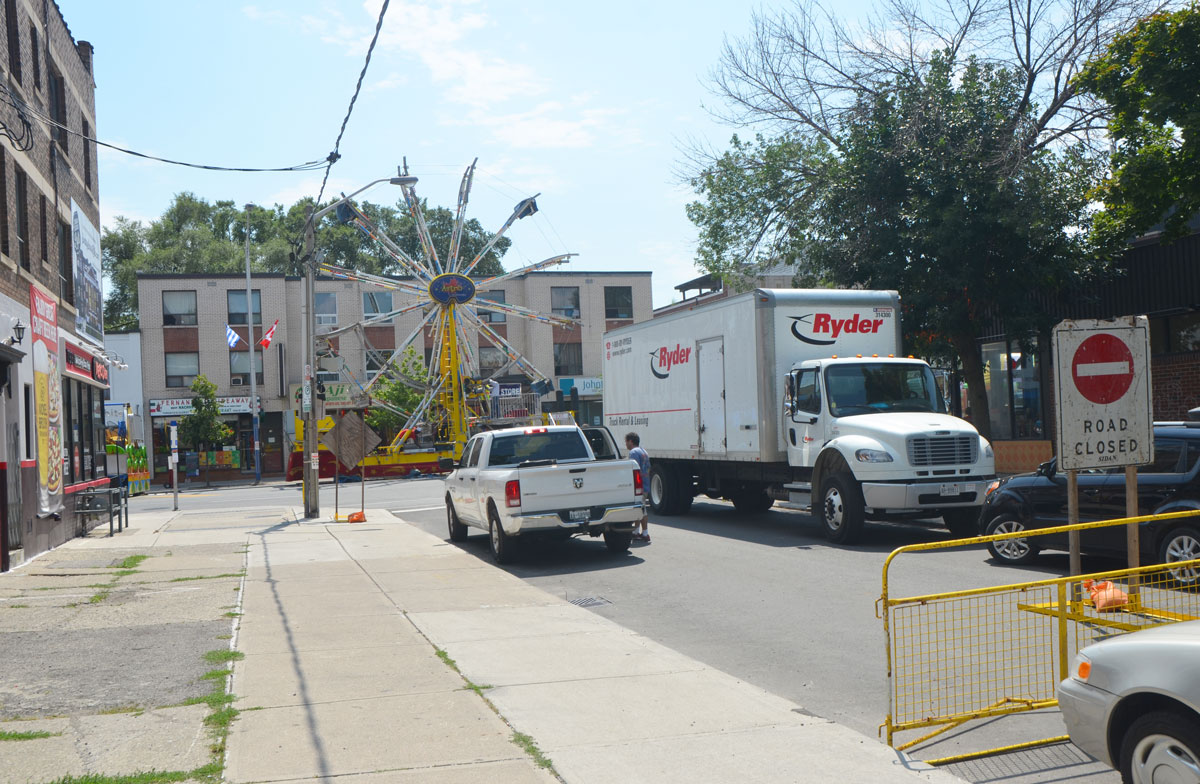
trucks parked on the street, a small ferris wheel being set up pon a street, stores, barricades

below: No famous graffiti artist has left their mark in your neighbourhood? No problem, make your own!
A collection of icons with even the bricks painted into the picture.

copies of famous street art painted on a garage door. Brick background has been painted on too. Mona Lisa, Campbell soup cans, the woman lifting the corner of the wall to sweep things under it. Einstein holding a placard that says love is the answer. A little dog by Albert Einstein's feet.

below: Three garage doors with street art including one by spud.

three garages in an alley, each with street art painted on their doors.

below: Cruz1art (aka Angel Carillo) and a girl power pink skull by dudeman

a low concrete building in an alley with street art by Cruz 1 art, one says girl power. Large pink skull, basketball hoop in the foreground.

below: “Turn the lights off and look to the sky”

street art in an alley of a woman with long hair, wearing sunglasses, a tag beside it.

below: I’m used to seeing ‘No Trespassing’ or ‘Keep Out’ signs but not so many ‘Keep Off’.

an old rusted sign that says 'keep off' attached tot he top of a chainlink fence, in between two garages in an alley

below: A happy Uber5000 birdie knitting away, a close knit street art painting.

an uber 5000 art piece on a garage door, yellow uber birdie is knitting something with blue wool. the words say "close knit"

below: Another creature by Cruz1

blue animal creature painted on a garage door, green shrub growing in front of part of it, art by cruz 1 in an alley

below: Two more painted garage doors, very linear, very stylized and abstracted.

two single car garages in an alley, both with street art paintings on them, also the back of the houses behind them in the lane.

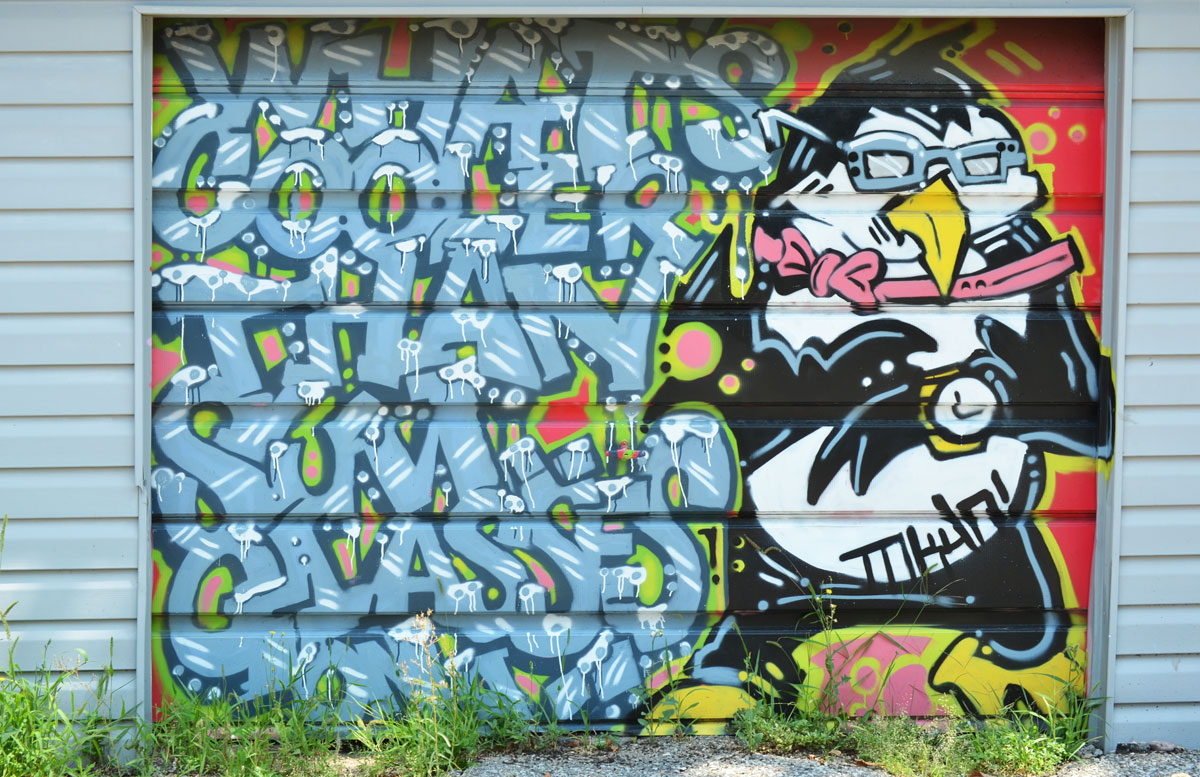
below: A play on the word ‘cool’.  Snowy words and a penguin with sunglasses.  Unfortunately it didn’t make me feel cooler but only slightly nostalgic for winter.  Only slightly!

street art mural on a garage door in a lane, a penguin standing upright wearing sunglasses. The words, written in large blue letters with snow on them, What's cooler than sum glasses on?

below: On the left is “destroy and rebuild” and on the right is “We are 1, [illegible] mi gente siempre”.  The last bit is Spanish and translates to “My people forever”

two garages in an alley with art on their doors, on the left is an abstract in blue and orange with the words destroy and rebuild. On the right is a woman's face. She's slightly blue. Words written beside her are: we are 1, mi gente siempre

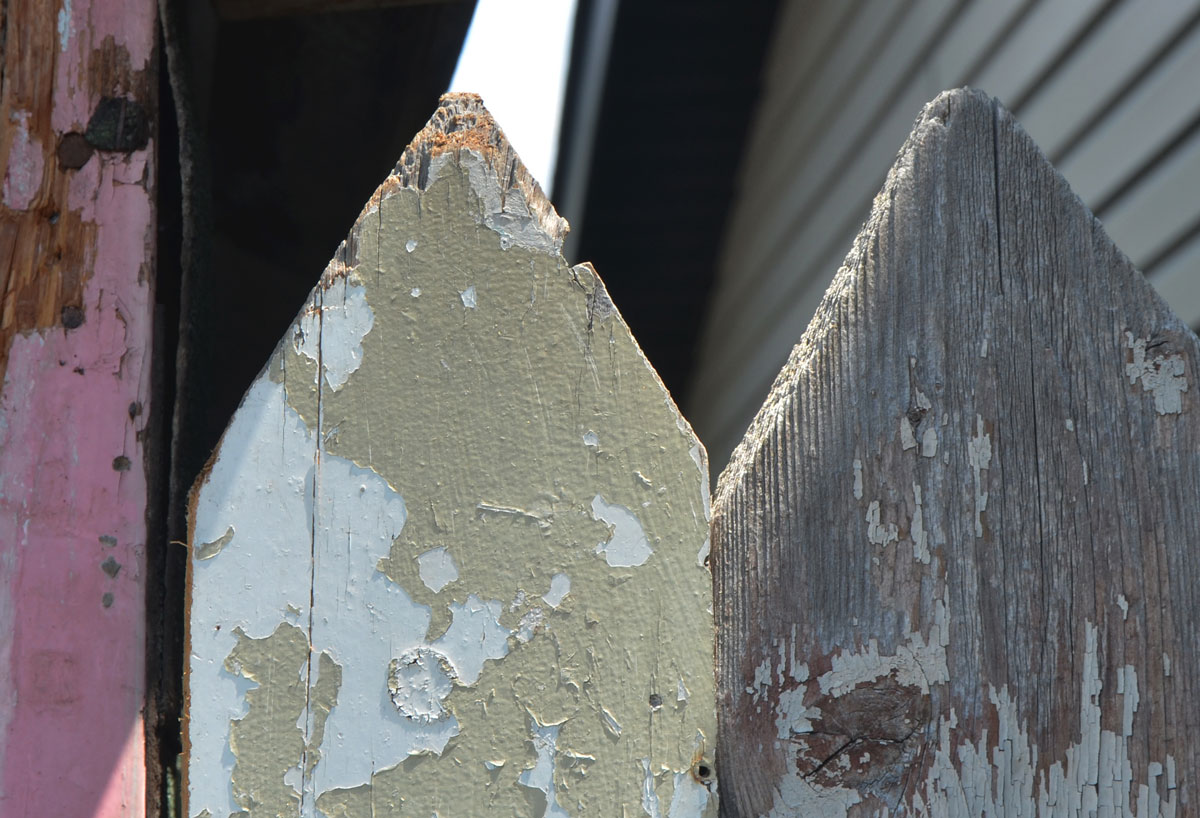
below: I think there was a point to this picture, but I’m not sure what it is.

the top of two pieces of wood in a picket fence type gate, pointed tops, wood,

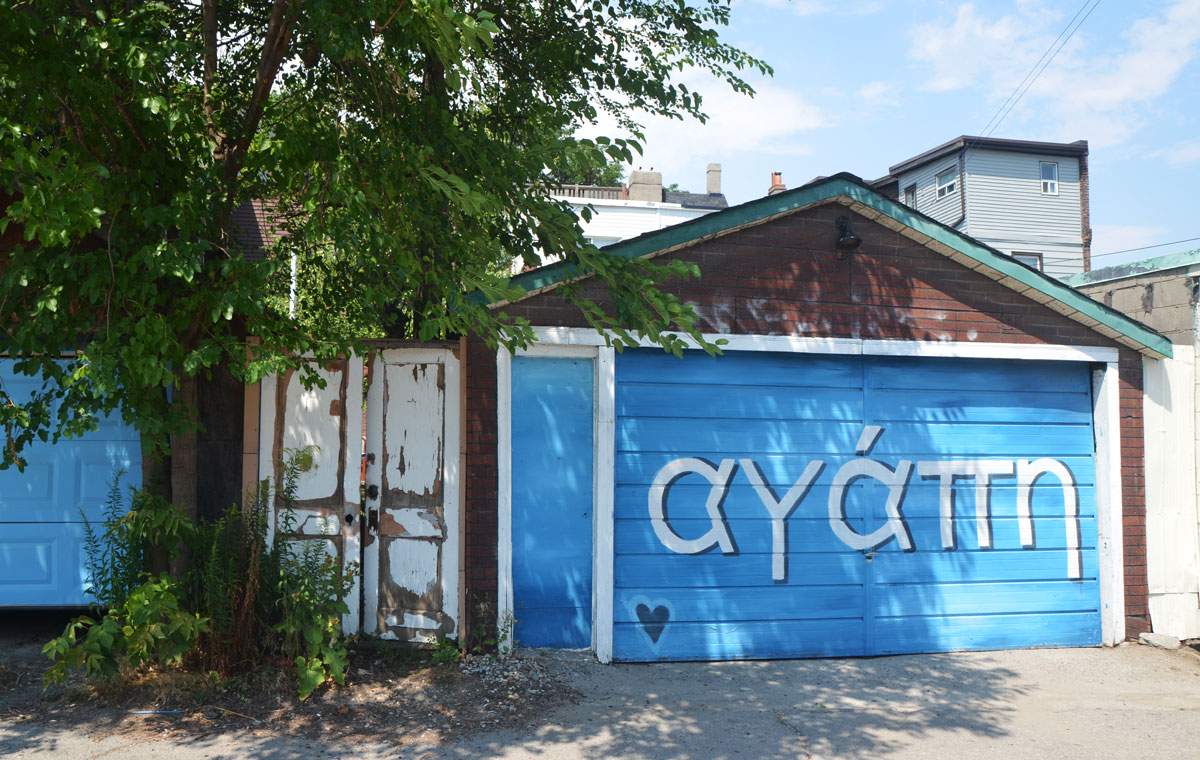
below:  Since this stretch of the Danforth has been “Greektown” for as long as I can remember, it makes sense to find street art in Greek.  In this case, Greek love.

garage door painted bright blue, with the Greek word for love written on it in large letters

below: A slight chuckle, the next garage door is the translation.

garage door painted with a large cursive lettering word love in pinks on blue

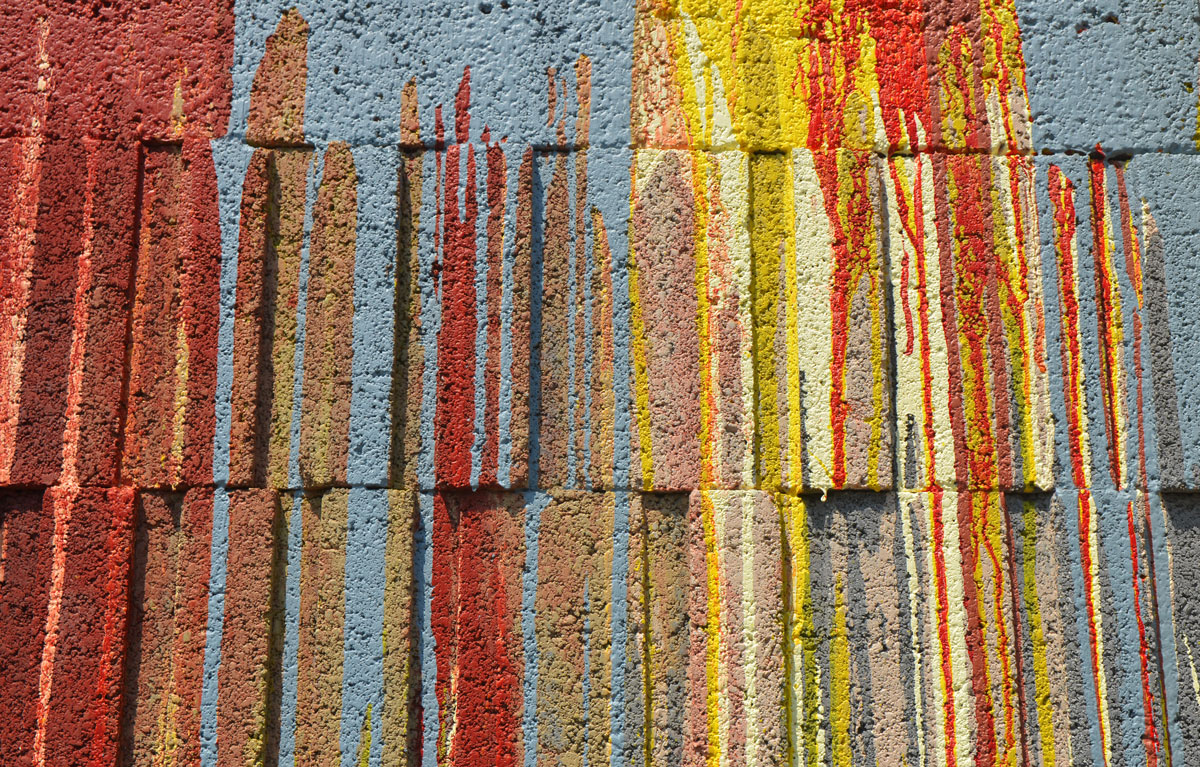
below:  Insert a little rant about horrid TTC concrete fences here.  At least someone has found a way to brighten one of them up.   This one is right beside the entrance to Donlands subway station.

concrete fence with paint drip art on it

A few more pictures….

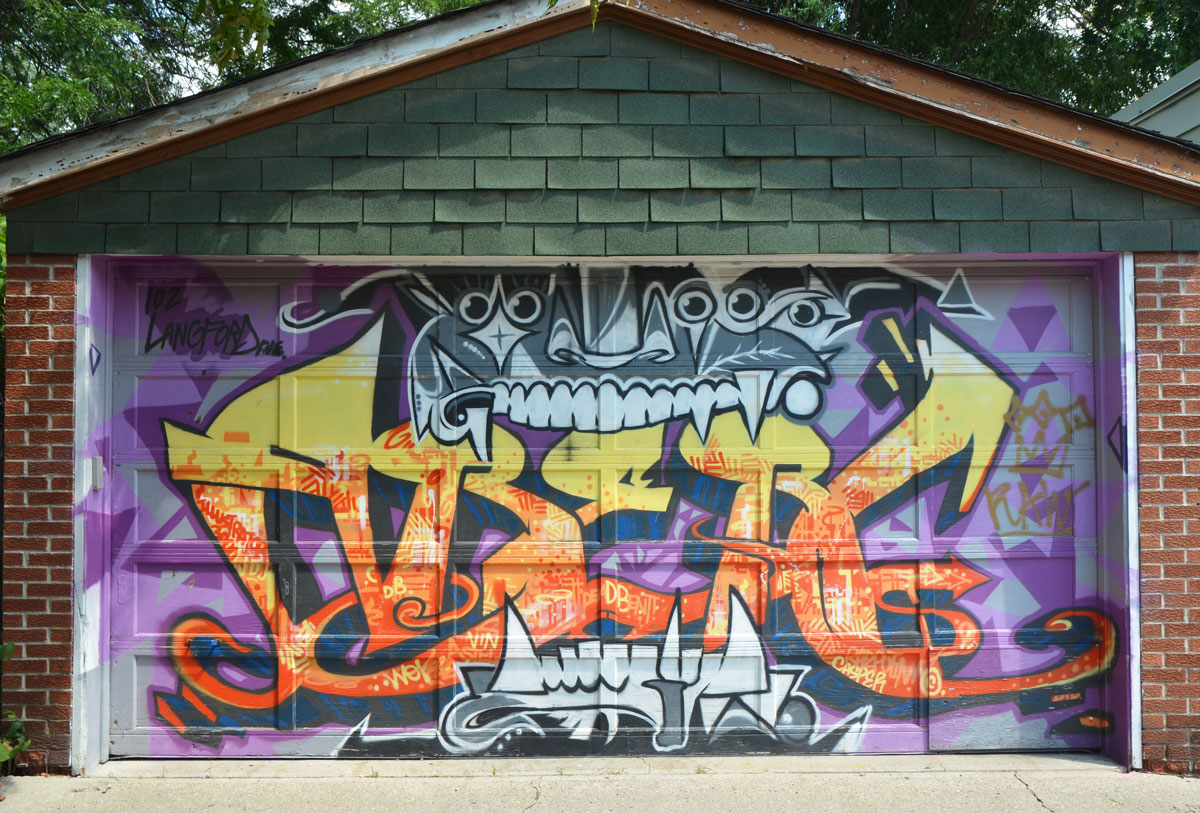
garage door in a laneway covered with streetart painting

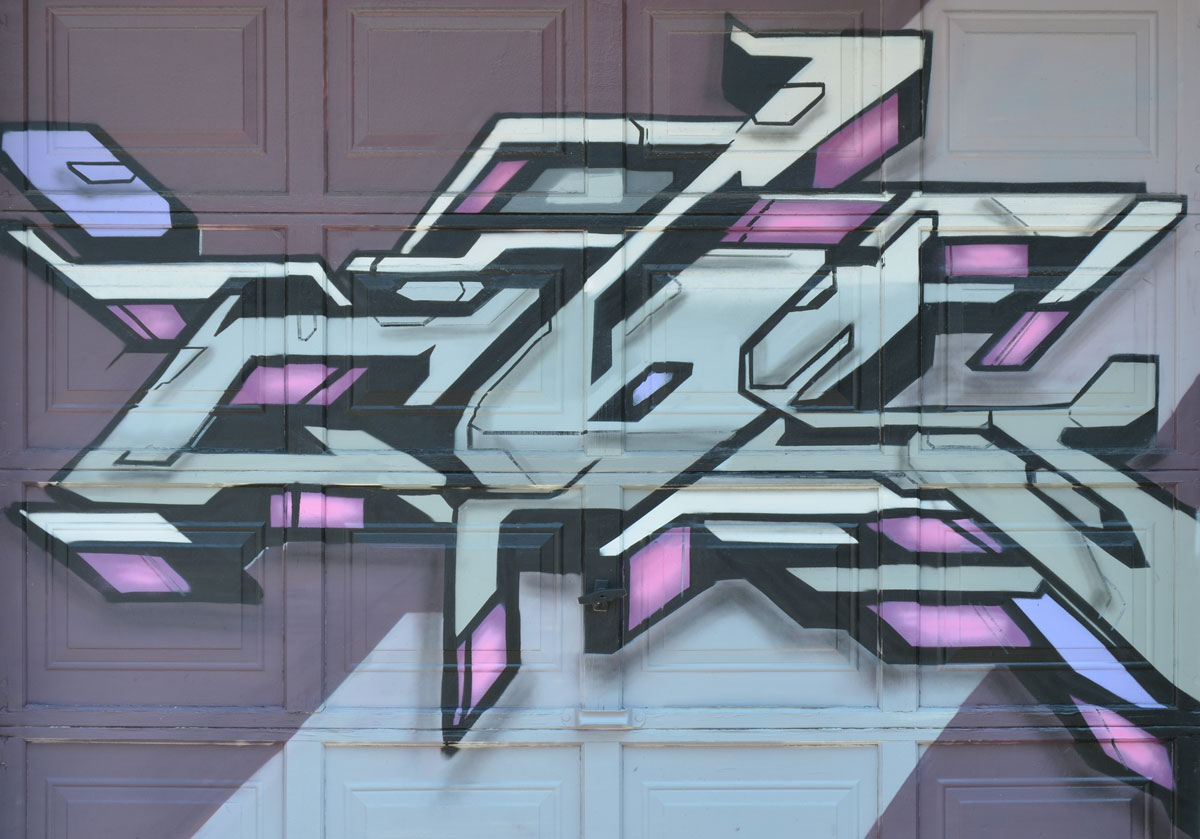
geometric street art on a garage door, pink, grey and black

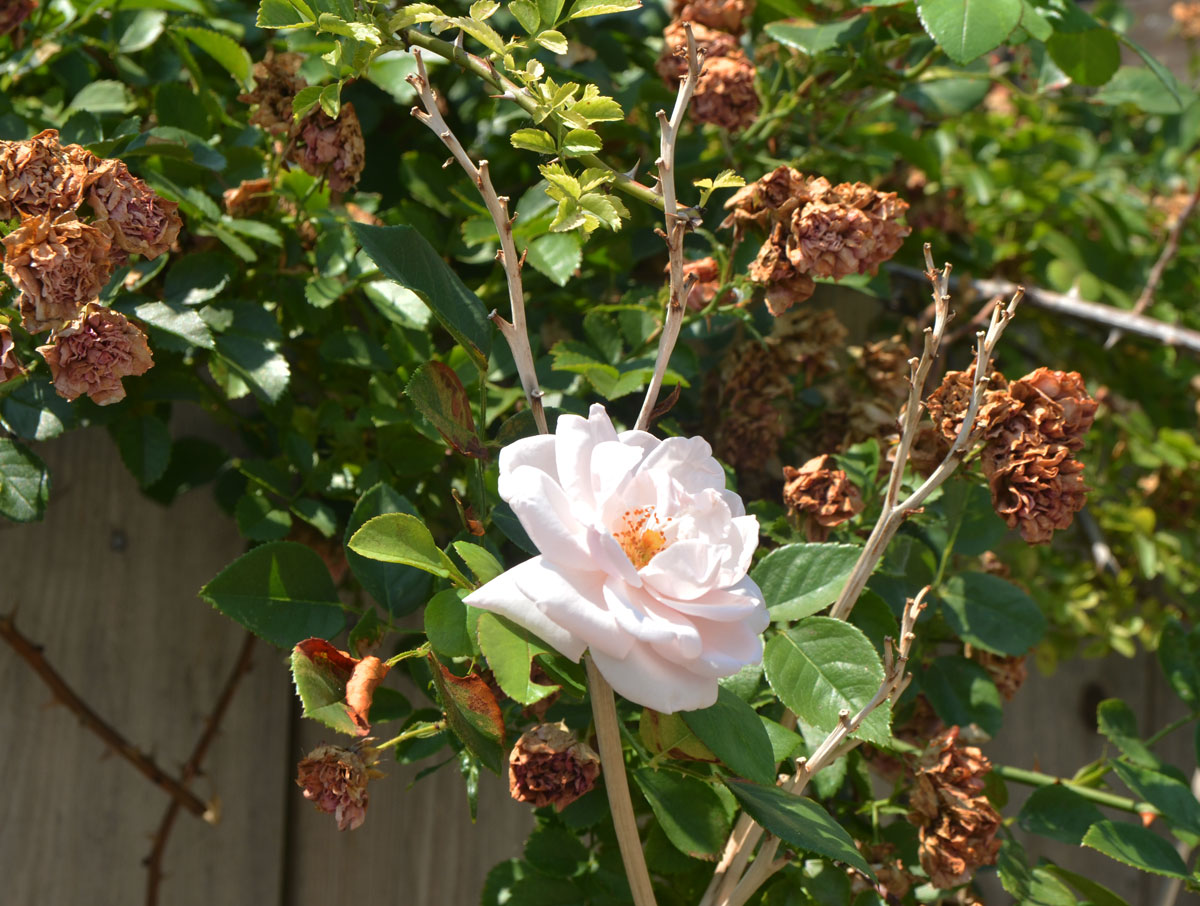
below: A survivor. A lone white rose amongst dead roses.  May you all survive the heat of summer!

one white rose growing against a fence in an alley , with lots of dead roses around it.


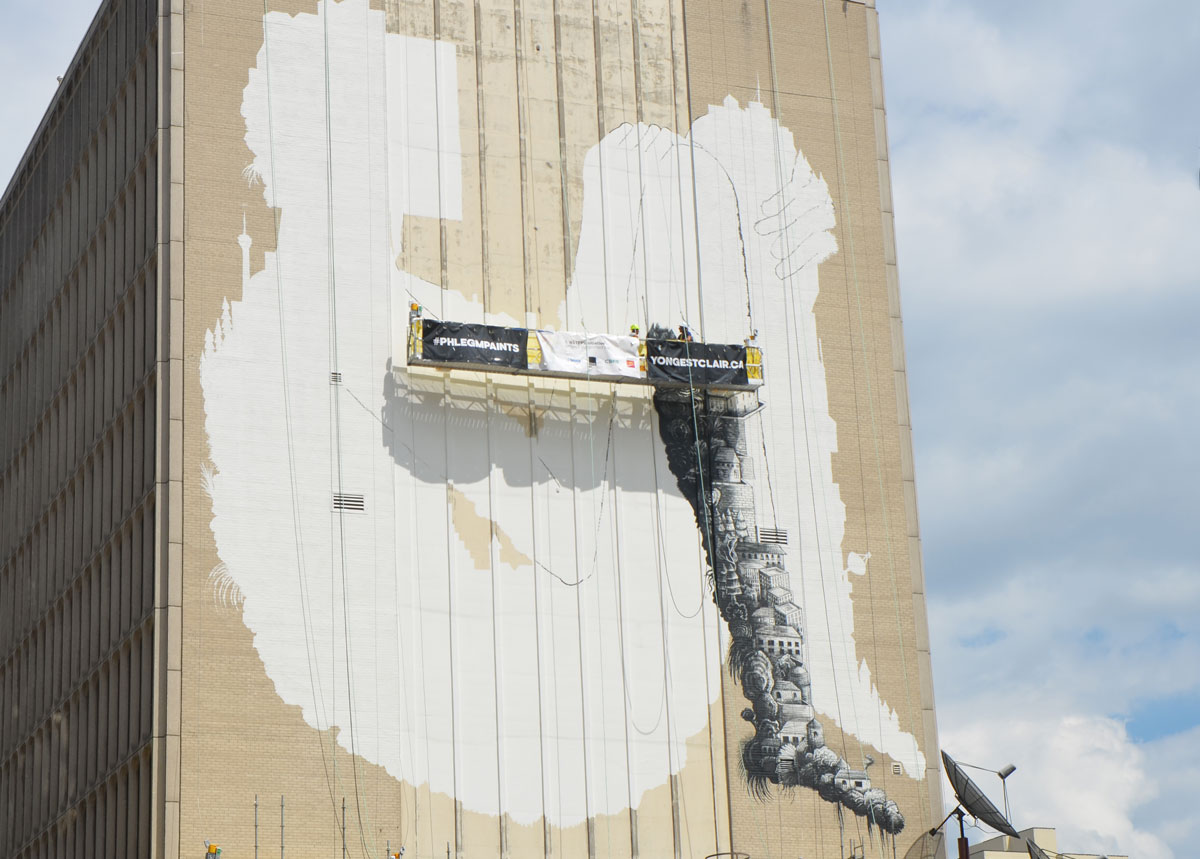
British mural artist Phlegm has been painting a large mural on the side of 1 St. Clair West.   The first time I saw it, was on the 14th of July when it looked liked this:

below: The white background of the mural was painted first.

a street in Toronto, St. Clair Ave., with an older nine storey building with concrete facing, on the side, above the level of the stores beside it, is the outline of the start of a mural. All painted white, a seated figure.

I have been watching it, checking up on it every couple of days.  At first I took photos fairly frequently because I had no idea how long it would take before the mural was finished.

below:  19th July

a verylarge mural on the side of a building is in the process of being painted. An white outline of a seated person with their knees drawn up, one leg has been painted with a design in black

As it turns out, there is a lot of detail in the mural!  It slowly took shape.

below: 21st July

a very large mural on the side of a building is in the process of being painted. An white outline of a seated person with their knees drawn up, one leg has been painted with a design in black

below: Fast forward to today…. the mural is almost finished. …
but wait!  Isn’t that the CN tower on the shoulder?

large black and white mural by phlegm of a seated person with their knees bent up, made of tiny houses and buildings and other structures

below: Hey!  It is the CN tower.  And isn’t that the Gooderham/flatiron building?  And that building with the little dome, isn’t that on Yonge street?

close up of mural made up of toronto landmarks like the cn tower and the gooderham flatiron building

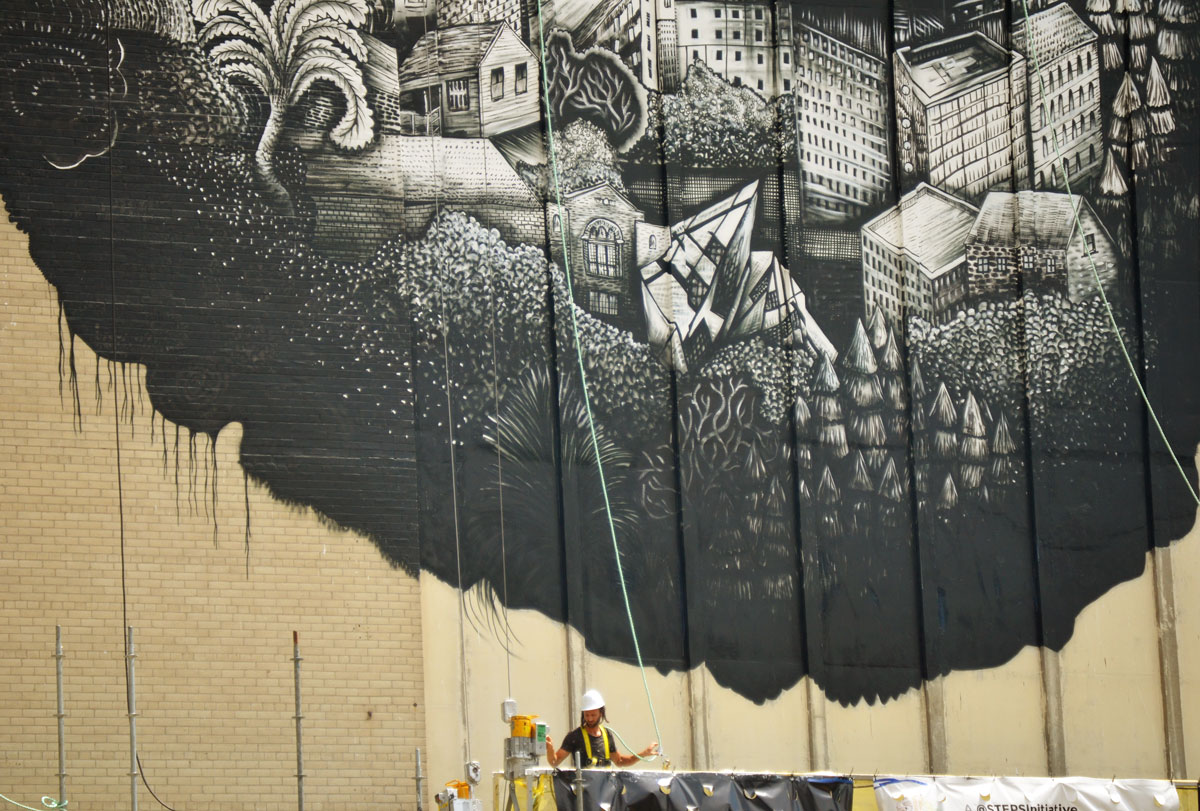
below: There’s the ROM and its ‘crystal’ too!   This is the ‘bottom’ of the figure and in this photo two things become clearer.  First, the scale of the project and just how big the mural is becomes apparent.  Second, the mural is of a person coming out of the earth, being pulled out by the roots almost.  But is it a person?  Or is it a living city?

the bottom part of a mural, man in scaffolding is still working on it, black on white, pictures of buildings.

below: The head part – play ‘spot the building’!  Is that old city hall?

head part of phlegm mural

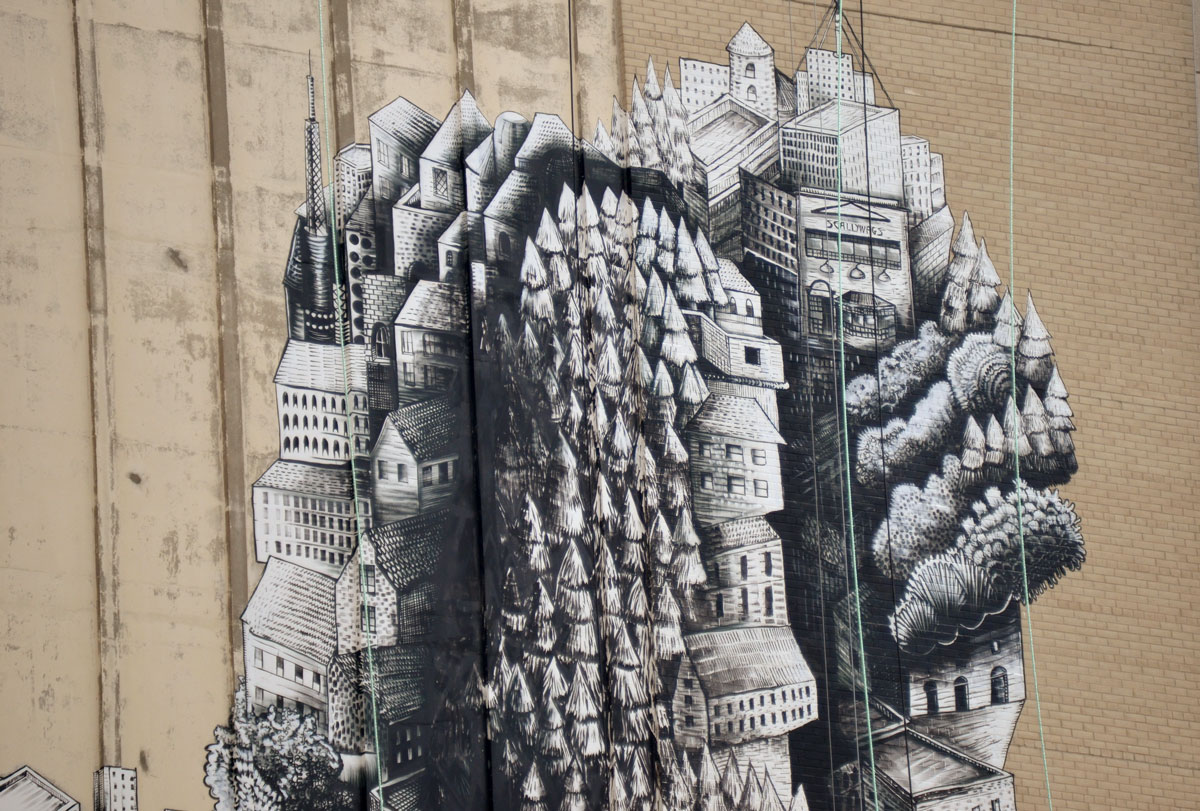
below: Scalliwags is on one of the knees along with a lot of trees.

knees part of the mural

below: And last, the feet with more roots at the heels

feet of a person in a mural made of paintings of trees and buildings, roots growing out of the heels. satelite dish in the mural and on the building beside the mural

This project is also a part of the STEPS Initiative program.

This post also appears in a blog about street art. Phelgm’s Progress.

Just before Dupont Street ends at Dundas West, it passes under a set of railway tracks…
and of course another underpass means another mural.

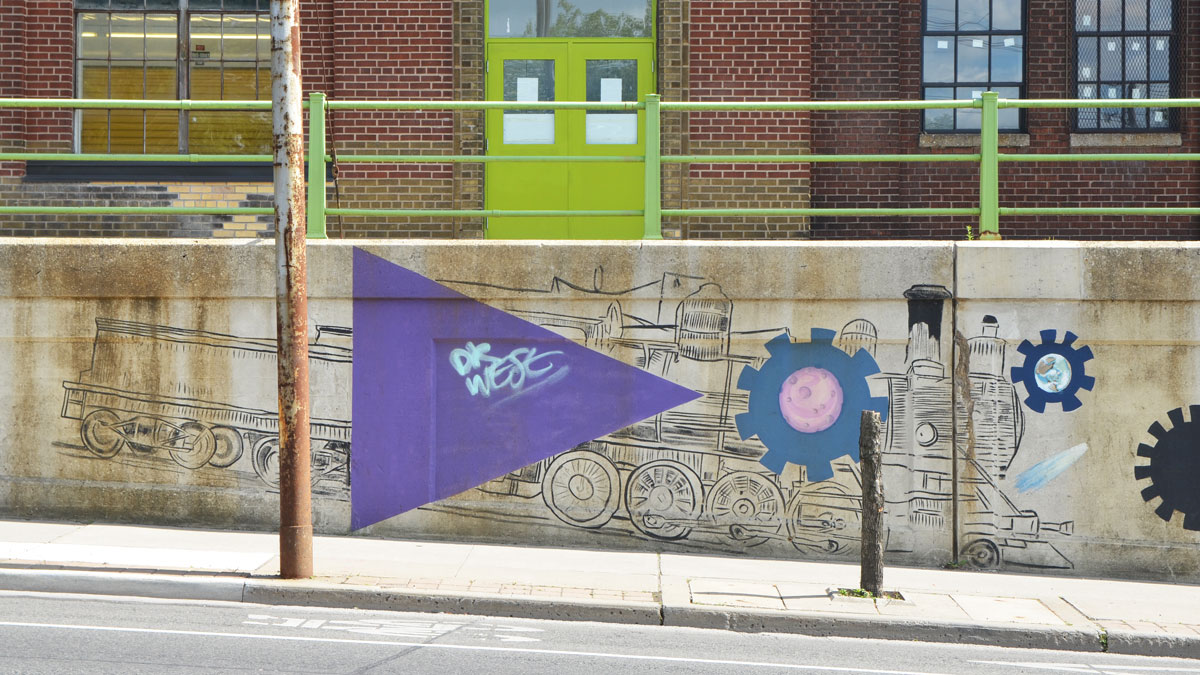
It is an Art Starts project “honouring the Junction and paying homage to its industrial past rooted in the railway and celebrating its development as a diverse neighbourhood oriented community. ”  Lead artists Joshua Barndt and Jamie Bradbury along with 5 youth artists took 4 weeks to complete the mural.

mural on a concrete wall beside a sidewalk, just before the road goes under an underpass - large purple triangel, drawing of a locomotive and a couple of gears

The mural was funded by the City of Toronto’s Graffiti Transformation Program.

mural on a concrete wall beside a sidewalk, just before the road goes under an underpass, gears, plus a stylized industrial machine in black and blue

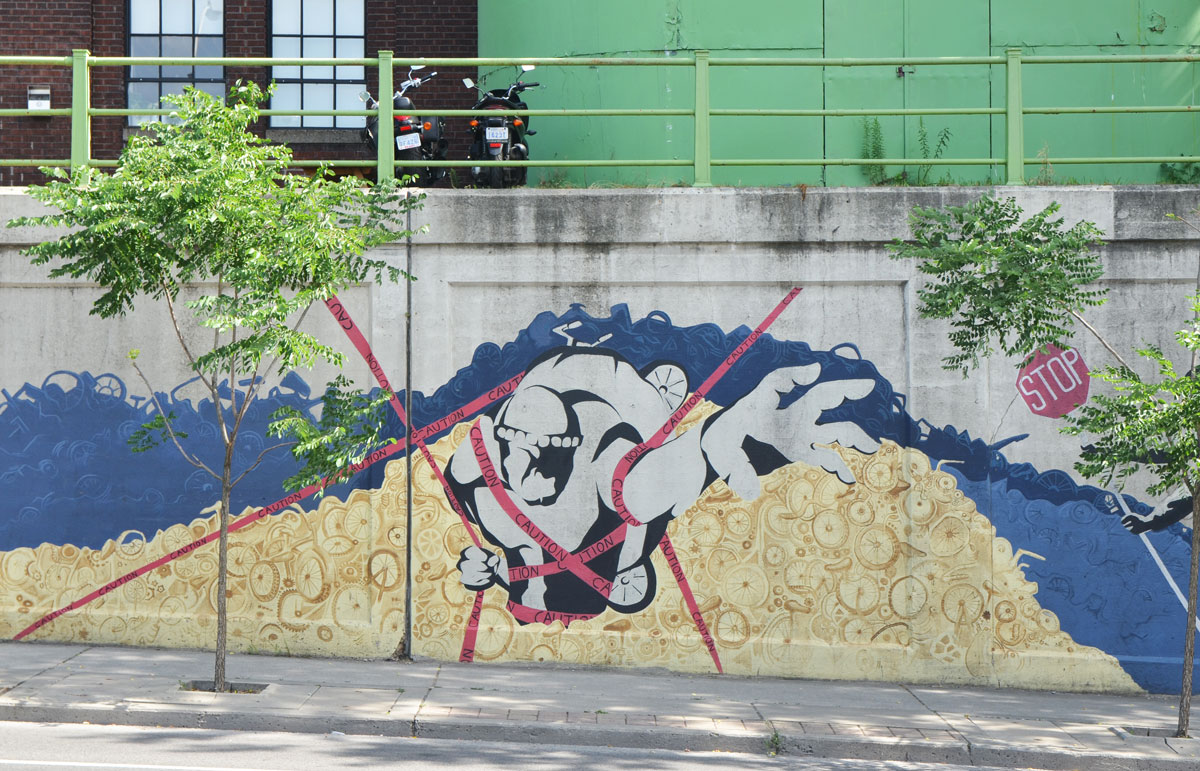
mural on a wall showing a picture of worker in a hard hat, reaching upwards, standing on a pile of bicycle wheels.

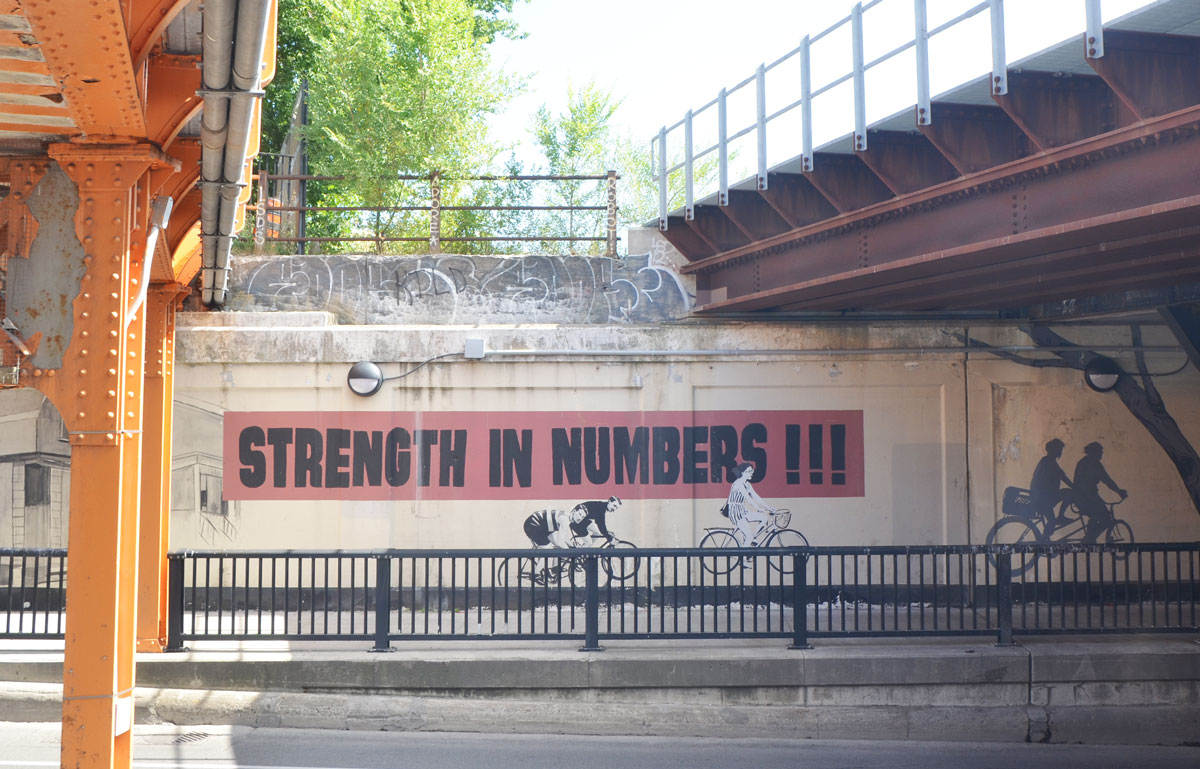
mural on the wall of an underpass, in the Junction, on Dupont, a line drawing of a railway car, with a large blue bike superimposed on top of it, a person holding a stop sign,

Cycling is used as a theme and as a way of traveling from the past to the future in the mural.

mural on the walls of an underpass, orange metal bridge, mural of cyclists riding their bikes

mural under a bridge of people riding bikes

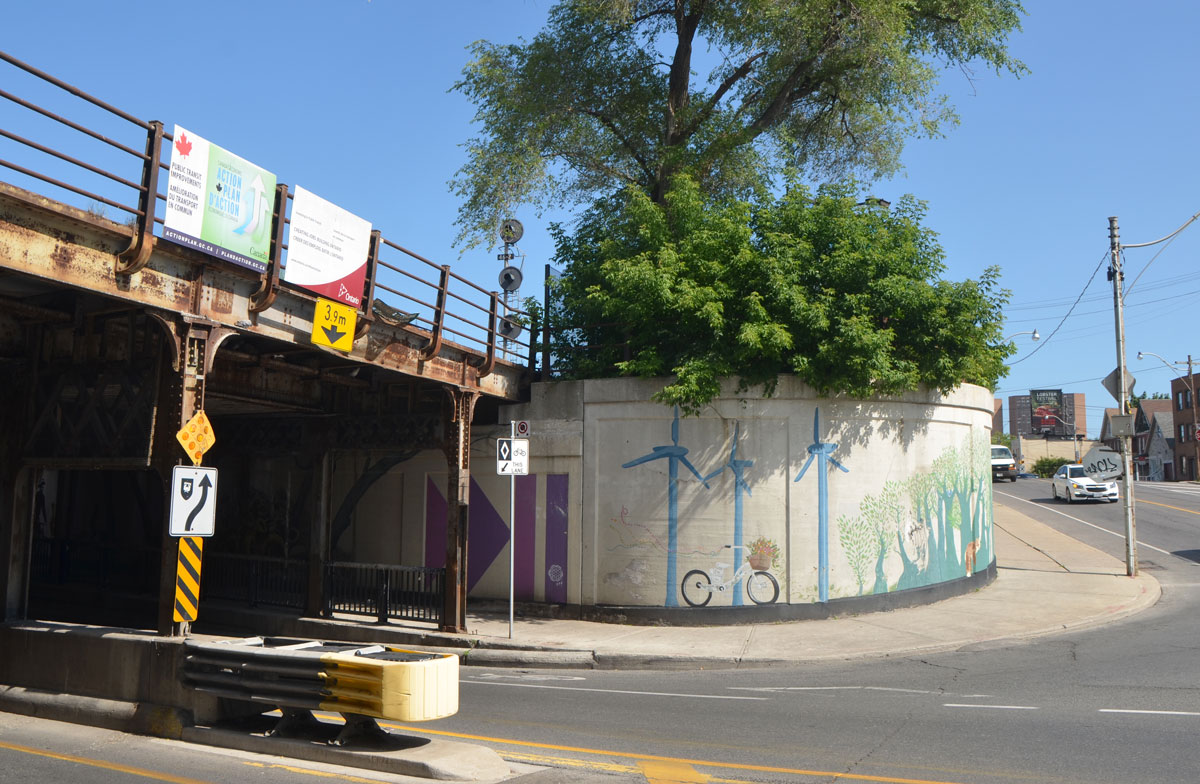
a wall of an underpass curves as it exits the railway bridge. on the curve is the continuation of a mural that was painted on the walls of the underpass. Windmills and bikes.

mural on a curved concrete wall, beside an intersection, showing windmills with bike parked in front, and a forest with some animals in it, fox and wolf

below: The final panel in the mural, a future friendly city.

part of a mural, the word city is used to make a futuristic urban scene in blue tones. The future is friendly.

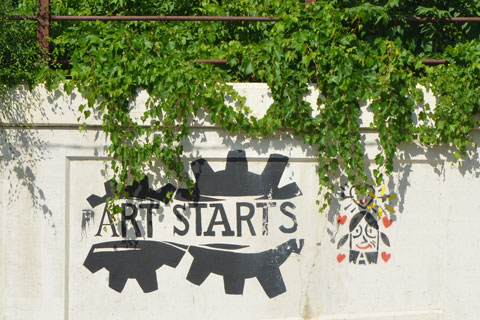
logo of two black gears side by side with the words Art Starts written across the middle of them. a small graffiti painting of a girl's head with a heart above it

July is almost over – yes, summer is flying by.
So far, it’s been a good one!

below: Staying cool and having fun in the Yonge Dundas square fountains

young children play in the fountains at dundas square

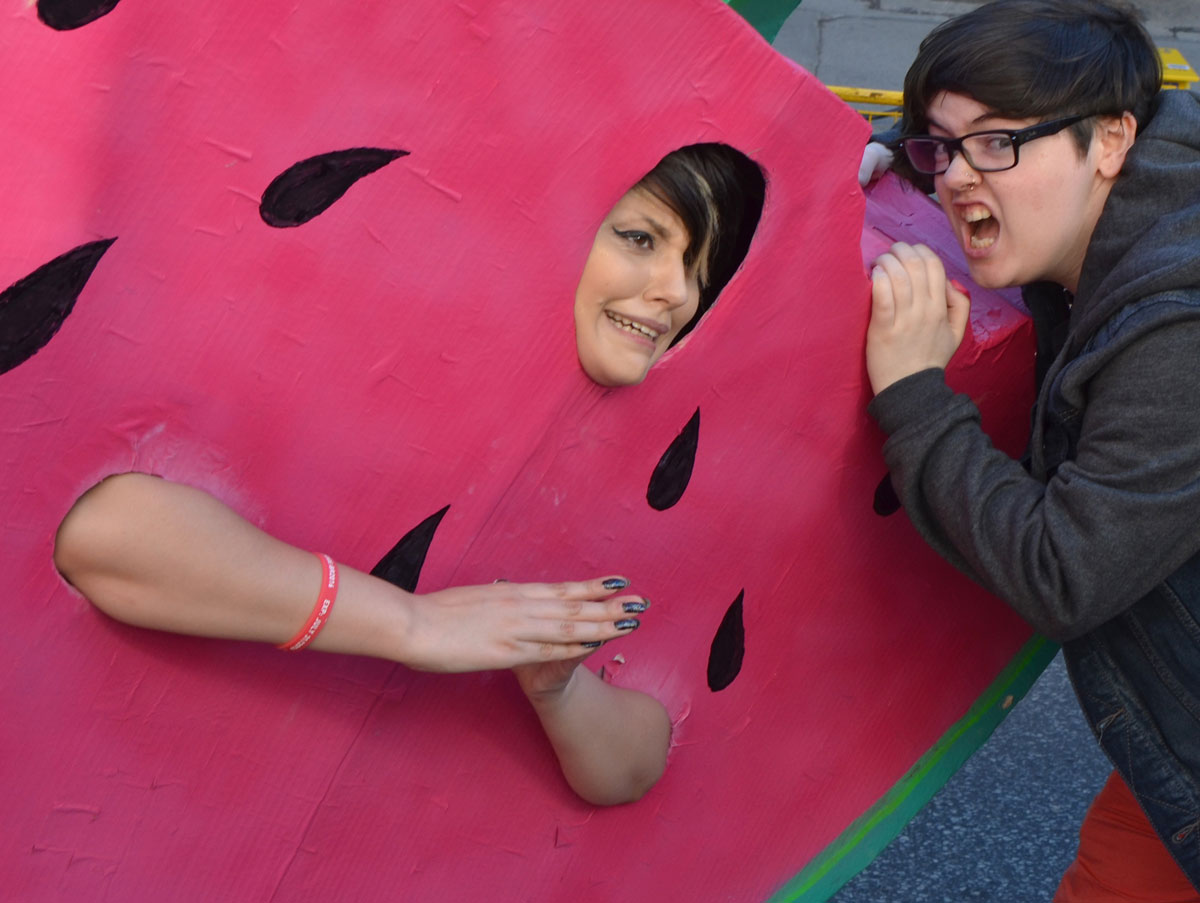
below: A giant bite from a giant watermelon slice

a woman attempts to take a bite out of another woman who is wearing a giant watermelon costume

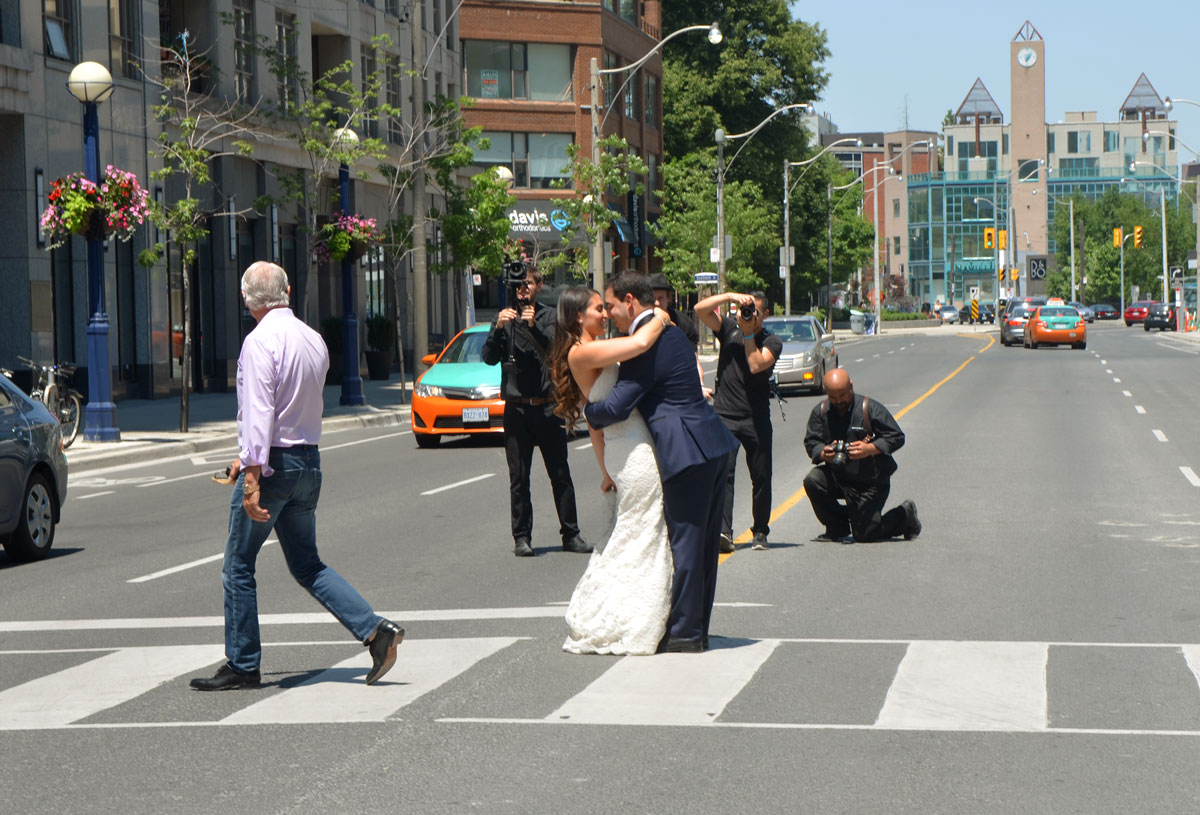
below: A Bay Street hug and kiss.

a photo shoot on Bay St., downtown Toronto. The bride and groom are kissing on the crosswalk in the middle of the intersection. People turning to look.

below: An impromptu serenade

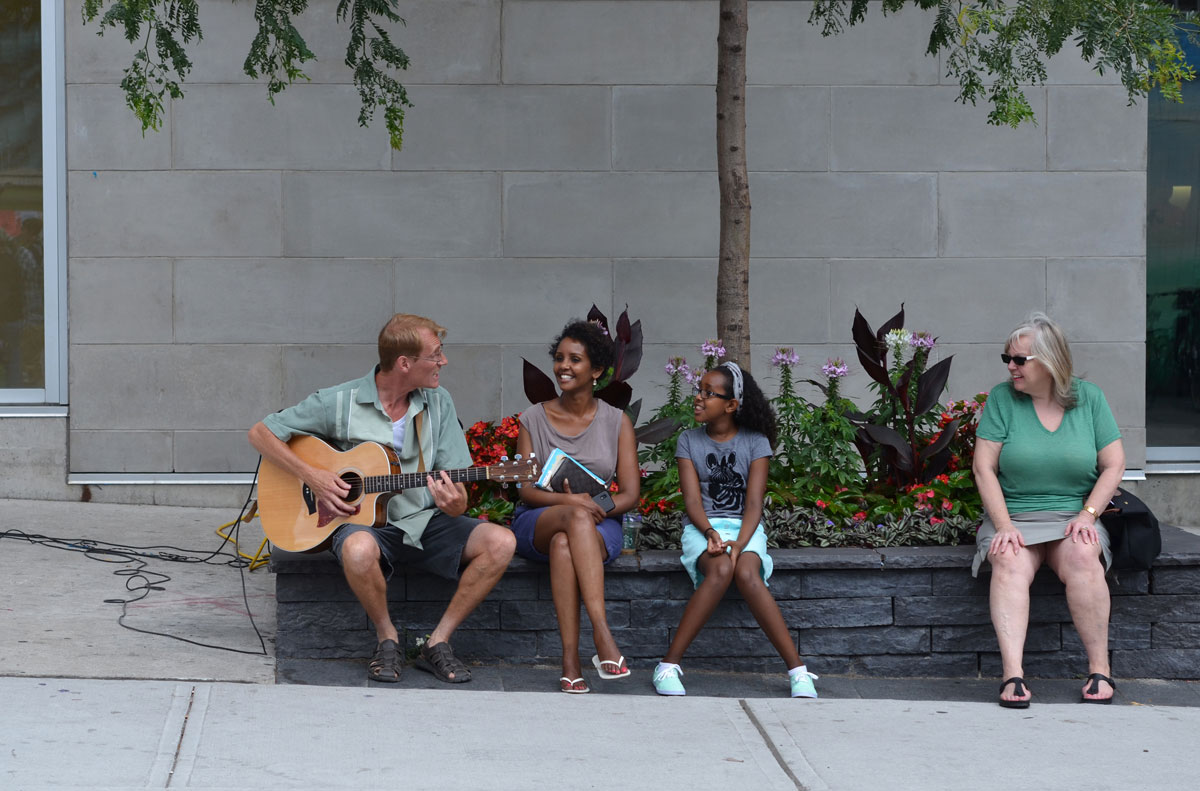
a young man plays a guitar for a mother and daughter, sitting on the edge of a planter outside. Another woman is watching

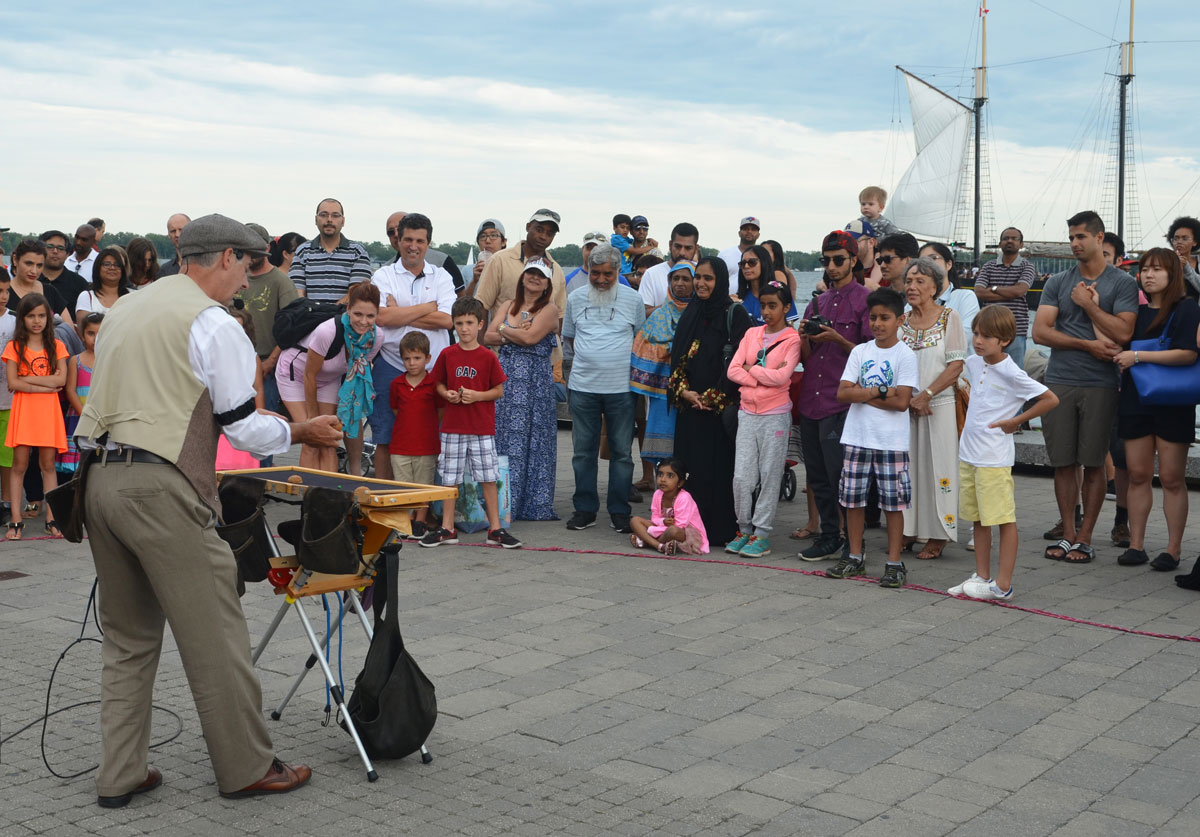
below: Watching the entertainment at the waterfront – it’s magical

a magician entertains a crowd on the waterfront, many people are watching, men, women and kids

below: Making comfort at Afrofest, Woodbine Park

a couple are lounging on a large light blue foamy thing, amongst a crowd at an outdoor music festival

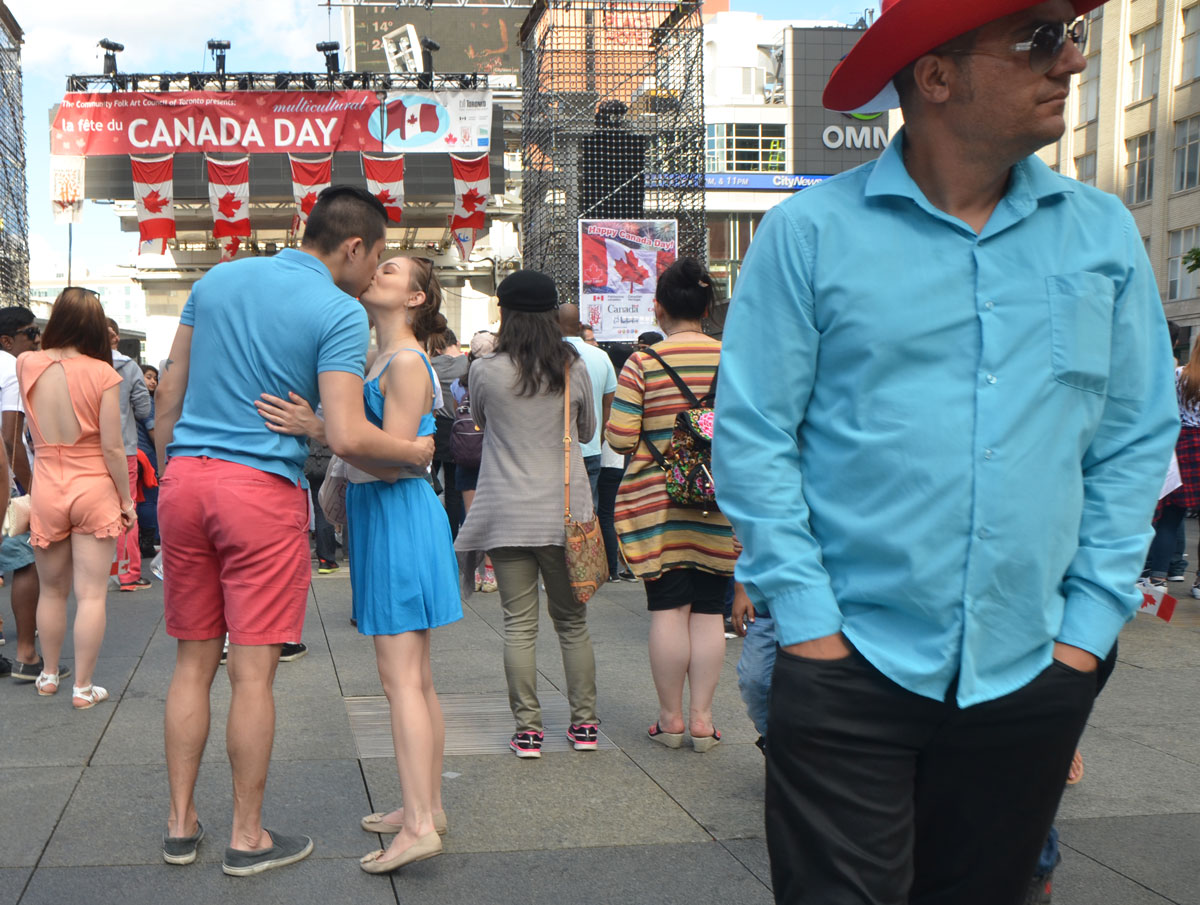
below: A Canada Day kiss.

A man in a red cowboy hat in the foreground on the right, a couple kissing on the left. People watching a show on a stage in the background with Canadian flags and a banner that says Happy Canada Day

below: Leave your message by the outdoor facilities!

Two lines of Johnny on the spots, facing each other, in the middle is a small message board on a metal pole, outdoors, green leaves above

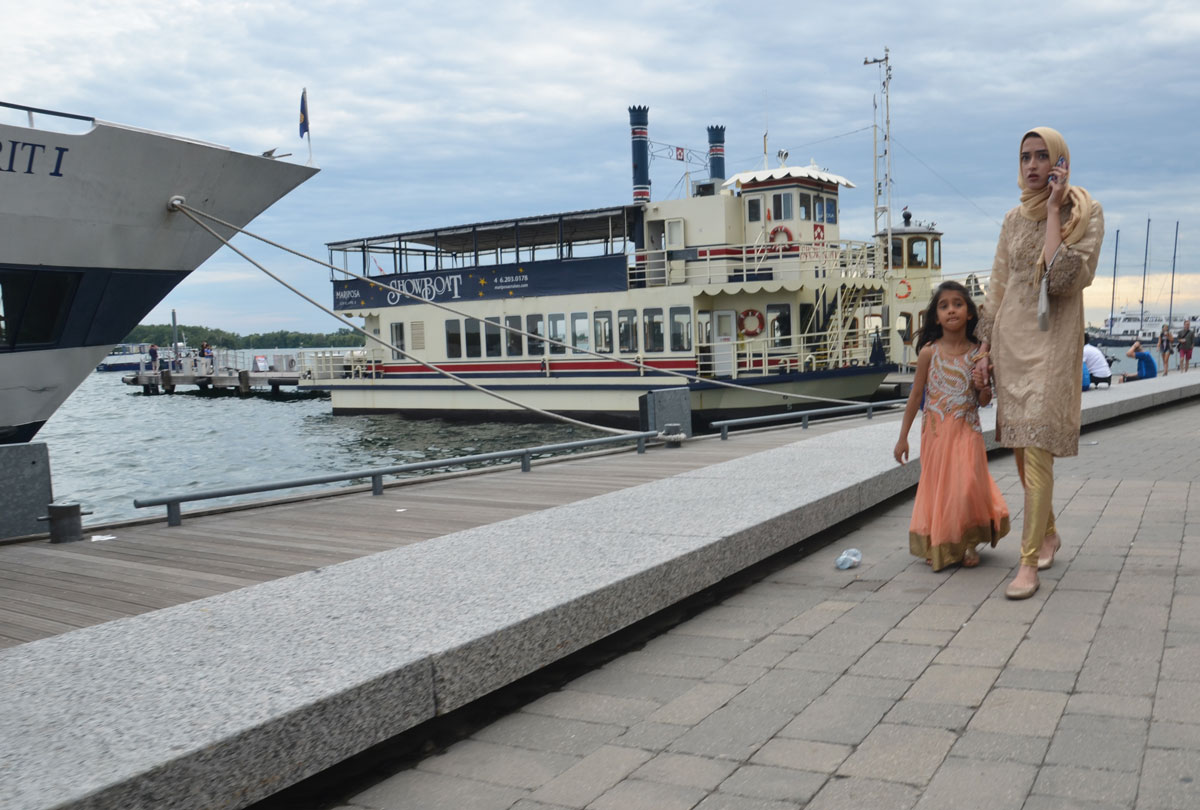
below: A mother and daughter stroll on the waterfront

A mother and daughter in sarees walk hand in hand along the waterfront. Paddle wheeler boat for scenic tours behind them, mother on a phone

below: Posing, Pride fun

Pride weekend, two policemen with rainbow sunglasses and small rainbow flags pose with two men in drag, wearing green dresses, one in a curly blond wig and the other in a black wig

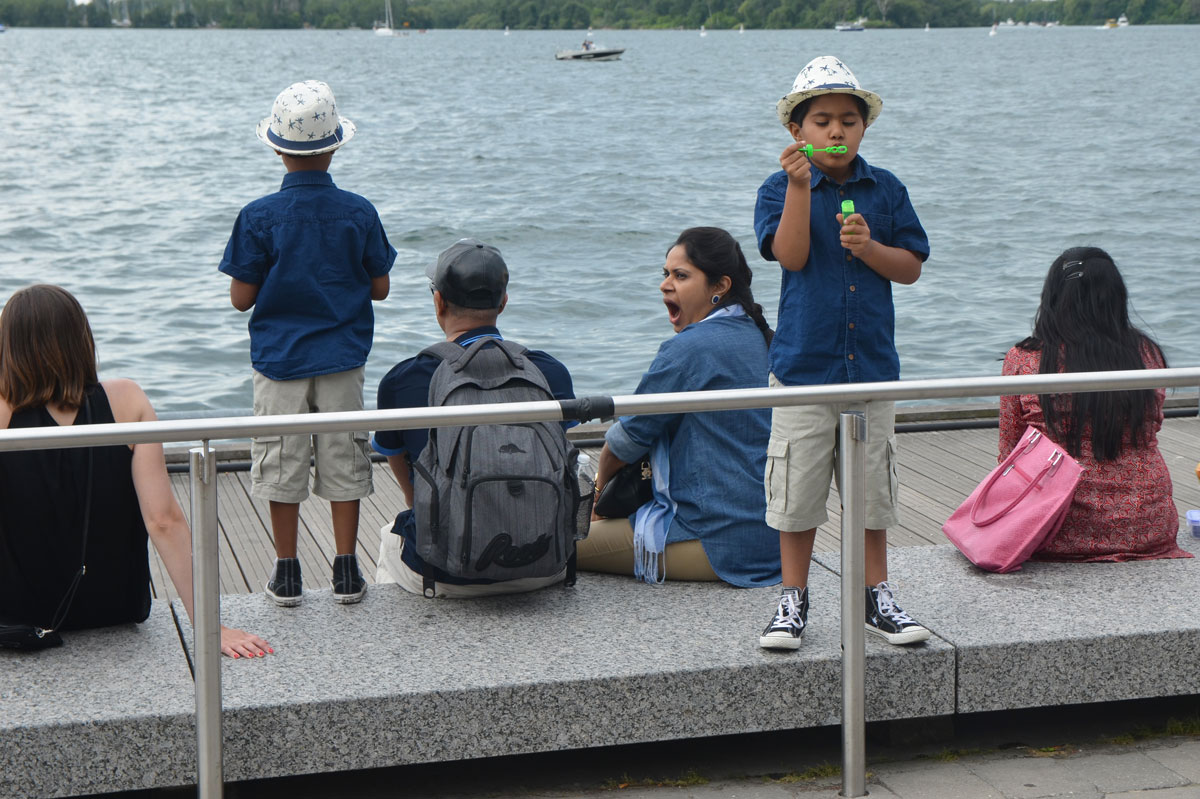
below: Blowing bubbles by the lake.

A family sits by the lake, two young sons in matching fedoras. Mother is yawning, father and one son have backs to camera, other son is blowing bubbles towards the camera

Happy August everyone!

Many legs and feet on a red carpet outdoors. People dressed for hot weather, only face in the picture, a young girl looks bored as she looks at the camera

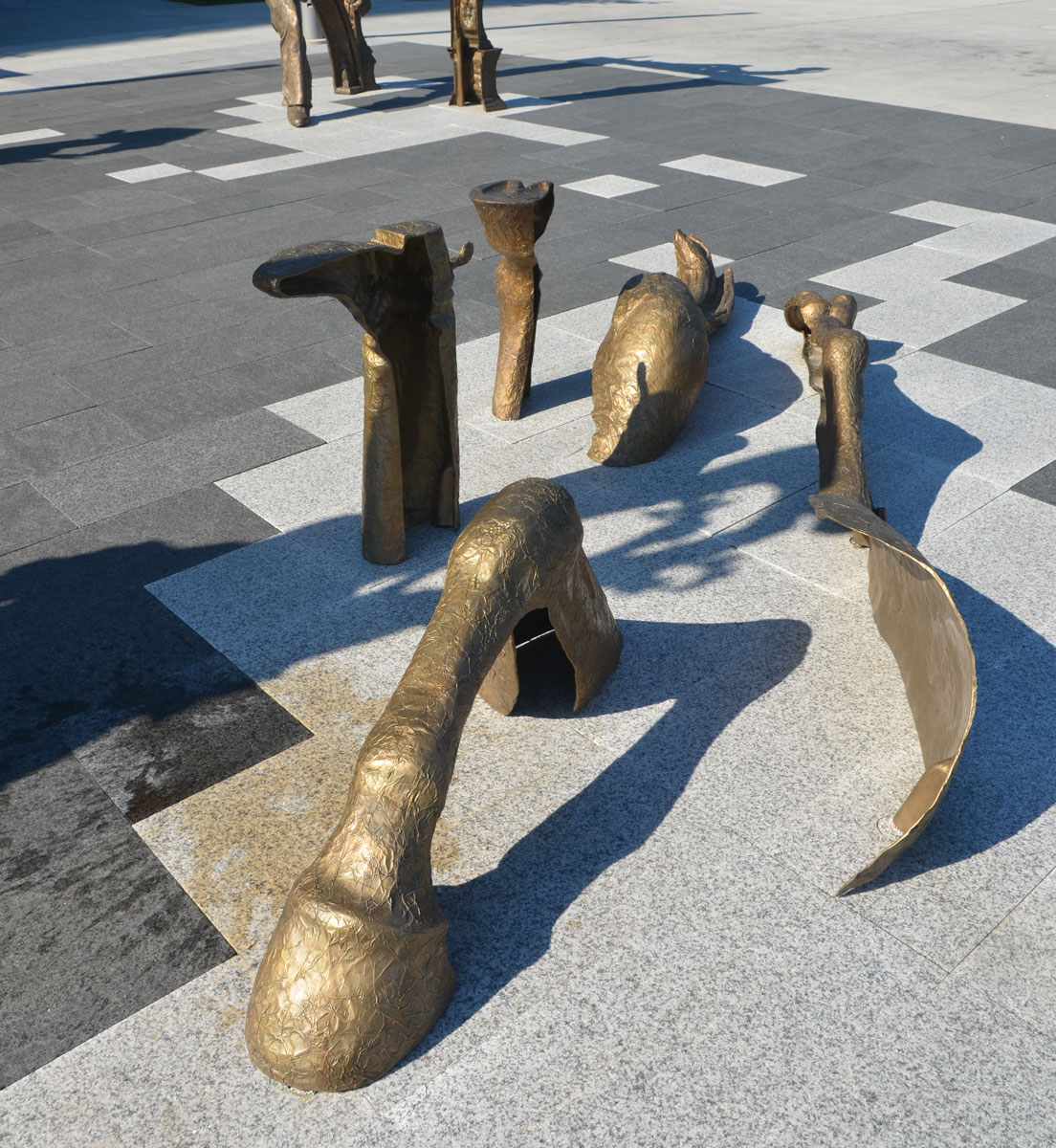
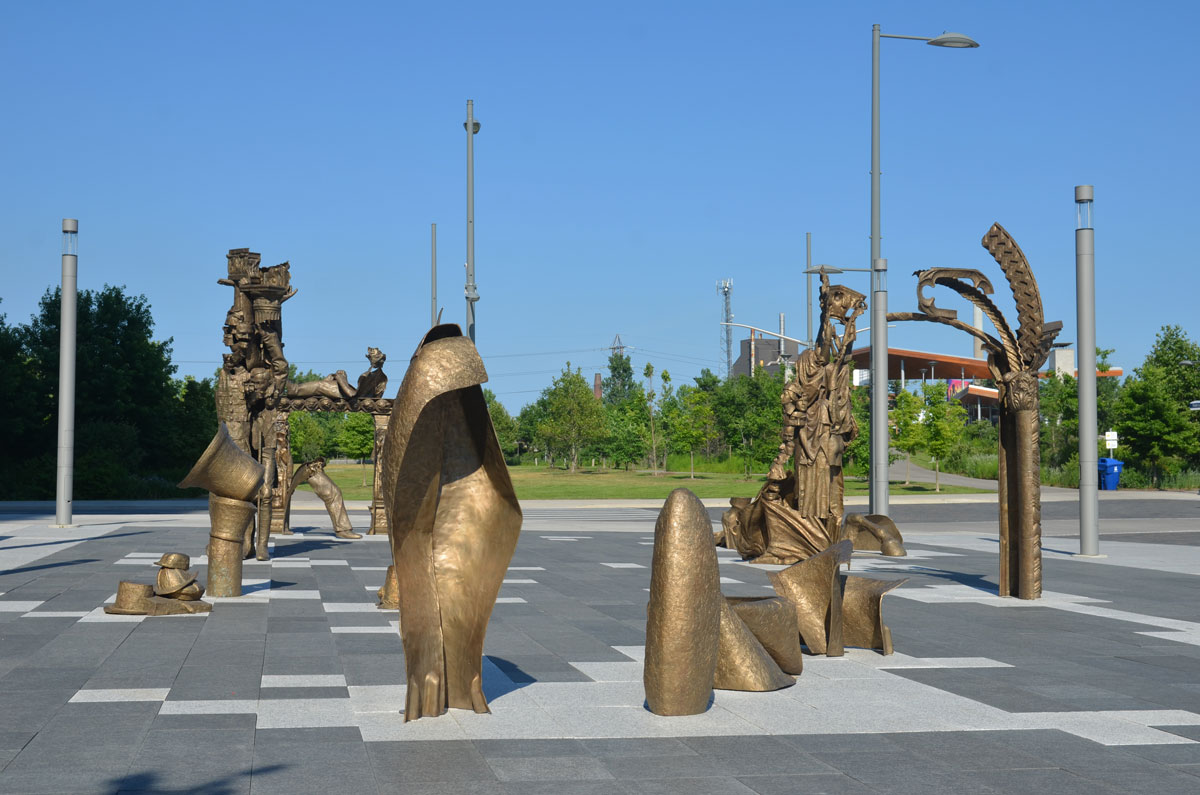
The first time I saw the latest art installation in the Canary District I was in a car and only got a quick look at it.  I couldn’t figure out what the mess was all about.  It wasn’t until I went back on foot to take a closer look that I could appreciate what the artists were trying to do.

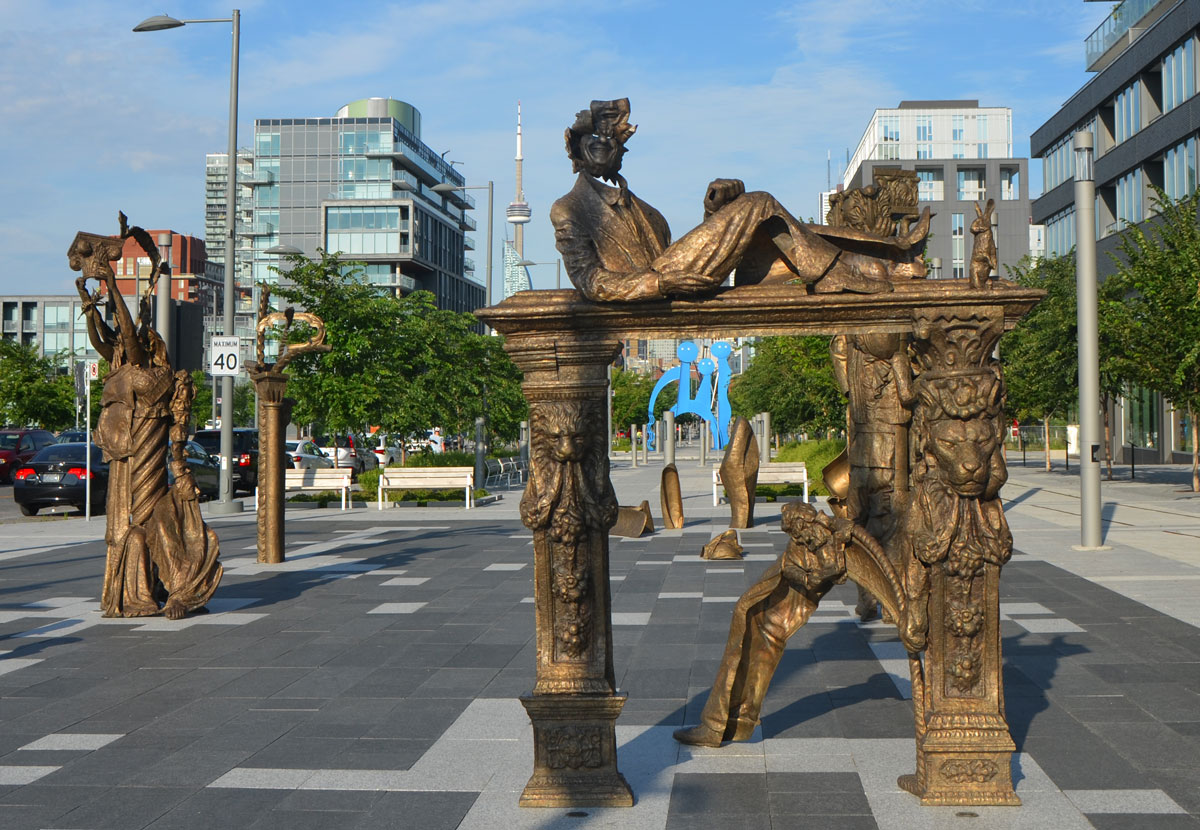
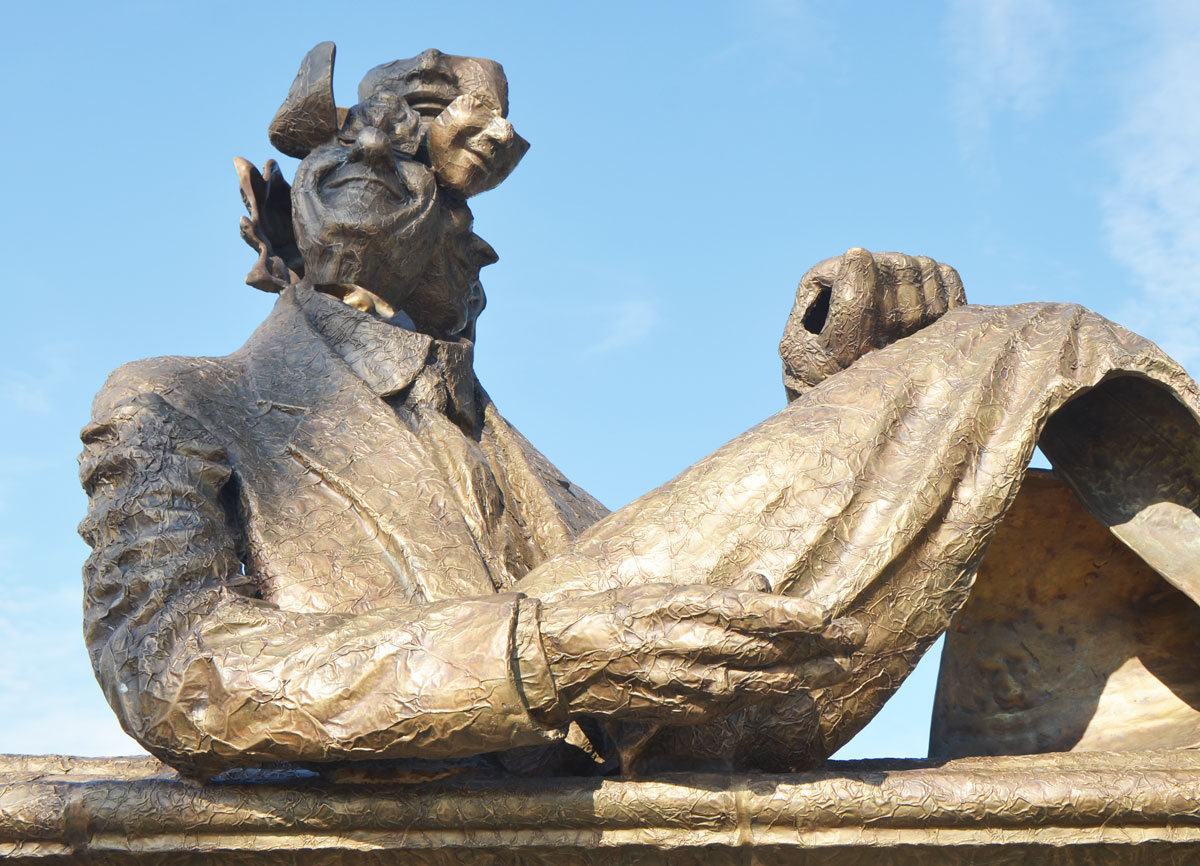
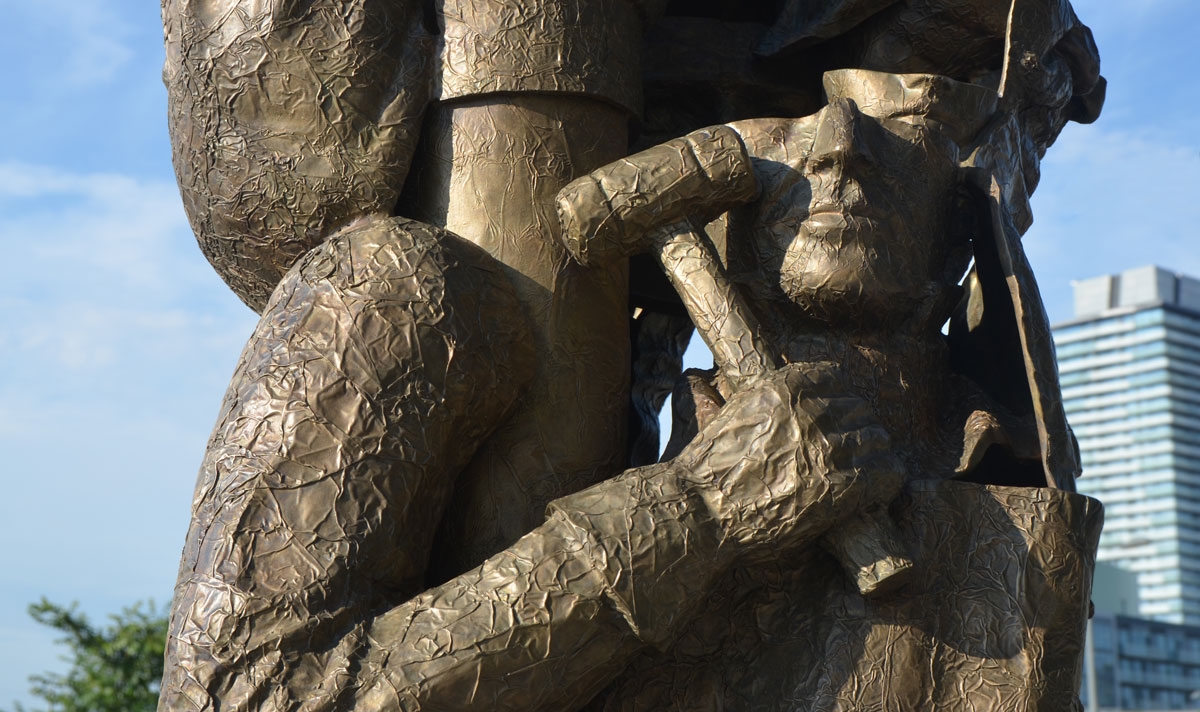
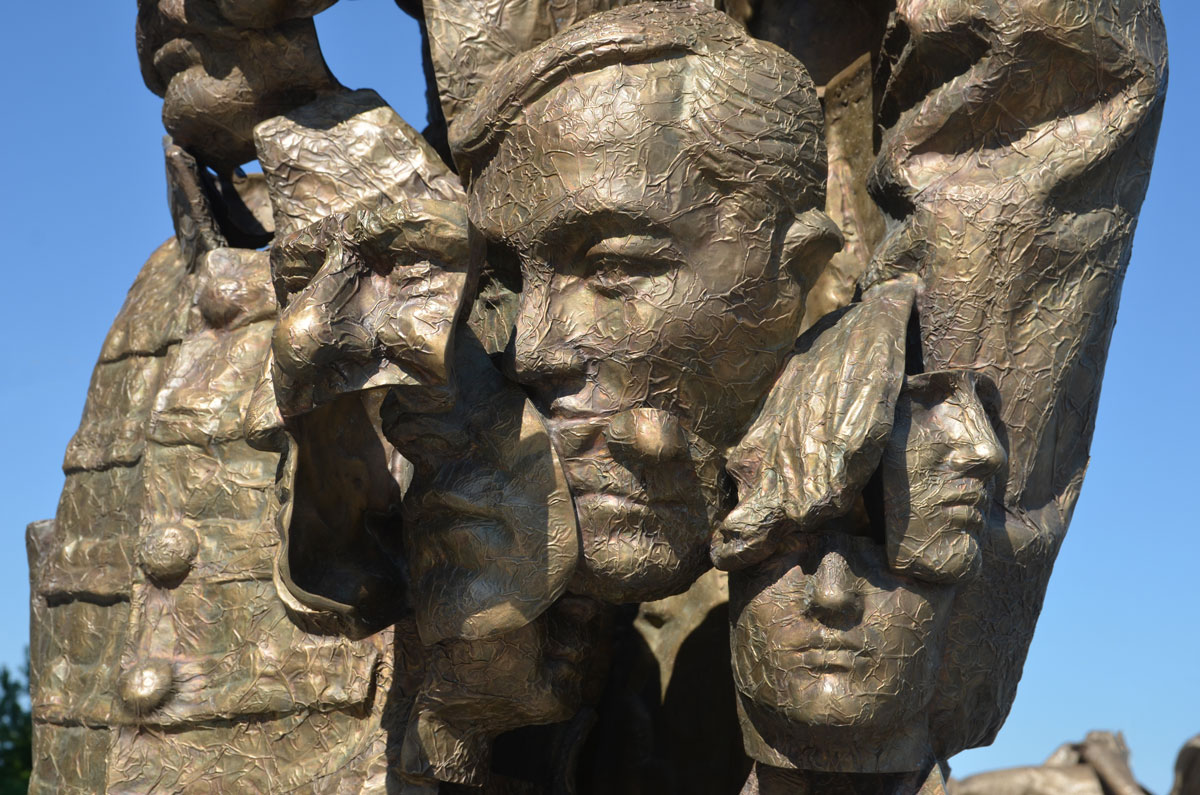
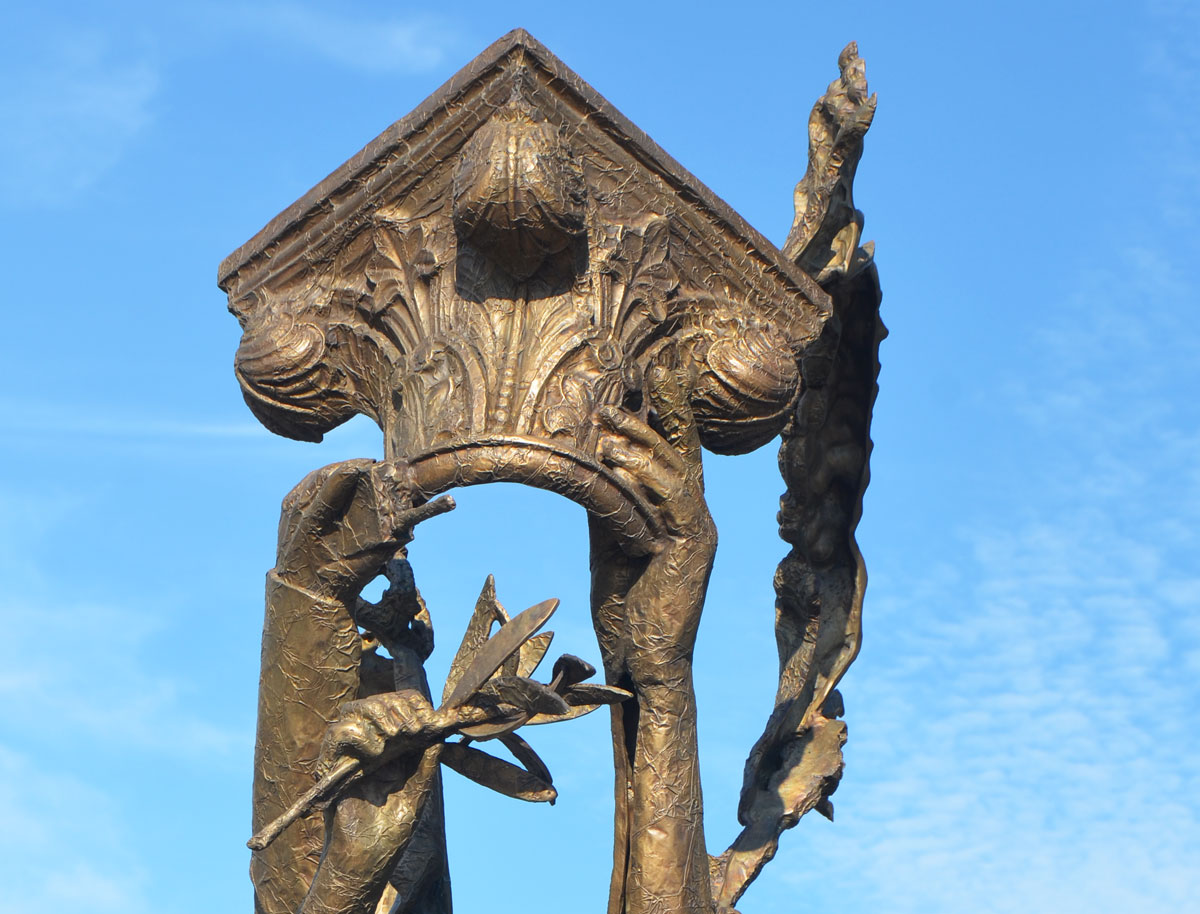
Located at Front and Bayview is the ‘Garden of Future Follies’ by Hadley Howes and Maxwell Stephens (Hadley & Maxwell and the Studio of Received Ideas).  It is a sculpture garden and there are 7 sculptures in this garden.  Each sculpture is a mashup of pieces from different sculptures around Toronto.  Aluminum foil ‘molds’ were used to replicate portions of over 80  different monuments and architectural features.  These portions were then put together in a whole new way.

public art installation on Front St East, various pieces of sculptures put together wrong, people with more than one face, legs in pieces, bronze pieces in 5 groupings on the sidewalk

From an interview with the artists:

“Sir John A. Macdonald’s nose is assembled along with the eyes of artists Frances Loring and Florence Wyle, the chin of Dr. Sun Yat-Sen, and Northrop Frye’s hair; Jack Layton’s smile is one of seven that grace a figure lounging atop a reconstituted mantel from the library at Osgoode Hall; a bell from St. James Cathedral’s famous collection is perched on a cannon from Fort York; while nearby a suitcase from the Memorial to Italian Immigrants acts as a plinth for a collection of hats from various bronze heads.”

Now you can play spot the pieces!  But you won’t find any hockey sticks.

blog_man_three_heads_statue

So far I haven’t seen anyone taking selfies here but I think it would be a great spot for them!

part of a public art installation outdoors created by piecing together fragments of other statues cast in bronze , man and hammer

fragments of horse and feet statues embedded in the sidewalk

part of a public art installation outdoors created by piecing together fragments of other statues cast in bronze

part of a public art installation outdoors created by piecing together fragments of other statues cast in bronze, hands, top of a column and a laurel leaf

part of a bronze sculptture, a naked bum with a hand beside it.

part of a public art installation outdoors created by piecing together fragments of other statues cast in bronze

below: No one will ever call it beautiful, playful yes, but not pretty.

arrangement of statue pieces to form a sculpture garden, Garden of Future Follies by Hadley and Maxwell.

a face is upside down on a statue made from bits and pieces of other statues


stencil in blue on concrete of a stylized face with big mouth made of a spiral of little shapes

There is a railway underpass on Dupont just before it meets Dundas West.  Several years ago the north side of the underpass was decorated with some murals.  Most of them are in bad shape or have been tagged or painted over.

below: Unity is one of the original murals here.  It is the best preserved.

old mural that is not in good shape, a rainbow in the top right corner with the word unity written on it. A number of faces in the rest of the mural, men and women, different colours.

This wall has also become a place to comment on life in words and and poetry.

below: Through the fires of chaos, let there be light!  ~ ” blessed be!”

many words written on the wall of an underpass, along with some line drawings. by druid,

“The man who misses all the fun is he who says it can’t be done.
With solemn pride he stands aloof and greets each venture with reproof.
Had he the power he’d efface the history of the human race
There’d be no motor cars or streets lit by electric stars
No telegraph nor telephone. We’d all linger in the age of stone.
The world could not be run by men who say it can’t be done”
– Druid
Been through rough times – keep your head up!

The poem in the above transcription comes from ‘The Book of Virtues’ by William J. Bennett with one little change.  The last line in the original is as follows: “The world would sleep if things were run By men who say “It can’t be done.”

***

below:  When  I researched the source of the message below I discovered that it was from a poem by Rumi.  He was a 13th-century Persian poet and Sufi mystic amongst other things but apparently he’s also one of the most widely read poets in North America.

words written in black marker on a white space on a wall covered with graffiti, "Out there in between right and wrong there is a field I will meet you there, Paws"

The lines of the poem are translated/shared in slightly different ways including

“Somewhere beyond right and wrong, there is a garden. I will meet you there.”

and

“Out beyond ideas of wrongdoing
and rightdoing there is a field.
I’ll meet you there.”


***

below: Things aren’t what they seem?  I’m not sure if you noticed it, but someone has added, very faintly, “sometimes it’s a gold pot”.

words written in black beside a red and yellow stripe, At the end of every rainbow there lies a pot of gold but isn't always a pot of gold.

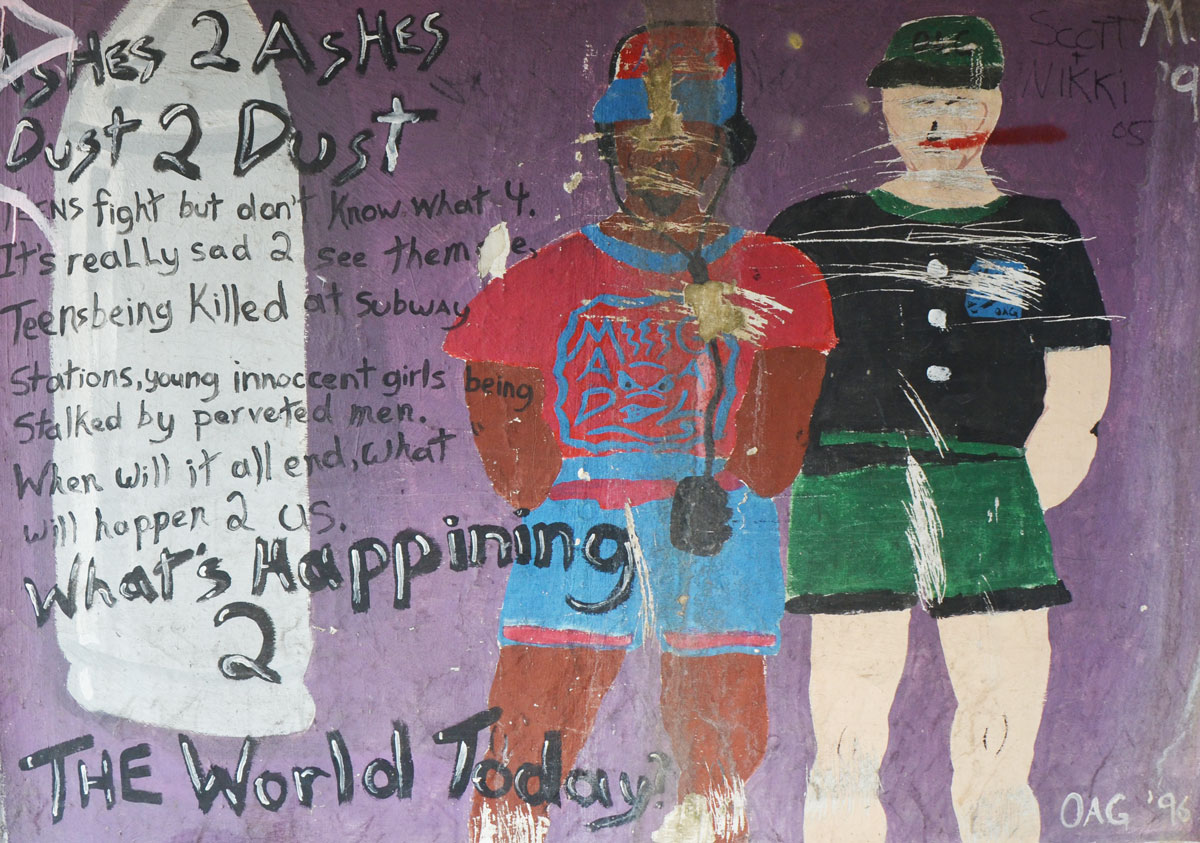
below: Someone’s commentary on the world today.

street art, two people on a purple background, looking old and worn (the mural that is), lots of words have been written on it, including Ashes 2 Ashes, Dust 2 Dust and What's happening 2 the world today

“Teens fight but don’t know what 4.
It’s really sad 2 see them _e.
Teens killed at subway stations,
young innocent girls being stalked by perverted men.
When will it all end,
what will happen 2 us.
What’s Happining 2 The World Today?”

***

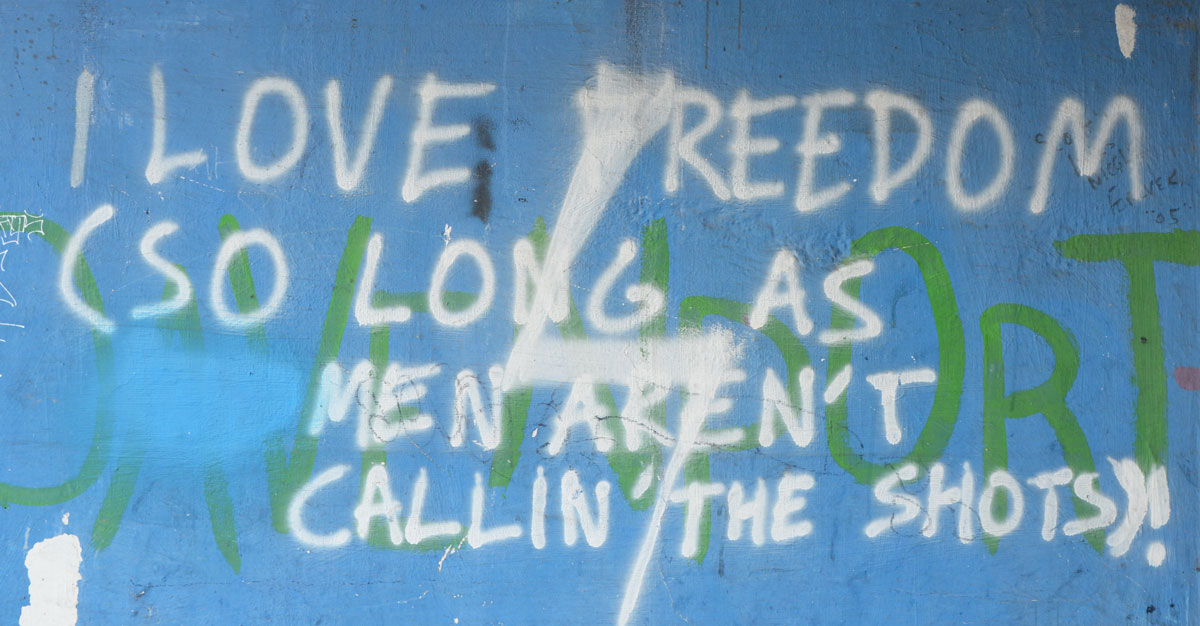
words in white on blue that say I love freedom as long as men aren't callin' the shots. Graffiti

But not a running, or even a jogging, track!  No, yesterday’s walk was an oval-ish loop at walking pace from Dundas West station, up one side of the railway tracks and back down the other.

below: Just past the subway station I saw the mural on “The Friendly Trini’s” which is now closed.  If the mural is telling the truth, they once served butter chicken, curried goat roti, jerk chicken with rice and peas, as well as drinks in coconuts and pineapples.  Feeling hungry already, and I’ve only just begun my walk.

a mural on the side of the Friendly Trinis restaurant that is now closed. Two women are walking on the sidewalk by the restaurant, a sign for Jennys bar and restaurant is in the background. The mural has drinks in coconuts and pineapples as well as a list of some of the food they served

below: Also on Dundas West, the King’z Convenience and Dollar Store which sells Filipino products and delicacies is adjacent to the Slovenija meat & delicatessen.  Multicultural.  I regret not taking pictures of the window of the Slovenian store – juice and beer brands that were unfamiliar to me.

two storefronts on a street, one is a slovenian grocery store and the other is a convenience store

below: Detail, boy riding an old fashioned bike on a little hook above a door.

a decorative ornament hanging high on a brick wall, a hook that extends from the wall about 8 to 10 inches, on top is a flat rendition of a boy on an old fashioned bicycle

below: And someone has decorated their balcony.

a balcony railing has been decorated with different colours of fabric that has woven between the rails

below: Just before I reached the bridge over the railway tracks I saw these words on a wall.

graffiti on a wall, in white paint on grey wall, the words "I have a dream'

below:  The dream theme continues on the metal steps up to the bridge.  This one was small and I almost missed it.  I’m not sure if it was painted black to blend into the background, or if the painting was an attempt to “clean up” the graffiti when prying off the letters proved to be too difficult (the D is broken so maybe someone tried).  Insert words about killing other people’s dreams here.

a raised word, 'dream' in cursive that has been stuck on the side of a set of stairs and then painted black to match the steps

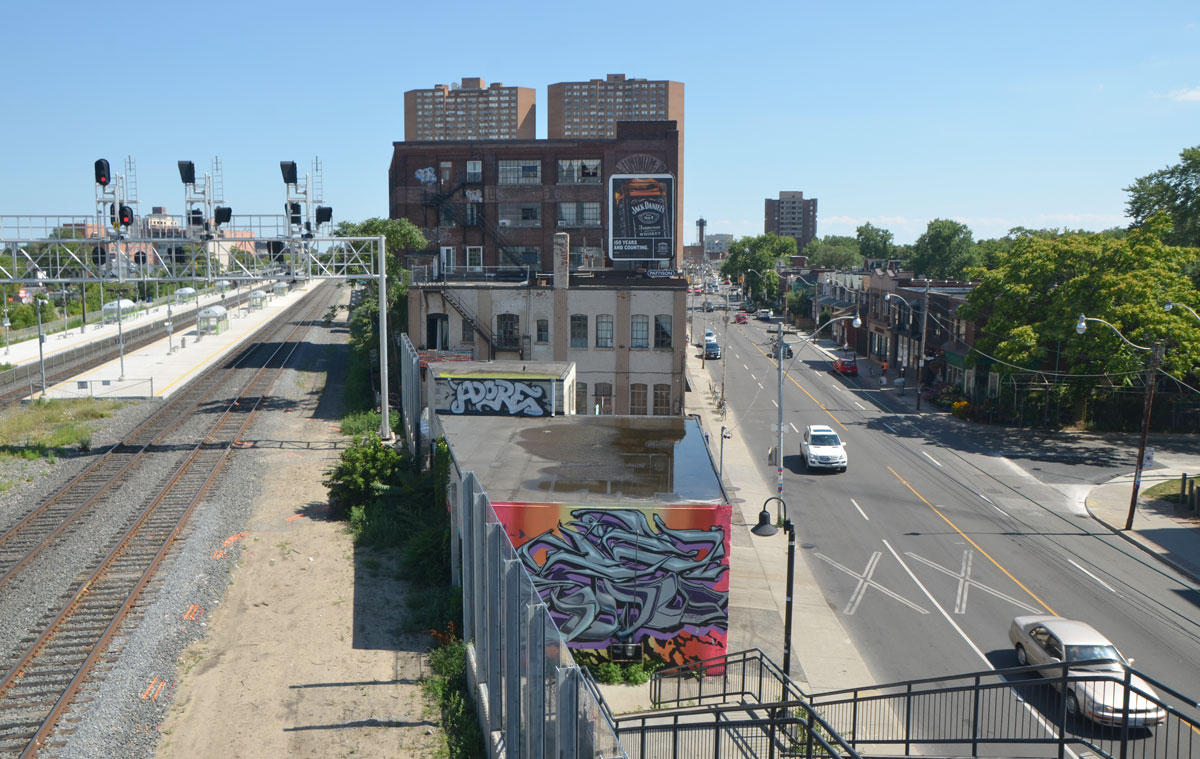
below: From the top of the steps looking south.  The minimalist new Bloor GO and UP (Union Pearson) station is finished, top left of the photo.  Don’t you think we should call it ‘Get UP and GO’?  The street is Dundas West and yes, that mural is new.

view from a bridge, a street, and a railway and some buildings in between. There is a mural at the bottom of the steps.

below: Helping to hold up the bridge, west side of the tracks.  He’s carrying the weight of the world, or maybe just the bridge, on his shoulders.

mural on the concrete base supporting metal struts bridge supports.

After crossing the bridge, I walked north along the West Toronto Railpath. The fencing along the path has all been upgraded.  There used to be some spots where you could get through the fence (non-railway side) but those are gone.  Between the tracks and the path there is a new clear (glass? plastic?) fence.  Of course it has already been ‘vandalized’ or ‘tagged’ – choose your verb.  Because I was there on a sunny afternoon, the sun was shining through the ‘artwork’ and making interesting designs.  A few thistles and other weeds added some compositional elements.

glass that has been spray painted yellow and orange, with some black that has run, weeds are growing in front of it, the sun is shining from behind it

a bright red heart has been sprayed painted onto a glass wall, weeds growing front, train tracks behind, the sun shining through the glass.

There were quite a few hearts on my route, especially around the Dupont exit of the Railpath.

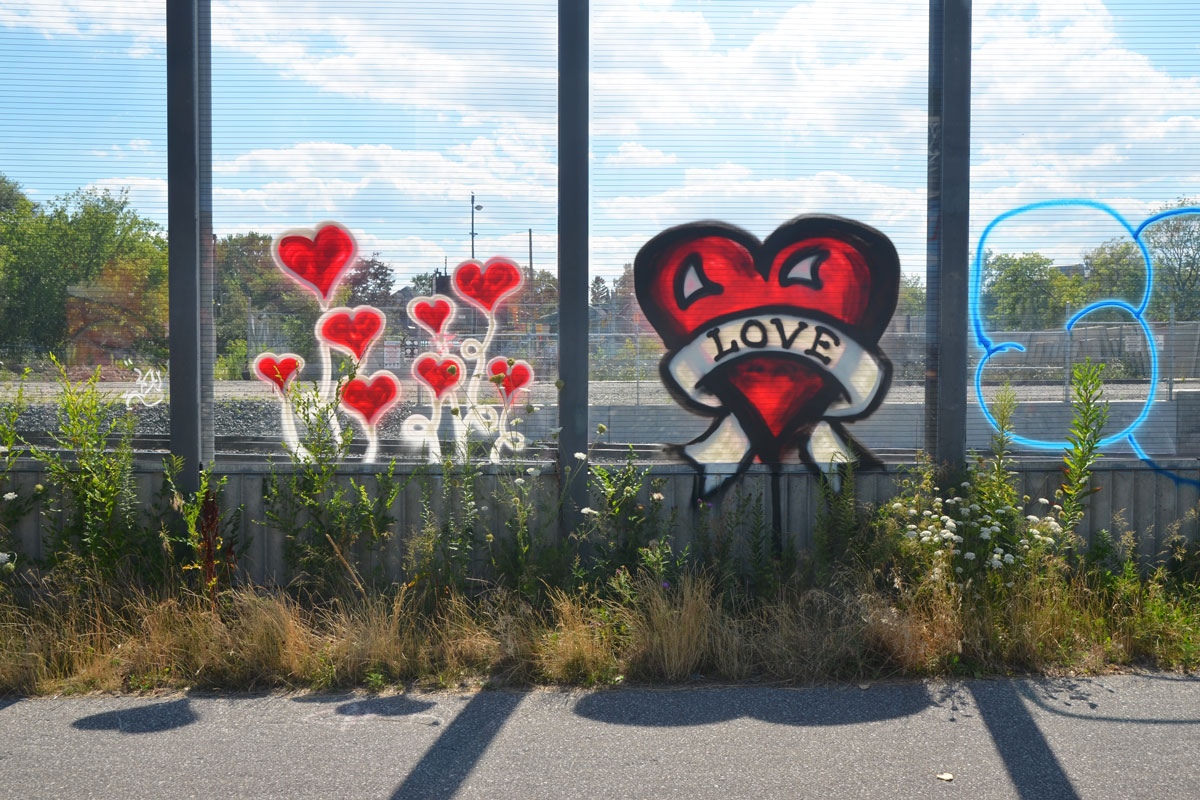
below: Many hearts on the fence.

two street art pieces painted on a glass wall. the first is a red and black heart with a white banner across it on which the word love is written. the other is 8 little red hearts on white stems growing from the ground below.

below: A heart for Hex and Nish wherever, and whomever, they may be.

a bright red heart painted on a man made boulder, words hex and nish written on it

below: Three heart balloons on the Dupont sign.  You can get a good view of the fence here.

glass fence beside railway tracks, path, trees, also a metal sign on which three red hearts on white stems have been painted.

below: Part of the West Toronto Railpath runs alongside Planet Storage, an large old brick building.  There used to be a lot of street art along the side of the building but it’s all been painted over.   A few tattle tale remnants remain.

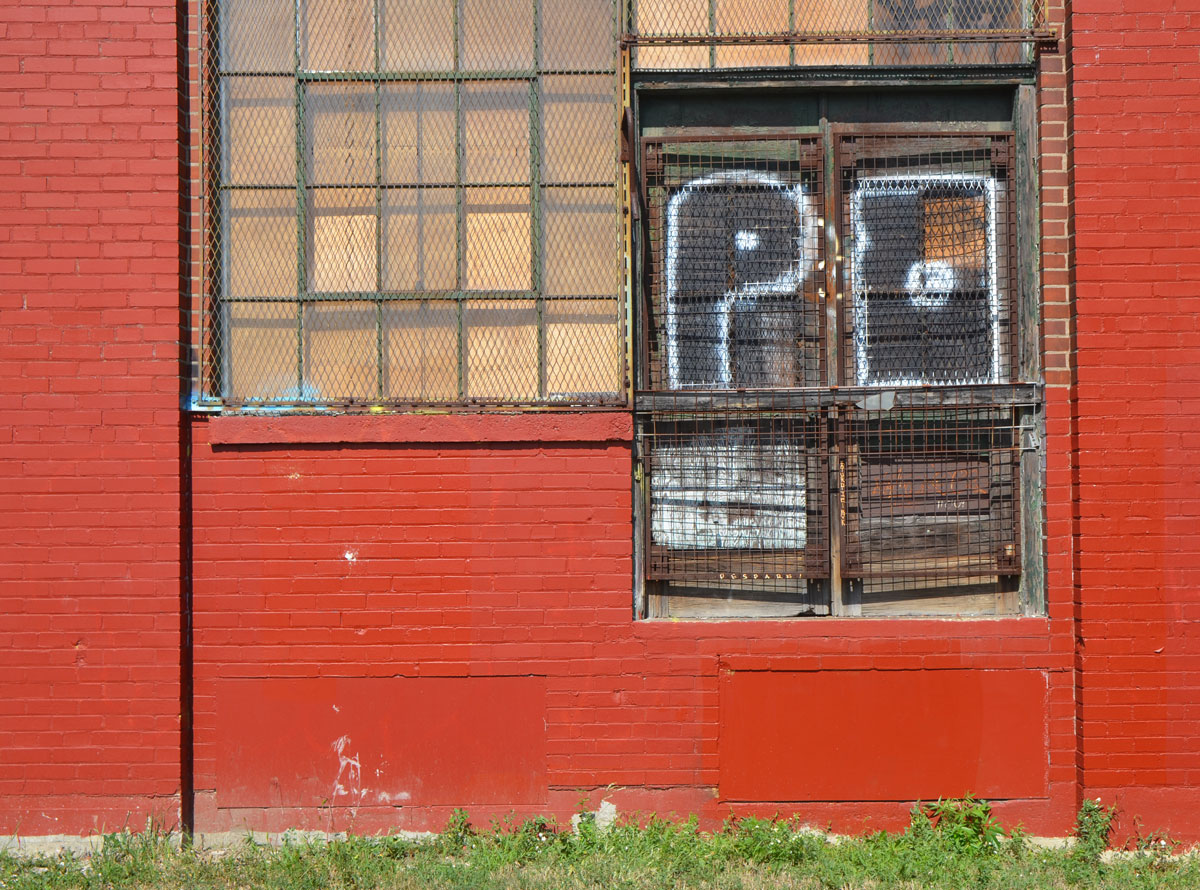
wall, part of an older brick building that has been painted a rust colour, with windows, some of which have metal grilles over them. Remnants of old graffiti on the metal grilles.

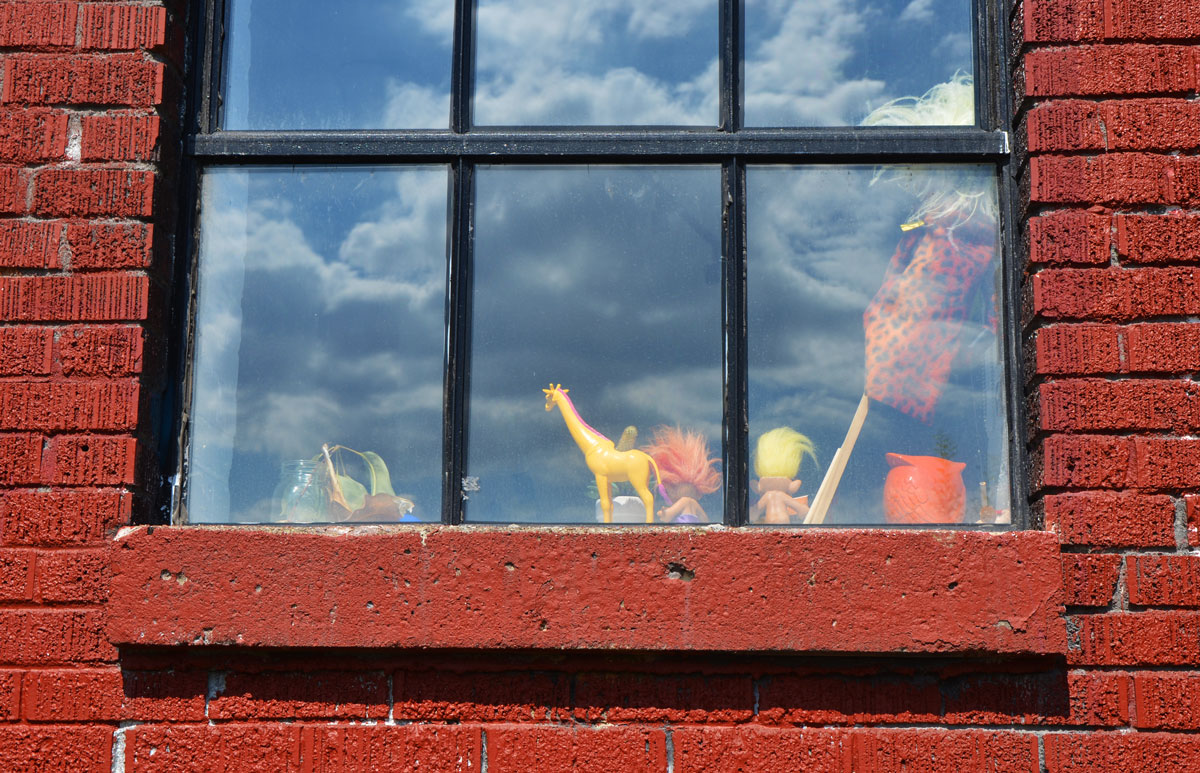
below: My favorite, little details like the bright yellow giraffe looking at the clouds.

looking into a window, toy yellow giraffe on the window sill as well as two toy trolls, one with yellow hair and the other with orange. Reflections of clouds in the window

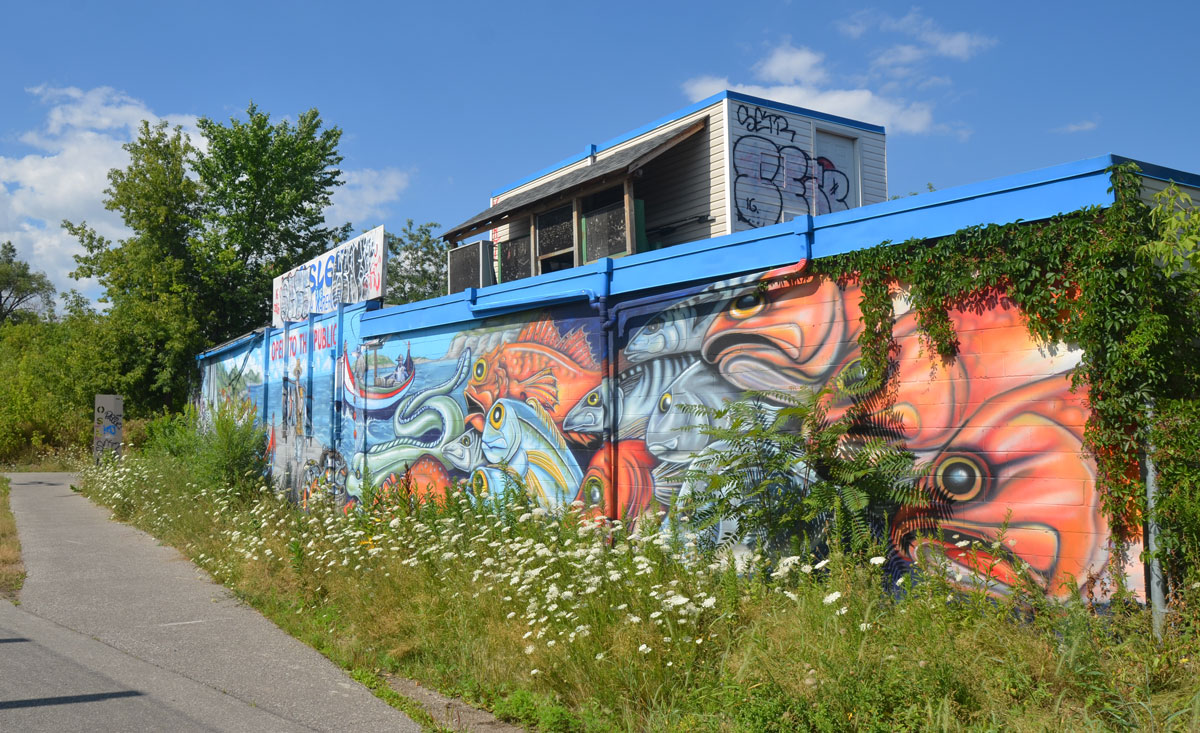
below: There is one mural on the Railpath, the back of Osler’s Fish Market is covered with a fish and fishing themed mural.

back of Osler Fish Market covered with a fish and fishing mural

below: Fish heads in the weeds.  Queen Anne’s lace, that plant with the white flowers, was growing in abundance along the path.  You might know it by its other name, Wild Carrot.

detail of a mural, fish heads, on a wall with Queens Annes lace and other weeds growing in front.

mural with fisherman bringing in a load of fish to the shore, boat in the background, more fish in the foreground.

mural, man sitting, mending fishing nets, woman on the shore carrying a bundle towards some fishing boats.

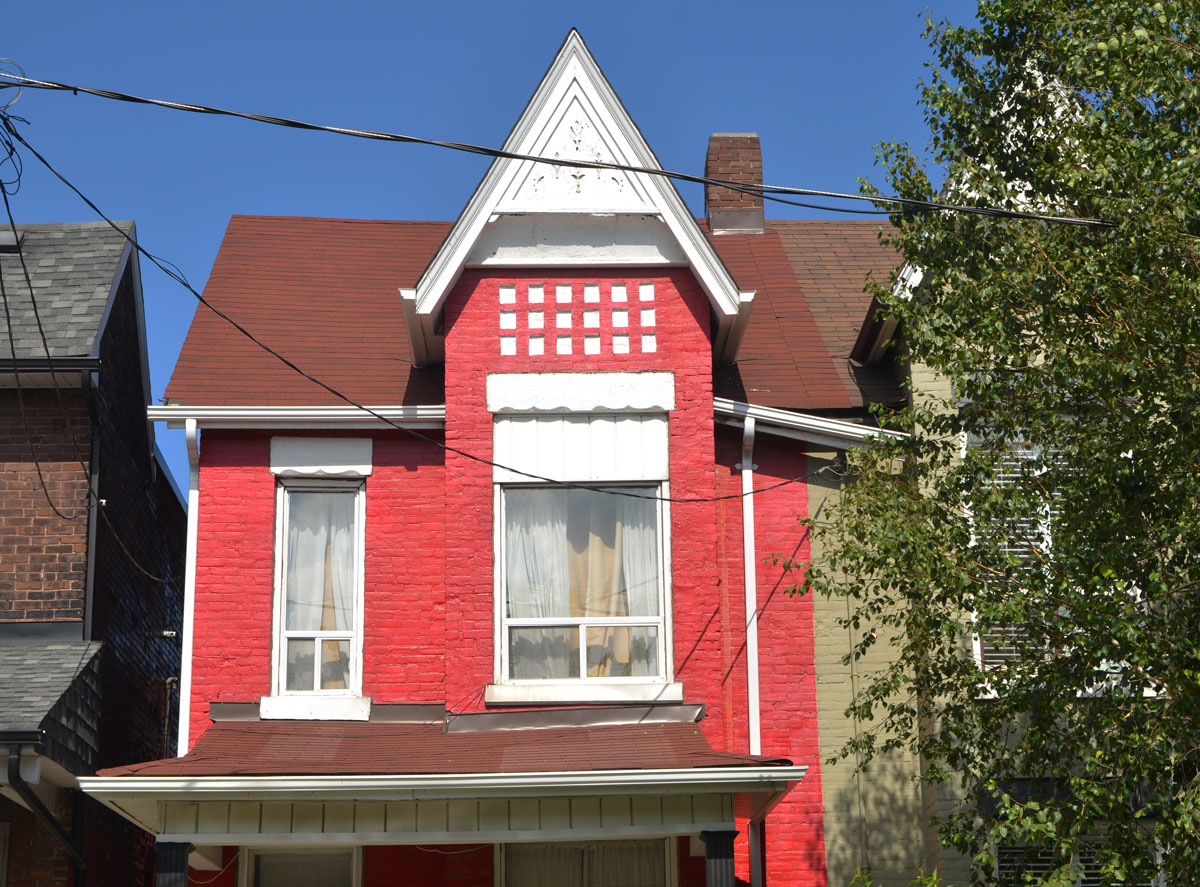
below: A splash of red on a street just off the railpath.

the top part of an old Victorian brick 2 storey house, painted red with white trim

below: The sign on the table says: “Hi! La Witch Cat here.  Enjoy the space, but PLEASE do not litter.  I provided a garbage can. Use it!  This includes cigarette butts.  Put in trash once extinguished.  Thanks!  XXO”.  Marvellous!  I sooo agree with the part about cigarette butts.  Why do people who don’t litter still consider it okay to throw cigarette butts wherever they please?  I smiled but I didn’t stop to rest.

In a veryshady spot, against a metal fence, two old chairs with a white table between them, a sign on the table and a small garbage can to the left.

below: At one point I found myself at this intersection.  What is a pedestrian to do? It’s possible I walked where I shouldn’t have, or at least where foot traffic is rare.  All the roads in the photo are Dundas West; it’s where the street splits as it approaches Dupont and Annette.  There was a small park behind me, called Traffic Island park.  The name sums it up I think.

wide intersection where two roads meet in a V shape. not much else in the picture, only the nose of one car, no other traffic. hydro poles and wires in the picture

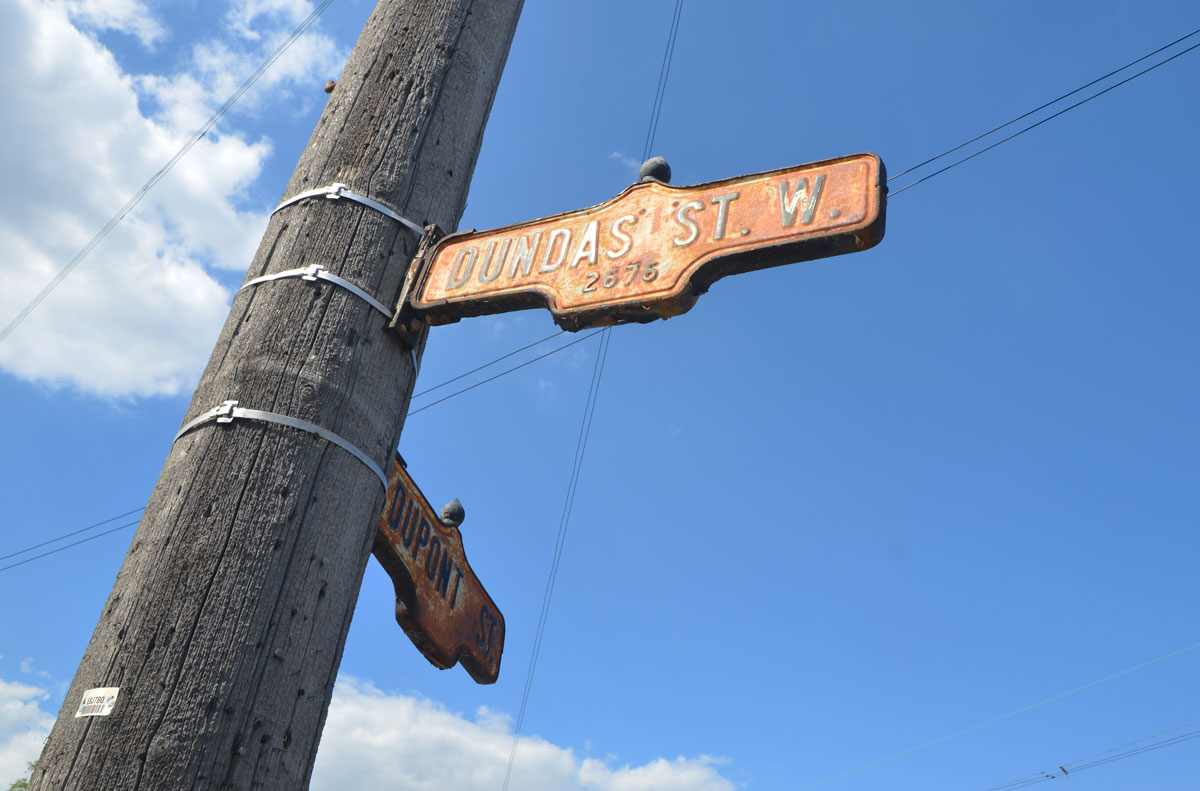
two old Toronto street signs, slightly rusted, on a hydro pole, one for Dundas St. WEst and one for Dupont street

below: A lament for the streetscape.  One more line in an elegy to public spaces.  The result of a half hearted attempt.  Massive hydro poles on the narrow sidewalk.  A large ad. A green space that needs attention.  If you look carefully, you can see  a plaque on a small stand.

sidewalk right beside a road, with hydro poles on the sidewalk, a small stretch of green space (about a metre) befoew a large fence that is concrete on the bottom and glass on the top. A couple of small trees that are dying are in the green space.

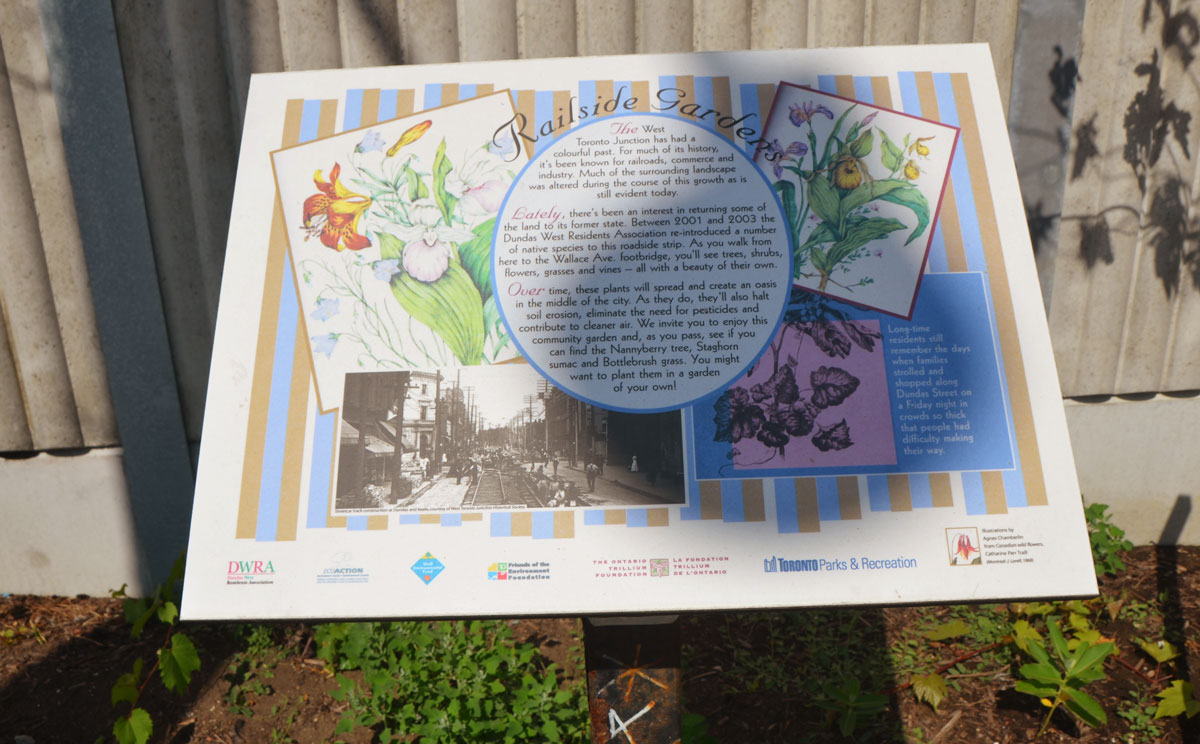
below: This is the plaque.  According to the words, this strip of land was replanted in 2001-2003 with a number of native species with the plan that they would spread and “create an oasis in the middle of the city”.   It mentions three plants – Nannyberry tree, Staghorn sumac, and Bottlebrush grass.   Disconnect alert.

plaque describing the railside garden with words about its history and some picture of the plants that grow there

below: On my way back to the subway station I spotted this 24 hour lovebot.

a lovebot sticker on a TTC bus stop pole, between the sign that says 24 hours and the symbol of a bus, older industrial building behind it.

…. that was where I walked yesterday but before I leave, a few small details.  Ciao!

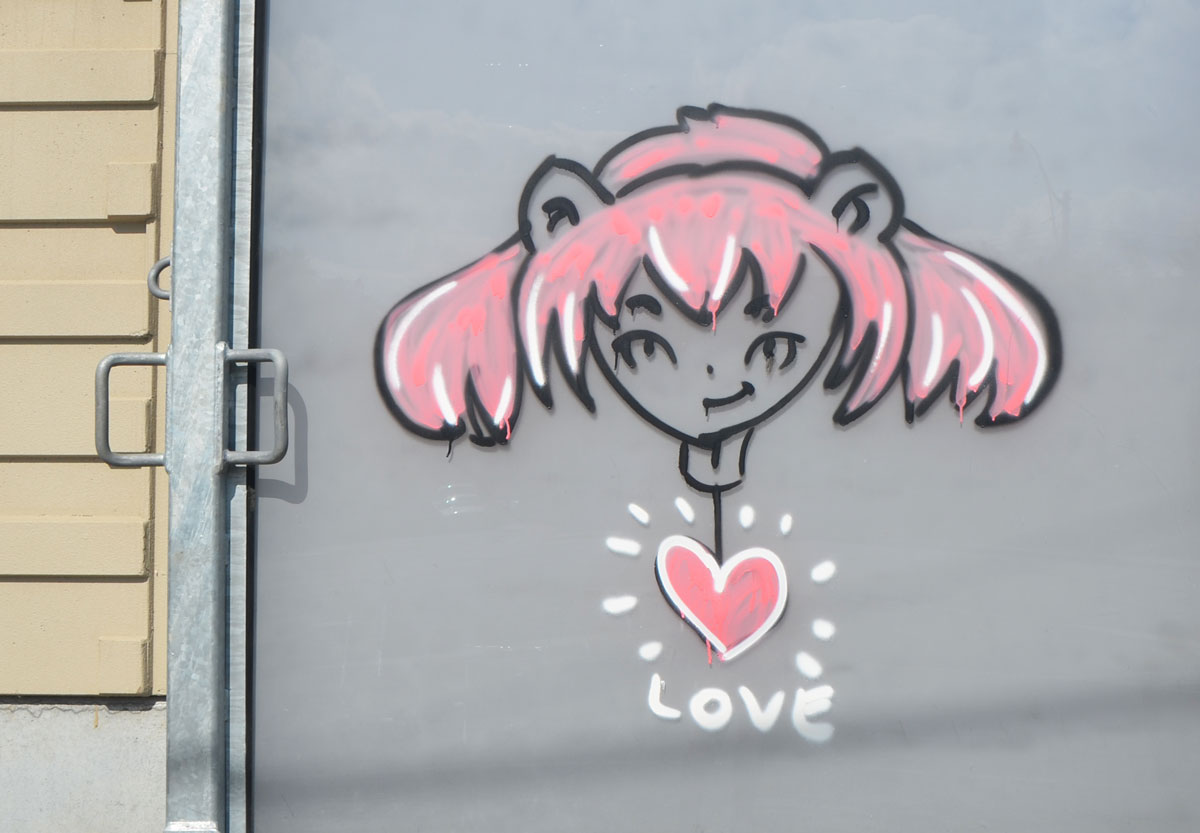
graffiti on a grey metal door of a girl's head with lots of pink hair. A pink heart beneath her with the word love under that

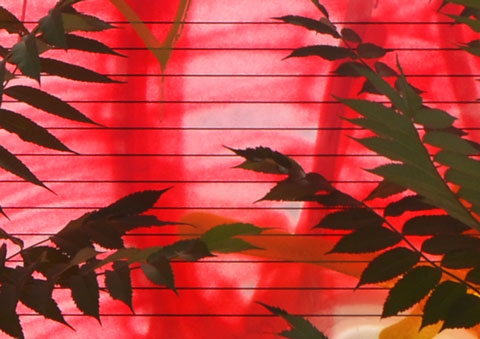
red background, silhouette of sumac leaves

blue background, graffiti drawing of man's head, wearing large crown, sad eyes, heart in word bubble

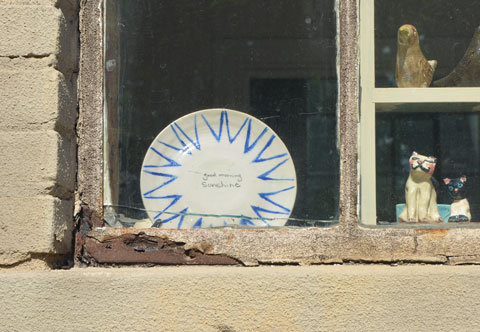
a plate in a window that says Good Morning Sunshine, also two small ceramic figures of cats, and one ceramic dog

The Frederick G. Gardiner Expressway, commonly just called the Gardiner, has been in the news a lot lately.  This 18 km stretch of road between the city and the lake was completed in 1965 after years of planning and building.  At the time that it was built, Toronto’s waterfront was largely industrial and there wasn’t much objection to having a 4 to 6 lane expressway, with many sections elevated, built there.   The railway had begun the process of dividing the city from its waterfront a hundred years previously.

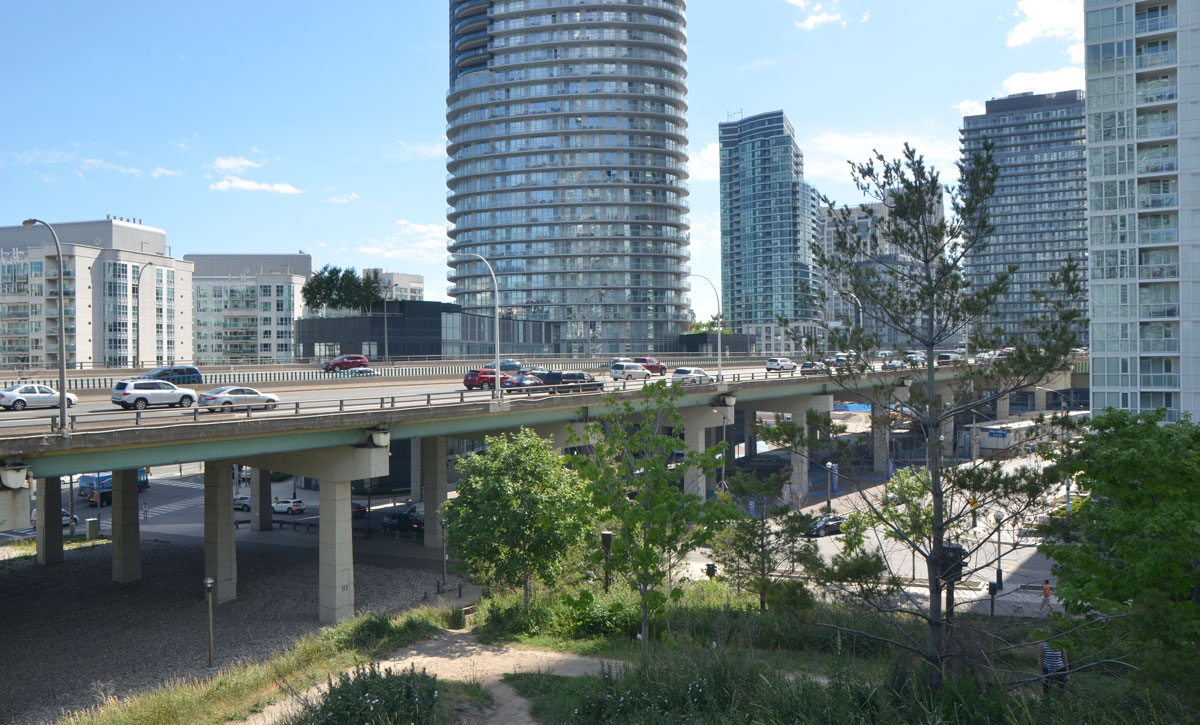
As the city changes and grows, more and more people live in the downtown core.  Industry has moved out and residents have moved in.  For so long the land south of the Gardiner as well as under the Gardiner was neglected, especially from a city planning point of view.  But now, the city is looking differently at that swath of land.  The far east elevated section between the Don Valley Parkway and Leslie Street was demolished in 2001 and there have been calls for the next section (Jarvis to the DVP) to be demolished as well.   There has been some controversy as to whether to demolish it or move it… and if move it, where to? I am not even sure what the plans are at the moment.   On the other hand, the western section of the elevated expressway (Strachan to Spadina) will remain standing.  Work is underway to refurbish the structure – the city doesn’t want any more stories of pieces of concrete dropping onto cars beneath!  Plans are being implemented to use the land under the Gardiner much more efficiently.  To make it work for the public.

The Bentway is the name that has been given to this new park, or public space, beneath the Gardiner Expressway from Strachan 1.4 kilometres east to Spadina. The first phase is due to open Canada Day 2017 and it involves the stretch between Strachan and Bathurst.  Many of you have probably driven on the Gardiner but do any of you know what is under it now?  Let’s take a look.

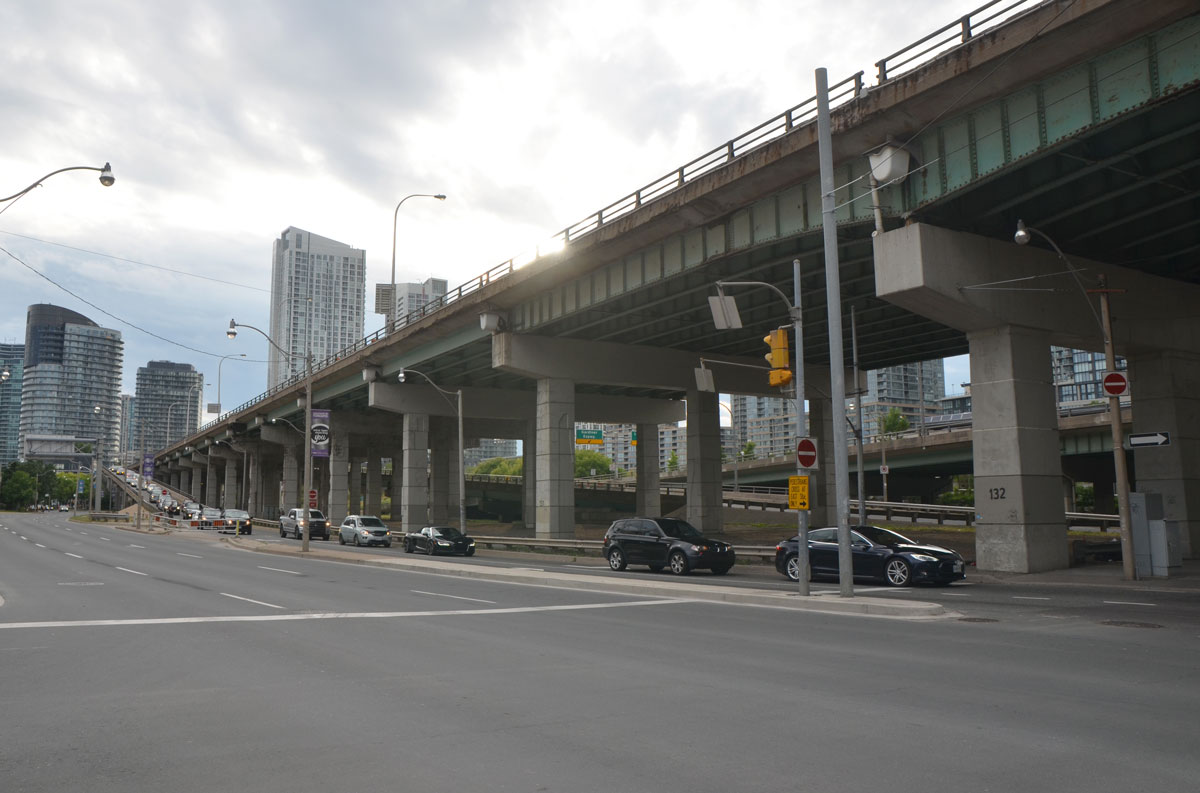
below: The Gardiner passes over Strachan Avenue which  in turn passes over the railway tracks.

bridge over a street, many orange and black construction cones down the center of the road, some pedestrians on the sidewalk

below:  On Strachan Ave looking west.   Condo development in this area has extended right to the railway line.  The Exhibition GO train station is in the distance.  You can also see the Gardiner to the left of the tracks.  Here the north side of the under part of the expressway is walled in and the enclosed space is used by Exhibition Place.  At this time there is no plan for the Bentway to extend this far; I have used this photo to provide more context as to the location of the park.

railway tracks in the center of the picture, condos on the right. On the left is the elevated Gardiner expressway, but under it is a concrete wall that makes it look more like a concrete building than a road

below: A closer look at the Gardiner on the west side of Strachan Avenue.  Maybe there is potential to expand the park westward? to Exhibition GO station? And by the way, those concrete structures holding up the expressway – those are called ‘bents’ and that is why the park is called what it is.
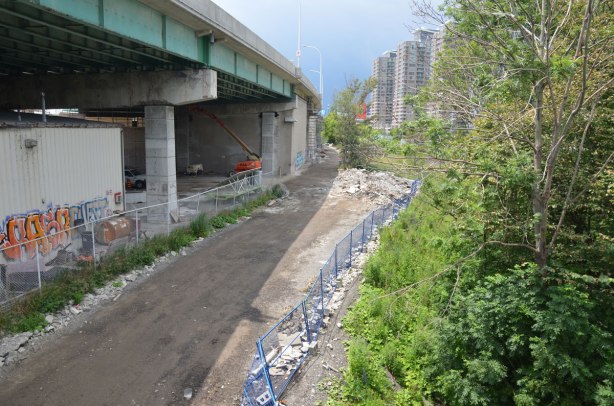
a dirt road runs alongside the Gardiner Expressway, some condos in the distance

below: This photo was taken as I stood on Garrison Common and looking towards Strachan Avenue.  This will be the western end of the new park. You can see the underside of the Gardiner as it passes over Strachan Ave which in turn is also a bridge.  This bridge once crossed the Grand Trunk Railway tracks that were built in the 1850s.  New entrances to the park are planned that incorporate the present sloped embankment of the bridge.

The elevated Gardiner Expressway passes over Strachan Ave which in turn has a bridge over what used to be a rail line. The bottom part of the bridge is covered with graffiti. The whole area is a construction site at the moment.

below: A quick aside:  It’s a slightly different angle, but here is a photo of the Strachan Avenue bridge from 1959, before the Gardiner was built.  I suspect that there has been upgrades made to the bridge since then.  Photo credit: R.L. Kennedy, found online (also a good source for the history of the Grand Trunk Railway in Toronto).  Garrison Common is to the right.
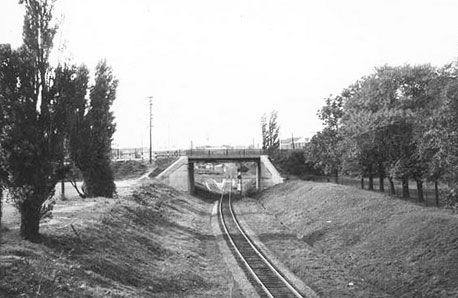
vintage photo from 1959, GTR tracks pass besidde Garrison Common park and under the bridge at Strachan Ave

Garrison Common is the green space surrounding Fort York.  It will abut (be continuous with?) the new Bentway.  Fort York is a National Historic Site and on its 43 acre site are original buildings from the War of 1812 as well as an 1813 battle site.  Did you know that the Americans beat us here in 1813 and controlled the city of York (as Toronto was known then) for a few days?

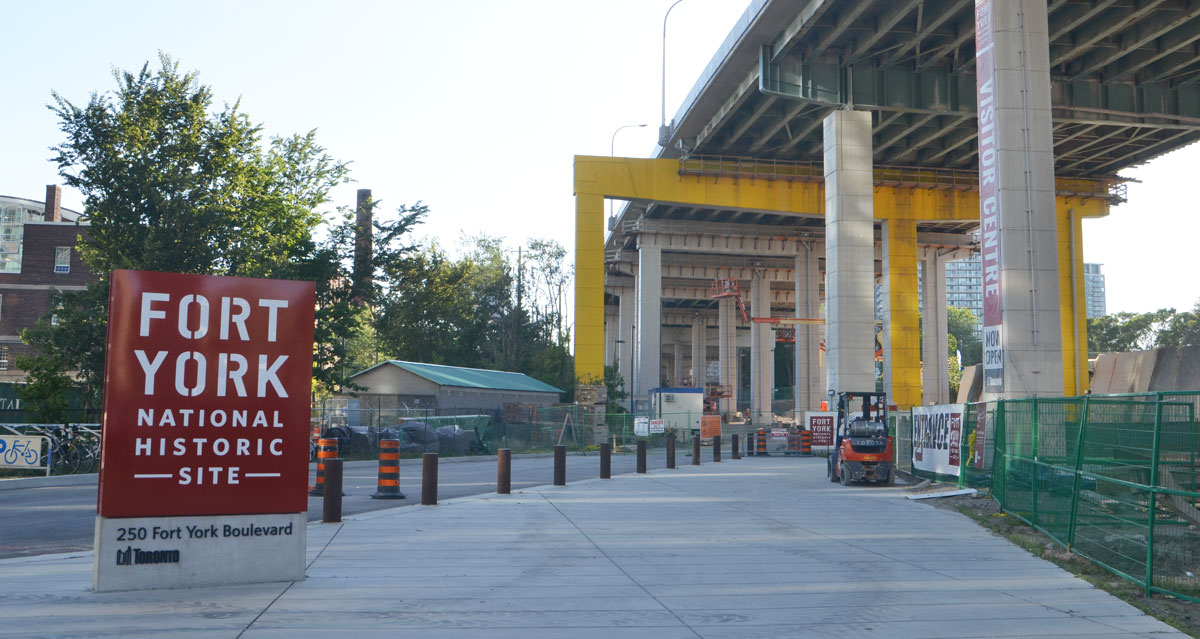
below: The new Fort York Visitors Centre is now open. There is still being work done both inside and outside, but it is open to visitors. For so long the fort was hidden away and difficult to get to; it is nice to see it receiving more attention.

entrance to Fort York, under the Gardiner, still a construction site but nearing completion

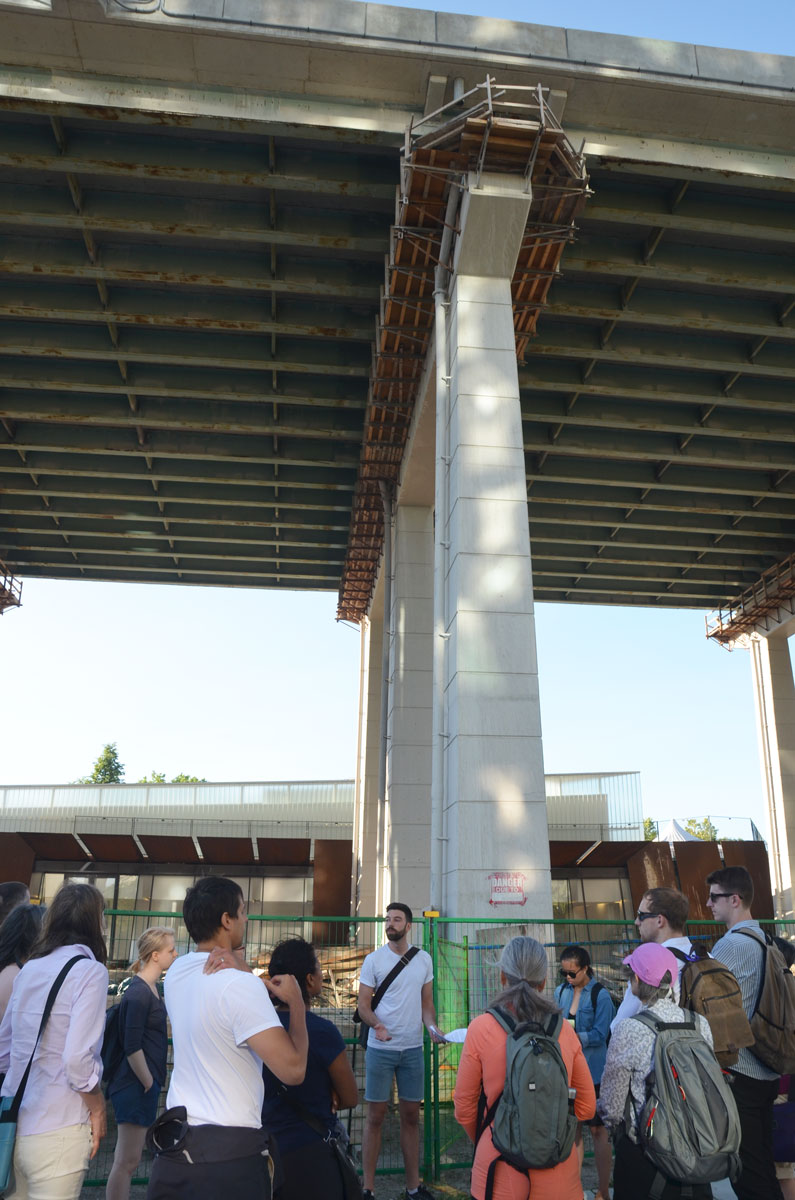
below: Jake from Park People, one of the groups helping to design the new park, stands under the Gardiner as he talks to a group of us on a tour.    Here, by Fort York, the Gardiner is the equivalent of 5 storeys from ground level, the highest it reaches as it crosses the city.
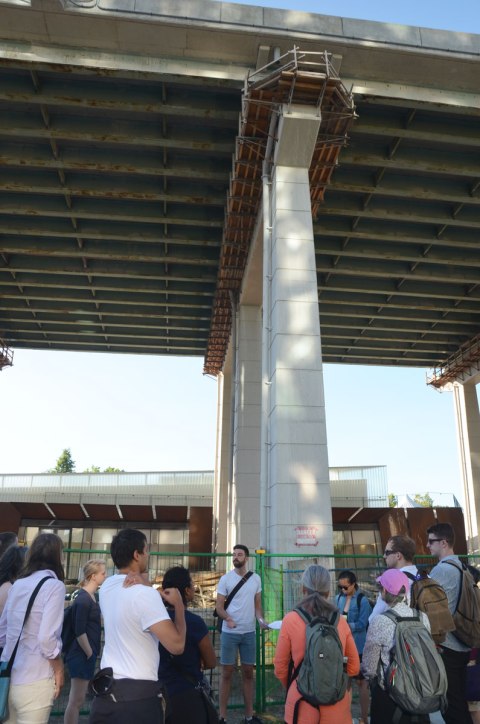
a man is standing in front of a group of people on a walking tour, he is standing under the Gardiner Expressway where it is 5 storeys above ground level.

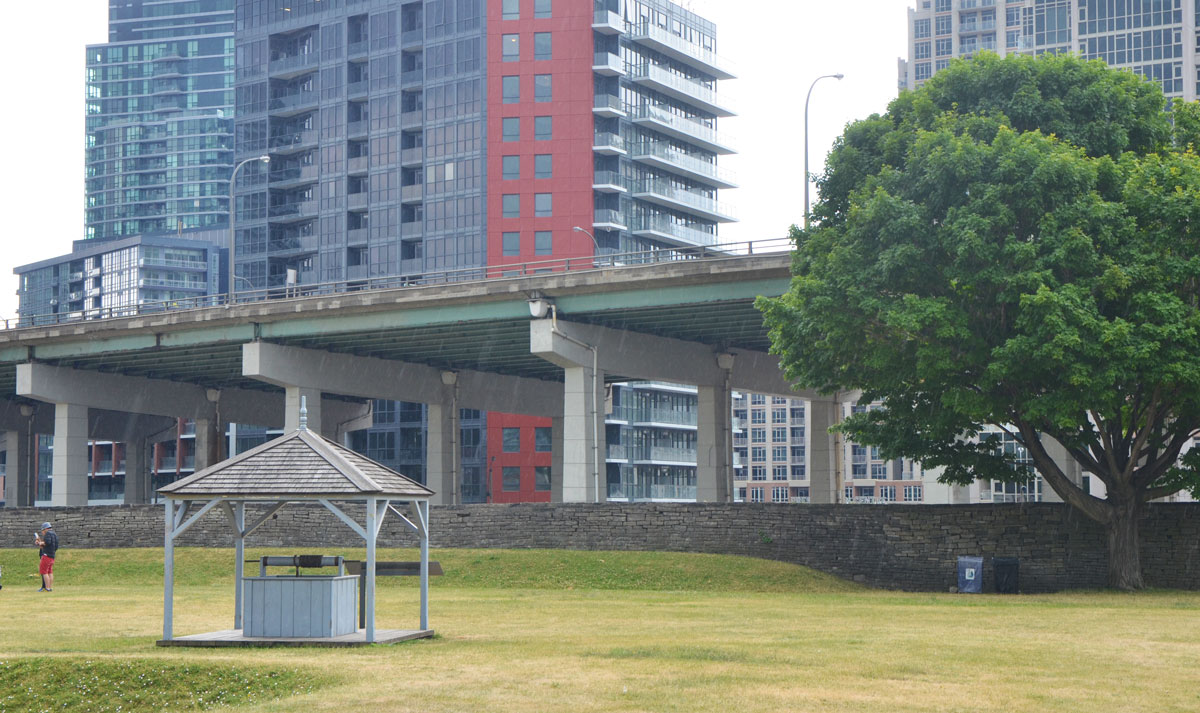
below: Standing on the grounds of Fort York.  The Bentway will be beyond the stone wall.  You can get a good idea of the spacing between the bents.  These spaces are being referred to as ‘rooms’ and there are 55 of them between Strachan and Spadina.
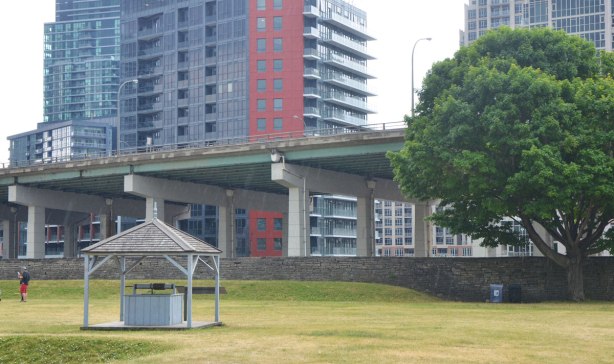
from the grounds of Fort York looking south to the Gardiner and the condos built beyond it. Grass field in the foreground.

below: One obstacle is the fact that Fort York Blvd passes under the Gardiner on a diagonal.  Plans are to build a pedestrian/cycle bridge over the street.  Also in the photo, note the TTC bus – Fort York and vicinity are finally on a bus route.  Route 121 runs between the Portlands and Fort York via Union Station.

fort york blvd is in the foreground, a TTC bus and a car are on it, the Gardiner is to the right and a short condo building is in the background along with the CN tower

below: The section under the Gardiner Expressway between Bathurst Street and Fort York Blvd is not city owned. It is owned, and has already been developed, by the Onni Group who built the Garrison at Fort York condominiums on either side of it.  This is the eastern end of phase 1.
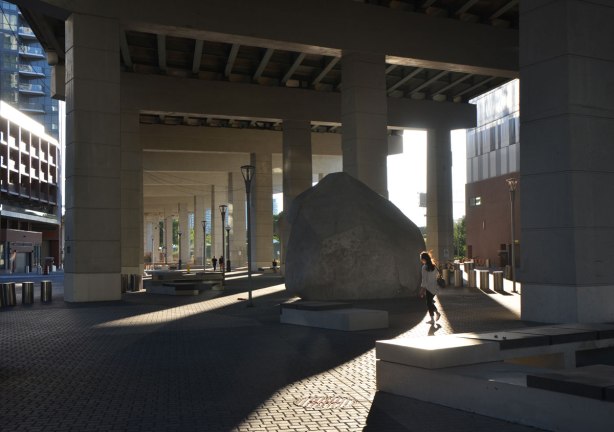
evening, low angle sunlight shines under the Gardiner Expressway where it has been developed with paving stones and some large rocks.

below: Northbound traffic on Bathurst passes under the Gardiner.
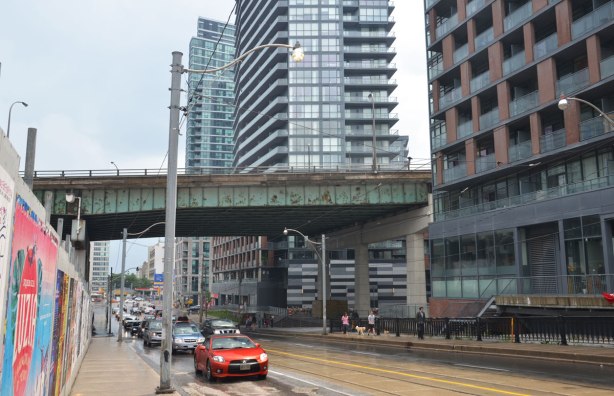
some traffic on Bathurst street on a rainy day, as the street passes under the Gardiner Expressway, condos on the right, construction hoardings on the left.

Phase 2 of the park’s development involves land between Bathurst and Spadina. This is an area that is undergoing a lot of changes at the moment, i.e. a lot of construction.

below: Immediately south of the Gardiner on the northeast corner of Bathurst and Lakeshore is a construction site.  Demolition of the old 1928 Loblaws warehouse building is now complete.  The facade of the old building was disassembled rather than demolished; after cleaning and refurbishing of the bricks, it will be rebuilt in its original location.  Two condo towers are planned for the space between Loblaws and the Gardiner.  Yes, more condo towers to face the Gardiner and add to the tunnel effect that you get when you drive on the expressway.

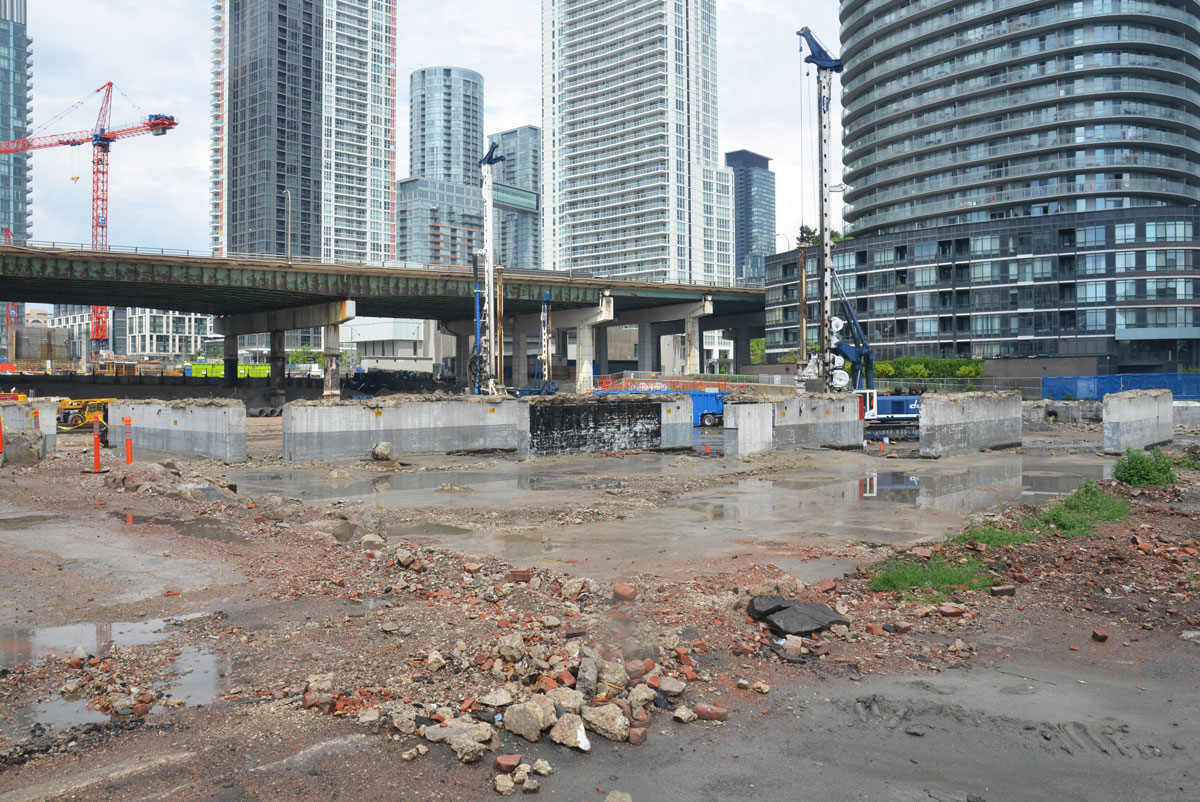
construction site in downtown Toronto, Gardiner Expressway runs behind the site, rubble in the foreground, a few remaining remnants of the old Loblaws building that was there, high rises in the background.

below: The development of this site is a collaboration between a number of developers.  I found a photo of one rendition (source) of what the space under the Gardiner will look like here in the future.  Public space including a cafe are part of the plans.  Check back in a couple of years to see what really happens here!
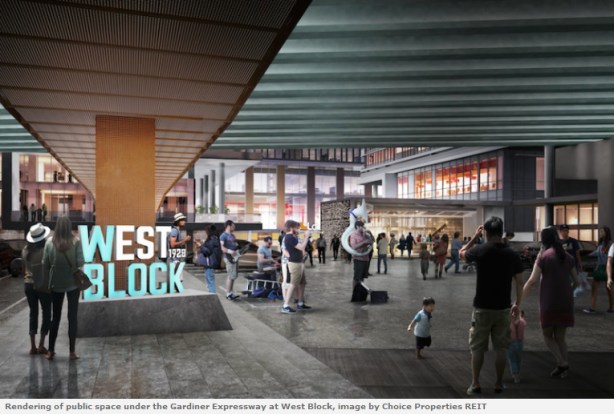
artist's rendering of what a planned development for under the Gardiner would look like, part of a larger condo and retail development.

below:  Standing on Bathurst Street, looking east along what will be Housey Street.  This is just north of where the Loblaws development (above) will be.  As you can see, you can’t walk there yet.

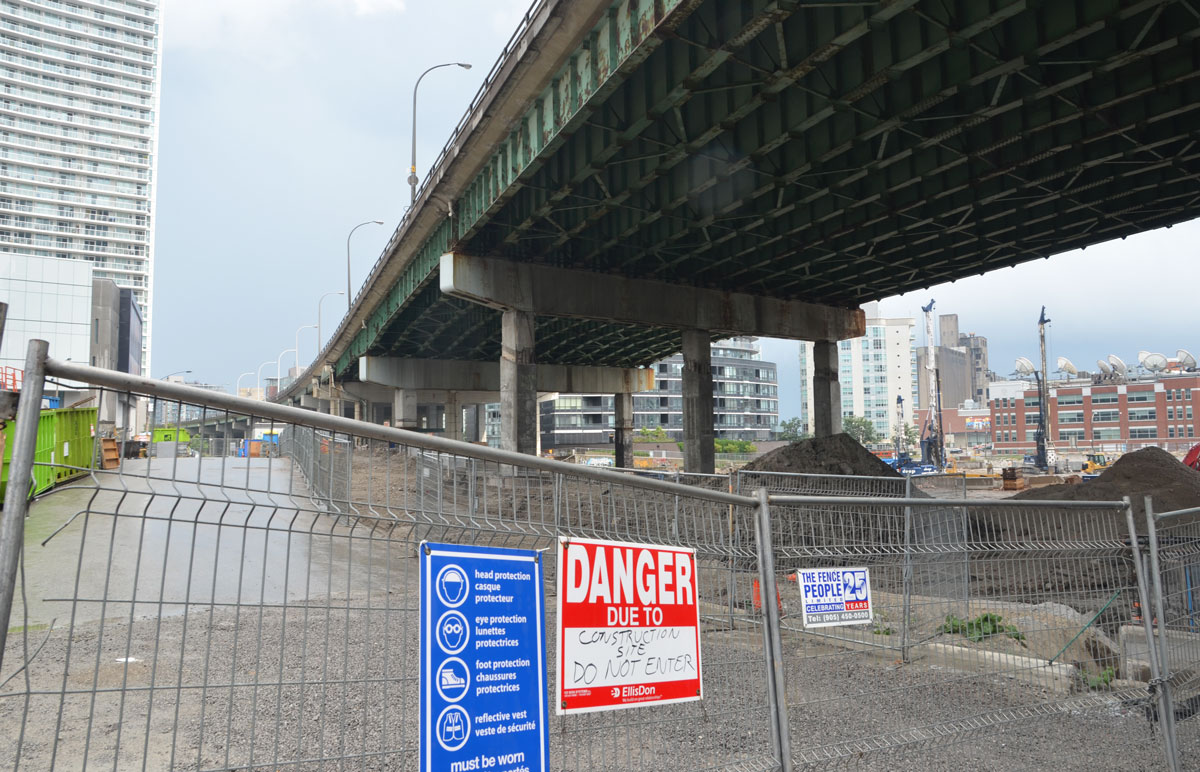
the elevated road, the Gardiner Expressway passes over a construction site on the right, a new street being built on the left.

below: Southeast corner of Bathurst and Fort York Blvd.  This is the section of land just north of Housey Street.  Construction hoardings and cranes – familiar sights in this area.  It also means that taking photos of under the Gardiner here are difficult!
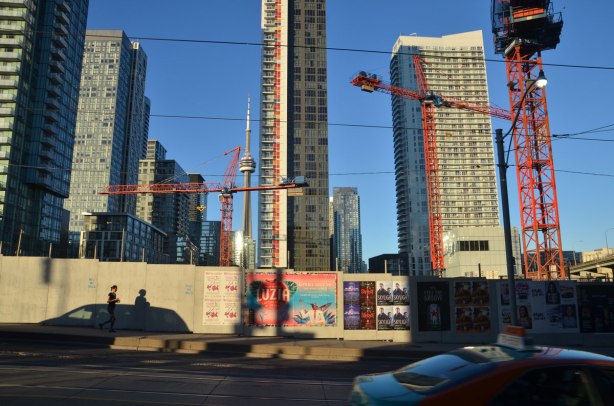
late afternoon, long shadows, yellowish tint to the photo, looking east from Bathurst, south of Front, north of the Gardiner, wood construction hoardings with posters on it, many orange cranes, some condos already built, a woman jogging past, cars on the street.

below: Development north of the Gardiner between Bathurst and Dan Leckie Way.
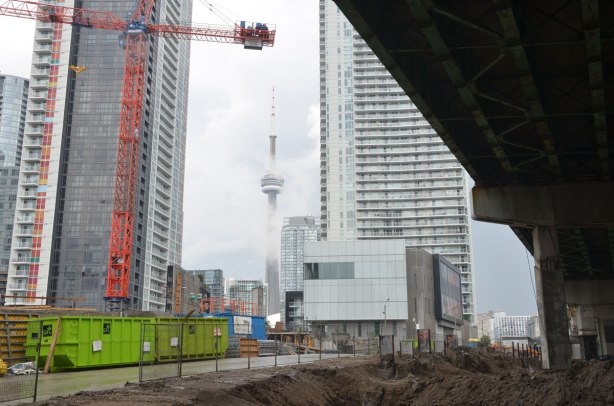
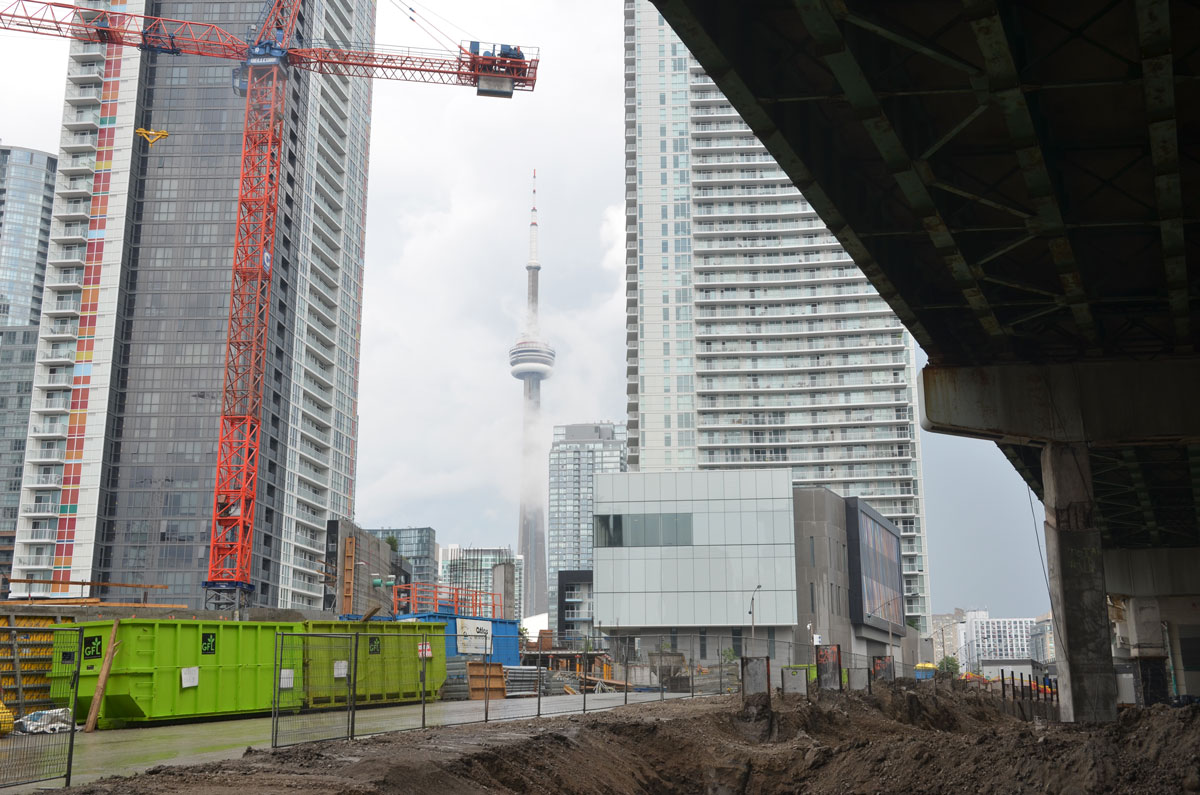
construction site under the Gardiner, cranes and condos being developed on the left, CN tower in the fog in the distance.

Dan Leckie Way is a north-south road that runs under the Gardiner just east of Bathurst.  It is the western boundary of Canoe Landing Park.  This park is north of the Gardiner and the Lakeshore.

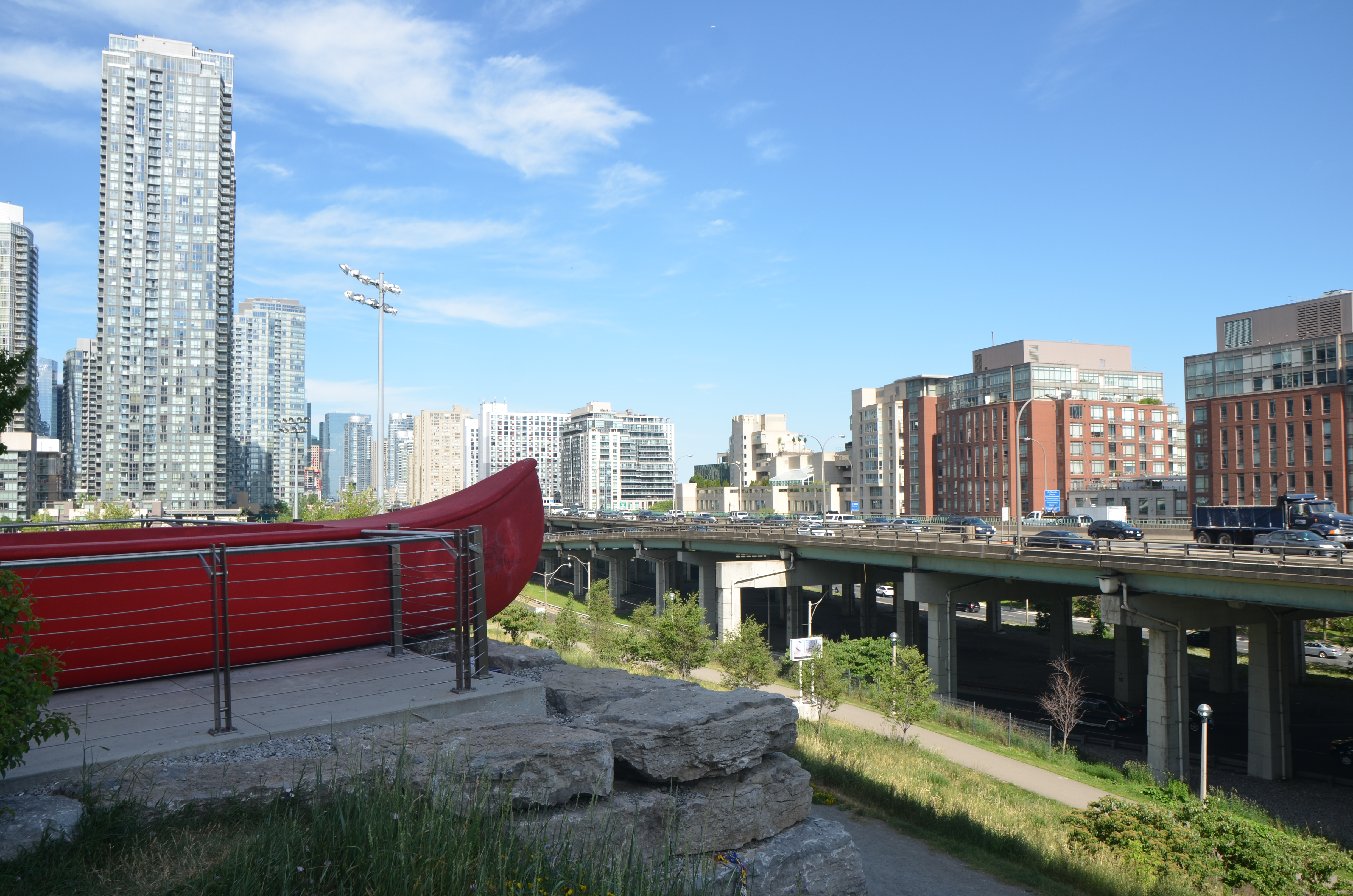
below: ‘Tom Thomson’s Canoe’, by Douglas Coupland sits at the highest point of land in the area; it’s almost at the same level as the Gardiner and is very visible as you drive by.   This park extends down the hill.
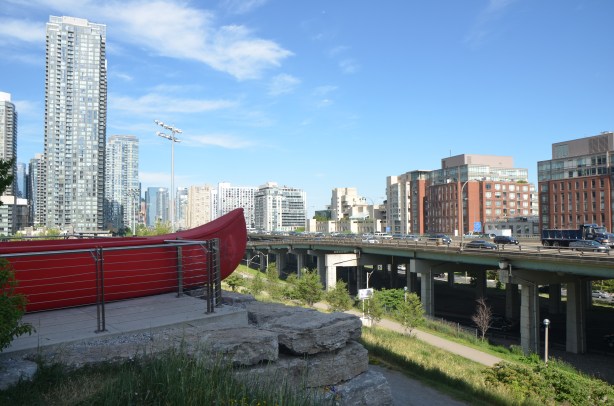
The end of a large red canoe, an artwork by Douglas Coupland called 'Tom Thomson's Canoe' sits in a park, high above the surrounding scenery. Looking southwest towards the elevated Gardiner Expressway and the condo developments south of it.

below: Looking the other way from the same vantage point. The street running under the Gardiner here is Dan Leckie Way . Up until this point the Lakeshore is south of the Gardiner.
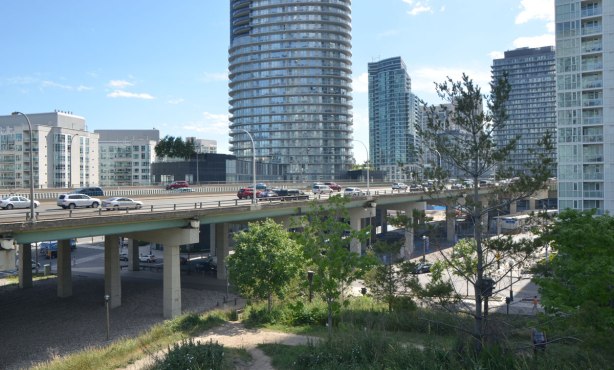
The elevated Gardiner Expressway with traffic is in the middleground, some trees and parkland in the foreground, and condo developments in the background.

At Dan Leckie Way, the Lakeshore is still south of the Gardiner and the space under the expressway is wide open.   By Spadina, one major block east, the situation changes.   The Lakeshore splits and westbound traffic lanes go north of the Gardiner and eastbound lanes stay south.  Shortly after Spadina, the Lakeshore runs under the Gardiner and there is no room for any further development under the road.

below: Standing on Spadina, just south of the Gardiner and looking west.  Here there is a lot of road to cross for pedestrians on Spadina.  Not only has the Lakeshore split to run on either side of the Gardiner, but there are also ramps between the Gardiner and the Lakeshore.
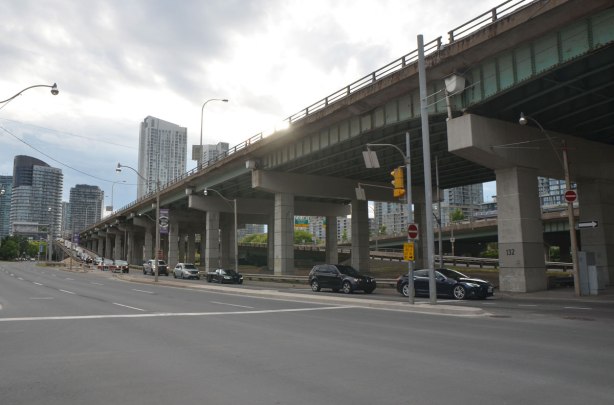
major road with traffic under an elevated expressway in a city, long ramp from the upper level to the lower. Gardiner Expressway and Lakeshore Blvd in Toronto, at Spadina looking west

below:   Still on Spadina, and still looking west, but now under the Gardiner.  The space under the road is not as high as it was previously.  Its lower and darker and not as inviting.   It will be interesting to see what phase 2 of the Bentway development will look like in this space.  I am not sure when it will to be finished but I will keep an eye on it!
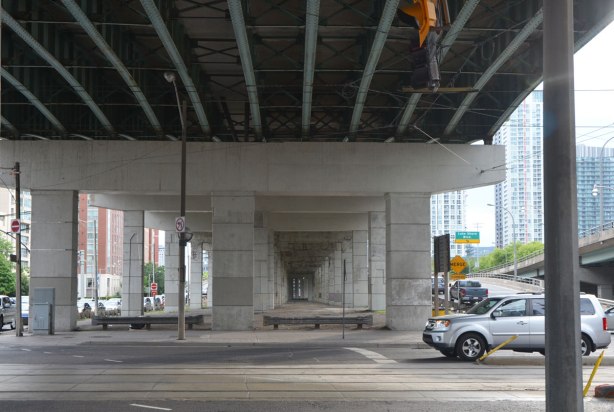
under an elevated section of the Gardiner Expressway, at Spadina.

As for the eastern Gardiner, what does that look like?  Well, that’s a whole other blog post!

 Project: Under Gardiner  On this site you’ll find detailed maps and diagrams of this area as well as information about the plans for the various sections of the space.


This post is subtitled ‘Staying Cool on a Hot Hot Day’.  When the temperatures are into the 90’s (old style) and the humidity makes the air thick, walking streets and alleys is not very comfortable.  Instead I took refuge in air conditioned arty places.  With the help of the (mostly) air conditioned TTC I only needed to take a few steps outside.
below: At one point I walked through an air conditioned building rather than going outside.  This is what I found there. ‘August 6, 1945’ by Matthew Day Jackson.  Moments after I pulled my camera out of my backpack, a security guard appeared.  I was sure that once again I was going to get the “this is private property” talk but instead we ended up discussing the work and how it is displayed.

It is constructed of four panels and it’s very heavy.  The base is made of lead; you can see the lead where Lake Ontario is.  It is attached to the wall with 18 very long bolts and each bolt is wired to an alarm.

map of toronto made of charred wood and lead, meant to resemble the city after an atomic bomb, large, made by Matthew Day Jackson, hanging on a wall behind a metal railing.

below:  Looking a bit more closely at it you can see that it is a map of Toronto.  As you might have surmised,  the title is a reference to the dropping of the atomic bomb on Hiroshima by the USA during WW2.    This isn’t just any map of Toronto, it’s an aerial view of a burnt out city after a nuclear explosion.  It is one in a series of cities given similar treatment, all with the same title.

detail of the islands and downtown area of map of toronto made of charred wood and lead, meant to resemble the city after an atomic bomb, large, made by Matthew Day Jackson

From the effects of man made death to the life enhancing effects of nature….

below: A few steps outside took me past the Gardiner Museum where I noticed that the front garden was redone about a year ago.  ‘Vertical Crevice Garden’ was designed and donated by landscape artist Neil Turnbull.  From the Gardiner museum website, a quote by the artist: “When the massive forces of continental drift push against layers of sedimentary rock, they cause it to crack, break, and rise. Over centuries, through exposure to wind, sun, and the freeze-thaw cycle, the layers split open. These fissures and crevices collect rain, dust, and an array of windblown bits like seeds and spores; plants take root, and life takes hold.”

limestone rocks arranged on a slant in a garden, stripes of red rock and grey rock, all just a few inches off the ground

below: When walking past the Gardiner Museum, one can’t help but notice the striped head.  It’s actually called ‘Untitled’ (why do artists do that?) and it’s by Jun Kaneko, 2002.  It’s made of glazed ceramic and galvanized steel.   Before heading underground at Museum subway station I took a few minutes to try to take a ‘pretty’ picture of the head.  The plants in the garden next door haven’t quite grown up enough to hide that ghastly table that the head sits on.  I have always wondered why the museum chose such a mundane bland platform for the sculpture but now that I look at it again I wonder if it’s possible that the table is actually part of the artwork.  Could it be?

large striped head sculpture on a table, outside, by Jun Kaneko, old building behind it, lavender and other plants growing in front of it.

below:  A photograph in the doorway of a gallery caught my eye.  The picture below is not the one in the doorway, but one that was hanging on a wall inside that I liked even more.  ‘Paris Rooftops 4’ by Michael Wolf.  It is 48″ x 68″ and is a chromogenic print (full-colour silver-based photograph), edition of 9.   To buy it will set you back $22,000 but looking is free – check out more of Michael Wolf’s work on the Bau-Xi gallery website.

picture of a photograph by Michael Wolf of Paris rooftops. Concrete grey with lots of lines of little terra cotta chimneys

below: A man with a camera stares at a painting on a gallery wall.  ‘Watching’ 2010, (26 inches high) by Tom Campbell on the left and ‘Brown Trail #7’ 2016 by Shi Le, a Toronto based landscape artist.  These are at the other Bau-Xi gallery (the non-photography one)

a small sculpture of a man holding a camera is placed in an art gallery such that he seems to be looking at a painting on the wall.

below: Three paintings by NUBARR Gallery, a collection of the works of Armenian-Canadian painter Noubar Sabag (Noubar Sabbaghian) 1920-2006.   These, and others by the same artist, are on show at the Art Square Cafe & Gallery but unfortunately I just learned that today is the last day.

a woman in a floppy black hat is taking pictures of three paintings hanging on a gallery wall.

below:  How many people try to paint pictures like this?  How many people sell such paintings, not to mention have them hang in the Art Galley of Ontario?  But they aren’t Robert Motherwell.      So I ponder on the age old question of what makes a piece of art valuable or collectable?  Is the AGO (and other galleries) collecting paintings or names?  Motherwell painted this in numerous variations – a few changes in colour, a slight change in the lines.  Cheating?  Or brilliant marketing?  One for every gallery of note? This is Motherwell’s ‘Untitled (In Orange with Charcoal Lines)’ c1970.  There’s that “untitled” again, the most popular name for an artwork.

all orange with 3 black lines that form three sides of a square, top line of the square is missing. It's a picture of a painting by Robert Motherwell in an art gallery

My last stop of the afternoon was at the photography exhibit by Thomas Ruff at the AGO.  Part of the exhibit was a few large photographs of stars,  ‘Sterne’.  Large pictures of stars in the night sky were made from negatives that Ruff bought from the European Southern Observatory in Chile in 1989.

below:  They are difficult to look at, or rather it is difficult to what is the picture because the blackness of the photograph creates a mirror when placed behind glass.   This is me taking a picture of the picture – me plus the picture on the opposite wall plus the lights and light fixtures in the ceiling plus a table plus another person in the room plus a few white spots that are stars.

large photograph of the night sky, lots of stars and blackness. The black acts like a mirror and parts of the gallery are reflected in the picture.

below: ‘Walking Away, Walking Through the Universe’ a manipulation of a manipulation.

a reflection of two people walking hand in hand as seen reflected in a photograph of stars in the black night sky

below:  One last photo.  Let’s end this on a positive note and give Thomas Ruff credit for some interesting work.   These two pictures are part of his press++ series where he has taken old photos used in print medium and merged the front (picture) and back (words and markings) of the print into one.

a woman is standing in an art gallery and she is looking at two large pictures on the wall.

Thomas Ruff, Object Relations, at the AGO until 1 August 2016

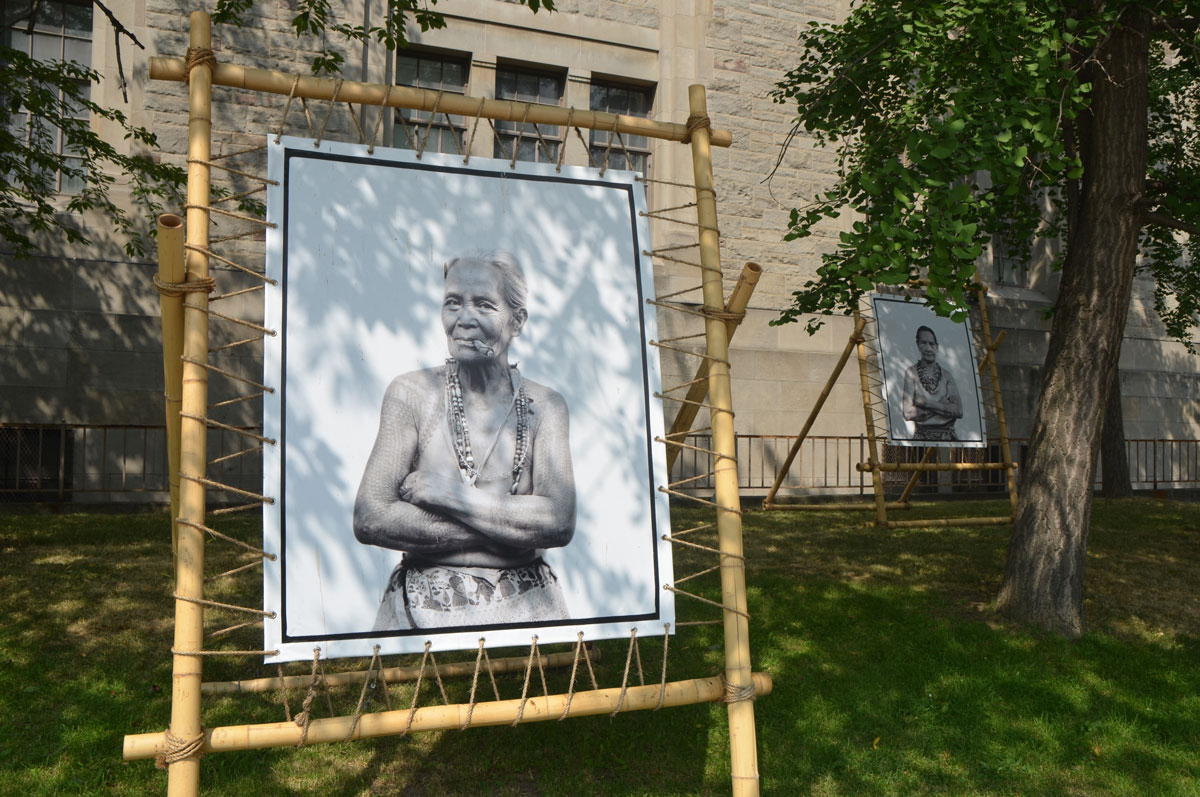
There are seven or eight large photographs, portraits of older women, on University Avenue.   They were actually part of the CONTACT Photography Festival and they have been on display outside the Royal Ontario Museum since early May.  The photos are the ‘The Last Tattooed Women of Kalinga”, portraits by Jake Verzosa.

large black and white photo of an older woman with many tattoos, black and white, displayed outside, another portrait in the background

In the villages of the Cordillera mountains of northern Philippines the women have been tattooed with lace-like patterns for centuries.  The tattoos are symbols of stature, beauty, wealth and fortitude and are traditionally applied during rituals.  The tradition is dying out as standards of beauty change and as the old ways are replaced with more modern methods.

Each village once had their own tattooist, or mambabatok, but today only one remains.  Born in 1918, Whang-od (or Fhang-od), is the last person to practice the centuries old technique called batok.  The ink is made of charcoal and water and it is applied by tapping the skin with a thorn.

two older women with their shoulders tattooed, wearing necklaces and a patterned skirt, seated. Black and white

Once the men were also tattooed.  The Kalinga tattoo has evolved from their ancient tradition as warriors and headhunters.  Heads were taken from fights and battles as a trophy; each time a man brought home a head he would receive another tattoo as a reward.  Tattoos were a mark of social status.

Indigenous groups throughout the Philippines practiced tattooing for centuries.   When the Spanish arrived in the 1500’s they called the people ‘pintados’ or ‘painted people’ as it was not uncommon for people to have tattoos covering their whole body.  While some tribes used tattoos to mark status, other tribes believed that tattoos possessed special spiritual or magical powers which gave the individuals strength and protection.  The use of tattoos as protective symbols is an idea that occurs in many cultures.

large black and white photo of an older woman with many tattoos, black and white, displayed outside, another portrait in the background

In conjunction with the Kalinga portraits, the ROM is featuring an exhibit that examines the beliefs surrounding tattoos, and the role that they and other forms of body art play in different cultures over the years.  “Tattoos: Ritual, Identity, Obsession, Art” is on view until September 5th.  It is a global tour of tattoos past and present.

One of the cultures that is featured is the Chinese.  For centuries, tattoos were forbidden, or at least taboo, in China.  To be tattooed was to be discriminated against as they were associated with prisoners or vagrants.  Recently that has begun to change.

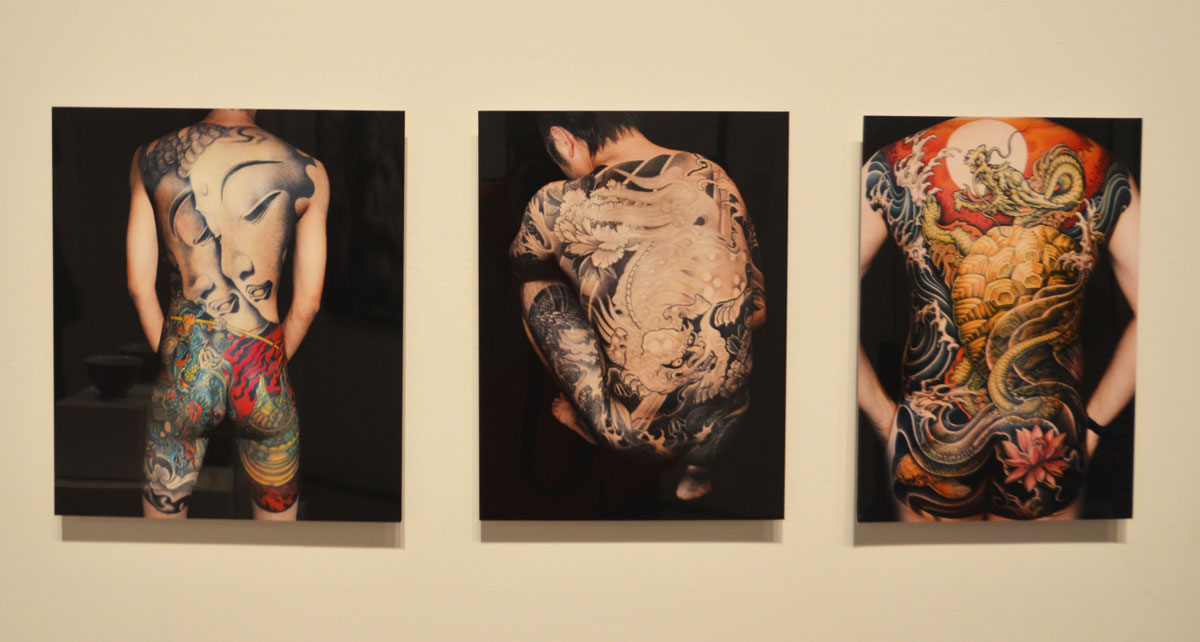
below: Three large modern picture tattoos by Taiwanese tattoo artist Gao Bin featuring traditional Chinese images, Buddha, lion and dragon.  Tattoos as a cultural expression.  In some countries such as Sri Lanka and Thailand images of Buddha are considered sacred objects of worship.  While it’s not illegal to have such a tattoo, wearing one could get you into trouble.

Three pictures of the backsides of men, each with a large picture tattoo from neck to thigh. Chinese art pictures as tattoos

below:  Here is another example of why people get the tattoos that they do.  This is a picture of one photograph in a series by Isabel Munoz.  Munoz spent three weeks inside several prisons in El Salvador and photographed mara gangs.  Gang members wear offensive tattoos to assert their antisocial behaviour and express their loyalty to the gangs.  Tattoos as statement; tattoos as a mark of membership and belonging.  Tribal.

photo of a picture in a museum of a man's face that has been tattooed with gang symbols and words,

below: A silicone arm with a tattoo by Montreal artist Yann Black on display.  This is one of 13 commissioned tattoos on silicone body parts – arms, legs and torsos both male and female that are part of the exhibit.   Tattoos as artwork.  Individuality.

a silicone arm has been tattooed with a design that looks something like a cross between Frank Lloyd Wright and Mondrian. It is in a glass showcase in a museum.

The oldest known tattoos were found on Otzi the Iceman, a natural mummy who was found in the Otzal alps near the Austria – Italy border in 1991.  His tattoos were 61 lines ranging in length between 7 and 40 mm.  The lines were arranged in groups.  Most of his tattoos were on his legs where there were 12 groups of lines.  Otzi is estimated to have died between 3239 BC and 3105 BC.

Tattooed mummies have also been found in other places – Greenland, Alaska, Siberia, Mongolia, western China, Egypt, Sudan, the Philippines, and the Andes in South America.  We will probably never know what significance the tattoos had.  Theories abound of course and they often involve reasons like protection, spiritual, status, tribal, or just for decoration.  Reasons that probably ring true today too.  The methods have changed and some of the images have changed, but human nature remains just that, human nature.