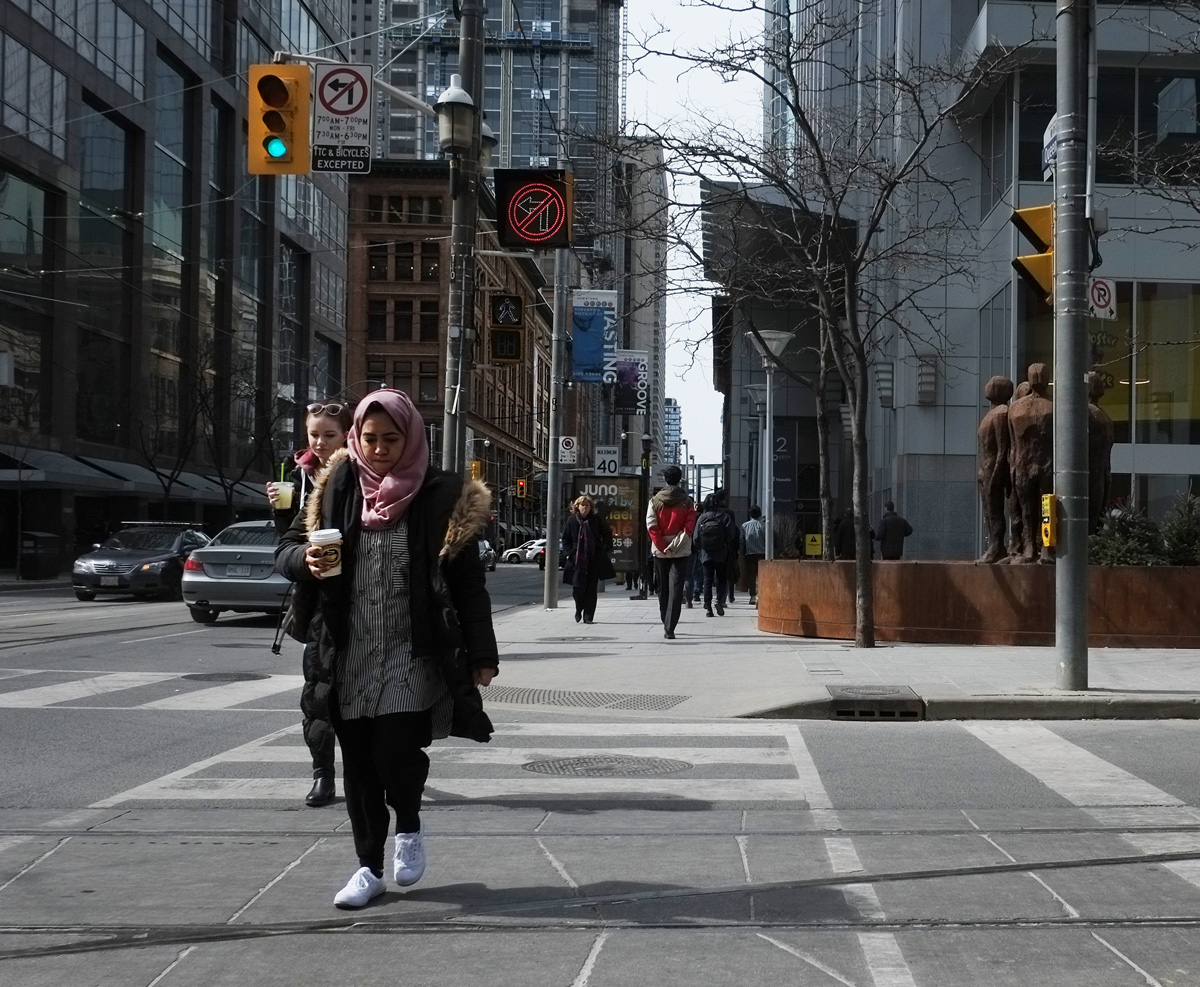
two women holding cups of coffee walk across Victoria St. on Queen Street East

Just after I wrote the previous blog post about some of the buildings on Yonge Street that are in the middle of an area being redeveloped, I walked across Queen Street East.  I noticed that there were a lot of similar three storey buildings here to those around the corner on Yonge.  Toronto must have been a booming city in the late 1800’s and early 1900’s when these stores and warehouses were built.

below: What I also noticed is how many of the storefronts are empty.   This is the northeast corner of Queen and Mutual.

the northeast corner of Queen street east and Mutual street, with an empty building on the corner.

What I don’t have is a photo of the northwest corner – it is about to be developed, or at least there is a plan to develop it, into a 29 storey glass tower.   Urban Toronto called this location, “a spot that currently feels disconnected from the rest of the City. ”  … maybe because the Moss Park neighbourhood is on the lower part of the socioeconomic spectrum?    Urban Toronto is a website that is, their words, “populated by the tastemakers, condo aficionados, buyers, builders and realtors”.   I try to stay neutral in the pro/con condo development argument but it irks me to read things like, “Redefining the urban experience” and variations thereof over and over and over again to describe mediocrity.

To be fair, this 88 Queen West project is redeveloping a parking lot.  Why is it a parking lot?  Because in the 1950’s a parking lot was more important that the buildings, including Cooke’s Presbyterian Church (1857), that originally stood there.   Perhaps we get what we deserve.


below: Richard Bigley (1853-1933) started off as a woodworker but soon switched to selling stoves. He sold the ‘Happy Thought’ line of stoves. He holds two US patents, one for a water heater and one for a sectional water heater. The building was converted into loft apartments, one loft per floor, back in the late 1990’s.
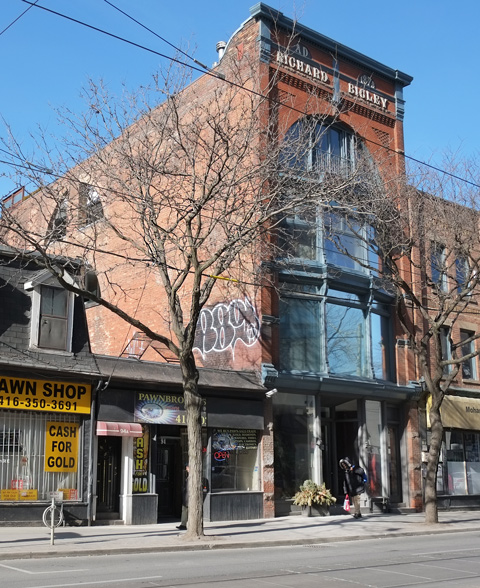
tall brick building, Richard Bigley 1876 written in white at the top (4 storeys), large glass windows in front, once an old store and warehouse, now a 3 loft apartments. 98 Queen Street East

below: Two views at the corner of Queen East and Jarvis.  You can just see the Moss Park Armoury building on the right side of this picture.  This Canadian Forces facility was built in 1960’s and it takes up a large chunk of land.  Development  rising in the north…

Queen and Jarvis intersection looking north to tall towers being built on Dundas
below: … and development rising in the west.

the intersection of Queen and Jarvis, looking northwest, with a foodora cyclist in pink in the intersection, traffic, street car, and in the distance, development on Yonge and westward, cranes, glass towers

large blue public parking sign, also a large box shaped sign on a tall pole. The sign is wearing out

below: At Ontario Street, the street sign says, Old Town Toronto.  In 1797 the city limits were moved north to Queen Street (then called Lot Street).  Ontario Street was one of the most easterly streets at that time.   And, oh yes, the city was still York.  It officially became Toronto in 1834.

toronto street sign for Ontario Street with the top part that says Old Town Toronto

below: Posters on a boarded up window – once it was a barber shop?  Posters on Queen East for events on Queen West.

posters on an empty building, exterior wall, bottom of wall has barber pole stripes painted on it.

below: A blue and white Development Notice. I still haven’t found out how many of these there are hanging around the city.  My best guess is ‘hundreds’.

blue and white city of toronto development notice sign on a chainlink fence in front of a vacant lot wehre cars and trucks are parked. For 245 to 285 Queen Street East, Bridgen Place and Richond.

At the risk of another anti-development rant, I just want to say a couple of things about the above photo.  The development here involves the closure of two public lanes, McFarrens Lane and Brigden Place.  There will be pedestrian access (public access on private land) between Queen and Richmond, between two large buildings with three towers built above them – 39, 39, and 49 storeys high.

From a City of Toronto report written in April 2016…”City Planning staff is not in support of the proposal in its current form, as the proposal not only represent over development, but also fails to recognize the existing built-form character and scale of the King-Parliament Secondary Plan Area by departing from the existing warehouse and main street typology where the site is located.”

I am not sure what the status of the project is at the moment, but the developer has a website for this project, Queen & Sherbourne, that describes it exactly as the original proposal – Three glass towers on two boring bland base buildings. It’s yet another development that looks flashy from above but is blah ick at street level.

below: The northwest corner of Queen and Sherbourne
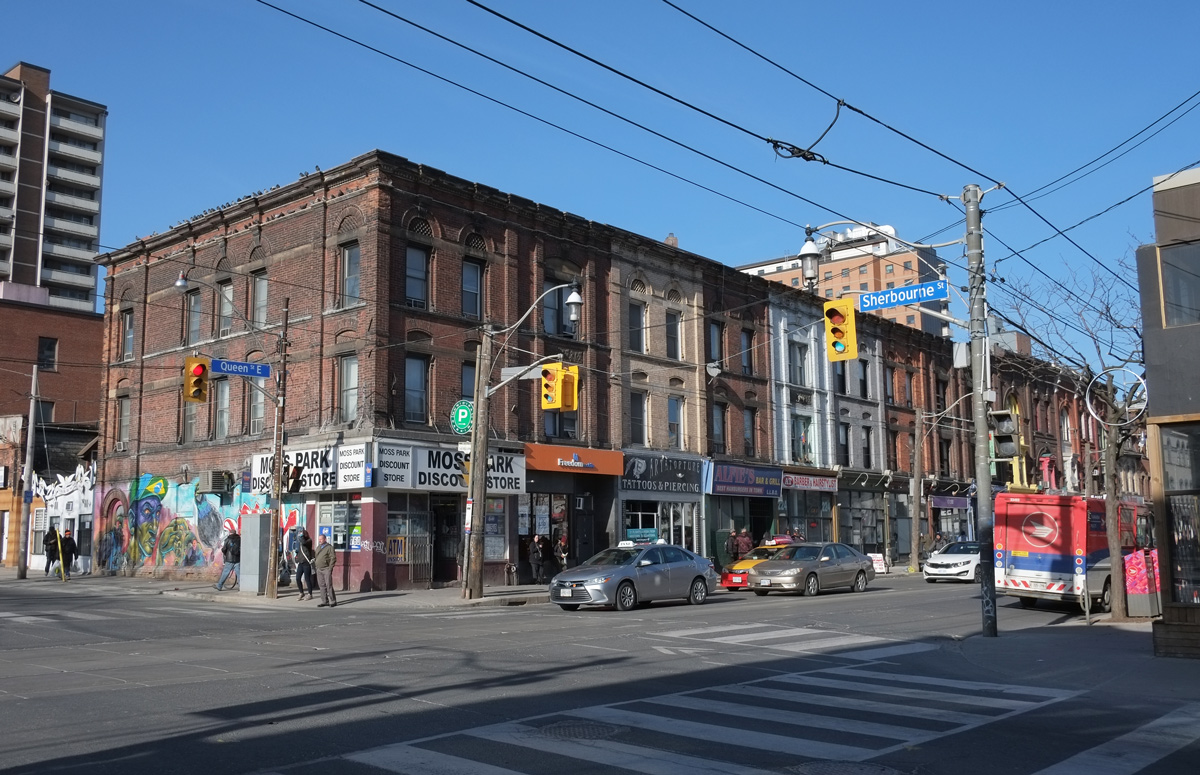
northwest corner of Queen and Sherbourne, Moss Park variety store on the corner, three storey brick Victorian buildings, cars, people,
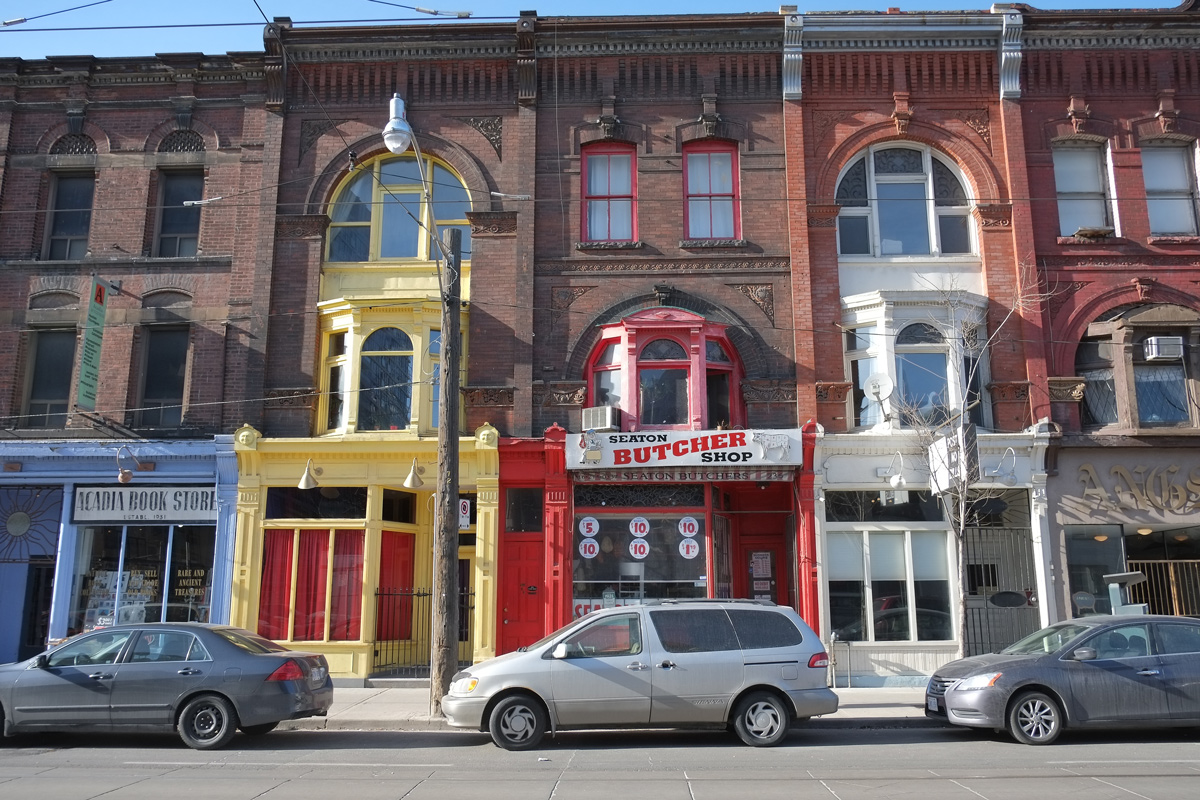
below: Bright and cheerful.

three storey victorian buildings includia Acadia Book Store, established 1931 and Seaton Butcher

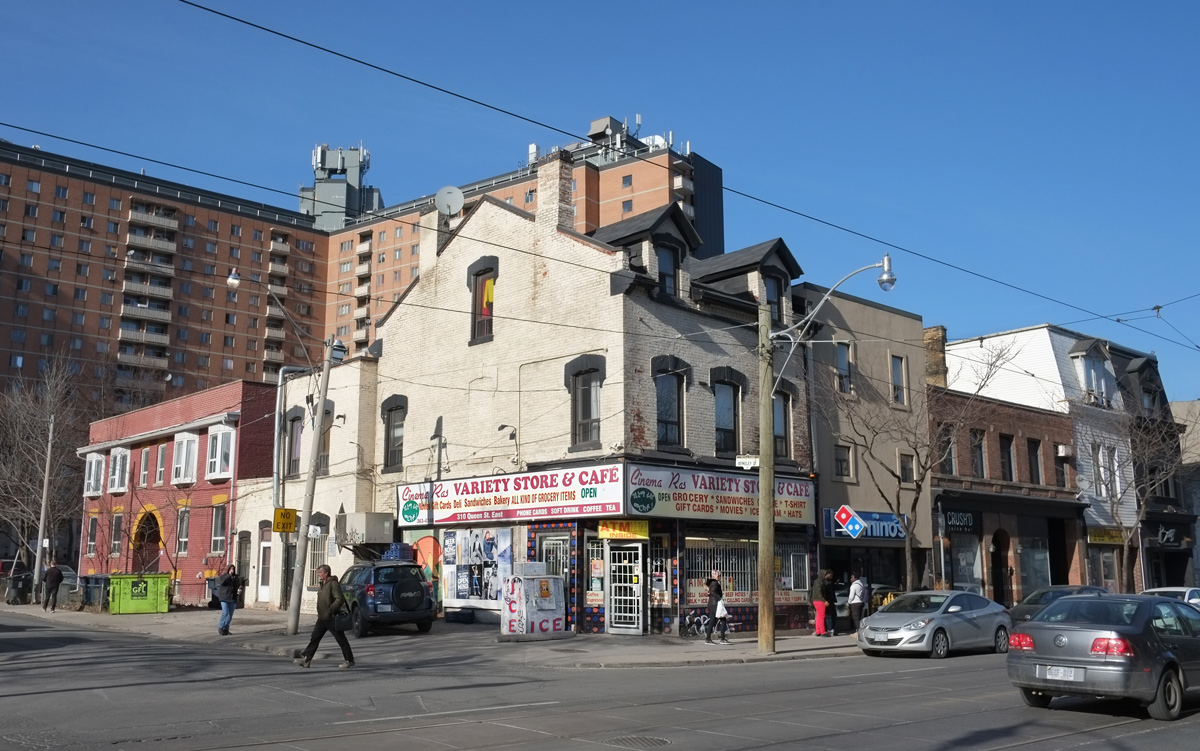
below: 310 Queen East at the corner of Queen and Berkeley.
below: Moving slightly east to the corner of Queen and Parliament (NE).  That looks like a solid old bank building on the corner.

northeast corner of queen and parliament, old brick buildings,

flat roofed old brick buildings, with oriel windows on third floor, Ray's Discount Convenience and Supermarket on the ground floor. A bus shelter on the sidewalk, people waiting for the bus, building painted rust red colour,

below: 354 and 356 Queen Street East

two narrow three storey buildings squished in between two slightly larger buildings. On the ground floor of the building on the left is Redline Coffee and Espresso while Ryans Restaurant is on the right.

below: 380, 382, and 384 Queen Street West.

two storey store fronts on queen street east, 380 Queen, 382 Queen and 384 queen.

below:  Wherever you walk there is construction.  Some of it good, some of it poor.  That’s Toronto these days.
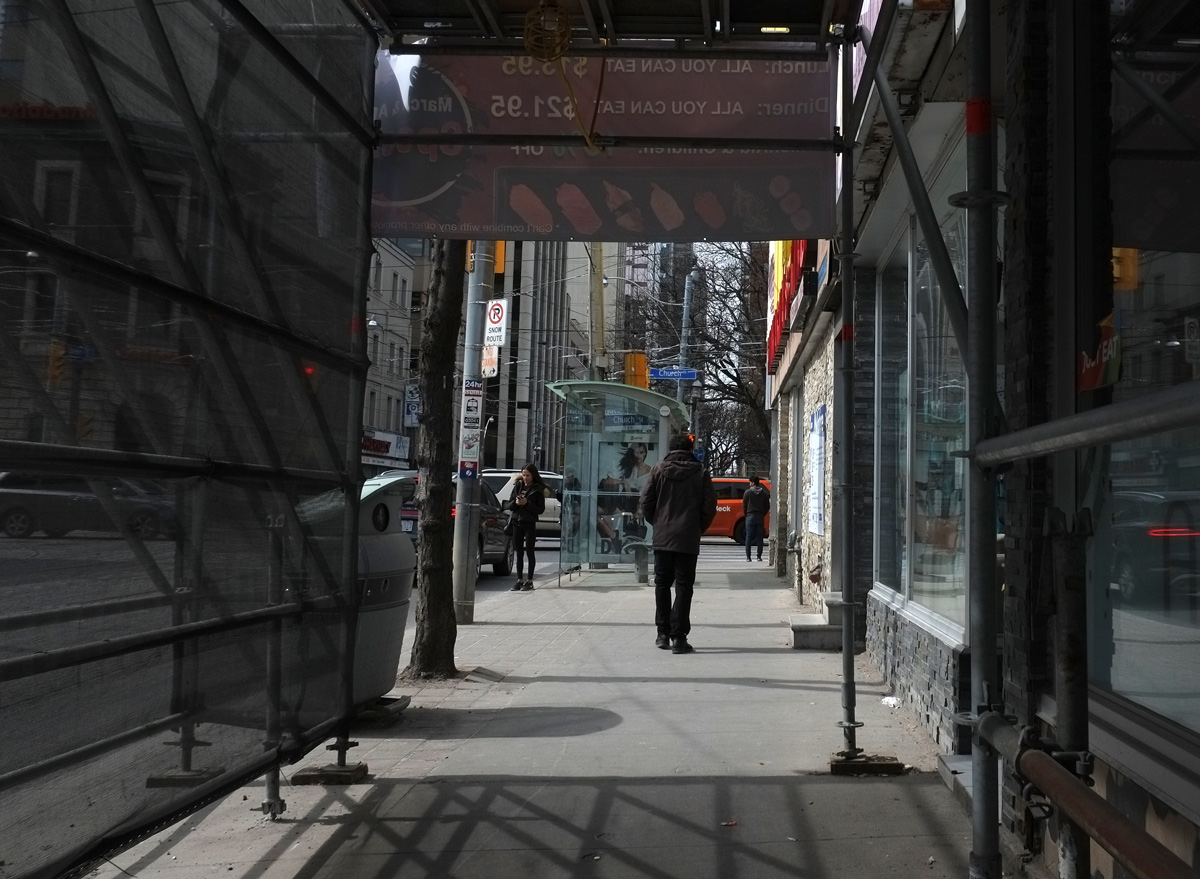
a man walks through a covered sidewalk, past a construction site and towards a bus shelter

The other day I discovered that there is a small gallery on the 3rd floor of Ryerson’s School of Image Arts.  If you want to find it too, it’s in a building that it’s in is attached at the ground floor level to the Ryerson Image Centre on Gould Street.   At the moment, there is a small exhibit of photos by Avard Woolaver.
the back of a man looking at a wall in a gallery, old photos of Toronto

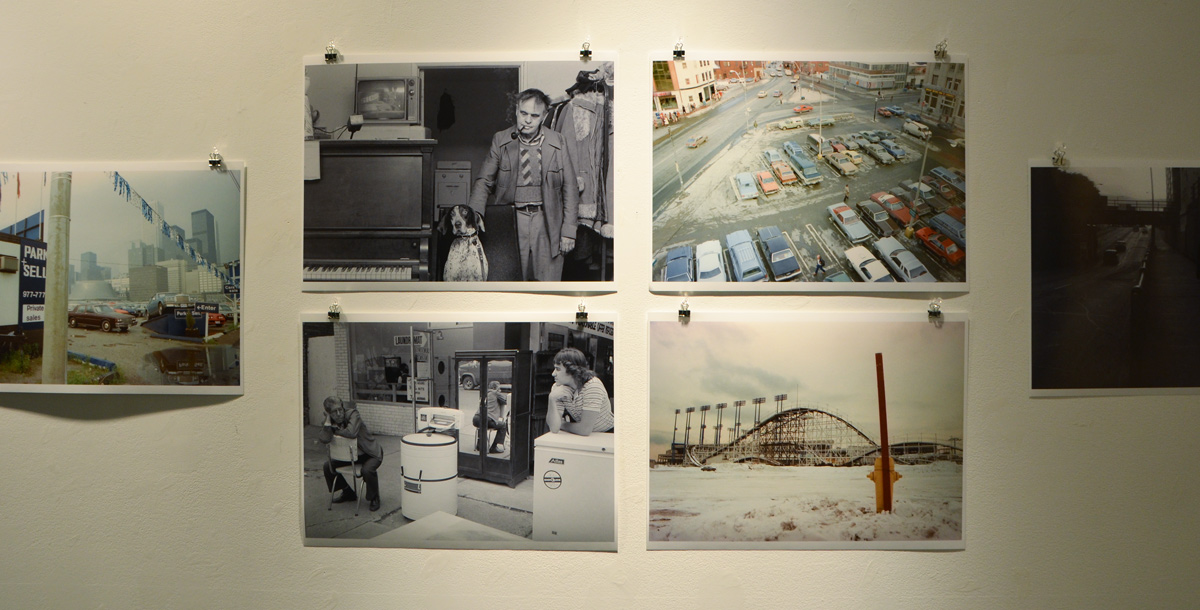
below:  The photos are ones that Woolaver took in Toronto in the late 70s and early 80s.

old photos of Toronto from the 1980s by Avard Woolaver.

below: This photo is one of Woolaver’s – it is looking towards the northwest corner of Spadina and Queen Street West.  For those of us who lived in Toronto at the time, it’s a bit of nostalgia.  Somethings are very familiar – the older TTC buses, the car styles, and a lot of the architecture, for example.   This photo in particular lends itself nicely to the game of ‘Spot the Differences’….. compare this with

photo by Avard Woolaver of Toronto in the 1980s, this view is the north west corner of Queen and Spadina

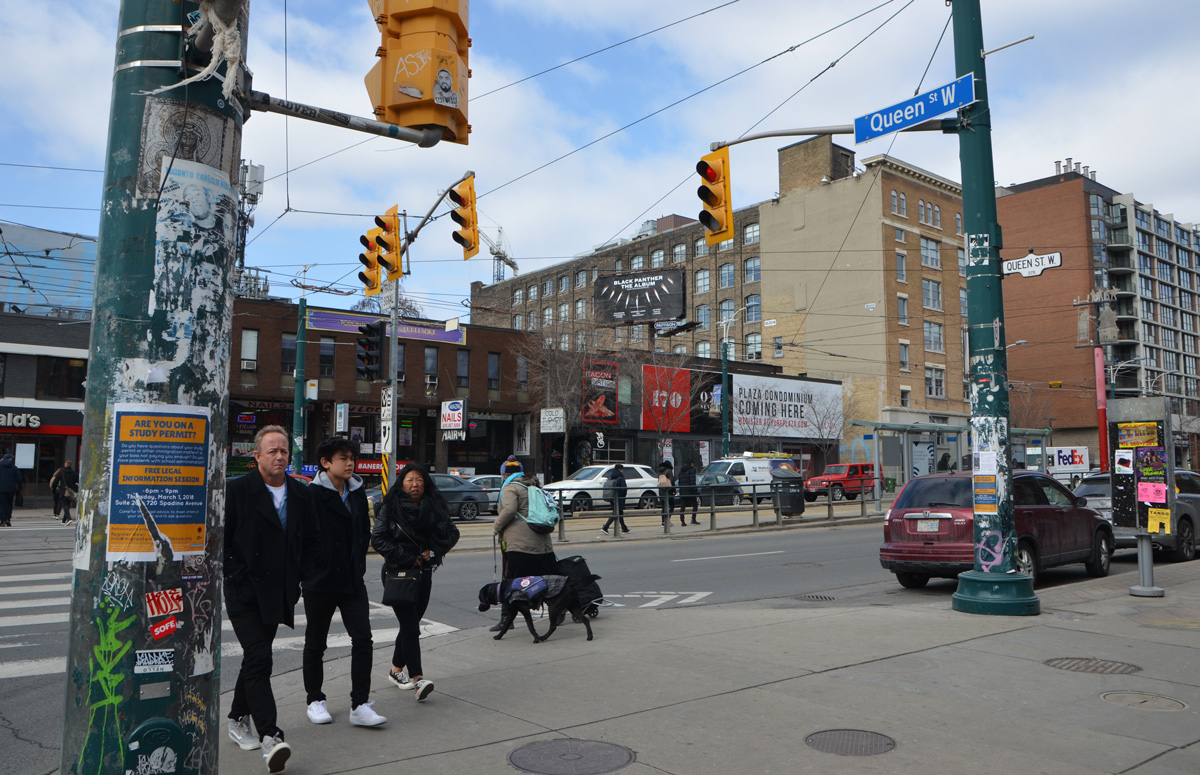
below: …..this. Here is the same intersection, at a similar angle, last week.   The large brick building is still there but without a billboard.   The poles are no longer wood but they are covered in posters and remnants of posters – so no change there.    The street signs have been updated and there is now a streetcar lane in the middle.   All in all, I was surprised how little had actually changed in 30ish years.

the northwest corner of Queen and Spadina in 2018, pedestrians, buildings, street scene

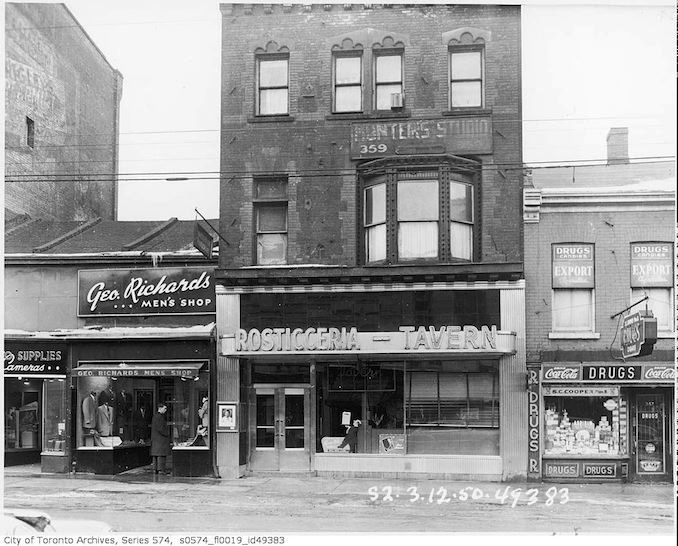
below: I found this photo online (originally from the Toronto City Archives, 1950?) but before we can play another round of ‘Spot the Differences’, we have to identify these buildings?  Any ideas?

vintage photo of 357, 359, and 361 Yonge street, black and white, 3 storefronts,

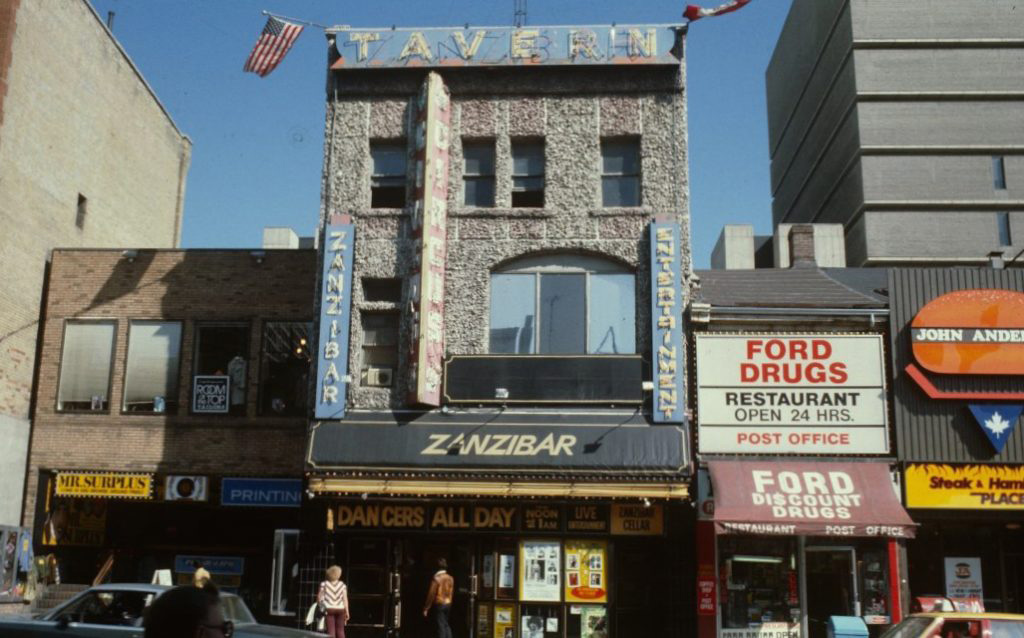
below: Here is the same location in the 1980’s (not a photo from the exhibit).  Not too many changes.   The building that housed George Richards Men’s shop, 361 Yonge Street, was replaced by a dull and boring two storey brick building but the other changes were just to the facades and the owners/tenants.   The tavern is still a tavern and the drug store is still a drug store.  The large brown building on the top right that you can only see part of is Ryerson College.   Unfortunately the Wrigleys ghost sign on the taller building on the left has been covered.

357, 359, and 361 Yonge street in the 1980s including the Zanzibar tavern

photo source BuzzBuzzNews online

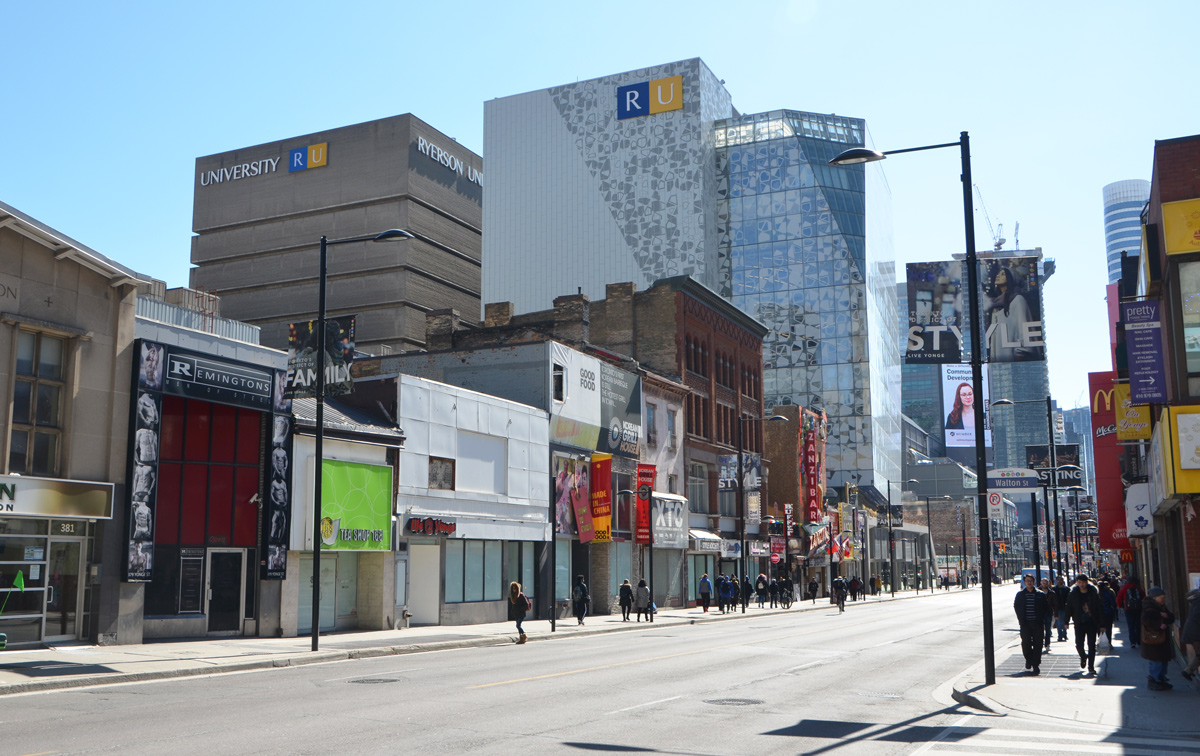
below: Fast forward another 30 years.  The Zanzibar is all bright lights and dazzle while the building that housed the drug store is now for sale.  Ryerson is now a University and has expanded out to Yonge Street – that’s the large blue building in case you are not familiar with the area.

Yonge stree, easy side, just north of Dundas, about 357, 359 and 361 Yonge Street including the Zanzibar Tavern. The blue glass wall of Ryerson University behind the Zanzibar,

below: If you pull back a bit, and look just a bit farther north on that stretch of Yonge Street, you’ll see that there are many empty buildings

yonge street, between gerrard and dundas, most storefronts are closed and boarded up waiting for redevelopment of that stretch

below: … including what was until recently the XTC clothing company.  It looks like it has gone through a number of ‘renovations’, not all of which were good.  Some traces of its original brick facade can be seen at the top but at street level it is (was?) a mess.

empty two storey building, once was X T C clothing store

 There is a plan to build a 98 storey mixed-use building on this site including just over 900 residential units ranging in size from 520 to 2000 square feet.    It will be the tallest residential building in Canada.   In the promotional material for YSL Residences, as they will be called, is this: “The epitome of luxury living, designed to elevate the fortunate few who will call it home.”


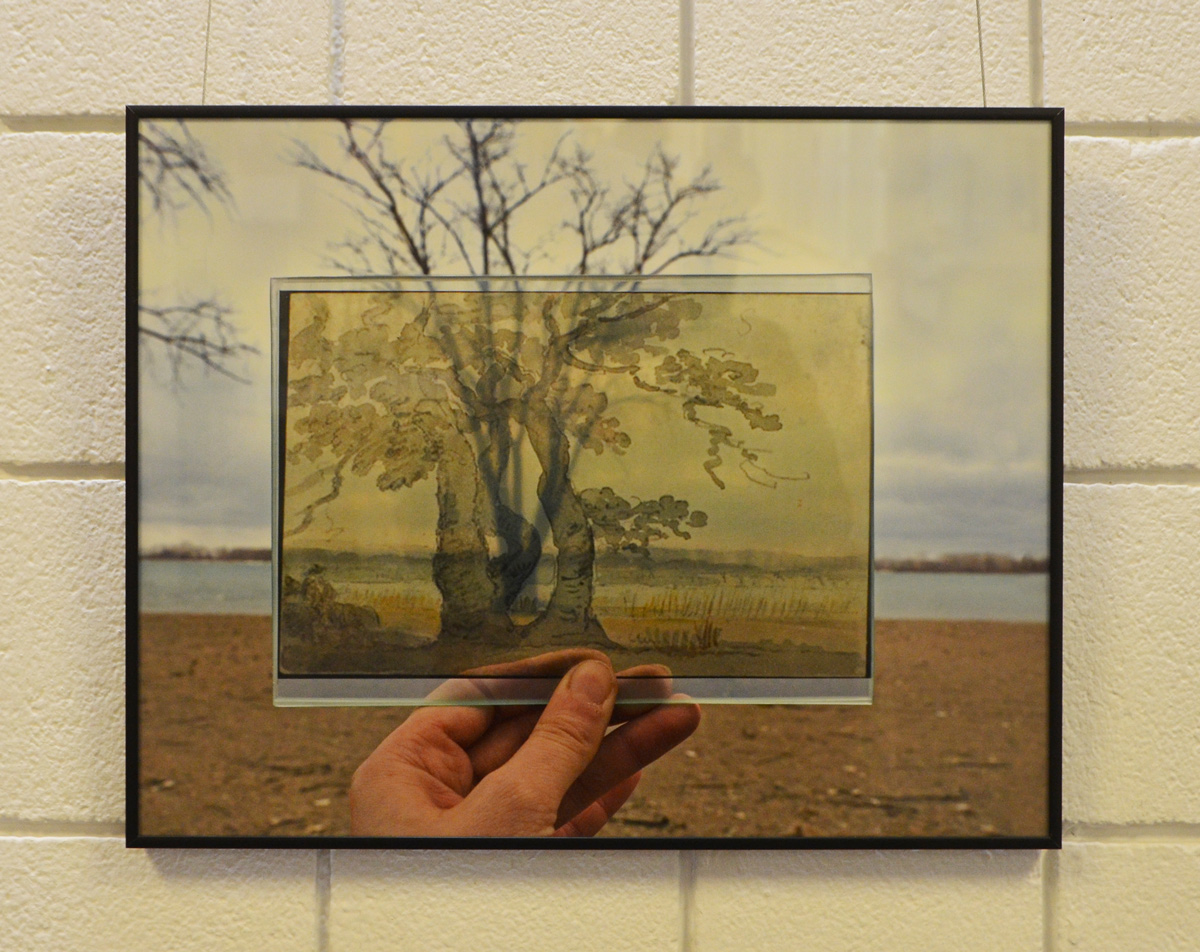
below:  Back to Ryerson, also on the 3rd floor of the School of Image Arts, there was a small series of photographs like this one hanging on the wall in the hallway.  There was no sign as to the name of the artist that I could find either on the wall or online.   I quite like the technique and the resulting image.  Two ideas melded into one.  Two time frames in one frame.  Two artistic styles combined to create another.

a photograph on a gallery wall, a hand holding a photo printed on glass in the middle of another photo, superimposed landscapes

If you are interested in Woolaver’s work, you can find more on his blog.

There are a few exhibits showing at the Ryerson Image Centre at the moment but the one that I want to highlight today is “Rich and Poor” by Jim Goldberg.  Goldberg took portraits of people in the San Francisco area in their home environments between 1977 and 1985.  They are divided into two sections, “rich” and “poor”.

Ryerson Image Centre (RIC) gallery, Jim Goldberg portraits "Rich and Poor' exhibition of black and white portraits in San Francisco in the 1980s

below: Each portrait is accompanied by a comment from the person being portrayed, in their own handwriting.  This woman, Nell, provides the wonderful quote: “If you want to stunt your growth, be rich.”

Ryerson Image Centre (RIC) gallery, Jim Goldberg portraits "Rich and Poor' exhibition of black and white portraits in San Francisco in the 1980s

below: The pictures are fascinating, and the words reveal more details of the subjects.  “My wife is acceptable”.   The poor woman.  In the picture she is off to the side and almost disappears into the background as she looks at the floor.   I thought of the words ‘abject’ and ‘woeful’ when I first saw her but I think that maybe the best word to describe the look on her face is ‘blank’.

Ryerson Image Centre (RIC) gallery, Jim Goldberg portraits "Rich and Poor' exhibition of black and white portraits in San Francisco in the 1980s

below: Whether you’re rich or poor, or more likely some where in between, what you say about yourself if you were the subject?

Ryerson Image Centre (RIC) gallery, Jim Goldberg portraits "Rich and Poor' exhibition of black and white portraits in San Francisco in the 1980s

This show continues until April 8th

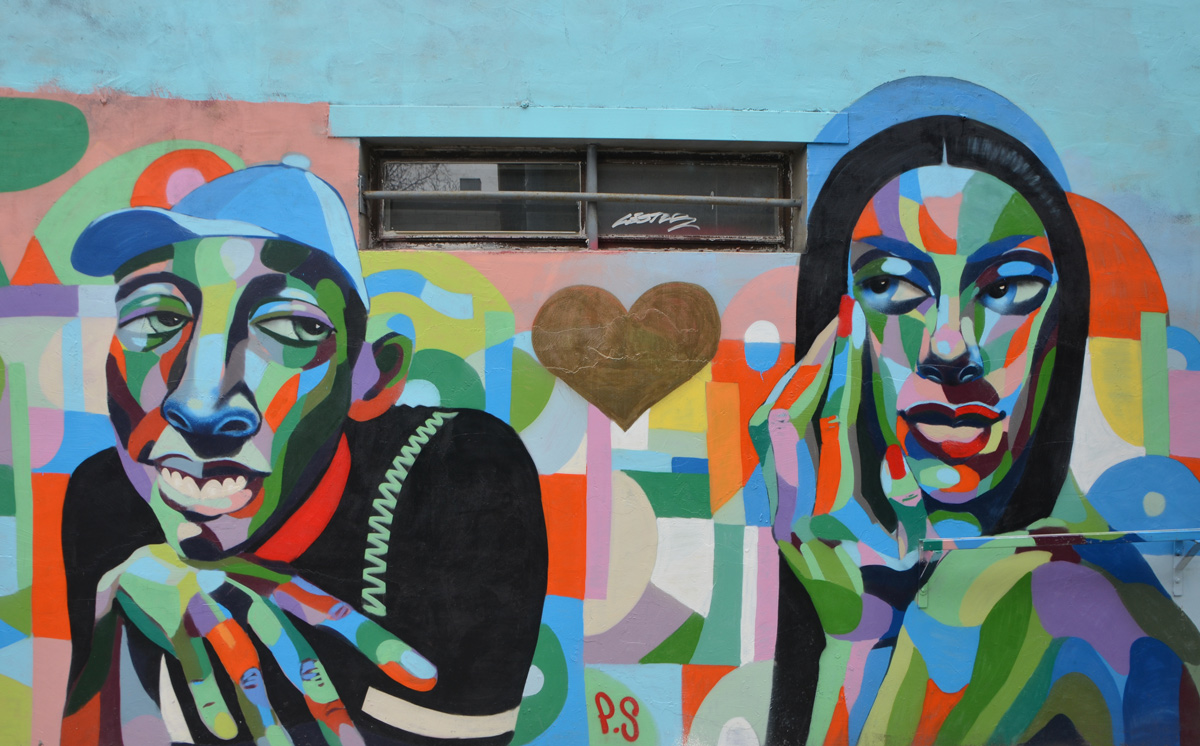
As you walk down Augusta Ave., you may spot this familiar face:

mural of a head and shoulder of a young man, by P.S., in an alley

It, like all the others in this blog post, is signed P.S (& this is the signature of Phillip Saunders). The background in the one above looks very much like the work of J. Chiale.

below: A very red face and the traces of a moustache.

mural of a head and shoulder of a young man, by P.S., in an alley, very red face

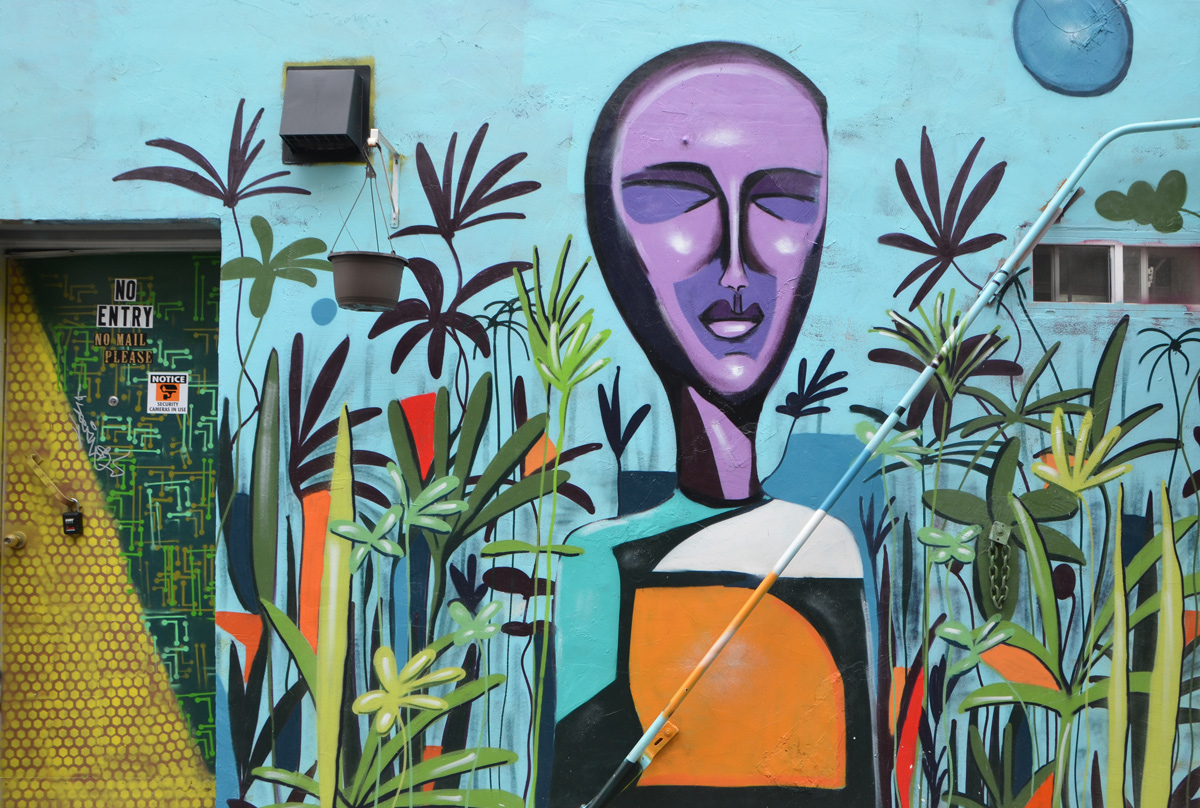
below: More stylized and almost abstract, very purple too.   The door with its circuit board and honeycomb patterns says no entry.

mural of a head and shoulder of a young man, by P.S., in an alley, purple face, beside a door that has street art on it too

below: A couple at the end of the alley.   Love is golden.

Twice this week I have come off the subway at Dundas station, and twice I have come to the surface to the sound of protest chants.

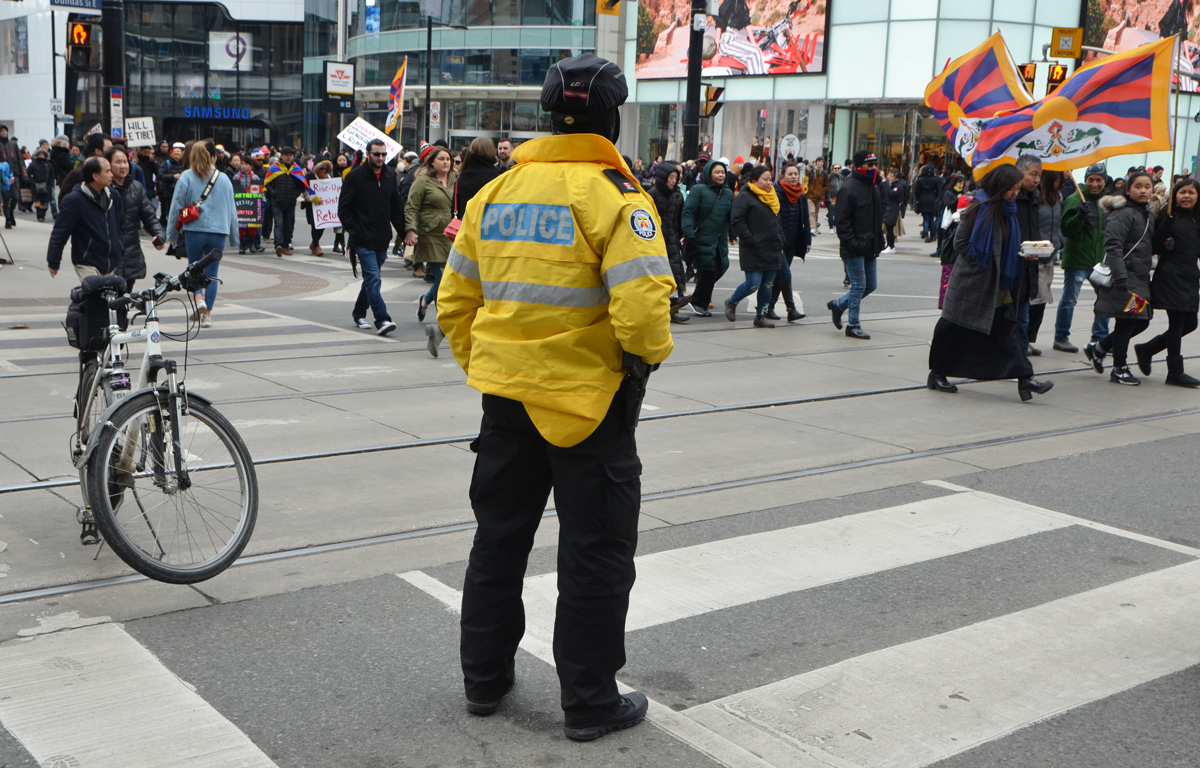
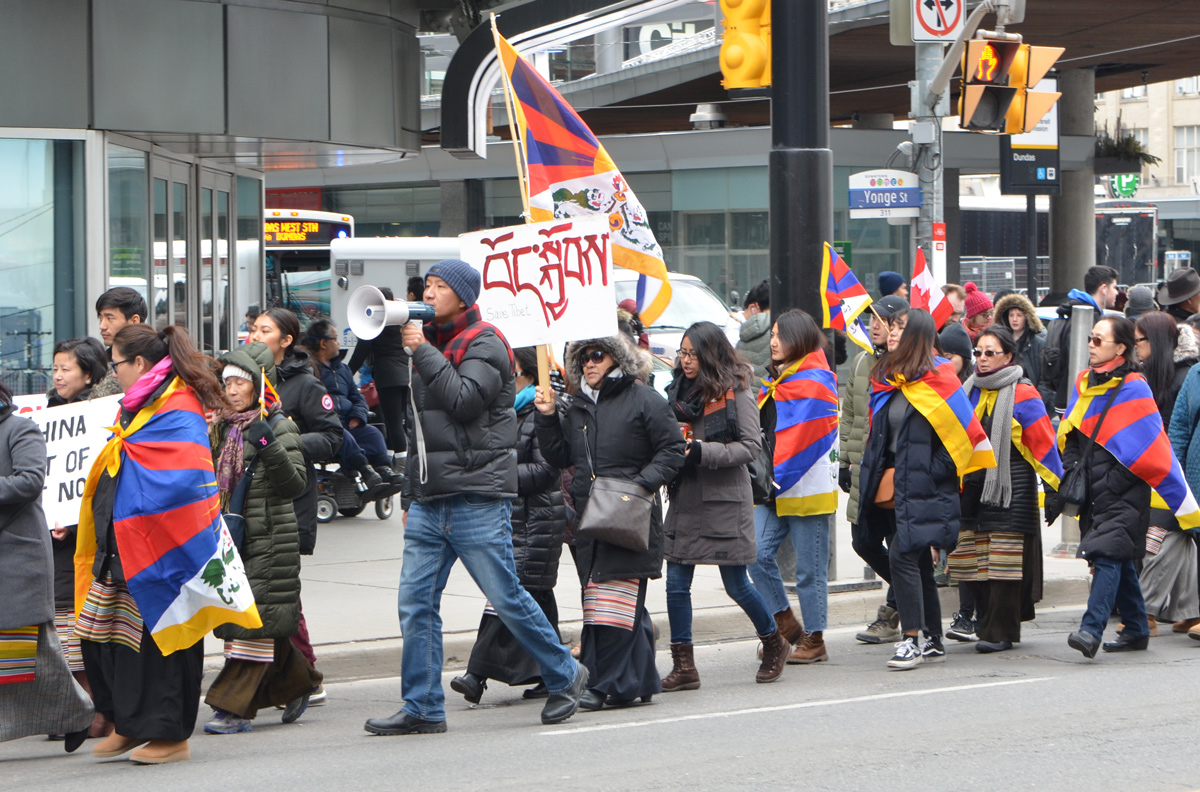
The first time it was a Free Tibet march as it proceeded up Yonge street.

a police man, with back tothe camera, stands in the middle of the street to block traffic as a Free Tibet march passes by on Yonge Street, protesters with flags and signs,

below: “Don’t forget Mr. Lingsta Tseten Dorjee, activist for non-violence.  It’s been 5 years since we lost Lingsta Tseten Dorjee”.   The banner then goes on to list Dorjee’s five demands including the return of the Dalai Lama to Tibet.

a group of young men marching in a protest, Free tibet. carrying a banner with a lot of words in both Tibetan and English, one is wrapped in a Tibetan flag, some are wearing free tibet hats,

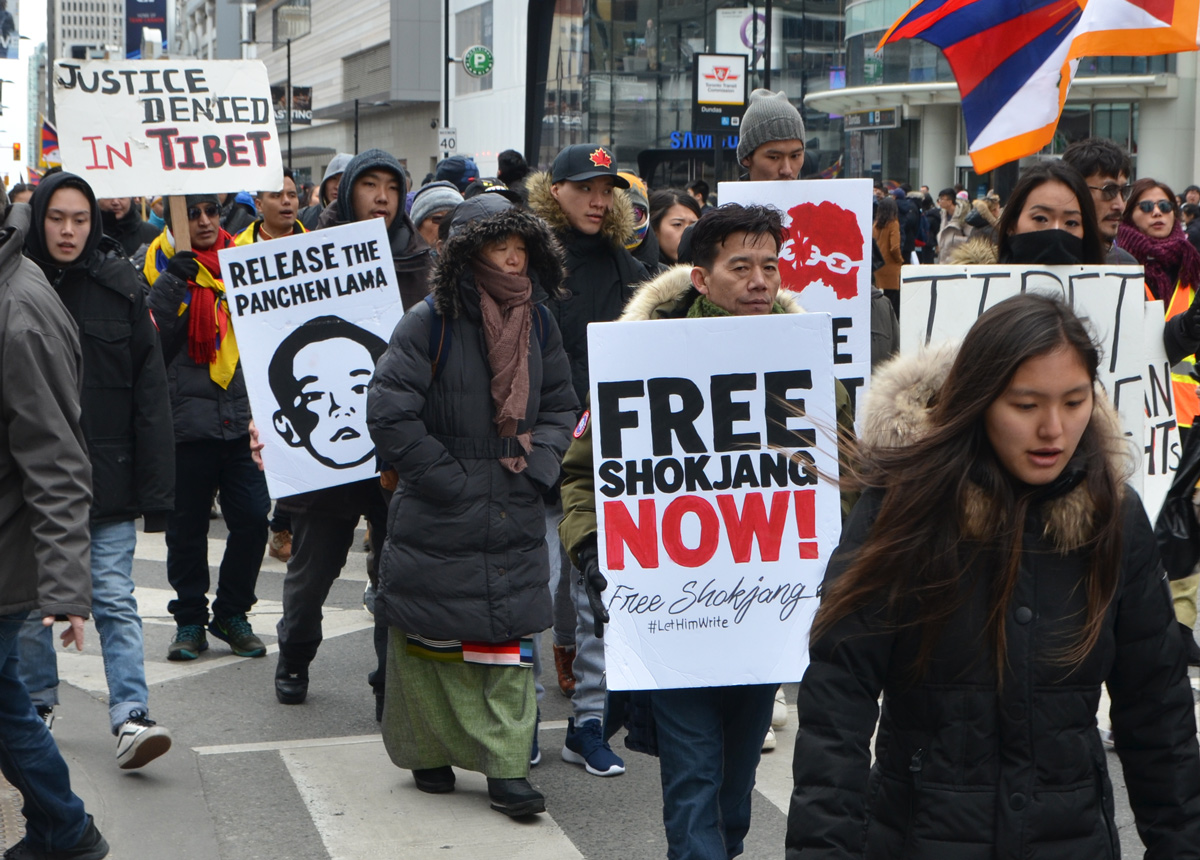
below: More protesters with signs and placards. “Free Shokjang now”.  Shokjang is the pen name of a Tibetan blogger who was detained by the Chinese authorities in March of 2015.

people carrying protest signs, free Shokjang now, release the panchen lama

protesters walk up Yonge Street with Tibetan flag and signs, one man has a megaphone

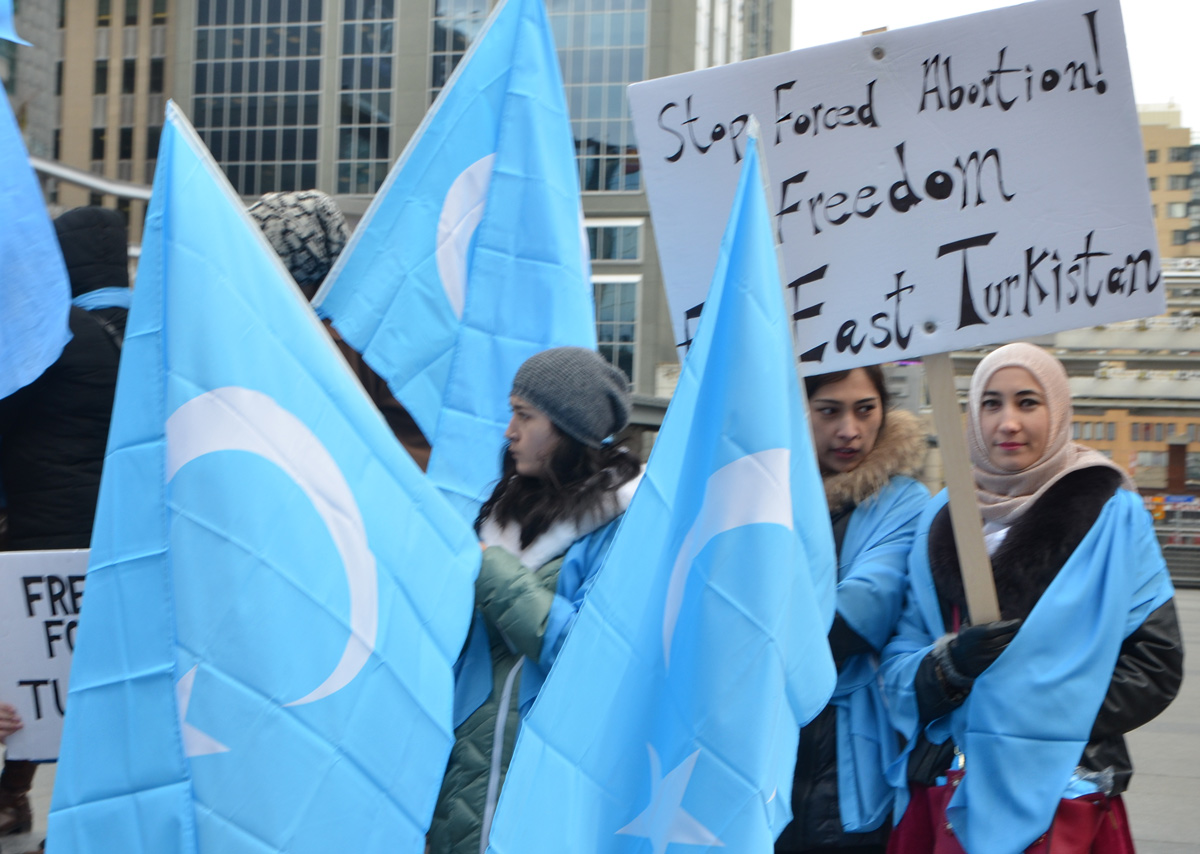
This afternoon, it was blue flags that I saw.  They are the flags of East Turkistan, also known as the Xinjiang Uyghur Autonomous Region of China.  On a map you’ll find it as Xinjiang in the most westerly part of China, right next the the “stans” that became independent after the break up of the USSR (Kyrgyzstan, Tajikistan, etc).   The name says autonomous but there is no self-rule or self government for the Uyghurs. 

For a brief time in 1949 it was an independent country but it was invaded by communist China that same year.   Historically, East Turkistan is part of central Asia.  The people are not Chinese but are more closely related to the Turks.  The Uyghurs are the indigenous group of East Turkestan.

below: “Stop forced abortion, Freedom for East Turkistan”

women holding the blue and white flag of East Turkestan, also a sign that says stopped forced abortion in East Turkistan, wearing head scarves

below: “Islamic scholar Mohammed Salih killed in Chinese concentration camps.  We want justice.” Muhammad Salih Hajim, 82, died in custody back in January, about 40 days after he, his daughter and other relatives were detained in Urumqi, the capital of Xinjiang province.    They were held without charges being laid.   He was the first to translate the Quran into Uyghur.

a black man with a suitcase has stopped to talk to people protesting for a free East Turkistan, he is pointing to one of the signs and a man is explaining something to him

at a protest for free East Turkestan, protesters hold a banner that says China, Stop Massacre of Uyghars

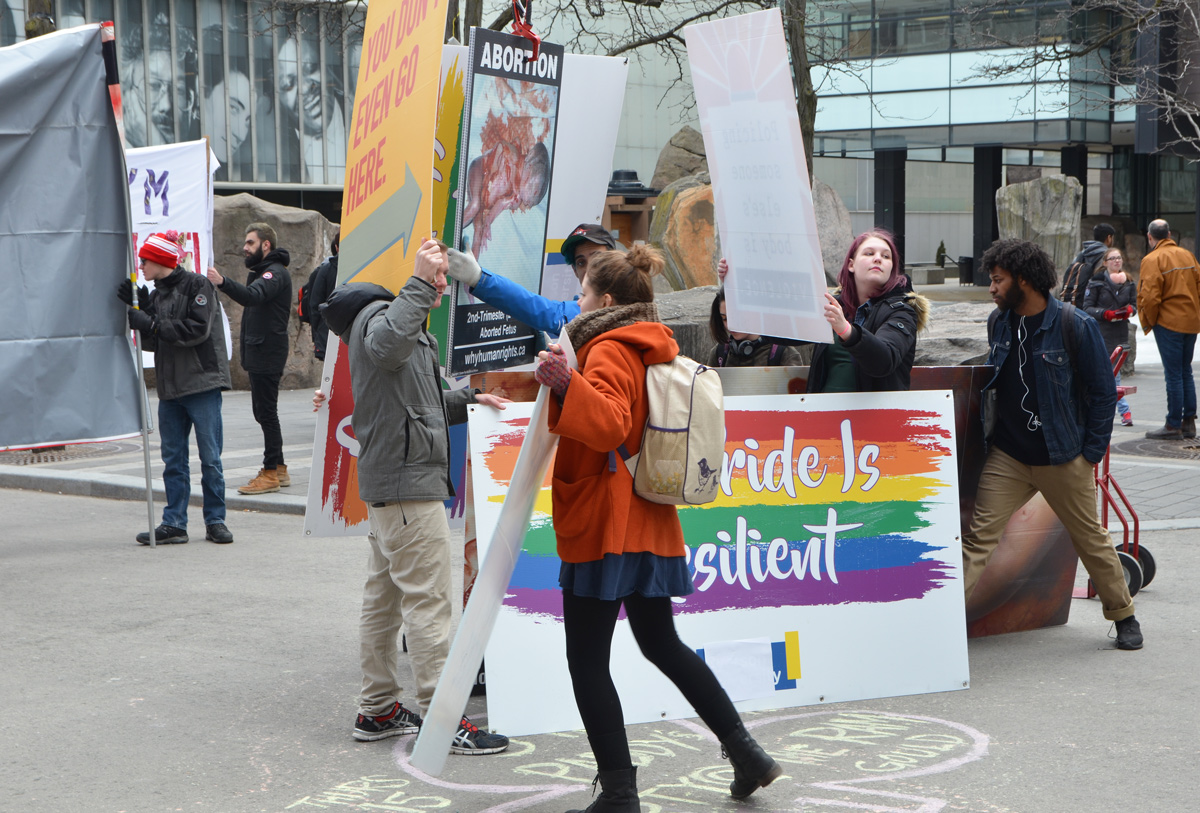
Also today, and just around the corner… A few minutes later I ran across another protest.  This one was at the corner of Gould and Victoria streets, at Ryerson University.   It was a quiet, civilized affair – more like a dance than a protest.

below: Both sides of the right to abortion debate were present.

people protest for and against the right to have an abortion.

below:   The anti-abortion sign would be turned, the ‘file not found’ sign would be moved in front of it, repeat every couple of minutes.

protesters at a right to abortion protest, anti and pro sides, both with a large sign.

below: It seemed to be a debate or a dialogue rather than a protest even though the people involved might disagree.   For such an emotional and polarizing subject they were being respectful and engaging.  At least they have the right to protest…. and to counter protest.

protesters at a right to abortion protest, anti and pro sides, both with a large signs.


The St. Patricks Day parade in Toronto is usually just a small parade – certainly not as big and crazy in places like Boston or New York City.  Part of the problem might be the fact that the weather is usually cold.  This year the parade was 6 days before St. Patricks Day.  I’m not sure when it started or how it happened, but Toronto’s parade is on the Sunday before the actual day.    At least the sun was shining this year.  It may be a small parade but those who show up, either to watch or to participate, seem to have a good time.   A few photos from this year’s parade:


below: Police on horseback led the parade.  Here they are passing the TV cameras.

three toronto policemen on horseback at the front of a parade, as theypass by the press and a large microphone boom

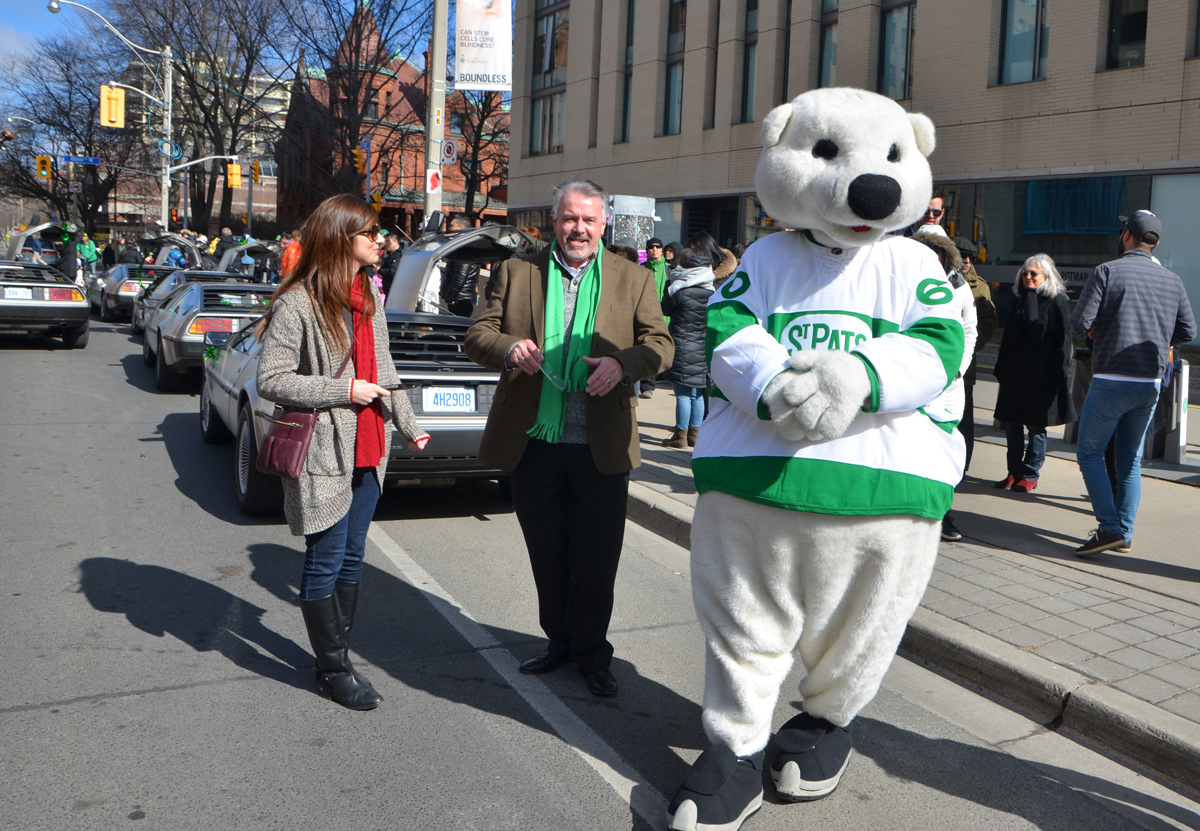
below: Carlton, the Toronto Maple Leafs mascot, was there. Once upon a time, the Maple Leafs were known as the St. Pats and they wore green uniforms.

Carlton, the Maple Leafs hockey team mascot in a St. Pats jersey waiting for the parade to start, working the crowd.

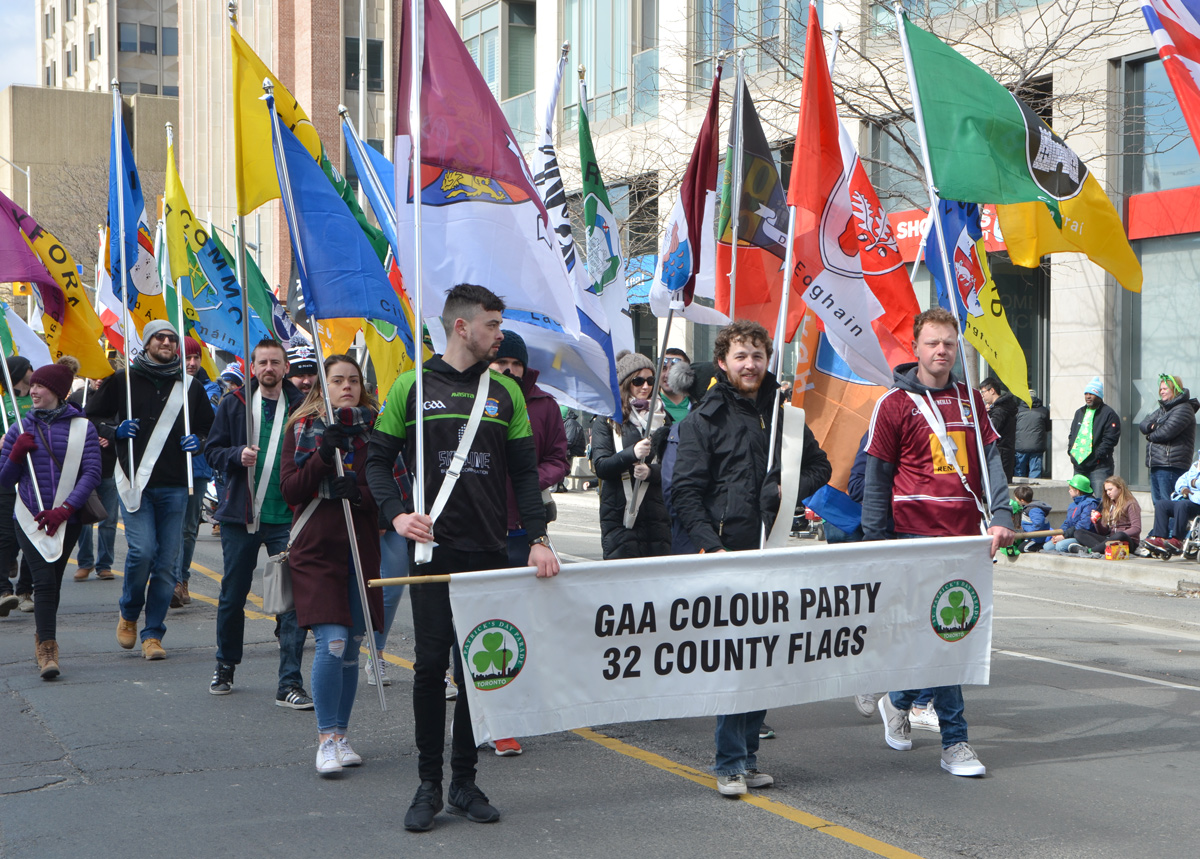
below: 32 flags, one from each of Ireland’s 32 counties.  The GAA is the Gaelic Athletic Association. 

A group of young people walking in the St. Patricks day parade, holding a banner and everyone is holding a flag from a Irish county. GAA Colour Party, 32 county flags.

below: Five Deloreans (cars) parked by the flags for the parade, before joining it at the end.  This is directly across Bloor Street from where the TV cameras were.   Deloreans were made near Belfast but for only a short time in the early 1980’s (1981- 1983).   About 9200 cars were produced.  The Delorean company went bankrupt in December 1982.

a man stands on a sidewalk, leaning on a barricade, lots of large Irish flags, a delorean car with its door open is across the street

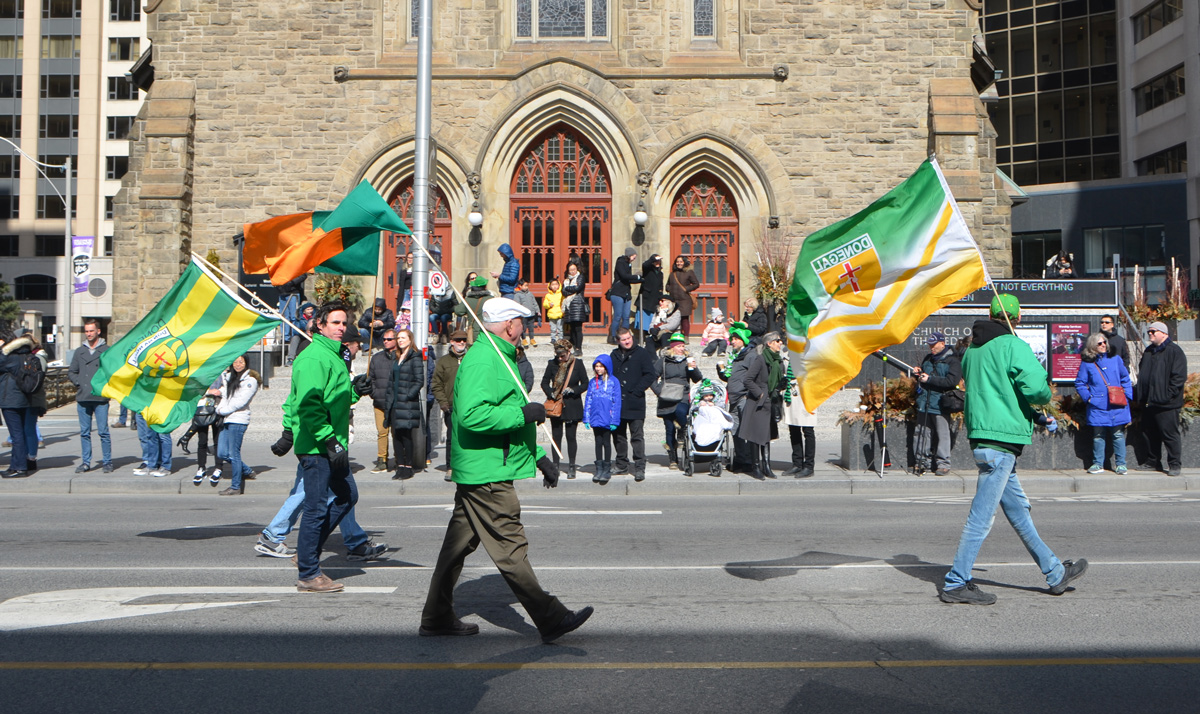
below: Carrying Donegal County flags

three men carrying flags in the St. Patricks day parade, walk past a church, many people on the sidewalk, pavement, watching the parade go by

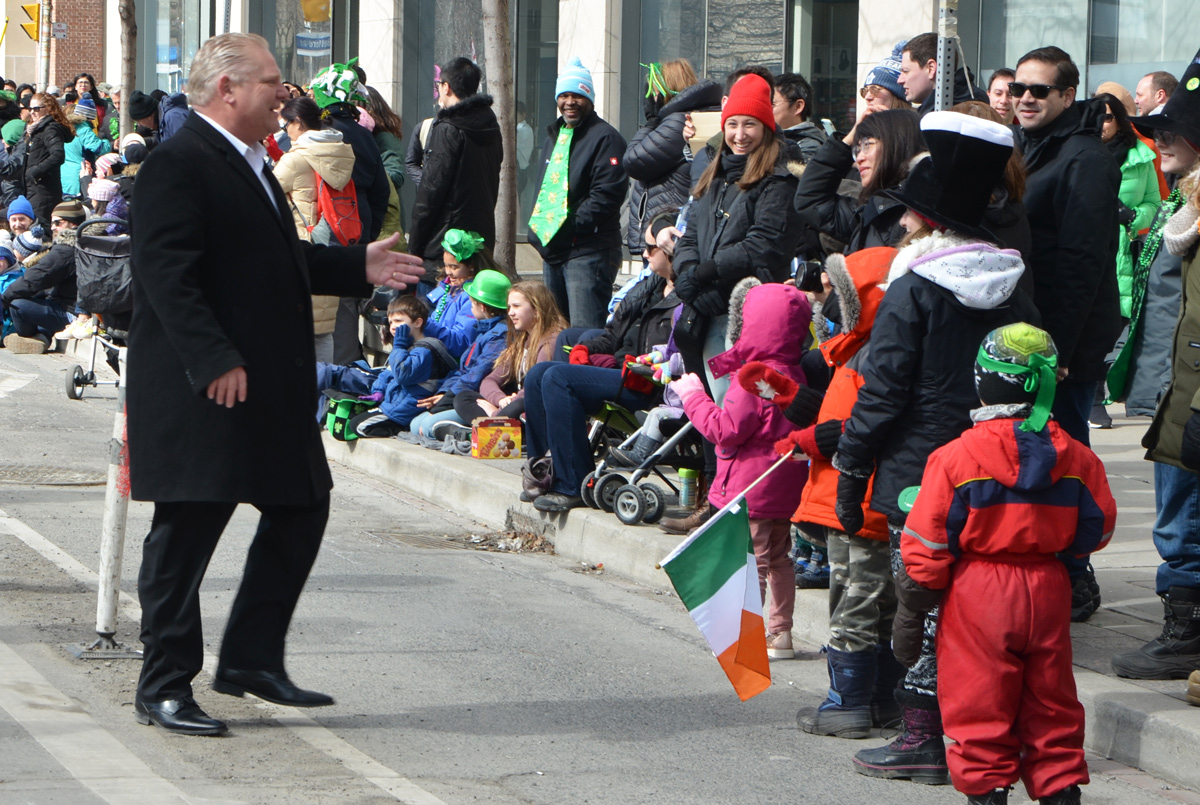
below: Doug Ford, now the leader of the Ontario PC party joined the parade.

Doug Ford, St. Patricks day parade, wakls towaards the people on the sidewalk to shake hands, politician, politics,

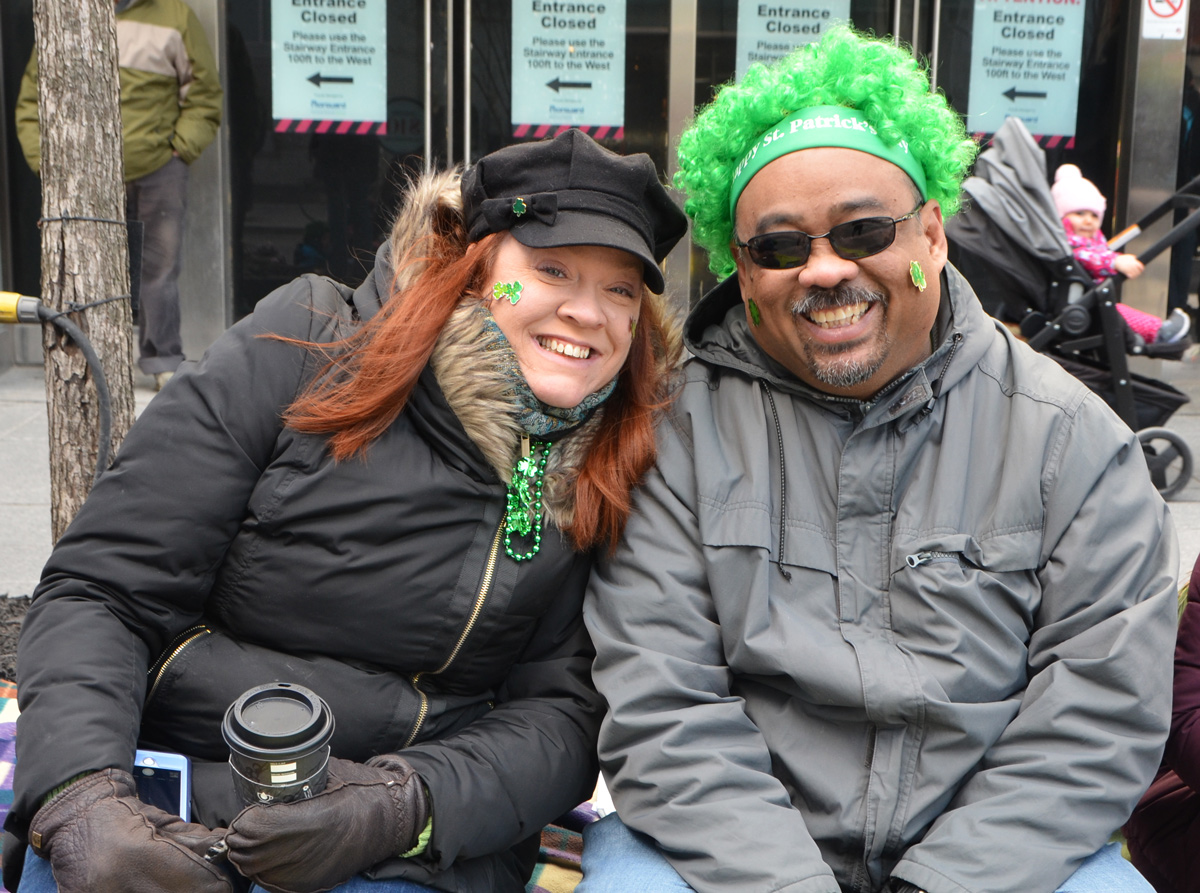
below: That’s quite the hair – he insisted that it was natural but I think it’s because of the green beer…..

two people sitting on the sidewalk watching the St. Patricks Day parade, a red head woman with long hair and a man with a curly bright green wig, both are smiling, both dressed for cold weather,

three teenagers selling candy at the parade, all dressed in green hats and other St. Patricks day stuff,

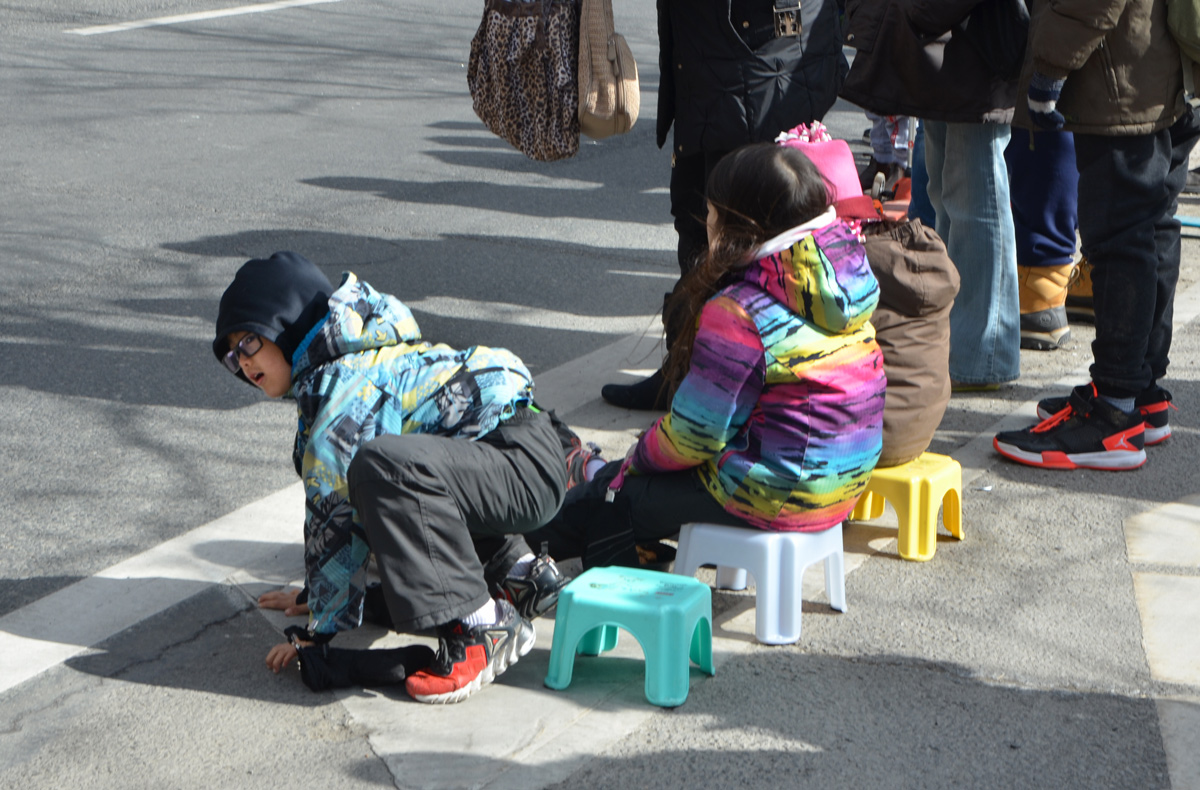
three kids sitting on little plastic stools watching a parade,

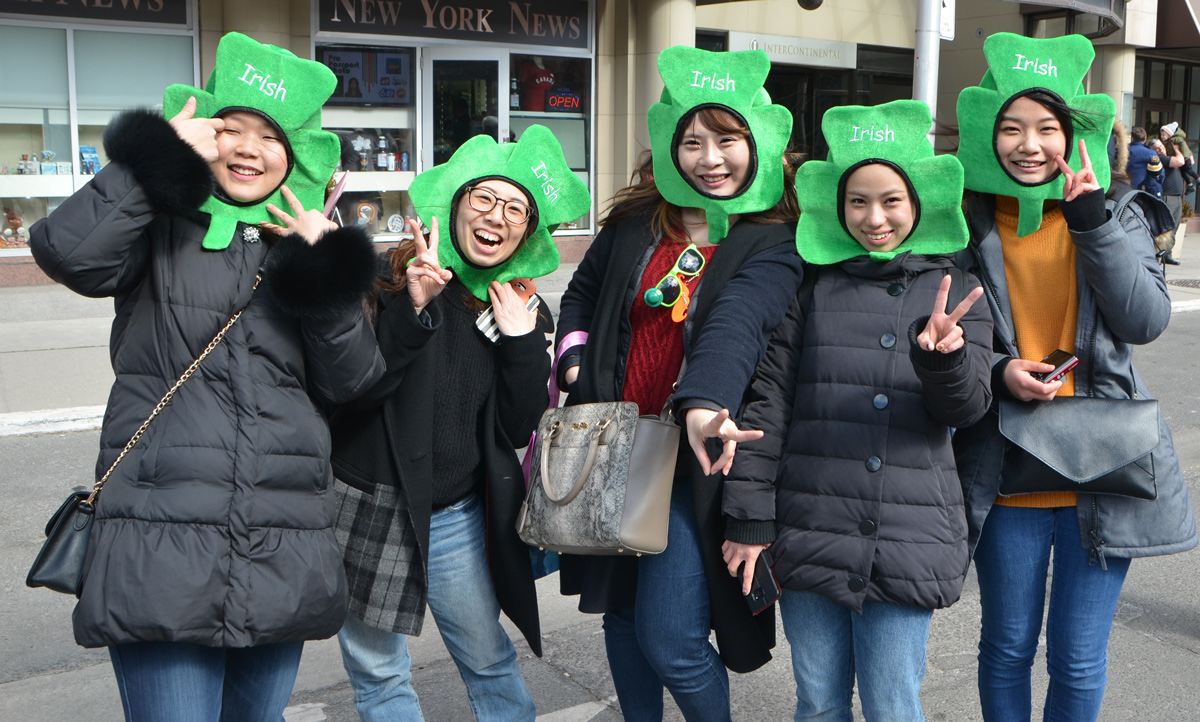
below: Maybe it’s true,  maybe everyone is Irish on St. Patricks day.

5 Asian women (Korean?) watching St. Patricks day parade, posing for the camera, all with shamrock green things aon their heads so only their faces stick out, the word Irish is written on each shamrock


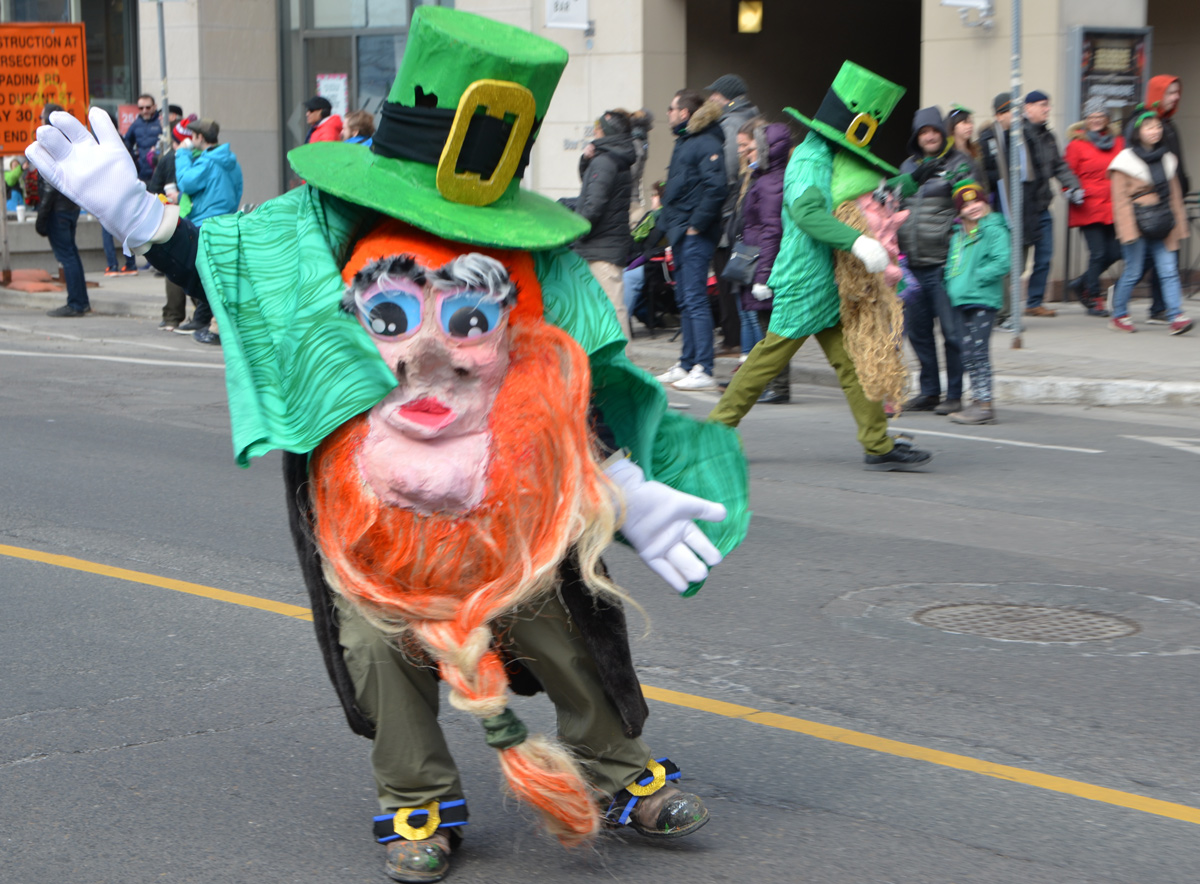
below: What would St. Patricks day be without a leprechaun or two?

a man in a leprechauin costume walking in a parade.

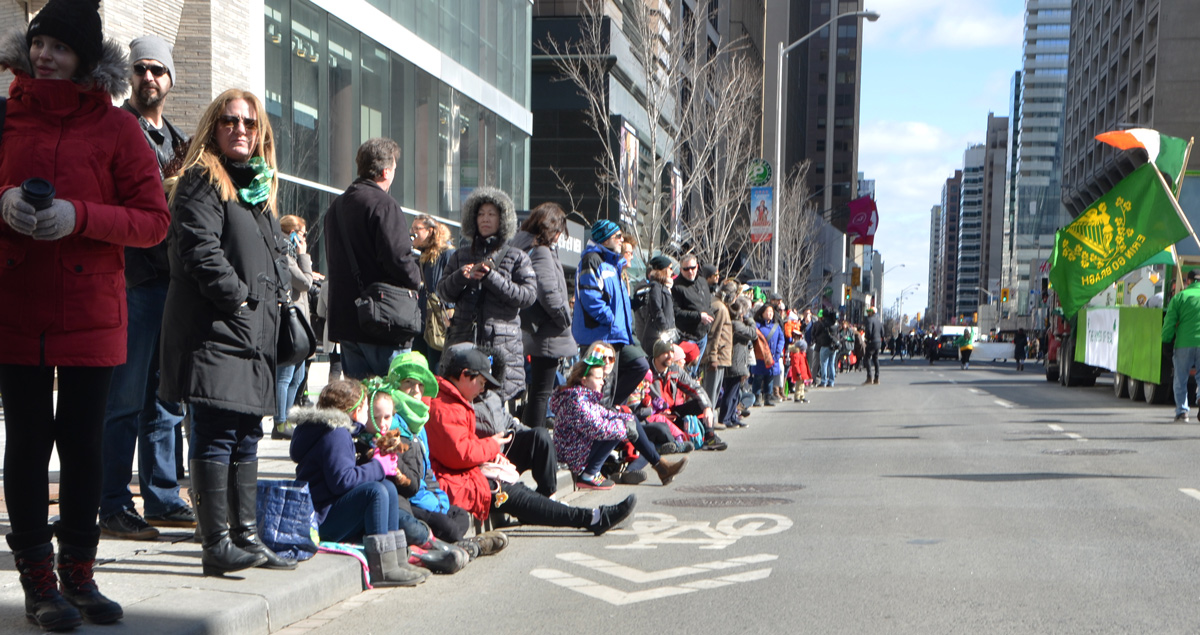
a group of people sitting on the sidewalk as a parade passes by on Bloor Street in Toronto

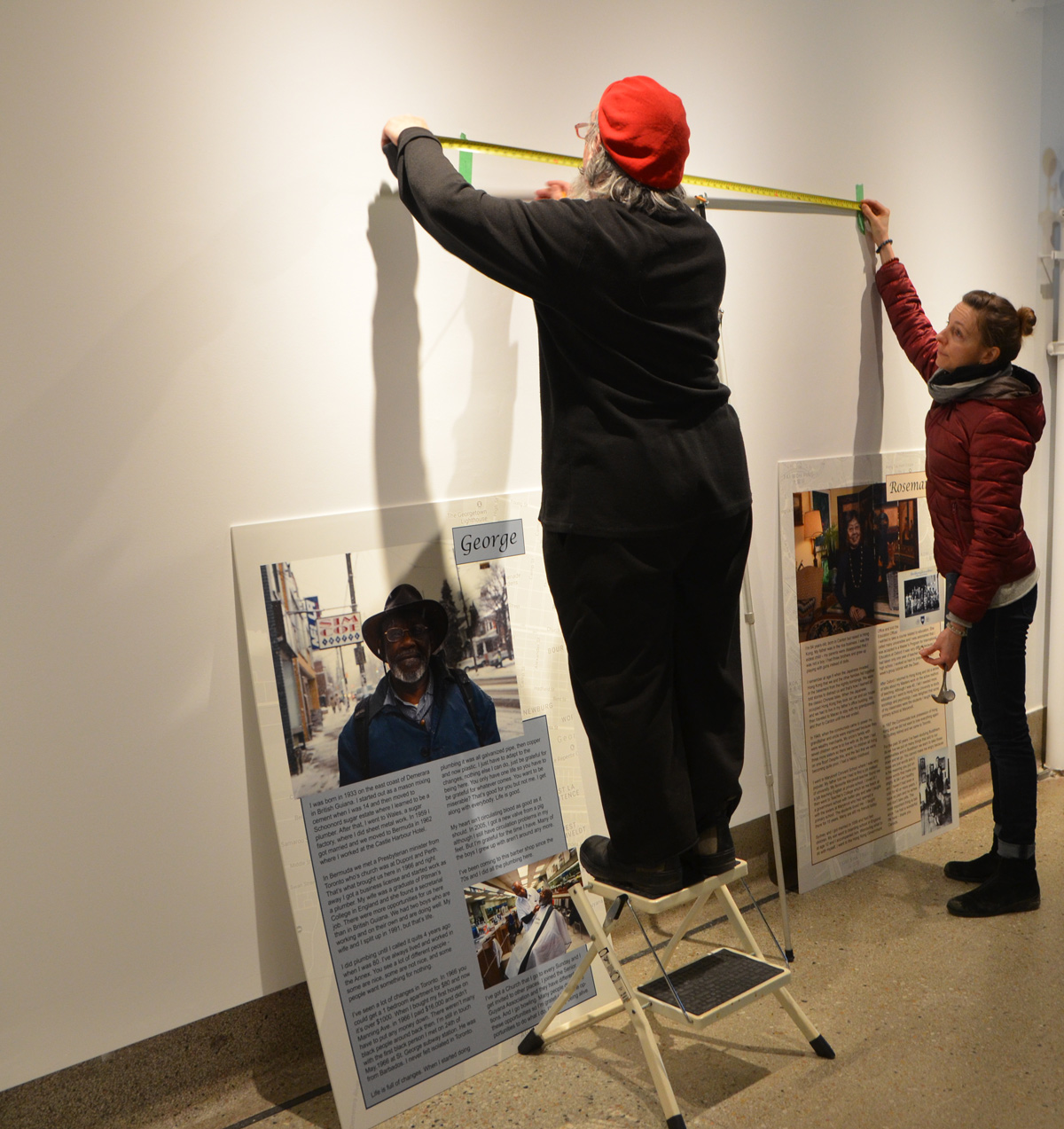
On exhibit now at Artscape Youngplace is a photo documentary on seniors in Toronto called ‘Focus on Our Elders’.  It is being shown in the 3rd floor gallery until the 17th of March.   There are 24 panels in the exhibit, one for each participant in the project.   The main feature of each panel is a portrait of the individual and it is accompanied by at least one other photo of something relevant to the participant’s life, as well as text that tells some of the stories of their lives.

a man looking at panels on the wall of a gallery, focus on our elders photo documentary project, 3 panels on the wall, one for each of three participants with a portrait plus words from an interview with them.

With thanks to Penny for taking this picture!

The project was funded my Myseum of Toronto and is part of their 3rd annual Intersections festival.

description of the focus on our elders project

two people hanging pictures in an art gallery

Link to The 6ix Clicks websit

The other day I headed towards Dupont and Dundas West because I heard about a mural that I didn’t recall having seen.  Here it is … and more.

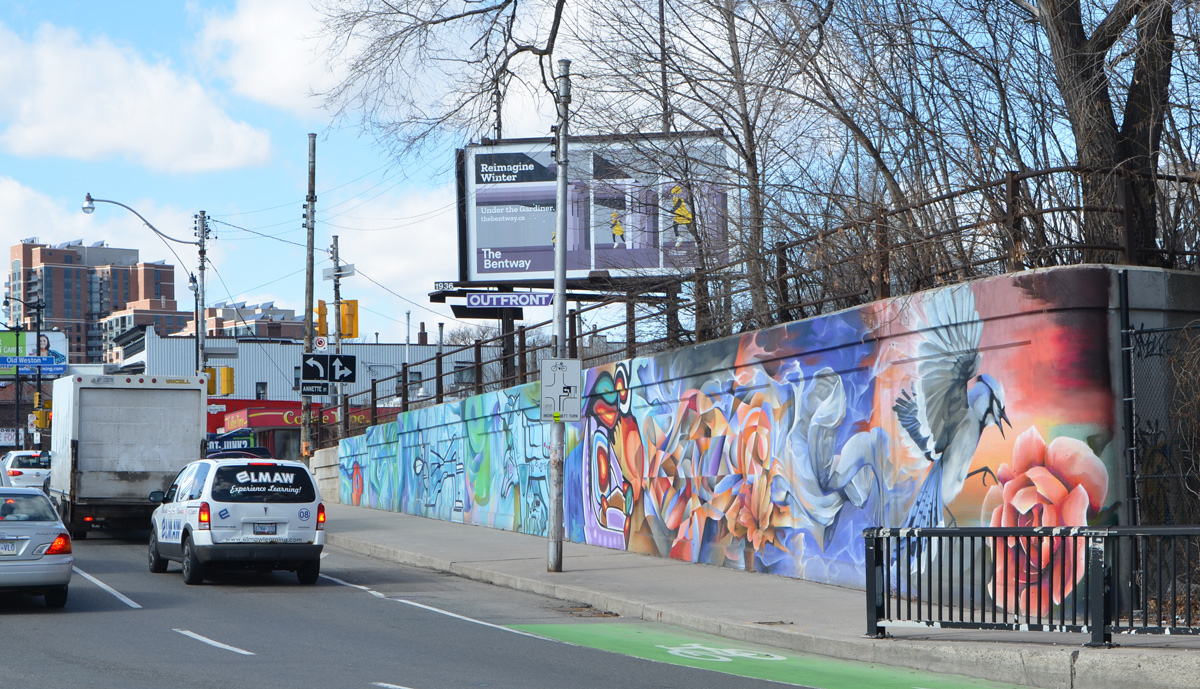
below: The most westerly part of the mural is on the north side of Dundas West where Old Weston Road and Annette Street meet.

mural on a wall beside a busy street

mural with a bird, chicakdee or sparrow beside a large orange tiger lily

mural, large painting of a tiger lily and a sparrow


It continues along the side of the railway underpass on Dupont (it’s a confusing tangle of streets here!)

car stopped in traffic under railway bridge, driver is looking at the mural that is painted under the underpass

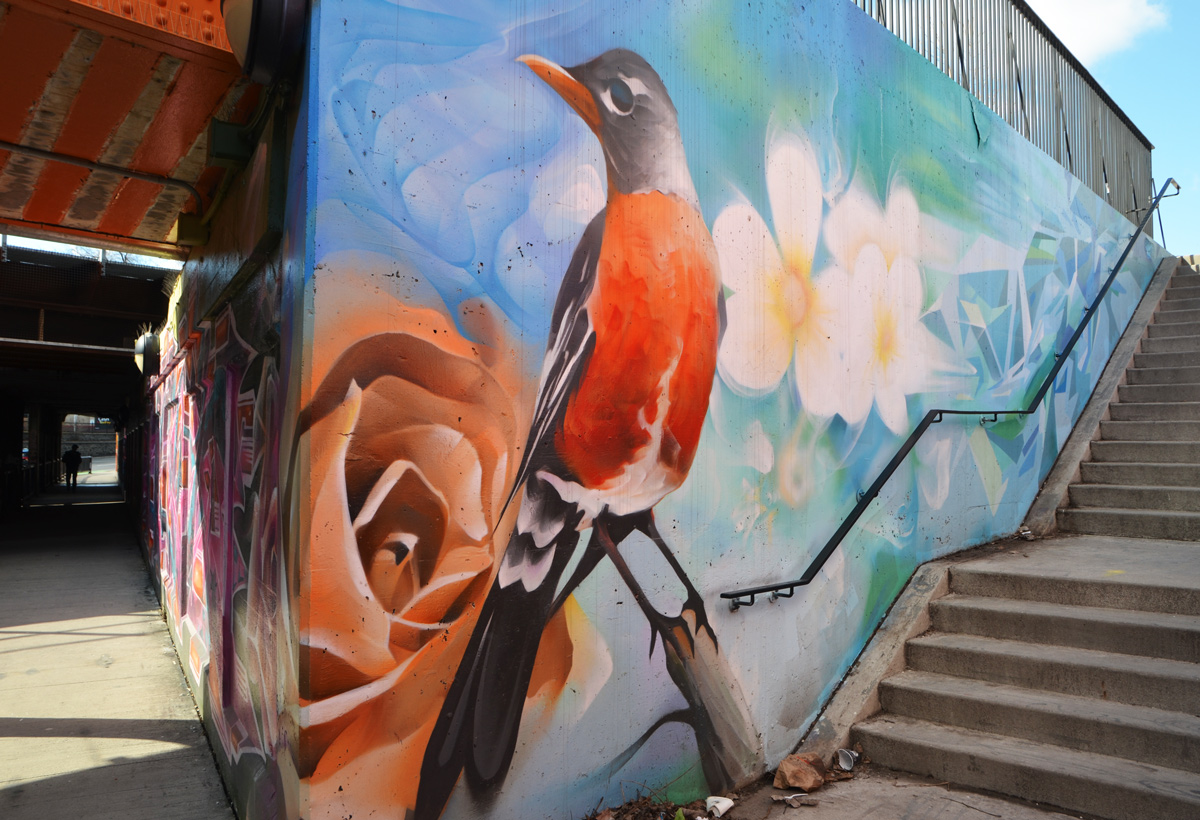
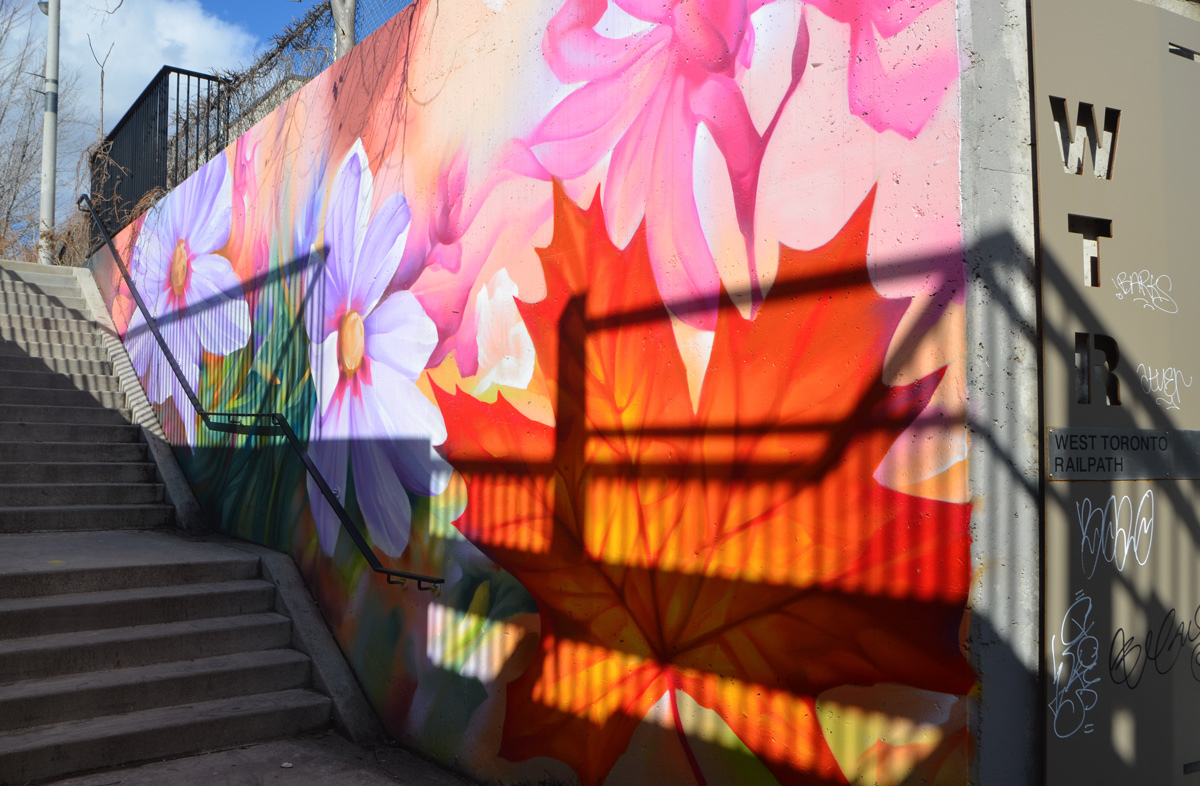
….and on the stairwell up to the West Toronto Railpath.

part of a mural, a robin and an orange rose, outside, beside a staircase

colourful mural outside beside a staircase, large flowers and leaves including an orange maple leaf

It was a gorgeous day so I walked around a bit more, of course!

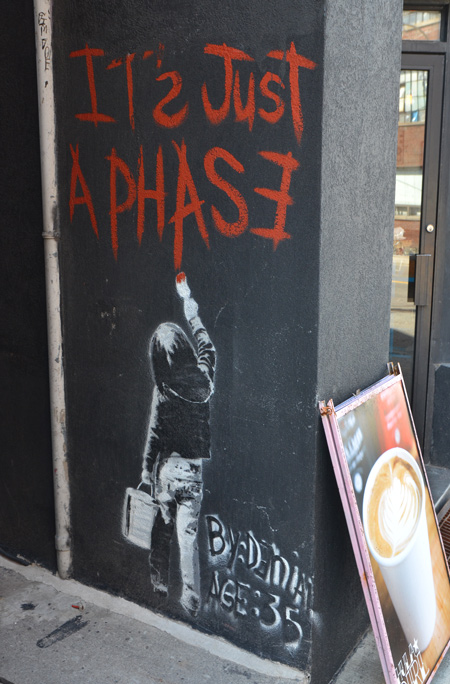
below: On Dundas West

street art of a young person writing on the wall with red letters that say it's just a phase

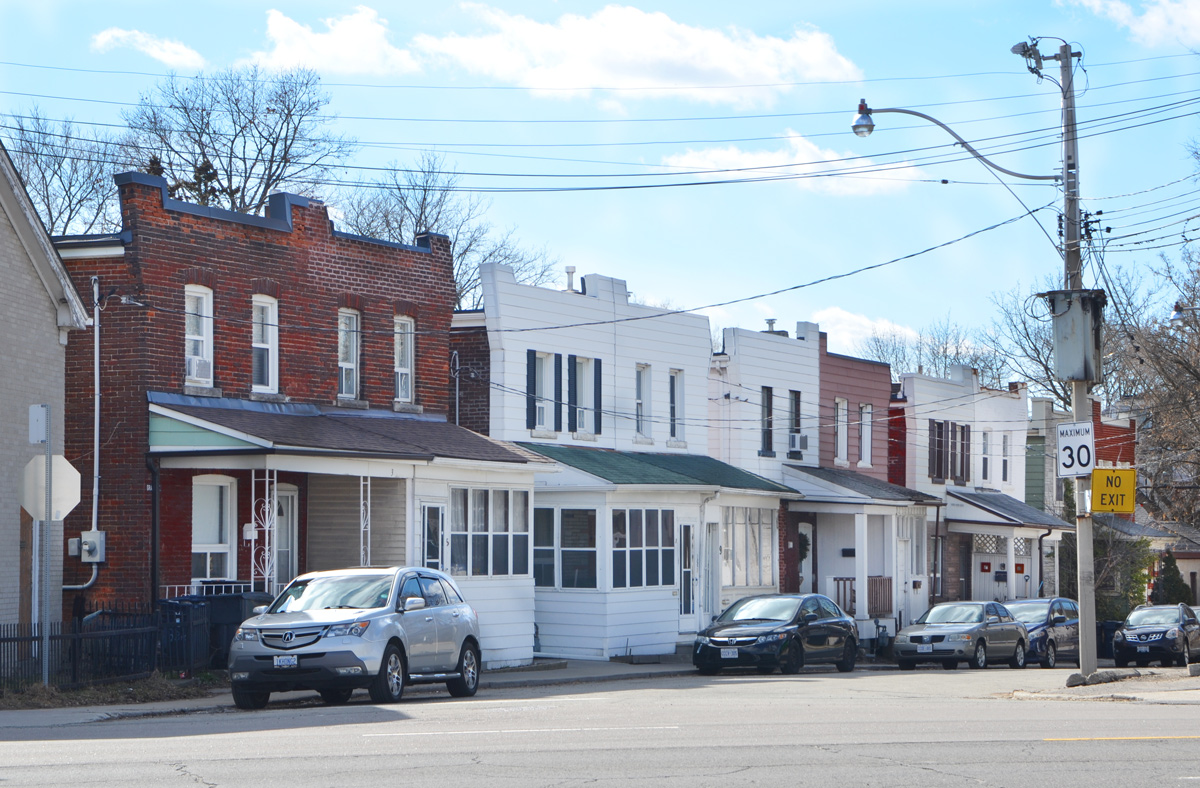
below: A row of houses with wonderful facades.  You don’t many like that anymore! .. at least not on houses.

older two storey row houses with facades that extend above the roof line,

below: These fooled me at first.  Interesting black and white photos looking grubby and worn… with a small McDonalds logo on the bottom right.   The photo on the bottom left also has a few words in small print that give away the fact this is a McDonalds promotion.  I don’t think I’ve seen any like these elsewhere – or have I missed something?

4 large black and white photos of people eating hamburgers, that is actually a mcdonalds ad

below: The large black metal staircase at the end of the footbridge over the tracks at Wallace Ave are gone.  The replacement stairs are dull and bland.  This change was meant to accommodate new development on Wallace.

new stairs at the end of a footbridge over the train tracks at Wallace street in Toronto, beside the West Toronto Railpath

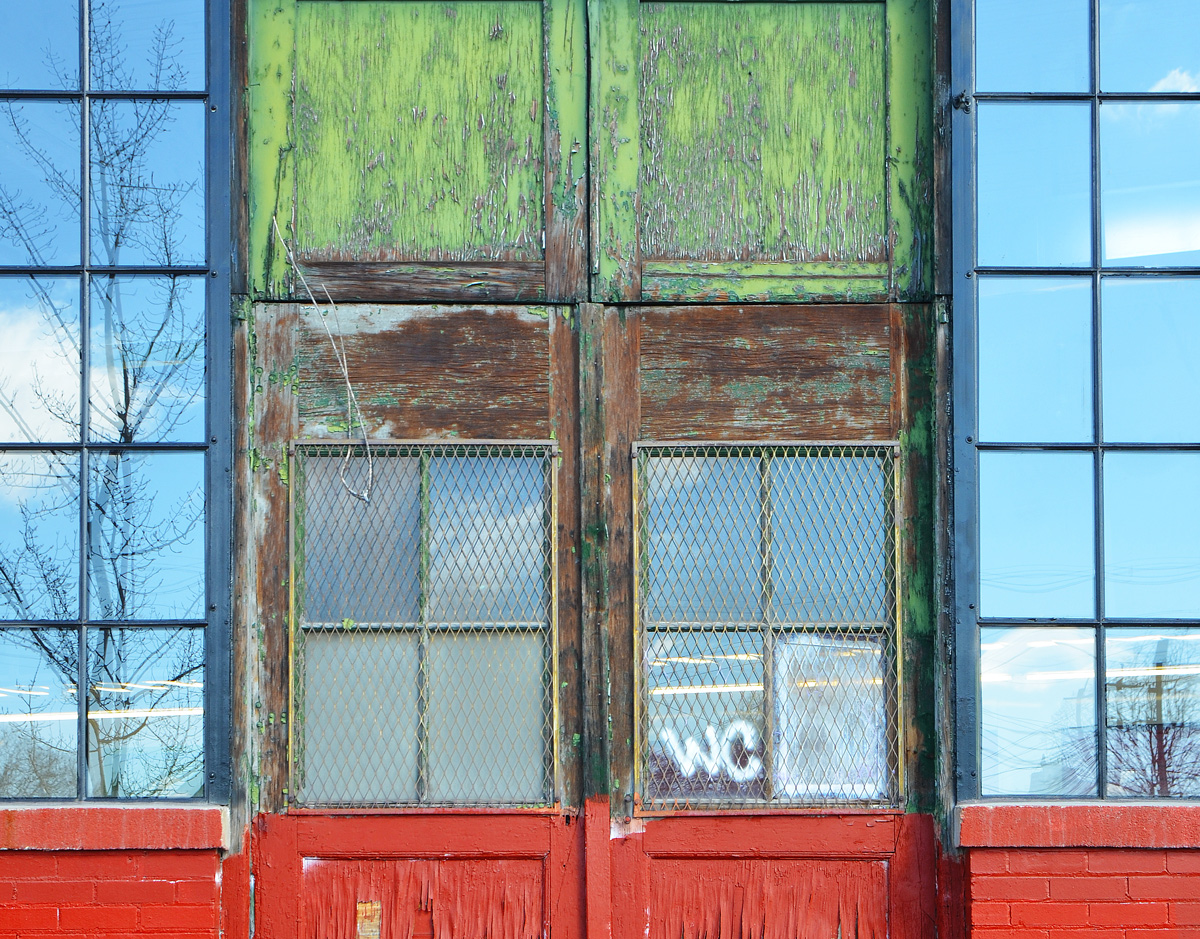
below: Railpath window reflections.

reflections of the sky in a window

below: Also on the West Toronto Railpath, someone has hung this colourful ‘curtain’ on the fence in order to add a splash of colour to a sitting area.  Once upon a time there were more chairs here.  And a table if I remember correctly.

fabric hanging from a rope beside a footpath, large green cylinder stoarge unit behind it.

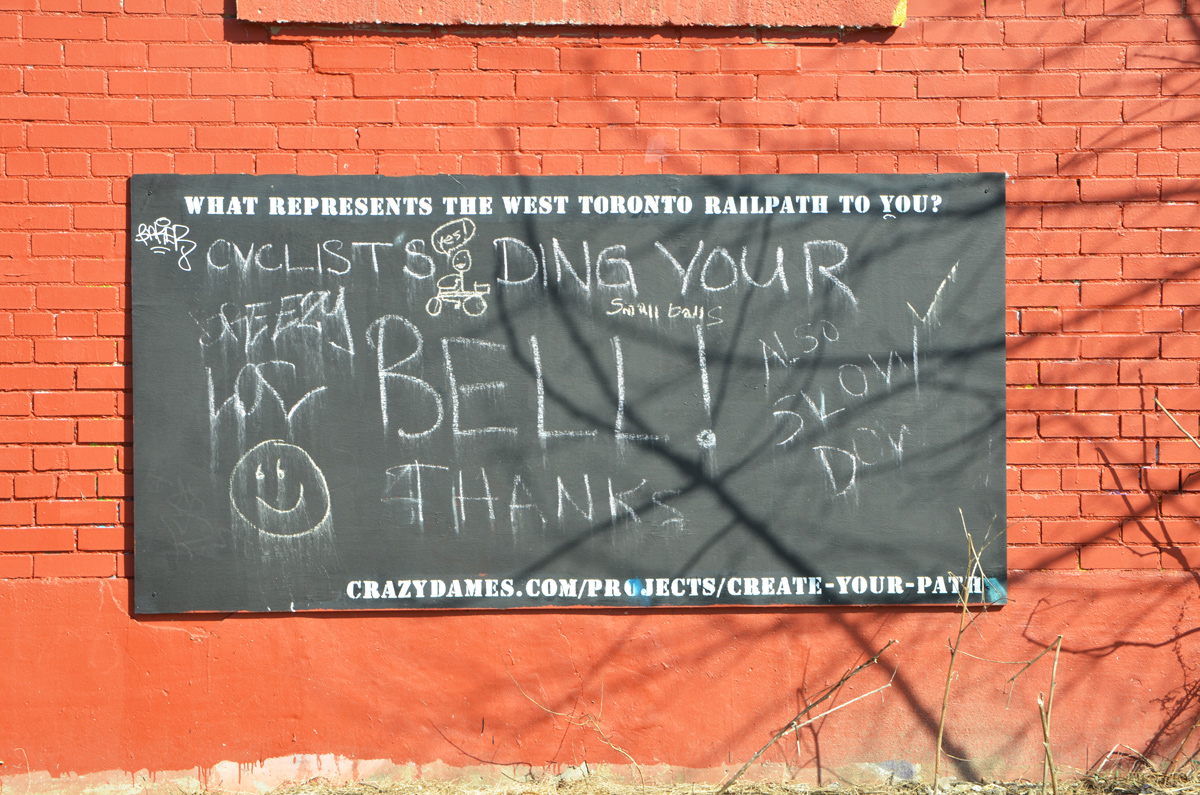
below: One of two chalkboards installed by crazydames where people have written notes to cyclists imploring them to slow down and use their bells.  I totally agree!  Just before I came upon this, a man on an electric bike came up behind me, silently and fast.

large chalkboard on an orange brick wall with notes to tell cyclists to slow down and ring their bells.

below: This little gnome still stands by the entrance to a convenience store.  This guarden gnome has been here (Bloor West) for a few years.

a small gnome painted on the wall beside a door to a convenience store. The door is open and people are walking past

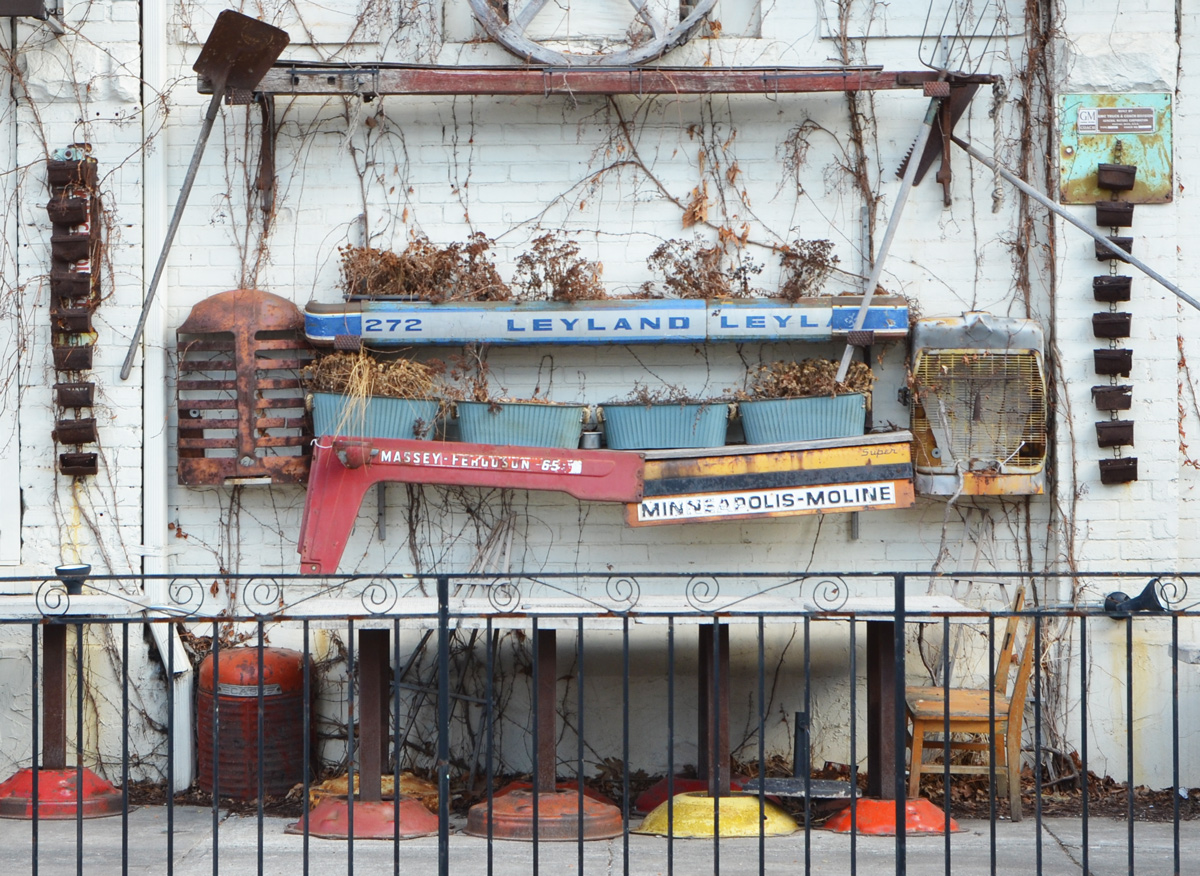
below: Reduce, reuse, recycle – here the R used is reuse.   Truck and tractor parts and other bits and pieces craftily arranged and put to use on the outside of the Farmhouse Tavern.  It should look better in a couple of months!

planters on an exterior wall, made of truck and tractor parts

below: A fairy in a garden of mushrooms.

a mural of a fairy, woman, with wings, holding something in her hand and looking upwards, in a garden with large mushrooms,

graffiti on a black wall, white bird like head on pick square

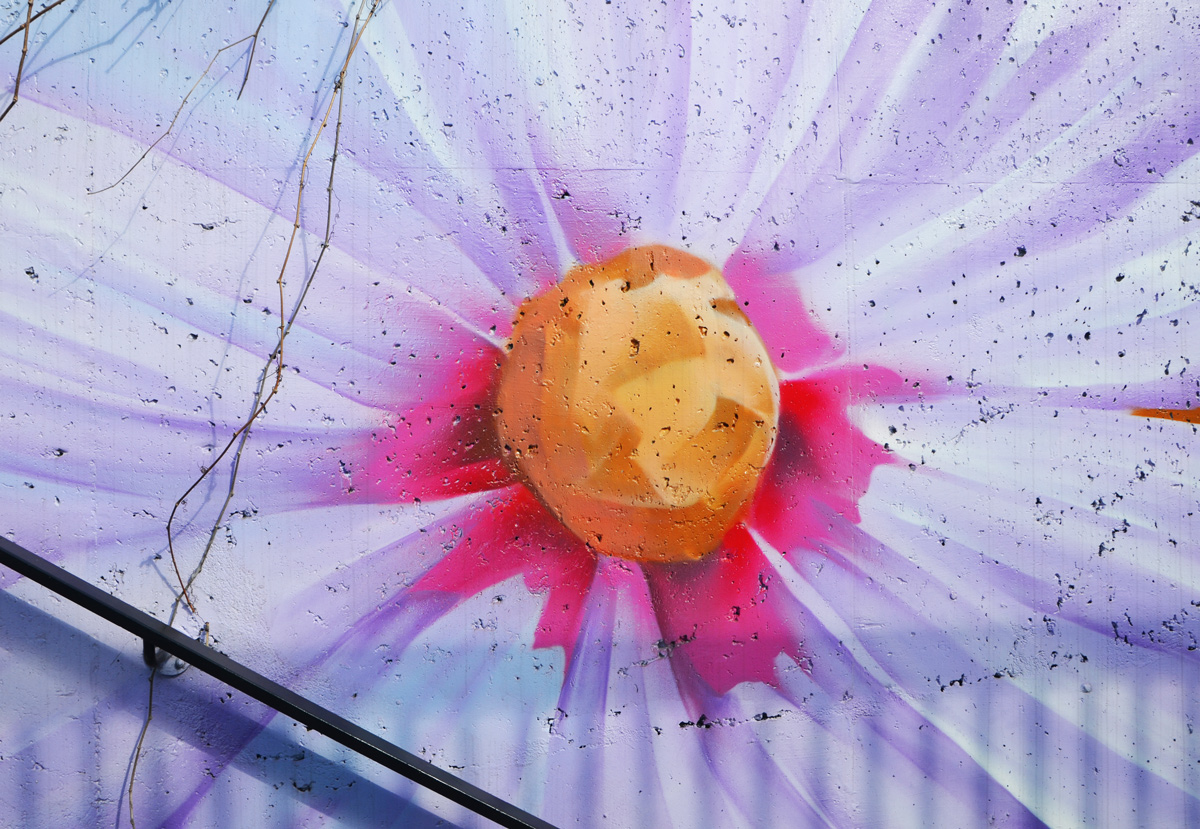
One last look at part of that mural!

mural with flowers, shadows in front

part of a mural, large light purple flower with yellow center and dark pink at inner most part of petals


Lots of shiny silver balls, like bowling balls with bling, and lots of paint on large canvases…. on the surface these two things don’t really have anything in common.  But because they are two things that I saw at the Art Gallery of Ontario, I’m going to throw them together in this blog post.  The shiny spheres are part of a display by Yayoi Kusama  while the paintings I refer to are those by J.P. Riopelle and Joan Mitchell.

I saw the balls first.   There has been a lot of hype and publicity for the latest AGO exhibit, “Infinity Mirrors” by Yayoi Kusama that just opened this past weekend.  You’ve probably seen the all the red and white polka dots on the TTC and elsewhere around the city.   Last week when I was at the AGO I noticed that another Kusama exhibit was in the works, one that didn’t involve buying a “hard to get” ticket.  I was curious.  I’ve seen some photos of “Infinity Mirrors” so I went with great expectations.   Maybe that was my mistake.

below: “Narcissus Garden” consists of a large room with hundreds of shiny silver spheres laid out on the floor.

a large room, with 3 women looking at hundred of silver balls arranged on the floor. The balls are about the size of bowling balls

“Narcissus Garden” dates back to 1966 when it was a performance piece by Kusama at the Venice Bienalle.  She walked among the balls, picking them up, and looking at herself in them.   Here, at the AGO, they lie on the floor.   The ceiling is reflected over and over again.   It’s a dull ceiling.   The balls are scuffed up.   You might be able to lie on the floor to get a good look at the reflections bouncing around and that might be interesting.  As it is, “listless” is the word that I would use to describe it.  It’s the tag along mangy mutt to the main event.

reflections of a person in a few shiny silver balls

I spent a few minutes trying to figure out how to improve the presentation but, meh, no.  Instead I went upstairs to take a second look at the lesser known “new” exhibit at the AGO, the marvellous Mitchell and Riopelle show, “Nothing in Moderation”.  American abstract painter Joan Mitchell (1925 -1992) and Canadian abstract painter Jean Paul Riopelle (1923-2002) met in Paris in 1955.  For 24 years they were colleagues, friends, and lovers.  This exhibit consists of more than 50 of their works on loan from collectors around the world and shown together.

below: Looking at (part of) ” Tilleul (the Linden Tree)”, 1992 by Mitchell.

A woman in dark bright pink hair, with matching purse and shoes stands in front of a large painting by Joan Mitchell in an art gallery

below: Three degrees of interest in “Chasse Interdit (Hunting Prohibited)” by Mitchell, 1973.  On loan from the George Pompidou Centre in Paris.   The title of the painting refers to a ban on hunting – apparently Riopelle loved hunting and Mitchell loathed it.

Three people are looking at a large Riopelle painting in an art gallery, two are sitting on a couch and the third is standing closer to the painting.

below: The painting here is “Avatac” by Riopelle, 1971.  It is acrylic paint on top of lithographs on canvas

an emptry art gallery room except for a security guard standing on one side, a brown couch is in the middle of the room and a large abstract painting by Riopelle is one one wall, you can see into the next room where there is also a painting on a wall.

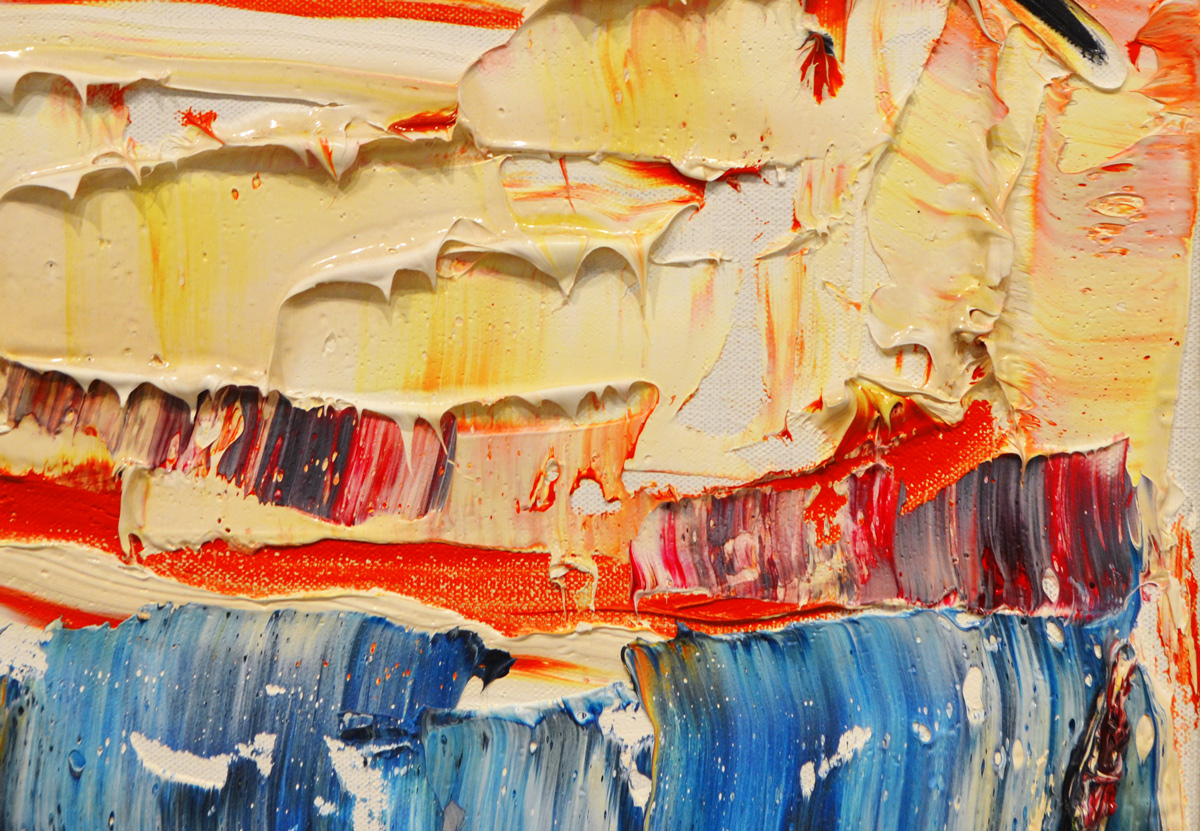
below: This is a photo of a small part of the above painting.  If you look closely, you can see the lithograph peeping through.   I can see a small animal head near the top left (a cat?) and there seems to be another lower down.

acrylic paint on top of lithograph, a detail of a large work by J P Riopelle called Avatac, created in 1971.  abstract art.

below: One thing that intrigued me about Riopelle’s painting was that even though there is a lot of paint (palette knife?), there are still some places where the canvas is visible.  Just small bits.

a close up of a large abstract painting with lots of acrylic paint on it

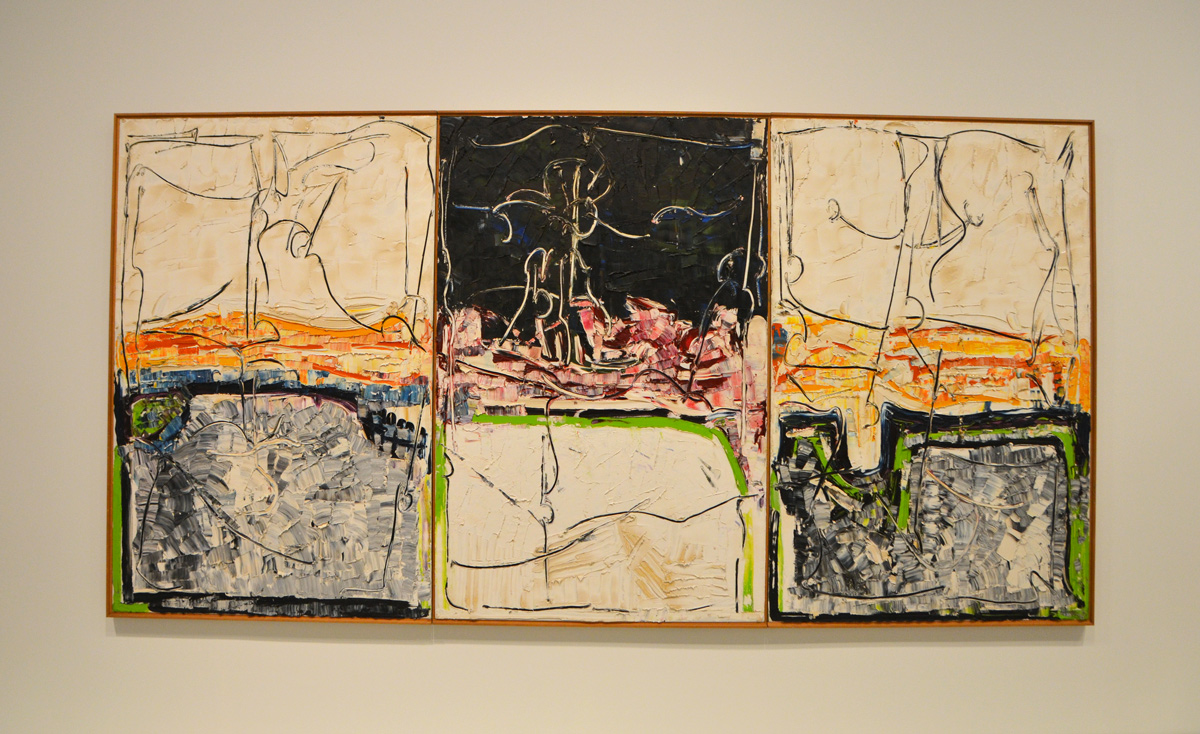
below: The details in the above photo are from the top left square in ” Mitchikanabikong ” by Riopelle.

large painting by Riopelle called Mitchikanabikong which is sort of divided into 6 quares, 3 across the top row and 3 on the bottom.  they alternate light and dark

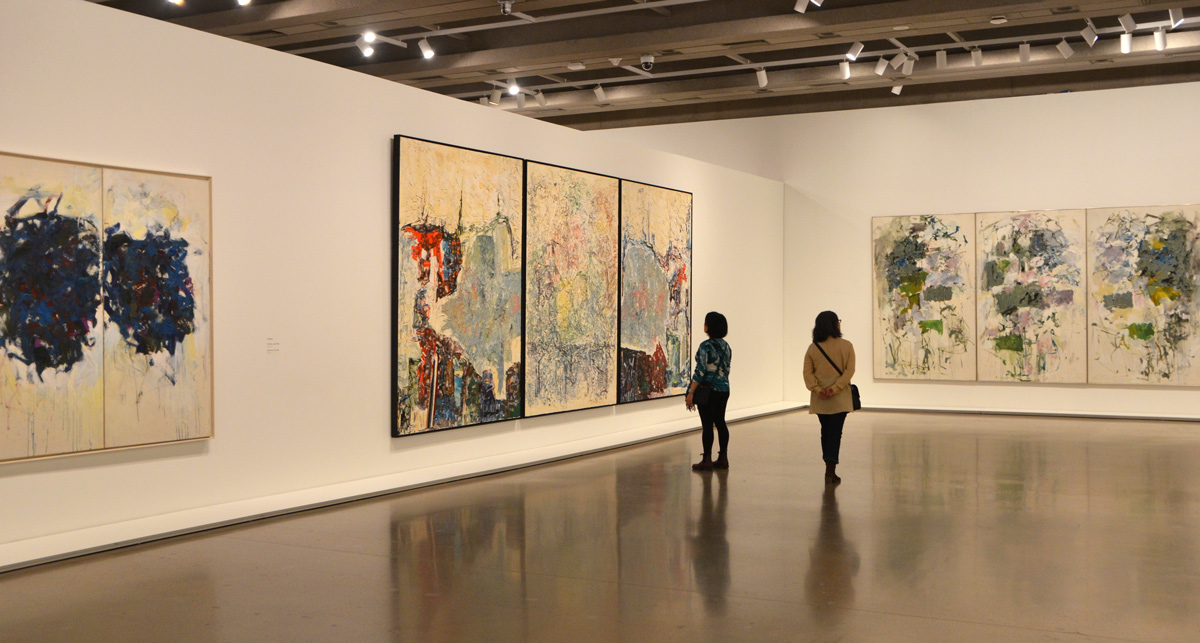
below: The gallery was quiet on Wednesday morning.   Both of these paintings are by Joan Mitchell.   On the left, on loan from the Smithsonian American Art Museum in Washington DC is “Marlin”, 1960.  The other is “Untitled” from 1961 and it is on loan from the Joan Mitchell Foundation in New York.

a flat bench in front of two paintings on a gallery wall

And to end, a couple more for you to enjoy.

two women looking at large paintings in an art gallery

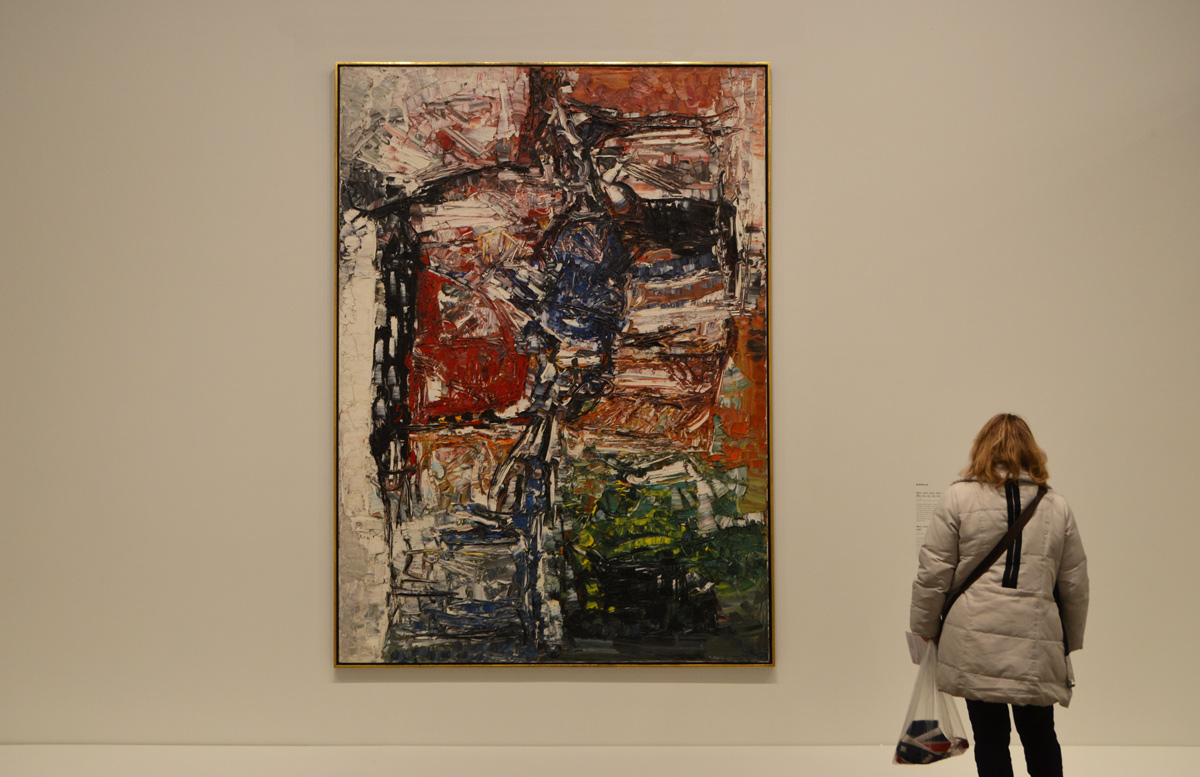
a woman with her back to the camera is looking at a large painting in an art gallery, AGO, Art gallery of Ontario,


Yesterday started damp and grey but then flipped to bright and sunny.   Almost spring-like even.   So off to the beach I went.

mural of people enjoying the beach, surfing, jogging on the boardwalk.

Well, not that kind of beach.   It does look warm though doesn’t it?  Yesterday it was more like this:

below: Looking towards Lake Ontario from Kew Beach Ave.  Lots of trees and lots of what looks like grass but is more like mud.   Squish, squish as I walked gingerly across the water logged ground, trying to keep my shoes clean.

large park beside Lake Ontario at Kew Beach, Toronto, large mature leafless trees, spring, grass is brownish colour, some people in the distance, walking on the boardwalk,

The goal?  To check out this year’s warming stations art installations.  Lots of others had the same idea as it turns out.   Some kids, some dogs, but that’s okay.

below: Interacting with “Nest” both on the outside…..

a woman model poses beside an art installation on the beach

below: …. and on the inside. Like all the other warming stations, this one is built around a lifeguard station.

kids climbing on a lifeguard station that is inside Nest, an art installation that is open to the sky at the top of the lifeguard chair.

below: The structure is covered with netting-like fabric on the inside and webbing on the outside.  It was designed by a team from Ryerson University – Adrian Chiu, Arnel Espanol, and Henry Mai.

an older couple examine the fabric that is on the inside of Nest, a warming station at Kew Beach

below: A sign of the times, a pink pussy hat makes its appearance as “Pussy Hut”

large oversized pink pussy hat as an art installation on the beach

two little girls inside the large pink pussy hut warming station

below: “What’s all the fuss about?”

a small black and white dog with a blue neoprene vest and a red coat with 4 legs

below:  A large square made of many pieces of hanging red fabric, anchored at the bottom with plywood.  This is “Obstacle” by Kien Pham.

Obstacles, by Kien Pham, an art installation part of warming stations 2018 in Toronto, by Lake Ontario, consists of many large flaps of red fabric that you can walk between.

a girl in pink jacket with pink hood stands between large flaps of red fabric that is part of Obstacles, an art installation


below: “Revolution” by a design team from OCAD university. It consists of 36 vertical red poles with conical metal pieces that twirl. You can look through them or speak through them, or just walk amongst the red poles.

people walking amongst an an art installation of small conical tubes like megaphones on red poles of differing heights.

looking down a metal tube

an art installation of small conical tubes like megaphones on red poles of differing heights, lake in background

below: Red!

a mother holds her young son's hand as they stand together on a beach overlooking Lake Ontario, backs to the camera

below: “Rising Up” by University of Guelph, School of Environmental Design and Rural Development.  The design was inspired by the topography of the Don Valley.

a white and brown dog on a leash in the foreground, people and kids climbing on a wooden structure which is actually an art installation called Rising Up

looking through part of rising up, a wood structure built on the beach, a couple walks hand in hand between the art installation and Lake Ontario

rising up, an installation part of warming stations at kew beach, beside lake ontario

below: Ooops!  One has blown over and collapsed already (it was quite windy).  Ironically it was called “Wind Station” (designed by Paul van den Berg and Joyce de Grauw).  When it was first constructed, it was in the shape of a nuclear cooling tower and you could go inside.  The little plastic windmills continue to blow in the wind.

a few people in the background, they are looking at white wood and white plastic toy windmills lying on the ground. it is a collapsed art installation, part of warming stations at kew beach, by Lake Ontario

below: Not everyone was looking at the warming stations.

a lone person standing on a beach, looking out over Lake Ontario, back to camera, in full wetsuit, holding onto a surf board under his (or her) arm, another surfboard sits on the sand.

below: This is ‘Make Some Noise’, designed by Alexander Greiss and Jorel Heid. Apparently it is based on based on the intonarumori, an invention of the Italian futurist Luigi Rusollo in 1914. An intonarumori generates noise. Rusollo envisioned noise music replacing traditional forms of music but he was not successful and none of his contraptions survived.

people on the beach checking out the art installation, Make Some Noise, a large yellow and black vertical box, with four large black loudspeakers

a child with a red jacket is trying to climb inside a large black speaker, conical shaped, on the side of a black and yellow art installation at the beach, warming stations, Kew Beach, lake ontario is in the background.

below: This is one side of the box. The red is a handle that can be turned thus generating noise. I don’t think that it was working. Each side had a handle and a black speaker.

close up detail of one side of Make Some Noise, an art installation, yellow and black diagonal stripes, narrow and close together

Stay warm!