Stained glass windows and churches go hand in hand. The church of St. Simon and St. Peter on Bloor Street East is no exception.  The church was built as St. Simon the Apostle, on the northern fringe of the city in 1887-1888.  The congregation grew rapidly and the church was expanded in 1892.   Its earliest stained glass window dates from 1899 and the most modern window was installed in 1997 – 100 years of history.   Some of the windows in this church, and the stories they tell, are shown below.

below: Saint Simon and Saint Matthew, 1927, Robert McCausland Ltd., Dedicated to the memory of Augustus Perrine Burritt (1868-1925).     Traditionally, saints are portrayed with their ‘attributes’.  Here,  Simon holds a saw and Matthew holds  a purse, or bag of money.   Matthew was a tax collector before he became an apostle.  No one really knows much about Simon and there are many conflicting stories about how, when, and where he died.  One story is that he died by being sawn in two in Persia.  Whatever the history,  now if you see a painting or a statue of saint and he’s holding a long saw, then you’ll know that it’s Simon.

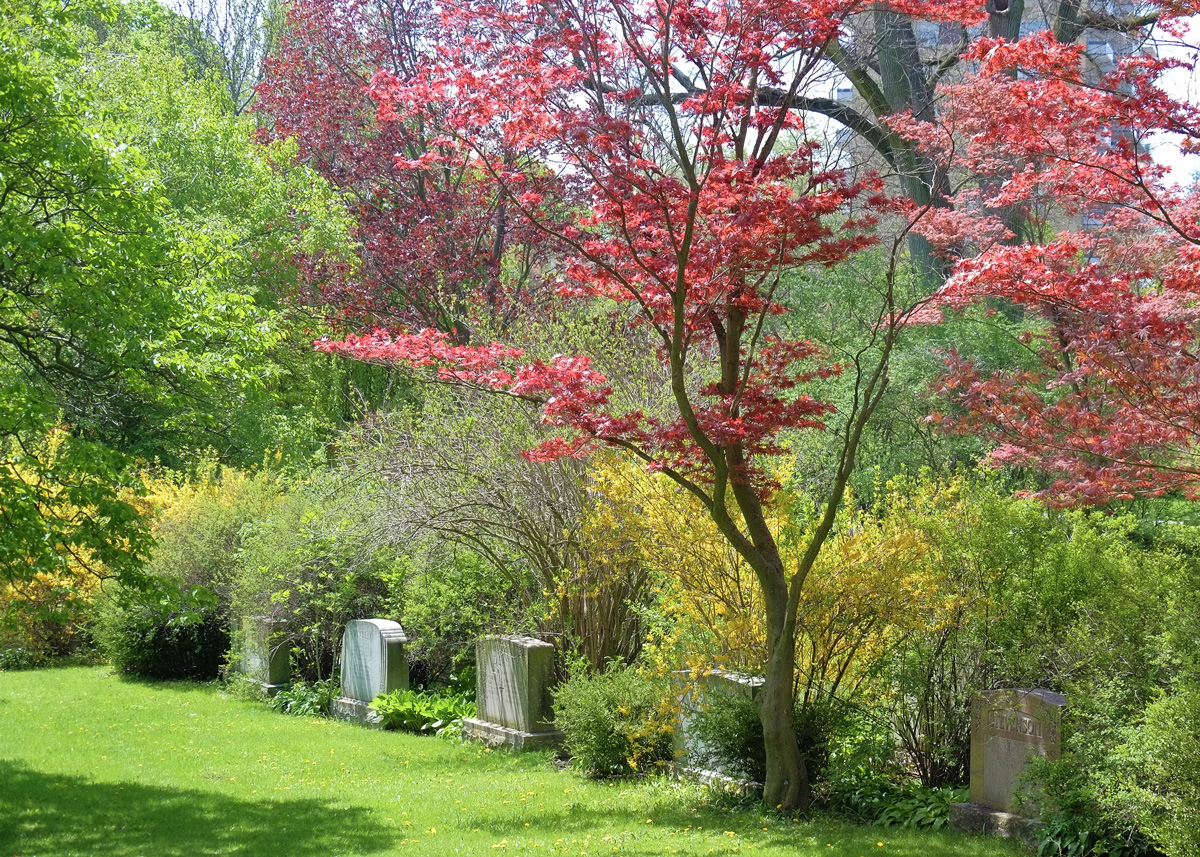
Augustus P. Burritt’s wife, Jean Bell Smith, outlived him by many years.  She lived until 1969.  They are buried together in Mt. Pleasant cemetery.   She is Jean B. Smith Durland on the tombstone so she must have married a second time.   I may be flying away on a tangent, but there is CWSGA (Canadian Women’s Senior Golf Association) trophy called the Jean Burritt Durland trophy.

stained glass window, two panels, one with St. Simon and the other with St. Matthew,

McCausland of Toronto is the oldest surviving stained glass studio in North America. In fact, five generations of McCauslands have overseen the work of the firm from 1856 to the present.

“Joseph McCausland, glass stainer, house, sign, and ornamental painter, established his business in 1852, and added the stained-glass works in 1857, being the first of its kind in the city.   He is now employing over fifty hands.  Mr. McCausland was born in County Armagh, Ireland, in 1829 and came to Toronto in 1836.” from
History of Toronto and County of York, Ontario vol 1, 1885. (source)  The stained-glass works mentioned here was the Canada Stained Glass Works in Toronto.  Although the bulk of McCausland’s work was for churches in the Toronto area, they made windows for churches elsewhere, for a lot of government buildings (University College, City Hall, B.C. parliament in Victoria), and for commercial buildings such as the Bank of Montreal at Yonge & Front.   In 1881, Joseph’s son Robert took over the business and it has remained in the family ever since.

below: The Dorcas window – Dorcas distributes bread to the poor, by Robert McCausland Ltd. in 1921, dedicated to the memory of Martha Bolton Wilkes (d. 1919). Dorcas (or Tabitha in Hebrew or Aramaic) was a seamstress who clothed the poor as well as fed them. After she died, a miraculous prayer by Peter the Apostle brought her back from the dead. She has become a symbol of charity.

three panel stained glass window at St. Simons church

Martha Wilkes was the wife of Robert Wilkes (1832-1880), a politician and businessman. Robert drowned at Sturgeon Point with two of his children in August 1880, Florence Alexandria (age 15) and Bertie Cooke Wilkes (age 12). The family is buried together in Mt Pleasant cemetery.

An account of the death of Robert was given in the Canadian Methodist Magazine vol 15, January to June, 1882. “The sad disaster lacked no element of the tragical and pathetic. In the month of August, 1880, Mr. Wilkes and his family were spending a few summer holidays at Sturgeon Point, a beautiful health-resort on Sturgeon Lake. On the 16th of the month, his only son and second daughter, aged, respectively thirteen and fifteen, were bathing in the lake, while their father rowed a small boat near at hand. The lad, attempting to reach his father’s boat, sank beneath the water. Mr. Wilkes plunged in to rescue him, and found himself beyond his depth. His daughter Florence, rushing to their assistance, got also beyond her depth, and thus all three perished in full view of the shore. Mrs. Wilkes who was an eye-witness of the dreadful tragedy, rushed into the water and was with difficulty prevented from losing her life in a futile attempt to save those so dear to her. Prompt efforts were made to rescue the bodies, but, alas! the spark of life had fled. Although that of Florence was still warm, yet every attempt at its resuscitation was in vain.”


below: There are a few other McCausland windows in St. Simons church.  This is a detail from one of them, the Te Deum window, named for the prayer that contains the words “To thee all angels cry aloud”.

close up of stained glass window, angel, cherub heads, and words that say To thee all angels

below: Saint Cecilia, by Sarah Hall, 1997.   Saint Cecilia is the patroness of musicians and she is in the center, flanked by two trumpet bearing angels.  It’s difficult to see in this photo, but under the music notes, at the very bottom of the window, are the words “From har-mo-ny from heav-nly har-mo-ny This u-ni-ver-sal frame be-gan”.  Each syllable matches a note.   They are also the first two lines in a poem written by John Dryden in 1687 called  “A Song for St. Cecilia’s Day”.

stained glass window by Sarah Hall in St. Simons church, 3 panels each with an angel

below: These windows by Gerald E. Tooke (b. 1930), four panels, each an illustration of a miracle performed by Jesus.  On the very left is the marriage at Cana where water was turned into wine.  Next is the feeding of the multitudes with bread and fish.  Second to the right is the healing of the blind man and last is the Resurrection.  These date from 1965 and are dedicated to the memory of Anna Alfreda Waller (d. 1964) and her husband (d. 1949).   [There’s a turn – usually it’s the wife whose name gets lost!].

set of four stained glass windows in deep hues of red and blue with some yellow and green, by Gerald Tooke, at St Simons church

below: Memorial to the Women of St. Simons 1883-1983, by Stephen Taylor.   Maybe you see her as a  Mother Earth figure as the root of all that grows or maybe you see her as a woman in bondage.   She almost looks like she’s bound to a cross.  The carnations above her are symbolic – according to a Christian legend, carnations grew from Mary’s tears as she watched Jesus carry the cross and, hence, they became associated with motherly love.

stained glass window by Stephen Taylor, memorial to the women of St. Simons, with a woman in the center, roots wrapped around her and greenery growing out from her,

detail of stained glass window, feet and large pink and blue flowers.

For a more complete story about stained glass and the windows of St. Simons, there is a pdf here

a lot of masts from sailboats standing upright, a man walks on one of the boats as he gets it ready to go back in the water after the winter

Getting ready for spring. RCYC (Royal Canadian Yacht Club) is nearby.

There are a few changes happening down at the Port Lands.

a man in orange stands beside his bike on the side of a road, sity in the background

below: Aerial view of the present configuration of the Keating Channel, Don River, and part of the port lands beside a drawing of the planned changes.  Rerouting the Don River will create an island, Villiers Island.

two maps side by side, one is an aerial photo of the port lands and the other is a drawing of the new route of the Don River through the port lands and the planned changes to the area.

In the 1880s, the lower part of the Don south of the former Winchester St. bridge (just north of Gerrard St) was straightened and the mouth of the river was placed in a channel to create additional harbour space and industrial dock space for boats in what is known as the Port Lands.   This project was called the Don Improvement Project. The Don River now empties into the inner harbour through the Keating Channel.  Lakeshore Blvd passes over the very south end of the river and because of its height (very low), boats can not enter the Don River.   Boats may still enter the Keating Channel by going underneath a lift bridge at Cherry St.   The straightening of the Lower Don also allowed for construction of the railway line parallel to it.


below: The cars are parked on vacant land between Lakeshore Blvd and Lake Ontario/Keating Channel. Mounds of gravel have been dumped off the end of Essroc Quay and beside Keating Channel. You might also have noticed the nine green bins that have been laid across the water (very left side of the photo). They too are full of gravel. These are part of the beginning of the renovations of the port lands. The Keating Channel will remain, but the area south of it is slated to be changed. In the middle is the GFL (garbage collection) transfer station. The low reddish brown building was a recycling facility. It was the site of a fire a few months back and most of the south end sustained substantial damage.

view from higher, over Keating channel, Essroc quay and towards Centre Island, Port lands in Toronto, mounds of gravel in the water, parked cars, boats in the water, light industrical development, trees,

Access to the western portion of the port lands is via the Cherry Street bridge.

bridge with traffic lights in the background.

below:  Here it is being lifted to allow a boat to pass through the Keating Channel.   This bridge was built in 1968 and is at least the fourth bridge at this location.

lift bridge is up so a boat can pass under

below: In 1900 a wood swing bridge was built with just a single railway track that was operated by the Grand Trunk Railway.  There are still remnants of the tracks that serviced the industries located in the area.

vintage photo, black and white, 1910 of wood swing bridge in open position, some boats around, Keating Channel, Cherry Street, Toronto,

below: Two steel drawbridges were subsequently built here, one in 1912 and one in 1932. This is a circa 1915 photo of the lift bridge at Cherry Street.

photo from the Toronto Archives of the liftbridge at Cherry Street, open position, black and white photo taken about 1915, found on Wikipedia.

source: Originally from the Toronto Archives Fonds 1244, Item 1482 but found on Wikipedia

The plans for the redevelopment of this area show that the south end of Cherry Street will be moved to west of its present location – the jog in Cherry where it joins the Lakeshore for a short distance will be eliminated.

below: This is a close up shot of Essroc Quay at approximately the new location of the new Cherry Street bridge.  The Keating Channel is in the foreground.  This quay, and the water channel behind it, will be turned into wetlands and parkland.  Essroc is a landfilled pier and is publicly owned as is Cousins Quay (the one behind it with the GFL transfer station).

 a mobile crane on tractor wheels, green body, is helping dig a hole in the ground on a flat piece of land that has water on two sides. lots of orange and black construction cones around the piece of land

below: A new fence too.

behind a chain link fence, a line of green dumpster bins, laid end to end, stretch across a channel in Lake Ontario,

below: Looking across Essroc Quay to the Toronto skyline

view of Toronto skyline and CN Tower from the Port Lands, with construction for the new Cherry street realignment, and flood plain protection plan in the foreground.

There are many reasons for rerouting the Don River.   The Port Lands are no longer used by many industries, land use has changed.  As the city grows and changes, this area has become prime real estate but it is also a flood plain.  Before any development can occur, flood control measures need to be taken.    The Cherry Street Stormwater and Lakefilling project will stabilize the local shoreline, protect land from flooding, and create a new landmass to begin the re-naturalization of the Don River’s mouth.   The river would be re-routed through the middle of the Lower Don Lands between the Keating Channel and the Ship Channel. The area being filled will become part of ‘Promontory Park’, a new major green space across the harbour from Toronto’s skyline.
The project will also allow for a realignment of Cherry Street so that it no longer merges with Lakeshore for a short distance.  At the moment, the Cherry street and Lakeshore Blvd intersection is problematic, especially for pedestrians. Once upon a time there wasn’t much reason for people to walk there I guess. Now, if you are on the wrong side (the west side) of Cherry street, you get stranded at Lakeshore.

two people standing on a sidewalk as they try to figure out how to cross the street, two large billboards behind them, train tracks (elevated) behind that.

The Keating Channel isn’t exactly beautiful.  Lakeshore Blvd and the Gardiner Expressway run along the north shore of the channel.  There has been discussion & debate about the fate of these roads but so far nothing has changed.  Will they demolish this section of the elevated Gardiner?  Or won’t they? (Probably not).

raised expressway road on concrete pillars, runs above another road and beside a channel of water, CH tower and downtown Toronto in the distance

below: The very south end of the Don River at the moment.   Not much to get excited about is it?  It looks like there is work being done under the bridge?  (something’s happening there but I don’t know what).   Hopefully it will look better in a few years.

bridge over the Don River, grey, flotsam in the river,

The Ship Channel is south of the proposed changes described above.

ships docked

below: Piles of salt on the south side of Ship Channel. These arrive by ship.  The old Hearn Generating Station is in the background.

piles of salt on a dock, power generating station in the background.

small boats lined up along a dock, tugboat,

And south of it all, Cherry Beach.

woman sitting on a bench under large trees by a beach, two dogs running towards the beach, some people standing by Lake Ontario

two sikh men in turbans stand on beach, early spring, wearing jackets and long pants.

More info on the Cherry Street Stormwater and Lakefilling project

Tucked away in part of the old Lever Brothers (then Unilever) soap factory there is a small exhibit now showing.

below: Follow the yellow caution tape to find the installation…..

yellow caution tape marks a path through an old industrial space, sign on a post that says Danger no pedestrian traffic.

below: This is the sight that greets you when you first walk into the room…..   A large industrial sized funnel left behind when the factory was decommissioned dominates the room.  A few figures stand on the other side of it.

mannequin automatons as part of an art installation in the old Unilever soap factory, concrete floor and walls - three of them stand around a net on a circular frame, a large industrial funnel above them.

below: Moving closer.  Above the figures is a bubble making machine – how appropriate for a soap factory!

mannequin automatons as part of an art installation in the old Unilever soap factory, concrete floor and walls

As it turns out, these figures – mannequins or automatons – were originally made back in the 1980’s as props for the Wilderness Adventure Ride at Ontario Place.  When Ontario Place closed, these guys were abandoned.

below: He looks very intent on something. .. like destroying my camera if he could.

mannequin automatons as part of an art installation in the old Unilever soap factory, concrete floor and walls - solitary man with half an arm missing, staring straight ahead, beside a net to catch soap, a large soap bubble dropping from above him

Toronto artist Max Dean rescued their remains, cleaned them up and brought them back to life.

below: … and into the 21st century.  Playing Candy Crush to pass the time? Or checking his Tinder messages?

mannequin automatons as part of an art installation in the old Unilever soap factory, concrete floor and walls - sitting on a stool with a phone in one hand, a real woman behind him with a phone in her hand taking a picture

mannequin automatons as part of an art installation in the old Unilever soap factory, concrete floor and walls - an older man standing on the stairs and looking down

mannequin automatons as part of an art installation in the old Unilever soap factory, concrete floor and walls - the likeness of Andy Warhol, white hair, glasses on head, hand up, finger pointing

The Unilever factory site is now owned by First Gulf (a development company). Access is at 21 Don Roadway which also the DVP ramp from the Lakeshore. There is parking. Getting there by public transit is not easy as there is no access directly from the north (the railway tracks & DVP are in the way).


“Still Moving” continues until the 3rd of June.

Today.  Wonderful

back of an audi with the licence plate 1drful, or wonderful,

and Shiny.

wavy reflections of a building in the windows of another downtown building

I am not usually a morning person but how could I resist not getting up and moving on this gorgeous spring day?  With my metropass in my back pocket….

looking out the open doors of a TTC streetcar, as they start to close, see reflection of the streetcar in the window of the store beside the streetcar

… and my walking sandals on (Yes! Sandals!) I headed out to explore the day.

a foot, standing on pale brick red lockstone, crumbling kerb beside the foot, some weeds starting to grow up between the cracks.

(early enough to beat the crowds!)

interior of a TTC streetcar, looking towards the back, red covered white seats, no one else on the car.

The early morning criss cross shadows and reflections.

light and shadow patterns produce by low morning sun shining on downtown glass skyscrapers, on the street below with its white lines adding to the pattern

The soft greens, and almost yellows, of new leaves.

a park with green grass, trees just beginning to bud, in front of a number of glass and steel condo towers in downtown Toronto . willow trees and other kinds of trees.

The flowers – tulips, daffodils and hyacinths – that have spring up in planters around the city.

pink tulip growing beside a shiny metal sign, reflected in the sign, other spring flowers in the background.

Oh no.  The geese are back (or did they never leave?).

A lone Canada Goose walking on a small stretch of grass beside a busy road and the onramp to the DVP. head down, looking for food.

The dogs are still waiting for the water to be turned on.

statues of dogs around a fountain that is dry at the moment.

On Yonge Street (near Wellington), there has been too much water.  The street has been closed while water main issues are straightened out (it has since been opened).

road closed sign, black arrow on orange sign, ornage and black striped traffic cones, blocking Yonge street, with trucks in the background.

wet road, water gushing out of a large hose, feet and legs of some men.

While Yonge was closed anyhow, workmen install a new sign at the corner of Yonge & Wellington.

workmen on a lifter install a new sign on the outside of a Rexall drug store.

Also needing fixing – yesterday’s wind storm left a lot of damage around the city including this very large tree that lost a very large branch.    Actually the whole tree has come down.

large sections of an old tree lie on the ground where they fell during a wind storm. They landed on a chain link fence that is now broken. in a park .

Lots of wires were down too.

a large pole with a myriad of wires (hydro wires) has started to fall over. wires draping low across the street. hydro trucks on the scene

Not everybody was up with the sun this morning.

a man under a white blanket is asleep in the doorway of the old Kingsbrae restaurant, with a can of beer beside him

I hope that your day was shiny and bright too!
I can’t wait to see what tomorrow brings!

below: The reigning champ and I!

a man in a black tshirt crosses the street towards a large indow with lots of reflections in it.

This little walk starts with the artwork of Marleen Sleeuwits and her ‘Not the Actual Site’ exhibit at Brookfield Place (Allan Lambert Galleria).

A short walk from Brookfield Place westward along King street towards Metro Hall….

where pictures from John Edmonds ‘Hoods’ series are on display (as are the people who walk past!).

Across the street from ‘Hoods’ is Caroline Monnet’s, ‘History shall speak for itself’.  These photos are the south and west wall of TIFF.

caroline Monnet's large mural on the side of TIFF building, King street, people walking past, bikes parked in front of the art.

Just a bit farther west (at Spadina) you can find a large purple hued image by Felicity Hammond on the north wall of 460 King St. West.

A few more smaller works by Felicity Hammond are in the Contact Gallery at 80 Spadina – the building immediately north of the parking lot where you can find the image above.    The gallery glowed in pink and purple light.

below: Object shapes are cut outs from a thin sheet of acrylic on which photos were printed.  These shapes are held up by clay blobs.

And that’s our tour for today!

Revelation Day of Khalsa celebration at Nathan Phillips Square.
Fabulous colours and smells.
And LOTS of people! The people came from around Ontario as well as some from New York state.

man sikhs in colourful turbans and saris crowd into Nathan Phillips square, and are around the 3D toronto sign, which is backwards in this photo (taken from behind the letters)

women in a crowd, smiling and talking, wearing sunglasses and colourful saris and head scarves

an older sikh man stands in front of Henry Moore's sculpture, The Archer, at Nathan Phillips Square, he's wearing a yellow turban, white shirt and beige vest. Sitting around the base of the sculpture are many people - men with turbans and women with long saris.

below: There was free food for everyone.

male and female volunteers serve food to people at khalsa celebrations.

a man in a blue turban and with a long black beard carries a tray of french fries to serve to people

shoes inthe dorground, people sitting on a green mat, people standing in line waiting to pray beyond that

below: There was a place for prayer

sihks in turbans and saris praying at a khalsa event outdoors

men seated on the ground, back to camera, all wearing turbans, dark blue, orange, and light orange,

Under a tent covering, a man from Punjabi TV is filming khalsa prayers and celebration at Nathan Phillips square

statue of Winston Churchill at city hall in Toronto, hands on hips, in the background, many people are on the upper ramp around the city hall building

crowd of people at nathan phillips square, as seen from above

a group of sikhs, men and women, sitting and standing outside

sikh women in pink, orange, and yellow saris, standing outside and socializing

black jeep decorated as a float in khalsa day parade in toronto

a young sikh woman stands in front of a crowd of people, yellow sari, black leather jacket and green and gold scarf around her neck

a young man carries food in styrofoam packages as well as a drink, as he walks past people sitting around the sculpture, The Archer at City Hall

an older sikh man with a long grey beard and an orange turban holds a younger boy in a blue jacket and hood

two young men in turbans, one blue and one yellow. one is wearing reflective sunglasses

the back of a jacket being worn by a young man, white jacket with red map of canada and the words Canada 150, wearing an orange head scarf tied at the back.

May is CONTACT Photography month in Toronto and like in previous years, some galleries start the month early.  One of these galleries is the Ryerson Image Centre.  This year, in the main gallery they are featuring the work of Shelley Niro, the 2017 winner of the Scotiabank Photography Award.  You may have seen some of her work at the AGO where her shirts series of photos is also on display.   Outside the building, in Devonian Square, there are large colourful abstract images glued onto large rocks.  These are the work of Scott Benesiinaabandan, a Montreal-based artist from the Obishikokaang Anishinabe First Nation.

below: First, the poster/sign at the entrance to the Ryerson Image Centre.  The four images on the left are from Niro’s shirt series of pictures – the full series is shown inside the gallery.  There is also a video from 2003 that features this woman and the T-shirts standing in this location.

4 photos by Shelley Niro, of indigenous woman wearing a white t shirt with words on them, plus aboriginal/original pictures of the artist.

below: A series of three photos framed together titled ‘Mohawk Worker’.  It is one of a series of six triples called ‘This Land is Mime Land’ (Apparently there are 12 in the series, but only 6 are on display here).  Each set in the series has an old sepia toned black and white photo in the center, a casual posed photo on the right (of the same woman in each), and a posed, hand coloured ‘parody’ photo on the left.  In this case, she is dressed in working clothes and a hard hat, but she’s applying lipstick and has a small compact mirror in her left hand.   Other works in this series include,  ‘Love Me Tender’ with the woman dressed as Elvis, and ‘Final Frontier’ with the woman dressed in a Star Trek outfit.
three pictures frames together, on the left is a woman in workmen's clothes and hard hat but putting on lipstick, in the middle is a vintage black and white photo

below: One of another set of pictures.  Hand painted black and white photos of these women posing (hamming it up) for the camera.  They are on the yellow brick road, and like Dorothy on her way to see the Wizard, they are wearing red shoes.  “Red Heels Hord” 1991.   It, like a lot of her work, challenges the stereotypes and cliches of Native American women.

a colourized black and white photo of three women hamming it up for the camera. All wearing red shoes and walking on a yellow sidewalk, beside a metal fence. by Shelley Niro

Shelley Niro was born in 1954 in Niagara Falls NY and grew up on the Six Nations of the Grand River Reserve near Brantford.  She graduated from OCA and a masters in Fine Art from the University of Western Ontario.

below: Four photos from “Are You My Sister?” 1994.   This is only part (4/12) of the series.  The glass was very reflective so you can see the shirt series that was on the opposite wall.  Like most of her work, the matte has been hand decorated.  In this case, patterns are made with performations in the matte.

four pictures of women, standing, matted in orange, orange tone to the photos, relfections of other photos in the glass, art by Shelley Niro

Scott Benesiinaabandan’s installation, ‘newlandia: debaabaminaagwad’  is in two parts.  First, on the sidewalk in front of the statue of Egerton Ryerson, the man who founded the University, is an image that has been glued to the ground.   Parts of that statue have been used in the making of the image – it’s not too easy to see in this photo, but the top part of the image is the same shape as the top of the statue of Ryerson.  Maybe you can see the purple draped head and the outstretched arm.  It’s like the statue has been draped with cloth and/or pictures.  In fact, the images used to create this were taken from photographs that Benesiinaabandan took of three First Nations flags.

below: The other part of ‘newlandia: debaabaminaagwad’ consists of large images adhere to rocks in the square, taking on the texture of the rocks.

Devonian Square in Toronto, large open area with wading pool (empty at the moment) and large boulders, small trees growing around the edge of the pool, two people walking through the pool area, a woman walking her dog on the sidewalk beside, rocks covered with artwork

rock covered with a digital image, glued on it, outside, trees around

Both of these artist have their own websites:
1.  Scott Benesiinaabandan
2.  Shelley Niro

subtitle: Finding treasures

Hidden behind ivy, on a building at Ryerson University, are three relief sculptures of men in athletic poses.   There’s also a line of trees beside the building that they are on.  No wonder I’ve missed them on previous walks down Nelson Mandela Way.  Today the light was shining on them just the right way .

below: Javelin thrower.  Does his left arm look a little awkward?

on a wall, covered with ivy plant (early spring so no leaves), relief sculpture of a man from the side, about to throw a javelin,

below:  Man with a ball, and covered with ivy vines which was designed in 1962 by Elizabeth Wyn Wood (They are all the work of the same artist?)

on a wall, covered with ivy plant (early spring so no leaves), relief sculpture of a man with legs spread apart, with a ball on his shoulder, arms bent upwards at elbow

below: Lifting weights.

on a wall, covered with ivy plant (early spring so no leaves), relief sculpture of a man with legs spread apart, and holding barbells across his shoulders, weight lifter,

Elizabeth Winifred Wood (1903-1966), also known as Elizabeth Wyn Wood, was born in Orillia.  She graduated from OCA (Ontario College of Art) in 1925.  Throughout the 1940’s and 1950’s, many new buildings in Toronto were decorated with relief sculptures on their exterior walls.  Although many of these buildings have since been demolished, you can still see some sculptures as you walk around downtown.   By the time that Wyn Wood designed these (and other) sculptures for Ryerson in the early 1960’s, the use of relief sculptures in this context was fading.

Yonge Street was quiet this morning

camera, and lights on tripods abeside Yonge Street, yellow police tape blocking the street, police car in the background, no traffic


In a small park near the SE corner of Yonge & Finch,

in many languages but with one voice,

a memorial wall to those who lost their life, or who were injured,

in yesterday’s tragedy.


white bristol board taped to a stone wall, condolences and other heartfelt messages written on them, flowers laid across the top of the wall

white bristol board taped to a stone wall, condolences and other heartfelt messages written on them, flowers laid across the top of the wall

white bristol board taped to a stone wall, condolences and other heartfelt messages written on them, flowers laid across the top of the memorial wall

white bristol board taped to a stone wall, concolences and other heartfelt messages written on them, flowers laid across the top of the wall , people, reporters, and photographers standing in front, a man is writing a message

a woman is writing condolences messages on bristol board that has been taped to a stone wall

There were many reporters with their cameramen at the site this morning.  It was rumoured that Mayor John Tory was coming.  I had an appointment, which is why I was in the area, so I couldn’t stay.  As it turned out, both Tory and Kathleen Wynne (Ontario Premier) paid the memorial wall a visit.

Dots, dots, dots.  Millions of dots? Dots and lights worth waiting for.

‘Infinity Mirrors’, Yayoi Kusama, AGO

on a mannequin, a white t-shirt and a polka dot scarf. The t-shirt has writing that says, My life is a dot lost among thousands of other dots, Kusama

Kusama’s polka-dot paintings were based on visual hallucinations she has experienced throughout her life, often based on “a miserable childhood as an unwanted child born of unloving parents.”  These hallucinations often involve repeating patterns that engulf her field of vision, a process she refers to as “obliteration”.  Painting has  helped to keep her demons at bay, to obliterate her anxieties.

In 1968 she returned to Japan.  In 1977 she checked herself into the Tokyo mental hospital where she has lived ever since.  She has a studio where she works during the day but she returns to the hospital at night.

below: In an effort to keep the waiting times down, the AGO is letting three people at a time into the rooms.   I’m not sure who the man is, but he seemed to put up with Joanne and I and our cameras!  This was the first room in the exhibit and it was a bit of a let down – it was the only one that wasn’t impressive.  Minor gripe – why not a mirror on the ceiling?

phallie fields, white with red dots, mirrored room, mirrored walls, people,

below: 30 seconds per visit.  All timed – note the stopwatch!

a woman is entering Kusama's room with many lights and mirrors

below: Stars and planets into infinite.  Small specks in the vastness of the universe.  Obliteration of the self as we become just a very tiny, minuscule dot in the infinite of space.  This exhibit is “The Souls of Millions of Light Years Away” and is made with hundreds of hanging LED lights.

dark room with lights that look like planets and stars, mirrors on walls and ceiling.

below: The words on the wall say, “The souls of millions of light years away”. This is the line-up for the room above. It was one of the shorter lines.

people lining up inside an art gallery

Kusama was born in Japan in 1929 and trained originally in traditional Japanese painting. One of the only American painters that she knew of was Georgia O’Keefe, having seen her work in an art book. She wrote to Georgia O’Keefe asking for advice on how to break into the New York art world. In 1958 she moved to New York City where she became part of the avant-garde art scene. She was into pop art and hippie counterculture. She organized a series of anti-war public performances featuring naked people who were painted with brightly colored polka dots.

 

below: This room was fun especially since I got to spend a few seconds alone in it.  Dancing with pink balls.

in a room with mirrored walls and ceiling, many large pink balls with black polka dots on them.

below: Looking into “Love Forever” – a small hexagonal box with some mirrors on the outside and two small windows (peepholes!) as seen from the outside.  This structure/exhibit was first shown in 1966.
a woman is looking through a small window into a box with mirrors and lights.

below: Looking in the window…. It’s amazing what can be done with mirrors and lights in a small space.  Mirrors combined with the technology of LED lights that can change colours with computer controlled programs made for an impressive display.  An endless repetition of patterns.

lights, mirrors in a room with a window. Looking in through the window.

below: Same room, different colours

teal blue lights and mirrors, reflections, kusama infinite mirrors

below: Obliteration Room – multicoloured stickers that people have added to an all white room with all white furniture and accessories like wine glasses and dog dishes.  As more people pass through, the more colourful the room becomes.  The dots make it difficult to see the details in the room.  Can you tell what is on the table?


a room all white, including white furniture is covered with dots in many colours, stickers that different people have added to the room. Part of exhibit at AGO of work by Yayoi Kusama

Kusama also paints and makes sculptures.

a wall of bright lively paintings by Yayoi Kusama on the wall of the Art Gallery of Ontario. Some women are standing nearby, looking at the paintings.

dot covered sculpture in front of a dot covered painting

the windows on the staircase that runs behind the Art Gallery of Ontario back wall, from 5th to 4th floor, are covered with big red dots in honour of the exhibit by Yayui Kusama

Thanks to Joanne of My Live Lived Full for playing with me!