Archive for the ‘history’ Category

It’s been a beautiful October to be walking around the city!  With lots of sunny days and above normal temperatures, it’s been a great autumn to be outside…. outside exploring or just sitting contentedly enjoying the sunshine.

below: Life size statue of Dr. Norman Bethune sitting outside the Medical Sciences Building at the University of Toronto (close to Queens Park Circle).   It is the work of Canadian artist David Pelletier.  Bethune is depicted writing in his journal.  Across the bottom of his apron these words are written:

I am content
I am doing what I want to do
Why shouldn’t I be happy – see what my riches
consist of.  First, I have important work that fully
occupies every minute of my time.  I am needed.

a statue of a man sitting is beside a rock and a light post, they are in front of a large tree and an old stone building, on the University of Toronto campus.

Norman Bethune was born in Gravenhurst in 1890.  He graduated from medical school at U of T in 1919, after taking some time off to serve in WW1.    He also served as a doctor during the Spanish Civil War in 1936 and 1937.   The following year, 1938,  he went to China  help the Communist Eighth Route Army during the Second Sino-Japanese war.  It was here that he died of septicemia in November of 1939.   He is credited with helping to bring modern medicine to rural China during his brief stay in that country.

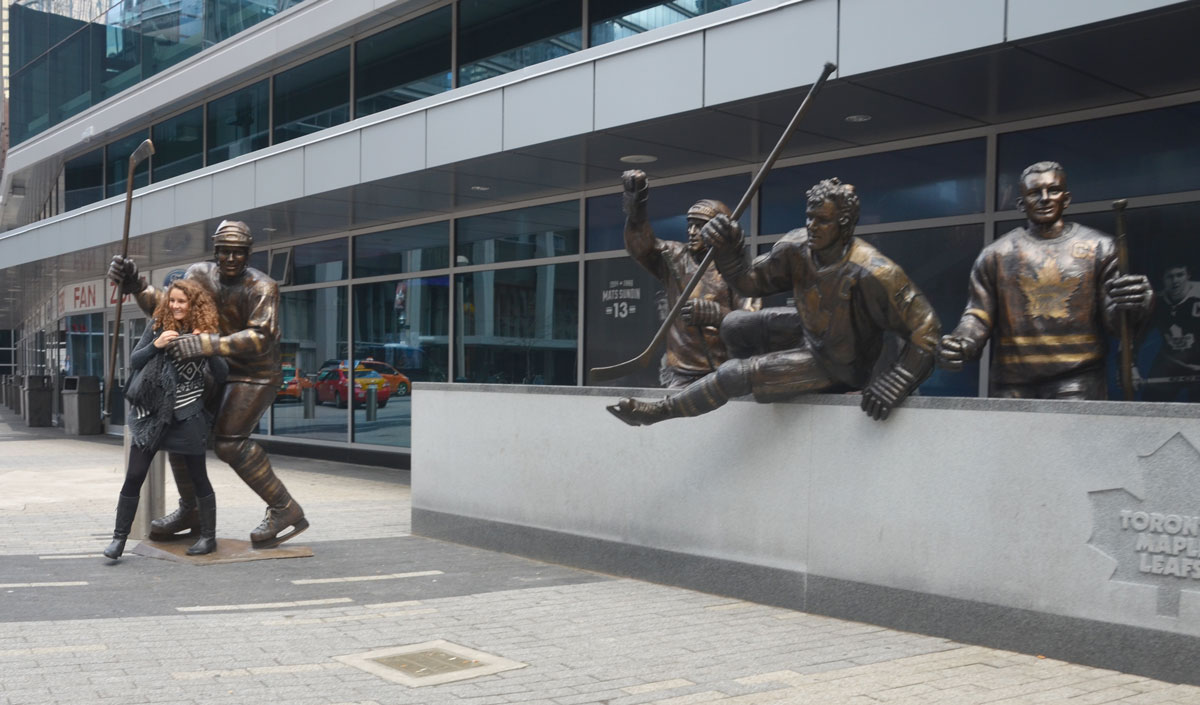
line of statues of hockey players in front of the Air Canada Centre, Legends Row in Toronto, a few people are standing in front of the statues.

Legends Row in Maple Leaf Square is growing.  Last week, three more statues of Leafs players were added to the line up of statues already there.  This is the fourth installment and now Turk Broda, Dave Keon, and Tim Horton have now taken their place outside the Air Canada Centre.

The unveiling of the latest statues coincided with the opening ceremonies for the 100th season of NHL hockey in Toronto.   That first year, the Toronto team was the Toronto Arenas and their only competition were the Montreal Canadiens and the Ottawa Senators.   The Arenas didn’t last very long; they folded because of financial problems.  For the 1919-20 season, the Toronto team was the St. Pats and their uniforms were green and white.   They remained the St. Pats until 1927 when Conn Smythe bought the team and changed the name to the Maple Leafs.    (The NHL was formed Nov 26, 1917 so technically we may have jumped the gun by a year, but we can fudge that and call it the 100th season!).

below: Goalies Turk Broda (right) and Johnny Bower (left) have a chat while George Armstrong stands in the background.  Broda (1914-1972) played goal and spent his whole NHL career with the Maple Leafs during which time they won the Stanley Cup five times.

three statues of former Toronto Maple Leaf players in Legends row in Toronto, goalies Turk Broda on the right and Johnny Bower on the left, are standing, George Armstrong is in the background.

below: Dave Keon, number 14, stands behind the bench with his teammates.   Keon (b.1940) pl ayed for the Maple Leafs for 15 years during a career that lasted from 1960 to 1982.  He won the Calder trophy his first year and he was the team’s top goal scorer for many years.

statues of hockey players lined up behind the boards as if they were in a rink, some of the players in the background are jumping over the boards. Number 14 for the Toronto Maple Leafs is in the foreground, Dave Keon.

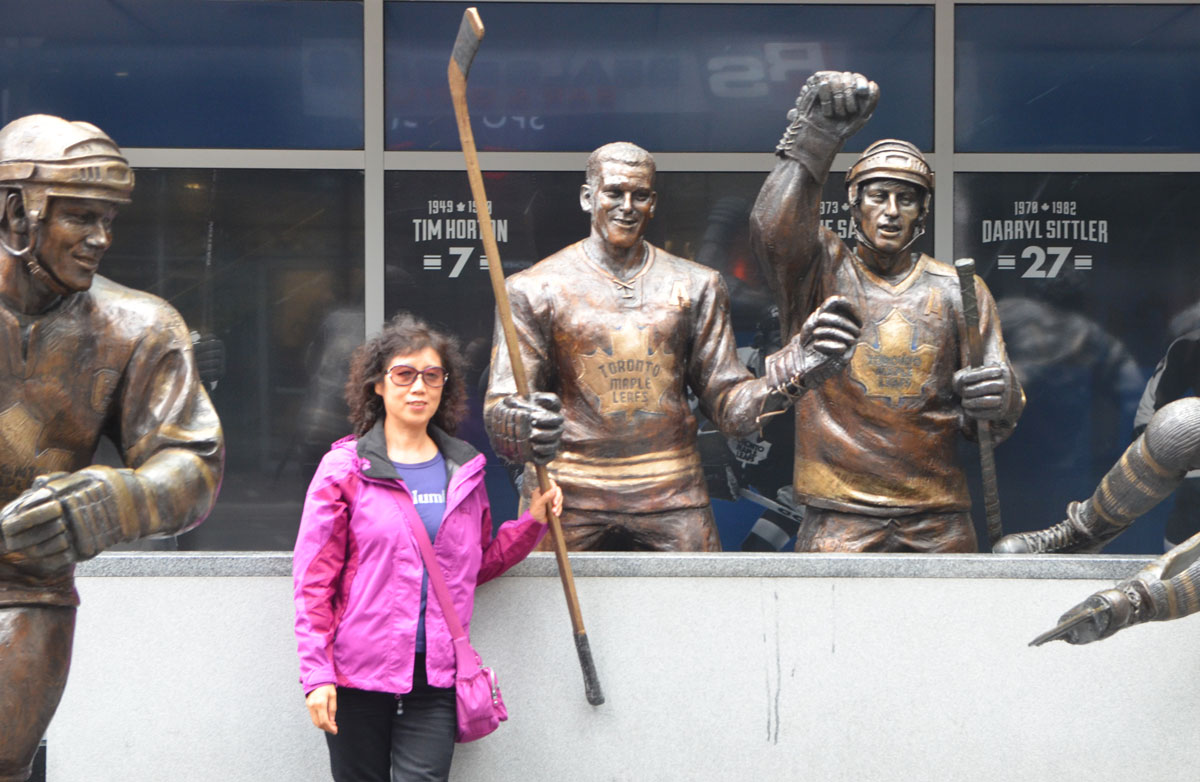
below: It looks like Tim Horton may have to share his stick.  I suspect that he’s going to have the problem fairly often!  Tim Horton (1930 – 1974) was a defenceman who played for the Leafs during the 1960’s when they won the Stanley Cup four times.  Also during this period he set the record for playing in consecutive regular season games, 486.

a woman in a pink jacket stands in front of a statue of a hockey player, Tim Horton.  She is holding onto his hockey stick.  There are a couple of other statues in the picture too.

a woman poses for a photo with a line of statues of hockey players

Previous Legends Row posts

  1. Over the boards when the first three statues were installed. (Sittler, Kennedy and Bower)
  2. Leafs expansion, two Swedes, (Salming and Sundin)
  3. Two number tens (Apps and Armstrong)

A sweet post.

This is what 37,000 tons of raw sugar looks like.
The Raw Sugar Shed at Redpath Sugar is 27m high,  155m long, and 43 m wide.  It’s a big space!

a man is leaning on a temporary metal barricade in front of a very large pile of raw sugar in a large warehouse.

Raw sugar is brought to the Redpath Sugar facility by ship.  When it is off-loaded from the ship it is brought into the warehouse by conveyor belts that run down the middle of the ceiling.

below: There isn’t a ship in the harbour at the moment so the green crane waits.

a little girl in the foreground, standing beside a squared opening in the harbour for ships to come in, beside the Redpath Sugar refinery building on the waterfront with its green cranes and greenish blue building

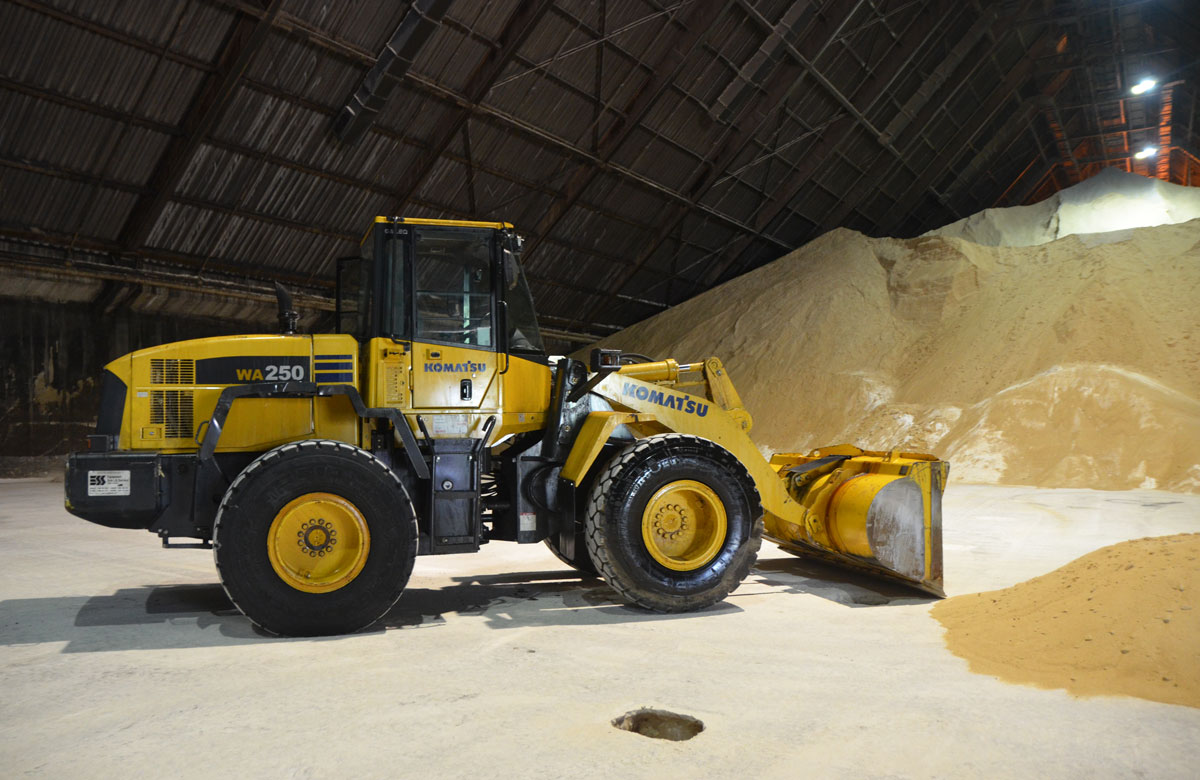
below:  You can see a holes in the foreground of the next photo.  This is one of many holes in the floor of the Raw Sugar Shed.  The raw sugar is pushed through these holes to another series of conveyor belts below.

a large yellow front end loaded is parked inside a warehouse. A large pile of raw sugar is in the background.

three warning signs on the outside of a door of the Redpath Sugar shed, a warehouse for storing raw sugar. One says "Beware of Heavy Equipment", the second says "Sound horn before entering" and the third says "Canadian Government Customs Bonded Warehouse no. 60"

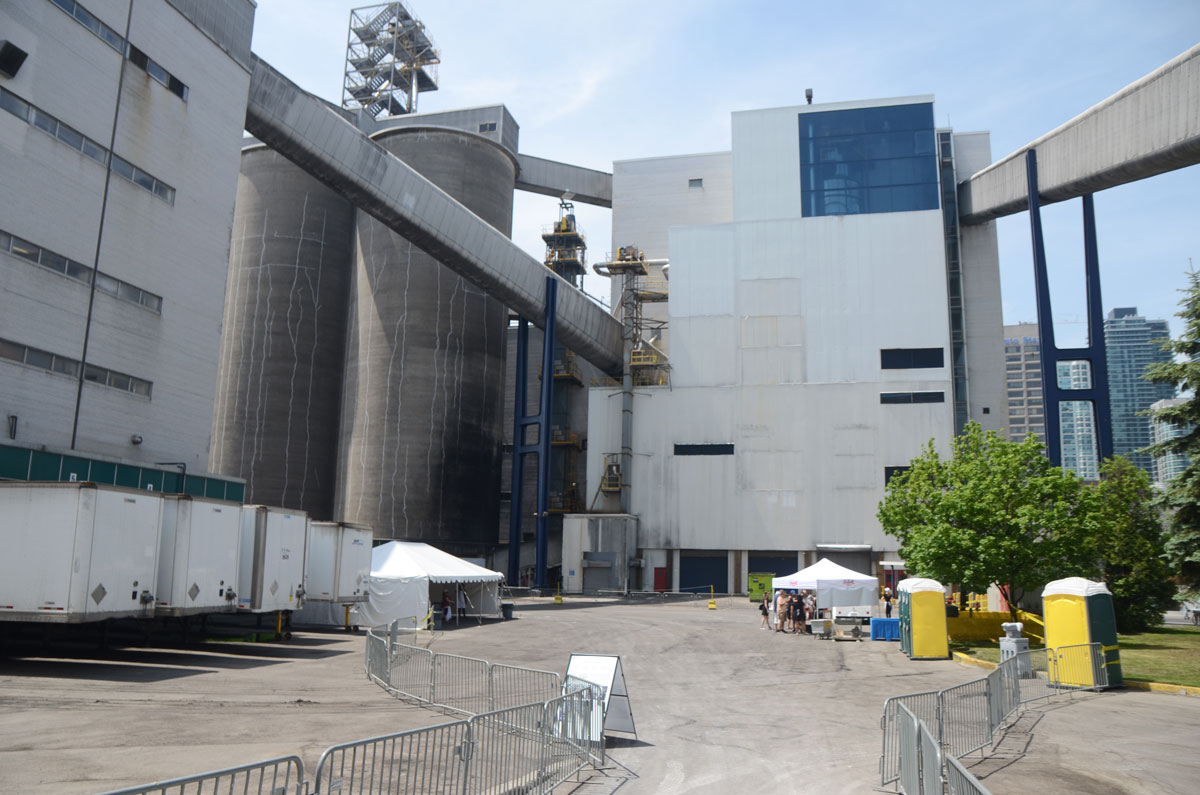
below: Photo taken from the entrance to the Raw Sugar Shed, taken at Doors Open.  Raw sugar is taken by conveyor belt (upper far right) to the processing plant next door.

sugar processing area of Redpath Sugar refinery, some white tents and metal barricades for crowd control as it is Doors Open day.

close up of the white Redpath Sugar processing plant, grey metal covers on conveyor belt tunnels and vents

below: A lingering remnant, railway crossing signs from when a railway ran here.
A guard sits by the entrance to Redpath Sugar.

a wire fence with barbed wire across the top, behind the fence is round yellow railway crossing sign as well as a large blue metal pole and a small shrub. There is also an old warning sign for a railway that once ran past here.

The railway serviced the industries that were built along the Toronto waterfront,  The LBCO, Loblaws, the ‘Toronto Star’ newspaper, Molson Breweries, Dominion Malting and others, relied on the railways.   Completed in 1959, the Redpath refinery was the last industry built along the waterfront.  You can just see the railway tracks in the photo below, running between Queens Quay East and the Redpath building where they dead end.  Since the tracks only dead ended there in 1985, that helps date the picture.   Rail service ended in 2008.

aerial view of the East Wharf portion of the Toronto wateterfront, vintage photo from the 1970's or 1980's

photo credit: Originally from City of Toronto Archives but found online at Old Time Trains.

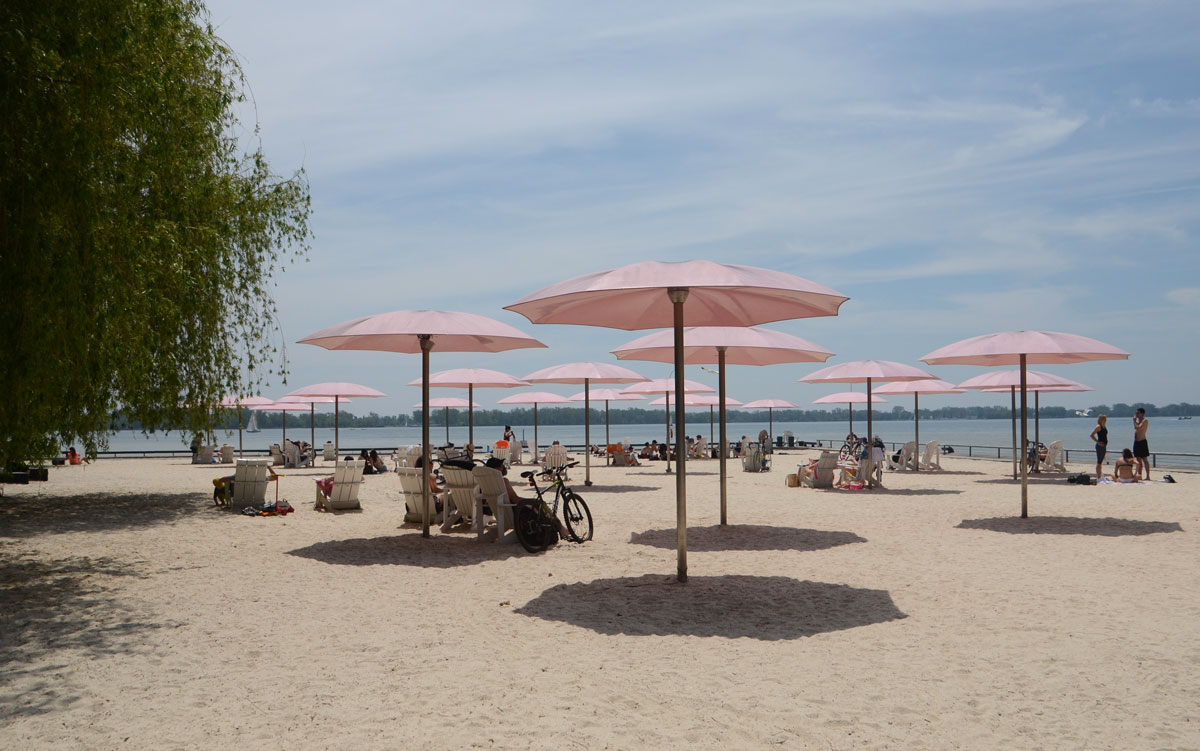
Today, Redpath Sugar is one of the last industries operating on the waterfront; The area around it is rapidly being redeveloped, including the space right next door that is aptly called Sugar Beach.

people sitting on white chairs under pale pink umbrellas at Sugar Beach. sand, water and blue sky, beside Lake Ontario

a man sits on a chair between a blue shipping containter and a building,

Happy Mothers Day!

I didn’t write this blog post specifically for Mothers Day even though it’s about four women, Mary Pickford, Edith Cavell, Florence Wyle, and Frances Loring.  Just because they are women doesn’t mean that they are mothers, in fact only one is.  Mary Pickford adopted two children.  I also didn’t intend to write a blog post on the merits of motherhood vs childlessness so I am going to say nothing further on the subject!

The first woman can be found at the corner of University and Elm.  Here, there is a a bronze portrait bust of Mary Pickford that was sculpted by Eino Gira in 1983.

bust of Mary Pickford with her hand on her cheek, in front of Sick Kids Hospital in Toronto, red brick hospital behind her in the photo

The plaque beside her says:

Born in 1893 in a house which stood near this site, Gladys Marie Smith appeared on stage in Toronto at the age of five.   Her theatrical career took her to Broadway in 1907 where she adopted the name Mary Pickford.  The actress’s earliest film “Her First Biscuits”, was released by the Biograph Company in 1909 and she soon established herself as the international cinema’s first great star.   Her golden curls and children’s roles endeared her to millions as “America’s Sweatheart”.  She was instrumental in founding and directing a major film production company and starred in over fifty feature-length films including “Hearts Adrift”, “Pollyanna” and “Coquette”.  For the last named film she received the 1929 Academy Award as the year’s best actress.

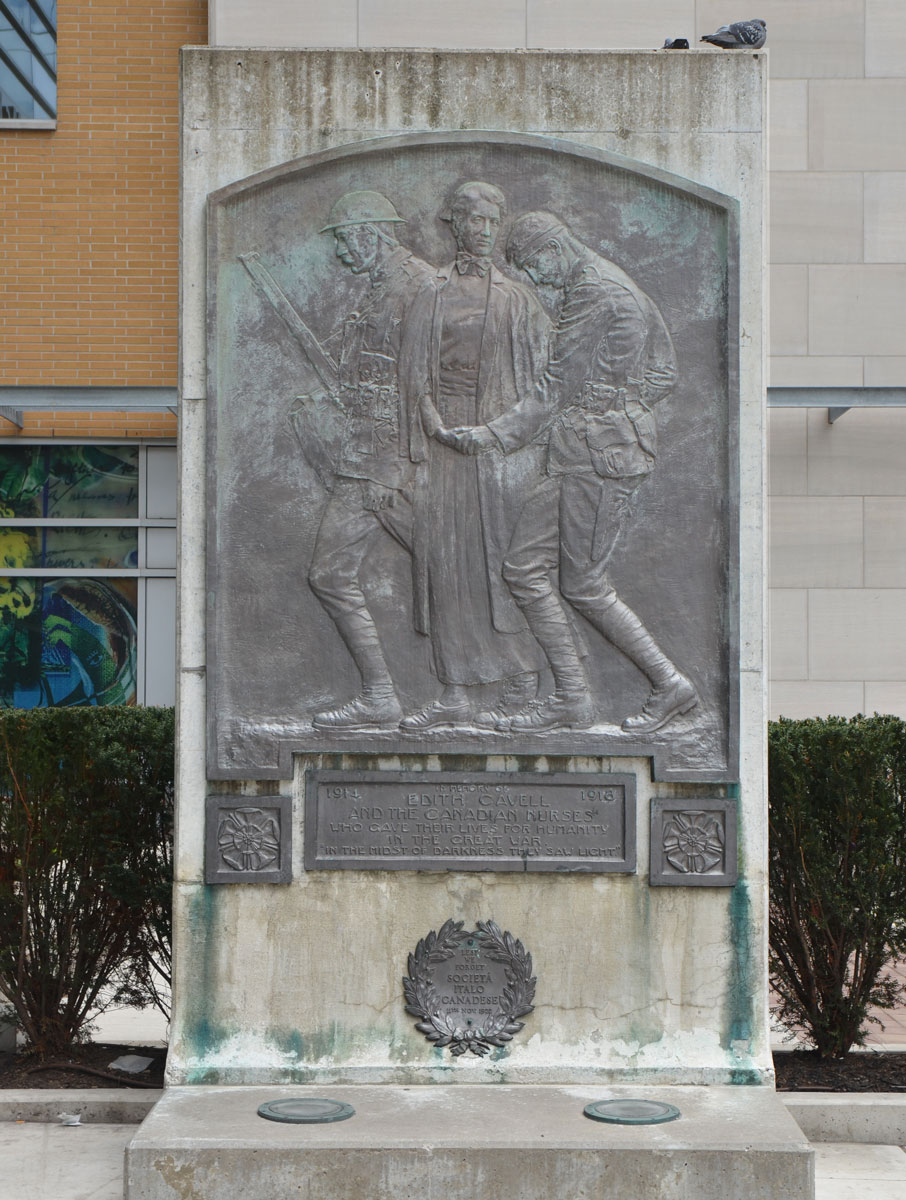
below: Just up the street, next to one of the entrances of Toronto General Hospital, is a memorial to British nurse Edith Cavell (1865-1915) and to all the Canadian women who served as nurses in WW1.  The memorial  was installed at University Ave and College St. in 1921 but later moved to its present location.

A memorial to British nurse Edith Clavell and the Canadian nurses of WW1, a bronze plaque mounted on a stone tablet. Picture of Clavell between two upright but wounded soldiers.

In memory of Edith Cavell and the Canadian nurses who gave their lives for humanity in the Great War.  “In the midst of darkness they saw light”

Cavell had been working in Brussels when WW1 broke out.  After the Germans invaded Belgium, Cavell helped wounded Allied soldiers escape to the Netherlands.  She was caught by the Germans, charged with treason, and executed on 12 October 1915.  She became the most well known woman casualty of WW1.

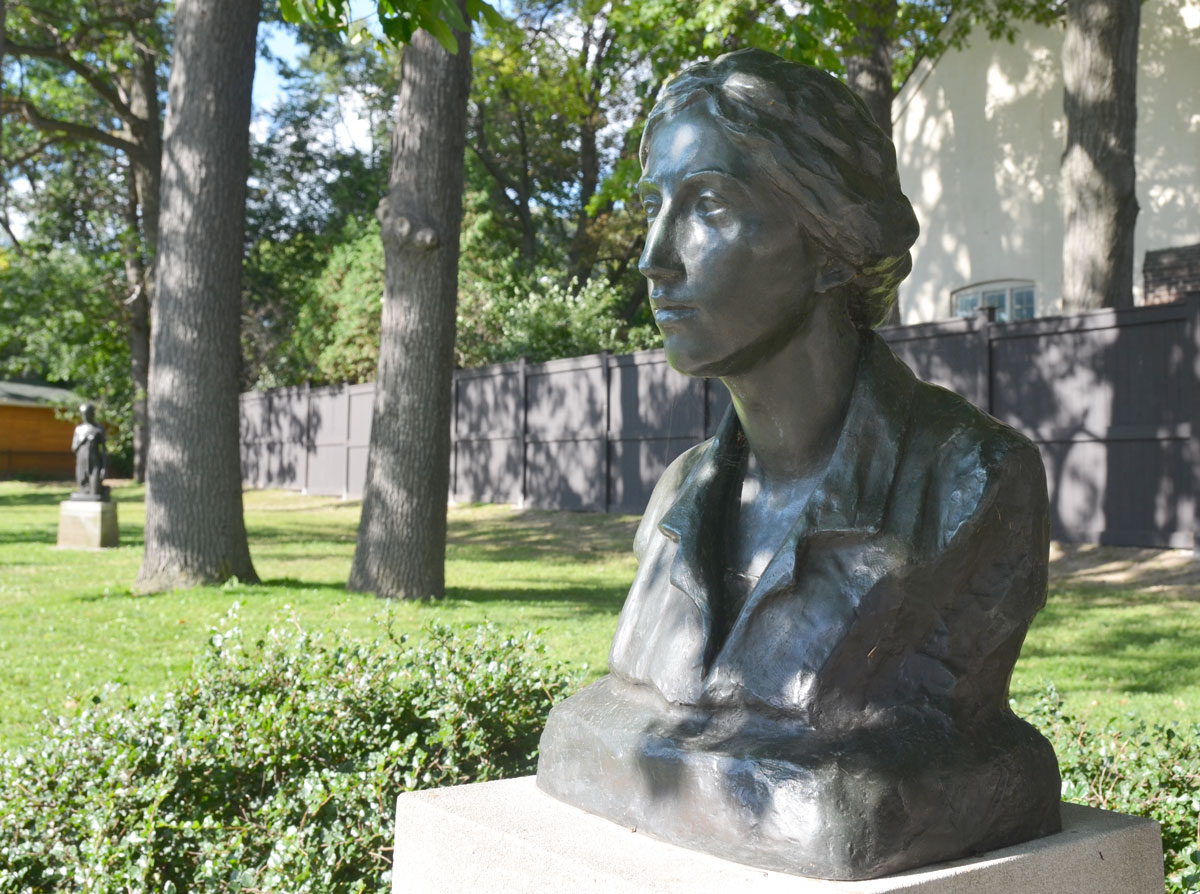
The above memorial was designed by Florence Wyle.  There is a memorial to Wyle and her partner, Frances Loring (also a sculptor), in a small park at the corner of Mt Pleasant and St. Clair.

below: bronze bust of Florence Wyle, by Frances Loring

bust of Florence Wyle, a Canadian sculptor, in a park

below: bronze bust of Frances Loring, by Florence Wyle

bust of Frances Loring, a Canadian sculptor, in a park, in the shade of a large tree

below: There are a couple of small statues by Wyle in the same park, including this one.
“Young Girl”, about 1938.

bronze statue titled "Young girl", showing a girl from the thighs up, holding up a cloth that is wrapped around her body but her breasts are bare

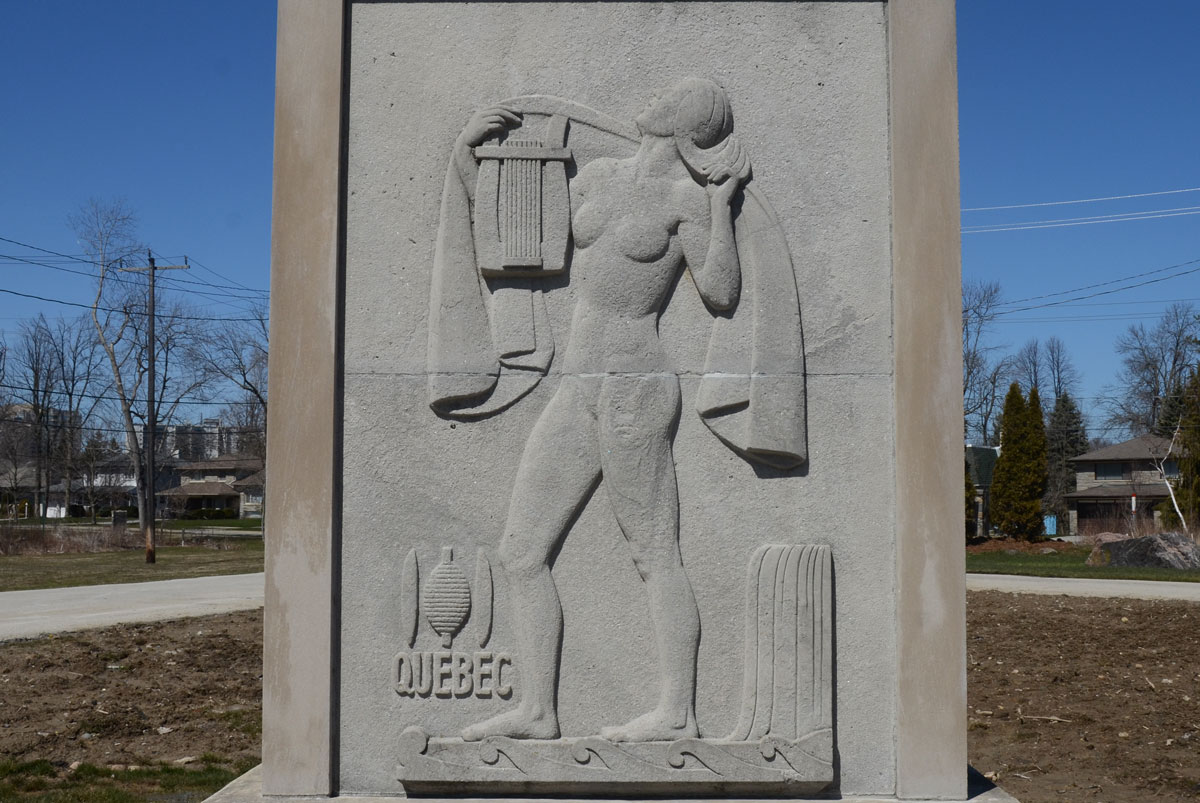
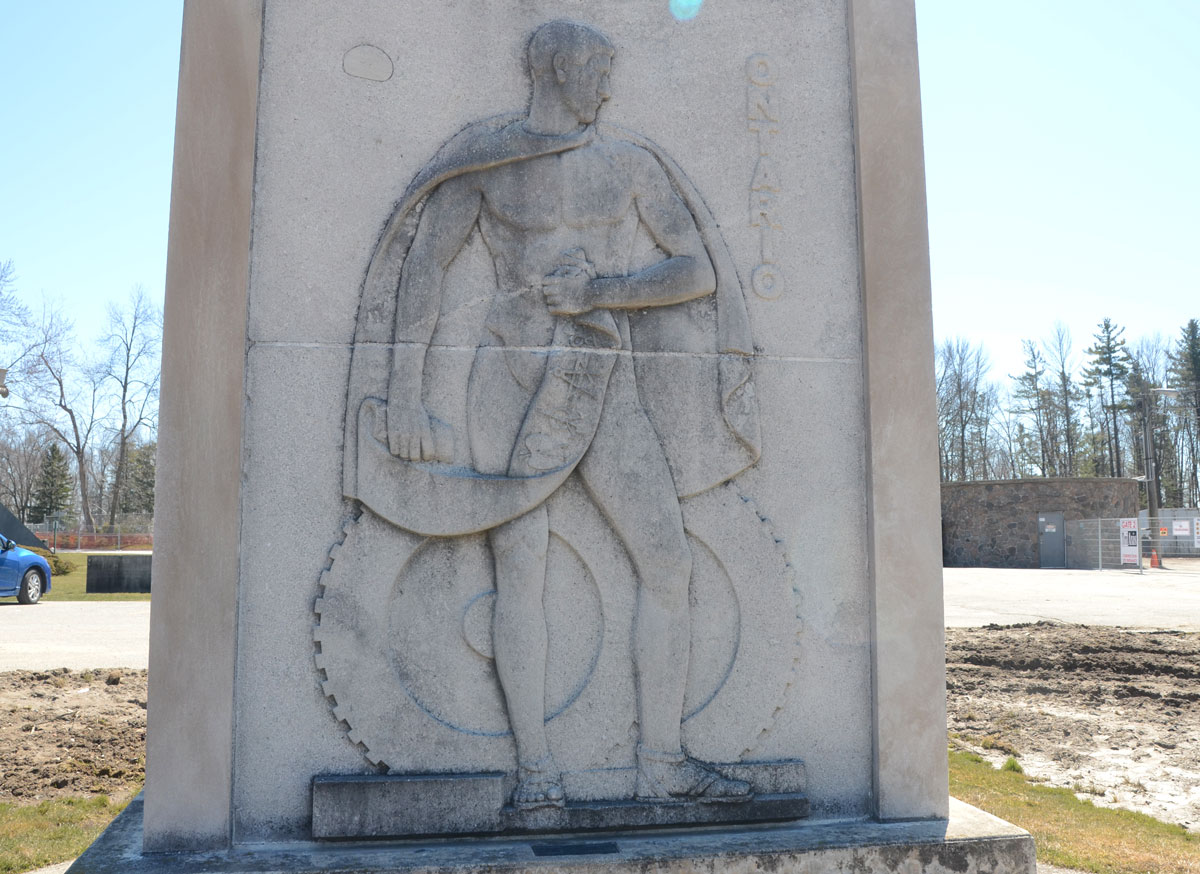
Loring and Wyle are responsible for a number of sculptures around the city.  Two of these used to be on the Bank of Montreal building at the northwest corner of King and Bay. It was built in 1887 by architects Marani and Morris and demolished in 1968.  The building featured a series of sculptures representing the Canadian provinces that were done by a number of artists.  Frances Loring sculpted the panels for Ontario and Quebec.  When the Bank of Montreal building was demolished, all of the panels were moved to the grounds of the Guild Inn in Scarborough where they remain today.

Quebec sculpture - A stone relief sculpture from a series on provinces of Canada, originally on a Bank of Montreal building in Toronto. They were rescued when the bank was demolished and moved to the grounds of the Guild Inn in Scarborough. By Canadian artist Frances Loring. A naked woman upright, with a cloth over her shoulders and looking upwards

A stone relief sculpture from a series on provinces of Canada, originally on a Bank of Montreal building in Toronto. They were rescued when the bank was demolished and moved to the grounds of the Guild Inn in Scarborough. By Canadian artist Frances Loring. Ontario is in the picture, as a man surrounded by symbols of industry such as large gears and architectural plans

The dapper, larger than life Alexander Wood has stood on his corner at Church and Alexander streets for 11years now.  The bronze statue by Del Newbigging was unveiled in May 2005.

Wood came to Upper Canada from Scotland and settled in Toronto (known as York at the time) in 1797.  He was a successful merchant, magistrate, and lieutenant in the York militia.  The plaque on the granite pedestal tells his story.


statue of Alexander Wood, a young man with long coat, and a hat in his hand. The statue is on a large square pedestal so his feet are close to eye level.  Below the statue is a plaque detailing his life as early settler of York, of being a gay, and of being involved in a scandal in 1810.

“Militia Officer, Businessman, Public Servant, Justice of the Peace, Gay Pioneer

Alexander Wood came to Canada in 1793, settled in York in 1797 and started a mercantile business, one of only three stores in York at that time. Within a year he was a lieutenant in the York Militia; he was appointed magistrate in 1800 and by 1805 was a Commissioner for the Court of Requests (a senior planning officer). He was involved in a homophobic scandal in 1810 and fled to Scotland, but in two years he was back in Canada and resumed his duties. In spite of ridicule and discrimination he had a successful career in public service: he was on the executive of nearly every society in York, often as treasurer; he was manager of several businesses and acted for clients in land transactions. Wood died in 1844 at the age of seventy-two while in Scotland. The British Colonist paper called him one of Toronto’s ‘most respected inhabitants’.”

***

There is another bronze plaque on the back of the pedestal, complete with shiny bits.  This plaque adds more details to the story of the 1810 scandal that Wood got himself into.

plaques on a statue. The top is of a man with his pants lowered, the bottom is the story of the scandal that led to Alexander Wood having to leave Canada.  The bare bum on the plaque is shiny from repeated rubbing by passers by.

“1810 The Scandal
In 1810 a woman reporting a rape to Magistrate Wood said she had scratched her rapist. Wood inspected several suspects privately, requiring them to undress. To avoid the scandal caused by his unconventional behaviour, Wood fled to Scotland. After two years he returned to Canada but suffered ridicule and discrimination for the rest of his life.

Alexander Wood 1772-1844
Militia Officer, Businessman, Public Servant, Justice of the Peace, Gay Pioneer”

***

In 1810, word had spread quickly around the town (of 700) and Wood had become known as the “Inspector General of Private Accounts”.    The worst of the scandal blew over while Wood was in Scotland; he was back in York in 1812 and resumed all his previous occupations, including magistrate. At that time, “molly’ was a derogatory word for a gay man and he was nicknamed Molly Wood.

In 1826 he purchased 50 acres of land east of Yonge St. and north of Carlton St. in the neighbourhood where his statue now stands.  It is also the “Village”.  In Wood’s time it was referred to as ‘Molly Wood’s Bush’.  Wood remained in Toronto until 1842 at which time he returned again to Scotland where he died two years later.

The eastern end of the Kay Gardner Belt Line Park crosses over Yonge St and the subway just south of Davisville station.  It then runs across the north side of Mt. Pleasant cemetery.  It comes to an end at Mt. Pleasant Road where the trail merges into the roads that run through the cemetery.

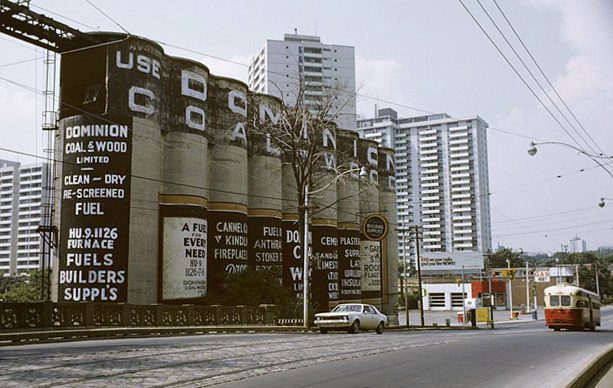
In 2014 students from Greenwood School painted a mural at this location.  The mural has three main elements.  A train to represent the Belt Line, the name of the community that it is located in (Mt Pleasant Village), and the words ‘use Dominion Coal and Wood’.    The last part is because not long ago, on this site, stood the large concrete silos that the Dominion Coal and Wood company used to store coal and wood.   The shape of the black background is very similar to the shape of the silos if viewed from above.

below: Mural, with Mt. Pleasant Road above it.

blog_domiion_mural_greenwood

mural celebrating mt pleasant village and the old dominion coal and wood silos that used to be at that location. At the end of the belt line trail where it merges into mt pleasant cemetery

below: Plaque located on the site of the old silos (now in the bushes beside a condo)

City of Toronto historical plaque describing the history of the Dominion Coal and Wood silos that used to be on Mt. Pleasant Ave near the old Belt Line Railway tracks.

transcription of the Heritage Toronto plaque:

“Dominion Coal and Wood

Originally located on Danforth Avenue, the Dominion Coal and Wood Company was founded in 1912 by William H. Smith.  In 1929, the company opened a landmark facility on this site.  Its nine adjoining concrete silos were designed by E.P. Muntz Engineering Company.  Coal and wood were transported here by rail car along the former Belt Line Railway and then sold as heating fuel to local businesses and home owners.

Originally just one among many similar suppliers in the city, Dominion Coal and Wood outlasted most of its competitors.  The company expanded into building supplies as coal sales dwindled, but continued to sell coal here until the site was closed in 1999.  Although recognized as an increasingly rare type of industrial architecture, the historic silos were demolished in 2001. “


below: The nine silos, about 1972.  The photo is from City of Toronto Archives and was found online at JB’s Warehouse (a good source if you are interested in more information at Dominion Coal and Wood)

picture of the Dominion Coal and Wood silos on Mt. Pleasant, from city of Toronto Archives, taken about 1972. With an old Mt. Pleasant streetcar on the street by the silos.

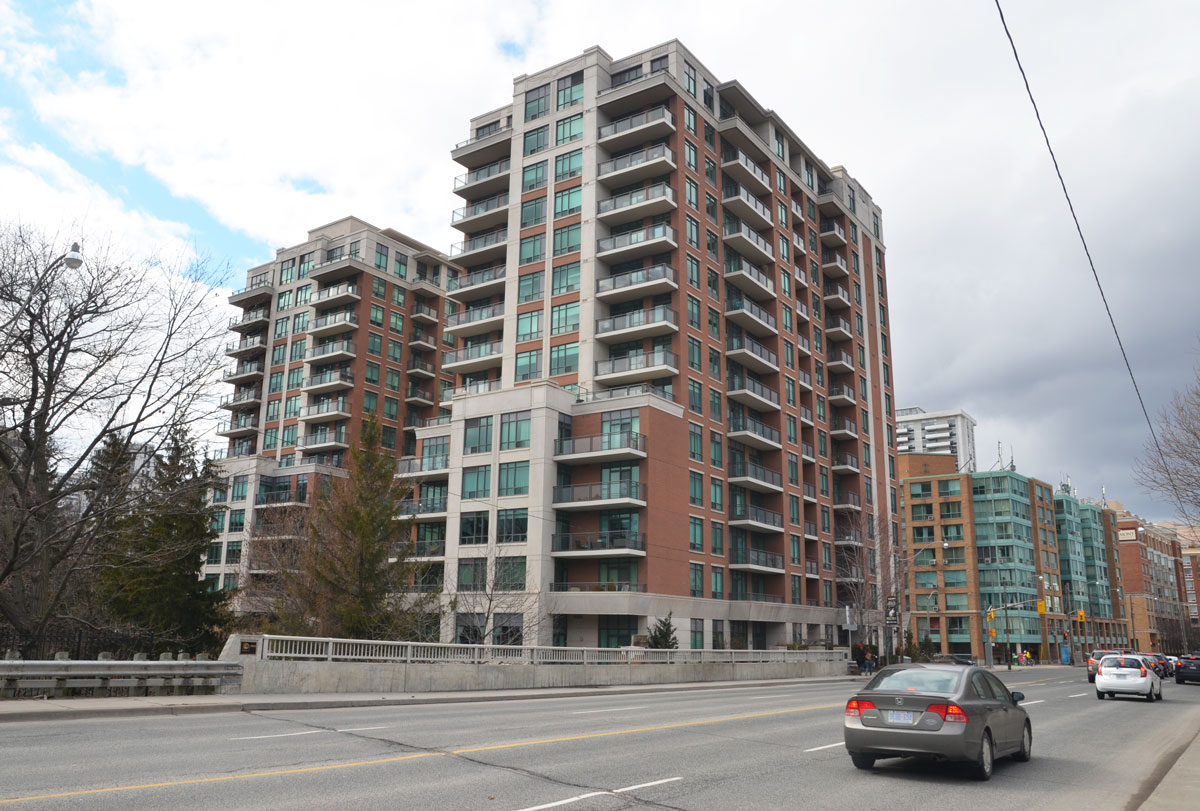
below: I tried to replicate the above photo, about 42 years later.  The Mt. Pleasant streetcars are long gone as is the gas station on the NW corner of Merton and Mt. Pleasant.  A corner of the tall white apartment building on the right can be seen peaking from behind newer condo buildings.  Of course, the dominant part of the picture is the condo development that was built on the site of the Dominion silos in 2002.

condo building across the street, about 12 storeys high, made of brick and glass, a couple of cars are on the street

This post is the result of a very wobbly and random circular walk around part of the Wychwood Heights neighbourhood last weekend.   A hodge podge of this and that.

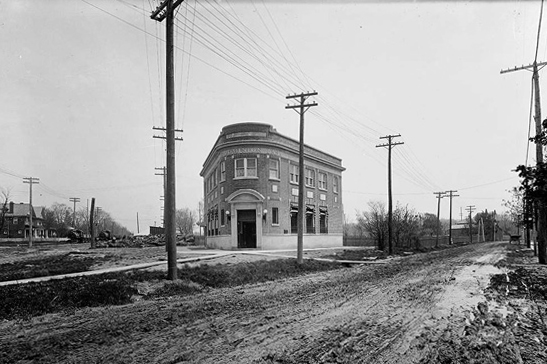
below: The intersection of St. Clair West and Vaughan Road circa 1912

Historical black and white photo of a two sorey brick building at an intersection of two dirt roads.

below: I didn’t quite recreate the picture above but it is still obvious that the brick building is still standing after just over 100 years but that every thing around it has changed.

Two storey brick building, now Hakim Optical on the corner of an intersection.

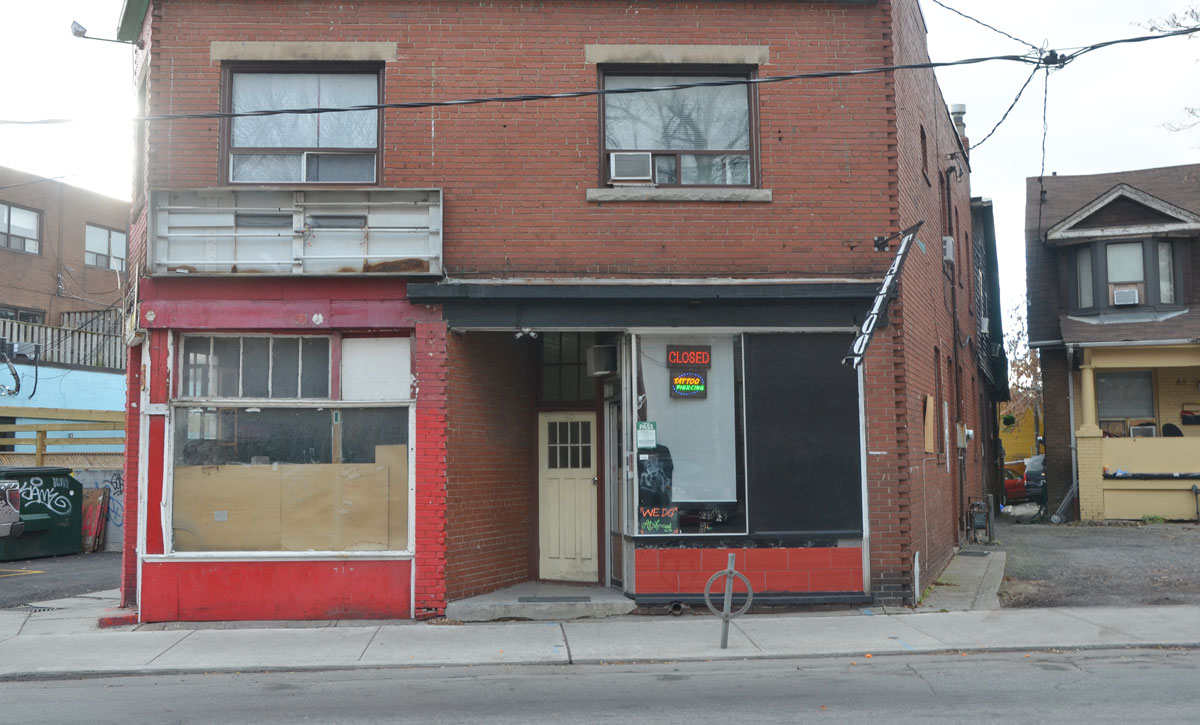
below: Just to the north,  78 Vaughan Road…. didn’t this store used to be an ice cream place?

empty store front at 78 Vaughan Road, empty on one side a closed tattoo parlour on the other.

below:  Ah yes, there is still remnants of ice cream cones above the window so my memory is correct.
I wonder what happened to it?

side of a brick building that used to be an ice cream store. Painted red with some white parts, front has been removed from lighted signs, exterior decorations have been removed except a faint outline of ice cream shapes remain above the window.

There are a number of alleys to the north and west of the intersection of St. Clair and Vaughan Road.  Most of them are quite tidy and well looked after.   They were also full of surprises, bright little things that put on a smile on your face on a December afternoon.

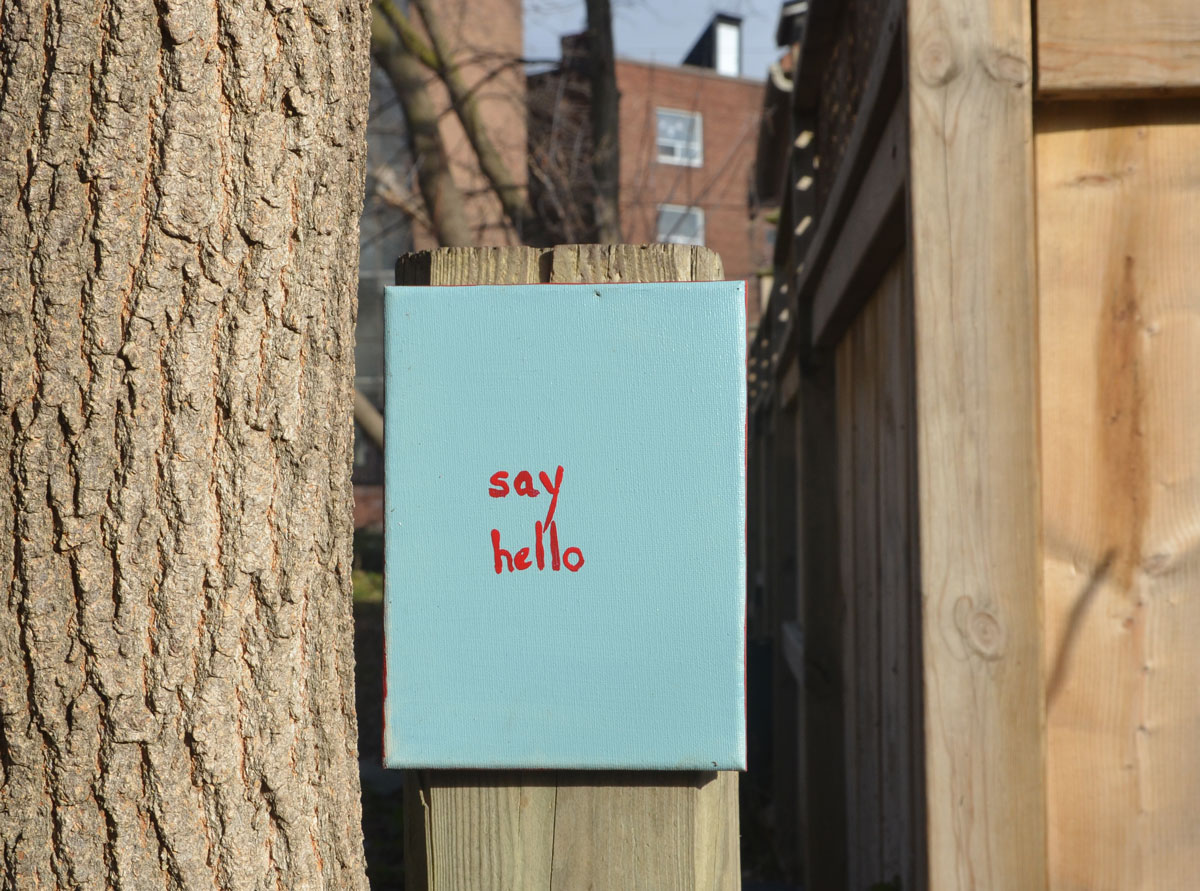
below: Like little pictures painted on canvas….

A small canvas painted turquoise and the words say hello written in small red letters, attached to a fence in a lane

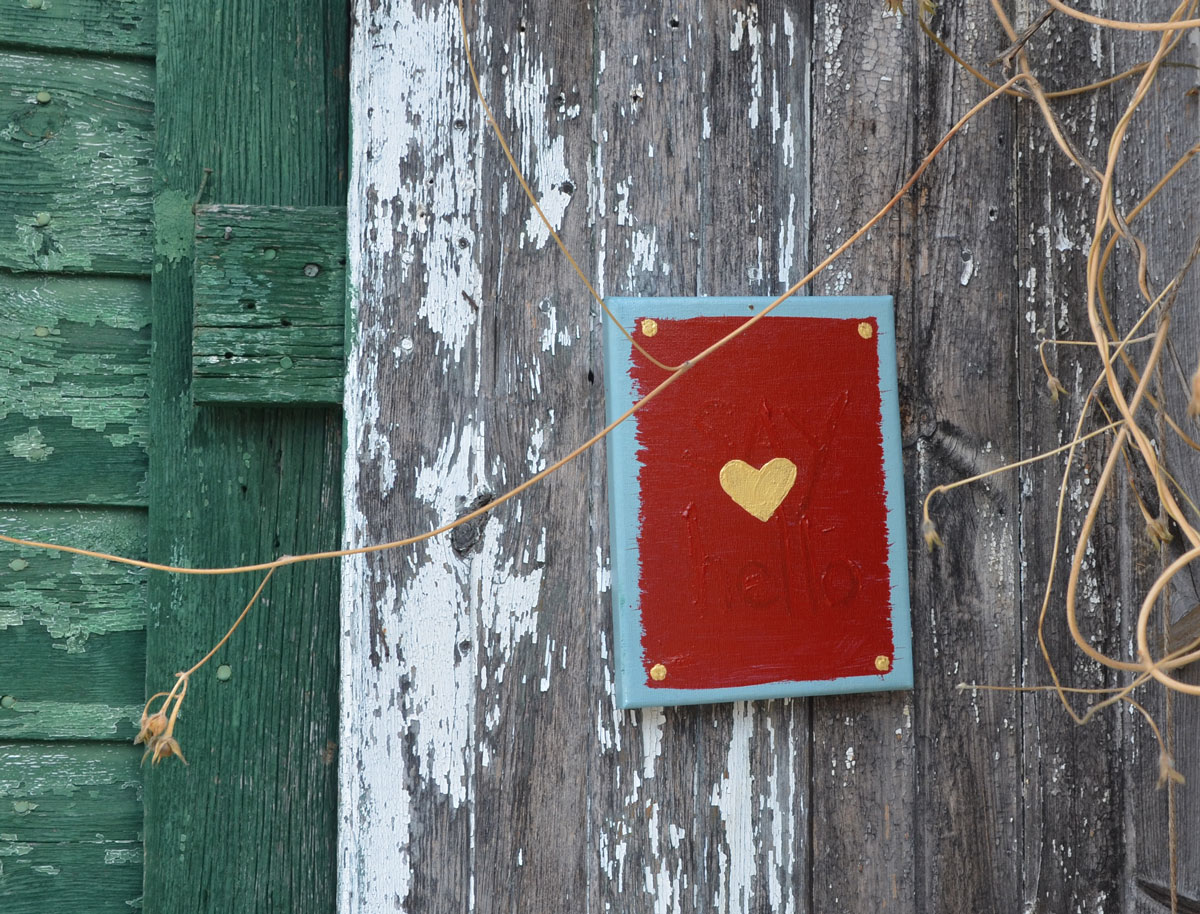
A small canvas painted red and a small yellow heart painted in the middle. The words say hello are painted on it too but they are harder to see. It is nailed to an old wood fence

A small landscape painted on canvas and attached to a telephone pole in an alley

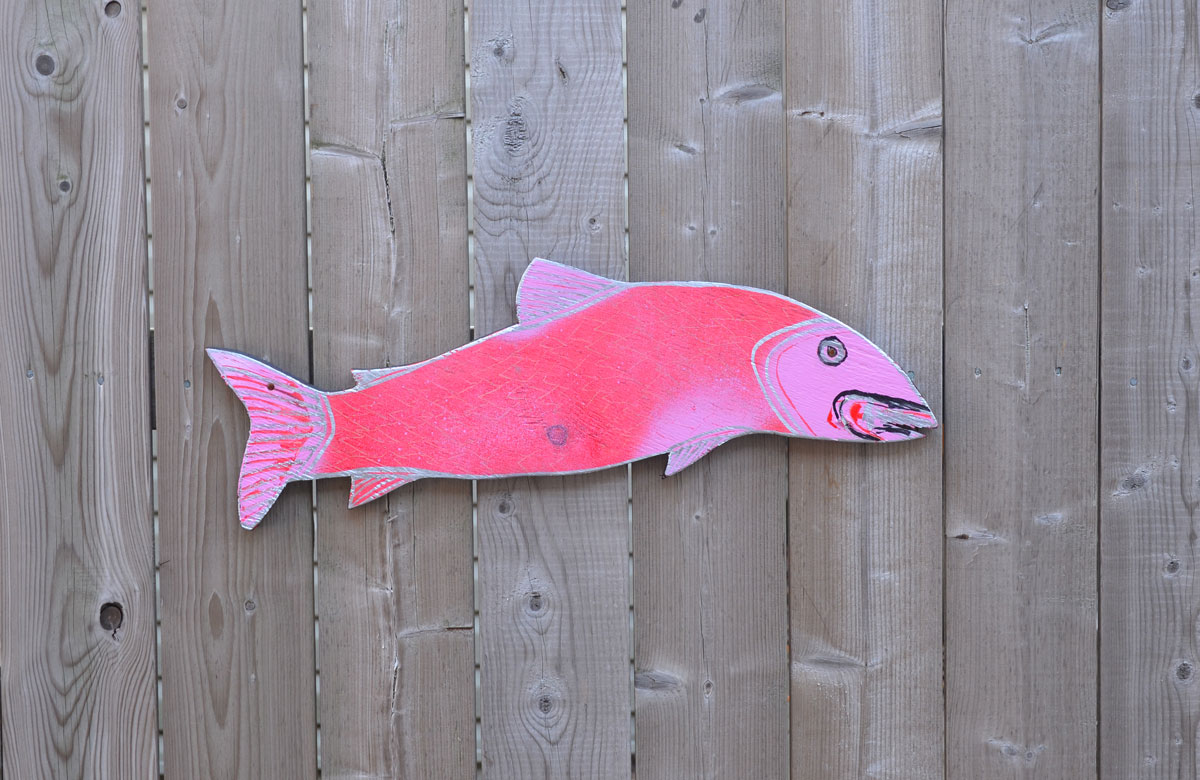
below: and painted on wood

a two tone pink fish painted on wood, cut out, and nailed to a wood fence.

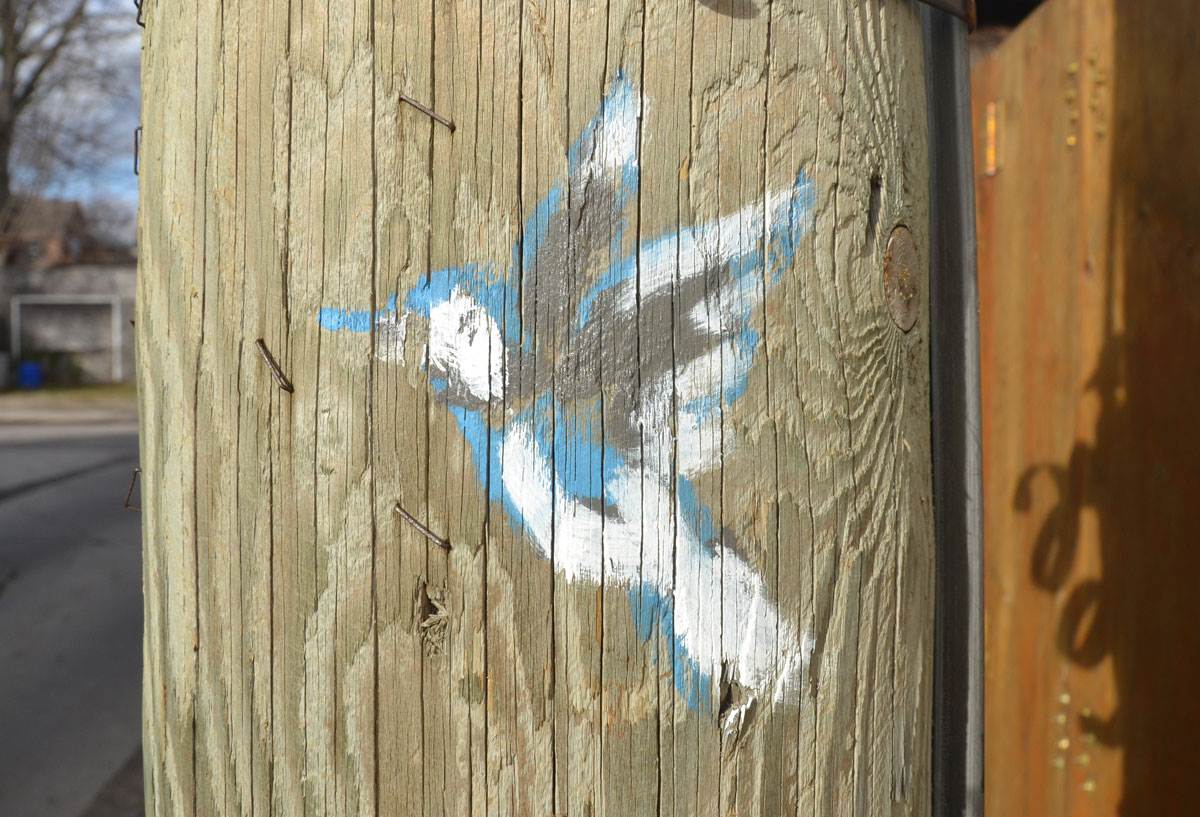
below: or painted directly on poles.

On a wood telephone pole, a small bird painted in white, black and blue.

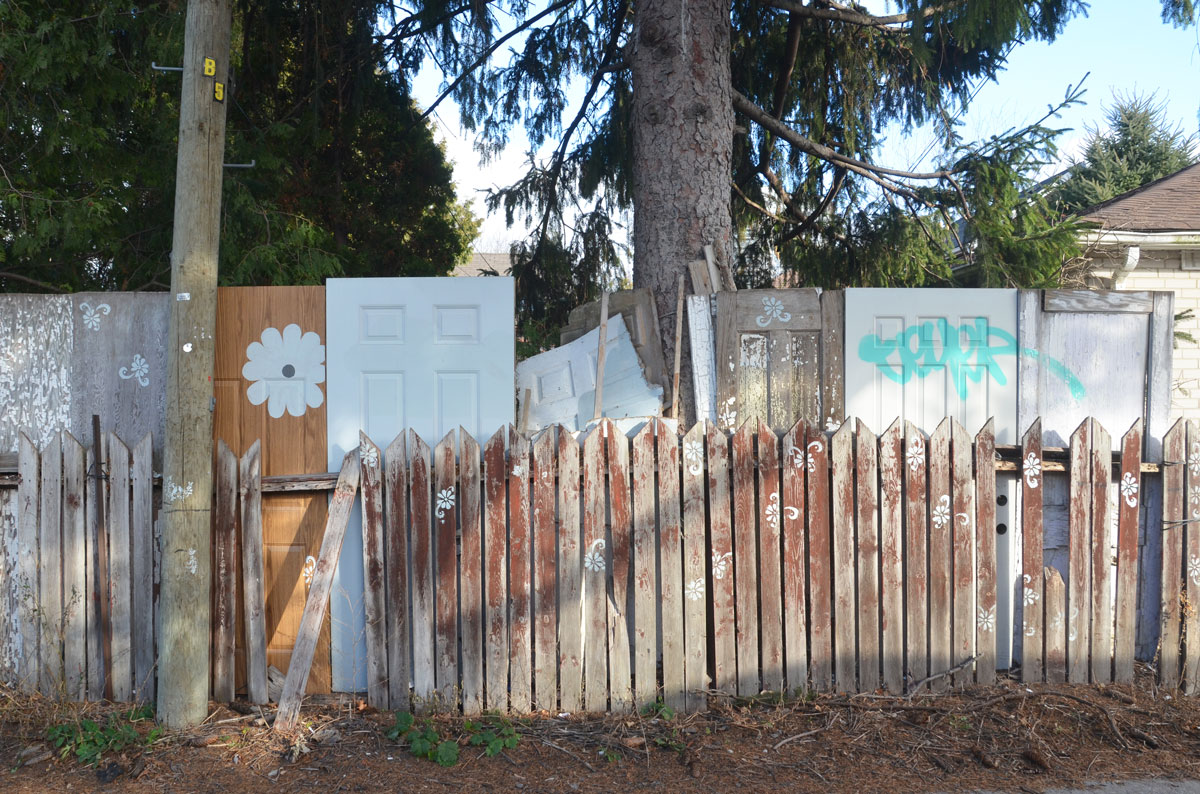
below: There was a fence made of old wood doors

an old picket fence that is falling aoart, and a fence made of doors that is behind it.

close up of old picket fence that is falling aoart, and a fence made of doors that is behind it.

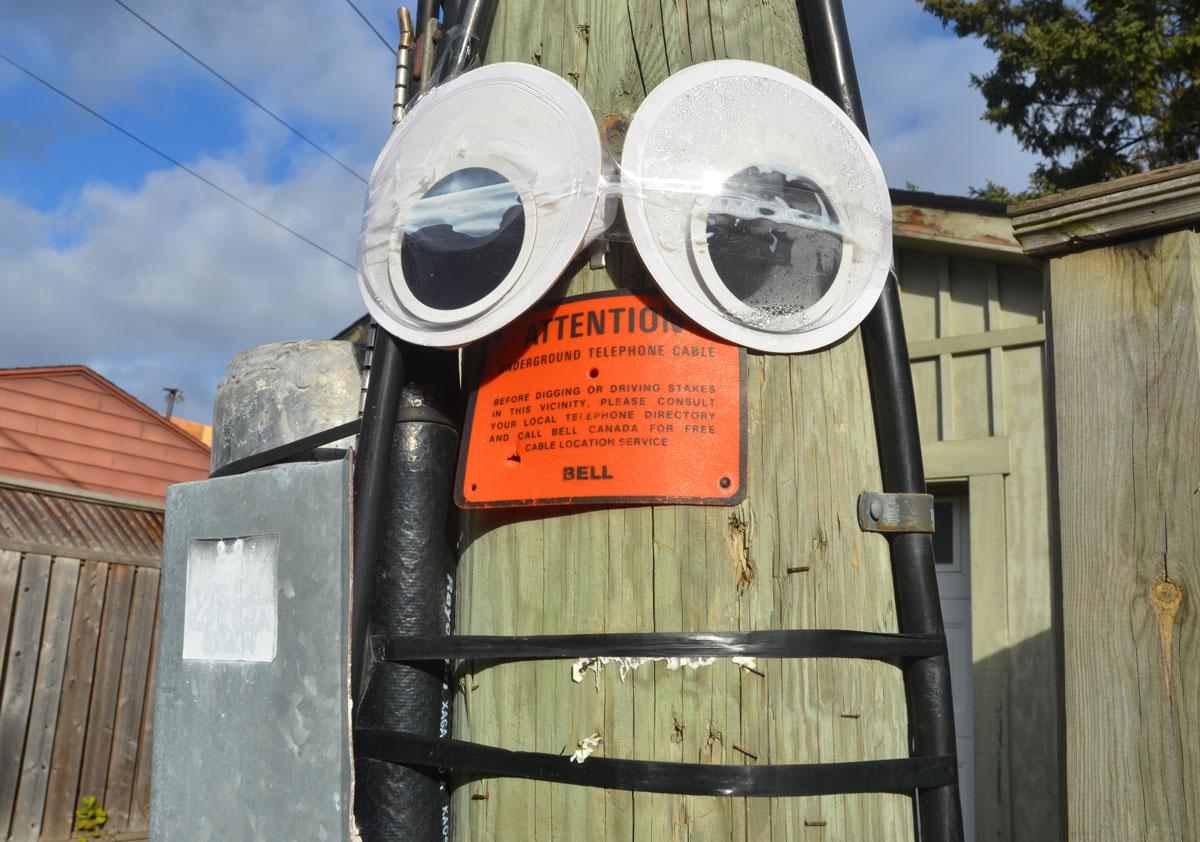
below:  There was a great creature with googly eyes and a rectangular orange nose.

Two big googly eyes attached to a telephone pole

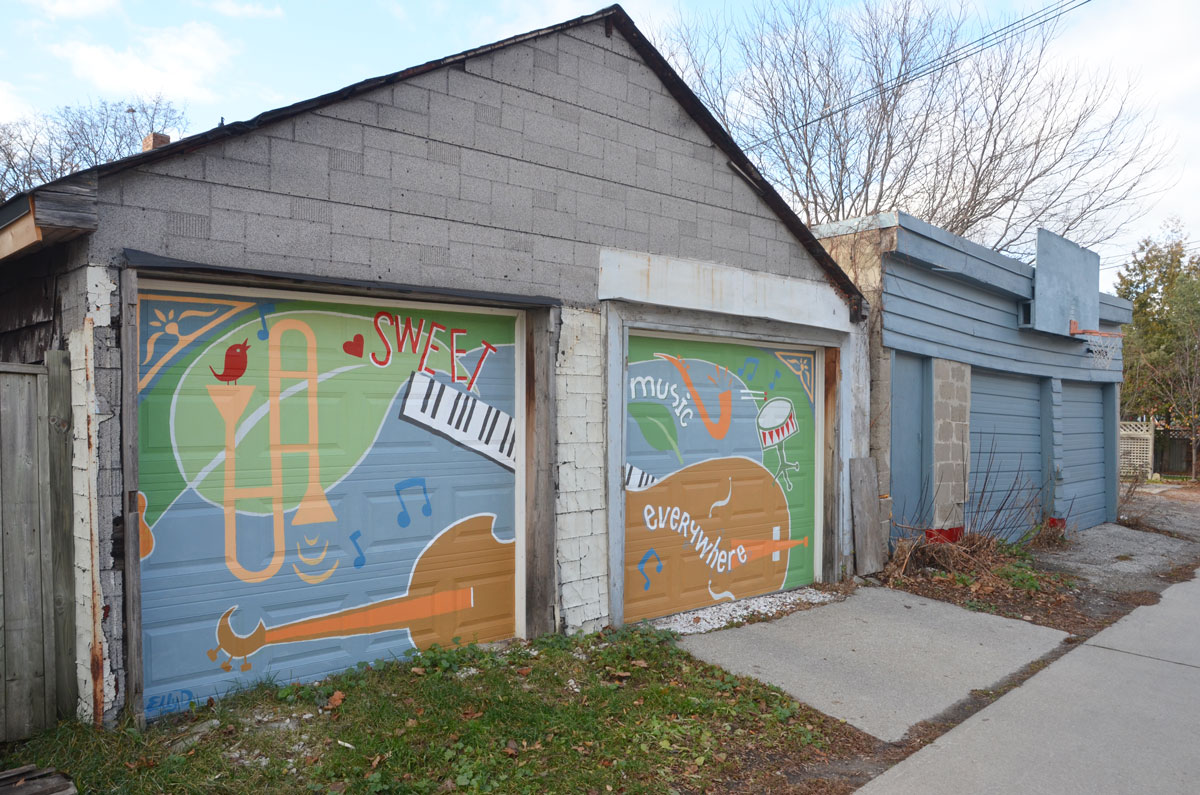
below: And of course there were some painted garage doors.

street art on garage doors, musical instruments covering two garages, a guitar, a trombone, also the words sweet sweet music everywhere

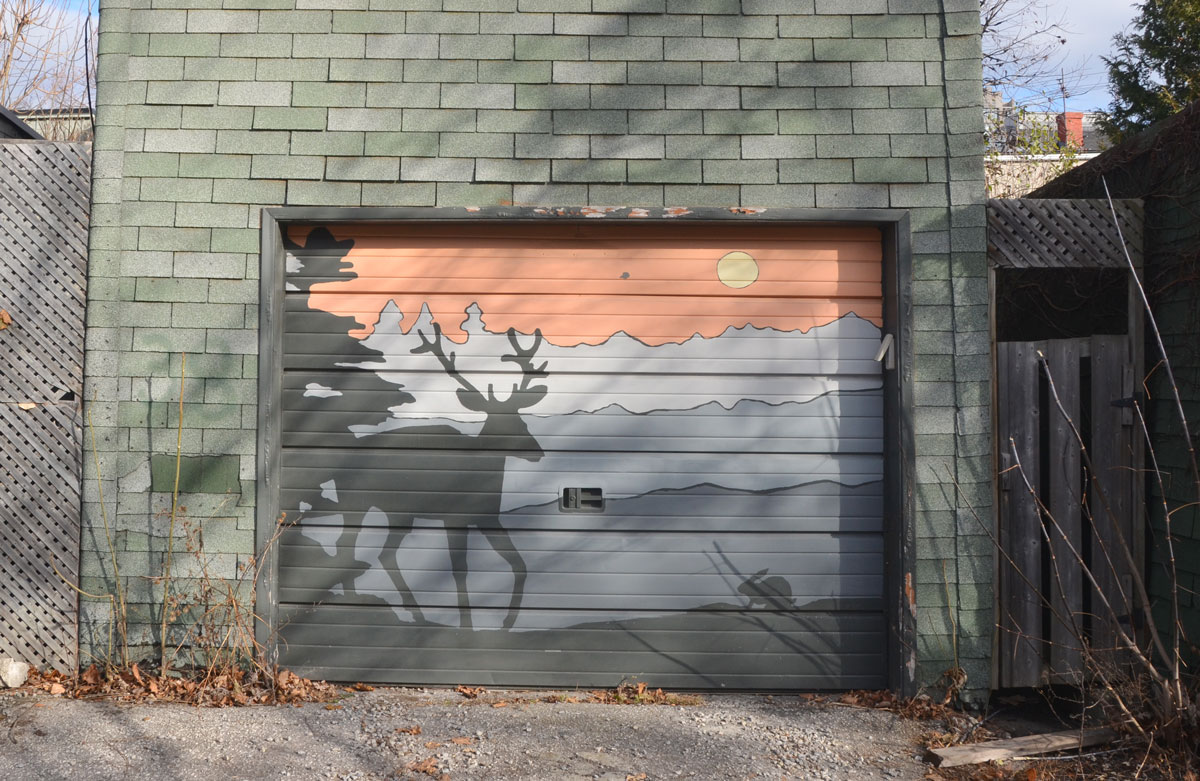
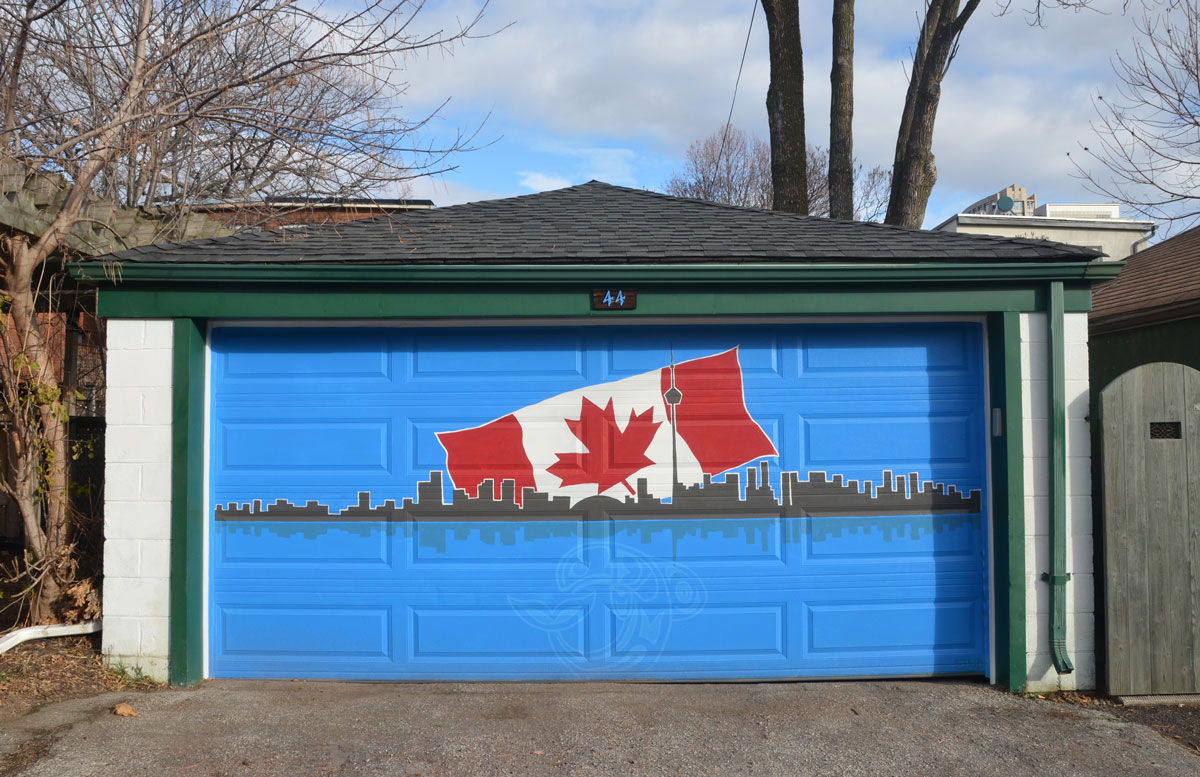
below: These garage doors are a sample of the more than 40 doors that have been painted as part of the Kenwood Lanway Art Initiative.

painting on a garage door of a moose at sunset

painting on a bright blue garage door of the Toronto skyline with a large Canadian flag behind ithe skyline

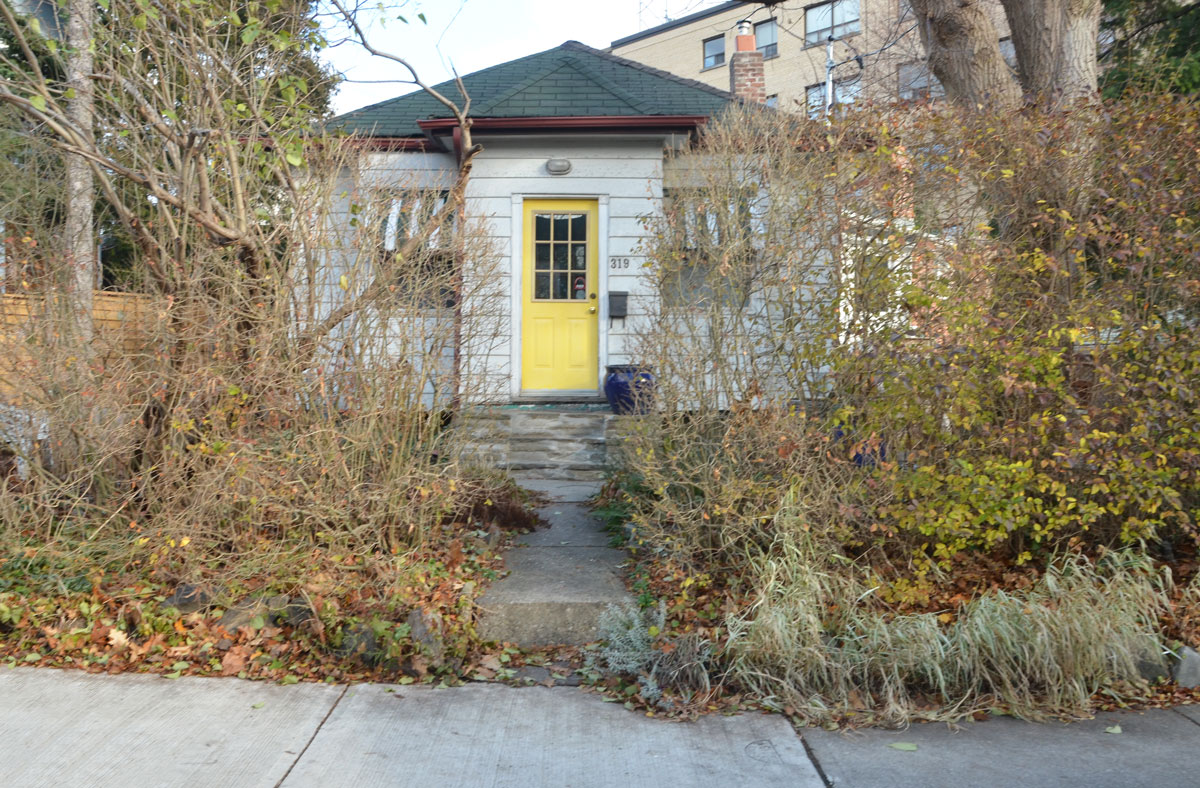
While walking on the streets in the neighbourhood I saw a couple of little houses

little narrow white bungalow with a yellow front door set back from the road. There is a straight walkway from the sidewalk to the door, and there is a lot of shrubery in the front yard especially near the sidewalk.

as well as larger buildings with intricate architectural details.

below:  A checkerboard effect with the bricks on the La Salle Apartments.  As an aside, the small bush in front of the building was in the picture no matter what angle I tried.  It was a lilac bush and I am sure that there were buds on it.

Part of a low rise apartment building, over the door, no windows. Checkerboard pattern in the bricks. The words La Salle Apts in large white letters across the bottom of the picture.

below: A little fake balcony with a white post railing on a low rise apartment building.

A white framed window in a red brick building. Below the window are a few white pieces of wood that look like a balcony railing even though there is no balcony there.

below: A line of little arches across the roofline is echoed in the larger arch patterns over the windows.  There is a small relief sculpture near the top corner of the building (slightly behind the tree) but I can’t tell what’s on it.  A coat of arms maybe?

brick pattern across the top of a building. scalloped, or looking like little arches to match the larger arches over the windows.

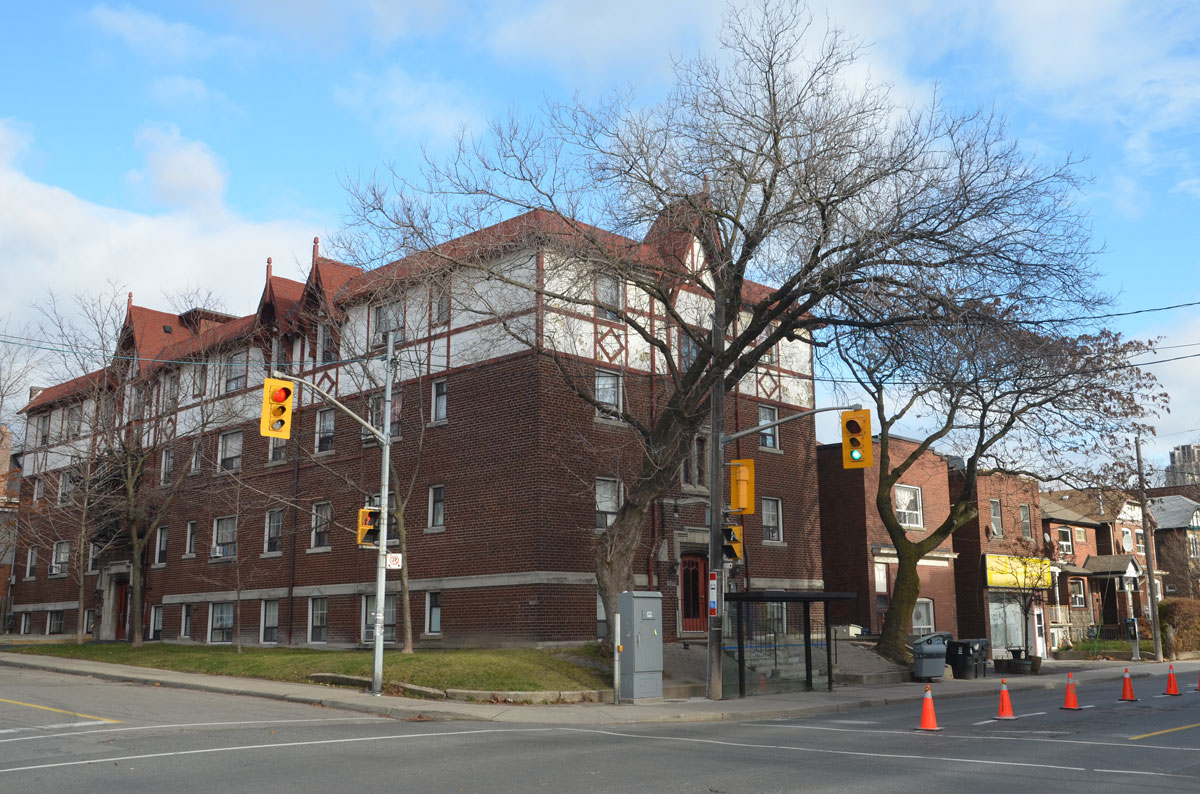
below:  There were quite a few four storey brick apartment buildings that looked like they were built in the 1920’s and 1930’s.  Perhaps there was a  little ‘condo boom’ at the time?

4 storey apartment building on Vaughan Road, red brick with white upper storey, diamond shaped details, two little peaked roofs over windows.

four storey apartment on a corner

front door and front of building, four storey apartment building in red brick with stone window and door frames.


Two four storey apartment complexes and a single family home on Vaughan Road.

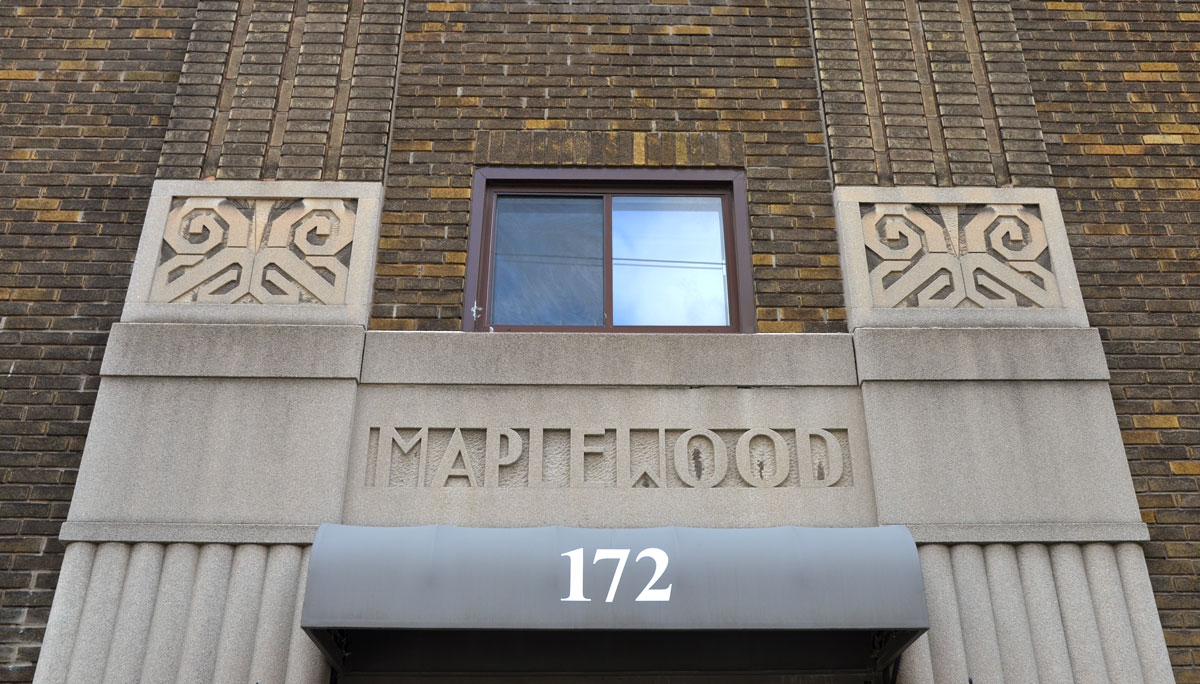
below:  Like the condos of today, many of the buildings had names such as Maple Villa

Stone door frame and entranceway to Maple Villa, a brick low rise apartment complex

and Maplewood

stonework over the door of the Maplewood apartments at 172 Vaughan road, and the art deco like decorations beside it.

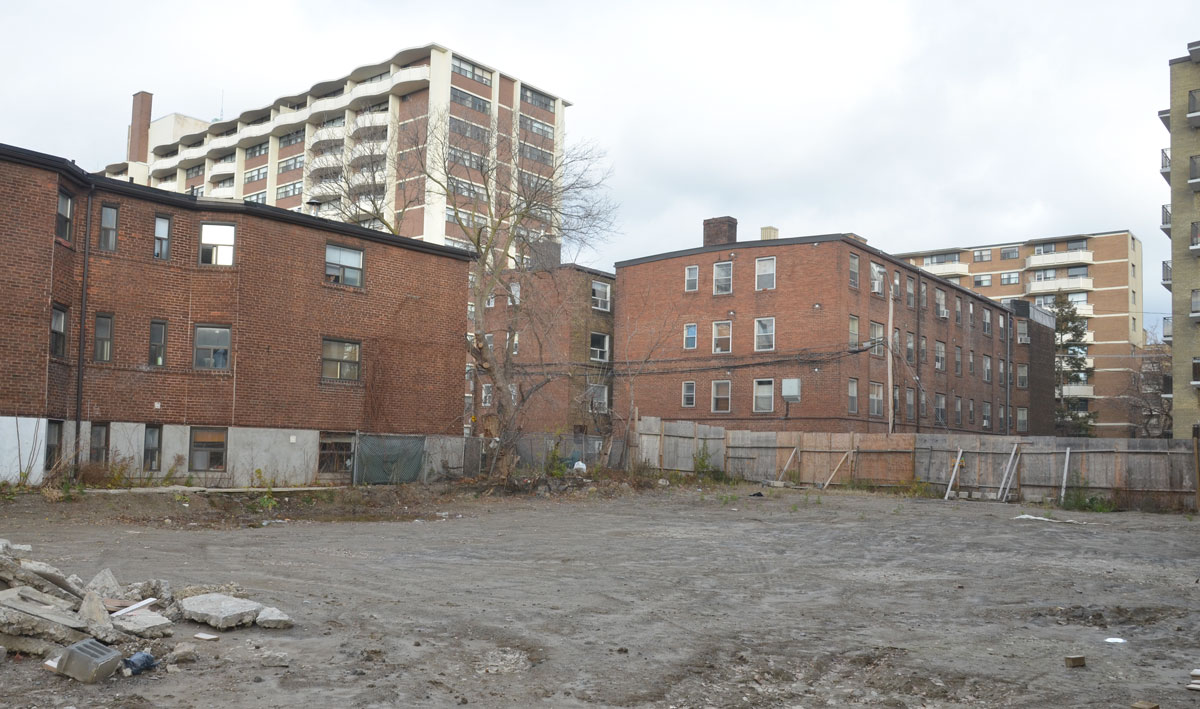
below:   The backs of all those apartment complexes are nearly as interesting as the fronts.
This is one of the only construction sites I saw although….

vacant lot with a number of low rise brick apartment buildings in the background.

… this Presbyterian church looks like it is about to be redeveloped.  It is one of three churches at the corner of St. Clair and Wychwood.   The church was built in 1926.  There is a brief description of the property on the Stanton Renaissance website but very little information is given beyond a “transformation” of the church and the creation of “high end residential boutique”.

An old brick church at a corner. It is now empty. There is a large sign in front of it advertising Stanton developments.

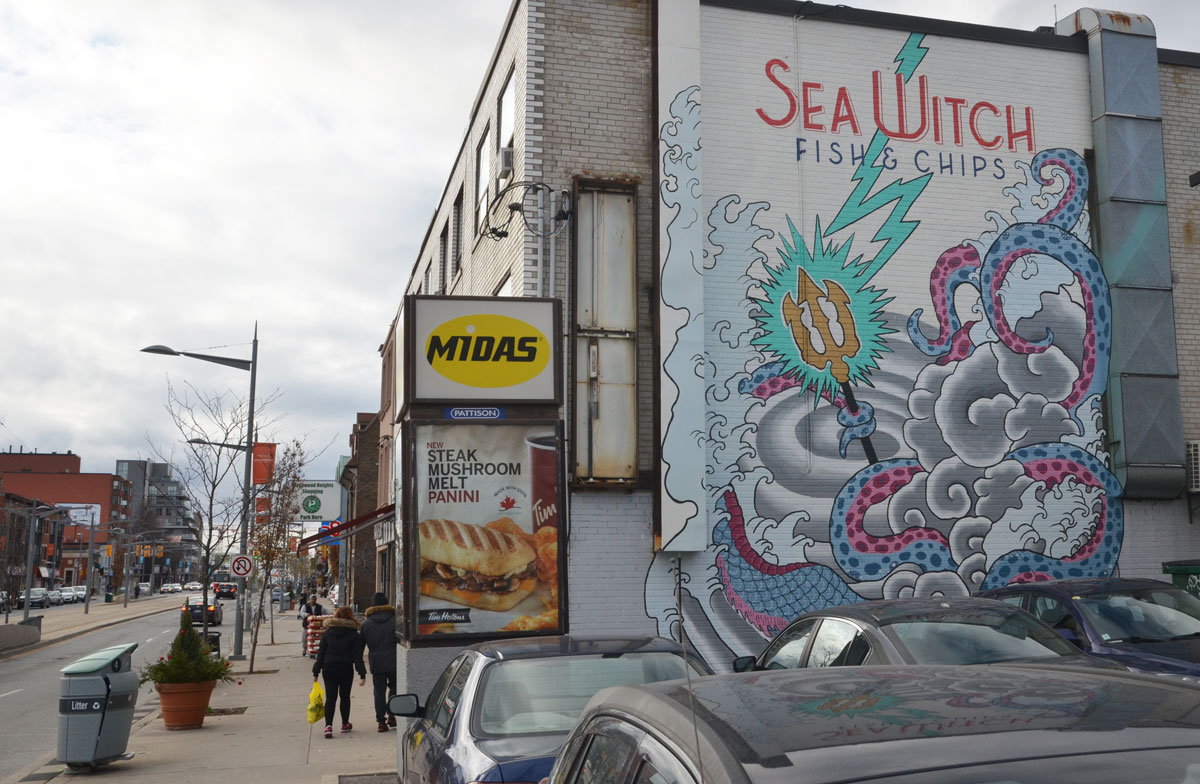
below: Mural for Sea With Fish and Chips on St. Clair West

mural for Sea Witch FIsh and Chips restaurant, a large sea serpent

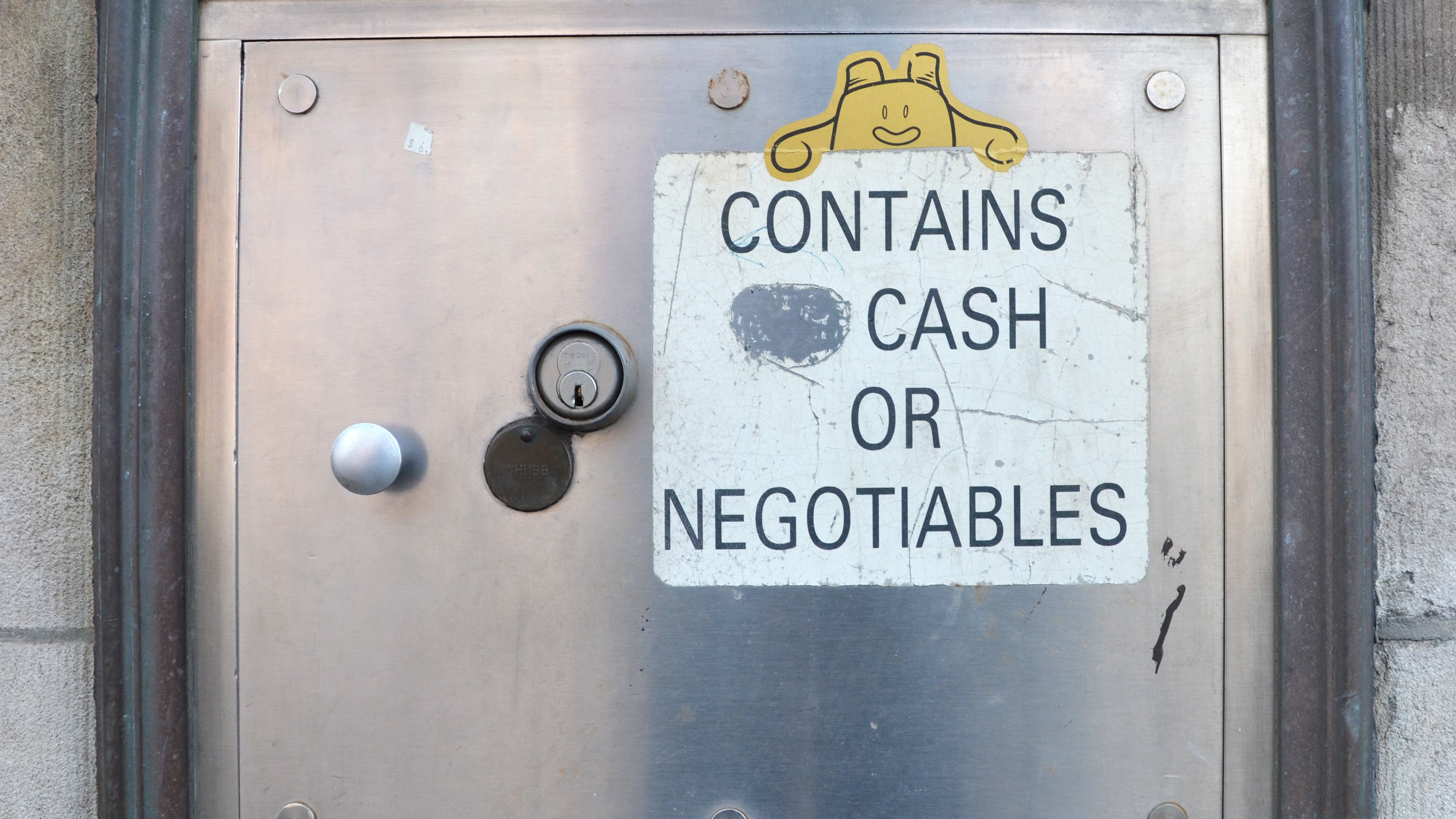
A little yellow sticker on a bank night deposit box, looks like a little smiling creature looking over the sign that says contains no cash or negotiables, except that the word no has been scratched out

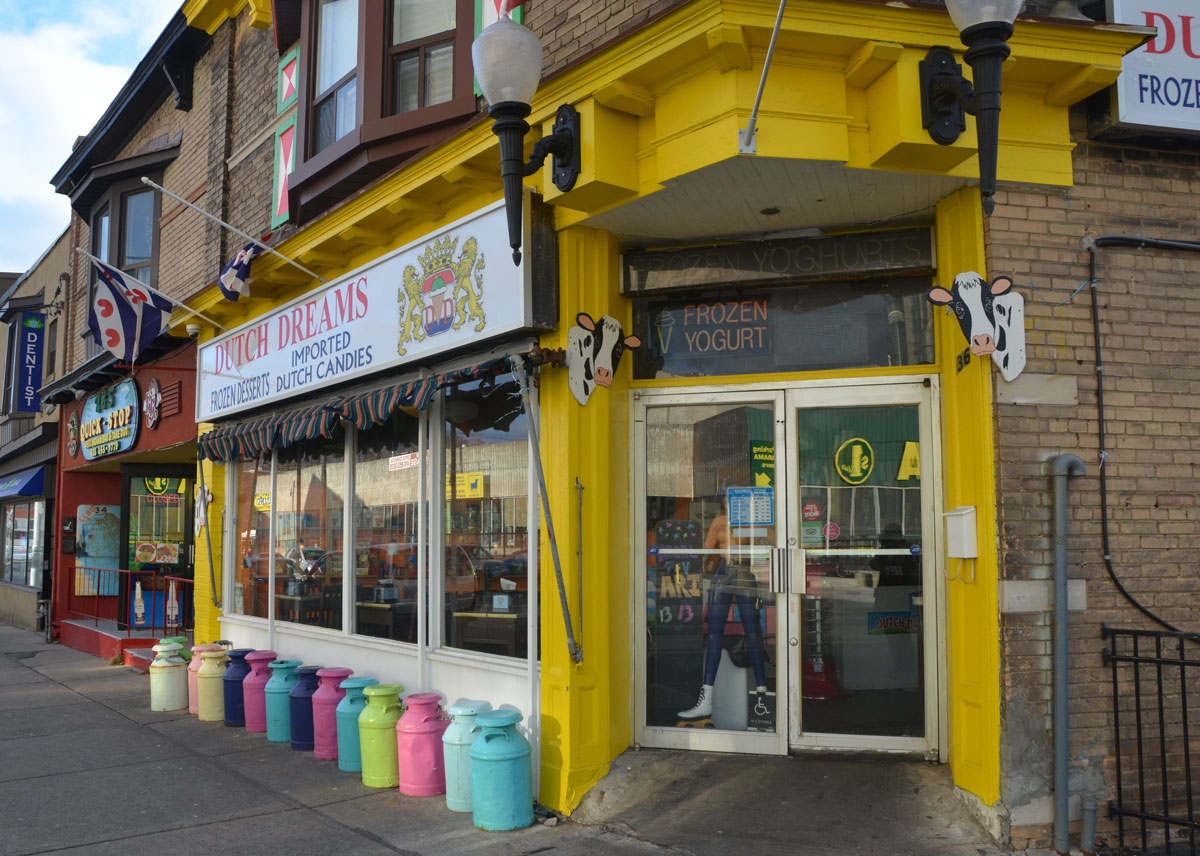
below: As I circled back the intersection of Vaughan Road and St. Clair West, I spotted a large doubledecker strawberry and vanilla ice cream cone on the side of Dutch Dreams.  Hey!  The answer to my question.  The ice cream place from 78 Vaughan Road has moved a couple of blocks south, complete with it’s collection painted old fashioned milk cans.

A very large plastic icce cream cone, double scoop, strawberry on the bottom and vanilla on the top, decorating a brick building. The shutters on the windows of the building are green, red and white

bright yellow entranceway, a line of different coloured milk cans along the exterior wall, sign says Dutch Dreams, candy and ice cream.

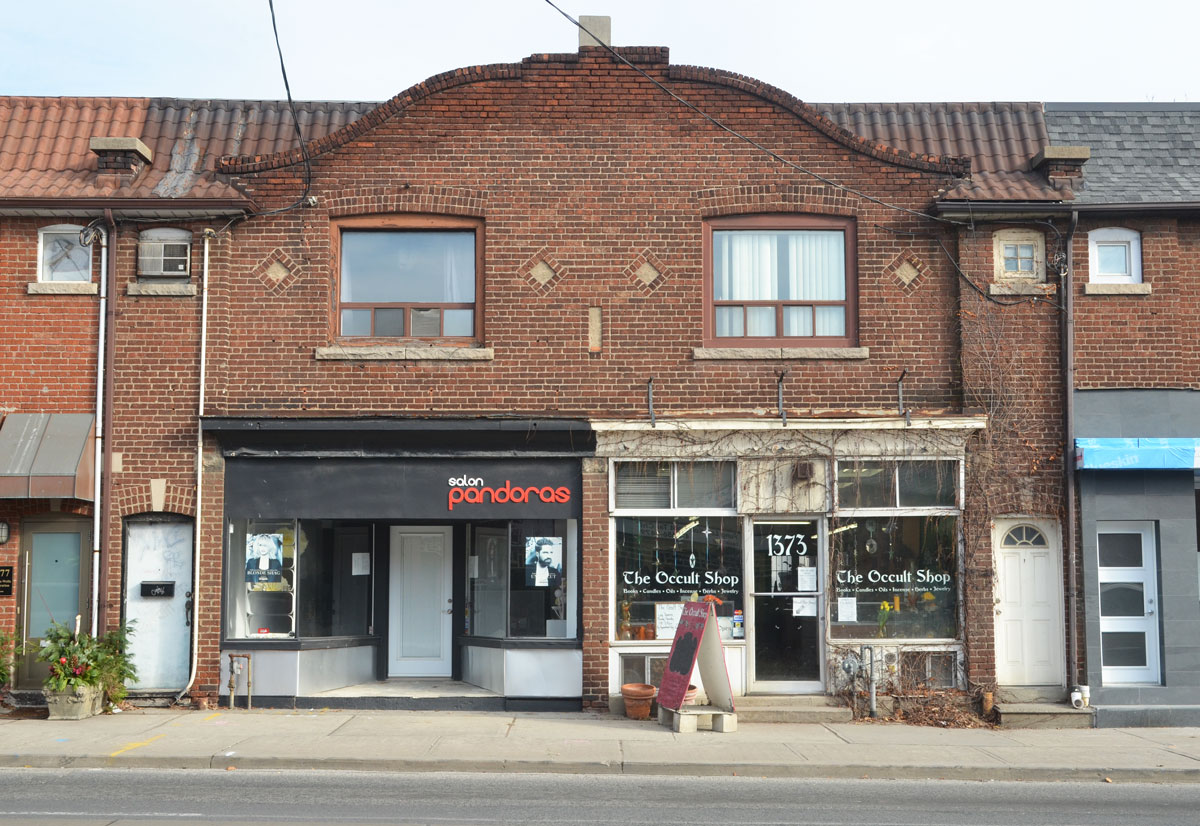
below:  One last picture.  As I waited for the Bathurst bus, I found myself standing across the street from this building.   The curve of the roofline is interesting, but even more interesting is the the fact that there is an occult store in Toronto.  Candles, herbs, incense, jewelry, I’m now wishing that I had crossed the street to investigate further!   And, smile, the store next to it is Pandora’s salon.  Pandora, the one who in ancient times opened a box and unleashed all sorts of evil on the world.


store front, one is an Occult Store, in an old brick building with a curved roofline over the middle of it.

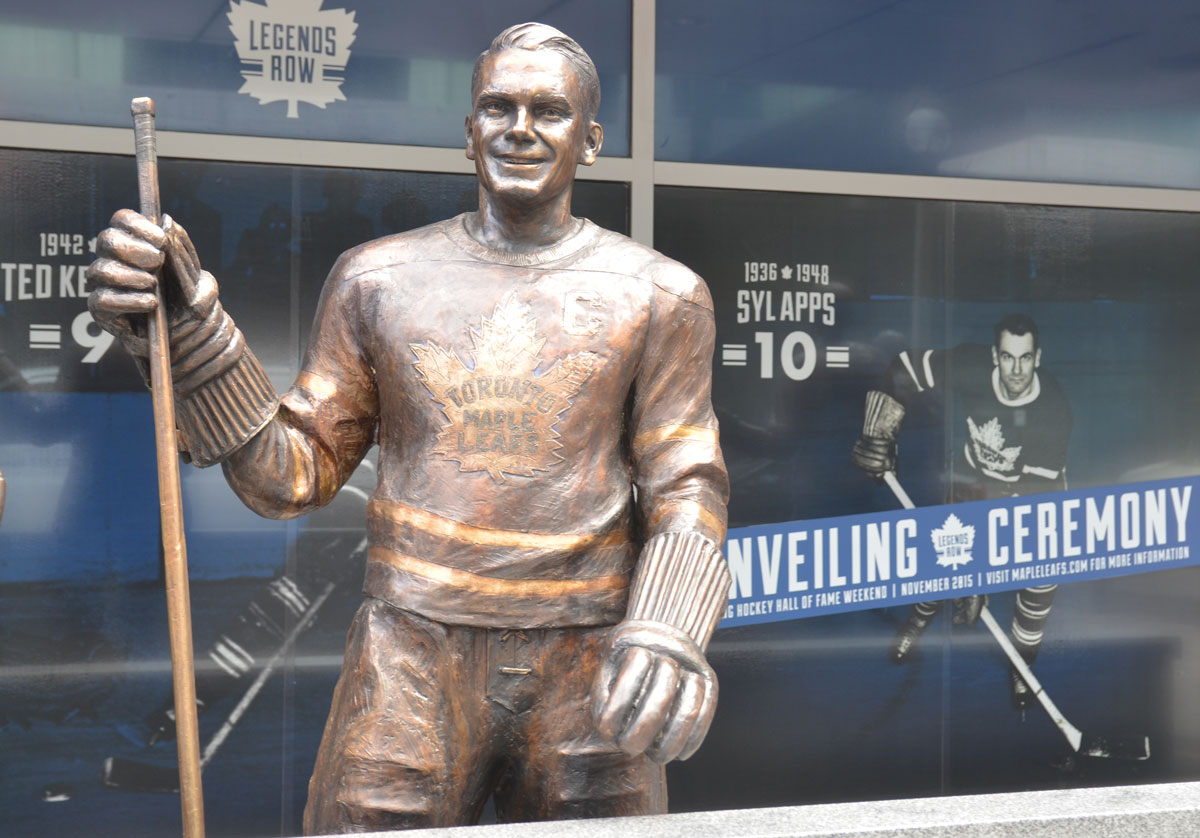
Earlier in November, two more statues were added to Legends Row outside the Air Canada Centre, Syl Apps and George Armstrong.  Both men were Maple Leaf Captains and both men wore jersey number 10.

below:  Blue and white confetti at the unveiling of the latest statues on Legends Row.

Legends Row at the unveiling of statues of Syl Apps and George Armstrong, lots of bits of blue and white paper stream down in front of the statues.

below: An old photo showing Syl Apps and a young George Armstrong when the latter was given Maple Leaf jersey 10 to wear.  Armstrong was the first player to wear number 10 since Apps had retired.

Old black and white picture from the Hockey Hall of Fame, showing Syl Apps (after retirement from hockey) and George Armstrong after Armstrong was given number 10 Maple Leaf jersey to wear.

below:  George Armstrong, past and present, at the unveiling.  Armstrong played 21 seasons with the Maple Leafs between 1950 and 1971.  After retiring from playing hockey, he coached the Toronto Marlies for a few seasons and he was on the Maple Leaf scouting staff for many years.

George Armstrong stands beside the statue of himself while reporters and others take pictures.

below:  Also, number 10, Syl Apps joined the Maple Leafs in 1936.  While he was captain of the Maple Leafs, the team won three Stanley Cups.  Apps retired in 1948.

statue of hockey player Syl Apps stands with stick in hand in Legends Row outside the ACC in Toronto

below: left to right: Mats Sundin, Borje Salming, Darryl Sittler and Ted Kennedy

Legends Row statues, Sundin, Salming, Kennedy and Sittler

below: George Armstrong and Johnny Bower

Legends ROw statues George Armstrong and Johnny Bower

below: left to right: Borje Salming, Darryl Sittler, Ted Kennedy and Syl Apps

Legends Row statues, Borje Salming, Ted Kennedy and Syl Apps stand behind the boards while Darryl Sittler is jumping over the boards.

below: Just around the corner, two statues of a slightly different nature

Two mannequins, one male and one female, are dressed in Maple Leaf hockey clothing.  Toques, heavy sweaters, T-shirts and scarfs, all in blue and white with the Leafs logo

The plan was to start walking westward from Eglinton subway station.

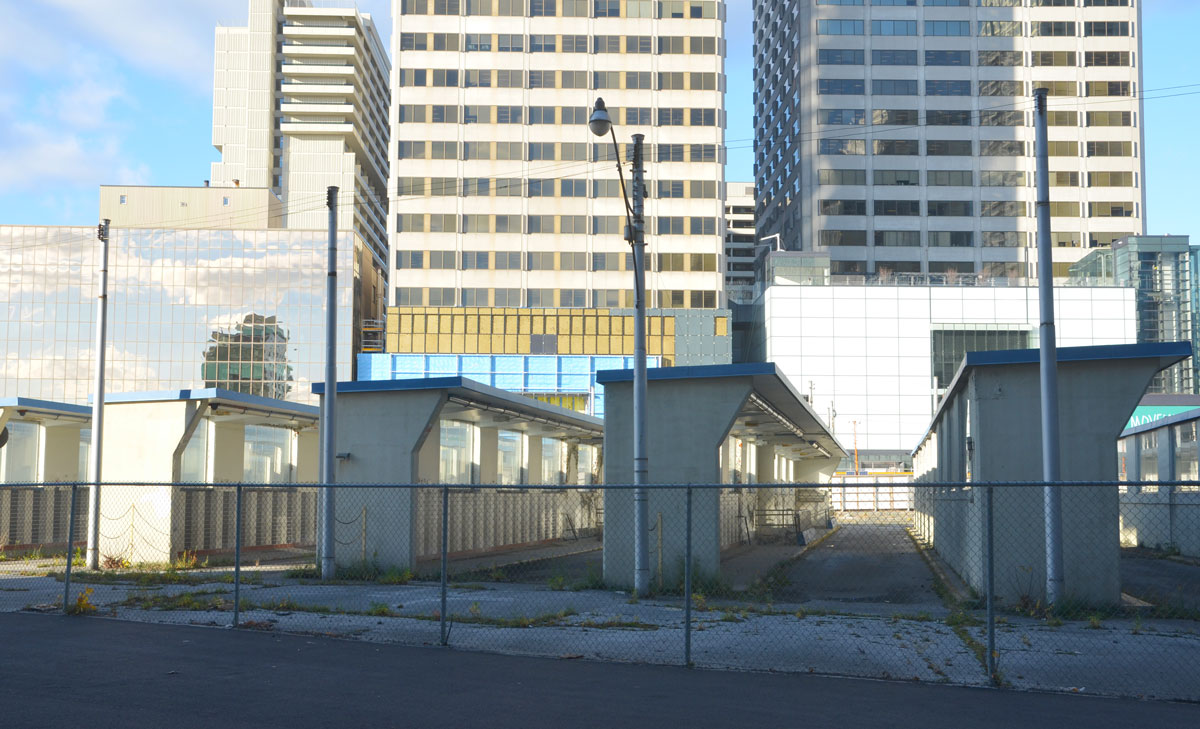
below:  The first photo I took was right after I got off a bus at the station.   With the ongoing reconstruction at Eglinton, there is now easy access to the old bus bays.  There is still a fence around them, but at least they can be seen and photographed.  These bays have not been used since 2004 and the area has been fenced off and unused since then.  Now they sit empty in the shadow of the ever increasing tall buildings around them.

abandoned bus bays at Eglinton subway station in the foreground and the newer taller buildings in the area in the background

abandoned part of Eglinton subway station, behind chain link fence

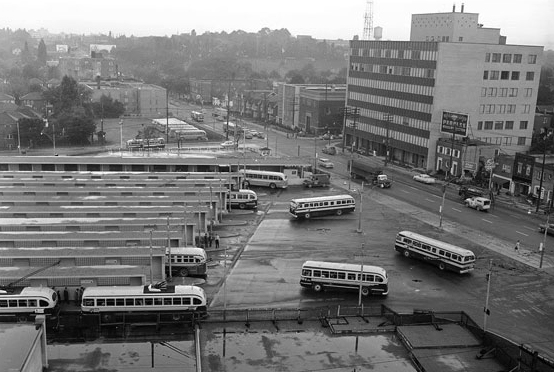
below: Looking west along Eglinton Avenue after the completion of Eglinton station in 1954.  The street running north-south just beyond the bus bays is Duplex Avenue.  There is now a police station on the SE corner of that intersection.   On the NW corner you can see the brick Toronto Hydro-Electric Building with its large front ‘door’.  It is still there.

historical black and white photo, aerial, from Yonge Street looking west along Eglinton Ave showing the bus bays at Eglinton subway station, up to Duplex Ave is shown clearly.

source: City of Toronto Archives, online

.

below: (taken later in the afternoon, on the way home) The intersection of Eglinton and Duplex from west side with the brick Toronto Hydro-Electric building now between glass buildings.

looking east along Eglinton Avenue towards Yonge street with Duplex Ave in the foreground. The old Toronto Hydro-Electric building is in the picture, with a newer structure with a glass front beside it. New buildings between Duplex and Yonge on the north side of Eglinton are also in the picture.

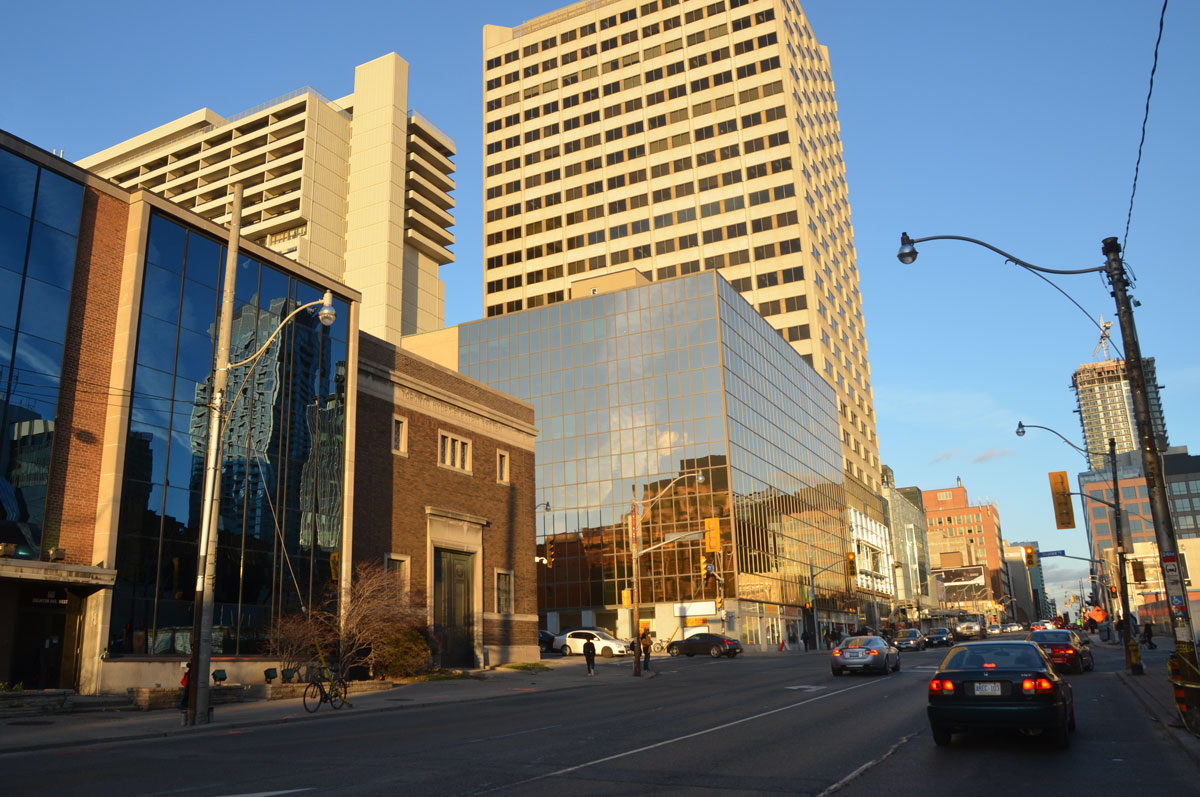
below: After leaving Eglinton station, this caught my eye.  The glass cube-like building on the NE corner of Eglinton and Duplex reflects the afternoon sun onto the walls of the Toronto Hydro-Electric building across the street.

brick building with wavy shadows on it cast by the sun being reflected off the glass building across the street

brick building with wavy shadows on it cast by the sun being reflected off the glass building across the street

below: On Duplex, right behind this brick building is an intriguing building.  The highly textured concrete exterior and the 3D patterned wall are suggestive of the 1960s although I could be wrong.  It’s ugly yet fascinating at the same time.   Now that the leaves have fallen from the trees in front of it, the pattern of trapezoids, diamonds and rectangles is revealed…. as is the dirt and grime on the concrete.  The fact that there are no windows and doors facing the street provides a clue that this is yet another Toronto Hydro building.

Three tree with no leaves are in front of a concrete wall that is built in 3D pattern of trapezoids and rectangles. There are no windows or doors.

Somethings old

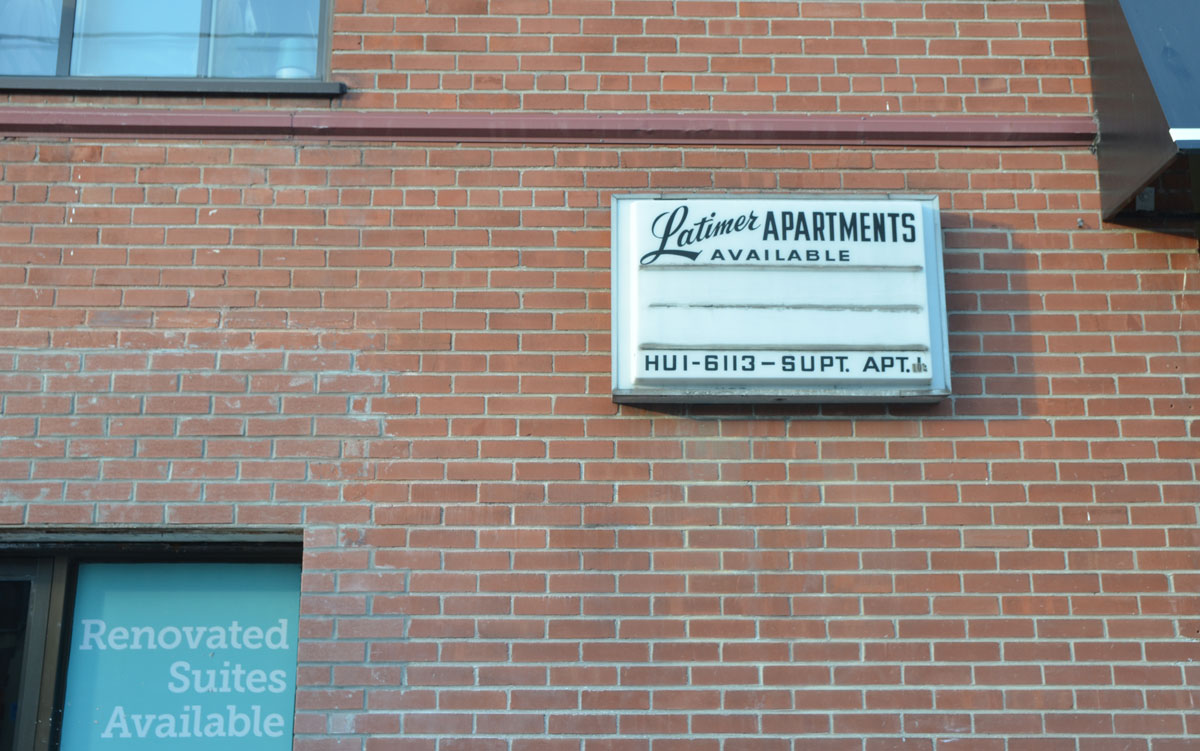
below: A sign with an old Toronto HU (Hudson) exchange phone number.  HU1 would be 481.  This number is probably from the late 1950s.  In the early days, Toronto phone numbers had only 6 digits.  In the mid 1950s a seventh digit was added and then between 1961 and 1966 the letter prefixes were phased out, replaced by numbers.

old sign on the side of an small apartment building, the Latimer Apartments, with an old Toronto phone number starting with the letters HU

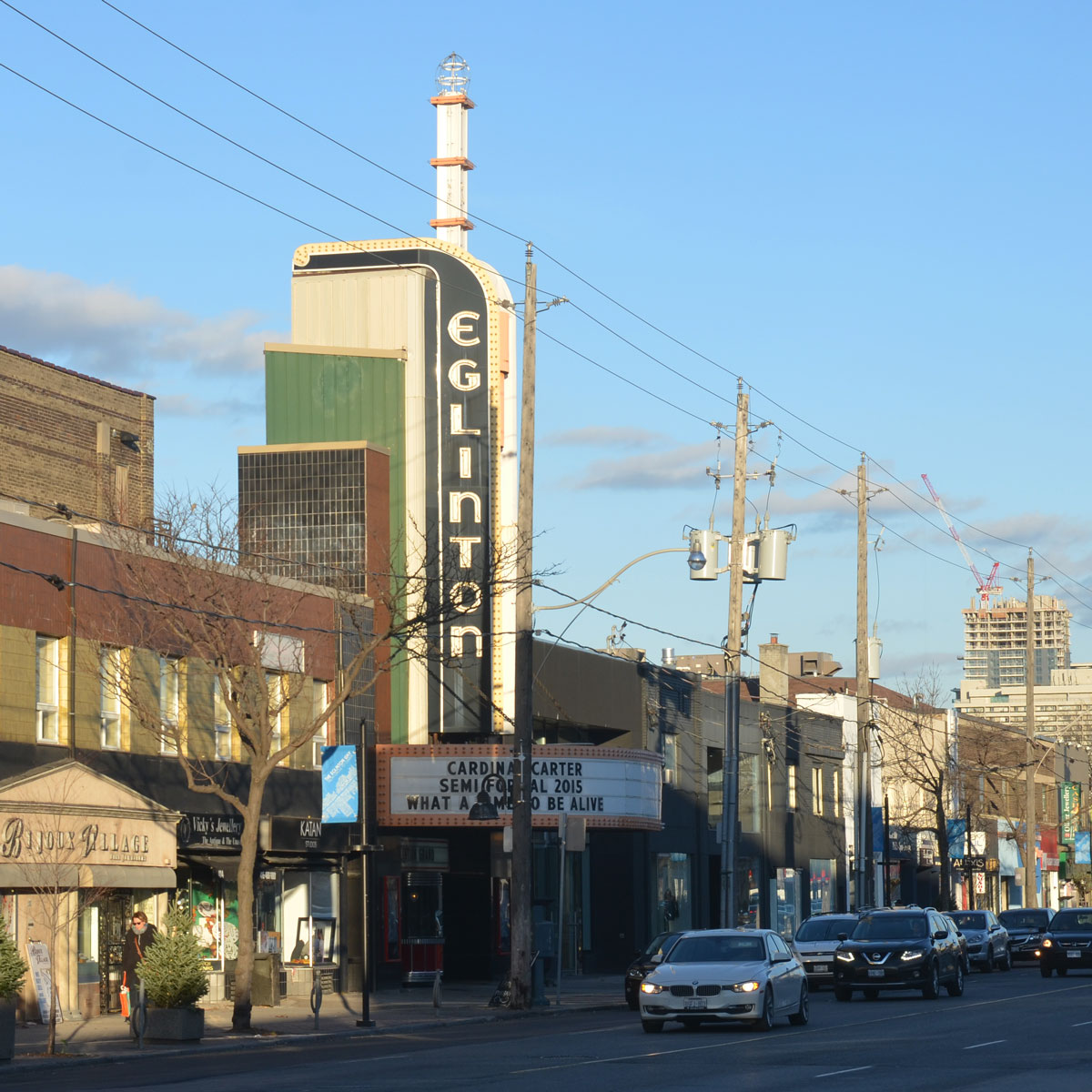
below:  The Eglinton Grand, art deco building from 1936; National Historic site since 2003.

The Eglinton Grand, a cinema theatre built in art deco style in 1936.

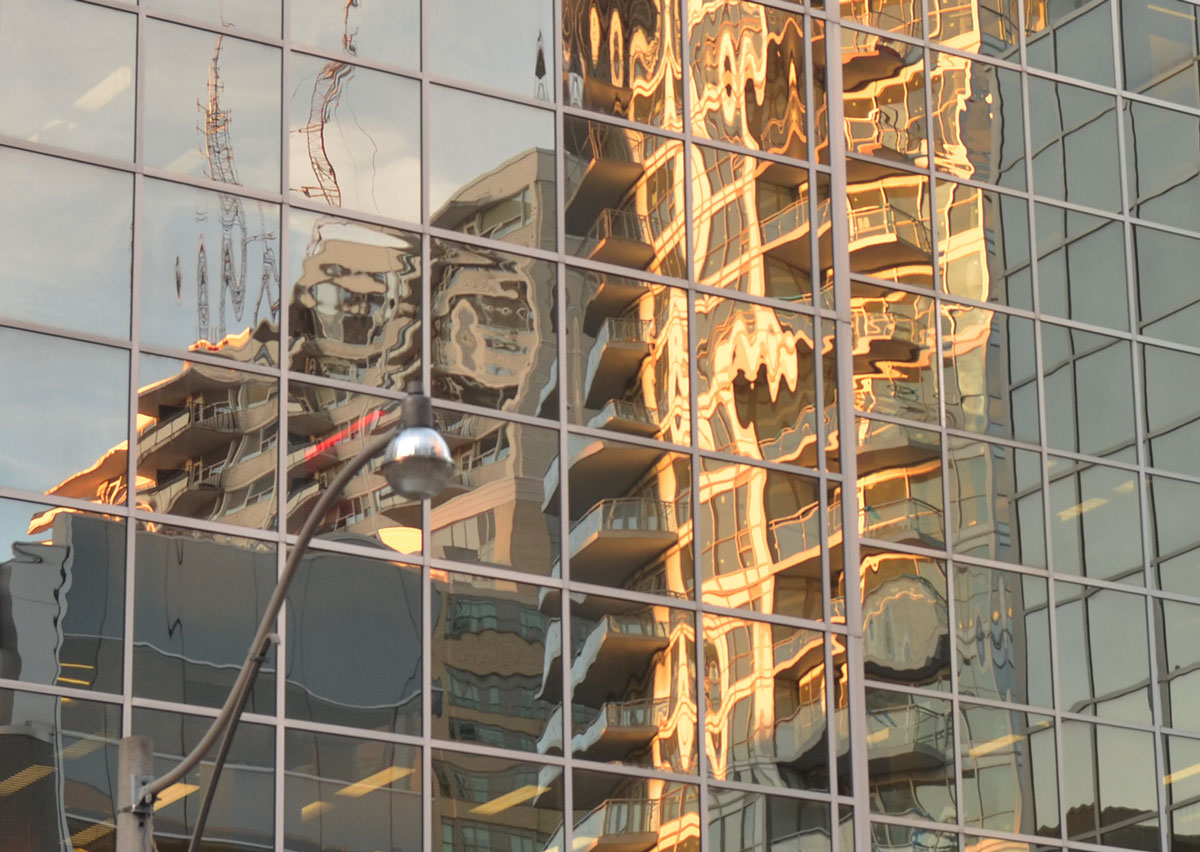
 Somethings new

many curved and disjointed reflections of buildings in a tall glass building. Afternoon sun so there's a yellowish tint to the reflections

 And some window ‘shopping’ to do

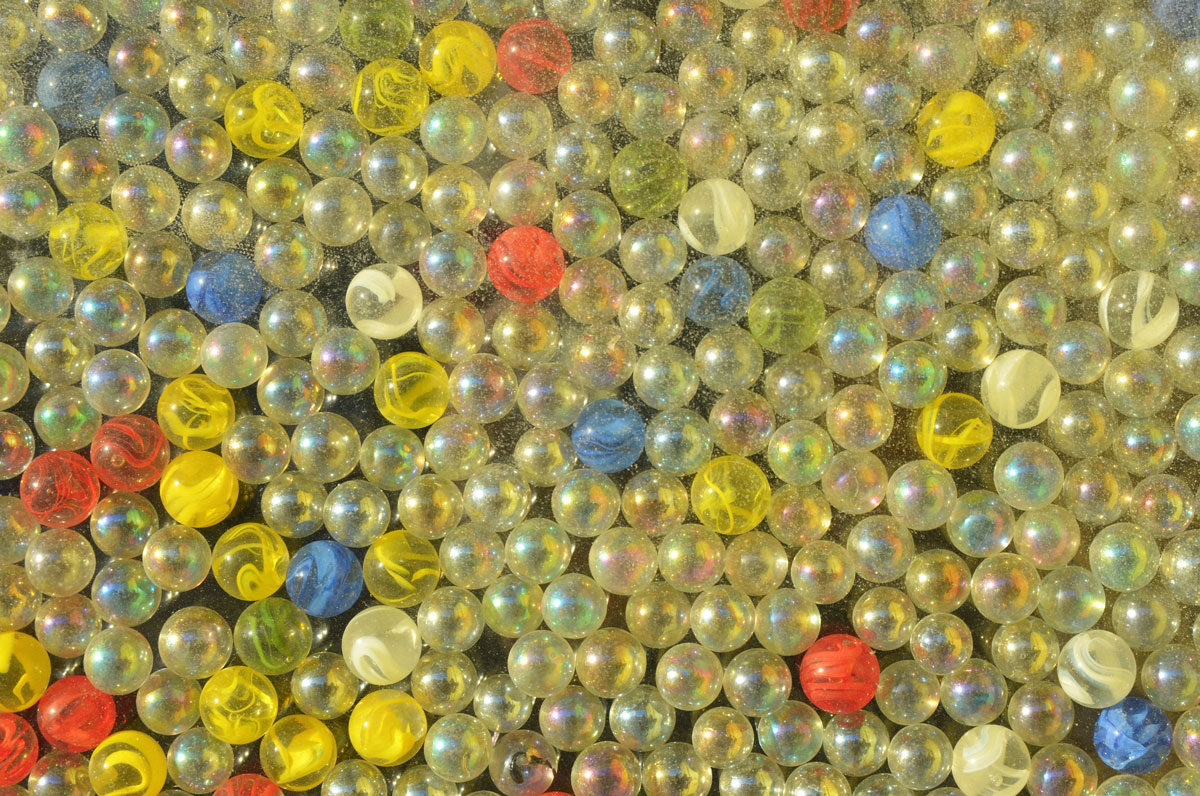
below: Marbles wedged between glass make an excellent decorative touch.

a layer of marbles wedged into a window to look a bit like stained glass

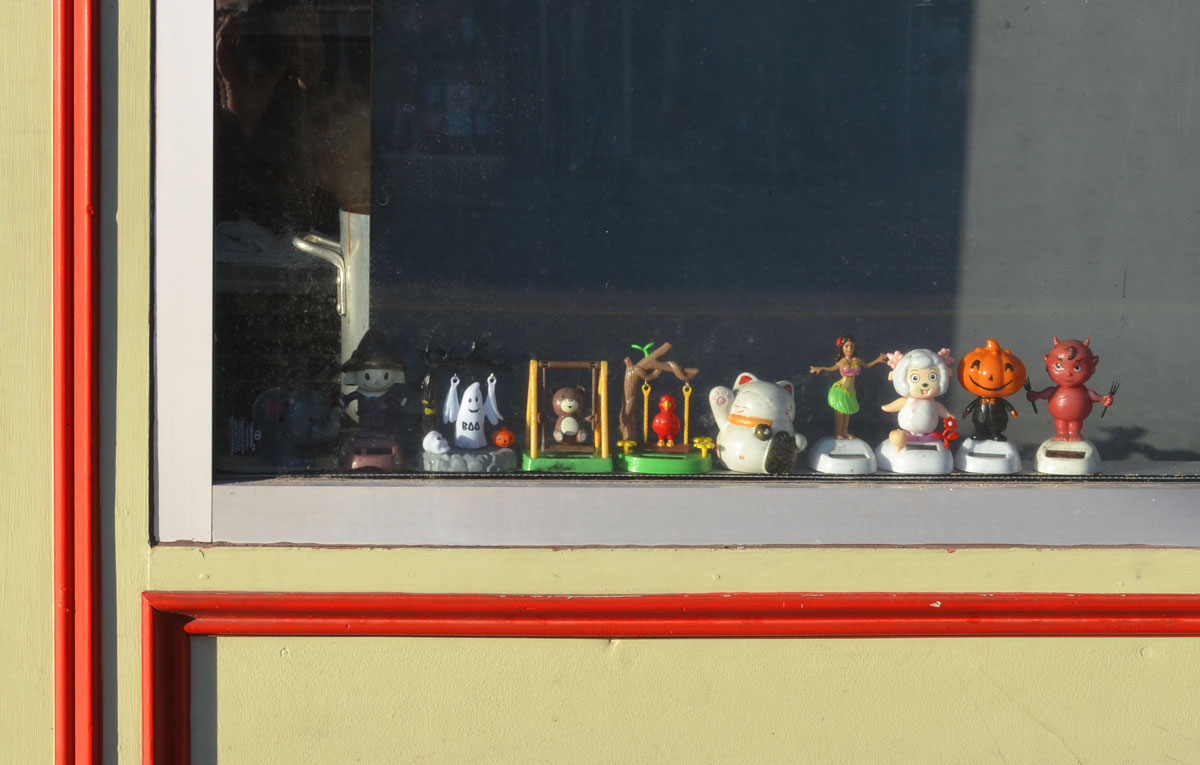
A line of toy figurines on a window sill in the window of a restaurant

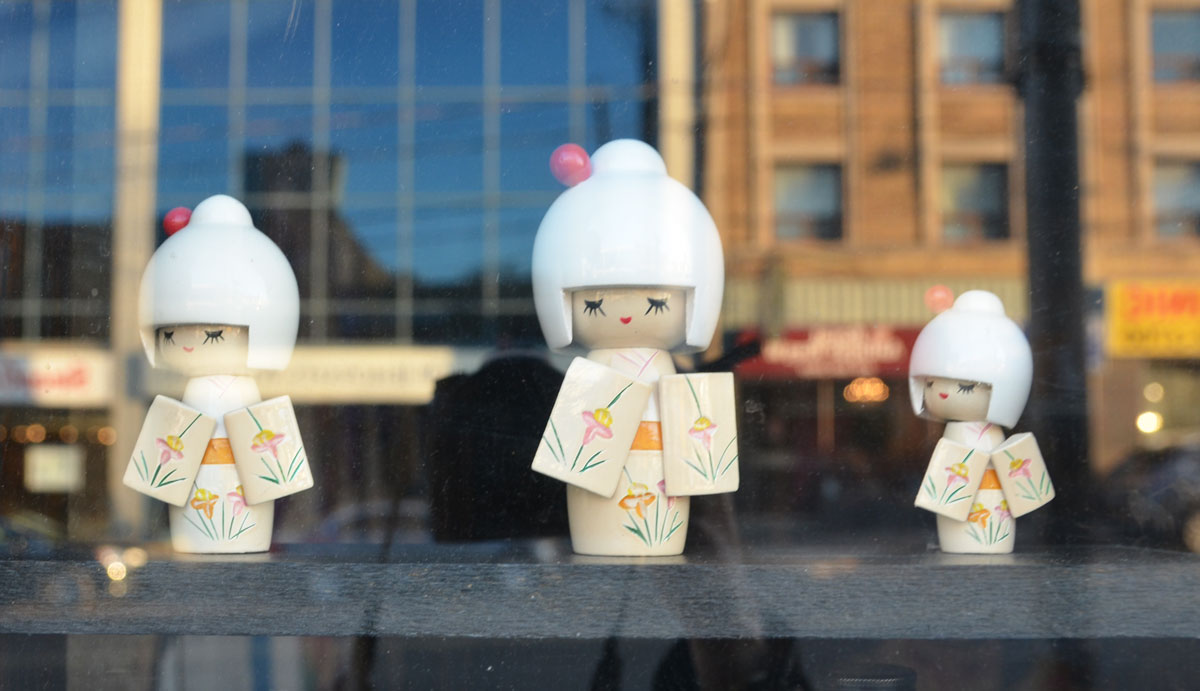
below: little Japanese wooden dolls in the window of the Sake Bar

three little Japanese wooden dolls with white hair and white kimonos standing inside a window. Reflections of the stores across the street are behind them.

below:  And even a lovebot hangs out here

a 3D concrete lovebot stands on the sidewalk beside a store as people walk by

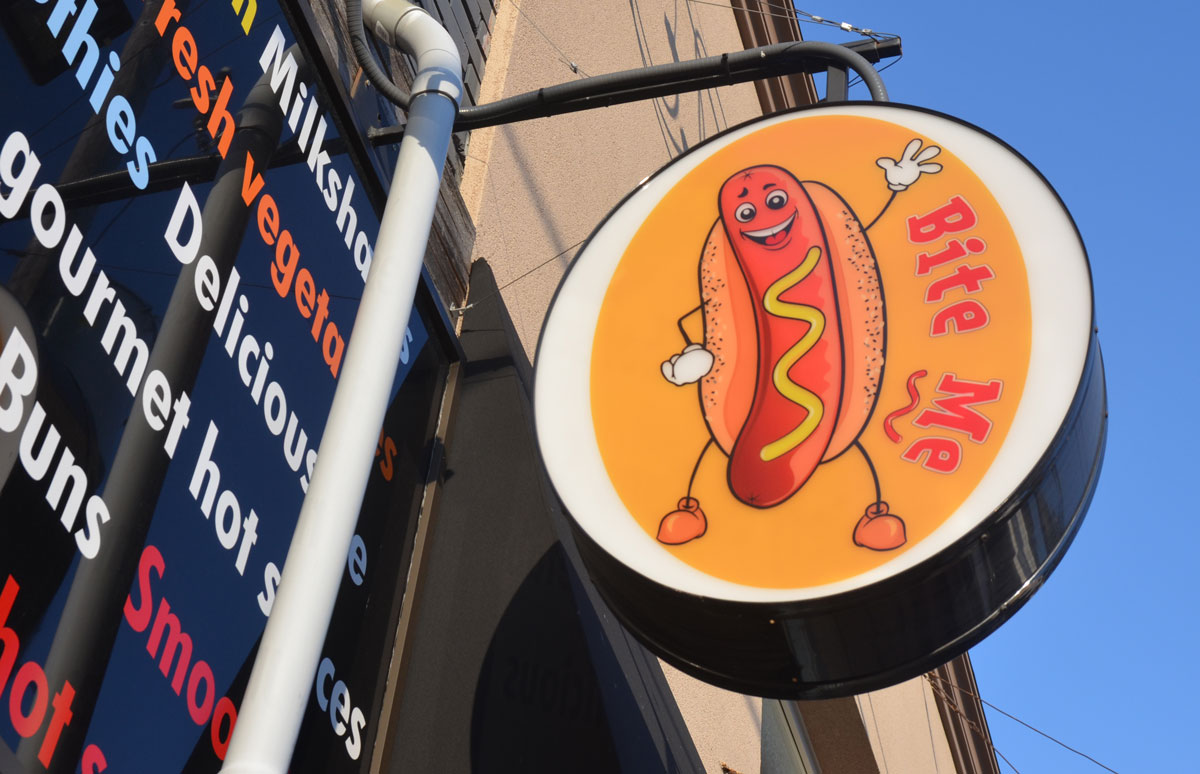
below:  A little chuckle at this sign….

I small sign hanging over a doorway of a hot dog restaurant called Bite Me

below:  And then later I saw this.

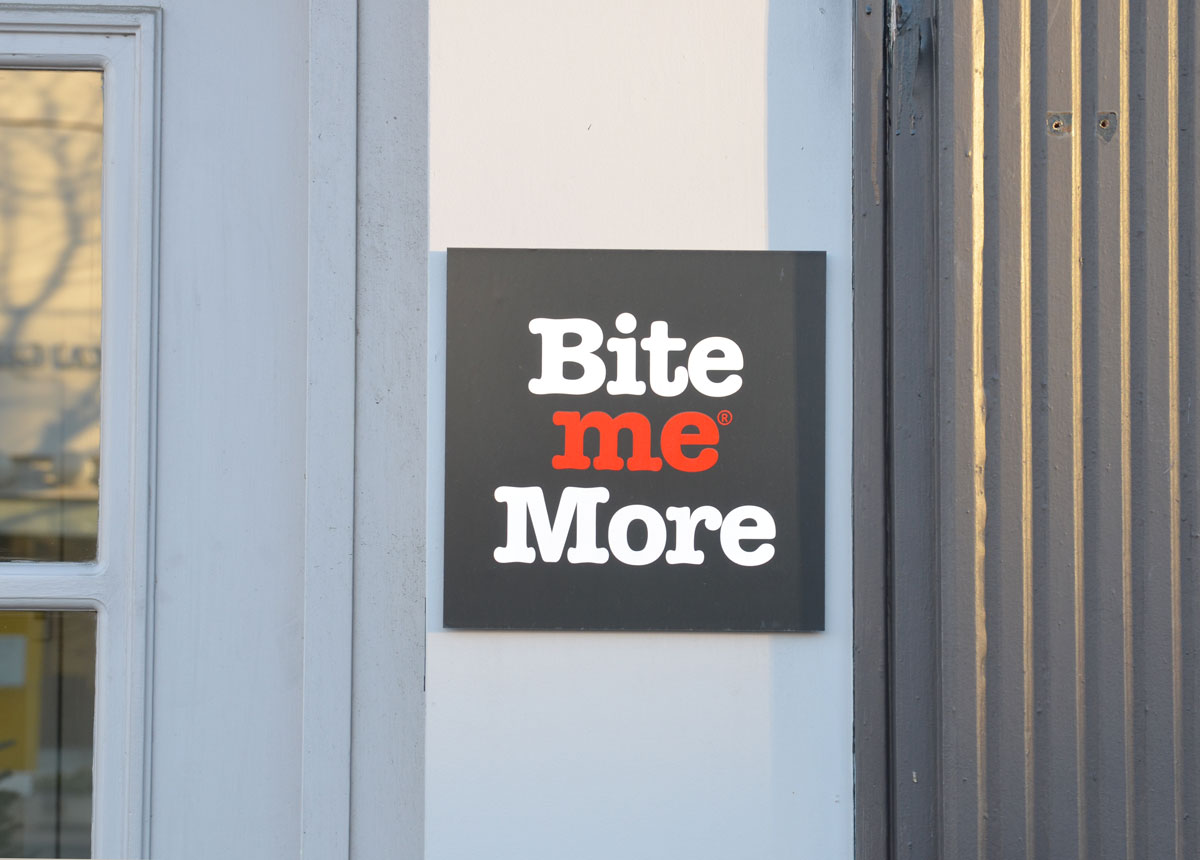
A sign on the wall outside a store that says Bite Me More

sticker on a pole on a sidewalk. One man is kicking another, pixelated picture, with the letters X G G L on it.

Rather than wait for a bus I decided to keep walking home but unfortunately it’s that time of year when the daylight hours are just too short.   One last look at where I had just been before putting my camera away and heading home.

very late afternoon sun, as it disappears behind buildings, looking down a street, sun is reflecting off some windows, a large part of the street is in shadow, a TTC is there, with its lights on, some construction on the street, some cars,

Remembrance Day
the eleventh day of the eleventh month

November 11th at 11am in 1918 (the eleventh hour of the eleventh day of the eleventh month)  was when an armistice was signed by representatives of Germany and the Entente.  Nov 11th became known Armistice Day, or in some countries such as Canada, Remembrance Day.  An armistice is an agreement to stop fighting, a truce in other words.  After this signing, it took several months of negotiations before the First World War officially ended with the signing of the Treaty of Versailles on 28 June 1919.  That treaty ended the war between Germany and the Allies.  (The Allies of WW1 were also known as the Entente Powers while Germany and her allies were known as the Central Powers)

The poppy became a symbol of Remembrance day, and a symbol in remembrance of soldiers who died fighting in all wars, after the publication of the poem ‘In Flanders Fields’ in 1915.  This popular and often quoted poem was written by Canadian Lieutenant Colonel John McCrae.  In it he talks about the poppies that grew in the battlefields at Flanders Belgium during WW1.

“In Flanders fields the poppies blow
Between the crosses, row on row,”
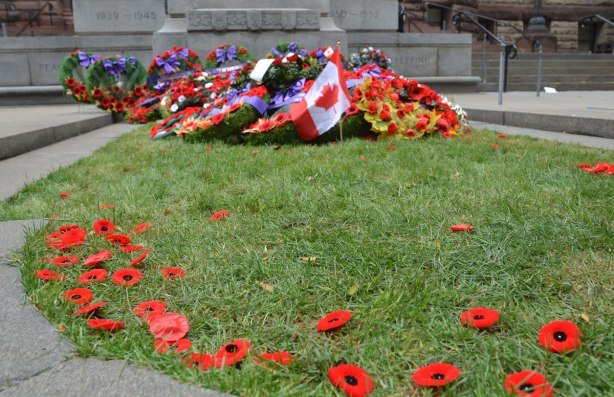
Many Remembrance day poppies lie on the grass in front of the cenotaph in front of old City Hall. In the background is a small Canadian flag as well as a few wreaths that have been laid in front of the cenotaph.

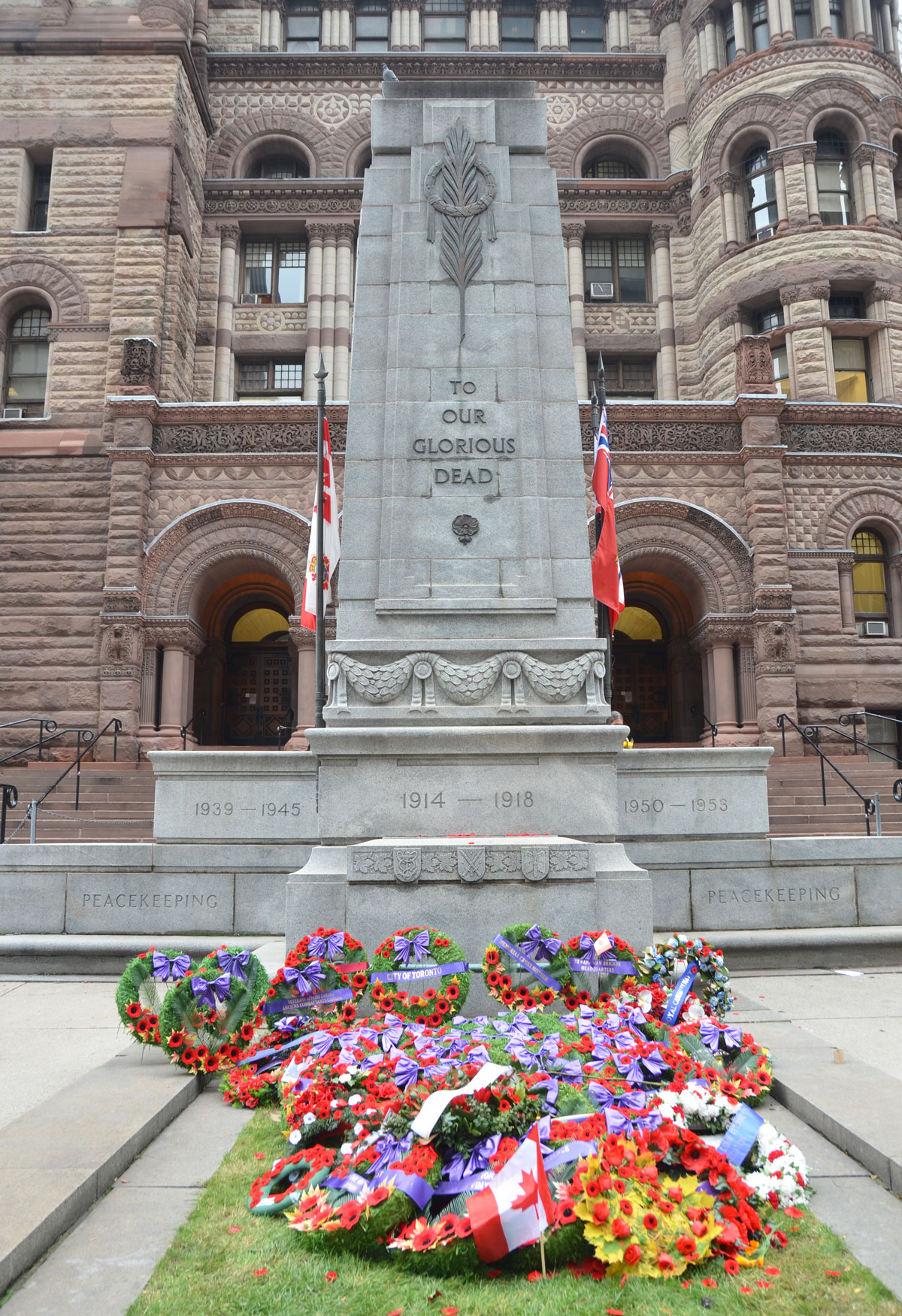
below: The cenotaph (war memorial) in front of Old City Hall was unveiled on 11 Nov 1925 to commemorate those Torontonians who died in WW1.  Since then, it has been expanded to include those who lost their lives in WW2 and in the Korean War.  The word cenotaph comes from the Greek and translates as ’empty tomb’. This style of memorial has been used widely for commemorating someone, or some group, whose remains are interred elsewhere.

More than 6000 Torontonians lost their lives in these three conflicts.  Close to three thousand men died in World War 1, a number that represents about 2% of the male population of the time. (1)
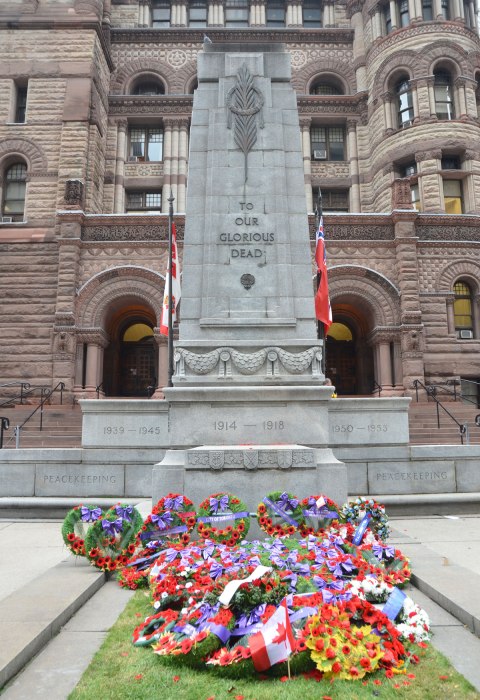
The cenotaph in front of Old City Hall in Toronto, with a collection of wreaths that have been laid at the bottom of it.

In the middle of University Avenue is a statue erected by the Toronto District of the Sons of England Benefit Society in memory of their members who died in World War 1.  Founded in 1876, this society provided insurance to its members who were in need because of illness or accident.

In 1914 Canada was still part of the British Empire.  As a result, when Britain found itself at war in August of that year, Canada too was involved.
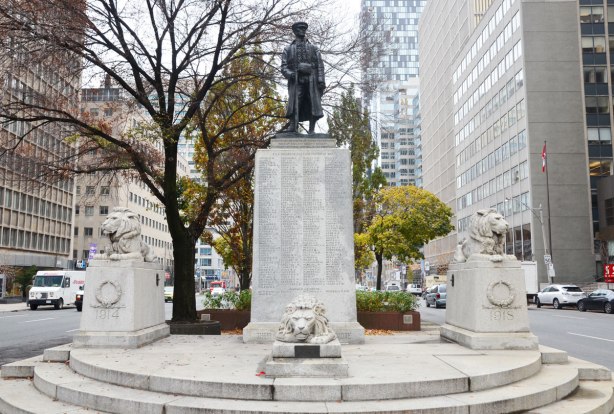
statue and memorial at University and Elm streets.

below: At the base of the center lion is a small plaque that reads: “Chas Adamson, sculptor, 1923”.
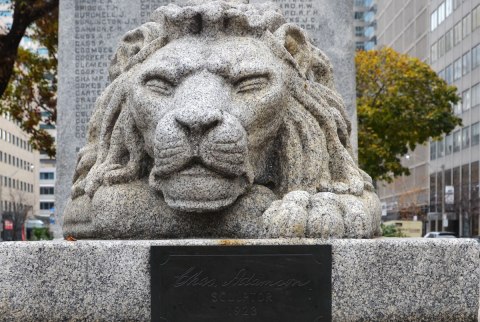
A carving of a lion in granite. It is at the base of a sculpture. A small brass plate is attached in front of the lion and it says Chas Adamson, sculptor 1923

below: The Sons of England building on the NW corner of Richmond St. East and Berti St., 1922
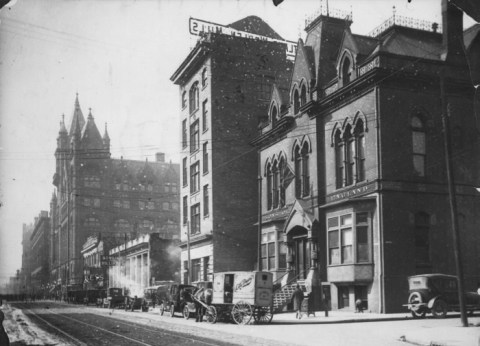
historical picture of Richmond Street near Berti, taken in 1922, old buildings, a, horse drawn cart and an old car. Streets but no traffic. black and white photo.

photo credit: Toronto public library website


Another memorial in this city is the Ontario Veterans Memorial.  This is a 30m long granite wall in front of Queens Park dedicated to all the men and women from Ontario who served in the military.  Etched into the granite are scenes depicting Canadians in military roles between the time of the Fenian Raids in 1867 to the present day.

below: Part of the granite wall.  The red in the picture is a reflection of the red carpet that was laid in front of the memorial for the Remembrance Day service.
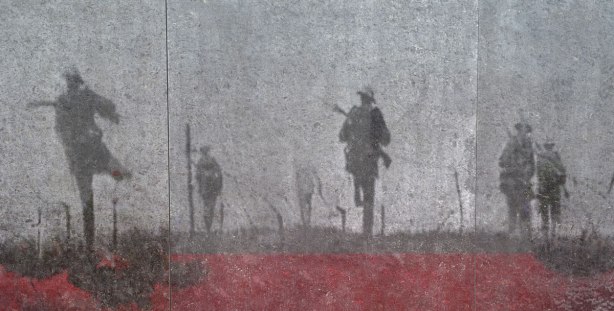
An etching of men running across a battlefield with rifles at the ready.

below: part of the granite wall

part of a war memorial showing the wars written on it

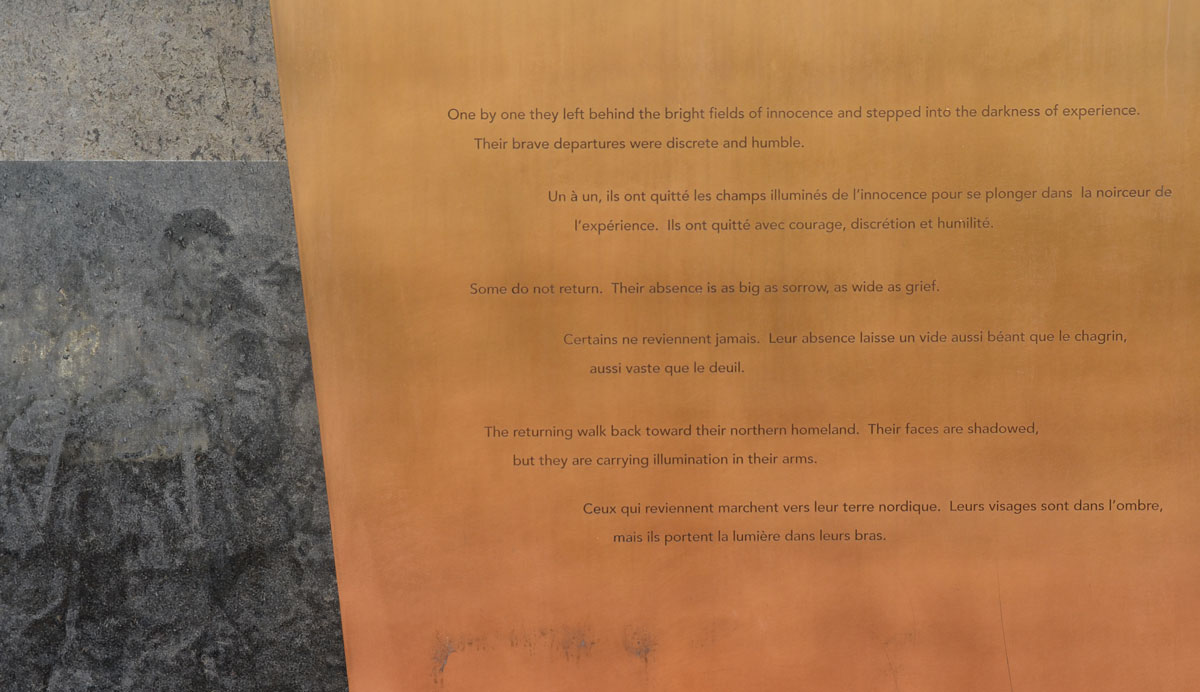
Transcription of the passage by Canadian author Jane Urquhart:
One by one they left behind the bright fields of innocence and stepped into the darkness of experience
Their brave departure was discrete* and humble.
Un à un, ils ont quitté les champs illuminés de l’innocence pour se plonger dans la noirceur de
i’expérience. Ils ont quitté avec courage, discrétion et humilité
Some do not return. Their absence is as big as sorrow, as wide as grief.
Certains ne reviennent jamais. Leur absence laisse un vide aussi béant que le chagrin,
aussi vaste que le deuil.
The returning walk back toward their northern homeland. Their faces are shadowed,
but they are carrying illumination in their arms.
Ceux qui reviennent marchent vers leur terre nordique. Leurs visages sont dans l’ombre
mais ils portent la lumière dans leurs bras.  

(* discrete vs discreet ?)

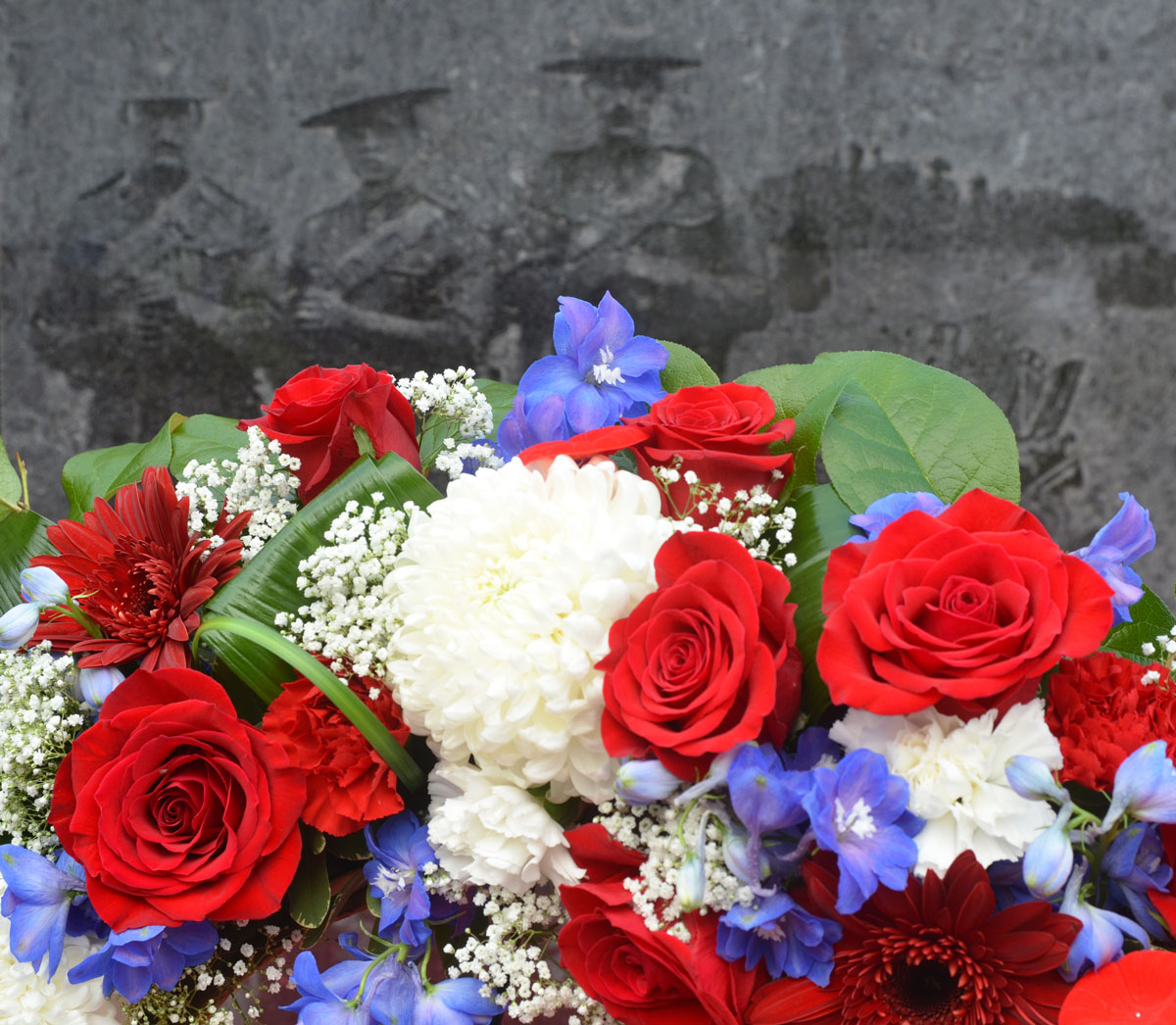
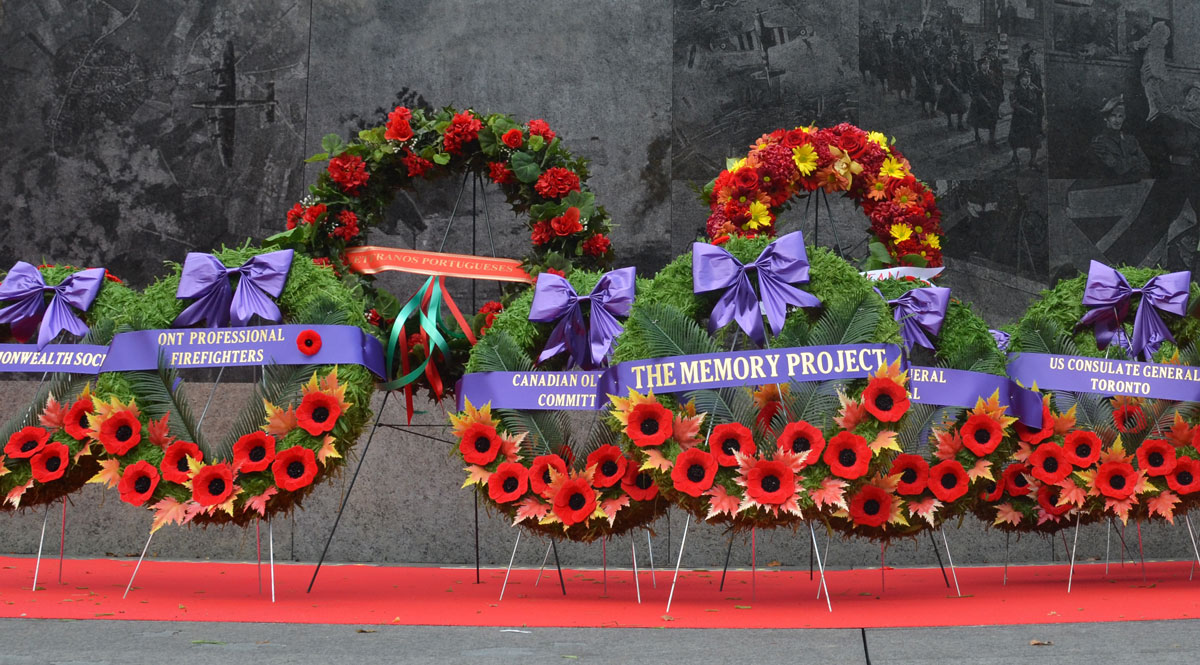
below: Some of the wreaths laid at the Ontario Veterans Memorial on Remembrance Day.
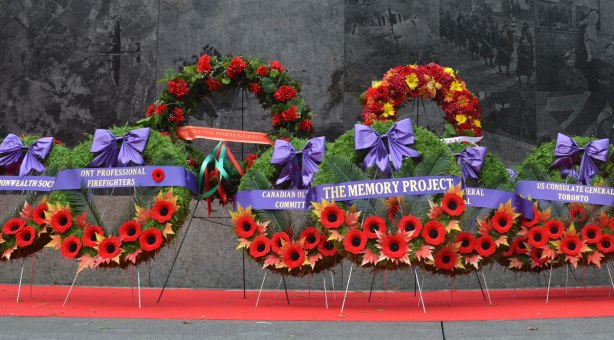
wreaths in front of the granite wall of the Ontario Veterans Memorial

A bouquet of flowers, red roses, plus some white and blue flowers in front of a war memorial. An etching of three men in uniform, part of the memorial, is in the background.


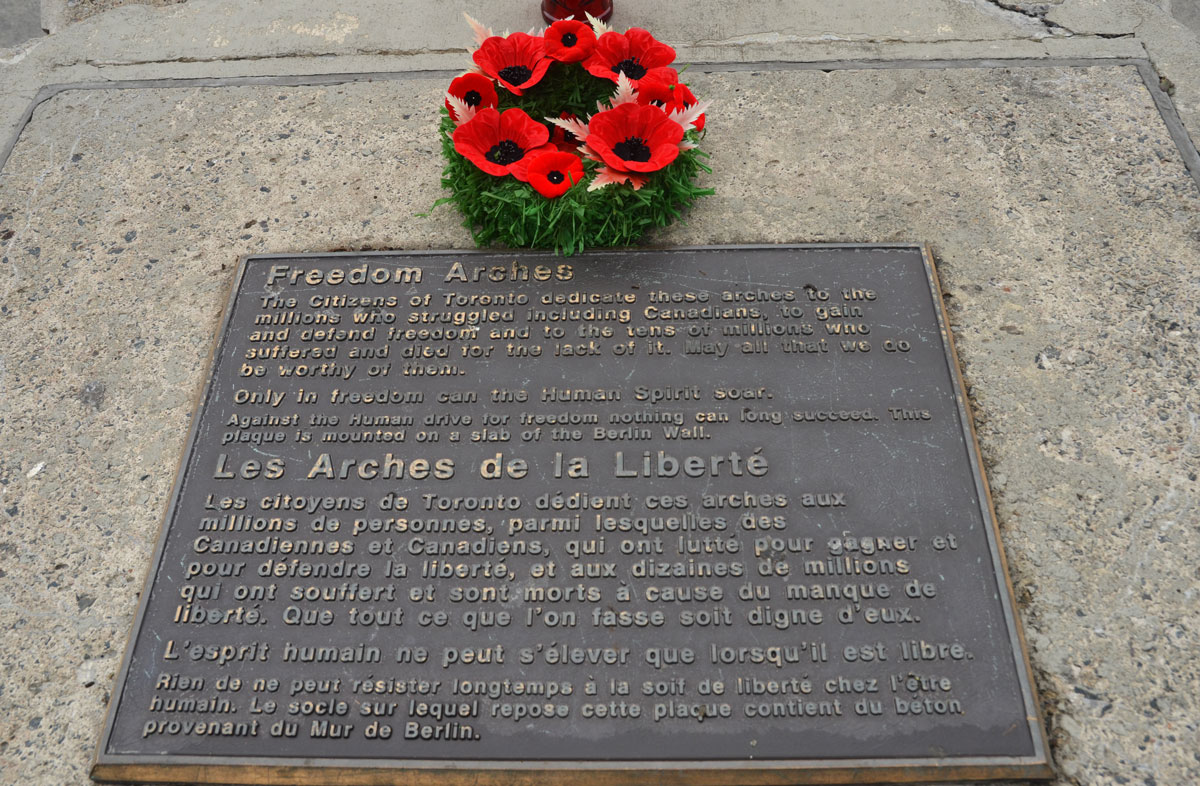
below: Although it is not a war memorial per se, someone left a small poppy wreath by this plaque at Nathan Phillips Square.  The plaque is by the arches over the pool, the freedom arches.
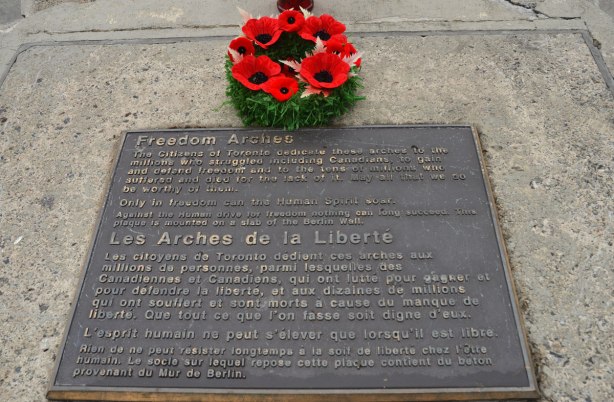
blog_poppies_freedom_arches

Transcription of the plaque: Freedom Arches. The citizens of Toronto dedicate these arches to the millions who struggled, including Canadians, to gain and defend freedom and to the tens of millions who suffered and died for the lack of it. May all that we do be worthy of them. Only in freedom can the Human Spirit soar. Against the Human drive for freedom nothing can long succeed. This plaque is mounted on a slab of the Berlin Wall.

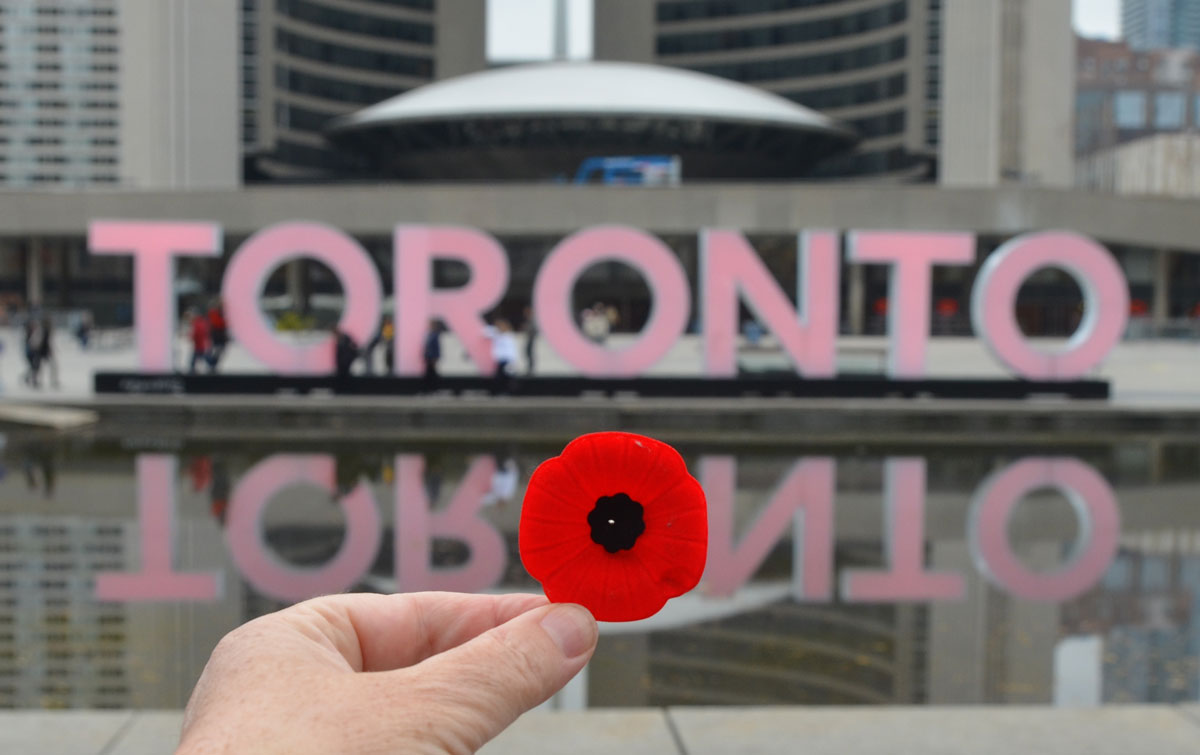
below: The 3D Toronto sign was red on Remembrance Day.

A remembrance day poppy is in the foreground. It is being held up in front of the 3D toronto sign which has been lit in red for Remembrance Day

We remember collectively as a nation, as a community. We also remember privately, as individuals, as families.  Countless small memorials can be found around Toronto including in schools, in churches and other religious institutions, and in cemeteries.

below: A memorial to the 48th Highlanders, Mount Pleasant cemetery.  In memory of the officers, non-commissioned officers, and men who have served with the 48th Highlanders.

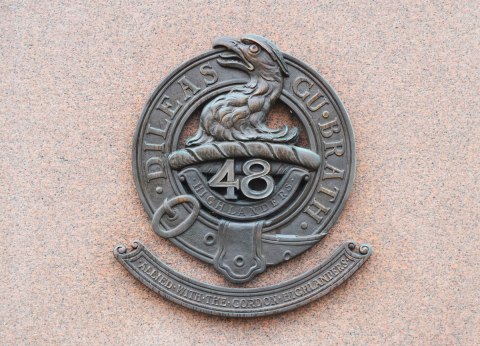
Tall pinkish granite memorial to the 48th Highlanders in Mt Pleasant cemetery.

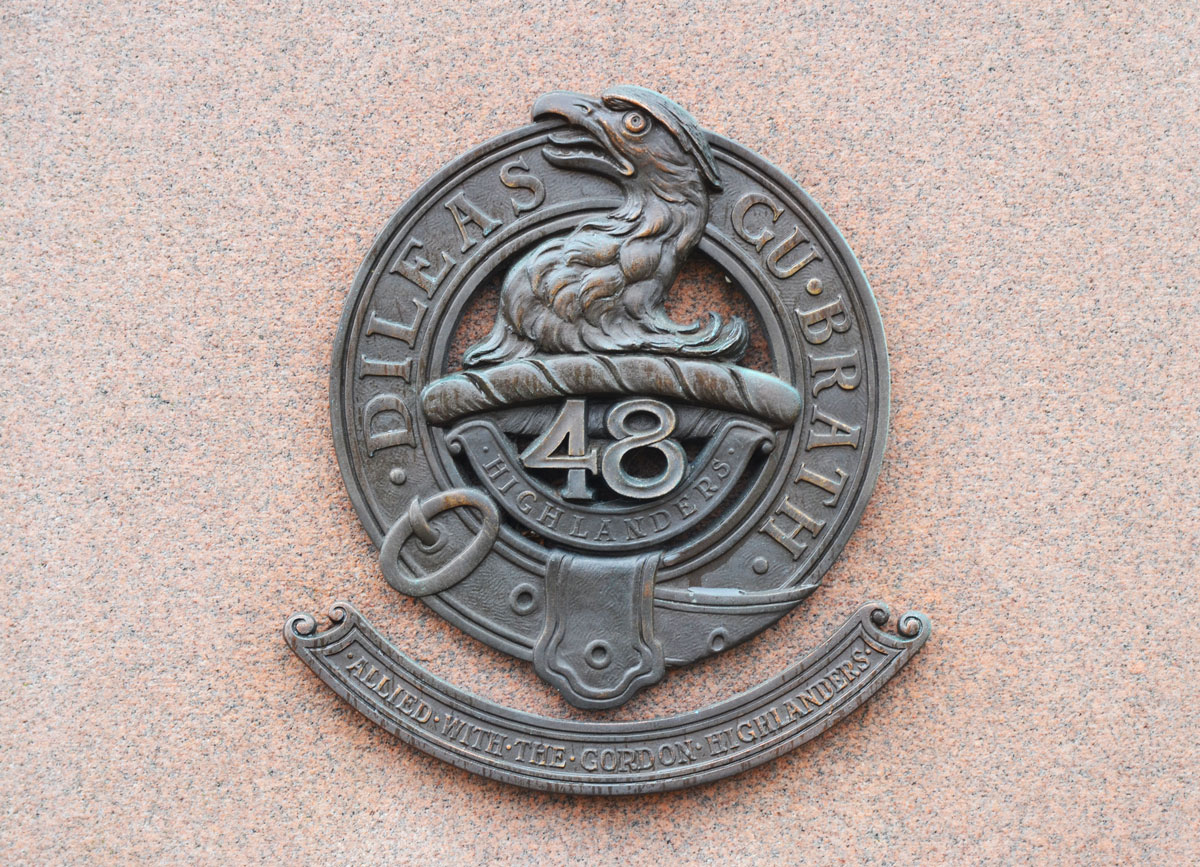
symbol, in metal, found on the memorial to the 48th Highlanders.

Dileas Gu Brath, their motto, is gaelic for ‘faithful forever’

below:  Quiet memorials

poppy wreath beside a tombstone in a cemetery

A small Canadian flag with two poppies pinned to it. The flag is inserted into the ground in front of a tombstone in a cemetery. The stone is a veterans stone, with air force insignia at the top and a cross at the bottom. In the middle is the information for the pilot who died during the war.
 

(1) source: Patrick Cain, Global News