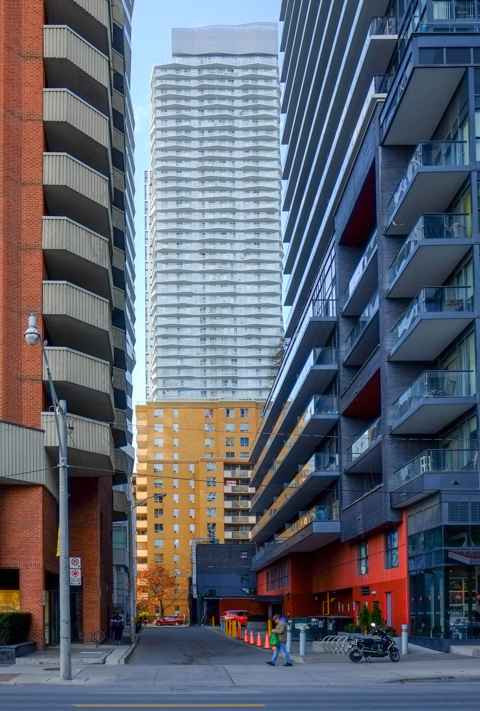
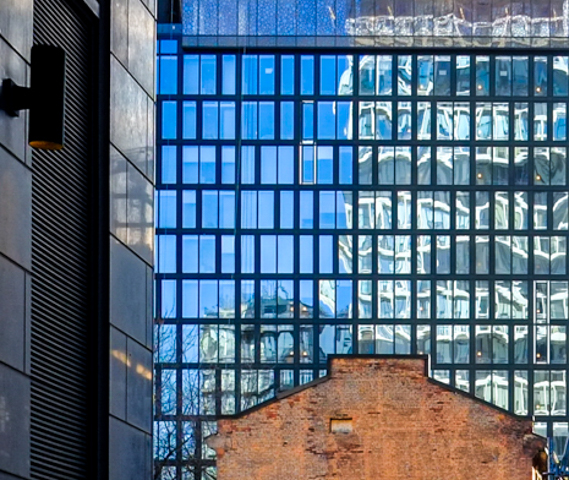
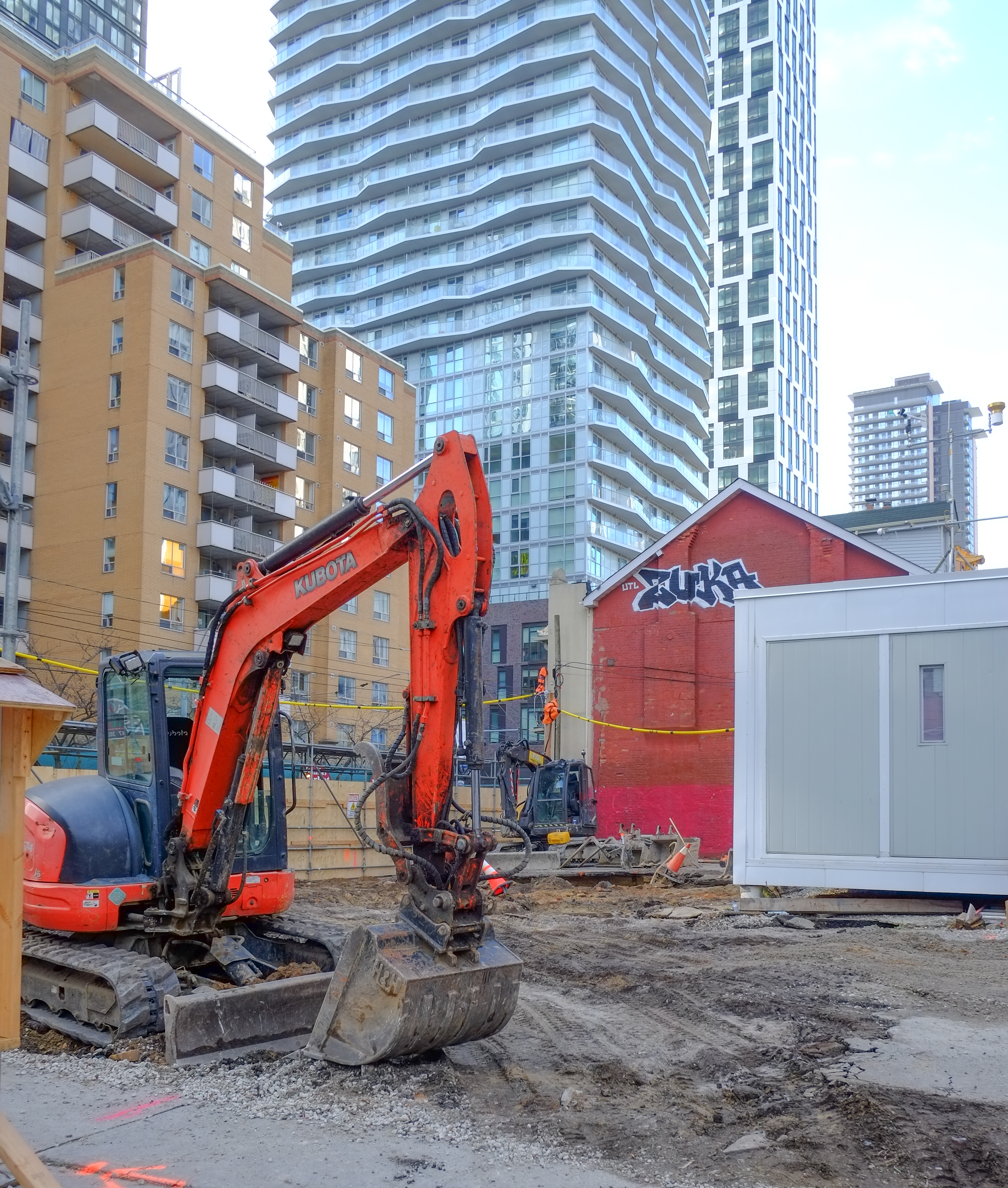
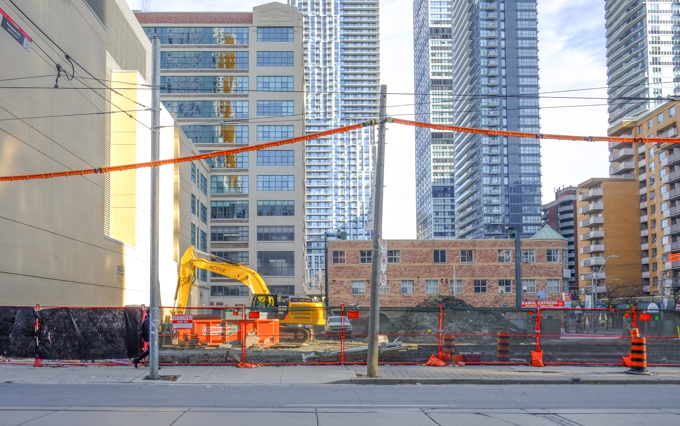
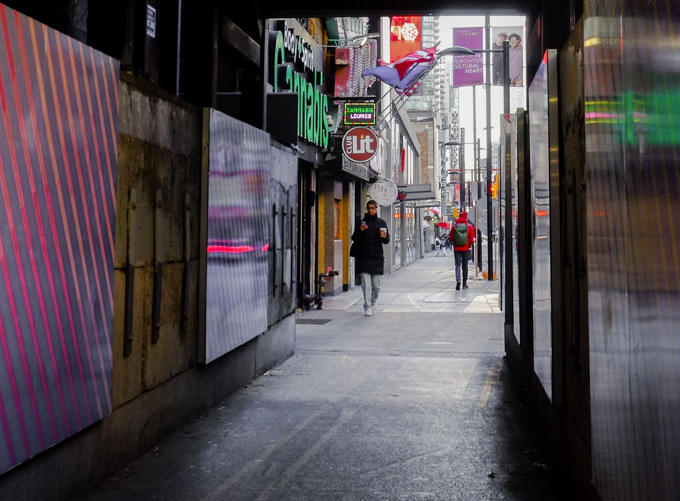
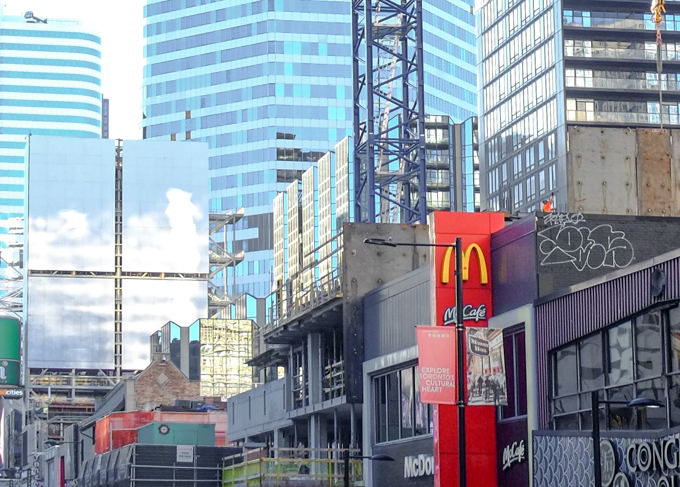
…. A short distance but with a lot happening.

An early morning walk with a weak winter sun low in the sky.  Tall buildings that cast shadows, or reflect light.  Patterns of light and shadow.

below: Crossing Yonge from Carlton to College

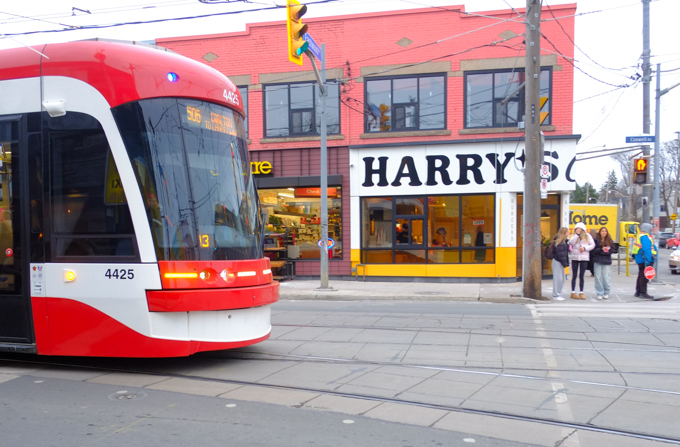
people crossing intersection of college and yonge, walking westward, towards TTC streetcar that is heading east, in front of College Park, with old red brick building on the north side of college street

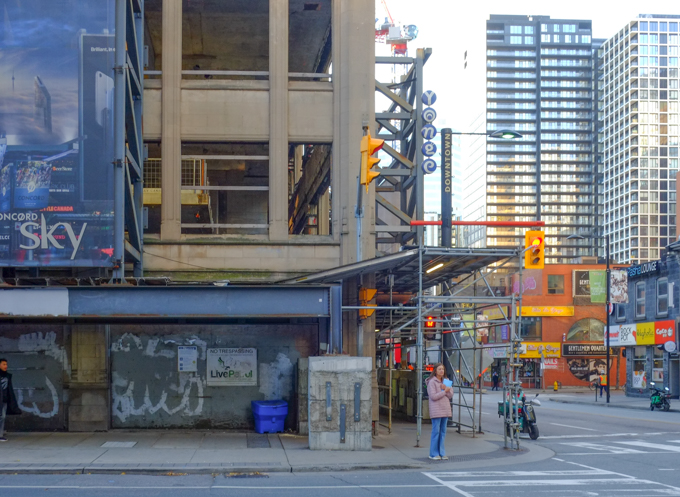
below: North on Yonge.  The facade above Shoppers remains.  “….has design value and technological merit as a representative of the 1950s Toronto School of ‘Picturesque Modernism’ in its expressive use of concrete seen in the cantilevered canopy and decorative piercings of the concrete screen for the above-ground parking, in the ‘egg-crate’ elevations designed to reduce solar gain, and in the predominant white aesthetic of glazed white brick and concrete surfaces.” (form City of Toronto report on heritage inclusion)

below: Rising above Yonge and College

tall new condo tower above older red brick building on northwest corner of Yonge and college

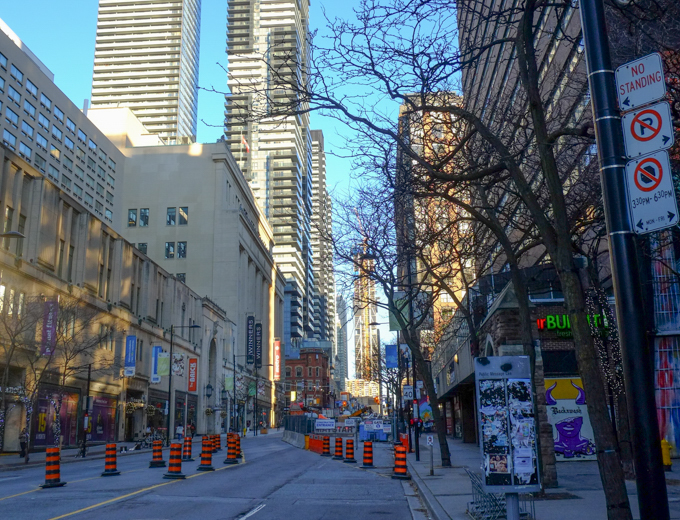
below: Looking north, up the canyon that Yonge has become.  The very tall building that is obviously under construction in the distance is at Yonge and Bloor.

looking north on Yonge, from College, towards two very tall condo developments at Yonge and Bloor, shadows because of buildings, blue sky, not much traffic

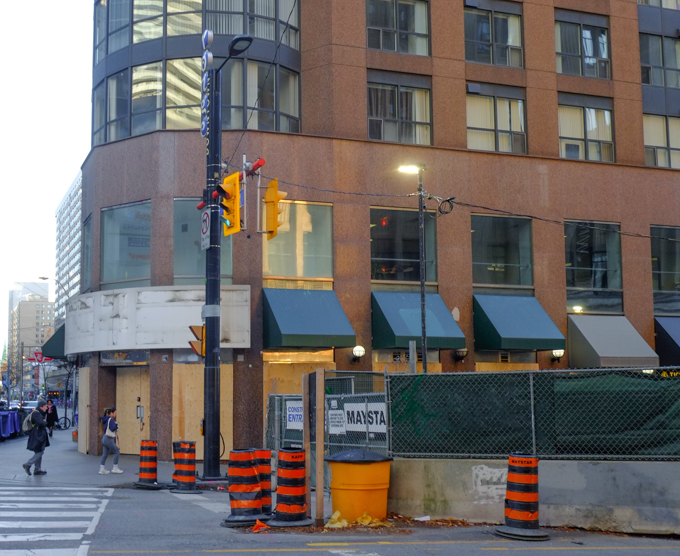
below:  Empty, boarded up and waiting its turn. Southeast corner of College & Yonge.  I have vague memories of a candy store on this corner although I think that there were a number of businesses that passed through here.

brick building with rounded edge at front, now empty, southeast corner of Yonge and College, construction at street level in front of building

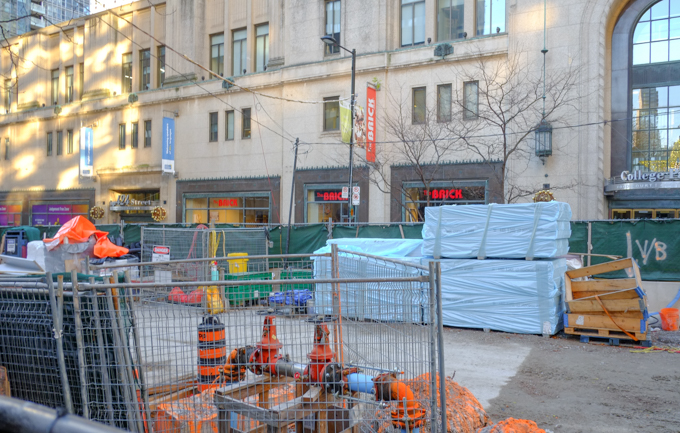
below: The east half of Yonge street in front of College Park is now a construction zone.  An additional entrance on the east side of Yonge along with more elevator service between street and track levels, is being built for College subway station.  Are there any streets in the downtown area that don’t have partial closures for construction?

small construction site on yonge street, taking up space on the street, in front of College Park shops

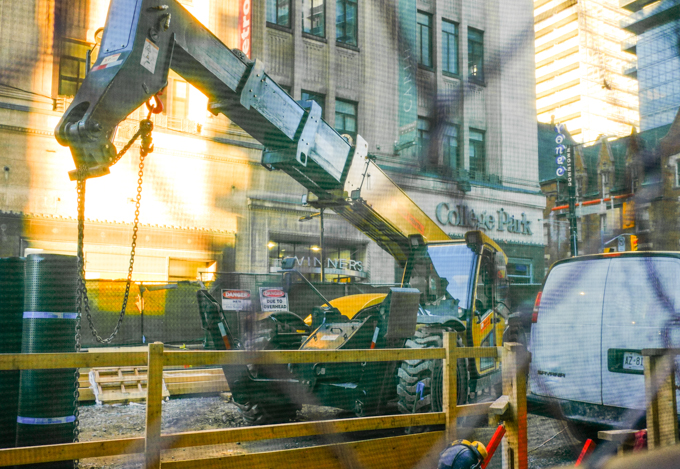
below: Sunspots, reflected light on the side of College Park

construction equipment

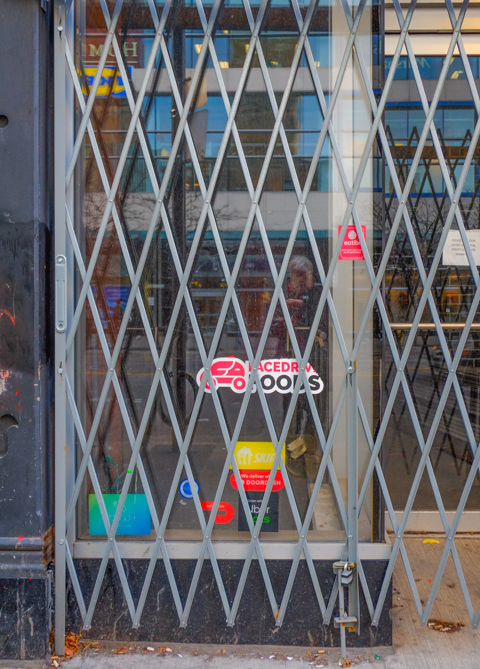
below: More emptiness, more waiting.

metal grille gate covering window of a store or restaurant that is now closed, old doordash sign in the window

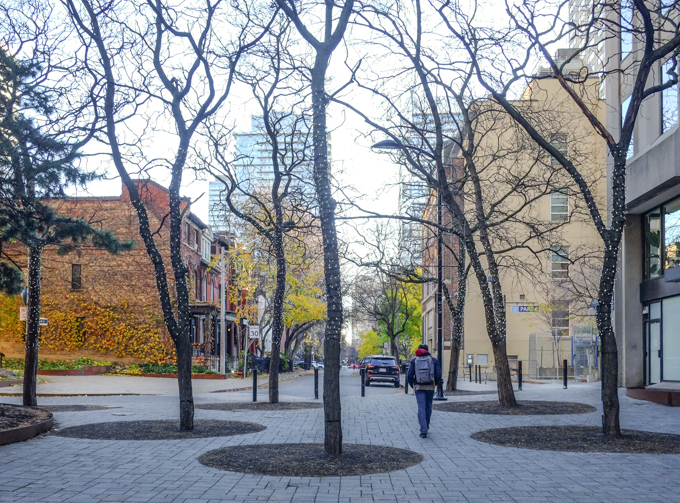
below: Granby and McGill are two streets that run parallel to College but don’t actually meet Yonge Street, pedestrians only here

person walking through pedestrian zone between yonge street and sheard street at the end of mcgill

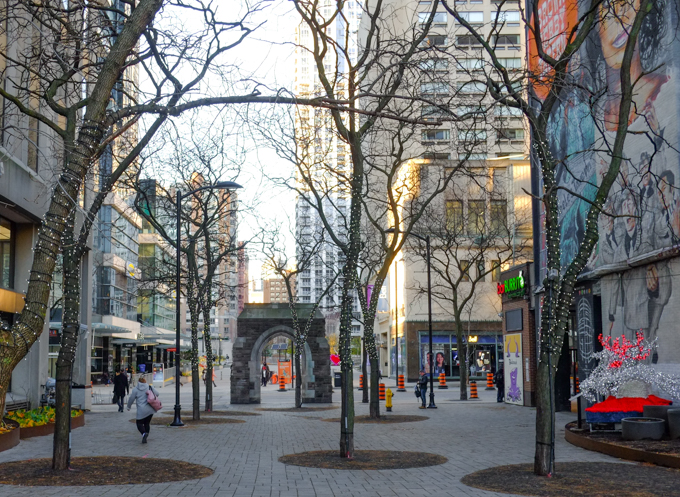
below: Looking back at Yonge Street from the same spot.  When the area was pedestrianized back in the 1980s, the city purchased added the arch.  The arch came from St. Andrews United Church at Bloor and Park Road (not on this site, moved here).  The mural on the wall, right hand side …

old stone arch remains, on yonge street near Sheard and McGill streets

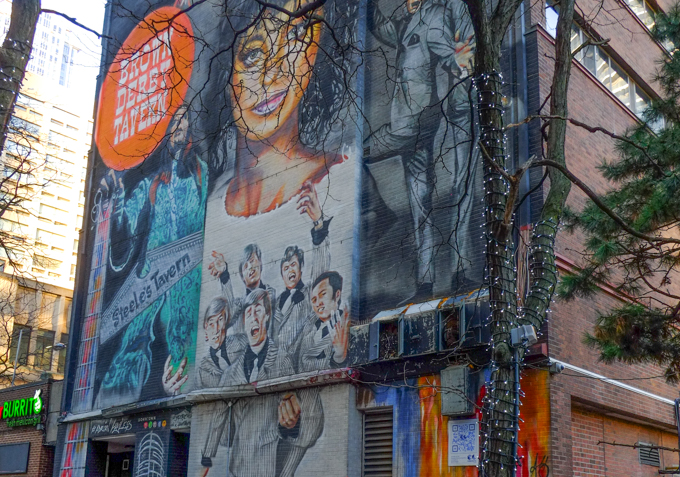
… is The ‘History of Music on Yonge’ mural that covers two large walls on the same building.  This is the south side of that building.   It was painted by Adrian Hayles and features music legends who played in Toronto in the 1950s and 1960s.

History of Music on Yonge mural, south side,

Brown Derby tavern and Steeles tavern part of mural

part of History of Music mural by Adrian Hayles, group of male singers in black shirts, white ties, and black stripe on white suits

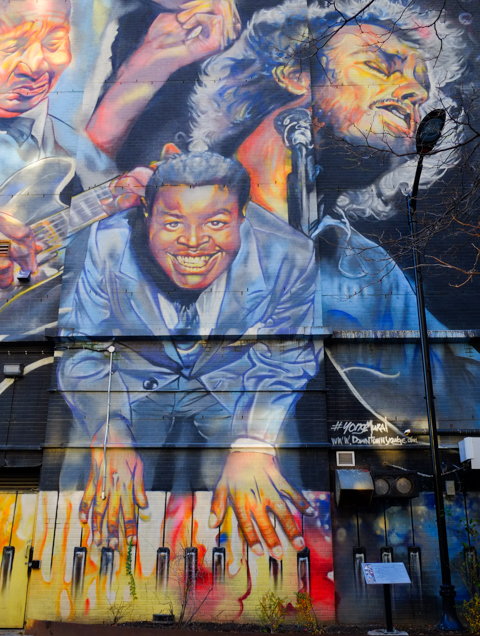
On the north side of building, the mural shows Ronnie Hawkins, Glenn Gould, Dianne Brooks, Jackie Shane, Muddy Waters, Shirley Matthews, B.B. King, Gordon Lightfoot, and Oscar Peterson.

history of music on yonge mural by Adrian Hayles, north side, Massey Hall, Gordon Lightfoot, B.B. King, piano player, tall, vertical mural

part of a mural by Adrian Hayles, piano player with multicoloured keyboard

below: Behind Yonge street, between Granby and McGill (Joseph Sheard parkette)

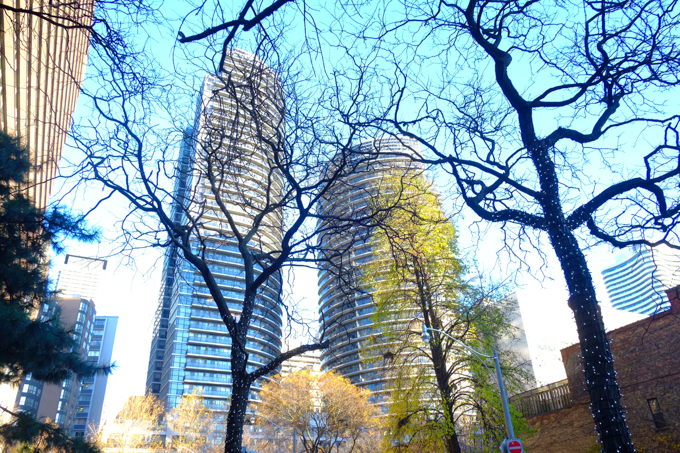
Joseph Sheard park in Toronto, old brick house, with many tall trees, some new condos

new condo towers downtown

below: Looking north up Yonge from Granby

looking north on yonge from granby, just south of college

below: Aura

looking south on yonge by ikea store and fusettes restaurant

below: People on a corner… To the woman in the brown coat – A penny for your thoughts (Does anyone use that expression anymore?)

two women holding bright green coffee cups, talking to each other, man in background crossing the street,

below: The southeast corner of Yonge and Gerrard is still a construction site….

redevelopment of building on southeast corner of yonge and gerrard, old facade being saved

below: …. but now it is on its way up!

redevelopment of building on southeast corner of yonge and gerrard, old facade being saved

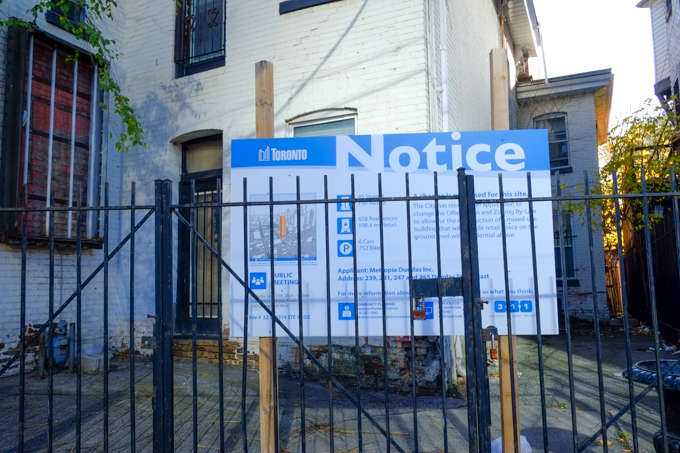
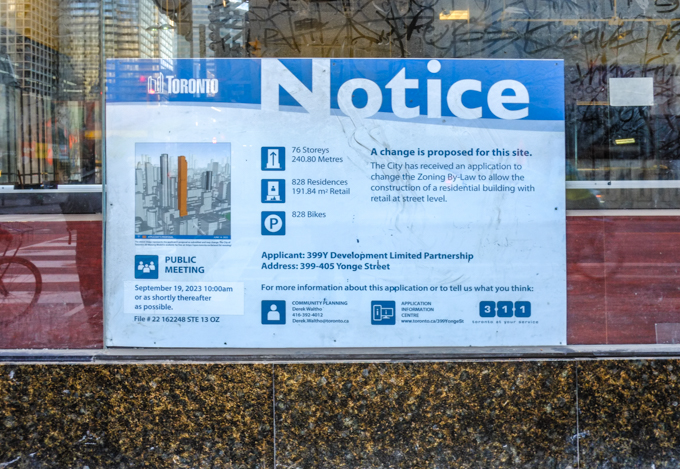
below:  On the northeast corner, also Yonge and Gerrard is an older building that is still standing… for now.  An almost obscene 76 storeys with 828 residences.  No car parking; parking for 828 bikes only.   May I recommend the elevator repair business as a career prospect for those who are looking for ideas?  Also, we could have quite the discussion about bikes and bike lanes……

blue and white city of toronto development notice sign


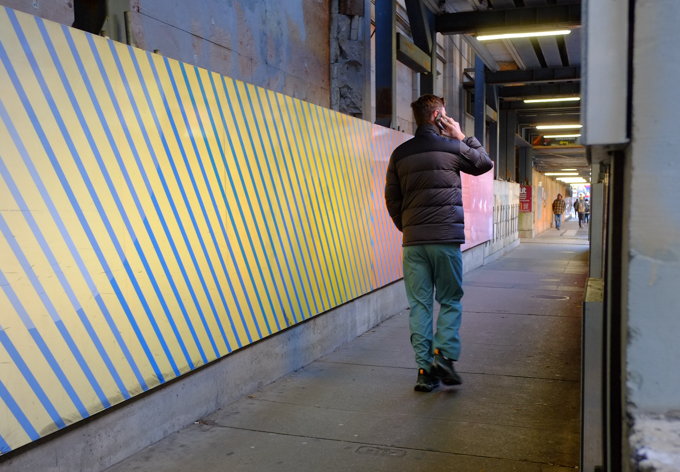
man talking on his phone, walks under covered scaffolding, beside hoardings with painted diagonal stripes in yellow and blue

people walking on sidewalk, approaching covered scaffolding at construction site

looking through scaffolding, to west side of yonge, older 1800s buildings with mansour roofs, H and R block, cotti coffee,

yonge street, motorbike parked outside cotti coffee

below: Looking south on Yonge from Elm

street scene, looking south on yonge from elm, towards yonge dundas square, now called sankofa square

upper levels of buildings on west side of yonge, just north of dundas, includingmcdonalds,

below: The Zanzibar Tavern glows in the morning light

view from Elm street, looking north at Yonge, zanzibar strip club glows in the morning sun, condo redevelopment on the northwest corner of yonge and elm

below: Hoardings around the construction site on the northwest corner of Yonge and Elm

artwork titled Homecomings on the hoardings at construction site, northeast corner of elm and yonge,

below: Orange! Even more construction on Yonge, this time the southwest corner of Yonge and Elm

elm street, south side, looking east, at yonge

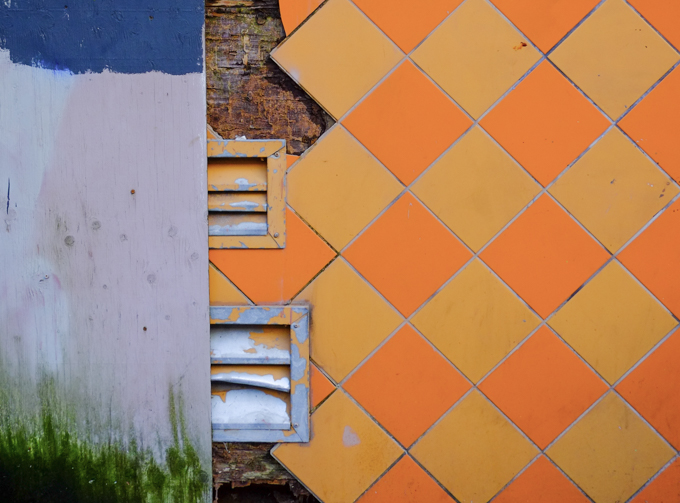
below: No more pizzas here.

damaged exterior wall on now abandoned pizza pizza restaurant, orange and yellow ties on point, some missing

below: Looking west on Elm

person walking on sidewalk on elm street, walking west from yonge

below:  A quick stop at the Cong Caphe.  That’s an iced coconut coffee!!

bouquet of flowers on a coffee shop table along with a cinnamon bun and an iced coffee drink


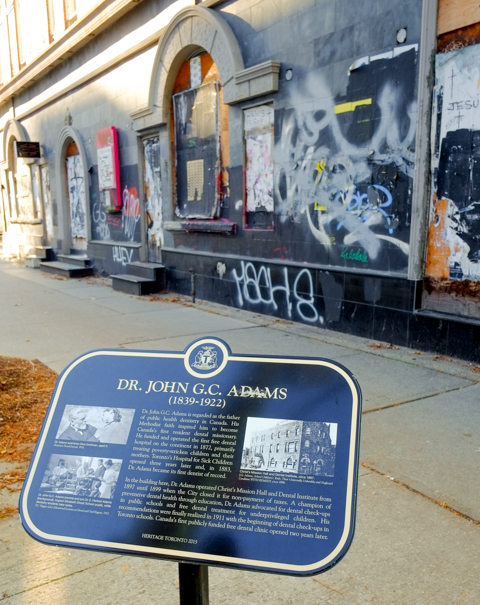
Dr. John Gennings Curtis Adams left a small mark on the city just over a hundred years ago.

a Heritage Toronto plaque on the sidewalk outside an old three storey brick building that is boarded up and covered with graffiti. Plaque tells about Dr. Adams who was a dentist in the late 1800s.

Dr. John G.C. Adams (1839-1922)  Dr. John G.C. Adams is regarded as the father of public health dentistry in Canada.  His Methodist faith inspired him to become Canada’s first resident dental missionary.  He funded and operated the first free dental hospital on the continent in 1872, primarily treating poverty-stricken children and their mothers.  Toronto’s Hospital for Sick Children opened three years later and, in 1883, Dr. Adams became its first dentist of record. 
In the building here, Dr. Adams operated Christ’s Mission Hall and Dental Institute from 1897 until 1899 when the City closed it for non-payment of taxes.  A champion of preventative health through education, Dr. Adams advocated for dental check-ups in public schools and dental treatment for underprivileged children.  His recommendations were finally realized in 1911 with the beginning of dental check-ups in Toronto schools.  Canada’s first publicly funded free dental clinic opened two years later.

Although Adams  had a mission here, it was only for a few years and he lost possession because he didn’t pay his taxes.  So I am not sure why the plaque is here (to bolster the heritage designation of the building?).  It’s earlier history is just as interesting, if not more so. Before Adams, it had been a coffee shop run by The Toronto Coffee Association Coffee House – off on a tangent for a moment. the Coffee Houses of the 1880s and 1890s were in response to Prohibition laws and many were run by the Temperance League.   I found a thorough, well-written history of these coffee houses as well as Bay Street at the time at Scenes from Toronto

If you have passed by the intersection of Bay and Elm (just north of Dundas), you may have noticed the building on the southwest corner.  It’s been derelict for quite a few years now.  It has become a small canvas for some graffiti artists; although it gets ‘cleaned up’ every once in awhile, traces remain.  Dr. Adams wouldn’t recognize it… nor would he approve of it!

below: Two faced

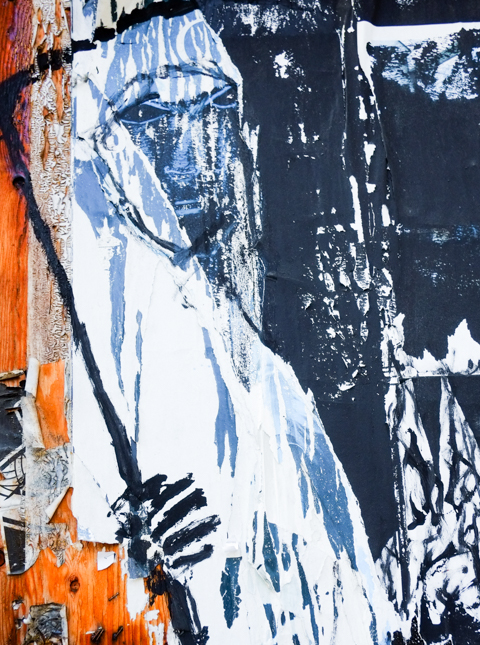
bits and pieces of posters that have been put up on boarded up window on abandoned building, layers, including partial faces of two men

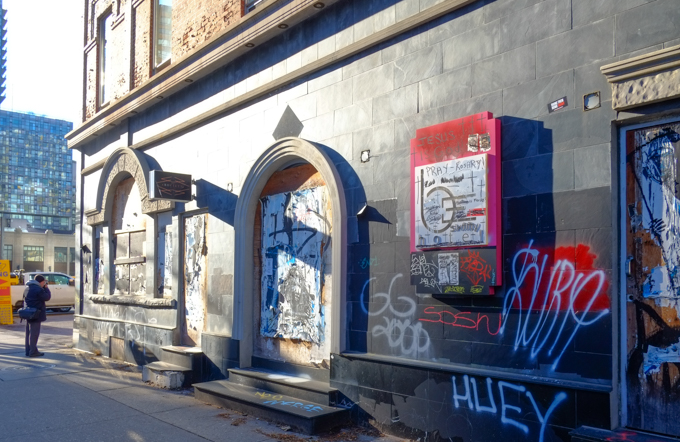
an old arched window in a building that is now boarded up, graffiti and posters on the plywood

below: Like a repeating pattern on wallpaper or fabric, columns of men with the same hair cut and facial features.  An army of clones.

graffiti paste up poster, repeating black heads in columns and rows, torn bottom

black ink drawing of a man's face and hand on white, drawn on old posters on a graffiti covered wall

below: Mexican Jesus

on a wall with remnants of posters and graffiti, black drawing portrait of a man with long shaggy hair

below: 33wallflower33

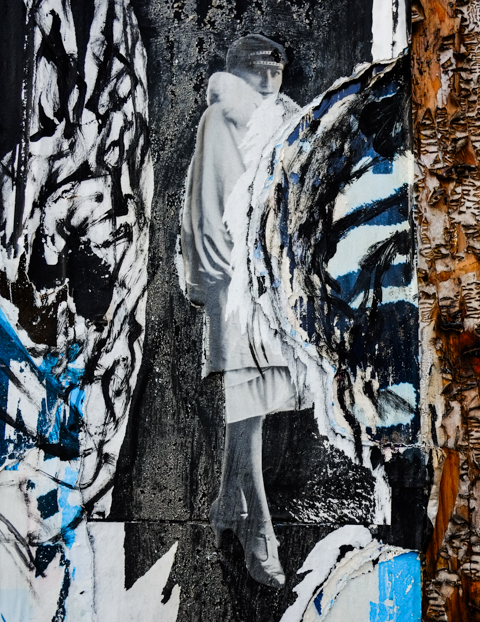
black and white paste up graffiti, grey tones, images of women, by 33 wallflower 33

black and white paste up graffiti, grey tones, images of women, by 33 wallflower 33

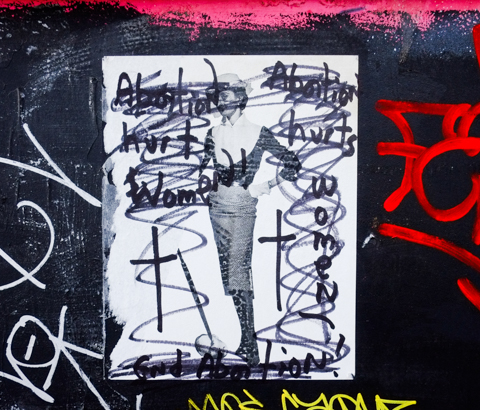
graffiti paste ups and posters on wall of an abandoned building at 55 Elm street

abandoned building with windows boarded up, graffiti

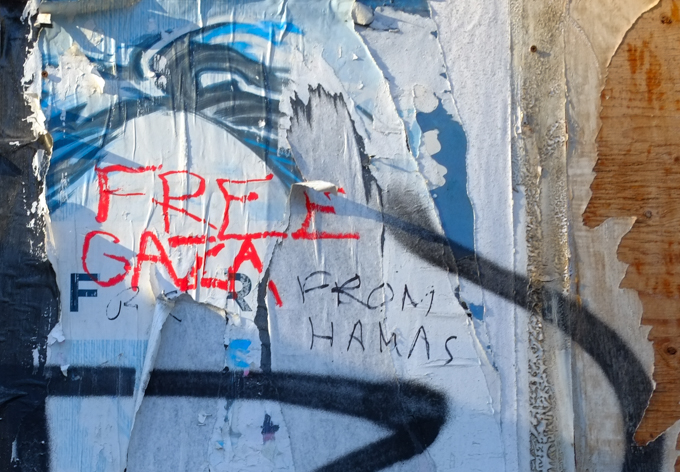
layers of ripped graffiti paste ups and posters on wall of an abandoned building , someone has written free gaza and someone else has added from hamas

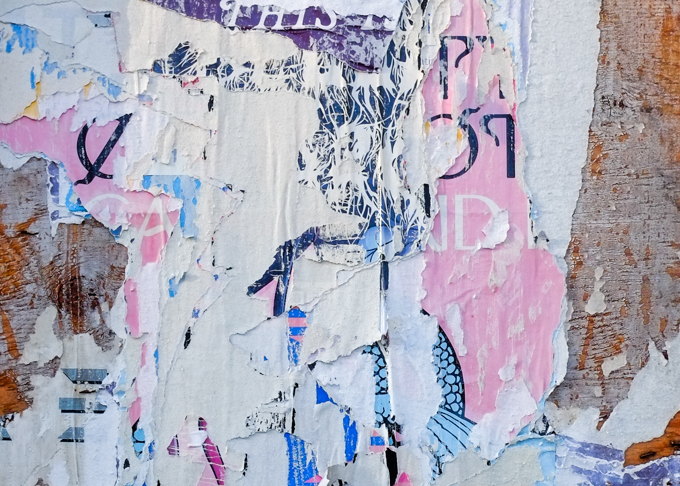
collage made with layers of ripped graffiti paste ups and posters on wall of an abandoned building

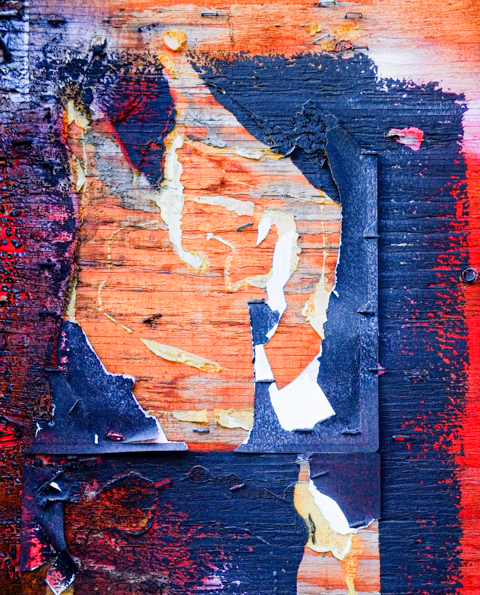
layers of ripped graffiti paste ups and posters on wall of an abandoned building at 55 Elm street

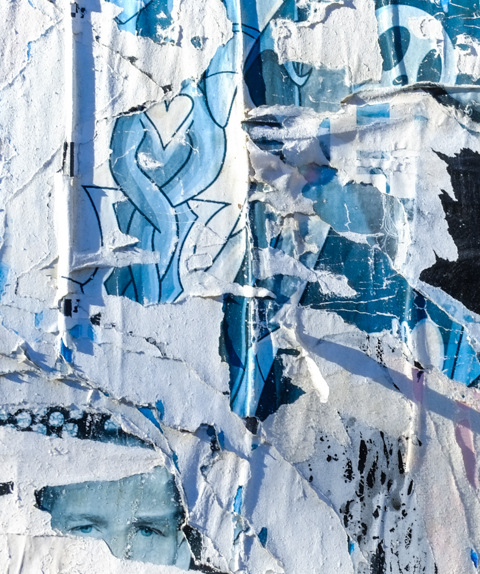
layers of ripped graffiti paste ups and posters on wall of an abandoned building, including a braid and a small heart

layers of ripped graffiti paste ups and posters on wall of an abandoned building with graffiti text written across the top that says Jesus is God

This building, 55 Elm, is at the east end of a row of bay & gable houses from the late 1800s.  All of them are empty and boarded up, awaiting the usual fate of such properties in this city.  The image below is a screenshot of the row of houses that was included in the 2021 City of Toronto report (pdf) that designated the row as heritage properties.  The study was prompted by the possible tear down of one of the houses in 2019.  In other words, these have been empty for a long time.

bay and gable houses on elm street, 57 to 71 Elm

  These houses back onto a large parking lot.  The last few photos are a quick look at remains behind.

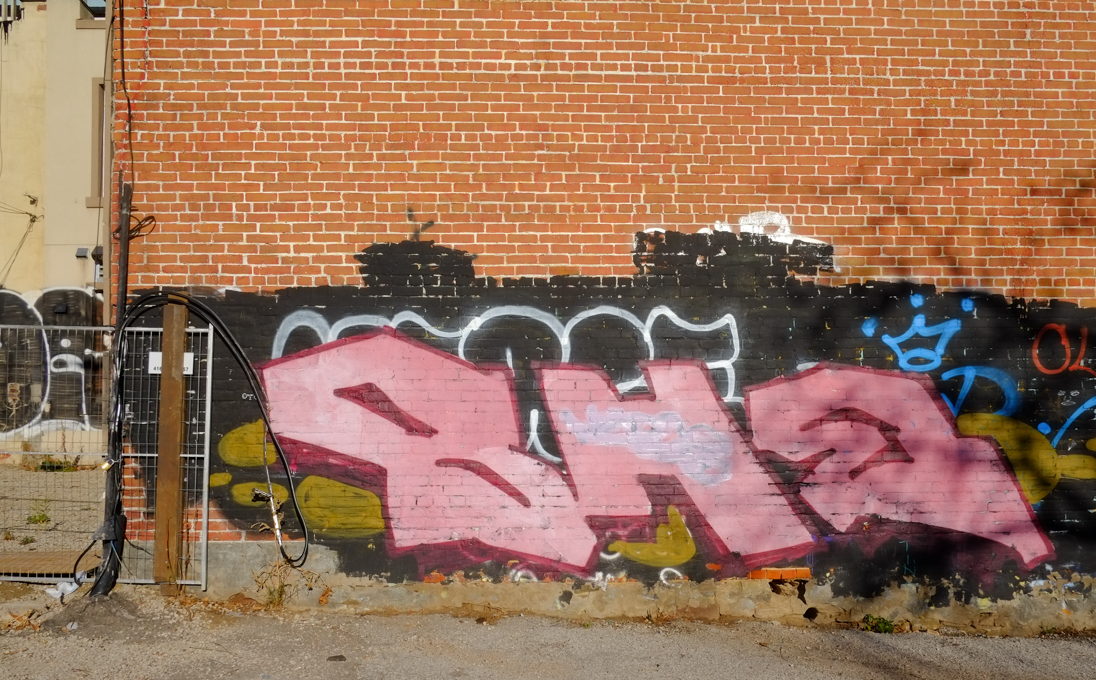
graffiti on the back of a brick building, pink, large 3 letters,

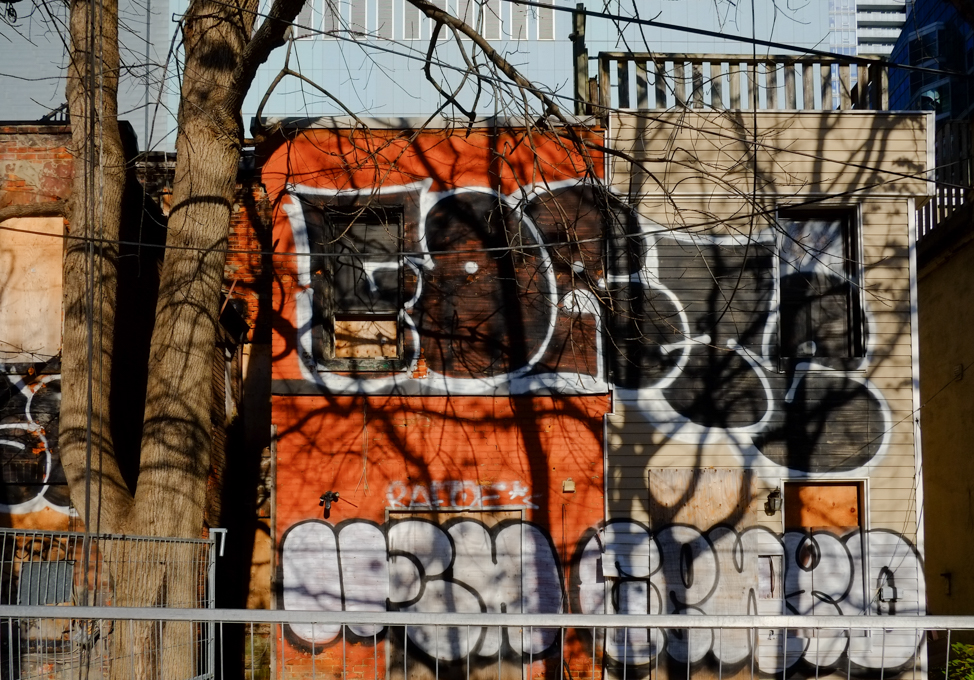
graffiti text tags on the back of empty houses

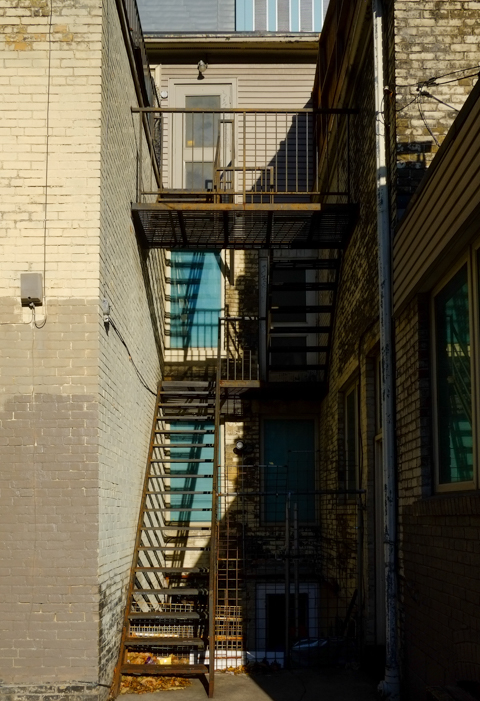
exterior stairs at back of house, two storeys, leading to turquoise doors

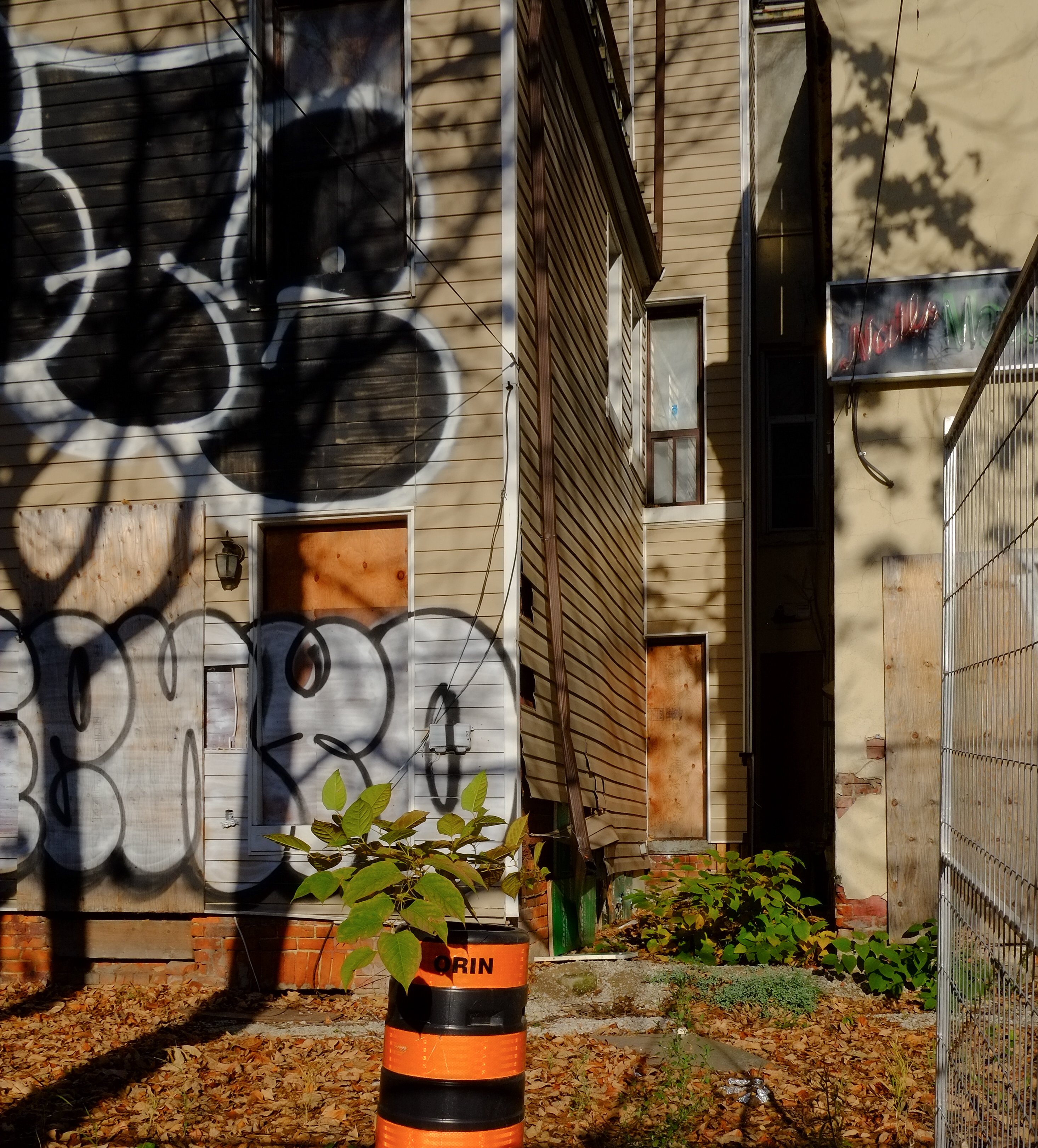
graffiti on back of abandoned houses

graffiti on back of abandoned houses

graffiti on back of abandoned houses

graffiti on back of abandoned houses

graffiti on back of abandoned houses

back of building, looking up to rooftop and metal vents, tall skyscraper condos in the background, used to be matagali restaurant, sign still there

… but finding many other things instead.

This is a follow-up to my last post about the Don Mills trail.  Remember that I mentioned that it came to a dead end just north of Eglinton?  I thought that surely someone somewhere in the city government would have looked into options re connecting the Don Mills trail to a street or another multi-use path.  The dead end is just east of Leslie, so off I went to check it out (and I wasn’t going to walk all the way to a dead end just to turn around again) .

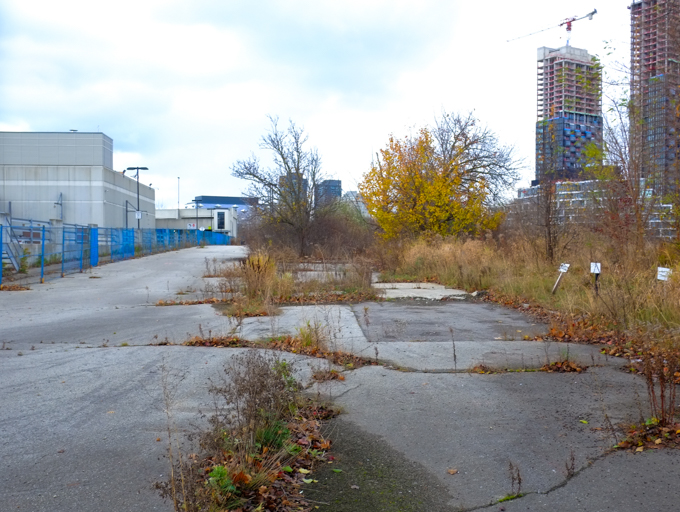
Hey look!  There is a vacant lot at approximately where the trail ends.

cracked pavement with weeds growing up in them, vacant lot,

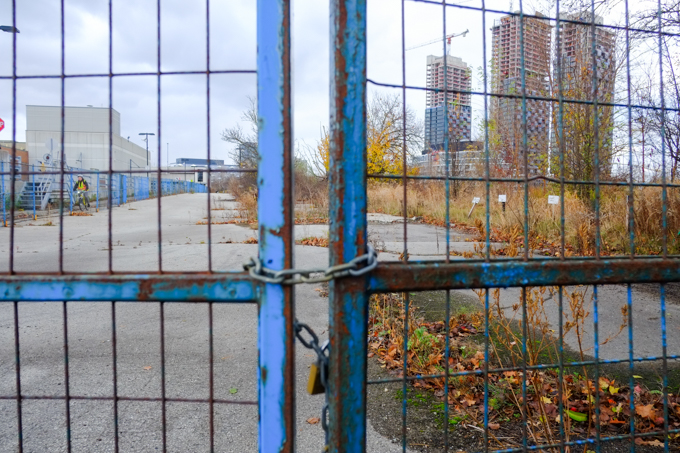
Did I wander back there?  Sadly not….. I didn’t have any lock cutters with me….  This was once a Sony Music building but it was demolished in 2016.  There was no development notice sign at the site (9 acres).
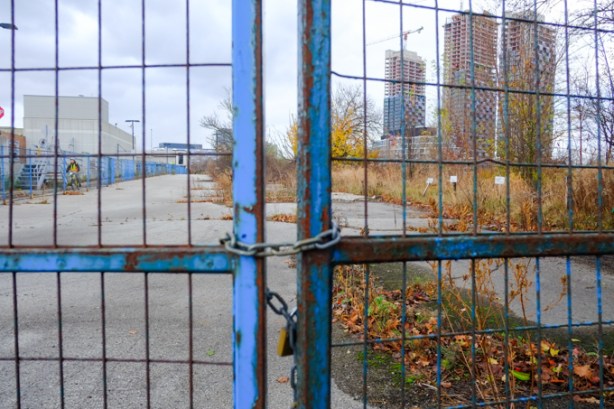
blue metal fence and gate, locked closed, vacant lot beyond the fence

below: This is the Sony Music (or CBS) building, built in 1959.  They don’t make them like this any more – so spread out and only one storey high.   Land must have been much cheaper back then!
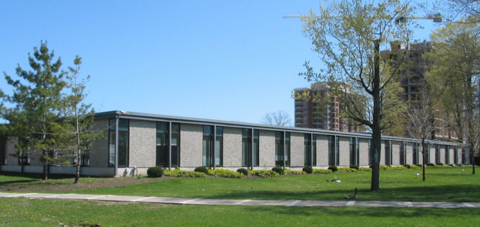
older colour photo of sony music building on leslie street (demolished in 2016)

Photo credit: by Bob Krawczyk, found on ACO Toronto website (Architectural Conservancy Ontario)

When I was researching the Sony Music building online, I came across the Phoenix Centre.  That’s the name of the planned private club being developed at the old Wrigleys site next door to the now vacant lot.  If I had realized that when I was out walking, I would have taken more photos.  As it is, this is the best I’ve got:

southwest corner of old Wrigleys building on Leslie street, now OTT, low rise modern building

This building, built 1962, was included in North York’s Modernist Architecture, first published in 1997. In addition, The former Wrigley property has cultural heritage value as it is historically associated with the 1950s planning and development of Don Mills by E. P. Taylor and Don Mills Developments Ltd. (if interested, more info at ACO website).  The Phoenix Centre plan retains most of the office space architecture but completely remakes the factory space.

  There is also talk of a bridge (pedestrian & bikes?) over the CPR tracks to the Crosstown developments.   Makes sense to connect the Don Mills trail, Crosstown, and Leslie Street!

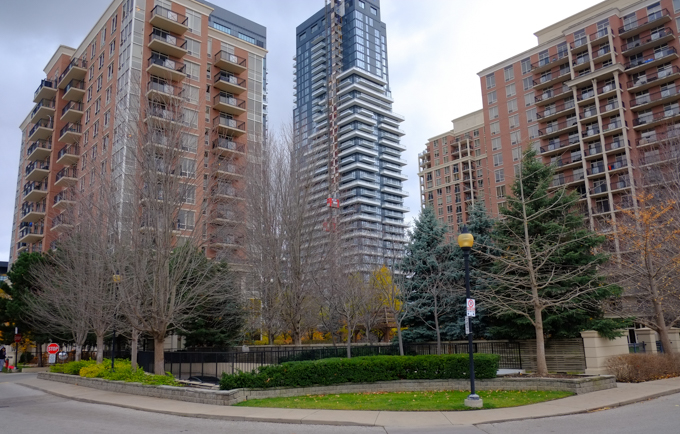
Part of the reason I didn’t take any photos of the old Wrigley building is that I had chose to walk south the day….  just south is a fire station as well as some condos.

on Leslie street, white building that is a fire station, parkland in beside it. to the south are condos, older red brick buildings plus newer glass and steel condos behind

And there is a well worn path that accesses the back of the properties.
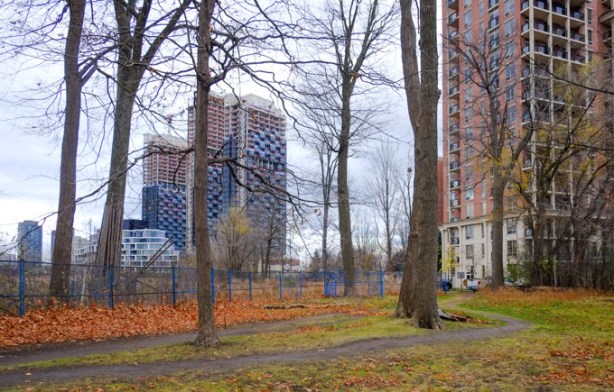
large trees in foreground, dead leaves on the ground, autumn, new condos being built in the background, cranes,

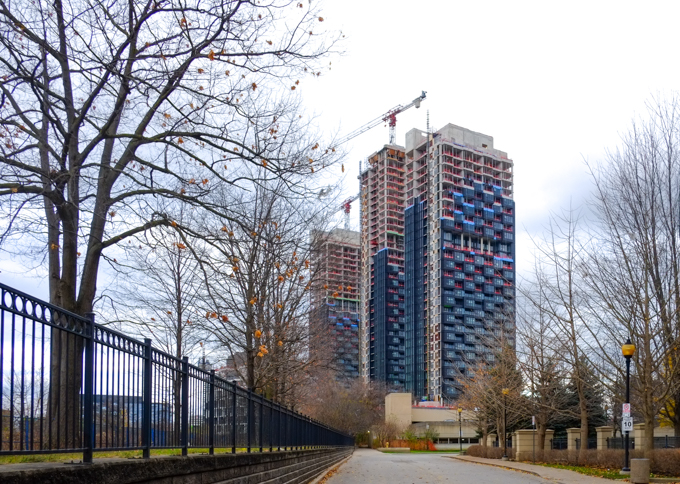
This road doesn’t actually lead to those new condo towers.  The CPR railway tracks are in the way.  Those towers are part of the Crosstown development on the old IBM and Celestica property (access from both Eglinton & Don Mills)

long driveway, access road, with new condos under construction in the background

The road didn’t lead to the end of the Don Mills trail either… but it did lead to the back of a parking garage.  No dogs allowed and no trespassing.  No luck here.
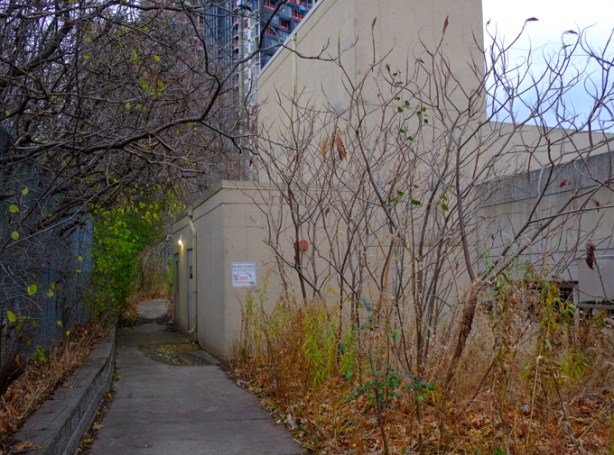
path that runs behind beige concrete building (parking garage) with no trespassing sign)

I got a better view of the neighbourhood though….
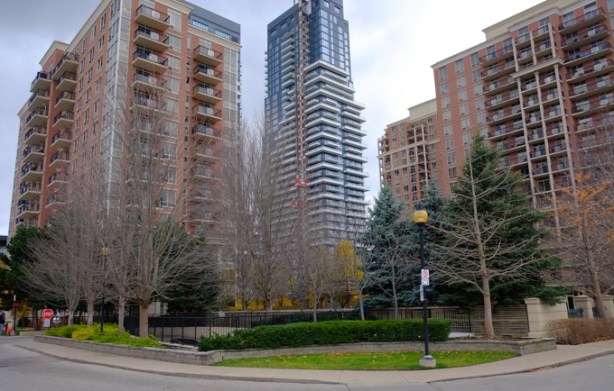
highrise apartment buildings and condo towers

Black and white on a grey day.

two chairs, one black and one white, in a vacant lot, grassy, one tree,

As I walked back out the path, I noticed this sign.  I took it to mean the property behind the blue fence, not the property the path is on… probably?
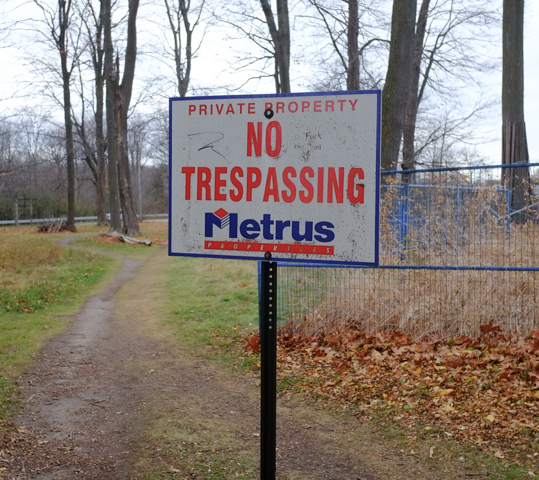
no trespassing sign, metrus private property

It stopped munching and stared at me, trying to decide to sit and watch or to run away….  it scampered away before I could get any closer (I don’t pretend to take good pictures of animals but it looked so cute, all puffed up to stay warm).

a grey squirrel sitting on a fallen tree trunk, dead leaves on the ground, a nut or something edible between its two front paws

A very short walk farther south on Leslie brings us to the Inn on the Park site on the northeast corner of Leslie and Eglinton.

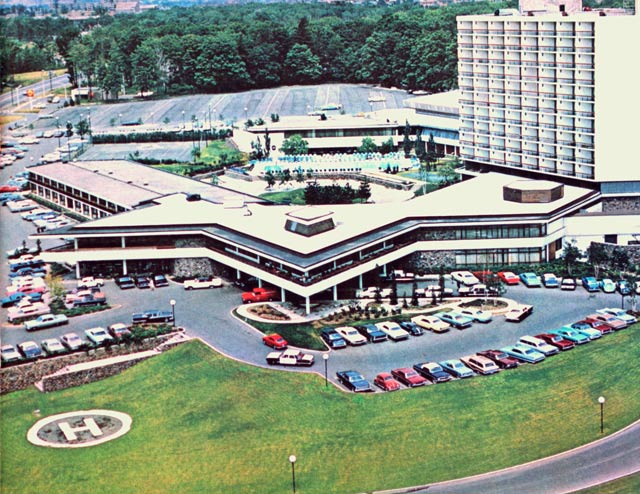
below: Inn on the Park as it once was (about 1969)  I have ‘borrowed’ this photo from another website – Jamie Bradburn’s Tales of Toronto.  Follow the link if you are interested in the story of the hotel – it’s an interesting read.  Did you know that in 1962 North York had a ban on cocktail lounges?

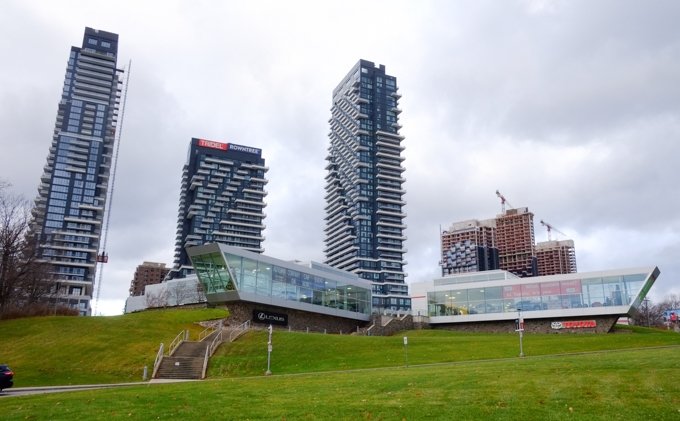
below: The site today. It’s now a Toyota/Lexus dealership and home to a few new condos.
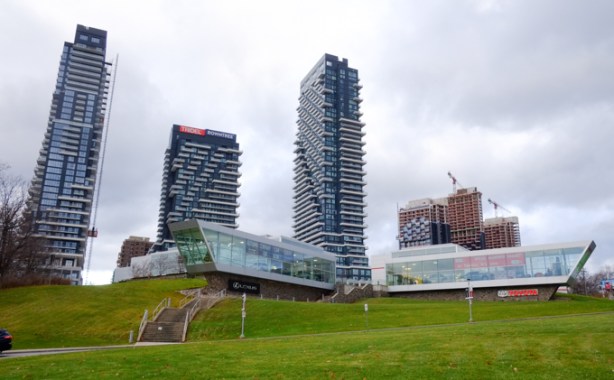
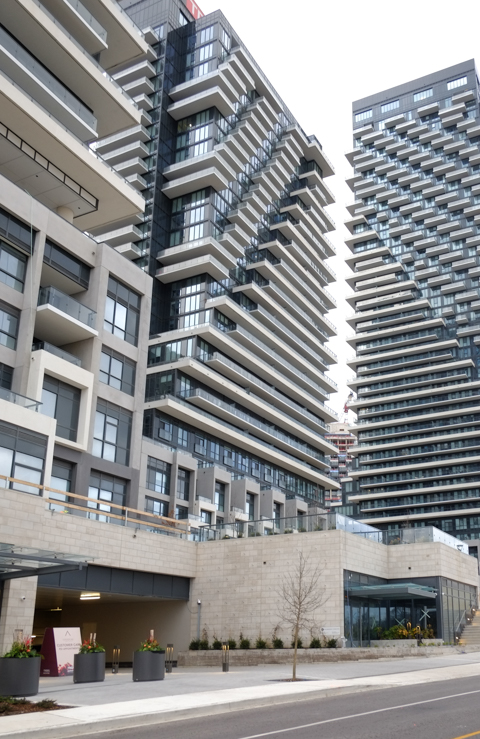
old Inn on the Park site, northeast corner of Leslie and Eglinton, now a Toyota and Lexus dealership, also new condo development, still lots of green space in front

new condos being built at inn on the park site

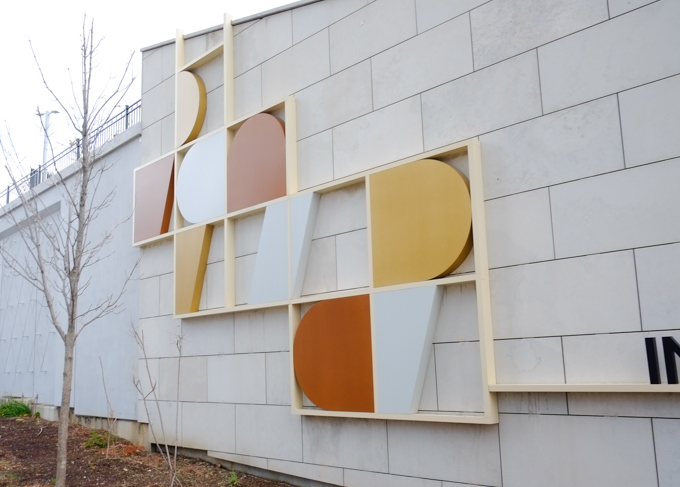
artwork on exterior wall, solid colour shapes inside squares, 3 D, but mostly flat, shades of orange

But there are more changes coming….. (surprised?)…. more glass and steel towers by the looks of it.  The notice also states that parking is planned for 845 cars and 1860 bikes.  Does Doug Ford approve?

blue and white development notice on the corner of leslie and eglinton, with inn on the park site in background, auberge on the park condo development

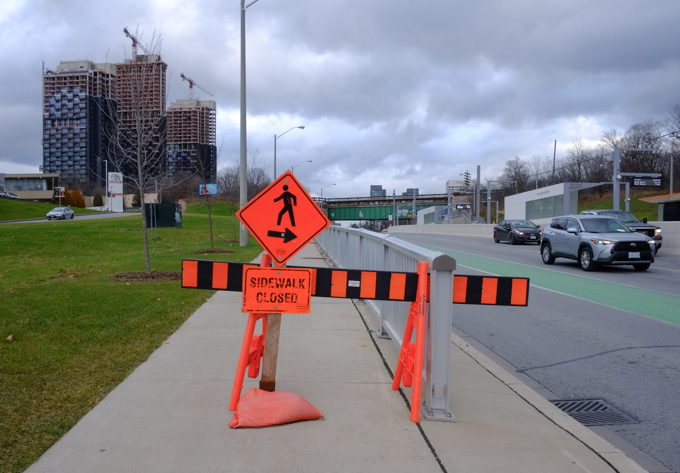
sidewalk closed sign and barrier, on eglinton, northside, east of leslie

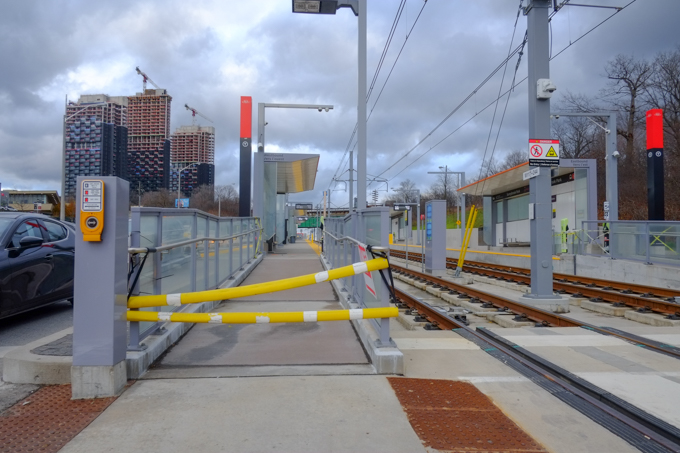
below: A sad sight, Sunnybrook Park LRT station all ready to go but no trains running. One of the Toronto mysteries, when will the Eglinton LRT open?
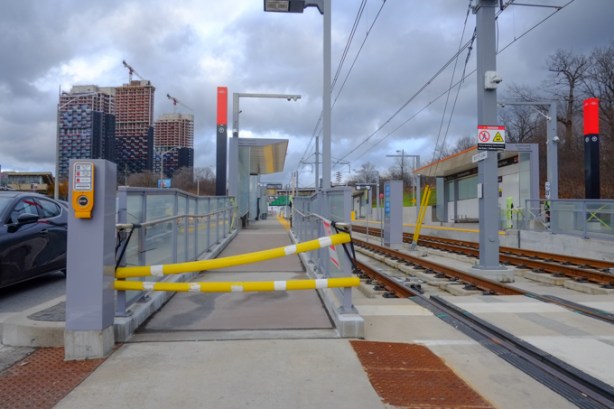
looking east at Sunnybrook Park LRT station on the Eglinton LRT line, no trains running yet but station is somplete, yellow barriers across the entrance

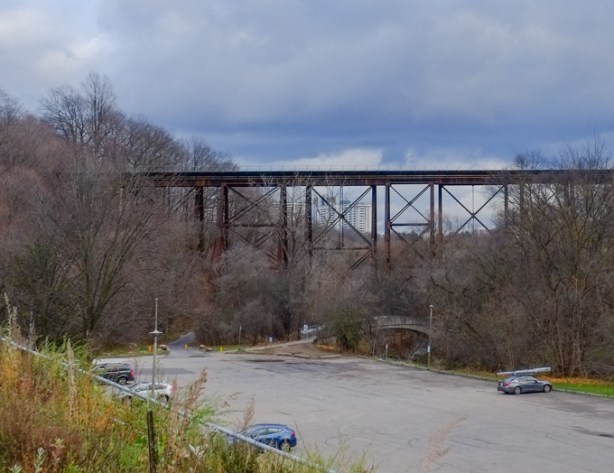
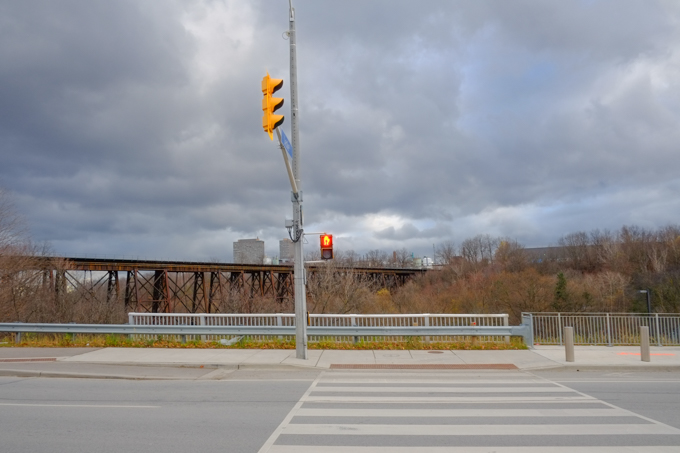
Standing by the LRT tracks and looking south. Wilket Creek park and the Thorncliffe trestle railway bridge can be seen.  I crossed the road because I had seen stairs down to the park….

looking south from the end of leslie street, across lanes of Eglinton to WIlket creek park and thorncliffe trestle railway bridge

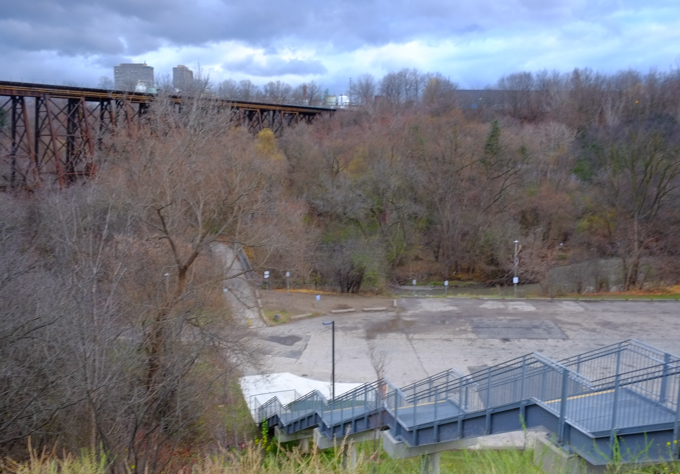
A big new set of stairs!…. But. Not shown – the locked gate that blocked the entrance.   There is still no entry to Wilket Creek/Sunnybrook Park from this side of Eglinton.

long set of stairs downhill from eglinton to a large parking lot at wilket creek park.

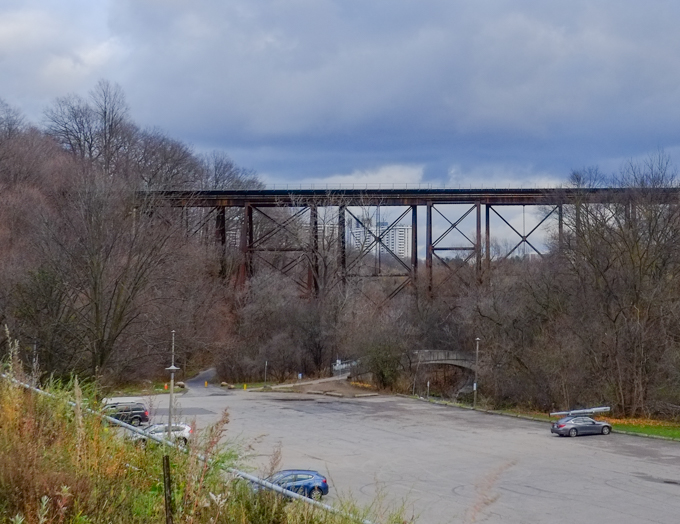
looking south from Eglinton towards thorncliffe trestle bridge, wilket creek park, and ravine system,

It’s getting to be crowded….

cars traveling east on eglinton, approaching leslie, many waiting to turn left, new condo developments behind, crosstown, as well as inn on the park site

below: Crossing Eglinton and looking westward

traffic turning left from eglinton onto leslie, looking west on eglinton

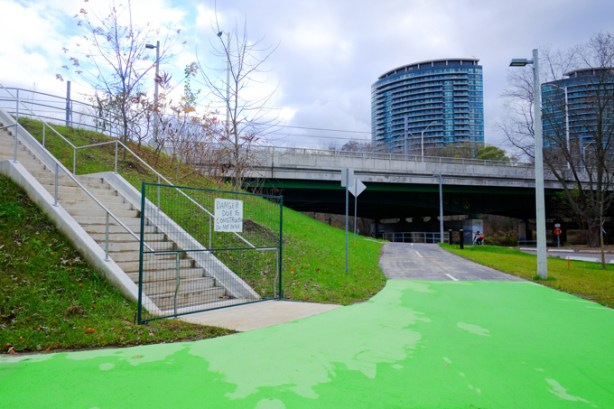
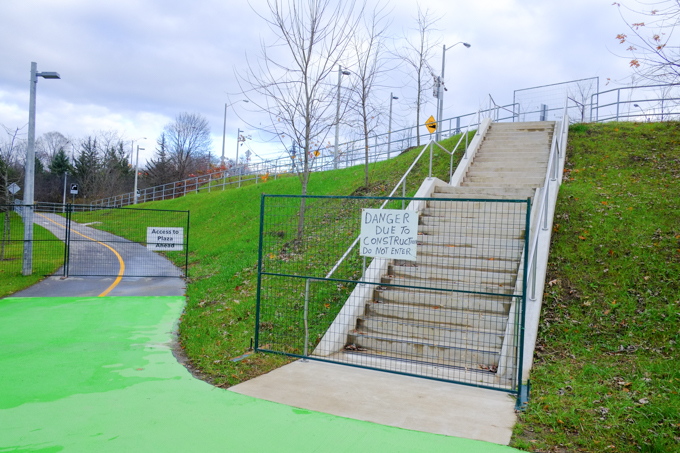
New pedestrian and bike paths that provide access to the park from the north side of Eglinton have been built but they too are locked closed.  It’s very frustrating to see this infrastructure built and then left unusable.  The signs says construction danger but there doesn’t seem to be any construction happening…..

new stairs and bike path infrastructure built at leslie and eglinton that are closed, gates and signs

new stairs and bike path infrastructure built at leslie and eglinton that are closed, gates and signs

Just in case I have confused anyone, here is a map of the area that Google maps created.   Near the top left it even says Don Valley Bike Trailhead… which is very wrong.  No trailhead here of any kind as we’ve just learned.  Also it was the Don Mills trail not the Don Valley trail (the latter is somewhere else!)

google map screenshot of leslie and eglinton and vicinity

New benches! Wilket Creek Park is one section of the string of parks that parallel the branches of the Don River in Toronto’s ravine system. I’ll leave you with a few pictures that I took the other day while I was in the area…

new seating area with wood benches beside wilket creek park sign

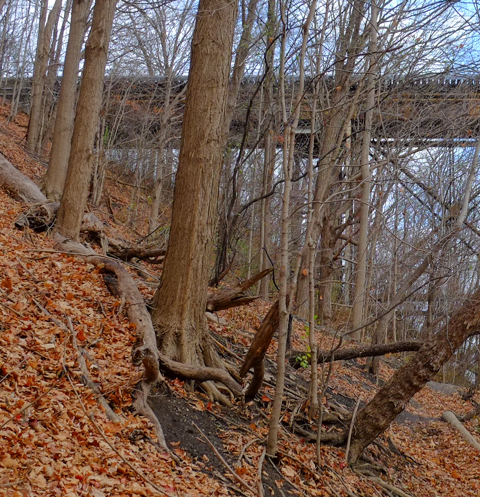
lots of trees growing on hillside, autumn, dead leaves on the ground and none on the trees, park, railway trestle bridge in the background

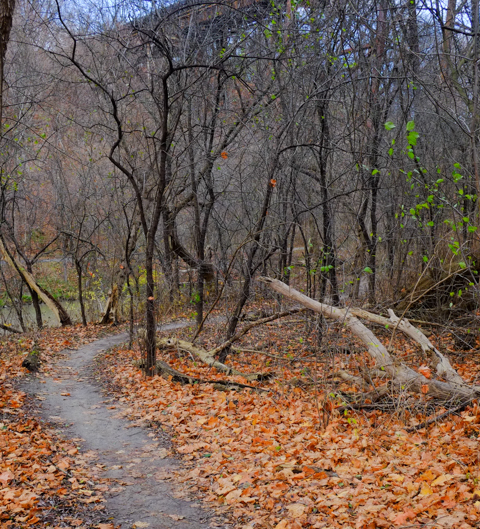
path through woods beside a river, autumn, leaves on ground, small trees

view from under thorncliffe trestle railway bridge, metal girders,

last few yellow leaves on a tree, blowing in the wind

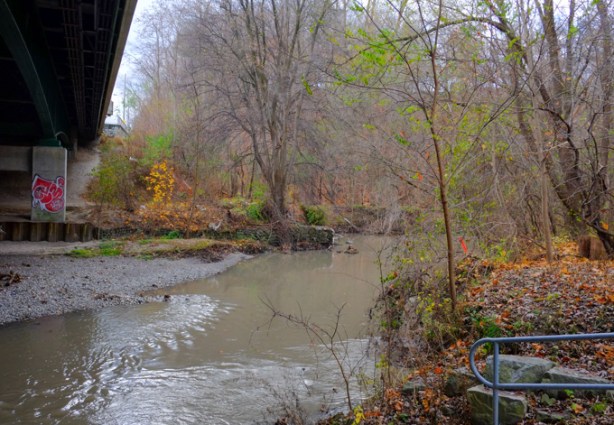
west don river as it flows under eglinton avenue

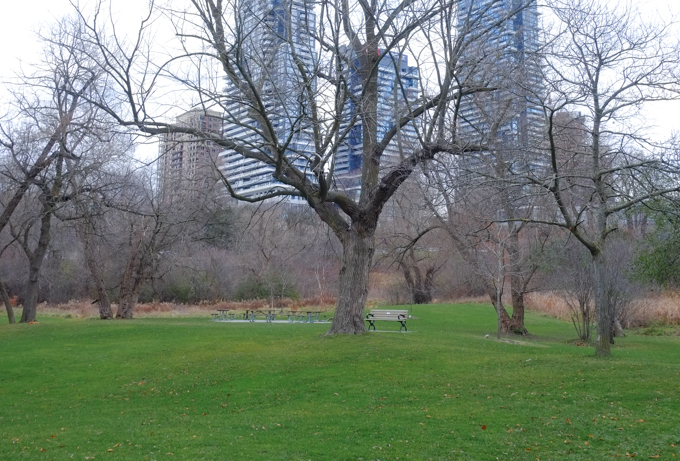
benches and picnic tables in a grassy park with many trees nearby, condos in the background

leaves in a puddle, reflections of tree branches in the water too

graffiti stickers on the back of a sign, one with Mexican flag,

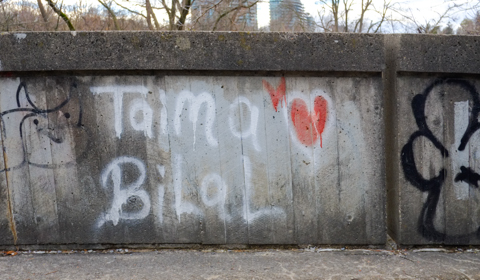
graffiti on the sides of a small concrete pedestrian bridge

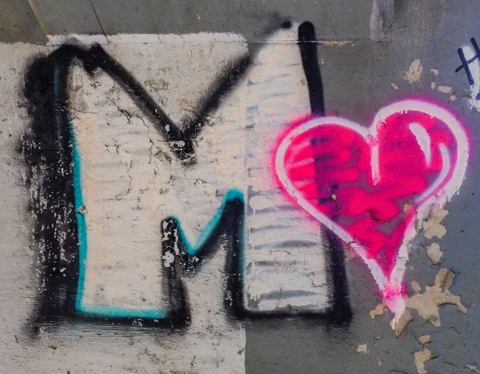
graffiti, large capital M with a bright pink heart

A circular walk to explore the Don Mills trail south of York Mills Road… but how to get there…. We decided to start by walking south on Scarsdale Road to Bond Avenue.

Scarsdale is a nondescript street in North York with a few churches, private schools, some light industry, offices, and all in all, a lot of lowrise late 20th century architecture.

below: Don Mills Baptist Church looking very un-church like.

below: Unmarked

below: Once at Bond, the buildings are mostly residential.

below:  There is a walk-through to the neighbourhood behind

below: The old railway bridge over Bond is now part of the Don Mills Trail.  Originally it took 6 years to build (1912 to 1918) the bridge – using six 2-foot-thick beams that span the 15-foot-wide opening, spaced to handle the weight of locomotives and heavily loaded railway cars.

Don Mills trail access point at Bond Ave.,

below: Also under the bridge is an entrance to Bond Park.

looking under a bridge to a parking lot in a park

below: Another entrance to Bond Park, this time from the trail via a hole in the fence.

leaf covered path down a small hill to a hole in a chainlink fence, and a park with seating beside a baseball diamond in the background, lots of trees

below: “Responsible alcohol consumption is allowed in this park”….rules and responsibilities are then listed along with health information about alcohol.

notice about alcohol in parks, and all the rules

autumn colours in the weeds and wildflowers beside a fence

below: A few remnants of its former life.  Once upon a time this multi use path was a spur line for the CNR, the Leaside Spur.  One of its functions was to connect the CNR main line (now also used by GO to Oriole station and beyond) to the CPR line near Eglinton.  The CPR tracks are those that cross Eglinton just east of Leslie and then cross the Thorncliffe trestle bridge over Wilket Creek Park.  The path ends just before the CPR tracks – there is no connection any more.

old rusted railway sign, small trees have grown up around it

below: Abandoned and rusting.  CNR stopped using this spur line in 1999.  The city bought the property ten years later.

old piece of metal, remains of railway switch? or some piece of railway equipment, lying on the ground

below: Crab apples and dead leaves litter the path

autumn leaves and little red crab apples cover the ground

below: Storage in bins and barrels, on the other side of the fence.

two old blue barrels, behind a fence, lots of undergrowth and weeds too

below: Left behind

discarded pair of boots, and some clothing, left on metal girders stored beside a railway track
stacks of rusty metal girders beside a railway track

below: The north end of the Don Mills Trail runs beside the live CNR line.  Not much of a view is it?  No trains passed by.  Very quiet.

looking northward up the CNR railway tracks from a hole in the fence by the DOn Mills trail.

old white barrels, behind a fence, weeds and small bushes growing up around them

below: Many, many large satelite dishes (and many small ones too).  I was feeling like a spy as I tried to take pictures through the fence… but I didn’t see any surveillance cameras…

satelite dishes behind a fence

below: Approaching York Mills Road

looking north up don mills trail towards york mills road, where there is a bridge over the railway tracks, a large pair of billboards on a tall pillar, dead leaves beside path, shrubs and weeds along the fence

below: The north end of the trail runs beside the bridge York Mills over the railway tracks (on the right in this picture).  From here there is an access road to Scarsdale on the south side of York Mills, or an exit through to Longos Plaza on the north side.

below: Have a seat!

below: Rogers has a large property on the east side of the CNR tracks and has access to this area.

With thanks to my mother for walking with me – she didn’t hesitate to climb through holes in the fence!  She also doesn’t like this picture, but it’s the better of the two that I took that morning!

Bonus section! Just in case you are interested in what’s on Scarsdale Road….

below: Colonel C.O. Dalton CSO and Colonel H.E. Dalton CSO Armoury

sign in front of building,

below: Greek Orthodox Education in Ontario – Metamorphosis Greek Orthodox School.

flags on flagpole, Canadian and GReek, in front of Greek Orthodox Education building

below: Korean Presbyterian Church

side view of front of Toronto Korean Presbyterian church, large roof over entrance, small white steeple, light grey brick building.


Lee Miller: A Photographer at Work is the title of a recent exhibit at TMU’s Image Centre,

A brief synopsis of her long and storied life – Miller (1907-1977) started her career as a model in New York in the 1920s. She went to Paris in 1929 where she became a fashion photographer. She also tried her hand at conceptual photography in the 1930s when she was living in Egypt with her first husband.  During WW2 she was a war correspondent for Vogue magazine in Europe.

two people looking at black and white photos in an art gallery, an older man and a woman with long red hair

black and white photo in a gallery, of a woman in old fashioned bathing suite standing beside and posing with a large fake fish

below: Fashions for Factories with the subtitle: “Every picture tells a story of streamlined,  uncompromising chic for a vital job.”  One of the paragraphs is this: “A woman is apt to be much what she looks. Fix her up smartly and she’ll be smart at the job.  The factory people know this.”

page from Vogue magazine from the early 1940s, spread on fashion in the factories, and what women were wearing at work, hat like turban, short sleeved shirt

women looking at an exhibit in an art gallery

below: Three actresses and models in a photo taken in New York in 1933.  One woman is unidentified and the other two are Dorothy Hale  (1905-1938) and Kendall Lee Glaenzer (1903-1978)

Lee Miller photo of three women, two sitting on a couch and the other standing behind it. Book case behind couch

below: “What’s Yours?” a double page spread in Vogue magazine with coats on the left and dresses on the right. Country coats and town coats… day dresses and afternoon dresses from a time and place when those details might have been important.

double page spread in Vogue magazine showing three women in each of four photos with different kinds of coats

black and white photo from vogue magazine, young woman holding a tennis racquet. Part of a tennis net is on the wall behind her

below: From an article, Six for Dinner”.  The six refers to six long, simple yet stylish dresses for the well dressed woman of the time.

three back and white photos on a green gallery wall, by Lee Miller

below: Advertising ‘intimate apparel’ but staying modest and discrete (r very coy?)  The age of the girdle! (even though this model doesn’t really need one!) – so glad that that phase has passed (sigh of relief).

black and white lee miller photo for vogue magazine, showing corset, or under garments for women, bra and girdle, slip, hard to tell because details are hidden

old black and white photo by Lee Miller, of three women, fashion photography, 2 standing are wearing slacks, woman witting on ground is in a dress

below: From 1945, chronicling the liberation of Europe by the Allied troops.

two photos, on left is a cover of vogue magazine from 1945, a woman in a head scarf, with bright red lipstick, on right a large photo of a recently liberated part of Europe and an article describing the liberation

below: November 1944, Paris.  “Ah Madame! Merci!  The article is written in French and it is a thank you to all the women who played a role in winning the war.  Like her fashion work, her focus during the war years was also on women and how the war affected them and their place in the world.

two photos on a gallery wall, on left is woman on a motorbike by the eiffel tower in Paris and on the right are a group of black and white photos of women working, article is thanking women for their role in winning world war 2

Her documentation of WW2 and its aftermath was extensive.  She was one of the first photographers into Hitler’s residence (and there is a photo of her in his bathtub).  She also documented the liberation of many of the concentration camps.  After the war, she continued working for Vogue, taking pictures of models and celebrities.

two people looking at photos on the wall of an art gallery

Unfortunately, this exhibit ends today, 2nd December.

Sometimes there are silver linings when buildings get demolished.  Until recently, this wonderful mural was difficult to get a good look at.  Now that there is a vacant lot next door I was able to get a much better picture of it.

The Original family, a mural by Philip Cote based on indigenous Anishinaabe creation story, thurnderbird, man, woman, moon, animals,

The title of the mural is “The Original Family” and it is based on an Anishinaabe creation story.  The artist, Philip Cote, has been telling Anishinaabe stories through his mural painting for at least twenty years, including a series of images on the concrete supports of a bridge at Old Mill subway station (see Spirit Stories Under Old Mill in this blog).

scaffolding and hoardings beside a vacant lot where a building has just been demolished, large mural on the other side of the fence, by Philip Cote, Original family,

The Grand Hotel was demolished to make room for a 68 storey skinny tower (on a larger base – i.e. the lower floors will be bigger, podium-like).  No facades to save here.  Once construction starts on this new building, the mural will become partially obscured again.


scaffolding and hoardings by a construction site, end of mural above hoardings, thunderbird in first nations style painting


…  on view in a mural on the side of 401 Games on Yonge.  It was painted by Jasmine Pannu and it features a number of characters that gamers and fans of anime might recognize… such as  Picachu, Charizard, and other Pokemon characters…. and  Wizards, sorcery, and flaming dice. I am sure that some of you have a much better idea about the source/name of some of these images!

mural on the side of 401 Games store, pokemon and other anime characters,

Anime theme part of mural by Jasmine Pannu

on a wall beside a pedestrian area, a mural featuring gaming characters, pokemon, etc

part of a mural on the exterior wall of 401 games, wizard and sorcery, pokemon cards,

man on throne on top of pyramid, golden lion, flaming dice, all in a mural

below: The Monopoly Guy aka Milburn Pennybags, or Rich Uncle Pennybags.

part of mural, with monopoly man, on side of building, with tall new condos behind

a photograph from 1975, colour, couple sitting on old couch, words on white wall behind them that say it's still privileged art, woman is leaning away from man, head turned away too, man has his hand up toward camera

Photo taken of a picture on an art gallery wall. The original was taken by Carole Conde and Karl Beveridge in 1975 as part of a series titled “It’s Still Privileged Art”. Now it is part of a retrospective exhibit of the artists’ work at A Space Gallery at 401 Richmond West.

Is art privileged? What does that mean? I hadn’t meant to get philosophical when I planned a “Downtown Art Hunt” walk.  Put the question aside for a bit and let the ideas simmer in the back of your head.  Instead we’ll wander around downtown Toronto and see what we can find.

below: I wasn’t looking for Taylor Swift but she’s difficult to avoid these days.

sign on wall of Union station, TTC subway station, at platform level, says to Taylor Swift, with an arrow pointing left

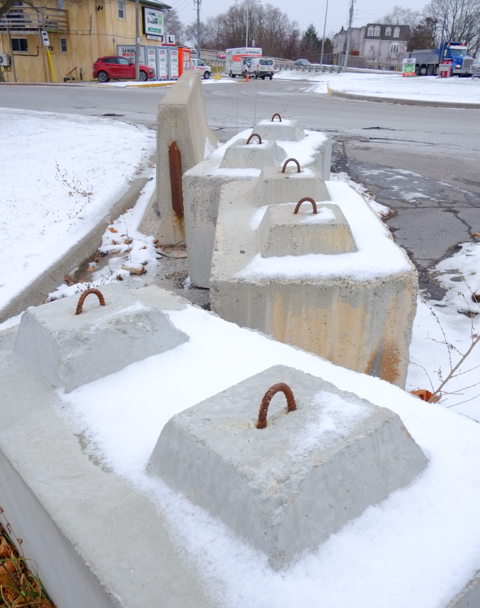
below: It’s hardly art but it’s probably better than grey concrete.  Better still would be to get rid of these Jersey barriers that line Front Street in front of Union Station.  They are a temporary solution that is fast becoming a permanent installation.   “aaniin boozhoo” is Anishinaabemowin (also known as Ojibwe) and is a greeting.  (UPDATE – 25 Nov:  I just read that these barriers are being removed this week!!  Maybe complaints do get action!!).

concrete barriers outside union station that have been painted in bright colours with words,

below: “All Beings Connected” by August Swinson in the Main Hall of Union Station.

a young woman walks past large artworks on the walls of the main hall in union station, title of art is All beings connected and the artist is August Swinson

below: The figure in the image is rooted to the ground, drawing their strength from the earth beneath, connected to the life around.

a young man sits in front of a large artwork on the walls of the main hall in union station, title of art is All beings connected and the artist is August Swinson

The West Wing of Union Station connects the main building to the walkway to the UP Express or to the Skywalk that leads to the CN Tower and vicinity.  A lot of people pass by here.  At the moment there are two art exhibits, both of which are part of “Precarious Joys”.  This is the name given to a collection of art exhibits around the city,  the Toronto Biennial 2024 (which ends December 1st).

below: Using art as a backdrop to a family photo.  the Tong Yan Gaai (Chinatown) series by Morris Lum

a family stops in front of an art piece at union station, mother is taking a picture of three kids standing in front of it

2 people in winter clothing looking at large illuminated images of interiors of buildings in chinatown, by morris lum, at union station,

below: Nicholas Galanin, part of “Threat Return” 2023

artwork on display at west wing of union station, with people and suitcases walking past. Nicholas Galanin sculptures

below:  “Mycelium” is the name of this network of lights designed by artist Nicholas Baier.  In biology, mycelium refers to a root-like structure of a fungus that consists of a network of thin fungal strands called hyphae.  In Toronto, it is found on the Bay Street bridge that connects Scotiabank Arena with CIBC Square and the GO Bus Station.

two young women stand beside an illuminated artwork, mycelium, by Nicholas Baier, in pedestrian bridge over Bay street

below: Because the walls of the Bay Street bridge are glass, “Mycelium” is also visible from the outside.

below: A green acorn.  From little acorns…..  There was a picture and a planter beside the elevator in this lobby.  Nothing more. A small austere space but someone cared enough to hanging a painting of an acorn.

below: Tucked away in a corner where it’s often overlooked is “Pi” by Evan Penny (1996).  A man’s head has been cut into four pieces, disconnected, and left sitting on the ground. I have walked past here many times and not noticed it.

weathered bronze sculpture of upper part of man's face

below: It’s art, but it’s also a place to sit.

weathered bronze sculpture of lower part of man's face

below: Another painting on a wall in a quiet lobby.  No signs.  Abstract, but it reminds me of two faces smushed together.  One of the faces has a mouth and chin made of crushed shredded wheat. He, or she, is wearing a black mask.  What else does it look like to you?

abstract painting in mostly purple and black on white

below: More lobby displays.  One of a group of paintings by John Eric Laford (1954-2021), an Ojibway artist from Manitoulin Island.

inuit style painting by john laford, gallery

below:  Mama elephant is still leading her two little ones behind Commerce Court.

elephant sculpture behind Commerce Court

below: If the elephant could see, this would be her view.  I am not sure it’s art, but the white light trees that come out around Commerce Court at Christmas time are now up.

open area behind commerce court west, old Commerce Court building, newer skyscrapers, a tree made of lights, white lights, as Christmas decoration in in the space

In same square (does it have a name?  Or is it just Commerce Court?), is an art gallery, Collision Gallery.  They are one of the locations featuring art from the Toronto Biennial.

below: Cecilia Vicuna helped co-found of Artists for Democracy in 1974 after she left her home country Chile.  A military coup upended that country in the early 1970s.  Here at the Collision Gallery she has an installation, “Futur.O [Futur.E]” that pays homage to Gail Kastner.

people looking at exhibits at an art gallery

below: Words written on strips of paper. From the left, the first four are:   “I had a very [illegible] feeling in my head.  I had a blob not a head”, “The whole purpose was not to research brain washing but to design a system for extracting information from resistant [forces?]”, “These little books are her memory”, and “To defend herself and preserve her mind from erasure she created little books packed with extremely dense miniature handwriting”  When you read the story of Gail Kastner and her treatment at a Montreal psychiatric institute in 1953, these writings will make more sense.

detail of artwork on display at Collision Gallery, words written on strips of paper

below: Vicuna connects the electroshock experiments of the 1950s to the use of such techniques in interrogation and torture.  In this drawing she writes about electroshock treatment being used in Chile to “erase the past and the future, creating a great lie”.    Almost as an aside,  I’m not sure that creating lies requires such drastic measures; it seems these days that all you have to do it shout it loud enough and often enough and you can create whatever reality you want.  How do we retain our memories under such circumstances?  Memories help keep us connected to our past and to our present.  Who are we without our memories?

pencil drawing of heads being electroshock. with words telling a story about chile and the coup

below: Dreamlike mythical figures dancing together in “Joyous Procession/The Infinite Serpent” by Rajni Perera.

a pair of paintings, Collision Gallery, by R Perera, serpents and people with green legs and feet dancing on them

below:  Details of a couple of the banners that hang from above to form a circle around an LED light fixture that suggests fire.  Artist: Citra Sasmita

parts of two banners that are in turn part of an installation in an art gallery

artwork by citra sasmita at collision gallery

below: “All Islands Touch” by Tessa Mars, another installation at Collision Gallery.  I am not fond of things lying around on the ground counting as art and I don’t think that they add much to the piece. You might disagree and that’s okay.

All Islands Touch, a large art installation by Tessa Mars at Collision Gallery, painting of islands with people's heads, small sculptures on the ground in front, look like fingers growing out of coloured rocks

below: Fingers growing out of rocks?  Plant life at the bottom of the sea reaching skyward toward the light?

Part of All Islands Together by Tess Mars, small sculptures on the ground in front of painting

below: Playing with the cows

two women taking pictures of themselves with the bronze cow sculptures, n green grass, downtown Toronto

below: Denyse Thomasos (1964-2012) Trinidadian-Canadian, is the artist who painted this picture that hangs inside in the lobby of  the TD Centre-Mies van der Rohe building.  An abstract, but very much an urban scene with its vibrant chaos.

abstract painting, large, by Denyse Thomasos, hanging in lobby of a downtown bank office tower

below: In the same lobby as the image above, this abstract by Susanna Heller  (1956-2021) tells a different story.  There is also chaos but it seems more “natural”, more like nature instead of man-made.  It is titled: ‘Restless Prowling from Night to Day Break’  and is 30 foot long.

abstract painting by susanna heller

below: Jose Bautista flips his bat after hitting a home run ….and his fans cheer.

large street art mural of blue jays baseball player, Batista, with crowds behind him, as he comes up to bat at home plate

below: Emily Pope and her series of (mostly) blue, black, and white.  “Antidotes for Yearning” or the examining of “the instinctual urge to ward off the inevitable despite our guaranteed decay. Through symbolic imagery…”   Abbozzo Gallery

painting by Emily Pope, blue curtains open to reveal a hand drooping, partially covered with lacy glove with many little blue bows

Emily Pope painting of two feet in white sheer stockings, with blue feathers tied around the ankles, on a black and white checkered floor

below: Also at the Abbozzo Gallery are a series of very realistic looking paintings of waves by Katharine Burns.  (It looks better in real life!)

in abbozzo art gallery, on wall, a painting by Katharine Burns of a cresting wave and a small rainbow that is caused by sunlight passing through the spraying water

below: One of the wave pictures, zoomed in a bit.  Translucence, light, spray, motion, and so much more.

close up of a painting of waves by Katharine Burns in an art gallery

below: At the BAND (Black Artist Network in Dialogue) Gallery is a small showing of artworks owned by the founders of the gallery.   The BAND Gallery has temporary space at 401 Richmond West while its usual space at 19 Brock is being renovated.

picture on wall of BAND gallery, a woman in orange hat and orange bag, and a cane in the other hand, walking away from the viewer

painting in an art gallery, pair of women, sitting on chairs, one white woman and one black woman, both in dresses, blue curtain behind them

below:  Two large paintings by Janet Cardiff, large figures, connected.  Dancing, Intertwined.  Are they happy?

two large paintings by Janet Cardiff

close up of figures together, painted by janet cardiff

below:  In one of the halls of 401 Richmond West is a large poster.  It is a collage of photos taken by Vera Frenkel with some of her words added to them.  Title: “Once Near Water: Notes From the Scaffolding Archives” 2008.  She took pictures of any scaffolding that she saw while walking around Toronto.   At the top left she opens with these words: “By the time you see this, the city we know will be gone.  Once a rich multi-course meal, now a dry biscuit.”   Do you think that we are turning into (or have become?) a “dry biscuit”?  We’re definitely changing and I’d like to think that some of the changes are for the better (and it would help if Doug Ford would keep his hands out of the cookie jar).

below: On another hallway wall (in the basement) of 401 Richmond is this piece….Do you think that you are tough? A tree made of bricks.

 a hand drawn black and white tree with curly branches and words that say do you think that you are tough

below: He’s got a long way to go.  Smashing the tree, brick by brick, smash, smash, hurt your head, crash, faster harder, smash, smash

lower part of a hand drawn black and white tree with curly branches and words that say do you think that you are tough under the word tough a small black figure is trying to bash the tree trunk with its head

below:  An oldie but goodie; a painting by Harold Town (1924-1990).  It’s on display at the Simon Bentley Fine Art Gallery along with a number of other paintings and artworks.

painting by Canadian artist Harold Town, abstract, on the wall of an art gallery

paintings on a gallery wall, one is a large orange square mounted on point, Simon Bentley gallery

If you can remember waaaaay back to the beginning of this post, you will recall that I started with an image by Carole Conde and Karl Beveridge.  I am going to end the post with a couple more of their photos.   They obviously care very much about social issues.

below: A marvelous collage, “A Work in Progress”.  The original dates from 1979.  In 2006 it was updated by adding four in the series so that now 12 decades of women’s work/life is now covered. This is the picture that encapsulates the 1950s.  The wartime image out the window is actually the Hungarian uprising.  Elements include a calendar on the wall showing a woman working in a factory, a coffee percolator on the table, a Beatrix Potter children’s bowl on the table, a crucifix on the wall, a red squeezie ketchup bottle, the syrup container with the pull back tab opening, baby bottle, star weekly magazine, the old radio….

a work in progress, a collage by carole conde and karl beveridge about changes in womens work over the past 12 decades

below: Not a Care, A Short History of Health Care.  This is actually a series of 12 images, each one representing a time and place in history from neolithic times to the present (made in 1999).  I discovered that the whole series is online and if you are interested, you can see them here:  Conde & Beveridge’s website

photographic image by conde and beveridge, not a care, short history of health care,

As for that statement about privilege and art…  there is no answer; there are many answers.  Making art is not for the privileged few; most of us have the need to create.  Whether it’s shouted from the rooftops or whispered quietly in a little corner, all art is valid to some degree.

Viewing art is not just for the privileged; there is so much out there… just get out and look.  You will think some of it is stupid, or mediocre but sometimes you’ll find something that makes you stop and think.  Or stop and stare.

 Those sentences barely scratch the surface and may seem quite lame but this is probably not the time nor place for philosophical essays… but feel free to leave your comments/opinions on the subject.

 “Opinions?  I’m supposed to have opinions?”

people sitting on TTC bus

When the fare inspectors get onboard.

woman walking past pa metal box on sidewalk, traffic signal box, that has been covered with street art painting of abstract letters of the alphabet


Subtitle: More Ontario Line mess


at corner of Spadina and Richmond, traffic light, with two Spadina street signs on it including old fashion district sign,

below:  Spadina and Richmond…. A giant thimble (by Stephen Cruise) sits on a stack of buttons.  Behind it, a building is shrouded in blue netting.

a couple walks a dog past sculpture at Richmond and Spadina that is a giant thimble on top of a stack of buttons

below:  Blue, blue, my world is blue… walking north on Spadina under blue netting that protects the sidewalk from work being done on the southwest corner of Queen and Spadina.  The whole block between Richmond and Queen is under wraps.  This is a future subway station with the imaginative name of Queen-Spadina.

people walking on sidewalk that is covered with scaffolding and blue netting to protect from a construction site, queen and spadina, ontario line construction

below: Southwest corner of Queen and Spadina

TTC streetcar on Queen, waits at red light at Spadina, people on the corner, tall building behind, pink signs advertising ontario line.

below: A look at what’s happening behind the hoardings….

Metrolinx construction site, hole in the ground, with hoardings, and shored up, some equipment,

below: Mcdonalds on the northwest corner is unaffected by the changes around it.

people waiting for green light, one man has a brown paper bag in his hand, mcdonalds at queen and spadina is in the background

below:  Looking south on Spadina with a good view of the southeast corner of the intersection with Queen West.

looking south on Spadina towards southeast corner of Spadina and Queen, tree, traffic,

below: There is a lot happening in the northeast quadrant, all by Metrolinx.   the yellow framework that protects and stabilizes a facade is becoming a common sight in Toronto.

below: In case you can’t remember what was on that corner, this is a photo taken back when they were laying streetcar tracks in 1912.  Most recently there was a CIBC bank on the corner.

black and white photo from 1912 of brick building on the northeast corner of Queen and Spadina.

Photo taken from WIkipedia Commons, in public domain. Originally from City of Toronto Archives.

below: A couple of the old houses/stores on Queen beside the old brick building seem remarkably unchanged since 1912.   (As a light grey car partially blocks the pedestrian crossing at the intersection).

a white car partially blocks the intersection as it goes southbound on spadina, pedestrians have to go around it while crossing on their green light. northeast corner of queen and spadina in the background

close up of an older brick building that has been gutted, but facade is being retained for redevelopment into metrolinx, ttc, subway station entrance

a woman wearing headphones walks past a construction site, on Spadina, other people on sidewalk crossing at traffic lights

graffiti on black hoardings, line drawing on bright green, picasso style, of a woman

below: The 510 streetcars are not running during this construction.

below:  But because the buses are too wide for the streetcar lanes, the middle of Spadina is very quiet… so I can stand here and take pictures.

standing in streetcar lanes, looking south on spadina, towards queen,

below: It also means that the replacement buses are now running… and competing with cars for a limited space.

a young man in blue winter jacket and baseball cap, walking on sidewalk past an orange sign saying pedestrian detour, and an arrow pointing right

below: Painting over the graffiti

below: Just north of Queen, there is a large vacant lot on Spadina.  So large you can see through to Cameron Street.

below: Cameron House and other houses on Cameron Street and beyond.

two young men on bikes wait at a red light, on Queen West at Spadina

stickers on crossing button at intersection, urban ninja squadron and feelings boi

people waiting on the southwest corner of padina and queen, waiting for their green light, pink hoardings for metrolinx construction behind them

looking out the window of a TTC spadina bus, looking at people waiting at bus stop, tall condos behind them, some reflections

There are so many new buildings in Toronto!  One of them is the new CIBC building at 81 Bay Street which is immediately south of the railway tracks and across the street from Union Station.  It is also adjacent to the new GO Bus station.

below: If you take the elevator to the 4th floor of the new CIBC building,  you can access the new park.   This is the view that greets you. The park extends over the railway tracks – a great use of space!

elevated park over railway tracks that is part of cibc square development,

below:Looking east from the park (on a foggy morning, and with a spot of dirt on the glass fence).   The trees on the right mark the spot where a strip of land separates the railway tracks from the Gardiner Expressway/Lakeshore combination.  Between Yonge and Parliament there are no buildings adjacent to the tracks on the south side.    That tall splotchy looking building is the Sugar Wharf Condos which, as the name suggests, are close to the Redpath Sugar property.

eastward view from cibc park, over railway tracks, tall buildings on either side of the tracks,

below: Looking north across the roof over the railway tracks.  The gold building is another bank building, RBC (Royal Bank of Canada).  On the right, the building that looks like there are diamond shapes in the glass, is a second CIBC tower but on the north side of the railway tracks.

below: Construction continues on the north side.  It too will have a park that extends over the tracks.  The two parks should merge into one once construction is completed.

construction site, park above the railway tracks at part 2 of cibc square, on the north side of the tracks, gold coloured r b c building also in the photo

man working at construction site, park above the railway tracks at part 2 of cibc square, on the north side of the tracks, gold coloured r b c building also in the photo as is Royal York Hotel

CIBC square, park

CIBC square, park, in November

below: Westward

looking west from cibc square, red leaved plants in foreground, CN Tower in background

below: In the center of the park is a large shiny metal leafless tree.   This is “New Amalgam” by Roxy Paine (2022).   It is 72 feet high.

public art, tall tree made of metal, cibc square

public art, tall tree made of metal, cibc square, cn tower in the background

below: Looking over the covered tracks at Union Station and all the ventilation system components on the roof.

looking west from CIBC square, long railway tracks, past covered tracks at Union Station with ventilation systems on the roof, CN Tower,

looking west from CIBC square, long railway tracks, past covered tracks at Union Station, CN Tower, with construction on south side of railway tracks

below: A closer look at the nearby construction at track level (and lower).

union station infrastructure construction

There are also stairs on the exterior of the CIBC building that lead to the elevated park.

looking into a few levels of cibc building, through large windows, from exterior stairs

Bay street side of CIBC office building, west side, lower three levels with tall white pillars

below: Looking south on Bay Street where Scotiabank arena takes up most of the street scene.  That’s the Gardiner Expressway as it crosses Bay.

looking south on Bay street rom CIBC building, Scotiabank arena takes up most of the street scene,

below: Through the window to the interior of CIBC  where Steve Driscoll’s artwork shines brightly.

interior of cibc building on bay street as seen through large window from exterior stairs, glass artwork, little round tables with a couple of people seated at them

below: “A light stolen from the sun” is a collection of 12 digital prints on laminated glass.   they can also be viewed from the 4th floor but access is controlled.   Also, camera use will get you a nice chat with a security guy.  The usual, phones are allowed but even little cameras are a no no.

Steve Driscoll artwork, red and blue, trees, tall, vertical works on glass

below: An outpouring of red poppies is the stunning centerpiece in this Remembrance Day tribute (created by Fresh Floral Creations).

an arrangement of red poppies for Remembrance day in the lobby of an office building,

two women on exterior stairs by CIBC sqaure, downtown toronto

With thanks to Nancy and Merle who went exploring with me that day.