close up, from the top, of a group of hyacinth flowers, blues and purple tones

A few pictures of flowers from Allan Gardens Conservatory today. We all want spring. The warmth of spring…. and the colours of spring like the shades of blue and purple in the hyancinths above.

three pink and purple flowers, with orangish centers,

A few florals to warm your soul. Soon it will be spring and we can put away our winter layers.

inside Allan Gardens conservatory, tees, yellow flowers, red amarylis

two white orchids in bloom

A return to St. Helens Avenue and the galleries there.

A few galleries devoted to contemporary art can be found on St. Helens Ave.  I know that I have mentioned some of their past exhibits in previous blog posts.  Exhibits change and so back we go.   The three exhibits that I saw today have little in common with each other.  Three artists with different views; three men trying to turn their thoughts and ideas into something visual.  The first gallery that I visited today is the Clint Roenisch Gallery where the exhibit is “Hot Takes, No Sax”, by Torontonian Niall McClelland.   It will be there until 21st April.

From Wiktionary: “Noun[edit]. hot take (plural hot takes). A bold, broad, and subjective moral generalization on a situation, with little or no original analysis or insight, especially by a journalist.”   Something written quickly and without much thought put into it.   Although some people associate it with journalism, you could also apply it to a lot of things online – think about the comments section after a news article, or something on your facebook or twitter feed.   Sometimes I think that that expression applies well to contemporary art – thrown together to provoke but not much actually went into it.

below: Running diagonally across the room is a line of trunks and metal cases that are covered with bumper stickers.  On the wall are 4 images, each with a black and white background.  The frames are covered with more bumper stickers.  This is only part of the exhibit.

room in an art gallery, a line of trunks runs diagonally across the room, they are covered with bumper stickers.

below: These are the three images on the wall in the photo above.  The frame on one side of the image on the left has the names of four American politicians from the not so recent past – Nixon, Goldwater, McGovern, and Carter.  Some of the images may be familiar to you as well.

three pictures on a gallery wall, in black and white checkerboard backgrounds, blue images on that. Artist is Niall McClelland

below: More of the stickers.  Is there a theme to them?  How do these relate to hot takes?   Which side is the artist on?  “Urban farmer”, “When you sit down for dinner, thank a farmer”, “Impeach Trump”, “Give a hoot”, “The times they are a changin”, “Be green”, “Bio fuels: no war required”, “Who’s your farmer?”, “I’d rather be gardening”, “Nasty woman”, “Break the chains, shop at independent stores”,  “Saving seed is a basic human need”, “Localvore”,  “Whatever happens to the water, happens to the people”, “What is the proper way to fold an anarchist flag?”

sticker covered metal cases on the floor of an art gallery with a picture on the wall behind, the work of Niall McClelland at the Clint Roenisch gallery

Next is Douglas Coupland’s “Tsunami” at Daniel Faria Gallery, until 28th April.  Trashy in a certain way.  Coupland has collected, cleaned and painted various plastic containers and other disposable items he found along the shore in British Columbia.  A number of the items probably crossed the Pacific Ocean after the earthquake and tsunami in Japan in 2011. Trash on display?  We’ve all heard the expression “reduce, reuse, recycle” which may be facetious here?  Is it too pretty to be a statement about the environmental impact of plastics?

plastic containers and other items found washed up on the shore of British Columbia, cleaned up and painted and put in sealed clear plastic boxes, art gallery exhibit, artis is Douglas Coupland

below: The large gold piece is a collection of more debris that Coupland has amassed and painted.  Another one,  all in black, is on a different wall (not shown here).

plastic containers and other items found washed up on the shore of British Columbia, cleaned up and painted and put in sealed clear plastic boxes, art gallery exhibit, artis is Douglas Coupland, with large structure behind made of gold painted containers and other items

This spring, Coupland will transform the Vancouver Aquarium into a vision of the Great Pacific Garbage Patch by filling aquarium tanks with some of the trash that Coupland has collected – by some I mean 20 tons of it.  Twenty tons of found rubbish.  Twenty tons of plastic and other debris.   Jet streams will simulate ocean currents and the garbage will “float, bounce, disperse and gather along the tank, fragments flowing into one another like an overwhelming and exhausted assemblage”.

below: Tucked away in the back room of the gallery are four paintings like this, also by Douglas Coupland.

part of a Douglas Coupland painting, with a black and white picture of a man's face in the center of swirls of colours. Apainting by Douglas Coupland


Part three is the exhibit “Raw War” by Bruce Eves that is on at the Robert Kananaj Gallery until 21st April. Eves was just given one of the 2018 Governor General’s Awards in Visual and Media Arts.

“taps into a zeitgeist fraught with peril”

below: Part of Work #901 by Bruce Eves.  There are seven panels in total.  Every hour for a week in February 2014 he took his heart rate.  The numbers in the squares are his heart rate.  It’s difficult to see in this picture, but each square also has the date and time.  In addition, each panel is a day.   Something happened on Friday February 14th at 16:00 to elevate his heart rate to 123 beats/minute!
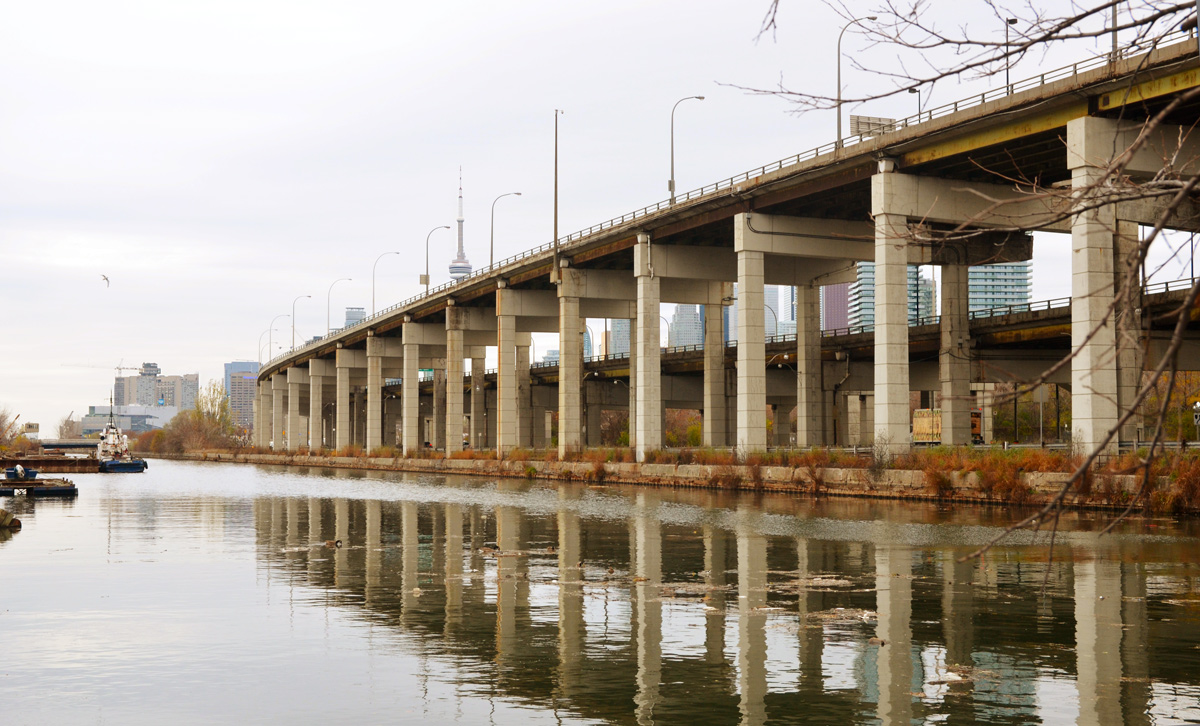
Part of a set of 7 paintings by Bruce Eves on a gallery wall, each painting is squares with numbers in them. The numbers are Eves' heart rate taken every hour for a week.

Eves has also painted a sequence of numbers that are actually nine blood pressure readings.  It was after he learned that he had a heart condition that Eves started using his health (and the monitoring thereof) as subject matter.   A self-portrait based on data about oneself, so to speak.  How his doctor sees him.

A few things to think about?

(P.S. My apologies for the title)


Well, that was quite a weekend.  An April winter storm with snow, sleet, ice pellets, freezing rain, and even some just plain rain.   The streets were icy and the sidewalks were slushy and wet.   Chunks of ice have fallen off roofs, tree branches have broken off with the weight of the ice that formed on them.  And then there was the wind that blew hard.   Of course I went out!

hazy, blurry picture of a person walking with an umbrella up Yonge street with other people, cars, wet sidewalk,

below: Dressed in our April finery. Black parkas.

people walking in the rain, downtown Toronto

below:  There is a small, but interesting, exhibit at the Toronto Reference Library at Yonge and Asquith that I wanted to see.  It’s called ‘Toronto Revealed’ and it’s in the TD Gallery on the main floor.   It features drawings and paintings of Toronto’s past.

sign in the window of the Toronto Reference library re the display at the TD gallery, Toronto Revealed, pictures and paintings of Toronto in the past

below: One of the paintings in the exhibit is this one, ‘Cherry Street Hotel’ by Gerard Lazare (1978).  The Cherry Street Hotel was built in 1890 at the corner of Cherry and Front Streets.  It later became the Canary Restaurant (1965-2010).  The building is still there but it stands empty.

painting of the Canary restaurant on the corner of Cherry and Front streets

below: There was a display of small artworks by Nicholas Hornyansky (1896-1965), including this one of St. James Cathedral (1938).  Hornyansky was born in Hungary and immigrated to Canada in 1929.  He is known for the etchings and aquatints (another print making technique) that he did of Toronto buildings and landscapes.

small framed painting of Saint James cathedral in Toronto, by Nicholas Hornyansky, painted in 1938 .

below: Most of the paintings were very realistic (documentary) except this one – a wacky view of Bloor Street looking west from Yonge towards Bay by Carlos Marchiori, painted in acrylic in 1976.   Even then, it is fairly true to reality.  The darker tower on the right is on the NW corner of Bloor and Yonge.  Stollerys store (the low building on the SW corner) is long gone.

bright painting of city landscapre, Yonge & Bloor, bendy buildings, cars as coloured blobs on the streets, puffy clouds in bright blue sky, by Carlos Marchiori

While I was at the library, I wandered around and took a few pictures of its vast open spaces.  It was warm and dry!  I was expecting to be told to put my camera away, but no one seemed to care.

interior of the Toronto Reference Library from the fifth floor, semi circular tables, reddish carpet, open concept architecture, rows of books,

below: Most were too busy working to notice.

looking down an aisle between two stacks of books (book shelves), a woman is sitting at a table studying and writing, there is a window behind her

below: One more picture from the ‘Toronto Revealed’ exhibit is this painting of the intersection of King and Jarvis by Vernon Mould.   It was painted in 1979.  Was gas really 20 cents a gallon in 1979?  No! That was the year that prices went metric and a litre of gas was 20 cents.    I came back to this picture because I chose to chase down that intersection to see what it looks like today.

painting, in mostly brown tones of a three story building at the corner of King and Jarvis, Toronto, with a small gas station across the street, sign says gas 20 cents, 2 gas pumps,

below: Et voici, same intersection, approximately the same angle.  There is now a building (with a Second Cup on the ground floor) where Mould would have stood.   By the looks of it, the three storey brick building on the NE corner has been fixed up since 1979.  So glad to see that it hasn’t been replaced by a glass condo tower!

intersection of King and Jarvis, looking north, three story brick building,

below: I wanted to find out more about the building, so I googled Sportsman’s Shop and I found a wonderful old picture of it from the 1970’s, obviously taken before it was renovated.    Apparently, it was fixed up in the early 1980s.

old black and white photo of the Sportsmans Shop at 150 King East in Toronto, three storey brick building

photo credit: Gary Switzer, source: Urban Toronto

below:  The next photo was taken as I stood on the same corner of King and Jarvis, but pointing my camera in different direction – looking west on King towards St. James Cathedral.  This is the eastern limit of the King Street streetcar project which is why the multicoloured barricades block part of the righthand westbound lane.

looking west on King street from Jarvis, St. James Cathedral and park on the right, downtown towers and office buildings in the distance, rainy day, TTC streetcar,

below:  These women are waiting in the wrong place.  Although the city changed the location of the streetcar stops along King Street, the bus shelters haven’t been moved yet.   At least they were (sort of) out of the rain.   They soon realized their mistake.

below: Looking back, the prerequisite photo of a TTC streetcar through a rainy day window.

looking out the back window of a streetcar, rainy day, raindrops on the glass, another streetcar is passing by

It’s always better to end a blog post on a happy note, right?  It may be a dream (I hope not!) but spring can’t be too far away.  April showers bring May flowers, right?  On my second warm up stop I saw this cheerful, hopeful drawing tacked to a wall.   It was one of many on the wall, all the work of Maihyet Burton.  They were at the Artscape building at the Distillery District.

a pen and ink drawing of spring flowers, poppies, in blues and purples, and fiddleheads in bright green

below: Headed home again.

two people with their back to the camera wait on the subway platform as a train arrives

Don’t put away your boots and hats yet!

While meandering down Croft Street today I discovered a new mural by Bruno Smoky on a garage.   A large reddish face of a man – Neptune, the God of the Sea?   It also makes me think of the book, ‘The Old Man and the Sea’.

mural on a double garage door, man's face, fish swimming underwater, by Bruno Smoky 2018

Two very large swim nearby.

mural by Bruno Smoky, part of it, two large fish swimming under water.

part of a mural on a garage door by Bruno Smoky, a large red face of a man.

graffiti words on a wall, black sharpie, Save us

It’s early April and we’re all tired of winter but it lingers on.   How are you coping?  Yes, you!

Cameron House mural on Queen Street West, woman in pink blouse is looking beyond the window to a man walking past.

below: Is this wishful thinking?  or maybe just a little too optimistic?

chalkboard sign on the sidewalk outside of a store on Queen Street West, sign says Spring is here

below: Spring is in the air?  They forgot the question mark.   Is the cat reacting to the disconnect between the sign and the reality? … or maybe  its expression is because it’s just realized that it’s sitting beside a book about Justin Trudeau?

sign in a store window that says spring is in the air. also some stuffed animals

These were the only signs of spring that I saw yesterday as I walked although I noticed that someone was trying to cheer things up.  Not sure how long these have been sitting outside.  They’re looking a little weather worn and grubby.  Hope may be wearing a bit thin?

small leafless shrub in the front yard of a house, small yellow fake flowers strung through the branches, the flowers are old and dirty.

below: Elsewhere yellow birdies were playing hockey.

two women are having their picture taken in front of Uber5000's mural about Toronto in the winter, little yellow birdies playing hockey.

Spring was elusive but what I did spot were a couple of stikmen that I don’t remember seeing before.   I also noticed more smiley hearts popping up in unexpected places again. First, some of the hearts…

smiley heart on pink wall with red spray paint lines around

pink smiley heart on a wall with lots of other colours, street art

small black line drawing of a heart on a metal pipe on a wall, pipe has been painted orange and red to blend in with a street art piece

below: Cool Woodstock makes an appearance too (a yellow birdie of a different kind).  I don’t think she’s too happy to have a bird sitting on her head.

street art on garages, a small yellow Woodstock cartoon character with black sunglasses, on top of a black drawing on white of a girl screaming, a little smiley heart and the word love is beside her ear.

below: The guitar player is now playing with heart.

part of mural of a guitar playing in shades of orange and red. A white piece of paper has been stuck on his chest, with a black smiley heart on it.

And the stikmen….

a broken stikman painted greyish blue on a greyish blue door where the paint is peeling and the wood is fraying

stikman on a white and blue wall

below: Instead of wooden, this stikman is a drawing in a frame.

picture of a green stikman in a little frame, on a wood gate, by a black and white stencil of a man's head

below: Is that a little orange head of a stikman in the bent frame?

….. and then back inside for some warmth!

interior of a coffee shop, people sitting at tables, people sitting on the bar by the window, a TTC streetcar is outside, passing by

I  will leave you with one last look at a window full of yellow chicks and Easter bunnies, hope for spring (Hope springs eternal? Hopes of spring are eternal?).

looking into a store window, that is decorated with little bunnies in Easter clothing, with little yellow chicks and paper flowers

I’ll just leave this here.    Just one photo today.

a amll metal table and a chair outside, against a brick wall. On the wall, in white paint, are the words You Don't worry about fitting in when you're Custom Made

two women holding cups of coffee walk across Victoria St. on Queen Street East

Just after I wrote the previous blog post about some of the buildings on Yonge Street that are in the middle of an area being redeveloped, I walked across Queen Street East.  I noticed that there were a lot of similar three storey buildings here to those around the corner on Yonge.  Toronto must have been a booming city in the late 1800’s and early 1900’s when these stores and warehouses were built.

below: What I also noticed is how many of the storefronts are empty.   This is the northeast corner of Queen and Mutual.

the northeast corner of Queen street east and Mutual street, with an empty building on the corner.

What I don’t have is a photo of the northwest corner – it is about to be developed, or at least there is a plan to develop it, into a 29 storey glass tower.   Urban Toronto called this location, “a spot that currently feels disconnected from the rest of the City. ”  … maybe because the Moss Park neighbourhood is on the lower part of the socioeconomic spectrum?    Urban Toronto is a website that is, their words, “populated by the tastemakers, condo aficionados, buyers, builders and realtors”.   I try to stay neutral in the pro/con condo development argument but it irks me to read things like, “Redefining the urban experience” and variations thereof over and over and over again to describe mediocrity.

To be fair, this 88 Queen West project is redeveloping a parking lot.  Why is it a parking lot?  Because in the 1950’s a parking lot was more important that the buildings, including Cooke’s Presbyterian Church (1857), that originally stood there.   Perhaps we get what we deserve.


below: Richard Bigley (1853-1933) started off as a woodworker but soon switched to selling stoves. He sold the ‘Happy Thought’ line of stoves. He holds two US patents, one for a water heater and one for a sectional water heater. The building was converted into loft apartments, one loft per floor, back in the late 1990’s.

tall brick building, Richard Bigley 1876 written in white at the top (4 storeys), large glass windows in front, once an old store and warehouse, now a 3 loft apartments. 98 Queen Street East

below: Two views at the corner of Queen East and Jarvis.  You can just see the Moss Park Armoury building on the right side of this picture.  This Canadian Forces facility was built in 1960’s and it takes up a large chunk of land.  Development  rising in the north…

Queen and Jarvis intersection looking north to tall towers being built on Dundas
below: … and development rising in the west.

the intersection of Queen and Jarvis, looking northwest, with a foodora cyclist in pink in the intersection, traffic, street car, and in the distance, development on Yonge and westward, cranes, glass towers

large blue public parking sign, also a large box shaped sign on a tall pole. The sign is wearing out

below: At Ontario Street, the street sign says, Old Town Toronto.  In 1797 the city limits were moved north to Queen Street (then called Lot Street).  Ontario Street was one of the most easterly streets at that time.   And, oh yes, the city was still York.  It officially became Toronto in 1834.

toronto street sign for Ontario Street with the top part that says Old Town Toronto

below: Posters on a boarded up window – once it was a barber shop?  Posters on Queen East for events on Queen West.

posters on an empty building, exterior wall, bottom of wall has barber pole stripes painted on it.

below: A blue and white Development Notice. I still haven’t found out how many of these there are hanging around the city.  My best guess is ‘hundreds’.

blue and white city of toronto development notice sign on a chainlink fence in front of a vacant lot wehre cars and trucks are parked. For 245 to 285 Queen Street East, Bridgen Place and Richond.

At the risk of another anti-development rant, I just want to say a couple of things about the above photo.  The development here involves the closure of two public lanes, McFarrens Lane and Brigden Place.  There will be pedestrian access (public access on private land) between Queen and Richmond, between two large buildings with three towers built above them – 39, 39, and 49 storeys high.

From a City of Toronto report written in April 2016…”City Planning staff is not in support of the proposal in its current form, as the proposal not only represent over development, but also fails to recognize the existing built-form character and scale of the King-Parliament Secondary Plan Area by departing from the existing warehouse and main street typology where the site is located.”

I am not sure what the status of the project is at the moment, but the developer has a website for this project, Queen & Sherbourne, that describes it exactly as the original proposal – Three glass towers on two boring bland base buildings. It’s yet another development that looks flashy from above but is blah ick at street level.

below: The northwest corner of Queen and Sherbourne

northwest corner of Queen and Sherbourne, Moss Park variety store on the corner, three storey brick Victorian buildings, cars, people,
below: Bright and cheerful.

three storey victorian buildings includia Acadia Book Store, established 1931 and Seaton Butcher

below: 310 Queen East at the corner of Queen and Berkeley.

below: Moving slightly east to the corner of Queen and Parliament (NE).  That looks like a solid old bank building on the corner.

northeast corner of queen and parliament, old brick buildings,

flat roofed old brick buildings, with oriel windows on third floor, Ray's Discount Convenience and Supermarket on the ground floor. A bus shelter on the sidewalk, people waiting for the bus, building painted rust red colour,

below: 354 and 356 Queen Street East

two narrow three storey buildings squished in between two slightly larger buildings. On the ground floor of the building on the left is Redline Coffee and Espresso while Ryans Restaurant is on the right.

below: 380, 382, and 384 Queen Street West.

two storey store fronts on queen street east, 380 Queen, 382 Queen and 384 queen.

below:  Wherever you walk there is construction.  Some of it good, some of it poor.  That’s Toronto these days.

a man walks through a covered sidewalk, past a construction site and towards a bus shelter

The other day I discovered that there is a small gallery on the 3rd floor of Ryerson’s School of Image Arts.  If you want to find it too, it’s in a building that it’s in is attached at the ground floor level to the Ryerson Image Centre on Gould Street.   At the moment, there is a small exhibit of photos by Avard Woolaver.

the back of a man looking at a wall in a gallery, old photos of Toronto

below:  The photos are ones that Woolaver took in Toronto in the late 70s and early 80s.

old photos of Toronto from the 1980s by Avard Woolaver.

below: This photo is one of Woolaver’s – it is looking towards the northwest corner of Spadina and Queen Street West.  For those of us who lived in Toronto at the time, it’s a bit of nostalgia.  Somethings are very familiar – the older TTC buses, the car styles, and a lot of the architecture, for example.   This photo in particular lends itself nicely to the game of ‘Spot the Differences’….. compare this with

photo by Avard Woolaver of Toronto in the 1980s, this view is the north west corner of Queen and Spadina

below: …..this. Here is the same intersection, at a similar angle, last week.   The large brick building is still there but without a billboard.   The poles are no longer wood but they are covered in posters and remnants of posters – so no change there.    The street signs have been updated and there is now a streetcar lane in the middle.   All in all, I was surprised how little had actually changed in 30ish years.

the northwest corner of Queen and Spadina in 2018, pedestrians, buildings, street scene

below: I found this photo online (originally from the Toronto City Archives, 1950?) but before we can play another round of ‘Spot the Differences’, we have to identify these buildings?  Any ideas?

vintage photo of 357, 359, and 361 Yonge street, black and white, 3 storefronts,

below: Here is the same location in the 1980’s (not a photo from the exhibit).  Not too many changes.   The building that housed George Richards Men’s shop, 361 Yonge Street, was replaced by a dull and boring two storey brick building but the other changes were just to the facades and the owners/tenants.   The tavern is still a tavern and the drug store is still a drug store.  The large brown building on the top right that you can only see part of is Ryerson College.   Unfortunately the Wrigleys ghost sign on the taller building on the left has been covered.

357, 359, and 361 Yonge street in the 1980s including the Zanzibar tavern

photo source BuzzBuzzNews online

below: Fast forward another 30 years.  The Zanzibar is all bright lights and dazzle while the building that housed the drug store is now for sale.  Ryerson is now a University and has expanded out to Yonge Street – that’s the large blue building in case you are not familiar with the area.

Yonge stree, easy side, just north of Dundas, about 357, 359 and 361 Yonge Street including the Zanzibar Tavern. The blue glass wall of Ryerson University behind the Zanzibar,

below: If you pull back a bit, and look just a bit farther north on that stretch of Yonge Street, you’ll see that there are many empty buildings

yonge street, between gerrard and dundas, most storefronts are closed and boarded up waiting for redevelopment of that stretch

below: … including what was until recently the XTC clothing company.  It looks like it has gone through a number of ‘renovations’, not all of which were good.  Some traces of its original brick facade can be seen at the top but at street level it is (was?) a mess.

empty two storey building, once was X T C clothing store

 There is a plan to build a 98 storey mixed-use building on this site including just over 900 residential units ranging in size from 520 to 2000 square feet.    It will be the tallest residential building in Canada.   In the promotional material for YSL Residences, as they will be called, is this: “The epitome of luxury living, designed to elevate the fortunate few who will call it home.”


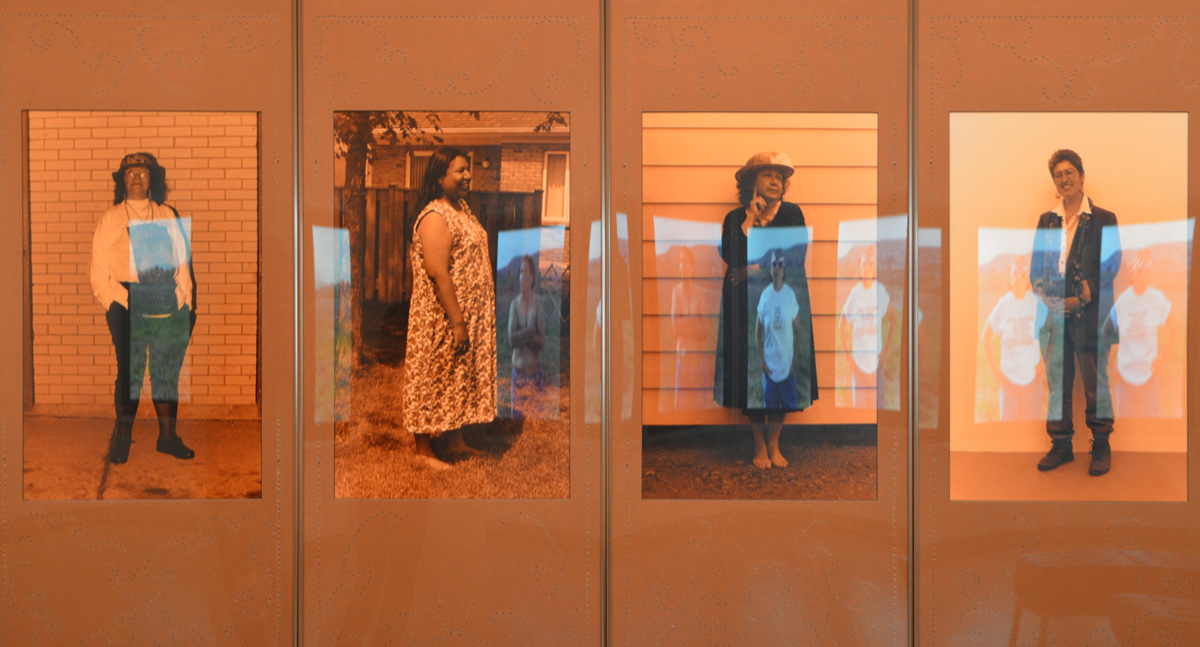
below:  Back to Ryerson, also on the 3rd floor of the School of Image Arts, there was a small series of photographs like this one hanging on the wall in the hallway.  There was no sign as to the name of the artist that I could find either on the wall or online.   I quite like the technique and the resulting image.  Two ideas melded into one.  Two time frames in one frame.  Two artistic styles combined to create another.

a photograph on a gallery wall, a hand holding a photo printed on glass in the middle of another photo, superimposed landscapes

If you are interested in Woolaver’s work, you can find more on his blog.

There are a few exhibits showing at the Ryerson Image Centre at the moment but the one that I want to highlight today is “Rich and Poor” by Jim Goldberg.  Goldberg took portraits of people in the San Francisco area in their home environments between 1977 and 1985.  They are divided into two sections, “rich” and “poor”.

Ryerson Image Centre (RIC) gallery, Jim Goldberg portraits "Rich and Poor' exhibition of black and white portraits in San Francisco in the 1980s

below: Each portrait is accompanied by a comment from the person being portrayed, in their own handwriting.  This woman, Nell, provides the wonderful quote: “If you want to stunt your growth, be rich.”

Ryerson Image Centre (RIC) gallery, Jim Goldberg portraits "Rich and Poor' exhibition of black and white portraits in San Francisco in the 1980s

below: The pictures are fascinating, and the words reveal more details of the subjects.  “My wife is acceptable”.   The poor woman.  In the picture she is off to the side and almost disappears into the background as she looks at the floor.   I thought of the words ‘abject’ and ‘woeful’ when I first saw her but I think that maybe the best word to describe the look on her face is ‘blank’.

Ryerson Image Centre (RIC) gallery, Jim Goldberg portraits "Rich and Poor' exhibition of black and white portraits in San Francisco in the 1980s

below: Whether you’re rich or poor, or more likely some where in between, what you say about yourself if you were the subject?

Ryerson Image Centre (RIC) gallery, Jim Goldberg portraits "Rich and Poor' exhibition of black and white portraits in San Francisco in the 1980s

This show continues until April 8th

As you walk down Augusta Ave., you may spot this familiar face:

mural of a head and shoulder of a young man, by P.S., in an alley

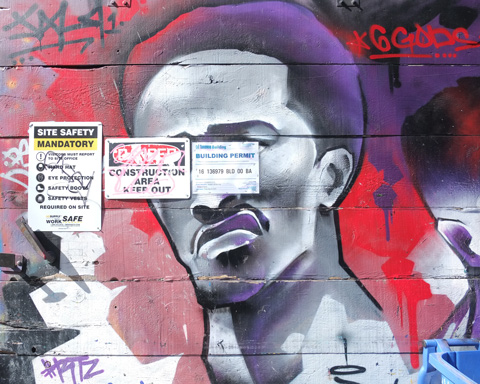
It, like all the others in this blog post, is signed P.S (& this is the signature of Phillip Saunders). The background in the one above looks very much like the work of J. Chiale.

below: A very red face and the traces of a moustache.

mural of a head and shoulder of a young man, by P.S., in an alley, very red face

below: More stylized and almost abstract, very purple too.   The door with its circuit board and honeycomb patterns says no entry.

mural of a head and shoulder of a young man, by P.S., in an alley, purple face, beside a door that has street art on it too

below: A couple at the end of the alley.   Love is golden.