Archive for the ‘windows and walls’ Category

We all need some light and colour these days. So I went through old files and found these colourful pictures of the newest TTC subway stations that I took back in February, on Family Day actually. It seems like a long time ago!

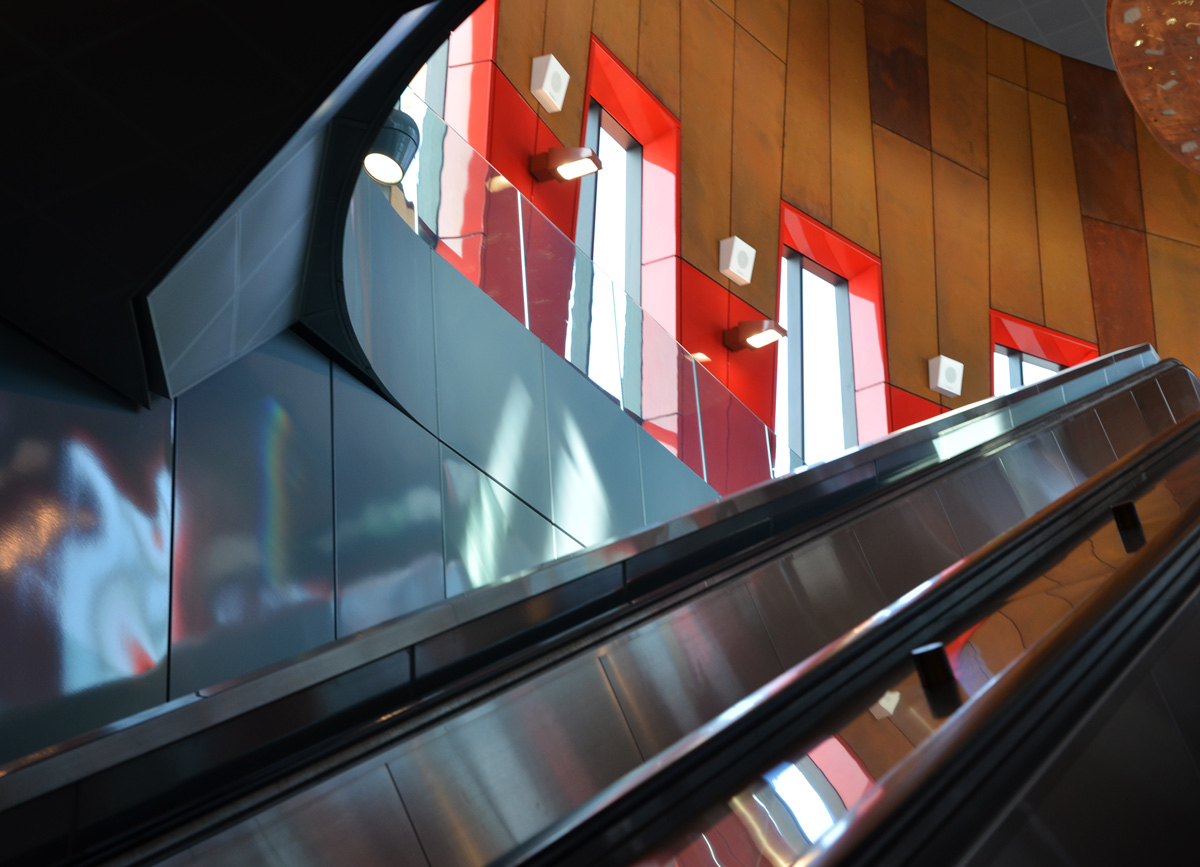
below: Escalators, Pioneer Village subway station

escalator and the wood wall beside it with windows with red frames, light coming in windows

below: From the outside looking in, Pioneer Village station

red walls, exterior and interior,

below: Hwy 407 station.  Artwork by David Pearl.

oval shape window at highway 407 subway station, painted in turquoise and oranges, escalator

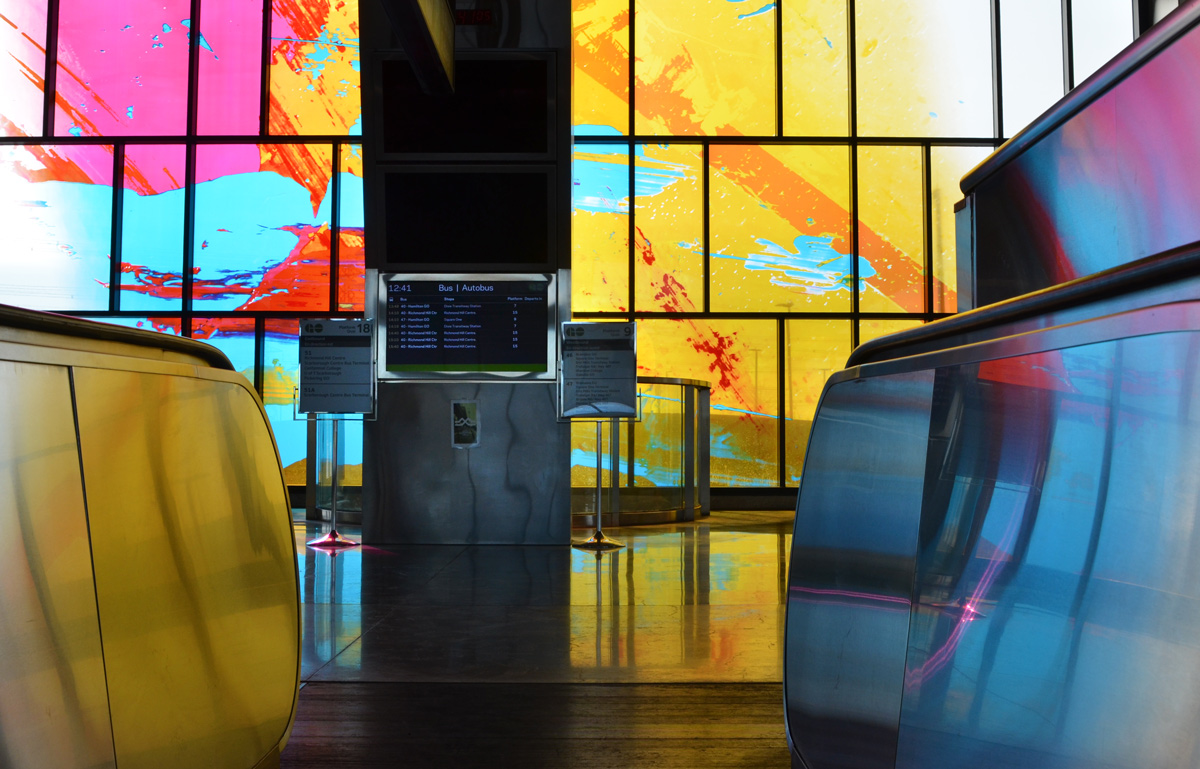
light coming through coloured glass and bouncing colours off walls and reflective surfaces inside subway station

below: The pinks, yellows, and blues from the coloured windows shine and bounce off surfaces

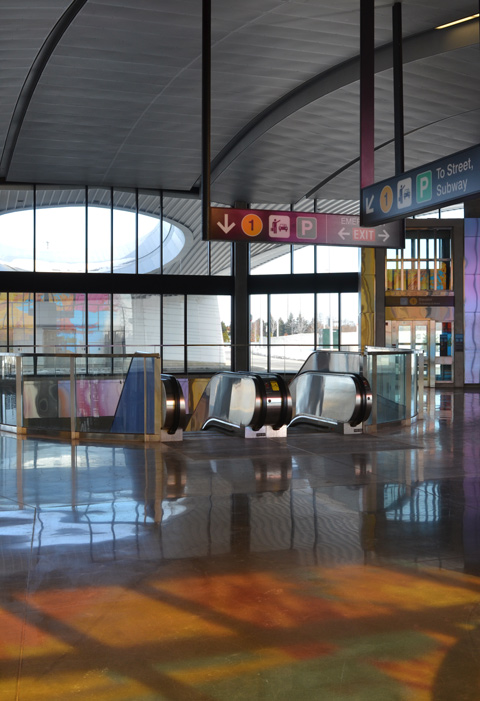
subway station, ground level, lots of window and sunlight

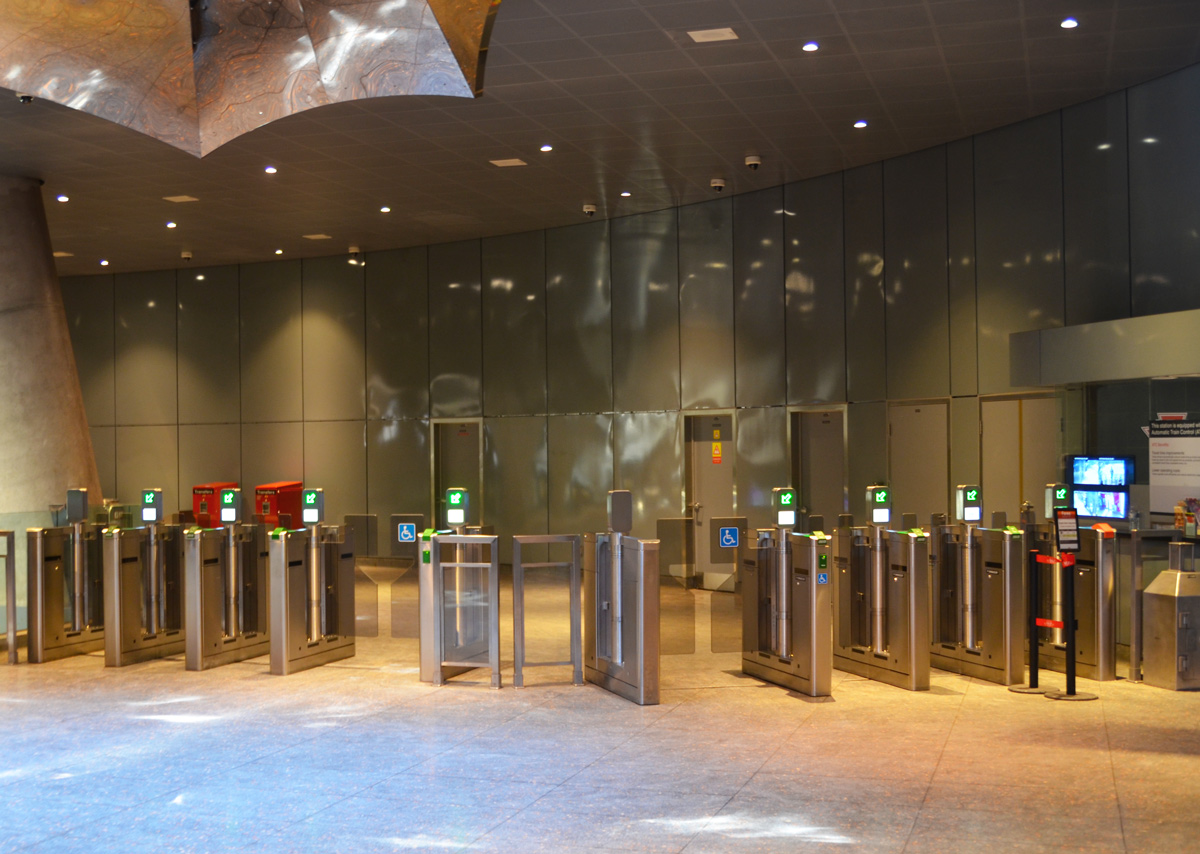
below: Little lights dance around the ceiling and upper part of the walls.  This effect is caused by the artwork in the ceiling – a circular opening that you can just see in the upper left corner.

turnstiles

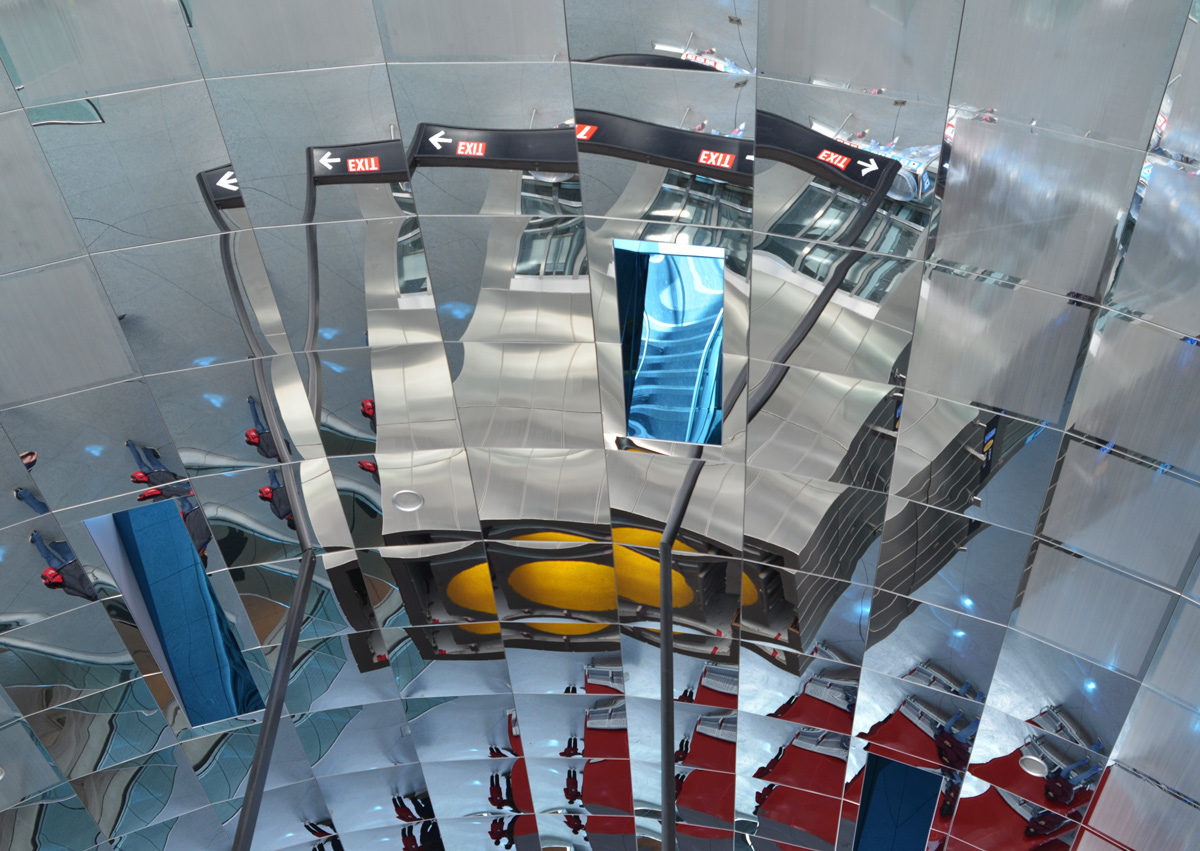
below: Looking straight up into the skylight with it’s many-sided walls that are covered with reflective material.

many sided opening in a ceiling, sides covered with reflective material so the light bounces around, many reflections,

below: ‘Atmospheric Lens’ by Paul Raff Studio is the artwork that is incorporated into the roof of the station. It features skylights and reflective panels.  Vaughan station.


reflcetive ceiling

shiny reflective ceiling at TTC subway station

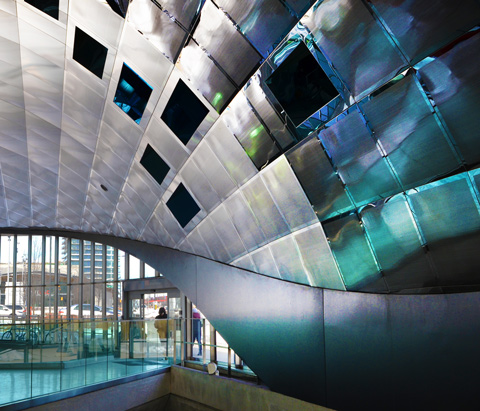
below: Curved, reflective ceiling, Vaughan station

curved metal ceiling reflecting blue lights, entrance way to subway station, Vaughan

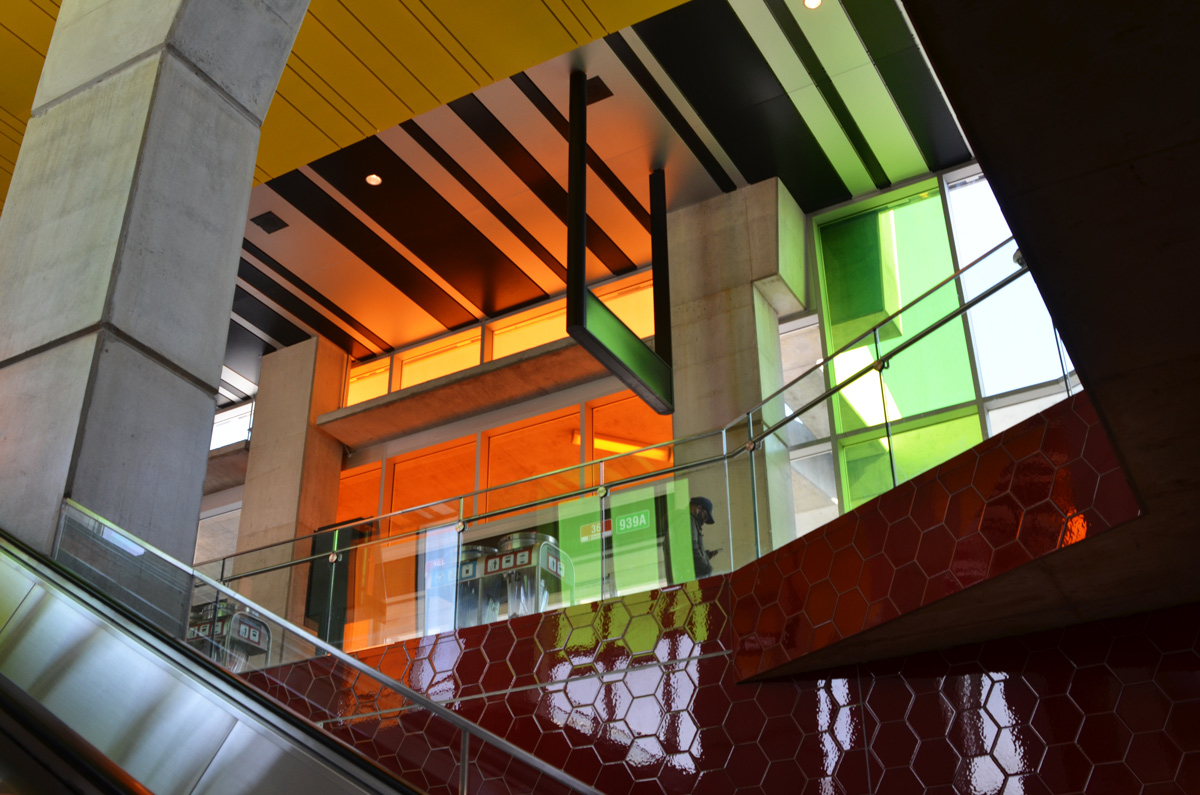
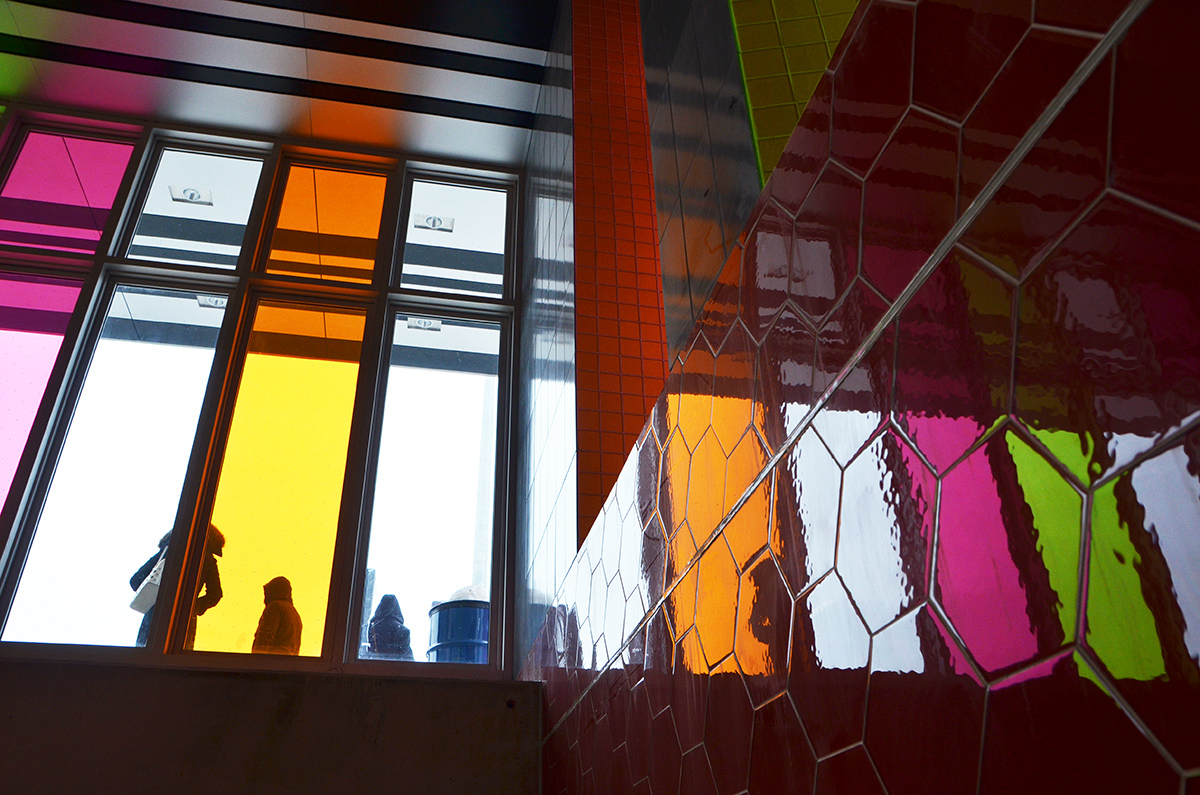
below: Finch West station with its very shiny red hexagonal wall tiles and coloured panes of glass.

escalator and levels of Finch west subway station, lots of coloured panes of glass, greens, and oranges,


below: No colours at York University station, but lots of windows and lots of natural light.

light shining through large windows into interior of York univeristy subway station, escalators, people coming up escalators,

I went walking on Monday, keeping my distance from others, to “collect” bits and pieces of evidence of what we’re doing and how we’re coping with this virus thing.  Some of this is a bit ghoulish (and has nothing to do with the virus) but hopefully some with make you smile.  Also,  I hope that in the days and weeks ahead we can look back on this as just a little blip in our lives.

below: A little sticker from sketch nate has been edited to say that only all of Toronto can judge me.  There were quite a few “don’t worry” stickers.

two stickers, one says don't worry, the other is a pair of praying hands and the words only gosh can judge me, by sketch nate. Someone has crossed out gosh and written all of T O

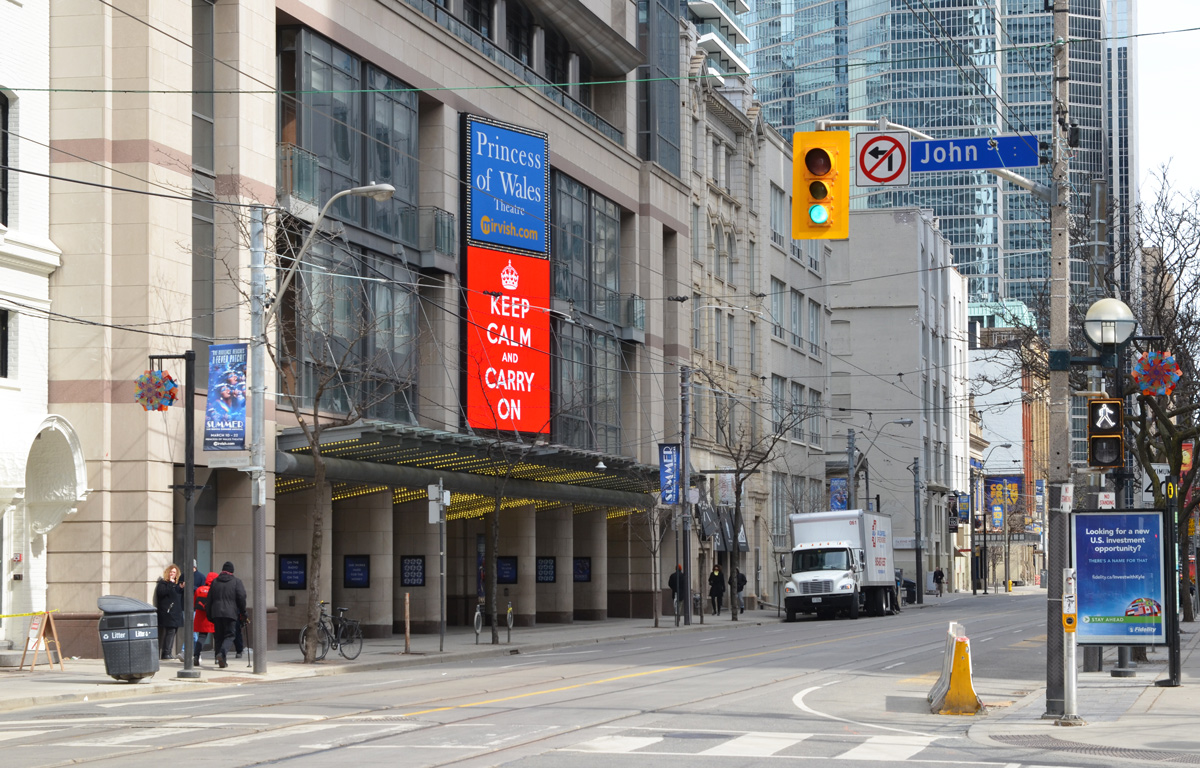
below: The Princess of Wales Theatre has shut down like all theatres in the city, no shows happening.  Keep Calm and Carry On – we’ll see how all this pans out.

sign outside the Princess of Wales theatre on King St in Toronto that says Keep Calm and Carry on

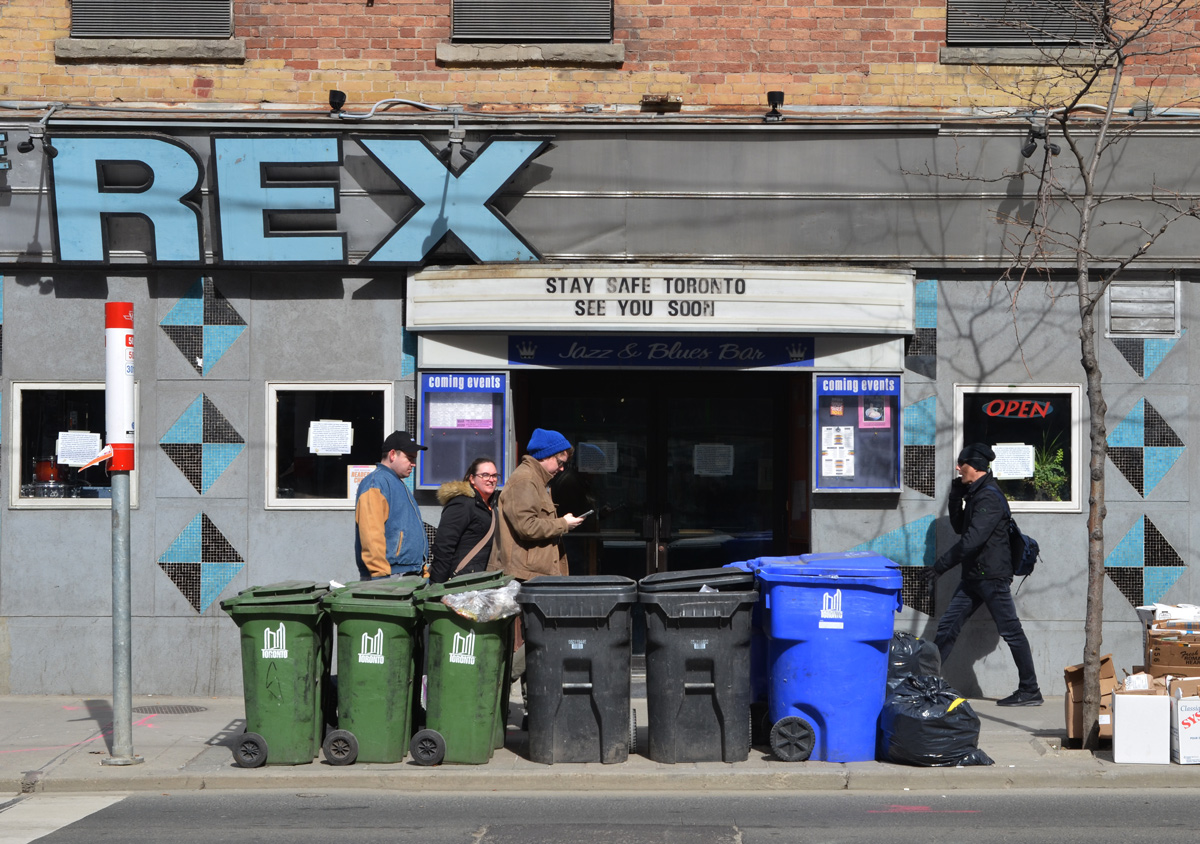
below: Another “stay safe” wish for the city.

people walking past the Rex on Queen Street, has sign over door that says

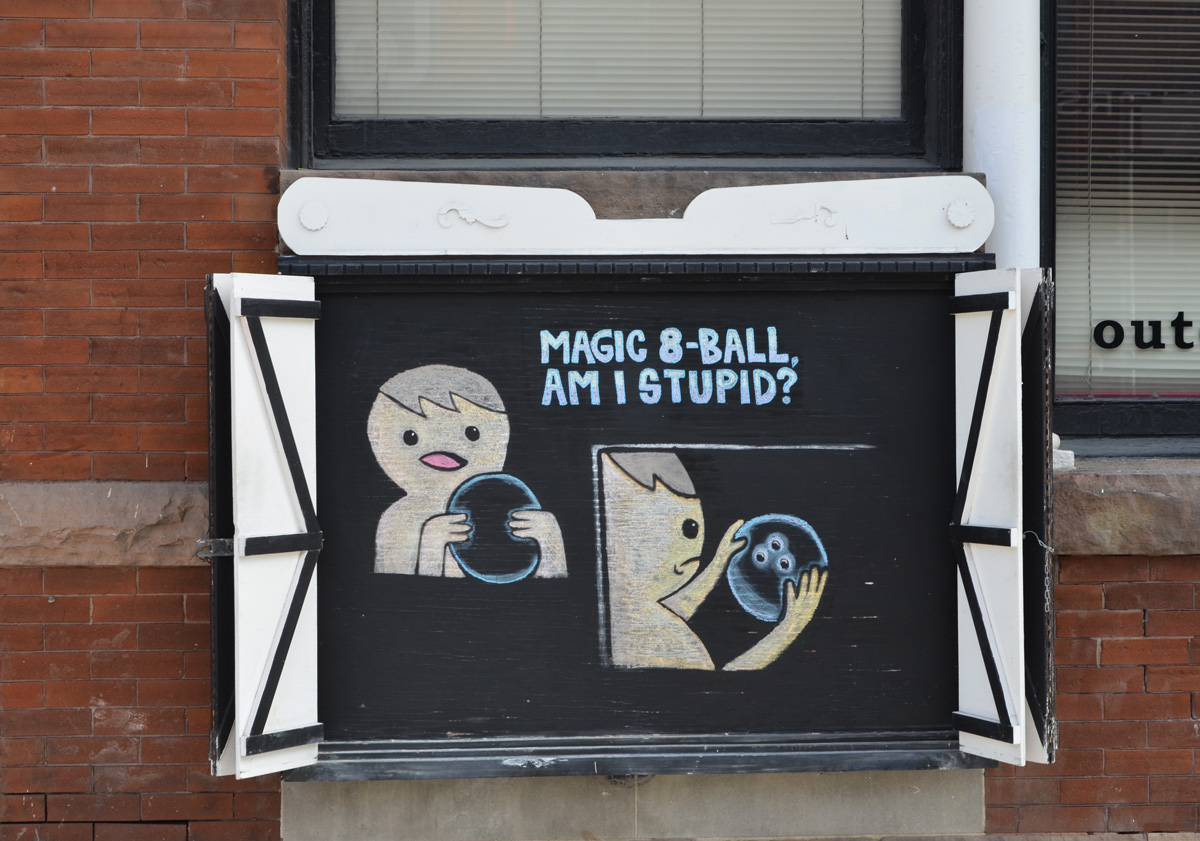
drawing on chalkboard outside, man asking magic ball am I stupid, then he realizes ball is really a bowling ball

below: They have no reason to panic.

mannequins dressed in outside clothing, long pants, hats, jackets, in orange and blue tones,

below: “Don’t argue with it” could pertain to many things including this social distancing that we’re all becoming experts at.

on a street art painting of a skate, someone has written the words

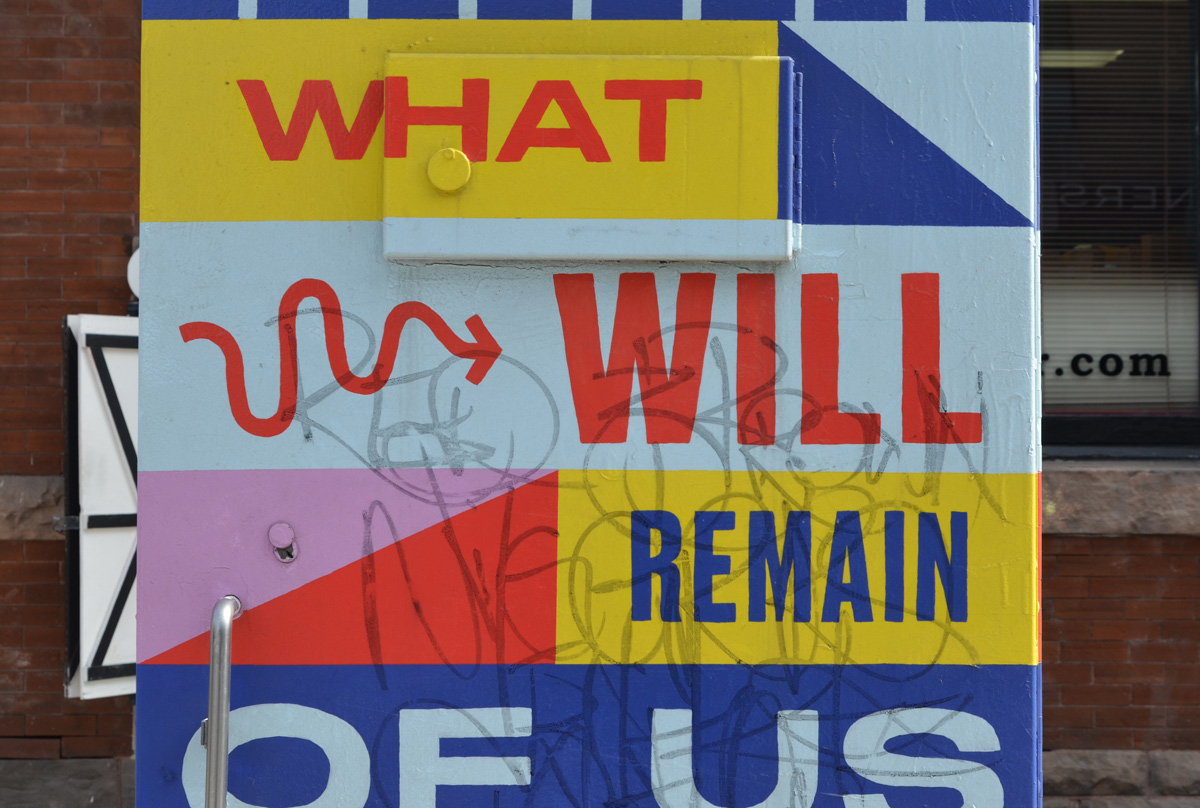
street art on a sidewalk box that says what will remain of us

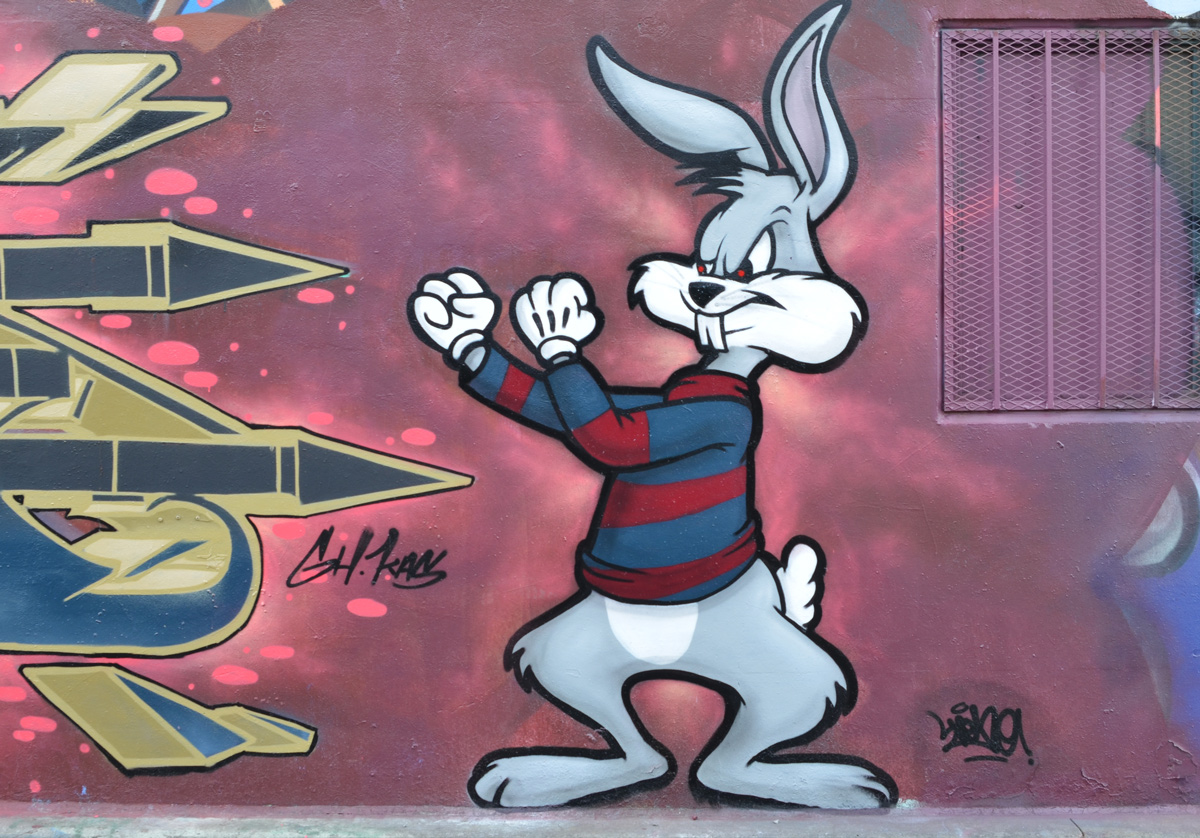
below: Bugs is ready to fight the good fight.

part of a street art mural of Bugs Bunny with his fists up and ready to fight

painting on a box of a ghoulish figure

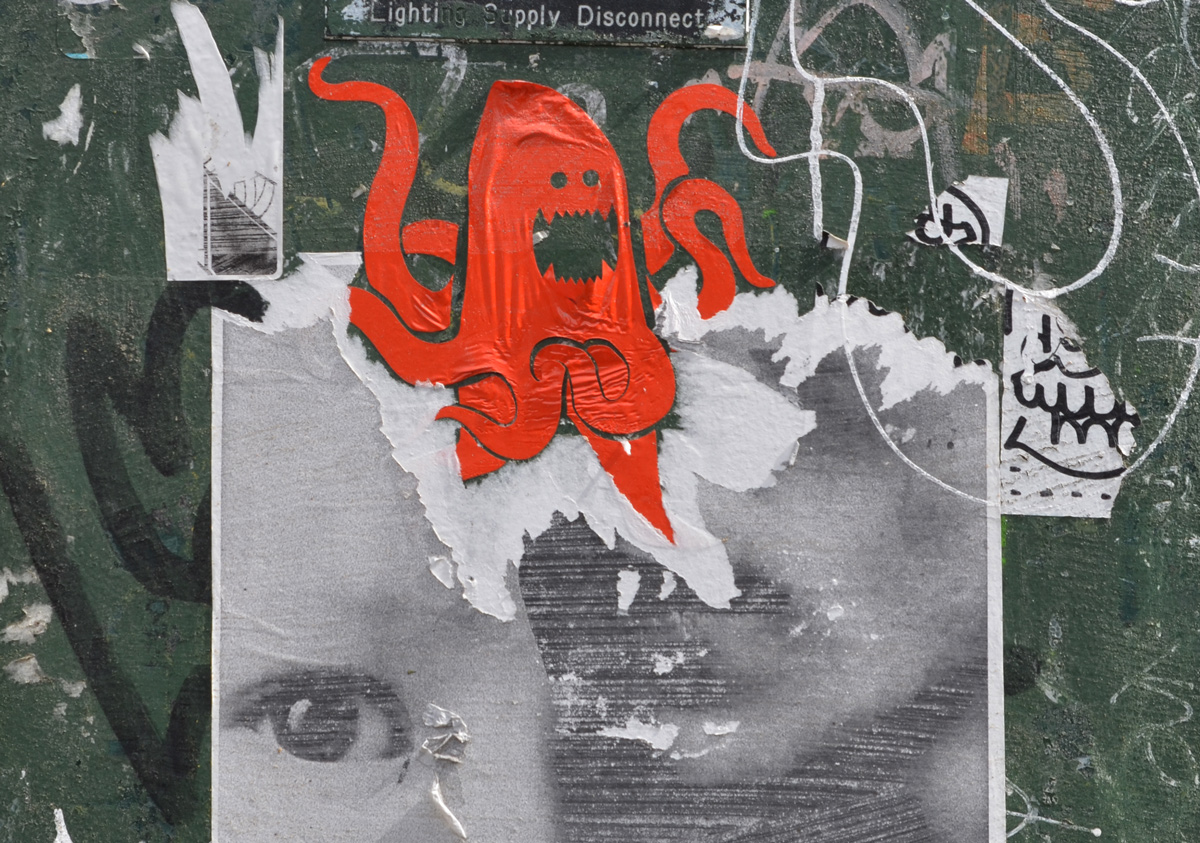
street art black and white pasteup of a face with eye still showing, torn a bit, sticker of a red octopus on top of the head

poster sign on door of Lush store explaining why they are closing

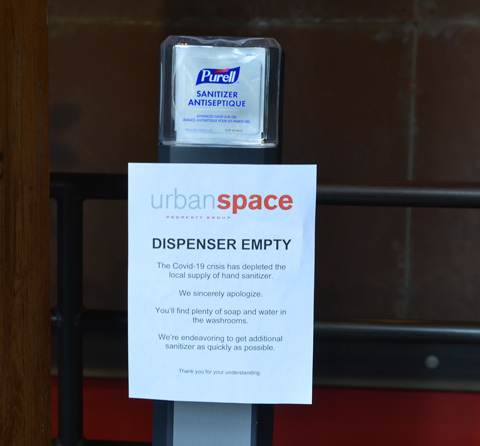
sign on a hand sanitizer dispenser explaingint why its empty and what to do about it

Wash your hands.

Stay healthy!

graffiti on a wall including the words Life's exit

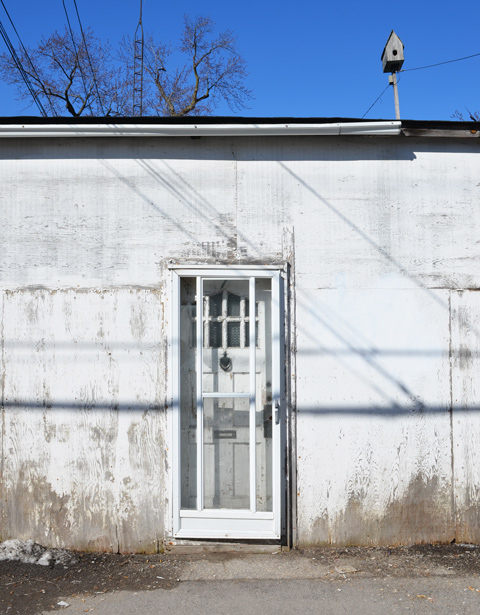
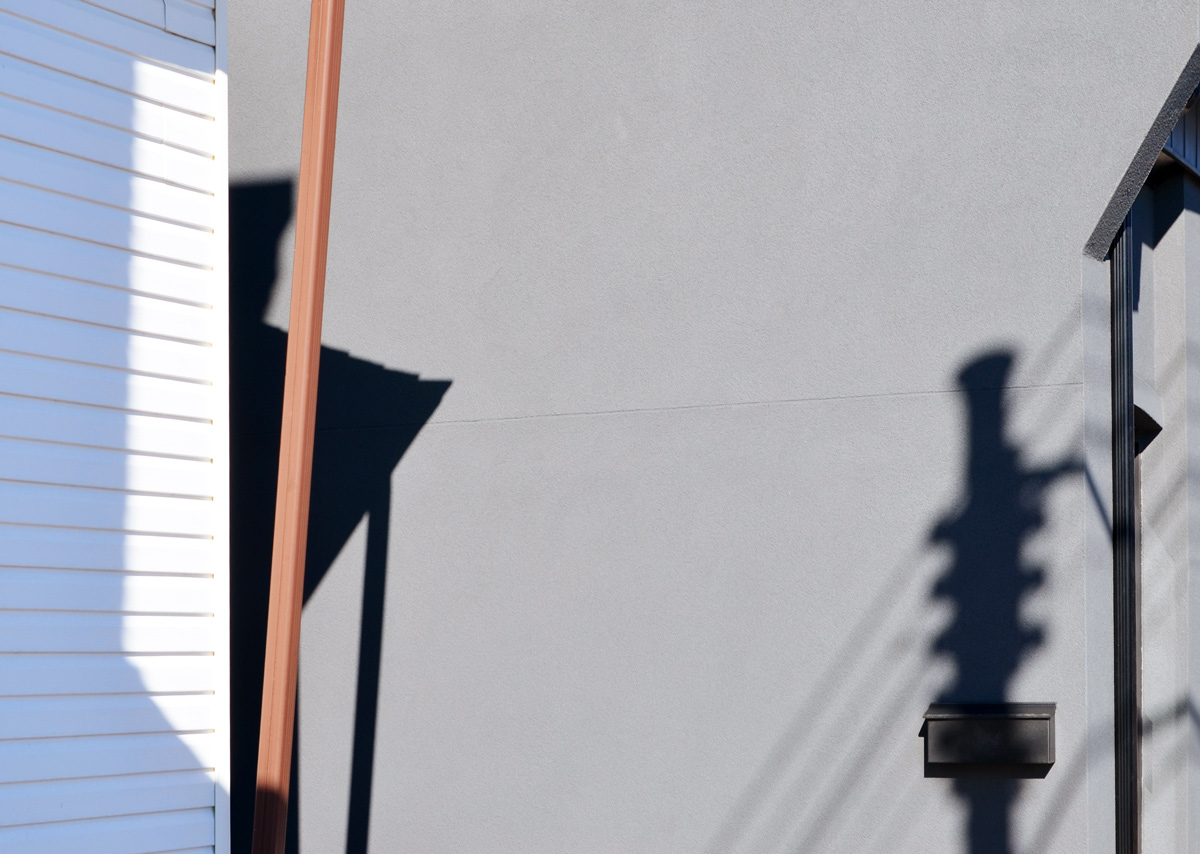
A few white walls on a sunny shadowy day.

a white door on a white wall with blue sky, also a bird house above the roof, horizontal shadow across the front of the house

A metal wall with peeling paint and a few rust spots…  and then add an old basketball hoop to the composition.

metal wall, painted white, exterior, with some rust, also an old basketball hoop and its shadow

shadows on the wall of a white house

In the spotlight, spotlight, spotlight, spotlight… and on camera too?

side of a white garage with lights and security cameras

Twig and texture

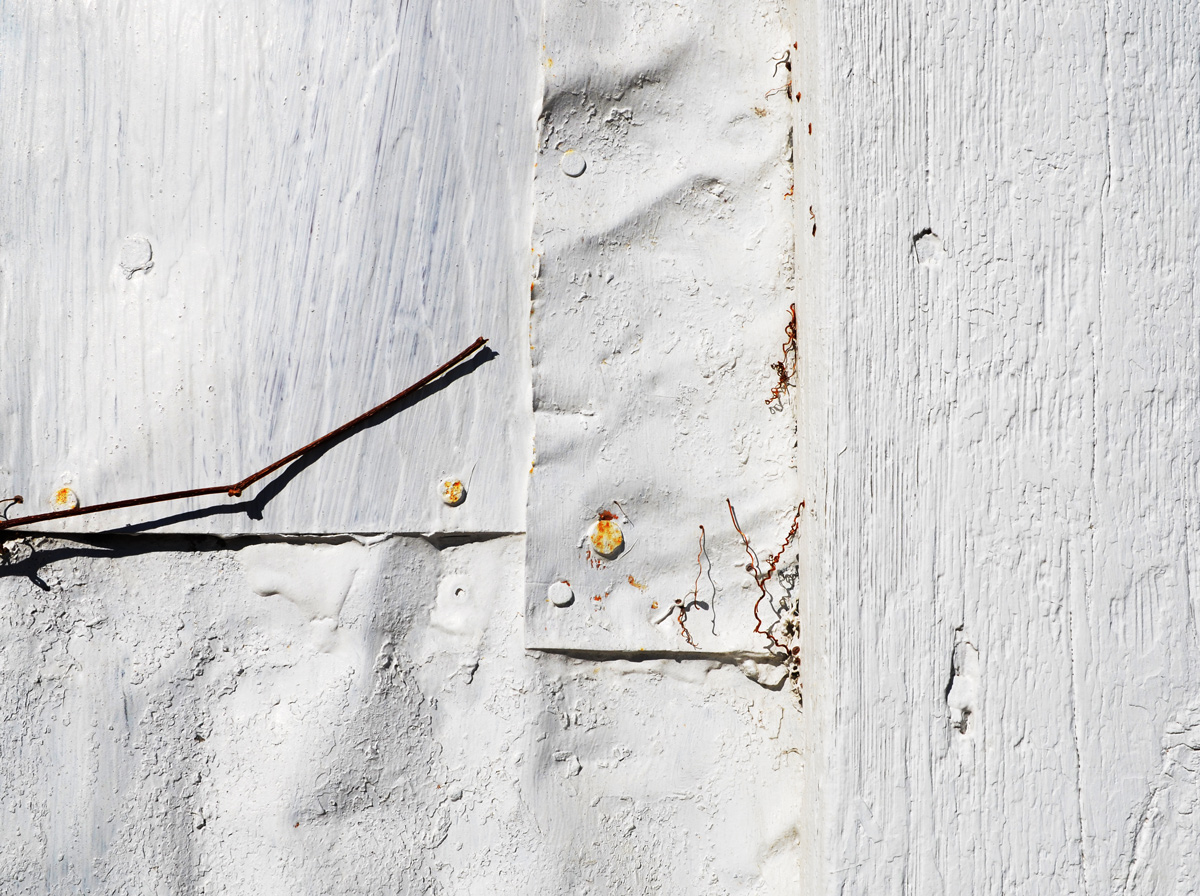
white wood wall with metal strip, a twig in front, with texture and shadows

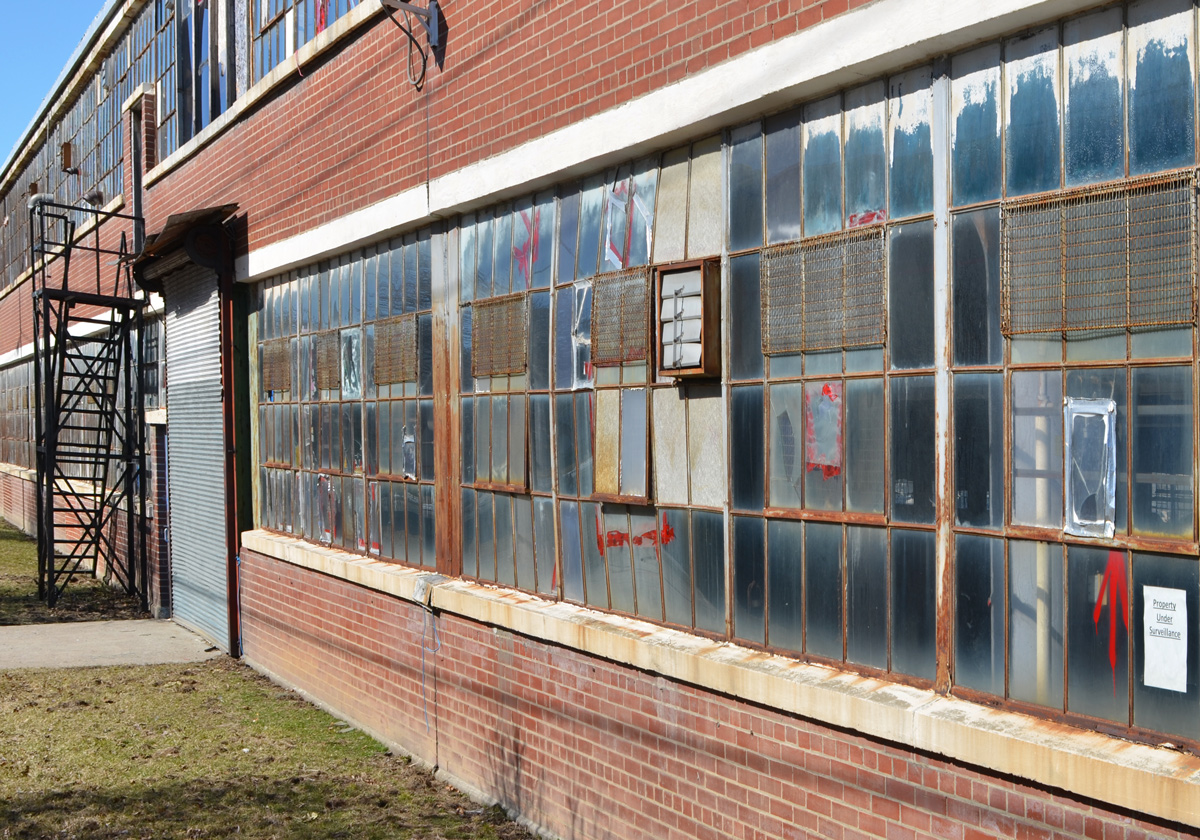
Until a few years ago this was part of Parkhurst Knitwear but today it sits empty. Today when I passed by the lighting was good for taking pictures of the south exterior wall.  There is a fence between the street and the building but there is ample room for photography.   I am now on many surveillance videos (if the warning signs were for real).

20 Research Road in Leaside, the Parkhurst factory, previously Dorothea Knitting Mills, built in 1942

This building started its life as Radio Stores Building No. 16.  It was constructed in 1942 and the chimney was added in 1946.  Building No. 16 was part of a complex of buildings occupying 55 acres of land east of Laird Drive and south of Eglinton that was owned by Research Enterprises Ltd. (REL).  During WW1 this land was an aerodrome.

horizontal window in a brick building made of rows of small rectangular panes of glass

In 1940 REL was incorporated in response to the outbreak of World War II; it was a Crown Corporation created through the Munitions and Supply Act of Parliament in September 1939.

looking along the exterior wall of two storey brick building with long horizontal ribbons of window panes, many glass pieces are broken or cracked and then fixed with tape

REL’s mandate was the production of technology equipment such as optical instruments and radio and radar equipment to assist with pilots with night flight.  During its 6 years of operation, REL employed 7,500 people.

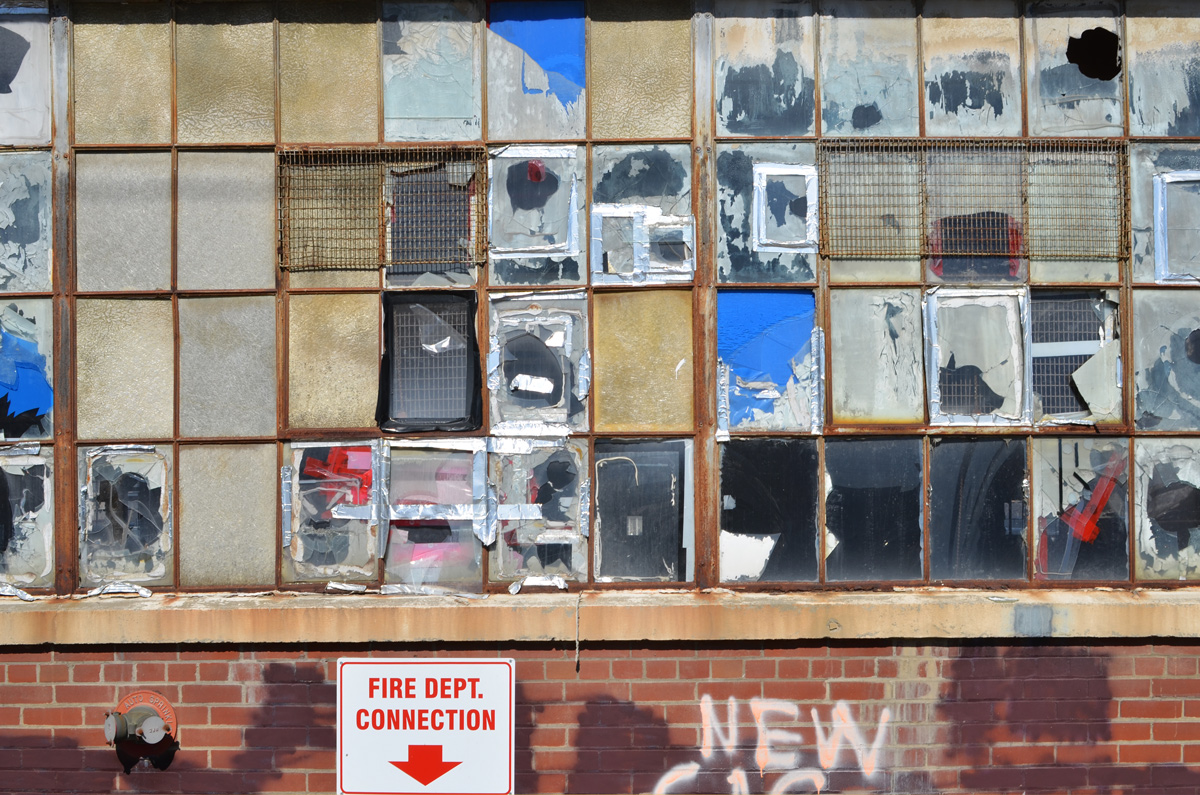
broken and patched panes of glass in a larger horizontal window

After the war, this building was sold to Dorothea Knitting Mills (1947).  Dorothea ultimately became part of Parkhurst Knitwear.

smokestack at east end of old Parkhurst knitting mill building, now abandoned

This building is part of a larger story – the slow disappearance of industries in Leaside as commercial and residential developments proliferate. Prior to 2010, the area was zoned industrial but developers fought for, and won, changes to the zoning in the area.

south wall of Parkhurst knitting mills, empty and abandoned, many glass panes cracked or broken, old curtains in the window

I can’t remember how long this building has been empty. If was still a functioning knitting mill in 2013.  In 2019 the city of Toronto moved to have the building listed as a Heritage site.  Last year there was a large sign on the building advertising the fact that it was soon to be a self-storage facility.  Is that still its fate?

old brown pipe inside, looking through old window


a brick wall where the bricks have been painted different colours like a giant mosaic, windows, and doors in that wall are also painted, in an alley,

There’s a building near King and Strachan that is adjacent to an alley.  The alley side of that building has been painted in many, many, squares and rectangles of different colours and as a result, it looks like like a giant mosaic.

Although there is a certain sameness to these pictures, here’s a sample of the doors, windows, and wall in that alley.

a brick wall where the bricks have been painted different colours like a giant mosaic, windows, and doors in that wall are also painted, in an alley,

a brick wall where the bricks have been painted different colours like a giant mosaic, windows, and doors in that wall are also painted, in an alley,

a brick wall where the bricks have been painted different colours like a giant mosaic, windows, and doors in that wall are also painted, in an alley,

a brick wall where the bricks have been painted different colours like a giant mosaic, windows, and doors in that wall are also painted, in an alley,

a brick wall where the bricks have been painted different colours like a giant mosaic, windows, and doors in that wall are also painted, in an alley,

It was a beautiful day on Monday when I visited the “Winter Stations” (scroll down to next blog post), cold but sunny.   I decided to walk north on Woodbine since I haven’t done that for a while.

below: Playing with mirrors while waiting for the washroom at Woodbine Beach because there is only one women’s washroom (why is there only one?)

a mirror shaped like a porthole with a green frame, on a bright blue wall, reflection of another porthole but on an orange wall in the mirror

below: From portholes to demolition holes – I made it as far as Queen and Woodbine where there is a large hole in the ground

at the intersection of Queen and Woodbine, a hole in the ground on the north east corner and a Pizza Pizza restaurant on the south east corner

… because just north of there I discovered alleys and small streets that I don’t remember walking.  Who can resist the allure of a red door?

looking down an alley in winter, two brown tire tracks for the cars, but lots of snow. Fences, trees, and a house on a street at the end with a red front door.

below: I went to Norway

street signs on a post. a one way sign pointing left, a green and white sign that says Norway Ave continues to the right ahead

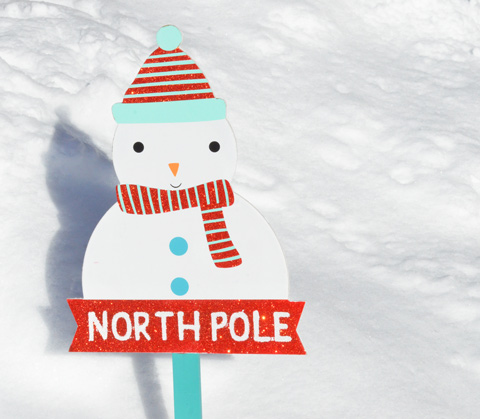
below: And I passed the North Pole

a lawn decoration in a snow covered front yard, a flat wood snowman with red and white striped hat and scarf and a sign that says north pole

below: I even walked past this No Trespassing sign.  The old cars parked the house behind caught my eye but this was as far as I ventured.

a no trespassing sign on a wire fence, snow covered driveay, two old cars parked in the backyard, beyond the fence

When there is no planned route and you’re only following your nose or sticking to the sunny side of the street, you can run into some surprises.  There were a lot of older houses – here are a few of them:

below: There are still some of these Victorian rowhouses closer to downtown but I wasn’t expecting to find any here.   As it turns out, this was part of the village/town of East Toronto.  In 1888 it was a village with about 800 residents.  It became part of the City of Toronto twenty years later (and with 4200 more people).

two semi houses with gabled roofs and covered porches, from the 1800's. snowy street scene, large trees, winter

As it turns out, one of the streets that I walked on, Lyall Avenue, is a Heritage Conservation District.  The street was surveyed in 1884 and by 1888 a few houses were built on some of the fifty yard lots.  Most of the development occurred between 1909 and 1924.  It was definitely a middle class neighbourhood.   The full report published in 2006 appears on the City of Toronto planning department website.

an upper storey oriel window with curved edges

below: This house stands alone.  A very typical older Toronto house.

a typical old Toronto two storey house with peaked roof, reddish brick, two wondows upstairs, one large window downstairs, white front door with a small roof over the door, lots of yard

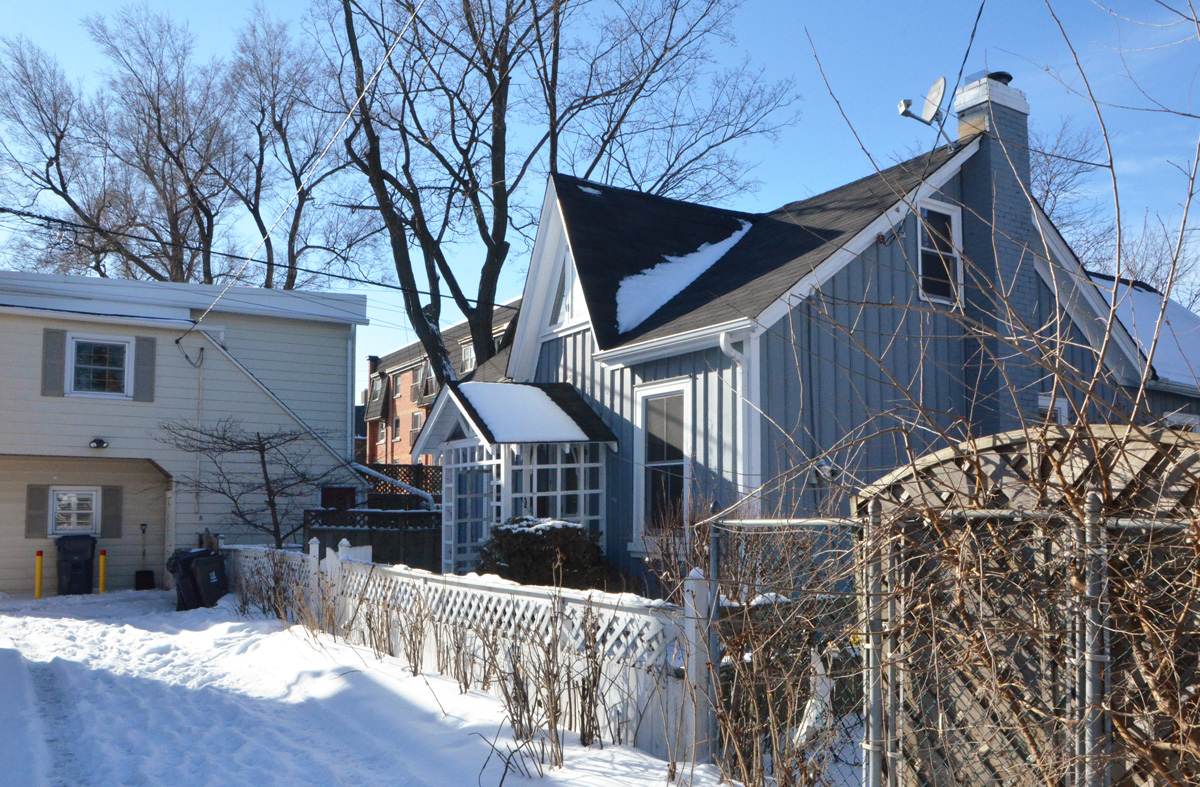
below: This tidy well-kept workers cottage can only be accessed from the lane.

a workers cottage that fronts onto a snow covered lane, grey vertical wood paneling on the outside, black roof

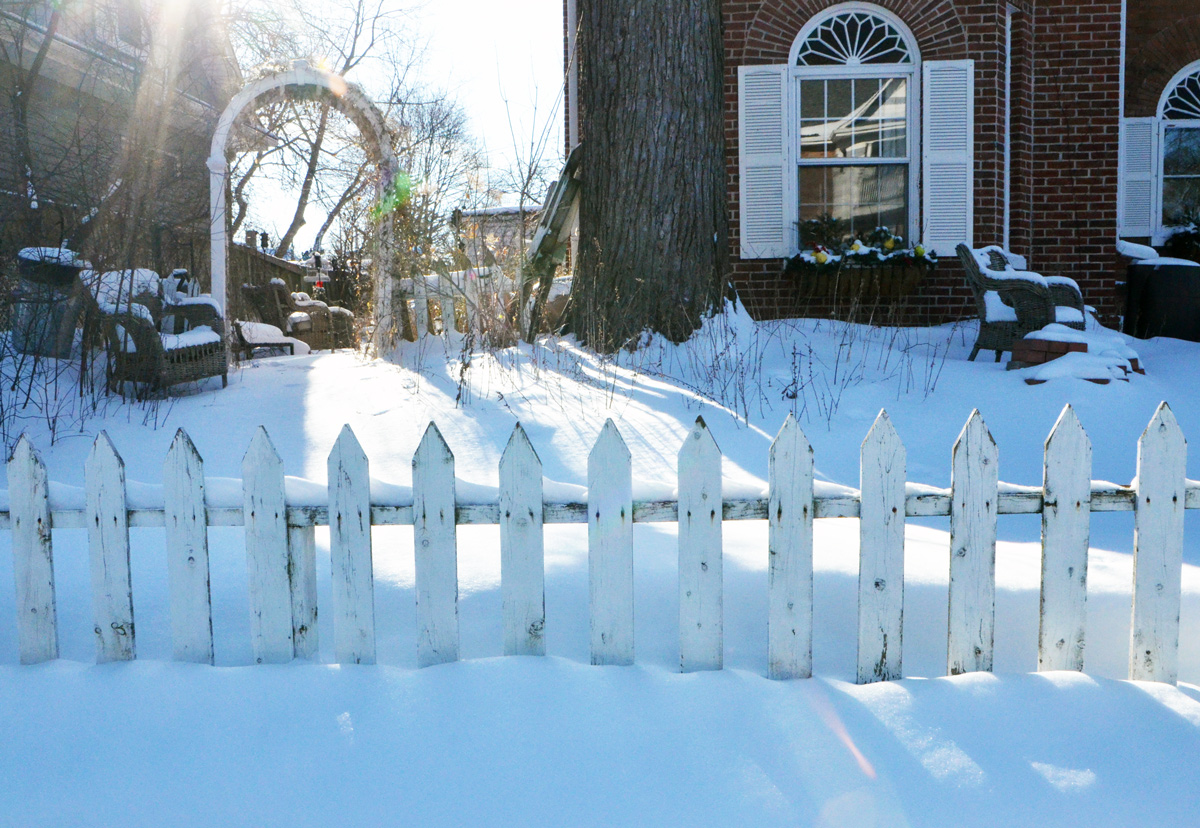
below: A white picket fence and wicker furniture waiting for spring.

a white picket fence in the snow, wicker chairs in the yard covered with snow

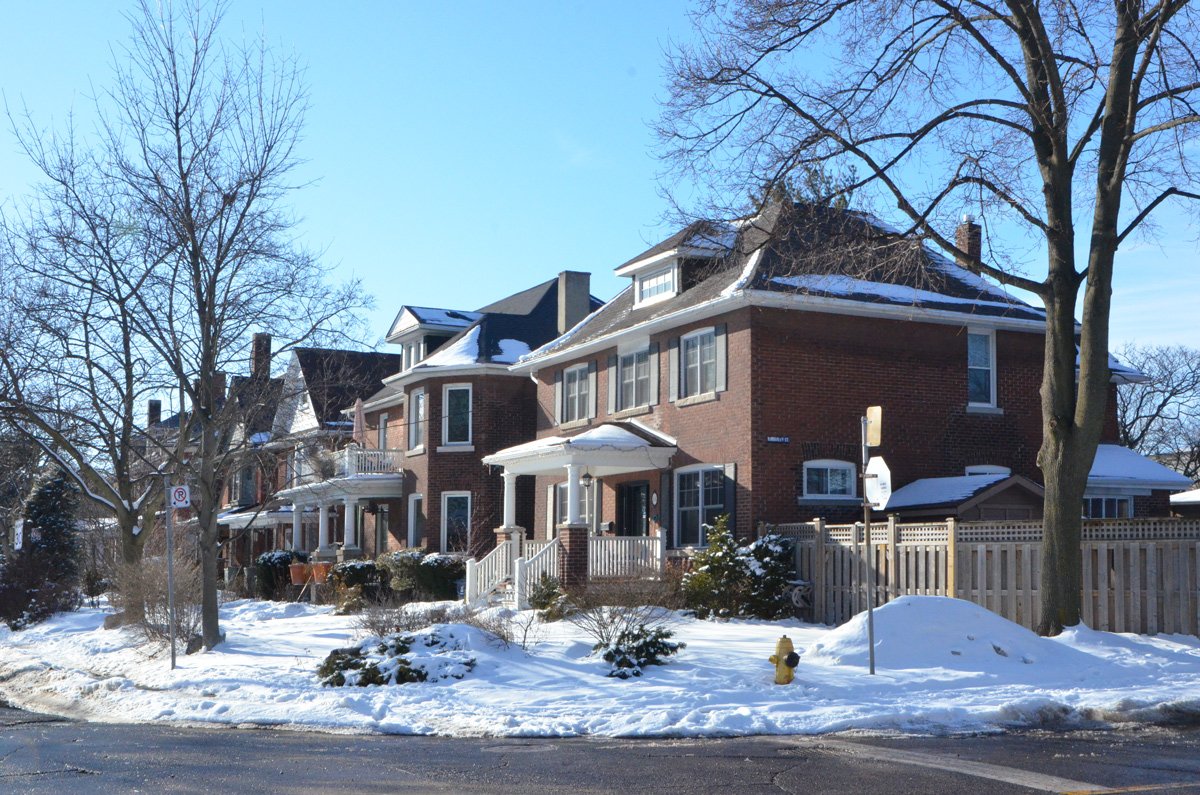
large two stroey brick houses, winter, street,

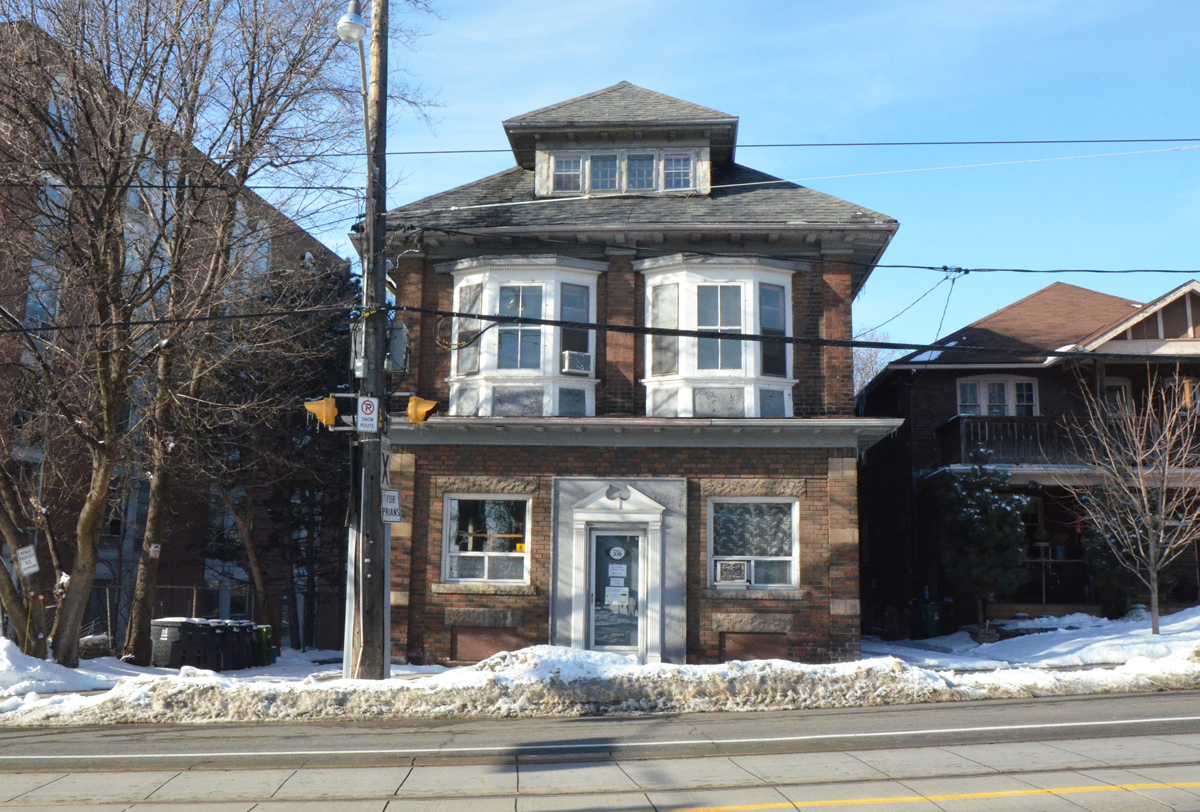
All of the above houses were north of Kingston Road where the lots sizes were fairly big.  South of Kingston Road, the houses are narrower and close together. (or joined together).

the backyards and back of houses in a row, winter,

below: This square, substantial sized brick building is on Kingston Road.  Between Woodbine Avenue and Main Street, Kingston Road runs along the crest of a ridge.

large old brick house on Kingston Road, three stories,

below: Newer residential buildings on Kingston Road.

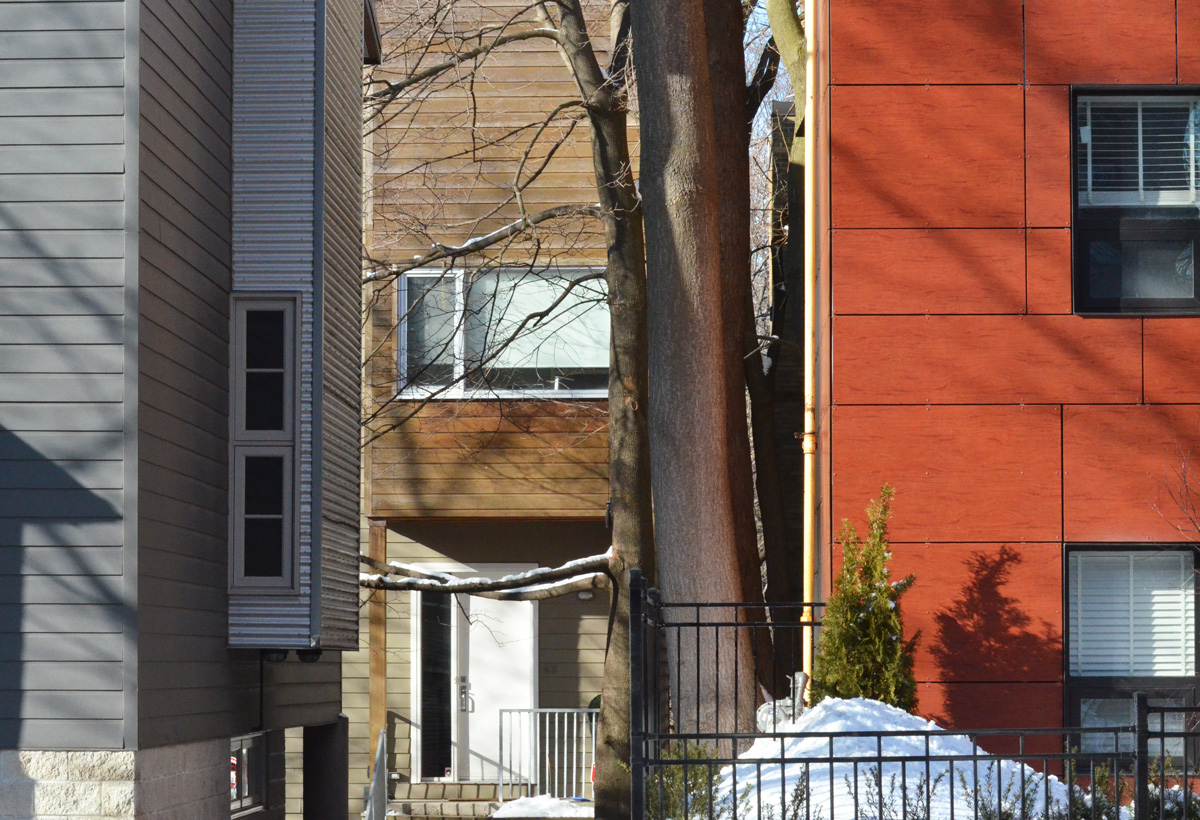
part of three new buildings

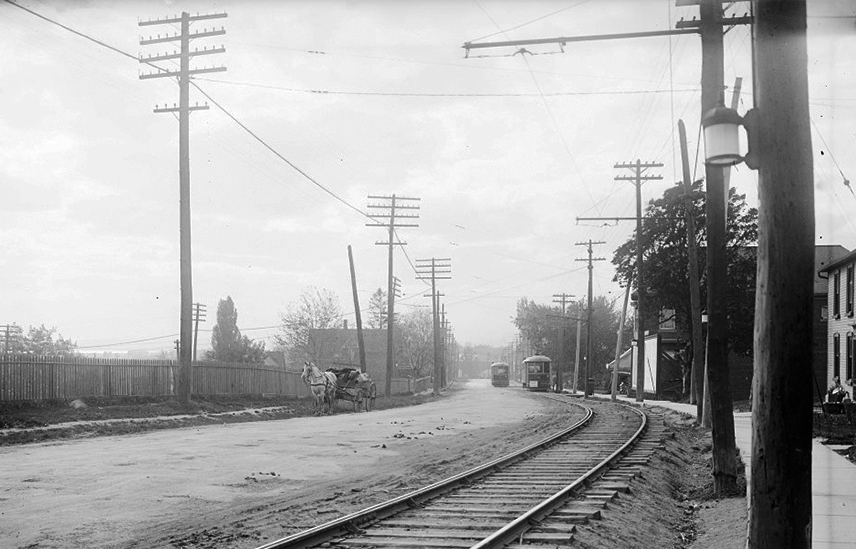
below: 1922, looking west along Kingston Road from Main street.  That’s almost 100 years ago, and there were streetcars running here even then.  No cars, just a horse and wagon.

old black and white picture from 1922 of a dirt street with a street car track, hydro poles beside the road and a house

Photo credit: City of Toronto Archives. Found online in a ‘Beach Metro’ article where you’ll find more history of the area.

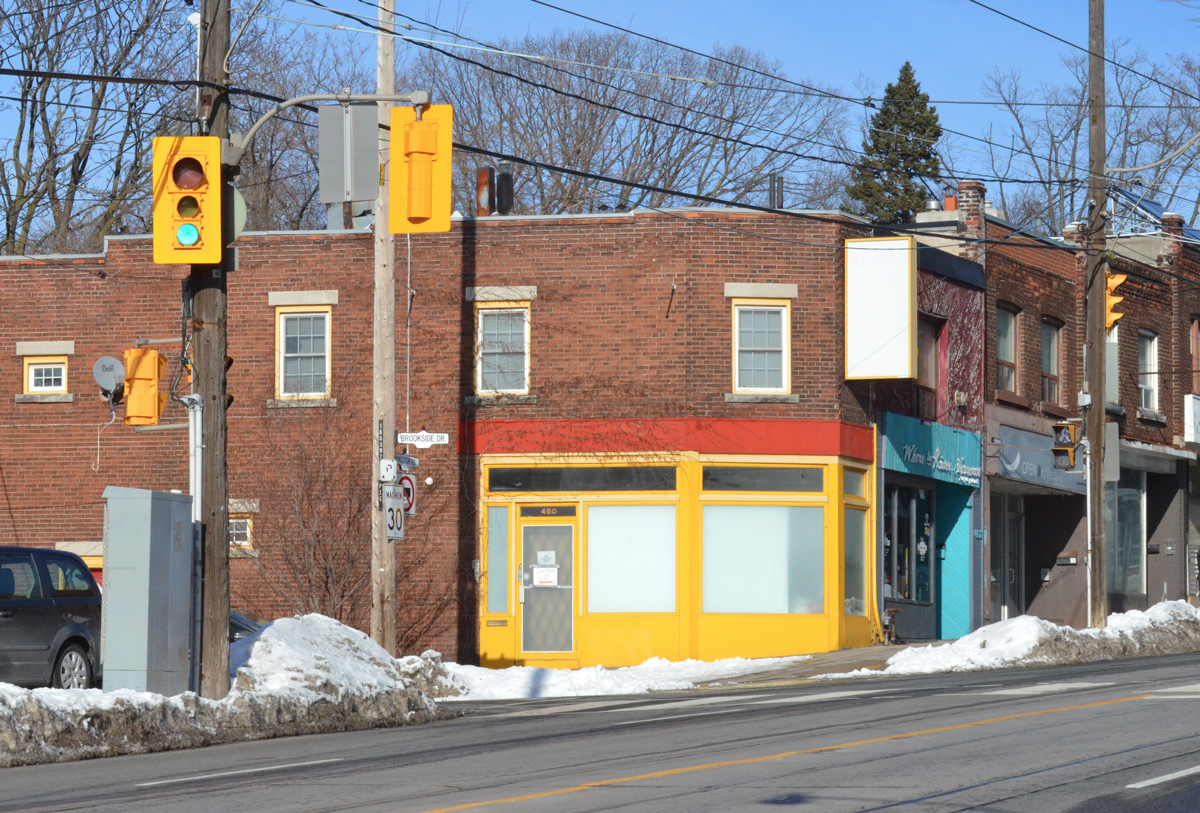
The next three photos are some of the typical two storey, flat roofed, brick, all in a row, stores and businesses that were built in Toronto in the early 1900’s and later.   If I remember correctly, these were all on Kingston Road.

a storefront trimmed in bright yellow and angled at the corner, intersection of Kingston Rd and Brookside

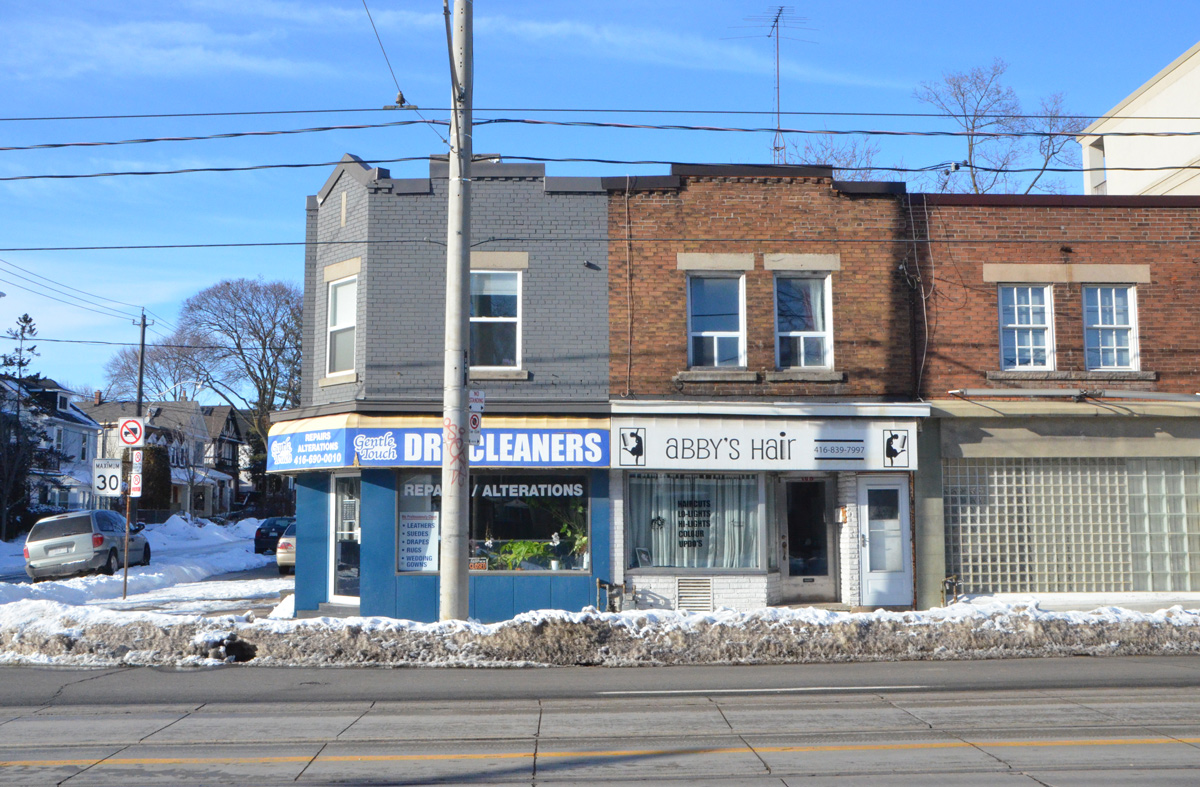
two stores, old architecture, two storey buildings with apartments on top

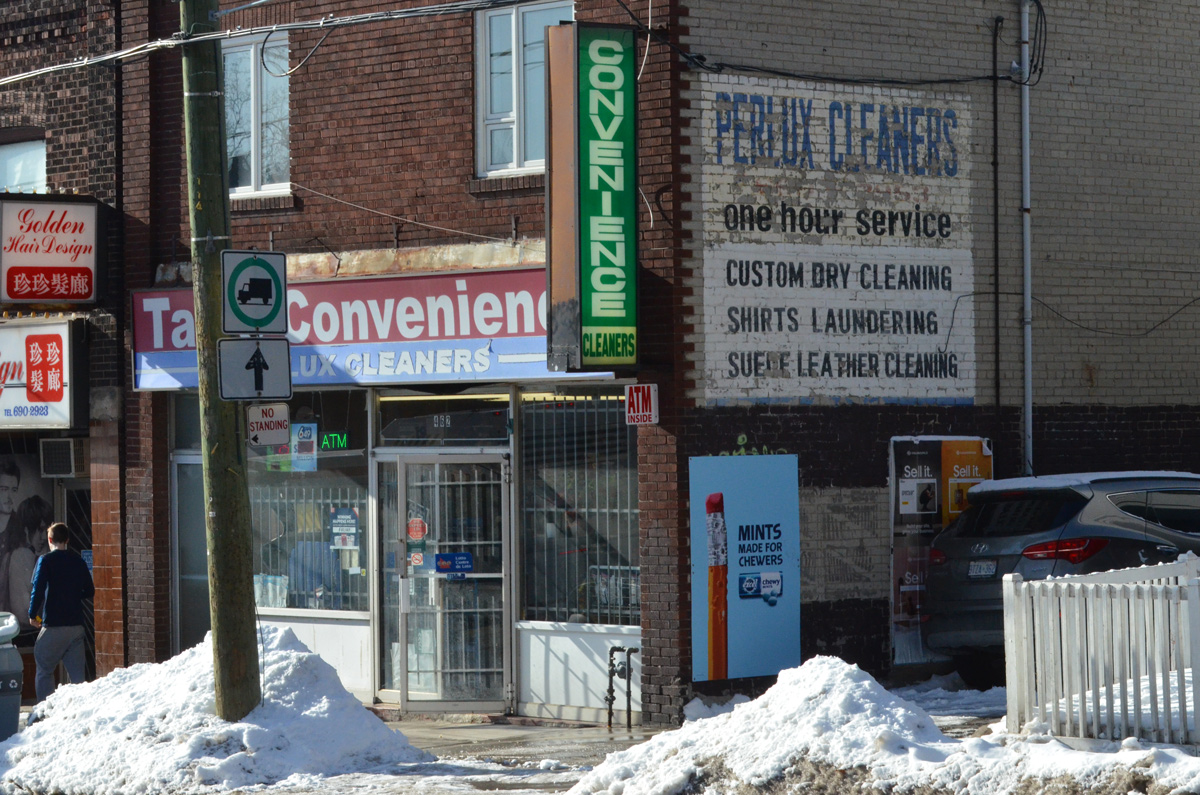
Perlux cleaners, old sign painted on side of building, convenience store, mounds of snow by the sidewalk

below: A warm and colourful summer scene painting behind a chainlink fence that surrounds the playground at  Kimberley Junior Public School.

colourful painting behind a chainlink fence in a school yard, winter, snow on the ground around it, picture is of three kids in large yellow hats, playing on green grass

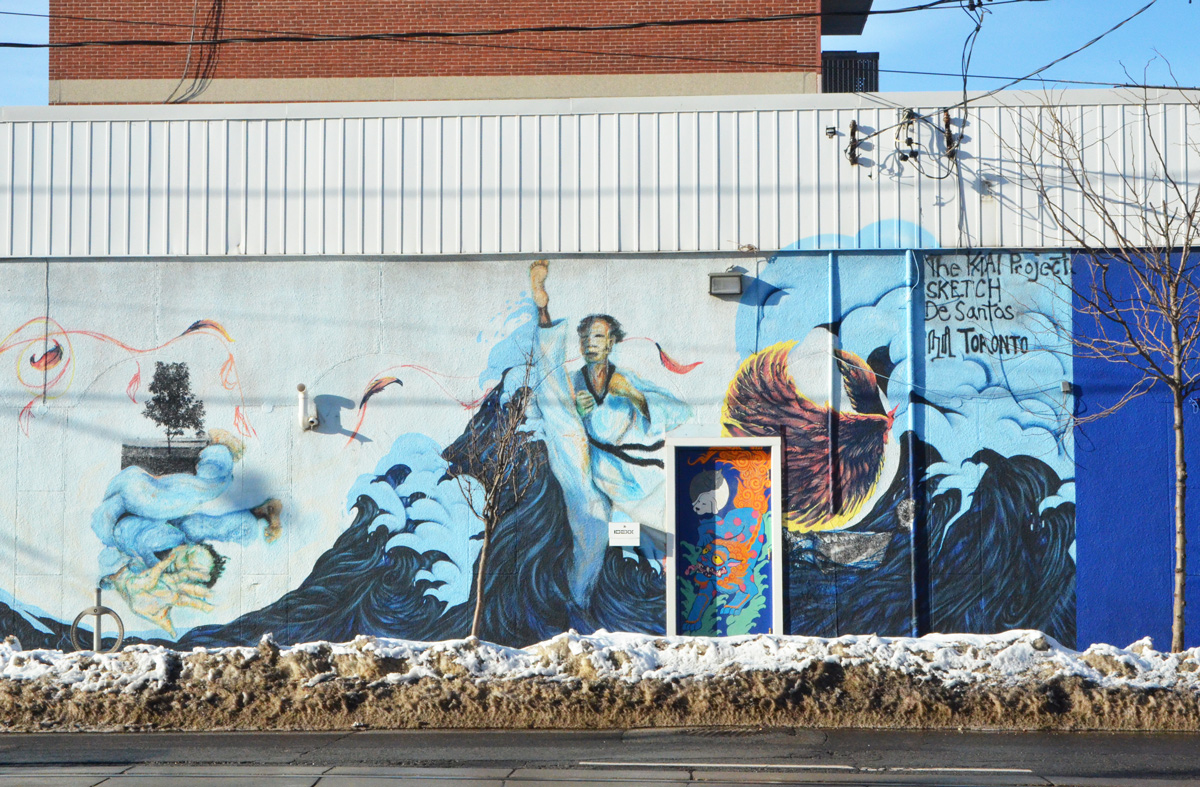
below: Mural at Gerrard and Main.

karate, martial arts mural on a wall

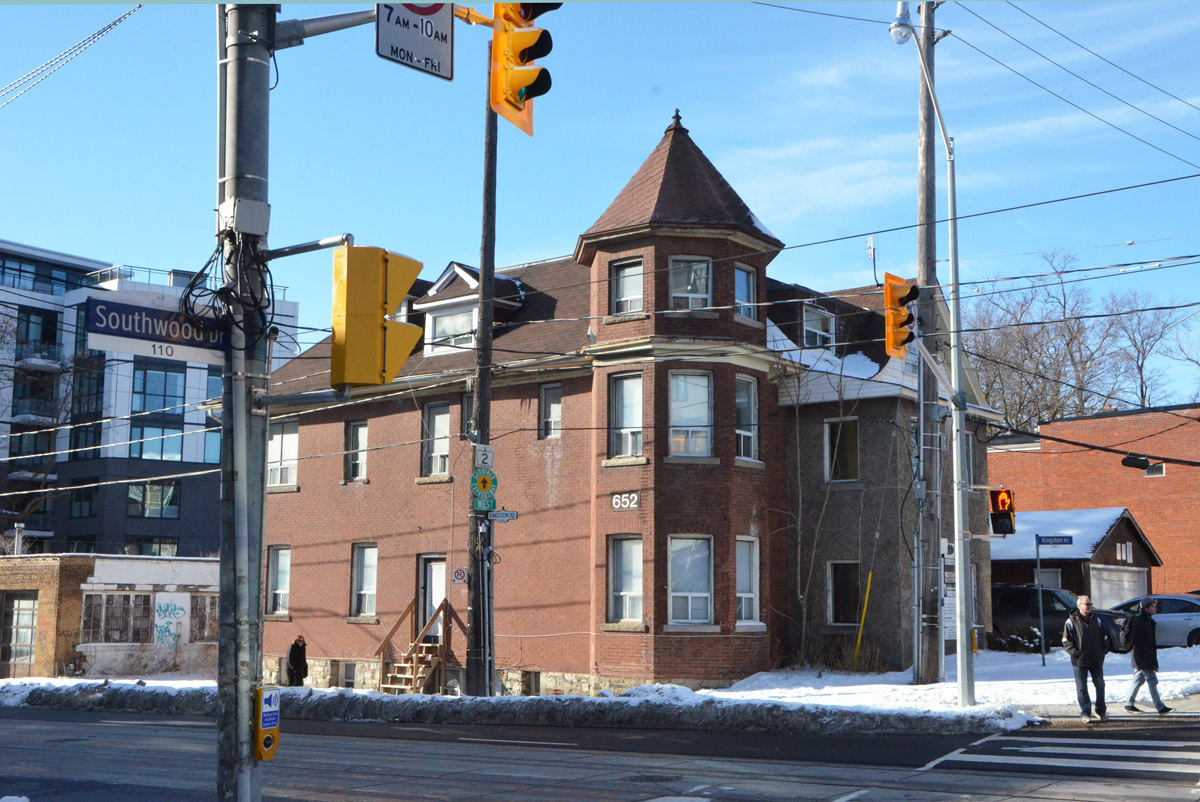
below: The last architecture picture – this building with a turret at Kingston Road.  Here Main Street becomes Southwood Drive.

commercial building with a turret at an intersection

below: Looking north on Main Street from Gerrard.  Here the streetcar turns towards Main subway station.  The bus shelter in the middle of the street is definitely old style – one of the few remaining in the city.  From here Main street is a bridge over the railway tracks.

looking north up Main street from Gerard, streetcar tracks with a bus shelter in the middle of the street. old style bus shelter, Main street then goes up, as a bridge over the train tracks. Highrise apartment building in the background.

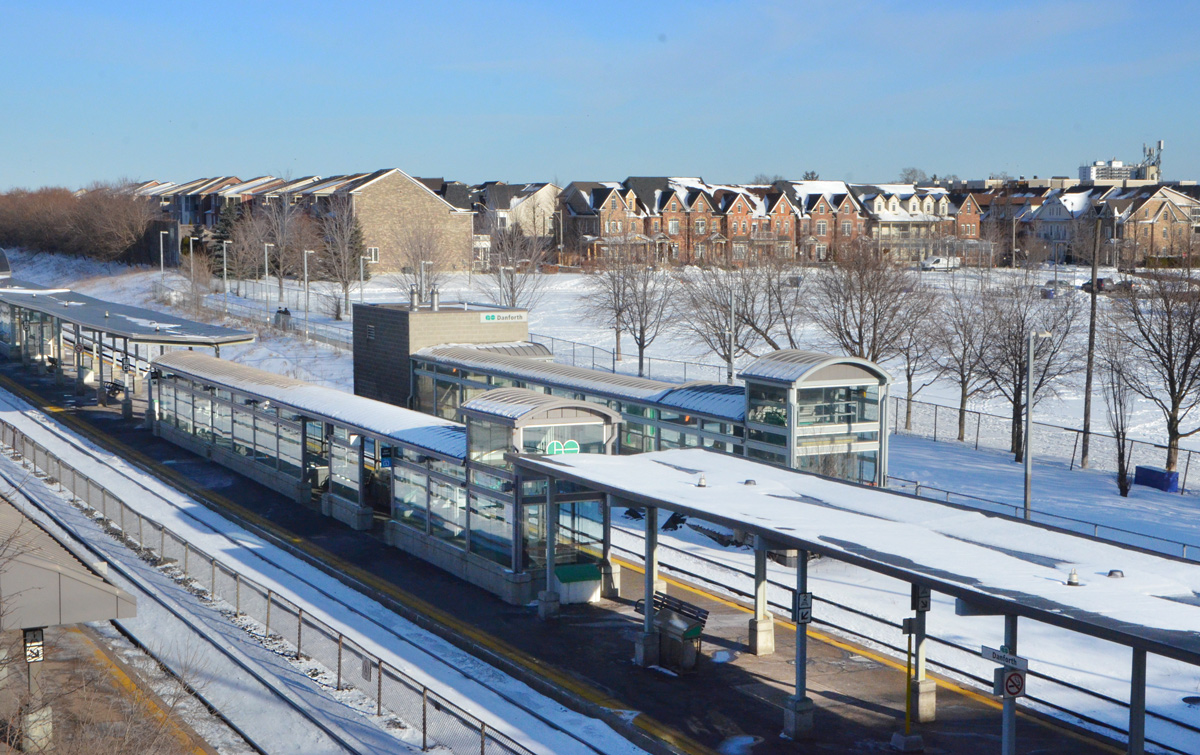
below: From the bridge, looking southeast over Danforth GO station. Prior to 1940, this was the location of York Station as well as the Grand Trunk Railway’s main freight yard.  The yard stretched along Gerrard Street and employed several hundred people.   At that time, Gerrard Street was called Lake View Avenue (could you see Lake Ontario from there?).

view from a bridge over railway tracks, Danforth GO station below, houses beyond. covered platforms between two sets of tracks

below: York station in 1890.  It was renamed Danforth in 1922 and demolished in 1974 to make way for the GO station.  The freight yard is to the right.

york railway station in 1890. train is letting off passengers

Photo credit: Toronto Public Library. The picture was found online in an article on Danforth station that appears on the Toronto Railway Historical Association website


below: Hanging out on the Danforth

large white sign with green GO logo, Danforth station. a group of pigeons is sitting on top of the sign.


But I didn’t hang out for long.  From here to Main Street subway station is only a few steps and that was enough walking.
My writing can be almost erratic as my walking!  I hope that I didn’t lose you along the way.


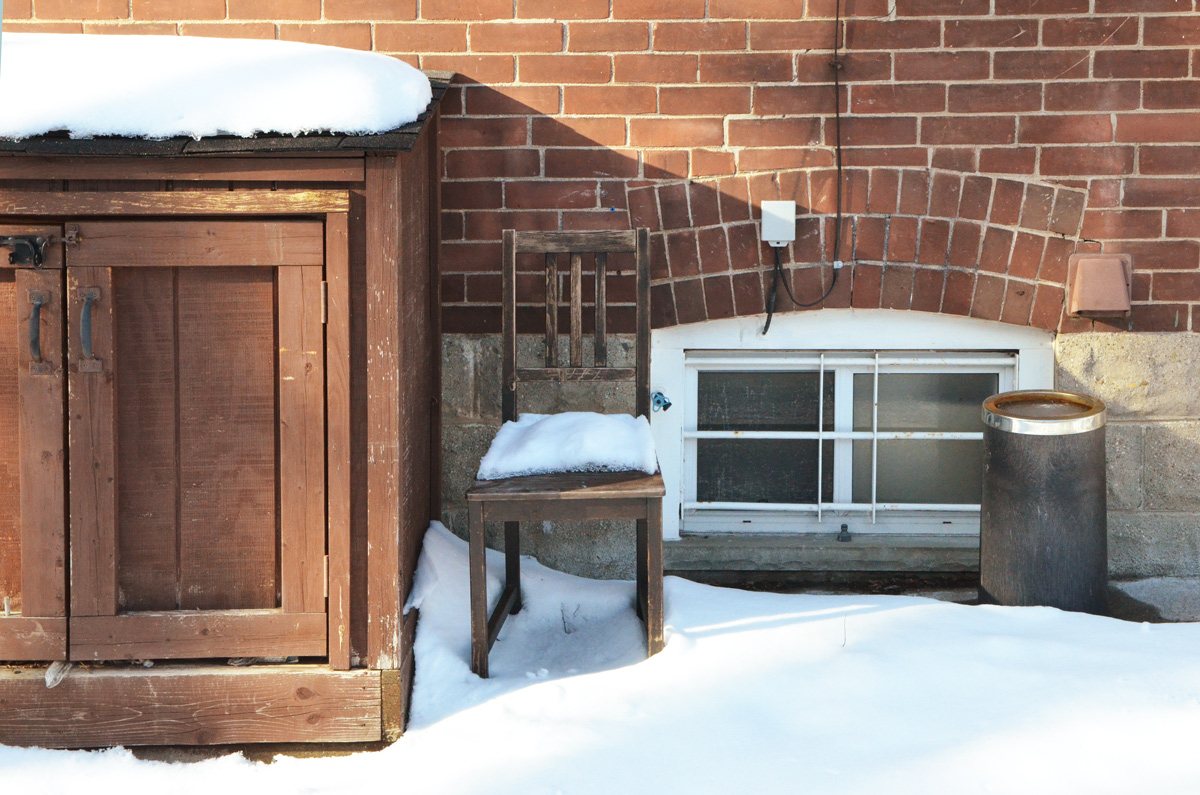
wooden chair outside, against the side of a house, snow on it.

Sort of like window shopping but different….

three grey femail mannequins dressed in pale blue in a store window

below:  Peering through the window at the remains of Yuk Wing cleaners on Gerrard St. East

interior of now closed dry cleaners, looking through the front window of Yuk Wing cleaners, pale green counter, old signs, still remain

below: Sometimes you can’t look in the window – something is in the way!  It wasn’t until I was looking at the picture on my computer that I noticed that the newspaper is in a language that I don’t understand.   I typed the headline to the left of the heart into google translate, “Niemiecka chemia zapanuje nad swiatem” and it told me that the words were Polish and translate to “German chemistry will dominate the world”.  The article is about the purchase of Monsanto by Bayer.

a small red heart is painted on the window of a store that is now empty and newspaper covers the inside of the window.

below: A portion of the black cowboy silhouette remains in the now empty Tortilla Flats restaurant.

looking in the window of an empty restaurant, green and black walls, red bench, bike, top part of a silhouette of a cowboy on the wall

below:  The effects of morning light shining into the Thai Luna restaurant.

looking into the window of the Thai Luna restaurant, sun behind, shadow of the words of the window show up on the maroon coloured bench, black tables

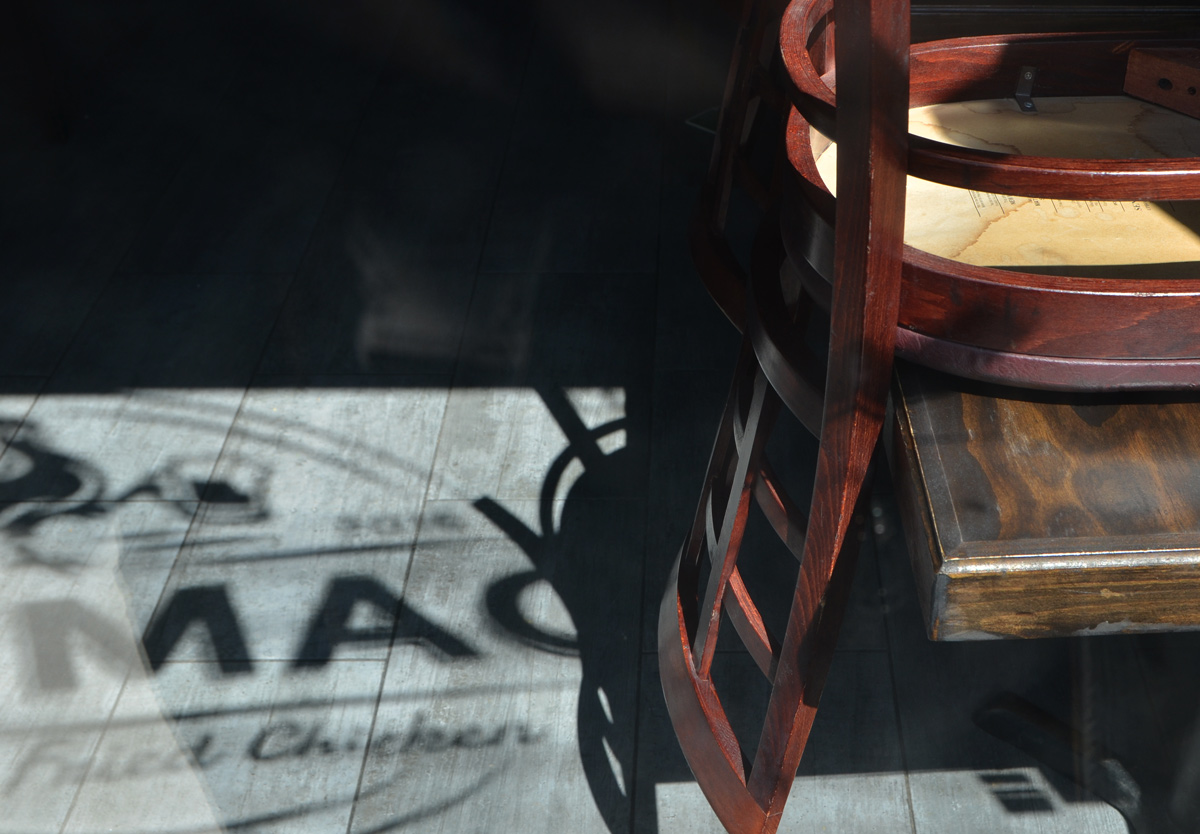
below: More morning sunlight, this time it leaves traces of fried chicken.

looking into the window of a fried chicken restaurant, chair upside down on table, words on the window show up on the floor because of the sunlight coming in the window

below: Strutting in the window with miniature camels

looking in the window and doorway of a womens clothing store in the Eaton Centre, mannequins in the window, saleswoman in the door,

below: Laundry day, with 24 hour surveillance

looking in a laundromat window, people, washing machines,

below: The chicken, and its head, really was that colour.

looking in a restaurant window, meat hanging in a windiw including a rather yellow chicken, some ribs,

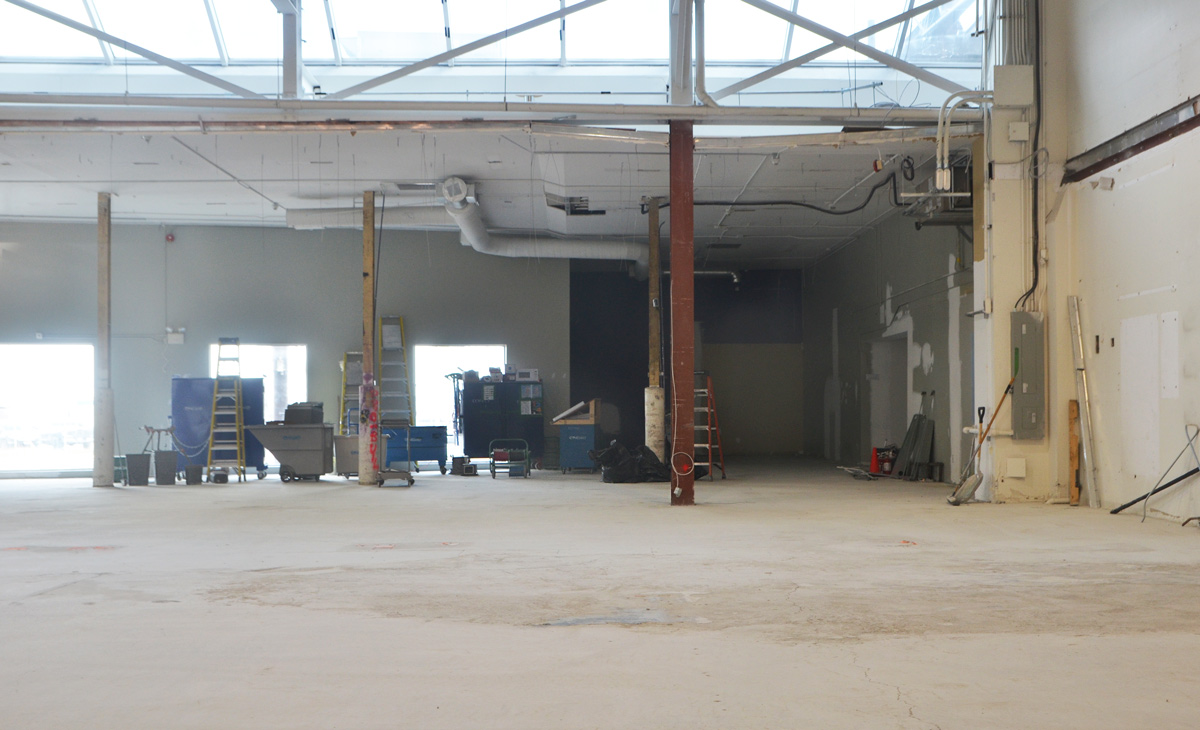
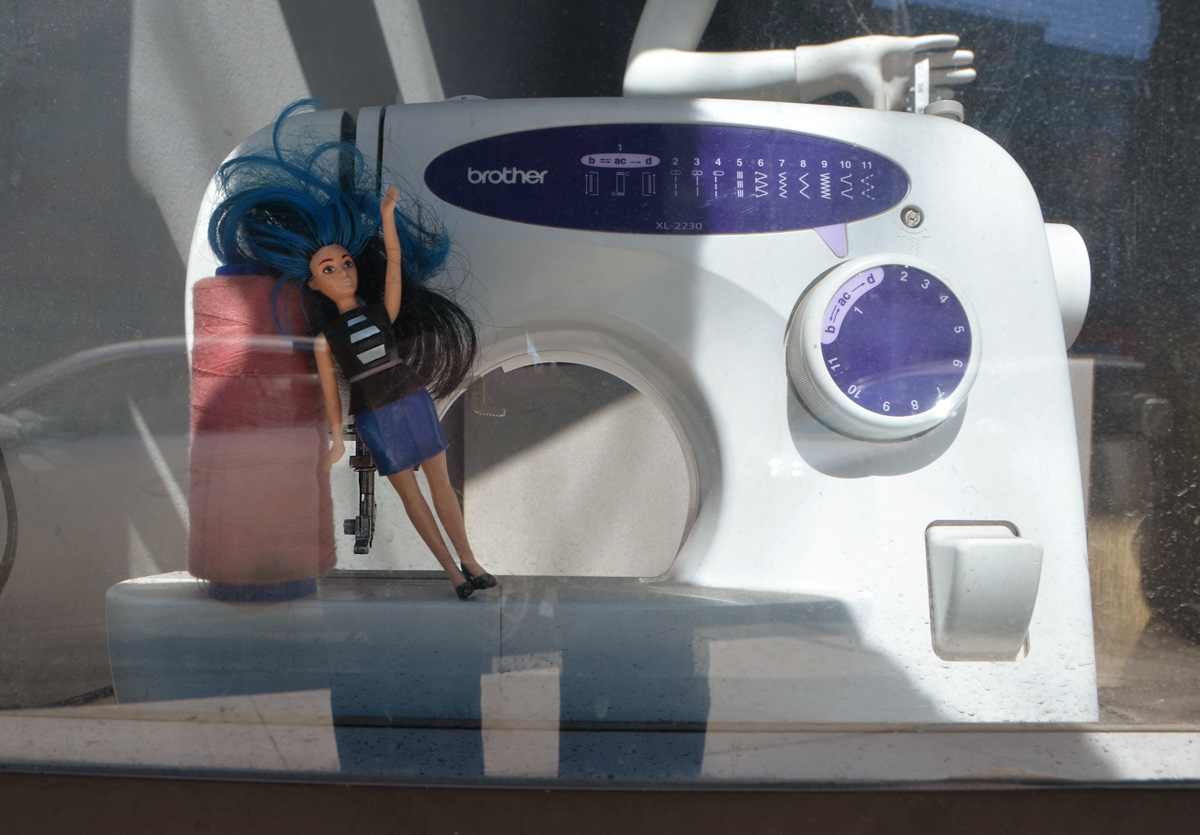
below: What little remains.

looking through a window into a large open space, some construction equipment is against the far wall, large door open across the room

in the window of a store, dirty window, brother sewing machine, with small barbie doll standing against it and leaning against a large spool of pink thread

More words!

below: You’re awesome!

large white letter across a roof line that say you're awesome

below: Embrace peculiarity

side a garage plus wood fence beside it painted with abstractr shapes in reds and oranges, with the words embrace peculiarity written in blue cursive writing

below: Love will win 🙂

on the side of a grey metal box, written in black, with a smiley face under the words, love will win

below: I love you!

graffiti on a brick wall, red heart with words I love you, instead of the word love there is a white heart

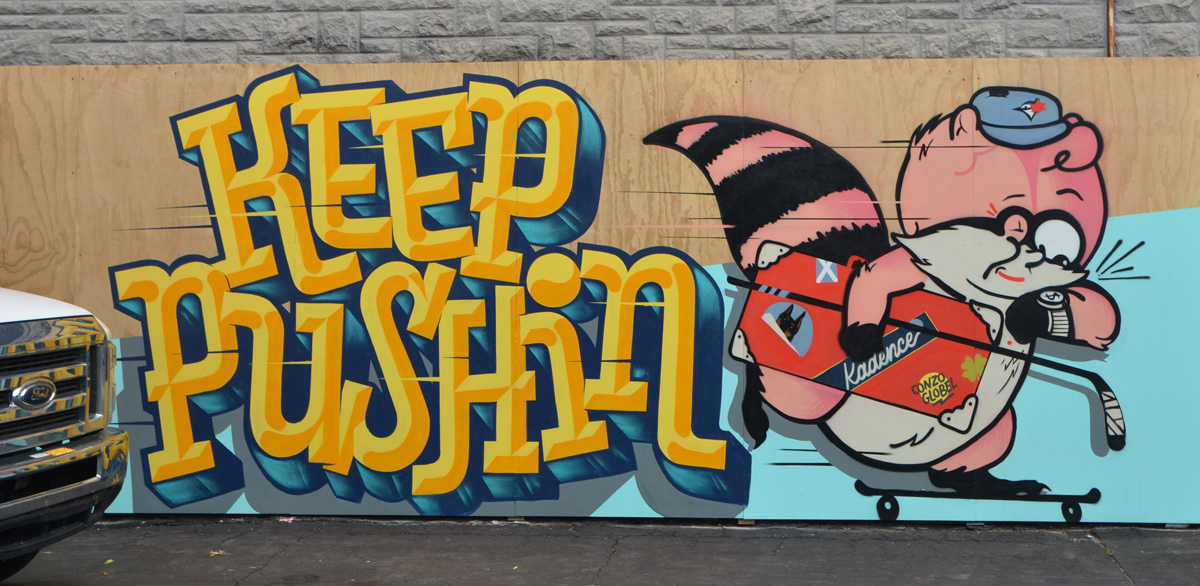
below: A mural with a pink skate boarding raccoon with a hockey stick and a Blue Jays baseball cap.  Also words of encouragement (or at least that’s how I’m going to interpret them today), Keep Pushin.  It’s actually an ad for Kadence World, a store that is opening up on Ossington, a place where art, music, and skate boarding all converge.

large yellow letters that say keep Pushin, on a mural with a pink raccoon wearing a blue jays baseball cap, looking at a wrist watch with a dollar sign on the face,

below: And last, a final Buh Bye

yellow stencil on a sidewalk, in cursive writing, buh bye

Saturday, December 17th 2017
The day six new TTC subway stations opened.

So, of course, off we went on a subway adventure….  An exploration of the TYSSE, or in other words, the Toronto York Spadina Subway Extension.   I have presented the stations in order that I visited them, from north to south – Vaughan, Highway 407, Pioneer Village, York University, Finch West, and Donwsview Park.  It’s not every day that new subway stations come along… and these have been a long time coming!


below:  The northernmost station on Line 1 is now Vaughan Metropolitan Centre.

map of line 1 of the TOronto subway system, with red "you are here" arrow at the top left hand side, for Vaughan subway station.

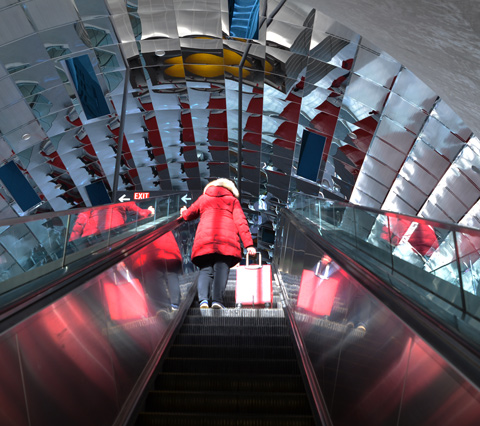
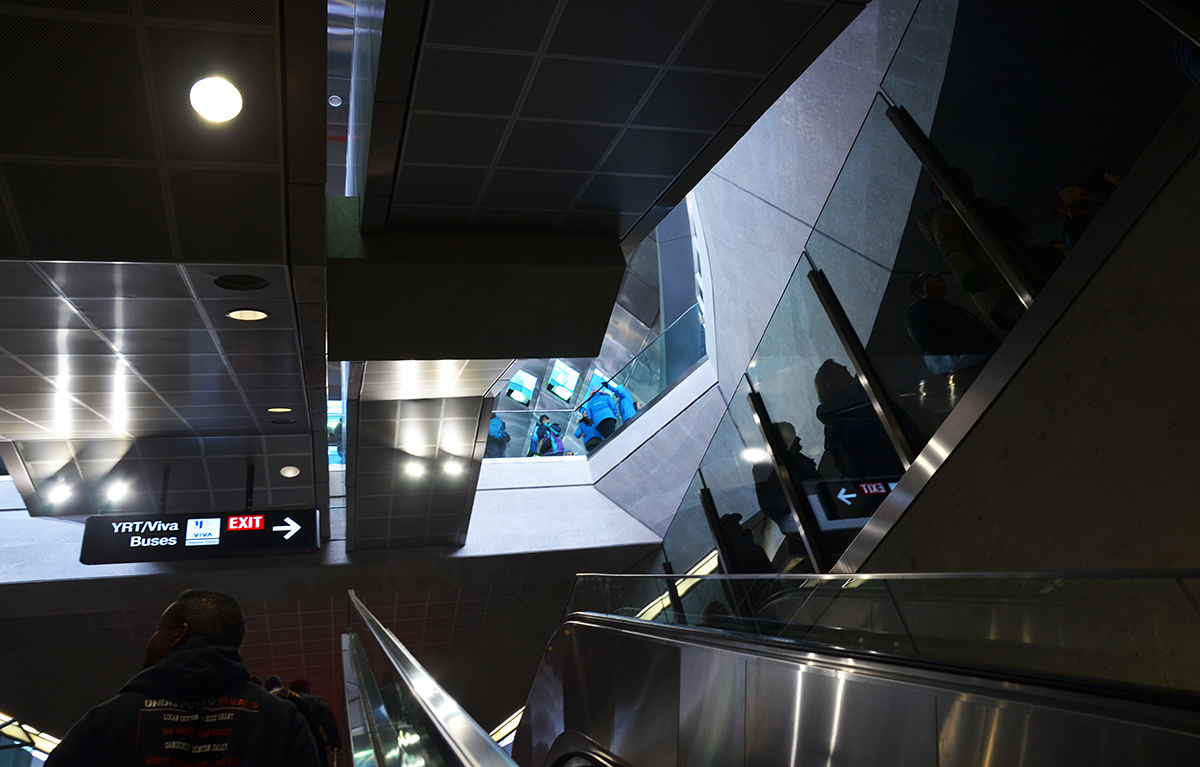
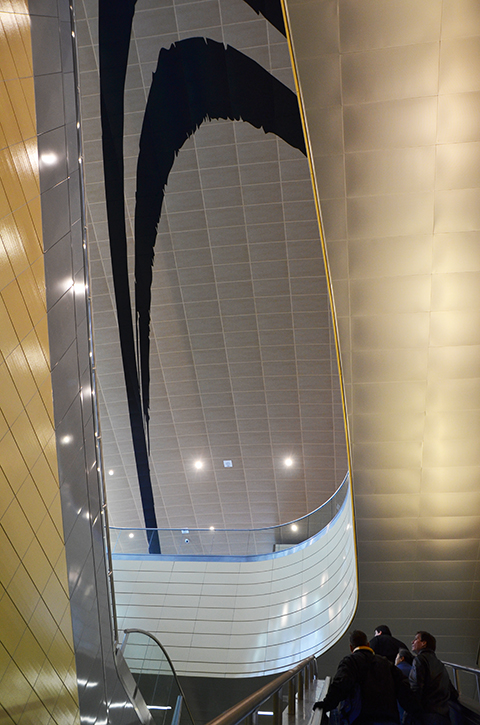
below: ‘Atmospheric Lens’ by Paul Raff Studio is the artwork that is incorporated into the roof of the station.  It features skylights and reflective panels.  The yellow is reflections from a glowing disk mounted on top of the elevator shaft – you can’t actually see the disk, just its reflection.

reflective ceiling of Vaughan subway station, with people going up the escalator towards it, taking pictures.

escalators and shiny walls of Vaughan subway station

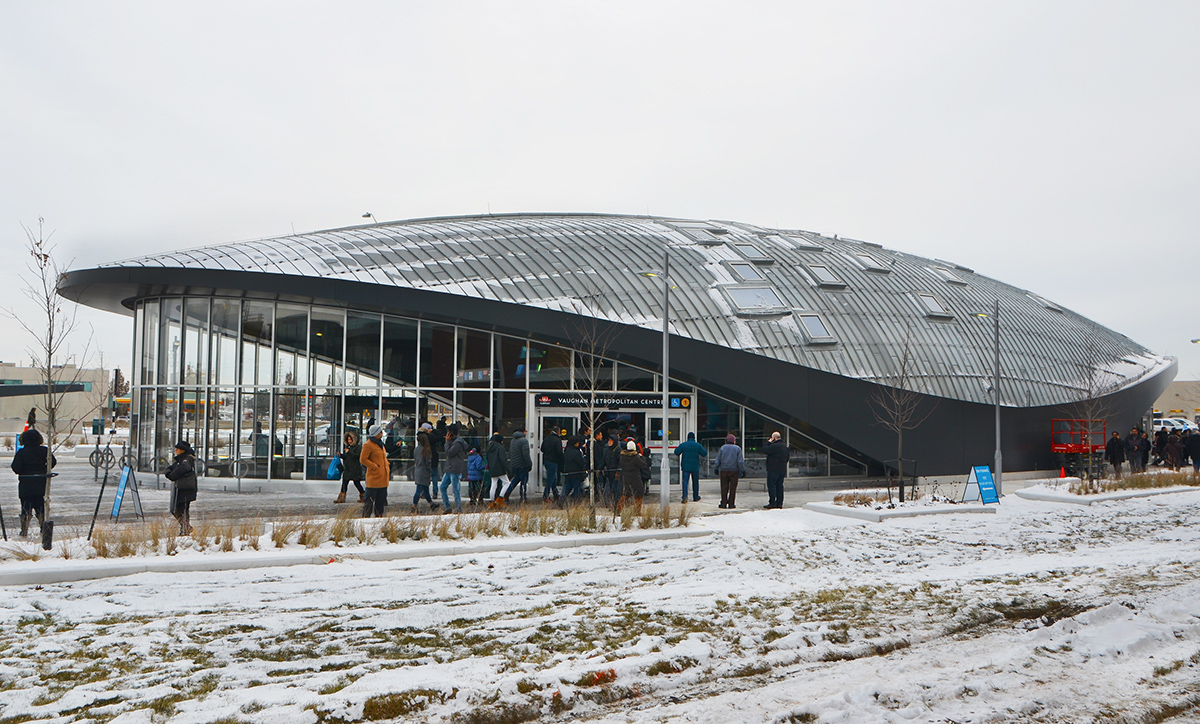
below: Vaughan Metropolitan Centre station, from the outside

exterior view of the dome like Vaughan TTC subway station, some snow on the ground, some people standing around outside the doors.

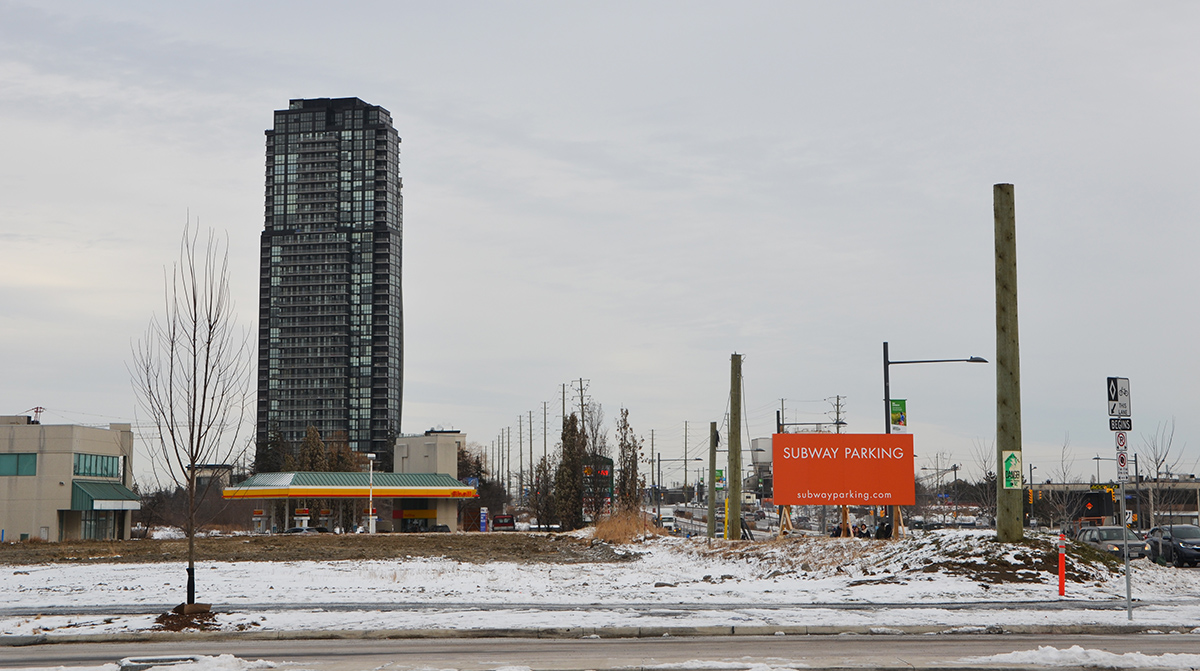
The rest of the ‘metropolitan centre’ needs a bit of work… as does the parking that this orange sign mentions.   I was surprised at how undeveloped that this part of Vaughan is.  This is the view to the east of the station.  On the west there is a development of “big box” stores some of which have just been built.  Smart Vaughan – get the subway and then build around it rather than disrupt an already built city with years of construction and the consequent traffic problems (i.e. building the Eglinton Crosstown link)

suburbia - empty field with orange sign that says Subway parking. one tall building, a gas station, a street,

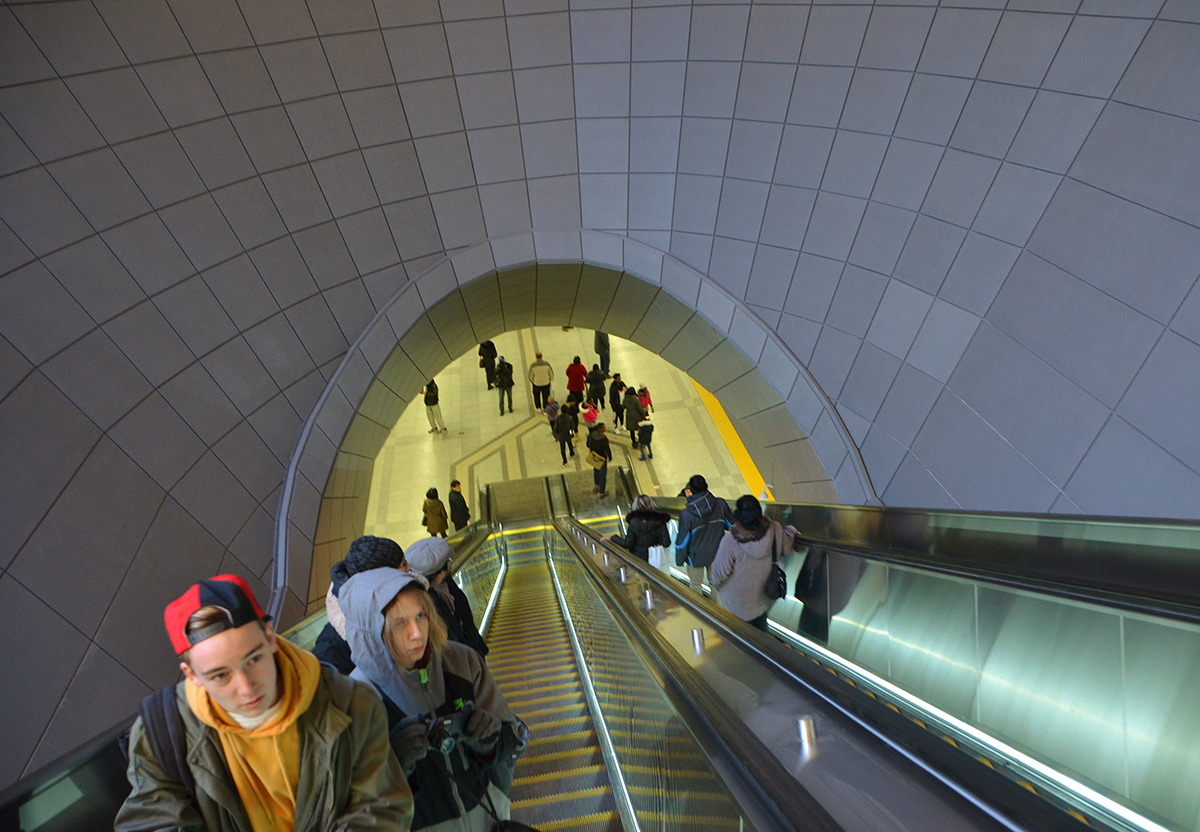
All six stations are quite deep and all six require two escalator rides to get to street level (or you can climb a lot of stairs!… stairs are not always an option though).  There are plenty of elevators.

people on a very long escalator at one of the new TTC subway stations in Toronto

below:  The walls are concrete beside the subway tracks.  Each station has its name on the wall similar to this at Highway 407 station (just south of the 407 at Jane Street).

concrete wall of the subway, with words highway 407 on the wall, at the new Highway 407 subway station TTC

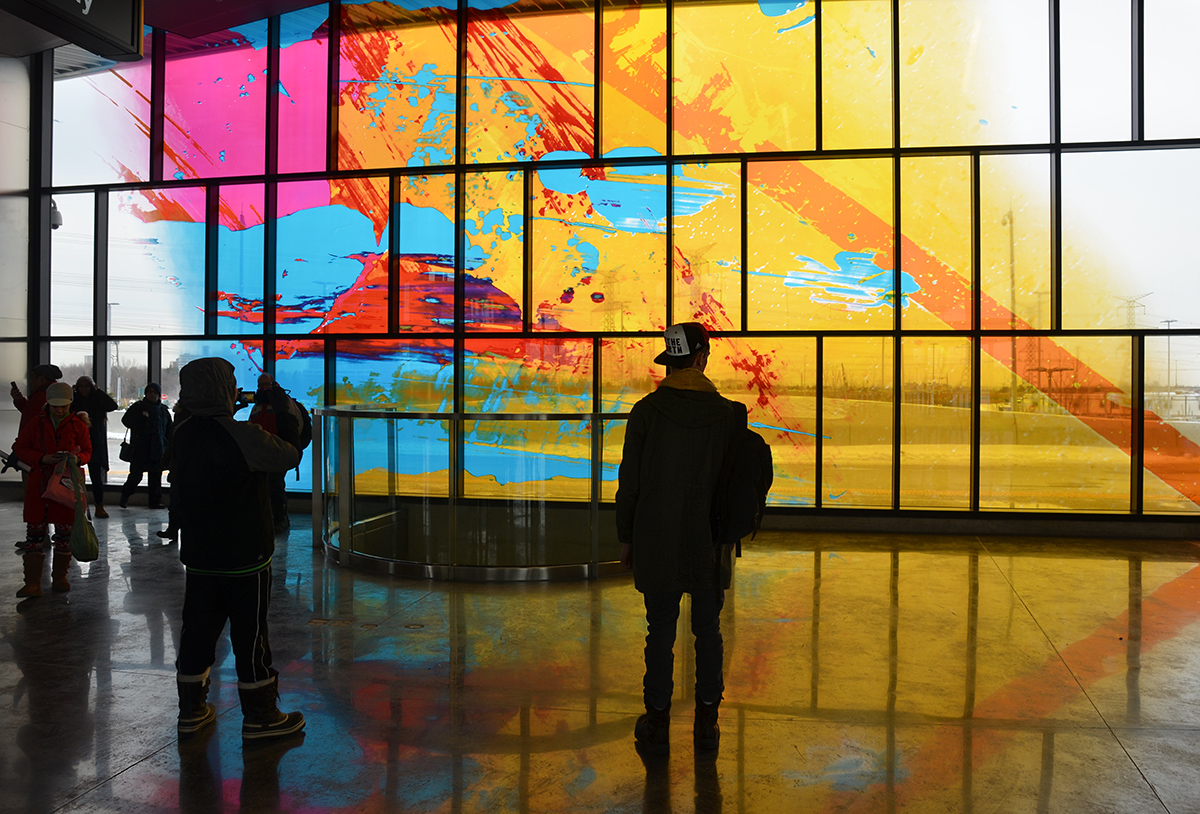
below: A large coloured glass window dominates the area at the top of the escalators (by the bus station) at Highway 407.   This artwork is by David Pearl and is one of two pieces that he did for this station.

people standing and looking at a large painted window, abstract in yellows, turquoise andpink, large window, at subway station, sunlight outside

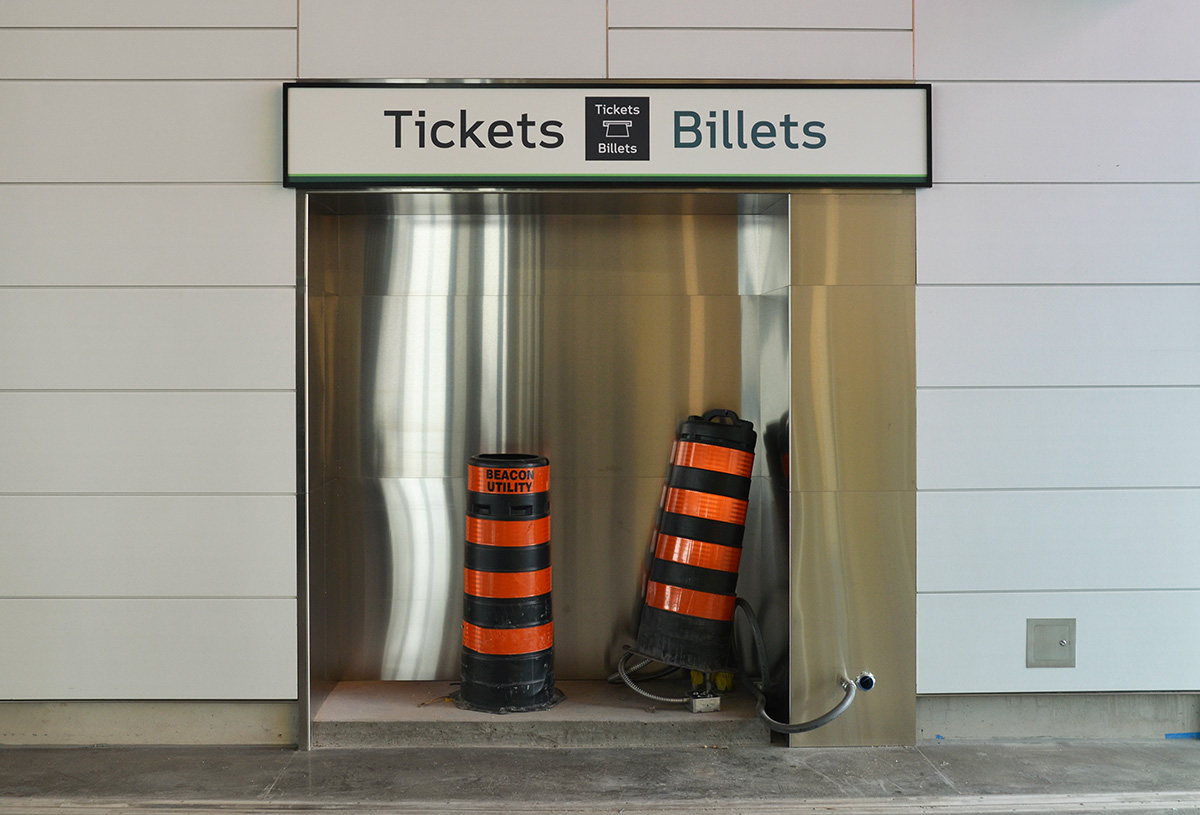
below: Highway 407 has a large GO Transit bus terminal as well.  There is still some work to be done on that part!  The worrisome part of all this is that the two stations at the end of the line are transportation hubs designed to help those commuting into Toronto.  Yes, they funnel even more people into an already overcrowded subway.  Note to the city of Vaughan – please use this as an opportunity to increase the reasons why people would commute north!

unfinished part of the subway station, indent in wall with sign tickets billets but the niche is empty except for two large black and orange striped construction cones

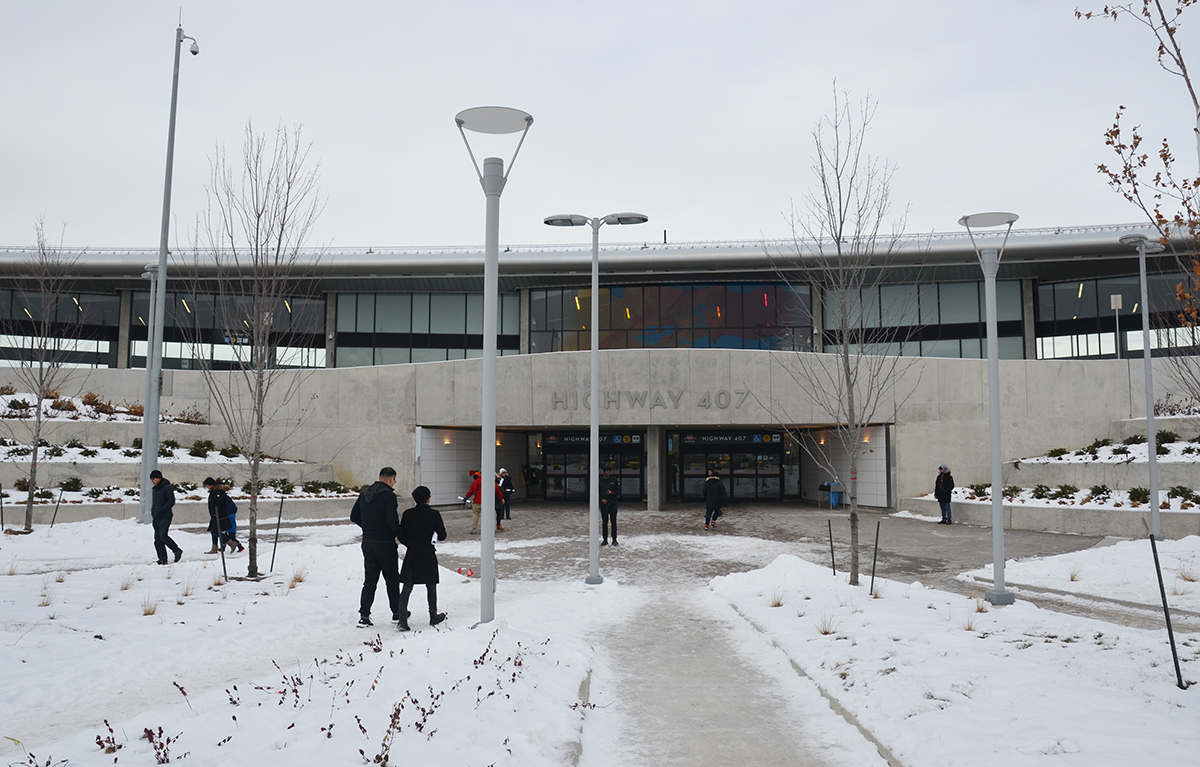
below:  One of the entrances to Highway 407 – the center window is the same as the coloured window above (it looks much better from inside!).  On either side are GO Transit bus terminals.  Behind me when I took the photo is a large parking lot for about 600 cars.   Functional but not necessarily pretty – it may look better from other angles but it was a cold day and it seemed like a long walk to get to the other sides).

people walking towards the entrance to HUghway 407 TYSSE station, a low concrete and glass building.

below: The new bus loop at Pioneer Village Station.  There are actually 2 bus terminals here – one for the TTC and one for YRT buses.   This station is on Steeles between Jane and Keele.   Originally this station was going to be called Steeles West – mercifully the TTC actually showed some creativity and came up with a better name.  All the ‘West’ stations drive me crazy.

exterior at new Pioneer Village TTC subway station at Steeles Ave., new bus loops with wood overhangs, still under construction

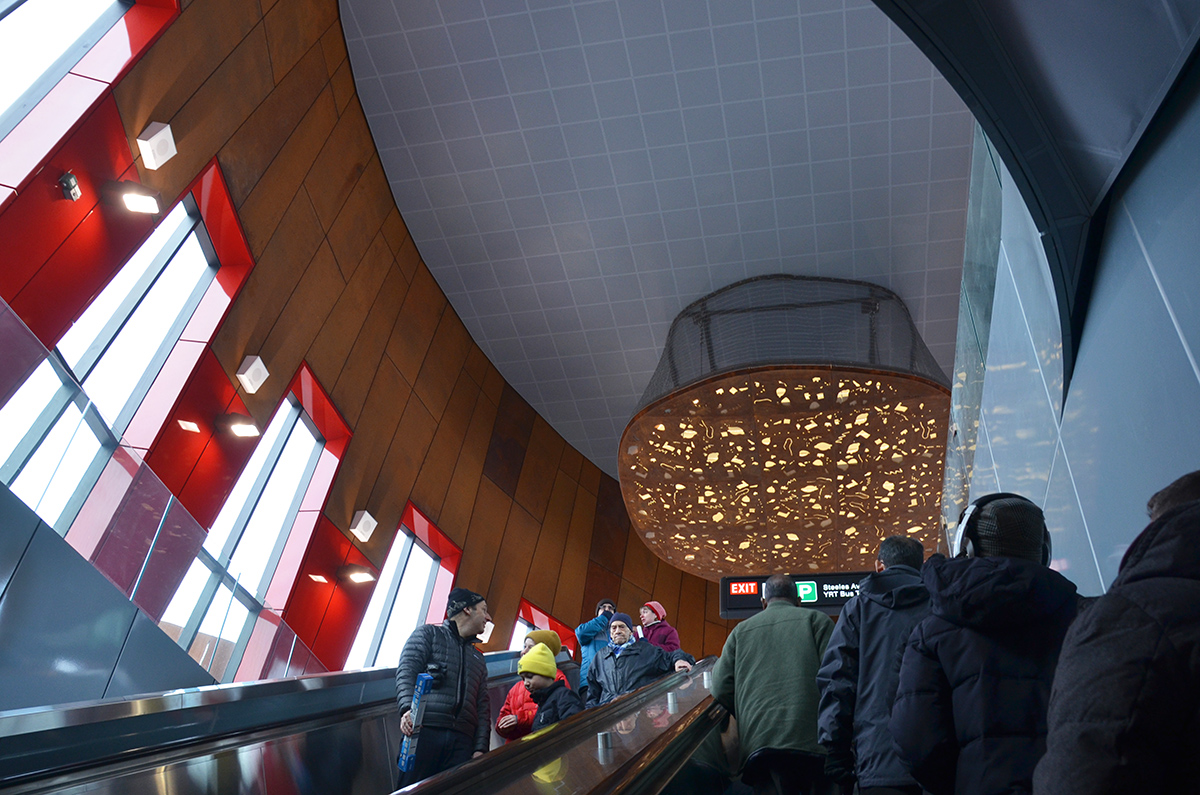
below: Coming up the escalator in the Pioneer Village station towards the large light in the ceiling.   The dominant features of the station are the large vertical windows and the red and wood cladding.   The red and wood are continued to the exterior as well.

interior of Pioneer Village subway station, top of one of the escalators, vertical windows looking outside, some red glass as accents, a large light artwork on the ceiling, people on the escalators

below:  Close up of part of the exterior.

abstract of the exterior walls of Pioneer Village subway station, red panels with wood roof and grey steel beams

below: Looking up into one of the skylights

abstract geometrics, triabngles and diamonds, reflective surfaces in a cone shaped skylight, in blacks and blues,

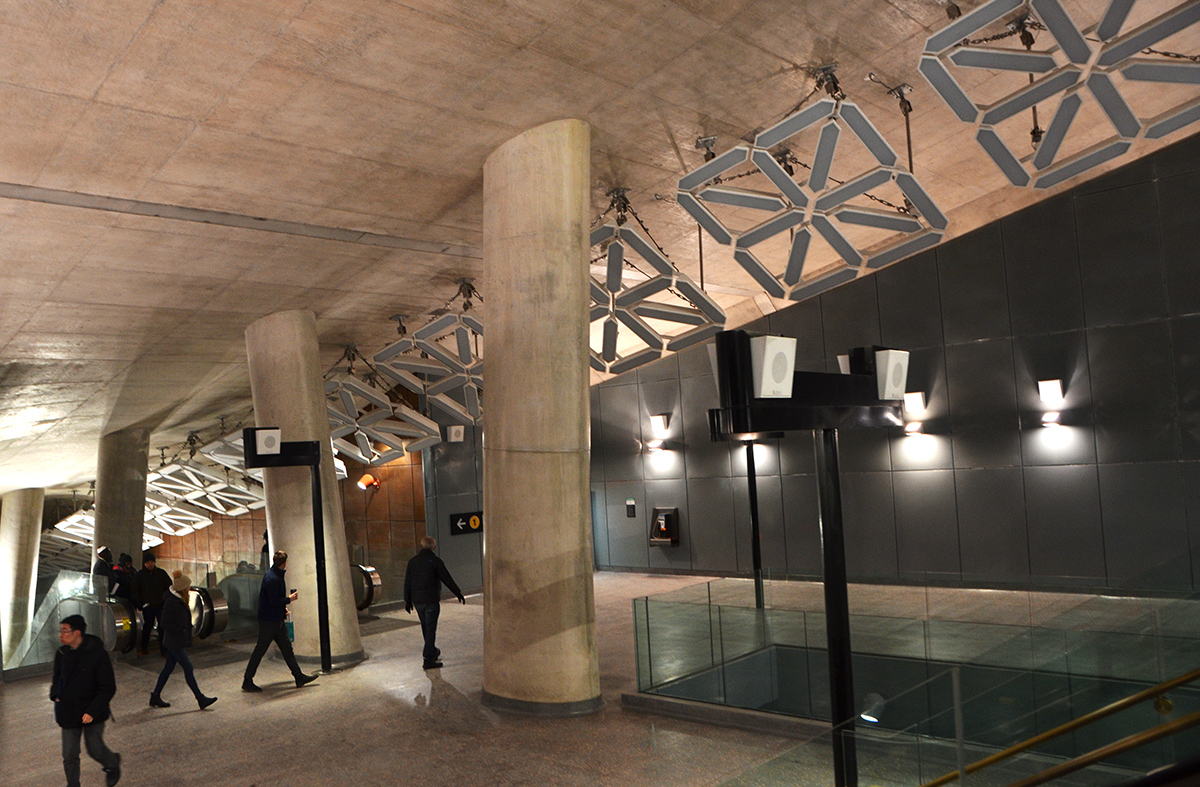
below: The main artwork at Pioneer Village station is “LightSpell” by German artists Tim and Jan Edler.   It’s an interactive installation that also helps provide light in the station.  This photo shows some of the 40 elements that make up the installation. By lighting certain sections of each element, letters of the alphabet can be formed, and in turn, words can be written.   Numbers and other special characters can also be lit.  In addition, the intensity of the light can be automatically controlled to maintain a constant light level in the station.   There are also a lot of speakers on black poles in this area but that is a mystery for another day.

art installation, LightSpell by Jan andTim Edler hangs over th escalator at Pioneer Village TTC subway station,

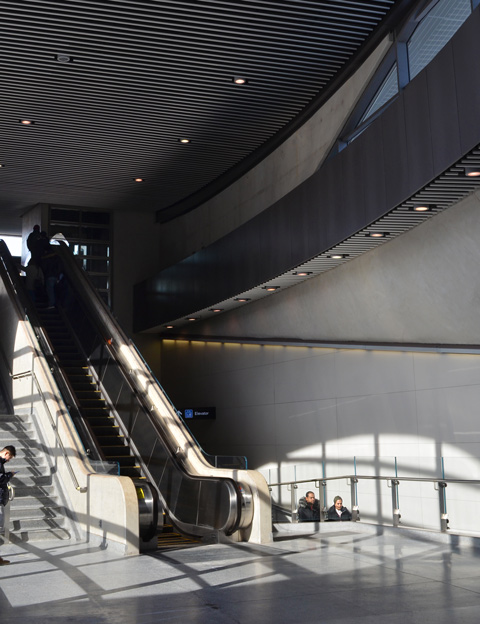
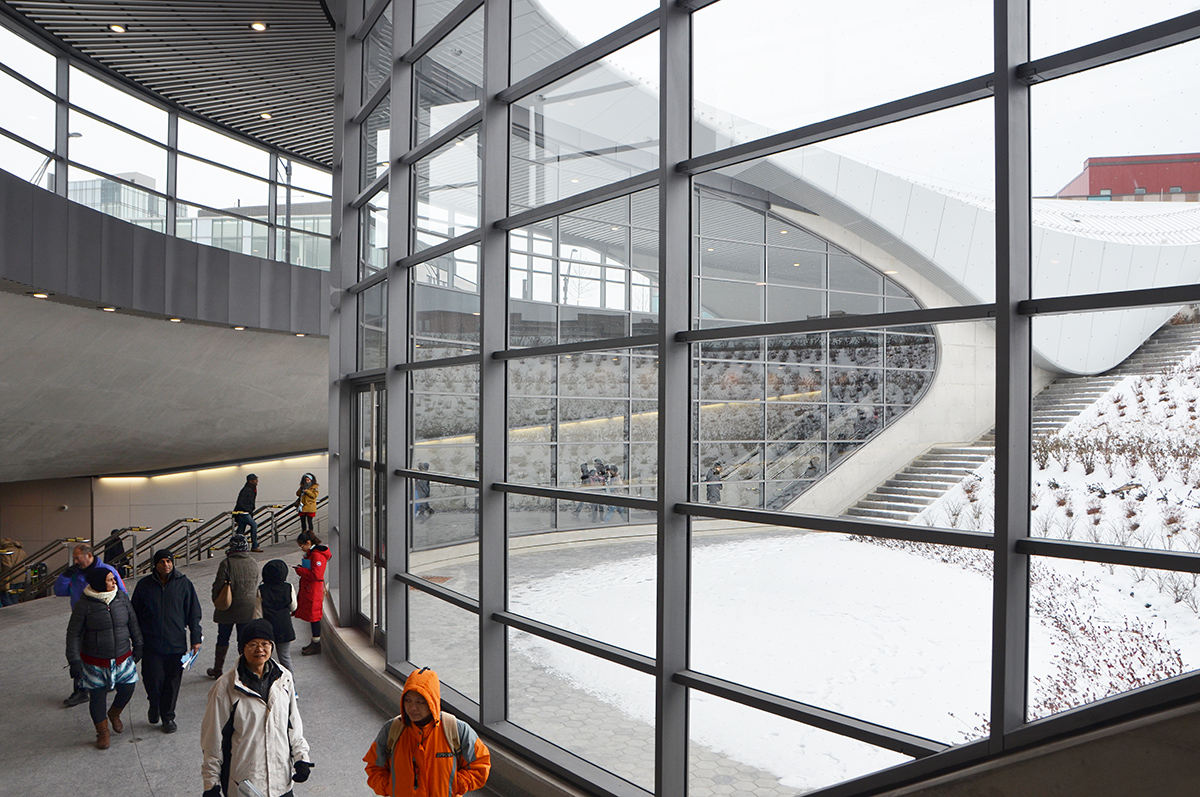
below: Inside York University station which is right on campus.  The stairs and escalators to the trains are in the center.  On both ends of the curved structure are the exits.

large round high window of concourse level of new York University subway station, snow on the ground outside, people inside

looking down the escalator at York University station,

below: At Finch West station there are bright and shiny red hexagonal tiles on many of the interior walls.  (Argh, there’s that ‘west’ again)

shiny red hexagonal shaped tiles line the wall beside an escalator at the new York University subway station on TTC line 1

below: As you go up to street level, you are greeted by a flood of coloured light.

people on an escalator, red hexagonal tiles on the wall beside them, lots of streaks of pink and yellow light above them at the top of the escalator, Finch West subway station TTC, toronto

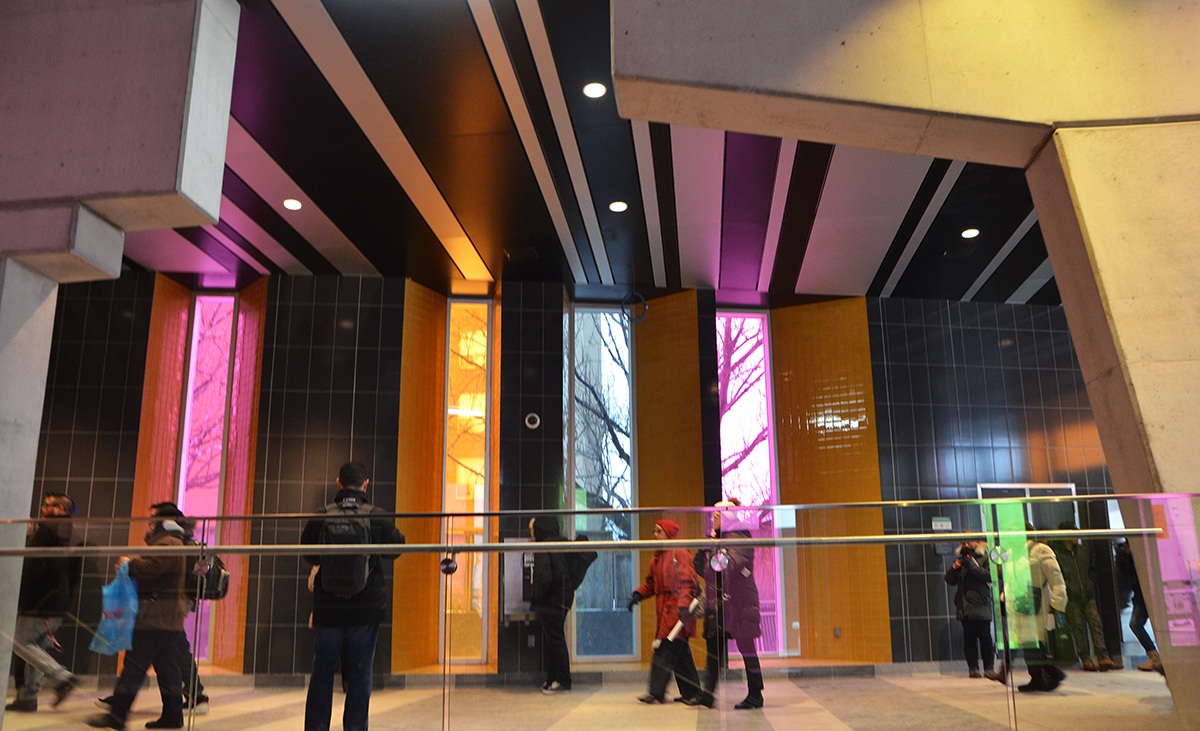
below: The light comes from tall sunlit windows of different colours.  Stripes of grey and white tile on the floor and ceiling add to the slightly surreal effect.

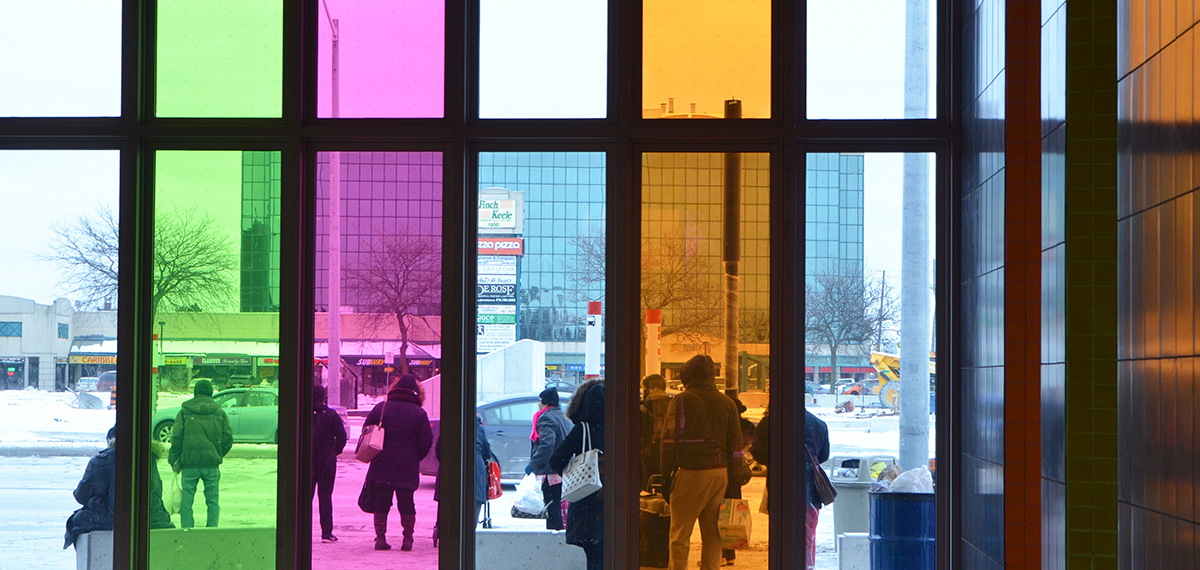
people passing through Finch West station with its tall vertical windows covered in colours, pink, blue and yellow, also with its stripes of white and dark grey tiles
Expect to see many photos taken at this station in the future!  The light and colour makes for some interesting effects.

coloured glass at Finch West station

coloured glass at Finch West station

man standing in front of coloured glass at Finch West station

… and I have probably gotten carried away.  There’s still one more new station so let’s take a look at it – Downsview Park.

below: Looking up…

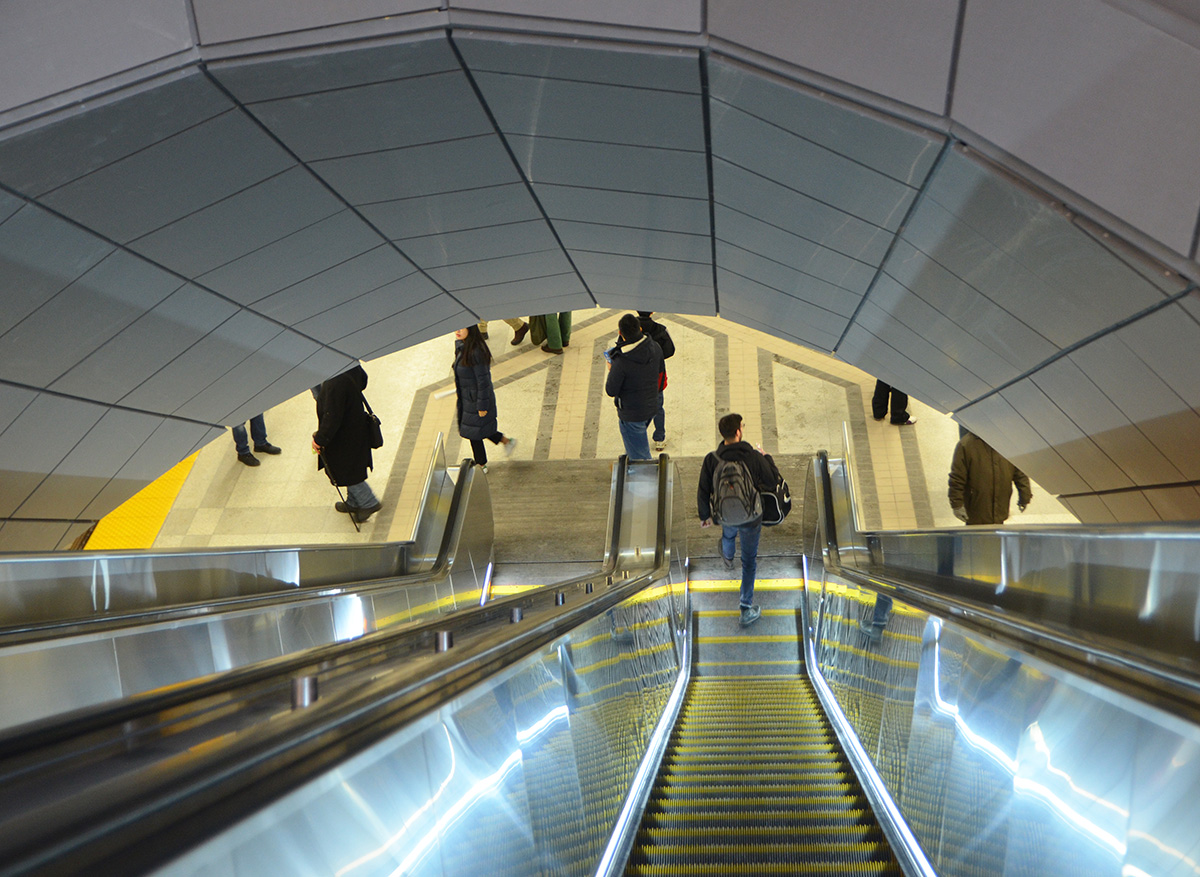
looking up over the heads of some people going up the escalator at Downsview Park subway station

below: … and looking waaaay down at Downsview Park station.

looking down two levels of the new Downsview Park subway station, long escalator and flight of stairs

below: Eventually (soon?) GO trains between Union Station and Barrie will connect with the subway here.   The subway actually runs under the GO railway tracks here.  The street level of Downsview Park station is two halves, one on each side of the GO tracks.


looking out a set of glass doors that is locked closed with a danger sign on the door.   Future GO transit exit at Donwsview Park TTC subway

below: I am going to end with this.  Part observation and part editorializing –  a sign seemingly in the middle of nowhere.  I look at this and think of old pictures I have seen of the Yonge line when it was first built.  It serviced parts of Toronto like Davisville and Summerhill that were of fairly low density but the city and/or province had the foresight to build that far north anyhow.  If you read the TTC websites about these new stations, there is a lot of talk about planning for future development and making that future development transit friendly.  A great idea.  Now, let’s apply that thinking to Scarborough…. and what do you get?  A lot of naysayers with arguments about density.  Grumble grumble oh how poor we are.   And don’t even get me started on Mike Harris and how he cancelled the Eglinton line in 1995.  Twenty two years later we’re building it at extra cost and with extra traffic disruption.  Sigh.

GO Transit and TTC subway sign in the middle of snow covered field

Traces left behind, reminders of the past

oldworn sign painted above the door to a store


Along Spadina on a cold November day – from King to College.

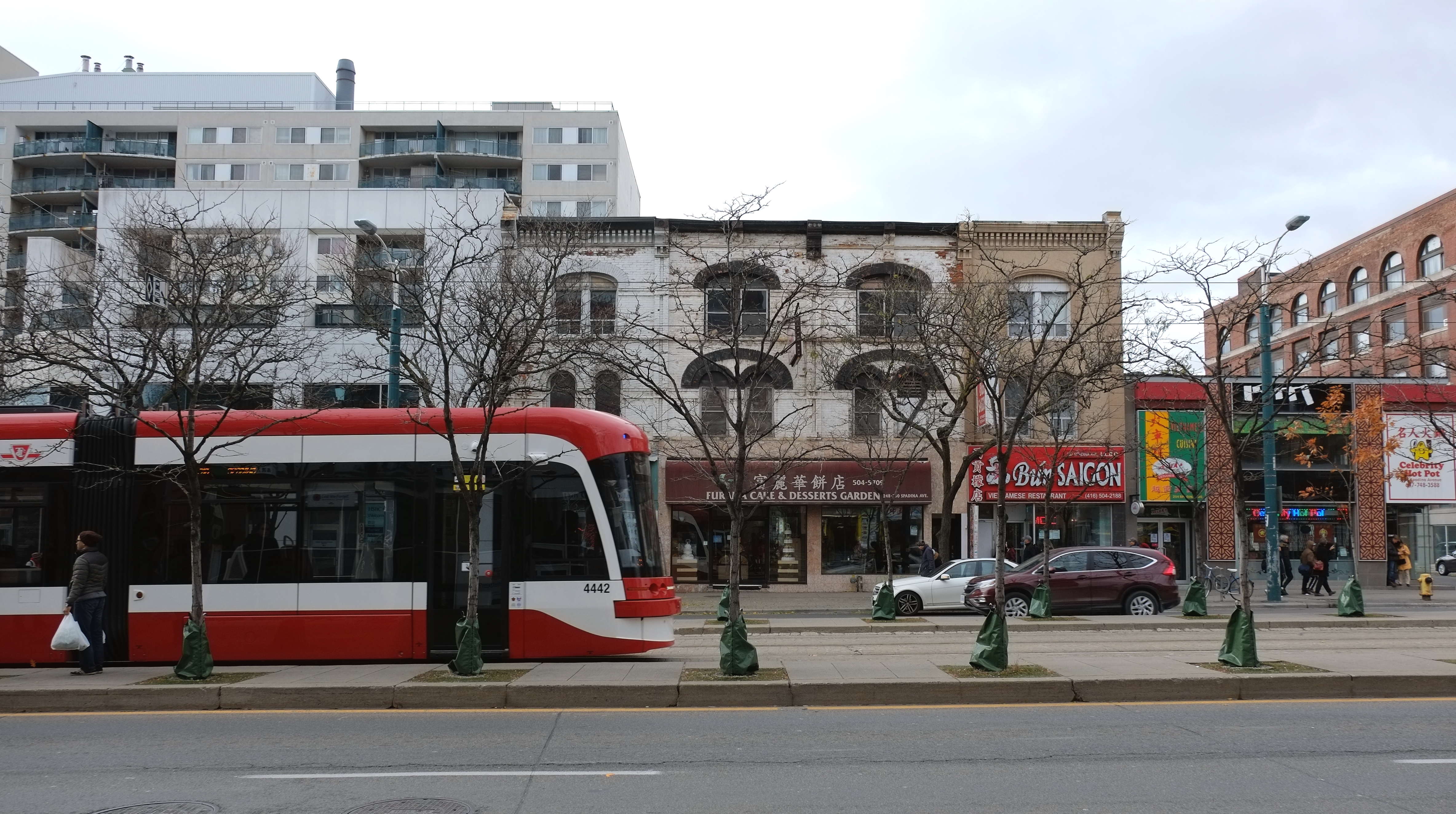
below: A streetcar passes by, down the middle of the road with young trees growing alongside the tracks.  In the background is an old white brick building  with rounded brown arches over the upper windows that now houses the Furama Cake & Dessert Garden – one of the many restaurants, coffee shops and bakeries along this stretch of Spadina.
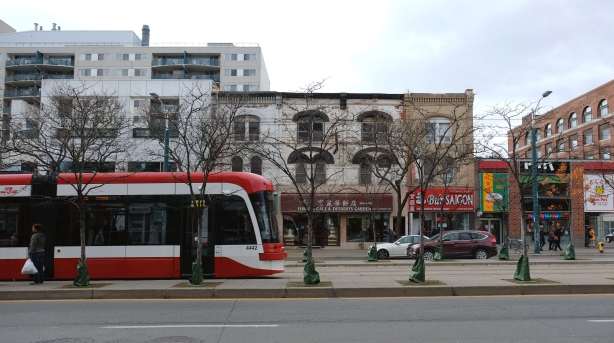
a new ttc streetcar on Spadina, down the middle of the street, with young trees growing along side the tracks, old brck building in the background, some cars,

 Construction of Spadina Avenue began in 1815.  It was always a wide street, running between Bloor and Queen.

Spadina, and neighbouring Kensington market, was the center of Jewish life in Toronto in the early 1900’s with synagogues, delis, tailors, a Yiddish theatre, and more.  About 80% of Toronto’s Jews lived in the area.   It was also home to the garment district (also known as the fashion district) with its numerous furriers, clothing factories and warehouses – what we’d probably call sweat shops today.

below: The northeast corner of Dundas and Spadina, June 1930 showing the sign over the door of ‘The Standard’ a Yiddish theatre that opened in 1921.  It was converted into a (mainstream) cinema in 1934 and renamed ‘The Strand’.   Another renaming occurred in 1941 when it became ‘The Victory’.  Twenty years later it became the Victory Burlesque.  The doors closed permanently in 1975.  Photo found on Bygone Theatre website.
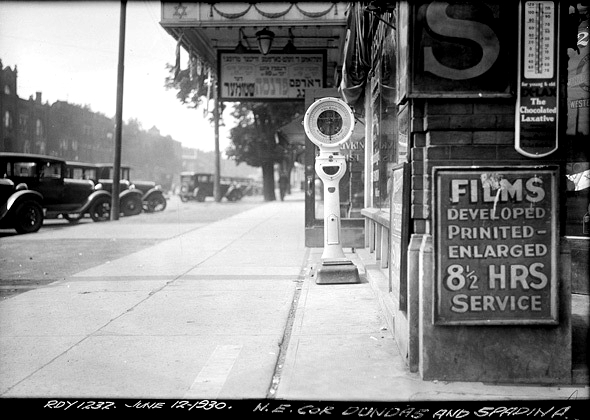
vintage black and white phot of the sidewalk and front of Jewish cinema at the corner of Dundas and Spadina in 1930. old cars parked in front,

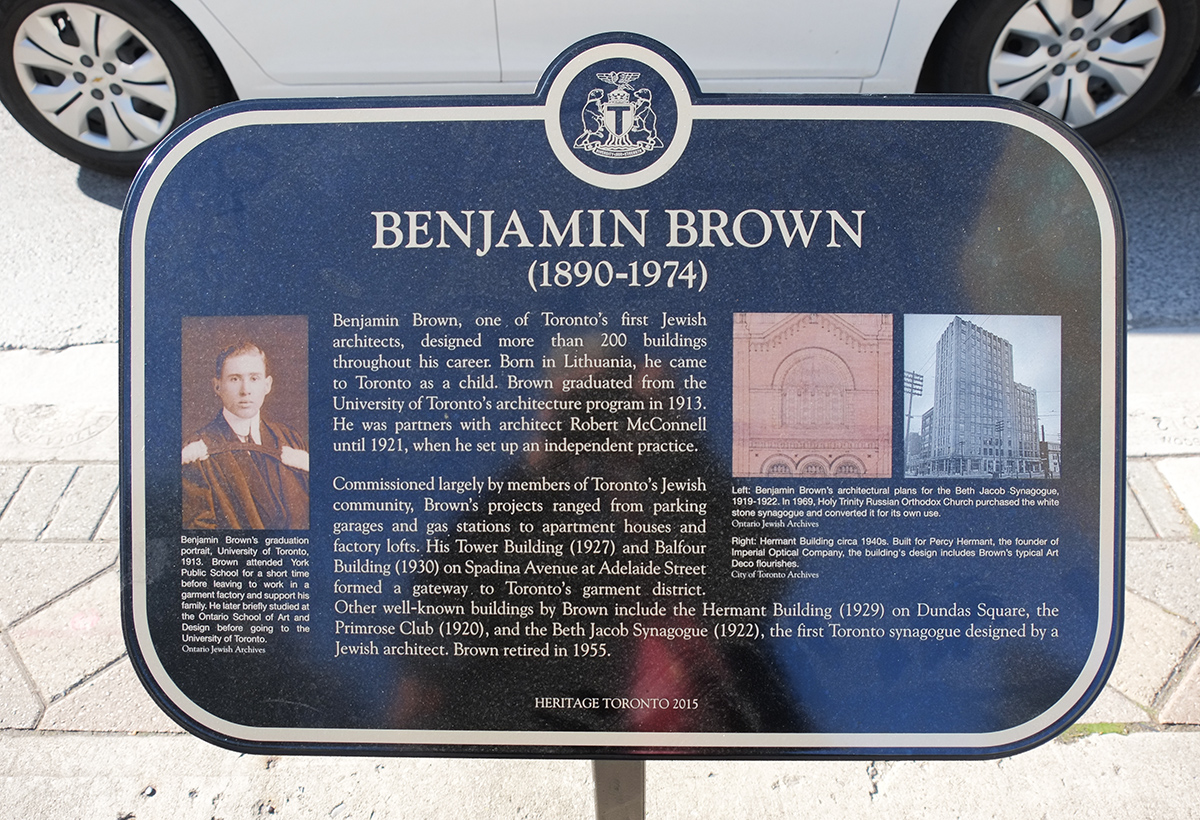
below: This plaque is on the west side of Spadina, just north of King Street.  It describes the contributions of Benjamin Brown (1890-1974), architect, to the area.

Benjamin Brown, one of Toronto’s first Jewish architects, designed more than 200 buildings throughout his career.  Born in Lithuania, he came to Canada as a child.  Brown graduated from the University of Toronto’s architecture program in 1913.  He was partners with architect Robert McConnell until 1921, when he set up an independent practice.

Commissioned largely by members of Toronto’s Jewish community, Brown’s projects ranged from parking garages and gas stations to apartment houses and factory lofts.   His Tower Building (1927) and Balfour Building (1930) on Spadina Avenue at Adelaide Street formed a gateway to Toronto’s garment district.  Other well known buildings by Brown include the Hermant Building (1929 on Dundas Square, the Primrose Club (1920) and the Beth Jacob Synagogue (1922), the first Toronto synagogue designed by a Jewish architect.  Brown retired in 1955.

toronto historic sites plaque to benjamin brown

Both the Tower Building and the Balfour Building still stand.  The later, pictured on the plaque is on the NE corner of Spadina & Adelaide.  It was named for Arthur J. Balfour, British statesman, the author of the 1917 Balfour Declaration that pledged British support for a Jewish homeland in Palestine.

below:  This is ‘Uniform Measure/Stack’ by Stephen Cruise and it includes that giant thimble on a stack of buttons,  a few button shaped tree planters, and a tape measure carved into the sidewalk as it goes around the corner (you can see a bit of it at the bottom right of the photo).  This tribute to the garment district, or rag trade if you want to call it that,  dates back to 1997.   A few years ago the tape measure was painted yellow – but not by the artist.  It has since been cleaned up.  Recent sidewalk work has scarred the tape measure but most of it remains intact.

public art on the corner of Richmond and Spadina, giant thimble and giant buttons

below: Another piece of garment district history – an old Singer sewing machine as an ornament above a narrow alley between two buildings.
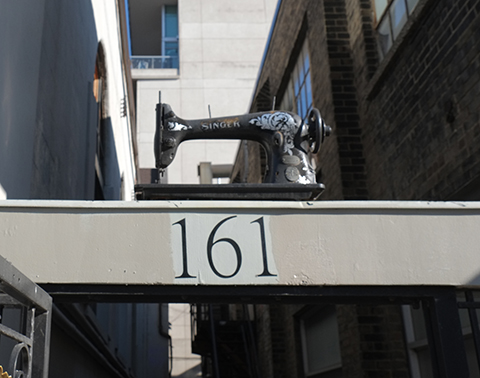
an old SInger sewing machine sits on a beam that crosses a small alley bewteen two buildings, it's about 8 feet above the street level

In the 1960s and 70s, the Jewish population moved out and the Chinese moved in.  In keeping with the changes that were occurring on Spadina, The Victory was sold in 1975 and subdivided  into shops on the main floor and a Chinese language cinema upstairs, first named the Golden Harvest and then the Mandarin. This cinema closed in 1994.

In the late 60s and early 70s, the city demolished a large section of land to make way for the new city hall.  At that time, Chinatown was centered around Dundas and Elizabeth streets.  Many of the Chinese who were displaced by the construction moved west along Dundas to Spadina.  Although many of the Chinese businesses and residents have moved north to Markham & vicinity, this stretch of Spadina is still considered to be Chinatown.

below: A panda eating bamboo, painted by Murals by Marg with support from Chinatown BIA & StreetARToronto.

mural on a wall of a panda bear sitting on the ground and chewing on bamboo

below: Another Chinese themed mural, with tags unfortunately.

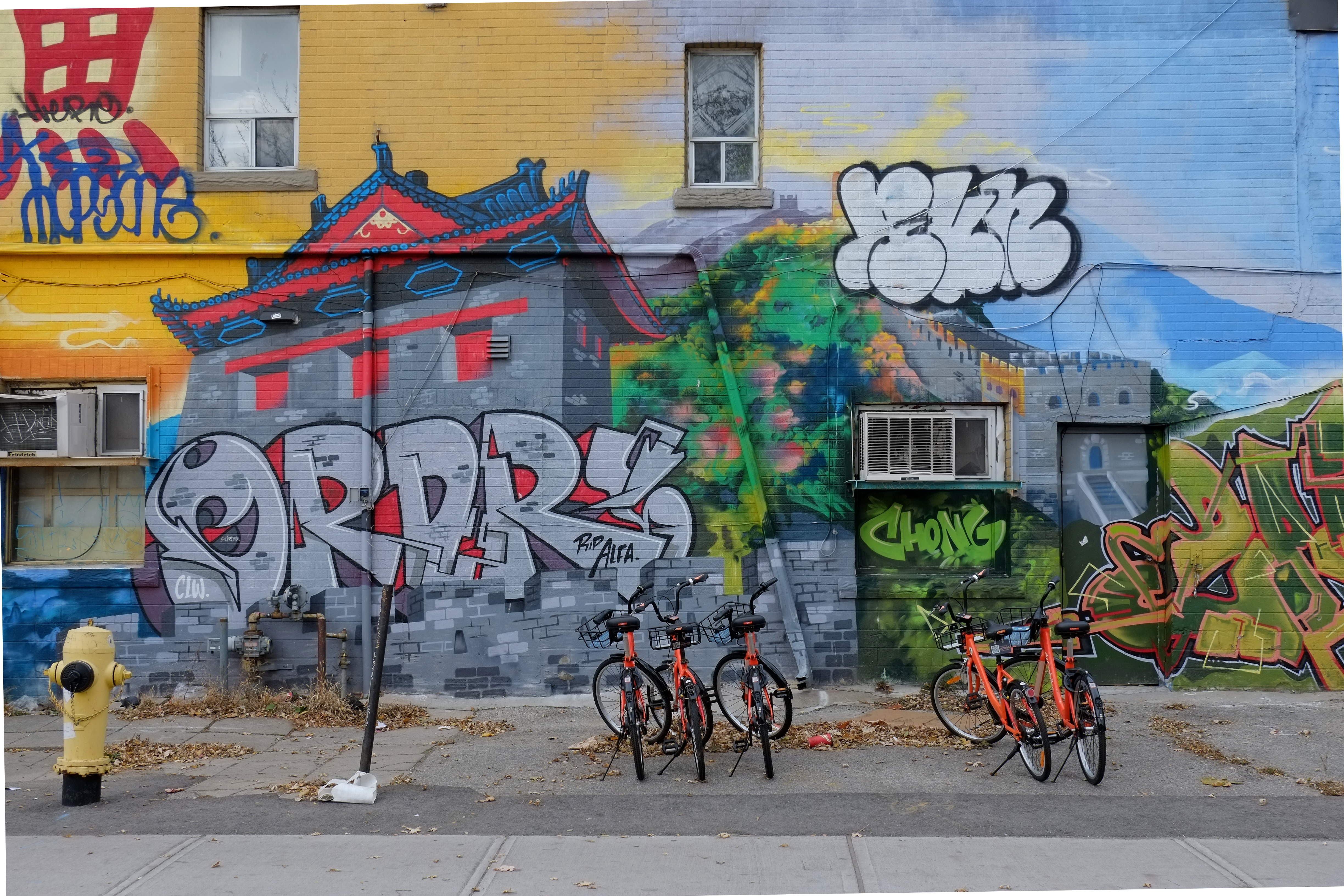
orange bikes parked outside a building that had a mural of a Chinese scene that has been tagged over.

below: This caught my attention – Does it look like fresh ginger?   And no, there was nothing in front of the sign either.  Smile.

box of pineapples for sale outside a Chinese grocery store, the sign by the box says fresh ginger

below: Even on cold days you can buy fruits and vegetables on the sidewalk outside the Chinese grocery stores.
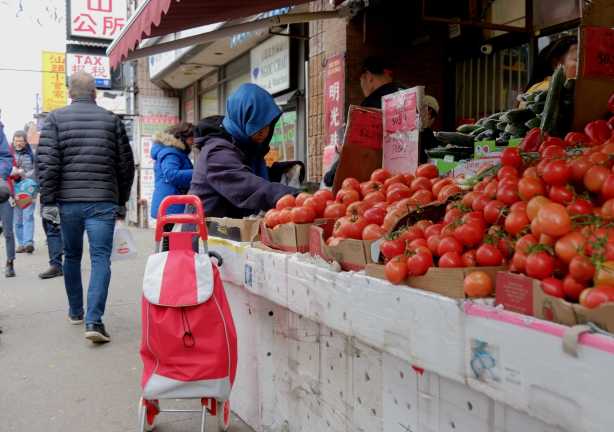
a woman is buying tomatos from a vendor with a large table of tomatoes outside a Chinese grocery store on Spadina, in CHinatown.

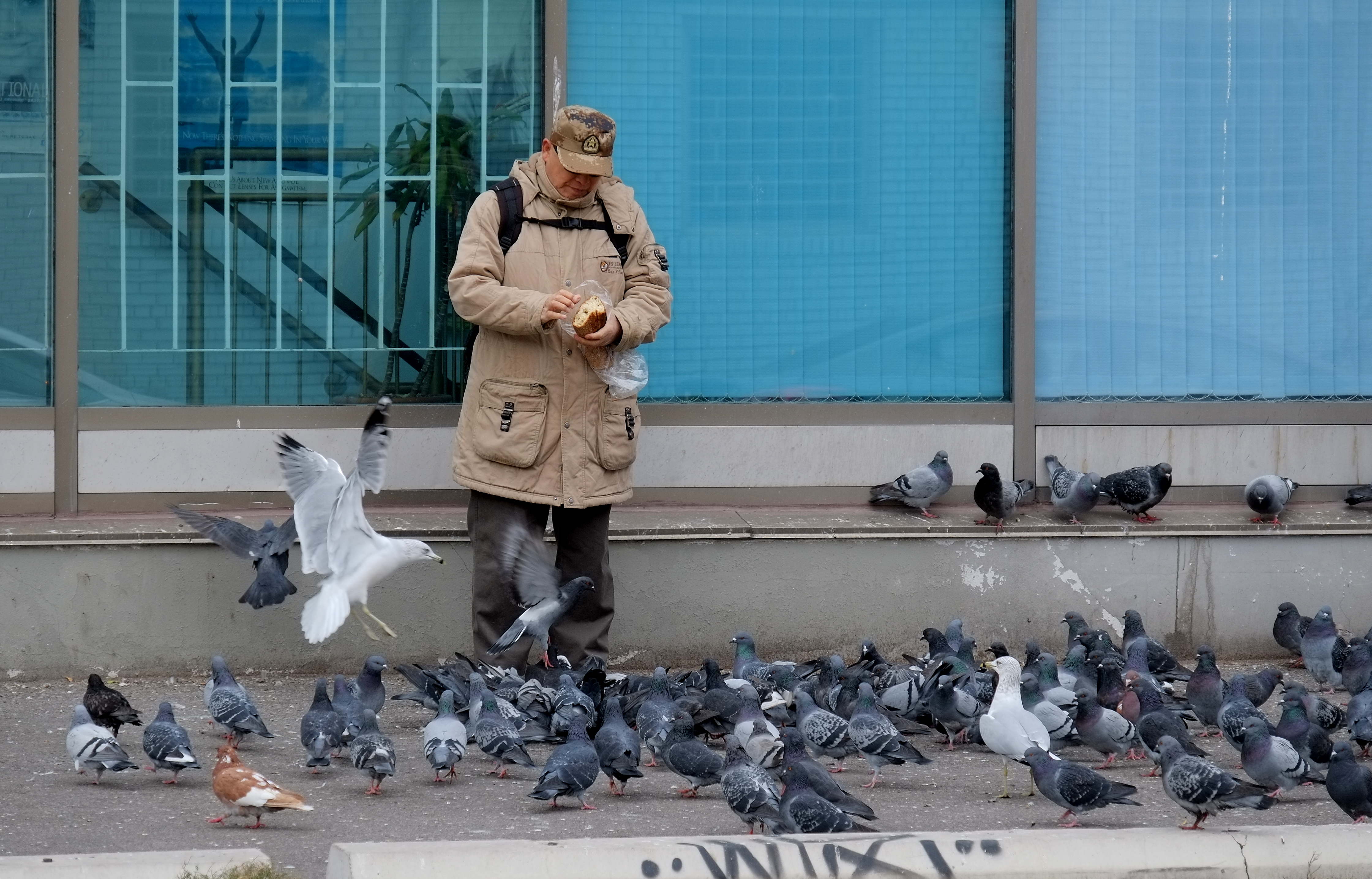
below: Feeding the pigeons.

a man is feeding pigeons outside on a cold day. He is wearing a heavy coat and a hat.

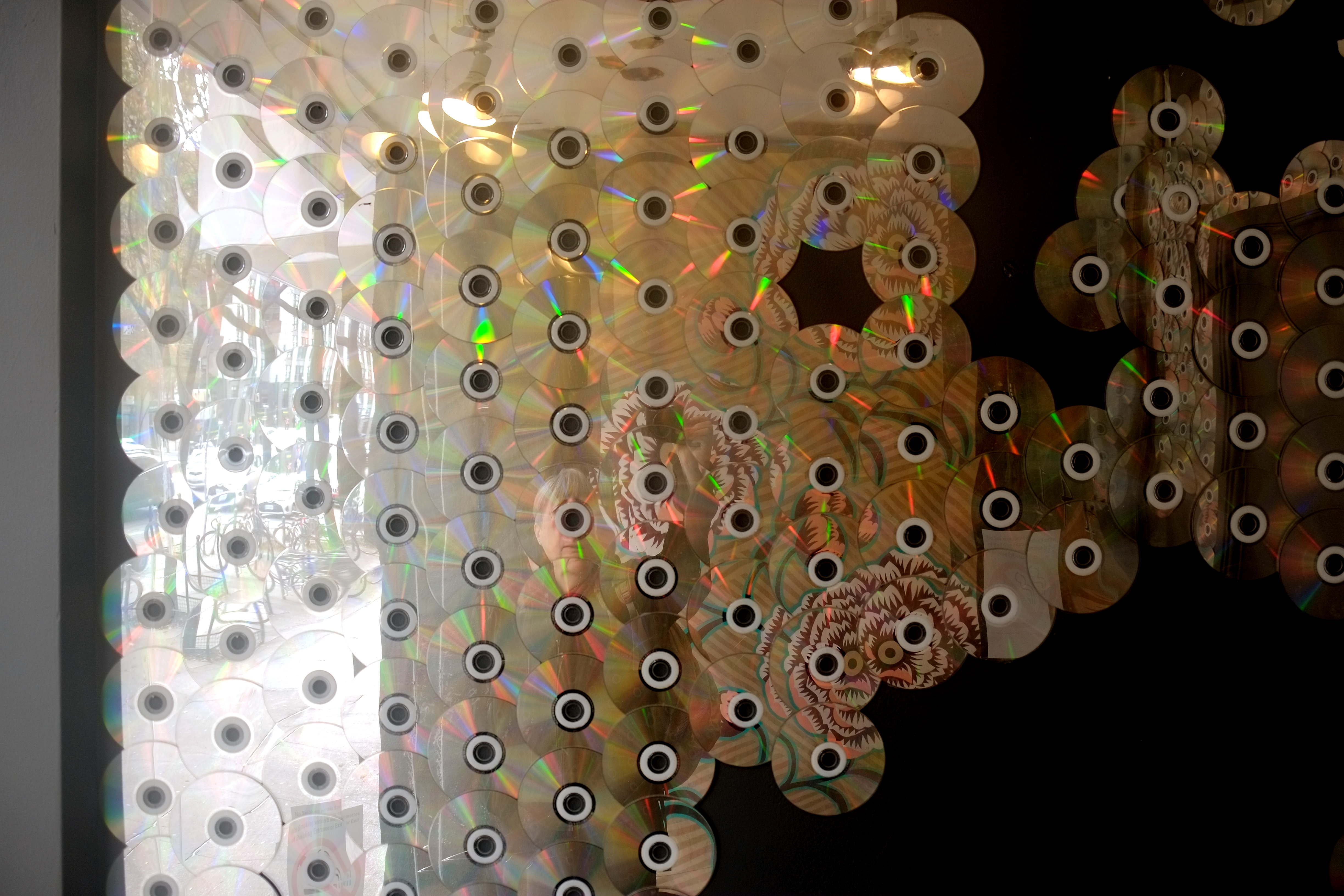
below:  This is an old display of CD’s mounted on a wall inside a window of an empty store.  The window is dirty but if you step into the recess of the entrance way, you can see the possibility of reflection, light and colour playing together.   This was actually the first picture that I took when I walked up Spadina the other day.   After I saw this window I started paying closer attention to other empty stores.
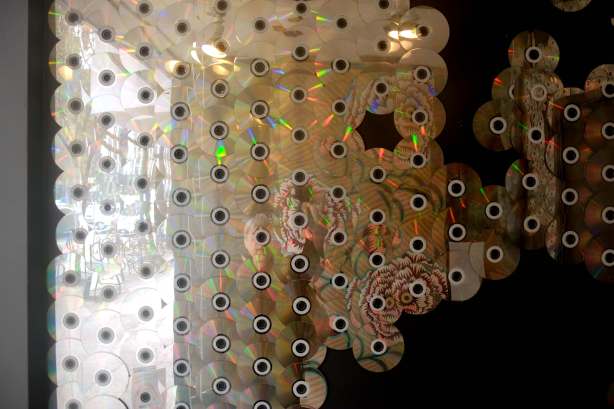
design and pattern made with many old CD's mounted on a wall inside the window of an empty store.

There are quite a few empty stores and sections of Spadina are quite grubby looking.  As I mentioned above, many of the Chinese businesses have move on and once again the area is the middle of a change.

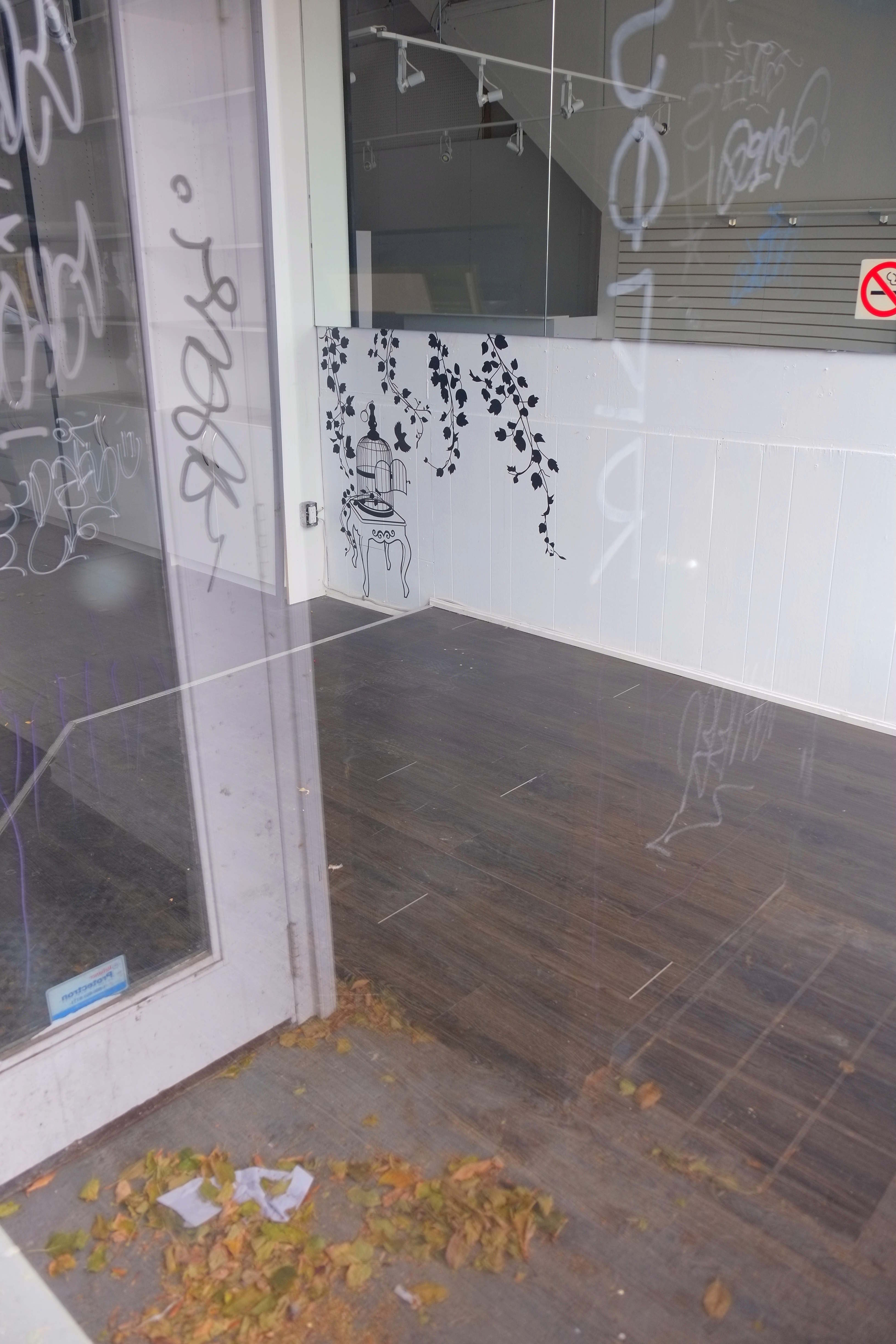
below: Someone cared enough to paint this delicate birdcage and ivy scene on the wall.  Doesn’t it make you wonder who did it?  and why?  and what happened to them?

looking through a window into an abandoned and empty store, leaves have blown in and are on the floor.

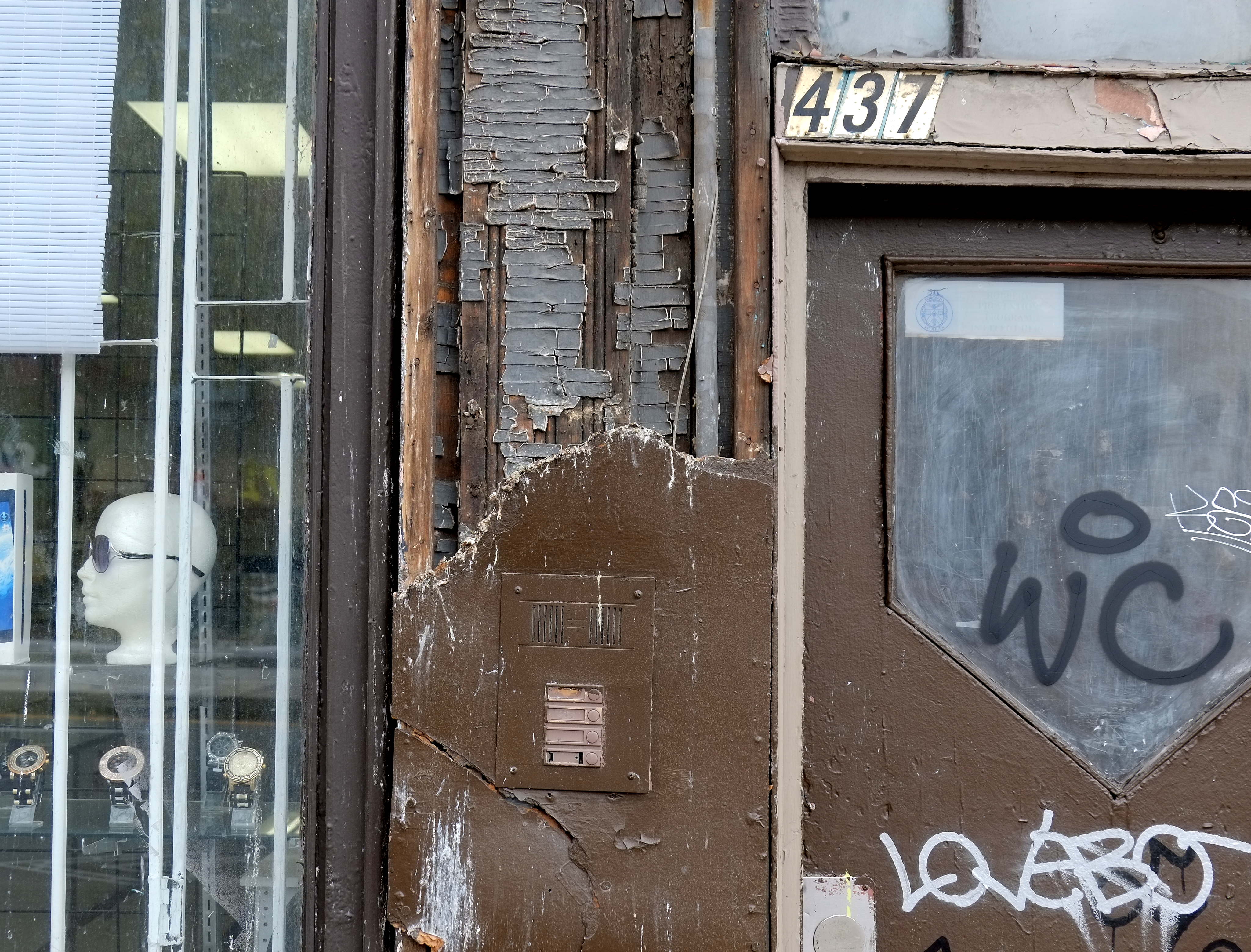
below: A painted over intercom –  a remnant of the past.  But the plywood that the intercom was mounted on is partially torn away to reveal an even older, more hidden, past.     Does anyone live or work at 437 anymore?  What lies behind the door?
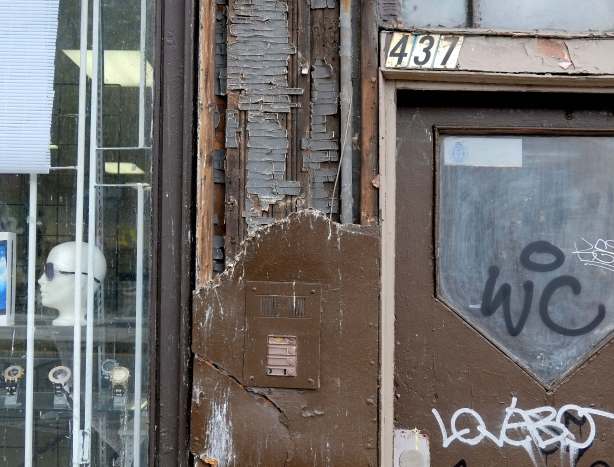
exterior wall, brown paint, number of 437 above the door, cracked wood plywood beside the door, old and broken intercom system that has been painted over, next door window is a store, with mannequin head on a shelf

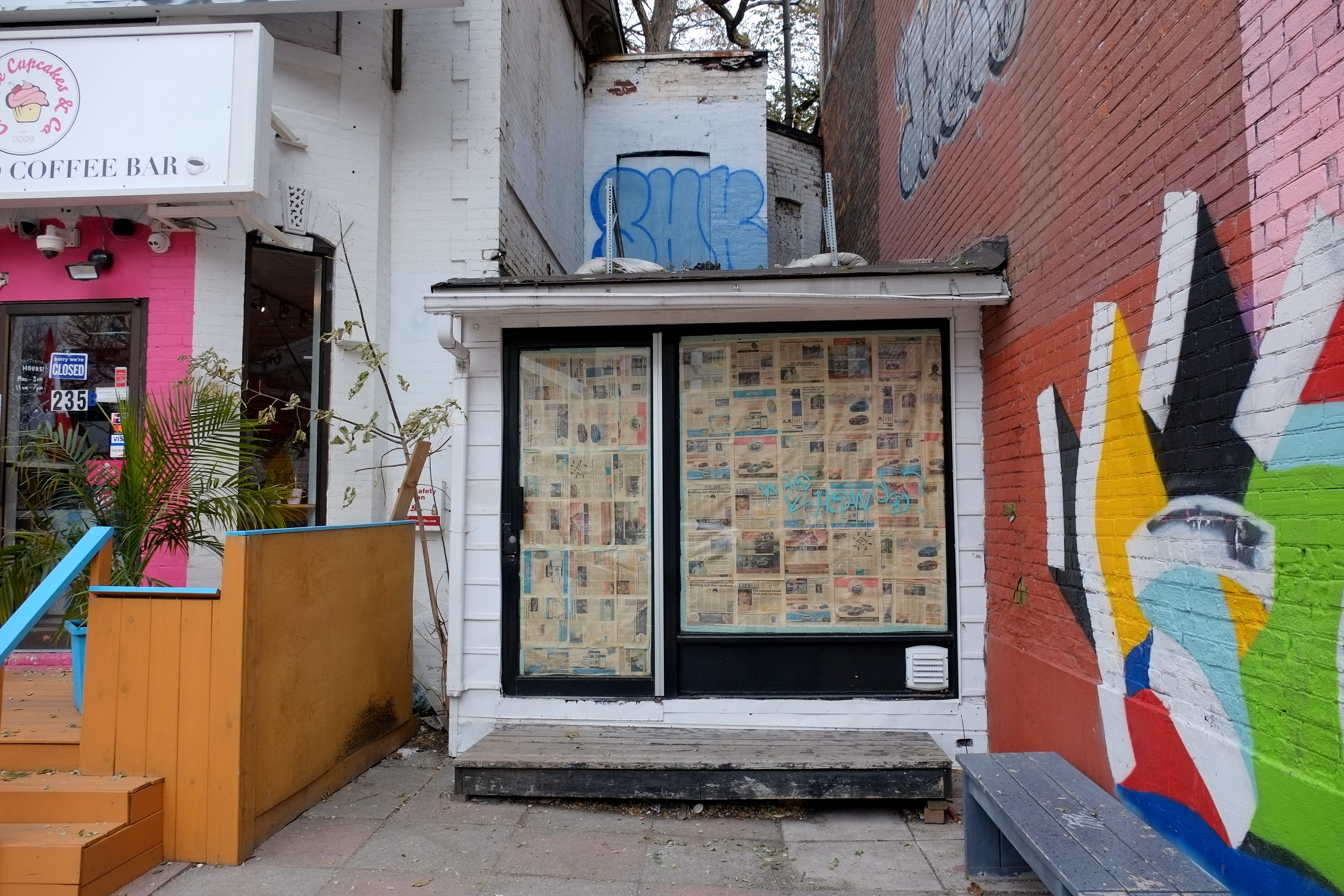
below: This little place had a short life as a store – but for the life of me I can’t remember what it was.   I think that once upon a time it was an 8 Eleven (play on 7 Eleven stores) but that was long ago and I know that it closed before I first saw this space.    How easy it is to forget.

very small building with door and window papered over.

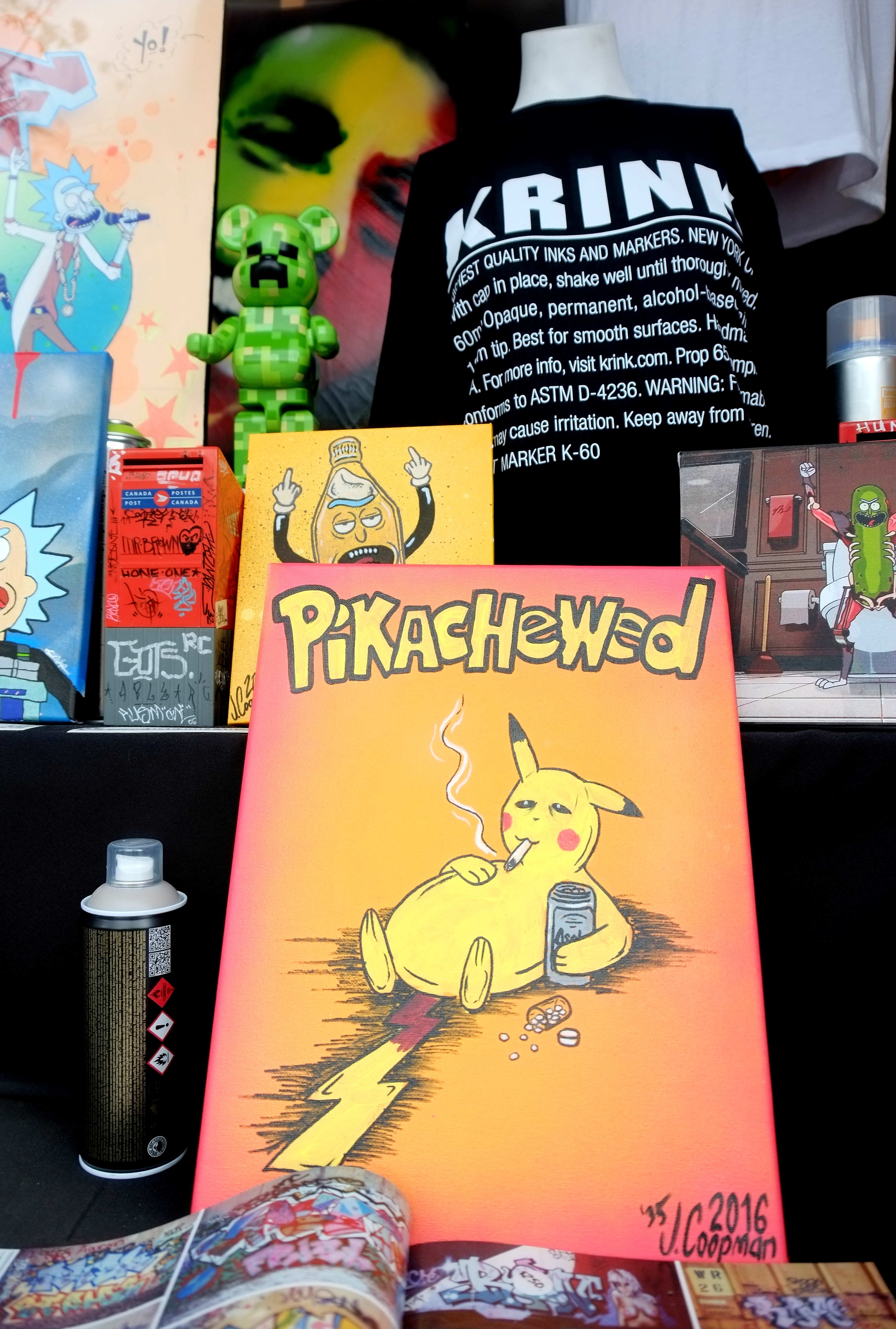
below:  As I passed by this window, I thought to myself “How cute, pikachu.”  Then I stopped and went back.  No, not pikachu.  Part of the seedier side of Spadina Avenue.

articles for sale in the window of a store

below:  Layers.  On the left, hoardings around an old building being demolished and on the right, a staid brick building.  Behind them is a newer development with its bright east wall.

street scene, Kensington, with hoardings for demolition, a building from the70's and a newer apartment building in the background with bright coloured squares on the side.
cracked brick wall and decorative carving, on upper storey of an old building

a pair of Bell telephone boxeswith a grey wall behind