Archive for the ‘public art’ Category

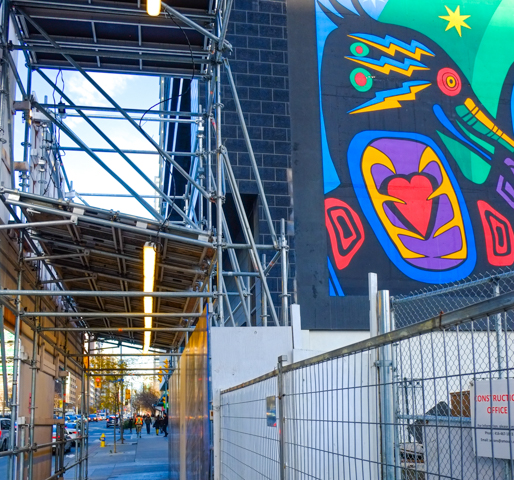
Sometimes there are silver linings when buildings get demolished.  Until recently, this wonderful mural was difficult to get a good look at.  Now that there is a vacant lot next door I was able to get a much better picture of it.

The Original family, a mural by Philip Cote based on indigenous Anishinaabe creation story, thurnderbird, man, woman, moon, animals,

The title of the mural is “The Original Family” and it is based on an Anishinaabe creation story.  The artist, Philip Cote, has been telling Anishinaabe stories through his mural painting for at least twenty years, including a series of images on the concrete supports of a bridge at Old Mill subway station (see Spirit Stories Under Old Mill in this blog).

scaffolding and hoardings beside a vacant lot where a building has just been demolished, large mural on the other side of the fence, by Philip Cote, Original family,

The Grand Hotel was demolished to make room for a 68 storey skinny tower (on a larger base – i.e. the lower floors will be bigger, podium-like).  No facades to save here.  Once construction starts on this new building, the mural will become partially obscured again.


scaffolding and hoardings by a construction site, end of mural above hoardings, thunderbird in first nations style painting


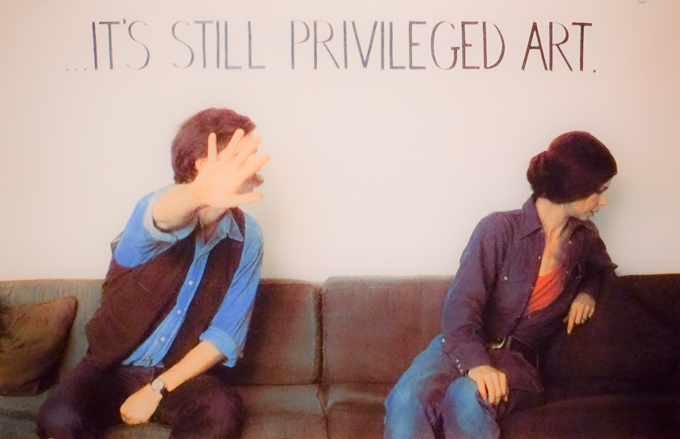
a photograph from 1975, colour, couple sitting on old couch, words on white wall behind them that say it's still privileged art, woman is leaning away from man, head turned away too, man has his hand up toward camera

Photo taken of a picture on an art gallery wall. The original was taken by Carole Conde and Karl Beveridge in 1975 as part of a series titled “It’s Still Privileged Art”. Now it is part of a retrospective exhibit of the artists’ work at A Space Gallery at 401 Richmond West.

Is art privileged? What does that mean? I hadn’t meant to get philosophical when I planned a “Downtown Art Hunt” walk.  Put the question aside for a bit and let the ideas simmer in the back of your head.  Instead we’ll wander around downtown Toronto and see what we can find.

below: I wasn’t looking for Taylor Swift but she’s difficult to avoid these days.

sign on wall of Union station, TTC subway station, at platform level, says to Taylor Swift, with an arrow pointing left

below: It’s hardly art but it’s probably better than grey concrete.  Better still would be to get rid of these Jersey barriers that line Front Street in front of Union Station.  They are a temporary solution that is fast becoming a permanent installation.   “aaniin boozhoo” is Anishinaabemowin (also known as Ojibwe) and is a greeting.  (UPDATE – 25 Nov:  I just read that these barriers are being removed this week!!  Maybe complaints do get action!!).

concrete barriers outside union station that have been painted in bright colours with words,

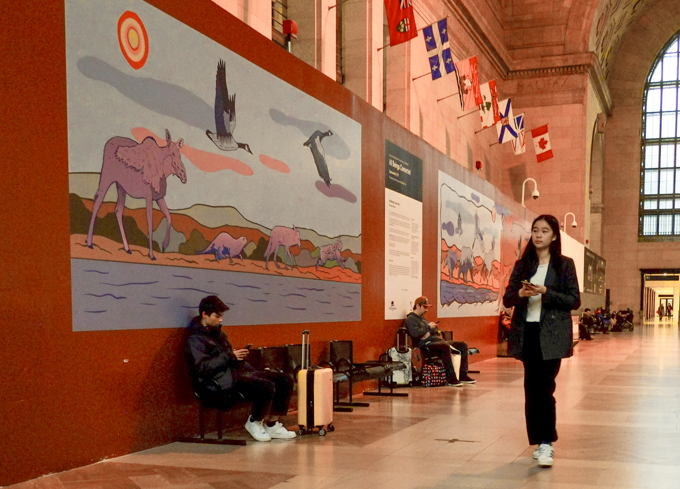
below: “All Beings Connected” by August Swinson in the Main Hall of Union Station.

a young woman walks past large artworks on the walls of the main hall in union station, title of art is All beings connected and the artist is August Swinson

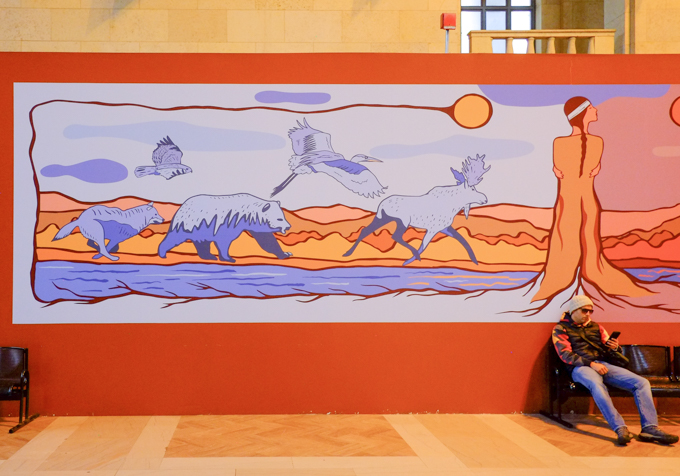
below: The figure in the image is rooted to the ground, drawing their strength from the earth beneath, connected to the life around.

a young man sits in front of a large artwork on the walls of the main hall in union station, title of art is All beings connected and the artist is August Swinson

The West Wing of Union Station connects the main building to the walkway to the UP Express or to the Skywalk that leads to the CN Tower and vicinity.  A lot of people pass by here.  At the moment there are two art exhibits, both of which are part of “Precarious Joys”.  This is the name given to a collection of art exhibits around the city,  the Toronto Biennial 2024 (which ends December 1st).

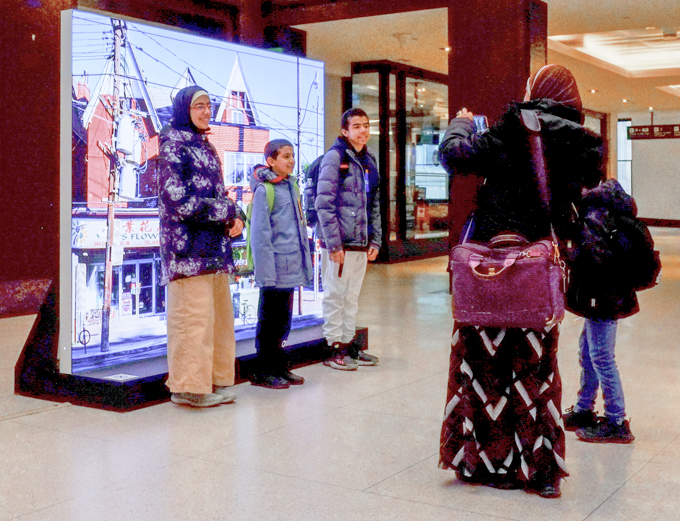
below: Using art as a backdrop to a family photo.  the Tong Yan Gaai (Chinatown) series by Morris Lum

a family stops in front of an art piece at union station, mother is taking a picture of three kids standing in front of it

2 people in winter clothing looking at large illuminated images of interiors of buildings in chinatown, by morris lum, at union station,

below: Nicholas Galanin, part of “Threat Return” 2023

artwork on display at west wing of union station, with people and suitcases walking past. Nicholas Galanin sculptures

below:  “Mycelium” is the name of this network of lights designed by artist Nicholas Baier.  In biology, mycelium refers to a root-like structure of a fungus that consists of a network of thin fungal strands called hyphae.  In Toronto, it is found on the Bay Street bridge that connects Scotiabank Arena with CIBC Square and the GO Bus Station.

two young women stand beside an illuminated artwork, mycelium, by Nicholas Baier, in pedestrian bridge over Bay street

below: Because the walls of the Bay Street bridge are glass, “Mycelium” is also visible from the outside.

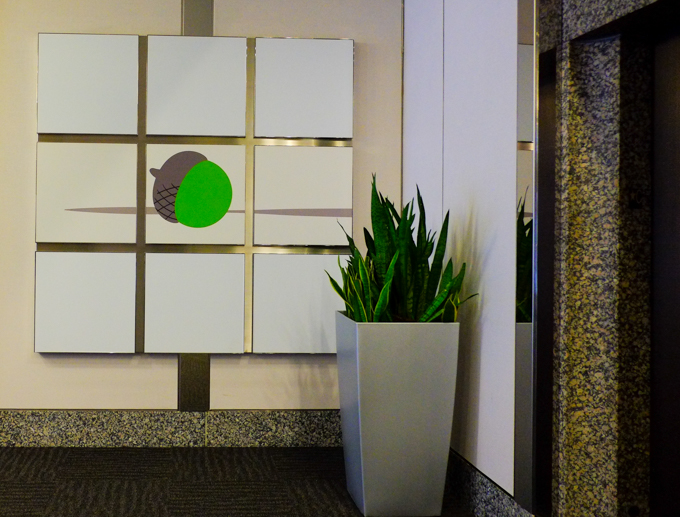
below: A green acorn.  From little acorns…..  There was a picture and a planter beside the elevator in this lobby.  Nothing more. A small austere space but someone cared enough to hanging a painting of an acorn.

below: Tucked away in a corner where it’s often overlooked is “Pi” by Evan Penny (1996).  A man’s head has been cut into four pieces, disconnected, and left sitting on the ground. I have walked past here many times and not noticed it.

weathered bronze sculpture of upper part of man's face

below: It’s art, but it’s also a place to sit.

weathered bronze sculpture of lower part of man's face

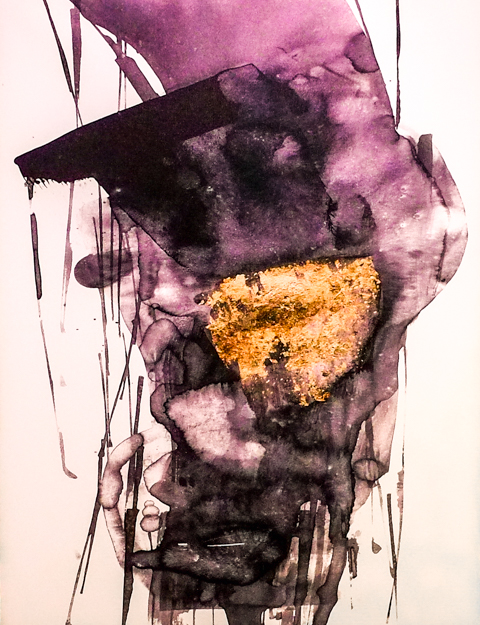
below: Another painting on a wall in a quiet lobby.  No signs.  Abstract, but it reminds me of two faces smushed together.  One of the faces has a mouth and chin made of crushed shredded wheat. He, or she, is wearing a black mask.  What else does it look like to you?

abstract painting in mostly purple and black on white

below: More lobby displays.  One of a group of paintings by John Eric Laford (1954-2021), an Ojibway artist from Manitoulin Island.

inuit style painting by john laford, gallery

below:  Mama elephant is still leading her two little ones behind Commerce Court.

elephant sculpture behind Commerce Court

below: If the elephant could see, this would be her view.  I am not sure it’s art, but the white light trees that come out around Commerce Court at Christmas time are now up.

open area behind commerce court west, old Commerce Court building, newer skyscrapers, a tree made of lights, white lights, as Christmas decoration in in the space

In same square (does it have a name?  Or is it just Commerce Court?), is an art gallery, Collision Gallery.  They are one of the locations featuring art from the Toronto Biennial.

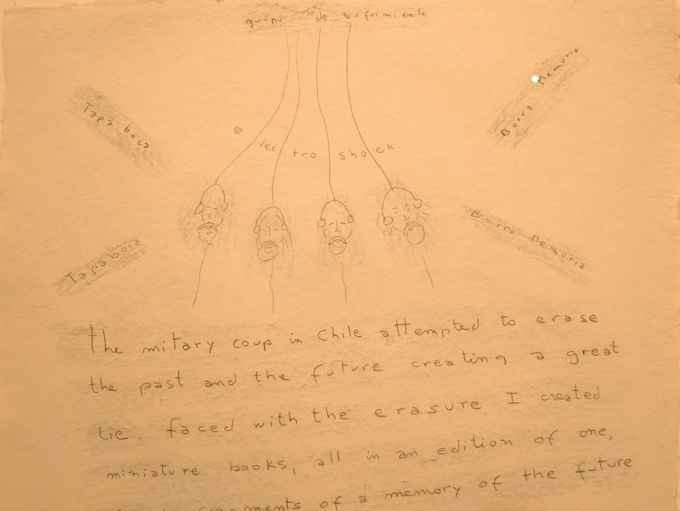
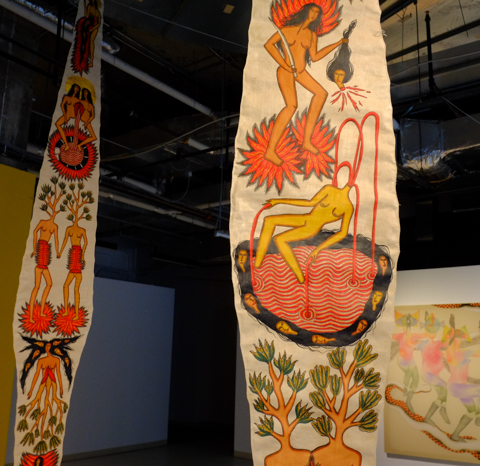
below: Cecilia Vicuna helped co-found of Artists for Democracy in 1974 after she left her home country Chile.  A military coup upended that country in the early 1970s.  Here at the Collision Gallery she has an installation, “Futur.O [Futur.E]” that pays homage to Gail Kastner.

people looking at exhibits at an art gallery

below: Words written on strips of paper. From the left, the first four are:   “I had a very [illegible] feeling in my head.  I had a blob not a head”, “The whole purpose was not to research brain washing but to design a system for extracting information from resistant [forces?]”, “These little books are her memory”, and “To defend herself and preserve her mind from erasure she created little books packed with extremely dense miniature handwriting”  When you read the story of Gail Kastner and her treatment at a Montreal psychiatric institute in 1953, these writings will make more sense.

detail of artwork on display at Collision Gallery, words written on strips of paper

below: Vicuna connects the electroshock experiments of the 1950s to the use of such techniques in interrogation and torture.  In this drawing she writes about electroshock treatment being used in Chile to “erase the past and the future, creating a great lie”.    Almost as an aside,  I’m not sure that creating lies requires such drastic measures; it seems these days that all you have to do it shout it loud enough and often enough and you can create whatever reality you want.  How do we retain our memories under such circumstances?  Memories help keep us connected to our past and to our present.  Who are we without our memories?

pencil drawing of heads being electroshock. with words telling a story about chile and the coup

below: Dreamlike mythical figures dancing together in “Joyous Procession/The Infinite Serpent” by Rajni Perera.

a pair of paintings, Collision Gallery, by R Perera, serpents and people with green legs and feet dancing on them

below:  Details of a couple of the banners that hang from above to form a circle around an LED light fixture that suggests fire.  Artist: Citra Sasmita

parts of two banners that are in turn part of an installation in an art gallery

artwork by citra sasmita at collision gallery

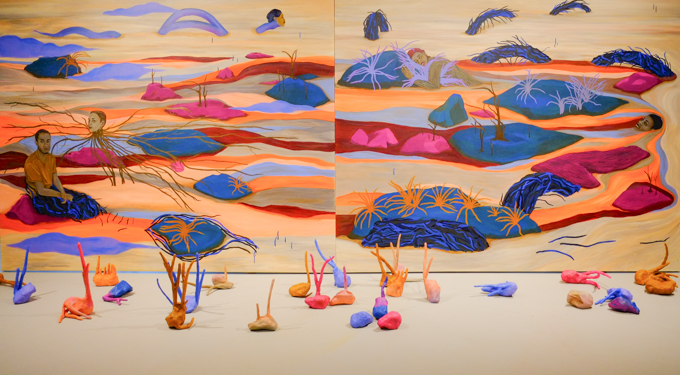
below: “All Islands Touch” by Tessa Mars, another installation at Collision Gallery.  I am not fond of things lying around on the ground counting as art and I don’t think that they add much to the piece. You might disagree and that’s okay.

All Islands Touch, a large art installation by Tessa Mars at Collision Gallery, painting of islands with people's heads, small sculptures on the ground in front, look like fingers growing out of coloured rocks

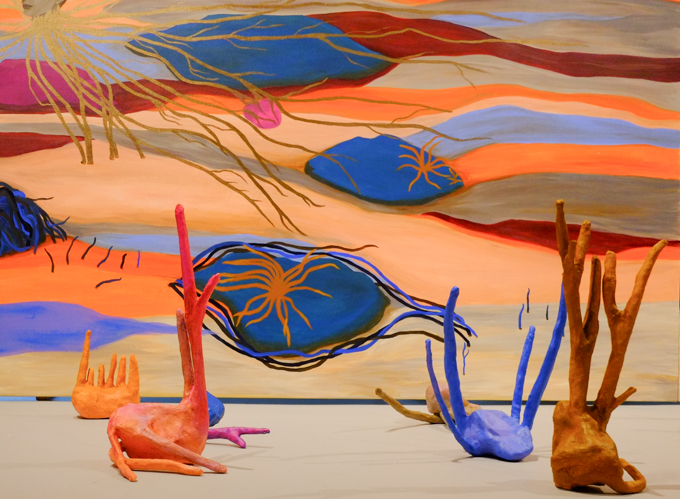
below: Fingers growing out of rocks?  Plant life at the bottom of the sea reaching skyward toward the light?

Part of All Islands Together by Tess Mars, small sculptures on the ground in front of painting

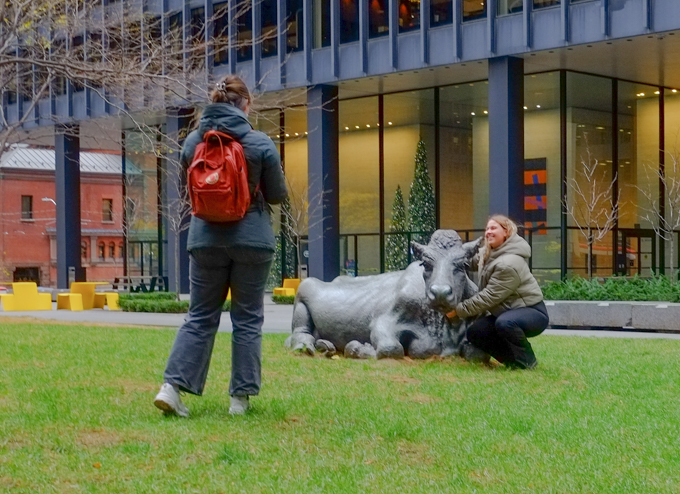
below: Playing with the cows

two women taking pictures of themselves with the bronze cow sculptures, n green grass, downtown Toronto

below: Denyse Thomasos (1964-2012) Trinidadian-Canadian, is the artist who painted this picture that hangs inside in the lobby of  the TD Centre-Mies van der Rohe building.  An abstract, but very much an urban scene with its vibrant chaos.

abstract painting, large, by Denyse Thomasos, hanging in lobby of a downtown bank office tower

below: In the same lobby as the image above, this abstract by Susanna Heller  (1956-2021) tells a different story.  There is also chaos but it seems more “natural”, more like nature instead of man-made.  It is titled: ‘Restless Prowling from Night to Day Break’  and is 30 foot long.

abstract painting by susanna heller

below: Jose Bautista flips his bat after hitting a home run ….and his fans cheer.

large street art mural of blue jays baseball player, Batista, with crowds behind him, as he comes up to bat at home plate

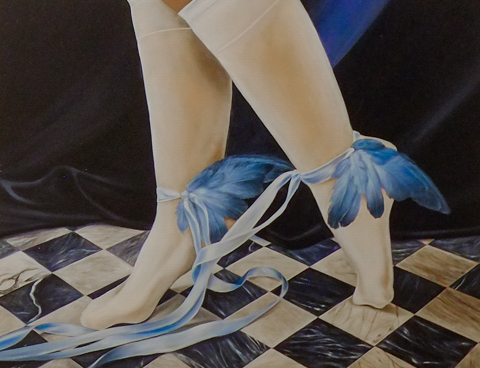
below: Emily Pope and her series of (mostly) blue, black, and white.  “Antidotes for Yearning” or the examining of “the instinctual urge to ward off the inevitable despite our guaranteed decay. Through symbolic imagery…”   Abbozzo Gallery

painting by Emily Pope, blue curtains open to reveal a hand drooping, partially covered with lacy glove with many little blue bows

Emily Pope painting of two feet in white sheer stockings, with blue feathers tied around the ankles, on a black and white checkered floor

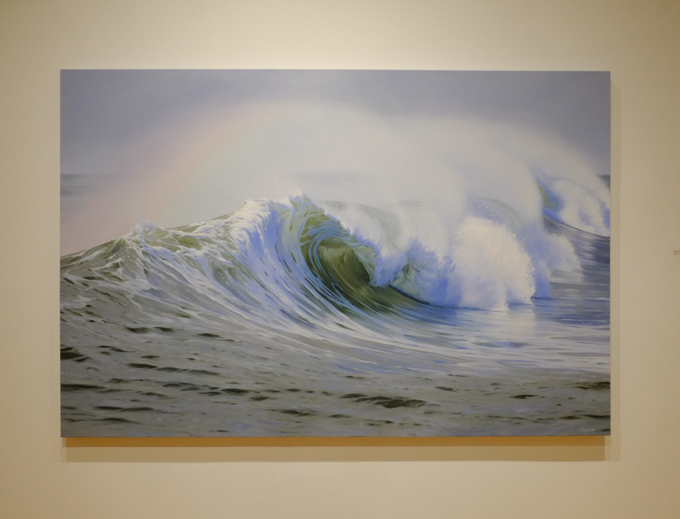
below: Also at the Abbozzo Gallery are a series of very realistic looking paintings of waves by Katharine Burns.  (It looks better in real life!)

in abbozzo art gallery, on wall, a painting by Katharine Burns of a cresting wave and a small rainbow that is caused by sunlight passing through the spraying water

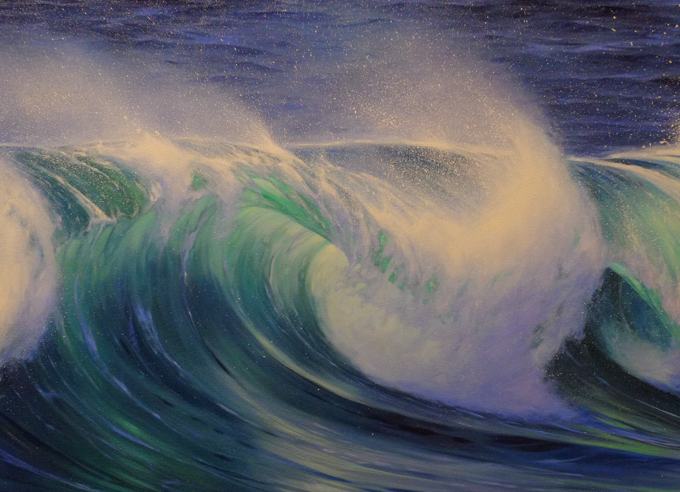
below: One of the wave pictures, zoomed in a bit.  Translucence, light, spray, motion, and so much more.

close up of a painting of waves by Katharine Burns in an art gallery

below: At the BAND (Black Artist Network in Dialogue) Gallery is a small showing of artworks owned by the founders of the gallery.   The BAND Gallery has temporary space at 401 Richmond West while its usual space at 19 Brock is being renovated.

picture on wall of BAND gallery, a woman in orange hat and orange bag, and a cane in the other hand, walking away from the viewer

painting in an art gallery, pair of women, sitting on chairs, one white woman and one black woman, both in dresses, blue curtain behind them

below:  Two large paintings by Janet Cardiff, large figures, connected.  Dancing, Intertwined.  Are they happy?

two large paintings by Janet Cardiff

close up of figures together, painted by janet cardiff

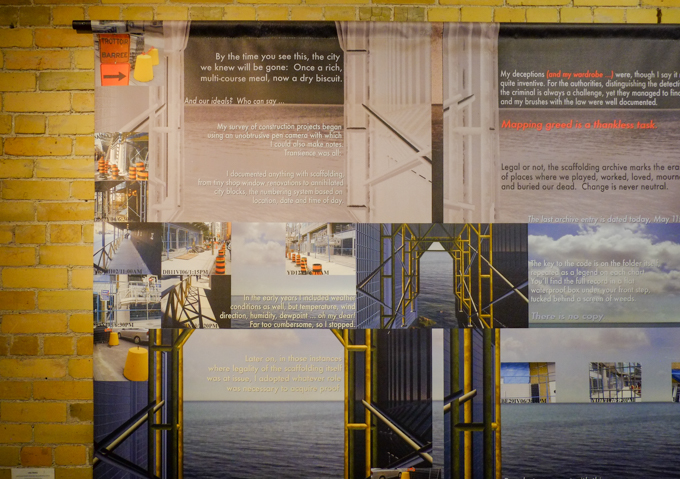
below:  In one of the halls of 401 Richmond West is a large poster.  It is a collage of photos taken by Vera Frenkel with some of her words added to them.  Title: “Once Near Water: Notes From the Scaffolding Archives” 2008.  She took pictures of any scaffolding that she saw while walking around Toronto.   At the top left she opens with these words: “By the time you see this, the city we know will be gone.  Once a rich multi-course meal, now a dry biscuit.”   Do you think that we are turning into (or have become?) a “dry biscuit”?  We’re definitely changing and I’d like to think that some of the changes are for the better (and it would help if Doug Ford would keep his hands out of the cookie jar).

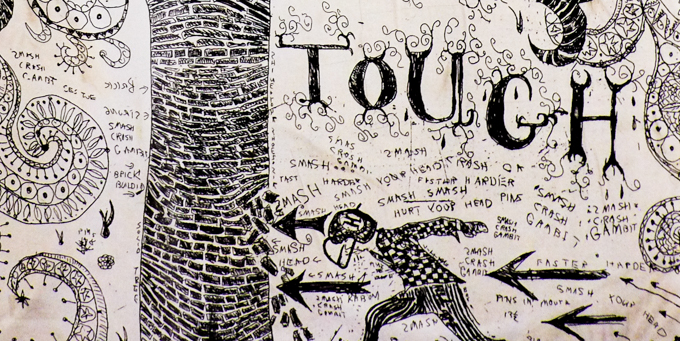
below: On another hallway wall (in the basement) of 401 Richmond is this piece….Do you think that you are tough? A tree made of bricks.

 a hand drawn black and white tree with curly branches and words that say do you think that you are tough

below: He’s got a long way to go.  Smashing the tree, brick by brick, smash, smash, hurt your head, crash, faster harder, smash, smash

lower part of a hand drawn black and white tree with curly branches and words that say do you think that you are tough under the word tough a small black figure is trying to bash the tree trunk with its head

below:  An oldie but goodie; a painting by Harold Town (1924-1990).  It’s on display at the Simon Bentley Fine Art Gallery along with a number of other paintings and artworks.

painting by Canadian artist Harold Town, abstract, on the wall of an art gallery

paintings on a gallery wall, one is a large orange square mounted on point, Simon Bentley gallery

If you can remember waaaaay back to the beginning of this post, you will recall that I started with an image by Carole Conde and Karl Beveridge.  I am going to end the post with a couple more of their photos.   They obviously care very much about social issues.

below: A marvelous collage, “A Work in Progress”.  The original dates from 1979.  In 2006 it was updated by adding four in the series so that now 12 decades of women’s work/life is now covered. This is the picture that encapsulates the 1950s.  The wartime image out the window is actually the Hungarian uprising.  Elements include a calendar on the wall showing a woman working in a factory, a coffee percolator on the table, a Beatrix Potter children’s bowl on the table, a crucifix on the wall, a red squeezie ketchup bottle, the syrup container with the pull back tab opening, baby bottle, star weekly magazine, the old radio….

a work in progress, a collage by carole conde and karl beveridge about changes in womens work over the past 12 decades

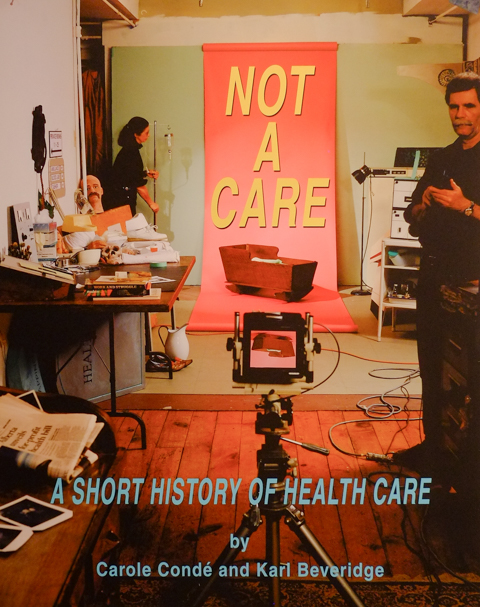
below: Not a Care, A Short History of Health Care.  This is actually a series of 12 images, each one representing a time and place in history from neolithic times to the present (made in 1999).  I discovered that the whole series is online and if you are interested, you can see them here:  Conde & Beveridge’s website

photographic image by conde and beveridge, not a care, short history of health care,

As for that statement about privilege and art…  there is no answer; there are many answers.  Making art is not for the privileged few; most of us have the need to create.  Whether it’s shouted from the rooftops or whispered quietly in a little corner, all art is valid to some degree.

Viewing art is not just for the privileged; there is so much out there… just get out and look.  You will think some of it is stupid, or mediocre but sometimes you’ll find something that makes you stop and think.  Or stop and stare.

 Those sentences barely scratch the surface and may seem quite lame but this is probably not the time nor place for philosophical essays… but feel free to leave your comments/opinions on the subject.

 “Opinions?  I’m supposed to have opinions?”

people sitting on TTC bus

When the fare inspectors get onboard.

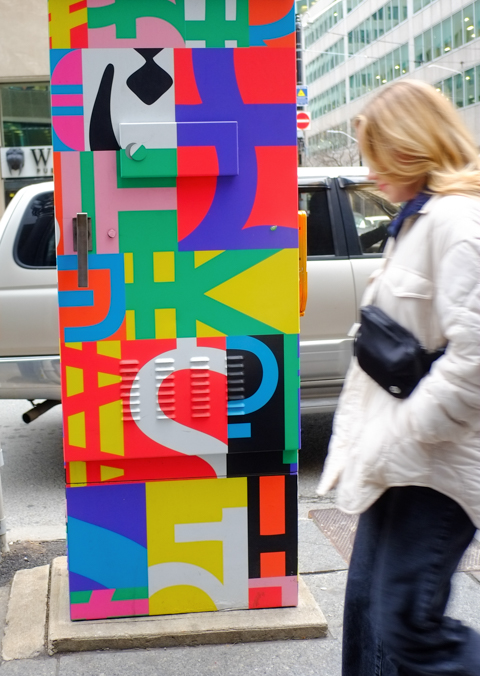
woman walking past pa metal box on sidewalk, traffic signal box, that has been covered with street art painting of abstract letters of the alphabet


Subtitle: More Ontario Line mess


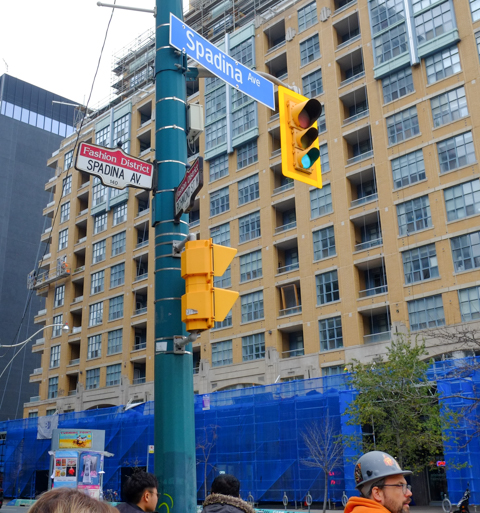
at corner of Spadina and Richmond, traffic light, with two Spadina street signs on it including old fashion district sign,

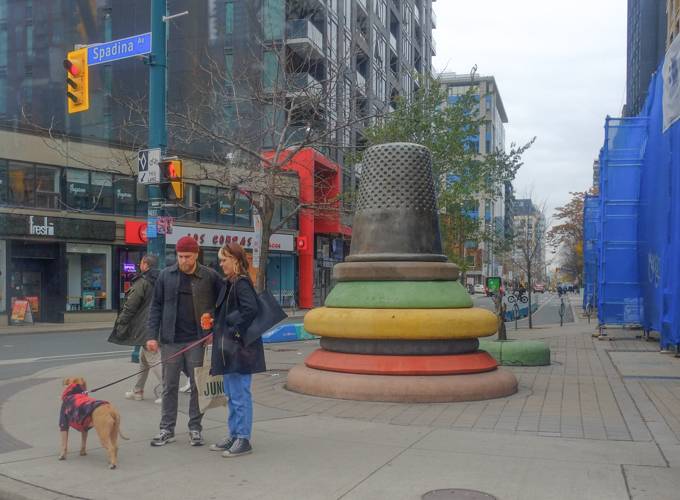
below:  Spadina and Richmond…. A giant thimble (by Stephen Cruise) sits on a stack of buttons.  Behind it, a building is shrouded in blue netting.

a couple walks a dog past sculpture at Richmond and Spadina that is a giant thimble on top of a stack of buttons

below:  Blue, blue, my world is blue… walking north on Spadina under blue netting that protects the sidewalk from work being done on the southwest corner of Queen and Spadina.  The whole block between Richmond and Queen is under wraps.  This is a future subway station with the imaginative name of Queen-Spadina.

people walking on sidewalk that is covered with scaffolding and blue netting to protect from a construction site, queen and spadina, ontario line construction

below: Southwest corner of Queen and Spadina

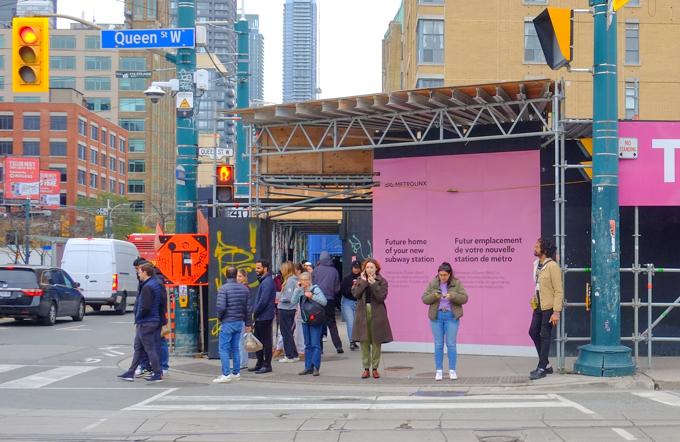
TTC streetcar on Queen, waits at red light at Spadina, people on the corner, tall building behind, pink signs advertising ontario line.

below: A look at what’s happening behind the hoardings….

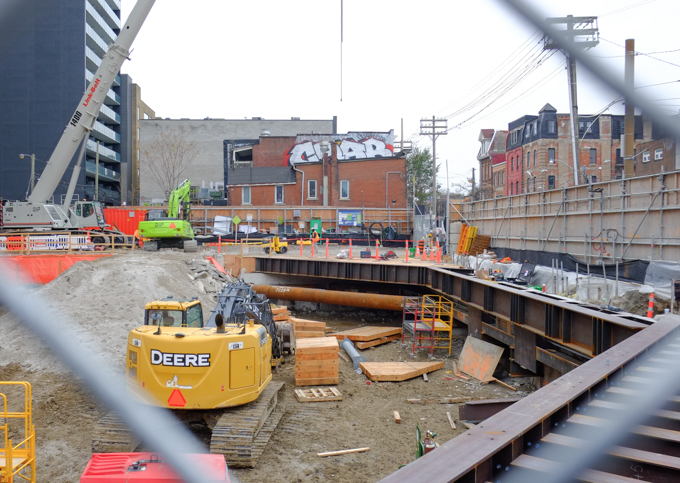
Metrolinx construction site, hole in the ground, with hoardings, and shored up, some equipment,

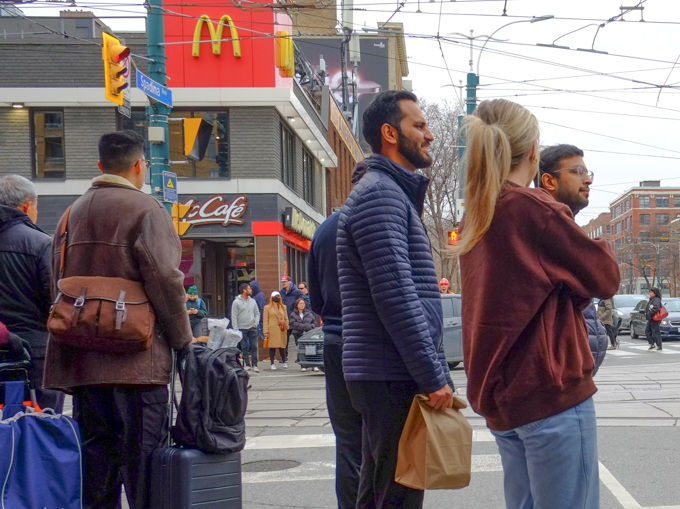
below: Mcdonalds on the northwest corner is unaffected by the changes around it.

people waiting for green light, one man has a brown paper bag in his hand, mcdonalds at queen and spadina is in the background

below:  Looking south on Spadina with a good view of the southeast corner of the intersection with Queen West.

looking south on Spadina towards southeast corner of Spadina and Queen, tree, traffic,

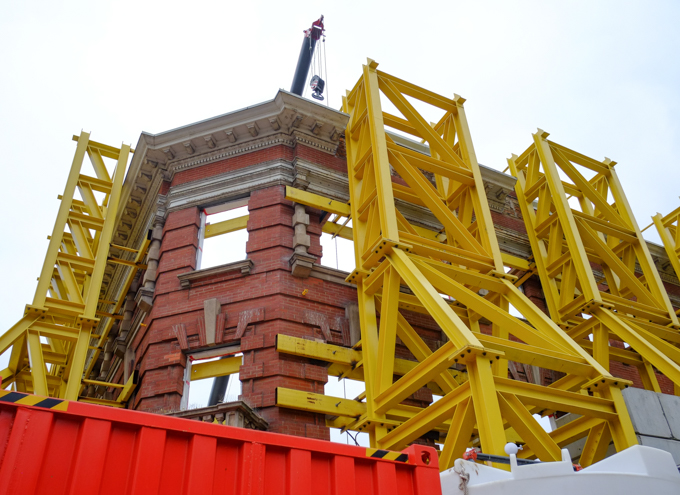
below: There is a lot happening in the northeast quadrant, all by Metrolinx.   the yellow framework that protects and stabilizes a facade is becoming a common sight in Toronto.

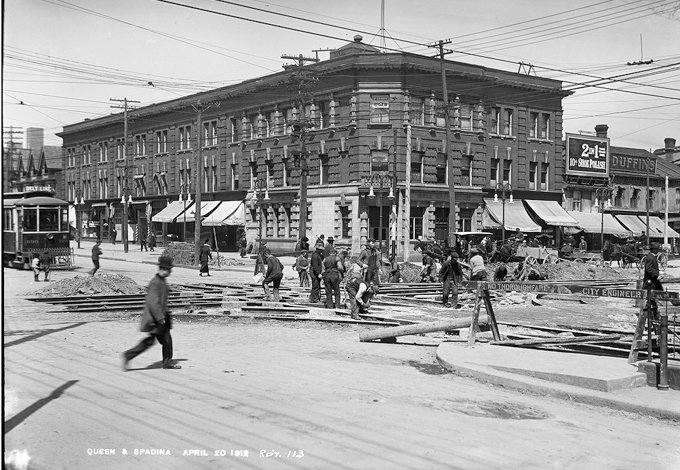
below: In case you can’t remember what was on that corner, this is a photo taken back when they were laying streetcar tracks in 1912.  Most recently there was a CIBC bank on the corner.

black and white photo from 1912 of brick building on the northeast corner of Queen and Spadina.

Photo taken from WIkipedia Commons, in public domain. Originally from City of Toronto Archives.

below: A couple of the old houses/stores on Queen beside the old brick building seem remarkably unchanged since 1912.   (As a light grey car partially blocks the pedestrian crossing at the intersection).

a white car partially blocks the intersection as it goes southbound on spadina, pedestrians have to go around it while crossing on their green light. northeast corner of queen and spadina in the background

close up of an older brick building that has been gutted, but facade is being retained for redevelopment into metrolinx, ttc, subway station entrance

a woman wearing headphones walks past a construction site, on Spadina, other people on sidewalk crossing at traffic lights

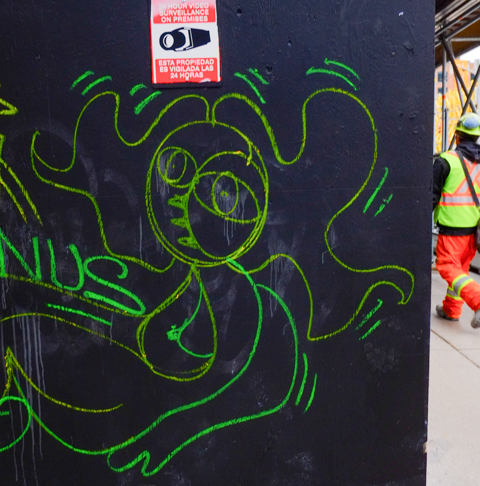
graffiti on black hoardings, line drawing on bright green, picasso style, of a woman

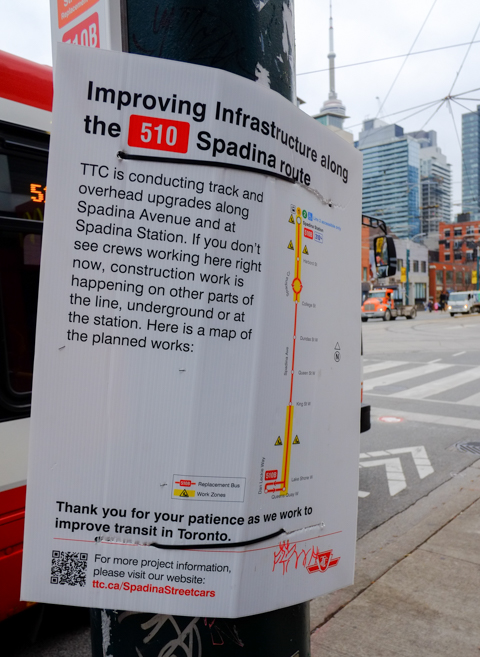
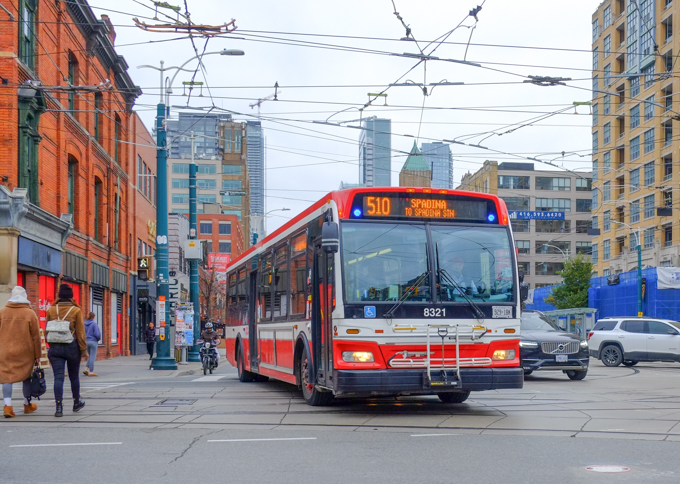
below: The 510 streetcars are not running during this construction.

below:  But because the buses are too wide for the streetcar lanes, the middle of Spadina is very quiet… so I can stand here and take pictures.

standing in streetcar lanes, looking south on spadina, towards queen,

below: It also means that the replacement buses are now running… and competing with cars for a limited space.

a young man in blue winter jacket and baseball cap, walking on sidewalk past an orange sign saying pedestrian detour, and an arrow pointing right

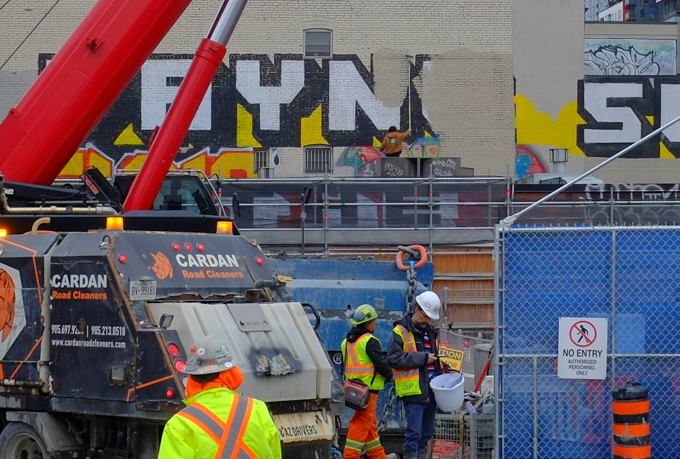
below: Painting over the graffiti

below: Just north of Queen, there is a large vacant lot on Spadina.  So large you can see through to Cameron Street.

below: Cameron House and other houses on Cameron Street and beyond.

two young men on bikes wait at a red light, on Queen West at Spadina

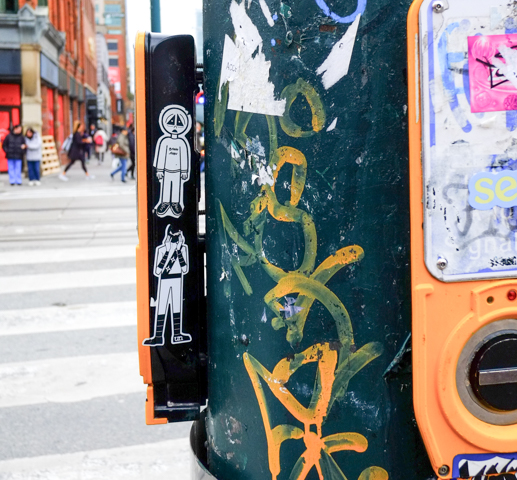
stickers on crossing button at intersection, urban ninja squadron and feelings boi

people waiting on the southwest corner of padina and queen, waiting for their green light, pink hoardings for metrolinx construction behind them

looking out the window of a TTC spadina bus, looking at people waiting at bus stop, tall condos behind them, some reflections

There are so many new buildings in Toronto!  One of them is the new CIBC building at 81 Bay Street which is immediately south of the railway tracks and across the street from Union Station.  It is also adjacent to the new GO Bus station.

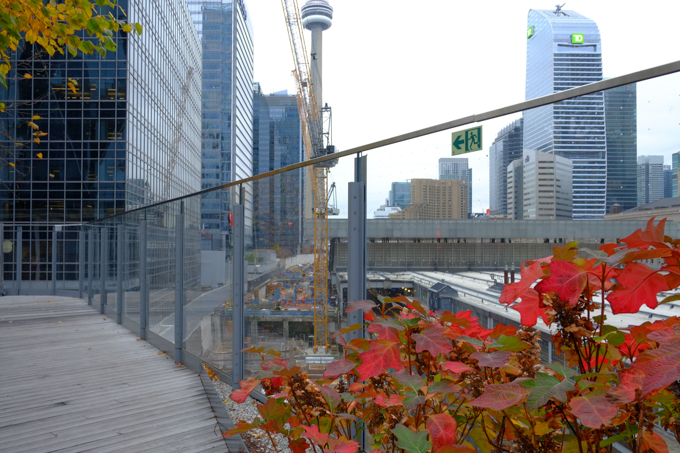
below: If you take the elevator to the 4th floor of the new CIBC building,  you can access the new park.   This is the view that greets you. The park extends over the railway tracks – a great use of space!

elevated park over railway tracks that is part of cibc square development,

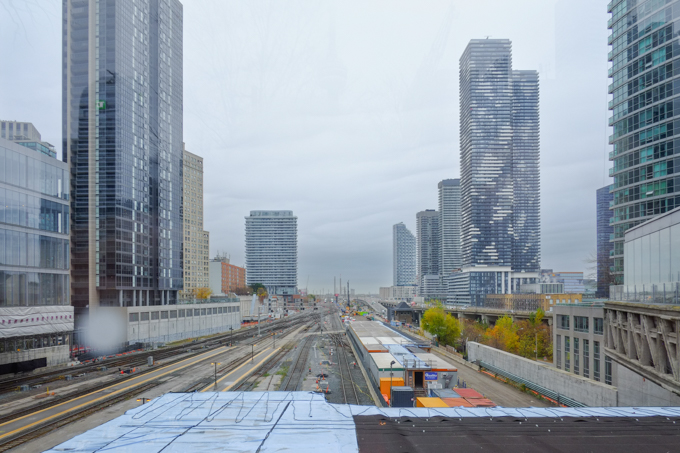
below:Looking east from the park (on a foggy morning, and with a spot of dirt on the glass fence).   The trees on the right mark the spot where a strip of land separates the railway tracks from the Gardiner Expressway/Lakeshore combination.  Between Yonge and Parliament there are no buildings adjacent to the tracks on the south side.    That tall splotchy looking building is the Sugar Wharf Condos which, as the name suggests, are close to the Redpath Sugar property.

eastward view from cibc park, over railway tracks, tall buildings on either side of the tracks,

below: Looking north across the roof over the railway tracks.  The gold building is another bank building, RBC (Royal Bank of Canada).  On the right, the building that looks like there are diamond shapes in the glass, is a second CIBC tower but on the north side of the railway tracks.

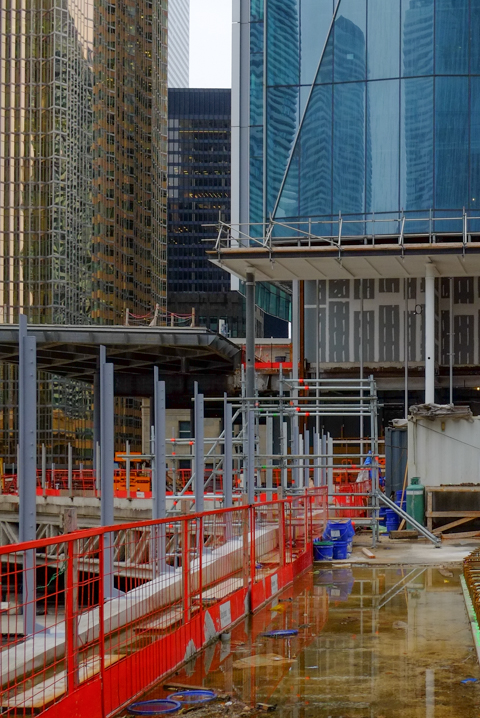
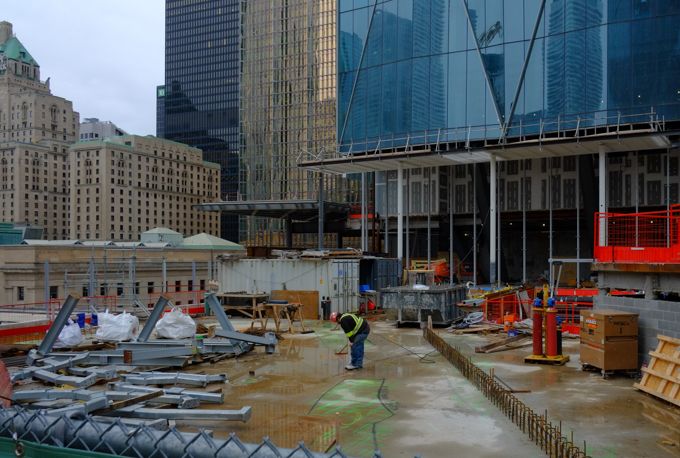
below: Construction continues on the north side.  It too will have a park that extends over the tracks.  The two parks should merge into one once construction is completed.

construction site, park above the railway tracks at part 2 of cibc square, on the north side of the tracks, gold coloured r b c building also in the photo

man working at construction site, park above the railway tracks at part 2 of cibc square, on the north side of the tracks, gold coloured r b c building also in the photo as is Royal York Hotel

CIBC square, park

CIBC square, park, in November

below: Westward

looking west from cibc square, red leaved plants in foreground, CN Tower in background

below: In the center of the park is a large shiny metal leafless tree.   This is “New Amalgam” by Roxy Paine (2022).   It is 72 feet high.

public art, tall tree made of metal, cibc square

public art, tall tree made of metal, cibc square, cn tower in the background

below: Looking over the covered tracks at Union Station and all the ventilation system components on the roof.

looking west from CIBC square, long railway tracks, past covered tracks at Union Station with ventilation systems on the roof, CN Tower,

looking west from CIBC square, long railway tracks, past covered tracks at Union Station, CN Tower, with construction on south side of railway tracks

below: A closer look at the nearby construction at track level (and lower).

union station infrastructure construction

There are also stairs on the exterior of the CIBC building that lead to the elevated park.

looking into a few levels of cibc building, through large windows, from exterior stairs

Bay street side of CIBC office building, west side, lower three levels with tall white pillars

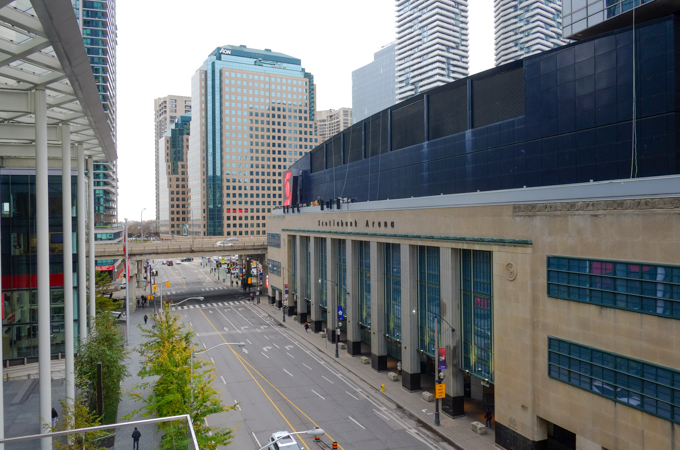
below: Looking south on Bay Street where Scotiabank arena takes up most of the street scene.  That’s the Gardiner Expressway as it crosses Bay.

looking south on Bay street rom CIBC building, Scotiabank arena takes up most of the street scene,

below: Through the window to the interior of CIBC  where Steve Driscoll’s artwork shines brightly.

interior of cibc building on bay street as seen through large window from exterior stairs, glass artwork, little round tables with a couple of people seated at them

below: “A light stolen from the sun” is a collection of 12 digital prints on laminated glass.   they can also be viewed from the 4th floor but access is controlled.   Also, camera use will get you a nice chat with a security guy.  The usual, phones are allowed but even little cameras are a no no.

Steve Driscoll artwork, red and blue, trees, tall, vertical works on glass

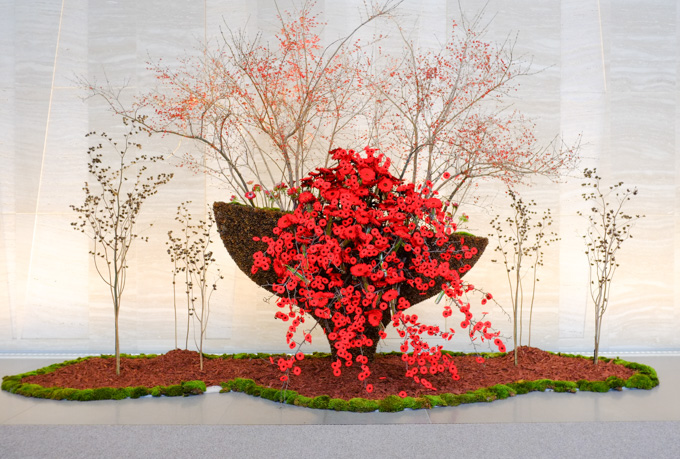
below: An outpouring of red poppies is the stunning centerpiece in this Remembrance Day tribute (created by Fresh Floral Creations).

an arrangement of red poppies for Remembrance day in the lobby of an office building,

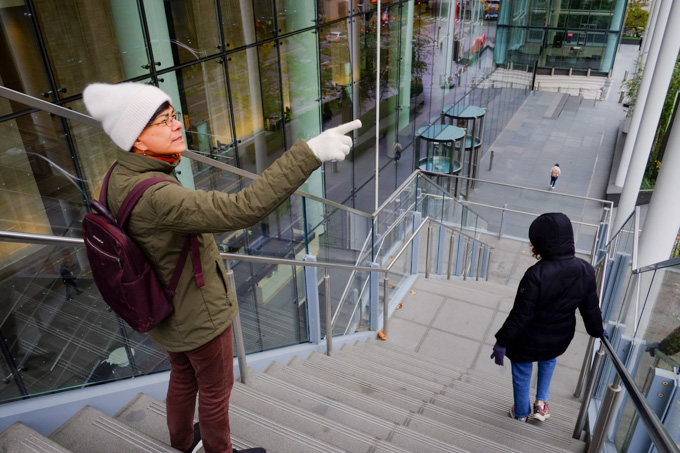
two women on exterior stairs by CIBC sqaure, downtown toronto

With thanks to Nancy and Merle who went exploring with me that day.

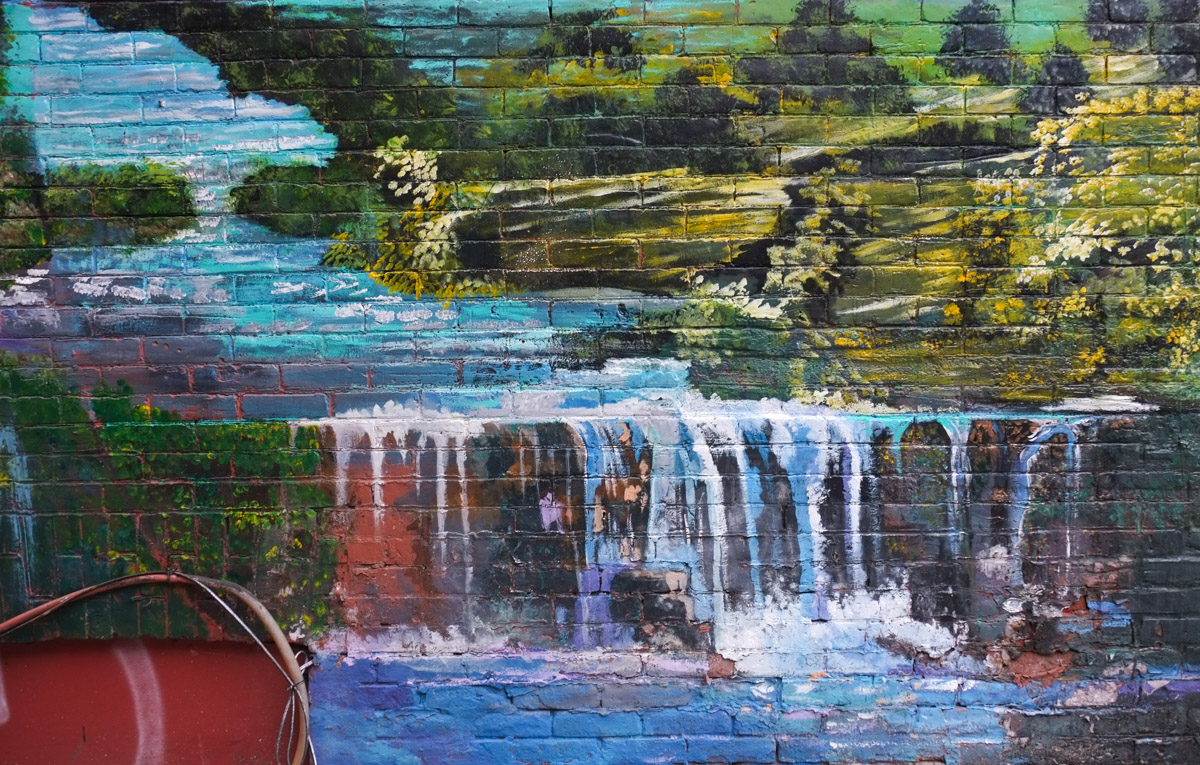
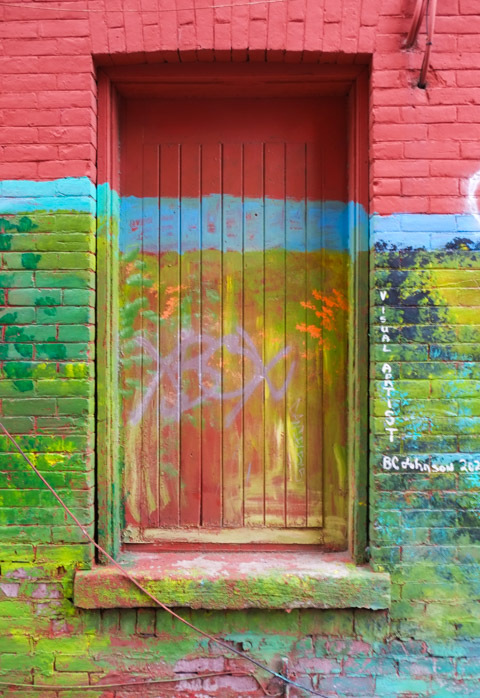
In downtown Toronto there is a large waterfall mural painted on a brick wall  – because of the bricks, the painting looks a bit more like water pouring over a dam.  Still nice; still nature.

mural by b c johnson, a waterfall

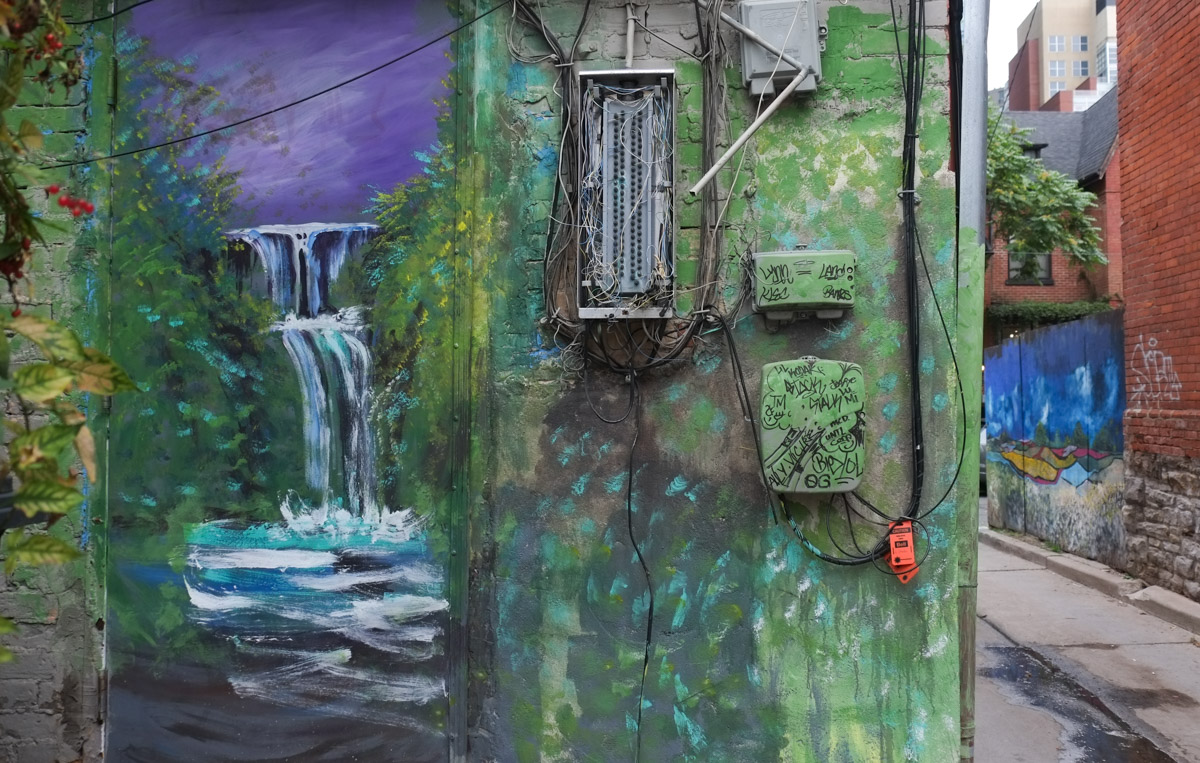
Another waterfall – a longer drop of water, this time on a door.  All the murals here were painted by B. C. Johnson.  There are five or six of them on different buildings, some waterfalls, and some landscapes.

in cottage lane, a mural of a waterfall, with greenery beside it, electrical boxes on the green, with wires, and graffiti on the boxes ,

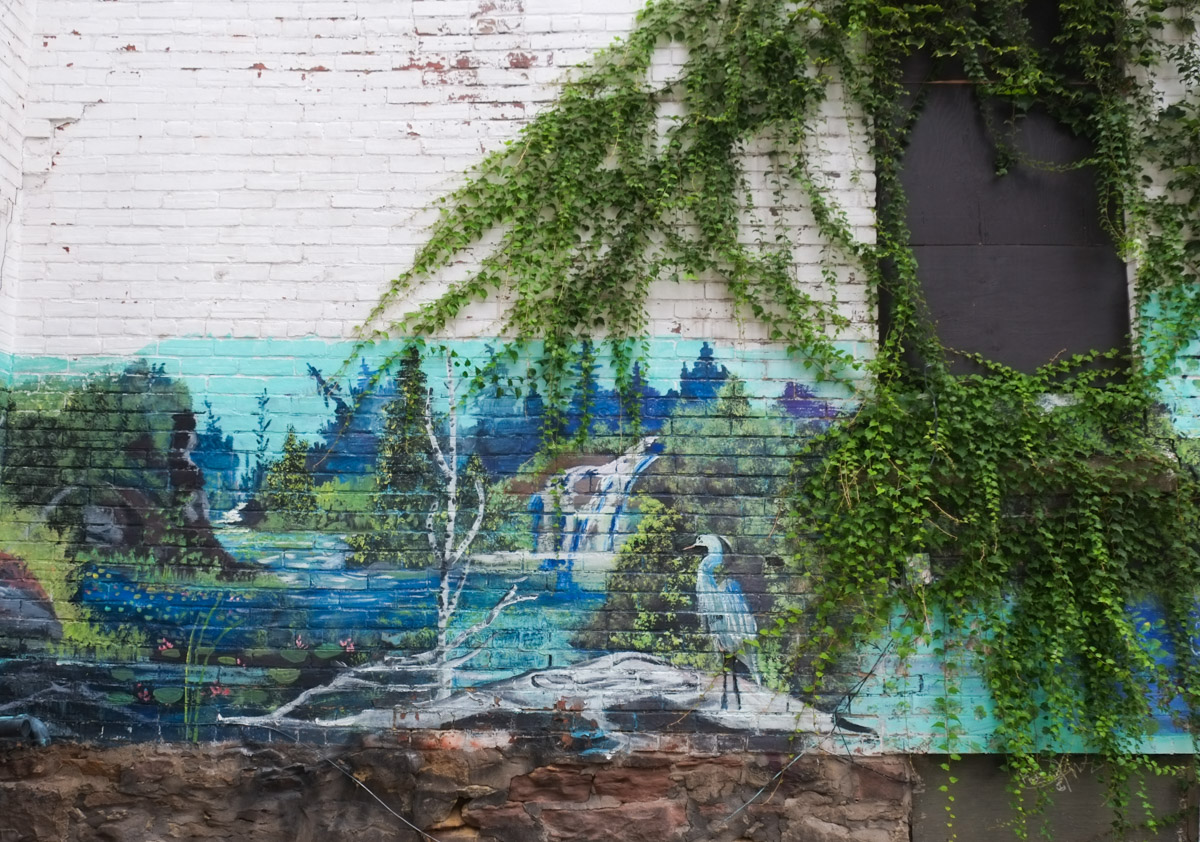
below: Here a  heron stands on a fallen tree beside the water.  A birch trees is also on the shore.  A waterfall is on the other side of the lake.

mural in cottage lane by b c johnson, a heron stands on a fallen log on a rock on shoreline, birch tree nearby, water, and a waterfall in the background

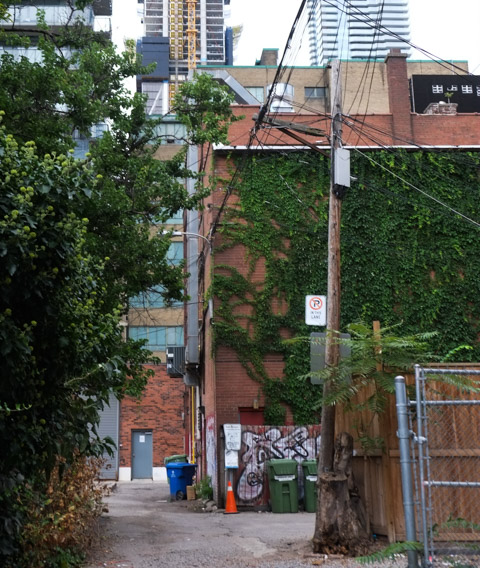
below: This building is overgrown with ivy which adds a nice touch to the scene. The door becomes a very thick tree trunk perched on a rock above the water.

on a wall by a black door, overgrown with ivy, door looks like tree trunk, also mural in cottage lane by b c johnson, a heron stands on a fallen log on a rock on shoreline, birch tree nearby, water, and a waterfall in the background

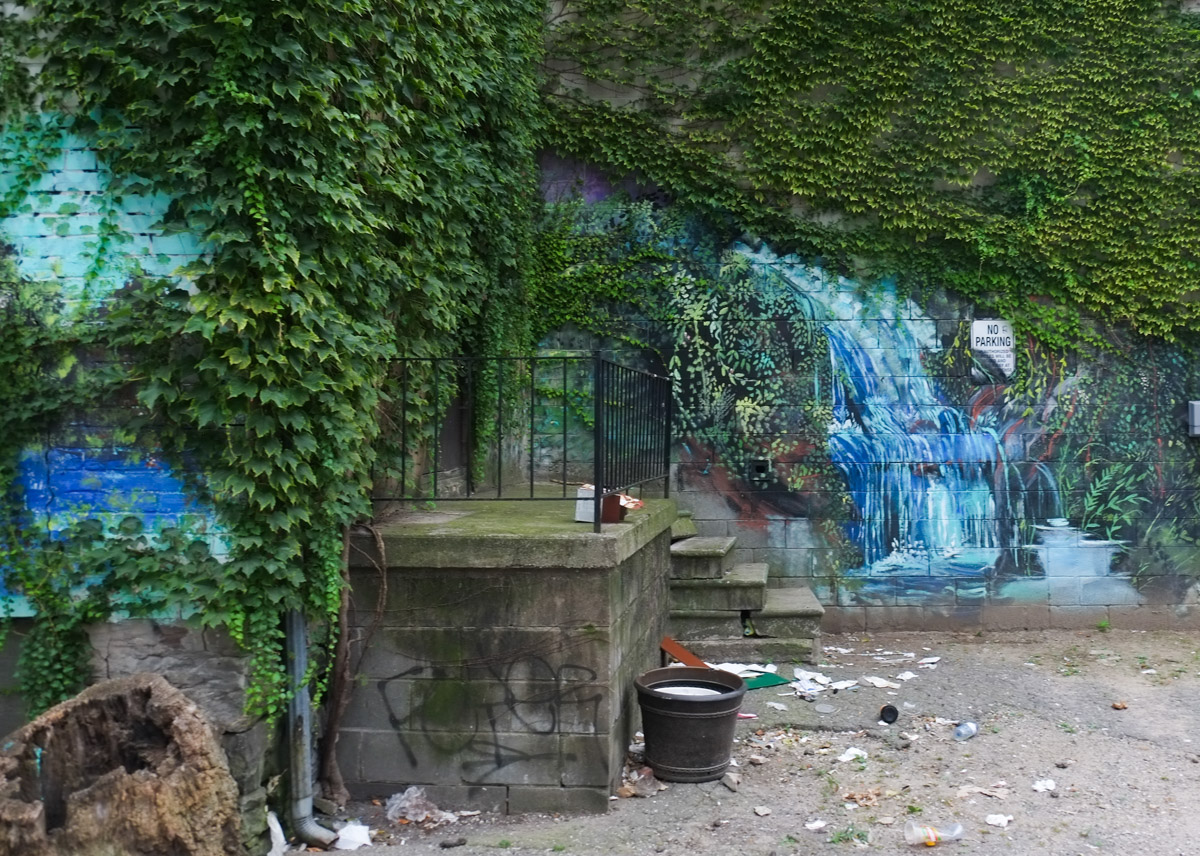
below: Surprisingly, there is no puddle at the bottom of the steps (insert big smiling emoji here).

porch at back of building, in alley, on building with lots of ivy growing on it, mural of a waterfall

porch at back of building, in alley, on building with lots of ivy growing on it, with another building across the alley with murals of waterfalls and landscapes

below: A real tree once grew here.  I don’t think that it was a beaver that cut it down.

old hollow tree trunk in lane, in front of a landscape mural and wall overgrown with ivy

boarded up window or door, exterior view, from cottage lane, now covered with part of a mural of a landscape by b c johnson

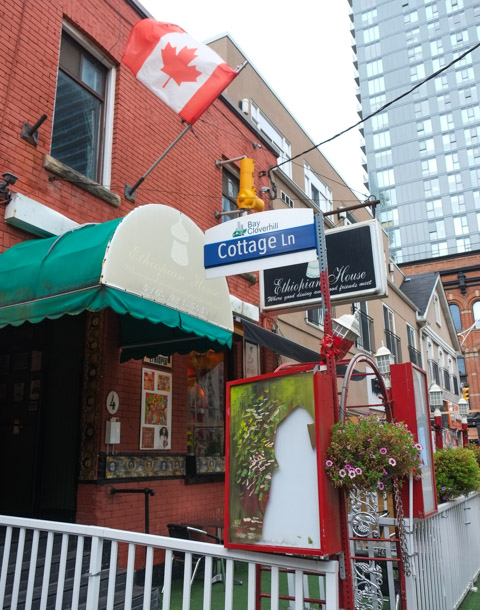
below: Where do you find Cottage Lane?  South of Bloor, west of Yonge, then follow the signs… and the road less traveled.

St. Marys street, restaurants and signs, canadian flag, street sign of cottage lane

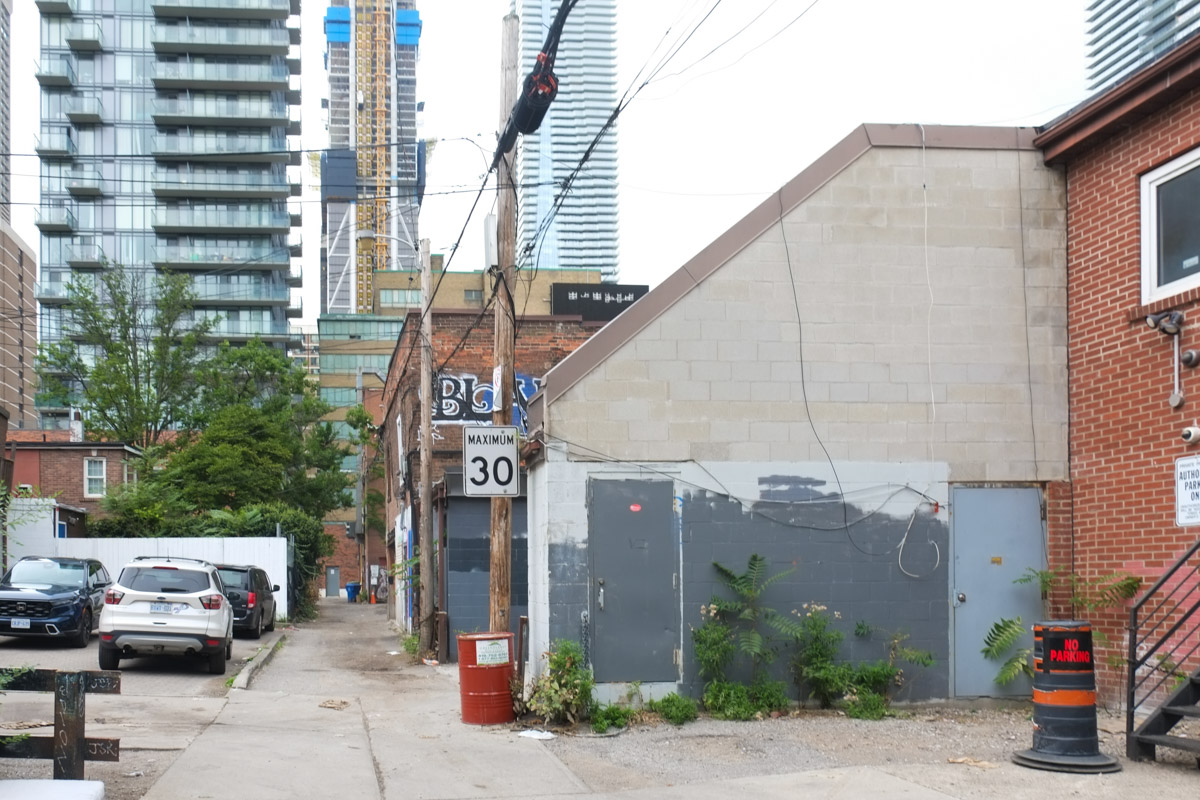
I was not sure why it was named Cottage Lane since, to me, there isn’t much that is cottage-y here.  The answer – there are 10 rowhouses on St. Nicholas Street that were built in 1883 and although the architectural style is ‘bay and gable’, they are referred to as the cottages of St. Nicholas Street.  As you may have guesses, St. Nicholas Street backs onto this lane.

below: Looking north towards Bloor.   Buildings that face Yonge Street are on the right and those on St. Nicholas Street are on the left.

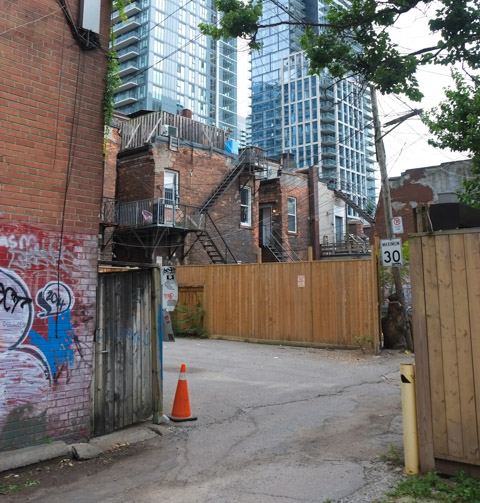
cottage lane, looking north towards bloor and new condos, back of buildings,

back of buildings in cottage lane, balconies, green trash bins, tall condos in the background,

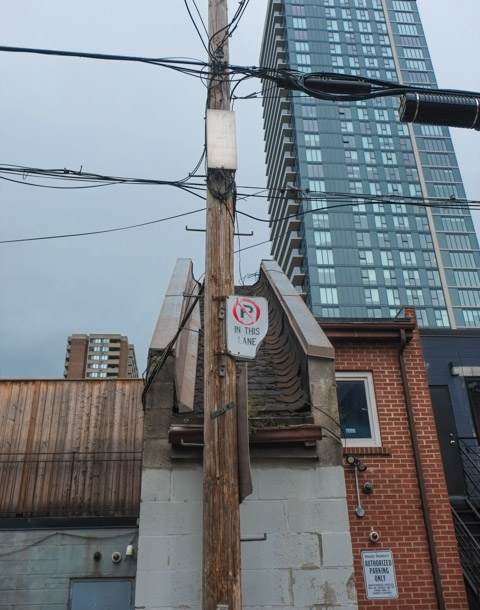
cottage lane

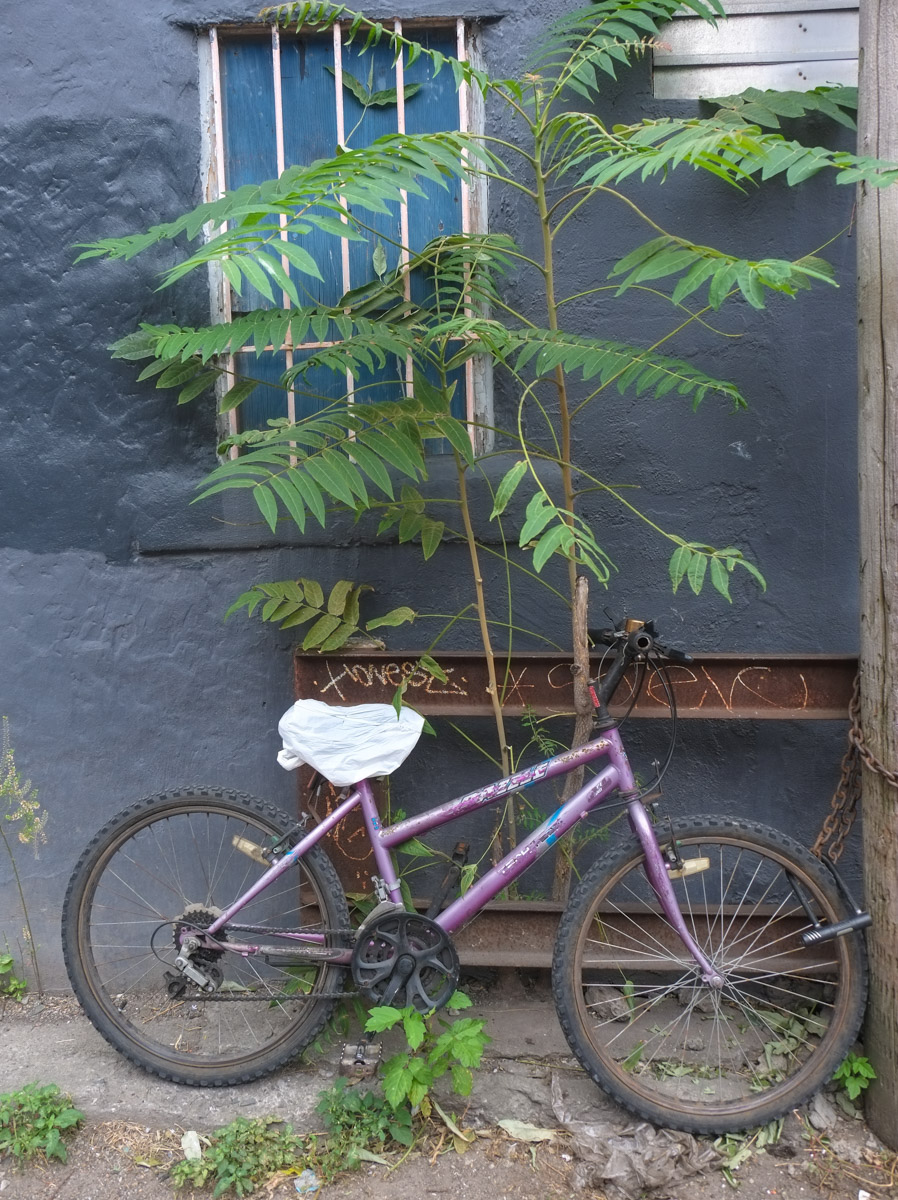
purple bike with white seat cover, parked in an alley beside a small sumac tree and an old window with metal bars on it

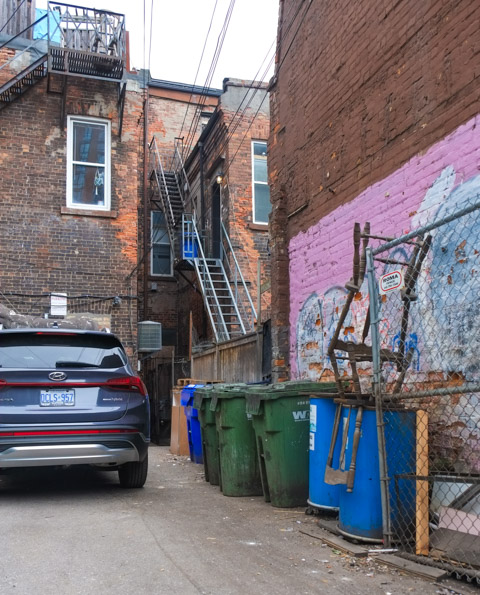
back of buildings in cottage lane, balconies, exterior stairs, pink wall, green trash bins, car parked, brick buildings,

back of store, commercial building, alley view, door, heating and air conditioning vents, graffiti on wall, blue trash bins

graffiti on a red brick wall, a bright white ghost with red eyes and smiling mouth, yellow pipes and white plastic exhaust pipes from building

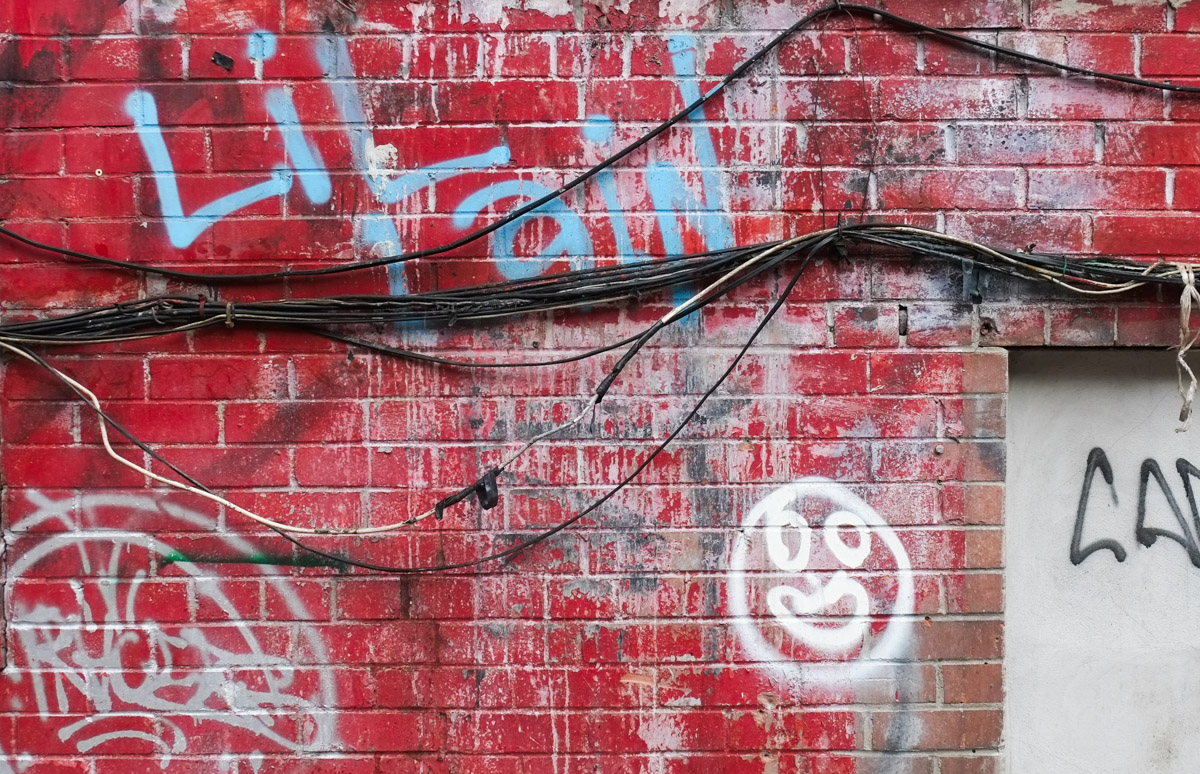
exterior brick wall, painted bright red, with many black wires in a bundle crossing it,, white graffiti happy face, other blue graffiti text lil

graffiti on red brick wall, respect dollar sign, free dollars, 2014

square street sign covered with graffiti ticker, all o them are black with gold lettering

Back in 2021, I posted some pictures from Sandown Lane (Cliffside, near Midland and Kingston Road) where there are many more paintings by B. C. Johnson.

Infinite games, repeating games – both kinds of games can be seen in Yorkville.  For instance, we can start with the infinite…..

below: Sculpture by German artist Willy Verginer, titled “The Infinite Game”.  It’s a boy all in white kneeling on 4 dark grey teddy bears.  Meaning?

in courtyard at 80 cumberland, a statue by Italian artist Willy Verginer, a boy all dressed in white is kneeling on 4 grey teddy bears

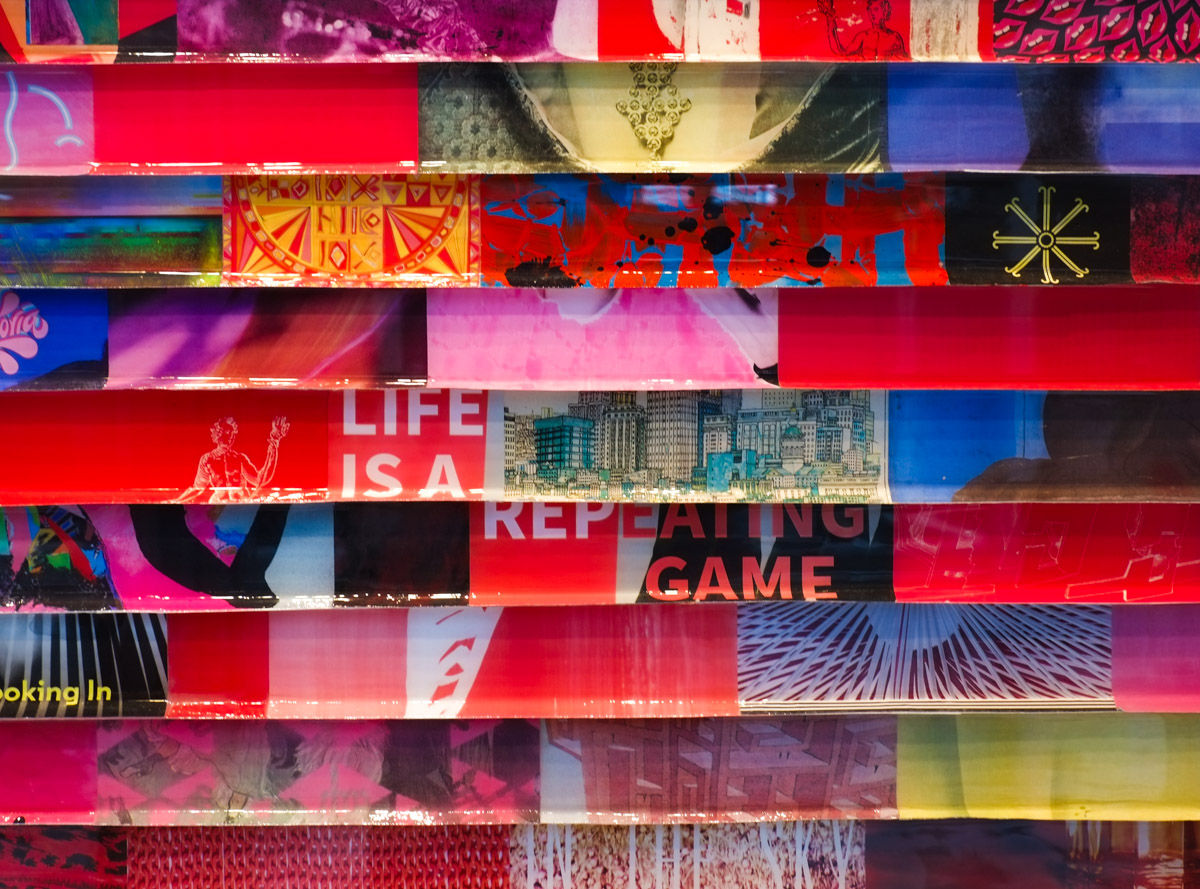
below: The words, “Life is a Repeating Game” are a predominant part of this piece by James Verbicky.  The whole artwork is a large circle.  Circles, we go around in circles don’t we?  Plus, circles make cycles which we repeat over and over again.

artwork in a gallery window, horizontal stripes, painted in abstract, with words life is a repeating game

Yes, this post is about art.  More specifically, it is some of the works that caught my eye as I walked around the Cumberland-Yorkville area.  Some are in galleries or in their windows;  some are on the street.

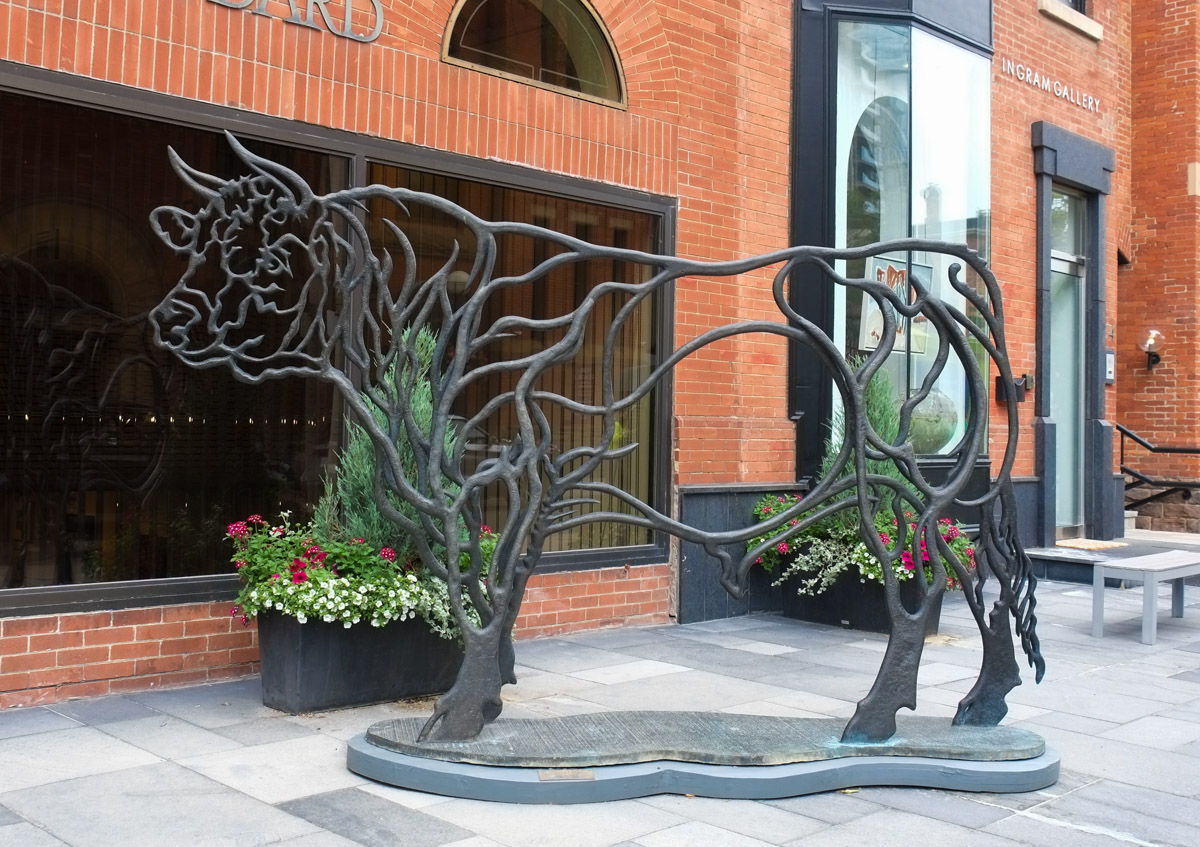
below: “Hercules”, by Joe Fafard (the same artist who is responsible for the piece where Vincent Van Gogh’s head is inside a square, located on Dundas Street directly across from the Art Gallery of Ontario).  No attempts at being profound here but there is nothing wrong with whimsy.

flat metal sculpture, outline with small number of lines outlining details, of a cow, with title hercules, by sculptor joe fafard, located in front of mira goddard gallery in yorkville

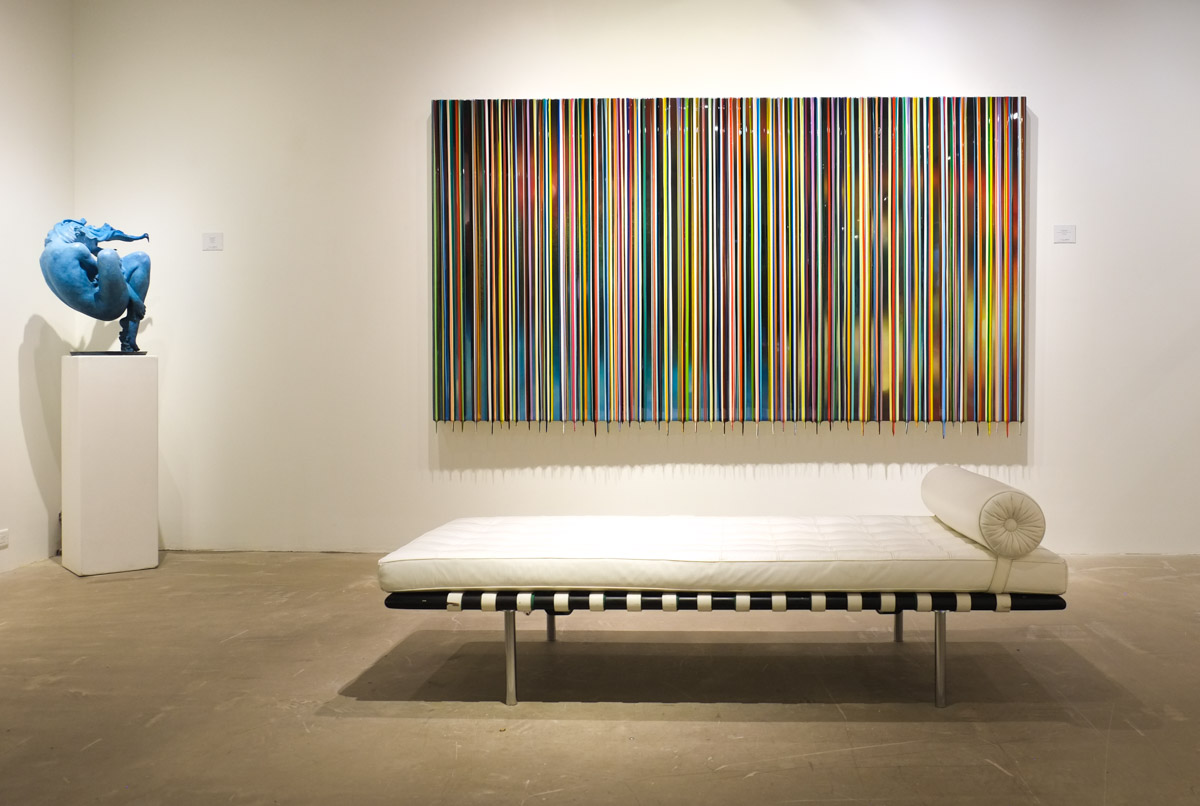
below: Francisco Valverde’s riot of colours in vertical stripes in an artform that he calls Histograms.    There is an image in the background that is then covered with resin stripes of different colours.  The title of this piece is “Apricity”.

below: “Cosmic Dust” by Chinese artist Zhuang Hong Yi.  He produced this artwork by using acrylic paint on rice paper which has been mounted on canvas.  The paint is added last. .  The rice paper is folded and added to the canvas before the paint is applied.

artwork called cosmic dust, three dimensional, on wall, folded rice paper that is painted and then stuck on board or canvas

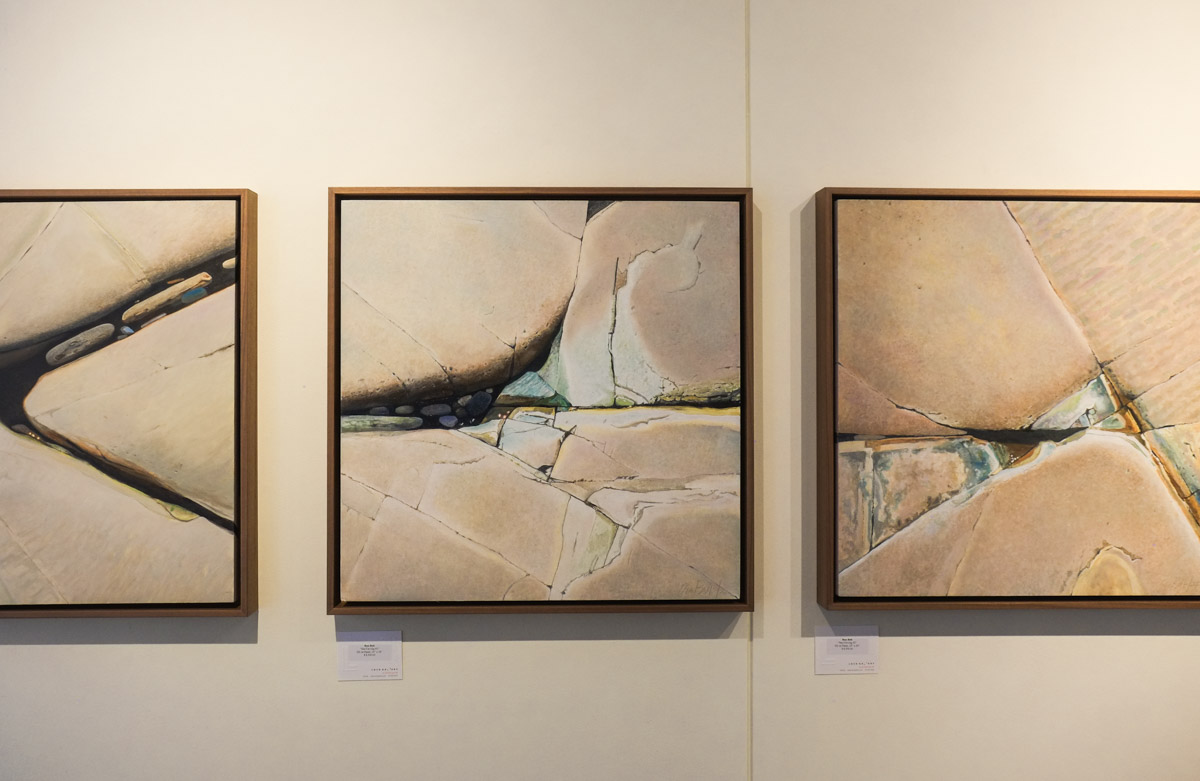
below: Three paintings, oil on board, on a gallery wall – painted by Ron Bolt.  They are images of rock formations that have been shaped by the ocean, and they are titled, Sea Carvings 1, 2 and 3.

paintings, oil on board, by Ron Bolt, on display at Loch Gallery, images of stones by the sea, abstract looking, 3 paintings side by side

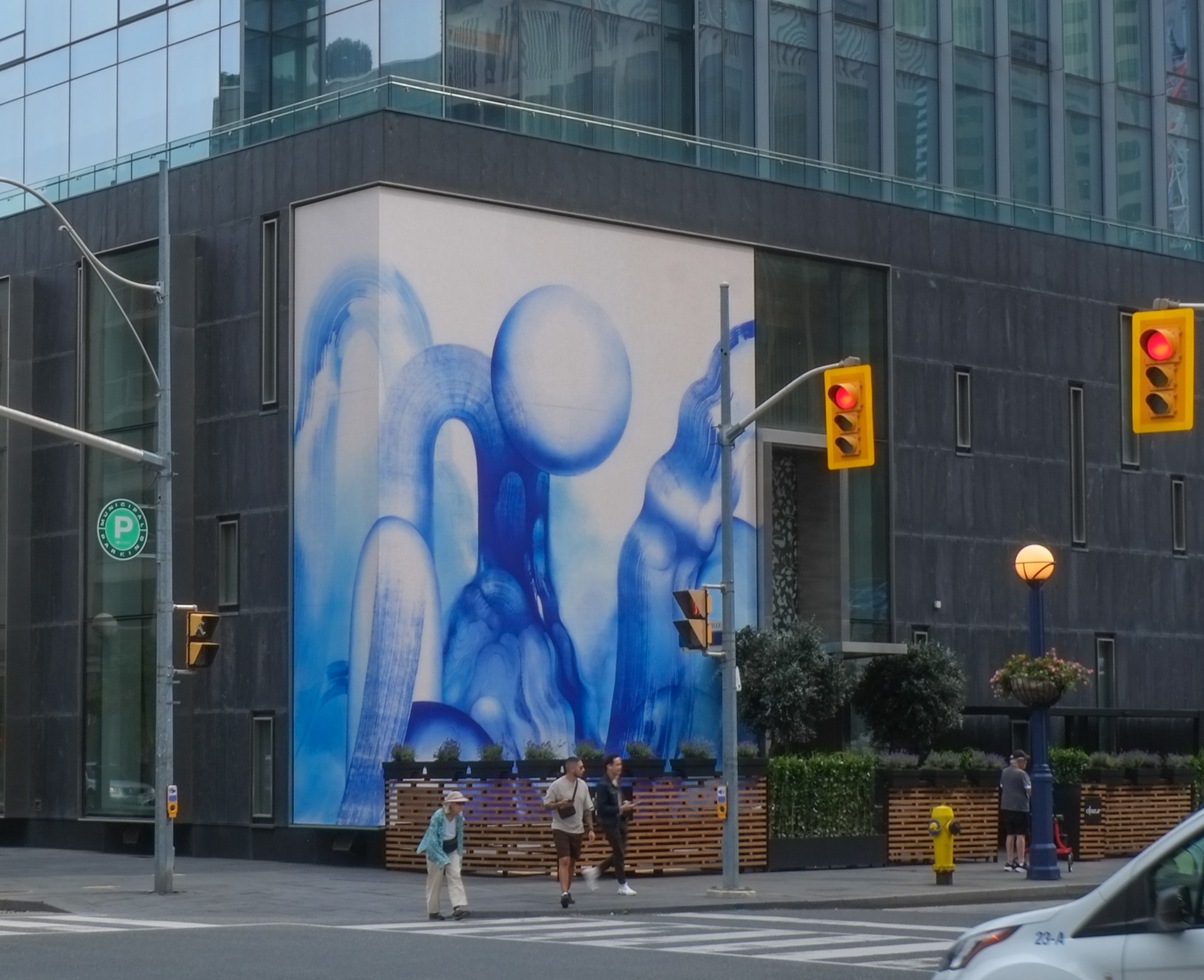
below: d|azur A blue and white mural by Toronto-based artist Dahae Song on the corner of the Four Seasons Hotel.  It’s title is “d|azur”.

large artwork

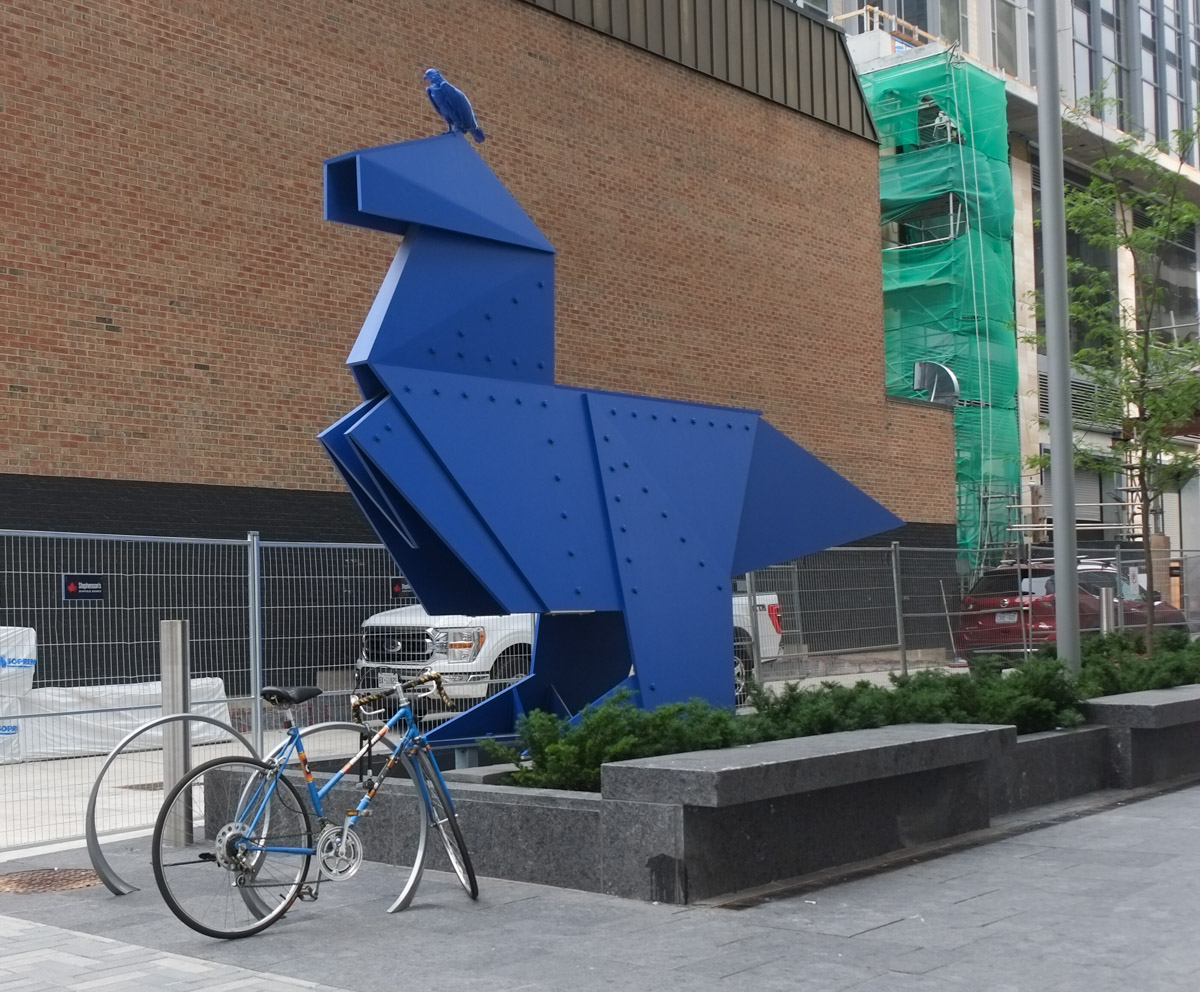
below: This is “Raptor” by Nathan Mabry.  Something like ‘Toronto Raptors meet the Toronto Blue Jays’ vibes going on here.

Large blue bird, metal sculpture, title is raptor, by nathan mabry, in yorkville

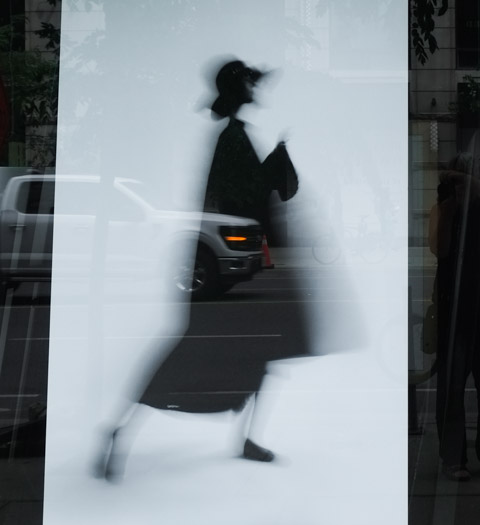
below: Large black and white photographs by Deana Nastic in the windows of the Izzy Gallery

black and white photo, large, in window of izzy gallery,

black and white photo, large, in window of izzy gallery,

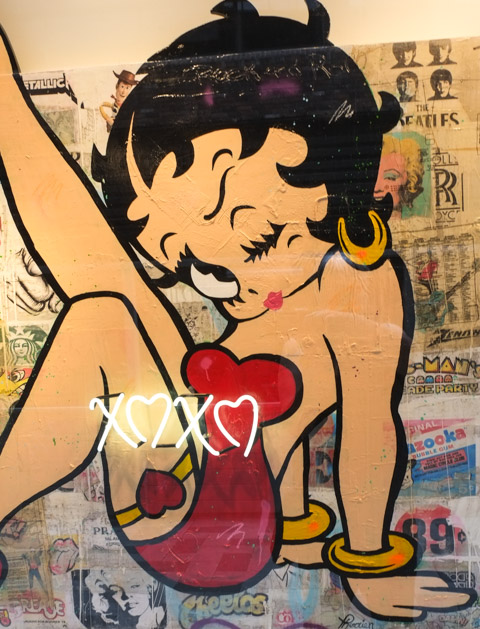
below: Another gallery window, another female image but that is where the similarities end!  Betty Boop and a collage of pop culture references such as The Beatles, Marilyn Munroe by Andy Warhol, bazooka chewing gum,  Pac-Man, the Starbucks logo, and more.

in a gallery window, collage art, featuring very large image of betty boop

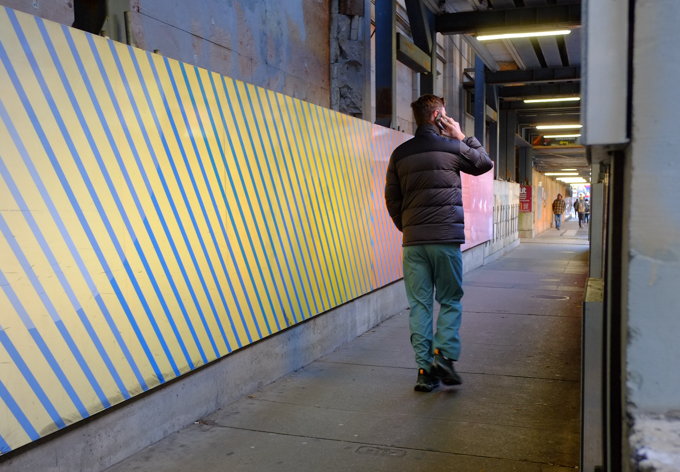
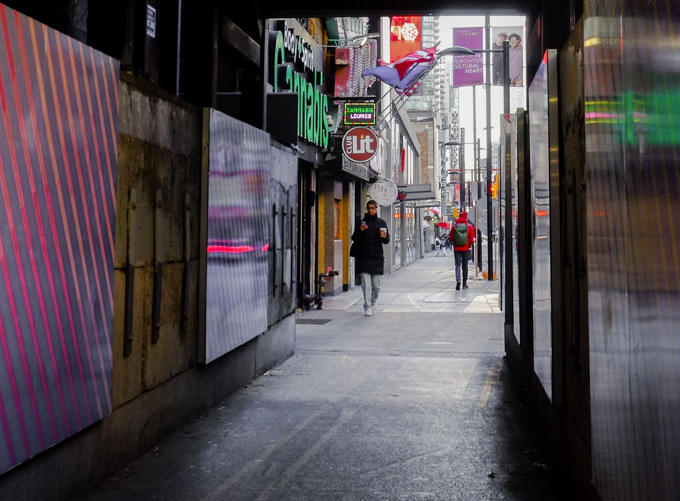
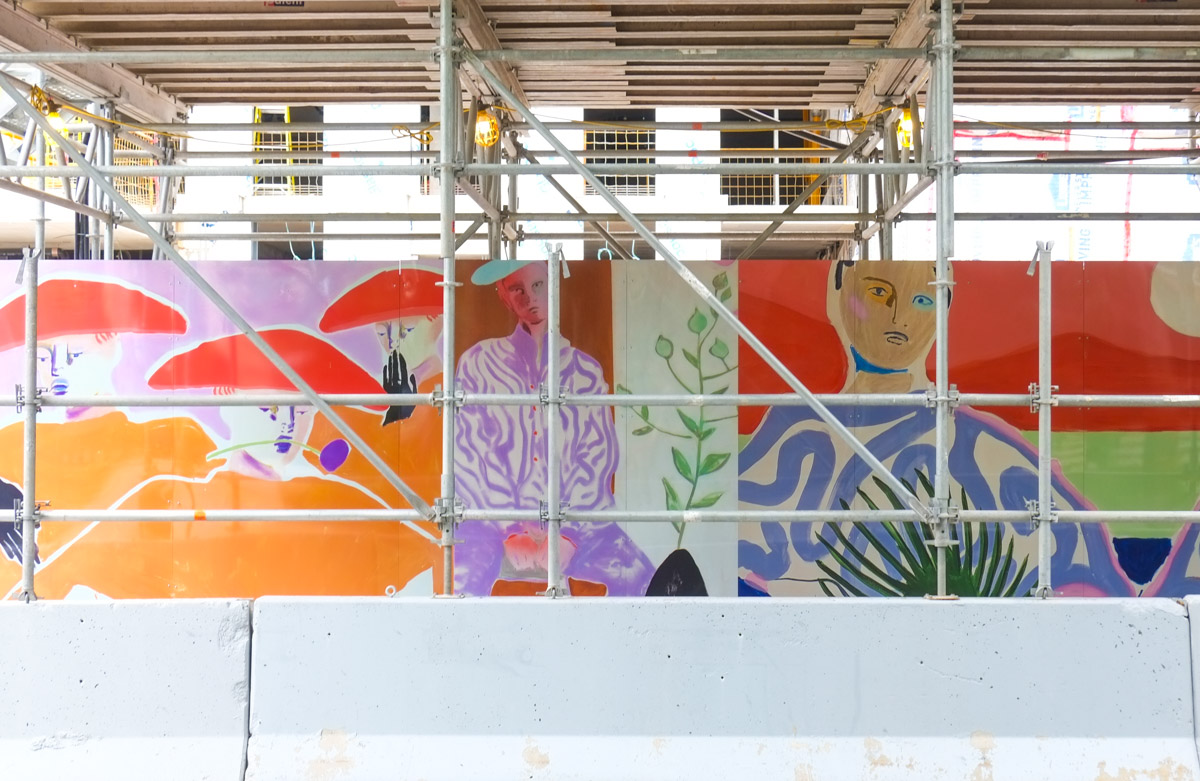
below: Art on the streets, specifically on hoardings to hide a construction site.

artwork on hoardings and under scaffolding, beside sidewalk and around a construction site, multicoloured ovals, oriented vertically, on black background, by Peter triantos

below: Big coloured ovals on a black background, by Peter Triantos.

artwork on hoardings and under scaffolding, beside sidewalk, around construction site, multicoloured ovals, oriented vertically, on black background, by Peter triantos

artwork on hoardings and under scaffolding, beside sidewalk, around construction site, people, with lots of purple and orange tones

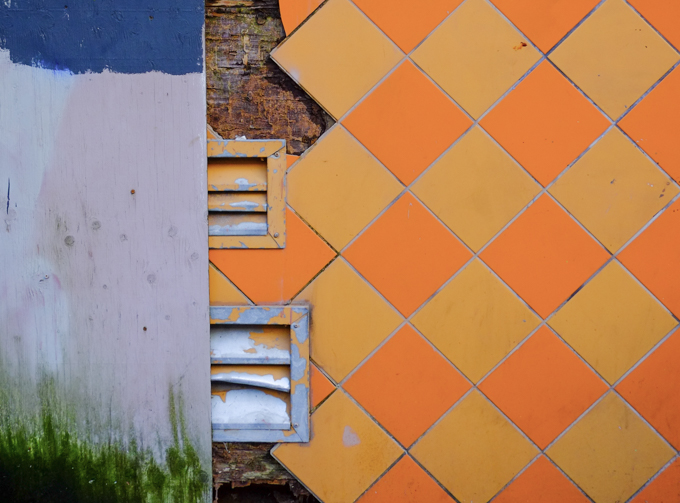
below: Slightly different from all the other image here, but still art in my opinion.  This image is from inside the Cumberland Terrace, a shopping center that has always struggled and is now facing demoltion (or total makeover, not sure what the plan is).  The interesting tile design on the wall was defaced by a line of Bell telephone booths. I wonder how long it’s been since someone made a call here?

tile mosaic design, interior wall of cumberland terrace, black and white stripes and a yellow and orange circle in the middle. Four phone booth mounted on wall

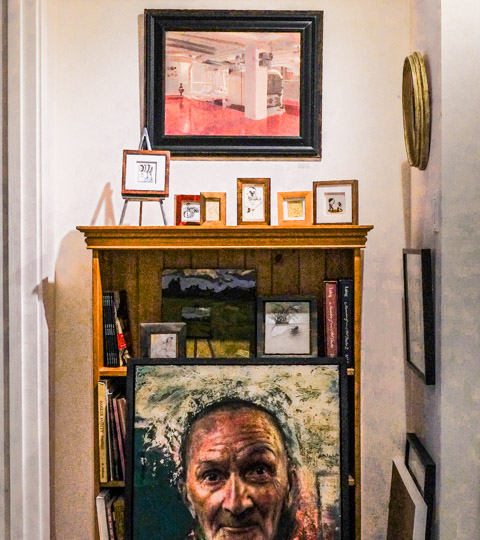
below: Gallery clutter.  He’s watching you watching him.  What does he see?

bookcase in a niche in a wall in an art gallery, painting above it, many small images in frames on the shelves, and a portrait of a man in front of it

I am going to end this post with three artists (from different eras and different backgrounds) who have portrayed their Canadian experiences in their paintings.

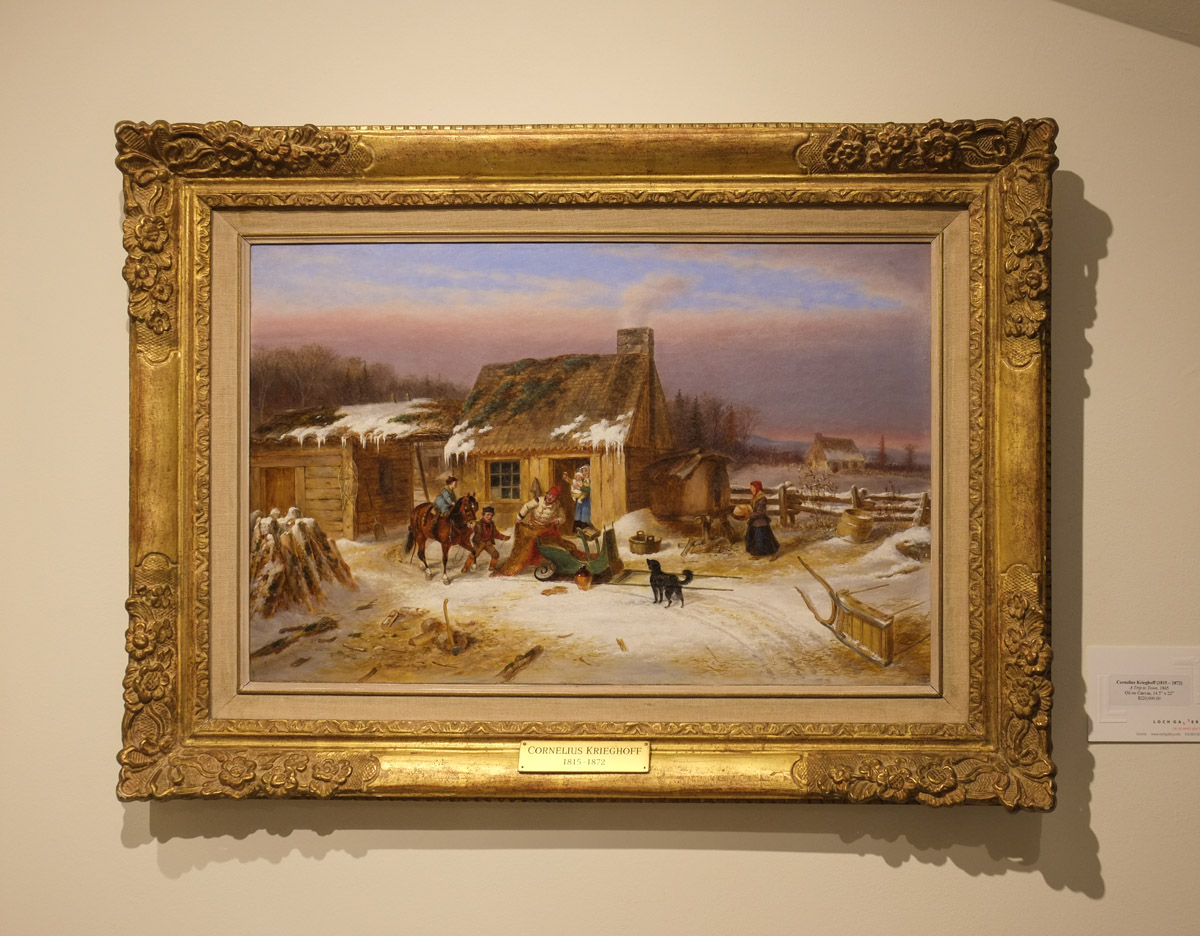
below: First is the oldest, Dutch born and European taught, Cornelius Kreighoff (1815-1872), whose “A Trip to Town” (1865), is one of his many scenes of life in what is now Quebec.   Kreighoff was a fairly prolific artist during his time in what is now Canada.  He first moved to the Montreal area about 1846.  At one point Ken Thomson (the newspaper/magazine publisher) owned about 200 paintings, many of which are now at the Art Gallery of Ontario.

painting by Cornelius Kreighoff in a fancy gold coloured frame, title is A trip to town

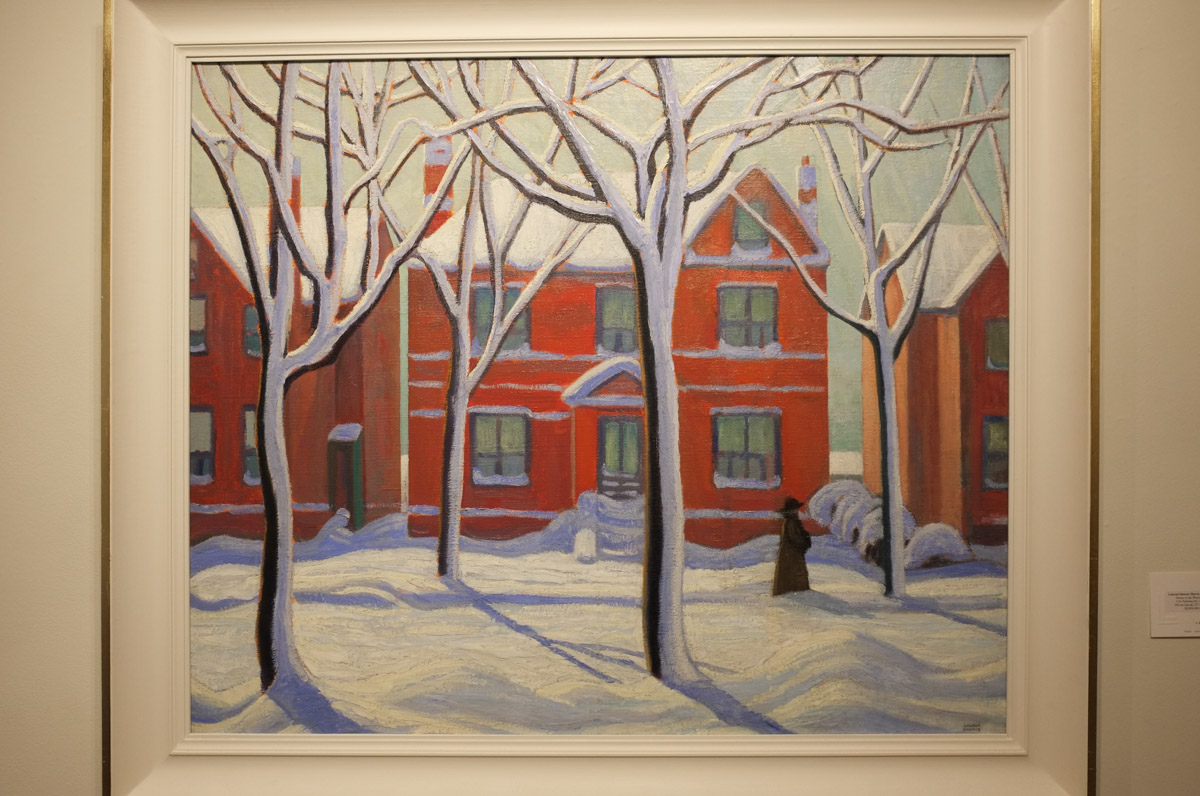
below: Lawren Harris (1885-1970), of the Group of Seven, painted  “House in the Ward, Winter City Painting No. 1” (Toronto) in circa 1924.   A snow covered street scene with not a car in sight! Just lovely old trees and red brick houses.

painting of a city street in winter, snow covered leafless trees, a red brick house, painting by Lawren Harris of the Group of Seven

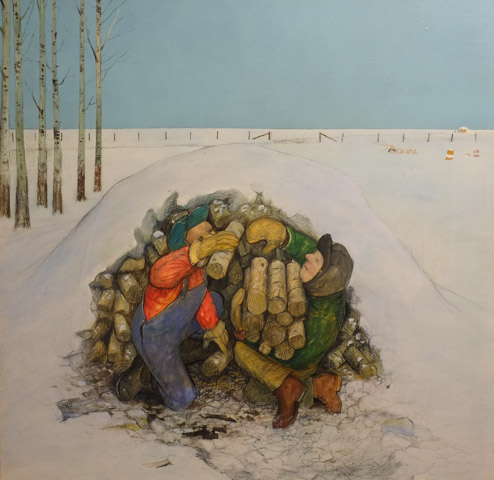
below: And last, William Kurelek (1927-1977) “The School’s Woodpile” 1972, mixed media on board. Kurelek, son of Ukrainian immigrants, grew up on the Prairies during the Depression.

Previous posts about Yorkville Art:

1. The Yorkville-ification of Street Art.
2. A Yorkville meander with Captain Canuck


Bessarion subway station has always had the reputation of being one of the least used stations in Toronto.  I haven’t seen any recent numbers, but I suspect that a lot more people are now using the station.   There are a lot of development changes happening in the area so the numbers will only increase in the future.

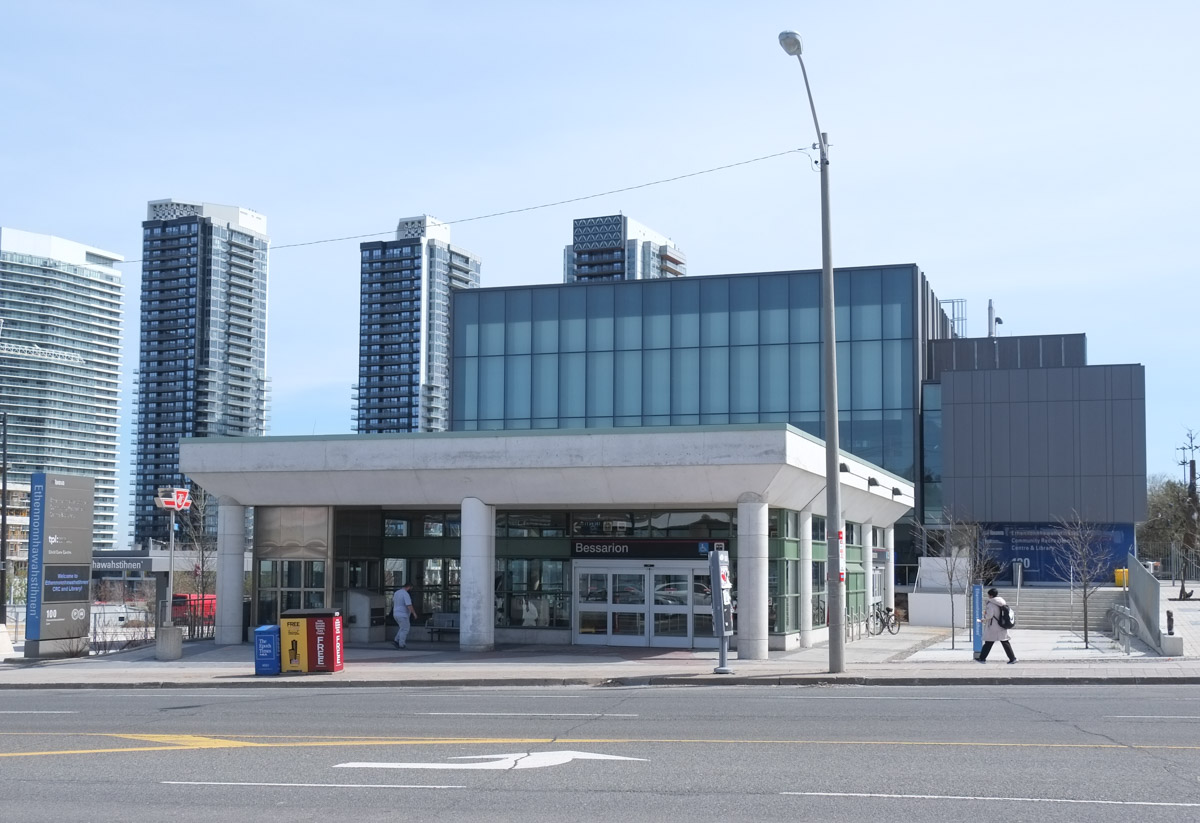
below: South entrance to Bessarion station

entrance to bessarion ttc subway station on sheppard at bessarion, new high rise condos behind it, street scene

corner of bessarion subway station in the foreground, new community center on the right side, and construction of new condos in the background

below: A Stop sign sits in the middle of one of the entrances to the new development on Sheppard Ave East beside Bessarion subway station.  If you follow the left fork in the road, you will end up in the parking lot of the Canadian Tire store.  This store is all that is left from the original 50 acre site that was home to a Canadian Tire warehouse and distribution centre.  In 2000 Canadian Tire filed a plan to re-develop the whole site, including a new head office tower for the company.  Although the plan was approved, it never came to be.  Instead, most of the land was sold to Concord who is now in the process of redeveloping it.

new development on sheppard ave east

below: Concord has filled this community with a lot of public art including these colourful creations, “Jax” (2021) by Pierre Poussin

brightly coloured public ark in concord park place on sheppard avenue

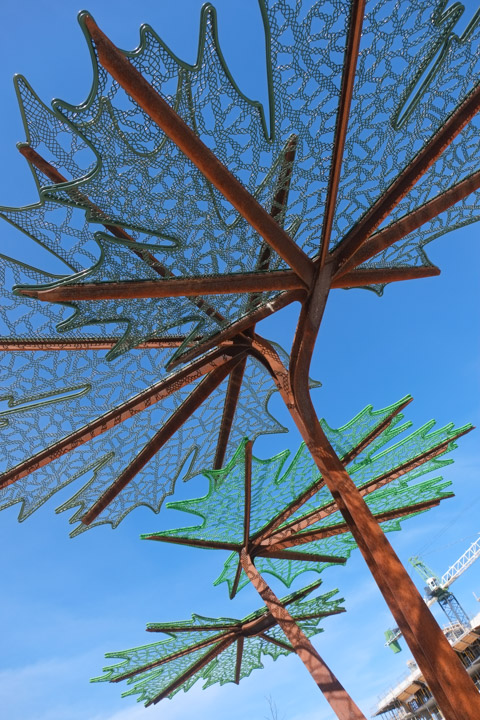
below: A few maple leaves forming a canopy – “Maple Leaf Trellis” by Demakersvan (aka brothers Joep and Jeroen Verhoeven)

sculpture that looks like a canopy of giant maple leaves

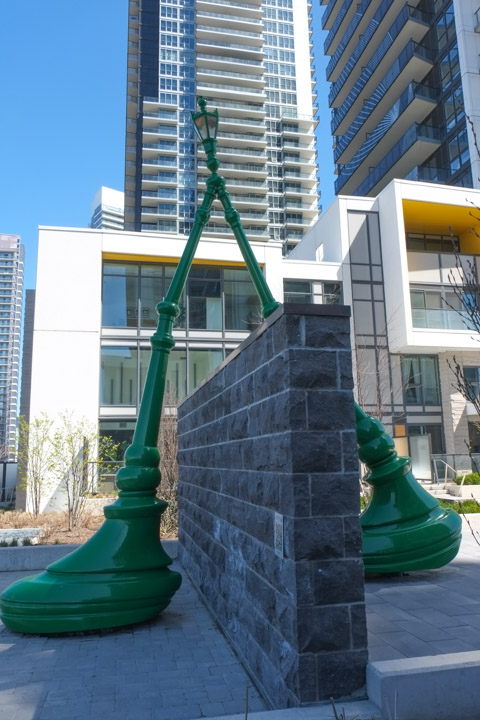
below: Leaping Lamp by Inges Idee (a German artist collective)

leaping lamp, a large green sculpture by ingres idee of a lamp post with two very long legs as it walks over a stone wall

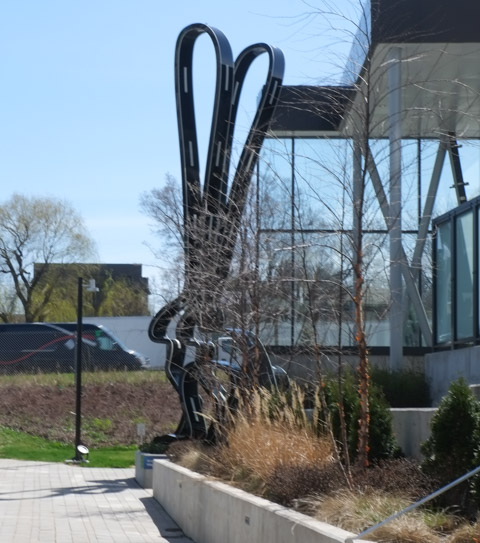
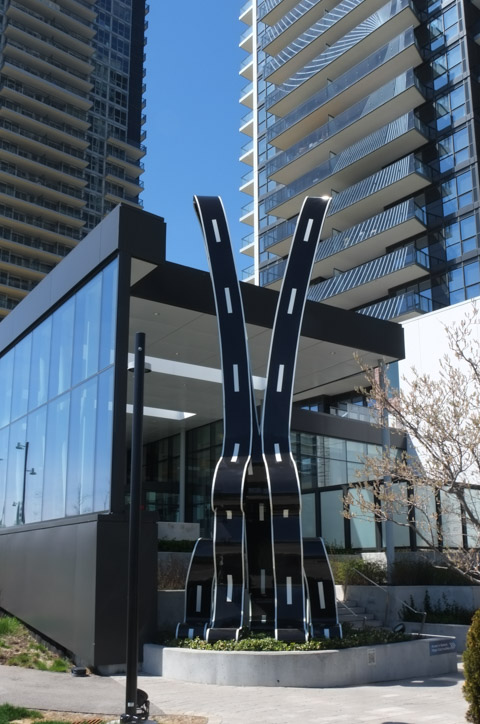
below: There is also a rabbit (title: “Rabbit”),  another artwork by Inges Idee.  It’s made to look like a folded ribbon of highway; it sits next to the 401 highway.

rabbit, a large sculpture by ingres idee, looks like it's made of a road all twisted into the right shape, outside new condo by the 401 highway

rabbit, a large sculpture by ingres idee, looks like it's made of a road all twisted into the right shape, outside new condo by the 401 highway

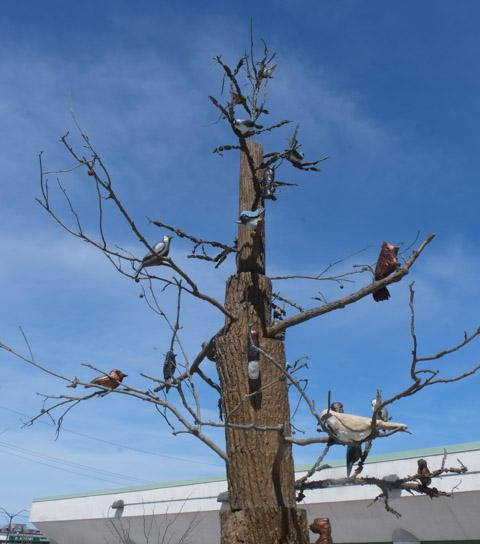
below: Birds hanging out together between Bessarion station and the new community centre.  They won’t be flying anywhere any time soon!

sculpture that looks like birds on a tree, including an owl looking out of a hole in the tree

close up of part of a sculpture with birds on a tree, showing owl looking out of hole in tree, woodpecker beside the hole

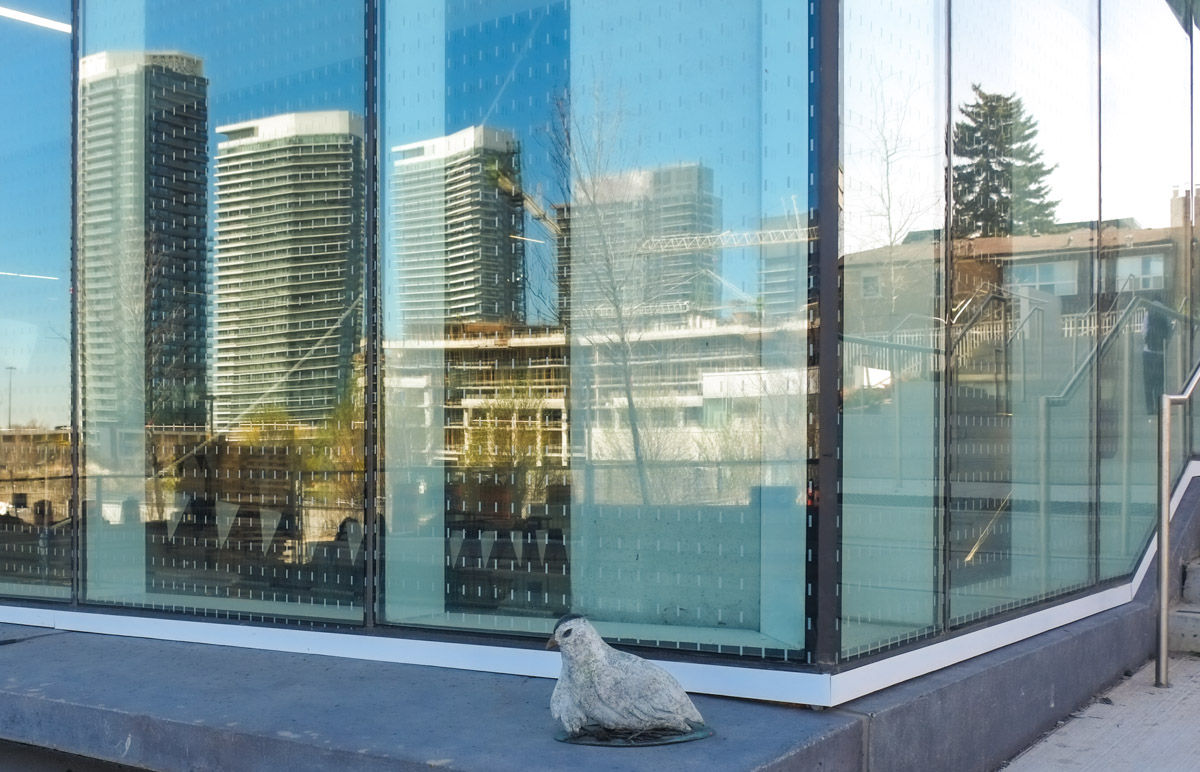
below: A small bird, a continuation of the tree full of birds, sits outside Ethennonnhawahstihnen’ Community Centre (it’s pronounced Etta-nonna wasti-nuh and it means ‘where they had a good, beautiful life”)

reflections in the window of a community centre, with small sculpture of a bird sitting outside the window

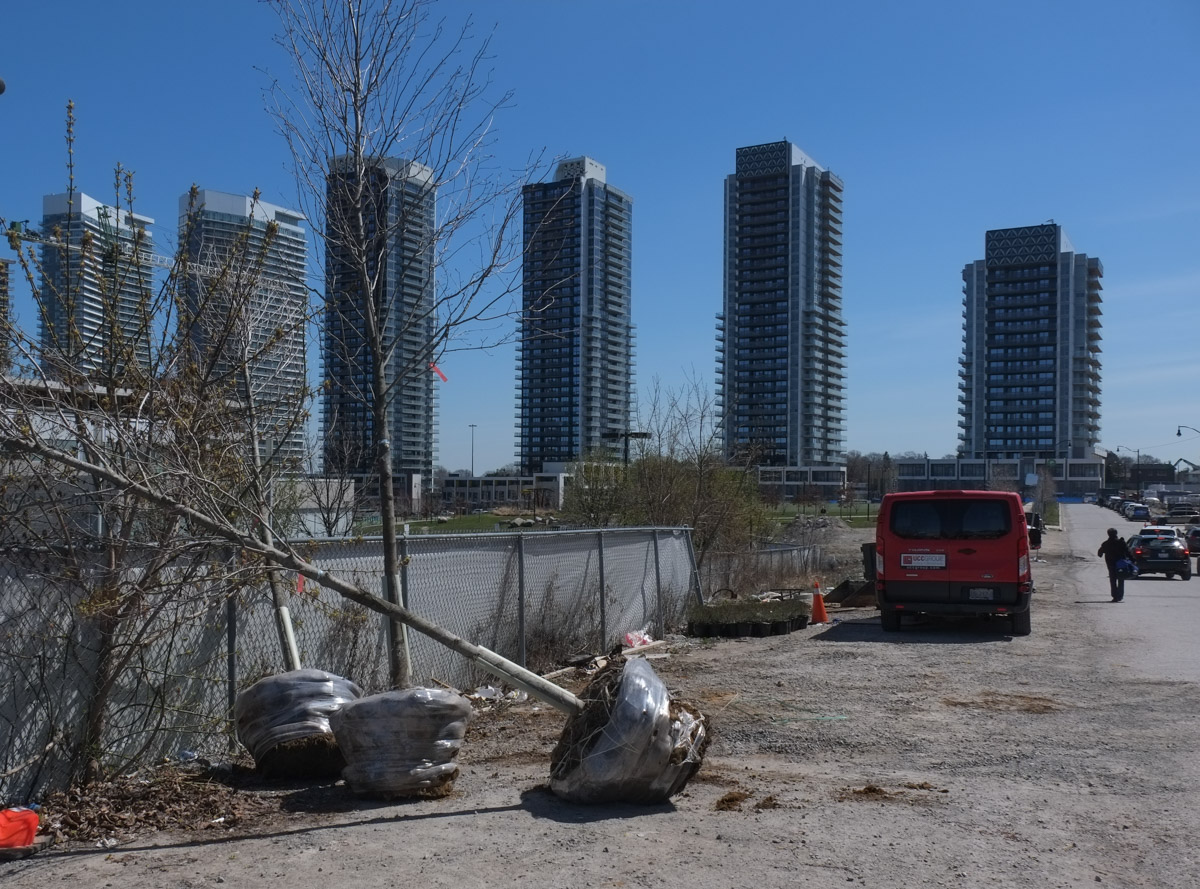
below: Real trees ready to plant.

trees with roots wrapped in burlap sitting on the ground, waiting to be planted, a row of condos newly built in the background

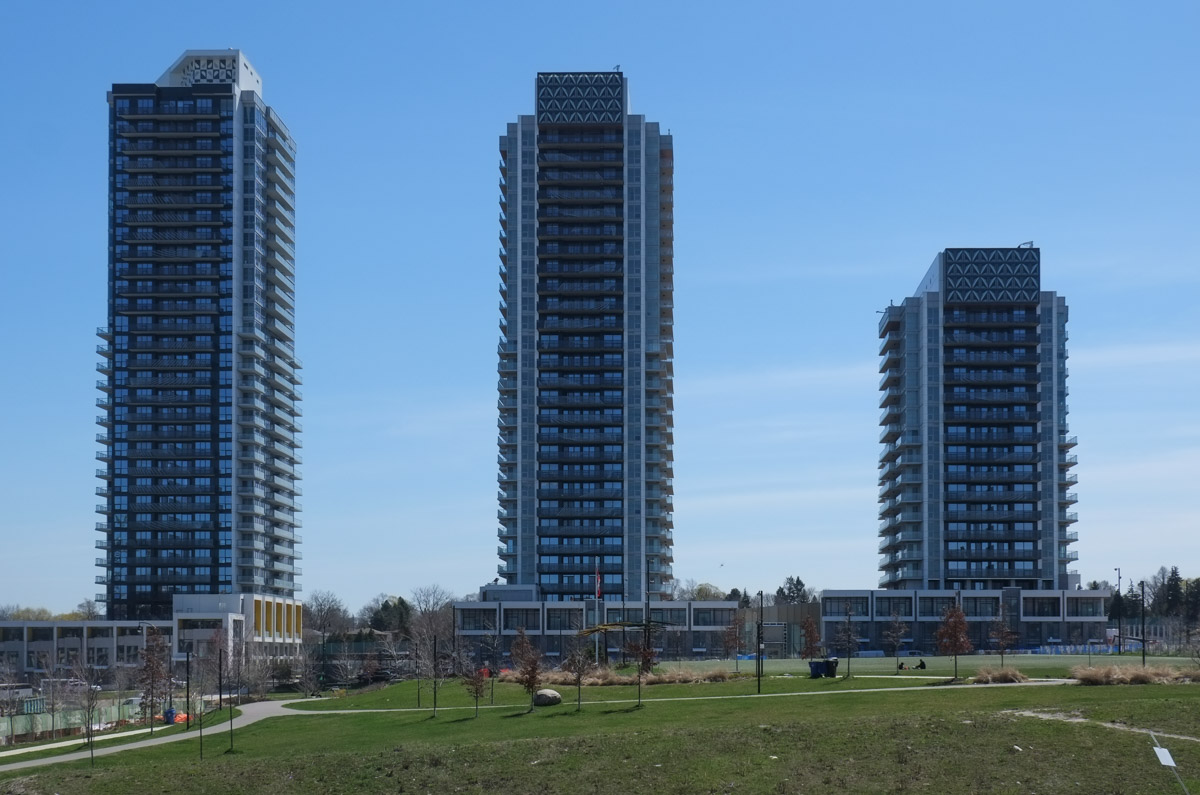
below: A line of towers with row houses on the lower level marks the south side. The 401 highway is behind. A new park, also Ethennonnhawahstihnen’, lies in front of the new residences.

below: Water feature in the summer, outdoor skating rink in the winter

concord development on south side of sheppard, on old canadian tire warehouse site, a curved shallow pond with a walkway around it, a small white building beside it, condos and new construction in the background

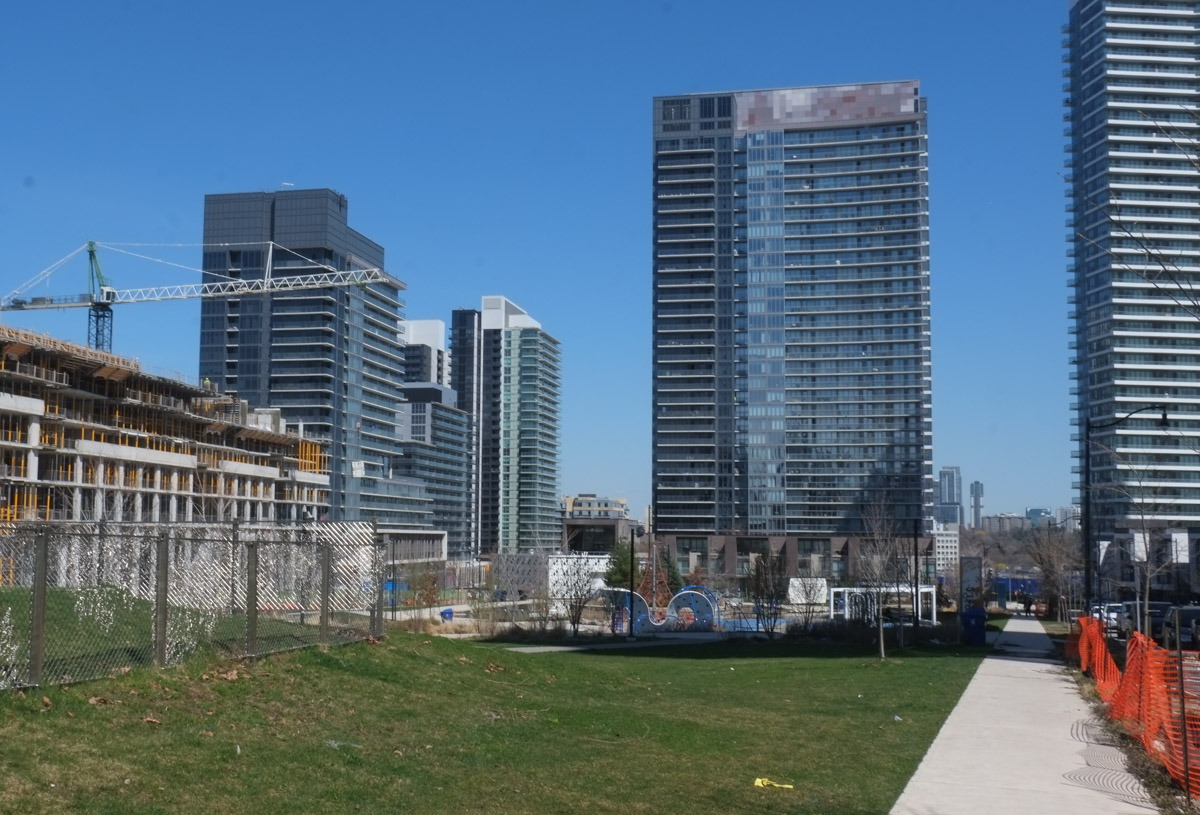
park in the center of condo development

tall glass and steel condo, one side clad in bright green

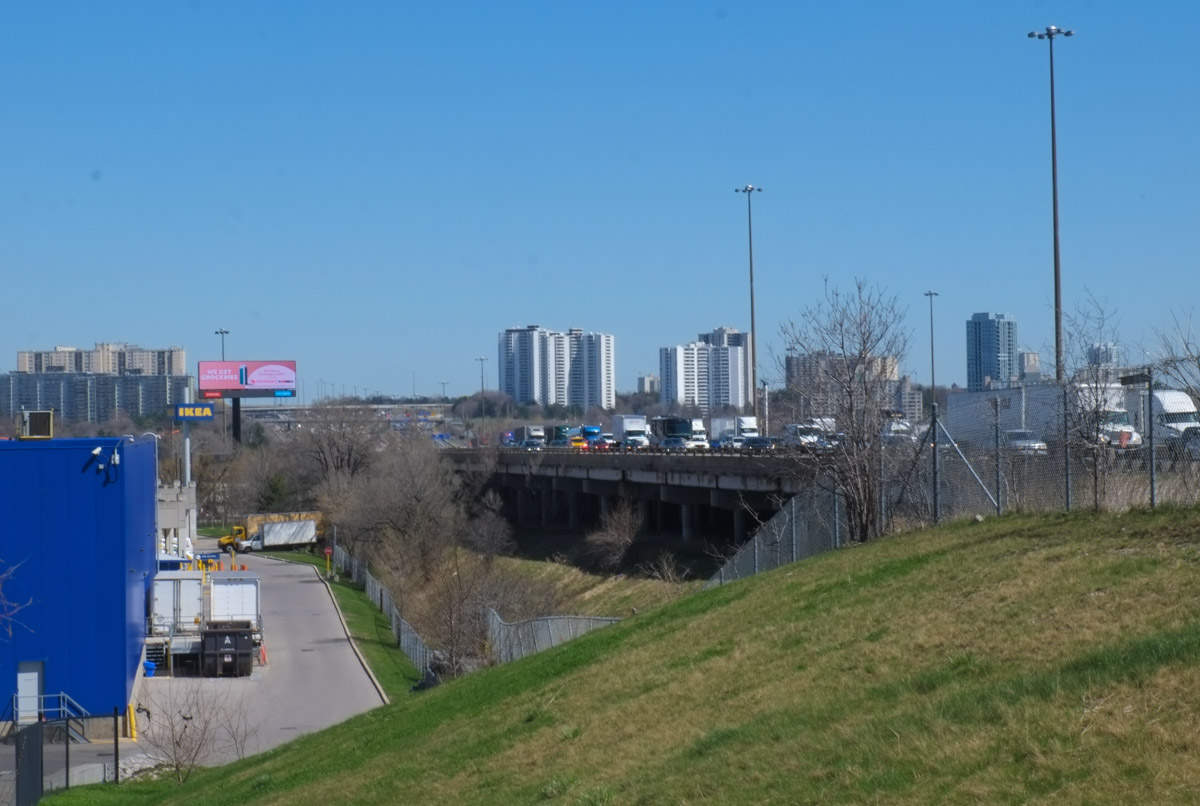
below: The view from the southeast corner of the property – the back of IKEA and the 401!

back of ikea on sheppard in north york, 401 highway,

below: At least there have been a lot of trees planted back here and some thought has been put into using the landscaping to mitigate the noise from the 401.  But the fact that thousands of cars and trucks pass her every day can never be downplayed.  I hope that the units are well sound proofed.  Having stood on balconies on other buildings that overlook a major road, I can imagine how noisy it is here too.

newly planted trees along a pathway beside the 401 highway

new condo development with a bright yellow rectangular section around a large window

the words slow down have been spray painted on a concrete barrier in front of a row of new townhouses

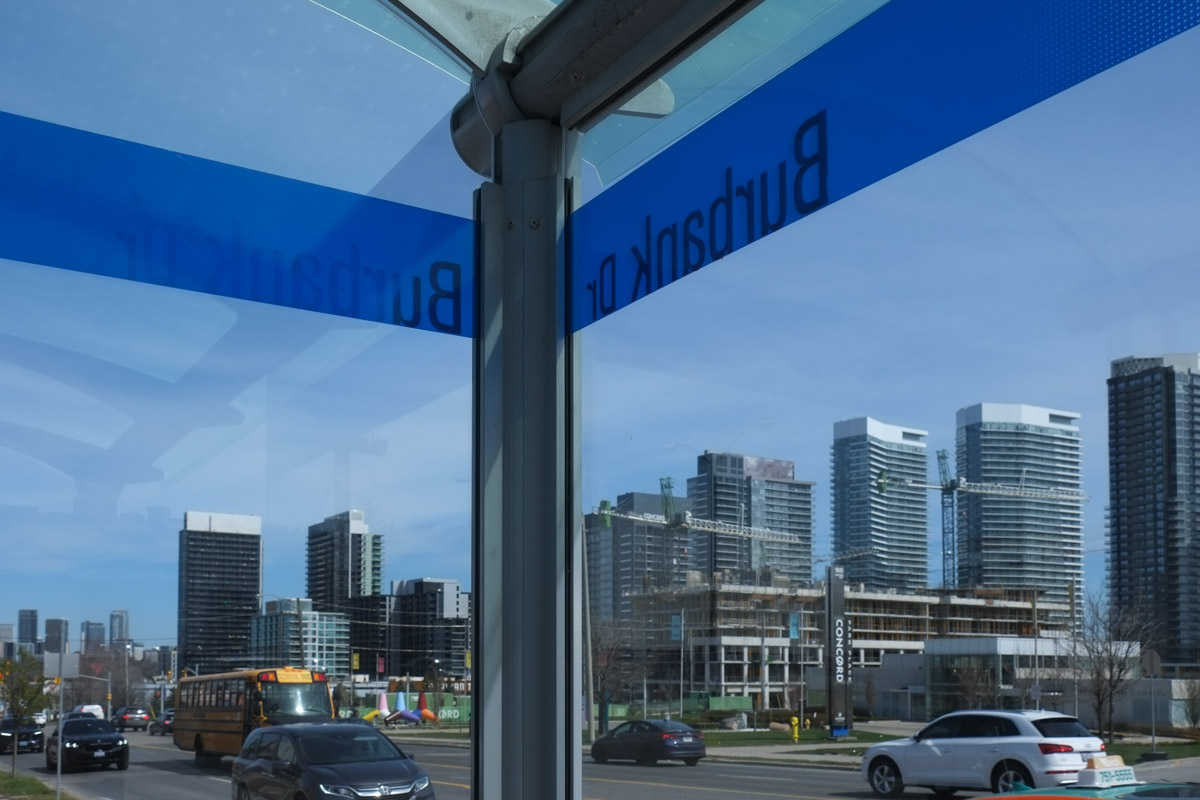
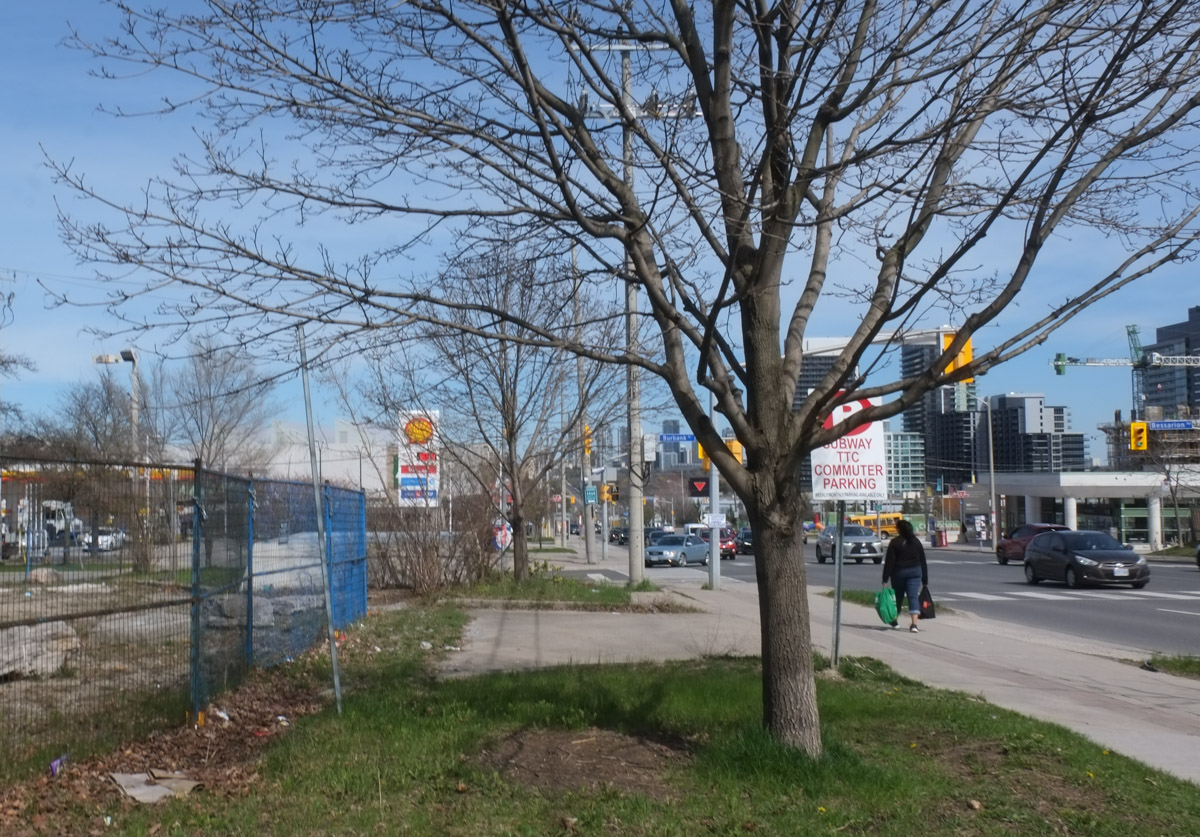
below: Looking southeast from Burbank

looking out of ttc bus shelter at burbank and sheppard

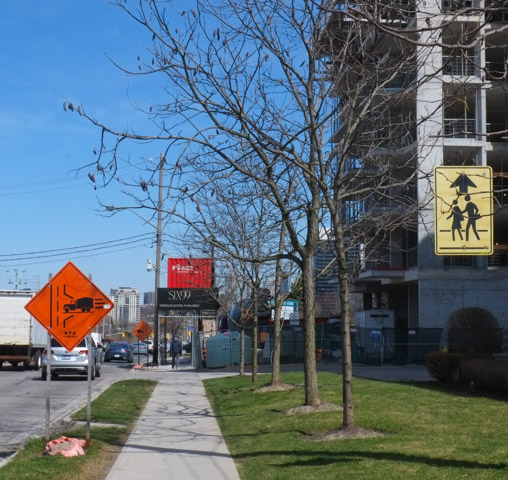
below: South side of Sheppard

view on sheppard, looking east near bessarion subway station

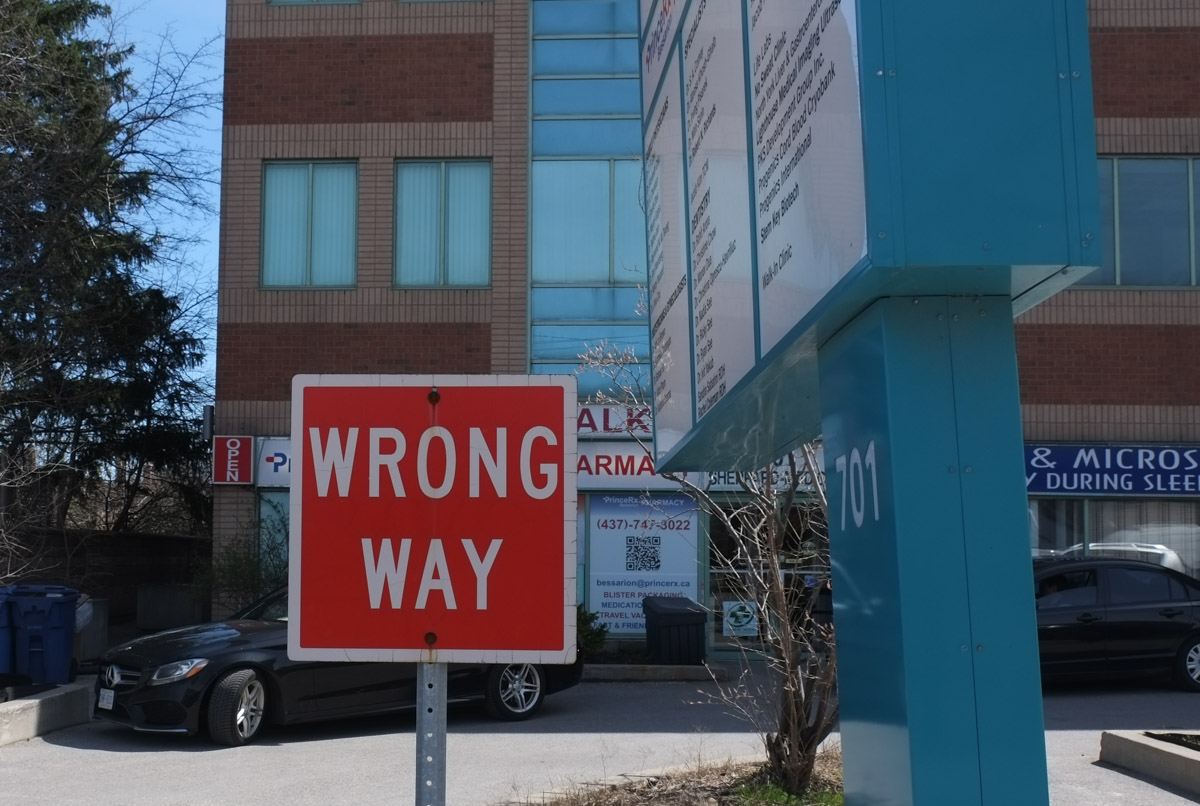
wrong way sign by driveway in front of medical building on sheppard

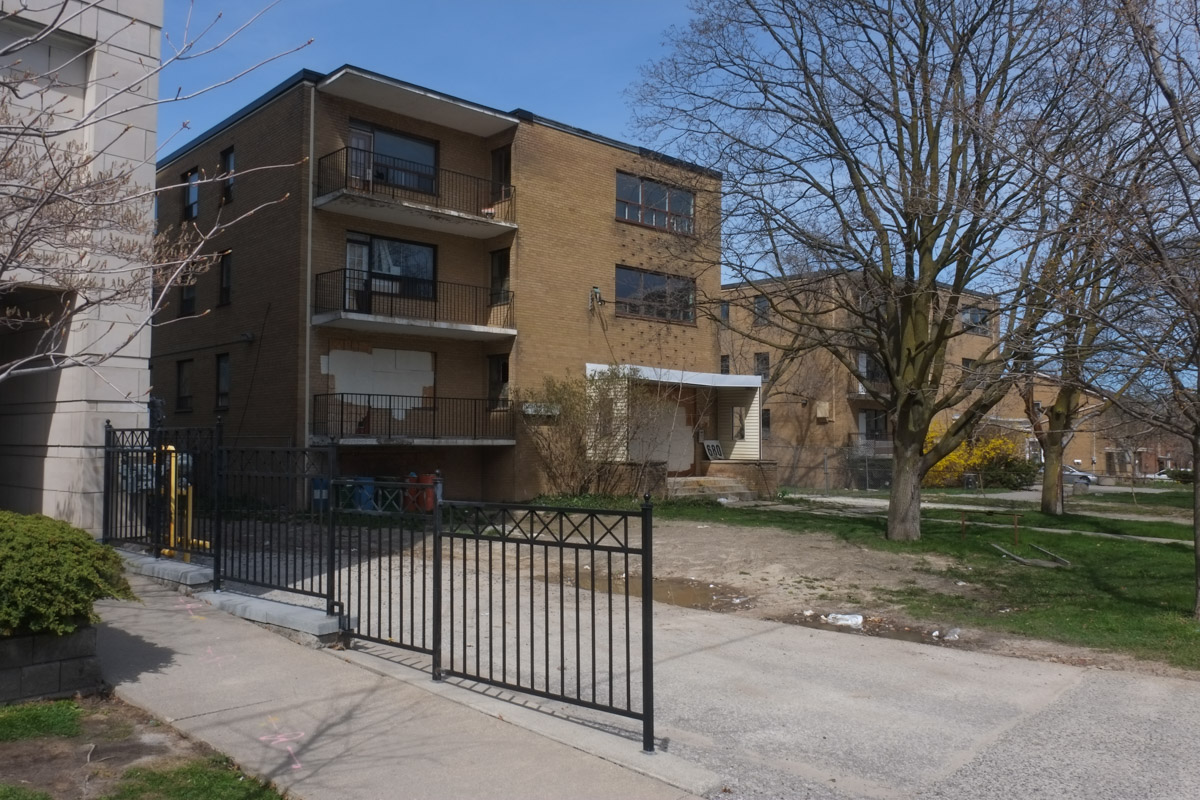
below: The north side of Sheppard Ave looks like this – a row of lowrise apartment buildings from the 1960s or 1970s.

lowrise apartment buildings on north side of sheppard

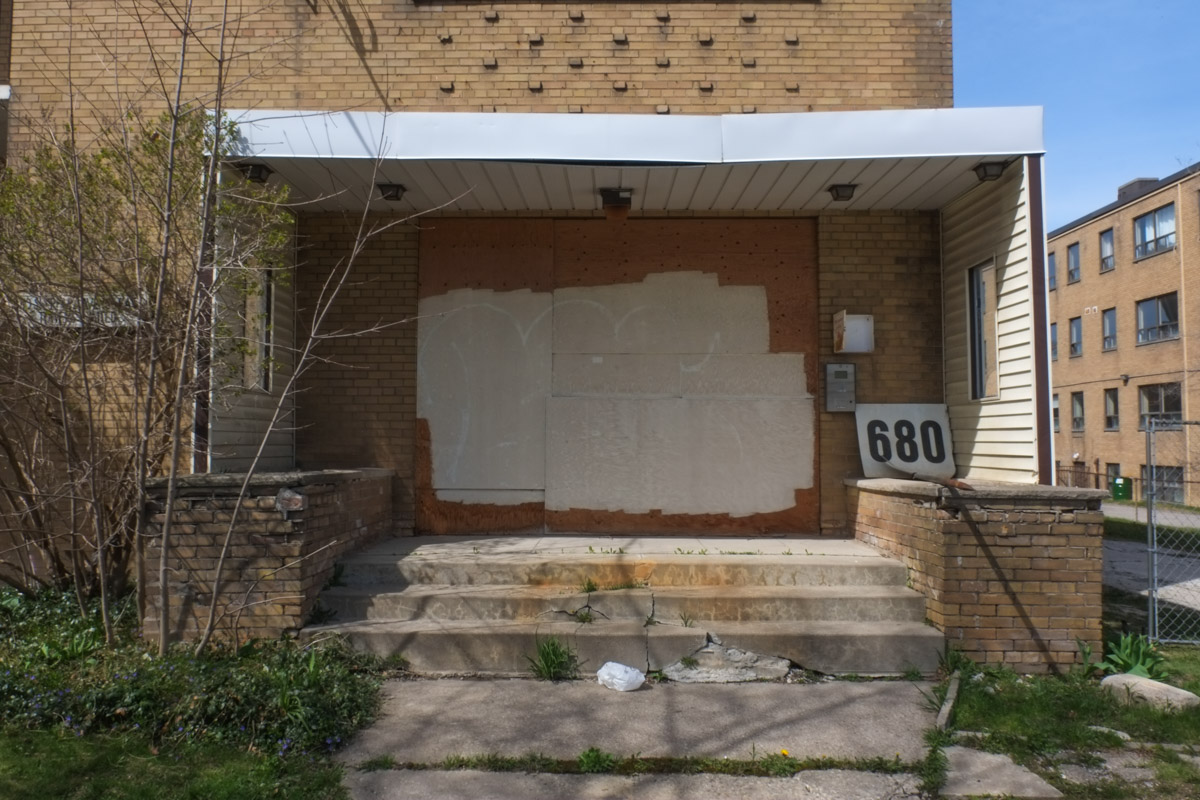
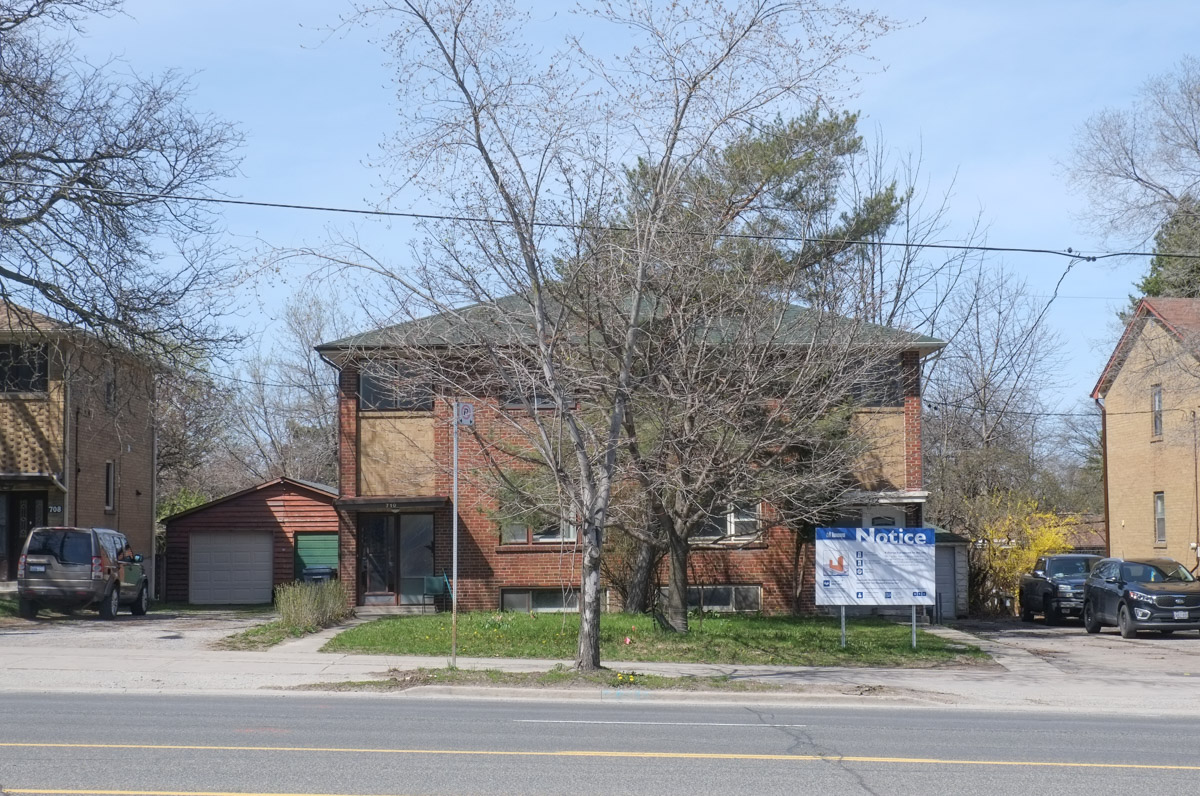
below: There are 2 major redevelopments proposed along here, 680-688 Sheppard and 690-720 Sheppard. Both involve condo towers.

development notice on front yard of a multiplex residential building on sheppard avenue

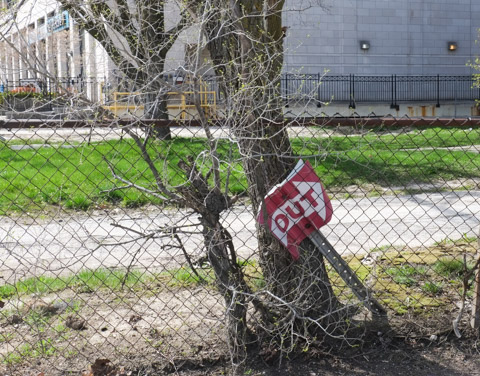
crumpled red and white sign says out, pole askew, between fence and tree

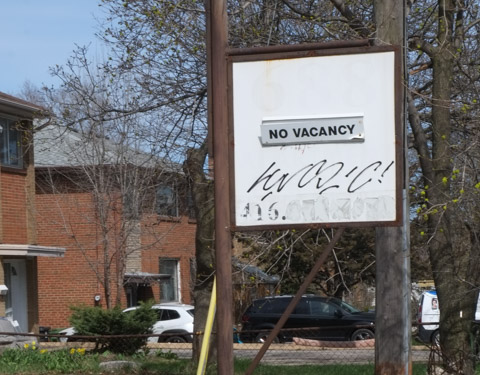
sign for apartment building, empty except for no vacancy and a graffiti scrawl

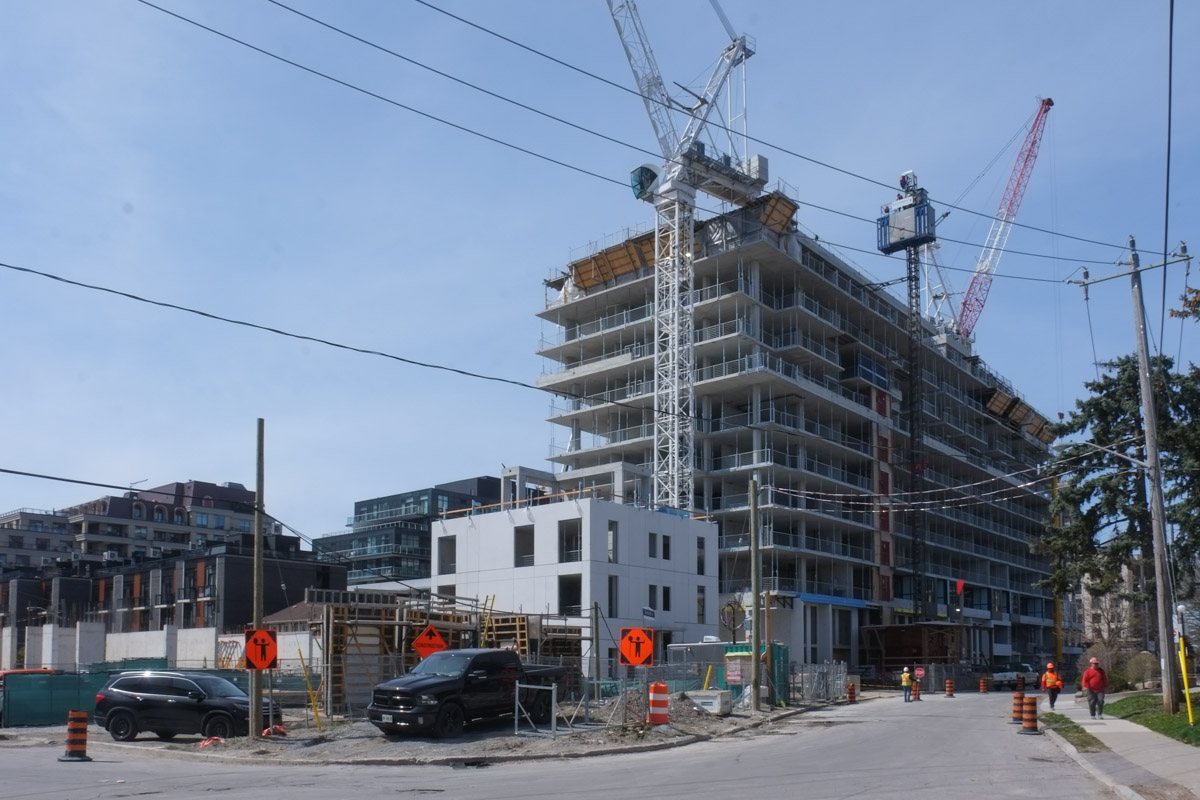
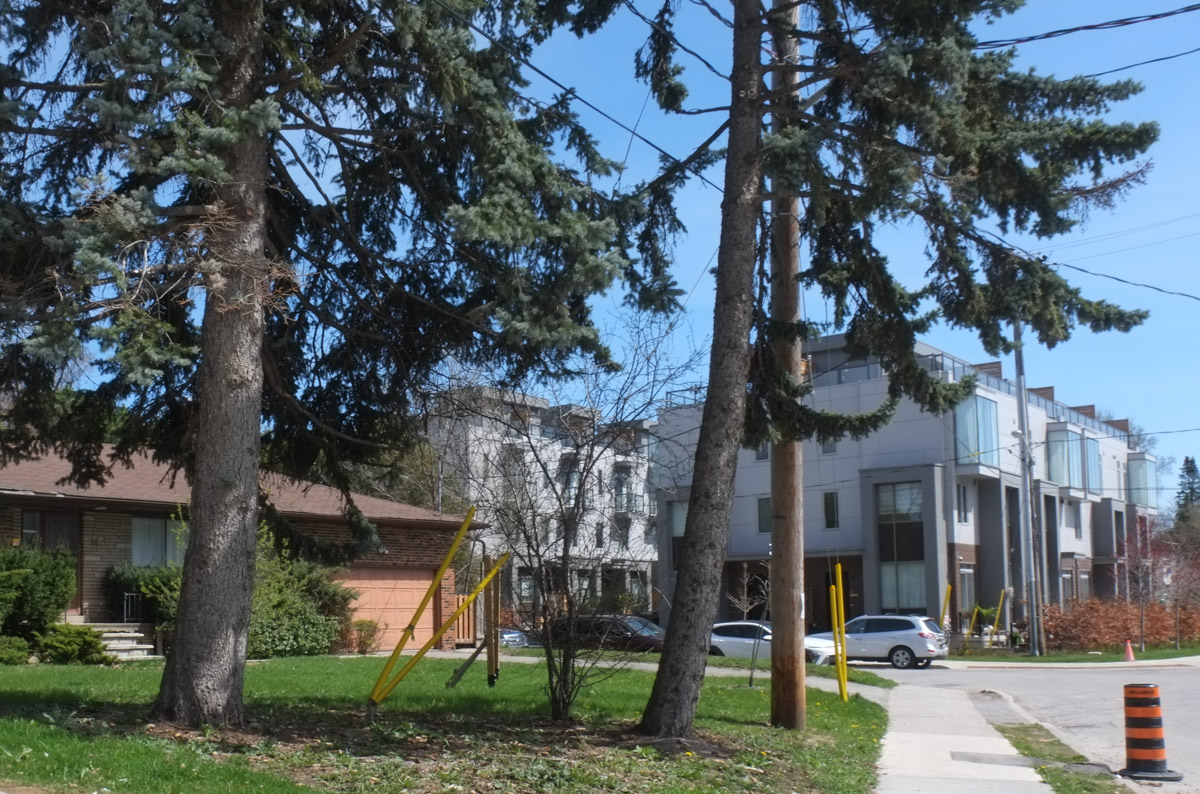
Just west of Bessarion station is Greenbriar Road.  There was a small community of single family homes, duplexes, and small apartment buildings back here.  Almost all of it is gone or on the way out

construction south of sheppard ave

below: A single, lonely, holdout surrounded by newer residences.

one older brick house surrounded by newer and taller residences

A 1970s brick bungalow in the foreground, new townhouses in the background

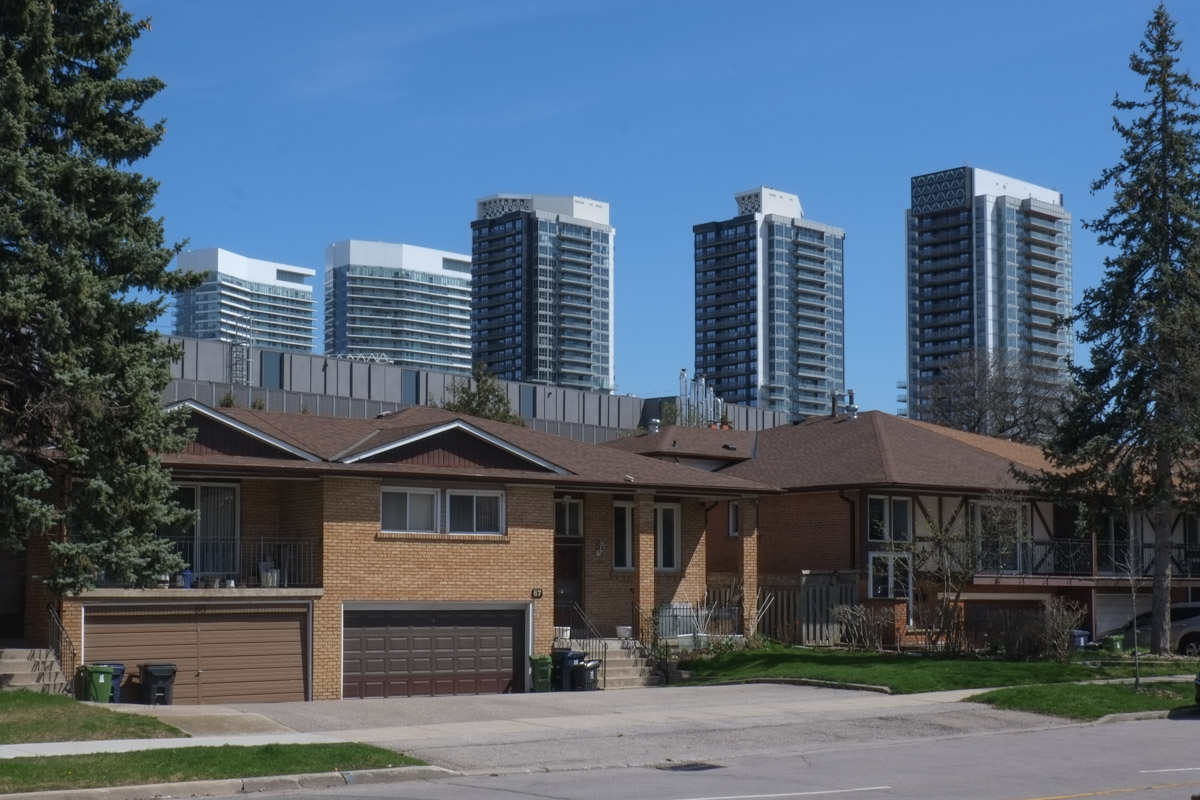
below: No sign?!

two brick duplexes, semis, or side split houses, with 5 towers of new condos behind

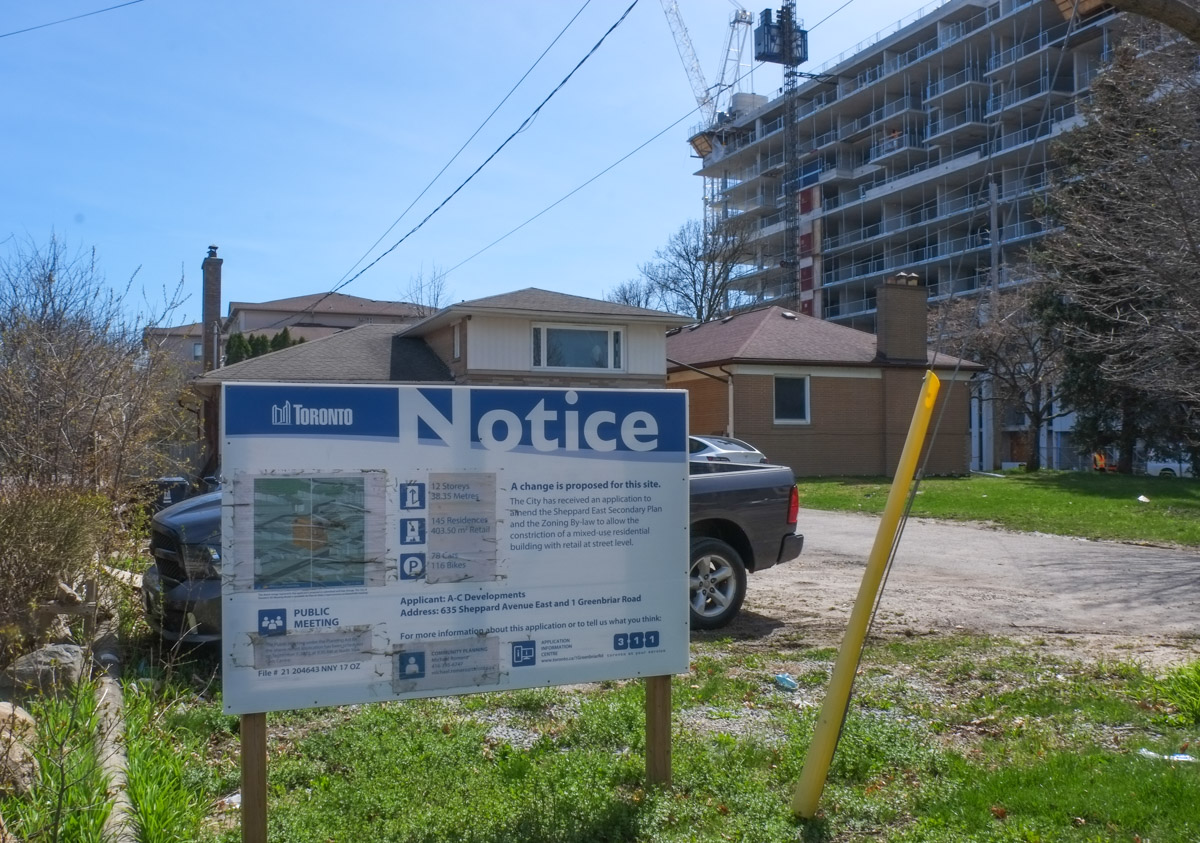
below: Southeast corner of Sheppard and Greenbriar  (12 storeys, 145 residences)

development notice on the frontyard of a house on corner of sheppard and greenbriar

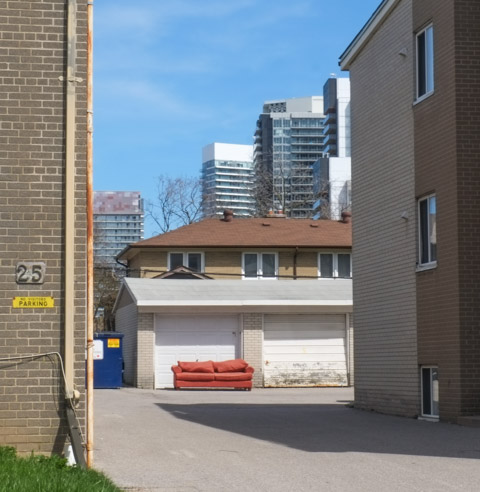
below: There is a development notice sign on the front yard of 25 Greenbriar (23, 25, 27 and 29 to be replaced with 10 storeys, 169 residences).

orange sofa on a driveway in front of a garage between two brick buildings

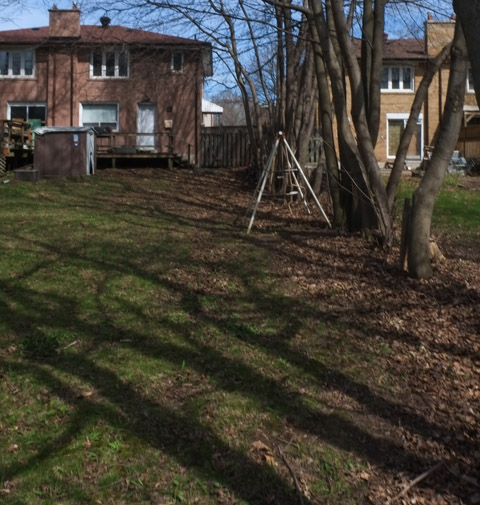
large grassy backyards of two houses, one has an old swing set in the yard

below: A little farther south on Greenbriar the fences are already up (22-36 Greenbriar, 24 storeys, 351 residences).

house on Greenbriar, empty, with construction fence around it and blue and white development notice beside the fence

bessarion subway station

a woman walks eastward on sheppard near bessarion

Extra note: The northeast corner of the old Canadian Tire acreage, at 1181 Sheppard Ave East, remains undeveloped.  It is the last piece once owned by Canadian Tire.  It is adjacent to the Metrolinx rail corridor, about 100 m from the new Oriole GO station.  [ed note: Prime real estate by the sound of it!].  Two towers will probably get built here, once the heights are finalized.

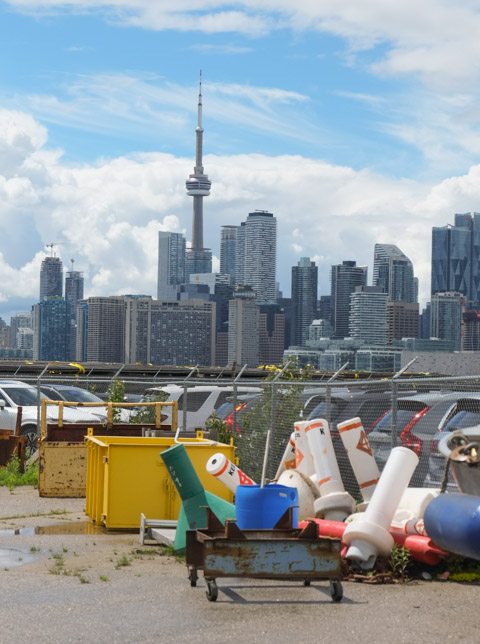
view of cn tower from port of toronto, with buoys, on land, in front, as well as a parking lot

Welcome back! Bienvenuti!  A colourful sign to welcome you and visitors to Toronto.  I’m not sure how many visitors get to see this banner!

sign saying welcome to toronto in many different languages

The Port of Toronto has almost become an obscure corner of the city.  It’s certainly not where most tourists arrive in the city!  Nor is it a place where residents venture.

welcome sign in different languages, puddle in front, large green and orange buoys, on land, reflections in the puddle

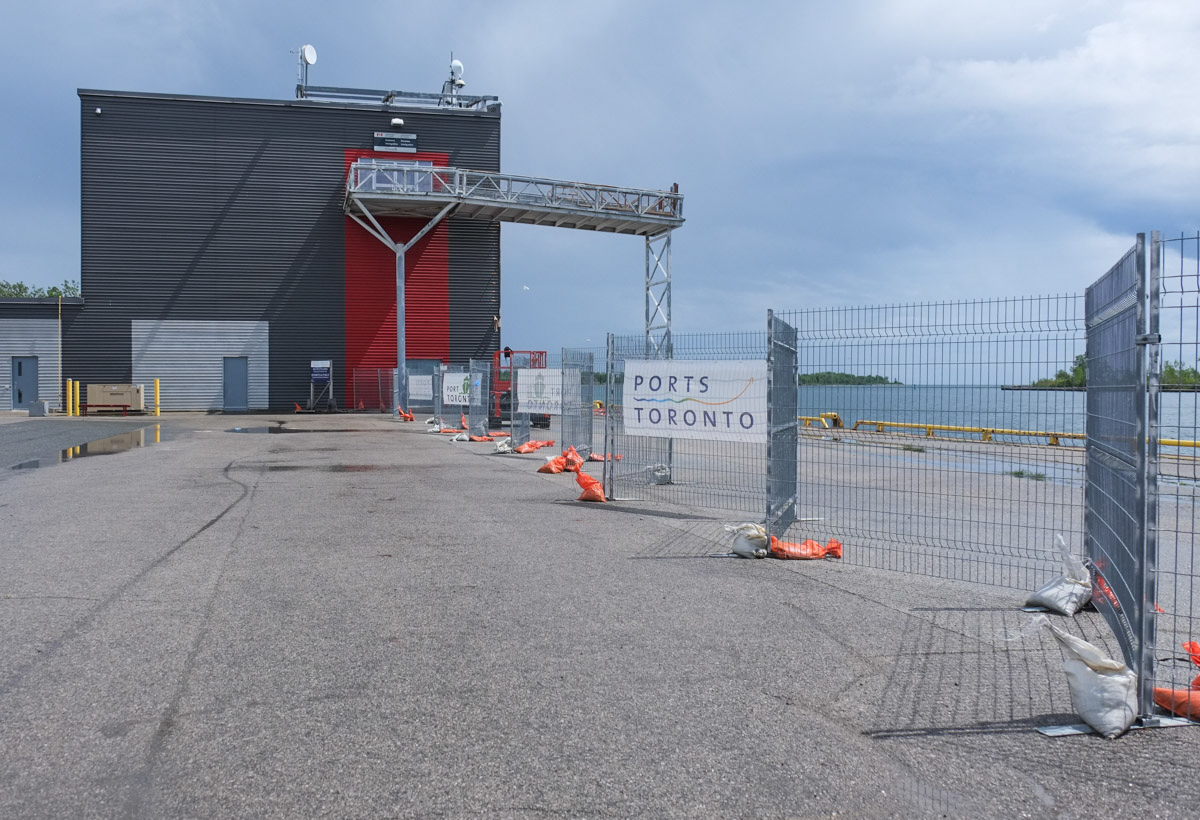
below: Once there was a ferry between Toronto and Rochester that docked here but it didn’t last long.  Now there are a few cruise ships that stop here.  The building would be almost deserted if Netflix hadn’t taken over some of the space.

building on pier, beside waterfront, with chainlink temporary fence, sign says Toronto Port or Port of Toronto

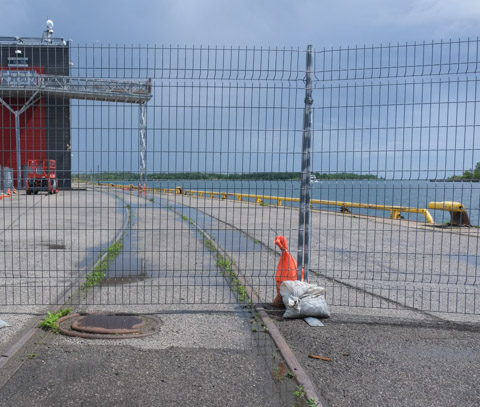
below:  The fragments of railway track are reminders of the industrial past.

metal fence across old railway tracks on a pier, beside waterfront, Lake Ontario, Port of Toronto

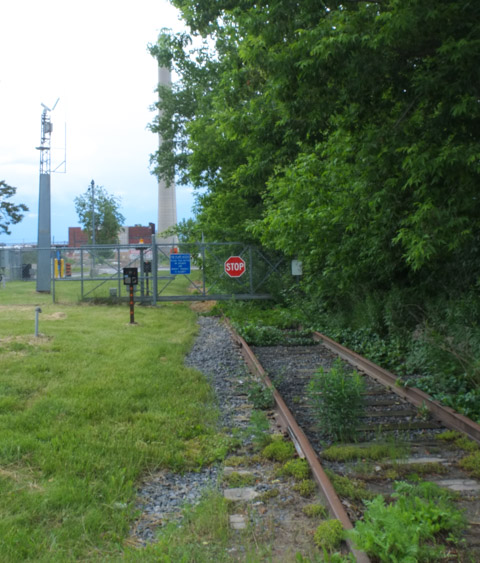
below: There are bits of track scattered all over the Port Lands

fence across old railway tracks with industrial site beyond

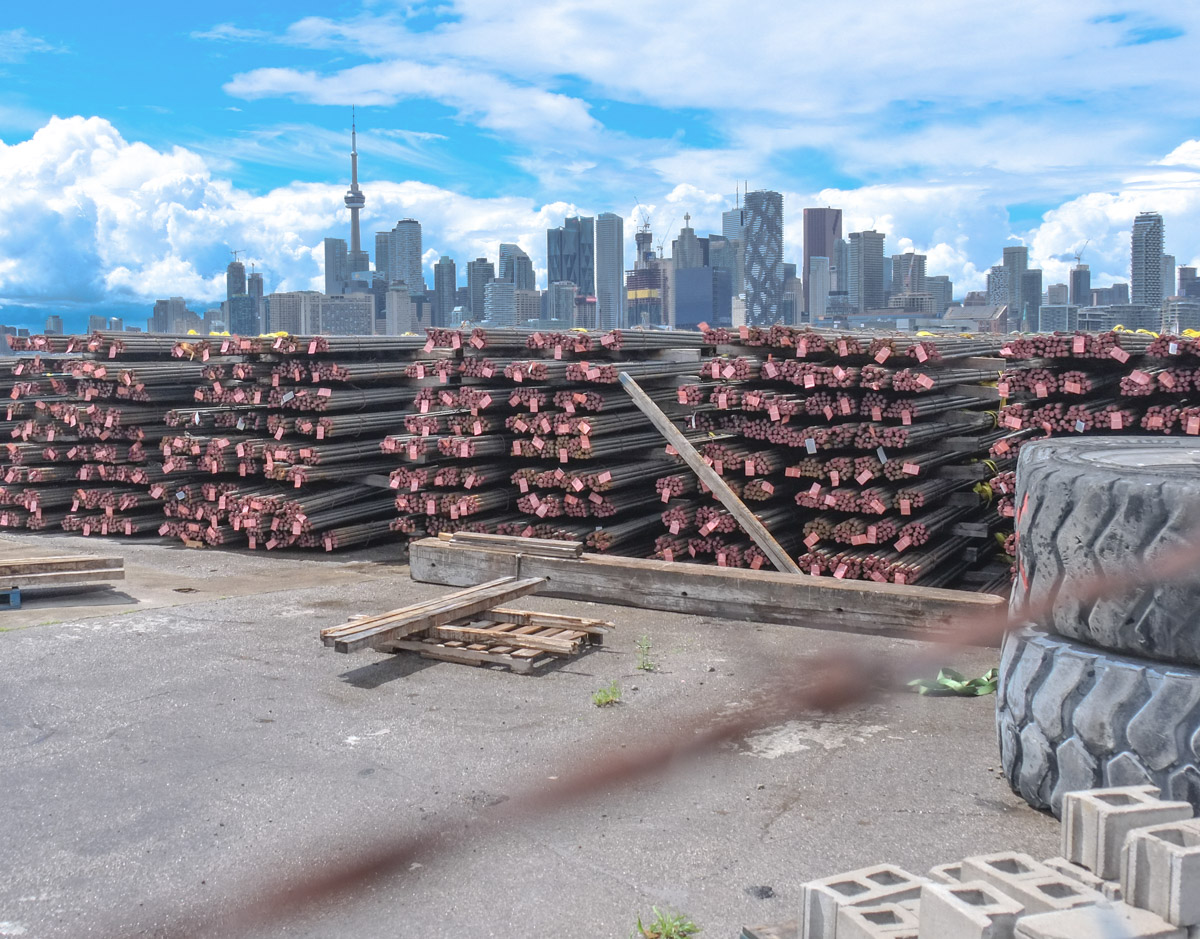
below: The Port is much quieter but there is still activity.  These long metal bars that are neatly stacked on shore were probably recently offloaded.

stacks of 40 foot long rebar on the waterfront, port of toronto, recently unloaded from a boat
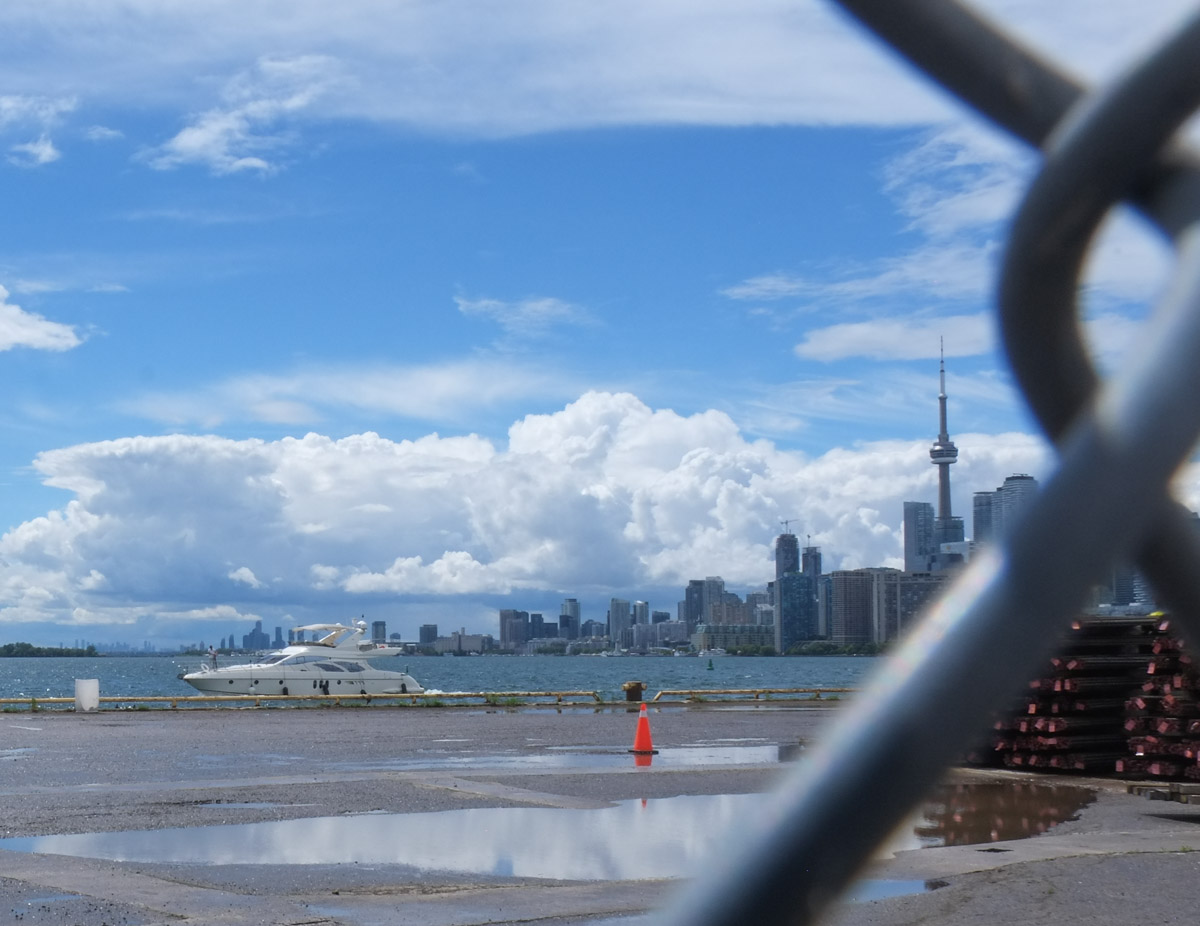
view through chainlink fence on pier, a yacht is exiting the harbour, toronto skyline in the background

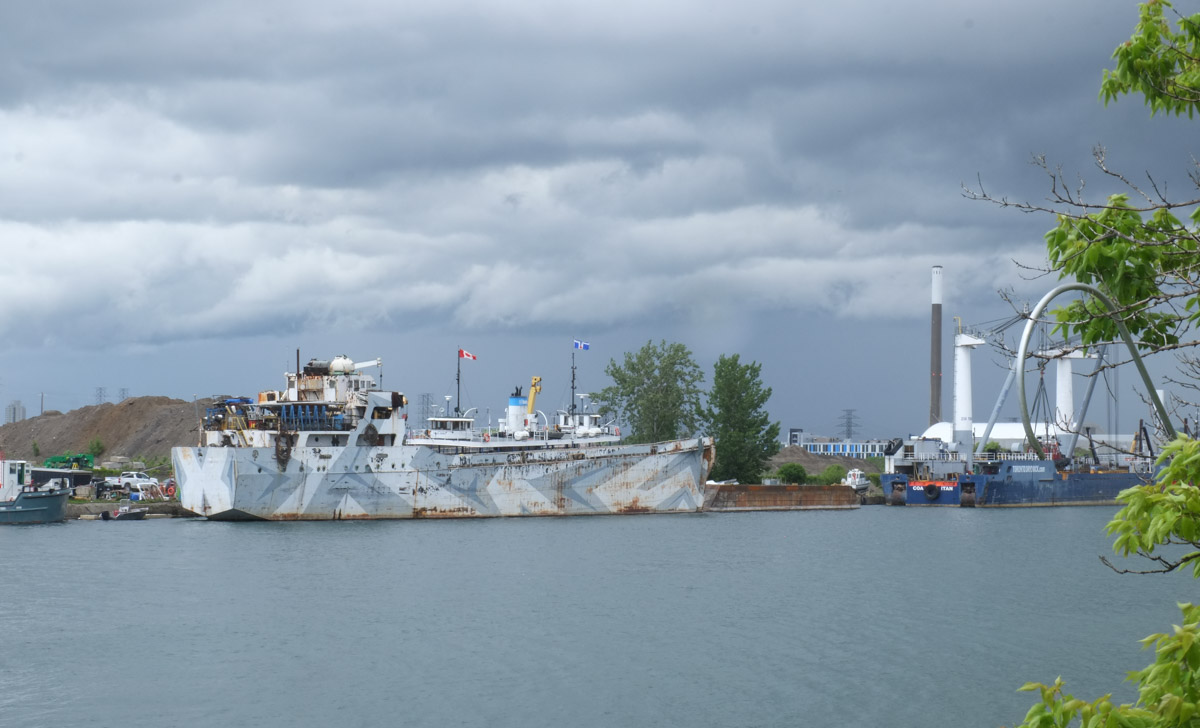
below: Boats in the Ship Channel.  The redevelopment plan for the Port Lands has always included the retention of the Ship Channel.  The sand and salt for Toronto’s roads is delivered here.

ships in the Shipping Channel

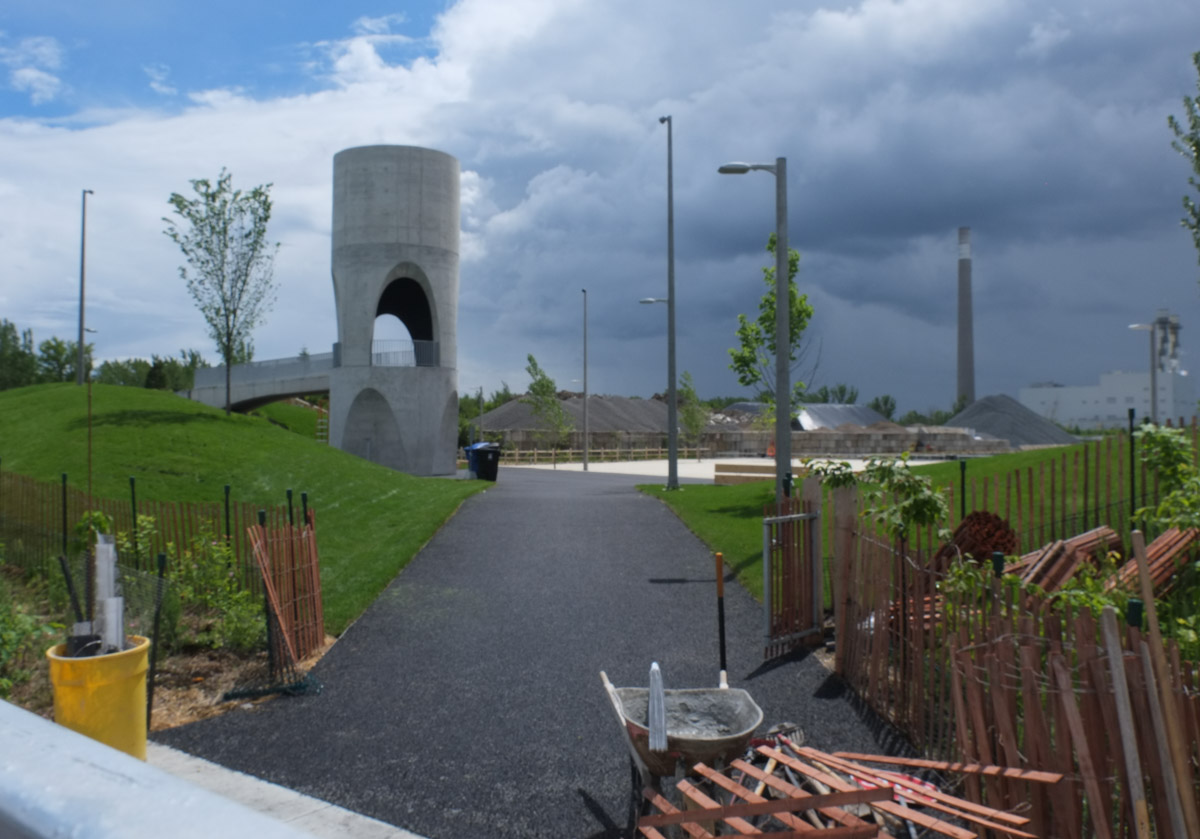
below:  At the east end of the Ship Channel, a new park is being developed – Leslie Lookout Park.   The concrete cylindrical structure is a lookout tower so there will be views over a man-made beach (that appears white in the photo).  The beach is larger in real life than it looks like in the photo.

new park being developed

below: Can you see the little sliver of blue water?  That is the Ship Channel.

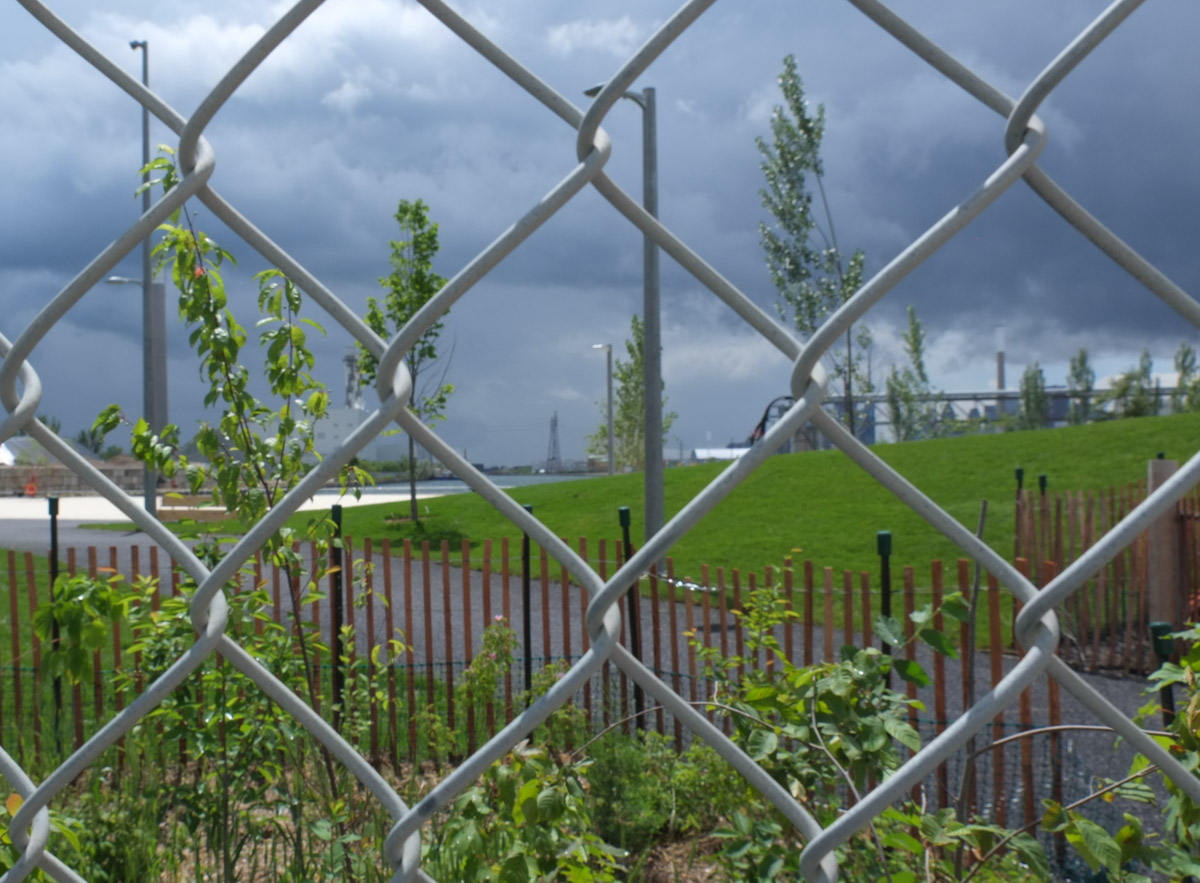
behind chainlink fence, new park being developed, on shipping channel so water is just visible in the photo

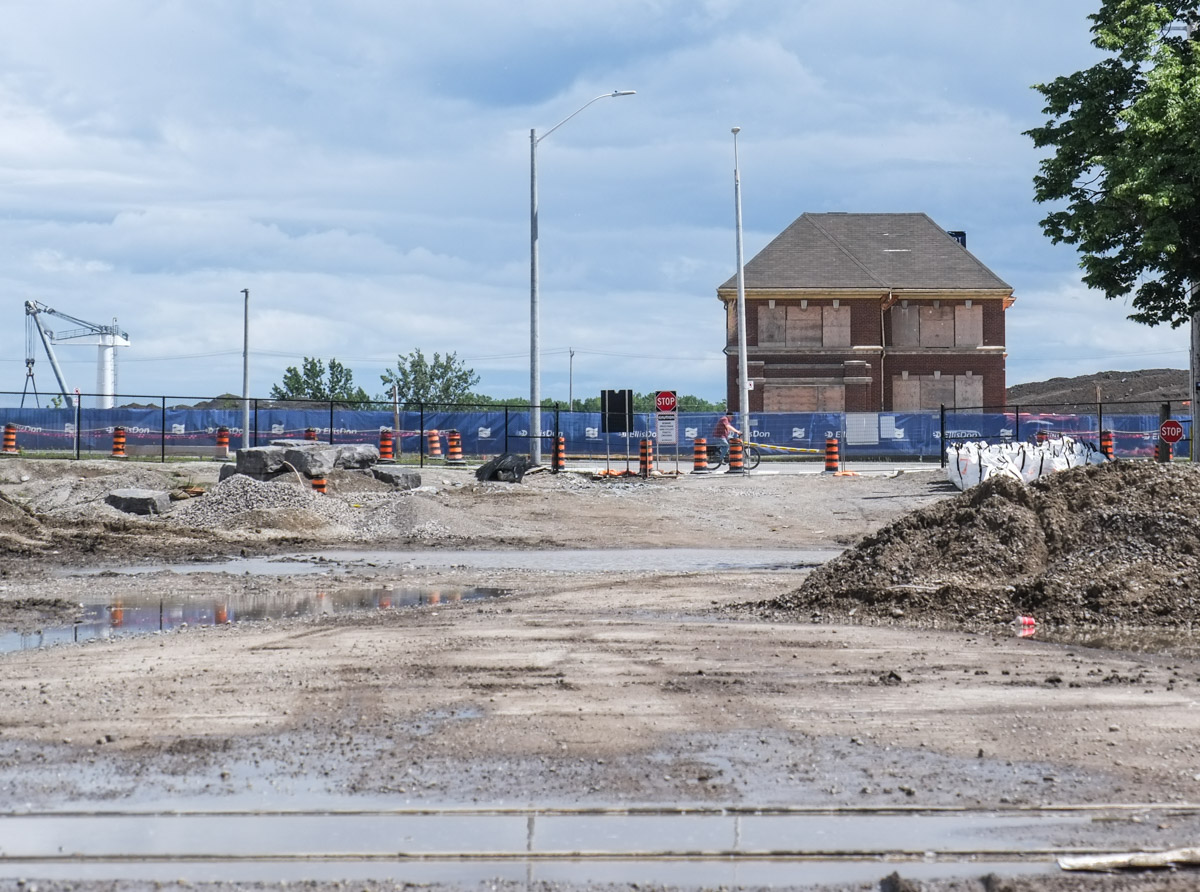
below: Looking south on Munitions Street

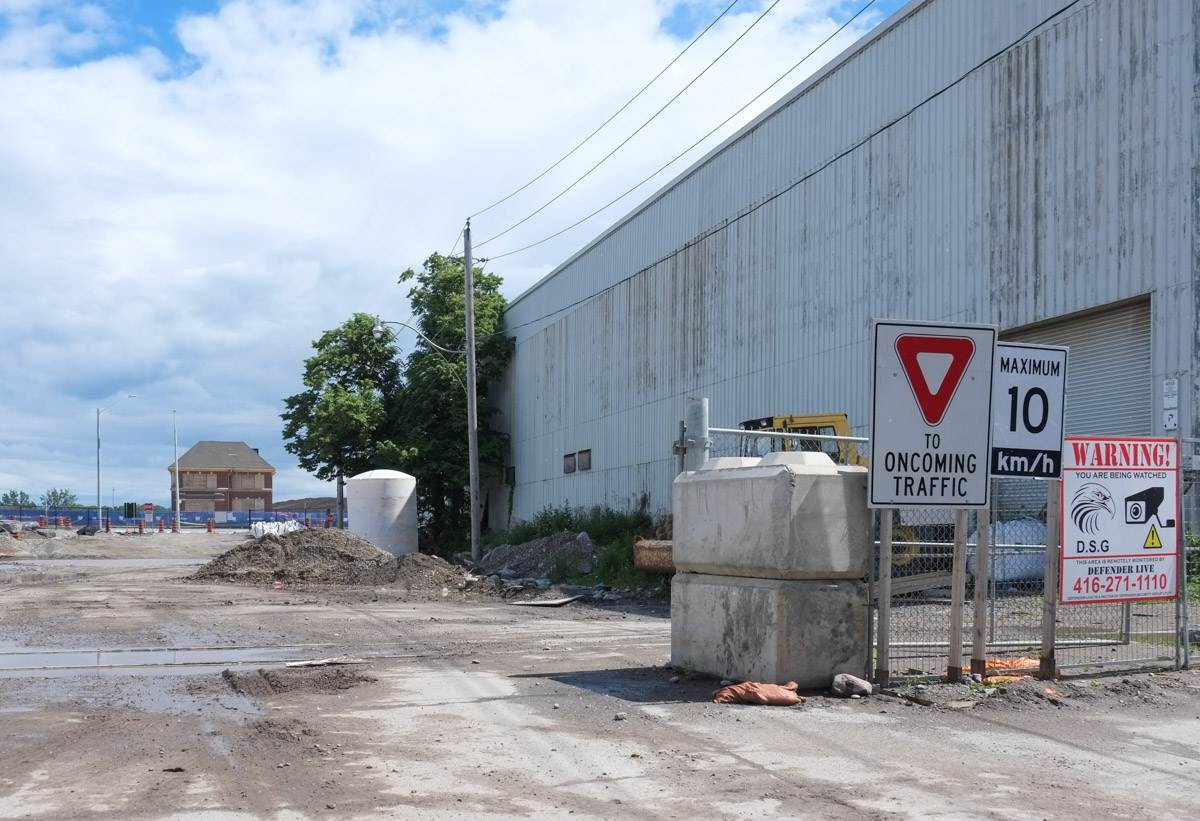
munitions street, port lands, construction, all gone but old fire hall and white building film studio

below: Toronto Firehall, Station 30, built in 1928 still stands.  It is a heritage building and if the plans are followed, it will be repurposed.

munitions street, port lands, construction, all gone but old fire hall

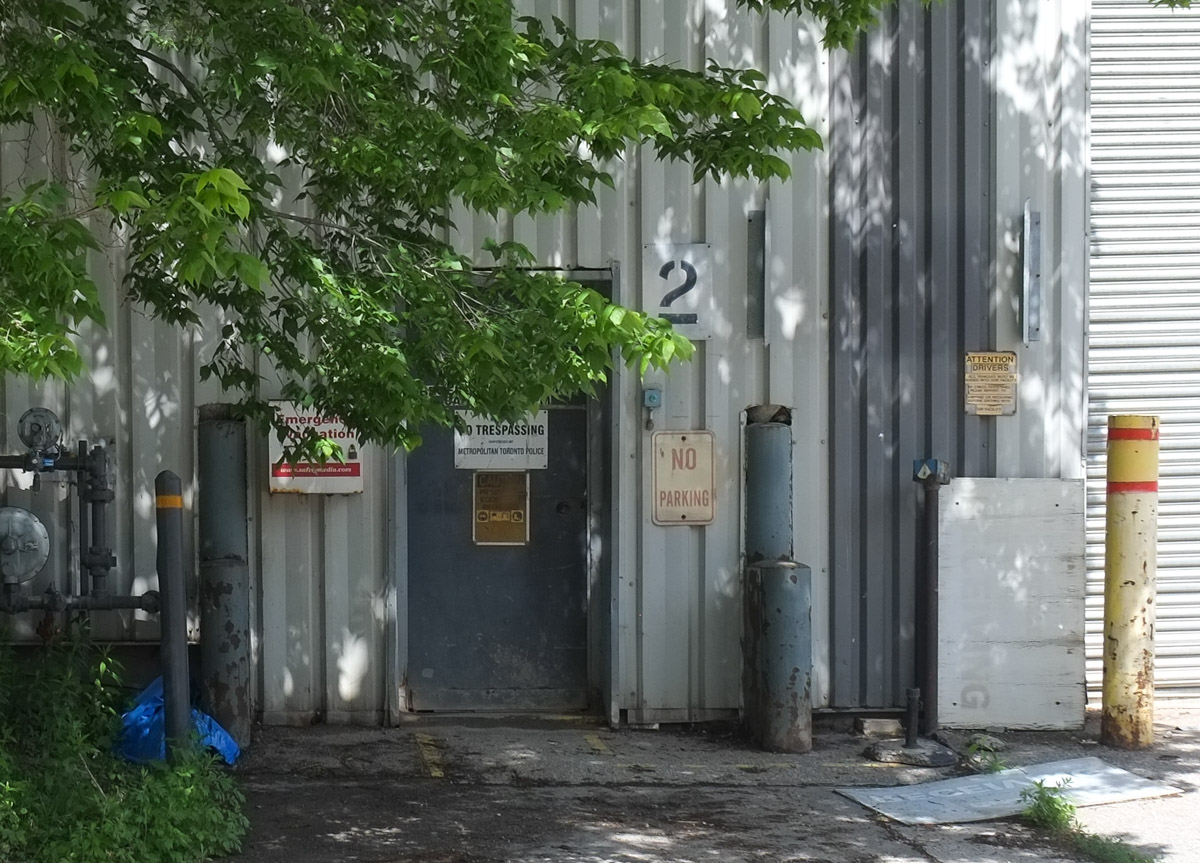
entrance to old metal clad building, tree in front, no trespassing sign on door, no parking sign beside door

below: The redevelopment of the Port Lands has involved a lot of infrastructure changes.  Roads have been changed, rivers have been diverted, bike lanes and better sidewalks have been created.  At times it has been confusing to navigate through.

traffic signs, signals, and new construction in Port lands

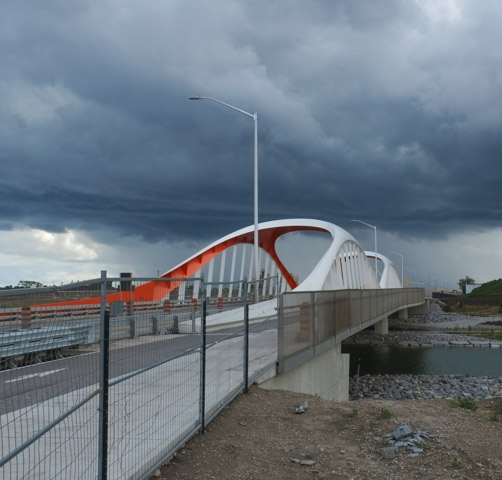
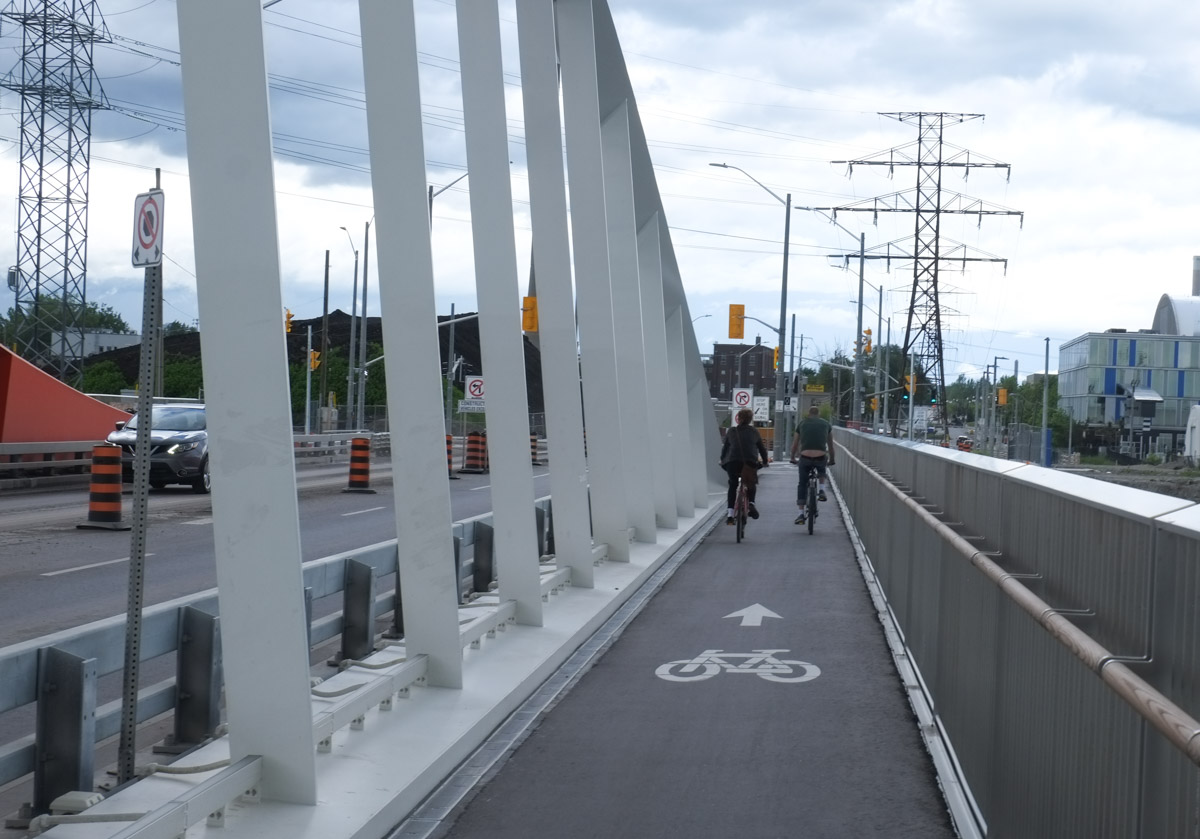
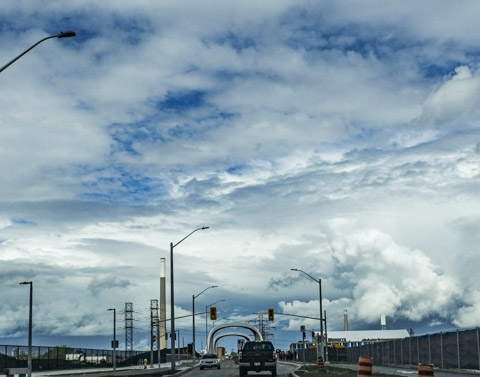
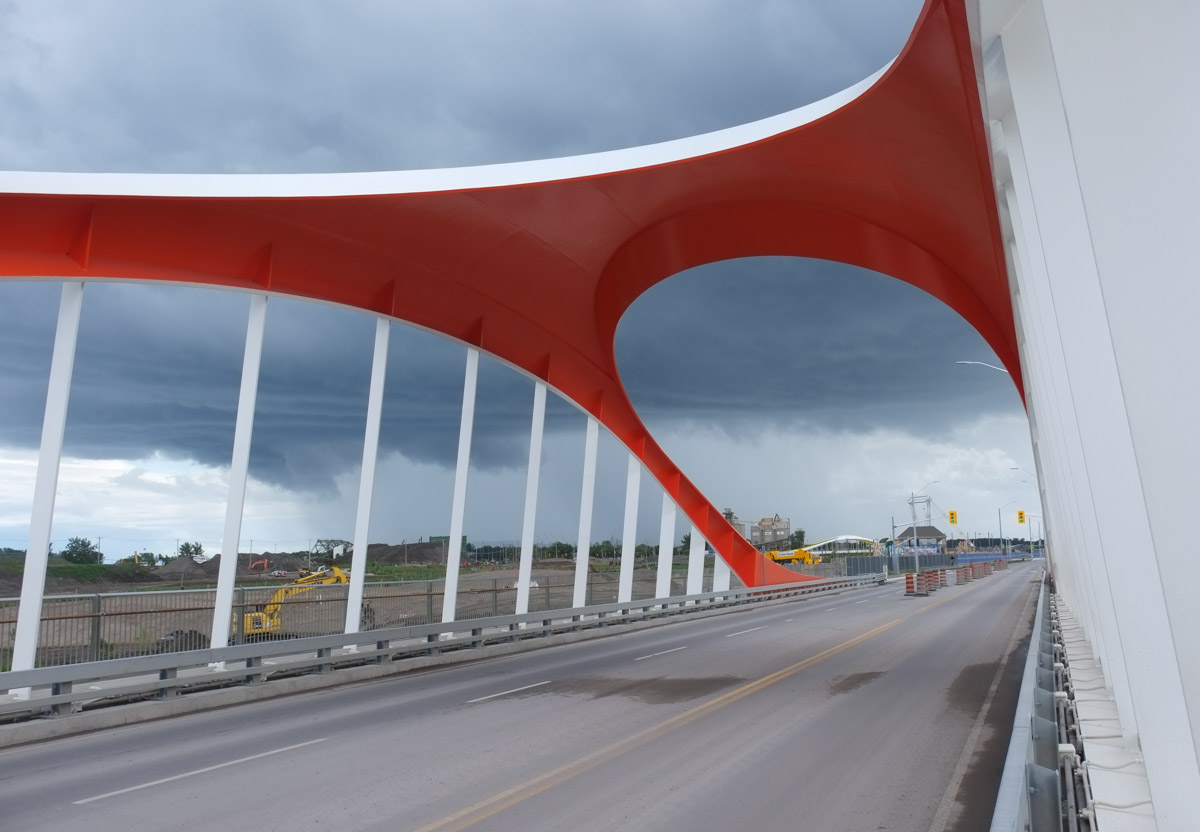
below: The new Commissioners Street bridge is in, and there is water running under it.  There is now a river on land that was once industrial.   On the north side of the bridge there is a bike lane and a wide sidewalk.

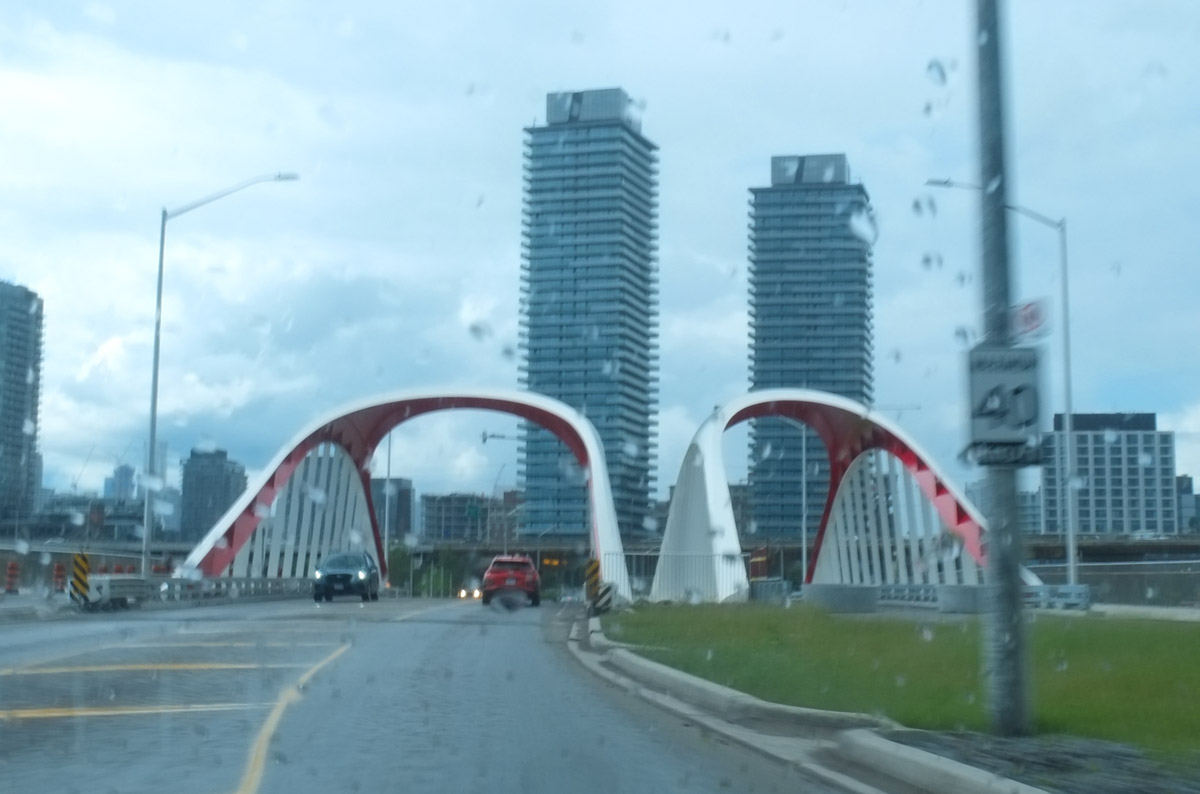
red and white curvy bridge, commissioners street bridge, dark clouds in the sky,

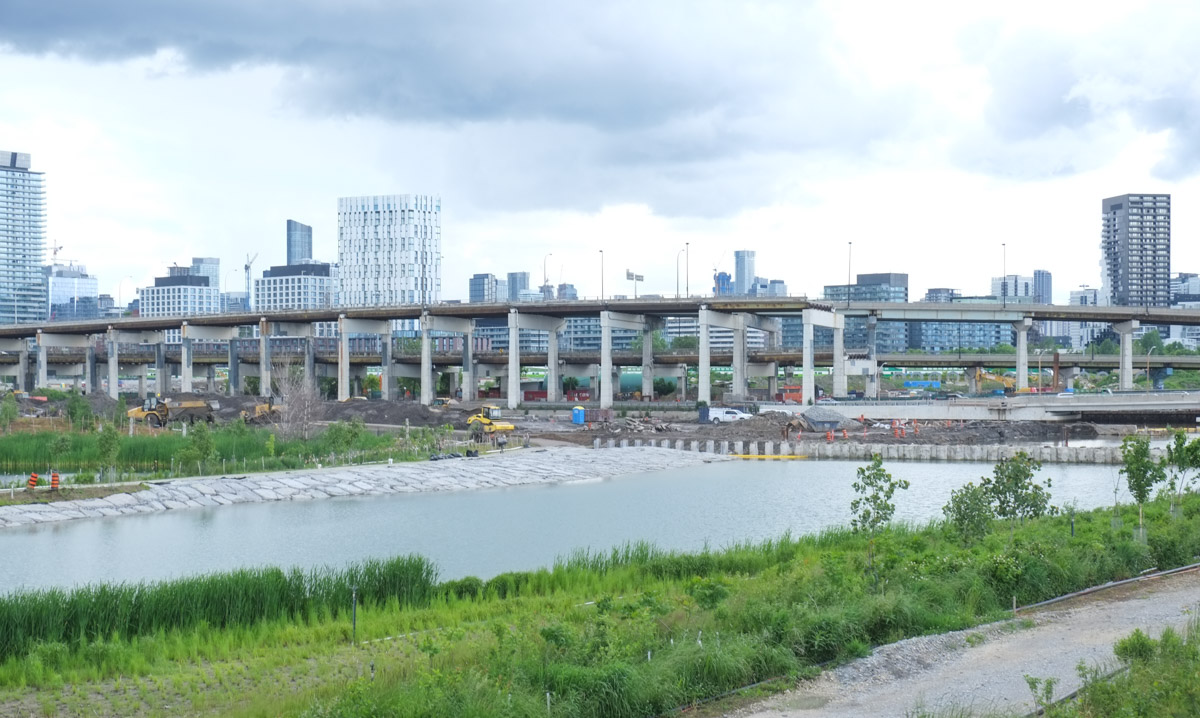
below: The bridge offers new vistas of the city.  Many new trees have been planted.

view northwest from commissioners street bridge, over river and park with many newly planted trees, to downtown toronto skyline

view north from commissioners street bridge, towards Gardiner Expressway, and Lakeshore

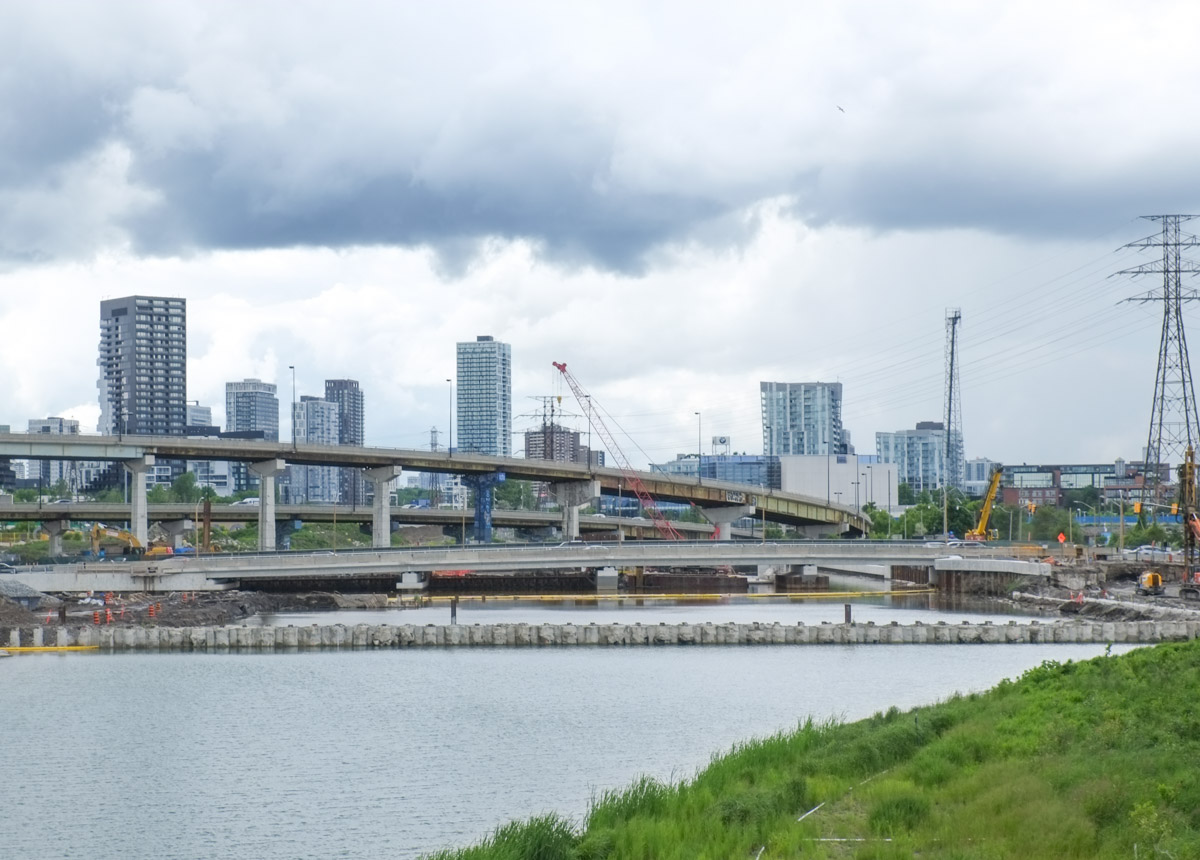
below: Lakeshore Blvd crosses the Don River on a very low bridge (like before) while the ramps between the Gardiner and the DVP curve above it.

view north and slightly east from commissioners street bridge, ramp from Gardiner to DVP with Lakeshore crossing river
below: Just be careful because there is no sidewalk on the south side (why not?? for the sake of saving money on 4 extra feet??)

cyclists crossing commissioners street bridge
commissioners street bridge, mostly sky with lots of clouds

below: The same sleek curvy design seen in the previous bridges is repeated here.

red and white curves of the commissioners street bridge

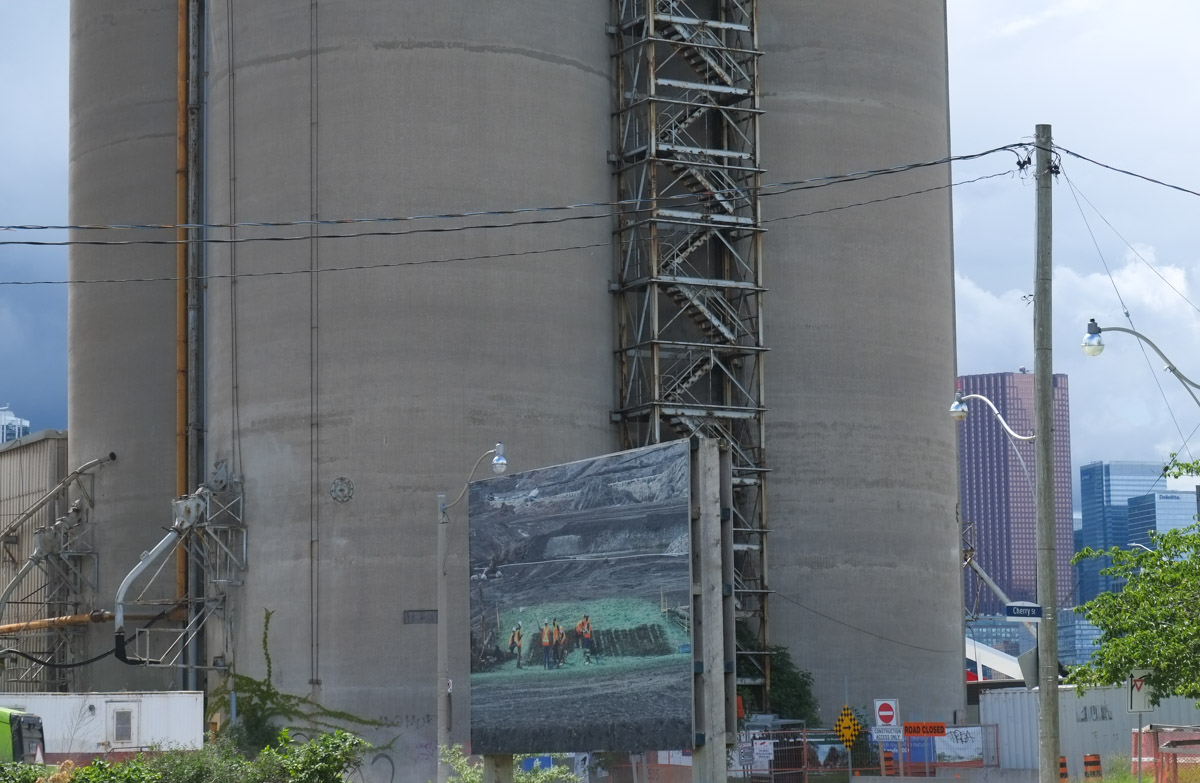
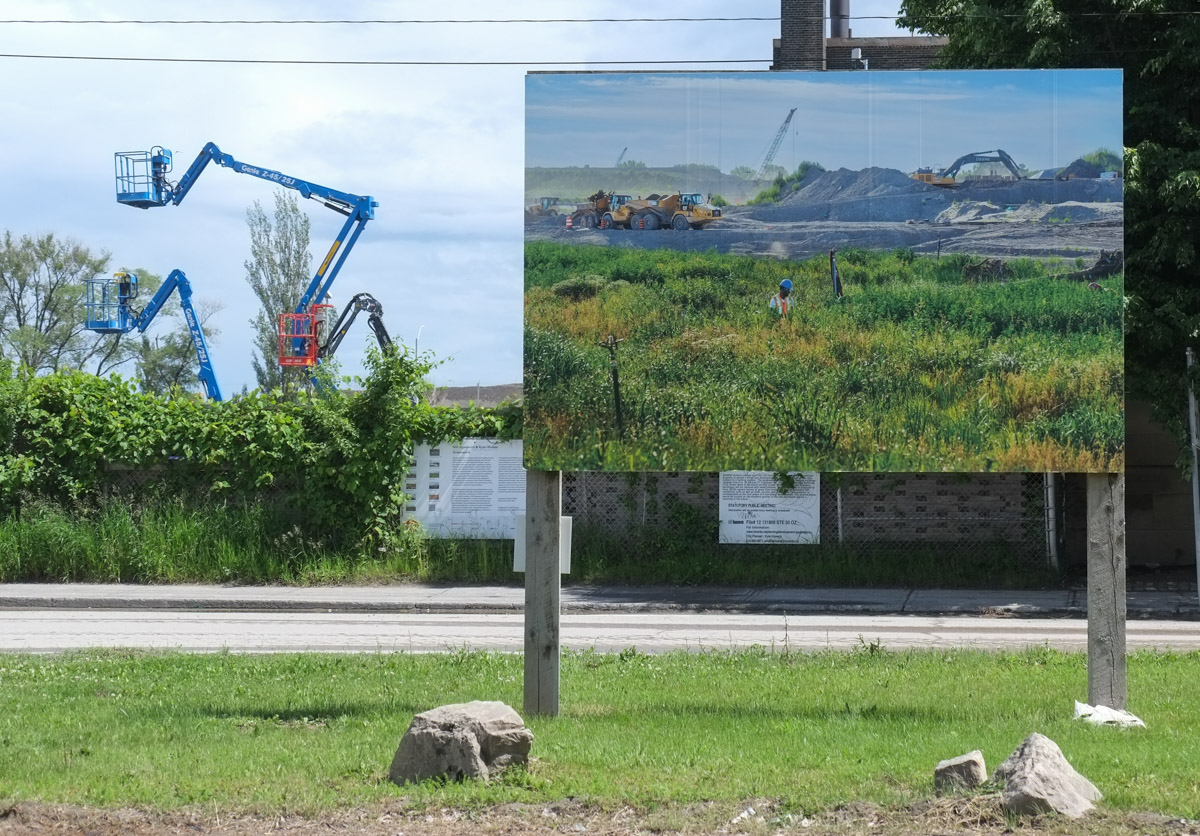
below: Another series of photographs of the work being done here, by Vid Ingelevics and Ryan Walker

large photograph on a billboard in front of large concrete silos, port lands,
below: One photograph is mounted on the roll-up door of one of the ESSROC cement plant silos

large photograph mounted on door of garage on concrete silo

below: Like the previous series of images, most of the photographs are displayed down the center of what remains of Villiers Street,  on top of the remains of the old railway line.

large photo image on display beside street, in front of building with cranes beside it

below: One more photograph on what remains of Villiers Street – and in the background, what remains of the eastern end of the Gardiner Expressway.

construction in port lands, villiers street torn up, photograph on display in center, gardiner expressway in the background

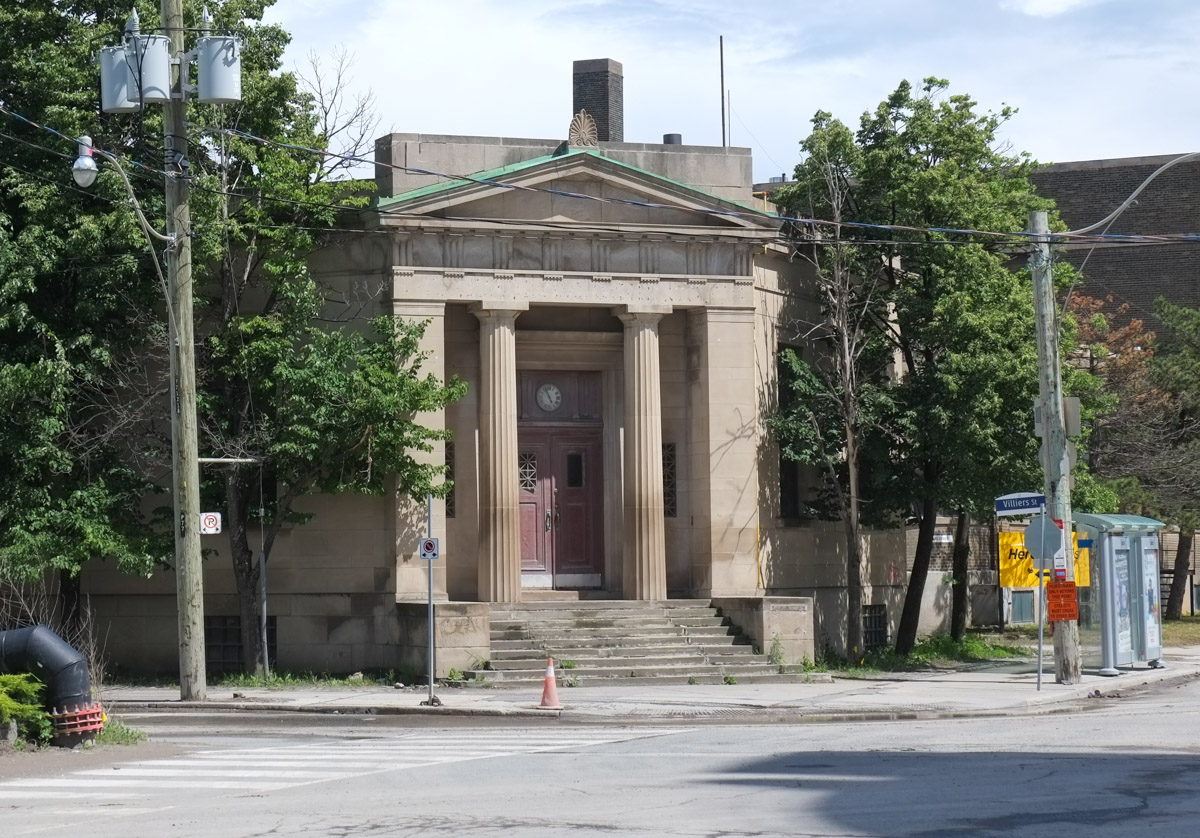
below: Southeast corner of Villiers and Cherry

old bank building with columns, stone, on southeast corner of villiers and cherry

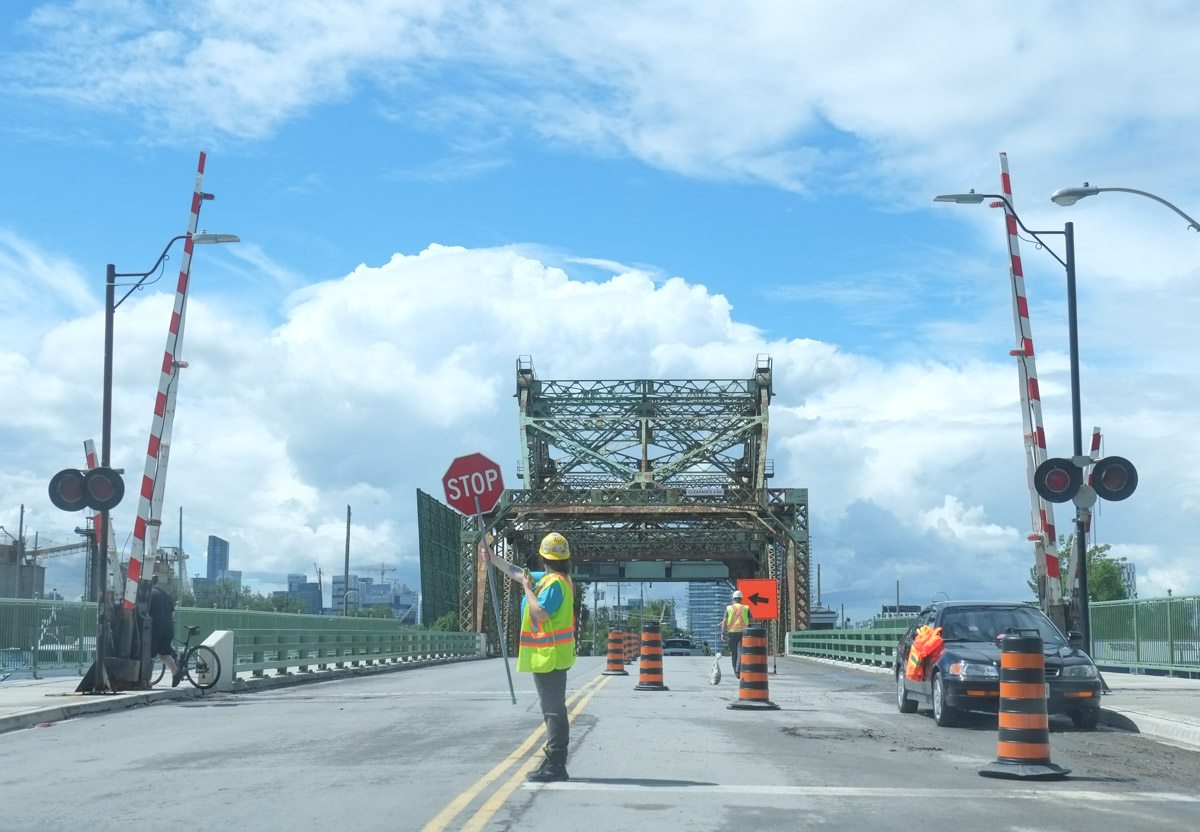
below: One original bridge remains, the one with the long name – Cherry Street Strauss Trunnion Bascule Bridge.

cherry street straus trunnion bascule bridge, with person holding stop sign, construction on the bridge

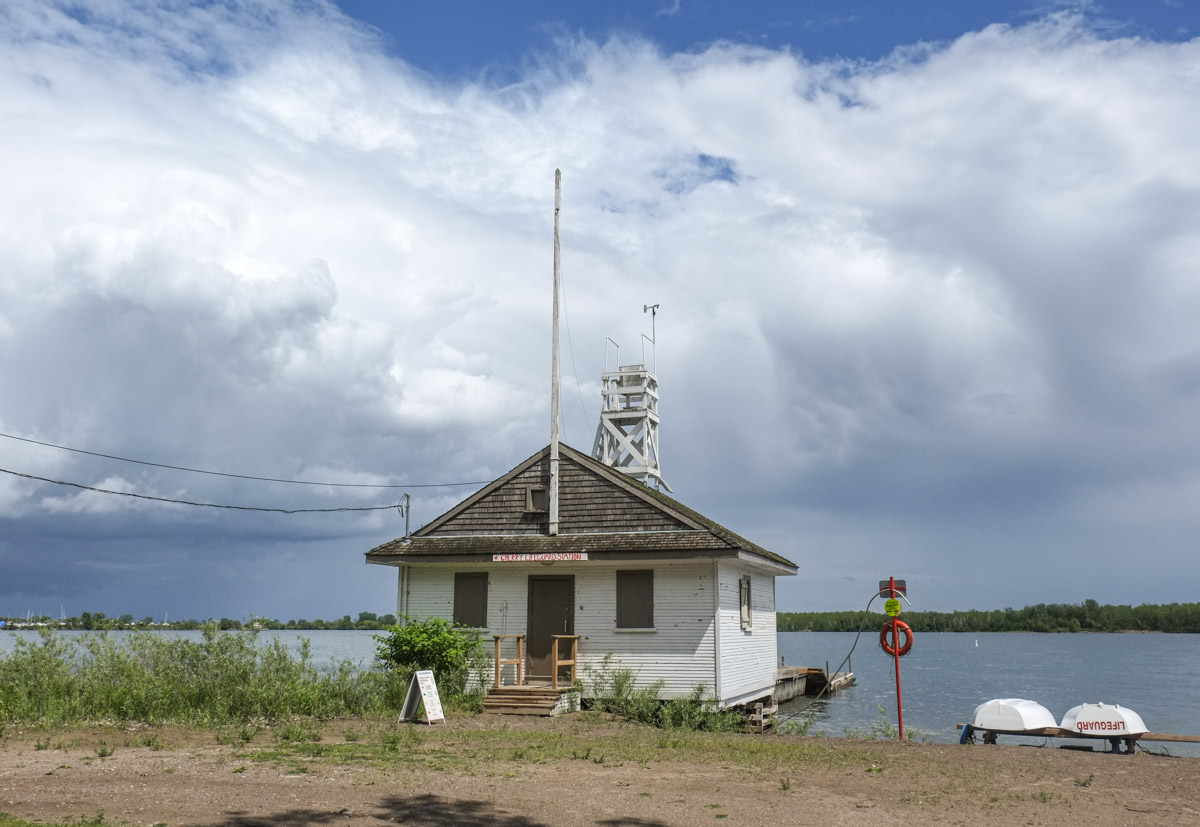
lifeguarding station at cherry beach, old white wood building, with look out tower and flag pole,

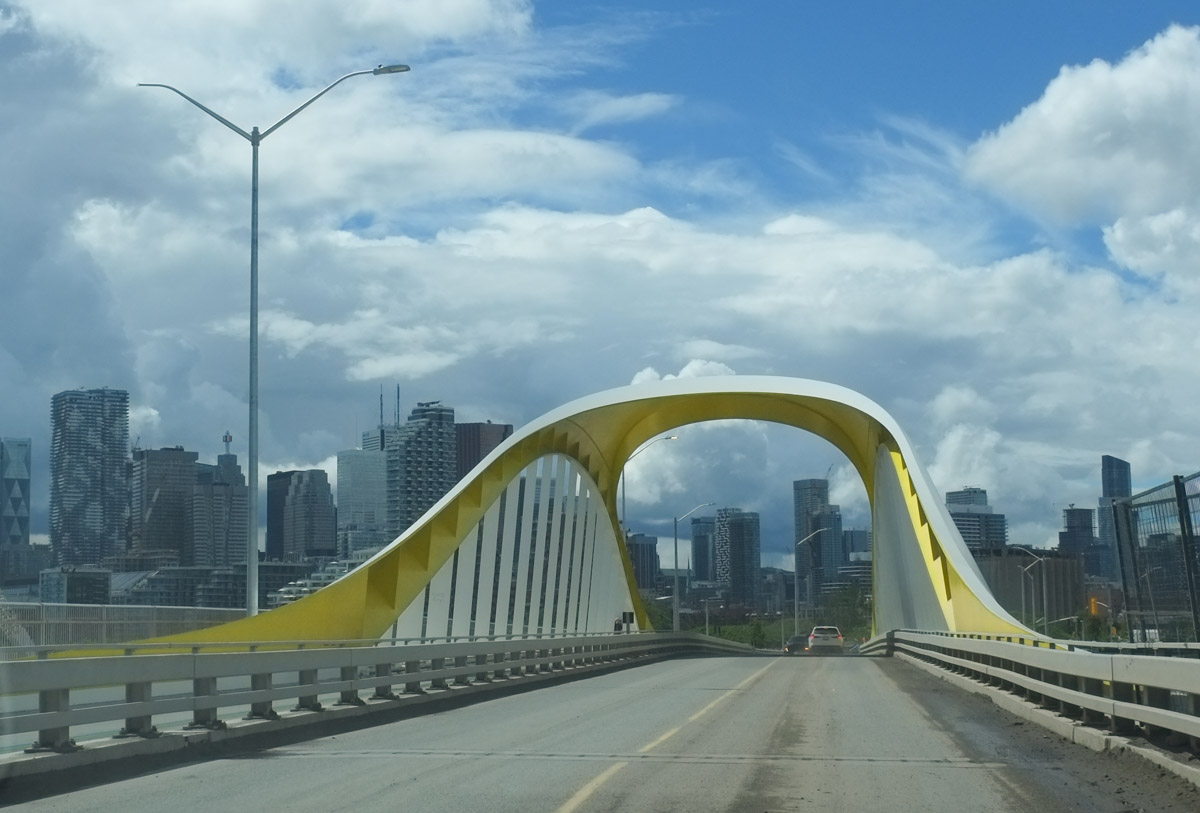
below: The first of the new bridges that was actually operational is the south Cherry Street bridge, the yellow one.

yellow and white cherry street bridge

below: The second new bridge on Cherry Street is now in use.  For months we’ve been able to take pictures of the side of it as we stood on the old Cherry Street bridge. (see The New Cherry Street Bridge from Nov 2020).  Maybe one day in the future there will be a streetcar on the east part of the bridge.    As you can see, the rain came and we bailed.  Better pictures of the bridge will have to wait for a future post!

new cherry street bridge from the south, double bridge, one side for cars, bike, and pedestrians. The other side is for transit but so far there is no transit here

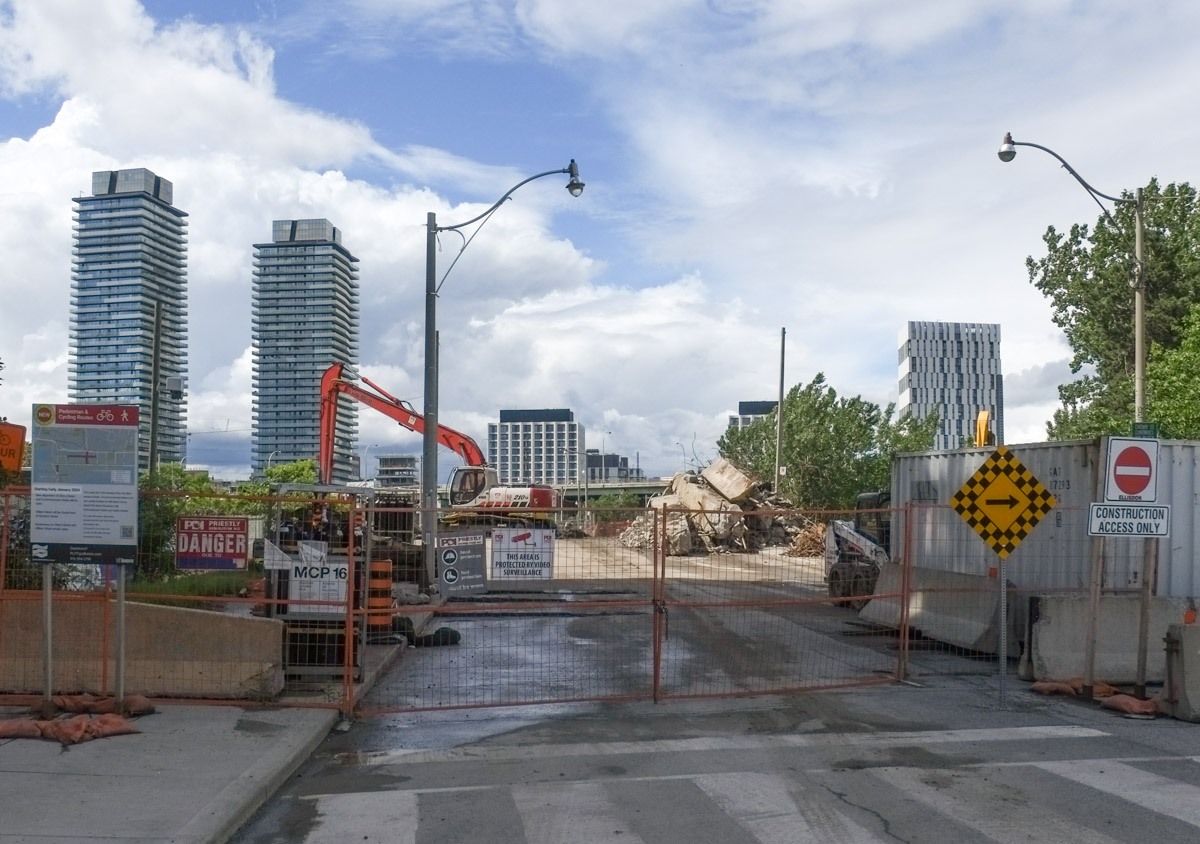
below: The old Cherry Street bridge is gone and the road has been rerouted. The old jog in Cherry at Lakeshore is gone.

rubble and digger removing old cherry street bridge, distillery district condos in the background

rubble and digger removing old cherry street bridge, distillery district condos in the background

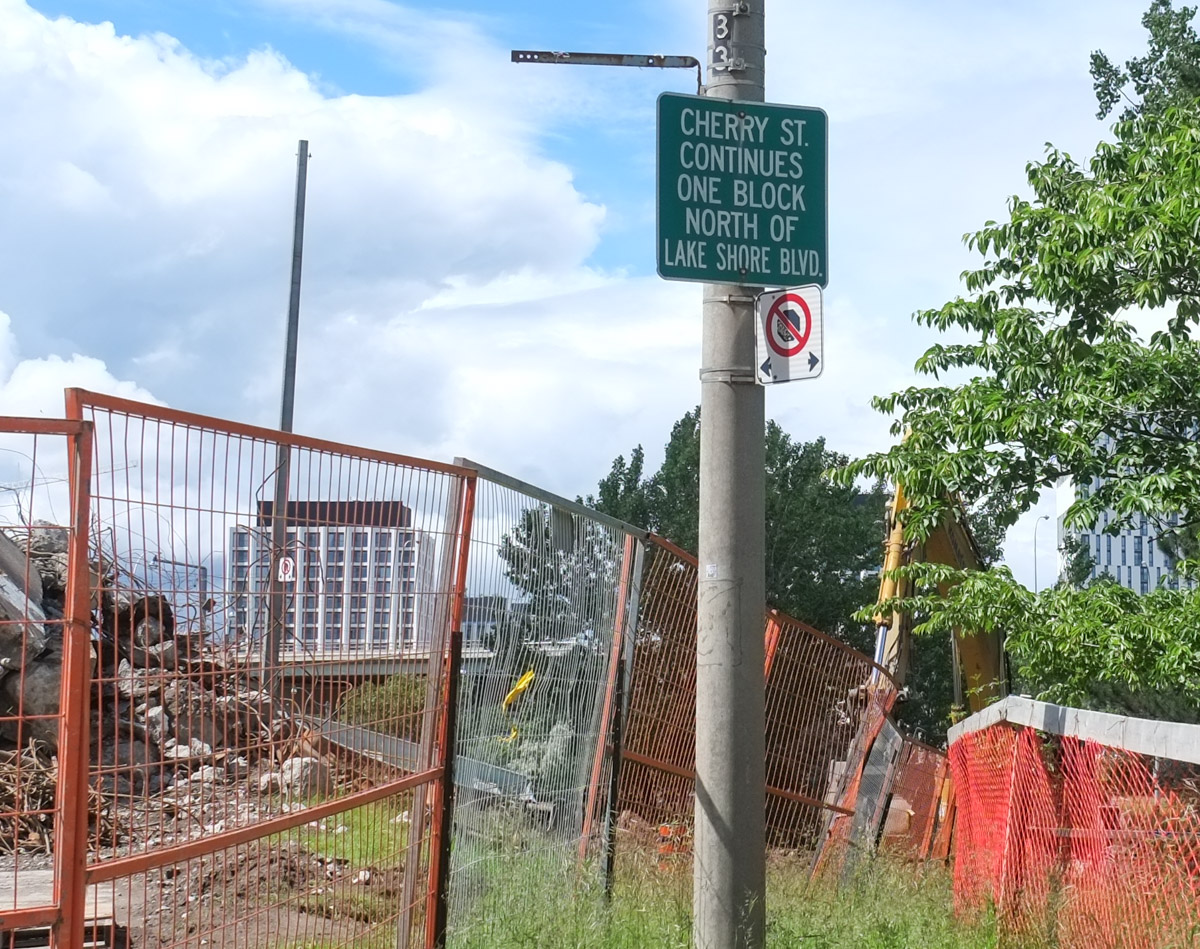
below: Misdirection.

green and white sign that says cherry street continues one block north of Lakeshore

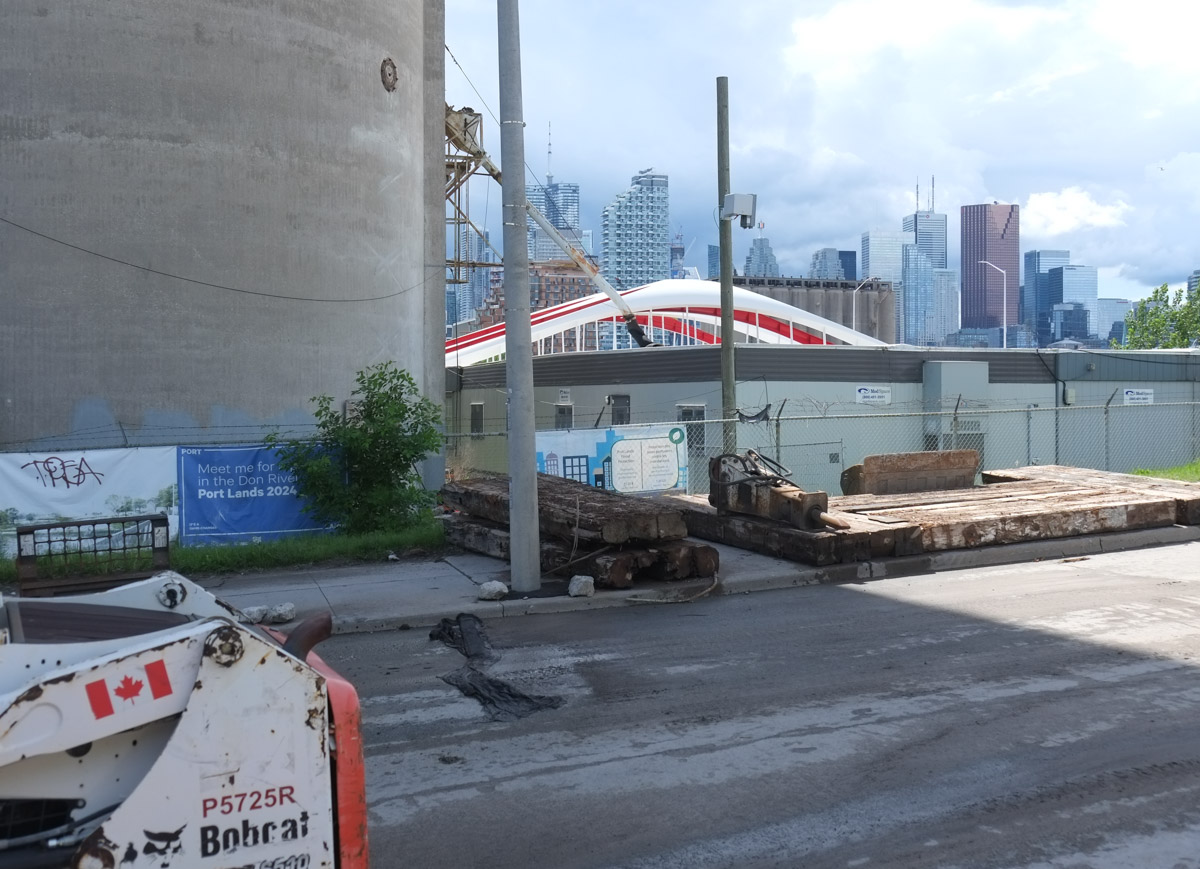
below: Trying to see the new bridge from the site of the old bridge but there seems to be a construction site in the way.

new cherry street bridge, red, and white, seen from site of old bridge

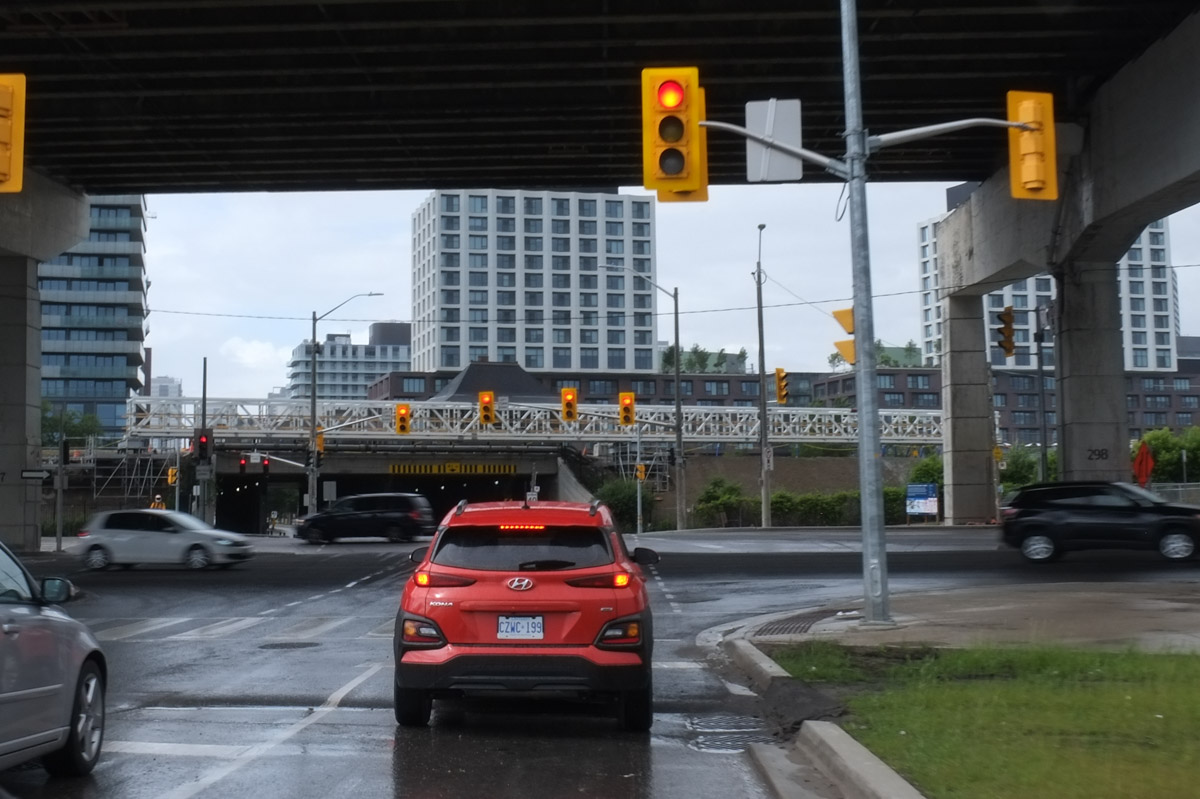
below: Continuing north on the now straight Cherry Street.  Any ideas what that white structure is ahead?  It runs parallel to the railway line at track level and crosses Cherry Street just south of the railway underpass.

a red car waits at a red light on Cherry at Lakeshore. The Gardiner Expressway passes overhead. Distillery District and Corktown are straight ahead

We now exit the Port Lands and finish today’s explorations…. with the exception of one quick note…. I noticed that the old Canary Diner on Cherry is now painted a reddish orange colour.  It looks like it is being renovated.   A story for another day!

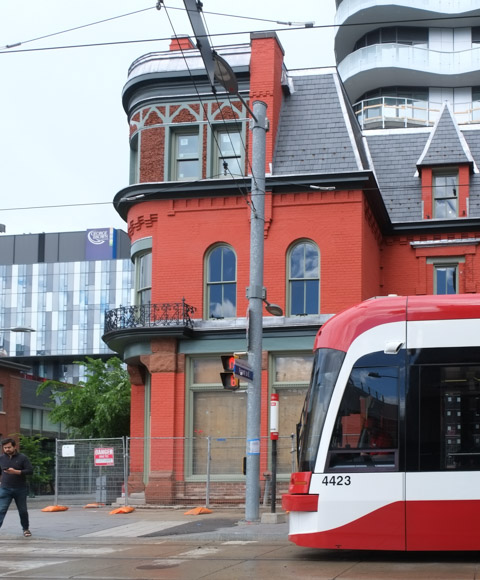
TTC streetcar, route 504, in front of repainted canary diner on cherry street, old three storey brick building

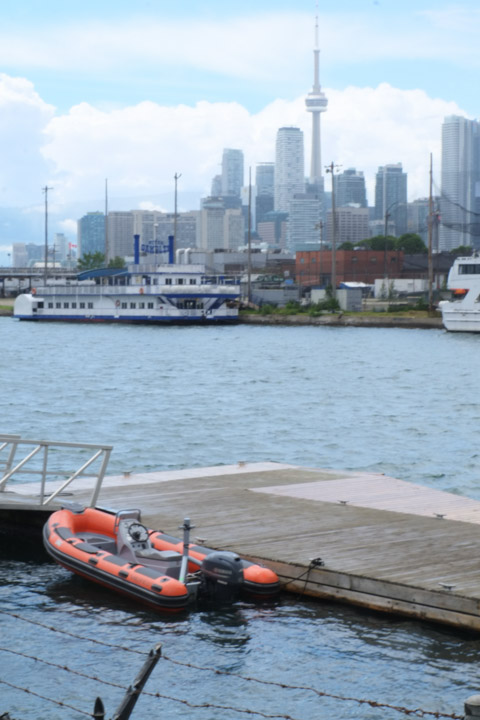
toronto skyline in the background, with boats docked on piers, rubber dinghy in foreground

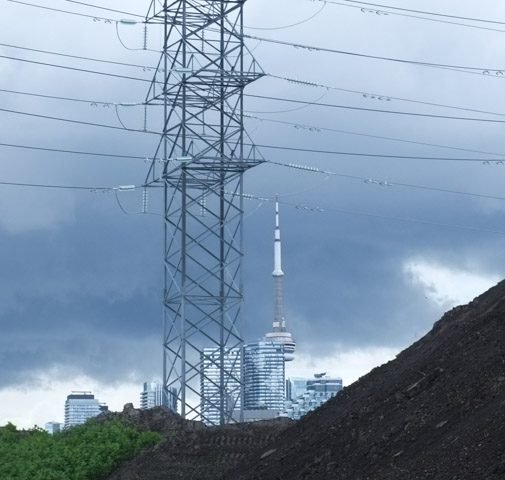
hydro transmission towers with the cn tower in the background

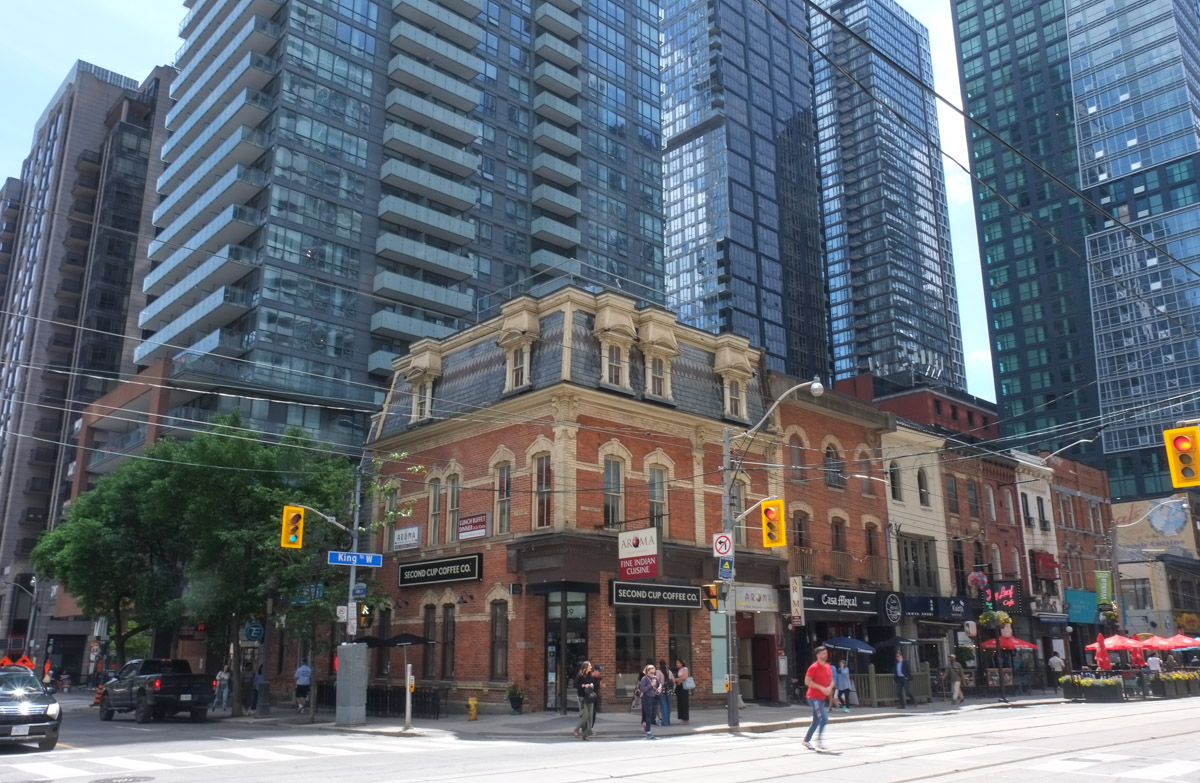
Also could be called, “Of bricks and stones and a lot of glass.”

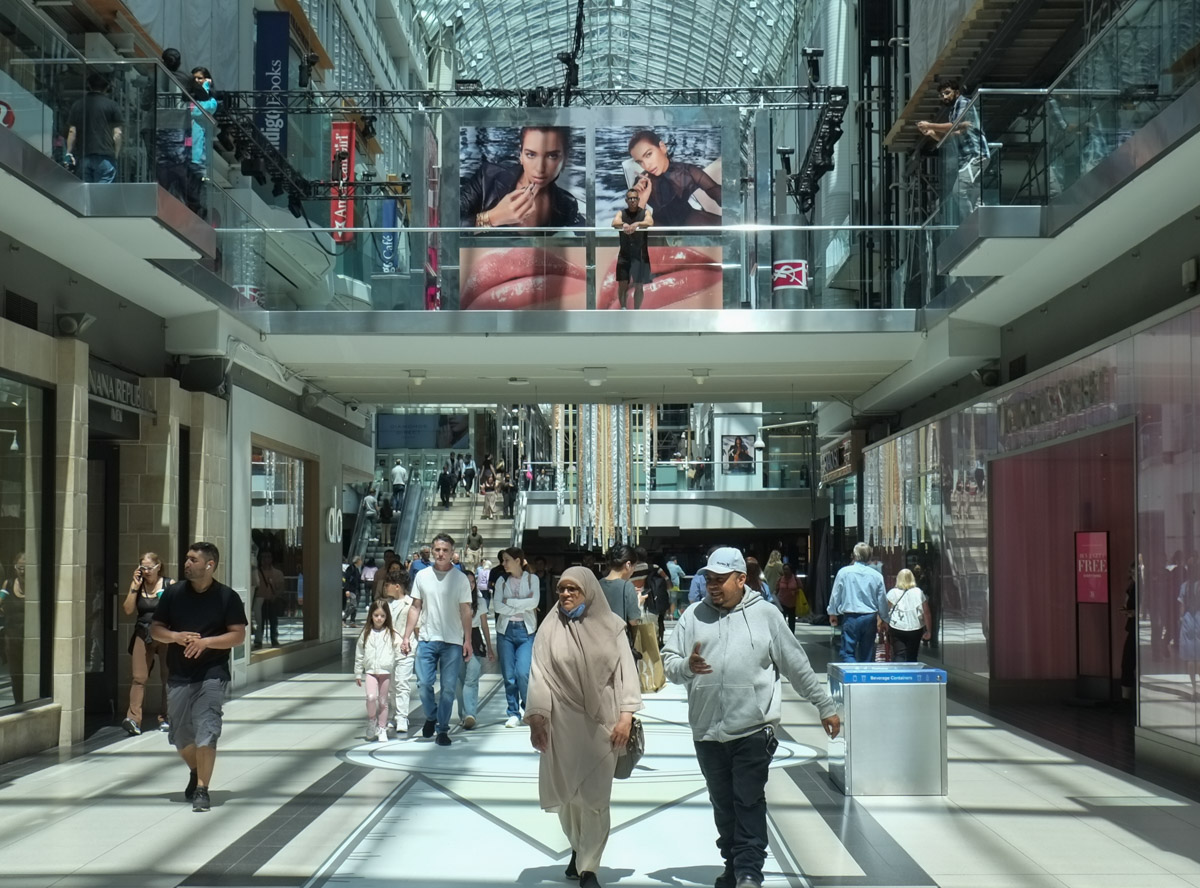
I was recently telling a relative that one of the best ways to explore Toronto, especially downtown,  is just to get off at a subway station or streetcar stop and start walking.  There is always something to see.   This walk is the result of taking my own advice and just getting off at Queen station and seeing where my feet took me.   First stop was the Eaton Centre where Michael Snow’s birds still fly.  “Flightstop”.
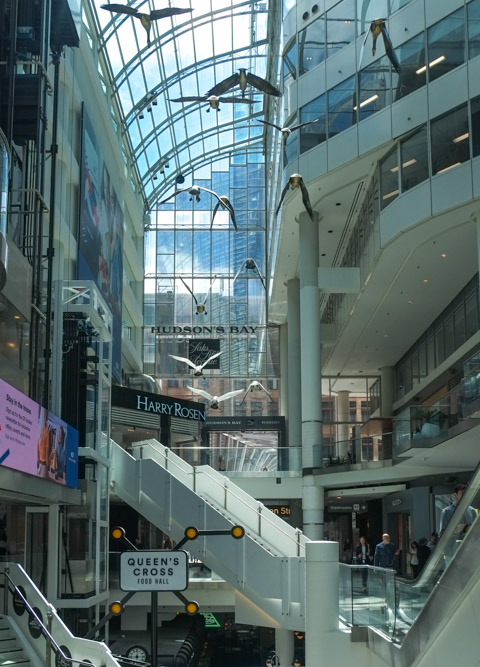
interior of eaton centre shopping mall, south end by queen street exit, escalators and stairs, glass ceiling

below: Interior, Eaton Centre where all the benches have been removed.  Sadistic?  Gone are the days when you could take pictures of the men sitting outside Victorias Secret.

inter eaton centre shopping mall, people walking, others on walkway above,

interior of eaton centre shopping mall, large dream catcher shaped decoration hanging from the ceiling, with gold, silver, and white, ribbons, people on stairs beside it

below: As I walk around the city, I see more and more of this – the glass wall.   This view is south on James Street as I walk between the Eaton Centre and Old City Hall.

looking south on James street with old city hall on the right and eaton centre on the left, looking towards queen street with lots of glass towers in the background

below: Approaching City Hall and Nathan Phillips Square from the east you now encounter a conundrum.  Did people hit their heads on the low ramps?  Or were people camping out here?  A poor, and I hope temporary, solution.
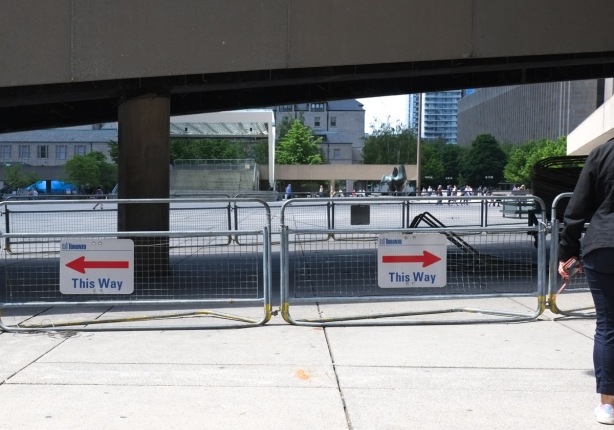
barricades under a ramp with two signs saying this way, with red arrows, pointing opposite directions from each other

below:  A few images from “The Red Chair Sessions”, photography by Nadya Kwandibens  A series of 9 large photos is on display in the ground floor windows of City Hall (viewed from outside).  On the right, Sage Paul, designer and artist, originally from English River; on the left, Mushkegowuk Iskwew from Peetabeck (Fort Albany Ontario).
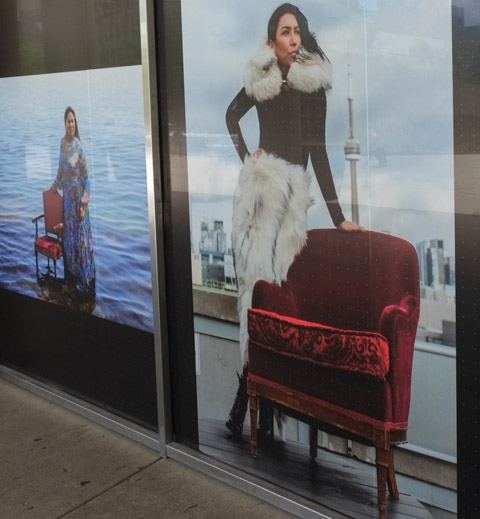
red chair photography at toronto city hall

below: Portrait of Ogimaa Kwe Bnes (aka Chief Lady Bird, her Spirit name) from Mnjikaning and Aura from Onyota’a:ka, posing under a mural that the two of them painted at Underpass Park.

red chair photography at toronto city hall

below: The backside of Sir Winston Churchill as he walks away from City Hall – something to think about?  The new court house is in the background.

man standing beside backside of statue of winston churchill

below: New court house from the corner of Chestnut and Armoury.

new court house, tall glass and steel building

below: Reflections in the glass of the new court house

very blue sky with white puffy clouds, reflected in windows of new court house on armoury

below:  Across Chestnut from the court house is an old hotel that is now part of U of T.  Its older brick and concrete facade contrasts with the glass and steel of the newer building.

grey brick and concrete wall

below: More concrete, the back of City Hall (completed 1965).  This is not a view that is typically shown but I find it fascinating that there are no windows at all on the outer sides.  As it turns out the back walls are made from 18 inches of reinforced concrete that allow for cantilevered floors which in turn make it possible to have an inner structure with few structural elements.

back side of toronto city hall, curved buildings, concrete

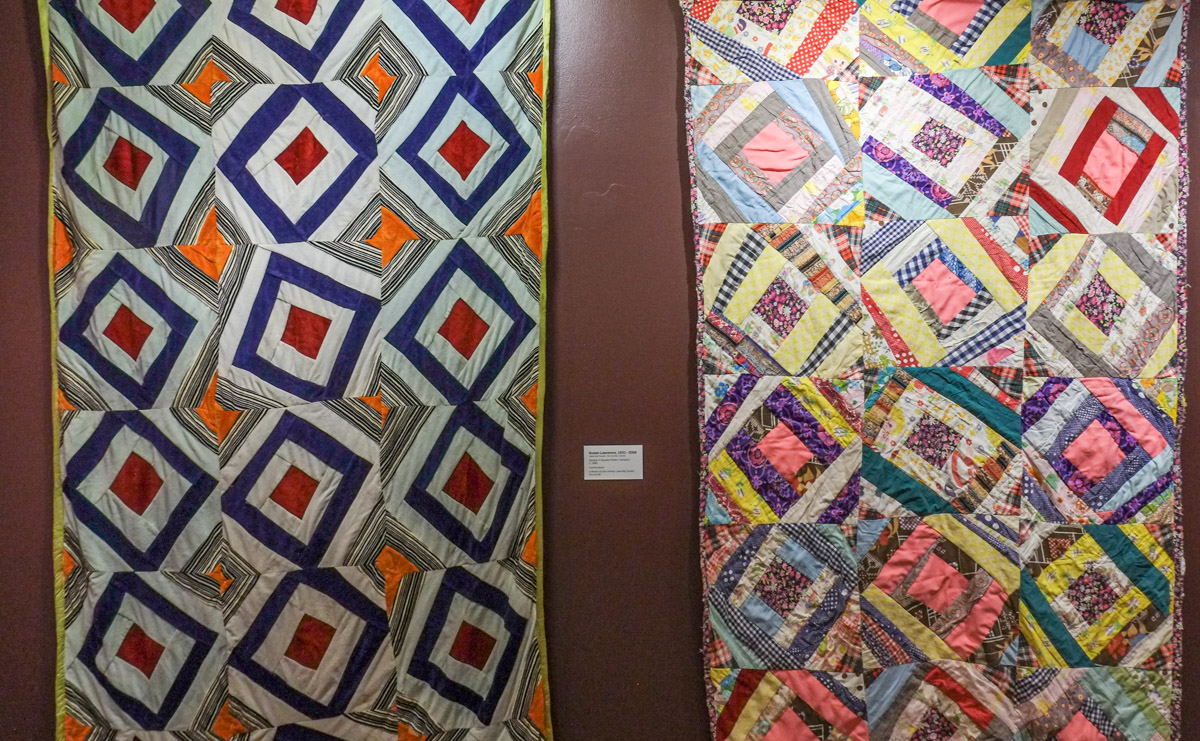
below: Also on Centre Ave is the Textile Museum. At the moment one of their exhibits is about quilts, “The Secret Codes: African Nova Scotian Quilts.  Some of the quilts are older ones like this pair by Susan Lawrence (1931-2008) which is a variation of “square in square” pattern.
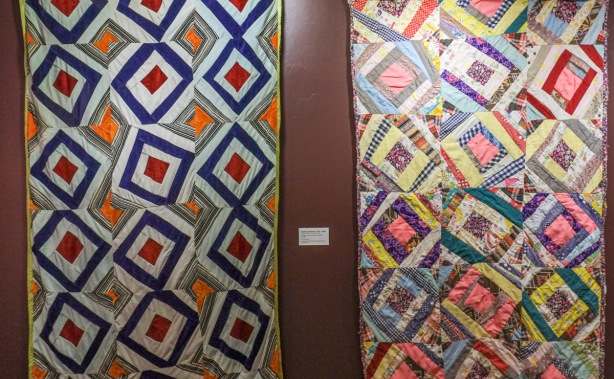
two quilts by Nova Scotia resident Susan Lawrence, hanging in the textile museum

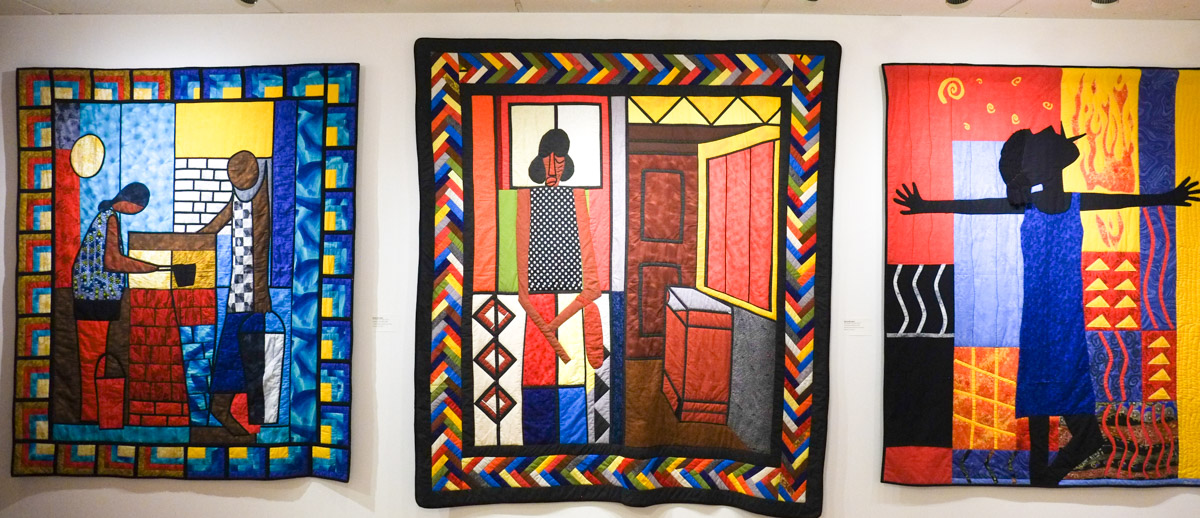
below: Other quilts are more contemporary such as these three by Myla Borden from New Glasgow NS
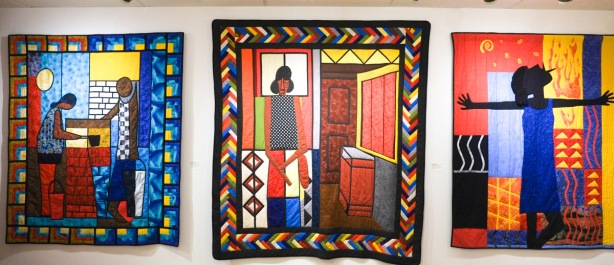
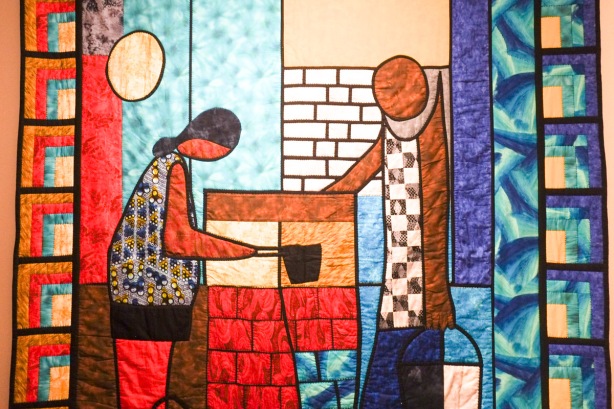
three quilts by Myla Borden on exhibit at textile museum, black line applique of daily scenes

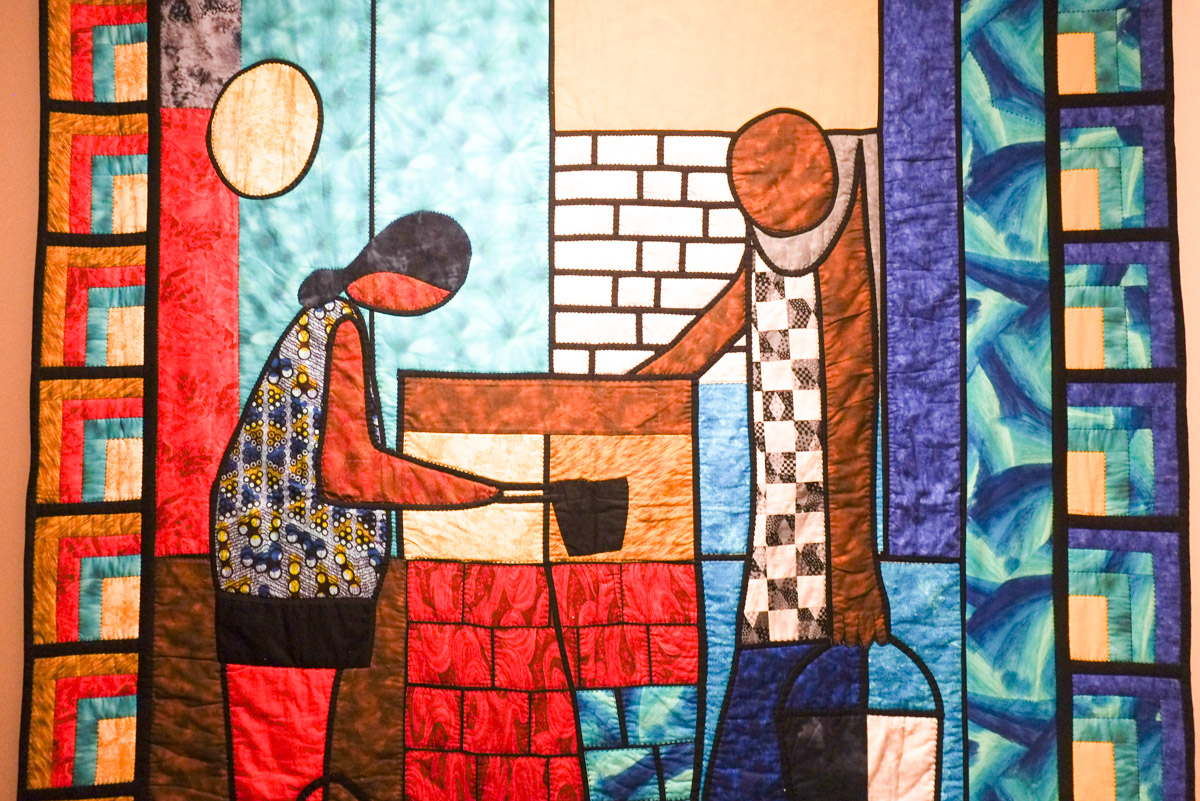
quilt by Myla Borden on exhibit at textile museum, black line applique of daily scenes

I first read about these quilts on a blog, junkboattravels.blogspot.com  She has a more thorough description of the exhibit along with some pictures. I will add a few more of my photos at the bottom of this post, but if you are interested in seeing others, I recommend checking out the link above (and then scroll down a bit).

below: Looking north on Centre Ave to Dundas and beyond.  The facade of the old brick building on the northwest corner is being saved. It was built in 1928 as an extension to McLean Hunter which was on University Ave. This Beaux-Arts style building has five storeys of offices and four storeys for a printing plant.

looking north on centre avenue towards dundas

below: A closer look at the facade.

dundas and centre, northwest corner, facade of old brick building is being saved during redevelopment

below: Also Centre and Dundas, but the eastside of Centre, a colourful spot… and a trendy way to liven the street appeal of a parking garage.

east side of Centre and Dundas inersection with colourful abstract geometric mural on the corner of a parking garage, and turquoise upper level of Hong Shing restaurant

below: “The world is a little bitter. I want to give you a little sweet.” written on the inside.  Tiles in a marvelous tessellation by the front door.

looking in the window of a restaurant or coffee shop, with tiles in grey black and white pattern by the front door

below: Reflections in the glass at the northwest corner of University and Dundas.
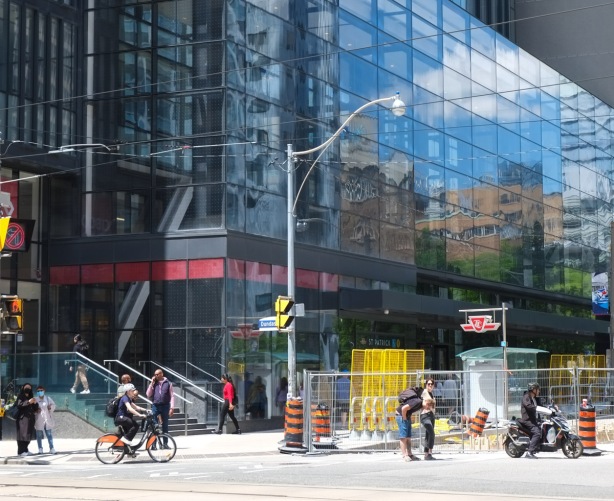
glass building with lots of reflections, northwest corner of dundas and university

below: Crossing University Ave. while looking west on Dundas.  There’s a curvy new building underway.

looking west along dundas from university

below: The old court house, or Toronto Courthouse, which was built in 1966 is on University Ave just north of Osgoode Hall.  It is a 20th Century Modern building clad in Queenston limestone, a stone that you can also see on many other Toronto civic buildings such as the ROM and the .  It is quarried in Queenston, near Niagara Falls, and at one point was the largest quarry operation in Ontario.  You’d easily mistake it for concrete.
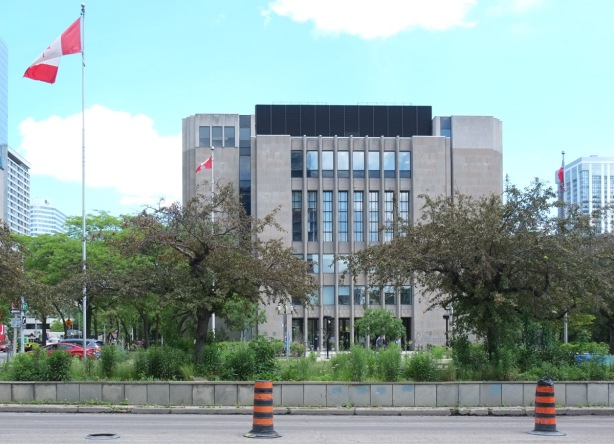
old court house building, or Toronto Courthouse, 361 University Ave., 8 storeys, clad with Queenston limestone, Canadian flag flying beside.

below: Cannons and yellow umbrellas
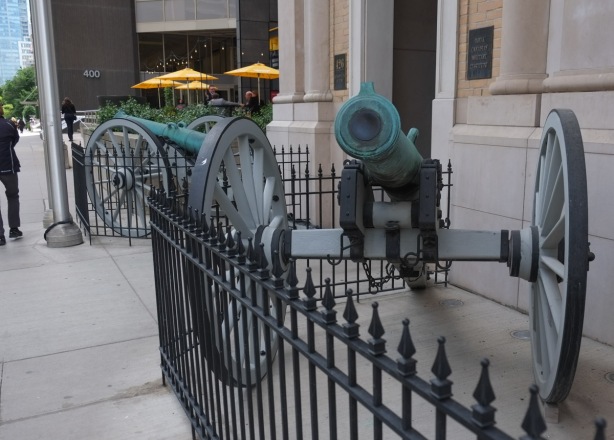
two cannons behind a black wrought iron fence by a patio with yellow umbrellas

below: Behind the yellow umbrellas

below: A narrow passageway between buildings.

two people at the end of a narrow lane that has a tall black wall on the left. 4 lamp posts along the wall

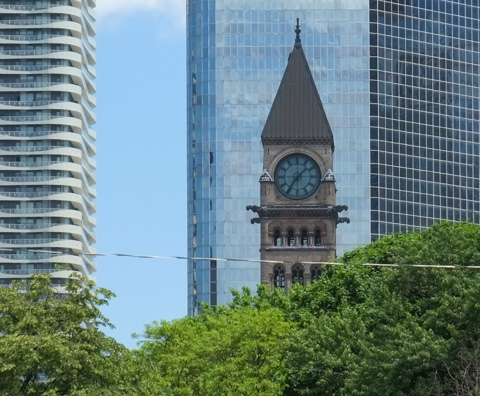
below: Old City Hall clock tower

a woman on her phone walks north on university ave past the canada life building where a man is sitting on the steps

below: The CN Tower sneaks into the photo.  At Osgoode, Metrolinx has taken over part of University Avenue for construction of the Ontario Line across Queen Street.

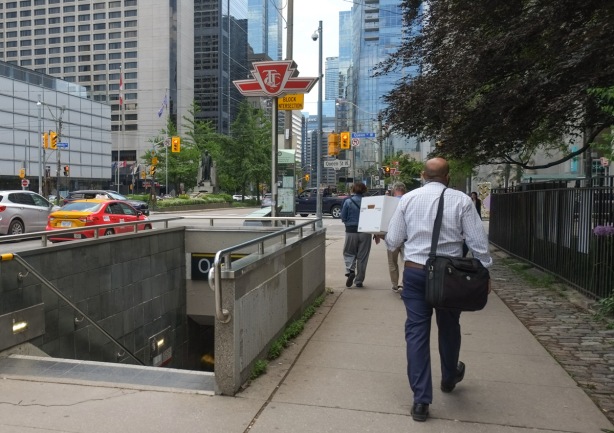
a man walks south on university, past the entrance to osgoode subway station on the northwest corner of university and queen west

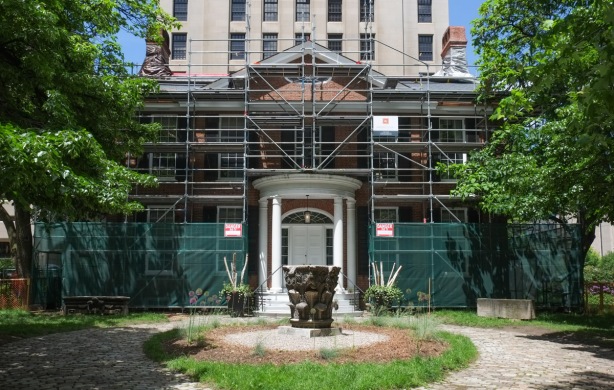
below: Even Campbell House is behind scaffolding.
below: Just another Toronto street corner.

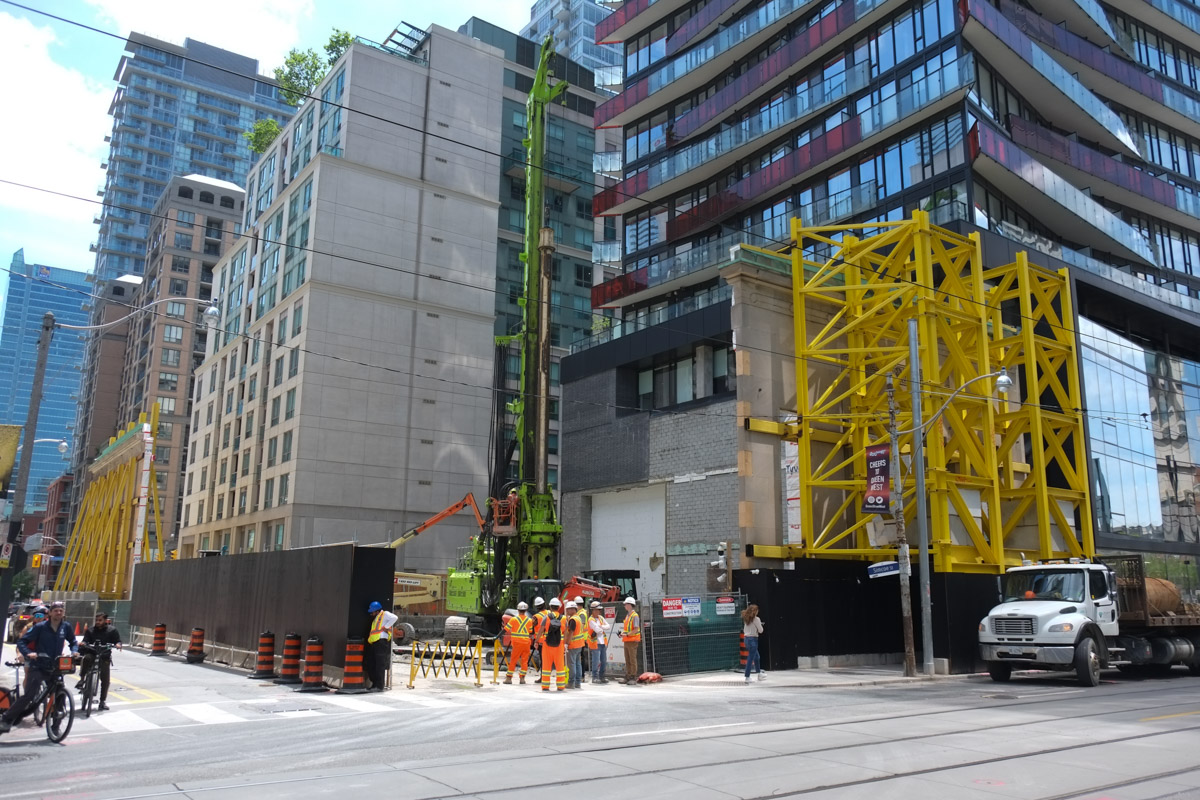
workmen in orange safety clothing standing around and talking or watching others work, construction site at Queen and Simcoe

below: Another facade saved. This one is at Queen and Simcoe where a bank once stood.
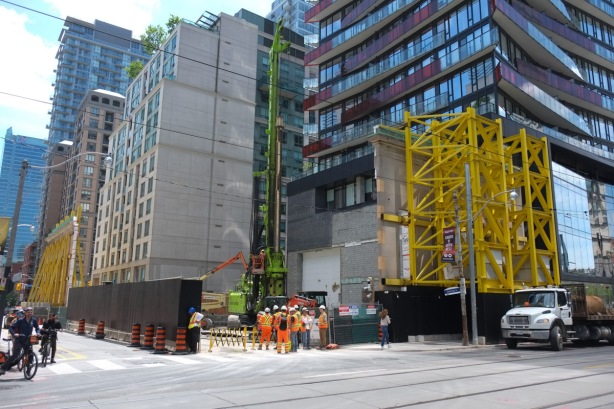
construction on Queen West and Simcoe

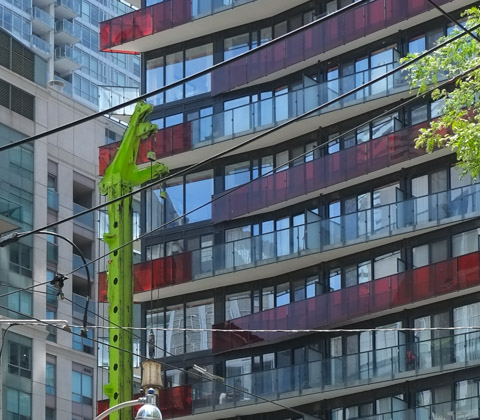
below: The wide open mouth of the green monster reaches upward as it tries to grasp the red balcony between its jaws.
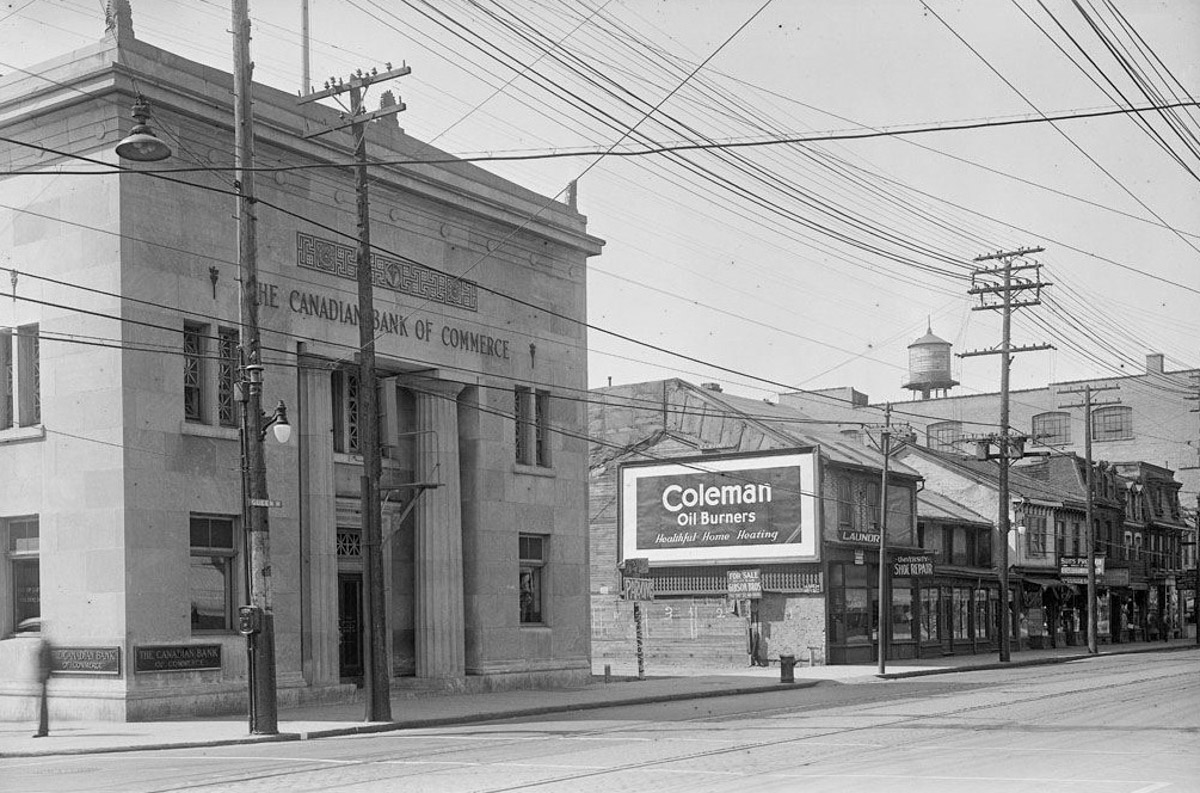
below: This is the bank in question, The Canadian Bank of Commerce, built in 1930 just after the beginning of the Depression.  The photo was taken in 1931.  Take a close look at the other buildings in the picture, the stores to the right.   The structure with the Coleman Oil Burners billboard is gone but take a  look at the next couple photos which are of this stretch of Queen West today.

old black and white photo of bank of commerce on southwest corner of queen and simcoe, black and white, taken 1931

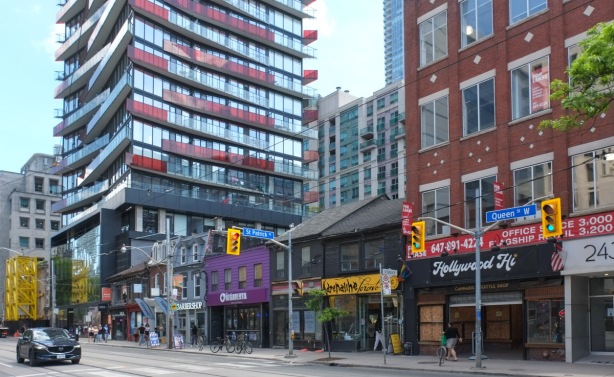
Queen street west, new condo with red glass on balconies, older stores like Adrenaline Tattoo, a Barbershop, Hollywood Hi, south side of the street

below: Queen West struggles to maintain its character.  The store in the middle is definitely in sad shape.  It looks like it would collapse if the others weren’t there to support it.

three stores on Queen West

two stores on Queen West

three stores on Queen West

below: There’s a little white “ceremonial” street sign, just below the blue and white Queen St. West sign, that let’s you know that this stretch of road was also named Moses Znaimer Way.  Znaimer had a long career in the entertainment industry in Toronto including co-founding CITY-TV, MuchMusic, and more.  In Toronto, a ceremonial street name is secondary to the legal name.  I am not sure how many there are in the city and I haven’t gone down that rabbit hole to find out.  Interesting idea though.
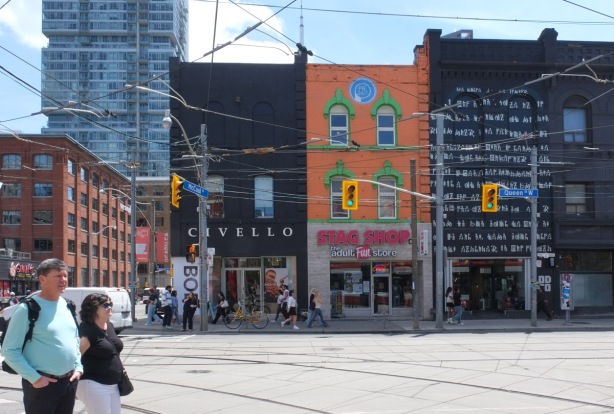
two people crossing the street by Queen West, with stores in the background, Civello, Stag Shop and another

below: Queen and McCaul, looking west

below: Gelber Brothers ghost sign on Richmond Street.

below: The CN Tower… again!  and Hooters (do they still exist?)

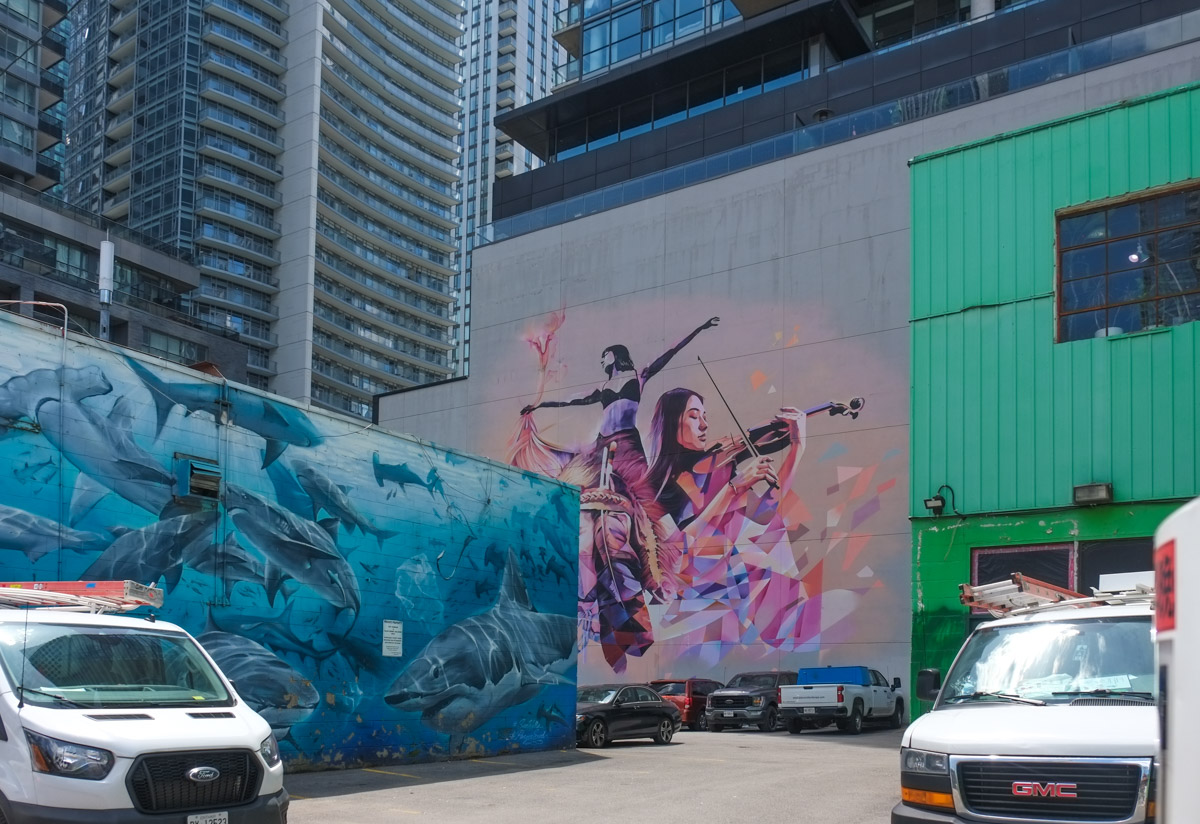
below: Murals in a parking lot.  Both were painted by Alex Bacon.
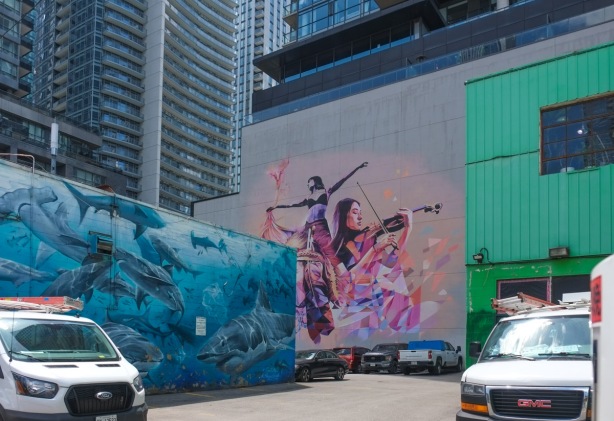
below:  Blue marine life, sharks circling.  An ominous hook.  This one of many Pangea Seed Foundation sponsored murals in the city.  Some of the others appear in a much earlier blog post, “love letters in paint” (2016).  Pangea Seed’s original mission was to use science, art and creativity to “inspire positive change around pressing ocean environmental issues”. This campaign has now branched out to increase awareness of the issues involving out fresh water lakes and rivers as well.

mural, blues, aquatic, marine animals, sharks swimming in the water

below: Restaurants on John Street.

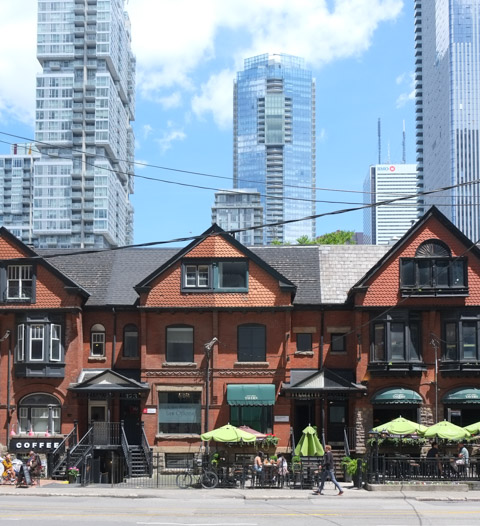
restaurants in old brick houses on John street, with tall glass and steel condos rising above them

below: A vacant building longing to be another restaurant. In the meantime it’s been painted black… and as I type those words I am reminded of the Rolling Stones song, “Paint it Black”.  The song is a bit depressing and negative but then again, so is a blackened building.
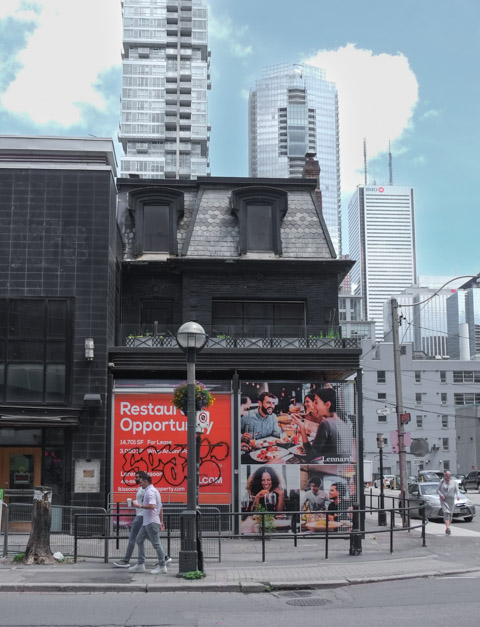
older three storey building with mansour roof and upper gable windows, painted black, vacant, ad posters on it

The last stanza is “I wanna see it painted Painted black
Black as night
Black as coal
I wanna see the sun Blotted out from the sky
I wanna see it painted, painted,
painted Painted black, yeah

below: “We See You” shout out to the doctors, nurses, and other healthcare professionals that worked throughout Covid.  “Thank you”.  Painted by Elicser Elliott.

mural by elicser elliott on the side of a Tim Hortons, small lane, with text that says we see you. it's a thank you mural to the healthcare professionals that worked throughout covid

below: Variety on Adelaide.  Bricks and stone and a lot of glass.

older brick building, with sign Variety on Adelaide, in front of newer glass and steel condos

below: Looking east along Adelaide (a one way street with bike lanes and newly rebuilt streetcar tracks).
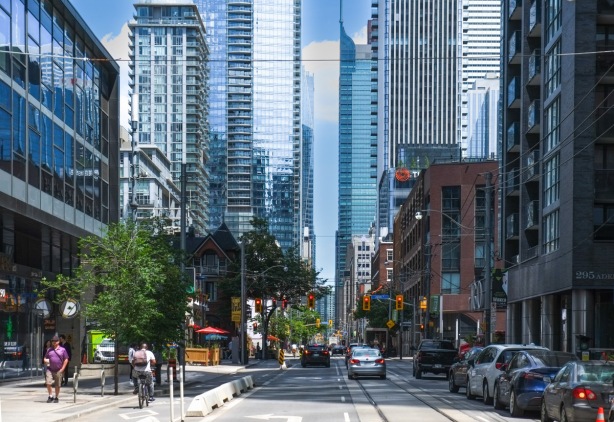
looking east along adelaide from john

below: Looking down the middle of the glass and metal sculpture in Grasett Park.  If you were to step back a bit, the sculpture takes on the shape of sails of a ship.
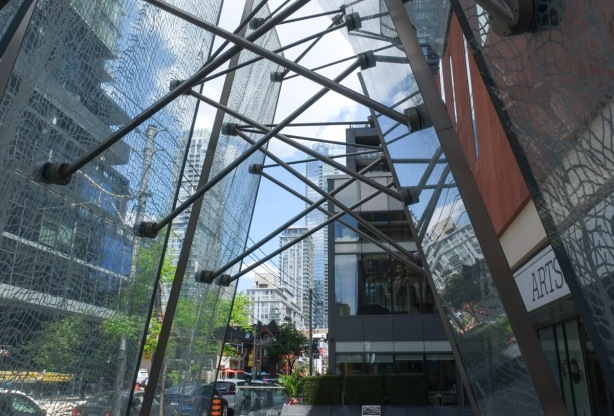
glass and metal sculpture in a park that looks like sails on a ship

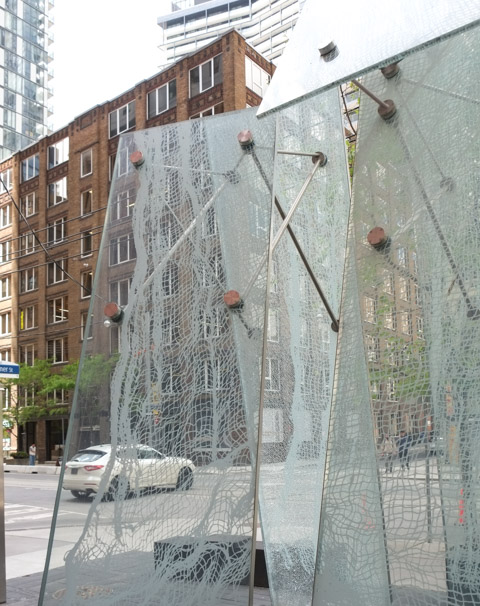
below: Looking through the netting/glass, same sculpture as above.  The park is named after Dr. George Robert Grasett, a medical doctor (1814-1847).  The park stands on the site of the Emigrant Hospital built in 1847 to treat “ship fever” (typhoid) and other sicknesses in the Irish immigrants who started arriving in greater numbers that year.  Many died on the journey and many more were sick when they arrived.  Dr. Grasett was appointed as Medical Superintendent of the hospital but he died of typhoid fever about a month afterwards.   His name, as well as the names of the other doctors, nurses, and orderlies, (and one priest) are engraved on the benches in the park.

looking through etched glass on a sculpture to street scene on other side of adelaide street

below: Designs in the pavement – etched into the granite is an 1842 map of Toronto.

pavement designs in a small park, grasett park, dedicated to robert grasett and irish immigrants of the 1840s

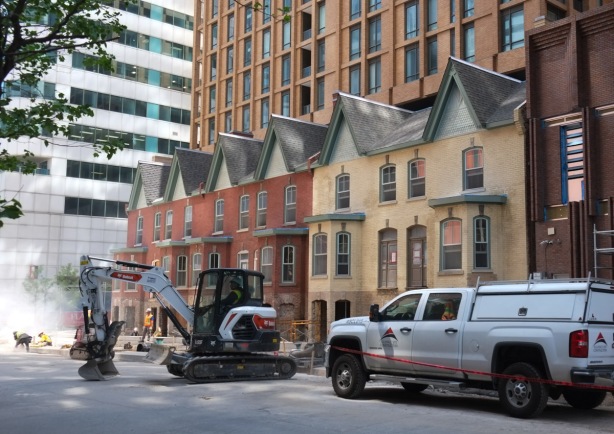
below: Widmer Street, where a row of old houses has been preserved, but are dwarfed by the developments around them.

below: King Street, looking east from John Street.

barriers on King Street that were initially part of King street pilot for streetcars but infrastructure never made permanent, King street looking east from JOhn

below: It’s always there!  The CN Tower again.

below: Southeast corner of King and John.  Another glass wall.

below: Another row of preserved brick facades.  This time on King West.
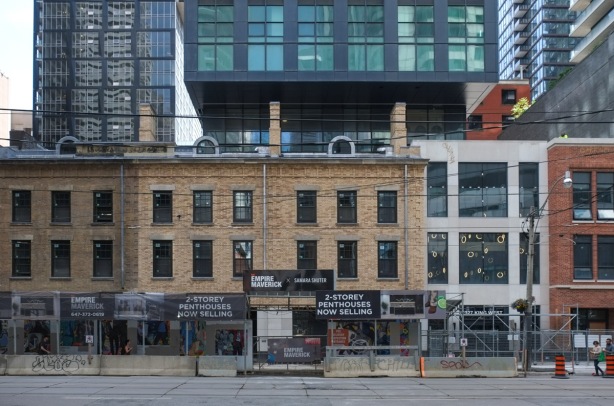
preserved row of brick buildings on king street, with glass and steel condo rising above and behind

below: Rising above the Royal Alex Theatre
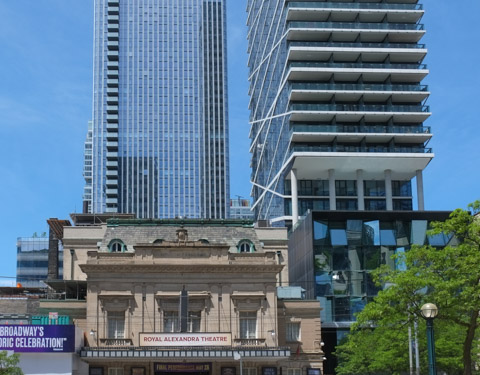
top part of Royal Alexandra Theatre building on King Street, with new glass condo towering above it

a couple standing on sidewalk and talking, a red and white crane in a construction site rises behind them, condo building in the background

below: This is “The Poet, The Fever Hospital” (1992) by Bernie Miller in David Pecaut Square
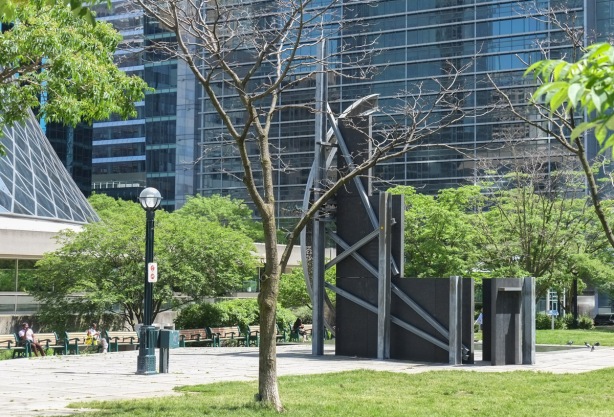
Bernie Miller sculpture in David Pecaut Square, title of The Poet, The Fever Hospital

below: Nearby is a new sculpture by Gillie and Marc and it has a very long title: “He was on a Wild Ride to a Safer Place with Rabbitwoman and a Dogman” (not the Dogman from the childrens books!). There is an empty seat at the back of the bike and it’s waiting for you to join them on their wild ride!

sculpture in david pecaut square, a four seater bicycle with a large rhino in the front seat, then a dog and then a rabbit. the back seat is empty for photo ops, this is by Gillie and Mac and is called He was on a wild ride to a safer place
Rabbitwoman and Dogman from a Gillie and Mac sculpture

black door at number 122, with white words painted on door that say who taught you to love

black and white slap graffiti on a metal box on sidewalk

This post has grown. It’s longer than I had envisioned it when I started putting ideas together a few days ago. I am not sure whether to thank you or to congratulate you for getting this far! Maybe both. Anyhow, I hope that you’ve seen a few new things, or interesting bits, as you’ve scrolled through this post.  Perhaps the pictures have brought back some memories?  In the meantime…..


As promised earlier, more quilts to end the post.

quilt in a museum


quilt in textile museum, the cotton pickers

quilt in a museum with a poem on it as well as black and white photos

“Sing poets of this beauty
Sing choirs of this inviolate pride
Make these moments precious to history
Let these scenes live in every eye”

….  at Mt Pleasant and Manor Road.

Back in late 2019, before our lives got turned topsy turvy by that virus thing, I posted about new murals on Mt. Pleasant such as this one on the northeast corner of Mt. Pleasant and Manor Road.   Roses on a pale pink background by Alexander Bacon.

piano piano restaurant on northeast corner of manor raod and mount pleasant, painted pale pink, with very large roses, mural by alexander bacon

I recently learned (thanks to Larissa!) that there are now more murals at the same intersection.  Of course I had to check it out!  Both corners on the south side of Manor Road now have floral murals, also painted by Bacon.  The combined mural has the title “Serene Gate”.

below: Southwest corner

flower mural by alexander bacon, on two storey bick building that has a florist on the lower floor as well as a bulk food store. shelves of potted plants on the sidewalk for sale as well

rows of shelves of potted flowering plants for sale in front of a mural of flowers

shelf of potted flowering plants in front of a mural with a pink flower

below: Southeast corner

flower mural by alexander bacon on side of two storey red brick building

flower mural by alexander bacon on side of two storey red brick building

below: More flowers on the lamppost – a vine of morning glories growing skyward.

painting of purple morning glories on a lamp post

banner on a pole, Mount pleasant village, along with pink flowers


a man walking a dog on a sidewalk, back to camera, lines of potted flowering plants on both sides of the sidewalk