Archive for the ‘public art’ Category

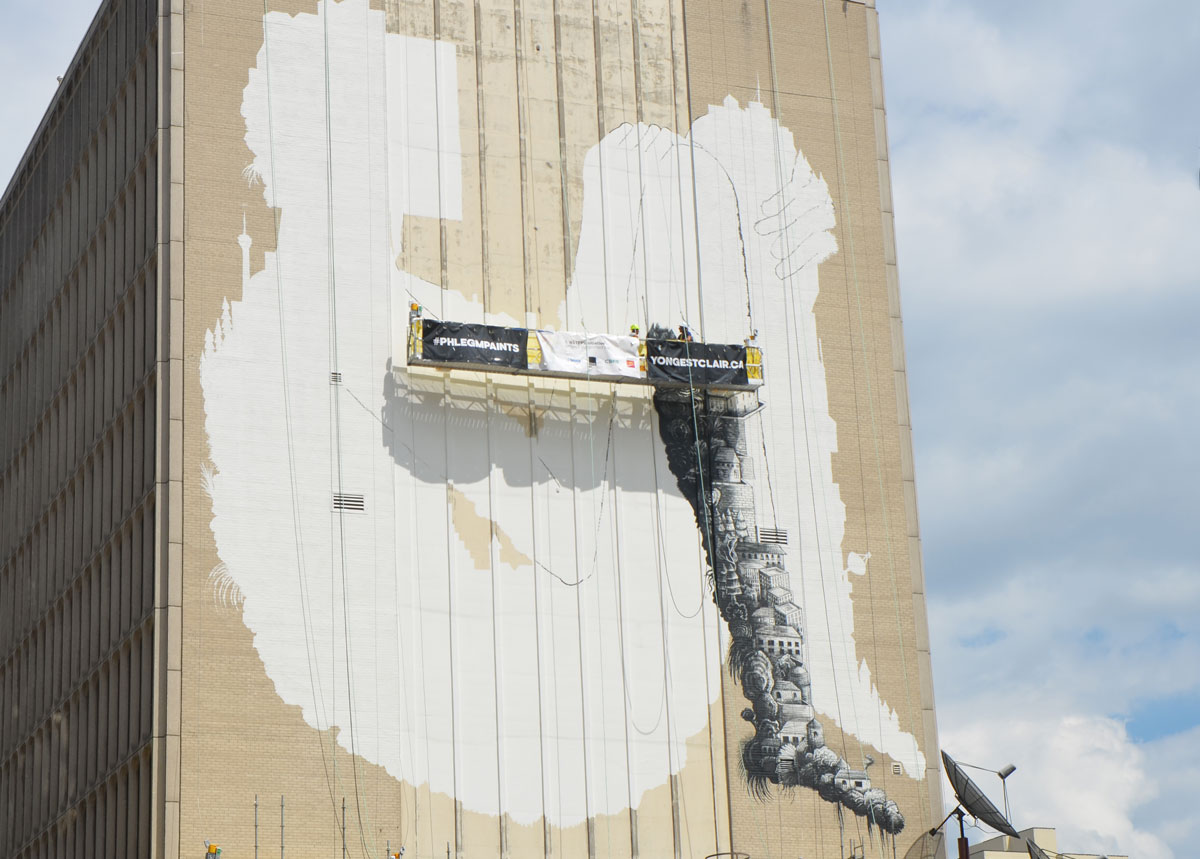
British mural artist Phlegm has been painting a large mural on the side of 1 St. Clair West.   The first time I saw it, was on the 14th of July when it looked liked this:

below: The white background of the mural was painted first.

a street in Toronto, St. Clair Ave., with an older nine storey building with concrete facing, on the side, above the level of the stores beside it, is the outline of the start of a mural. All painted white, a seated figure.

I have been watching it, checking up on it every couple of days.  At first I took photos fairly frequently because I had no idea how long it would take before the mural was finished.

below:  19th July

a verylarge mural on the side of a building is in the process of being painted. An white outline of a seated person with their knees drawn up, one leg has been painted with a design in black

As it turns out, there is a lot of detail in the mural!  It slowly took shape.

below: 21st July

a very large mural on the side of a building is in the process of being painted. An white outline of a seated person with their knees drawn up, one leg has been painted with a design in black

below: Fast forward to today…. the mural is almost finished. …
but wait!  Isn’t that the CN tower on the shoulder?

large black and white mural by phlegm of a seated person with their knees bent up, made of tiny houses and buildings and other structures

below: Hey!  It is the CN tower.  And isn’t that the Gooderham/flatiron building?  And that building with the little dome, isn’t that on Yonge street?

close up of mural made up of toronto landmarks like the cn tower and the gooderham flatiron building

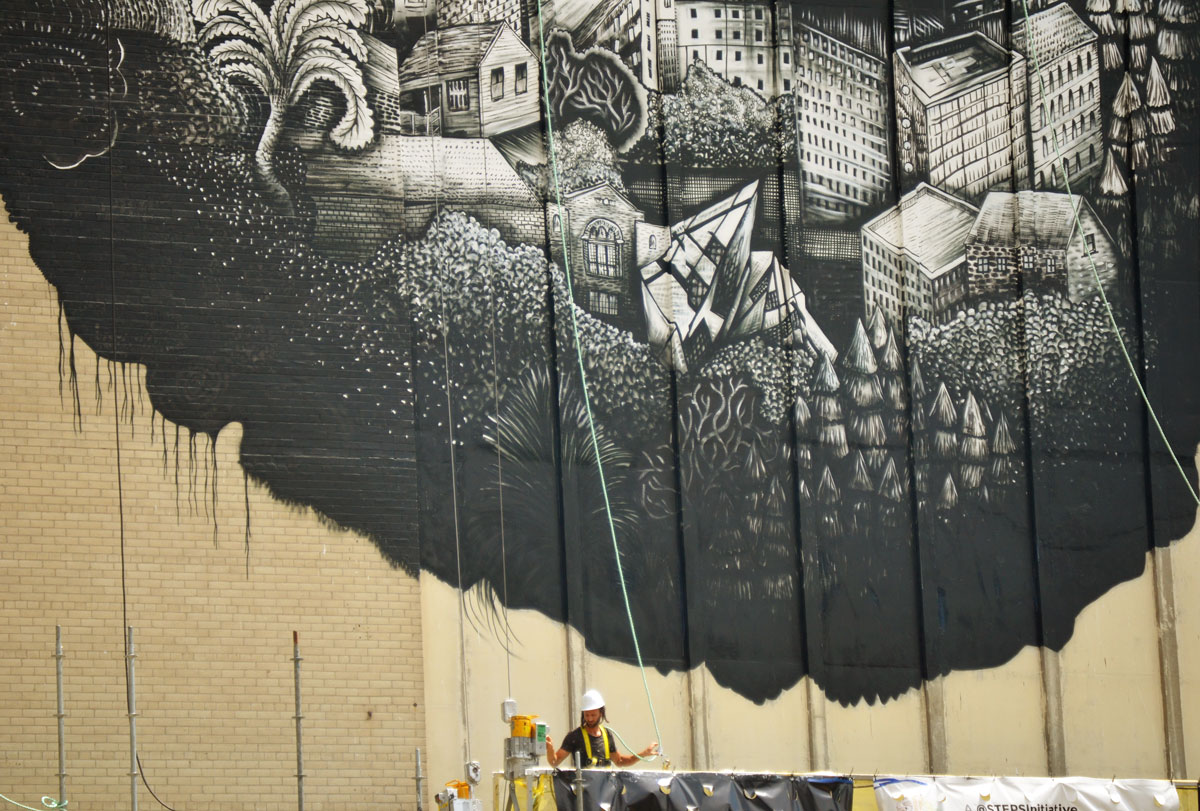
below: There’s the ROM and its ‘crystal’ too!   This is the ‘bottom’ of the figure and in this photo two things become clearer.  First, the scale of the project and just how big the mural is becomes apparent.  Second, the mural is of a person coming out of the earth, being pulled out by the roots almost.  But is it a person?  Or is it a living city?

the bottom part of a mural, man in scaffolding is still working on it, black on white, pictures of buildings.

below: The head part – play ‘spot the building’!  Is that old city hall?

head part of phlegm mural

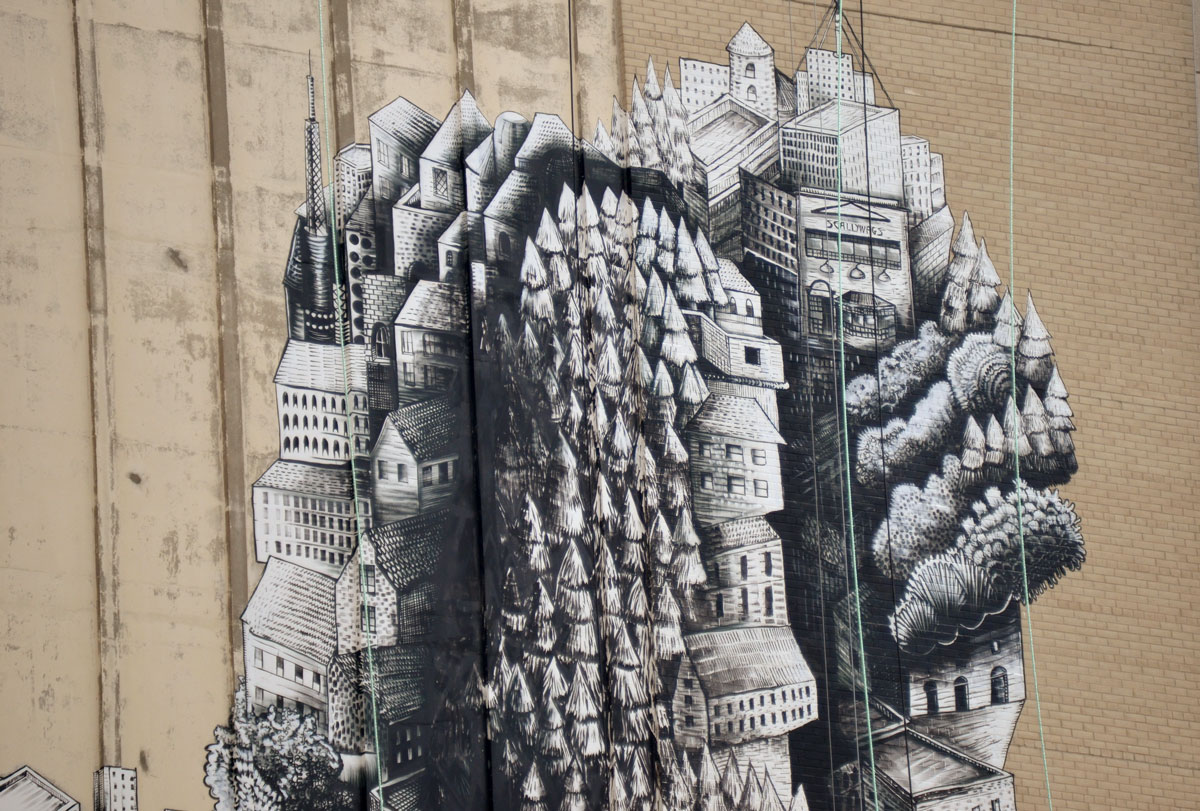
below: Scalliwags is on one of the knees along with a lot of trees.

knees part of the mural

below: And last, the feet with more roots at the heels

feet of a person in a mural made of paintings of trees and buildings, roots growing out of the heels. satelite dish in the mural and on the building beside the mural

This project is also a part of the STEPS Initiative program.

This post also appears in a blog about street art. Phelgm’s Progress.

Just before Dupont Street ends at Dundas West, it passes under a set of railway tracks…
and of course another underpass means another mural.

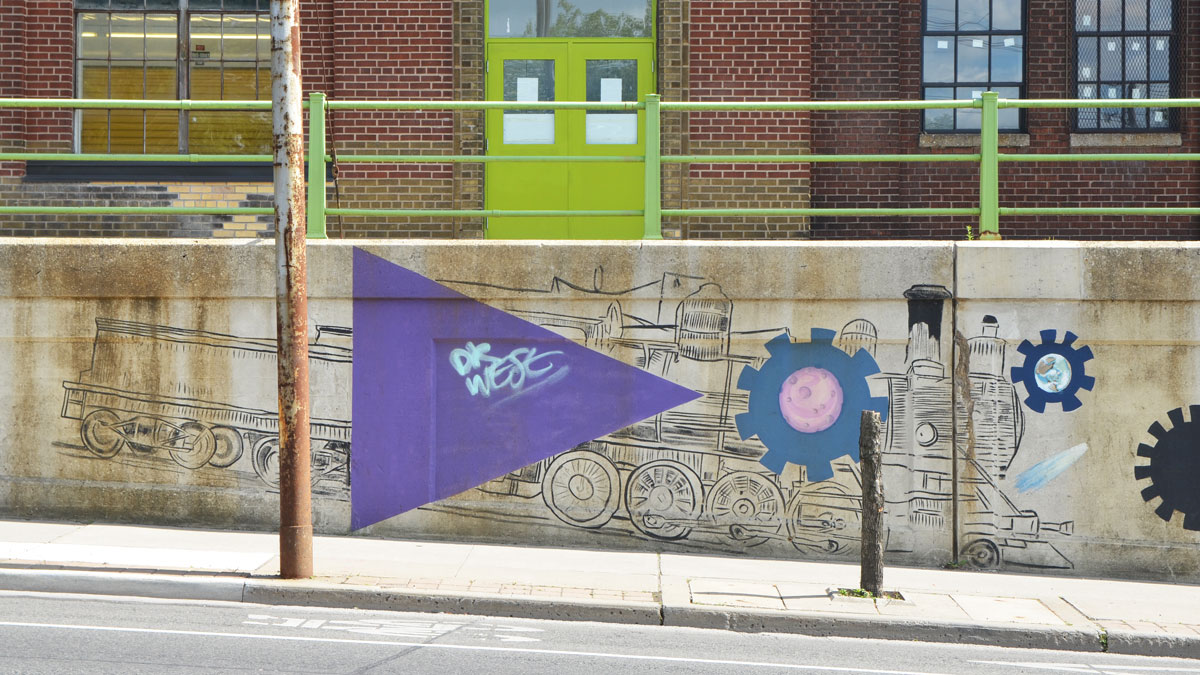
It is an Art Starts project “honouring the Junction and paying homage to its industrial past rooted in the railway and celebrating its development as a diverse neighbourhood oriented community. ”  Lead artists Joshua Barndt and Jamie Bradbury along with 5 youth artists took 4 weeks to complete the mural.

mural on a concrete wall beside a sidewalk, just before the road goes under an underpass - large purple triangel, drawing of a locomotive and a couple of gears

The mural was funded by the City of Toronto’s Graffiti Transformation Program.

mural on a concrete wall beside a sidewalk, just before the road goes under an underpass, gears, plus a stylized industrial machine in black and blue

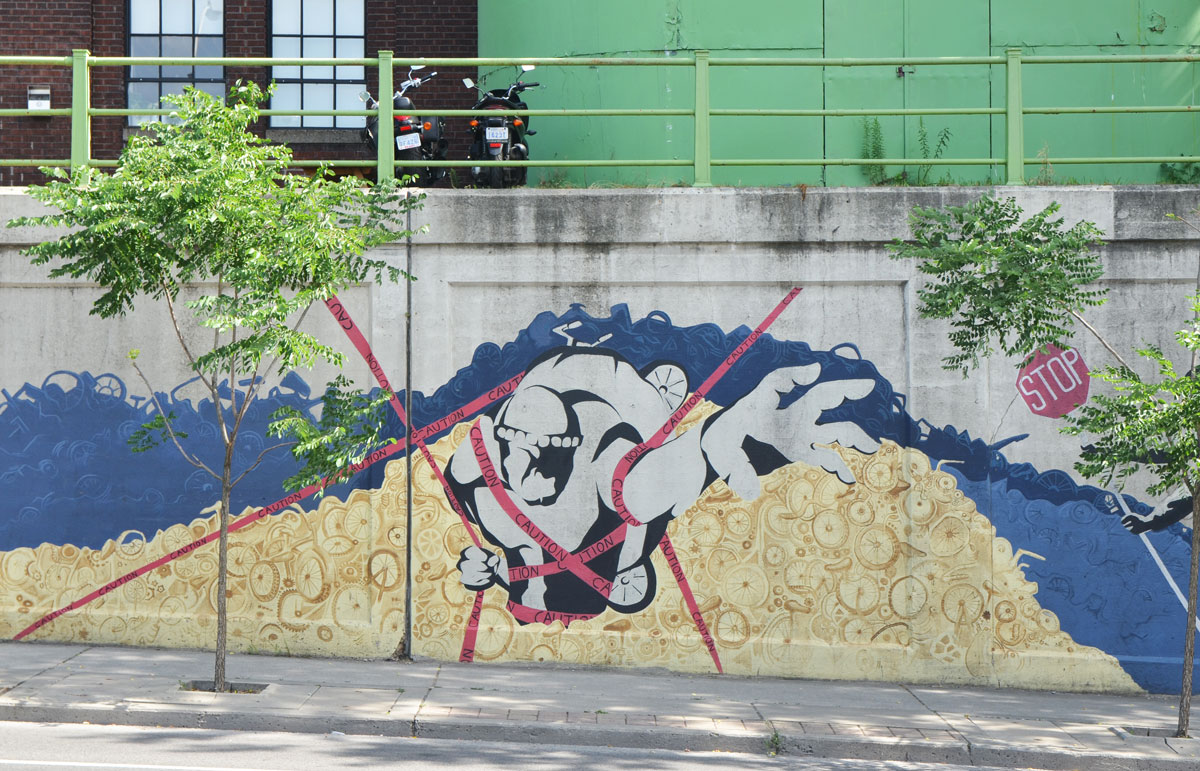
mural on a wall showing a picture of worker in a hard hat, reaching upwards, standing on a pile of bicycle wheels.

mural on the wall of an underpass, in the Junction, on Dupont, a line drawing of a railway car, with a large blue bike superimposed on top of it, a person holding a stop sign,

Cycling is used as a theme and as a way of traveling from the past to the future in the mural.

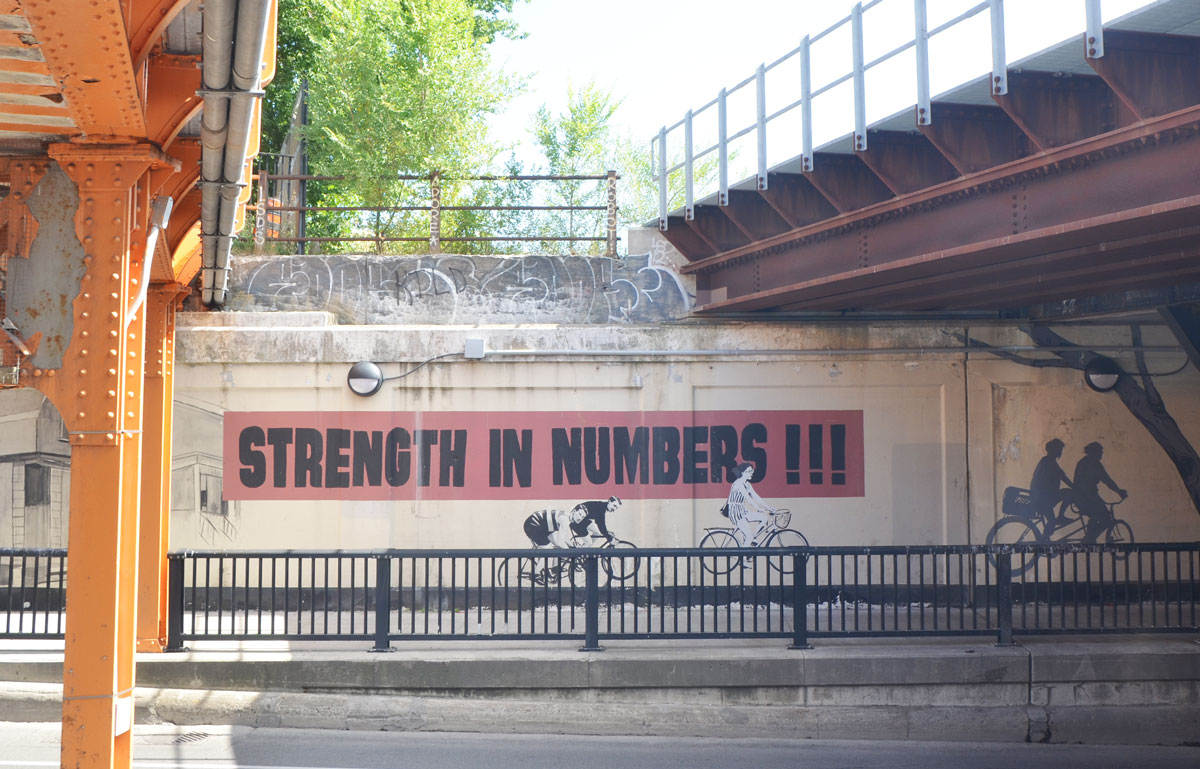
mural on the walls of an underpass, orange metal bridge, mural of cyclists riding their bikes

mural under a bridge of people riding bikes

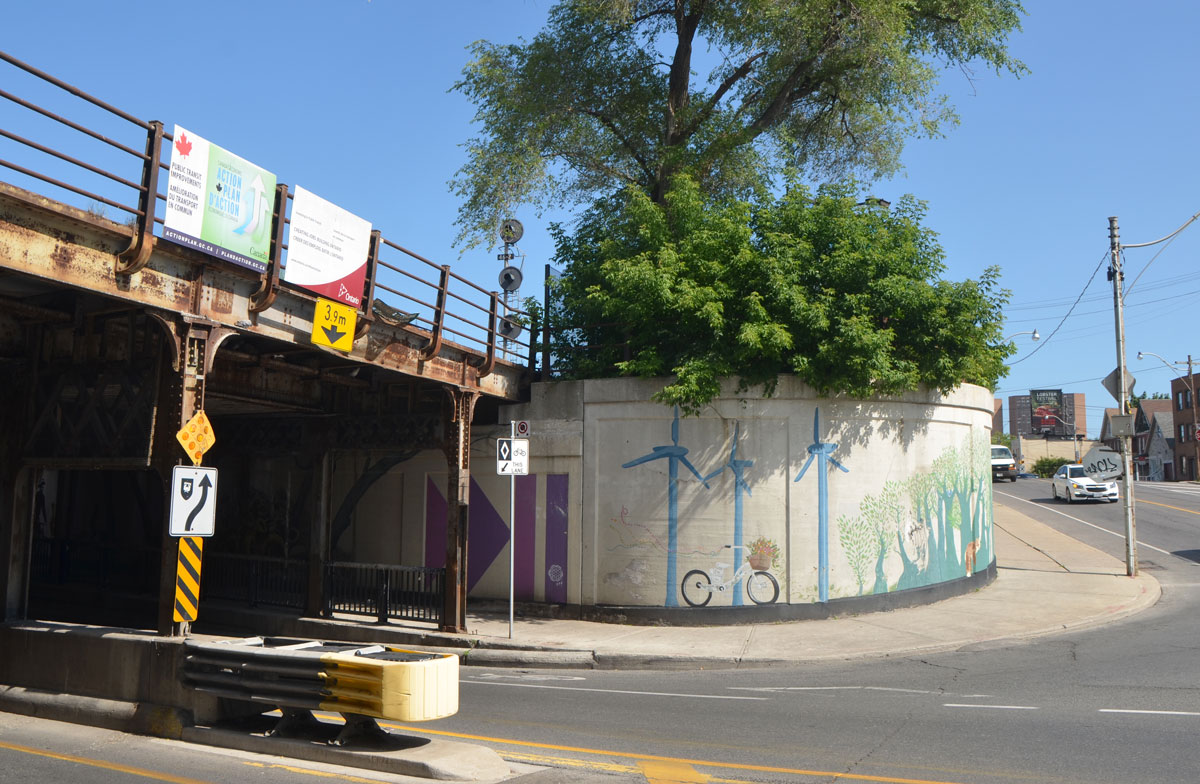
a wall of an underpass curves as it exits the railway bridge. on the curve is the continuation of a mural that was painted on the walls of the underpass. Windmills and bikes.

mural on a curved concrete wall, beside an intersection, showing windmills with bike parked in front, and a forest with some animals in it, fox and wolf

below: The final panel in the mural, a future friendly city.

part of a mural, the word city is used to make a futuristic urban scene in blue tones. The future is friendly.

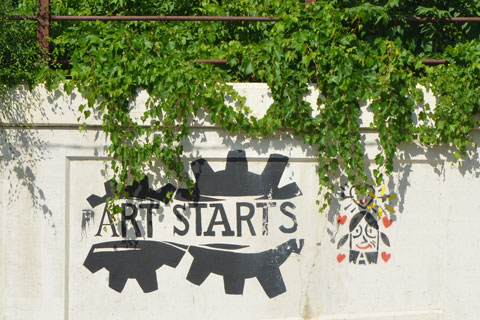
logo of two black gears side by side with the words Art Starts written across the middle of them. a small graffiti painting of a girl's head with a heart above it

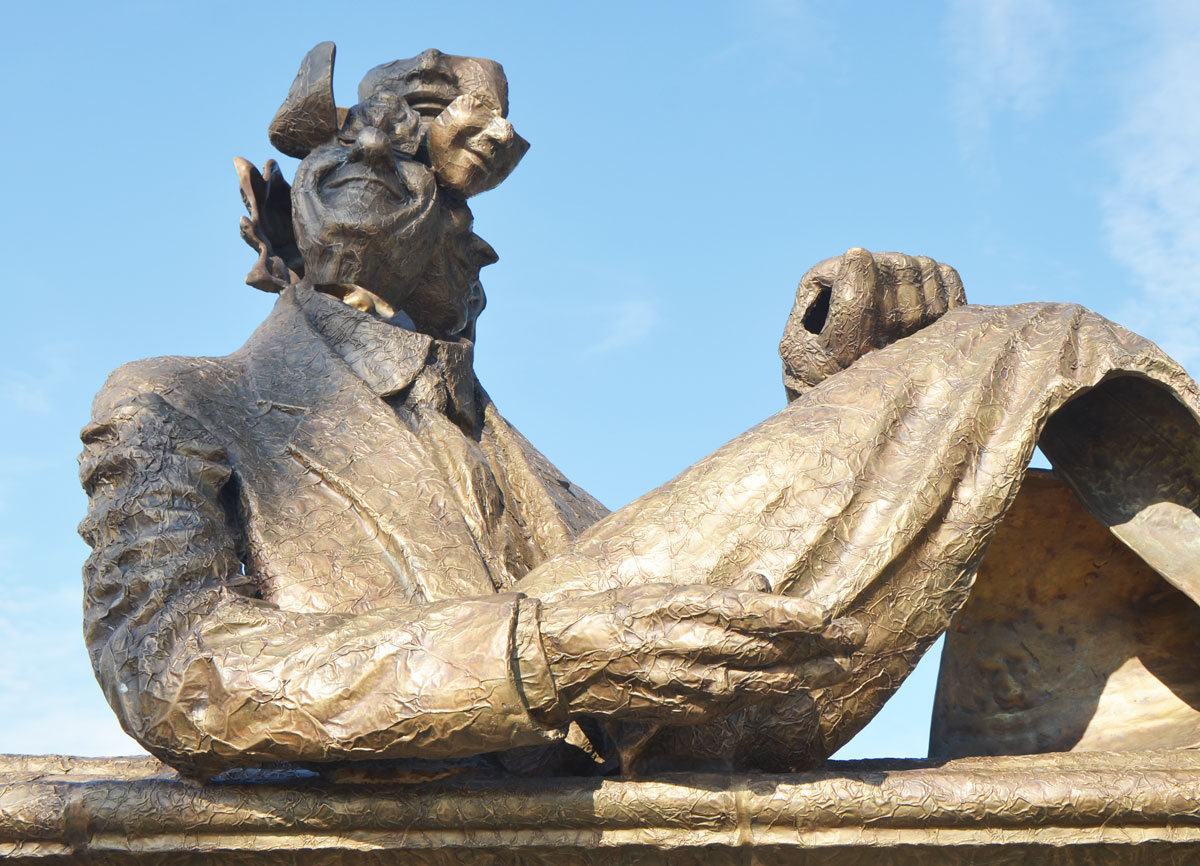
The first time I saw the latest art installation in the Canary District I was in a car and only got a quick look at it.  I couldn’t figure out what the mess was all about.  It wasn’t until I went back on foot to take a closer look that I could appreciate what the artists were trying to do.

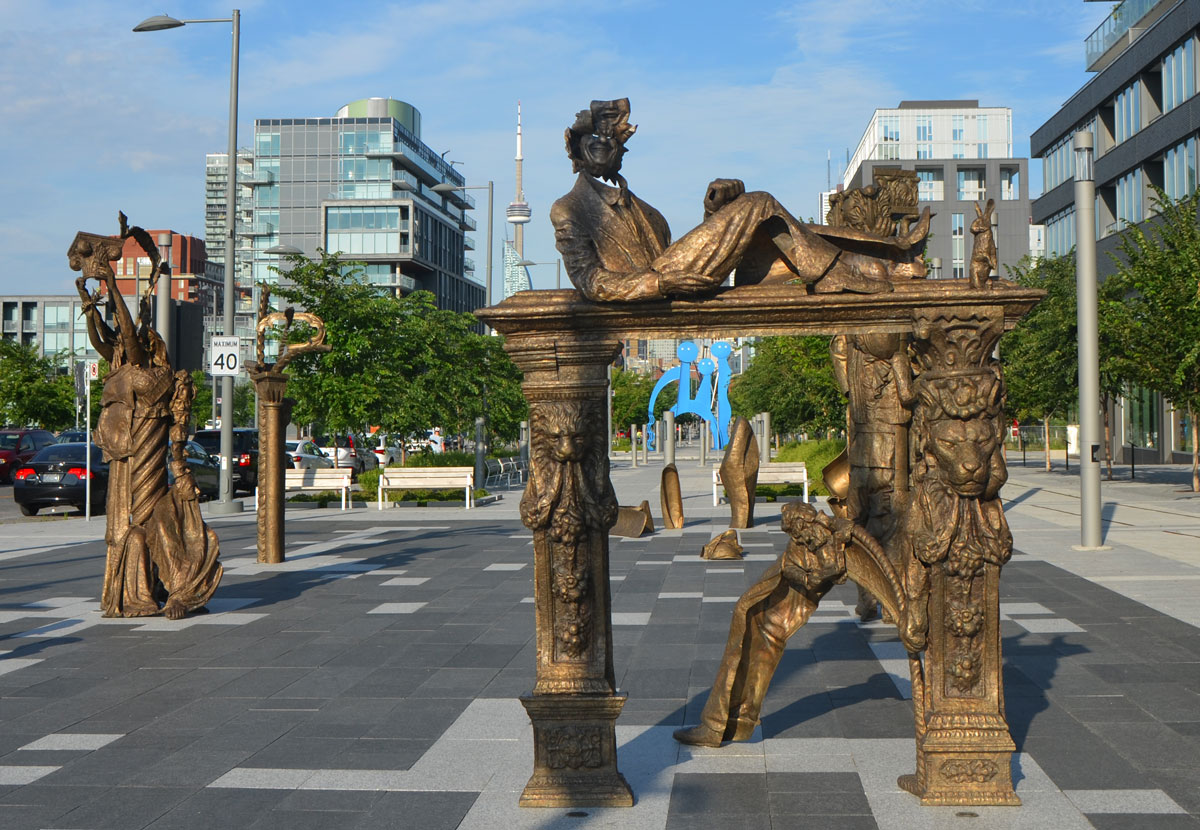
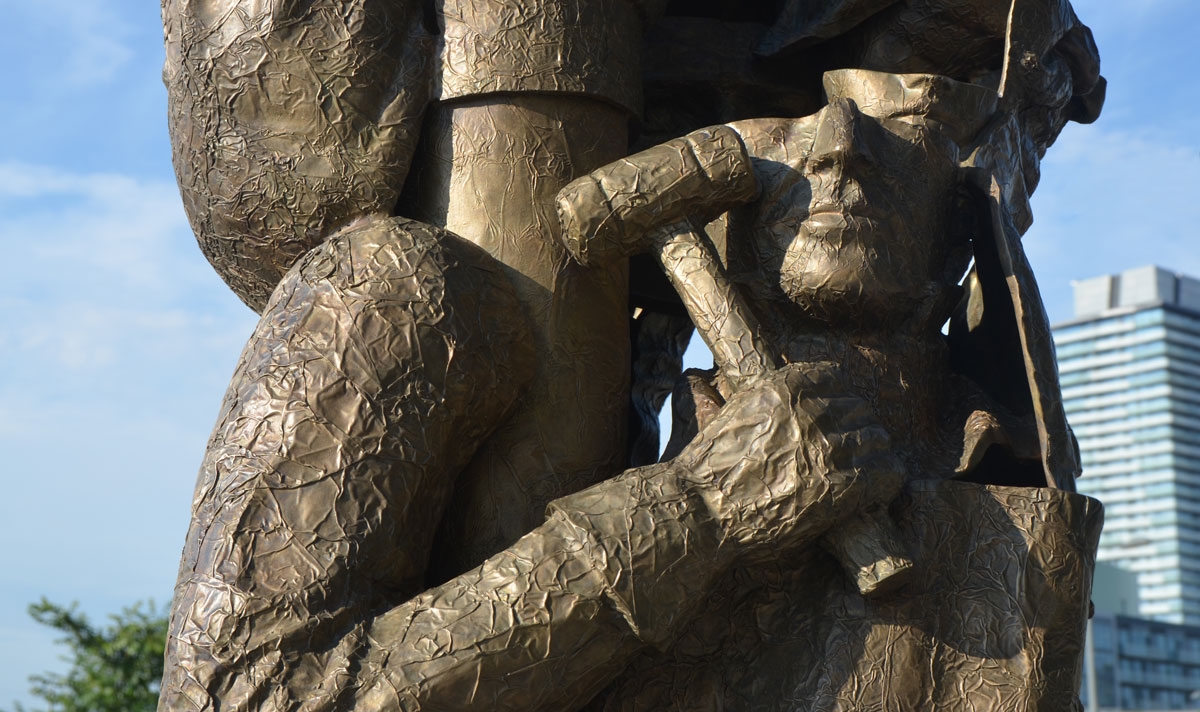
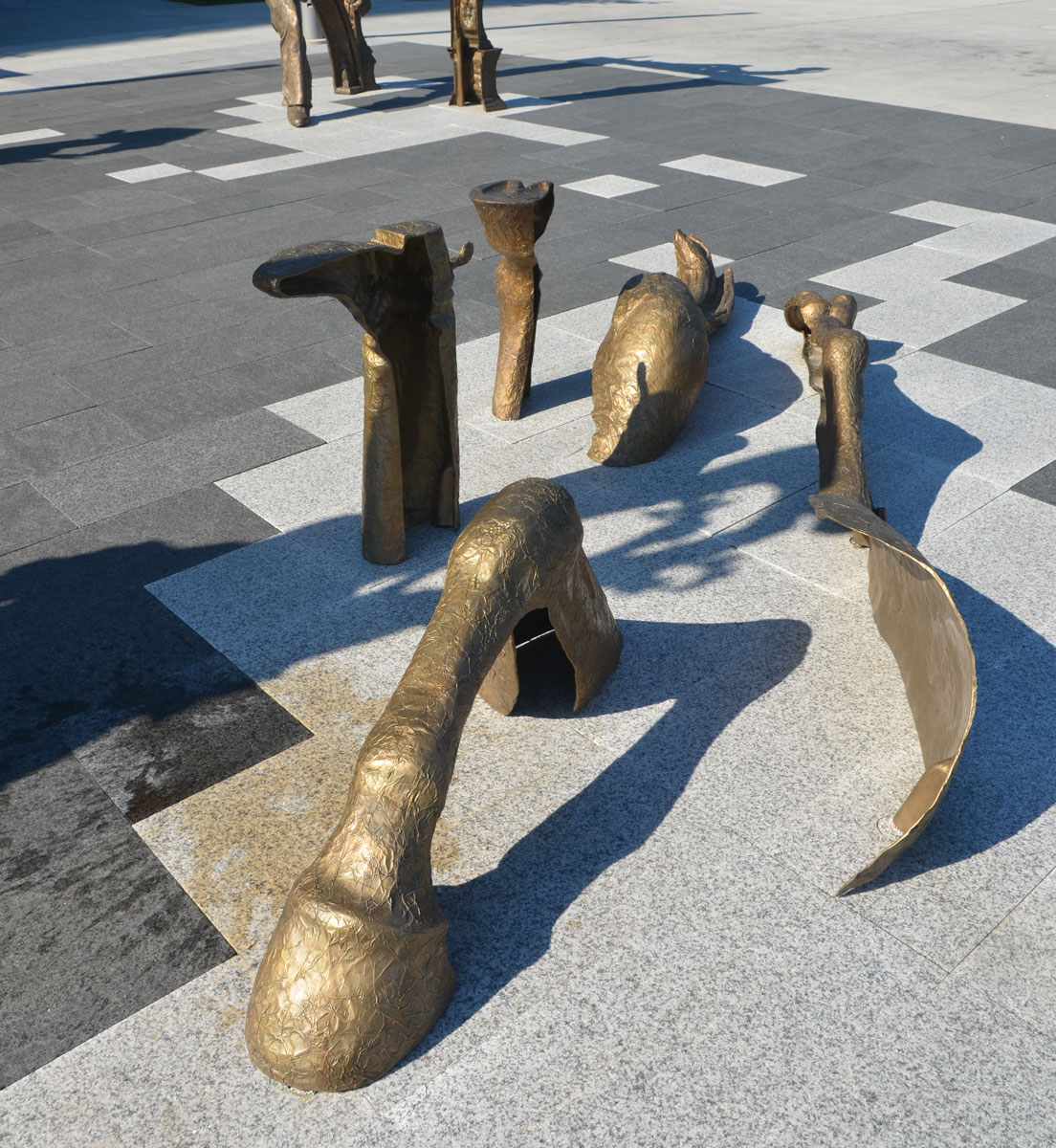
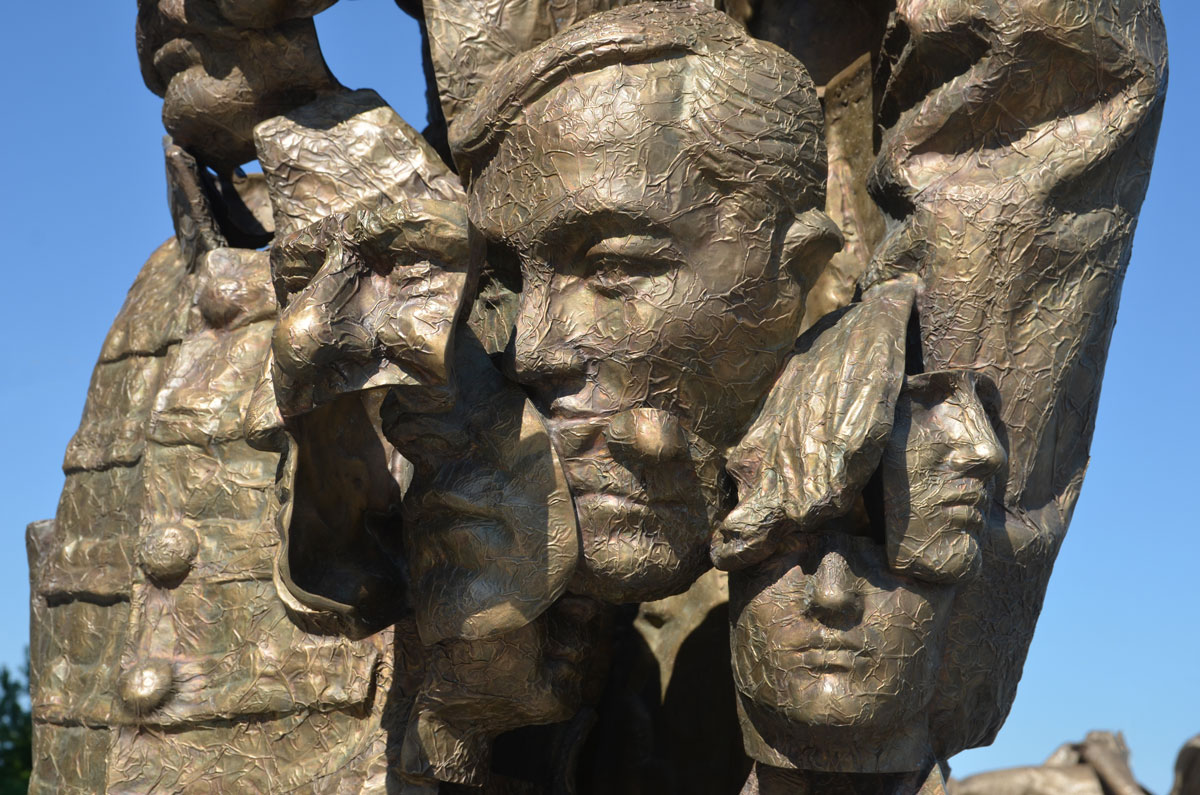
Located at Front and Bayview is the ‘Garden of Future Follies’ by Hadley Howes and Maxwell Stephens (Hadley & Maxwell and the Studio of Received Ideas).  It is a sculpture garden and there are 7 sculptures in this garden.  Each sculpture is a mashup of pieces from different sculptures around Toronto.  Aluminum foil ‘molds’ were used to replicate portions of over 80  different monuments and architectural features.  These portions were then put together in a whole new way.

public art installation on Front St East, various pieces of sculptures put together wrong, people with more than one face, legs in pieces, bronze pieces in 5 groupings on the sidewalk

From an interview with the artists:

“Sir John A. Macdonald’s nose is assembled along with the eyes of artists Frances Loring and Florence Wyle, the chin of Dr. Sun Yat-Sen, and Northrop Frye’s hair; Jack Layton’s smile is one of seven that grace a figure lounging atop a reconstituted mantel from the library at Osgoode Hall; a bell from St. James Cathedral’s famous collection is perched on a cannon from Fort York; while nearby a suitcase from the Memorial to Italian Immigrants acts as a plinth for a collection of hats from various bronze heads.”

Now you can play spot the pieces!  But you won’t find any hockey sticks.

blog_man_three_heads_statue

So far I haven’t seen anyone taking selfies here but I think it would be a great spot for them!

part of a public art installation outdoors created by piecing together fragments of other statues cast in bronze , man and hammer

fragments of horse and feet statues embedded in the sidewalk

part of a public art installation outdoors created by piecing together fragments of other statues cast in bronze

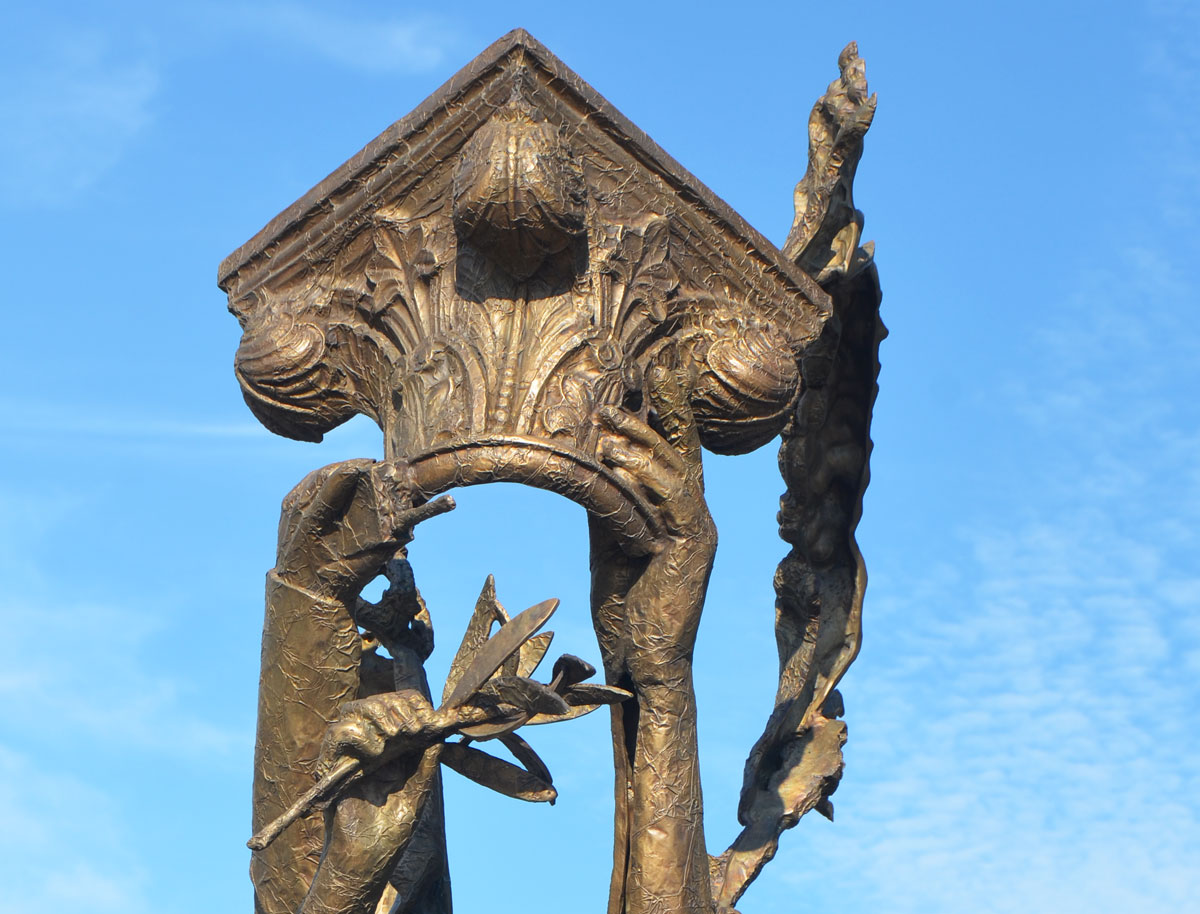
part of a public art installation outdoors created by piecing together fragments of other statues cast in bronze, hands, top of a column and a laurel leaf

part of a bronze sculptture, a naked bum with a hand beside it.

part of a public art installation outdoors created by piecing together fragments of other statues cast in bronze

below: No one will ever call it beautiful, playful yes, but not pretty.

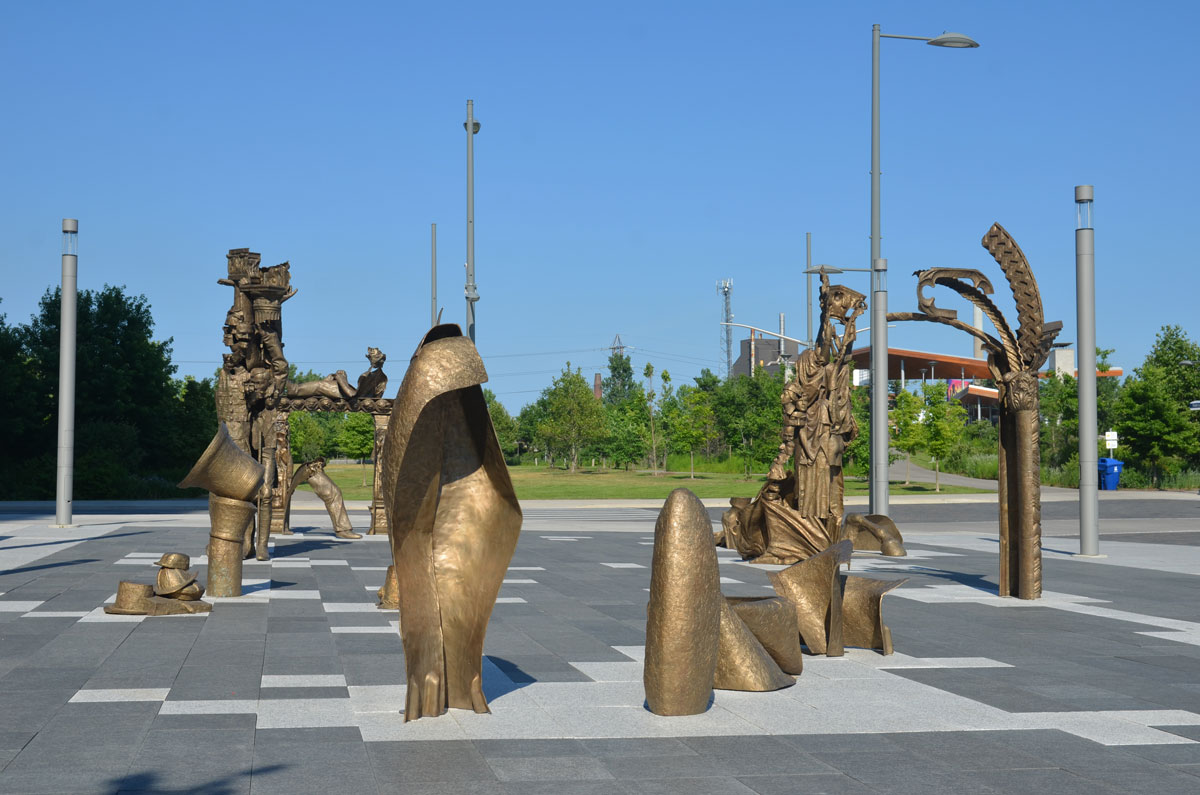
arrangement of statue pieces to form a sculpture garden, Garden of Future Follies by Hadley and Maxwell.

a face is upside down on a statue made from bits and pieces of other statues


This is another post about an exhibit from the CONTACT Photography Festival.   I know that it’s now June and CONTACT was in May, but I wanted to post these photos.  I actually took them early in May as you can probably tell by how many clothes the people in the pictures are wearing.  They’re certainly not dressed for the warmer weather we’ve been having lately.  I have had trouble deciding what to write in this post.

There is a parking lot at the NE corner of Front and Spadina with some billboards in it.   Maybe you saw them as you drove or walked past but maybe you passed by and missed them.   There are so many things on the street vying for our attention and a billboard is just another piece of street ‘furniture’.

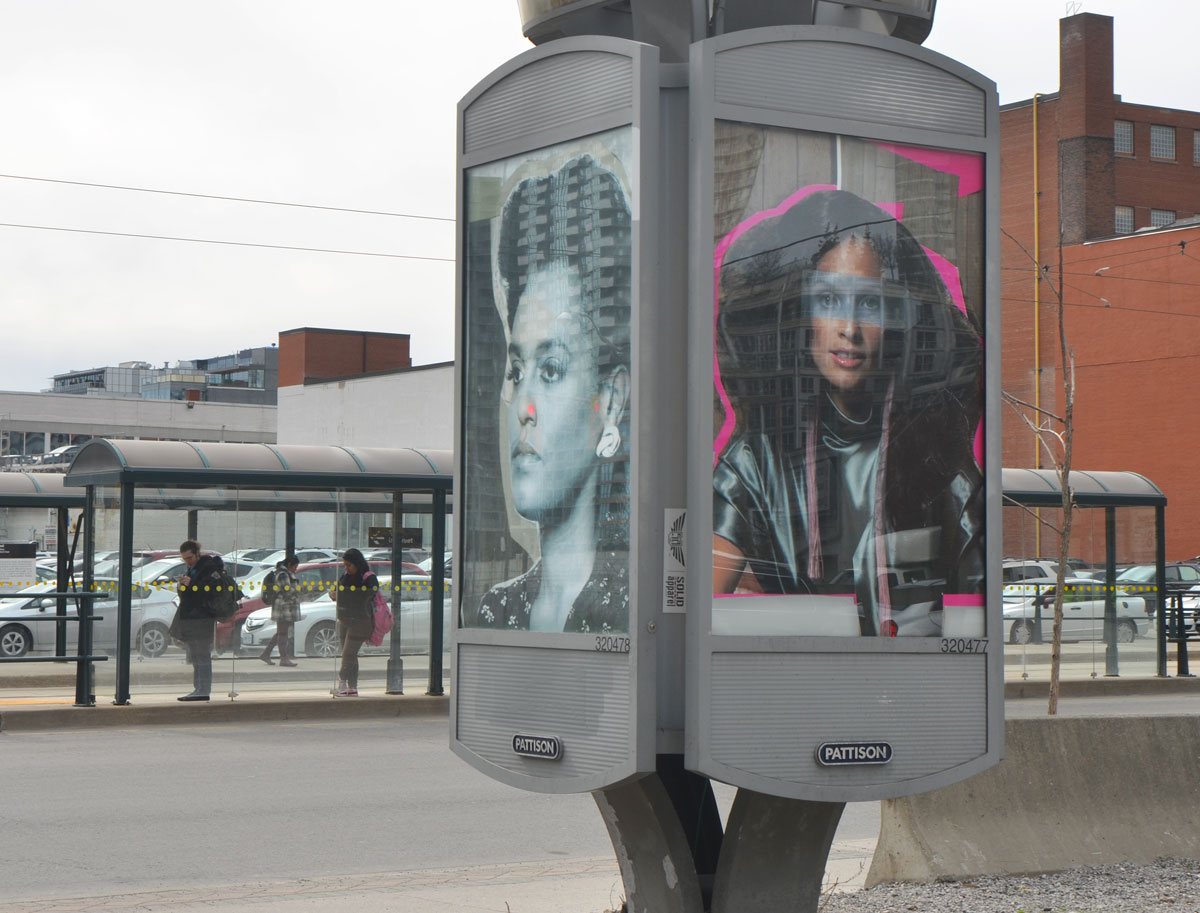
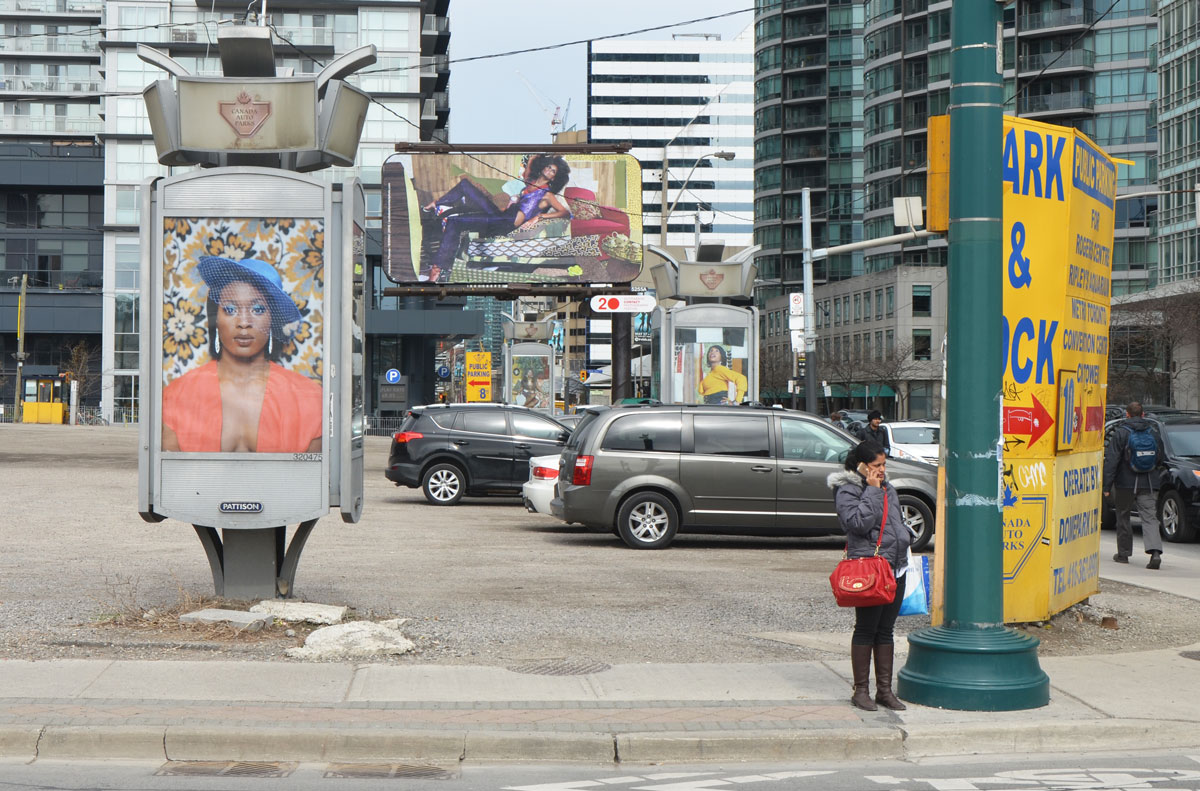
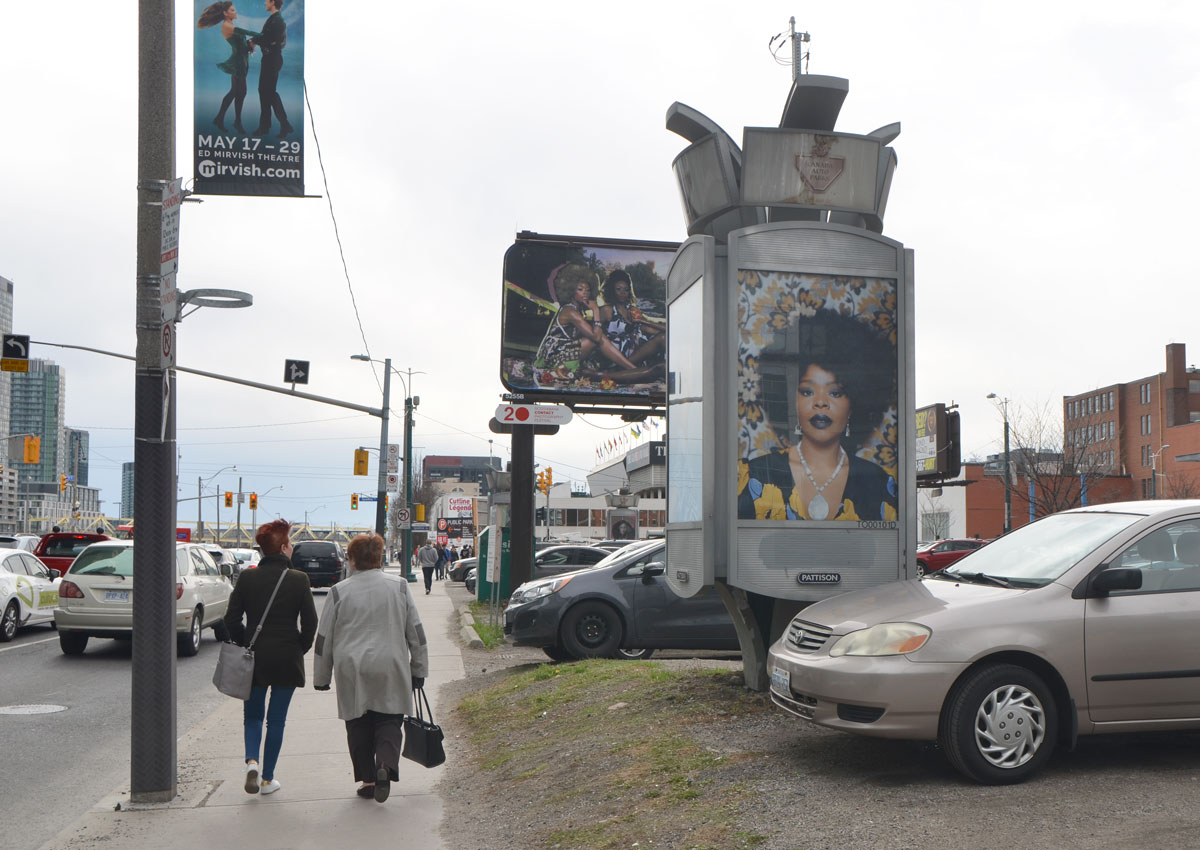
For the month of May, an installation titled ‘What it Means to be Beautiful’  by Mickalene Thomas occupied a number of billboard spaces at the above mentioned corner.   All the images are portraits of women and are “shown within the context of street advertising, where women are constantly bombarded with narrow notions of female beauty.”   A sample of the billboards:


part of an art installation, portrait of a black woman in profile, with a shaved head, on a billboard, by Mickalene Thomas, in a parking lot in downtown Toronto

part of an art installation, portrait of a black woman wearing a blue hat on a billboard, by Mickalene Thomas, in a parking lot in downtown Toronto. A woman stands on the corner talking on her phone. Another, large, billboard is in the background.

Two women walk past part of an art installation, portrait of a black woman on a billboard, by Mickalene Thomas, in a parking lot in downtown Toronto

Two portraits of black women, in a billboard space in a parking lot, with people waiting for a streetcar in glass bus shelters in the background.

part of an art installation, portrait of a black woman on a billboard, by Mickalene Thomas, in a parking lot in downtown Toronto, A group of people wait for a green light at the intersection in the background, tall condos too.

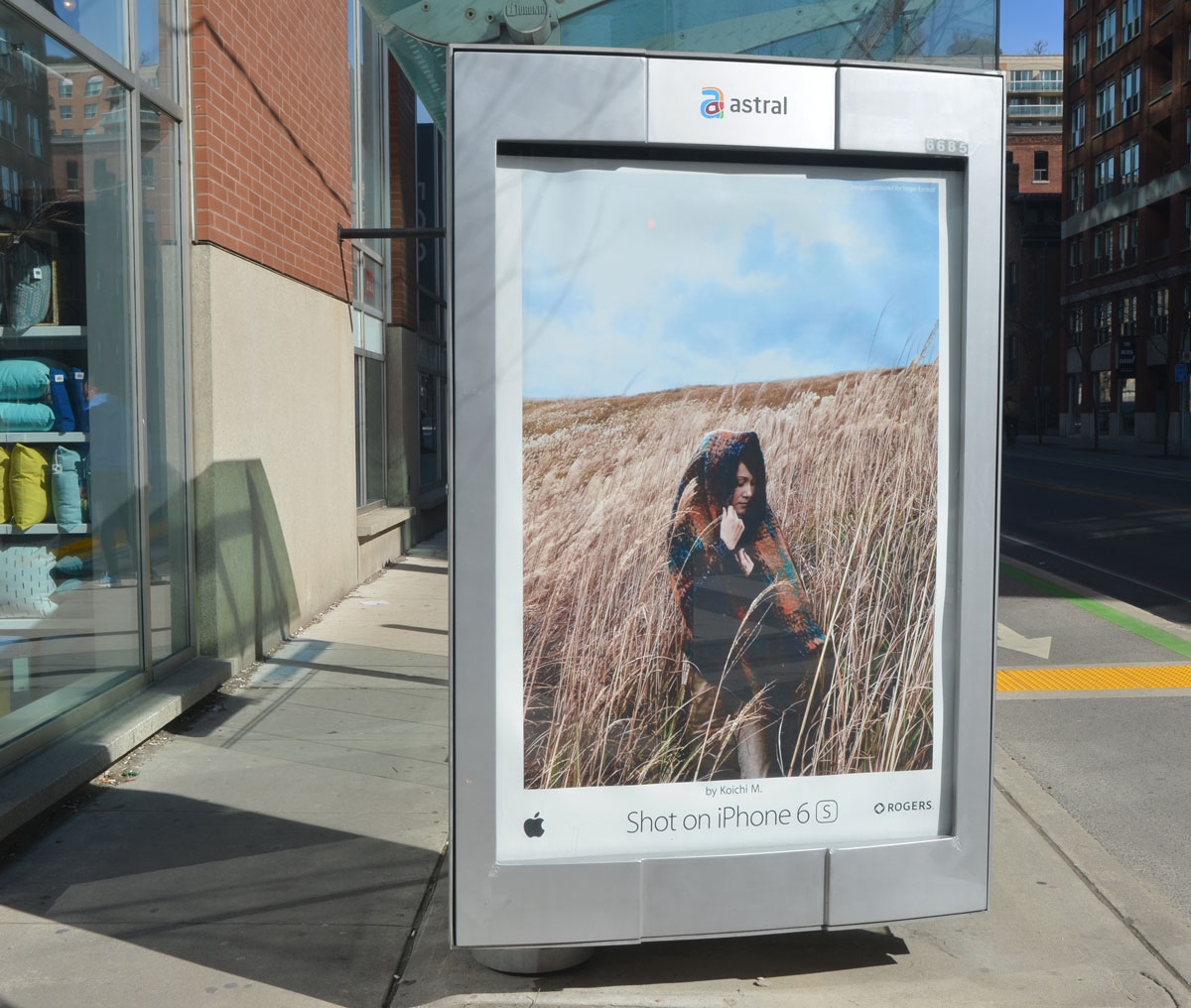
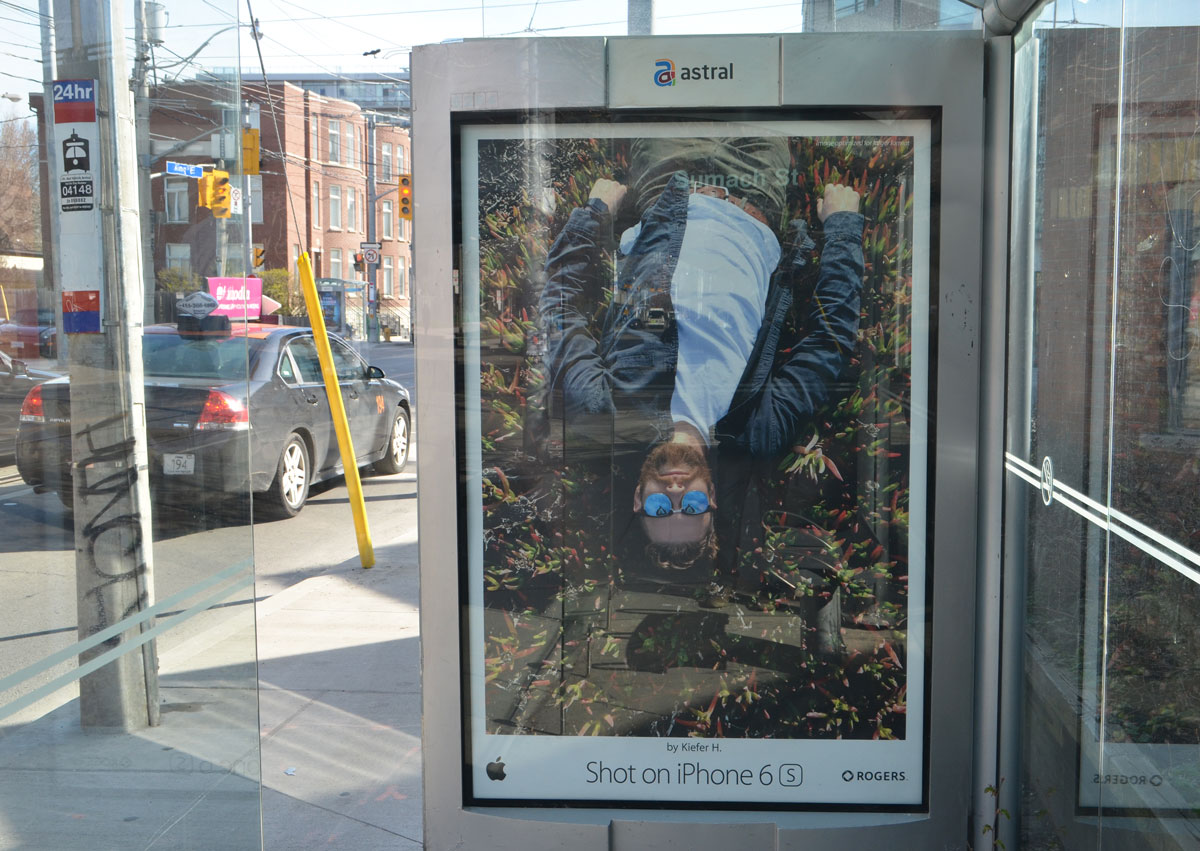
Part of the reason that I hesitated to write this post was the fact that the iphone 6 ad campaign was on at the same time.  It was a campaign that used photos taken with the phone and the ads were very visual and used very few words. In my opinion, they are more eye catching and visually appealing than Thomas’s work. I found a few of them to show here (below).  I know that there were many more but unless I was consciously looking for ads, I didn’t notice them as billboards are one of the things that I block out as I walk.  That led to a few thoughts about what catches a viewer’s attention on the street –   Faces?  Colours?  Contrast?

There is more going on in Thomas’s photos and collages than just visual appeal but I still question the validity of asking the viewer to look at them in the context of street advertising.   Is it fair to compare her images to ads produced by, and in aid of, a large corporation?   Would it have been better to  exhibit her work in different form or a different place?  I don’t have the answers for those questions.  Do you?


iphone ad on a bus stop wall showing a woman in a field

iphone 6 ad on a bus stop wall of a woman lying in a field of pumpkins. Her head is surrounded by pumpkins.

an iphone ad on a bus stop wall of a man lying on the ground. He is upside down in the picture

And now I will go back to ignoring billboards as I walk.

Spring is in the air. 

the word love is written in lights in capital letters in a window of a store. Reflected in the window is a group of older people sitting on benches across from the window

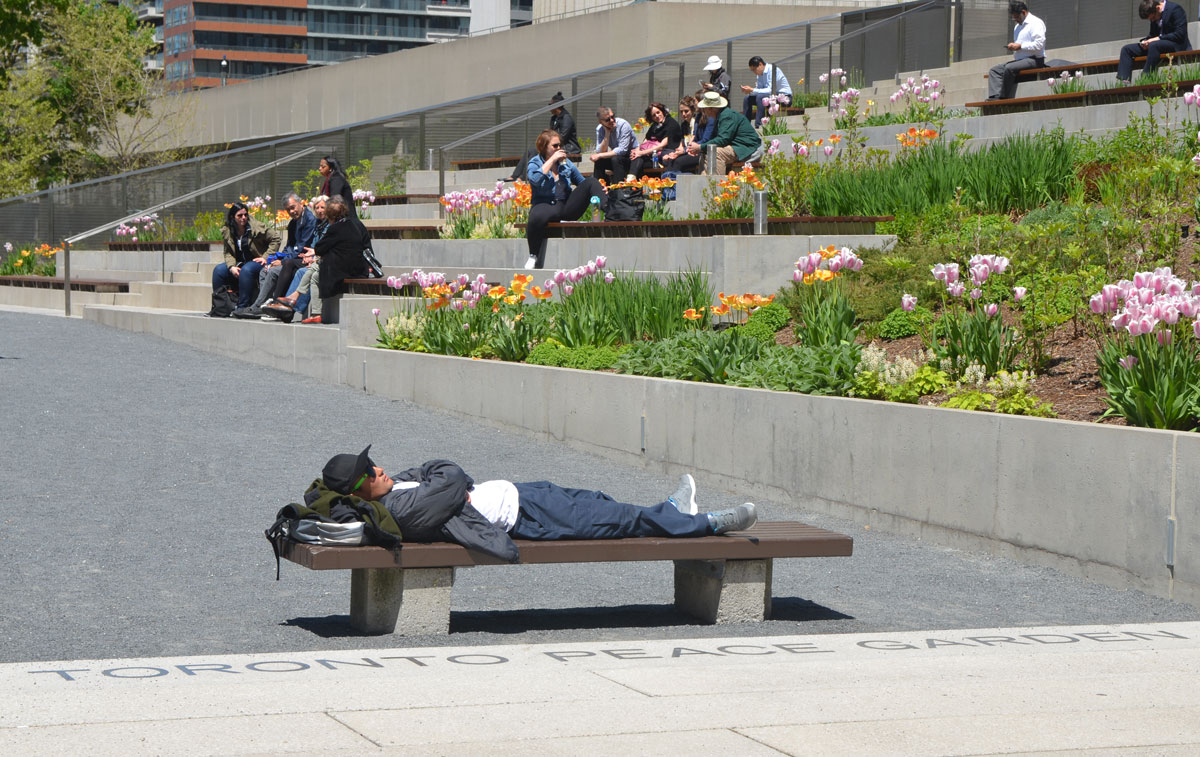
A young man is lying on a bench in the Toronto peace garden, the words of which are written beside him, metal inlay in the stone on the ground.

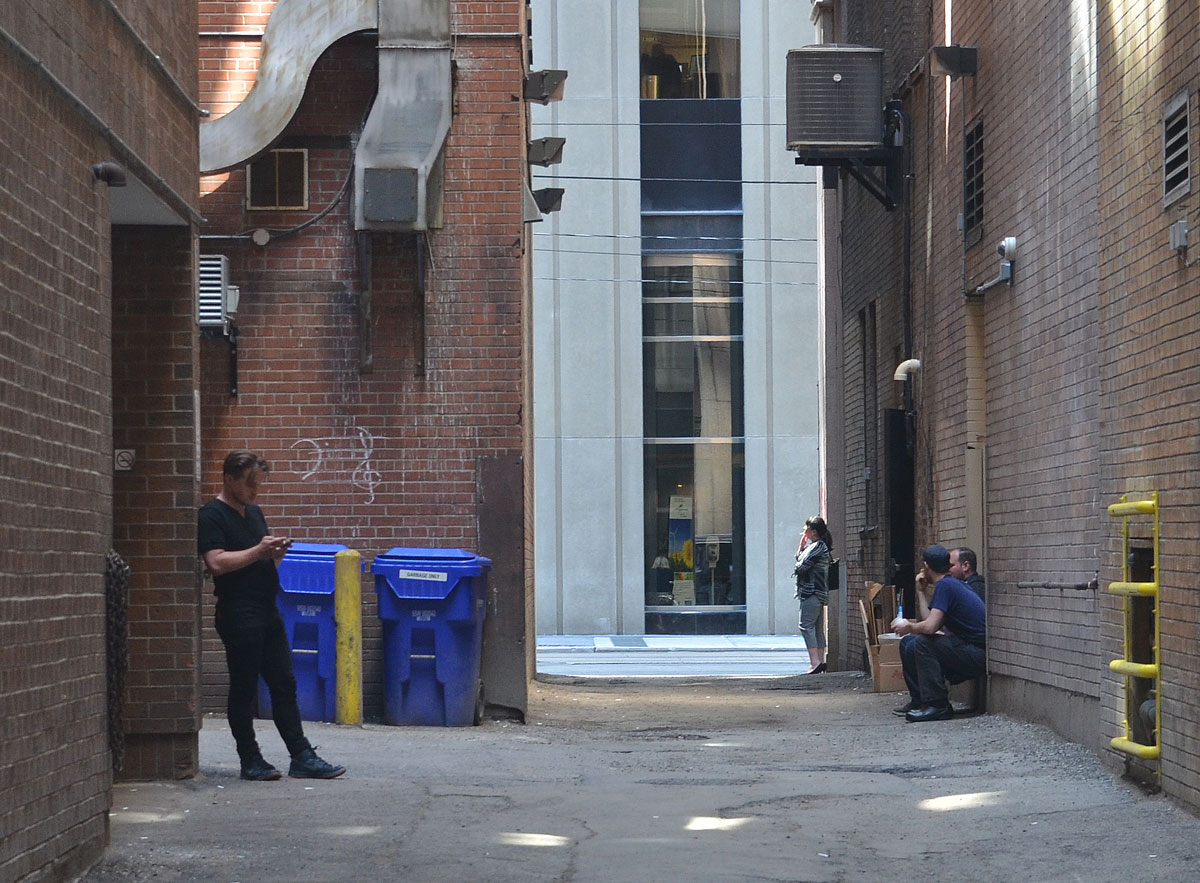
people sitting and standing in an alley, one man is on his cellphone, tall buildings on either side of the lane as well as at the end of the lane

A woman in black high heel shoes is sitting on a low stone wall outside. You can only see her from the thigh down. He legs are crossed at the ankle.

three people sitting outside, two men who are talking together and a woman who is sitting on her own, they are in a square and are surrounded by tall glass buildings, half in shadow and half in light

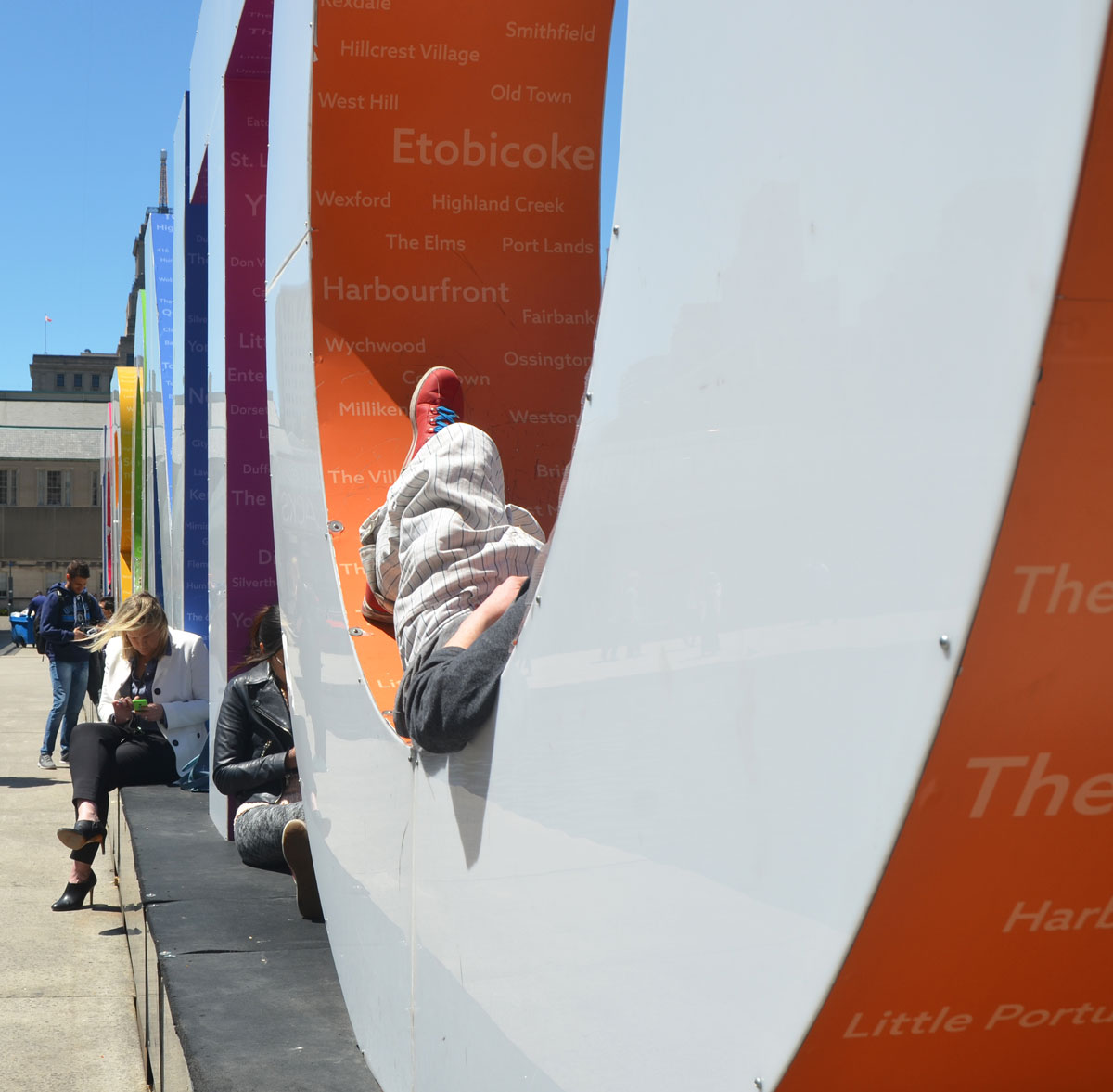
a young man is lying in the the O of the Toronto 3D sign. The O is orange, you can't see the man's face but you can see one red shoe and his light coloured pant leg.

blog_resting_O_toronto3D_sign

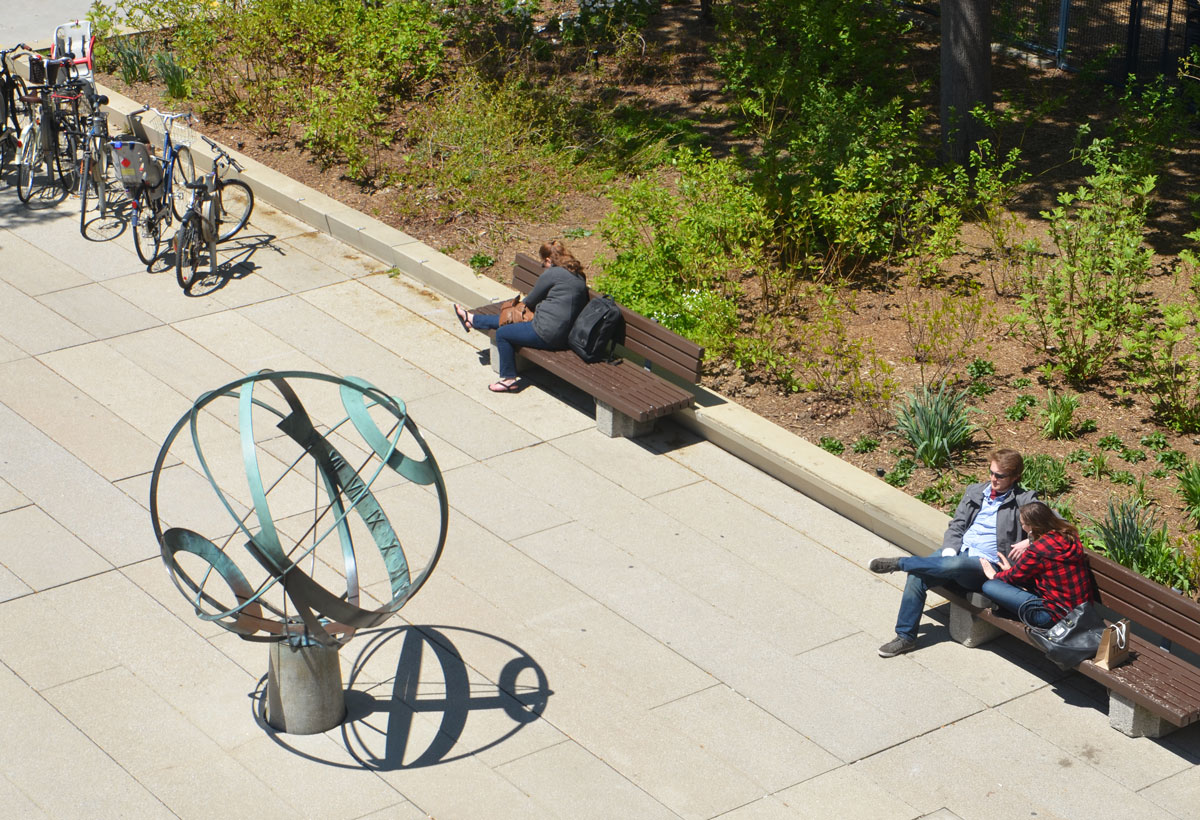
blog_sundial_nathan_phillips_square

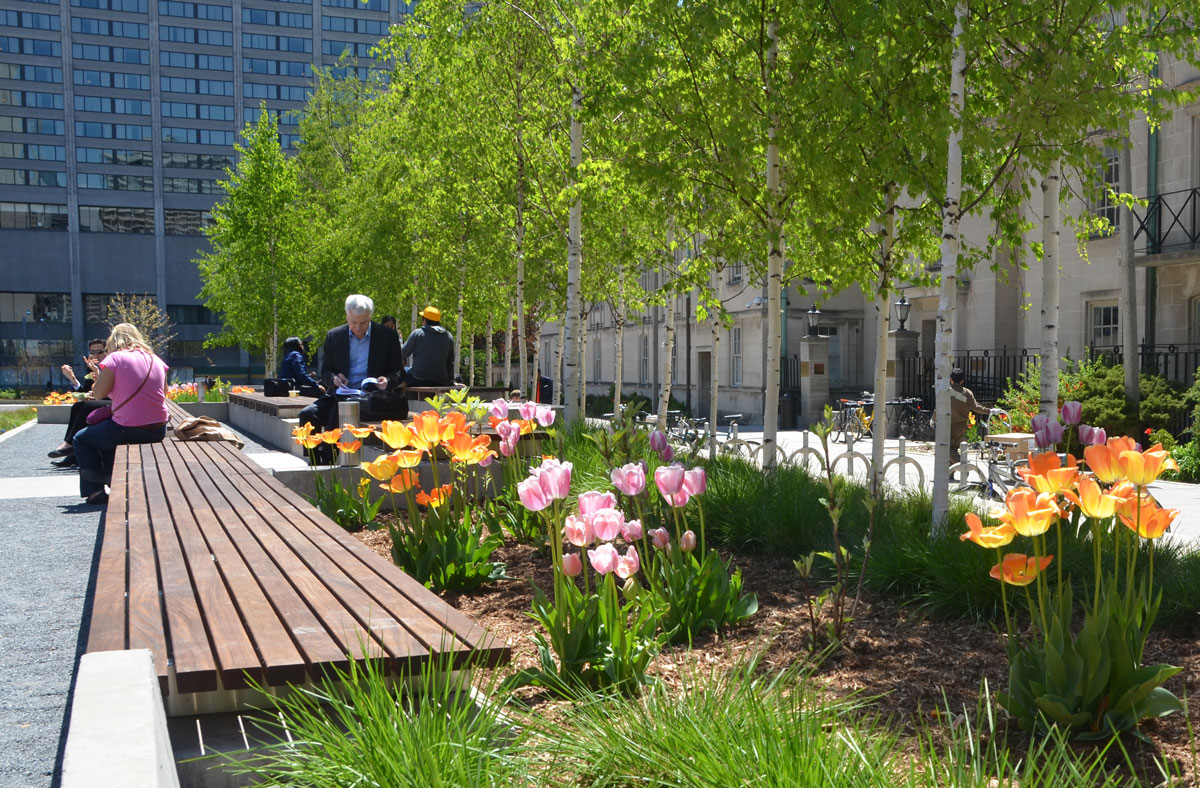
people sitting on benches amongst the tulips and birch trees of the peace garden at Nathan Phillips Square

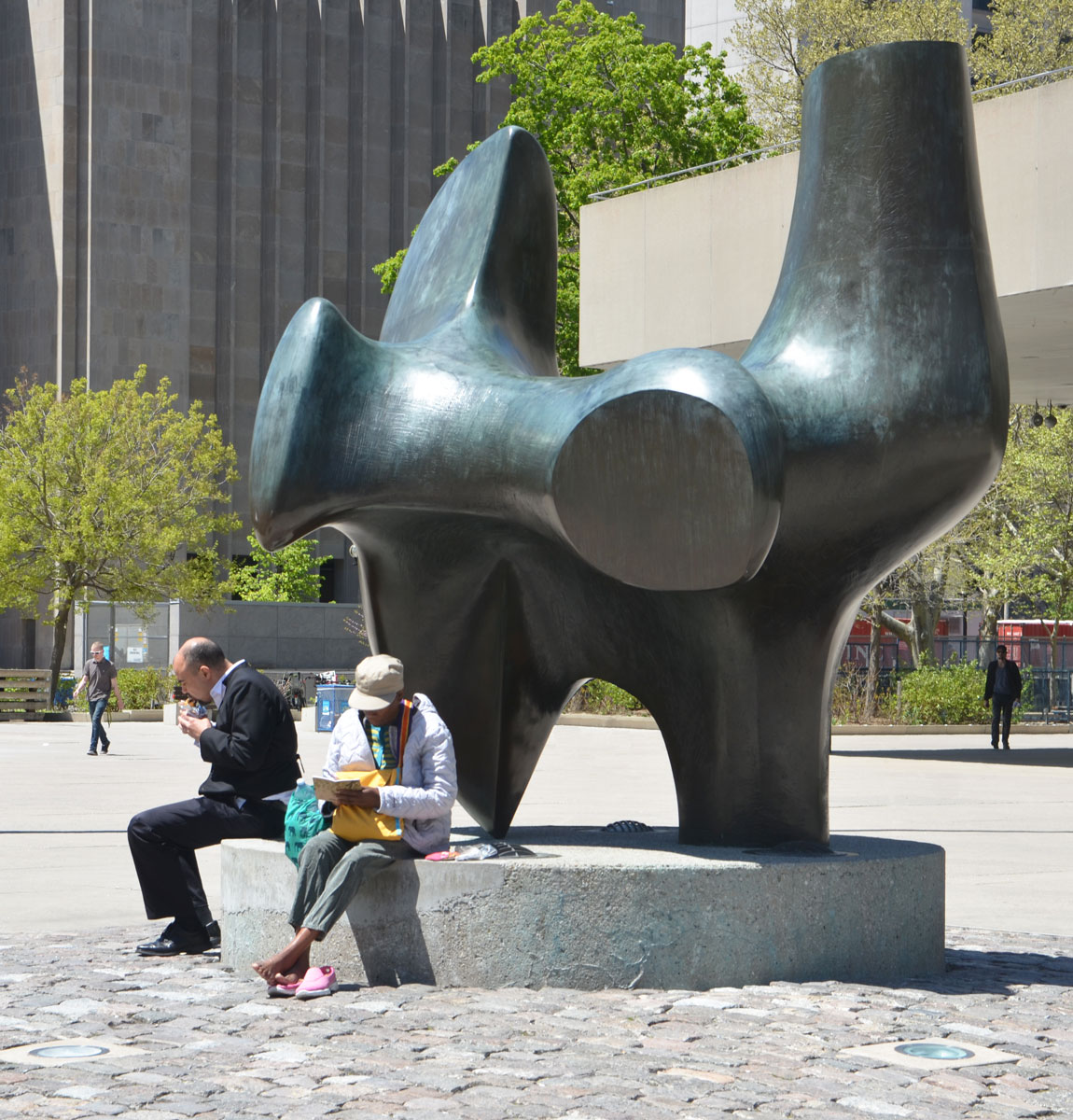
Two people sitting at the base of Henry Moore's 'Archer' sculpture at Nathan Phillips Square. One man is eating and the other is reading.

I’ll be lazing on a sunny
lazing on a sunny
lazing on a sunny afternoon.
(with apologies to Queen)

On Friday morning, my original goal was to find ‘Residents of the Esplanade’, a CONTACT Photography Festival outdoor exhibit at David Crombie Park but it was such a beautiful morning that I didn’t stop there. I found more than just the ‘Residents’.

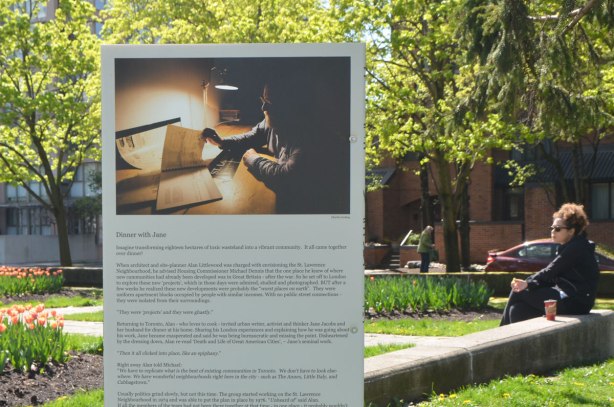
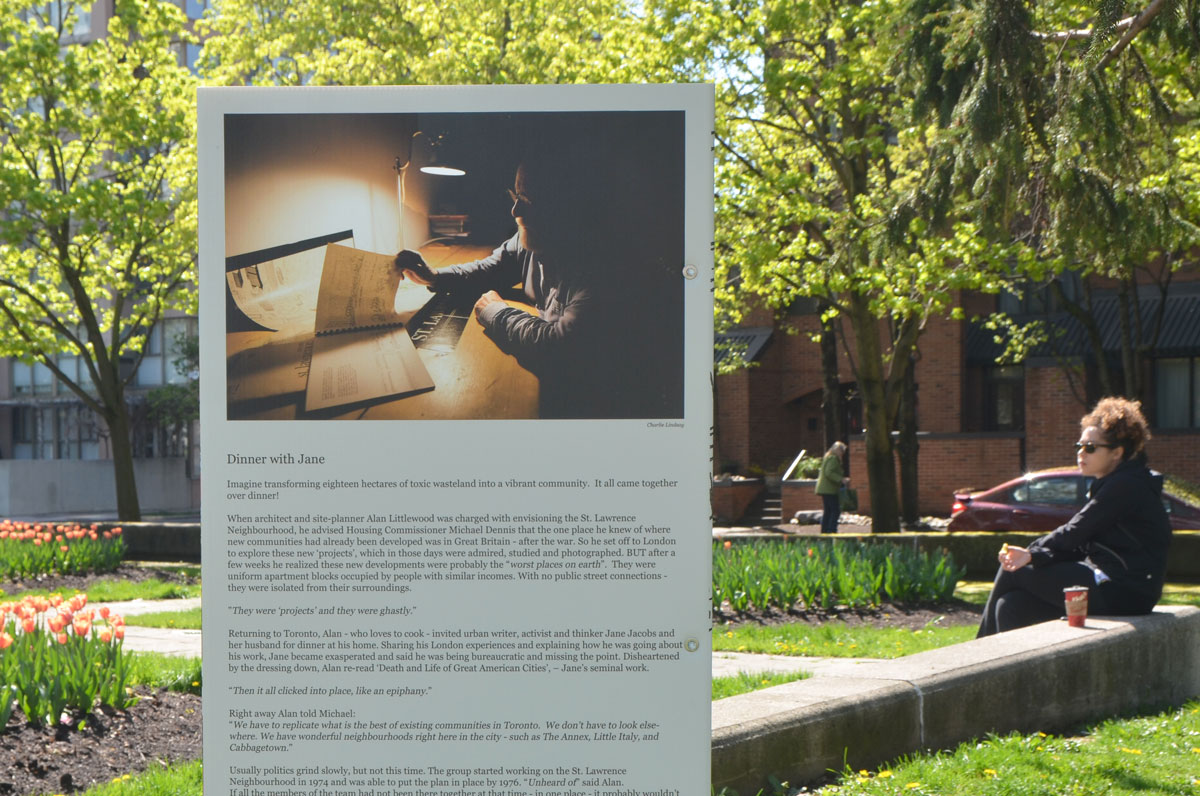
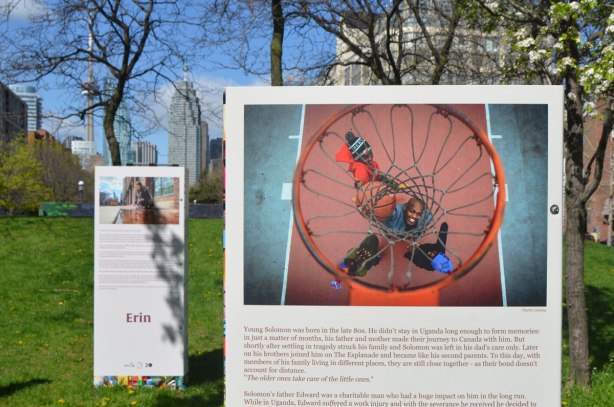
Forty years ago, May 1976, the site plan for The Esplanade neighbourhood was approved. Since then, it has become home to a very diverse group of people. And it is those people that this installation celebrates on the 40th anniversary of the founding of the neighbourhood.

Crombie Park runs along the south side of The Esplanade between Berkeley street and Lower Jarvis.  The installation consists of a number of small white rectangular pillars with the picture and story of person on either side.
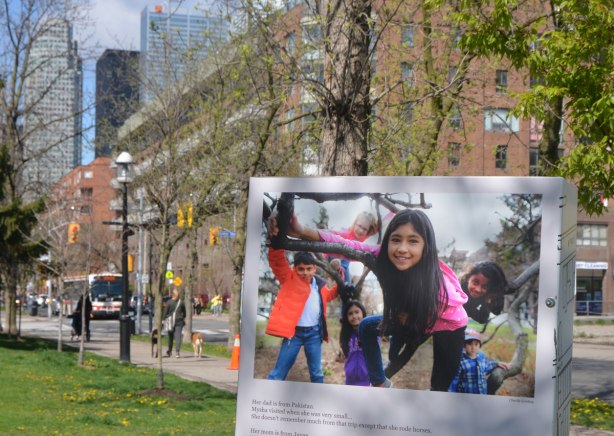
A photo from the CONTACT photography festival, installation called 'Residents of The Esplanade' - story of Mysha from Pakistan

A photo from the CONTACT photography festival, installation called 'Residents of The Esplanade' - photo of Solomon from on top of a basketball hoop

A photo from the CONTACT photography festival, installation called 'Residents of The Esplanade' - photo of Alan working at a desk, tulips and a woman sitting in the park are in the background

People were out enjoying the morning; school kids were playing basketball at recess.
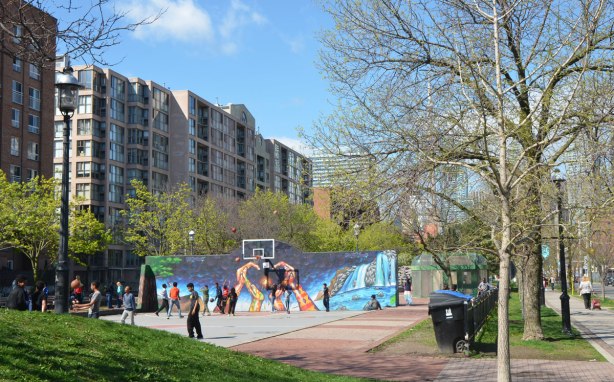
kids playing basketball on an outdoor court. The wall behind the basketball hoop has been painted with a mural of hands making a heart shape with the fingers, by Bruno Smokey and Shalak Attack.

Flowers were blooming.

close up photo of red tulips in full bloom on a sunny day

tulips in a garden in a park, orange and yellow tulips, with some greenery. Grassy area with trees behind, and people walking on a sidewalk in the background.

below: Looking towards Lower Jarvis Street and downtown Toronto.
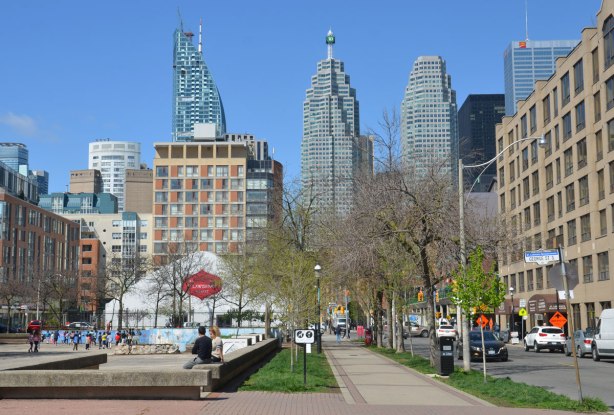
at the corner of The Esplanade and George Street, looking west towards downtown and St. Lawrence market. Playground on the left with children playing.

below:  One street beyond Lower Jarvis is Market Street.  It dead ends at the railway tracks.  The long structure on the right is a parking garage.

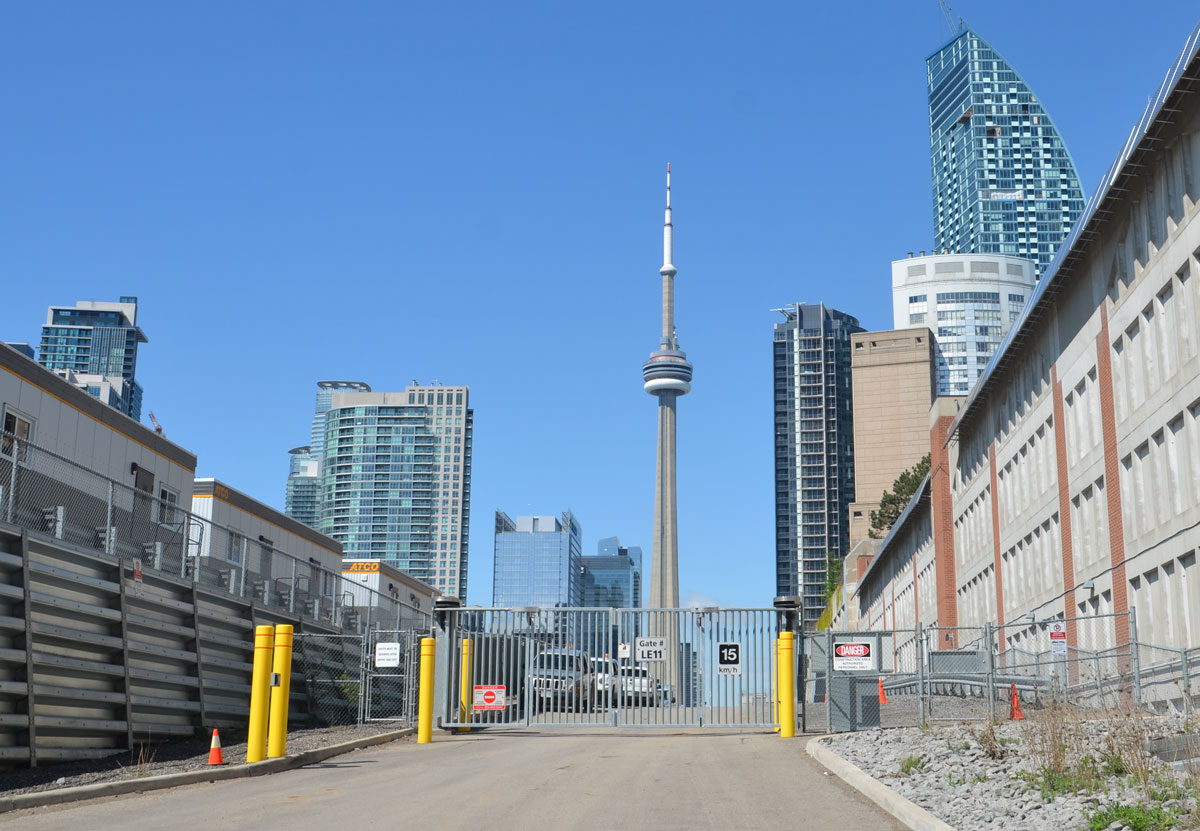
looking west towards the CN Tower, with the railway tracks to the left (but they are elevated and behind maintenance buildings so you can't see the tracks). Parking structure to the right, with city buildings behind it.

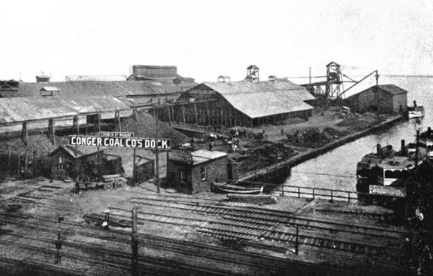
below: After a small backtrack up Market Street, I went through Conger Coal Lane to Church Street.  I don’t think I have walked this way before.  The lane was named in commemoration of the Conger Coal Company whose yard and wharf was nearby.   It was one of the many companies that provided Toronto with coal back in the day when coal fueled the city.  It was started in 1870 by Mr. P.D. Conger.   In 1913, Sterling Coal company bought Conger and the name was changed to Conger Lehigh Coal Co.
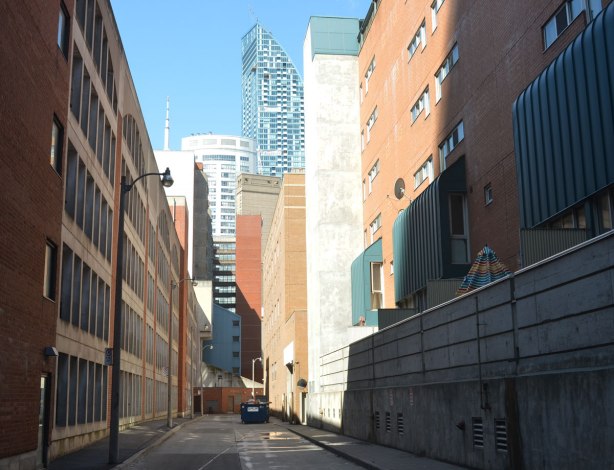
a downtown Toronto lane, very clean, no graffiti, taller, newer buildings on either side of the lane. CN tower in the distance,

below: A very old photo of the Conger Coal Company dock at the foot of Church Street, back when Church street ended at Lake Ontario

historical picture of the old COnger COal Co wharf at the bottom of Church street.

below: Tucked into a corner on Church street immediately south of Front Street, is an art installation by Paul Raff called ‘Shoreline Commemorative’.  A topography of limestone forms the base of the work.  A glass ball representing the line between sky and water sits on top of a tripod that tries to evoke a land surveyor’s tripod.  The words on the wall say “For 10,000 years this was the location of Lake Ontario’s shoreline.  This brick wall stands where water and land met, with a vista horizon”
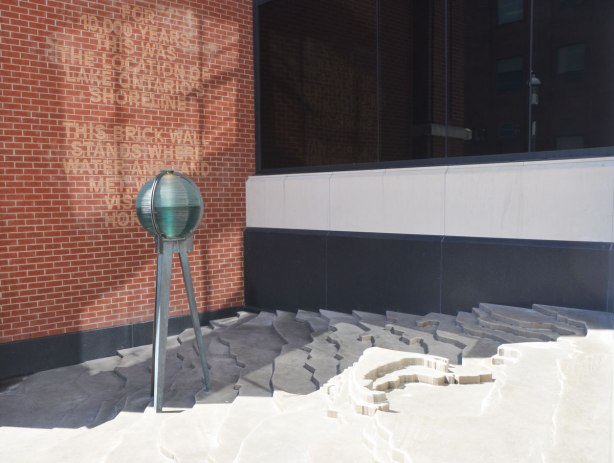
Shoreline Commemorative by Paul Raff, an art installation on Church St., south of King, that marks where the shoreline of Lake Ontario used to be. It involves words on a brick wall and a model of the shoreline of Toronto showing the different elevations of the land.

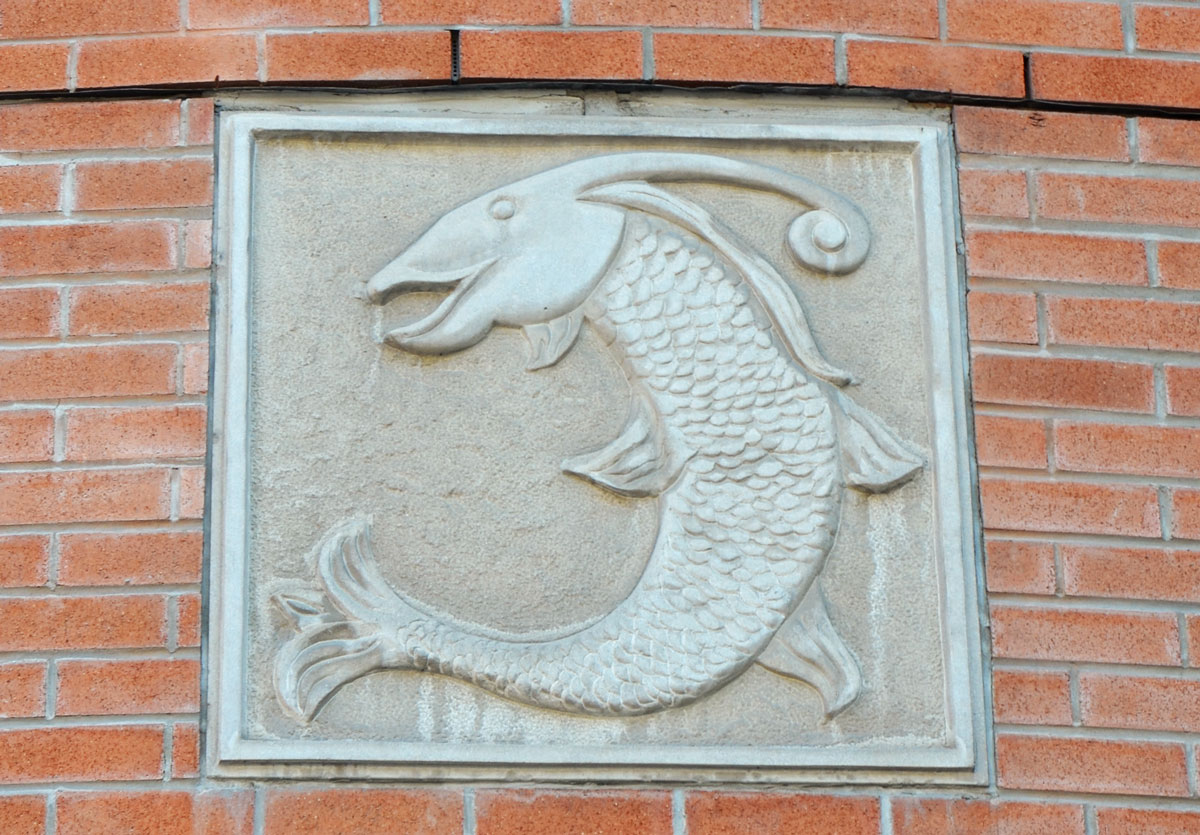
below: Continuing the lake theme, a little fish out of water, jumping over the entrance to a condo.

bas relief sculpture of a fish, square stone on a brick wall above the entrance way to a condo building.

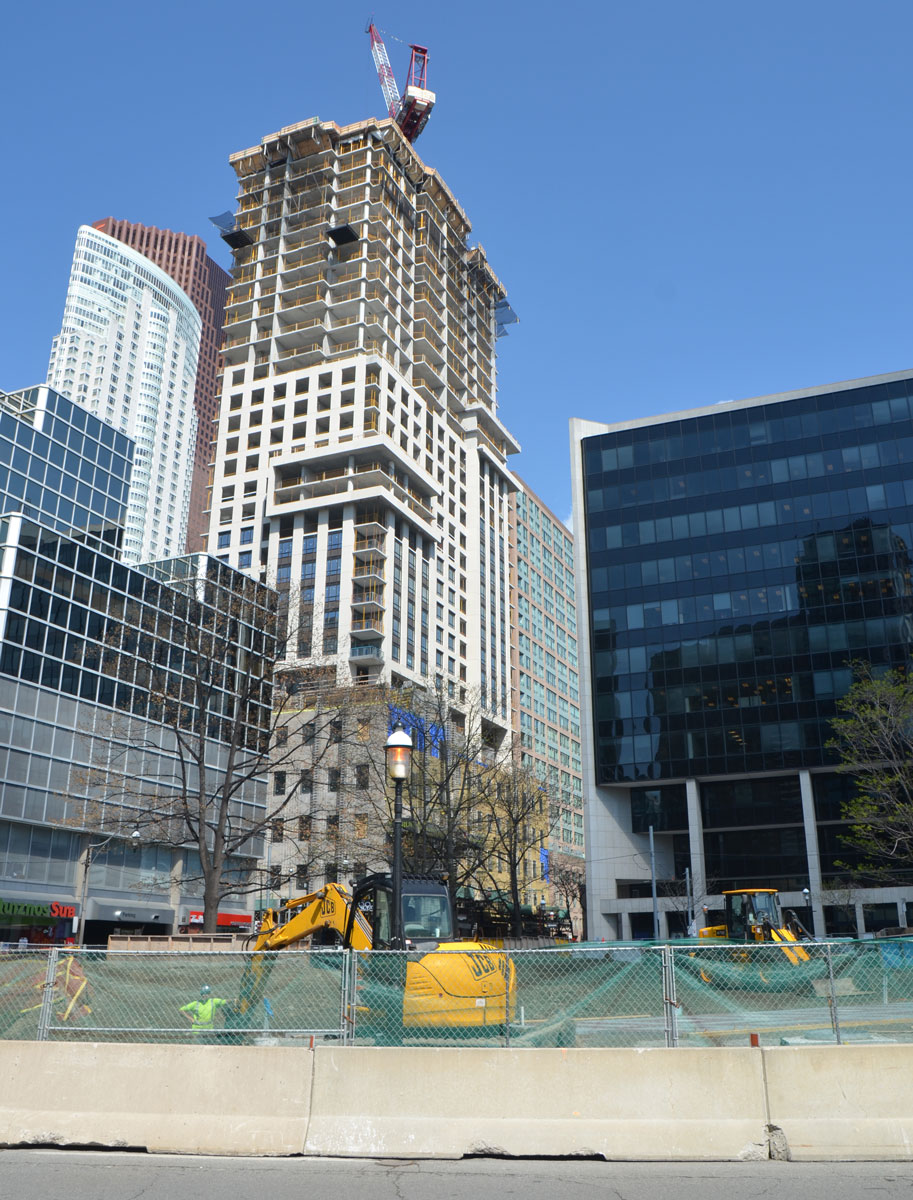
below: From the lake theme to another common theme in the city, construction. Spring is the beginning of construction season and here Berczy Park is being upgraded. In the background a new condo is being built but as we all know condo construction ‘season’ never ends. In fact, the challenge might be to find a place in this city where there isn’t a condo being built.
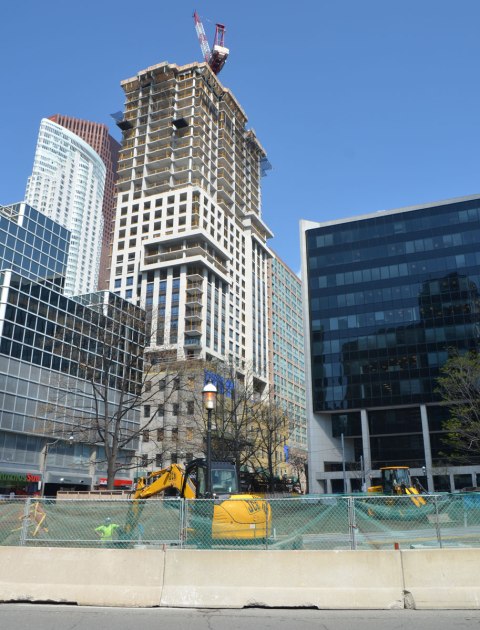
workmen redoing a park, Berczy Park in Toronto, with a digger and another piece of equipment, cityscape behind with a tall condo building under construction. A red and white crane is on top.

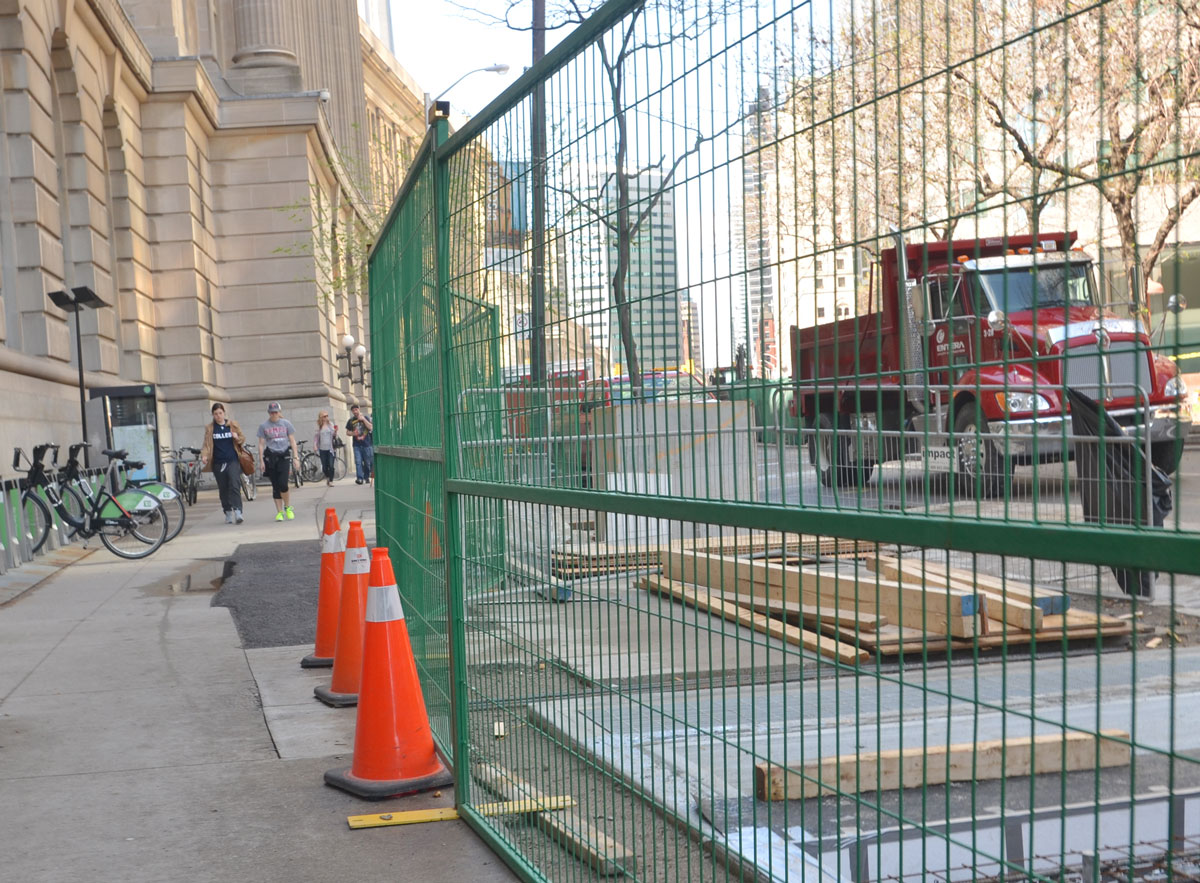
below: I walked past the never ending Front Street construction.  Construction in front of Union station seems to be finished, but this stretch of Front Street just west of the station is still being worked on.   There have been fences here so long that I can’t remember a time when they weren’t here.

Front street constrcution, behind a greenwire fence is a rd truck and piles of construction materials. Between the fence and a stone building is the sidewalk on which some people are walking.

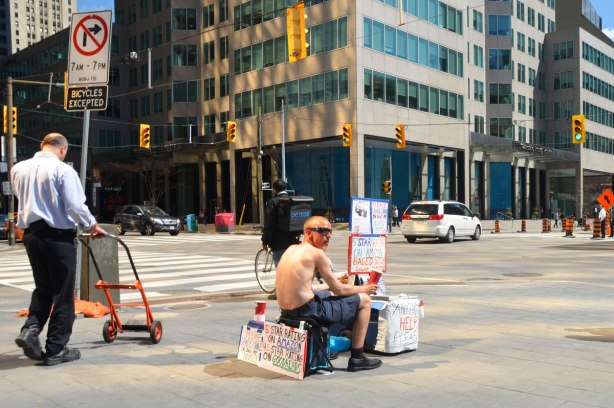
a shirtless man in sitting on a stool at the corner of Front and Union streets. He has four signs (behind, above, in front, and beside him) asking for spare change or for you to buy his novel that is well rated on both Amazon and Goodreads.

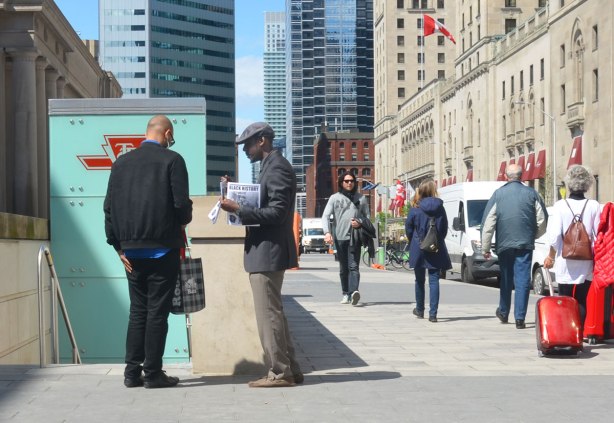
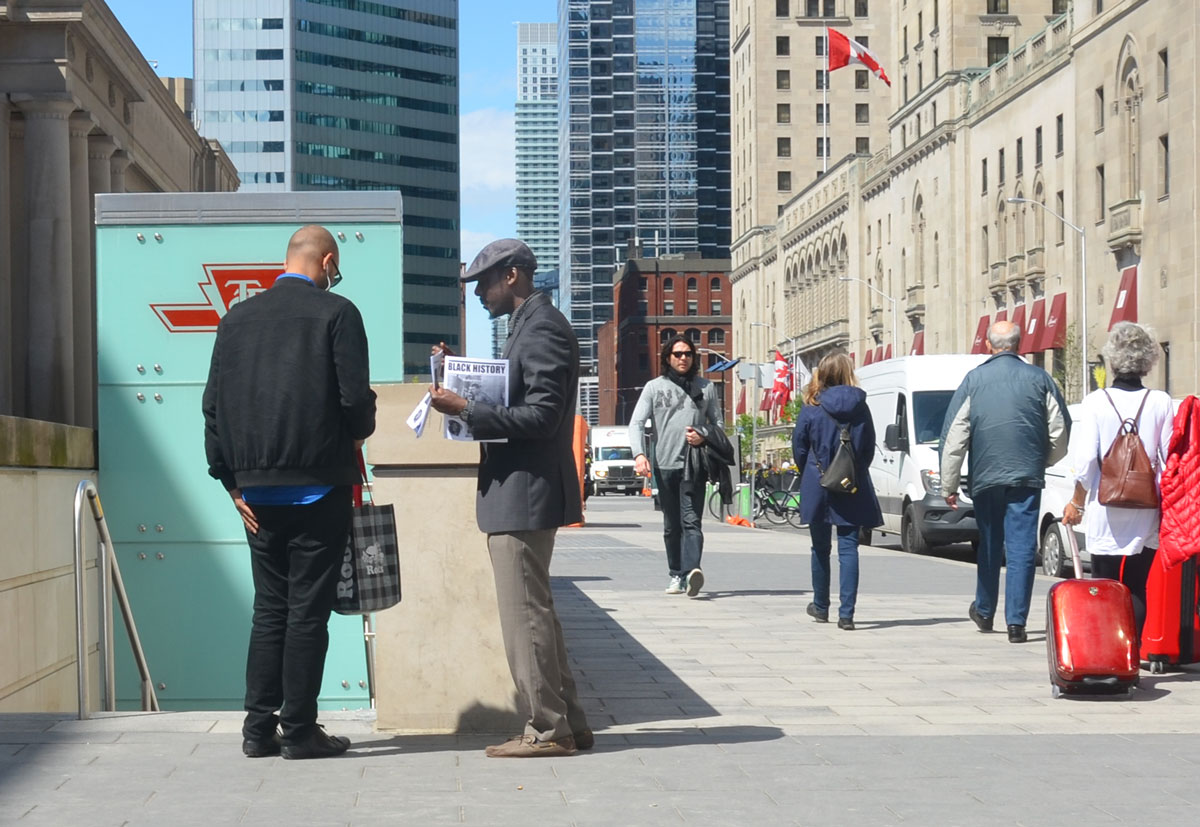
A man is selling Black History newspaper to another man in front of the TTC subwayentrance at Union station.


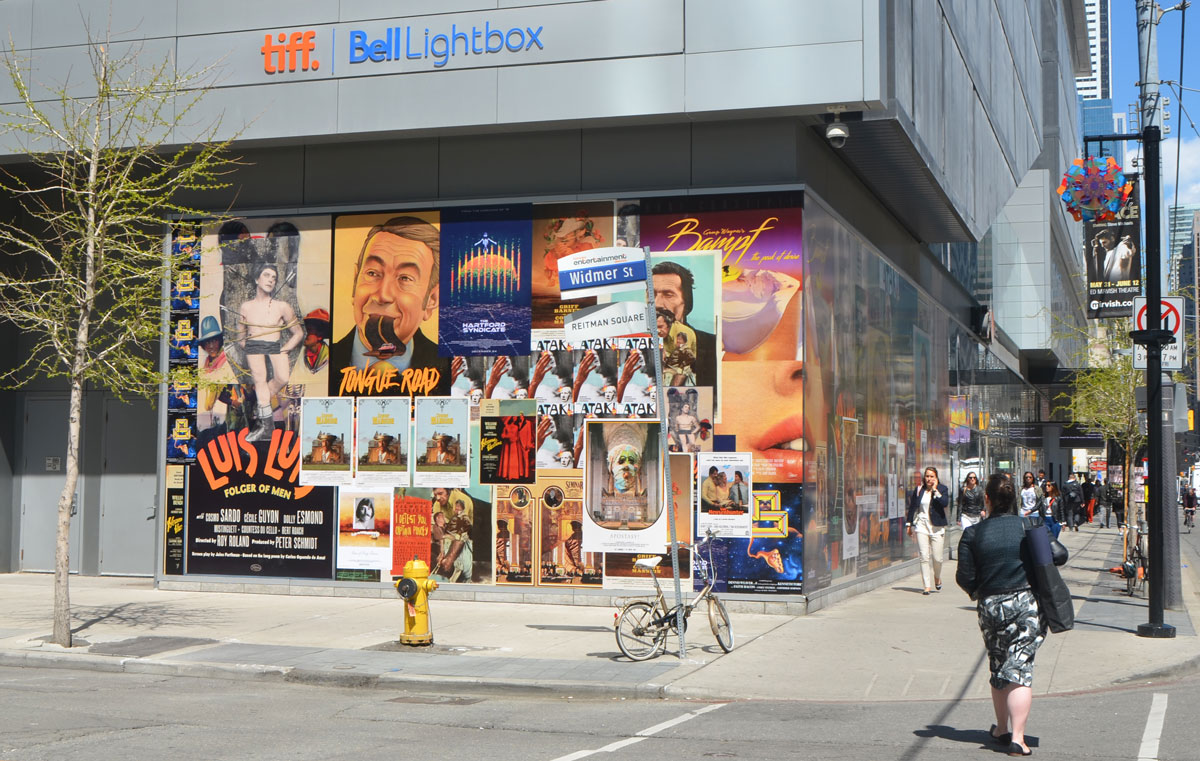
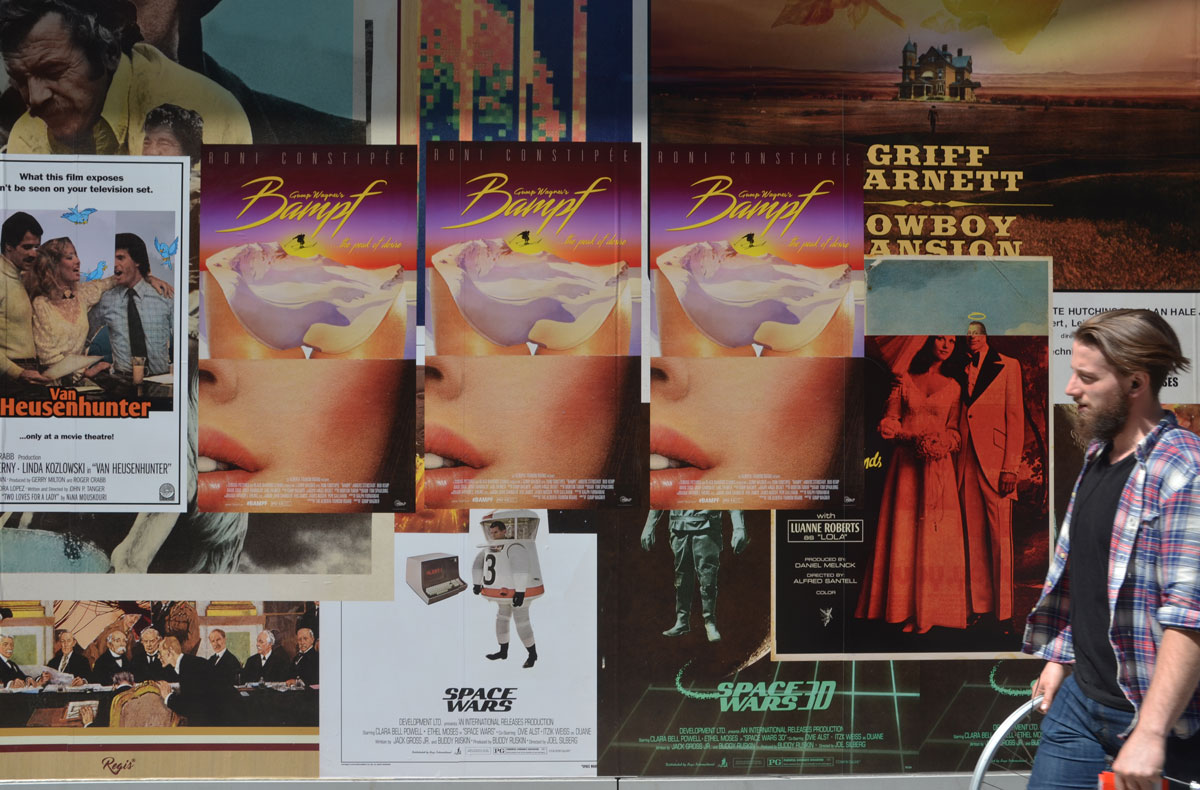
It’s common to see posters pasted on walls so finding movie posters on the walls of the tiff Bell Lightbox didn’t strike me as unusual.    I walked past this display until I noticed the sign that marked this as a CONTACT Photography Festival installation.  Fake movie posters, many designed with a touch of humour, that look just like the real thing.

detail of an art installation that is a wall of fake movie posters made with ads and illustrations from old books and magazines

below: The installation, titled ‘Coming Attractions’ covers the corner windows and wall space.   The posters were designed by ‘Long Weekend’ which is a collective of artists working out of Winnipeg.   They were made from ads and illustrations from old books and magazines.

at the corner of King and another street, the TIFF Bell Lightbox building has an art installation on two sides, walls of fake movie posters. The installation is called 'Coming Attractions' and it is by a collective of artists known as The Long Weekend.

detail of an art installation that is a wall of fake movie posters

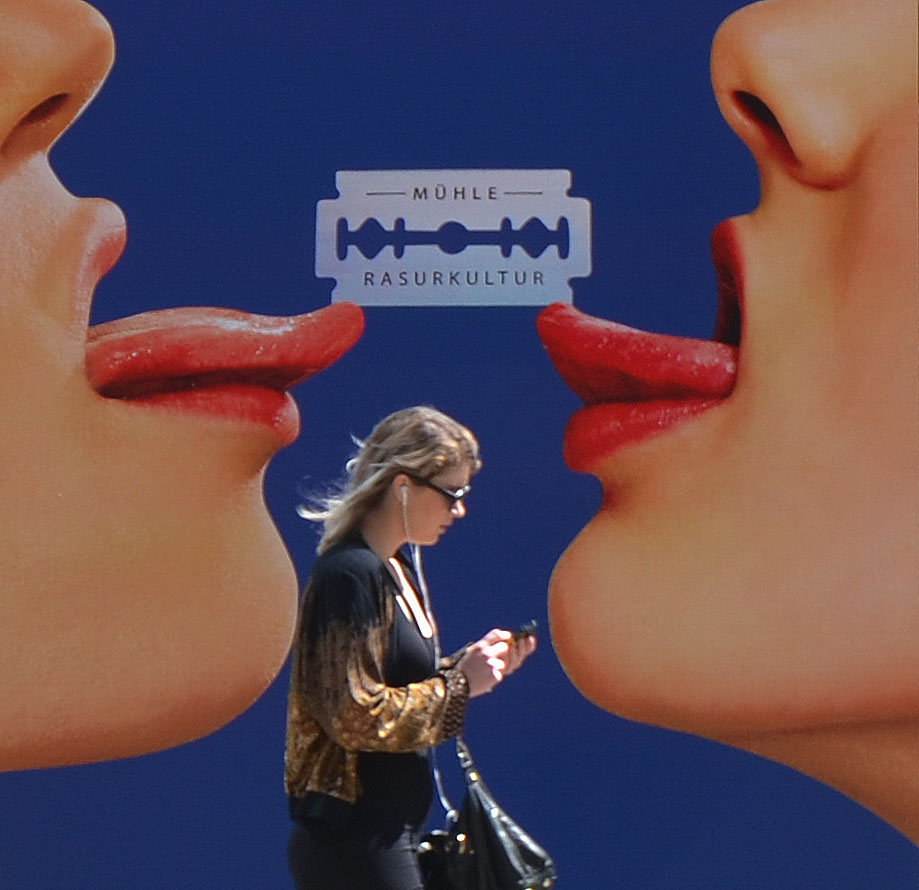
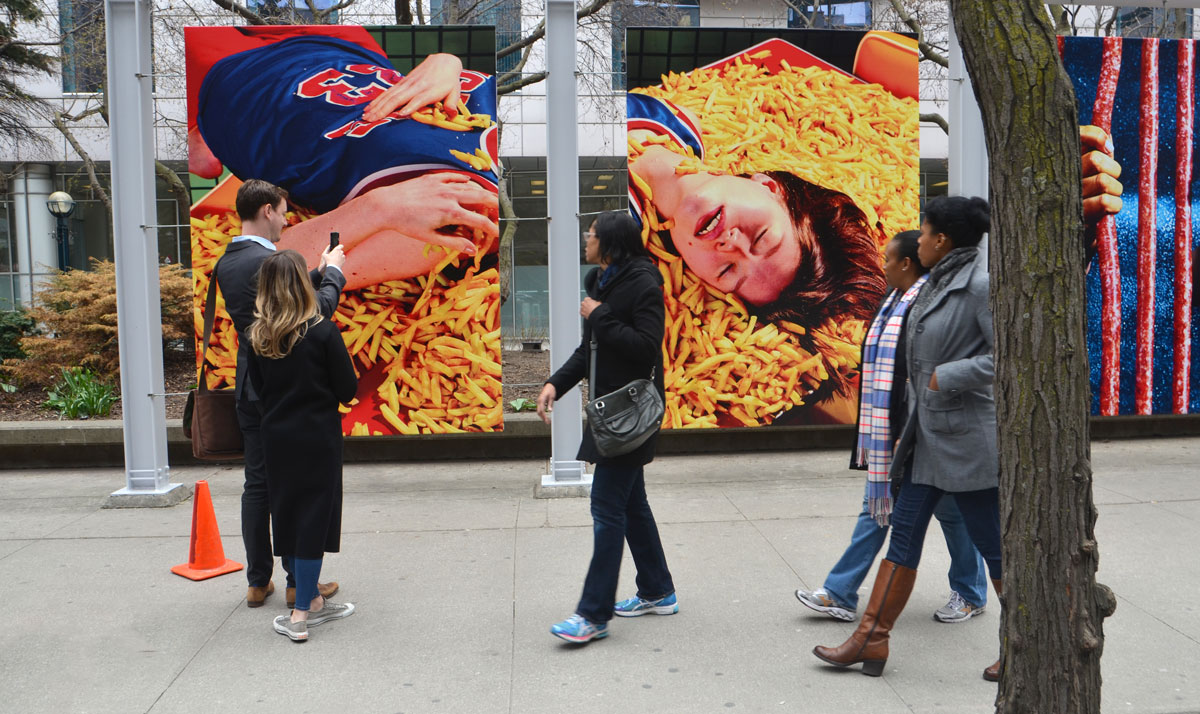
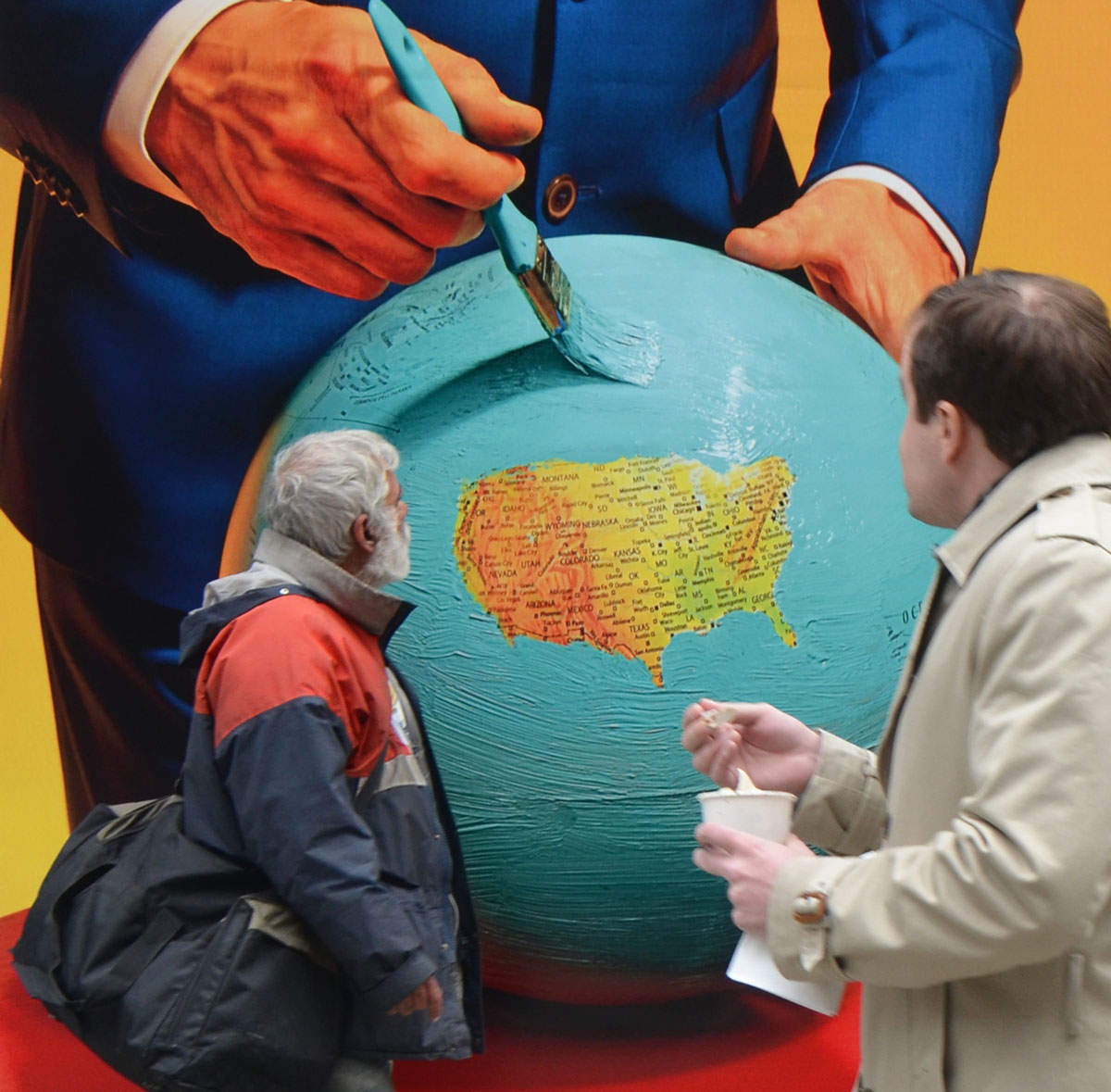
On the other side of King street, and just a but further east, is a series of eleven large images taken from past editions of ‘Toilet Paper’, a biannual magazine founded by Maurizio Cattelan and Pierpaolo Ferrari.   They hint at advertising and they blur the line between fantasy and reality.

below: Muhle is a German company that makes shaving products and one of their blades looks identical to the one in this picture.

A woman with her phone in her hands walks past a large poster of two women face to face where all you can see is their nose, mouth, chin and tongues that are stuck out. A razor blade balances between the two tongues.

People walk past two large posters that show a girl lying on a large pile of french fries.

A man walks past large posters on King St.,

a man stands in front of a picture that is a large globe with everything painted light blue except the USA

a man stands in front of a picture that is a large globe with everything painted light blue except the USA

If you like these images, you might also like Toilet Paper’s website.
Happy Mothers Day!

I didn’t write this blog post specifically for Mothers Day even though it’s about four women, Mary Pickford, Edith Cavell, Florence Wyle, and Frances Loring.  Just because they are women doesn’t mean that they are mothers, in fact only one is.  Mary Pickford adopted two children.  I also didn’t intend to write a blog post on the merits of motherhood vs childlessness so I am going to say nothing further on the subject!
The first woman can be found at the corner of University and Elm.  Here, there is a a bronze portrait bust of Mary Pickford that was sculpted by Eino Gira in 1983.

bust of Mary Pickford with her hand on her cheek, in front of Sick Kids Hospital in Toronto, red brick hospital behind her in the photo

The plaque beside her says:

Born in 1893 in a house which stood near this site, Gladys Marie Smith appeared on stage in Toronto at the age of five.   Her theatrical career took her to Broadway in 1907 where she adopted the name Mary Pickford.  The actress’s earliest film “Her First Biscuits”, was released by the Biograph Company in 1909 and she soon established herself as the international cinema’s first great star.   Her golden curls and children’s roles endeared her to millions as “America’s Sweatheart”.  She was instrumental in founding and directing a major film production company and starred in over fifty feature-length films including “Hearts Adrift”, “Pollyanna” and “Coquette”.  For the last named film she received the 1929 Academy Award as the year’s best actress.

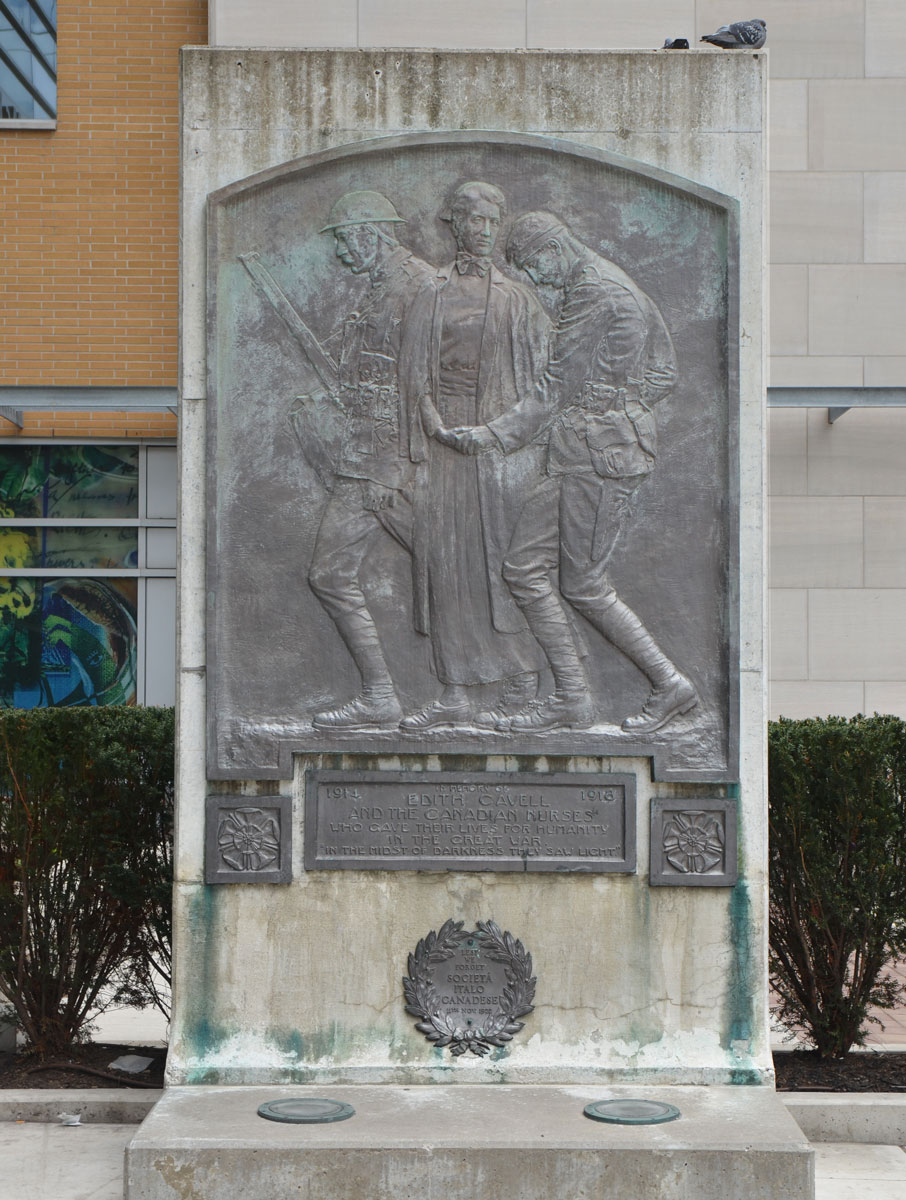
below: Just up the street, next to one of the entrances of Toronto General Hospital, is a memorial to British nurse Edith Cavell (1865-1915) and to all the Canadian women who served as nurses in WW1.  The memorial  was installed at University Ave and College St. in 1921 but later moved to its present location.

A memorial to British nurse Edith Clavell and the Canadian nurses of WW1, a bronze plaque mounted on a stone tablet. Picture of Clavell between two upright but wounded soldiers.

In memory of Edith Cavell and the Canadian nurses who gave their lives for humanity in the Great War.  “In the midst of darkness they saw light”

Cavell had been working in Brussels when WW1 broke out.  After the Germans invaded Belgium, Cavell helped wounded Allied soldiers escape to the Netherlands.  She was caught by the Germans, charged with treason, and executed on 12 October 1915.  She became the most well known woman casualty of WW1.

The above memorial was designed by Florence Wyle.  There is a memorial to Wyle and her partner, Frances Loring (also a sculptor), in a small park at the corner of Mt Pleasant and St. Clair.

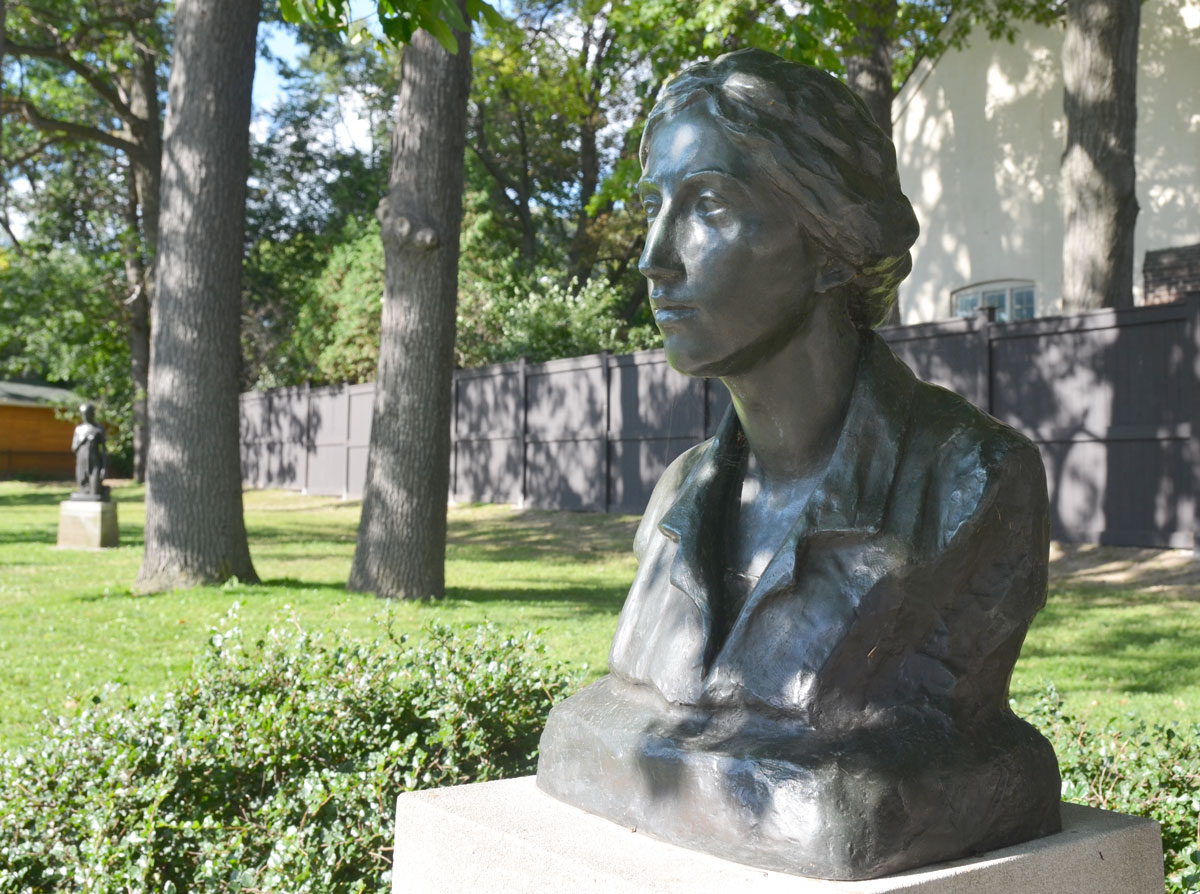
below: bronze bust of Florence Wyle, by Frances Loring

bust of Florence Wyle, a Canadian sculptor, in a park

below: bronze bust of Frances Loring, by Florence Wyle

bust of Frances Loring, a Canadian sculptor, in a park, in the shade of a large tree

below: There are a couple of small statues by Wyle in the same park, including this one.
“Young Girl”, about 1938.

bronze statue titled "Young girl", showing a girl from the thighs up, holding up a cloth that is wrapped around her body but her breasts are bare

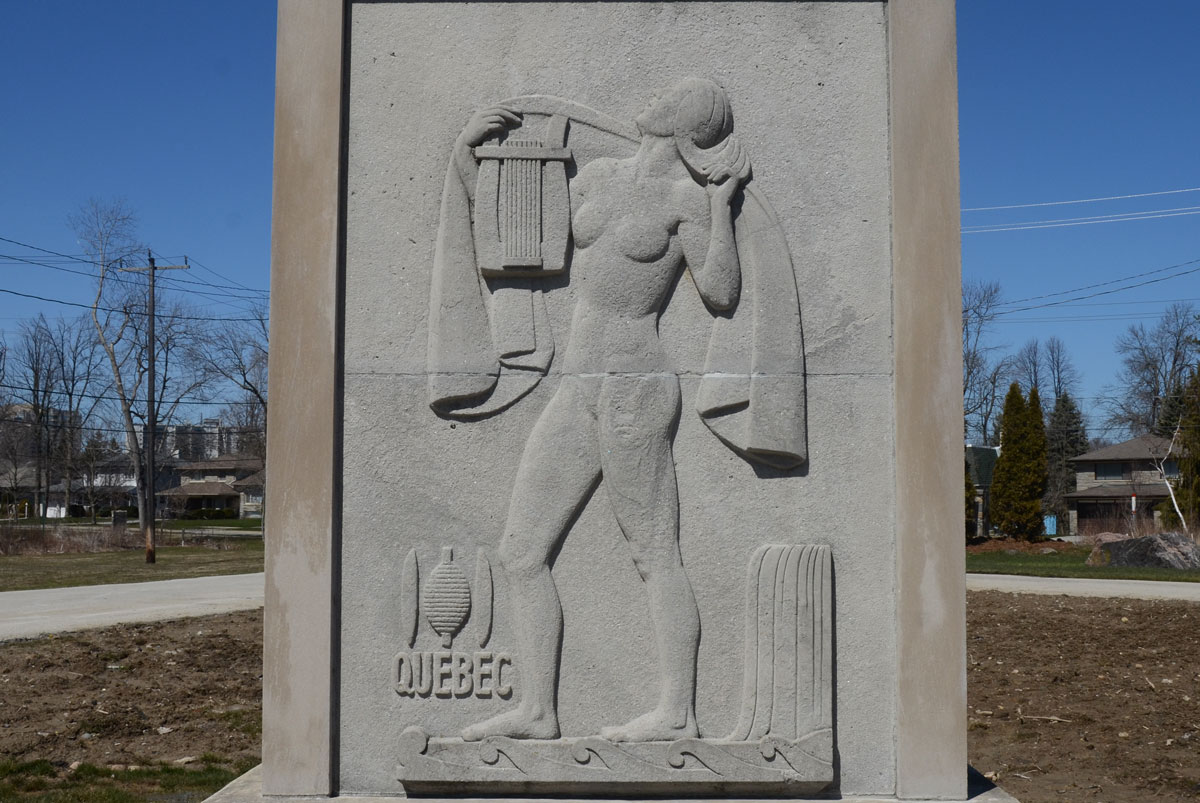
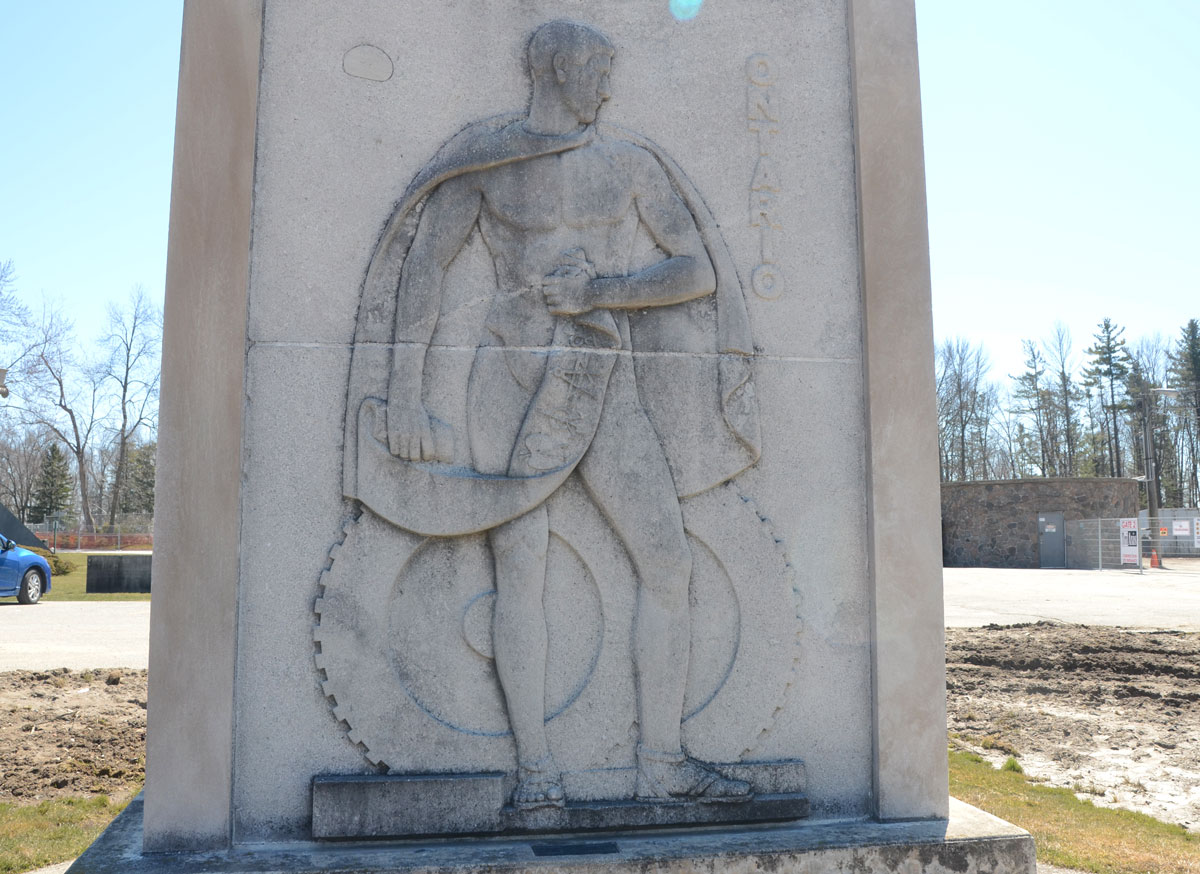
Loring and Wyle are responsible for a number of sculptures around the city.  Two of these used to be on the Bank of Montreal building at the northwest corner of King and Bay. It was built in 1887 by architects Marani and Morris and demolished in 1968.  The building featured a series of sculptures representing the Canadian provinces that were done by a number of artists.  Frances Loring sculpted the panels for Ontario and Quebec.  When the Bank of Montreal building was demolished, all of the panels were moved to the grounds of the Guild Inn in Scarborough where they remain today.

Quebec sculpture - A stone relief sculpture from a series on provinces of Canada, originally on a Bank of Montreal building in Toronto. They were rescued when the bank was demolished and moved to the grounds of the Guild Inn in Scarborough. By Canadian artist Frances Loring. A naked woman upright, with a cloth over her shoulders and looking upwards

A stone relief sculpture from a series on provinces of Canada, originally on a Bank of Montreal building in Toronto. They were rescued when the bank was demolished and moved to the grounds of the Guild Inn in Scarborough. By Canadian artist Frances Loring. Ontario is in the picture, as a man surrounded by symbols of industry such as large gears and architectural plans

May is photography month in Toronto.  It is the month when there are numerous exhibits in public spaces and in galleries, all part of the CONTACT Photography Festival.   Over the next few weeks I hope to visit many of the exhibits and blog about some of them.   From past experience I have discovered that a lot of the public installations appear before May 1st so I went exploring yesterday.

below: Looking south from Spadina and Adelaide….  Partially obscured by a building, on the right in this photo, is the first large black and white photo that I saw.

view from the NE corner of Spadina and Richmond streets. a small parking lot is directly across the street, two large billboards loom over the lot. Once is for Lorne's coats showing two people wearing coats. The other is for Maple flavoured iced capp at Tim Hortons.

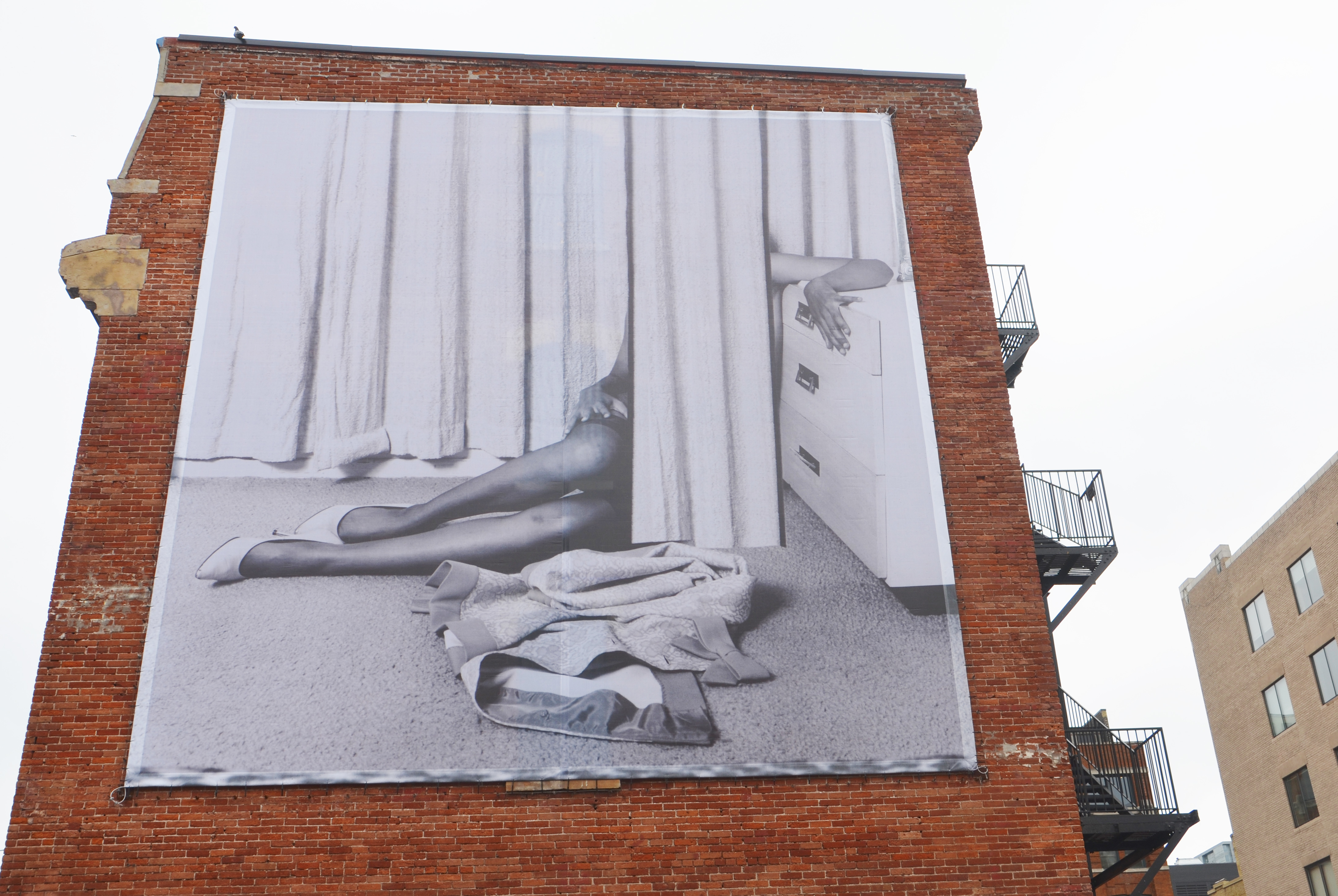
below: Up close,  ‘Drape’ by Eva Stenram.  Stenram has taken a 1960’s pin-up photograph of a woman and manipulated it.  She has brought the background, the drapery, forward and has covered up the original subject in the picture.

large black and white photo by Eva Strenram called 'Drape'. It is mounted on the upper level of a three storey red brick building. It shows a woman sitting on the floor partially obscured by drapery. Her upper body and head can not be seen.

below: Looking west on Wellington from Spadina.  The light grey building is the Old Press Hall (Globe and Mail) which will be demolished in the near future.

looking down the street past parked cars. A large black and white photo is on the side of the building.

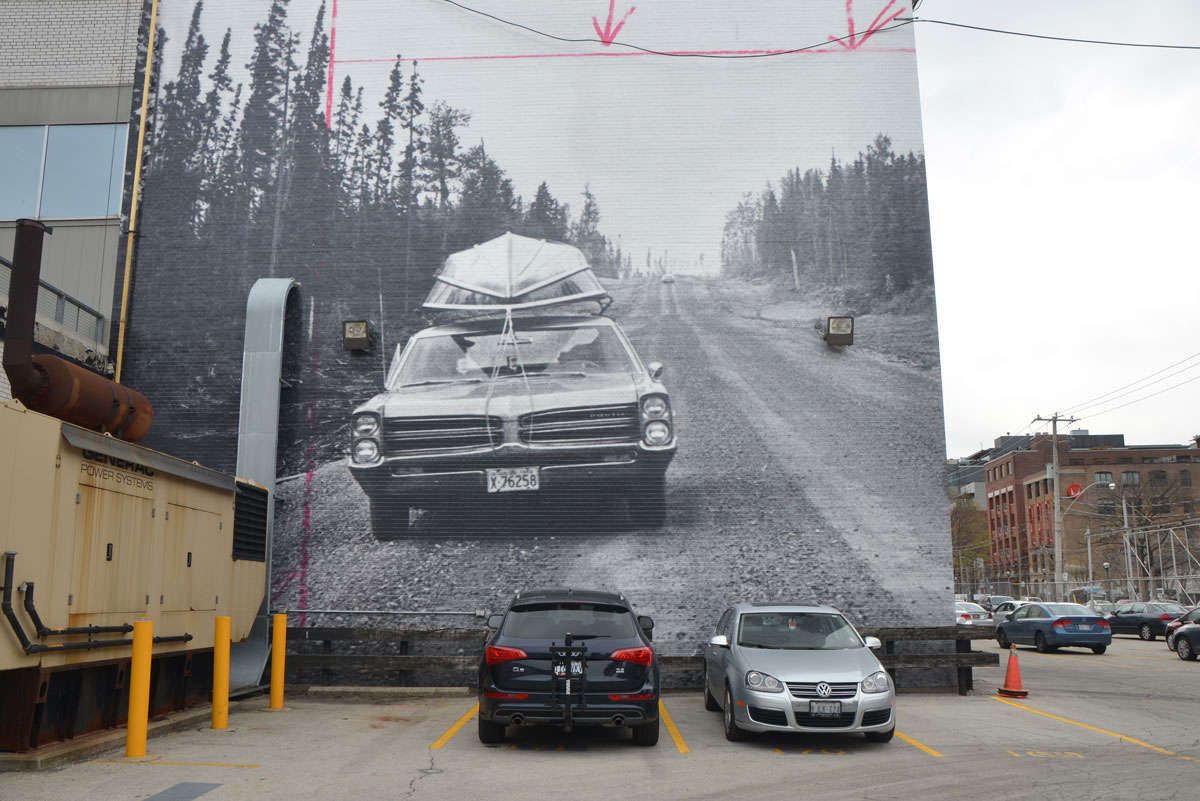
below: Up close, ‘Stopping Point’ by an unknown photographer.  The original title and description was: ‘Along the new Highway, which runs from Smooth Rock Falls to Fraserdale, Ontario, there’s no sign of human habitation apart from one empty lumber camp, c.1966. 

A very large black and white photograph from the 1960's of a car on a two lane road with pine trees on either side. There is a boat tied to the roof of the car. The photo is on the side of the Globe and Mail building with cars parked around it.

The above photograph is one of 750,000 photos in the Globe and Mail’s picture library.   100,000 of their old photos are being digitized to create a new historical archive.  From these, a collection of 20,000 prints will be donated to the newly formed Canadian Photography Institute at the National Gallery of Canada.

More of the photos from the Globe and Mail’s collection are on view inside the Old Press Hall.

I usually take a dim view of conceptual art largely because the importance given to the “words on the wall” has eclipsed the consideration given to the artwork itself.   Mediocrity in technique or creativity hides behind big jargon words and convoluted language in the artist statement.  Often the concept that the artist claims to be exploring is at odds with the end product.

When the art doesn’t live up to words that sound learned and meaningful then it degrades the work and makes the artist, and those curating the exhibit, seem pompous and out of touch.

For example, if you read that certain videos by an artist “cast a hitherto unexampled light on the conventional North American city”,  what would you expect to see?  Would you expect to see a video shot from a helicopter as it circled a city at night?  A video that looks familiar to anyone who has flown over a city after dark.   That’s what you get with Aude Moreau’s ‘The End in the Background of Hollywood 2015’ now showing at The Power Plant gallery.   I don’t have a photo of it but I do have a picture of three of her other photographs also on display.

below: From left to right (discounting the small picture farthest from the camera): 1. ‘Untitled (Hollywood Sign)’ 2015, 2. ‘LAPD (Los Angeles Police Department)’ 2015.  It’s a picture of a tiny helicopter in a large grey sky.  and 3. ‘Waiting for Landing’, airplanes lined up as they approach LAX airport.   Unfortunately, the words on the wall then go on to say, about these three images, “These demonstrate visual strategies that act upon the symbolic representation of the city and the spectacular dimension of the film industry.”  Oh my.

4 pictures hanging in a contemporary art gallery. One is a picture of the Hollywood sign taken just after dark, the next is a grey sky with a tiny dot of a helicopter in the middle, the third is too far away to discern, and the last is a picture of Los Angeles at night taken from a helicopter

And with that I left The Power Plant gallery.  Growling silently to myself and shaking my head with a mix of disdain and and frustration.   Imagine my surprise when once outside I encountered another of Moreau’s photographs.  A very lovely one.

below:  A picture of the Toronto skyline by Aude Moreau mounted on an exterior wall at The Power Plant Contemporary Art Gallery.  A picture with visual impact.

A photograph by Aude Moreau of the Toronto skyline as the sun starts to set, sunlight reflected off the buildings, darkening blue sky. The picture is mounted on an exterior wall and there is a tree in front of it as well as a couple of picnic tables

below:   You can play “spot the building” and test your knowledge of Toronto geography.   You can line up the DBRS building, the Hilton Hotel and the Canada Life building on University Avenue along with the Sheraton Hotel on Queen street.   The blue addition on the AGO is farther north on Dundas.  Can you think of where the photo was taken?  Apparently, it was taken from Toronto Fire Station 315 at College Street and Bellevue Avenue.  It was taken just after sunset but when there was still enough light in the sky to reflect off the taller buildings.   Moreau makes the city sparkle.

A photograph by Aude Moreau of the Toronto skyline as the sun starts to set, sunlight reflected off the buildings, darkening blue sky. The picture is mounted on an exterior wall and there is a tree in front of it

I must have seen this picture very shortly after it was installed.  It is part of the CONTACT photography festival that starts this weekend but there was no accompanying sign, no words that attempted to a explain the image.  Perhaps that was for the best.  In fact, I now have the CONTACT catalogue with their description of the artwork but I think I won’t read them.  I’d rather enjoy the picture just the way it is.