Archive for the ‘locations’ Category

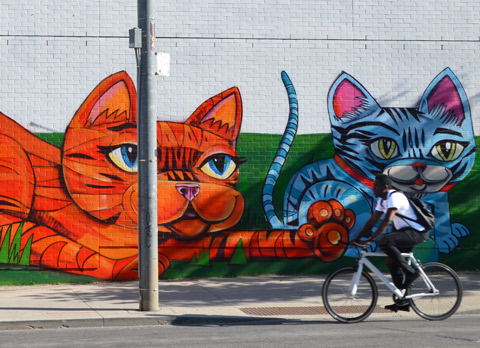
a cyclist, a black man in a white t-shirt, rides past a mural of a large orange cat and a smaller blue cat.

Hey!  Stop and take a look.

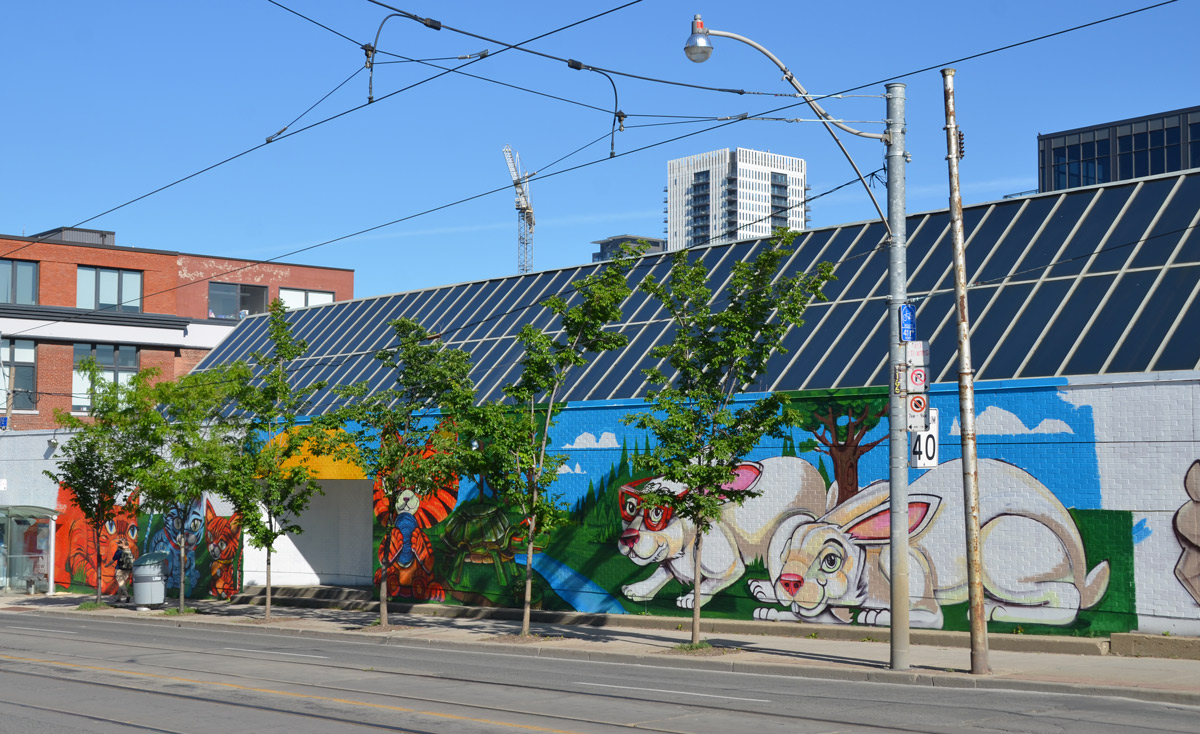
  There’s a new mural in town that covers most of the south wall of the Toronto Humane Society on Queen Street East (at River Street ).   What could be more appropriate for this wall than cats and dogs and other animals?

a long mural on the south wall of the Toronto Humane Society, brightly coloured cats, dogs, turtles and rabbit, painted by uber5000, larger than life sized animals.

I first saw the mural late in May when just the outlines of the animals had been drawn on the wall.  The artist, Uber5000, been working on it since then….  it’s not quite finished but it’s looking great!  Bright and cheerful; colourful and fun.

below:  The mural has turtles and rabbits – Yes, the Toronto Humane Society has bunnies and turtles too (but I don’t think they have such cool red glasses)!

3 small trees in front of a colourful mural by Uber5000 of animals, a green turtle by a blue creek, a white rabbit with red sunglasses and an orange tigerstriped kitten on the side of the THS building

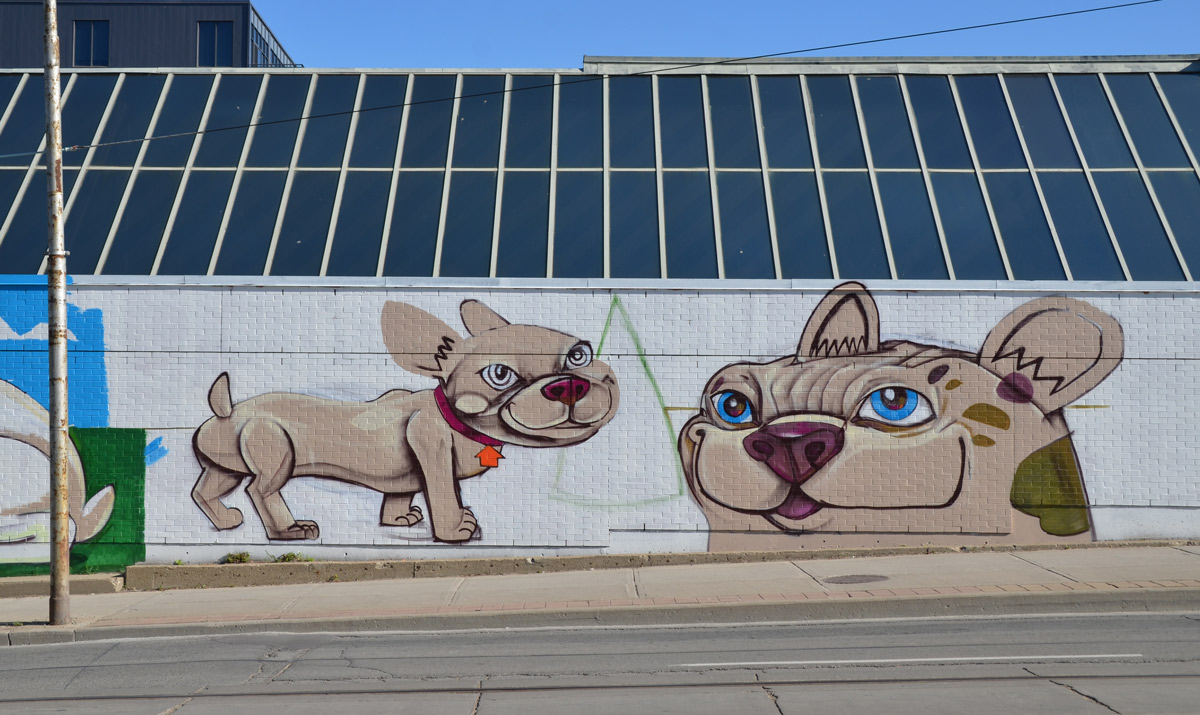
below: The dog portion at the east end of the mural just needs some finishing touches.

two dogs painted on a mural that isn't quite finished, on the side of a building,

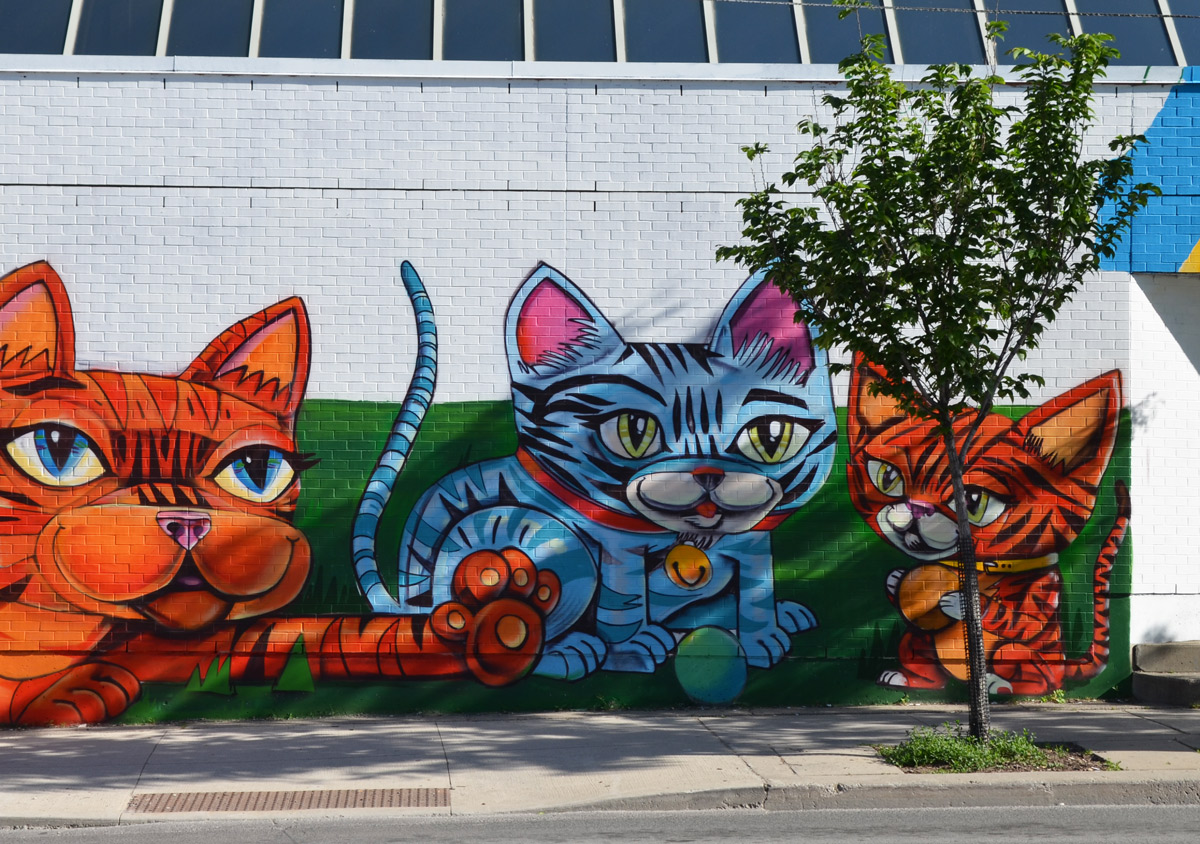
below: Of course there are cats and kittens…  and cute and playful ones at that.

a cat and two kittens painted on a mural, one with a bell around its neck and two with little balls between their paws Uber5000 mural

UPDATED (August 2017):  The mural is now finished.

mural on the side of the Toronto Humane Society by Uber 5000 of bright, large, and colourful cats and dogs.  On the corner, both sides of the corner are in the mural, a bus shelter in front of the mural, a woman is sitting in the shelter.

A great addition to Queen Street East!

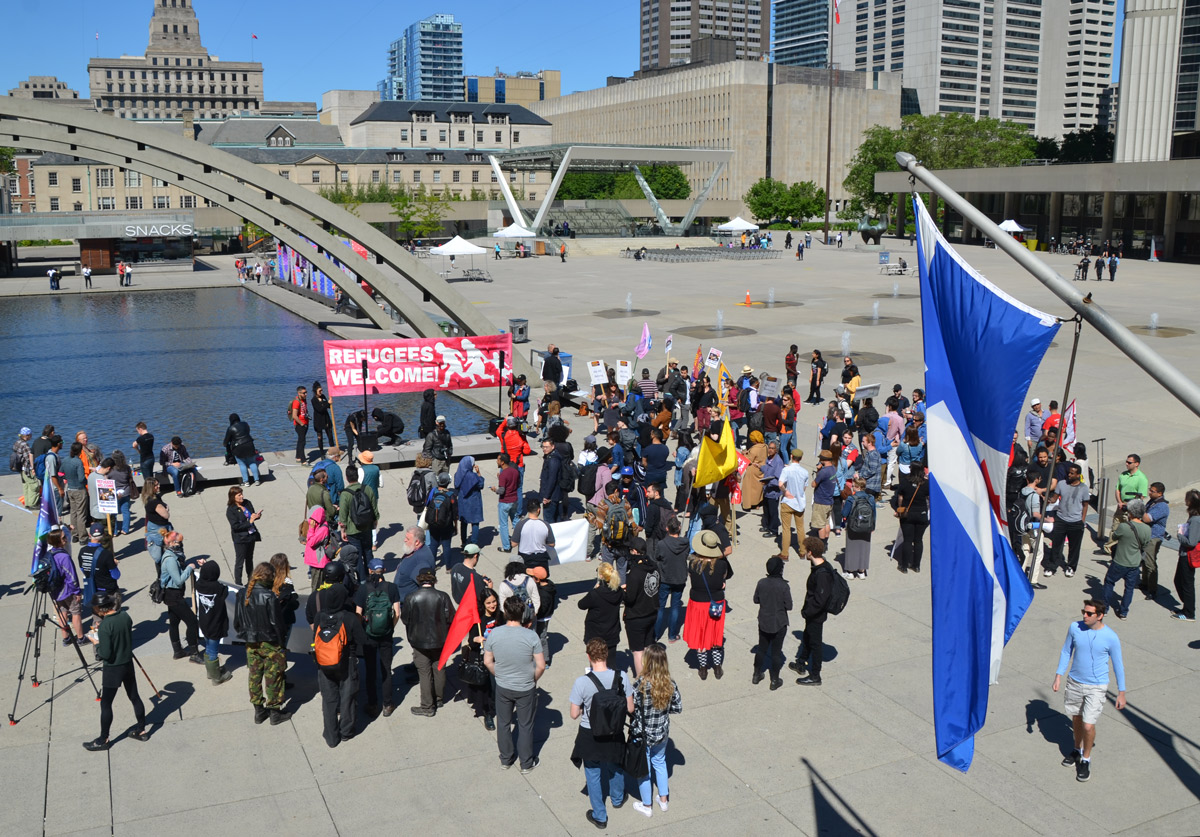
Nathan Phillips Square, Saturday June 3

lookng down from the upper level, people at a protest rally at Nathan Phillips square, Toronto flag in the foreground

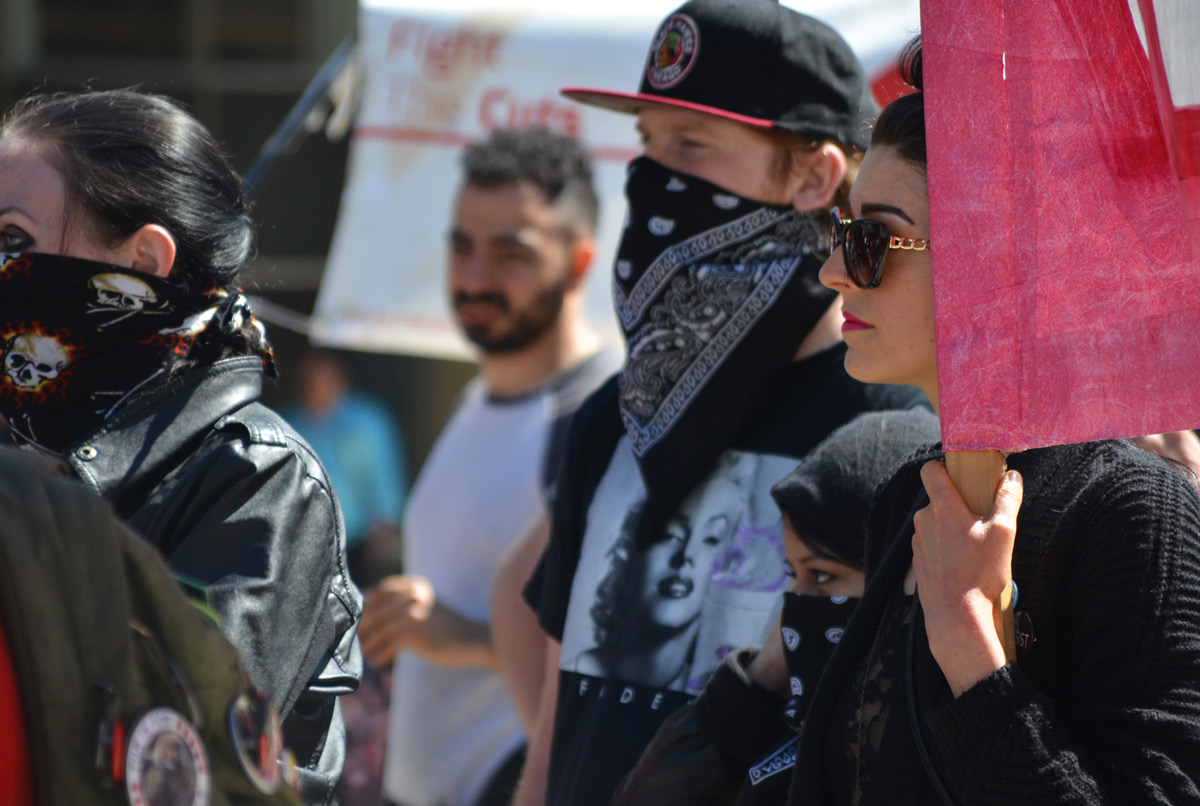
It was the Centre for Social Justice rally for diversity, strength, and solidarity.  It was an opportunity for people of all religions, races, and orientations to come together and renounce divisions and hate.

people at a protest rally, two people have a bandanas over their faces

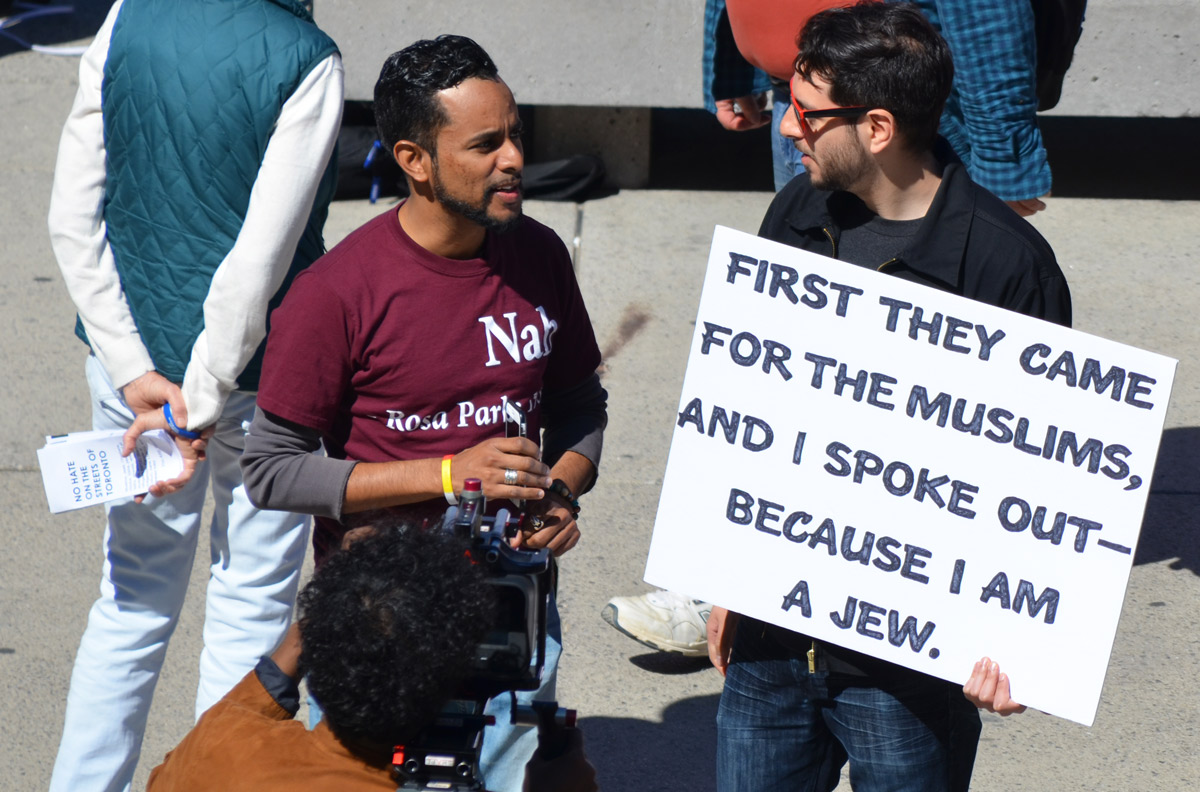
below: “First they came for the Muslims, and I spoke out – because I am a Jew”

two men talking at a protest rally. one holds a sign that says First they came for the muslims and I spoke up because i'm a Jew

below: “Freedom of speech is not freedom to hate”

a protest sign in the shape and design of a Canadian flag on the red stripes are words that say Freedom of Speech is not Freedom to hate

below: “Salaam aleikum – Peace be with you”

a woman in a priests collar on, holding a sign that says salaam aleikum peace be with you, being photographed and filmed by TV cameras

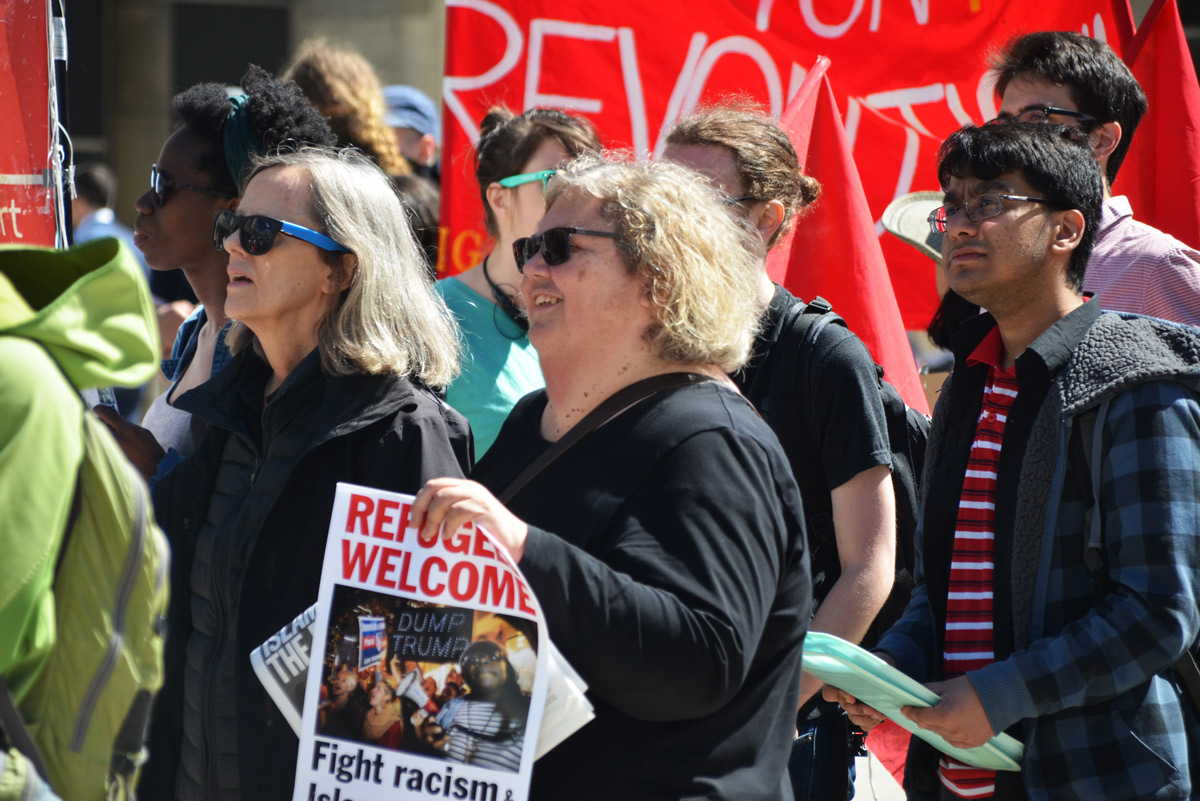
below: “Refugees welcome”

people walking in a protest, a large red and white banner in the background, a woman holding a sign that says refugees welcome with a photo of refugees on it

below: “We support our Muslim neighbours and friends.”

people at a protest rally, one is holding a sign that says We support our Muslim neighbours and friends

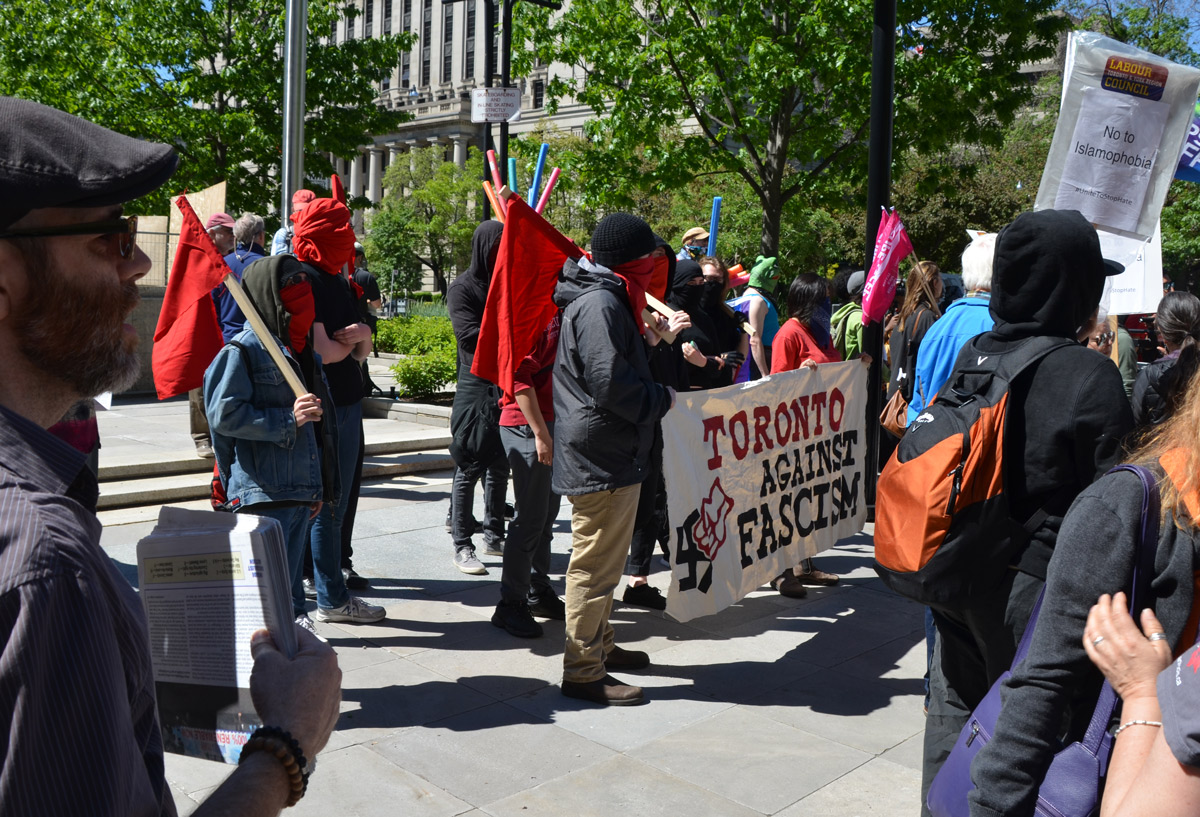
below: “Toronto against Fascism”

a group of people with red and black bandanas over their faces, holding a banner that says Toronto agaist fascism

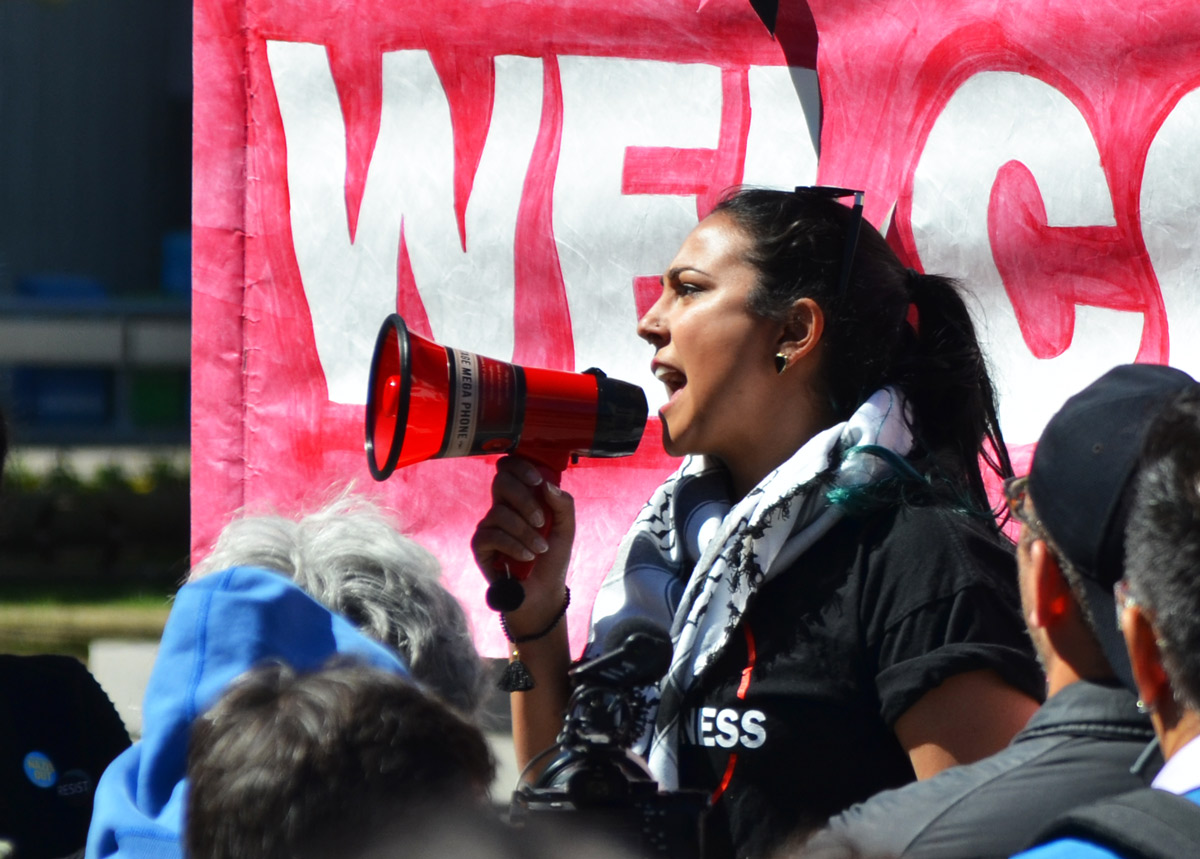
a woman with a megaphone at a protest rally, with a red and white banner behind her

people walking down Graffiti Alley on a sunny afternoon

I found myself on a sunny Friday afternoon with time to spare.  I haven’t walked Graffiti Alley in the warmth for quite a few months so off we went, hunting for new things, forgotten things, and special ‘are they still there?’ things.

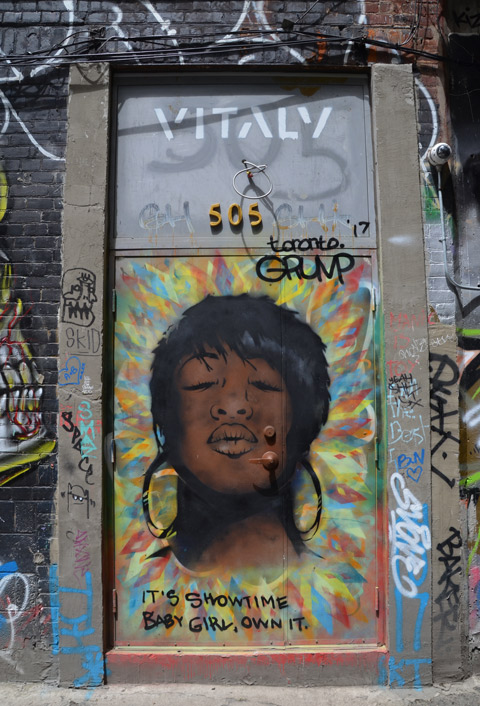
below: Vitality at 505 “It’s showtime baby girl, own it”

street art painting of a black woman's head, short hair, eyes closed, also on the door is the word vitality and the number 505

below: I guess that it’s painful to have your face stuck on a wall.

a dark grey three 3D rendition of a man's face. He looks like he's in pain.

below: Some black line drawn figures on top of text street art.

two figures, drawn abstractly with black marker on top of orange street art,

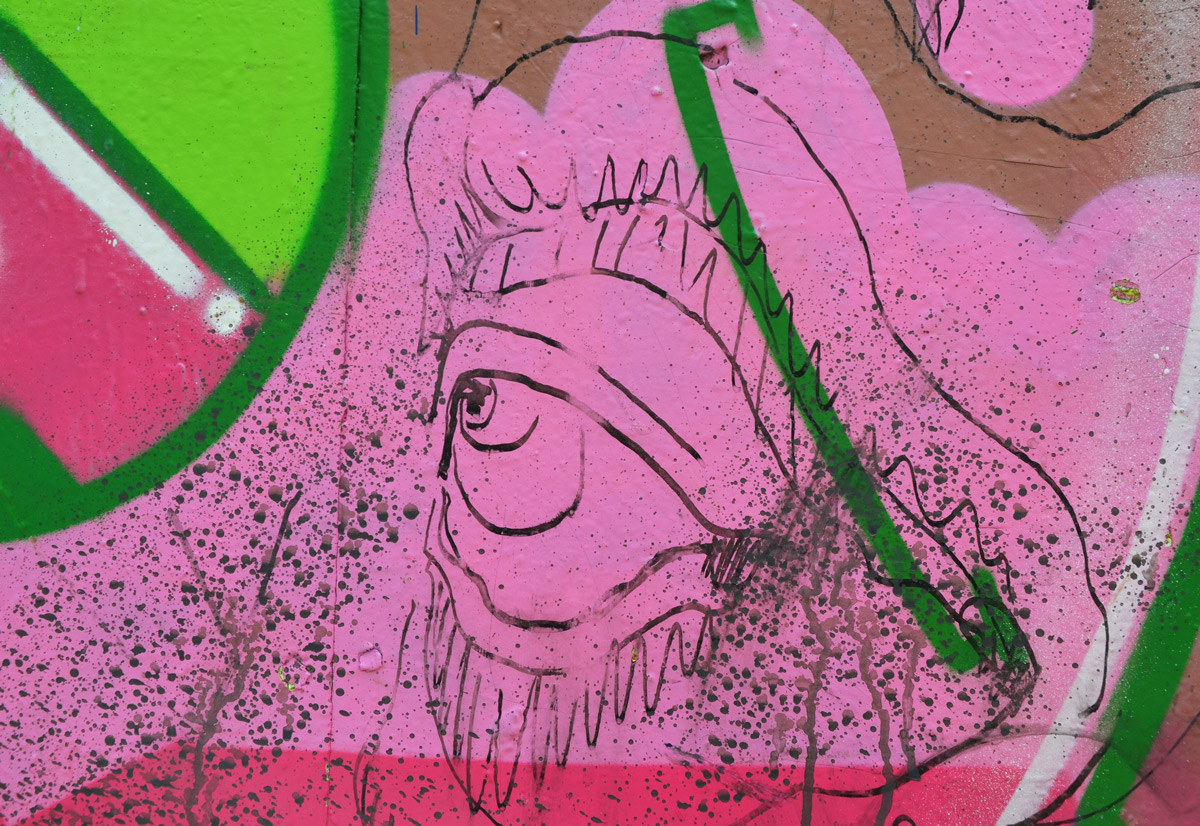
a drawing of a large eye on top of pink and green street art

on top of pink and green abstract swirly street art, a drawing in black marker of a hand, with a face (eye and mouth) coming out of the back of the hand.

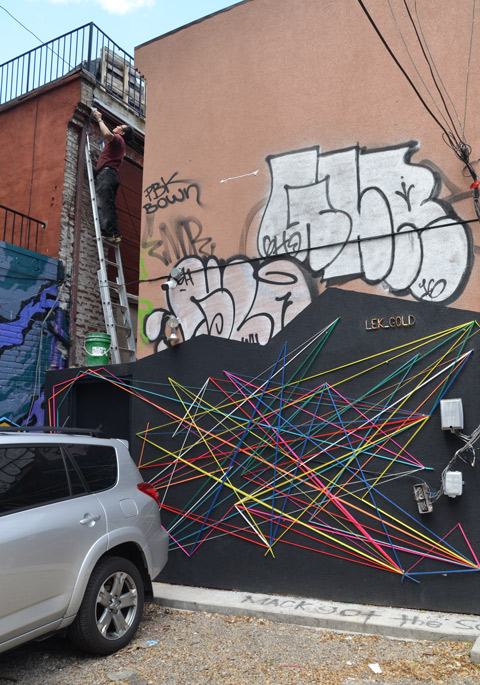
below: Arty strings by lek_gold

a man on a lddder, a car parked, multi coloured strings used to make art by stretching it between nails on an outside wall.

below: This little giraffe has aged well.

a small stencil of a giraffe stands at the bottom corner of a wall

below: It looks like he has a strawberry beard and I’ll assume that that’s a can of spray paint in his hand, not a can of shaving cream!

street art painting on a garage door, turquoise background, a man standing with a spray paint can in his hand, awkeardly drawn, simplistic, man with only one eye and a large beard that looks like a strawberry

below: A yellow monster rises from the barrels.

behind a red van and two green metal barrels, a yellow monster street art painting on a wall

below: I didn’t touch it.  I just took a picture of it.

street art in blues and greys over whish someone has written in blue marker, don't touch this.

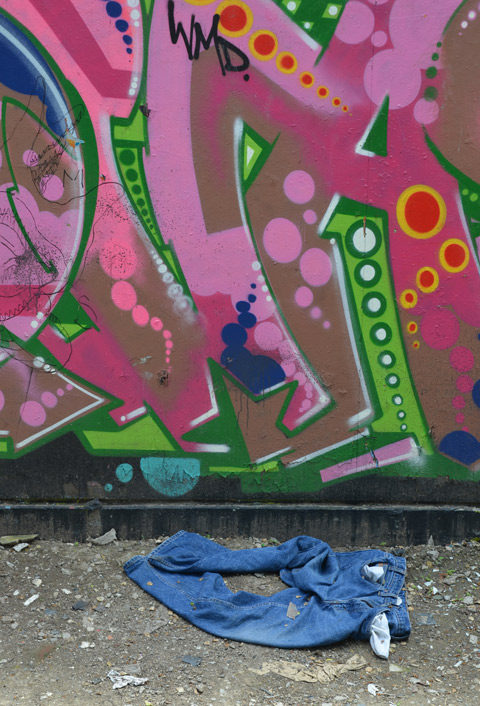
below: Anyone seen a guy running around in his underwear?

a pair of blue jeans are lying on the ground at the foot of a wall that has pink and green street art on it.

Relentless

Ubiquitous

These are two apt words to describe construction in Toronto, or to be more precise, the tearing down of  older houses and building smaller condo units or townhouses in their place.  We are experiencing the downsizing of living space as land values continue climbing upwards.

I drove past this Bayview Avenue house on the weekend and was intrigued by the look of it – a pale yellow,  once grand older house now sitting empty.   Many of the mature trees that were in its front yard have been cut down so the house is now easily visible from the street.  I went back to that section of Bayview Avenue with my camera yesterday morning.

older two storey house, pale yellow, with black and white trim and black front door, mature trees in the front yard.

There wasn’t much of a chain across the front yard so it was easy to walk up to the house.  It looks like the front door hasn’t been used in quite some time.   The window appears to have an old fashioned storm window on the outside although the shutters look more modern.   I’d love to know the history of the house (How old is it?  I suspect that it was built when this section of Bayview was still on the fringes of the city and before Bayview became 5 lanes wide but I don’t know for sure.)

front door of an older house, number 2450, pale yellow walls, white frames around door and window, black door, black shutters,

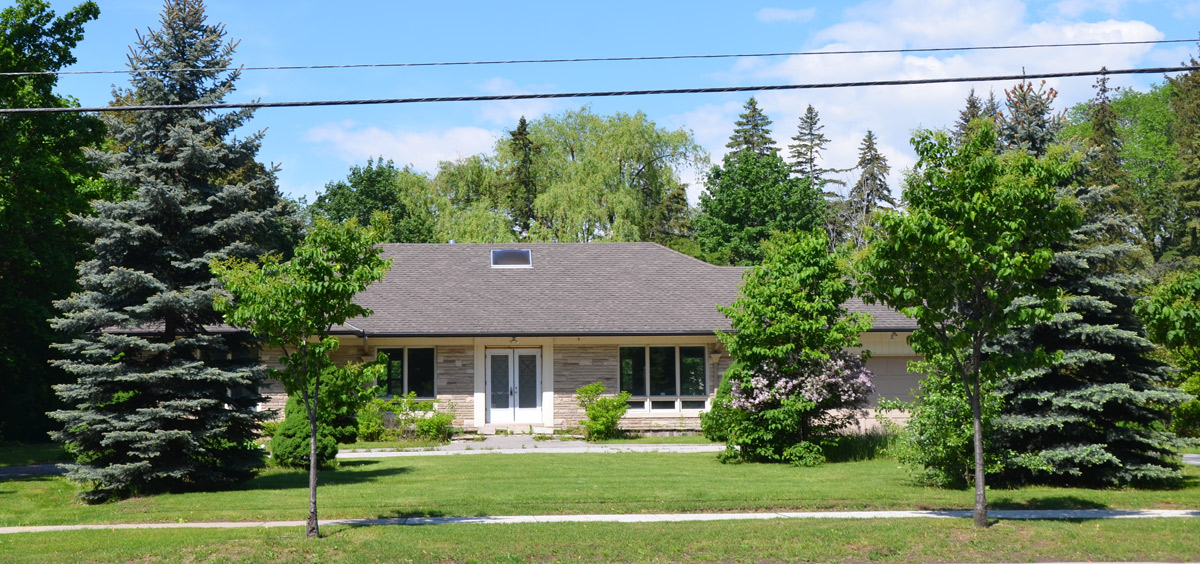
Right next door is this large bungalow:

large bungalow set back from the street behind a few pine trees, brown roof, stone facing on the exterior, large lawn,

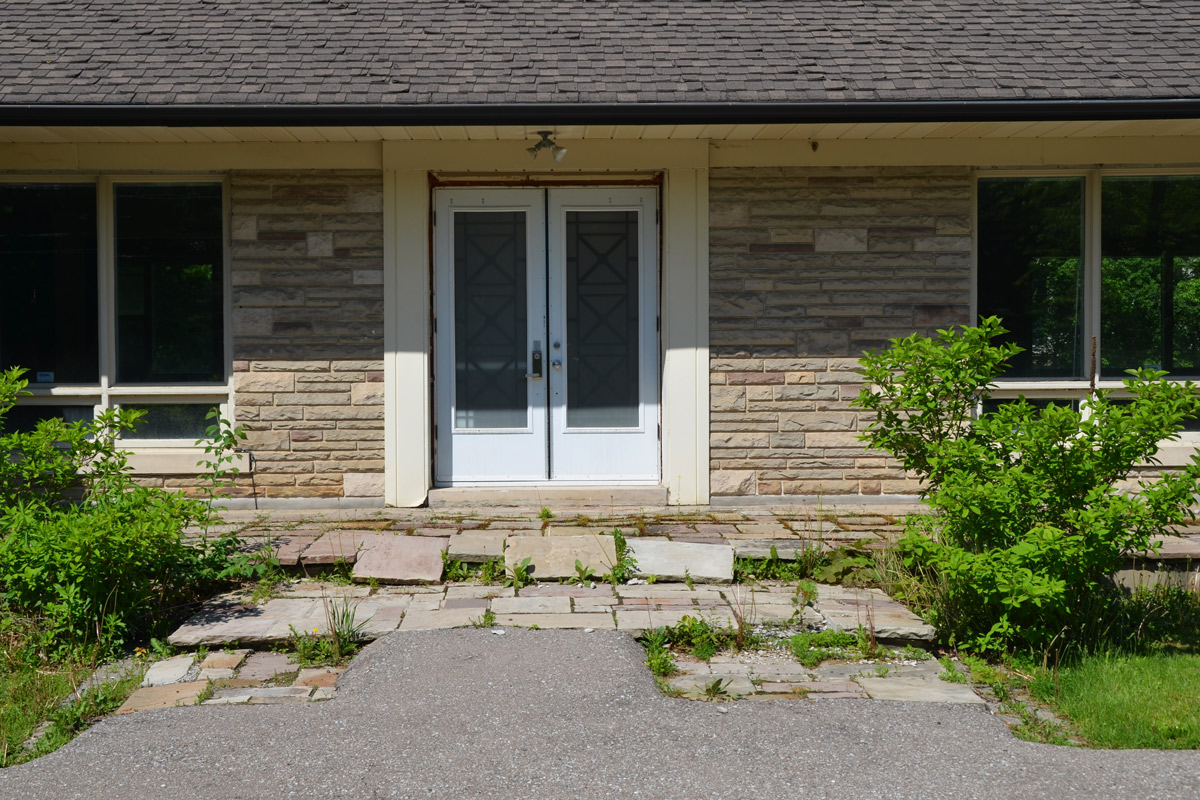
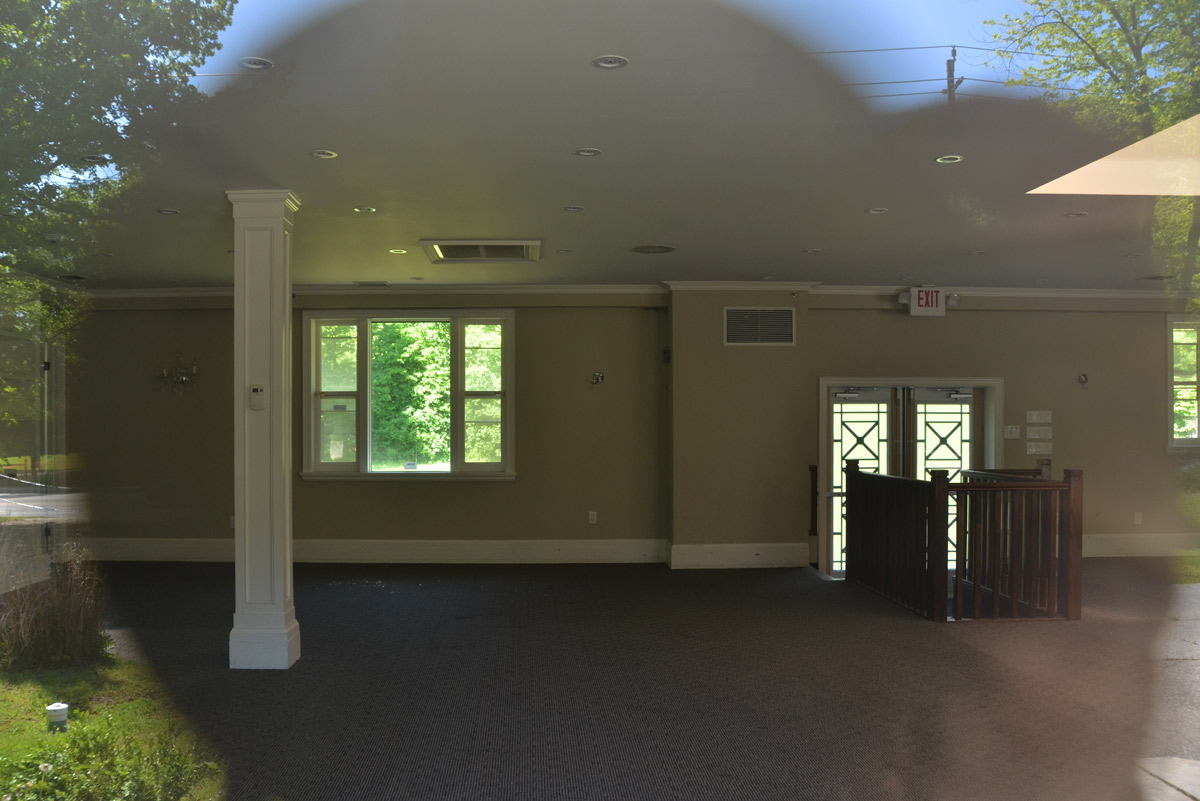
Originally built as a family home, this became the Bayview Hebrew School of the Arts in 2008.  The school is relocating and the building now sits empty.

nonsdescript white double doors as front entranceway of a house, flagstone steps and porch are buckling as is the ashphalt walkway leading to the front door.

looking through the front window into an empty building, looking through the back windows to the yard beyond.

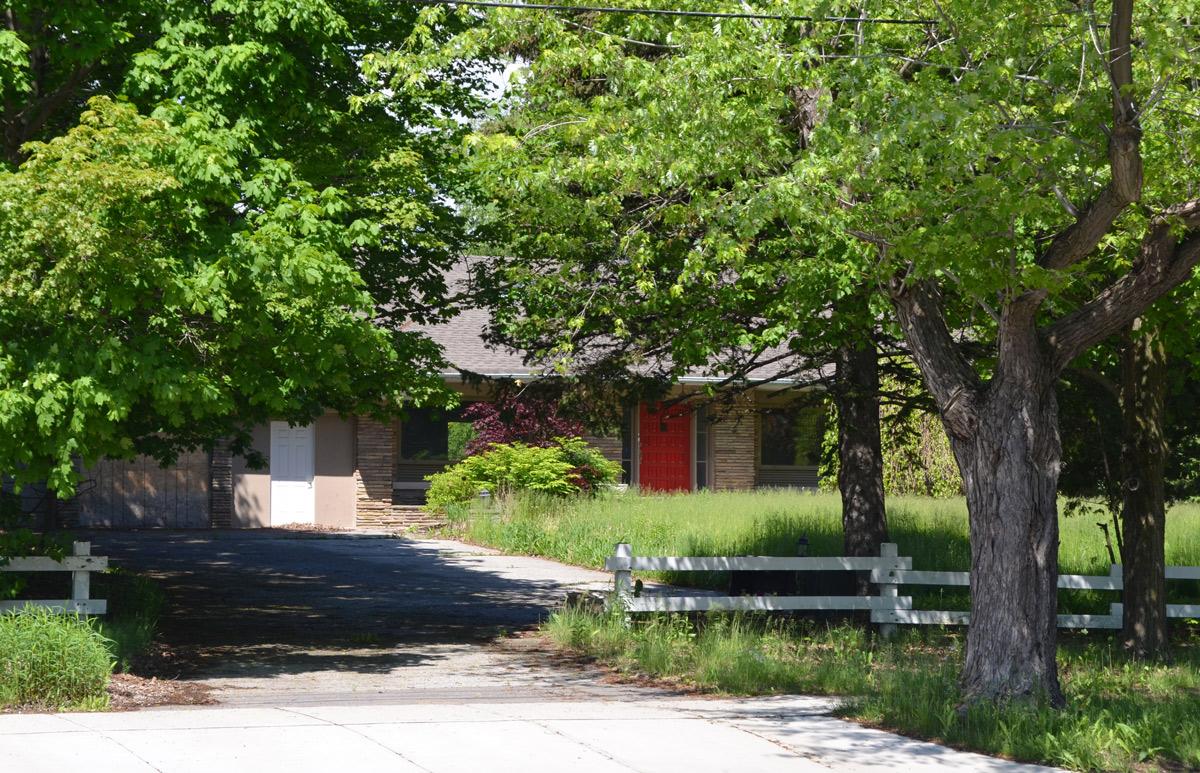
Just up the street was this house.  It looks empty but there was a recycling bin beside the garage and some curtains in the windows so I didn’t wander up to the front door…. even though I really like that red door!  There was no chain across the driveway, nor were there any “keep out” signs.   Neither of those things would stop me, but they are good indicators that no one lives there anymore.   Google street view of this address is from August 2015 and at that time there was a for sale sign on the property.

bungalow set back from the street, large front yard with uncut long grass and a few mature trees, also a low wood fence,

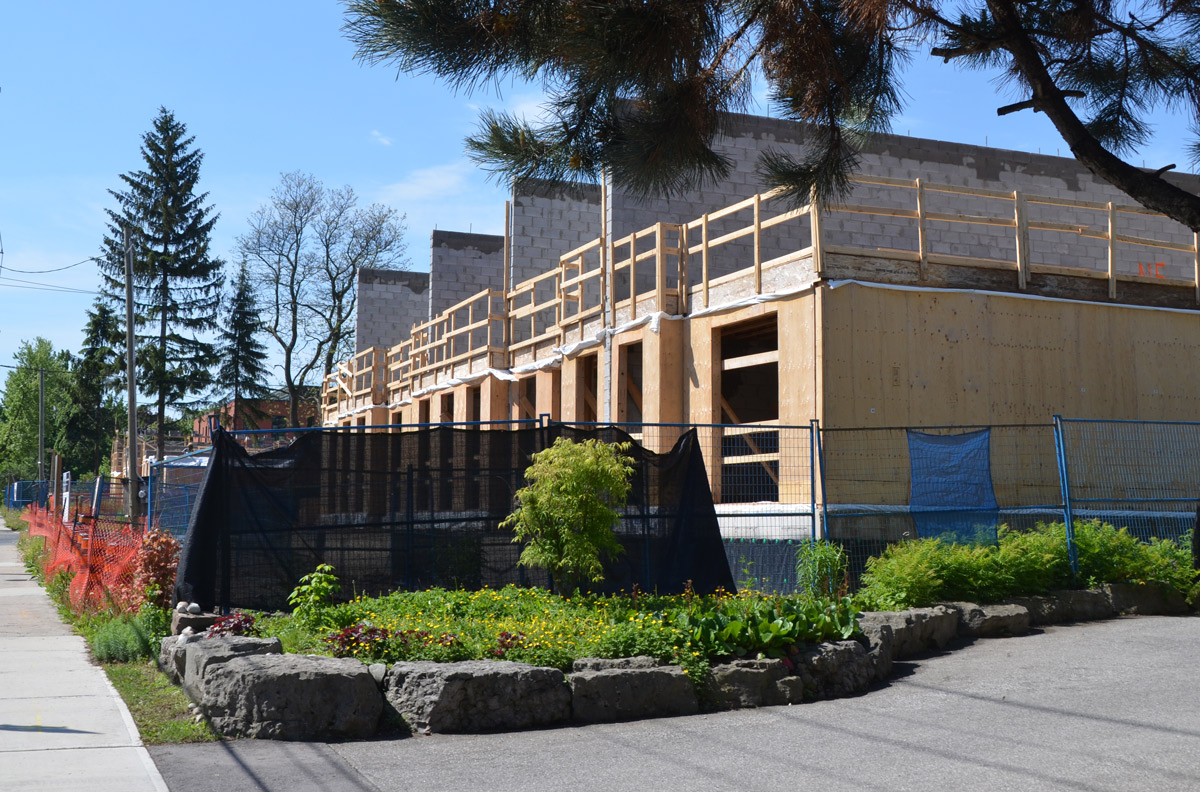
The above are the “going” half of the title of this blog post.  The “coming” are these doors under construction; they too are on this part of Bayview Avenue.   Side by side front doors with a concrete layer between them – two of a row of five townhouses.  One day (soon?) someone will be able to walk in their front door and go up a level or two, to floors that haven’t yet been built.

from the front, street view, two of a row of townhouses under construction, plywood exterior with holes where the doors and windows are going to be.

This is the development that caused an uproar a year ago when they illegally clear cut two lots – cutting down about 30 large trees including a linden tree that was close to 150 years old in the process.  According to the City of Toronto Municipal Code Chapter 813, Article III, conviction for cutting down a mature tree  results in a “minimum fine of $500.00 and a maximum fine of $100,000.00 per tree involved in an offense; a special supplementary fine of $100,000.00 is also possible.” (source).

In October 2016, Format Group (the developers involved) paid a fine of $155,064.  This amount includes $657.30 per tree to cover city inspection costs and $116,600 for the planting of 200 new trees — mostly at other sites.

The two lots will be developed into 11 3-storey townhouses and 4 single family houses.  All units have already sold.

a row of townhouses being built, the lower floors are framed with plywood, the upper storey hasn't been started yet.

Before I leave the area, there is something similar going on across the street.

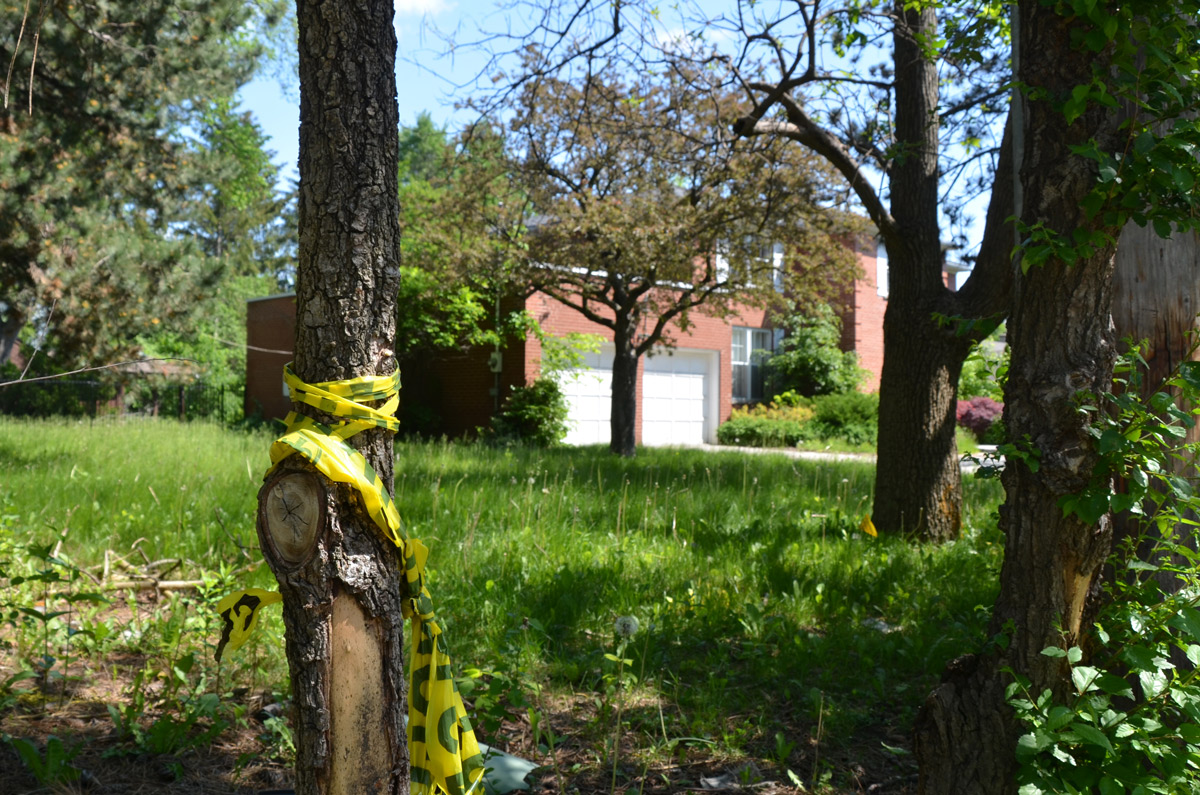
tree with yellow caution tape in front of an empty lawn with empty house in the background

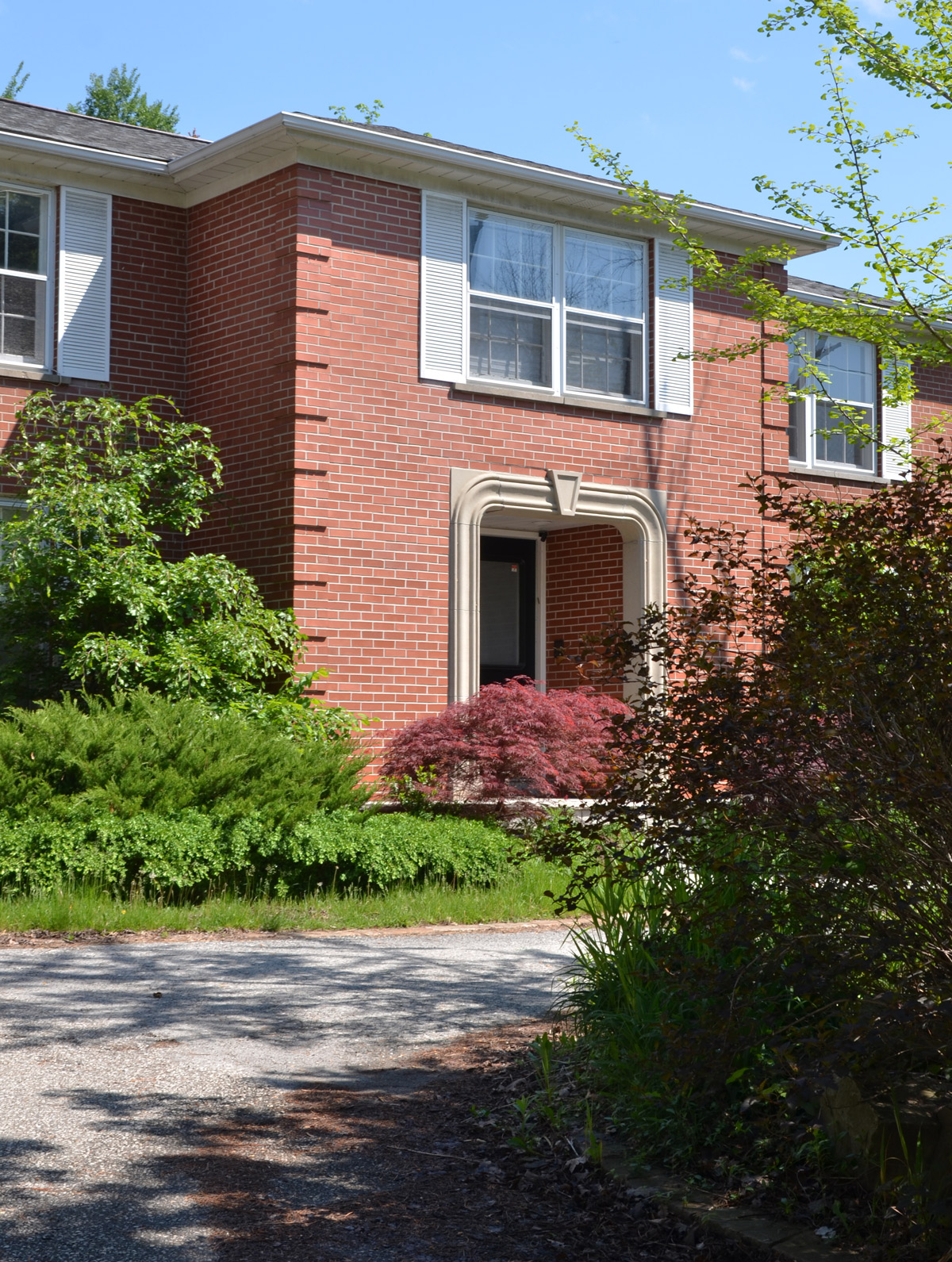
First – there is this empty house sitting on a corner lot at Bayview and Wilket.  This one property is the future home of seven 3-storey townhouses as well as one single detached house.   Does anyone want to do the math on the potential profit – one house for 8 units in a time where even a townhouse sells for more than a million.

driveway and entranceway of a brick house that is now empty

Second – this sign has also appeared nearby. When I checked their website I found this description: “Located in north Toronto, The Bridle Path is synonymous with prestige and exclusive luxury. Known for its spectacular homes and refined neighbourhood character, it’s no wonder that this is the place that Toronto’s discerning elite prefer to call home. Now, on Bayview Ave. in the heart of the Bridle Path neighbourhood, Kingsmen Group is excited to introduce a new luxury townhome community that embodies the very essence of refined prestige living. Register today for more information coming soon.”

There is so much wrong with that paragraph.  I wouldn’t call this part of Bayview a part of the Bridle Path neighbourhood; you might be able to make an argument that it’s on the fringes of said neighbourhood but that would be stretching it.  “Prestige” and “luxury” are words that are so overused that they are almost meaningless with respect to Toronto real estate.   It seems silly to compare a townhouse on Bayview with the homes on the Bridle Path but I guess that’s what sells.  Actually, you could probably sell them without such a comparison!

sign advertising new townhouse devlopment by kingsmen Group inc.

Oh dear, I want to call this a Thursday Doors post so I’d best call it quits here.  I’ve probably already strayed too far off topic!  For more information on the Thursday Doors project see here.

‘Making Peace’ is a traveling exhibit that is being shown in Toronto at the moment.  It was produced by the International Peace Bureau (IPB) and was first shown in in 2010 as a celebration of the 100th anniversary of the 1910 Nobel Peace Prize that was awarded to IPB.  It’s purpose is to promote peace as well as educate and inform.

It can be seen until the end of June on Front Street East in the Canary District (by Corktown Commons, east of the Distillery District).    In Toronto, the exhibit involves short four-sided pillars that line the sidewalk and each side of every pillar has a photo with a description or a quote from a famous person.  There is also a temporary gallery in an indoor space ‘loaned’ to the exhibit by one of the developers in the Canary District.

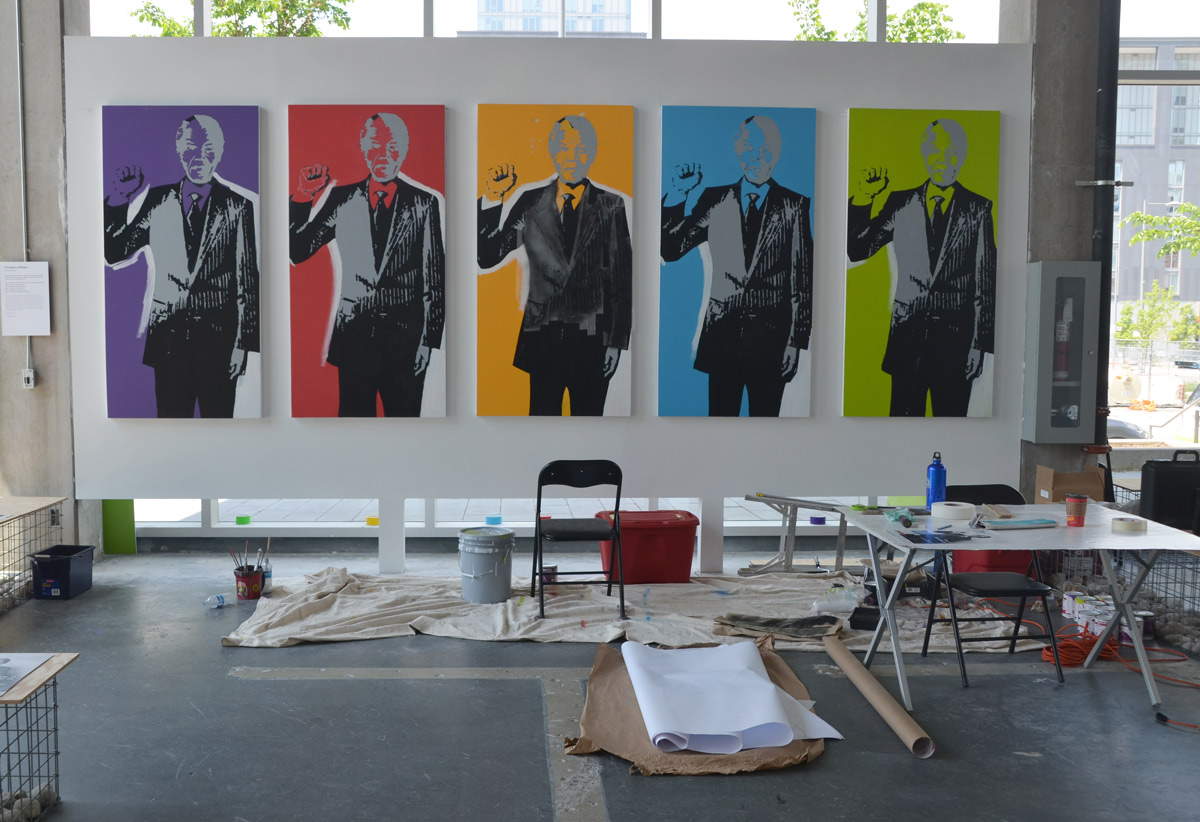
below: A painting in progress by Ford Medina showing Nelson Mandela in five colours.  These colours carry over into the outdoor exhibit and each colour represents the five main elements that IPB considers necessary for peace:
1. disarmament and nonviolence (purple)
2. conflict prevention and resolution (red)
3. economic and social justice (orange)
4. human rights, law and democracy (blue)
5. environment and sustainable development (green)

indoor temporary gallery for the Making Peace exhibit, a painter is in the midst of creating a large painting of five copies of a picture of Nelson Mandela, each copy is in a different colour, purple, red, orange, blue and green,

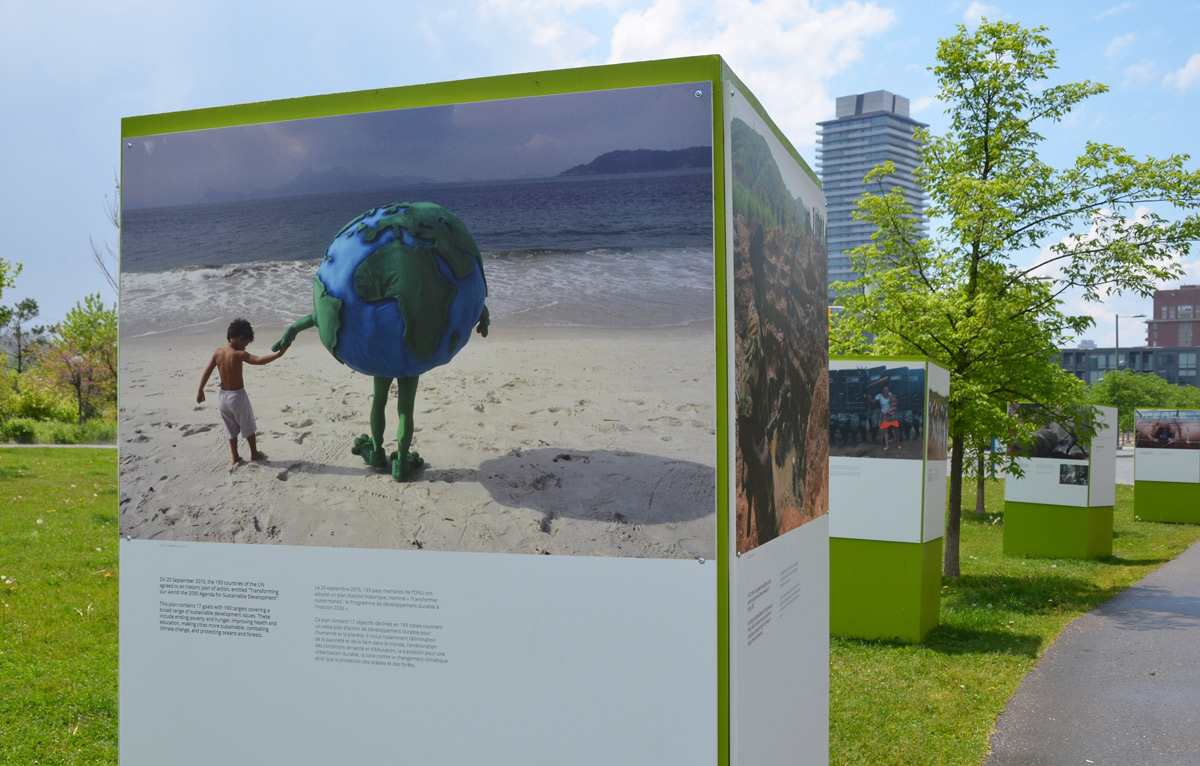
below: The display extends into Corktown Commons.  Here the pillars are green as this is the section for the fifth element named above, the environment.

outdoor exhibit, Corktown Commons, short pillars with 4 sides, each side has a picture and a description, the background colour is green which represents the environment and sustainability.

below:  Photo by Ribeiro Antonio.  The words that accompany this photo are: ” On 25 September 2015, the 193 countries of the UN agreed to an historic plan of action, entitled ‘Transforming our world: the 2030 Agenda for Sustainable Development’.  This plan contains 17 goals with 169 targets covering a broad range of sustainable development issues.  These include ending poverty and hunger, improving health education, making cities more sustainable, combating climate change, and protecting oceans and forests.”  If you are interested in this, there is more information on the UN website.

a photo of a person dressed in a large blue and green Planet Earth costume, holding the hand of a young boy as the walk on a beach towards the water

below: Blue is for human rights, law, and democracy and here you have an old black and white photograph of Sylvia Pankhurst (1882-1960), a British campaigner, apparently taken when she was in Australia speaking out on behalf of woman’s rights as part of the Suffragette movement.  The Suffragettes (or Women’s Social and Political Union or WSPU) was founded by a small group of women in 1903, including Sylvia, but during WW1 Sylvia was expelled from the WSPU because of her pacifist views and anti-war actions.  Her sister Adela shared similar views – she immigrated to Australia where campaigned against the First World War.

a vintage black and white photo that is part of an exhibit, outdoors, called Making Peace

below: Two photos.  The one on the right, of the woman holding the flower in front of the armed soldiers, was taken at a Peace March against the Vietnam War in Washington DC in 1967.  The photo on the left was taken in 2001 and is the back of a Kamajor fighter in Sierra Leone.  They played a role in the civil war that occurred in that country between 1991 and 2002.

2 sides, taken from the corner, of a box like structure, with black and white photographs on the two sides, one of the back of a man with a rifle across his shoulders and a backpack that says Lets go to school. The other photo is a woman standing up to a line of soldiers with bayonets.

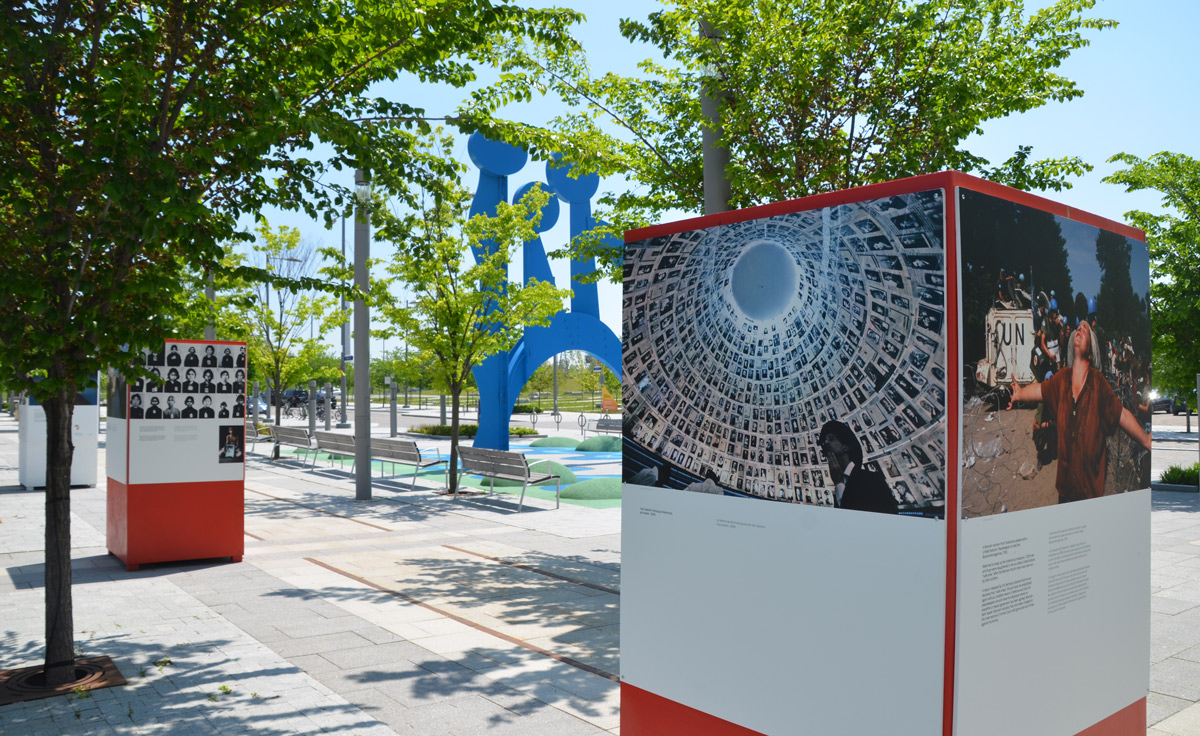
below: A couple of the red pillars on Front Street with the blue sculpture, “The Water Guardians ” behind them.   The images on the closest pillar are of inside the Holocaust Memorial in Jerusalem as well as UN peacekeepers in Bosnia.

an outdoor art exhibit on peace, two of the structures used for mounting pictures on, with the blue sculpture on Front Street, Canaray District, in between the two boxes.

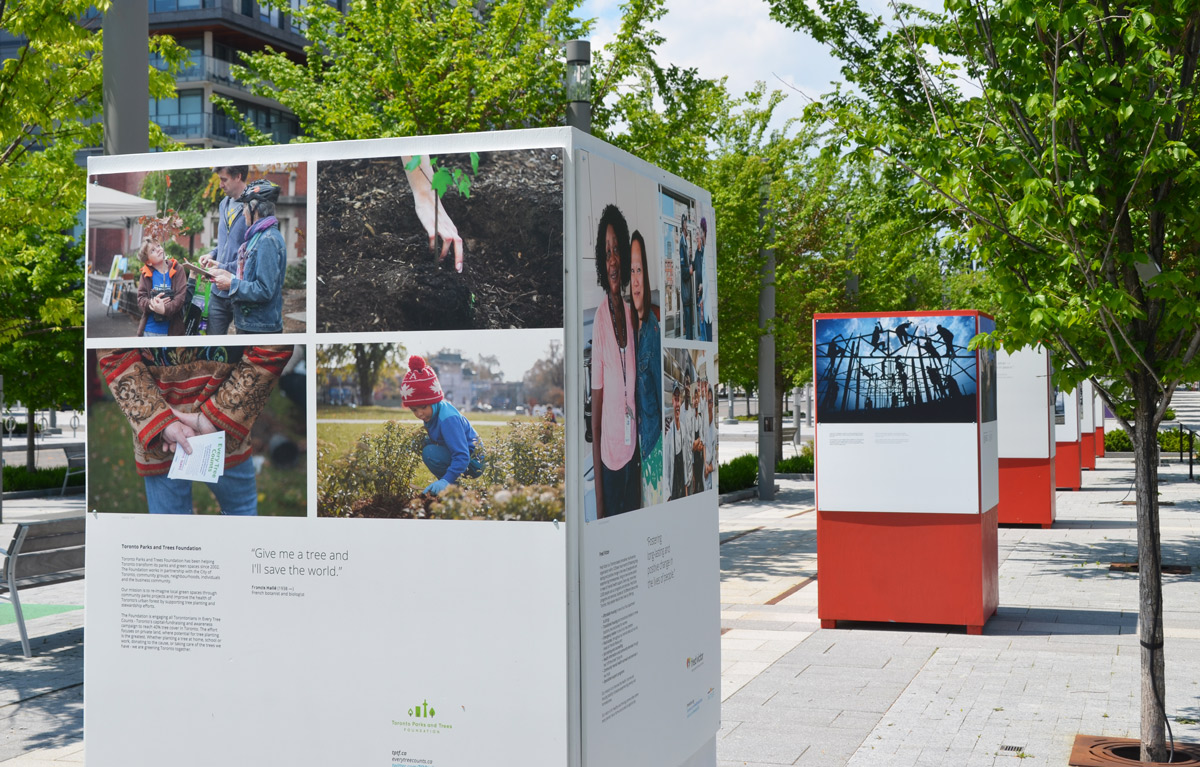
below: Closer to home, this pillar celebrates the work of the Toronto Parks and Trees Foundation.   Working with the city as well as with community groups, businesses, and individuals, they help to increase  Toronto’s tree cover.

a set of four photos about planting trees on the side of a square pillar, one of many pillars that are arranged in a line on the sidewalk.

“Earth provides enough to satisfy every man’s need, but not every man’s greed.”  Gandhi

below: Homeless migrant worker, China

picture of a woman sleeping underneath a picture of a woman lying on a bed, shown outdoors so there are some tree leaves in the picture

The exhibit continues until mid-September.

subtitle: Hanging out in front of Queen’s Park

There is a collection of statues in the front of Queen’s Park.  With the exception of the statue of Queen Victoria, they are of men who helped shape Toronto, Ontario, and Canada in the early years.    I was going to spend some time writing about what each person did but this post started to become very dull.  I don’t mean to diminish the accomplishments of these men, but reading a summary of their lives isn’t the most interesting way to spend time.   If you want to learn more about any of them, I’m sure you can find much more information online!

First, the monarch.  Queen Victoria.  She was born in 1819 (almost 200 years ago!) and became Queen in 1837 when just 18 years old.  She reigned for more than sixty years until her death in January of 1901.   Her husband, and father of her 9 children, was her first cousin Prince Albert of Saxe-Coburg and Gotha.   The fact that her statue’s here is no surprise.  Queen’s Park was named in her honour after all – it was opened by her son Edward in 1860.  The statue though didn’t appear here until 1902, after her death.  It was designed by Mario Riggi.

statue of Queen Victoria in bronze. She's seated, wearing crown and holding mace/staff

Also in the front of the parliament buildings are the statues of six other historical figures:  Sir John A. Macdonald, John Graves Simcoe, Sir Oliver Mowat, George Brown, John Sandfield Macdonald, William Lyon Mackenzie, and Sir James Whitney.  Most people would recognize Sir John A. Macdonald as the first Prime Minister of Canada and some Torontonians might be familiar with the contributions of Mr. Simcoe to their history, but the other four men, who are they?

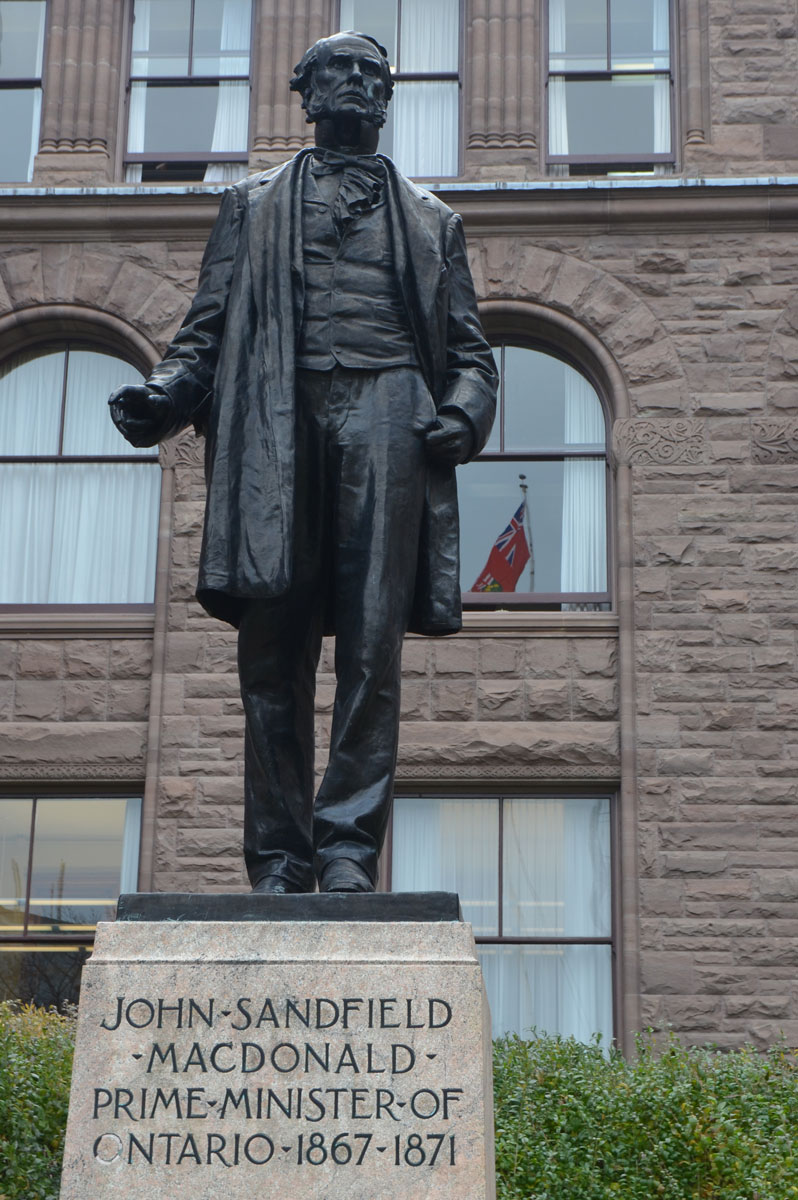
Let’s start with John Sandfield Macdonald (no relation to Sir John A. )   He was born in Glengarry County Upper Canada in 1812.  He was the first Prime Minister (Premier) of Ontario, starting with Confederation  and the formation of the province of Ontario on 1st July 1867.  He held that position until 1871.  The sculpture is by Walter Allward, 1909.

statue of a man, John Sandfield Macdonald, in front of the parliament buildings at Queens Park. An Ontario flag is reflected in the windows of the building.


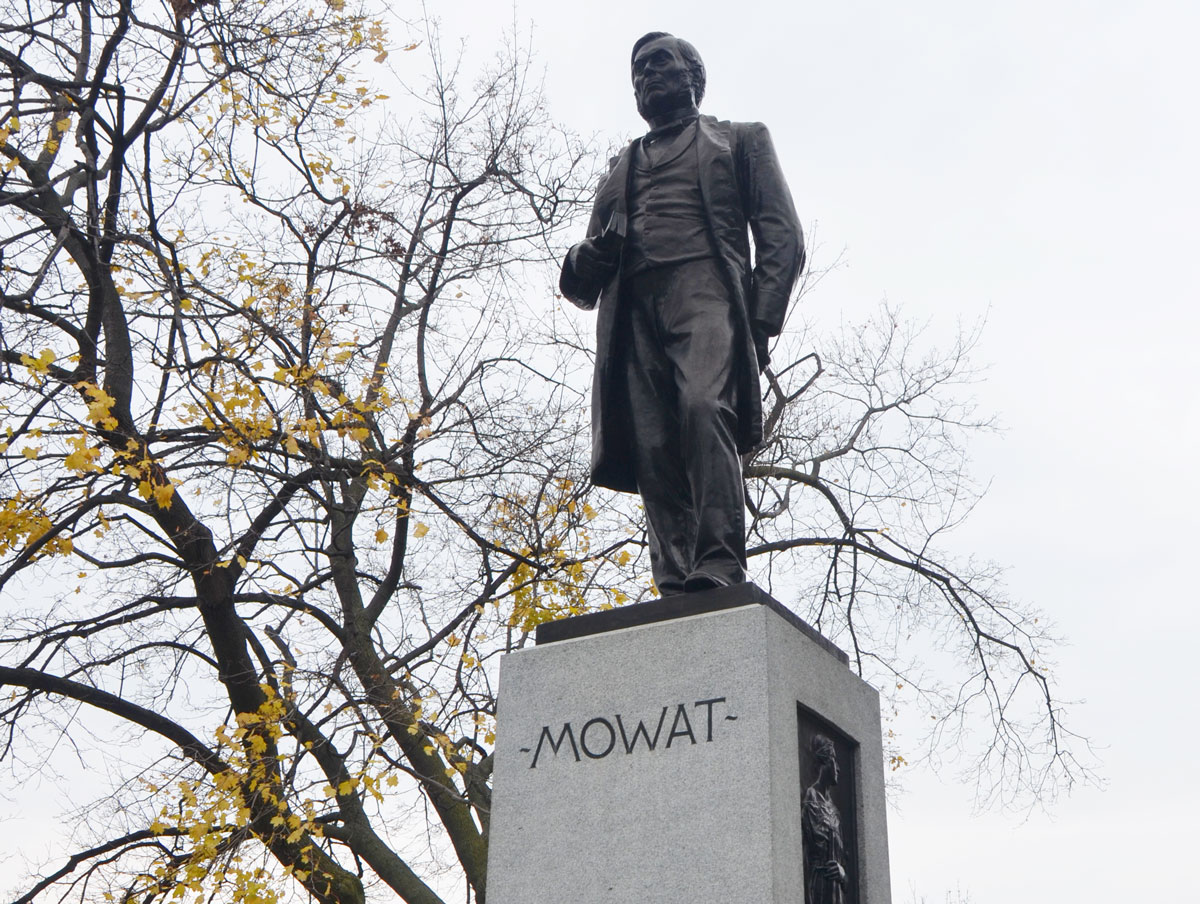
Next,  Sir Oliver Mowat .  He was born in Kingston Ontario in 1820.  In 1840 he moved to Toronto to study law but in 1857 he was elected a Liberal member of the Legislature of the Province of Canada.  He held various government positions at both the provincial and federal levels up until his death in 1903.  He took part in the Quebec Conference of 1864 which led to Confederation in 1867.  He was the third Prime Minister (Premier) of Ontario after John Sandfield Macdonald and Edward Blake (who was leader for less than a year and has no statue).  He led from 1872 to 1896.     During his almost 24 years as leader of the Ontario Legislature he introduced the secret ballot in elections and extended suffrage beyond property owners.  He also created the municipal level of government.  Between 1897 and his death he was a Senator and then the Lieutenant-Governor of Ontario.  This monument was unveiled in 1905 and was also designed by Walter Allward.

black statue of a man, Sir Oliver Mowat, standing with a book in one hand, and the other hand behind his back. The figure is on top of a grey stone rectangular column, autumn tree in the background.

below: Sir James Whitney was a member of the Ontario Legislative Assembly from 1888 until his death in 1914.  For the later part of those years he was the Premier of Ontario – he was elected four times as Premier.  The statue was sculpted by Hamilton MacCarthy and was unveiled in 1927

statue of a mna with his right arm extended, Whitney, in front of the parliament buildings at Queens Park.

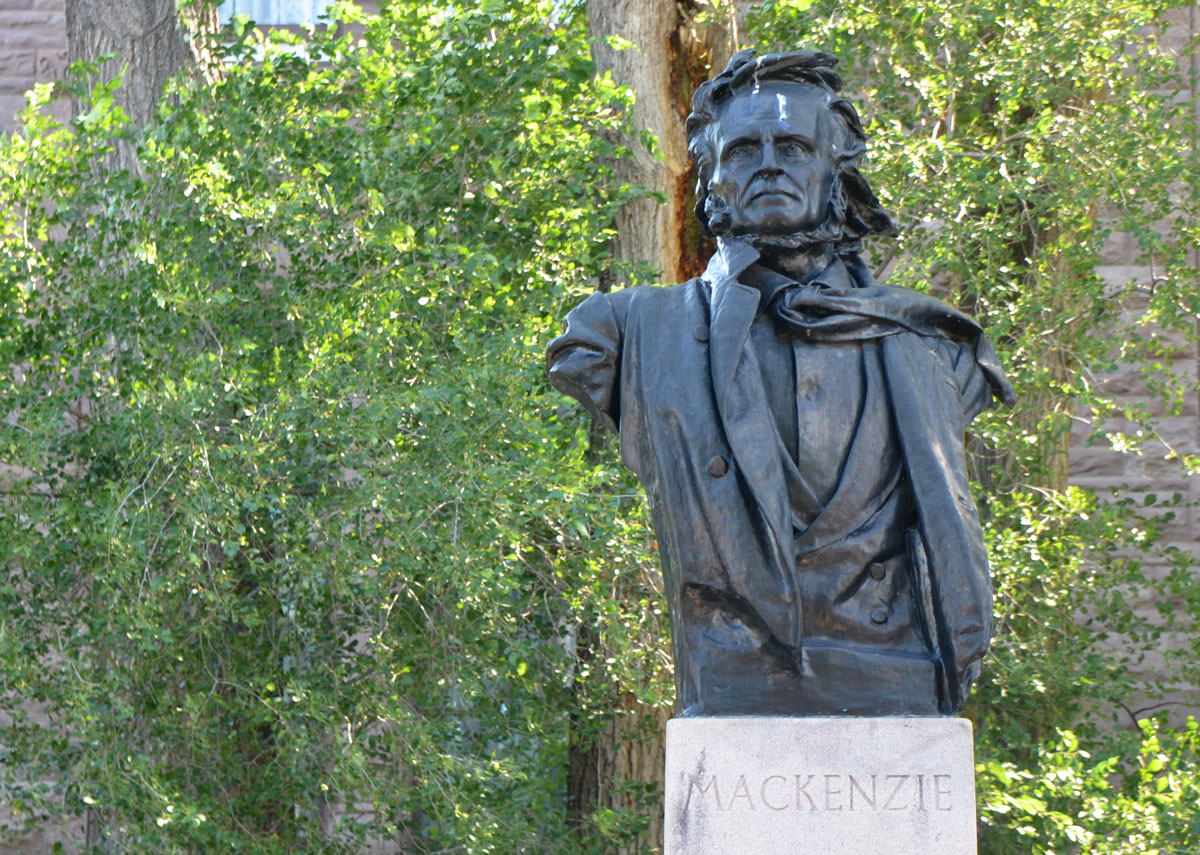
I’ve also included William Lyon Mackenzie (1795-1861) with this group of men even though his statue is more to the west of the parliament buildings than in front of them.   He was the first mayor of Toronto (1834) although he was only mayor for a year.   He was also a leader of the Upper Canada Rebellion in 1837.

statue of William Lyon Mackenzie, shown from the waist up and missing his arms, trees in leaf behind him,

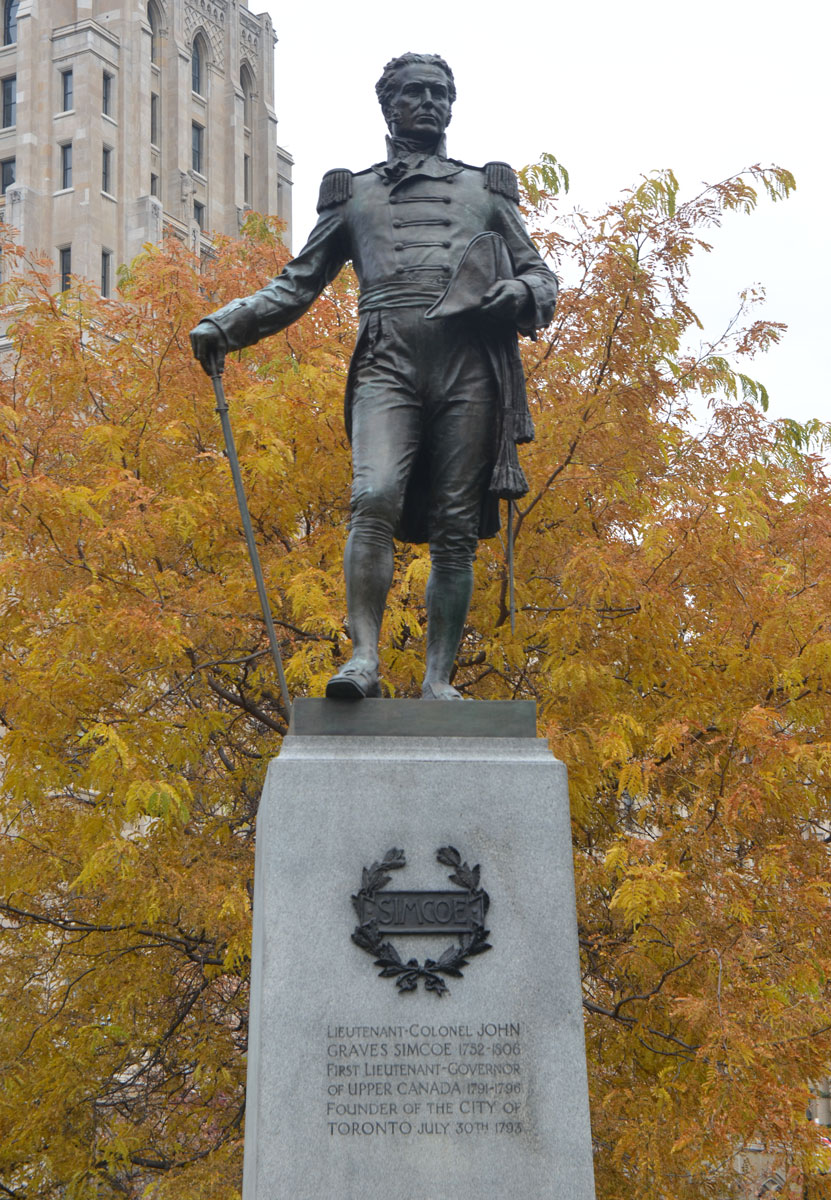
below: The oldest man of the lot is John Graves Simcoe (1752-1806), founder of the city of Toronto, the designer of Yonge Street, and one busy man in his time.

statue of a man in bronze standing on a grey stone column, yellow tree behind him. He's got a sword in one hand, with its point on the ground and he is leaning on it slightly

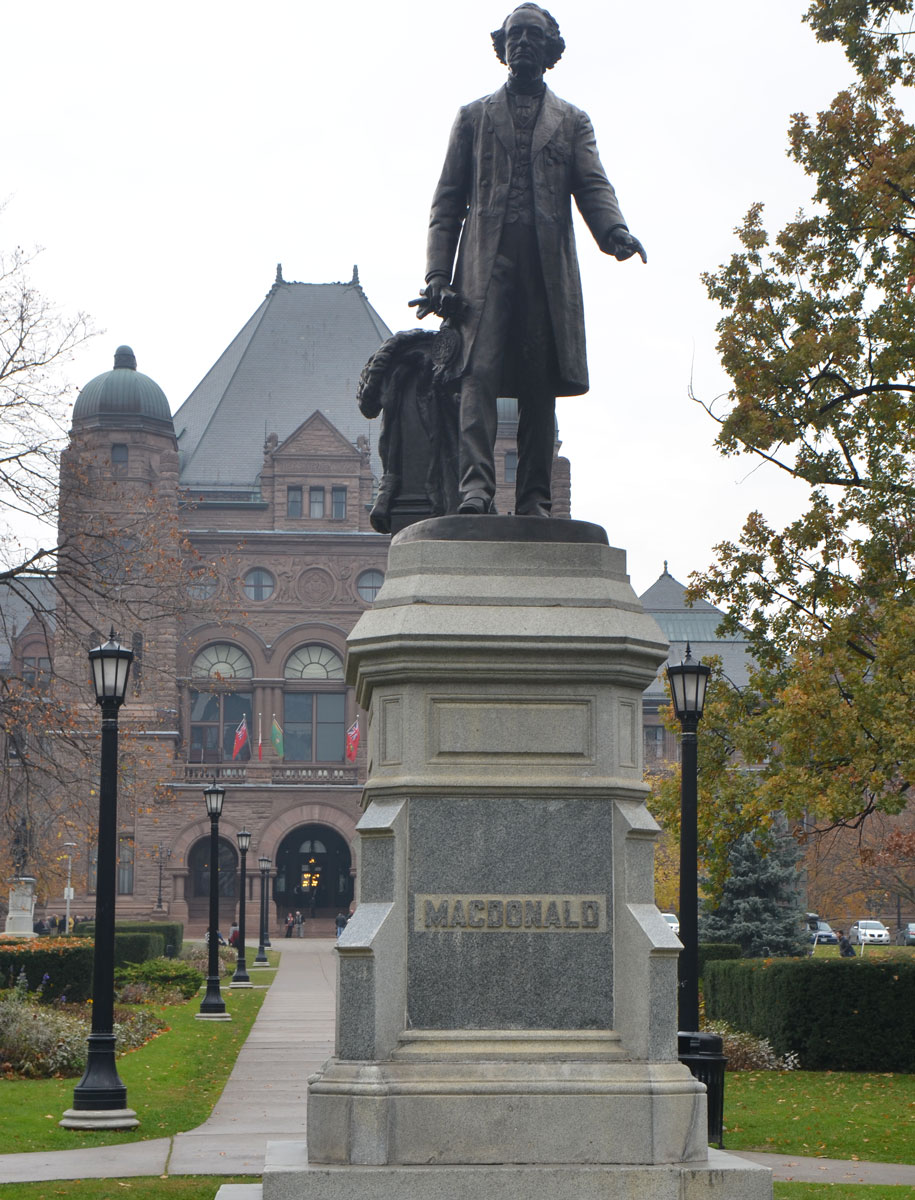
And last, the most well known of the men, Sir John A. Macdonald, first Prime Minister of Canada.

statue of Sir John A. Macdonald, first Prime Minister of Canada, on a grey day, in front of the Ontario Legislature at Queens Park in Toronto,


Mt. Pleasant cemetery is the final resting place of about 168,000 people.  A small percentage of those are interred within mausoleums, some of which are fancier than others.   The following is a sample of the architecture of the mausoleums that I have seen there (including the doors of course).

below: The Eaton family mausoleum with its corinthian columns.   Timothy Eaton is buried here, the founder of the Eatons department store chain (that no longer exists).  Timothy apprenticed to a merchant in Ireland before emigrating to Canada.  After working in a number of stores in Ontario, he purchased a business at the SW corner of Yonge & Queen.  His store was one of the first to sell goods at a fixed price and only for cash…. no bargaining and no credit.

entrance to Eaton tomb/vault at Mt. Pleasant cemetery, two lions beside the steps that lead to the metal door, large corninthian columns on either side of the door.

fancy stone work over the top of the metal door in the Eaton vault. door is greenish colour with age

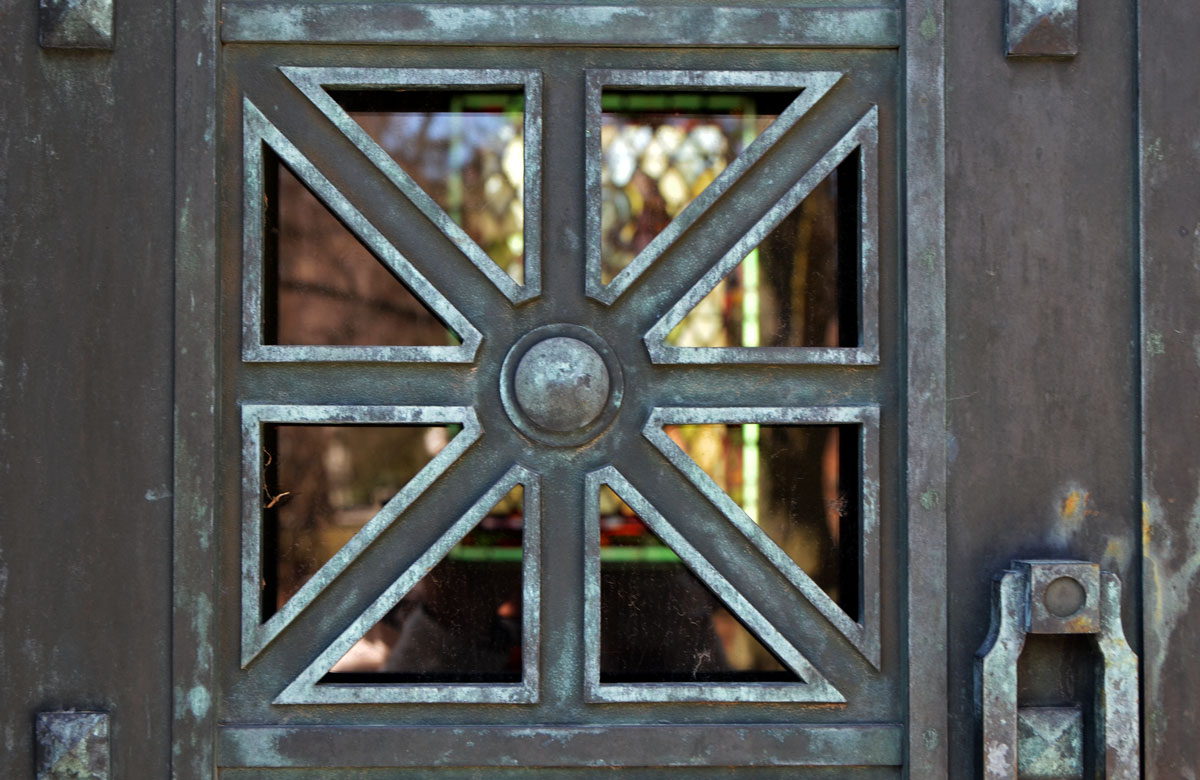
close up of a pane in a window with a metal window frame, square with lines dividing the pane into 8 triangles, stained glass window in the background. Looking into a vault at a cemetery

below: The Cox family mausoleum which was built in 1905. Sixteen people are buried here including George Albertus Cox (1840-1914) a business man and Senator, his two wives Margaret (d. 1905) and Amy (d. 1915) and their six children.   The building was designed by Sproat & Rolph who were the same architects that designed the Canada Life Building and the Royal York Hotel.  It cost $50,000 to build.

a metal door in a building in a cemetery, three large columns on each side of the door

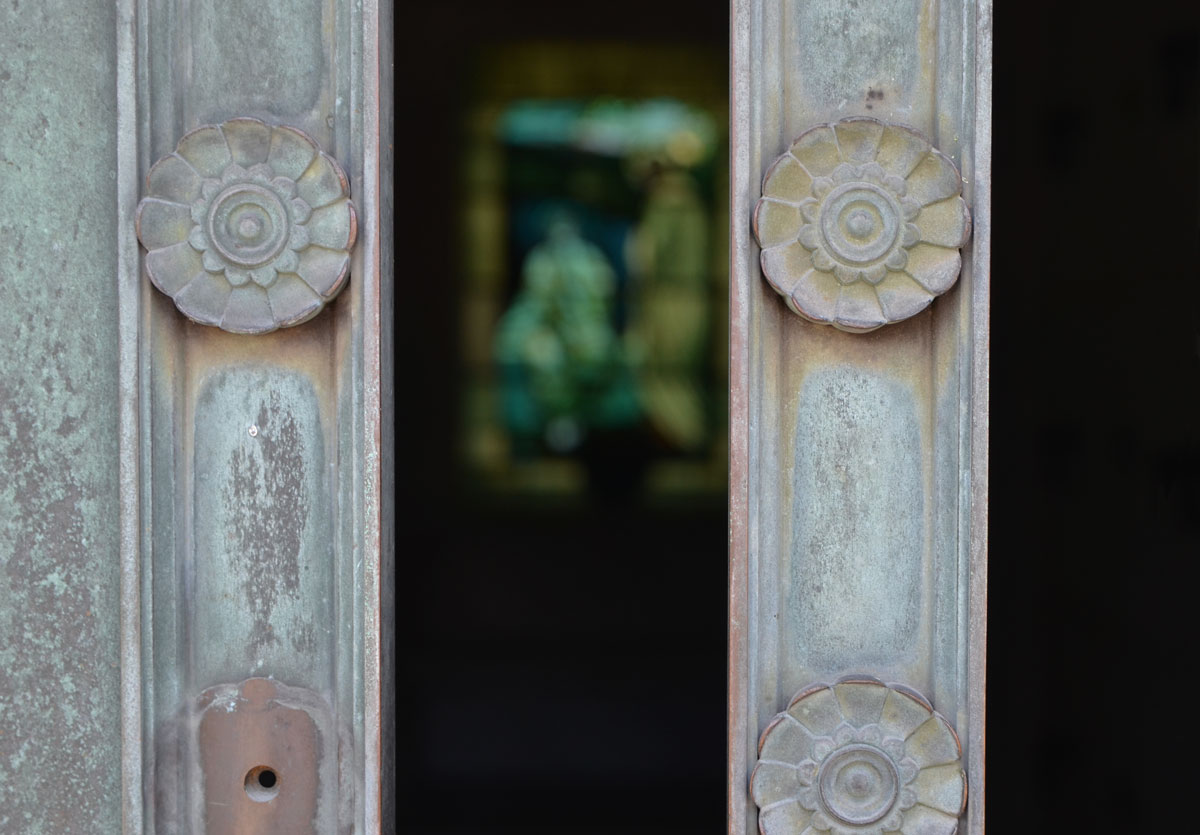
below: Detail of the flower motif on the windows of the door above.

looking through the metal bars of a window, bars have little flower shaped metal pieces on it, looking into vault in cemetery, stained glas window in the background.

below: Robert Emmet Kelly died in 1915 while on his honeymoon in Atlantic City.  His wife Bessie had this monument built in his honour.  She was buried there when she died in 1964, 50 years after her husband.

small building in cemetery with words Robert Emmet Kelly carved in stone across the top of the door

below: Last, but not least, the Just sisters.   This mausoleum was originally built for Sir Frank Baillie who died in 1921.   His remains were moved to Oakville in the 1960’s and the building sat empty for a few years.  It was purchased by the Just family and now Gloria Irene Just (d. 1977) and Gladys Irene Just (d. 1970) are interned here.  They were daughters of Thomas Fullerton Just, a mining equipment dealer from Quebec.  Someone has left flowers.

front of cemetery tomb for Just family, wood door with engravings on it.

If you are interested in doors, there are lots of blogs that feature door photos on Thursdays…. check out Thursday Doors organized by Norm 2.0 for more information.   This post is a little late but shall we pretend that it’s still Thursday?

Last week I visited what remains of Mirvish Village, that stretch of Markham Street just south of Bloor Street next to Honest Ed’s store.  As most of you know, Honest Ed’s closed at the end of 2016.  All the stores and businesses in the first block of Markham Street have now closed too.  The buildings still remain although they are empty and a blue temporary fence now separates them from the sidewalk.   I am not sure if they are going to be demolished, or the facades retained, when that area is redeveloped in the near future.   I was interested in documenting what remains and/or what is going to disappear as Markham Street undergoes yet another transition in its long and storied life.

Some of the photos that I took were of doors.  For a few weeks now I have been following the blog My Life Lived Full .  Joanne (the author of said blog) participates in “Thursday Doors” which is a weekly photo feature hosted by Norm Frampton at Norm 2.0.  I like doors and have many photos of doors.  I’m not sure I’ll be a regular contributor to “Thursday Doors” but I thought that I would add my collection of Mirvish Village doors to this weeks feature.  The following door pics were either taken last week when everything was empty or on the last day of 2016 when businesses were winding down.

below: The upper level was a gallery.  The words ‘No Man’ are still on the door.

a pile of green chairs in front of the steps up to a pale blue building, lower level is painted yellow.

feench doors painted blue with a small blue picket fence in front, two white chairs upside down in front of the door

single door with large pane of glass, reflections in the glass, snow on the porch, a pigeon standing in the snow

below: This is one of the photos from the 31st of December. Tintin is no longer there.

the door of a book store, with a cut out of Tintin beside it and a drawing of a creature with 4 legs and 4 arms, the hands are all holding something

grey door, white porch, crooked grey steps

two doors on a brightly painted buidling. a flower is painted around the door, blue paint,

the doors at the entrance to the Apiecalyps Vegan restaurant, whose symbol is a raccoon. glass doors, steps down from street level to the entrance

below: Entrance to the Victory Cafe with the Christmas lights still wrapped around the post and a clipboard in one of the windows.

two purple doors side by side at the top of 6 stairs, on a red brick building

below: The back of one of the buildings on Markham Street.  This photo was taken from the parking lot behind Honest Eds.

grey metal door at the top of a steep staircase, back door, upper storey of a beige building with windows covered with stuff on the inside

below: Honest Ed’s exit onto Markham Street with its overlapping and out of date shopping hours sign over the door.

exit doors of Honest Eds store, 2 sets of glass double doors, red walls beside, store opening hours painted above the door. Galss is covered from the inside

Right now, the section of Sheppard Avenue East between Yonge and Leslie streets is a mix of old, middle aged and new – a hodge podge of sizes, styles and uses.   It’s neither ugly nor pretty.  It’s not sure if it’s city or  suburban.

below: The intersection of Bayview and Sheppard from the southwest.

main road with traffic, coming to an intersection, with a tall building in the background

You’ll probably never hear anyone say, “Hey, let’s go for a walk along Sheppard”.  So why was I there?   I’ve driven along this stretch many times but I have never walked it.  Have I been missing something?

below: A short distance west of Bayview is the modern brick St. Elizabeth of Hungary Roman Catholic Church, or ÁrpádHázi Szt. Erzsébet Római Katolikus Templom according to their sign.  Sunday mass is in Hungarian.   If you are driving past on Sheppard Ave, it’s easy to miss the simple steeple and cross that marks this building as a church.

steeple of St. Elizabeth of HUngary RC church, modern brick building with simple cross on the top

below: A large mosaic adorns one of the exterior walls.

mosaic on the exterior brick wall of St. Elizabeth of Hungary RC Church showing St. Elizabeth and two people kneeling beside her.

below: A small shrine is in front of the church.

small picture of Mary and baby Jesus in bright colours, on a small shrine in front of a church

below: The south entrance to Bayview subway station.  There are no escalators at this entrance  – instead, there is an elevator and a LOT of stairs.

south entrance to Bayview subway station with tall residential buildings behind and a construction site beside

below: The artwork at Bayview station is by Panya Clark Espinal, titled ‘From Here Right Now’.  Half an apple lies on the platform.

art on a subway platform, a line drawing of a very large apple that has been cut in half, on the wall and floor of the station

below: A salt or pepper shaker on the wall.  I’ve only shown two of the images in the series.  There are 24 in total and they are scattered throughout the  station.

art on a subway platform wall, a salt or pepper shaker in black on white tiles

below: There is a small park behind the south entrance to Bayview subway station, Kenaston Garden Parkette where I saw this tree in bud.   The first signs of spring are always wonderful to see.   Today it’s -12C outside so I hope the tree is okay.

pussy willow buds on a tree

below: This little park was designed by Wilk Associates Landscape Architecture and it incorporates a large number of rocks including a glacial boulder found on the site.   A bronze sculpture of a tree clinging to a rock  by Reinhard Reitzenstein is one of the features of the park.

small sculpture in a park of a sapling on a rock with its roots growing over the surface of the rock

below: If you stand in the park and look east,  you can’t miss the construction.

small sculpture in a park of a sapling on a rock with its roots growing over the surface of the rock - crane and construction site in the background

a convex mirror beside a black and yellow caution sign, condos are reflected in the mirror

the front and side of a large truck is in the foreground, right side, with a construction site beyond

Construction is everywhere on Sheppard Avenue.

below: All of the houses on Cusack Court are now gone.  Only the ‘No Exit’ sign remains.

a construction site where the houses on a a whole street have been demolished. The no exit sign for the street still remains., the site is behind a chainlink fence

a banner of the Canadian flag has fallen over and is lying on the ground behind a chainlink fence

below: The single family homes on the south side of Sheppard are slowly being demolished to make way for condo developments.  At the corner of Sheppard Ave East and Greenbriar  the proposed development of 184 residential units is the subject of an OMB prehearing on the 8 May 2017  (case number PL161113).

a boarded up house, split level, built in the 1950s, is in the foreground, condos and apartment buildings are behind it

below: Five houses are empty and waiting to be demolished to make way for two buildings, 11 and 6 storeys, mixed use (i.e. retail at street level) and incorporating a few townhouses.  In other words, the same old same old.

a boarded up house, split level, built in the 1950s, is in the foreground, condos and apartment buildings are behind it

below:  I said “same old same old” above because these types of buildings are popping up all over  many major roads that are outside the downtown core.  I suspect that Sheppard Avenue will be lined with structures like this one that’s already been built on the north side of Sheppard.

across the street is a 10 storey residential building, cars on the street, small trees in the foreground

Many people make the argument that there isn’t the density to support a subway along Sheppard.  I am of the opinion that if they’re not wrong now, they soon will be.   Development and public transit are dependent on each other, a symbiotic relationship if you will.   If you are affected by the construction along Eglinton for the new Crosstown line, you might agree that waiting for density only increases the problems and inconvenience (and cost?) of building new subway lines.   Also, have you seen photos of what the area around Davisville or Finch (and others) stations looked like when the subway opened there?   What is the required density?  Why do we want to funnel even more people towards the overcrowded Yonge line anyhow?   Is there an end to the questions we can ask?

And that’s another reason for my walk here…. to make note of the construction that is occurring whether we agree with it or not and to document some of  the changes.

below:  Two low rise apartment buildings.

two three storey brick apartment buildings with balconie in the front, taken from across the street

below: Once upon a time there were a lot of these little houses along Sheppard (even more so on the west side of Yonge Street).  At least one of these is still used as a family home but most are now offices or businesses.

a few small brick houses on the south side of Sheppard Ave

below: The north entrance to Bessarion station

looking across the street to the small north entrance to Bessarion subway station, with a small two storey plaza beside it

below: Looking east from Bessarion.  You can see as far as the condos on Don Mills Road.

looking west from Bessarion subway station towards Leslie Street and beyond,

   There is a reason that you haven’t seen many people in these pictures and it’s not because I waited for people to get out of the way.   Sheppard Avenue is a “major arterial road” under Toronto’s road classification system and traffic movement is its major function.  20,000+ cars are expected to use it every day.

I don’t like to say it, but why would you be walking along Sheppard anyhow?

below: Bayview Village parking lot at the NE corner of Bayview and Sheppard.

parking lot of a mall, Bayview village with surrounding buildings in the background.

As you might know, scroll down to the next blog post to see some pictures of Bessarion station!


Another nice day, another ramble.

below: My starting point the other day was Castle Frank subway station (Bloor Street East, close to the top of Parliament Street).  This station opened in 1966 although the entrance that you see in the photo was an addition that was added only a few years ago.

photo taken from sidewalk on north side Bloor Street East, just outside of Castle Frank subway station, looking west towards downtown. Subway station in the foreground, high rise buildings in the background

below: An interesting round window in the station entrance.  You can see part of the window in the picture above, peaking from around the side of the tree trunk.

a round window with a metal grille inside. Grille is made of trapezoid shapes in a repeating pattern.

below: The subway “tunnel” between Sherbourne and Castle Frank stations isn’t really a tunnel at all.  This view surprised me – I know that I have driven under this structure on Rosedale Valley Road.  I don’t recall knowing that it was for the subway.

Downtown Toronto is in the distance. The subway tunnel between Sherbourne and Castle Frank stations is in the foreground. It's really a covered bridge as it passes over Rosedale Valley Road.

below: “It’s never too cold for rainbow shoelaces.”  Sage advice for the winter time.

words spray painted on a low concrete fence, It's never too cold for rainbow shoelaces.

below: Graffiti under the bridge…  even though I am drawn to bridges I didn’t go down the hill to investigate.  That can be another blog post at another not so muddy time.   This spot can be accessed from the Rekai Family Parkette which is at the SE corner of Bloor and Parliament, tucked in between Bloor and St. James Cemetery.

graffiti under the arches of a bridge, white skull painting, lots of trees, winter time but no snow. No leaves on the trees, brown ground.

below: More graffiti seen from the parkette.

graffiti on the side of a concrete bridge, based on the letter P C and E.

below: St. James Cemetery was opened in July of 1844 at a time when the population of Toronto was around 18,000 and most of them lived south of Queen Street.   The cemetery would have been out in the country but now, more than 150 years later, the cemetery is in the middle of the city.  There are 89,000 interments here including two of my great x 2 (or 3?) grandparents and some of their descendants (they’re not shown in the picture though!).

many tombstones in a cemetery, different shapes and sizes, a couple of crosses, a couple of rectangles with rounded tops, a tall one in the shape of a skinny keyhole, trees in the background, no leaves

below: A little reminder that Christmas wasn’t all that long ago.

a small statue of an angel sitting on a pedestal in a cemetery, a Christmas wreath in green with red bows and brown pine cones is behind the angel.

The fastest route from Castle Frank to Cabbagetown is straight down Parliament Street.  But of course, the direct route is rarely the one that I take.  The area is full of little alleys and lanes and they all call to me.

below: These animals are part of a mural painted in support of Riverdale Farm which is nearby.

on Darling Lane (street sign in the picture), a mural of two horses, part of a larger mural featuring farm animals

below: Reading the news, many newses.

a street art piece, a bench and man are painted on a wall, the man is holding a newspaper that is a made of paste ups of the word news many times.

below: In Flos Williams Lane there are a number of stenciled words.  “Guilty until proven rich” I first saw here a couple of years ago.  I don’t walk this lane very often so I’m not sure how long ago the other sayings appeared.

below: Like most walks, there were interesting windows to be seen.

two windows on a red brick house with stone foundation, basement window and first storey window. The upper one has a red curtain

below: …and doors too. A very bright orange door!

a very bright orange front door.

below: But unlike most walks, there was a giant gecko or lizard.

a life like model of a giant green gecko on the small roof over a window of a pet store.
One of the appeals of Cabbagetown is the number of older houses, many of which are heritage buildings.

below: This house was built in 1858 and its first resident was Charles MacKay, a customs official who lived here from 1858 to 1865.  The infill line of townhouses behind it are a much more recent development.

an old historic brick house with black and white trim, a small statue in the front yard, set back from the sidewalk, large tree,

below:  Cabbagetown has more of these ‘workers cottages’ or ‘gothic cottages’ than anywhere else I’ve walked.   This arrangement of three identical houses in a row is especially rare (but not unique, at least not yet).

a row of three gothic cottages joined together, all pale yellow with dark green trim

below:  This cottage is in the middle of another threesome but they are not identical.  The yellow door on the pale blue house is a wonderful colour combination.  A little bit of sunshine.
a gothic cottage painted pale blue with white trim,also a bright yellow front door.

below:  Even though it has been renovated and an addition added to the back, this house still retains some of its historical roots.

a renovated and modernized gothic cottage with an addition out the back.

below: And more history…  I was attracted to this building by the beautiful double doors.  Once I was close to the house, I noticed the ghost sign hiding behind the tree branches. The Daily Herald is no longer but it the mark it made here remains.   A mysterious mark though because I can find no record of such a publication.  In fact, probably “the sign had been part of a play or film that the home’s owner was involved in and he installed the sign on an act of whimsy.”  (source, bottom of page)  You gotta love whimsy!

an old brick building, two storeys, now a house, with double doors in a dark teal colour. Ghost sign above the window that says Daily Herald

below: Whimsy you say?  Bright pink flamingo whimsy in a store window.   They look like they’re ready for a rainy day.

three bright flamingo heads as umbrella handles in a shop window. Pink flamingos and pink umbrellas.

below:  There were also some store windows that were a bit more serious.

store window, selling statues of religios figures, many statues of Mary and Jesus.

below:   I think that Carlton and Parliament is one of the most colourful intersections in the city and I always enjoy passing this way.  This is the view if you are standing in the middle of Carlton street and looking east towards Parliament.

looking down Carlton street towards parliment, brick stores directly ahead, some cars on the street,

below: This large colourful mural on the wall of Cabbagetown Corner Convenience,  NE corner of Carlton and Parliament, has become a landmark since it was painted by Ryan Dineen in 2005.

mural on the side of a building in cabbagetown. people in old fashioned clothing plus swirls of colour. street scene beside it, people on sidewalk walking in front of stores.

below: The 506 Carlton streetcar makes its left turn from Parliament.   It’s never a quick and easy turn.  In fact, it’s usually frustratingly slow.

TTC streetcar, Carlton car, turns from Parliament street onto Carlton, stores, sidewalk and people in the background, reflections in street car windows.
And in case you were wondering, yes, you can find cabbages in cabbagetown. This big one is on the Cabbagetown mural on the side of the LCBO building.

painting of a cabbage in a mural

And yes, there is a lot more to Cabbagetown than this…
and I will use that as an excuse to return another time!