Archive for the ‘locations’ Category

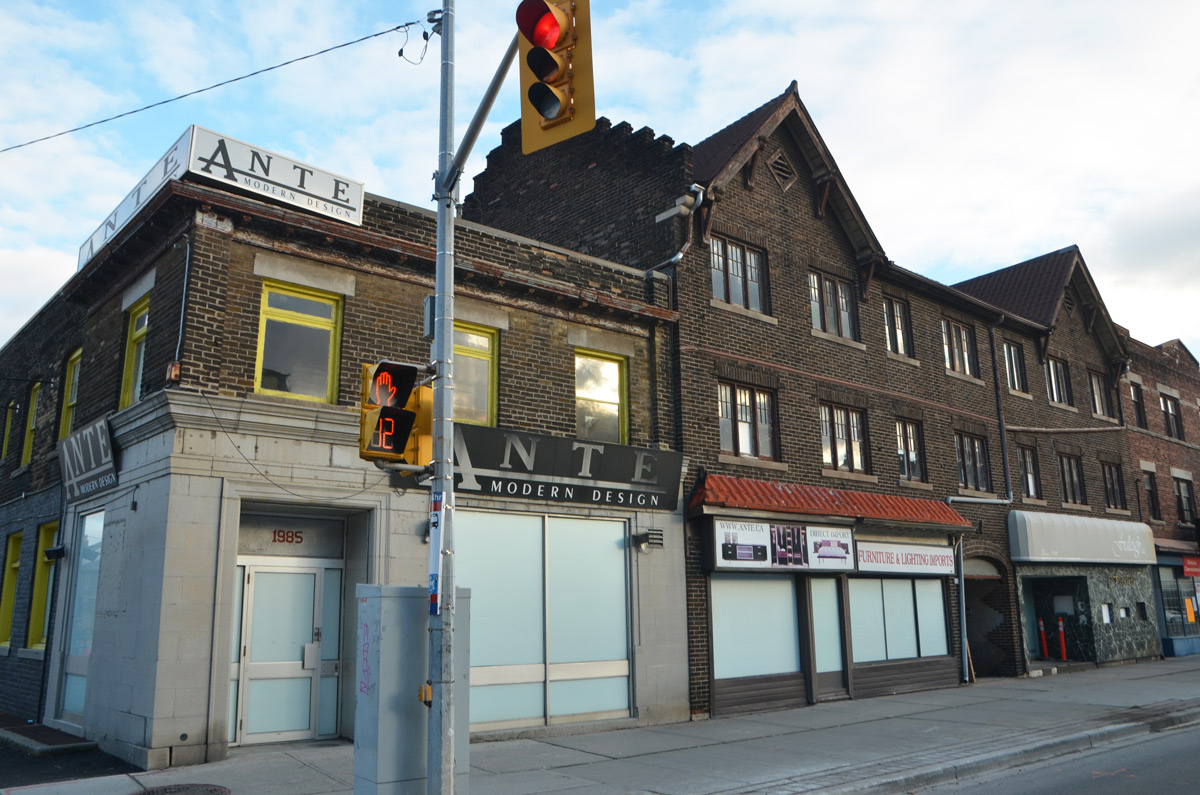
This is the story of one building at one intersection, Yonge and Belsize (just south of Eglinton) but it’s also a story that is being repeated over and over again in the city.  The story of demolition and rebuilding.  The story of loss of the older wood and brick structures as they are replaced by glass and steel.

By December 2016 all of the businesses had closed down.

row of two storey store fronts, old brick building, that is now empty and about to be demolished, on Yonge Street

Mars advert on Belsize convenience store, old brick building with large windows and blue window frame, snow banks on sidewalk, now empty

signs in the window of a store that has just closed down. one is a permit to demolish the building and the other is a hand written sign on orange paper that is a thank you note from the managers of the store to the public

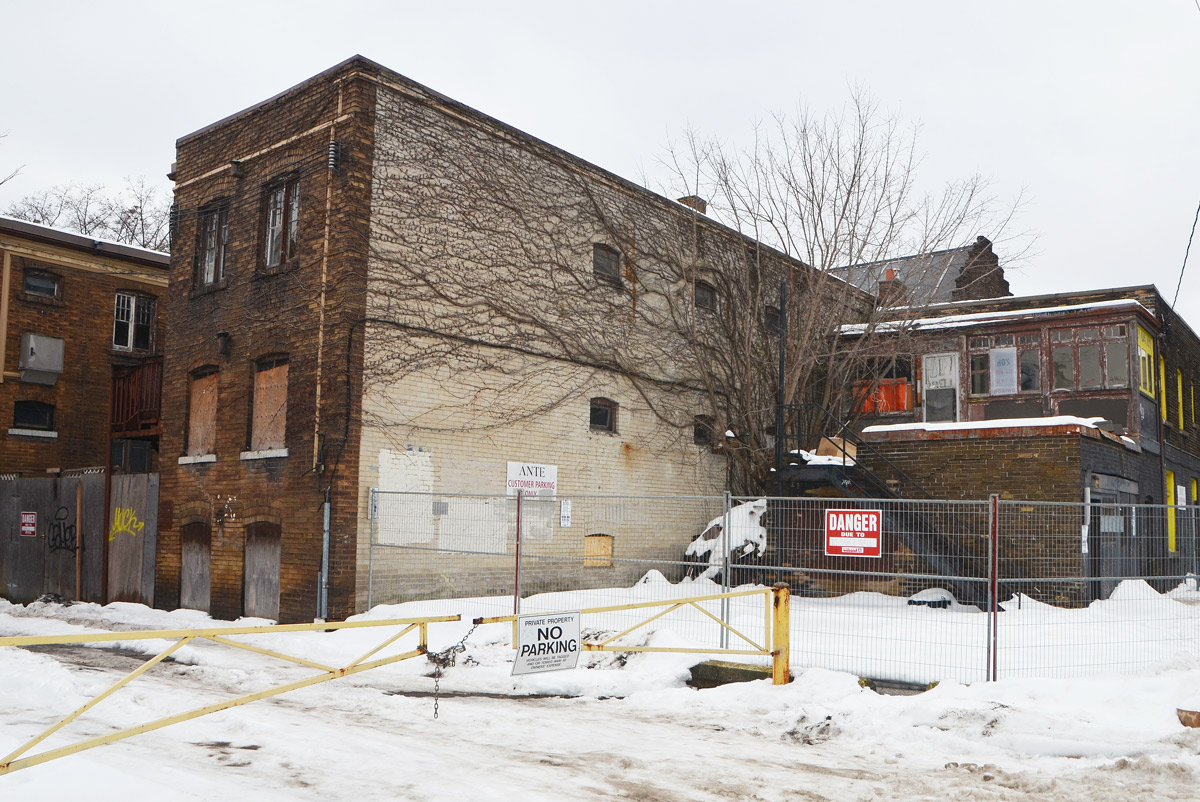
below: The back of the building

back of a brick building, winter time, with snow on the ground, construction fence around it, windows boarded up

Just over a year later demolition began in earnest.

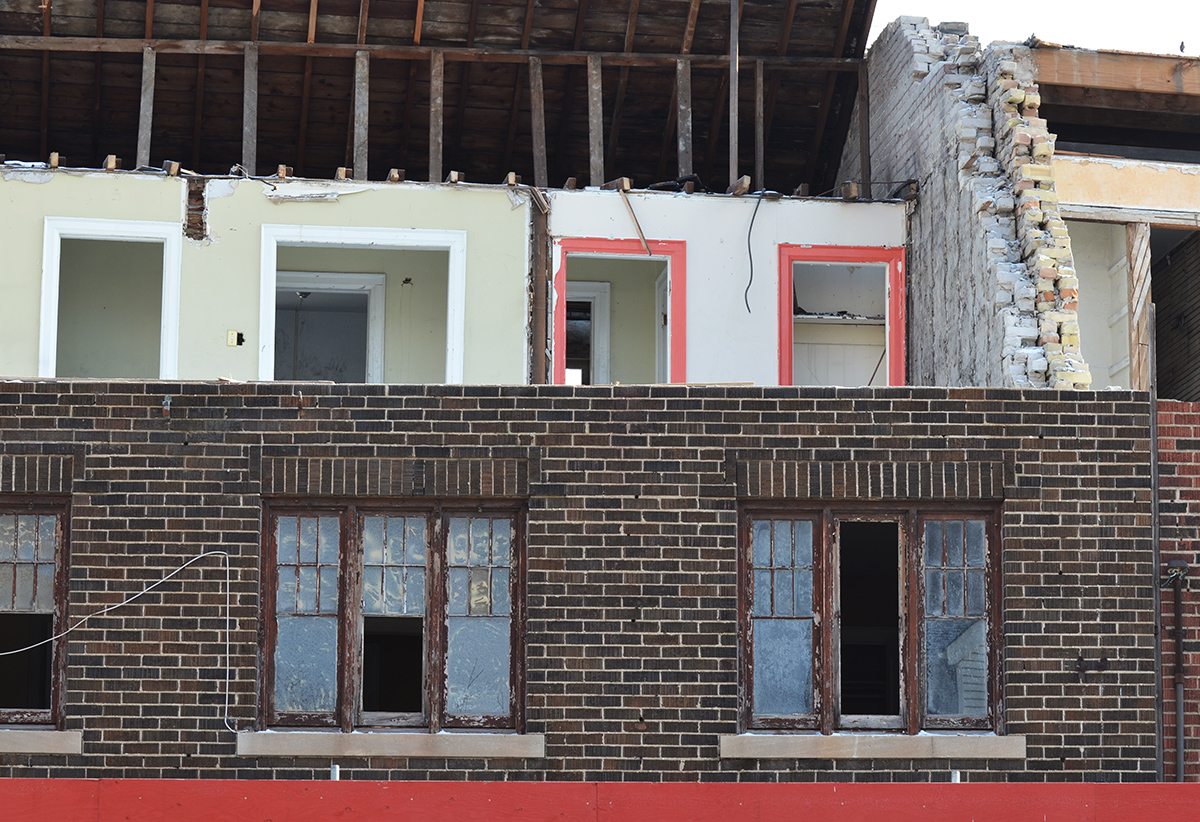
back upper storey of building being torn down, exposing office furniture that was abandoned

interiorwallson upper storey are exposedin building being demolished

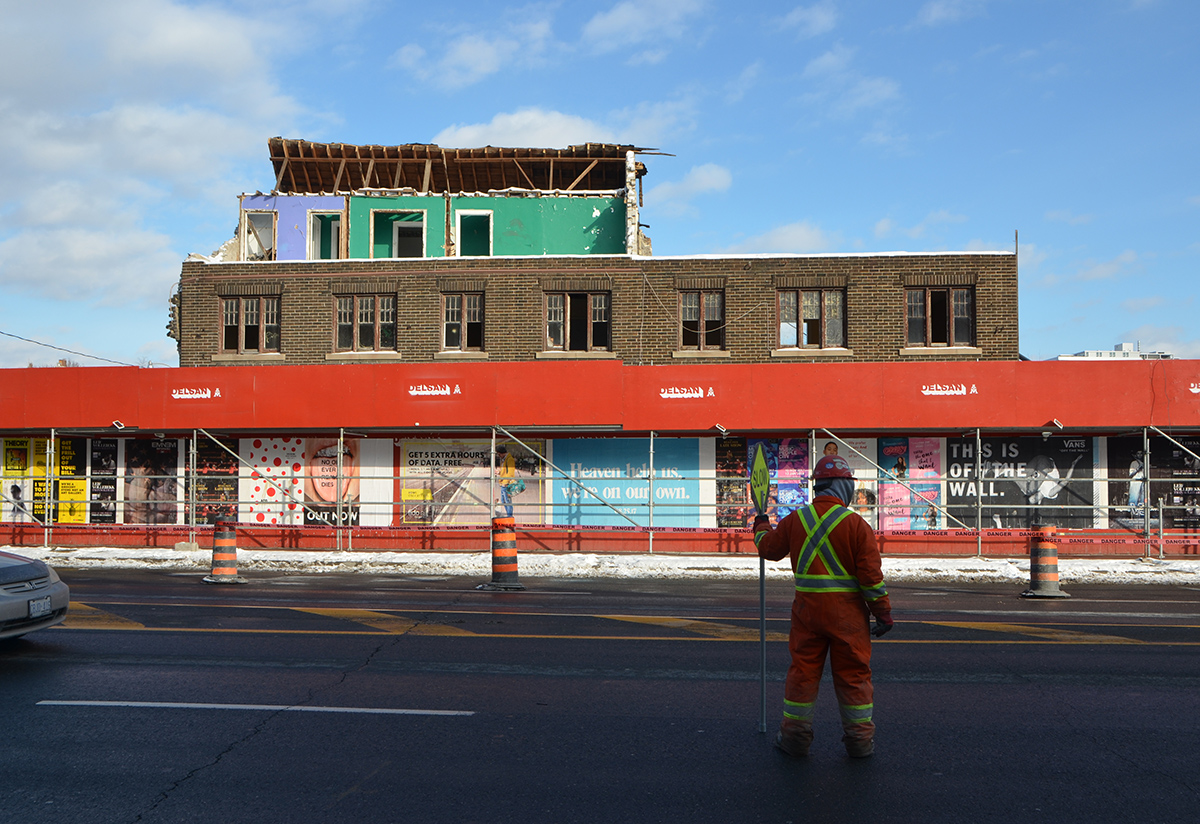
a construction worker in heavy winter orange clothes and yellow helmet, holds a stop sign to stop the traffic on Yonge street in front of a building being demolished

workmen standing around beside a front end loader that is being used to tear down an old brick building

exterior of building being demolished, black door uperlevel with drop below

old metal water pipes exposed on green and blue interior wall when building being demolished

red plastic danger tape blows in the wind. one end is tied to a blue fence and one strand is also tied to a building being demolished

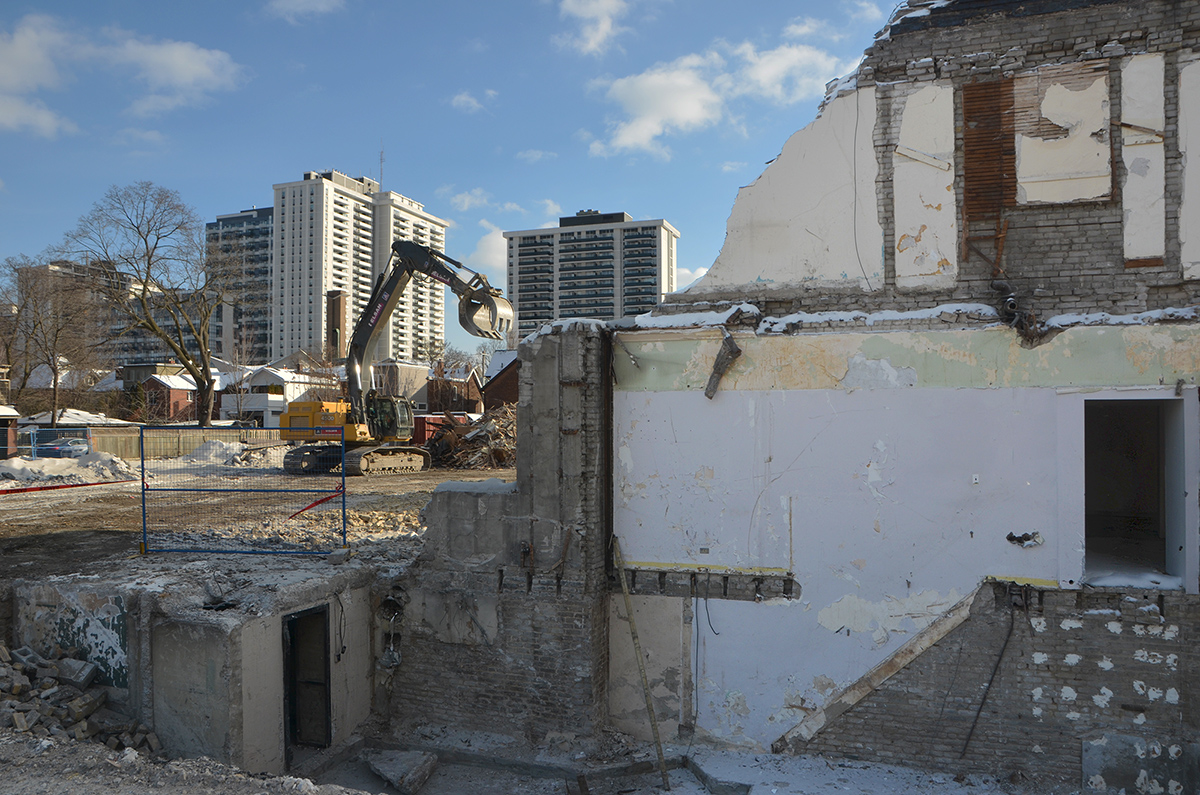
remains of an old building being torn down in the foreground, a front end loader in the middle, and apartment buildings in the background.

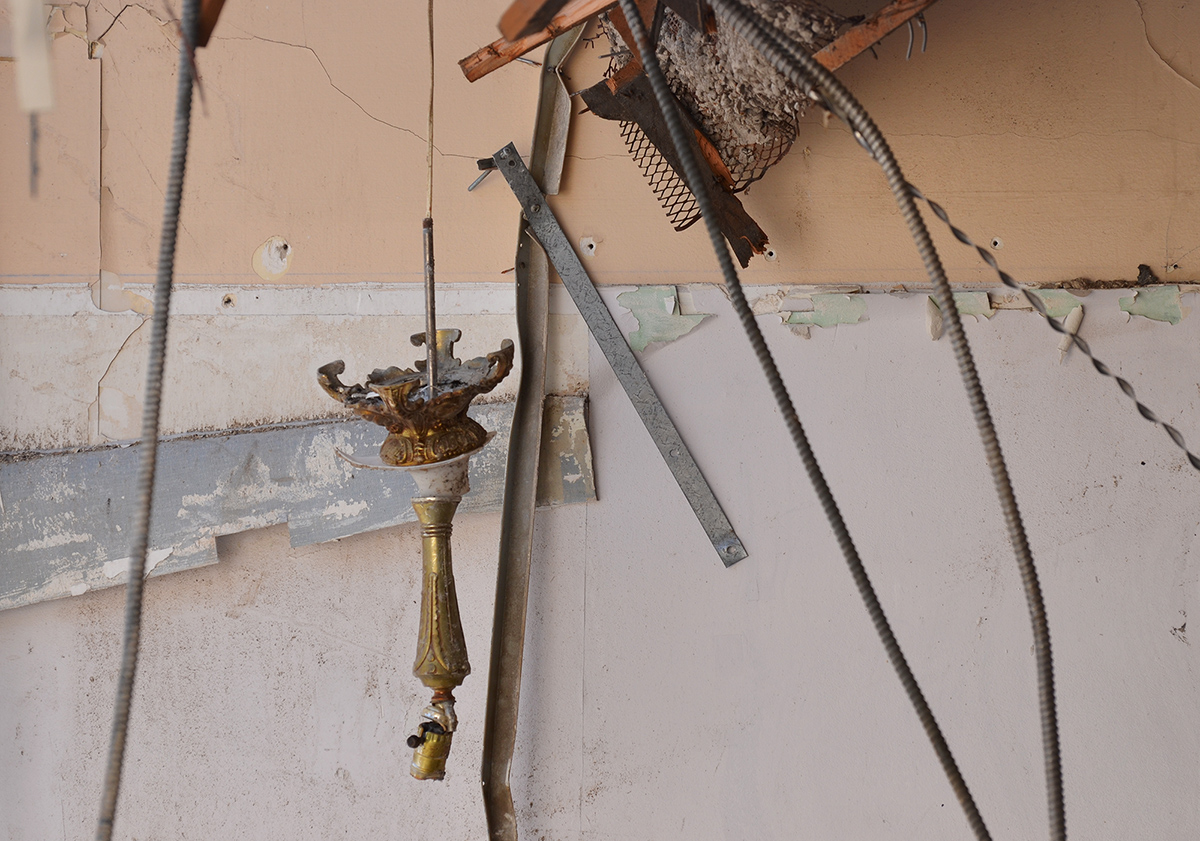
on old metal chair frame sitsin a room with a lot of wood debris around it

Saturday, December 17th 2017
The day six new TTC subway stations opened.

So, of course, off we went on a subway adventure….  An exploration of the TYSSE, or in other words, the Toronto York Spadina Subway Extension.   I have presented the stations in order that I visited them, from north to south – Vaughan, Highway 407, Pioneer Village, York University, Finch West, and Donwsview Park.  It’s not every day that new subway stations come along… and these have been a long time coming!


below:  The northernmost station on Line 1 is now Vaughan Metropolitan Centre.

map of line 1 of the TOronto subway system, with red "you are here" arrow at the top left hand side, for Vaughan subway station.

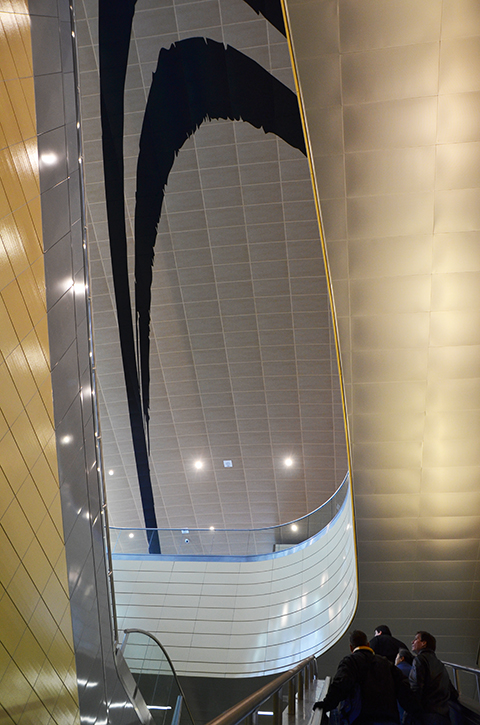
below: ‘Atmospheric Lens’ by Paul Raff Studio is the artwork that is incorporated into the roof of the station.  It features skylights and reflective panels.  The yellow is reflections from a glowing disk mounted on top of the elevator shaft – you can’t actually see the disk, just its reflection.

reflective ceiling of Vaughan subway station, with people going up the escalator towards it, taking pictures.

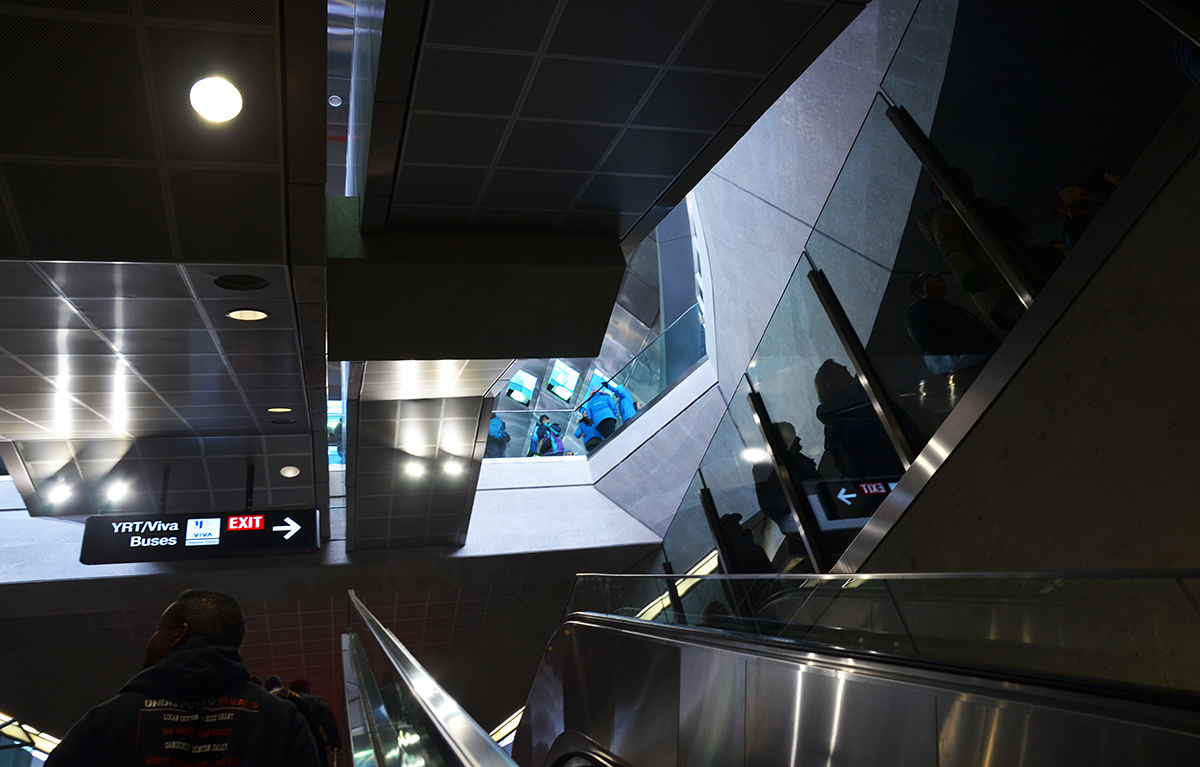
escalators and shiny walls of Vaughan subway station

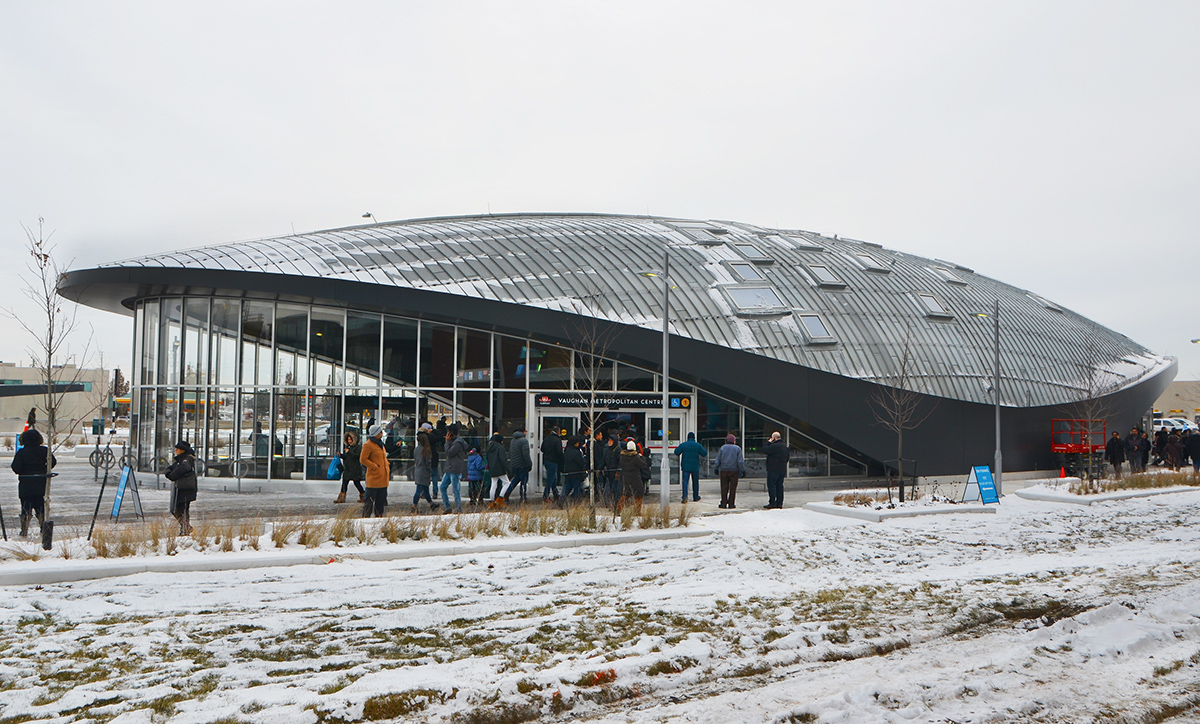
below: Vaughan Metropolitan Centre station, from the outside

exterior view of the dome like Vaughan TTC subway station, some snow on the ground, some people standing around outside the doors.

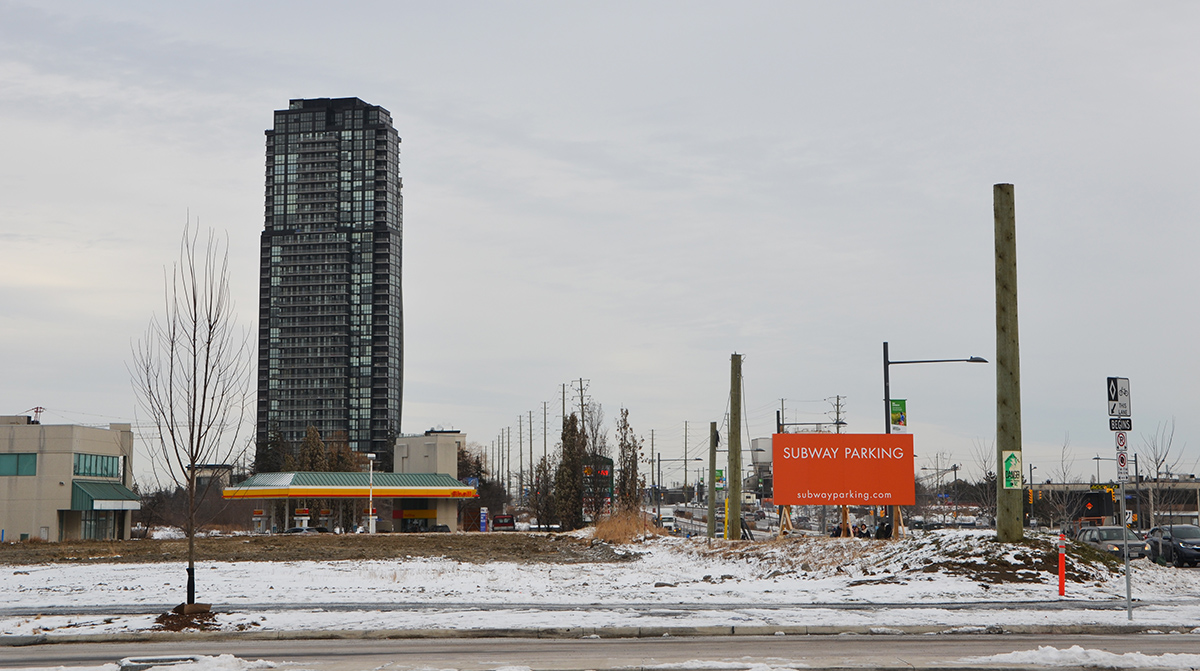
The rest of the ‘metropolitan centre’ needs a bit of work… as does the parking that this orange sign mentions.   I was surprised at how undeveloped that this part of Vaughan is.  This is the view to the east of the station.  On the west there is a development of “big box” stores some of which have just been built.  Smart Vaughan – get the subway and then build around it rather than disrupt an already built city with years of construction and the consequent traffic problems (i.e. building the Eglinton Crosstown link)

suburbia - empty field with orange sign that says Subway parking. one tall building, a gas station, a street,

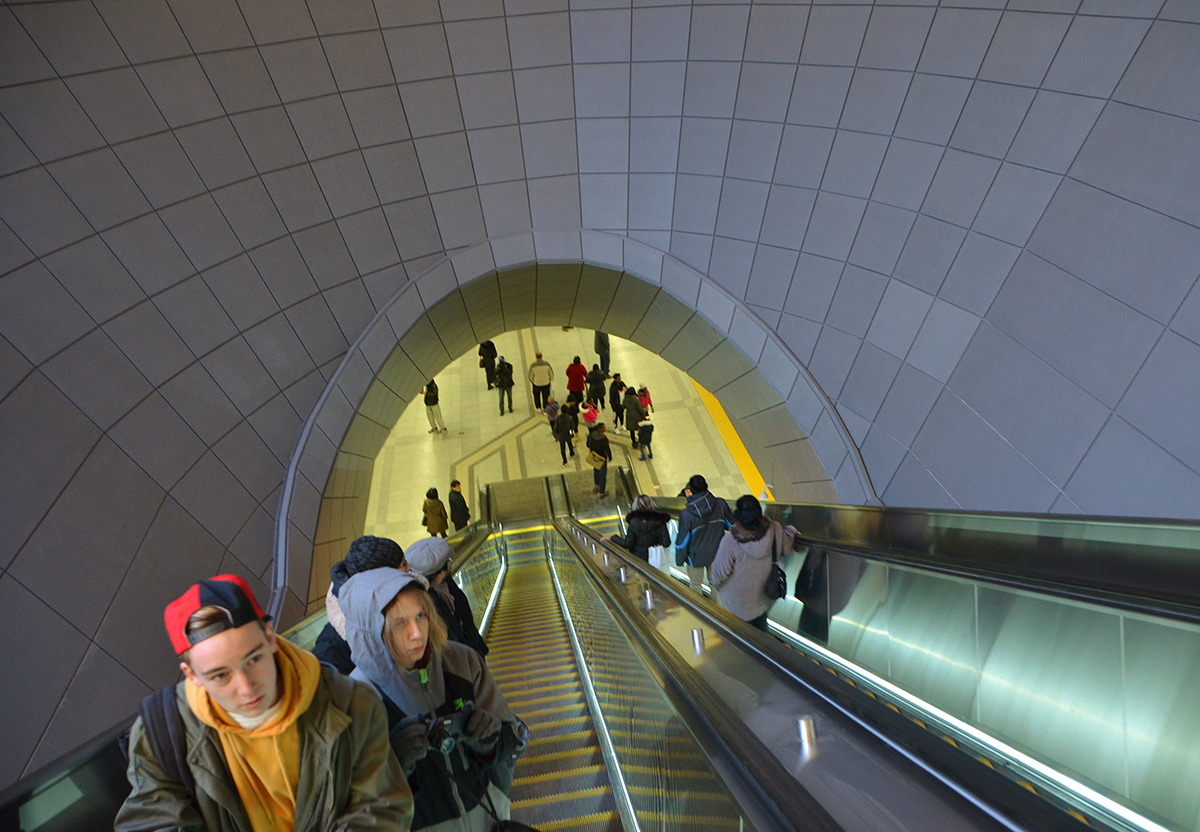
All six stations are quite deep and all six require two escalator rides to get to street level (or you can climb a lot of stairs!… stairs are not always an option though).  There are plenty of elevators.

people on a very long escalator at one of the new TTC subway stations in Toronto

below:  The walls are concrete beside the subway tracks.  Each station has its name on the wall similar to this at Highway 407 station (just south of the 407 at Jane Street).

concrete wall of the subway, with words highway 407 on the wall, at the new Highway 407 subway station TTC

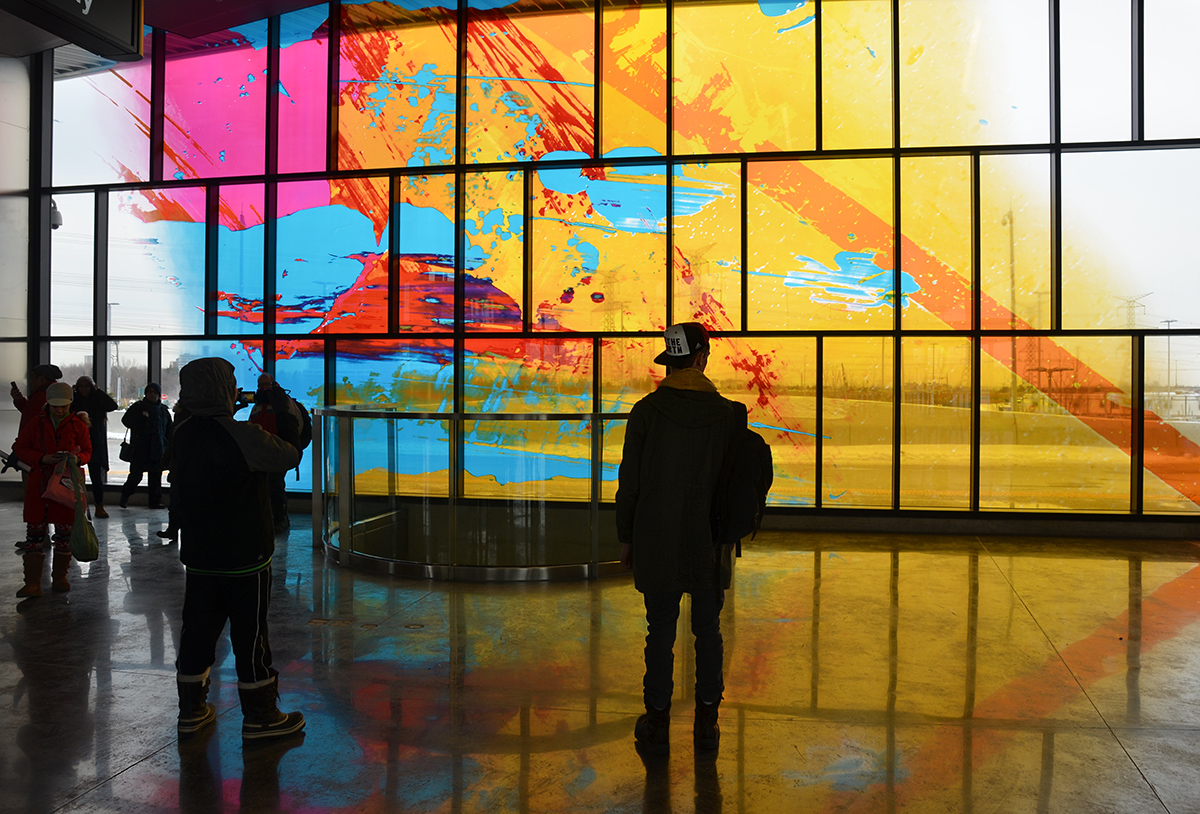
below: A large coloured glass window dominates the area at the top of the escalators (by the bus station) at Highway 407.   This artwork is by David Pearl and is one of two pieces that he did for this station.

people standing and looking at a large painted window, abstract in yellows, turquoise andpink, large window, at subway station, sunlight outside

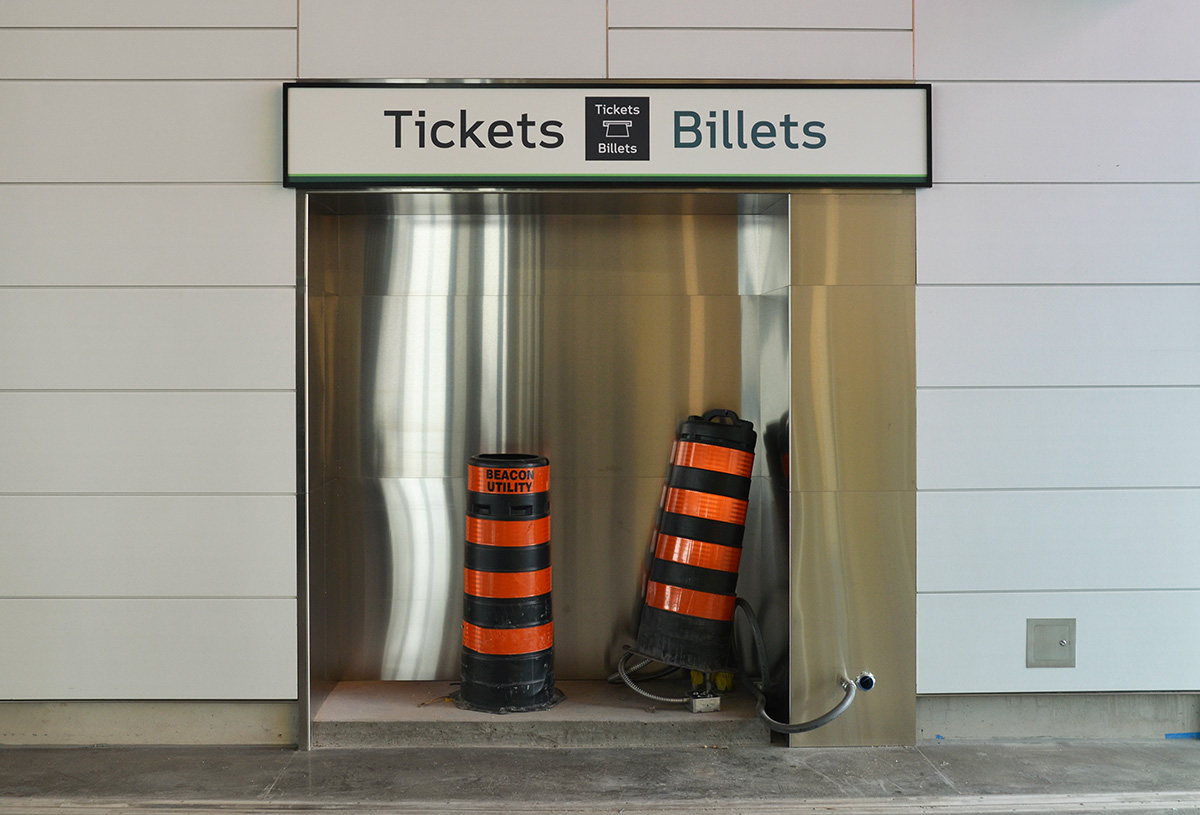
below: Highway 407 has a large GO Transit bus terminal as well.  There is still some work to be done on that part!  The worrisome part of all this is that the two stations at the end of the line are transportation hubs designed to help those commuting into Toronto.  Yes, they funnel even more people into an already overcrowded subway.  Note to the city of Vaughan – please use this as an opportunity to increase the reasons why people would commute north!

unfinished part of the subway station, indent in wall with sign tickets billets but the niche is empty except for two large black and orange striped construction cones

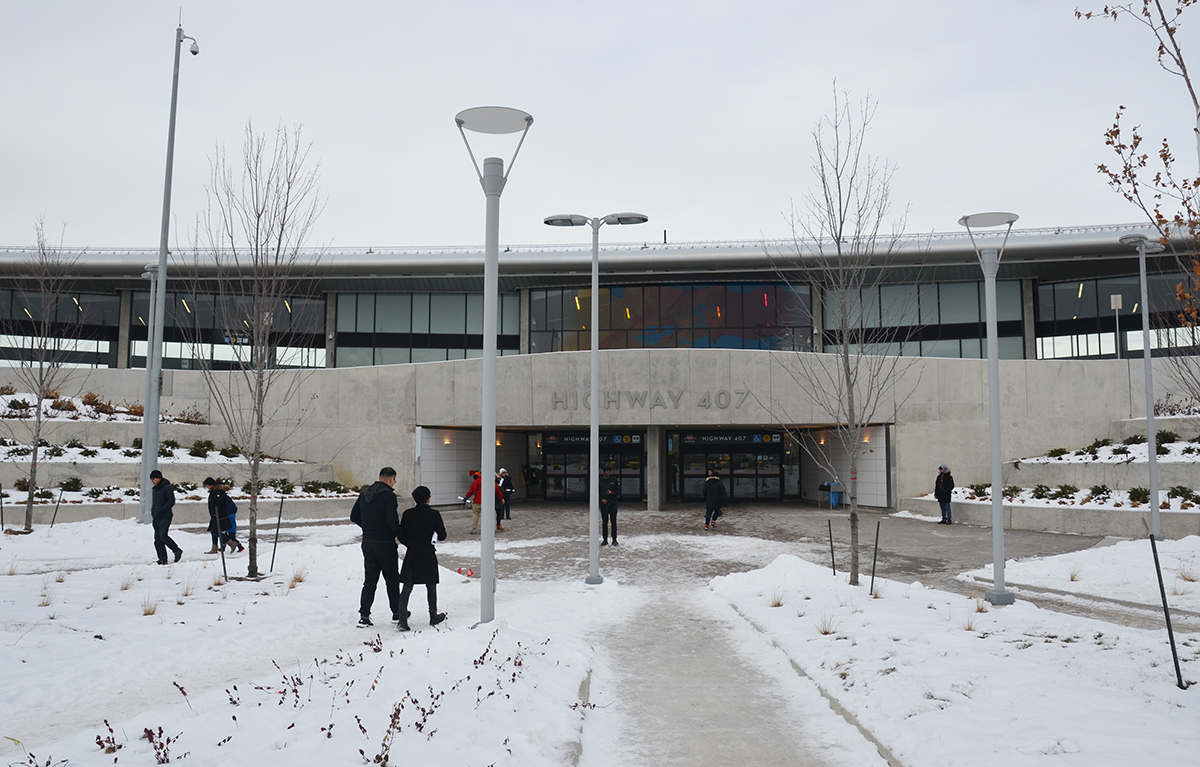
below:  One of the entrances to Highway 407 – the center window is the same as the coloured window above (it looks much better from inside!).  On either side are GO Transit bus terminals.  Behind me when I took the photo is a large parking lot for about 600 cars.   Functional but not necessarily pretty – it may look better from other angles but it was a cold day and it seemed like a long walk to get to the other sides).

people walking towards the entrance to HUghway 407 TYSSE station, a low concrete and glass building.

below: The new bus loop at Pioneer Village Station.  There are actually 2 bus terminals here – one for the TTC and one for YRT buses.   This station is on Steeles between Jane and Keele.   Originally this station was going to be called Steeles West – mercifully the TTC actually showed some creativity and came up with a better name.  All the ‘West’ stations drive me crazy.

exterior at new Pioneer Village TTC subway station at Steeles Ave., new bus loops with wood overhangs, still under construction

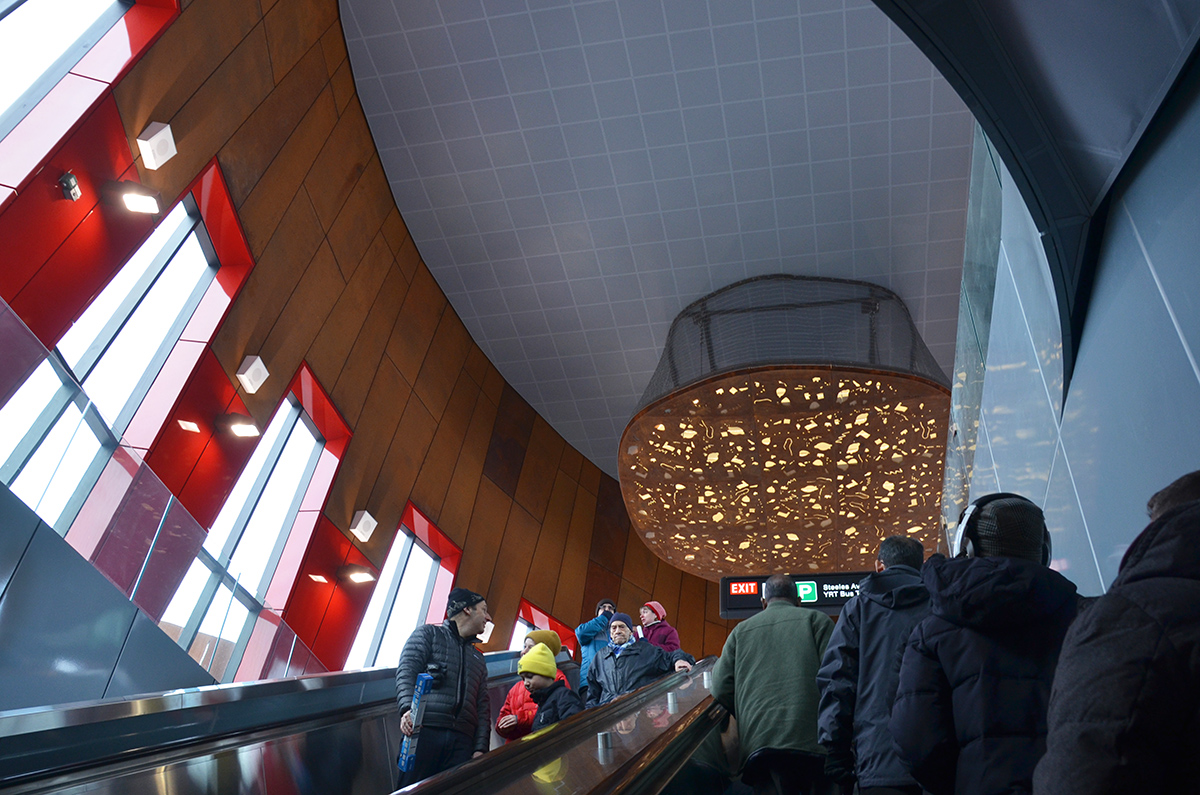
below: Coming up the escalator in the Pioneer Village station towards the large light in the ceiling.   The dominant features of the station are the large vertical windows and the red and wood cladding.   The red and wood are continued to the exterior as well.

interior of Pioneer Village subway station, top of one of the escalators, vertical windows looking outside, some red glass as accents, a large light artwork on the ceiling, people on the escalators

below:  Close up of part of the exterior.

abstract of the exterior walls of Pioneer Village subway station, red panels with wood roof and grey steel beams

below: Looking up into one of the skylights

abstract geometrics, triabngles and diamonds, reflective surfaces in a cone shaped skylight, in blacks and blues,

below: The main artwork at Pioneer Village station is “LightSpell” by German artists Tim and Jan Edler.   It’s an interactive installation that also helps provide light in the station.  This photo shows some of the 40 elements that make up the installation. By lighting certain sections of each element, letters of the alphabet can be formed, and in turn, words can be written.   Numbers and other special characters can also be lit.  In addition, the intensity of the light can be automatically controlled to maintain a constant light level in the station.   There are also a lot of speakers on black poles in this area but that is a mystery for another day.

art installation, LightSpell by Jan andTim Edler hangs over th escalator at Pioneer Village TTC subway station,

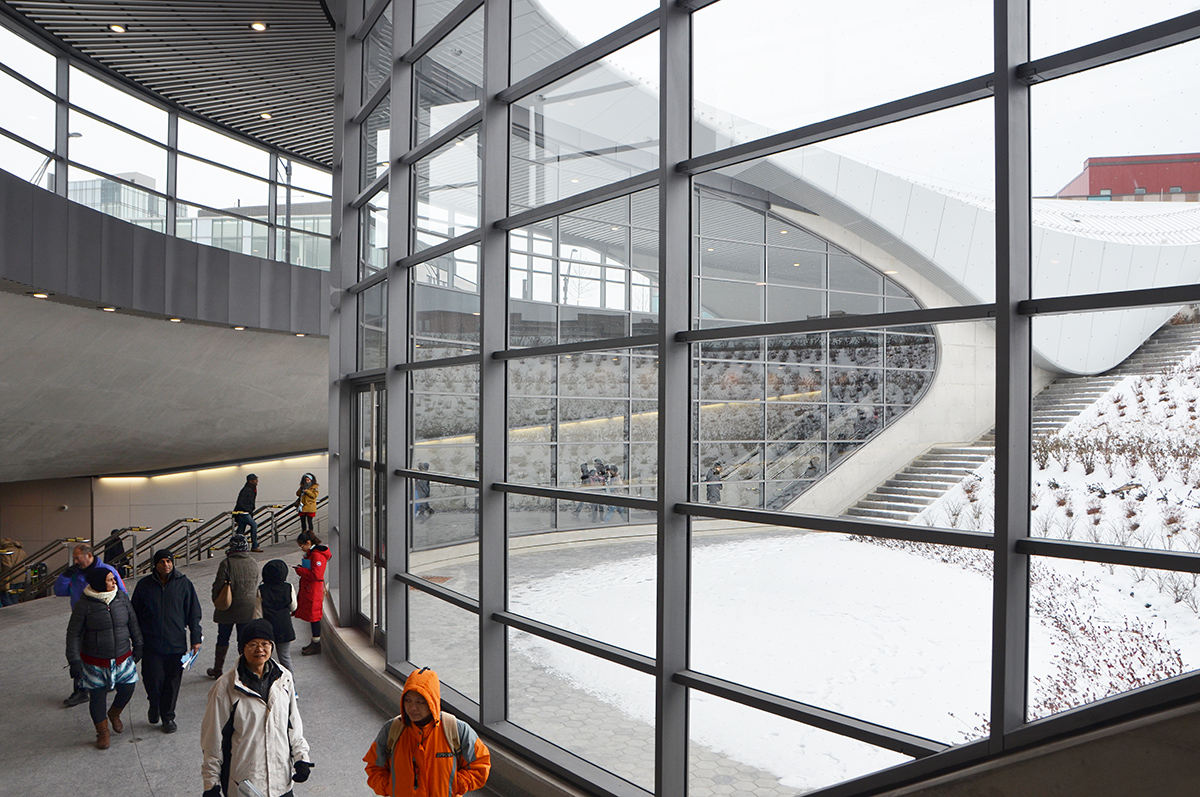
below: Inside York University station which is right on campus.  The stairs and escalators to the trains are in the center.  On both ends of the curved structure are the exits.

large round high window of concourse level of new York University subway station, snow on the ground outside, people inside

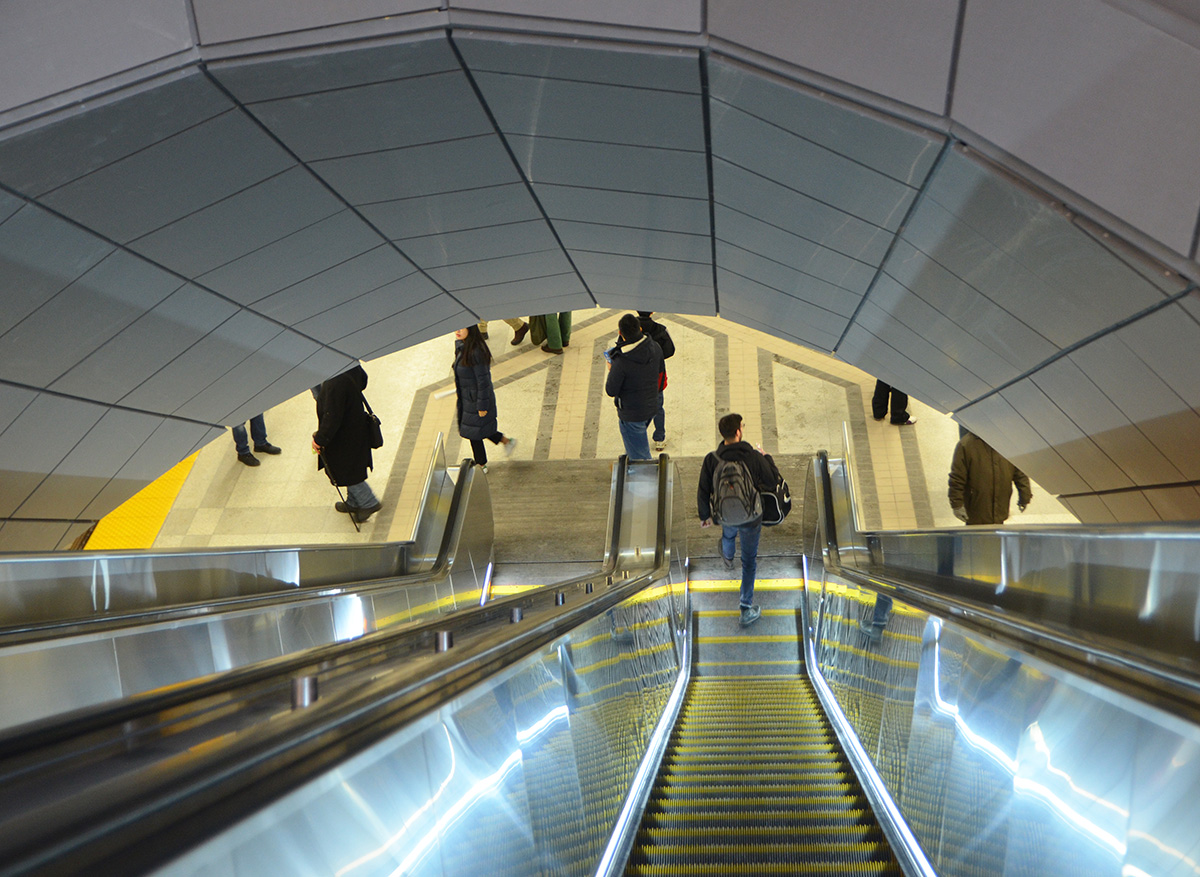
looking down the escalator at York University station,

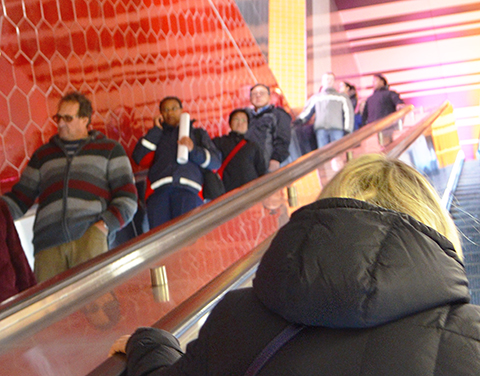
below: At Finch West station there are bright and shiny red hexagonal tiles on many of the interior walls.  (Argh, there’s that ‘west’ again)

shiny red hexagonal shaped tiles line the wall beside an escalator at the new York University subway station on TTC line 1

below: As you go up to street level, you are greeted by a flood of coloured light.

people on an escalator, red hexagonal tiles on the wall beside them, lots of streaks of pink and yellow light above them at the top of the escalator, Finch West subway station TTC, toronto

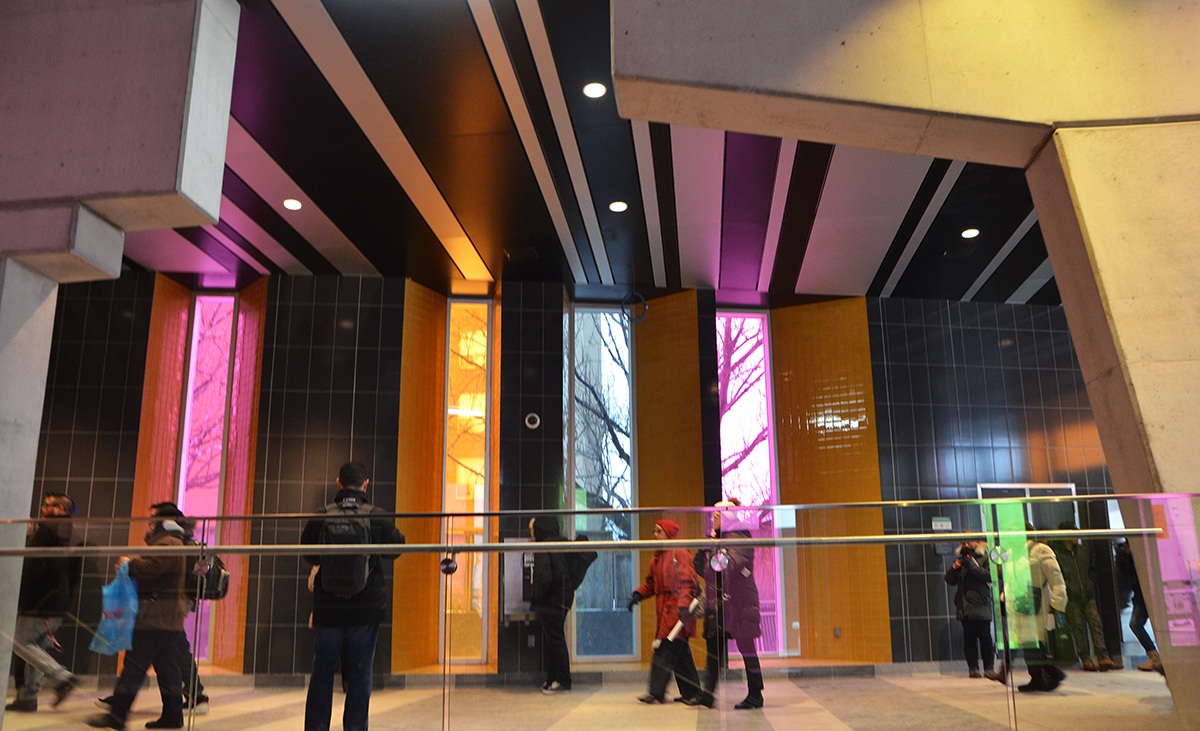
below: The light comes from tall sunlit windows of different colours.  Stripes of grey and white tile on the floor and ceiling add to the slightly surreal effect.

people passing through Finch West station with its tall vertical windows covered in colours, pink, blue and yellow, also with its stripes of white and dark grey tiles
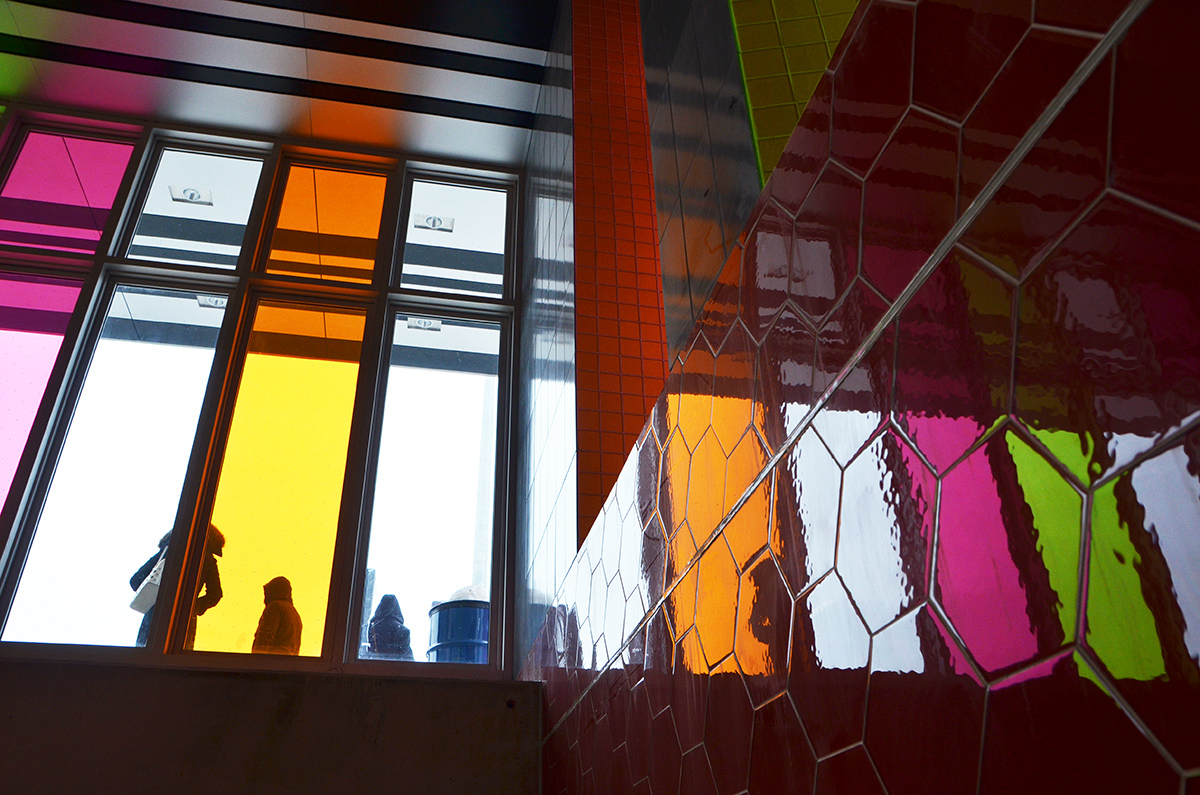
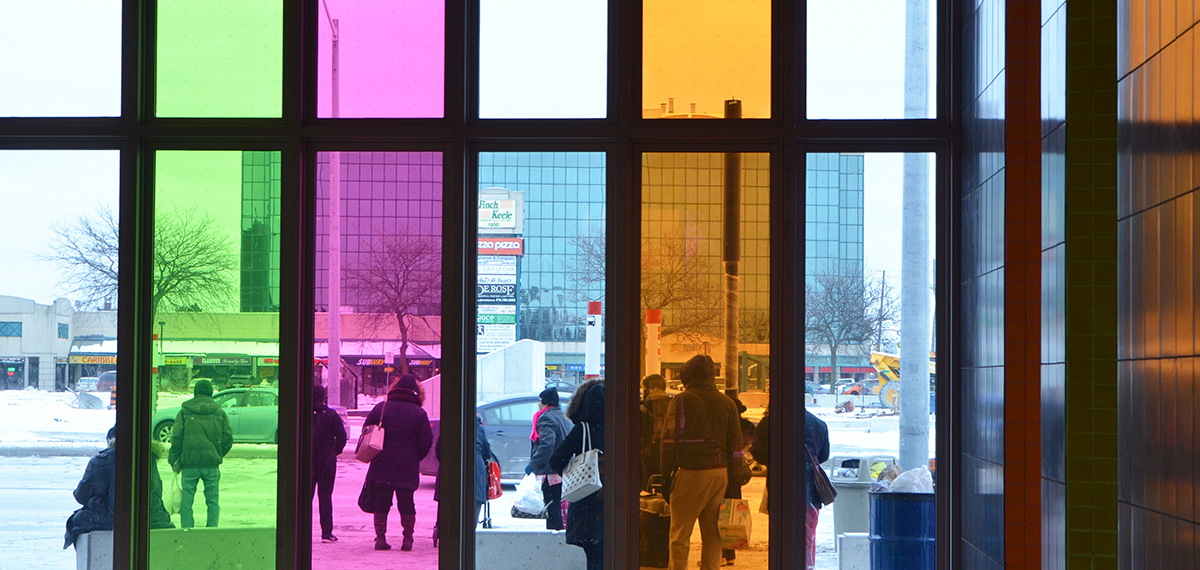
Expect to see many photos taken at this station in the future!  The light and colour makes for some interesting effects.

coloured glass at Finch West station

coloured glass at Finch West station

man standing in front of coloured glass at Finch West station

… and I have probably gotten carried away.  There’s still one more new station so let’s take a look at it – Downsview Park.

below: Looking up…

looking up over the heads of some people going up the escalator at Downsview Park subway station

below: … and looking waaaay down at Downsview Park station.

looking down two levels of the new Downsview Park subway station, long escalator and flight of stairs

below: Eventually (soon?) GO trains between Union Station and Barrie will connect with the subway here.   The subway actually runs under the GO railway tracks here.  The street level of Downsview Park station is two halves, one on each side of the GO tracks.


looking out a set of glass doors that is locked closed with a danger sign on the door.   Future GO transit exit at Donwsview Park TTC subway

below: I am going to end with this.  Part observation and part editorializing –  a sign seemingly in the middle of nowhere.  I look at this and think of old pictures I have seen of the Yonge line when it was first built.  It serviced parts of Toronto like Davisville and Summerhill that were of fairly low density but the city and/or province had the foresight to build that far north anyhow.  If you read the TTC websites about these new stations, there is a lot of talk about planning for future development and making that future development transit friendly.  A great idea.  Now, let’s apply that thinking to Scarborough…. and what do you get?  A lot of naysayers with arguments about density.  Grumble grumble oh how poor we are.   And don’t even get me started on Mike Harris and how he cancelled the Eglinton line in 1995.  Twenty two years later we’re building it at extra cost and with extra traffic disruption.  Sigh.

GO Transit and TTC subway sign in the middle of snow covered field

Traces left behind, reminders of the past

oldworn sign painted above the door to a store


Along Spadina on a cold November day – from King to College.

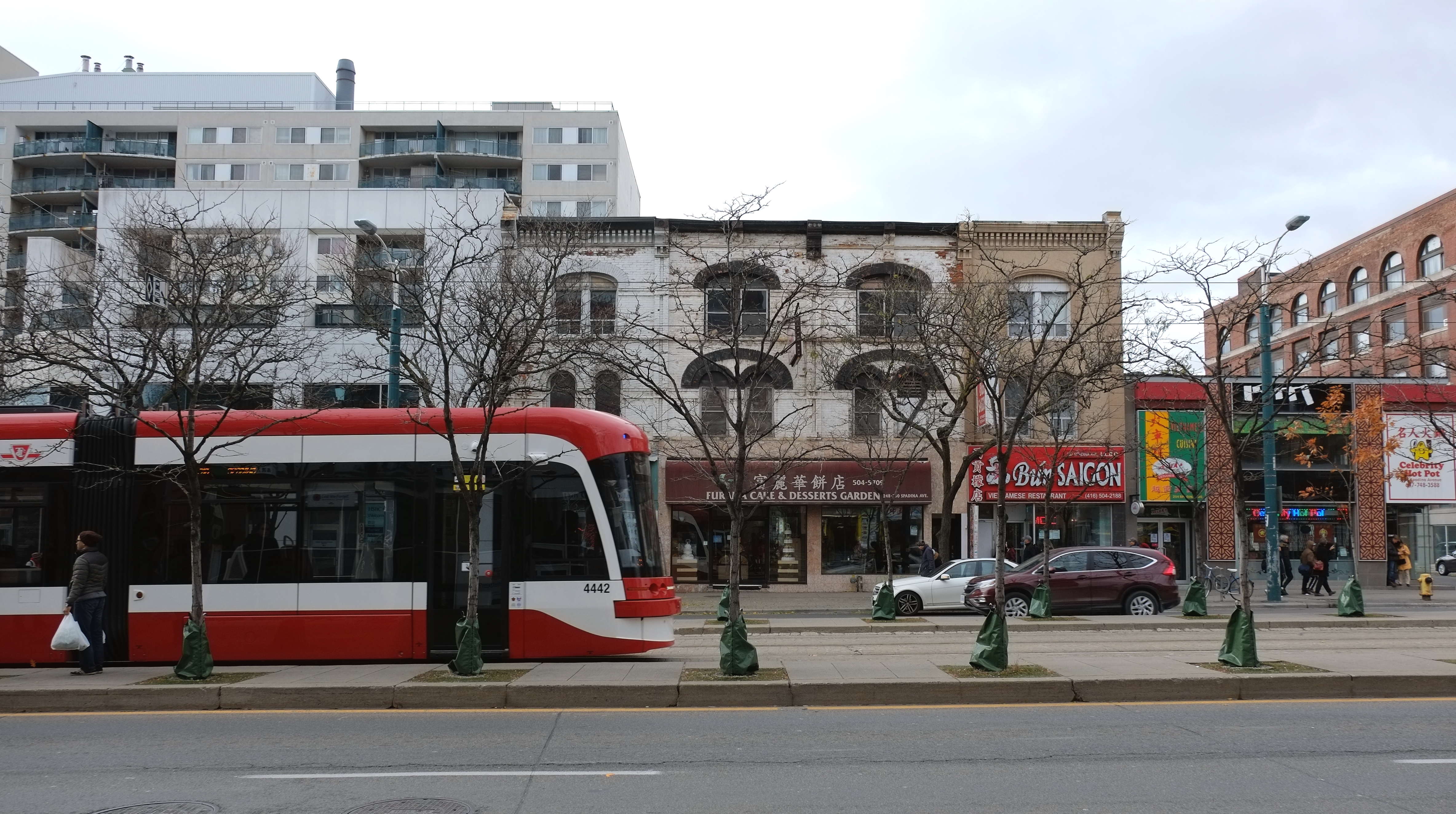
below: A streetcar passes by, down the middle of the road with young trees growing alongside the tracks.  In the background is an old white brick building  with rounded brown arches over the upper windows that now houses the Furama Cake & Dessert Garden – one of the many restaurants, coffee shops and bakeries along this stretch of Spadina.
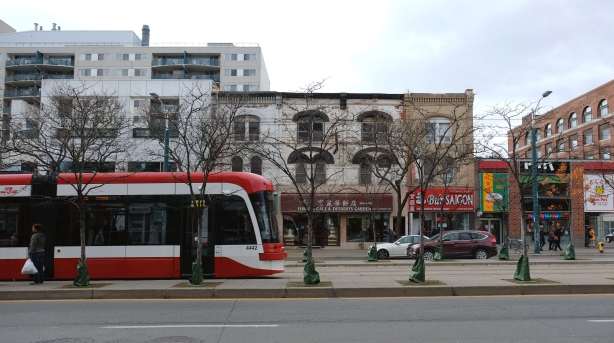
a new ttc streetcar on Spadina, down the middle of the street, with young trees growing along side the tracks, old brck building in the background, some cars,

 Construction of Spadina Avenue began in 1815.  It was always a wide street, running between Bloor and Queen.

Spadina, and neighbouring Kensington market, was the center of Jewish life in Toronto in the early 1900’s with synagogues, delis, tailors, a Yiddish theatre, and more.  About 80% of Toronto’s Jews lived in the area.   It was also home to the garment district (also known as the fashion district) with its numerous furriers, clothing factories and warehouses – what we’d probably call sweat shops today.

below: The northeast corner of Dundas and Spadina, June 1930 showing the sign over the door of ‘The Standard’ a Yiddish theatre that opened in 1921.  It was converted into a (mainstream) cinema in 1934 and renamed ‘The Strand’.   Another renaming occurred in 1941 when it became ‘The Victory’.  Twenty years later it became the Victory Burlesque.  The doors closed permanently in 1975.  Photo found on Bygone Theatre website.
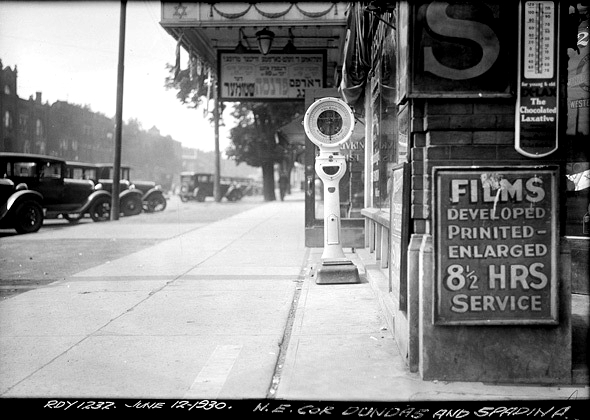
vintage black and white phot of the sidewalk and front of Jewish cinema at the corner of Dundas and Spadina in 1930. old cars parked in front,

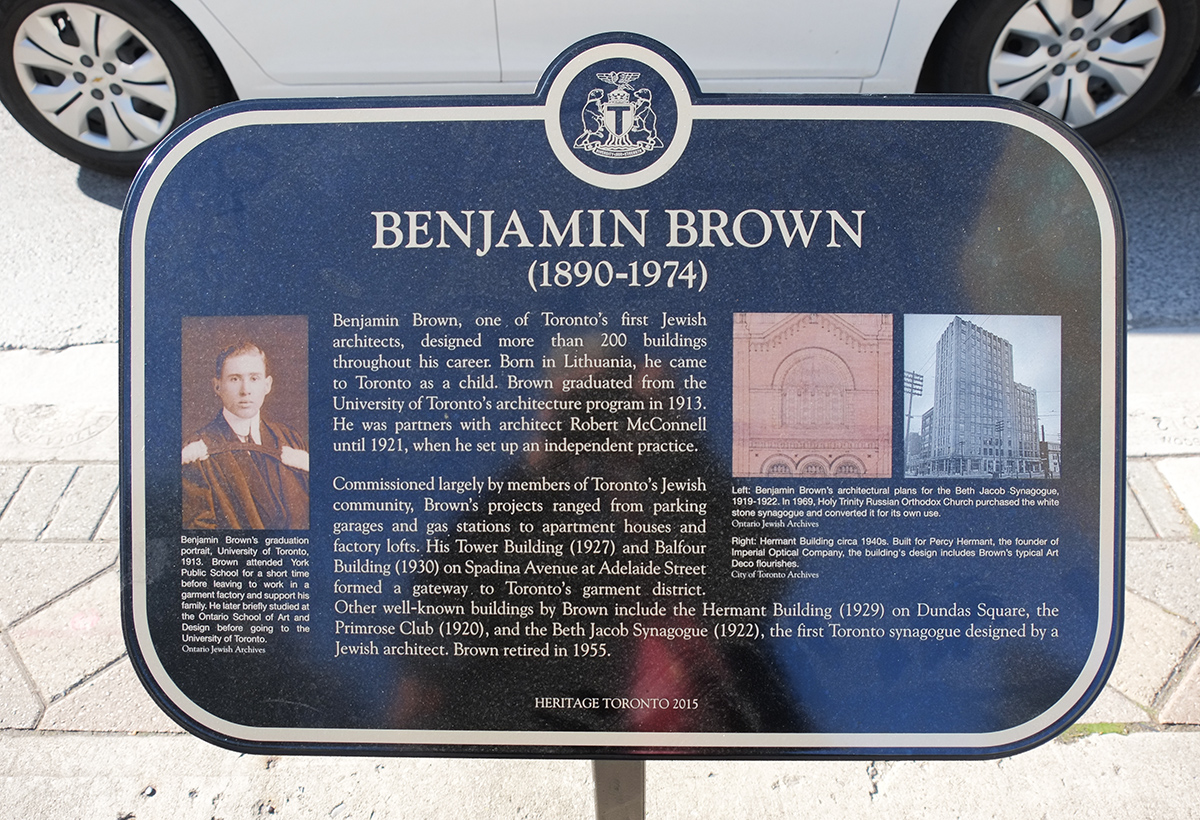
below: This plaque is on the west side of Spadina, just north of King Street.  It describes the contributions of Benjamin Brown (1890-1974), architect, to the area.

Benjamin Brown, one of Toronto’s first Jewish architects, designed more than 200 buildings throughout his career.  Born in Lithuania, he came to Canada as a child.  Brown graduated from the University of Toronto’s architecture program in 1913.  He was partners with architect Robert McConnell until 1921, when he set up an independent practice.

Commissioned largely by members of Toronto’s Jewish community, Brown’s projects ranged from parking garages and gas stations to apartment houses and factory lofts.   His Tower Building (1927) and Balfour Building (1930) on Spadina Avenue at Adelaide Street formed a gateway to Toronto’s garment district.  Other well known buildings by Brown include the Hermant Building (1929 on Dundas Square, the Primrose Club (1920) and the Beth Jacob Synagogue (1922), the first Toronto synagogue designed by a Jewish architect.  Brown retired in 1955.

toronto historic sites plaque to benjamin brown

Both the Tower Building and the Balfour Building still stand.  The later, pictured on the plaque is on the NE corner of Spadina & Adelaide.  It was named for Arthur J. Balfour, British statesman, the author of the 1917 Balfour Declaration that pledged British support for a Jewish homeland in Palestine.

below:  This is ‘Uniform Measure/Stack’ by Stephen Cruise and it includes that giant thimble on a stack of buttons,  a few button shaped tree planters, and a tape measure carved into the sidewalk as it goes around the corner (you can see a bit of it at the bottom right of the photo).  This tribute to the garment district, or rag trade if you want to call it that,  dates back to 1997.   A few years ago the tape measure was painted yellow – but not by the artist.  It has since been cleaned up.  Recent sidewalk work has scarred the tape measure but most of it remains intact.

public art on the corner of Richmond and Spadina, giant thimble and giant buttons

below: Another piece of garment district history – an old Singer sewing machine as an ornament above a narrow alley between two buildings.
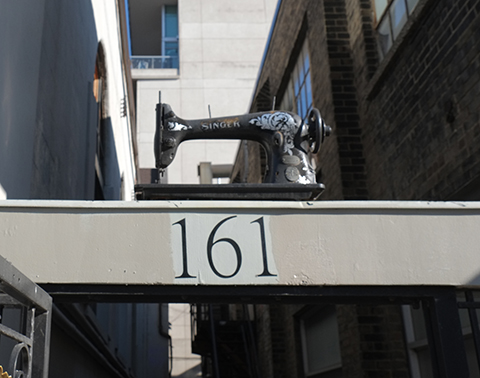
an old SInger sewing machine sits on a beam that crosses a small alley bewteen two buildings, it's about 8 feet above the street level

In the 1960s and 70s, the Jewish population moved out and the Chinese moved in.  In keeping with the changes that were occurring on Spadina, The Victory was sold in 1975 and subdivided  into shops on the main floor and a Chinese language cinema upstairs, first named the Golden Harvest and then the Mandarin. This cinema closed in 1994.

In the late 60s and early 70s, the city demolished a large section of land to make way for the new city hall.  At that time, Chinatown was centered around Dundas and Elizabeth streets.  Many of the Chinese who were displaced by the construction moved west along Dundas to Spadina.  Although many of the Chinese businesses and residents have moved north to Markham & vicinity, this stretch of Spadina is still considered to be Chinatown.

below: A panda eating bamboo, painted by Murals by Marg with support from Chinatown BIA & StreetARToronto.

mural on a wall of a panda bear sitting on the ground and chewing on bamboo

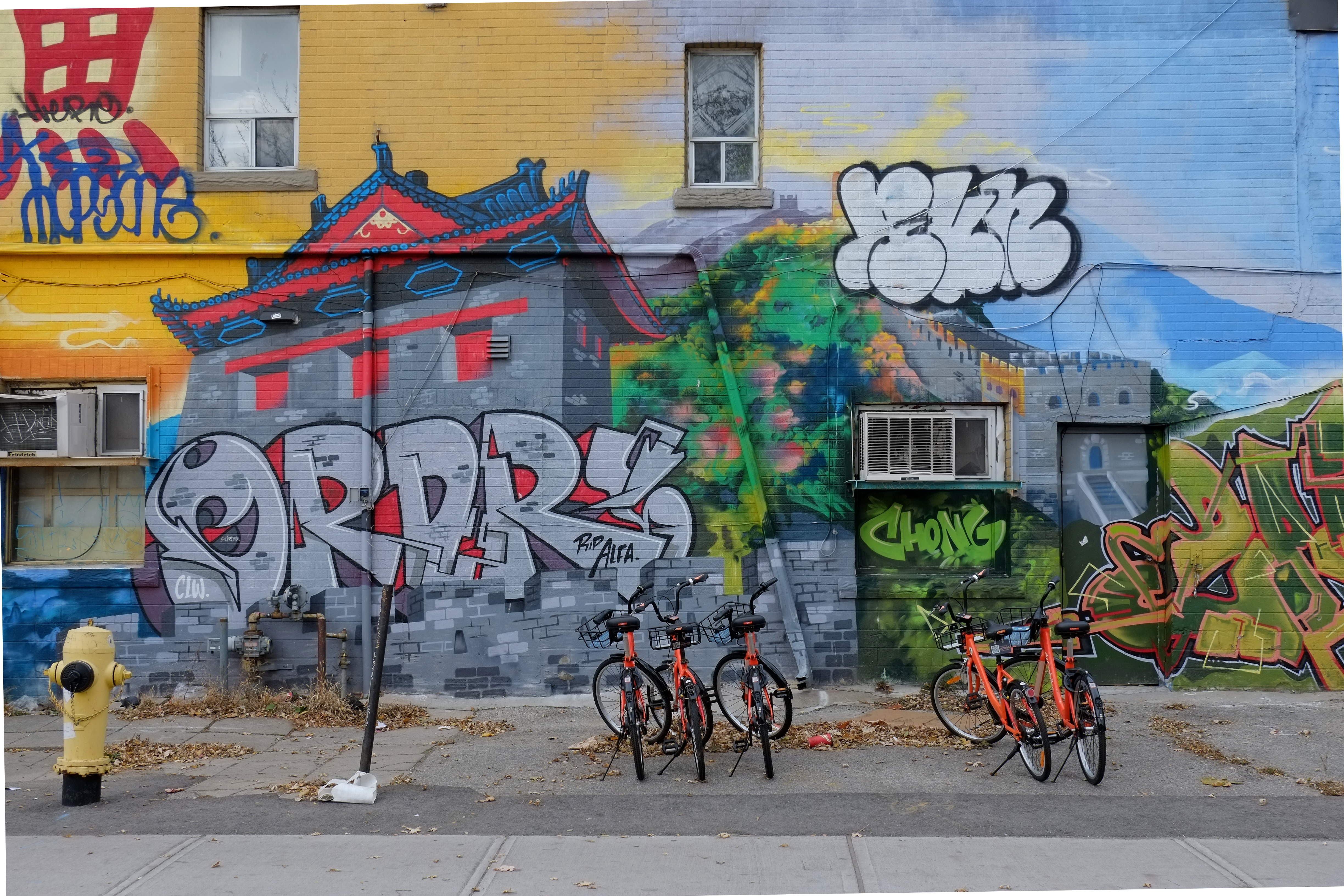
below: Another Chinese themed mural, with tags unfortunately.

orange bikes parked outside a building that had a mural of a Chinese scene that has been tagged over.

below: This caught my attention – Does it look like fresh ginger?   And no, there was nothing in front of the sign either.  Smile.
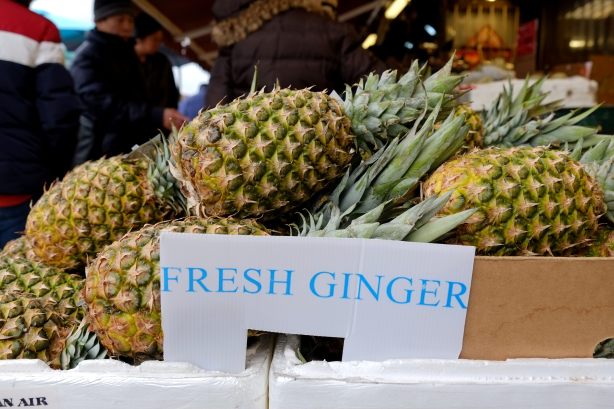
box of pineapples for sale outside a Chinese grocery store, the sign by the box says fresh ginger

below: Even on cold days you can buy fruits and vegetables on the sidewalk outside the Chinese grocery stores.
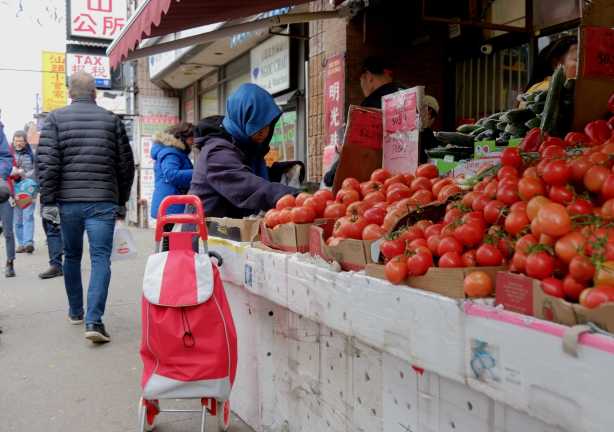
a woman is buying tomatos from a vendor with a large table of tomatoes outside a Chinese grocery store on Spadina, in CHinatown.

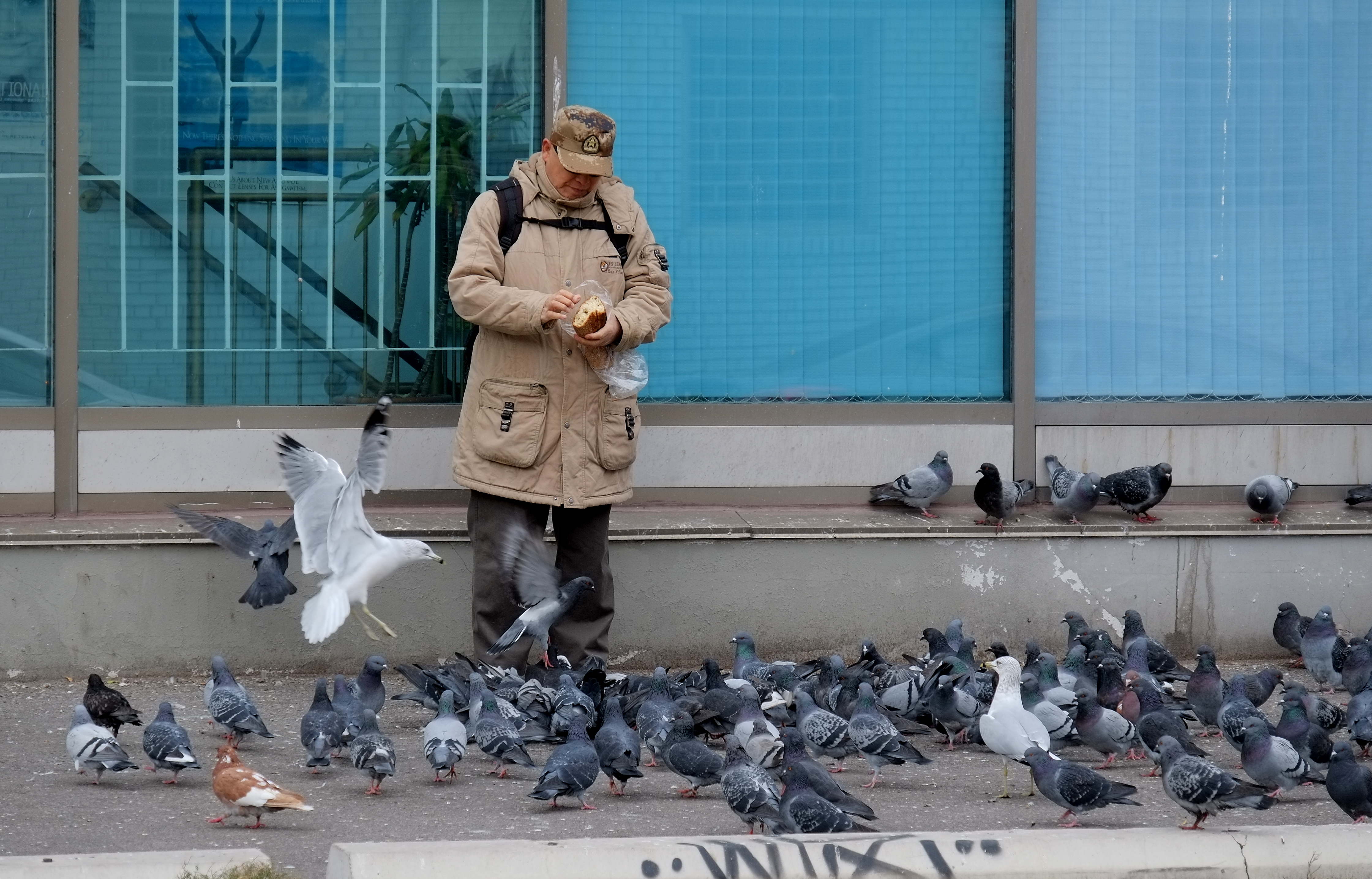
below: Feeding the pigeons.

a man is feeding pigeons outside on a cold day. He is wearing a heavy coat and a hat.

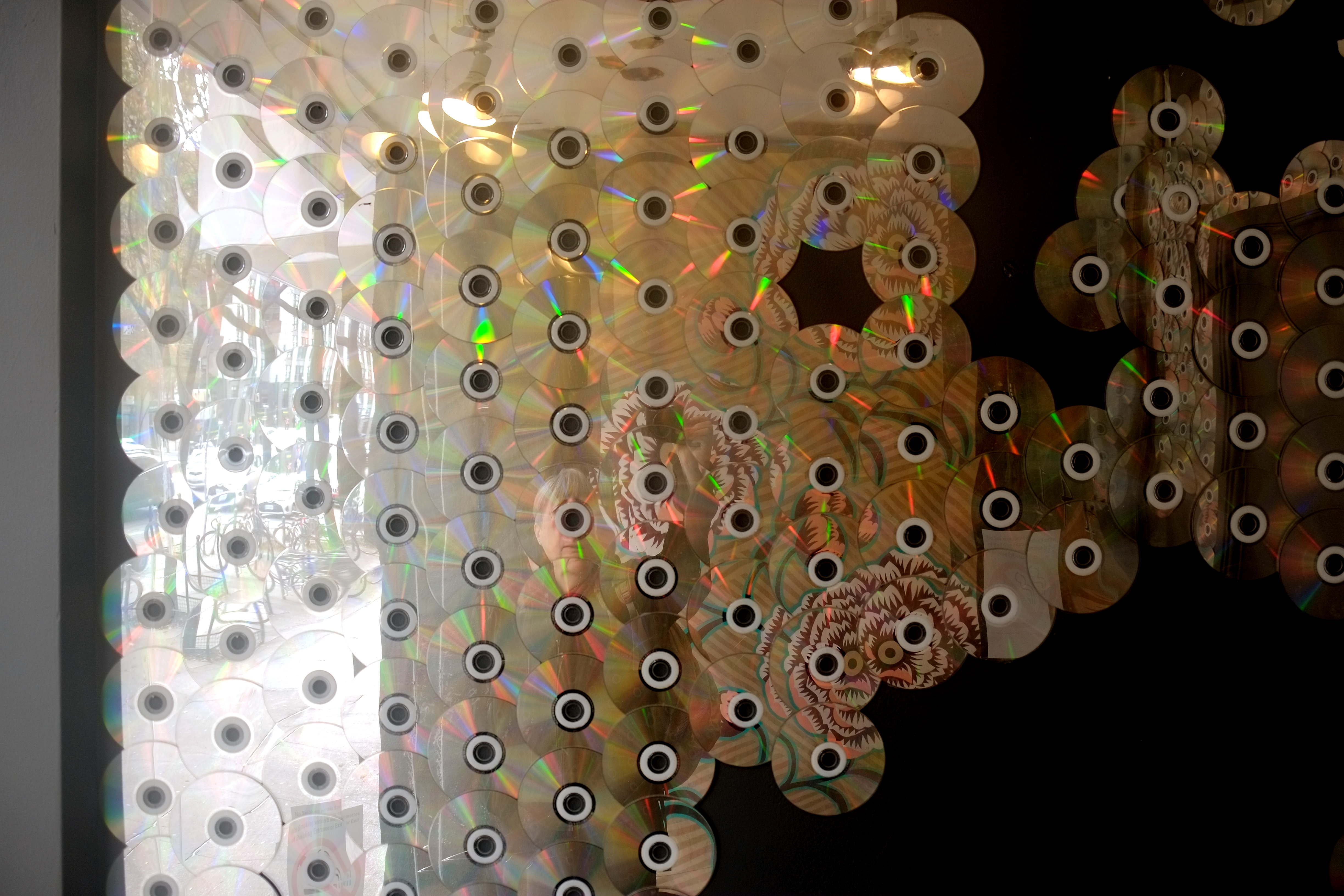
below:  This is an old display of CD’s mounted on a wall inside a window of an empty store.  The window is dirty but if you step into the recess of the entrance way, you can see the possibility of reflection, light and colour playing together.   This was actually the first picture that I took when I walked up Spadina the other day.   After I saw this window I started paying closer attention to other empty stores.
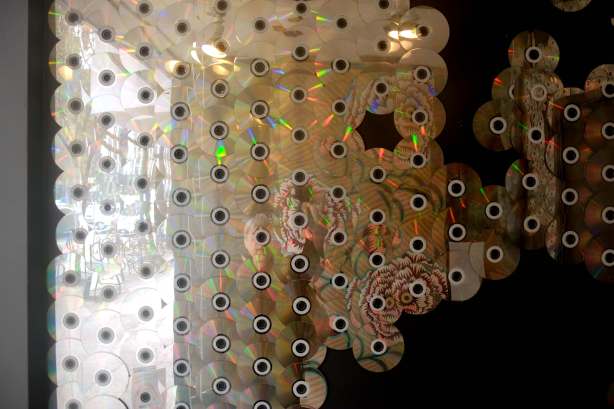
design and pattern made with many old CD's mounted on a wall inside the window of an empty store.

There are quite a few empty stores and sections of Spadina are quite grubby looking.  As I mentioned above, many of the Chinese businesses have move on and once again the area is the middle of a change.

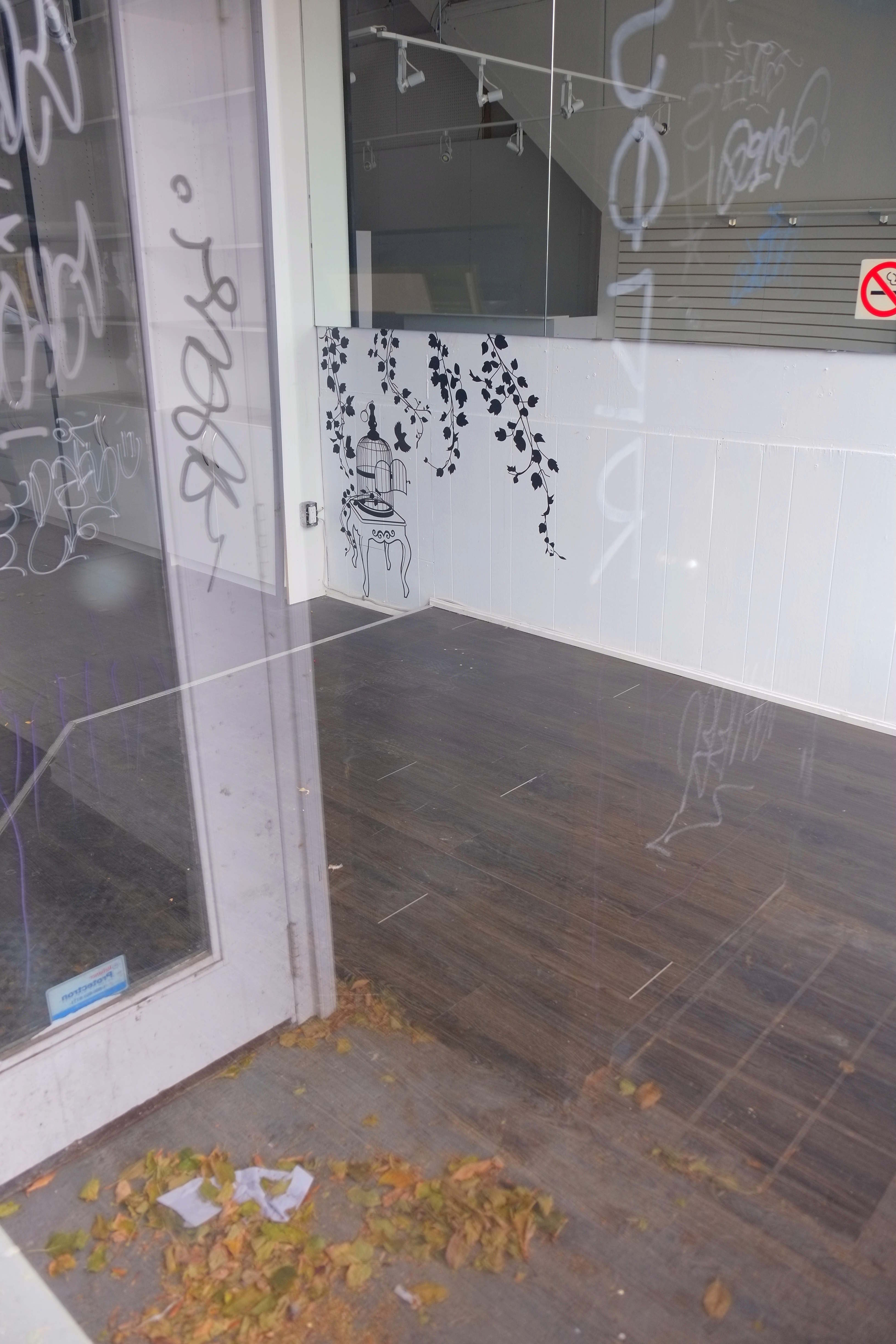
below: Someone cared enough to paint this delicate birdcage and ivy scene on the wall.  Doesn’t it make you wonder who did it?  and why?  and what happened to them?

looking through a window into an abandoned and empty store, leaves have blown in and are on the floor.

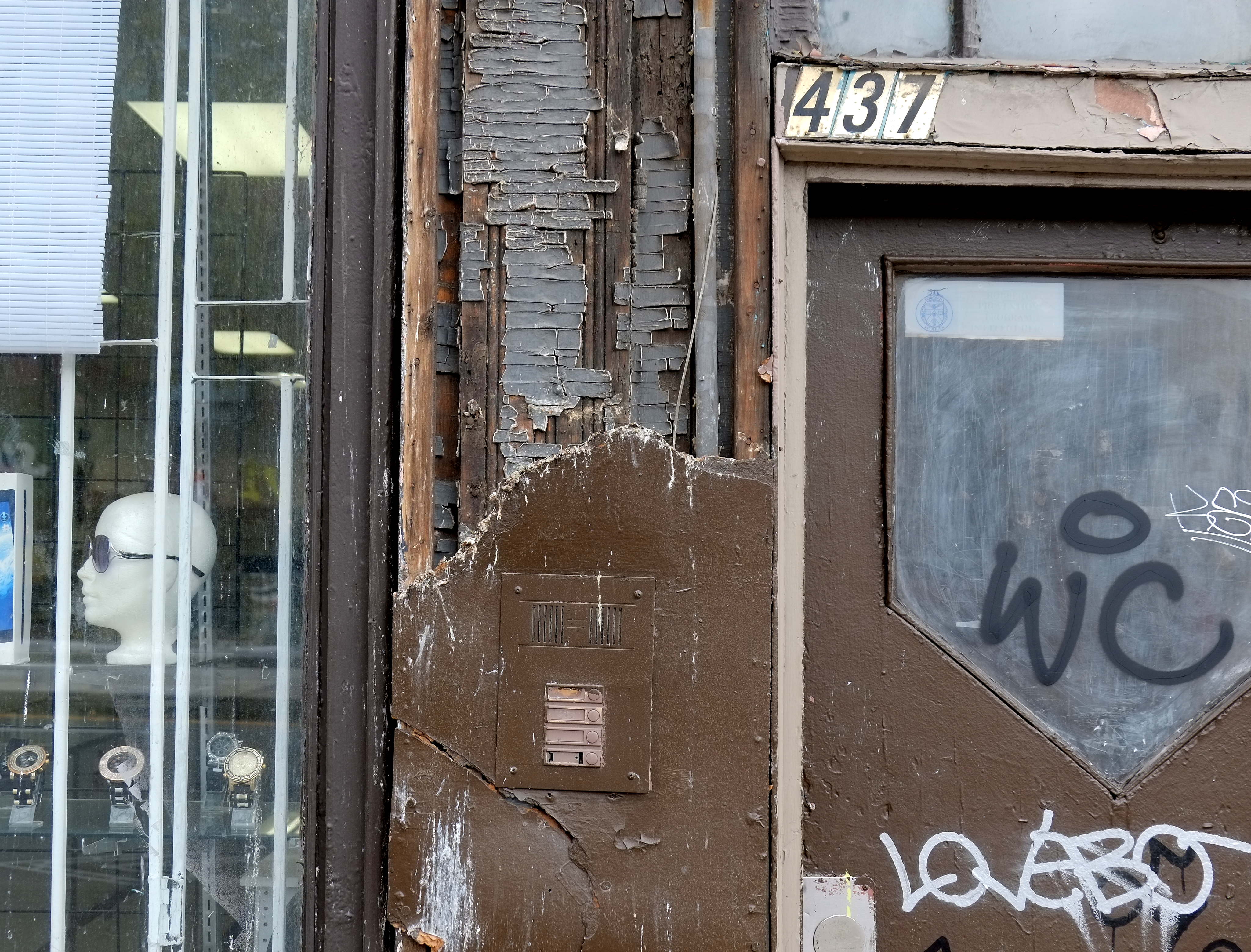
below: A painted over intercom –  a remnant of the past.  But the plywood that the intercom was mounted on is partially torn away to reveal an even older, more hidden, past.     Does anyone live or work at 437 anymore?  What lies behind the door?
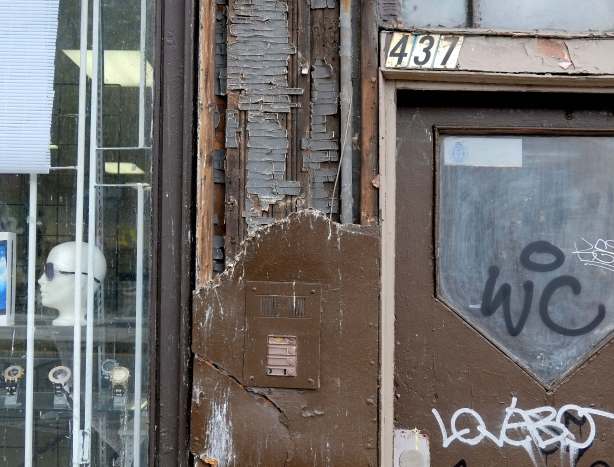
exterior wall, brown paint, number of 437 above the door, cracked wood plywood beside the door, old and broken intercom system that has been painted over, next door window is a store, with mannequin head on a shelf

below: This little place had a short life as a store – but for the life of me I can’t remember what it was.   I think that once upon a time it was an 8 Eleven (play on 7 Eleven stores) but that was long ago and I know that it closed before I first saw this space.    How easy it is to forget.

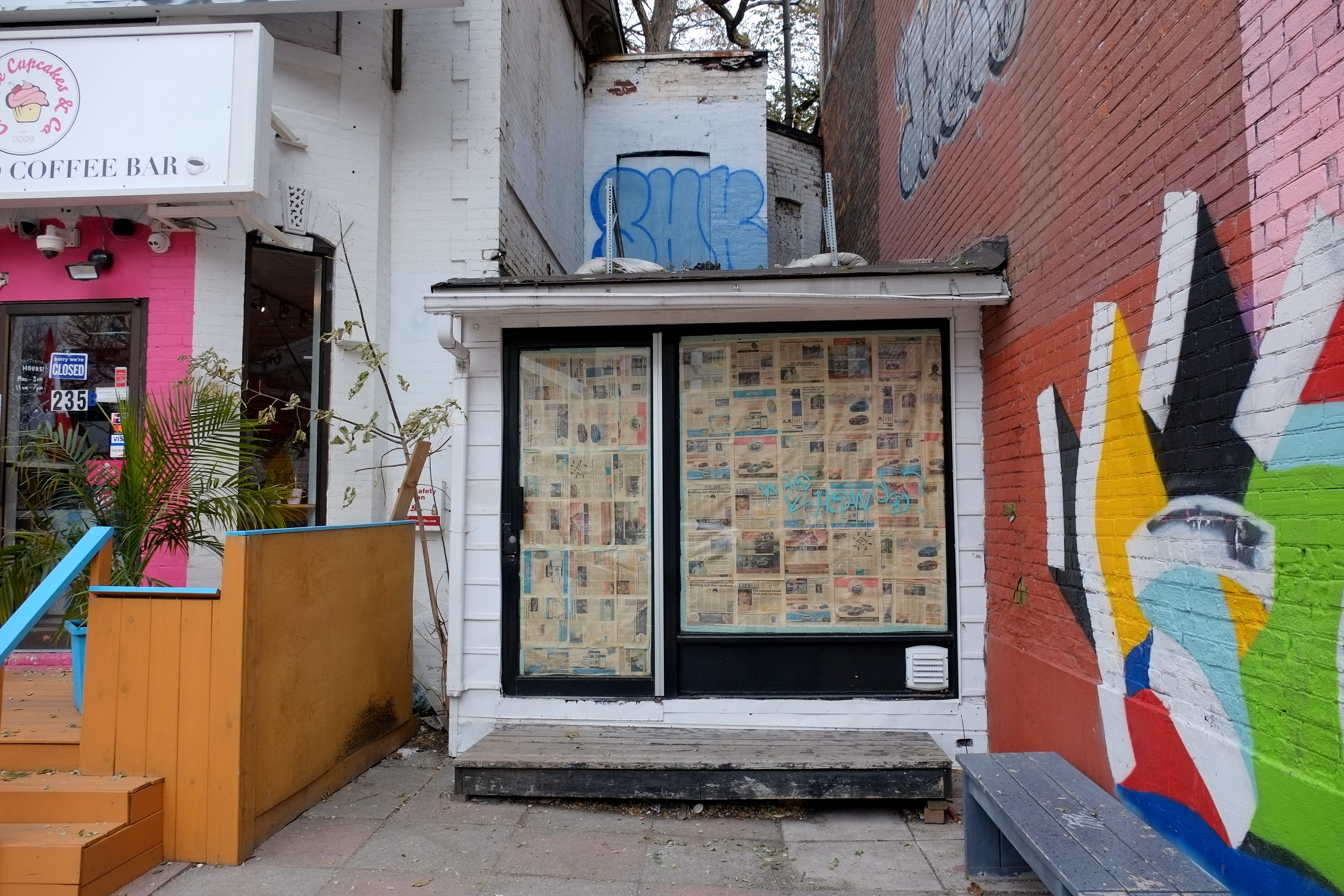
very small building with door and window papered over.

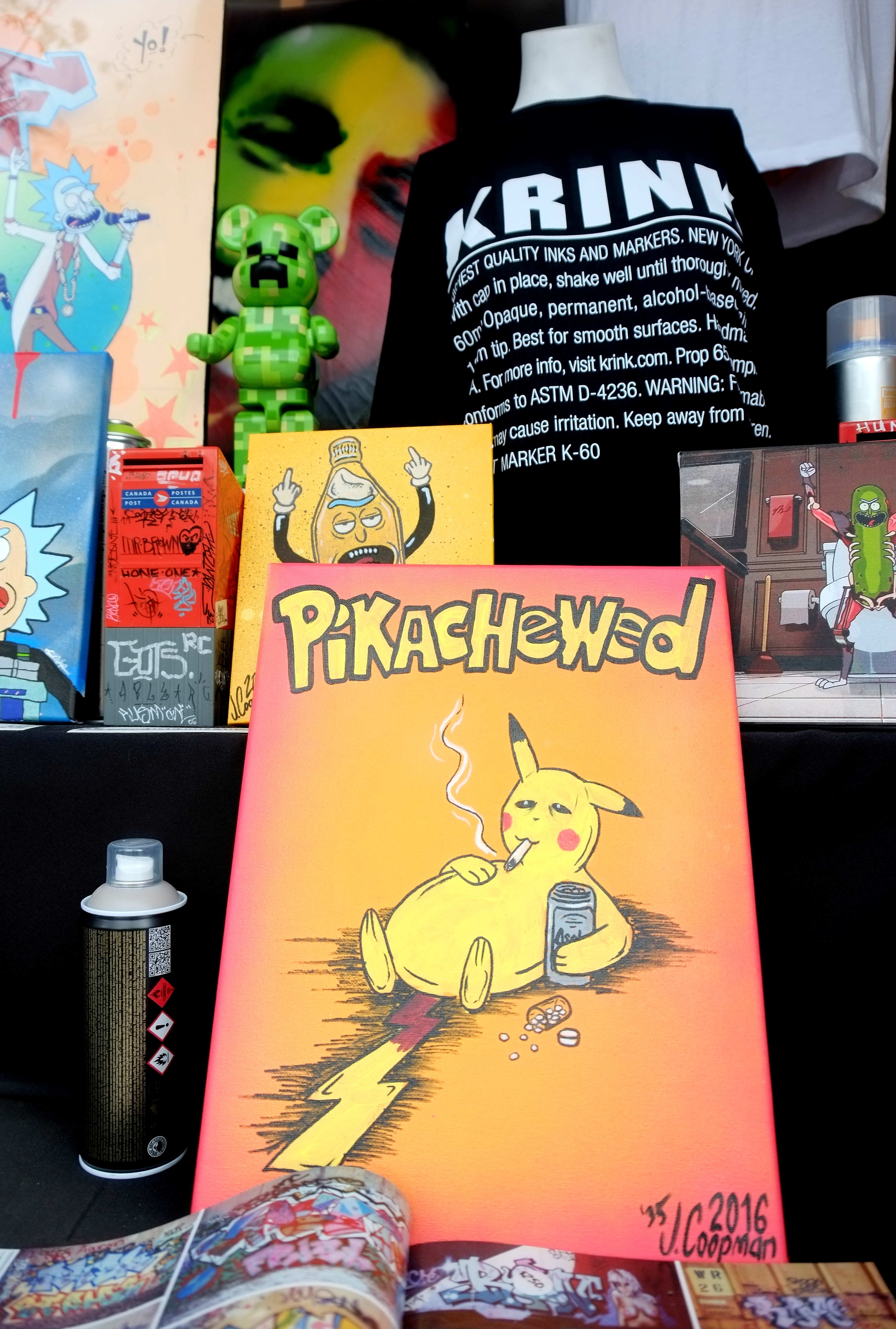
below:  As I passed by this window, I thought to myself “How cute, pikachu.”  Then I stopped and went back.  No, not pikachu.  Part of the seedier side of Spadina Avenue.

articles for sale in the window of a store

below:  Layers.  On the left, hoardings around an old building being demolished and on the right, a staid brick building.  Behind them is a newer development with its bright east wall.

street scene, Kensington, with hoardings for demolition, a building from the70's and a newer apartment building in the background with bright coloured squares on the side.

cracked brick wall and decorative carving, on upper storey of an old building

a pair of Bell telephone boxeswith a grey wall behind


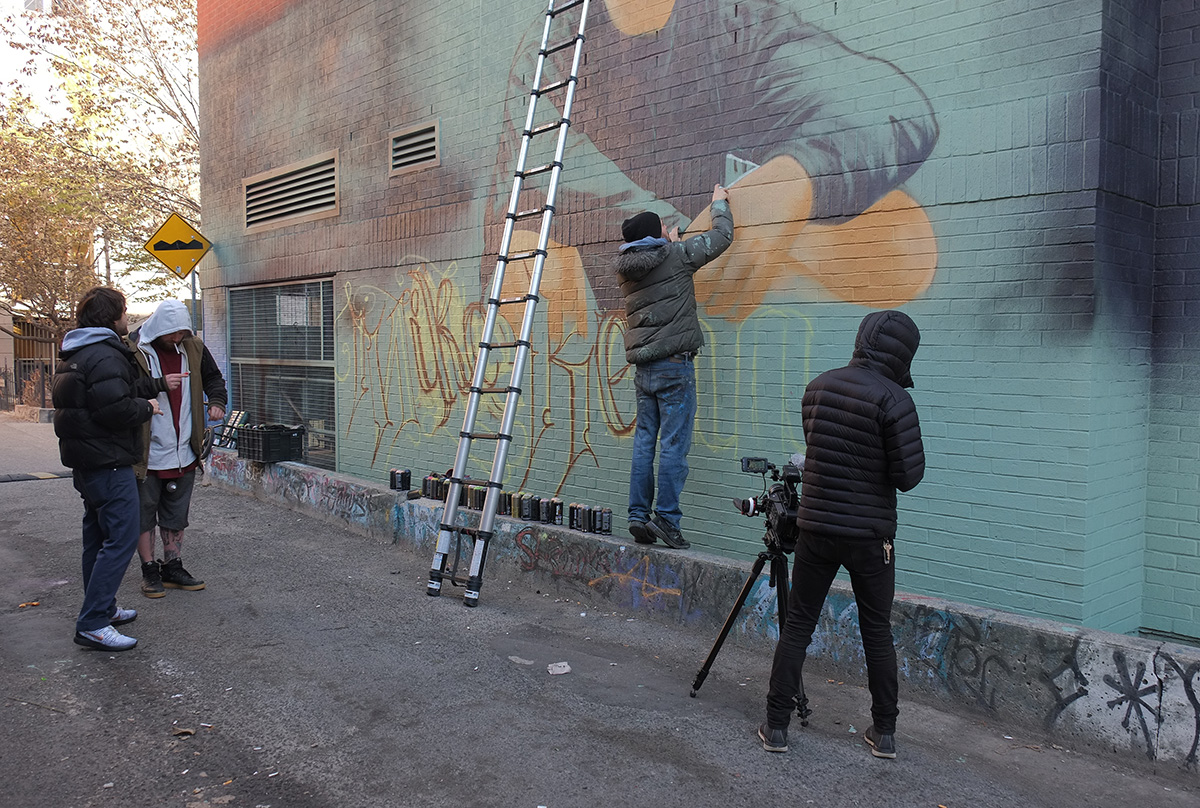
Late in November, work was started on a new mural in Graffiti Alley

below: Working on the facial details

a man on a ladder painting a mural in Graffiti Alley,

below: The work in progress.

one man with video camera filming another man painting a mural in Graffiti Alley

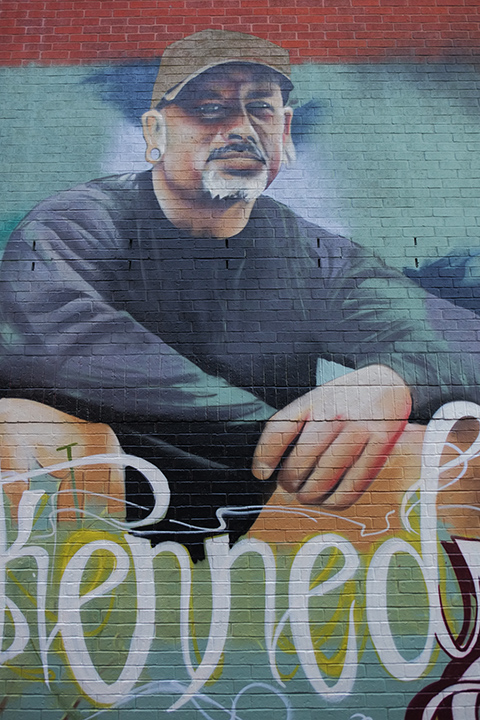
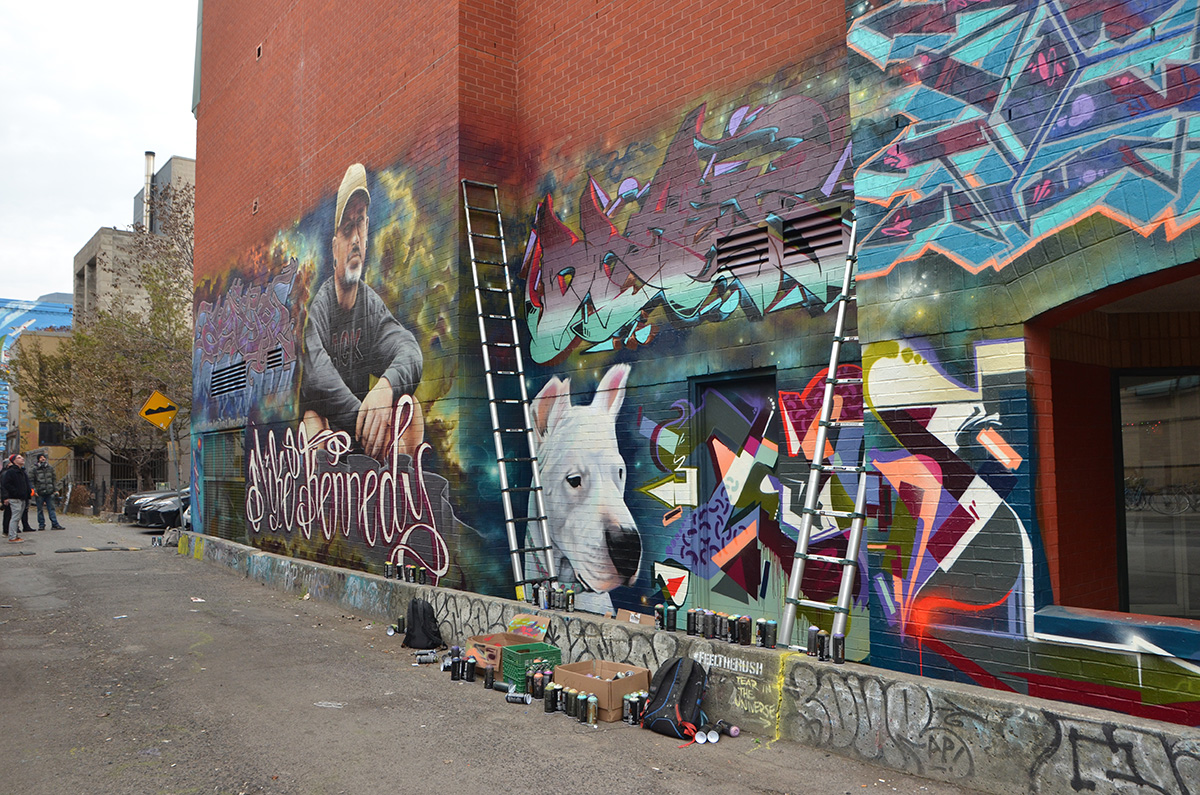
It is a memorial (and tribute) to Mike “Wunder” Kennedy who was active in Toronto’s street art community.  He was the one who coordinated the painting of the large murals around Broadview and Gerrard that featured the seven new wonders of the world.  You can find pictures of these murals in a blog post from September 2016 .

below: Mike’s portrait when it was partially finished.

middle section of a partially painted mural, in honour of Mike Kennedy, his portrait.

The mural was painted by Getso, Sight, Arms, Wales, Tenso2, Braes, and CTRJ


painting the Mike Kennedy tribute mural

tribute memorial mural to Mike Kennedy in Graffiti Alley

below: The finished portrait.

Mike Kennedy portrait

mural, white dog, with a row of spray paint cans in front

I like to think that Mike would be happy with the results.

Recently I saw a blogTO article about “A massive Overwatch mural” that was being painted on King Street West.  I was curious so off I went to check it out.

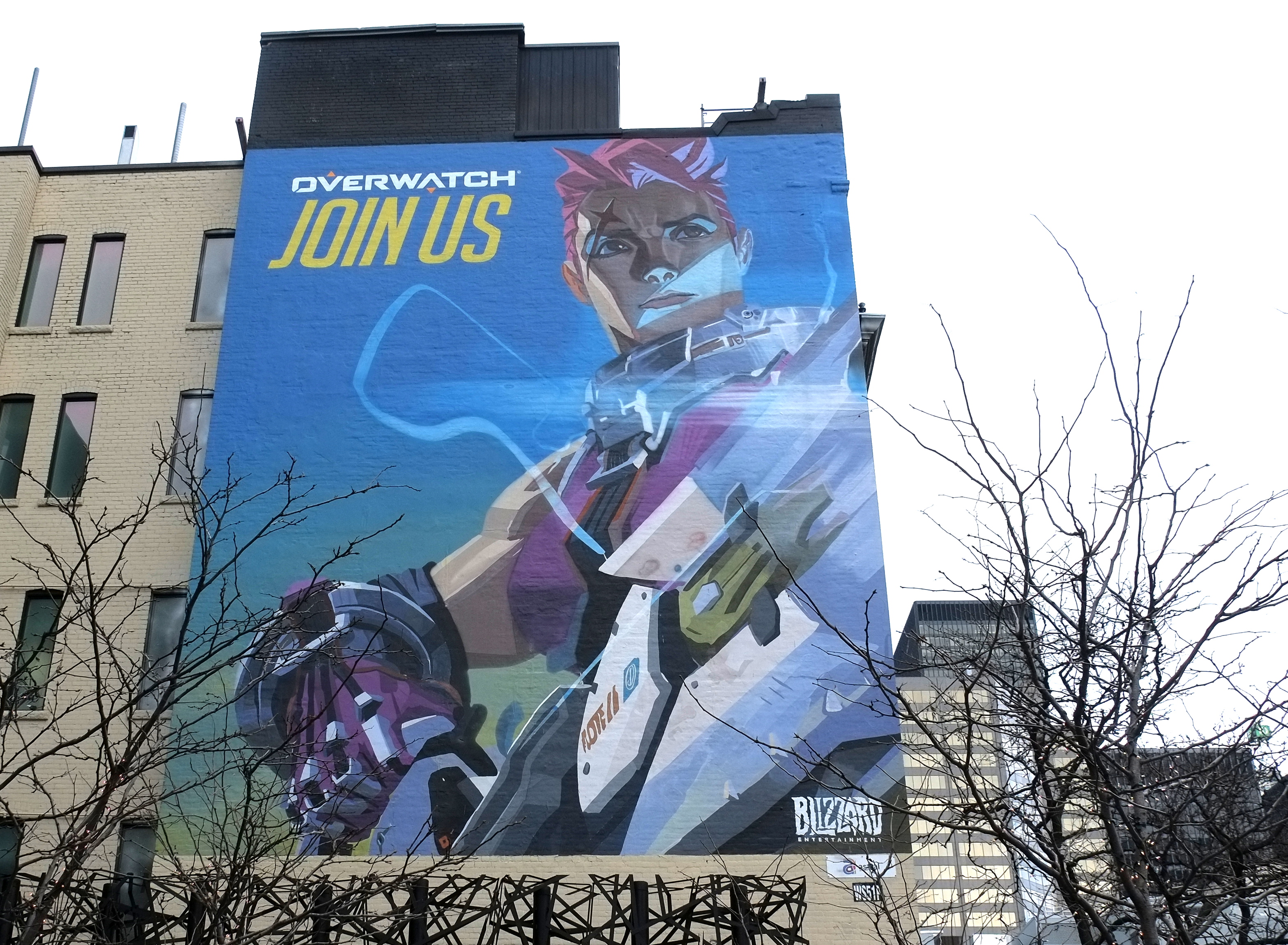
below: Here is the mural.   Yes it’s big, but massive no.  When I think massive I think Phlegm’s mural at Yonge and St. Clair, or Adrian Hayles music murals near Yonge and College.   And whoa, what’s that in the bottom right corner?  This is an ad for a video game and this is a picture of Karya, one of the characters.   Under the heading of ‘you never know where things are going to lead’ – Overwatch is a multi-player team game where competitions are held and prizes won.  There is an Overwatch World Cup which was won by South Korea in both 2016 and 2017.  This year there was a Canadian team and they came second.  Yeah Canada!

mural on the side of a building with words join us overwatch. Blizzard entertainment is the sponsor. character from the game is featured.

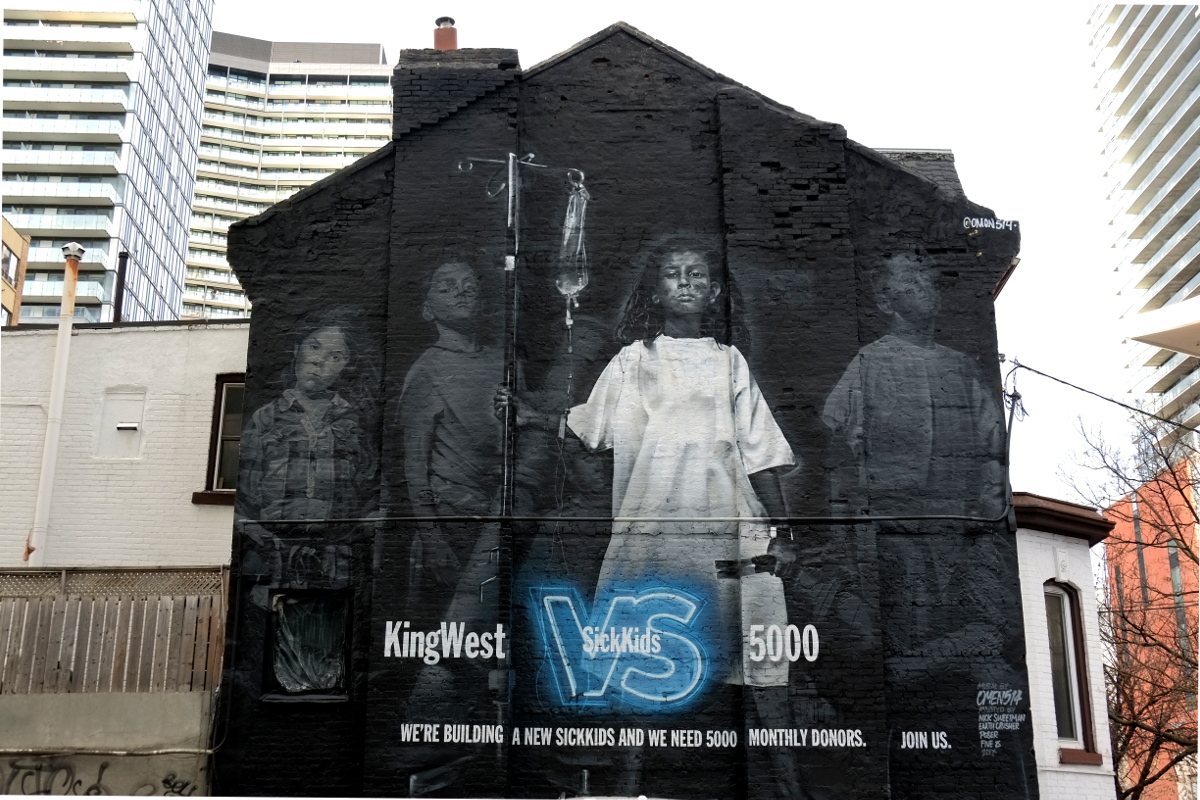
below: Around the corner is another mural.  This one is painted onto the side of an old brick building by Omen514.  As you can see, it is part of the most recent ad campaign by Sick Kids Hospital to raise 1.3 billion dollars to rebuild the hospital starting with the building at Elm and Elizabeth streets.  The black and white of the mural matches the black and white of the video advertising.   Omen514 had help from Nick Sweetman, Earth Crusher, Poser, and Five S, all of whom are street artists as well.

mural on the side of an old building, black and white, by omen, an ad for Sick Kids hospital, 4 sick kids waiting for treatment.

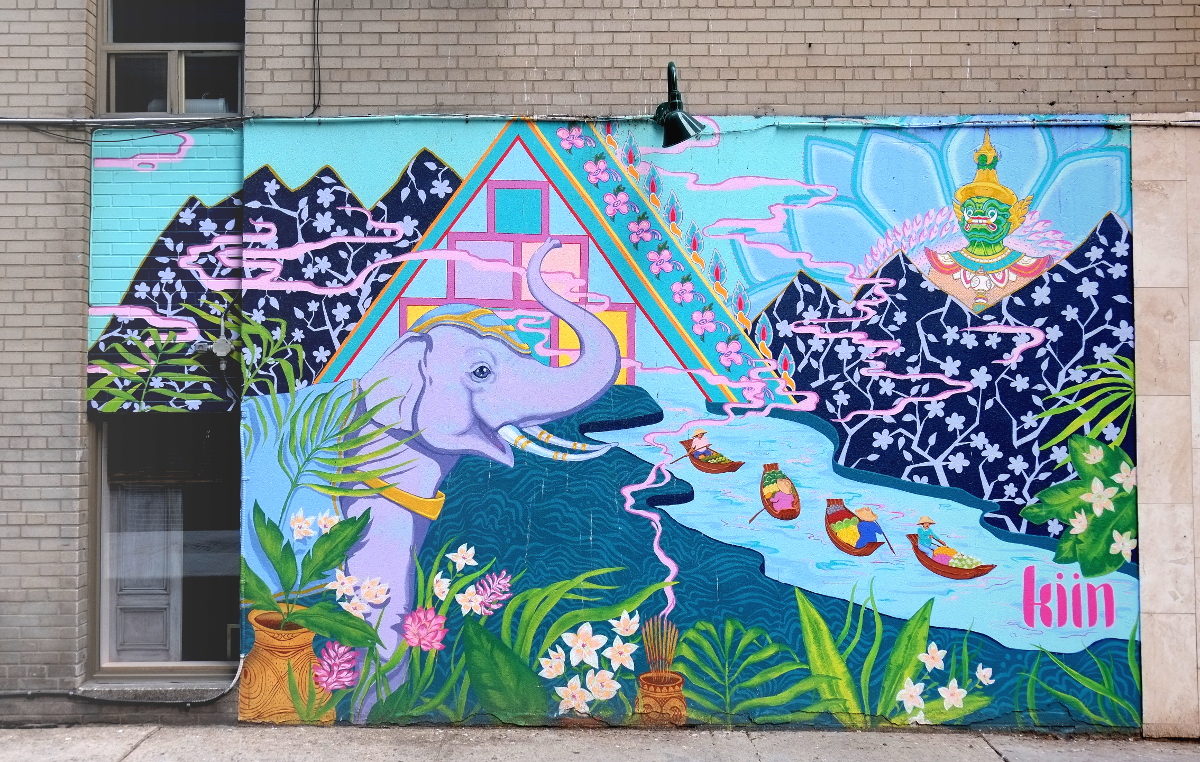
below: … And another mural in the same neighbourhood.  This one is on the side of the Kiin restaurant (Thai) and as you can see, the name of the restaurant is in the mural.  Again, street art but not street art.  Whatever you choose to call it, it’s much more appealing than a blank grey wall.

mural on the side of Kiin restaurant, a purple elephant standing beside a river with four boats, flowers growing beside the river.

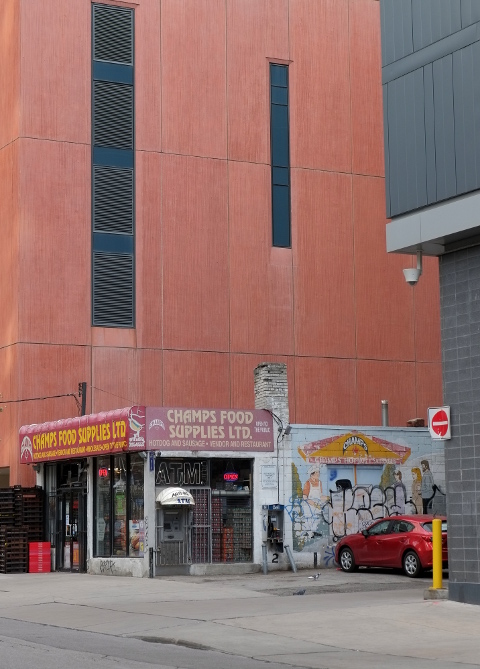
below:  Businesses, such as Champs Food Supplies pictured here, have been using murals to draw attention to themselves for a long time.

older small building Champs Food Supplies Ltd with a large new condo behind it, red car parked beside it, mural on the side wall

below:  It is still standing even as it’s being dwarfed by the condo developments around it.

older small building Champs Food Suplies Ltd with a large new condo behind it, red car parked beside it, mural on the side wall

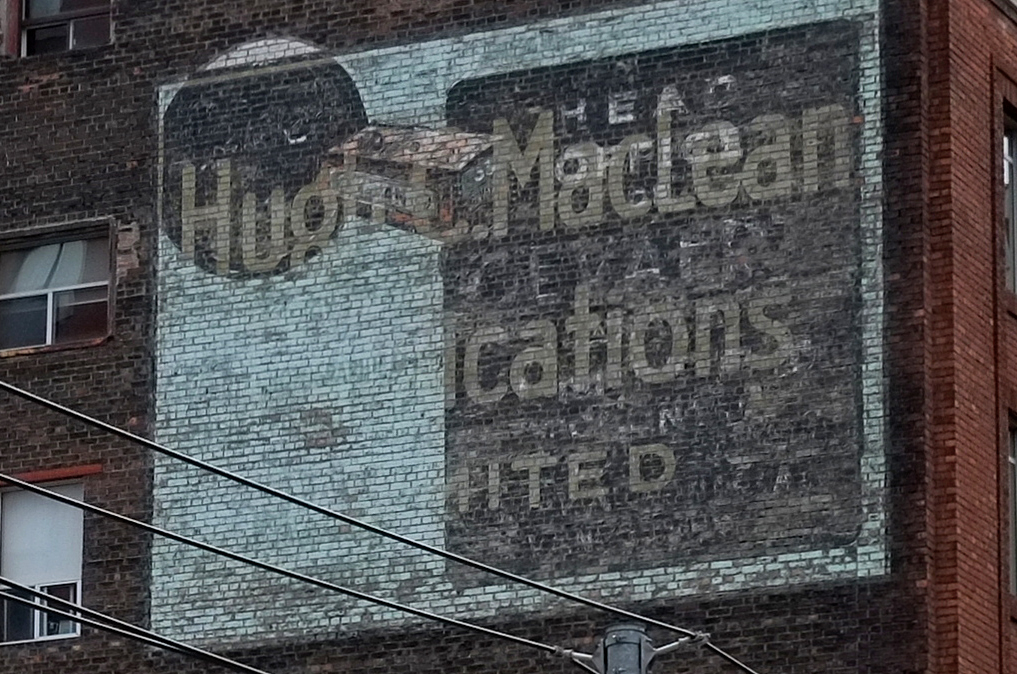
below: And even farther back in time – This is the MacLean building that was built in 1914 (designed by George Wallace Gouinlock).  It is at 345 Adelaide St. West, and the sign is on the east side of building.   Hugh C. MacLean publications  was founded in 1909 by Hugh Cameron MacLean.  It published mostly trade journals such as ‘Footwear in Canada’. The company was bought by the Southam family and become Southam-Macleans… and then finally Southam Business Publications in 1964.  As it turns out, there were two MacLeans brothers in the publishing business,  Hugh and brother John Bayne MacLean who founded the MacLean publishing company that would eventually become MacLean Hunter – the home of MacLeans magazine before it was swallowed up by Rogers Media.


old brick building on Adelaide street, parking lot beside, cars in front, up on top storey (of 6) is an old ghost sign,two in one, one for Hugh C. Macleans publications and another that is too faded to read

below: This ghost sign is actually a double.    The words ‘head office’ can be seen by the word MacLean and there is a box to the left of that.  The number 33 is on the box and obviously means something.  I haven’t been able to decipher the rest of the sign.

old ghost sign,two in one, one for Hugh C. Macleans publications and anther that is too faded to read

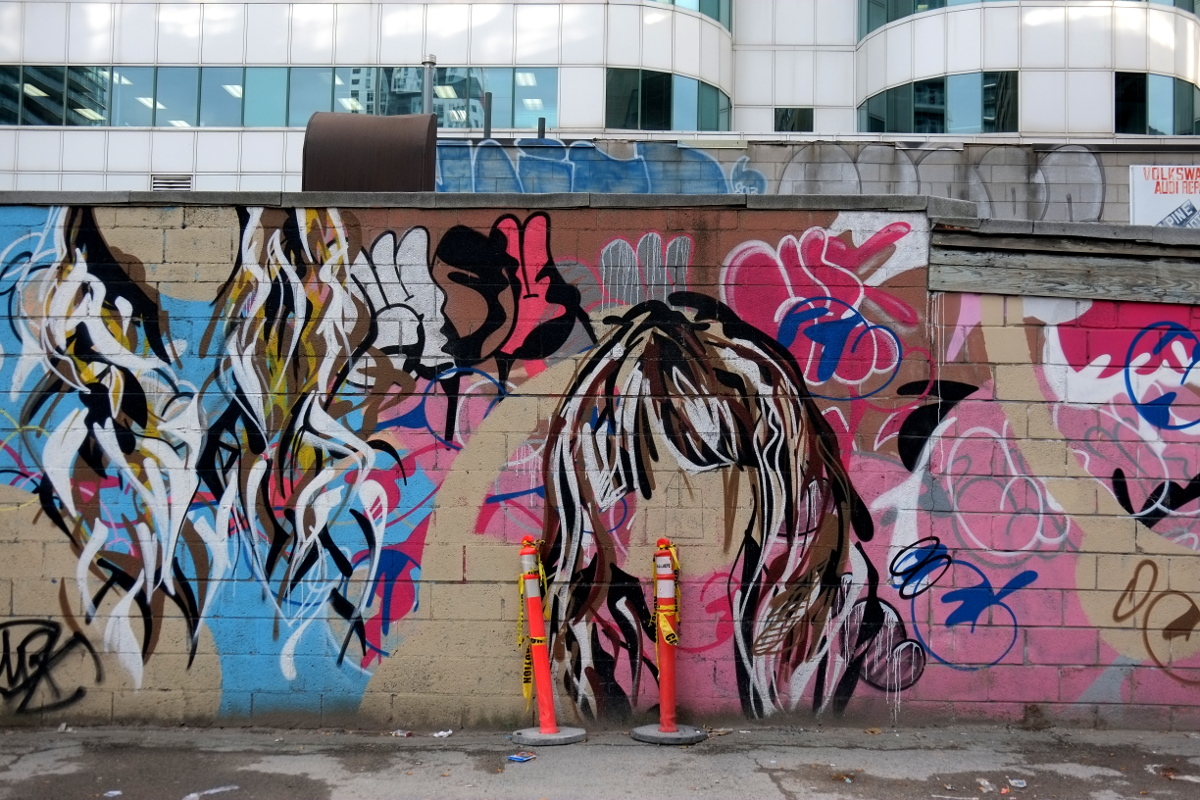
And then there is street art that is just that, decorations on a wall.

mral on a low wall, two orange safety markes in front,

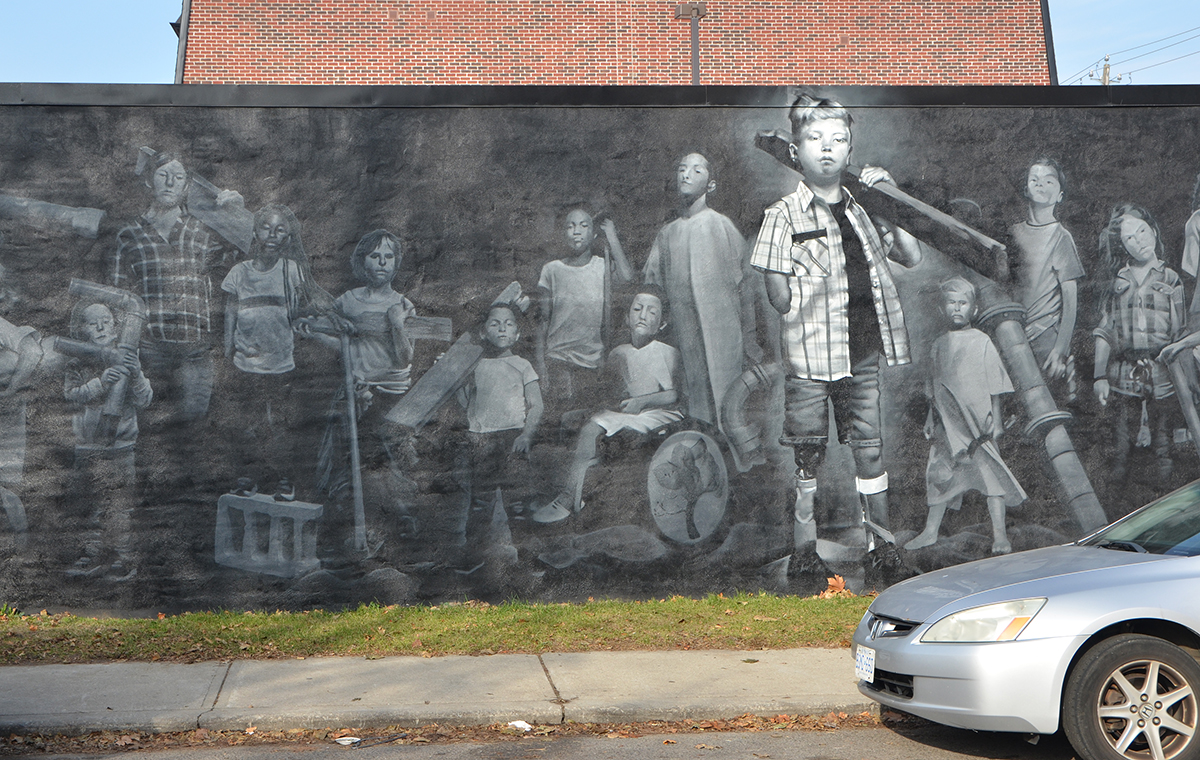
After I took the above photos and before I had finished writing this blog post, I came across another Sick Kids fundraising murals by the same artists as the one above.

below: Looking north up Broadview at Thompson street, just north of Queen.

mural on the side of an old building, black and white, by omen, an ad for Sick Kids hospital, 4 sick kids waiting for treatment.

below: The central portion of the mural.

mural on the side of an old building, black and white, by omen, an ad for Sick Kids hospital, 4 sick kids waiting for treatment.
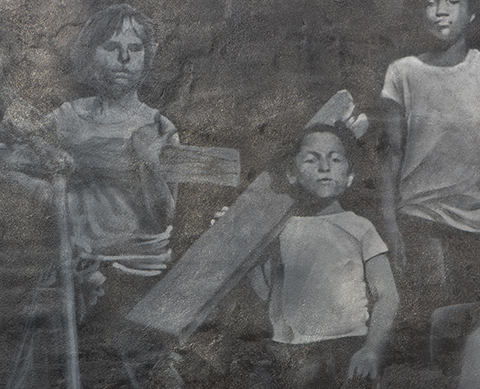
below: In the mural the kids are collecting pieces of lumber, pipes, and concrete blocks.   This is similar to the ad where kids are “running through city streets and alleyways, gathering building materials and running to an empty piece of land ready for construction.” (source)

mural on the side of an old building, black and white, by omen, an ad for Sick Kids hospital, 4 sick kids waiting for treatment.

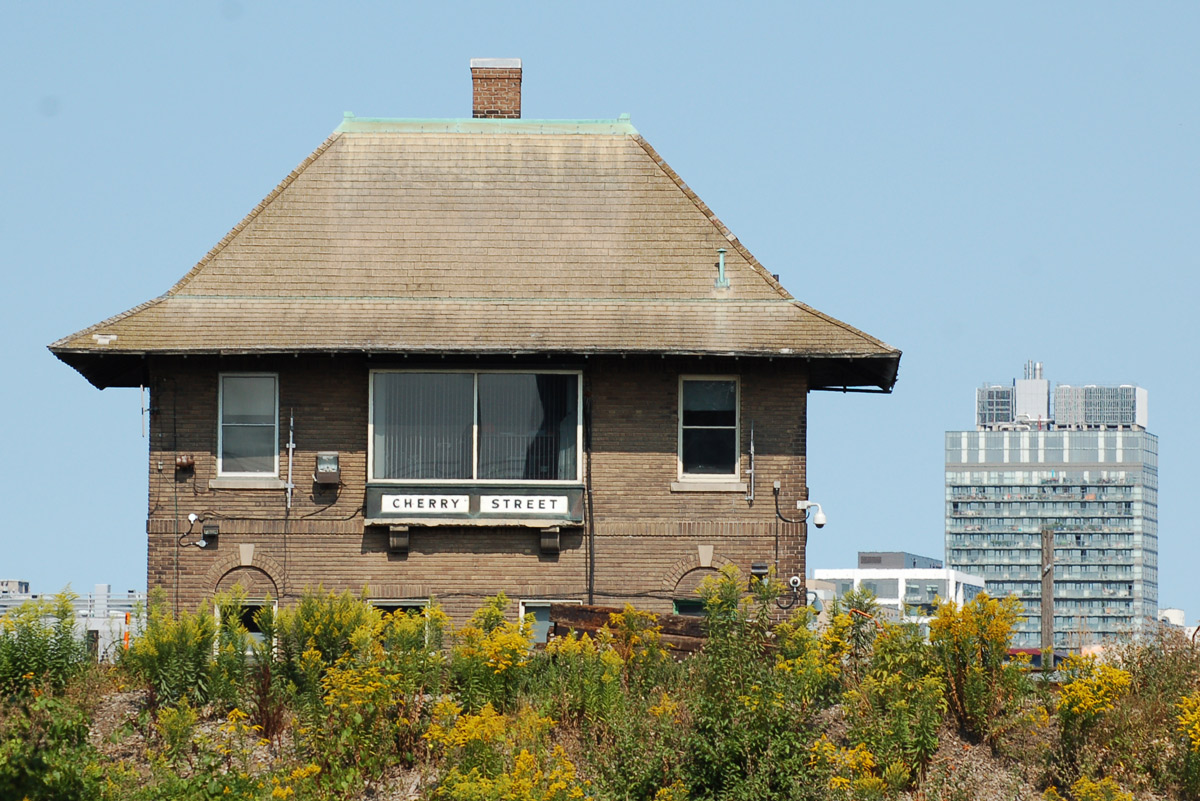
You might recognize the building below – it’s the Cherry Street interlocking tower.  Along with the Scott Street and John Street towers, they housed the the electro-mechanical interlocking for the railway tracks.  Interlocking is an apparatus that prevents conflicting movements through an arrangement of tracks, in other words, it keeps the trains separated so there are no collisions.   It was back in 1931 that the track work for Union Station was completed and the Toronto Terminals Railway interlocking system became operational. The interlocking was installed by General Railway Signal Co. of Rochester NY and it was/is controlled from the three above mentioned towers. Apparently this 1931 interlocking system has operated reliably for 86 years and today it makes it possible for 235 passenger trains travel on these tracks every weekday.


small brick building with sloped roof, sign under window that says Cherry street, beside train tracks, two tall condos in the background

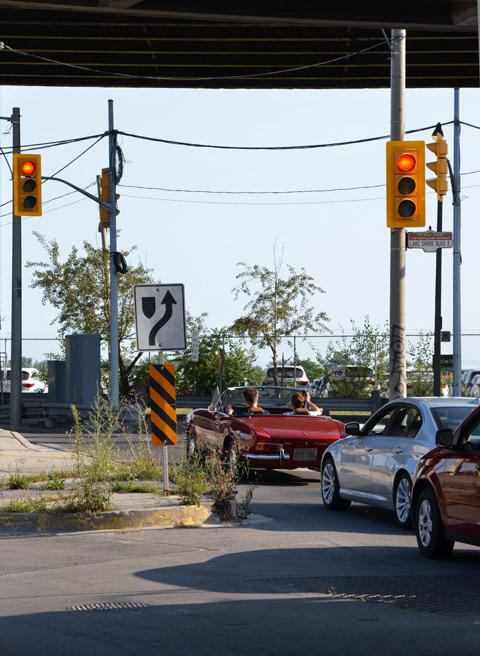
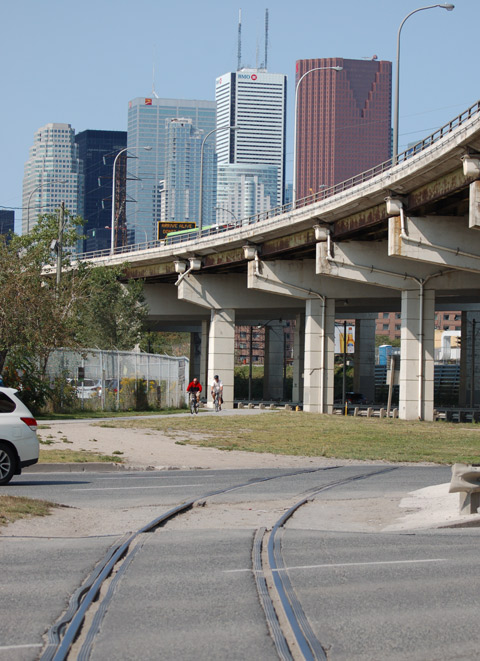
The intersection of Cherry and Lakeshore isn’t pretty.  The south end of Cherry passes under the railway tracks, 8 tracks wide, just before ending at Lakeshore Blvd which is under the Gardiner Expressway at that point.

cars stopped at a red light at the south end of Cherry street where it intersects with the Lakeshore, under the Gardiner, a red convertible is the first car at the light.

below: This is the view if you’re walking east on Lakeshore.  The ‘tunnel’ is Cherry Street as it goes under the railway tracks.  The three glass condo towers are part of the Distillery District.

intersection of lakeshore blvd and cherry street from the southeast, cherry street bridge for the tracks, 3 condos of the distillery district, some traffic, billboards, concrete

below: From above –  the best way to help you visualize the intersection.   The very bottom left corner is the north end of the Cherry Street bridge.   Cherry Street and the Lakeshore come together under the Gardiner Expressway before they split again with Cherry continuing south to the Portlands and the Lakeshore curving back under the Gardiner.

view from above, railway tracks, road, waterfront, Lake Ontario,

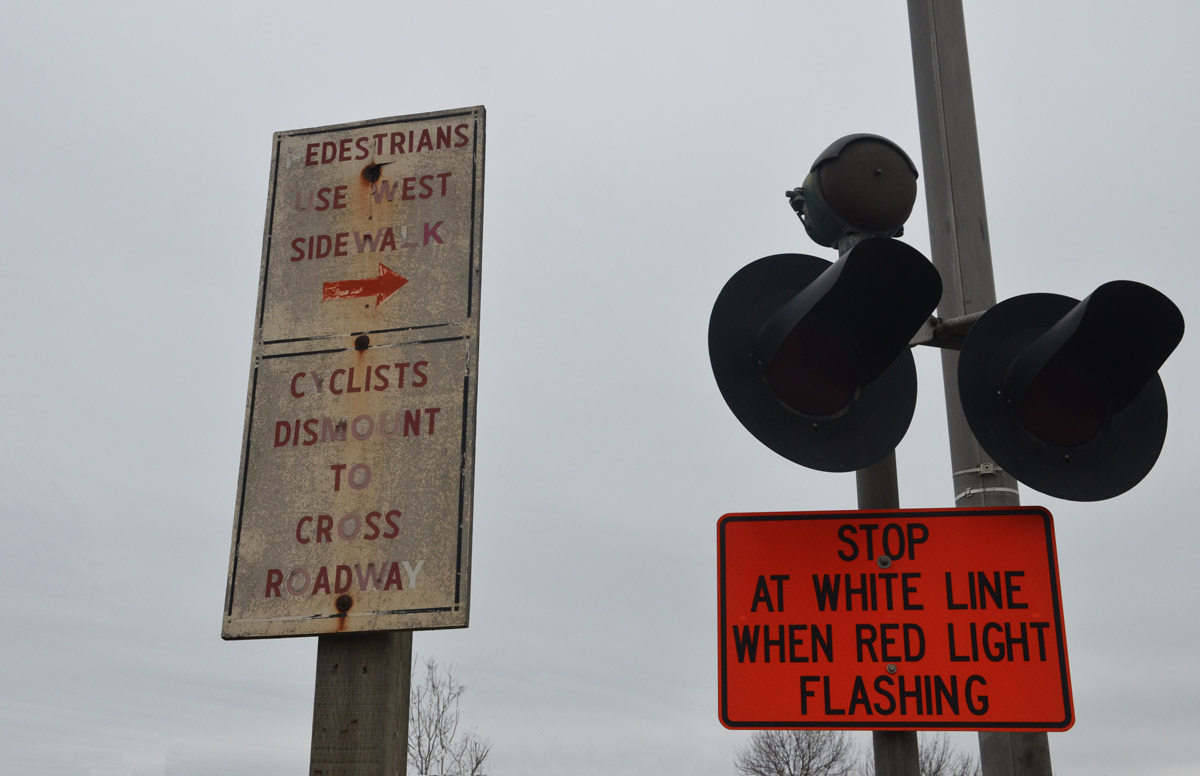
Also, the intersection can be confusing if you’re a cyclist or a pedestrian, especially if you are coming south on Cherry Street.    It’s one stretch where the undeveloped land under the Gardiner Expressway has been neglected in part because it is also a section of the city that is in limbo – is the Gardiner going to be taken down?  or will it be moved?  or will we debate it until it’s too late to do anything?   As city redevelopment spreads east, there is more interest in this area and in the Portlands adjacent to it.

two old faded street signs one says pedestrians use west sidewalk and the other says cyclists dismount to cross roadway

below: Looking west towards the city.  The Martin Goodman Trail runs along the south side of Lakeshore before turning south at Cherry towards the Portlands.  On the other side of Lakeshore is the Lower Don River Trail that parallels the Lakeshore before turning north at the Don River.   Both trails are part of the PanAm Path.

looking west along the Gardiner Expressway and Lakeshore Rd, curve of the Gardiner as it passes over the bottom of Cherry Street, downtown skyline with CN tower, cyclists on the bike path on the south side of Lakeshore

The Panam Path was a legacy project from the 2015 Pan Am Games. The path is not completed yet but it starts at the south end of the Clairville Reservoir in the northwest part of the city. It follows the Humber River to Lake Ontario and then runs east to the Don River before heading inland a bit. Eventually it ends at the mouth of the Rouge River.  The path goes under many bridges and there is street art in quite a few of these spots.

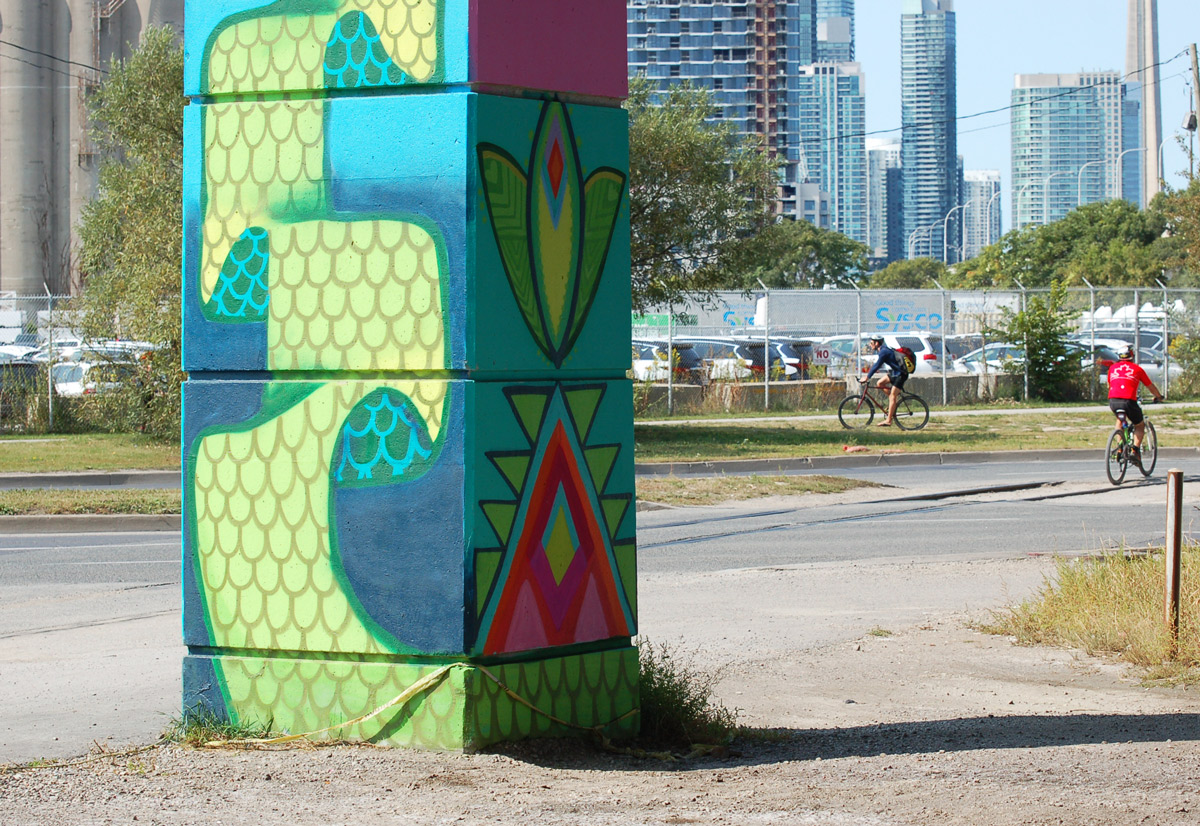
below:  Some of the pillars and bents under the Gardiner just east of Cherry Street are the latest to be painted.  Finally some colour!

part of a colourful mural on concrete pillars under the Gardiner Expressway, cyclists in the distance, pillar with street art in the foreground

The first painting was done as part of an Art Spin event at the end of August.  Art Spin is a group that runs bicycle-led events/tours of art a few times a year.    The project is also a part of the STEPS Initiative that promotes public art in the city.

below: XYZ 2017 VAL JAM LUVS DRPN ___ DELUXO OGV  written on top of the snake before it had a tongue.

part of a colourful mural on concrete pillars under the Gardiner Expressway


Artists involved:
Daniela Rocha (muisca)
Fathima Mohiuddin (fatspatrol)
Stephanie Bellefleur (bellefleurhaus)
Meera Sethi
If I’ve left anyone out, please let me know

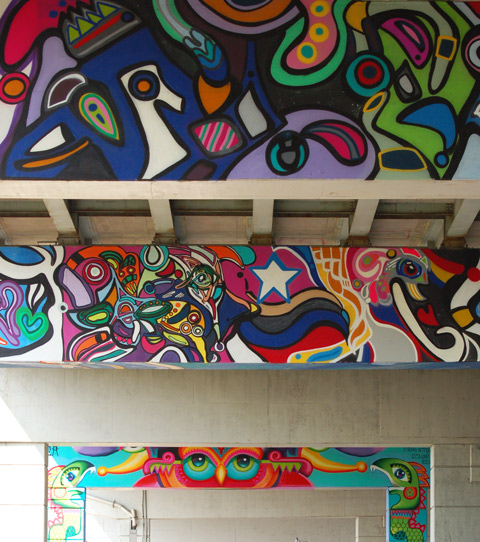
part of a colourful mural on concrete pillars under the Gardiner Expressway - 3 horizontal paintings on the bents,

Some of the concrete in this area is slated for refurbishment so the affected pillars have been left clear for the moment.

painted pillars under an elevated expressway, murals

below: More bird motifs, this time by @fatspatrol

lifters under the gardiner, machinery for artists to reach higher spaces, murals

below: An owl at night, stars in the sky, and purple hills, mural by Muisca.

an owl with the night sky and stars, purplish mountains, part of a colourful mural on concrete pillars under the Gardiner Expressway , a green snake with a long tongue on the vertical pillar on the right

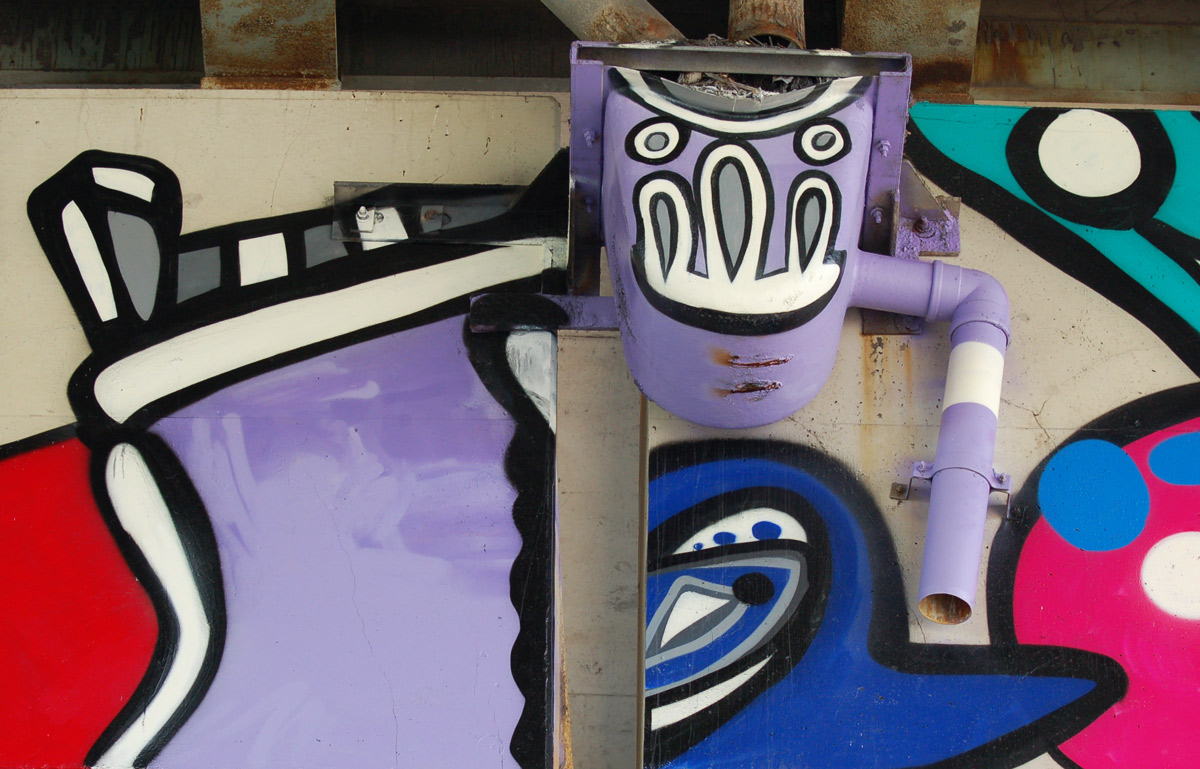
below: A whimsical fun little purple creature with long arms.

part of a colourful mural on concrete pillars under the Gardiner Expressway - drain under the Expressway has been painted light purple and made into a head. Drainpipes are the arms

mural on bents

below: Bullets transforming into birds taking flight.

mural by Meera Sethi, shades of turquoise, bullets on the bottom but transforming into birds as they rise

part of a colourful mural on concrete pillars under the Gardiner Expressway - abstract in turquoise and other bright colours, triangles and lines and blobs

part of a colourful mural on concrete pillars under the Gardiner Expressway - pillars are light blue with birdlike and feather-like patterns at the bottom of two pillars that are close to each other

policeman on horseback as seen through two pillars under the Gardiner expressway


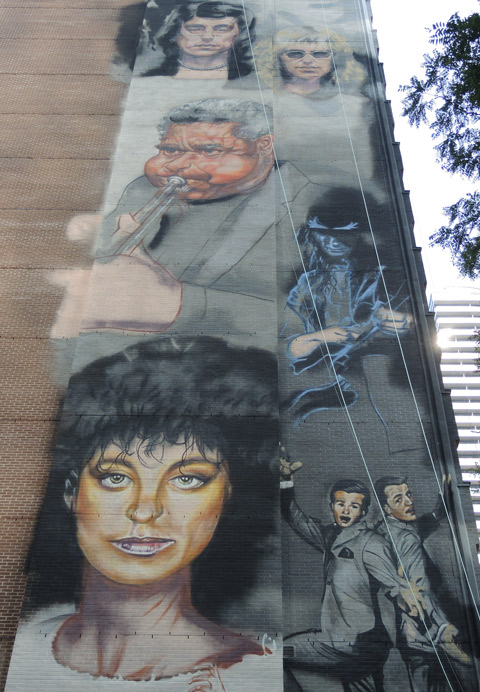
Last November I blogged about a large 22 storey mural on Yonge Street just below College (music makers on Yonge ).  This mural was by Adrian Hayles and it includes many Canadian music icons.   Recently, Hayles has created a matching mural of the same size on the other side (south side) of the building at 423 Yonge Street with portraits of more Canadian musicians.

tall mural, 22 storeys tall, on the side of a TCHC apartment building in Toronto, by Adrian Hayles, portraits of Canadian musicians such as the band Rush, Carole Pope and others

Rush, Goddo, the Band, David Clayton Thomas, Lonnie Johnson, Selome Bey, Carole Pope, Cathy Young, Jay Douglas, Kim Mitchell, Mandala, and John and Lee and the Checkmates are all shown in the mural.  It is best seen if you are walking north on Yonge Street although some trees partially block the view.

Canadian musicians on a wall, mural by Adrian Hayles,

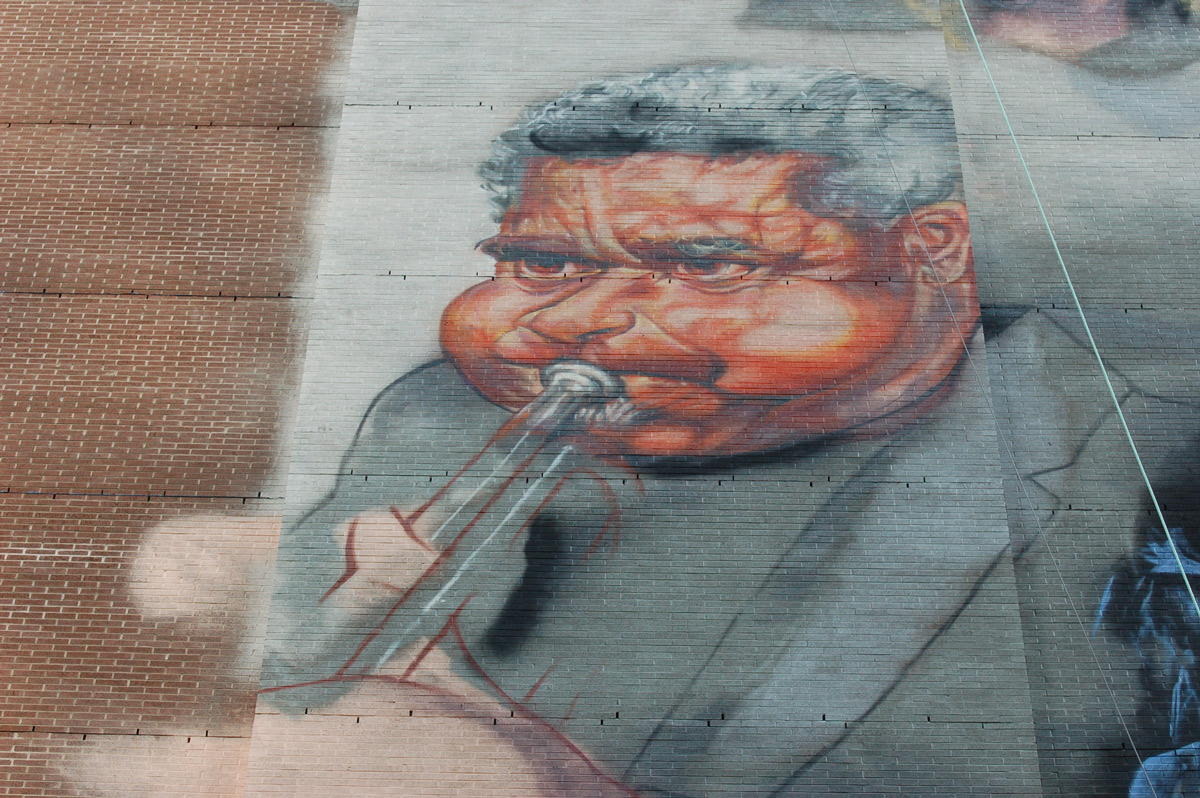
part of a music mural, a trumpet player, male, with graying hair,

part of face and hands on a mural with a nesting pigeon beside it. It looks like the hand is reaching for the pigeon.

music mural,

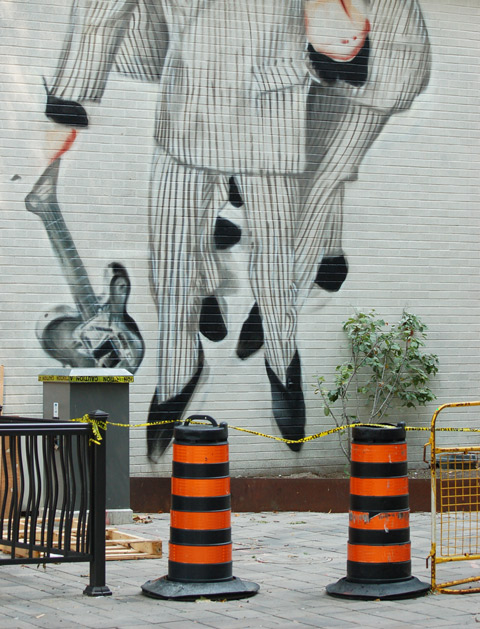
bottom part of mural, guitar player and band dressed in white suits with black stripes, black pointy toe shoes, wall is behind two orange and black cones.

The mural was commissioned by the Downtown Yonge BIA,

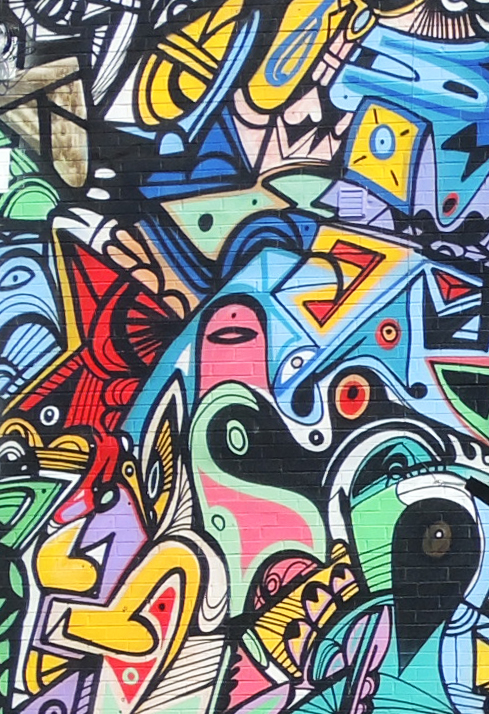
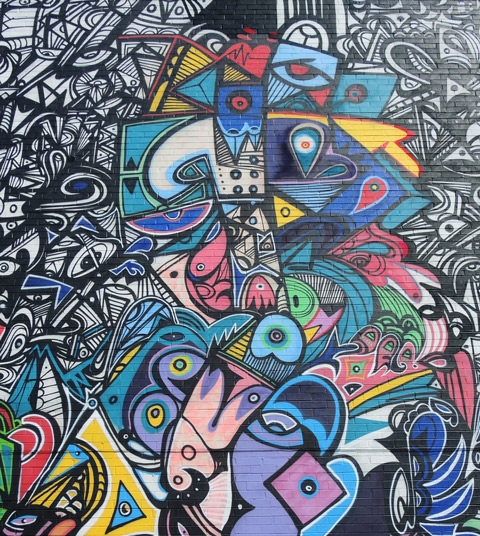
Can you see anything in it?

details of a mural by Jimmy Chiale

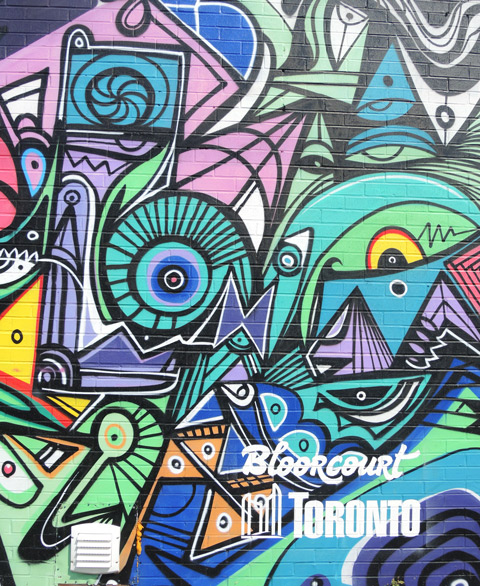
The above image, with its location icon, is just a small portion of a large mural by Jimmy Chiale.   You’ll find it in the Bloorcourt neighbourhood, on the SW corner of Shaw and Bloor West to be specific.  ‘Make Good’ it says.

large colourful mural by J. Chiale on the side of a building. Large white letters that say Make Good.

I  think that its fascinating to look at and I suspect that you would see something different in it each time you passed by.   Here are a few more close up pictures of the details in the mural.  Thousands of shapes all outlined in black some of which seem to make eyes, faces, and a bird’s beak.

shapes, lines and patterns in Jimmy Chiale mural

below: …. a totem pole, an owl and a horse head….

totem pole and horse and other details from Jimmy Chiale mural

below:  … and a camera shutter and a fish?
It wouldn’t surprise me if we saw different things!

Bloorcourt mural details, colours and shapes all outlined in black

Close to Kensington market is a small park called Sonya Parkette.  Two of the sides of the park are walls.  A few years ago the walls were painted with historical murals that were subsequently tagged over.   More recently, the park has undergone some renovations including new murals on the walls.

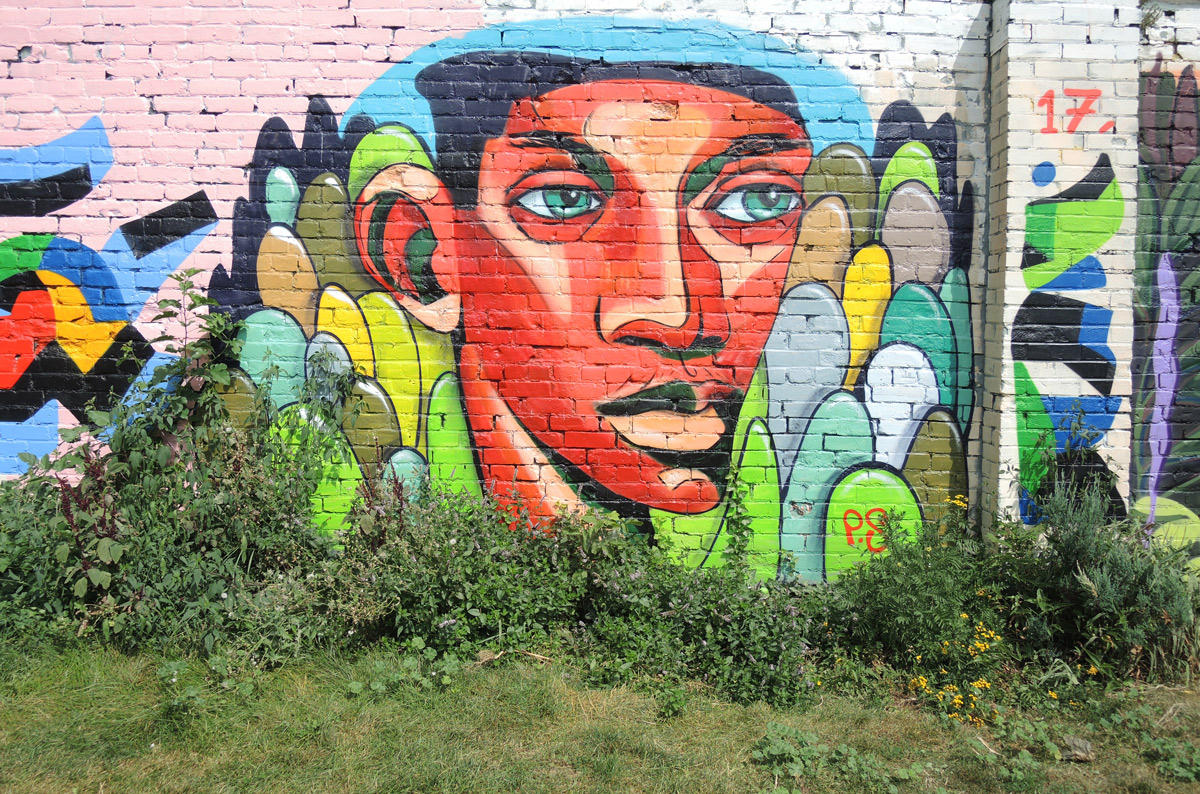
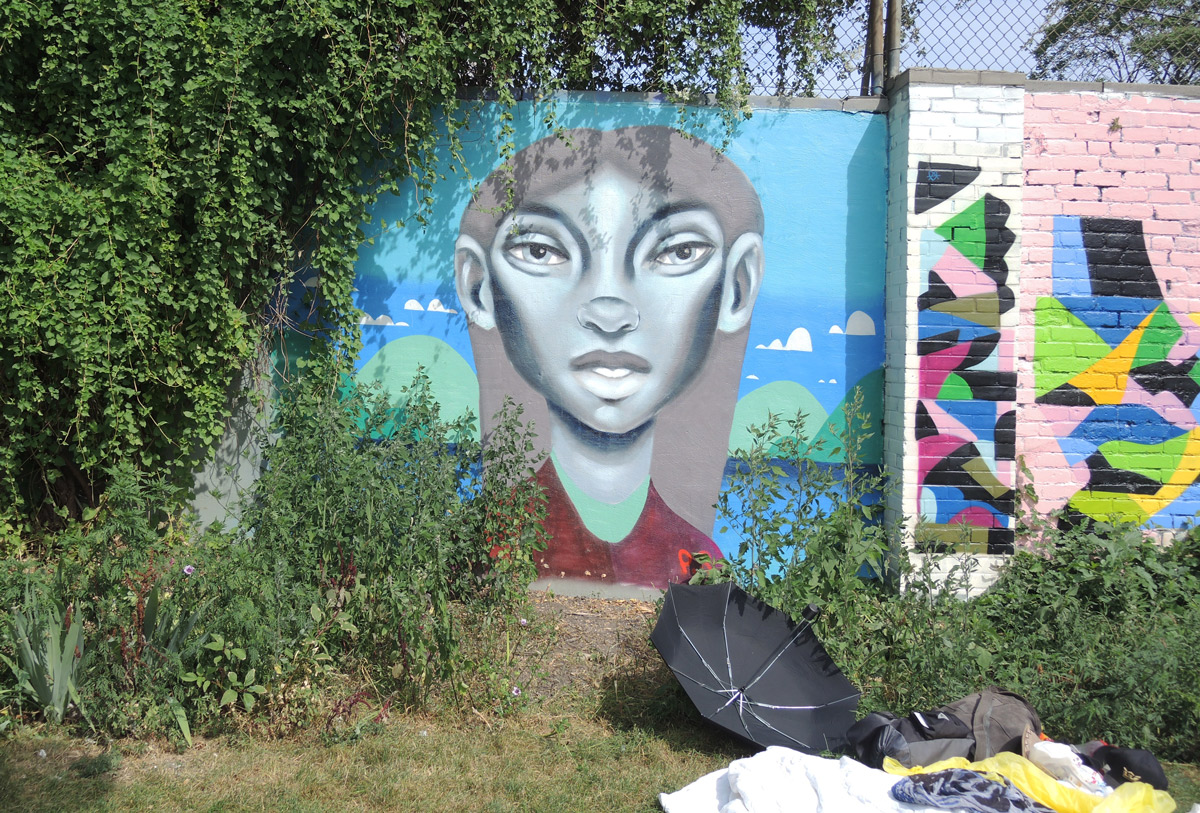
Many of the murals are by P.S (aka Phillip Saunders).  If you are familiar with some of the graffiti and street art in the Kensington area, you will recognize the style.

multicoloured face with red text tag beside

orange face, blue eyes, short black hair, mural on a wall at Sonya Parkette in Kensington

mural, face in grey tones, on a background of water, trees, sky and clouds.

below: This mural, and the one below, are obviously by the same artist who painted the two murals of naked women in Milky Way.

mural of an orange naked woman reclining, wall is golden yellow colour

mural on a wall with green plants growing in front, mural is a blue person from the chest up, no hair. Some plants are part of the mural too.

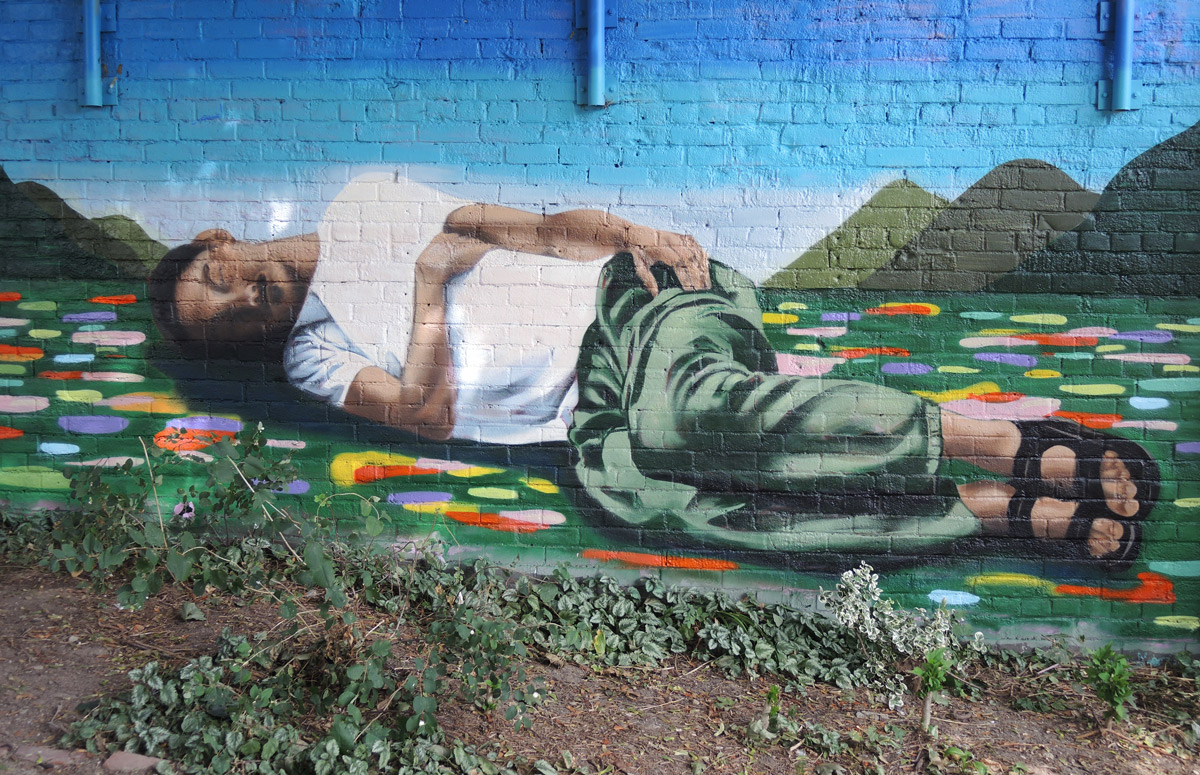
below: A realistic painting of a sleeping man.

a man in green pants and white t-shirt is sleeping on the ground, a mural on a wall. the ground is green with small circles and semi-circles in other colours.
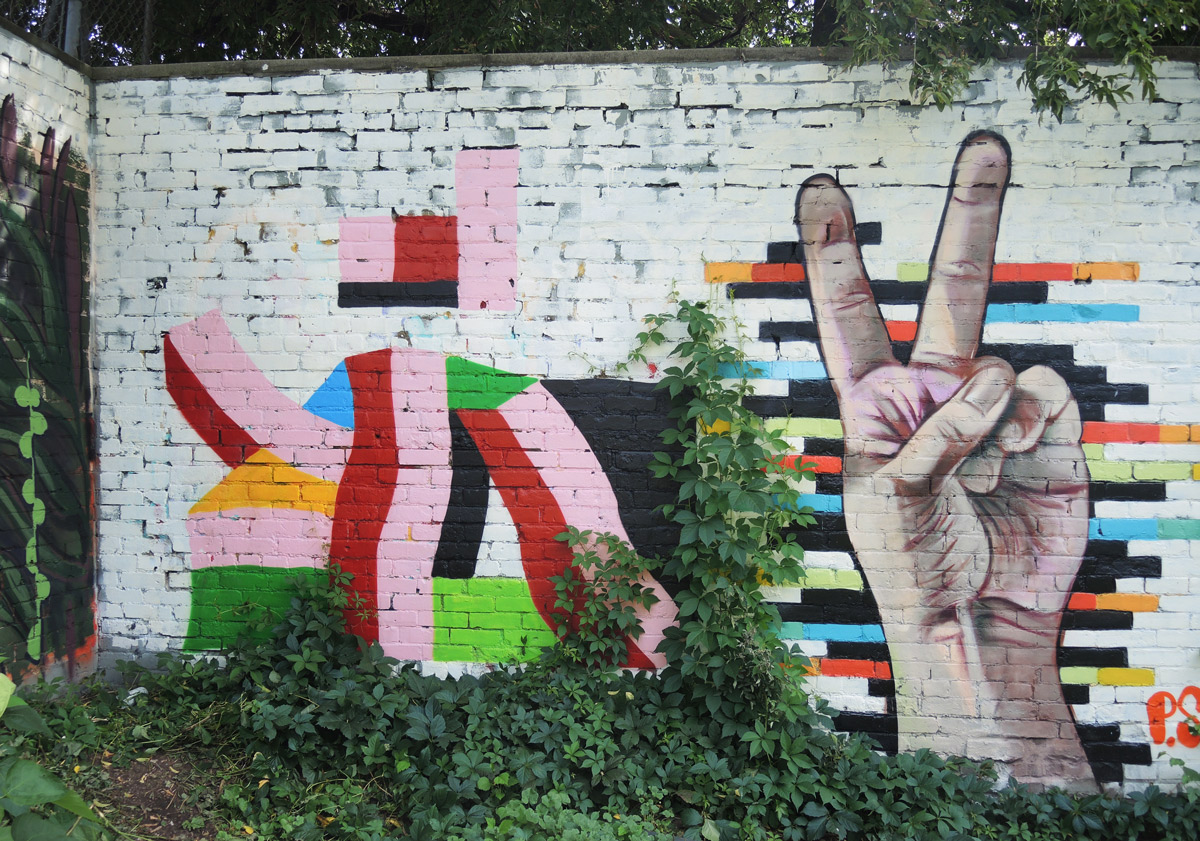
below: Peace and an abstract.

a mural with two parts, on the left is an abstract design with rectangles and a few curves. on the right is a realistic hand giving the peace sign

The Kensington area has a problem with taggers – many street art pieces get vandalized.  Let’s hope that these don’t suffer that fate.

More of the bents holding up the road that passes over Underpass Park in Corktown are in the process of being painted.  Back in 2015, the bents and pillars on the west side of Lower River Street were painted as part of the Pan Am games preparations.   The latest mural project involves the bents closer to St. Lawrence Street.

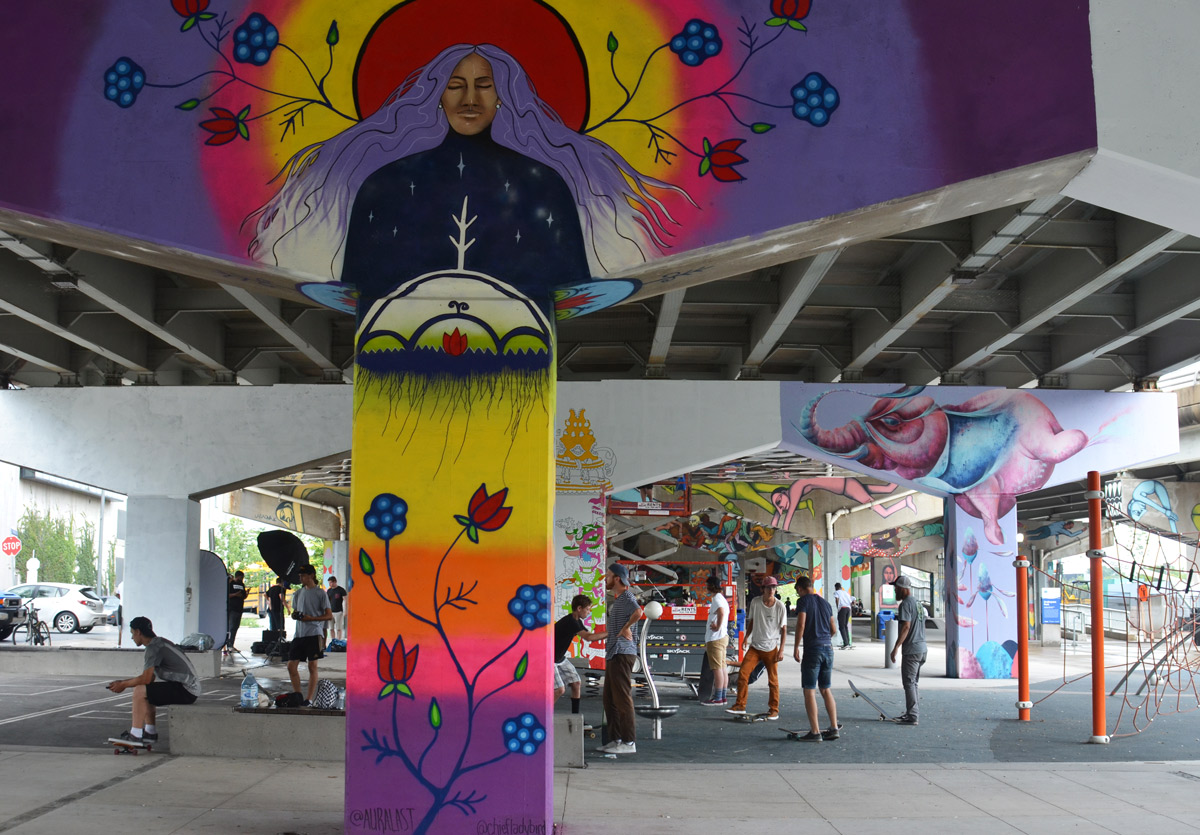
below: Looking east towards Lower River Street, skateboarders in the park behind a mural by Chief Ladybird and Aura. In the background is a pink elephant by Christopher Ross.

people at Underpass Park, under the expressway, with pillars painted in murals, guys on skateboards,

Thirteen bents by seventeen artists have just been completed, or are in the process of being painted for this project.  The artists are:  Al Runt, Andrew Dexel, Annie Hamel, Aura, Chief Lady Bird, Carlos Delgado, FONKi, GAWD, Jill Stanton, Kalkidan Assefa (aka Drippin_soul), Lacey & Layla Art, Meaghan Claire Kehoe, OMEN,  Ness Lee,  Rob Matejka  Anya Mielniczek

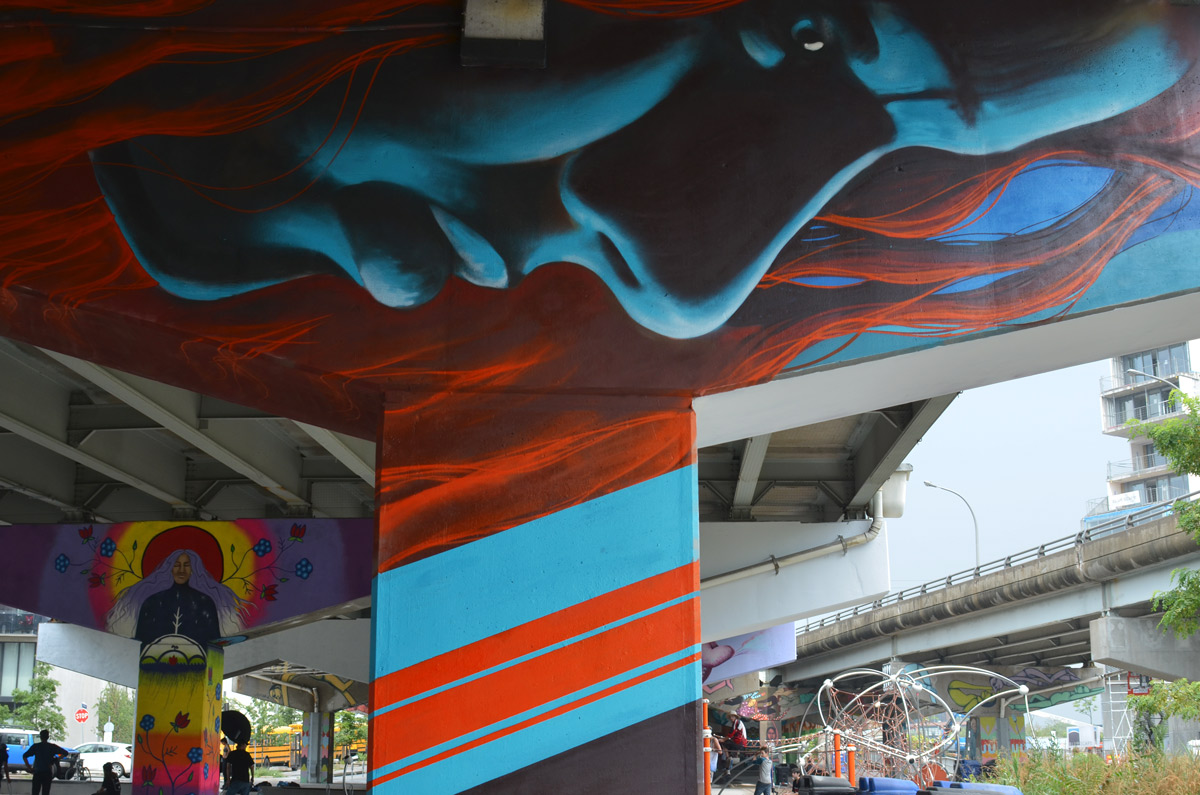
a large blue face mural, horizontal, looking down at the park below

below: As Al Runt works on his mural, he is reflected in the mirrors above him.

a man is painting a mural on a concrete bent at Underpass park, up on a lift, he is reflected in the mirrors on the ceiling of the park, Al Runt

below: Some faces by Carlos Delgado

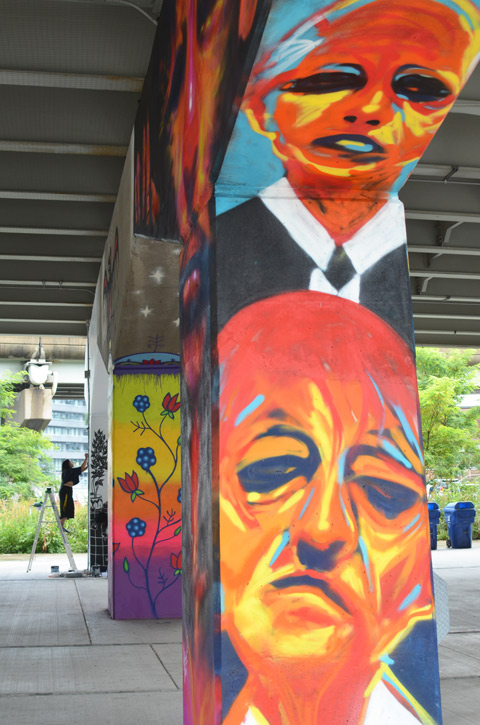
conrete pillar in Underpass park that has been painted with large orangish toned faces, by Carlos Delgado

below: A social gathering around the mural painted by Annie Hamel… although the youngest one seems to want to join the skateboarders instead.

a group of people is having a small party in Underpass park, standing around a concrete bent that has recently been painted with a mural by Annie Hamel

below: I’m not sure why they would choose this location for their photo shoot when they are covering the mural with a grey screen.

a photo shoot in underpass park, grey screen in front of a mural covered bent, a woman in workout clothes, men behind the camera

below:   A face in orange and purple tones by @drippin_soul aka Kalkidan Assefa

a mural of a woman's face in orange and purple tones, large, purple lips, on a concrete pillar, with young woman sitting in the park in the background

below: One side of the bent painted by Lacey & Layla Art

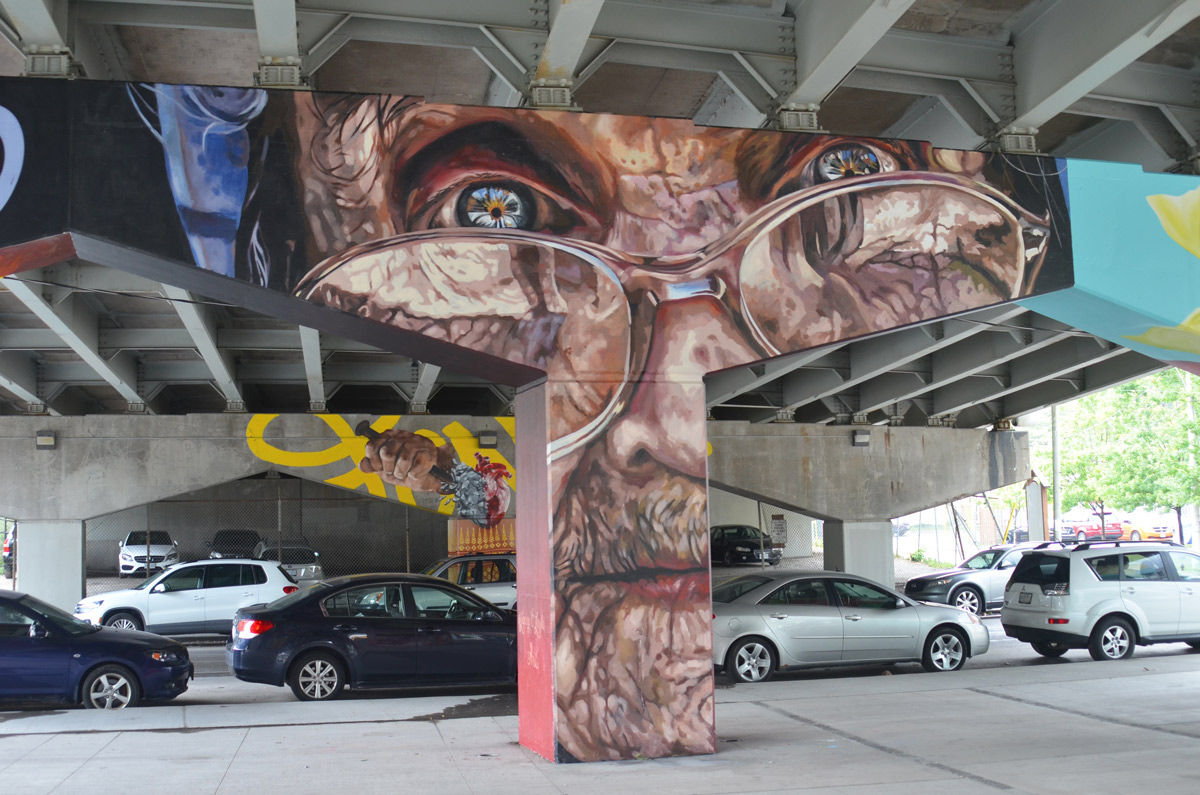
cars parked under a bent that has been painted with a wrinkly brown man's face wearing glasses

below: And the other.  The mural is accompanied by a Robert Browning quote: “Grow old with me, the best is yet to be.”

urban open space under a bent that has been painted with a wrinkly brown man's face

below: At the far west end, a gruesome spike being plunged into a heart.

A concrete bent in an underpass that is a hand holding a large spike that is being plunged into a bleeding heart. Cars are parked underneath

The project is managed by Mural Routes and is part of the StreetARToronto Partnership Program in collaboration with the Corktown Residents and Business Association, the City of Toronto Parks Department, and Relay 2017 – Friends of the PanAm Path.

below: Just starting, background figures in white

a person stands on an elevated platform and looks at the white outline that they have made in preparation for painting the bent white, the beginnings of a mural

***

This is the fourth blog post about the murals at Underpass Park.  Others are:

First stage of the project (Pan Am games),  in two posts:
Underpass Park  July 2015
People Overhead  July 2015

The next stage were the pillars along the sidewalk on the west side of Lower River Street
New neighbours at Underpass Park, Oct 2016