Archive for the ‘locations’ Category

Edwards Gardens

lots of flowers and plants in a garden around the base of a tree, a stone sculpture sits among the flowers, a woman is removing weeds from the garden, at Edwards Gardens

ZimSculpt is the name of the exhibit now on at Edwards Gardens.   Placed around the gardens are a large number of stone sculptures by Zimbabwean artists.  There are also small pieces on display inside a tent-like structure near the parking lot.   All items are for sale along with some baskets and jewellery.  Here are some of the sculptures:

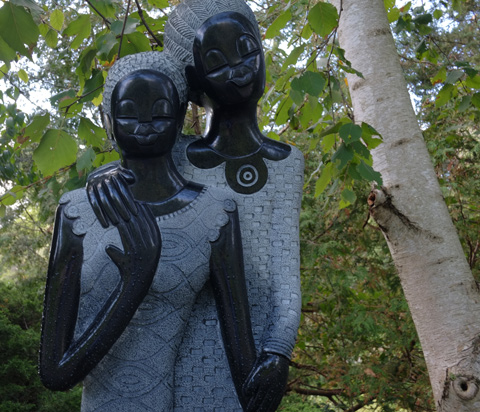
below: Giving Advice by Boet Nyariri, carved in springstone

sculpture of two women (mother and daughter?), one slightly behind the other, with hand on other's shoulder,

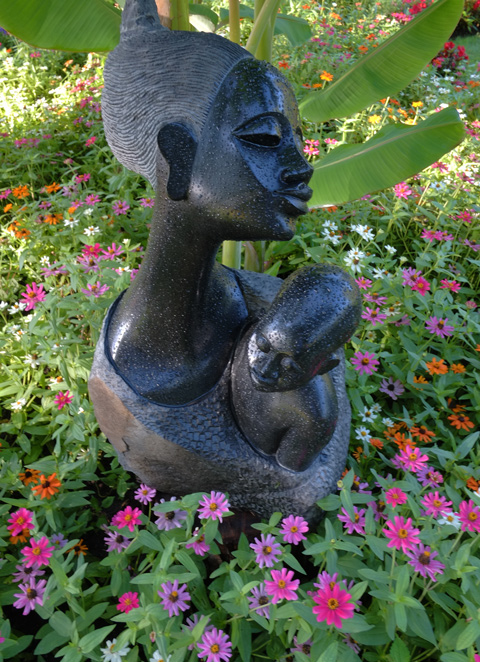
below: (after the garden was watered!), Mother and Son, by Joe Mutasa, carved in springstone.

black stone sculpture of a mother holding her son, in a garden, with pink, red and orange flowers around the bottom of the sculpture

below:  Nesting Cormorant, by Lucknos Chingwaro, springstone

tall black sculpture at Edwards Gardens

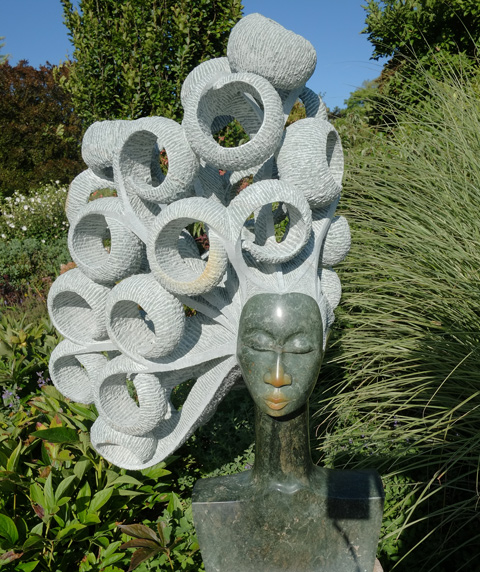
below: Windy Day by David White, opal stone,

sculpture of a woman's head, eyes closed, with lots of rings of lighter stone hair, title is Windy Day

below: Evolving, by Edmore Sango, opal stone.

tall stone sculpture among plants in a garden

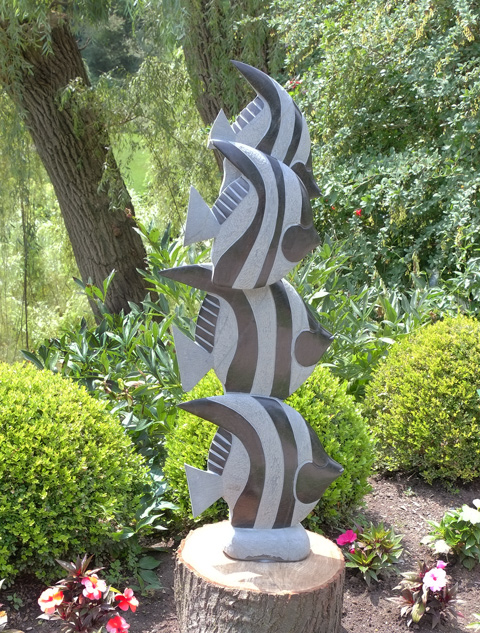
below: Shoal, by John Gutsa, springstone

a sculpture titled Shoal, 4 striped fish, one on top of the other, sculpture with flowers in front and greenery behind, Edwards Gardens

below: Free Flow, by Stuart Chapenga, springstone

black stone sculpture called free flow in Edwards Gardens.

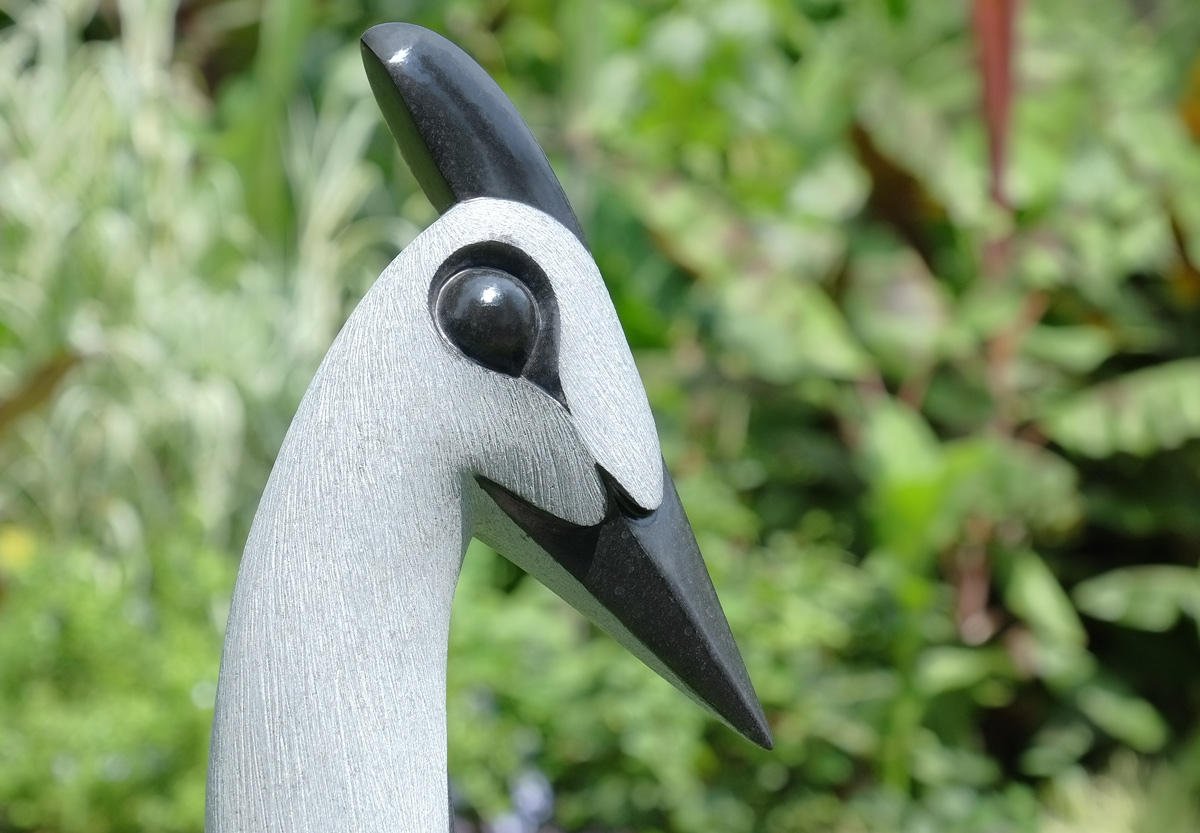
head of a bird carved in black and white stone

close up photo of two yellow flowers with dark brown centers, from the side

close up photo of a monarch butterfly on a pink flower

ZimSculpt lasts until the end of September.

Graffiti Alley keeps drawing me back to see if there are any changes.    What is new and what has disappeared.   To see who is hanging out in the lane today and have a silent chuckle or two at the tourists.

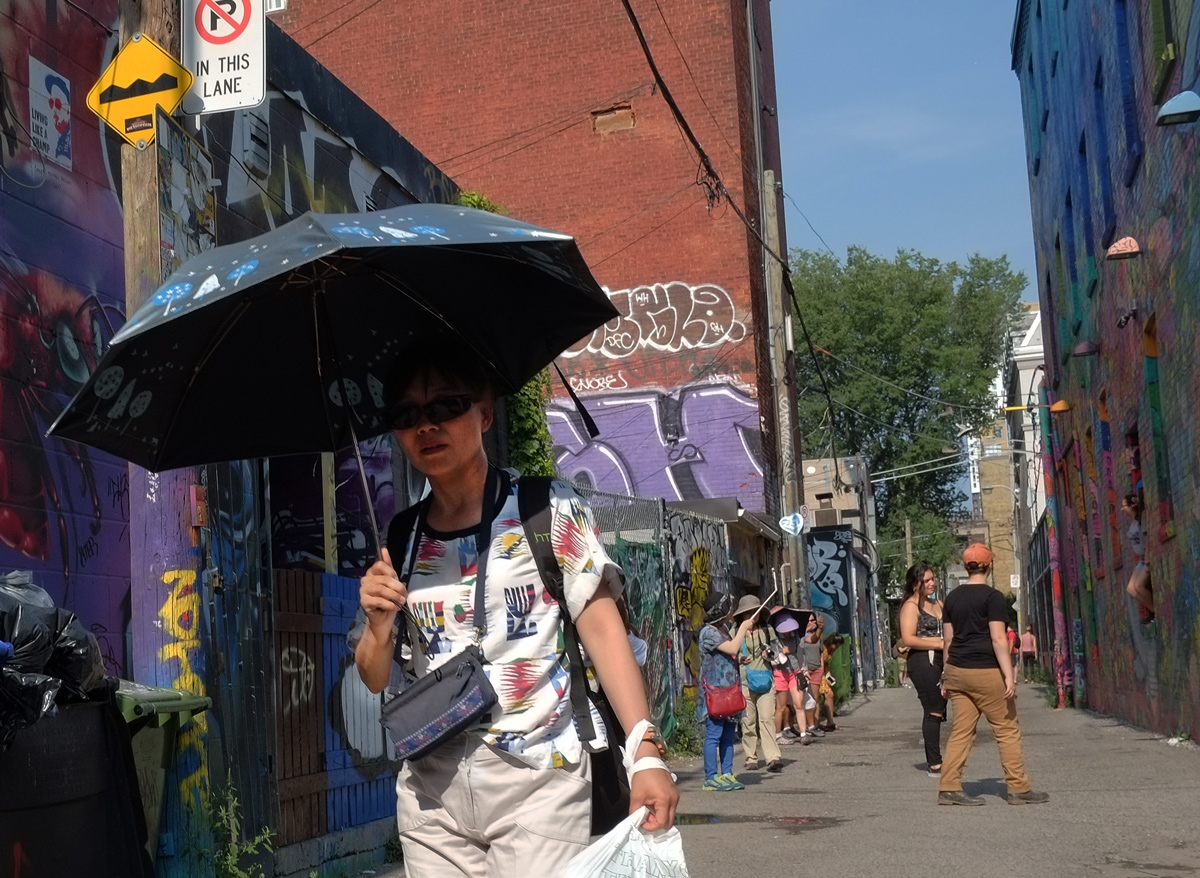
below: Sunny days in Graffiti Alley

a woman carries an open blue umbrella on a sunny day as she walks down Graffiti Alley

below: Let’s Eat Sandwiches Together Forever, by elicser, seems to have been refreshed recently.

let's eat sandwiches together forever, a mural by elicser, with people and sandwiches, people in the middle are hugging

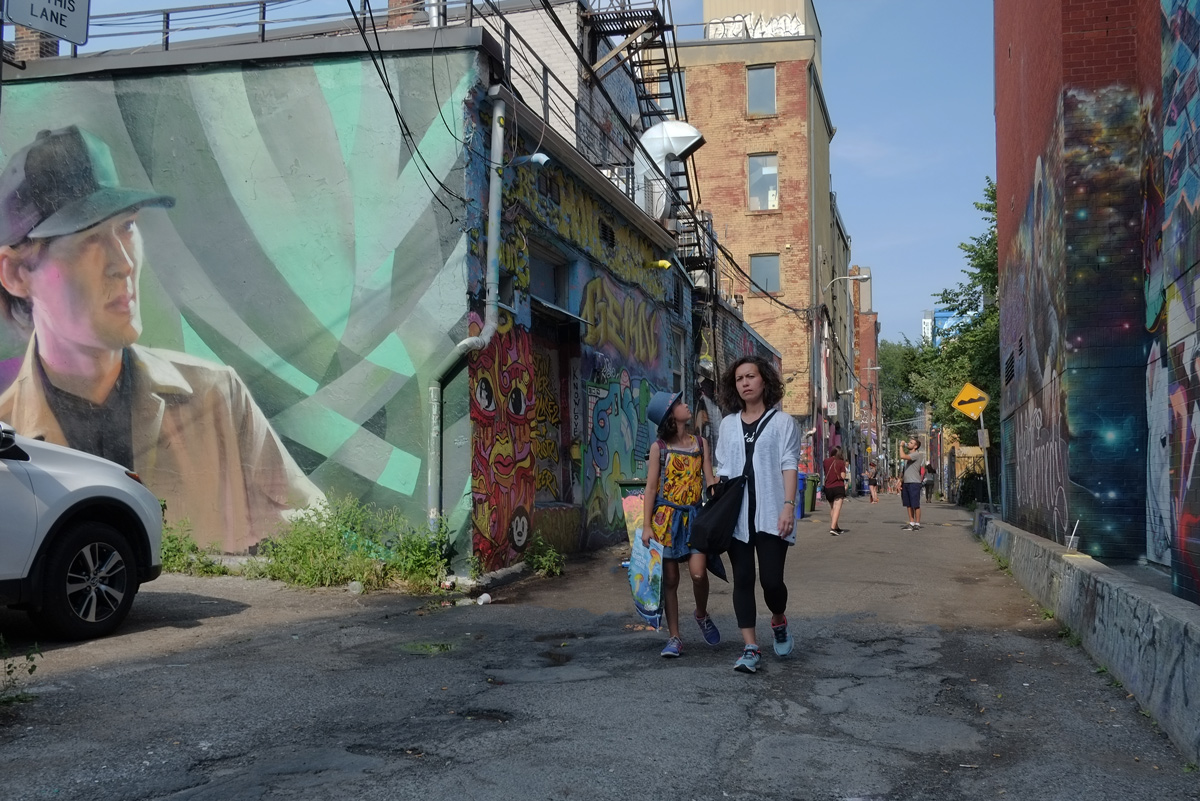
a mother and daughter walk down Graffiti Alley, past a lrge mural of a young man by Janus

below: He’s pointing to the sky because he’s giving us a detailed weather forecast.

a man in a yellow vest is talking in Graffiti Alley

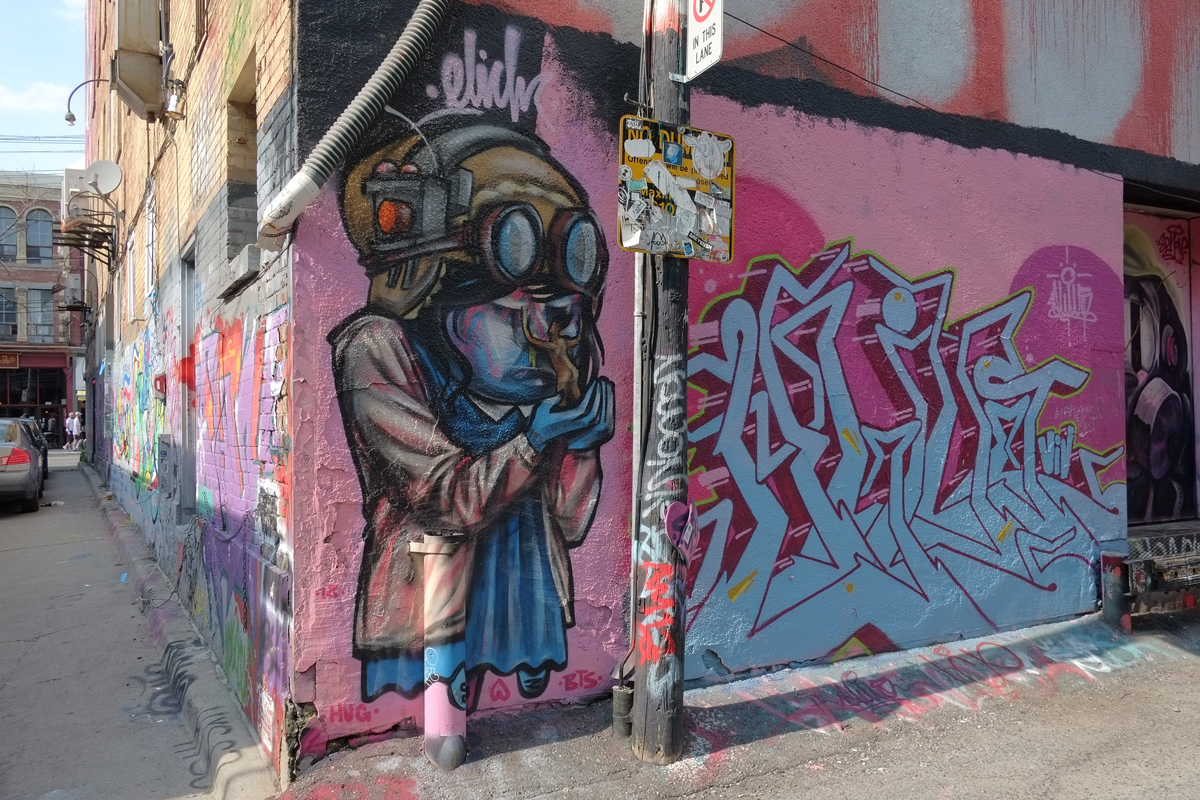
below: The last time that I walked down Graffiti Alley, elicser was in the midst of painting this door.

a mural of a person in an old fashioned aviator's helmet and goggles, and wearing a blue dress, on a door in an lane
a mural of a person in a gas mask (spray paint mask) on a door in an lane with pink on either side

below: Hello!

a woman sits on a window sill on a building iin Graffiti Alley as a man takes her picture

below: Montreal and Toronto and the writing in between.

text street art with the words Montreal and Toronto written in the top corners

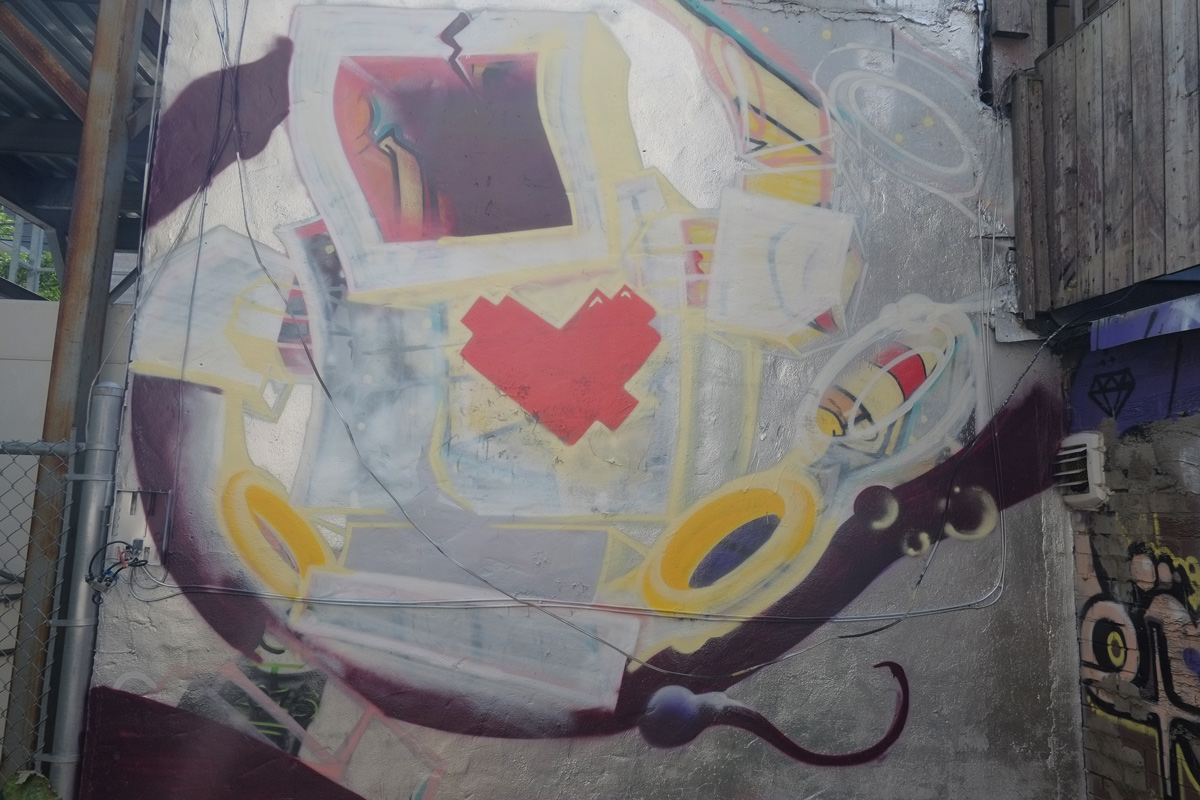
below: A lovebot of a different sort.  Almost unrecognizable except for that heart.  Only lovebot has a heart like that.

lovebot street art

below: A large carp painted by Nick Sweetman.  A fish out of water.

a large carp mural by Nick Sweetman in Graffiti Alley

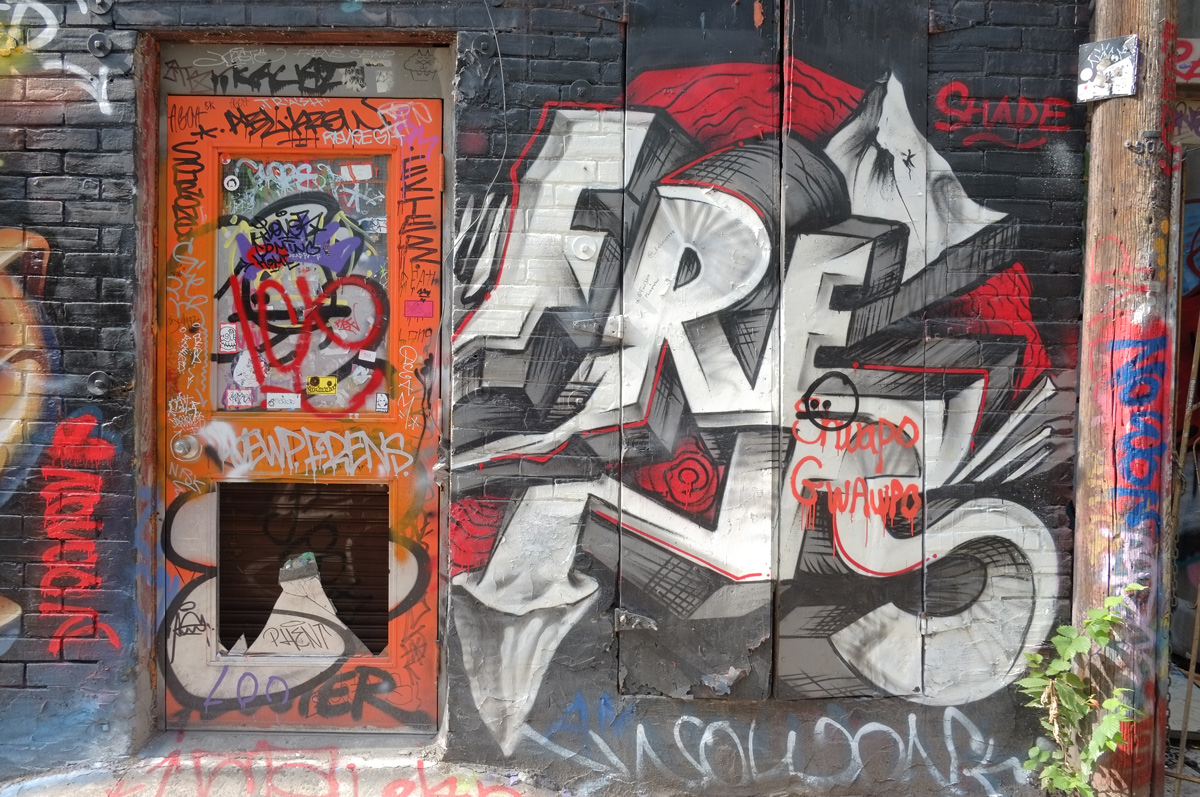
below: Broken window

orange door and street art in Graffiti Alley

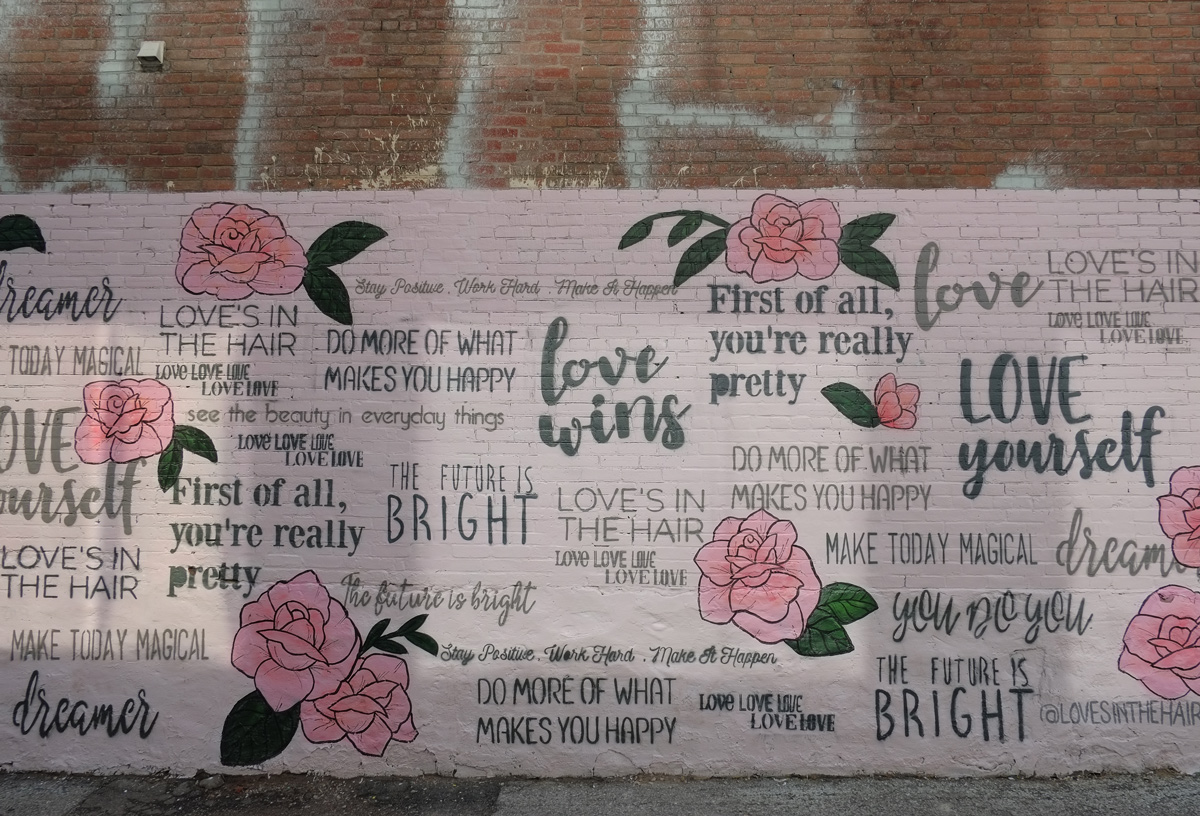
below: Pink roses and words of love and encouragement (and a little bit of flattery).  The future is bright and do more of what makes you happy.

pink roses and words about love on a mural

below: A new poser bunny at Portland Place

a poser bunny on a wall

below: Toronto Blue Jays vs. stencils are wack

street art painting of a street artist in grey hoody and mask, hoody has Toronto blue jays logo, but someone has used black marker to write words on hoody say Stencils are wack

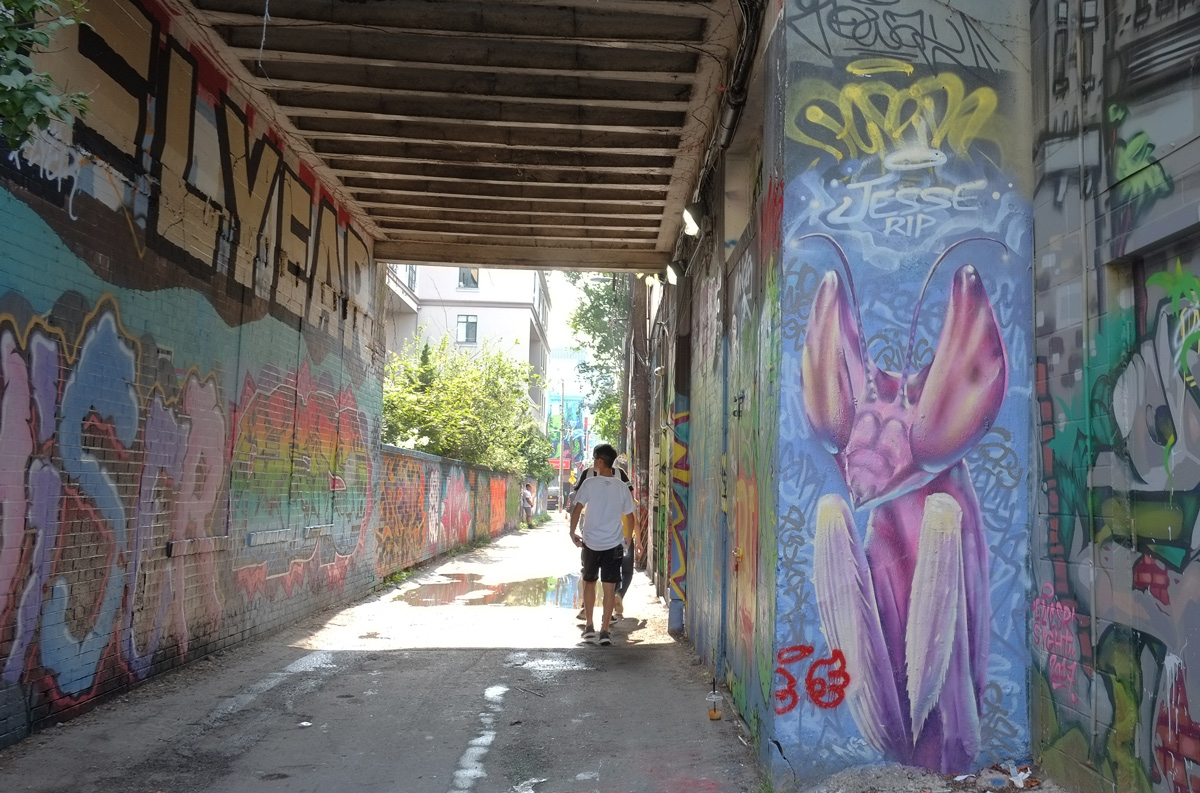
below: Walking past the praying mantis which is memorial to Jesse.

people in graffiti alley with a large pink praying mantis mural

below: Rat and a spray paint can can’t keep the eyes in their heads.

below: Unfortunately, part of the uber5000 wintertime Toronto mural has been tagged over.

below: Honk! honk! An uber5000 yellow bunny offers a donut

A man avoids the puddles in the lane as he walks past an uber5000 mural of a yellow birdie with a donut, birdie is driving a little orange car

below: Starbursts (or flowers, or just interesting shapes) in pink and yellow

part of a painting on a metal garage door of two starburst shapes, one in pink and one in yellow

below: The elephant isn’t in the room, it hasn’t made it down the stairs yet.

graffiti above and below a diagonal metal staircase, an elephant above the stairs and a dog below. The dog is saying woof

below:  A collaboration between immortalwales and kyleghostkeeper.   Both are tattoo artists and they both have instagram accounts if you are interested in seeing their work.

woman wearing a white head scarf and large glasses, with red lips

Another story of changes underway;
more documentation of buildings about to disappear.

trees and overgrown yard, two large signs advertising townhouse developments to come

On a leafy stretch of Bayview Avenue, there are some buildings that now sit empty.  The weeds have taken over the yards, as have large signs advertising the townhouse development that will be built there.   Actually the signs are only on one yard, this one:

below:  There are curtains in the window but some shingles are missing and the frontyard is overgrown with weeds – 2716 Bayview Avenue, sitting empty.   If you drive past it on Bayview you’d probably miss it because of the large trees between the house and the street.

small brick house with attached garage, overgrown front yard, tiger lilies growing by the front, piles of mulch on driveway, some ivy on front of house, some shingles missing from the roof

below: Nature takes over very quickly if you let it.  The lilies haven’t lost to the thistles yet though.

thistles, orange tiger lilies, and ivy, growing in a garden at the front of a house

below: The backyard was very overgrown too. The side door was open but I didn’t go in.  The basement appears to be in good shape.

an open basement door on the side of a house, overgrown yard, pile of debris in the foreground

If you go to their website, only 7 townhouses are shown in the drawings while the properties on either side of it (4 in total) are included in the plans as “future development”.   If you look at the original application on the City of Toronto website, the whole plan called for 20 townhouses facing Bayview Ave and a single family dwelling facing the street behind.  Each townhouse is 4 storeys (including basement level which is half garage and driveway) and 18’9″ wide.  The above ground levels are 47′ deep.   The site drawings and architectural plans were from June 2017.   I am not sure why the discrepancy.  It’s not uncommon for changes to occur between the planning stage and the final product…   So take the measurements that I just gave you with a grain of salt.

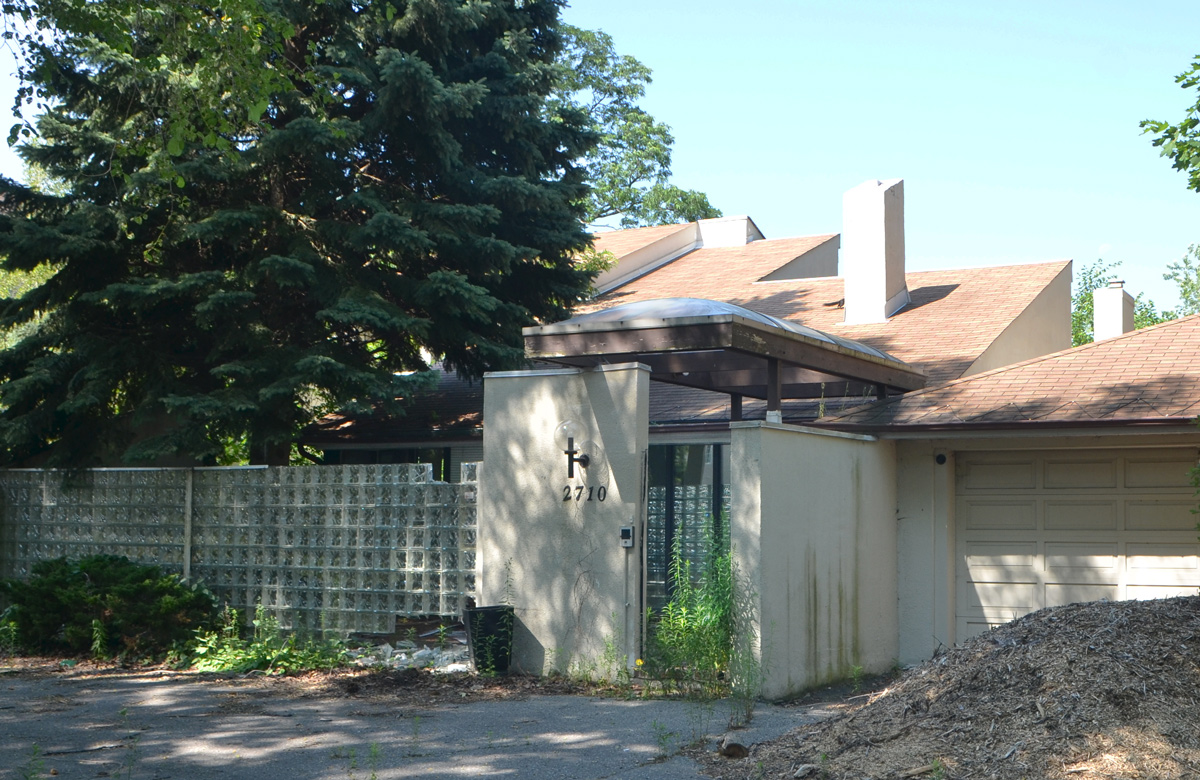
below:  One house to the south, 2710 Bayview.  A newer style house than its neighbour with part of its front yard hidden behind a glass block wall.   It too is set back a large distance from the street.  Once upon a time, someone put some love and care into this house.   I hoped that it was well used in its time.

modern style house with glass brick wall in front, around a front porch, large spruce tree, overgrown driveway,

modern style house with glass brick wall in front, around a front porch, large spruce tree, overgrown driveway,

double red doors, front entrance way to an empty modern design house

below:  Moving north, this is 2720 Bayview.  There is evidence that large trees have already been cut down.  At the moment all the evidence is well hidden from passers-by.   A year ago, farther south on Bayview a developer cut down 30+ large trees without permits from the city because they were building townhouses on the site  The outcry was big but the penalty is small.

white stucco bungalow with the remains of a chopped up tree in front

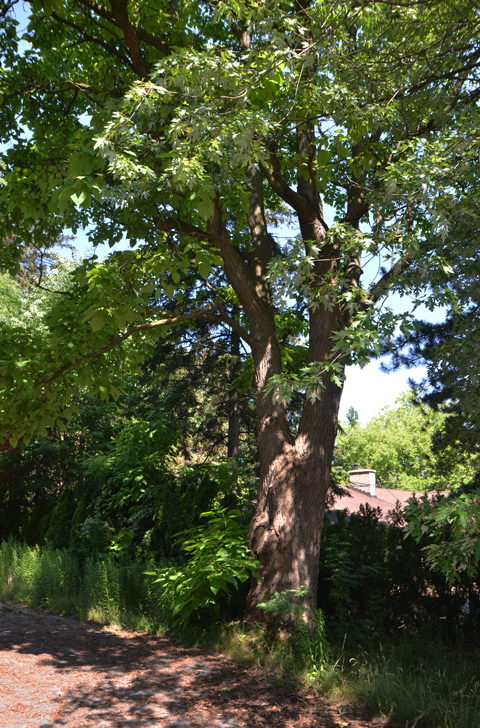
below: But….  if you have permission to build townhouses, there is no way the trees can stay.  Any plan that involves creating 20 new townhouses in less space than four single houses doesn’t leave room for large trees.  Those will be a thing of the past on this stretch of Bayview.  The one below was so big that I couldn’t reach around the trunk of the tree.

a large mature broadleaf tree in summer, green

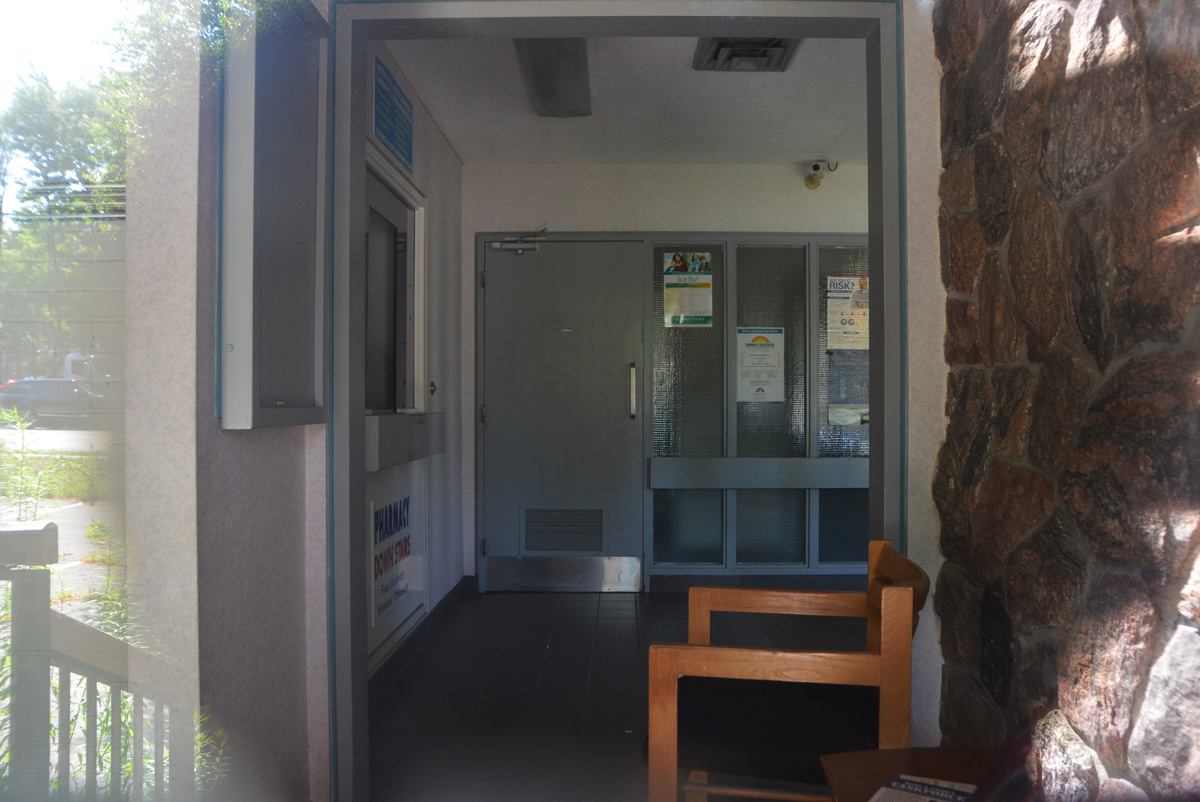
below: The fourth building, 2722 Bayview, was originally built as a residence, but it has been a medical clinic for decades.  If you peer in the window, there are still posters on the wall (Is It Flu?) and even reading material on the table ([something] Task Force).  There is a sign on the front door that says that 2 June 2017 was the last day the clinic was open.

interior of medical clinic, no longer used, looking in the window, chair, posters on wall,

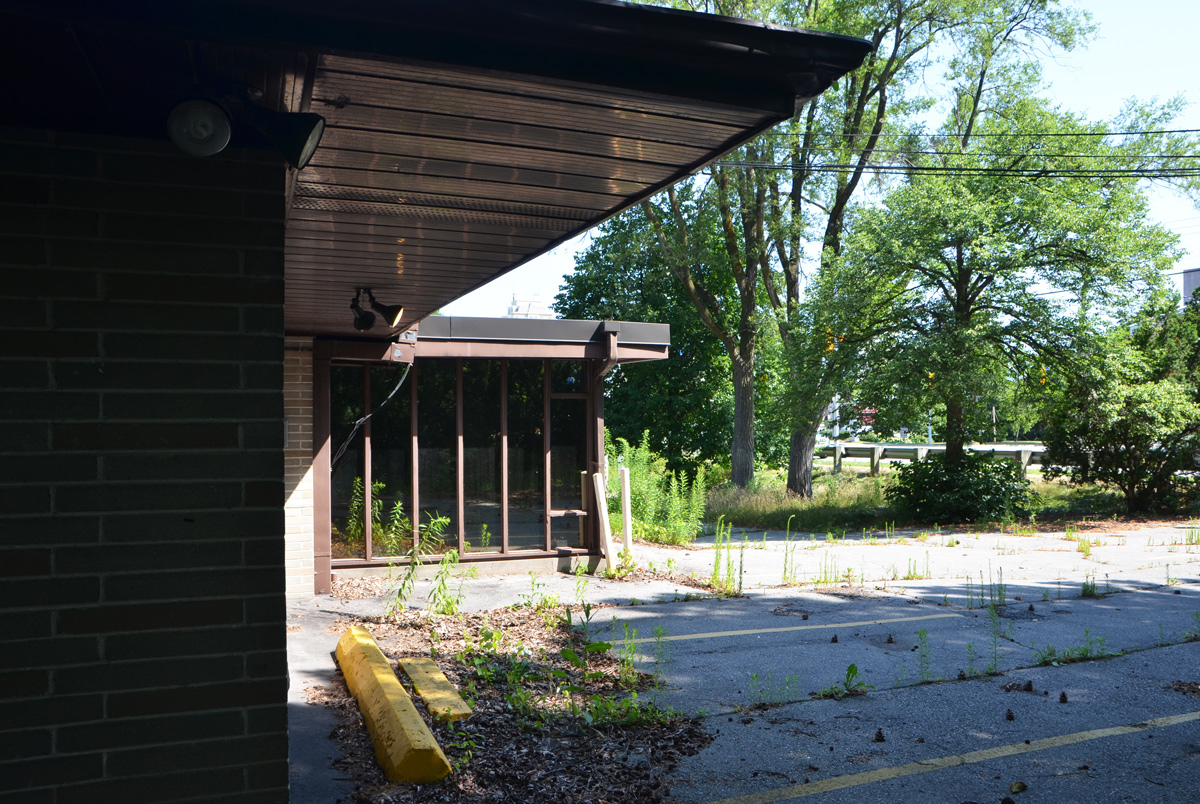
weeds coing up through the cracks in the pavement of a parking lot in front of an unused medical clinic, front entrance of the clinic, full length windows

Lastly, I took a picture of this house too as it is beside the ones above.   The “Notice” sign on the fence was a bit of a surprise considering how new the house was.  My original assumption was that the house was going to be demolished.  In fact, the planning application says that the house will be moved to the back of the property and three townhouses will be built in front.  One driveway down the north side of the property will access both the new townhouses and the moved house.

Apparently the application was submitted in December 2016 –  However, I noticed that the original application called for three 3 storey townhouses (and is on the City of Toronto website as such).  The sign says three 4 storey townhouses and a three storey single family dwelling.  The house in the photo is only 2 storeys.

a city of Toronto blue and white notice of development sign is on a black wrought iron fence in front of a large stone faced two storey house with a large front yard, grass and shrubs

What I’ve also learned while researching these properties, is that there is an official document called, “Bayview Townhouse Design Guidelines” that covers Bayview Avenue from the 401 south to Lawrence Avenue East.  It was adopted by City Council late in 2015.   In fact, large portions of the city have design guidelines and you can find them online.

I was curious to find out how many ongoing development proposals/applications there are in the city.  There is an interactive searchable map online that I used.  When I searched on ward 25 (where the above sites are), it showed 52 locations.  When I tried searching on the whole city, there were too many results.  If you’re interested in development, you can play with the website too!

thistles, close up of flower part of thistle, one purple flower

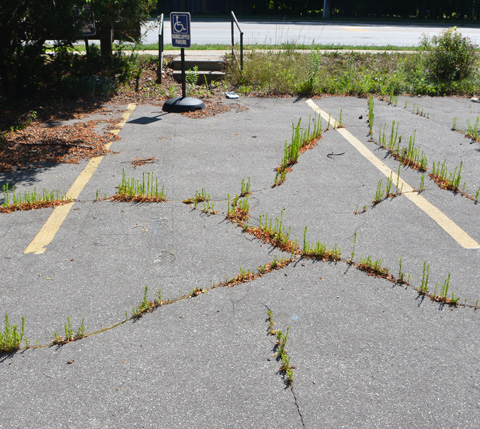
weeds growing out of cracks in the pavement of a parking lot, handicapped parking sign still there.

Caterpillars and butterflies is the theme of the latest laneway painting project.  A year ago, Nick Sweetman led a group of street artists who painted garage doors in a lane near Garrison Creek park with pictures of butterflies.   These murals appeared in blog post in June 2017

This year’s project was similar.   Many of the same artists were involved again this year.  They used garages, fences and gates in a lane near Felstead Park (a block south of Greenwood subway station) as their canvas.  Once again, the theme was butterflies as it too was part of the David Suzuki Foundation’s butterflyways project.  This time, a similar blue background was used in all the murals which has given it a more unified appearance.

a lane with many painted garage doors, butterfly murals, summer time, green leaves, lots of trees, two people walking

The project was curated by Nick Sweetman and it had the support of Start aka StreetARToronto

below: Felstead Park, by @braes_ack

title mural on a garage door, Felstead Park murals, butterflies

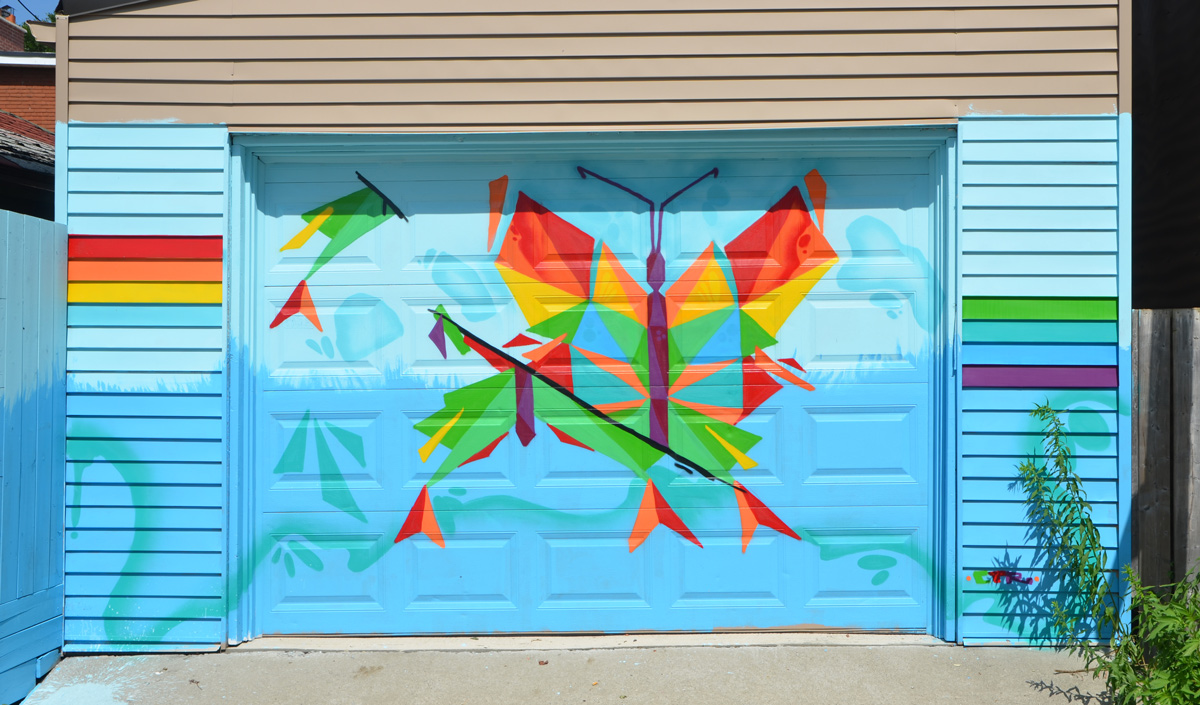
below: In the shadow of the weed are the letters CTR

geometric, angular butterflies

below: Mural signed by Kehoe, the face of David Suzuki

a butterfly and a face merged into one, the eyes look out over the top of the red and yellow wings

below: Green and yellow toadstools by mska

mural by mska on a garage door and fence, green and yellow toadstools

below: Mural by @oriah_scott

two large butterflies in a mural by @oriah_scott

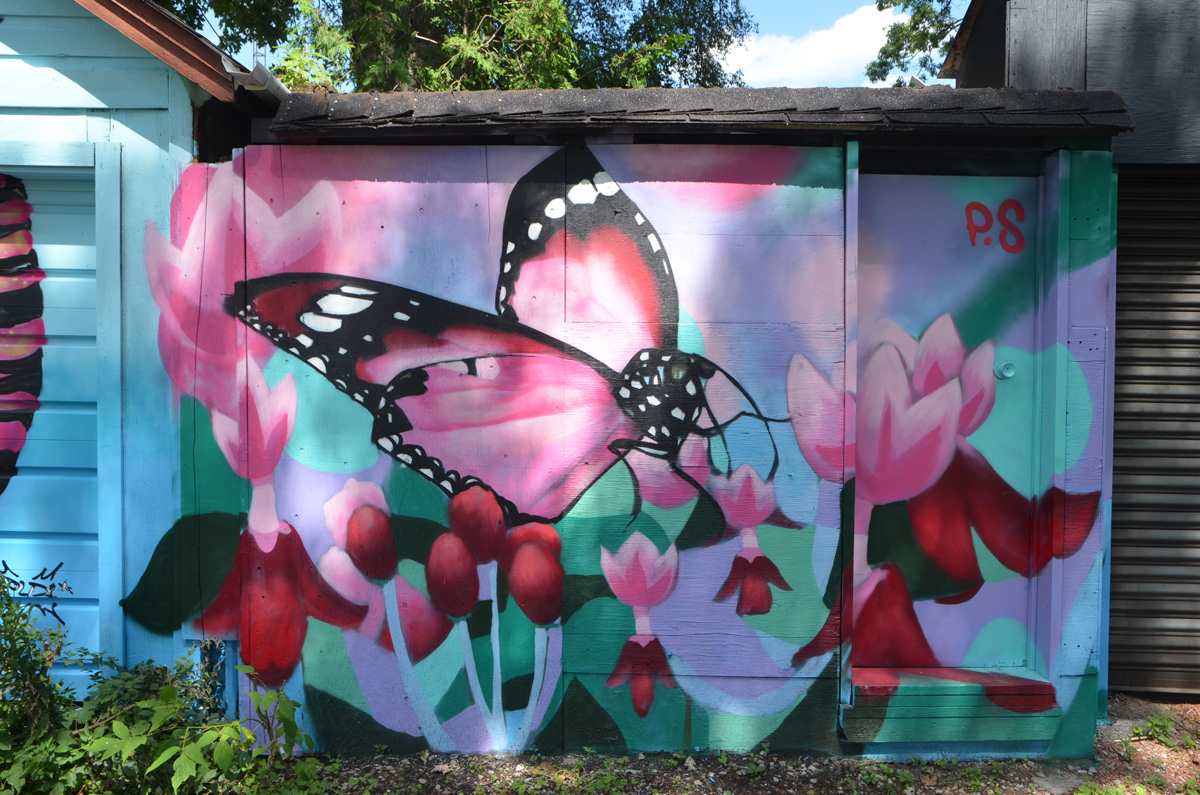
below: butterfly among the pink and red flowers, by P.S. aka Phillip Saunders

large pink butterfly with pink and red flowers by P.S.

below: A sombre dark piece (is it finished?) by @poserabm

dark grey and brown painting, one small butterfly by poserabm

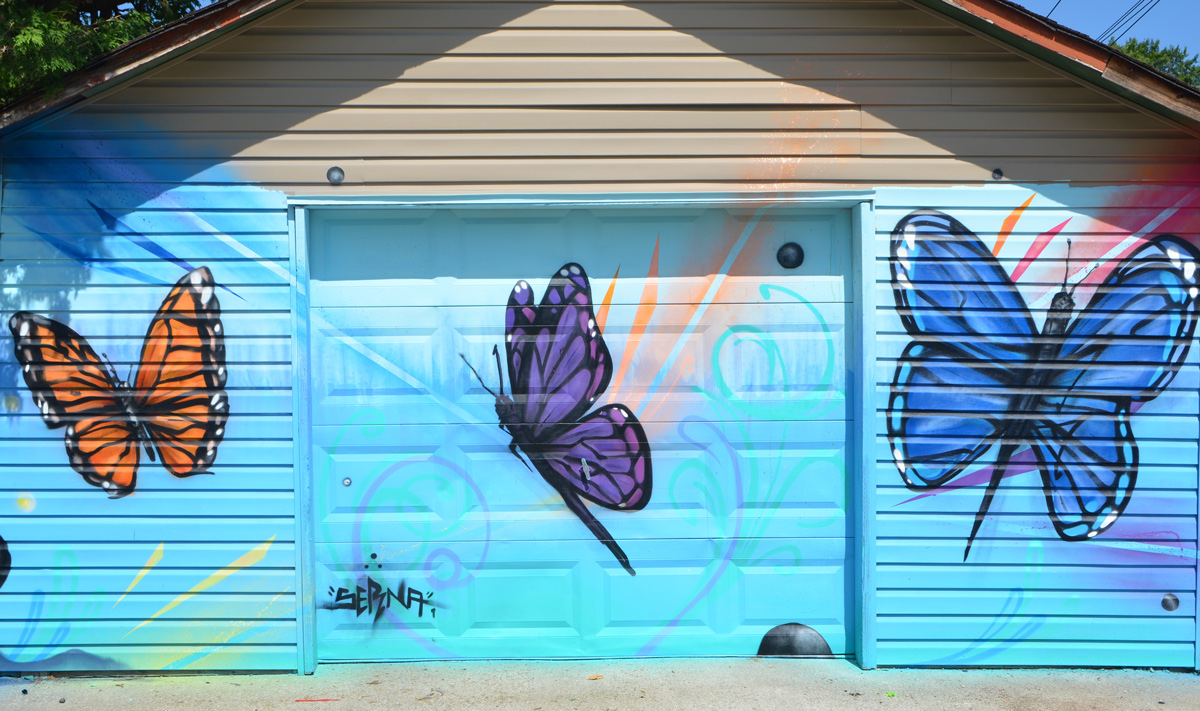
below: Three butterflies by Serina

butterfly mural by serina

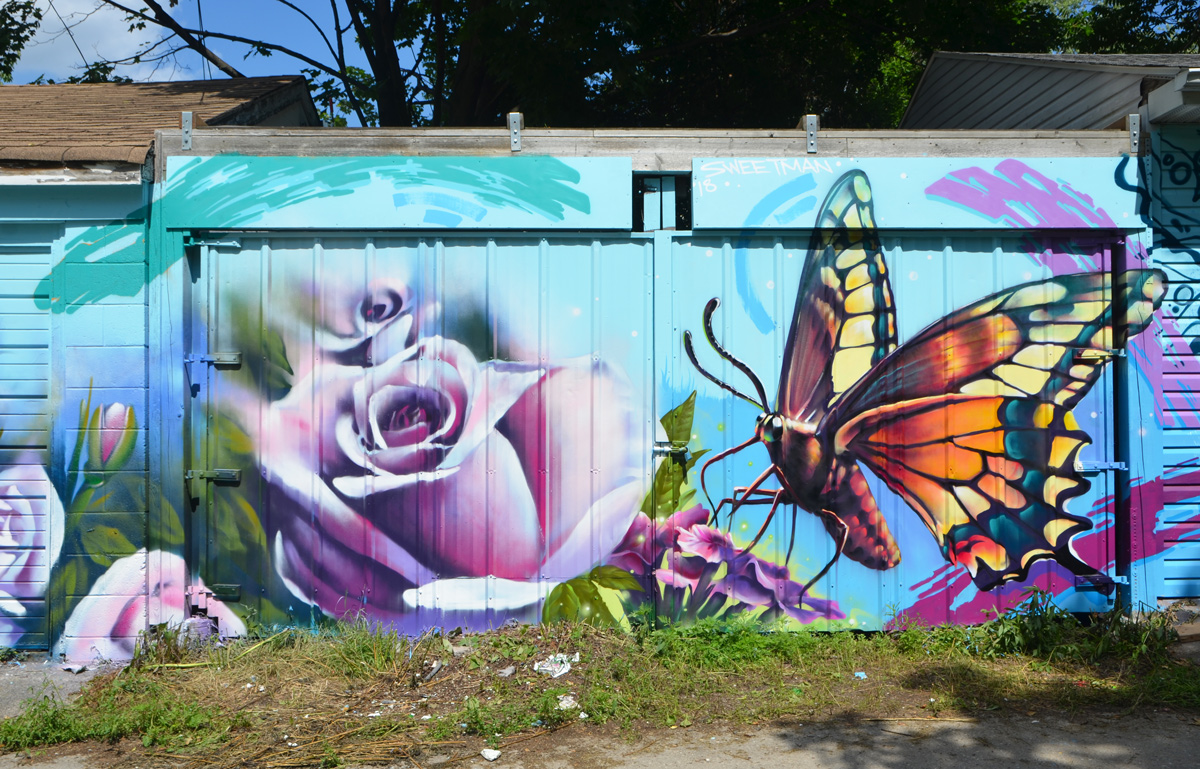
below: Collaboration – A monarch painted by Nick Sweetman and a wonderful rose by Wales

mural by Nick Sweetman, large realistic looking butterfly and a large pinkish rose

below: A bright and busy mural by Spyone and Tensoe

mural on a wood fence - butterflies and flowers

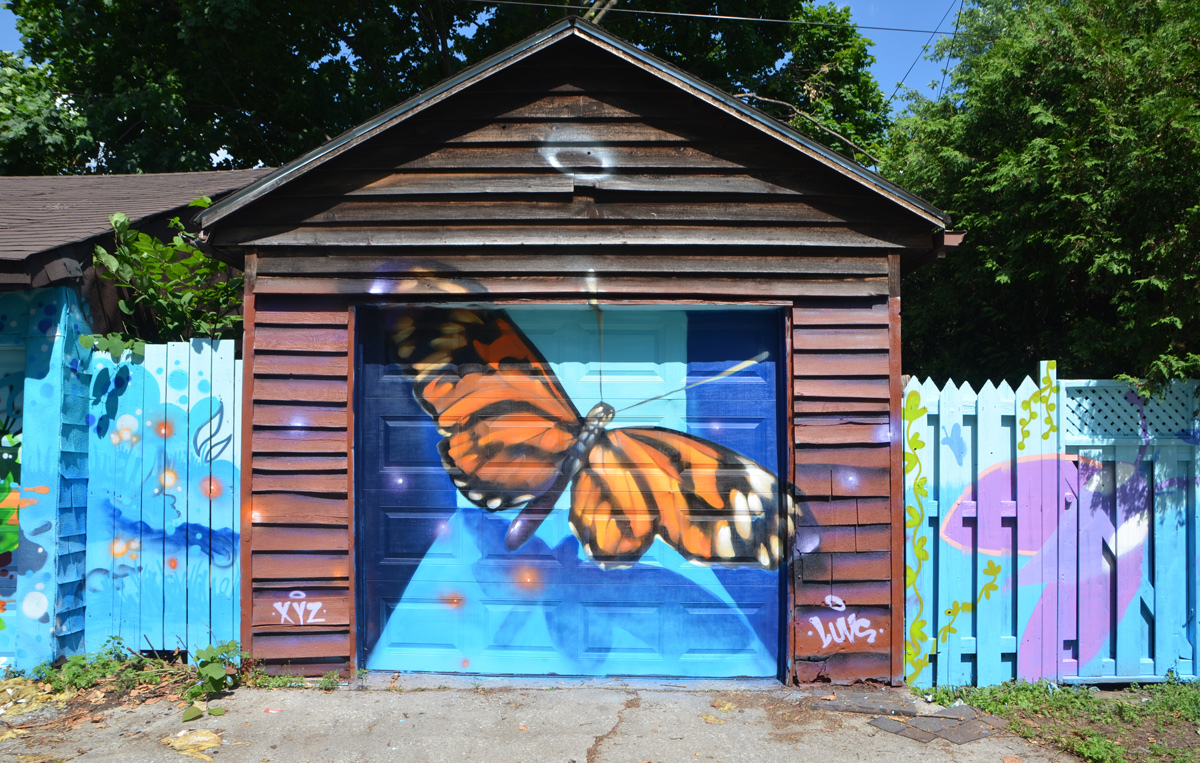
monarch butterfly painted on a garage door

below: The hookah-smoking caterpillar from “Alice’s Adventures in Wonderland” is crawling across the fence.  Painted by elicser

caterpilar

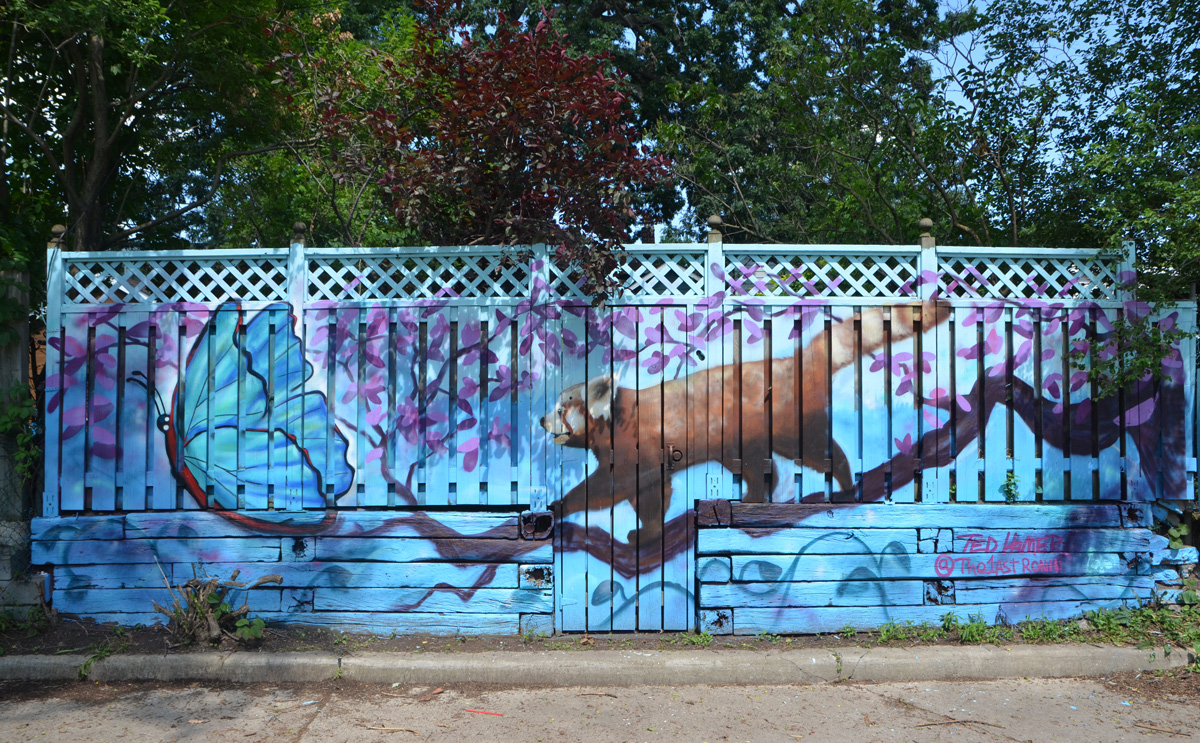
below: Red panda out on a limb, perhaps chasing the butterfly, by Ted Hamer (@The1astRonin)

an animal (possum, red panda?), walks out on a tree branch towards a blue butterfly, mural on a fence

below: A butterfly in the garden; the work of Anya Mielniczek

mural running horizontally across garage, garage door and adjoining fence, butterflies and flowers

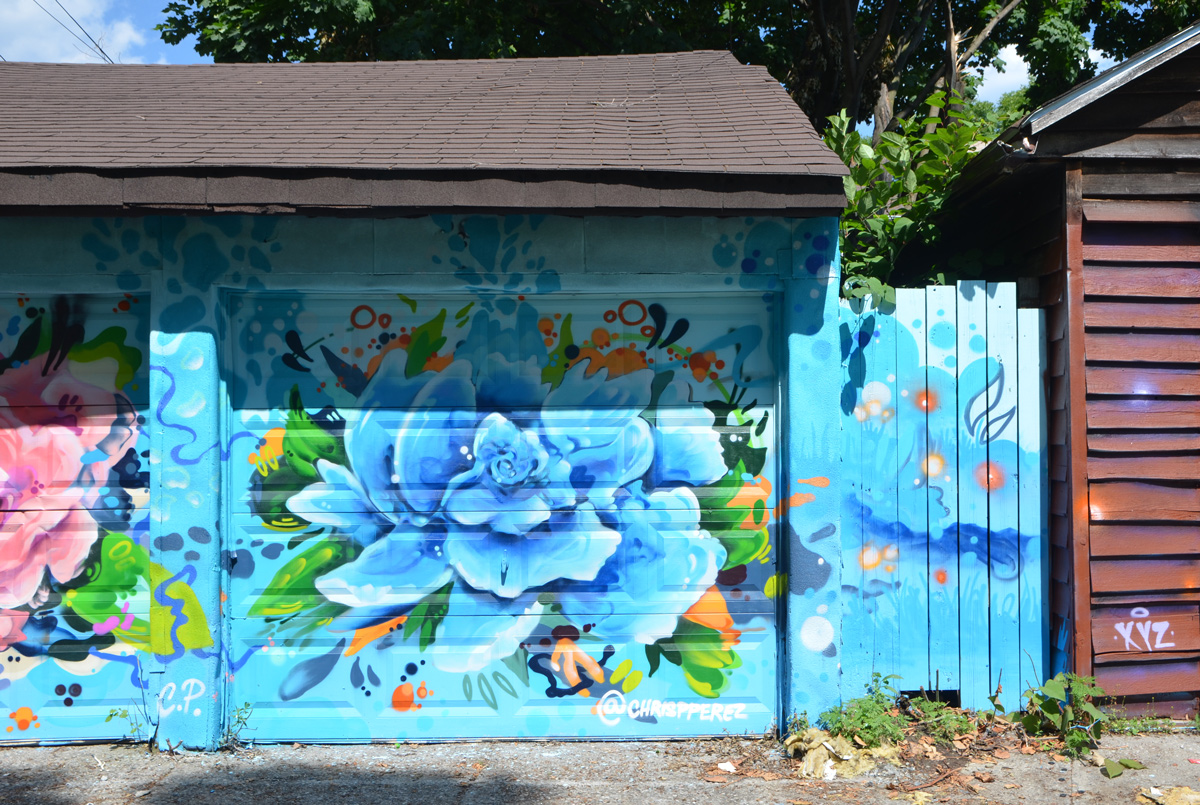
below: Two flowers, one pink and one blue, by Chris Perez

blue flower painted on a garage door, by @chrispperez

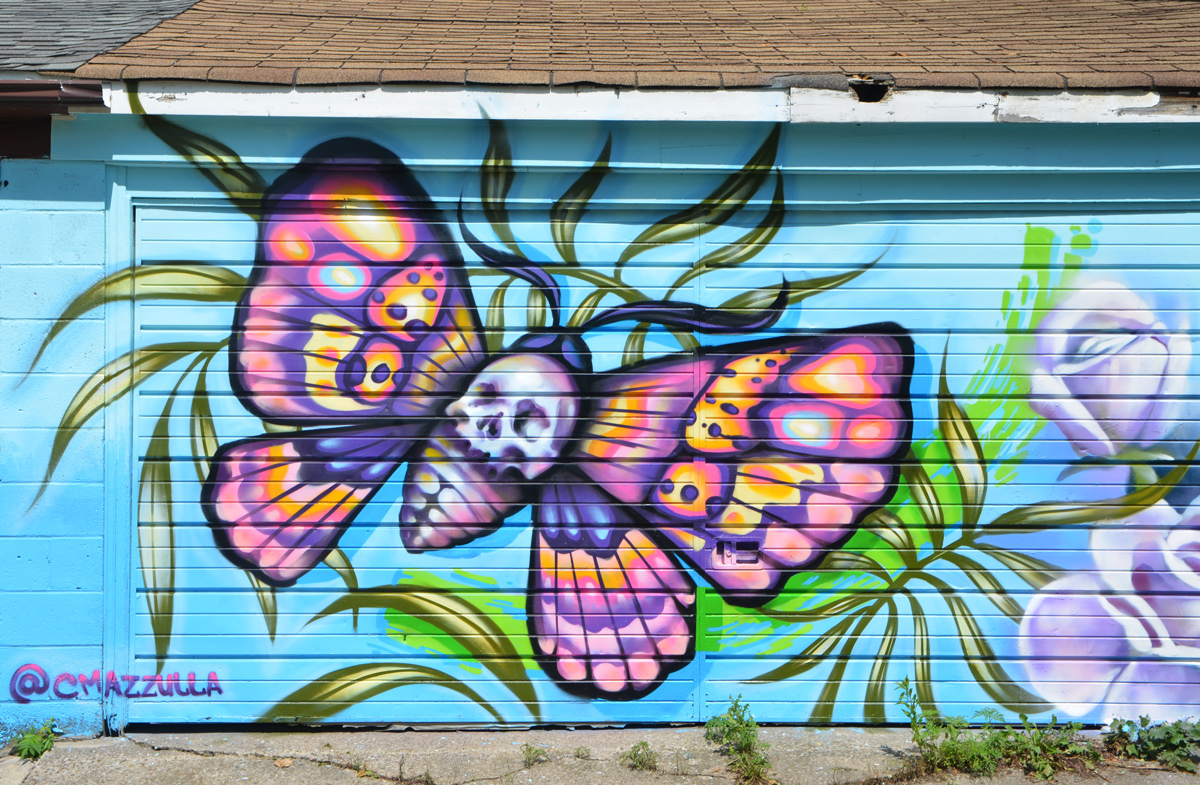
below: It looks  a lot like a skull on the back of this butterfly painted by @cmazzulla aka Christine Mazzulla

colourful butterfly mural on a garage door, blue background

below: A curled up caterpillar in pink and black, very larger than life!, by Spud.

a large pink and black caterpilar curled up on a garage door - mural

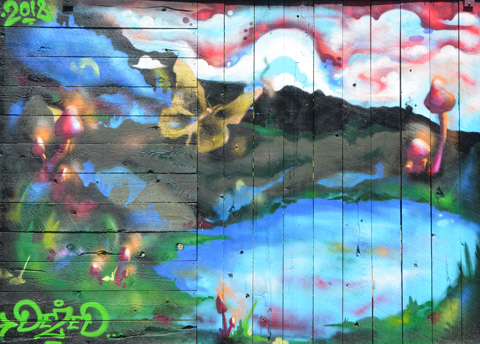
below: By Dezed, a butterly, mushrooms, and a bit of water

butterly mural, pond, mountains in the background, pinkish sky

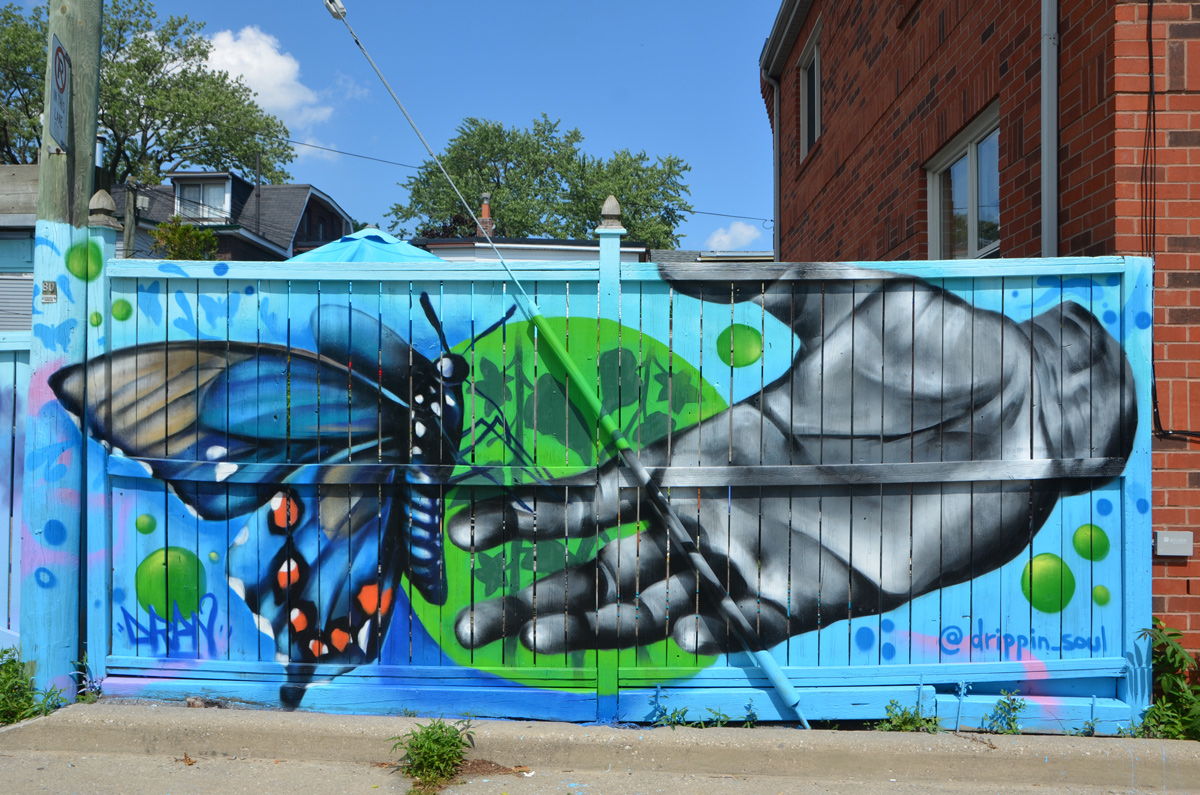
below: Reaching out to the butterfly, giving the butterfly a helping hand, painted by @drippin_soul (Kalkidan Assefa)

a mural by @drippin_soul of a hand reaching towards a blue butterfly

below: On the right, Emma, the property owner’s dog who died recently.  Nick Sweetman painted the dog while @mr_tensoe2 painted the dog’s name

geometric striped butterfly with a dog head beside it. above dog is written the word Emma


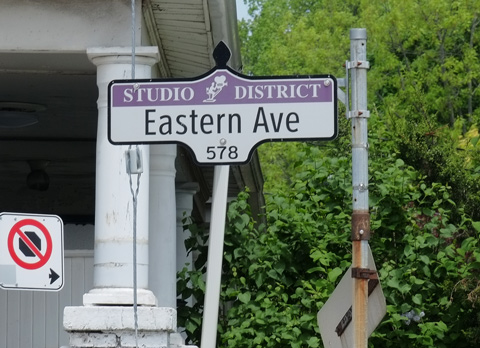
Eastern Avenue, the Studio District apparently. This is east of Broadview.

Toronto street sign that says Studio District, Eastern Avenue

This weekend is Doors Open Toronto – one of the buildings that I toured was Filmport – not very interesting actually when studios and sets are closed to the public.  I did get to see some of the rooms where the actors hang out when they’re not filming and where they have lunch.  ‘Kim’s Convenience’ is filming there at the moment.

outside a film studio building, large door labelled studio 2, closed doors, some woodworking tools and materials by the door

below: Two older buildings.  In the foreground is Consumers Gas Building, now home to Avenue Rugs.  In the background is one of two identical buildings now used by the City of Toronto.   433 Eastern Avenue is one of four sites in the city – here they house street cleaners and other city trucks, they monitor traffic, and produce street signs like the one at the top of this blog post (transportation services) – for the southeastern part of the city.   Other city departments also have offices here.

two brick buildings on a street

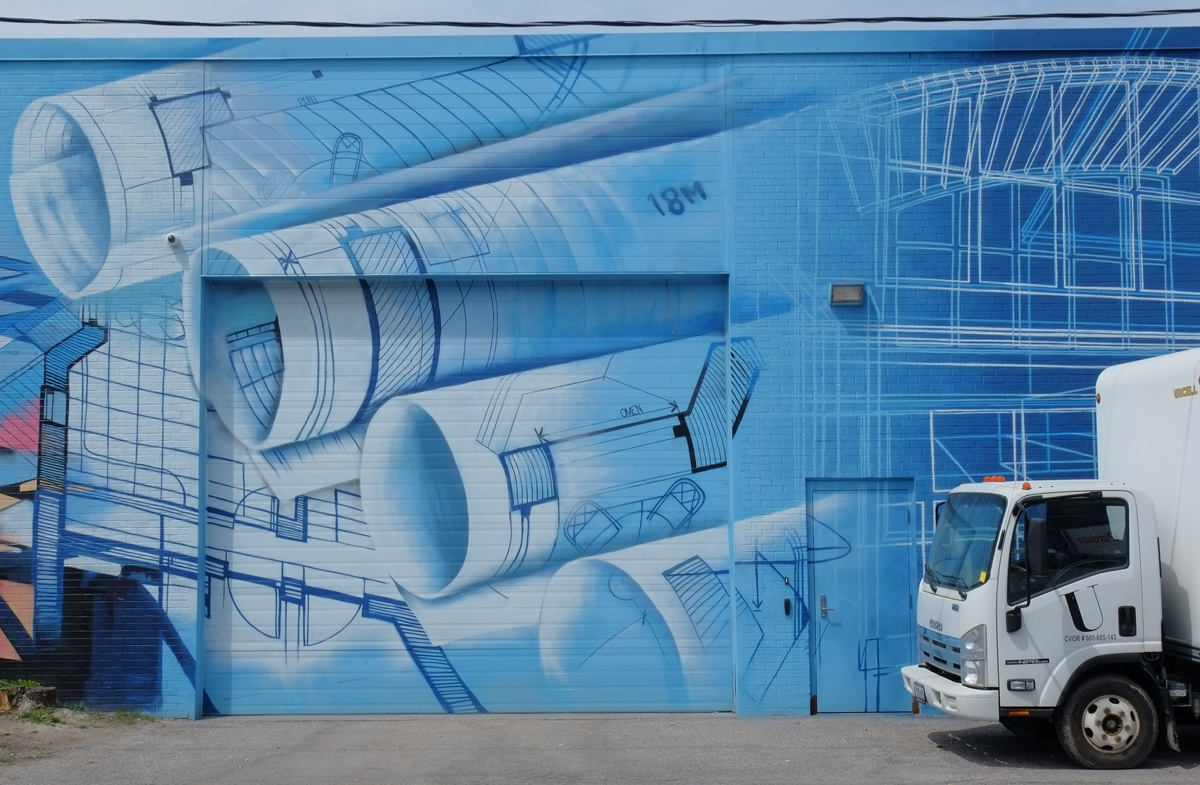
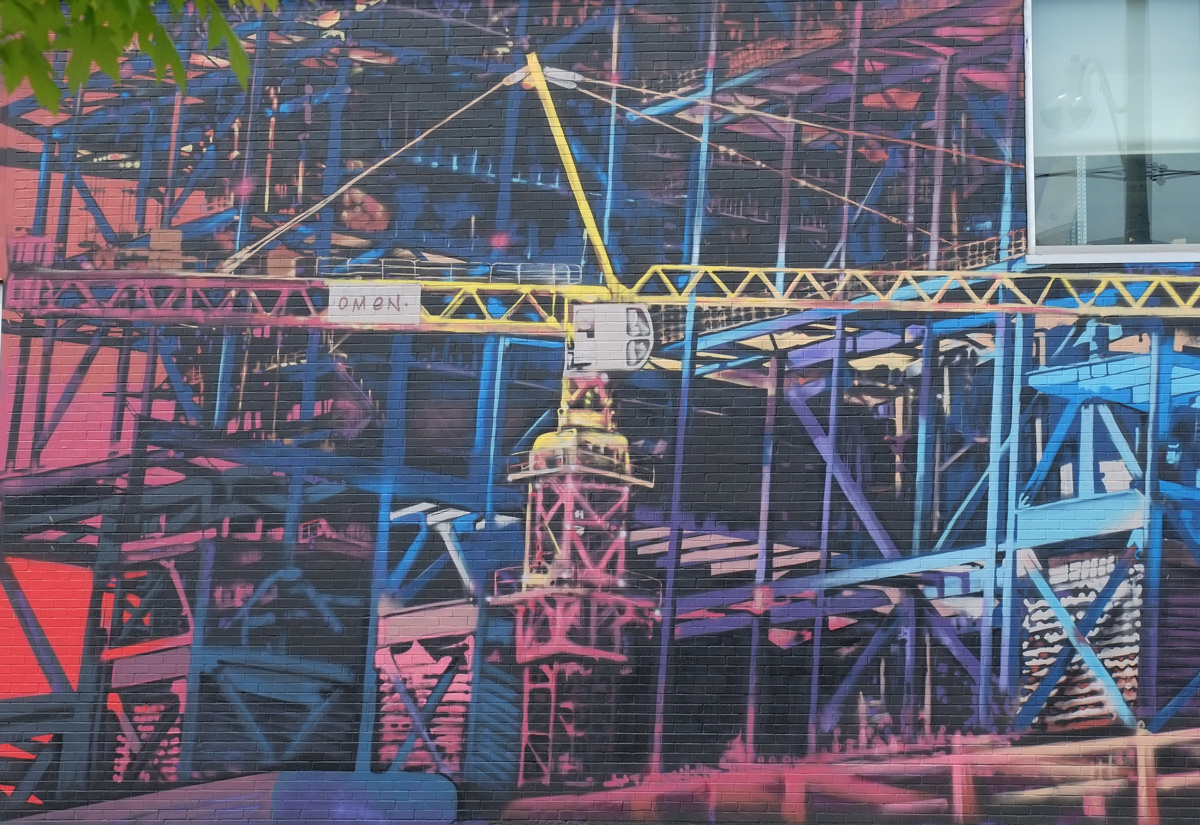
The next three photos are from the same mural.  It was painted in 2016 by Omen with help from Five8, Horus, and Peru.  It tells the story of city building, from the planning stages – blueprints and architectural drawings, through the construction phase to the final product.

blue mural of blueprints on the side of a building

mural of cranes and construction sites on the side of a building, painted by Omen,

mural of Toronto at night with lots of lights, CN Tower,

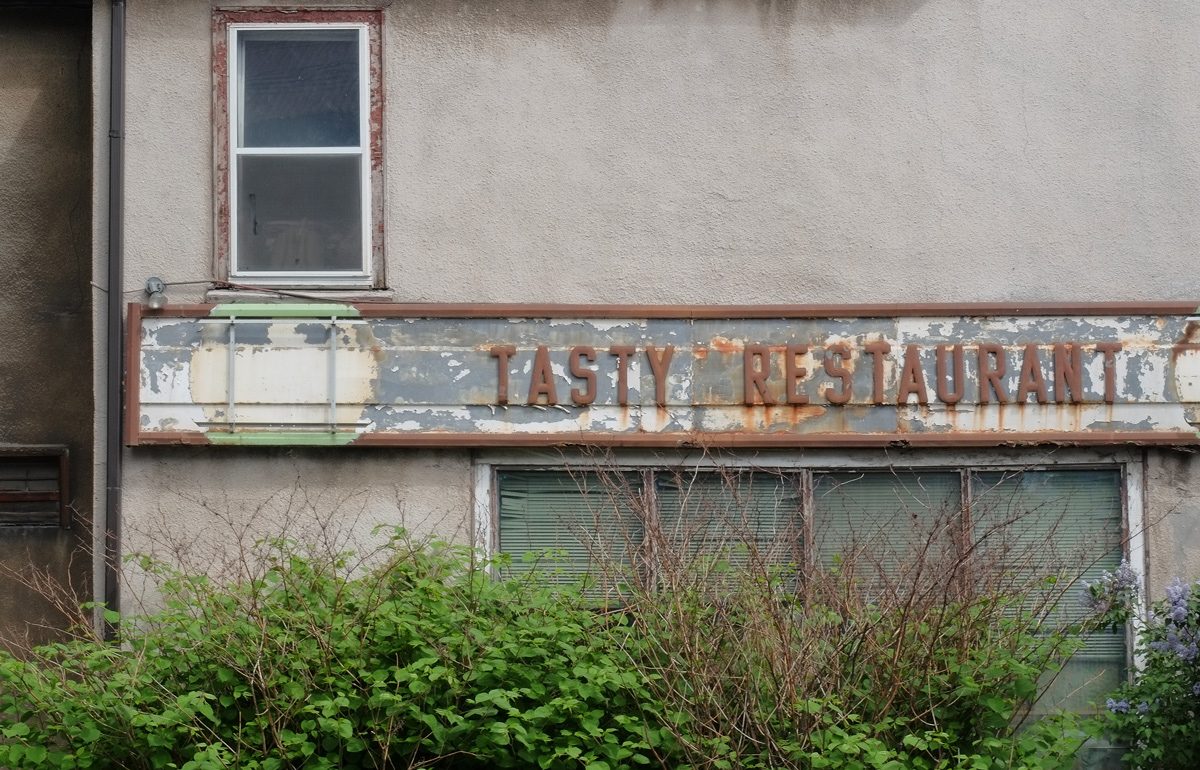
below: The Tasty Restaurant sign is still there although it is now missing the round coca-cola discs at each end.  Someone must have realized that they were worth something.   All the red from the sign is gone and the words have turned to rust.  Does anyone have any idea how long ago this restaurant went out of business?

old rusty sign that says Tasty Restaurant. there is a round spot on the left where a coca-cola sign used to be, windows are overgrown by shrubs beside the building

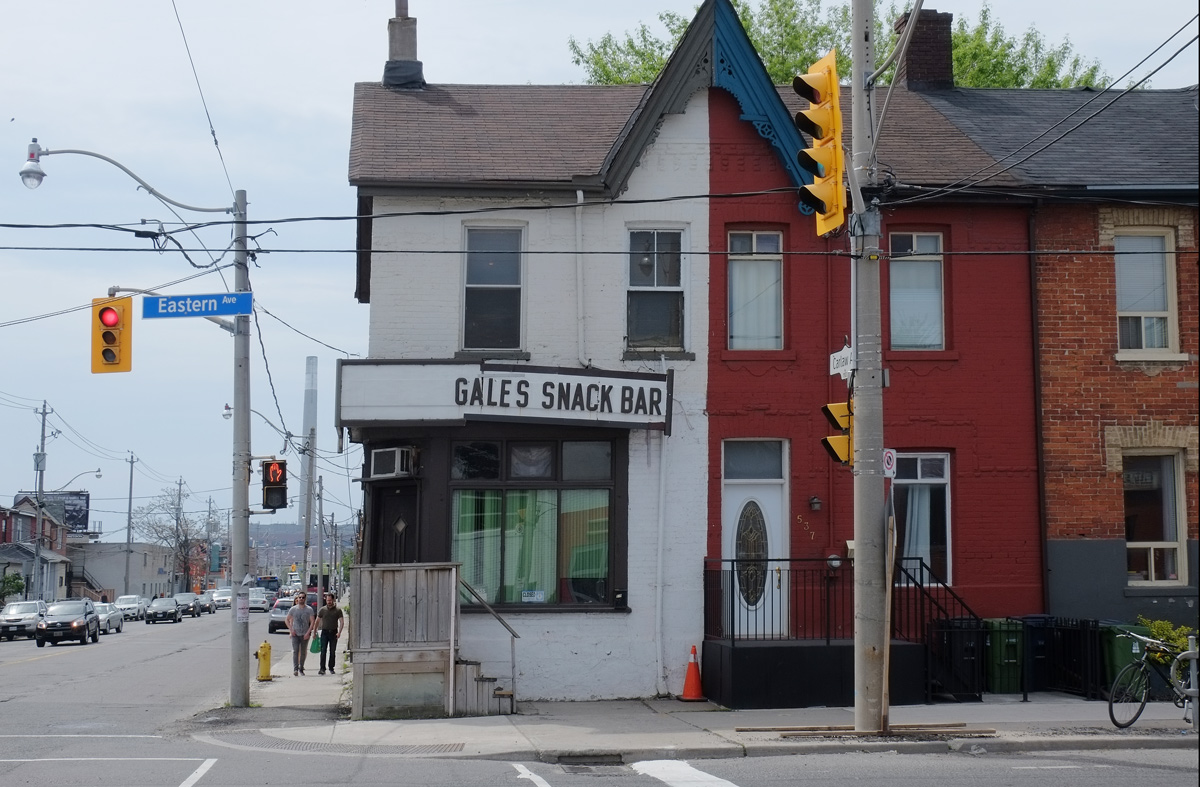
below: Another oldie but goodie, Gales Snack Bar.  More than 80 years old in fact.

gales snack bar, exterior

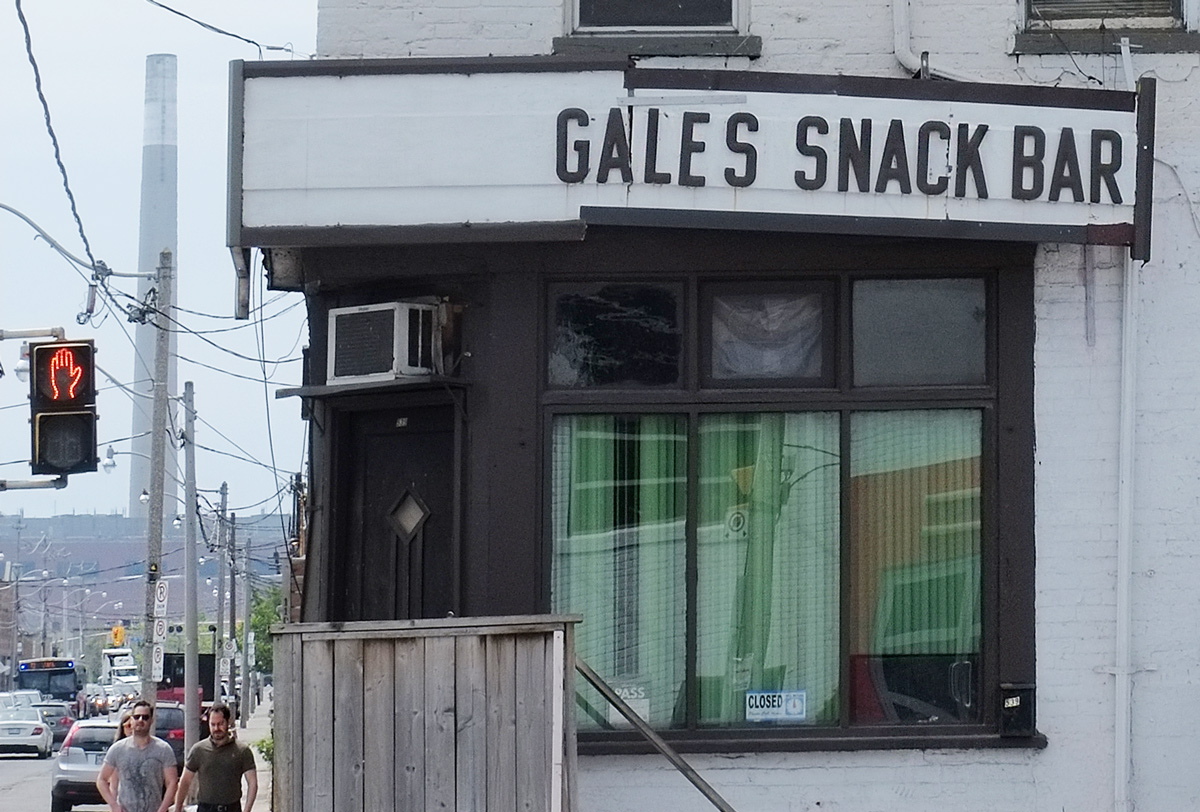
below: A closer look reveals a closed sign in the window.  It’s still in business but I was there too early.  On Saturdays it doesn’t open until noon so I just missed it.   Next time!

Gales snack bar, close up of window, green curtains, closed sign

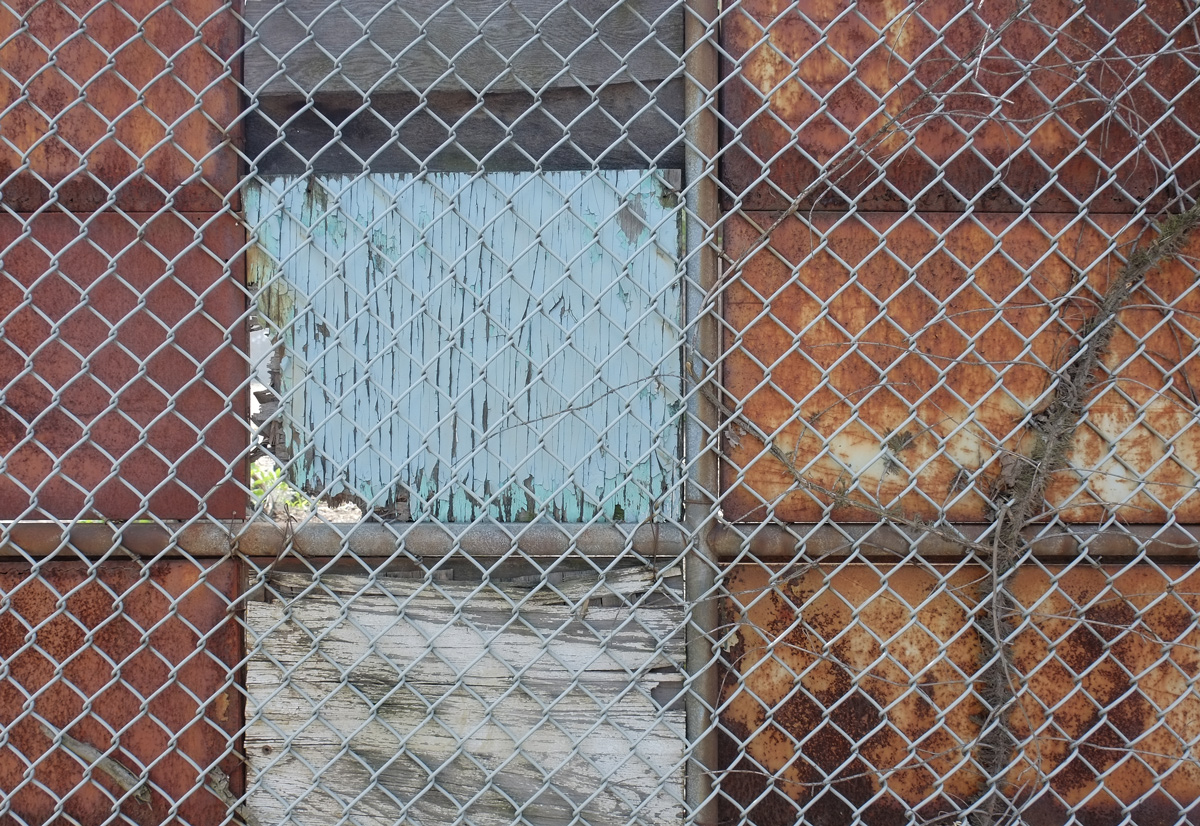
details of a chainlink fence and the old plywood and metal sheeting behind it. peeling paint and rusty metal

below: What’s hiding in the grass?  A blue fish?  A pink flamingo?  A Christmas wreath?

an overgrown front yard with very tall grass and one red tulip. Front of house has a brown window box, paint peeling, with plastic flowers and other stufff in i

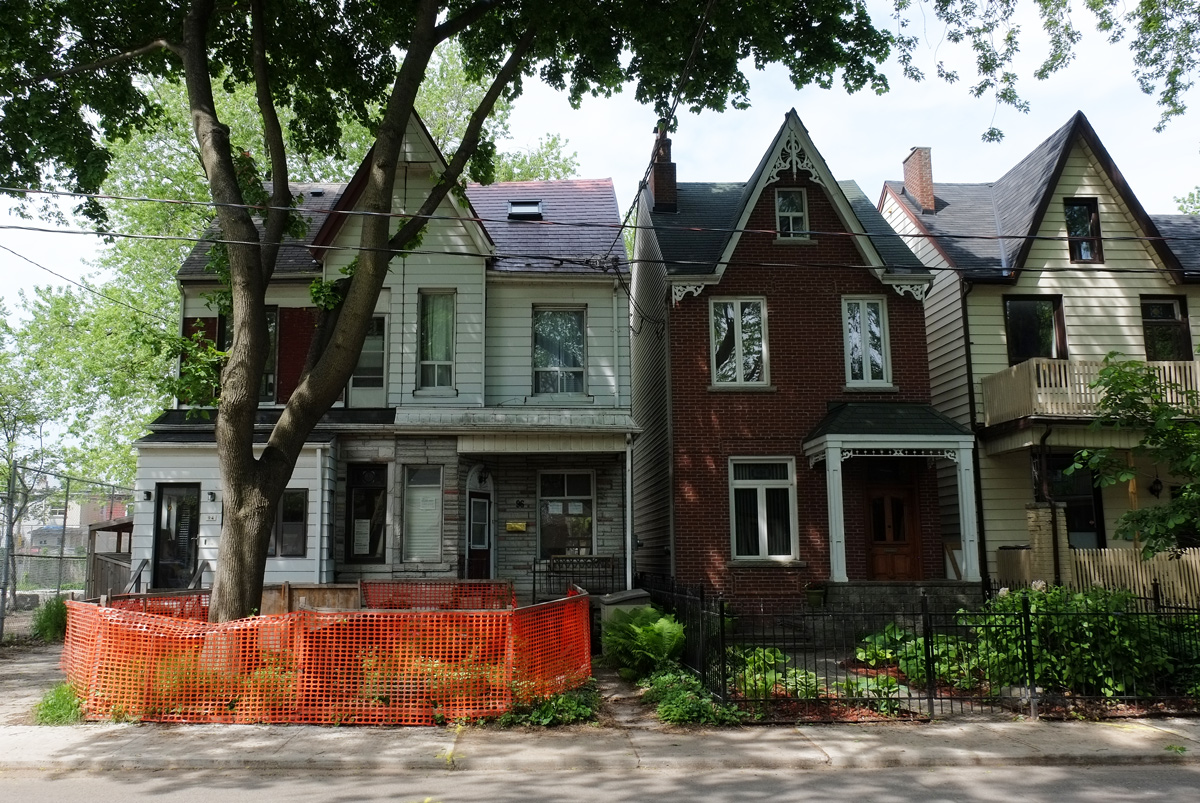
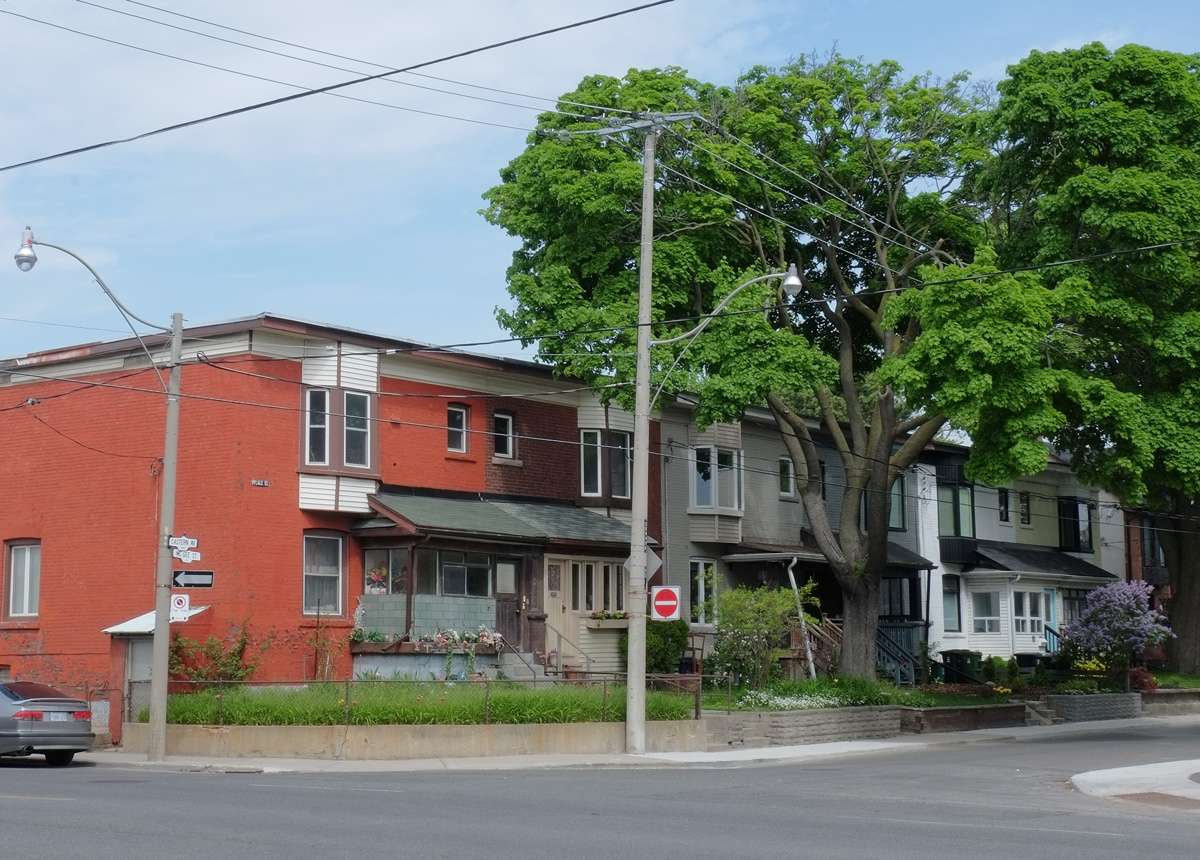
There are a surprising number of houses between Queen East and the Lakeshore (Eastern runs parallel to those street, in between them) in this area.  Most are old but well looked after and many of those that have seen rough times are being renovated and fixed up.

older houses, semi, ready to be renovated

two storey row houses on McGee Ave, lots of large tress, house painted orange,

below: This photo was taken from the parking lot of the old Weston bakery on Eastern Avenue.  The site is about to be developed into condos.  The Wonder Condos.  With Wonder being written like the word on the loaf of bread.  That bland white bread.

row of three storey victorian style brick houses

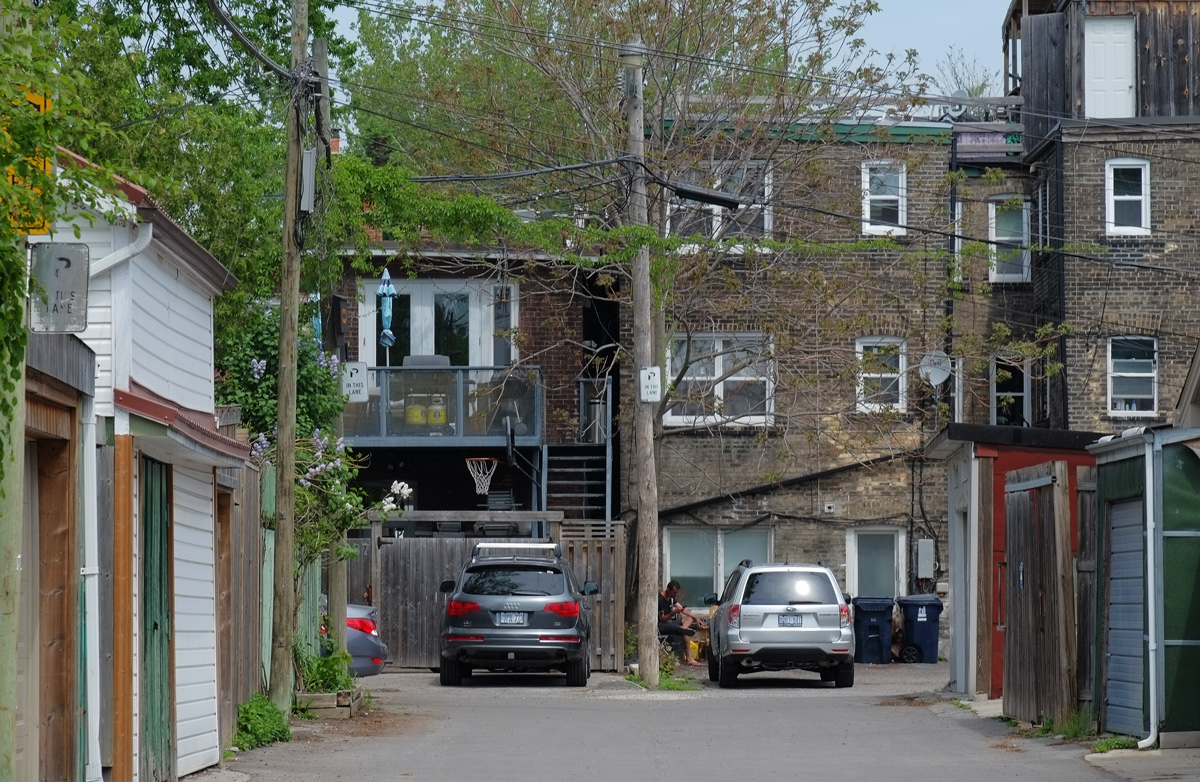
alley view, rear of old three storey brick buildings, apartments on top, stores below, cars parked,

below: A vacant lot waiting for its turn.

vacant lot with one small concrete structure on it, one small window in the back of it.

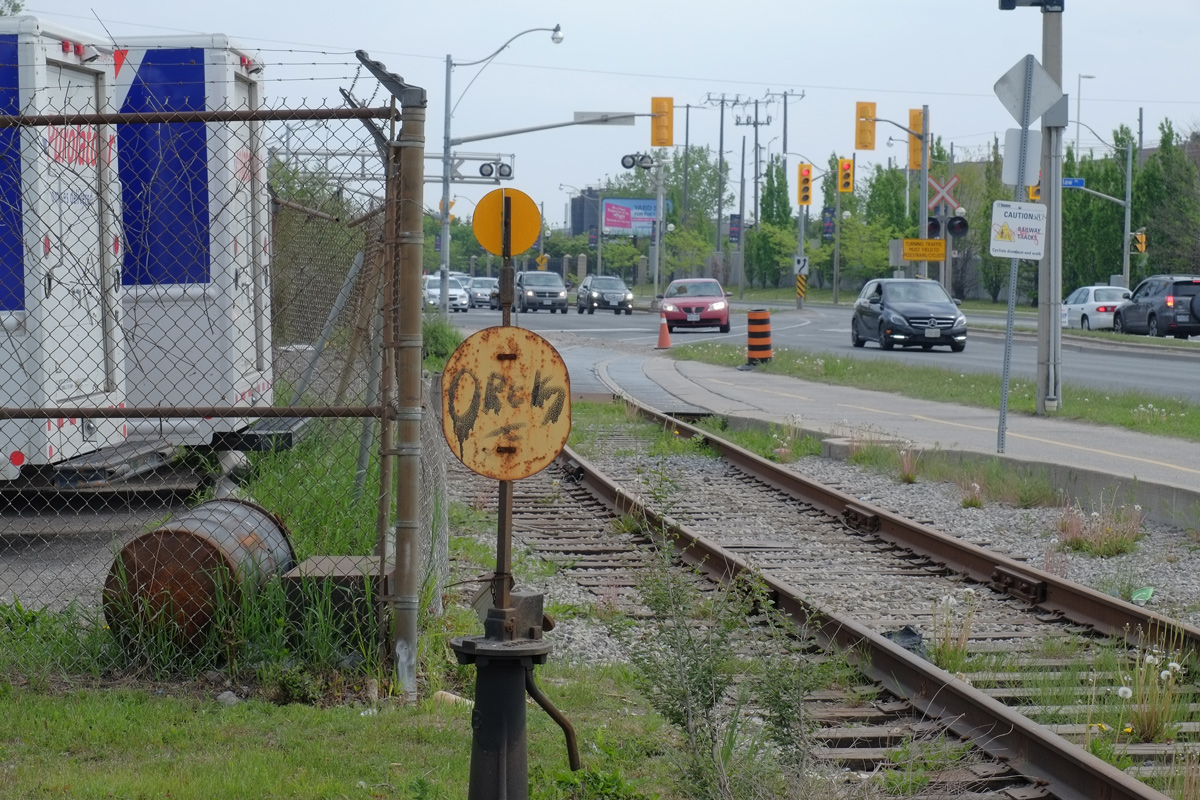
below: The Portlands Railway Spur, looking east from Morse Street and along Lakeshore Blvd.

railway tracks running parallel to road, traffic,

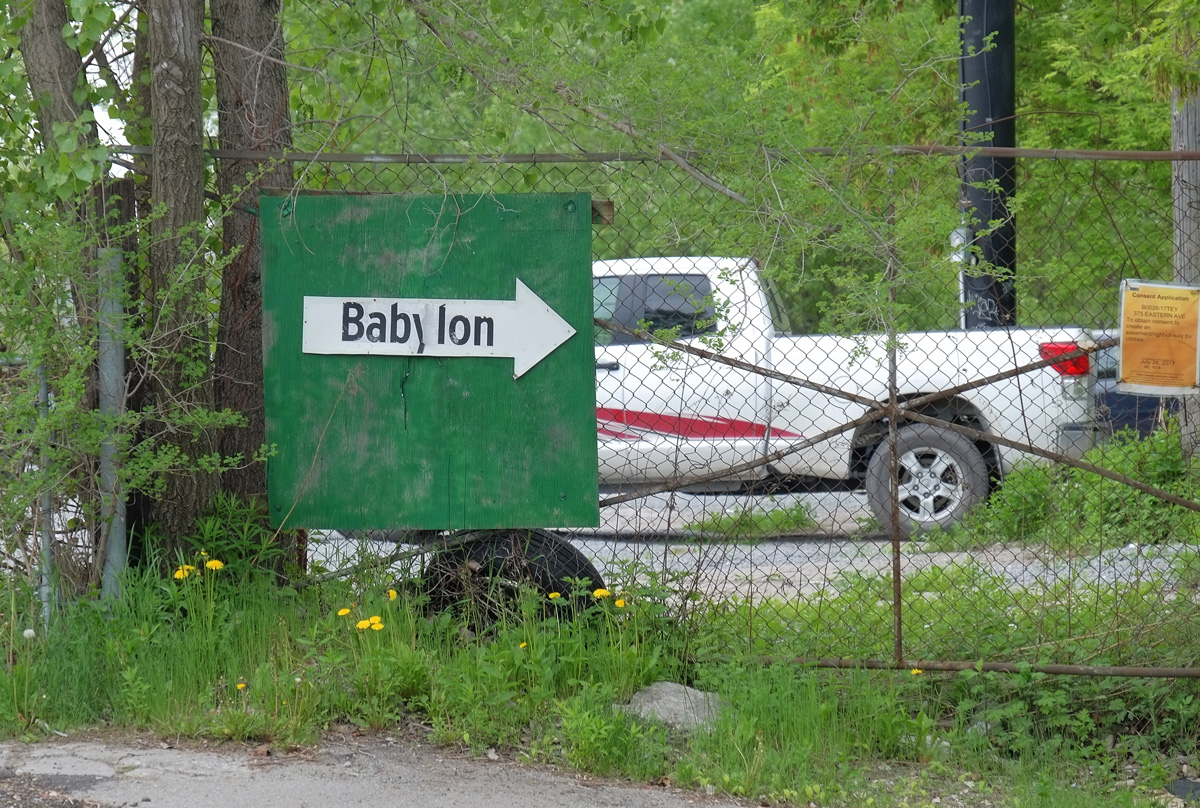
I didn’t find Babylon

green sign with a large white arrow pointing right. on the arrow is written the word babylon

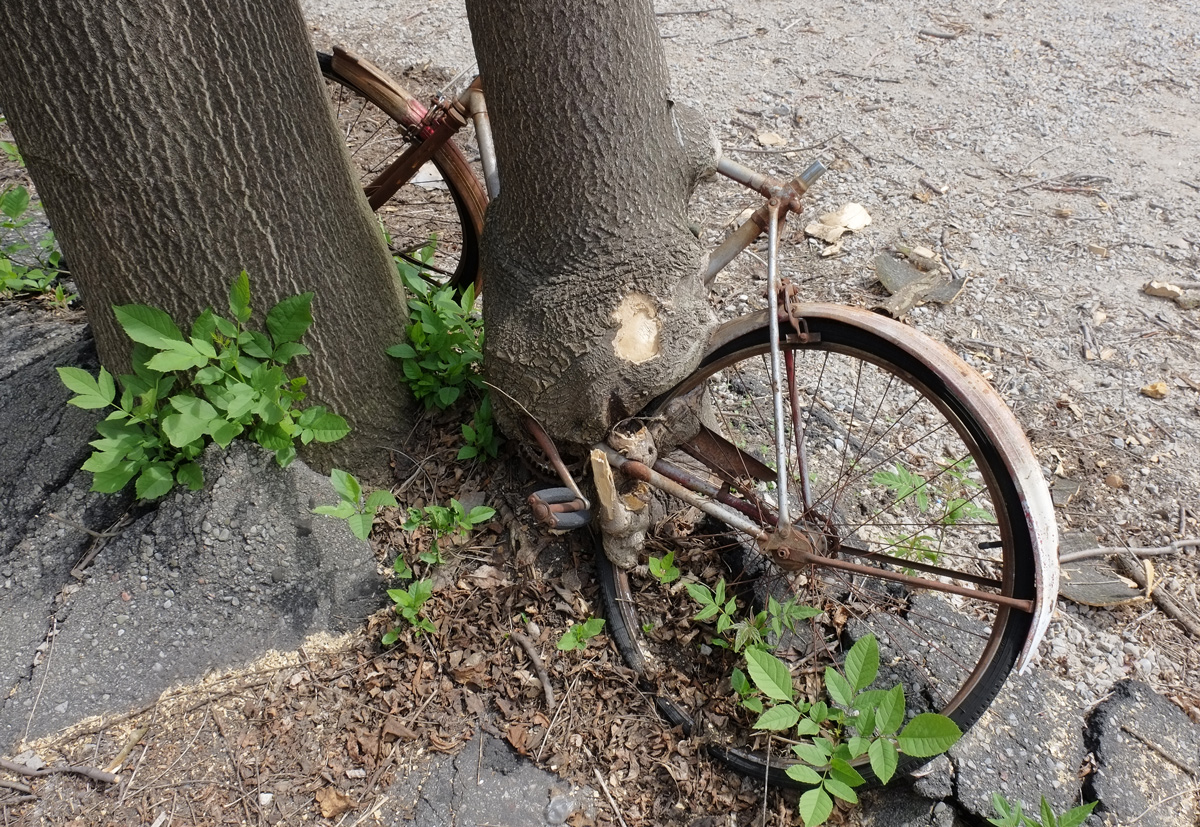
below: .. but I found a bike. Did anyone lose one?  Beware of bike eating trees!

an old bike that had been left beside a tree, over the years the tree has grown around the pedals and gears of the bike

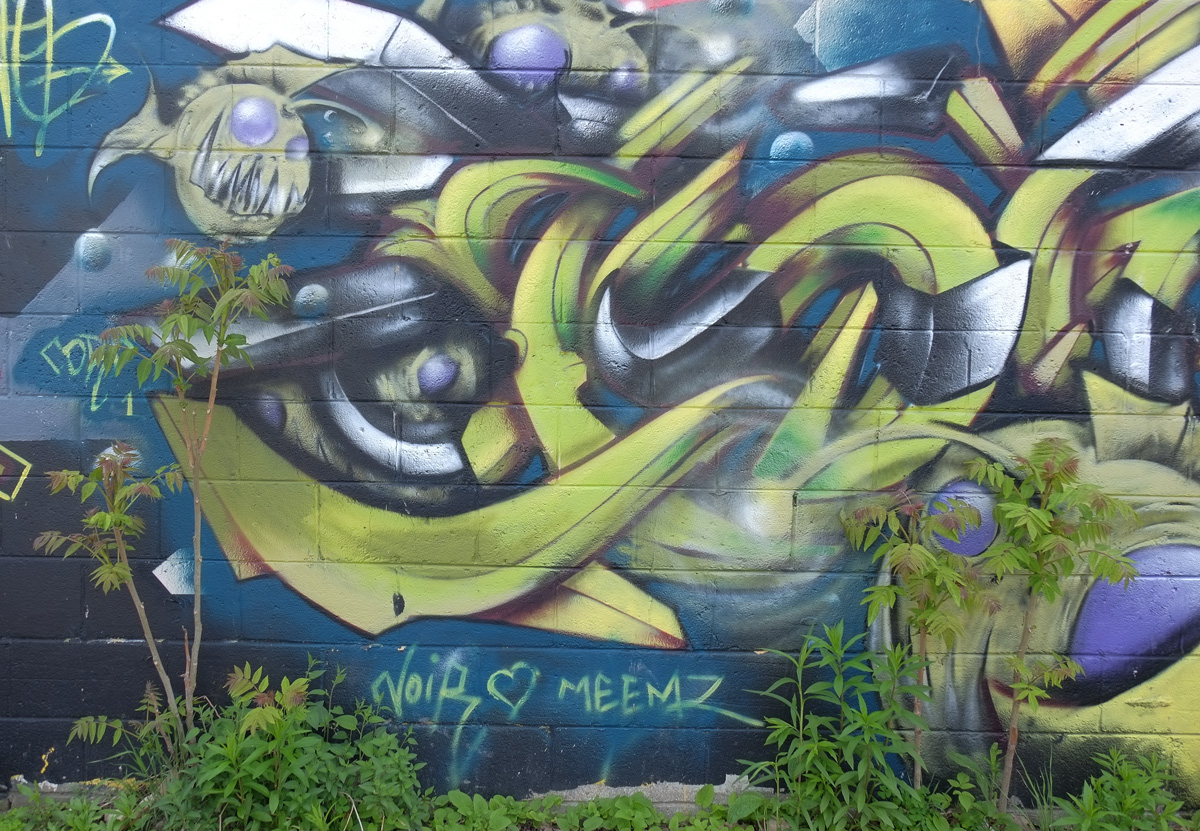
graffiti, purple background, green glob gooey ghost guy with open mouth and big teeth

From Lever Brothers soap factory to Unilever to East Harbour development…  In the 1890’s, Lever Brothers of Britain built a soap factory at the foot of the Don River.   Lever Brothers eventually became part of Unilever, an Anglo-Dutch conglomerate.   In 2002 Unilever sold the Toronto factory, but not the land, to Pensler Capital Corp of New Jersey.   From the National Post: ” Mr. Pensler renamed the company “Korex.” He froze workers’ wages. They lost their Unilever pensions. In 2008, Mr. Pensler offered a contract which workers said stripped seniority and benefits. About 160 workers walked out; in August, 2009, Korex Don Valley declared bankruptcy.”

view of the back of the Unilever (Lever Brothers) factory in Toronto

The development company, First Gulf Corp., bought the 14-hectare site from Unilever Canada back in 2012.  Although there are plans to redevelop the site, nothing has happened yet.

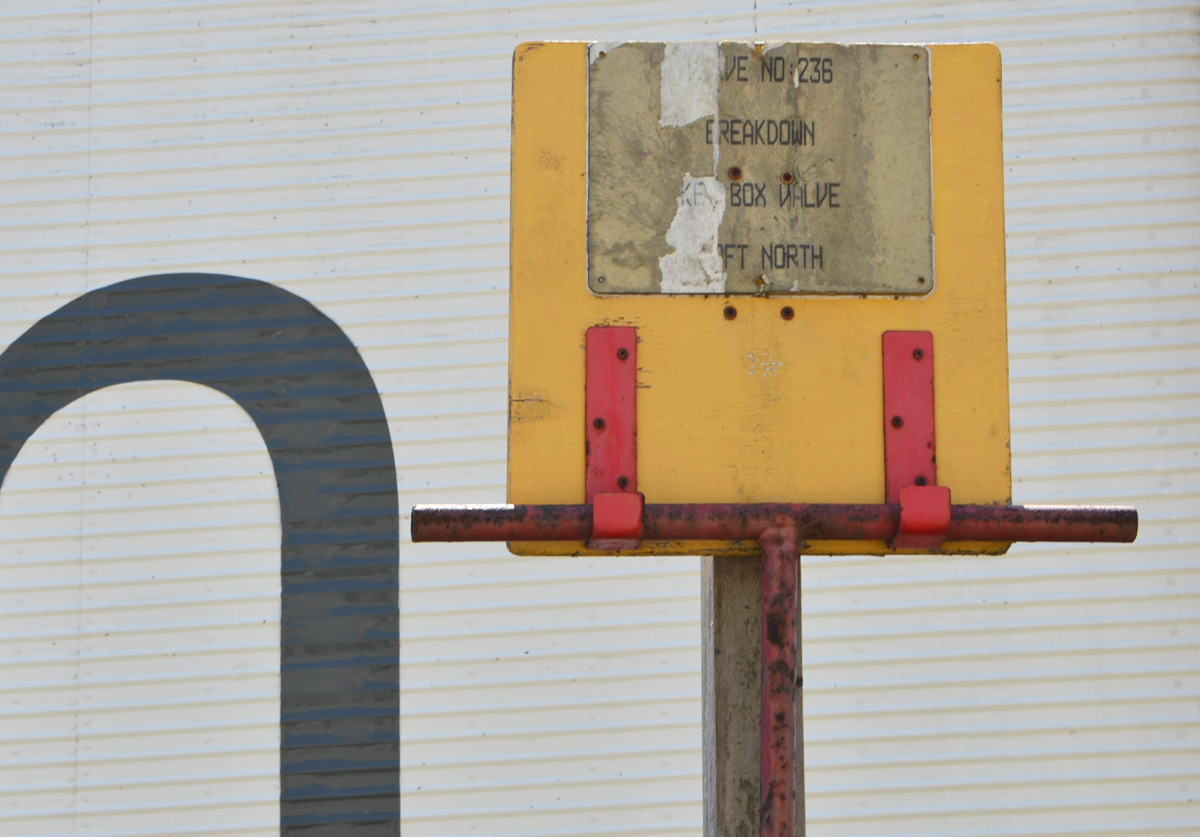
below: The sign says “Drivers, do not exceed 10 psi when unloading T.P.P. hexahydrate.

pipes and yellow metal fire escape on the side of an old factory

The building is mostly empty.  You can rent space inside if you have about $10,000/day to spend.   The grounds are kept fairly clean but the signs of neglect and age are everywhere.   There are other interesting bits and pieces left over from the site’s industrial past, but I have chosen to literally focus on the signs today.

below: No more phoning to get into the warehouse.

warehouse entry phone sign on white painted plywood where most of the white paint is gone, phone is not there, just the marks of where it used to be

yellow wign held up by red metal brackets. faded sign,

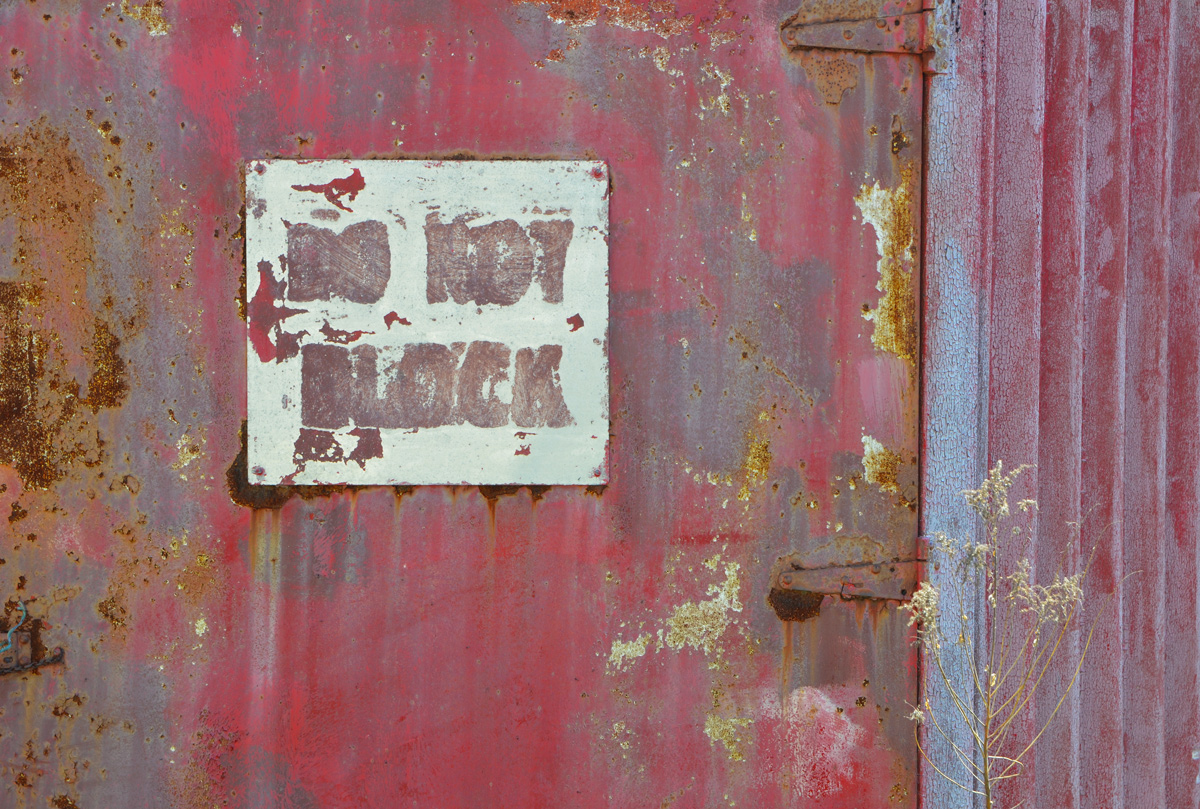
on rusty red metal, old sign that says do not block

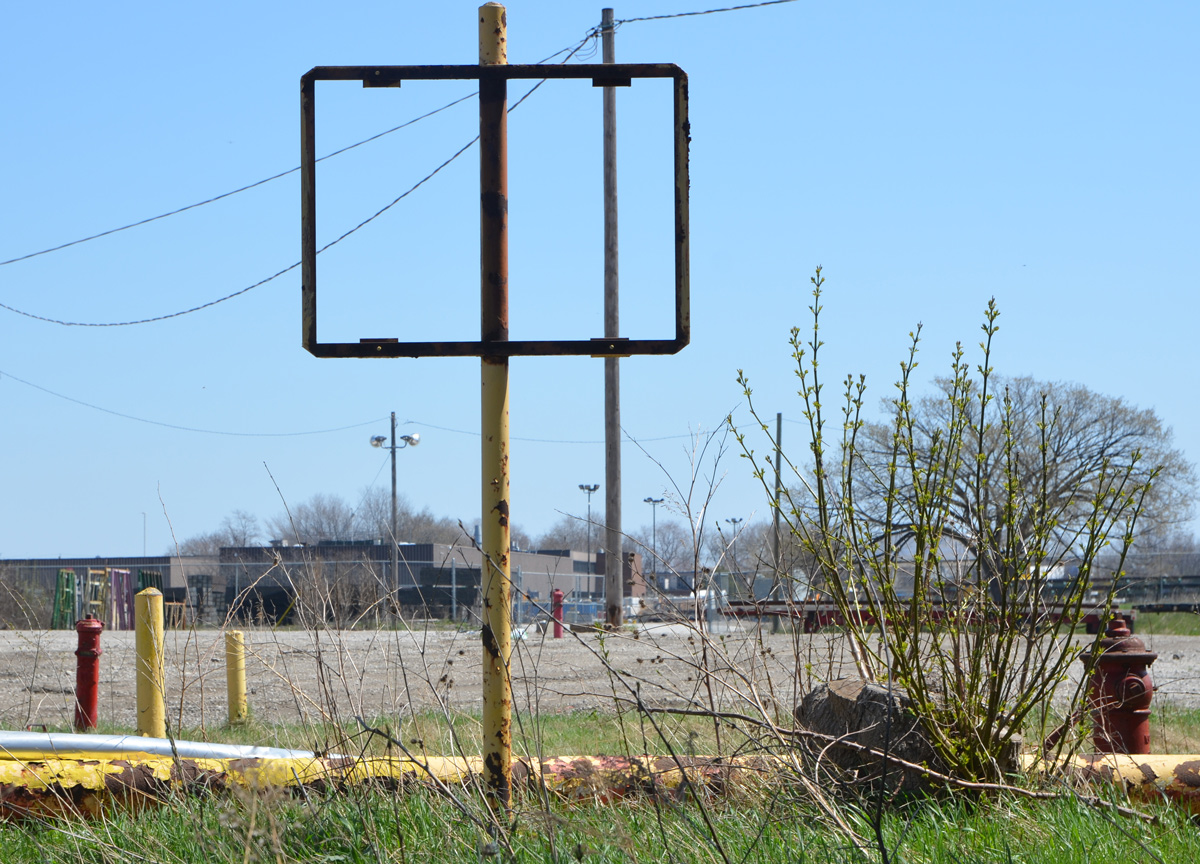
below: Some signs have left very few traces.

empty rectangular metal frame where a sign once was, on an old yellow rusty pole, vacant land in the background

large dial with rust on it, attached to tap on yellow pipe, gauge in the background

chainlink fence in front of area with yellow pipes, overgrown with weeds and shrubs, sign that says no smoking, white on red, chipped in one corner

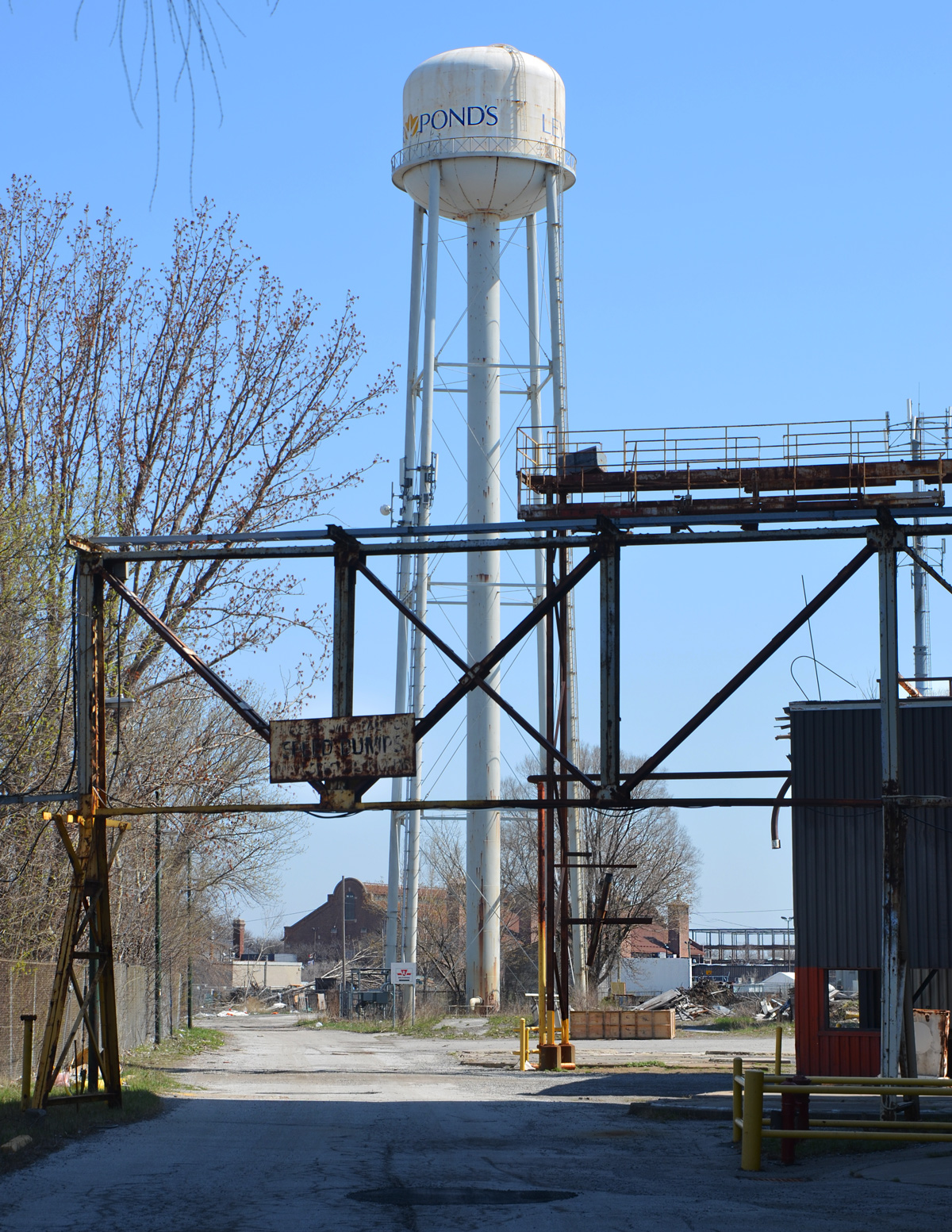
below: It’s not easy to read, but the sign in the foreground is a warning about speed bumps.

white water tower in the background with Ponds written on it, metal overhead structure for trucks entering old abandoned factory in the foreground with faded sign that once was warning speed bumps

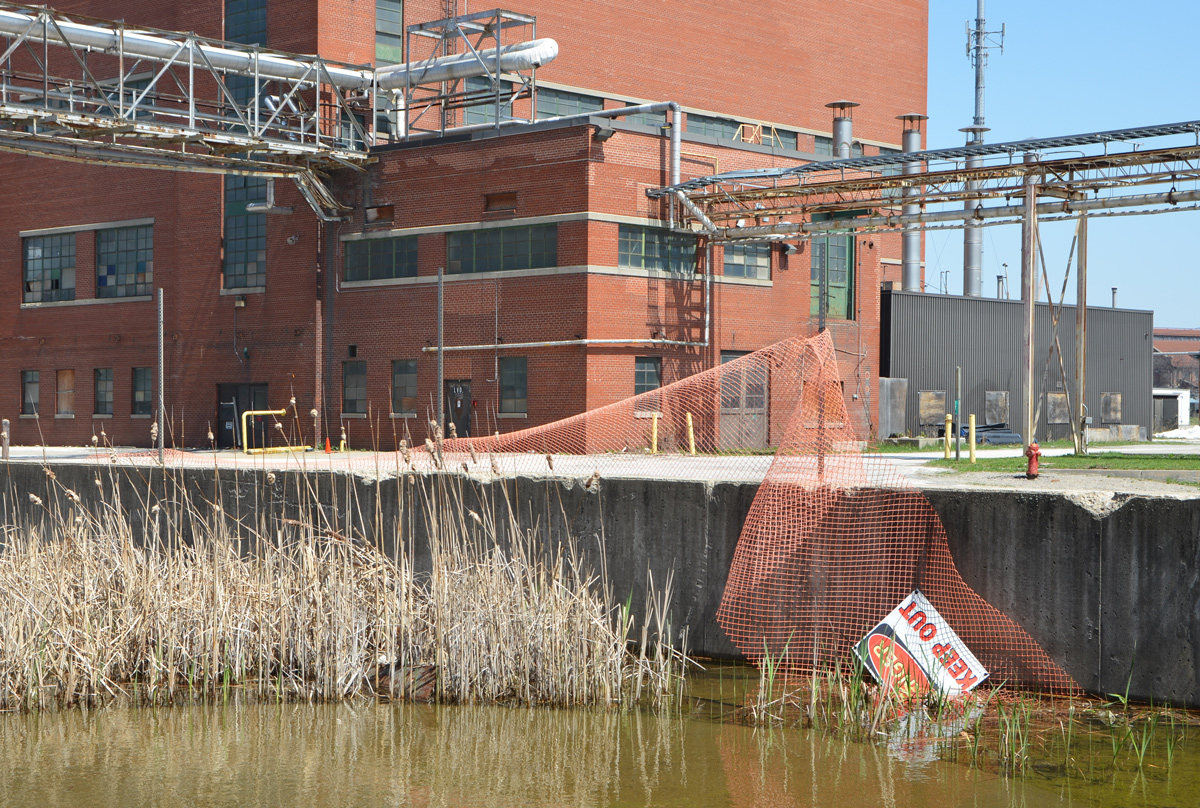
red brick large Unilever factory, with exterior pipes, brackish pond in the foreground, with orange plastic fence around it, part of fence has collapsed and Danger sign is near the water

construction site, with posters on the hoardings, tall white, grey, and red building in the background.

Almost two years ago I wrote about the murals and street art on Bulwer street.   Somethings have changed and some of the murals have disappeared.  For instance, the area bounded by Bulwer, Soho and Queen streets is now a construction site instead of a parking lot.   I walked here yesterday, a holiday Monday, and discovered that there were no parked cars blocking views of the street art.  I also discovered a tour group stopping to talk about something on the street but I was too far away to hear what they were talking about (something about bricks on the buildings?)

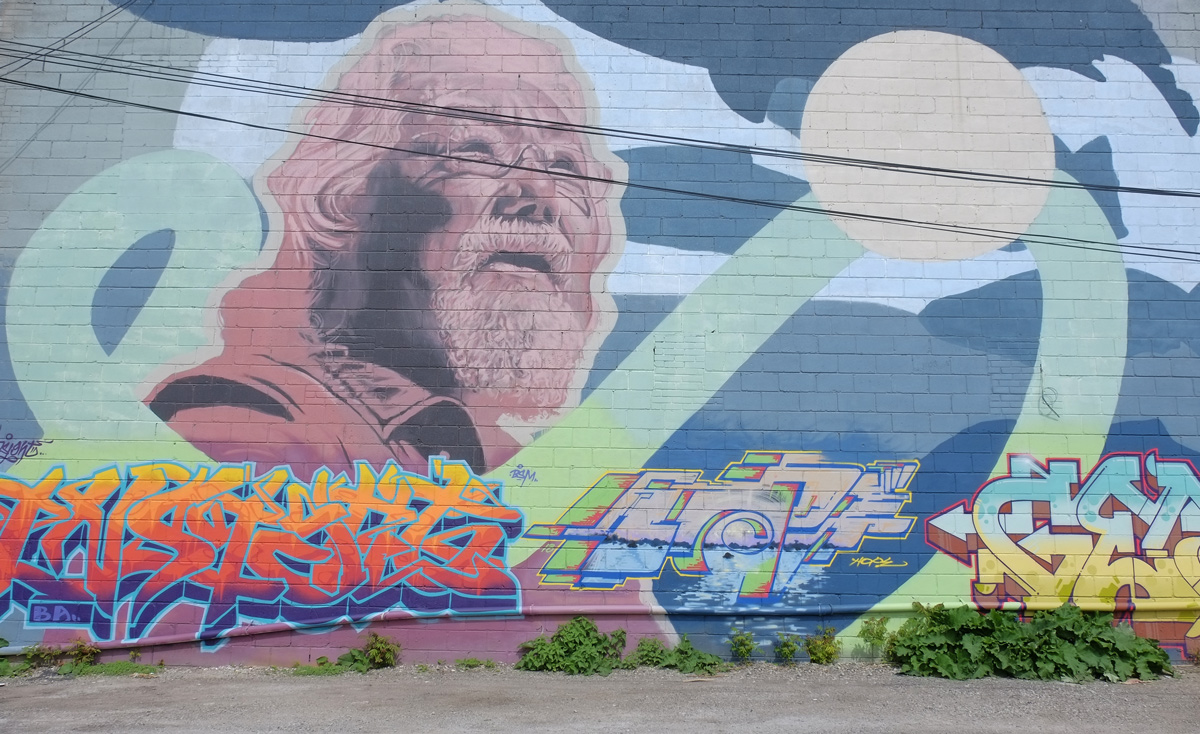
below: An unobstructed view of the David Suzuki and Atlantic salmon mural by Kevin Ledo, painted in 2016 as part of the “Love Letters to the Great Lakes” mural project.

david Suzuki and the atlantic salmon mural by Kevin Ledo, a very large 24 foot by 64 foot mural, large head of David Suzuki

below: The mural, a collaboration between Elicser and Indigo, hasn’t fared as well.  As you can see, the bottom portion has sadly been tagged over.

large mural by elicser of kids, bottom part has been covered with three large tags.

upper part of a mural by elicser showing a boy in an orange t shirt holding a small green sprouting plant in his hands.

view of the back of stores and residences on Queen street as seen from the street behind, street art and graffiti on the old garages, tree, large buildings in the background.

below: Part of a mural by horus.

part of a larger mural, green swirls, a fish with big teeth

below: A 2017 creation by sightone, breakin’ atoms, a memorial to Vandel.

text graffiti by sightone, pinks and purples and red

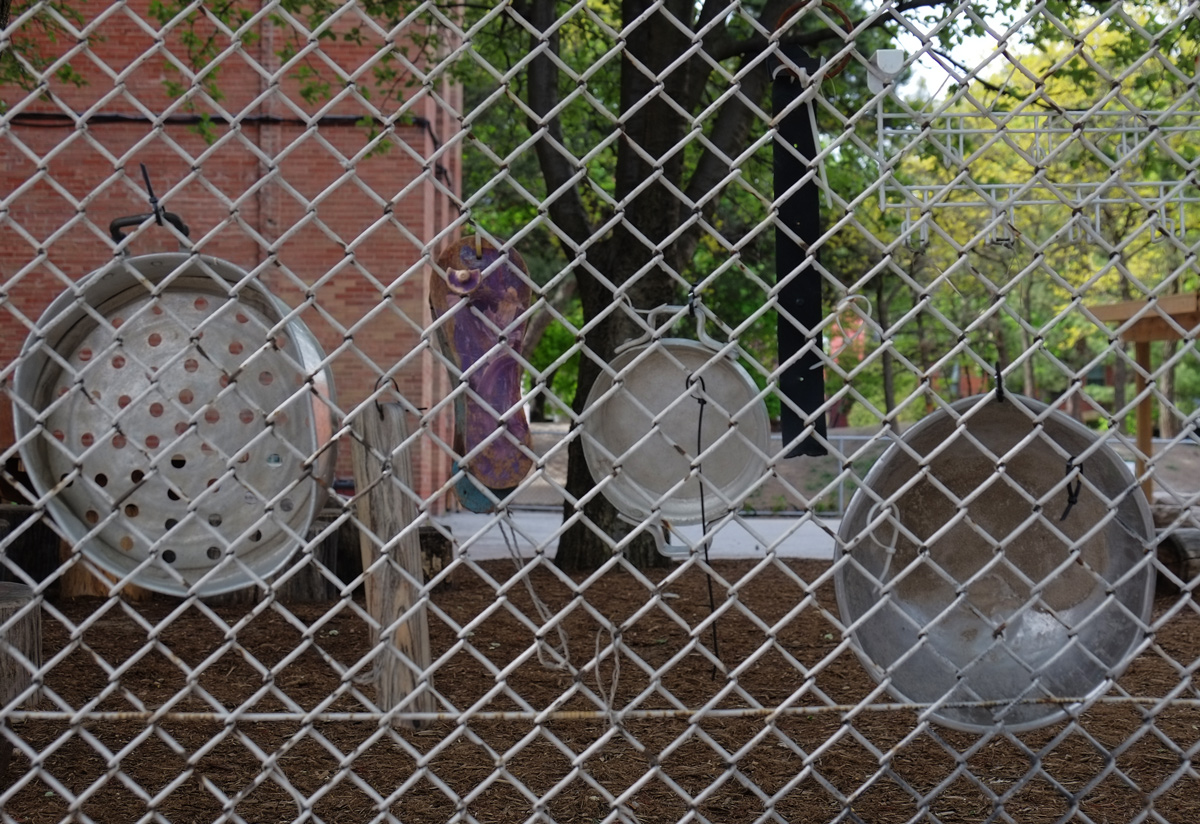
below: A collection of items attached to the schoolyard fence.  Metal pans and a shoe form?

old metal pans attached to a chainlink fence at a school


below: The CN Tower, a metal staircase, and some graffiti.  The back building looks very old, especially the windows.

back of old brick buildings, some graffiti, orange metal stair case, CN TOwer in the background

below: Another bit of “old” is this Toronto Hydro building with its very high fence and gate.  Is it still in use?

chainlin fence and gate around on old two storey brick building that was part of Toronto Hydro

old no parking sign, rusty, on fence in front of old Toronto Hydro building

One last little bit – this stikman is still here – weathered but still standing.  Once upon a time he was covered with a circuit board design but that layer has peeled away.   Aging but ageless.

an old stikman on a wall by a door with a rusty hinge

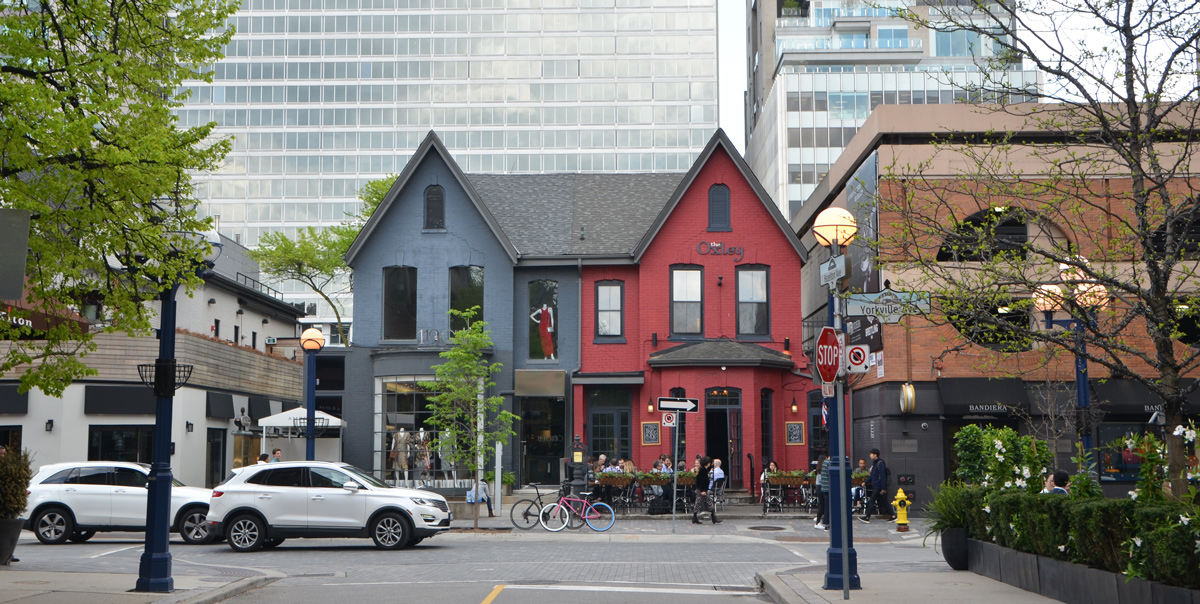
looking down Hazelton Ave towards Yorkville Ave., two older houses, now used as commercial businesses, one half painted blue and the other half is red.

It’s still May and the CONTACT Photography Festival is still on so I am still trying to see as much as possible.   Yesterday afternoon I went wandering in Yorkville where there is lots to see and do besides a couple of CONTACT exhibits.

below: Captain Canuck.  I started with the TD Gallery at the Toronto Reference Library.  It wasn’t that long ago that I was there (April I think) but the exhibit has changed.   It is now ‘Alter Ego: Comics and Canadian Identity’.  Isn’t Captain Canuck the most famous Canadian superhero?  He first appeared in 1975.

painting of Captain Canuck, from the chest up, one arm raised to shoulder height

below: Not so well known – The cover of the book ‘Nelvana of the Northern Lights’ by Adrian Dingle (1911-1974).   Nelvana was Canada’s first female superhero; she first appeared in 1941, a few months before (American) Wonder Woman.  Nelvana’s superpowers included turning invisible and traveling at the speed of light along a ray of the Northern Lights.  According to Wikipedia, she “visited lost kingdoms under the ice, journeyed to other dimensions, and fought against the Axis Powers during World War II, eventually taking on the secret identity of secret agent Alana North.   Her last adventure was published in 1947.

book cover, book called Nelvana of the Northern Lights, a comic book by Adrian Dingle, 15 cents, 68 pages, hard cover

below: This structure was built in 1876 as a Carpenter Gothic Revival Style church – the Olivet Congregational Church.  It has been the home of the Heliconian Club since 1923.  This women only club was formed in 1909 and is still active today supporting women in the arts.  There is a photo exhibit on there at the moment but viewing is by appointment only (it is a club not a gallery after all).

pale blue wood building, originally a church, now the home of the Heliconian Club on Hazelton ave. Bright blue doors, two, rose window,

below: For CONTACT, the Lomas Gallery on Yorkville Ave is featuring a few large photos of cityscapes that are full of tall buildings.  The one behind the red couch is ‘NoMad New York’ by Christopher Woodcock.

Lomas Gallery in Yorkville, bright red oval shaped couch in front of a wall with a large photo of a city scene, lots of skyscrapers with lots of windows, by Christopher Woodcock, plus words on the wall that say Contact Festival, City Obscure, Windows on either side of the wall with people passing by

below: On the wall beside is ‘[a]DCLXI’ by Amyn Nasser.

on a gallery wall, Lomas Gallery, a large photo, [a]DCLXI by Amyn Nasser of a wall of glass skyscrapers with lots of windows, on the wall beside is another photo in which Nasser's photo is reflected.

below: It’s not a sculpture or a statue, but this red faced mannequin caught my eye. Maybe next time he’ll remember his sunscreen.

two male mannequins in a mens wear store window, one has a very red face, also a picture of a man in a black suit with a bright blue background is in the window

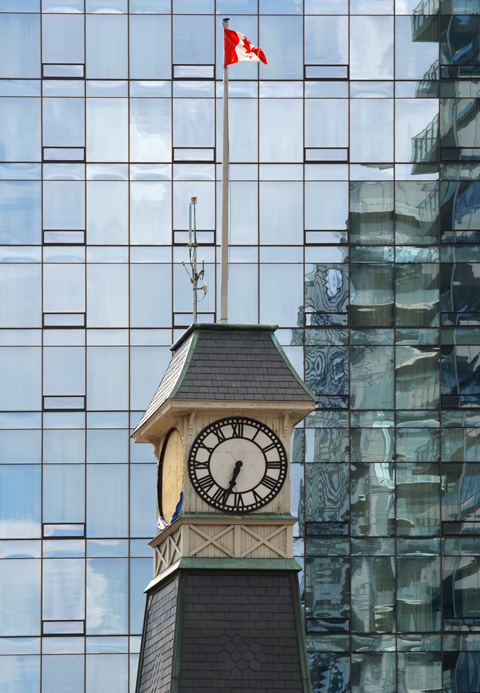
below: The clock tower of the Yorkville firehall. One side seems to missing its clock face.

the clock tower of Yorkville fire station with a reflective glass building behind it. A Canadian flag is flying on top of the firehall clock tower.

below: Brendan Meadows’ black and white portraits hang on the walls of the Liss Gallery in an exhibit titled ‘Ipseity’.  These were printed as silver gelatin selenium-toned lith prints by Bob Carnie from negatives made from digital images.  The images were also  manipulated with the Sabatier effect (solarization); this results in an image that is wholly or partially reversed in tone. Dark areas appear light or light areas appear dark.

interior shot, Liss Gallery, frames black and white portraits on the walls

below: Posters on hoardings add a little life at street level to the construction sites in the area.  This set features businesses and sites in the area including the ROM.

posters on hoardings in front of a construction site - picture of the ROM at night, picture of the interior of a menswear store, man trying on a suit

below: Some colourful art deco style posters.

art deco posters on hoardings in front of a construction site

art deco posters on hoardings in front of a construction site inclujding a Vogue picture

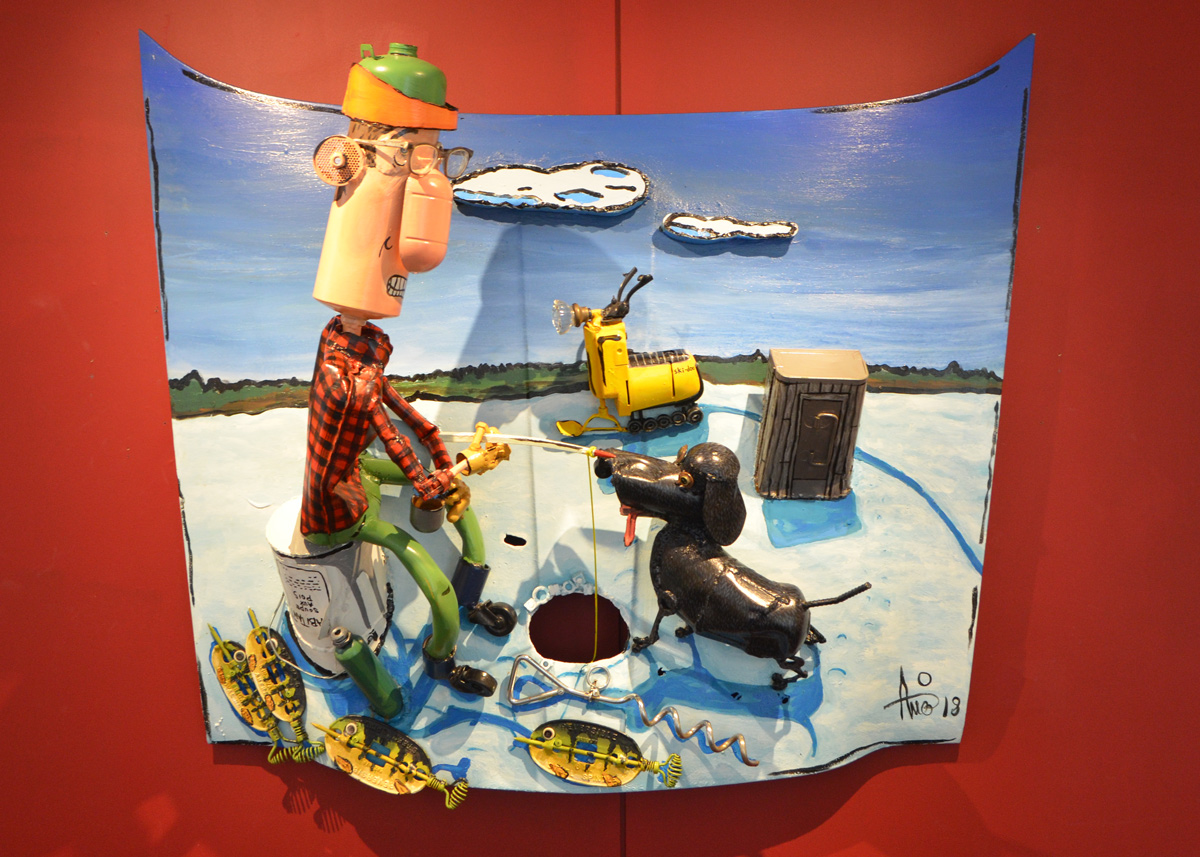
below: Prepared for anything!  With a yellow duckie, handcuffs and binoculars, Batman and his Robin hand puppet prepare to take on the forces of evil!  These are sculptures by Patrick Amiot.

a metal junk sculpture by Patrick Amiot, outside, by the front door of an art gallery, batman, with a very small robin in one of his hands.

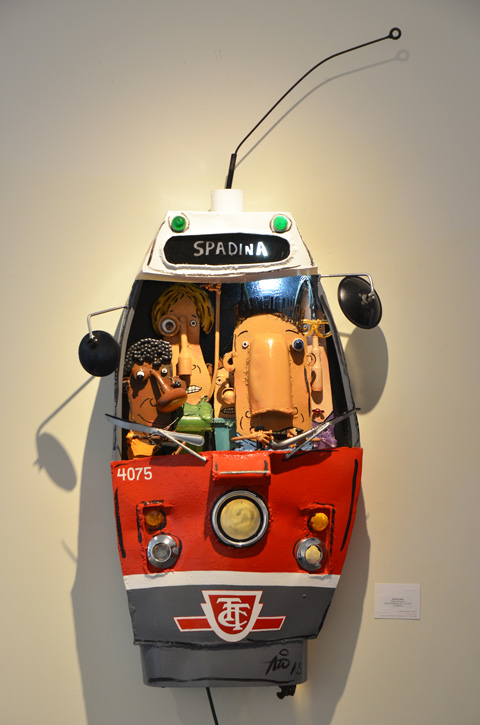
below: Part of the Miraim Schiell gallery is devoted to Amiot’s work.

a wall mounted artwork by Patrick Amiot of a man ice fishing with his dog, created from junk

an artwork on a gallery wall, by Patrick Amiot, of the front of a Spadina TTC streetcar, crowded with driver, man, and dog,

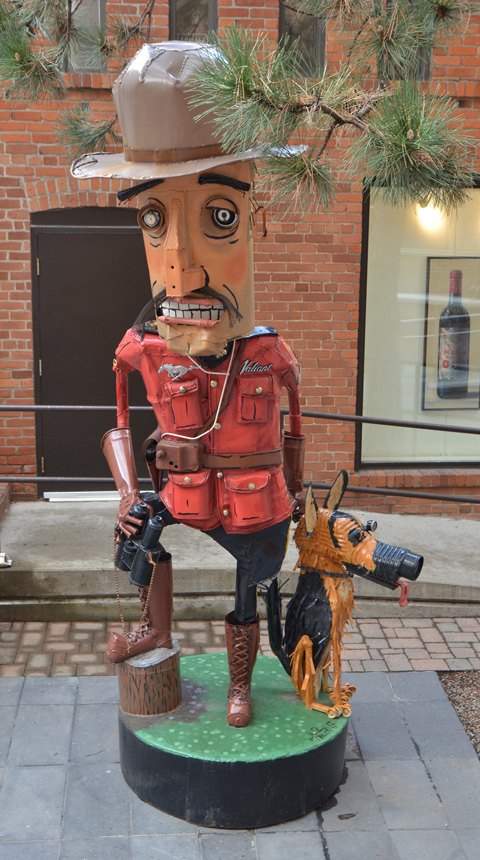
below: This large RCMP mountie and his dog stand behind the gallery.

metal junk sculpture by Patrick Amiot of a mountie and his dog, outside, behind a gallery in Yorkville

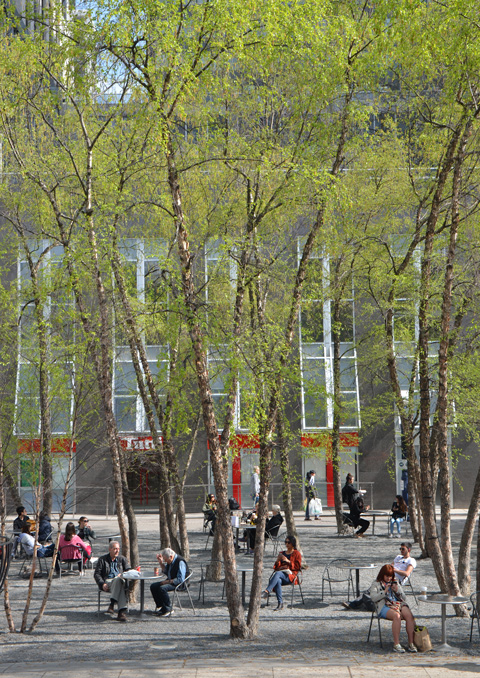
below: Enjoying the wonderful spring afternoon on Cumberland.

outside, park in Yorkville, tall trees with leaves just coming out, spring, people sitting on chairs under the trees, talking, reading, phones, drinking,

statue of a bear outside, life size, a painting in a glass enclosed box is behind him

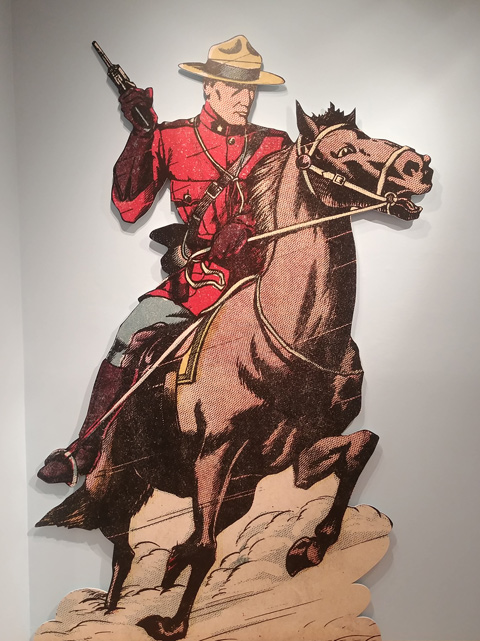
below: Oh.. that second mountie that I alluded to in the title of this post – he was on the wall at the Alter Ego exhibit.  This one.   Just don’t call him Dudley Do-Right.

large picture of a mounti on a horse with a gun in his hand, on a wall in a gallery

below:  This is either ironic or sad.  The first few lines of text say “In the the 1960s and 1970s, Yorkville village was the heart of Canada’s bohemian, counterculture community”.  As I took this picture a new Bentley with dealer plates drove past.  I looked around and the ‘counterculture’ of 40 to 50 years ago has been replaced by designer boutiques, high end stores, fine art galleries, and restaurants with linen napkins.  Not a lot of music happening here.  Full transcription is below.

plaque to Yorkvilles music scene, Heritage Toronto black and white plaque, from 2016

“In the the 1960s and 1970s, Yorkville village was the heart of Canada’s bohemian, counterculture community. More than 40 clubs and coffee houses nightly featured folksingers-songwriters, including Ian & Sylvia, Gordon Lightfoot, Joni Mitchell, and Neil Young, who performed some of their first compositions in these smoky venues.
Yorkville’s first coffee house, Club 71, was opened by Werner Graeber in 1959. By 1964, Yorkville had become a nurturing environment not only for folk music, but also for pop, blues, and later, psychedelic rock. Hippies and teenagers flocked to these unlicensed venues, which offered an alternative to Yonge Street bars.
Yorkville was also home to three sound-recording studios, taping major acts such as The Guess Who, Lighthouse, and Ann Murray. With its vital role in fostering a wealth of talent, the Yorkville scene inspired a generation of songwriters and led to the rise of a new Canadian sound.”

outside pizza pizza, man inside eating, another man outside looking at mural on the wall

A trip to Toronto Islands on a sunny spring day.
Photos and stories – an eclectic mix of history and nature that resulted from wandering around the eastern portion of the islands.

below: From the ferry, looking toward the glass and steel of the city.

sail boats in Inner Harbour of Lake Ontario, in front of the Toronto skyline with highrises and skyscrapers also ship moored at Redpath Sugar refinery

Toronto Islands is a collection of at least 12 small islands.  In the early years the island archipelago was really a peninsula of sandbars and ponds; it was connected to the mainland by a narrow strip of sandy shoreline. This landform was created over centuries by the action of waves, winds and lake currents – washing away portions of the Scarborough Bluffs and depositing this material to the west in a five-mile-long hooked shape. This process of natural “landscaping” continued until the spring of 1858, when a particularly powerful hurricane created a channel four to five feet deep through the peninsula.  By June of that year, the Eastern Gap was a waterway, and the Toronto Islands came into being.

below: On the ferry between the city and Centre Island.

people lined up along the front railing of a ferry from Centre Island to the city of Toronto, looking at skyline and taking picture of it. Toronto is in the background.

The first buildings on the islands were the Blockhouse Bay garrison built in the 1794 by the British at Gibraltar Point – it included a blockhouse and storage structures.  A second blockhouse and a guard house were built soon after, only to be destroyed by the Americans in the Battle of York in April 1813.   The lighthouse at Gibraltar Point built in 1809 still stands (sorry, no photo).

In 1833 Michael O’Connor built a hotel on one the islands.  He used a horse-drawn boat to ferry customers across from the mainland to his hotel.  At that time, there was still access by road but it was a toll road.  In 1836 it cost sixpence for every four-wheeled carriage drawn by two horses.  Smaller ‘vehicles’ paid less.   In 1858 the hotel (now Quinns Hotel) was destroyed during the same hurricane that turned the peninsula into an island.  The hotels were destroyed but the islands remained popular.  With no road access, ferries were needed and many people ran private ferry services until they were bought out or amalgamated into the Toronto Ferry Company in 1892.  It was privately owned until 1926 when it was purchased by the City of Toronto for $337,500.

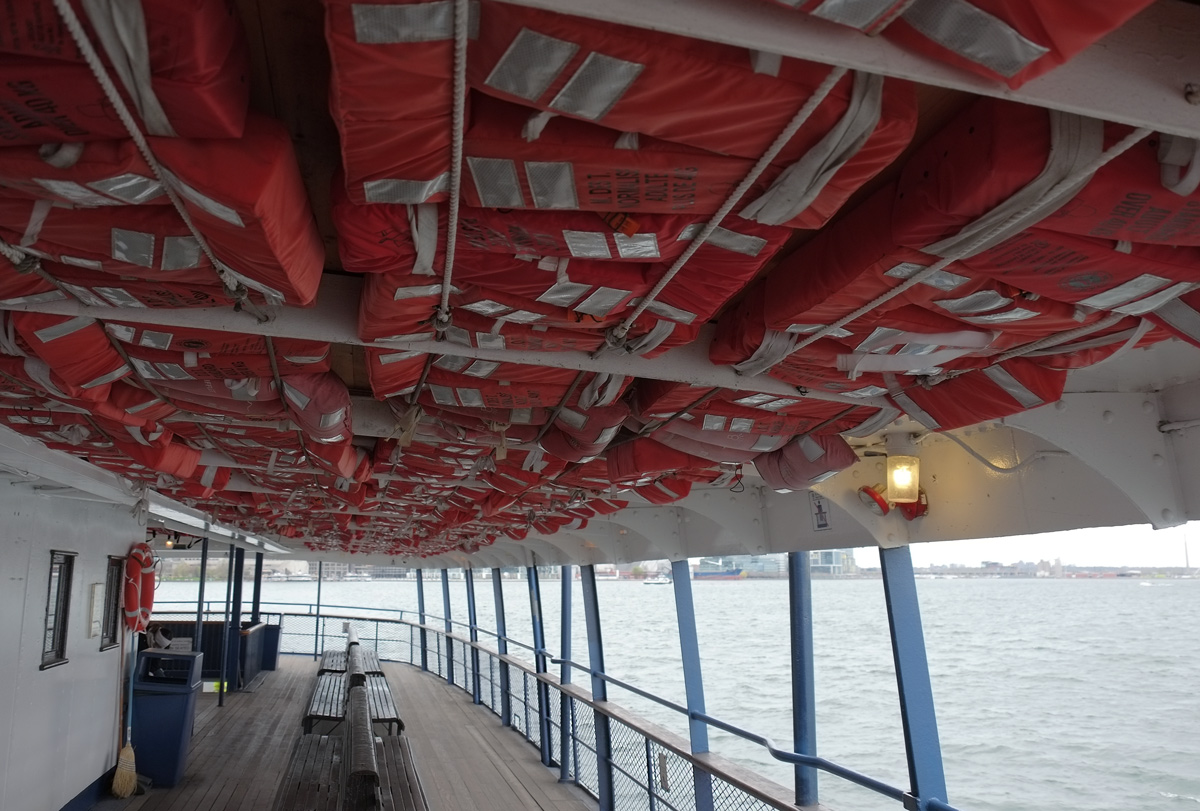
ferry, ceiling is full of orange life jackets, railings along edge, Lake Ontario, benches to sit on but no people

blue abstract from two blue doors with cut out where handle should be

Many houses and businesses, (hotels, restaurants, bowling alley, laundry, theatre etc) were established over the years from Hanlon’s Point in the west to Wards Island in the east.   Today, residences are only in the eastern section of Wards Island and on Algonquin Island.

The Ward’s Island community began in the 1880s as a settlement of tents. Up until then, that eastern end of the islands was mostly wetlands.  The first summer colony on Ward’s in 1899 consisted of just eight tenants, each of whom had paid a fee of $10 rent for the season. The number of tents grew each year.  In 1913, the city felt it necessary to organize the community into streets. The evolution from tents to cottage structures progressed in stages with the building of floors, the addition of kitchens and then porches, resulting in the creation of the homes.

two houses on Wards Island, small wood housses, one bright blue and the other is white

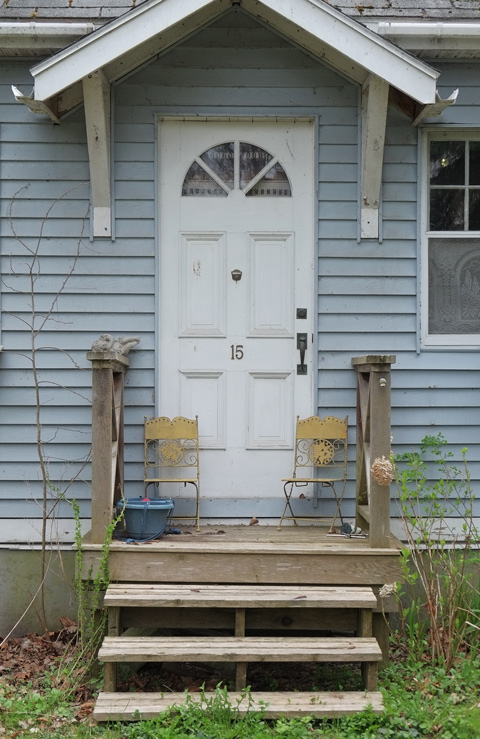
grey wood siding on house with white door and small porch. Two yellow and metal chairs on the porch

In 1953 the municipal government changed their policy toward the Toronto Islands landscape and its residents. Businesses were removed and the systematic demolition and burning of homes began.  More of the islands became parkland.    There are 262 houses on Wards and Algonquin Islands today, down from about 630 residences on all the islands.  The last of the Lakeshore houses was removed in 1968 but traces of them still remain.

wood boardwalk along the foreground of the photo with a concrete path leading away from it, into an overgrown area

part of old concrete breakwater, once there was house here, number 170 embedded in the concrete

below: The pier on the Lake Ontario side.

metal fence in the foreground, beach, pier and Lake Ontario in the middle and background

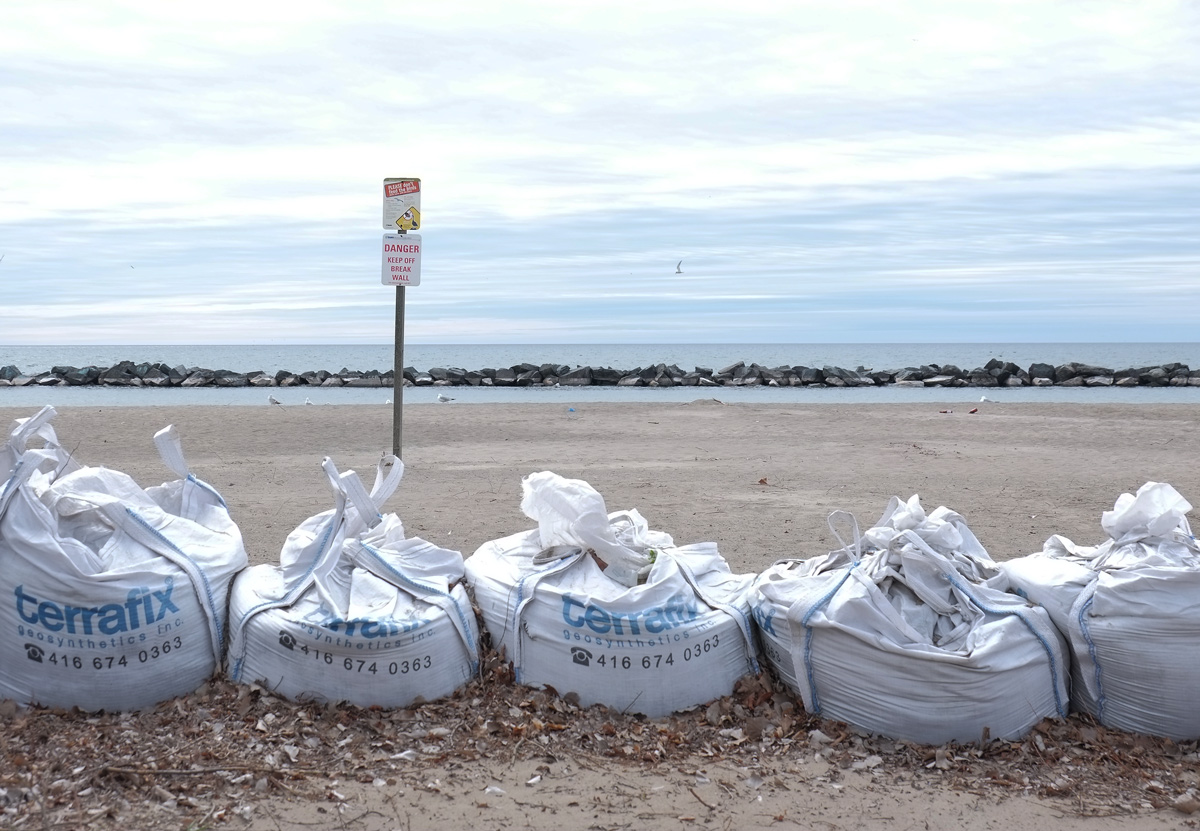
below: Sandbags along the shore.  Last spring there was a lot of flooding here and the island was closed to visitors – sort of.  Ferries didn’t run and the park facilities were closed.  The islands are very flat and low so it doesn’t take much extra water to flood.

large white sandbags along the shore, beach on the other side, Lake Ontario in background with a row of rocks as breakwater a short distance from the shore, sign on the beach

sign fallen over and under water, surrounded by rocks, Lake Ontario

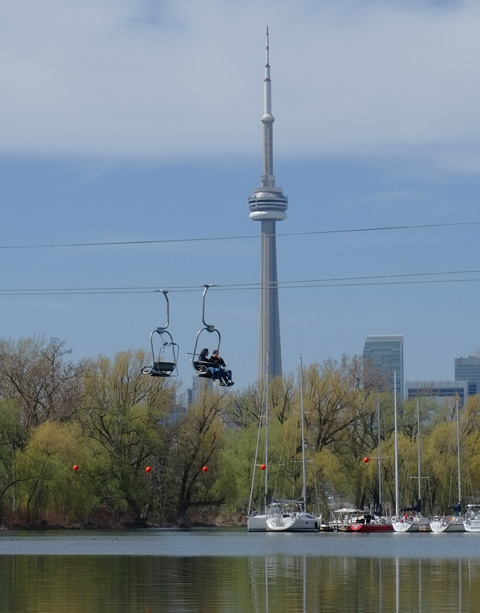
below: There is a small amusement park, Centreville, on Centre Island.

CN tower in the background, people on the Skyline ride at Centre Island passing over water, with large boats docked farther up the river

below: Island transport that can be rented if you don’t want to walk.

people cycling in 2 quadricycles, a four wheeled bicycle like vehicle, on paths,

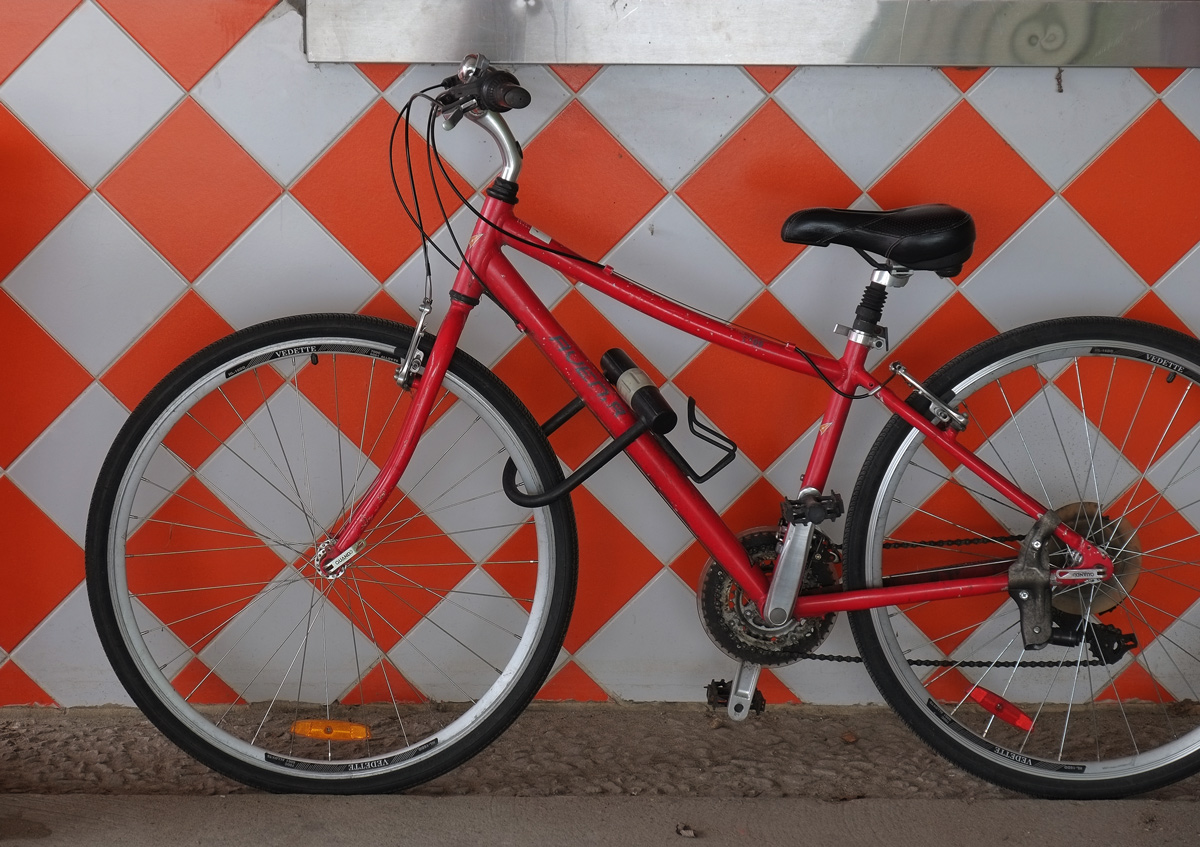
the orange and white wall tile pattern of Pizza Pizza with a red bike parked in front of it.

below: Boats moored QCYC (Queen City Yacht Club), one of the three yacht clubs on the islands.

sailboats moored at a wood dock, QCYC

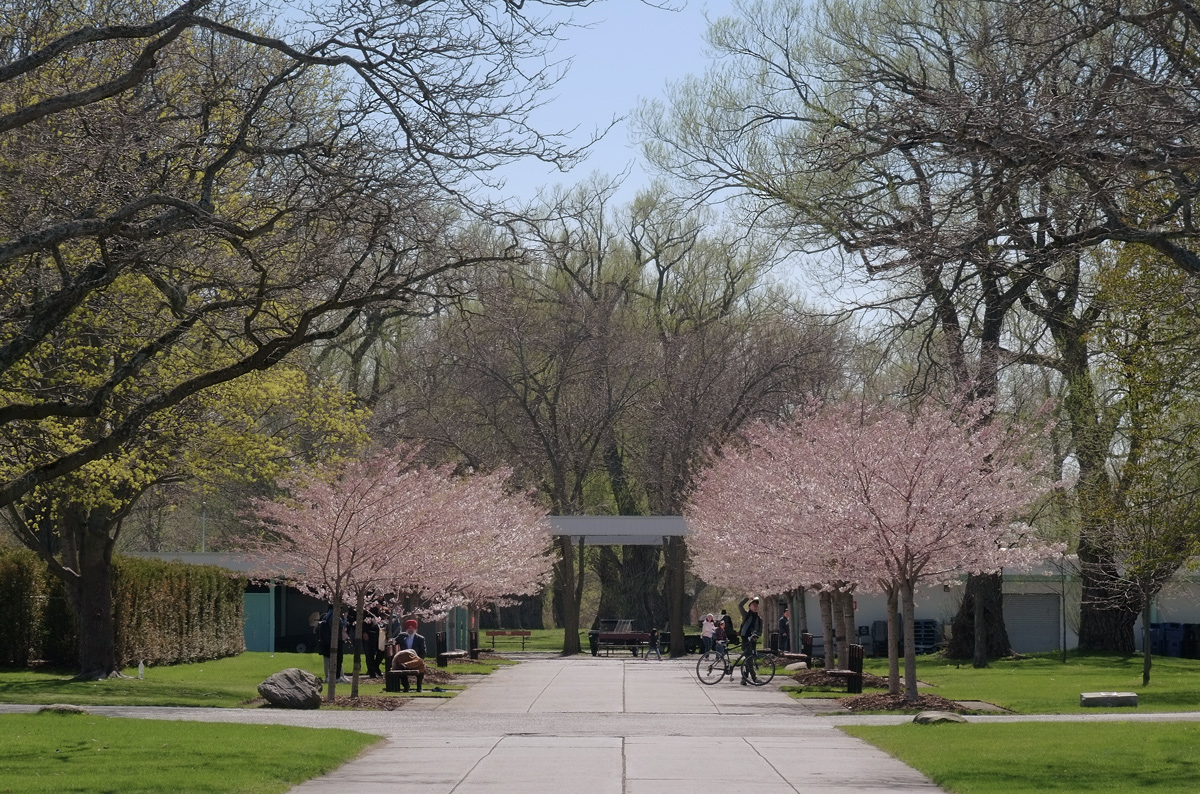
below: Sakura trees in bloom.   The trees were donated by the Sakura Project.  The aim of this project was to strengthen Japanese Canadian relations by planting cherry trees in visible locations across Ontario.   Between 2000 and 2012,  3,082 trees were planted at 58 locations.  The trees on Centre Island were planted in 2011.

path, sakura (cherry) trees on either side with their pink and white blossoms, other large trees around them with pale green of new leaves

below: Catkins from a red alder tree.  They almost look like raspberries packed tight together.

red fuzzy blossoms droop from the end of a tree branch

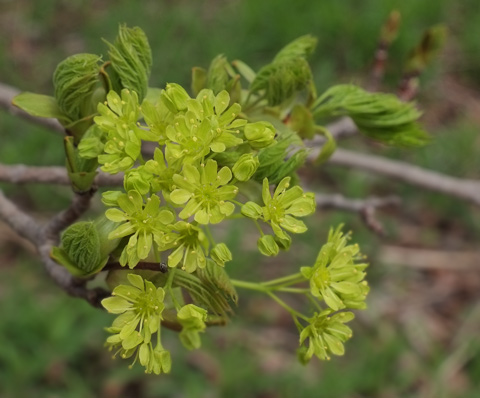
new yellowish green flowers on a tree, also leaf buds just opening,

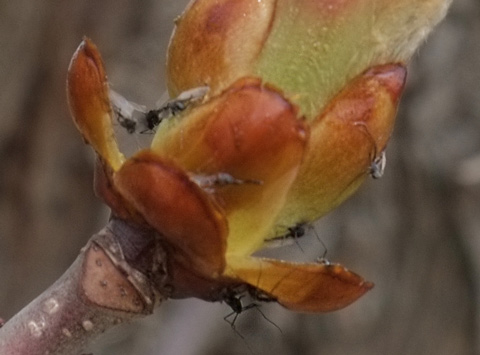
ants in the bud on a tree

below: An early family of Canada geese.

family of Canada geese, 2 adults and 7 or 8 fluffy little goslings swimming in the water

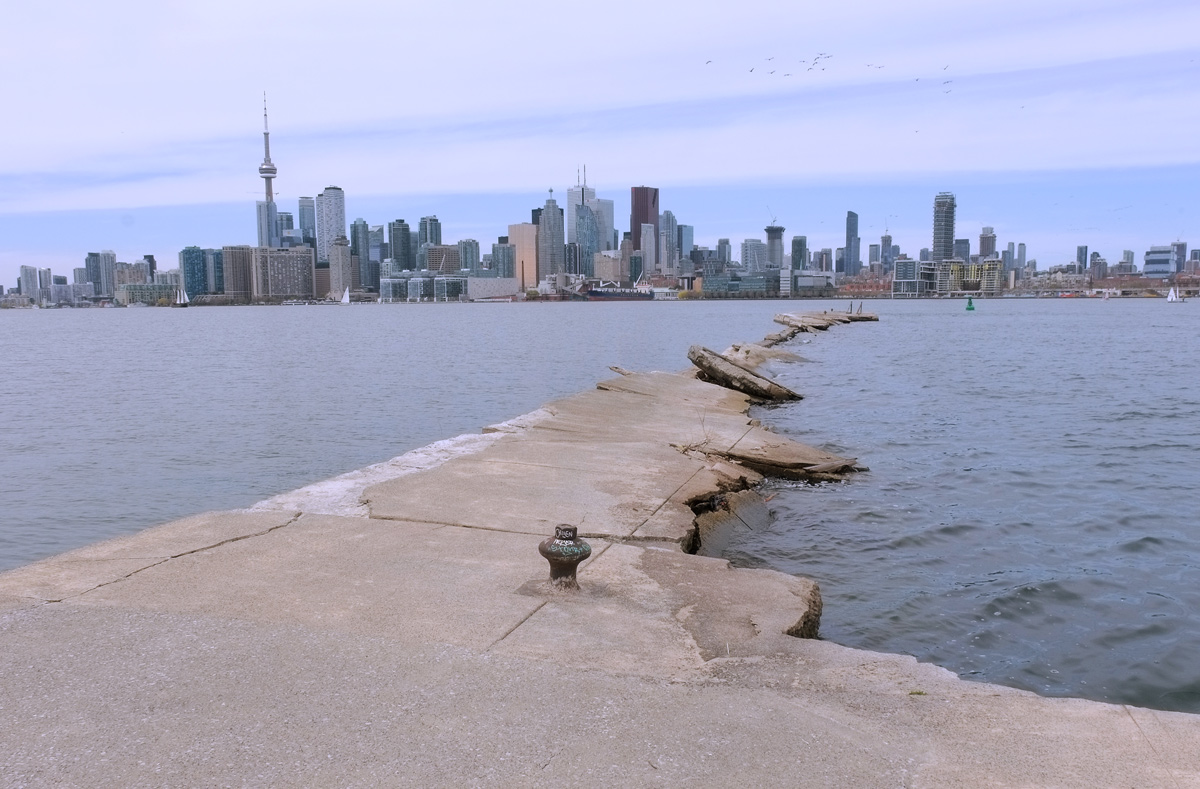
below: The pier at the eastern end of Wards Island is bad need of repair.  To the right is the entry into the Eastern Channel (or Eastern Gap).

broken concrete pier into Inner Harbour of Lake Ontario, with Toronto skyline and CN Tower in the distance

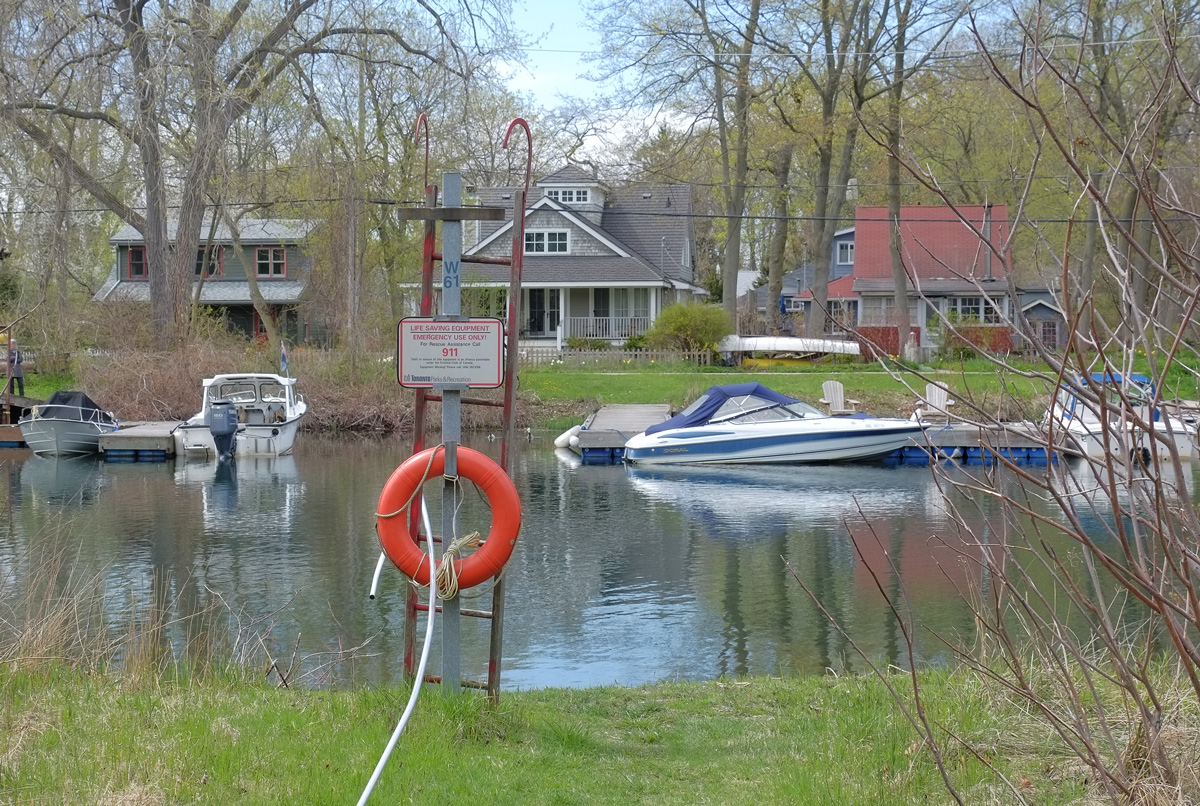
below: Looking over to Algonquin Island.  Once upon a time this island was just a sandbar.

waterway, orange life ring and ladder on one side of the river, houses and docks, and boats on the other. r

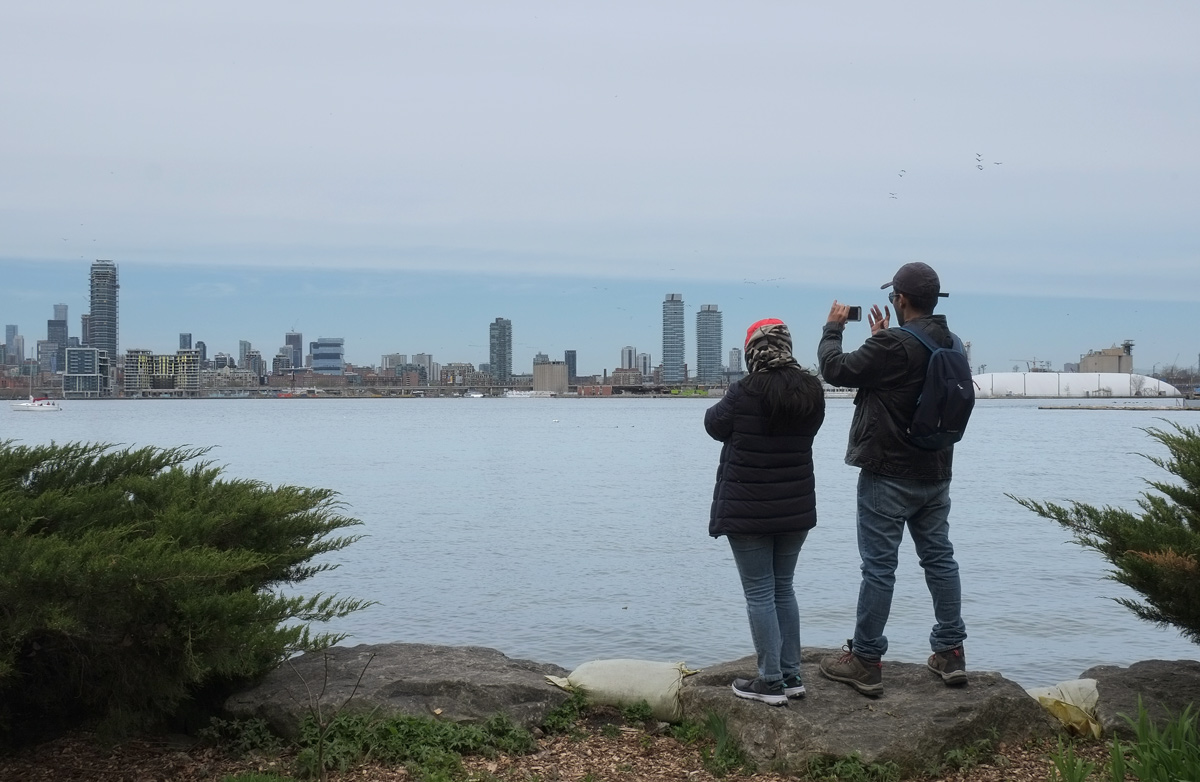
two people standing on the shore of Center Island, looking at the Toronto skyline and taking pictures of it.

and back to the mainland.

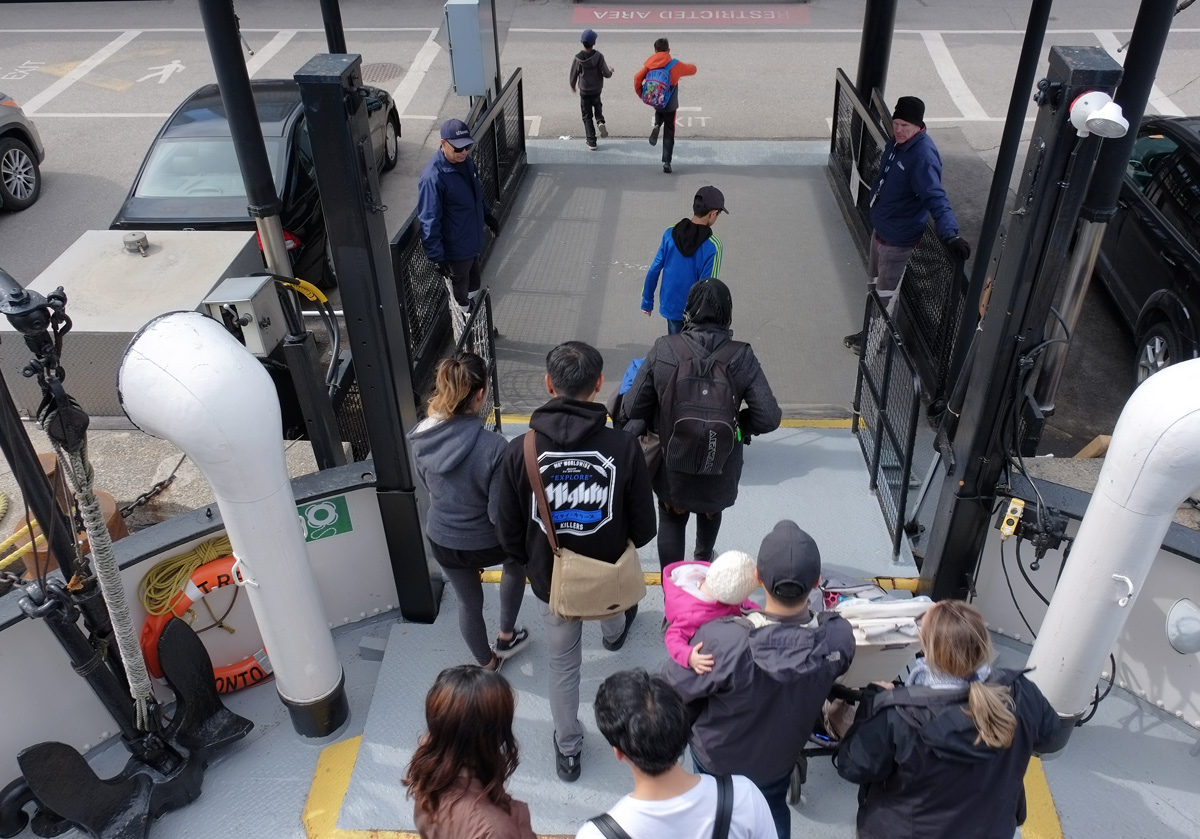
people exiting a ferry, from above

… and vicinity

The Bentway is a new park being built under the Gardiner Expressway between Bathurst and Strachan.  I walked it almost two years ago when the park was only in the planning stages.   I thought that I’d take a look at it again the other day.  Originally, it was supposed to be ready last summer so it’s a bit behind schedule.  Surprised?

Walking south on Strachan from King, and whoa, there are changes happening here too.  Cranes everywhere.  Holes in the ground.   How many people are employed in the construction industry in Toronto?  in the GTA?

below: Looking eastward from Strachan Avenue, immediately south of King Street.

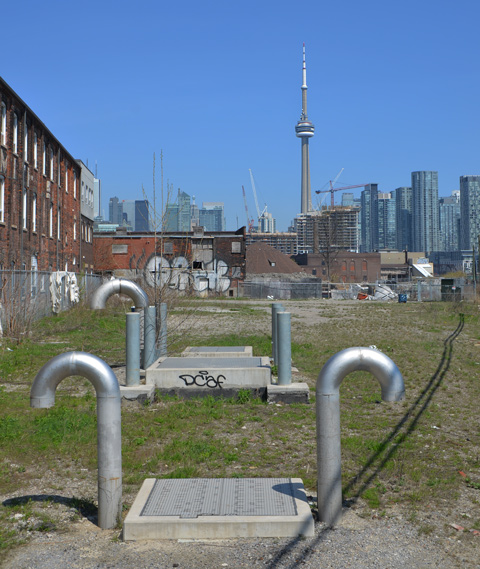
looking east from Strachan, immediately south of King, past older brick buildings to the CN Tower and city skyline

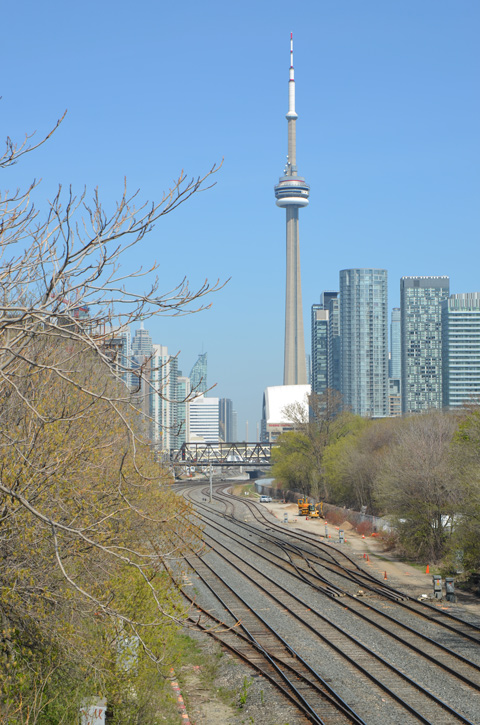
below: The view from a few metres farther south on Strachan.  The metal grid covers the railway tracks and supports the retaining walls on either side.  It also makes an interesting pattern.  These tracks turn northward – they are used by the UP Express to the airport and GO trains to places like Georgetown and Barrie.   There’s the CN Tower again – just in case you’re a CN Tower junkie like me.  I can’t resist taking pictures of it, especially when I find new angles, new foregrounds.
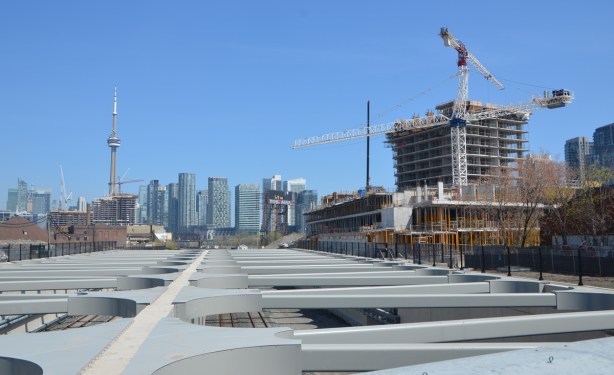
looing over the railway tracks to city skyline and CN Tower, construction of new building on the right

below: Immediately south of the train tracks is Ordnance Street.  Until recently it was a sleepy little dead end street of light industrials.
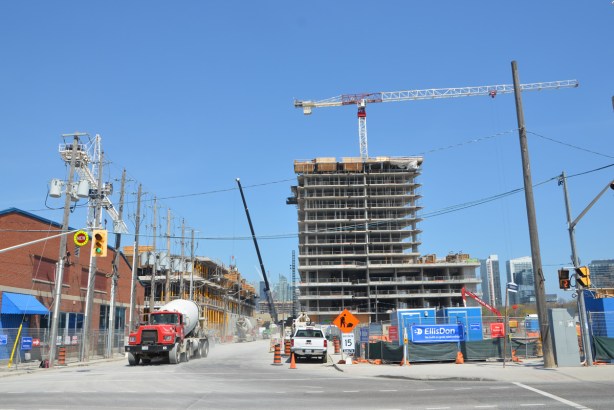
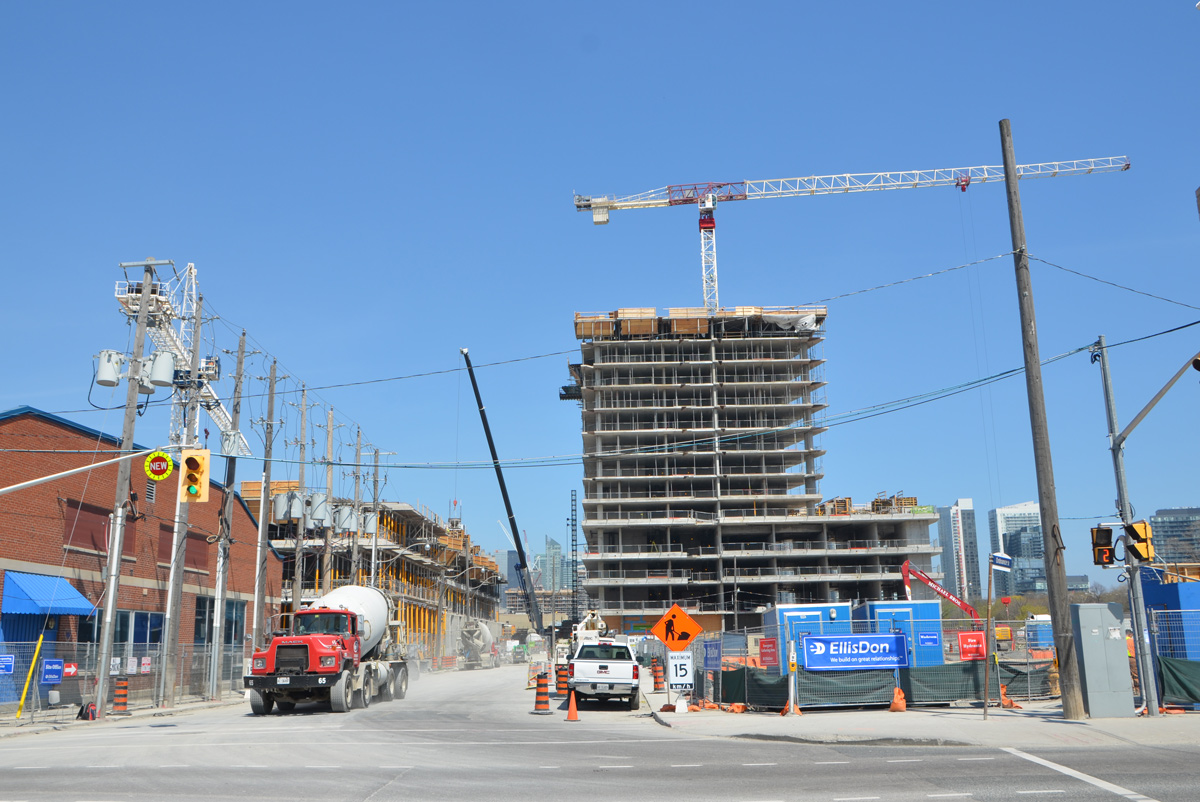
cement truck on street in front of construction site, cranes, fences, building about 20 storeys high

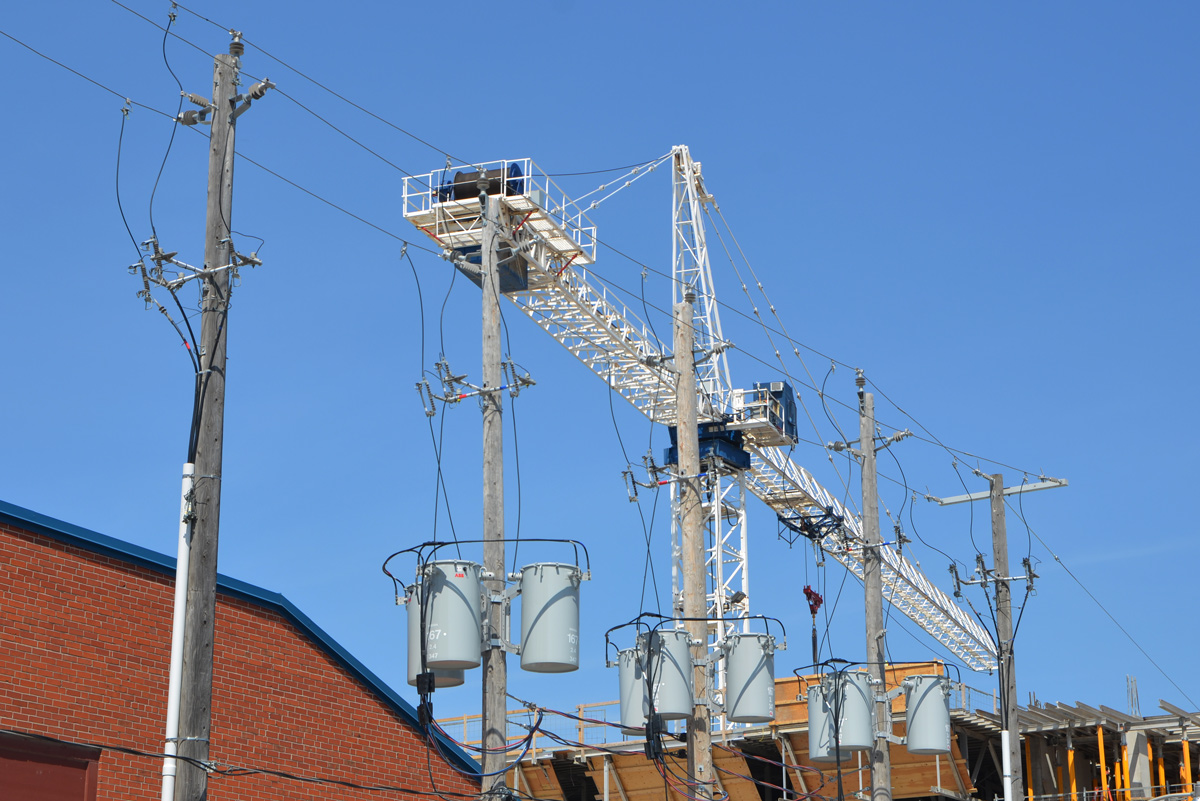
below: Ouch! Look at all those transformers on the poles.


white crane in the background, many hydro utility poles, with large grey cylindrical transformers on each of them

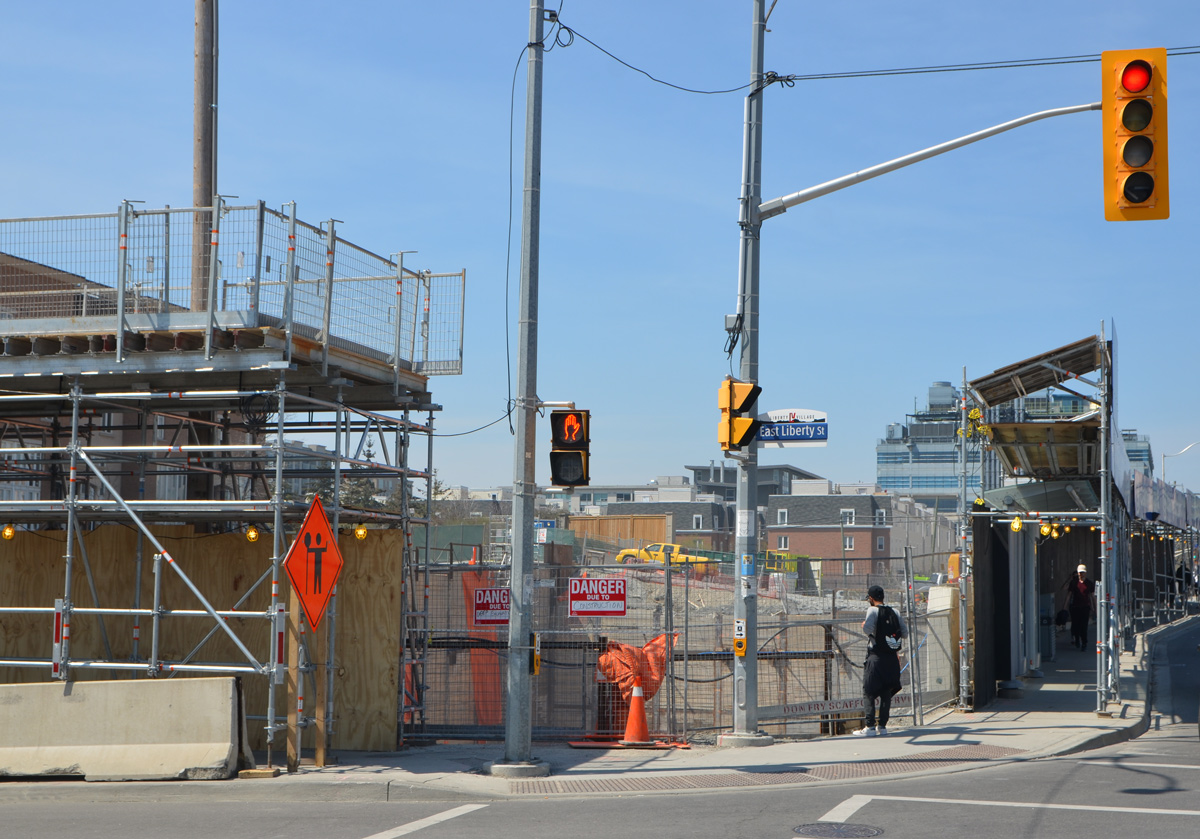
below: The east end of Ordnance Street is at Strachan.   It doesn’t actually end there, but continues on the west side as East Liberty Street.  This is the eastern edge of Liberty Village.
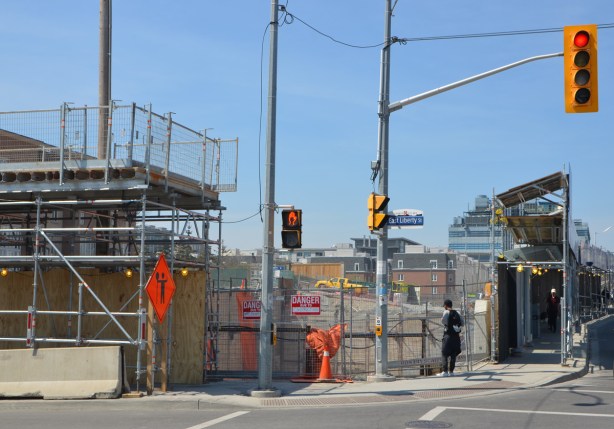
the NW corner of Strachan Ave and East Liberty Street, construction site with fence and hoardings.

Sorry, we haven’t got to the Bentway yet.  If you are a Torontonian you should now have your bearings and know at least approximately where you are.  Not far to go now.  It’s a beautiful day and we’re walking slow!

The Ordnance Street development is on a triangle of land with one side as Strachan Avenue and the other two sides as railway lines.

below: You’ll have to take my word for it that the construction on Ordnance Street is just behind the bushes on the left.   These are the tracks that run to the west and the bridge over the tracks is at Bathurst Street.  By this time, the two sets of tracks have come together as they approach Union Station.

railway tracks and CN Tower

below: One of the first views of the Bentway.  More construction.  I was standing on Strachan when I took this picture.  This is the beginnings of a new entrance to the Bentway – a large staircase down the hill from the street.  The steps are wide to allow for multiple uses – a place to gather, a place for entertainment.

construction under the elevated Gardiner Expressway, making a large set of stairs down from Strachan Ave to Grenadier Common near Fort York

below: This end of the Bentway parallels Garrison Common.  The Ordnance Street development can still be seen but there is also another structure being built on Garrison Common side of the railway tracks.
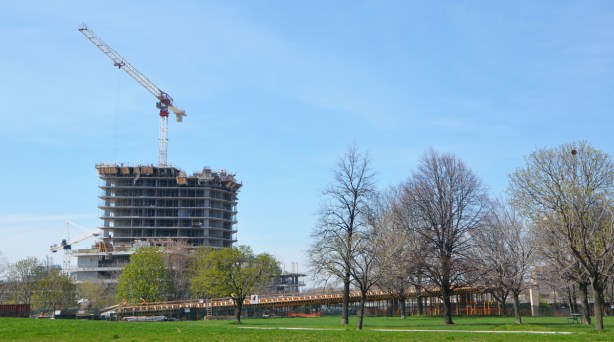
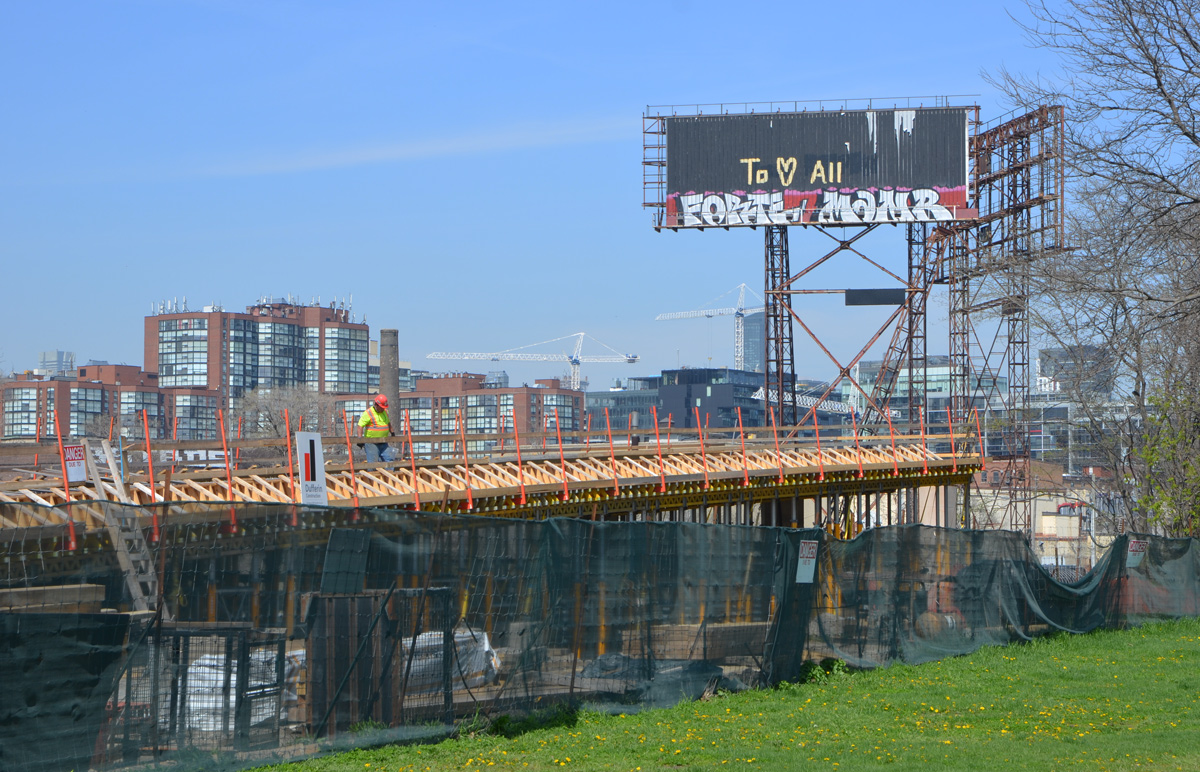
construction of an elevated ramp beside a park from a distance, with condo building going on behind it

below: A closer look.  It appears to be a ramp to a pedestrian/cycle bridge that will cross the tracks and join Ordnance Street to the Bentway, Fort York, and the streets/paths to the south.  I also really like the billboards – one with graffiti and the other is empty.

billboard beside construction of an elevated ramp beside a park

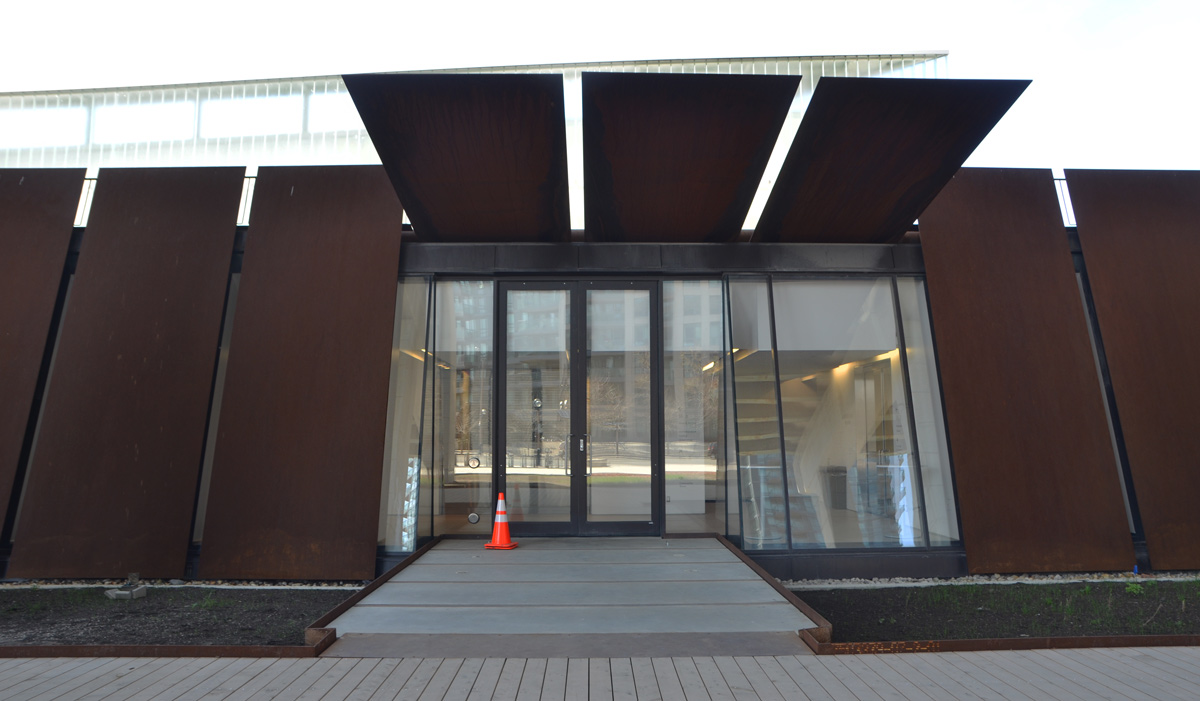
below: The new rusty entrance to the Fort York Visitors Centerentrance to Fort York visitors centre, rusted metal panels on exterior walls and as covering over doorway


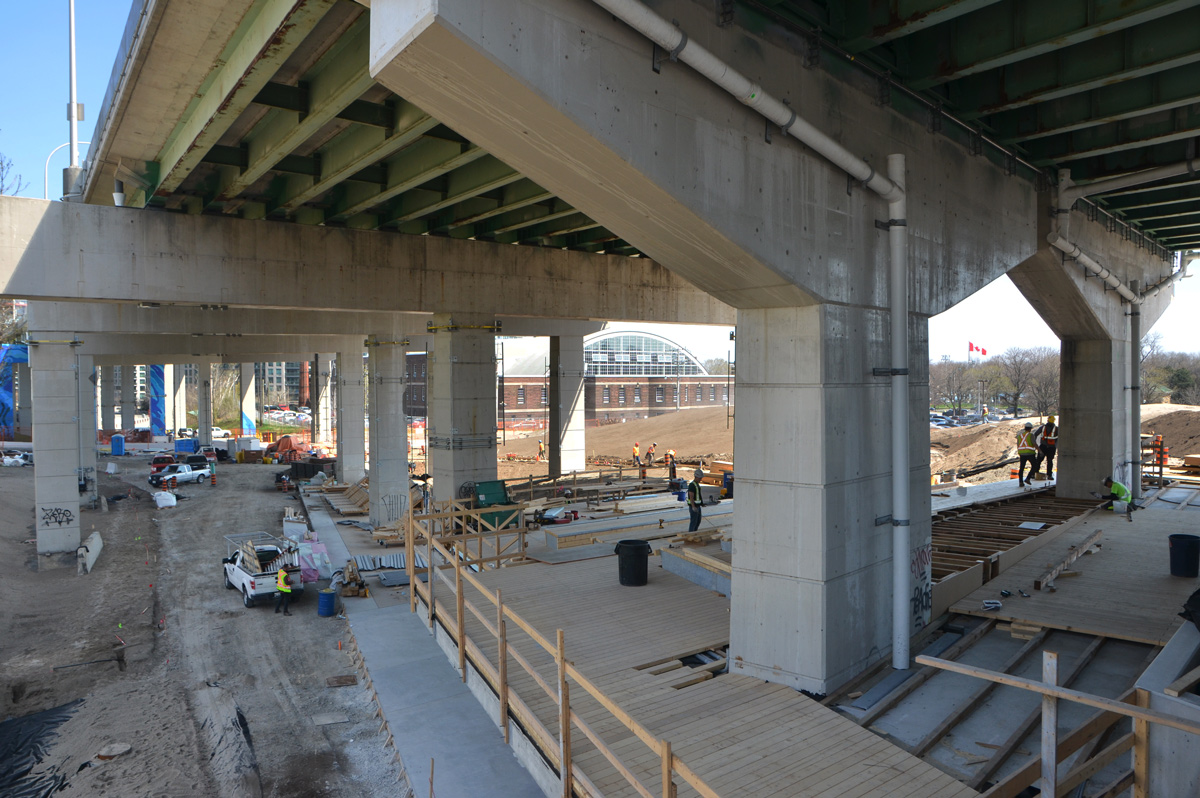
below: Just beyond the visitor’s center, the Bentway is closer to completion. There was a skating rink here this past winter.

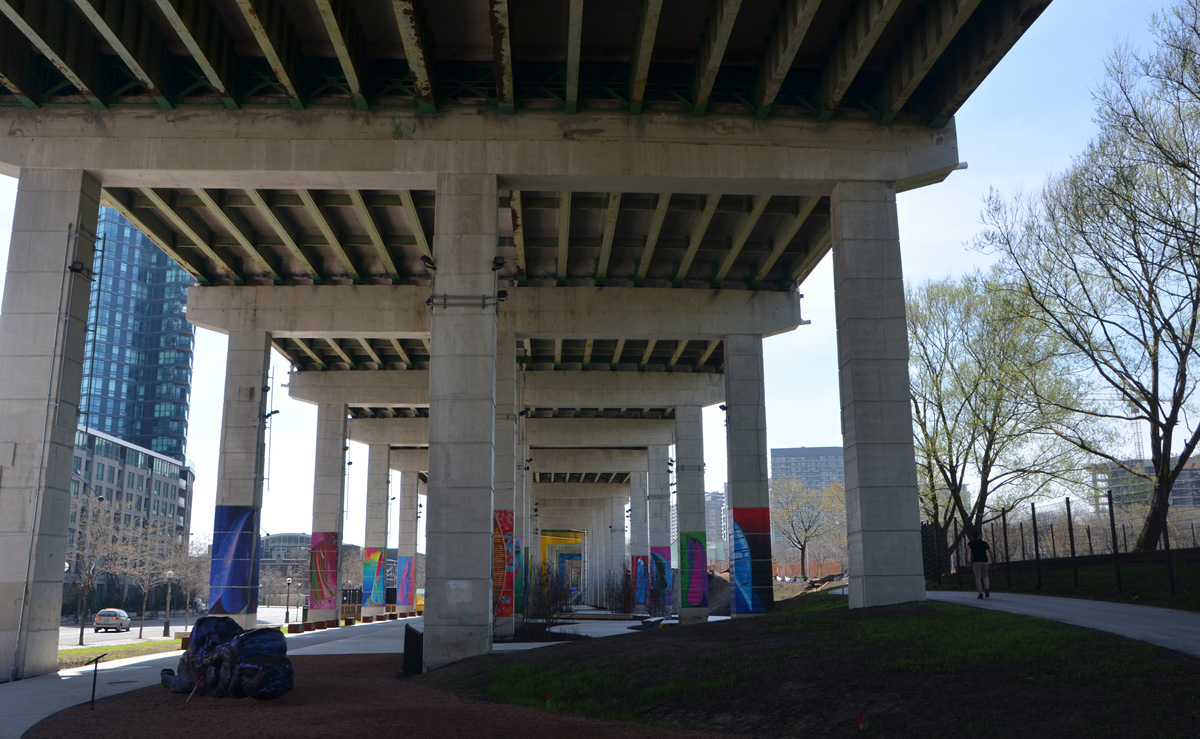
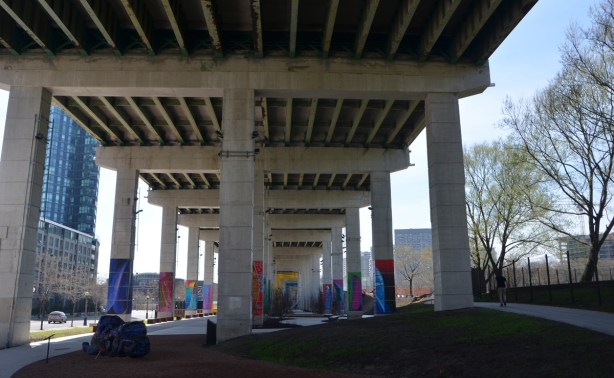
concrete path winds under the bents and pillars of the Gardiner Expressway

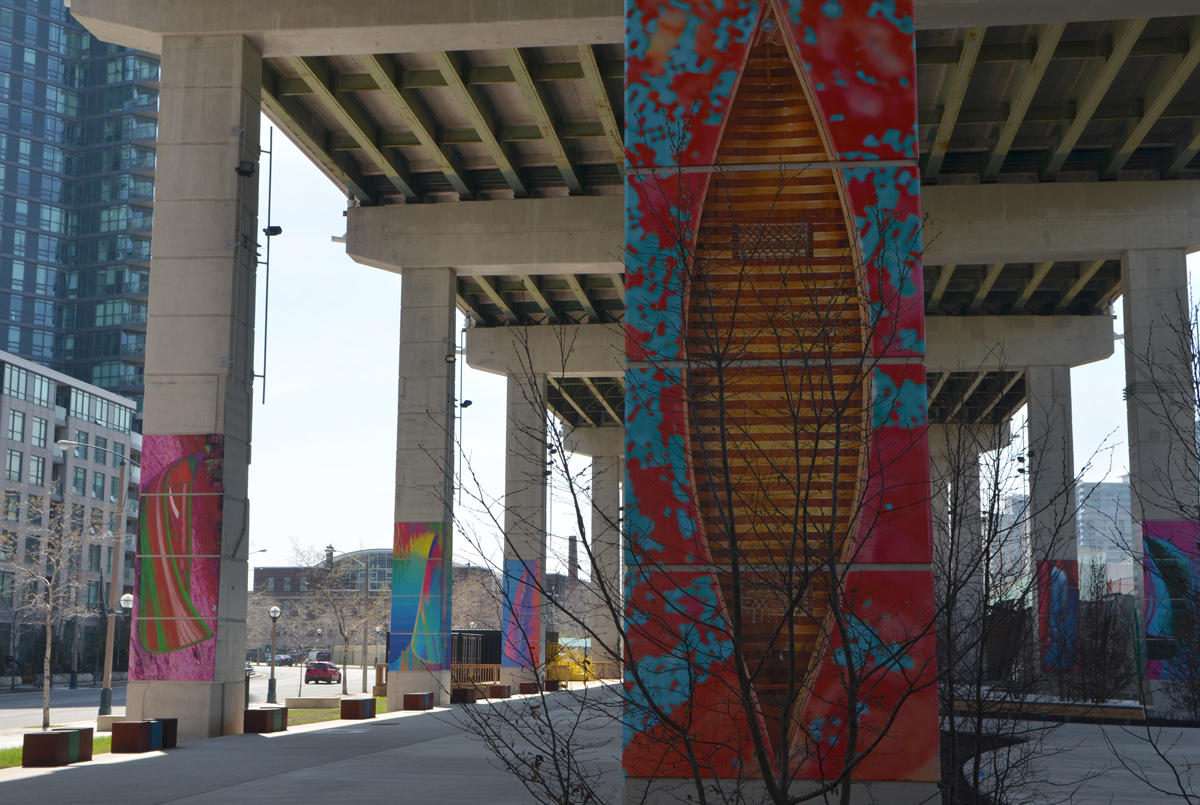
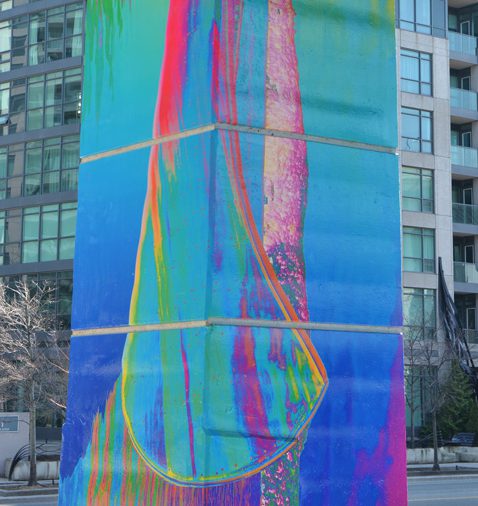
below: Also here is an installation by Dana Claxton called ‘Forest of Canoes’.  Colourful images of canoes on the concrete pillars.  Light-wise, they are probably best seen in the morning but that’s not when I was there.
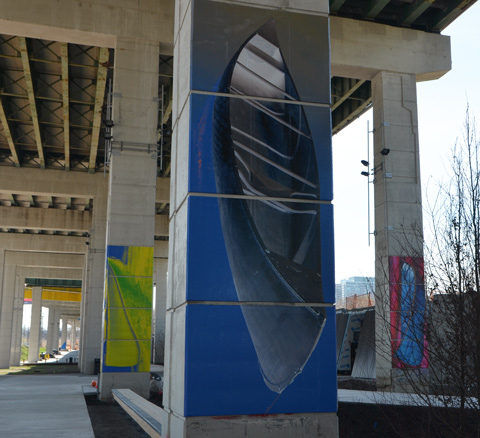
at the Bentway, Dana Claxton's 'Forest of Canoes' art installation of pictures of canoes on the concrete supports of the Gardiner Expressway - grey canoe on black background

The Bentway follows the shoreline of Lake Ontario that existed before landfill was used to create a space for the railway lines.  Canoes were once an essential means of transport.  Now their images sit on concrete pillars that hold up the Gardiner Expressway where thousands of cars pass by every day.

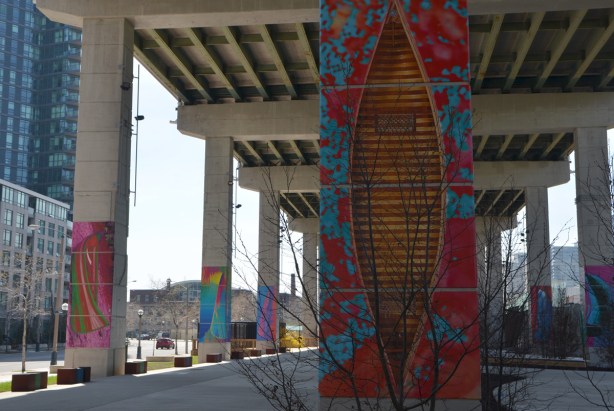
at the Bentway, Dana Claxton's 'Forest of Canoes' art installation of pictures of canoes on the concrete supports of the Gardiner Expressway - blue canoe

at the Bentway, Dana Claxton's 'Forest of Canoes' art installation of pictures of canoes on the concrete supports of the Gardiner Expressway - cedar strip canoe

below: In the bottom left corner of this picture is what looks like a bluish blob.  My apologies to the artist for calling it a blob but I’ll blame it on the lack of light and therefore, the lack of detail, in the photo.  This is another art piece.  It is ‘Future Snowmachine in Kinngait (Colossus)’ by Janice Qimirpik, Moe Kelly, Embassy of Imagination, and PA System.  Embassy of Imagination is a collaboration between PA System (Patrick Thompson and Alexa Hatanaka) and youth in the Cape Dorset community of Kinngait.  This sculpture started with small playdough models of snowmobiles made by Qimirpik and Kelly.  They were then scaled into a larger than life sculpture.
at the Bentway, Dana Claxton's 'Forest of Canoes' art installation of pictures of canoes on the concrete supports of the Gardiner Expressway

The next part of the Bentway is under construction and there is still no pedestrian crossing across Fort York Blvd and is passes diagonally under the Gardiner.   There is (was?) one in the plan.

below: This sculpture is on the corner of Fort York Blvd and Grand Magazine Street.  It is ‘Fountaingrove’ by Carlo Cesta and Nestor Kruger, 2014.  It sits above the Garrison Creek Culvert that carries the now buried creek to the lake.  Like the name states, it represents water in fountains.   Of course there is a white crane hiding behind it.

part of a metal twisty sculpture, condos behind, blue sky, sun spot

below: Just west of Bathurst Street

blue surface, window relief sculpture in it, other side is artifical rock, under the Gardiner Expressway, lock stone ground,

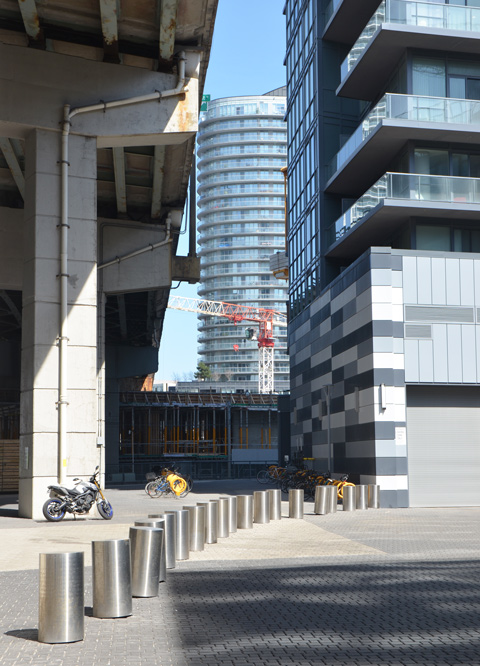
below: Getting cosy.  Condos rise up right beside the Gardiner Expressway.  If you’ve driven across the Gardiner, you’ll know just how close some of the buildings are to the traffic.   How useful is a balcony if it’s metres away from a highway and from all those cars and trucks?  They keep being built and people keep buying them.

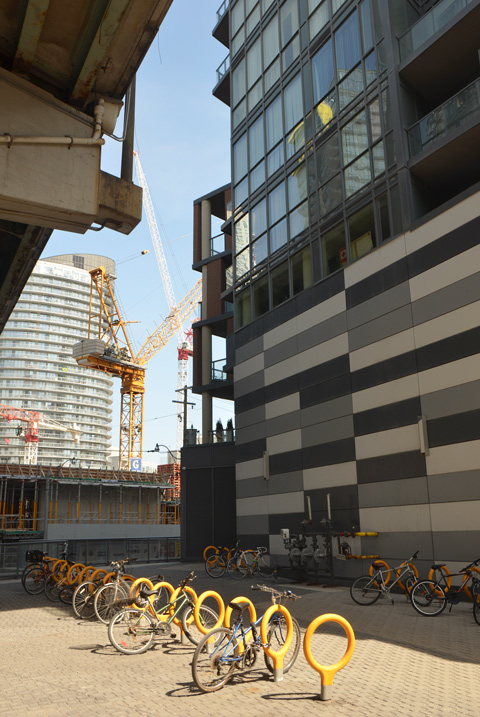
below: I couldn’t resist all the yellow and orange bits and pieces!

yellow circular bike rack, bikes, condos,

below: On the east side of Bathurst is the construction of a new Loblaws.  It never ends does it?
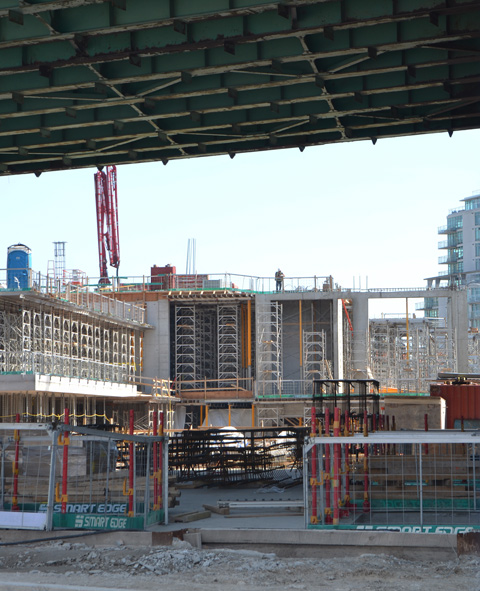
construction site that is partially covered by the Gardiner Expressway

This blog may have been a bit heavier on construction photos than you were expecting, especially since the title was about canoes. There was just so much work going on in that area that it was hard to avoid.  The next time that I walk this area it will probably be totally different… unfortunately new buildings are a lot duller to look at than construction sites so there may not be many photos!

on grey construction hoardings, a sign tat says post no bills. Someone has added 4 stencils of different Bills, Bill Murray, Bill Clinton.

Dana Claxton canoe image at Bentway, Forest of Canoes, multicoloured, bright colours,