Posts Tagged ‘art’

This post is subtitled ‘Staying Cool on a Hot Hot Day’.  When the temperatures are into the 90’s (old style) and the humidity makes the air thick, walking streets and alleys is not very comfortable.  Instead I took refuge in air conditioned arty places.  With the help of the (mostly) air conditioned TTC I only needed to take a few steps outside.

below: At one point I walked through an air conditioned building rather than going outside.  This is what I found there. ‘August 6, 1945’ by Matthew Day Jackson.  Moments after I pulled my camera out of my backpack, a security guard appeared.  I was sure that once again I was going to get the “this is private property” talk but instead we ended up discussing the work and how it is displayed.

It is constructed of four panels and it’s very heavy.  The base is made of lead; you can see the lead where Lake Ontario is.  It is attached to the wall with 18 very long bolts and each bolt is wired to an alarm.

map of toronto made of charred wood and lead, meant to resemble the city after an atomic bomb, large, made by Matthew Day Jackson, hanging on a wall behind a metal railing.

below:  Looking a bit more closely at it you can see that it is a map of Toronto.  As you might have surmised,  the title is a reference to the dropping of the atomic bomb on Hiroshima by the USA during WW2.    This isn’t just any map of Toronto, it’s an aerial view of a burnt out city after a nuclear explosion.  It is one in a series of cities given similar treatment, all with the same title.

detail of the islands and downtown area of map of toronto made of charred wood and lead, meant to resemble the city after an atomic bomb, large, made by Matthew Day Jackson

From the effects of man made death to the life enhancing effects of nature….

below: A few steps outside took me past the Gardiner Museum where I noticed that the front garden was redone about a year ago.  ‘Vertical Crevice Garden’ was designed and donated by landscape artist Neil Turnbull.  From the Gardiner museum website, a quote by the artist: “When the massive forces of continental drift push against layers of sedimentary rock, they cause it to crack, break, and rise. Over centuries, through exposure to wind, sun, and the freeze-thaw cycle, the layers split open. These fissures and crevices collect rain, dust, and an array of windblown bits like seeds and spores; plants take root, and life takes hold.”

limestone rocks arranged on a slant in a garden, stripes of red rock and grey rock, all just a few inches off the ground

below: When walking past the Gardiner Museum, one can’t help but notice the striped head.  It’s actually called ‘Untitled’ (why do artists do that?) and it’s by Jun Kaneko, 2002.  It’s made of glazed ceramic and galvanized steel.   Before heading underground at Museum subway station I took a few minutes to try to take a ‘pretty’ picture of the head.  The plants in the garden next door haven’t quite grown up enough to hide that ghastly table that the head sits on.  I have always wondered why the museum chose such a mundane bland platform for the sculpture but now that I look at it again I wonder if it’s possible that the table is actually part of the artwork.  Could it be?

large striped head sculpture on a table, outside, by Jun Kaneko, old building behind it, lavender and other plants growing in front of it.

below:  A photograph in the doorway of a gallery caught my eye.  The picture below is not the one in the doorway, but one that was hanging on a wall inside that I liked even more.  ‘Paris Rooftops 4’ by Michael Wolf.  It is 48″ x 68″ and is a chromogenic print (full-colour silver-based photograph), edition of 9.   To buy it will set you back $22,000 but looking is free – check out more of Michael Wolf’s work on the Bau-Xi gallery website.

picture of a photograph by Michael Wolf of Paris rooftops. Concrete grey with lots of lines of little terra cotta chimneys

below: A man with a camera stares at a painting on a gallery wall.  ‘Watching’ 2010, (26 inches high) by Tom Campbell on the left and ‘Brown Trail #7’ 2016 by Shi Le, a Toronto based landscape artist.  These are at the other Bau-Xi gallery (the non-photography one)

a small sculpture of a man holding a camera is placed in an art gallery such that he seems to be looking at a painting on the wall.

below: Three paintings by NUBARR Gallery, a collection of the works of Armenian-Canadian painter Noubar Sabag (Noubar Sabbaghian) 1920-2006.   These, and others by the same artist, are on show at the Art Square Cafe & Gallery but unfortunately I just learned that today is the last day.

a woman in a floppy black hat is taking pictures of three paintings hanging on a gallery wall.

below:  How many people try to paint pictures like this?  How many people sell such paintings, not to mention have them hang in the Art Galley of Ontario?  But they aren’t Robert Motherwell.      So I ponder on the age old question of what makes a piece of art valuable or collectable?  Is the AGO (and other galleries) collecting paintings or names?  Motherwell painted this in numerous variations – a few changes in colour, a slight change in the lines.  Cheating?  Or brilliant marketing?  One for every gallery of note? This is Motherwell’s ‘Untitled (In Orange with Charcoal Lines)’ c1970.  There’s that “untitled” again, the most popular name for an artwork.

all orange with 3 black lines that form three sides of a square, top line of the square is missing. It's a picture of a painting by Robert Motherwell in an art gallery

My last stop of the afternoon was at the photography exhibit by Thomas Ruff at the AGO.  Part of the exhibit was a few large photographs of stars,  ‘Sterne’.  Large pictures of stars in the night sky were made from negatives that Ruff bought from the European Southern Observatory in Chile in 1989.

below:  They are difficult to look at, or rather it is difficult to what is the picture because the blackness of the photograph creates a mirror when placed behind glass.   This is me taking a picture of the picture – me plus the picture on the opposite wall plus the lights and light fixtures in the ceiling plus a table plus another person in the room plus a few white spots that are stars.

large photograph of the night sky, lots of stars and blackness. The black acts like a mirror and parts of the gallery are reflected in the picture.

below: ‘Walking Away, Walking Through the Universe’ a manipulation of a manipulation.

a reflection of two people walking hand in hand as seen reflected in a photograph of stars in the black night sky

below:  One last photo.  Let’s end this on a positive note and give Thomas Ruff credit for some interesting work.   These two pictures are part of his press++ series where he has taken old photos used in print medium and merged the front (picture) and back (words and markings) of the print into one.

a woman is standing in an art gallery and she is looking at two large pictures on the wall.

Thomas Ruff, Object Relations, at the AGO until 1 August 2016

A comparison of sorts.  Two painters from two different time periods.  One looked north and the other looks south.  The north with its barren cold and blue in comparison to the south and its lush greenness.  A famous anglo Canadian painter who went searching for simplicity and a relatively new British painter with Jamaican roots who explores complexities.

Lawren Harris and Hurvin Anderson.  You should know which is which!

I didn’t purposely set out to compare them.  I saw the ‘The Idea of North’ exhibit that features the Steve Martin paintings of Lawren Harris first.  As much as I like the Group of Seven, Harris’s minimalist snow and ice paintings have never been my favorite.  Still, it was an interesting collection to see.  After I finished there, I headed up to the contemporary art floors.  The fifth floor is still closed (new installation opening later this week) but I discovered that the fourth floor is devoted to the works of Hurvin Anderson.  As I walked around the Anderson installation I kept thinking of similarities and differences between him and Lawren Harris.

many people in a room in an art gallery, standing around and looking at paintings.

below: Mountains in Snow: Rocky Mountain Paintings VII, 1929.  One of the many famous Lawren Harris snow and ice paintings.  Light, reflected light, shadows, and contrasts.  The elements reduced to their simplest form.   The landscape itself is almost secondary.  Or the landscape is the medium, not the message.

a Lawren Harris painting of a snow covered mountain, blue sky in the background.

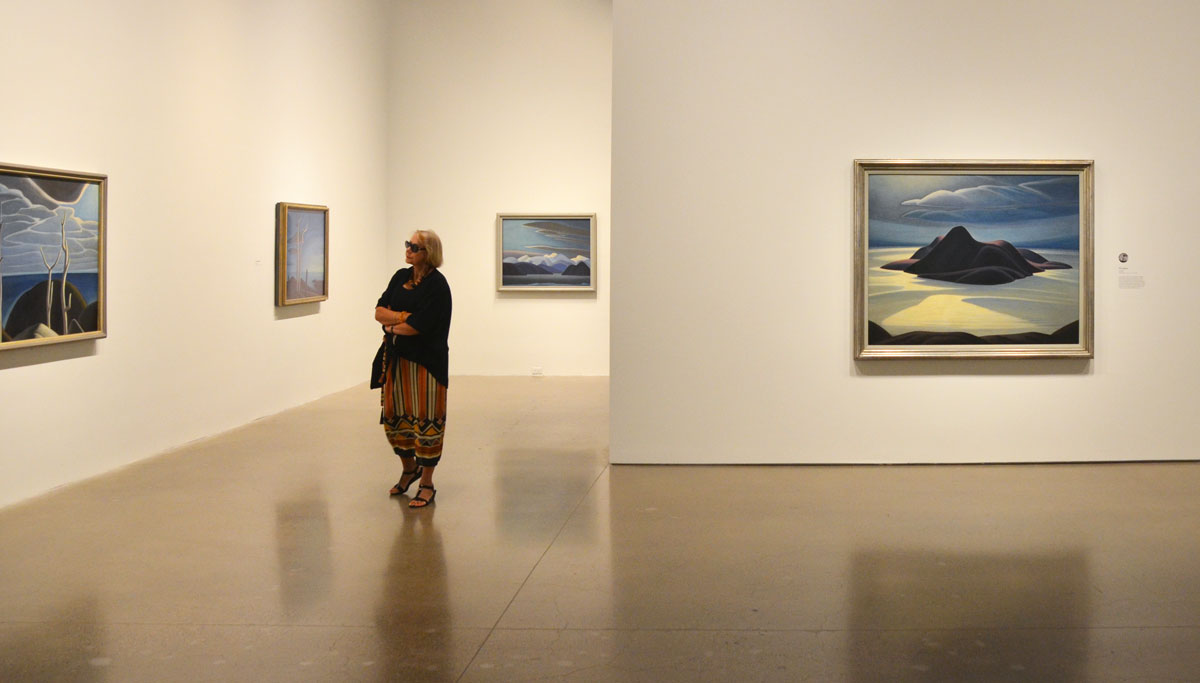
below: The large painting on the right is ‘Pic Island’ painted about 1924.  Pic Island is an unpopulated island along the north shore of Lake Superior.  Today the island is part of Neys Provincial Park.

a woman walks through a gallery with paintings on the wall. She stops to look at one of them.

below: Two of Hurvin Anderson’s paintings from his Caribbean landscape collection.  On the left is ‘Beaded Curtain – Red Apples’, 2010.

three young women sitting on a couch with their backs to the camera, they are looking at two large paintings on a wall, by Hurvin Anderson.

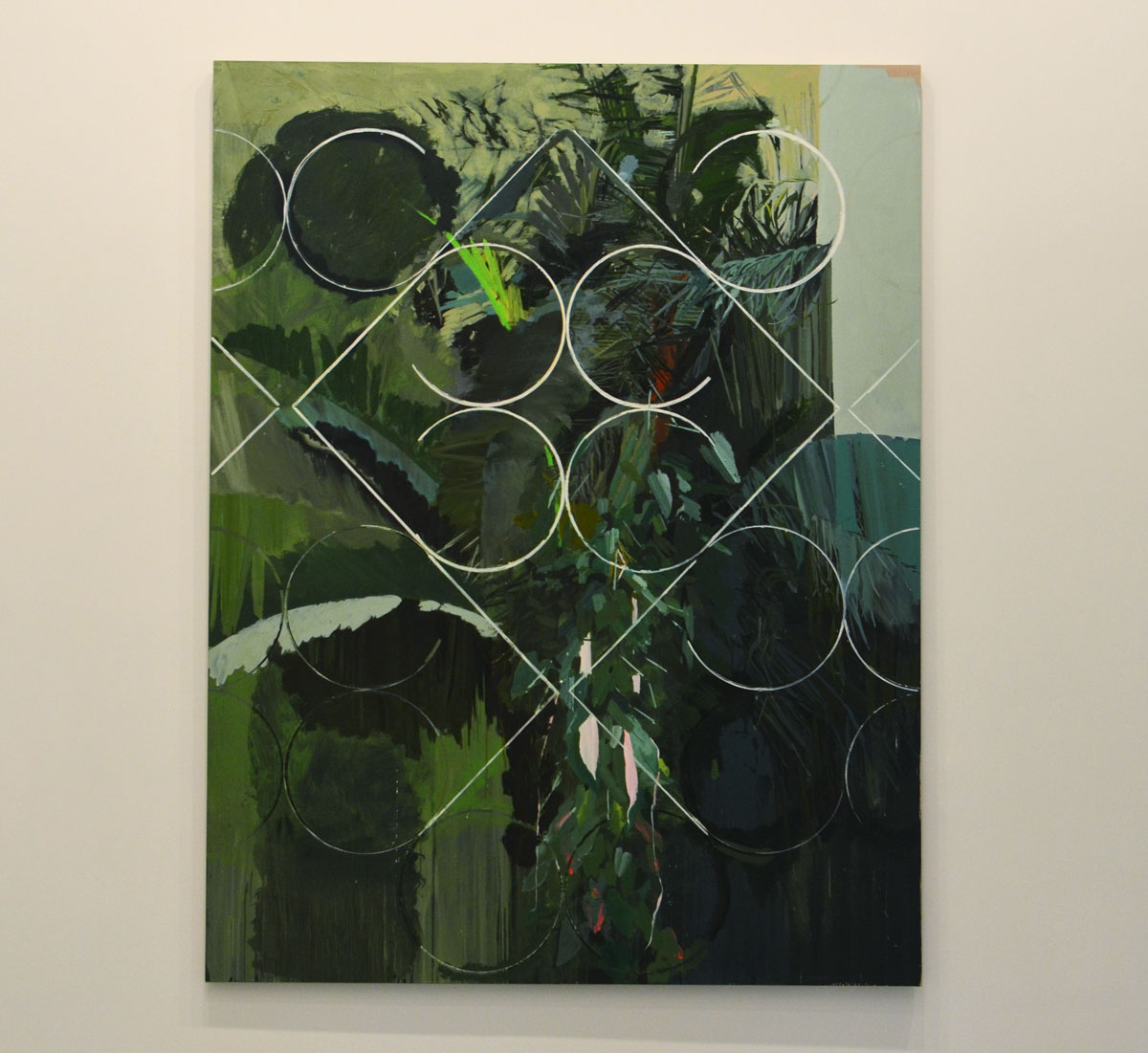
below:  ‘Constructed View’, 2010.  Anderson’s Caribbean paintings have grilles incorporated into them.  These are the security features prevalent on houses and businesses in the Caribbean (and elsewhere in the world), metal fixtures over windows and doors to keep out the unwanted.  They contain what’s inside.  They are a barrier.  They intrude on the landscape and cut it up.  Again, the landscape is almost secondary.  The message, or emotion, is more important.  [aside – There is a grille in the painting above (right) but it’s more subtle.]

a landscape painting in shades of green with fragments of white grille overlayed, repeating pattern of 4 circles with a square

Lawren Harris painted his famous mountain pictures in the late 1920’s.  In 1930 he visited Baffin Island and a few paintings resulted from that trip.  I learned that although I associate Harris with icebergs and arctic scenery, most of his snow and ice paintings were from the north shore of Lake Superior or from the mountains around Banff Alberta.

The repetoire of both painters is not limited to landscapes.  Harris painted many houses and street scenes from downtown Toronto including houses and streets that were demolished years ago.  The examples of Anderson’s non-landscape work were interiors.  Both men used bold colours but Anderson tends to show more detail in his paintings.

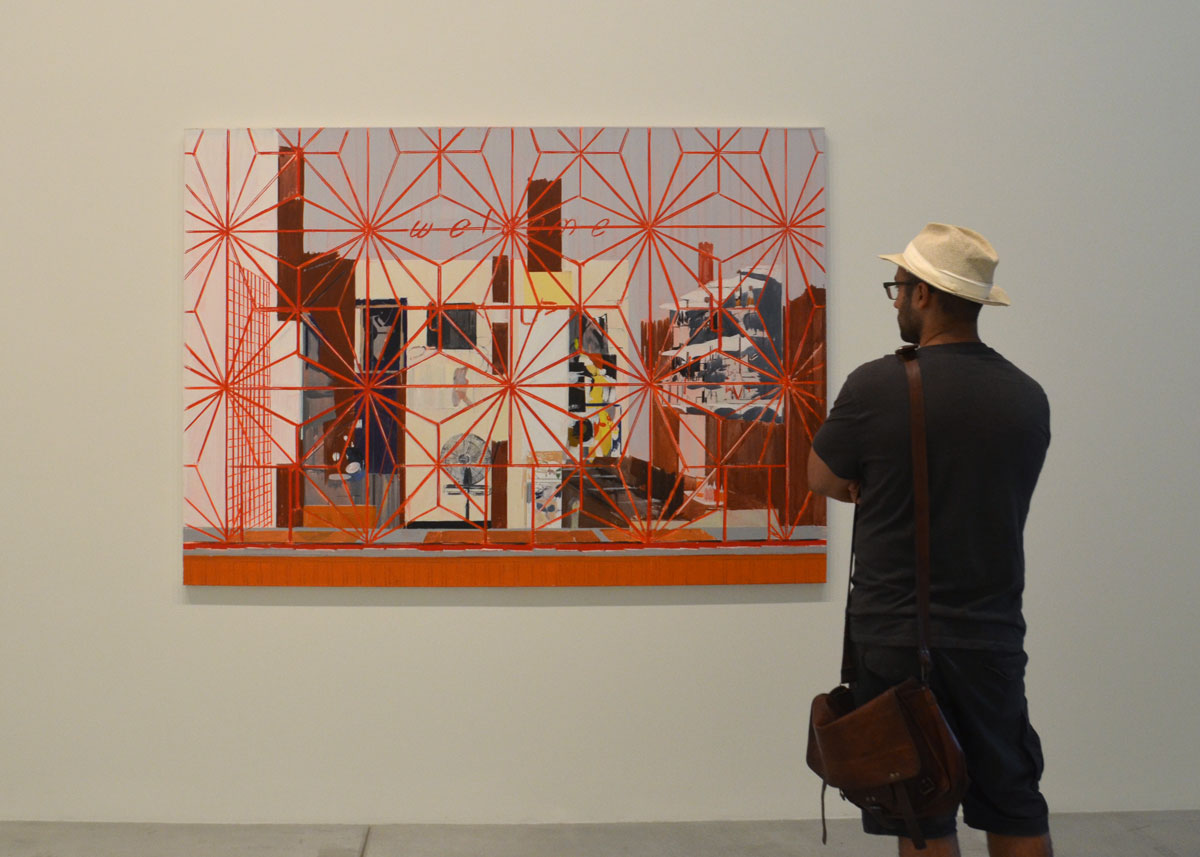
below: ‘Welcome: Carib’  The Welcome sign of the bar in  juxtaposition with the red metal work covering the window.  The picture beckons to us but keeps us out.

a man in a straw fedora stands in front of a painting called Welcome: Carib by Hurvin anderson, it features a red star patterned grille over the painting, over the window that is in front of the interior scene.

below: One of the paintings from Anderson’s Barbershop collection, ‘Flat Top’ 2008.

two young women walk away from a large painting hanging on an art gallerywall.  two barber chairs in a barber shop, empty.  Bright pink wall with squares of colour.

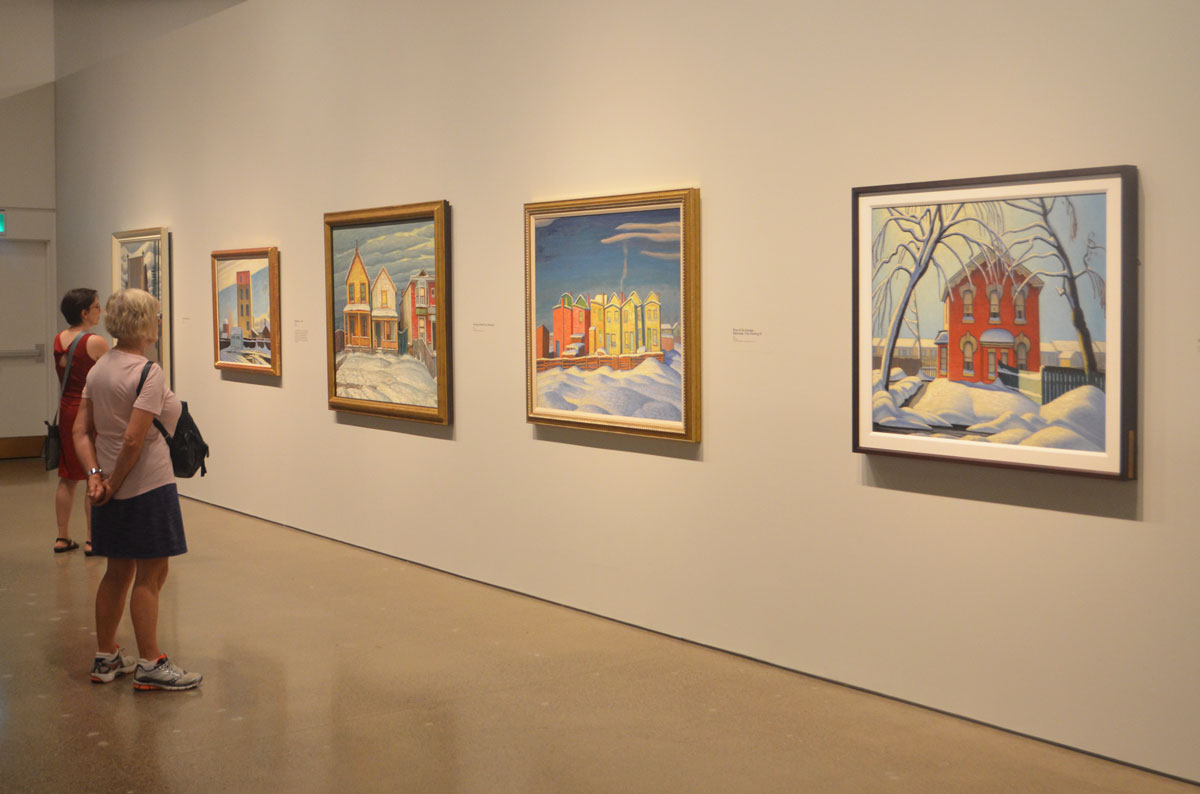
below: A selection of colourful Toronto houses in winter painted by Harris in the 1920s.

two women look at a line Lawren Harris paintings of brightly coloured houses in winter on a wall in an art gallery

In the 1930’s Lawren Harris’s personal life went awry.  The words on the wall at the AGO says that he divorced, remarried and moved to the states.  That’s a bit of spin.  He didn’t divorce his wife because that would be messy, apparently.  Instead in 1934 he just married the wife of an old friend.   And of course that turned messy and the new couple left for the USA for a few years before eventually settling in Vancouver BC.   Harris’s post-1934 work is very abstract and was never as successful as his earlier paintings.

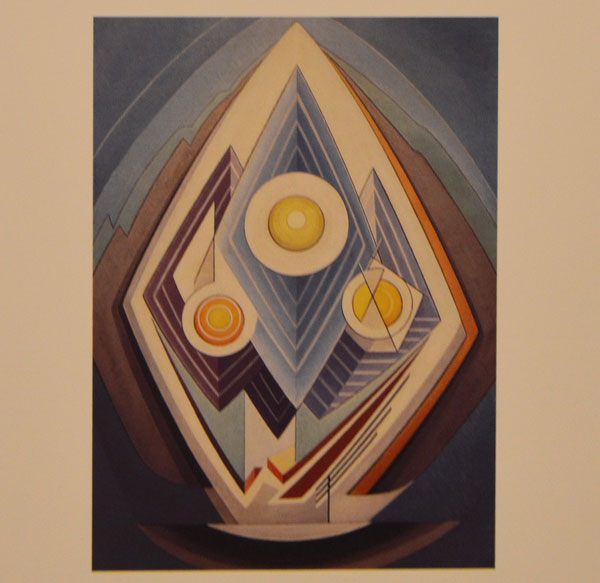
below:  You can see the influence of the mountain paintings in this,  ‘Painting No. 4’, about 1939, painted when he was a member of the Transcendental Painting Group.  This was a collective of artists in New Mexico that Harris help to found.

an abstract painting by Lawren Harris, circles and diamonds in an egg shape

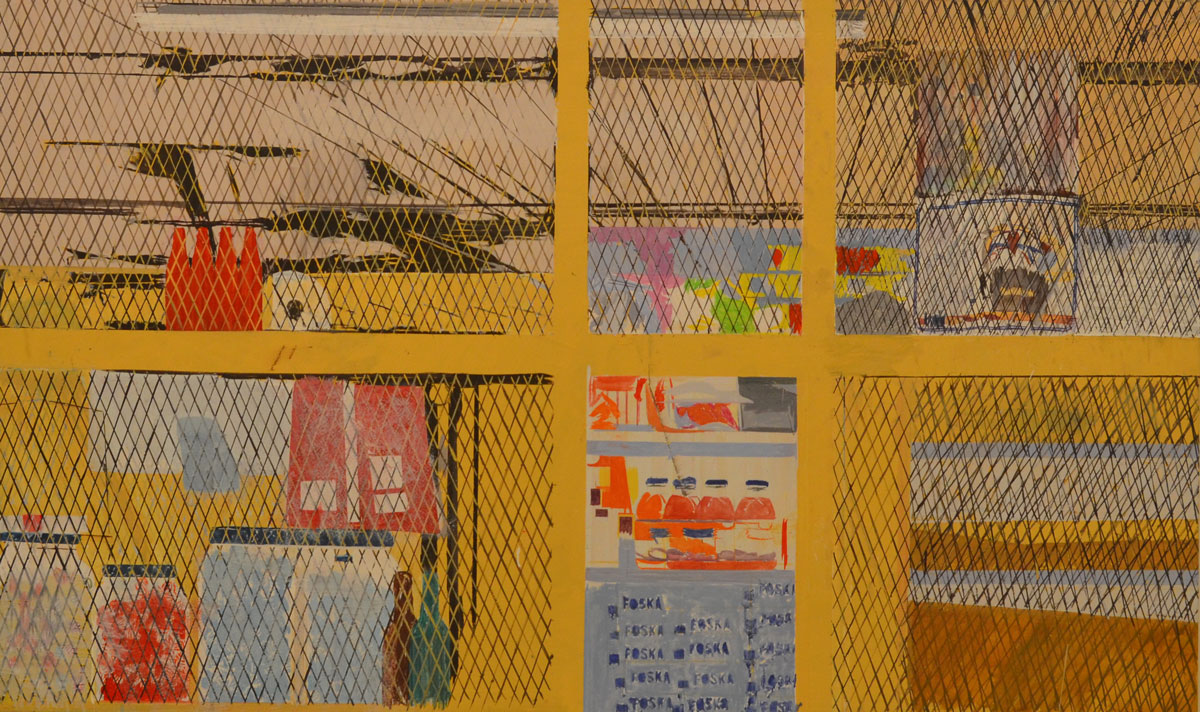
below: Since I have no idea where the art of Hurvin Anderson is headed, I will leave you with one more of his present paintings (I’m not sure those two ideas actually go together!).  ‘Foska Foska’, the interior of a shop behind yellow bars and black mesh.

a painting by Hurvin Anderson called Foska Foska, shows the interior of a store with a yellow metal gate in front.  and a wire structure covering the ceiling too


The Idea of North – until 18 September

Hurvin Anderson – until 21 August

#HarrisAGO | #HurvinAndersonAGO

This is another post about an exhibit from the CONTACT Photography Festival.   I know that it’s now June and CONTACT was in May, but I wanted to post these photos.  I actually took them early in May as you can probably tell by how many clothes the people in the pictures are wearing.  They’re certainly not dressed for the warmer weather we’ve been having lately.  I have had trouble deciding what to write in this post.

There is a parking lot at the NE corner of Front and Spadina with some billboards in it.   Maybe you saw them as you drove or walked past but maybe you passed by and missed them.   There are so many things on the street vying for our attention and a billboard is just another piece of street ‘furniture’.

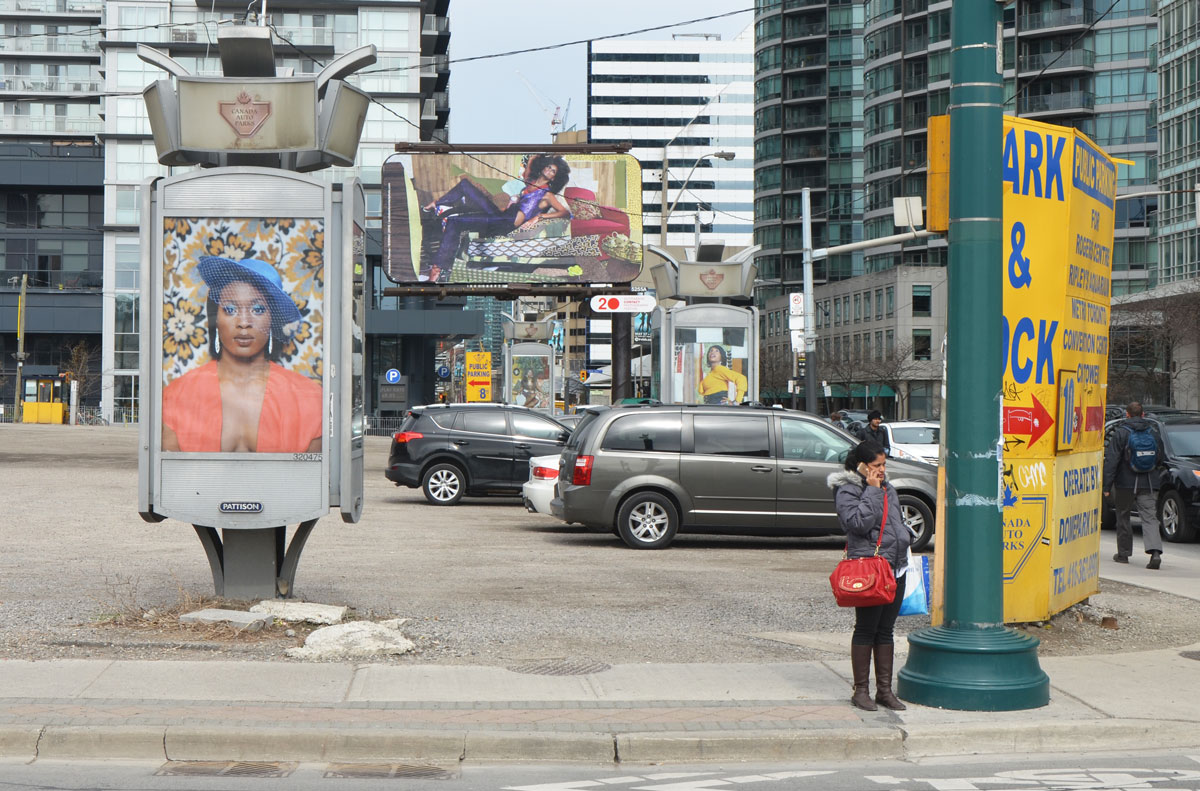
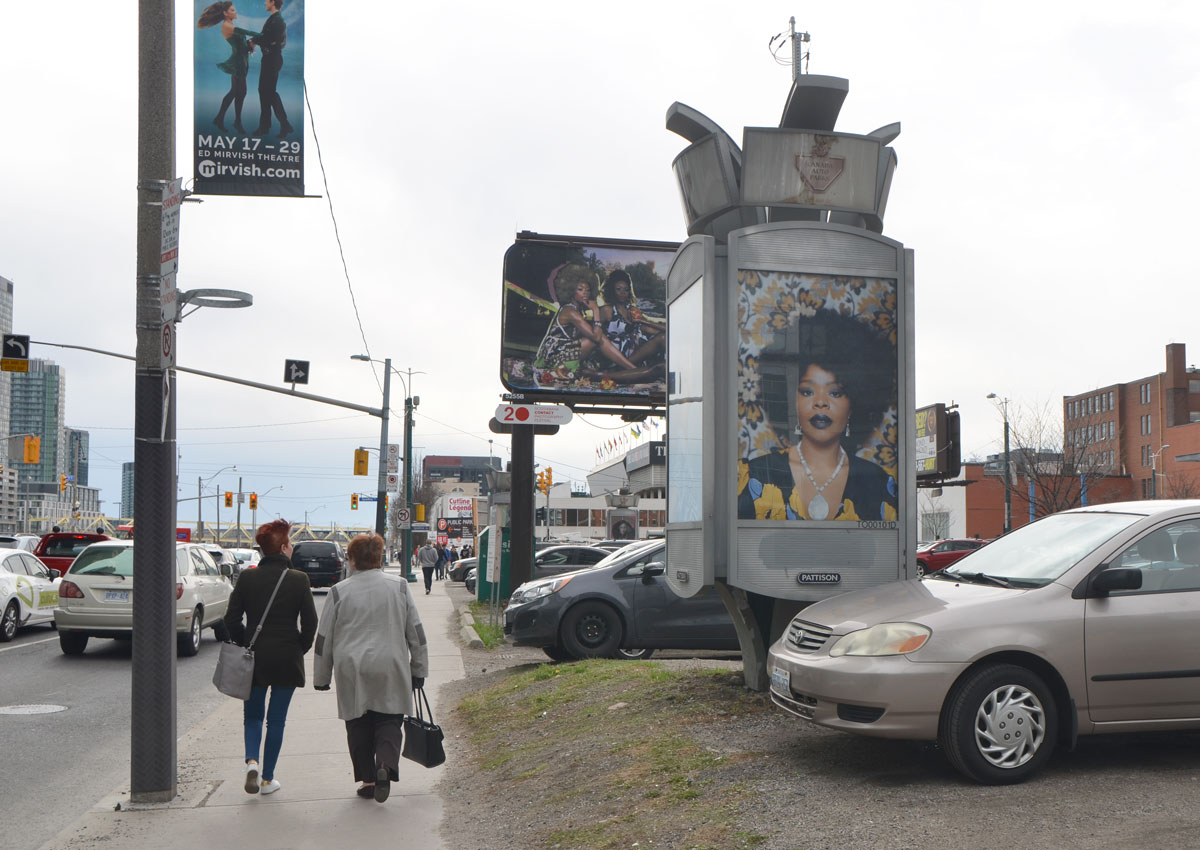
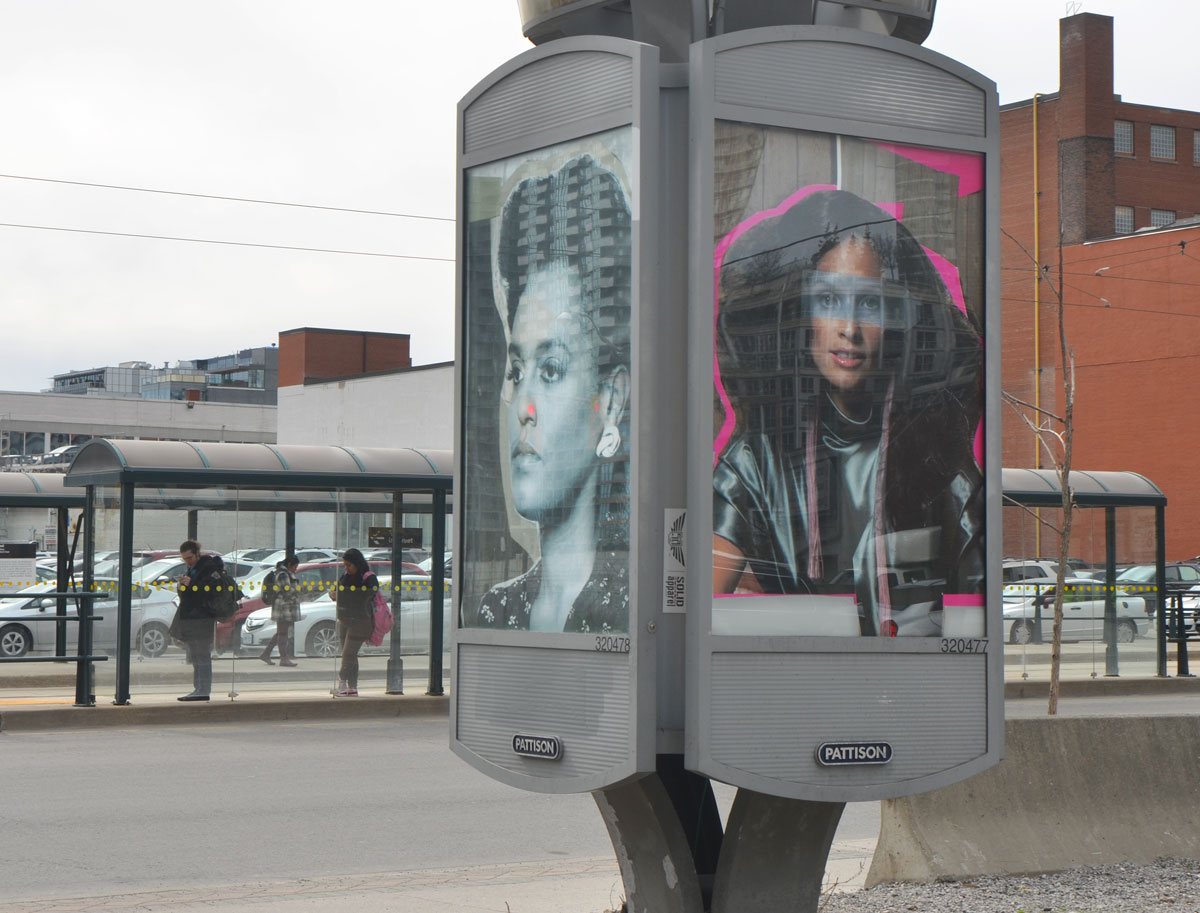
For the month of May, an installation titled ‘What it Means to be Beautiful’  by Mickalene Thomas occupied a number of billboard spaces at the above mentioned corner.   All the images are portraits of women and are “shown within the context of street advertising, where women are constantly bombarded with narrow notions of female beauty.”   A sample of the billboards:


part of an art installation, portrait of a black woman in profile, with a shaved head, on a billboard, by Mickalene Thomas, in a parking lot in downtown Toronto

part of an art installation, portrait of a black woman wearing a blue hat on a billboard, by Mickalene Thomas, in a parking lot in downtown Toronto. A woman stands on the corner talking on her phone. Another, large, billboard is in the background.

Two women walk past part of an art installation, portrait of a black woman on a billboard, by Mickalene Thomas, in a parking lot in downtown Toronto

Two portraits of black women, in a billboard space in a parking lot, with people waiting for a streetcar in glass bus shelters in the background.

part of an art installation, portrait of a black woman on a billboard, by Mickalene Thomas, in a parking lot in downtown Toronto, A group of people wait for a green light at the intersection in the background, tall condos too.

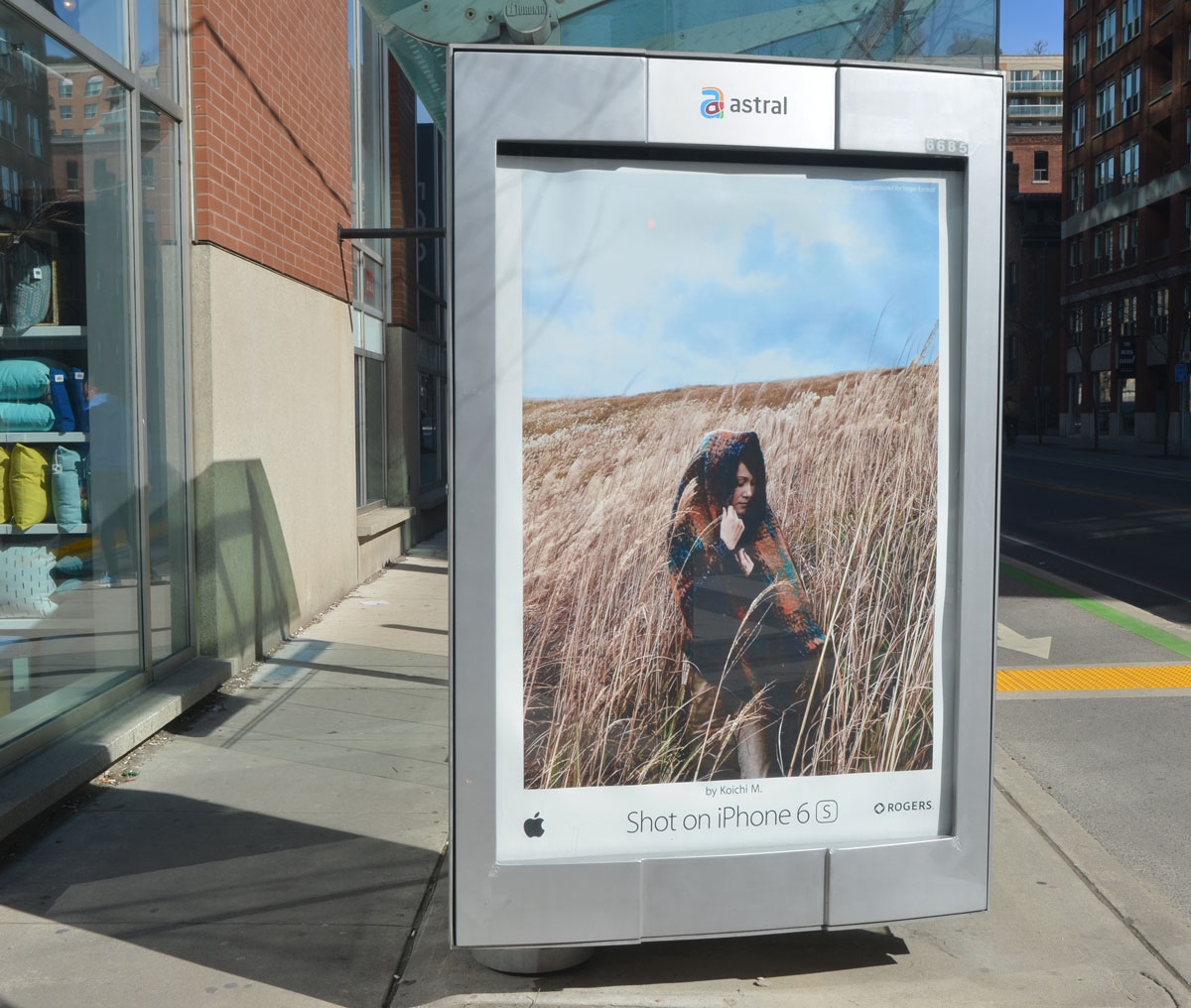
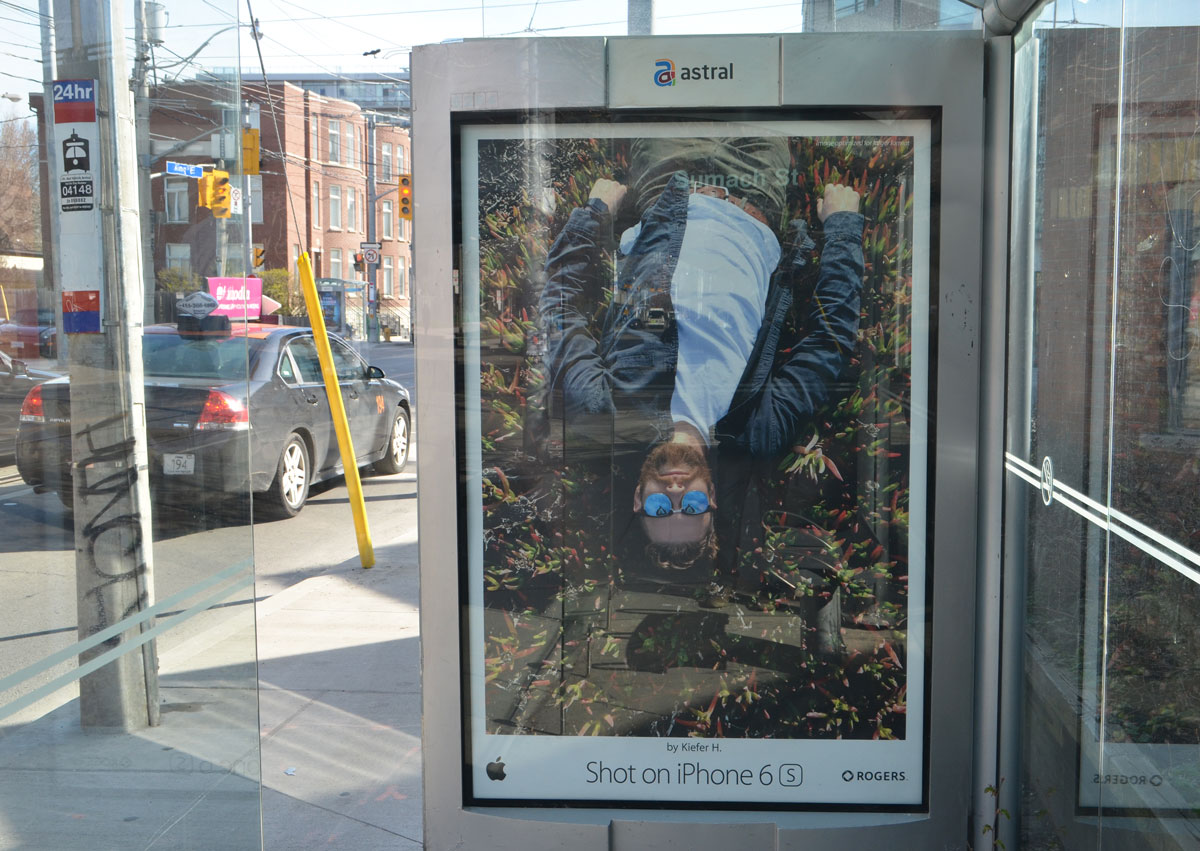
Part of the reason that I hesitated to write this post was the fact that the iphone 6 ad campaign was on at the same time.  It was a campaign that used photos taken with the phone and the ads were very visual and used very few words. In my opinion, they are more eye catching and visually appealing than Thomas’s work. I found a few of them to show here (below).  I know that there were many more but unless I was consciously looking for ads, I didn’t notice them as billboards are one of the things that I block out as I walk.  That led to a few thoughts about what catches a viewer’s attention on the street –   Faces?  Colours?  Contrast?

There is more going on in Thomas’s photos and collages than just visual appeal but I still question the validity of asking the viewer to look at them in the context of street advertising.   Is it fair to compare her images to ads produced by, and in aid of, a large corporation?   Would it have been better to  exhibit her work in different form or a different place?  I don’t have the answers for those questions.  Do you?


iphone ad on a bus stop wall showing a woman in a field

iphone 6 ad on a bus stop wall of a woman lying in a field of pumpkins. Her head is surrounded by pumpkins.

an iphone ad on a bus stop wall of a man lying on the ground. He is upside down in the picture

And now I will go back to ignoring billboards as I walk.

On Friday morning, my original goal was to find ‘Residents of the Esplanade’, a CONTACT Photography Festival outdoor exhibit at David Crombie Park but it was such a beautiful morning that I didn’t stop there. I found more than just the ‘Residents’.

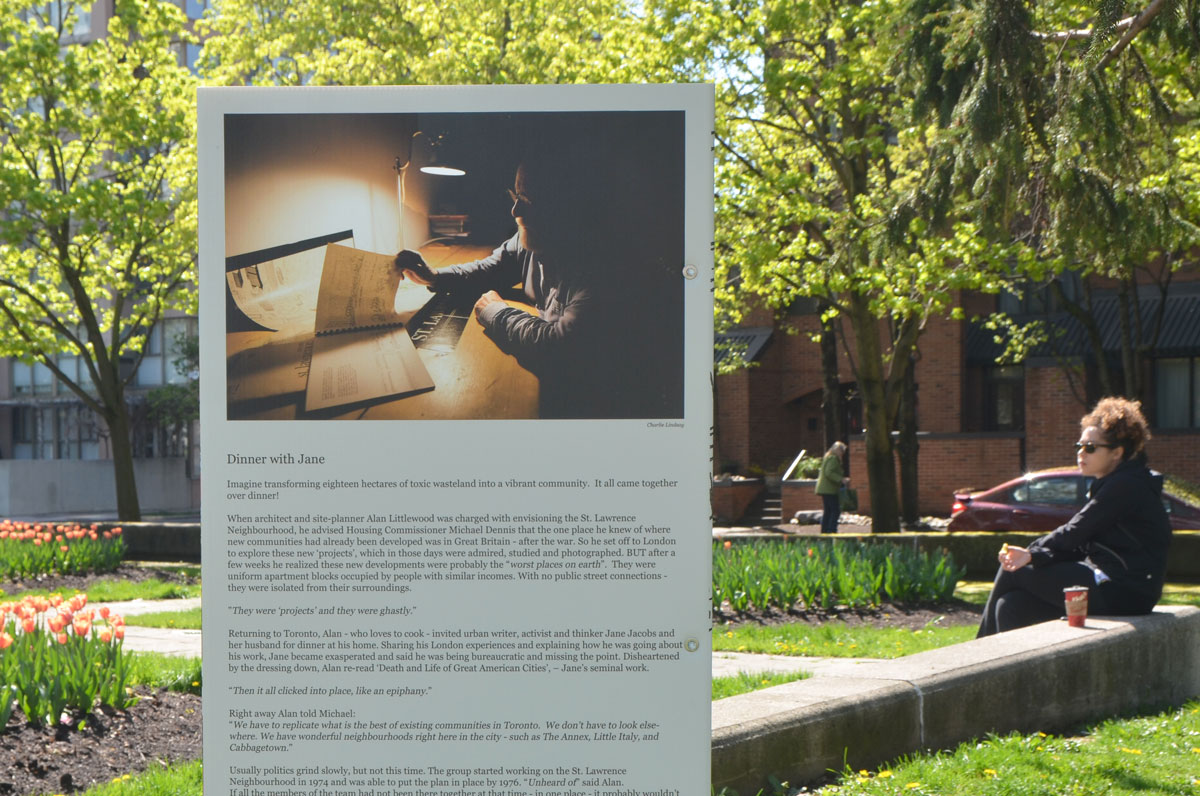
Forty years ago, May 1976, the site plan for The Esplanade neighbourhood was approved. Since then, it has become home to a very diverse group of people. And it is those people that this installation celebrates on the 40th anniversary of the founding of the neighbourhood.

Crombie Park runs along the south side of The Esplanade between Berkeley street and Lower Jarvis.  The installation consists of a number of small white rectangular pillars with the picture and story of person on either side.

A photo from the CONTACT photography festival, installation called 'Residents of The Esplanade' - story of Mysha from Pakistan

A photo from the CONTACT photography festival, installation called 'Residents of The Esplanade' - photo of Solomon from on top of a basketball hoop

A photo from the CONTACT photography festival, installation called 'Residents of The Esplanade' - photo of Alan working at a desk, tulips and a woman sitting in the park are in the background

People were out enjoying the morning; school kids were playing basketball at recess.

kids playing basketball on an outdoor court. The wall behind the basketball hoop has been painted with a mural of hands making a heart shape with the fingers, by Bruno Smokey and Shalak Attack.

Flowers were blooming.

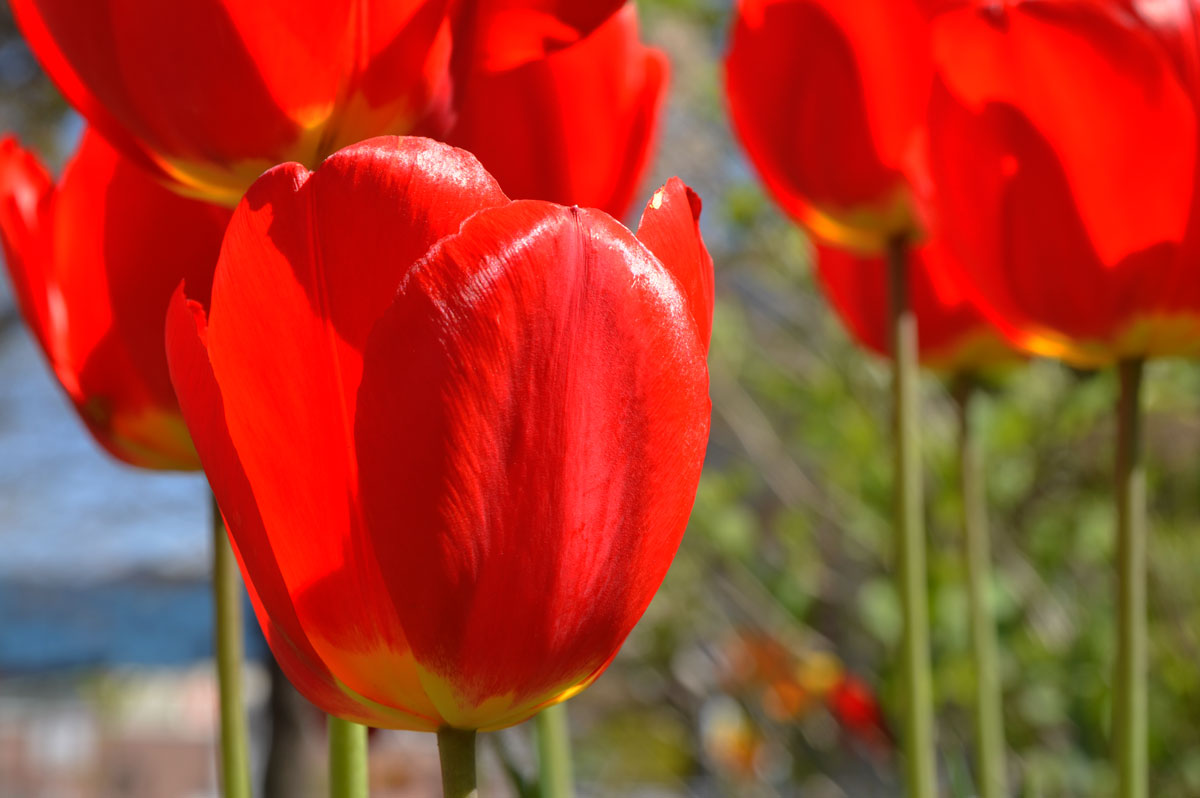
close up photo of red tulips in full bloom on a sunny day

tulips in a garden in a park, orange and yellow tulips, with some greenery. Grassy area with trees behind, and people walking on a sidewalk in the background.

below: Looking towards Lower Jarvis Street and downtown Toronto.

at the corner of The Esplanade and George Street, looking west towards downtown and St. Lawrence market. Playground on the left with children playing.

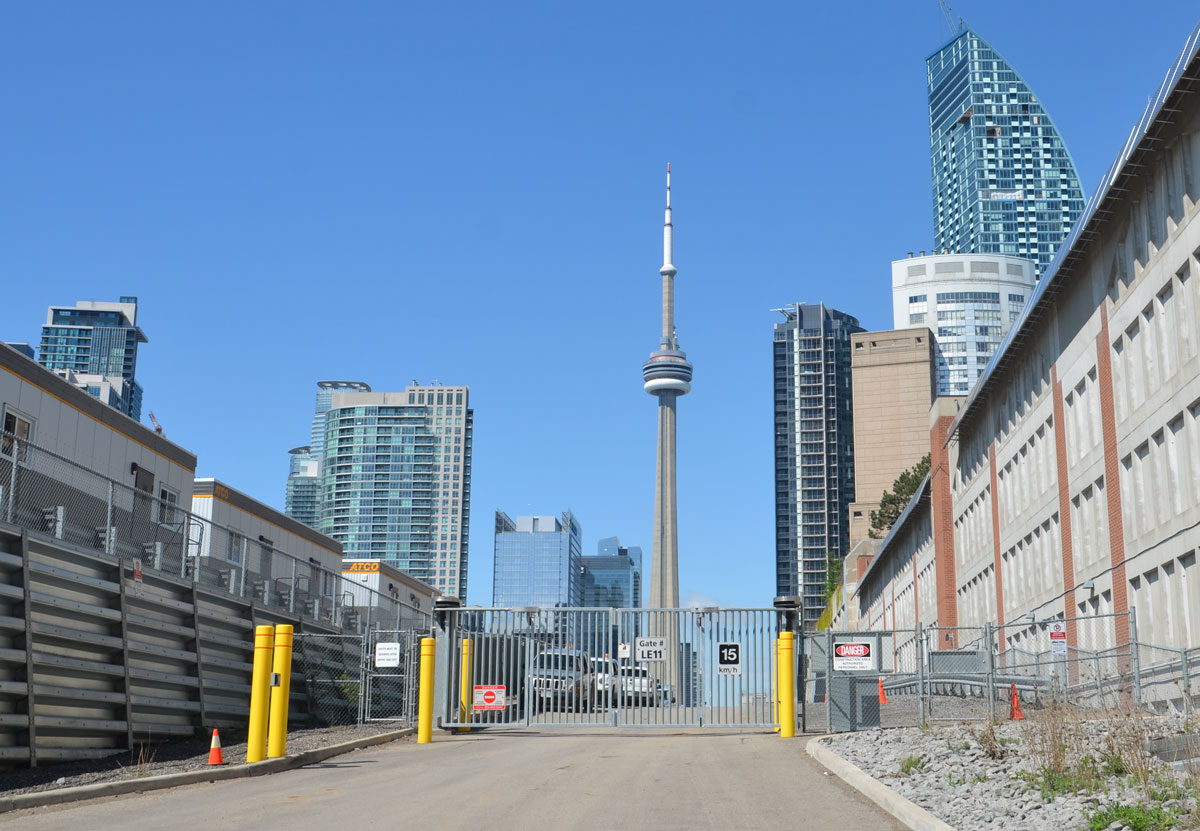
below:  One street beyond Lower Jarvis is Market Street.  It dead ends at the railway tracks.  The long structure on the right is a parking garage.

looking west towards the CN Tower, with the railway tracks to the left (but they are elevated and behind maintenance buildings so you can't see the tracks). Parking structure to the right, with city buildings behind it.

below: After a small backtrack up Market Street, I went through Conger Coal Lane to Church Street.  I don’t think I have walked this way before.  The lane was named in commemoration of the Conger Coal Company whose yard and wharf was nearby.   It was one of the many companies that provided Toronto with coal back in the day when coal fueled the city.  It was started in 1870 by Mr. P.D. Conger.   In 1913, Sterling Coal company bought Conger and the name was changed to Conger Lehigh Coal Co.

a downtown Toronto lane, very clean, no graffiti, taller, newer buildings on either side of the lane. CN tower in the distance,

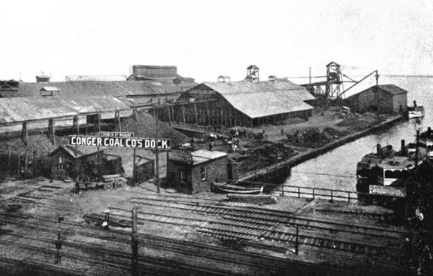
below: A very old photo of the Conger Coal Company dock at the foot of Church Street, back when Church street ended at Lake Ontario

historical picture of the old COnger COal Co wharf at the bottom of Church street.

below: Tucked into a corner on Church street immediately south of Front Street, is an art installation by Paul Raff called ‘Shoreline Commemorative’.  A topography of limestone forms the base of the work.  A glass ball representing the line between sky and water sits on top of a tripod that tries to evoke a land surveyor’s tripod.  The words on the wall say “For 10,000 years this was the location of Lake Ontario’s shoreline.  This brick wall stands where water and land met, with a vista horizon”

Shoreline Commemorative by Paul Raff, an art installation on Church St., south of King, that marks where the shoreline of Lake Ontario used to be. It involves words on a brick wall and a model of the shoreline of Toronto showing the different elevations of the land.

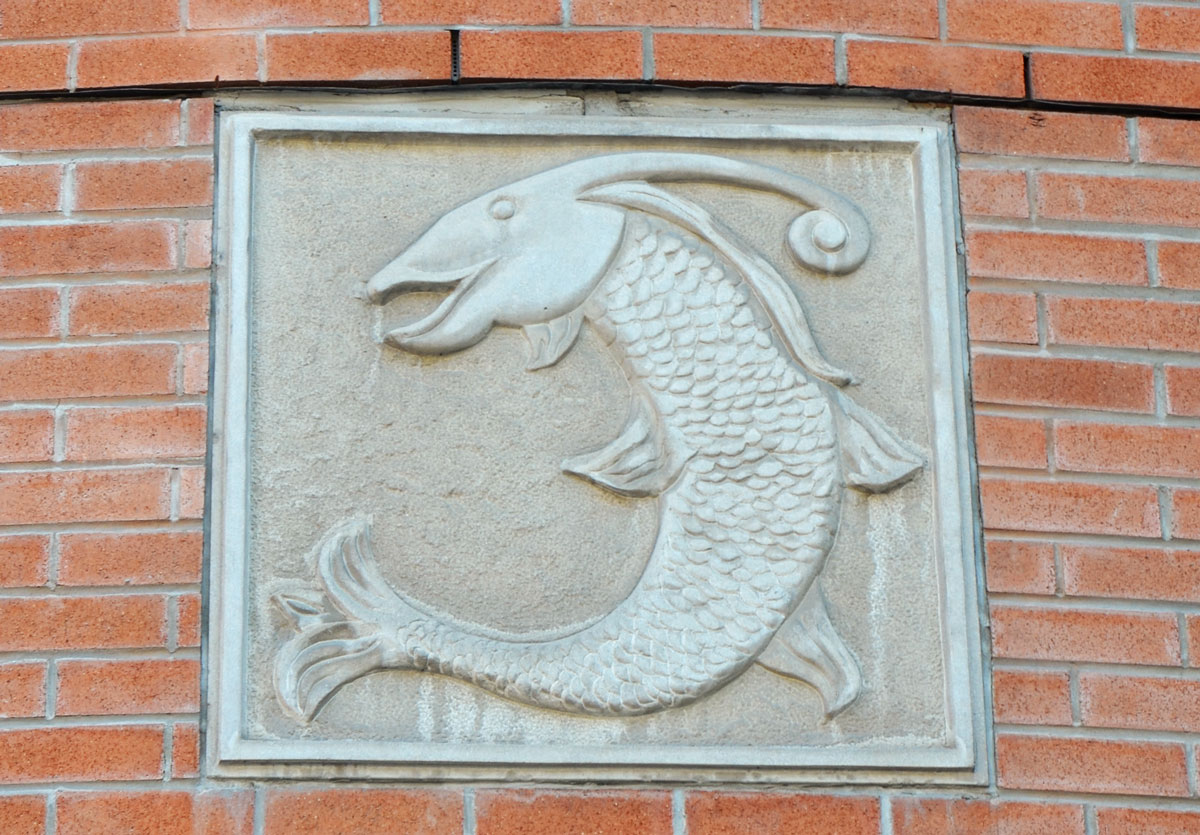
below: Continuing the lake theme, a little fish out of water, jumping over the entrance to a condo.

bas relief sculpture of a fish, square stone on a brick wall above the entrance way to a condo building.

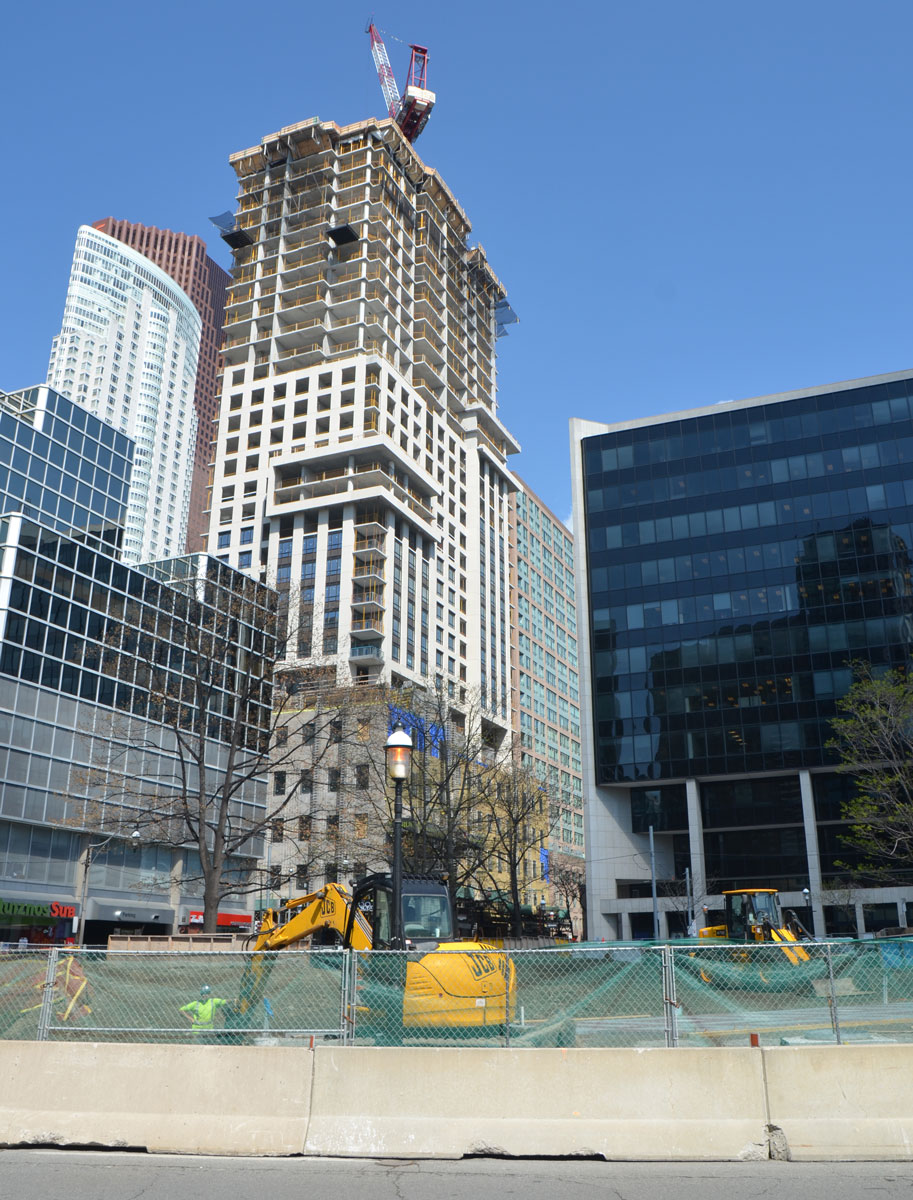
below: From the lake theme to another common theme in the city, construction. Spring is the beginning of construction season and here Berczy Park is being upgraded. In the background a new condo is being built but as we all know condo construction ‘season’ never ends. In fact, the challenge might be to find a place in this city where there isn’t a condo being built.

workmen redoing a park, Berczy Park in Toronto, with a digger and another piece of equipment, cityscape behind with a tall condo building under construction. A red and white crane is on top.

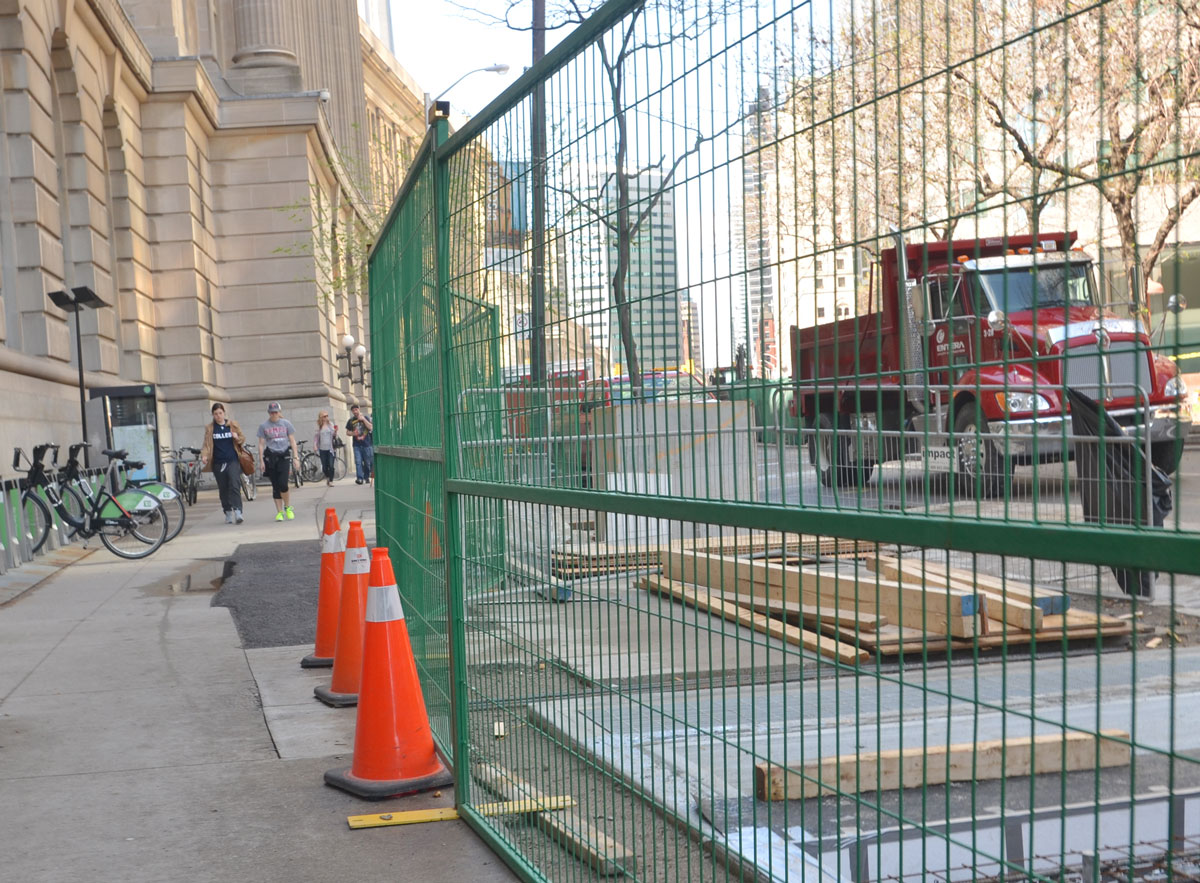
below: I walked past the never ending Front Street construction.  Construction in front of Union station seems to be finished, but this stretch of Front Street just west of the station is still being worked on.   There have been fences here so long that I can’t remember a time when they weren’t here.

Front street constrcution, behind a greenwire fence is a rd truck and piles of construction materials. Between the fence and a stone building is the sidewalk on which some people are walking.

a shirtless man in sitting on a stool at the corner of Front and Union streets. He has four signs (behind, above, in front, and beside him) asking for spare change or for you to buy his novel that is well rated on both Amazon and Goodreads.

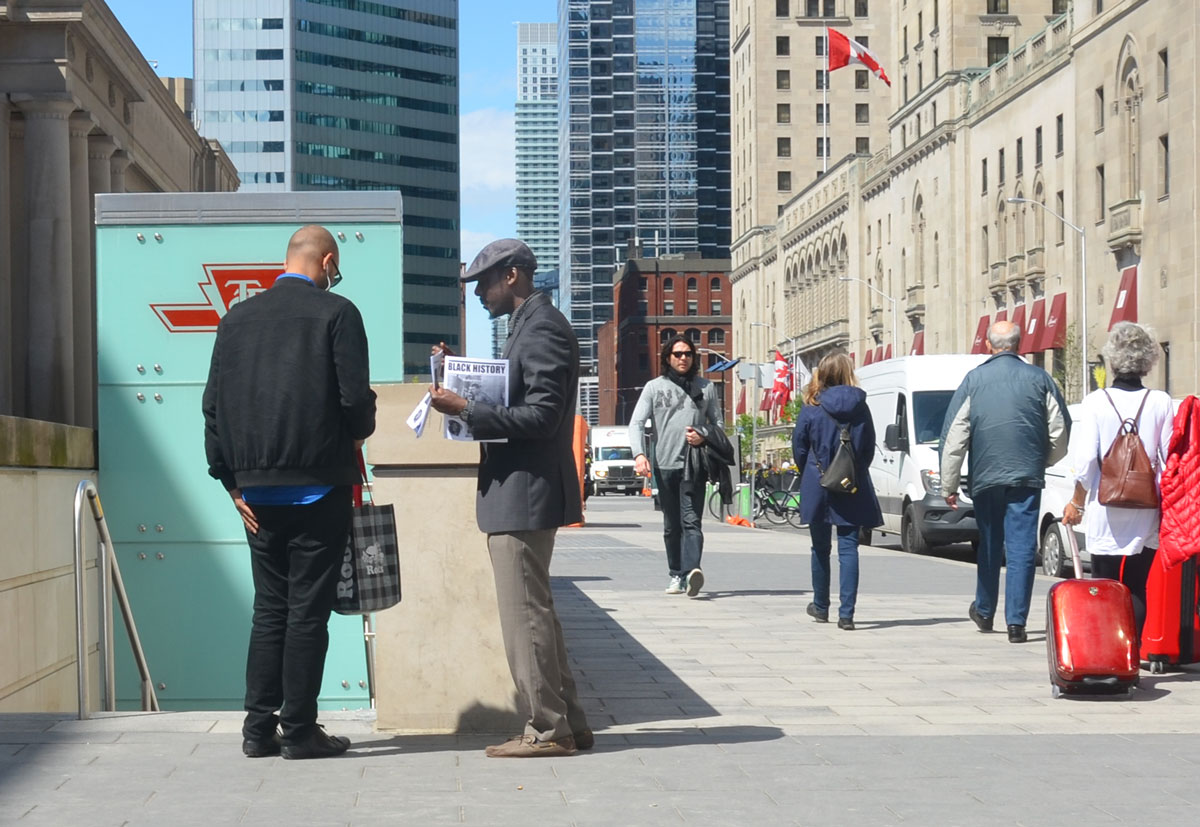
A man is selling Black History newspaper to another man in front of the TTC subwayentrance at Union station.


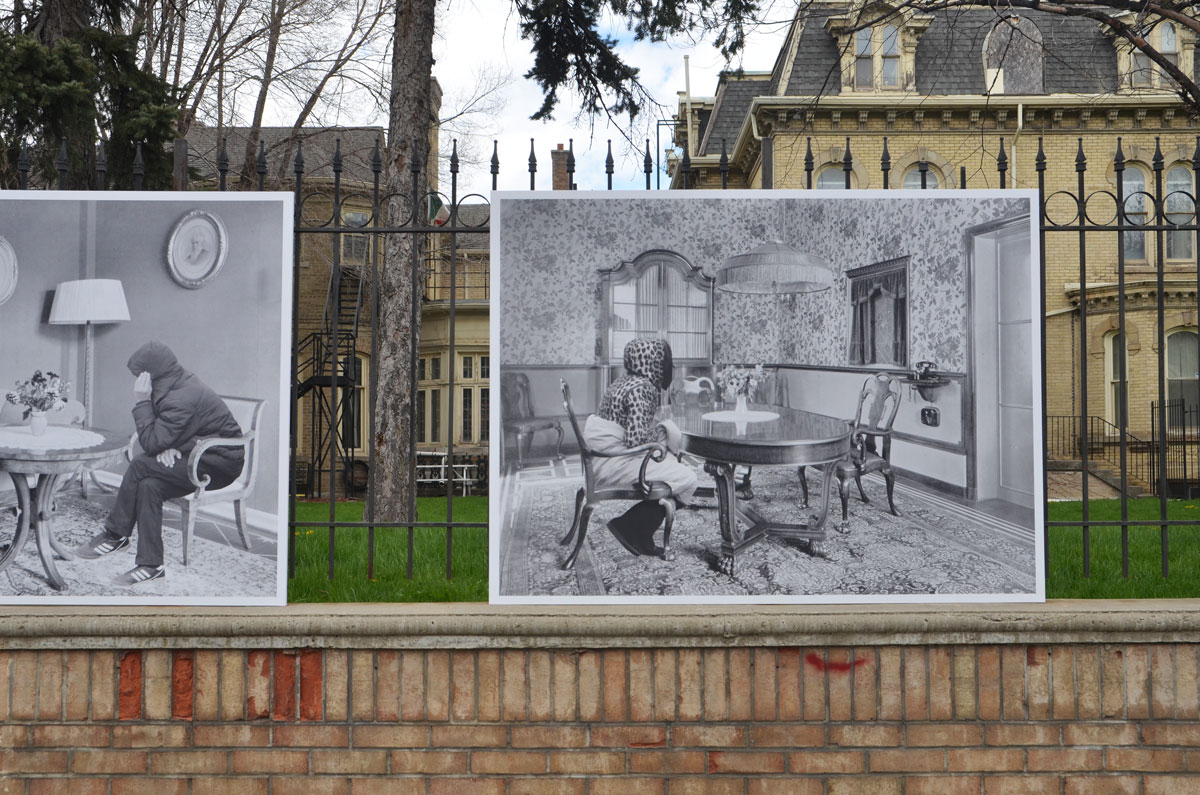
Refugees in a State Apartment, Jens Ullrich,
Photo exhibit, on a fence outside the Italian Consulate, Dundas West at Beverley.

Part of Scotiabank CONTACT Photography Festival

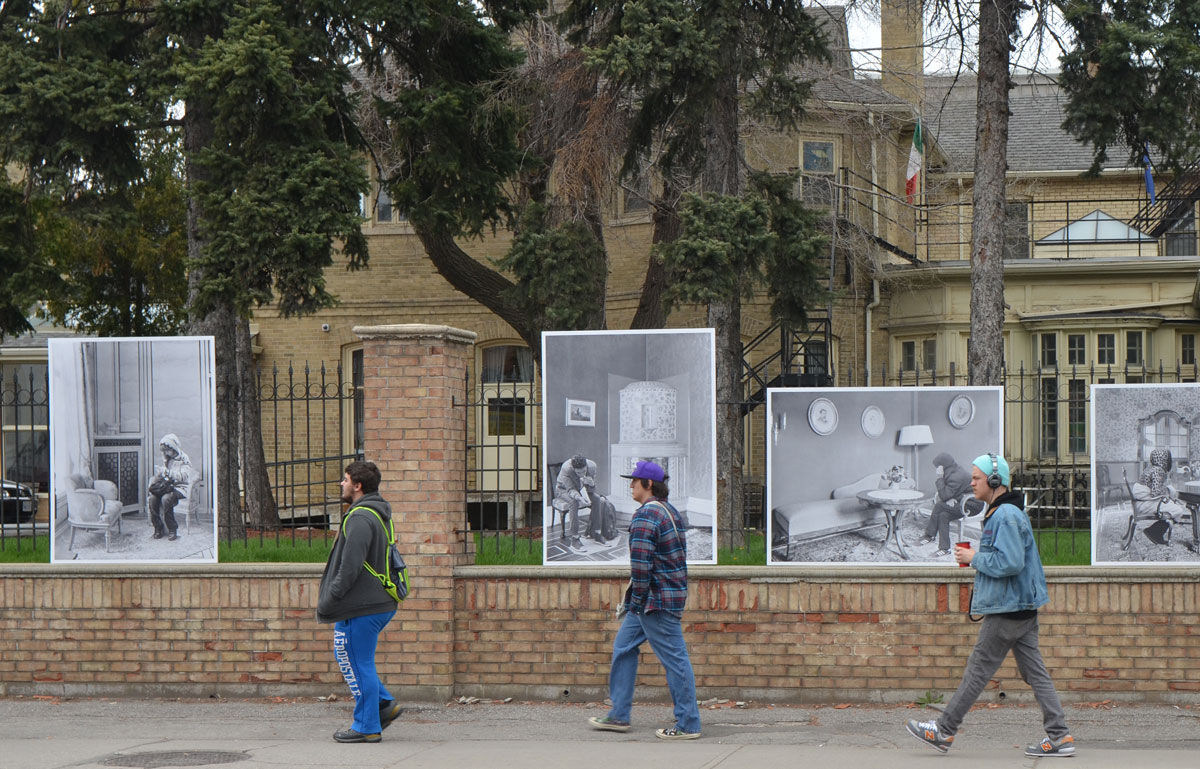
photos mounted along the exterior of a wrought iron fence around the Italian Consulate, right beside the sidewalk. The consulate is on old brick house (mansion) from the 1800's - 3 of the photographs, people walking past

Ullrich has taken found black and white photographs of the interior of a large home near Bremen Germany.  The photos were taken in the late 1920’s.    Each photograph is of a different room in the villa and to each picture Ullrich has added  one person.   If you knew nothing about the series, you wouldn’t know that the subjects were refugees.

In each photomontage, singular individuals are depicted—usually with their faces hidden from the camera—within empty yet elaborately fashioned spaces that emphasize their solitude and unstable status. “

photos mounted along the exterior of a wrought iron fence around the Italian Consulate, right beside the sidewalk. The consulate is on old brick house (mansion) from the 1800's - phot by Jens Ullrich of a woman refugee with her face obscured by clothing, sitting on a chair in the bathroom of a large bathroom. also a photo of a male refugee in another room, looking in a large mirror

One of the concepts behind this series of images was the desire to

respectfully capture the disparate emotions of these individuals and their precarious situations.”

photos mounted along the exterior of a wrought iron fence around the Italian Consulate, right beside the sidewalk. The consulate is on old brick house (mansion) from the 1800's - as seen from across the street with pedestrians walking past and cars driving past

photos mounted along the exterior of a wrought iron fence around the Italian Consulate, right beside the sidewalk. The consulate is on old brick house (mansion) from the 1800's - the photos are of refugees that have been photoshopped into old photos of the interior of the apartment of a wealthy person from the 1920's
#CONTACT16

May is photography month in Toronto.  It is the month when there are numerous exhibits in public spaces and in galleries, all part of the CONTACT Photography Festival.   Over the next few weeks I hope to visit many of the exhibits and blog about some of them.   From past experience I have discovered that a lot of the public installations appear before May 1st so I went exploring yesterday.

below: Looking south from Spadina and Adelaide….  Partially obscured by a building, on the right in this photo, is the first large black and white photo that I saw.

view from the NE corner of Spadina and Richmond streets. a small parking lot is directly across the street, two large billboards loom over the lot. Once is for Lorne's coats showing two people wearing coats. The other is for Maple flavoured iced capp at Tim Hortons.

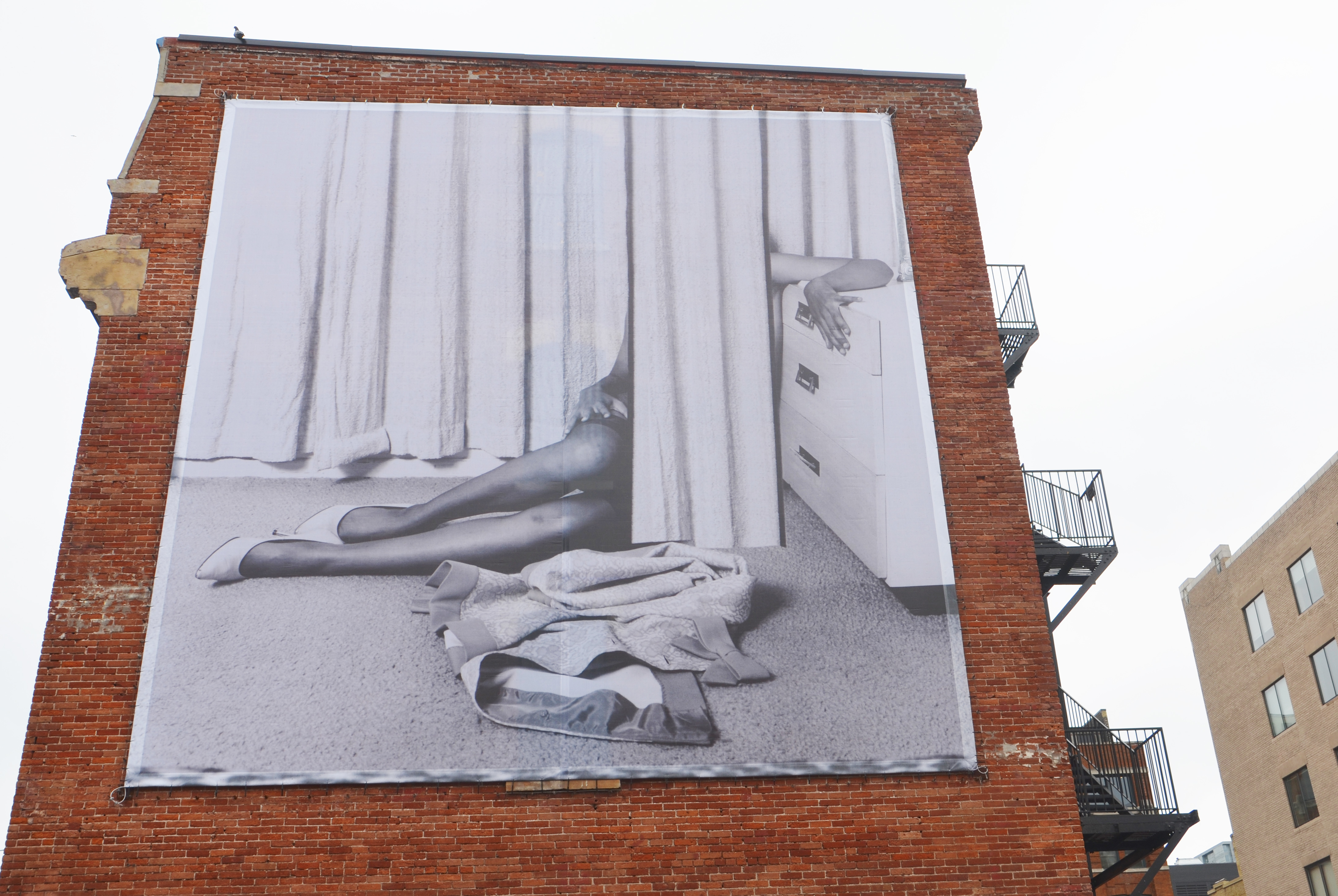
below: Up close,  ‘Drape’ by Eva Stenram.  Stenram has taken a 1960’s pin-up photograph of a woman and manipulated it.  She has brought the background, the drapery, forward and has covered up the original subject in the picture.

large black and white photo by Eva Strenram called 'Drape'. It is mounted on the upper level of a three storey red brick building. It shows a woman sitting on the floor partially obscured by drapery. Her upper body and head can not be seen.

below: Looking west on Wellington from Spadina.  The light grey building is the Old Press Hall (Globe and Mail) which will be demolished in the near future.

looking down the street past parked cars. A large black and white photo is on the side of the building.

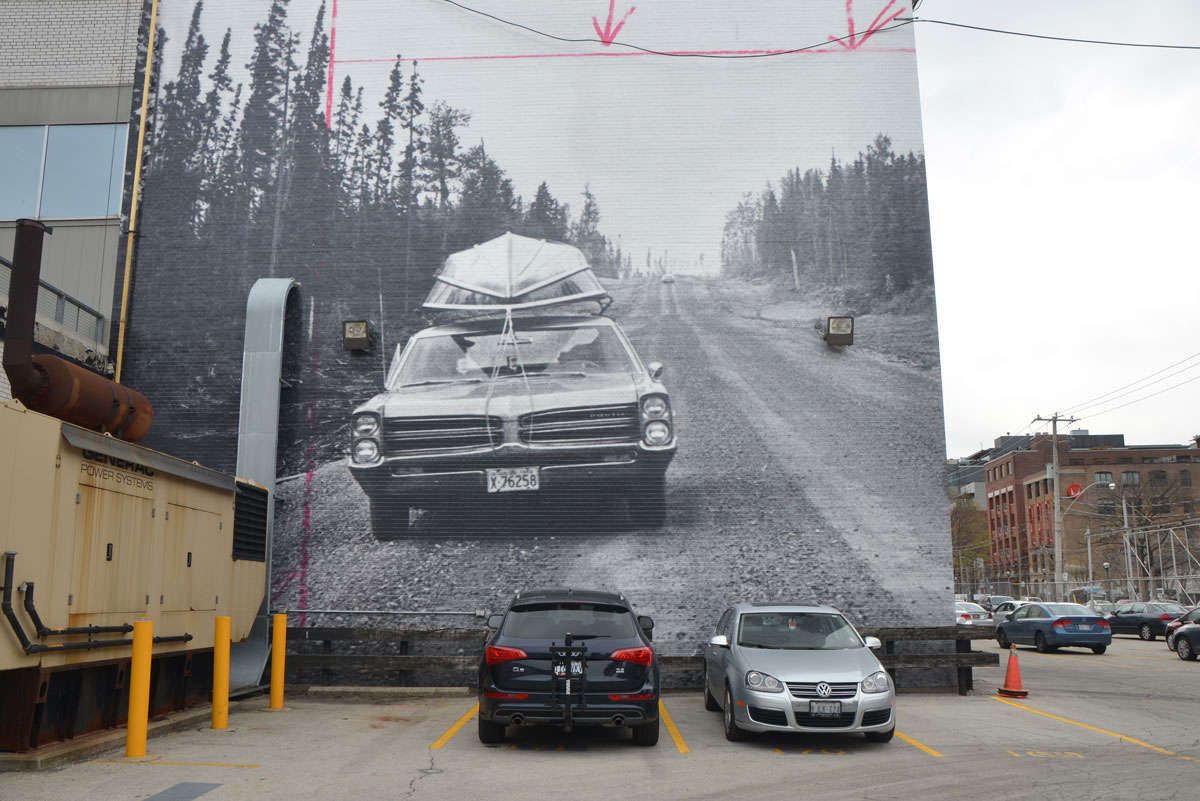
below: Up close, ‘Stopping Point’ by an unknown photographer.  The original title and description was: ‘Along the new Highway, which runs from Smooth Rock Falls to Fraserdale, Ontario, there’s no sign of human habitation apart from one empty lumber camp, c.1966. 

A very large black and white photograph from the 1960's of a car on a two lane road with pine trees on either side. There is a boat tied to the roof of the car. The photo is on the side of the Globe and Mail building with cars parked around it.

The above photograph is one of 750,000 photos in the Globe and Mail’s picture library.   100,000 of their old photos are being digitized to create a new historical archive.  From these, a collection of 20,000 prints will be donated to the newly formed Canadian Photography Institute at the National Gallery of Canada.

More of the photos from the Globe and Mail’s collection are on view inside the Old Press Hall.

An art installation ‘Nest Egg’ by Brendan McNaughton
at the Corkin Gallery, Distillery District

The title of this blog post is taken from a description of McNaughton’s work on the Corkin gallery website, “The relationship between plutocrats and proletariats is central to his art practice.”  A plutocrat is a person who is powerful because they are wealthy.  Money equals power.  Proletariat on the other hand is a class of people, the working class, a class without money and without power.

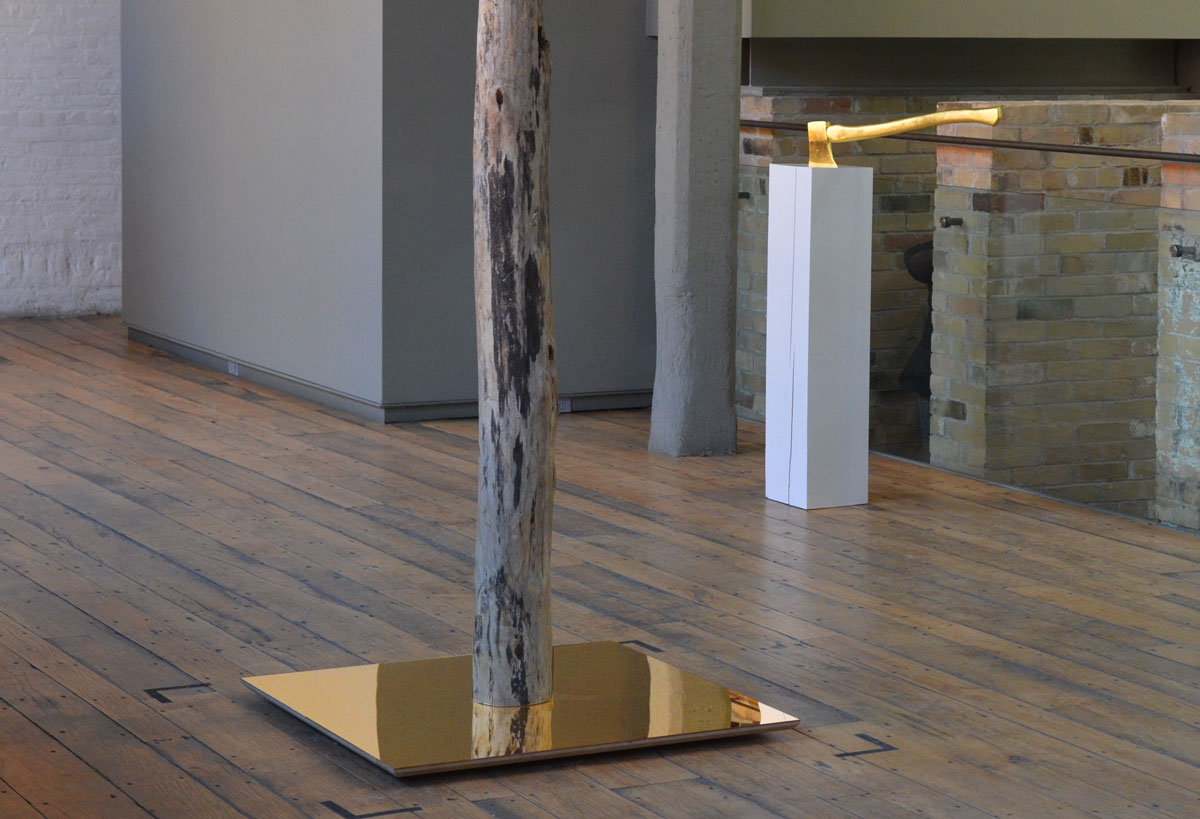
below: A gold axe.  With its blade in a column, on a pedestal?  That’s not a passive positioning of the axe, i.e. it’s not just lying around.  Someone has swung it.
Axe as a symbol of the working class?  Juxtapositioned with gold, a symbol of money?

picture taken inside an art gallery - a tree trunk stands in the middle of a gold toned mirror, in the background, a gold plated (or gold colured) axe with its blade in the top of a white rectanguar column

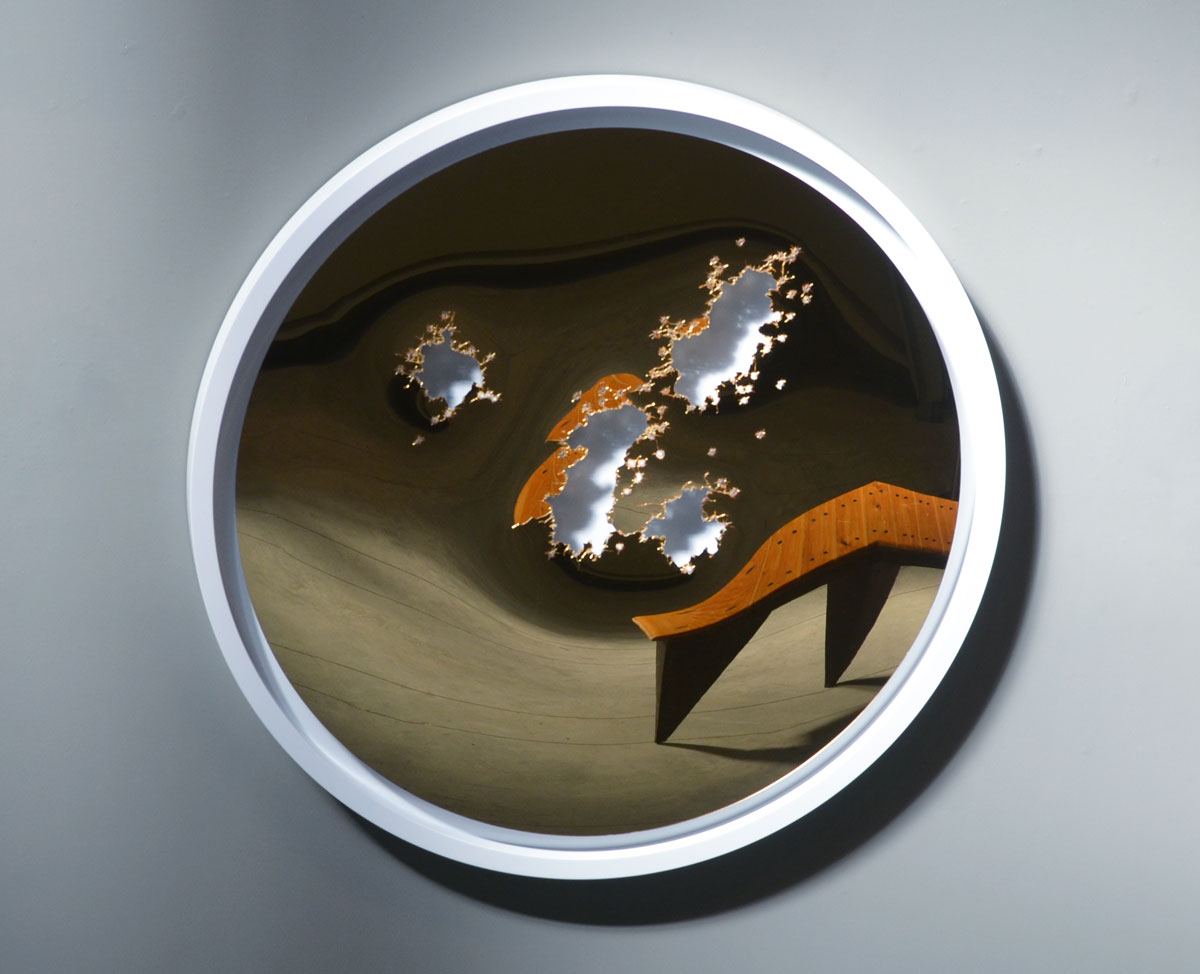
below: A couple of the pieces were mirrors. But they were mirrors with a difference – slightly concave in shape, with a hint of gold, and marred by ragged shaped holes.  The resulting reflections are distorted and flawed.

an artwork by Brendan McNaughton of a slightly concave mirror but with a few torn holes in it. A bench is reflected in the mirror but because the mirror isnt't flat, the bench is distorted.

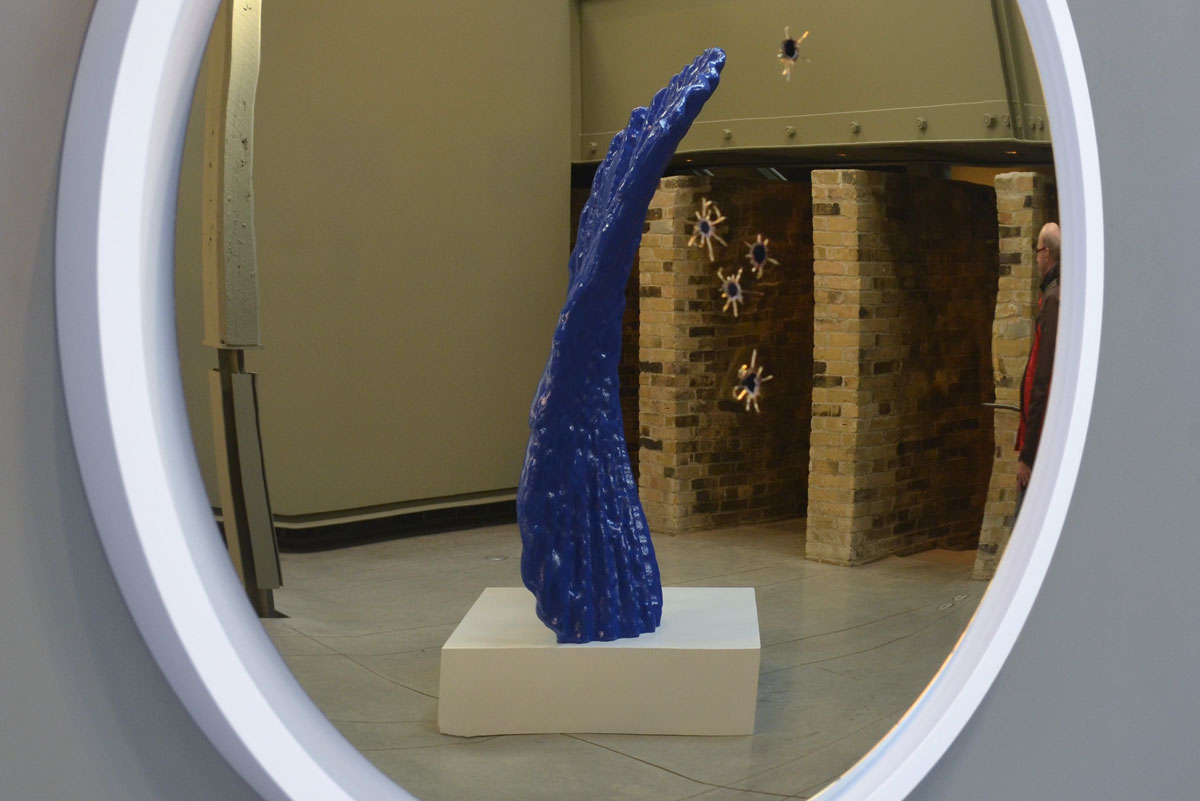
below: ‘Blue Chip’ a sculpture by Brendan McNaughton as viewed through one of his mirrors.  The expression ‘blue chip’ has become synonymous with high quality stocks, usually ones from the New York Stock Exchange.   Originally the expression meant stocks with higher prices because, if the story is correct, blue chips in poker are traditionally associated with the highest value.

Blue Chip, a sculpture by Brendan McNaughton, as viewed through an oval shaped mirror which is actually another art piece by the same artist.

below: The colour gold is very prevalent in this installation as are reflective surfaces.

picture taken inside an art gallery - a tree trunk stands in the middle of a gold toned mirror, also a mirror is on the top of each trunk, in the background are four panels of wrinkled gold

below: Parts of three wrinkly gold panels. There are actually four of these reflective square panels.  They are all the same size and colour but the surface patterns are slightly different.  Once again, the reflections are distorted.  Wealth distorts your view?

three square panels of reflective gold, wrinkled, material with reflections of people in them.

below: There was a group of what appeared to be photography students visiting the gallery at the same time that I was there. As I was standing beside this piece, looking for different and/or interesting angles and reflections, one of the students remarked on how he liked it when ordinary items were used in out of the ordinary ways. He then said that he wondered if it was …. and then he paused. I finished his sentence with the word ‘art’. He laughed and said yes, but that he was always afraid to say such things out loud. I gave him permission to ask “is it art?” as loud and as often as he wanted.

picture taken inside an art gallery - a tree trunk stands in the middle of a gold toned mirror,

picture taken inside an art gallery - a tree trunk stands in the middle of a gold toned mirror,

Installation ends May 1st

Wisdom of the Poor: Communal Courtyard,
an art installation by Chinese artist Song Dong,
Art Gallery of Ontario

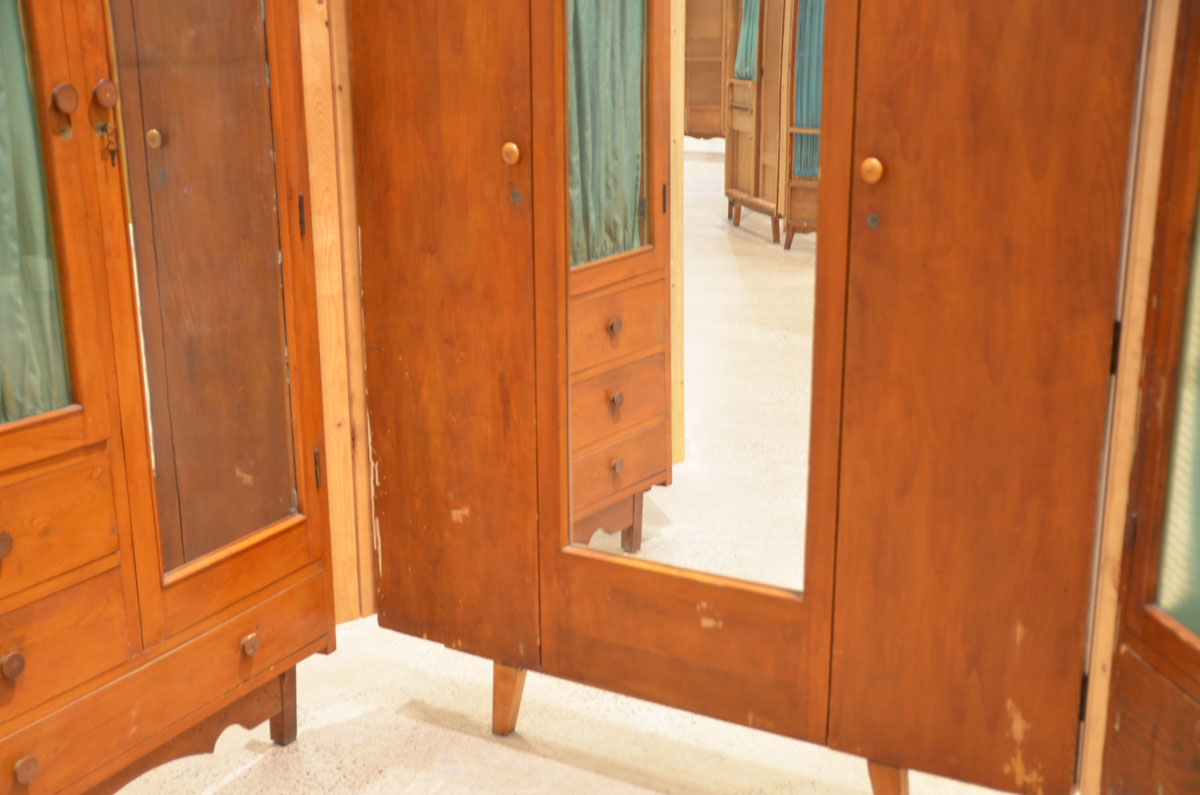
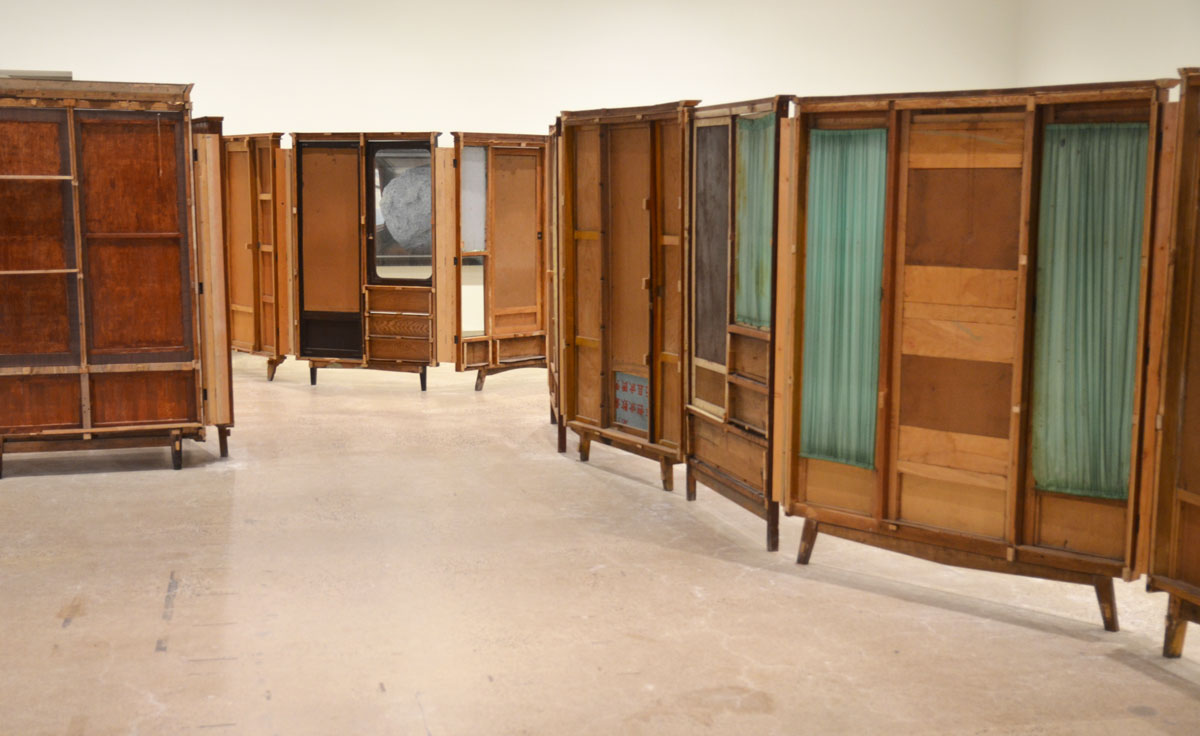
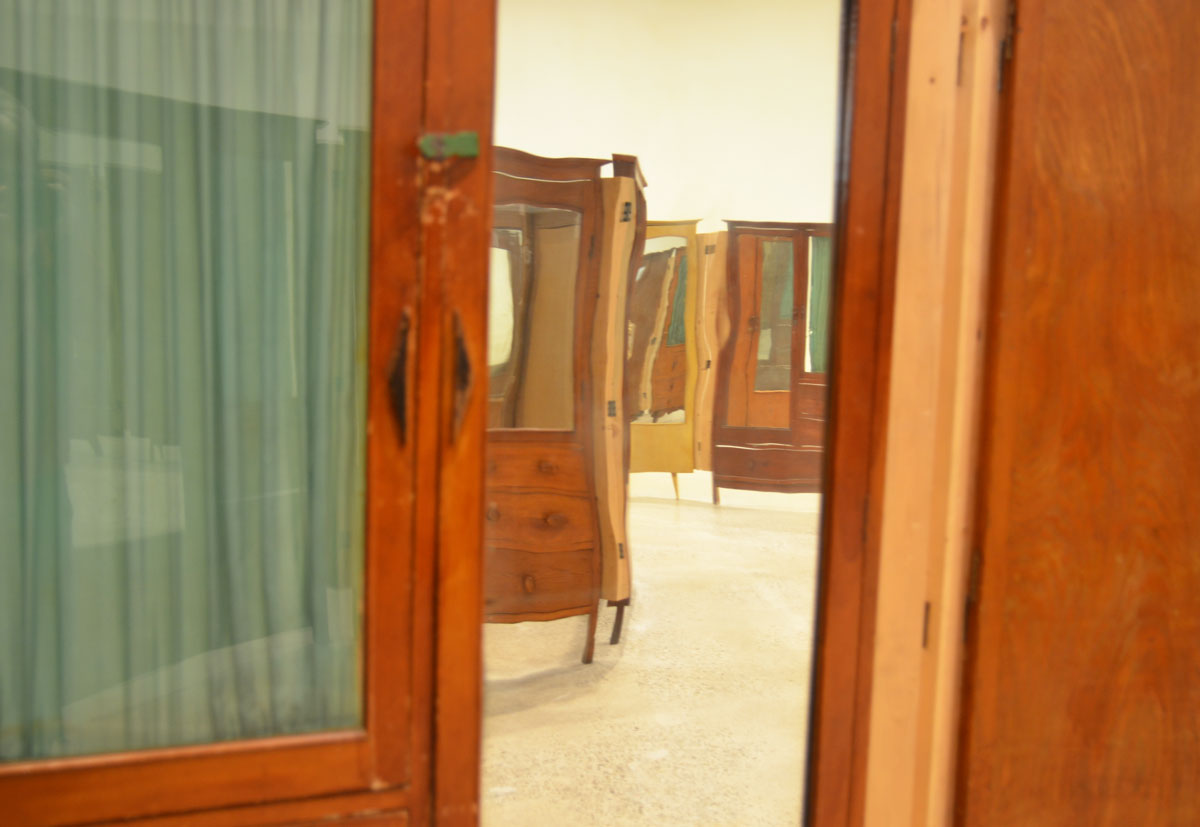
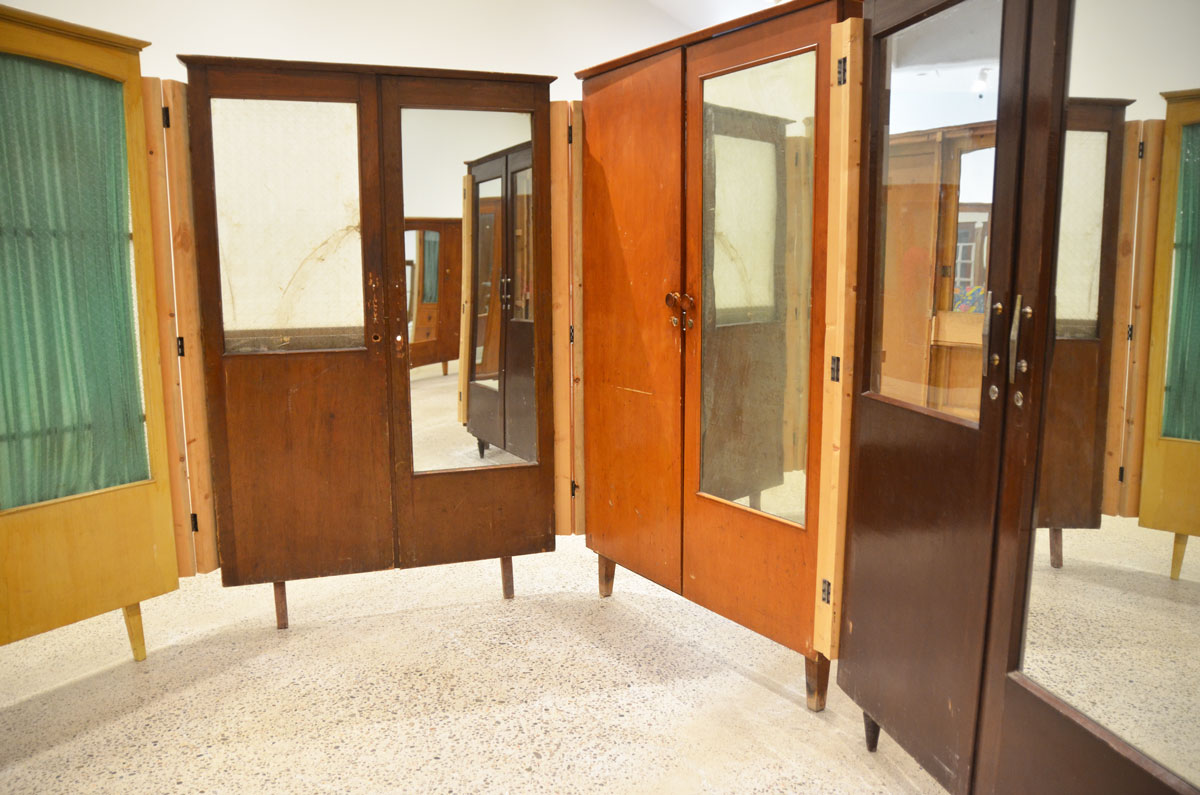
This installation is made from parts of 100 old wardrobes collected from traditional Beijing neighbourhoods, or hutongs, like the one in which Song Dong grew up in.  These neighbourhoods, and their communal way of life, are disappearing.


part of an art installation by Chinese artist Song Dong using vintage wooden wardrobe doors with mirrors and curtains, reflections
The pieces of the wardrobes are arranged with the backside towards the viewer.  The arrangement is such that you can not see the front side of most of the wardrobes.

part of an art installation by Chinese artist Song Dong using vintage wooden wardrobe doors with mirrors and curtains, reflections
There are two circles of wardrobes that you can enter – where you can now stand in the courtyard so to speak.   The wardrobes become stand-ins for the fronts of houses that once faced onto courtyards in the old hutongs of Beijing.

part of an art installation by Chinese artist Song Dong using vintage wooden wardrobe doors with mirrors and curtains, reflections of a foot in one of the mirrors
A wardrobe was one of the items that the Chinese government provide to all families.  They are all similar yet different.  All have mirrors.  Most are made of the same colour wood and most have green curtains.  They all have little legs and they are all about the same height.
part of an art installation by Chinese artist Song Dong using vintage wooden wardrobe doors with mirrors and curtains, reflections
Wardrobes are personal articles and former owners have left their marks on many of them…. a different fabric in the window or a picture glued onto the wood.
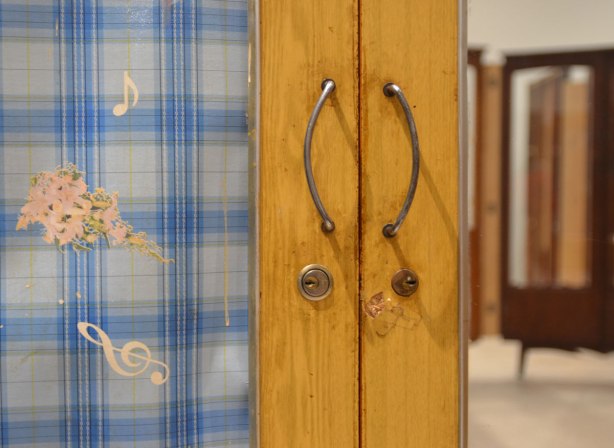
part of an art installation by Chinese artist Song Dong using vintage wooden wardrobe doors with mirrors and curtains, reflections, door handles, key holes and a curtain that is a blue and white plaid and has musical notes on it.

part of an art installation by Chinese artist Song Dong using vintage wooden wardrobe doors with mirrors and curtains, reflections, wardrobes arranged in a curved shape
part of an art installation by Chinese artist Song Dong using vintage wooden wardrobe doors with mirrors and curtains, reflections

This installation also appeared in the Venice biennale in 2011 although the wardrobes were arranged differently.  For the exhibit at the AGO, there are a number of items that appear within the ‘courtyards’ created by the wardrobes.  For the viewer, these items can only be viewed through the windows of the wardrobes.  One of the items, below, is a series of three paintings of the Canadian ballerina Karen Kain.

part of an art installation by Chinese artist Song Dong using vintage wooden wardrobe doors with mirrors and curtains, reflections. through one of the windows there is a painting of Karen Kain on the wall

In another, bikes

part of an art installation by Chinese artist Song Dong using vintage wooden wardrobe doors with mirrors and curtains, reflections, through two of the windows there is a bike

part of an art installation by Chinese artist Song Dong using vintage wooden wardrobe doors with mirrors and curtains, reflections, door knobs and frosted glass and a white curtain

This installation remains at the AGO until 17 July 2016
This post is the result of a very wobbly and random circular walk around part of the Wychwood Heights neighbourhood last weekend.   A hodge podge of this and that.

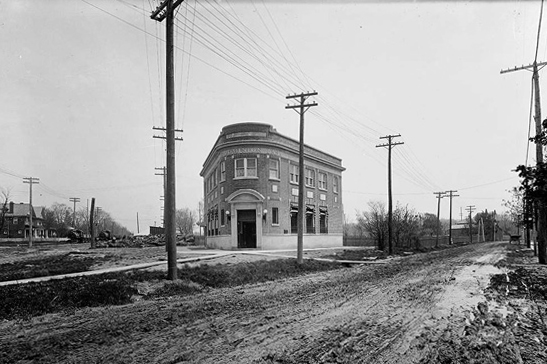
below: The intersection of St. Clair West and Vaughan Road circa 1912

Historical black and white photo of a two sorey brick building at an intersection of two dirt roads.

below: I didn’t quite recreate the picture above but it is still obvious that the brick building is still standing after just over 100 years but that every thing around it has changed.

Two storey brick building, now Hakim Optical on the corner of an intersection.

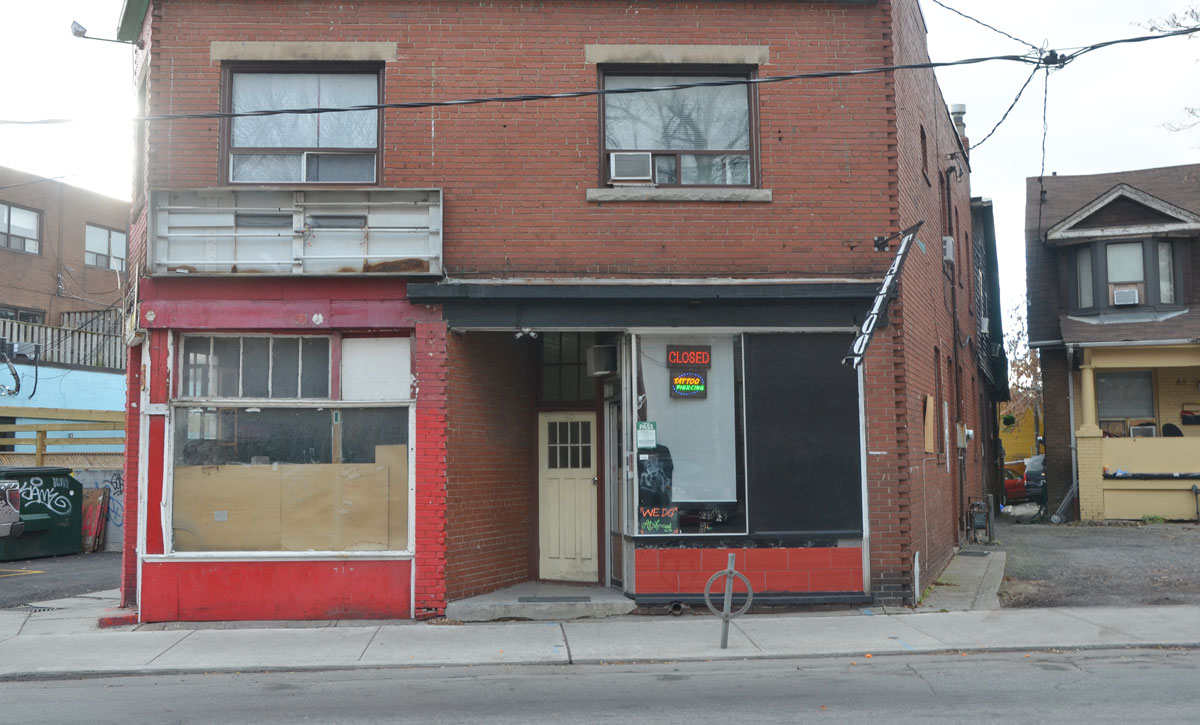
below: Just to the north,  78 Vaughan Road…. didn’t this store used to be an ice cream place?

empty store front at 78 Vaughan Road, empty on one side a closed tattoo parlour on the other.

below:  Ah yes, there is still remnants of ice cream cones above the window so my memory is correct.
I wonder what happened to it?

side of a brick building that used to be an ice cream store. Painted red with some white parts, front has been removed from lighted signs, exterior decorations have been removed except a faint outline of ice cream shapes remain above the window.

There are a number of alleys to the north and west of the intersection of St. Clair and Vaughan Road.  Most of them are quite tidy and well looked after.   They were also full of surprises, bright little things that put on a smile on your face on a December afternoon.

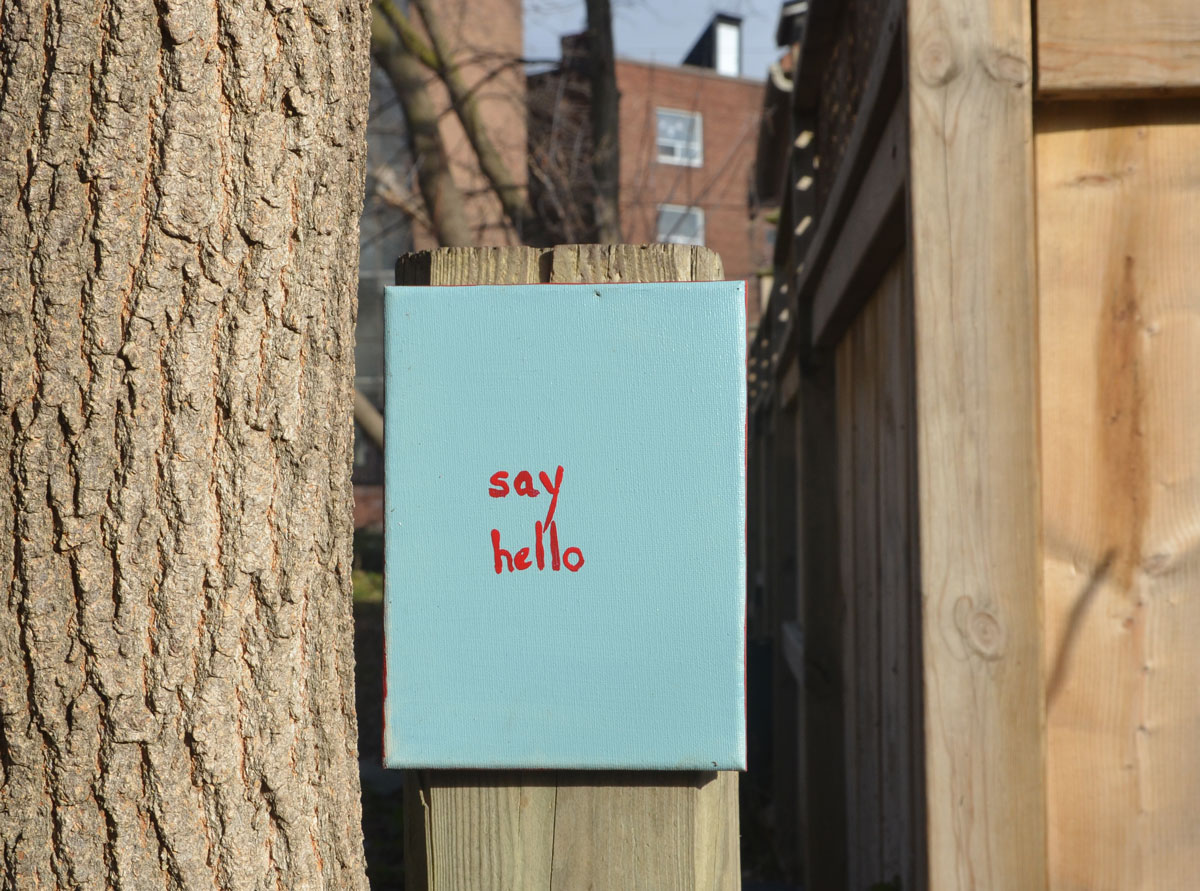
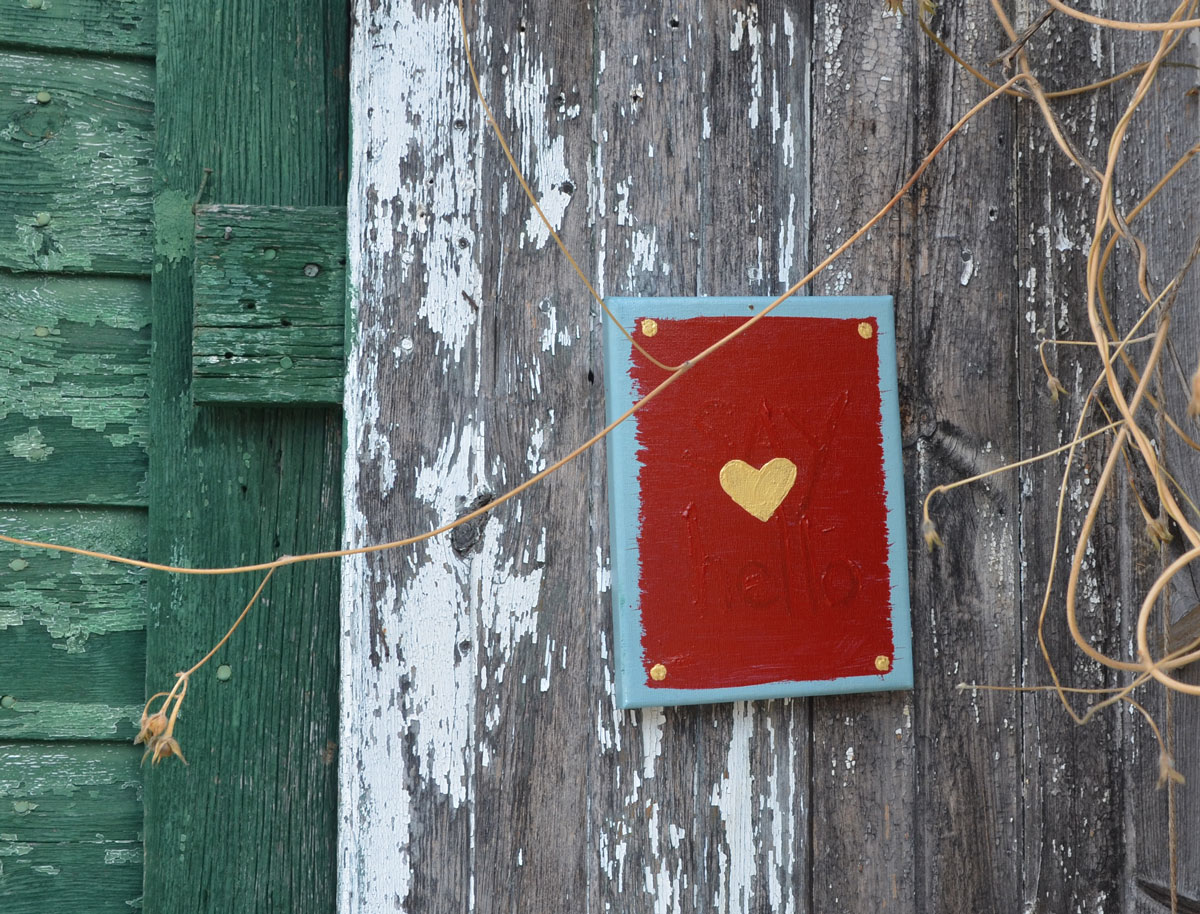
below: Like little pictures painted on canvas….

A small canvas painted turquoise and the words say hello written in small red letters, attached to a fence in a lane

A small canvas painted red and a small yellow heart painted in the middle. The words say hello are painted on it too but they are harder to see. It is nailed to an old wood fence

A small landscape painted on canvas and attached to a telephone pole in an alley

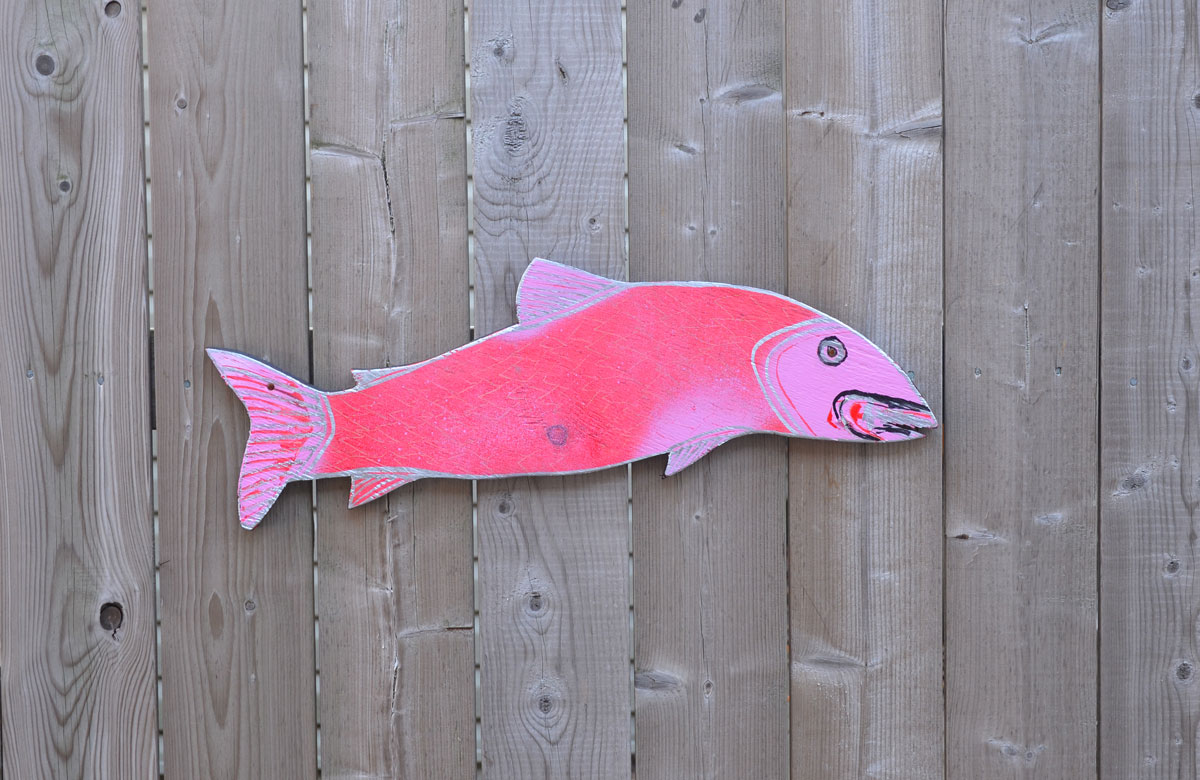
below: and painted on wood

a two tone pink fish painted on wood, cut out, and nailed to a wood fence.

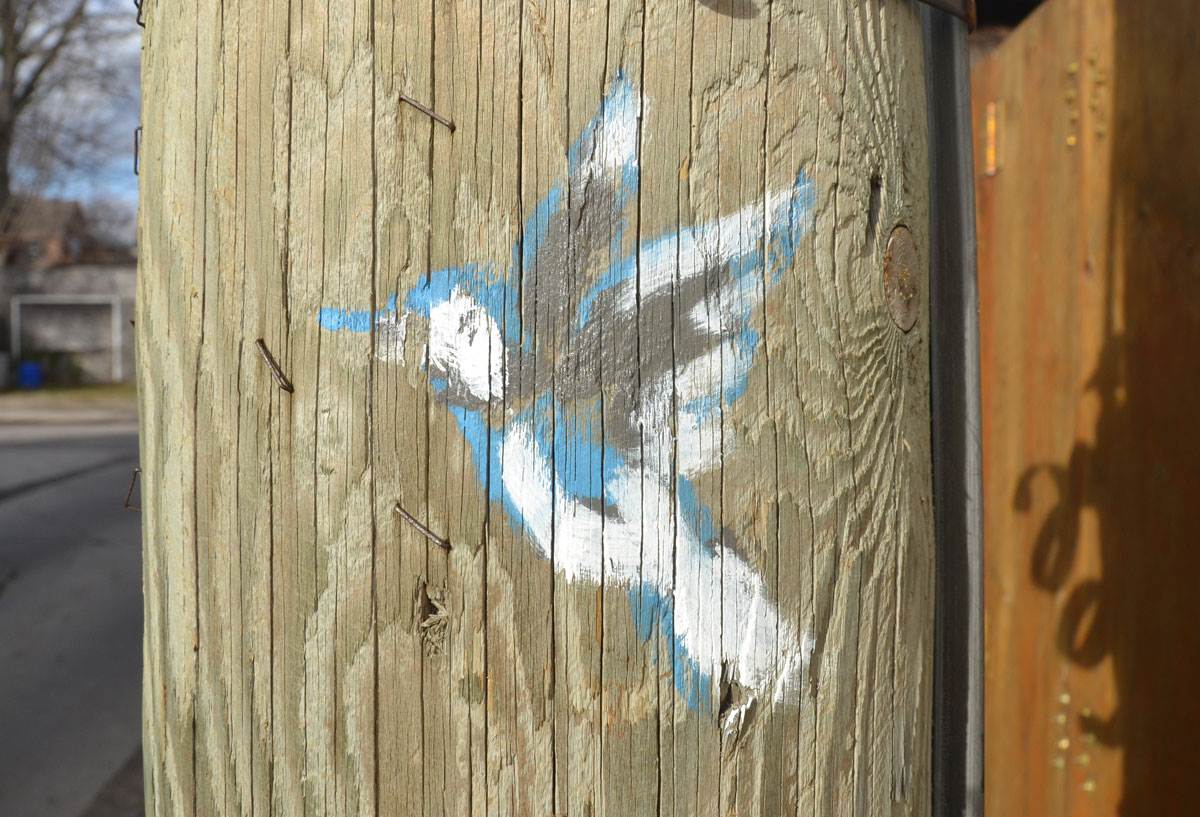
below: or painted directly on poles.

On a wood telephone pole, a small bird painted in white, black and blue.

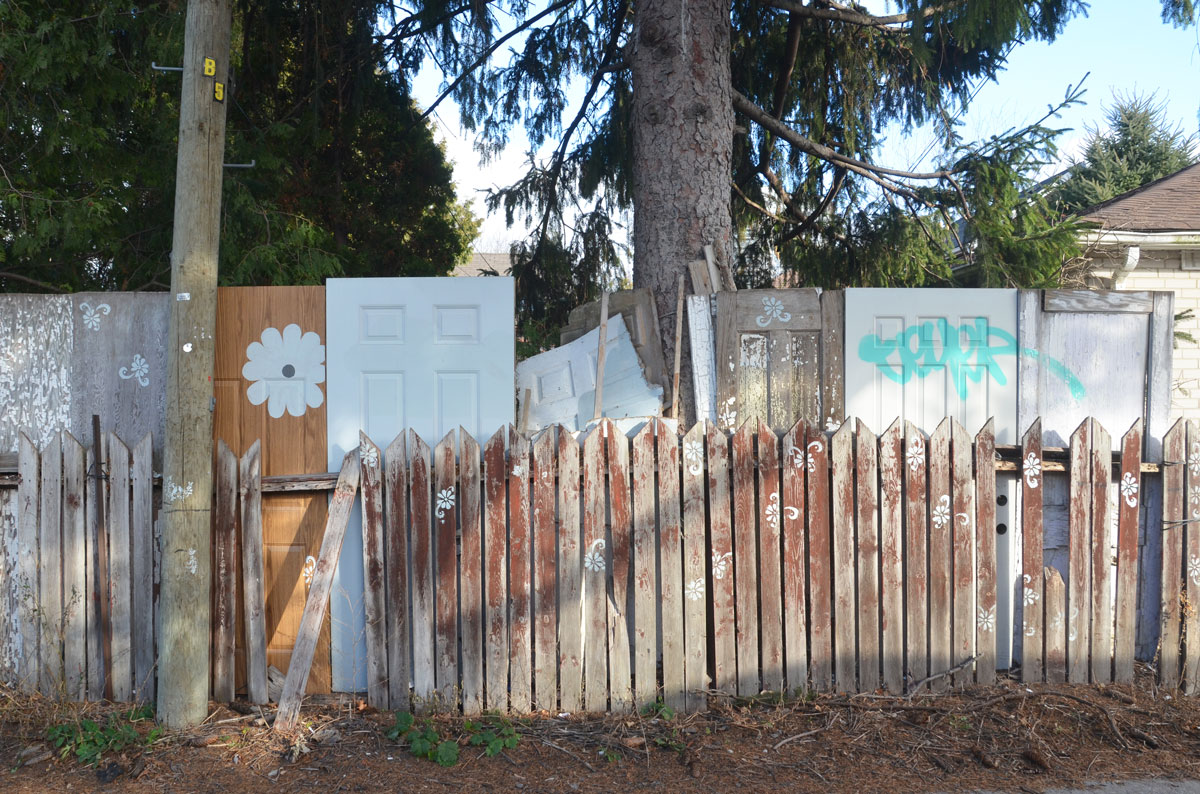
below: There was a fence made of old wood doors

an old picket fence that is falling aoart, and a fence made of doors that is behind it.

close up of old picket fence that is falling aoart, and a fence made of doors that is behind it.

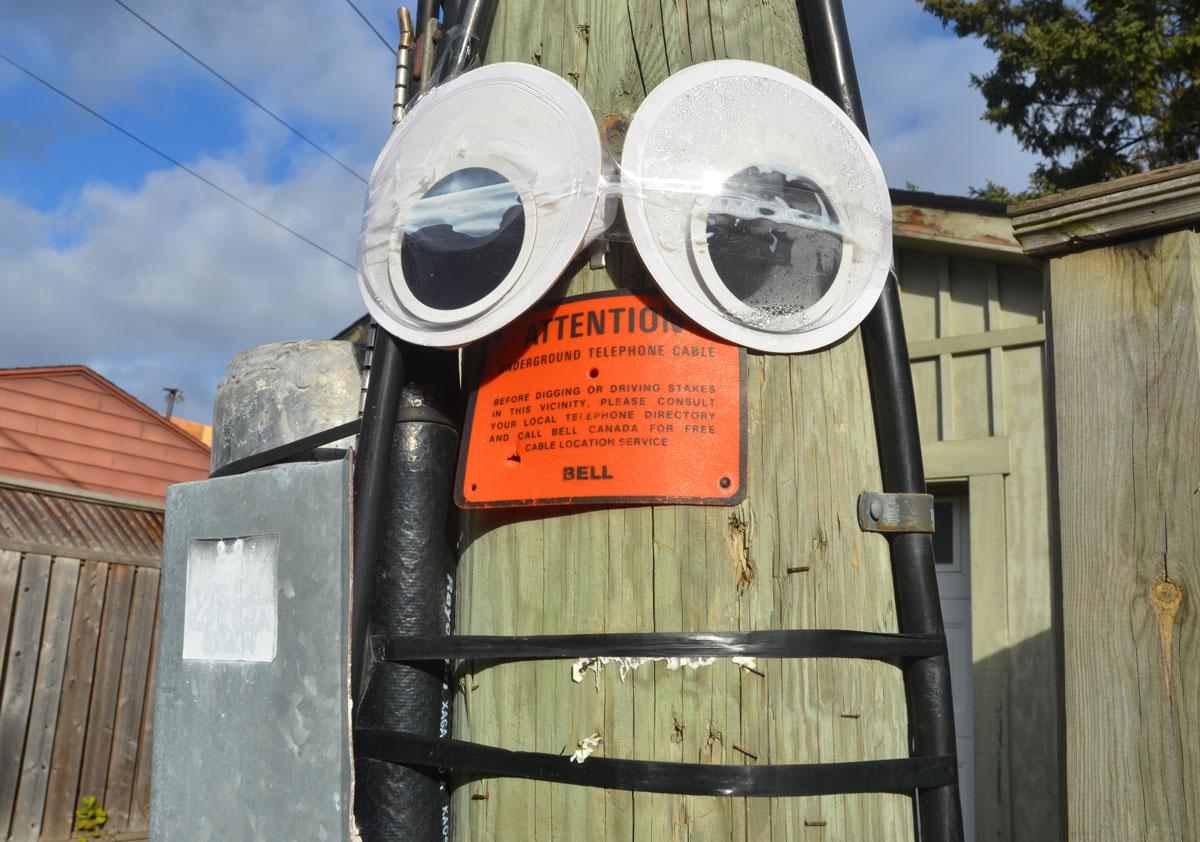
below:  There was a great creature with googly eyes and a rectangular orange nose.

Two big googly eyes attached to a telephone pole

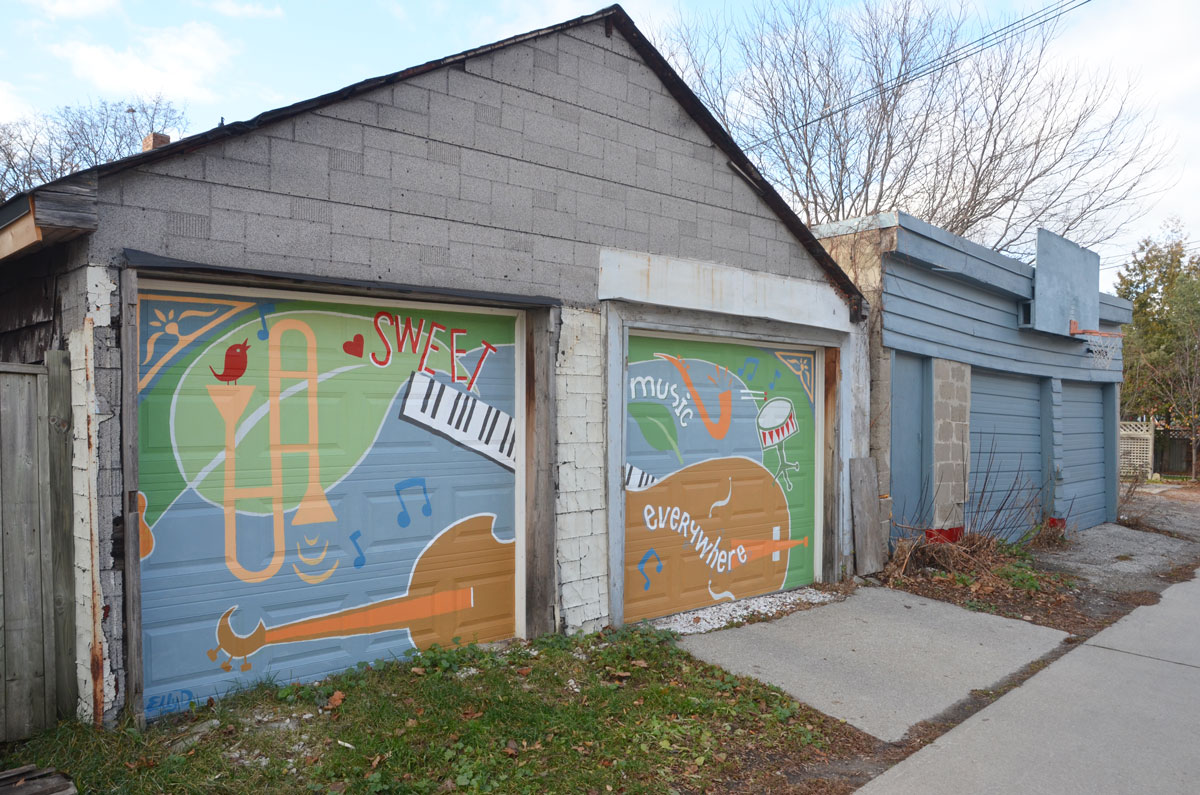
below: And of course there were some painted garage doors.

street art on garage doors, musical instruments covering two garages, a guitar, a trombone, also the words sweet sweet music everywhere

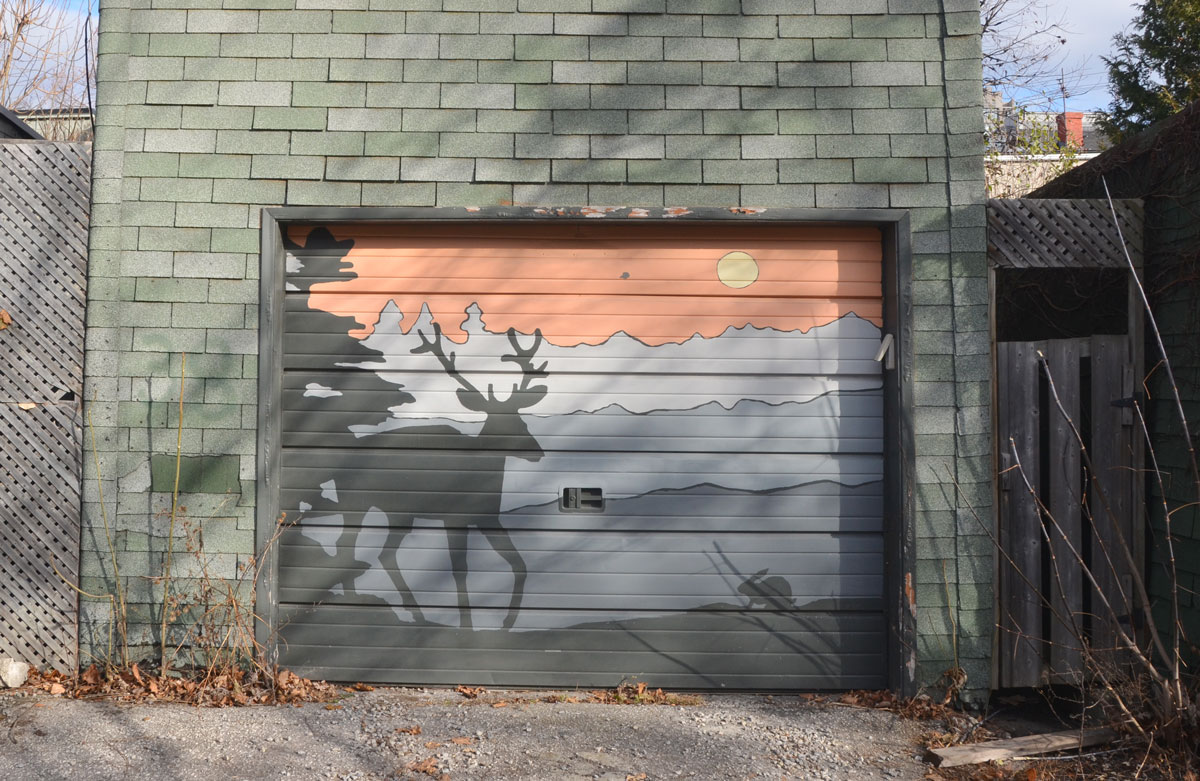
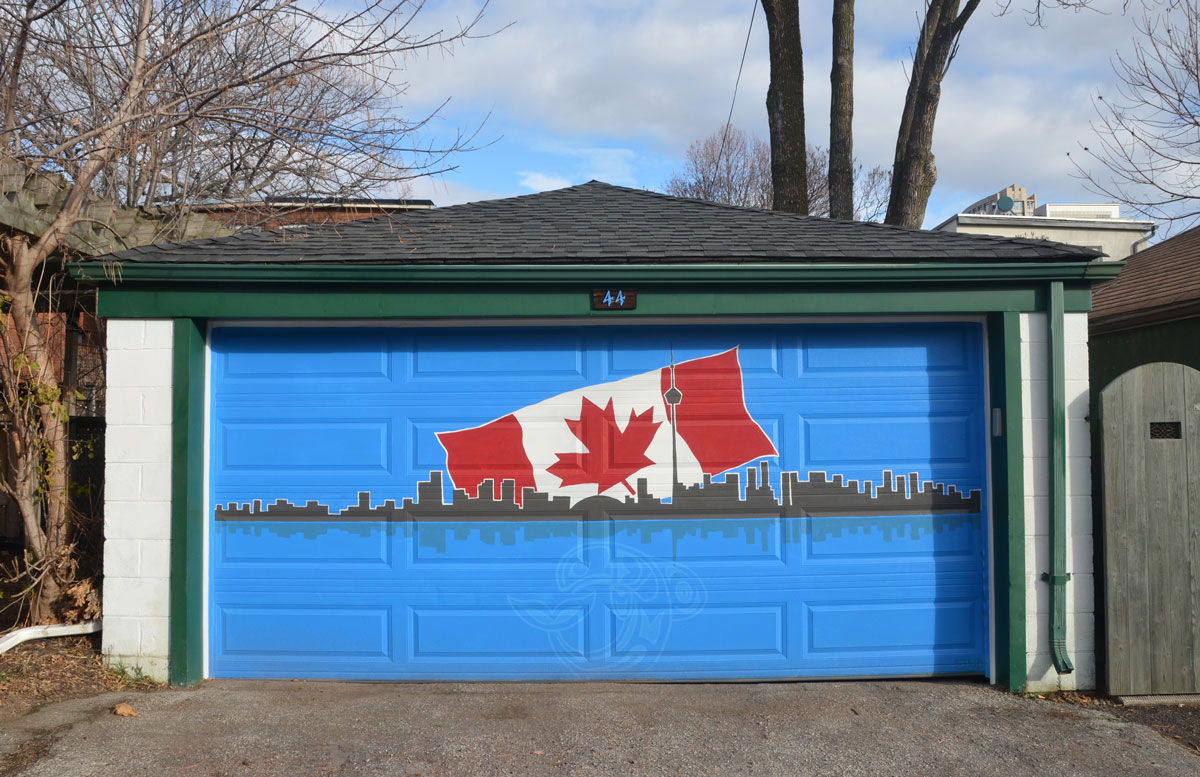
below: These garage doors are a sample of the more than 40 doors that have been painted as part of the Kenwood Lanway Art Initiative.

painting on a garage door of a moose at sunset

painting on a bright blue garage door of the Toronto skyline with a large Canadian flag behind ithe skyline

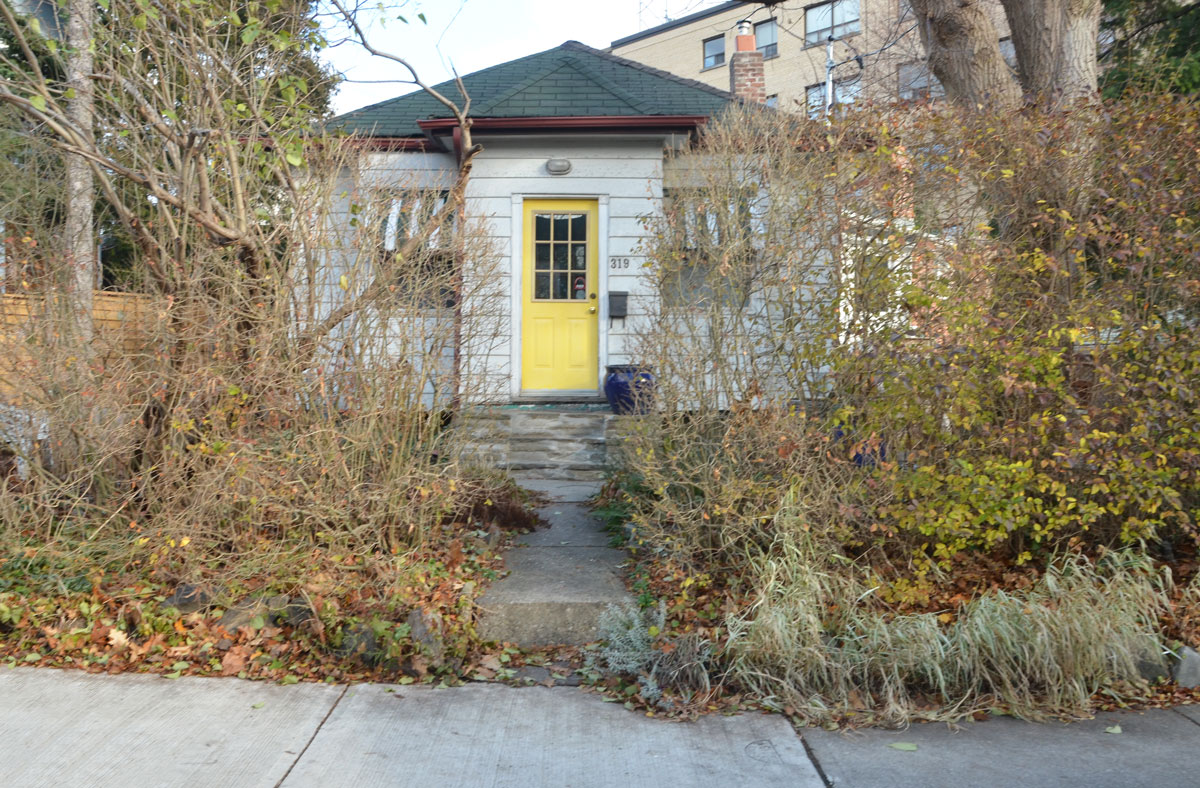
While walking on the streets in the neighbourhood I saw a couple of little houses

little narrow white bungalow with a yellow front door set back from the road. There is a straight walkway from the sidewalk to the door, and there is a lot of shrubery in the front yard especially near the sidewalk.

as well as larger buildings with intricate architectural details.

below:  A checkerboard effect with the bricks on the La Salle Apartments.  As an aside, the small bush in front of the building was in the picture no matter what angle I tried.  It was a lilac bush and I am sure that there were buds on it.

Part of a low rise apartment building, over the door, no windows. Checkerboard pattern in the bricks. The words La Salle Apts in large white letters across the bottom of the picture.

below: A little fake balcony with a white post railing on a low rise apartment building.

A white framed window in a red brick building. Below the window are a few white pieces of wood that look like a balcony railing even though there is no balcony there.

below: A line of little arches across the roofline is echoed in the larger arch patterns over the windows.  There is a small relief sculpture near the top corner of the building (slightly behind the tree) but I can’t tell what’s on it.  A coat of arms maybe?

brick pattern across the top of a building. scalloped, or looking like little arches to match the larger arches over the windows.

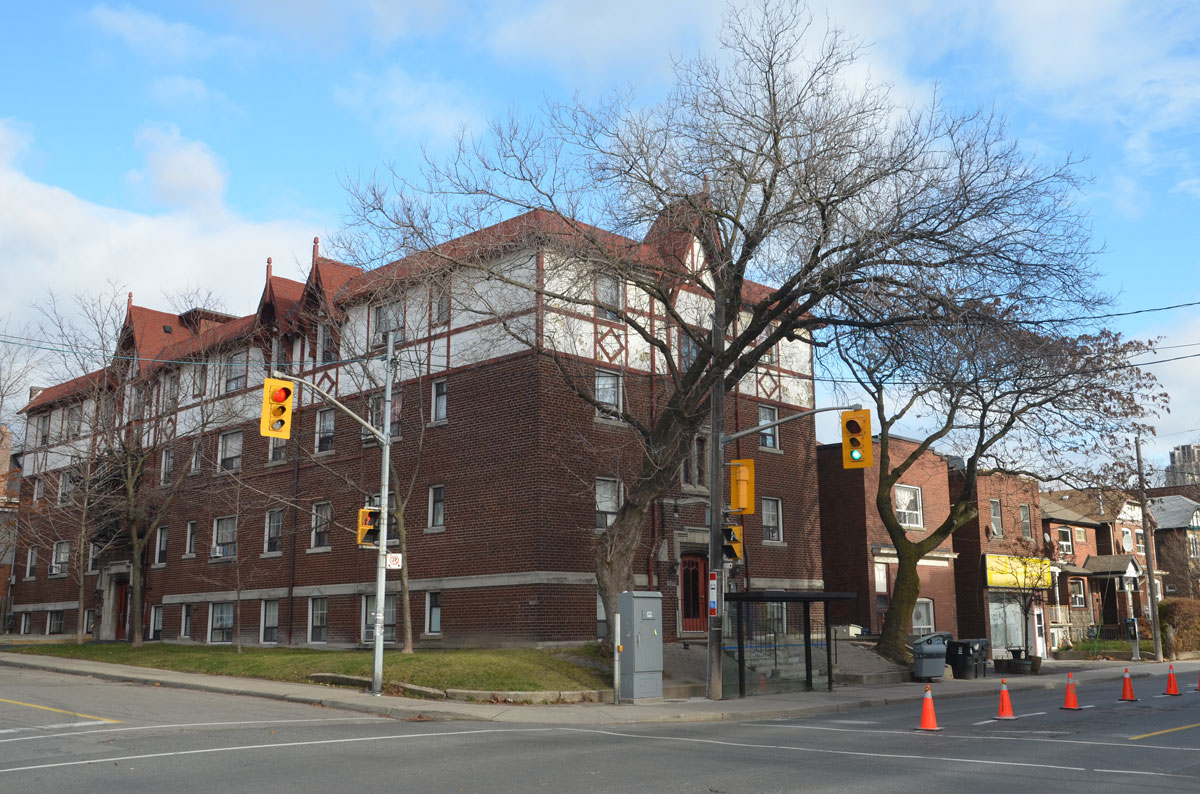
below:  There were quite a few four storey brick apartment buildings that looked like they were built in the 1920’s and 1930’s.  Perhaps there was a  little ‘condo boom’ at the time?

4 storey apartment building on Vaughan Road, red brick with white upper storey, diamond shaped details, two little peaked roofs over windows.

four storey apartment on a corner

front door and front of building, four storey apartment building in red brick with stone window and door frames.


Two four storey apartment complexes and a single family home on Vaughan Road.

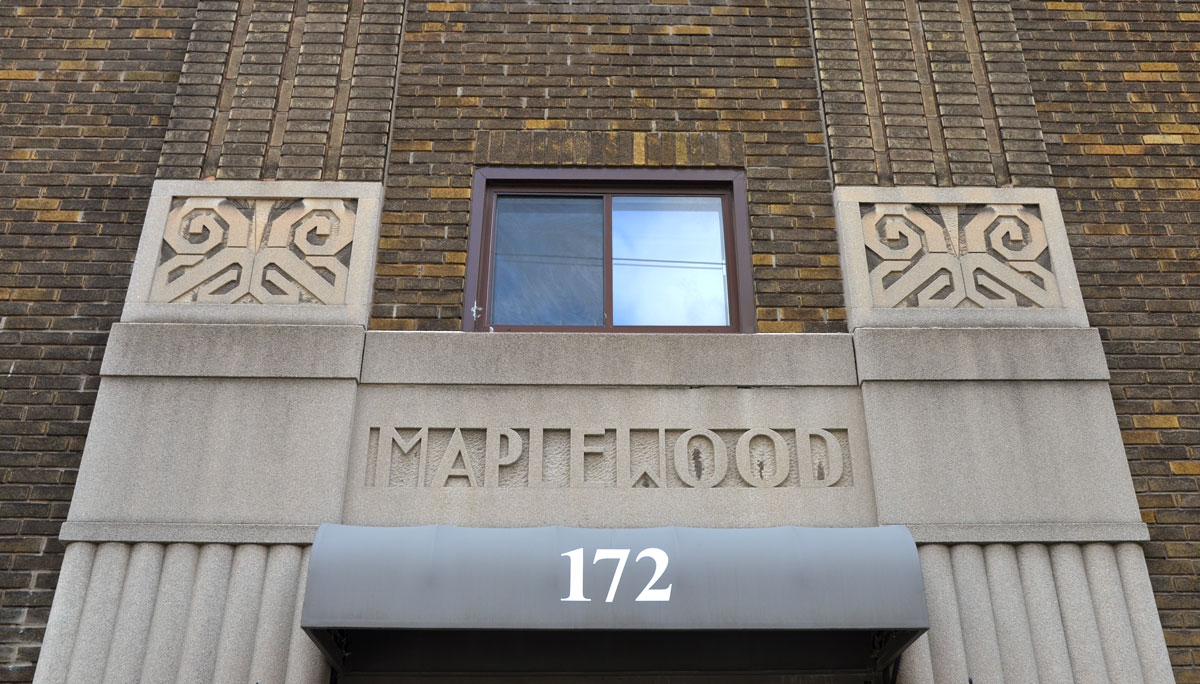
below:  Like the condos of today, many of the buildings had names such as Maple Villa

Stone door frame and entranceway to Maple Villa, a brick low rise apartment complex

and Maplewood

stonework over the door of the Maplewood apartments at 172 Vaughan road, and the art deco like decorations beside it.

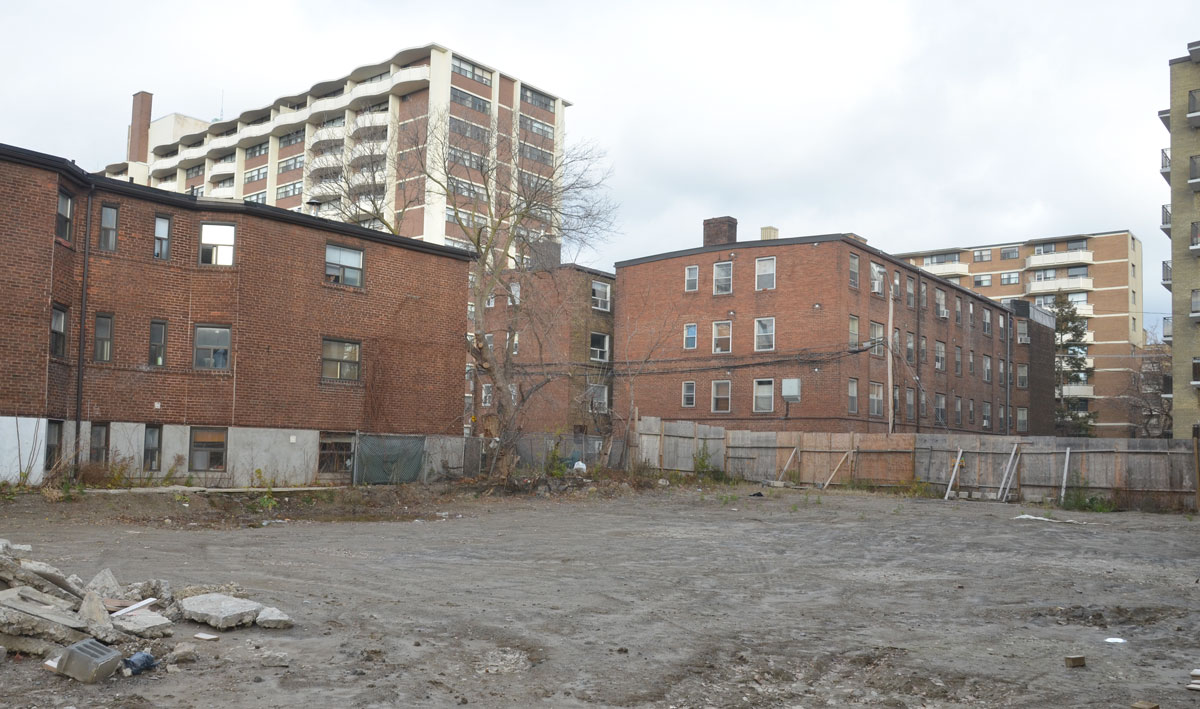
below:   The backs of all those apartment complexes are nearly as interesting as the fronts.
This is one of the only construction sites I saw although….

vacant lot with a number of low rise brick apartment buildings in the background.

… this Presbyterian church looks like it is about to be redeveloped.  It is one of three churches at the corner of St. Clair and Wychwood.   The church was built in 1926.  There is a brief description of the property on the Stanton Renaissance website but very little information is given beyond a “transformation” of the church and the creation of “high end residential boutique”.

An old brick church at a corner. It is now empty. There is a large sign in front of it advertising Stanton developments.

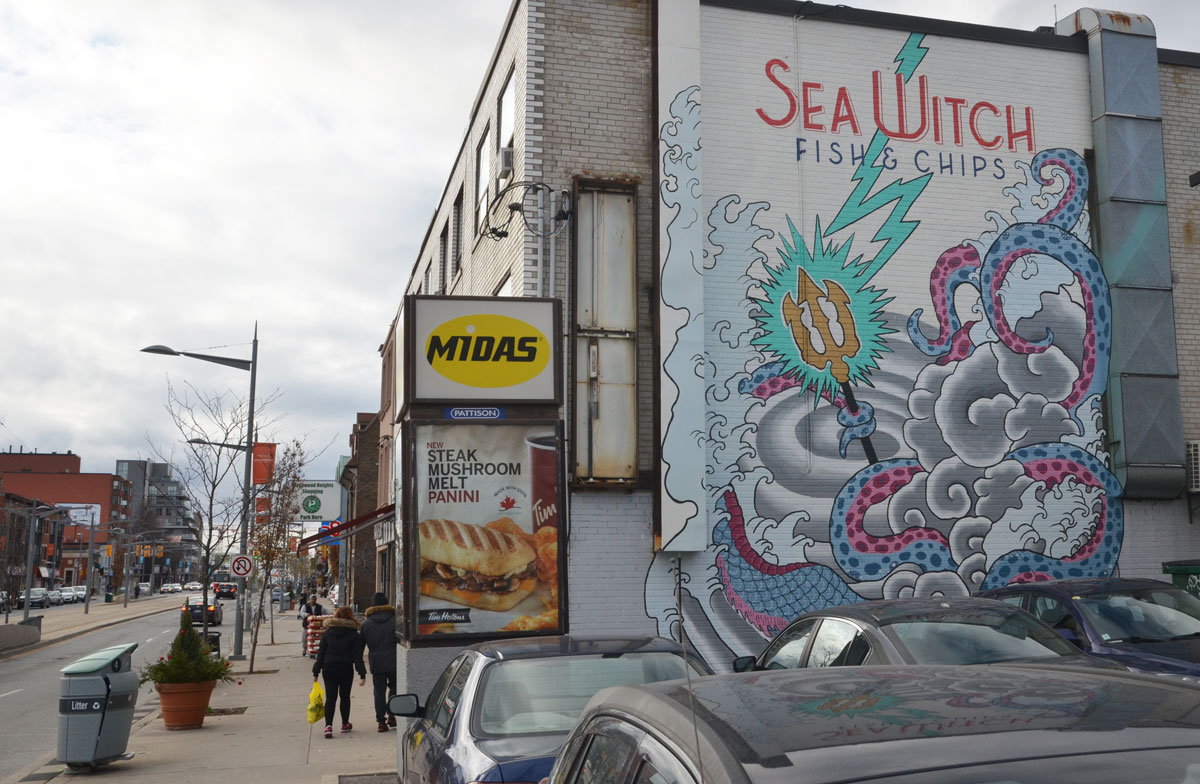
below: Mural for Sea With Fish and Chips on St. Clair West

mural for Sea Witch FIsh and Chips restaurant, a large sea serpent

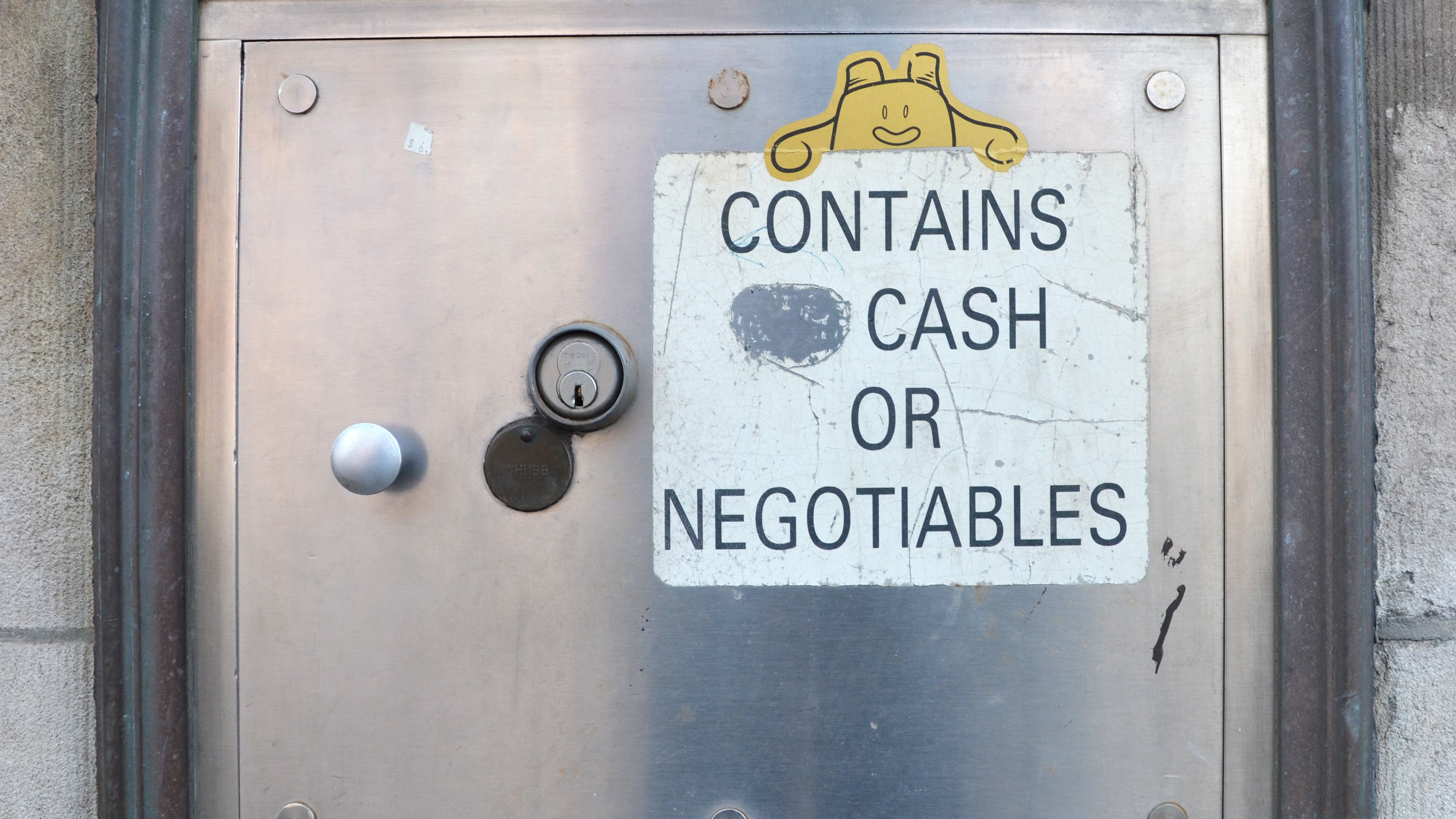
A little yellow sticker on a bank night deposit box, looks like a little smiling creature looking over the sign that says contains no cash or negotiables, except that the word no has been scratched out

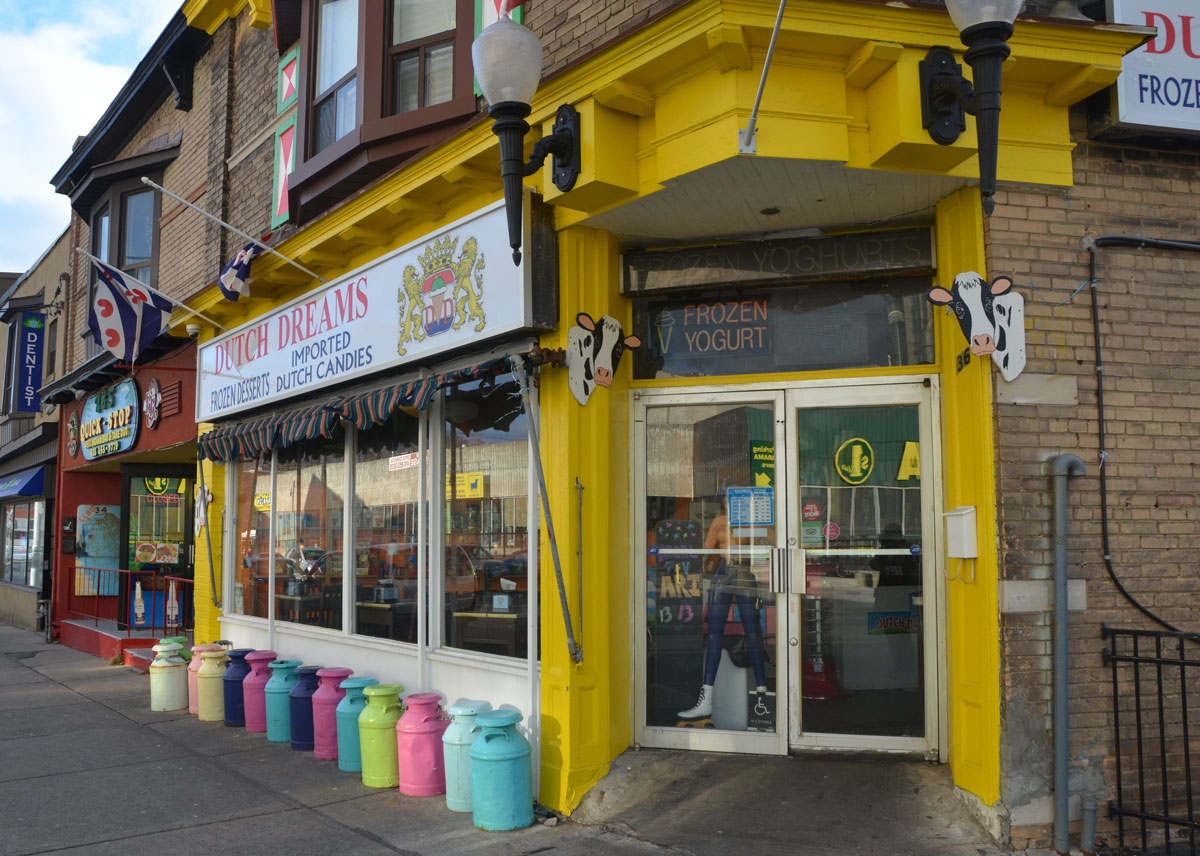
below: As I circled back the intersection of Vaughan Road and St. Clair West, I spotted a large doubledecker strawberry and vanilla ice cream cone on the side of Dutch Dreams.  Hey!  The answer to my question.  The ice cream place from 78 Vaughan Road has moved a couple of blocks south, complete with it’s collection painted old fashioned milk cans.

A very large plastic icce cream cone, double scoop, strawberry on the bottom and vanilla on the top, decorating a brick building. The shutters on the windows of the building are green, red and white

bright yellow entranceway, a line of different coloured milk cans along the exterior wall, sign says Dutch Dreams, candy and ice cream.

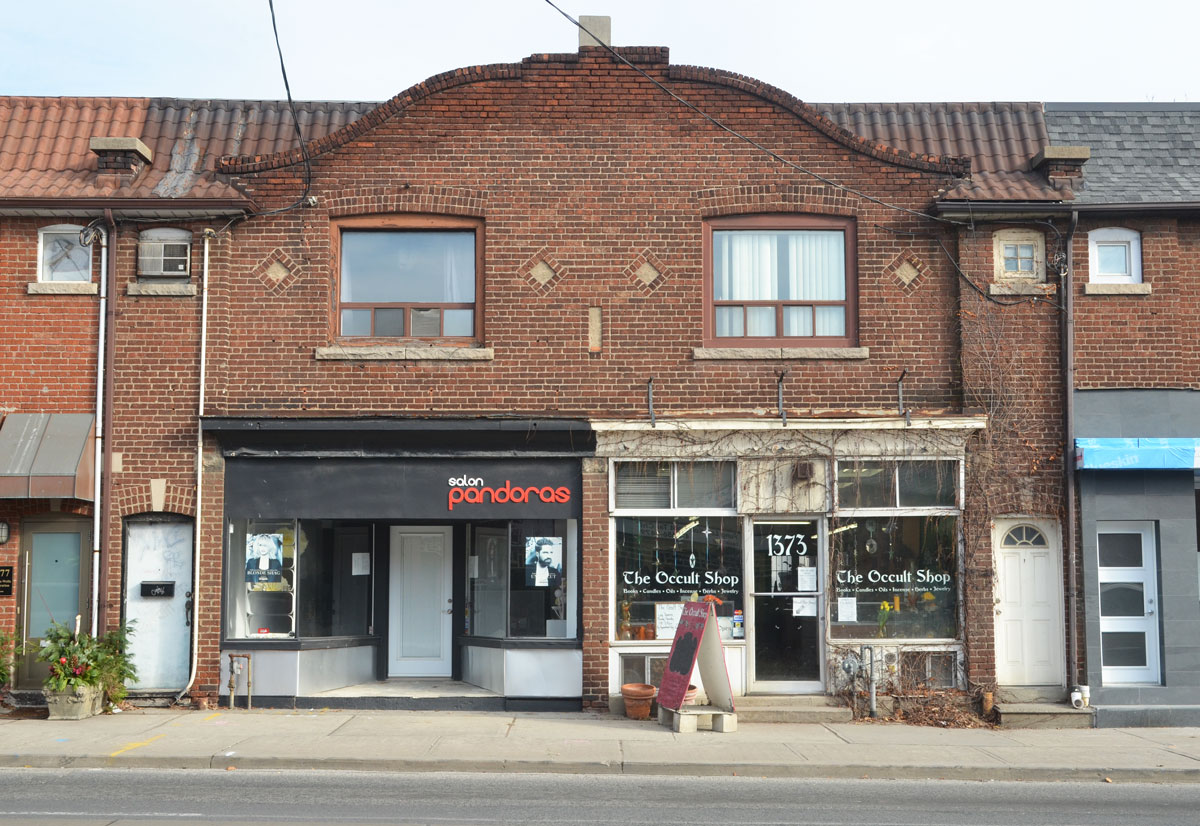
below:  One last picture.  As I waited for the Bathurst bus, I found myself standing across the street from this building.   The curve of the roofline is interesting, but even more interesting is the the fact that there is an occult store in Toronto.  Candles, herbs, incense, jewelry, I’m now wishing that I had crossed the street to investigate further!   And, smile, the store next to it is Pandora’s salon.  Pandora, the one who in ancient times opened a box and unleashed all sorts of evil on the world.


store front, one is an Occult Store, in an old brick building with a curved roofline over the middle of it.

‘In-Between Worlds’ is a series of photographs by Canadian photographer Meryl McMaster.   This series centres around the role of McMaster’s dual heritage in her search for self;  The images represent her being part of, and also being between, two different cultures as she is part Cree and part ‘European’.

Three of the images are on display at Ontario Square by Queens Quay West and Lower Simcoe St.

below: Horse Dance.  The bright red and blue of the shaggy hobby horses against a winter landscape makes for an eye catching picture.  On closer look, you realize that there is a person’s head inside one of those horses’s head.  Heads that have no eyes to see or mouths to speak.

A large photograph of three red hobby horses with long blue mane, taken outside in the winter in the snow, with bare trees in the background. A mix of the real (outdoors) and the unreal (hobby horses instead of real horses). Photo is Mounted on a concrete wall outside.

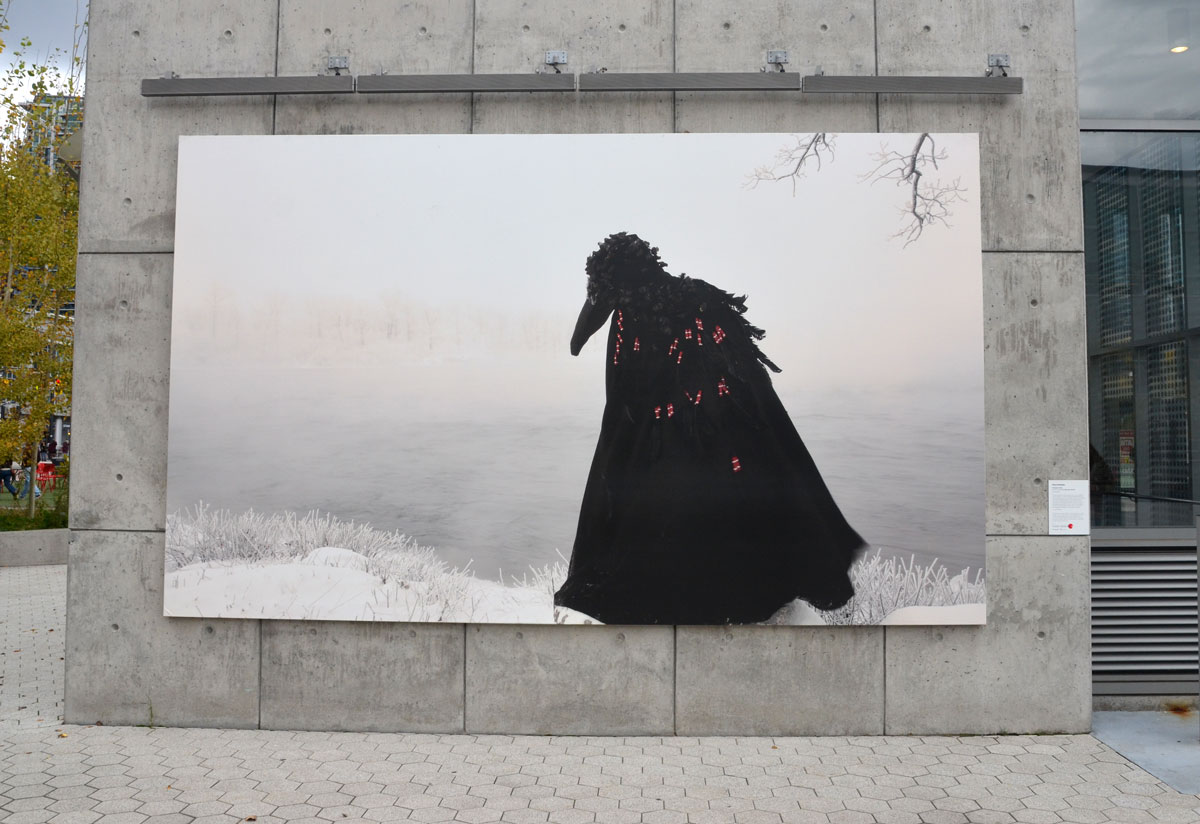
below: Wingeds Calling.  Around the corner there is another picture of a person in costume, playing the role of a real, yet not real, animal.  A large black bird-like figure walks on the frozen ground, perhaps too big and awkward to fly.

A photograph Mounted on a concrete wall outside of a person draped in a large black cape and wearing a head piece that looks like a large black bird. Photo taken outside in winter so the background is all white and grey like a foggy winter day.,

below: Wind Play Variation.  The third picture baffles me a bit.  Although this is another picture of a person assuming a role,  this time the creature is totally of the artist’s imagination.  A blue hairy thing that is slightly blurry as it walks amongst the pine trees.   Is it coming or going?

Photo of a blue furry creature taken in winter with snow covered evergreens in the background. Mounted on a concrete wall outside.