Archive for November, 2015

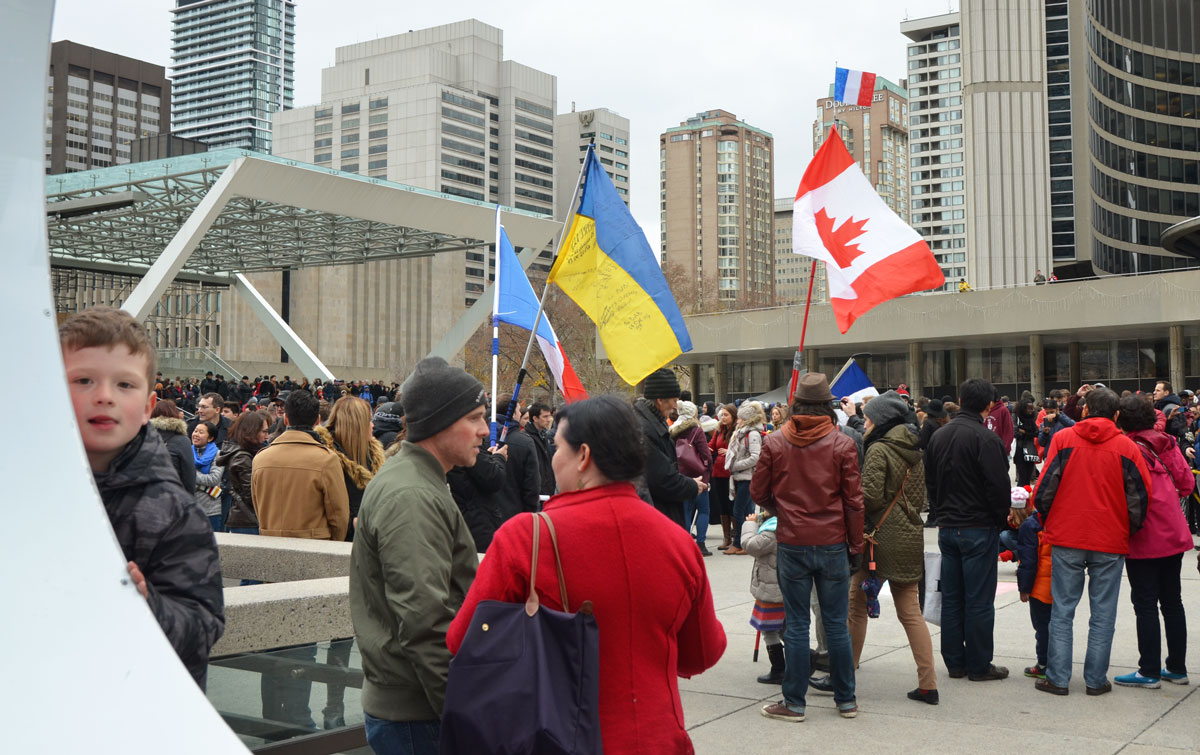
Nathan Phillips Square, 14 Nov 2015
A quiet gathering in support of Paris

blog_paris_memorial_nathan_phillips_square

looking through the end O of the 3D Toronto sign towards the main part of Nathan Phillips Square where a large number of people have gathered

The event started with a few speeches.   French Consul General Mr. Marc Trouyet spoke first, followed by Carolyn Bennett, Liberal MP and then Toronto mayor John Tory.

Carolyn Bennett, Liberal MP, speaks at a gathering at Nathan Phillips Square that pays tribute to the city of Paris. A lineup of other people waiting to talk, including John Tory, mayor, is standing behind her.

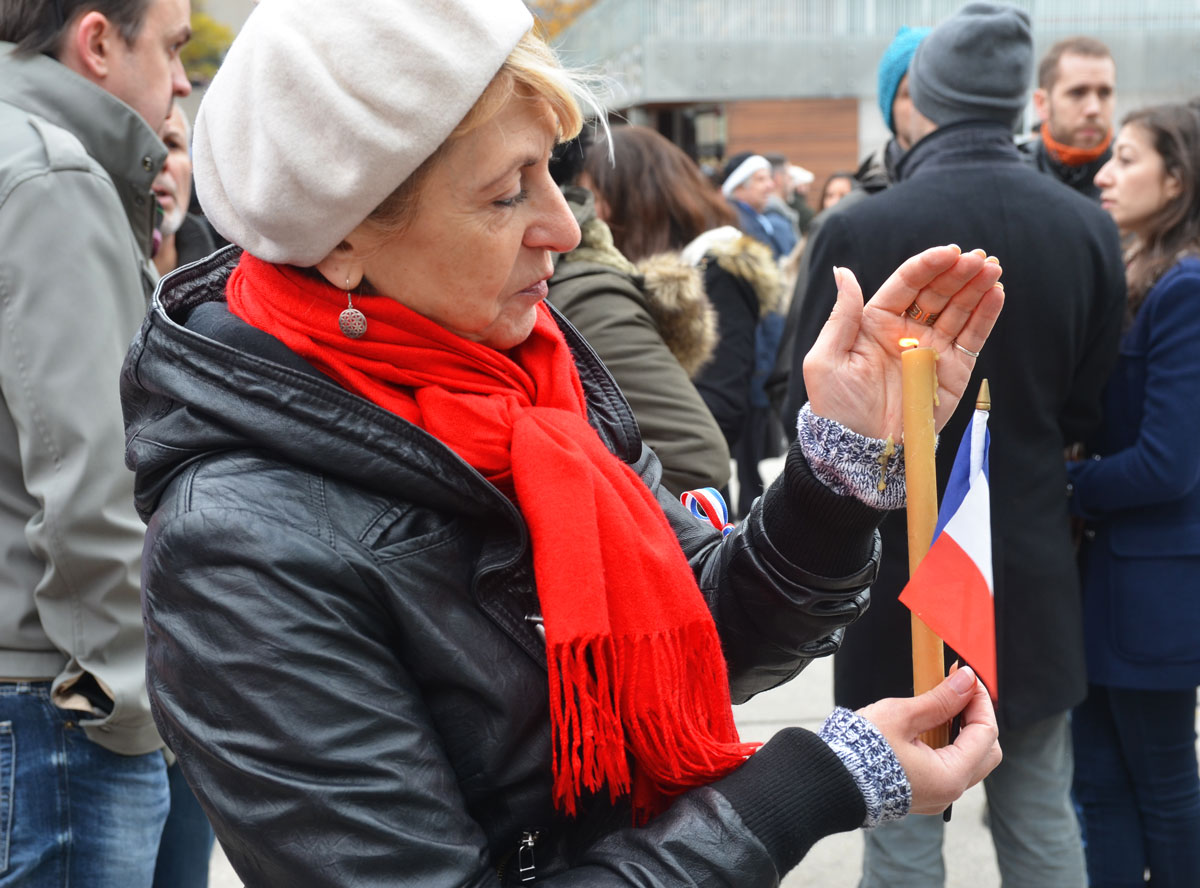
A woman in a white beret and red scarf is holding a lit candle and a small French flag

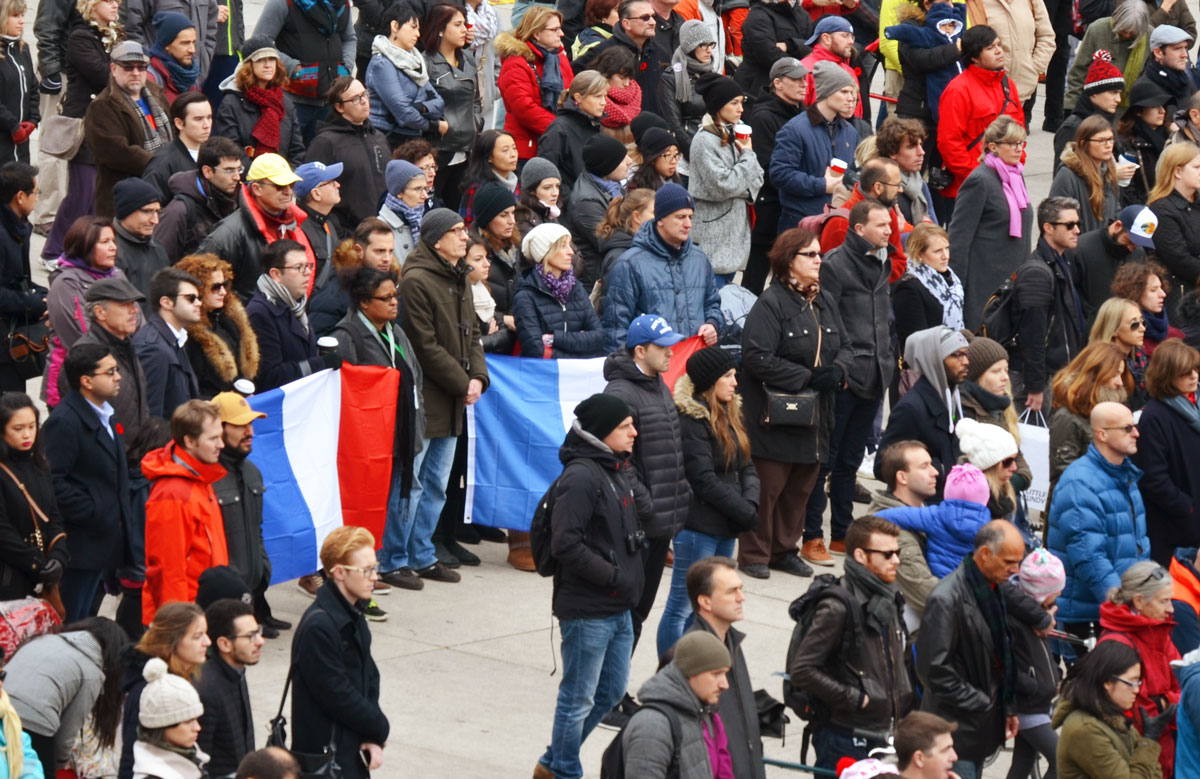
The official part of the event ended with two minutes of silence.

A crowd of people standing at Nathan Phillips Square listening to speeches. Some people hold two large French flags.

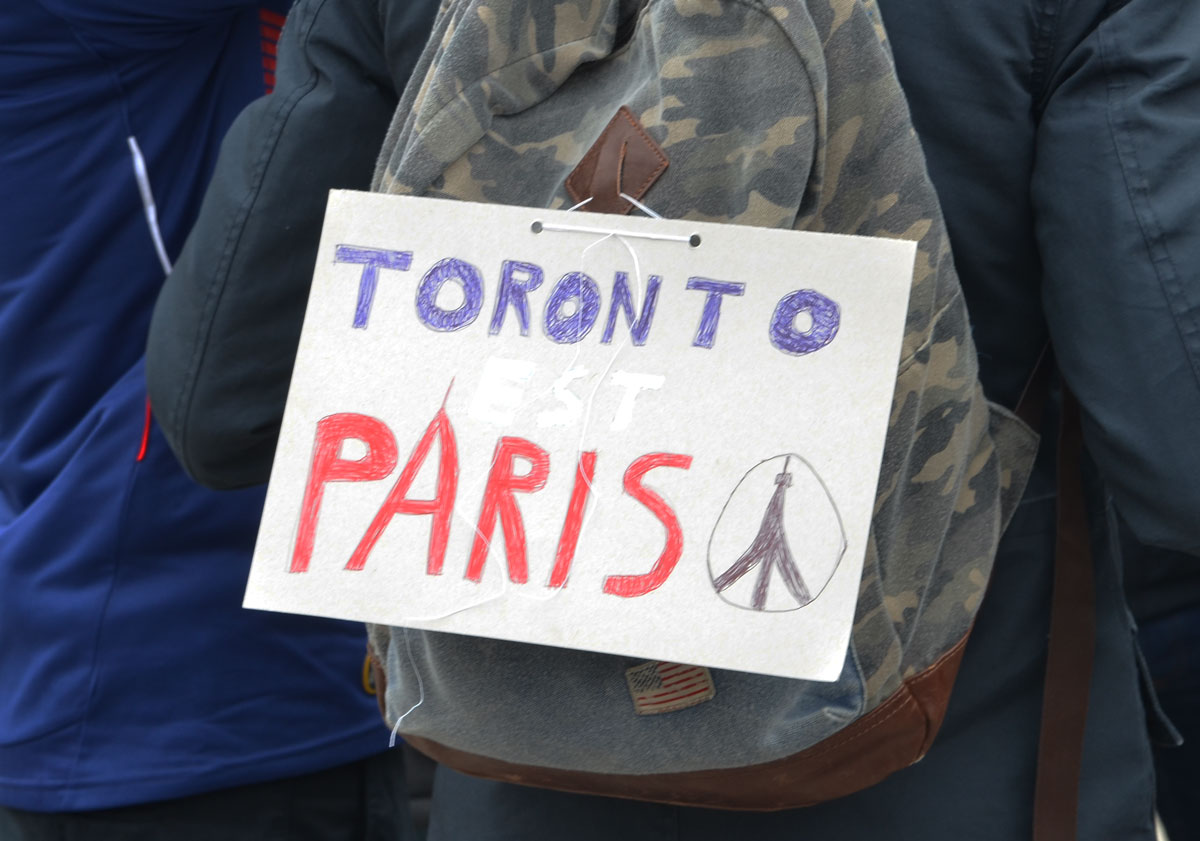
A sign on a backpack that says Toronto est Paris. Written in blue, white and red

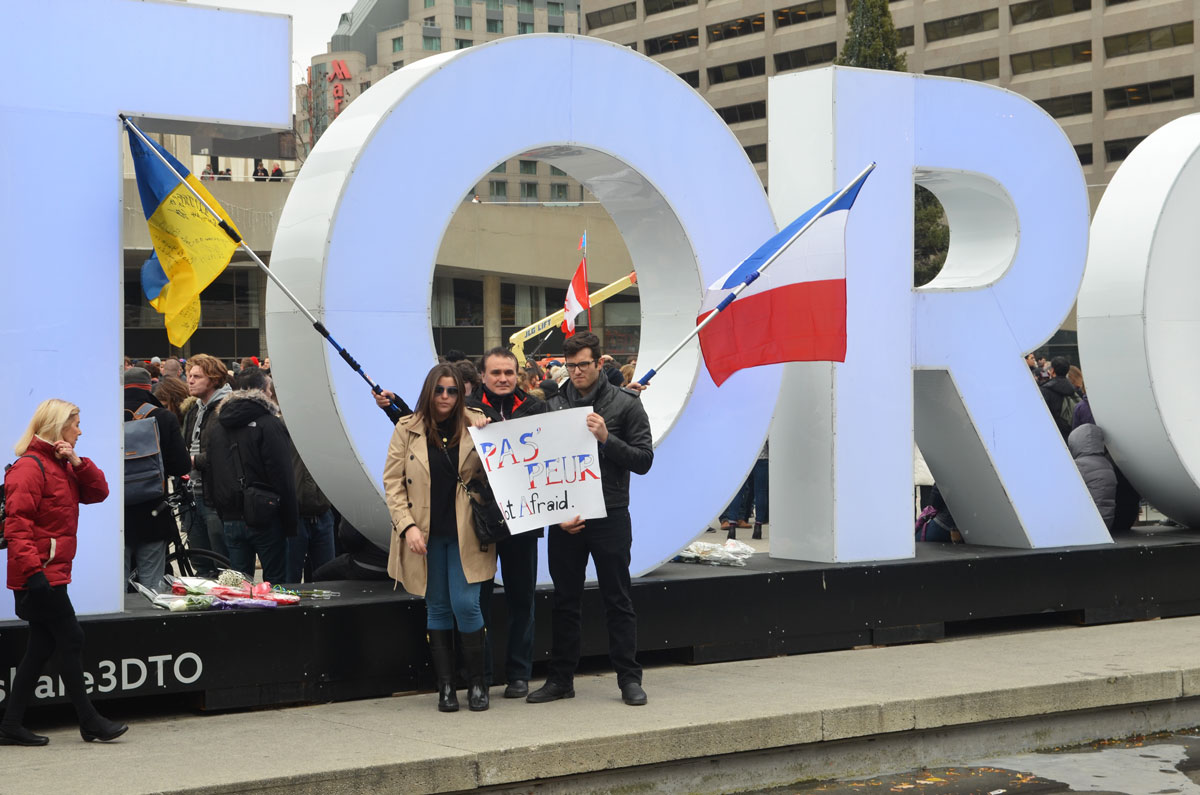
Three people standing in front of the 3D Toronto sign, holding a French flag and a large sign that says "Pas Feur, no fear"

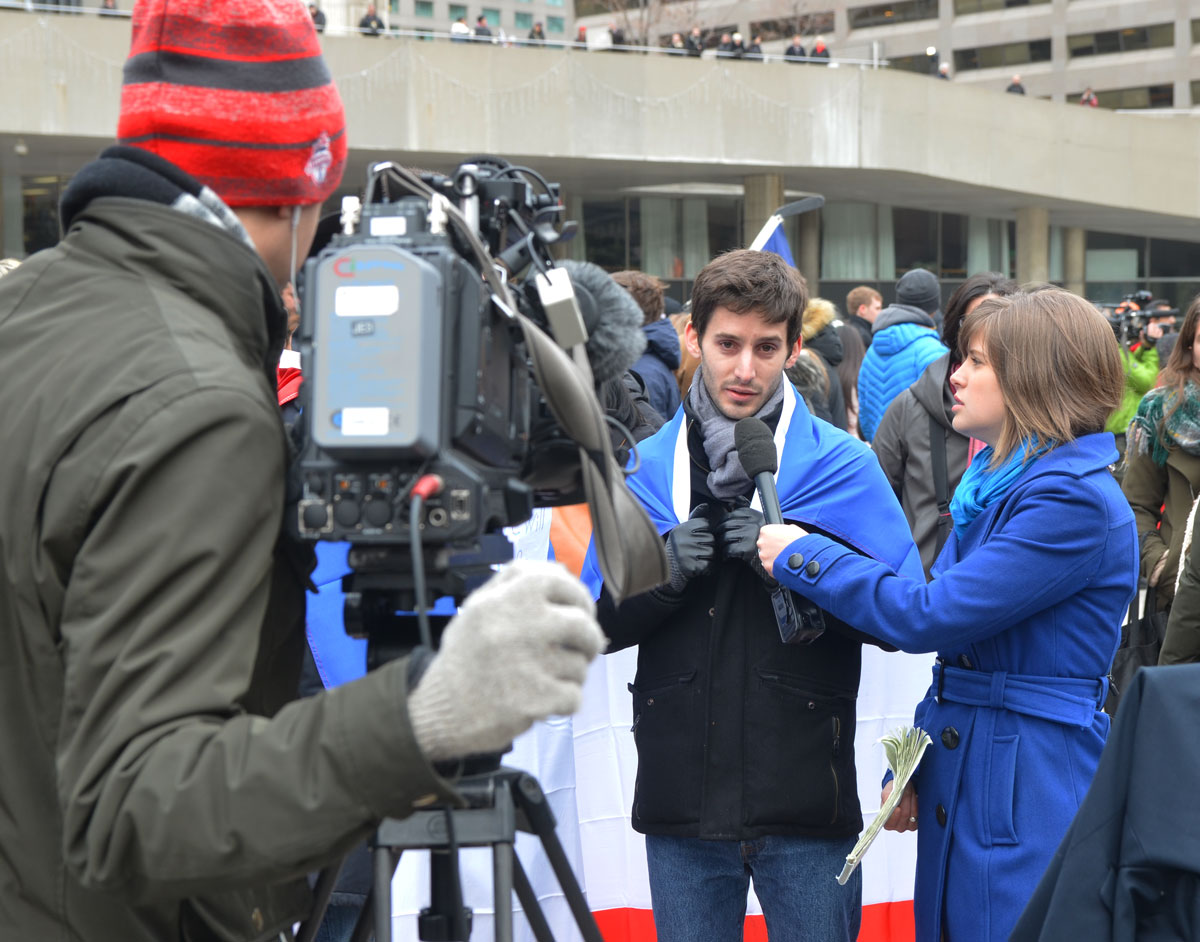
A young man with a French flag draped over his shoulders is being interviewed for TV

#parisisaboutlife

Remembrance Day
the eleventh day of the eleventh month

November 11th at 11am in 1918 (the eleventh hour of the eleventh day of the eleventh month)  was when an armistice was signed by representatives of Germany and the Entente.  Nov 11th became known Armistice Day, or in some countries such as Canada, Remembrance Day.  An armistice is an agreement to stop fighting, a truce in other words.  After this signing, it took several months of negotiations before the First World War officially ended with the signing of the Treaty of Versailles on 28 June 1919.  That treaty ended the war between Germany and the Allies.  (The Allies of WW1 were also known as the Entente Powers while Germany and her allies were known as the Central Powers)

The poppy became a symbol of Remembrance day, and a symbol in remembrance of soldiers who died fighting in all wars, after the publication of the poem ‘In Flanders Fields’ in 1915.  This popular and often quoted poem was written by Canadian Lieutenant Colonel John McCrae.  In it he talks about the poppies that grew in the battlefields at Flanders Belgium during WW1.

“In Flanders fields the poppies blow
Between the crosses, row on row,”
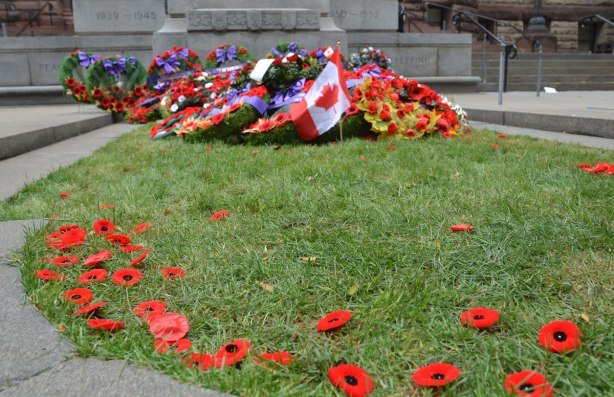
Many Remembrance day poppies lie on the grass in front of the cenotaph in front of old City Hall. In the background is a small Canadian flag as well as a few wreaths that have been laid in front of the cenotaph.

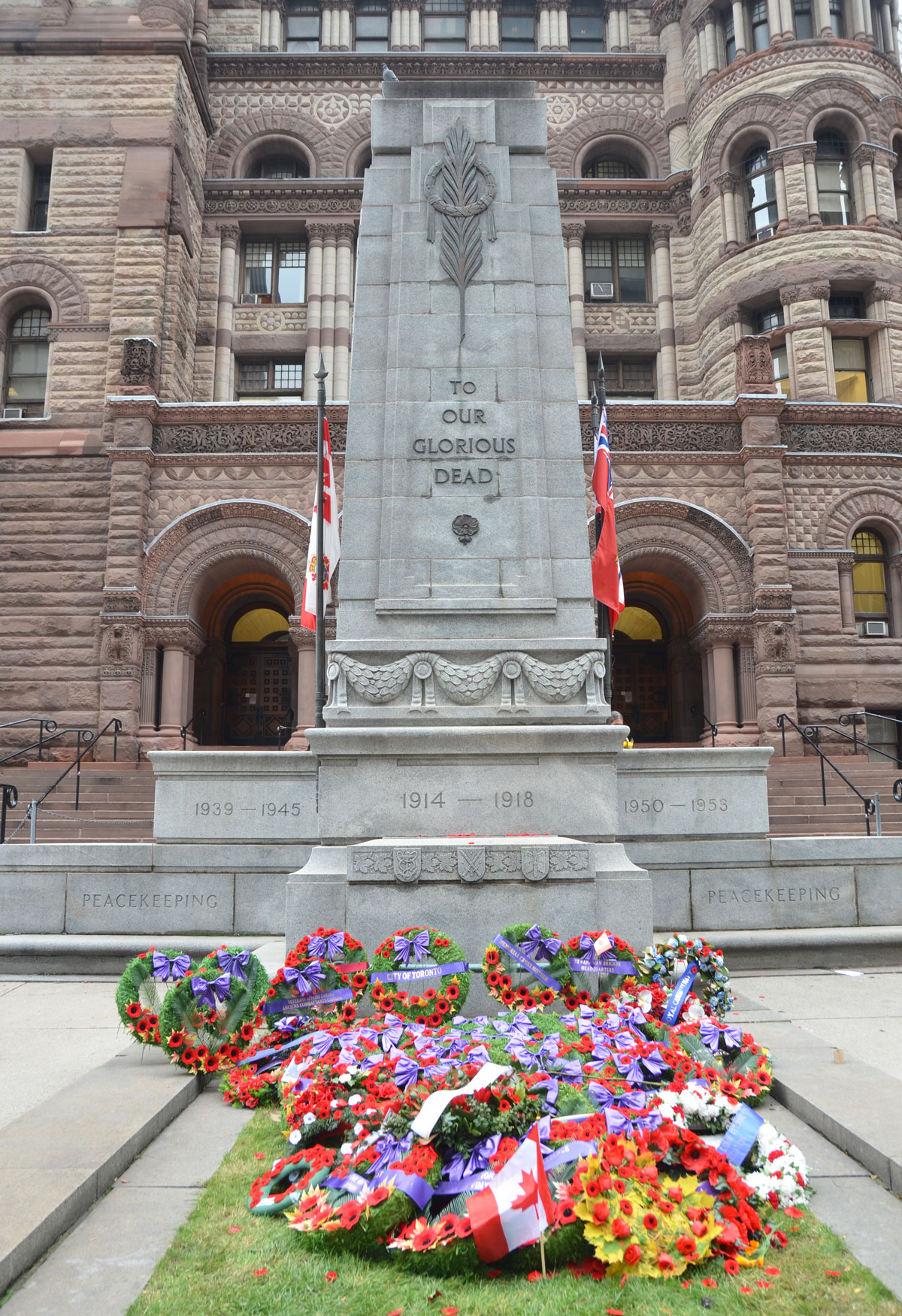
below: The cenotaph (war memorial) in front of Old City Hall was unveiled on 11 Nov 1925 to commemorate those Torontonians who died in WW1.  Since then, it has been expanded to include those who lost their lives in WW2 and in the Korean War.  The word cenotaph comes from the Greek and translates as ’empty tomb’. This style of memorial has been used widely for commemorating someone, or some group, whose remains are interred elsewhere.

More than 6000 Torontonians lost their lives in these three conflicts.  Close to three thousand men died in World War 1, a number that represents about 2% of the male population of the time. (1)
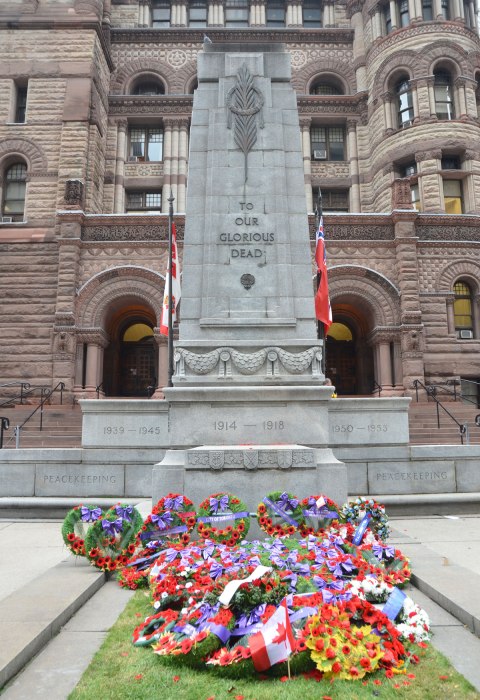
The cenotaph in front of Old City Hall in Toronto, with a collection of wreaths that have been laid at the bottom of it.

In the middle of University Avenue is a statue erected by the Toronto District of the Sons of England Benefit Society in memory of their members who died in World War 1.  Founded in 1876, this society provided insurance to its members who were in need because of illness or accident.

In 1914 Canada was still part of the British Empire.  As a result, when Britain found itself at war in August of that year, Canada too was involved.
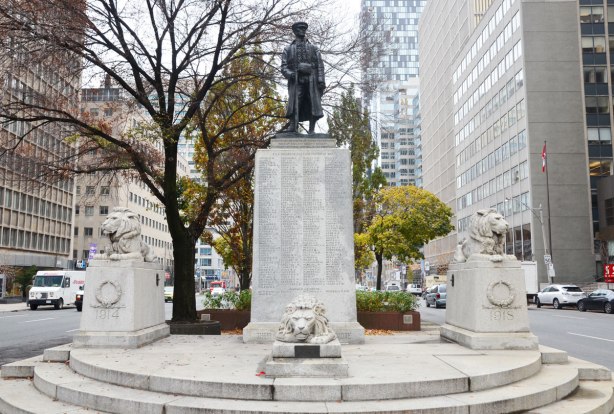
statue and memorial at University and Elm streets.

below: At the base of the center lion is a small plaque that reads: “Chas Adamson, sculptor, 1923”.
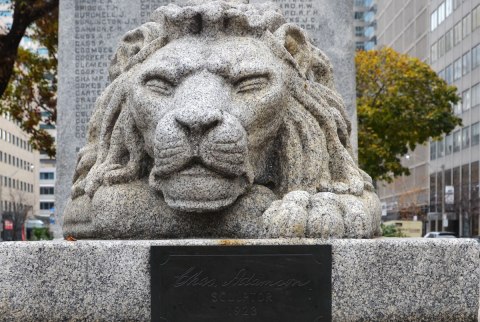
A carving of a lion in granite. It is at the base of a sculpture. A small brass plate is attached in front of the lion and it says Chas Adamson, sculptor 1923

below: The Sons of England building on the NW corner of Richmond St. East and Berti St., 1922
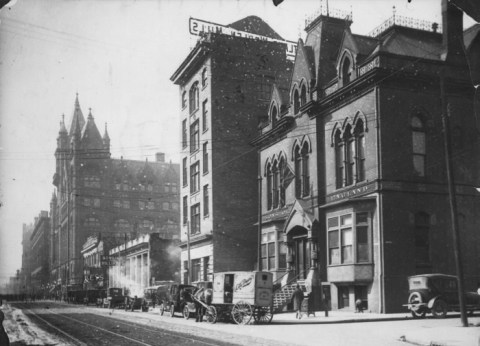
historical picture of Richmond Street near Berti, taken in 1922, old buildings, a, horse drawn cart and an old car. Streets but no traffic. black and white photo.

photo credit: Toronto public library website


Another memorial in this city is the Ontario Veterans Memorial.  This is a 30m long granite wall in front of Queens Park dedicated to all the men and women from Ontario who served in the military.  Etched into the granite are scenes depicting Canadians in military roles between the time of the Fenian Raids in 1867 to the present day.

below: Part of the granite wall.  The red in the picture is a reflection of the red carpet that was laid in front of the memorial for the Remembrance Day service.
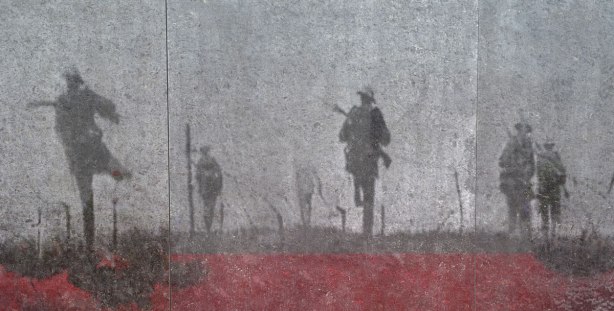
An etching of men running across a battlefield with rifles at the ready.

below: part of the granite wall

part of a war memorial showing the wars written on it

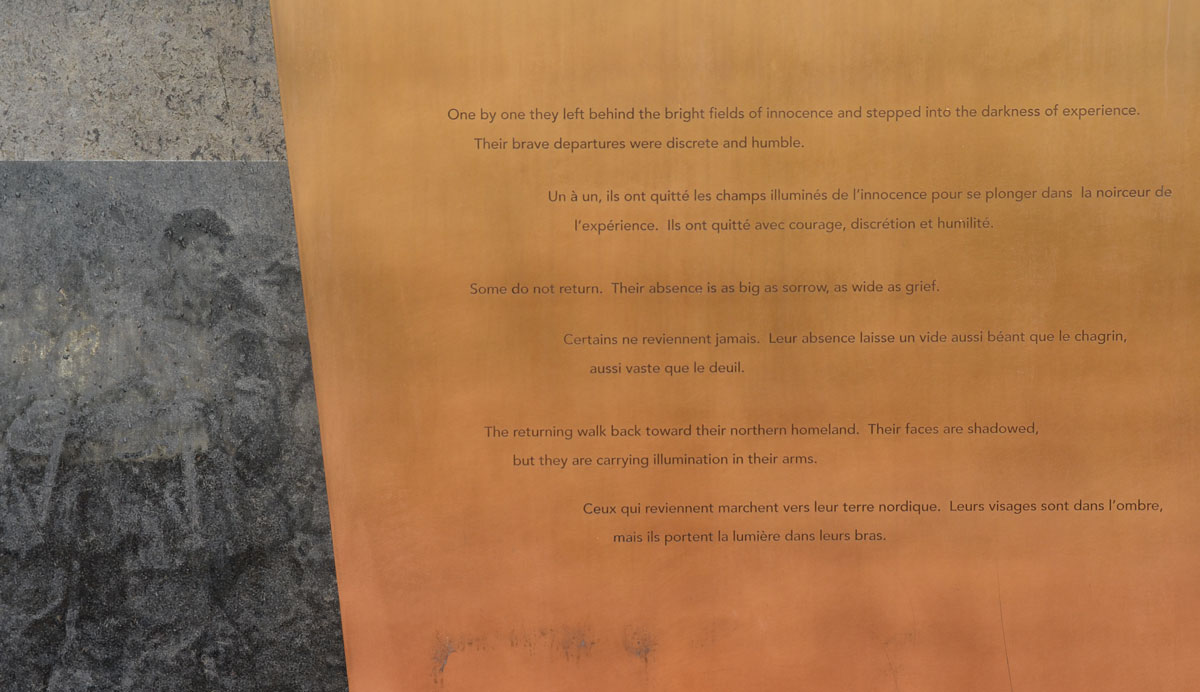
Transcription of the passage by Canadian author Jane Urquhart:
One by one they left behind the bright fields of innocence and stepped into the darkness of experience
Their brave departure was discrete* and humble.
Un à un, ils ont quitté les champs illuminés de l’innocence pour se plonger dans la noirceur de
i’expérience. Ils ont quitté avec courage, discrétion et humilité
Some do not return. Their absence is as big as sorrow, as wide as grief.
Certains ne reviennent jamais. Leur absence laisse un vide aussi béant que le chagrin,
aussi vaste que le deuil.
The returning walk back toward their northern homeland. Their faces are shadowed,
but they are carrying illumination in their arms.
Ceux qui reviennent marchent vers leur terre nordique. Leurs visages sont dans l’ombre
mais ils portent la lumière dans leurs bras.  

(* discrete vs discreet ?)

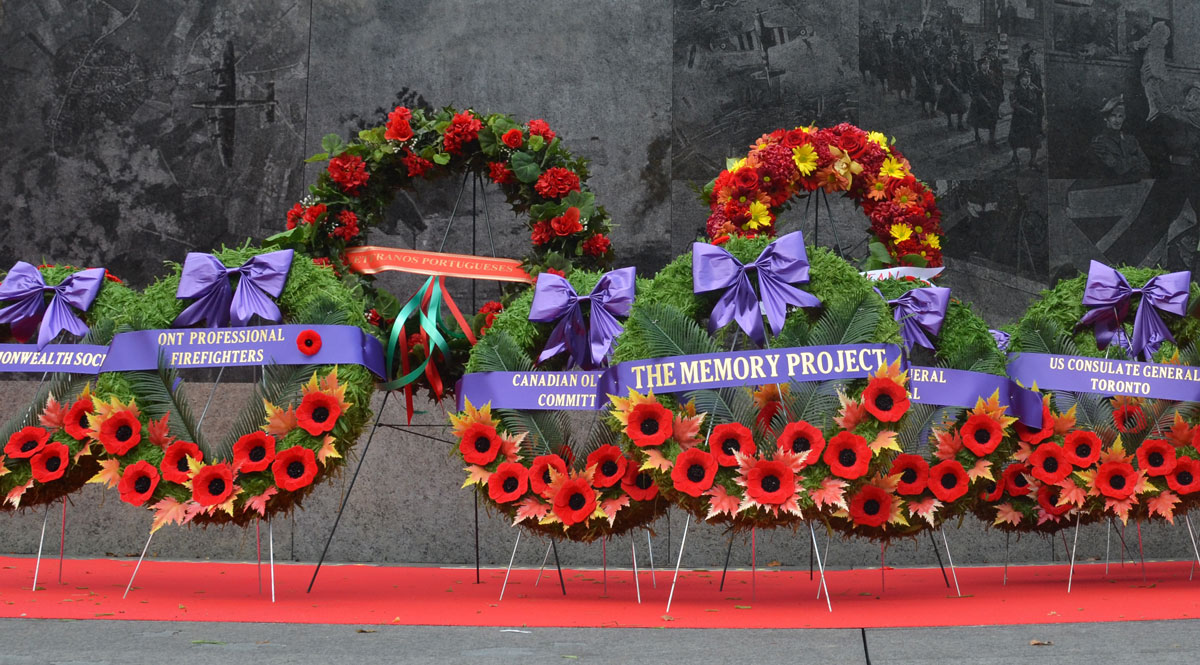
below: Some of the wreaths laid at the Ontario Veterans Memorial on Remembrance Day.
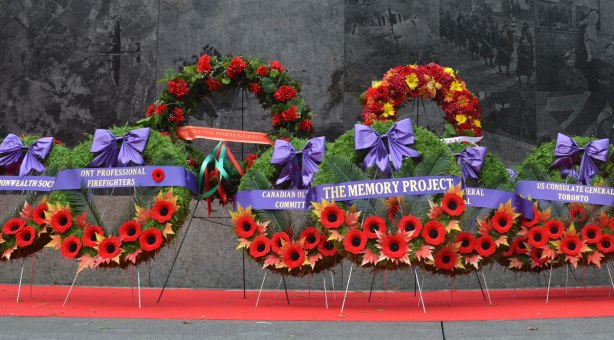
wreaths in front of the granite wall of the Ontario Veterans Memorial

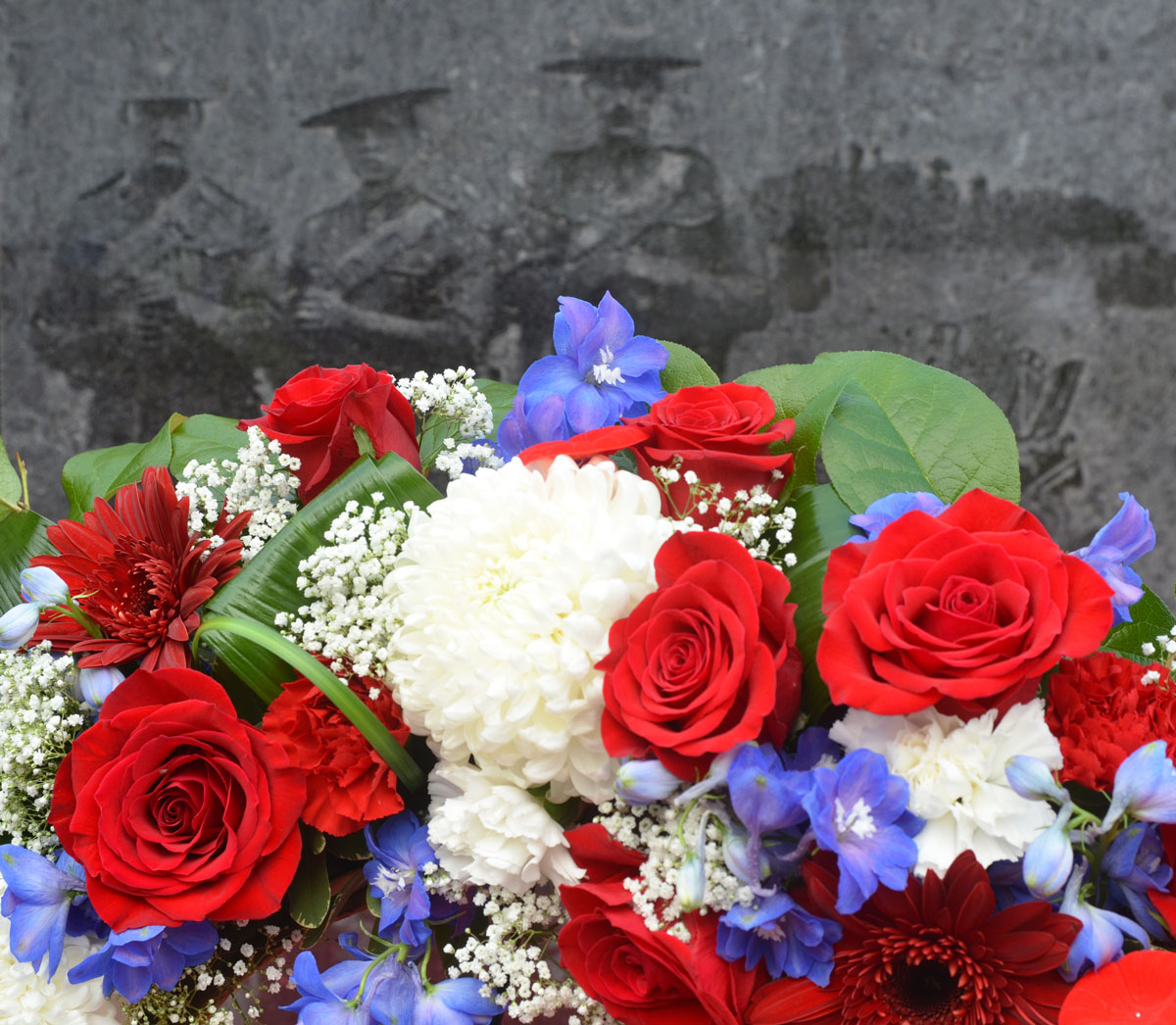
A bouquet of flowers, red roses, plus some white and blue flowers in front of a war memorial. An etching of three men in uniform, part of the memorial, is in the background.


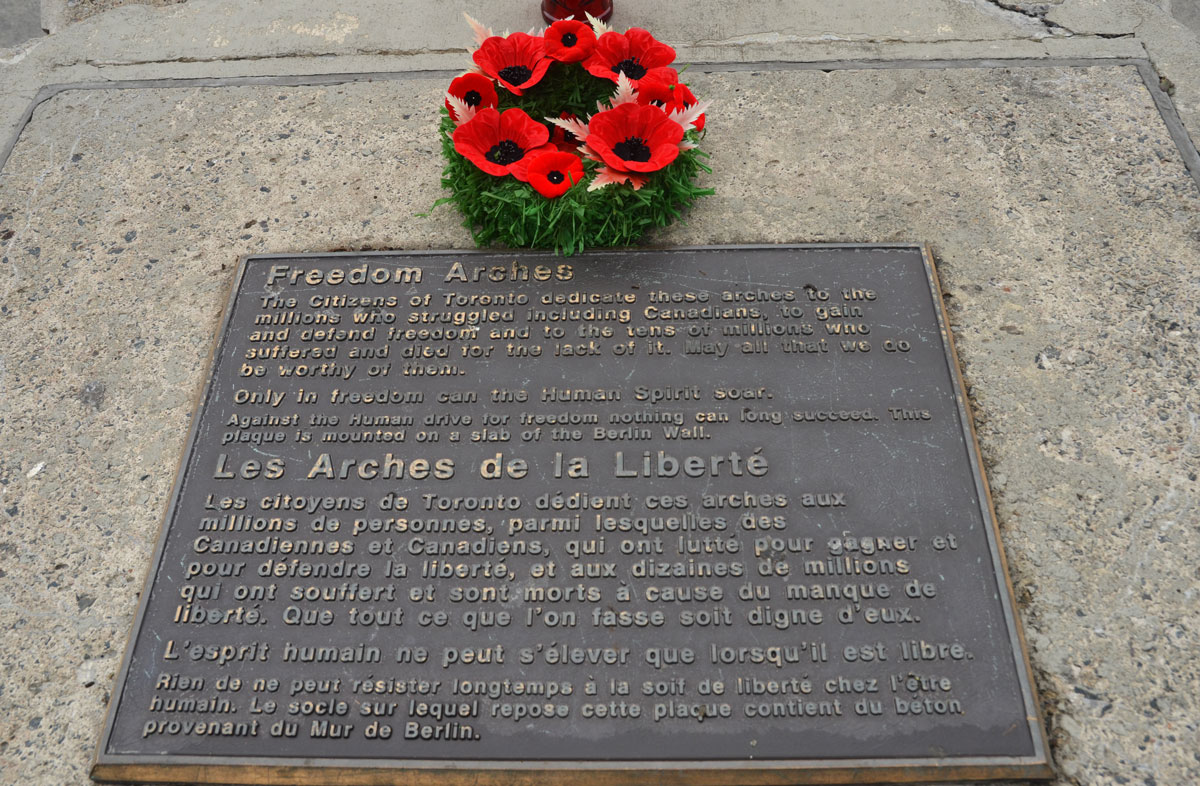
below: Although it is not a war memorial per se, someone left a small poppy wreath by this plaque at Nathan Phillips Square.  The plaque is by the arches over the pool, the freedom arches.
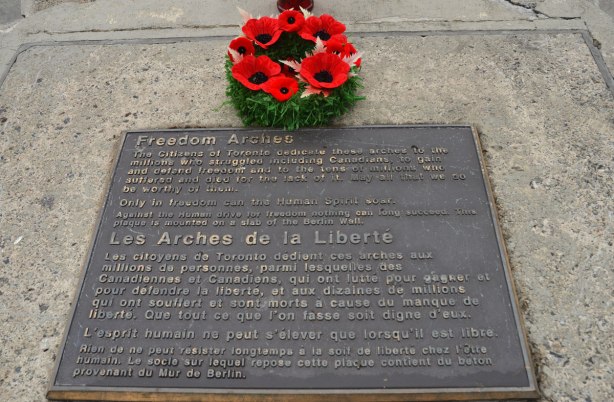
blog_poppies_freedom_arches

Transcription of the plaque: Freedom Arches. The citizens of Toronto dedicate these arches to the millions who struggled, including Canadians, to gain and defend freedom and to the tens of millions who suffered and died for the lack of it. May all that we do be worthy of them. Only in freedom can the Human Spirit soar. Against the Human drive for freedom nothing can long succeed. This plaque is mounted on a slab of the Berlin Wall.

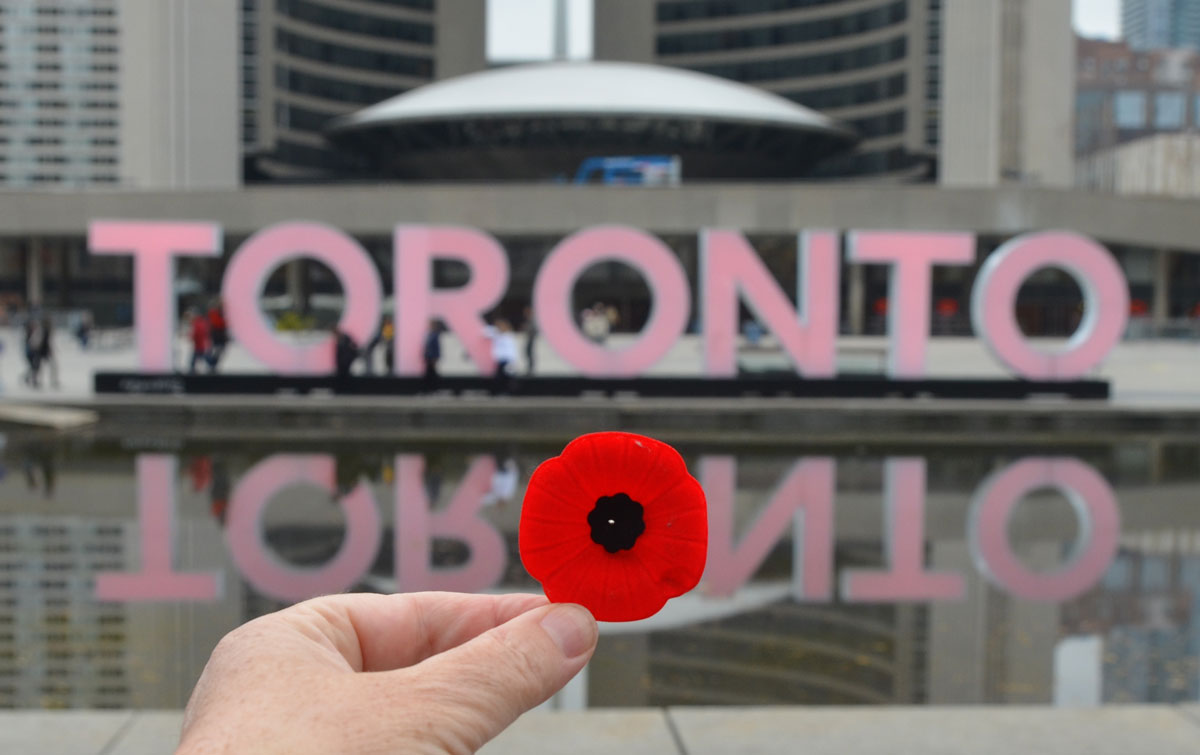
below: The 3D Toronto sign was red on Remembrance Day.

A remembrance day poppy is in the foreground. It is being held up in front of the 3D toronto sign which has been lit in red for Remembrance Day

We remember collectively as a nation, as a community. We also remember privately, as individuals, as families.  Countless small memorials can be found around Toronto including in schools, in churches and other religious institutions, and in cemeteries.

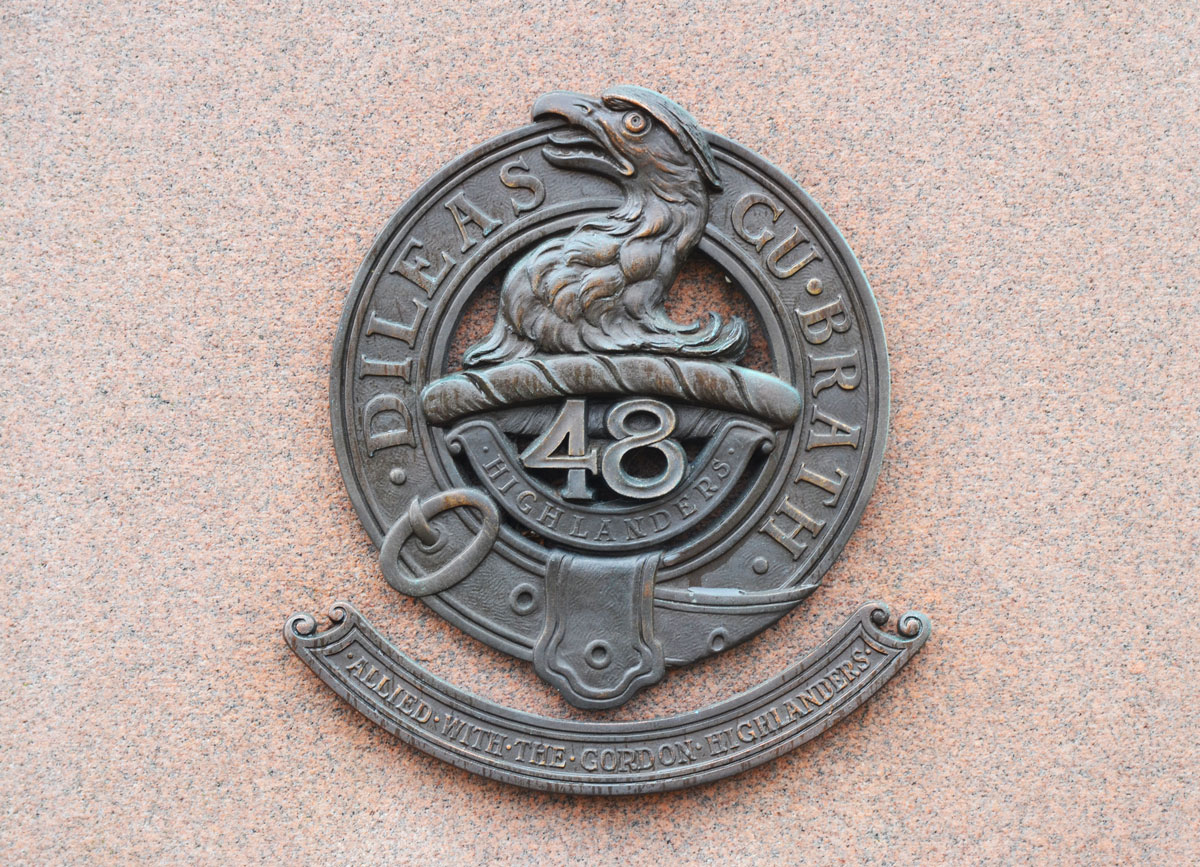
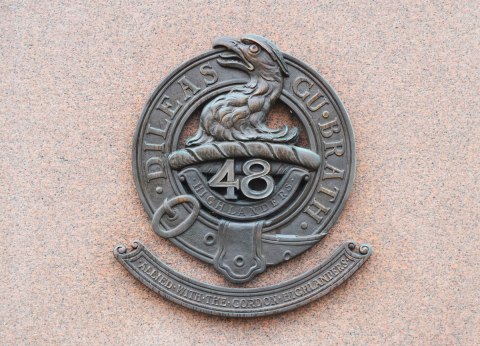
below: A memorial to the 48th Highlanders, Mount Pleasant cemetery.  In memory of the officers, non-commissioned officers, and men who have served with the 48th Highlanders.

Tall pinkish granite memorial to the 48th Highlanders in Mt Pleasant cemetery.

symbol, in metal, found on the memorial to the 48th Highlanders.

Dileas Gu Brath, their motto, is gaelic for ‘faithful forever’

below:  Quiet memorials

poppy wreath beside a tombstone in a cemetery

A small Canadian flag with two poppies pinned to it. The flag is inserted into the ground in front of a tombstone in a cemetery. The stone is a veterans stone, with air force insignia at the top and a cross at the bottom. In the middle is the information for the pilot who died during the war.


(1) source: Patrick Cain, Global News

‘In-Between Worlds’ is a series of photographs by Canadian photographer Meryl McMaster.   This series centres around the role of McMaster’s dual heritage in her search for self;  The images represent her being part of, and also being between, two different cultures as she is part Cree and part ‘European’.

Three of the images are on display at Ontario Square by Queens Quay West and Lower Simcoe St.

below: Horse Dance.  The bright red and blue of the shaggy hobby horses against a winter landscape makes for an eye catching picture.  On closer look, you realize that there is a person’s head inside one of those horses’s head.  Heads that have no eyes to see or mouths to speak.

A large photograph of three red hobby horses with long blue mane, taken outside in the winter in the snow, with bare trees in the background. A mix of the real (outdoors) and the unreal (hobby horses instead of real horses). Photo is Mounted on a concrete wall outside.

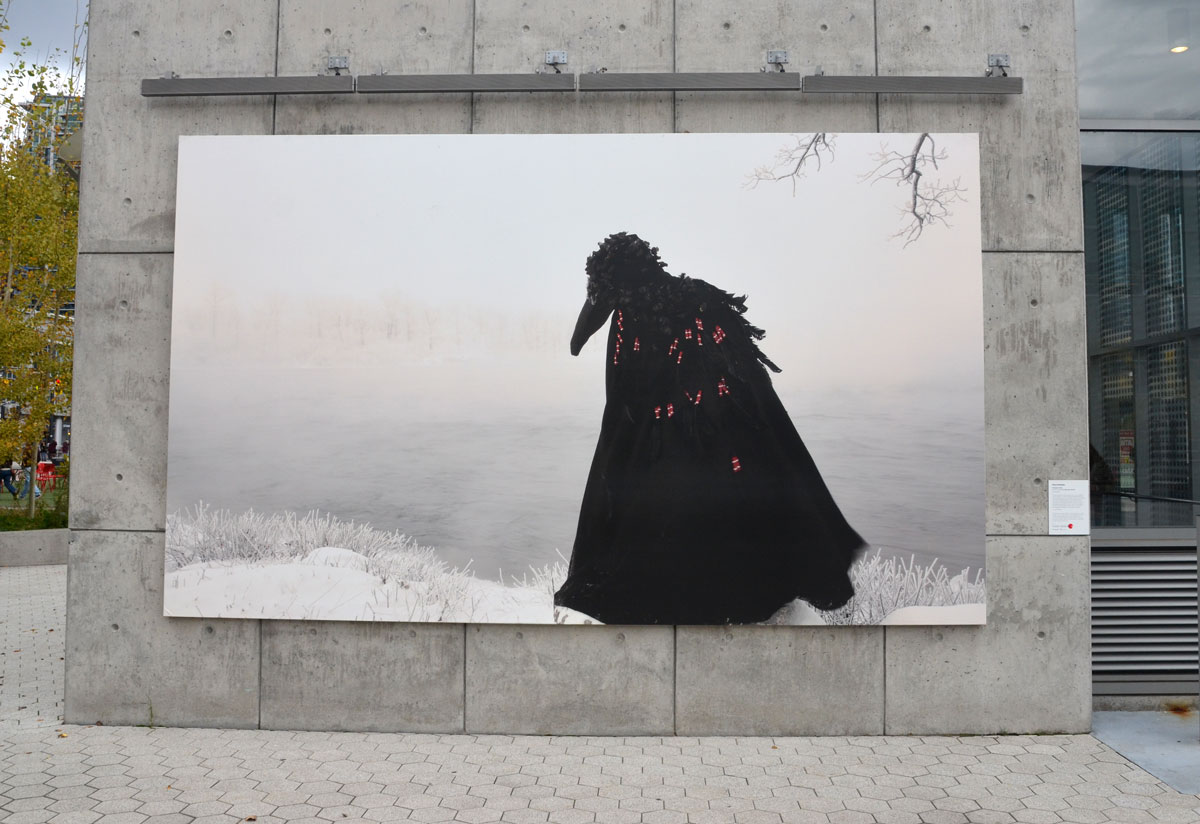
below: Wingeds Calling.  Around the corner there is another picture of a person in costume, playing the role of a real, yet not real, animal.  A large black bird-like figure walks on the frozen ground, perhaps too big and awkward to fly.

A photograph Mounted on a concrete wall outside of a person draped in a large black cape and wearing a head piece that looks like a large black bird. Photo taken outside in winter so the background is all white and grey like a foggy winter day.,

below: Wind Play Variation.  The third picture baffles me a bit.  Although this is another picture of a person assuming a role,  this time the creature is totally of the artist’s imagination.  A blue hairy thing that is slightly blurry as it walks amongst the pine trees.   Is it coming or going?

Photo of a blue furry creature taken in winter with snow covered evergreens in the background. Mounted on a concrete wall outside.

There’s a new mural being painted.  It’s not quite finished

looking down a sidewalk. A wall on the left has been painted with gold orange and brown pyramids, a lift is in the middle of the sidewalk, a busy street, Lawrence Ave, is to the right.

but it is looking impressive!

view of a mural that runs beside a sidewalk, taken from across the street

It is the work of Essenciartcollective, namely brunosmoky, shalakattack and fiyabruxa.

It started to rain quite heavily while I was there so I didn’t linger.
I’ll return soon – and by then it should be finished!  A few photos in the meantime:

part of a larger mural on an underpass in Toronto, on Lawrence West, two woman's faces in green, eyes closed, heads slightly uplifted. long green grass around them, some orange and blue plants that look like water lily pads seen from below.

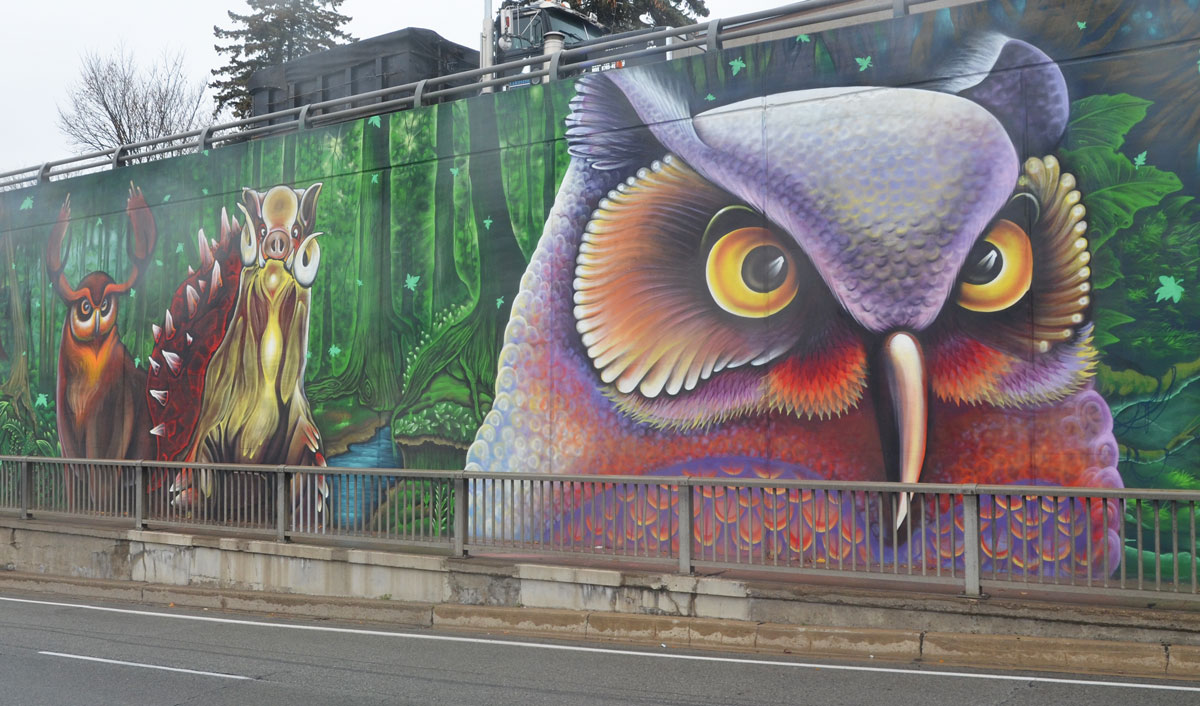
part of a larger mural on an underpass in Toronto, on Lawrence West, a large owl in purples and reds with a yellow eyes. He dominated the picture. There is also a warthog and an elk (reindeer?) behind him
Parts of the mural are very apocalyptic

part of a larger mural on an underpass in Toronto, on Lawrence West, an apocalyptic view of Toronto with the CN Tower and downtown skyscrapers crumbling in a lifeless city

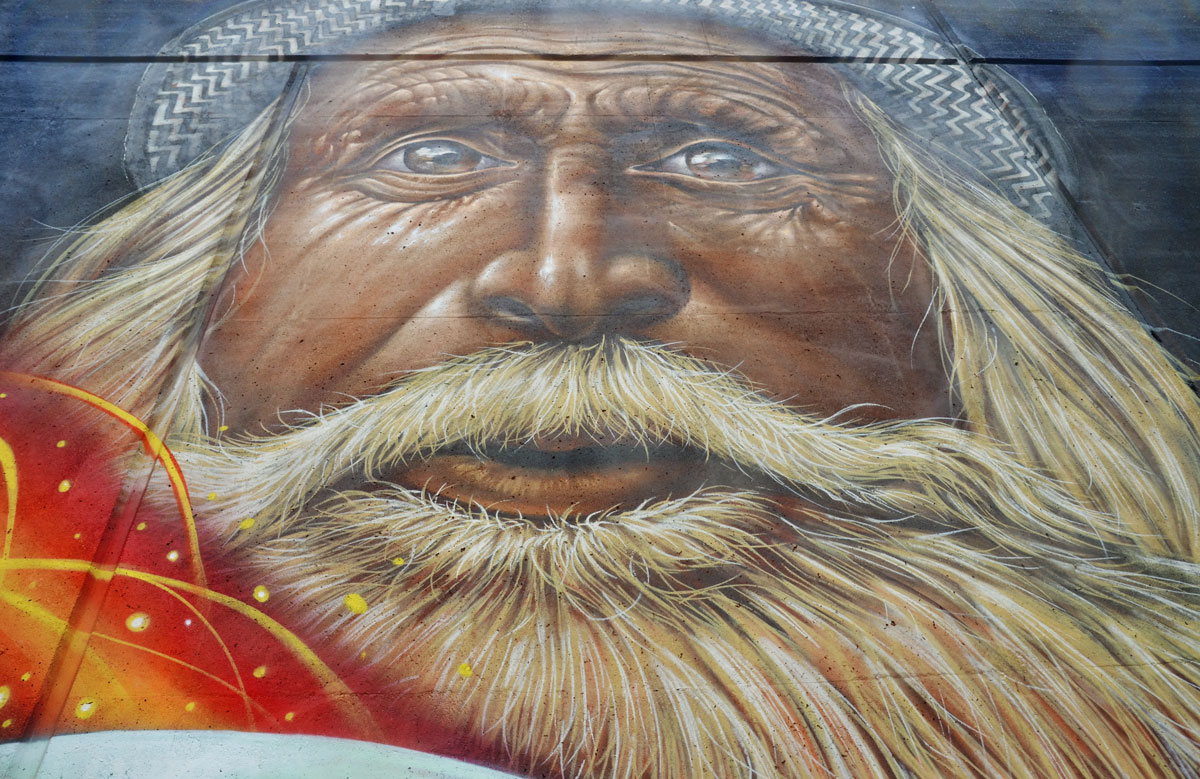
part of a larger mural on an underpass in Toronto, on Lawrence West, a close up of an old bearded man's face.

Pictures of the completed mural are now available!

Invention, an installation at The Power Plant gallery, by Mark Lewis.

The main part of the exhibit consists of 3 short films shot in Toronto.
When I first saw it, I thought that the films were older, perhaps from the 60s or 70s.

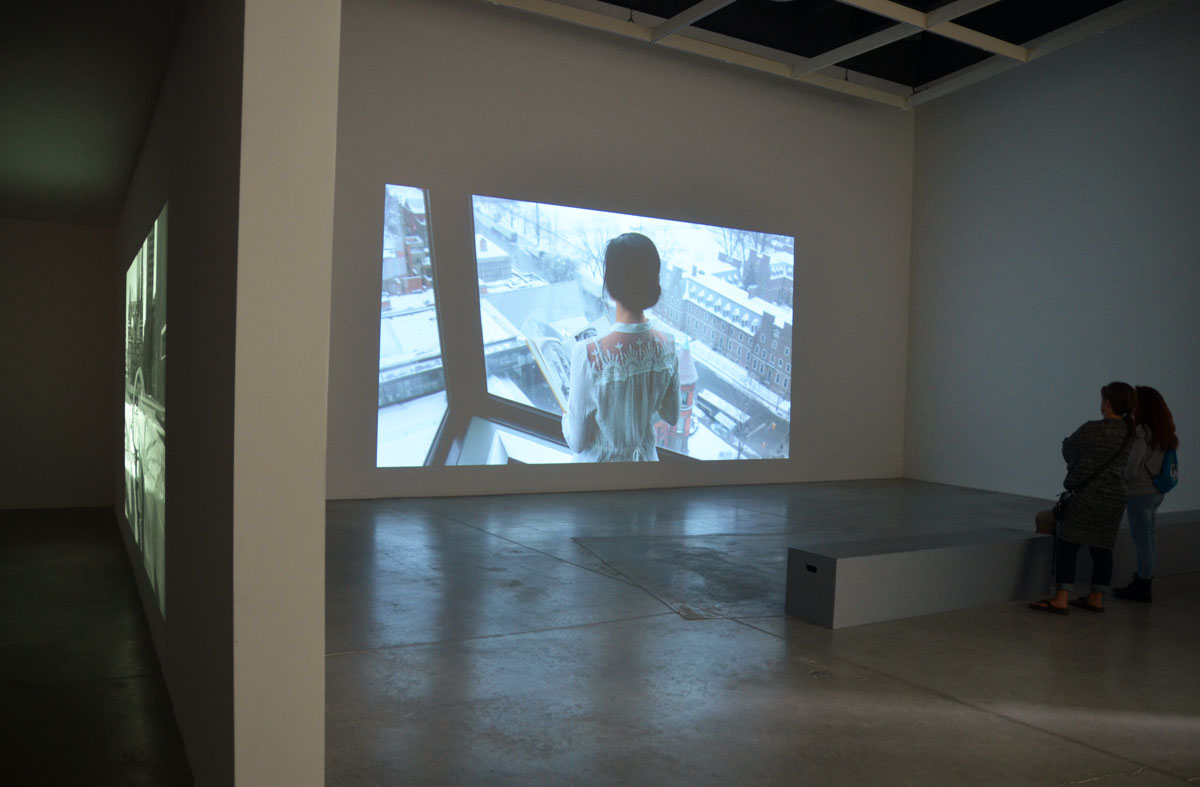
below:  A short film begins with a pan over part of downtown Toronto.  It circles back to the Robarts Library and focuses on a woman standing in the window of one of the upper floors.  After zooming in on the woman, the film “enters” the room she’s in and turns back to focus on what her view out the window looks like.

Two women are standing in the semi darkness in a room in an art gallery, watching a black and white film that is showing on a large screen in front of them. The image on the screen is the back of the upper part of a woman as she stands in front of a window in the Robarts Library in Toronto. The scene outside the window is clearly visible, winter time, University of Torotno campus. She is holding a book in her hands.

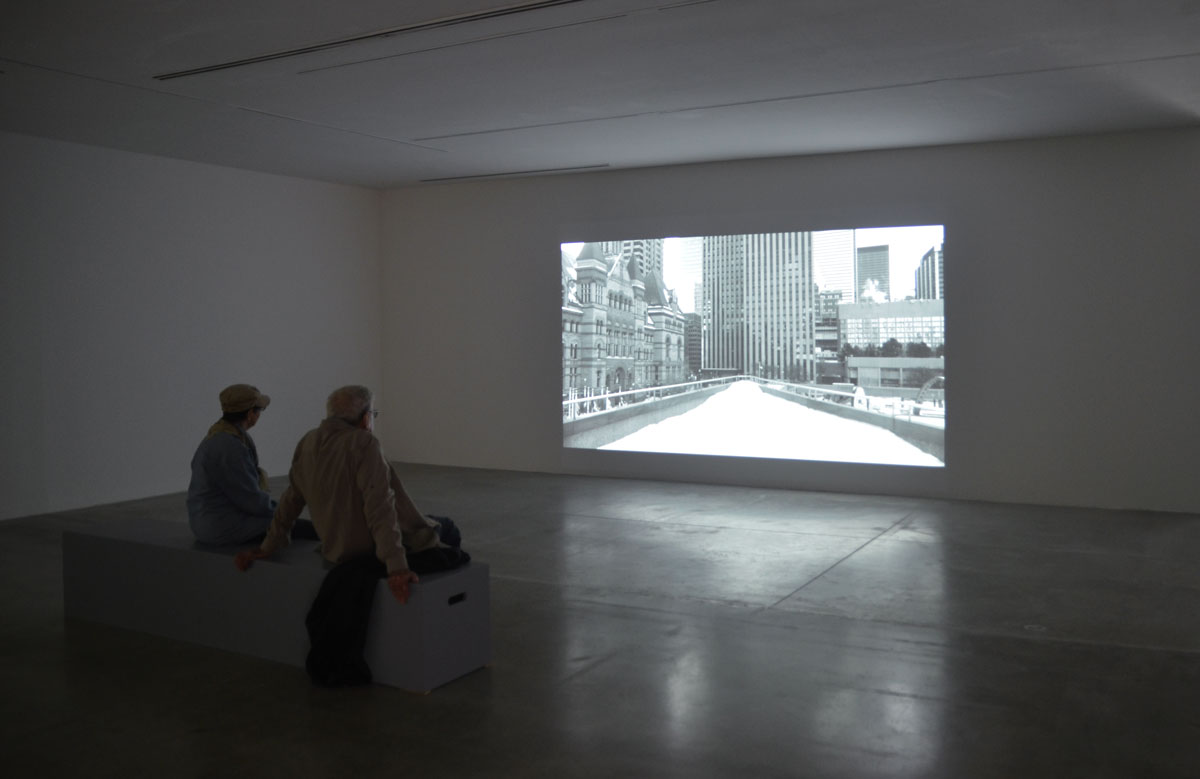
below:  Another exhibit is a film comprised of segments filmed at a number of locations around City Hall this past winter.   The image below is shot from the upper ramp at Nathan Phillips Square, looking south.   Old City hall is on the left.   There are no people in the picture.  There are also no commercial images such as billboards or signs on the buildings.  Slow moving, quiet.

An older couple are sitting on a bench at an art gallery. They are watching a black and white film that is showing on a large screen in front of them. The image on the screen is a shot of the upper ramp at Nathan Phillips Square, looking south, in the winter with snow on the ground. There are no people in the picture on the screen.

It wasn’t until I looked more closely at the images that I realized that the films had to have been made recently… for example, the recently built stage area in Nathan Phillips Square.  So I watched the films again looking for details.

One of the images shown in an art installation on a large wall screen, a black and white picture overlooking Nathan Phillips Square in the winter.

A little perplexed, I tried to find out why Lewis made these films, and why they were considered to be “art”. It wasn’t easy; it was probably made more difficult by my love/hate relationship with contemporary art.  The title of this post comes from a paragraph I found on The Power Plant website description of this installation: “Together, the elements that make up Mark Lewis’ films culminate in a body of work that is as astute as it is elegiac in its contemplation of the quotidian, offering an experience of the flux of time that is as elating in its duration as it is haunting for its sense of passing.”  Well, um, okay.

It also wasn’t easy because of the scope of the questions that Lewis seems to be tackling.  One of his interest lies in discovering what it might have felt like when film revolutionized they way we looked at ourselves and at the world around us.   That’s a tough one.  We are a society that is immersed in moving images of all kinds. Movies and TV have been part of our lives for many generations.  Can anyone truly imagine what it might have been like to see a film for the first time?

As we all know, digital technology has put video production into the hands of anyone with a cellphone.   Even my three year old granddaughter asks me to make videos of her and I’m sure it won’t be long before she’s producing them.  And that leads to another question that Lewis is interested in examining – what are the implications of these technological changes?  Not only can see video, we can be in control of making our own whenever we want.

But that’s not all.  Lewis is also interested in architectural surfaces so walls, windows, pavements and reflective glass amongst others play a role in his films.   Urban architecture; urban landscapes.  Cinema made of the ordinary everyday life of living in the city and everyday life in the city is cinema.  24/7 movie making.  You are part of the cast; you are the camera.

What I have presented here are just three pictures and I’m not sure the pictures do the films justice.   If you want to see these films, they are at The Power Plant gallery until 3 Jan 2016.

#PPInvention

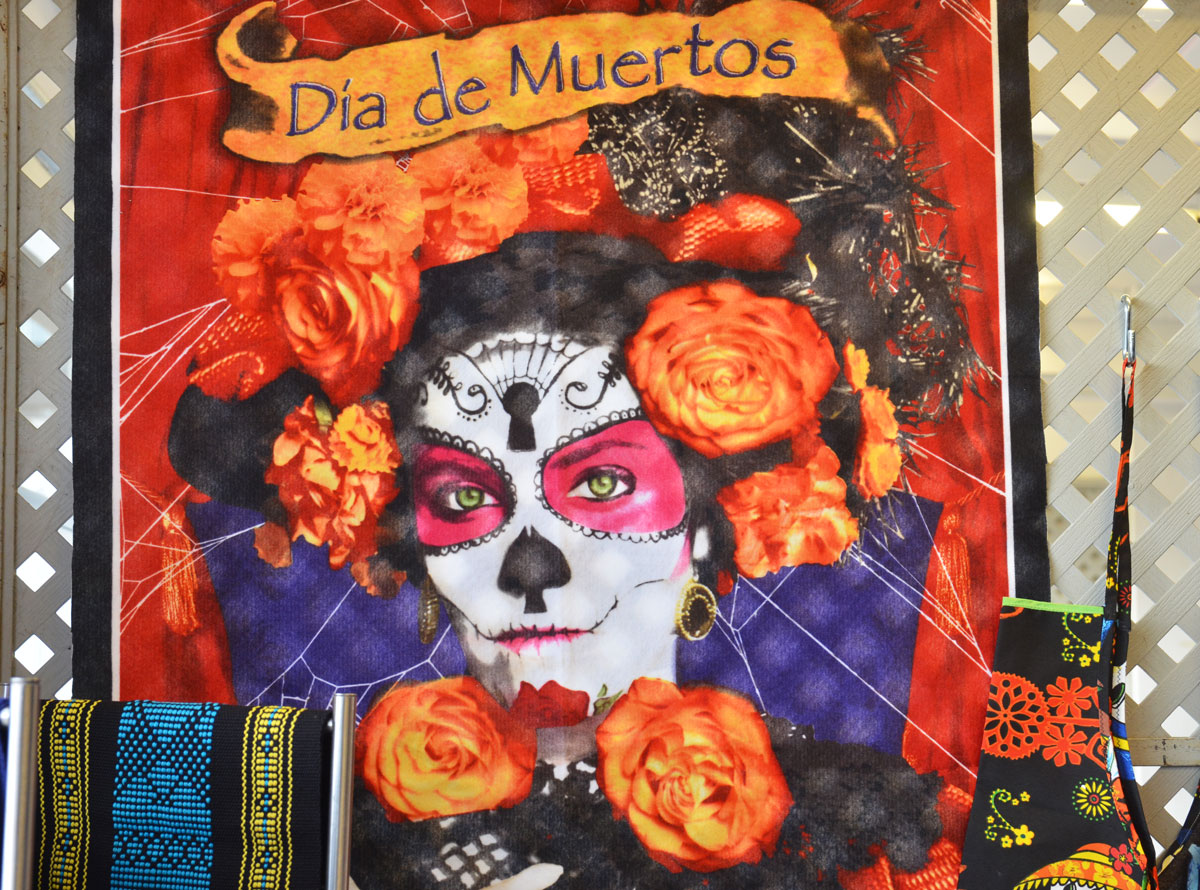
Dia de Muertos, Day of the Dead, is a Mexican holiday where and friends come together to pray for and remember friends and family members who have died.  It occurs at the end of October (31 Oct to 2 Nov).  Here in Toronto there was a Day of the Dead festival at Harbourfront this past weekend.

fabric hanging on a wall. There is a picture on the fabric of a woman's face painted white to look like a skull but with pink around the eys. Many orange roses surround her face

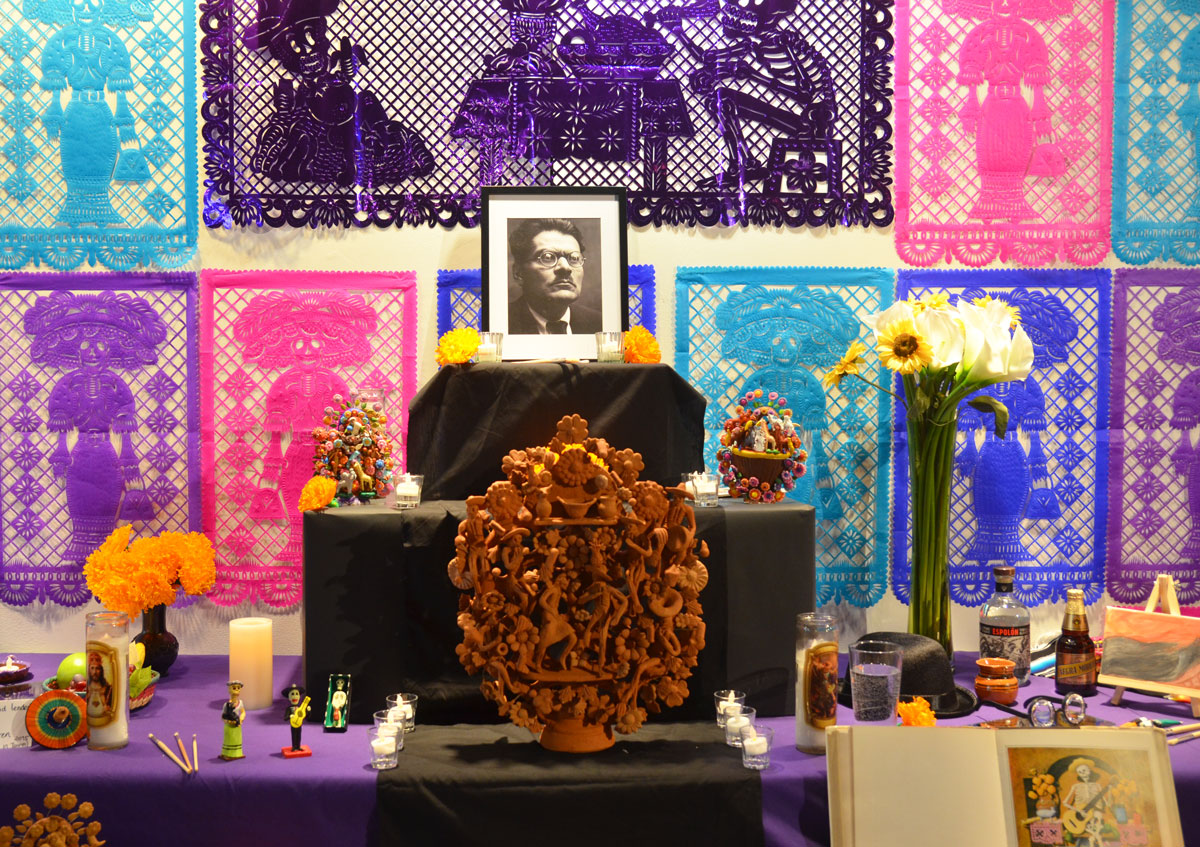
One of the traditions of Dia de Muertos is the making of ofrendas which are altars dedicated to the deceased person.  Jose Clemente Orozco was a Mexican painter (1883-1949).  He specialized in painting murals in frescoes and his work can be seen in Mexico and in the USA.

elaborate and colourful ofrenda with purple, blue and pink paper cut outs on the wall behind.
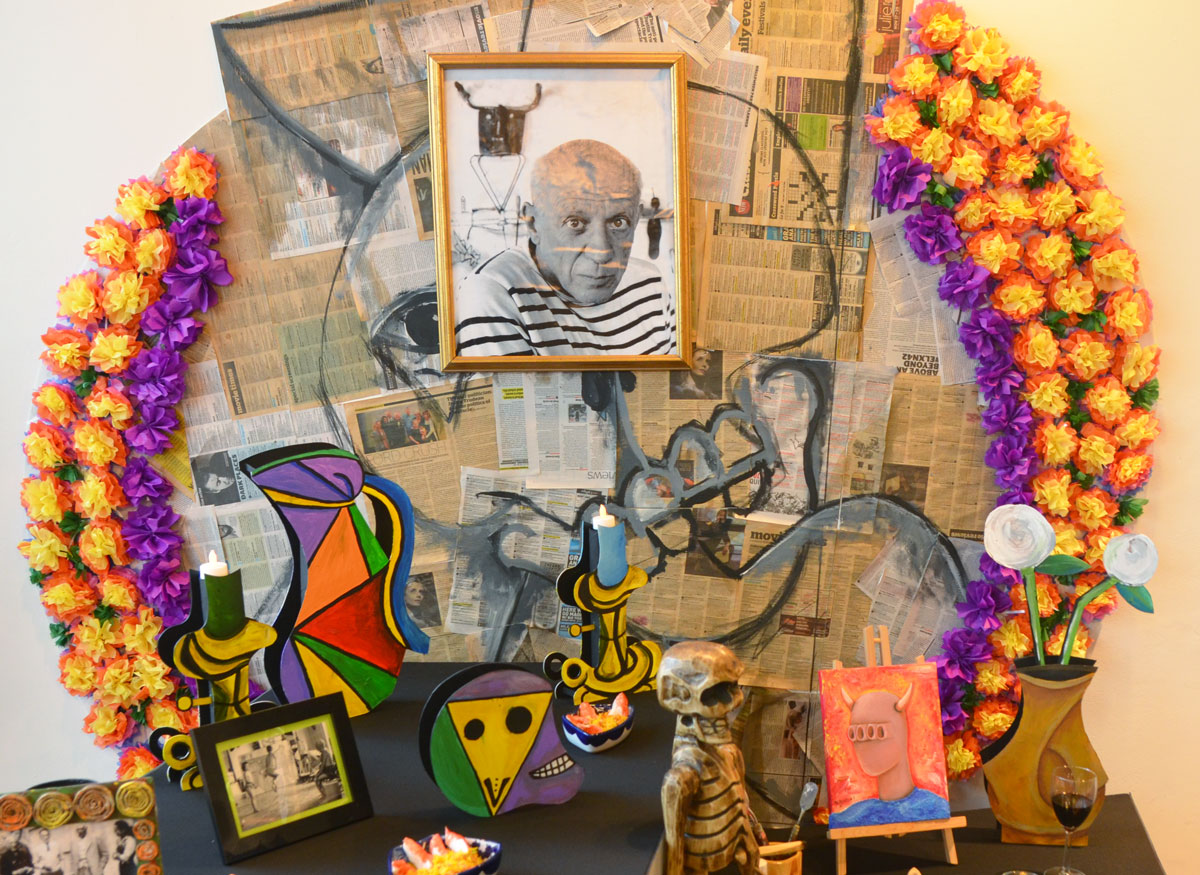
Another altar that was on display was one made by artist Alberto Cruz in honour of Pablo Picasso.

An ofrenda, or altar, in the memory of Pablo Picasso at a day of the dead festival. There is a photo of him surrounded by different objects and symbols representing his life and things that he did

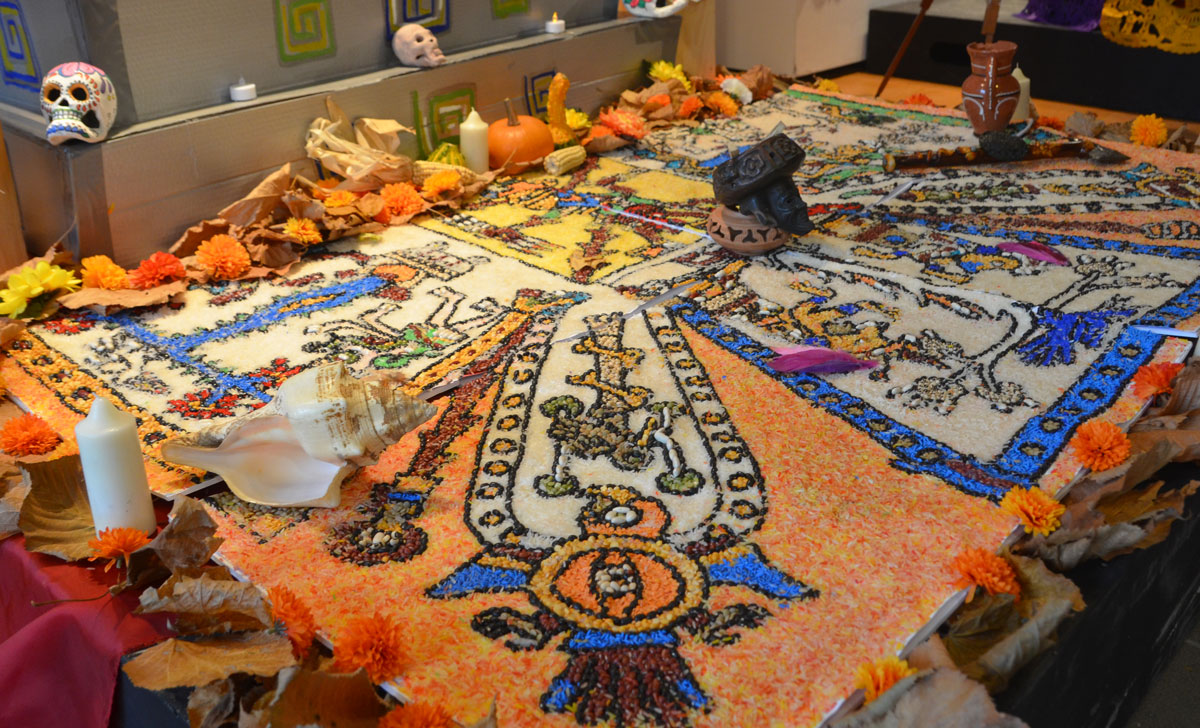
The Casa Cultura Mexicana made an ofrenda to honour the Prehispanic indigenous people and warriors of Mexico.
The bottom part consisted of pictures made with coloured rice.

pictures made of coloured rice on an ofrenda dedicated to the indigenous people of Mexico

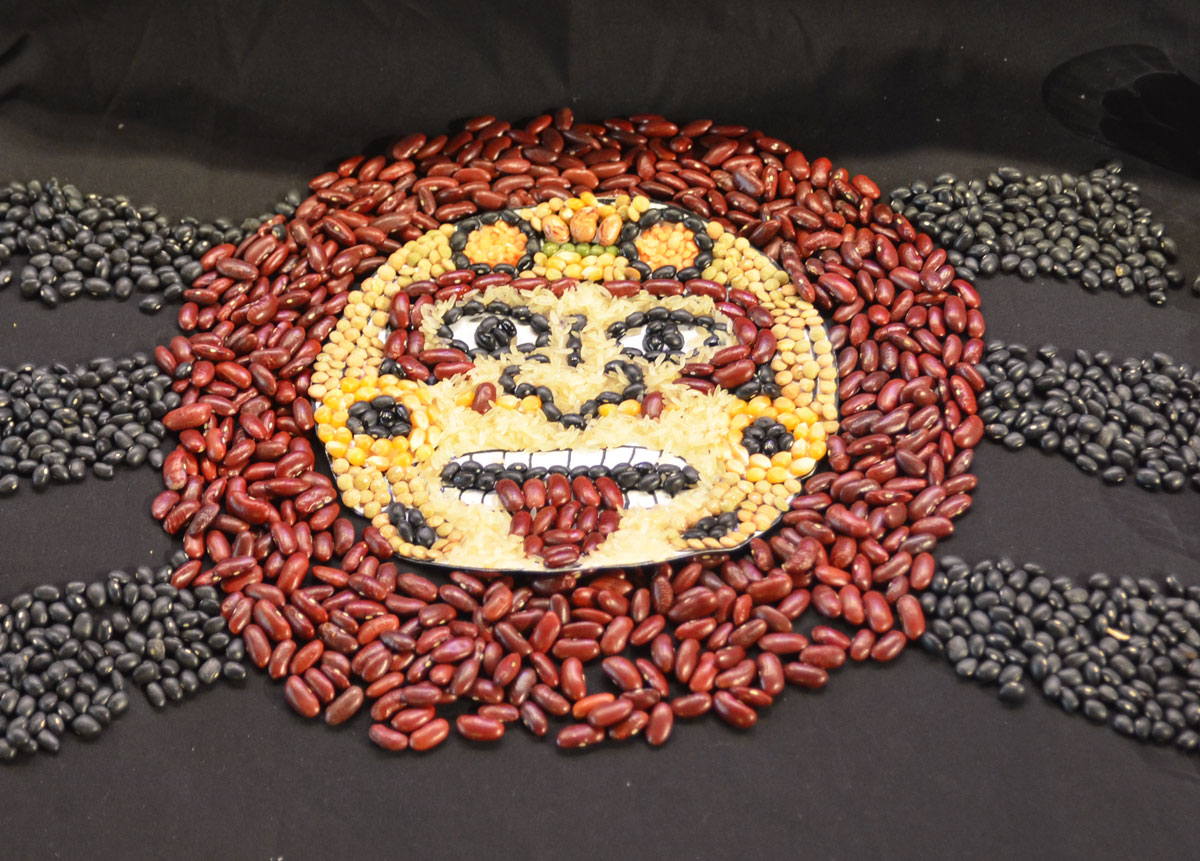
Food items such as rice, beans, and corns were an important part of the ofrenda.

a face shape made of dried beans and corn. red beans make a circle around the face, black beans make 6 rays coming out from the circle. The face is corn with bean features.

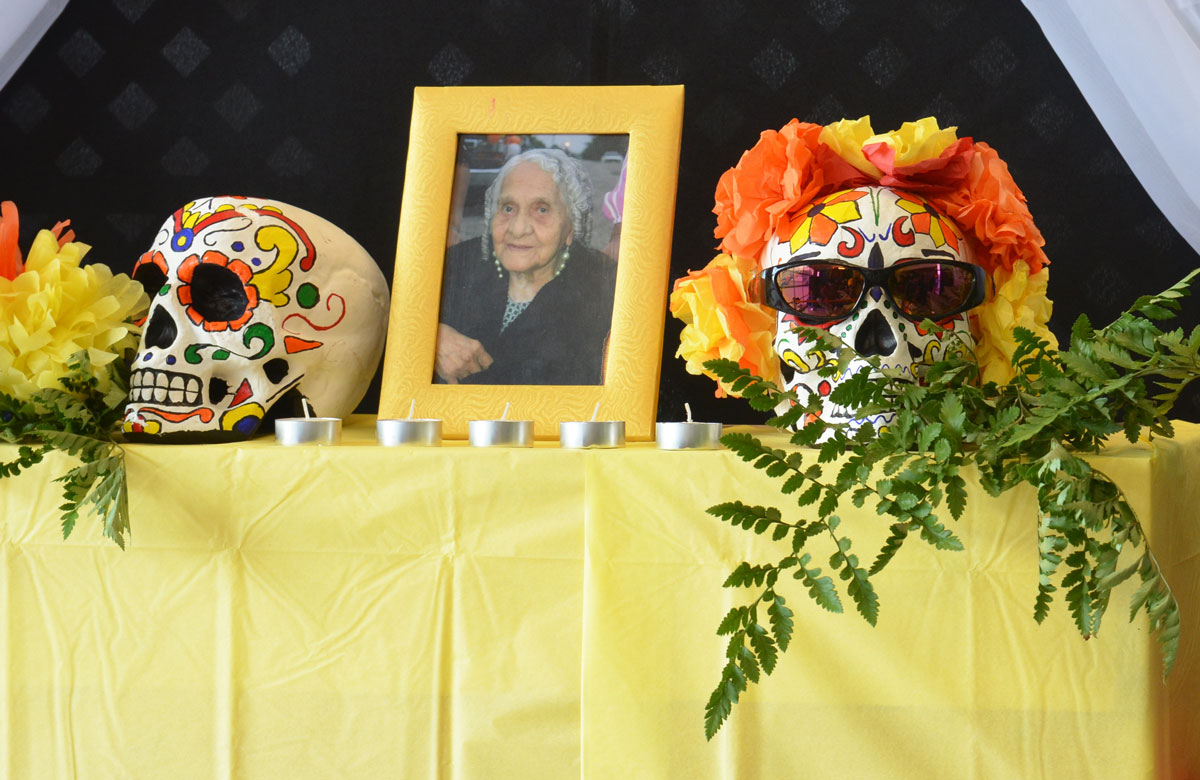
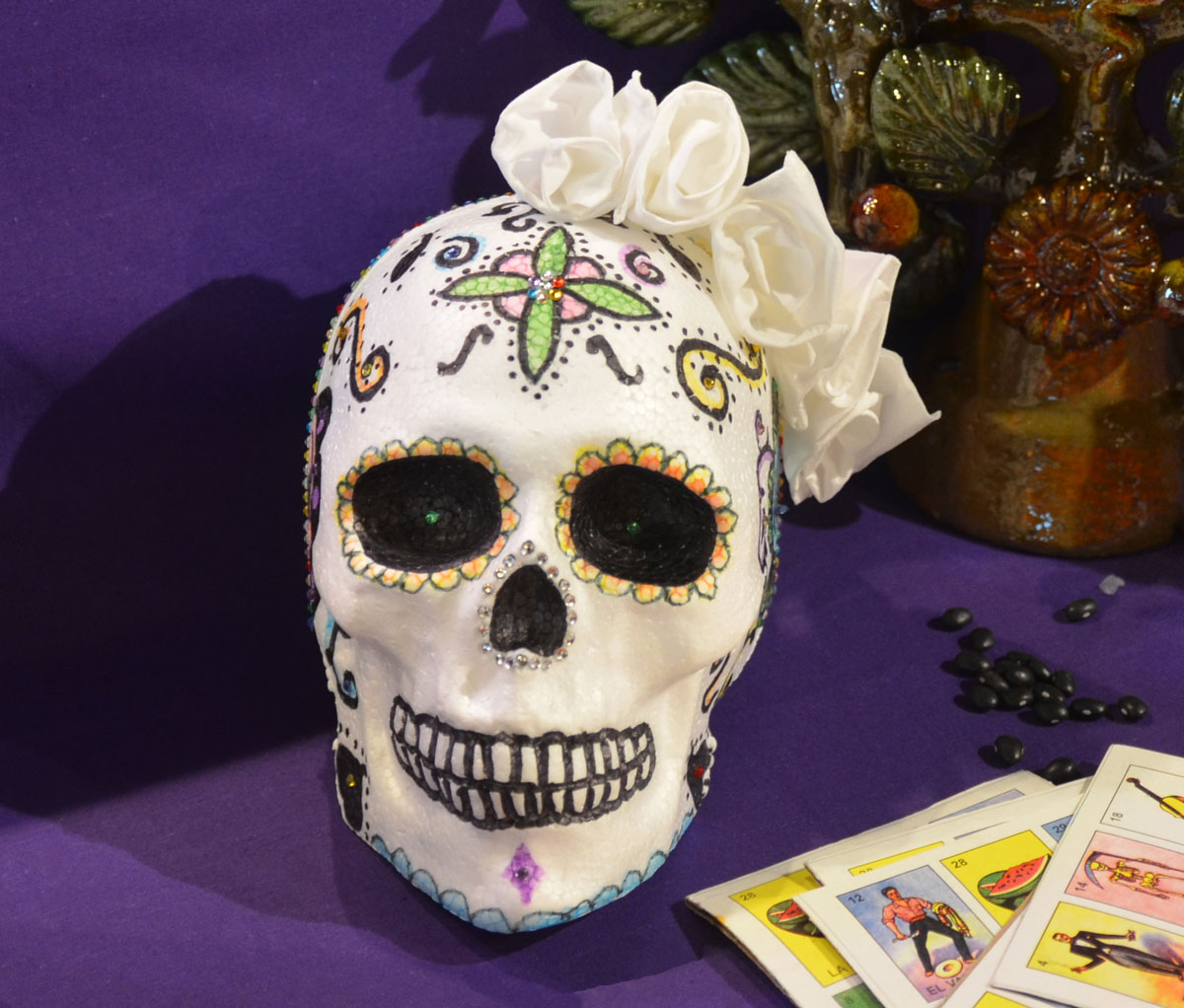
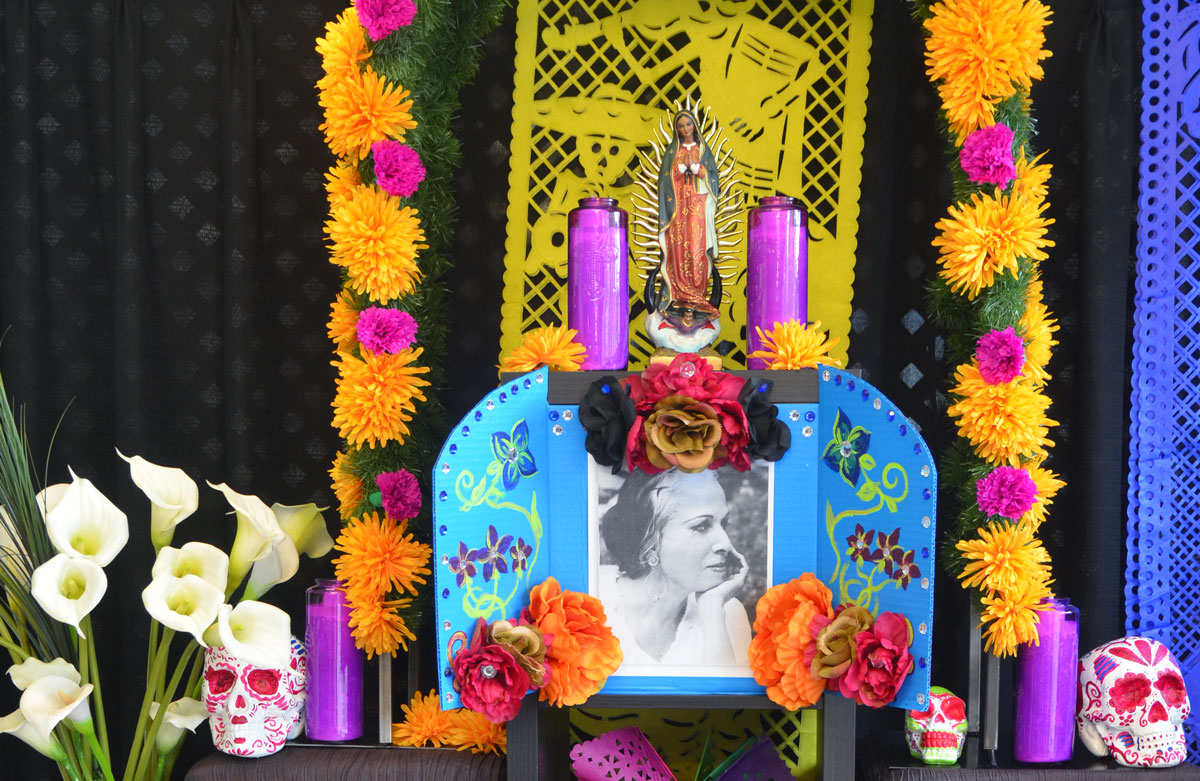
Ofrendas are decorated with sugar skulls and marigolds (or yellow and orange paper flowers) as well as candles, photos, momentos from the person’s life, and things that symbolize something about that person.  Sometimes serious, sometimes whimsical.

an ofrenda with a picture of a woman in a frame sitting on a table. One each side of her is an elaborately decorated skull. One of the skulls is wearing sunglasses and a wreath of yellow and orange flowers around the top of its head.

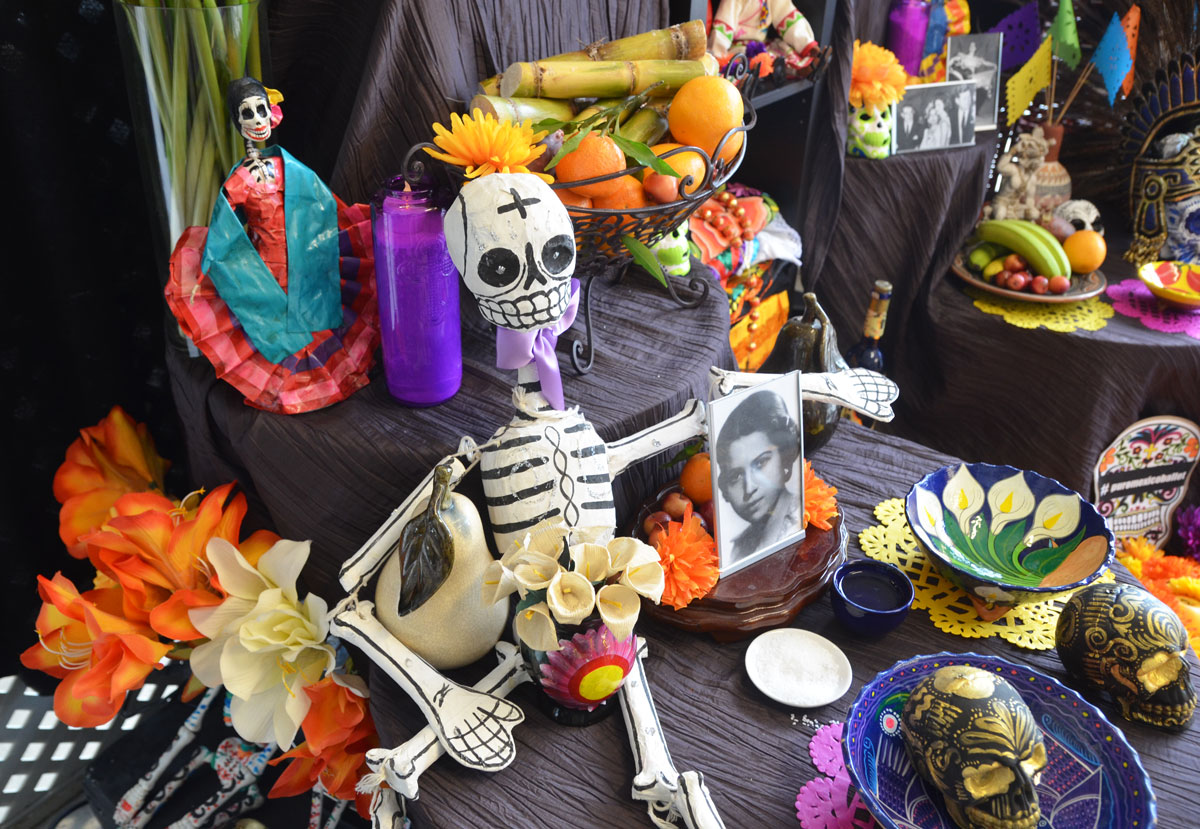
What would your friends and family put on an ofrenda in your memory?

objects on an ofrenda at a day of the dead celebration, decorated skulls, a small skeleton, some old photos of people, flowers, fruit,

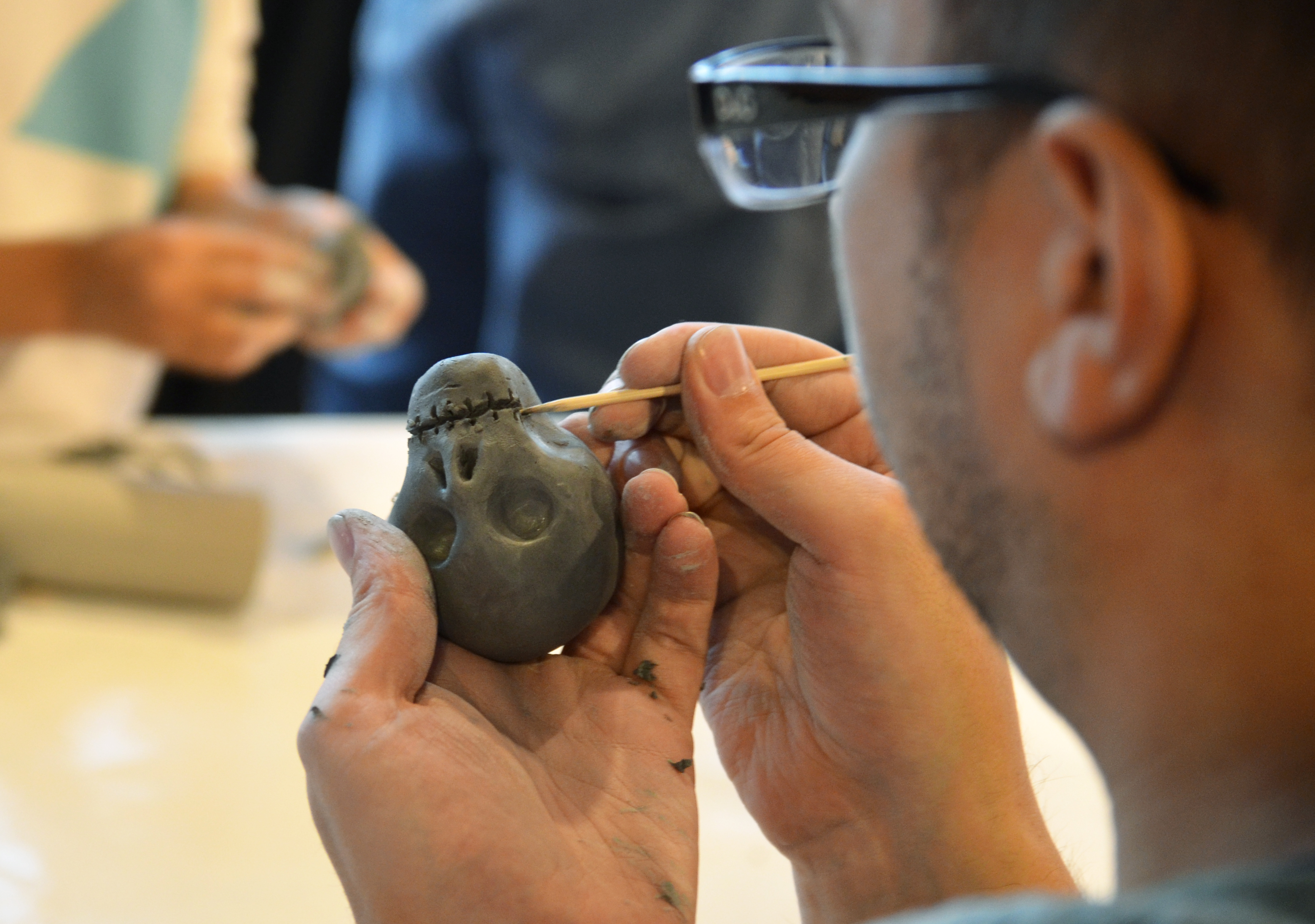
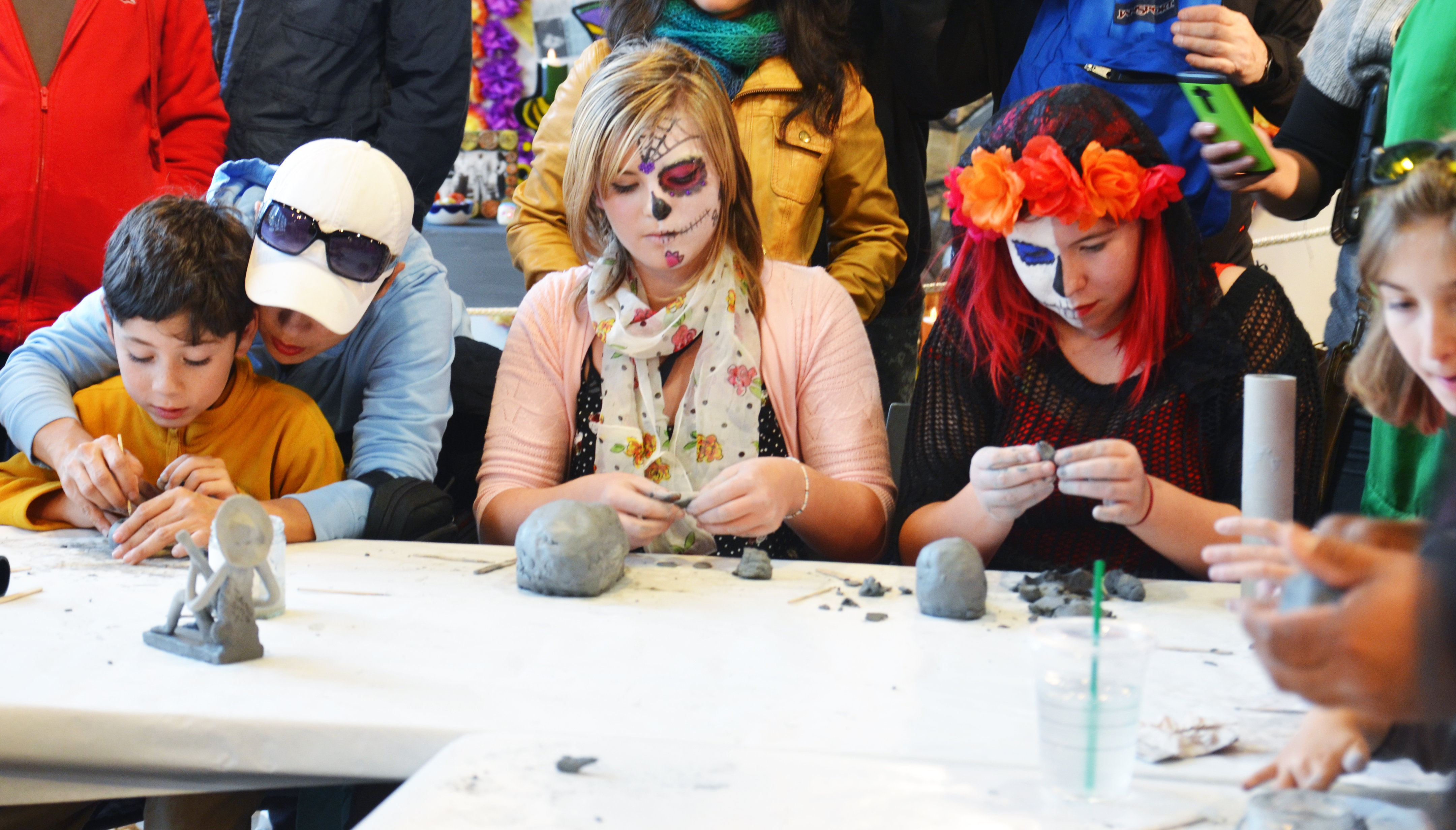
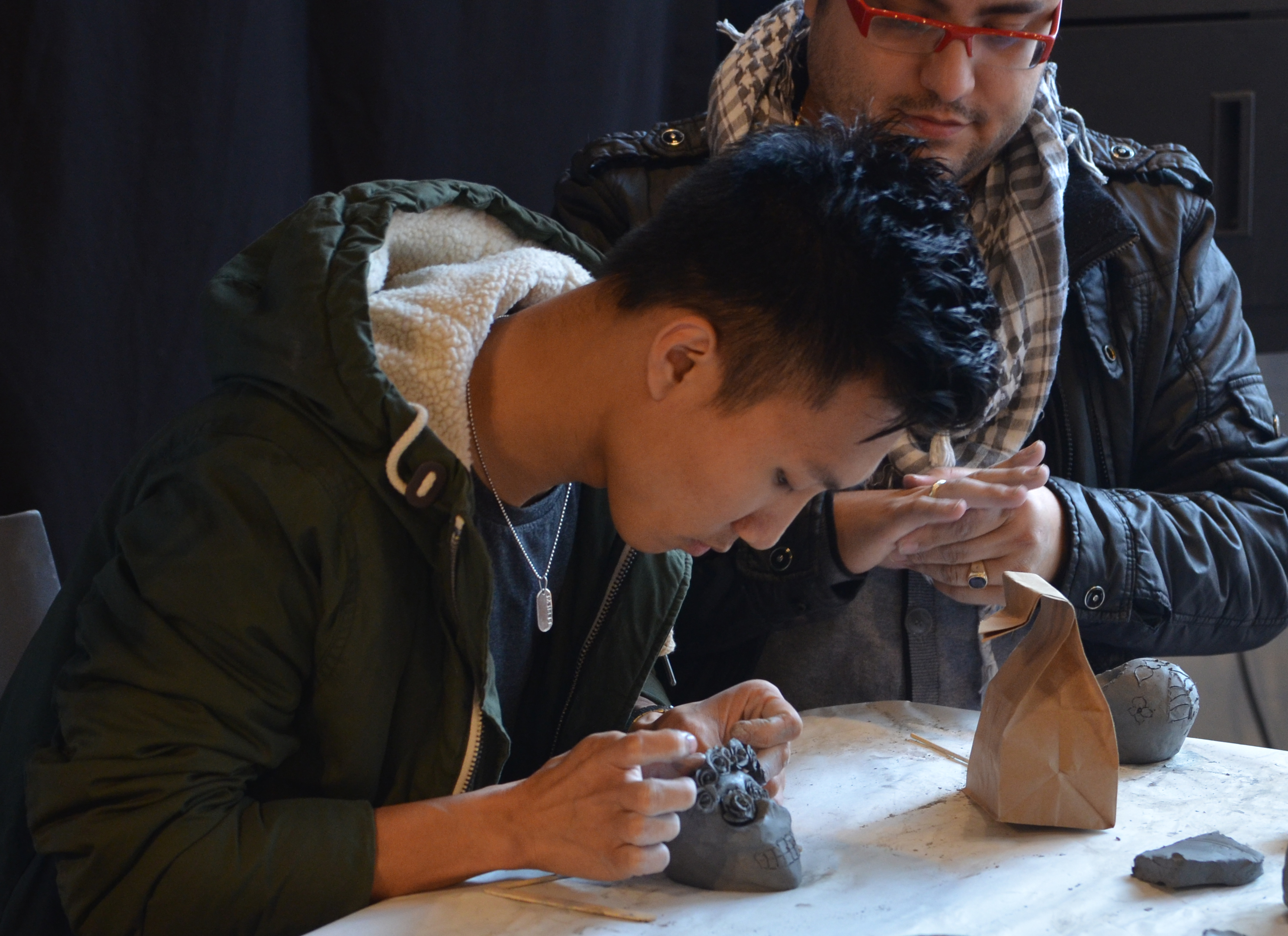
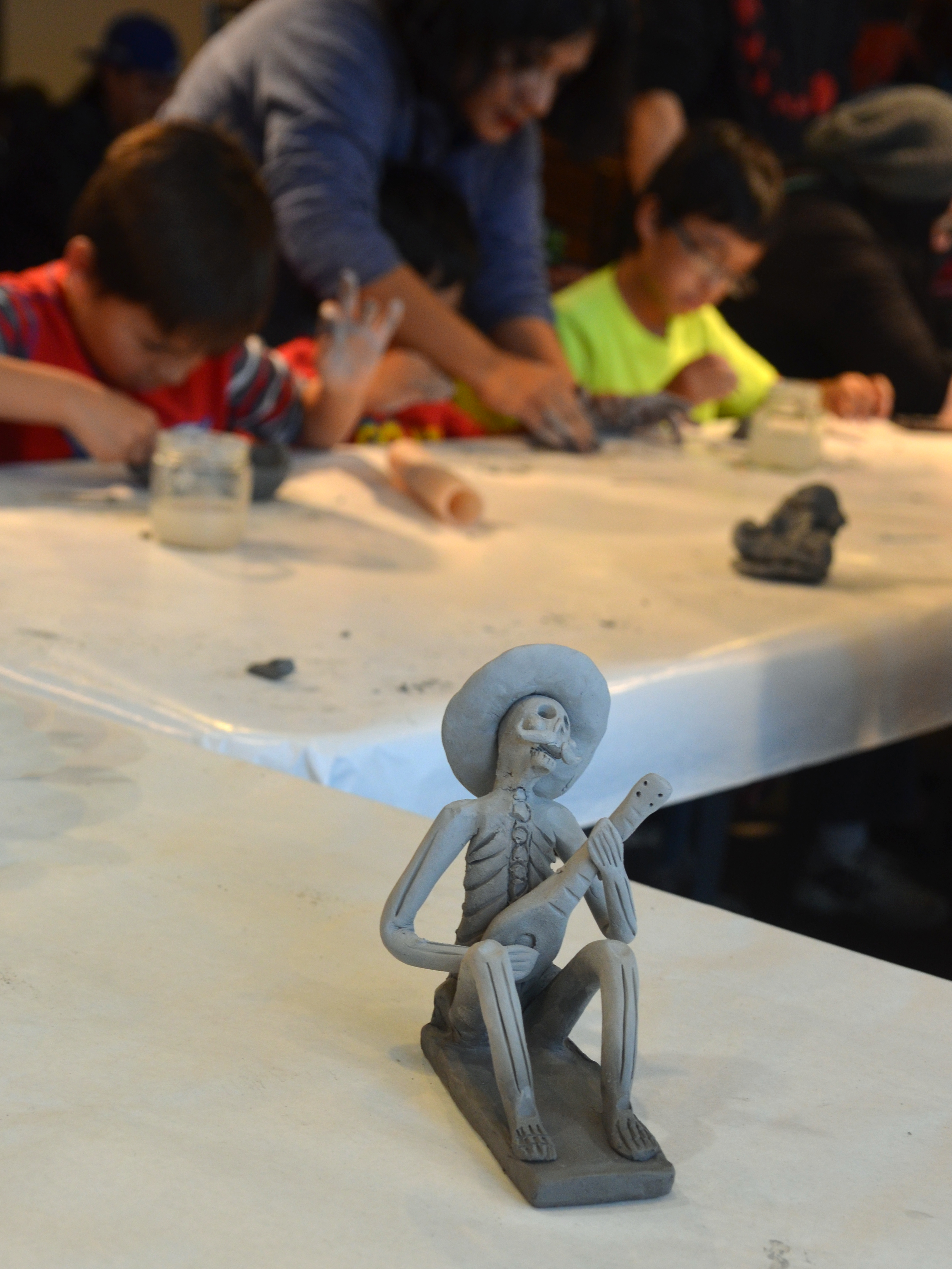
There was also clay available if you wanted to make a small skull or other symbol for the occasion.

close up picture of a man putting details on a small clay skull with a toothpick

Two girls with day of the dead face paint on are making clay skulls. A young boy is also at the table making a skull, his mother is helping him.

A young man carefully adds tiny clay roses to a clay skull that he has made.

A small figurine made of a clay of a skeleton wearing a sombraro and playing a guitar is in the foreground, kids making clay skulls at a table are in the background.

skull painted white and then decorated with black, green, red and white

Rest in Peace.

ofrenda, altar, day of the dead celebration, woman's picture along with Virgin Mary candles and other pink cnadles, lots of orange flowers too

There is a new collection of street art in Little India.  It can be found if you go behind the stores on the south side of Gerrard Street between Rhodes Avenue and Craven Road.  The art is easily seen because there is not only an alley behind the stores but also a parking lot.

back of a row of stores and restaurants viewed across an empty parking lot. The lower storey of the exterior walls are covered with street art and murals.

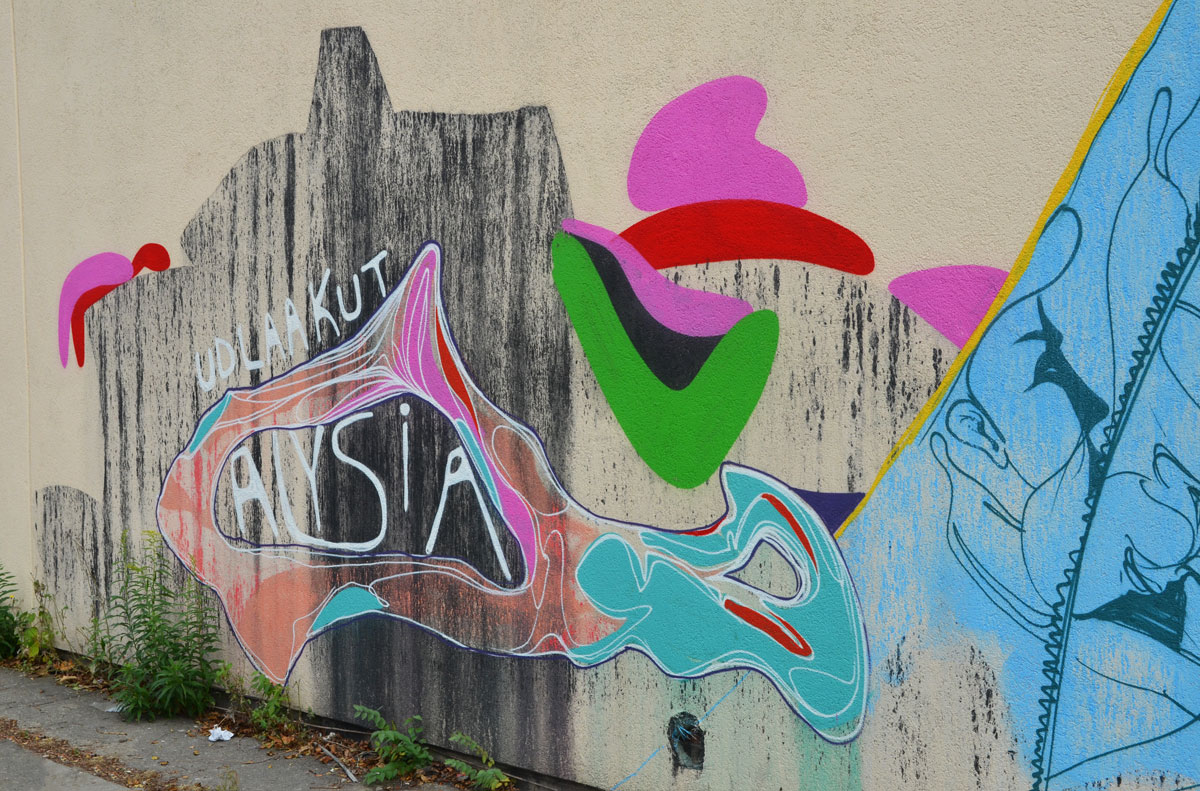
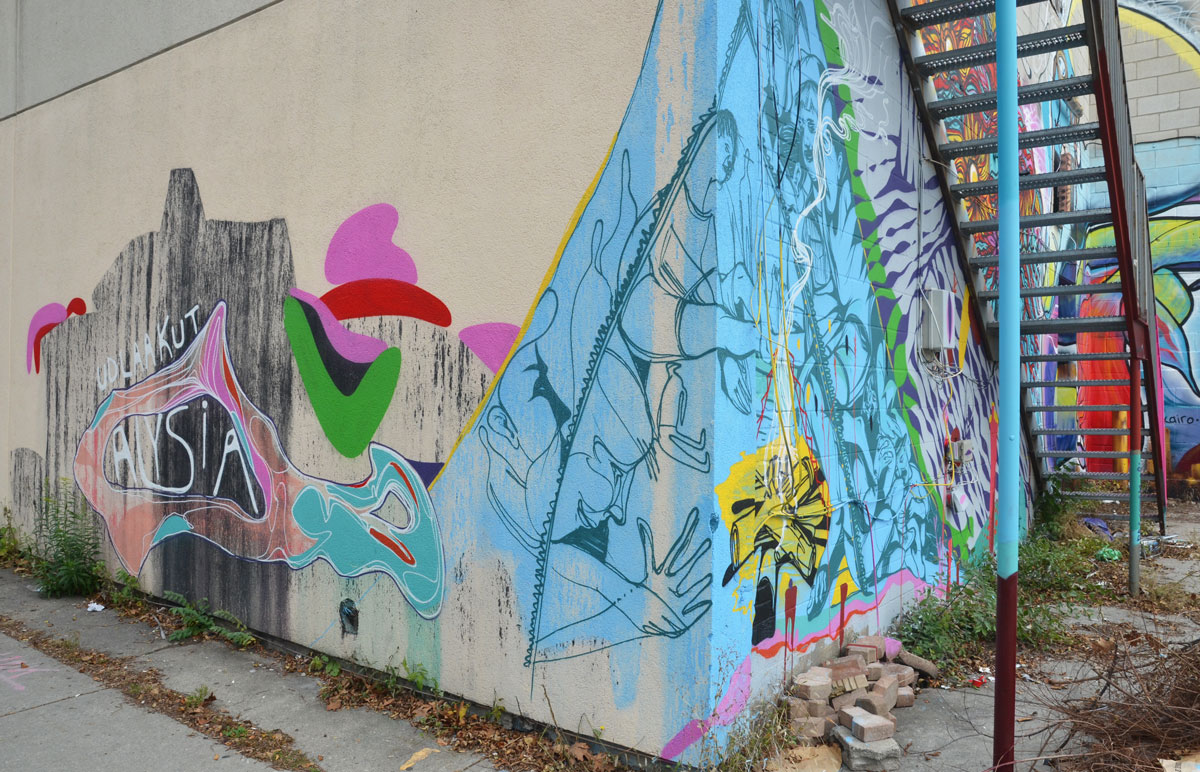
below: Udlaakut Alysia.  Udlaakut is Inuit for good morning.

A street art painting with the words udlaakut Alysia. Udlaakut is Inuit for good morning

The corner of a building with street art on it. Wispy people in blue

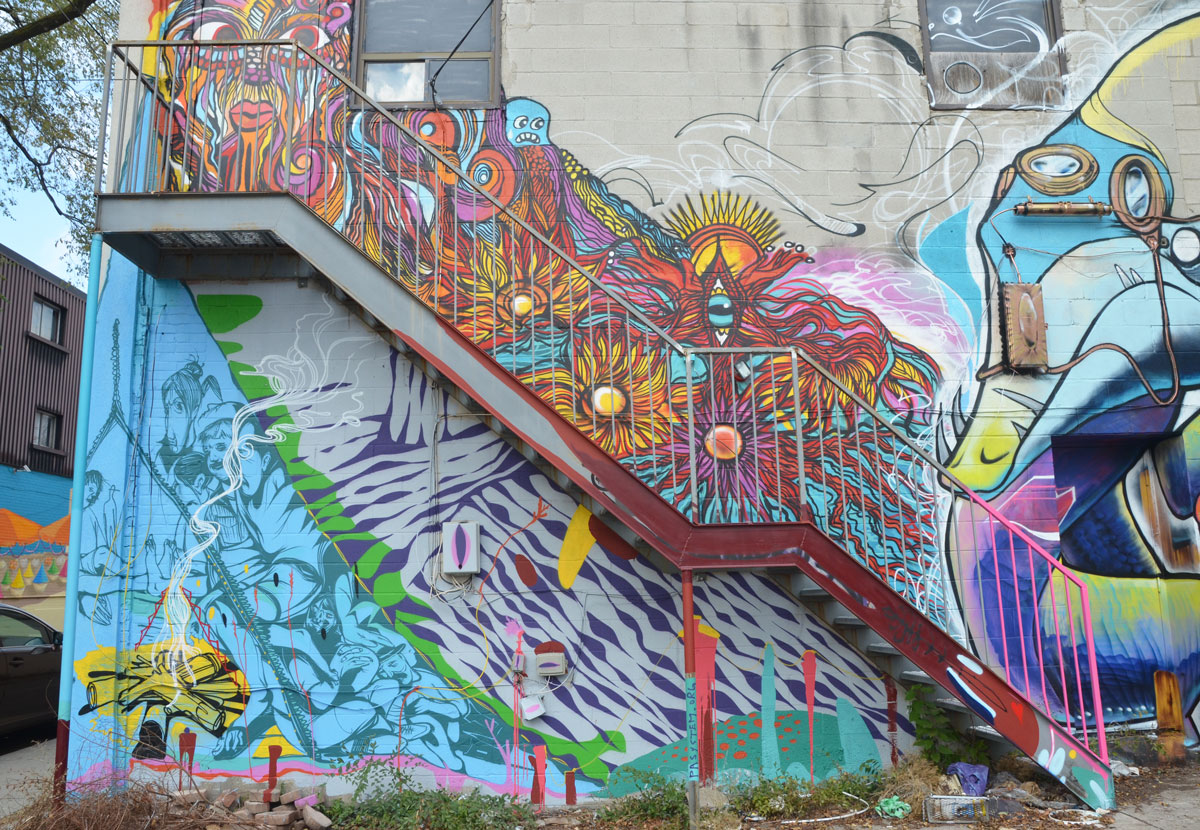
below: Above the stairs painted by timmydrift and below the stairs by thepasystem

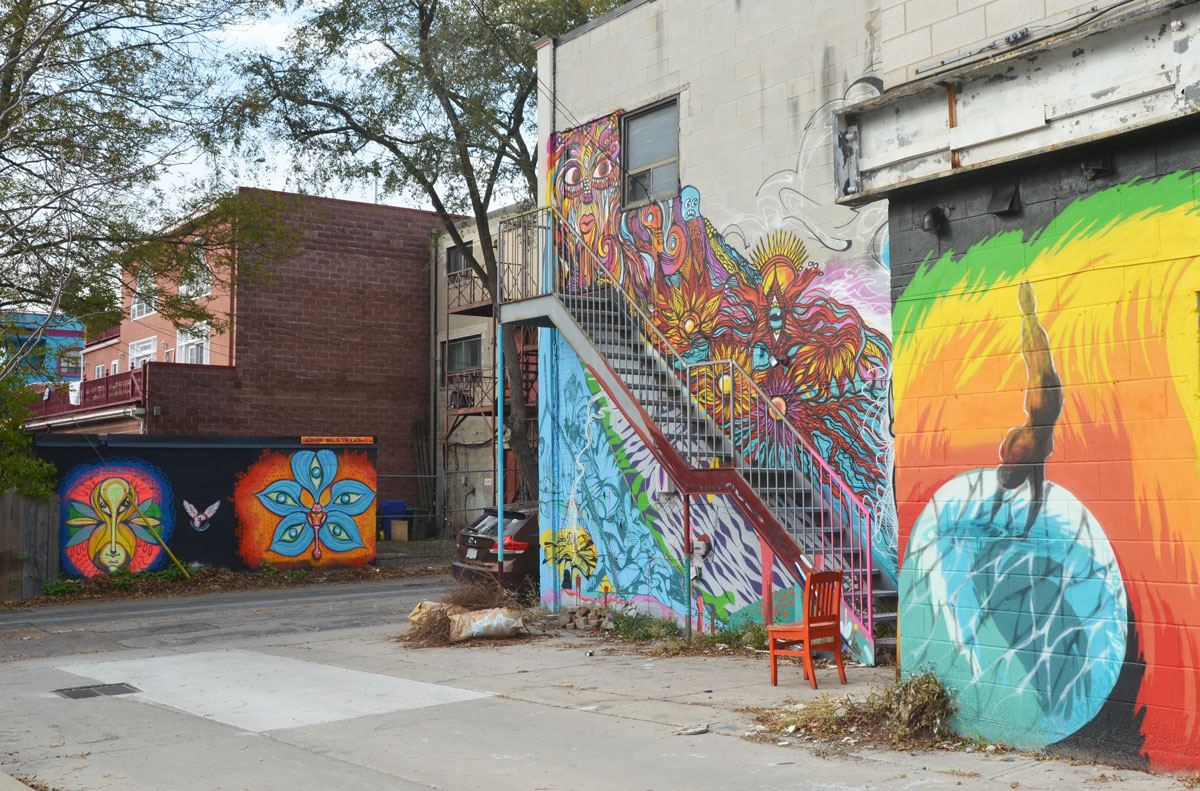
The back of a store with street art on it. A metal staircase goes diagonally up across the building. Above the stairs is a multicoloured swirly piece while under the stairs the street art in is blue and purple A campfire burns yellow in the bottom left corner.

Detail of a flower from a largeer street art piece. It looks like a purple and red daisy

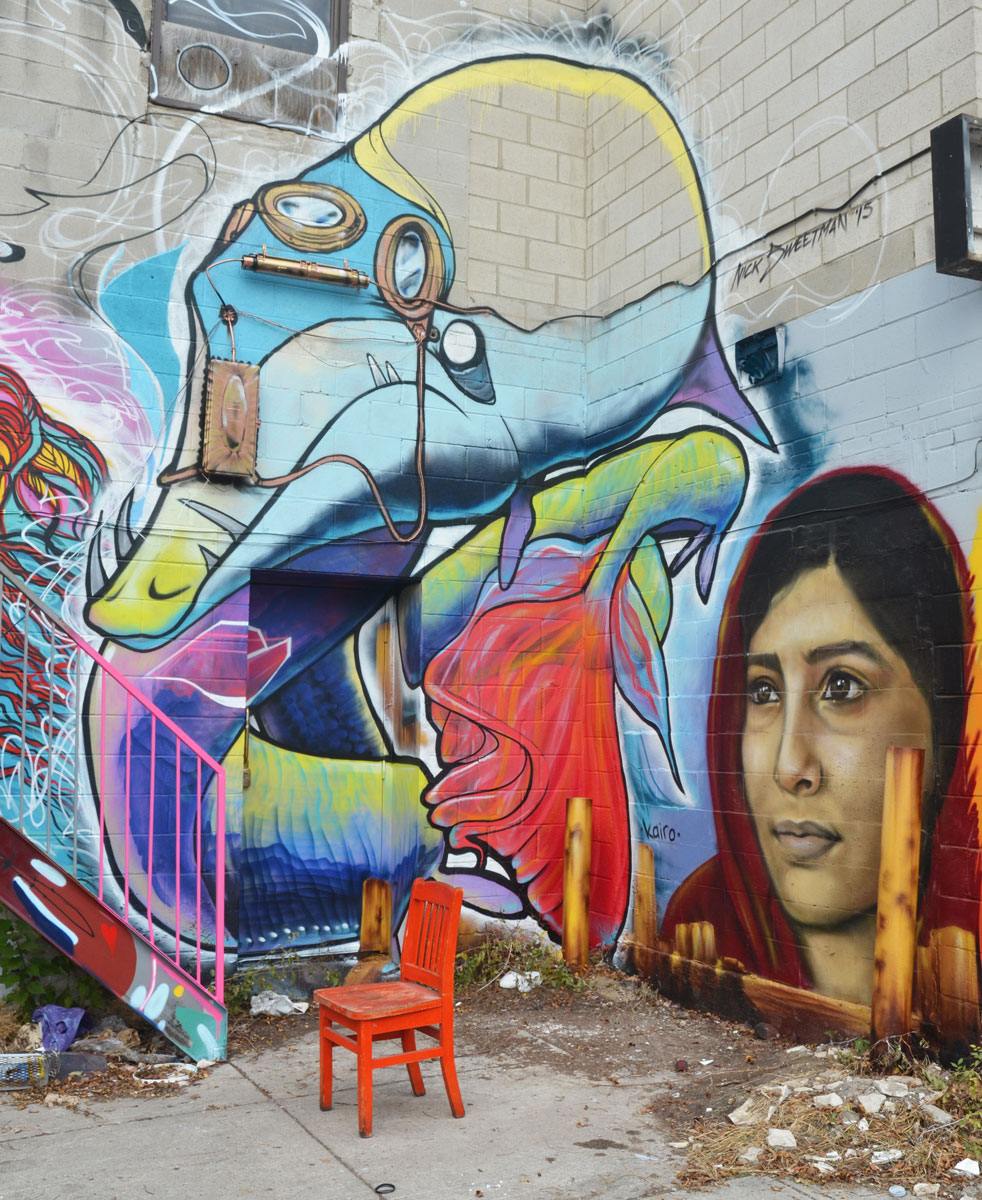
below: A marine creature (alligator) by Nick Sweetman and a woman’s face by Kairo.

An orange chair sits in front of a corner of a building that is covered with street art. There is a realistic woman's face by kairo and a creature by Nick Sweetman

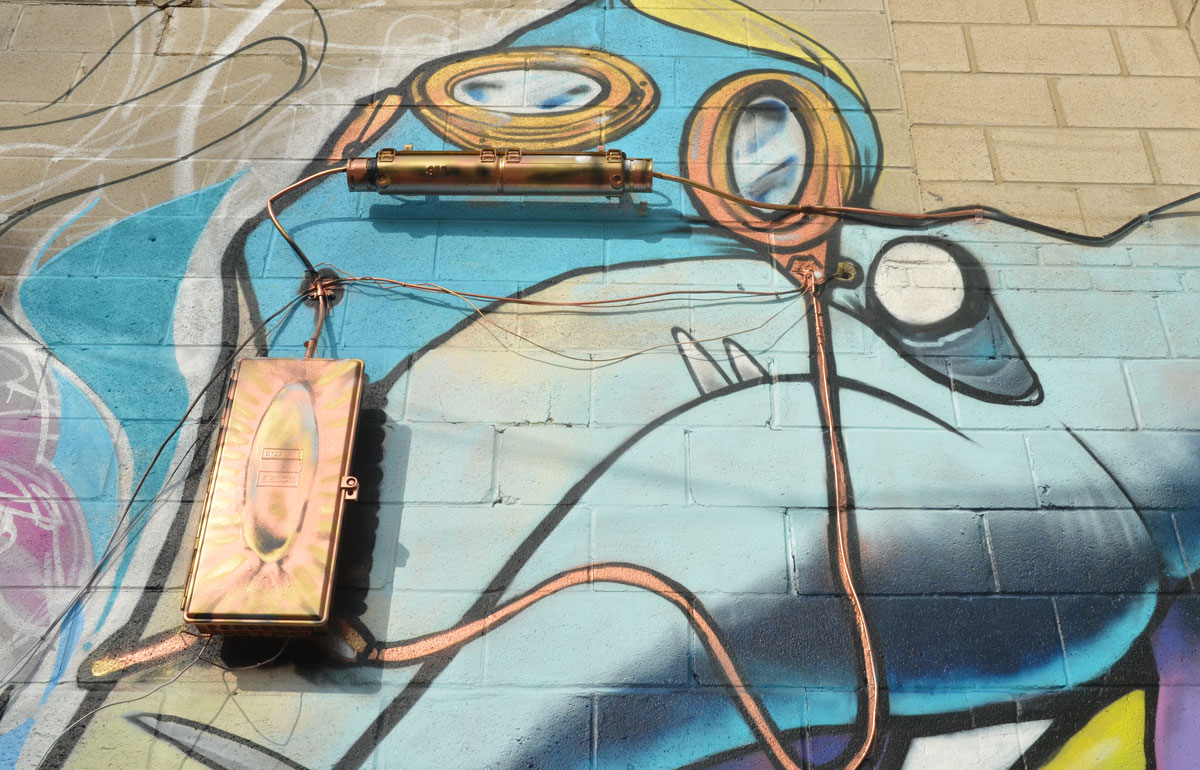
below: The metal fittings on the back of the building were spray painted shiny gold and incorporated into the design of the mural.

Close up of part of a larger street art painting. The metal parts of the building have been spray painted shiny gold and incorporated into the mural.

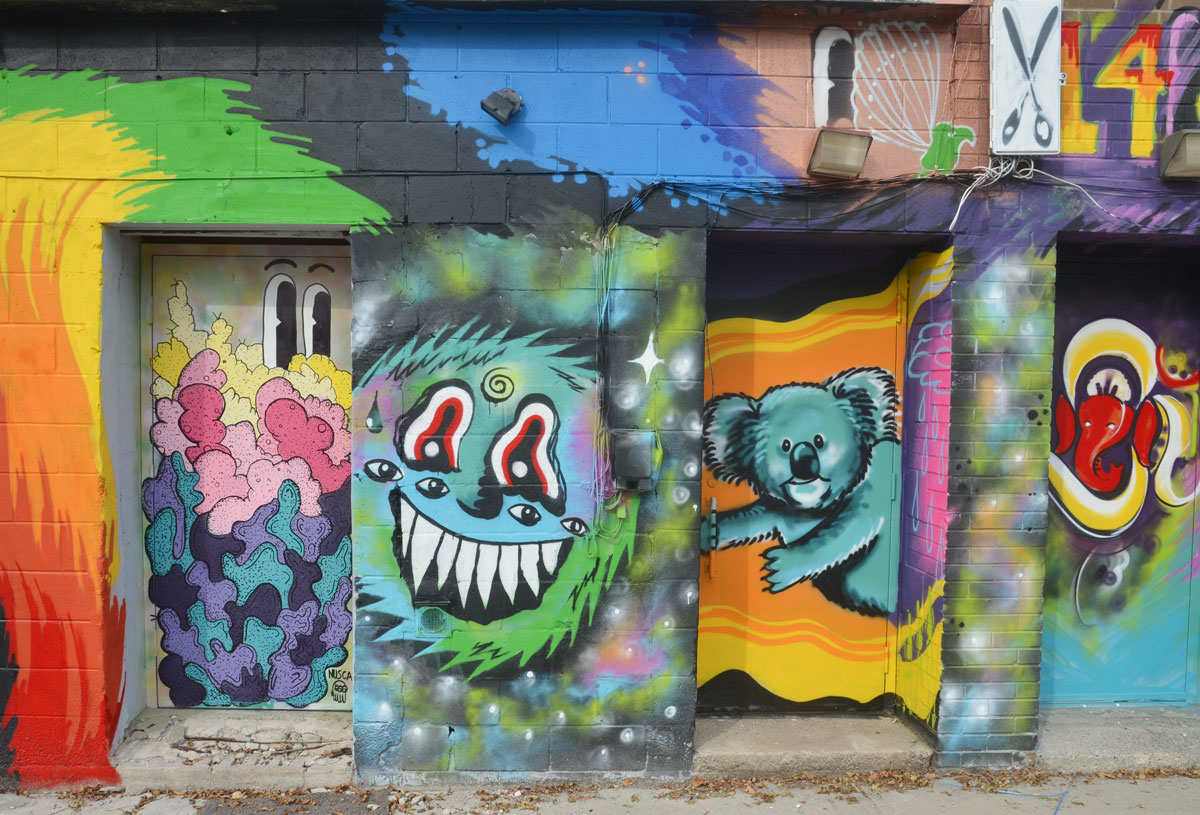
Doorways covered with street art, something cutesy in pink and yellow, a furry head creature and a blue koala

below: behind 1465 Gerrard Street East

doorways behind 1465 Gerrard St. covered with street art, a white ghostly skull and a girl standing with her head back and arms upraised

below: Lean back!

A creature whose body is made of small circles and triangles, with skinny black arms and legs, wearing white shoes and white gloves

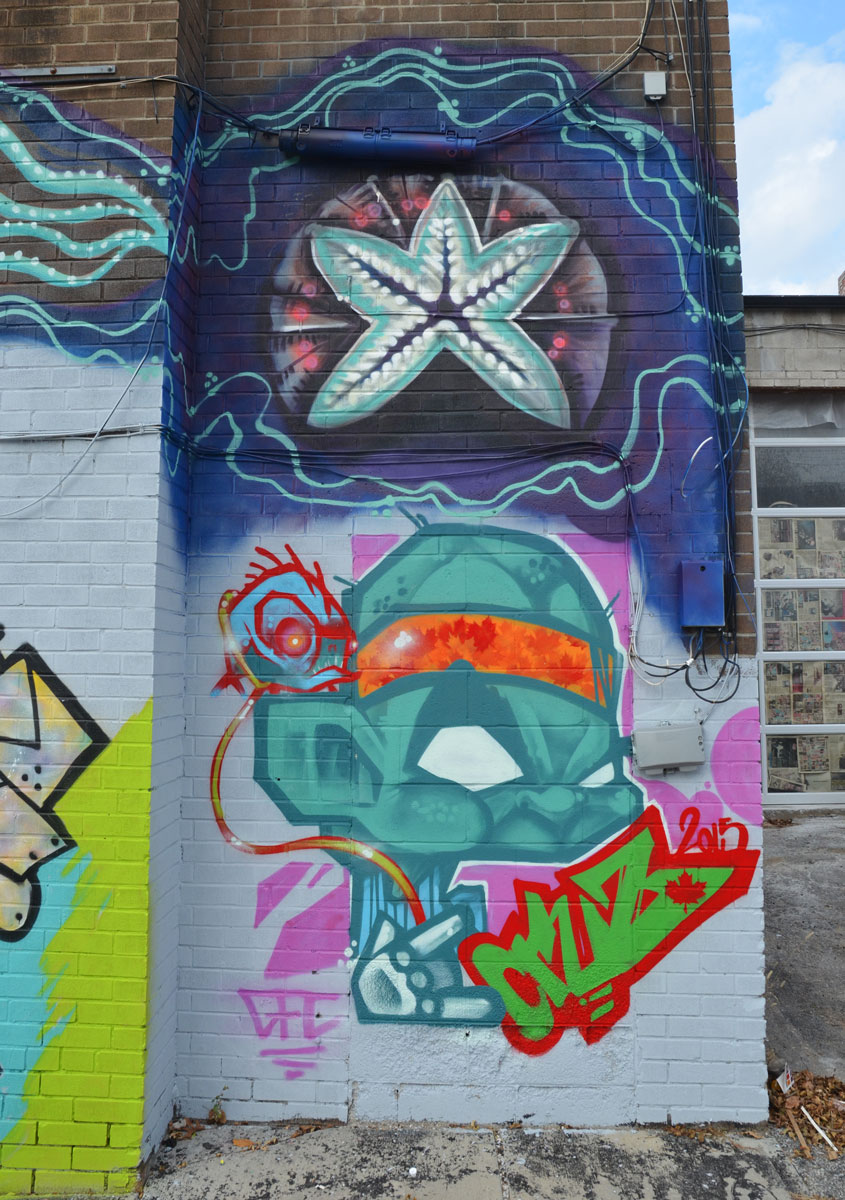
street art on the back of building. On the top is a starfish shape in blues. On the bottom is a grumpy little man with an oversized head done in teal colours. He is wearing an orange headband. GFC Cruz

The back of a few two storey shops where the bottom half is covered with street art and murals

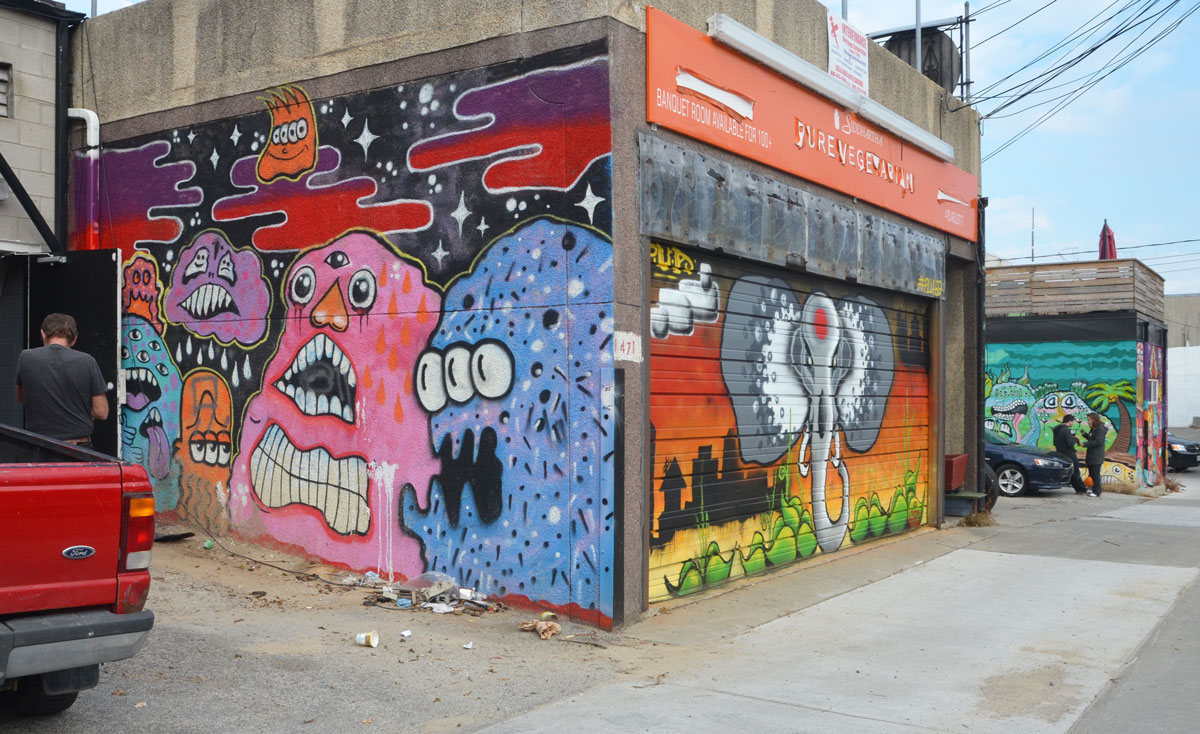
below: behind Siddhartha vegetarian restaurant

garages and walls at the back of stores and restaurants covered with street art. Pink anf purple blob like creatures and an elephant

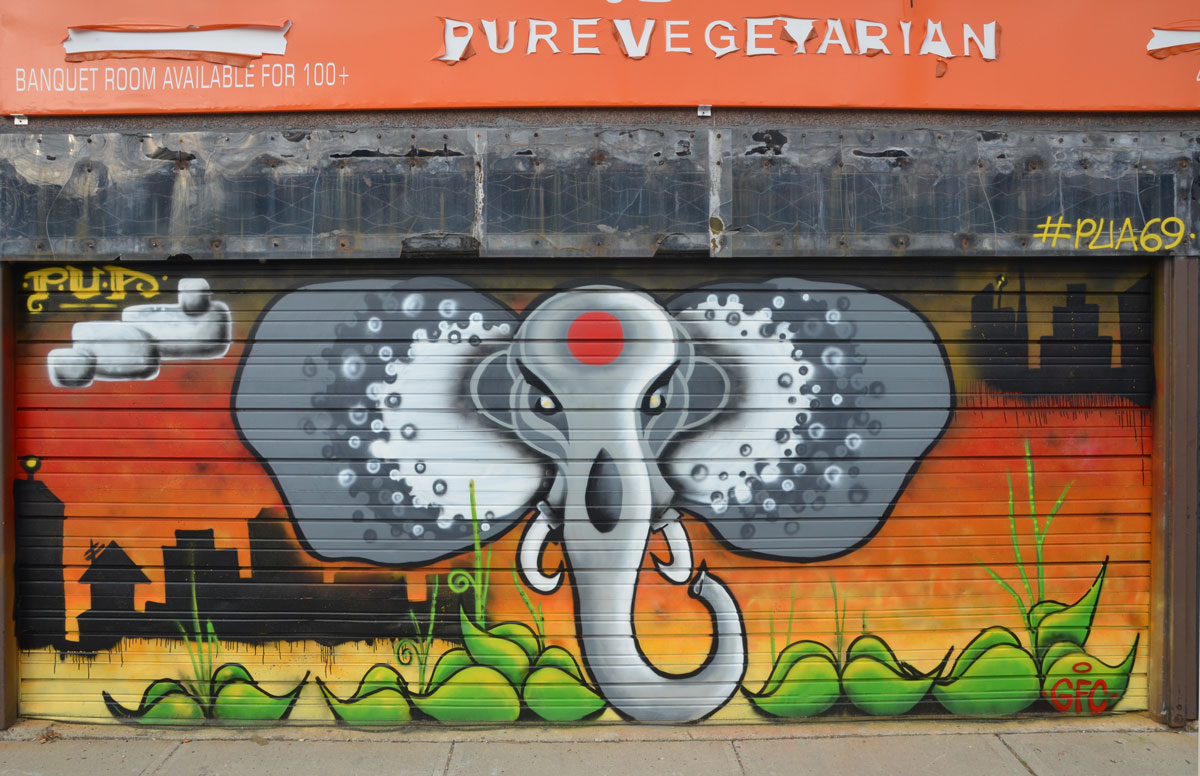
An elephant head and trunk street art painting by PUA (#PUA69) on a garage door.

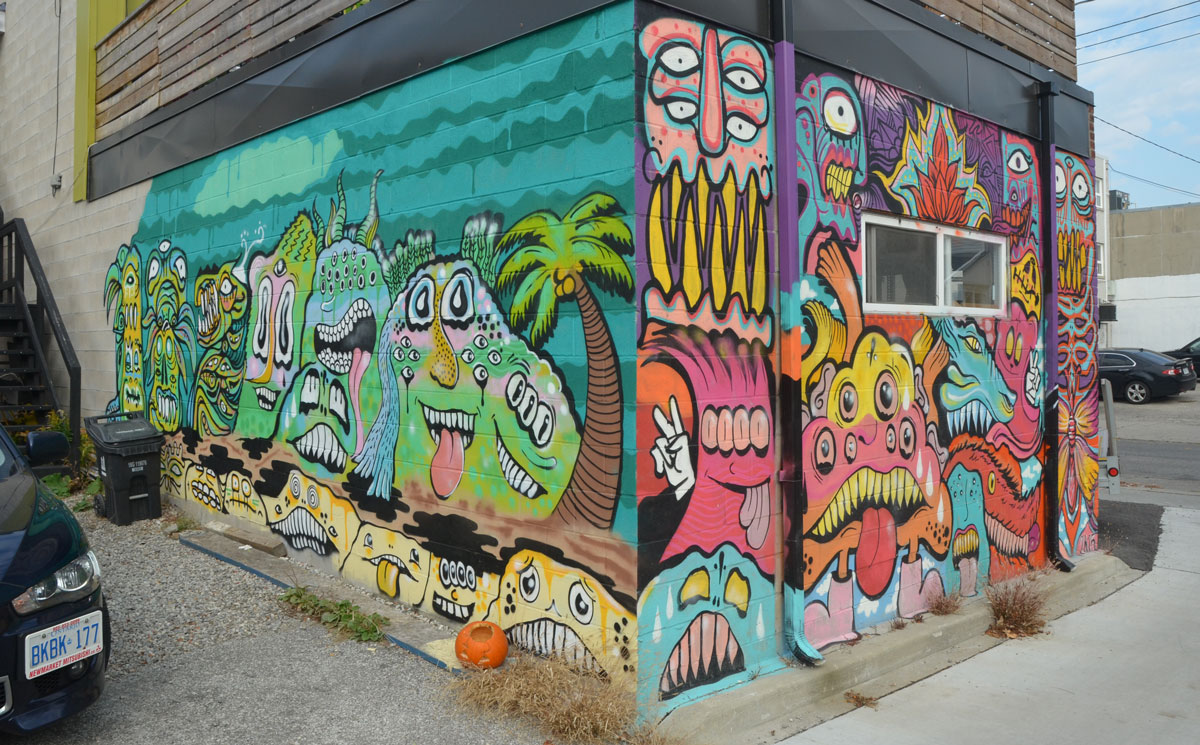
below:  On the back of the Flying Pony cafe is this colourful mural painted by Tim Skynz, lead artist of the group Eskape Reality

Two murals, both brightly multicoloured featuring creatures, on walls in an alley

below: tropical paradise?!

street art mural of a blob creature in green with two faces, one with tongue sticking out and one with three eyes. It is beside a palm tree on a beach.

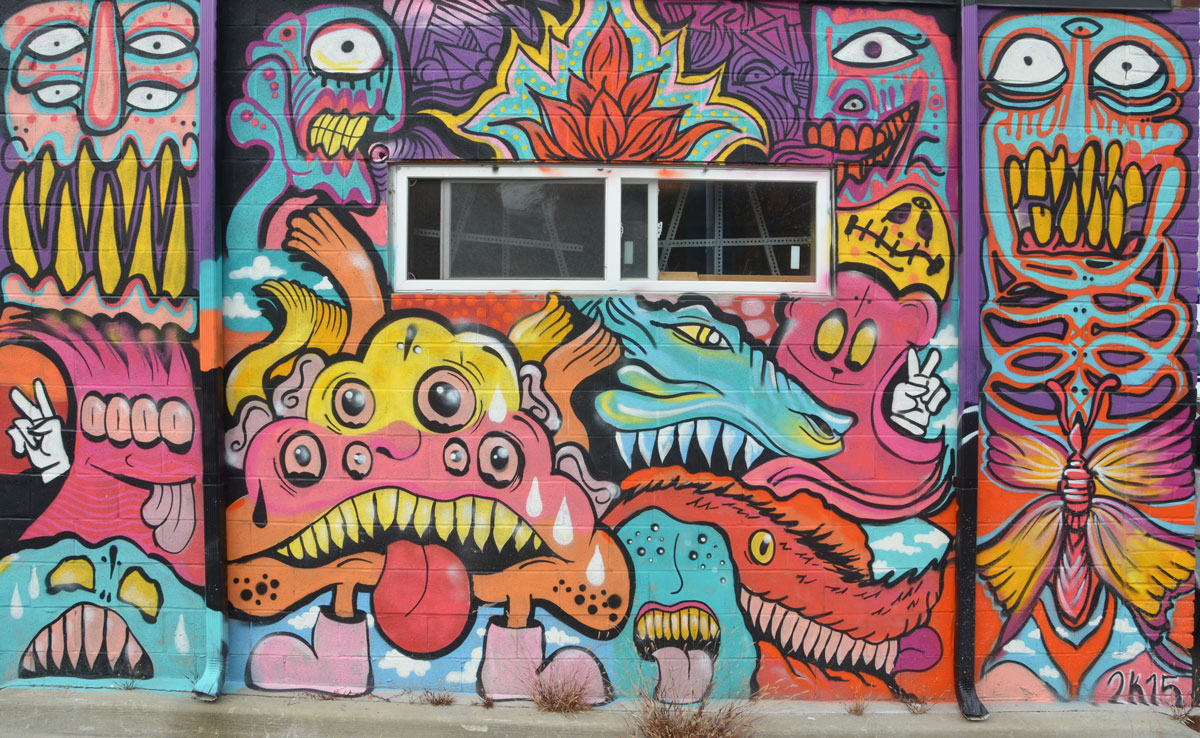
mural on a wall, with a window in the middle, many blob creatures with different number of eyes in blues, reds and purples, many with tongues sticking out, one giving a peace sign with white hand

below: Side of the Flying Pony cafe

the side of the Gallery Coffee Bakery with a red winged horse sign on the upper storey of the red brick bulding. The door and window frames of the shop are painted in primary colours.

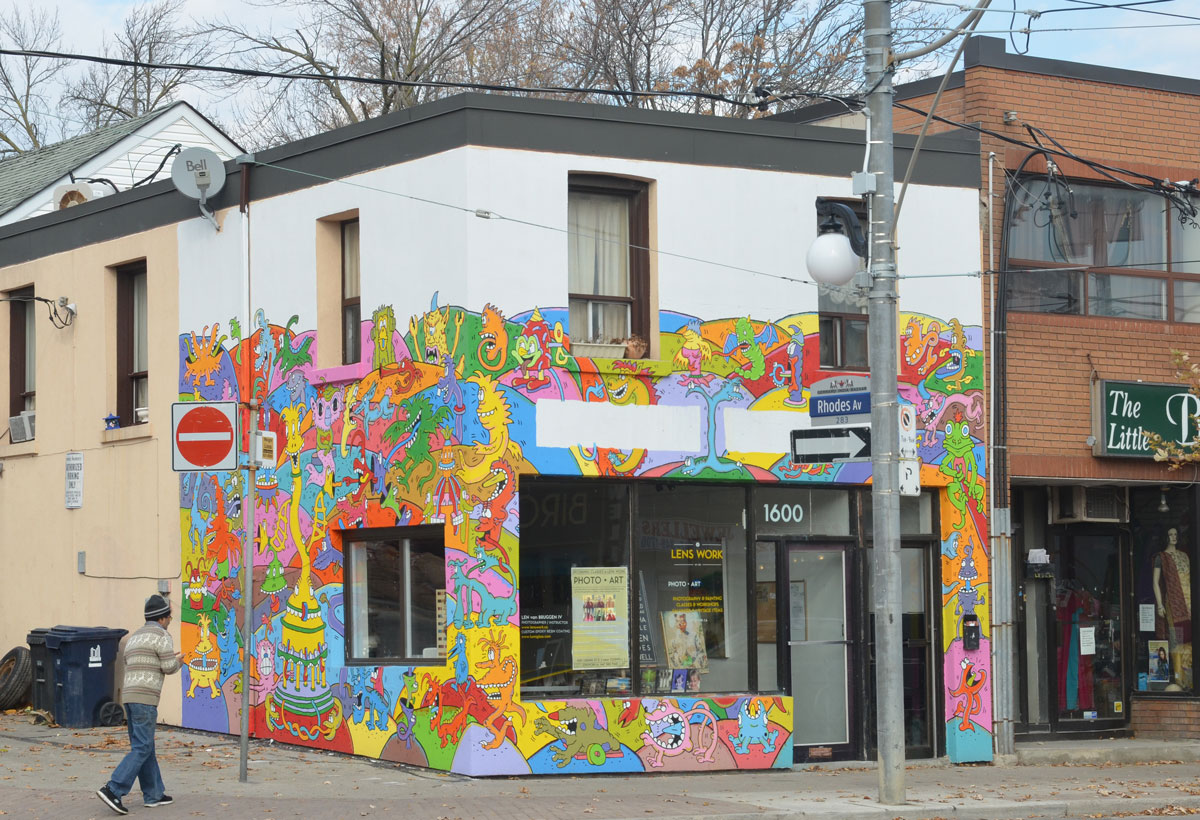
Diagonally across the corner (of Gerrard and Rhodes) from the Flying Pony is another store that has been covered with street art recently.  This mural was painted by Runt.  1600 Gerrard East is the home of Lenswork, a photo and art studio gallery.

A store on the corner of Gerrard and Rhodes in Toronto where the front and side of the building are covered with multicoloured street art.

If you go back to Craven Road there are two murals.

the west part of the back of a building covered with street art. The street and another lower building with a mural on it is in the background.

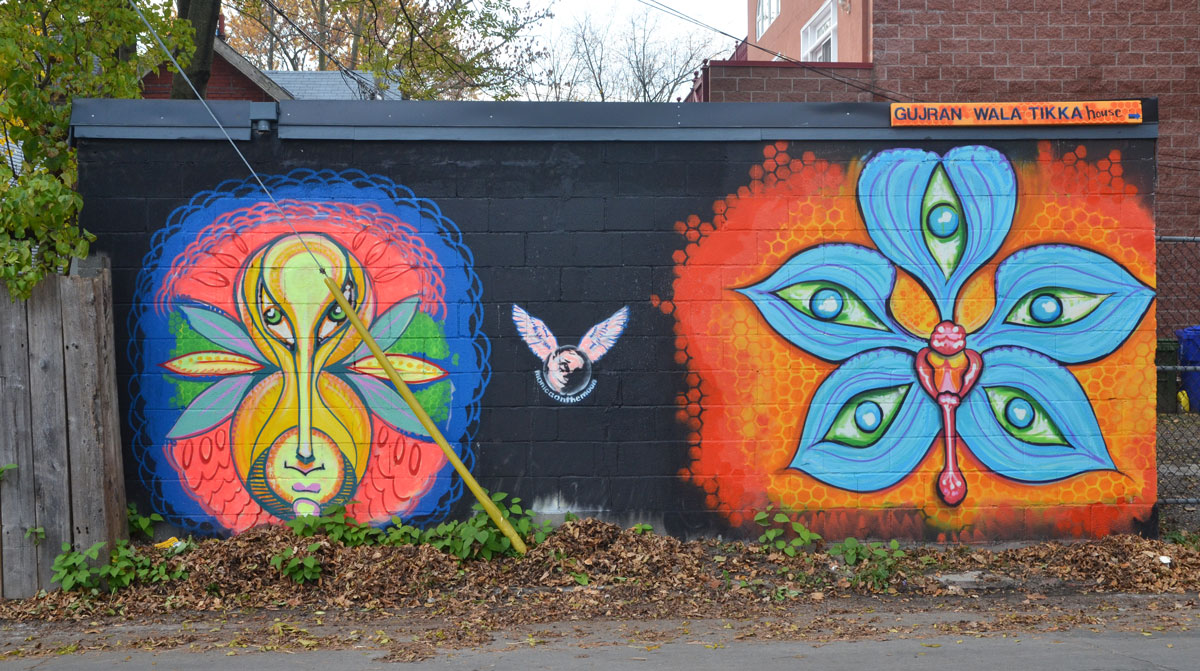
First, there is the one by Monica on the Moon on a small building behind the Gujran Wala Tikka House restaurant.

A mural by Monica on the Moon on a dark blue or black background, a bright orange and blue flower on the right and a flower/face on the left. The words Gujran Wala Tikka house are written in the top right corner which is the name of the restaurant that this building is behind.

Beside it, on the side of the Gujran Wala Tikka House,  is a larger mural titled “The Rickshaw” by Monica Wickeler
(note: Monica Wickeler is Monica on the Moon)

mural in Little India of a decorated bicycle in front of a beige building with orange umbrellas on the left

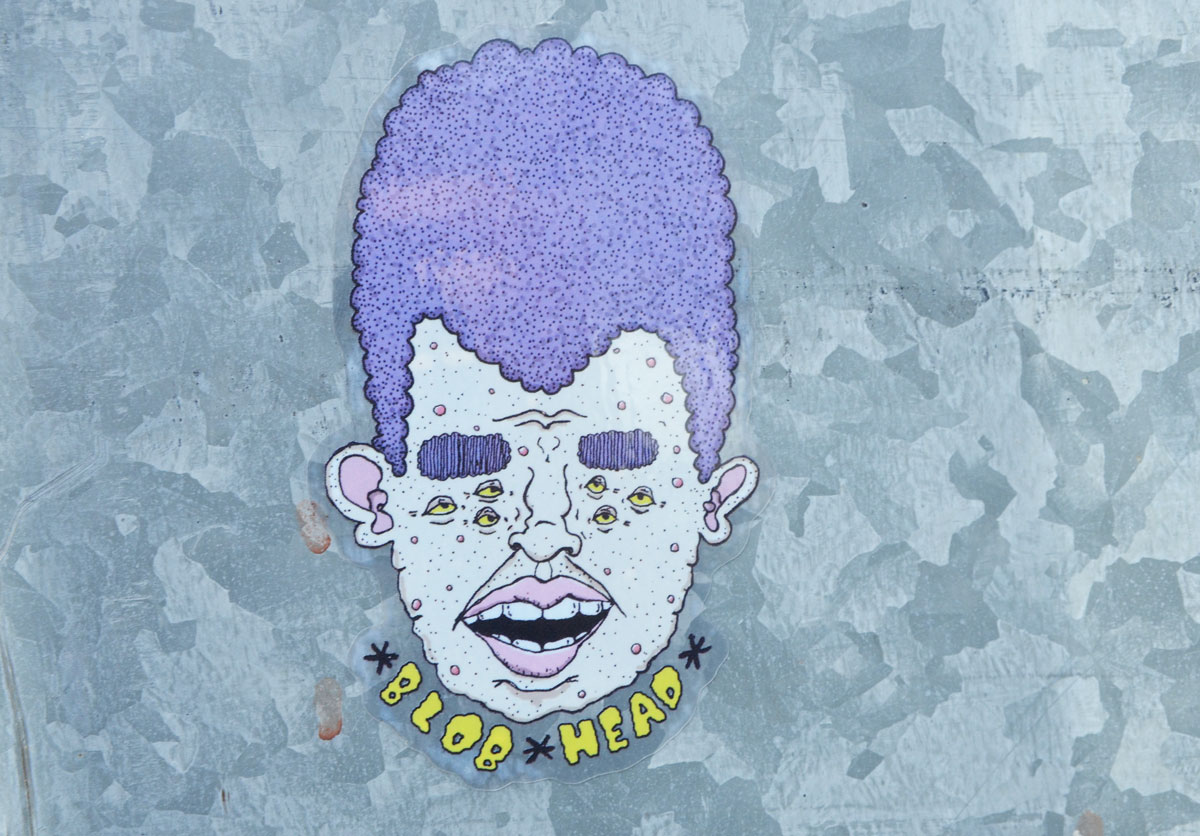
below: And last, seen on a pole in the parking lot:

sticker on a grey metal pole. head with the words Blob Head written underneath. Purple hair, open mouth, pink lips, teeth showing, purple bushy eyebrows and three small eyes where each eye should be (six eyes in total)
 

The alley project was coordinated by Tammy Rogers
with assistance from Monica Wickeler and the Gerrard India Bazaar BIA.

Craven is a narrow street that runs south from the railway tracks.  For most of its length, there are houses only on the east side of the street.  Between Gerrard and Dundas, a wooden fence runs along the west side right up next to the street.  This fence separates the backyards of the next street, Ashdale, from Craven Road.  As I drove up Craven this afternoon I noticed that someone has mounted a number of pictures onto the wall so of course I parked my car and took some photos.

There are paintings of cats of various sizes and colours

A canvas has been stapled to a wood fence, on the canvas someone has painted a large tan and white striped cat that is lounging on the ground but with its head up and alert. The canvas is wearing out a bit around the edges

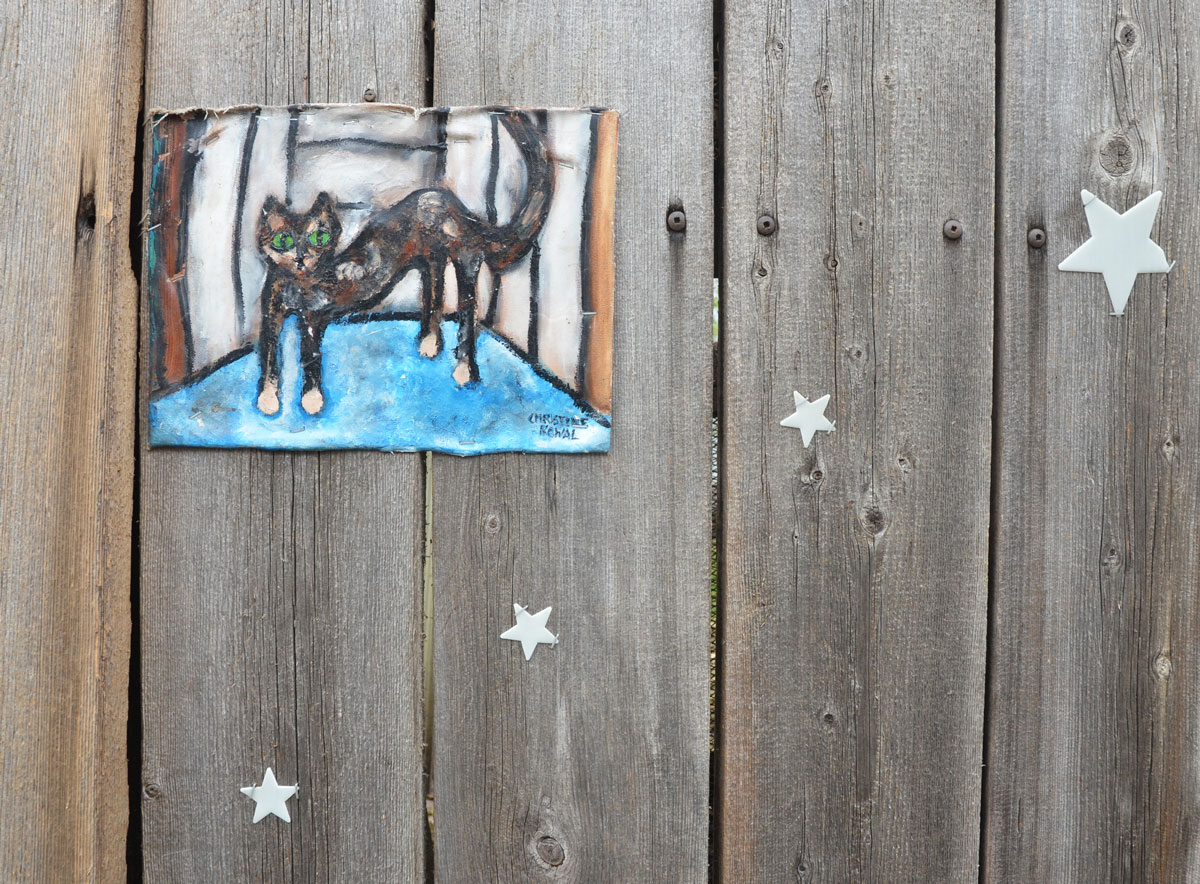
The stars look like the glow in the dark stars that my kids used to have.

A small painting of a cat standing in a room with a light blue floor. It is mounted on a wood fence. Four glow in the dark stars are on a diagonal across the corner of the picture.

Most, but not all, of the paintings have an animal theme.  Seven Christmas sheep in the snow.

A painting of seven sheep in a line in the snow with more snow falling from the sky. The painting is on canvas and it is stapled to the fence.

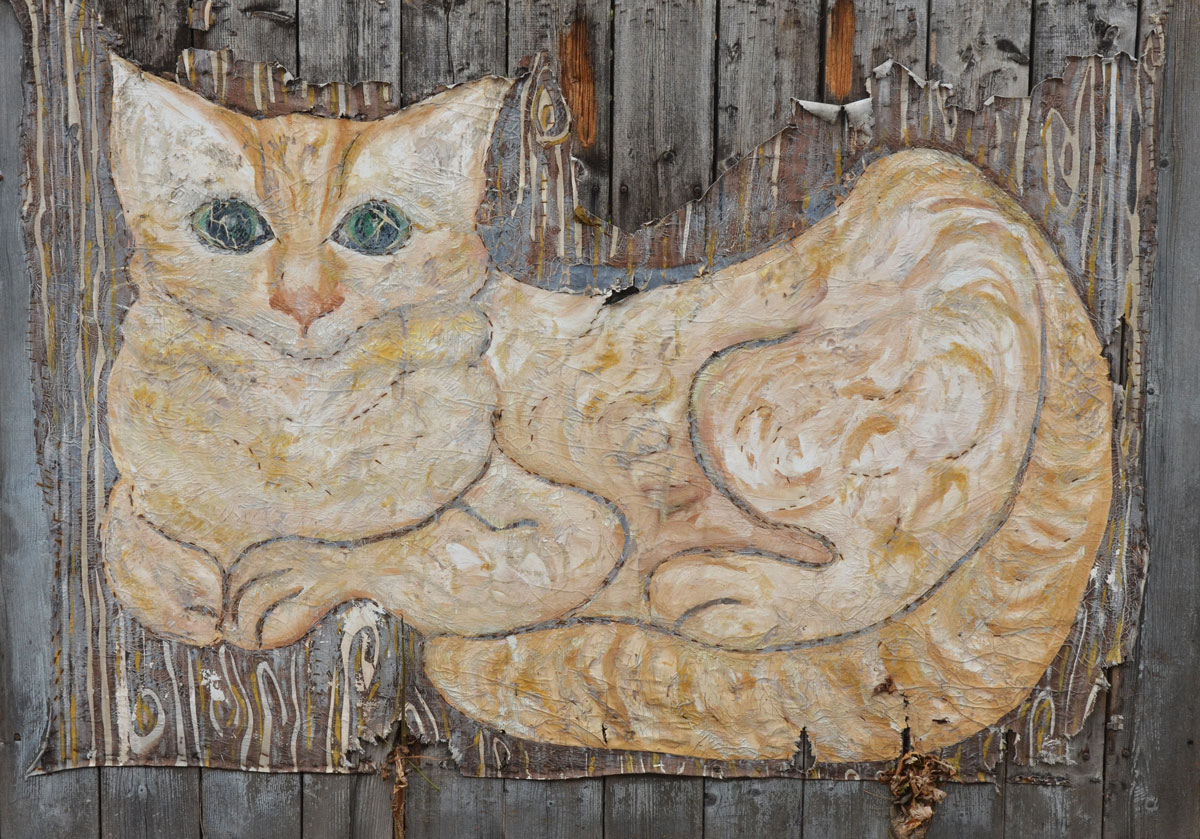
They are painted on canvas and stapled to the fence.  Some are in better shape than others!  The pattern of the rips in this painting seems to complement the pattern of the boards in the fence although the cat doesn’t look too pleased about it!

A very weathered painting of a cat on canvas and stapled to a wood fence. The canvas has started to rip vertically in places. The pattern of the rips sort of matched the pattern of the boards in the fence.

There are a few dog pictures too including this reindeer dog.

Painting on canvas stapled to a wood fence. A large dog is sitting in the snow. Red fake reindeer antlers on its head. More snow is falling from the sky.

Two dogs sit on the front steps of a house. One of the dogs has a rope toy in its mouth.

You may have noticed by now that this gallery is a one woman show.  Christine Kowal is an artist and a  resident of the street.

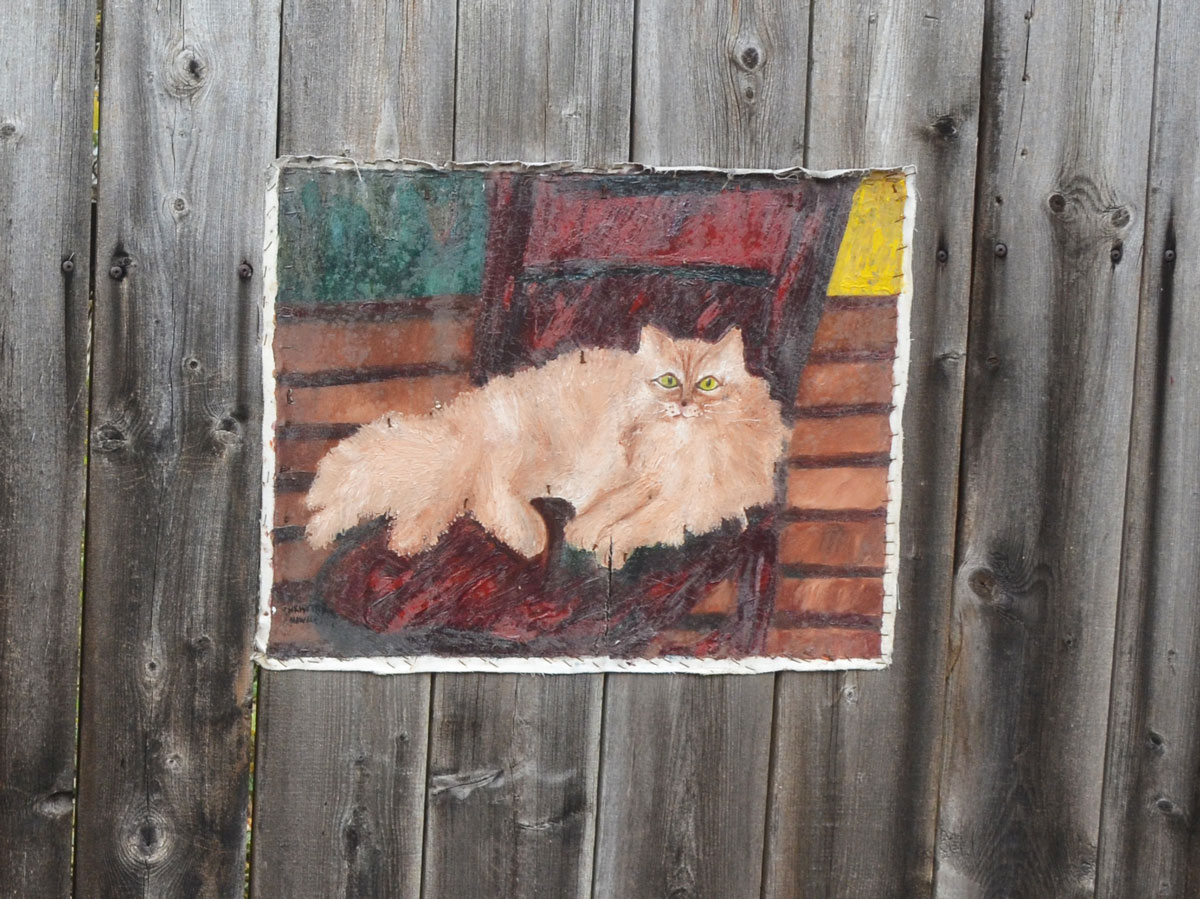
Painting on canvas stapled to a wood fence. A long haired light brown cat resting on a striped carpet or blanket

And did I mention that there were pictures of cats?  🙂

Painting on canvas stapled to a wood fence. A small brown cat in amongst tall grass. A vine is growing on the fence beside the picture.

Painting on canvas stapled to a wood fence. A black silhouette of a cat that is surrounded by turquoise and farker blue swirls and smudges

Two paintings on a wood fence. One is a collection of animals in bright colours and the other is an abstract with a large amount of blue in it.


I happened to walk into the Queen Mother Cafe (on Queen West) this afternoon.  They often have original artwork displayed on their walls and today was no exception.  I found some intriguing and very creative masks.

A mask in beige, black and white mounted on the wall. The nose is a wrench. The white part looks like a mask across the eyes of the mask

They are the creation of Jeff Mann, a Kingston based artist.

four metal masks mounted like on a wall. One looks a reddish dog and one looks like a skull. They are made of car parts.

According to his website, Mann makes the masks mostly from car parts and shovels.  The ones here are only a sample of the collection I saw at the Queen Mother cafe.   In addition, there are pictures of more masks on Mann’s website.

close up of a mask hanging on a wall. It's made of rusty metal car parts welded together

A mask that looks like a cow. Large black and white face, a pinkish red body and four skinny spindly legs. Curly cue tail too.

As I sort through the photos that I took this past summer, I keep finding pictures of street art that I have not yet posted.  The following collection were taken in the Dupont and Ossington area back in July.

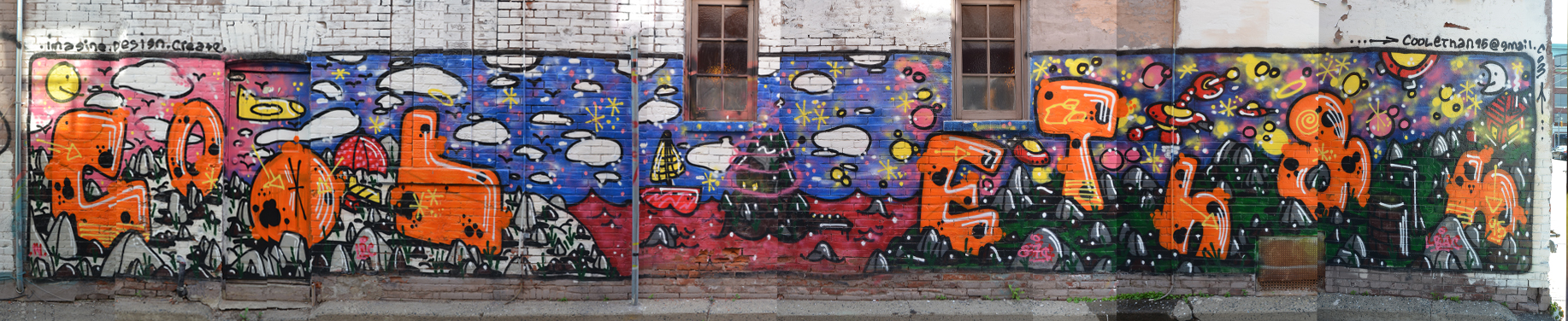
below: A very horizontal piece by Cool Ethan, obviously

a long horizontal street art painting

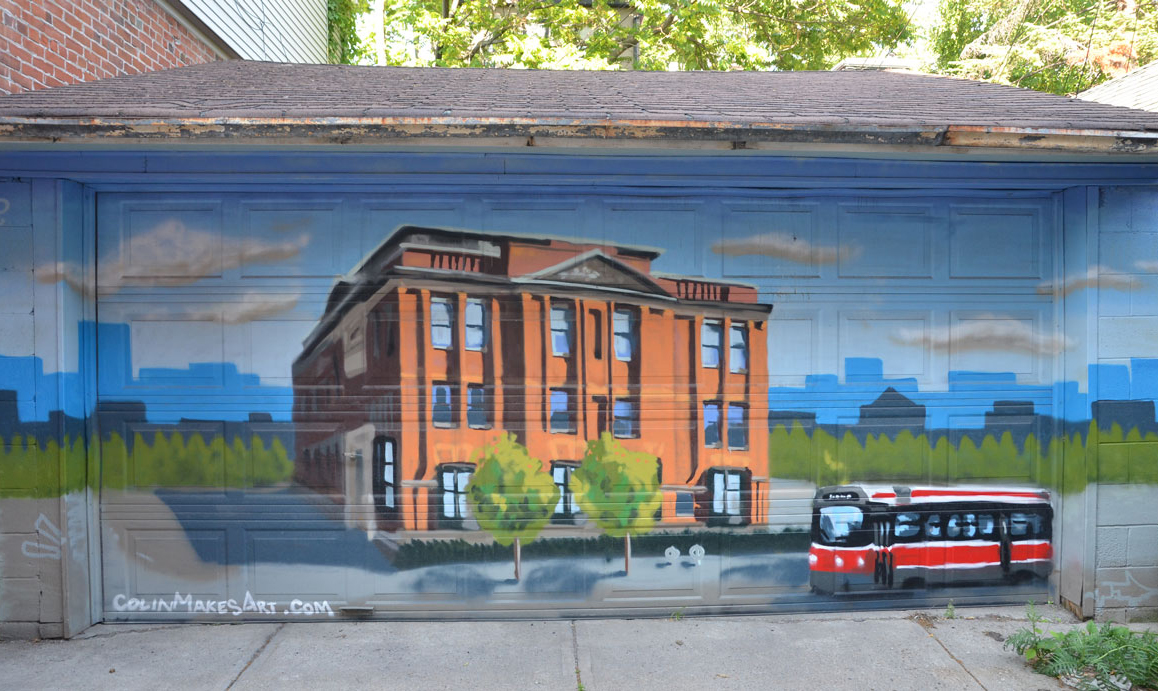
below: A TTC streetcar passes by the Massey Harris building, a mural by Colin Turner Bloom.  This office building, at 915 King St. West, was built in 1883 as the headquarters for the Massey Harris Co.  It was declared a heritage building in 1973.  Since then it has been developed as lofts/condos.

A mural on a garage door by colin makes art, showing a large brick building with a TTC streetcar passing in front of it.

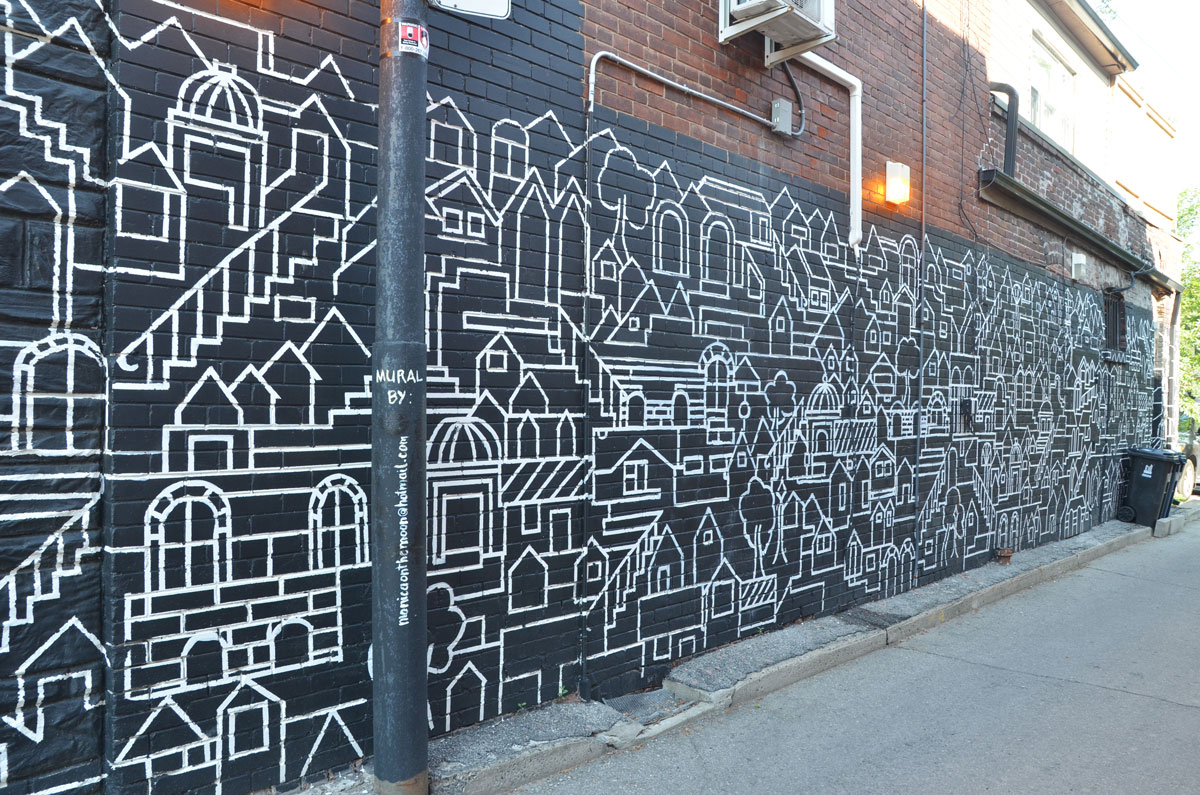
below: A city scene mural by Monica on the moon,  just off Dupont Avenue.

long mural, black background, white line drawing of a city scene by Monica on the Moon

close up of part of mural, white line drawings of a city scene, lots of houses and other buildings, on a black background on the side of a house. Small window as well as three trash bins are in the picture.

below: Another garage door

garage door covered with a street art painting of squiggly shapes in oranges and reds with dark grey background

below:  Up, up and away with a bunch of red balloons.

two stencil graffitis on a white garage door in a lane. One is of a girl standing on her toes and holding onto a bunch of red balloons that are up in the air. The other stencil is of a man from the shoulders up

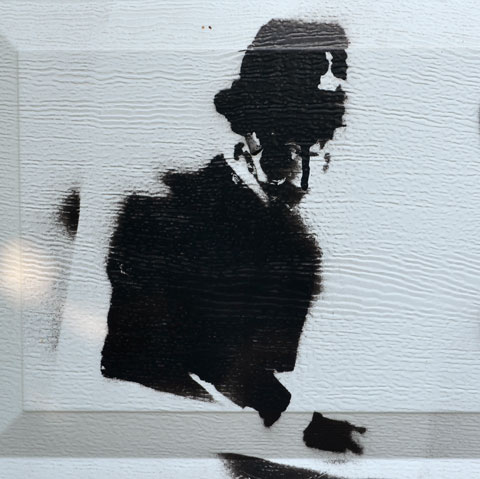
below: Bobby with a gas mask, stencil on garage door in a lane.

stencil graffiti in black on a white garage door. London bobby (policeman) wearing a gas mask, from the waist up

below:  Two lovebots on Dupont.

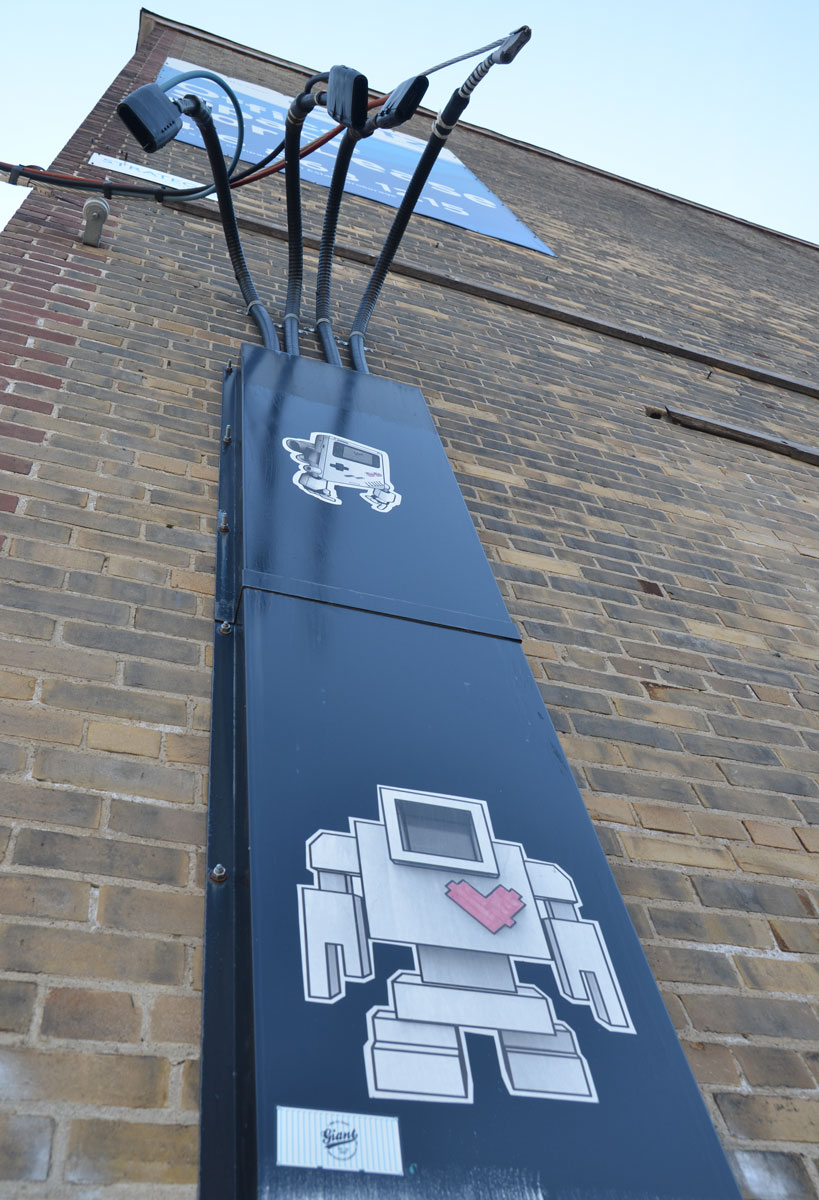
two lovebots on a blue metal structure on a brick wall. The top one is a gameboy lovebot. The bottom one is the usual robot lovebot.

sticker on a white wall. Sticker says ADORE: for all the golden moments captured indoors and out