Posts Tagged ‘photography’

Monday’s walk was a meandering route downtown, once again going where my feet and eyes take me.  No particular plan in mind and no set destination…   just trying to explore where I haven’t been recently.   No theme jumped out and tapped me on the shoulder but a few “stories” emerged.

below: There is now a 3D sign between the CN Tower and the Aquarium that says Canada 150.

a young boy is leaping from the D of the 3D Canada 150 sign in front of the CN Tower, and is leaping onto the top of the A. His hands are on the top of the A, one foot is one the side of the A and the other foot is near the top of the D

below:  …and another 3D sign by the CN Tower (you can see part of the back of the Canada 150 sign through the tree). I wonder how many there are in this city now?   Another bit of information (trivia?) – this area is called Bobbie Rosenfeld Park and has been since 1991. Fanny (“Bobbie”) Rosenfeld was a Canadian athlete who won two track medals  in the 1928 Olympics.   She also played softball and hockey in the 1920s and 30s.  When arthritis force her to stop playing she turned to sports journalism, working for the ‘Globe and Mail’ until her retirement in 1955.

3D sign for the CN tower with tourists taking pictures in front of it. Canada 150 3D sign in the background as well as some people sitting around on benches

One of the routes from the CN Tower into the downtown core of the city is via the Skywalk, a glass enclosed elevated walkway over the railway tracks.  The next few photos were taken as I walked that route.

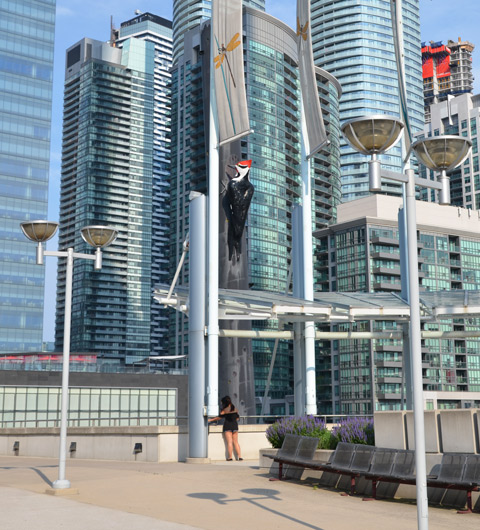
below: A Toronto species of woodpecker in its native habitat – a forest of glass and steel. This artwork was completed in 1997 and is the creation of Dai Skuse and Kim Kozzi who together are known as Fastwurms.

large sculpture of a woodpecker on a pole in the foreground, many glass skyscrapers condos in the background

below: The above photo was taken from a quiet little terrace that I accessed from the Skywalk. Now you can see just how big the woodpecker is!  The ‘tree trunk’ pole is 30m high.  What you can’t see is the second woodpecker who is on the other side of the pole and slightly farther down it.

a concrete terrace, with benches and planters with purple flowers, lots of condos in the background, one person standing there

below:  The glass of the Skywalk creates some interesting reflections and shadows.  The glass was fairly clean the other day when I walked through it.  I have seen it when it’s been quite dirty and it’s not a pretty sight.

reflections of a woman walking on the Skywalk between Union Station and the convention center, with views of the street below and buildings beyond also in the frame
reflected in the red glass of the entrance to the CN tower are two women walking

below: Union Station, looking east from the Skywalk.   The new roof over the station platforms is taking shape.  Someday soon I’m going to have to take a look at the insides of the station; I can’t wait for all the renovations to be completed.

union station as seen from the west, from the skywalk, with open air tracks as well as the covered platforms. New roof over the platforms, tall buildings in the background

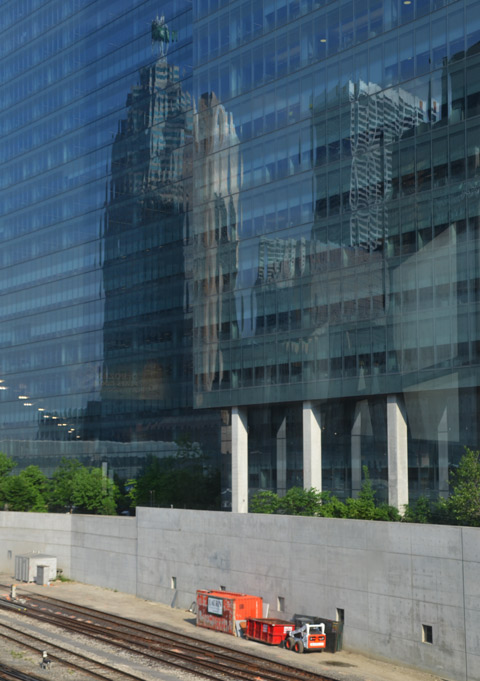
below: Part of the south “wall” along the railway tracks.

buildings reflected in another glass building right beside the trains tracks south of Union Station

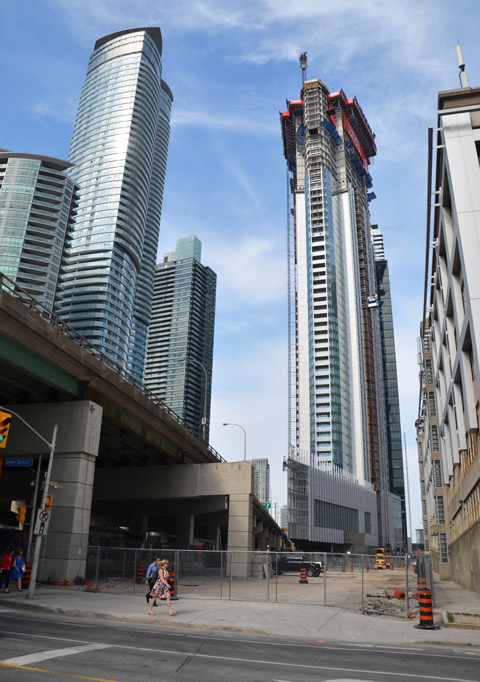
below: Looking east from lower Simcoe along the south edge of the Gardiner Expressway.   The podium of the new condo under construction at 10 York Street is quite the wedge!

construction of a tall condo beside the gardiner expressway. The bottom of the condo is a wedge shape to maximize the space available

below: I played a bit on google maps street view and this is what I found for the above scene (taken Nov 2016).  If you compare the photos (above & below), it’s obvious that one of the ramps for the Gardiner Expressway has been demolished.   The eastbound exit to Yonge/York/Bay was removed a couple of months ago.  If you are a regular user of the Gardiner, I’m sure you have already experienced the consequences of this!

screenshot of google maps street view of Lower Simoce stret just south of the Lakeshore, one of the offramps for the Gardiner, a new condo under construction

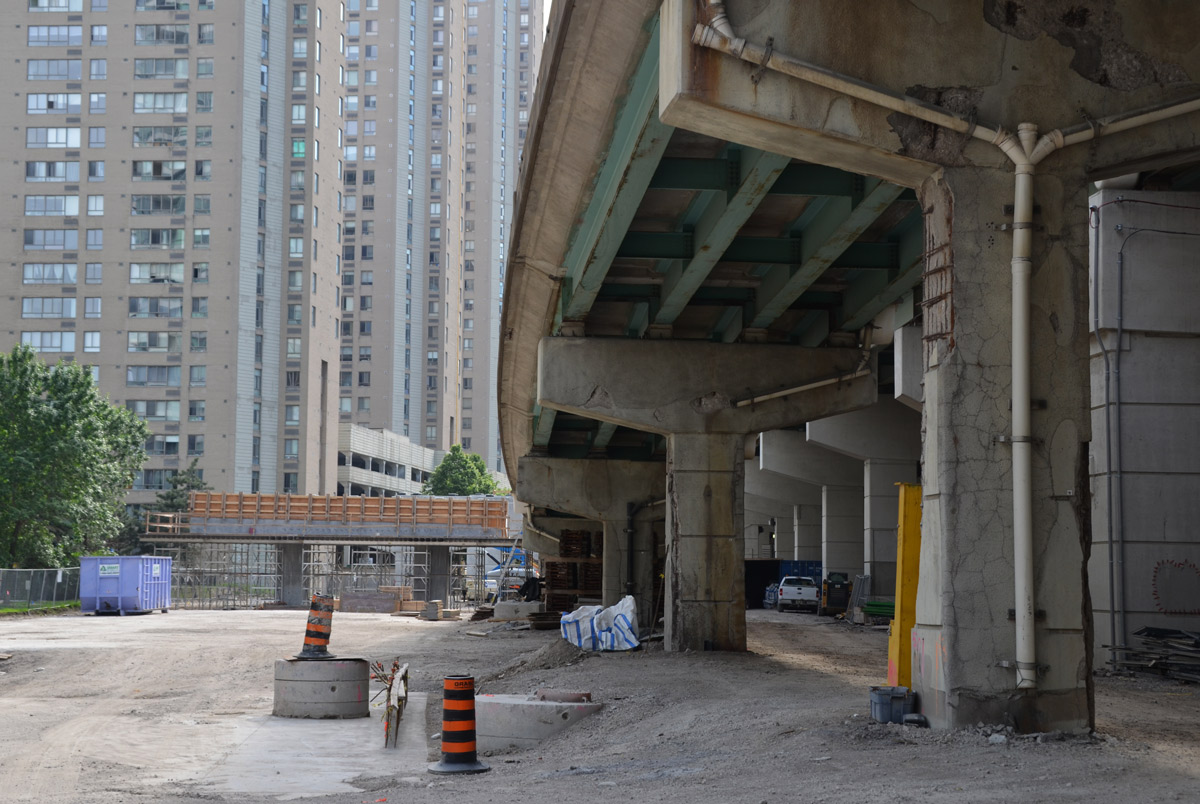
below: Standing on the same spot, but turning around 180 degrees – looking west from Lower Simcoe.  An old ramp in the foreground…. and what looks like new construction in the background.  Those are new bents (the structures that hold up the road).

under one of the Gardiner Expressway ramps, with new bents being built for a new ramp in the background.

below: To get a closer look at what was happening here, I ventured around to the other side .  This is the view from closer to Rees Street. There is car on the old ramp so it must still be open (onramps still functional, just the offramp was removed).

two "cherry pickers" parked in front of new bents being constructed for a new ramp for the Gardiner Expressway

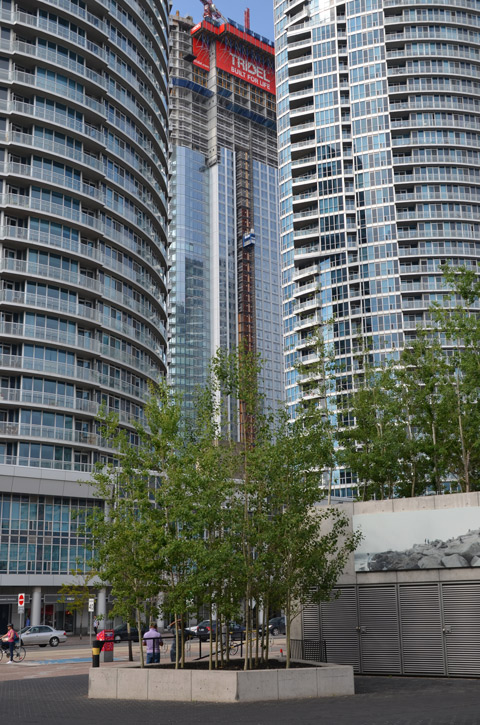
below: The trees are growing at Canada Square (Harbourfront), but so are the condos.  Yes, this new building is the same one with the wedge shaped lower floors.

view from Canada Place (Queens Quay West) with a clump of birch trees in the foreground and 3 highrise buildings in the background - two older ones and one in the middle that is under construction.
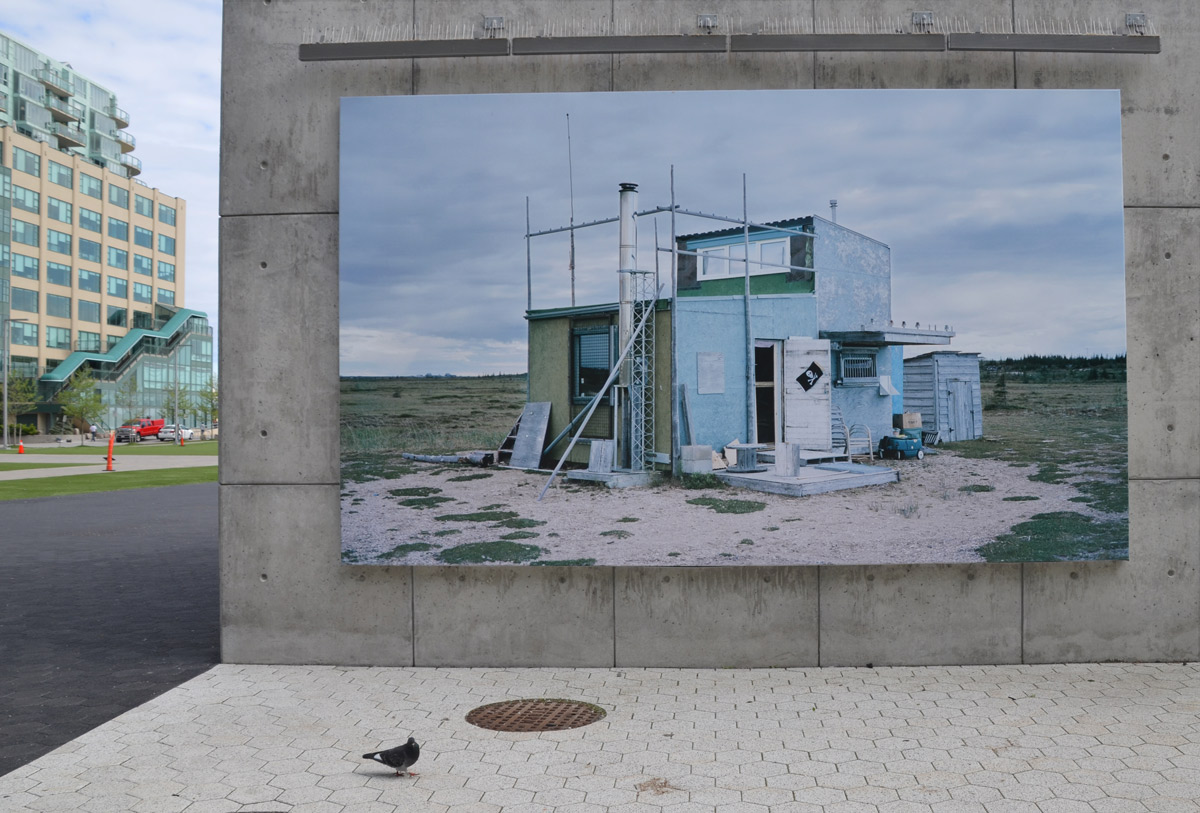
below: Also at Canada Square, there are three large photographs by Johan Hallberg-Campbell, a series called “Coastal”.   This one of them:

a large photograph of a run down building, northern, on the side of a concrete structure that is an entrance to the underground parking

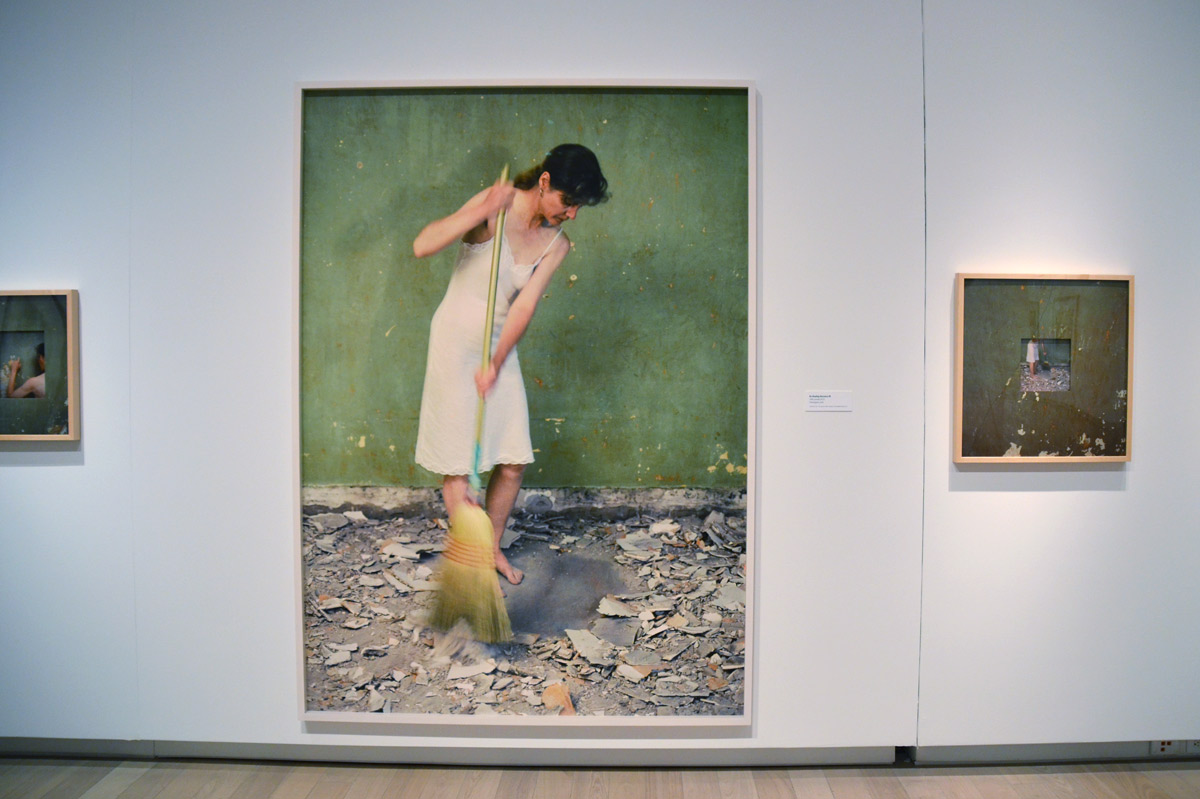
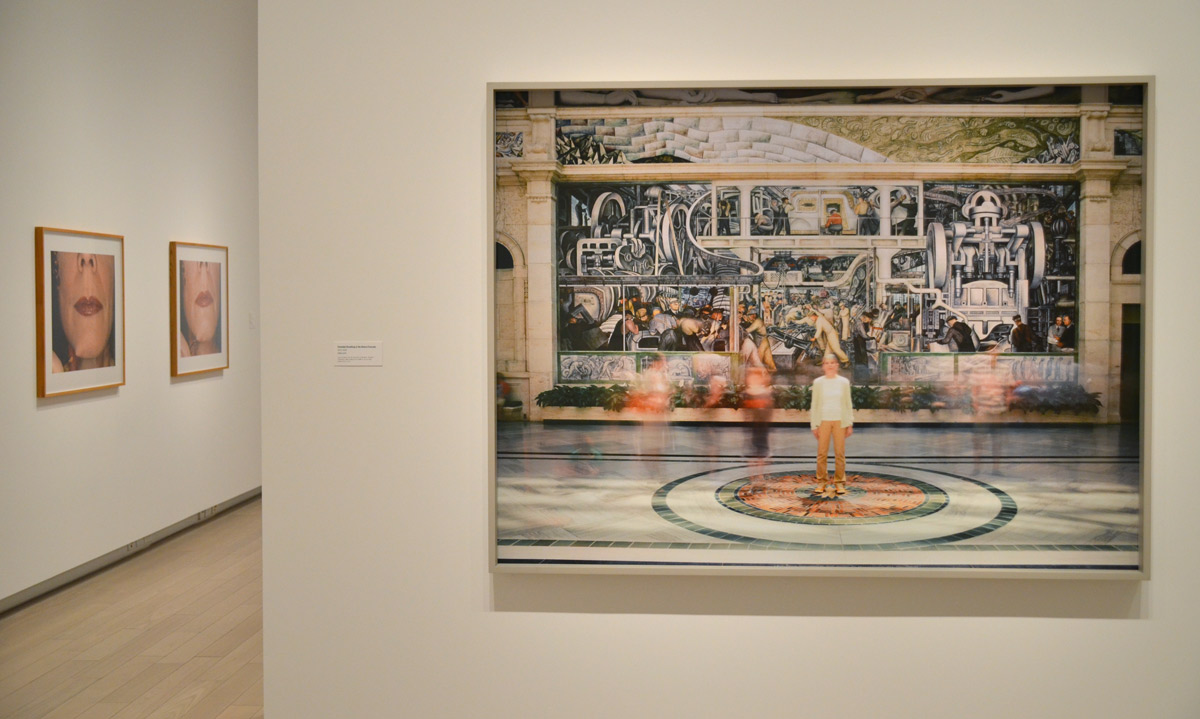
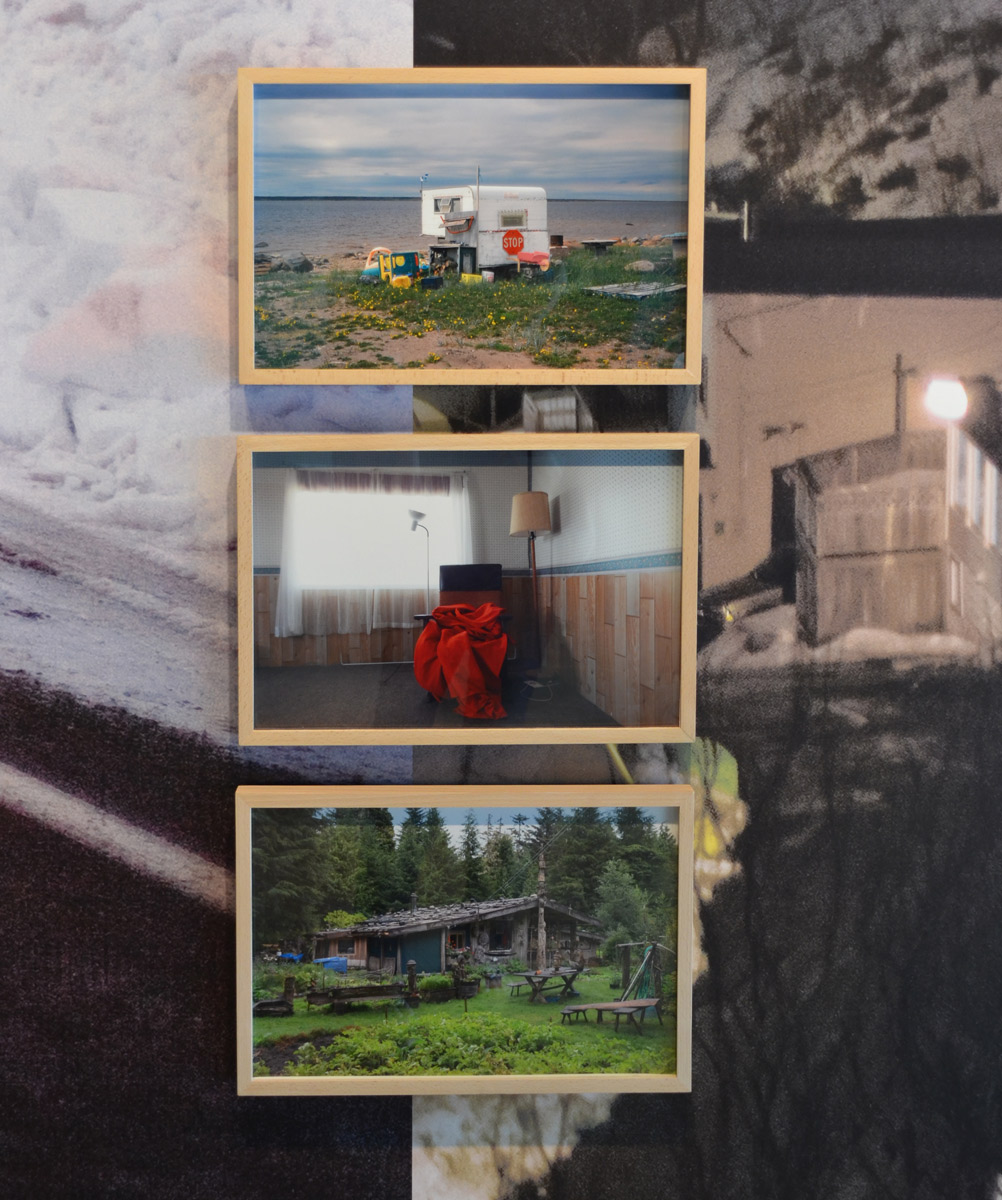
below: More of Hallberg-Campbell’s work can be seen inside in the Artport Gallery (Harbourfront building) – here, many photographs with simple wood frames are mounted on a wall that is covered with large images.  “Coastal” is the product of the artist’s travels to coastal areas of Canada, from Newfoundland to northern Manitoba to British Columbia and many places in between.   Life on the edge, so to speak.  (Note: gallery show ends 18th June)

three colour photos in simple light wood frames mounted on a wall that is covered with large images

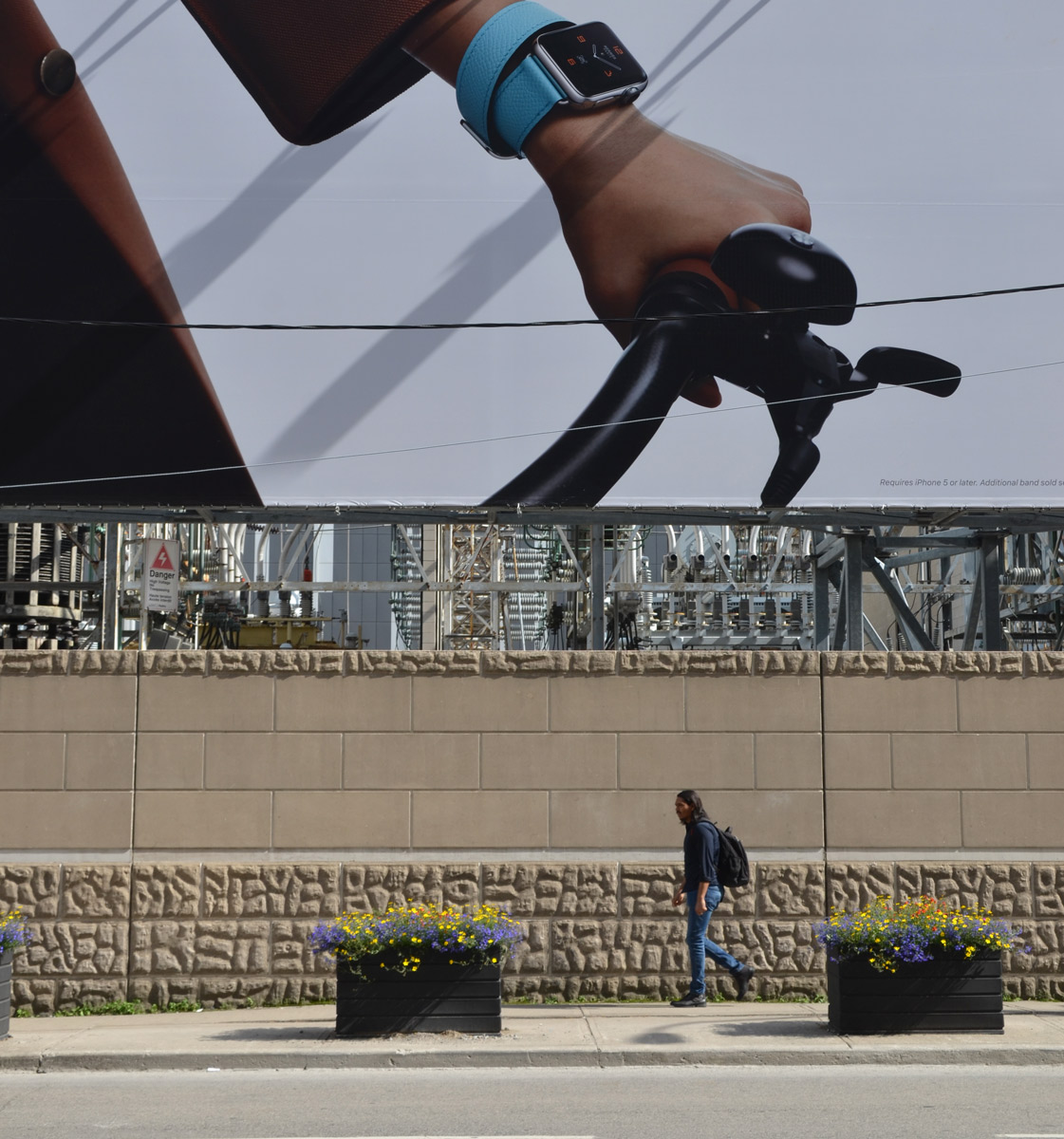
below: It’s not art but sometimes the line between public art and advertising campaigns is fuzzy.

a man walks on the sidewalk below a largef ad for Apple watches.  The photo is cropped so that the only part of the ad that shows is a hand on the handle bar of a bike.  A bright turquoise watch is on the person's wrist

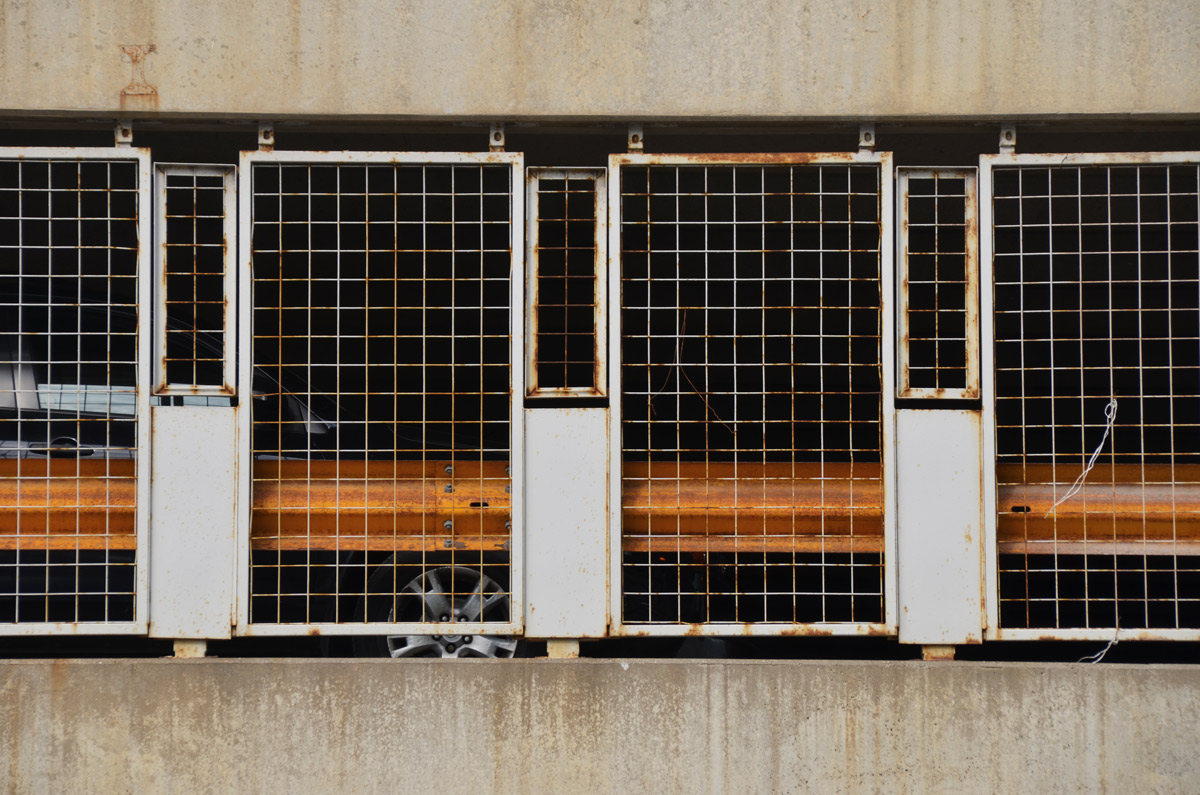
Not all is shiny and new.   And that’s the way it should be.

metal grille, part of a barricade along the side of a parking structure, rusted,

parking structure on the top, old door and wall on the bottom. A wood picnic table in disrepair is in front of the door

As I’ve mentioned before, I tried to see as many of the CONTACT Photography exhibits as I could in the last few days of May.  I blogged about two weeks ago about the ‘blocks’ at Brookfield Place.  I have been meaning to finish posting about the other exhibits I saw but there’s so much happening in the city.  I’ve been spending a lot of time walking with my camera instead of sitting in front of my computer.

Two of the exhibits that I saw were on King St West, one by Metro Hall and the other on the corner of the TIFF Lightbox building.   I haven’t been able to figure out what to say about the photos so they have sat in a folder on my hard drive.   Unfortunately they are not alone.  Yesterday I went back to take another look at the exhibits and think through a few thoughts, but the photos are gone.  Procrastination has its pitfalls.  TIFF Lightbox is now promoting their “Canada on Screen” program – all year, all free – as part of the Canada 150 celebrations.

I’ll just let the pictures do the talking.

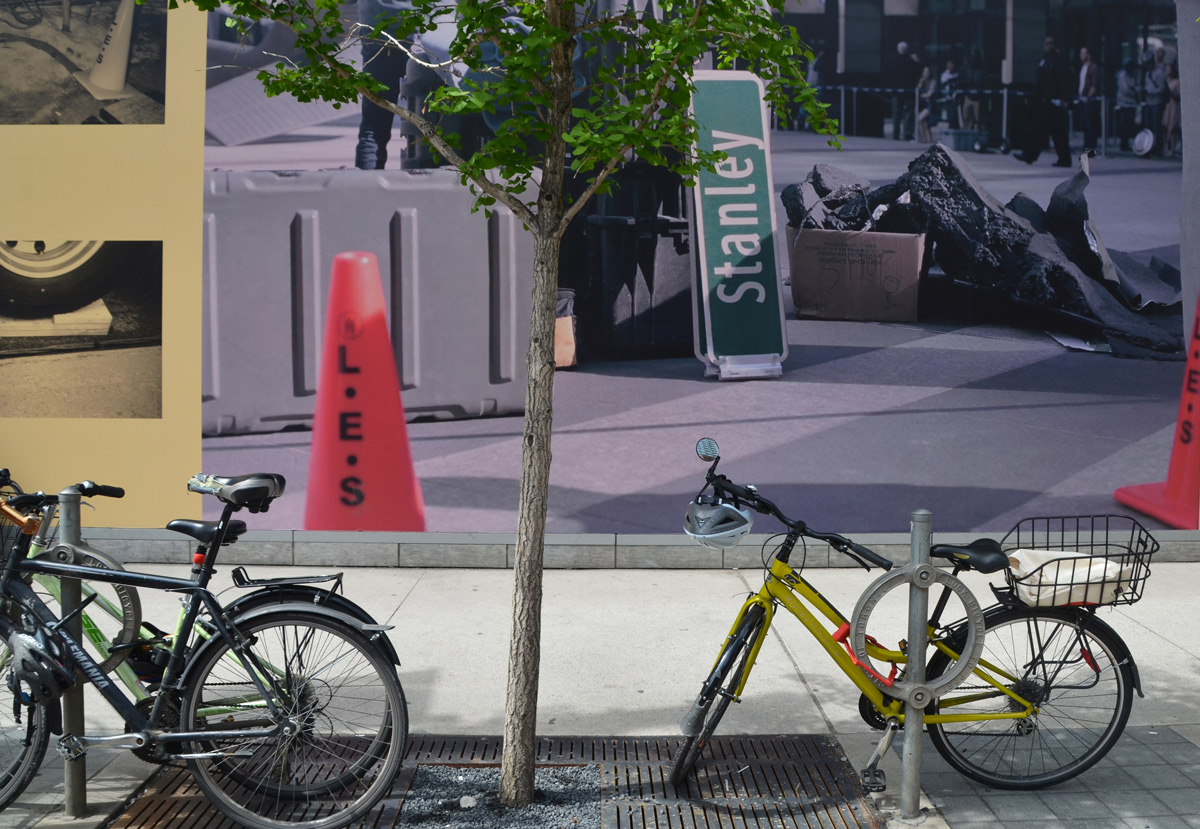
below: The corner of Widmer and King back in May.  The photos are “On Location” by Sam Cotter.

large photo on the corner of a building, taken during a movie shoot on the streets of Toronto (Bay St), a young man is sitting against the other side of the corner of the building asking passers by for money.

bikes parked in front of a large photo mounted on the side of the TIFF lightbox building, showing an orange movie shoot cone and a fake city street sign.

below: A similar viewpoint, taken yesterday.  Different pictures.. and different bikes.

bikes parked in front of a large poster advertising TIFF's Canada on Screen program, a collage of black and white pictures taken from movies.

The other exhibit was “The Sum of All Parts” by Jalani Morgan.

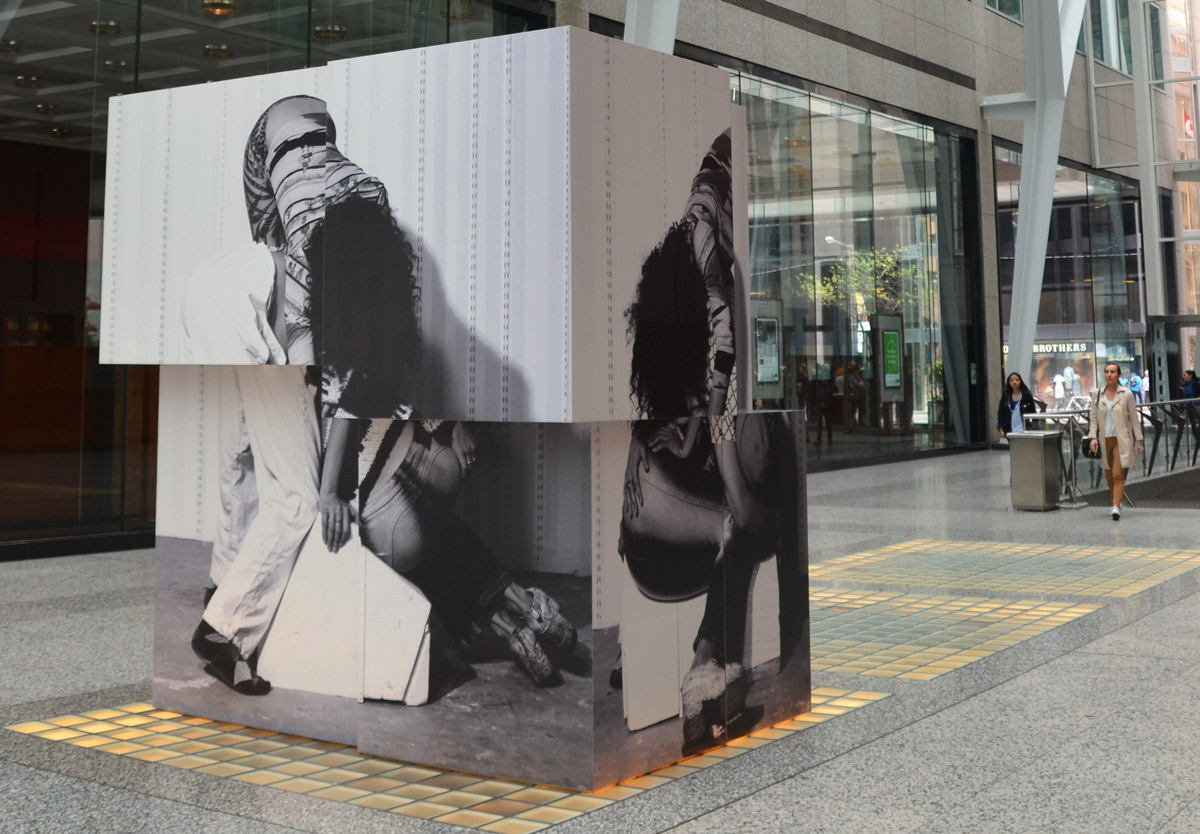
I was away for most of the month of May so I missed a lot of the annual Contact Photography Festival.  In the few days that I had to catch up, I visited a few of the exhibits.  One of these was ‘Nous ne somme pas des heros’ (We are not heroes) by Valerie Blass at the Allen Lambert Galleria in Brookfield Place.

two large cubes constructed from pieces of photos of different people in different positions sit in the middle of Brookfield Place, under the glass arched roof.

Blass arranged people in sculpture-like poses and then photographed them from different angles.  The photographs were then cut into sections, glued on blocks,  and then the ‘sculptures’ were re-assembled.

a large stack of blocks with black and white photos of people on them by Valerie Blass.

The subjects of the sculptures are anonymous.  Their “bodies fold inward, their differences intertwine and merge into single entities” (source).

photographs of the back of a person with another person sitting on his shoulders, upper person is leaning forward with head down, the blocks on which the photos are printed are in the walkway at Brookfield Place

bottom part of photos by Valerie Blass on a block at Brookfield Place as part of Scotiabank Contact photography festival, feet. Also the feet of people walking past.

Myseum of Toronto is a fairly new addition to the cultural fabric of the city.  It is a museum without walls.  It is an organization that helps deliver programming to different locations in the GTA.  Last night, March 6, at City Hall, Myseum of Toronto launched its second annual festival of events and exhibitions.  This festival, Myseum Intersections,  consists of 36 different events and exhibits spread around the city throughout the month of March.   “One Toronto.  Infinite Perspectives” is the motto of this year’s festival.

In keeping with that motto is an exhibit called ‘Cosmopolis Toronto: The World in One City’.   It was showcased at the Myseum Intersections launch party.   A few months ago it was on display at 18 libraries around the city but it has been brought together in one exhibit for the festival.   At the moment it can be seen on the ground floor of City Hall but it will also spend some time at Metro Hall and then end the month at the North York Civic Center.   (schedule at the bottom of the post).

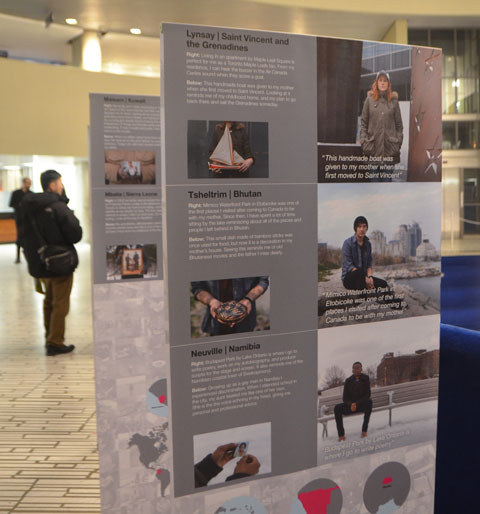
people looking at an exhibit of photos and stories that are printed on upright posters standing on the floor.

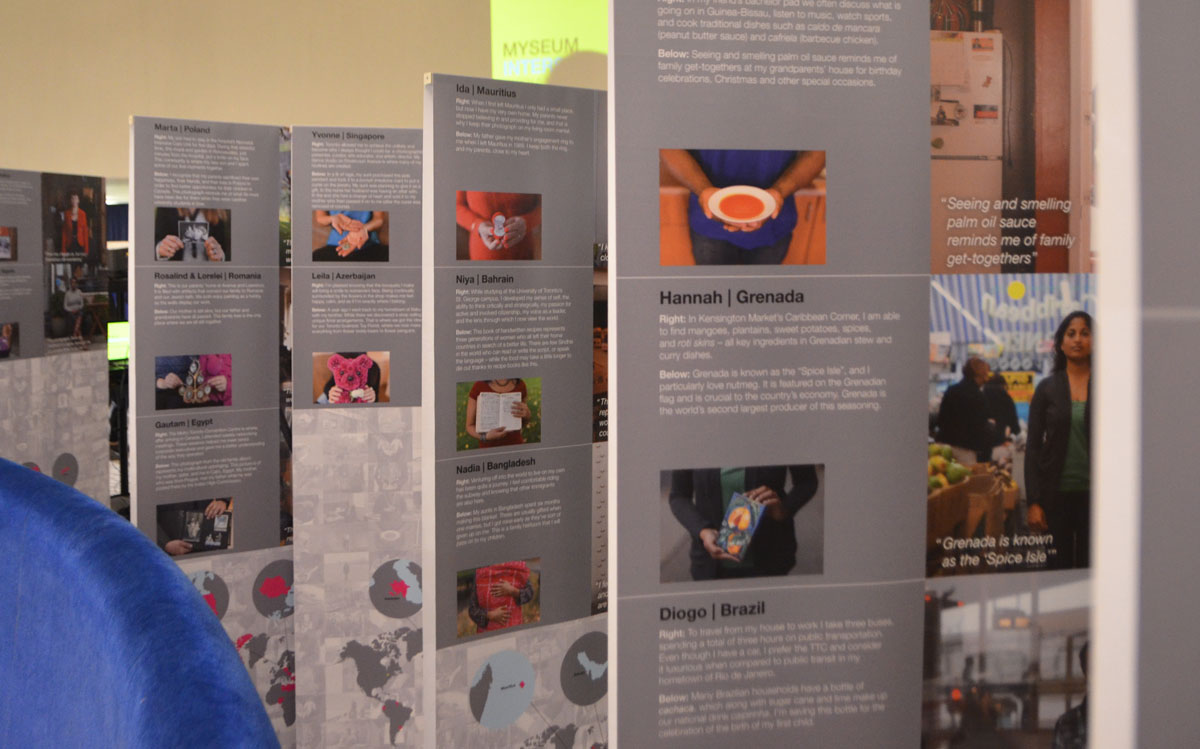
“Cosmopolis” consists of a series of portraits and interviews by Colin Boyd Shafer.   The goal was to find a person from every country in the world who now calls Toronto home, hence its tagline “Photographing the world, one Torontonian at a time”.   I am not sure if that goal was attained, but the series is a fascinating look at a very diverse group of people.

Cosmopolis posters on display at City Hall as part of Myseum Intersections festival

Cosmopolis posters of Andrea from the Congo and Nevena from Serbia

Two photos were taken of each person.     The first was a portrait taken in a Toronto location where they felt “at home”.  The second was of an object that they felt connected them to their country of birth.

cosmopolis posters of immigrants to Toronto from different countries

The Cosmopolis website has more information as well as the portraits and stories of many more new Torontonians.

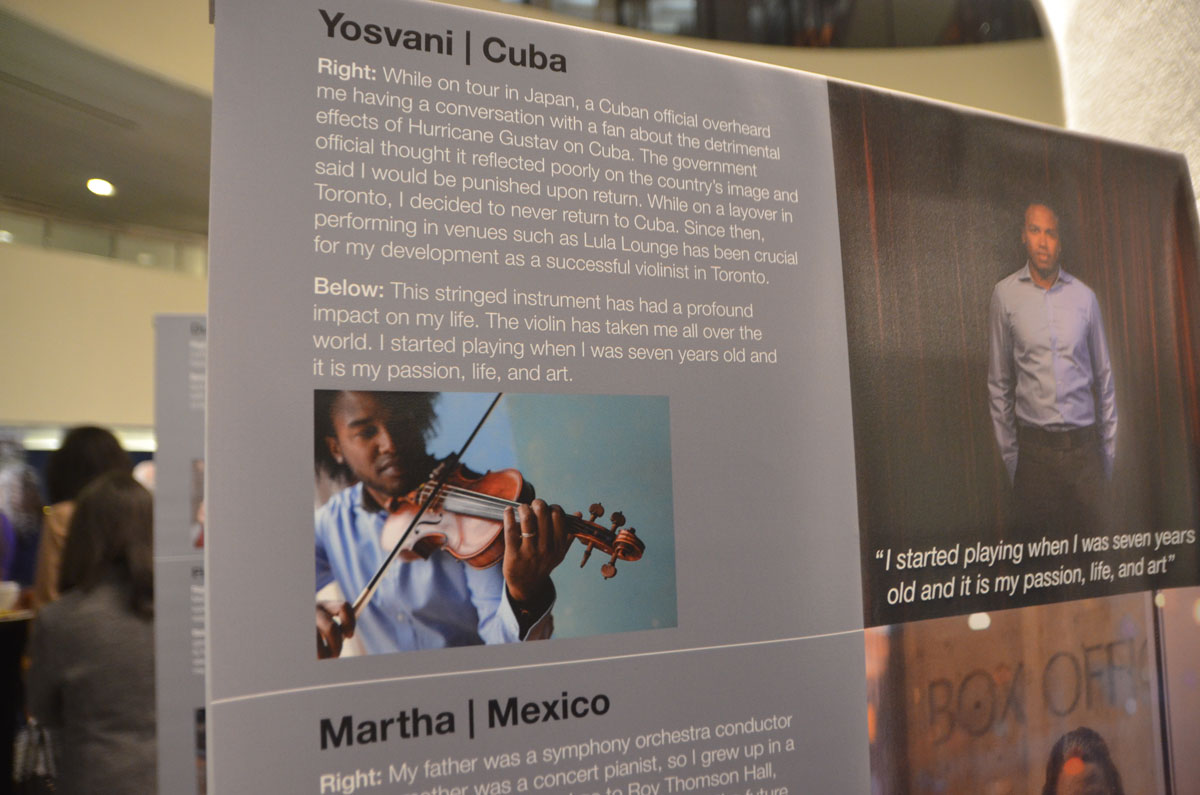
portrait and story about Yosvani from Cuba, a violin player

cosmopolis posters of immigrants to Toronto from different countries

***

EXHIBITION DATES & TIMES:
MARCH 5 – 8 & 13 – 19
MONDAY – FRIDAY, 8:30AM – 4:30PM
City Hall
100 Queen St W, Toronto

MARCH 9 – 12
MONDAY – FRIDAY, 7:30 AM – 9:30 PM
SATURDAY & SUNDAY, 8AM – 6PM
Metro Hall
55 John St, Toronto

MARCH 20 – APRIL 2
MONDAY – FRIDAY, 7:30AM – 9:30PM
SATURDAY & SUNDAY, 8AM – 6PM
North York Civic Centre
5100 Yonge St, Toronto

#myseumTO | #myseumX


This post is subtitled ‘Staying Cool on a Hot Hot Day’.  When the temperatures are into the 90’s (old style) and the humidity makes the air thick, walking streets and alleys is not very comfortable.  Instead I took refuge in air conditioned arty places.  With the help of the (mostly) air conditioned TTC I only needed to take a few steps outside.

below: At one point I walked through an air conditioned building rather than going outside.  This is what I found there. ‘August 6, 1945’ by Matthew Day Jackson.  Moments after I pulled my camera out of my backpack, a security guard appeared.  I was sure that once again I was going to get the “this is private property” talk but instead we ended up discussing the work and how it is displayed.

It is constructed of four panels and it’s very heavy.  The base is made of lead; you can see the lead where Lake Ontario is.  It is attached to the wall with 18 very long bolts and each bolt is wired to an alarm.

map of toronto made of charred wood and lead, meant to resemble the city after an atomic bomb, large, made by Matthew Day Jackson, hanging on a wall behind a metal railing.

below:  Looking a bit more closely at it you can see that it is a map of Toronto.  As you might have surmised,  the title is a reference to the dropping of the atomic bomb on Hiroshima by the USA during WW2.    This isn’t just any map of Toronto, it’s an aerial view of a burnt out city after a nuclear explosion.  It is one in a series of cities given similar treatment, all with the same title.

detail of the islands and downtown area of map of toronto made of charred wood and lead, meant to resemble the city after an atomic bomb, large, made by Matthew Day Jackson

From the effects of man made death to the life enhancing effects of nature….

below: A few steps outside took me past the Gardiner Museum where I noticed that the front garden was redone about a year ago.  ‘Vertical Crevice Garden’ was designed and donated by landscape artist Neil Turnbull.  From the Gardiner museum website, a quote by the artist: “When the massive forces of continental drift push against layers of sedimentary rock, they cause it to crack, break, and rise. Over centuries, through exposure to wind, sun, and the freeze-thaw cycle, the layers split open. These fissures and crevices collect rain, dust, and an array of windblown bits like seeds and spores; plants take root, and life takes hold.”

limestone rocks arranged on a slant in a garden, stripes of red rock and grey rock, all just a few inches off the ground

below: When walking past the Gardiner Museum, one can’t help but notice the striped head.  It’s actually called ‘Untitled’ (why do artists do that?) and it’s by Jun Kaneko, 2002.  It’s made of glazed ceramic and galvanized steel.   Before heading underground at Museum subway station I took a few minutes to try to take a ‘pretty’ picture of the head.  The plants in the garden next door haven’t quite grown up enough to hide that ghastly table that the head sits on.  I have always wondered why the museum chose such a mundane bland platform for the sculpture but now that I look at it again I wonder if it’s possible that the table is actually part of the artwork.  Could it be?

large striped head sculpture on a table, outside, by Jun Kaneko, old building behind it, lavender and other plants growing in front of it.

below:  A photograph in the doorway of a gallery caught my eye.  The picture below is not the one in the doorway, but one that was hanging on a wall inside that I liked even more.  ‘Paris Rooftops 4’ by Michael Wolf.  It is 48″ x 68″ and is a chromogenic print (full-colour silver-based photograph), edition of 9.   To buy it will set you back $22,000 but looking is free – check out more of Michael Wolf’s work on the Bau-Xi gallery website.

picture of a photograph by Michael Wolf of Paris rooftops. Concrete grey with lots of lines of little terra cotta chimneys

below: A man with a camera stares at a painting on a gallery wall.  ‘Watching’ 2010, (26 inches high) by Tom Campbell on the left and ‘Brown Trail #7’ 2016 by Shi Le, a Toronto based landscape artist.  These are at the other Bau-Xi gallery (the non-photography one)

a small sculpture of a man holding a camera is placed in an art gallery such that he seems to be looking at a painting on the wall.

below: Three paintings by NUBARR Gallery, a collection of the works of Armenian-Canadian painter Noubar Sabag (Noubar Sabbaghian) 1920-2006.   These, and others by the same artist, are on show at the Art Square Cafe & Gallery but unfortunately I just learned that today is the last day.

a woman in a floppy black hat is taking pictures of three paintings hanging on a gallery wall.

below:  How many people try to paint pictures like this?  How many people sell such paintings, not to mention have them hang in the Art Galley of Ontario?  But they aren’t Robert Motherwell.      So I ponder on the age old question of what makes a piece of art valuable or collectable?  Is the AGO (and other galleries) collecting paintings or names?  Motherwell painted this in numerous variations – a few changes in colour, a slight change in the lines.  Cheating?  Or brilliant marketing?  One for every gallery of note? This is Motherwell’s ‘Untitled (In Orange with Charcoal Lines)’ c1970.  There’s that “untitled” again, the most popular name for an artwork.

all orange with 3 black lines that form three sides of a square, top line of the square is missing. It's a picture of a painting by Robert Motherwell in an art gallery

My last stop of the afternoon was at the photography exhibit by Thomas Ruff at the AGO.  Part of the exhibit was a few large photographs of stars,  ‘Sterne’.  Large pictures of stars in the night sky were made from negatives that Ruff bought from the European Southern Observatory in Chile in 1989.

below:  They are difficult to look at, or rather it is difficult to what is the picture because the blackness of the photograph creates a mirror when placed behind glass.   This is me taking a picture of the picture – me plus the picture on the opposite wall plus the lights and light fixtures in the ceiling plus a table plus another person in the room plus a few white spots that are stars.

large photograph of the night sky, lots of stars and blackness. The black acts like a mirror and parts of the gallery are reflected in the picture.

below: ‘Walking Away, Walking Through the Universe’ a manipulation of a manipulation.

a reflection of two people walking hand in hand as seen reflected in a photograph of stars in the black night sky

below:  One last photo.  Let’s end this on a positive note and give Thomas Ruff credit for some interesting work.   These two pictures are part of his press++ series where he has taken old photos used in print medium and merged the front (picture) and back (words and markings) of the print into one.

a woman is standing in an art gallery and she is looking at two large pictures on the wall.

Thomas Ruff, Object Relations, at the AGO until 1 August 2016

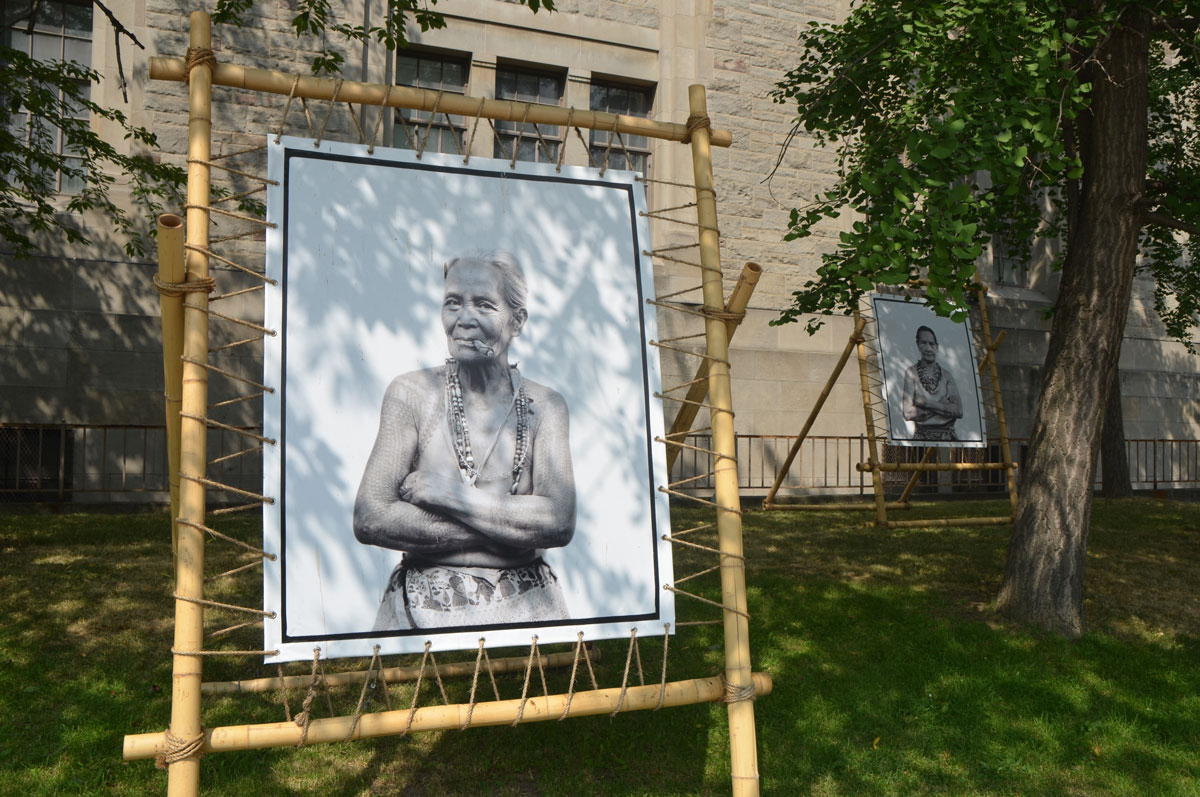
There are seven or eight large photographs, portraits of older women, on University Avenue.   They were actually part of the CONTACT Photography Festival and they have been on display outside the Royal Ontario Museum since early May.  The photos are the ‘The Last Tattooed Women of Kalinga”, portraits by Jake Verzosa.

large black and white photo of an older woman with many tattoos, black and white, displayed outside, another portrait in the background

In the villages of the Cordillera mountains of northern Philippines the women have been tattooed with lace-like patterns for centuries.  The tattoos are symbols of stature, beauty, wealth and fortitude and are traditionally applied during rituals.  The tradition is dying out as standards of beauty change and as the old ways are replaced with more modern methods.

Each village once had their own tattooist, or mambabatok, but today only one remains.  Born in 1918, Whang-od (or Fhang-od), is the last person to practice the centuries old technique called batok.  The ink is made of charcoal and water and it is applied by tapping the skin with a thorn.

two older women with their shoulders tattooed, wearing necklaces and a patterned skirt, seated. Black and white

Once the men were also tattooed.  The Kalinga tattoo has evolved from their ancient tradition as warriors and headhunters.  Heads were taken from fights and battles as a trophy; each time a man brought home a head he would receive another tattoo as a reward.  Tattoos were a mark of social status.

Indigenous groups throughout the Philippines practiced tattooing for centuries.   When the Spanish arrived in the 1500’s they called the people ‘pintados’ or ‘painted people’ as it was not uncommon for people to have tattoos covering their whole body.  While some tribes used tattoos to mark status, other tribes believed that tattoos possessed special spiritual or magical powers which gave the individuals strength and protection.  The use of tattoos as protective symbols is an idea that occurs in many cultures.

large black and white photo of an older woman with many tattoos, black and white, displayed outside, another portrait in the background

In conjunction with the Kalinga portraits, the ROM is featuring an exhibit that examines the beliefs surrounding tattoos, and the role that they and other forms of body art play in different cultures over the years.  “Tattoos: Ritual, Identity, Obsession, Art” is on view until September 5th.  It is a global tour of tattoos past and present.

One of the cultures that is featured is the Chinese.  For centuries, tattoos were forbidden, or at least taboo, in China.  To be tattooed was to be discriminated against as they were associated with prisoners or vagrants.  Recently that has begun to change.
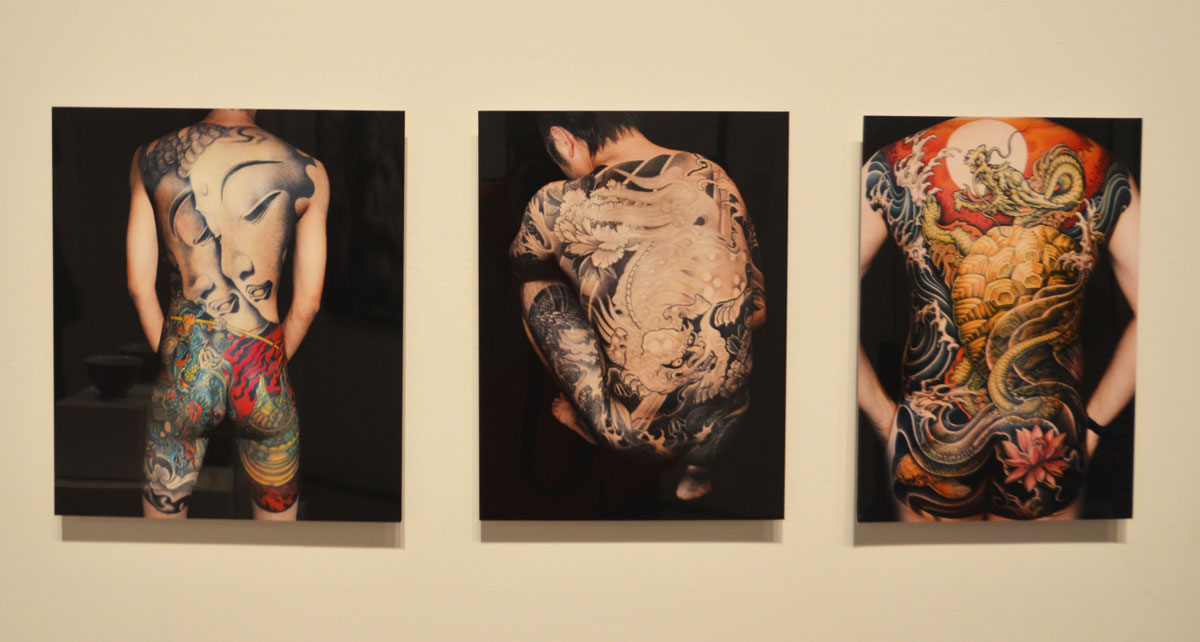
below: Three large modern picture tattoos by Taiwanese tattoo artist Gao Bin featuring traditional Chinese images, Buddha, lion and dragon.  Tattoos as a cultural expression.  In some countries such as Sri Lanka and Thailand images of Buddha are considered sacred objects of worship.  While it’s not illegal to have such a tattoo, wearing one could get you into trouble.

Three pictures of the backsides of men, each with a large picture tattoo from neck to thigh. Chinese art pictures as tattoos

below:  Here is another example of why people get the tattoos that they do.  This is a picture of one photograph in a series by Isabel Munoz.  Munoz spent three weeks inside several prisons in El Salvador and photographed mara gangs.  Gang members wear offensive tattoos to assert their antisocial behaviour and express their loyalty to the gangs.  Tattoos as statement; tattoos as a mark of membership and belonging.  Tribal.
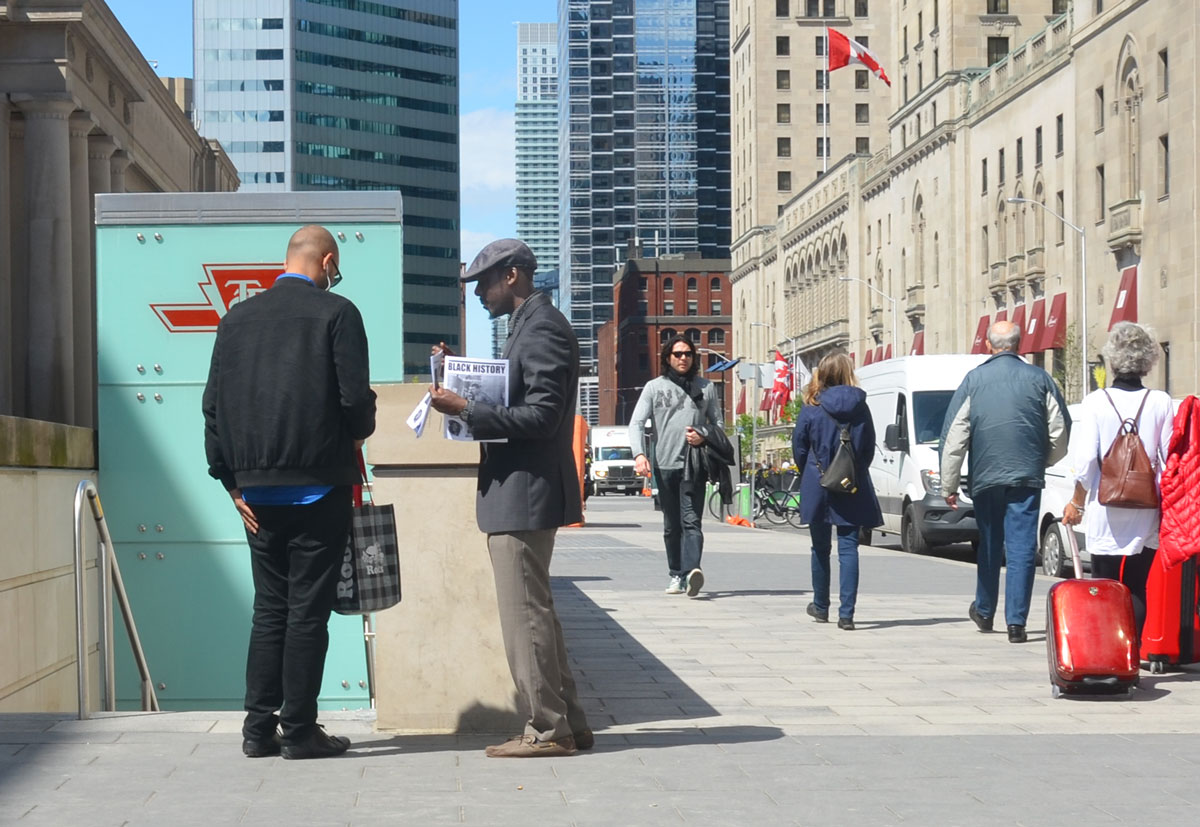
photo of a picture in a museum of a man's face that has been tattooed with gang symbols and words,

below: A silicone arm with a tattoo by Montreal artist Yann Black on display.  This is one of 13 commissioned tattoos on silicone body parts – arms, legs and torsos both male and female that are part of the exhibit.   Tattoos as artwork.  Individuality.

a silicone arm has been tattooed with a design that looks something like a cross between Frank Lloyd Wright and Mondrian. It is in a glass showcase in a museum.

The oldest known tattoos were found on Otzi the Iceman, a natural mummy who was found in the Otzal alps near the Austria – Italy border in 1991.  His tattoos were 61 lines ranging in length between 7 and 40 mm.  The lines were arranged in groups.  Most of his tattoos were on his legs where there were 12 groups of lines.  Otzi is estimated to have died between 3239 BC and 3105 BC.

Tattooed mummies have also been found in other places – Greenland, Alaska, Siberia, Mongolia, western China, Egypt, Sudan, the Philippines, and the Andes in South America.  We will probably never know what significance the tattoos had.  Theories abound of course and they often involve reasons like protection, spiritual, status, tribal, or just for decoration.  Reasons that probably ring true today too.  The methods have changed and some of the images have changed, but human nature remains just that, human nature.


Frank Kovac Lane is a short alley just south of Christie subway station.  Some of the garage doors were painted with murals in past years and, as usual, there were plenty of tags.  Recently, the lane was the scene of a community mural painting session thanks to the 4th Toronto Rangers (Girl Guides), StreetARToronto,  artist Nick Sweetman, and some local residents.  Now some of the tags are gone and more importantly, some more garage doors are home to bright and cheerful murals.  A few of them are included here.

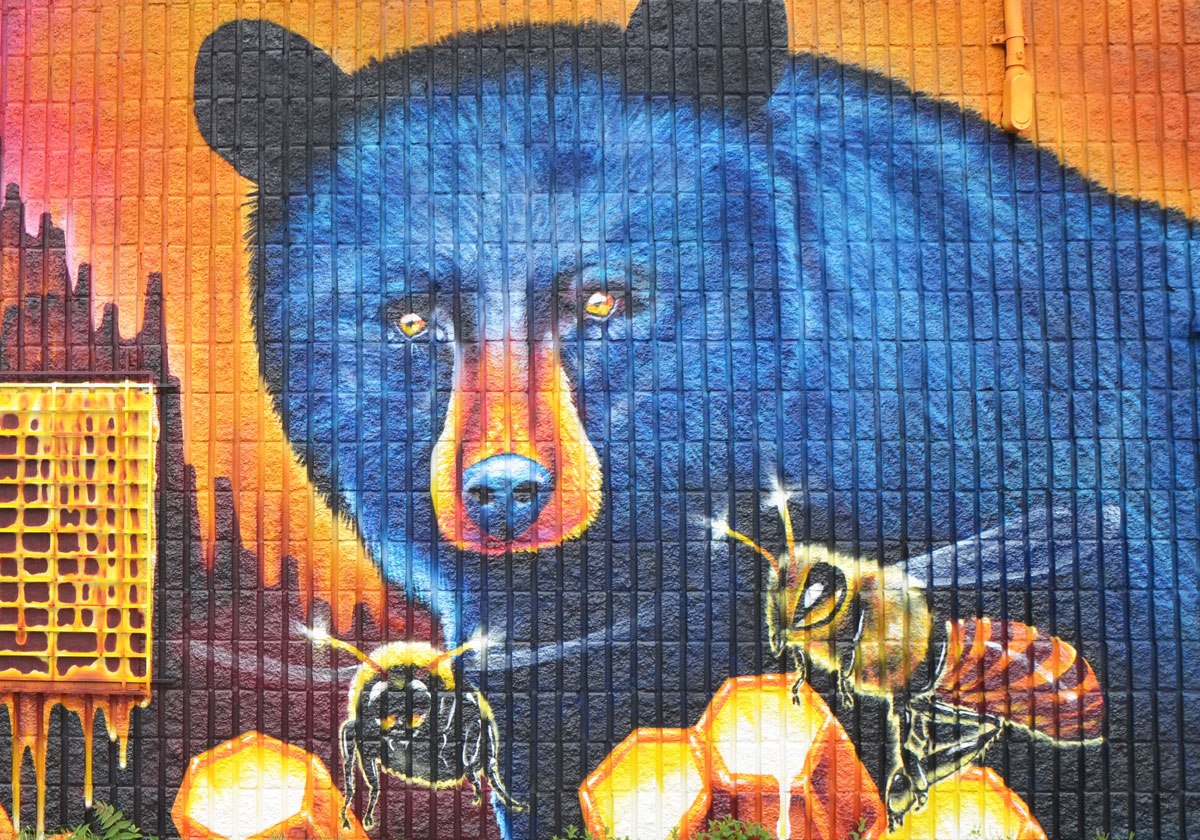
below: At the north end of the lane is this large, colourful mural by Nick Sweetman.
Two large blue bears have found a plethora of honey.  Will the bees share?

large mural by Nick Sweetman on a wall in Frank Kovac Lane, two very large blue bears are eating honey from honeycombs while a few large bees buzz around.

part of a large mural by Nick Sweetman on a wall in Frank Kovac Lane, two very large blue bears are eating honey from honeycombs while a few large bees buzz around - close up of one bear's face

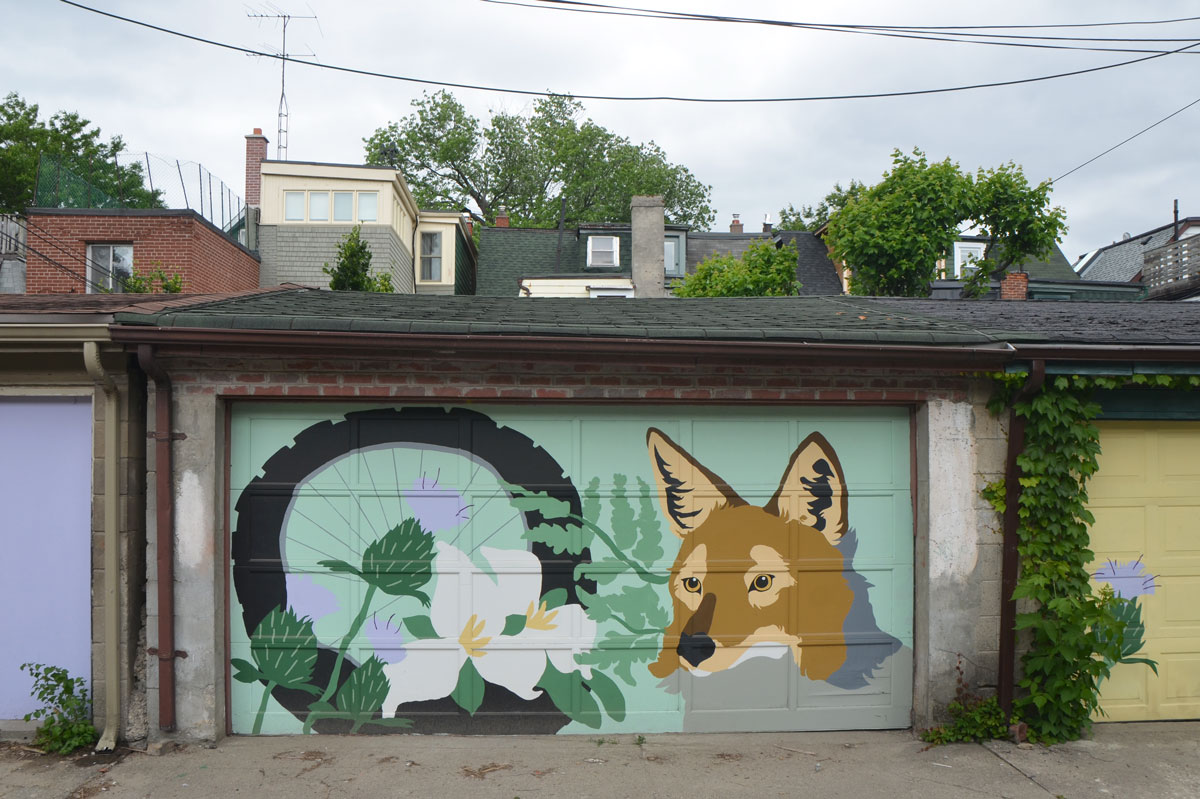
below: The new murals continue the animal theme, “Urban Wildlife”, starting with this fox.

garage door in an alley painted with a mural of a fox head beside a bicycle wheel with trilliums growing up in front of it.

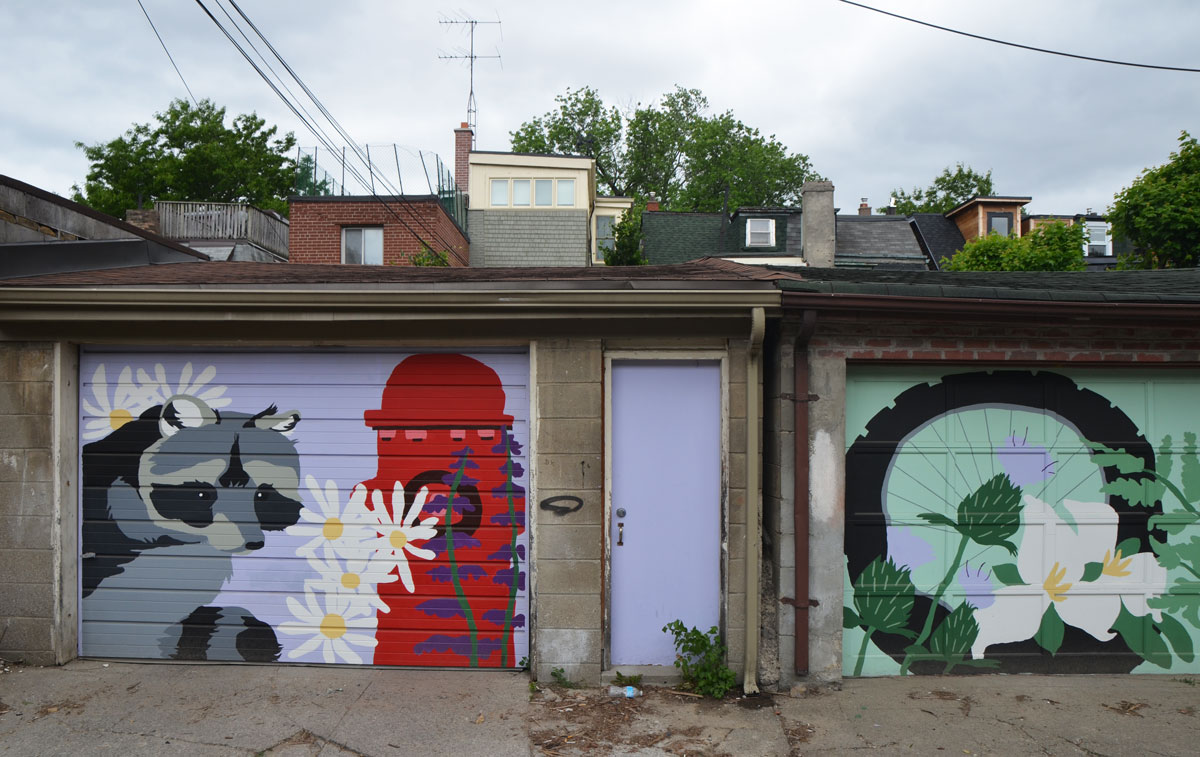
below: A common Toronto animal, a raccoon, beside a red fire hydrant.

view in an alley, a lavendar coloured door. to the left of the door is a garage door painted with a mural of a raccoon and a red fire hydrant.

below: A blue jay eyes some blueberries.

mural on a pale yellow garage door of a blue jay sitting on hydro wires, also a bunch of wild blueberries is in the image

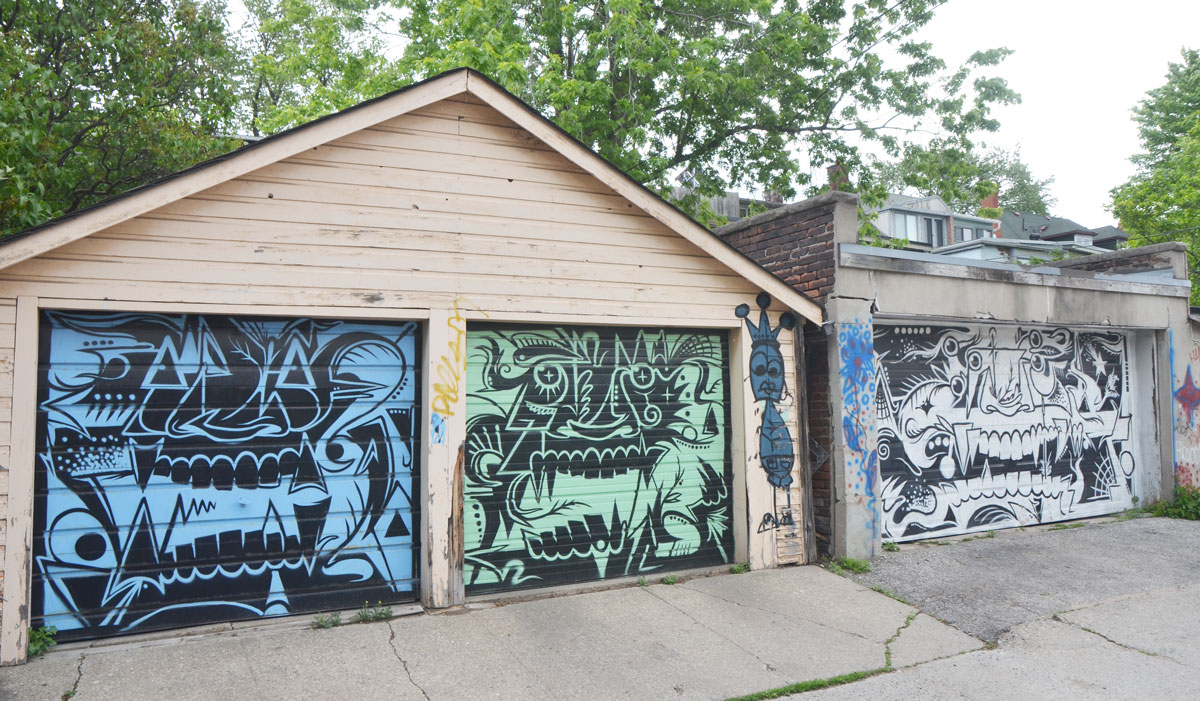
below: Several monster faces have lived in this alley for a while and they still remain.
This one looks like he needs a hair cut.

garage door painted with a monster face, big mouth and teeth, orange nose, in tones of blue, grey and orange, ivy is growing over the top of the garage and it looks like green hair.

three garages in a row in an alley, all painted with a large monster face

a skinny blue graffiti figure on the edge of a garage, between two garage doors with stylized and abstract faces painted on them. One is black and green and the other is black and white

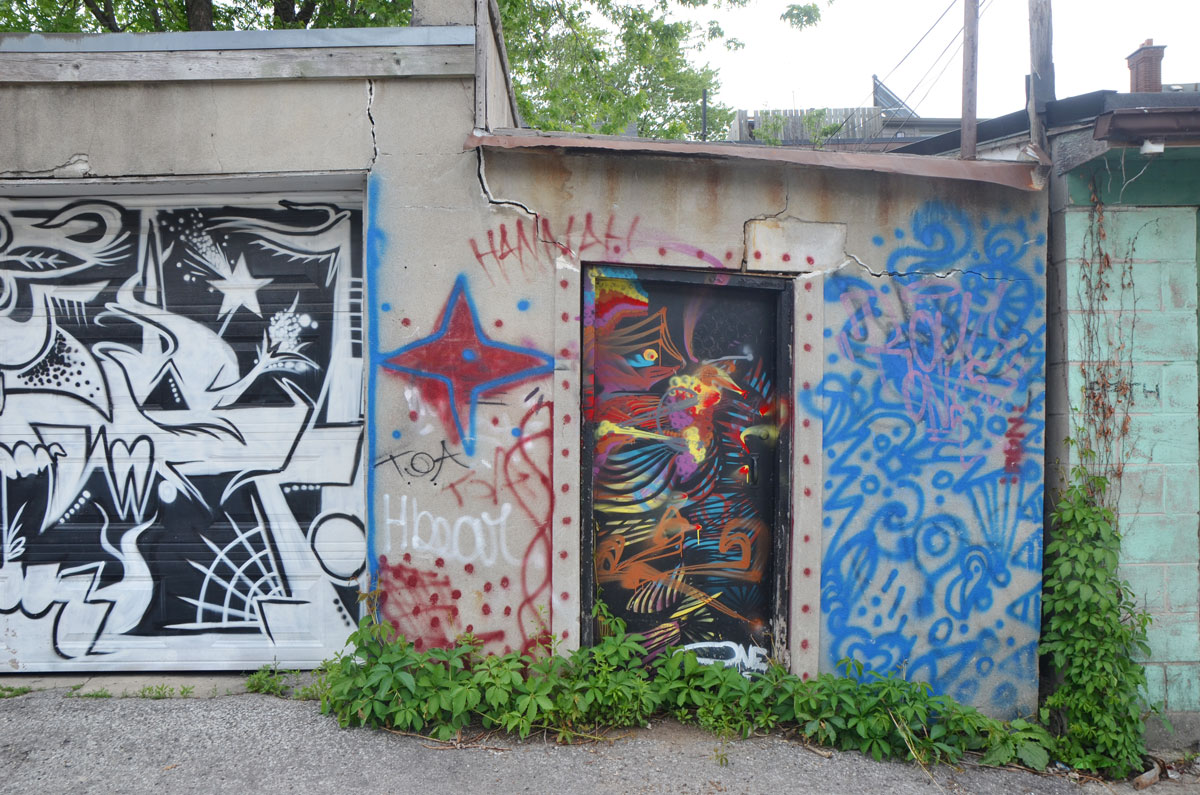
An old garage and concrete fence with a door in it. The fence is cracked above the door. The door is painted black with bright colour scribbles, the garage door has a black and white mural on it

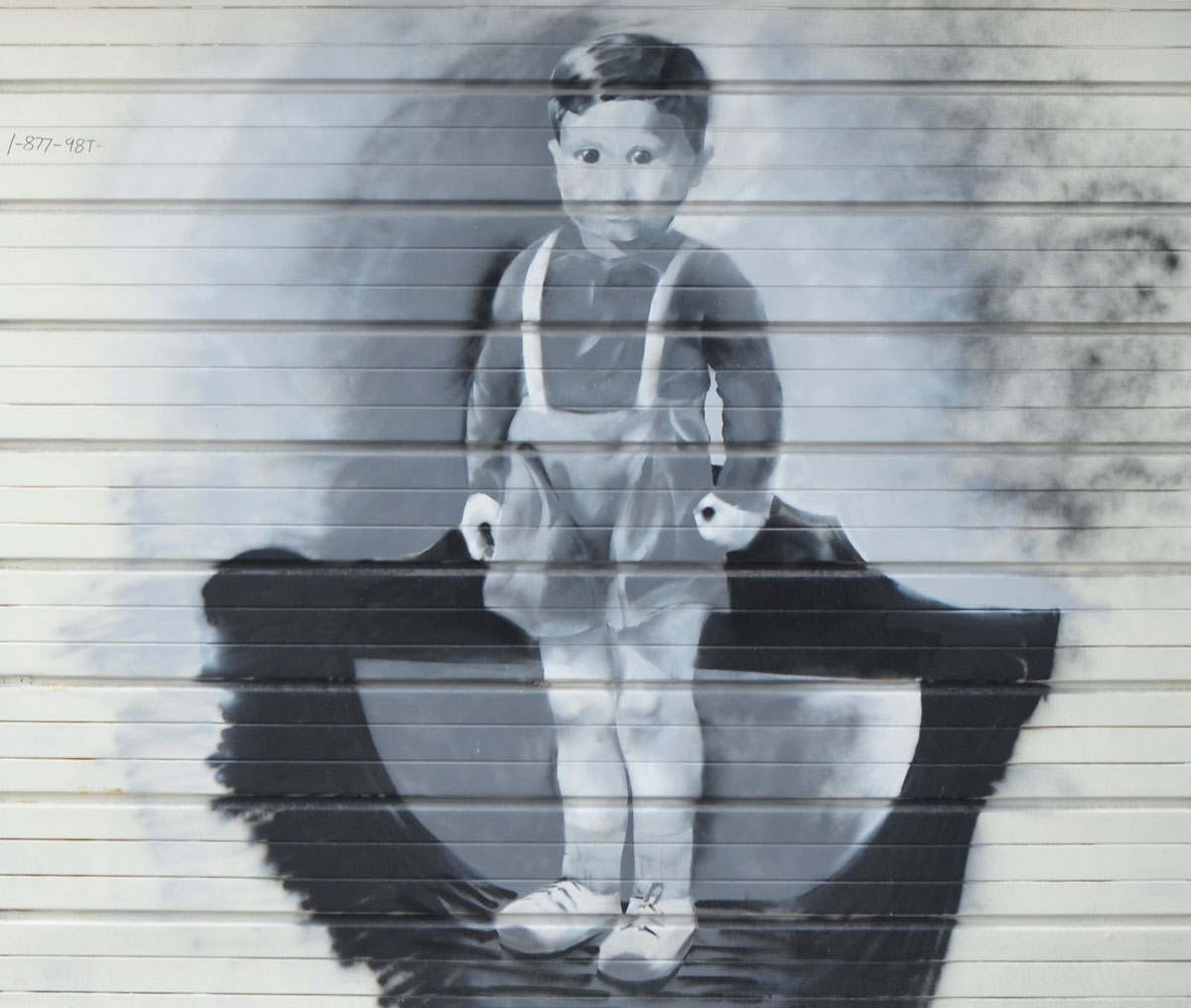
a painting in grey tones of a young boy in old fashioned shorts and long sleeved top, standing.

below: This graffiti is actually on Harbord Street but I couldn’t resist taking a picture of it
– a camera and an “oh snap”

Above Guan's auto service shop, a graffiti on an upper storey wall, a small camera and turquoise lettering and words in pink that say Oh snap. Above that is a red billboard for Bud and Burger

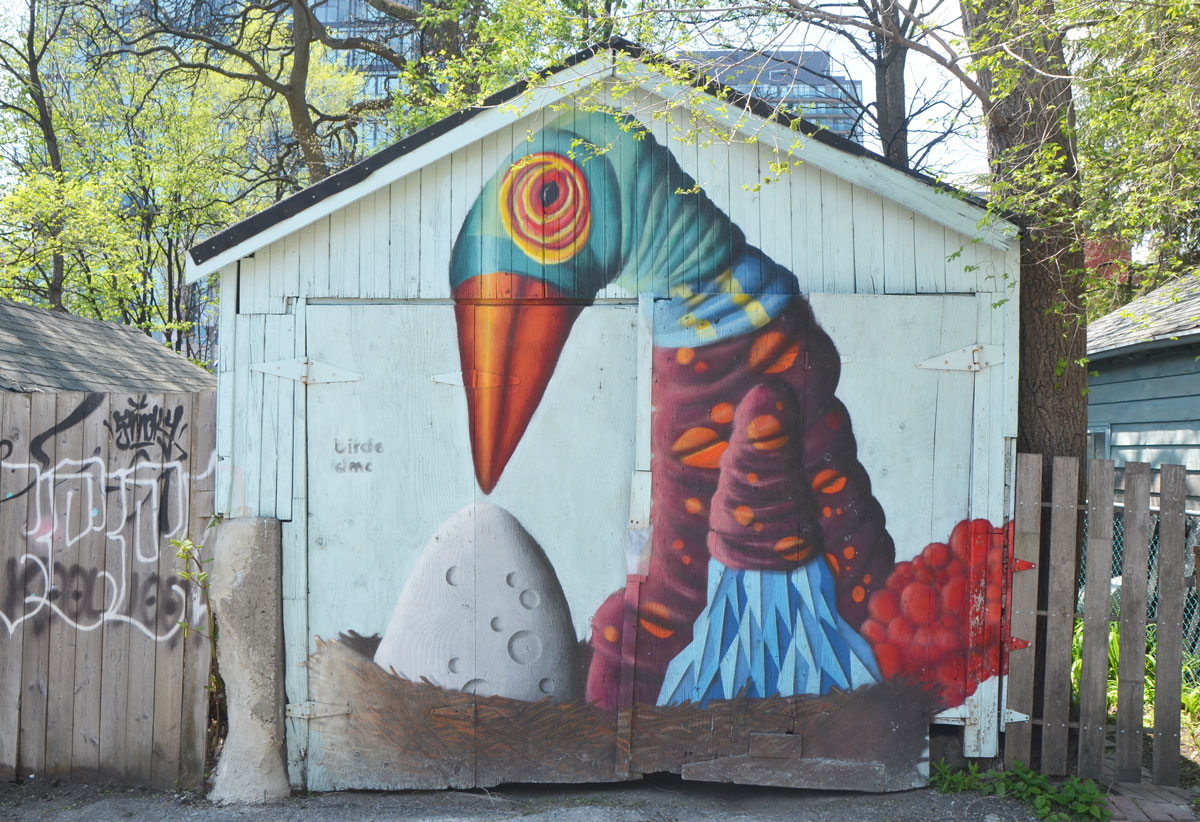
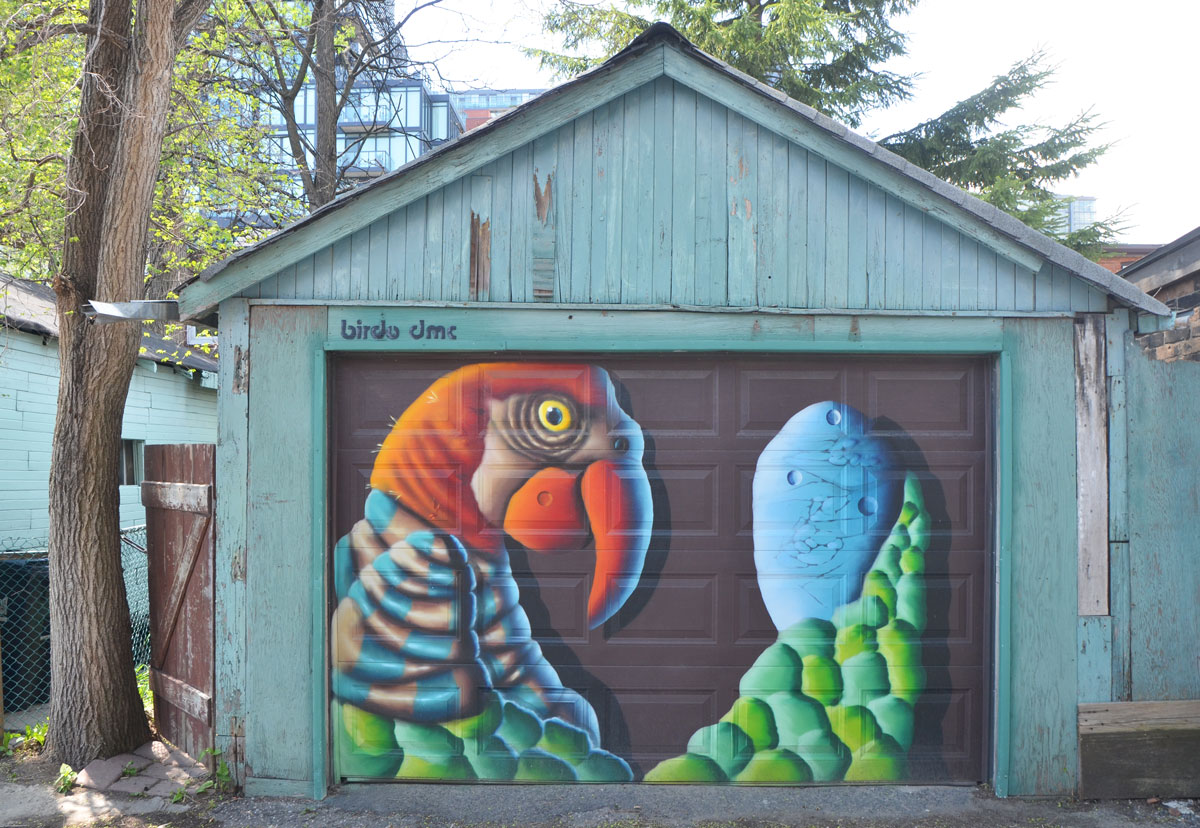
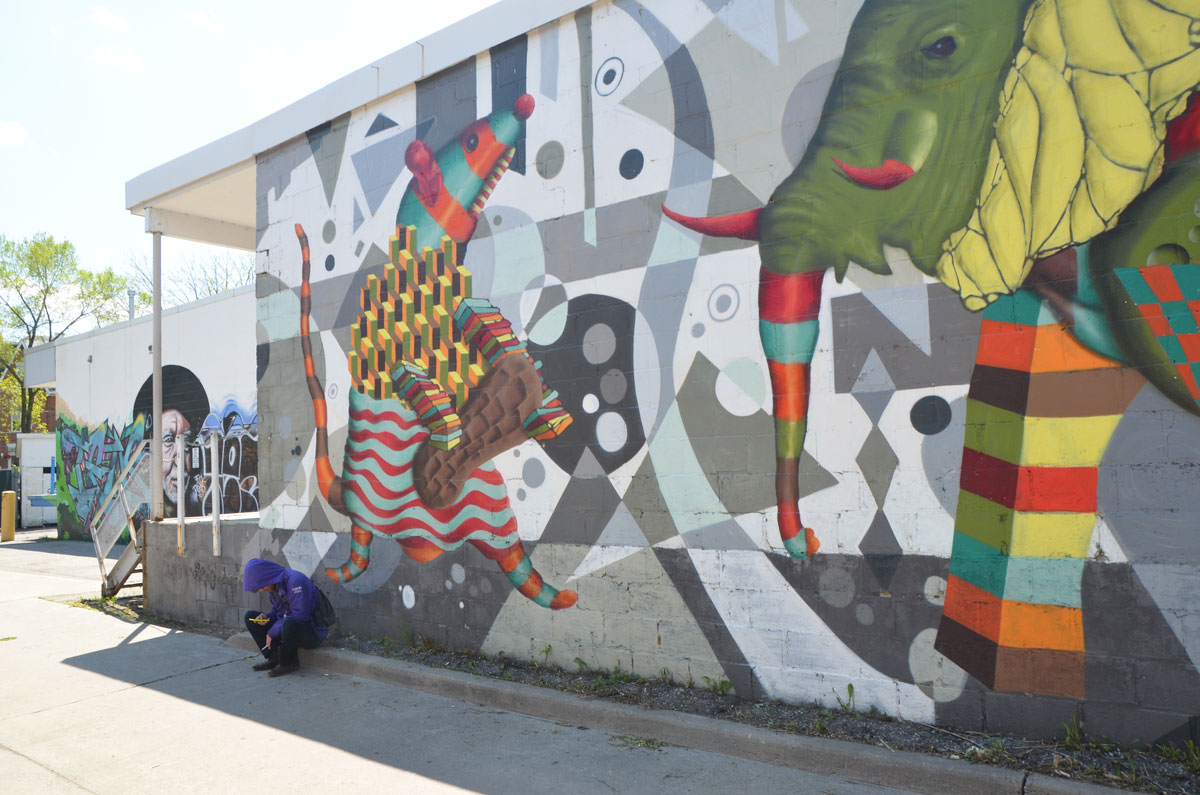
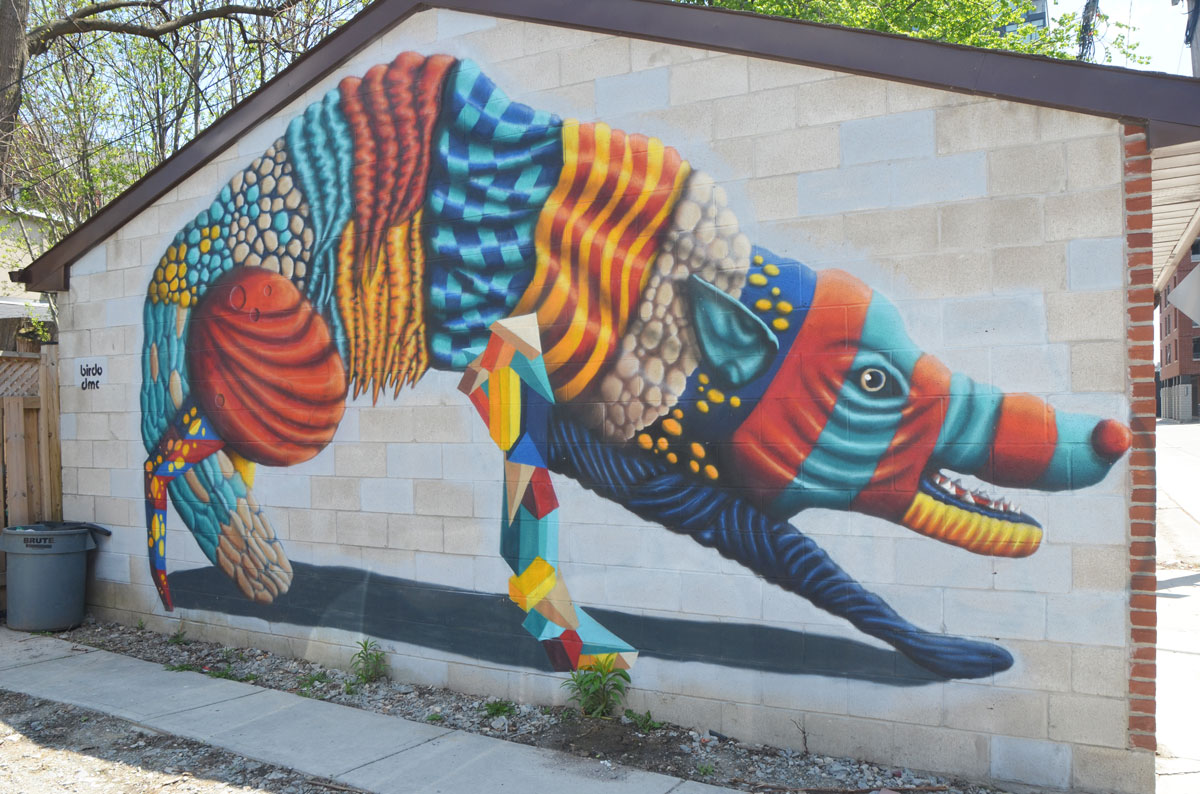
This blog post is about a flock of birdos, meaning that I found a lot of alley garages decorated with paintings by street artist birdo.  Or maybe ‘a menagerie of birdos’ would be a more accurate description as most of the pictures were of different animals such as elephant, cat, dog, coyote, and mouse along with a number of different birds.

These photographs were are all taken in alleys behind the south part of Dovercourt Road (between Queen and Sudbury streets).  The majority of the paintings that I saw were result of birdo’s work but there were examples of  and I have included them in this post too.

 below: Two birdo birds with eggs, with a slice of mushroom and pepperoni pizza by Shalak.

Three garages in an alley, with trees growing between them. The first two have garage doors with birdo murals on them and the third has a pizza street art painting by Shalak

street art mural on a garage door in an alley by birdo - a large bird with blue head and orange beak sitting in a nest looking down at a large white egg

street art mural on a garage door in an alley by birdo - a parrot holding a large blue egg

An old wood garage in an alley that is painted by Shalak, a slice of pizza with pepperoni pieces flying off it (or onto it!)

a person is sitting on a kerb in an alley, beside a wall with a large mural by birdo of an elephant and a mouse

street art mural on a wall in an alley by birdo - an elephant with a green head

below: Howling at the moon, with a cactus and a scorpion too.

street art mural on a garage door in an alley by birdo - a coyote howling at the moon in the desert with a large cactus in the picture as well as a scorpion. words: birdo homes spud

below: Blue dog, pink lava lamp

street art mural on a garage door in an alley by birdo - a blue dog beside a pink lava lamp on a table. words: birdo dmc, phil pans tense

street art mural on a garage door in an alley by birdo - a four legged animal looks to be growling at something

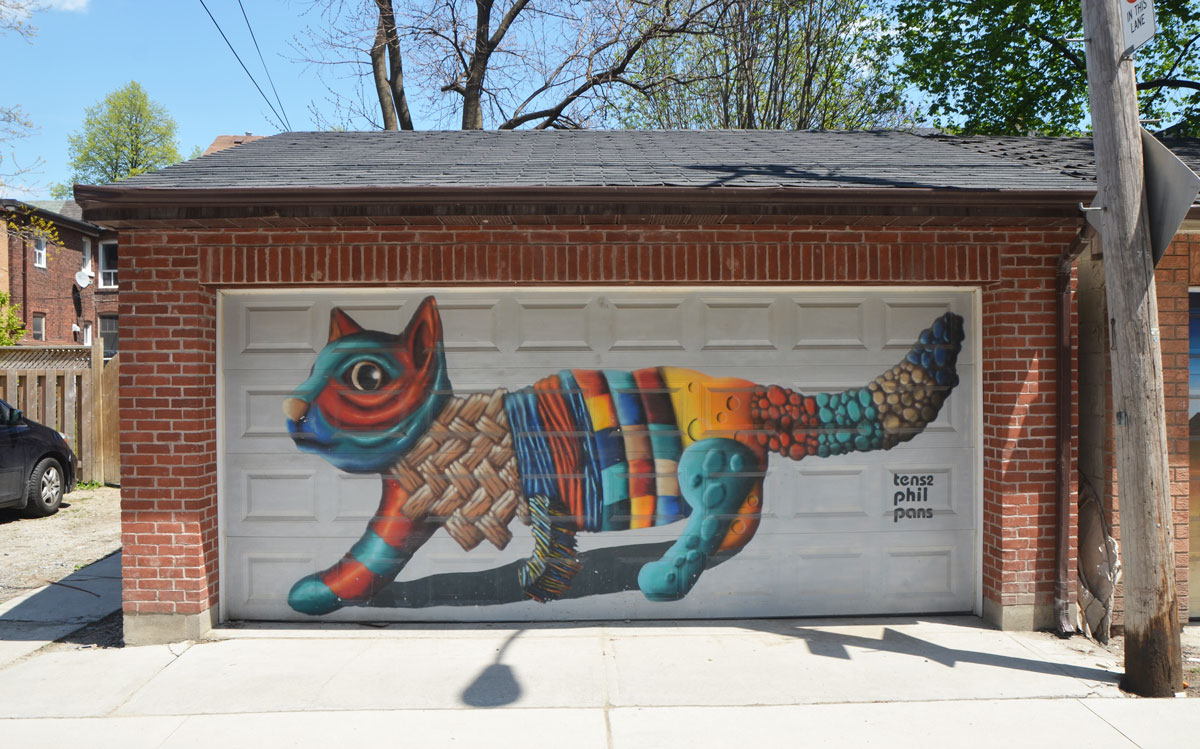
street art mural on a garage door in an alley by birdo - a large multicoloured cat. words: tense phil pans

below:  A rooted turtle and cool owl with sparkly shades

street art mural on a garage door in an alley by birdo - a lavendar turtle and an owl with blue eyes and orange beak

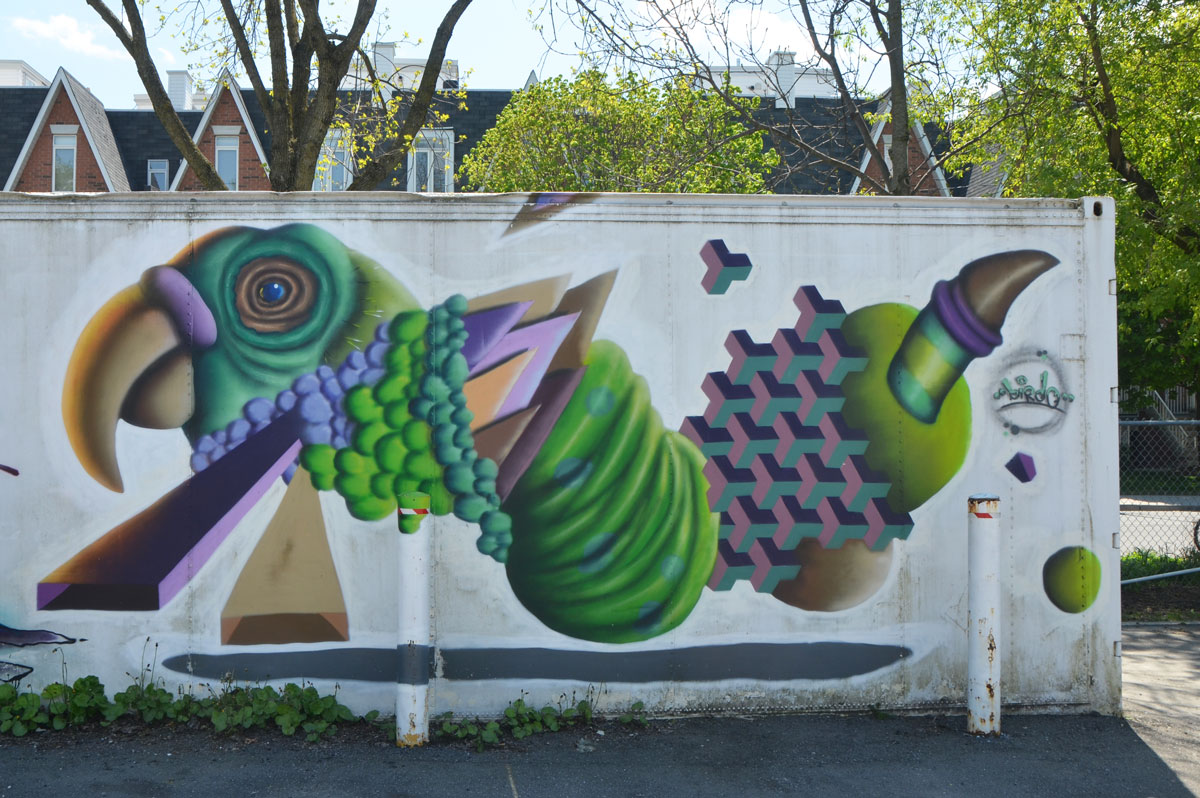
street art mural on a garage door in an alley by birdo - a creature with a green and purple body and head that looks like a parrot

street art mural on a wall in an alley, a girls face, two little brown pigtails, 2 hearts and a turtle head

an old mattress leans against an old brick wall that has two pieces of graffiti on it. One is a blue and yellow egg shape with a blue arm and hand sticking out of a crack in it. The words "It's alive" are written beside it. The other is a small blue creature like shape

On a gararge door in a laneway, painted like the Canadian flag except there is a pineapple in the middle instead of a maple leaf. On the right hand side red stripe are the words "have a nice day"

A mural by bruno smoky on the side of a white container. It is a purple faced creature with blue tag like shapes around it.

below: “Just a robot that doesn’t like technology”

a lovebot on a silver garage door with the words "Just a robot that doesn't like technology, I'd rather be free"- signed Tasha

number 66 in a lane, garage door, door and walls covered with circles and triangles in different colours.

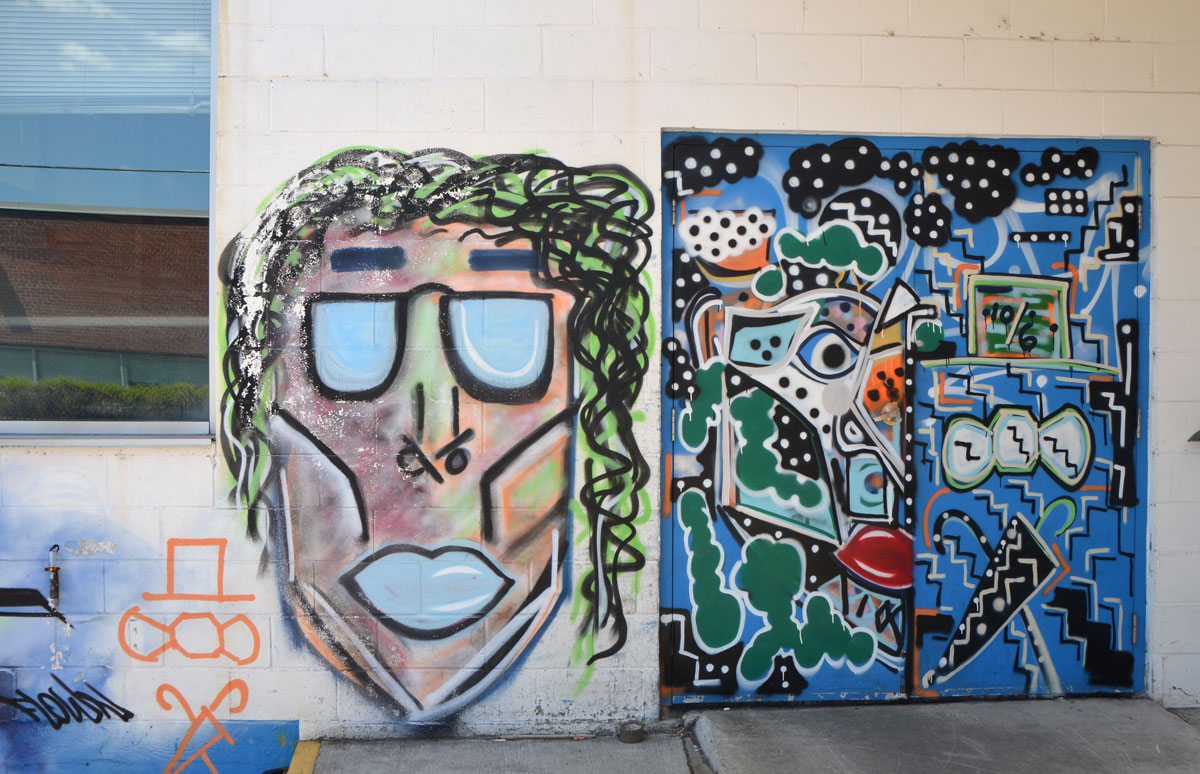
A door covered with a very abstract face painting and another graffiti face beside the door.

On Friday morning, my original goal was to find ‘Residents of the Esplanade’, a CONTACT Photography Festival outdoor exhibit at David Crombie Park but it was such a beautiful morning that I didn’t stop there. I found more than just the ‘Residents’.

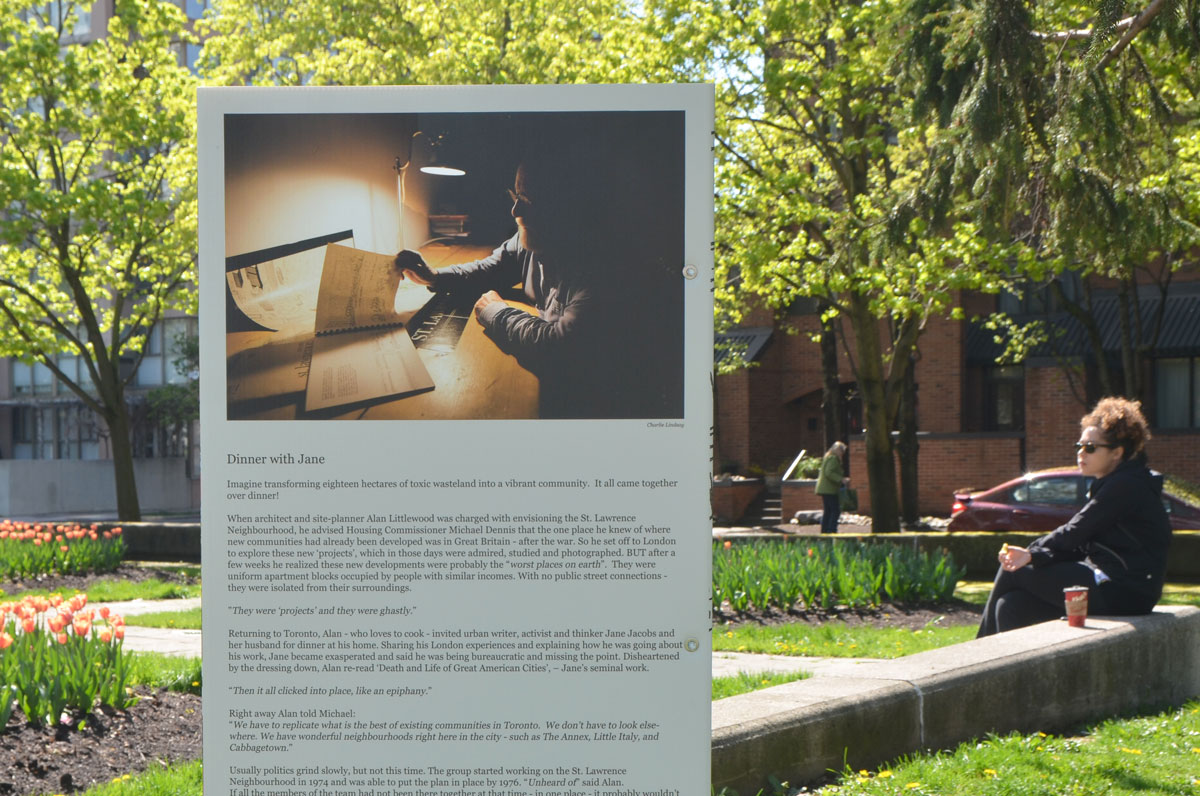
Forty years ago, May 1976, the site plan for The Esplanade neighbourhood was approved. Since then, it has become home to a very diverse group of people. And it is those people that this installation celebrates on the 40th anniversary of the founding of the neighbourhood.

Crombie Park runs along the south side of The Esplanade between Berkeley street and Lower Jarvis.  The installation consists of a number of small white rectangular pillars with the picture and story of person on either side.

A photo from the CONTACT photography festival, installation called 'Residents of The Esplanade' - story of Mysha from Pakistan

A photo from the CONTACT photography festival, installation called 'Residents of The Esplanade' - photo of Solomon from on top of a basketball hoop

A photo from the CONTACT photography festival, installation called 'Residents of The Esplanade' - photo of Alan working at a desk, tulips and a woman sitting in the park are in the background

People were out enjoying the morning; school kids were playing basketball at recess.

kids playing basketball on an outdoor court. The wall behind the basketball hoop has been painted with a mural of hands making a heart shape with the fingers, by Bruno Smokey and Shalak Attack.

Flowers were blooming.

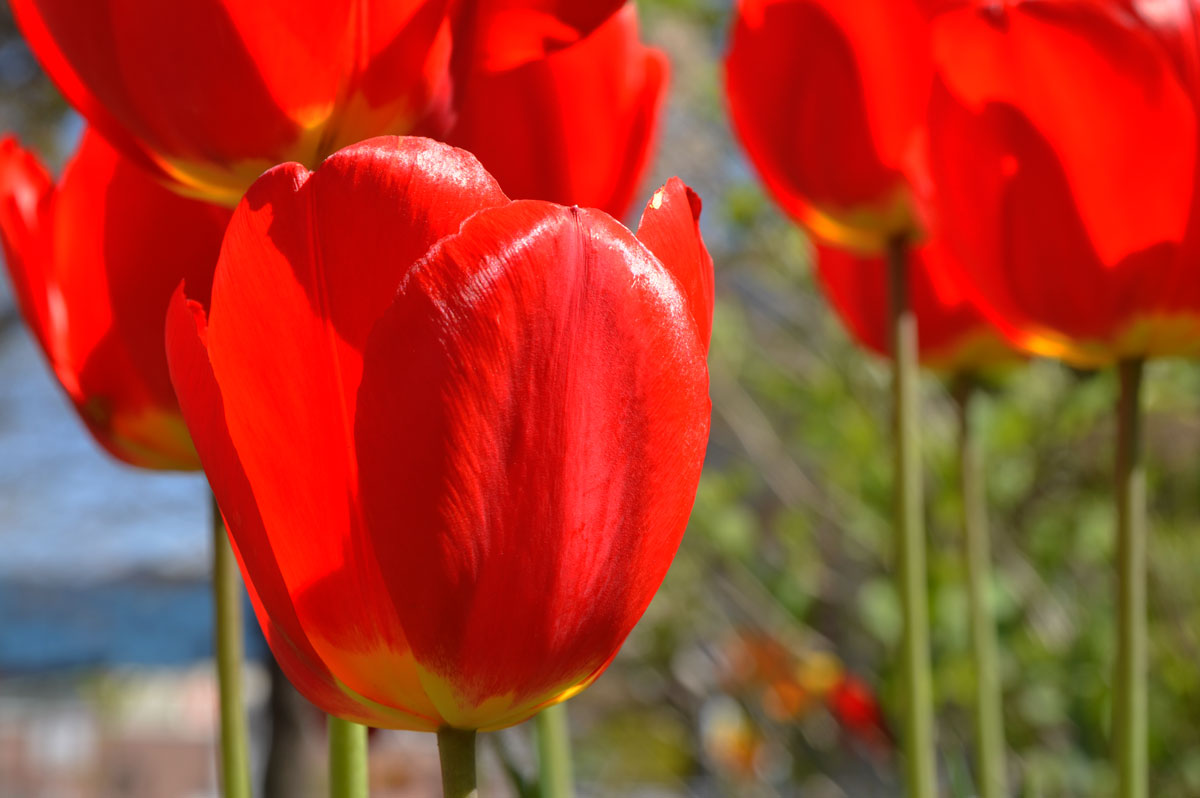
close up photo of red tulips in full bloom on a sunny day

tulips in a garden in a park, orange and yellow tulips, with some greenery. Grassy area with trees behind, and people walking on a sidewalk in the background.

below: Looking towards Lower Jarvis Street and downtown Toronto.

at the corner of The Esplanade and George Street, looking west towards downtown and St. Lawrence market. Playground on the left with children playing.

below:  One street beyond Lower Jarvis is Market Street.  It dead ends at the railway tracks.  The long structure on the right is a parking garage.

looking west towards the CN Tower, with the railway tracks to the left (but they are elevated and behind maintenance buildings so you can't see the tracks). Parking structure to the right, with city buildings behind it.

below: After a small backtrack up Market Street, I went through Conger Coal Lane to Church Street.  I don’t think I have walked this way before.  The lane was named in commemoration of the Conger Coal Company whose yard and wharf was nearby.   It was one of the many companies that provided Toronto with coal back in the day when coal fueled the city.  It was started in 1870 by Mr. P.D. Conger.   In 1913, Sterling Coal company bought Conger and the name was changed to Conger Lehigh Coal Co.

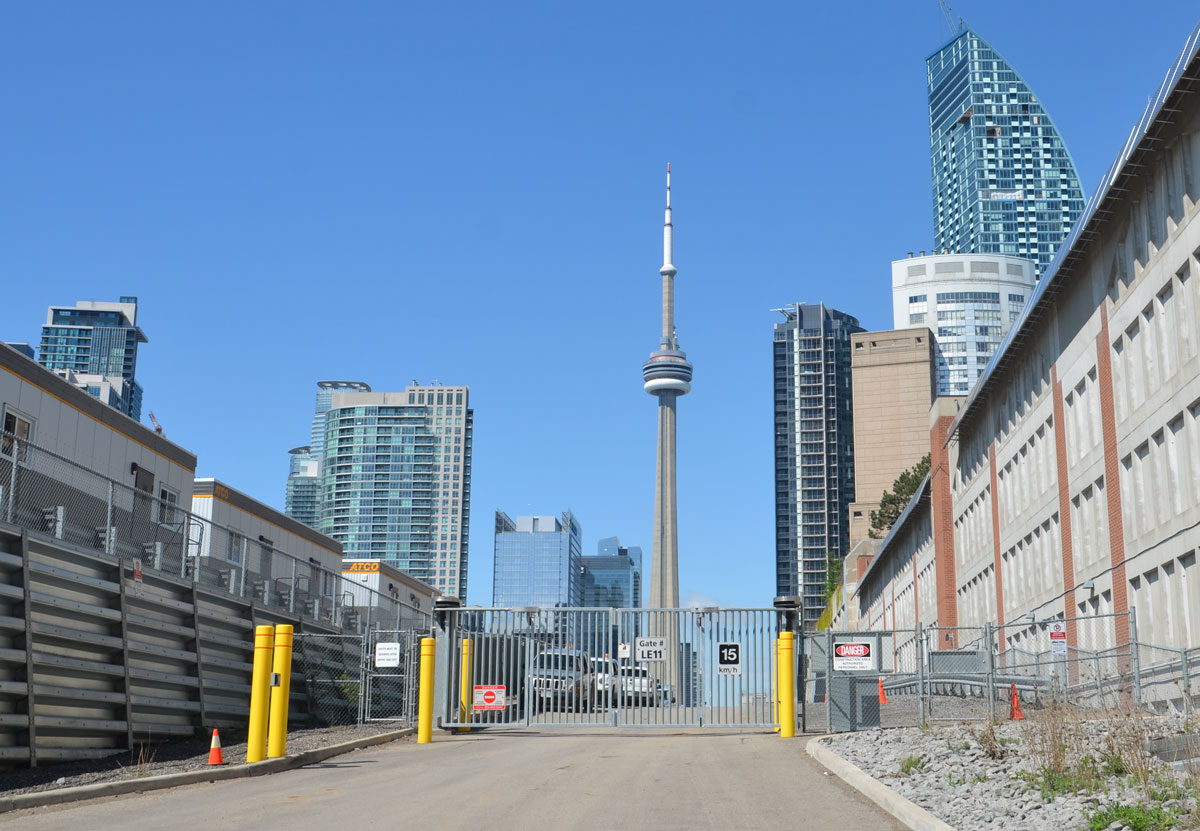
a downtown Toronto lane, very clean, no graffiti, taller, newer buildings on either side of the lane. CN tower in the distance,

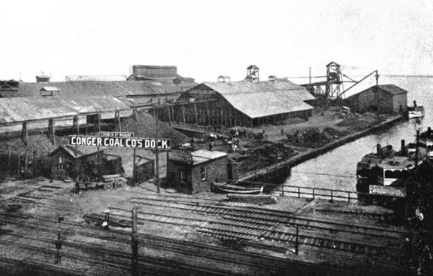
below: A very old photo of the Conger Coal Company dock at the foot of Church Street, back when Church street ended at Lake Ontario

historical picture of the old COnger COal Co wharf at the bottom of Church street.

below: Tucked into a corner on Church street immediately south of Front Street, is an art installation by Paul Raff called ‘Shoreline Commemorative’.  A topography of limestone forms the base of the work.  A glass ball representing the line between sky and water sits on top of a tripod that tries to evoke a land surveyor’s tripod.  The words on the wall say “For 10,000 years this was the location of Lake Ontario’s shoreline.  This brick wall stands where water and land met, with a vista horizon”

Shoreline Commemorative by Paul Raff, an art installation on Church St., south of King, that marks where the shoreline of Lake Ontario used to be. It involves words on a brick wall and a model of the shoreline of Toronto showing the different elevations of the land.

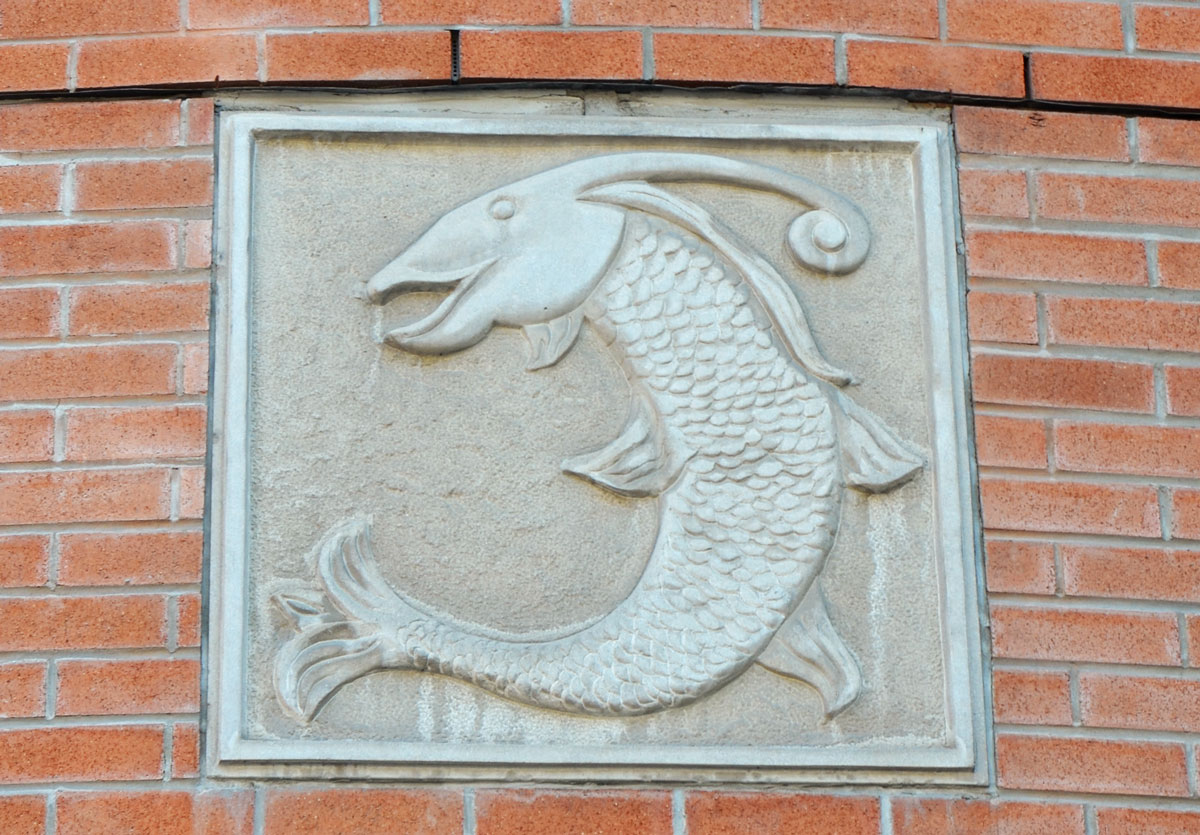
below: Continuing the lake theme, a little fish out of water, jumping over the entrance to a condo.

bas relief sculpture of a fish, square stone on a brick wall above the entrance way to a condo building.

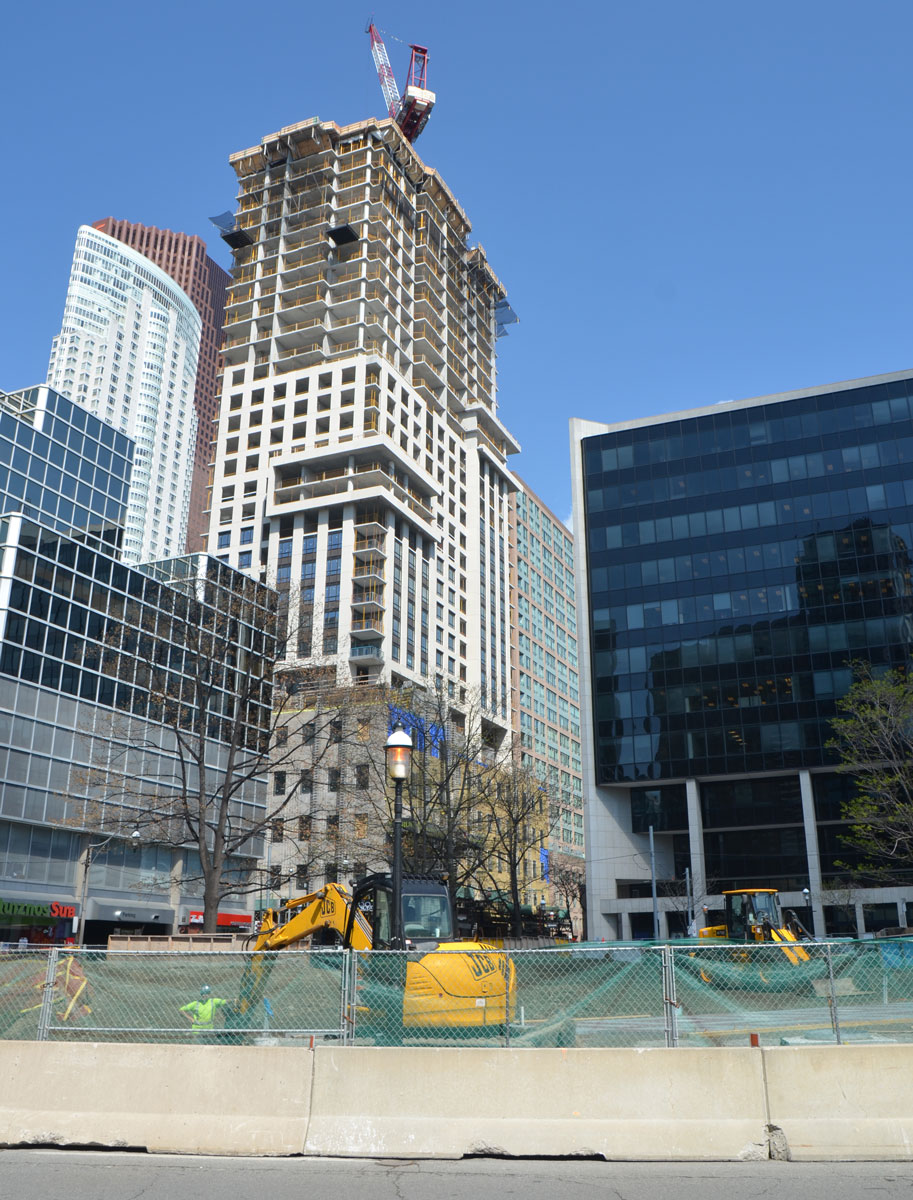
below: From the lake theme to another common theme in the city, construction. Spring is the beginning of construction season and here Berczy Park is being upgraded. In the background a new condo is being built but as we all know condo construction ‘season’ never ends. In fact, the challenge might be to find a place in this city where there isn’t a condo being built.

workmen redoing a park, Berczy Park in Toronto, with a digger and another piece of equipment, cityscape behind with a tall condo building under construction. A red and white crane is on top.

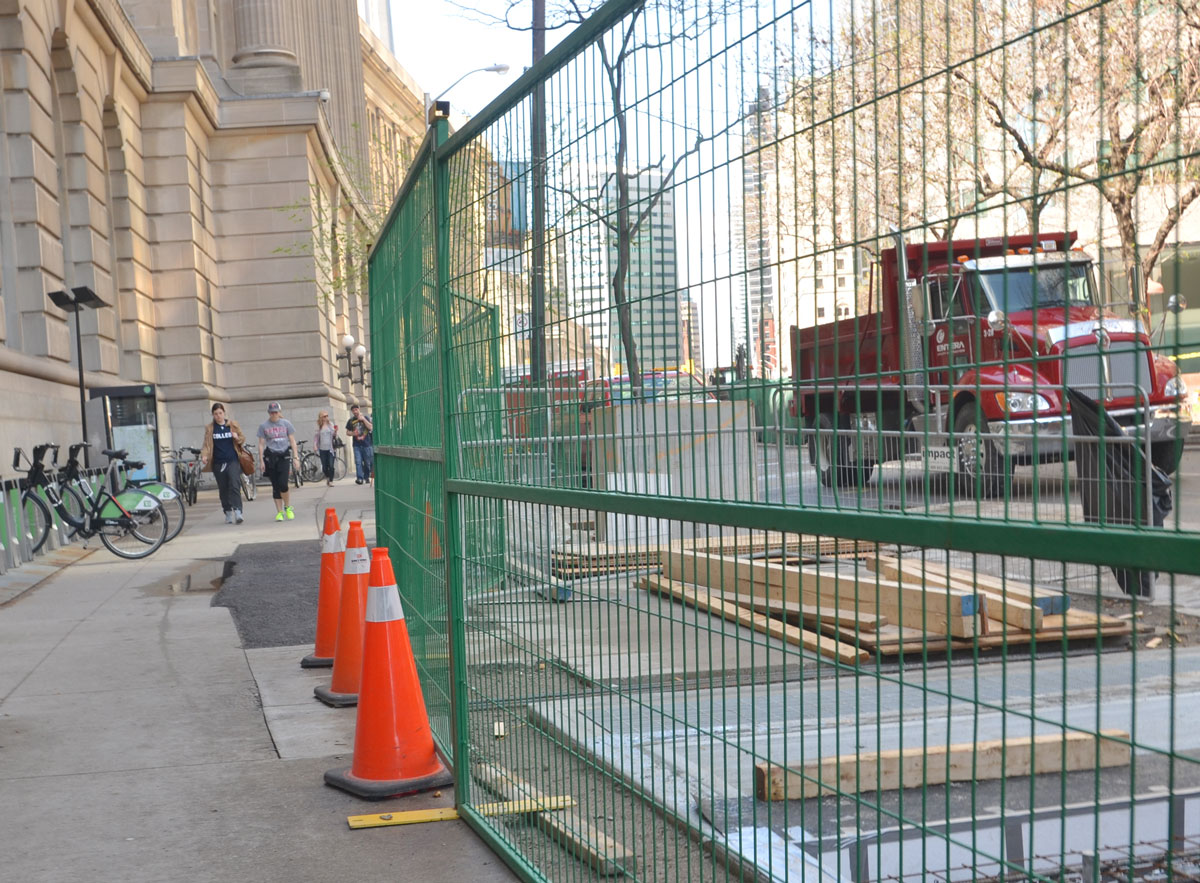
below: I walked past the never ending Front Street construction.  Construction in front of Union station seems to be finished, but this stretch of Front Street just west of the station is still being worked on.   There have been fences here so long that I can’t remember a time when they weren’t here.

Front street constrcution, behind a greenwire fence is a rd truck and piles of construction materials. Between the fence and a stone building is the sidewalk on which some people are walking.

a shirtless man in sitting on a stool at the corner of Front and Union streets. He has four signs (behind, above, in front, and beside him) asking for spare change or for you to buy his novel that is well rated on both Amazon and Goodreads.

A man is selling Black History newspaper to another man in front of the TTC subwayentrance at Union station.


It’s common to see posters pasted on walls so finding movie posters on the walls of the tiff Bell Lightbox didn’t strike me as unusual.    I walked past this display until I noticed the sign that marked this as a CONTACT Photography Festival installation.  Fake movie posters, many designed with a touch of humour, that look just like the real thing.

detail of an art installation that is a wall of fake movie posters made with ads and illustrations from old books and magazines

below: The installation, titled ‘Coming Attractions’ covers the corner windows and wall space.   The posters were designed by ‘Long Weekend’ which is a collective of artists working out of Winnipeg.   They were made from ads and illustrations from old books and magazines.

at the corner of King and another street, the TIFF Bell Lightbox building has an art installation on two sides, walls of fake movie posters. The installation is called 'Coming Attractions' and it is by a collective of artists known as The Long Weekend.

detail of an art installation that is a wall of fake movie posters

On the other side of King street, and just a but further east, is a series of eleven large images taken from past editions of ‘Toilet Paper’, a biannual magazine founded by Maurizio Cattelan and Pierpaolo Ferrari.   They hint at advertising and they blur the line between fantasy and reality.

below: Muhle is a German company that makes shaving products and one of their blades looks identical to the one in this picture.

A woman with her phone in her hands walks past a large poster of two women face to face where all you can see is their nose, mouth, chin and tongues that are stuck out. A razor blade balances between the two tongues.

People walk past two large posters that show a girl lying on a large pile of french fries.

A man walks past large posters on King St.,

a man stands in front of a picture that is a large globe with everything painted light blue except the USA

a man stands in front of a picture that is a large globe with everything painted light blue except the USA

If you like these images, you might also like Toilet Paper’s website.