Posts Tagged ‘photographs’

If you are interested in photography, especially taking pictures of people, then I highly recommend seeing the current exhibit of Arthur Newman’s black and white photos at the Art Gallery of Ontario.  Newman was an American photographer born in New York City in 1918.  He is known for his work with portraits, especially with ‘environmental portraits’.  These are images that are much more than head shots as they include context that provides further information about the subject.  Often the location or the accessories used in the shot were more dominant than the person being photographed.

Keep in mind that these are pictures of framed photographs hung in a room with low light, i.e. they are much better in real life.

below left: Michel Tapie, art critic and curator
below right: Georges Mathieu, French painter

black and white portrait by Arnold Newman, 2 portraits, on right is Georges Mathieu a French Painter and on left is

below top: from left to right – Phillip Glass 1981 composer, artist Roy Lichtenstein 1975, and Annie & Josef Albers 1976 (also artists)
below bottom: (all painters) from left to right – Edward Hopper 1960, Richard Artschwager 1987, and Lily Michaels 1959.  The image that is only partially shown is of Martha Graham, dancer and choreographer taken in 1961.

on wall at art gallery of ontario, black and white portrait by Arnold Newman, 6 photos

below: Israeli artist Moshe Kupferman, taken 1982
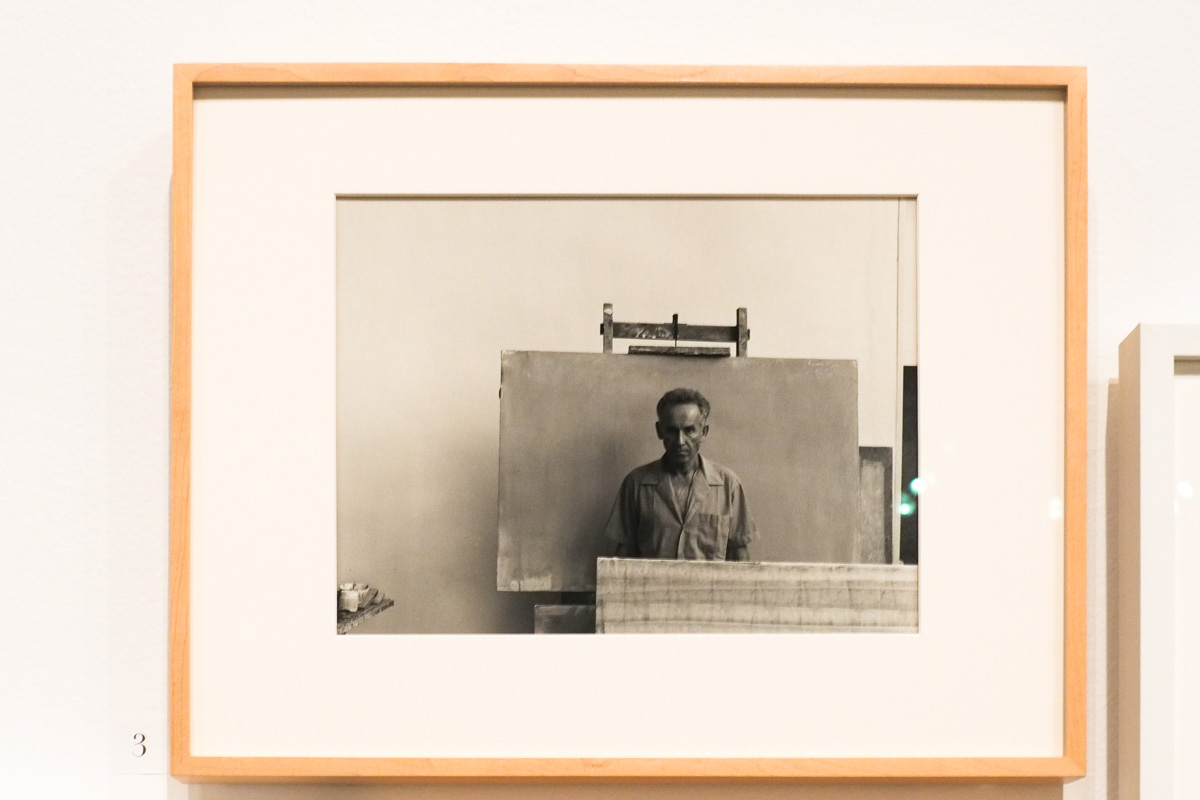
black and white portrait by Arnold Newman, of artist Moshe Kupferman

below left: Abstract image in home of Yechiel and Haviva Shemi, 1982
below right: Allen Ginsberg, poet, 1985
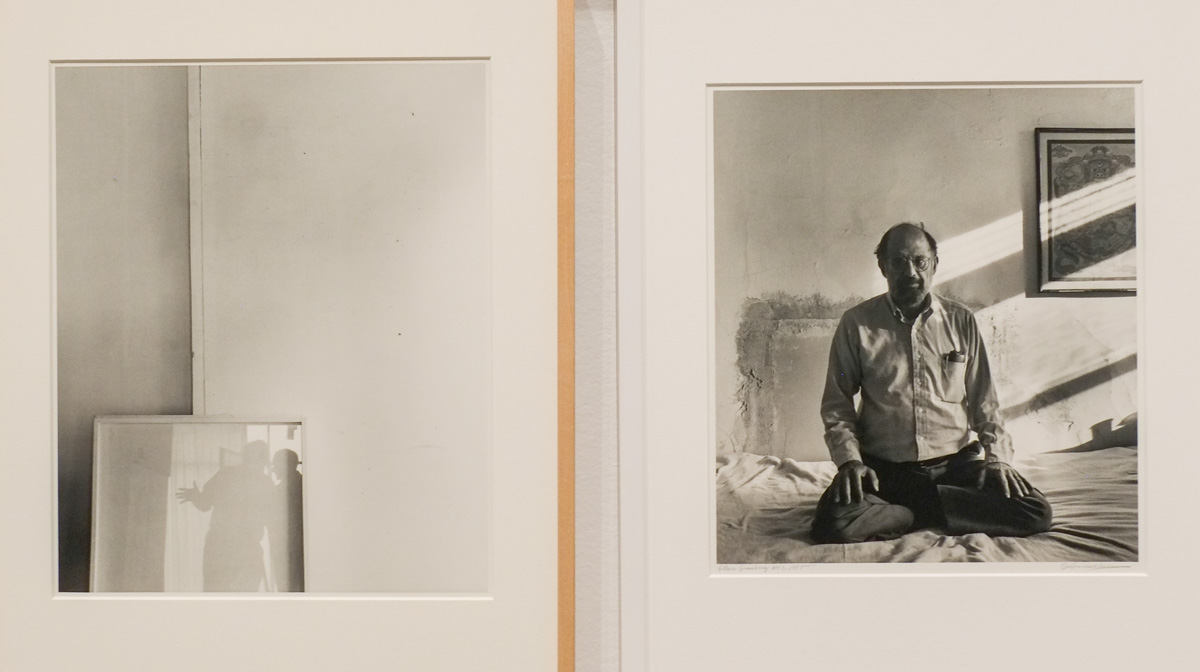
at art gallery of ontario, exhibit of black and white portraits by arnold newman, photo of poet alan ginsberg kneeling on a bed

below: Jean Arp, sculptor, 1949

at art gallery of ontario, exhibit of black and white portraits by arnold newman of french sculptor jean arp

below left: Jean Cocteau, 1960, writer and visual artist
below right: Yaacov Agam, sculptor, 1966
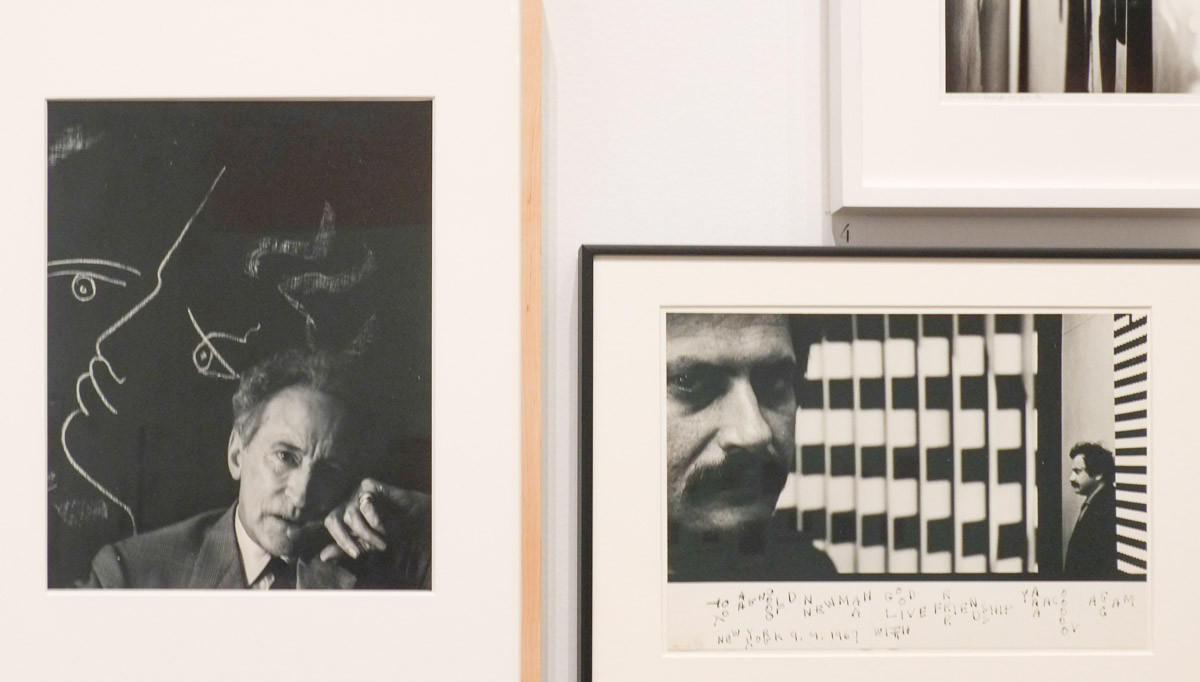
at art gallery of ontario, exhibit of black and white portraits by arnold newman, 2 photos

below left: Julio La Parc, artist, 1967
below right: Lee Krasner, artist 1973
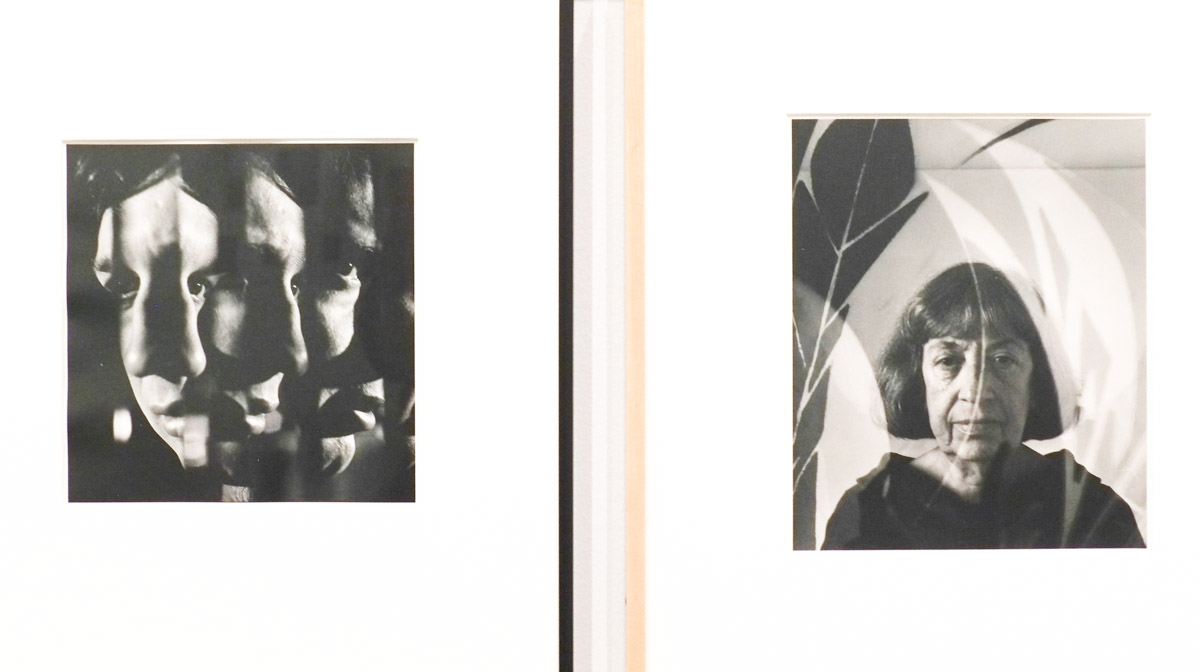
at art gallery of ontario, exhibit of black and white portraits by arnold newman, 2 photos

below: John Hay Whitney, taken 1947.  Whitney was chairman of the board at MOMA (Museum of Modern Art) in New York City.

portrait of John Hay Whitney taken by Arnold Newman

below: Priscilla Colt and Thomas C. Colt Jr., 1950, museum directors, Portland Art Museum, Oregon.

portrait taken inside an art gallery, beside a scultprue of a standing figure, a couple,  photo taken by arnold newman

black and white photo by Arnold Newman of a man holding a picture frame around his head

Unfortunately this show ends this weekend, on the 21st of January.  I didn’t realize that it was ending so soon so I am glad that I caught it when I did.

… an art project by Sunday School,  a creative agency formed in Toronto in 2017 by Josef Adamu.  At the moment there are billboards at a few locations around the city including here at Dundas and Lansdowne where there are 3 images.

billboards above a vacant lot. The boards feature 3 large images by Sunday School. On the far left is a reclining woman with arm supporting head. In the center is a billboard with two images. Someone is brushing the hair of a young black woman in one photo. In the other, a person is sitting in a small orange car, viewed from the drivers side of the vehicle.
close up of images on billboards. two images. Someone is brushing the hair of a young black woman in one photo. In the other, a person is sitting in a small orange car, viewed from the drivers side of the vehicle.

Other photos by the group are on display at the Art Gallery of Ontario.  Two examples are:

below: “Jump Ball” is an ongoing project that explores the relationship between basketball and the African Diasporic communities.  Home is not restricted to private spaces, it is also found in unity. Here, in “Jump Ball: Toronto (2019)”,  you can see carefully composed pairings of young men in vibrant Ghanaian Kente cloth or a Senegalese boubou on the basketball court (what is identity?  how does basketball bring young men together?).  These were photographed by O’shane Howard.
photographs on a gallery wall, two in colour, and a group shot in black and white. the coloured photos are of young black men in traditional african clothing on a basketball court

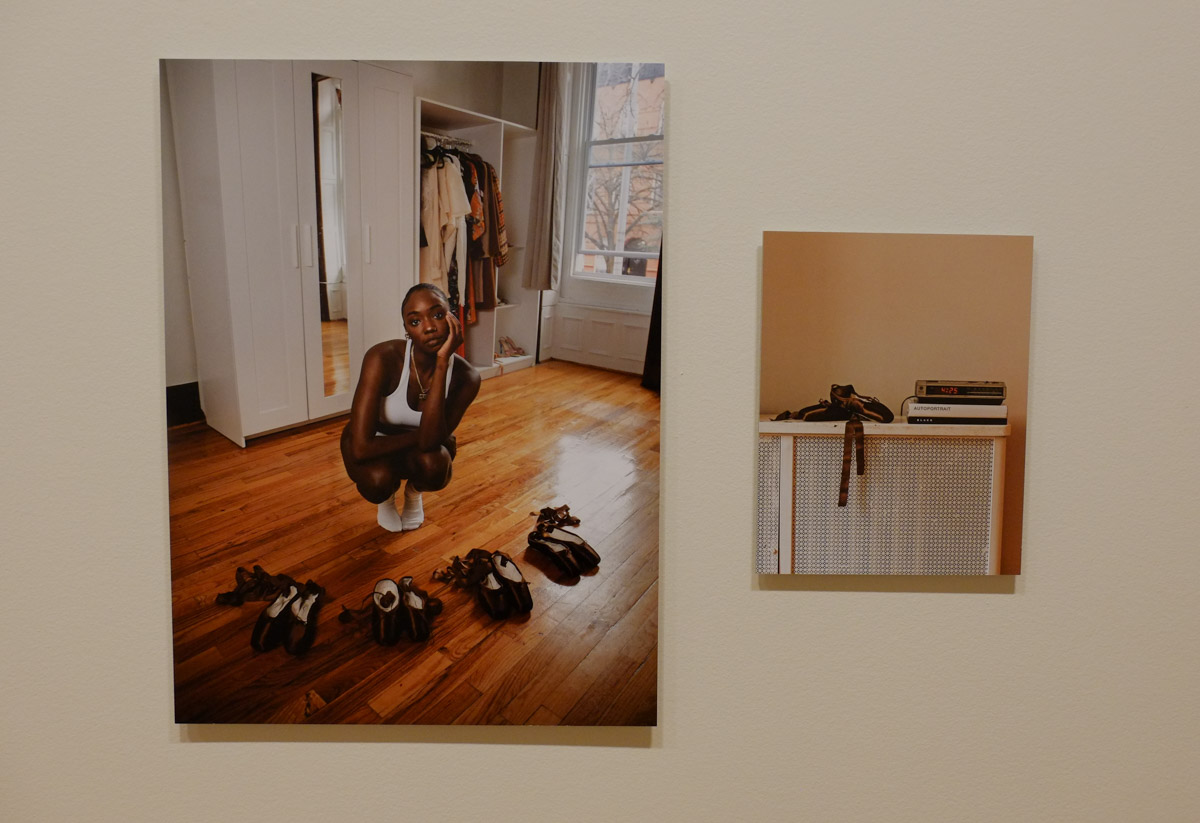
below: Another series of pictures is “Ten Toes Down”, photographed by Kreshonna Keane.  This series features a ballet dancer in her home – a Black dancer in a field that is almost exclusively white.  Home is not just a building.  Home is the body; home is self expression.

two photographs on a gallery wall. on the left a black woman, a ballet dancer, sits on her floor surrounded by pairs of ballet shoes or slippers. the other picture is shoes and books

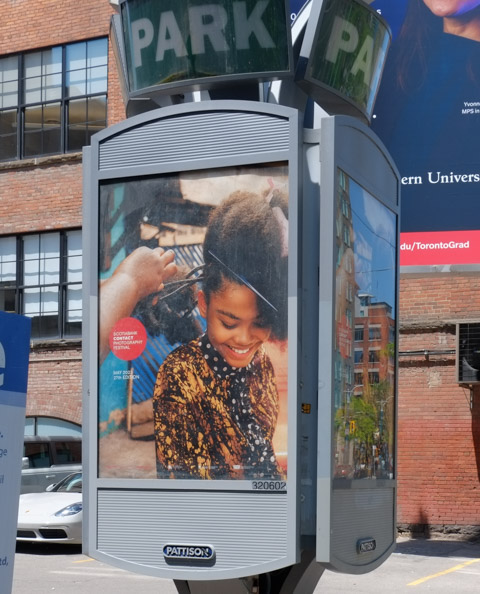
below: This image by Carlos Idun-Tawiah can also be seen in a parking lot by 80 Spadina Ave (see above, at Lansdowne & Dundas).

image of a young black woman

Sunday School website

Sunday School’s Instagram page

…for 100 years.  At the moment there is a selection of old TTC photos on display at Pape subway station in celebration of 100 years of Toronto Transit.

below: Already  lining the walls at Pape Station are images of Pape station itself and the surrounding neighbourhood. This is ‘Sources/Derivations’ by Allan Harding MacKay.   You can see the reflections of one of the old TTC photos in this section of MacKay’s artwork.

reflections of pape station sign, from the artwork on the walls of that station

The TTC posters are at platform level between the westbound and eastbound trains so you can look at them while waiting for a train.

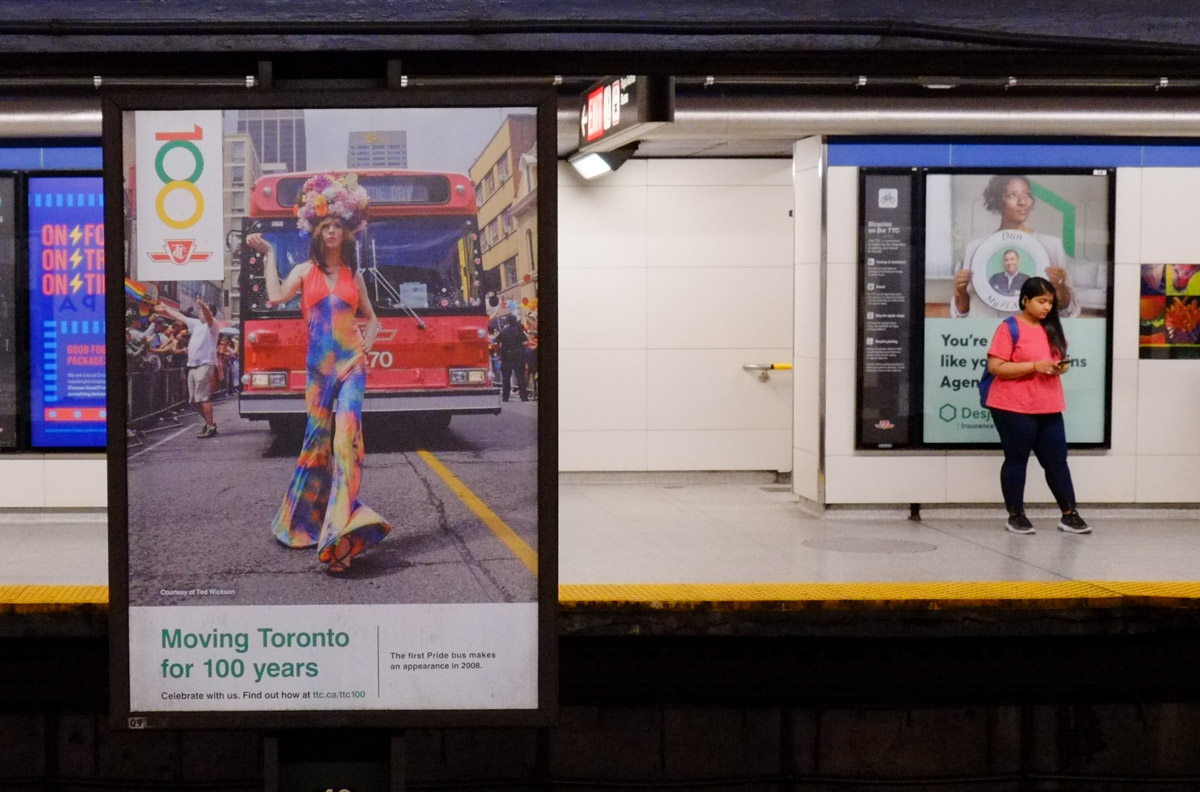
below: First Pride bus, 2008

photo on display at pape subway station, from 2008, first Pride bus at Pride parade in Toronto, a woman in colourful clothes is walking in front of the bus

below: People waiting for the North Yonge bus at Eglinton station, 1950s

old photos of the TTC on display at Pape subway station, black and white photo old North Yonge bus at Eglinton station 1950s with people waiting to get on the bus. A stopped TTC subway car is behind the poster, a man in red is standing by the window

below: Waiting for the subway. “Line 1 customers ride the higher capacity Toronto Rocket (TR) subway train on its 2011 launch. By 2017, Line 1 had grown by 8.6 km.”

A subway train is stopped behind a poster at the station. on the poster is the back of a woman in a black parka with fur lined hood as she in turn is standing by a ttc subway train

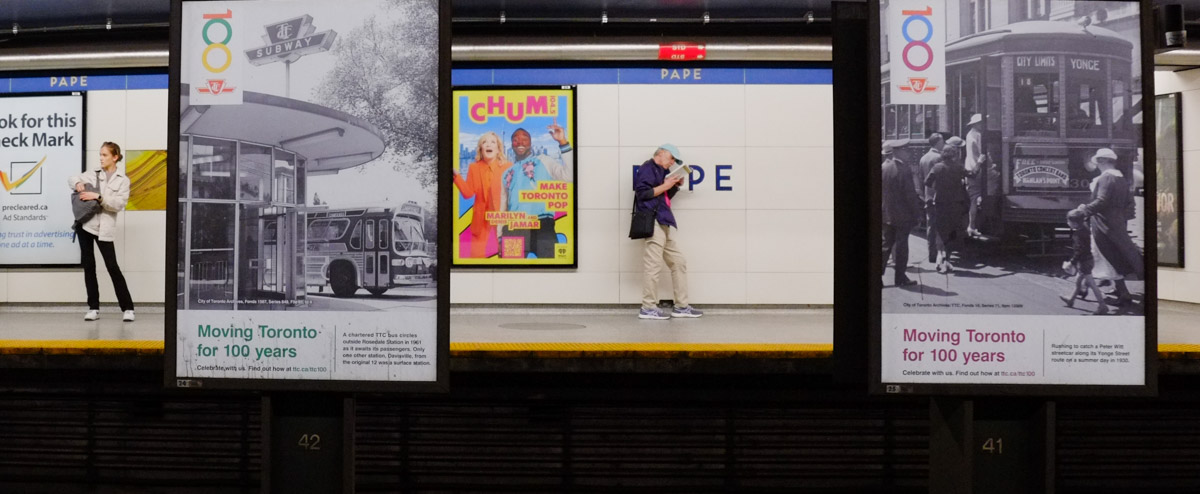
below: Two posters, two eras. On the left: “A chartered TTC bus circles outside Rosedale station in 1961 as it awaits passengers.  Only one other station, Davisville, from the original 12 was a surface station.”  On the right: “Rushing to catch a Peter Witt streetcar along its Yonge Street route on a summer day in 1930.

people waiting on the platform of pape station, with posters of history of ttc on display

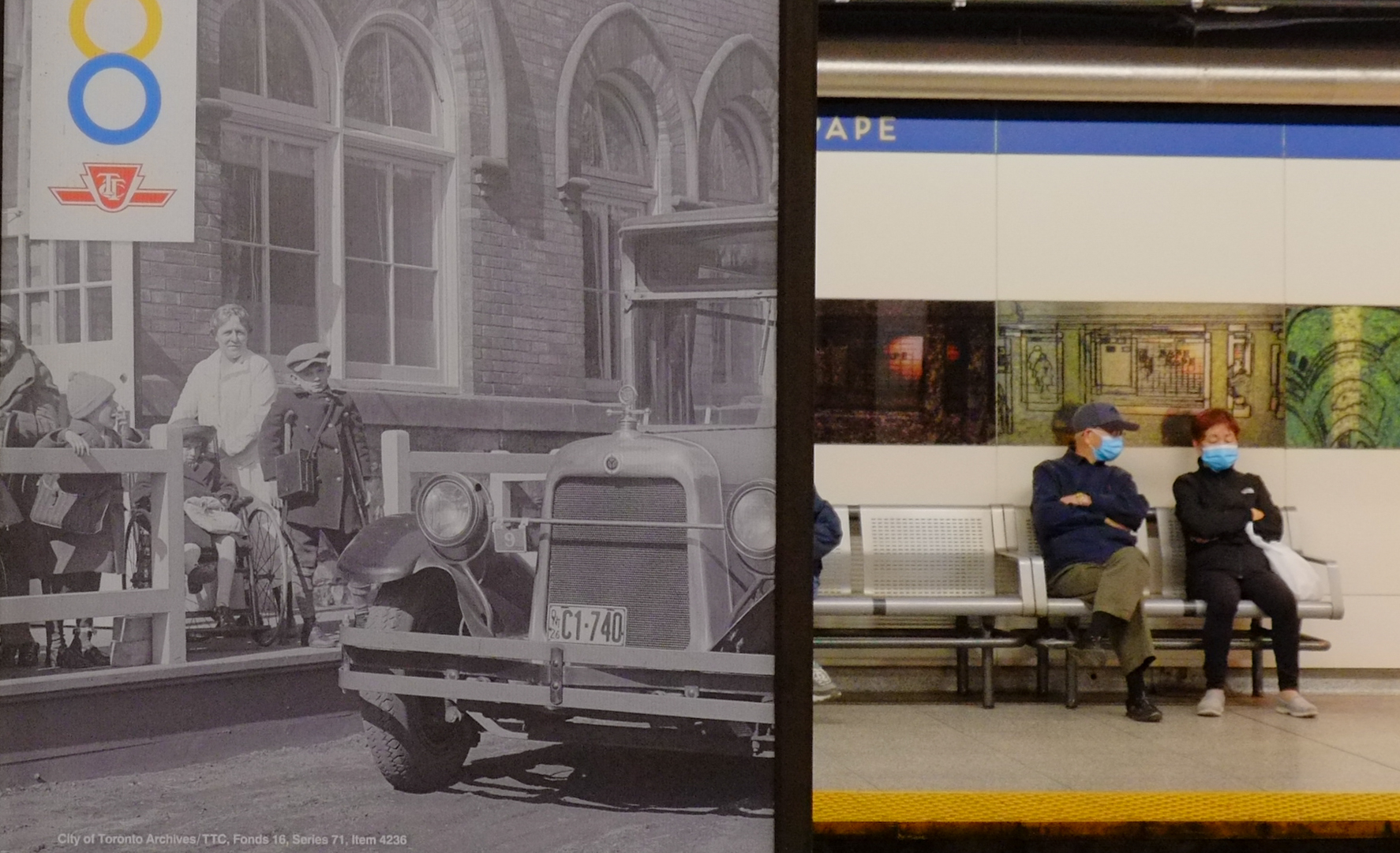
below: “A TTC car picks up scholars with disabilities outside their school in the 1920s.”  A couple with their COVID masks on sit in front of more images from ‘Sources/Derivations’ by artist Allan Harding MacKay.

an older Asian couple in covid masks sit on a bench at pape station platform, waiting for a train, posters of black and white old ttc photos on display between the tracks

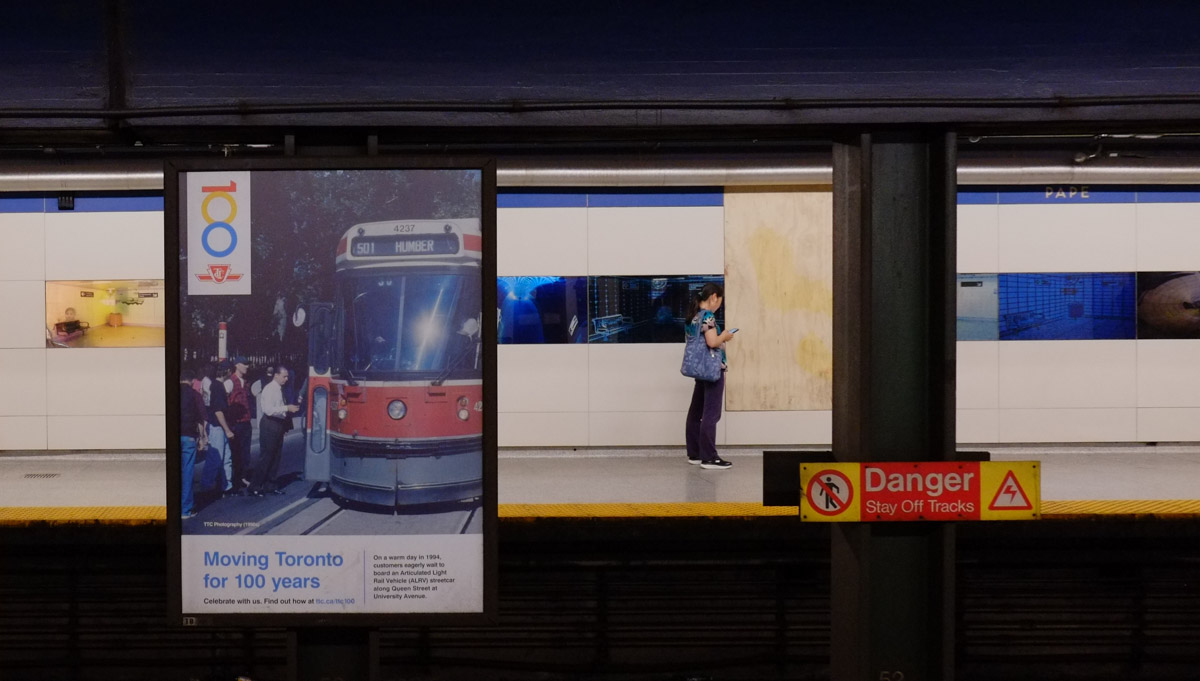
below: “On a warm day in 1994, customers eagerly wait to board an Articulated Light Rail Vehicle streetcar along Queen Street at University Avenue.

platform level of pape subway station, woman on phone, artwork on walls by MacKay, poster of old TTC streetcar

reflections of building on Danforth ear Pape, tower with green domed roof, from the artwork on the walls of that station

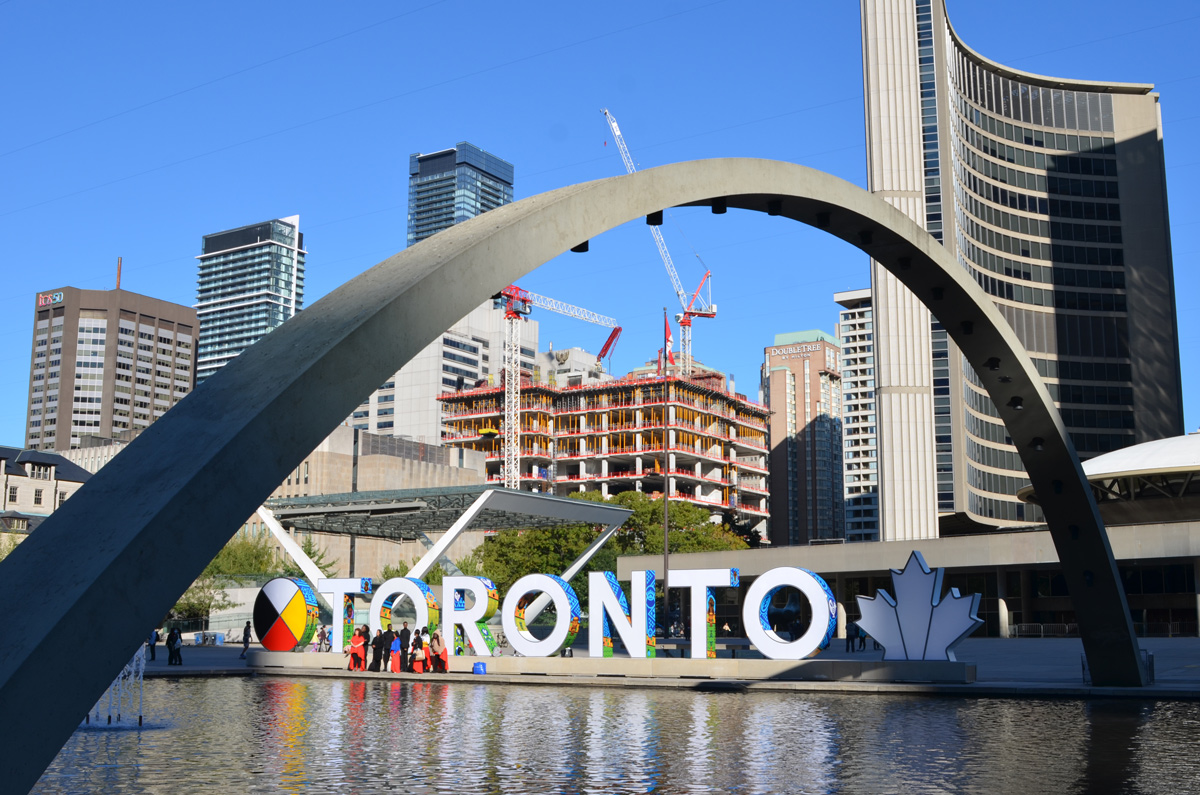
The 3D Toronto sign in Nathan Phillips Square has been replaced by a newer, hardier version.  Same same but different.

Nathan Phillips square in Toronto with fountains going in the reflecting pool, 3 D sign, and two towers of new city hall

a young girl pulls her mother towards the toronto sign while she points at it, others are taking photos in front of the sign

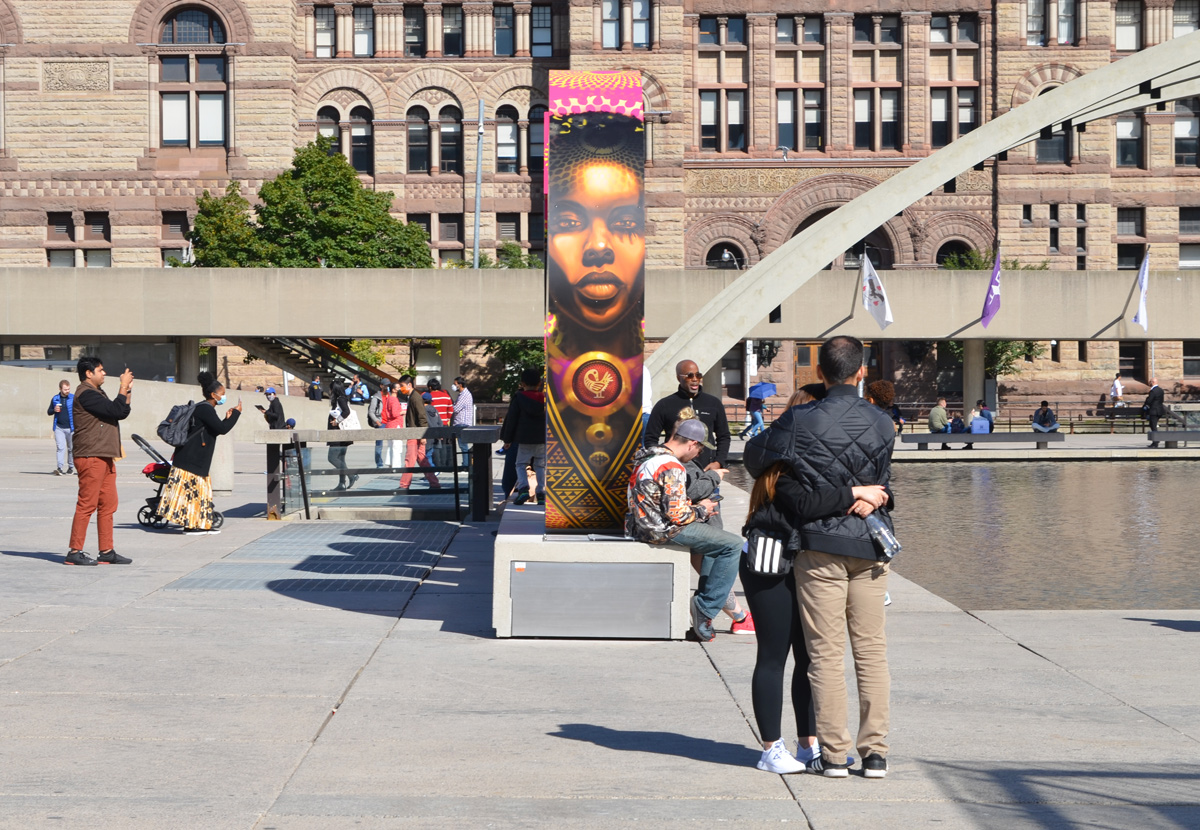
a couple hugs at the west end of the new 3 D toronto sign, with artwork by Danilo Deluxo McCallum on it

Nathan Phillips square with one arch prominent in the photo, reflecting pool, new Toronto sign, part of city hall, and construction of the new court house behind

the Toronto sign reflected in the lower window of city hall

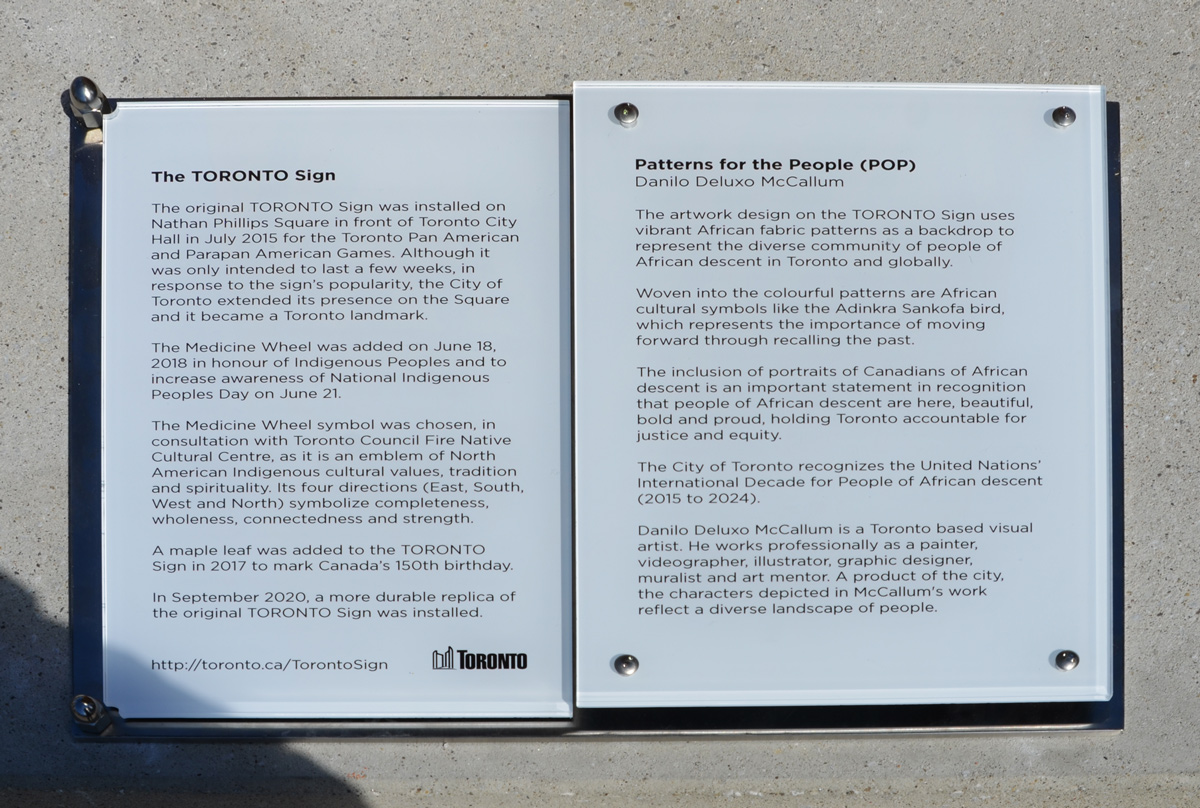
plaque beside the Toronto sign describing the history of the sign as well as the artwork that is on the new sign

LEFT:

“The original TORONTO Sign was installed on Nathan Phillips Square in front of Toronto City Hall in July 2015 for the Toronto Pan American and Parapan American Games. Although it was only intended to last a few weeks, in response to the sign’s popularity, the City of Toronto extended its presence on the Square and it became a Toronto landmark.
The Medicine Wheel was added on June 18, 2018 in honour of Indigenous Peoples and to increase awareness of National Indigenous Peoples Day on June 21.
The Medicine Wheel symbol was chosen, in consultation with Toronto Council Fire Native Cultural Centre, as it is an emblem of North American Indigenous cultural values, tradition and spirituality. Its four directions (East, South, West and North) symbolize completeness, wholeness, connectedness and strength.
A maple leaf was added to the TORONTO Sign in 2017 to mark Canada’s 150th birthday.
The TORONTO Sign has become symbolic of Toronto. According to a Destination Toronto visitor survey, the TORONTO sign was one of the top three most visited attractions in the city and it is consistently ranked as one of the most Instagram-worthy spots.
In September 2020, a more durable replica of the original TORONTO Sign was installed”.

RIGHT:

“The artwork design on the TORONTO Sign uses vibrant African fabric patterns as a backdrop to represent the diverse community of people of African descent in Toronto and globally.
Woven into the colourful patterns are African cultural symbols like the Adinkra Sankofa bird, which represents the importance of moving forward through recalling the past.
The inclusion of portraits of Canadians of African descent is an important statement in recognition that people of African descent are here, beautiful, bold and proud, holding Toronto accountable for justice and equity.
The City of Toronto recognizes the United Nations’ International Decade for People of African descent (2015 to 2024).

Danilo Deluxo McCallum is a Toronto based visual artist. He works professionally as a painter, videographer, illustrator, graphic designer, muralist and art mentor. A product of the city, the characters depicted in McCallum’s work reflect a diverse landscape of people.”

This blog post wanders from Burger Mania at Yonge Dundas Square to the Riverside Eats & Beats StreetFEST and onward to the Riverdale Art Walk  out Queen Street East, with a few distractions along the way.

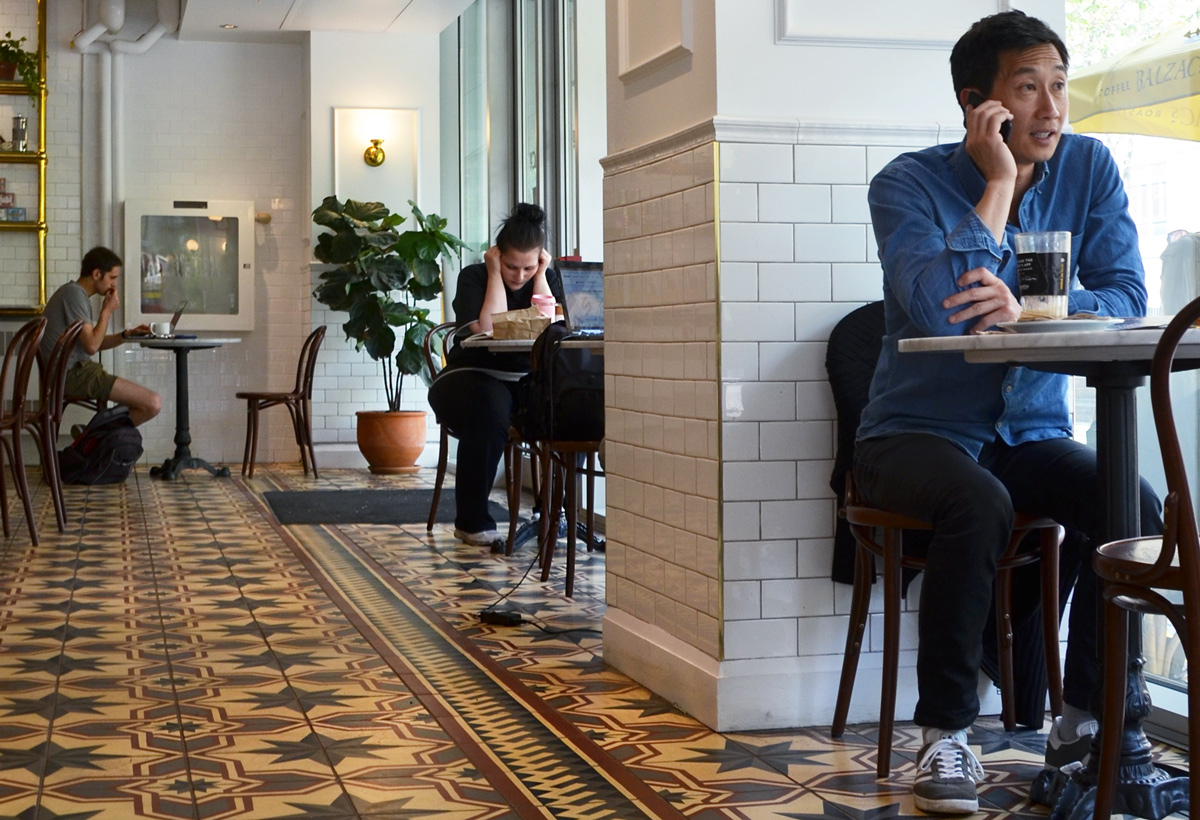
thre people sitting at different tables in a coffee shop

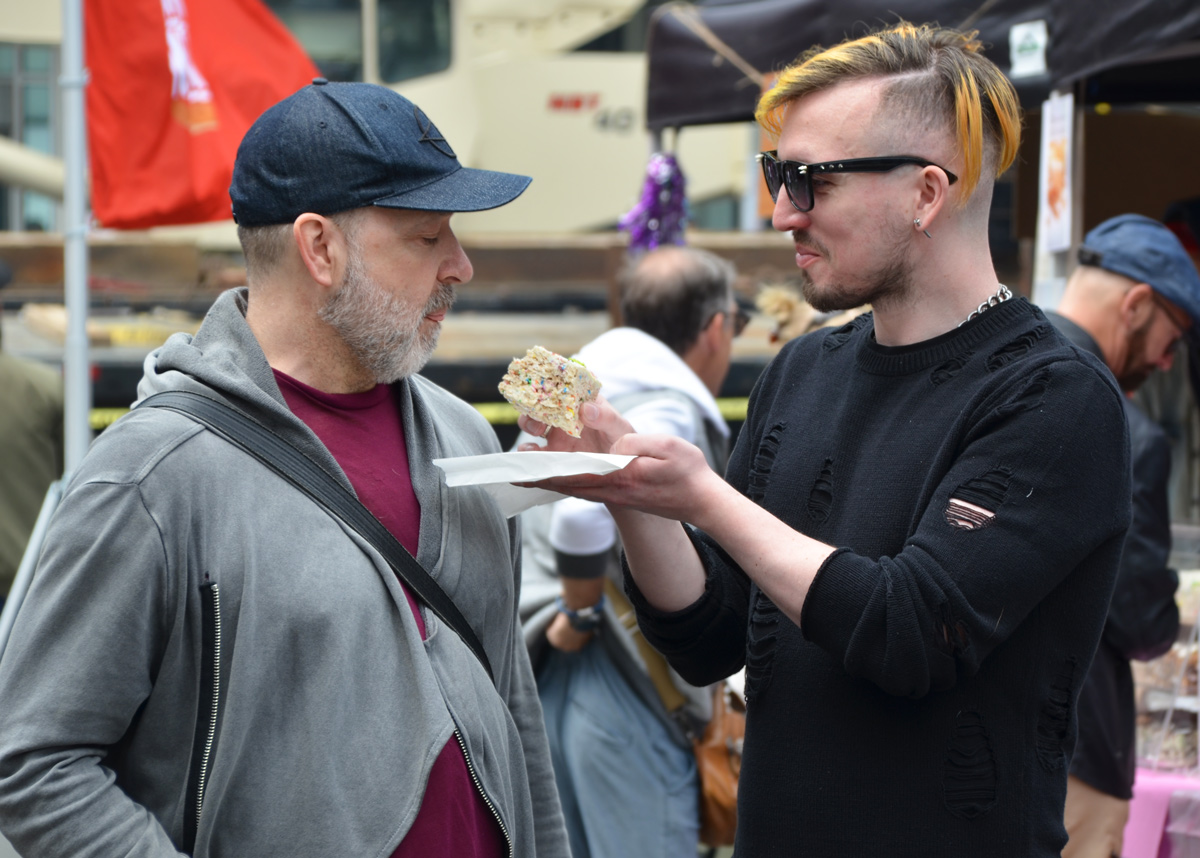
a man with glasses and hair that is shaved on one side of his head is offering another man a rice krispie square, he is holding it to the man's mouth

a woman in long overcoat and hat is talking to and gesturing, with a woman in a white head scarf and top

a man selling rice krispie squares and other desserts, outdoors, Yonge Dundas Square, from E and R Sweetery

under a red tent roof, people preparing food

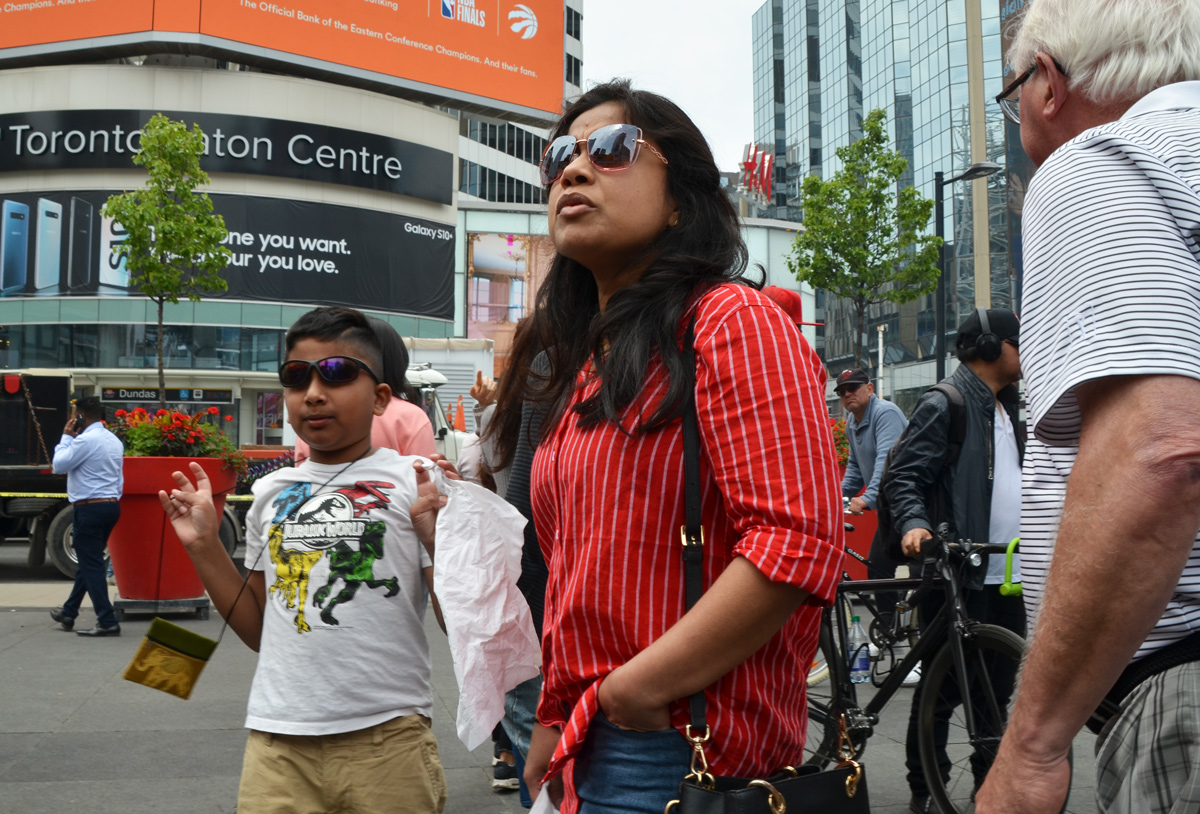
a woman in a red shirt and sunglasses walking with her son who is also wearing sunglasses, south asian ethnicity

under a tent roof, a man is cooking burgers

a large inflatable pool floatie in the shape of a pink flamingo sits on the ground at Yonge Dundas Square, in front of a bar selling drinks

a young Asian woman is taking a picture of a small burger with her phone

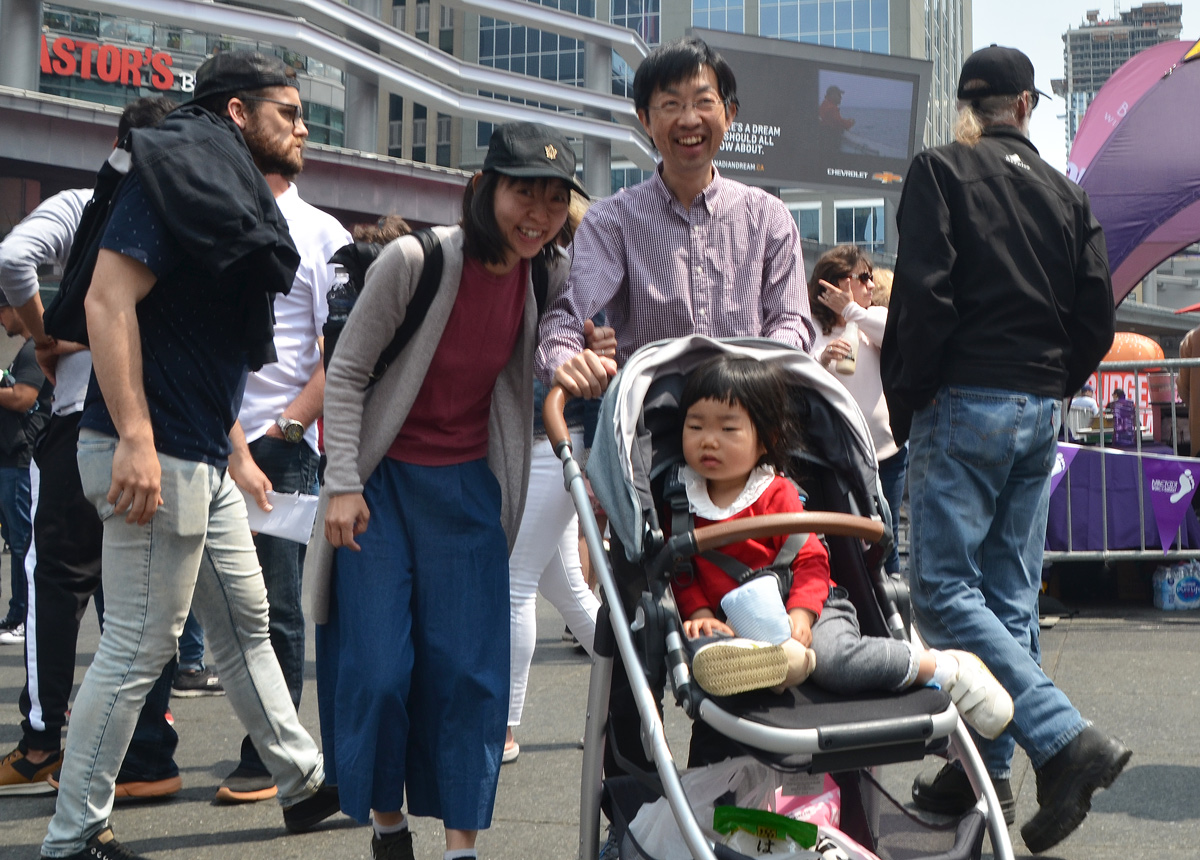
family group - mother and father laughing, baby in stroller, Asian, at Yonge dundas square

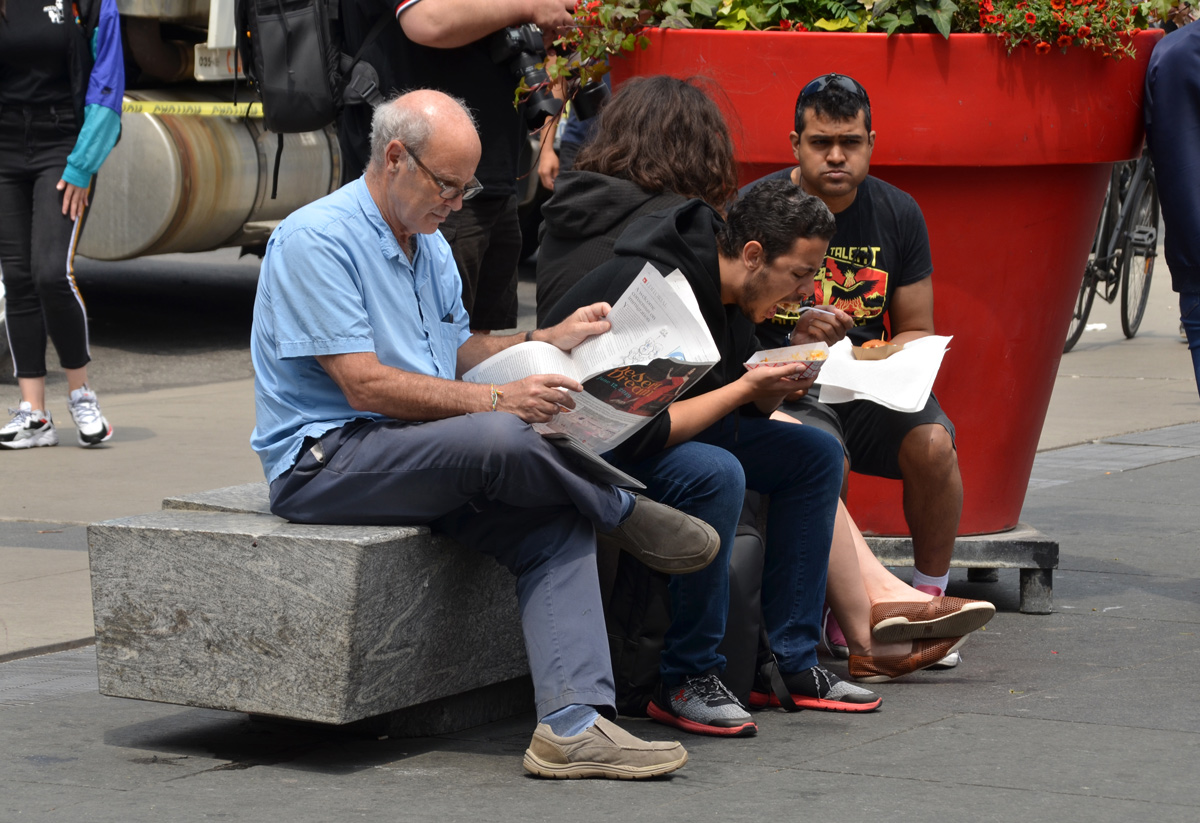
people sitting on a bench by large red flower pot in Dundas Square. Man at end, balding with grey hair, is reading a newspaper, two people are eating

a woman sits at a high table with three small burgers on it, two dogs are beside her on the ground but looking up

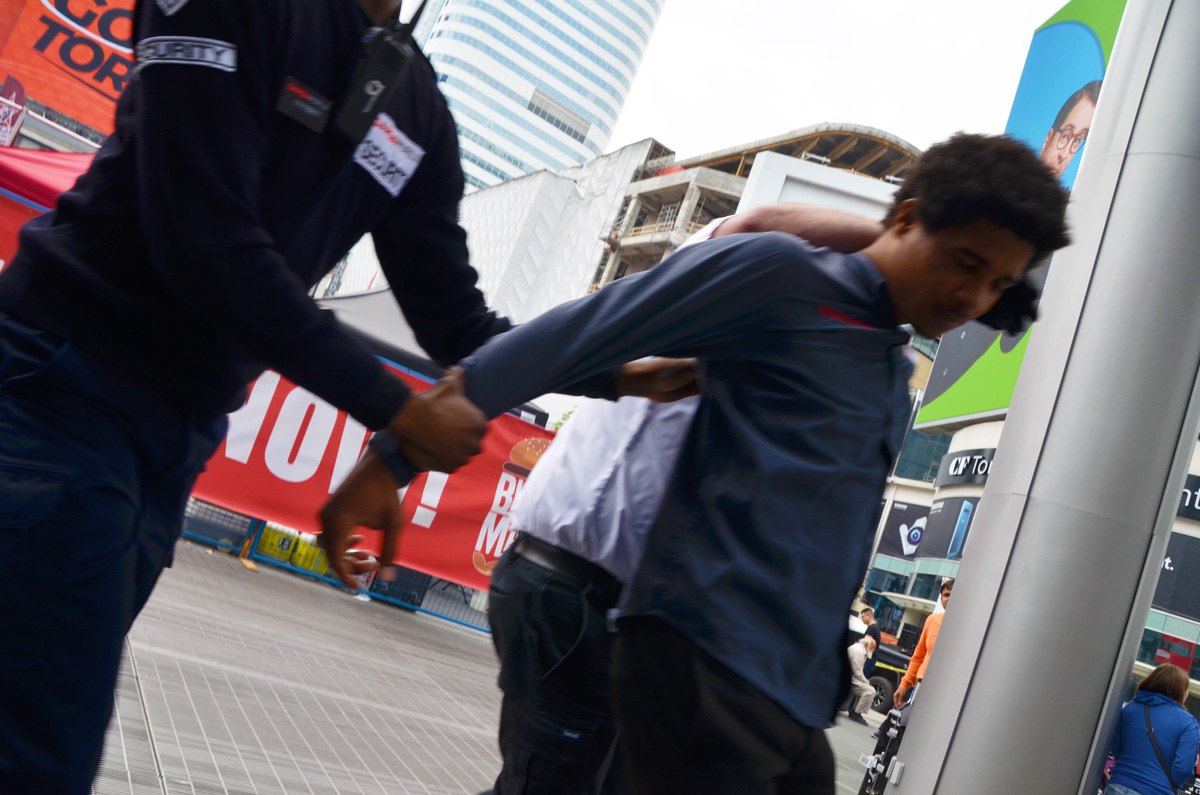
a young man is being grabbed and held on to by two security guards and they are removing him from Yonge Dundas square

a topless man with a bag on his back skate boards at Dundas Square

a woman is laughing as she talks on her phone and walks up Yonge Street

a couple walking together on Yonge, passing the Stag Shop. He is wearing pink pants and a white jacket. Both have white hair.

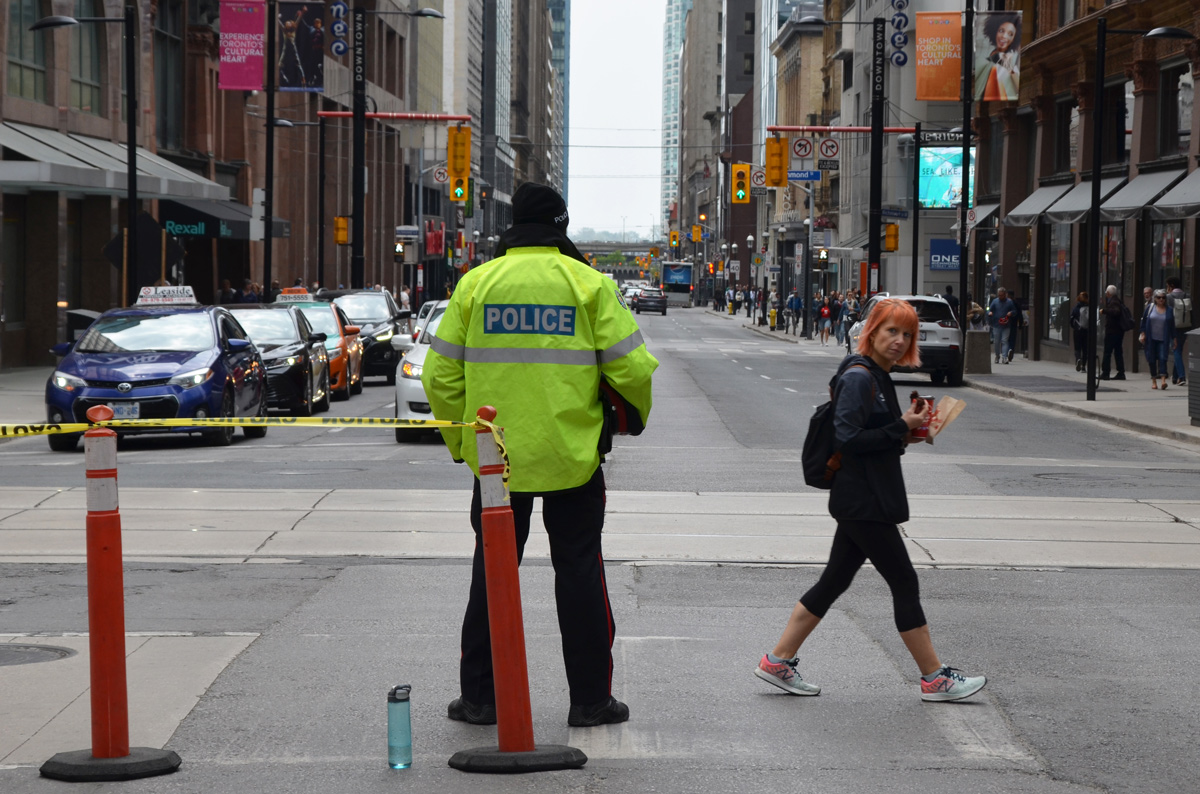
below: Yonge Street was closed to traffic between Queen and Dundas Streets because a large crane was parked there temporarily while heavy objects were lifted onto the roof of the Eaton Centre.

a large crane is on a truck in the middle of Yonge street, downtown, with tall buildings on both sides including the Eaton Centre under renovation on the right

three workmen in orange safety clothing use a crane to lift heavy objects off a flatbed truck

a police man in a bright yellow jacket stands in front an orange cone and yellow police tape to block off Yonge Street. He's directing traffic, to make cars turn on Queen street. A woman with orange hair is walking across the street , just went in front of the police man

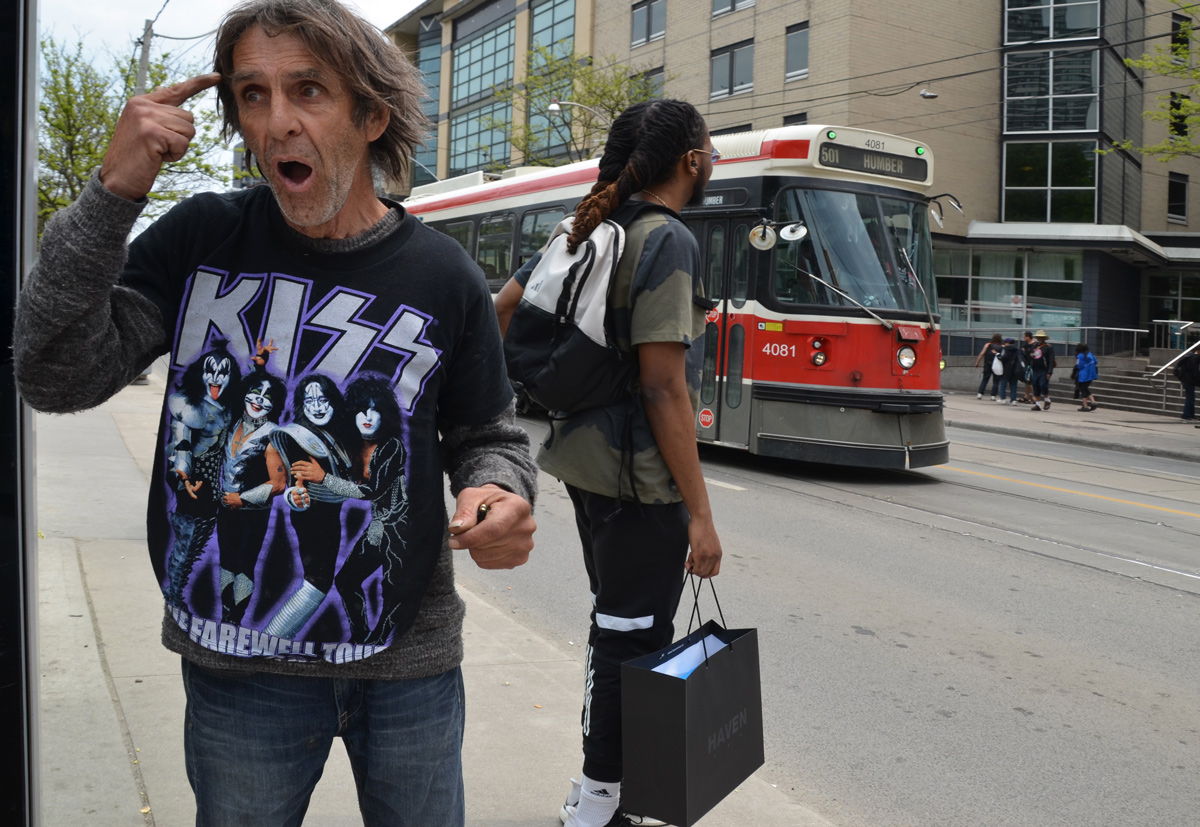
a man in a kiss t-shirt is talking, a black man is waiting for a streetcar behind him, streetcar is just arriving.

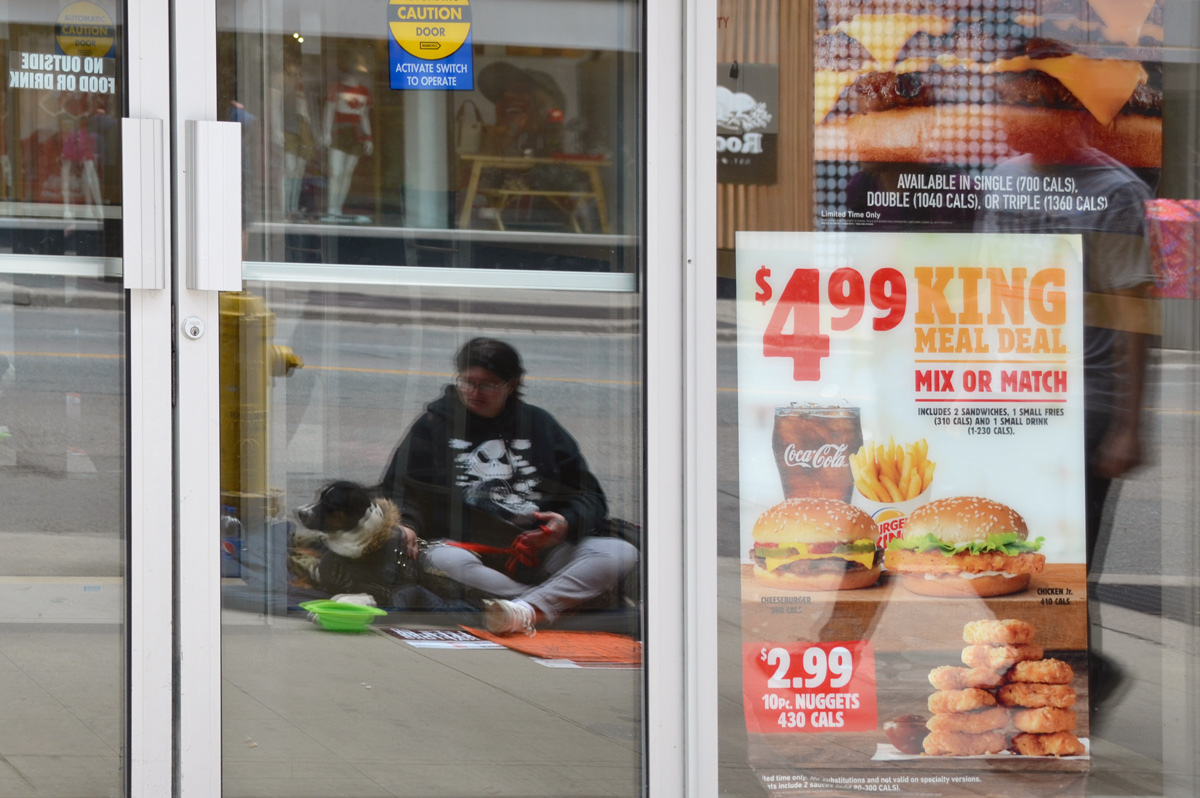
reflection in the glass of a door and window of a Burger King restaurant, of a woman witting on the sidewalk pan handling

a couple holds each other on the street

Riverside Eats and Beats

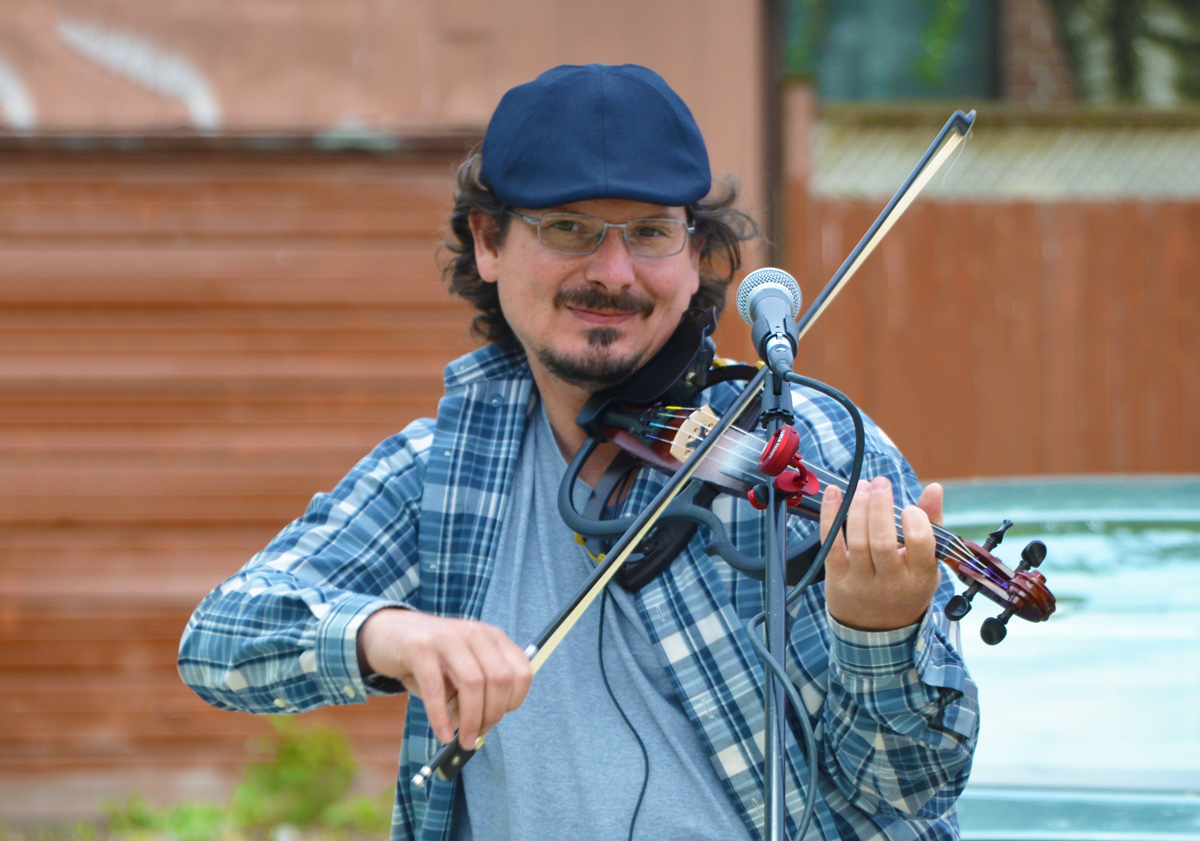
a man playing a fiddle, smiling, wearing a blue cap and a blue plaid shirt

below: Soundcrowd was practicing for their performance at The Opera House that evening.

a choir onstage with a man with microphone standing in front of them

in a store window, two mannequins with no heads waering gold close fitting dresses, in front of window is a rack of clothes on the sidewalk, with two women looking

a group of women talking, outside


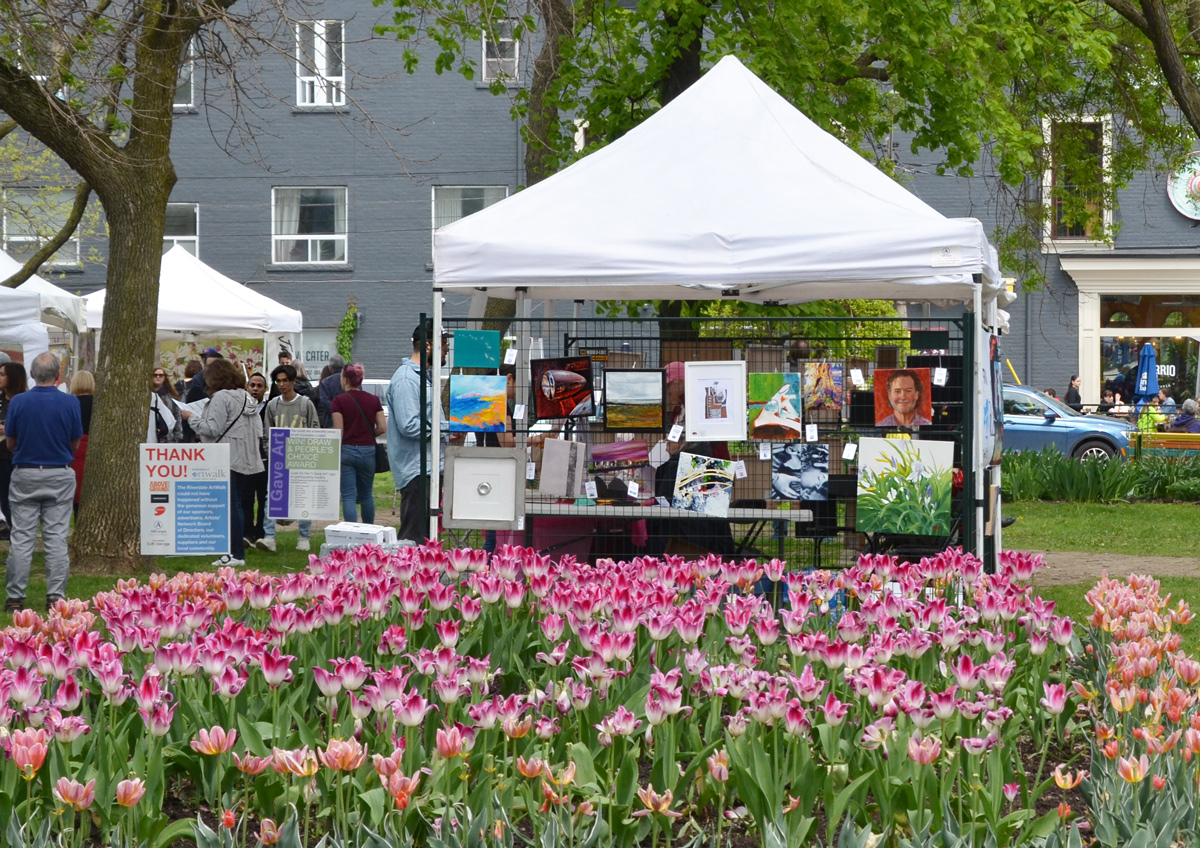
Riverdale Art Walk at Jimmy Simpson Park.

a large bed of pink and white tulips in front of a white tent (roof only) with paintings on the side that are for sale, Riverside Art Fest

a woman holds a small white dog while she talks to a man, in front of a white tent with artwork on the walls for sale. Two women inside the tent are looking at the dog and smiling

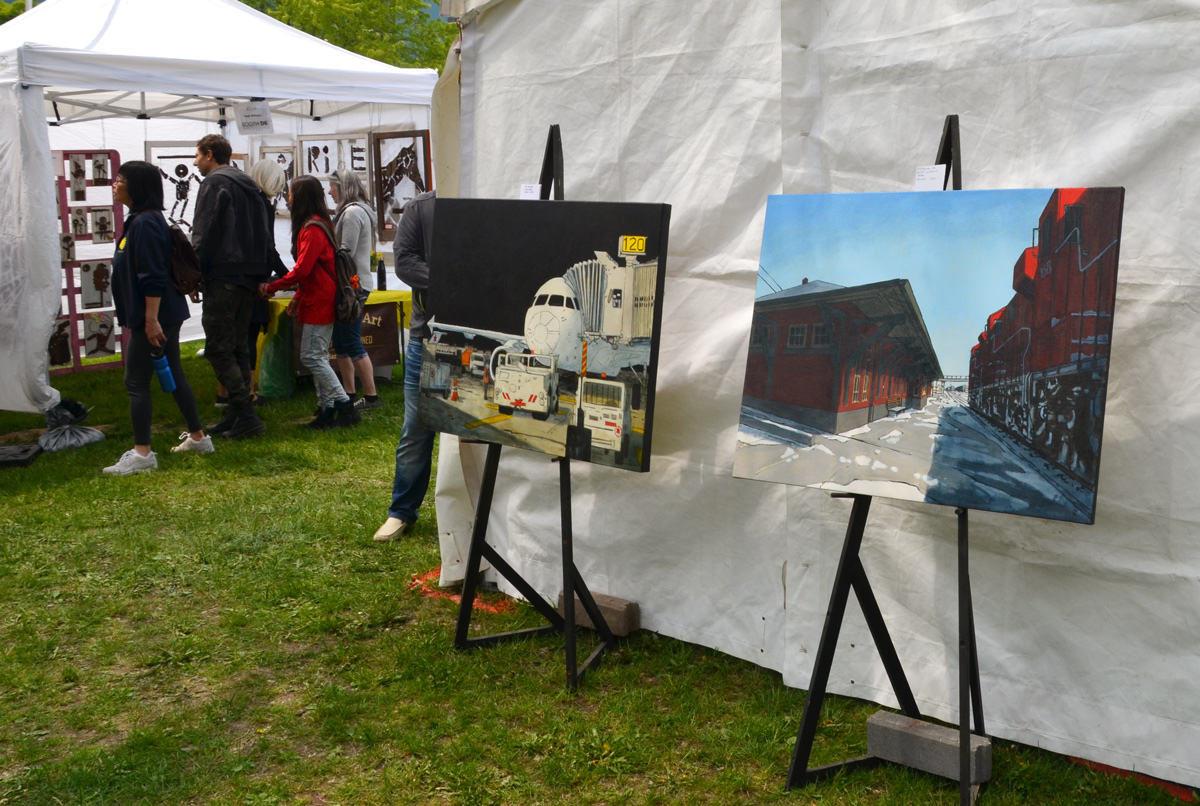
two paintings on easels outside a white tent. One is an airplane at an airport and one is a barn in snow

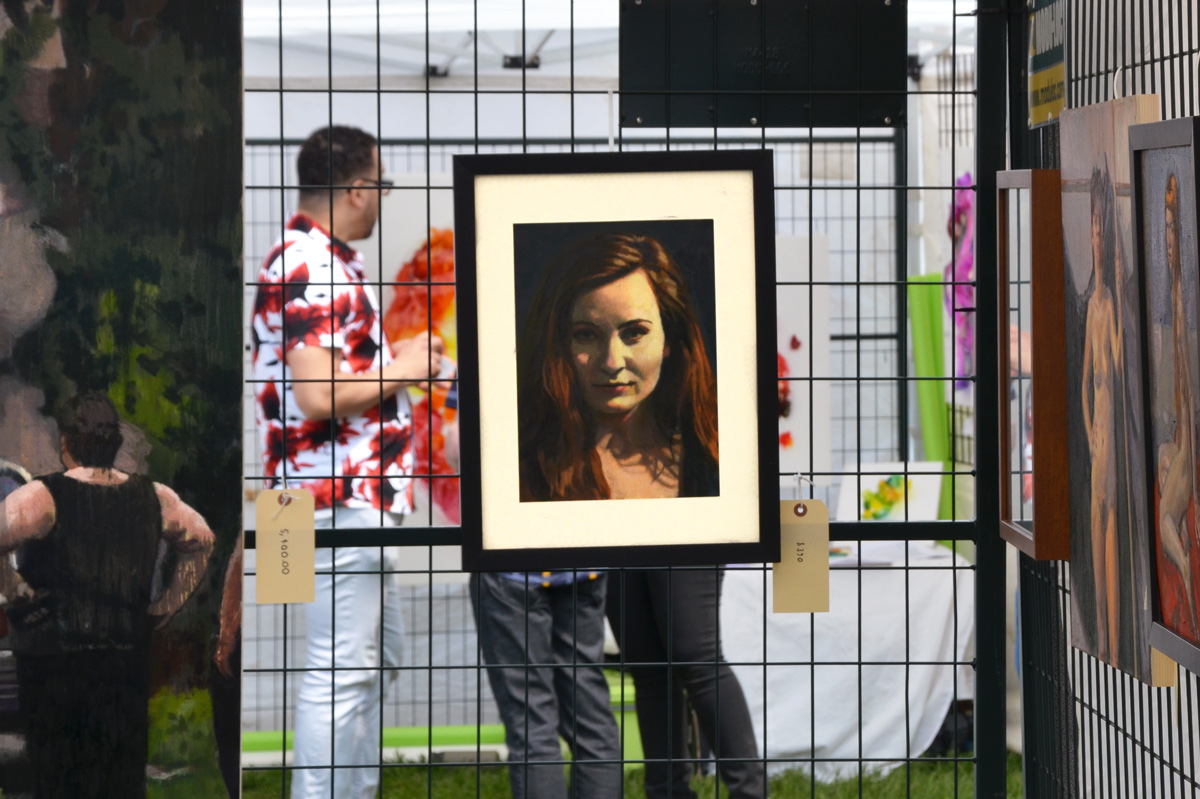
a framed portrait of a woman on a metal grid, people standing behind it including a man with a white shirt with bright red and black blotches

large images (photosgraphs) in red, black and yellow, for sale

small artwork hanging on a white tent wall, light is coming from behind so they are silhouetted

a boy in a fedora sits cross legged on a high stool while looking at a phone. He is in a tent with artwork on the wall that is for sale

at an art show, an art piece made of metal, images on metal

Palimpsest.  I had to look up the word too.  No, it’s not the superlative form of palimps.  As it turns out, palimsest has to do with surfaces that have been reused or altered while still retaining traces of its earlier form.

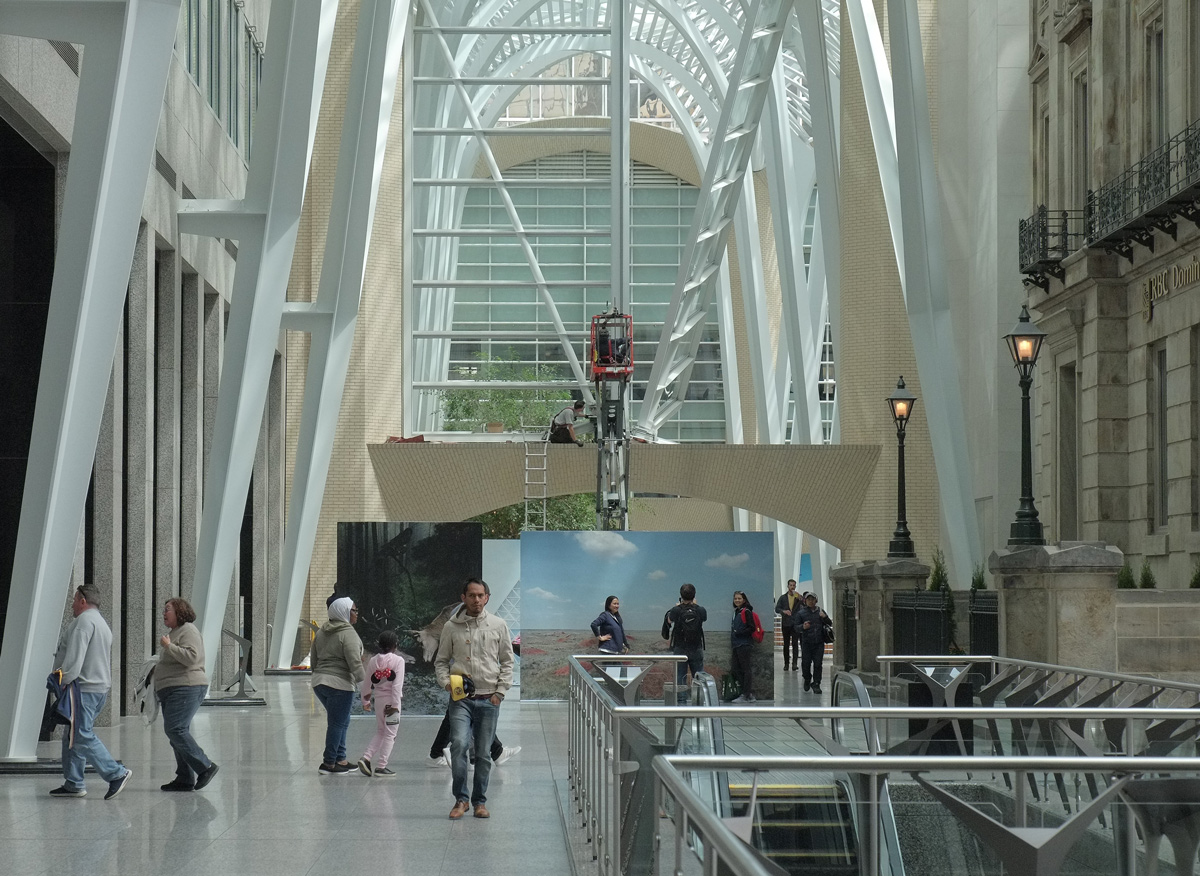
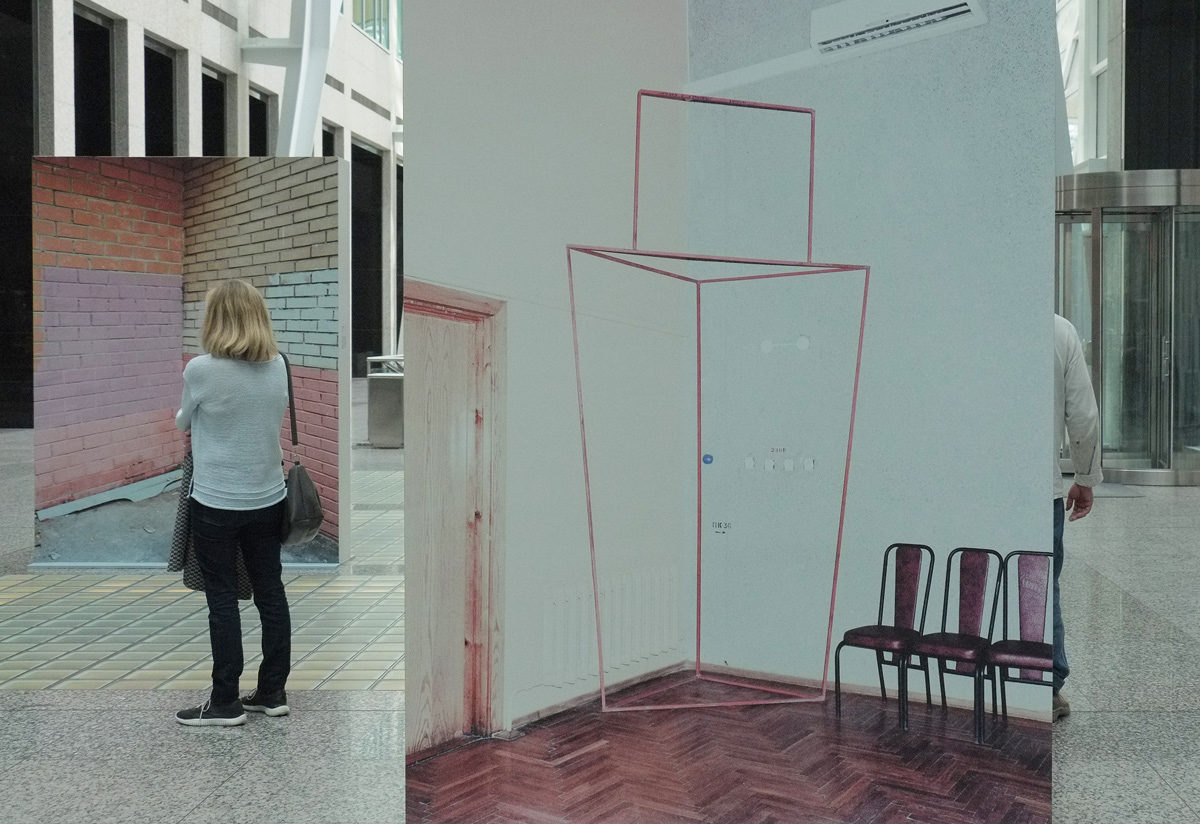
What does it have to do with this blog post?  It is the name of an exhibit of photos by a Poland-based collective, Sputnik Photos.  Between 2008 and 2016 this group compiled their ‘Lost Territories Archive‘; this is a project that documents the “physical, political, and sociocultural” aspects of the former Soviet republics.  Some of the thousands of images that they collected are on display in the Allan Lambert Galleria at Brookfield Place as part of this year’s CONTACT Photography Festival. It is on view for the month of May.

people in Allan Lambert Galleria, a couple of large photos, a workman on a crane,

below: “A sculptural model in a student atelier, Spitak Armenia, 2014”.

large picture of an old white statue, Brookfield Place, 2 men looking at it. Photo's title is A sculptural model in a student atelier, Spitak Armenia

below: “Cafeteria at the Heydar Aliev Centre, Gobustan Azerbijan, 2016”.   In 2013, to mark the 10th anniversary of the former president of Azerbijan, Heydar Aliyev, his son and successor, Ilham Aliyev, ordered the country’s 70 district capitals to each build a monumental centre named after his father.

people walking past a large photo in Allan Lambert Galleria at Brookfield Place. Photo by Sputnik Photos, title is Cafeteria at the Heydar Aliev Centre, Gobustan Azerbijan,

below: “Semipalatynsk Nuclear Test Site, Kazakhstan, 2016”.  The Soviet Union conducted over 400 nuclear tests at this site in northeast Kazakhstan between 1949 and 1989.  The impact of radiation exposure was hidden by Soviet authorities and didn’t become known until the site closed in 1991.

a couple walk past a large picture, small reddih mounds of dirt on a barren grassy field, flat land, no trees or other plants

 below: ‘Homemade construction for growing grapes, Yerevan Armenia, 2013’.  Urban farming was popular during the post-Soviet crisis in the 1990’s.  Today grapes are grown in every neighbourhood using homemade constructions for supporting the vines.

a large picture on display in Allan Lambert Galleria of a homemade structure to hold up grape vines in a back yard in Yerevan Armenia

below: “Anaklia Georgia, 2013”  Anaklia is a village on the Black Sea.  In 2011, Mikheil Saakashvili, the president of Georgia, announced a program to transform the village into a luxury resort.  Construction began in 2012.  Saakashvili’s party lost the parliamentary elections in 2013 and he fled the country.  Work on this project was discontinued.

large photo of a oval shaped structure on the top of a tower, on the coast, surrounded by barren land, abandoned building, in Anaklia Georgia (former USSR republic)

below: “Slutsk Belarus, 2013”.  This image is of ‘Cultural Space’, an installation in the sugar factory Saharny Zavod.  The factory was given an award for best ideological work in a contest organized by a regional committee for ‘admiration structures’.

two large photos on exhibit, with a woman standing in front of one of them.

Members of Sputnik Photos: Andrej Balco, Jan Brykczynski, Andrei Liankevich, Michal Luczak, Rafal Milach, Adam Panczuk, and Agnieszka Rayss.

***

More about the word palimpsest:

In Ancient Greek, it was παλίμψηστος (palímpsēstos) and in Latin it was palimpsestus meaning “scraped clean and ready to be used again”.  It was originally applied to wax covered tablets that the ancient Greeks and Romans used to “write” on by scratching out the letters with a stylus.  Smoothing the wax would erase the words.   Around the 6th century vellum, or parchment prepared from animal skins, became more commonly used.  It was expensive.  Early on, writing on parchment could be washed away using milk and oat bran but over time it would come back, but faintly.   In the later Middle Ages, writing was removed with powdered pumice which was more permanent.

Along with the historical definition, palimpsest has a more modern definition.  The Merriam-Webster Dictionary gives this newer meaning as, “something having usually diverse layers or aspects apparent beneath the surface”  while the Cambridge English Dictionary uses these words, “something such as work of art that has many levels of meaning, types of style, etc. that build on each other.”

The merging of events, the overlap of months.
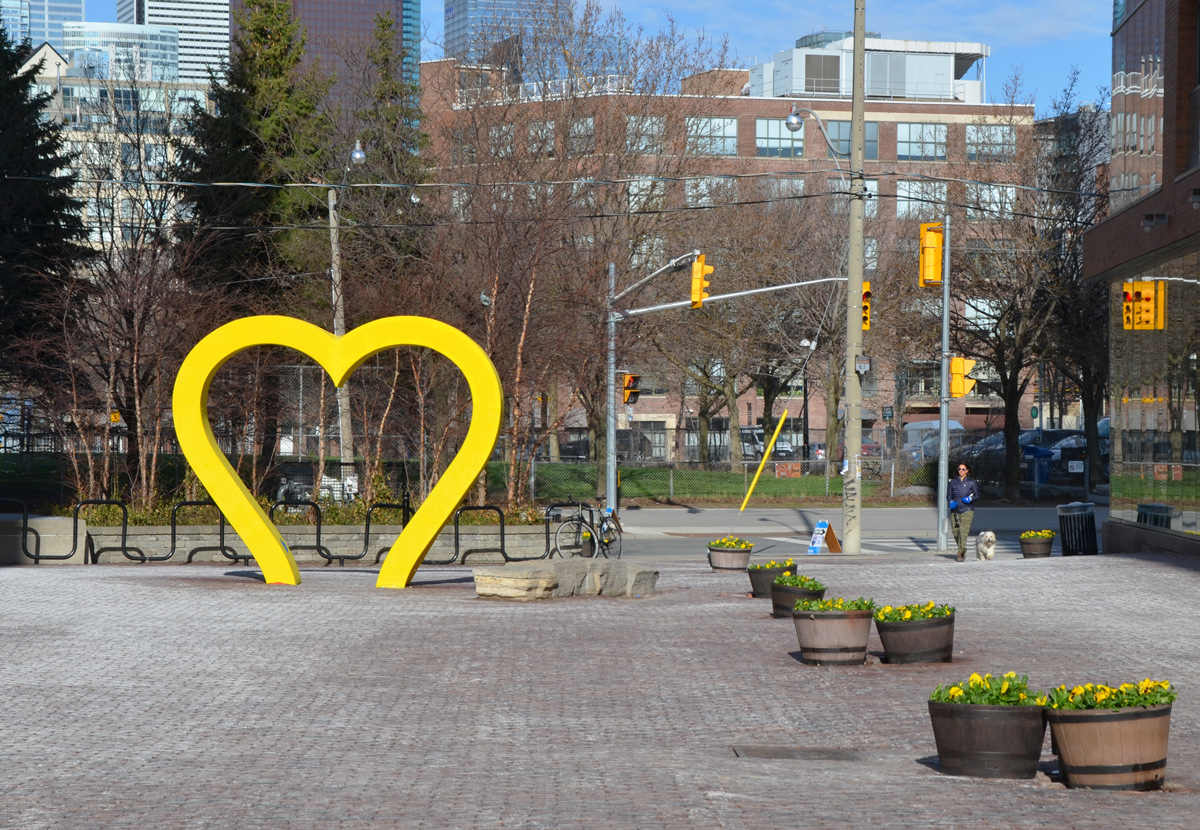
At the Distillery District, many features were made yellow in April in honour of cancer awareness month.

the heart at the Parliament street side of the Distillery District that is usually red has been made yellow

Towards the end of that month, some large pictures began appearing on the brick walls.  An early installation for CONTACT month, May, these are Sage Szkabarnicki-Stuart’s  “Good Stuff Bad Stuff” which is a series of conceptual photographs attached to the exterior walls of some of the buildings.

From the CONTACT website:  “a series of bizarre self-portraits that connect concepts of home and identity. The artist’s own grungy apartment and various public spaces serve as the backdrop to the photo series. Using physical experiences and found objects, the photographs in this exhibition explore the relationship between ourselves and the personal objects we buy, inherit, and throw away.”

picture on a wall at the Distillery District

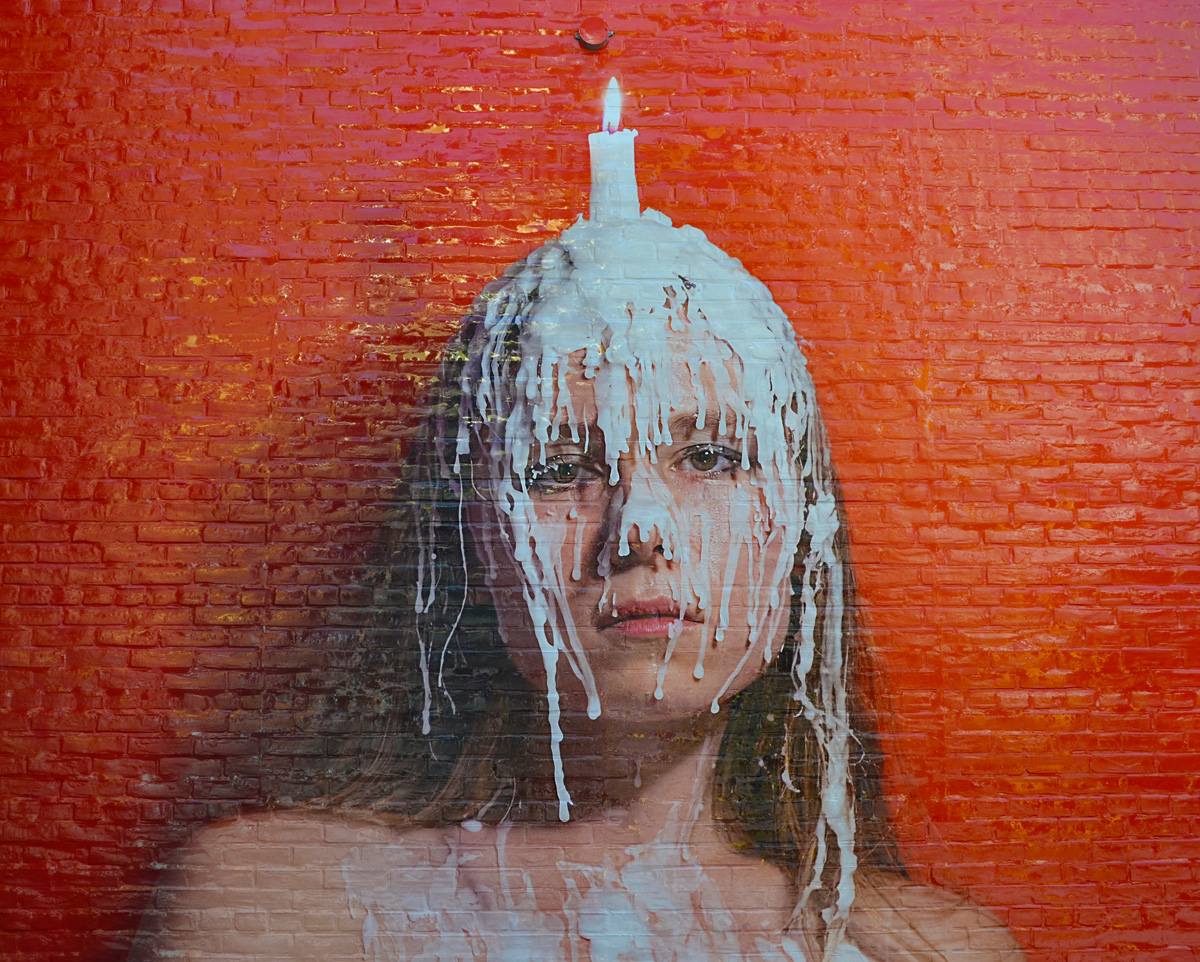
below: I’m not sure that a candle on one’s head ‘explores’ anything… but maybe I was missing something?

a woman's head with a lit candle on it, melted wax has run down her face and hair, bright orange wall in the background.

And so we go off on a bit of a google tangent to see what there is for ‘candle, head’.  I find candles as a Christian symbol for light in the darkness.  There is also an image of a black man with a real lit candle on his head with melting wax running down his forehead, lit by his pastor “to deliver him from the spirit of homosexuality”.  Searches also yield skulls as candle holders (or candle holders in skull shapes) used as a novelty item, or as method of casting spells if you believe in such things.   And last, Tim Burton made a music video for “The Killers” (a group) where at the end, two people are sitting across from each other at a table, both with a lit candle on their head.  In this last case there is melding of reality and fantasy as one character is a wax figure that occasionally comes to life.   Whether this has anything to do with the image above, I have no idea.   But I’m sure that my ramblings, although entertaining (ha!) are probably just a detour.

below: Hope floats. One of the photographs on a wall surrounded by “graffiti” ( of the fake kind).  No candles here?  It’s the paper boats that are burning.  If there were candles, they are long gone.

a head partially submerged in water, surrounded by little white trays with flames


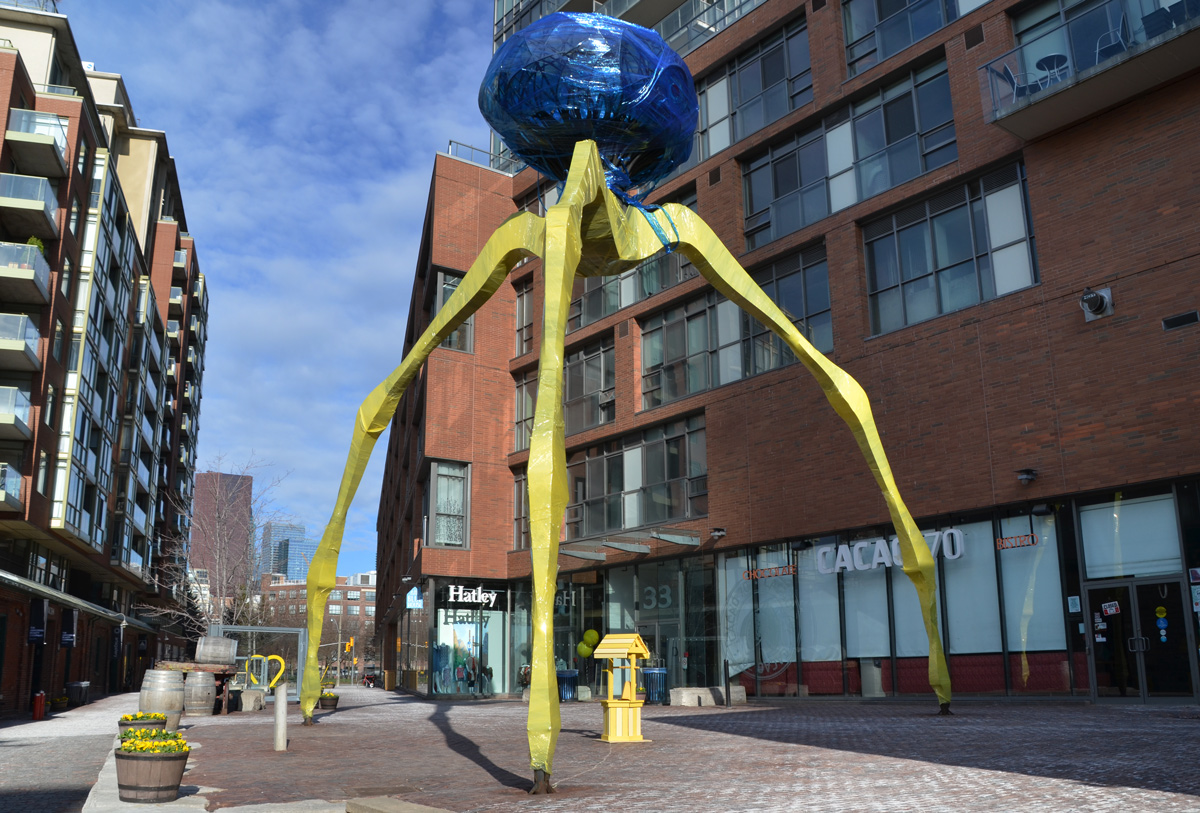
below: More yellow

the four legs of the large spider-like sculpture at the Distillery District are yellow and the head part is wrapped with blue plastic

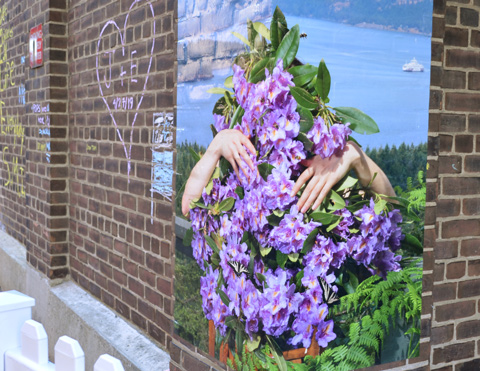
below: Another picture.  Flowers and hands.

a large poster attached to brick wall, outside, hands coming out of a large bush with purple flowers on it.

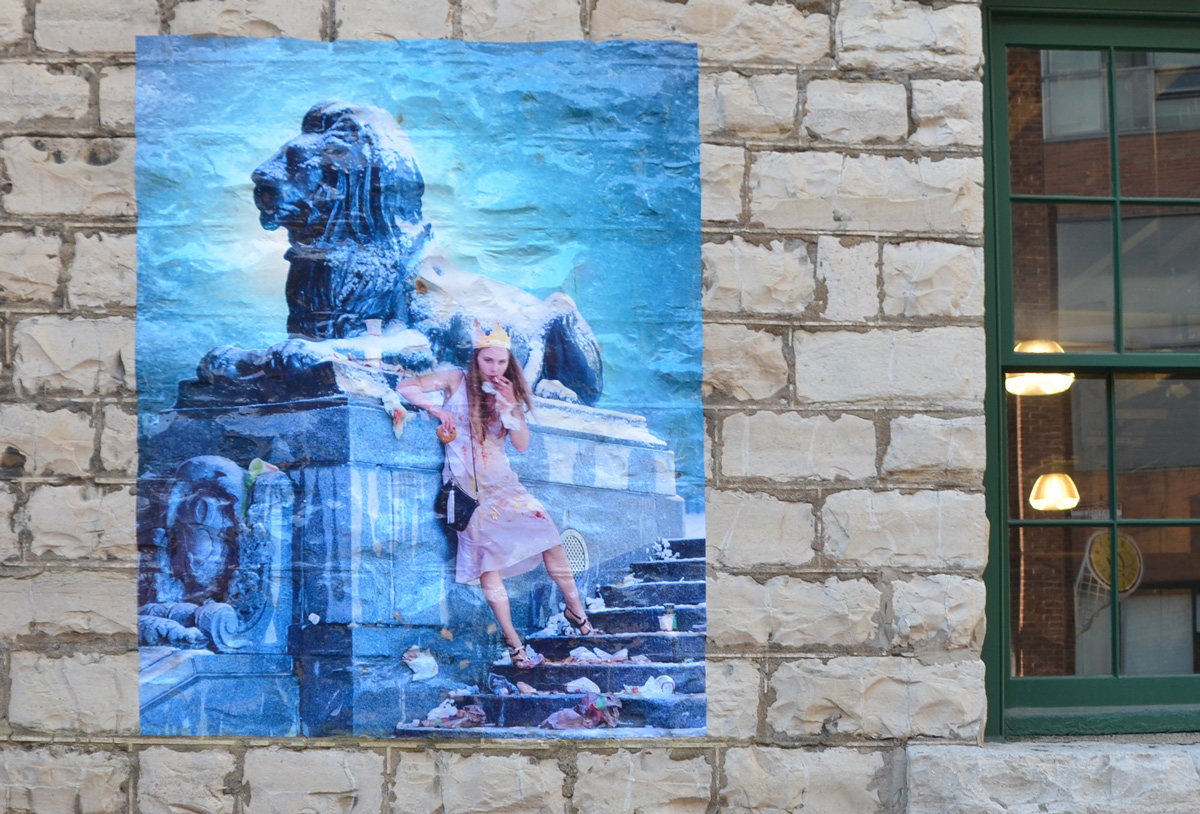
below: More picture.  This time an ode to junk food and trashiness by the looks of it.  The lion is blue but unmoved.  With a fast food paper crown on her head and a cigarette in her mouth.  Garbage randomly strewn but carefully placed so there is no product placement.

picture on a stone wall, blue tones, lion sculpture, sitting beside flight of stairs, woman leaning against lion, cigarette in her mouth, food in the other hand, garbage strewn on the stairs around her feet

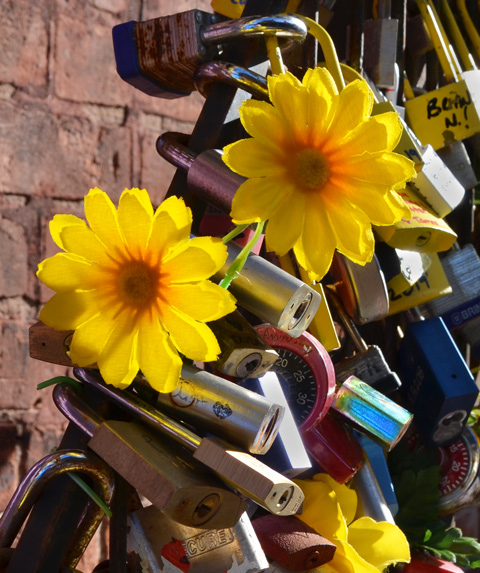
below: The last bit of yellow for today.

distillery district, love sign for locks, the heart has been decorated with a lot of yellow flowers

fake yellow flowers placed by some locks

below: And one last photograph to give you some ideas of what to do with the photos of Venice that you might have, you know, the ones that look like everyone else’s.   There are many more on display at the Distillery District.   As I type this I am warming up to the pictures but I am still torn.   Does anyone want to offer an opinion?

large photo on a brick wall, taken by a canal in Venice, of a woman covered from head to toe in black weeds as she stands beside the canal

Sage Szkabarnicki-Stuart is on Instagram

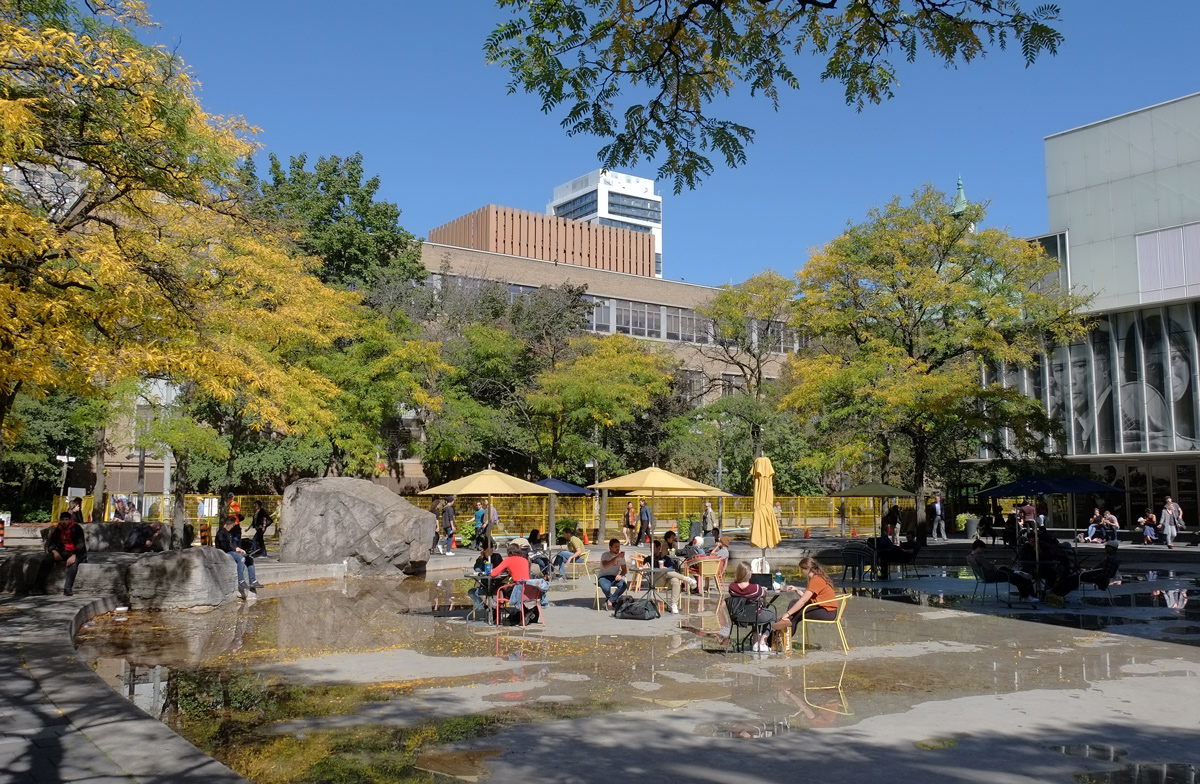
One of my stops the other day was the Ryerson Image Centre.

below: Students enjoying the un-autumn-like weather while the pond is almost empty.

the pond outside Ryerson Image Centre is almost dry, there are tables, chairs and yellow umbrellas set up in the pond area, students sitting there.

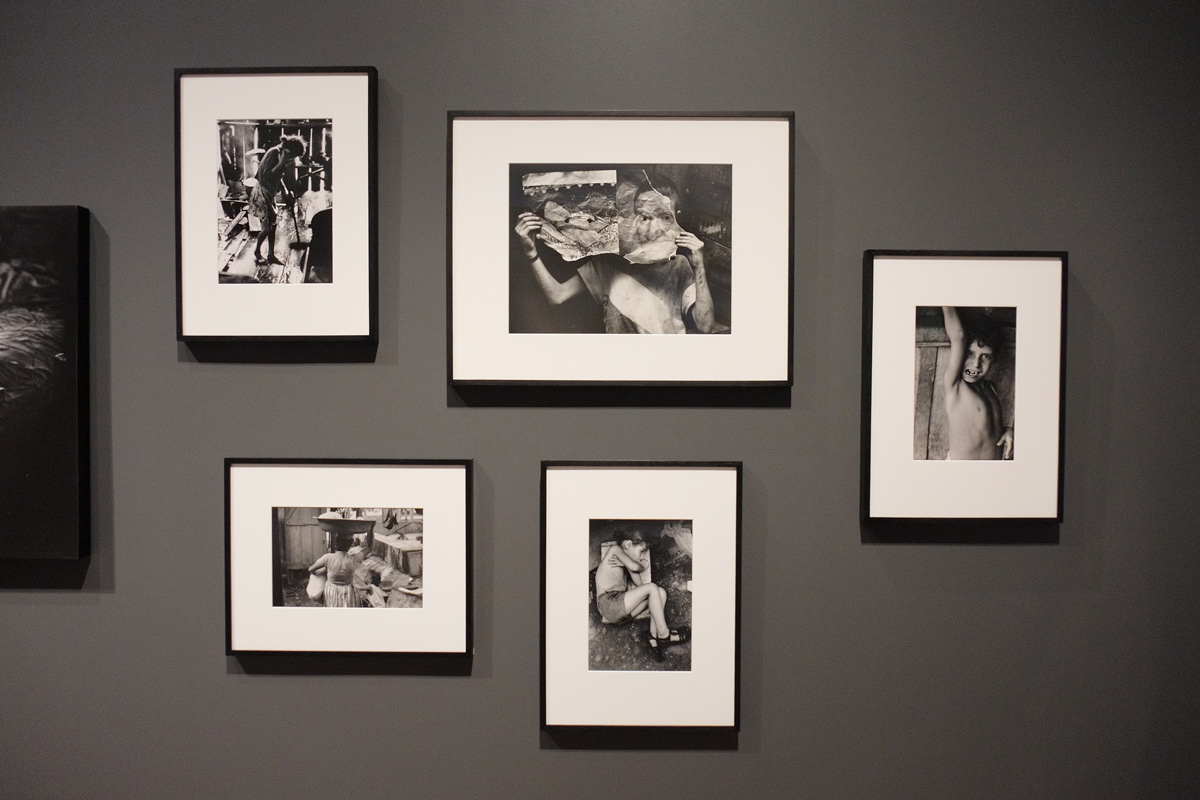
The main exhibit at the Ryerson Image Centre is based on the work of Gordon Parks, specifically his ‘Flavio’ photo essay.  Gordon Parks was an African-American, born in Kansas in 1912.   He bought his first camera in a pawn shop.  In 1948 he began a 23 year career at LIFE magazine where he created many photo essays including ‘Flavio’.   In the 1960’s Parks  went to Rio de Janeiro in Brazil to document the poverty there.  He  centered the project around a boy, Flavio, and his impoverished family, the Da Silvas.  When the photographs and story appeared in ‘LIFE’ magazine in June 1961, it caused quite a stir, especially in Brazil.  In return, a Brazilian photographer, Henri Billot , visited the poorer parts of Manhattan to prove that the poverty in the United States was as bad as the poverty in Brazil.   The family that Billot concentrated on was the Gonzalez family.   There is also some discussion about candid photos vs images that are staged in documentary photography.

As a reaction to the LIFE article, Flavio was brought to the USA for two years to treat his asthma.  Money was also raised to relocate the Da Silva family to a new home.

below: Some of the photos by Gordon Parks.

five black and white photos on a dark grey wall, photos by Gordon Parks of poverty in Rio de Janeiro in the 1960s

below: Flavio and his brother Mario on the promenade in Rio during their first trip outside the favela. 1961.  Favela is Brazilian Portuguese word for slum, or low income area a city (usually on the outskirts).   In the 1960s the favelas were populated mostly by migrants from rural areas who couldn’t afford living in the city.   These areas didn’t have running water, electricity, or sanitation.

two boys in front of a row of apartment buildings, photo by Gorodn Parks

below: Photo by Henri Billot

old photo from the 1960s, 3 children play on the sidewalk by a car that is parked on the street

below:  Neighbourhood of the Gonzalez family, Manhattan, 1961, by Henri Billot (my apologies for the reflections).

Gonzalez building, tenement slums of New York (Manhattan), black and white phot by Brazilian photographer, Henri Billot

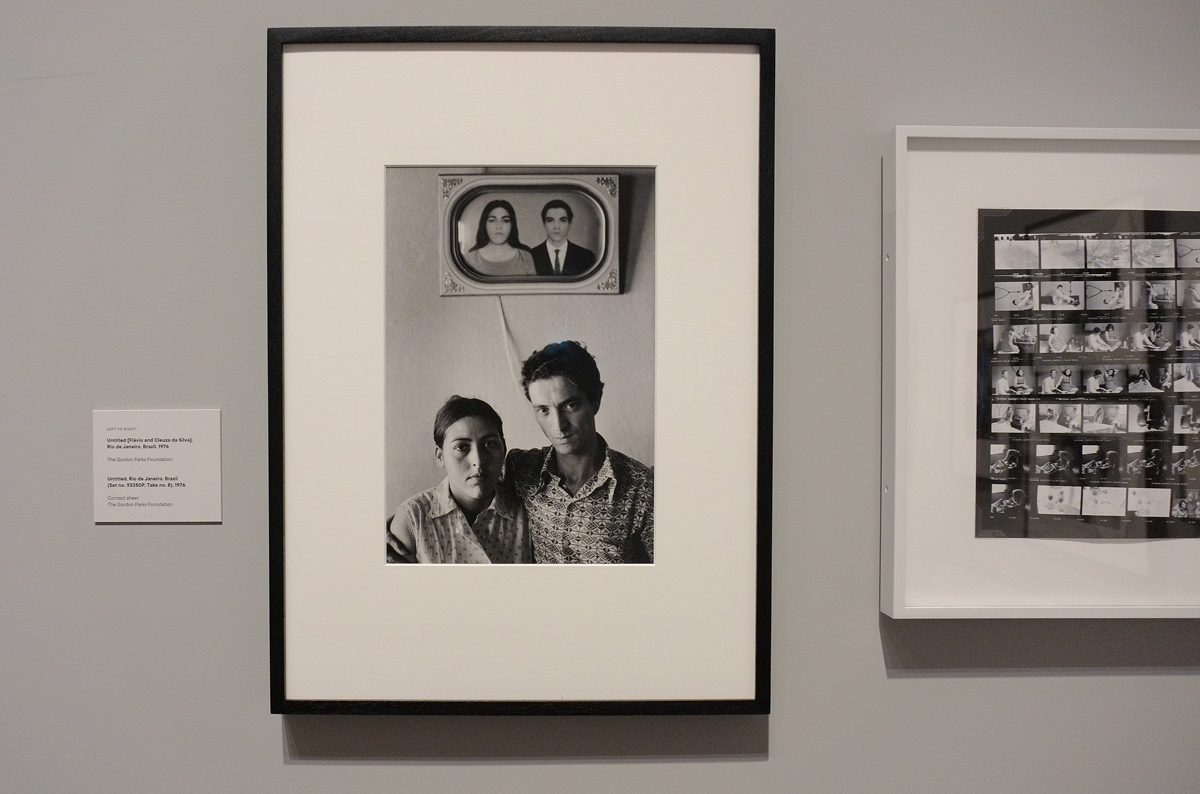
below: Flavio and his wife Cleuza da Silva in Rio in 1976 when Gordon Parks returned to see how the Da Silva had fared since his earlier visits.

black and white phot of Flavio and Cleuza da Silva taken in 1976 in Rio by Gordon Parks

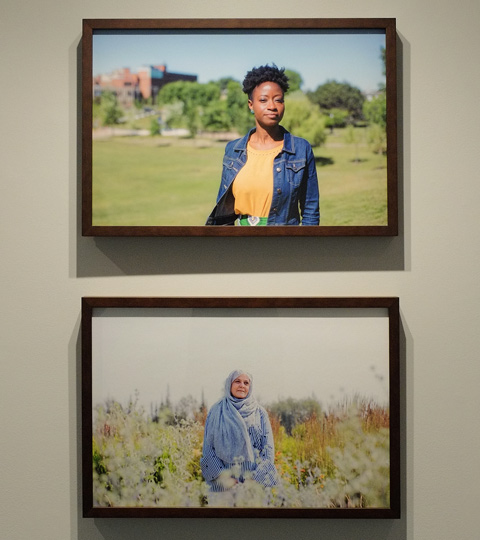
In the student gallery was a small exhibit of the work of Alia Youssef.  Her project ‘The Sisters Project’ features portraits of Canadian Muslim women of all ages all with a narrative of their own.   Their portraits were on the wall of the gallery but their portraits and stories are on the website (it’s well worth a visit!)

two photographs by Alia Youssef, each of a muslim woman in a field or park, the one on top is a younger black woman, the bottom is an older whiter woman with a head scarf

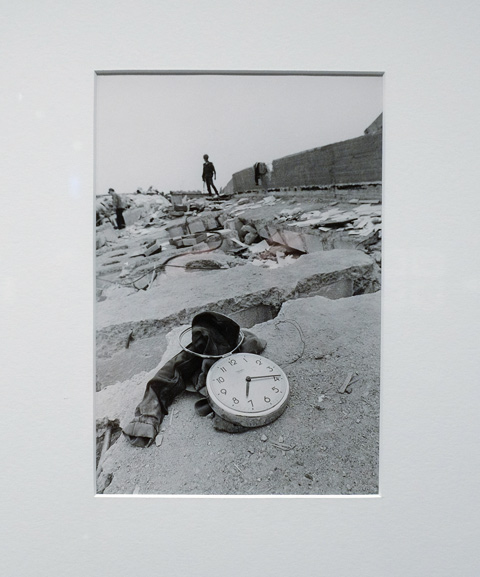
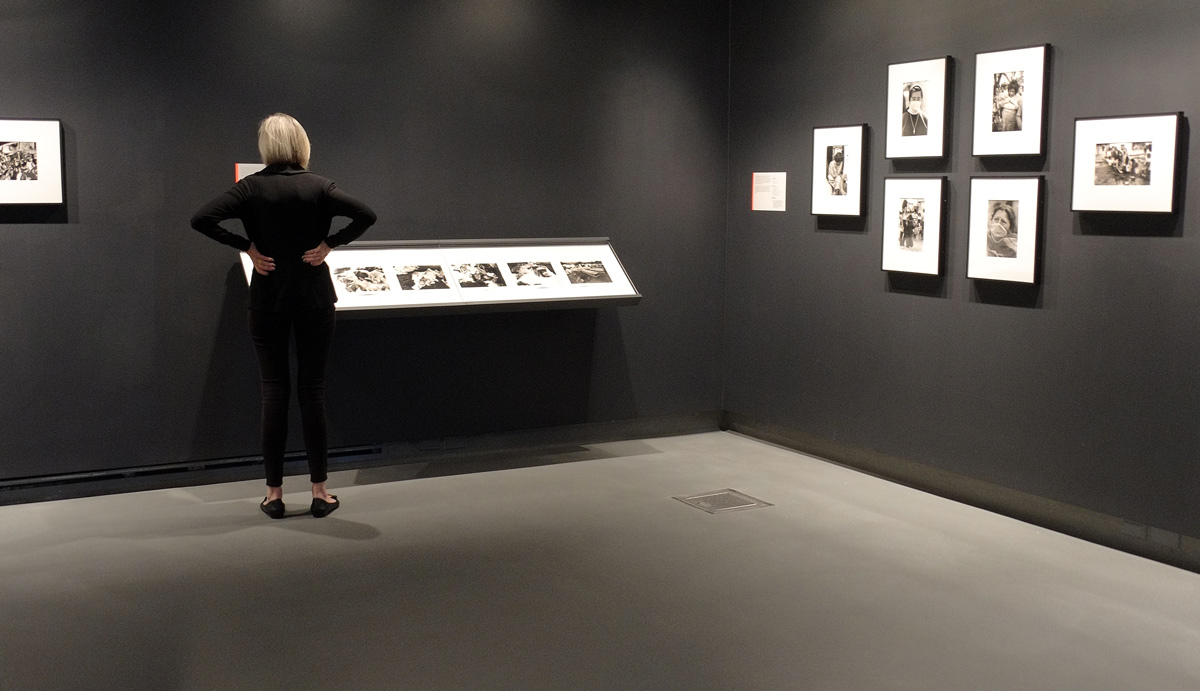
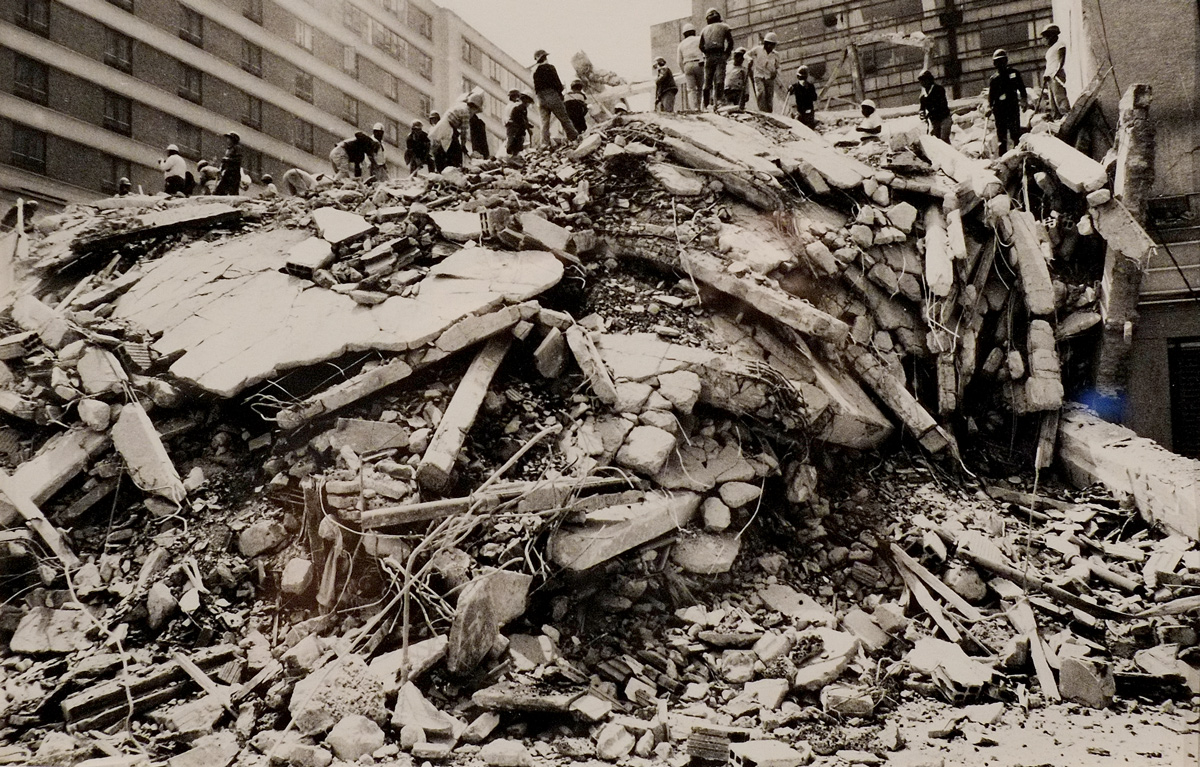
In light of the recent earthquake in Indonesia, the third exhibit at the Ryerson Image Centre seems timely.  It is a display of photographs taken in the aftermath of the earthquake in Mexico City on 19th September 1985.  At the time it was the strongest earthquake on record.  Large portions of the city center and the neighbourhoods next to it were leveled.

below: Photo by Barbara Laing.

an old black and white photograph of Mexico city after the 1985 earthquake, a pair of pants and a clock on top of a flattened building, some people in the distance

woman dressed in black in a gallerywith black walls,looking at black and white photos on the wall

below: Photo by Pedro Mayer.

an old black and white photograph from the aftermath of the Mexico City earthquake of 1985, s pile of rubble with people standing on top of it.

the pond outside Ryerson Image Cetnre is almost dry, there are tables, chairs and yellow umbrellas set up in the pond area, students sitting there. aas seen from inside the Image Center

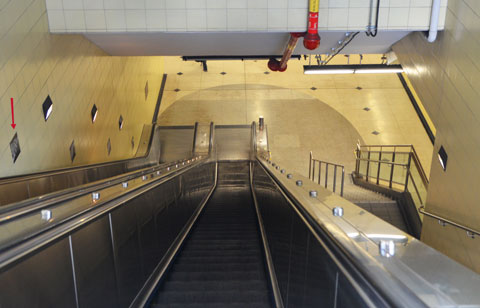
This looks like an ordinary entrance into a TTC subway station.  It is.
It’s Bessarion station on Line 4, the Sheppard Line.

escalator down into Bessarion station

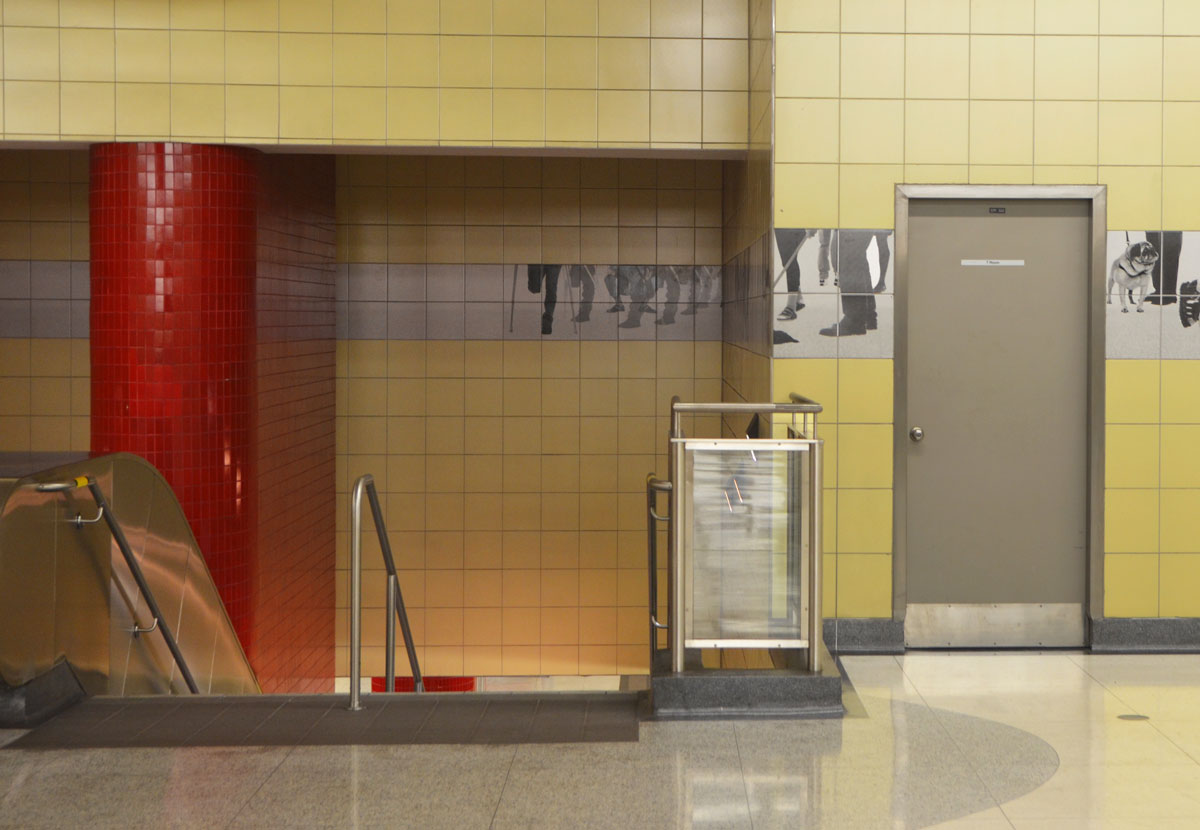
The red arrow points to one of a series of little photographs of hands that run beside the escalator to street level.

I’d be willing to bet that none of you have been to Bessarion subway station.  If you’ve heard of the station it’s probably in the context of complaints that no one uses the station so why did the city spend so much money building it.   One of the reasons for the low volume of traffic is that there are no bus routes (besides Sheppard) that serve this station.  Apparently in 2014 an average of 2380 people used the station on weekdays.  If true, then 2379 plus me where there today (although the stats may have increased since then).    I took some pictures for you – you will now have an idea of what the station looks like without having to go there.

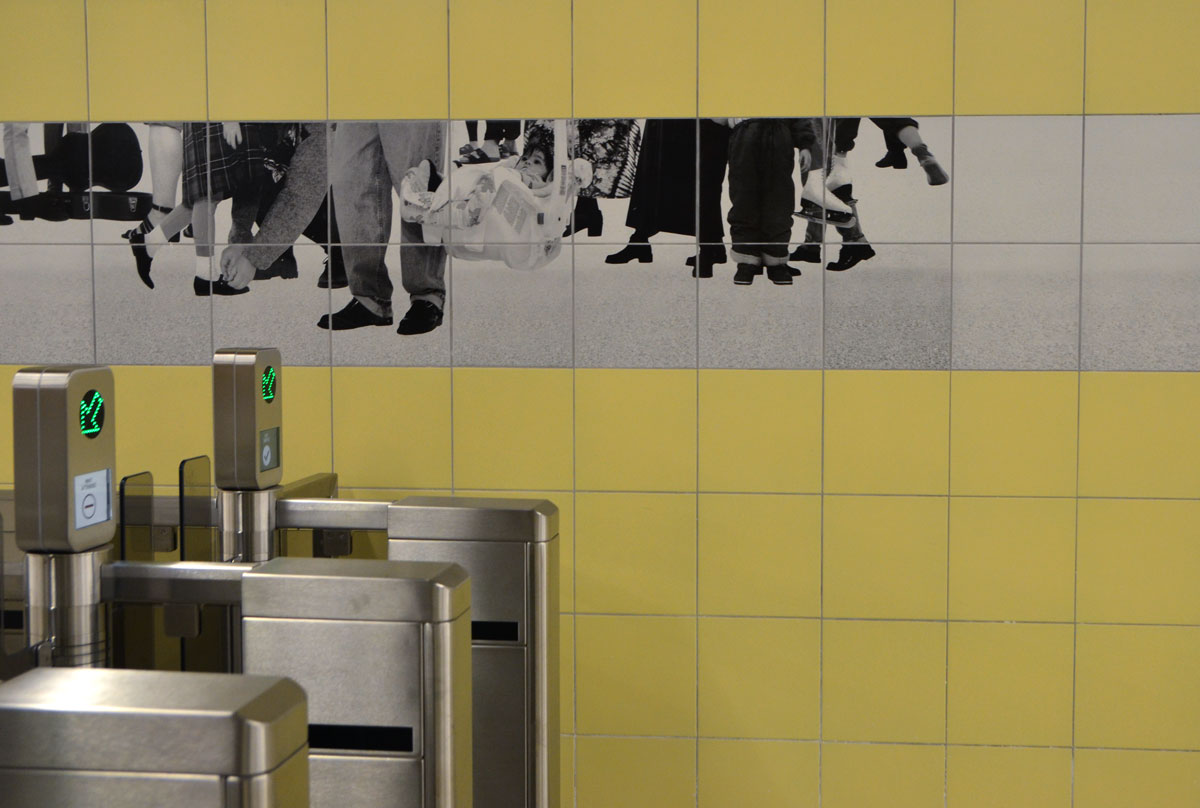
photos of peoples legs and feet in black and white on tiles on a yellow tiled subway station wall, over the metal turnstiles for entry into the station, artwork by Sylvie Belanger

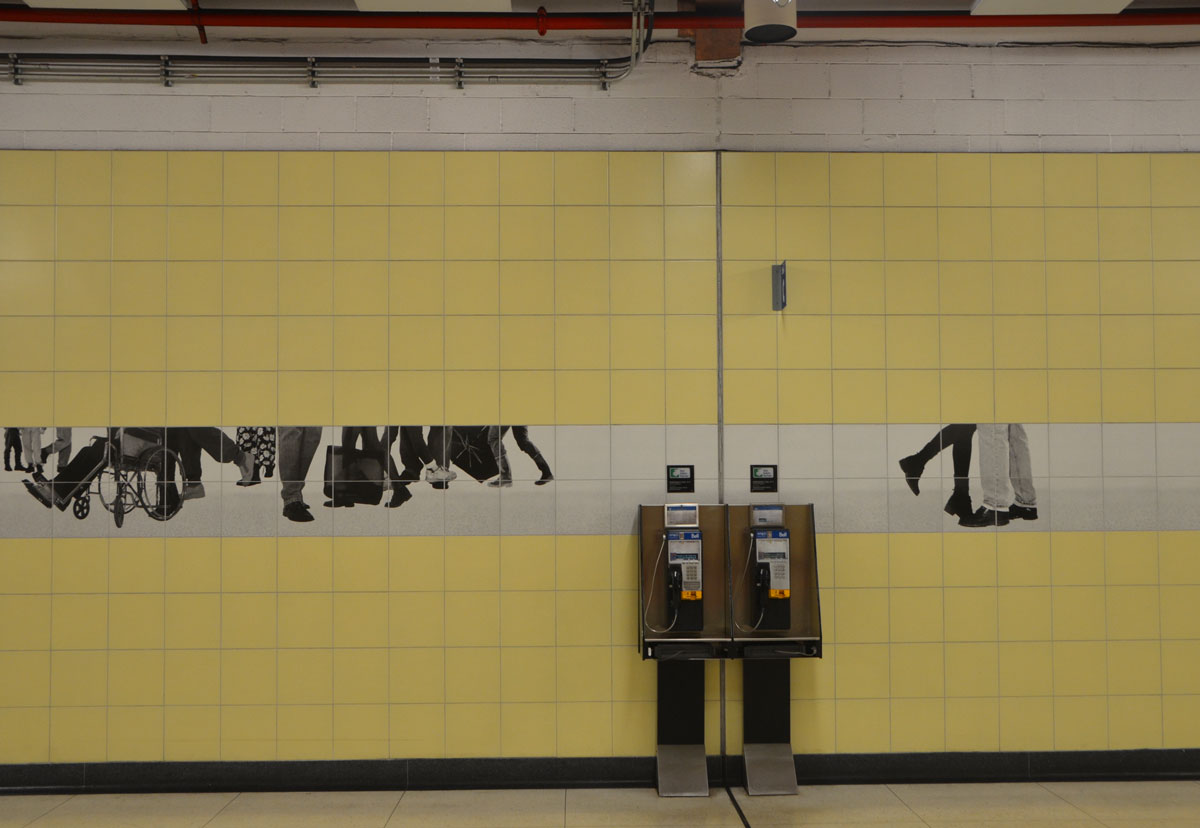
below: An art installation called ‘Passing’ dominates the yellow walls of the station concourse level.  It consists of a band of black and white photographs of legs and feet taken by Sylvie Belanger.  The little pictures of hands that I mentioned at the beginning of this blog are also part of this installation.

photos of peoples legs and feet in black and white on tiles on a yellow tiled subway station wall, over and beside two Bell pay phones, artwork by Sylvie Belanger

below: The pictures of legs and feet run around the whole concourse level of the station.

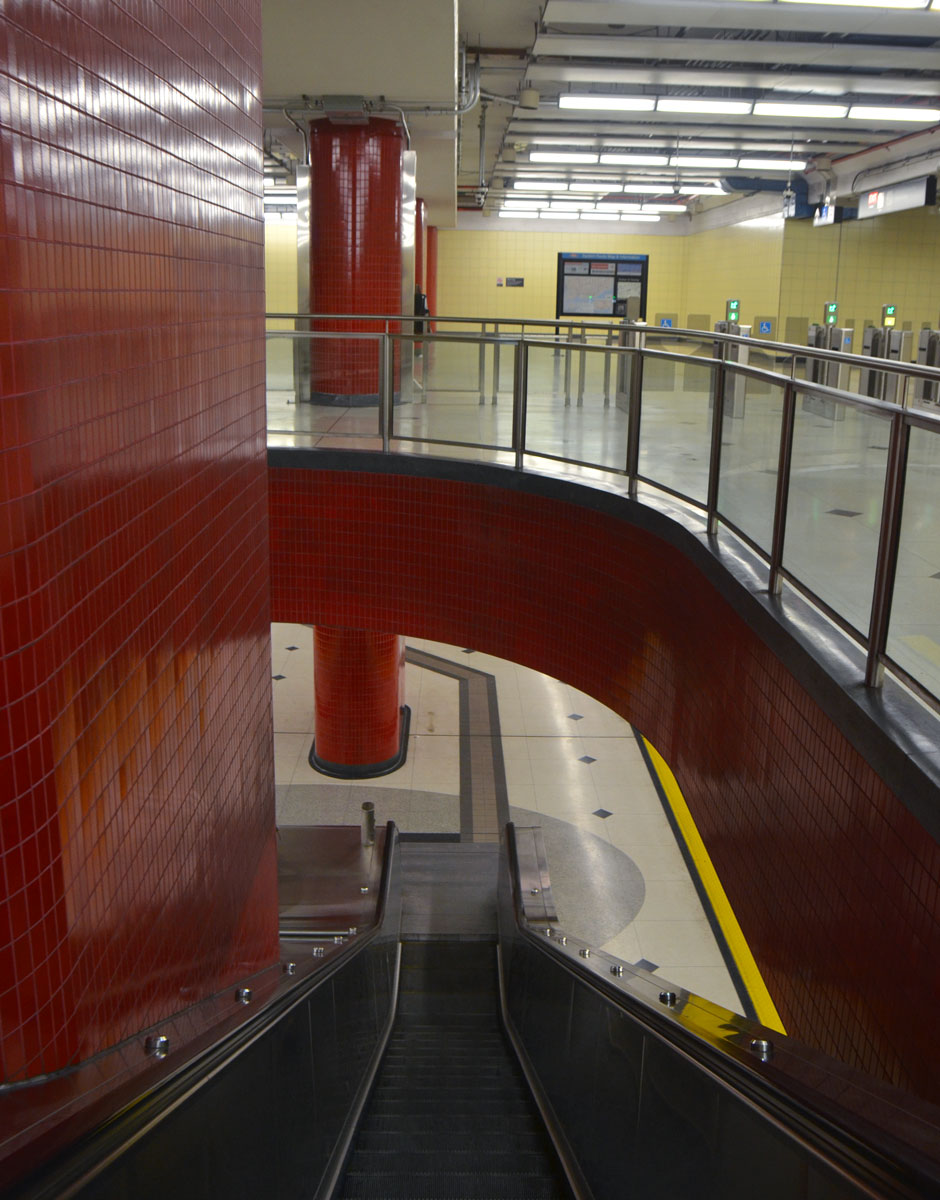
below: Down the escalator to the lower level.

looking down the main escalator at Bessarion subway station, the upper level has yellow walls and the lower level (track level) can also be seen.

below: I was not alone!

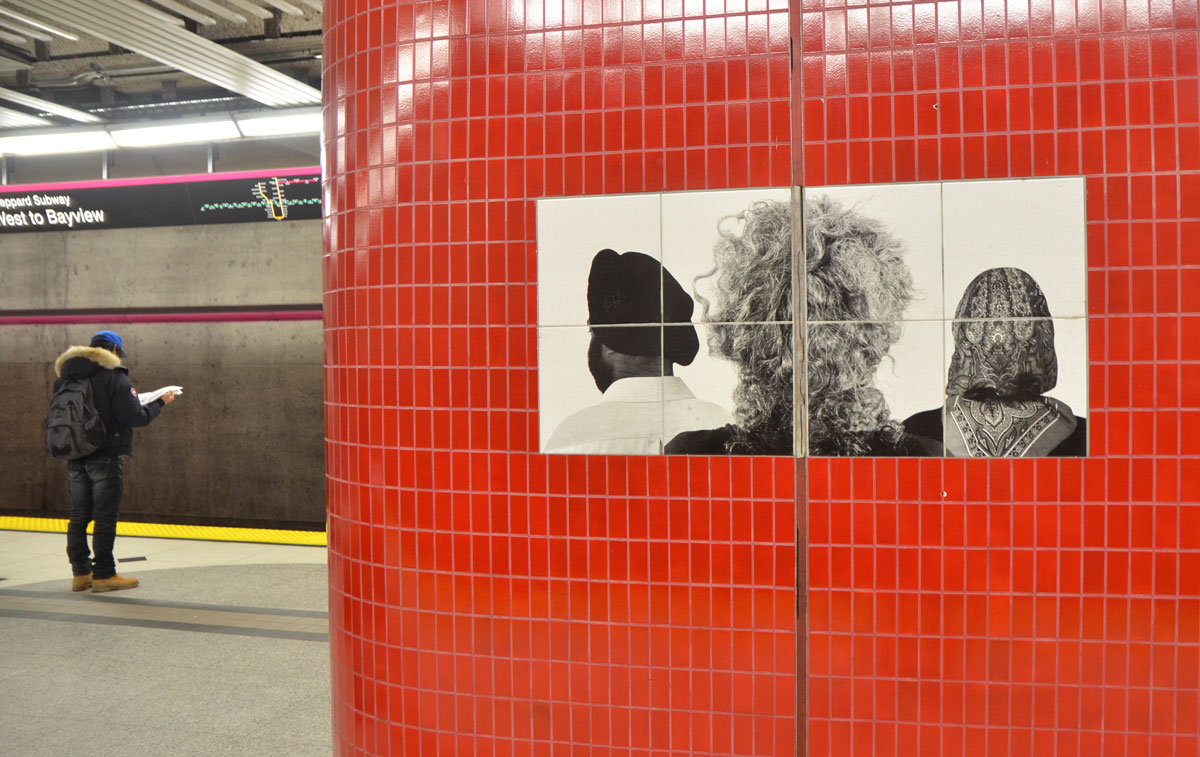
pillar covered in red tiles and with a black and white photo of the back of three peoples head, a man with a turban and a woman in a head scarf and someone with curly hair.

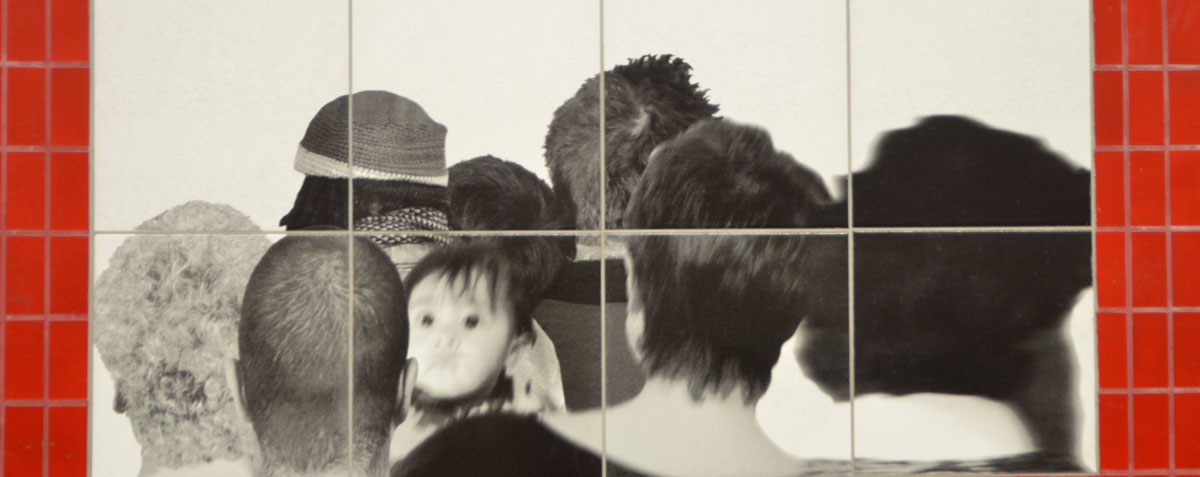
below: The artwork at track level is a continuation of the photographs by Sylvie Belanger.  This time the pictures are of the backs of people’s heads and they are incorporated into the red pillars.

close up of black and white photo of the back of peoples heads, one child's face turns to the camera and is slightly out of focus, Passing by Sylvie Belanger at Bessarion subway station

below: The outer walls are bare concrete and there are very few ads or posters on the walls.

from the subway platform at Bessarion subway station looking toward the concrete wall at the edge of the tracks, signs for the station, and direction signs.

I missed Nuit Blanch this year.  While I was away, I heard lots of good things about the installations at Nathan Phillips Square, including the fact that they will remain until the 10th of October.

Silly me went during the day.  It didn’t look too impressive then!
There were lots of tourists taking pictures.

a man is taking a picture of his wife and young son in front of the water and 3D toronto sign in Nathan Phillips Square, a girl in a stroller watches.

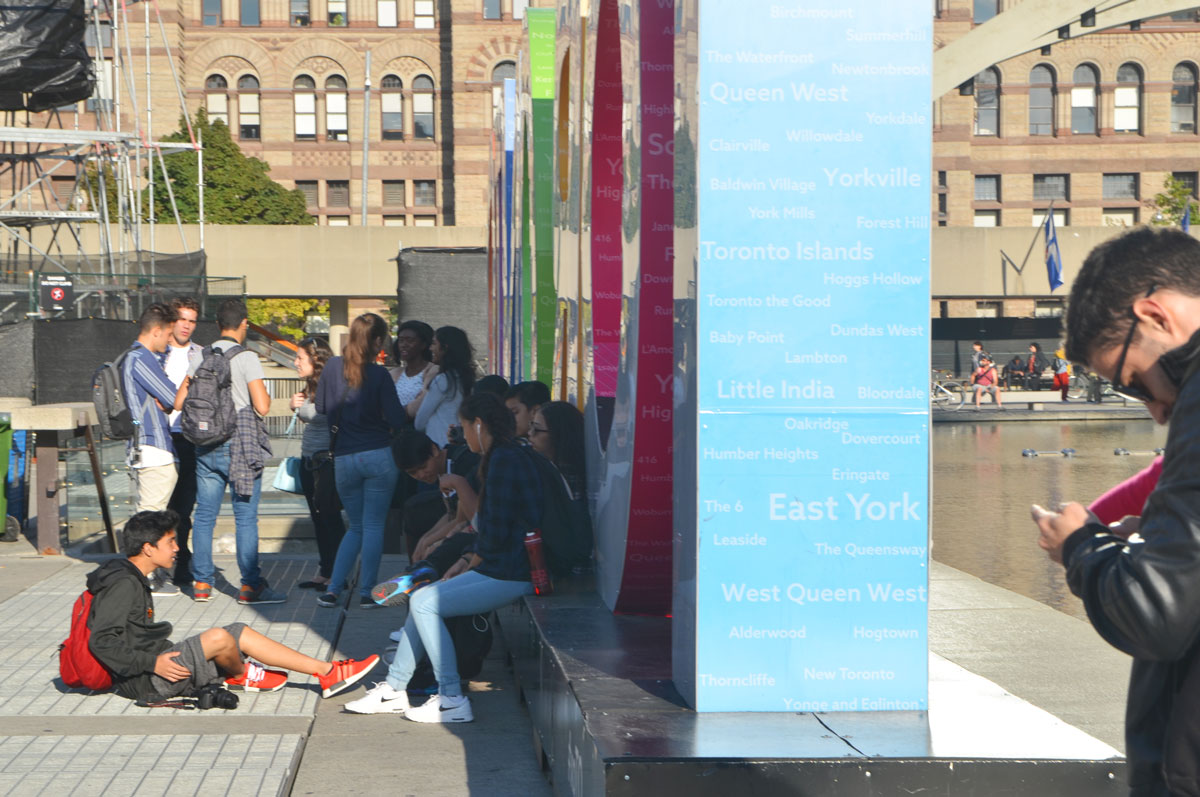
and schoolkids hanging out by the 3D Toronto sign.

a group of teenagers, school kids, after school, hanging out behind the letters of the 3D Toronto sign.

Oh right, it’s a night time, after dark sort of thing.  Come back after 7 p.m.

So last night I went back at 7 p.m.  …. but last night was also the first game of the Blue Jays playoff series against Texas and it was playing on a large screen in the square.  I watched the end of the game.  There wasn’t a very large turnout, but the atmosphere was great.  Everybody was in a good mood as the Blue Jays won 10 – 1.

people watching the Blue Jays baseball team playing a game on a large TV screen outside.

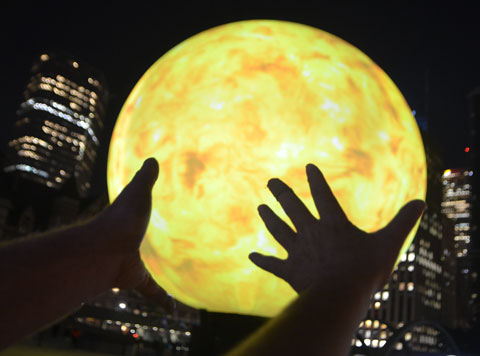
Shortly after the end of the game, the large 14 metre globe that represents the sun lit up.  “Death of the Sun” by Director X (Julien Lutz) began.

The sun starts as a swirling orange and yellow globe.

looking through the O of the Toronto sign to the yellow and orange projections on the large globe in front of City Hall, art installation from Nuit Blanch

It then turns orange before the colours die out and fade to nothing.

the 3D toronto sign lit up in white, city hall behind it in purple lights, and a large globe representing the sun glows orange as part of an art installation, night time photo.

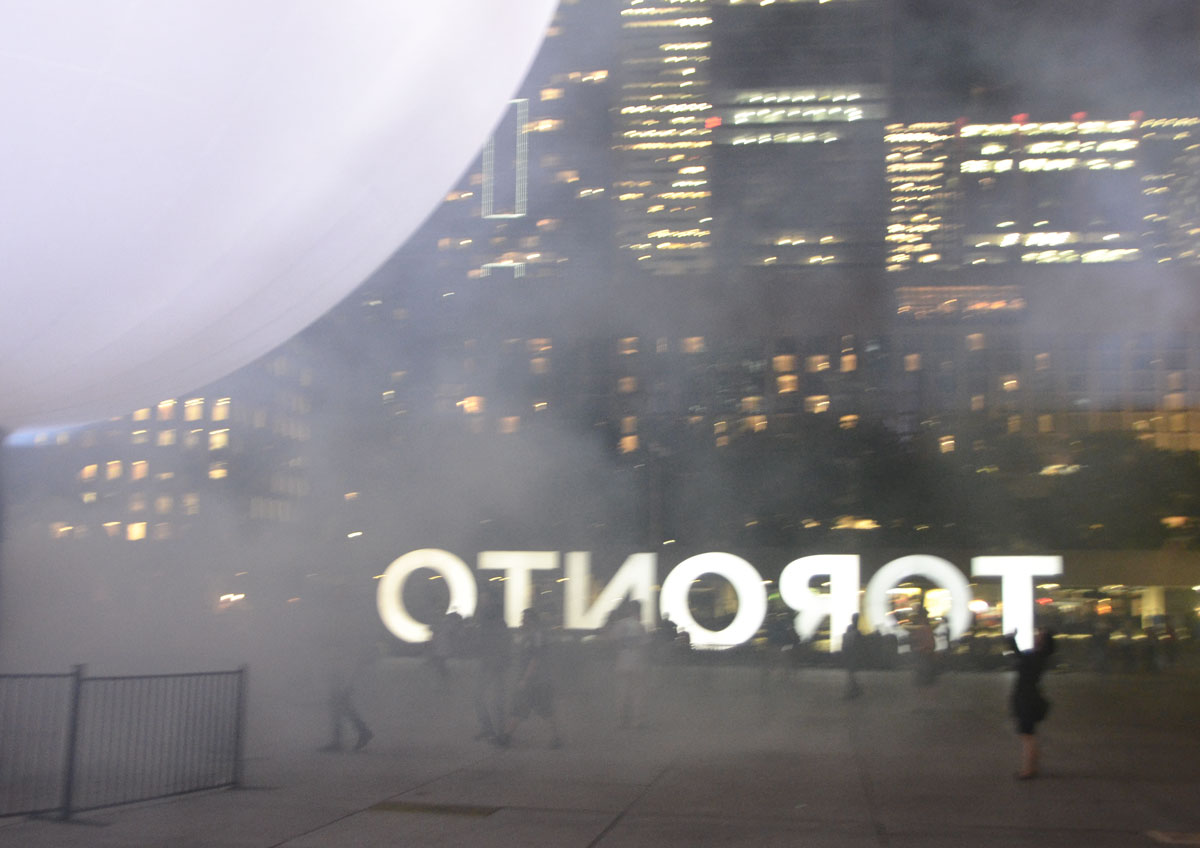
At one point the sun lets off steam, gas, fog (whatever you want to call it) before it goes silent.

large white globe lets off steam or fog in Nathan Phillips square.

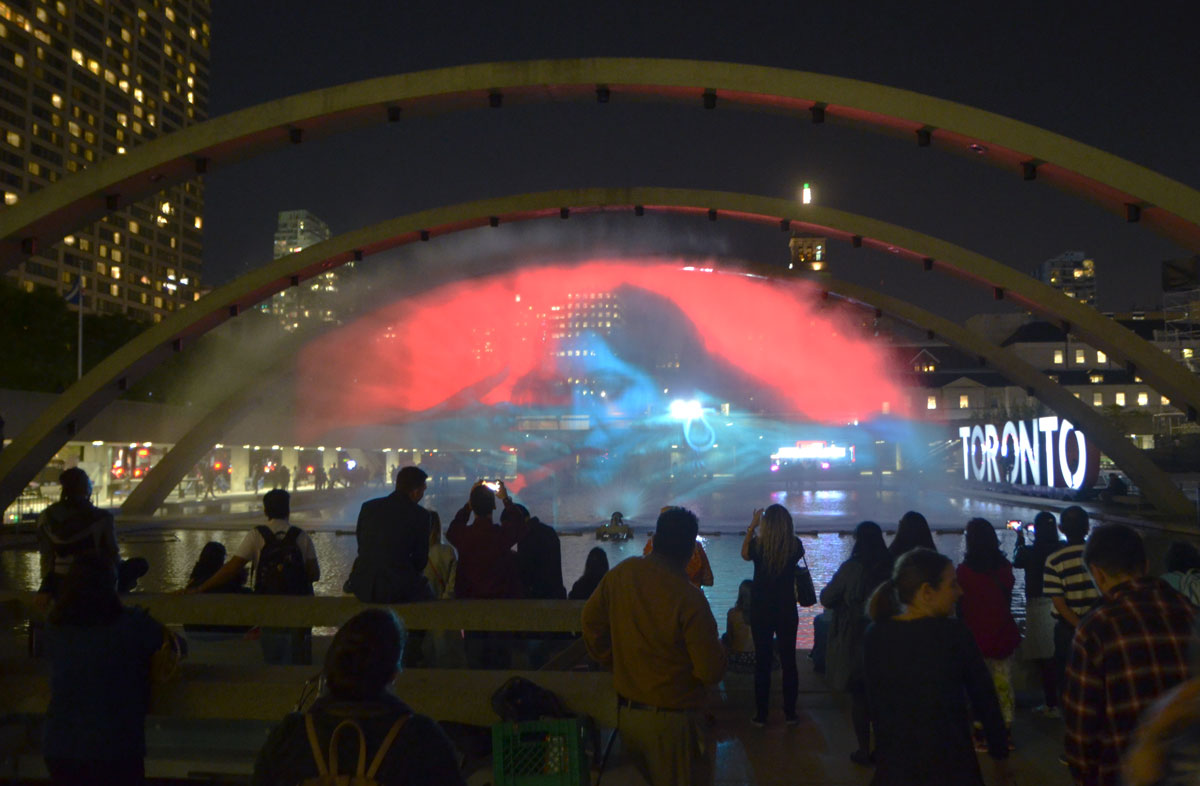
The end of the sun signals the start of “Pneuma”.  Images by Floria Sigismondi were projected onto a wall of water under the arches in the square in what appears to be a short film full of  symbols.

people standing around with their backs to the camera in the foreground, with a picture projected onto a wall of water under the arches at Nathan Phillips square in the background. The picture is of a blue woman on a red background.

images of people in triangular shapes projected onto a wall of water as part of an art installation, night time, lights of buildings in the background.

‘Oblivion’ is the name given to the collection of installations at City Hall.  Both of the artists come from the world of video.  Sigismondi has previously made videos for the like of Rihanna, David Bowie and Marilyn Manson while Director X has worked with Rihanna and Drake.

It was an interesting installation….  well done technically and fascinating to watch.

two hands silhouetted on a large yellow globe representing the sun, night time.

We tried to push the sun back into the sky, but we failed.

#nbTO2016 | #DirectorX | #pneuma | #floriasigismondi