Posts Tagged ‘art’

May is photography month in Toronto.  It is the month when there are numerous exhibits in public spaces and in galleries, all part of the CONTACT Photography Festival.   Over the next few weeks I hope to visit many of the exhibits and blog about some of them.   From past experience I have discovered that a lot of the public installations appear before May 1st so I went exploring yesterday.

below: Looking south from Spadina and Adelaide….  Partially obscured by a building, on the right in this photo, is the first large black and white photo that I saw.

view from the NE corner of Spadina and Richmond streets. a small parking lot is directly across the street, two large billboards loom over the lot. Once is for Lorne's coats showing two people wearing coats. The other is for Maple flavoured iced capp at Tim Hortons.

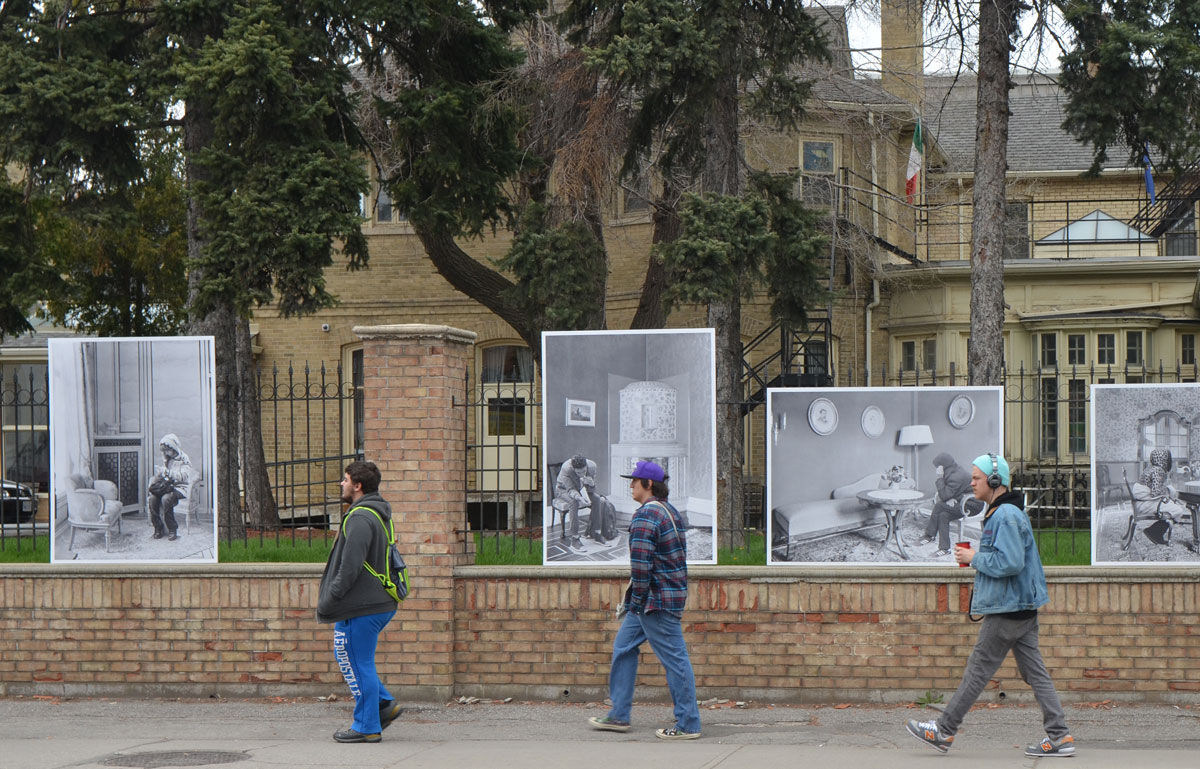
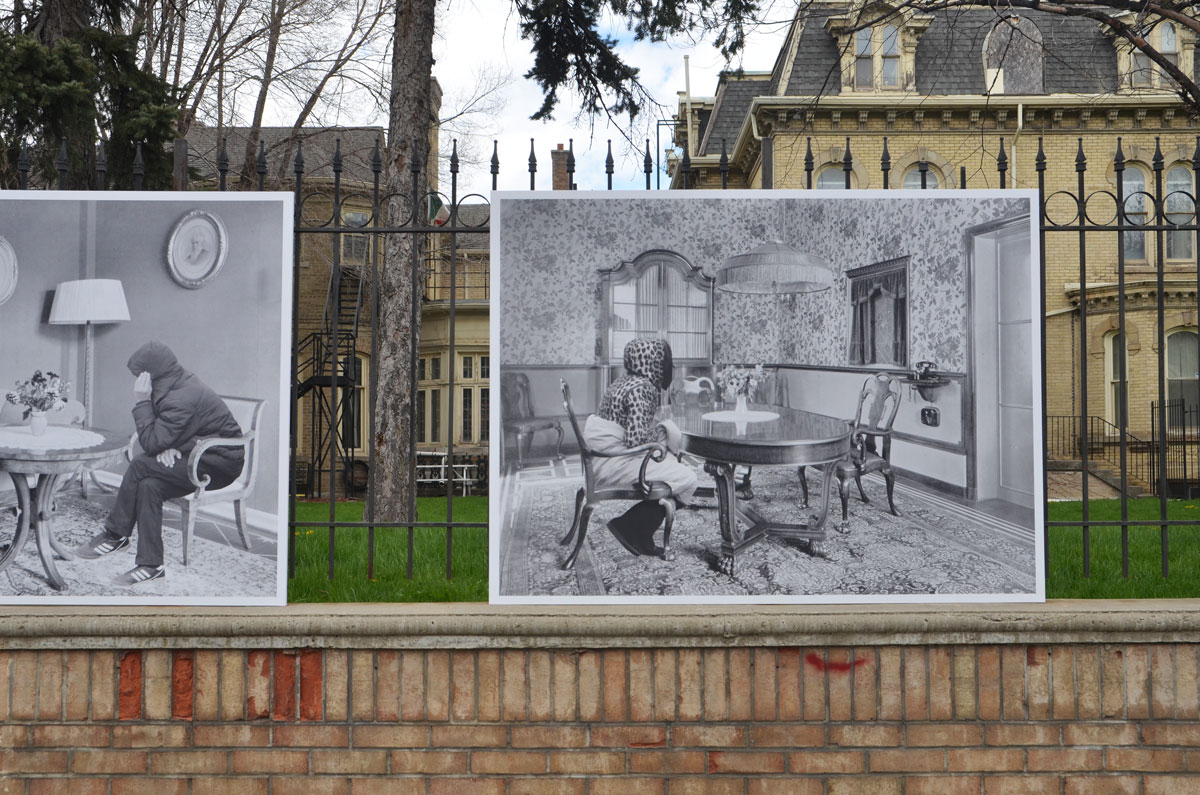
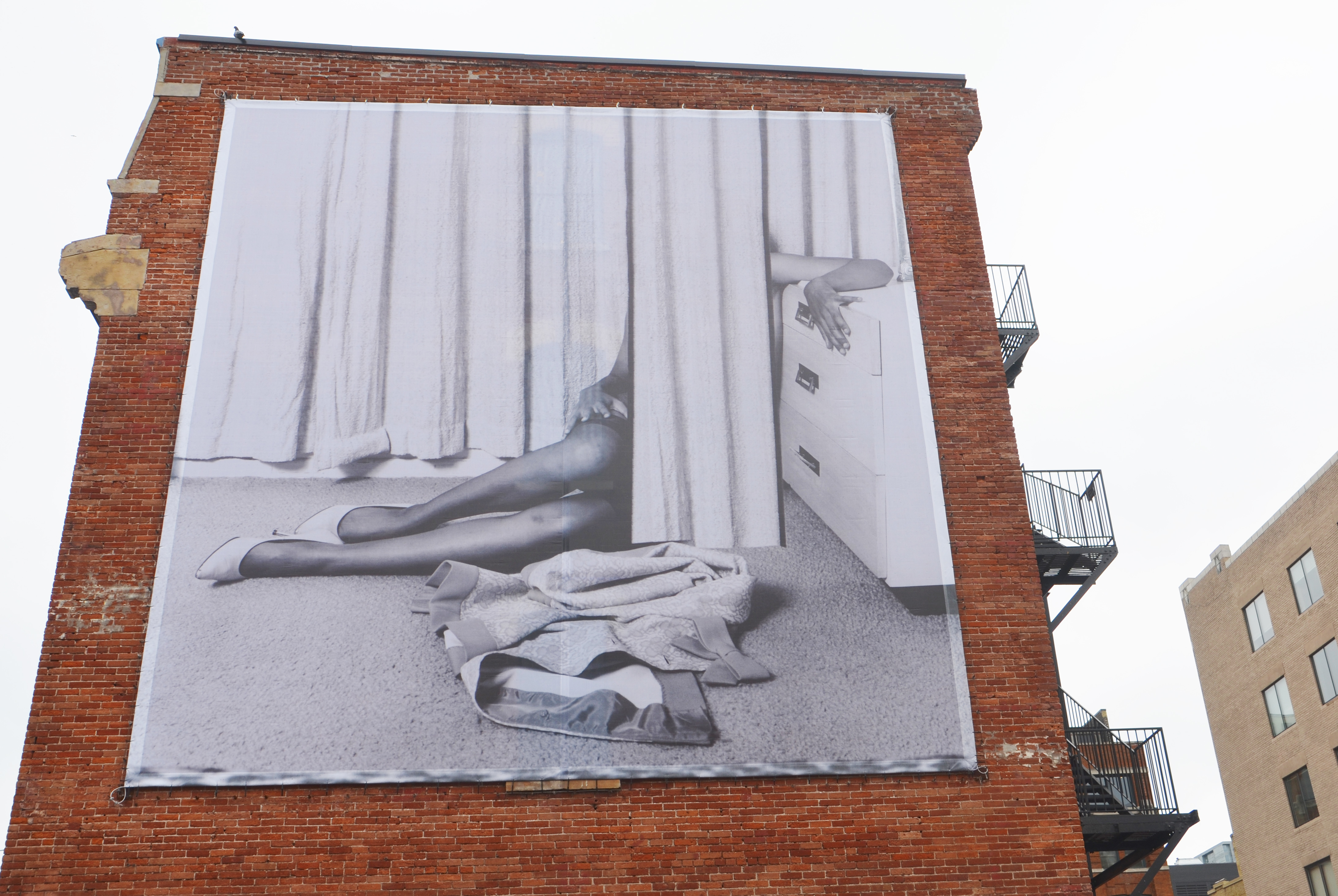
below: Up close,  ‘Drape’ by Eva Stenram.  Stenram has taken a 1960’s pin-up photograph of a woman and manipulated it.  She has brought the background, the drapery, forward and has covered up the original subject in the picture.

large black and white photo by Eva Strenram called 'Drape'. It is mounted on the upper level of a three storey red brick building. It shows a woman sitting on the floor partially obscured by drapery. Her upper body and head can not be seen.

below: Looking west on Wellington from Spadina.  The light grey building is the Old Press Hall (Globe and Mail) which will be demolished in the near future.

looking down the street past parked cars. A large black and white photo is on the side of the building.

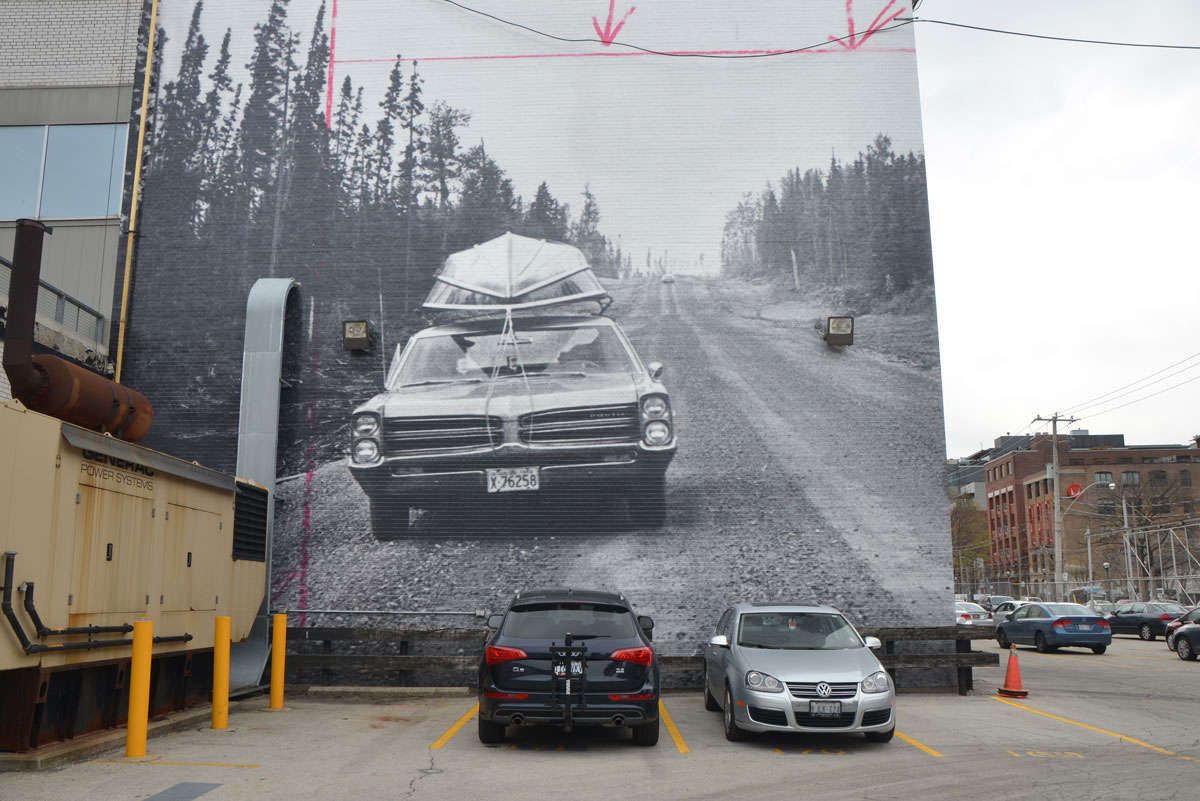
below: Up close, ‘Stopping Point’ by an unknown photographer.  The original title and description was: ‘Along the new Highway, which runs from Smooth Rock Falls to Fraserdale, Ontario, there’s no sign of human habitation apart from one empty lumber camp, c.1966. 

A very large black and white photograph from the 1960's of a car on a two lane road with pine trees on either side. There is a boat tied to the roof of the car. The photo is on the side of the Globe and Mail building with cars parked around it.

The above photograph is one of 750,000 photos in the Globe and Mail’s picture library.   100,000 of their old photos are being digitized to create a new historical archive.  From these, a collection of 20,000 prints will be donated to the newly formed Canadian Photography Institute at the National Gallery of Canada.

More of the photos from the Globe and Mail’s collection are on view inside the Old Press Hall.

An art installation ‘Nest Egg’ by Brendan McNaughton
at the Corkin Gallery, Distillery District

The title of this blog post is taken from a description of McNaughton’s work on the Corkin gallery website, “The relationship between plutocrats and proletariats is central to his art practice.”  A plutocrat is a person who is powerful because they are wealthy.  Money equals power.  Proletariat on the other hand is a class of people, the working class, a class without money and without power.

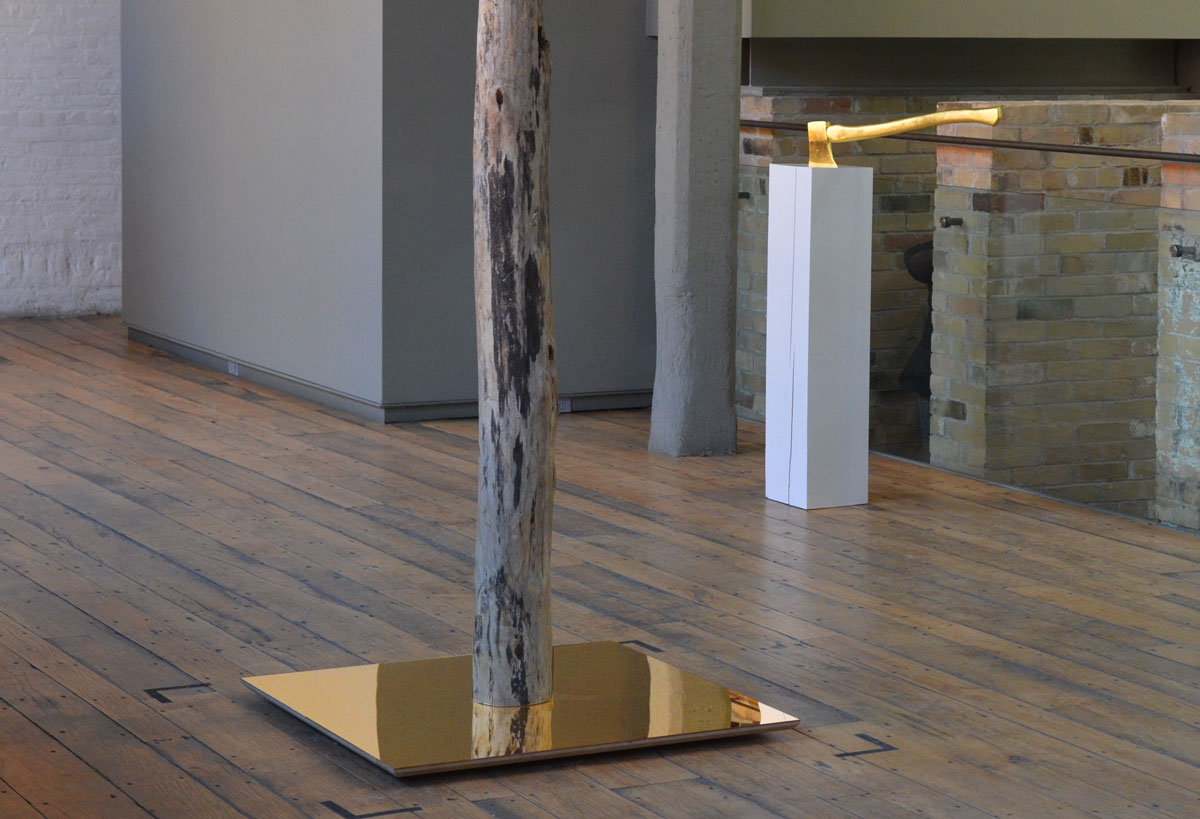
below: A gold axe.  With its blade in a column, on a pedestal?  That’s not a passive positioning of the axe, i.e. it’s not just lying around.  Someone has swung it.
Axe as a symbol of the working class?  Juxtapositioned with gold, a symbol of money?

picture taken inside an art gallery - a tree trunk stands in the middle of a gold toned mirror, in the background, a gold plated (or gold colured) axe with its blade in the top of a white rectanguar column

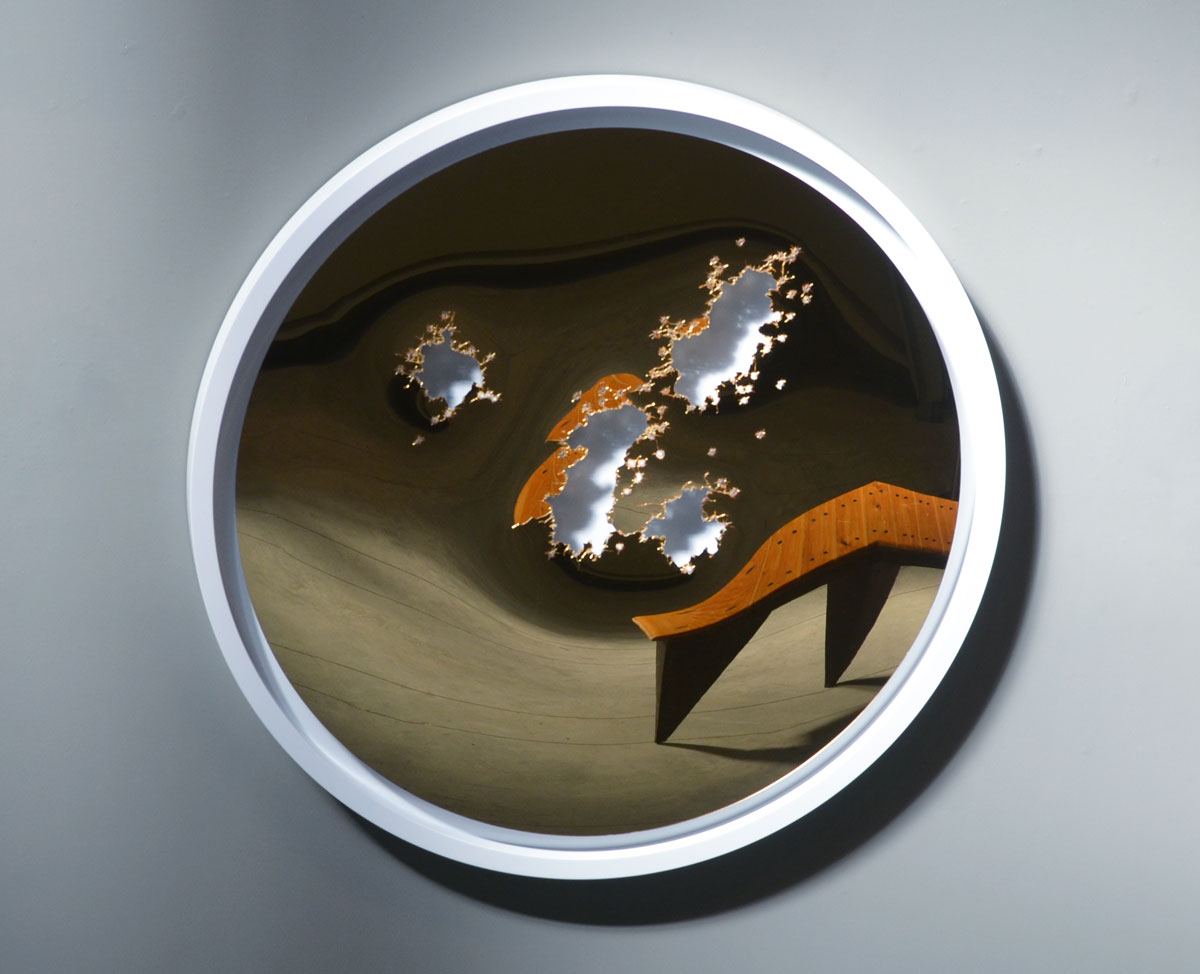
below: A couple of the pieces were mirrors. But they were mirrors with a difference – slightly concave in shape, with a hint of gold, and marred by ragged shaped holes.  The resulting reflections are distorted and flawed.

an artwork by Brendan McNaughton of a slightly concave mirror but with a few torn holes in it. A bench is reflected in the mirror but because the mirror isnt't flat, the bench is distorted.

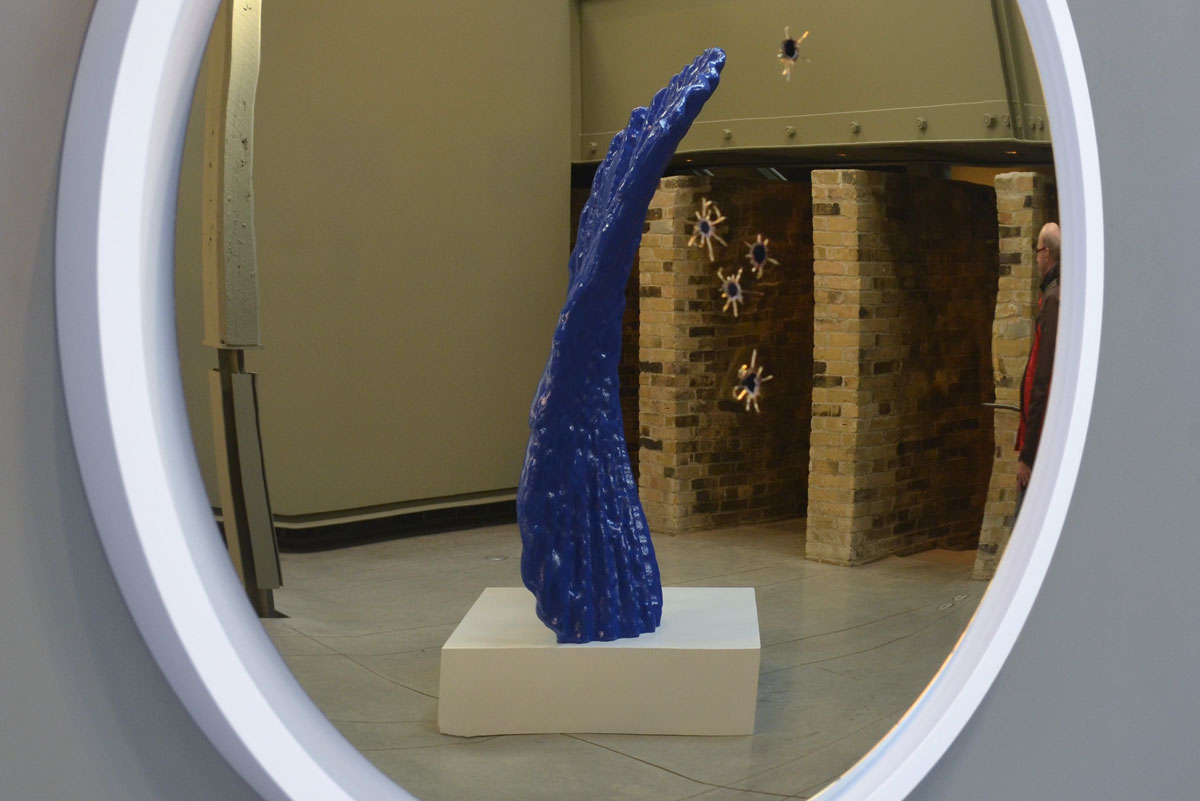
below: ‘Blue Chip’ a sculpture by Brendan McNaughton as viewed through one of his mirrors.  The expression ‘blue chip’ has become synonymous with high quality stocks, usually ones from the New York Stock Exchange.   Originally the expression meant stocks with higher prices because, if the story is correct, blue chips in poker are traditionally associated with the highest value.

Blue Chip, a sculpture by Brendan McNaughton, as viewed through an oval shaped mirror which is actually another art piece by the same artist.

below: The colour gold is very prevalent in this installation as are reflective surfaces.

picture taken inside an art gallery - a tree trunk stands in the middle of a gold toned mirror, also a mirror is on the top of each trunk, in the background are four panels of wrinkled gold

below: Parts of three wrinkly gold panels. There are actually four of these reflective square panels.  They are all the same size and colour but the surface patterns are slightly different.  Once again, the reflections are distorted.  Wealth distorts your view?

three square panels of reflective gold, wrinkled, material with reflections of people in them.

below: There was a group of what appeared to be photography students visiting the gallery at the same time that I was there. As I was standing beside this piece, looking for different and/or interesting angles and reflections, one of the students remarked on how he liked it when ordinary items were used in out of the ordinary ways. He then said that he wondered if it was …. and then he paused. I finished his sentence with the word ‘art’. He laughed and said yes, but that he was always afraid to say such things out loud. I gave him permission to ask “is it art?” as loud and as often as he wanted.

picture taken inside an art gallery - a tree trunk stands in the middle of a gold toned mirror,

picture taken inside an art gallery - a tree trunk stands in the middle of a gold toned mirror,

Installation ends May 1st

Wisdom of the Poor: Communal Courtyard,
an art installation by Chinese artist Song Dong,
Art Gallery of Ontario

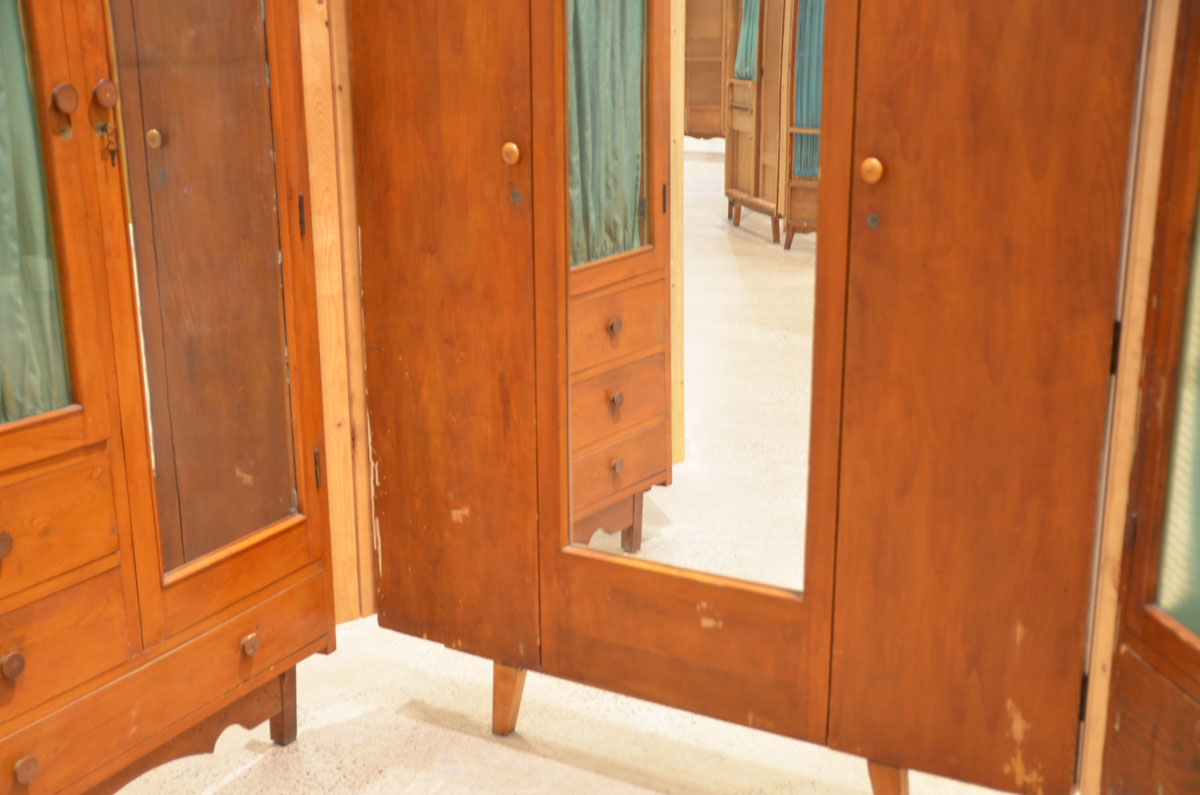
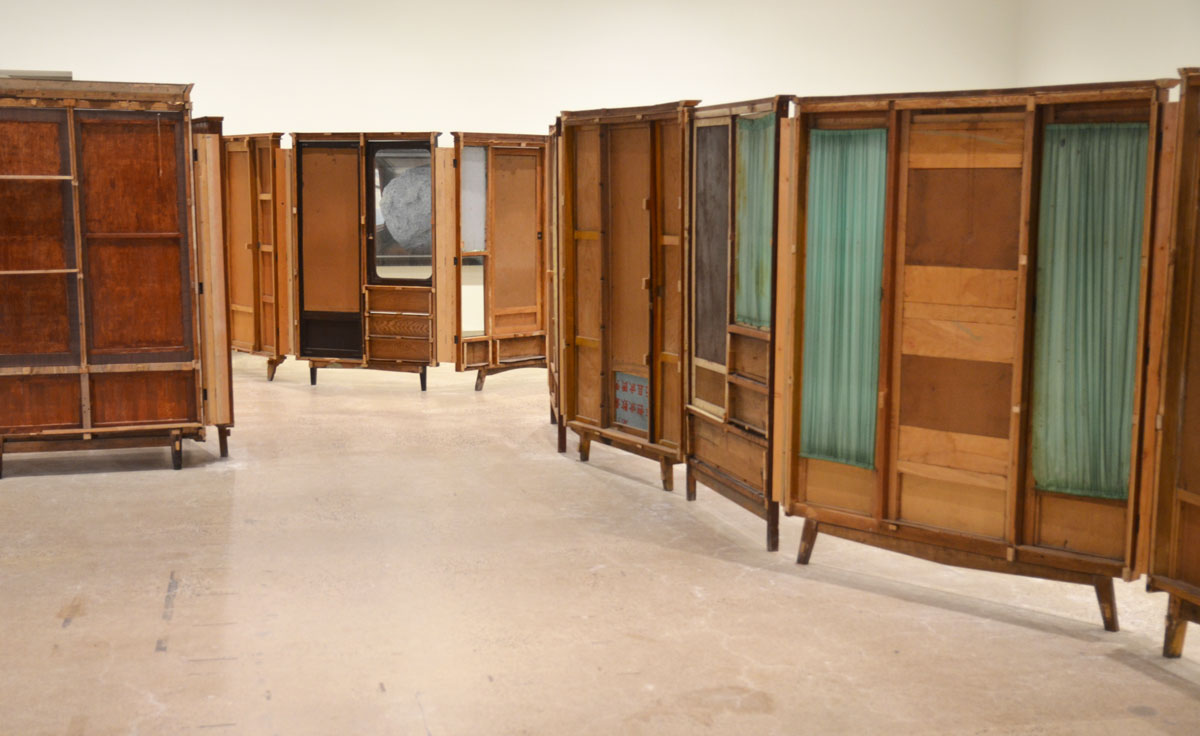
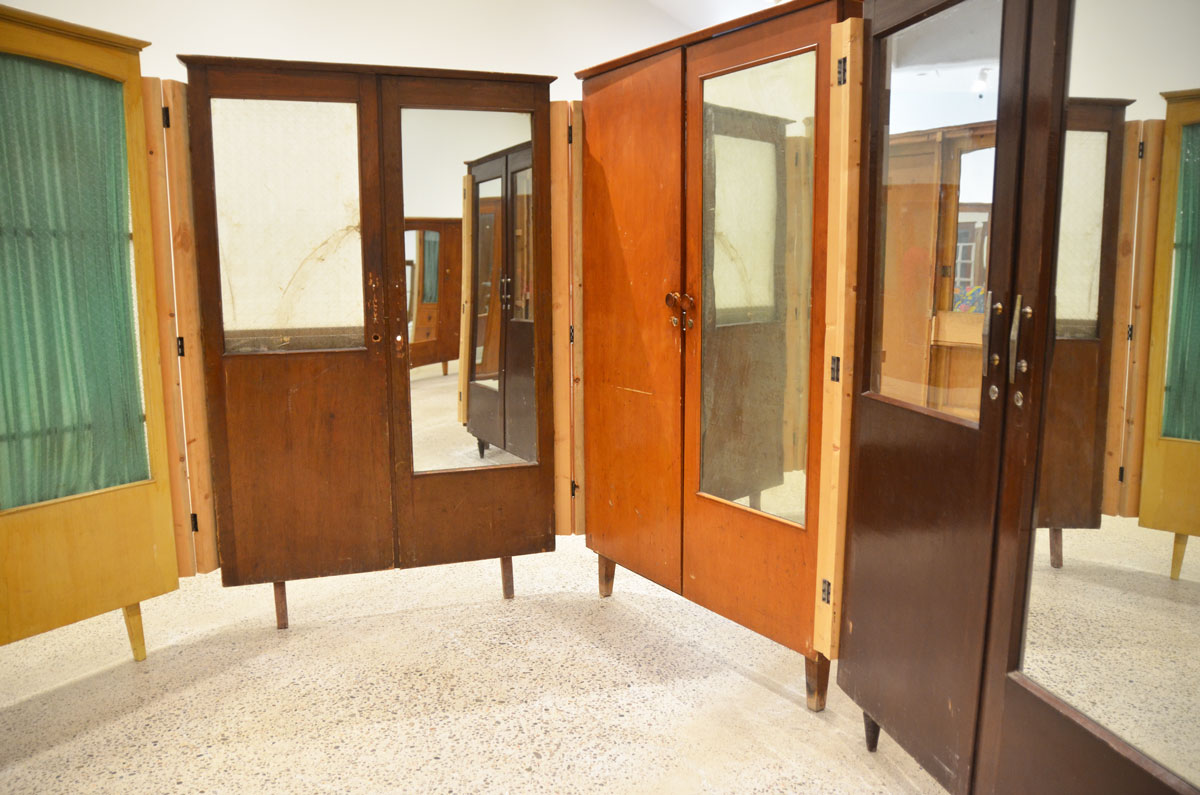
This installation is made from parts of 100 old wardrobes collected from traditional Beijing neighbourhoods, or hutongs, like the one in which Song Dong grew up in.  These neighbourhoods, and their communal way of life, are disappearing.


part of an art installation by Chinese artist Song Dong using vintage wooden wardrobe doors with mirrors and curtains, reflections
The pieces of the wardrobes are arranged with the backside towards the viewer.  The arrangement is such that you can not see the front side of most of the wardrobes.

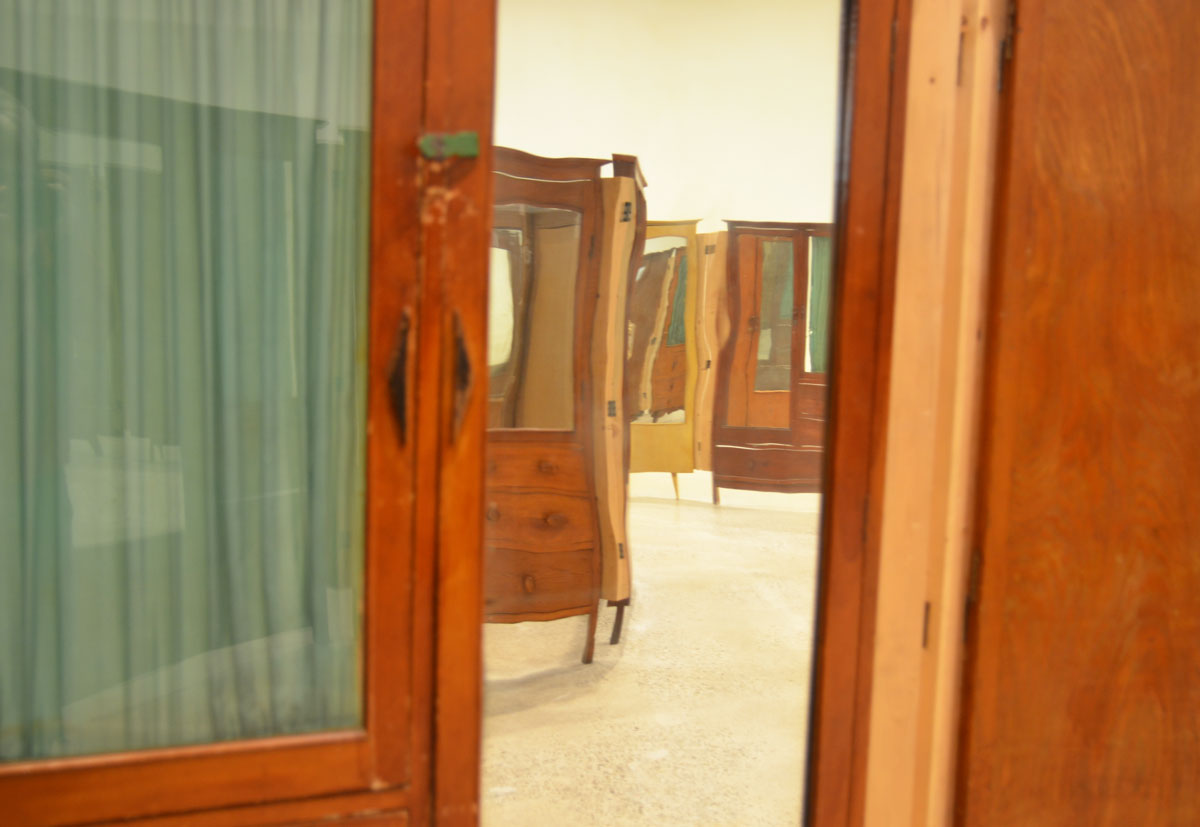
part of an art installation by Chinese artist Song Dong using vintage wooden wardrobe doors with mirrors and curtains, reflections
There are two circles of wardrobes that you can enter – where you can now stand in the courtyard so to speak.   The wardrobes become stand-ins for the fronts of houses that once faced onto courtyards in the old hutongs of Beijing.

part of an art installation by Chinese artist Song Dong using vintage wooden wardrobe doors with mirrors and curtains, reflections of a foot in one of the mirrors
A wardrobe was one of the items that the Chinese government provide to all families.  They are all similar yet different.  All have mirrors.  Most are made of the same colour wood and most have green curtains.  They all have little legs and they are all about the same height.
part of an art installation by Chinese artist Song Dong using vintage wooden wardrobe doors with mirrors and curtains, reflections
Wardrobes are personal articles and former owners have left their marks on many of them…. a different fabric in the window or a picture glued onto the wood.
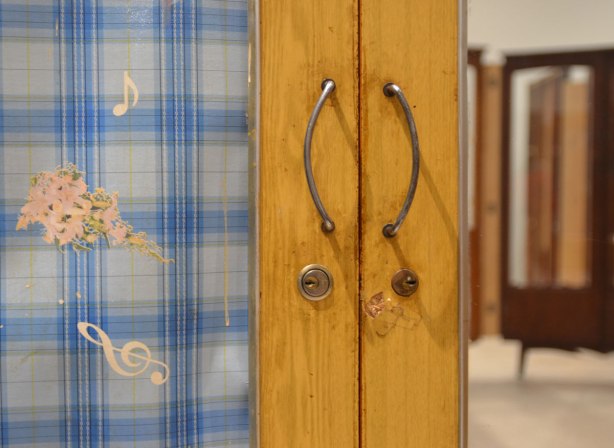
part of an art installation by Chinese artist Song Dong using vintage wooden wardrobe doors with mirrors and curtains, reflections, door handles, key holes and a curtain that is a blue and white plaid and has musical notes on it.

part of an art installation by Chinese artist Song Dong using vintage wooden wardrobe doors with mirrors and curtains, reflections, wardrobes arranged in a curved shape
part of an art installation by Chinese artist Song Dong using vintage wooden wardrobe doors with mirrors and curtains, reflections

This installation also appeared in the Venice biennale in 2011 although the wardrobes were arranged differently.  For the exhibit at the AGO, there are a number of items that appear within the ‘courtyards’ created by the wardrobes.  For the viewer, these items can only be viewed through the windows of the wardrobes.  One of the items, below, is a series of three paintings of the Canadian ballerina Karen Kain.

part of an art installation by Chinese artist Song Dong using vintage wooden wardrobe doors with mirrors and curtains, reflections. through one of the windows there is a painting of Karen Kain on the wall

In another, bikes

part of an art installation by Chinese artist Song Dong using vintage wooden wardrobe doors with mirrors and curtains, reflections, through two of the windows there is a bike

part of an art installation by Chinese artist Song Dong using vintage wooden wardrobe doors with mirrors and curtains, reflections, door knobs and frosted glass and a white curtain

This installation remains at the AGO until 17 July 2016

This post is the result of a very wobbly and random circular walk around part of the Wychwood Heights neighbourhood last weekend.   A hodge podge of this and that.

below: The intersection of St. Clair West and Vaughan Road circa 1912
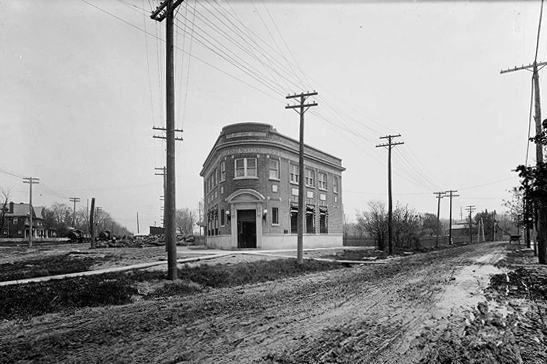
Historical black and white photo of a two sorey brick building at an intersection of two dirt roads.

below: I didn’t quite recreate the picture above but it is still obvious that the brick building is still standing after just over 100 years but that every thing around it has changed.

Two storey brick building, now Hakim Optical on the corner of an intersection.

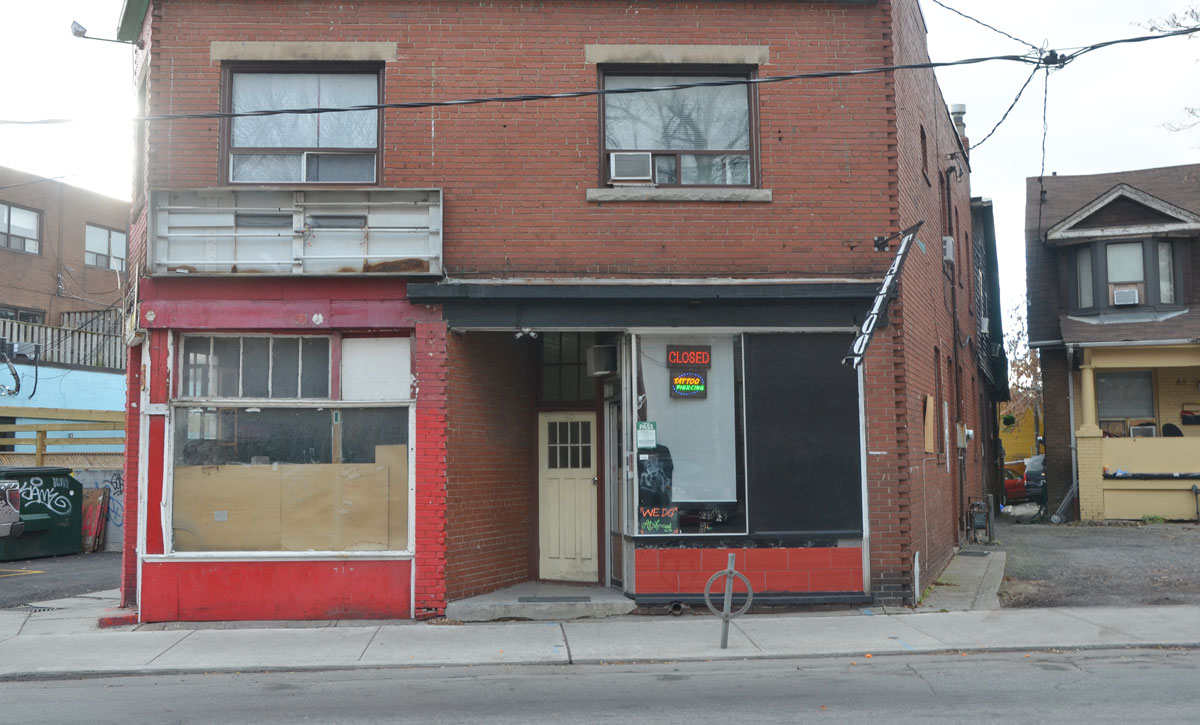
below: Just to the north,  78 Vaughan Road…. didn’t this store used to be an ice cream place?
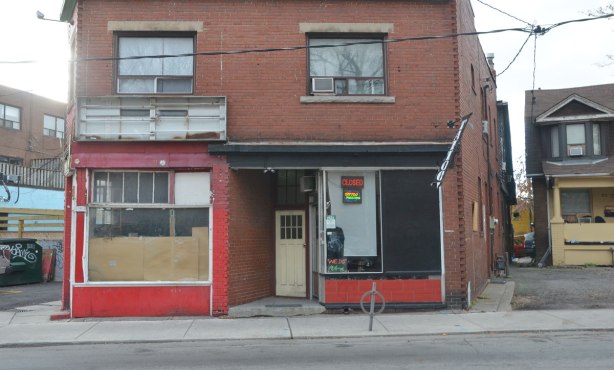
empty store front at 78 Vaughan Road, empty on one side a closed tattoo parlour on the other.

below:  Ah yes, there is still remnants of ice cream cones above the window so my memory is correct.
I wonder what happened to it?

side of a brick building that used to be an ice cream store. Painted red with some white parts, front has been removed from lighted signs, exterior decorations have been removed except a faint outline of ice cream shapes remain above the window.

There are a number of alleys to the north and west of the intersection of St. Clair and Vaughan Road.  Most of them are quite tidy and well looked after.   They were also full of surprises, bright little things that put on a smile on your face on a December afternoon.

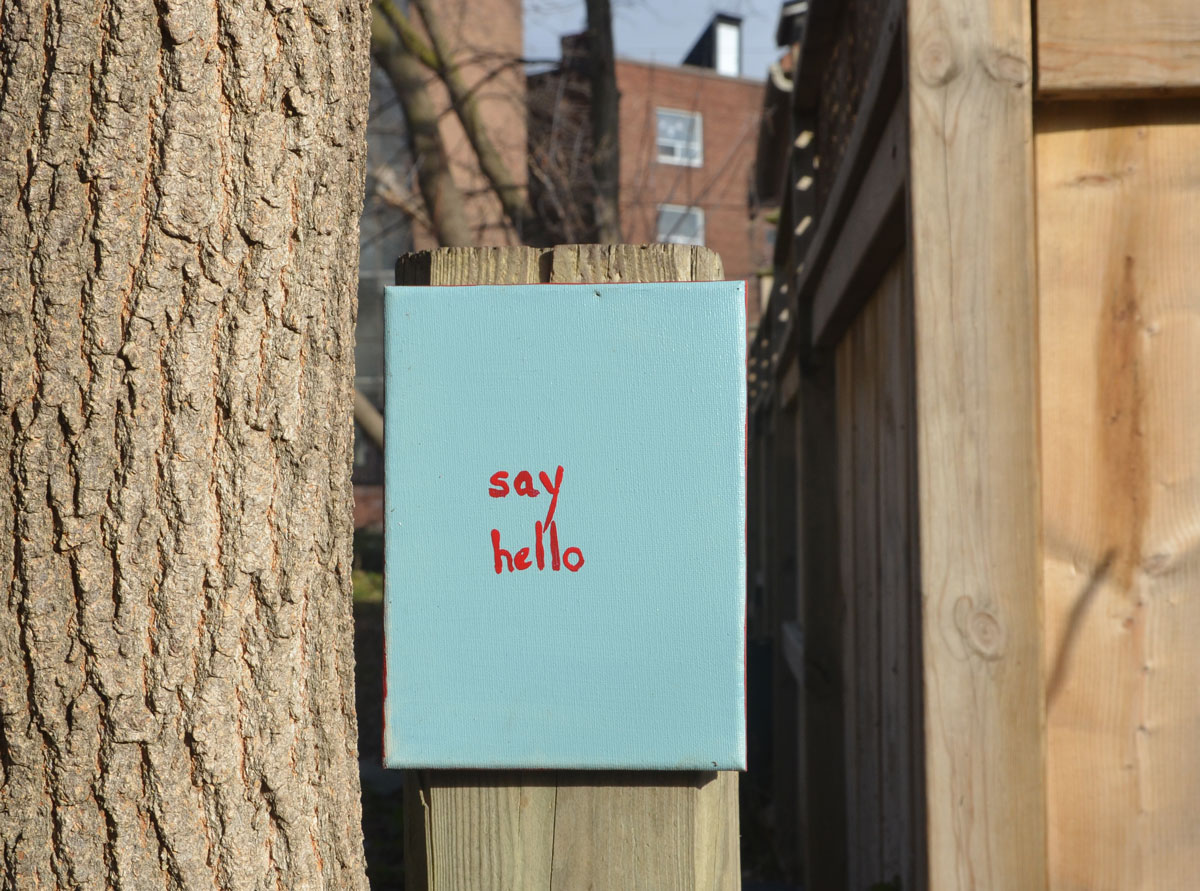
below: Like little pictures painted on canvas….
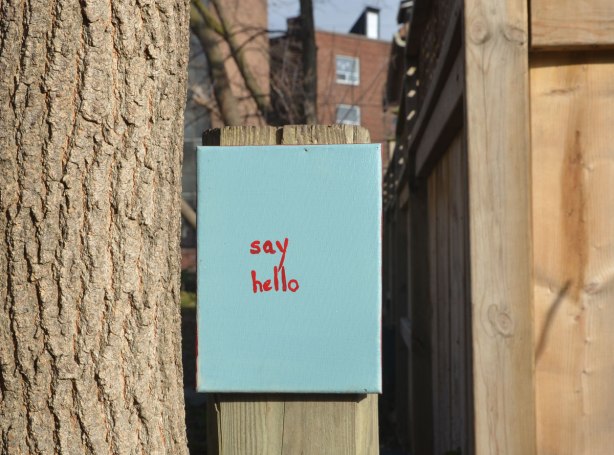
A small canvas painted turquoise and the words say hello written in small red letters, attached to a fence in a lane

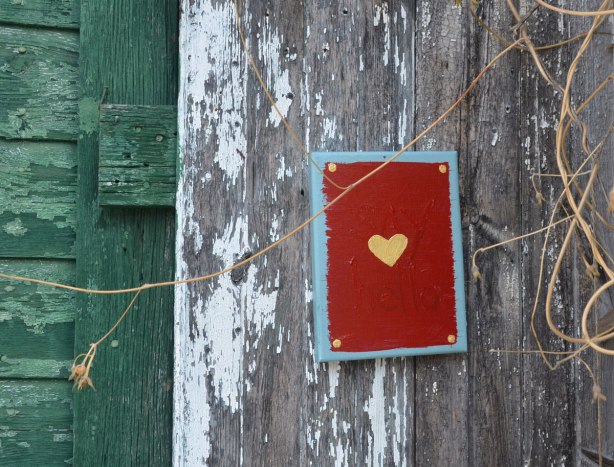
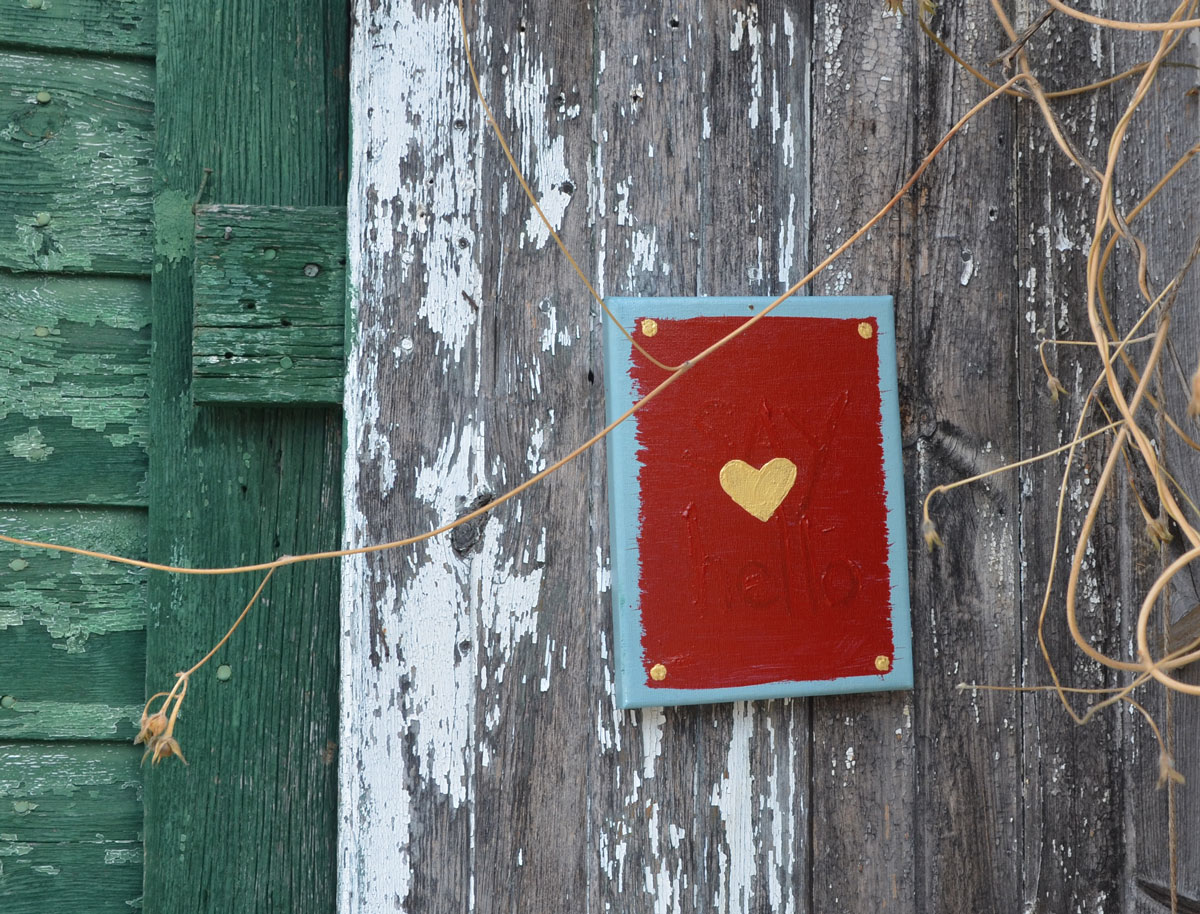
A small canvas painted red and a small yellow heart painted in the middle. The words say hello are painted on it too but they are harder to see. It is nailed to an old wood fence

A small landscape painted on canvas and attached to a telephone pole in an alley

below: and painted on wood

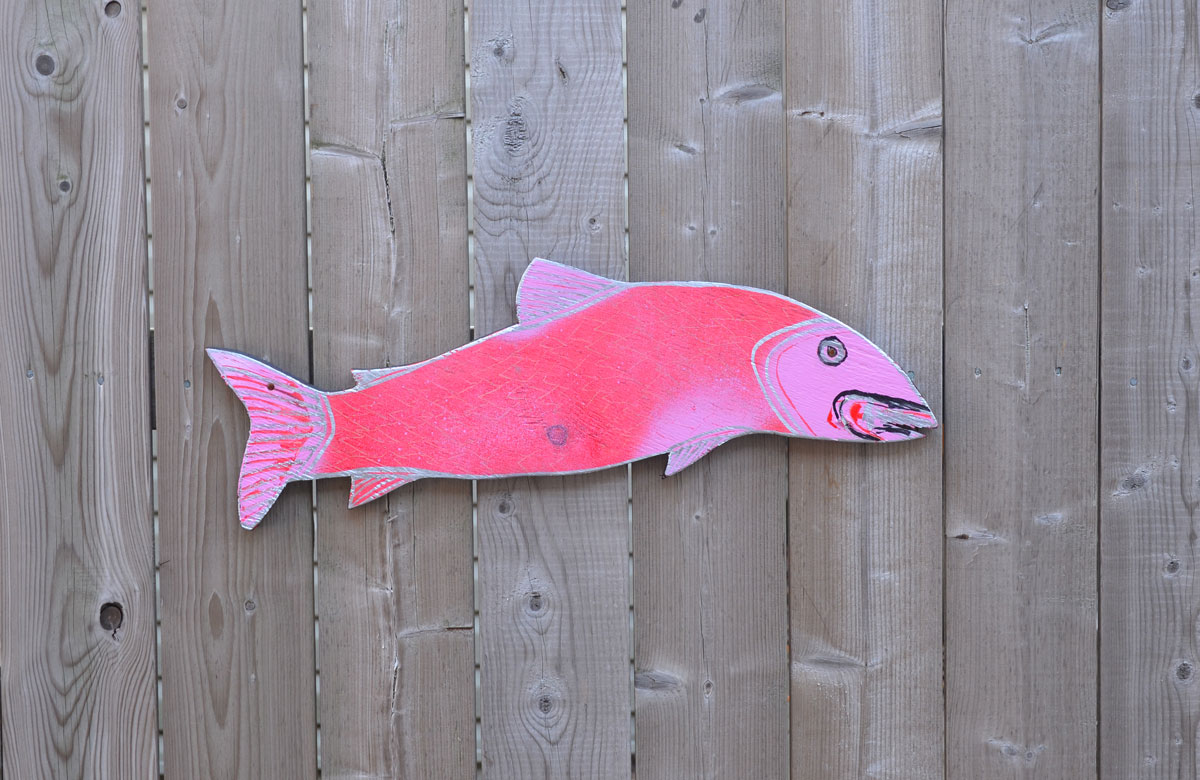
a two tone pink fish painted on wood, cut out, and nailed to a wood fence.

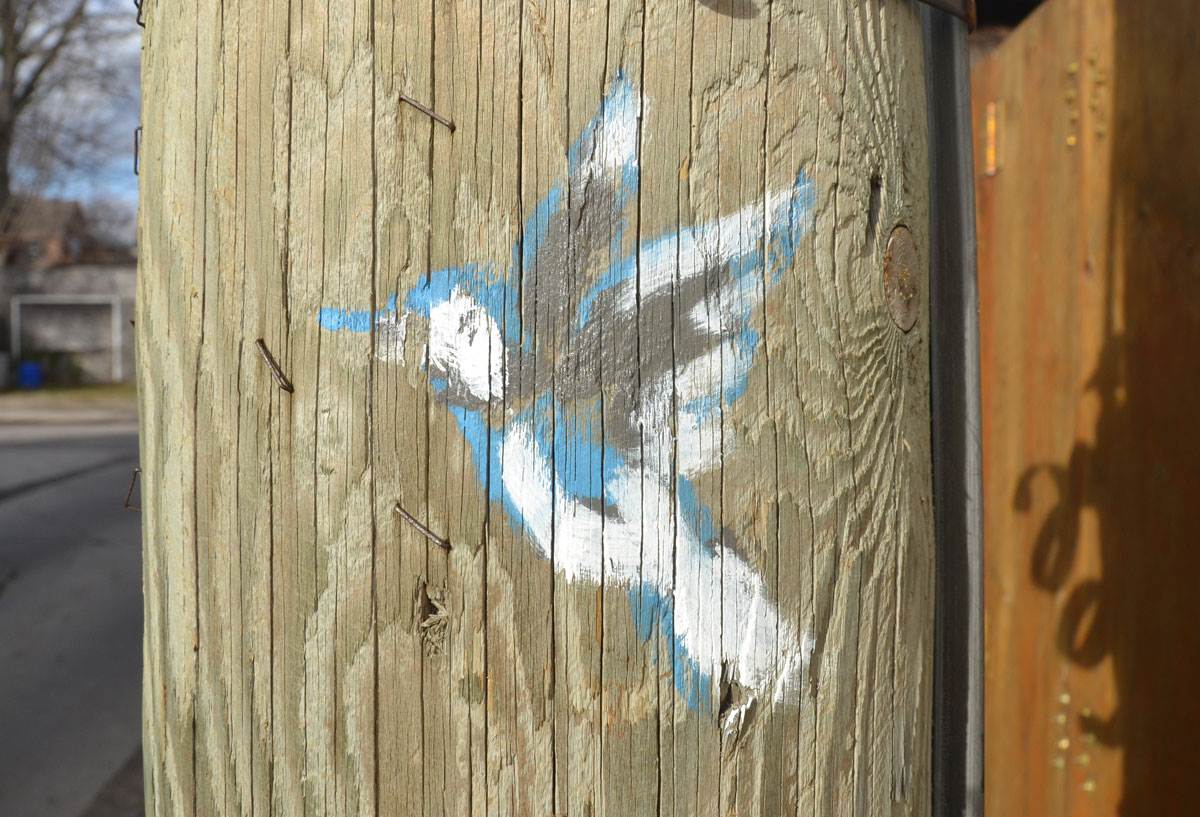
below: or painted directly on poles.

On a wood telephone pole, a small bird painted in white, black and blue.

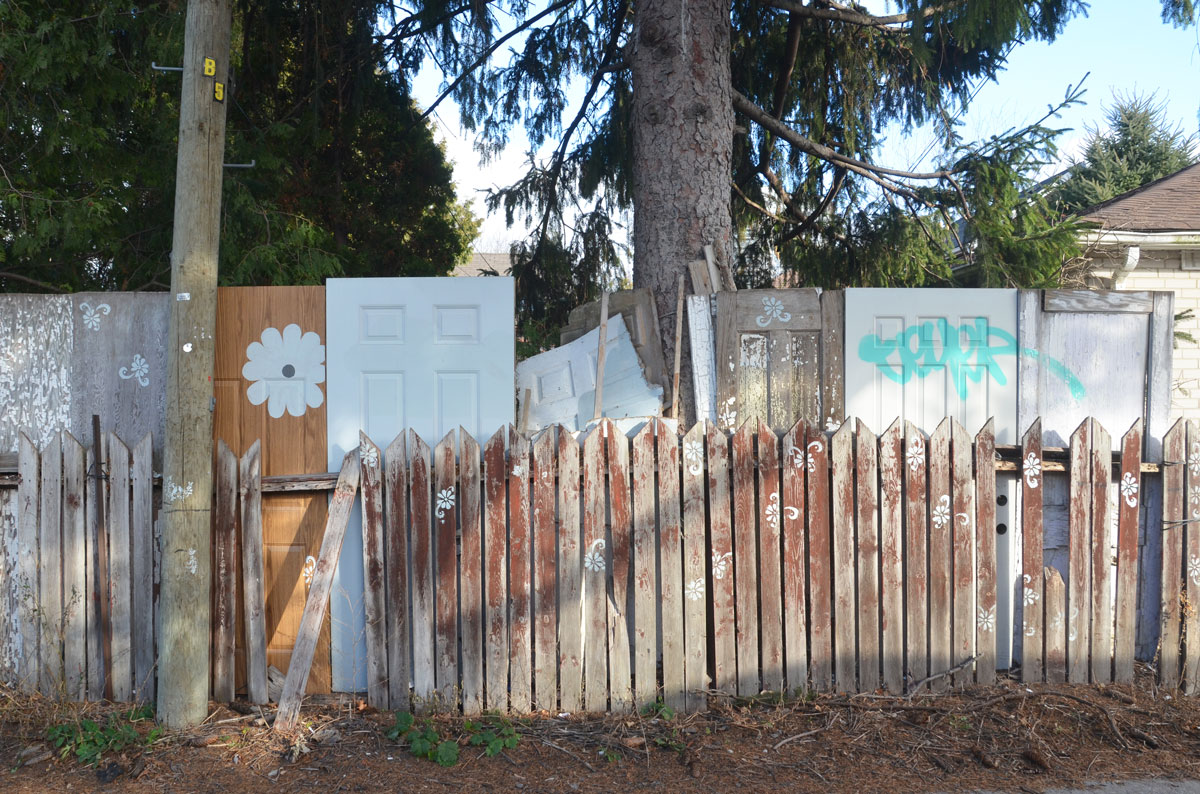
below: There was a fence made of old wood doors

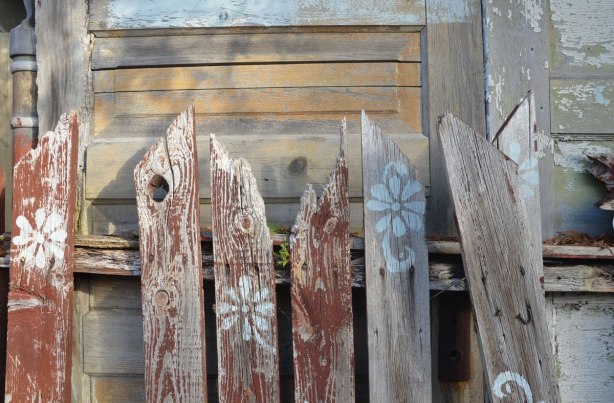
an old picket fence that is falling aoart, and a fence made of doors that is behind it.

close up of old picket fence that is falling aoart, and a fence made of doors that is behind it.

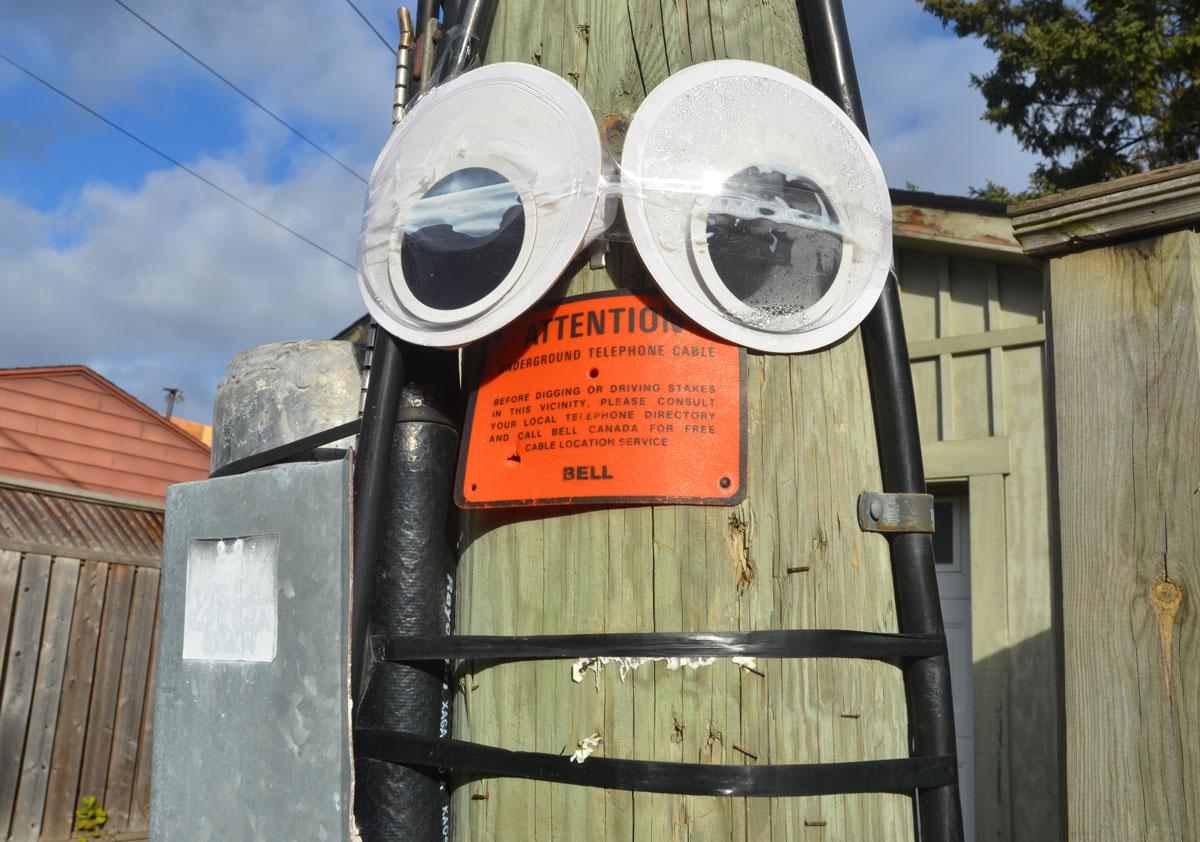
below:  There was a great creature with googly eyes and a rectangular orange nose.

Two big googly eyes attached to a telephone pole

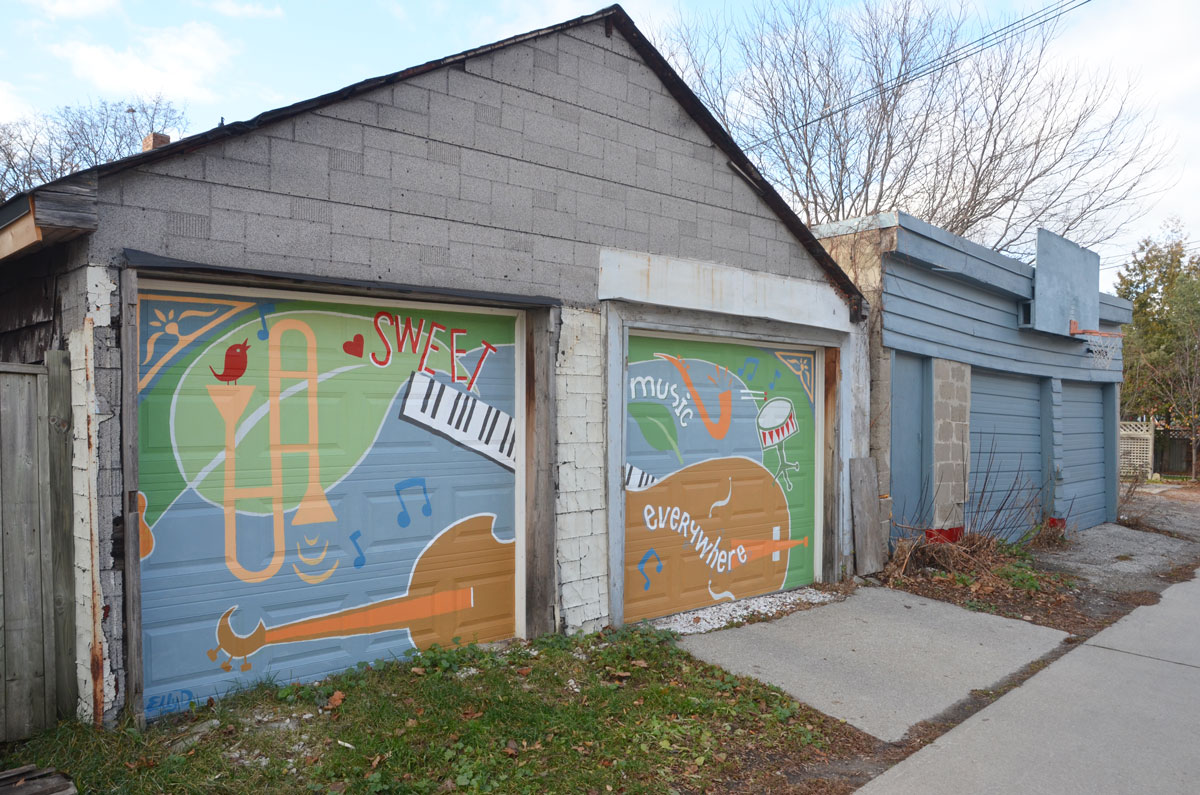
below: And of course there were some painted garage doors.

street art on garage doors, musical instruments covering two garages, a guitar, a trombone, also the words sweet sweet music everywhere

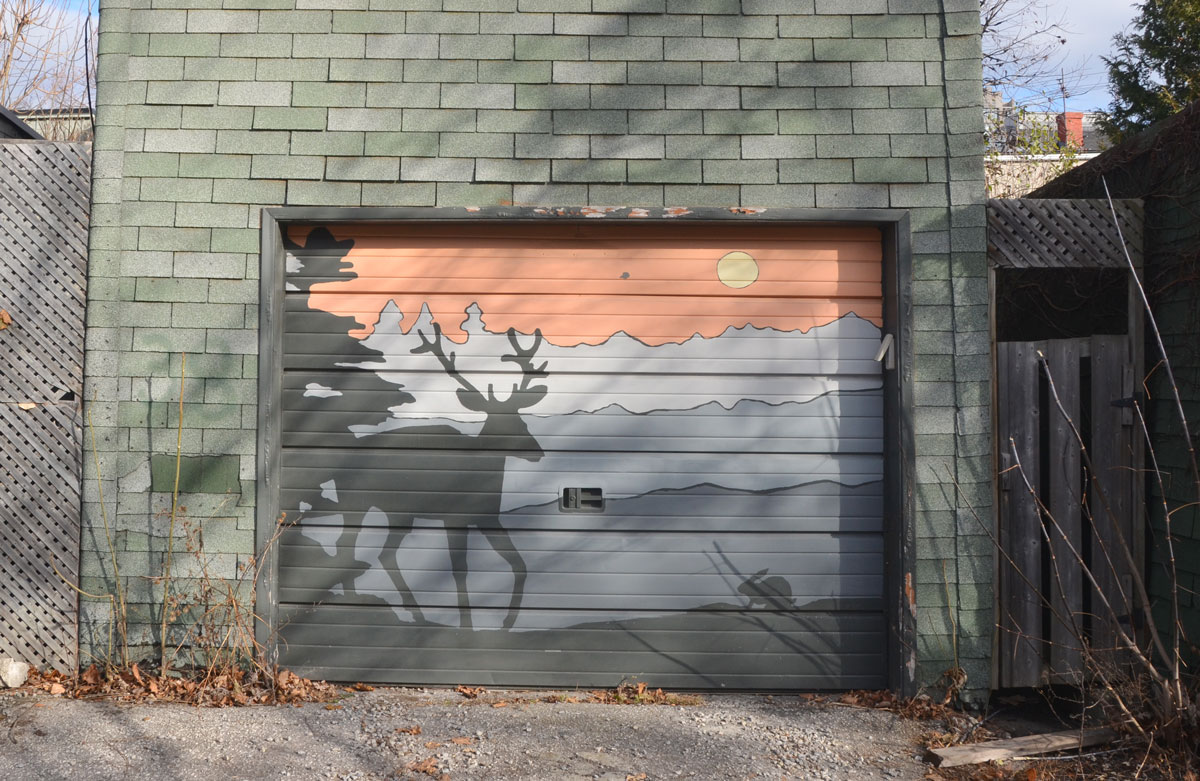
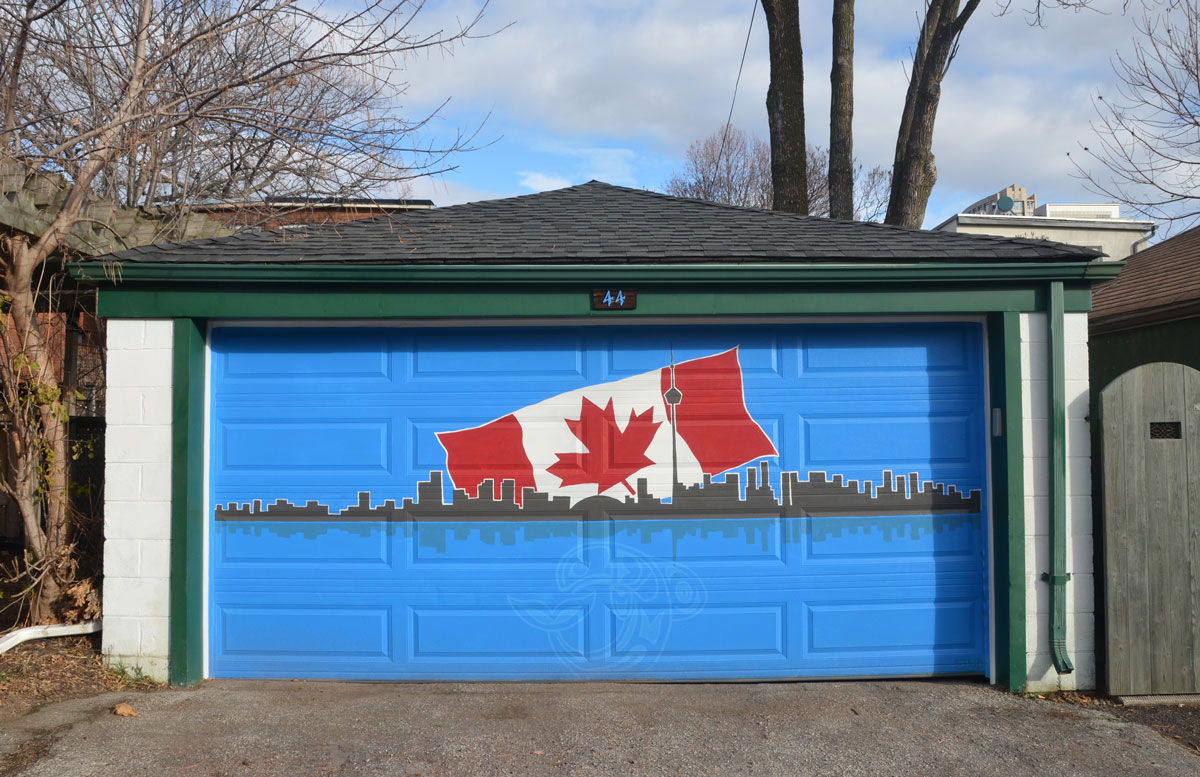
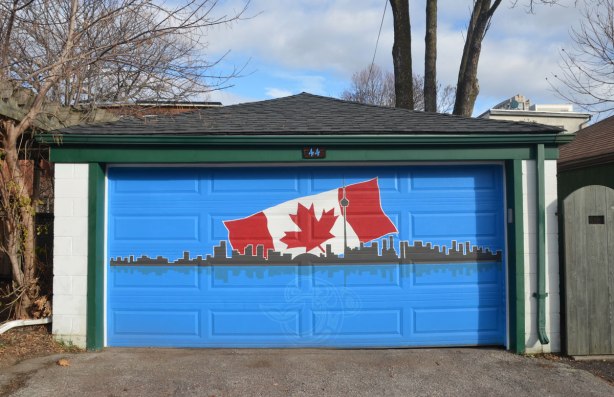
below: These garage doors are a sample of the more than 40 doors that have been painted as part of the Kenwood Lanway Art Initiative.

painting on a garage door of a moose at sunset

painting on a bright blue garage door of the Toronto skyline with a large Canadian flag behind ithe skyline

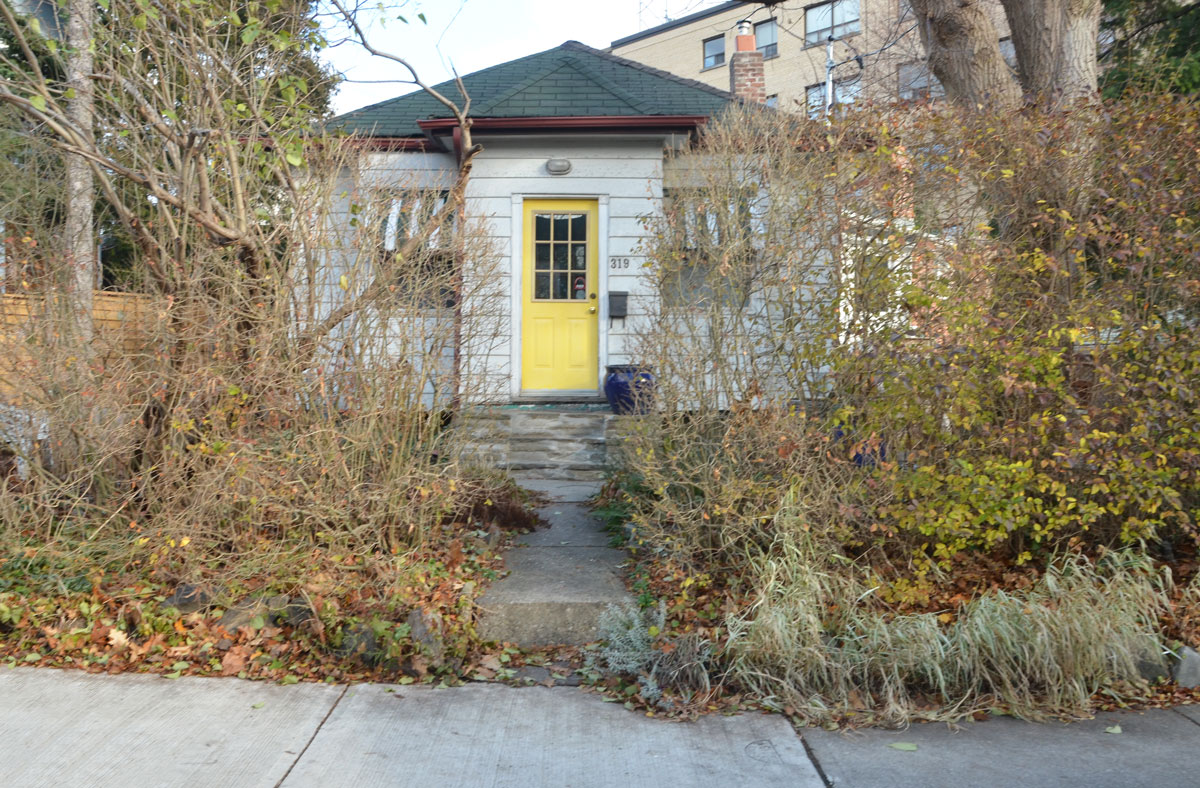
While walking on the streets in the neighbourhood I saw a couple of little houses
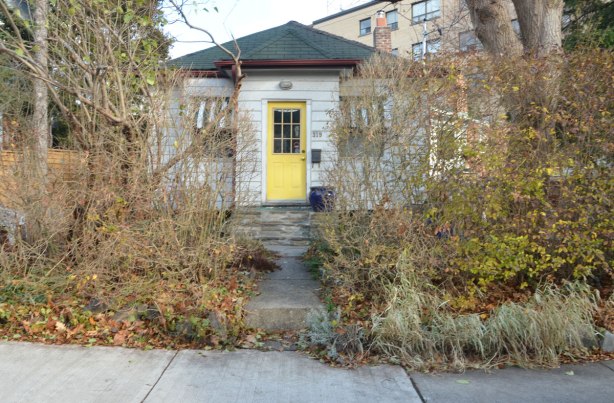
little narrow white bungalow with a yellow front door set back from the road. There is a straight walkway from the sidewalk to the door, and there is a lot of shrubery in the front yard especially near the sidewalk.

as well as larger buildings with intricate architectural details.

below:  A checkerboard effect with the bricks on the La Salle Apartments.  As an aside, the small bush in front of the building was in the picture no matter what angle I tried.  It was a lilac bush and I am sure that there were buds on it.

Part of a low rise apartment building, over the door, no windows. Checkerboard pattern in the bricks. The words La Salle Apts in large white letters across the bottom of the picture.

below: A little fake balcony with a white post railing on a low rise apartment building.
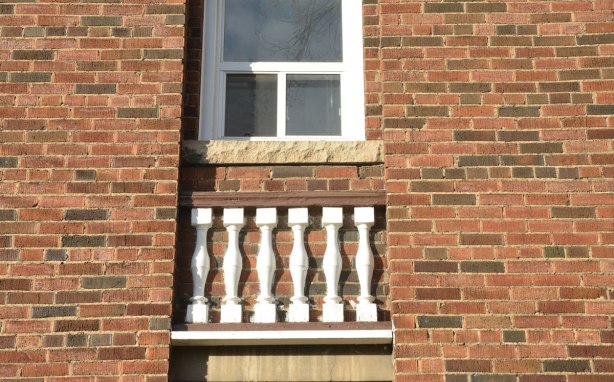
A white framed window in a red brick building. Below the window are a few white pieces of wood that look like a balcony railing even though there is no balcony there.

below: A line of little arches across the roofline is echoed in the larger arch patterns over the windows.  There is a small relief sculpture near the top corner of the building (slightly behind the tree) but I can’t tell what’s on it.  A coat of arms maybe?
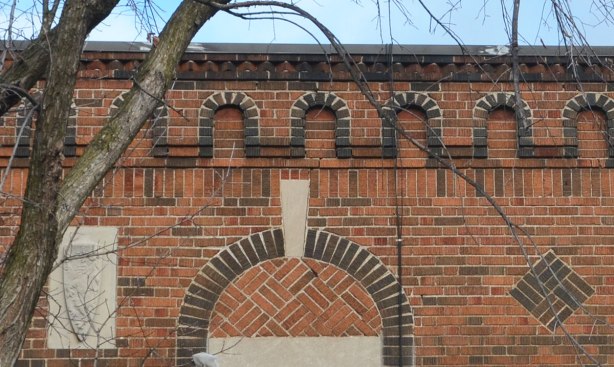
brick pattern across the top of a building. scalloped, or looking like little arches to match the larger arches over the windows.

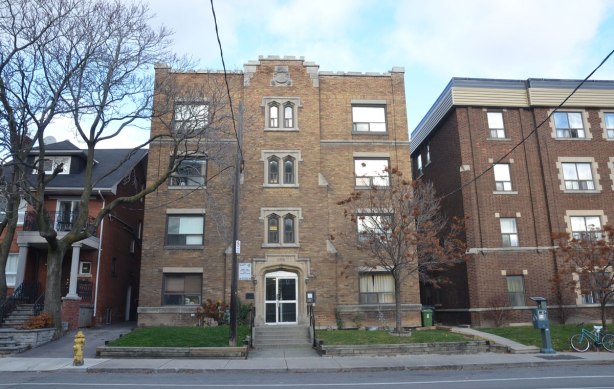
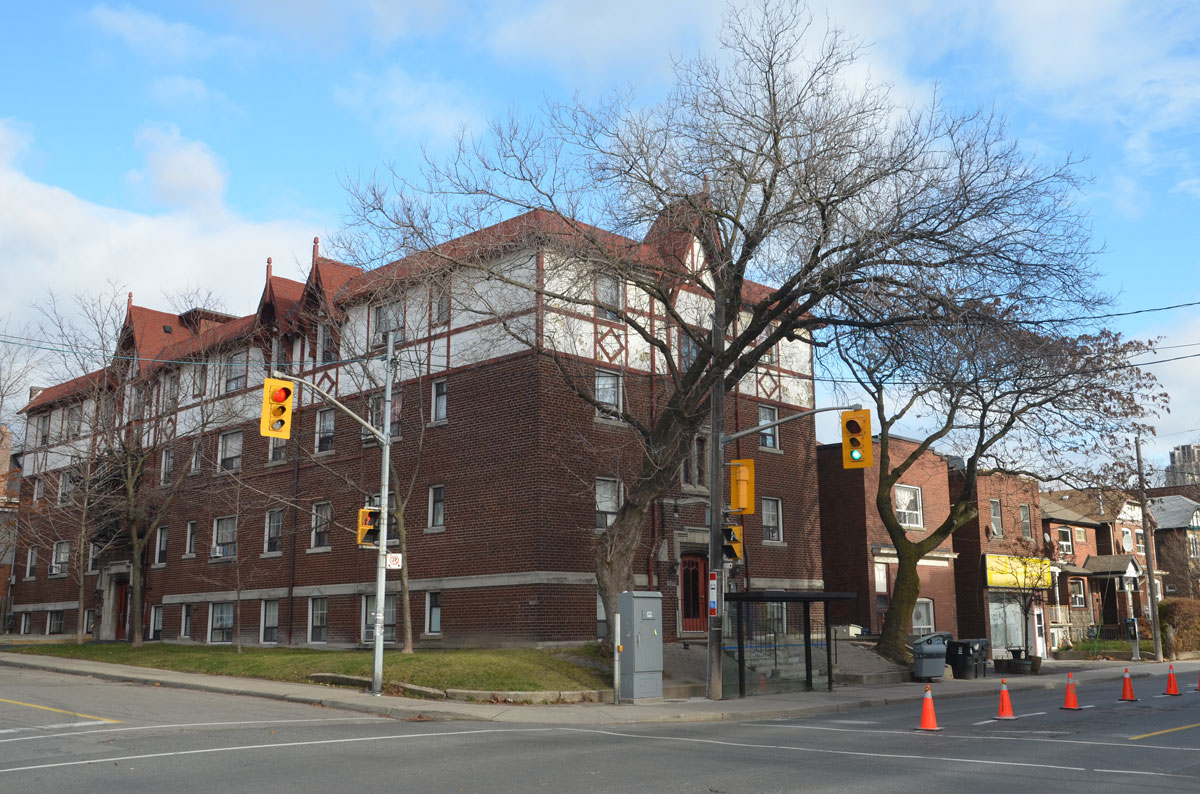
below:  There were quite a few four storey brick apartment buildings that looked like they were built in the 1920’s and 1930’s.  Perhaps there was a  little ‘condo boom’ at the time?

4 storey apartment building on Vaughan Road, red brick with white upper storey, diamond shaped details, two little peaked roofs over windows.

four storey apartment on a corner

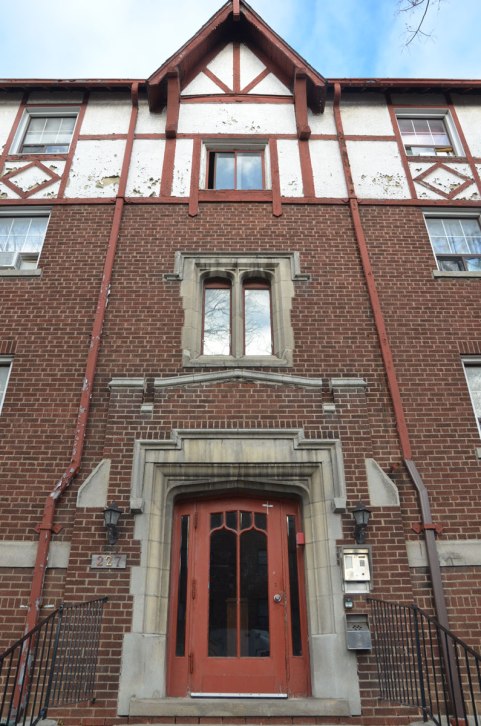
front door and front of building, four storey apartment building in red brick with stone window and door frames.


Two four storey apartment complexes and a single family home on Vaughan Road.

below:  Like the condos of today, many of the buildings had names such as Maple Villa
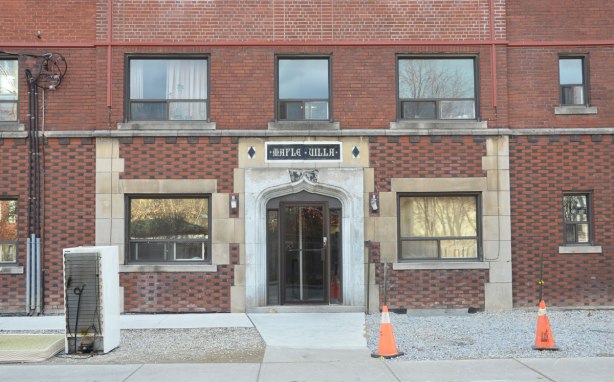
Stone door frame and entranceway to Maple Villa, a brick low rise apartment complex

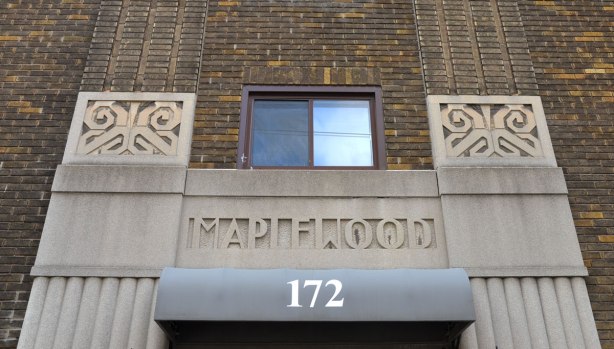
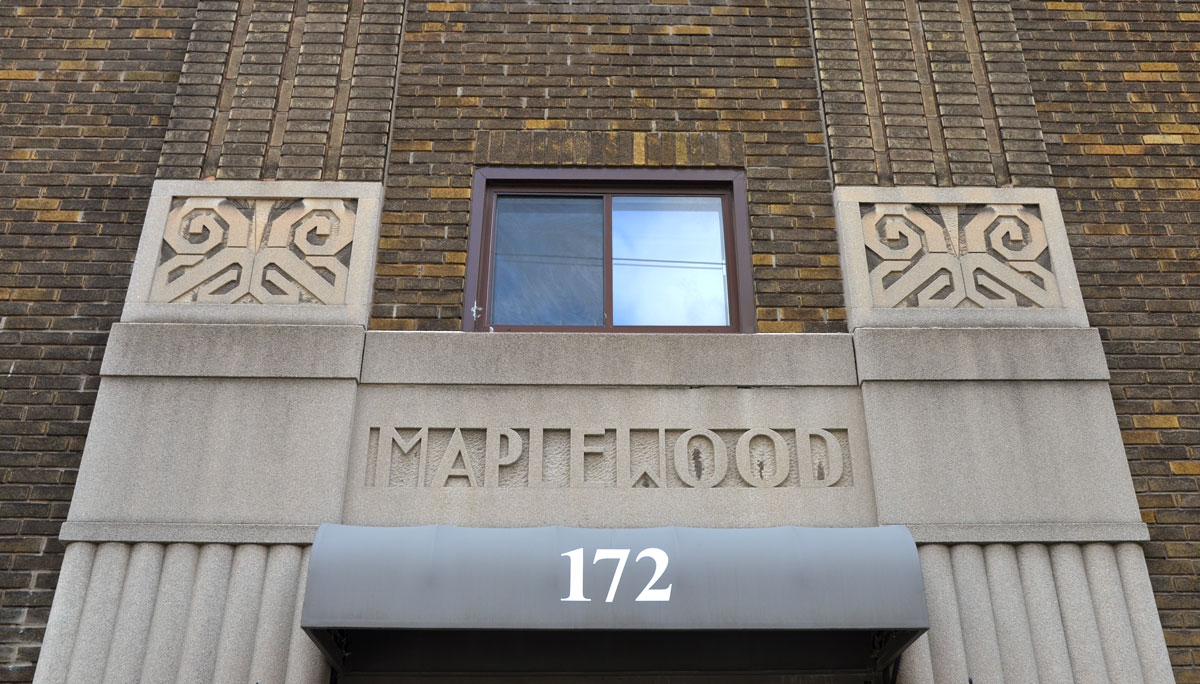
and Maplewood

stonework over the door of the Maplewood apartments at 172 Vaughan road, and the art deco like decorations beside it.

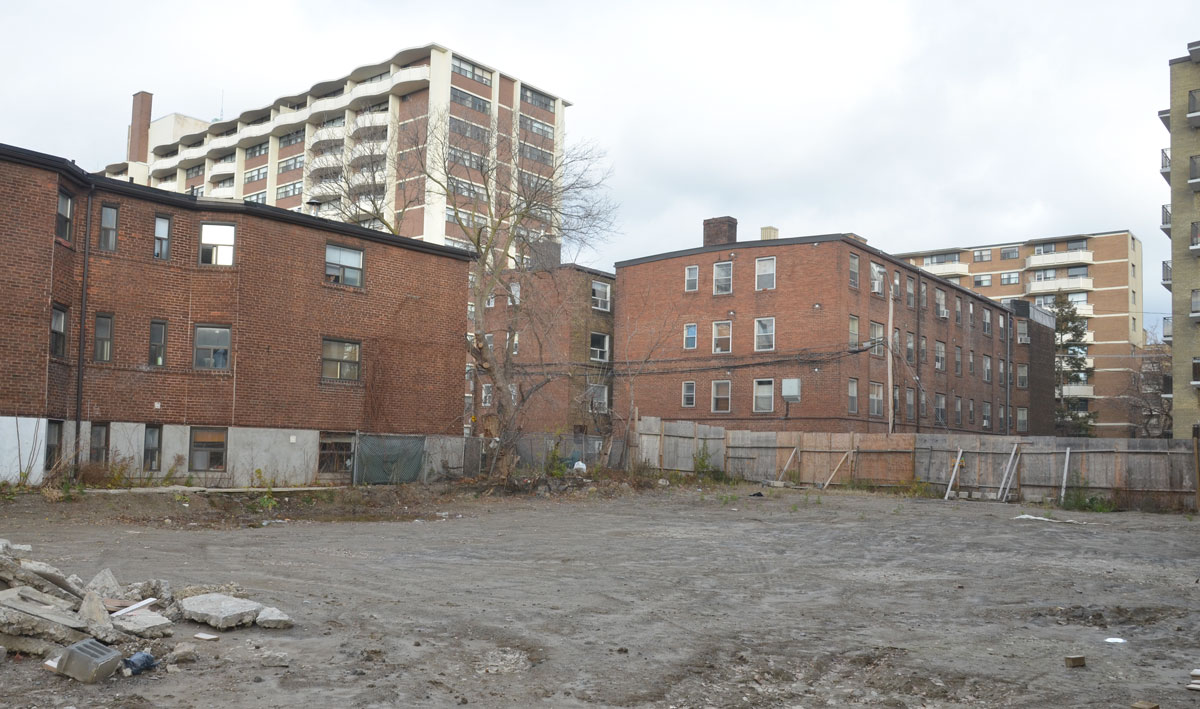
below:   The backs of all those apartment complexes are nearly as interesting as the fronts.
This is one of the only construction sites I saw although….

vacant lot with a number of low rise brick apartment buildings in the background.

… this Presbyterian church looks like it is about to be redeveloped.  It is one of three churches at the corner of St. Clair and Wychwood.   The church was built in 1926.  There is a brief description of the property on the Stanton Renaissance website but very little information is given beyond a “transformation” of the church and the creation of “high end residential boutique”.
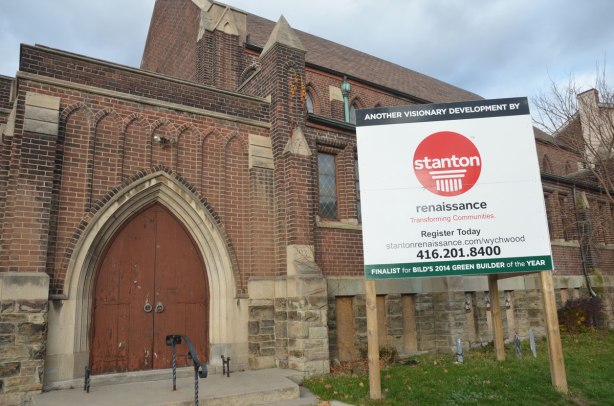
An old brick church at a corner. It is now empty. There is a large sign in front of it advertising Stanton developments.

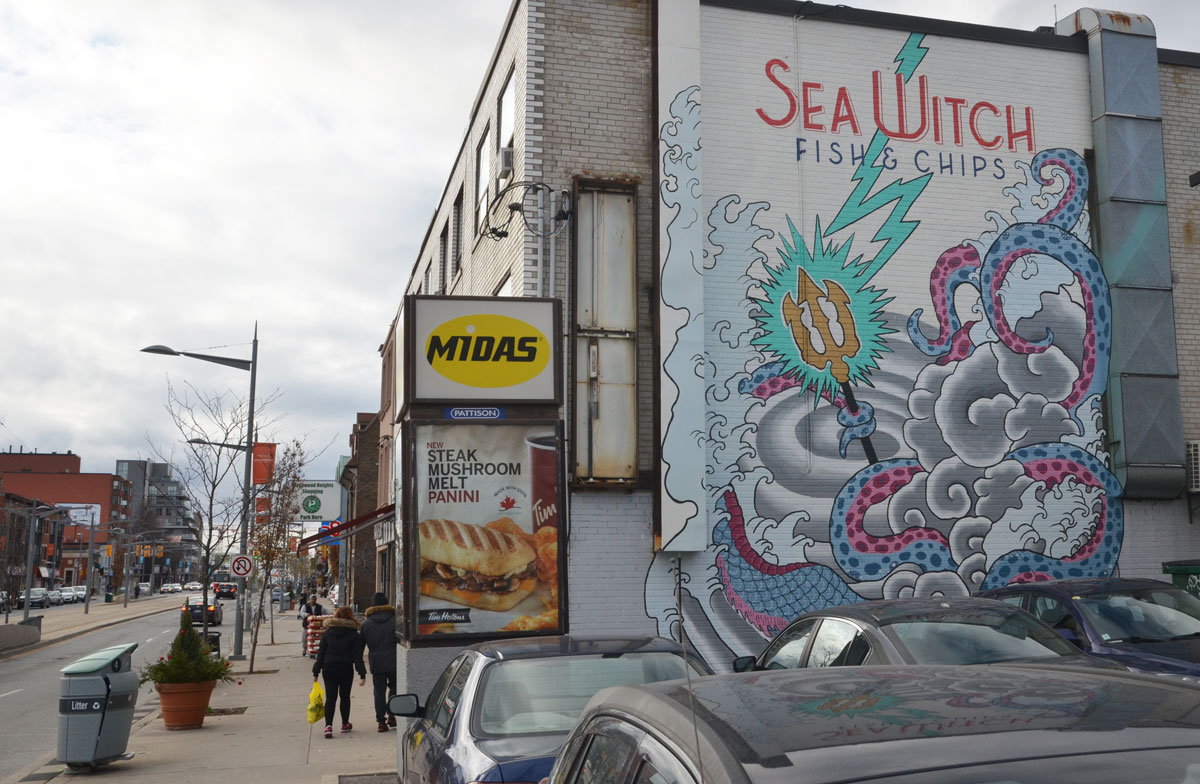
below: Mural for Sea With Fish and Chips on St. Clair West
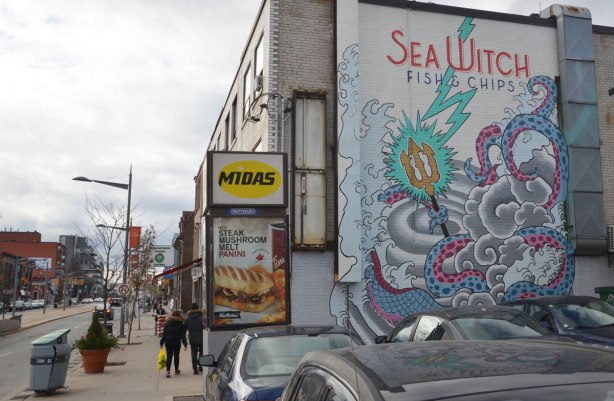
mural for Sea Witch FIsh and Chips restaurant, a large sea serpent

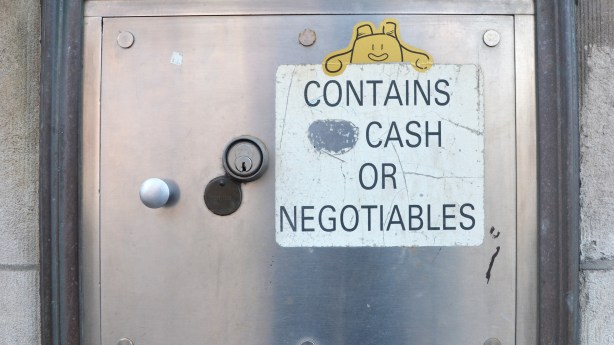
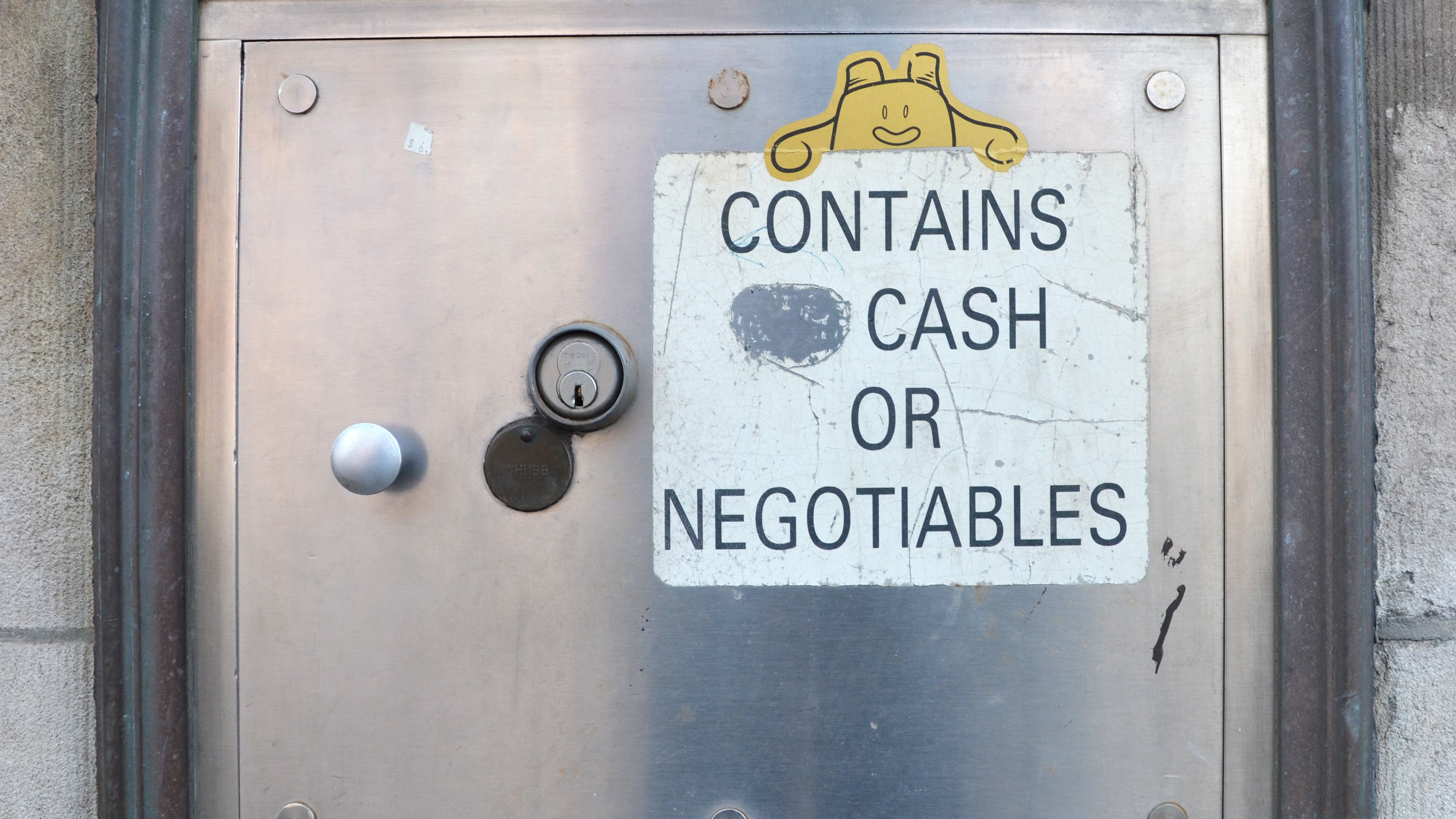
A little yellow sticker on a bank night deposit box, looks like a little smiling creature looking over the sign that says contains no cash or negotiables, except that the word no has been scratched out

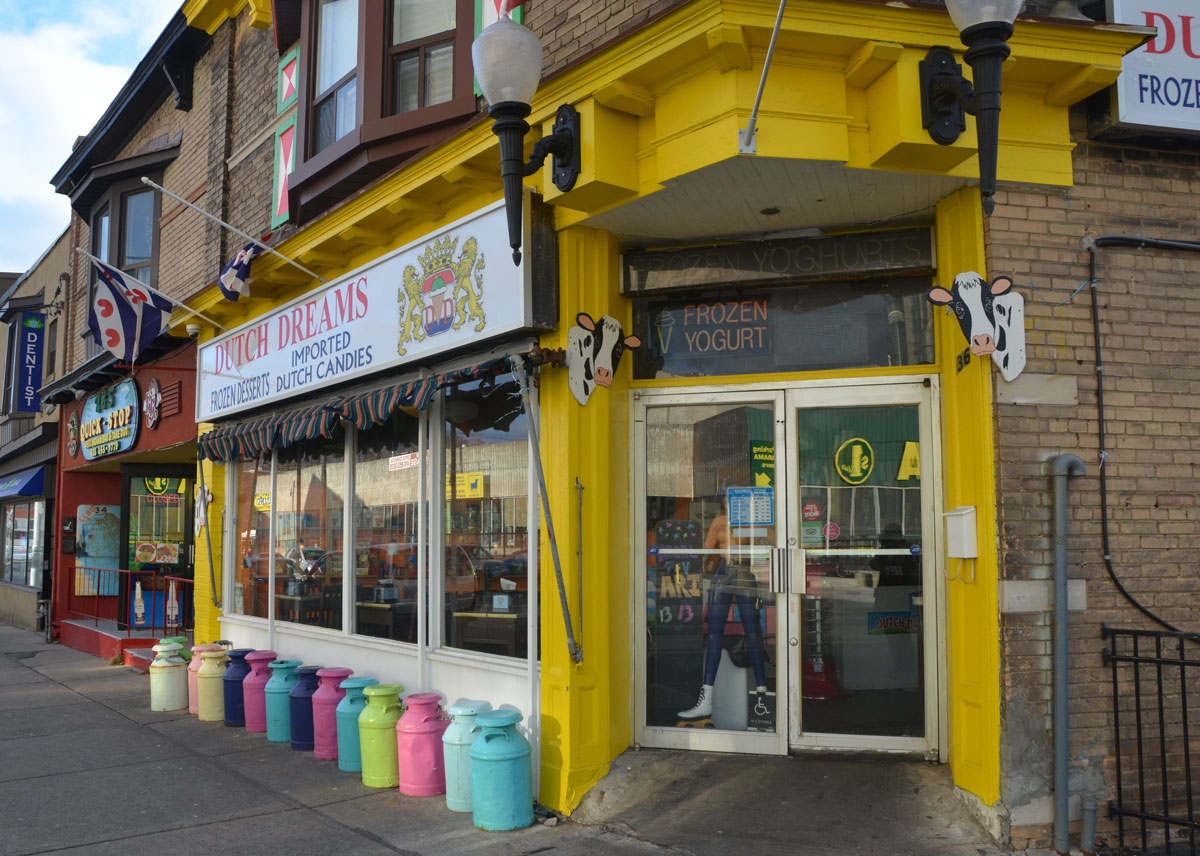
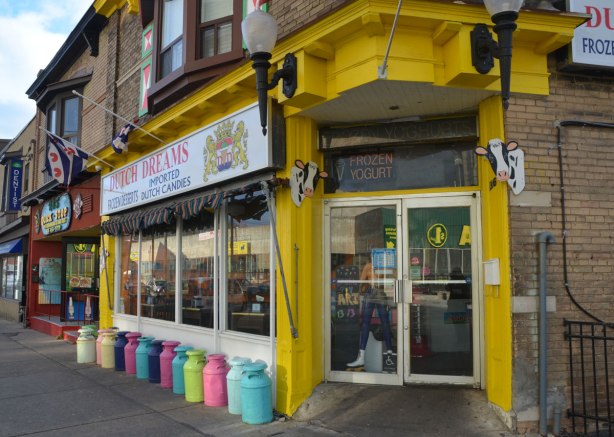
below: As I circled back the intersection of Vaughan Road and St. Clair West, I spotted a large doubledecker strawberry and vanilla ice cream cone on the side of Dutch Dreams.  Hey!  The answer to my question.  The ice cream place from 78 Vaughan Road has moved a couple of blocks south, complete with it’s collection painted old fashioned milk cans.
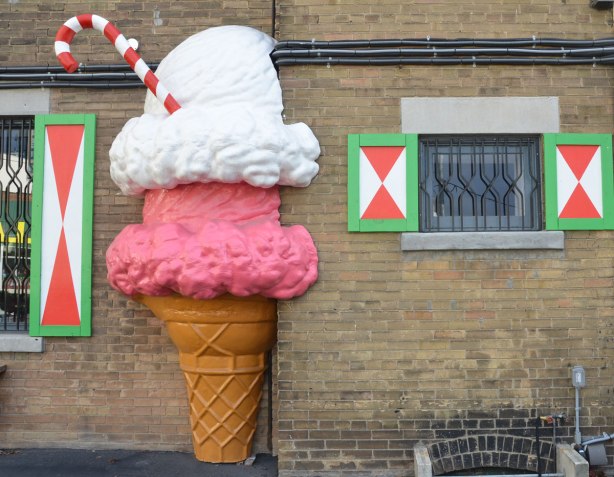
A very large plastic icce cream cone, double scoop, strawberry on the bottom and vanilla on the top, decorating a brick building. The shutters on the windows of the building are green, red and white

bright yellow entranceway, a line of different coloured milk cans along the exterior wall, sign says Dutch Dreams, candy and ice cream.

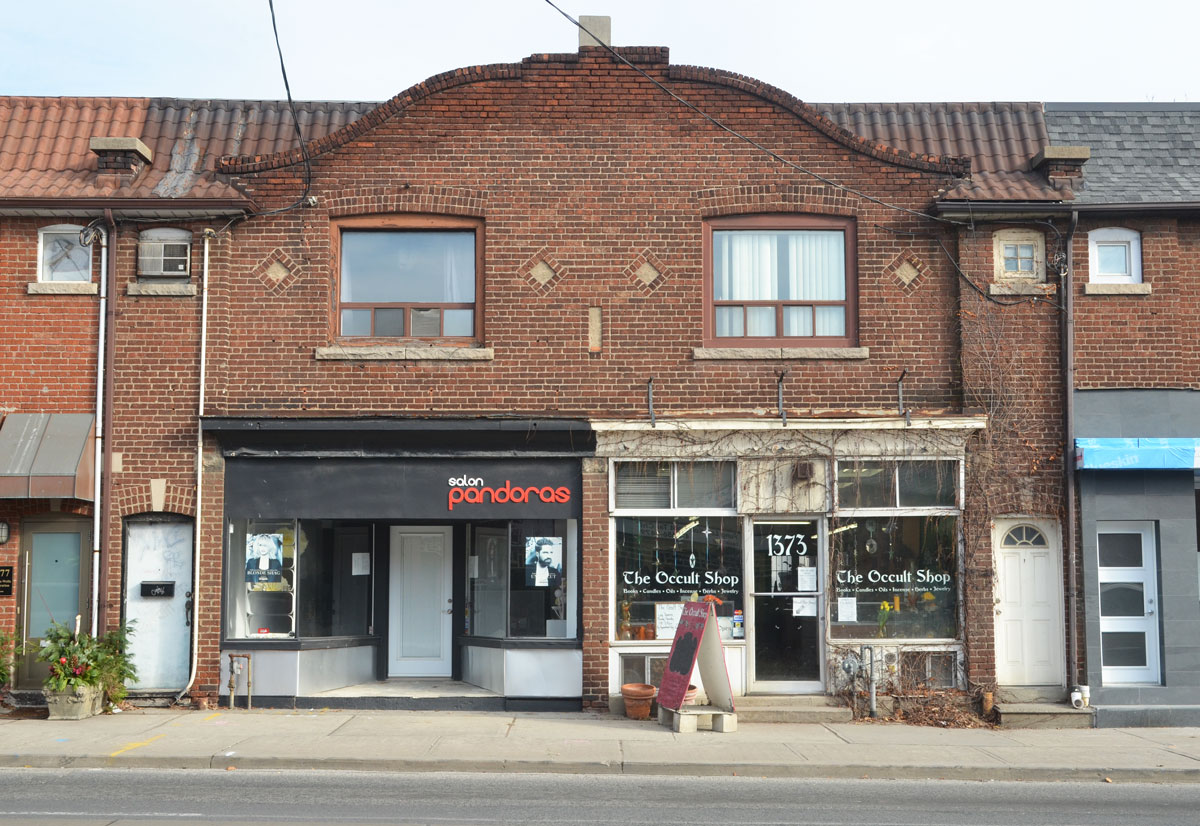
below:  One last picture.  As I waited for the Bathurst bus, I found myself standing across the street from this building.   The curve of the roofline is interesting, but even more interesting is the the fact that there is an occult store in Toronto.  Candles, herbs, incense, jewelry, I’m now wishing that I had crossed the street to investigate further!   And, smile, the store next to it is Pandora’s salon.  Pandora, the one who in ancient times opened a box and unleashed all sorts of evil on the world.
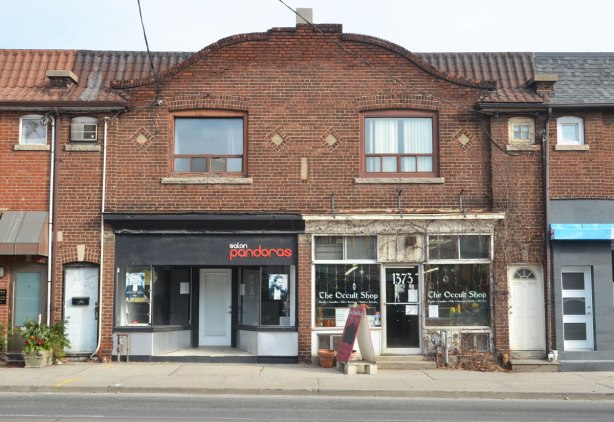
 

store front, one is an Occult Store, in an old brick building with a curved roofline over the middle of it.

‘In-Between Worlds’ is a series of photographs by Canadian photographer Meryl McMaster.   This series centres around the role of McMaster’s dual heritage in her search for self;  The images represent her being part of, and also being between, two different cultures as she is part Cree and part ‘European’.

Three of the images are on display at Ontario Square by Queens Quay West and Lower Simcoe St.

below: Horse Dance.  The bright red and blue of the shaggy hobby horses against a winter landscape makes for an eye catching picture.  On closer look, you realize that there is a person’s head inside one of those horses’s head.  Heads that have no eyes to see or mouths to speak.
A large photograph of three red hobby horses with long blue mane, taken outside in the winter in the snow, with bare trees in the background. A mix of the real (outdoors) and the unreal (hobby horses instead of real horses). Photo is Mounted on a concrete wall outside.

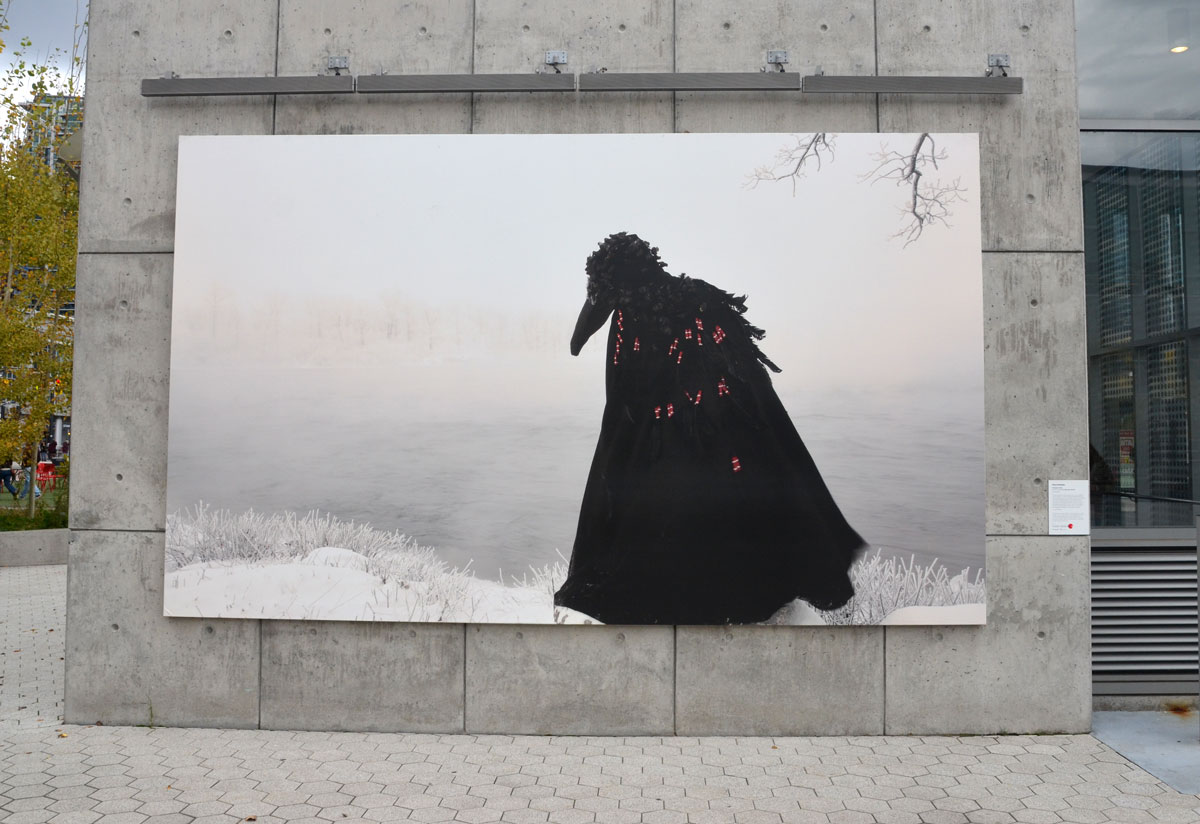
below: Wingeds Calling.  Around the corner there is another picture of a person in costume, playing the role of a real, yet not real, animal.  A large black bird-like figure walks on the frozen ground, perhaps too big and awkward to fly.

A photograph Mounted on a concrete wall outside of a person draped in a large black cape and wearing a head piece that looks like a large black bird. Photo taken outside in winter so the background is all white and grey like a foggy winter day.,

below: Wind Play Variation.  The third picture baffles me a bit.  Although this is another picture of a person assuming a role,  this time the creature is totally of the artist’s imagination.  A blue hairy thing that is slightly blurry as it walks amongst the pine trees.   Is it coming or going?

Photo of a blue furry creature taken in winter with snow covered evergreens in the background. Mounted on a concrete wall outside.

Invention, an installation at The Power Plant gallery, by Mark Lewis.

The main part of the exhibit consists of 3 short films shot in Toronto.
When I first saw it, I thought that the films were older, perhaps from the 60s or 70s.

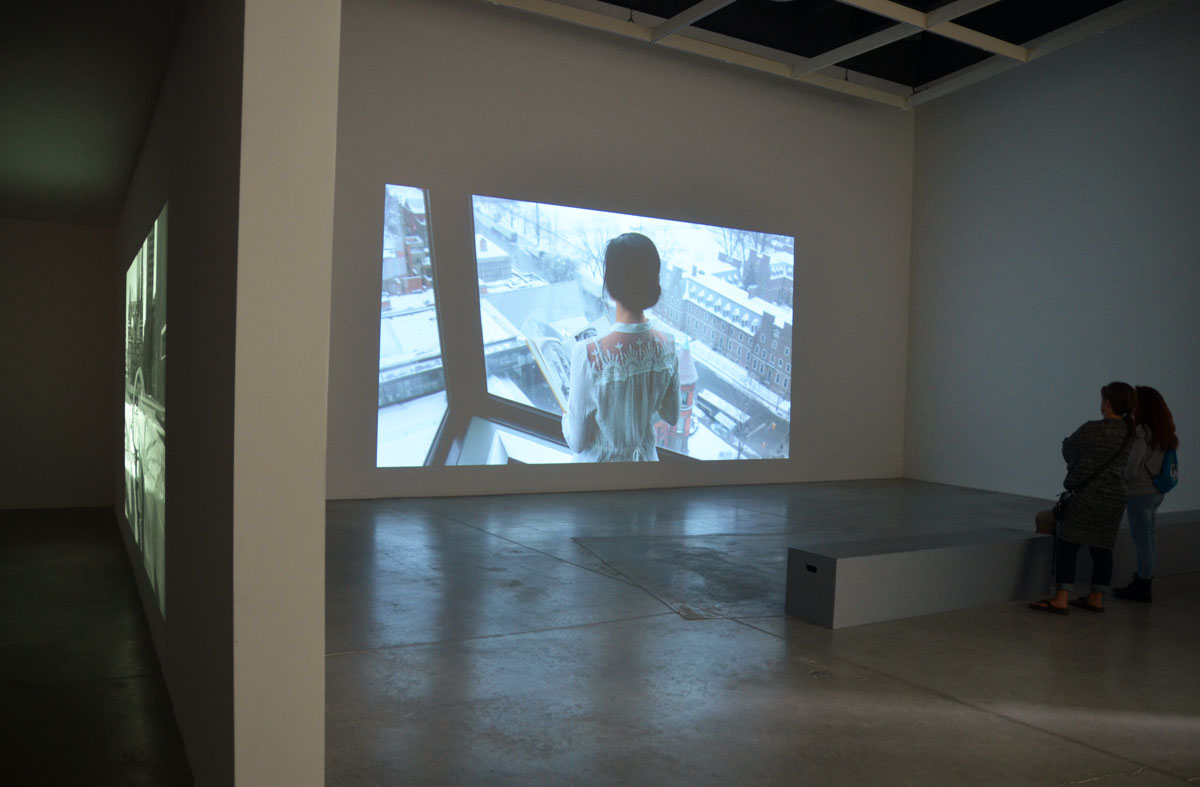
below:  A short film begins with a pan over part of downtown Toronto.  It circles back to the Robarts Library and focuses on a woman standing in the window of one of the upper floors.  After zooming in on the woman, the film “enters” the room she’s in and turns back to focus on what her view out the window looks like.

Two women are standing in the semi darkness in a room in an art gallery, watching a black and white film that is showing on a large screen in front of them. The image on the screen is the back of the upper part of a woman as she stands in front of a window in the Robarts Library in Toronto. The scene outside the window is clearly visible, winter time, University of Torotno campus. She is holding a book in her hands.

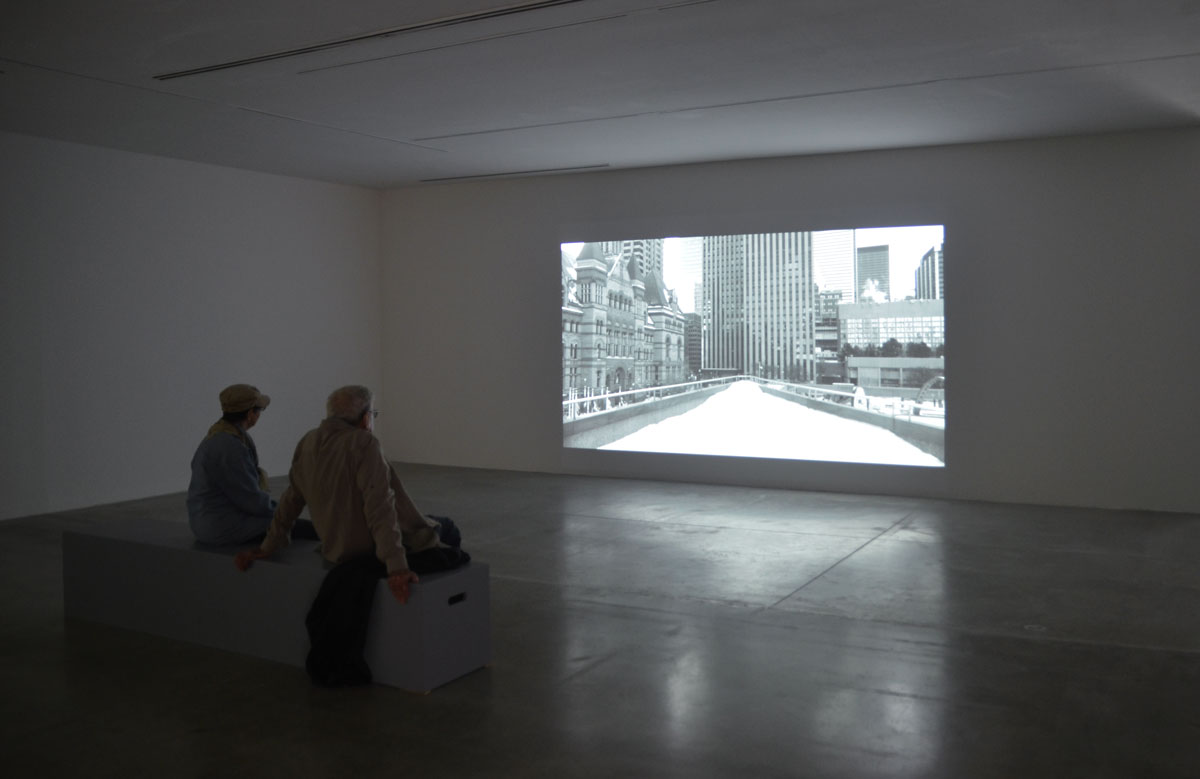
below:  Another exhibit is a film comprised of segments filmed at a number of locations around City Hall this past winter.   The image below is shot from the upper ramp at Nathan Phillips Square, looking south.   Old City hall is on the left.   There are no people in the picture.  There are also no commercial images such as billboards or signs on the buildings.  Slow moving, quiet.

An older couple are sitting on a bench at an art gallery. They are watching a black and white film that is showing on a large screen in front of them. The image on the screen is a shot of the upper ramp at Nathan Phillips Square, looking south, in the winter with snow on the ground. There are no people in the picture on the screen.

It wasn’t until I looked more closely at the images that I realized that the films had to have been made recently… for example, the recently built stage area in Nathan Phillips Square.  So I watched the films again looking for details.

One of the images shown in an art installation on a large wall screen, a black and white picture overlooking Nathan Phillips Square in the winter.

A little perplexed, I tried to find out why Lewis made these films, and why they were considered to be “art”. It wasn’t easy; it was probably made more difficult by my love/hate relationship with contemporary art.  The title of this post comes from a paragraph I found on The Power Plant website description of this installation: “Together, the elements that make up Mark Lewis’ films culminate in a body of work that is as astute as it is elegiac in its contemplation of the quotidian, offering an experience of the flux of time that is as elating in its duration as it is haunting for its sense of passing.”  Well, um, okay.

It also wasn’t easy because of the scope of the questions that Lewis seems to be tackling.  One of his interest lies in discovering what it might have felt like when film revolutionized they way we looked at ourselves and at the world around us.   That’s a tough one.  We are a society that is immersed in moving images of all kinds. Movies and TV have been part of our lives for many generations.  Can anyone truly imagine what it might have been like to see a film for the first time?

As we all know, digital technology has put video production into the hands of anyone with a cellphone.   Even my three year old granddaughter asks me to make videos of her and I’m sure it won’t be long before she’s producing them.  And that leads to another question that Lewis is interested in examining – what are the implications of these technological changes?  Not only can see video, we can be in control of making our own whenever we want.

But that’s not all.  Lewis is also interested in architectural surfaces so walls, windows, pavements and reflective glass amongst others play a role in his films.   Urban architecture; urban landscapes.  Cinema made of the ordinary everyday life of living in the city and everyday life in the city is cinema.  24/7 movie making.  You are part of the cast; you are the camera.

What I have presented here are just three pictures and I’m not sure the pictures do the films justice.   If you want to see these films, they are at The Power Plant gallery until 3 Jan 2016.

#PPInvention

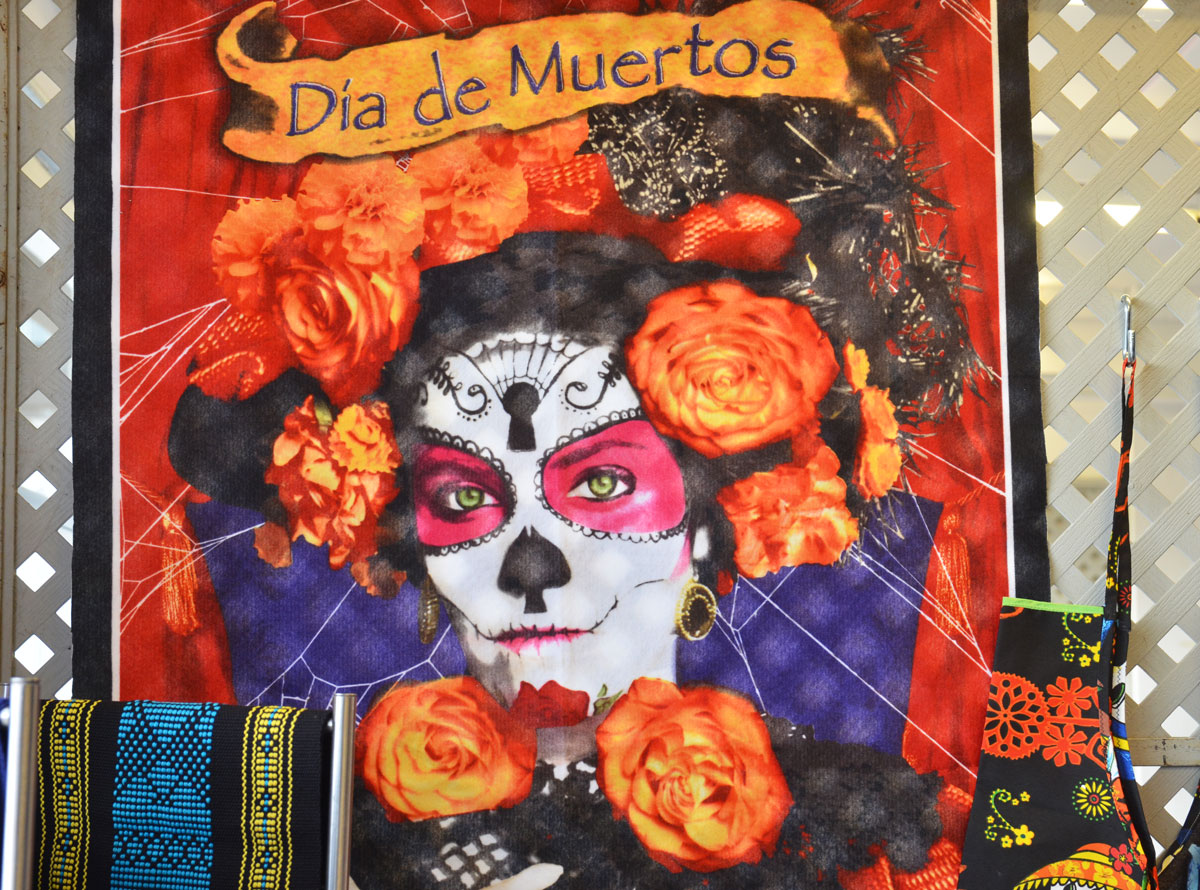
Dia de Muertos, Day of the Dead, is a Mexican holiday where and friends come together to pray for and remember friends and family members who have died.  It occurs at the end of October (31 Oct to 2 Nov).  Here in Toronto there was a Day of the Dead festival at Harbourfront this past weekend.

fabric hanging on a wall. There is a picture on the fabric of a woman's face painted white to look like a skull but with pink around the eys. Many orange roses surround her face

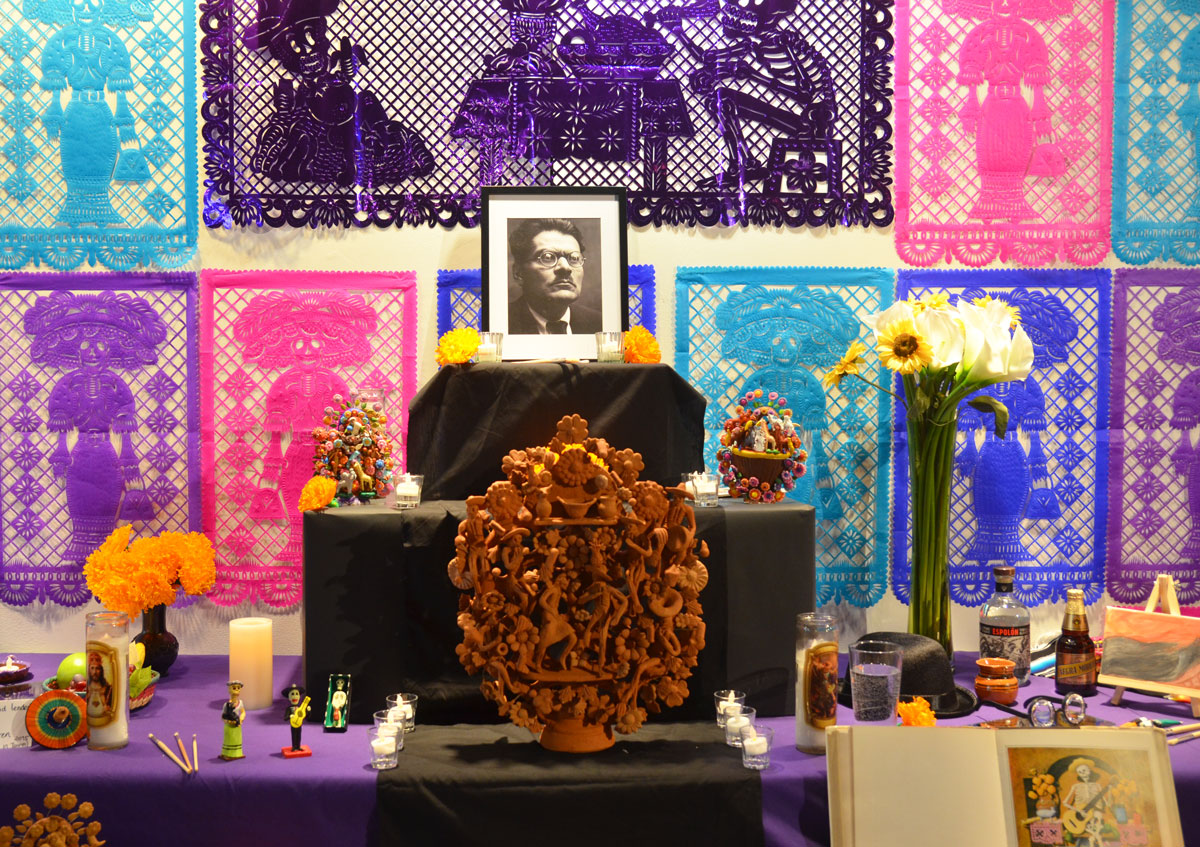
One of the traditions of Dia de Muertos is the making of ofrendas which are altars dedicated to the deceased person.  Jose Clemente Orozco was a Mexican painter (1883-1949).  He specialized in painting murals in frescoes and his work can be seen in Mexico and in the USA.

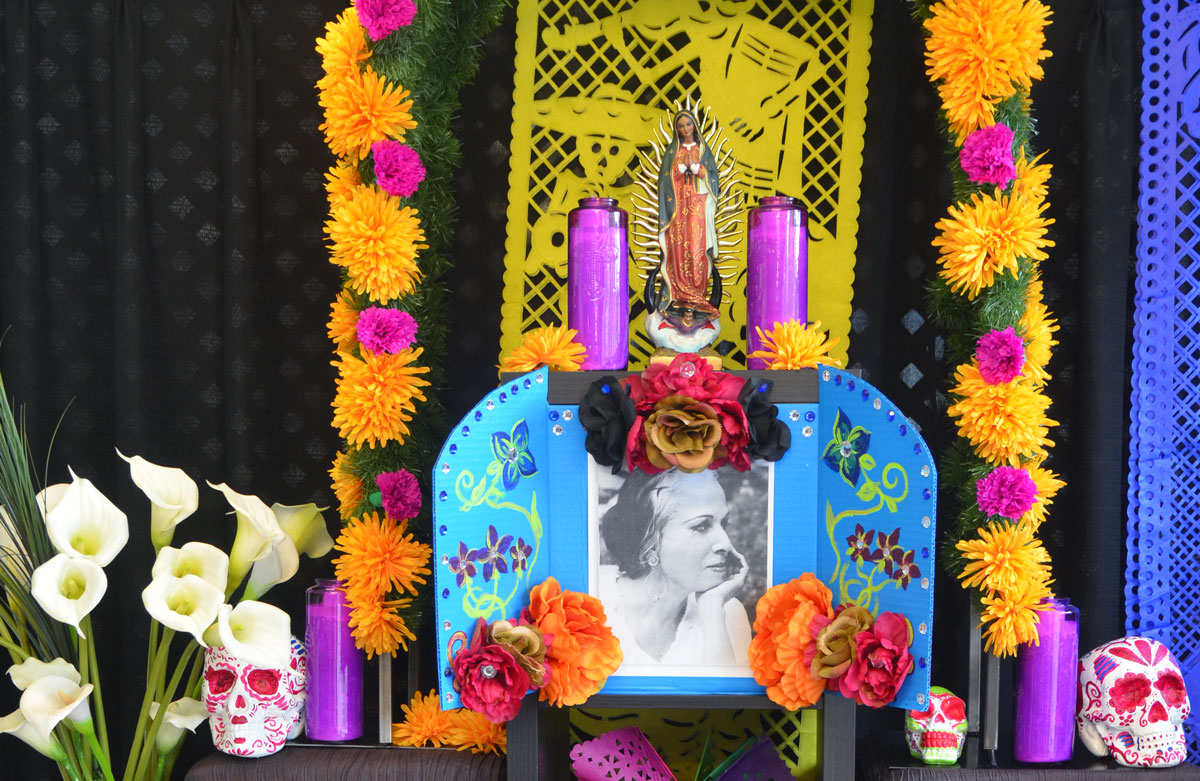
elaborate and colourful ofrenda with purple, blue and pink paper cut outs on the wall behind.
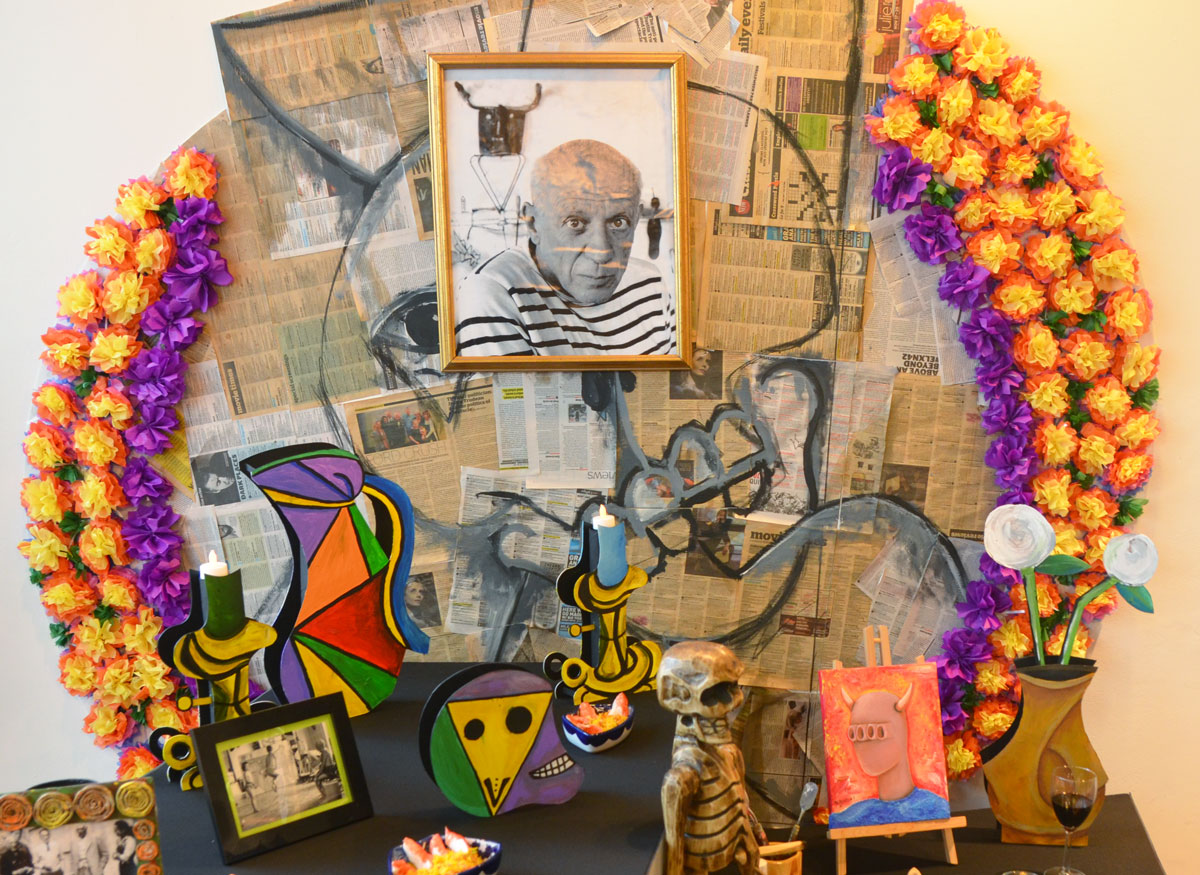
Another altar that was on display was one made by artist Alberto Cruz in honour of Pablo Picasso.

An ofrenda, or altar, in the memory of Pablo Picasso at a day of the dead festival. There is a photo of him surrounded by different objects and symbols representing his life and things that he did

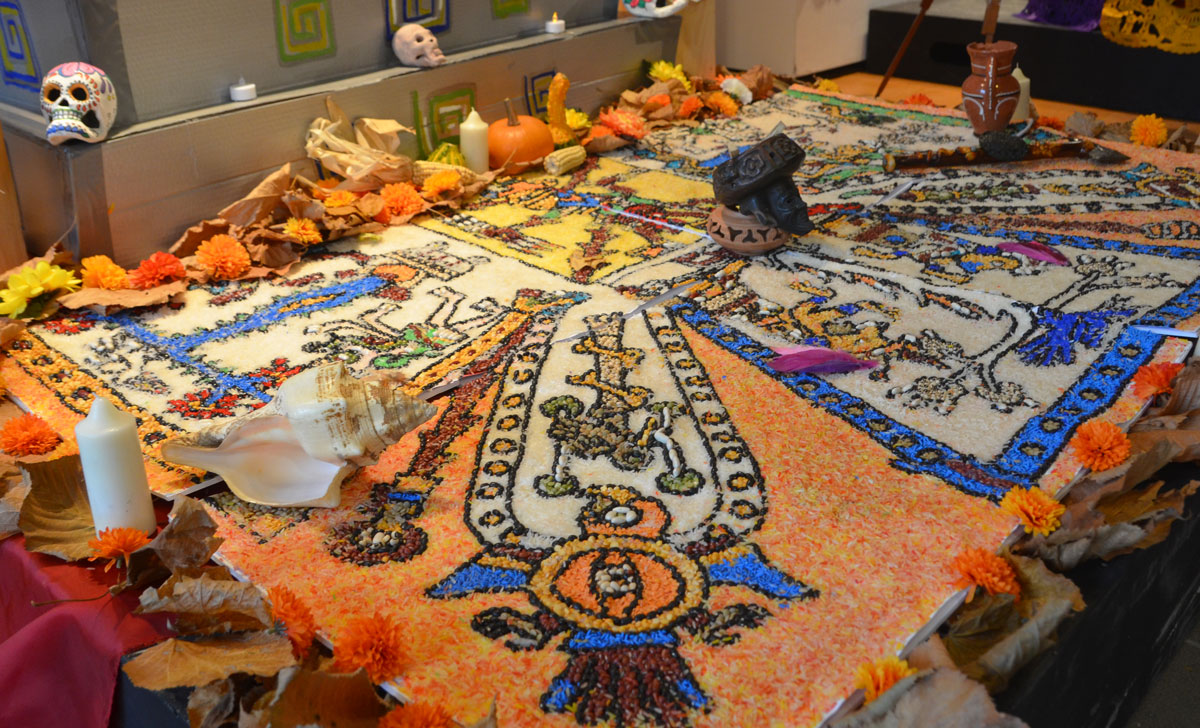
The Casa Cultura Mexicana made an ofrenda to honour the Prehispanic indigenous people and warriors of Mexico.
The bottom part consisted of pictures made with coloured rice.

pictures made of coloured rice on an ofrenda dedicated to the indigenous people of Mexico

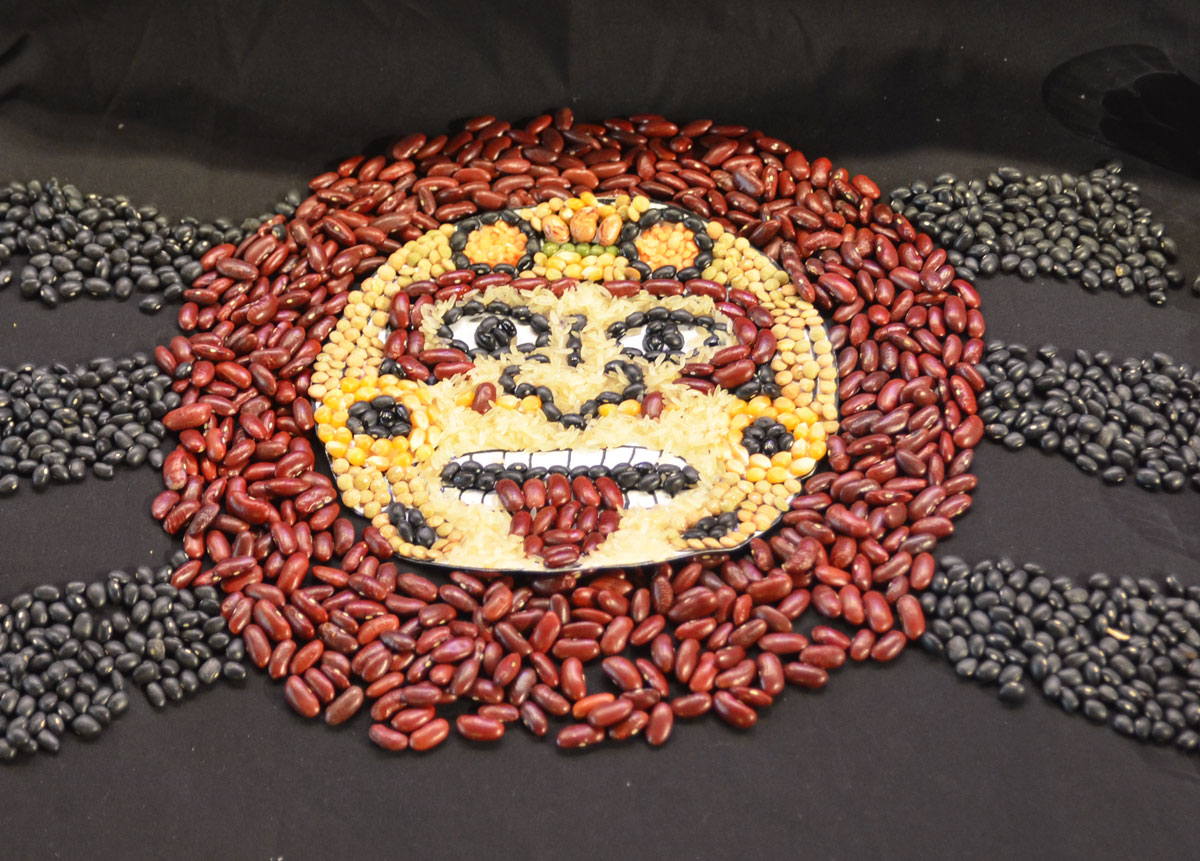
Food items such as rice, beans, and corns were an important part of the ofrenda.

a face shape made of dried beans and corn. red beans make a circle around the face, black beans make 6 rays coming out from the circle. The face is corn with bean features.

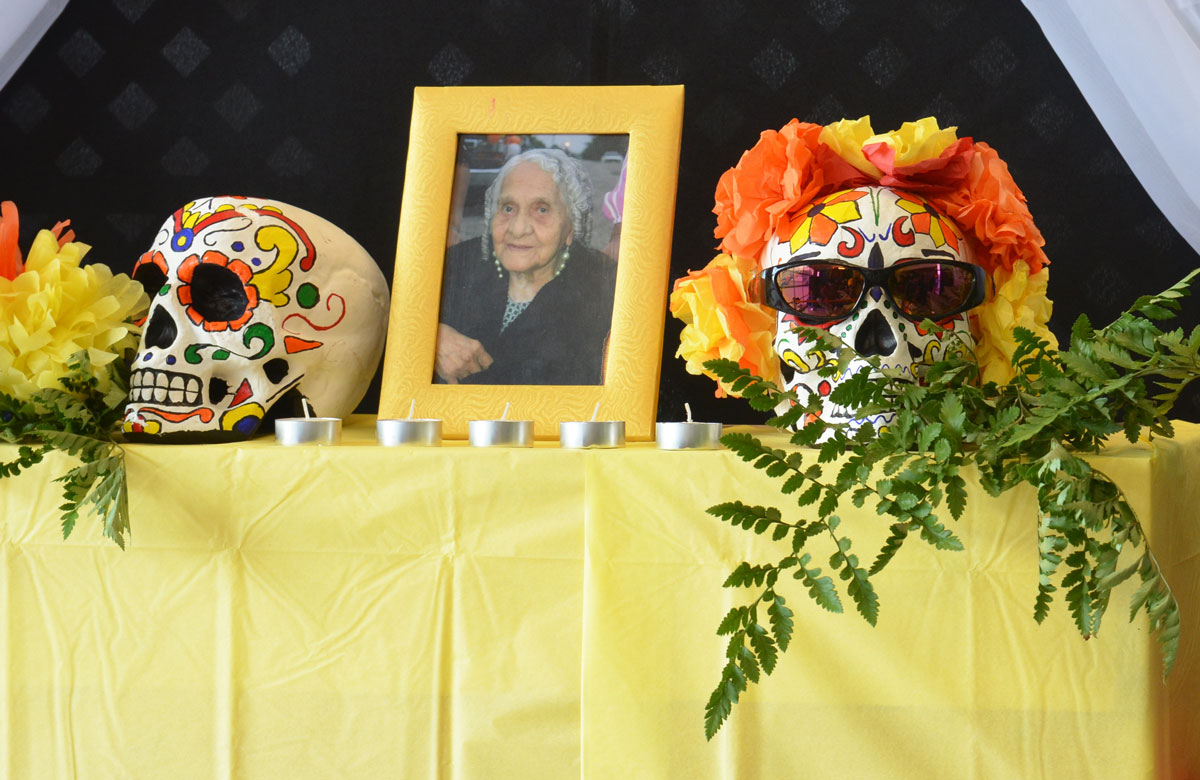
Ofrendas are decorated with sugar skulls and marigolds (or yellow and orange paper flowers) as well as candles, photos, momentos from the person’s life, and things that symbolize something about that person.  Sometimes serious, sometimes whimsical.

an ofrenda with a picture of a woman in a frame sitting on a table. One each side of her is an elaborately decorated skull. One of the skulls is wearing sunglasses and a wreath of yellow and orange flowers around the top of its head.

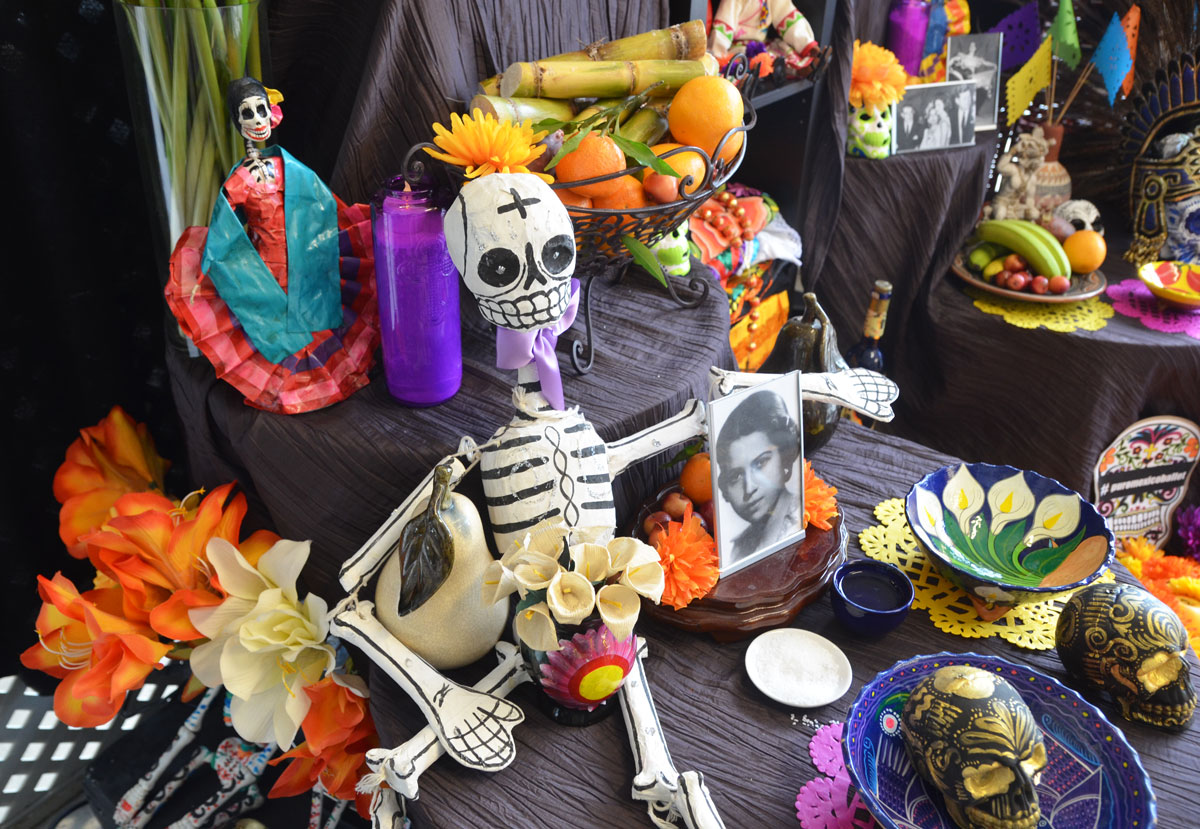
What would your friends and family put on an ofrenda in your memory?

objects on an ofrenda at a day of the dead celebration, decorated skulls, a small skeleton, some old photos of people, flowers, fruit,

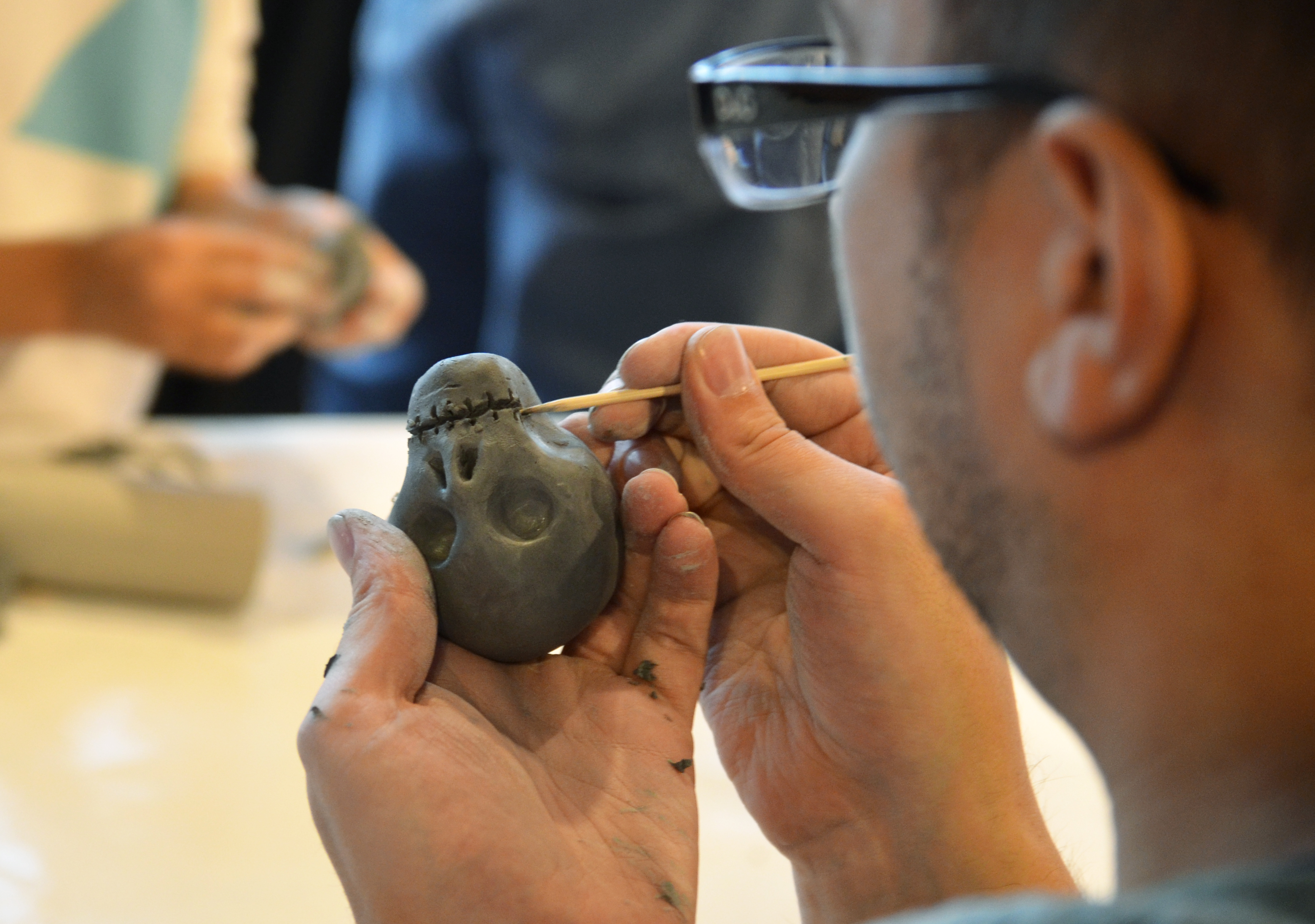
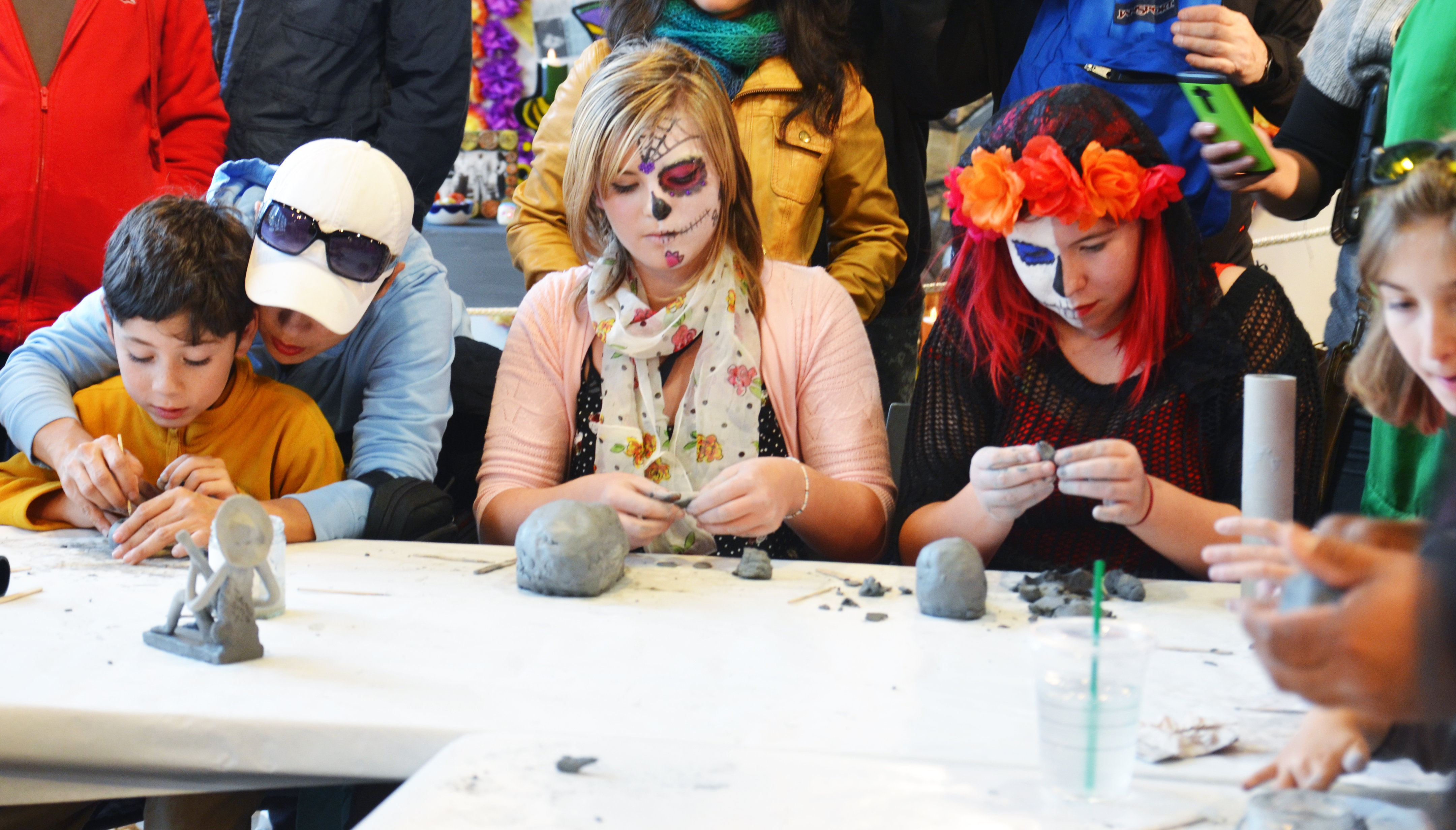
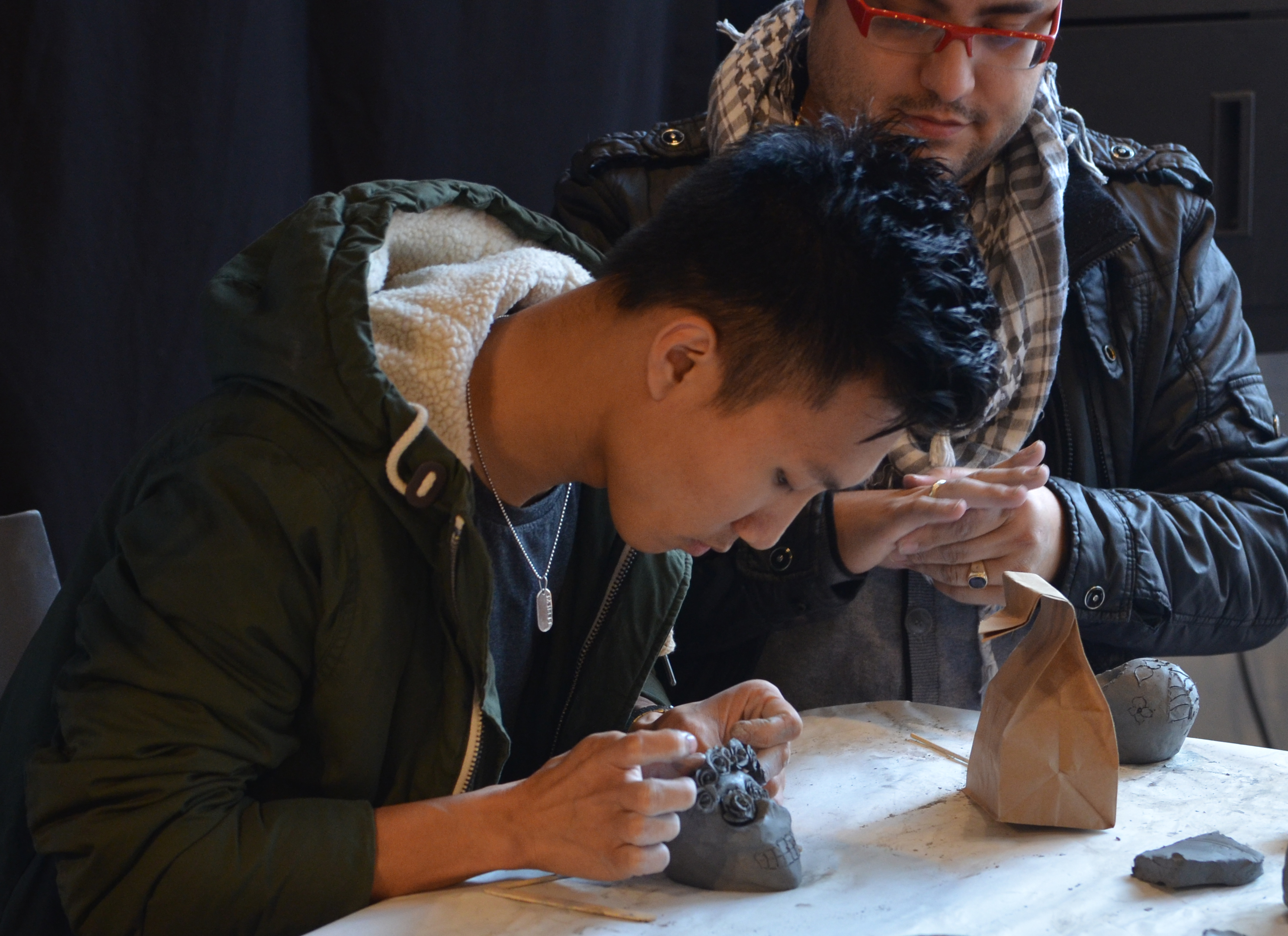
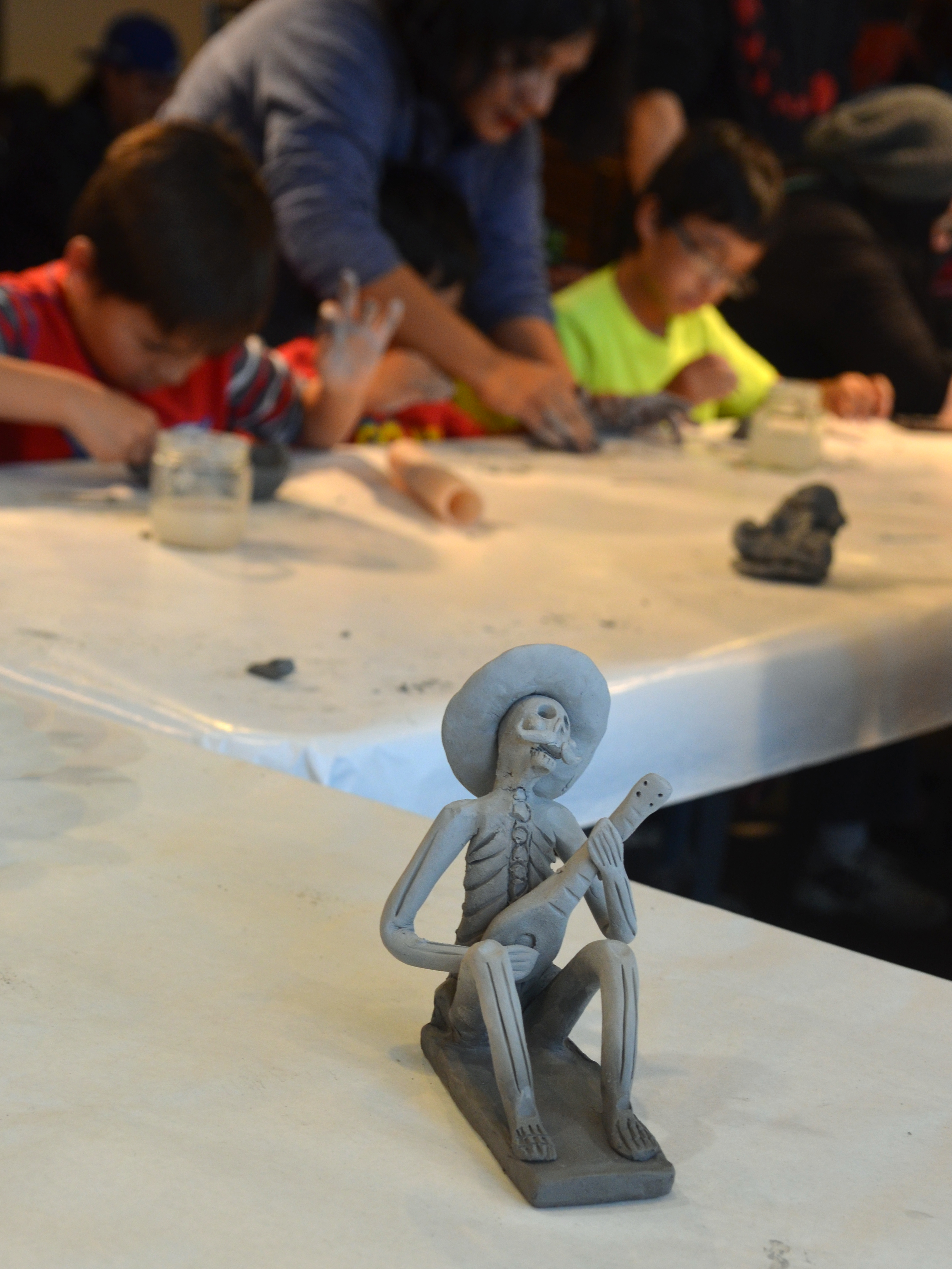
There was also clay available if you wanted to make a small skull or other symbol for the occasion.

close up picture of a man putting details on a small clay skull with a toothpick

Two girls with day of the dead face paint on are making clay skulls. A young boy is also at the table making a skull, his mother is helping him.

A young man carefully adds tiny clay roses to a clay skull that he has made.

A small figurine made of a clay of a skeleton wearing a sombraro and playing a guitar is in the foreground, kids making clay skulls at a table are in the background.

skull painted white and then decorated with black, green, red and white

Rest in Peace.

ofrenda, altar, day of the dead celebration, woman's picture along with Virgin Mary candles and other pink cnadles, lots of orange flowers too

I happened to walk into the Queen Mother Cafe (on Queen West) this afternoon.  They often have original artwork displayed on their walls and today was no exception.  I found some intriguing and very creative masks.

A mask in beige, black and white mounted on the wall. The nose is a wrench. The white part looks like a mask across the eyes of the mask

They are the creation of Jeff Mann, a Kingston based artist.

four metal masks mounted like on a wall. One looks a reddish dog and one looks like a skull. They are made of car parts.

According to his website, Mann makes the masks mostly from car parts and shovels.  The ones here are only a sample of the collection I saw at the Queen Mother cafe.   In addition, there are pictures of more masks on Mann’s website.

close up of a mask hanging on a wall. It's made of rusty metal car parts welded together

A mask that looks like a cow. Large black and white face, a pinkish red body and four skinny spindly legs. Curly cue tail too.

As I sort through the photos that I took this past summer, I keep finding pictures of street art that I have not yet posted.  The following collection were taken in the Dupont and Ossington area back in July.

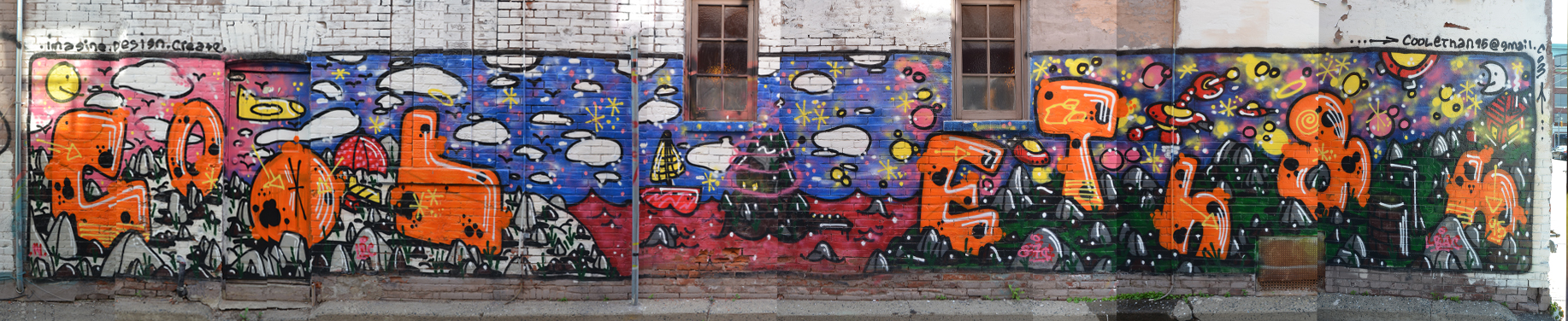
below: A very horizontal piece by Cool Ethan, obviously

a long horizontal street art painting

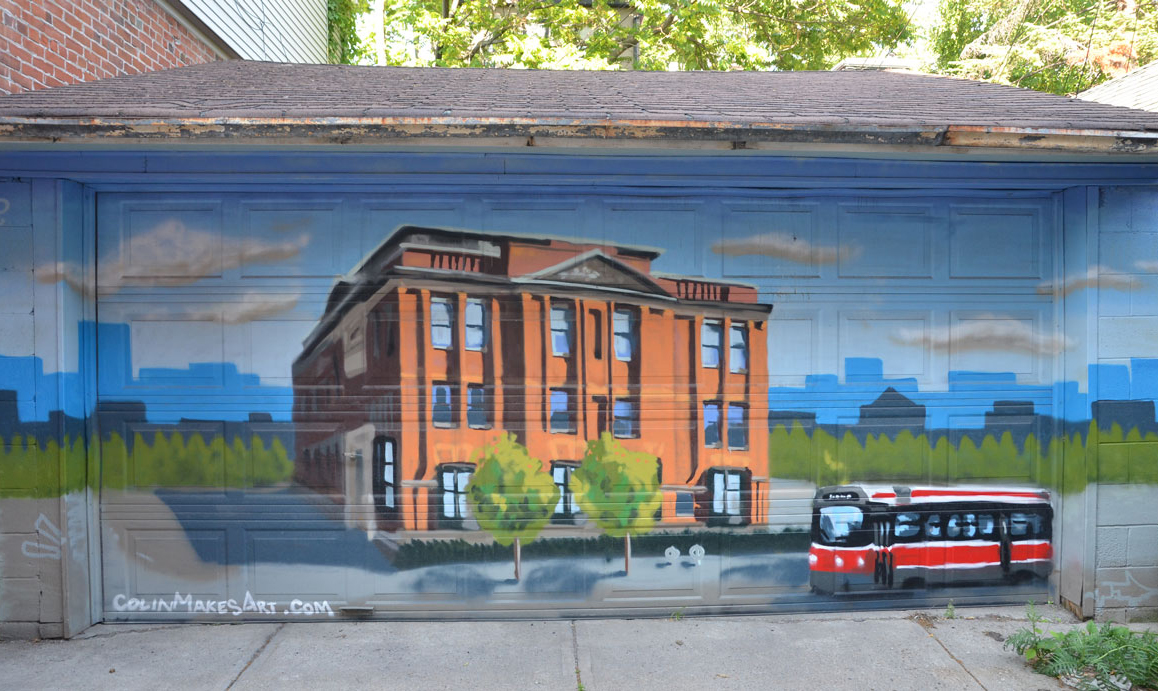
below: A TTC streetcar passes by the Massey Harris building, a mural by Colin Turner Bloom.  This office building, at 915 King St. West, was built in 1883 as the headquarters for the Massey Harris Co.  It was declared a heritage building in 1973.  Since then it has been developed as lofts/condos.

A mural on a garage door by colin makes art, showing a large brick building with a TTC streetcar passing in front of it.

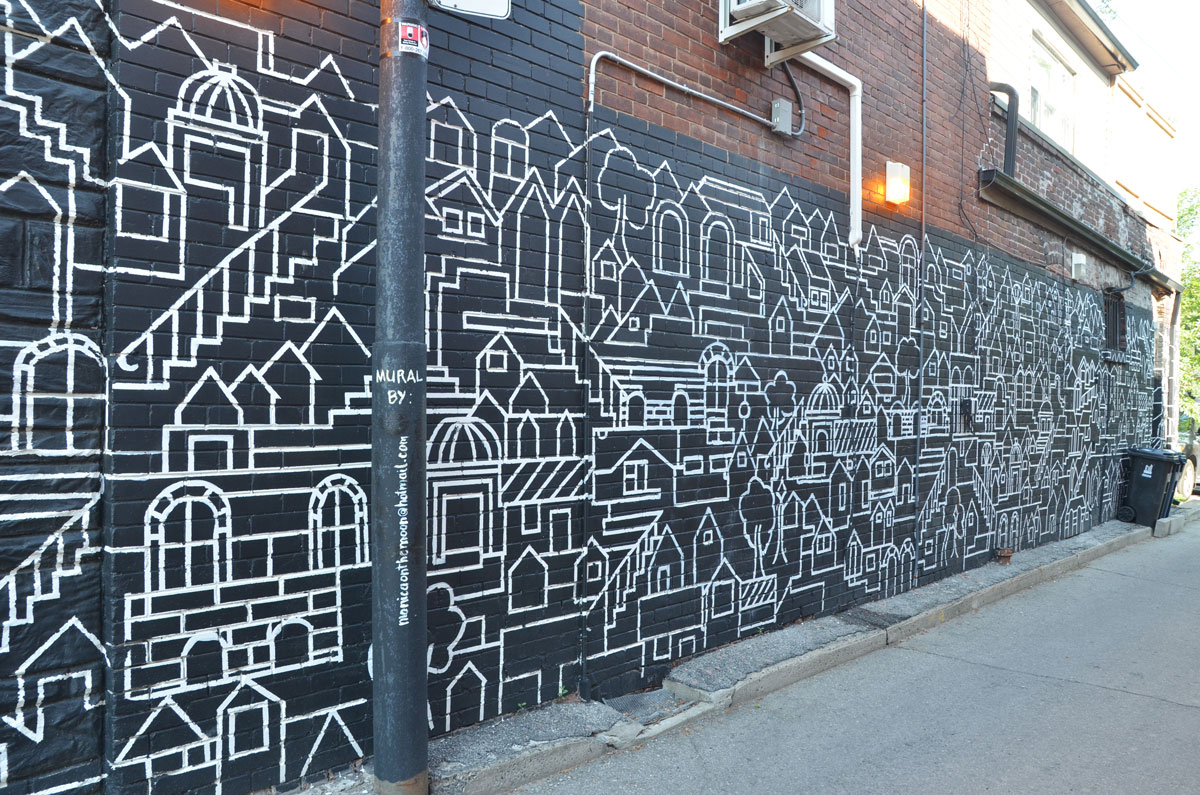
below: A city scene mural by Monica on the moon,  just off Dupont Avenue.

long mural, black background, white line drawing of a city scene by Monica on the Moon

close up of part of mural, white line drawings of a city scene, lots of houses and other buildings, on a black background on the side of a house. Small window as well as three trash bins are in the picture.

below: Another garage door

garage door covered with a street art painting of squiggly shapes in oranges and reds with dark grey background

below:  Up, up and away with a bunch of red balloons.

two stencil graffitis on a white garage door in a lane. One is of a girl standing on her toes and holding onto a bunch of red balloons that are up in the air. The other stencil is of a man from the shoulders up

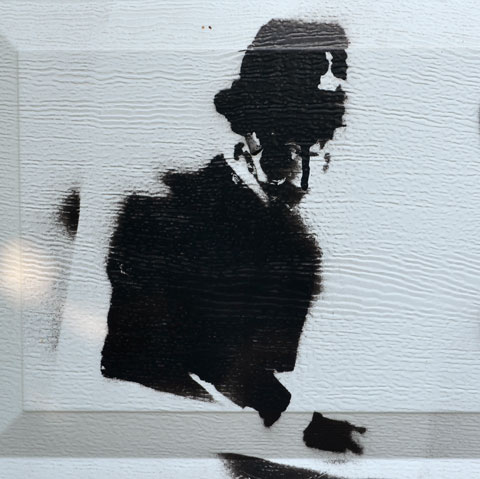
below: Bobby with a gas mask, stencil on garage door in a lane.

stencil graffiti in black on a white garage door. London bobby (policeman) wearing a gas mask, from the waist up

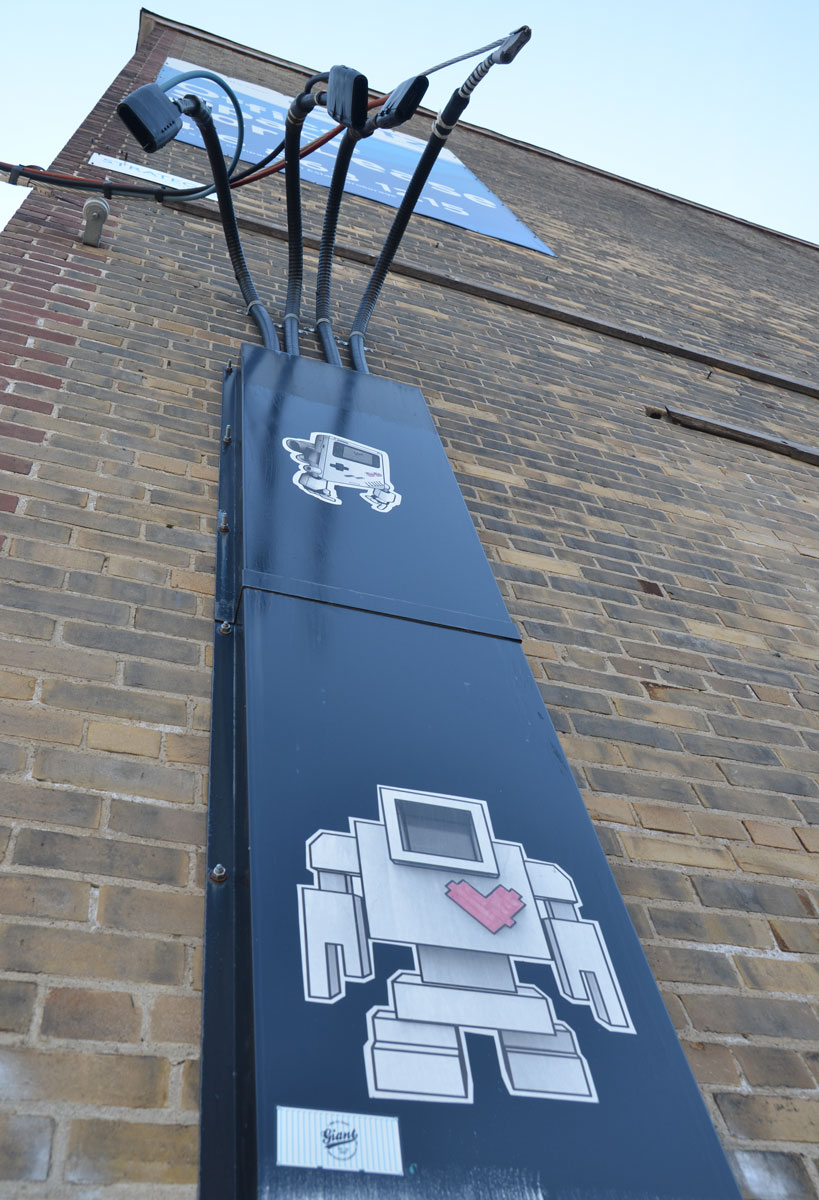
below:  Two lovebots on Dupont.

two lovebots on a blue metal structure on a brick wall. The top one is a gameboy lovebot. The bottom one is the usual robot lovebot.

sticker on a white wall. Sticker says ADORE: for all the golden moments captured indoors and out

below: Coke, Dole juice, Diet Coke, Fanta orange, cans, cans, and more cans.

Three women check out bundles of crushed pop cans that are bundled for recycling. They are stacked two bundles high making a low wall beside the sidewalk.

below: Coors beer, Canada Dry, Nestea, more Fanta, more Coke, all crushed and ready to be recycled.

Crushed alumiium cans ready to be recycled

The City of Toronto collected about 200,000 tonnes of blue bin recyclables in 2014.   Since a tonne equals 1,000 kilograms, that’s 200,000,000 kilos of recyclable plastic bottles, pop cans, tin cans etc.

Crushed plastic bottles ready to be recycled

Crushed plastic bottles ready to be recycled

Piles of crushed recyclables collected from Toronto’s blue bins are stacked along Bay Street beside City Hall.  They will be part of an installation entitled ‘There is No Away’ for Nuit Blanche this coming weekend.  This work was sponsored by the city’s Solid Waste Management committee and put together by artist Sean Martindale.    This installation hopes to raise awareness of just how much garbage we produce and throw “away”.

A bundle of old rusty tin cans that have been crushed and pack into large bundles ready to be recycled.