Posts Tagged ‘rocks’

Old Finch Avenue runs immediately north of the zoo way over in the northeast corner of the city.  It also crosses the Rouge River close to what is called the Finch Meander.  Because of  its history and the surrounding geography, the eastern portion of Finch has to curve around the river and as a result, it doesn’t align properly with the western portion.

below: On Finch, traffic crosses a one lane bridge that spans the Rouge River.

from behind, a car crosses a single lane bridge, trees all around, green

below: Hurricane Hazel struck Toronto in October 1954. It damaged or washed away many bridges over the Rouge River including the one here.  The replacement bridge is a “Bailey Bridge” built by the 2nd Field Engineer Regiment of the Canadian Military Engineers.  Seventy years later it is the last one still in use.

small bailey bridge over the rouge river, brownish water underneath, lots of green tree around

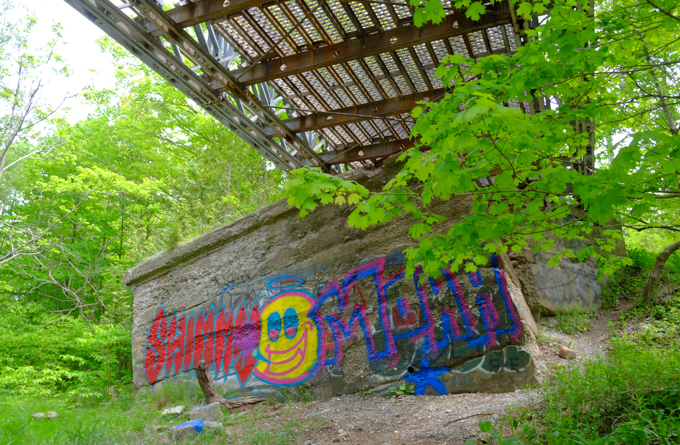
graffiti on the support to a bridge

below: Can you see the little orange alien?  I think that it’s waving at you…..
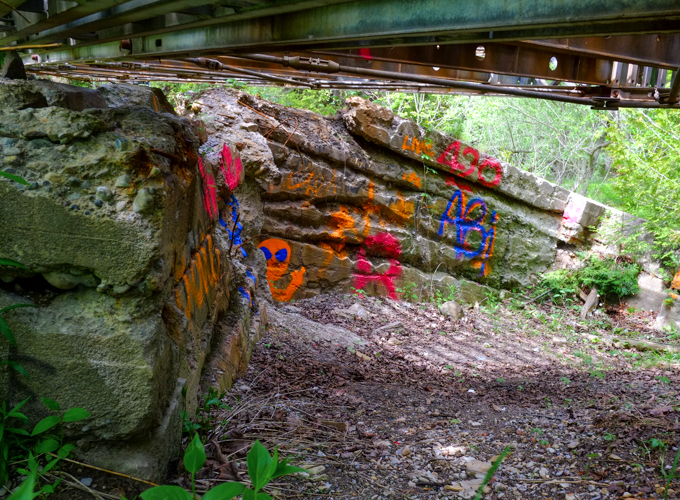
graffiti on rock and concrete under a bridge

And a few photos from walking around the Rouge River park in that area –

below: Down the steps and into the woods….

a set of stairs covered partially with old leaves, wood hand railing, leading to forest near Rouge Rver

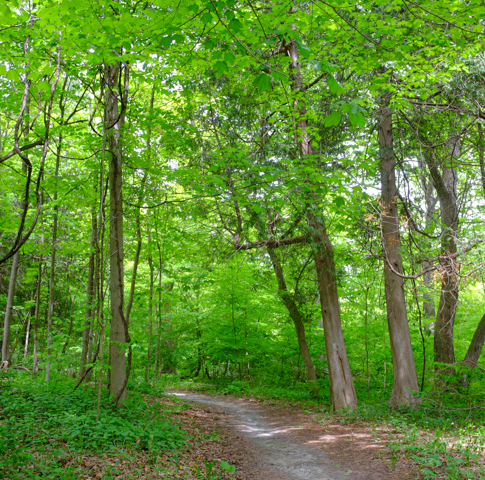
a path through the woods in late May, most trees now with leaves

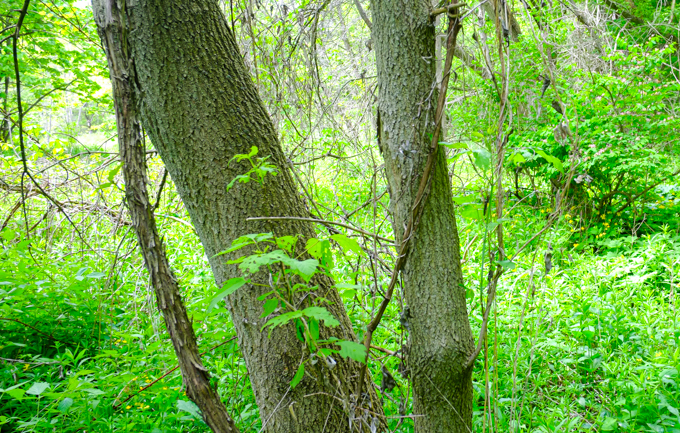
forest scens, with lots of greenery, some smaller trunks of trees in foreground, one of which is bent over, some old vines

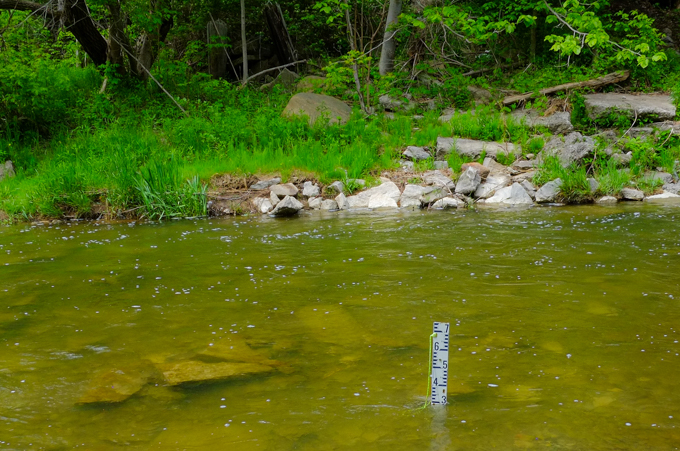
below: Measuring the water levels

white measuring stick in the water, to measure water levels, Rouge River,

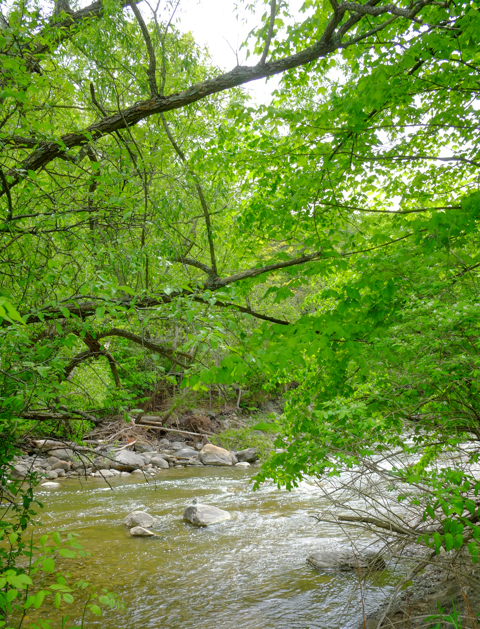
rouge river, with trees overhanging the water

below: Greater Celandine growing in the shadows.
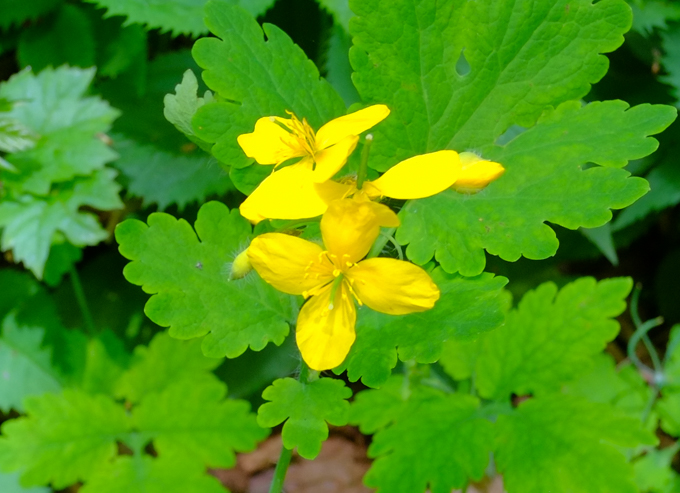
small yellow flowers on green leafy plant in woods

below: Little pink honeysuckle flowers
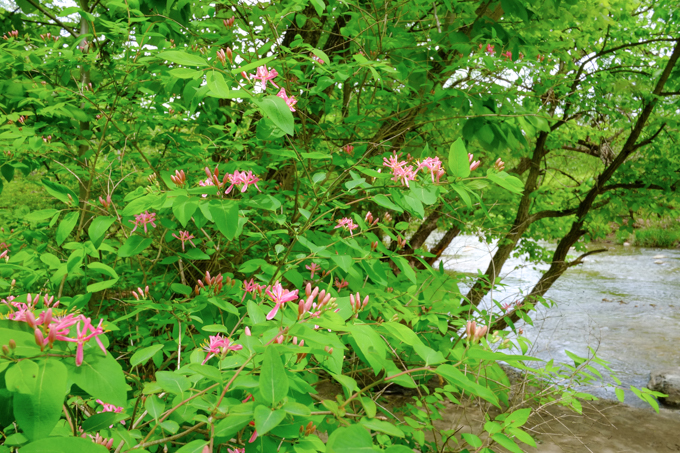
little pink flowers on honeysuckle plants along the shores of a river

below: Mayapple among the ferns

spring plants, mayapple and ferns along a path

below: Keep an eye open for poison ivy!
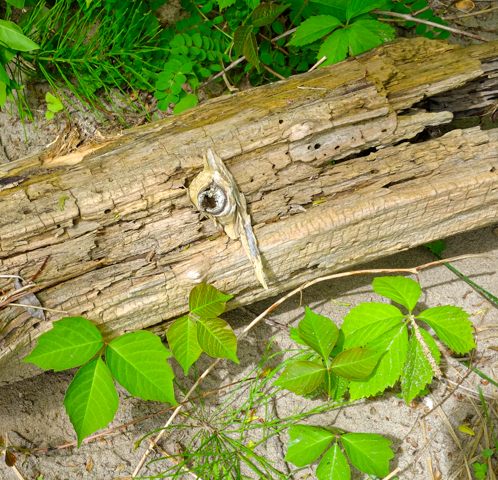
a fallen log on the ground that is starting to rot, with a knot that looks like an eye, some poison ivy is growing beside it along with some other forest plants

below: Another silent threat that lurks here (but won’t give you a rash) is an invasive vine.  “Dog strangling vine”, or Vincetoxicum rossicum, wraps itself around trees and other plants that it encounters.  It is early in the growing season so most of the plants here were still short but there were masses of them.  The lighter beige curved objects that run through the middle of this photo are the remains of last year’s vines.

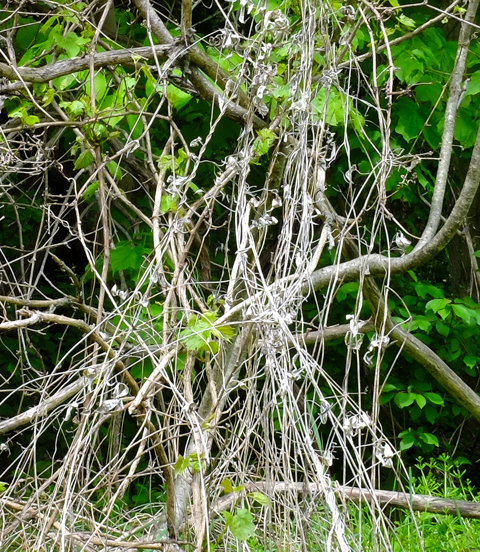
remains of last year's growth of do strangling vine lie partially hidden in this years growth, in a forest

drying dog strangling vines and seed pods form a web around other plants and trees

forest views, rouge river park

young trees, leaves, and spring growth in the woods

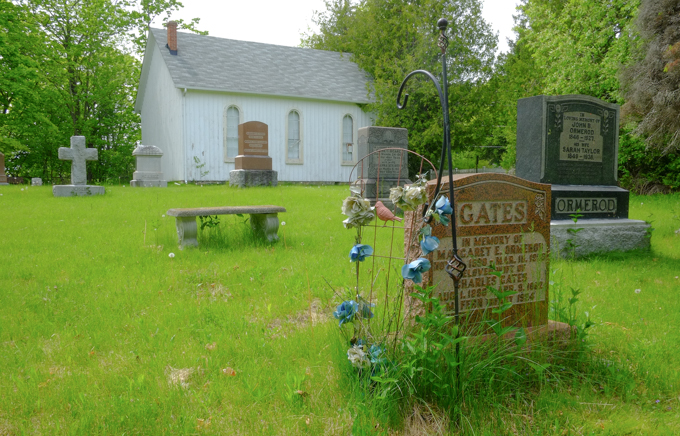
Close by is the old Hillside church built in 1877.

wrought iron details above a metal gate, entrance to churchyard

tombstones, monuments in a churchyard, with an old small concrete bench, small white wood church, Hillside church, in the background

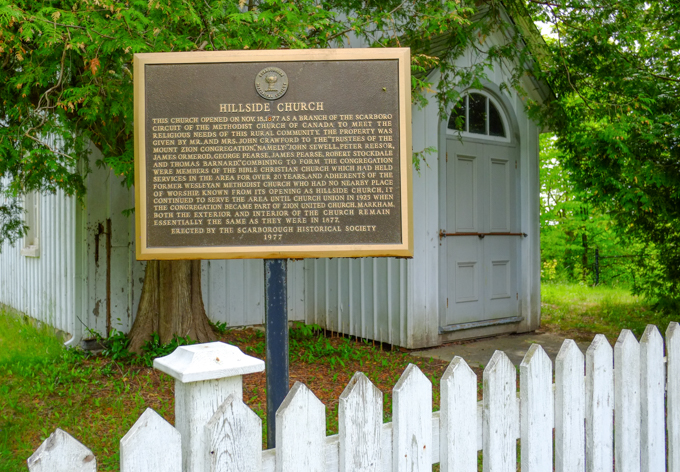
historical society plaque in front of hillside church, white picket fence

Hillside Church – The church opened on Nov 16, 1877 as a branch of the Scarboro circuit of the Methodist Church of Canada to meet the religious needs of this rural community.  The property was given by Mr. and Mrs. John Crawford to the “Trustees of the Mount Zion Congregation”  – namely John Sewell, Peter Reesor, James Ormerod, George Pearse, James Pearse, Robert Stockdale and Thomas Barnard.  Combining to form the Congregation were members of the Bible Christian Church … and the adherents of the former Wesleyan Methodist Church.  Known from its opening as Hillside Church, it continued to serve the area until Church Union in 1925 when the congregation became part of Zion United Church, Markham.  Both the exterior and the interior of the church remain essentially the same as they were in 1877.

below: Someone with surname Thomas once passed this way.  Lived here.  Played here.  The small stone suggests that it was a child, maybe?  Almost 150 years later this little stone, cracked and weathered as it is, still stands in memory of Thomas and the person who cared enough about him to have this stone made and erected in the churchyard.  A few of us stop and linger long enough to think about him but at some point the words will become even more unreadable.

old, faded and cracked tombstone in a cemetery, can read the name Thomas and that he died 188?.

Stone possibly says, Leonard, infant son of ?? Thomas, died July 11 1888 (1889?)

With thanks to Wilfred who suggested checking out the Rouge River and Bailey Bridge! It was a few months ago now but I was waiting for a nice spring day.

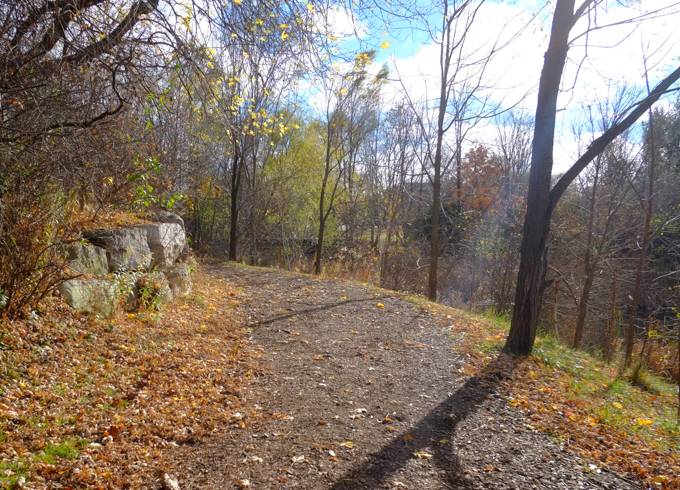
One of the great things about Toronto is the network of creeks, rivers, and ravines that runs through the city.  I happened upon one of these yesterday.  A small oasis in a Scarborough neighbourhood.

below: I was very surprised to see a heron standing quietly among the trees.  I didn’t have a better lens to catch a decent photo of the bird, so this slightly fuzzy version with have to suffice.  A heron in Scarborough!  Considering how much ravine and park space there is Toronto, there is probably more wildlife living in the city than we realize.

thicket of trees, no leaves, autumn, leaves on the ground, heron standing among the trees

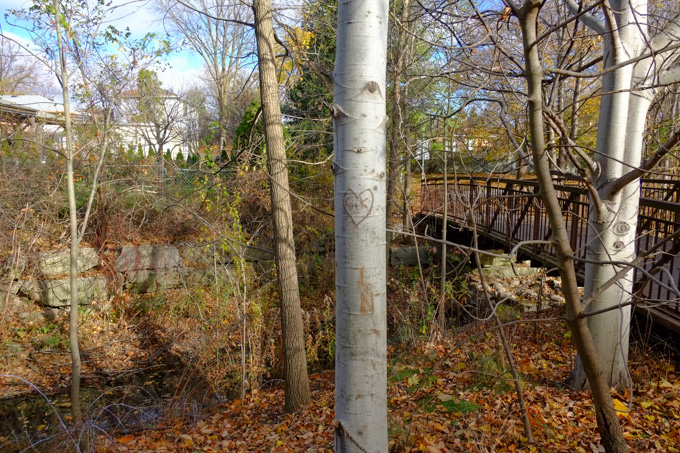
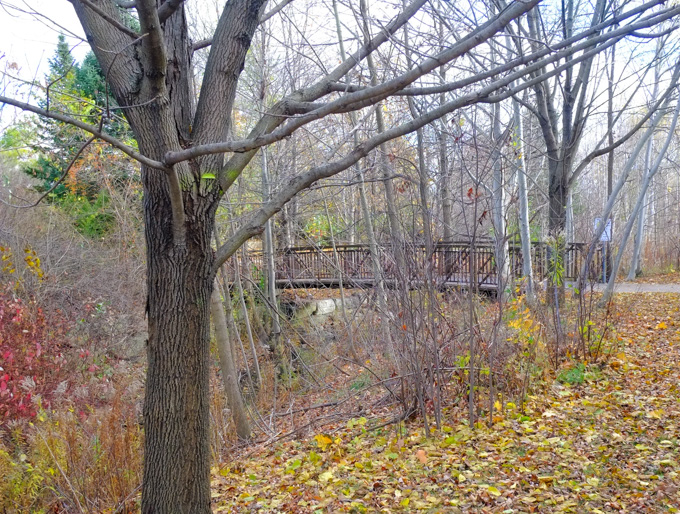
sunny november day in a scarborough park with trees and a bridge

an island in a pond, surrounded by tall grasses and rocks, autumn colours

below: What Toronto park doesn’t have Canada geese?


rocks and dirt beside creek that looks dark blue because of reflections of blue sky and tall trees beside the water, dead leaves floating in the water

small creek running through an area covered with dead brown leaves, autumn, November scene

tall grass-like plants growing beside a small creek, with lots of autumn leaves covering the ground

below: A tamarack tree, a unique tree because it is a deciduous conifer in that it has cones and needles like a conifer such as pine and spruce, but its needles turn yellow and fall off in autumn like a deciduous tree (such as oak or maple) does. Tamarack is also known as Larch.

part of a tamarack tree in November, needles turning yellow

bridge over a creek, in a park, in autumn

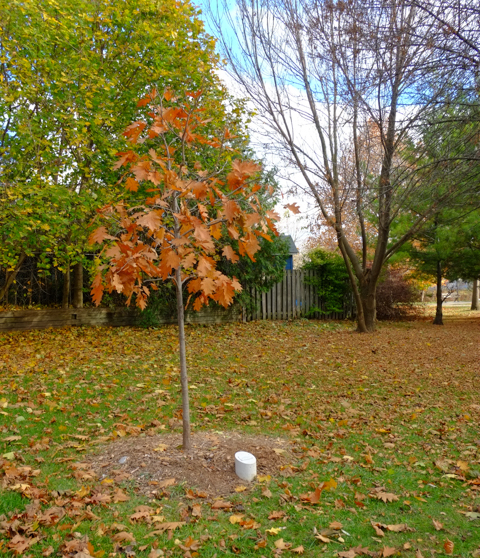
below: A small oak tree planted in remembrance of a person from the community.

a small oak tree in autumn, in a park, with a small plaque dedicating the tree to the memory of a member of the neighbouring community

autumn trees and dogwood shrub, no leaves, red branches and stems of dogwood

shore, autumn, grasses growing, reflections in water

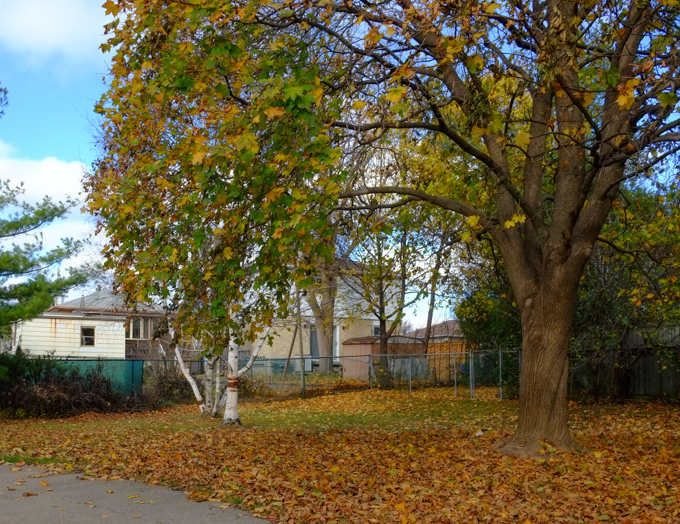
backyards with large trees, fences, that back onto a park, in autumn

backyards with large trees, fences, that back onto a park, in autumn

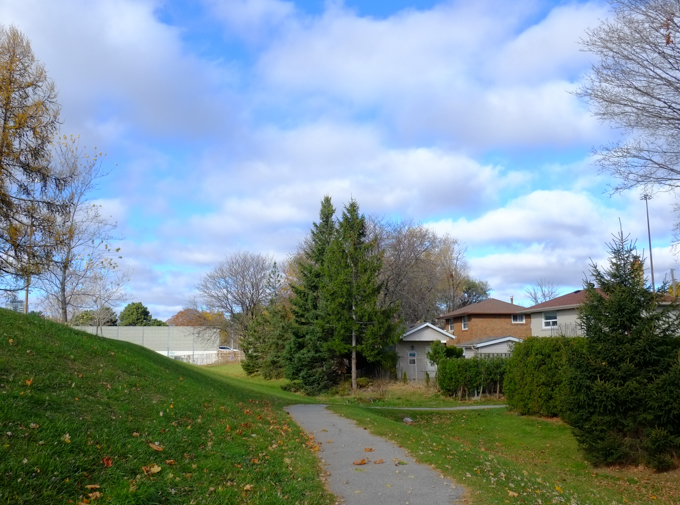
below: One end of the park is the concrete fence in the distance – a fence that separates the park and the 401 highway.

path through park, with houses and backyards on the right, grass to the left, concrete fence separating park and 401 highway in the background

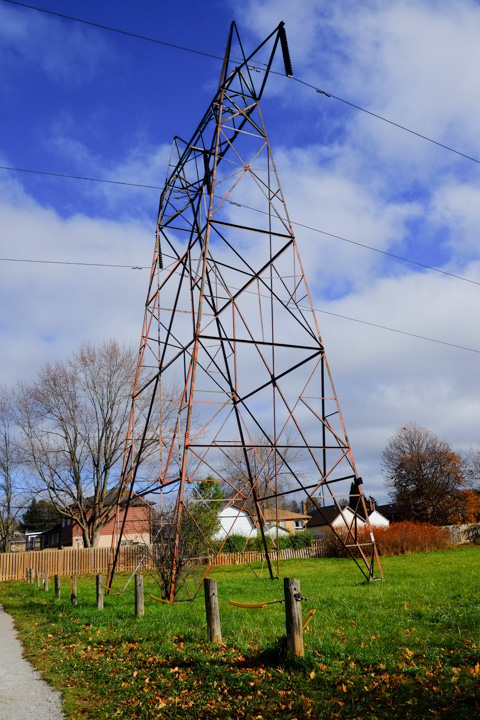
transmission tower on hydro corridor, some houses in the background

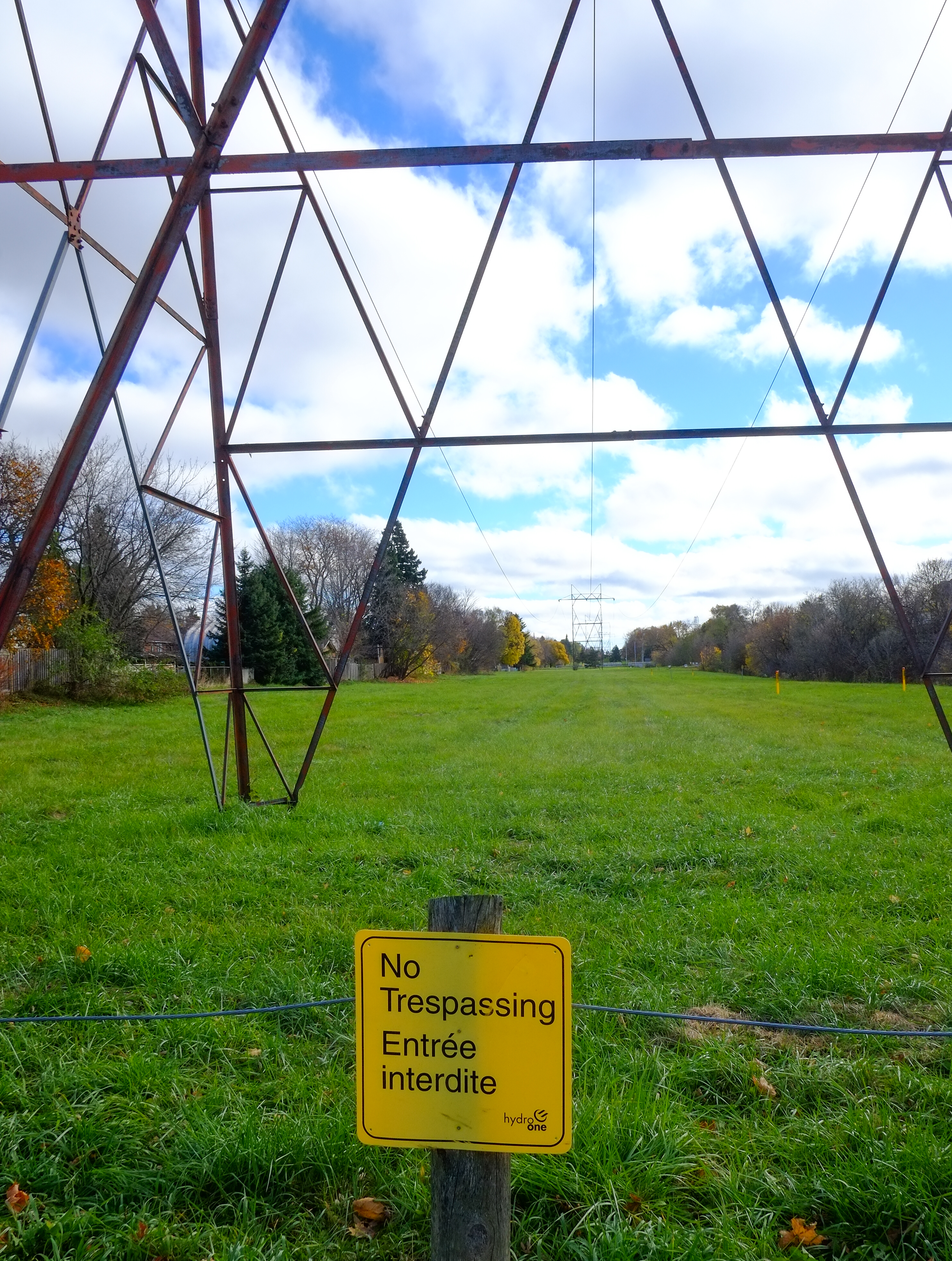
hydro right of way with tall transmission towers and a yellow no trespassing sign

A bench at Edwards Gardens… late February.  It’s been a warmer than usual winter without much snow.  February ended on a warm streak that has continued into March.  These photos were taken at Edwards Gardens before I realized just how early spring might be this year.

a couple, man and woman, site on a bench beside the path at Edwards Gardens, with trees in the background, winter but no snow, no leave on the trees

The giant willow tree has hardly begun to turn yellow like it does every spring.

large willow tree in Edwards Gardens in February winter but no snow, no leaves on tree, person walking on the path towards the willow tree

two people on the path beside the Wilket Creek, some small tree between them and the camera

A little bit of snow and ice linger in the shadier parts along the path.

rocks along the shore of Wilket Creek at Edwards Gardens, grass, and then red stems of dogwood shrubs before a path and then the forest beyond, some snow under the trees

two Canada geese in the shallow waters of Wilket Creek by one of the bridges at Edwards Gardens, sand on the shore of the river, winter, no snow,

a tree branch overhanging the Wilket Creek, people walking on the path in the background

brown dead maple leaves slightly curled at the edges, lying on the dirt on the ground, some small twigs too

a path through the woods at Edwards Gardens, dead leaves cover the ground, no leaves on the trees, winter, but no snow

ivy growing up the trunk of a larger tree with rough bark

dead hydrangea blossoms on branch with spruce tree in the background along with dead leaves on the ground

red window box on a white building, winter greenery in the box, cedar, pine,

old house building and newer greenhouse at Edwards Gardens, crab apple tree in the foreground with lots of small crab apples on it, no leaves, February, winter but no snow

A monkey – a light-hearted touch in the greenhouse where it’s warm all year round.

a stuffed toy monkey on a small palm tree in a green house

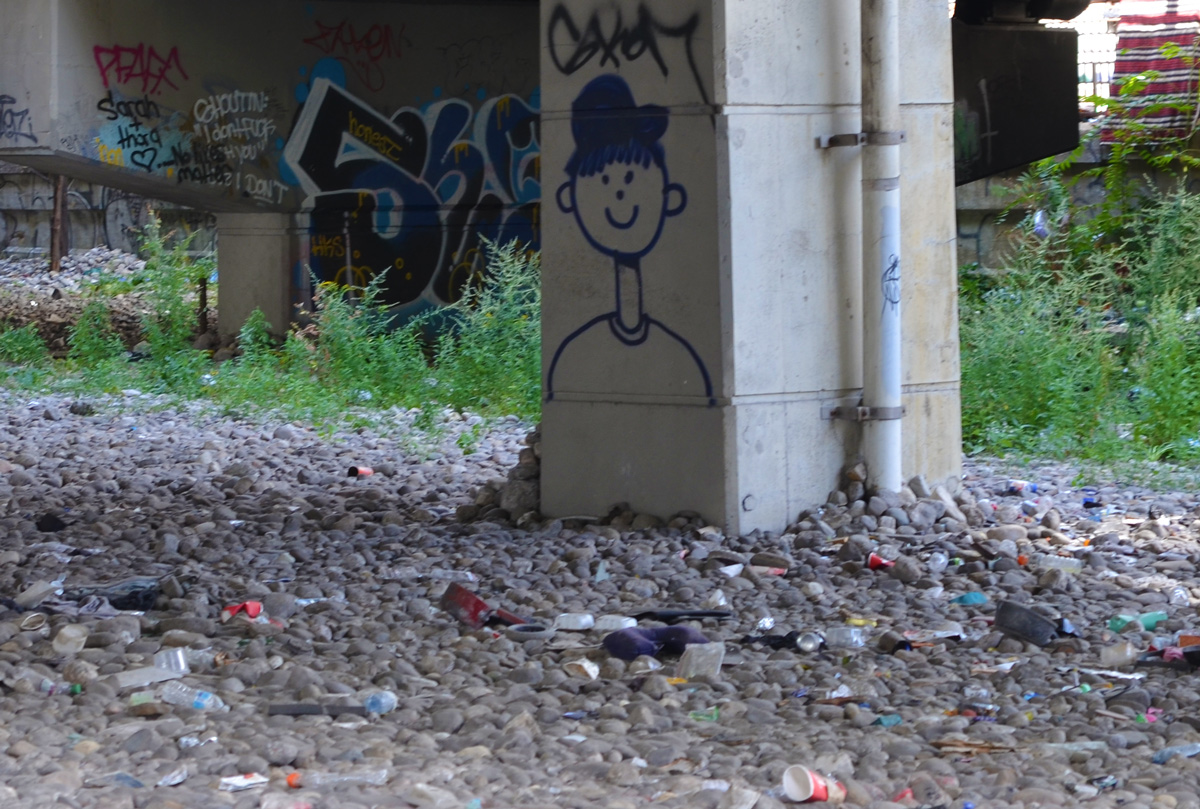
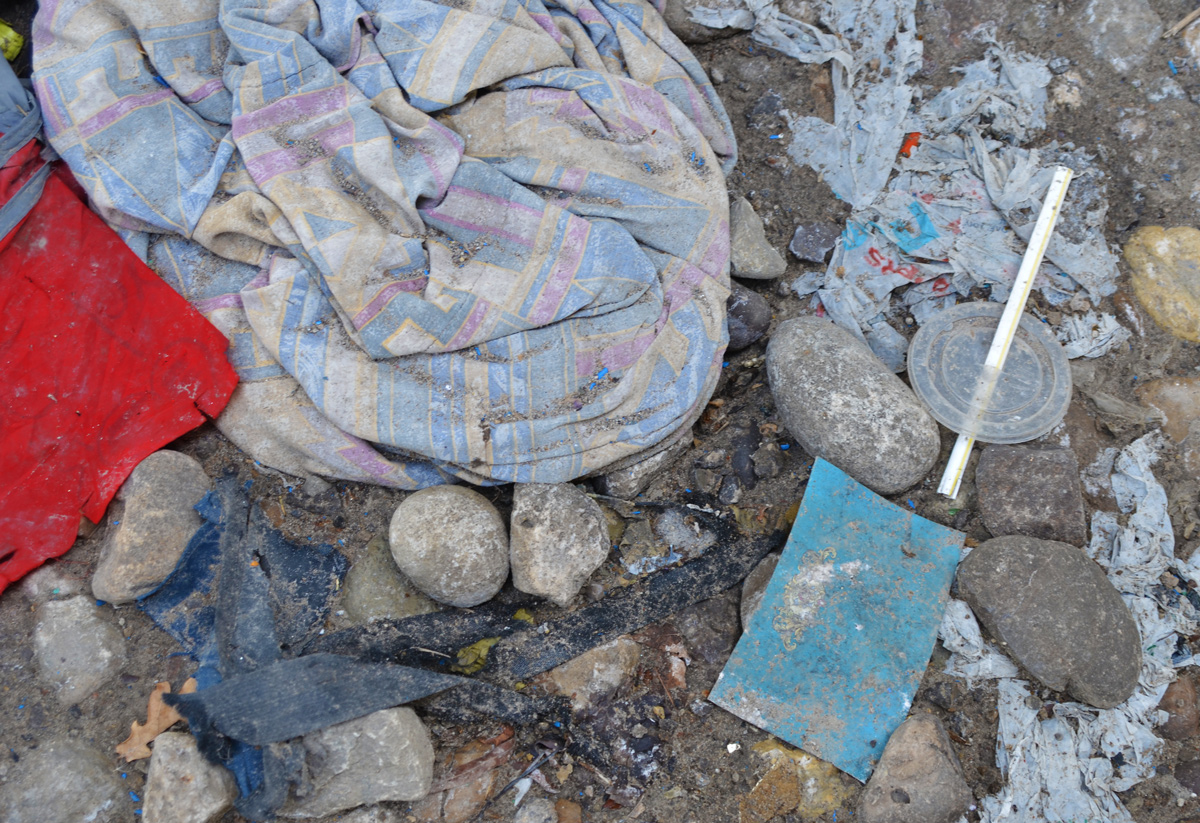
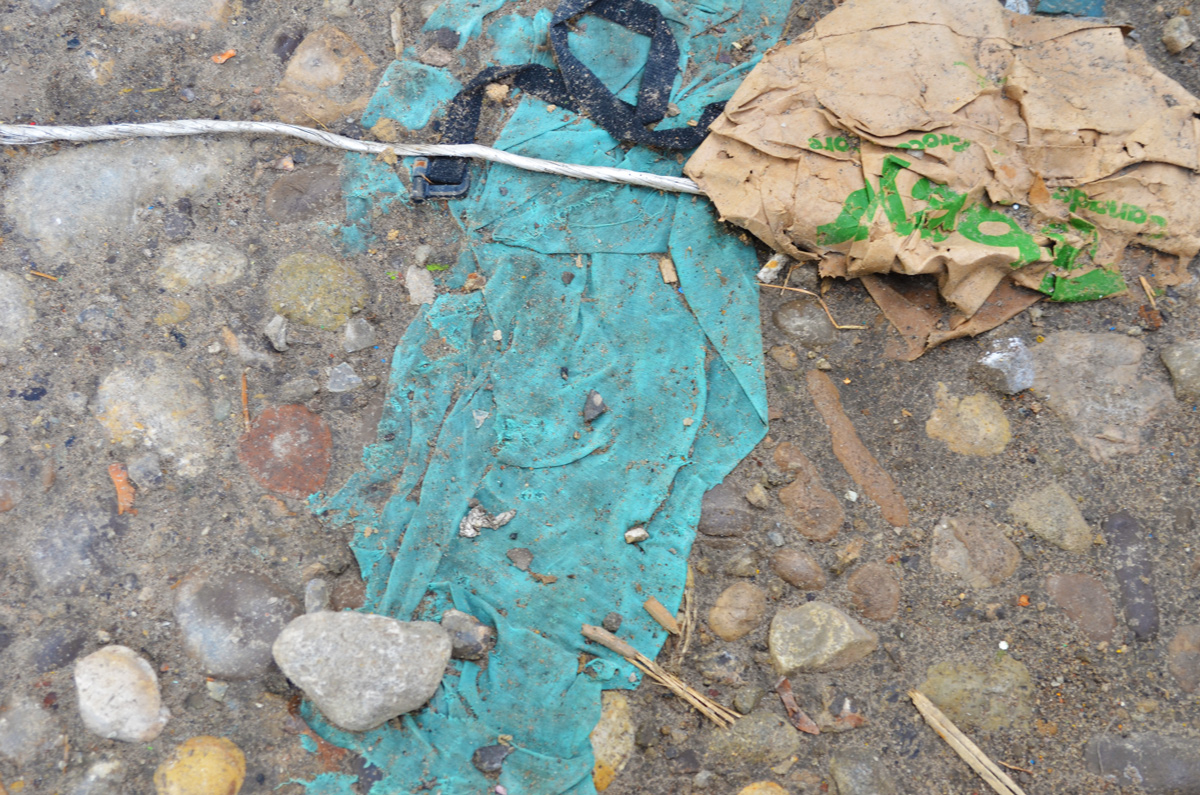
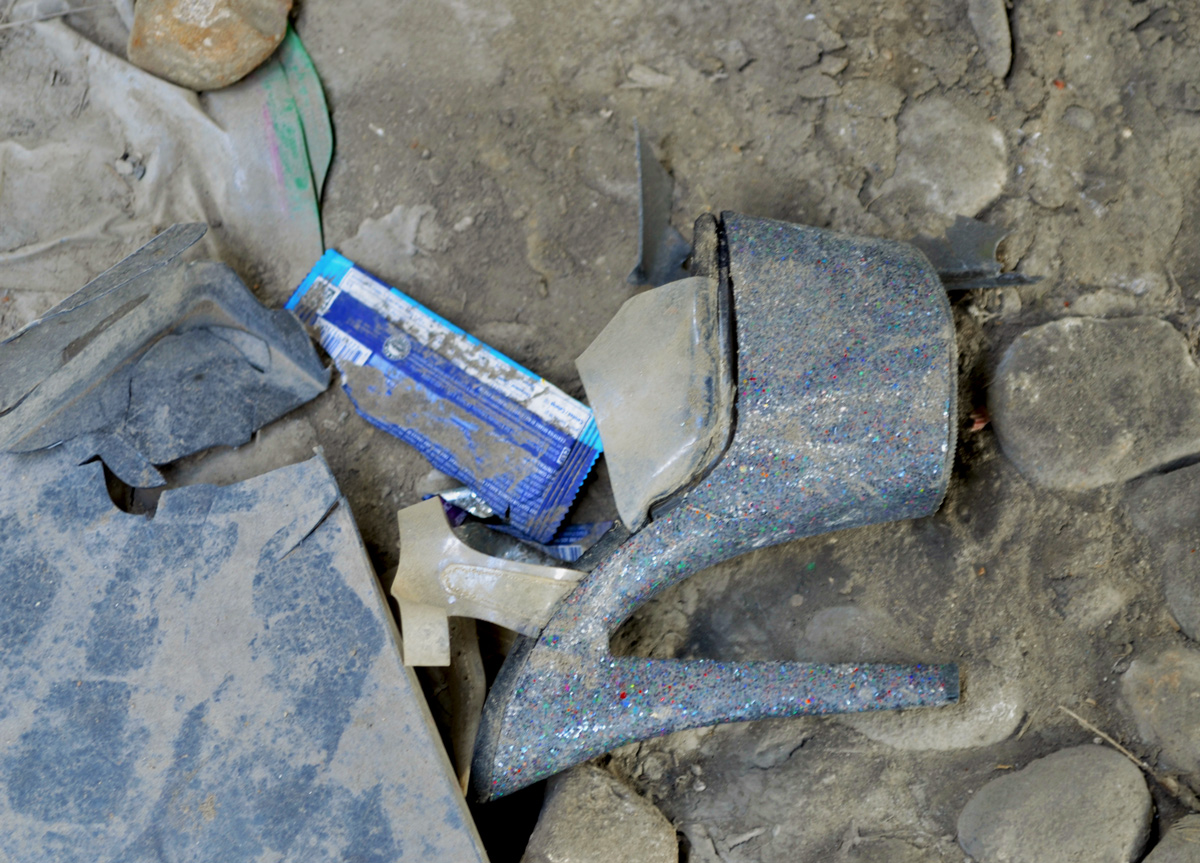
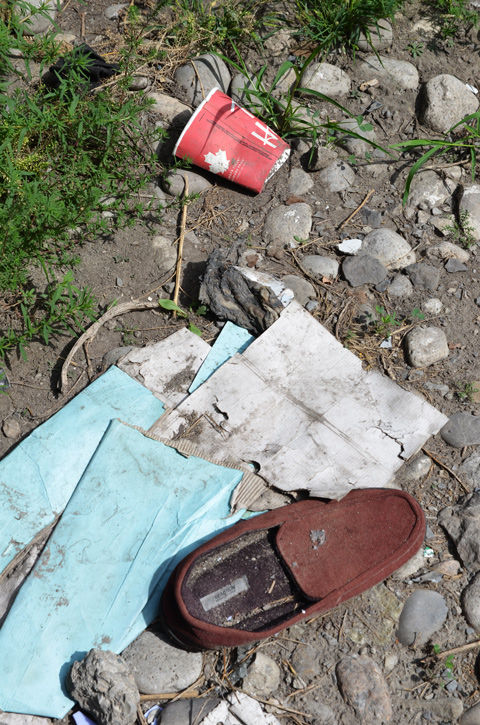
While walking under the Gardiner Expressway a few days ago, I came across the debris left behind by those who once camped here. Or maybe it was trash that was thrown here.

on a pillar for the Gardiner, a drawing of a man with a smiley face and a black hat, head and shoulders only. Stones cover the ground around it, lots of rubbish among the stones

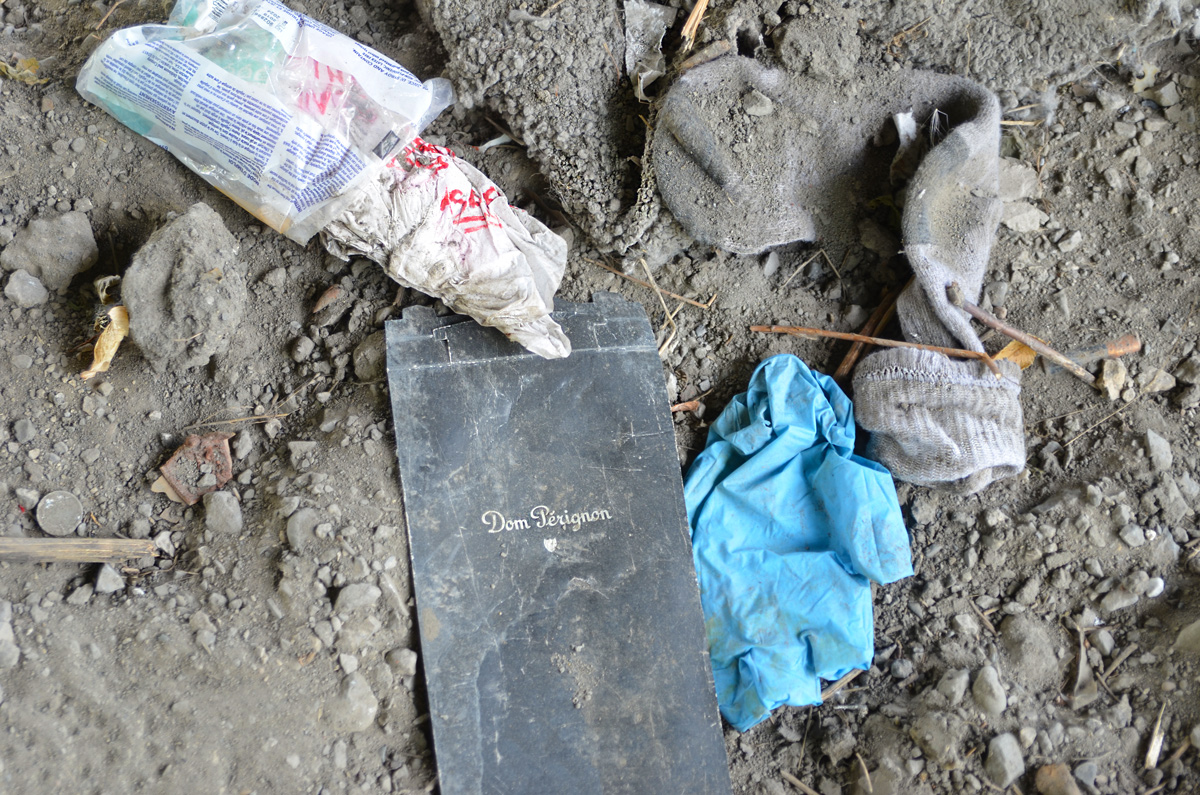
Whatever the source, I found it rather fascinating to see what there was. Detritus as subject matter whether for photography or sociology or as anthropology in centuries to come.

trash left behind, on the rocks under the Gardiner, a smashed plastic DVD or CD case and a paperback crossword puzzle book open to a crossword puzzle, with some bits of torn pages

a flattened empty black Dom Perignon box, blue plastic disposable gloves, dirty torn wool socks, empty plastic bag, garbage found in the dirt and rocks under the Gardiner

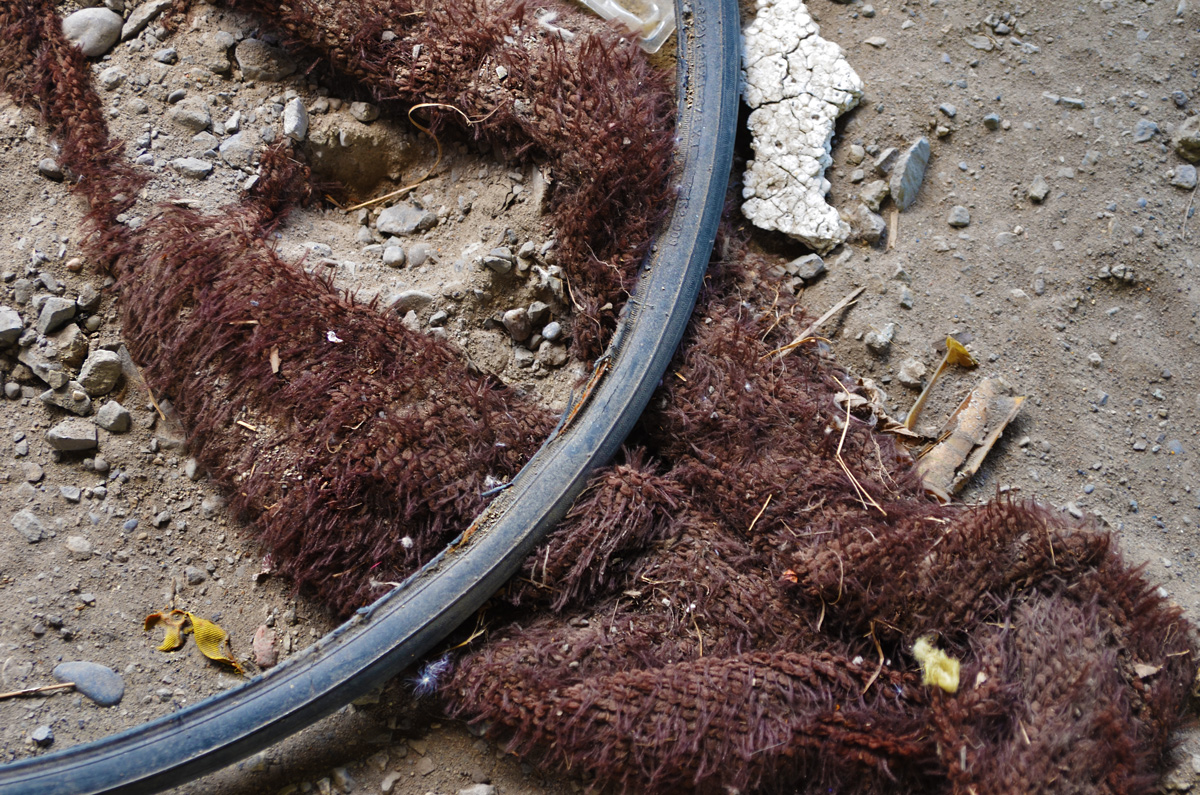
an old bicycle tire inner tube lies on top of a bronw furry piece of cloth, i n the dirt

a red and black naloxone case on the ground, in the weeds, also a flattened milk carton

an old black boot lying on its side, laces undone, well worn, old, scuffed up, lying in the dirt, a black plastic garbage bag crumpled up is behind the shoe

a broken plastic Starbucks cup and a torn piece of paper with the words after death written on it

old clothing discarded and left on the ground, also a straw and a plastic lid

a blue belt, a length of rope and a brown Sobeys bag, trash on the ground along with a an old and torn turquoise shirt, dirt and rocks on the ground

short pillars columns holding up a ramp to the Gardiner Expressway, street art and graffiti on them, rocks underneath, garbage in among the rocks

a black and blue running shoe with black laces on the ground under the Gardiner, among other pieces of garbage strewn about

trash on the rocks, a green and black backpack, a red sock, and a rolled up blue article of clothing

2 small wheels, not the same, and some pieces of wood, in the dirt,

a high heel platform shoe in glittery silver and blue, very dirty, lying on its side in the dirt under the Gardiner, left behind garbage

an old brown slipper, some turquoise and white paper, and an empty and squashed red Tims coffee cup, all rubbish lying on the ground

A long weekend in May (Two Four Weekend) + the first sunny warm day in a while + two months of “shelter in place” = people out enjoying Tommy Thompson Park’s trails and waterfront.

a couple sit on a rock by Lake Ontario

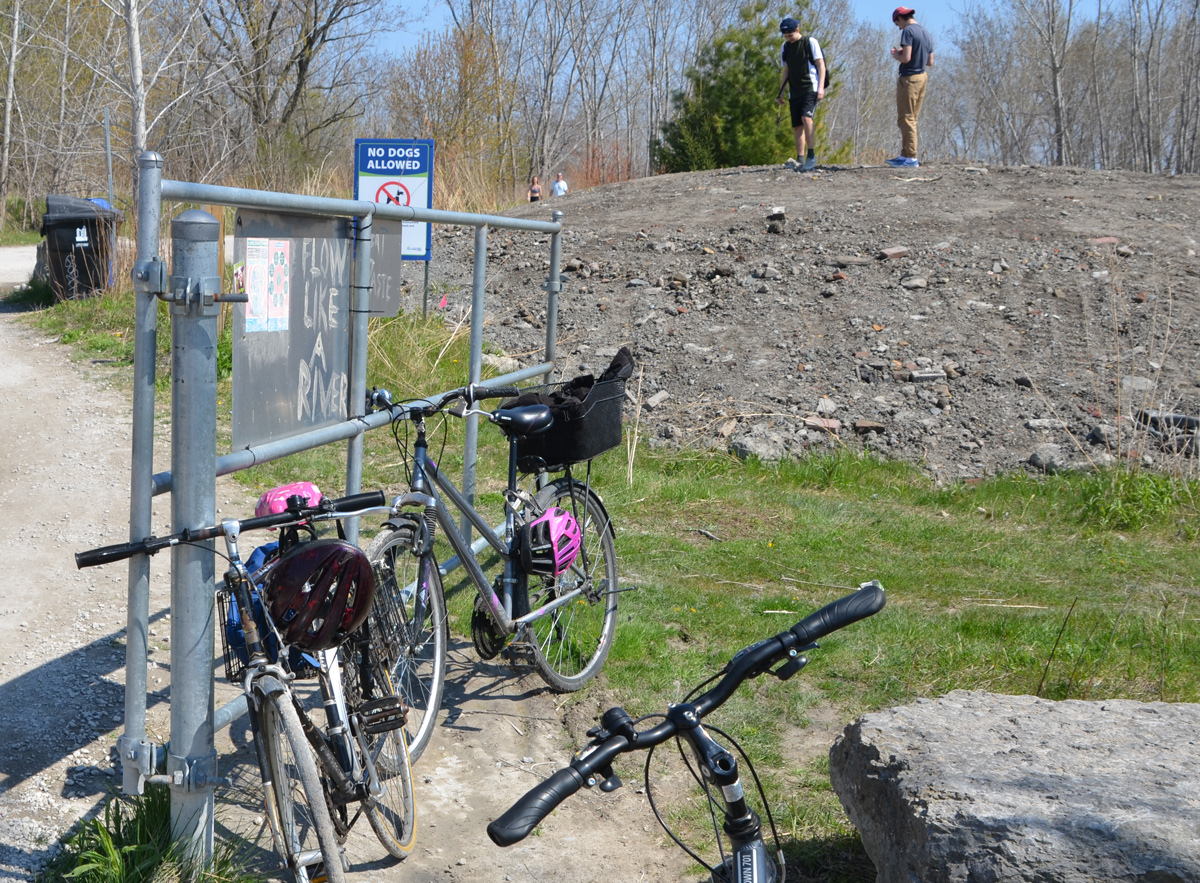
below: Flow Like a River

bikes parked against a fence with signs on it, with graffiti words that say flow like a river, in the background a mound of dirt with two young men standing on top of it.

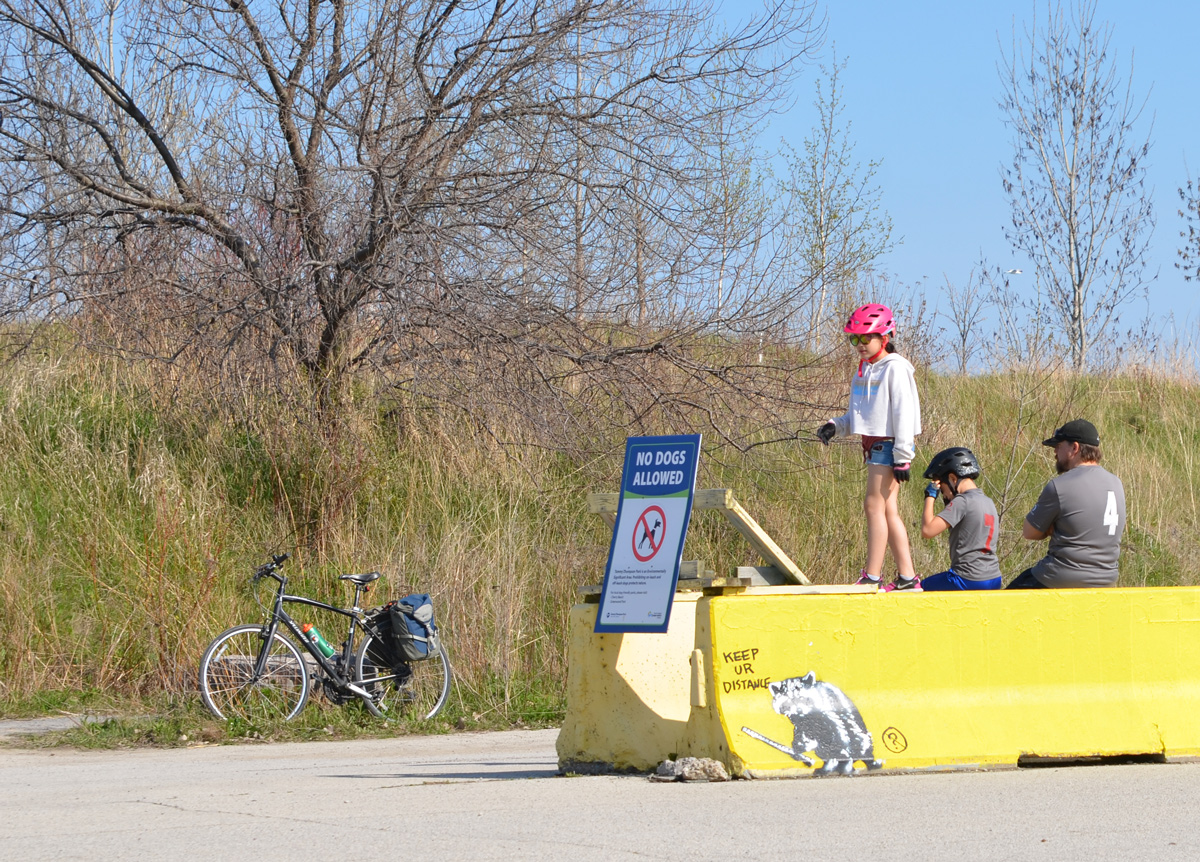
below: Keep ur distance

a girl in a red bike helmet walks on top of a yellow concrete barrier

cyclists on a bike path, seen through tree trunks and long grass

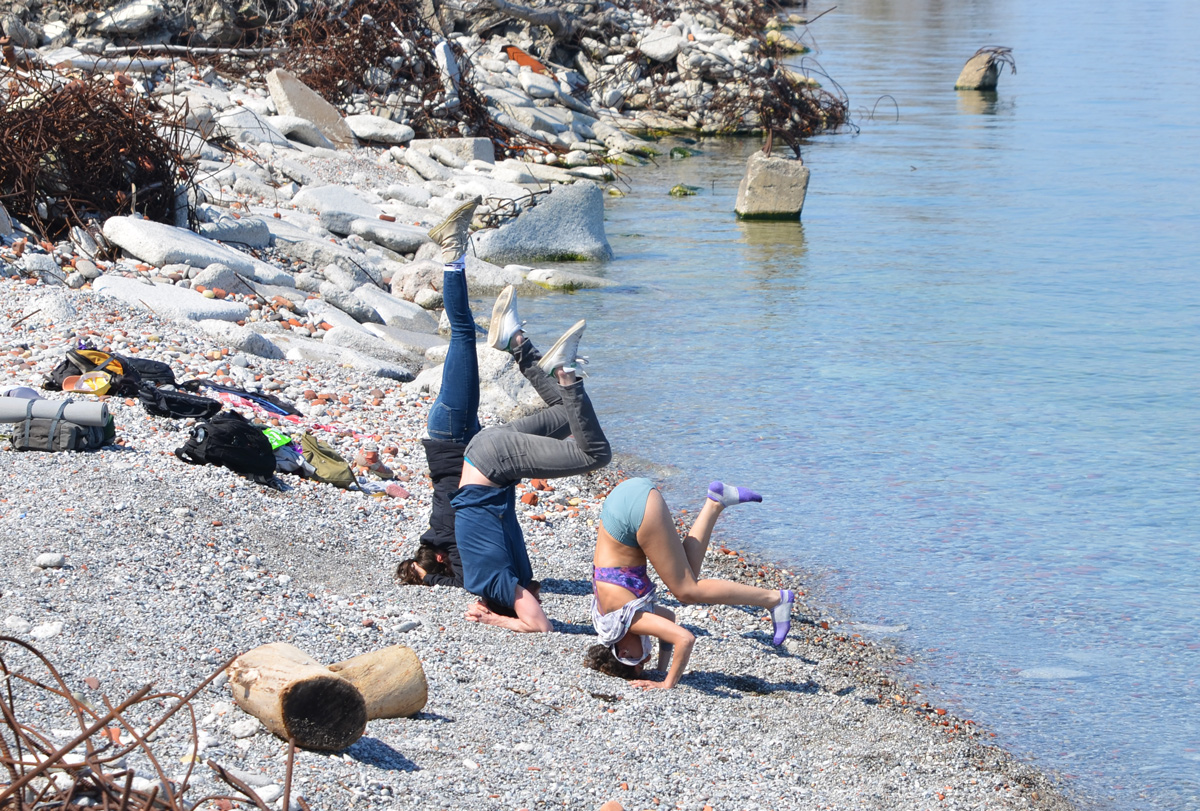
below: Three people, three positions – up tall and straight, flailing legs middle, and collapsing feet at the end.    Also notable are the mounds of tangled rebar that dot the shoreline.

three young people trying to do headstones on the pebbles at the shore beside Lake Ontario, Tommy Thompson Park, with old rusty rebar in piles on the shore two, washed up old trees and roots,

father and child standing on rocks at the shore of Lake Ontario

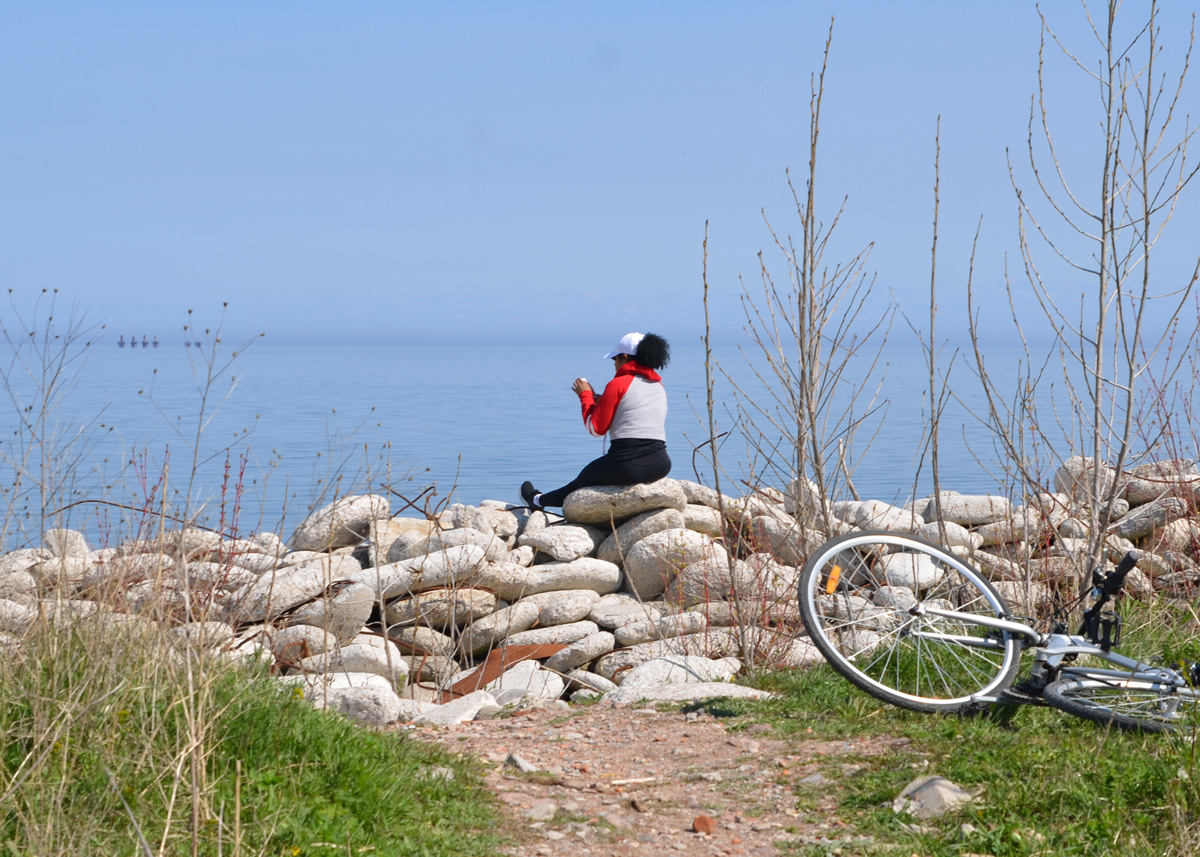
below: She’s sitting on some very rounded rocks that have been shaped by the waves and water.  Are they chunks of man-made concrete and not the more solid  rocks formed by nature?

a woman looking at her phone, sitting on rocks by Lake Ontario, her bike is on the ground behind her

The park has come a long way since construction of the Leslie Street Spit started in 1959.  In the beginning, it was to be an area for “port related activities”.   In the early 1970s, it was decided that Toronto didn’t need an expanded port.  Since 1973, the focus has been on developing the area as a park but keeping as much “wilderness” as possible.  If you are interested in the history of Tommy Thompson Park, they have an excellent website with aerial pictures that show how the park has grown.

tall smokestack in the distance, a park in the foreground, with a bike path and cyclists running through the park, early spring

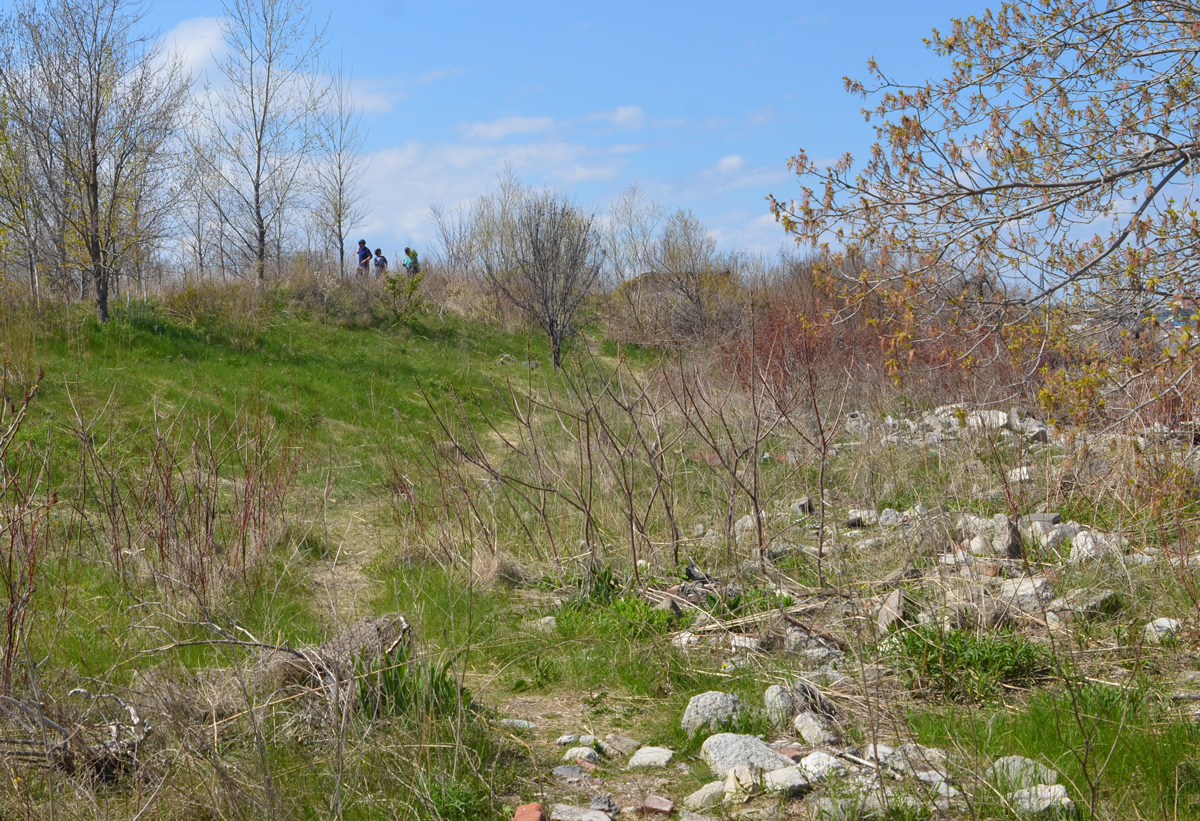
below: Nature slowly takes over, and the piles of rubble and construction waste that were used to help build the foundations of the park become grown over and buried.

grassy, rocky part of Tommy Thompson Park in spring with shrubs and trees just starting to bud

below: Late afternoon fishermen on their way in.

people walking on a trail in Tommy Thompson Park, early spring, trees just starting to form leaves

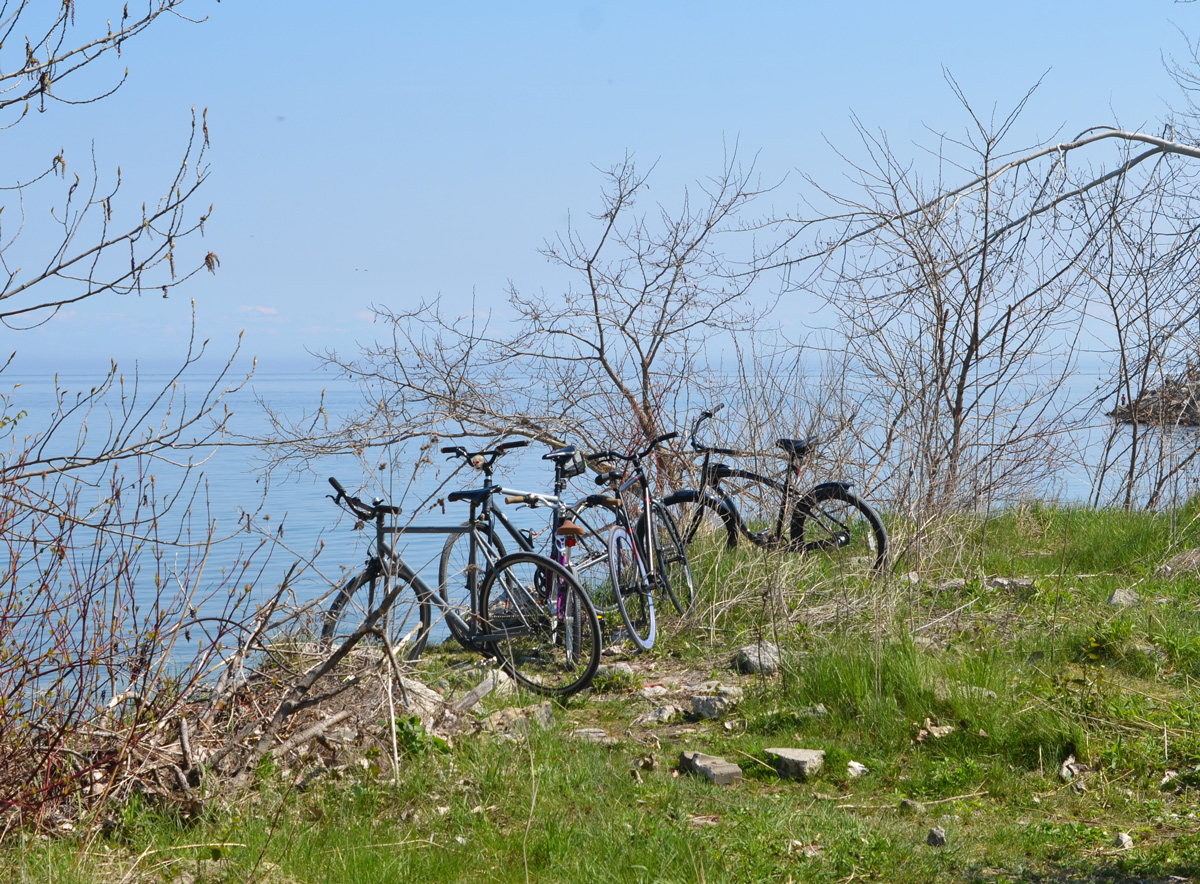
below: If you look closely, you might see that one of the bikes has a bell in the shape of a skull with red eyes.

4 bikes parked on the shore, among leafless shrubs, beside Lake Ontario

piles of rock, concrete bits, rebar, construction waste, forming parts of Tommy Thompson park

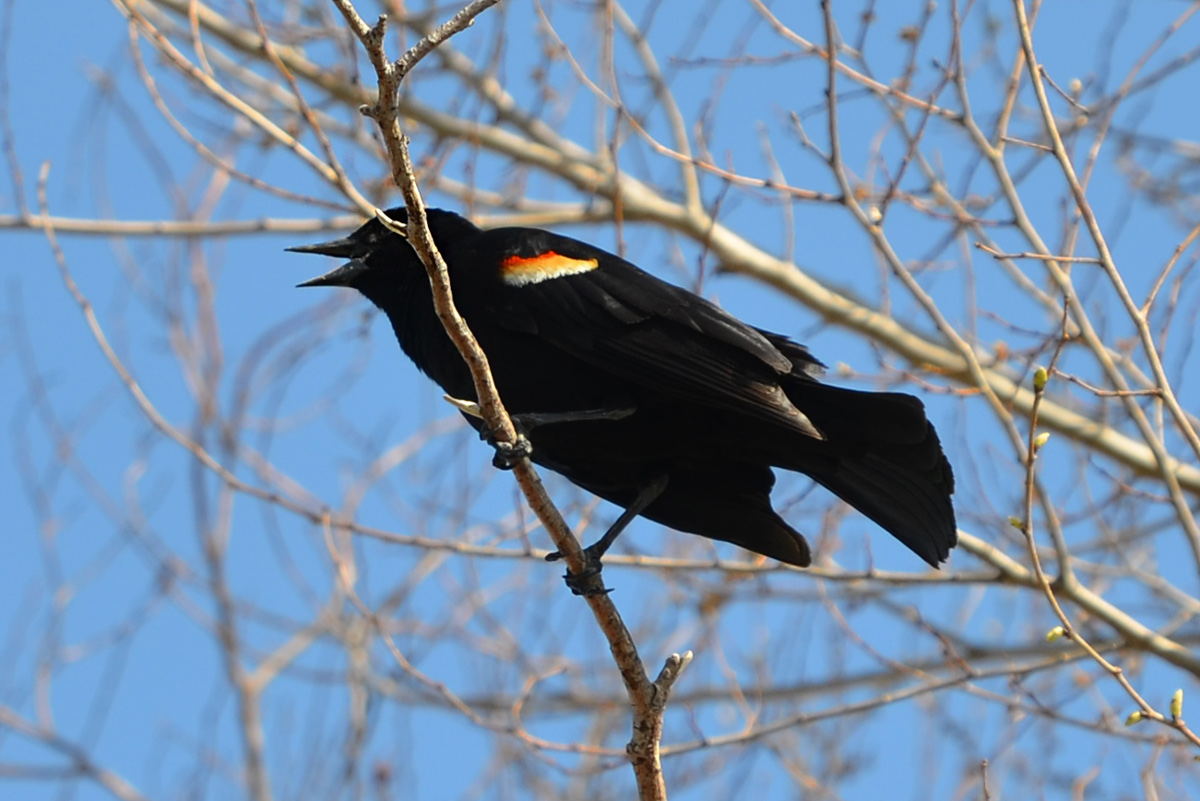
below: There were lots of noisy redwing blackbirds as well as many other kinds of birds – orioles, grosbeaks, goldfinches, robins, warblers, swallows, and sparrows.  During spring migration, up to 300 different species can be seen here.

a male redwing blackbird in a tree, making noise

long droopy buds on a tree, dark red on top and golden yellow on the lower parts, out of focus trees in the background

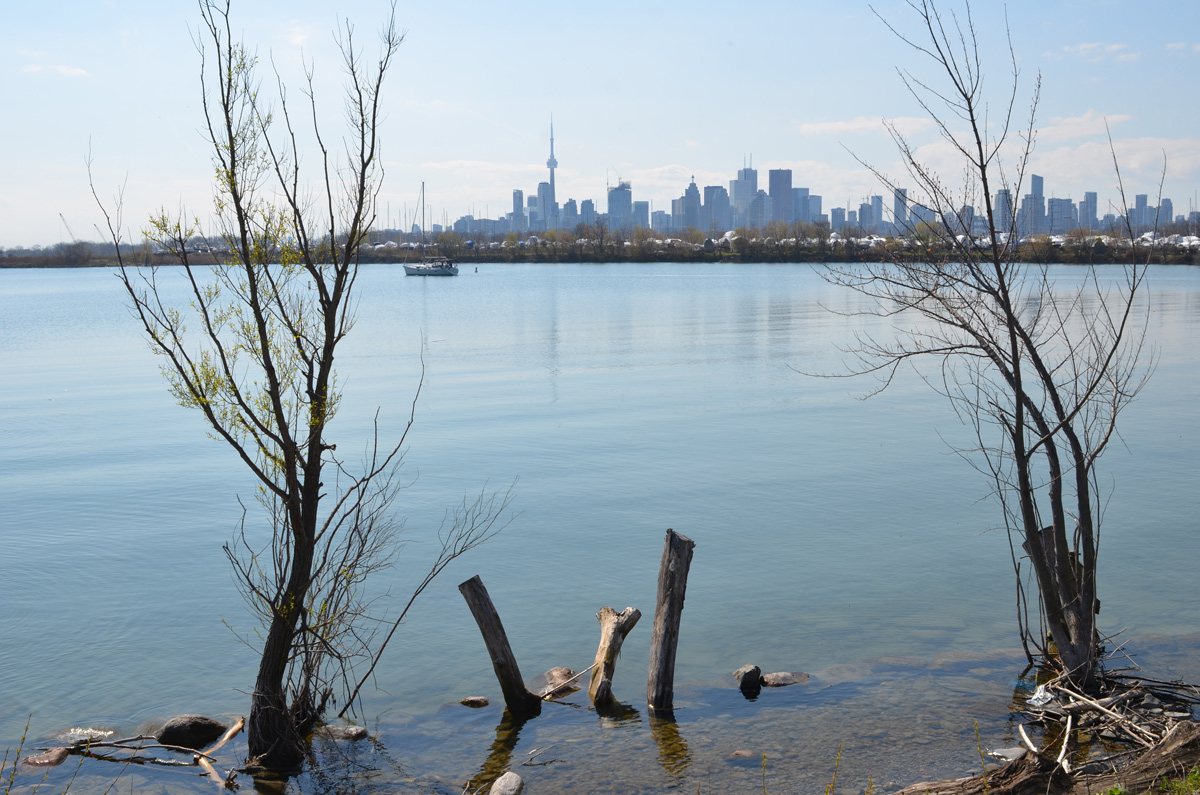
In the foregeound, trees and stumps in the water at the edge of the harbour, looking across the water to the Toronto skyline

two sailboats exit the marina harbour and pass by the Toronto skyline (seen from the east)

below: Construction on the east side of the park.  This is the Ashbridges Bay Treatment Plant Landform Project scheduled to be finished in 2025.  Three shore connected breakwaters and a headland/beach system are being constructed.

filling in part of Lake Ontario, walls of rocks with dirt between them

Scarborough Bluffs Park on sunny but windy Sunday afternoon in March.

Scarborough bluffs, cliff by Lake Ontario

The red twig dogwood is looking redder and the trees are barely starting to bud.

a couple walking together on a path at park, with tall grasses and leafless bushes beside

signs in a park, Scarborough bluffs, that say danger unstable soils and naturalized area do not disturb

2 teenagers climbing a cliff face at Scarborough bluffs

a few people standing on a path in a park with cliffs behind them

Scarborough bluffs, cliff by Lake Ontario

The water and air are still cold enough that icicles form on the overhanging branches that get hit by waves.

a woman with black hair and weraing a blue winter coat is taking picture of icicles with her phone, waves crashing against the rocks along the shore below the tree with the icicles

icicles on a branch that overhangs Lake Ontario

a woman with black hair and wearing a blue winter coat is taking picture of icicles with her phone

men in the water with wet suits on as they try to surf in Lake Ontario

a woman in a white parka is watching men surf in rough waters and high waves of Lake Ontario

two women in winter clothes sitting on a blanket on rocks by the lake, one is pointing at something

shoreline of Lake Ontario, rocks and trees, early spring, no leaves,

As August marches relentlessly along the daylight hours shrink.  One advantage of the shorter days is that sunrise isn’t at a time that starts with the number 5.   I’m not a morning person but I like to take morning pictures.

below: Pinkish sky as the sun rises.

sunrise over Lake Ontario, pinkish sky, water with some reflections, loght cloud cover,

below: There was an enormous flock of birds flying low over the water together.  Can you see the swimmer?

a verylarge flock of birds flies low over the water, over Lake Ontario, early morning. To the right, the birds are beginning to fly a little higher, clouds, morning sun trying to break through.

below: Ready for the day

two muskoka chairs, a red muskoka chair and a pink muskoka chair on the beach near the shore of Lake Ontario, Kew beach, sunrise with a few clouds in the sky

below: Reading on the beach…  just after 7 a.m.

a person in a black hoodie is sitting on a blue Muskoka chair, reading a book on the beach

below: A group of women on their paddle boards (not quite so early.  I had breakfast part way through my walk that morning).

a group of five women each on their own paddleboard, very calm water of Lake Ontario just off the shore, two re standing, two are sitting on the boards, and one is kneeling,

a lone small tree with no leaves on the shore, sand, large rocks to prevent erosion, beyond the tree is Lake Ontario with some sailboats on it

below: Mother and son.

a mother in wide brimmed hat and her son in a red hat sit by the shore, sand, water, sky,

below: At 11:15 the life guards row to their stations.

two men sit on rocks on the shore of Lake Ontario watching 3 life guard rowboats passing by

a couple on the beach playing with a volleyball

below: Kew Williams house, now on the grounds of Kew Gardens.  Kew Williams (1873-1956 ) built the house in 1902 on the grounds of what was then The Canadian Kew Gardens, a campground resort opened in 1879 by his parents, Joseph & Jane (nee Henry) Williams.   Joseph Williams sold the house and 20 acre property to the City of Toronto in 1907.   A year later the property became Kew Gardens.

Kew Williams house in Toronto, with small turret, and porch, gardens in front with lots of flowers

The gardens are very well maintained.  They are in full bloom at the moment and looking gorgeous.  I will leave you with a few pictures of flowers, colourful ones to brighten your day.

below: A stalk of lobelia cardinalis grows among the black eyed susans.

black eye susan flowers with their bright yellow petals and black centers. Growing amongst them is a stalk of bright red lobelius cardinalis.

below: A monarch butterfly finds a bright red flower.

a bright red flower with a monarch butterfly on it

below: A pink zinnia

a pink zinnia

below: Gaillardia pulchella, also known as firewheel or Indian blanket

bright red and yellow flowers

below: Three white daisies growing with smaller orange flowers

three white daisies among small orange flowers and lots of leaves

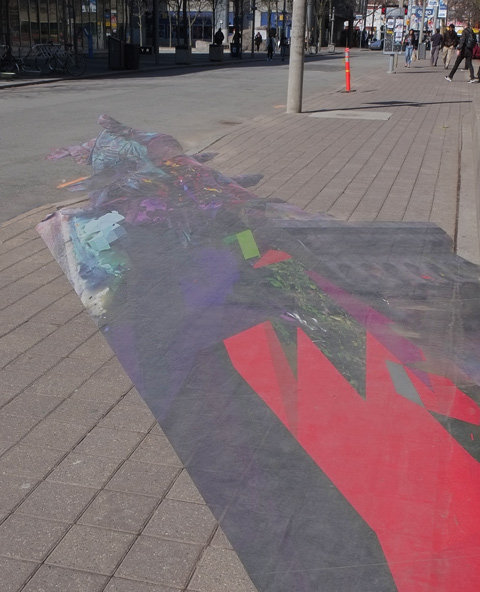
May is CONTACT Photography month in Toronto and like in previous years, some galleries start the month early.  One of these galleries is the Ryerson Image Centre.  This year, in the main gallery they are featuring the work of Shelley Niro, the 2017 winner of the Scotiabank Photography Award.  You may have seen some of her work at the AGO where her shirts series of photos is also on display.   Outside the building, in Devonian Square, there are large colourful abstract images glued onto large rocks.  These are the work of Scott Benesiinaabandan, a Montreal-based artist from the Obishikokaang Anishinabe First Nation.

below: First, the poster/sign at the entrance to the Ryerson Image Centre.  The four images on the left are from Niro’s shirt series of pictures – the full series is shown inside the gallery.  There is also a video from 2003 that features this woman and the T-shirts standing in this location.

4 photos by Shelley Niro, of indigenous woman wearing a white t shirt with words on them, plus aboriginal/original pictures of the artist.

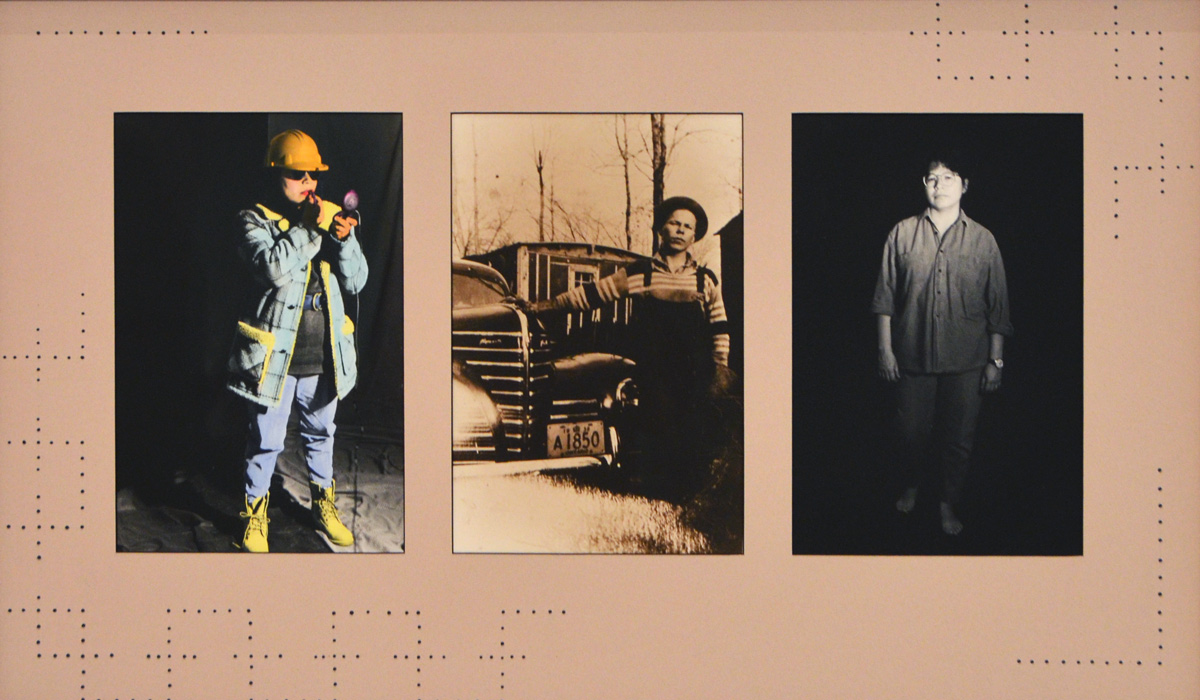
below: A series of three photos framed together titled ‘Mohawk Worker’.  It is one of a series of six triples called ‘This Land is Mime Land’ (Apparently there are 12 in the series, but only 6 are on display here).  Each set in the series has an old sepia toned black and white photo in the center, a casual posed photo on the right (of the same woman in each), and a posed, hand coloured ‘parody’ photo on the left.  In this case, she is dressed in working clothes and a hard hat, but she’s applying lipstick and has a small compact mirror in her left hand.   Other works in this series include,  ‘Love Me Tender’ with the woman dressed as Elvis, and ‘Final Frontier’ with the woman dressed in a Star Trek outfit.

three pictures frames together, on the left is a woman in workmen's clothes and hard hat but putting on lipstick, in the middle is a vintage black and white photo

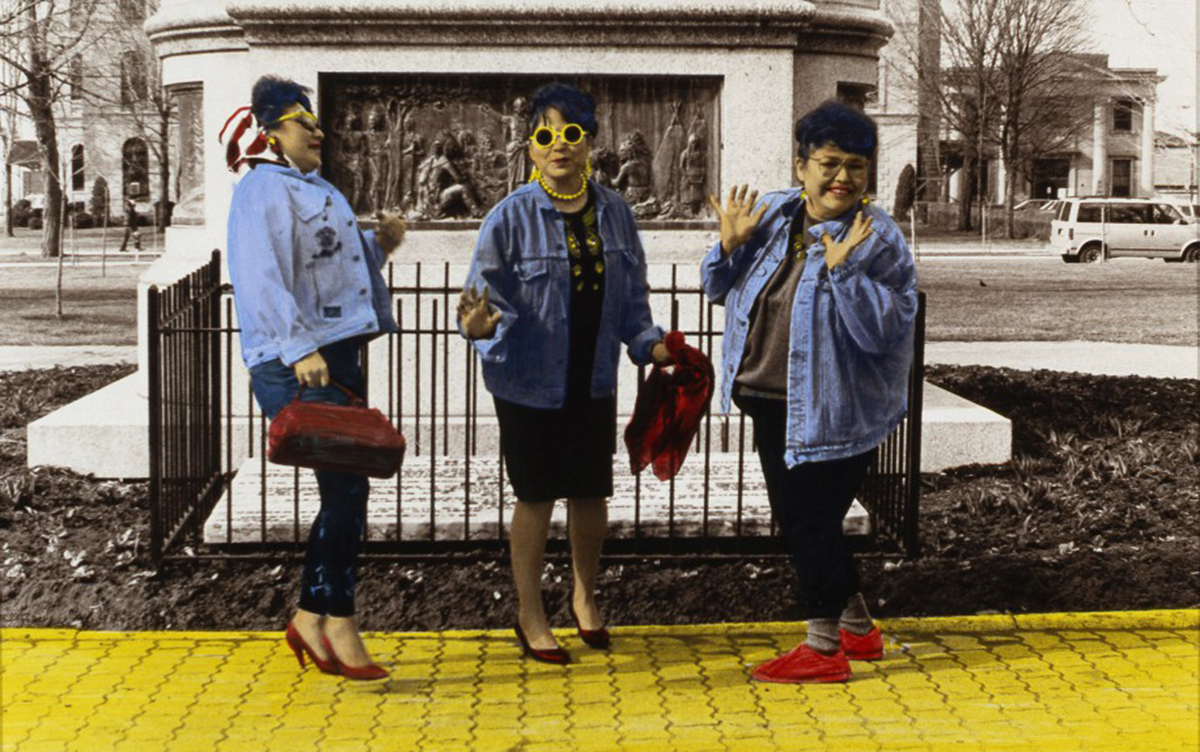
below: One of another set of pictures.  Hand painted black and white photos of these women posing (hamming it up) for the camera.  They are on the yellow brick road, and like Dorothy on her way to see the Wizard, they are wearing red shoes.  “Red Heels Hord” 1991.   It, like a lot of her work, challenges the stereotypes and cliches of Native American women.

a colourized black and white photo of three women hamming it up for the camera. All wearing red shoes and walking on a yellow sidewalk, beside a metal fence. by Shelley Niro

Shelley Niro was born in 1954 in Niagara Falls NY and grew up on the Six Nations of the Grand River Reserve near Brantford.  She graduated from OCA and a masters in Fine Art from the University of Western Ontario.

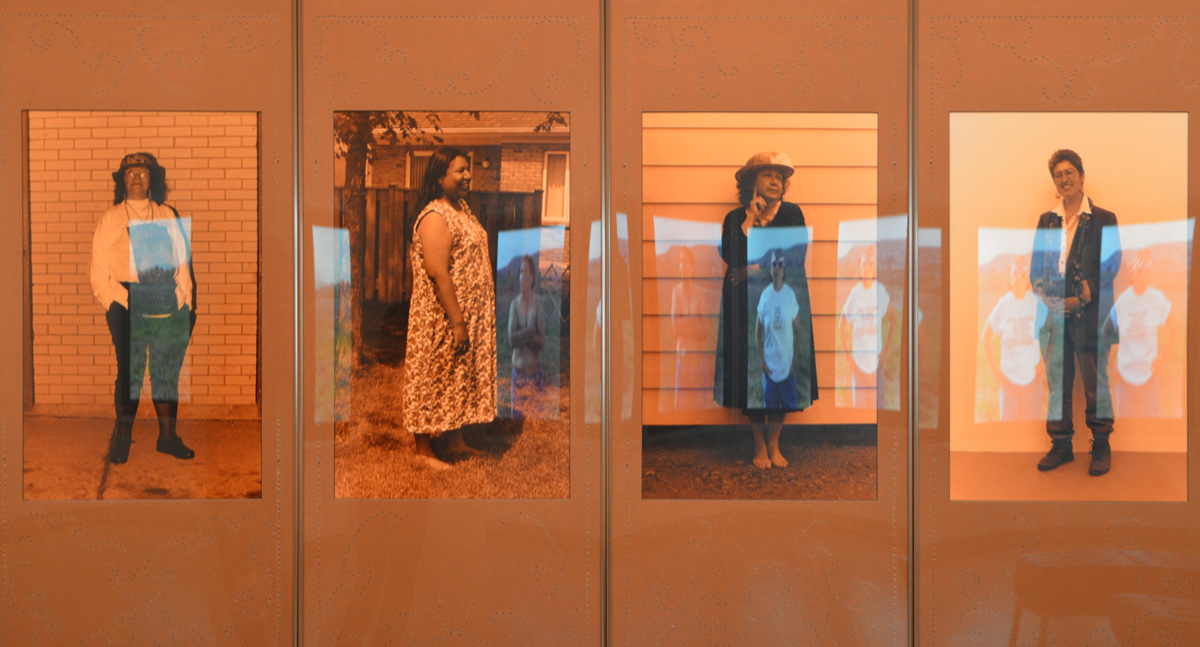
below: Four photos from “Are You My Sister?” 1994.   This is only part (4/12) of the series.  The glass was very reflective so you can see the shirt series that was on the opposite wall.  Like most of her work, the matte has been hand decorated.  In this case, patterns are made with performations in the matte.

four pictures of women, standing, matted in orange, orange tone to the photos, relfections of other photos in the glass, art by Shelley Niro

Scott Benesiinaabandan’s installation, ‘newlandia: debaabaminaagwad’  is in two parts.  First, on the sidewalk in front of the statue of Egerton Ryerson, the man who founded the University, is an image that has been glued to the ground.   Parts of that statue have been used in the making of the image – it’s not too easy to see in this photo, but the top part of the image is the same shape as the top of the statue of Ryerson.  Maybe you can see the purple draped head and the outstretched arm.  It’s like the statue has been draped with cloth and/or pictures.  In fact, the images used to create this were taken from photographs that Benesiinaabandan took of three First Nations flags.

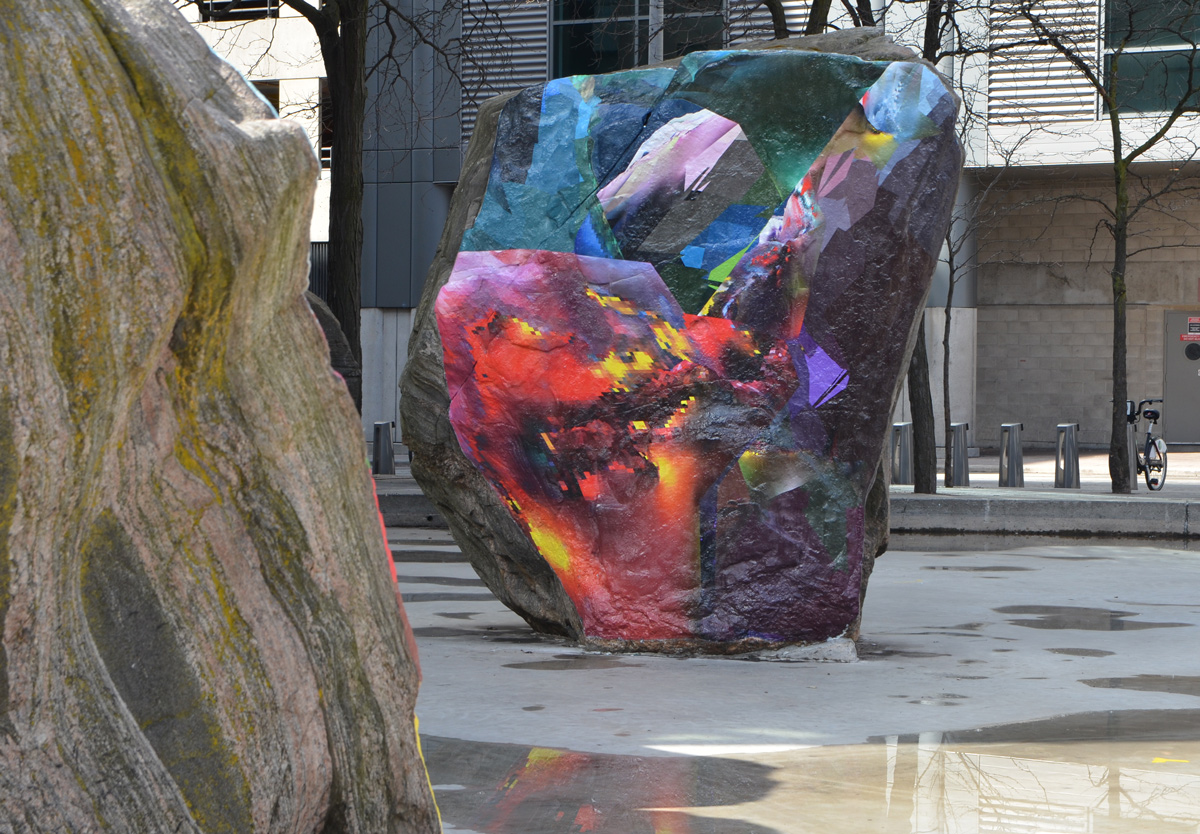
below: The other part of ‘newlandia: debaabaminaagwad’ consists of large images adhere to rocks in the square, taking on the texture of the rocks.

Devonian Square in Toronto, large open area with wading pool (empty at the moment) and large boulders, small trees growing around the edge of the pool, two people walking through the pool area, a woman walking her dog on the sidewalk beside, rocks covered with artwork

rock covered with a digital image, glued on it, outside, trees around

Both of these artist have their own websites:
1.  Scott Benesiinaabandan
2.  Shelley Niro

buildings with lots of glass, on stilts, built over the water at Ontario Place

After parts were shuttered 40 years ago, Ontario Place has re-opened to the public.  The spherical Cinesphere and the buildings that are over the water are not open but the grounds are.

below: Canadian and Ontario flags fly along the docks of the Ontario Place Marina.

flags line the walkway leading from the dome shaped cinesphere at Ontario Place,

below: Double trouble.   Hot x 2

close up photo of a small part of the side of the cinesphere building, showing the metal bars that form the exoskeleton structure of the spherical building

below: Those are some very big boats!

four or five very large yachts are moored in the harbour along Toronto's waterfront, highrises in the background

There is also a new park, Trillium Park, that has been built on the eastern end of Ontario Place.  It is 7.5 acres of green space with a 1.3 km trail (the William G. Davis trail) winding through it.

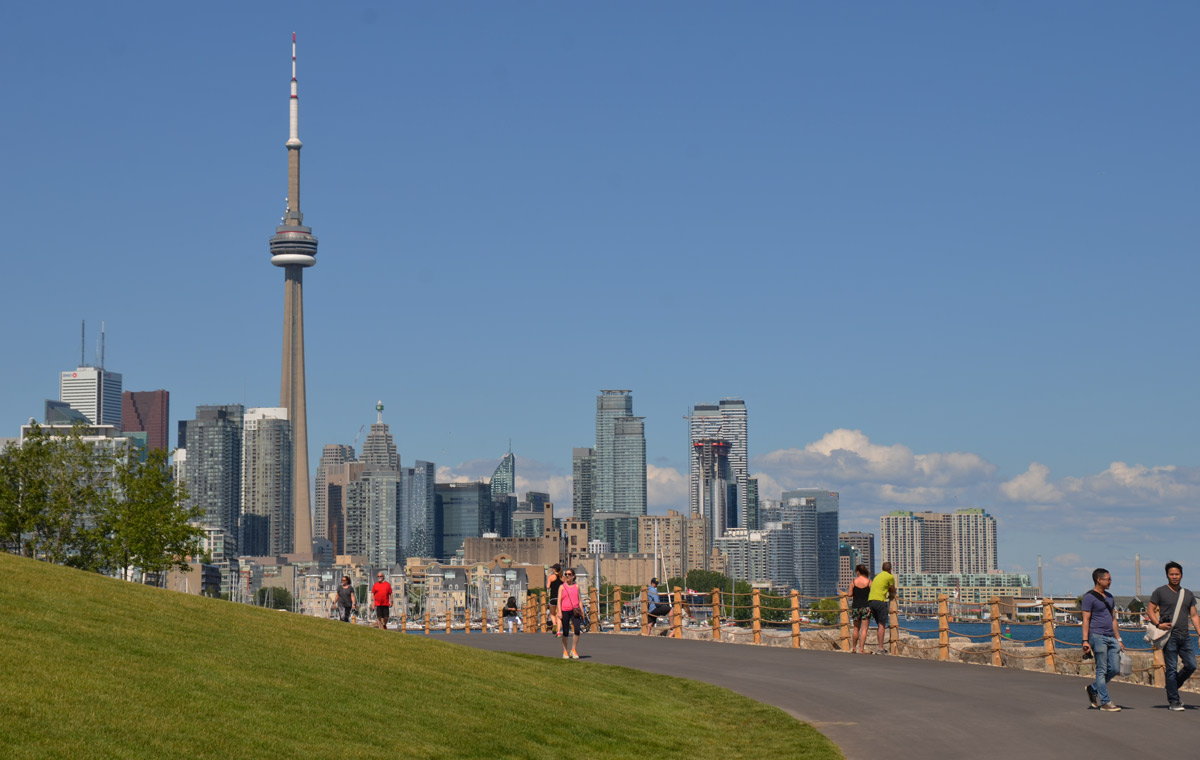
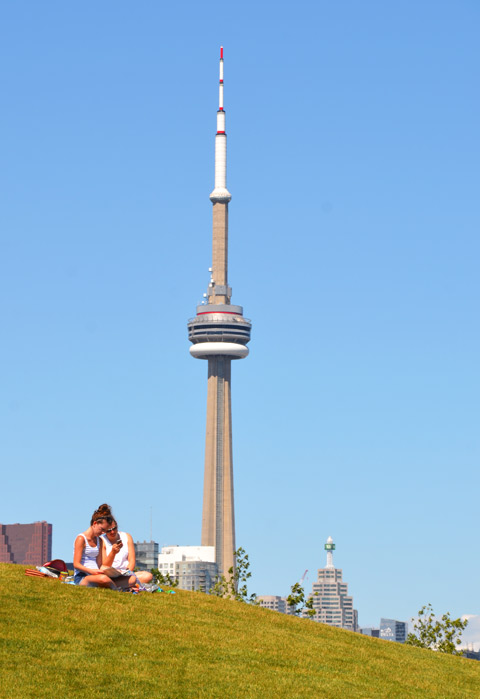
below: Trillium Park provides new angles from which to view the CN Tower and the Toronto skyline.


couple, man and woman, sitting together, on a grassy hill. The CN Tower is behind them.

below: It is also a spot from which to watch airplanes as they take off from Billy Bishop Airport.

a man in a red baseball cap sits on a rock, his bike parked beside, while watching a pOrter airlines plane take off from Billy Bishop Airport

below: Sunbathers

two people lying on a blanket on a grassy area in a park, trees in the background

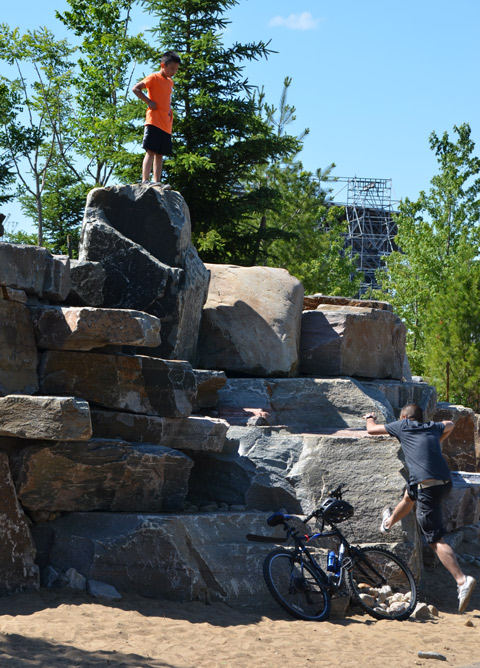
below: Rock climbing

a boy stands on top of a pile of rocks, his father is beginning to climb up the rocks to reach him

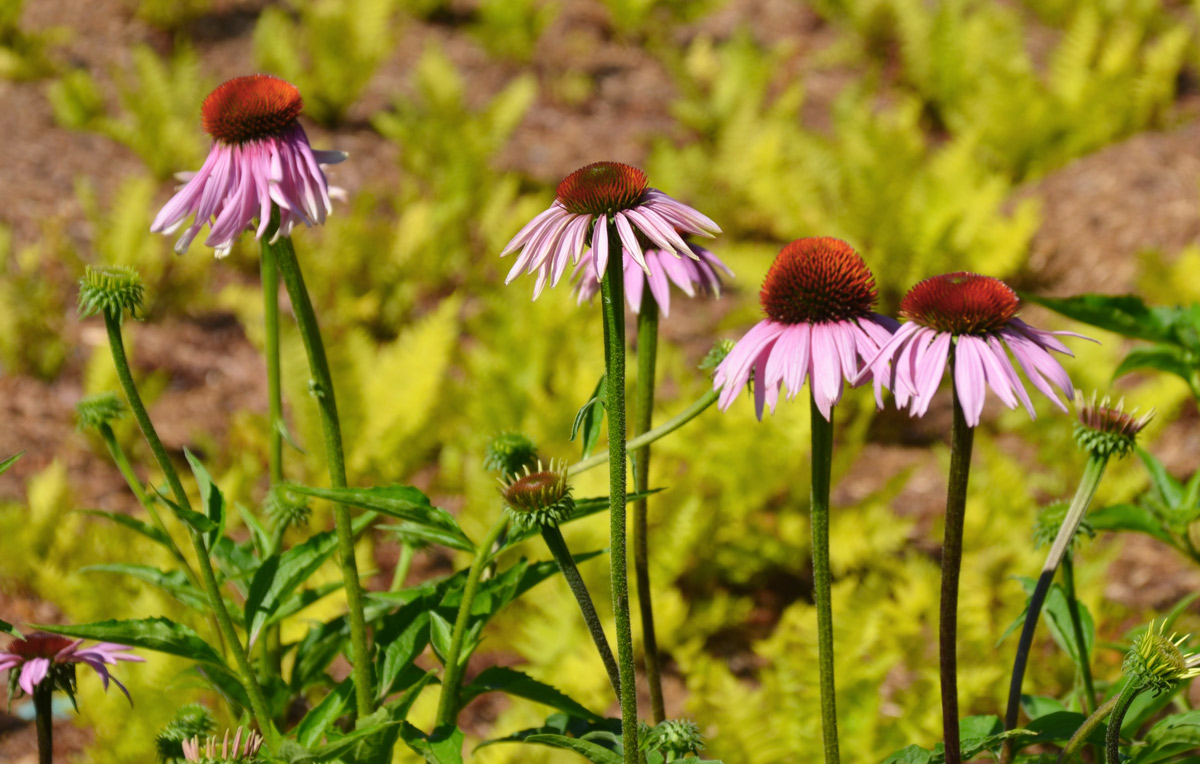
purple cone head flowers

a woman sits on a rock wall, looking out over Lake ontario, there are boats on the water and a sea gull flying past

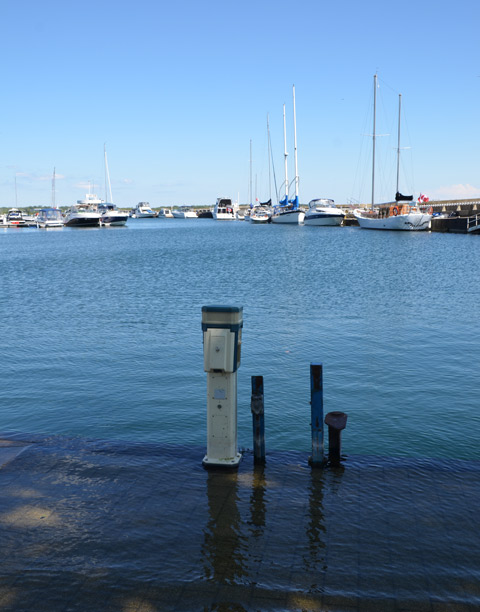
below: Water levels in Brigantine Cove, like all of Lake Ontario, are higher than usual.

an electrical plug in station stands in the water by a flooded dock at Brigantine Cove, Ontario Place, with sailboats in the background.

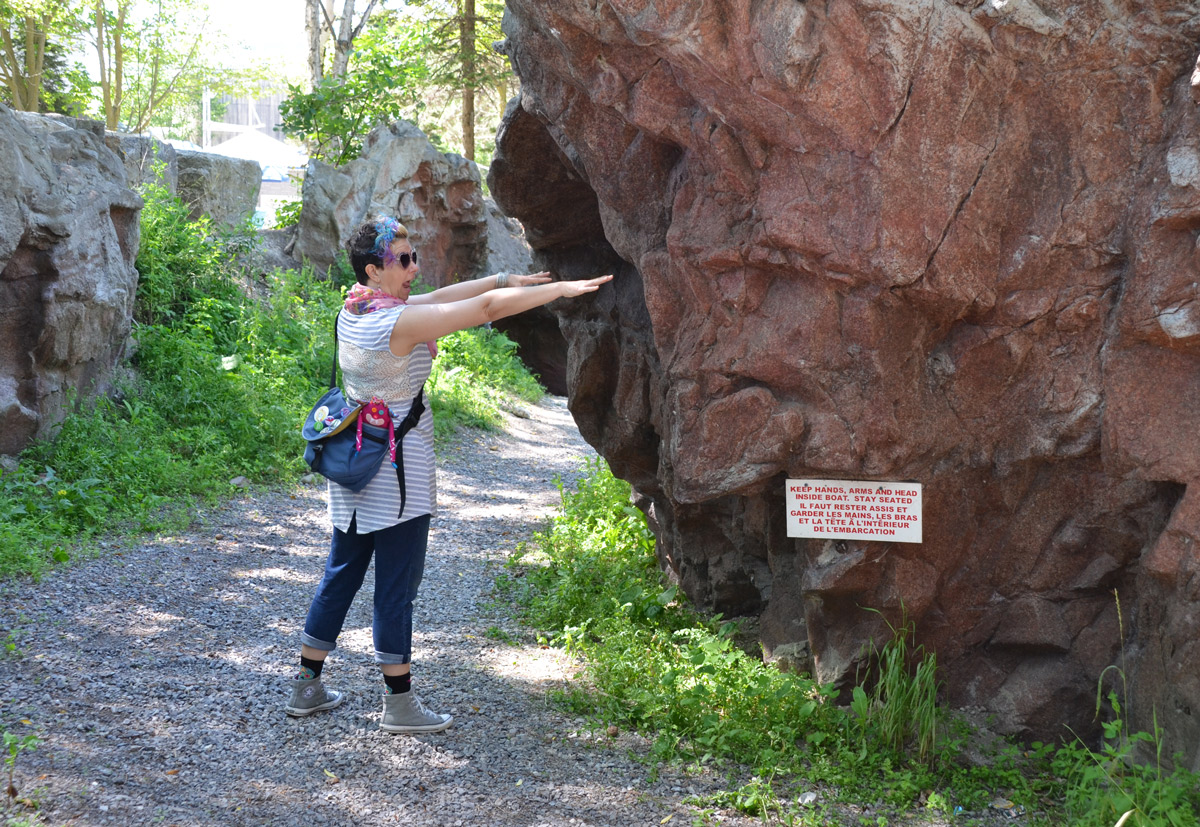
below: There are still some traces of the amusement park rides that were once there. There is no water in the boat ride, but the bilingual warning signs are still on the rocks. “Keep hands, arms and head inside boat. Stay seated.”

a woman standing between two rocks pretends to be riding in a boat as she points to a sign that says

below: Tbonez (urban ninja squadron) must have been to Ontario Place recently

a urban ninja squadron sticker on the side of a metal staircase that was painted brown but the paint is peeling off

below: Crochet street art, marine life, discovered clinging to the underside of a small wooden bridge.
This picture is upside down.

crocheted sea creatures clinging to the underside of a wood bridge

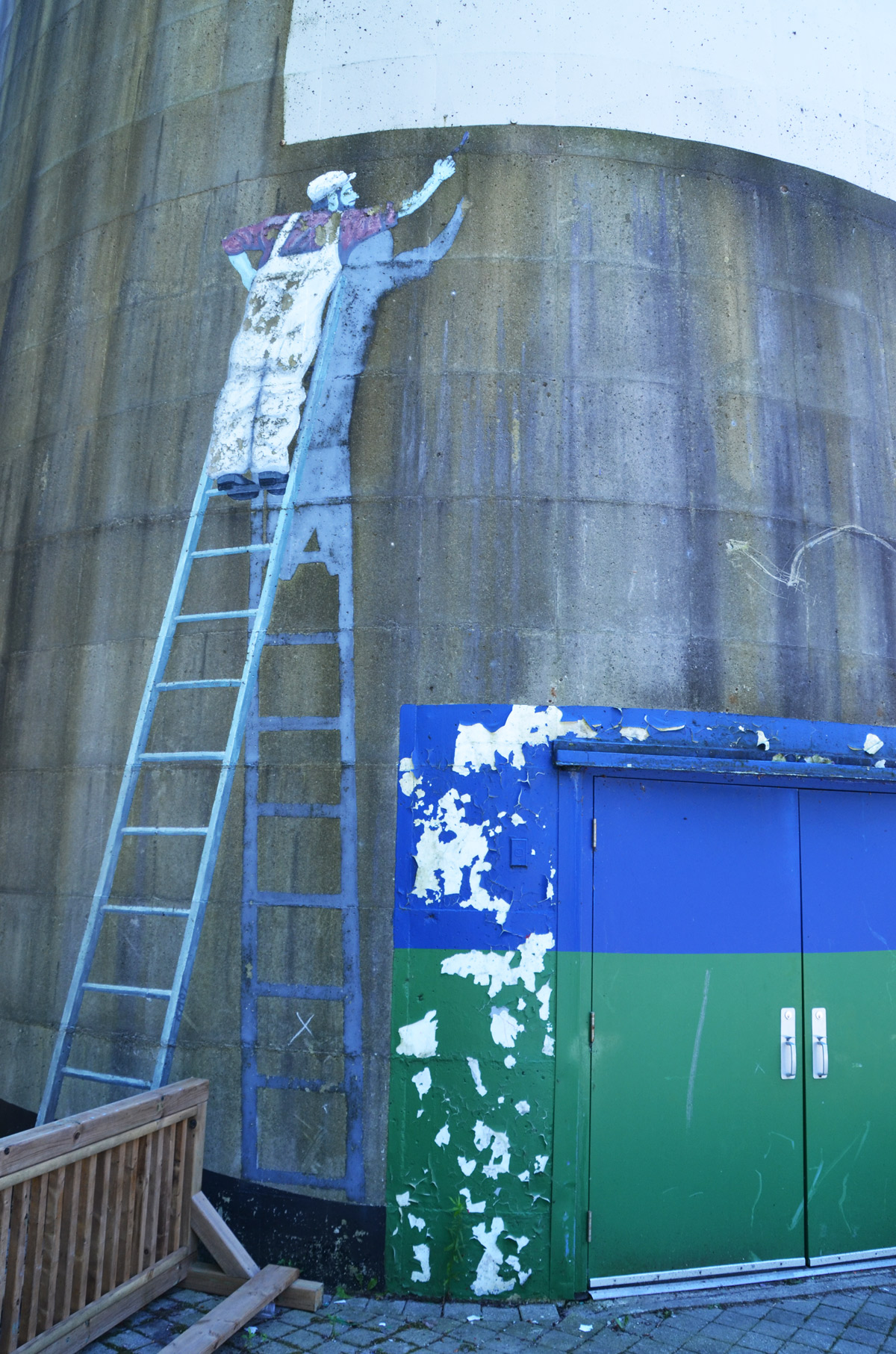
below: A painting of a man painting and of his shadow painting.

painting on a cylindrical building, of a man on a ladder, painting, also his shadow

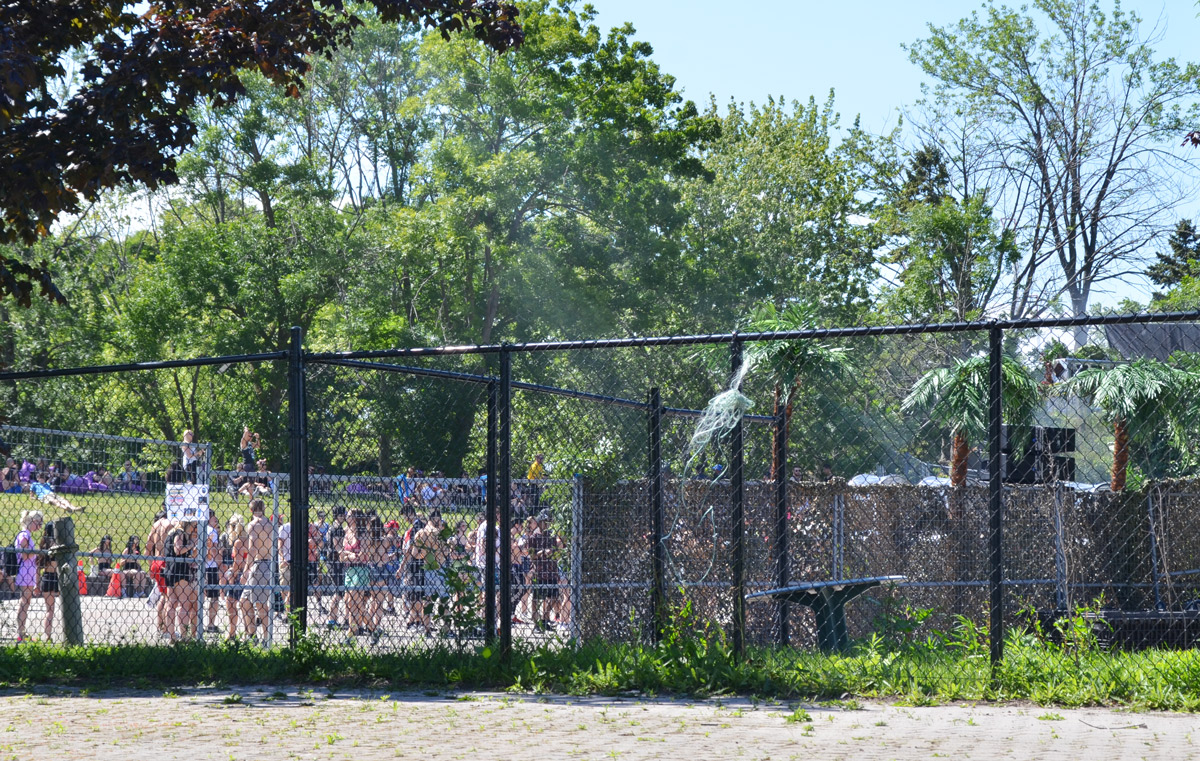
below: And last, music events are held at Echo Beach, a section of Ontario Place.  The day that I was there a steady background noise from the electronic (techno?  I’m out of date on newer music genres) music permeated the park.  You couldn’t escape it.   This isn’t the best picture but I didn’t get very close – my poor head!  I was interested in the palm trees but I couldn’t get the right angle.   There are other music events happening this summer so maybe you can time your visit to coincide with music that you like!


Identity.  What springs to mind when you hear the word identity?  And how does that relate to art?

Let’s now take those general questions and narrow it down to the work of three artists, or photographers to be more precise: Suzy Lake, Lori Blondeau, and Shelley Niro.  I haven’t chosen those women randomly; I’m writing about them because their work is on view if you go to the Ryerson Image Centre.  Suzy Lake’s photos are on display in the main gallery inside while Lori Blondeau and Shelley Niro’s are showing outside.  The latter two were installed as part of the CONTACT Photography Festival.

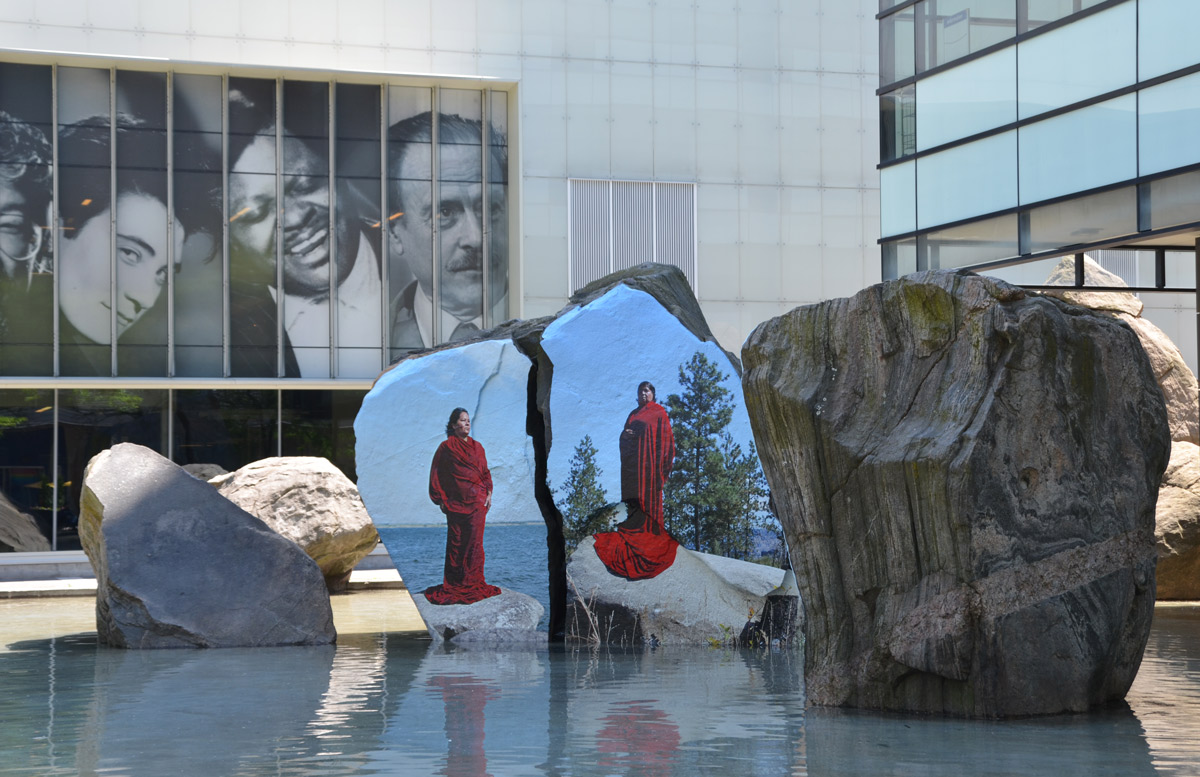
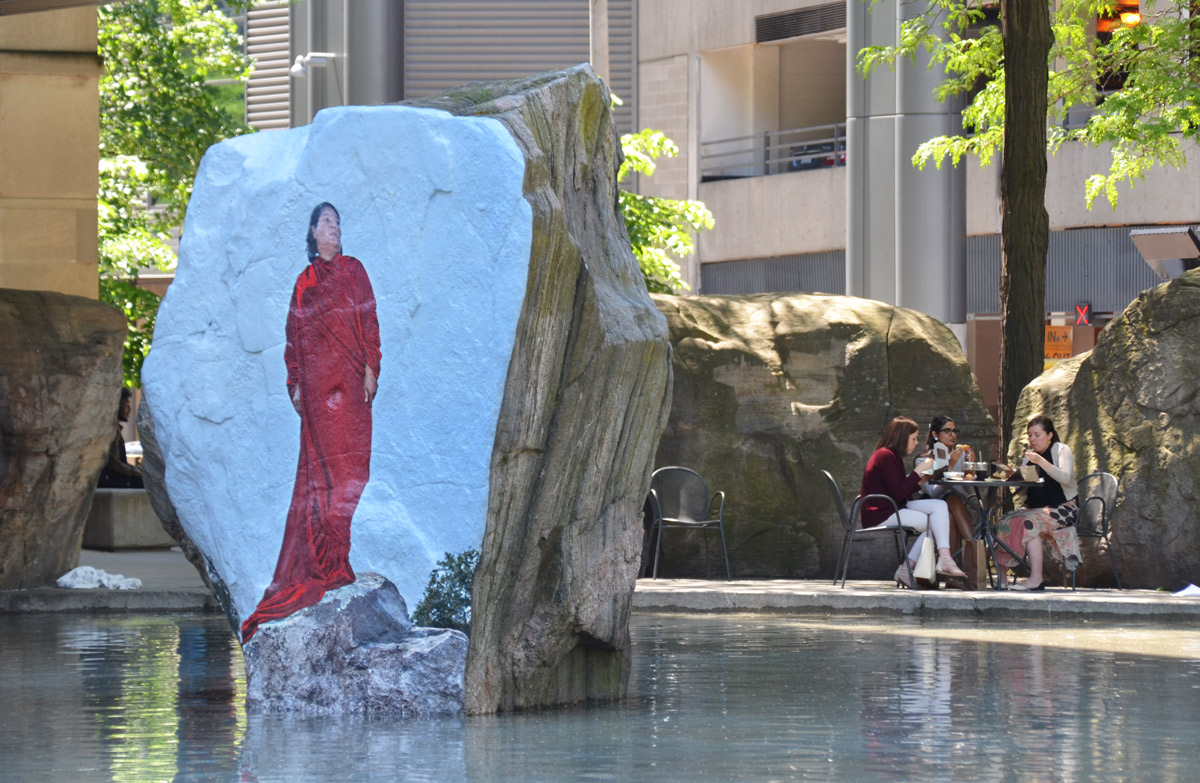
below:  Three large images of the Lori Blondeau draped in red while standing on a rock adorn three of the large boulders in Devonian Square.   They are part of her “Asiniy Iskwew” work.  The title is Cree and translates to “Rock Woman”.    In this work, the rocks on which she stands refer back to Mistaseni which was a large sacred boulder that once marked a gathering place.   The Saskatchewan government dynamited it in the 1960’s to make room for a man made lake.

photograph or painting of a woman in red standing on a rock, directly onto the surface of a large rock in a shallow pool of water outside Ryerson Image Center, three large black and white photographs of people's heads are above and behind the artwork

The words on the wall say that Blondeau questions (“interrogates”) how the definitions of Indigenous identity are influenced by popular media and culture, not just in this exhibit but in the rest of her art as well.   Her point here is that pictures of strong woman run counter to how popular culture portrays Indigenous women.

photograph or painting of a woman in red standing on a rock, directly onto the surface of a large rock in a shallow pool of water

My questions – What and/or who shapes your identity?  That question can mean “Your” as in you the individual and it can mean “Your” as in some collective group that you belong to.     How does identity evolve?  Can it be changed?

How does history affect your identity?  As one who has done a lot of genealogy research I understand the importance of history to some people.  I have traced my Canadian ancestors – I know where they’re buried and I know where they lived.   For me that is a comfort.  But I also know that if you want to kill a conversation just bring up the subject of genealogy.  Not everyone is interested.

Back to photography and history –

A second indigenous woman artist is Shelley Niro whose work is titled “Battlefield of my Ancestors”.  It consists of 6 photographs that were taken in upstate New York and in southwestern Ontario.  The pictures are in the garden with the statue of Egerton Ryerson (1803 – 1880), the man who Ryerson University is named after.   He was many things including a Methodist minister, a founder of Victoria College (part of the University of Toronto), a Chief Superintendent of Education for Upper Canada, and the person who wrote a report/study on Native education (1847) that became the model for the residential schools thirty years later.

below: Ryerson standing in the greenery with a picture on either side of him.  On the left is a picture of a plaque in New York state that says: “Site of Indian village Gar-Non-De-Yo destroyed during Sullivan campaign Sept 21, 1779”.  On the right is a black and white picture of the Mohawk River in New York state.

statue of Egerton Ryerson in a small garden with shrubs and small trees. Two large photographs also in the picture, one on each side of the statue

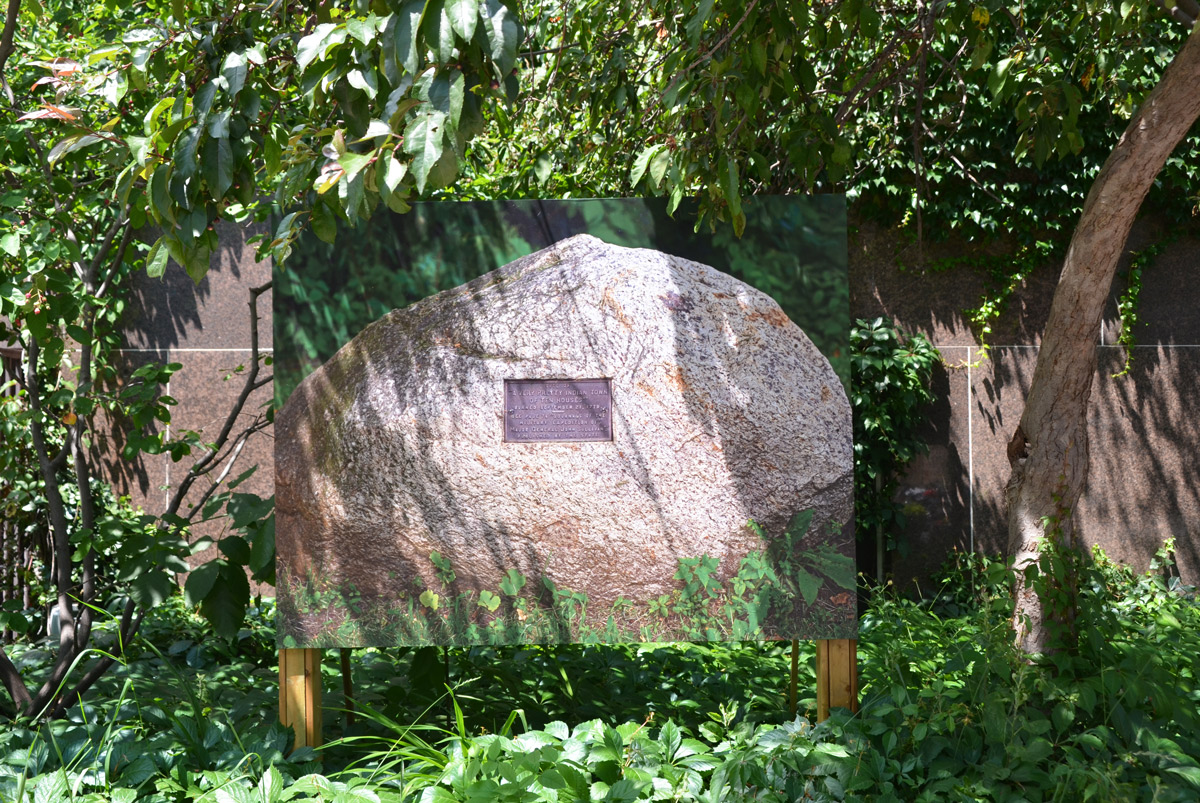
below:  Photo taken of a rock at Cayuga Lake.

photo of a small plaque on a rock exhibited amongst shrubs and greenery outside

The plaque says:
Site of “A very pretty Indian town of ten houses” burned September 21, 1779. See page 76 “Journals of the military expedition of Major General John Sullivan” published by the state

Back a few lines I called Niro an “indigenous woman artist”.   I don’t know if she’d be comfortable with that.  Maybe yes, maybe no.   I used those words because they help to understand her work in the context of this blog.   Should I then use the description “white woman artist” to talk about the third person, Suzy Lake?

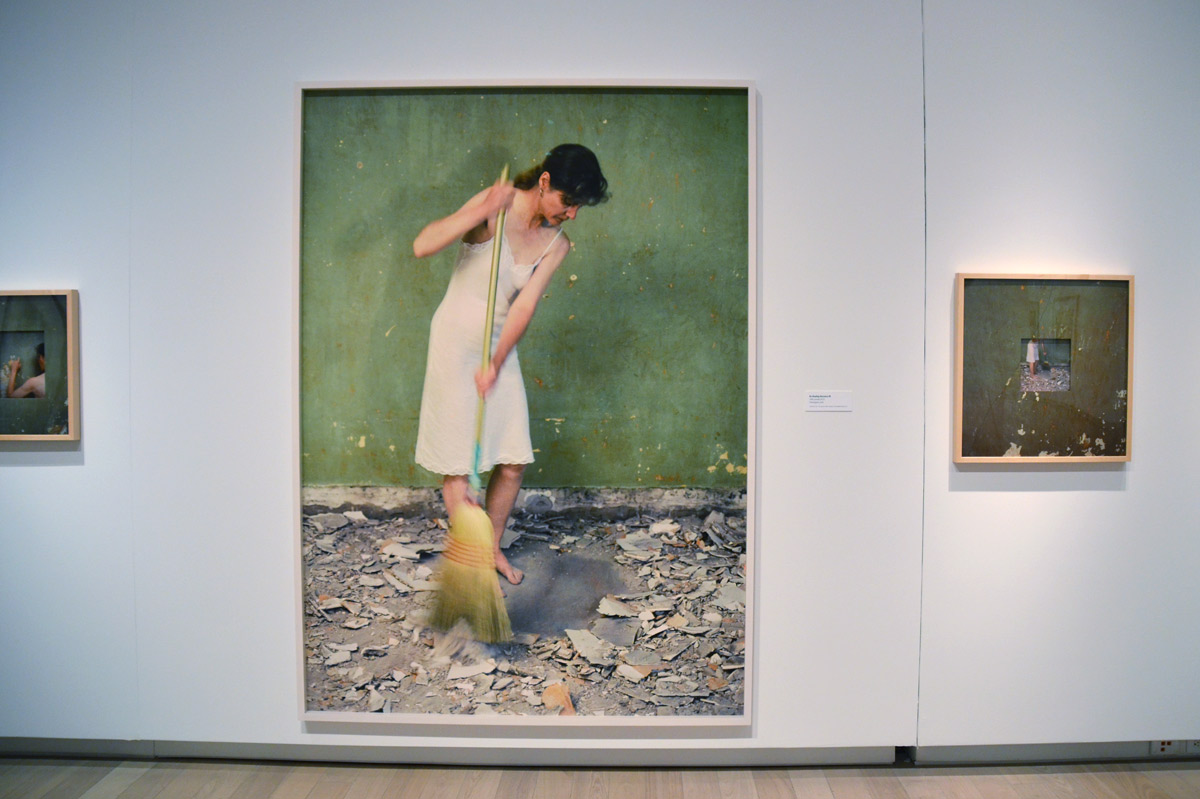
Lake’s photography career began in the 1970’s and for the first two decades was primarily concerned with female identity.  In almost all her photos, she is the subject.  The 1970’s were the days of  Women’s Lib and the rise of “Feminism” – the quest for political reforms on issues such as reproductive rights, domestic violence, maternity leave, and equal pay.  It was also a time of increased questioning of cultural norms with regard to women’s roles.  In many ways it resembled the increase of awareness of indigenous identity, rights, and problems that we see today.
large black and white photograph in a gallery, two men on top of a large frame are controlling the movements of a human puppet

 large photo in a gallery of a women dressed just in a long slip, sweeping up debris from the floor. Debris is bits and chunks of plaster that have been removed from the wall

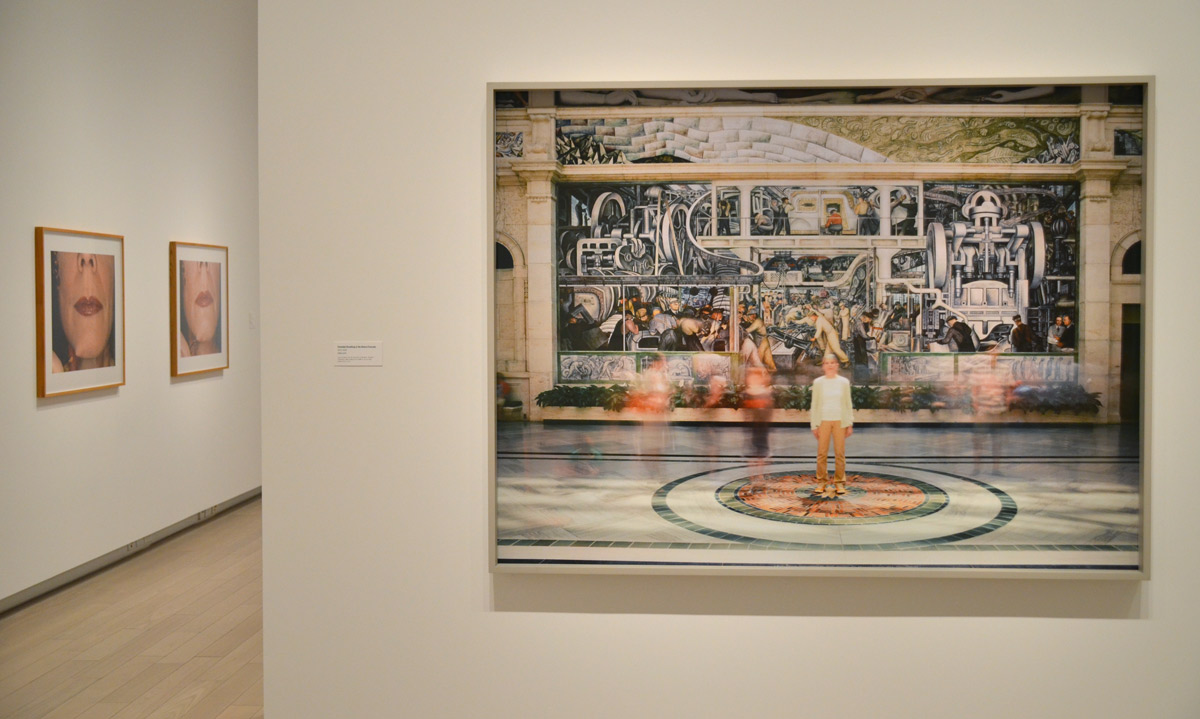
below: Her most recent work involves pictures of her standing in an environment of some sort.  The photo is a one hour exposure and the end result is an image where only she and inanimate objects are present and in focus.  Here is “Extended Breathing in the Rivera Frescos” 2013-2014.   The painting behind her is one in a series by Mexican artist Diego Rivera at the Detroit Institute of the Arts.
three suzy lake photos, one of her in front of a mural and two are close ups of her face

colour photo of close up of a woman's face, just mouth, bottom part of nose and some cheek. She is wearing bright red lipstick