Posts Tagged ‘public art’

On Friday morning, my original goal was to find ‘Residents of the Esplanade’, a CONTACT Photography Festival outdoor exhibit at David Crombie Park but it was such a beautiful morning that I didn’t stop there. I found more than just the ‘Residents’.

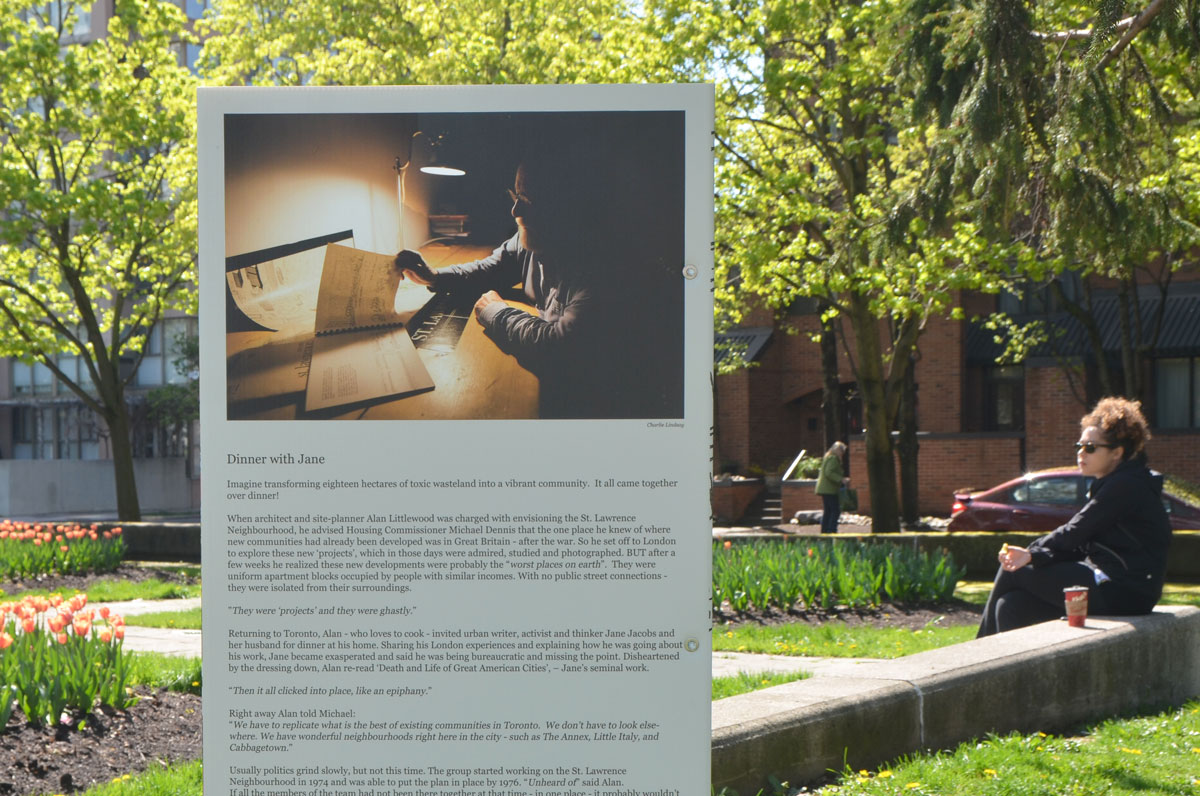
Forty years ago, May 1976, the site plan for The Esplanade neighbourhood was approved. Since then, it has become home to a very diverse group of people. And it is those people that this installation celebrates on the 40th anniversary of the founding of the neighbourhood.

Crombie Park runs along the south side of The Esplanade between Berkeley street and Lower Jarvis.  The installation consists of a number of small white rectangular pillars with the picture and story of person on either side.

A photo from the CONTACT photography festival, installation called 'Residents of The Esplanade' - story of Mysha from Pakistan

A photo from the CONTACT photography festival, installation called 'Residents of The Esplanade' - photo of Solomon from on top of a basketball hoop

A photo from the CONTACT photography festival, installation called 'Residents of The Esplanade' - photo of Alan working at a desk, tulips and a woman sitting in the park are in the background

People were out enjoying the morning; school kids were playing basketball at recess.

kids playing basketball on an outdoor court. The wall behind the basketball hoop has been painted with a mural of hands making a heart shape with the fingers, by Bruno Smokey and Shalak Attack.

Flowers were blooming.

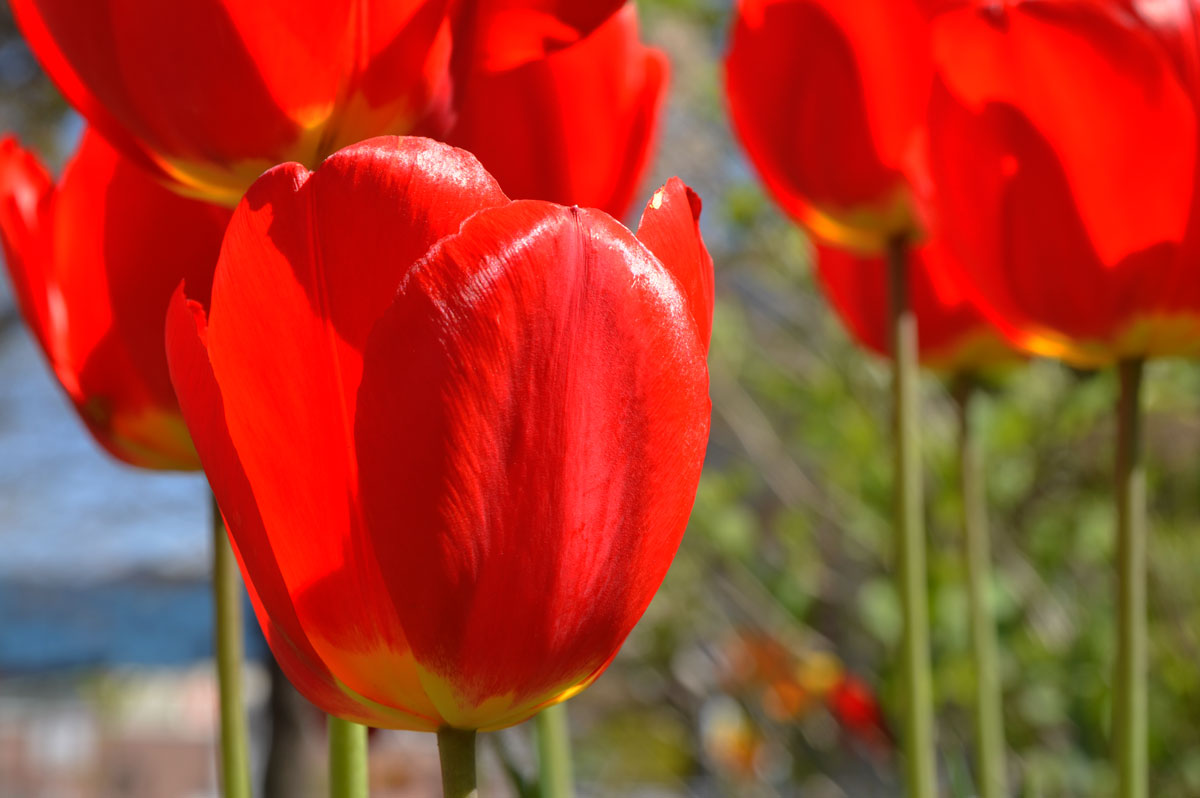
close up photo of red tulips in full bloom on a sunny day

tulips in a garden in a park, orange and yellow tulips, with some greenery. Grassy area with trees behind, and people walking on a sidewalk in the background.

below: Looking towards Lower Jarvis Street and downtown Toronto.

at the corner of The Esplanade and George Street, looking west towards downtown and St. Lawrence market. Playground on the left with children playing.

below:  One street beyond Lower Jarvis is Market Street.  It dead ends at the railway tracks.  The long structure on the right is a parking garage.
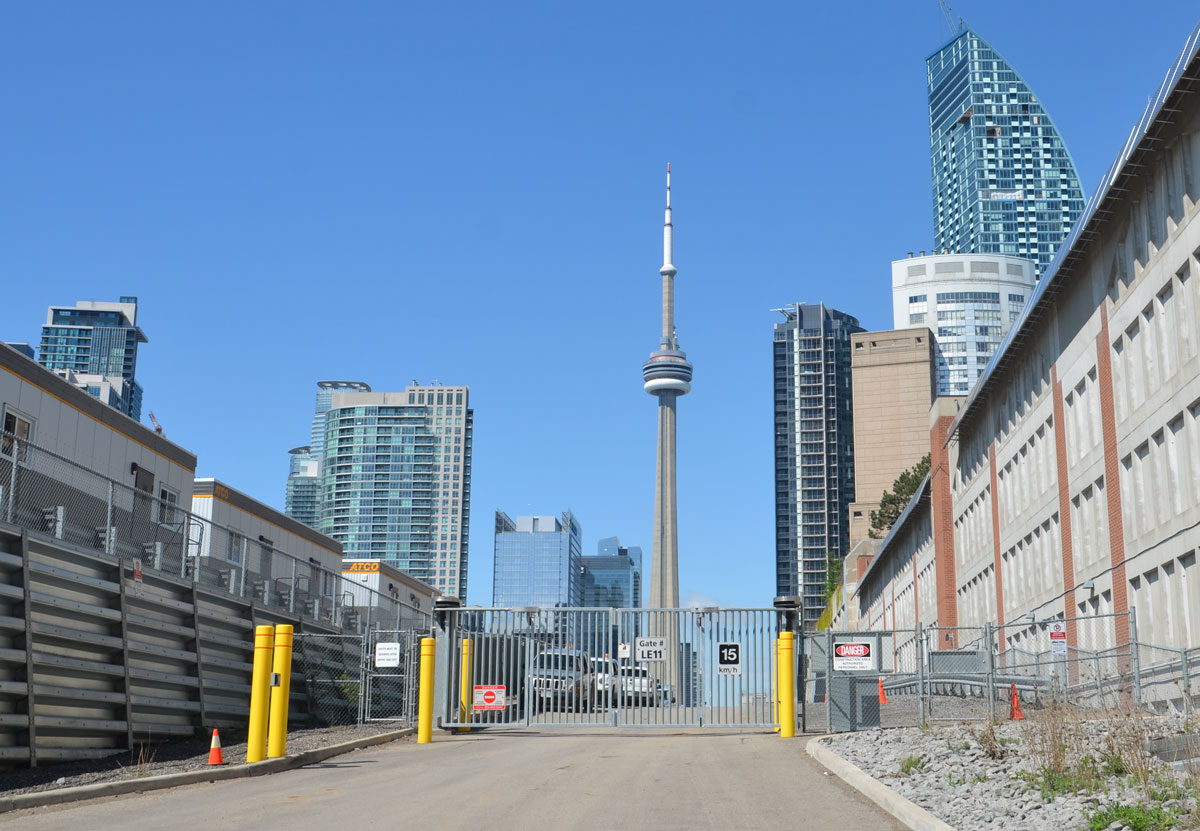
looking west towards the CN Tower, with the railway tracks to the left (but they are elevated and behind maintenance buildings so you can't see the tracks). Parking structure to the right, with city buildings behind it.

below: After a small backtrack up Market Street, I went through Conger Coal Lane to Church Street.  I don’t think I have walked this way before.  The lane was named in commemoration of the Conger Coal Company whose yard and wharf was nearby.   It was one of the many companies that provided Toronto with coal back in the day when coal fueled the city.  It was started in 1870 by Mr. P.D. Conger.   In 1913, Sterling Coal company bought Conger and the name was changed to Conger Lehigh Coal Co.

a downtown Toronto lane, very clean, no graffiti, taller, newer buildings on either side of the lane. CN tower in the distance,

below: A very old photo of the Conger Coal Company dock at the foot of Church Street, back when Church street ended at Lake Ontario
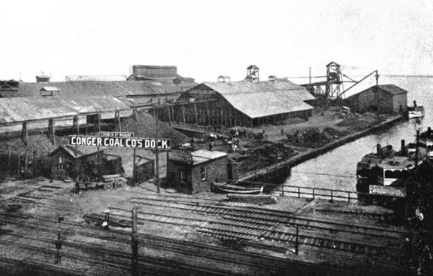
historical picture of the old COnger COal Co wharf at the bottom of Church street.

below: Tucked into a corner on Church street immediately south of Front Street, is an art installation by Paul Raff called ‘Shoreline Commemorative’.  A topography of limestone forms the base of the work.  A glass ball representing the line between sky and water sits on top of a tripod that tries to evoke a land surveyor’s tripod.  The words on the wall say “For 10,000 years this was the location of Lake Ontario’s shoreline.  This brick wall stands where water and land met, with a vista horizon”

Shoreline Commemorative by Paul Raff, an art installation on Church St., south of King, that marks where the shoreline of Lake Ontario used to be. It involves words on a brick wall and a model of the shoreline of Toronto showing the different elevations of the land.

below: Continuing the lake theme, a little fish out of water, jumping over the entrance to a condo.
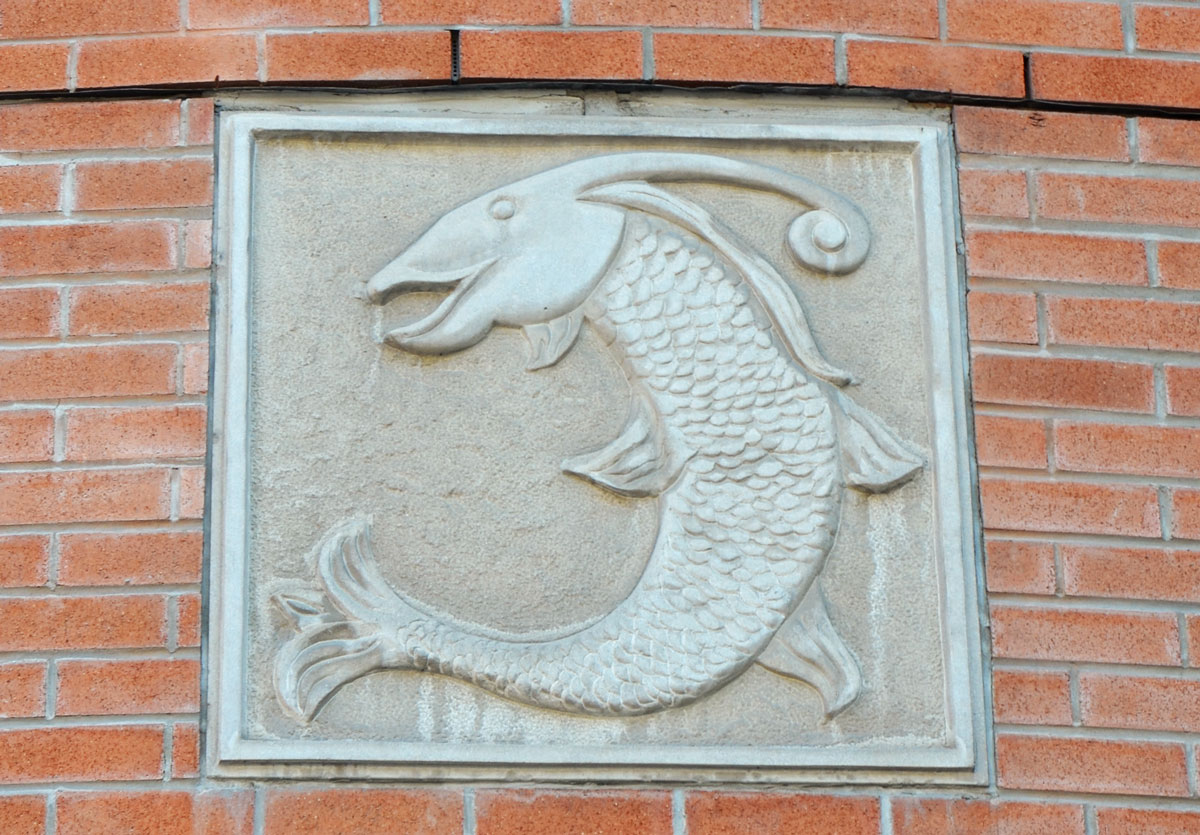
bas relief sculpture of a fish, square stone on a brick wall above the entrance way to a condo building.

below: From the lake theme to another common theme in the city, construction. Spring is the beginning of construction season and here Berczy Park is being upgraded. In the background a new condo is being built but as we all know condo construction ‘season’ never ends. In fact, the challenge might be to find a place in this city where there isn’t a condo being built.
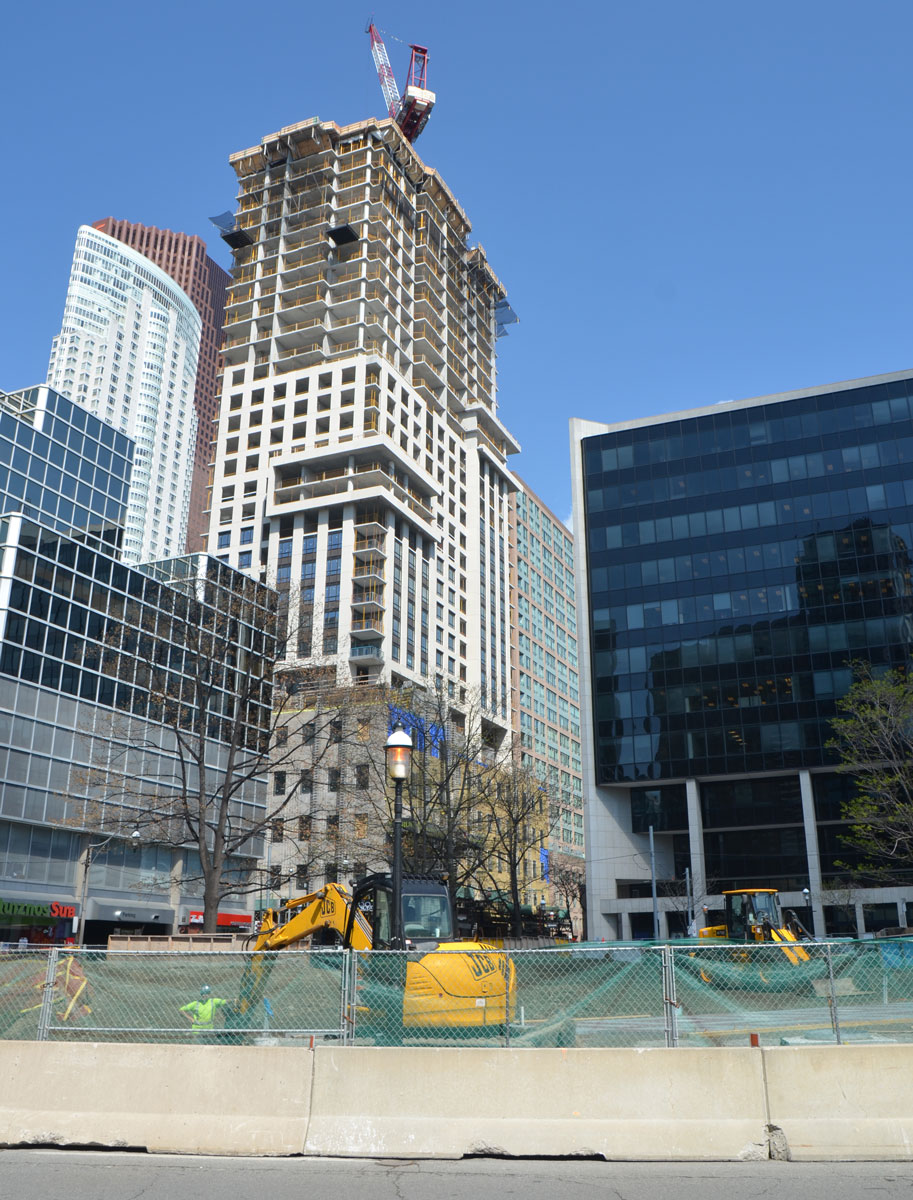
workmen redoing a park, Berczy Park in Toronto, with a digger and another piece of equipment, cityscape behind with a tall condo building under construction. A red and white crane is on top.

below: I walked past the never ending Front Street construction.  Construction in front of Union station seems to be finished, but this stretch of Front Street just west of the station is still being worked on.   There have been fences here so long that I can’t remember a time when they weren’t here.
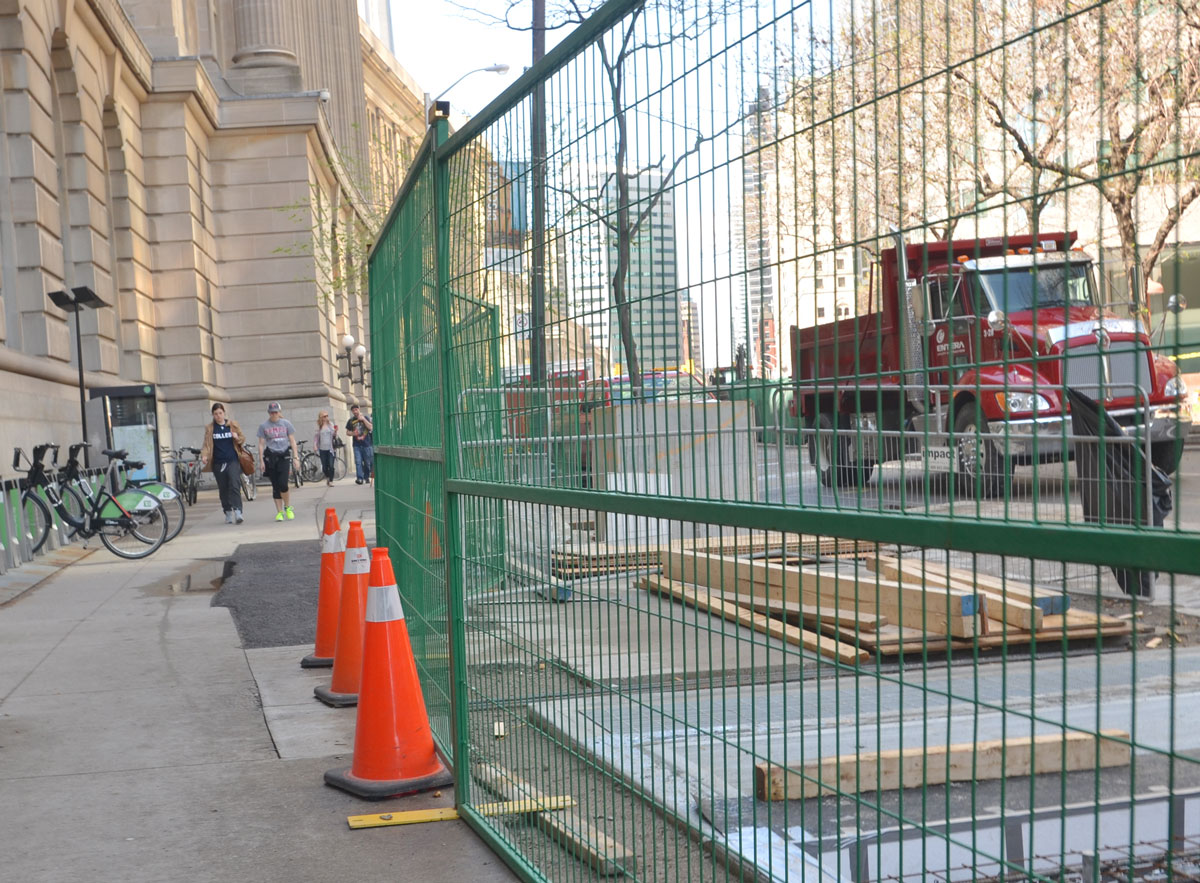
Front street constrcution, behind a greenwire fence is a rd truck and piles of construction materials. Between the fence and a stone building is the sidewalk on which some people are walking.

a shirtless man in sitting on a stool at the corner of Front and Union streets. He has four signs (behind, above, in front, and beside him) asking for spare change or for you to buy his novel that is well rated on both Amazon and Goodreads.

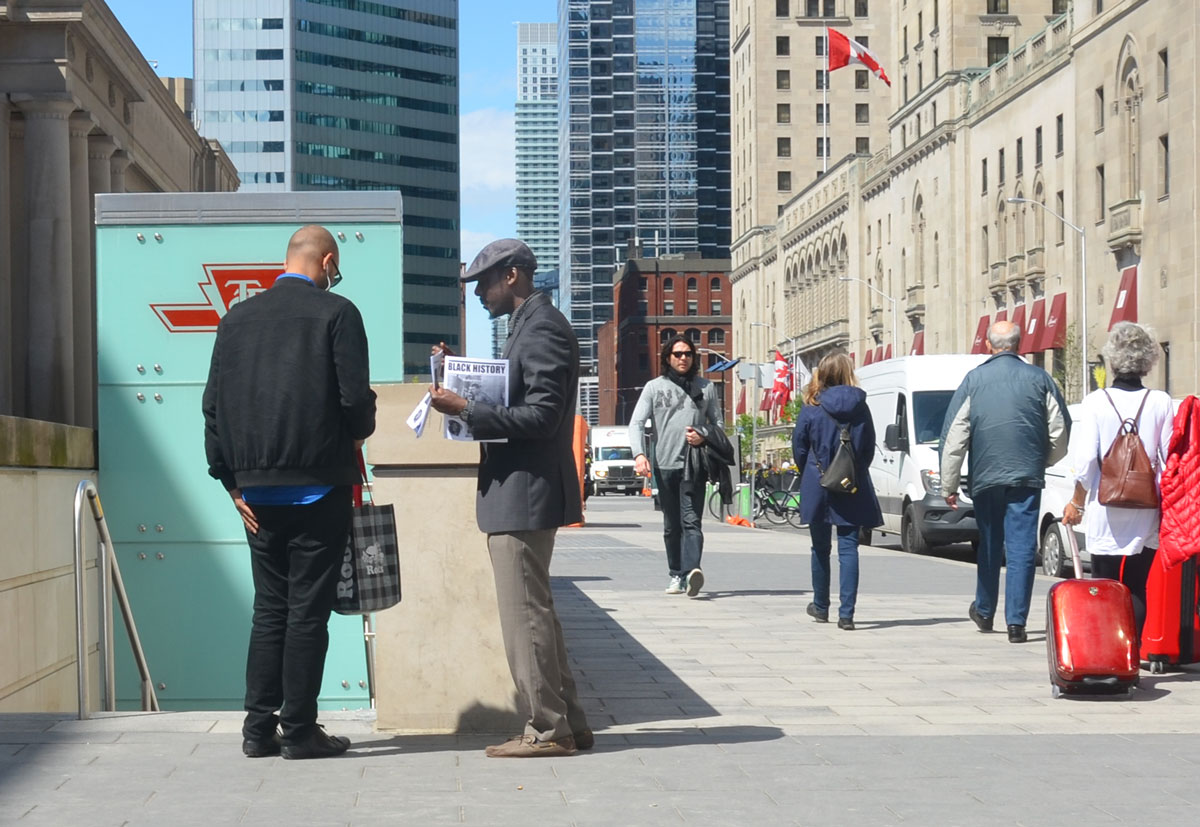
A man is selling Black History newspaper to another man in front of the TTC subwayentrance at Union station.


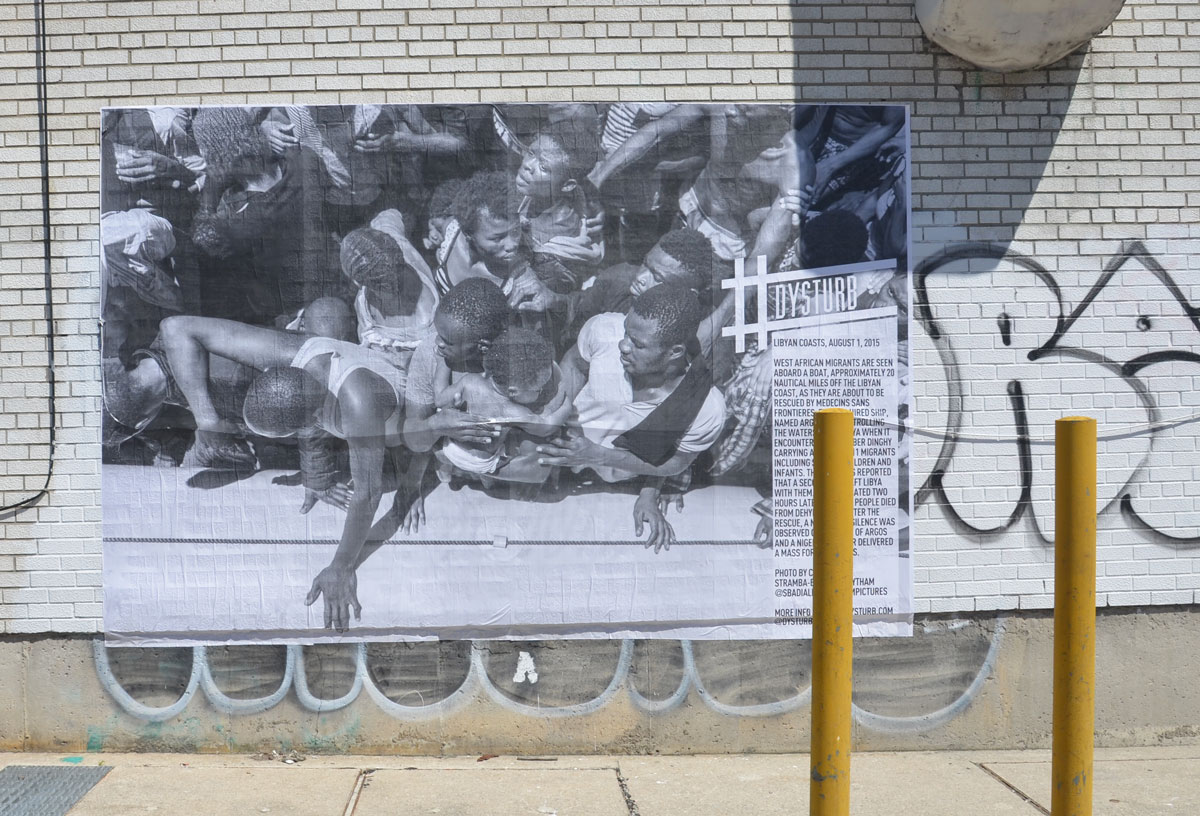
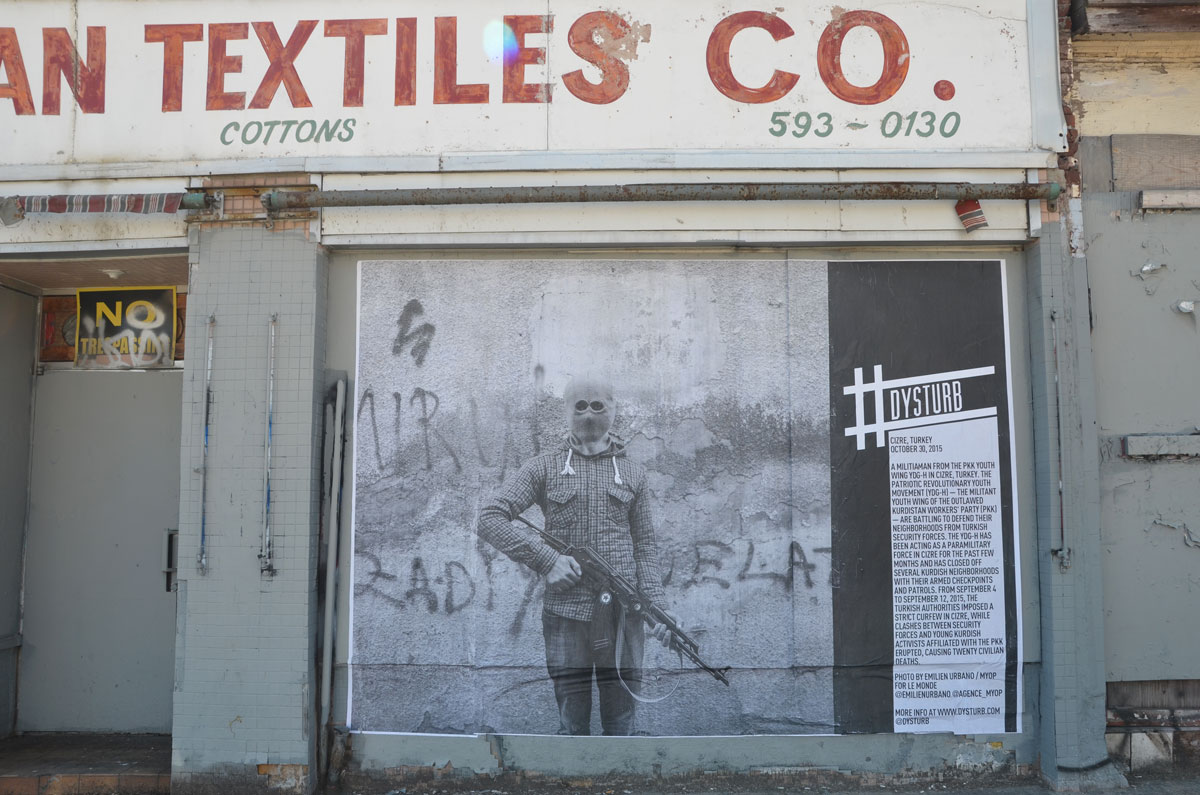
Spread around Kensington and Chinatown are 20 large black and white photos taken by a number of freelance photojournalists who are part of a group called #Dysturb.   One of their goals is to present photojournalism in new ways, including as street art, with the aim of engaging people and encouraging discussion of global issues.   The images are part of an exhibit for the Scotiabank CONTACT Photography Festival.

Kensington has had a problem with taggers for a while.  Often street art gets vandalized in that area.   The #Dysturb photo that was at 56 Kensington (under Mona Lisa) has already been torn down and a couple of others have been ripped.

Pictures of some of the images that are part of the exhibit are shown below.  I have included a partial transcription of the words that accompany each picture.


Libyan Coasts, August 1, 2015
Photo by Christophe Stramba-Badiali/Haytham

a large black and white photojournalist picture, part of CONTACT photography festival, pasted on a wall - a boat load of Libyan migrants is being rescued from their rubber dinghy.

West African migrants are seen aboard a boat, approximately 20 nautical miles off the Libyan coast, as they are about to be rescued by Medecins Sans Frontieres. The MSF-hired ship, named Argos, was patrolling the waters off Libya when it encountered one rubber dinghy carrying a total of 111 migrants including several children and infants. “


Barpak, Ghorka District, Nepal, May 9, 2015 ”
Photo by Renaud Philippe/Hans Lucas

a large black and white photojournalist picture, part of CONTACT photography festival, pasted on a wall - children playing in the wind created by a helicopter, Nepal, on a wall in an entraceway.  A man is busking in front, and there are people walking past on the sidewalk

Children play in a cloud of dust and gravel thrown by an Indian army helicopter landing in Barpak Nepal.  The community is at the epicenter of the devastating earthquake that struck April 25, 2015, taking over 8000 lives.  Of Barpak’s 1400 houses, only 20 remain standing.   The rest of the town is a pile of rubble that blends into the rocky landscape.  An archway that somehow survived the quake greets visitors with a rueful ‘Welcome to Barpak’.”


Shaanxi Province, Henan, China, February 27, 2014
Photo by Sim Chi Yin/Vii

a large black and white photojournalist picture, part of CONTACT photography festival, pasted on a wall - an ill Chinese man is being comforted by his wife.  The picture is on a graffiti covered wall and a black car is parked close to it.

Gold miner, He Quangui, battling silicosis, struggles to breathe while cradled in the hands of his wife Mi Shixiu.  After many attempts to stabilize his breathing, in the early hours of the next morning her tried to kill himself to end the suffering.  He contracted the irreversible disease working in illegal gold mines in China’s Henan province.   He is among some six million workers in China who have pneumoconiosis – the country’s most prevalent occupational disease.”


Cizre Turkey, October 30, 2015.
Photo by Emilien Urbano/Myop for Le Monde
NOTE: I took this picture on Friday. Today (Monday) it was gone.

large black and white photo pasted onto a boarded up storefront of European Textiles on Spadina Rd. The photo is part of #Dysturb exhibit at Contact Photography Festival. It shows a hooded man holding an automatic rifle

A militiaman from the PKK Youth wing YDG-H in Cizre Turkey.  The Patriotic Revolutionary Youth Movement (YDG-H) – the militant youth wing of the outlawed Kurdistan Workers’ Party (PKK) – are battling to defend their neighbourhoods from Turkish security forces.  The YDG-H has been acting as a paramilitary force in Cizre for the past few months and has closed off several Kurdish neighbourhoods with their armed checkpoints and patrols.


Fort McKay, Alberta, Canada, August 12, 2015
Photo by Ian Willms/Boreal Collective

a large black and white photojournalist picture, part of CONTACT photography festival, pasted on a wall - a sick boy is lying on a bed, on a wall in the entranceway to a store, sidewalk and street scene in the background

Dez, 7, plays in his bed.  Dez was born with an underdeveloped heart and has received multiple open heart surgeries.  His family and healthcare professionals in Fort McKay believe that his condition was caused by environmental pollution.   Fort McKay is an indigenous community that is surrounded by oil  sands developments.”


Kunduz City, Afghanistan, November 18, 2015.
Photo by Andrew Quilty/Oculi

a large black and white photojournalist picture, part of CONTACT photography festival, pasted on a wall - a mother (covered in a black burka) and her daughter in grief, at a gravesite.  Pasted on an orange wall with an old brown leather sofa in front of it.

Najibah tries to comfort her daughter Zahara, 8, as they weep over the grave of their husband and father, Baynazar.   Baynazar, 43, was wounded by gunfire on his way home fromwork during the Taliban takeover of Kunduz in late 2015.  He was taken to the nearby Doctors Without Borders (MSF) trauma centre.  In the early hours of October 3, during his second operation, a US AC-130 aircraft attacked the hospital for more than half an hour, killing 43 MSF staff, patients and nurses.  Dozens more were wounded.

About #Dysturb

#CONTACT16

May is photography month in Toronto.  It is the month when there are numerous exhibits in public spaces and in galleries, all part of the CONTACT Photography Festival.   Over the next few weeks I hope to visit many of the exhibits and blog about some of them.   From past experience I have discovered that a lot of the public installations appear before May 1st so I went exploring yesterday.

below: Looking south from Spadina and Adelaide….  Partially obscured by a building, on the right in this photo, is the first large black and white photo that I saw.

view from the NE corner of Spadina and Richmond streets. a small parking lot is directly across the street, two large billboards loom over the lot. Once is for Lorne's coats showing two people wearing coats. The other is for Maple flavoured iced capp at Tim Hortons.

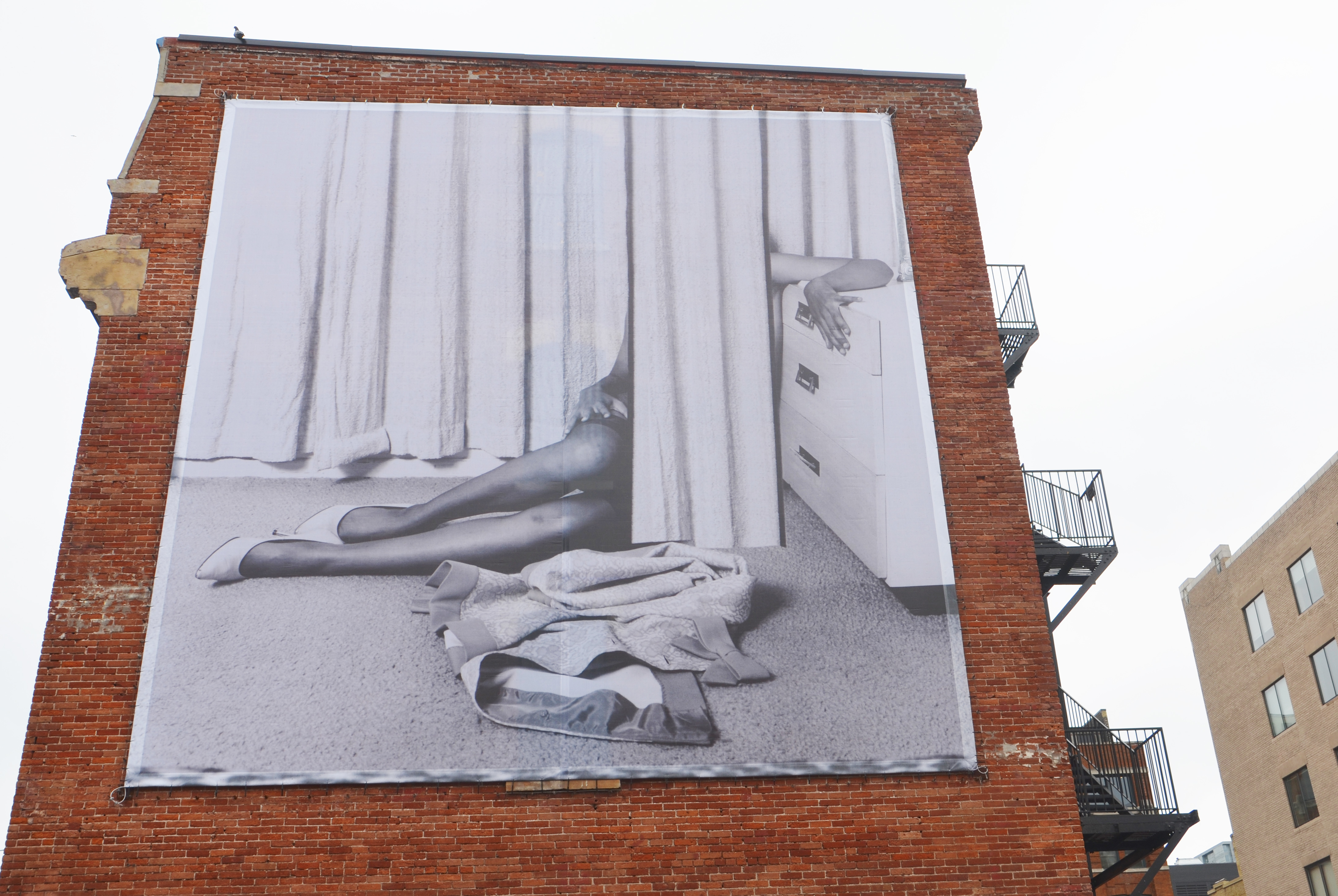
below: Up close,  ‘Drape’ by Eva Stenram.  Stenram has taken a 1960’s pin-up photograph of a woman and manipulated it.  She has brought the background, the drapery, forward and has covered up the original subject in the picture.

large black and white photo by Eva Strenram called 'Drape'. It is mounted on the upper level of a three storey red brick building. It shows a woman sitting on the floor partially obscured by drapery. Her upper body and head can not be seen.

below: Looking west on Wellington from Spadina.  The light grey building is the Old Press Hall (Globe and Mail) which will be demolished in the near future.

looking down the street past parked cars. A large black and white photo is on the side of the building.

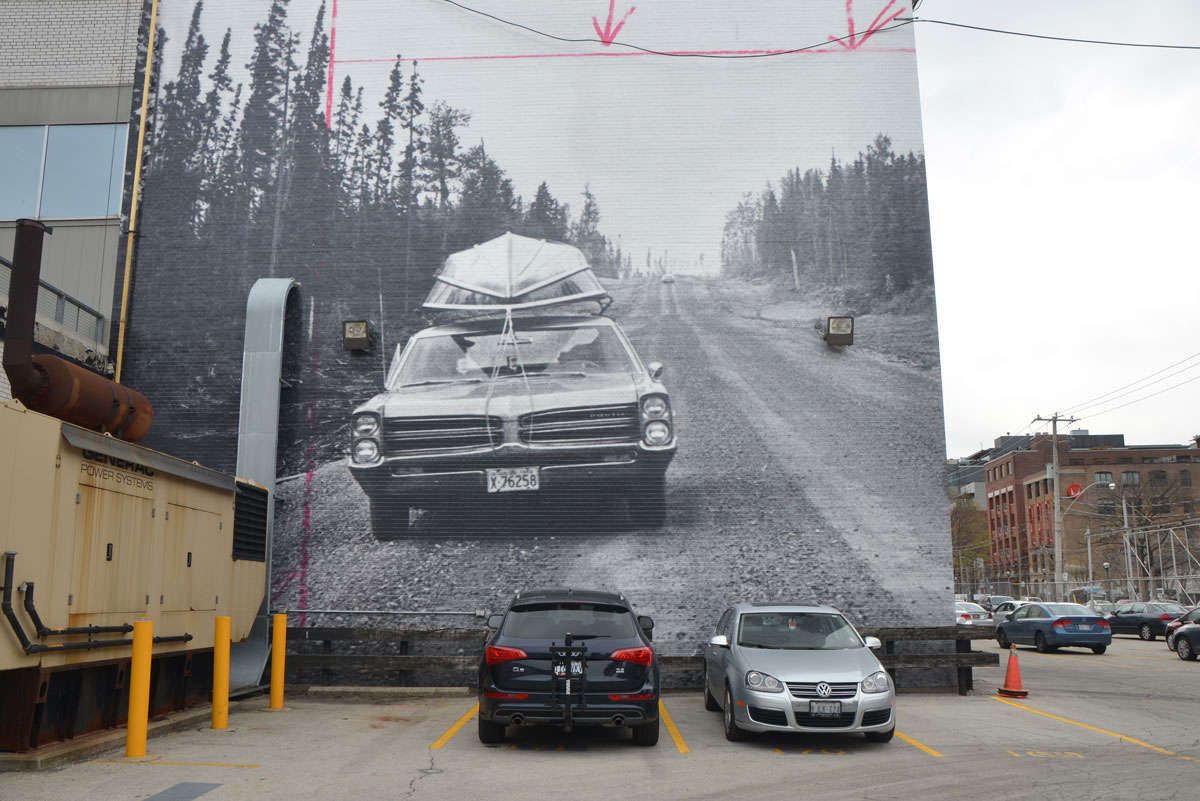
below: Up close, ‘Stopping Point’ by an unknown photographer.  The original title and description was: ‘Along the new Highway, which runs from Smooth Rock Falls to Fraserdale, Ontario, there’s no sign of human habitation apart from one empty lumber camp, c.1966. 

A very large black and white photograph from the 1960's of a car on a two lane road with pine trees on either side. There is a boat tied to the roof of the car. The photo is on the side of the Globe and Mail building with cars parked around it.

The above photograph is one of 750,000 photos in the Globe and Mail’s picture library.   100,000 of their old photos are being digitized to create a new historical archive.  From these, a collection of 20,000 prints will be donated to the newly formed Canadian Photography Institute at the National Gallery of Canada.

More of the photos from the Globe and Mail’s collection are on view inside the Old Press Hall.

Within the past week or so, the fences around the new Canary District have come down.  Toronto’s newest development is now open to the public so I thought I would check it out.

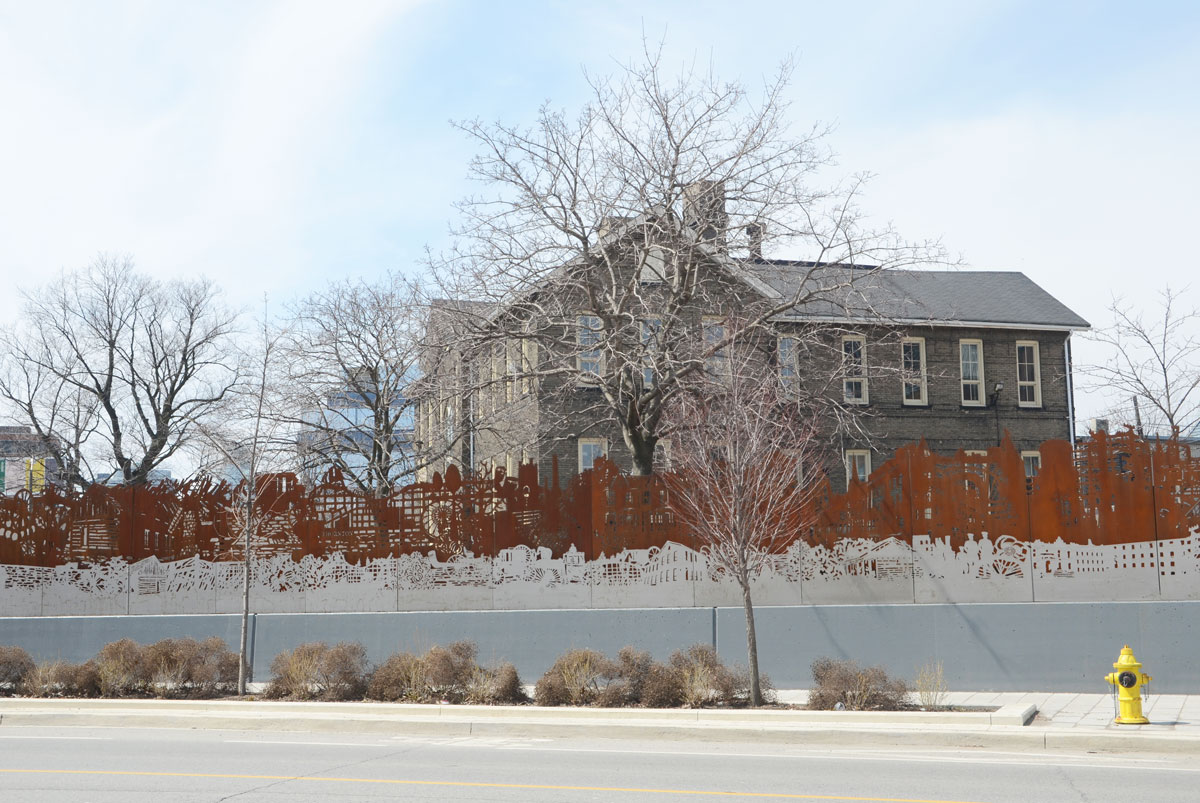
I started my walk from the streetcar stop at King and Sumach.  Walking down Sumach Street I passed the metal fence that separates the school property from the street.  This stone building was built in 1887 as Sackville Street School and it has been used as a school ever since.  At the moment it is home to Inglenook Community School.  The fence with it’s double layer of metal – rusted in the back and shiny in the front – is interesting in the daytime but even more so at night when it is lit with a series of lights located between the layers  and near the base of the fence.

public art on Sumach St., rusted metal and shiny metal fence with cut outs, looking across the street at it, with older stone building behind it.

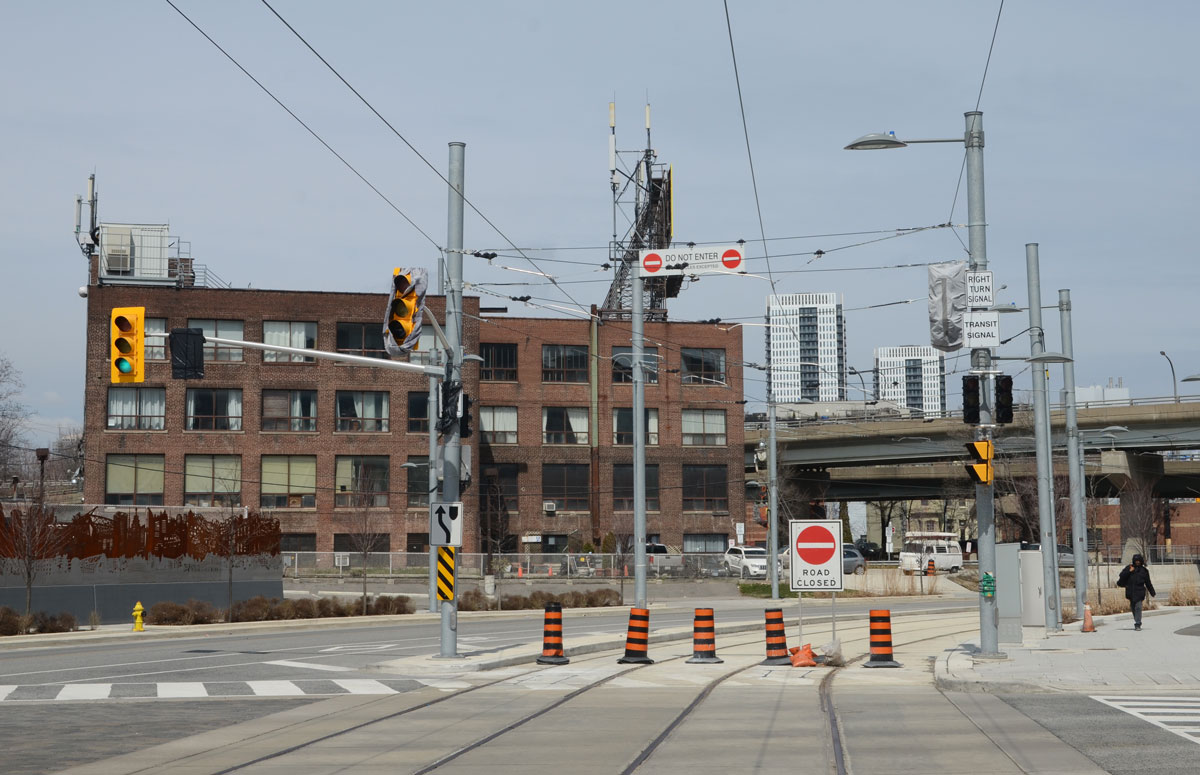
When I took the above picture I was standing on the new streetcar tracks that run south from King Street.  The tracks are ready and the wires have been installed.  Streetcars will begin servicing the route in June as part of route 514.  No map or schedule appears on the TTC website yet but apparently this route will run between the Dufferin Gate Loop and the new loop on Cherry Street via King Street

below: Looking north from Eastern Avenue at the new streetcar tracks on Sumach Street.

looking north on Sumach Street from Eastern Ave at the new streetcar tracks. They are blocked by 5 large black and orange traffic cones as well as a large do not enter sign. Overhead wires for the streetcars are in place.

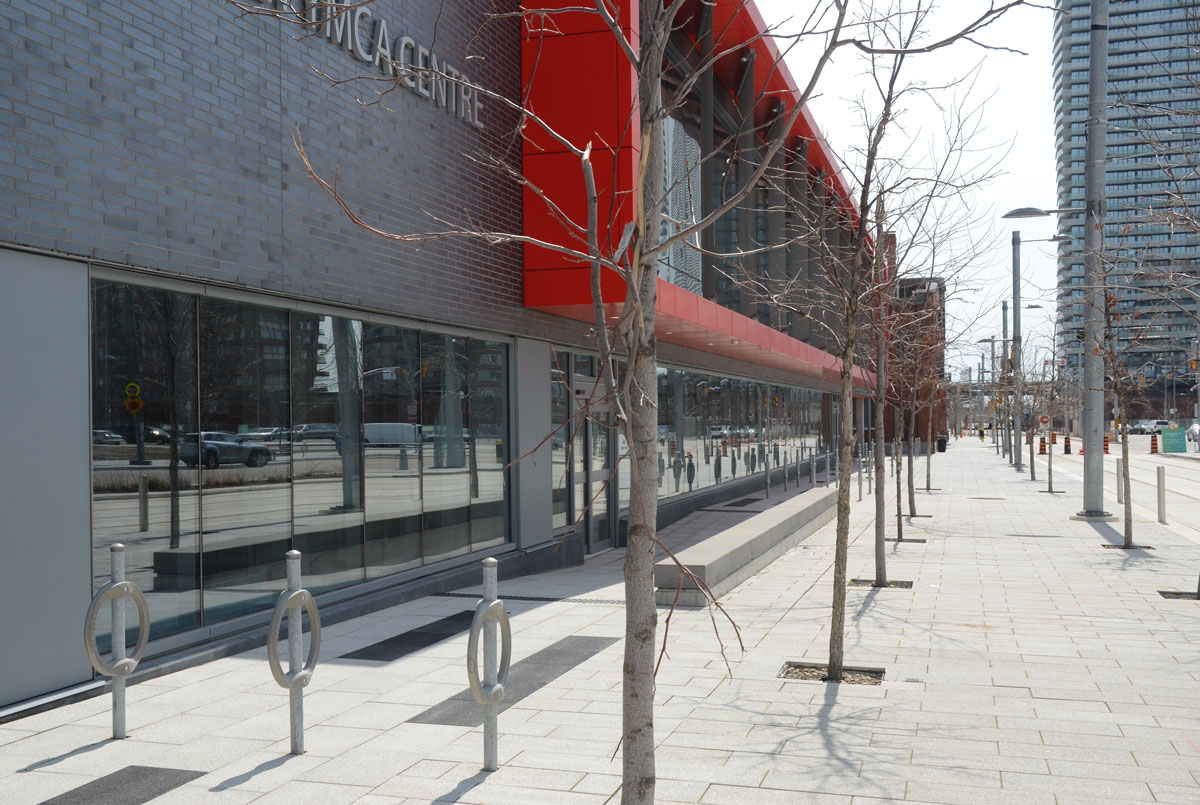
At Eastern Avenue, Sumach Street becomes Cherry Street.   The new Cherry Street YMCA is on the east side of the street.  The sidewalk is wide but at the moment the branches of the young trees are at face level and you have to be careful where you walk.

looking south on Cherry Street from Eastern Ave, past the new Cherry Street YMCA on the left and all the new trees that have been planted.

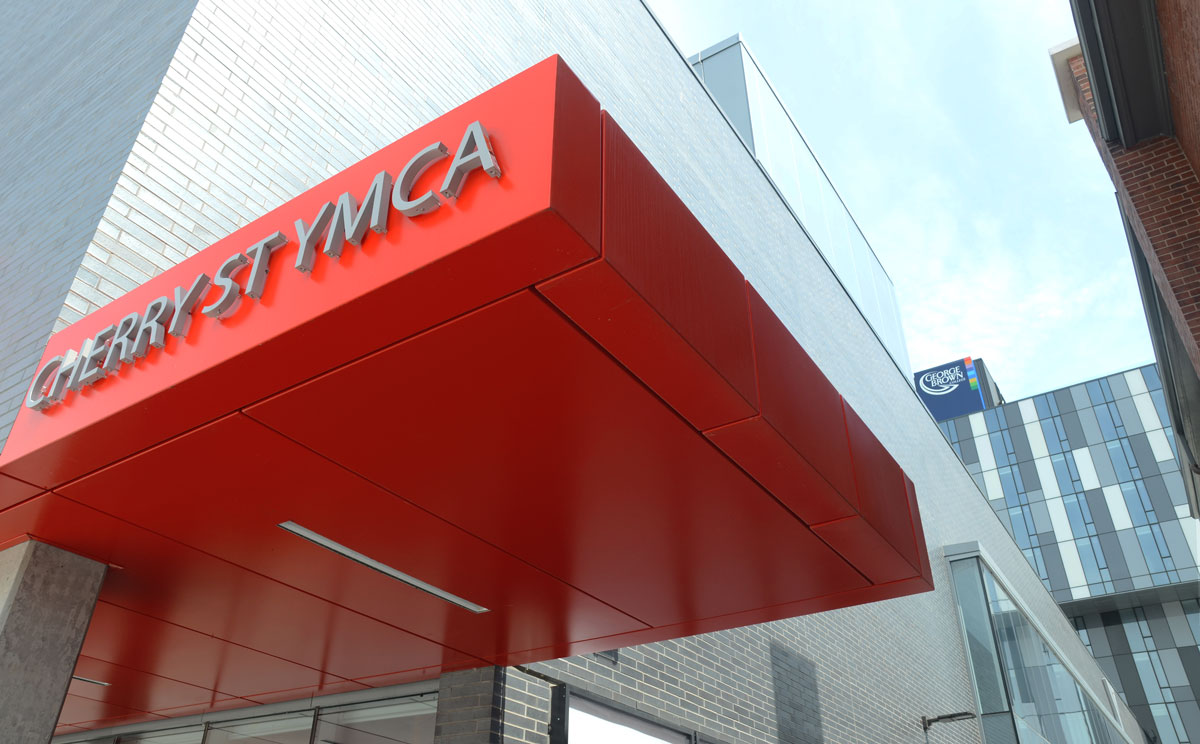
below: The bright red detailing on the YMCA building continues over the entry way.  Part of the new residences for George Brown College peak out from behind.

roofline over the entry of Cherry Street YMCA with it's bright red colour. Corner of George Brown College building is in the background.

Front Street now has wide sidewalks.  None of the businesses have moved into the ground level retail spaces yet but the signs in the windows suggest that a number of cafes, restaurants, and food stores will soon be opening.   A couple of public art pieces are also on the sidewalk.

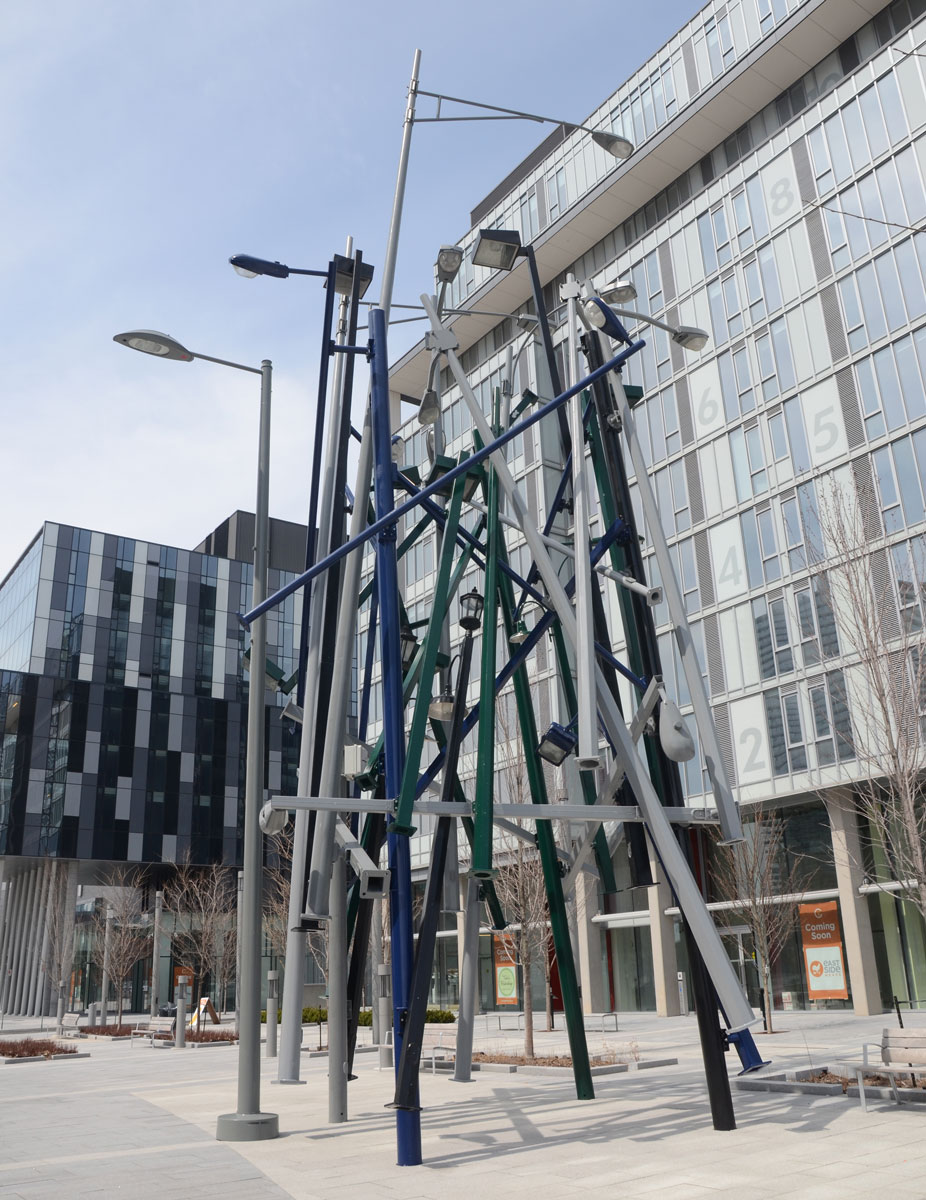
below: ‘Lampposts’ by Tadashi Kawabata

A tall art installation as public art on Front Street in the Canary District, Lampposts by Tadashi Kawabata, construction from many different styles of street lamp posts all arranged in a cluster

below: Looking up from underneath the artwork.

looking up at the lights from underneath the artwork,Lampposts by Tadashi Kawabata

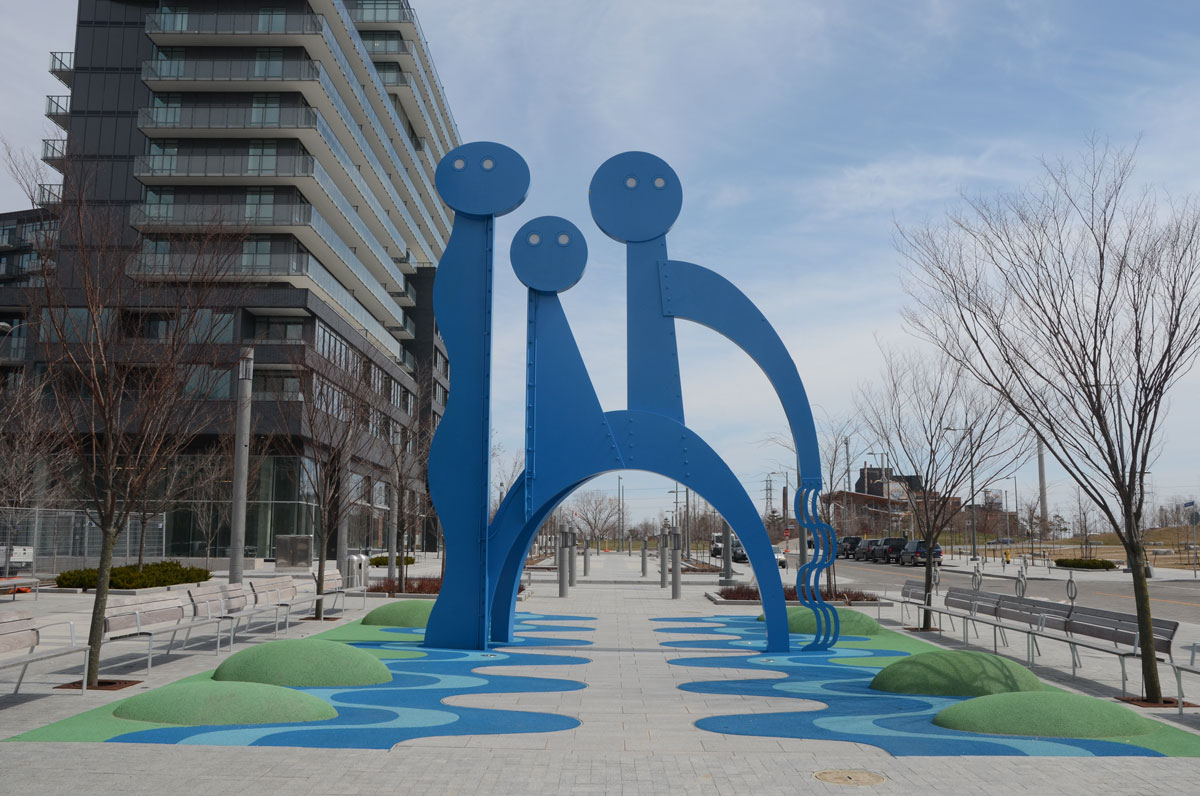
below: ‘The Water Guardians’ stand over a soft squishy playpad.
It was designed by Jennifer Marman and Daniel Borins.

'Tje Water Guardians', A tall art installation as public art on Front Street in the Canary District, 3 stylized abstracted human forms with legs in an arc shape over a squishy playpad in green, blue and white. The blue represents water. The green parts are raised slightly in bumps.

below: There are a lot of little design elements that have been incorporated into the this development including what I think is a bench.  With a light underneath?

A curved black metal bench on a sidewalk

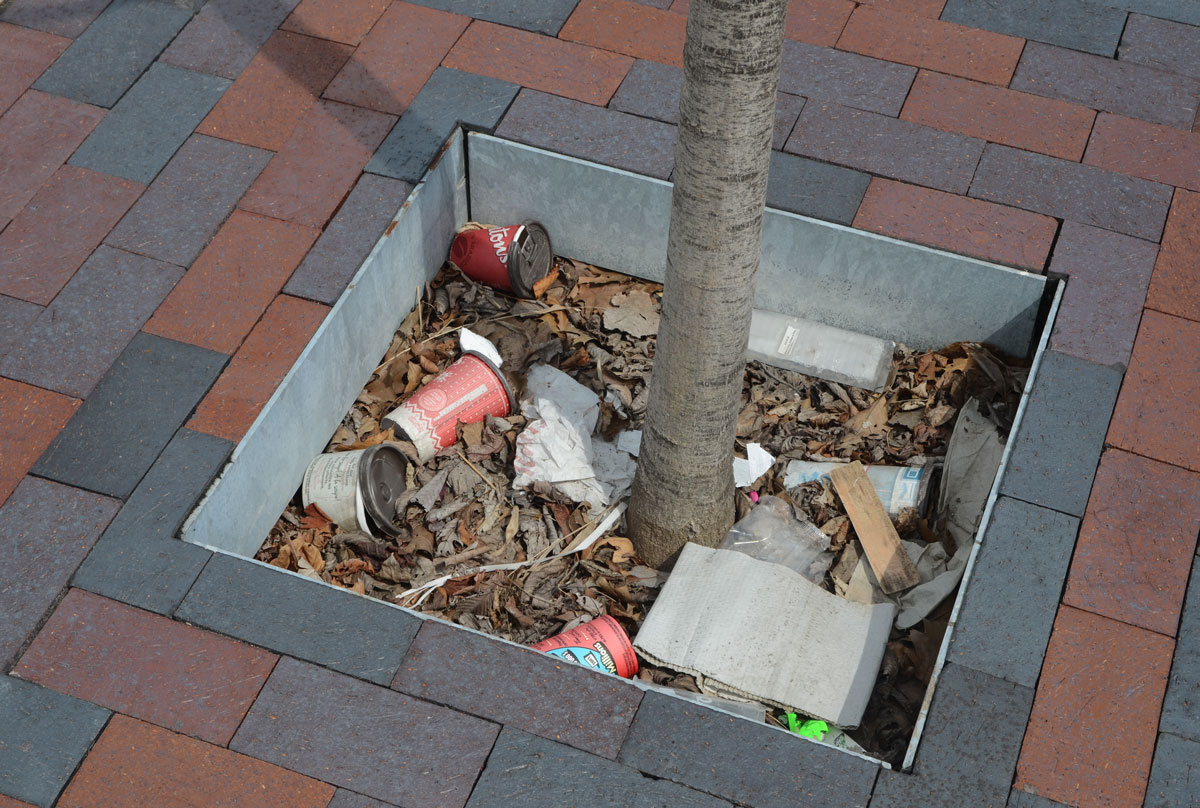
below: The sidewalk around the trees is made from two colours of brick.  The opening for the tree is just the right size to collect garbage.  Whether or not these traps get cleaned out remains to be seen.

square hole in the brickwork of the sidewalk to allow a tree to grow. The hole is shallow, a few cm. deep but it collects garbage such as empty coffe cups and discarded papers that blow in the wind.

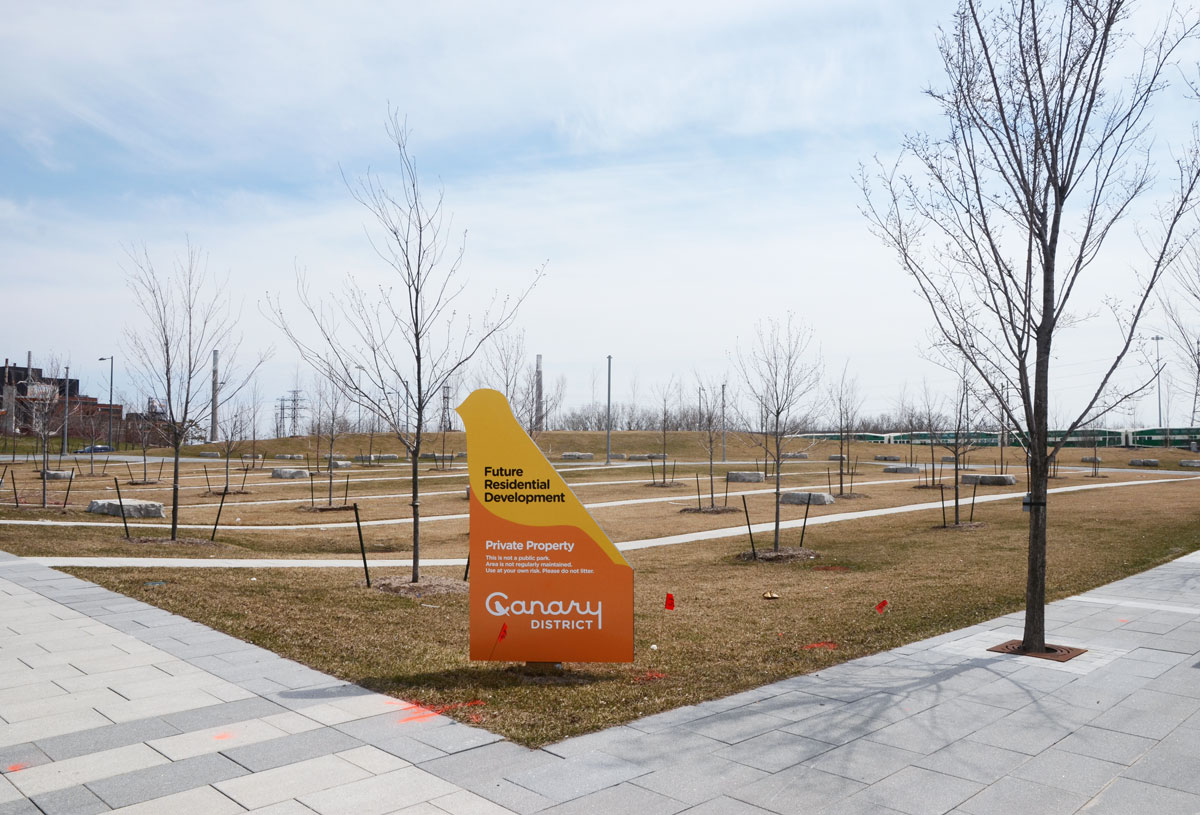
below:  The Canary District is not yet finished as this sign clearly states.

A large plot of land with rocks and newly planted trees in a grid. An orange and yellow sign advertises the Canary District. It also says that this land is slated for future residential development

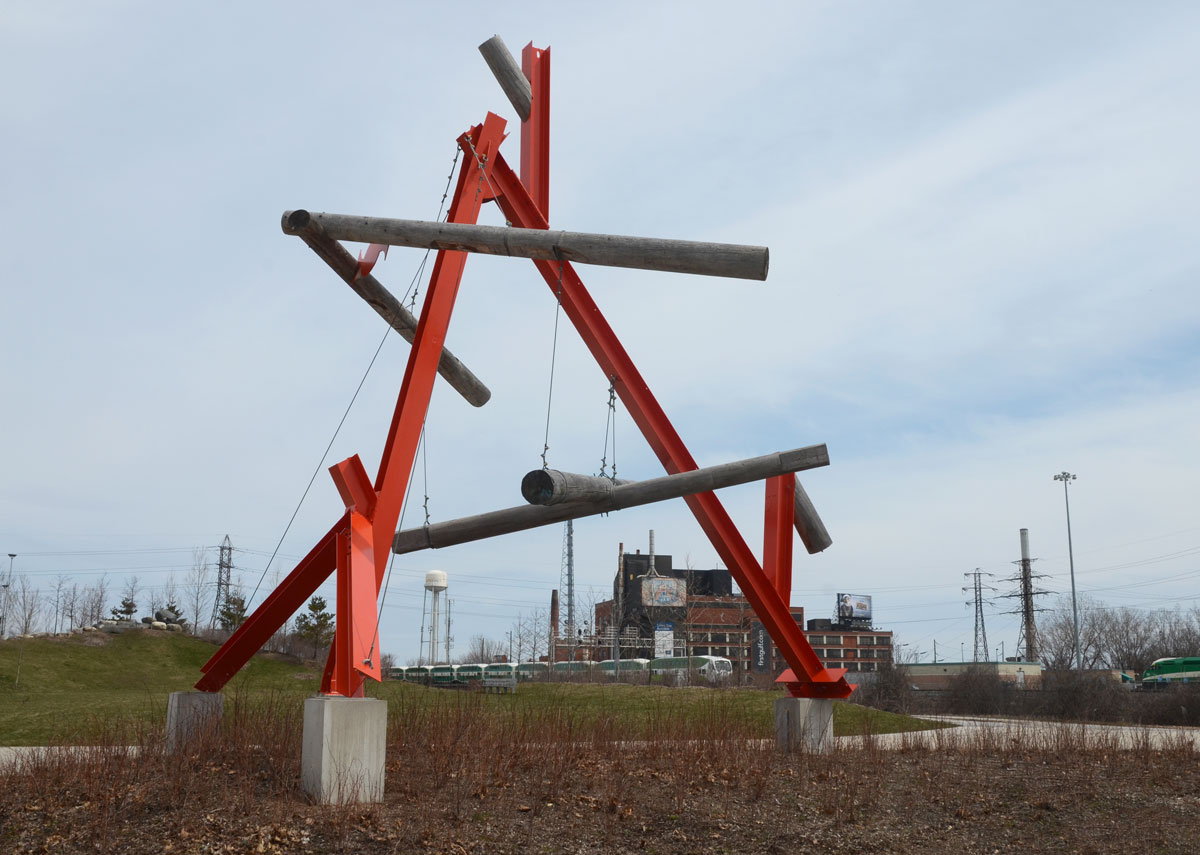
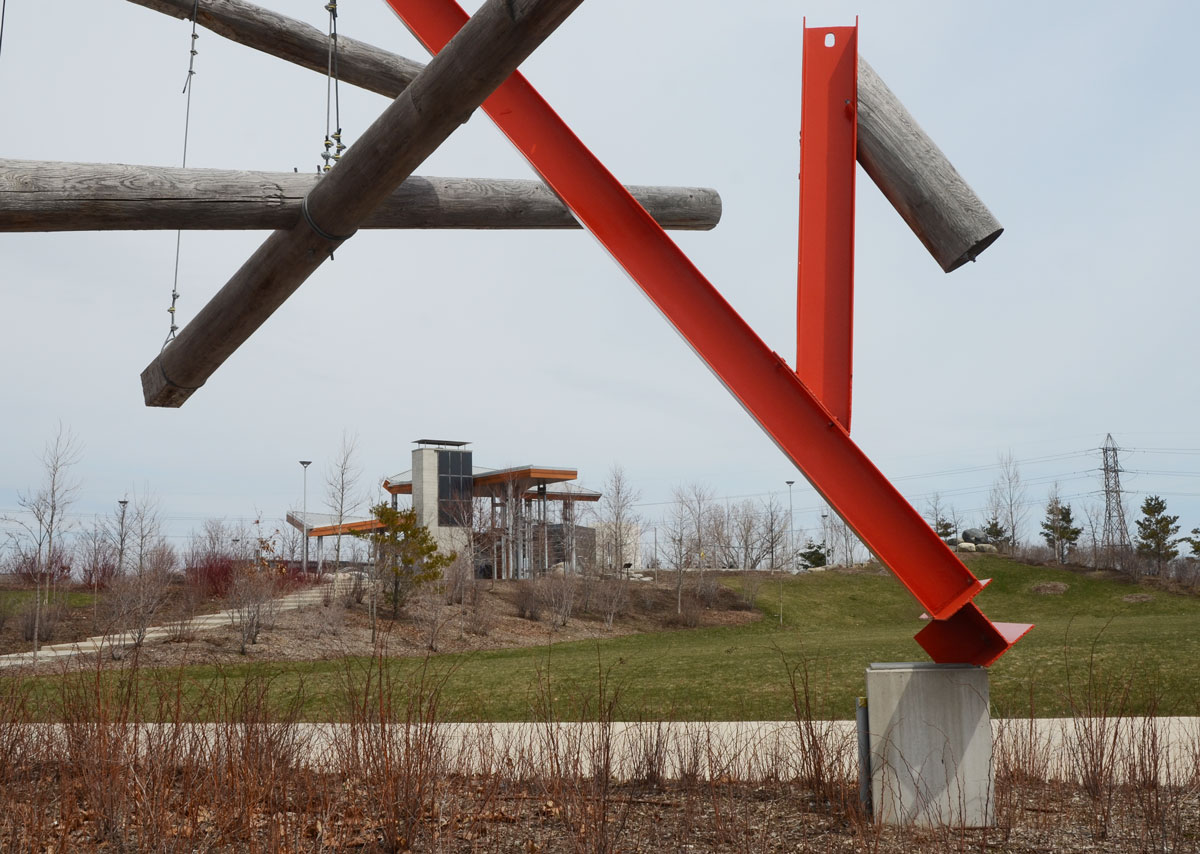
below: The sculpture ‘No Shoes’ by Mark di Suvero is now accessible.   The artwork was completed in 1967 and originally installed in High Park.   In 2013 it was renovated and moved to Corktown Common.

The sculpture 'No Shoes', red metal beams and wood poles, very large, stands in a park with some buildings in the background.

below: The pavillion at Corktown Commons in the distance.

The pavillion at Corktown Commons i the background as seen through the bottom part of the sculpture 'No Shoes'

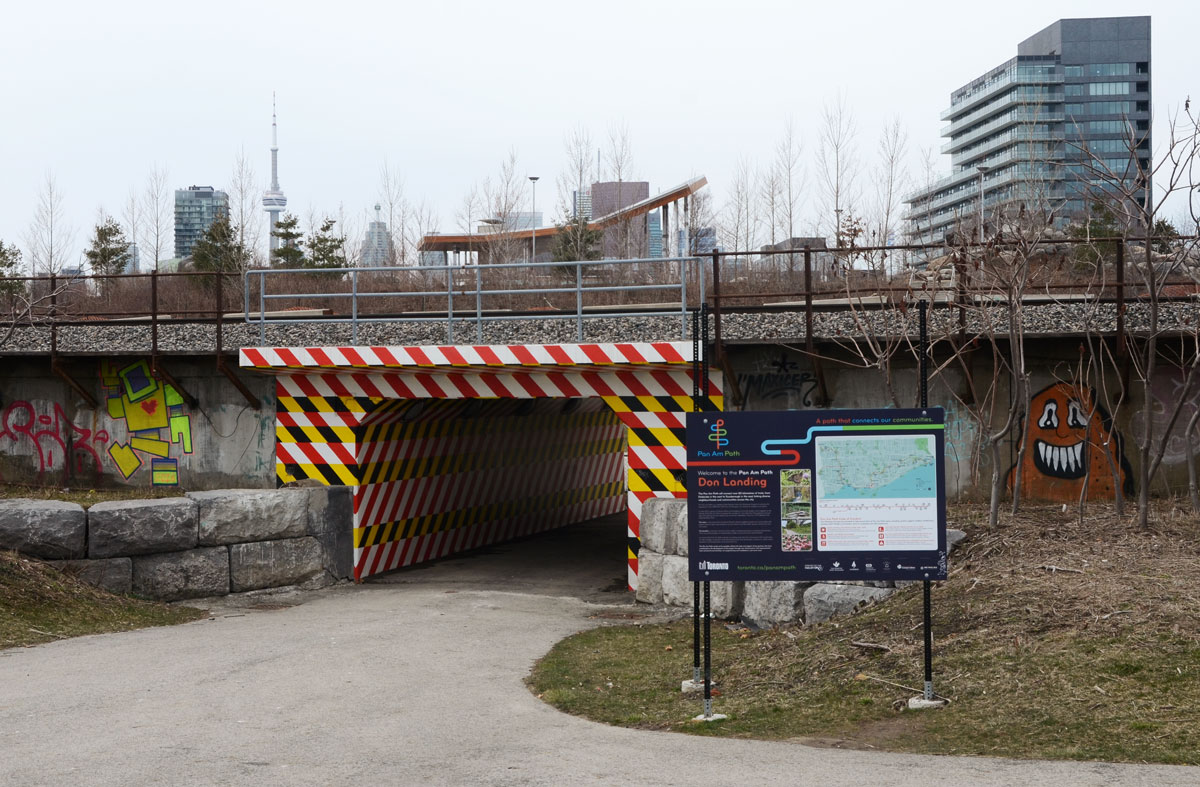
below:  The Bala Pedestrian Underpass, aka the south exit from Corktown Commons, goes under the railway tracks and merges with the Don Landing part of the Lower Don Valley trail.  The artwork was designed by Rolande Souliere and is part of the StreetARToronto initiative.   A yellow Lovebot and a happy orange monster have been added to the scene too!

pedestrian underpass under railway tracks that has been painted in bright stripes, yellow, red and black. The left of it is a large yellowlovebot and to the right is a sign with a map and a description of the Don Pathway, part of the Pan Am Path.

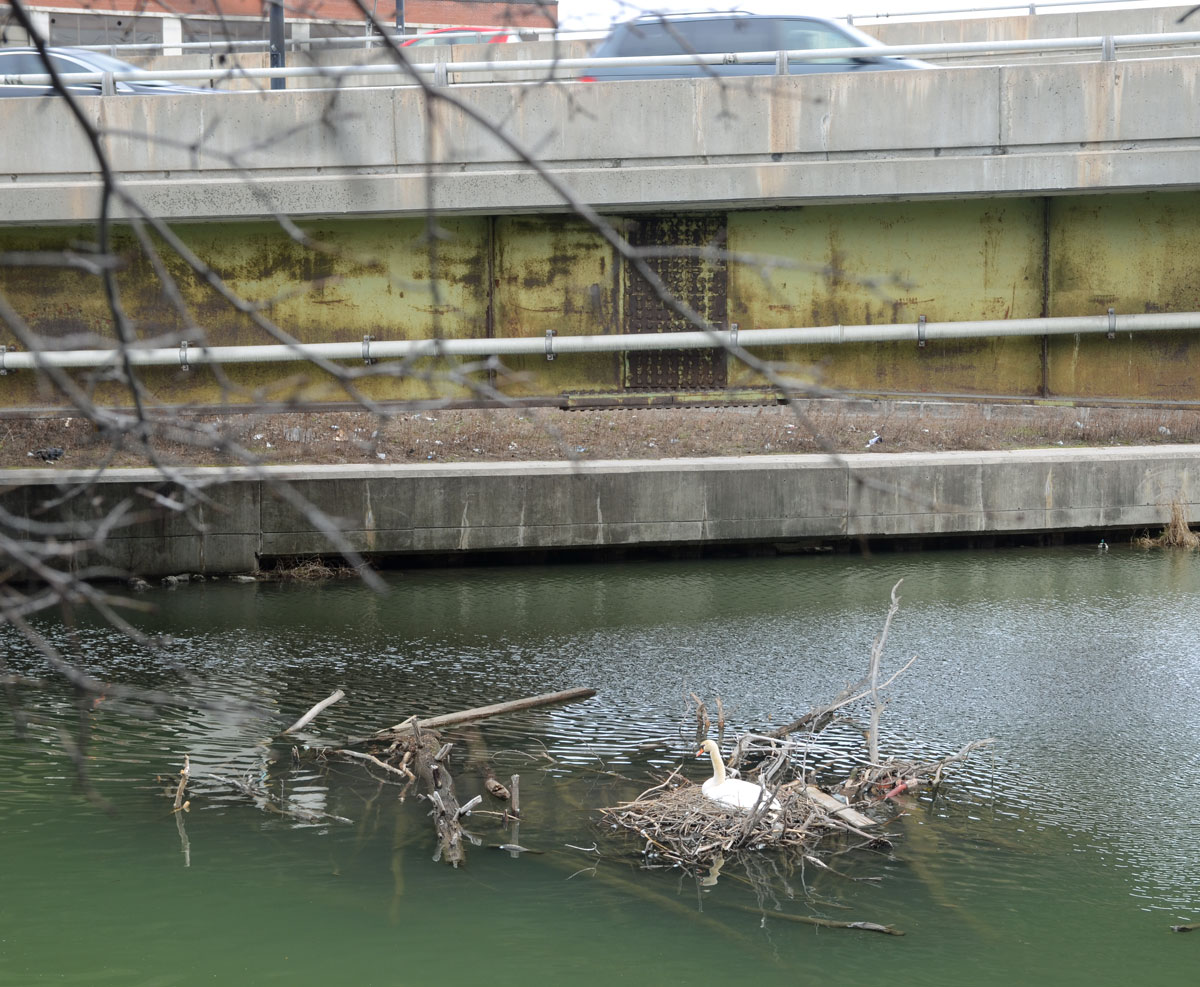
below: Nature in the city.  Birds of a different feather.  On the Don River, just south of Corktown Common a pair of swans is nesting.  One of the swans was swimming a short distance away while the other was sitting on the nest.   Cars pass by on the Don Valley Parkway unaware of the domestic scene below them.

A swan is sitting on a nest in the Don River, it is beside the Don Valley Parkway, a busy road in Toronto, two cars are passing by above the swan.

A walk towards Davisville subway station on a grey day.

below: At the corner of Mt Pleasant and Davisville stands the sculpture ‘Wind Bird’ by Sorel Etrog.  Etrog (1933-1914) was a Canadian artist, writer and sculptor.


a bronze sculpture of a thin figure with short arms reaching up. stylized, almost abstract. no facial features on the head that seems to be looking upwards

I have passed this little figure many times and today I finally decided to take some pictures of it and make a walk of it.  I have always thought that she was a forlorn little creature.   With her arms outstretched, empty,  reaching for something that never appears.  She needs a hug or at least a  warm scarf to keep the chill away.

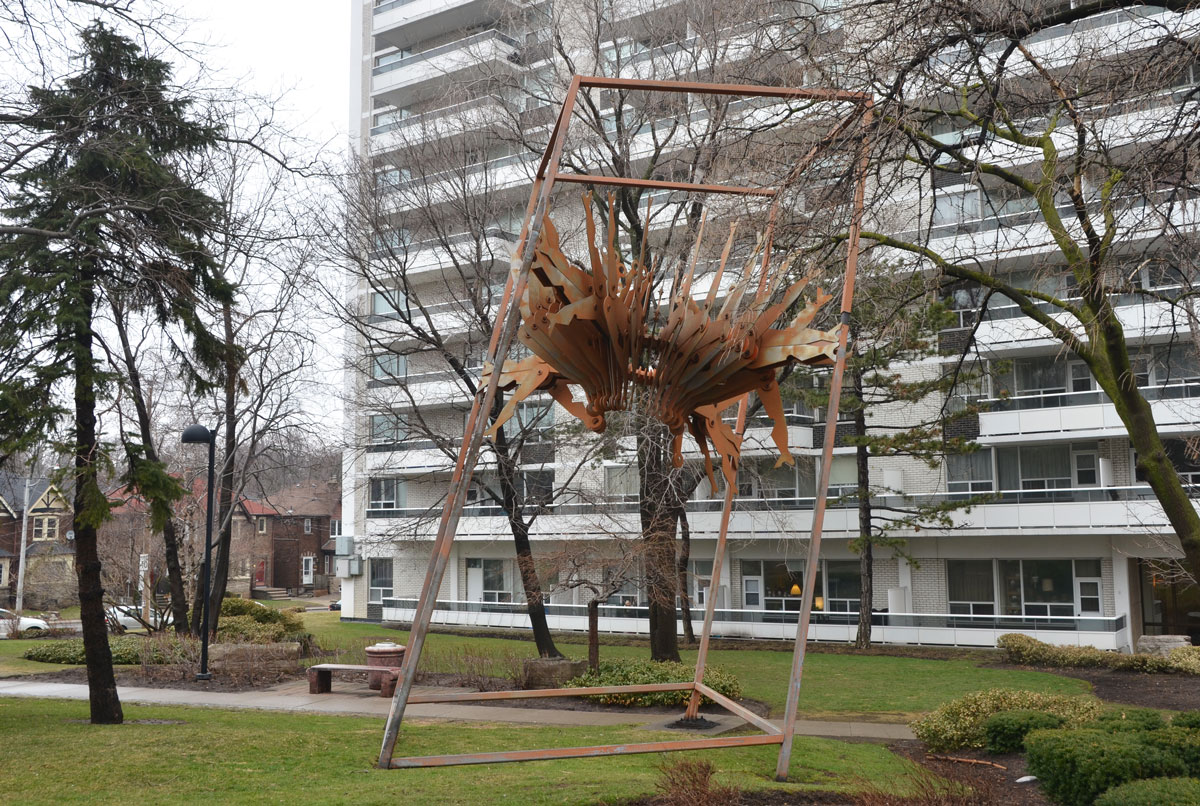
below: After leaving Wind Bird empty handed yet again, I walked west towards Yonge Street.  Off the street and amongst some trees I saw this sculpture.   It is one that I have never noticed before.  A collection of metal pieces is suspended from the top of a lopsided metal frame, more parallelogram than rectangle.

rust coloured metal sculpture in front an apartment building. The sculpture is a large metal frame that looks like a cube but made of parallelograms and from the top is suspended a bunch of metal pieces.

below: On closer inspection, the metal bits are actually flat human forms with their heads in the center and feet flung outwards as if spinning around a central axis.  I know enough physics to know that either centrifugal force or centripetal forces (or both) are at play here.  But I don’t know enough to know the right answer.

close up of a sculpture of flat metal people shapes, forming a circle with their heads, their feet sticking out like in a centrifuge.

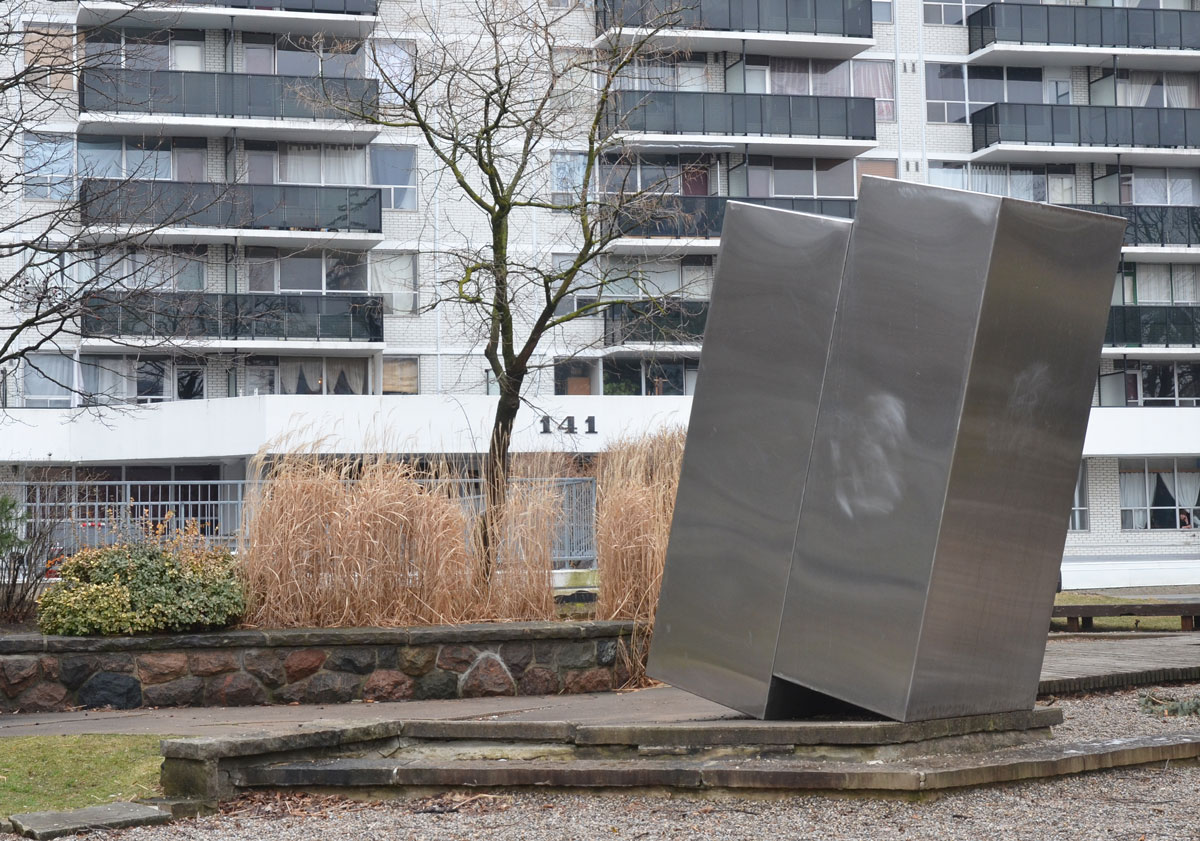
below:  Next door are these two metal shapes.  There isn’t much to it, is there?  What it does have is it’s own little park area and walkway.  I didn’t have to get my shoes muddy if I wanted to get closer.

A sculpture that is just two rectangular metal boxes upright, joined together and on a slight angle. In a small park in front of an apartment building at 141 Davisville in Toronto

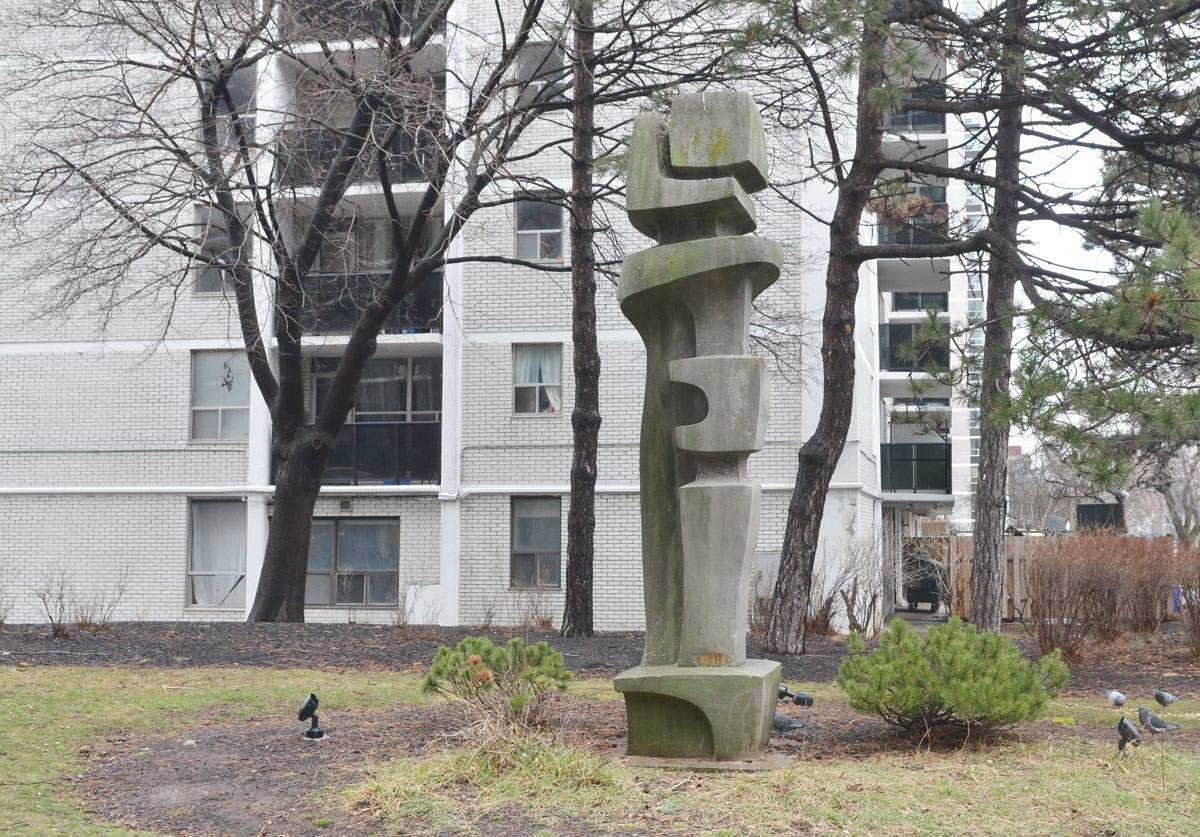
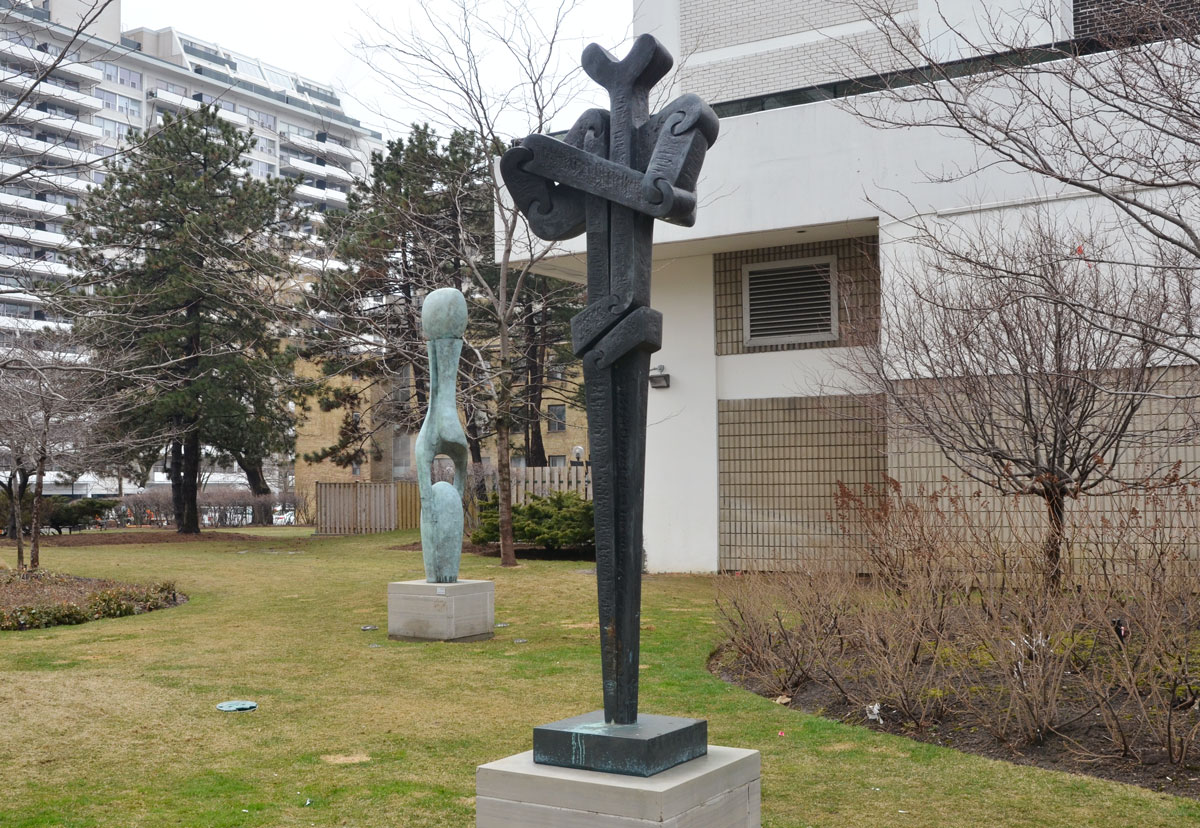
below: There is a path that ran on the west side of the above building, 141 Davisville, to Balliol Street.   This tall sculpture stands beside the path.  I am not sure who the artist is.  Is it a couple embracing? Or a totem pole of abstract forms?  Or just something that looked good to the artist’s eye?

tall columnar sculpture somewhat resembling a totem pole, all in grey, beside some trees in front of an apartment building.

below:  Next, from across Balliol, this sculpture caught my eye.  It is ‘Grand Odalisque’ by Sorel Etrog.

Grand Odalisque, a sculpture by Sorel Etrog sits on a wood pedestal in front of the entrance to an apartment building.

below: I’m rarely satisfied with photos taken of public art in front of buildings.  The background is always to cluttered or messy.   I played with various angles for ‘Grand Odalisque’ and I found this one.  The sculpture is quite phallic now that I look at it.

Grand Odalisque, a sculpture by Sorel Ertog sits on a wood pedestal . Looking across Balliol from behind the sculpture. The scene across the street is a few men standing in front of a construction site where a new condo is being built

The phallic nature of the sculpture is possibly ironic .  Odalisque has a few meanings and connotations, but all involve women.  In fact, ‘La Grande Odalisque’ is a famous painting by Jean Auguste Dominique Ingres in 1814.  In French, ‘grande’ is the feminine form of the adjective and ‘grand’ is the masculine.  Ingres used ‘grande’ for his female nude and Etrog used ‘grand’ for his sculpture.  Is there a connection?  Or just my imagination?

below: La Grande Odalisque.  You’ll have to visit the Louvre in Paris if you want to see the painting.

picture of the painting 'La Grande Odalisque' by Jean Auguste Dominique Ingres, 1814

The next stop along Davisville was the Al Green Sculpture Garden.  Al Green was a builder,  a founder of Greenrock Property Management, and in later life a sculptor.   It makes sense then that the small garden that bears his name, and is home to some of his sculptures, is between two of Greenrock’s apartment buildings.

below: ‘Leaning Torso’ by Al Green.

Al Green sculpture

below: ‘Embrace’ by Al Green

Al Green sculpture, The Embrace

below: ‘Landing Sculpture’ by Carl Lander (aka Carl Bucher), 1970.  They look like little red spaceships hovering in the air, or as the name suggests, coming in for landing.  Father and son alien ships come for a visit.
Lander (1935-2015) was a Swiss artist who lived in Canada for a couple of years in the early 1970s.

sculpture in front of an apartment building, two red shiny things that look like alien spaceships

below: Another sculpture by Sorel Etrog in the foreground.  Behind it is ‘Greenwin’ by Maryon Kantaroff, commissioned in 1973 by Greenwin Developments.

two tall thin sculptures, one by Sorel Etrog in the foreground and a greenish bronze by Kantaroff in the background.

And last, and very definitely least….

below:  You tell me.  Christmas balls on top of a fence?

three silver Christmas ball ornaments are attached to the top of a chain link fence

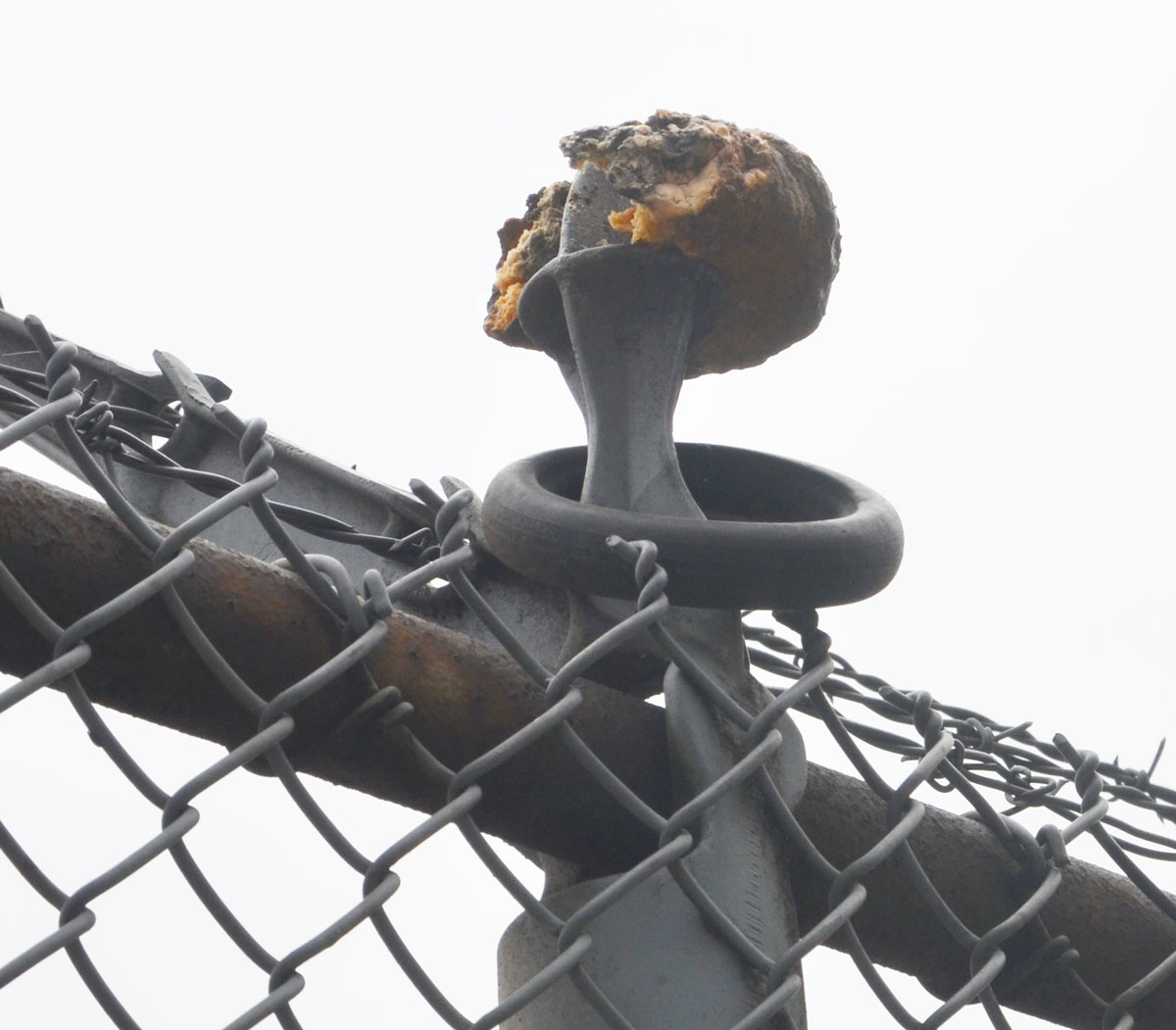
below:  Once you’ve figured out the whys and the wherefores of the above, you’ll be happy to know that there is another mystery.  A bagel?  A donut?  Squirrel food? Bird food?  But also a  ring?
These are on the fence that runs between Yonge St and the subway line near Davisville station.

a moldy partially eaten bagel or donut sits on top of a fence pole on a chain link fence

This post is the result of a very wobbly and random circular walk around part of the Wychwood Heights neighbourhood last weekend.   A hodge podge of this and that.

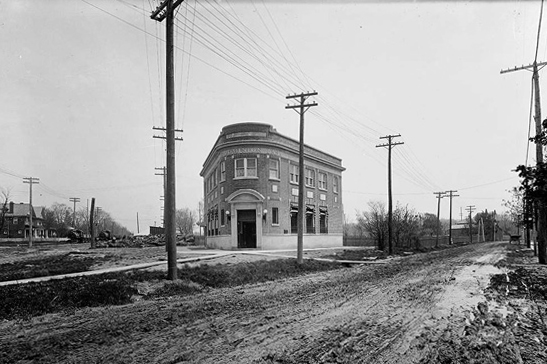
below: The intersection of St. Clair West and Vaughan Road circa 1912

Historical black and white photo of a two sorey brick building at an intersection of two dirt roads.

below: I didn’t quite recreate the picture above but it is still obvious that the brick building is still standing after just over 100 years but that every thing around it has changed.

Two storey brick building, now Hakim Optical on the corner of an intersection.

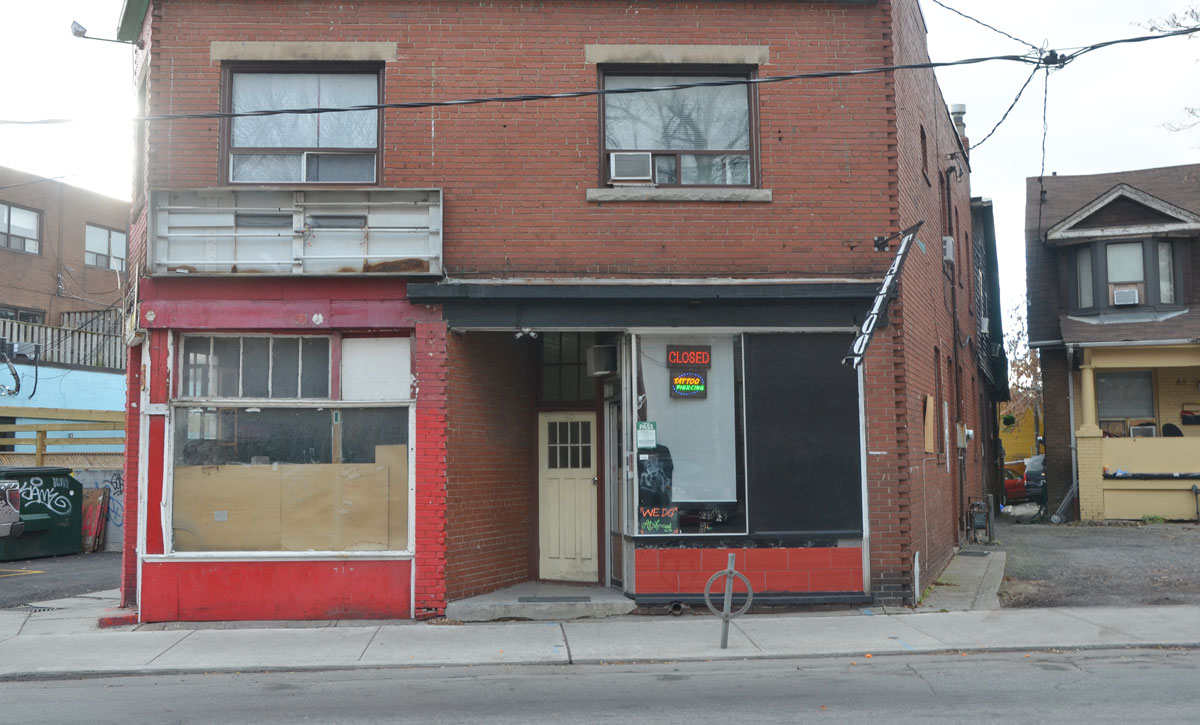
below: Just to the north,  78 Vaughan Road…. didn’t this store used to be an ice cream place?

empty store front at 78 Vaughan Road, empty on one side a closed tattoo parlour on the other.

below:  Ah yes, there is still remnants of ice cream cones above the window so my memory is correct.
I wonder what happened to it?

side of a brick building that used to be an ice cream store. Painted red with some white parts, front has been removed from lighted signs, exterior decorations have been removed except a faint outline of ice cream shapes remain above the window.

There are a number of alleys to the north and west of the intersection of St. Clair and Vaughan Road.  Most of them are quite tidy and well looked after.   They were also full of surprises, bright little things that put on a smile on your face on a December afternoon.

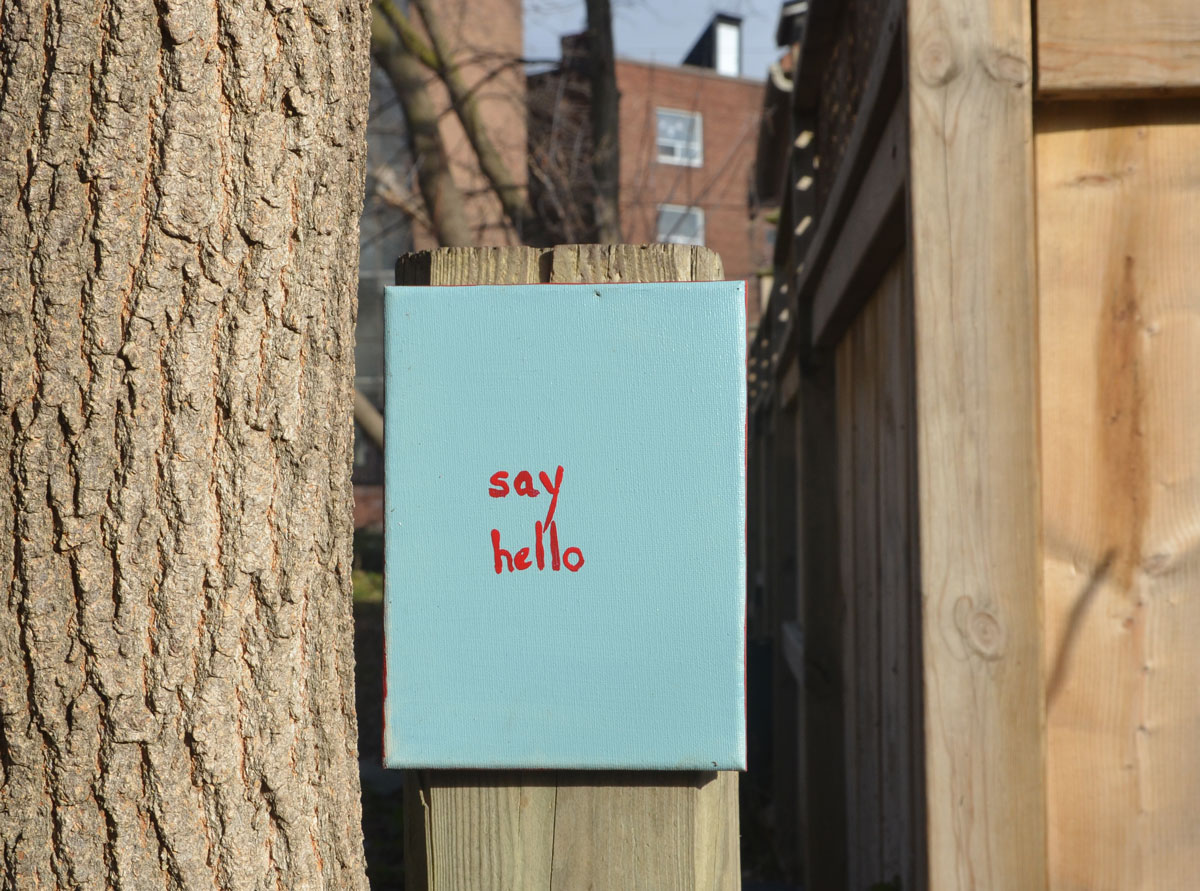
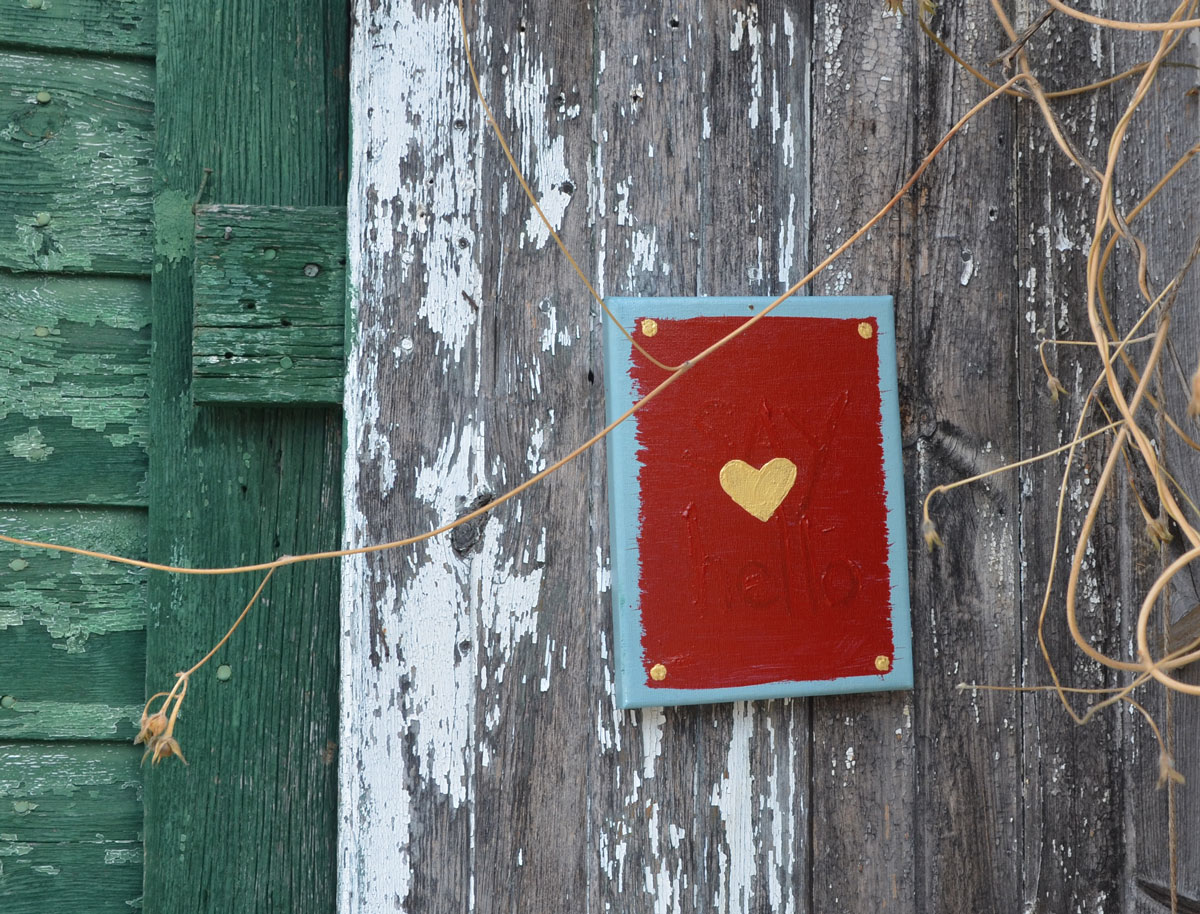
below: Like little pictures painted on canvas….

A small canvas painted turquoise and the words say hello written in small red letters, attached to a fence in a lane

A small canvas painted red and a small yellow heart painted in the middle. The words say hello are painted on it too but they are harder to see. It is nailed to an old wood fence

A small landscape painted on canvas and attached to a telephone pole in an alley

below: and painted on wood

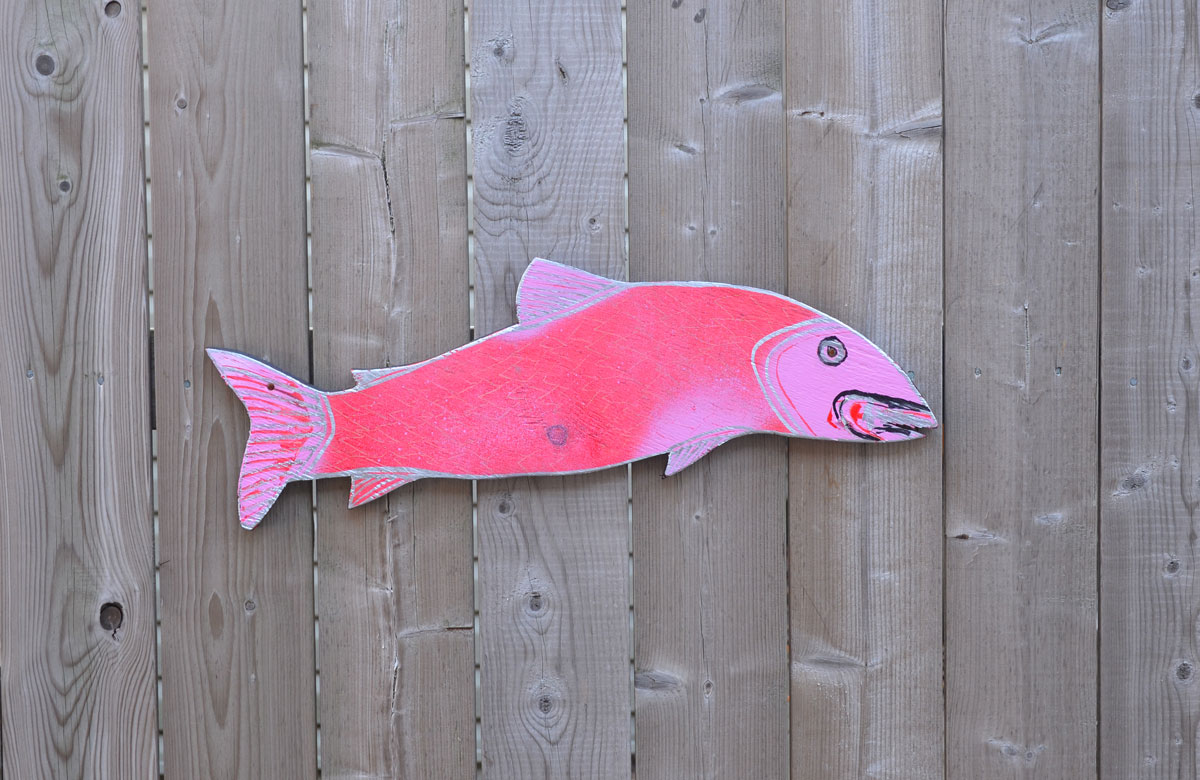
a two tone pink fish painted on wood, cut out, and nailed to a wood fence.

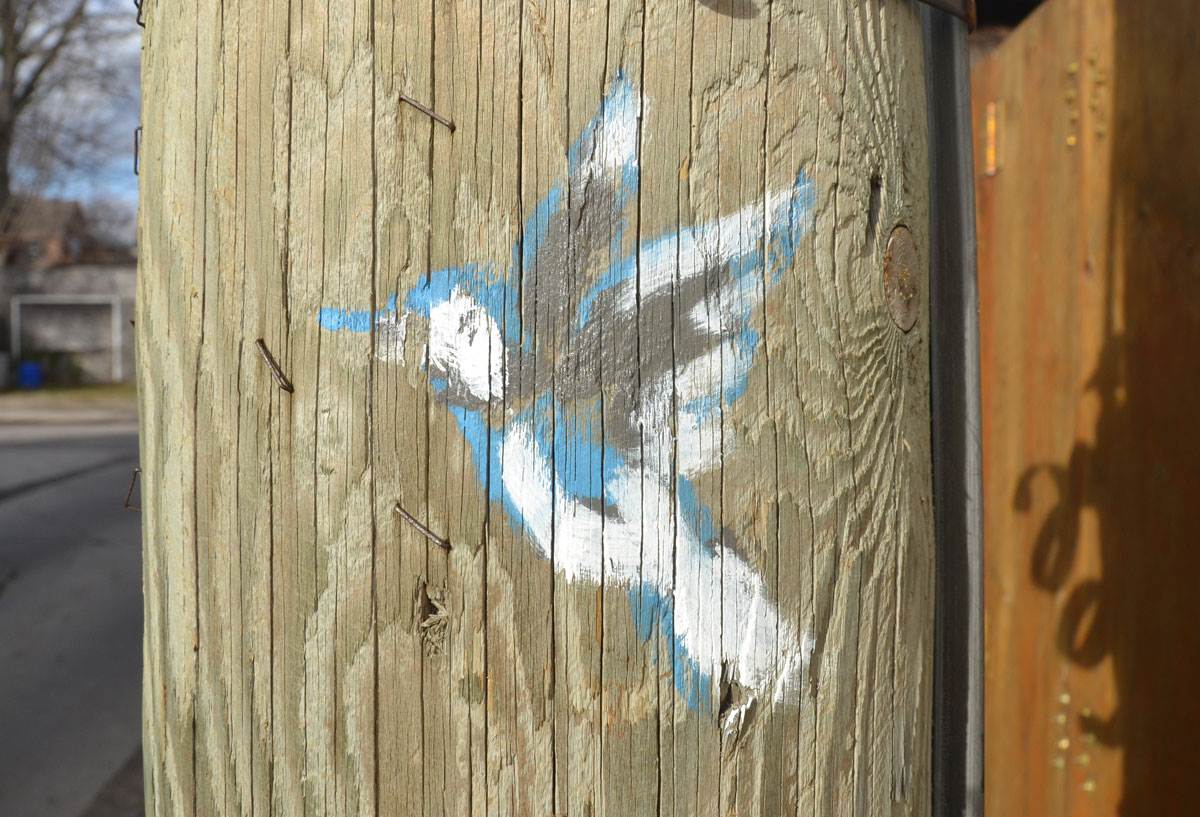
below: or painted directly on poles.

On a wood telephone pole, a small bird painted in white, black and blue.

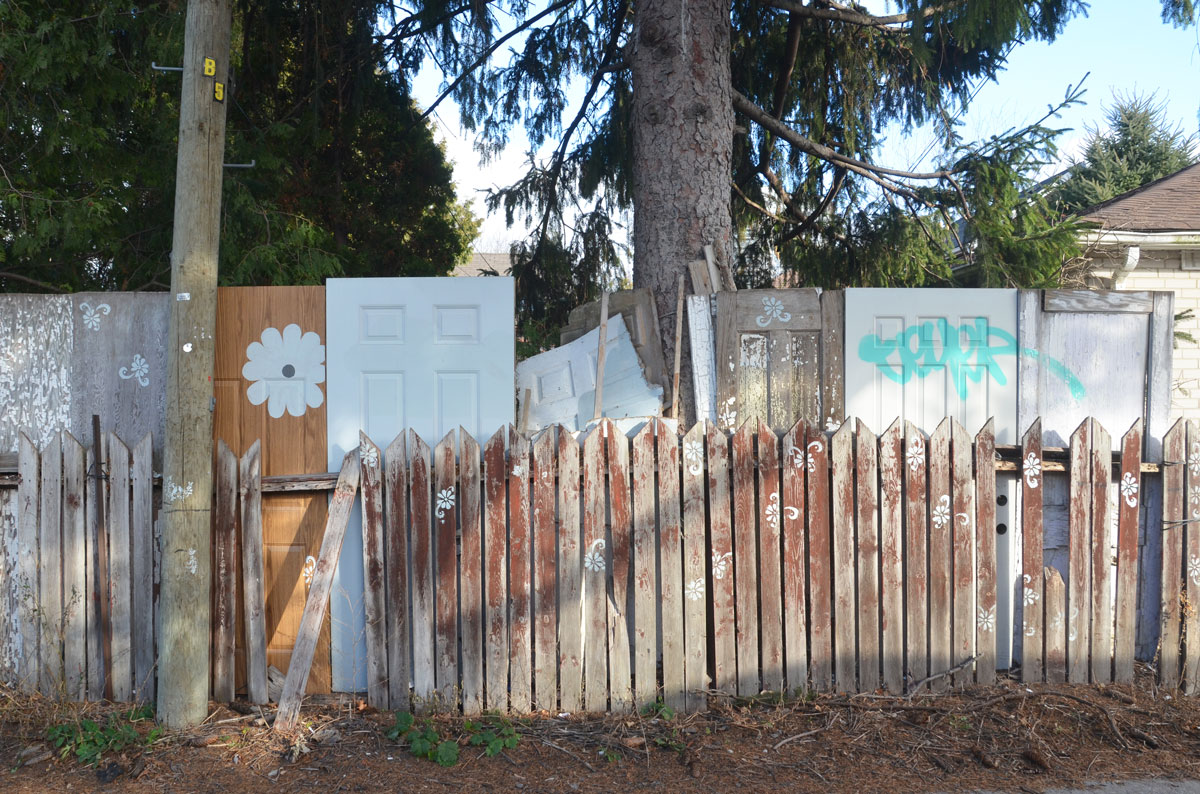
below: There was a fence made of old wood doors

an old picket fence that is falling aoart, and a fence made of doors that is behind it.

close up of old picket fence that is falling aoart, and a fence made of doors that is behind it.

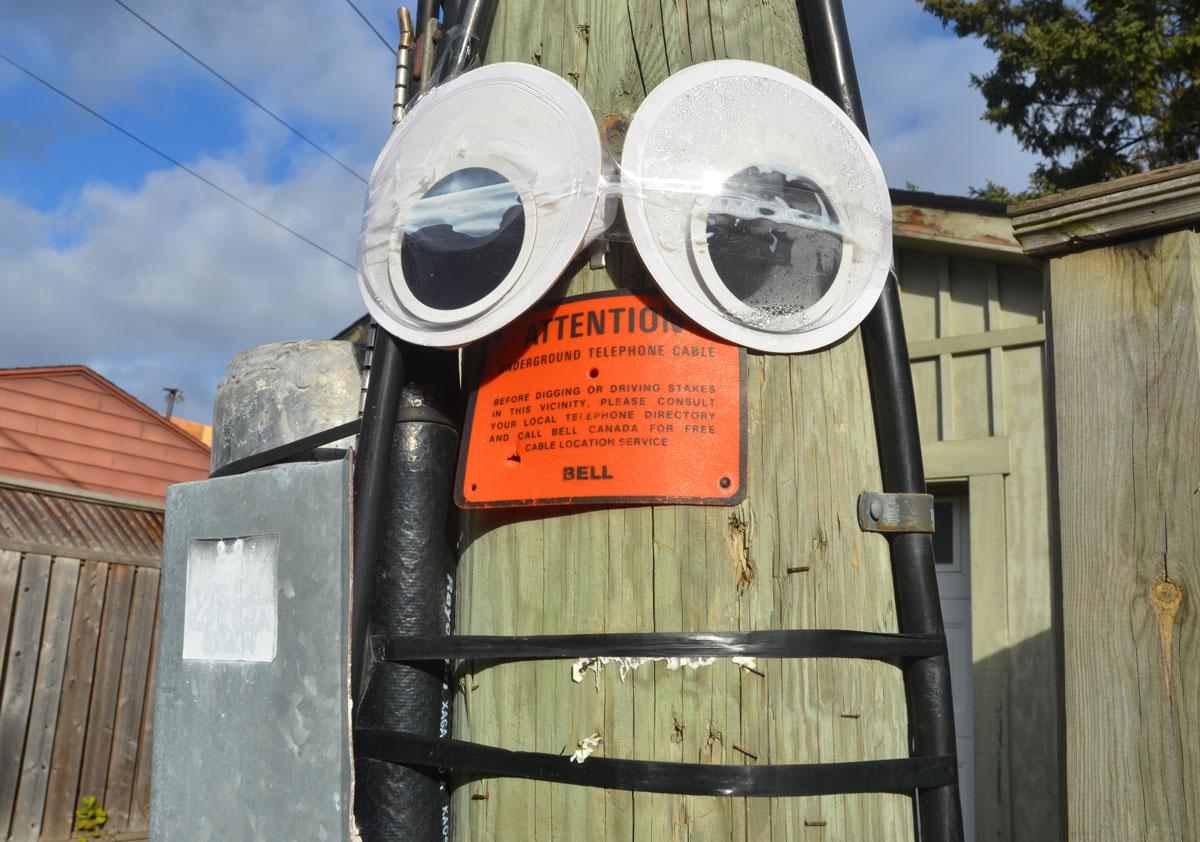
below:  There was a great creature with googly eyes and a rectangular orange nose.

Two big googly eyes attached to a telephone pole

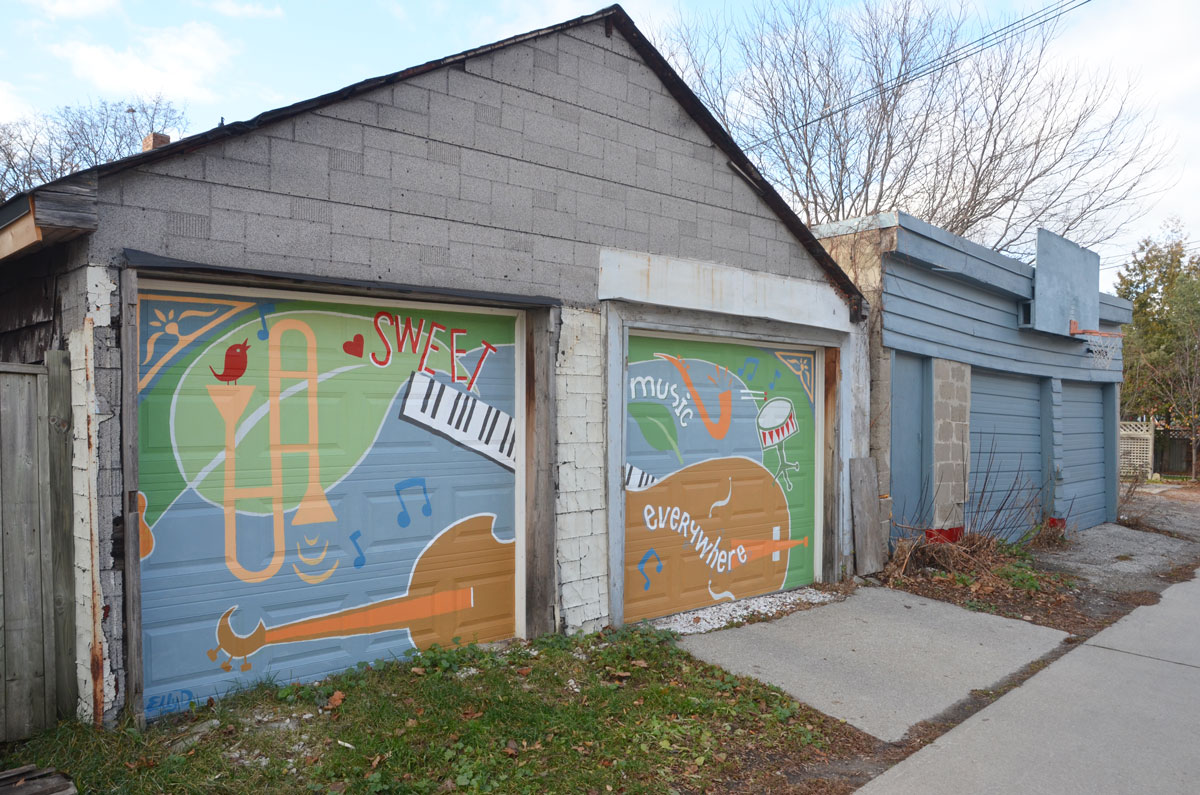
below: And of course there were some painted garage doors.

street art on garage doors, musical instruments covering two garages, a guitar, a trombone, also the words sweet sweet music everywhere

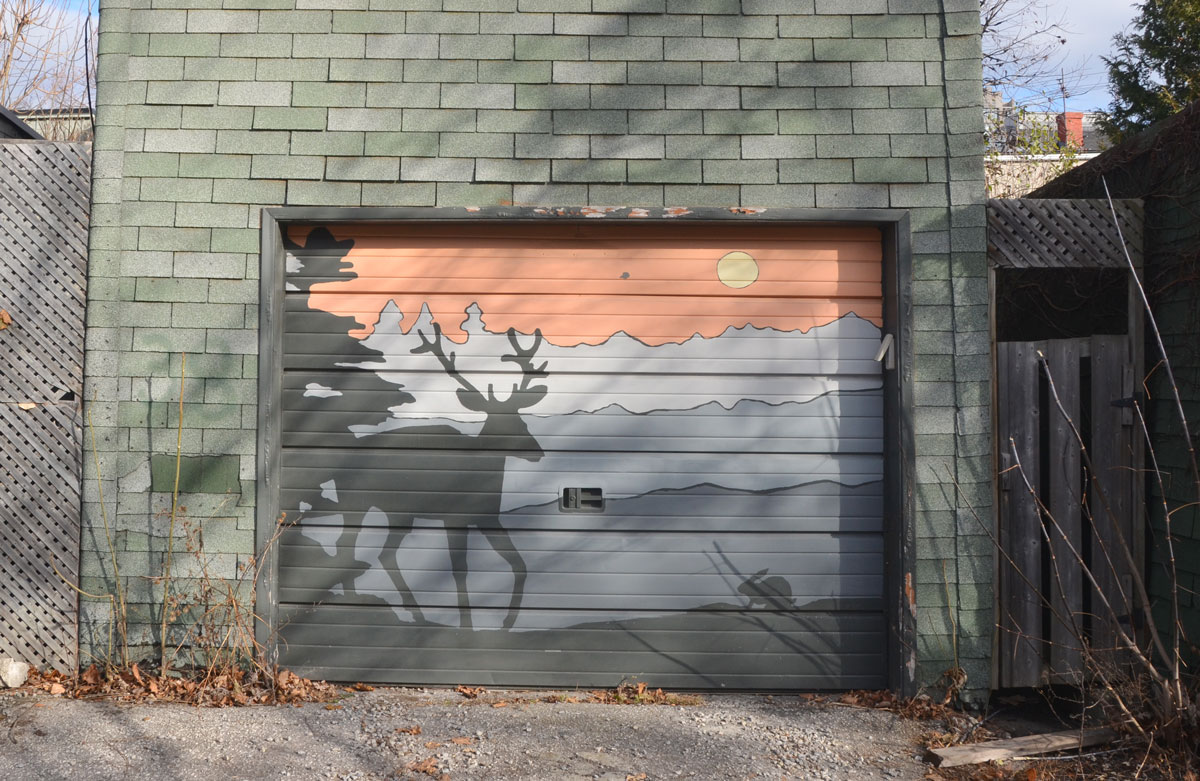
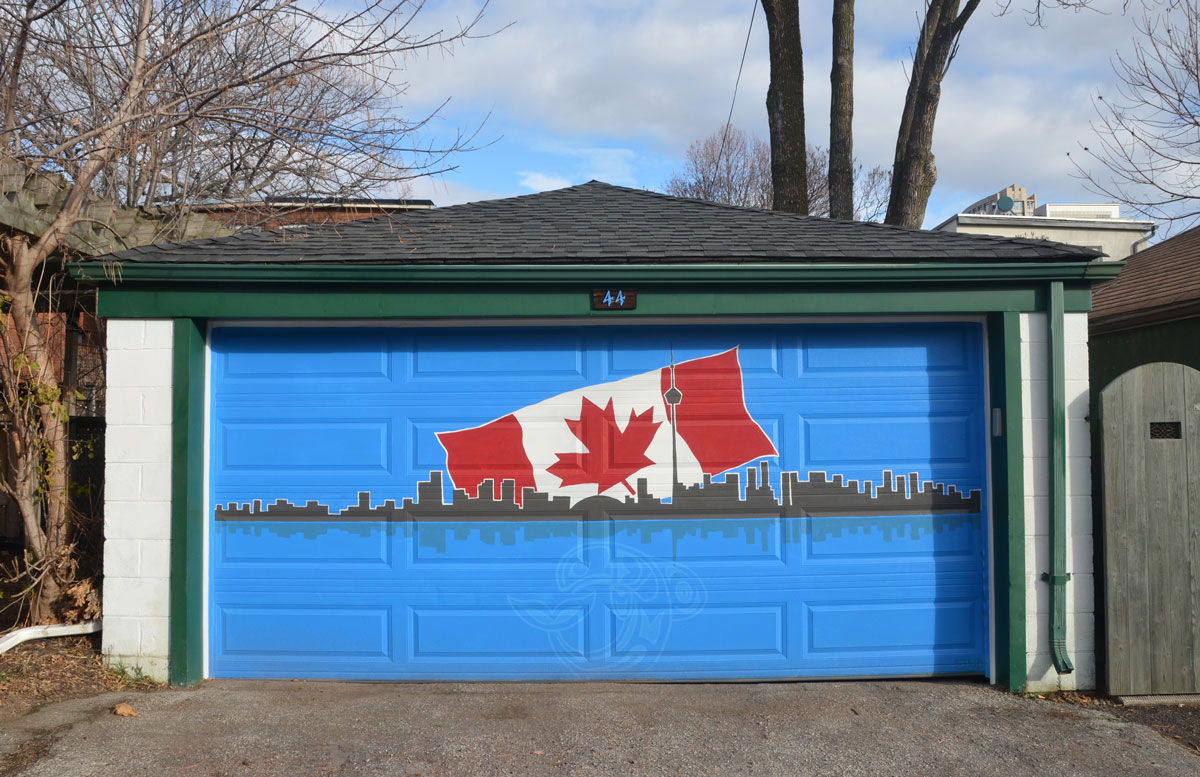
below: These garage doors are a sample of the more than 40 doors that have been painted as part of the Kenwood Lanway Art Initiative.

painting on a garage door of a moose at sunset

painting on a bright blue garage door of the Toronto skyline with a large Canadian flag behind ithe skyline

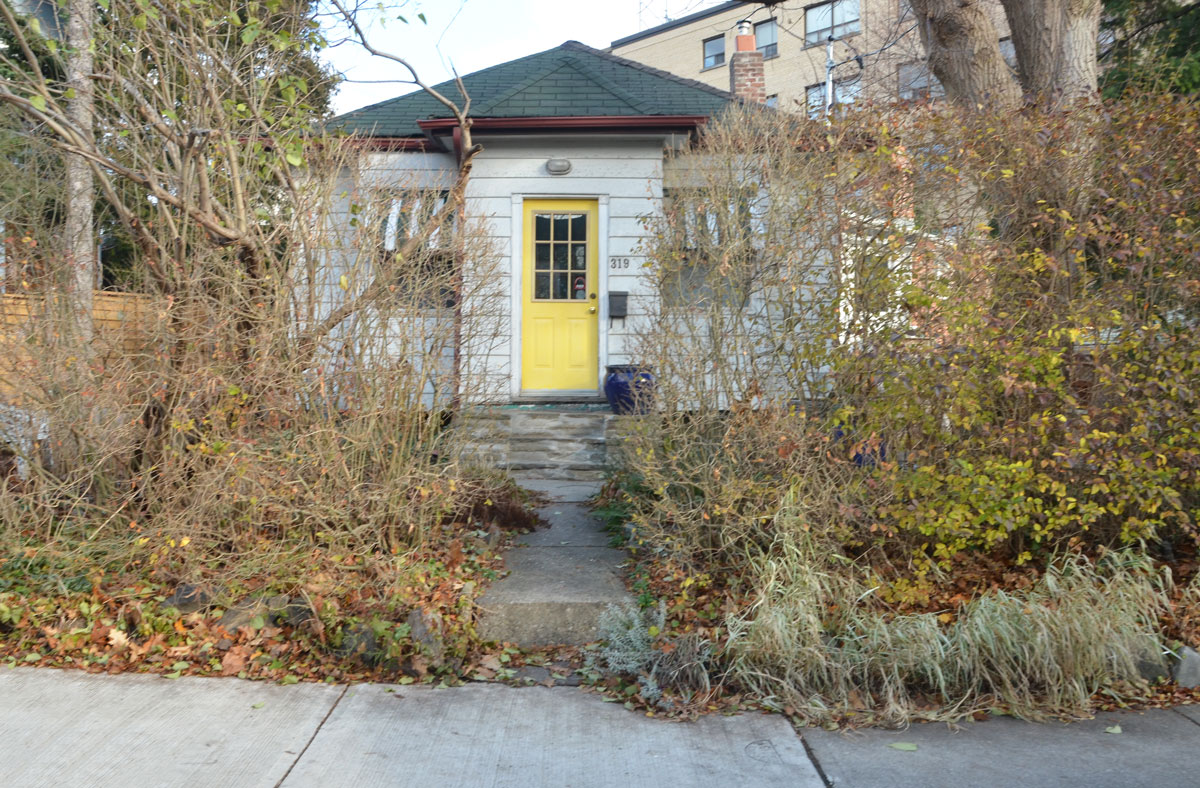
While walking on the streets in the neighbourhood I saw a couple of little houses

little narrow white bungalow with a yellow front door set back from the road. There is a straight walkway from the sidewalk to the door, and there is a lot of shrubery in the front yard especially near the sidewalk.

as well as larger buildings with intricate architectural details.

below:  A checkerboard effect with the bricks on the La Salle Apartments.  As an aside, the small bush in front of the building was in the picture no matter what angle I tried.  It was a lilac bush and I am sure that there were buds on it.

Part of a low rise apartment building, over the door, no windows. Checkerboard pattern in the bricks. The words La Salle Apts in large white letters across the bottom of the picture.

below: A little fake balcony with a white post railing on a low rise apartment building.

A white framed window in a red brick building. Below the window are a few white pieces of wood that look like a balcony railing even though there is no balcony there.

below: A line of little arches across the roofline is echoed in the larger arch patterns over the windows.  There is a small relief sculpture near the top corner of the building (slightly behind the tree) but I can’t tell what’s on it.  A coat of arms maybe?

brick pattern across the top of a building. scalloped, or looking like little arches to match the larger arches over the windows.

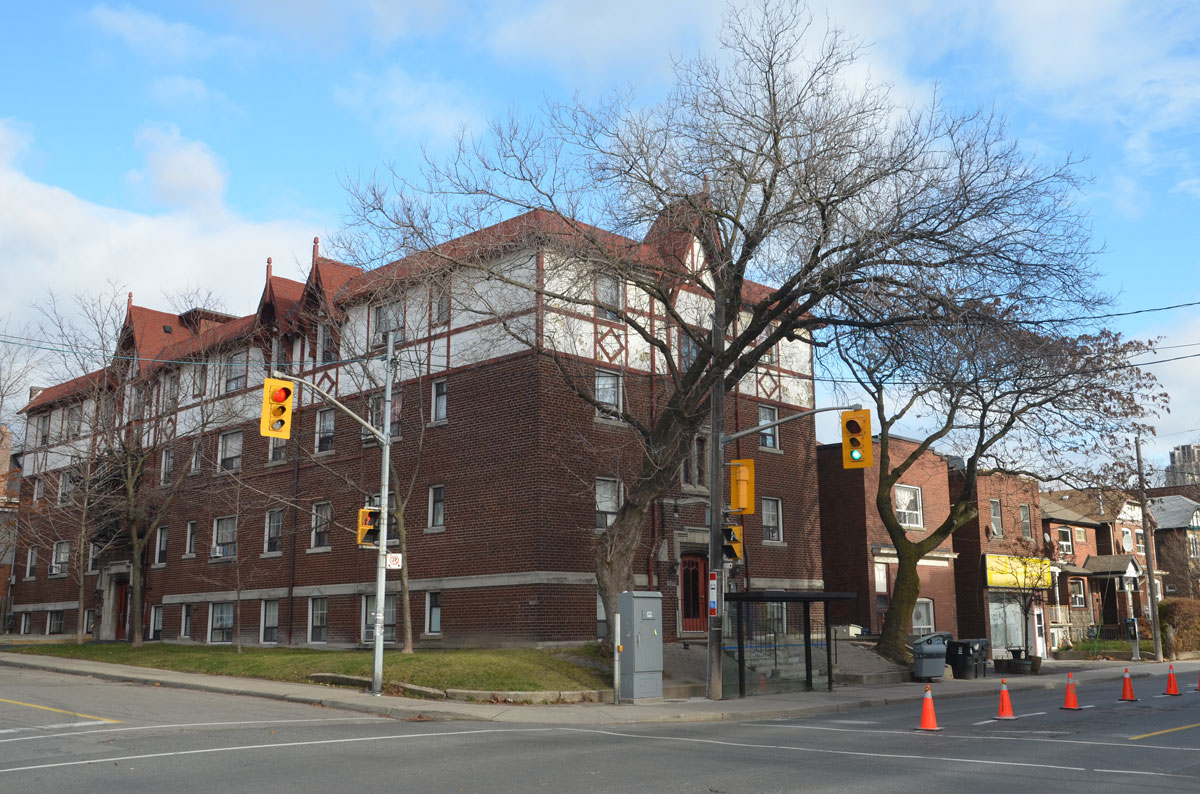
below:  There were quite a few four storey brick apartment buildings that looked like they were built in the 1920’s and 1930’s.  Perhaps there was a  little ‘condo boom’ at the time?

4 storey apartment building on Vaughan Road, red brick with white upper storey, diamond shaped details, two little peaked roofs over windows.

four storey apartment on a corner

front door and front of building, four storey apartment building in red brick with stone window and door frames.


Two four storey apartment complexes and a single family home on Vaughan Road.

below:  Like the condos of today, many of the buildings had names such as Maple Villa

Stone door frame and entranceway to Maple Villa, a brick low rise apartment complex

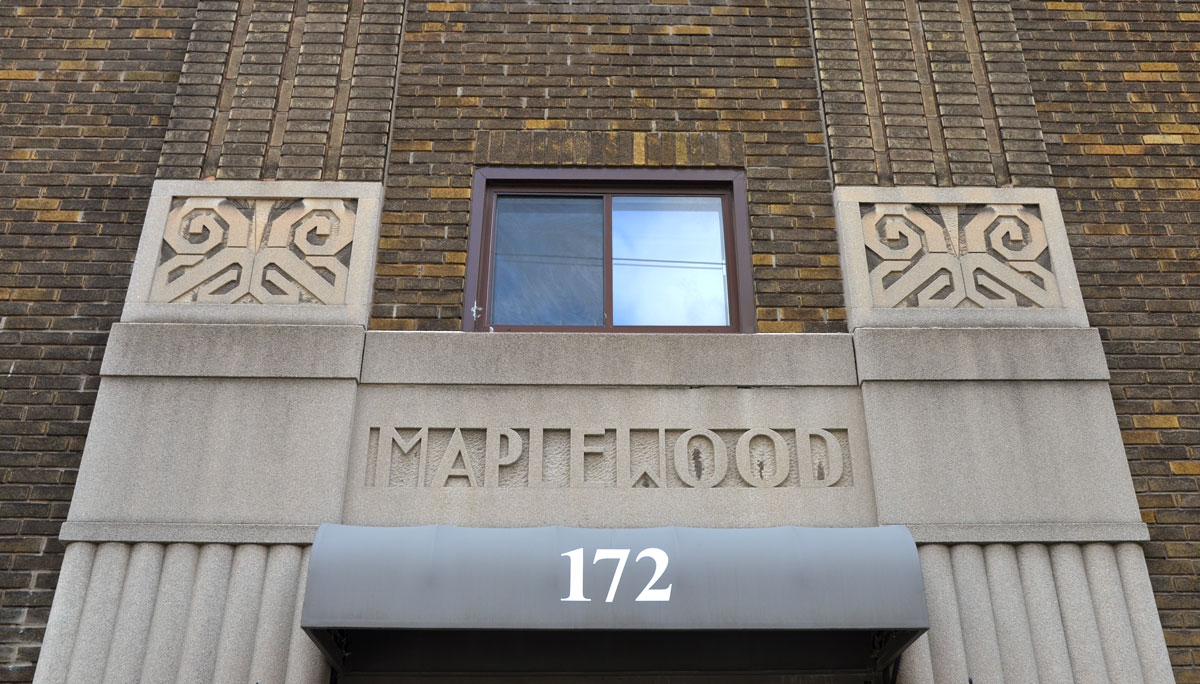
and Maplewood

stonework over the door of the Maplewood apartments at 172 Vaughan road, and the art deco like decorations beside it.

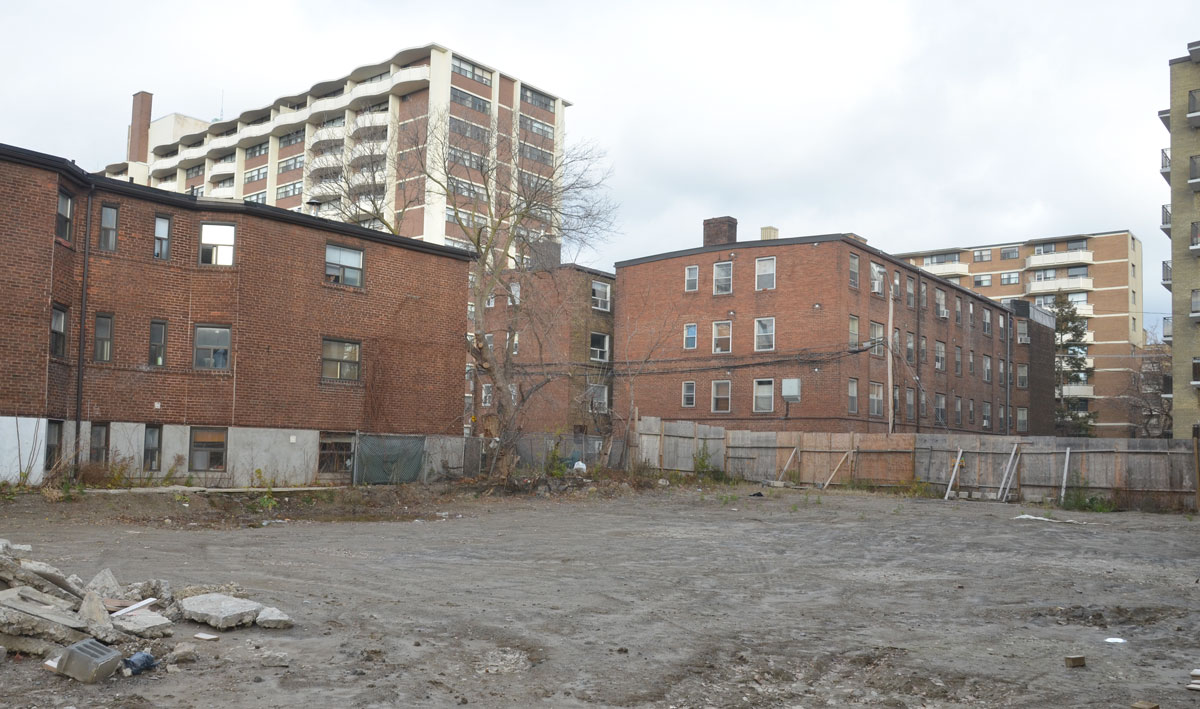
below:   The backs of all those apartment complexes are nearly as interesting as the fronts.
This is one of the only construction sites I saw although….

vacant lot with a number of low rise brick apartment buildings in the background.

… this Presbyterian church looks like it is about to be redeveloped.  It is one of three churches at the corner of St. Clair and Wychwood.   The church was built in 1926.  There is a brief description of the property on the Stanton Renaissance website but very little information is given beyond a “transformation” of the church and the creation of “high end residential boutique”.

An old brick church at a corner. It is now empty. There is a large sign in front of it advertising Stanton developments.

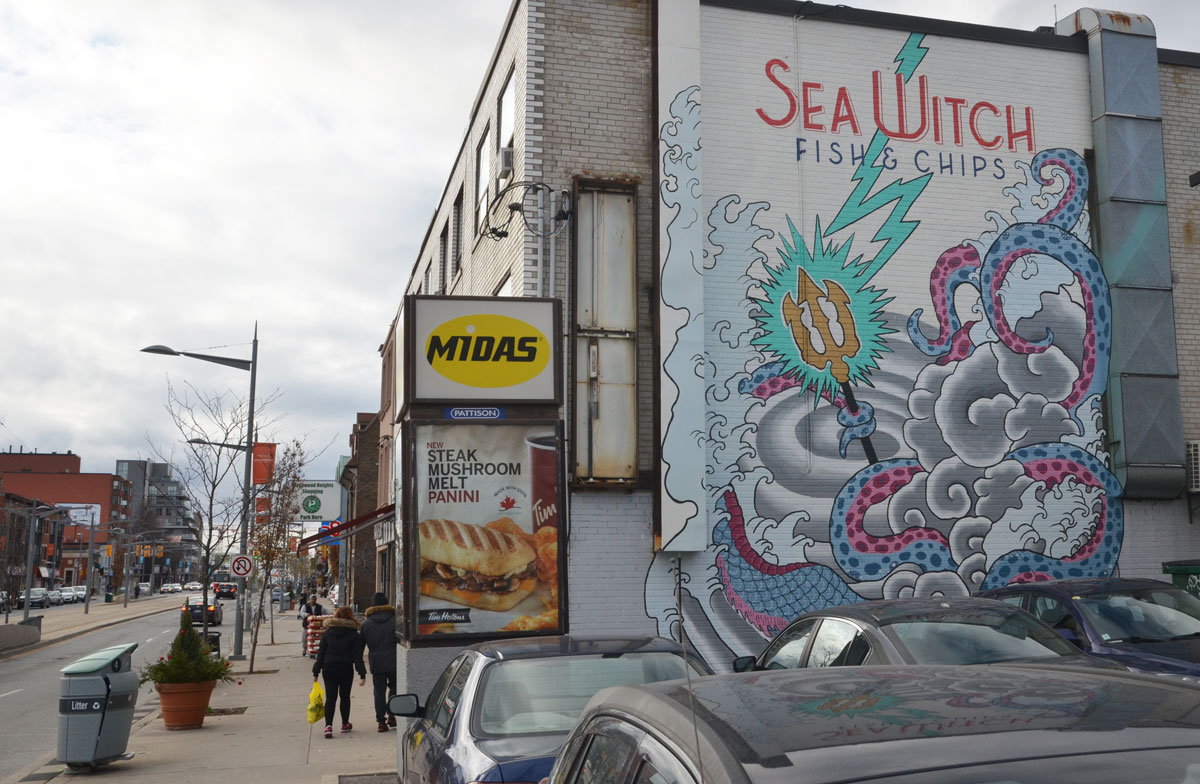
below: Mural for Sea With Fish and Chips on St. Clair West

mural for Sea Witch FIsh and Chips restaurant, a large sea serpent

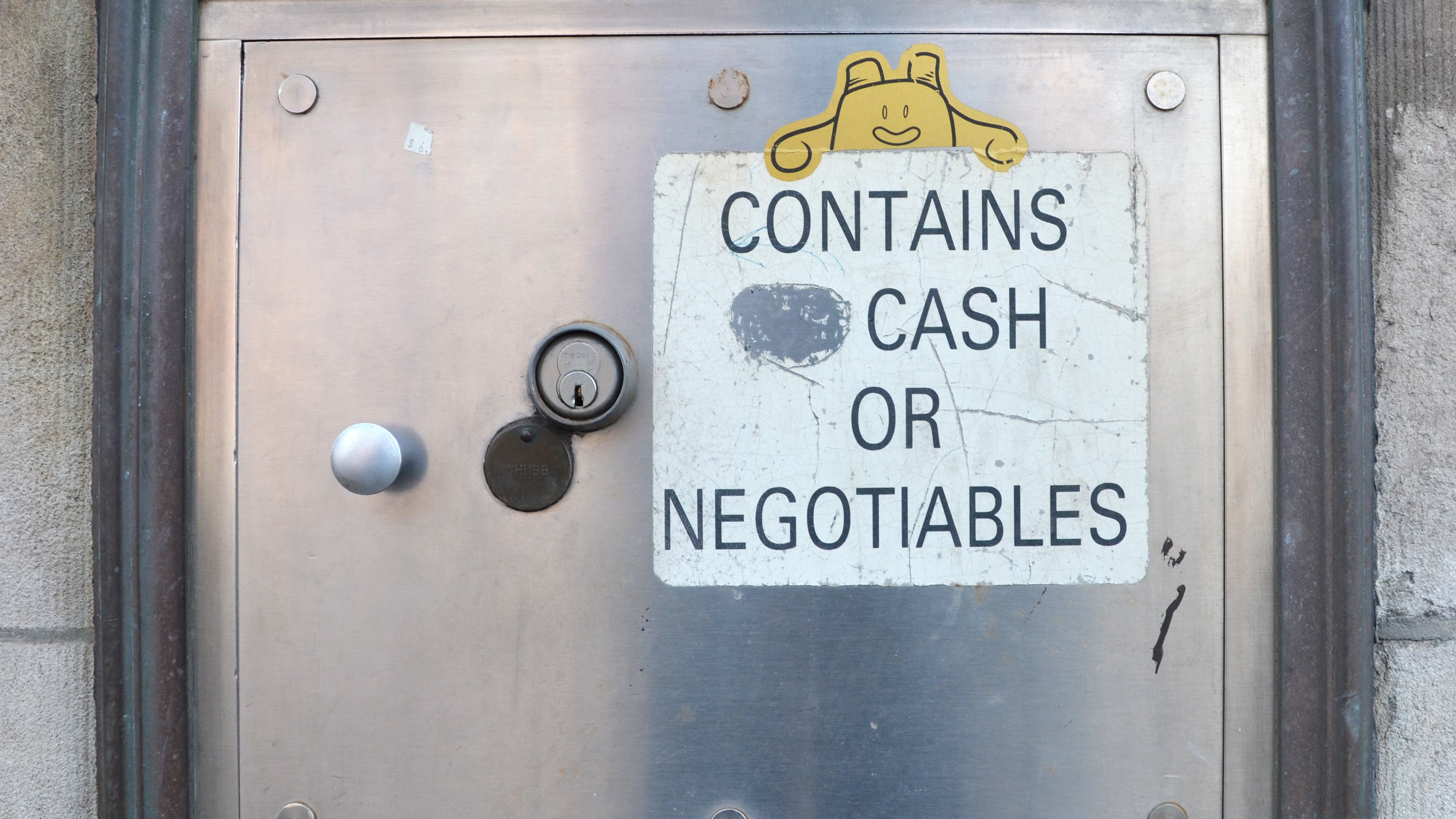
A little yellow sticker on a bank night deposit box, looks like a little smiling creature looking over the sign that says contains no cash or negotiables, except that the word no has been scratched out

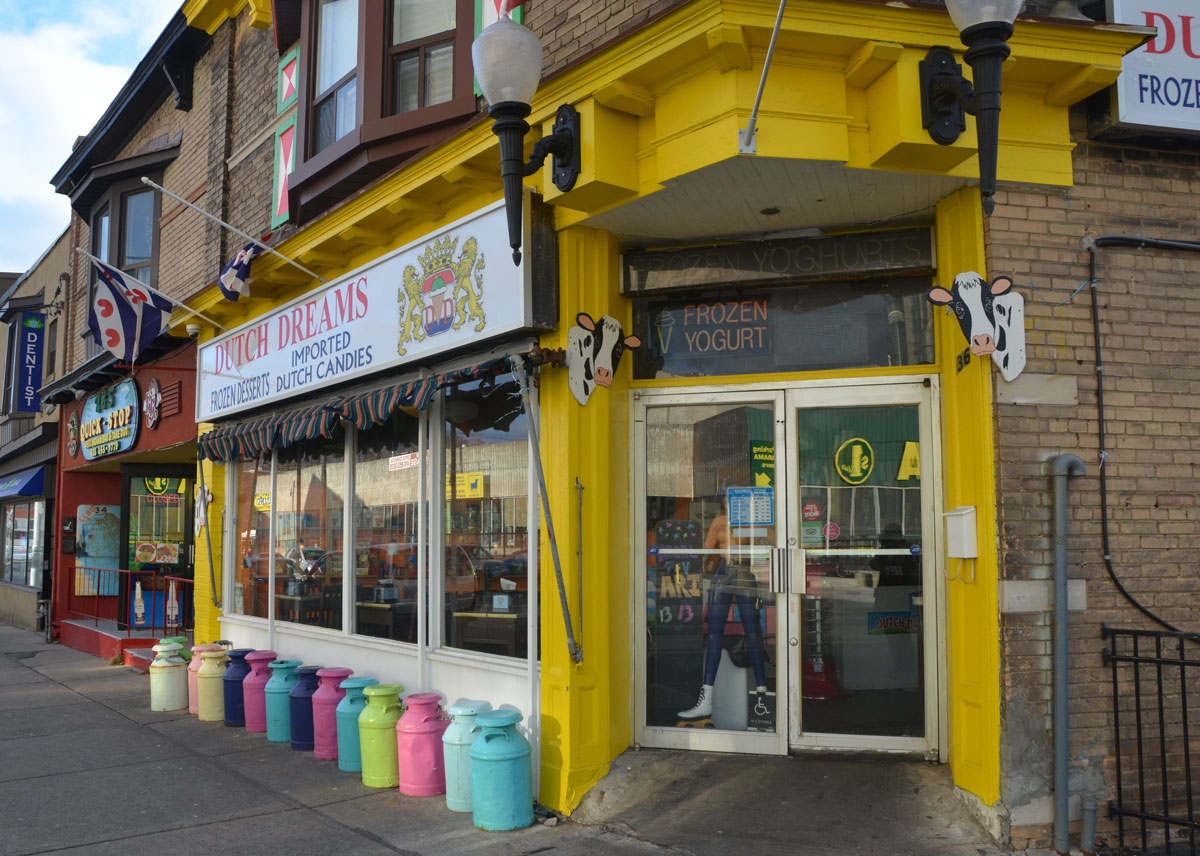
below: As I circled back the intersection of Vaughan Road and St. Clair West, I spotted a large doubledecker strawberry and vanilla ice cream cone on the side of Dutch Dreams.  Hey!  The answer to my question.  The ice cream place from 78 Vaughan Road has moved a couple of blocks south, complete with it’s collection painted old fashioned milk cans.

A very large plastic icce cream cone, double scoop, strawberry on the bottom and vanilla on the top, decorating a brick building. The shutters on the windows of the building are green, red and white

bright yellow entranceway, a line of different coloured milk cans along the exterior wall, sign says Dutch Dreams, candy and ice cream.

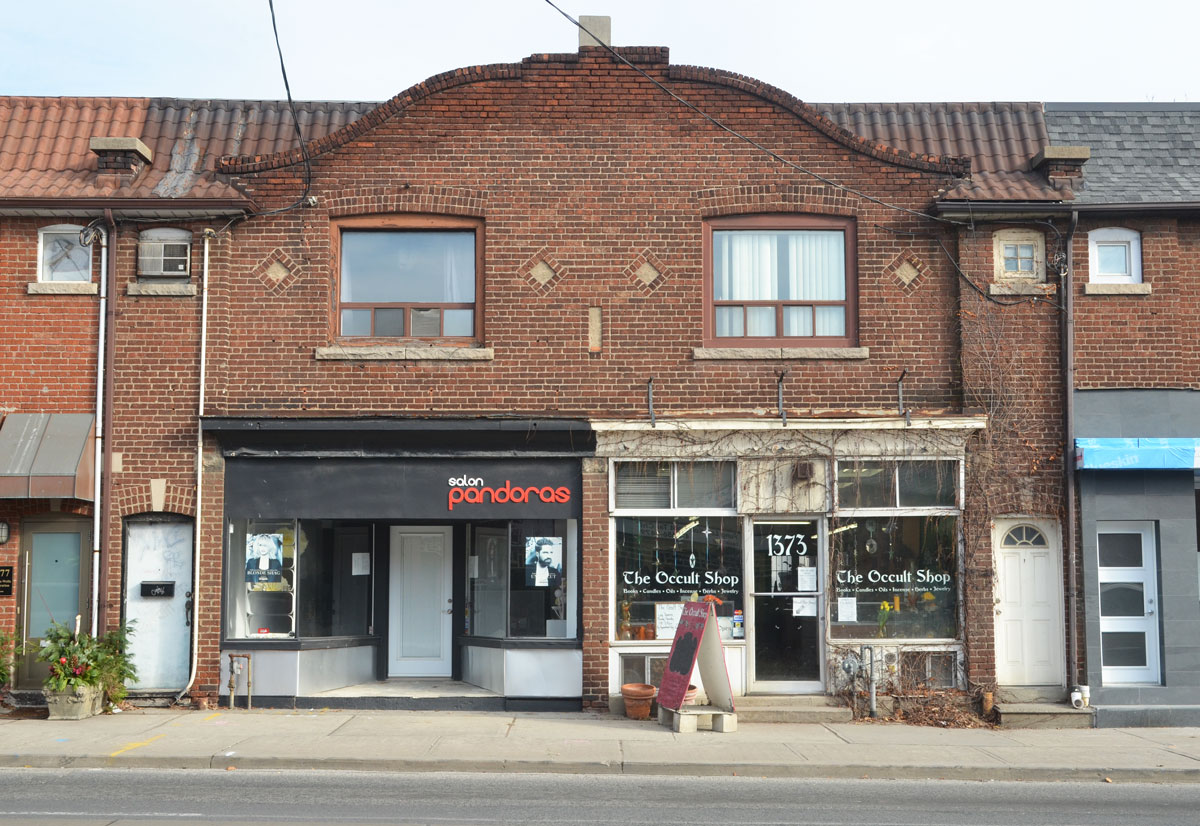
below:  One last picture.  As I waited for the Bathurst bus, I found myself standing across the street from this building.   The curve of the roofline is interesting, but even more interesting is the the fact that there is an occult store in Toronto.  Candles, herbs, incense, jewelry, I’m now wishing that I had crossed the street to investigate further!   And, smile, the store next to it is Pandora’s salon.  Pandora, the one who in ancient times opened a box and unleashed all sorts of evil on the world.


store front, one is an Occult Store, in an old brick building with a curved roofline over the middle of it.

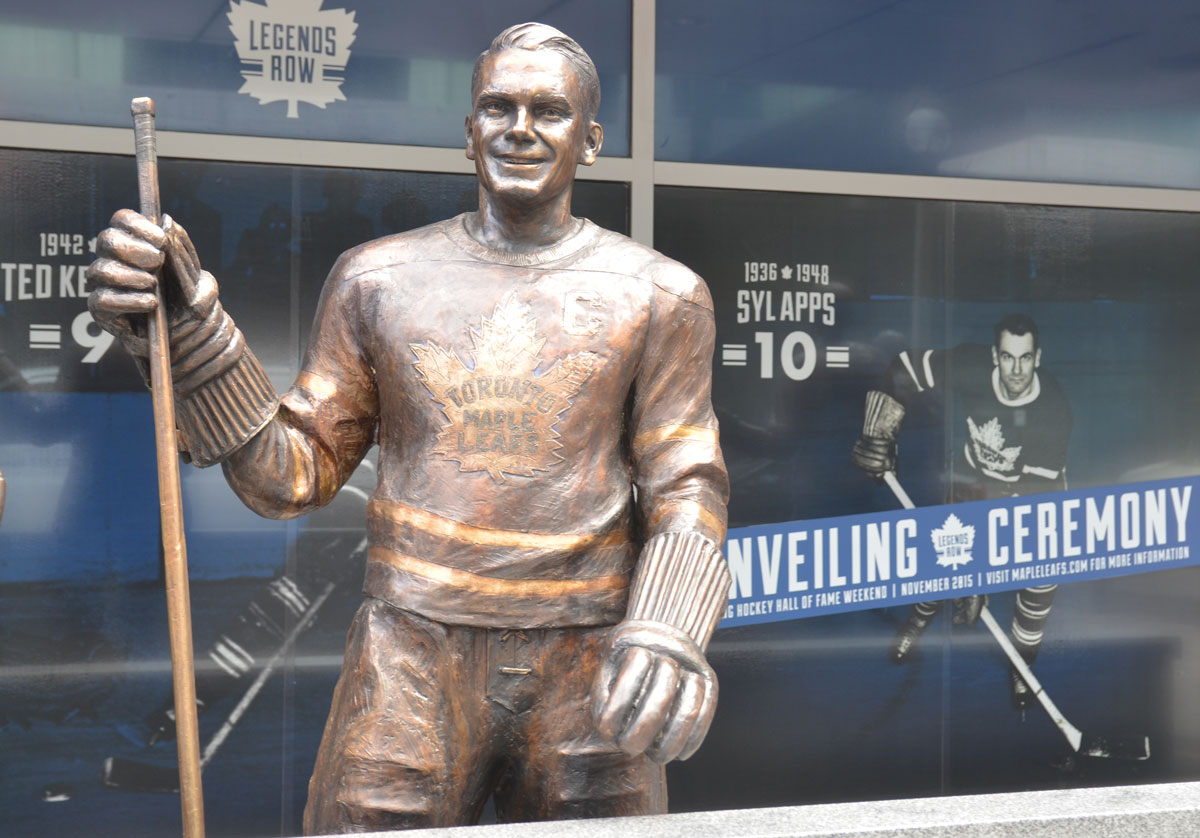
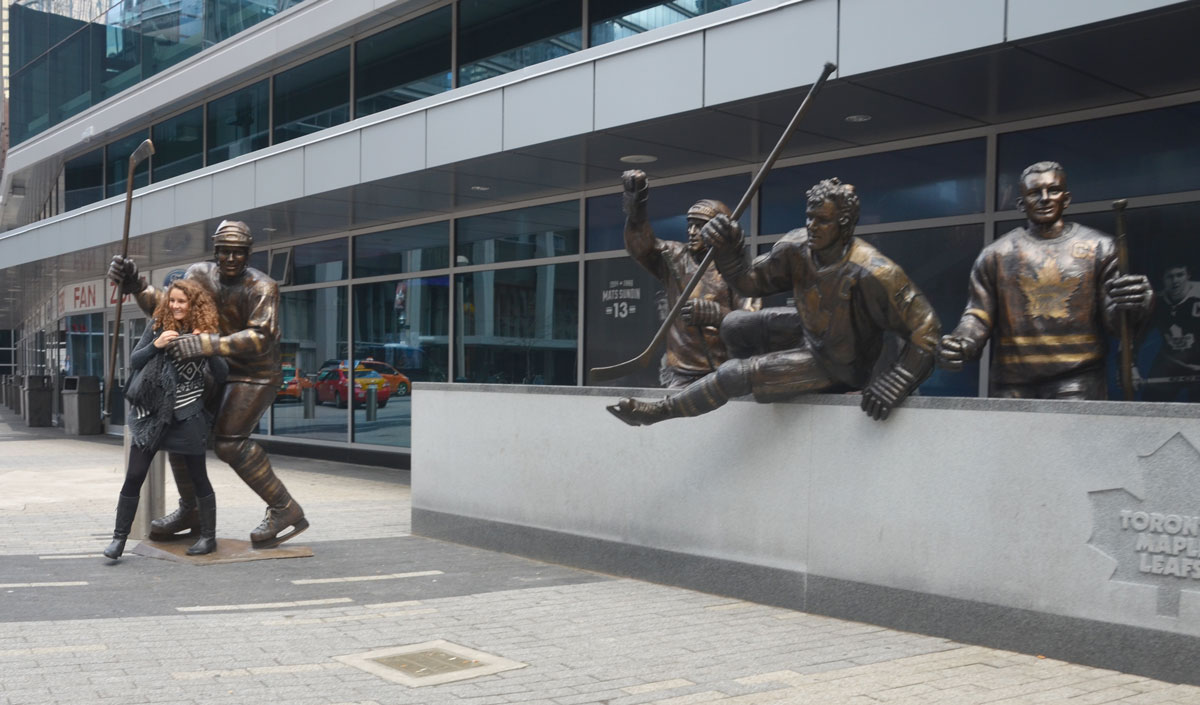
Earlier in November, two more statues were added to Legends Row outside the Air Canada Centre, Syl Apps and George Armstrong.  Both men were Maple Leaf Captains and both men wore jersey number 10.

below:  Blue and white confetti at the unveiling of the latest statues on Legends Row.

Legends Row at the unveiling of statues of Syl Apps and George Armstrong, lots of bits of blue and white paper stream down in front of the statues.

below: An old photo showing Syl Apps and a young George Armstrong when the latter was given Maple Leaf jersey 10 to wear.  Armstrong was the first player to wear number 10 since Apps had retired.

Old black and white picture from the Hockey Hall of Fame, showing Syl Apps (after retirement from hockey) and George Armstrong after Armstrong was given number 10 Maple Leaf jersey to wear.

below:  George Armstrong, past and present, at the unveiling.  Armstrong played 21 seasons with the Maple Leafs between 1950 and 1971.  After retiring from playing hockey, he coached the Toronto Marlies for a few seasons and he was on the Maple Leaf scouting staff for many years.

George Armstrong stands beside the statue of himself while reporters and others take pictures.

below:  Also, number 10, Syl Apps joined the Maple Leafs in 1936.  While he was captain of the Maple Leafs, the team won three Stanley Cups.  Apps retired in 1948.

statue of hockey player Syl Apps stands with stick in hand in Legends Row outside the ACC in Toronto

below: left to right: Mats Sundin, Borje Salming, Darryl Sittler and Ted Kennedy

Legends Row statues, Sundin, Salming, Kennedy and Sittler

below: George Armstrong and Johnny Bower

Legends ROw statues George Armstrong and Johnny Bower

below: left to right: Borje Salming, Darryl Sittler, Ted Kennedy and Syl Apps

Legends Row statues, Borje Salming, Ted Kennedy and Syl Apps stand behind the boards while Darryl Sittler is jumping over the boards.

below: Just around the corner, two statues of a slightly different nature

Two mannequins, one male and one female, are dressed in Maple Leaf hockey clothing.  Toques, heavy sweaters, T-shirts and scarfs, all in blue and white with the Leafs logo

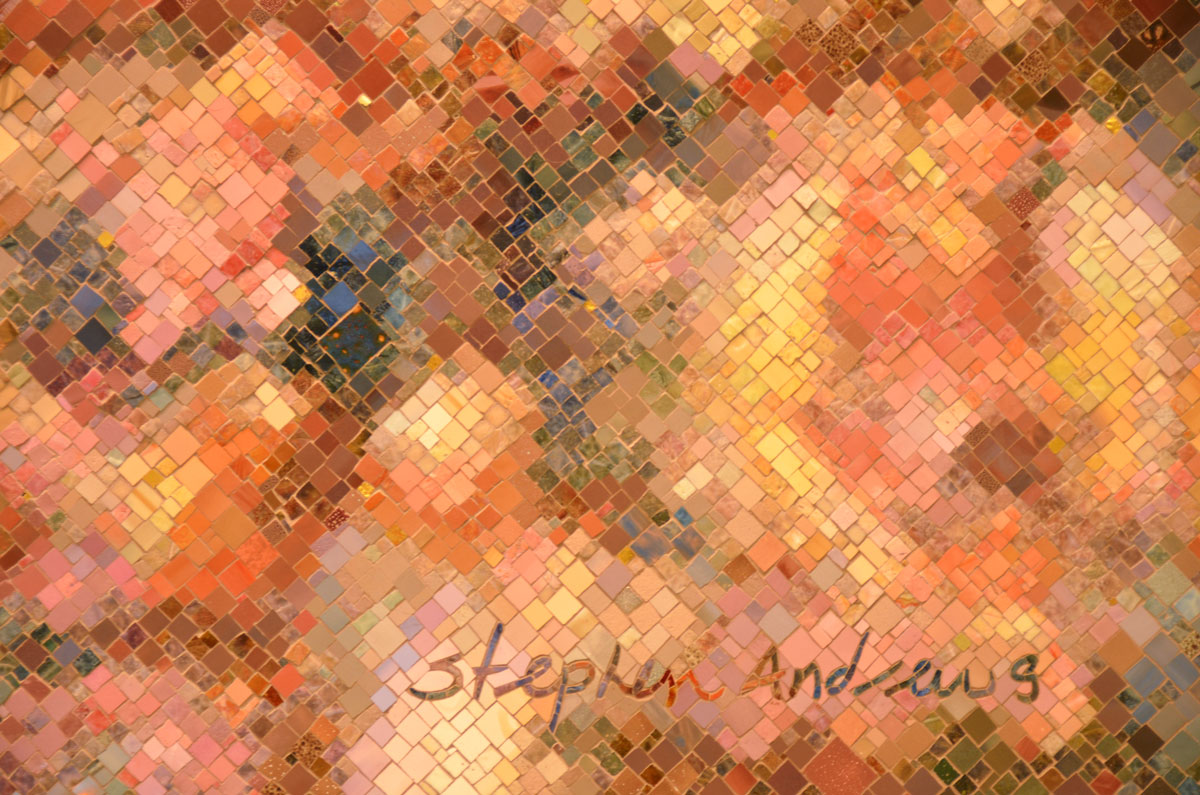
The other day I came across an interesting mosaic of which the picture below is just one part.  There is a plaque beside it which says “Seen at a disance the mosaic reveals a crowd of people sheering and clapping, people of all backgrounds, which is the unique mix of Toronto.  Up close, the images dissolve into abstract patterns of colour and light.”.

close up of a mural made of mosaic pieces, people seated in an arena is the subject of the mural

The mural is called ‘A Small Piece of Something Larger’ and it was designed by Stephen Andrews and fabricated in Montreal by Mosaika Art.  It is made of smalti (hand cut mosaic glass), gold tiles and hand glazed ceramic tiles.

close up of a mosaic by Stephen Andrews with his signature on it.

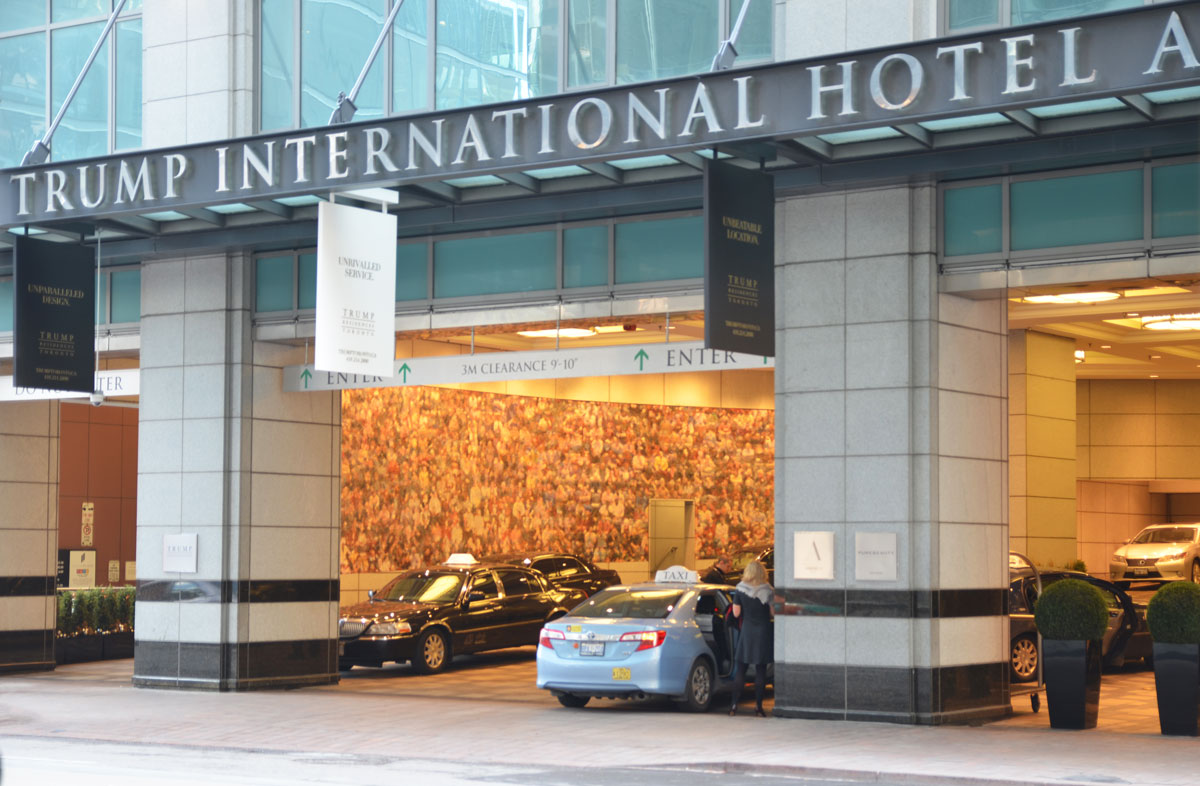
I’d love to show you a picture of the whole thing but I can’t.  The piece is located in the taxi drop off and valet parking area of the Trump International Hotel.   I dodged cars while I took these photos.   The wall that it is on looks cheap, especially with the dreary doorway that cuts into the mosaic.  Another strike against this piece is the very yellow nature of the lighting in this space. I played with the colour balance on the photo below to try to capture the true colour of the artwork.
mosiac art on a wall with a doorway in the middle of it

It really deserves a better location.

parking entrance and valet parking at Trump International Hotel in Toronto. A blue taxi has just pulled in, a yellowish hue in the interior of the space
The above picture was taken from the NE corner of Bay and Adelaide.
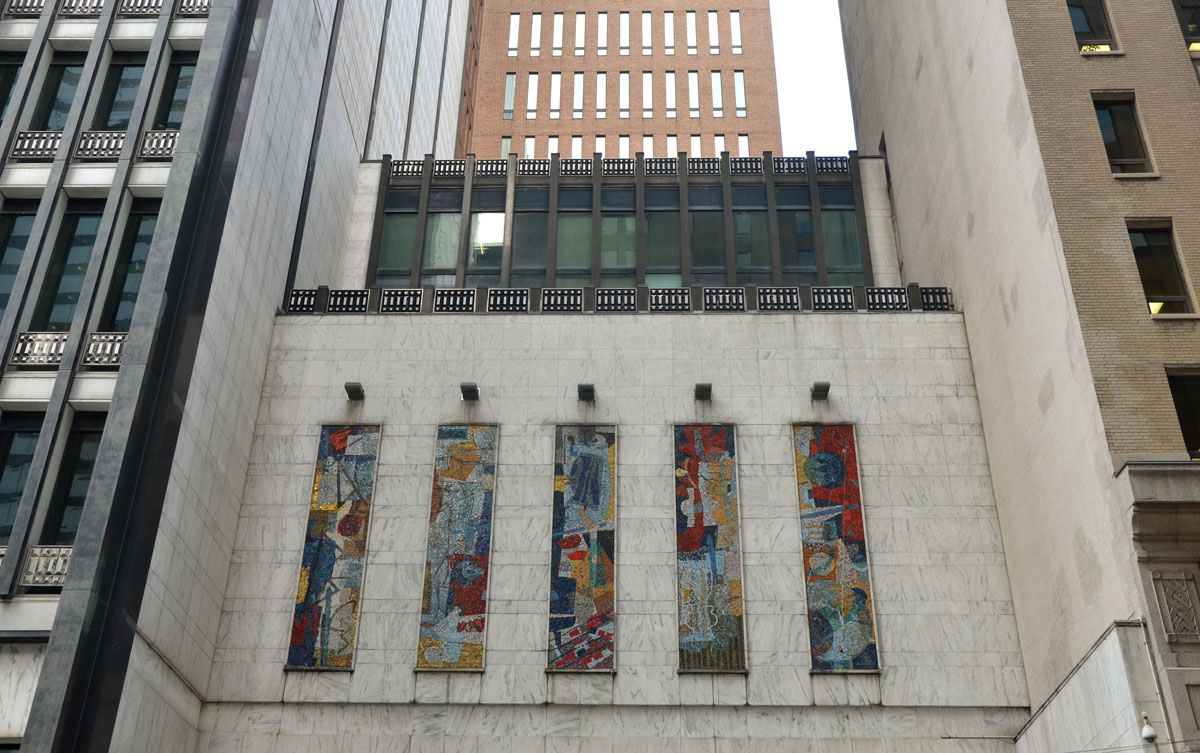
Just a few steps west on Adelaide is this mosiac (look up!):

Five vertical panels of mosaics above the entrance of a downtown building, much taller buildings are on either side of it and behind it. Bell Canada building on Adelaide West, mosaics by York Wilson, communication theme public art

It is above the entrance to the Bell Canada Building at 76 Adelaide West.  Five panels, each twenty feet tall and five feet high, of glass mosaic tile are embedded in the cement of the building.  It was designed by York Wilson and installed in 1965 when the building was constructed.

The theme of the piece is communication and each panel represents a different form of communication.   From left to right: writing, drawing, music, voice, and satellites.

five vertical panels of mosaic in bright colours on an exterior wall

Staying on Adelaide, walk east again but continue to Yonge Street.  Here you can find another hidden, almost secret, mosaic that many people have walked past and never seen.  Find the silly little entrance way to what is called the Dynamic Funds Tower on the SE corner of Yonge and Adelaide.  Stand outside the entrance but don’t go in.  Now look up.

glass mosaic ceiling that is almost circular, octagonal but the sides are not equal width.

Three very different mosaics all within a few steps of each other.

….and there’s one last stop on our mosaic tour.  It’s not a mosaic but looking at Stephen Andrews’ work at the Trump Hotel reminded me of a sculpture.  If you walk down Yonge Street, just south of the railway tracks you’ll find a bronze ‘Immigrant Family’ by Tom Otterness.

Immigrant Family, a sculpture by Tom Otterness, a father mother and baby in arms.
A roly poly mother, father and baby in arms.  A bit cartoonish but vague enough that they represent no one immigrant group.  They could be any piece in the mosaic that is Toronto.

close up of a sculpture by Tom Otterness of a family of three, mother, father and baby in arms. Father is carrying a suitcase. Title of sculpture is Immigrant Family

With a shoutout to Penny at Walking Woman since it was because of her blog post that I learned about the Otterness sculpture.
Other links:


‘In-Between Worlds’ is a series of photographs by Canadian photographer Meryl McMaster.   This series centres around the role of McMaster’s dual heritage in her search for self;  The images represent her being part of, and also being between, two different cultures as she is part Cree and part ‘European’.

Three of the images are on display at Ontario Square by Queens Quay West and Lower Simcoe St.

below: Horse Dance.  The bright red and blue of the shaggy hobby horses against a winter landscape makes for an eye catching picture.  On closer look, you realize that there is a person’s head inside one of those horses’s head.  Heads that have no eyes to see or mouths to speak.

A large photograph of three red hobby horses with long blue mane, taken outside in the winter in the snow, with bare trees in the background. A mix of the real (outdoors) and the unreal (hobby horses instead of real horses). Photo is Mounted on a concrete wall outside.

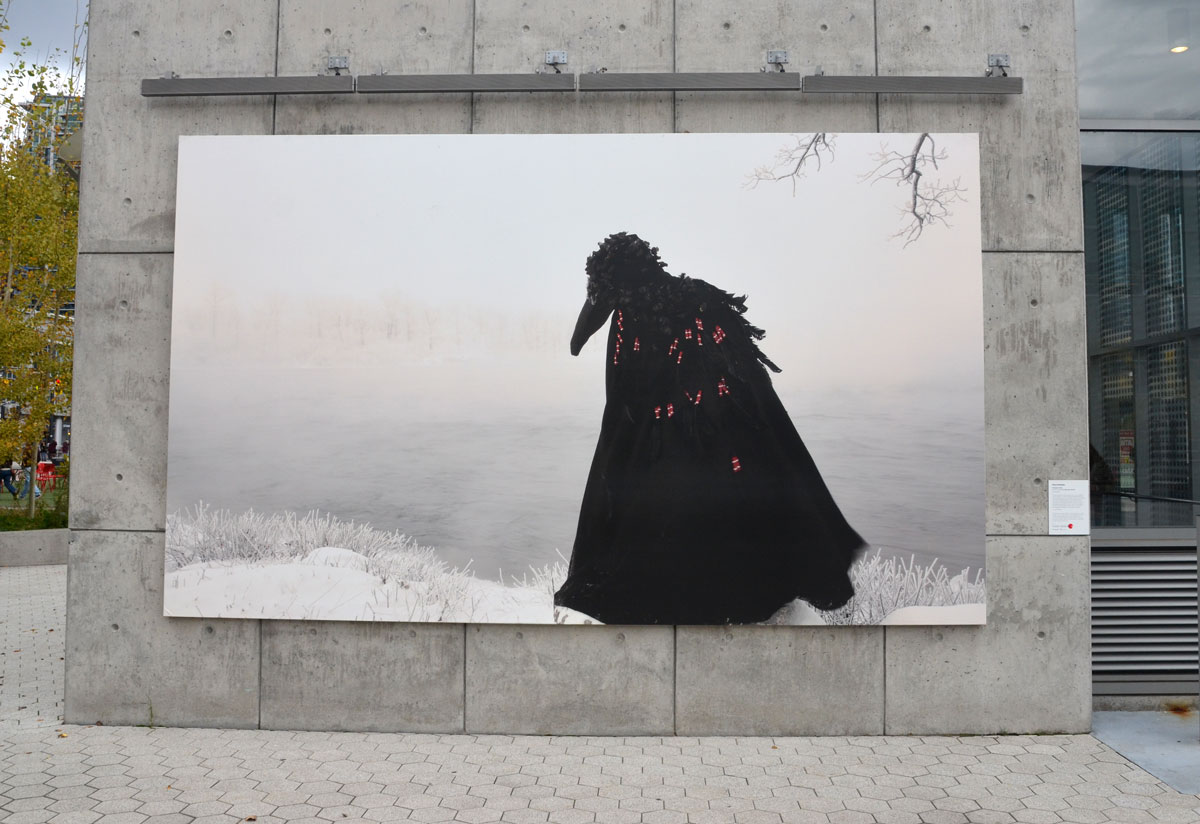
below: Wingeds Calling.  Around the corner there is another picture of a person in costume, playing the role of a real, yet not real, animal.  A large black bird-like figure walks on the frozen ground, perhaps too big and awkward to fly.

A photograph Mounted on a concrete wall outside of a person draped in a large black cape and wearing a head piece that looks like a large black bird. Photo taken outside in winter so the background is all white and grey like a foggy winter day.,

below: Wind Play Variation.  The third picture baffles me a bit.  Although this is another picture of a person assuming a role,  this time the creature is totally of the artist’s imagination.  A blue hairy thing that is slightly blurry as it walks amongst the pine trees.   Is it coming or going?

Photo of a blue furry creature taken in winter with snow covered evergreens in the background. Mounted on a concrete wall outside.

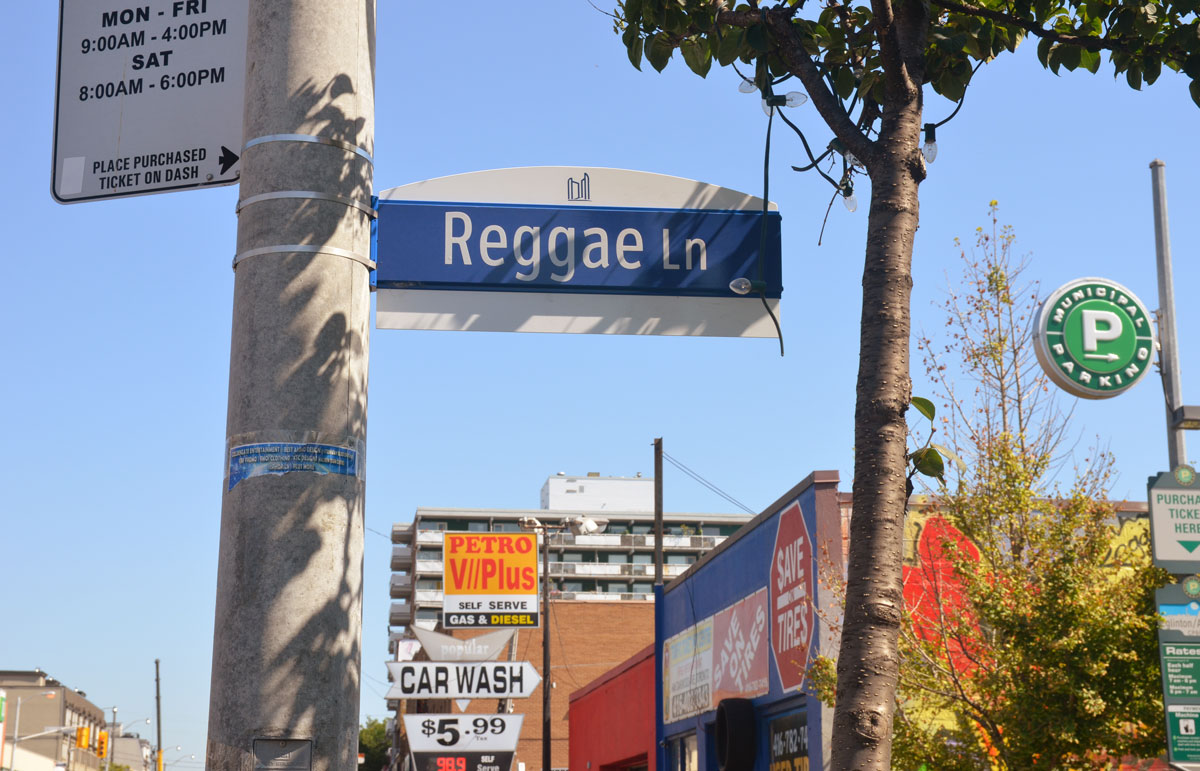
Toronto’s newest street sign

A blue and white Toronto street sign that says Reggae Lane. Some stores and a tree are in the background.

Reggae Lane is a small lane on the south side of Eglinton West, between Marlee and Oakwood.
It is home to a new mural that celebrates the many reggae musicians from Toronto.

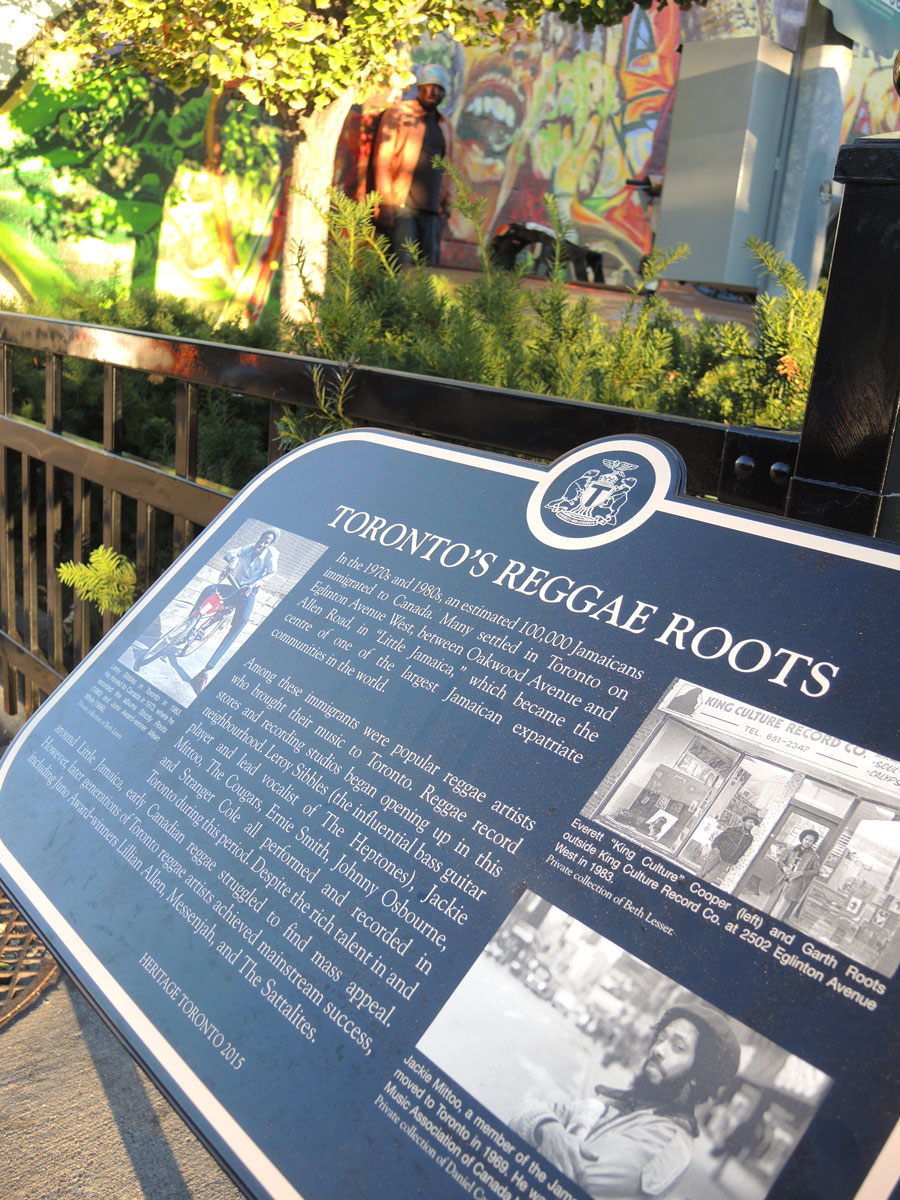
below: A Heritage Toronto plaque marks the spot.  It tells the story of Jamaican immigration and the reggae music they brought to Canada with them.   A transcription of the plaque appears at the bottom of this post.

plaque with the title "Toronto's Reggae Roots" with three photos as well as a story of Jamaican immigrants to Toronto and the story of reggae music in Toronto


The mural was painted over the course of three weeks by Adrian Hayles with the help of some young painters.

below:  Appearing in the mural: Reggae musicians from Toronto – Pluggy Satchmo, Bernie Pitters, Leroy Sibbles, Lord Tanamo, Jay Douglas, Stranger Cole, Johnny Osbourne, Jojo Bennett, Nana McLean, Jackie Mittoo, Leroy Brown, Otis Gayle, Joe Isaacs, and Carol Brown.   Bob Marley is also in the mural as are the Skatalites, one of the groups that started it all; they began recording ska music in the mid 1960s.

View of a 1200 square foot mural by Adrian Hayles that depicts many different reggae musicians. This photo was taken from the second floor of the building next door so the camera is looking down across the parking lot towards the mural. Eglinton Avenue is seen behind the mural.

below: “Reggae, The King’s Music” is a reference to Haile Selassie, the Emperor of Ethiopia (1930-1974) who was born Tafari Makonnen.   Before becoming emperor, he was known as Ras Tafari where Ras means Duke or Prince (depending on the translation).  Hence the name Rastafari.   The Rastafari movement began in Jamaica after the coronation of Haile Selassie.  To them, Selassie was not just a black king, he was the messiah.

Part of a very colourful mural depicting various reggae musicians -

Although it didn’t become a musical genre until the 1960s, reggae also has it’s roots in Jamaica. Reggae and Rasta have become closely linked.   Reggae has spread the Rasta message and Rastafari musicians like Bob Marley have popularized reggae music.

below: The radio station CFRB once had a Sunday evening reggae program.

Part of a very colourful mural depicting various reggae musicians - A large hand with a finger pointing to the right with the letters C F R B above it. Two musicians are also in the picture.

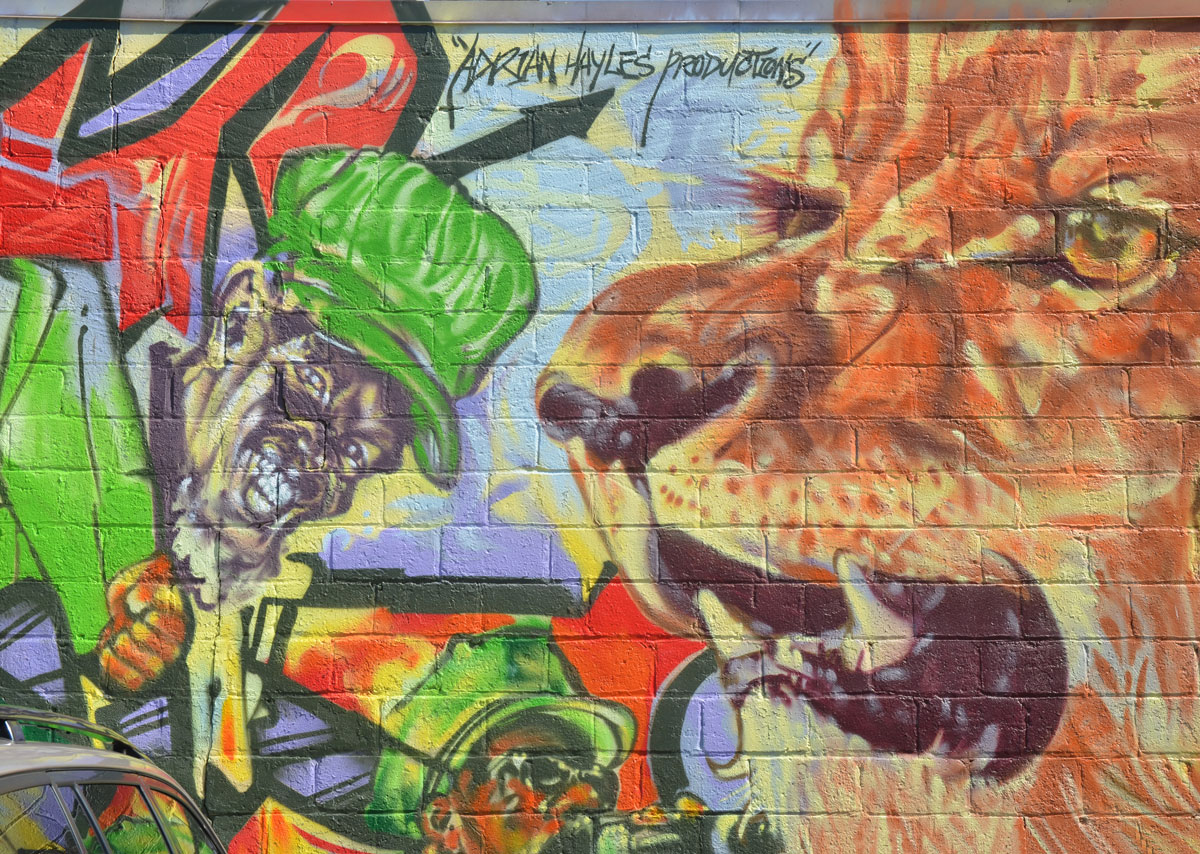
below: The Lion of Juda is a Rastafarian symbol.  It comes from the fact that as Emperor of Ethiopia, Haile Sealssie’s full title was “King of Kings, Lord of Lords, Conquering Lion of the tribe of Judah”.  The lion also appears in the middle of the Ethiopian flag.

Part of a very colourful mural depicting various reggae musicians - a black man in a green hat, a lion's face and the words, Adrian Hayles production

Part of a very colourful mural depicting various reggae musicians - A man wearing headphones and a baseball cap is playing a guitar.

plaque: “Toronto’s Reggae Roots

In the 1970s and 1980s, an estimated 100,000 Jamaicans immigrated to Canada. Many settled in Toronto on Eglinton Avenue West, between Oakwood Avenue and Allen Road, in “Little Jamaica”, which became the centre of one of the largest Jamaican expatriate communities in the world.
Among these immigrants were popular reggae artists who brought their music to Toronto. Reggae record stores and recording studios began opening up in this neighbourhood. Leroy Sibbles (the influential bass guitar player and lead vocalist of The Heptones), Jackie Mittoo, The Cougars, Ernie Smith, Johnny Osborne, and Stranger Cole all performed and recorded in Toronto during this period. Despite the rich talent in and around Little Jamaica, early Canadian reggae struggled to find mass appeal. However, later generations of Toronto reggae artists achieved mainstream success, including Juno Award winners Lillian Allen, Messenjah, and the Sattalites.”


The project was funded by the City of Toronto’s StreetARToronto program, with support from Metrolinx, Councillor Josh Colle’s office, the Macaulay Centre for Child and Youth Development, the Toronto Parking Authority and the York-Eglinton BIA.  It was also supported by the STEPS Initiative.