Posts Tagged ‘Lakeshore Blvd.’

Liberty Village is the neighbourhood that is south of King Street, west of Strachan, and east of Dufferin. It’s southern boundary is a combination of the Gardiner Expressway and the railway tracks (CN, VIA, and GO)

a man holds a cup of coffee as he walks past a road sign with bump symbol, and a utility pole wrapped in red and white liberty village design

below: A temporary park has taken over a corner of the parking lot on Hanna.

artificial grass covering ground in new temporary park in Liberty Village, the word liberty in black on the green grass

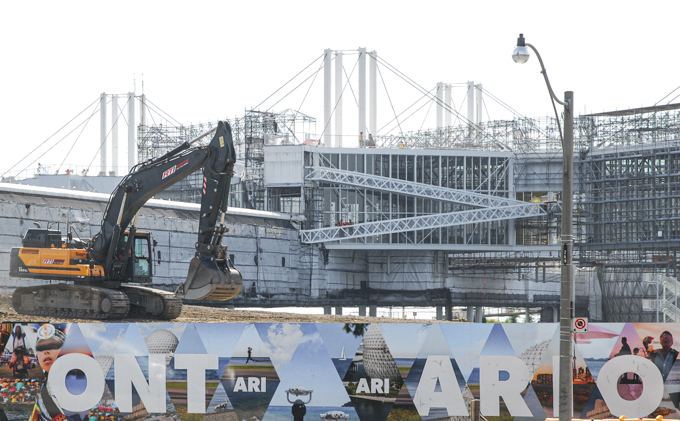
below: The sign says Ontario Place straight ahead.

below: Dream Big

large pink mural with black letters that spell dream big

below: Allan Lamport stadium concrete

exterior side walls of Allan Lamport stadium, , concrete, peaks in roof make triangle shadows

below: Looking north from the goalposts in the stadium.
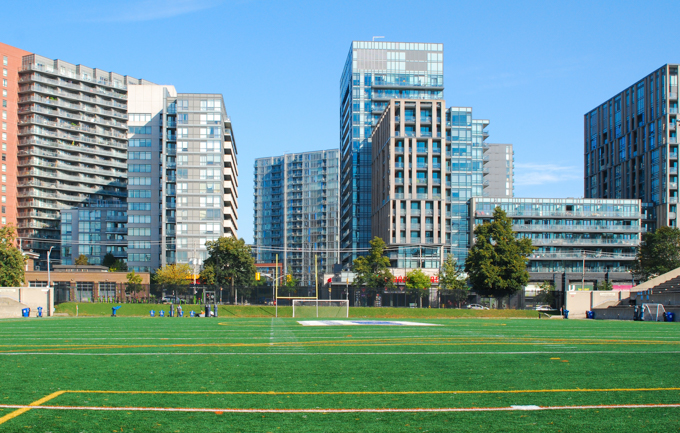
view across the field of Allan Lamport stadium, looking north to wall of condo towers

interior, seating, rows of concrete, sections 22 and 24 of Allan Lamport stadium,

triangular roofline of allan lamport stadium

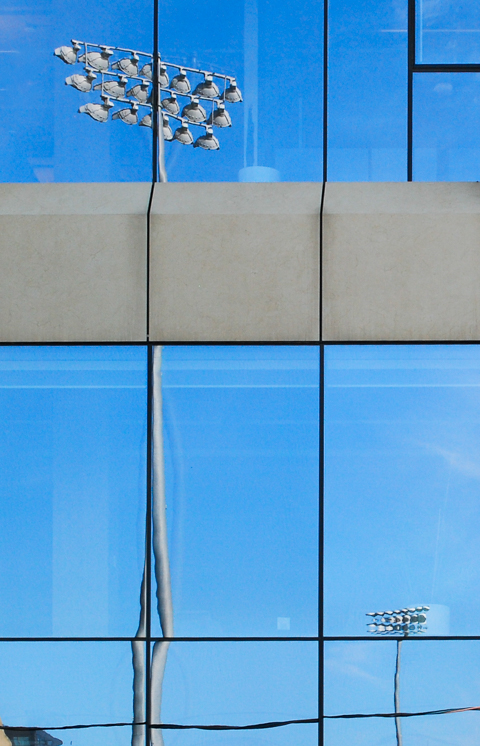
lights reflected in glass windows, stadium lights on blue sky 

below: Once it was a carpet factory –  The Toronto Carpet Factory was spread over 8 brick buildings on a 4 acre site. It was built between 1899 and 1920.  The company was established by F. Barry Hayes in 1891 and was originally at Jarvis and Esplanade.  At the end of WW1, 1250 people were employed here.  The factory remained in production until 1979, although the number of carpets that were made annually was greatly reduced by the end.
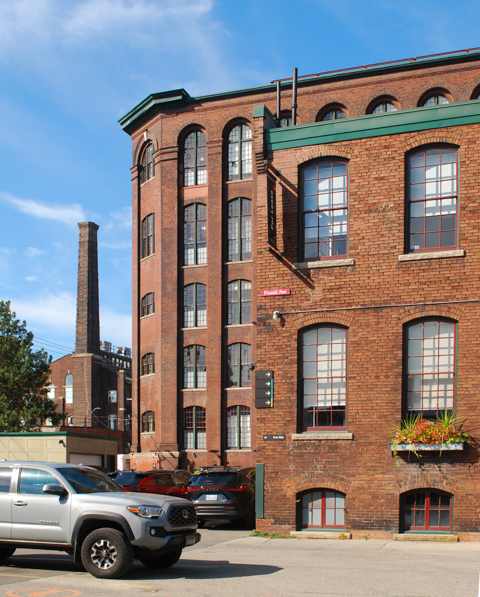
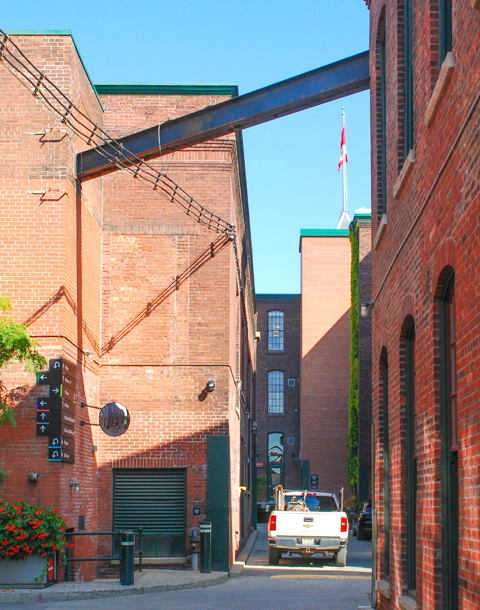
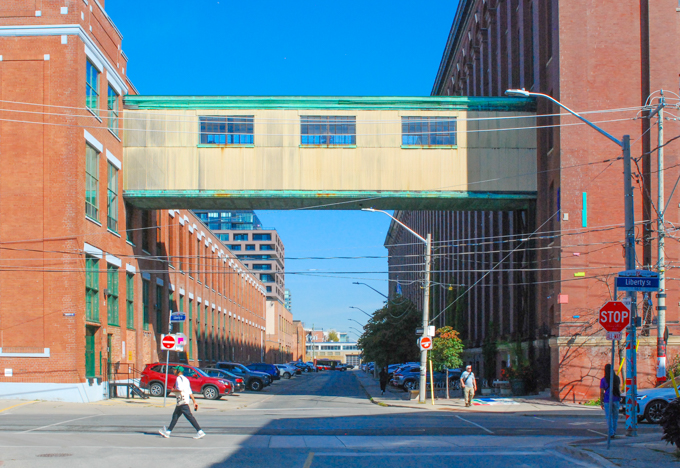
part of old carpet factory, a brick building

part of old carpet factory, exterior,

part of old carpet factory, exterior

part of old carpet factory, exterior

below: Streetcars waiting at Dufferin Loop, Dufferin south of King.

TTC streetcars waiting at Dufferin loop at the bottom of Dufferin street

below: View from the bridge at the south end of Dufferin looking west along the Gardiner Expressway towards Etobicoke and Mississauga.
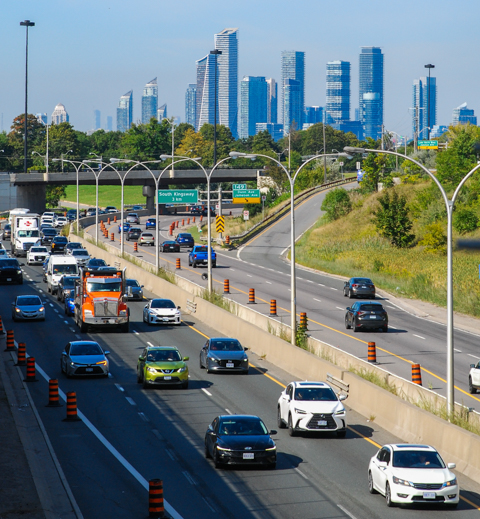
looking west from bridge over Gardiner Expressway towards Etobicoke and Mississauga

below: Eastern view

bridge over the Gardiner at northwest corner of CNE Grounds

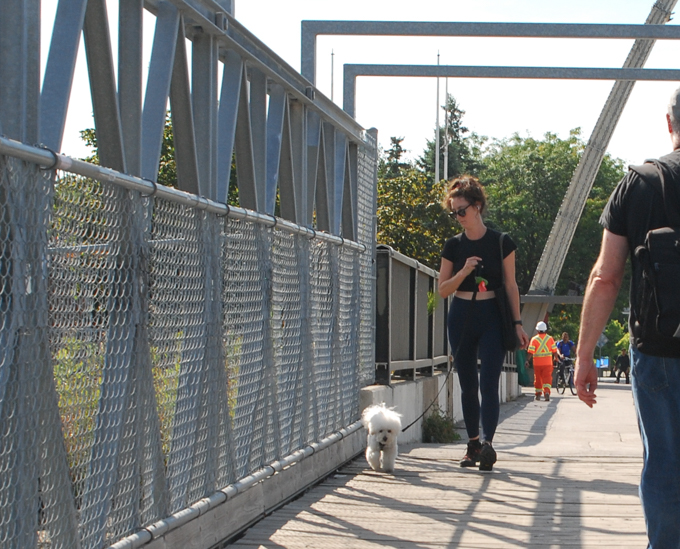
a woman dressed in black walks a small white dog over a metal bridge

below: The arch marks the Dufferin Gate, the west entrance to the Exhibition Grounds.

two men walking across bridge by dufferin gate at the exhibition grounds

Part way between Dufferin and Strachan is Exhibition GO station.  The station has been designed to provide access from both sides of the tracks which in turn offers another walking route south from Liberty Village.    The area north of the tracks is a bit of a mess as the new Ontario Line will terminate at Exhibition and the completion of that project is still a few years away.

below: The pedestrian tunnel under the tracks.

interior, people walking through tunnel, lights, unfocused, fuzzy image

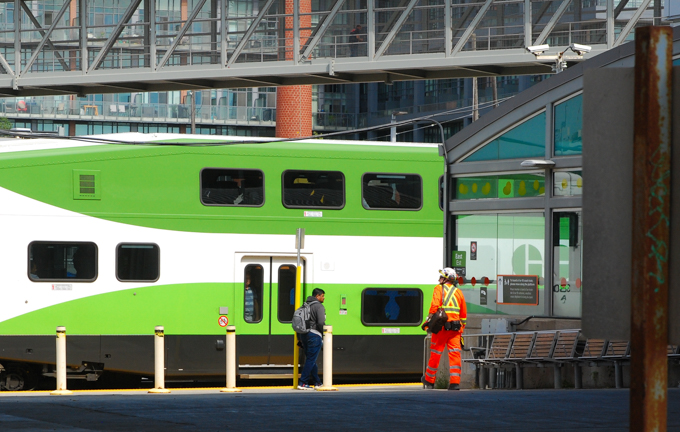
double decker green and white GO train at Exhibition station, wtih workman in orange work uniform waiting to get on train.

below:  Looking north under the Gardiner – Liberty Village provides that background in this image.
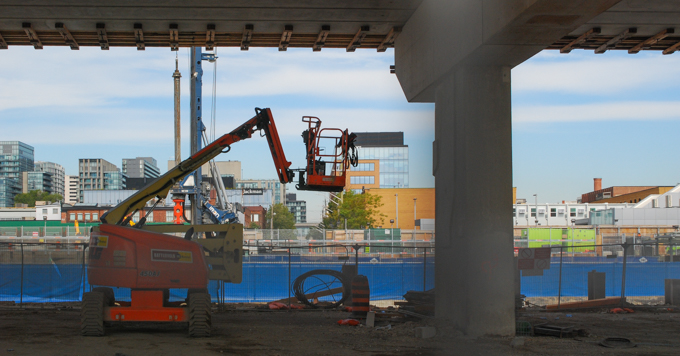
construction near railway tracks south of Liberty Village, near Exhibition station, under the Gardiner Expressway

workmen with digger excavator on construction site for ontario line subway

below: More Ontario Line construction as seen from Platform 4 at Exhibition station

ontario line construction site just north of Exhibition station, in liberty village

below: South end of BMO Field, looking east towards downtown and the CN Tower.
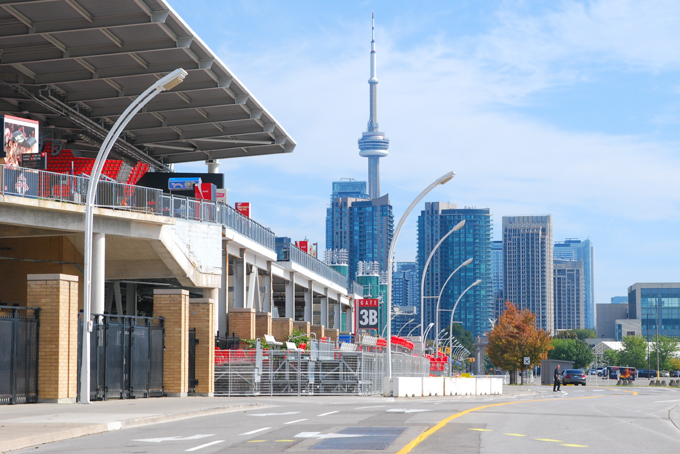
on Exhibition grounds, south end of BMO field, looking east towards CN Tower and downtown Toronto

below: BMO Field is home to both the Toronto Argonauts (CFL, football) and the Toronto FC (MLS – Major League Soccer). It has just undergone upgrades (think $$$) to make it ready to host some of the FIFA World Cup soccer/football games in mid 2026.

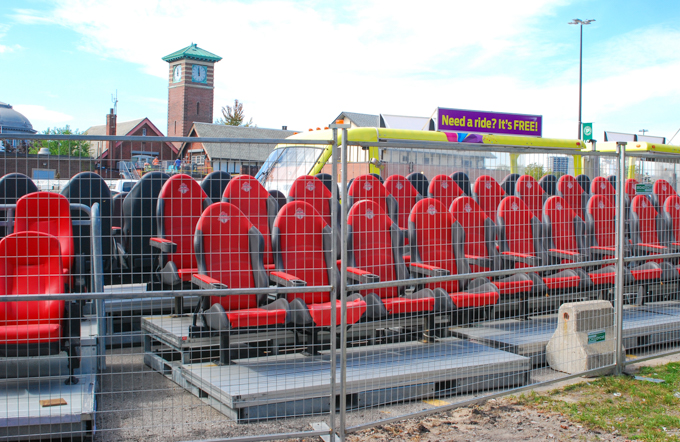
food building in background, as is CN Tower, entrance to construction site for renovations of BMO Field soccer
red seats that have been removed from BMO stadium, or are awaiting being added. stored outside

below: Some of the lights seen at the Exhibition – with the CN Tower in the distance.
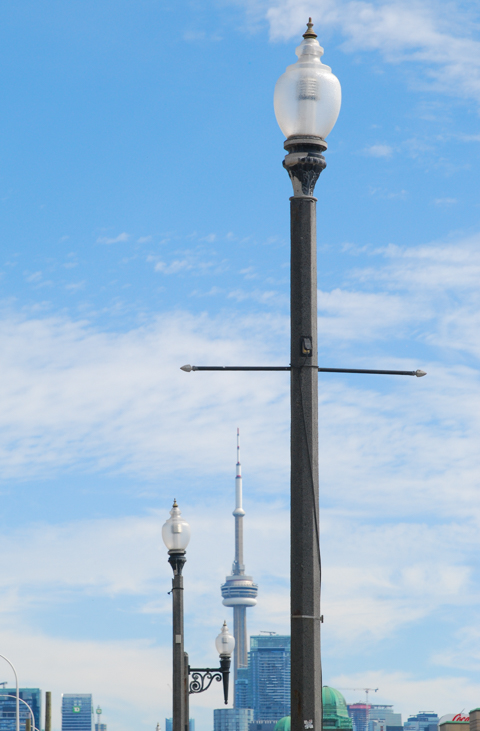
lights and lamp posts at CNE, Exhibition, with CN Tower in the distance

below: rooftops

below:  One of the latest public art addition to the Exhibition Grounds is “Mino Bimaadiziwin”, an Anishinaabemowin phrase that translates to “Good Life”. The mural was developed in partnership with the Mississaugas of the Credit First Nation 50-meter-long artwork honors Indigenous history and culture and was unveiled in October 2024.
The installation is part of a plan to separate Exhibition Place from the Gardiner Expressway.

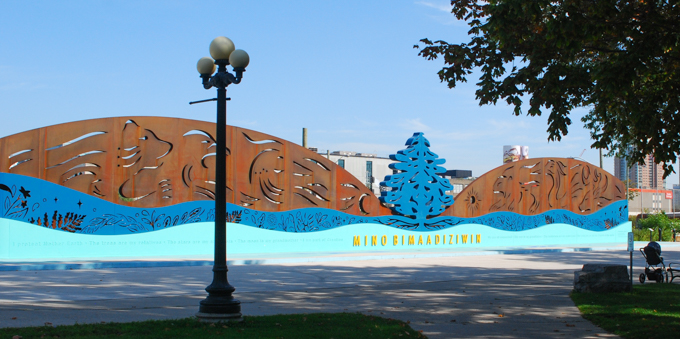
 

blue metal sculpture, behind 3 large trees, people walking past in silhouette

art installation at exhibition graounds,

below:  The McGillivray Fountain was designed by Canadian sculptor Gerald Gladstone and donated to Exhibition Place in 1968 by Gordon B. McGillivray in honor of his father, John A. McGillivray.
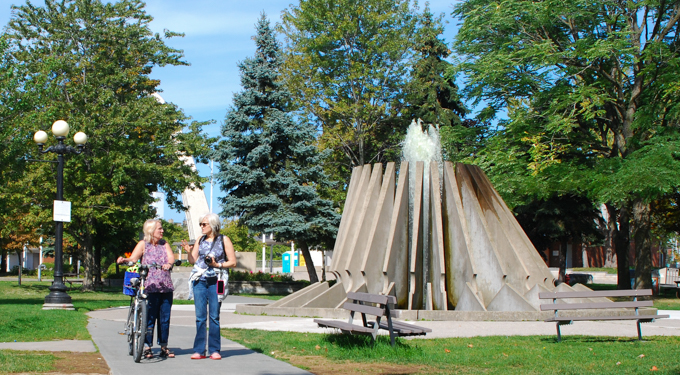
two women walking past fountain at the CNE

below: The Scadding cabin was originally built in 1794 by John Scadding on land that he owned east of the Don River.  He owned more than 200 acres and his property stretched from Lake Ontario to what is now the Danforth.  The next owner of the property used the cabin as an out-building.  In 1879 it was donated to the York Pioneer and Historical Society who arranged to have it moved close to its present site to celebrate the opening of the Industrial Exhibition (now the CNE).

below: The title printed on this image is “Log Cabins of the York Pioneers,Exhibition Grounds Toronto 1880.  Lithographed and printed at the Exhibition Building, Rolph, Smith & Co. Toronto”.  The cabin on the left is labelled Simcoe 1794 (i.e. the Scadding cabin) and the other is labelled York Pioneers, Lorne 1879.
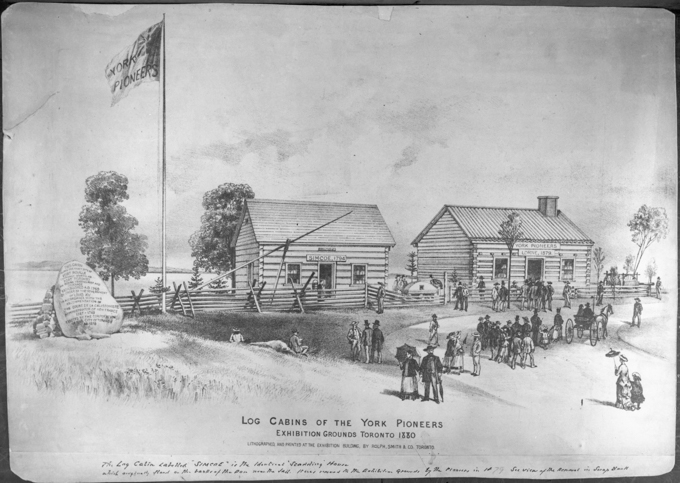
old black and white photo of a drawing of two cabins, at an exhibition, in 1880

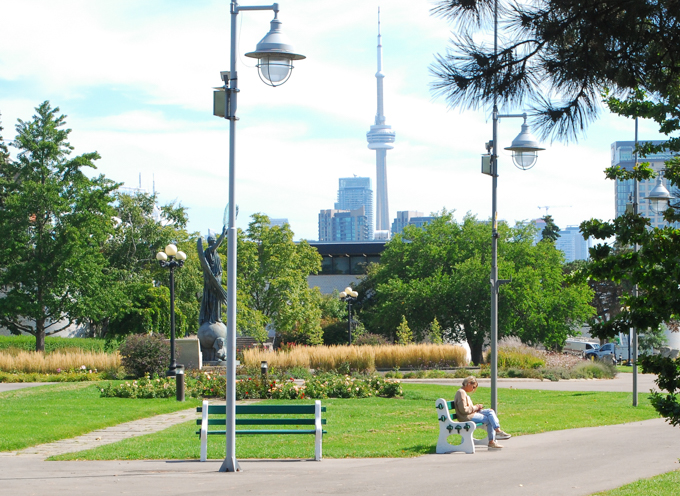
below: Shrine Peace Memorial

angel sculpture at shrine peace memorial

shrine peace memorial on exhibition grounds

below: There is a collection of twenty small sculptures representing Gods, heroes, and monsters of Greek mythology  in what is called the Garden of the Greek Gods.  They were created by Elford Bradley Cox (1914-2003) in the 1960s.

one of the greek gods sculptures at exhibition grounds

below: Hercules is the tallest of the sculptures.

one of the greek gods sculptures at exhibition grounds, back of naked man, with windmill in the background
one of the greek gods sculptures at exhibition grounds, bunch of grapes

Immediately south of the Exhibition Grounds is/was Ontario Place.  This pile of rubble is all that remains of what was on West Island – mostly the decaying amusement/theme park that hasn’t been in operation for years (death by neglect).

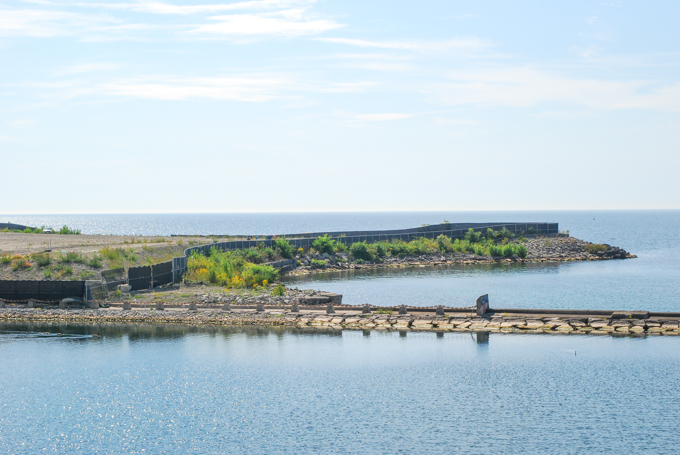
pile of rubble, remnants of demolition, on west island, part of Ontario Place, on Lake Ontario, as seen from the Exhibition Grounds

west island of ontario place after having been cleared of everything

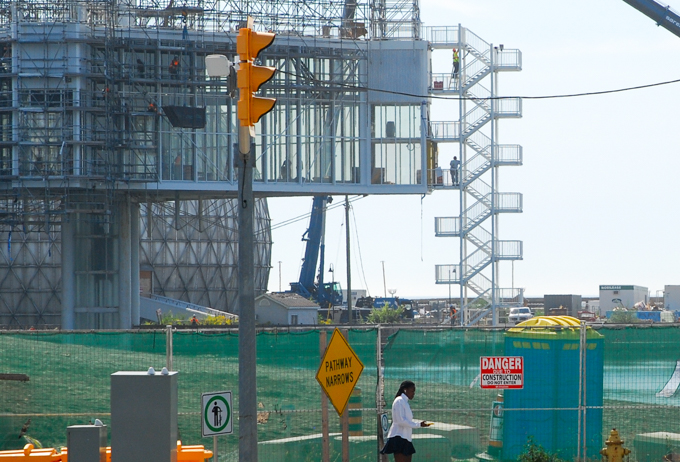
below: The round Cinesphere is still there but everything west of it is gone.  Once it was the pride of Ontario – built in response to Montreal’s Expo ’67 – but slowly over the years many of its features have been altered or removed (Children’s Village, the Forum with its free concerts, and more).   Having said that, other sections have been renovated – Trillium Park on the east end for example.  I didn’t get that far on this walk but you can some of it in Ontario Place 2.0 from 2017.
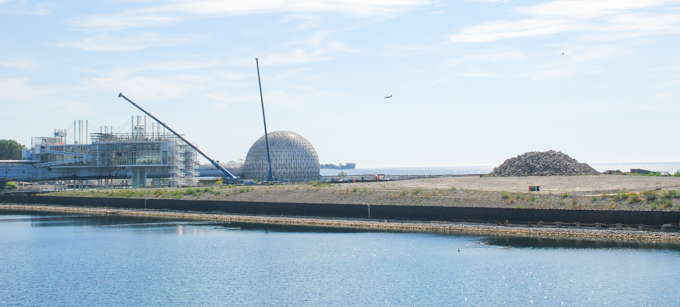
what remains of ontario place

ontario place under renovation, exterior stair with workmen on it ontario place under renovation, digger working behind hoardings

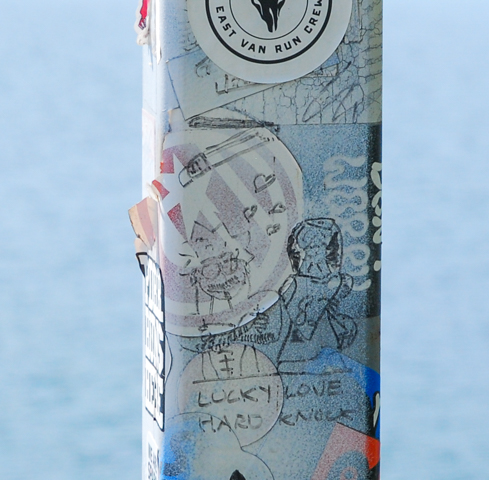
graffiti on a metal railing near Lake Ontario

graffiti on a metal railing near Lake Ontario

two men stand beside street art painting at south liberty trail

Another day, another walk through the city starting at the Distillery District and heading west towards the waterfront and downtown Toronto.

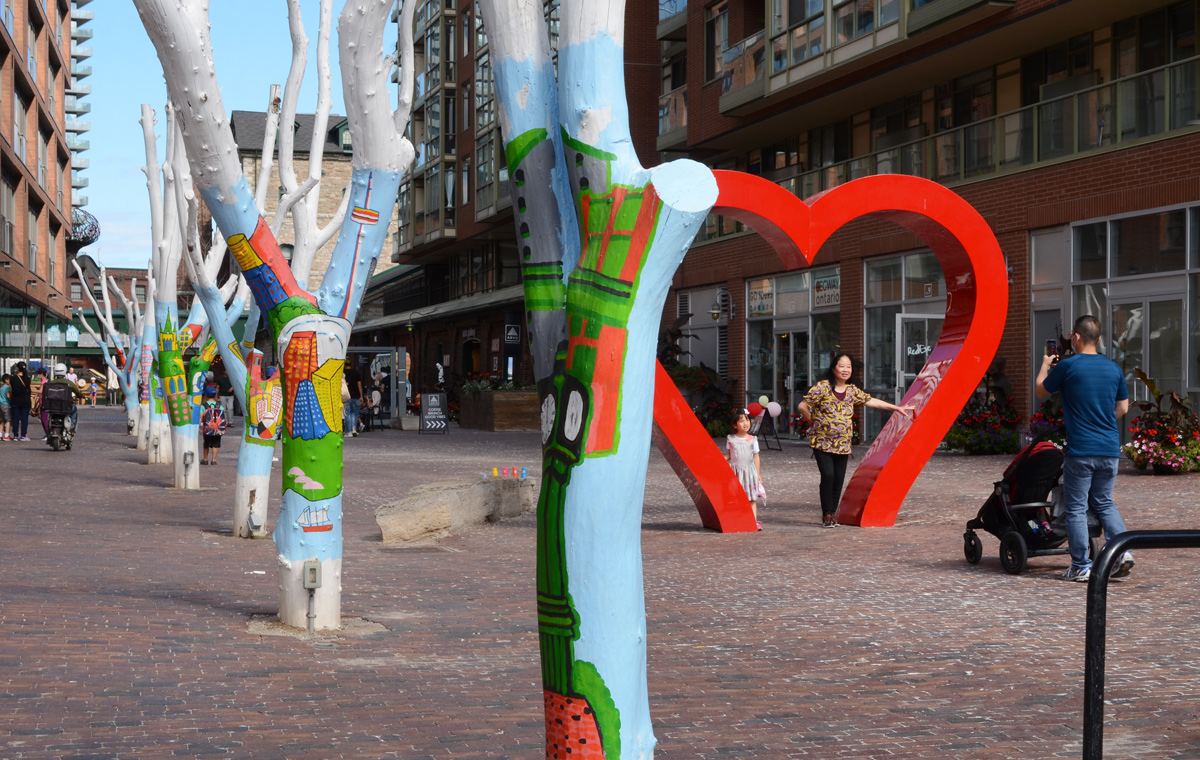
below: Posing under the heart, Distillery District.

a woman and child posing under bright red heart installation at the Distillery District while a man takes their picture, also a line of tree shapes painted white, then painted with colourful pictures on parts of them,

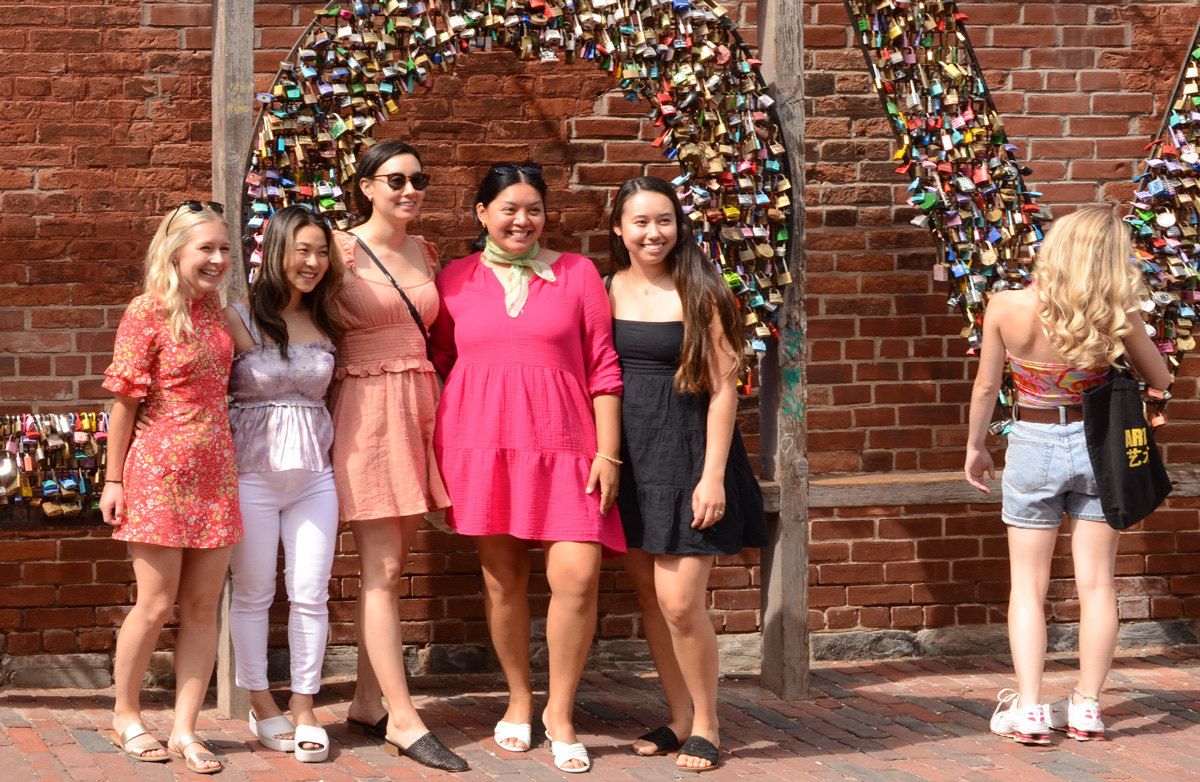
below: Posing with the LOVE locks.

4 young women pose for a group shot beside the love word made from locks in the distillery district

below: Flowered Dress Madonna” by Ann Agee, 2021 as seen in the Corkin Gallery in the Distillery District.

small mother and child sculpture by Ann Agee called flowered drress Madonna, made in 2021

below: Looking east on Front Street from Berkeley. Police Division is the old brick building. Both sides of Front are lined with black hoardings as redevelopment of those sites started recently.

intersection of Berkeley and Front, looking east on Front towards police station in old building, black hoardings for construction sites on both sides of Front Street

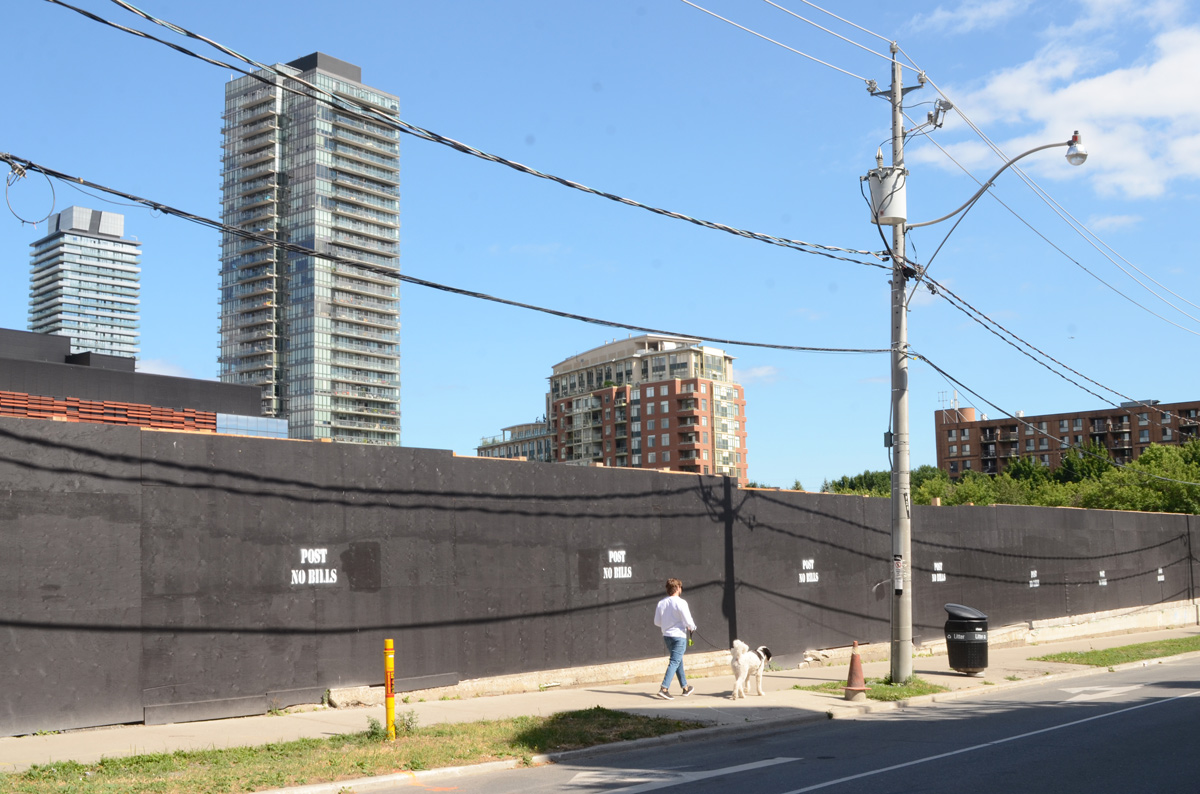
below: Berkeley St., south of Front

a young man walking his white dog along the sidewalk, past black painted plywood hoardings around a construction site, Berkely Street

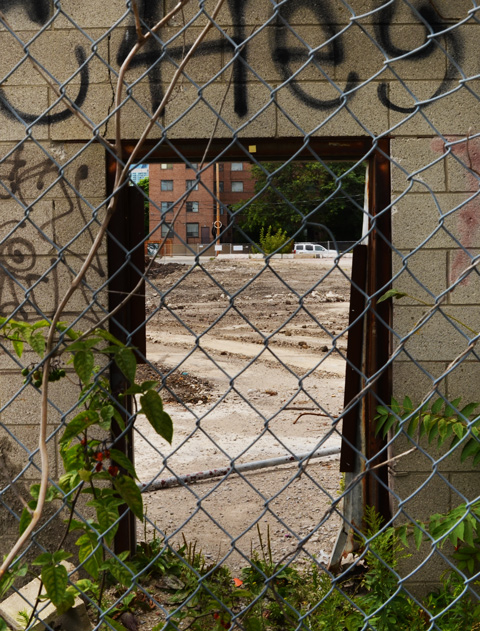
below: Another hole in the wall; another vacant lot waiting for redevelopment on Parliament Street. More tall buildings coming to the Distillery District.

an old door in a concrete block wall, now open to hole in the ground vacant lot waiting redevelopment

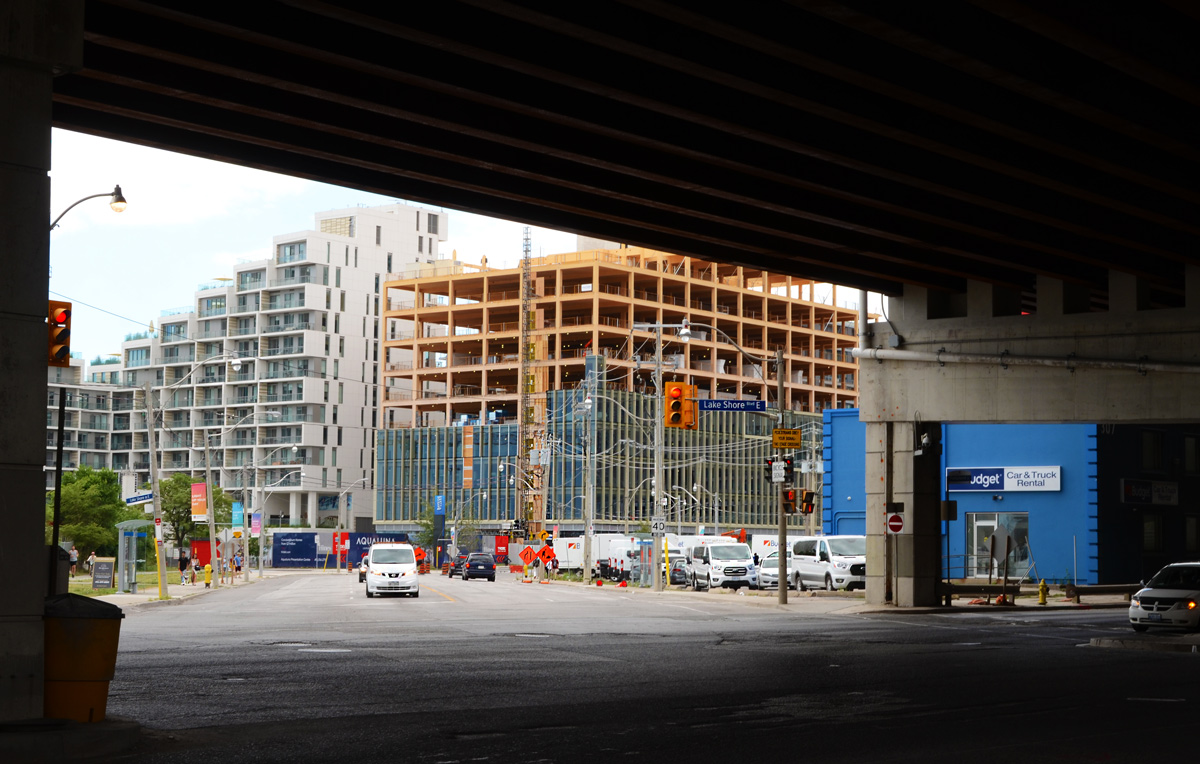
below: Looking south from the end of Parliament Street and across Lakeshore Blvd to the start of Queens Quay East. Many changes here!

looking south under Gardiner Expressway across Lakeshore Blvd at the end of Parliment where it turns into Queens Quay East

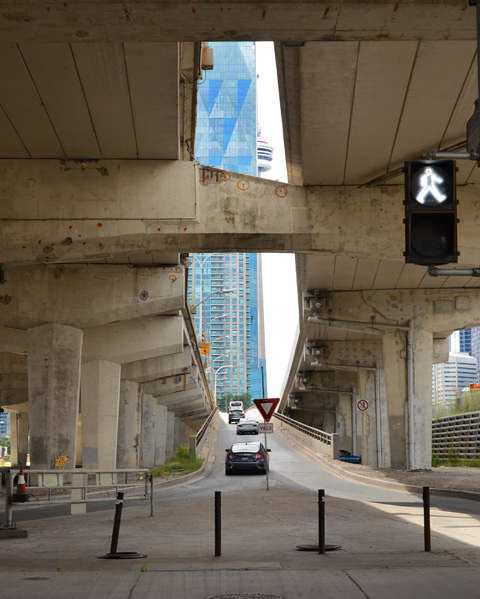
below: The CN Tower peaks through the gap created by one of the onramps for the Gardiner Expressway.

the CN Tower peaks through a gap in the Gardiner Expressway where an on ramp is

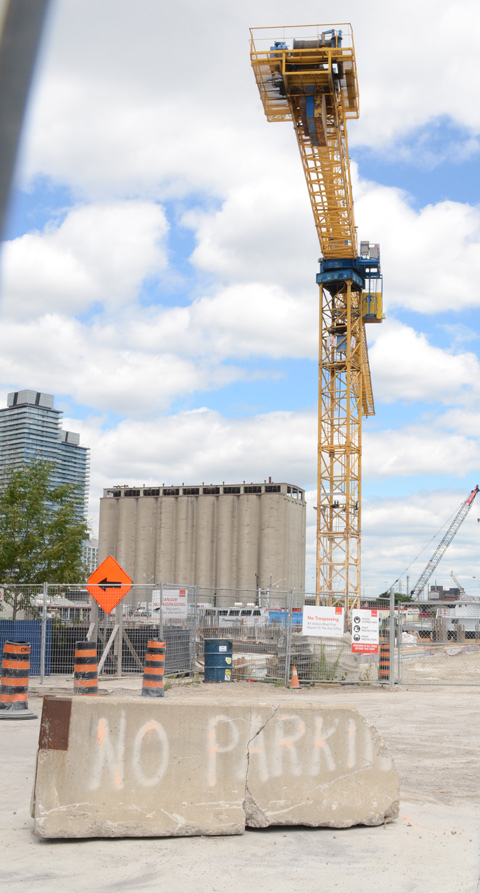
below: No Parkin’, Victory Soya Mills in the background

Victory Solya Mills in the background, construction in the foreground, a large yellow crane, a cement barricade spray painted with words no parking

the back ends of two tour boats with Canadian flags flying, end to end, with new condo developments seen across the water

below: Looking east towards the Port Lands redevelopment.  The new Cherry Street bridge is in the background.

waterfront, by Victory Mills silos, looking east towards new Cherry street bridge and portlands redevelopment

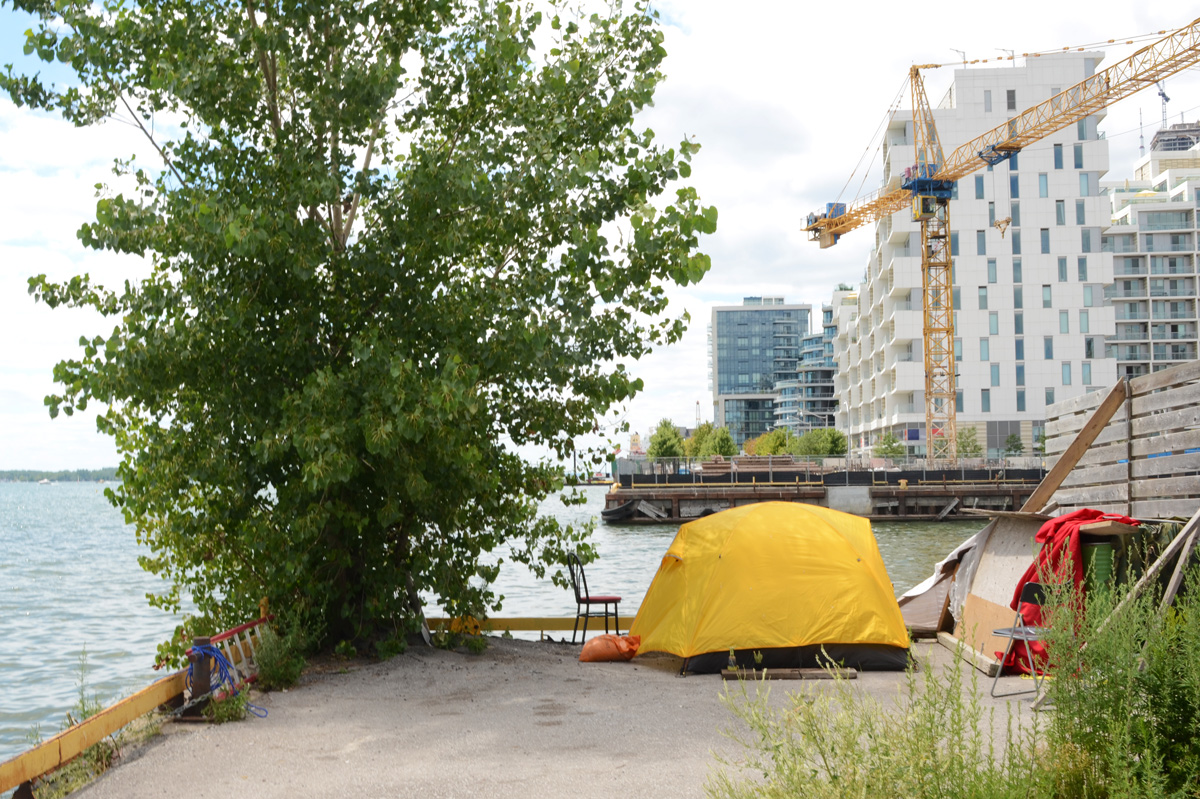
below: From the same spot on the waterfront as the above picture, but looking in the other direction.

yellow tent along the waterfront

below: Queens Quay East

looking west on Queens Quay East, construction in the foreground,

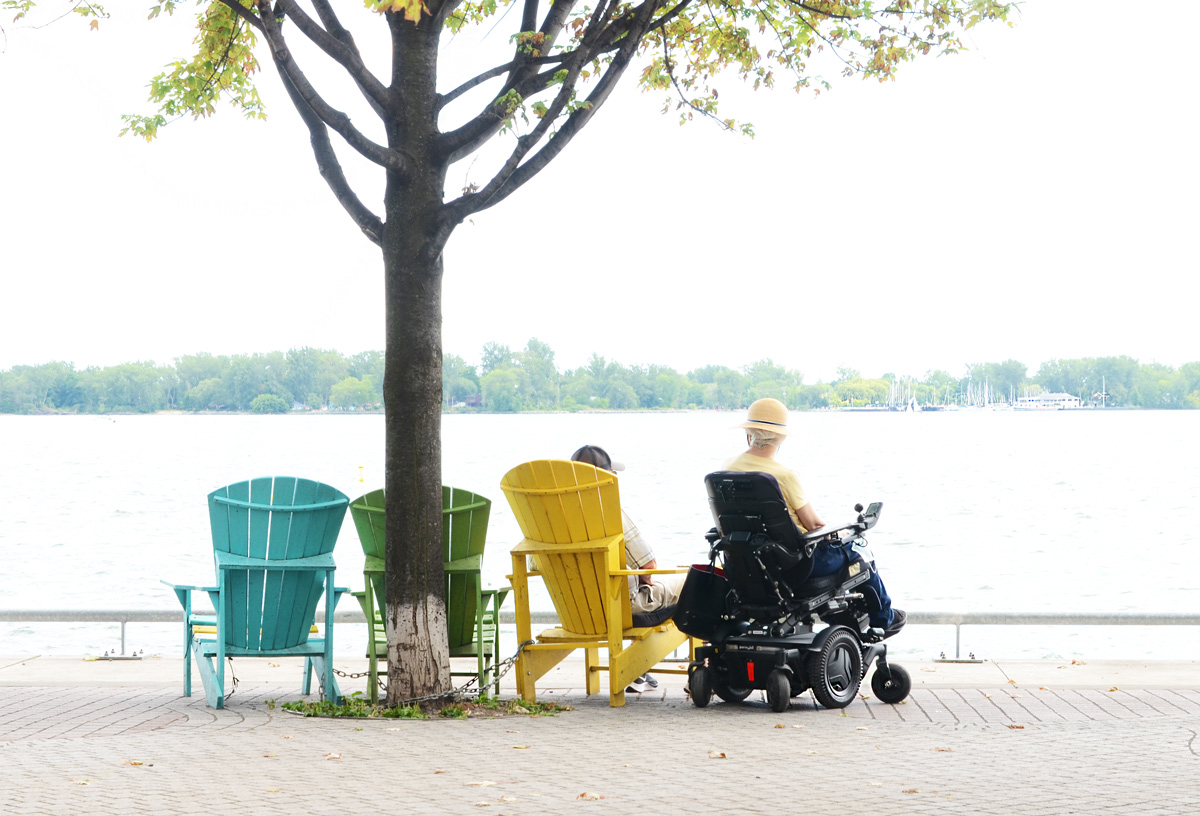
below: Relaxing by the lake.

sitting by the waterfront, a man in a yellow Muskoka chair, and a woman in an electric wheelchair, both facing the water

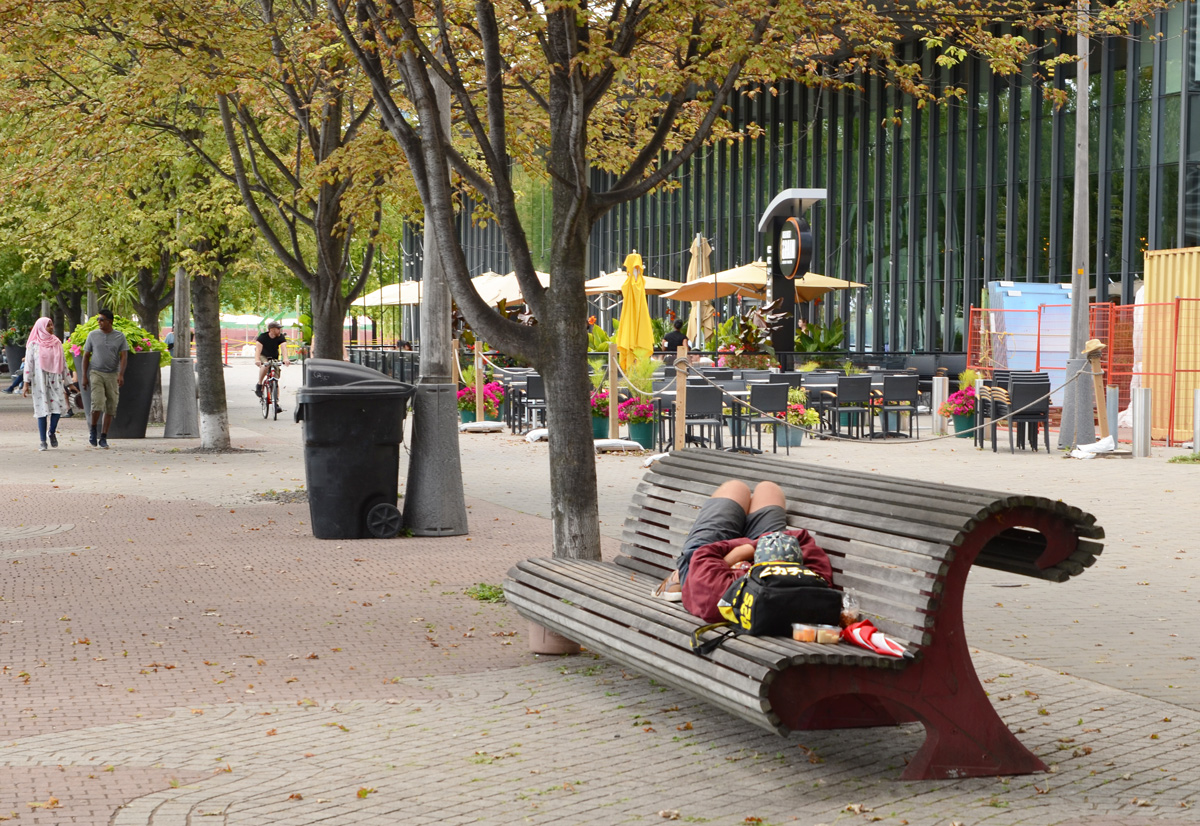
a person resting on wood bench in front of George Brown College on the waterfront, head on backpack, other people walking in the distance

below: Sugar Beach, spectator section, in the shade.

two men sitting on a bench beside water fountain sprayers at Sugar Beach, umbrellas, sand, and Redpath Sugar in the background

sugar beach, a man sun bathing on the sand, another person in Muskoka chair, green ship docked at Redpath Sugar, pink umbrellas,

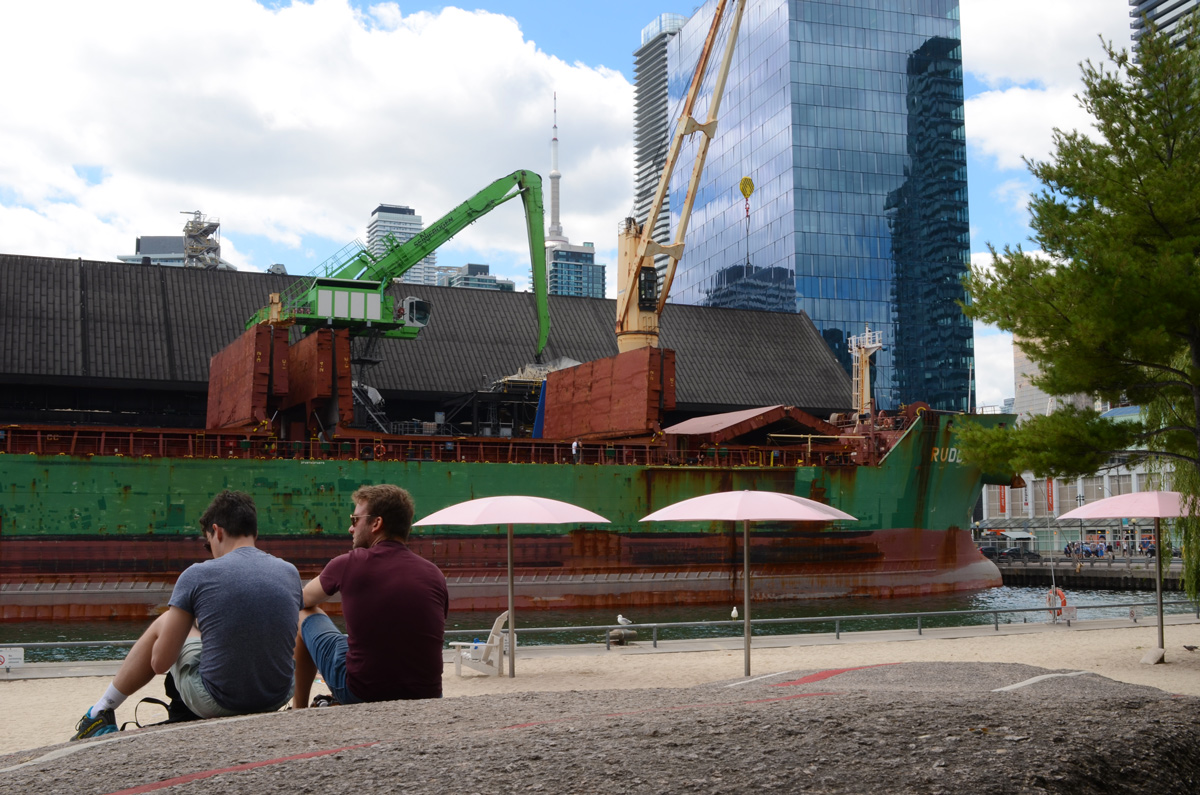
below: On the rocks, Sugar Beach

two men sit on the rock at Sugar Beach, with green sugar ship docked at Redpath sugar, city skyline behind

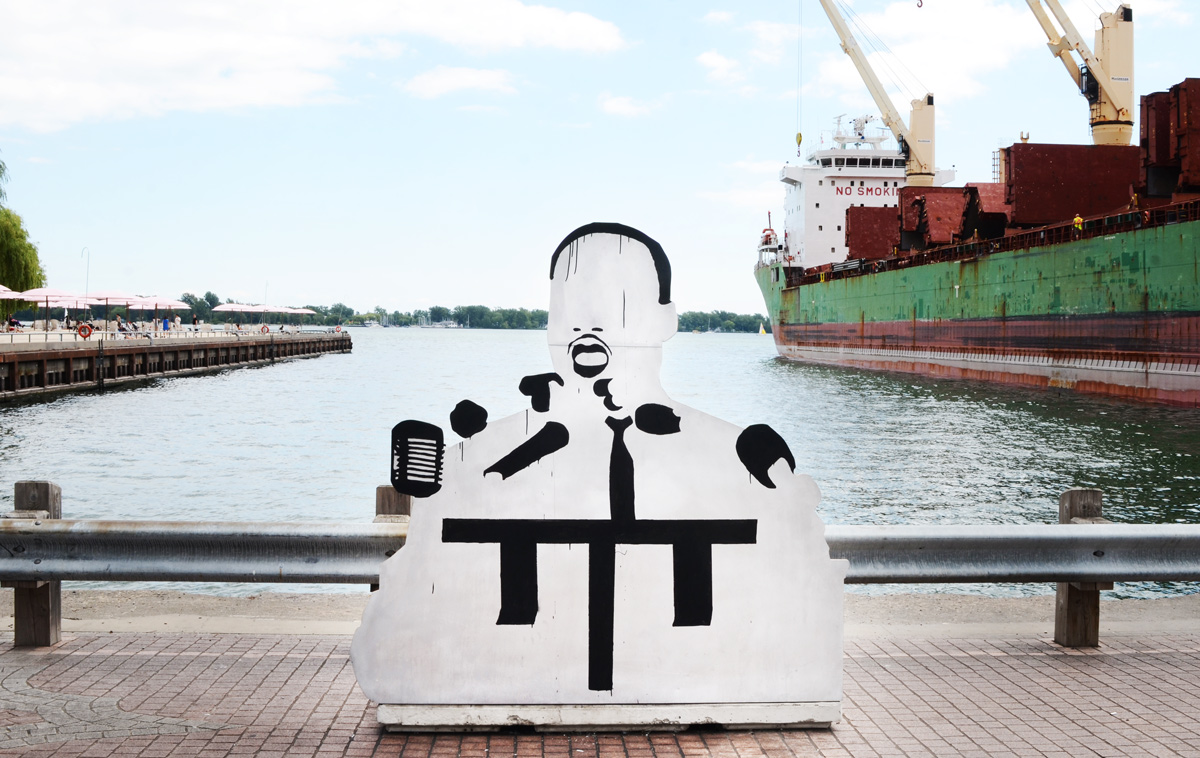
below: I am not sure who this is or why he’s on the waterfront.  He’s made of wood – someone constructed him and left him here.

black and white wood cut out, upright of a man with no eyes or nose, white uniform, from waist up, standing on waterfront by Redpath Sugar

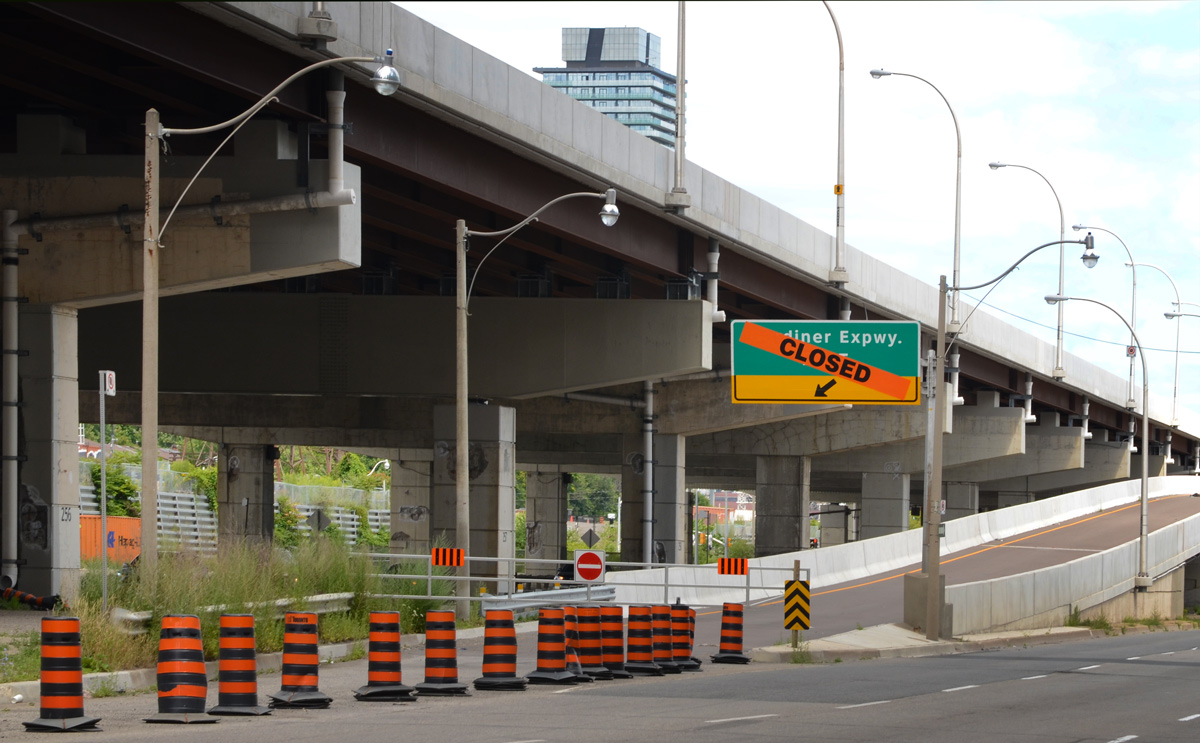
below: Closed – ramp to the the eastbound Gardiner at Lower Jarvis.

closed sign at the ramp to the Gardiner Expressway eastbound at Lower Jarvis, along Lakeshore

below: Lower Jarvis

pedestrians on sidewalk on Lower Jarvis with reflections in window beside and overhang above at Shoppers Drug Mart

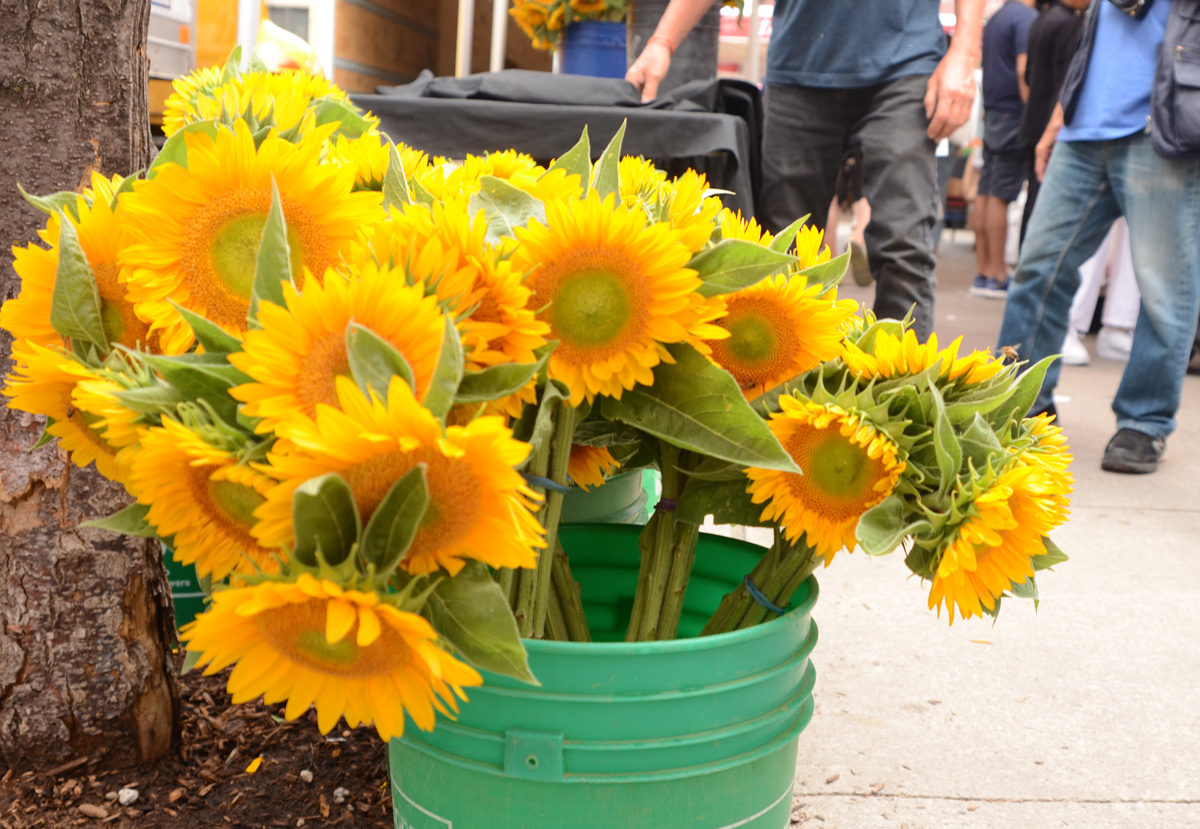
below: A bucket full of bright and cheerful sunflowers on the sidewalk by St. Lawrence Market.

a turquoise bucket full of sunflowers for sale on the sidewalk by St. Lawrence Market

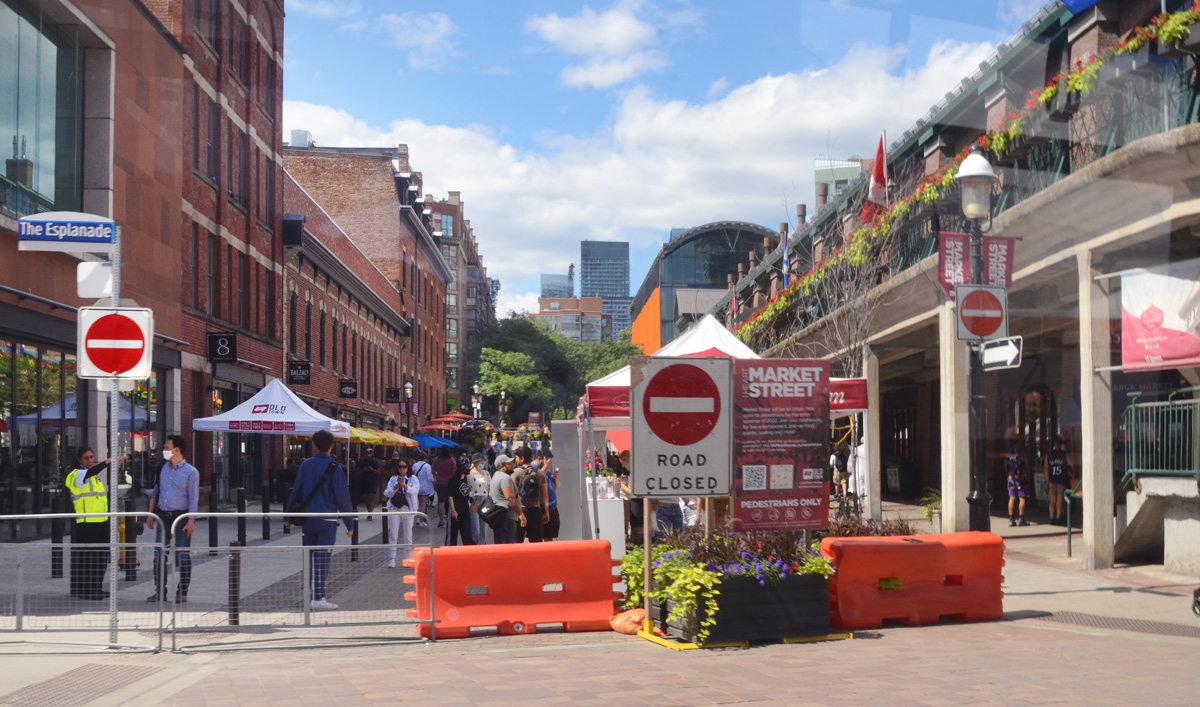
below: Market Street closed to traffic at Esplanade.

road closed sign, orange barricades, at the south end of Market Street to make it closed to traffic, and open to pedestrians only

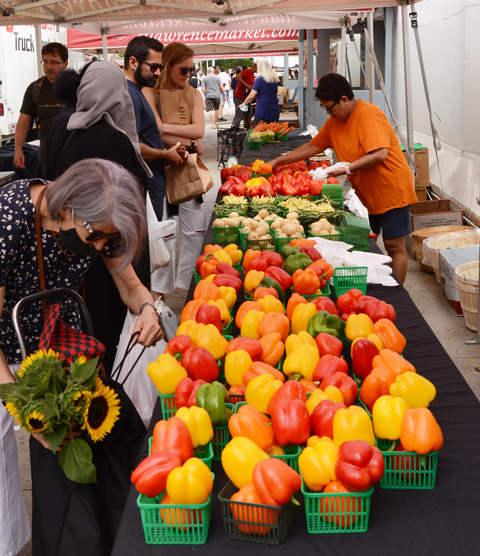
below: Marvelous peppers and other veggies for sale at St. Lawrence Market

vegetables for sale at St. Lawrence Market, yellow peppers, range peppers, as well as red and green peppers in small green baskets in the foreground,

below: Someone’s looking a little distraught. Remember how your parents used to say that if you frowned too much, or you made too many weird faces, your face would freeze in that position? That is what this poor fellow reminded me of. “Frozen” in time on the side of St. Lawrence Hall.

small carved face, decorative, on the side of St. Lawrence Hall

below: In a window.  The title of the painting is “Alone” so perhaps she is alone in the city albeit surrounded by flowers.  Unfortunately, they are yellow and blue flowers so I suspect that there is Ukrainian symbolism at play here and that ‘alone’ has a much deeper significance.

painting in a an art gallery window with reflections of the city

below: Leader Lane ends at Wellington.

road closed for construction, pedestrian on sidewalk, Irish flag flying by pub, porta pottie, park in distance, downtown

below: Mama elephant and her two little ones are still walking through the courtyard behind Commerce Court.  They haven’t reached the pool yet (but at least there’s water in the pool now).

elephant statues, adult and two little ones, surrounded by tall buildings

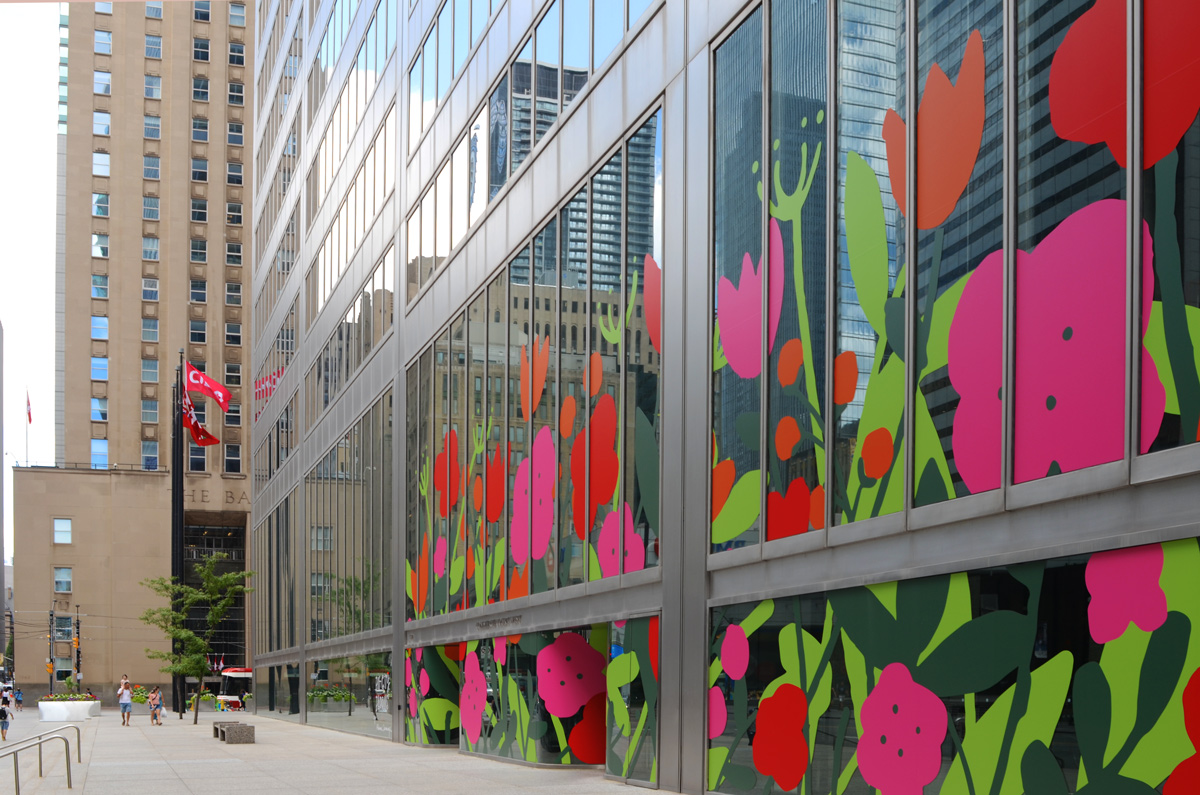
below: This is one of the five Big City Blooms murals found around the city   (west side of Commerce Court).   The big bold and cheerful flowers in reds and pinks are the work of Alanna Cavanagh.

the glass walls of the window of Commercce Court are covered with pictures of pink and red flowers, blooms in the city art project

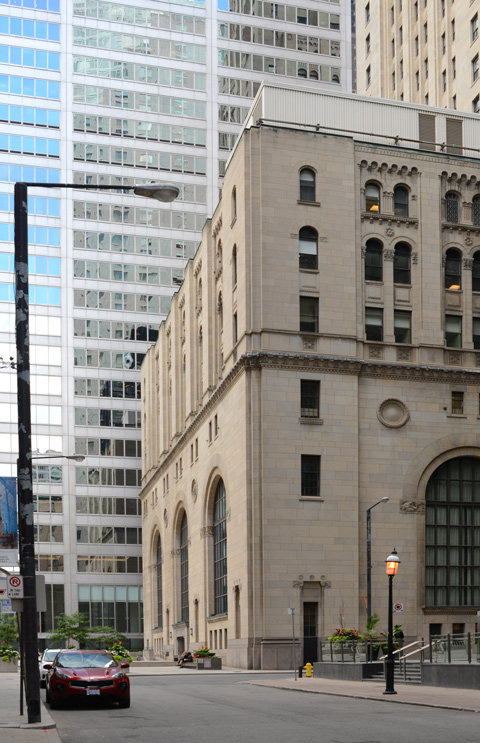
below: Same Commerce Court building as the above picture but from a slightly different angle.

tall city buildings, an older one of brownish stone, the other a newer glass and steel structure, flags poles,
below: Melinda Street

old stone building surrounded by newer glass buildings

below: Narrow city alley views, framing the gorgeous stone and brick work on the older building with its arched windows.

looking down a narrow alley to the old brick building on the next street

below: There appears to be a forest path in the middle of Brookfield Place.  It is actually a photograph that is part of an exhibit called, “Take Your Seat With the Group of Seven, Nature the Inspires Us”.  (now gone from Brookfield Place).

interior of Brookfield Place, a large photo of a path through a forest is standing in the middle
below: In this exhibit, locations used by the Group of Seven in their paintings were revisited. Photos were taken using a red director’s chair, placing the chair in the artist’s position. In this set of images, two small paintings from Coldwell Harbour are paired with a large photo of present day Coldwell Harbour – the chair is small but you should be able to see it on the rocky outcropping. The harbour is on Lake Superior near the town of Marathon.

two small group of seven paintings from Coldwell Harbour, plaus a large photo of a red directors chair at present day Coldwell Harbour

***

The other day, later in the afternoon, I was driving along the Lakeshore when I noticed that perfect lighting on the south side of the Keating Channel.  I’ve done blog posts about the Port Lands development but I hadn’t looked at it from the other side.  A quick change of plans – a parking spot nearby and a walk along the Lakeshore.  This is some of what I saw that day.

below: At the bottom of Cherry Street

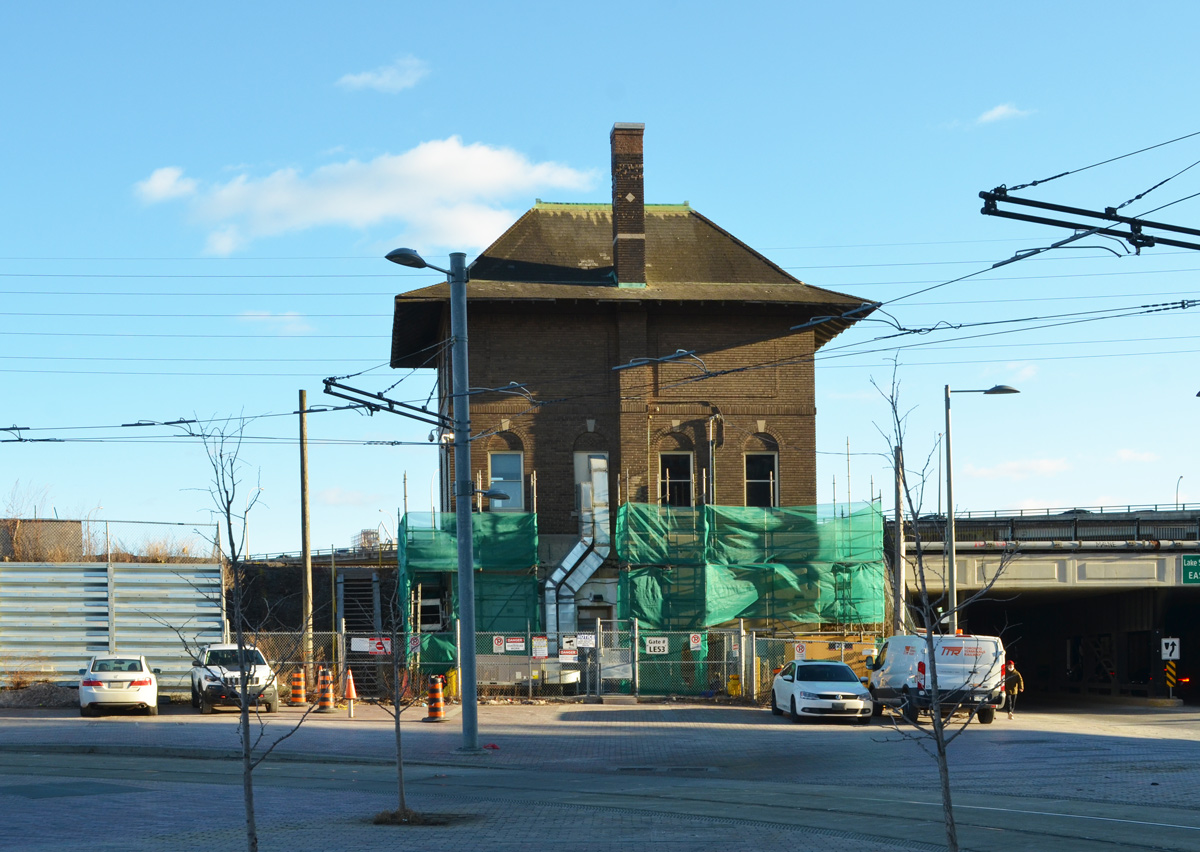
Cherry street railway building

below: At the corner of Cherry and Lakeshore.

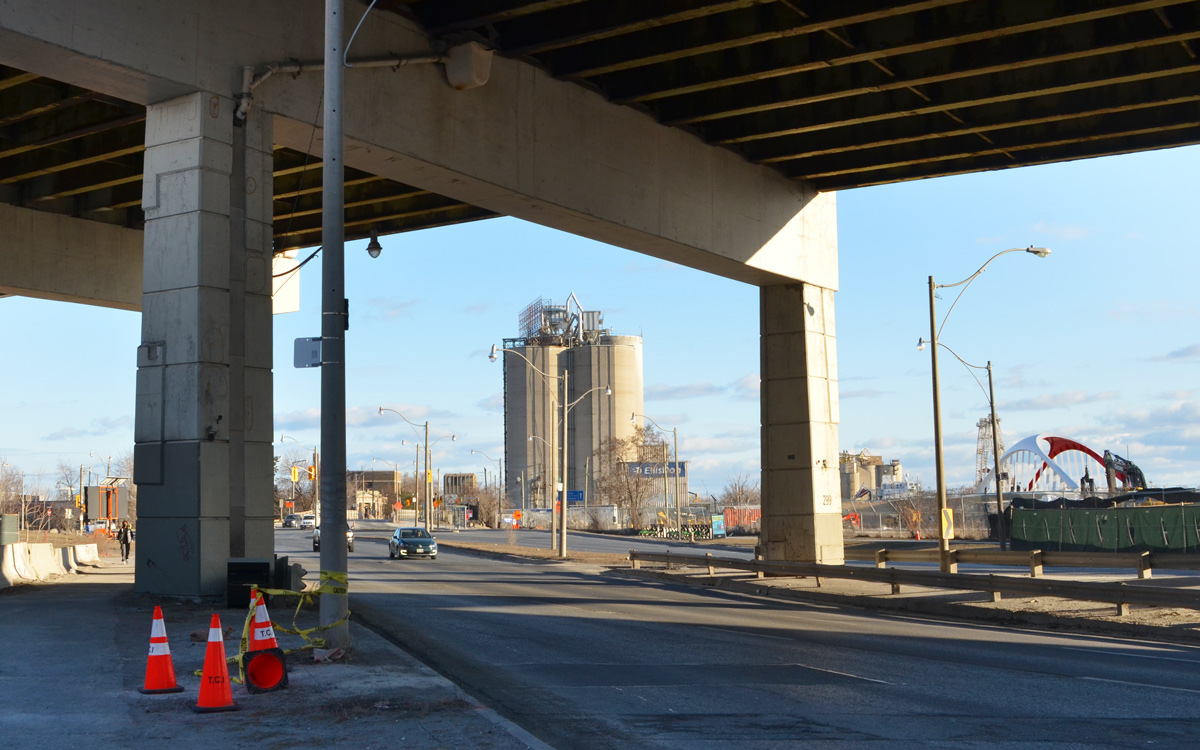
old concrete silos as seen from Lakeshire and Cherrt, with Gardiner Expressway above

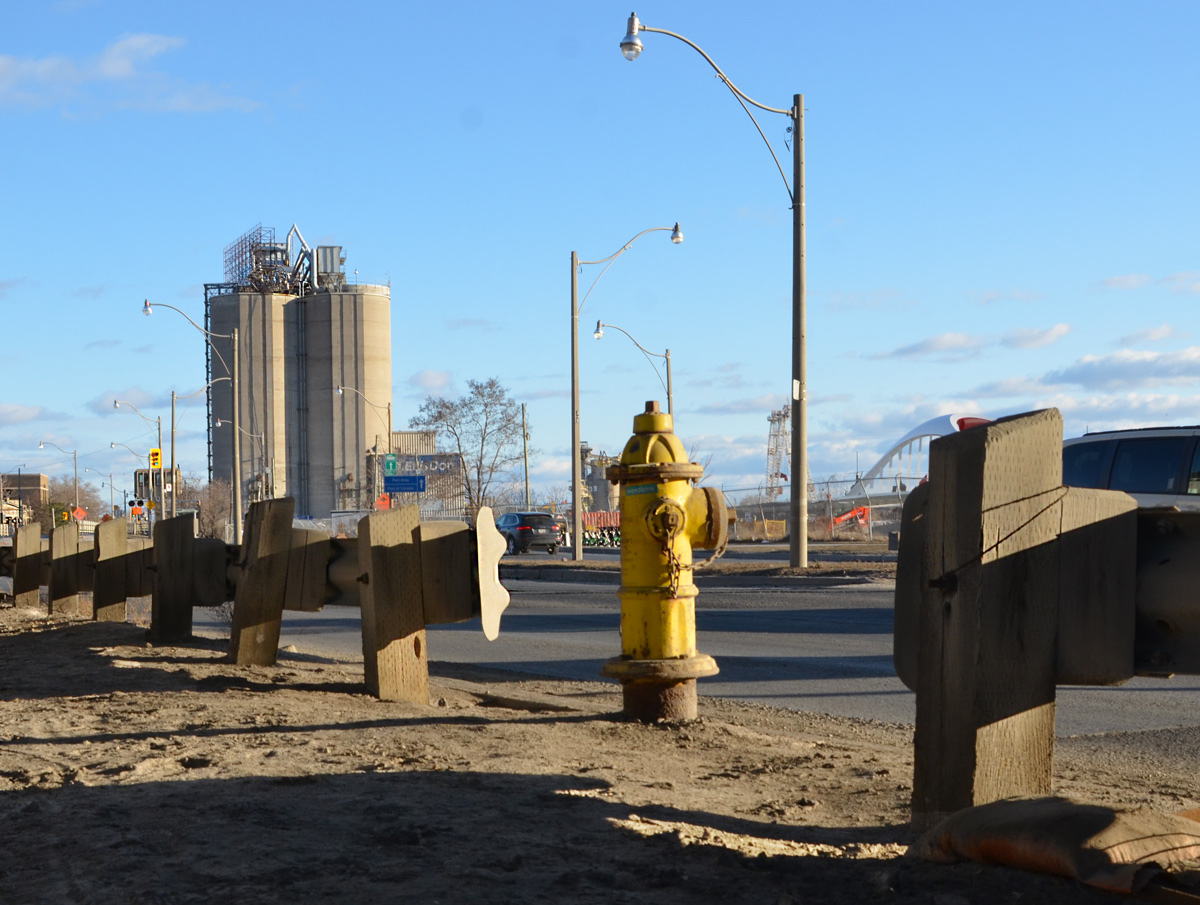
below: Along the Lakeshore, looking south towards Port Lands at Cherry.

yellow fire hydrant in front, guard rails along the side of Lakeshore Blvd, with Lafarge silos in the background

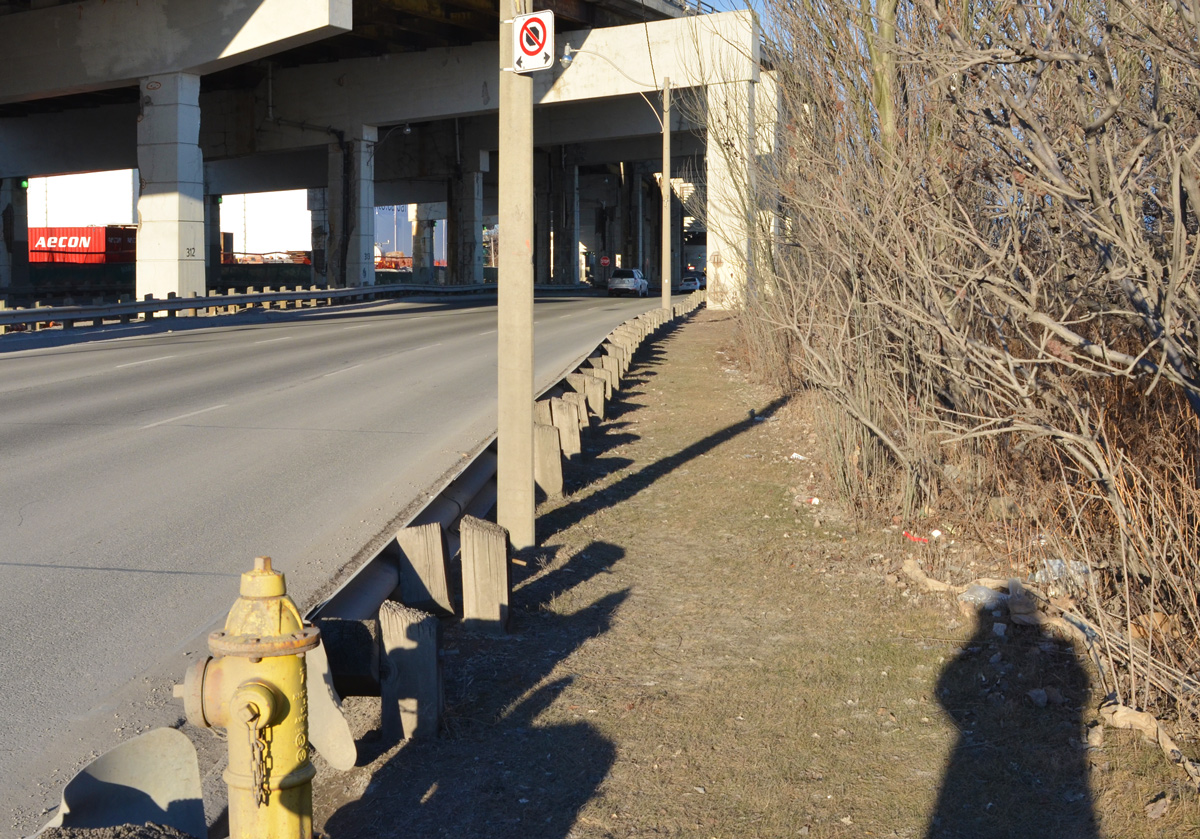
below: The Gardiner curves slightly northward as it aligns with the Keating Channel.  Lakeshore Blvd takes a wider turn and comes out from under the Gardiner for a few brief moments before slipping back under as both roads parallel the channel.

Gardiner Expressway curves to the left

below:  On the south side of Lakeshore, there is no sidewalk here but the grassy area is wide enough…..

shadow on the grass beside the Lakeshore

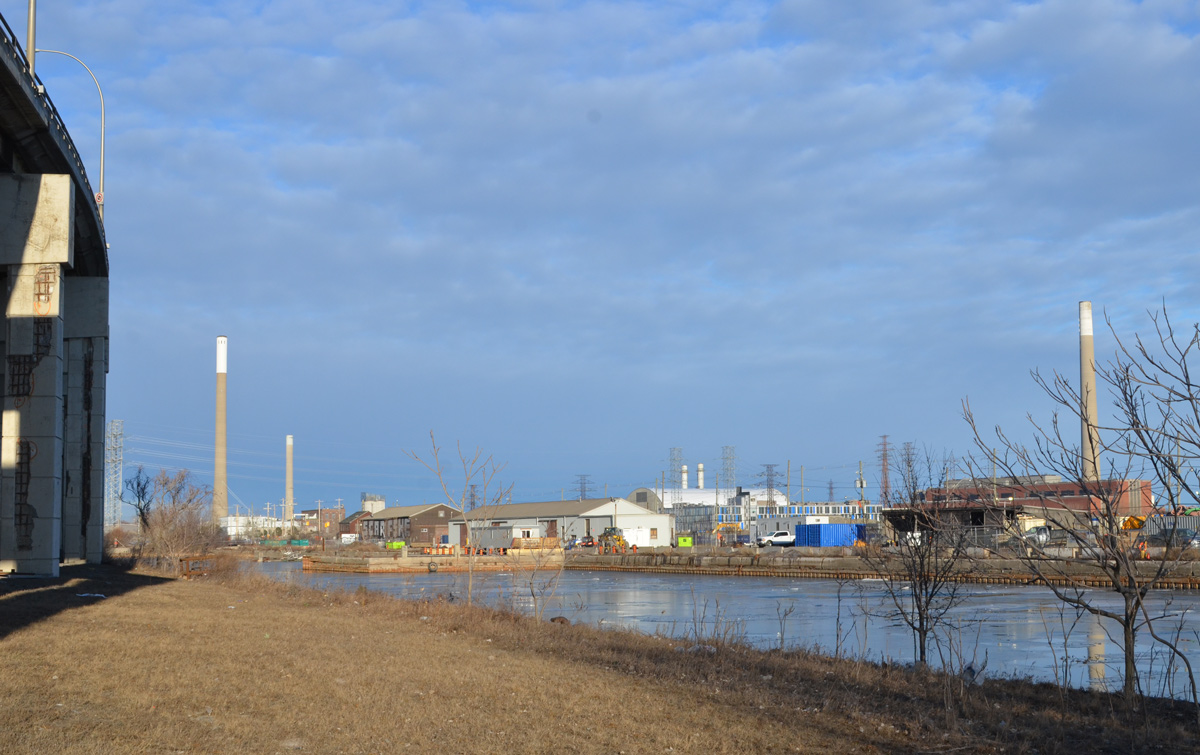
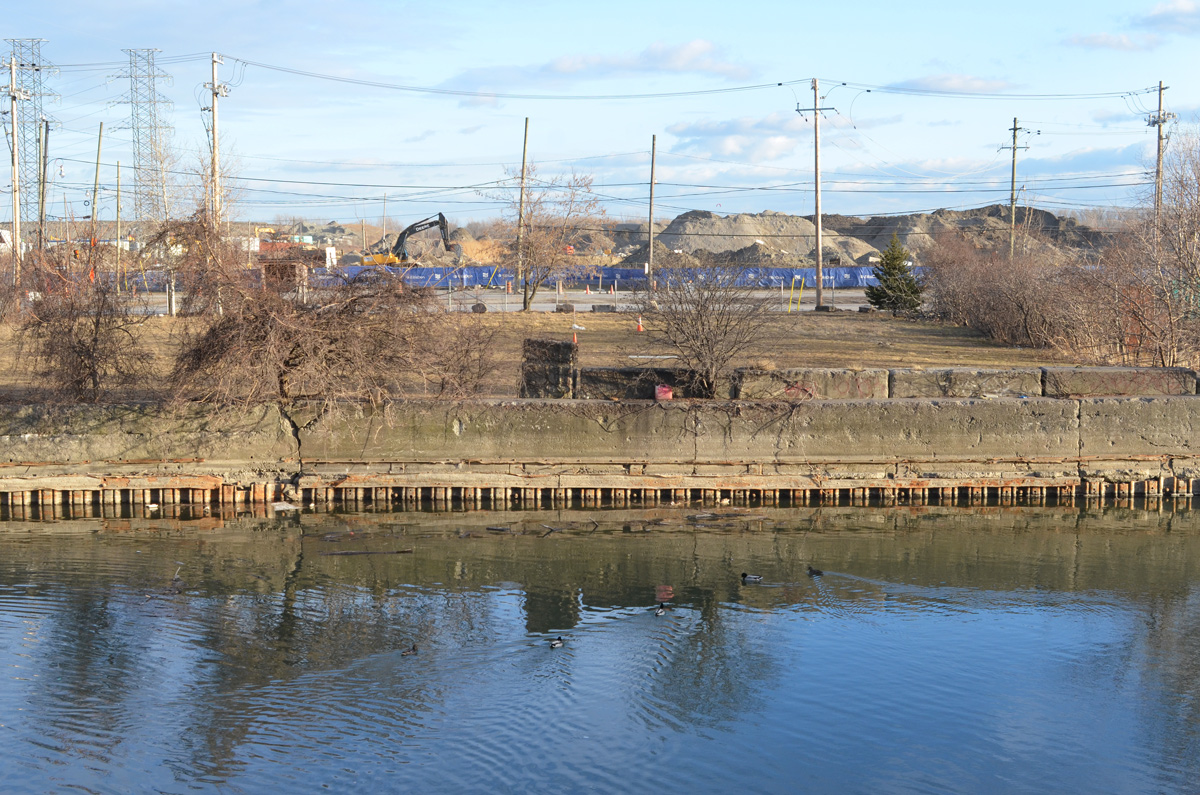
below:  Walking here offers a different view of the Port Lands.  The “smokestack” on the right is the old Hearn Generating station.

Keating Channel, looking east

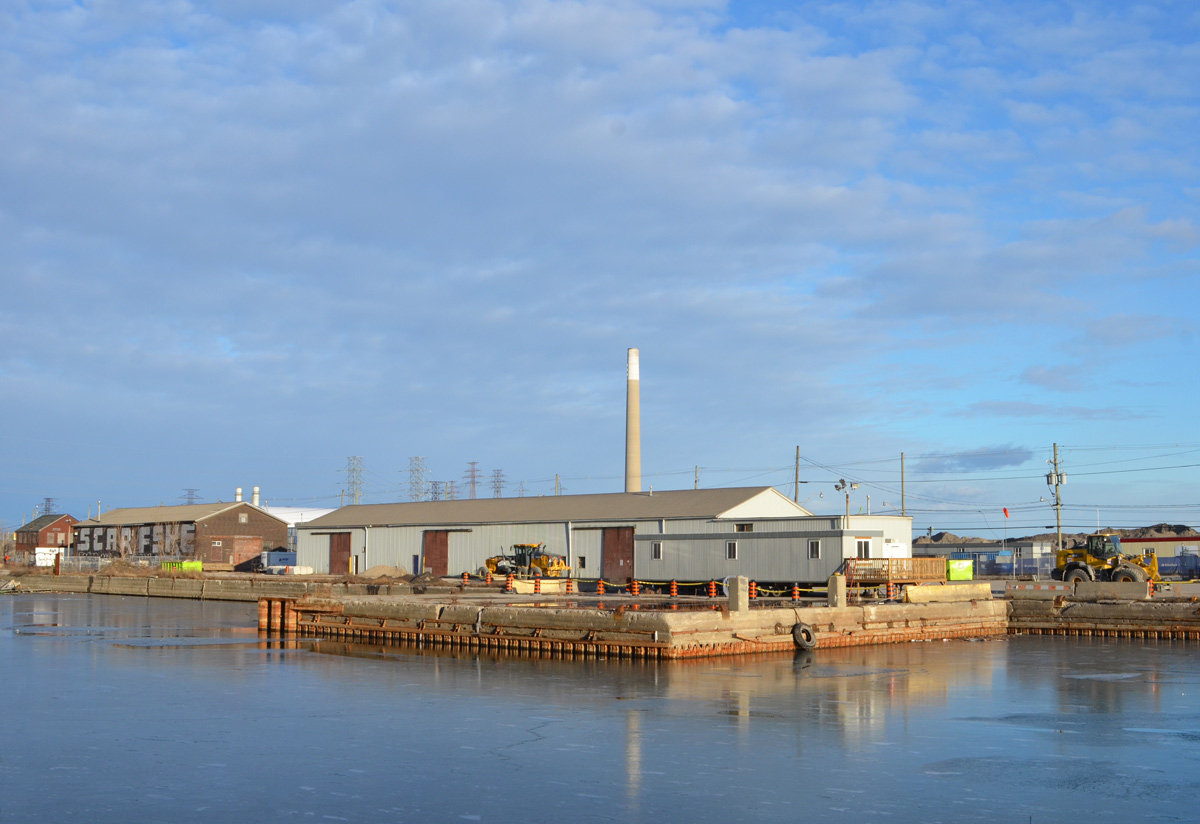
below: Some of the buildings that remain on Villiers Street.

looking across the Keating Channel to a low rise building, square dock juts into the channel

old buildings still remaing on Villies Street as seen from across the Keating Channel

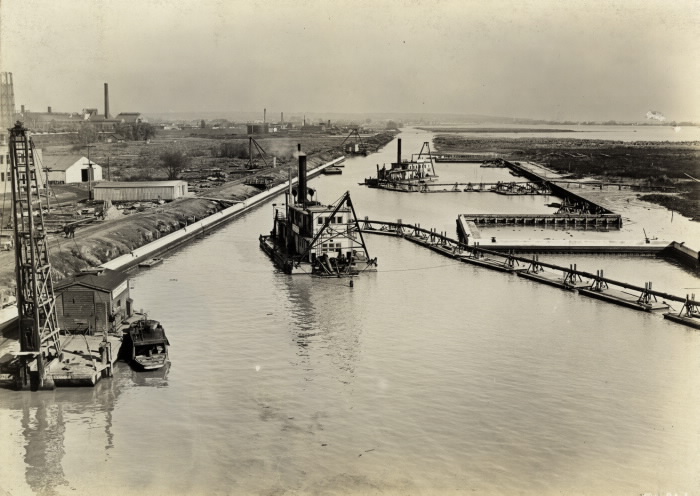
below: Panorama of Keating Channel being developed, 1916, before there was much on the Port Lands and  Cherry Street was just a one lane dirt road.

panorama - 1914 picture of building of Keating channel to divery mouth of Don River to Lake Ontario, black and white vintage photo, also Port Lands before they were developed

below: Keating Channel, 1916

1914 picture of building of Keating channel to divery mouth of Don River to Lake Ontario, black and white vintage photo
The original plan for the diversion of the Don River called for a more curved mouth of the river before it joined the Keating Channel.  But the British American Oil Company who owned the land fought that idea.  Instead, the 90 degree turn that still exists today was built to avoid crossing B/A property.

below: A few years after the channel was upgraded (1934)…  From vacant land to a forest of BA oil tanks. There are railway tracks along the edge of the channel.  From Wikipedia: “In 1908, with 8 shareholders, B/A built Canada’s third refinery on 3 acres on the eastern waterfront in Toronto. The company refined imported crude oil and its main product was kerosene; a then-useless by-product was gasoline, which was dumped into a swamp.”

photo of Keating Street

Photo by Arthur Beales. Toronto Port Authority Archives, PC 1/1/10769. Found at Wikimedia Common

.

below: BA refinery with the Don River on the right, 1931.  There were still storage tanks here in the 1960s when the city was building the Gardiner Expressway.

1931 photograph, vintage, black and white, of British American oil refinery just north of the Keating Channel and just west of the Don River,

Photo source: Library and Archives Canada, online

.

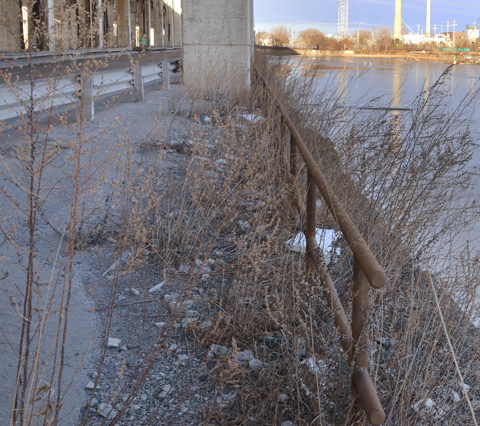
below: This rusty “fence” isn’t going to hold anyone or anything back.  I had visions of tumbling into the icy channel if I went near it.  I think that just looking at it made it wobble.

old rusty metal barrier between the Keating Channel and the road, with some weeds and gravel

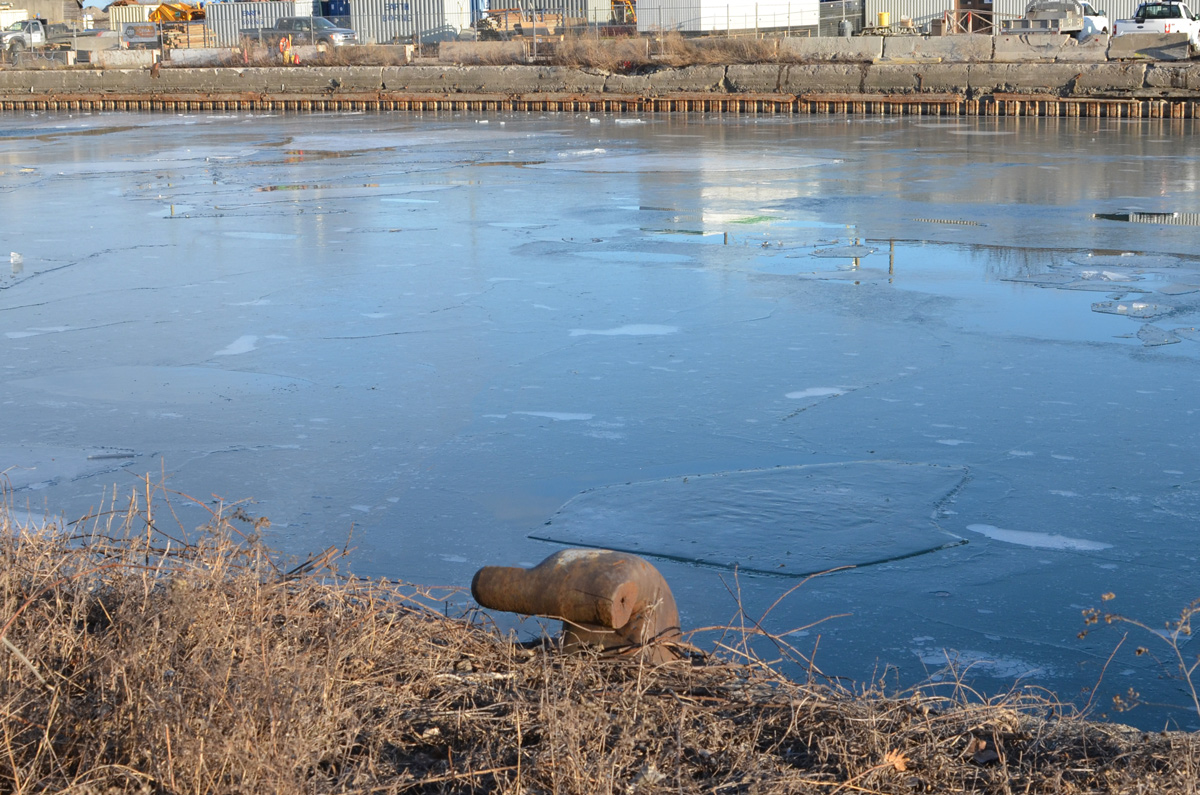
below: There are still places to tie up your boat

a large metal piece beside keating channel, for tying off boats who want to park there,

below: A big tap? It’s attached to a pipeline but is it functional?  (It doesn’t look like it).  There is a lot of infrastructure buried under the Lakeshore, sewer lines, water mains, electricals, etc., but this looks like a piece of history.  Pleased correct me if I’m wrong!  Also – if you plan to explore here, there are stretches where the only option is to walk right beside the road.

old rusty large valve for a pipeline, beside Lakeshore Blvd,

below: Likewise, the box structure is probably there to protect the rest – but what are they?  Valves of some kind?

old metal pieces of hardware, pipes and valves?, rusty, beside the Keating channel

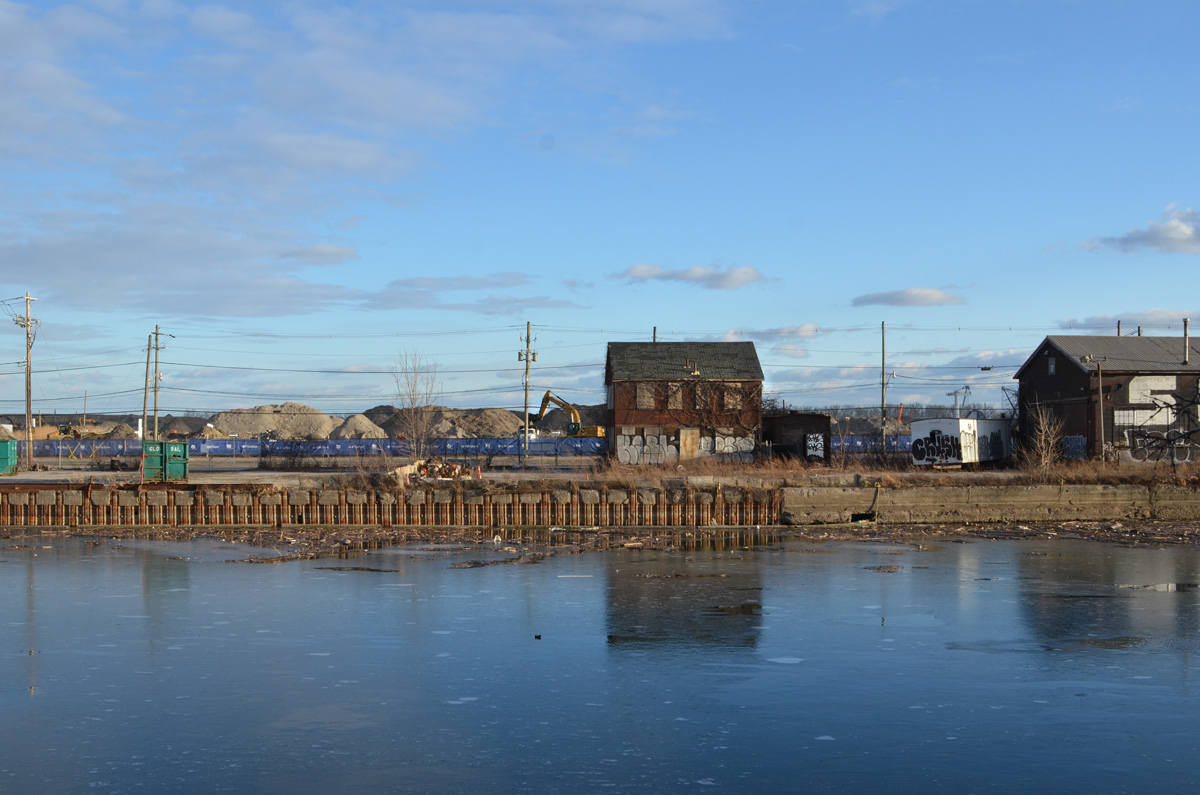
lone building onthe other side of the water, surrounded by construction at ground level.  boarded up, two storey building

construction in the background, blue digger, vacant land, and the Keating channel in the foreground, ducks in the water

below: Looking north to Canary District and West Don Lands development.  The oil tanks are long gone.

Canary district development from the Lakeshore, looking north,

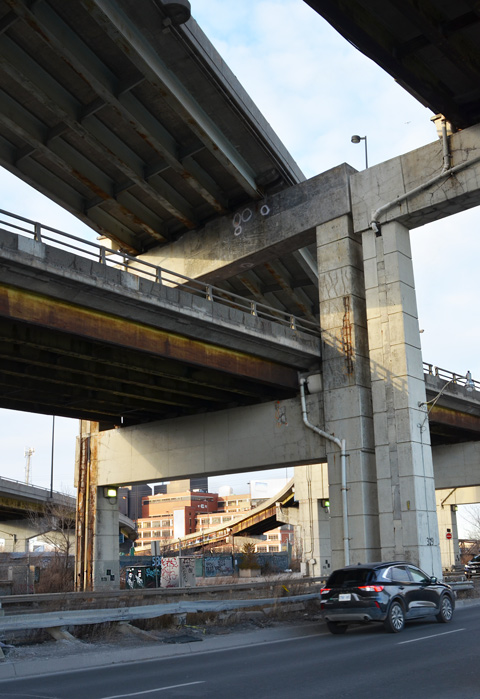
below: Looking up from Lakeshore, under both the Gardiner and the ramp from the DVP

view from the Lakeshore looking up to the Gardiner Expressway and the underside of the ramp from the Don Valley Parkway to the Gardiner, 3 levels of concrete pillars and roadway.

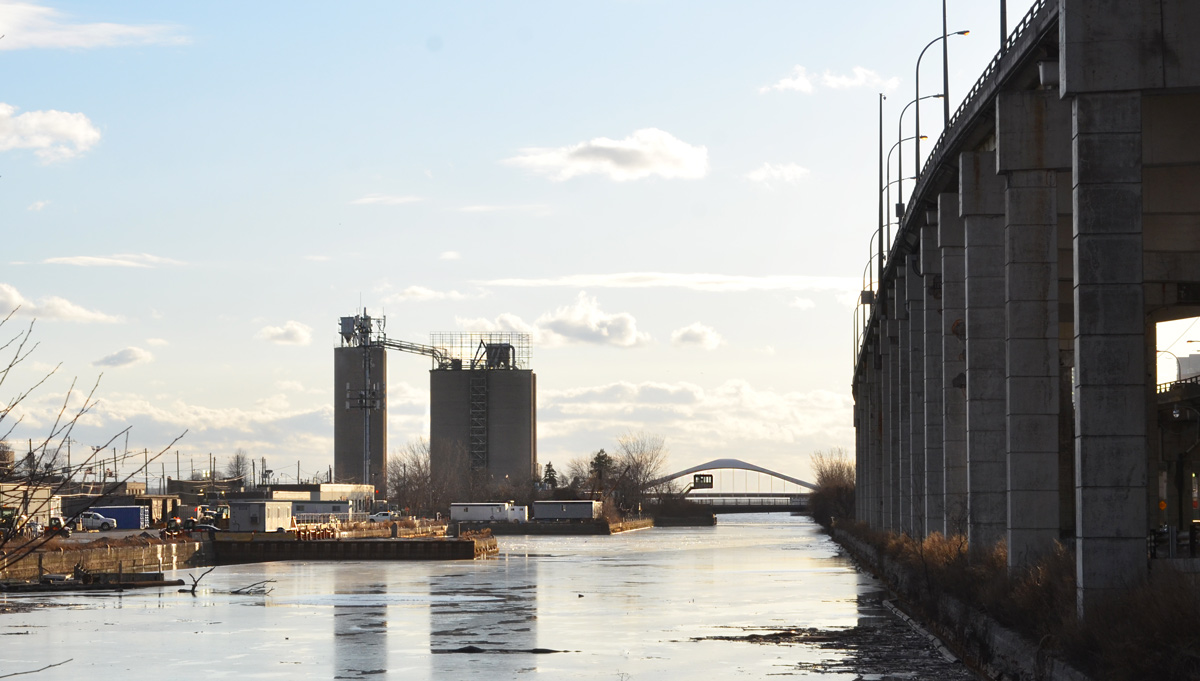
below: Looking west from Don Roadway along the Keating Channel to the new Cherry Street bridge.

view from the Don Roadway back to the new Cherry Street bridge, looking west, with the Gardiner to the right, Keating channel with thin layer of ice on it, docks and a few buildings on the Port Lands side of the channel

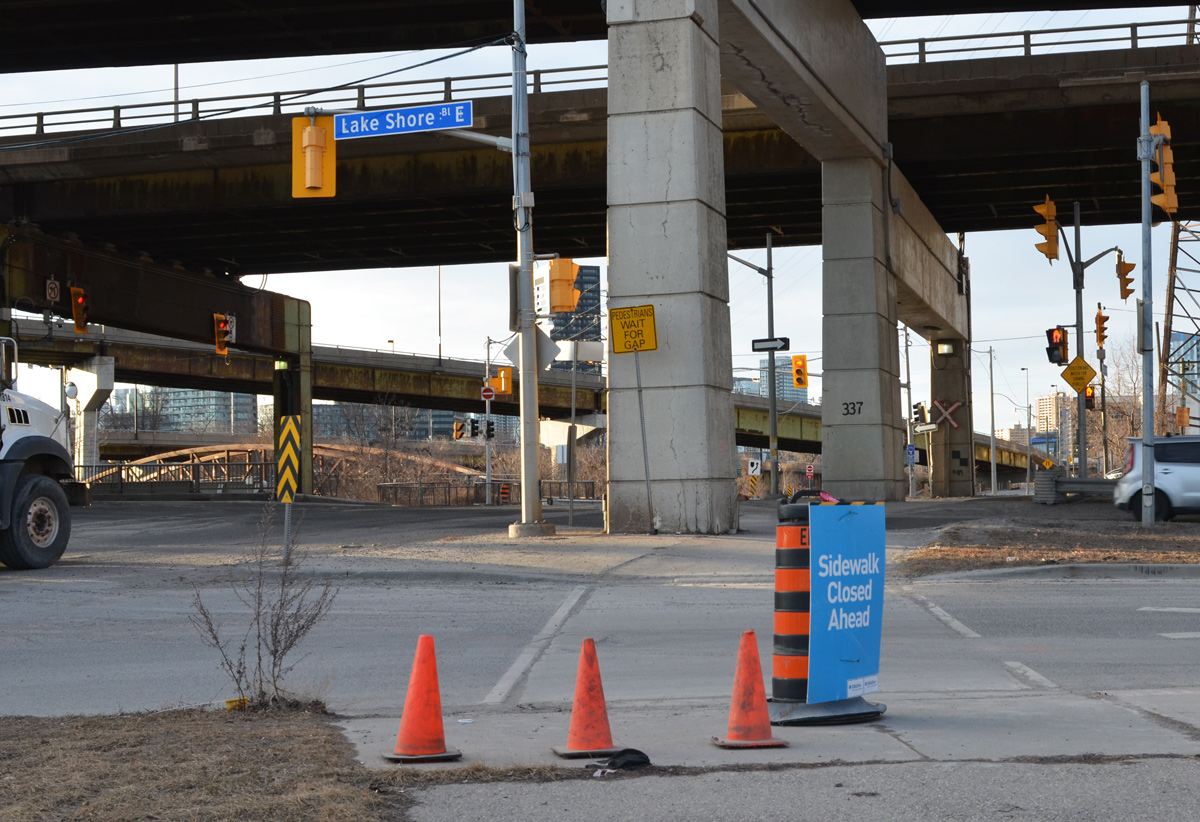
below: Intersection of Lakeshore and Don Roadway.

at the intersection of Don Roadway and Lakeshore Blvd, traffic cones and a blue sign that says sidewalk closed ahead

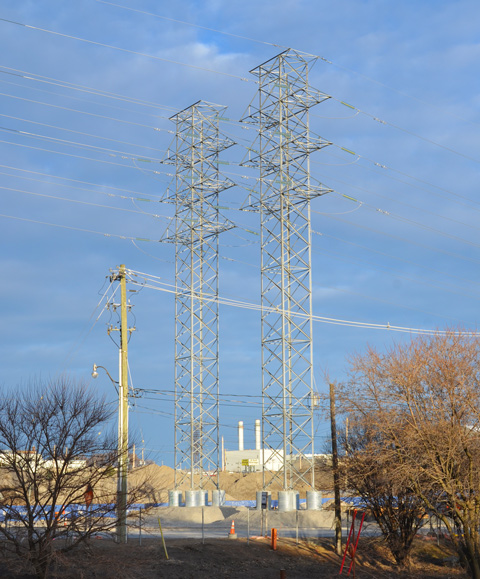
below: Two metal transmission towers standing side by side.  Geometrical, straight lines, yet lace-like.

two tall metal hydro poles with lots of blue sky, power plant in the distance, and looking very small

below: From the Don Roadway, northbound and homeward

street art on the concrete bents holding up the ramp from D V P to Gardiner Expressway, walking path beside, with a man walking his dog,

close up of part of electrical station equipment, with water tower in the background with word Ponds written on it

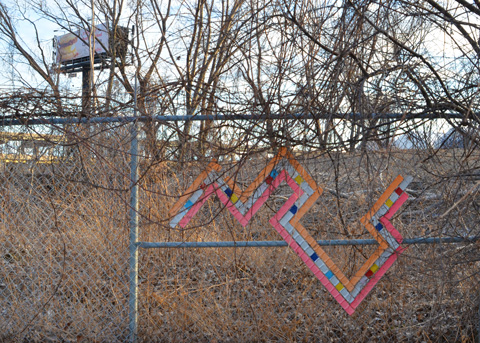
chain link fence with a design woven into it with different colours, artwork, shrubbery with no leaves (winter time), billboard on an expressway in the background

The Frederick G. Gardiner Expressway, commonly just called the Gardiner, has been in the news a lot lately.  This 18 km stretch of road between the city and the lake was completed in 1965 after years of planning and building.  At the time that it was built, Toronto’s waterfront was largely industrial and there wasn’t much objection to having a 4 to 6 lane expressway, with many sections elevated, built there.   The railway had begun the process of dividing the city from its waterfront a hundred years previously.

As the city changes and grows, more and more people live in the downtown core.  Industry has moved out and residents have moved in.  For so long the land south of the Gardiner as well as under the Gardiner was neglected, especially from a city planning point of view.  But now, the city is looking differently at that swath of land.  The far east elevated section between the Don Valley Parkway and Leslie Street was demolished in 2001 and there have been calls for the next section (Jarvis to the DVP) to be demolished as well.   There has been some controversy as to whether to demolish it or move it… and if move it, where to? I am not even sure what the plans are at the moment.   On the other hand, the western section of the elevated expressway (Strachan to Spadina) will remain standing.  Work is underway to refurbish the structure – the city doesn’t want any more stories of pieces of concrete dropping onto cars beneath!  Plans are being implemented to use the land under the Gardiner much more efficiently.  To make it work for the public.

The Bentway is the name that has been given to this new park, or public space, beneath the Gardiner Expressway from Strachan 1.4 kilometres east to Spadina. The first phase is due to open Canada Day 2017 and it involves the stretch between Strachan and Bathurst.  Many of you have probably driven on the Gardiner but do any of you know what is under it now?  Let’s take a look.

below: The Gardiner passes over Strachan Avenue which  in turn passes over the railway tracks.

bridge over a street, many orange and black construction cones down the center of the road, some pedestrians on the sidewalk

below:  On Strachan Ave looking west.   Condo development in this area has extended right to the railway line.  The Exhibition GO train station is in the distance.  You can also see the Gardiner to the left of the tracks.  Here the north side of the under part of the expressway is walled in and the enclosed space is used by Exhibition Place.  At this time there is no plan for the Bentway to extend this far; I have used this photo to provide more context as to the location of the park.

railway tracks in the center of the picture, condos on the right. On the left is the elevated Gardiner expressway, but under it is a concrete wall that makes it look more like a concrete building than a road

below: A closer look at the Gardiner on the west side of Strachan Avenue.  Maybe there is potential to expand the park westward? to Exhibition GO station? And by the way, those concrete structures holding up the expressway – those are called ‘bents’ and that is why the park is called what it is.

a dirt road runs alongside the Gardiner Expressway, some condos in the distance

below: This photo was taken as I stood on Garrison Common and looking towards Strachan Avenue.  This will be the western end of the new park. You can see the underside of the Gardiner as it passes over Strachan Ave which in turn is also a bridge.  This bridge once crossed the Grand Trunk Railway tracks that were built in the 1850s.  New entrances to the park are planned that incorporate the present sloped embankment of the bridge.

The elevated Gardiner Expressway passes over Strachan Ave which in turn has a bridge over what used to be a rail line. The bottom part of the bridge is covered with graffiti. The whole area is a construction site at the moment.

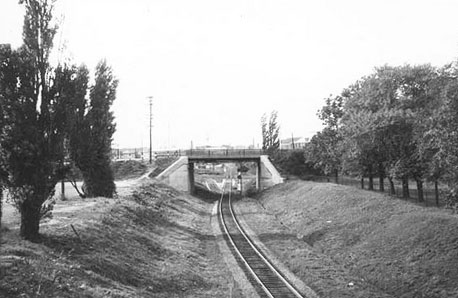
below: A quick aside:  It’s a slightly different angle, but here is a photo of the Strachan Avenue bridge from 1959, before the Gardiner was built.  I suspect that there has been upgrades made to the bridge since then.  Photo credit: R.L. Kennedy, found online (also a good source for the history of the Grand Trunk Railway in Toronto).  Garrison Common is to the right.

vintage photo from 1959, GTR tracks pass besidde Garrison Common park and under the bridge at Strachan Ave

Garrison Common is the green space surrounding Fort York.  It will abut (be continuous with?) the new Bentway.  Fort York is a National Historic Site and on its 43 acre site are original buildings from the War of 1812 as well as an 1813 battle site.  Did you know that the Americans beat us here in 1813 and controlled the city of York (as Toronto was known then) for a few days?

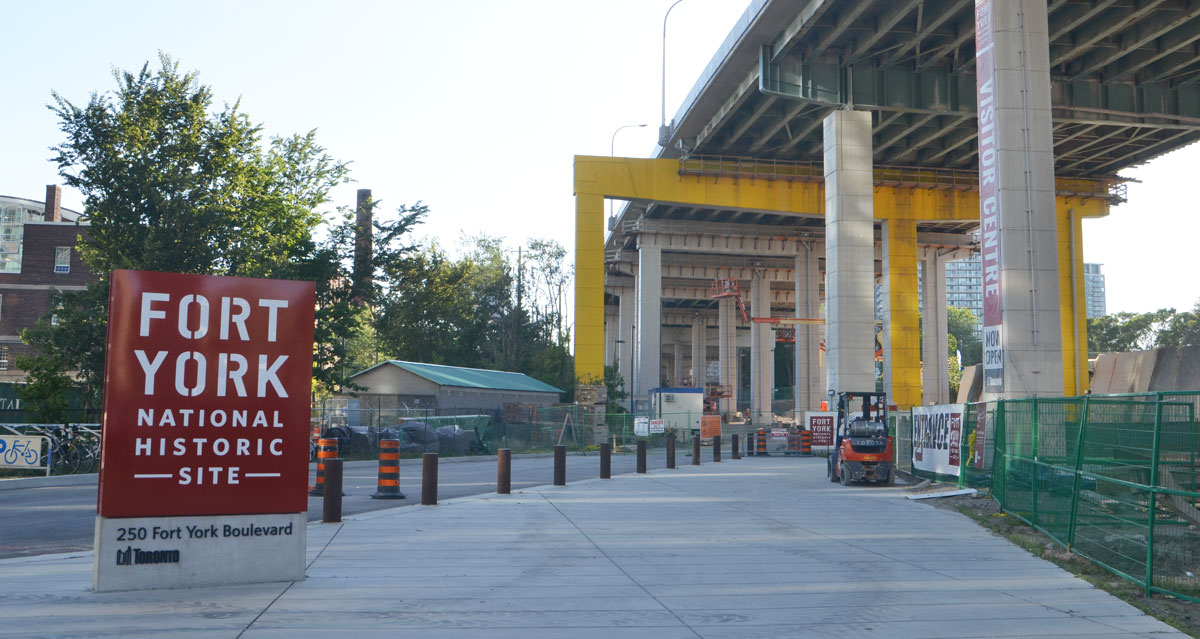
below: The new Fort York Visitors Centre is now open. There is still being work done both inside and outside, but it is open to visitors. For so long the fort was hidden away and difficult to get to; it is nice to see it receiving more attention.

entrance to Fort York, under the Gardiner, still a construction site but nearing completion

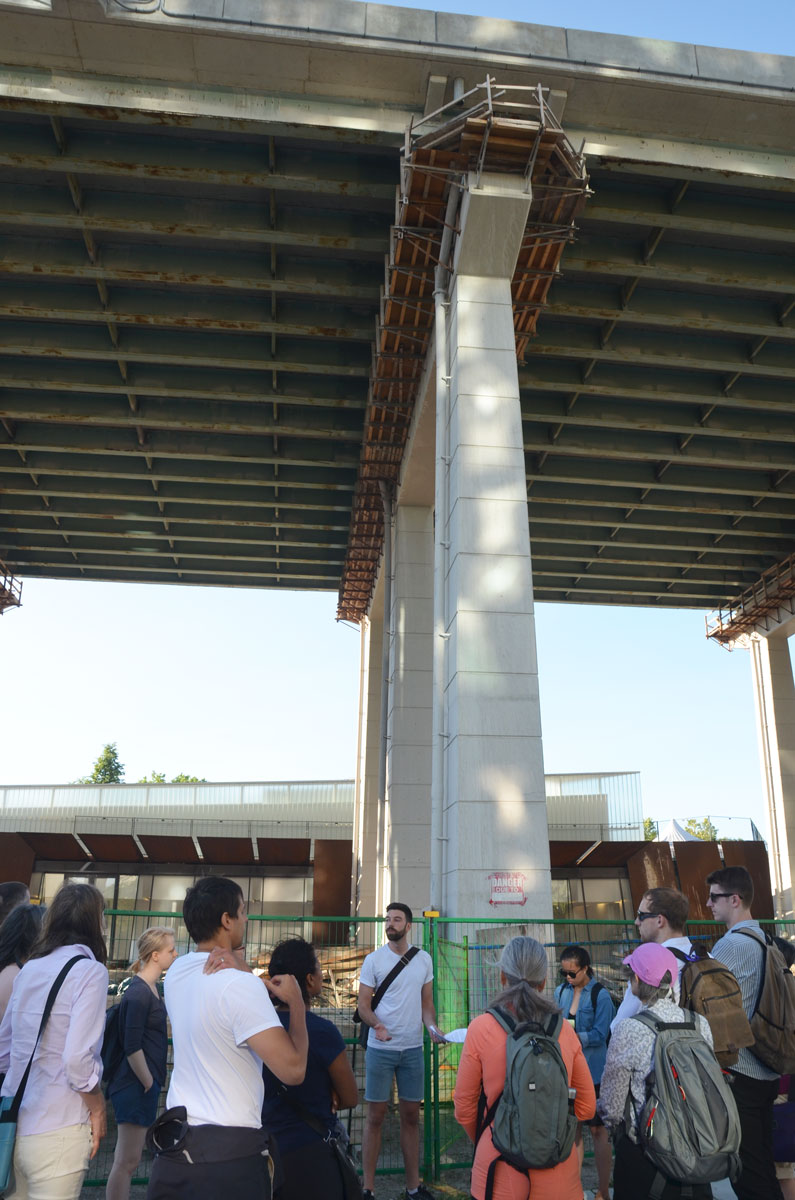
below: Jake from Park People, one of the groups helping to design the new park, stands under the Gardiner as he talks to a group of us on a tour.    Here, by Fort York, the Gardiner is the equivalent of 5 storeys from ground level, the highest it reaches as it crosses the city.

a man is standing in front of a group of people on a walking tour, he is standing under the Gardiner Expressway where it is 5 storeys above ground level.

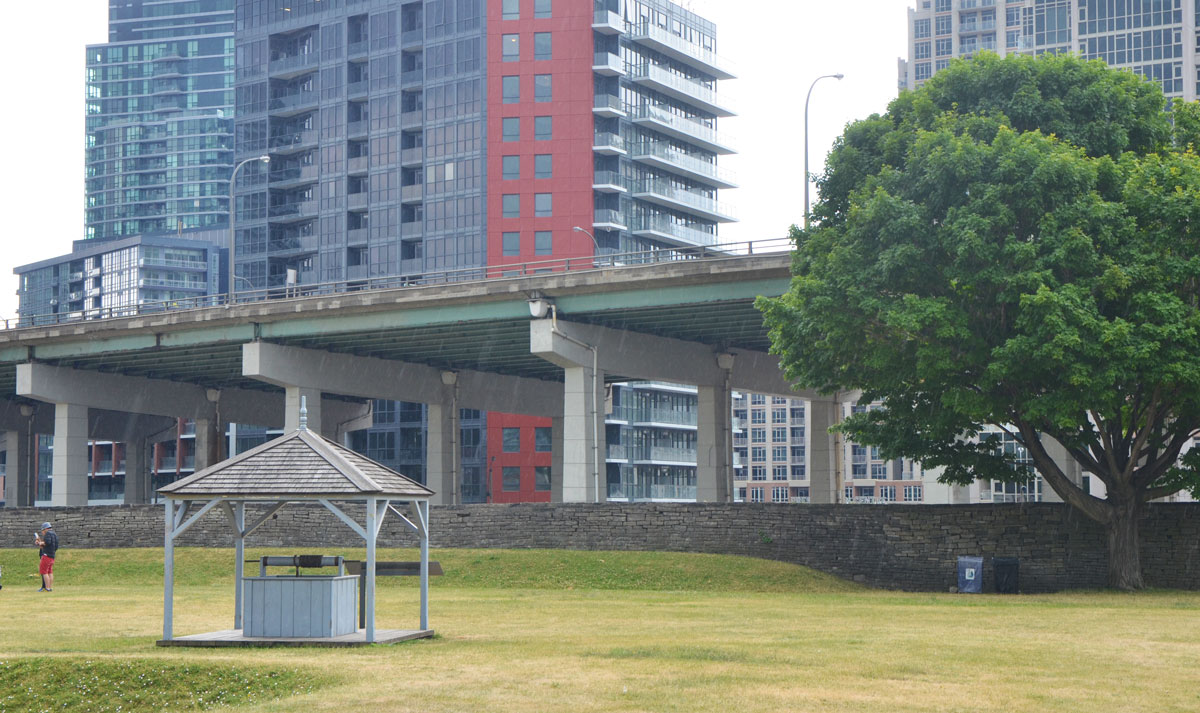
below: Standing on the grounds of Fort York.  The Bentway will be beyond the stone wall.  You can get a good idea of the spacing between the bents.  These spaces are being referred to as ‘rooms’ and there are 55 of them between Strachan and Spadina.

from the grounds of Fort York looking south to the Gardiner and the condos built beyond it. Grass field in the foreground.

below: One obstacle is the fact that Fort York Blvd passes under the Gardiner on a diagonal.  Plans are to build a pedestrian/cycle bridge over the street.  Also in the photo, note the TTC bus – Fort York and vicinity are finally on a bus route.  Route 121 runs between the Portlands and Fort York via Union Station.

fort york blvd is in the foreground, a TTC bus and a car are on it, the Gardiner is to the right and a short condo building is in the background along with the CN tower

below: The section under the Gardiner Expressway between Bathurst Street and Fort York Blvd is not city owned. It is owned, and has already been developed, by the Onni Group who built the Garrison at Fort York condominiums on either side of it.  This is the eastern end of phase 1.

evening, low angle sunlight shines under the Gardiner Expressway where it has been developed with paving stones and some large rocks.

below: Northbound traffic on Bathurst passes under the Gardiner.

some traffic on Bathurst street on a rainy day, as the street passes under the Gardiner Expressway, condos on the right, construction hoardings on the left.

Phase 2 of the park’s development involves land between Bathurst and Spadina. This is an area that is undergoing a lot of changes at the moment, i.e. a lot of construction.

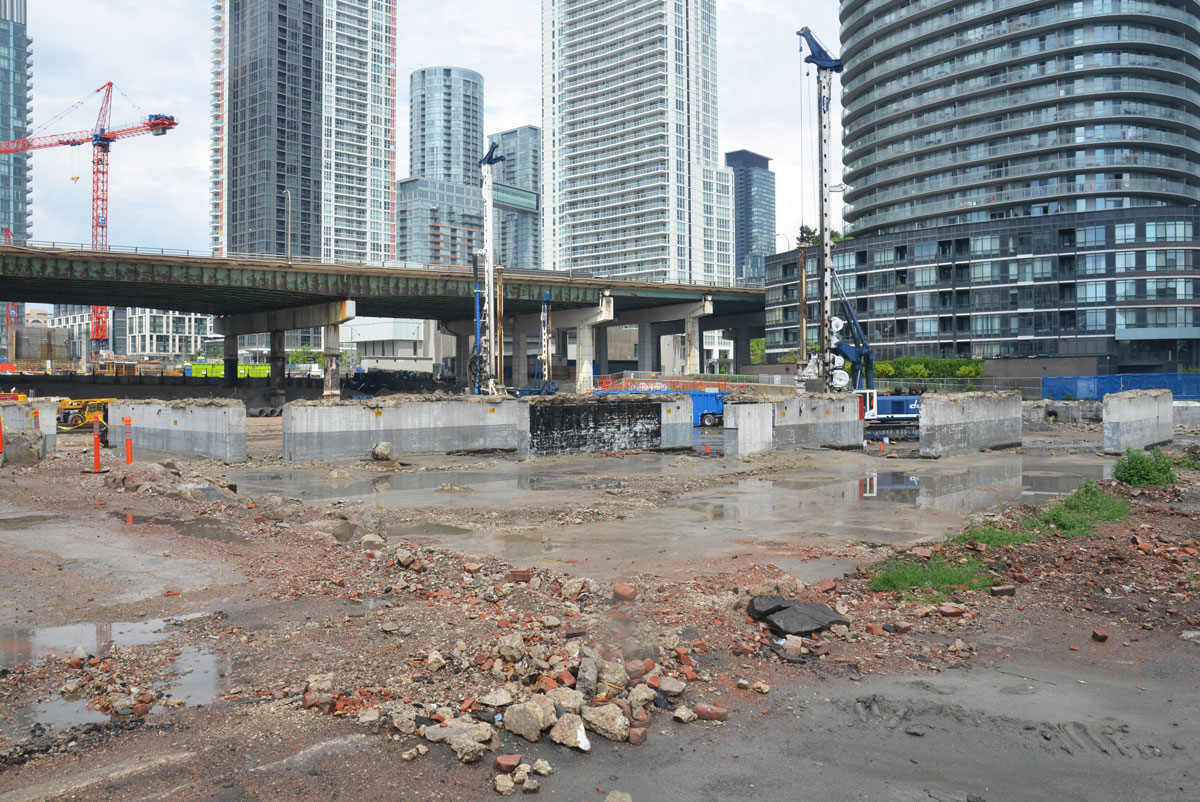
below: Immediately south of the Gardiner on the northeast corner of Bathurst and Lakeshore is a construction site.  Demolition of the old 1928 Loblaws warehouse building is now complete.  The facade of the old building was disassembled rather than demolished; after cleaning and refurbishing of the bricks, it will be rebuilt in its original location.  Two condo towers are planned for the space between Loblaws and the Gardiner.  Yes, more condo towers to face the Gardiner and add to the tunnel effect that you get when you drive on the expressway.

construction site in downtown Toronto, Gardiner Expressway runs behind the site, rubble in the foreground, a few remaining remnants of the old Loblaws building that was there, high rises in the background.

below: The development of this site is a collaboration between a number of developers.  I found a photo of one rendition (source) of what the space under the Gardiner will look like here in the future.  Public space including a cafe are part of the plans.  Check back in a couple of years to see what really happens here!

artist's rendering of what a planned development for under the Gardiner would look like, part of a larger condo and retail development.

below:  Standing on Bathurst Street, looking east along what will be Housey Street.  This is just north of where the Loblaws development (above) will be.  As you can see, you can’t walk there yet.

the elevated road, the Gardiner Expressway passes over a construction site on the right, a new street being built on the left.

below: Southeast corner of Bathurst and Fort York Blvd.  This is the section of land just north of Housey Street.  Construction hoardings and cranes – familiar sights in this area.  It also means that taking photos of under the Gardiner here are difficult!

late afternoon, long shadows, yellowish tint to the photo, looking east from Bathurst, south of Front, north of the Gardiner, wood construction hoardings with posters on it, many orange cranes, some condos already built, a woman jogging past, cars on the street.

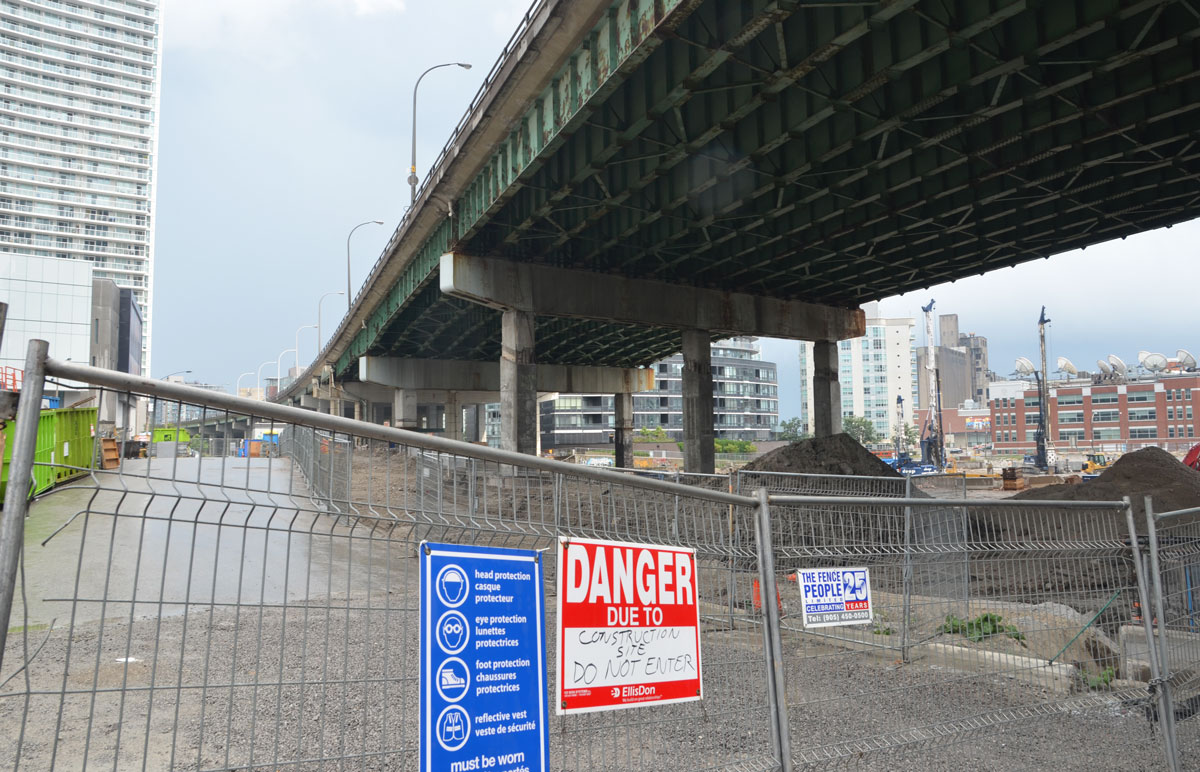
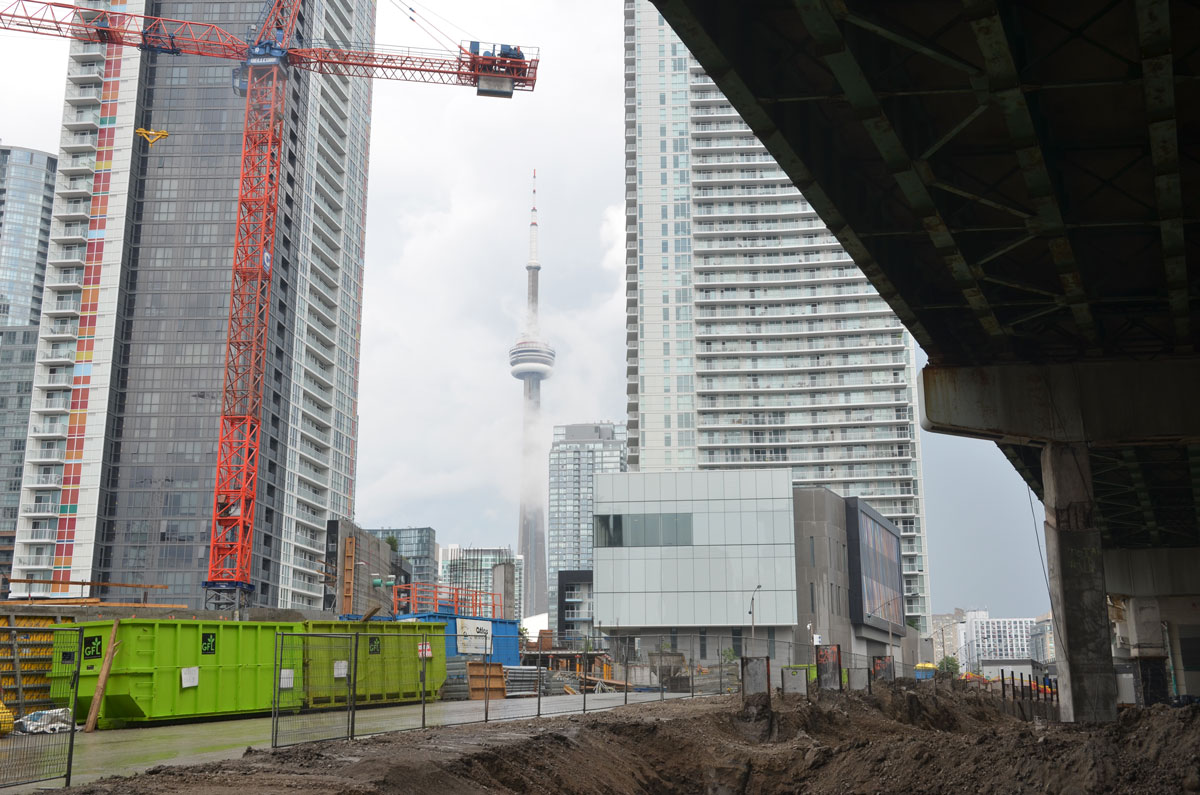
below: Development north of the Gardiner between Bathurst and Dan Leckie Way.

construction site under the Gardiner, cranes and condos being developed on the left, CN tower in the fog in the distance.

Dan Leckie Way is a north-south road that runs under the Gardiner just east of Bathurst.  It is the western boundary of Canoe Landing Park.  This park is north of the Gardiner and the Lakeshore.

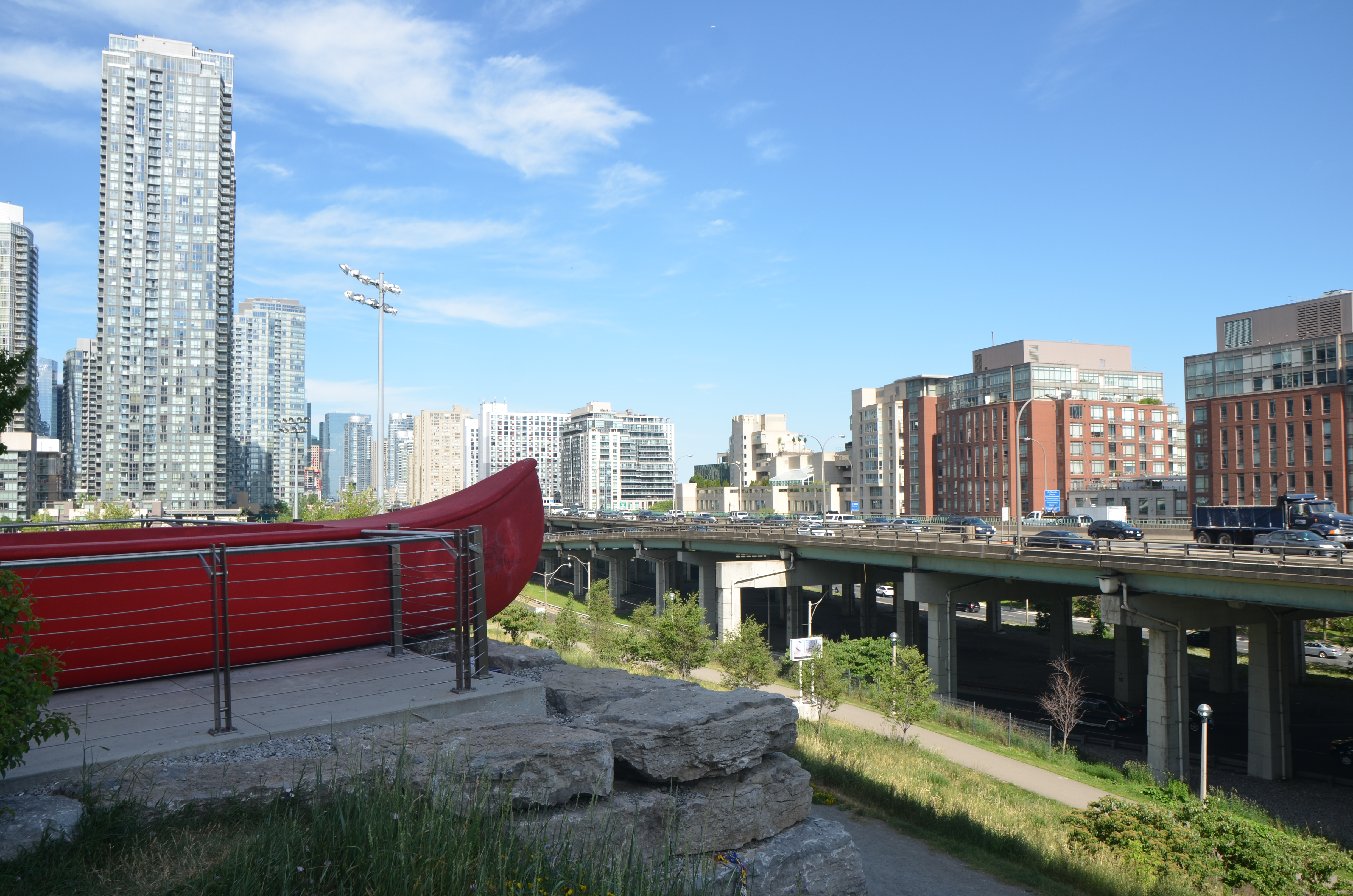
below: ‘Tom Thomson’s Canoe’, by Douglas Coupland sits at the highest point of land in the area; it’s almost at the same level as the Gardiner and is very visible as you drive by.   This park extends down the hill.

The end of a large red canoe, an artwork by Douglas Coupland called 'Tom Thomson's Canoe' sits in a park, high above the surrounding scenery. Looking southwest towards the elevated Gardiner Expressway and the condo developments south of it.

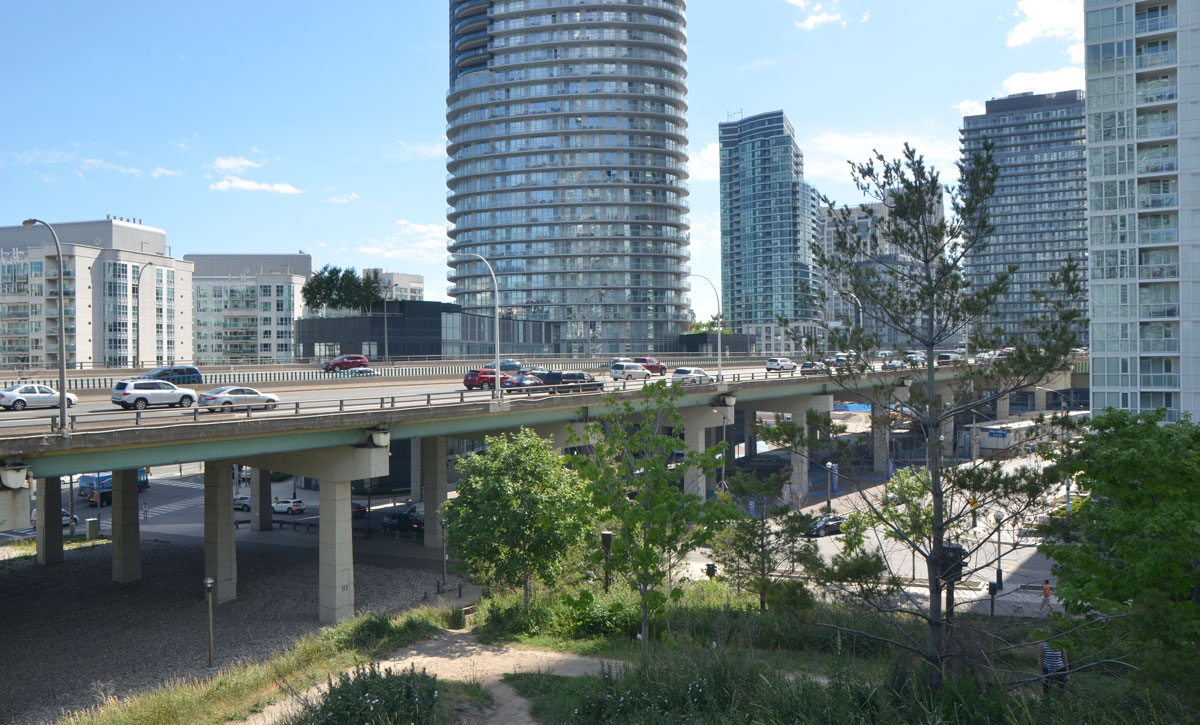
below: Looking the other way from the same vantage point. The street running under the Gardiner here is Dan Leckie Way . Up until this point the Lakeshore is south of the Gardiner.

The elevated Gardiner Expressway with traffic is in the middleground, some trees and parkland in the foreground, and condo developments in the background.

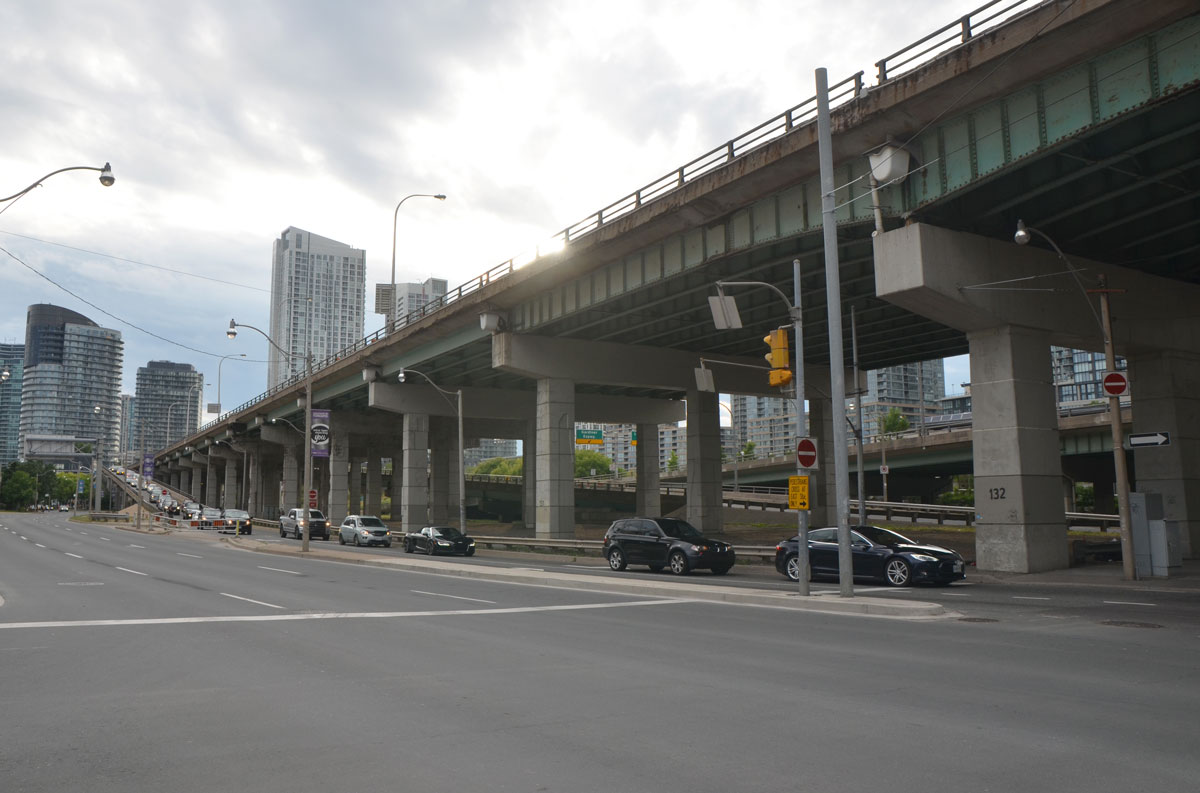
At Dan Leckie Way, the Lakeshore is still south of the Gardiner and the space under the expressway is wide open.   By Spadina, one major block east, the situation changes.   The Lakeshore splits and westbound traffic lanes go north of the Gardiner and eastbound lanes stay south.  Shortly after Spadina, the Lakeshore runs under the Gardiner and there is no room for any further development under the road.

below: Standing on Spadina, just south of the Gardiner and looking west.  Here there is a lot of road to cross for pedestrians on Spadina.  Not only has the Lakeshore split to run on either side of the Gardiner, but there are also ramps between the Gardiner and the Lakeshore.

major road with traffic under an elevated expressway in a city, long ramp from the upper level to the lower. Gardiner Expressway and Lakeshore Blvd in Toronto, at Spadina looking west

below:   Still on Spadina, and still looking west, but now under the Gardiner.  The space under the road is not as high as it was previously.  Its lower and darker and not as inviting.   It will be interesting to see what phase 2 of the Bentway development will look like in this space.  I am not sure when it will to be finished but I will keep an eye on it!

under an elevated section of the Gardiner Expressway, at Spadina.

As for the eastern Gardiner, what does that look like?  Well, that’s a whole other blog post!

 Project: Under Gardiner  On this site you’ll find detailed maps and diagrams of this area as well as information about the plans for the various sections of the space.