Posts Tagged ‘CONTACT’

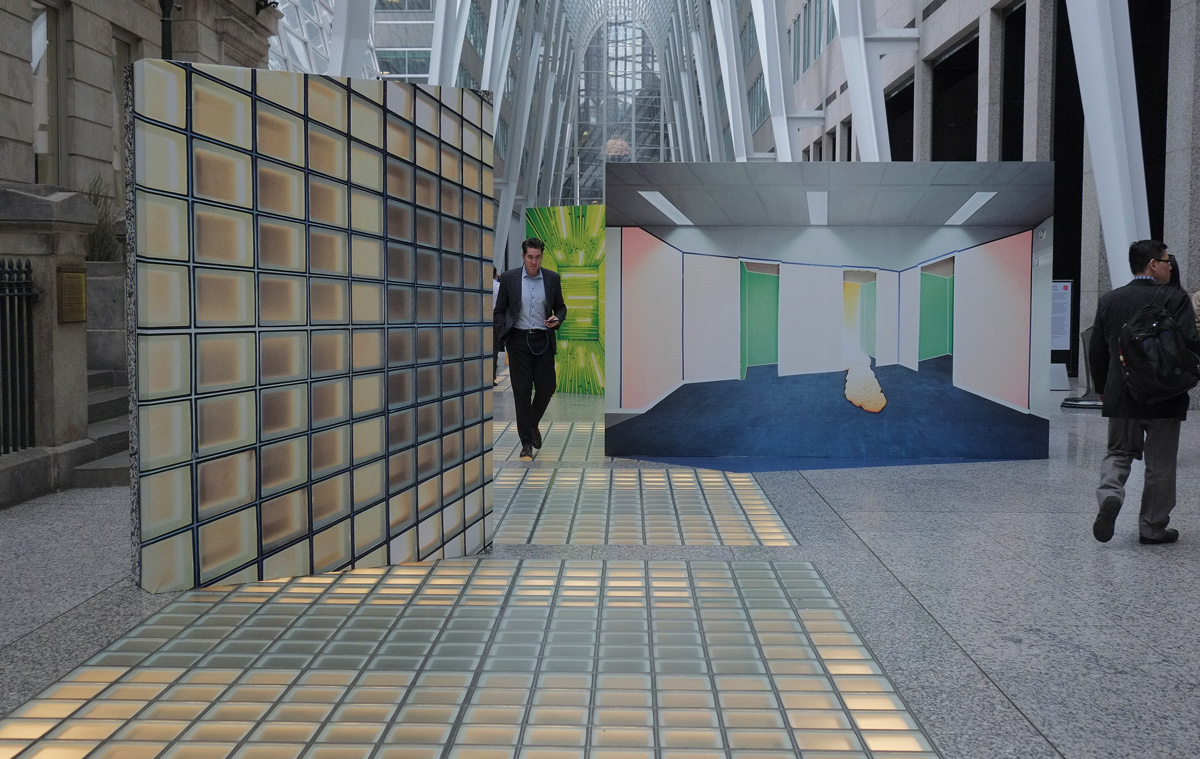
This little walk starts with the artwork of Marleen Sleeuwits and her ‘Not the Actual Site’ exhibit at Brookfield Place (Allan Lambert Galleria).

A short walk from Brookfield Place westward along King street towards Metro Hall….

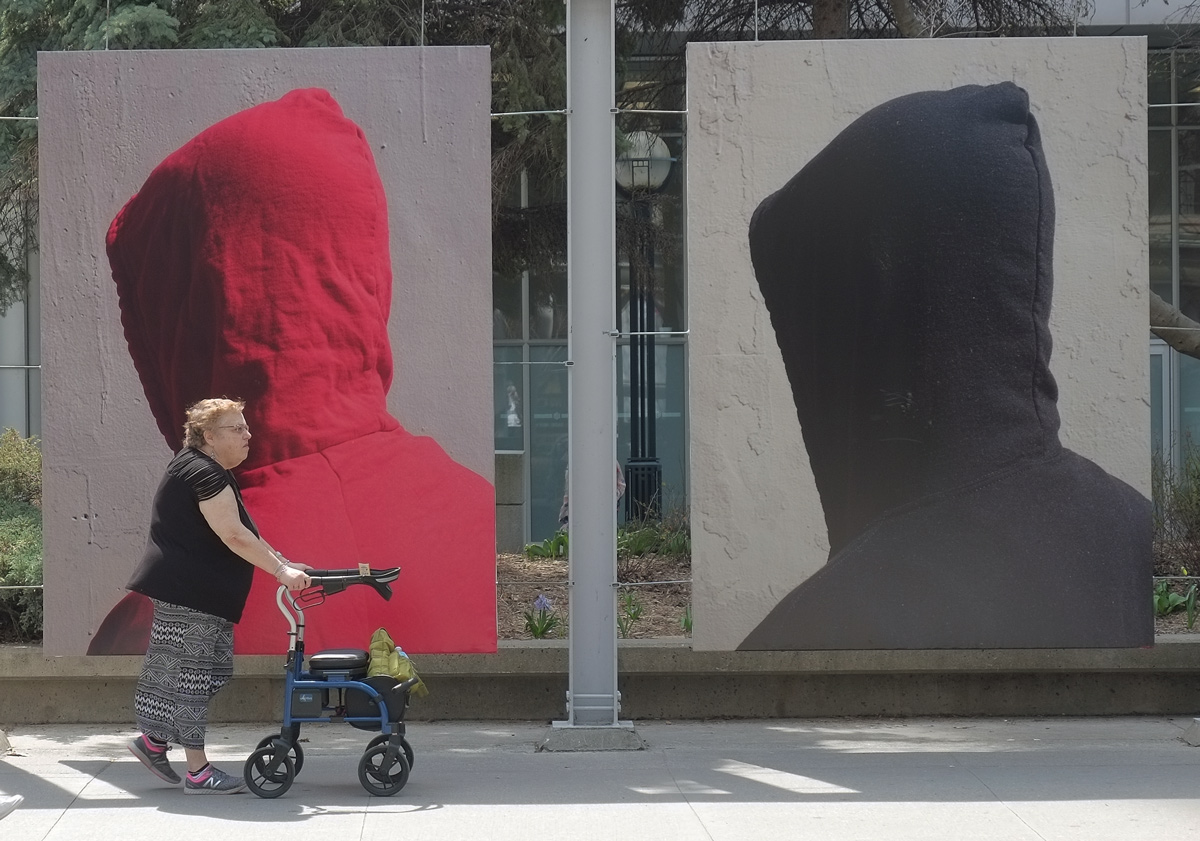
where pictures from John Edmonds ‘Hoods’ series are on display (as are the people who walk past!).

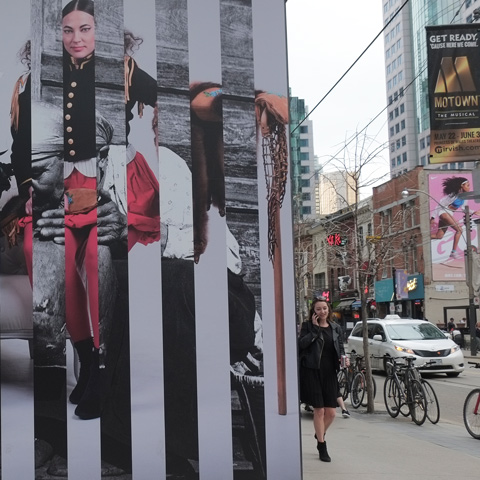
Across the street from ‘Hoods’ is Caroline Monnet’s, ‘History shall speak for itself’.  These photos are the south and west wall of TIFF.

caroline Monnet's large mural on the side of TIFF building, King street, people walking past, bikes parked in front of the art.

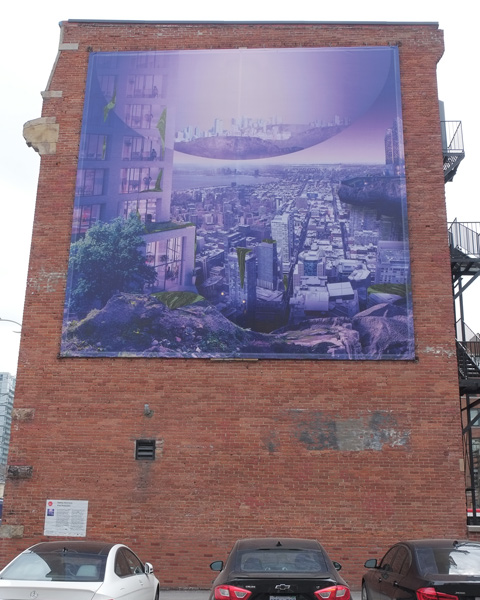
Just a bit farther west (at Spadina) you can find a large purple hued image by Felicity Hammond on the north wall of 460 King St. West.

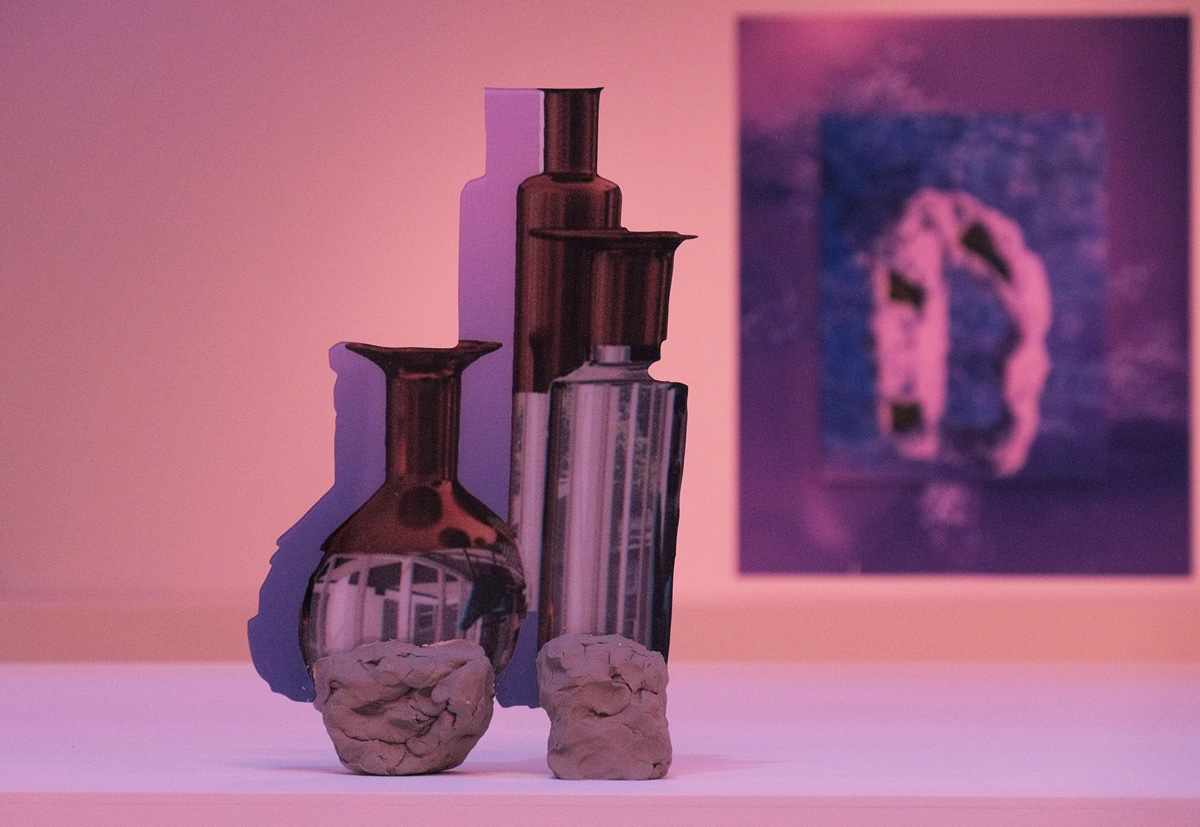
A few more smaller works by Felicity Hammond are in the Contact Gallery at 80 Spadina – the building immediately north of the parking lot where you can find the image above.    The gallery glowed in pink and purple light.

below: Object shapes are cut outs from a thin sheet of acrylic on which photos were printed.  These shapes are held up by clay blobs.

And that’s our tour for today!

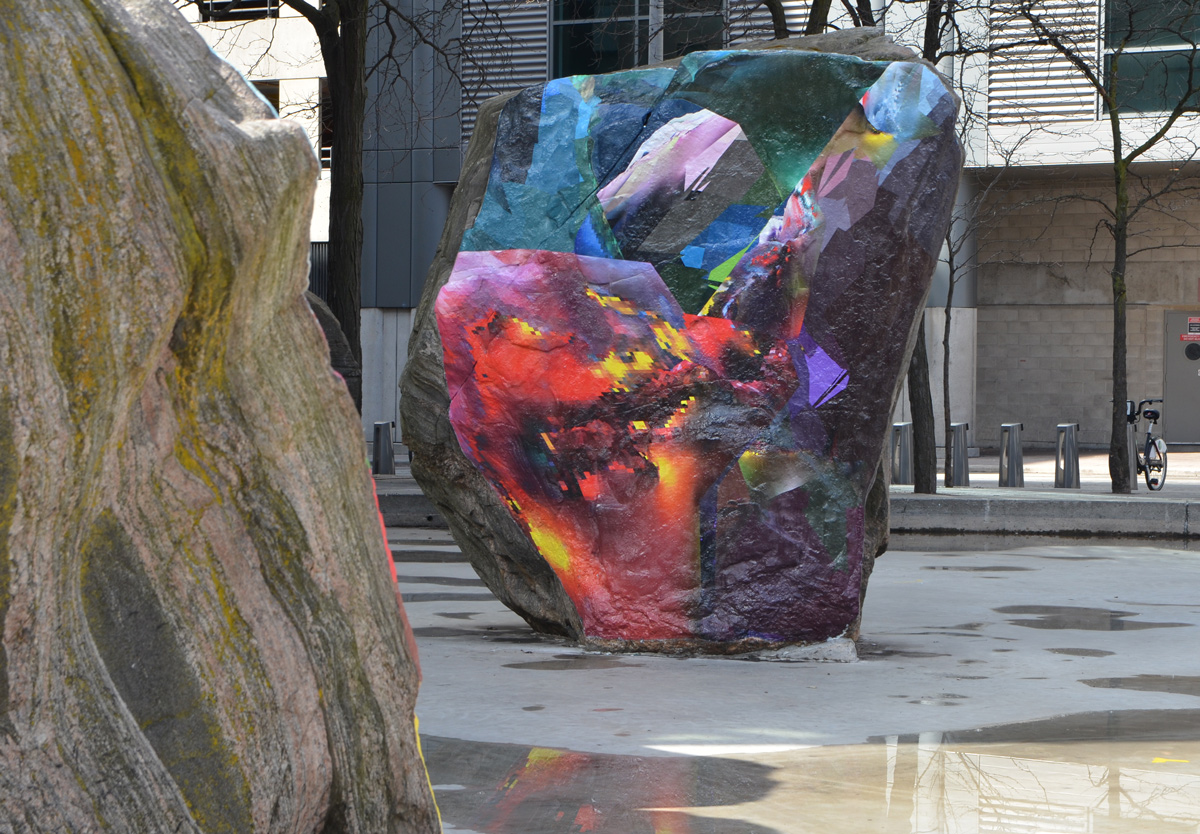
May is CONTACT Photography month in Toronto and like in previous years, some galleries start the month early.  One of these galleries is the Ryerson Image Centre.  This year, in the main gallery they are featuring the work of Shelley Niro, the 2017 winner of the Scotiabank Photography Award.  You may have seen some of her work at the AGO where her shirts series of photos is also on display.   Outside the building, in Devonian Square, there are large colourful abstract images glued onto large rocks.  These are the work of Scott Benesiinaabandan, a Montreal-based artist from the Obishikokaang Anishinabe First Nation.

below: First, the poster/sign at the entrance to the Ryerson Image Centre.  The four images on the left are from Niro’s shirt series of pictures – the full series is shown inside the gallery.  There is also a video from 2003 that features this woman and the T-shirts standing in this location.

4 photos by Shelley Niro, of indigenous woman wearing a white t shirt with words on them, plus aboriginal/original pictures of the artist.

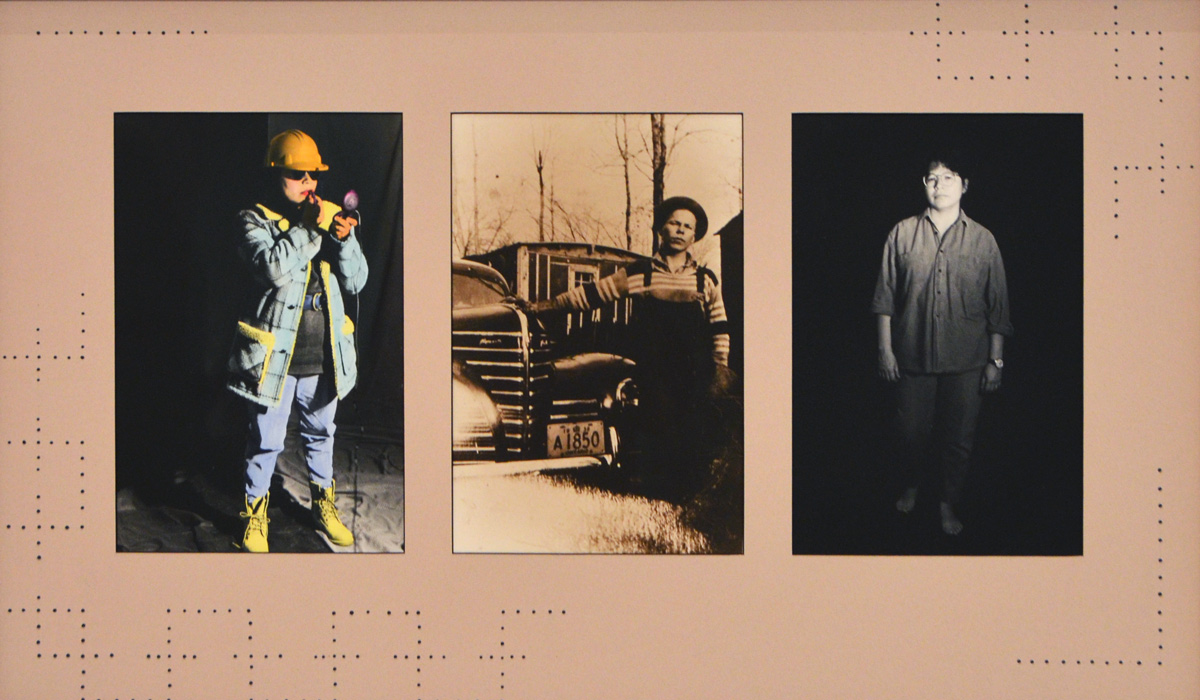
below: A series of three photos framed together titled ‘Mohawk Worker’.  It is one of a series of six triples called ‘This Land is Mime Land’ (Apparently there are 12 in the series, but only 6 are on display here).  Each set in the series has an old sepia toned black and white photo in the center, a casual posed photo on the right (of the same woman in each), and a posed, hand coloured ‘parody’ photo on the left.  In this case, she is dressed in working clothes and a hard hat, but she’s applying lipstick and has a small compact mirror in her left hand.   Other works in this series include,  ‘Love Me Tender’ with the woman dressed as Elvis, and ‘Final Frontier’ with the woman dressed in a Star Trek outfit.

three pictures frames together, on the left is a woman in workmen's clothes and hard hat but putting on lipstick, in the middle is a vintage black and white photo

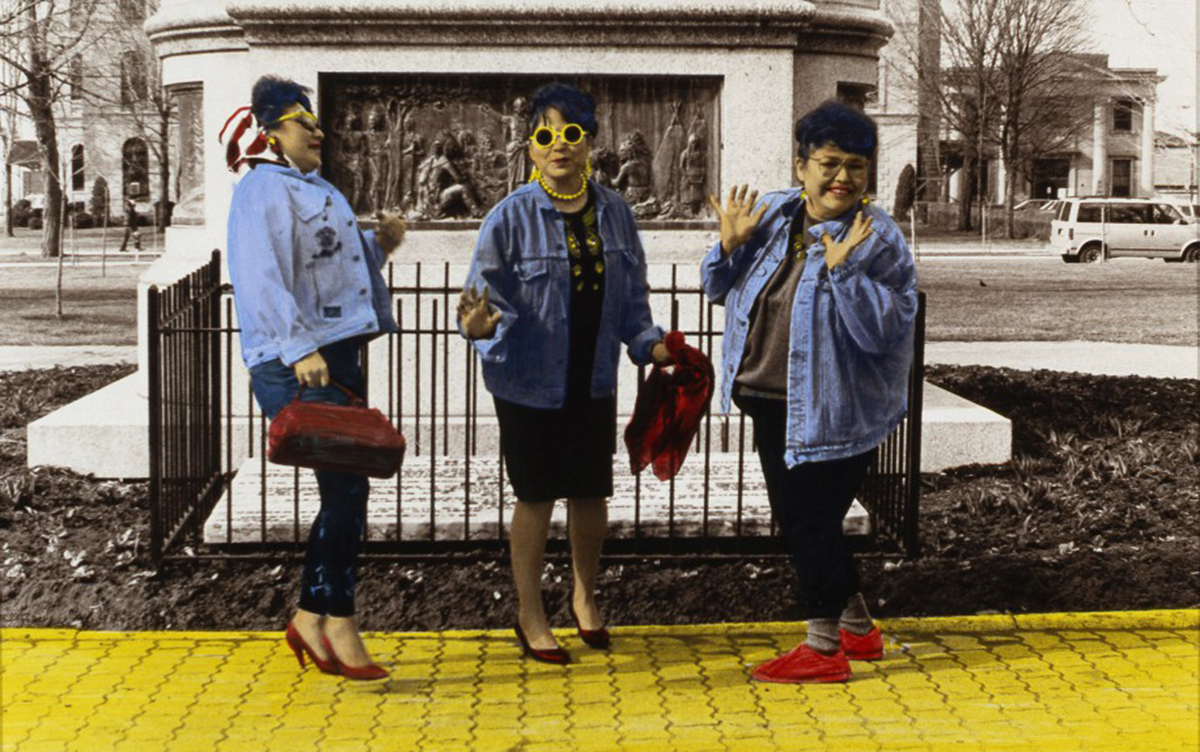
below: One of another set of pictures.  Hand painted black and white photos of these women posing (hamming it up) for the camera.  They are on the yellow brick road, and like Dorothy on her way to see the Wizard, they are wearing red shoes.  “Red Heels Hord” 1991.   It, like a lot of her work, challenges the stereotypes and cliches of Native American women.

a colourized black and white photo of three women hamming it up for the camera. All wearing red shoes and walking on a yellow sidewalk, beside a metal fence. by Shelley Niro

Shelley Niro was born in 1954 in Niagara Falls NY and grew up on the Six Nations of the Grand River Reserve near Brantford.  She graduated from OCA and a masters in Fine Art from the University of Western Ontario.

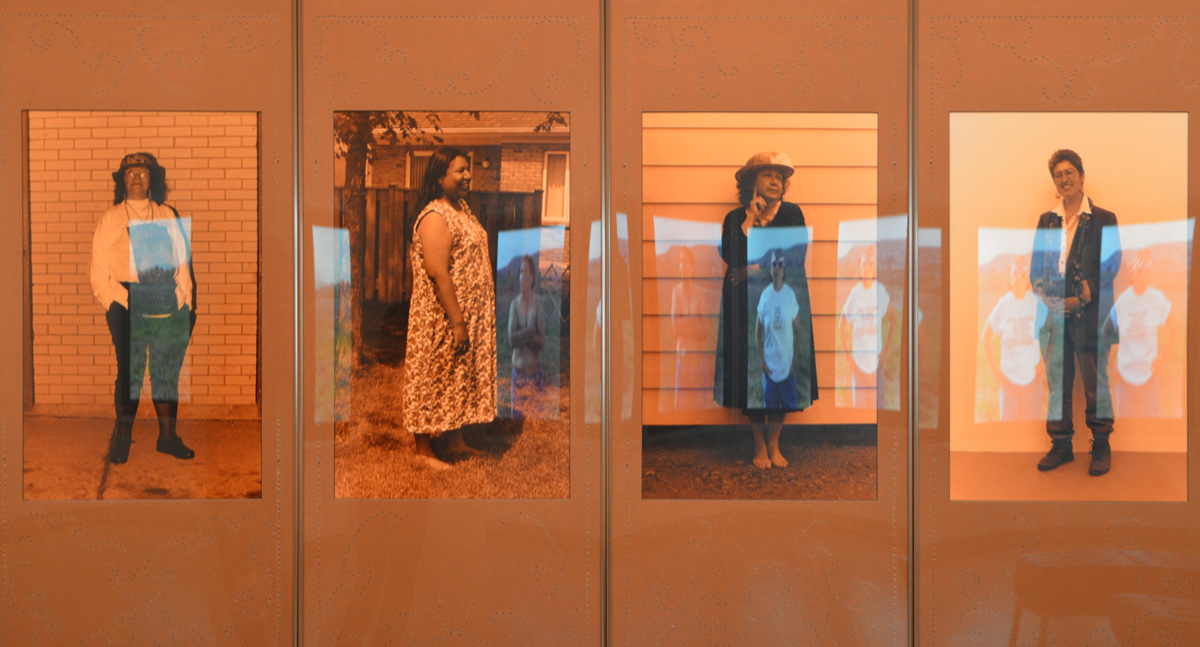
below: Four photos from “Are You My Sister?” 1994.   This is only part (4/12) of the series.  The glass was very reflective so you can see the shirt series that was on the opposite wall.  Like most of her work, the matte has been hand decorated.  In this case, patterns are made with performations in the matte.

four pictures of women, standing, matted in orange, orange tone to the photos, relfections of other photos in the glass, art by Shelley Niro

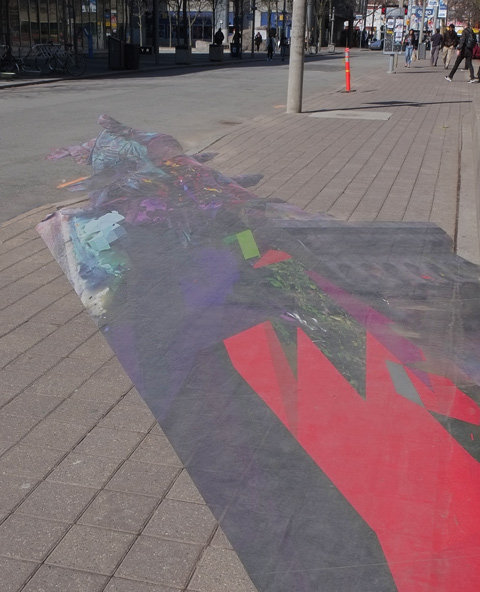
Scott Benesiinaabandan’s installation, ‘newlandia: debaabaminaagwad’  is in two parts.  First, on the sidewalk in front of the statue of Egerton Ryerson, the man who founded the University, is an image that has been glued to the ground.   Parts of that statue have been used in the making of the image – it’s not too easy to see in this photo, but the top part of the image is the same shape as the top of the statue of Ryerson.  Maybe you can see the purple draped head and the outstretched arm.  It’s like the statue has been draped with cloth and/or pictures.  In fact, the images used to create this were taken from photographs that Benesiinaabandan took of three First Nations flags.

below: The other part of ‘newlandia: debaabaminaagwad’ consists of large images adhere to rocks in the square, taking on the texture of the rocks.

Devonian Square in Toronto, large open area with wading pool (empty at the moment) and large boulders, small trees growing around the edge of the pool, two people walking through the pool area, a woman walking her dog on the sidewalk beside, rocks covered with artwork

rock covered with a digital image, glued on it, outside, trees around

Both of these artist have their own websites:
1.  Scott Benesiinaabandan
2.  Shelley Niro

Identity.  What springs to mind when you hear the word identity?  And how does that relate to art?

Let’s now take those general questions and narrow it down to the work of three artists, or photographers to be more precise: Suzy Lake, Lori Blondeau, and Shelley Niro.  I haven’t chosen those women randomly; I’m writing about them because their work is on view if you go to the Ryerson Image Centre.  Suzy Lake’s photos are on display in the main gallery inside while Lori Blondeau and Shelley Niro’s are showing outside.  The latter two were installed as part of the CONTACT Photography Festival.

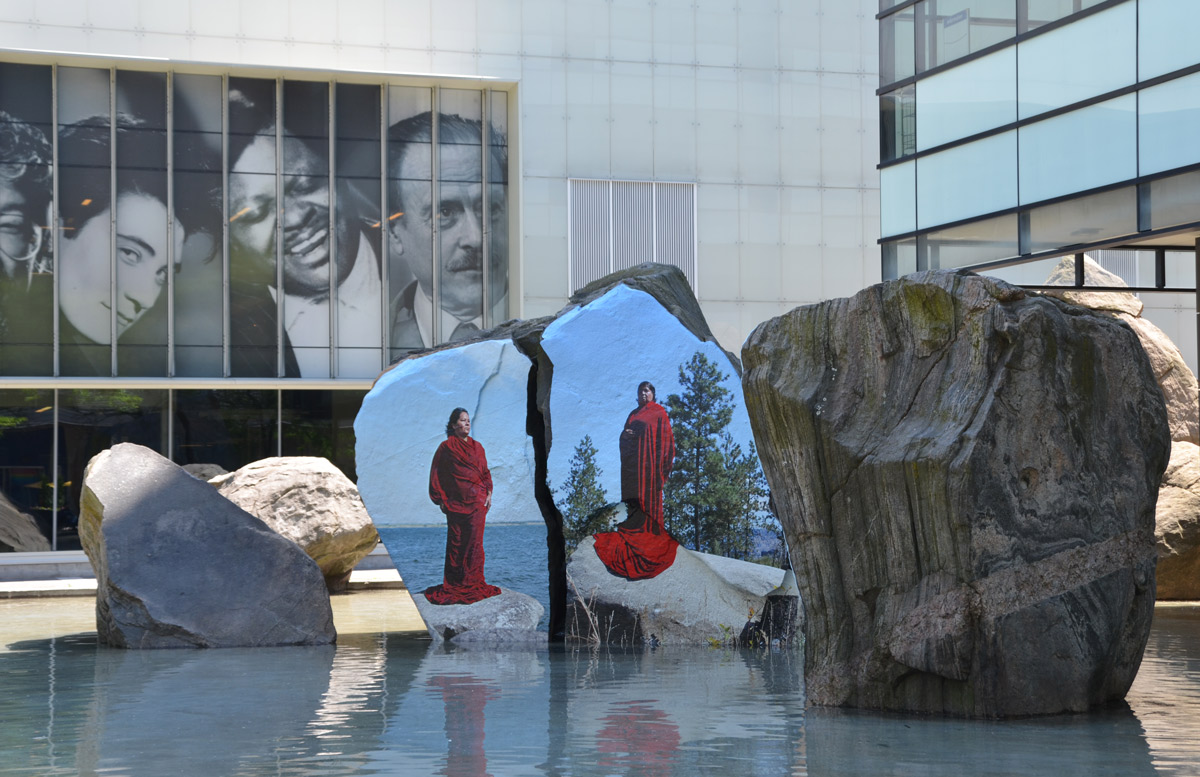
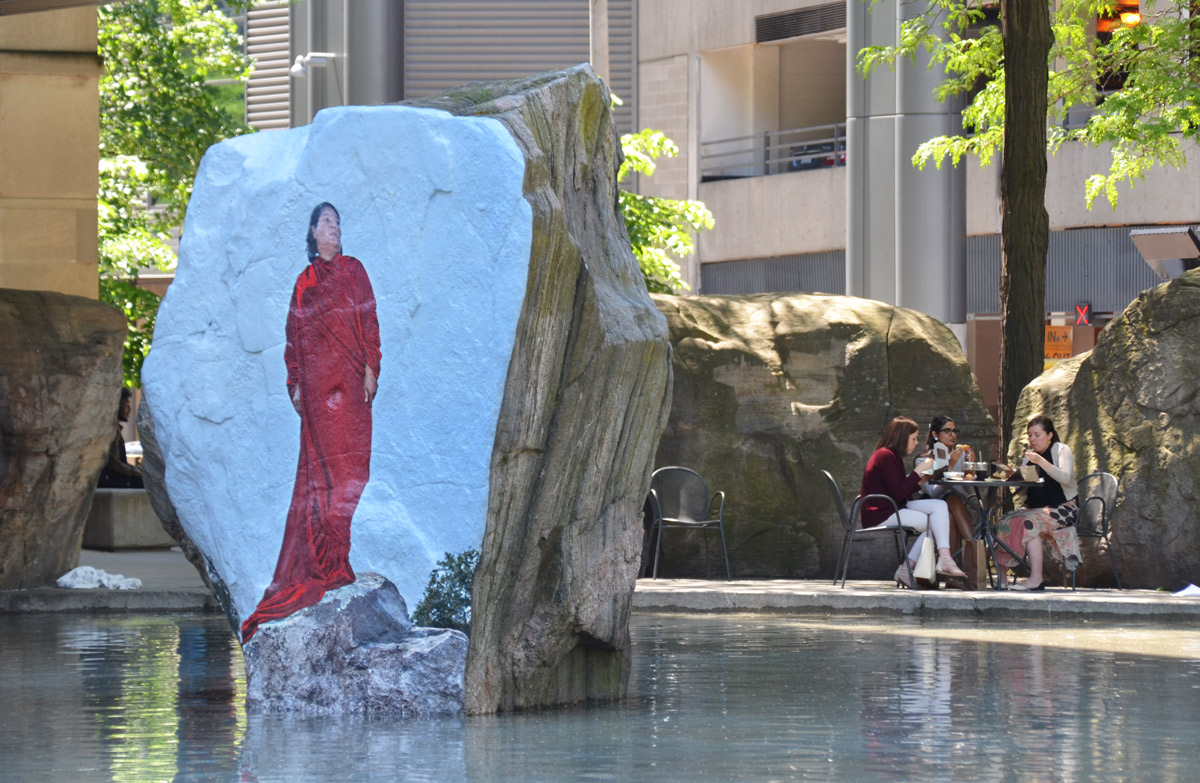
below:  Three large images of the Lori Blondeau draped in red while standing on a rock adorn three of the large boulders in Devonian Square.   They are part of her “Asiniy Iskwew” work.  The title is Cree and translates to “Rock Woman”.    In this work, the rocks on which she stands refer back to Mistaseni which was a large sacred boulder that once marked a gathering place.   The Saskatchewan government dynamited it in the 1960’s to make room for a man made lake.

photograph or painting of a woman in red standing on a rock, directly onto the surface of a large rock in a shallow pool of water outside Ryerson Image Center, three large black and white photographs of people's heads are above and behind the artwork

The words on the wall say that Blondeau questions (“interrogates”) how the definitions of Indigenous identity are influenced by popular media and culture, not just in this exhibit but in the rest of her art as well.   Her point here is that pictures of strong woman run counter to how popular culture portrays Indigenous women.

photograph or painting of a woman in red standing on a rock, directly onto the surface of a large rock in a shallow pool of water

My questions – What and/or who shapes your identity?  That question can mean “Your” as in you the individual and it can mean “Your” as in some collective group that you belong to.     How does identity evolve?  Can it be changed?

How does history affect your identity?  As one who has done a lot of genealogy research I understand the importance of history to some people.  I have traced my Canadian ancestors – I know where they’re buried and I know where they lived.   For me that is a comfort.  But I also know that if you want to kill a conversation just bring up the subject of genealogy.  Not everyone is interested.

Back to photography and history –

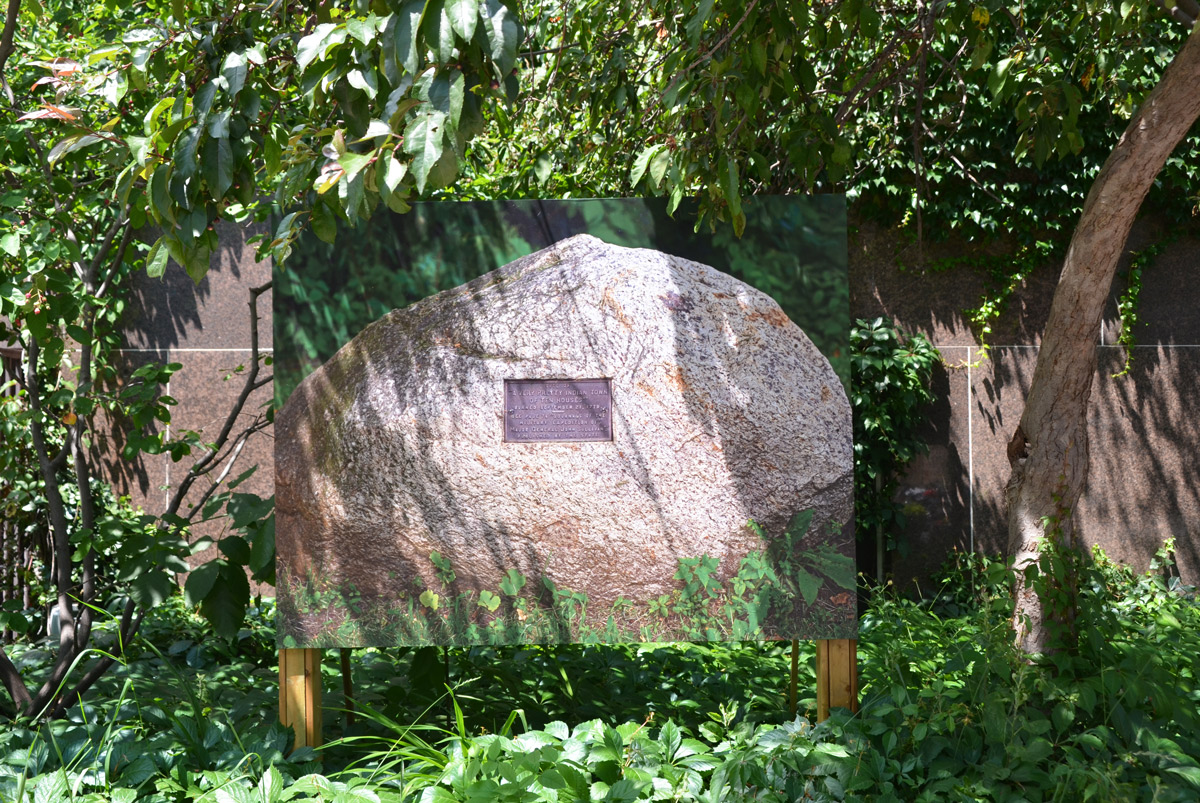
A second indigenous woman artist is Shelley Niro whose work is titled “Battlefield of my Ancestors”.  It consists of 6 photographs that were taken in upstate New York and in southwestern Ontario.  The pictures are in the garden with the statue of Egerton Ryerson (1803 – 1880), the man who Ryerson University is named after.   He was many things including a Methodist minister, a founder of Victoria College (part of the University of Toronto), a Chief Superintendent of Education for Upper Canada, and the person who wrote a report/study on Native education (1847) that became the model for the residential schools thirty years later.

below: Ryerson standing in the greenery with a picture on either side of him.  On the left is a picture of a plaque in New York state that says: “Site of Indian village Gar-Non-De-Yo destroyed during Sullivan campaign Sept 21, 1779”.  On the right is a black and white picture of the Mohawk River in New York state.

statue of Egerton Ryerson in a small garden with shrubs and small trees. Two large photographs also in the picture, one on each side of the statue

below:  Photo taken of a rock at Cayuga Lake.

photo of a small plaque on a rock exhibited amongst shrubs and greenery outside

The plaque says:
Site of “A very pretty Indian town of ten houses” burned September 21, 1779. See page 76 “Journals of the military expedition of Major General John Sullivan” published by the state

Back a few lines I called Niro an “indigenous woman artist”.   I don’t know if she’d be comfortable with that.  Maybe yes, maybe no.   I used those words because they help to understand her work in the context of this blog.   Should I then use the description “white woman artist” to talk about the third person, Suzy Lake?

Lake’s photography career began in the 1970’s and for the first two decades was primarily concerned with female identity.  In almost all her photos, she is the subject.  The 1970’s were the days of  Women’s Lib and the rise of “Feminism” – the quest for political reforms on issues such as reproductive rights, domestic violence, maternity leave, and equal pay.  It was also a time of increased questioning of cultural norms with regard to women’s roles.  In many ways it resembled the increase of awareness of indigenous identity, rights, and problems that we see today.

large black and white photograph in a gallery, two men on top of a large frame are controlling the movements of a human puppet

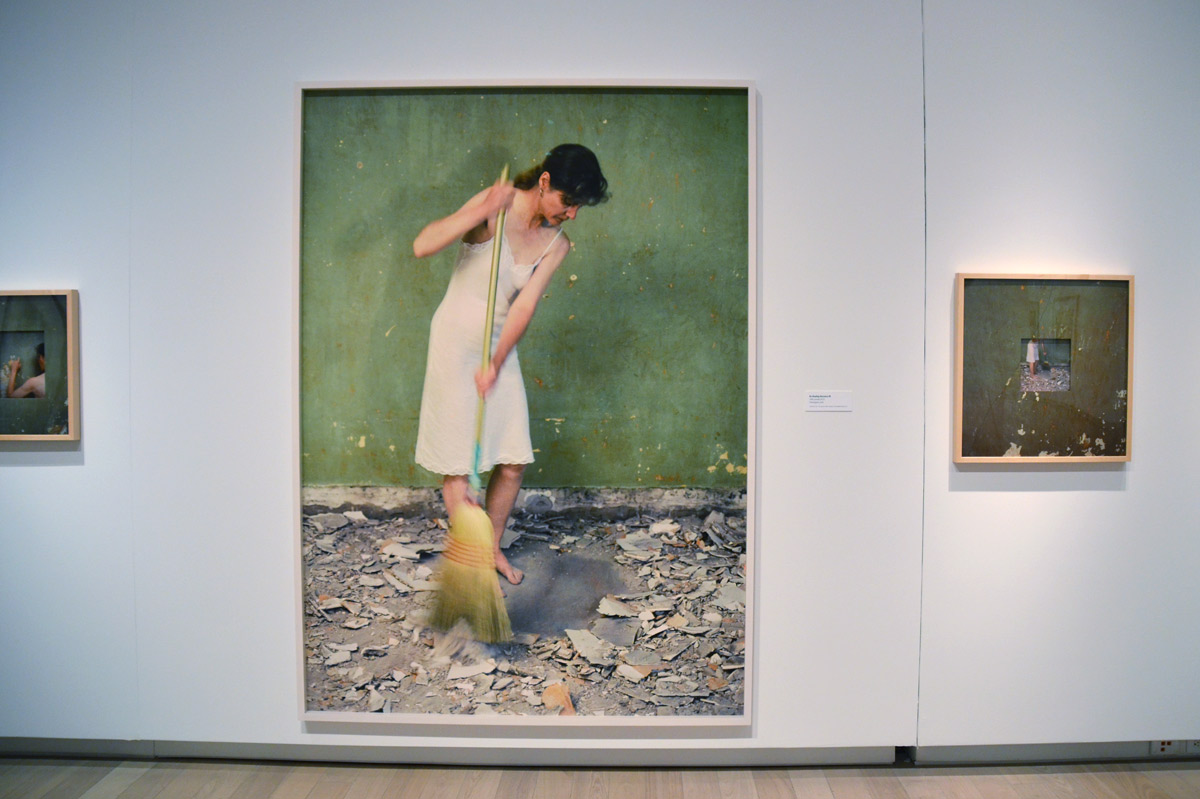
 large photo in a gallery of a women dressed just in a long slip, sweeping up debris from the floor. Debris is bits and chunks of plaster that have been removed from the wall

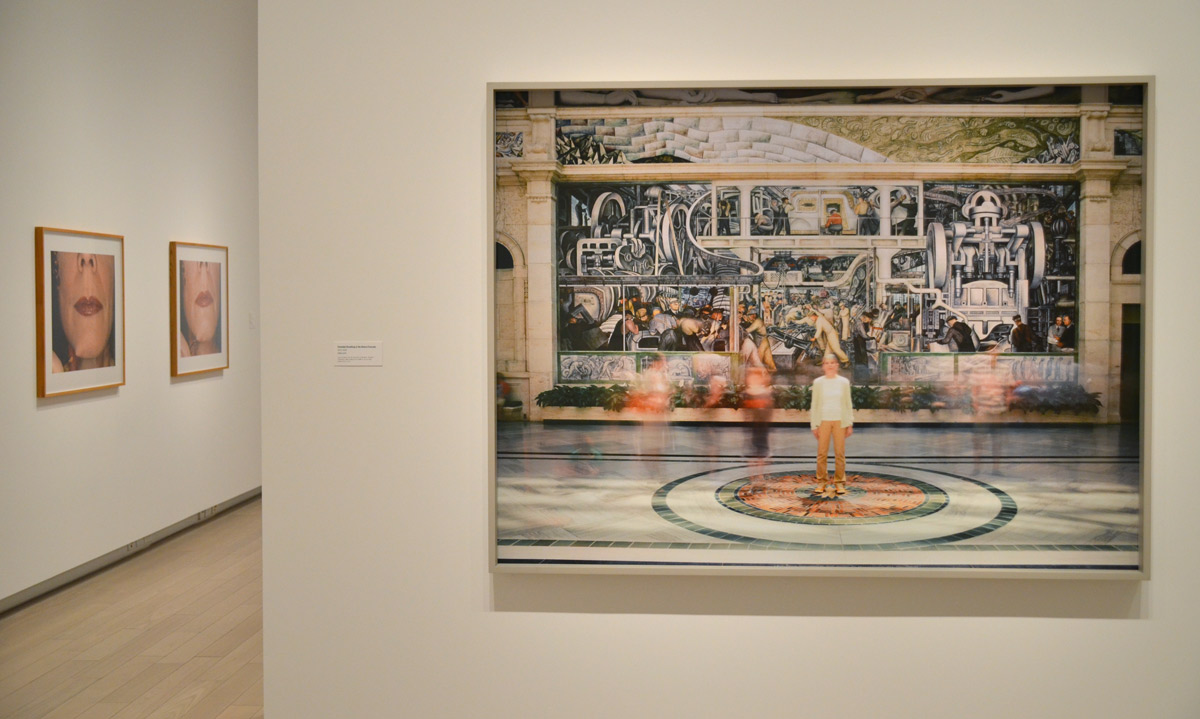
below: Her most recent work involves pictures of her standing in an environment of some sort.  The photo is a one hour exposure and the end result is an image where only she and inanimate objects are present and in focus.  Here is “Extended Breathing in the Rivera Frescos” 2013-2014.   The painting behind her is one in a series by Mexican artist Diego Rivera at the Detroit Institute of the Arts.

three suzy lake photos, one of her in front of a mural and two are close ups of her face

colour photo of close up of a woman's face, just mouth, bottom part of nose and some cheek. She is wearing bright red lipstick

As I’ve mentioned before, I tried to see as many of the CONTACT Photography exhibits as I could in the last few days of May.  I blogged about two weeks ago about the ‘blocks’ at Brookfield Place.  I have been meaning to finish posting about the other exhibits I saw but there’s so much happening in the city.  I’ve been spending a lot of time walking with my camera instead of sitting in front of my computer.

Two of the exhibits that I saw were on King St West, one by Metro Hall and the other on the corner of the TIFF Lightbox building.   I haven’t been able to figure out what to say about the photos so they have sat in a folder on my hard drive.   Unfortunately they are not alone.  Yesterday I went back to take another look at the exhibits and think through a few thoughts, but the photos are gone.  Procrastination has its pitfalls.  TIFF Lightbox is now promoting their “Canada on Screen” program – all year, all free – as part of the Canada 150 celebrations.

I’ll just let the pictures do the talking.

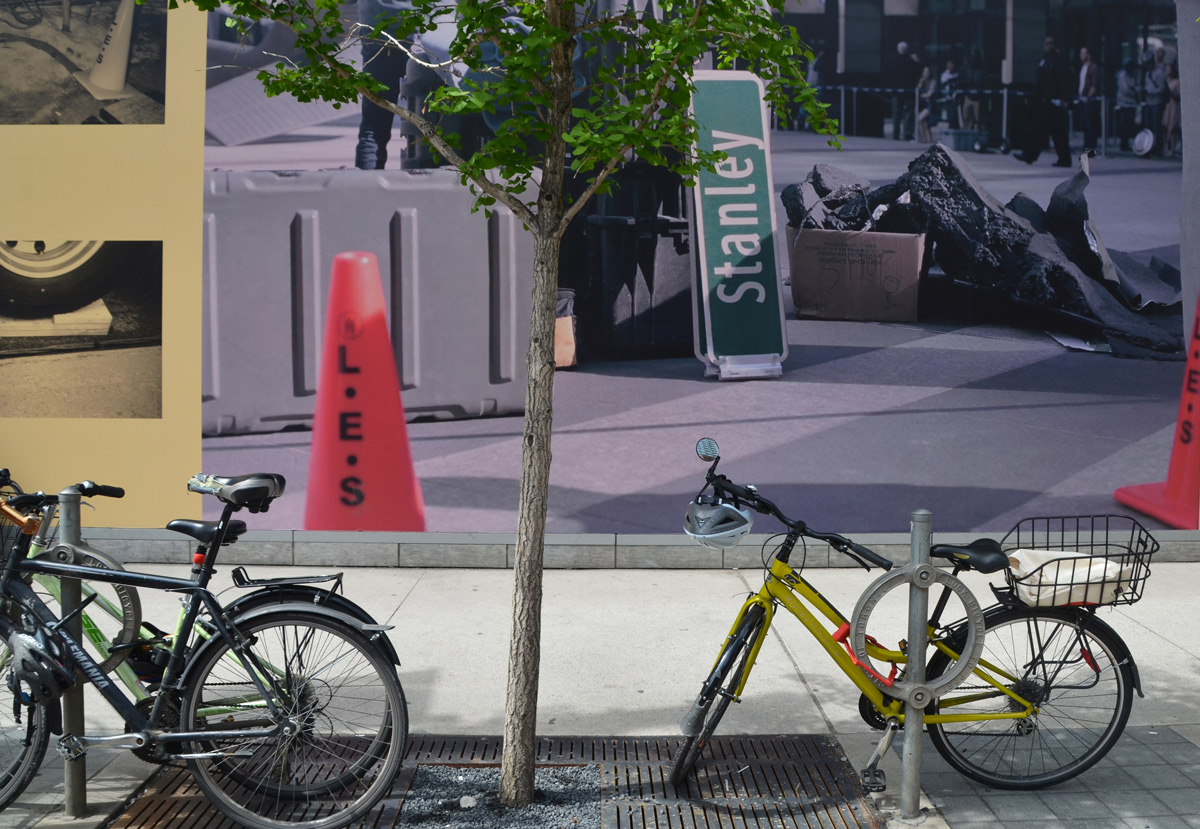
below: The corner of Widmer and King back in May.  The photos are “On Location” by Sam Cotter.

large photo on the corner of a building, taken during a movie shoot on the streets of Toronto (Bay St), a young man is sitting against the other side of the corner of the building asking passers by for money.

bikes parked in front of a large photo mounted on the side of the TIFF lightbox building, showing an orange movie shoot cone and a fake city street sign.

below: A similar viewpoint, taken yesterday.  Different pictures.. and different bikes.

bikes parked in front of a large poster advertising TIFF's Canada on Screen program, a collage of black and white pictures taken from movies.

The other exhibit was “The Sum of All Parts” by Jalani Morgan.

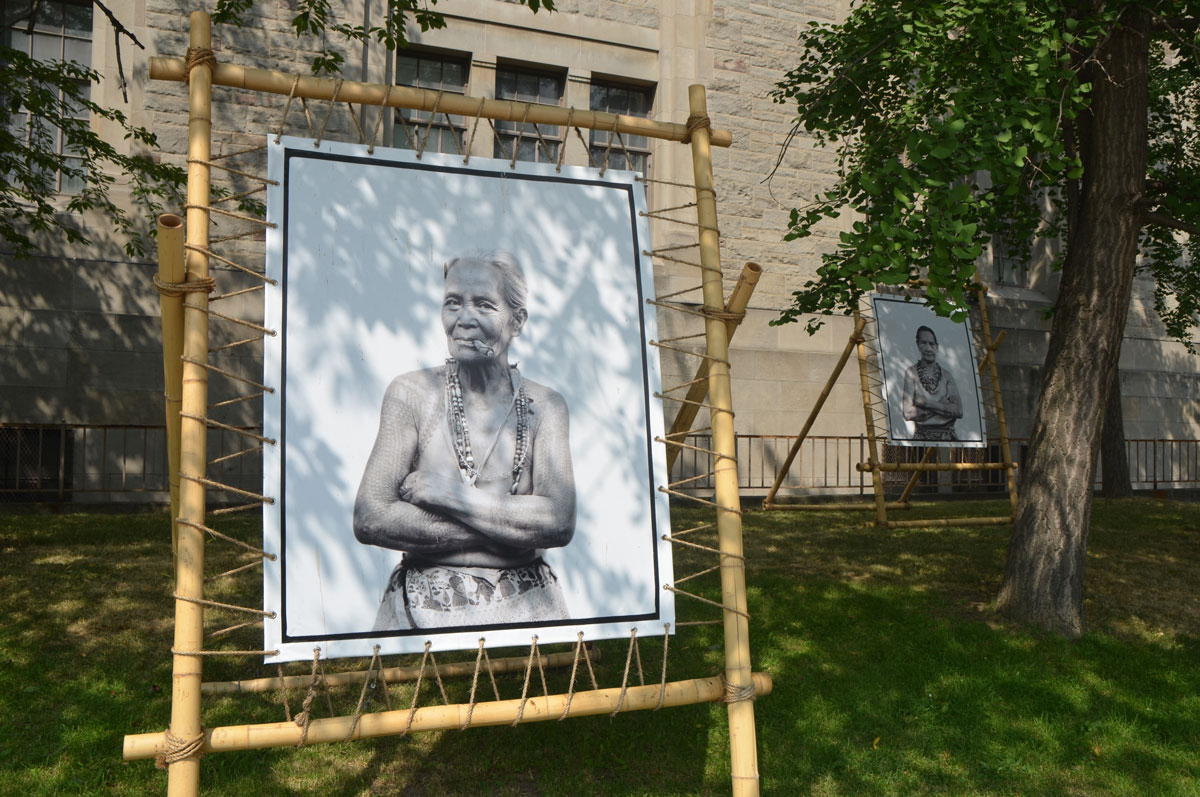
There are seven or eight large photographs, portraits of older women, on University Avenue.   They were actually part of the CONTACT Photography Festival and they have been on display outside the Royal Ontario Museum since early May.  The photos are the ‘The Last Tattooed Women of Kalinga”, portraits by Jake Verzosa.
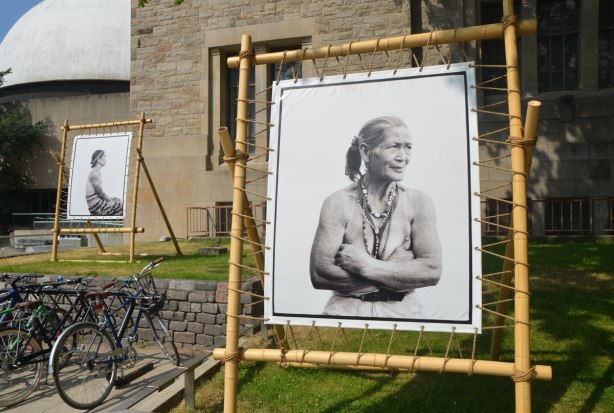
large black and white photo of an older woman with many tattoos, black and white, displayed outside, another portrait in the background

In the villages of the Cordillera mountains of northern Philippines the women have been tattooed with lace-like patterns for centuries.  The tattoos are symbols of stature, beauty, wealth and fortitude and are traditionally applied during rituals.  The tradition is dying out as standards of beauty change and as the old ways are replaced with more modern methods.

Each village once had their own tattooist, or mambabatok, but today only one remains.  Born in 1918, Whang-od (or Fhang-od), is the last person to practice the centuries old technique called batok.  The ink is made of charcoal and water and it is applied by tapping the skin with a thorn.

two older women with their shoulders tattooed, wearing necklaces and a patterned skirt, seated. Black and white

Once the men were also tattooed.  The Kalinga tattoo has evolved from their ancient tradition as warriors and headhunters.  Heads were taken from fights and battles as a trophy; each time a man brought home a head he would receive another tattoo as a reward.  Tattoos were a mark of social status.

Indigenous groups throughout the Philippines practiced tattooing for centuries.   When the Spanish arrived in the 1500’s they called the people ‘pintados’ or ‘painted people’ as it was not uncommon for people to have tattoos covering their whole body.  While some tribes used tattoos to mark status, other tribes believed that tattoos possessed special spiritual or magical powers which gave the individuals strength and protection.  The use of tattoos as protective symbols is an idea that occurs in many cultures.
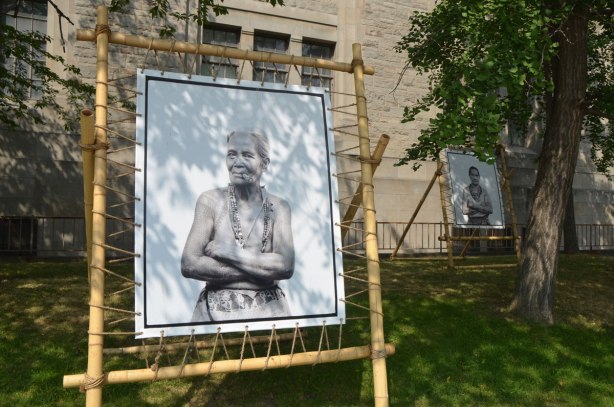
large black and white photo of an older woman with many tattoos, black and white, displayed outside, another portrait in the background

In conjunction with the Kalinga portraits, the ROM is featuring an exhibit that examines the beliefs surrounding tattoos, and the role that they and other forms of body art play in different cultures over the years.  “Tattoos: Ritual, Identity, Obsession, Art” is on view until September 5th.  It is a global tour of tattoos past and present.

One of the cultures that is featured is the Chinese.  For centuries, tattoos were forbidden, or at least taboo, in China.  To be tattooed was to be discriminated against as they were associated with prisoners or vagrants.  Recently that has begun to change.

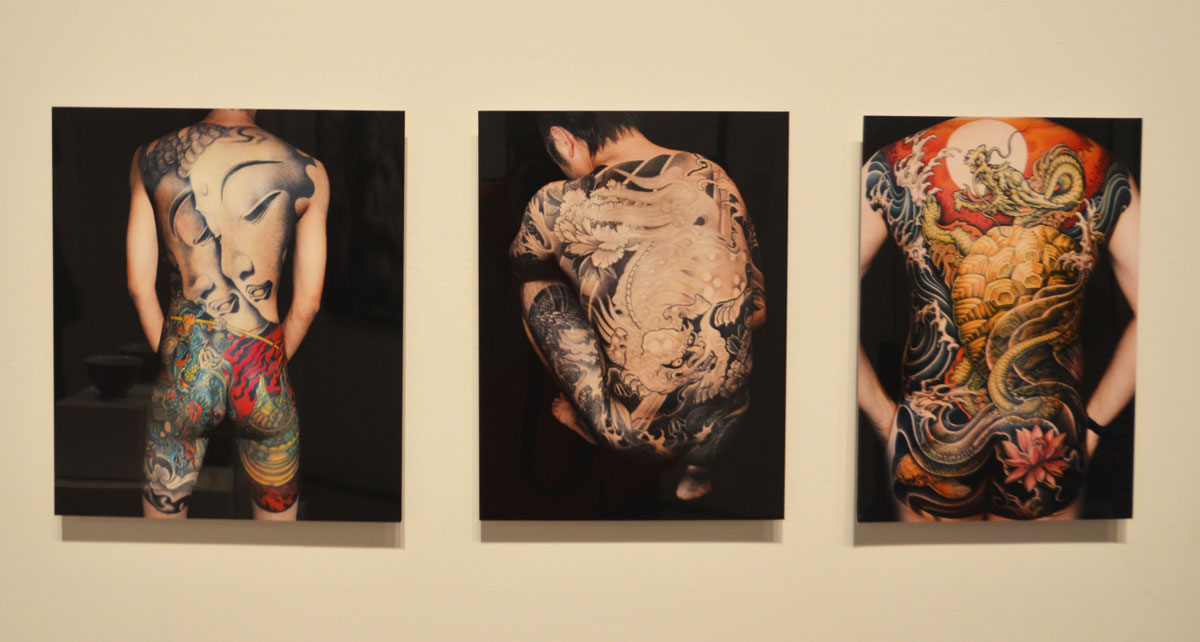
below: Three large modern picture tattoos by Taiwanese tattoo artist Gao Bin featuring traditional Chinese images, Buddha, lion and dragon.  Tattoos as a cultural expression.  In some countries such as Sri Lanka and Thailand images of Buddha are considered sacred objects of worship.  While it’s not illegal to have such a tattoo, wearing one could get you into trouble.
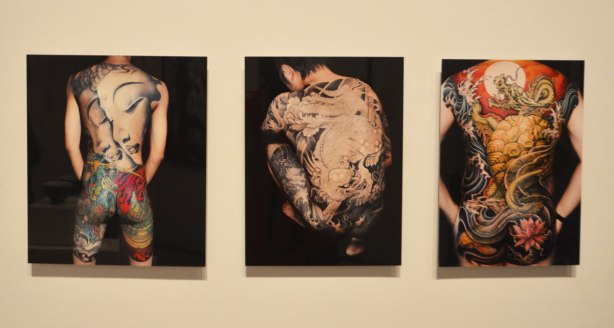
Three pictures of the backsides of men, each with a large picture tattoo from neck to thigh. Chinese art pictures as tattoos

below:  Here is another example of why people get the tattoos that they do.  This is a picture of one photograph in a series by Isabel Munoz.  Munoz spent three weeks inside several prisons in El Salvador and photographed mara gangs.  Gang members wear offensive tattoos to assert their antisocial behaviour and express their loyalty to the gangs.  Tattoos as statement; tattoos as a mark of membership and belonging.  Tribal.
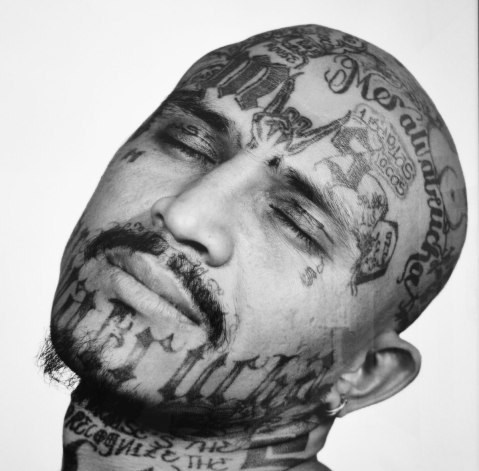
photo of a picture in a museum of a man's face that has been tattooed with gang symbols and words,

below: A silicone arm with a tattoo by Montreal artist Yann Black on display.  This is one of 13 commissioned tattoos on silicone body parts – arms, legs and torsos both male and female that are part of the exhibit.   Tattoos as artwork.  Individuality.
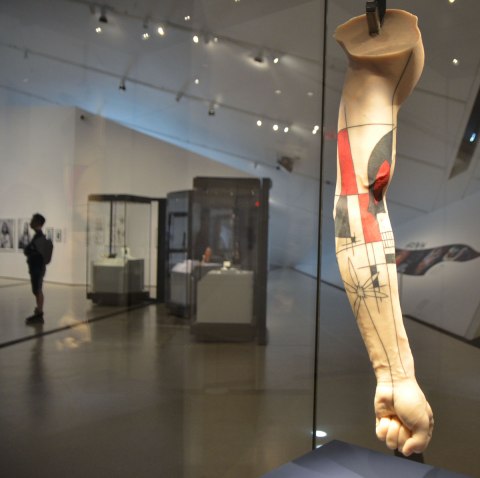
a silicone arm has been tattooed with a design that looks something like a cross between Frank Lloyd Wright and Mondrian. It is in a glass showcase in a museum.

The oldest known tattoos were found on Otzi the Iceman, a natural mummy who was found in the Otzal alps near the Austria – Italy border in 1991.  His tattoos were 61 lines ranging in length between 7 and 40 mm.  The lines were arranged in groups.  Most of his tattoos were on his legs where there were 12 groups of lines.  Otzi is estimated to have died between 3239 BC and 3105 BC.

Tattooed mummies have also been found in other places – Greenland, Alaska, Siberia, Mongolia, western China, Egypt, Sudan, the Philippines, and the Andes in South America.  We will probably never know what significance the tattoos had.  Theories abound of course and they often involve reasons like protection, spiritual, status, tribal, or just for decoration.  Reasons that probably ring true today too.  The methods have changed and some of the images have changed, but human nature remains just that, human nature.


This is another post about an exhibit from the CONTACT Photography Festival.   I know that it’s now June and CONTACT was in May, but I wanted to post these photos.  I actually took them early in May as you can probably tell by how many clothes the people in the pictures are wearing.  They’re certainly not dressed for the warmer weather we’ve been having lately.  I have had trouble deciding what to write in this post.

There is a parking lot at the NE corner of Front and Spadina with some billboards in it.   Maybe you saw them as you drove or walked past but maybe you passed by and missed them.   There are so many things on the street vying for our attention and a billboard is just another piece of street ‘furniture’.

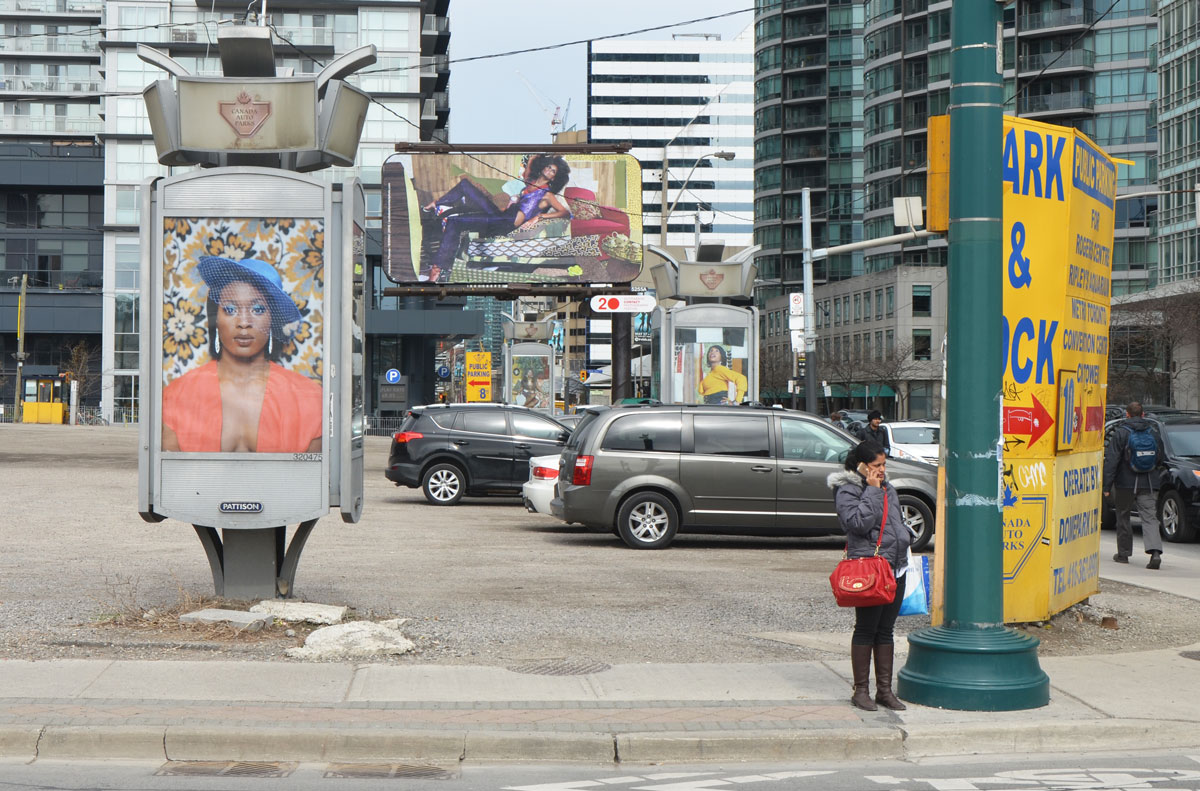
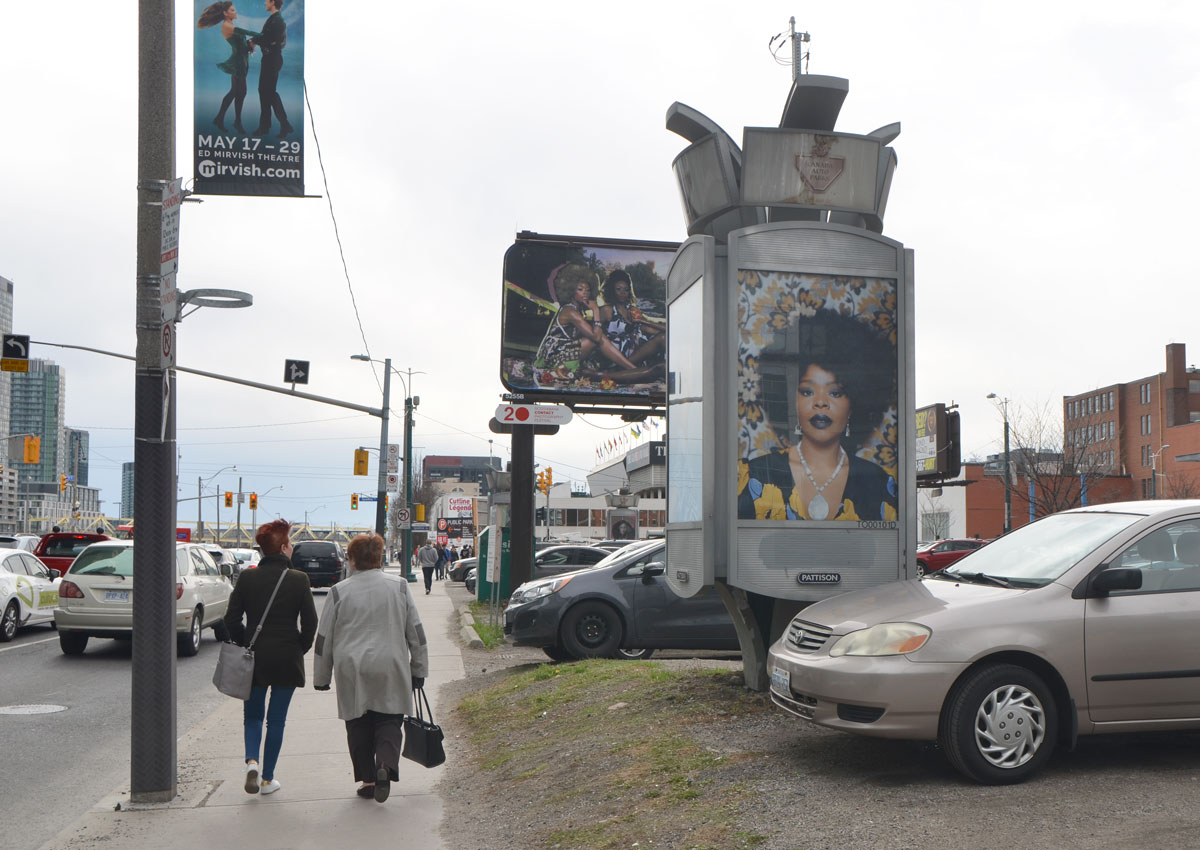
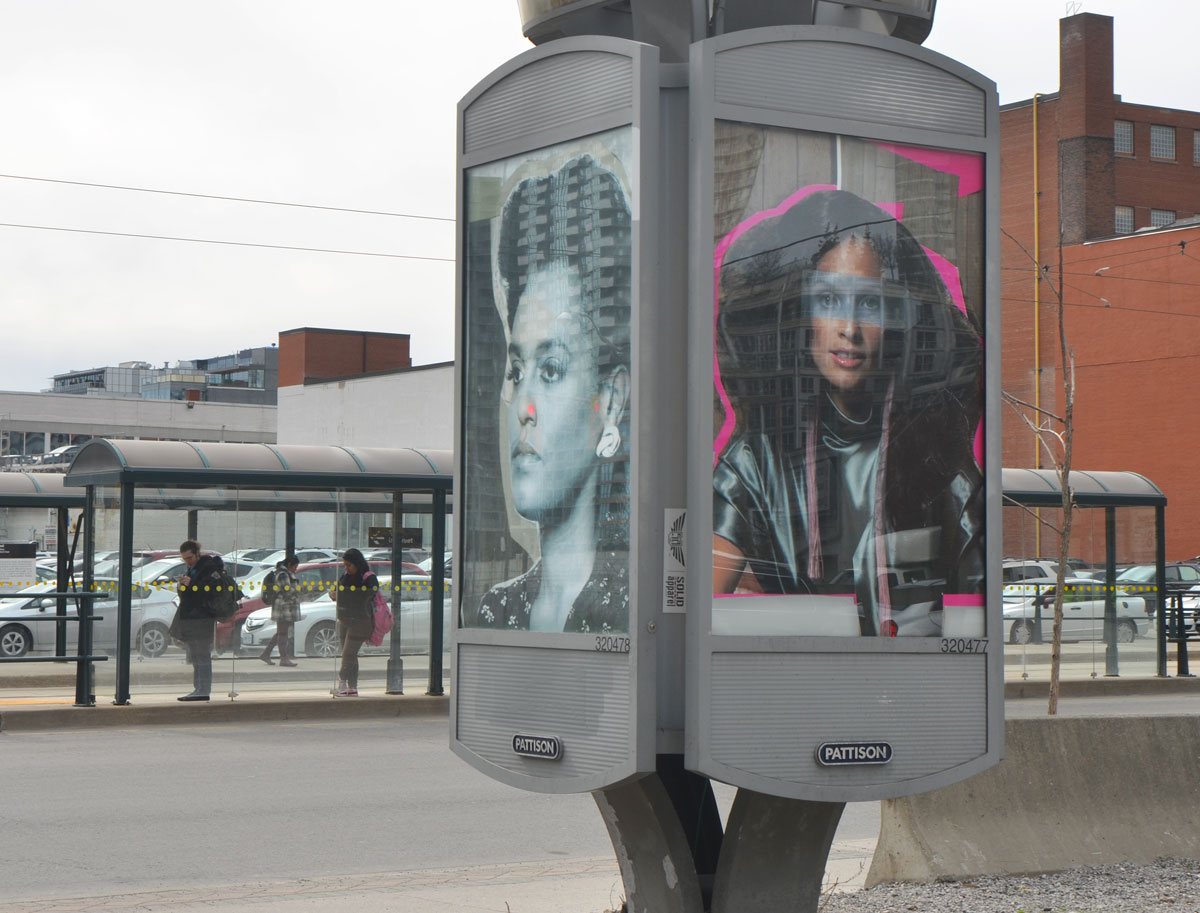
For the month of May, an installation titled ‘What it Means to be Beautiful’  by Mickalene Thomas occupied a number of billboard spaces at the above mentioned corner.   All the images are portraits of women and are “shown within the context of street advertising, where women are constantly bombarded with narrow notions of female beauty.”   A sample of the billboards:


part of an art installation, portrait of a black woman in profile, with a shaved head, on a billboard, by Mickalene Thomas, in a parking lot in downtown Toronto

part of an art installation, portrait of a black woman wearing a blue hat on a billboard, by Mickalene Thomas, in a parking lot in downtown Toronto. A woman stands on the corner talking on her phone. Another, large, billboard is in the background.

Two women walk past part of an art installation, portrait of a black woman on a billboard, by Mickalene Thomas, in a parking lot in downtown Toronto

Two portraits of black women, in a billboard space in a parking lot, with people waiting for a streetcar in glass bus shelters in the background.

part of an art installation, portrait of a black woman on a billboard, by Mickalene Thomas, in a parking lot in downtown Toronto, A group of people wait for a green light at the intersection in the background, tall condos too.

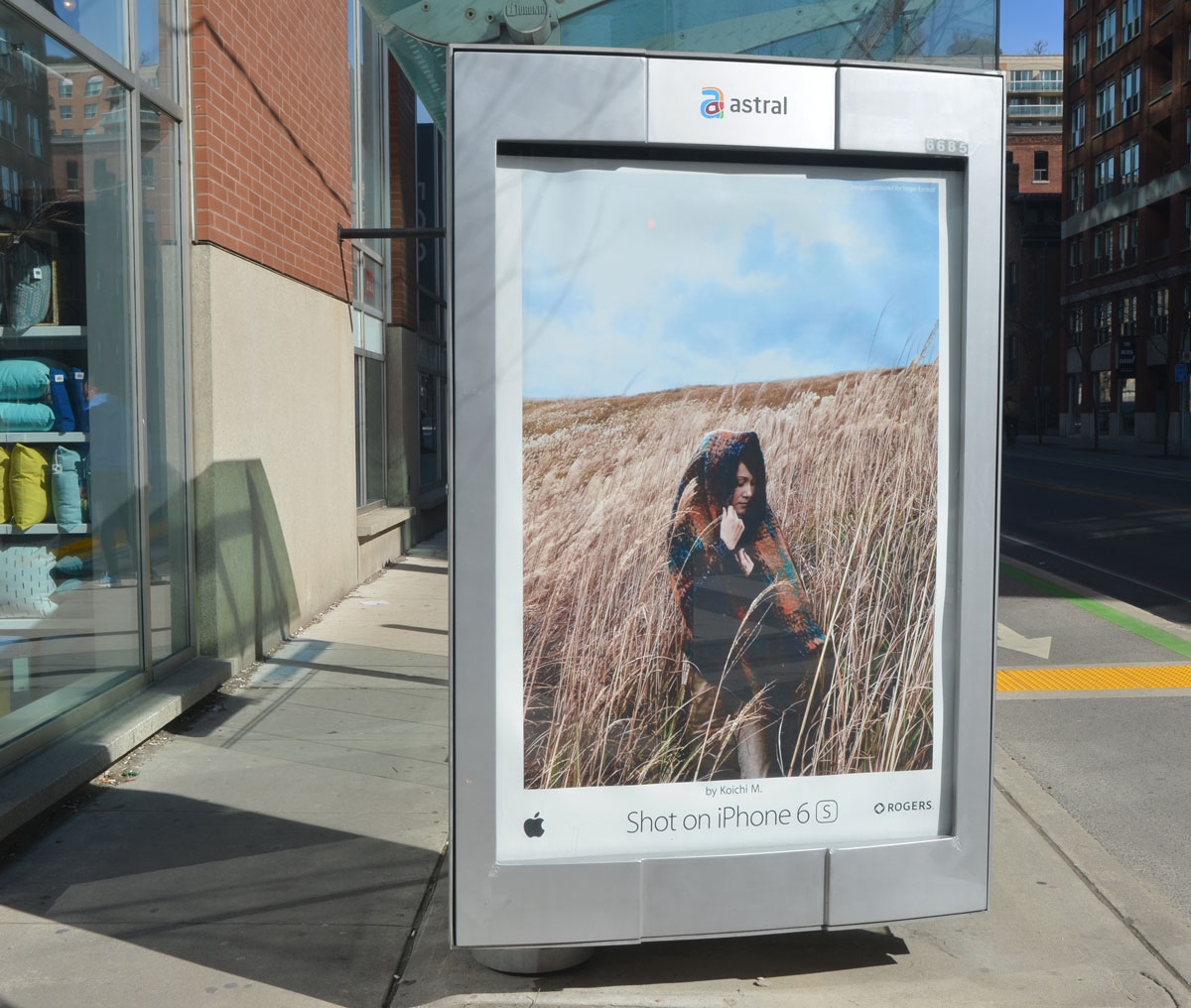
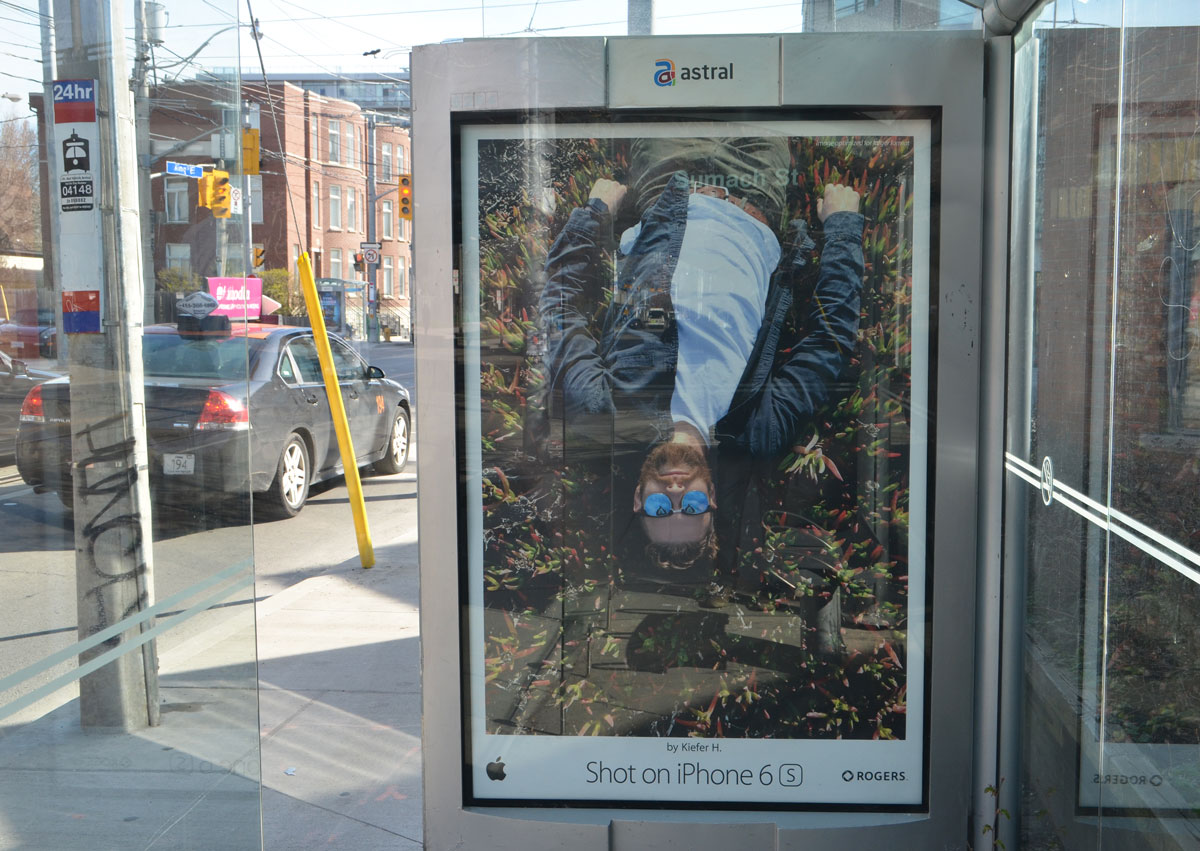
Part of the reason that I hesitated to write this post was the fact that the iphone 6 ad campaign was on at the same time.  It was a campaign that used photos taken with the phone and the ads were very visual and used very few words. In my opinion, they are more eye catching and visually appealing than Thomas’s work. I found a few of them to show here (below).  I know that there were many more but unless I was consciously looking for ads, I didn’t notice them as billboards are one of the things that I block out as I walk.  That led to a few thoughts about what catches a viewer’s attention on the street –   Faces?  Colours?  Contrast?

There is more going on in Thomas’s photos and collages than just visual appeal but I still question the validity of asking the viewer to look at them in the context of street advertising.   Is it fair to compare her images to ads produced by, and in aid of, a large corporation?   Would it have been better to  exhibit her work in different form or a different place?  I don’t have the answers for those questions.  Do you?


iphone ad on a bus stop wall showing a woman in a field

iphone 6 ad on a bus stop wall of a woman lying in a field of pumpkins. Her head is surrounded by pumpkins.

an iphone ad on a bus stop wall of a man lying on the ground. He is upside down in the picture

And now I will go back to ignoring billboards as I walk.

‘Cutlines’, an exhibit of old photographs from the Globe & Mail,
part of the CONTACT Photography Festival

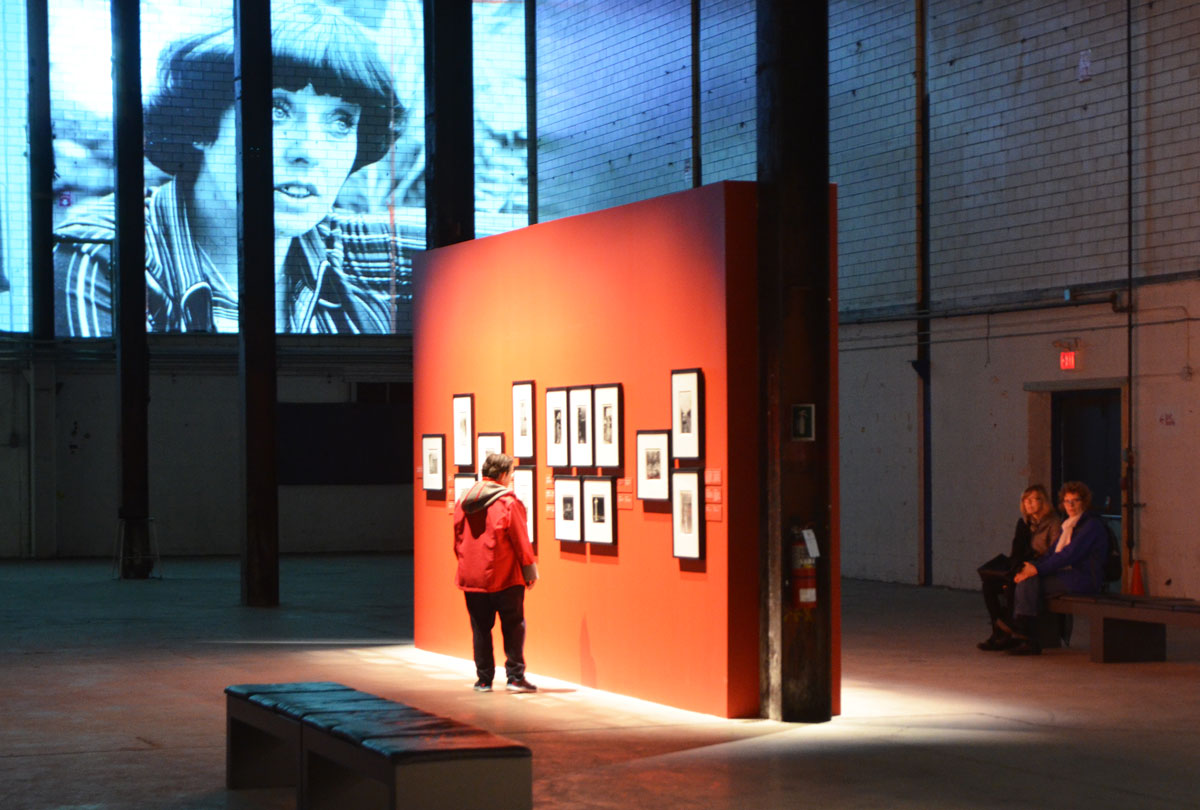
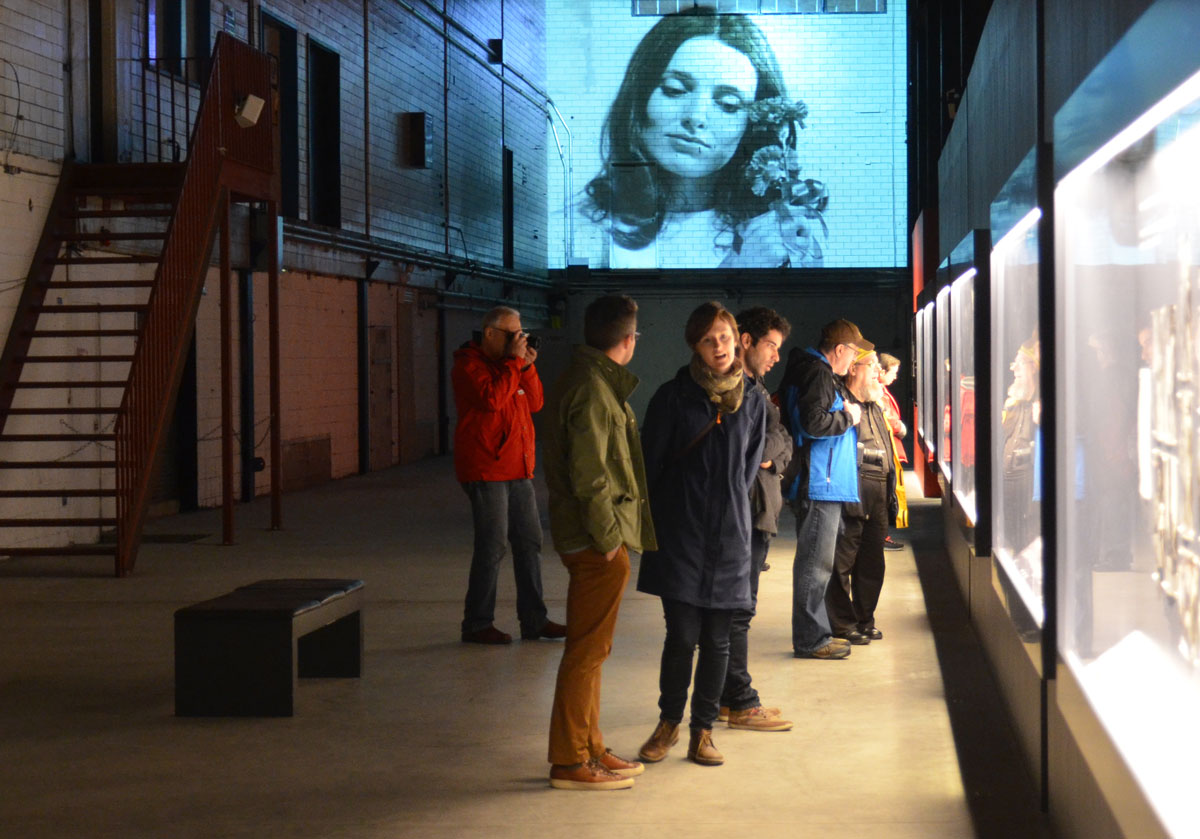
people standing in a large room, the old Press Hall at the Globe and Mail newspaper, looking at an exhibit of old photos. Some photos are being projected onto a wall

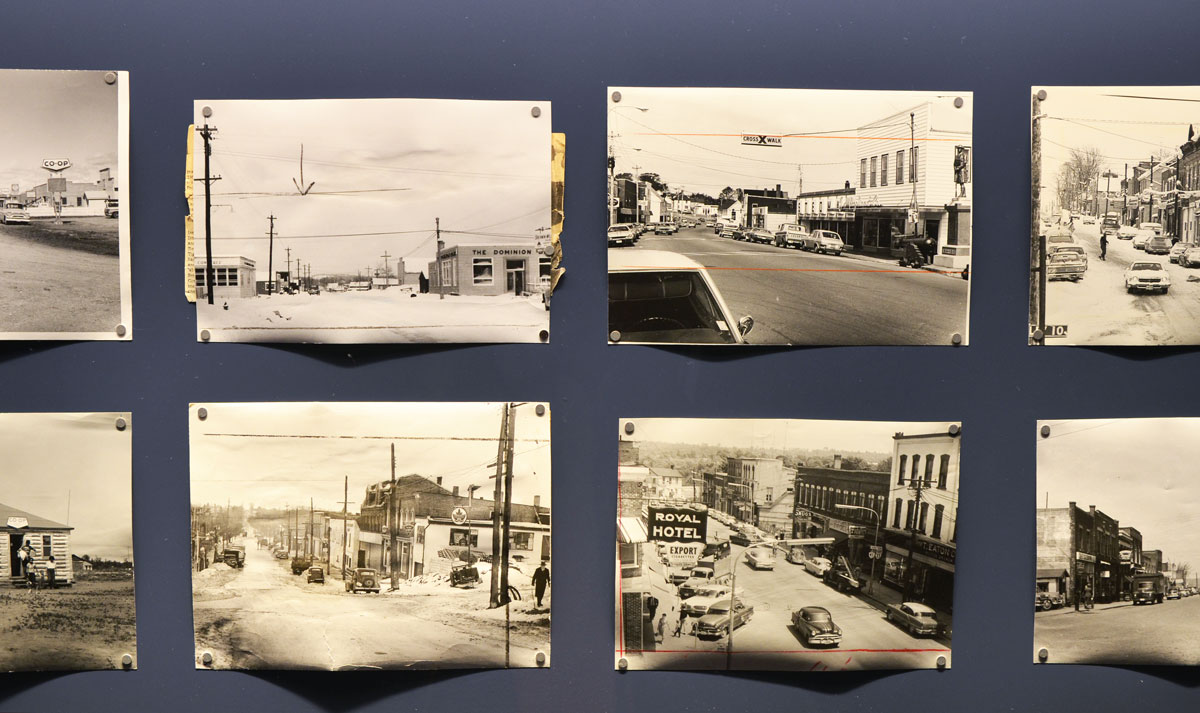
below: A small sample of the 175 vintage black and white photos from the vast collection held by the Globe and Mail newspaper on display.

old photographs, black and white, of small towns, in a display case, as part of an exhibit called Cutlines, old photos from the Globe and Mail collection

below:  The exhibit is being held at the Press Hall on Wellington Street (near Spadina).  This old building is slated for demolition in the near future as the Globe and Mail is in the midst of moving to a new home.  Prints were in cabinets in the center of the room while other images were projected high on the walls.

people standing in a large room, the old Press Hall at the Globe and Mail newspaper, looking at an exhibit of old photos. Some photos are being projected onto a wall

The Globe & Mail has amassed a collection of about 750,000 photographs.  As they transition from print to digital images, they are ‘cleaning house’ with respect to their photo archives.  About 100,000 of the prints are going to be digitized and a portion of those donated to the new Canadian Photography Institute at the National Gallery of Canada in Ottawa.

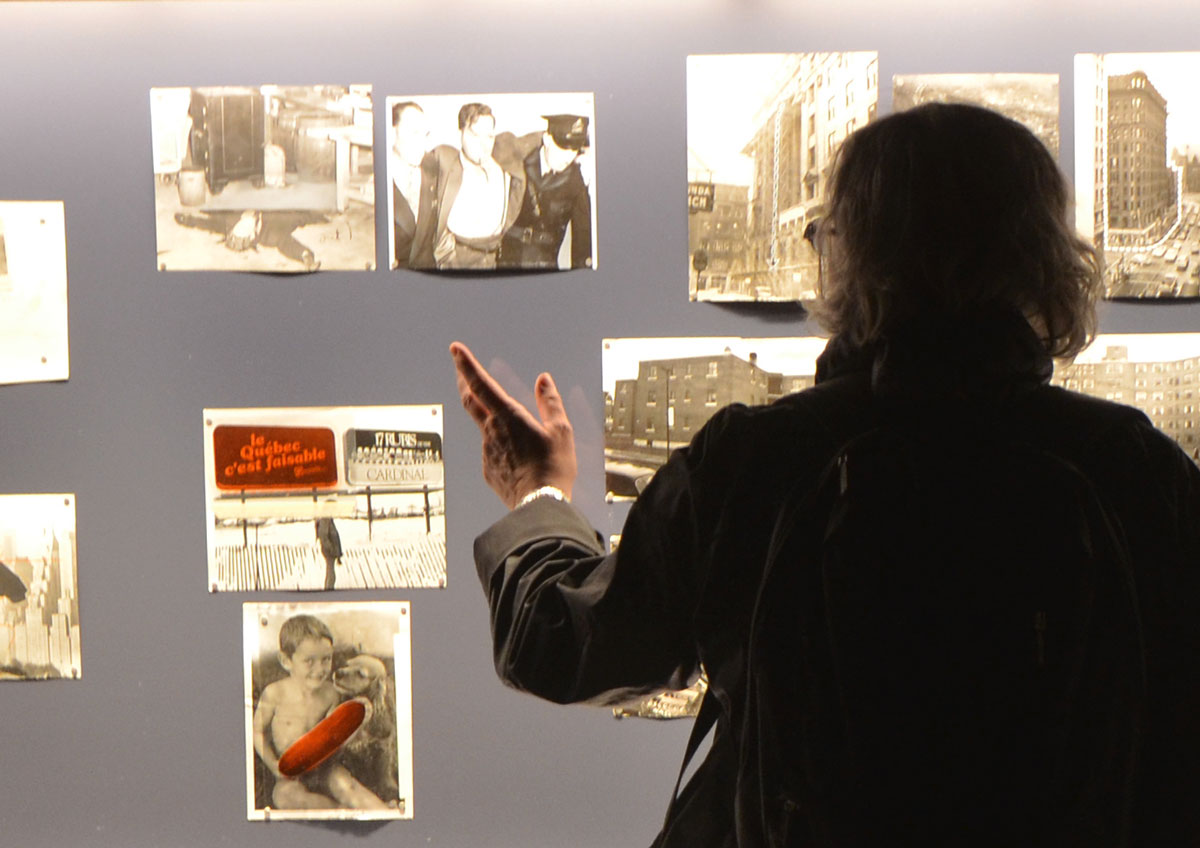
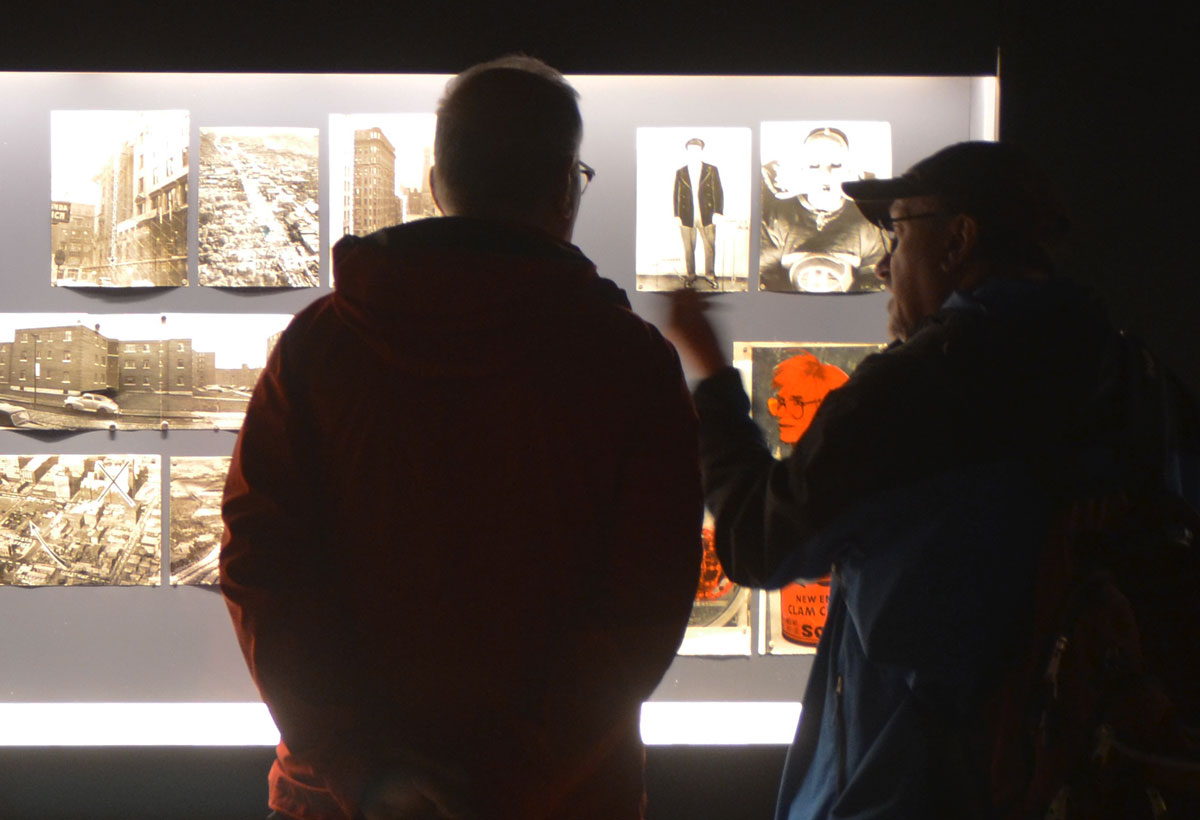
below: Some of the pictures were covered with red, with what is known as a rubylith mask.  When the images were printed, the portions covered in red remained as they were while the rest of the picture could be changed to suit the needs of the story of the day.

silhouette of a woman standing in front of a lit display case of old photographs

people standing in a large room, the old Press Hall at the Globe and Mail newspaper, looking at an exhibit of old photos. Some photos are being projected onto a wall

people standing in a large room, the old Press Hall at the Globe and Mail newspaper, looking at an exhibit of old photos. Some photos are being projected onto a wall

people standing in a large room, the old Press Hall at the Globe and Mail newspaper, looking at an exhibit of old photos. Some photos are being projected onto a wall

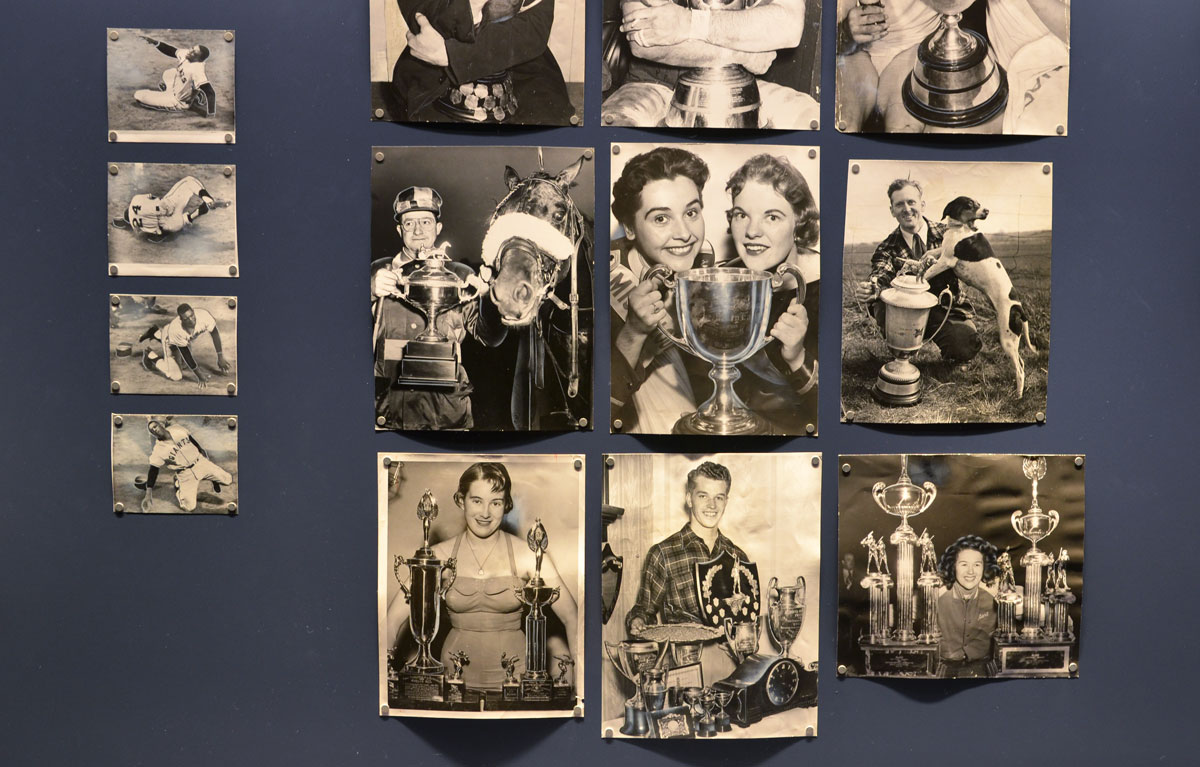
below: The woman with the two trophies, bottom left, is Marilyn Bell who swam across Lake Ontario.  I know that the man beside her is from a story about a cowboy championship of some sort in Calgary and my apologies for not remembering more of the details.

old photographs, black and white, of people with trophies, in a display case, as part of an exhibit called Cutlines, old photos from the Globe and Mail collection

silhouette of two men standing in front of a lit display case of old photographs

On view at 425 Wellington St. West until 26 June 2016

#CONTACT16

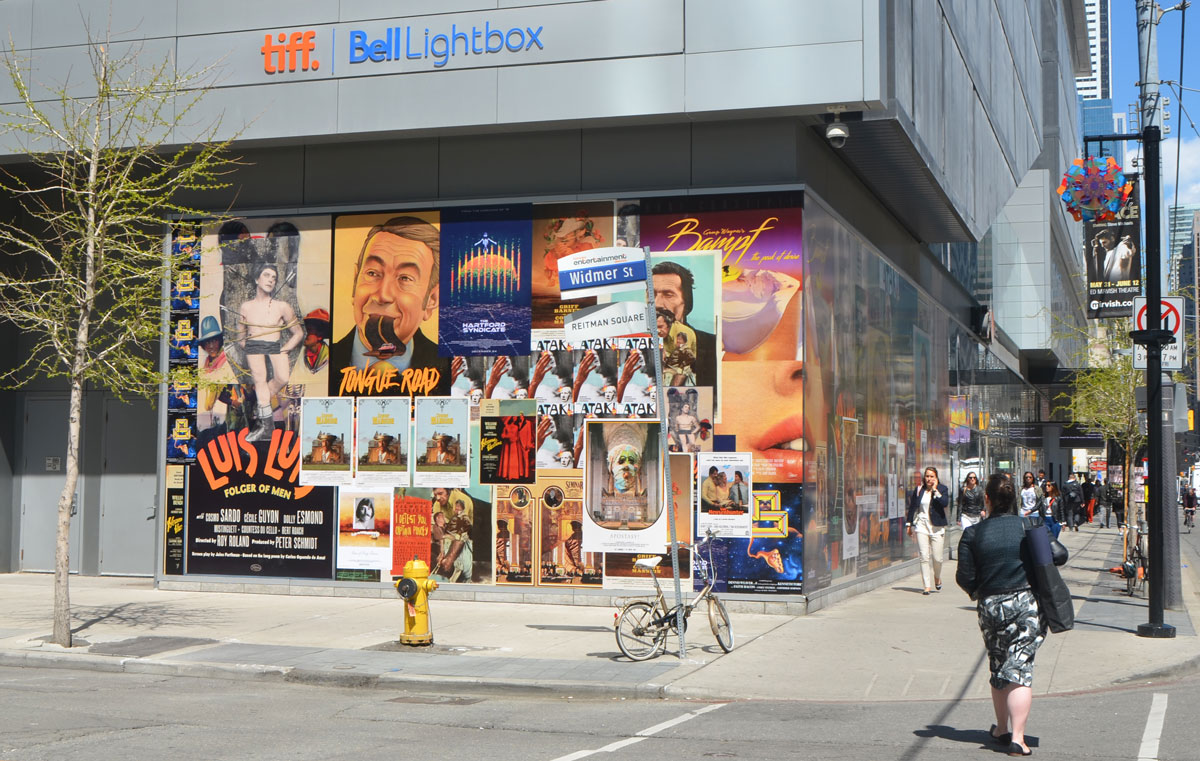
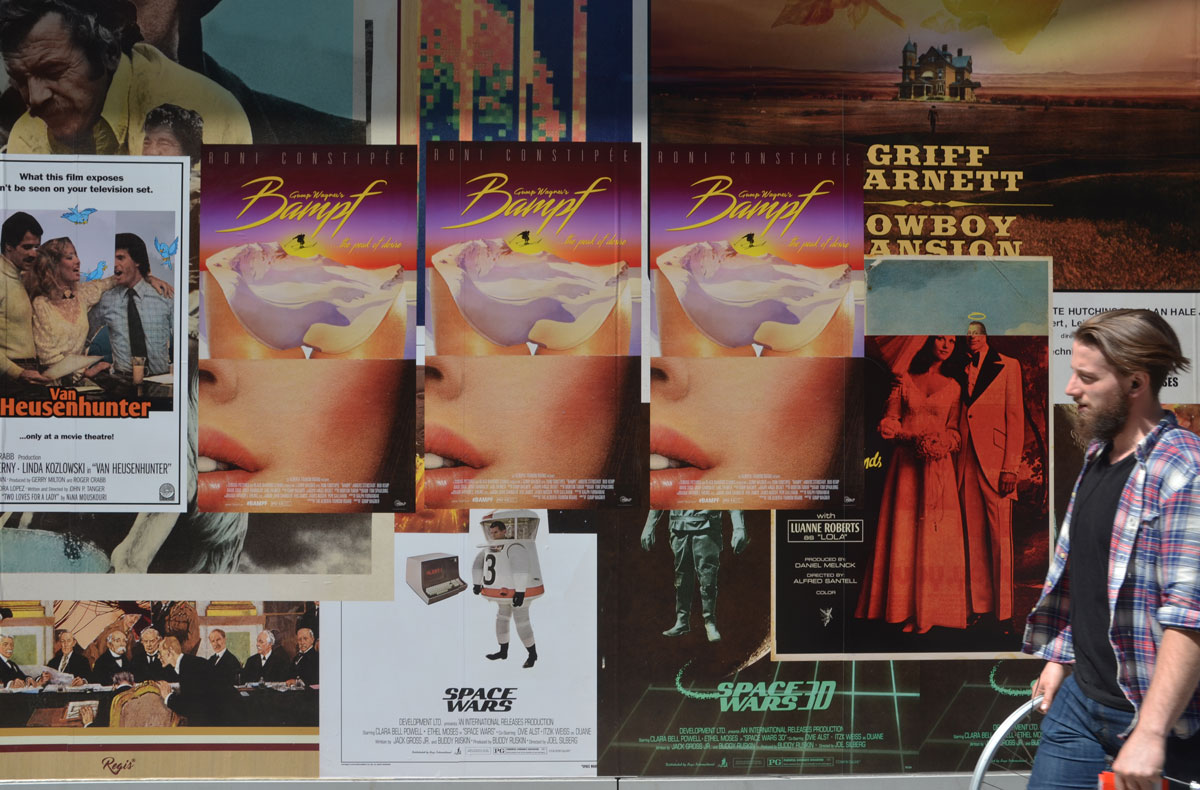
It’s common to see posters pasted on walls so finding movie posters on the walls of the tiff Bell Lightbox didn’t strike me as unusual.    I walked past this display until I noticed the sign that marked this as a CONTACT Photography Festival installation.  Fake movie posters, many designed with a touch of humour, that look just like the real thing.

detail of an art installation that is a wall of fake movie posters made with ads and illustrations from old books and magazines

below: The installation, titled ‘Coming Attractions’ covers the corner windows and wall space.   The posters were designed by ‘Long Weekend’ which is a collective of artists working out of Winnipeg.   They were made from ads and illustrations from old books and magazines.

at the corner of King and another street, the TIFF Bell Lightbox building has an art installation on two sides, walls of fake movie posters. The installation is called 'Coming Attractions' and it is by a collective of artists known as The Long Weekend.

detail of an art installation that is a wall of fake movie posters

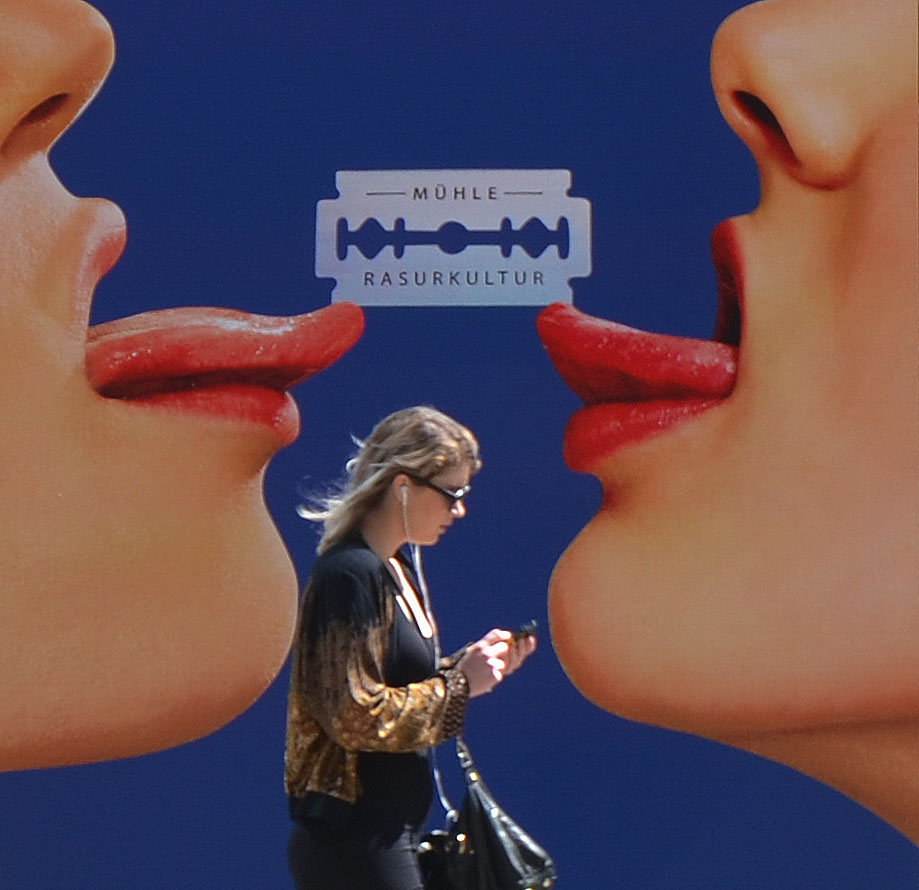
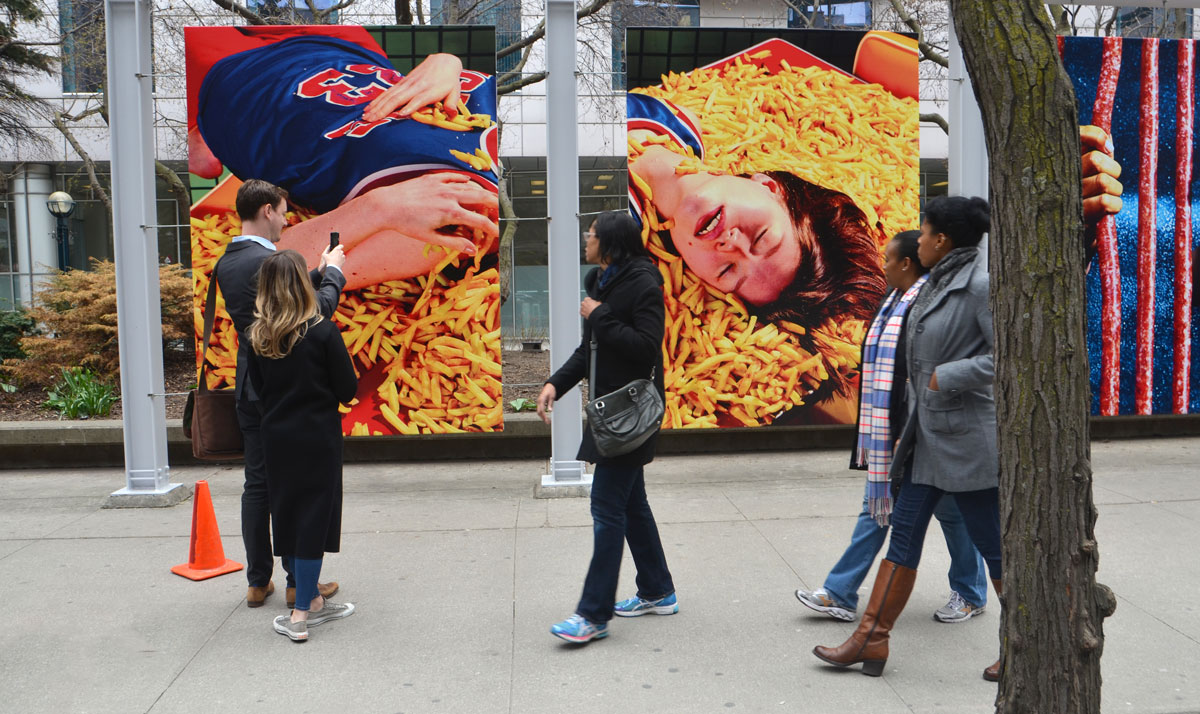
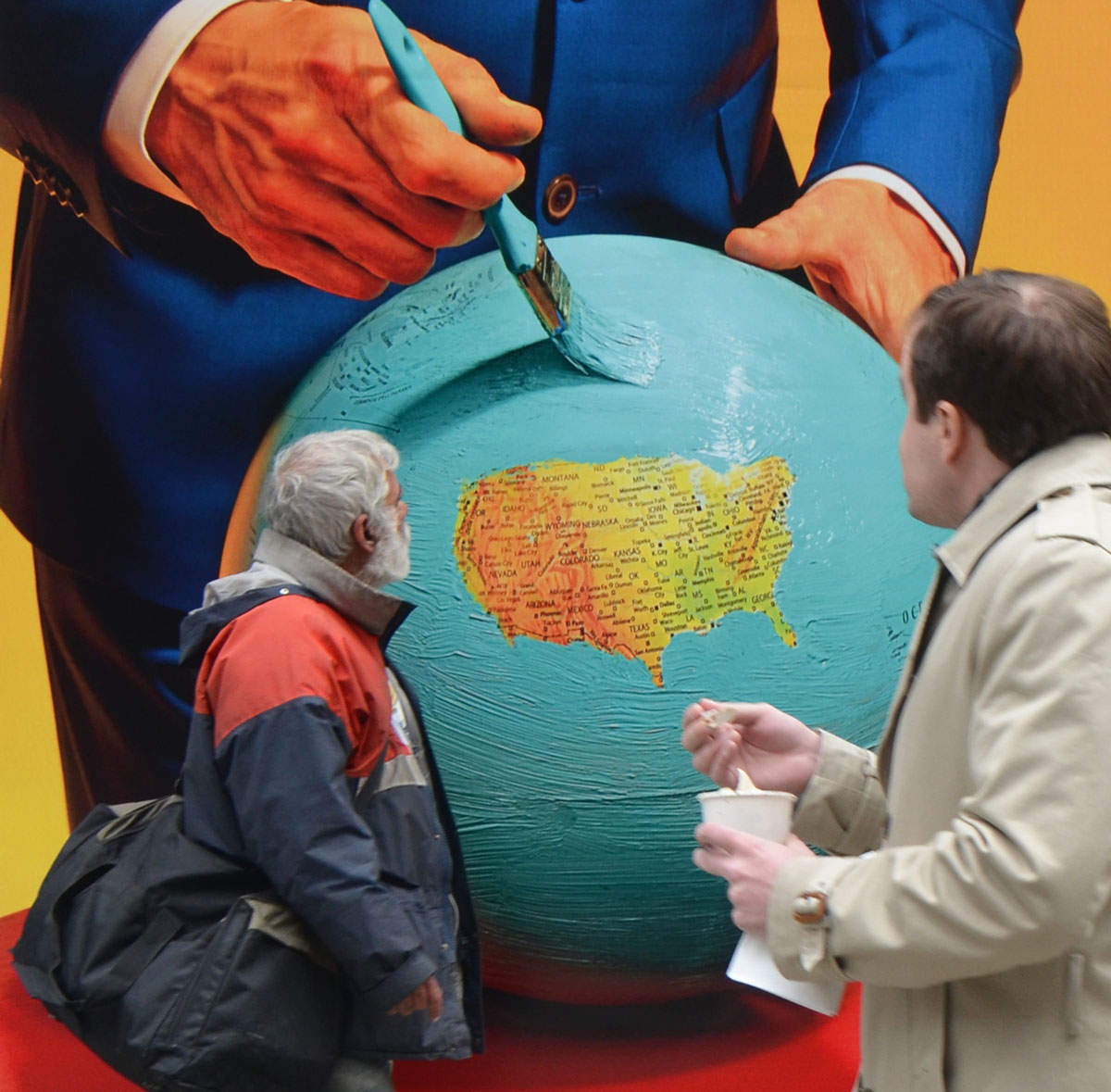
On the other side of King street, and just a but further east, is a series of eleven large images taken from past editions of ‘Toilet Paper’, a biannual magazine founded by Maurizio Cattelan and Pierpaolo Ferrari.   They hint at advertising and they blur the line between fantasy and reality.

below: Muhle is a German company that makes shaving products and one of their blades looks identical to the one in this picture.

A woman with her phone in her hands walks past a large poster of two women face to face where all you can see is their nose, mouth, chin and tongues that are stuck out. A razor blade balances between the two tongues.

People walk past two large posters that show a girl lying on a large pile of french fries.

A man walks past large posters on King St.,

a man stands in front of a picture that is a large globe with everything painted light blue except the USA

a man stands in front of a picture that is a large globe with everything painted light blue except the USA

If you like these images, you might also like Toilet Paper’s website.

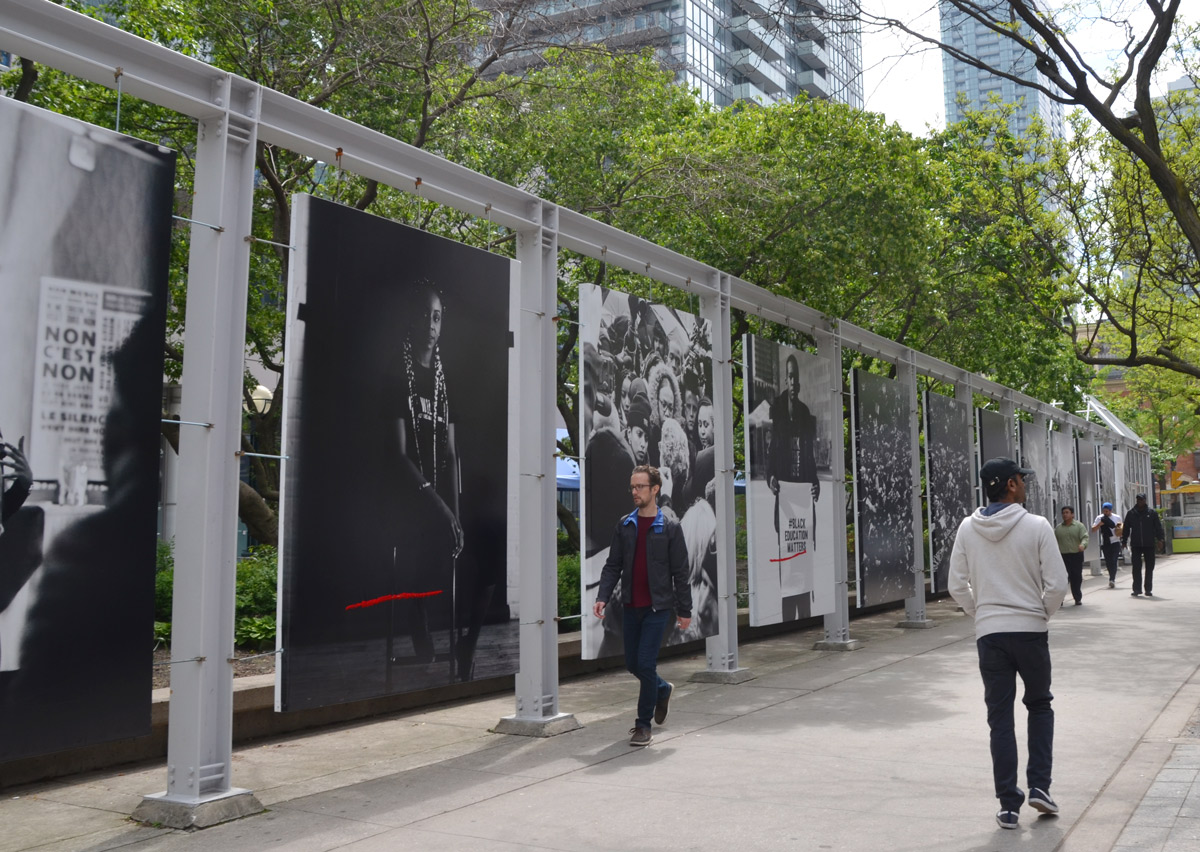
Spread around Kensington and Chinatown are 20 large black and white photos taken by a number of freelance photojournalists who are part of a group called #Dysturb.   One of their goals is to present photojournalism in new ways, including as street art, with the aim of engaging people and encouraging discussion of global issues.   The images are part of an exhibit for the Scotiabank CONTACT Photography Festival.

Kensington has had a problem with taggers for a while.  Often street art gets vandalized in that area.   The #Dysturb photo that was at 56 Kensington (under Mona Lisa) has already been torn down and a couple of others have been ripped.

Pictures of some of the images that are part of the exhibit are shown below.  I have included a partial transcription of the words that accompany each picture.


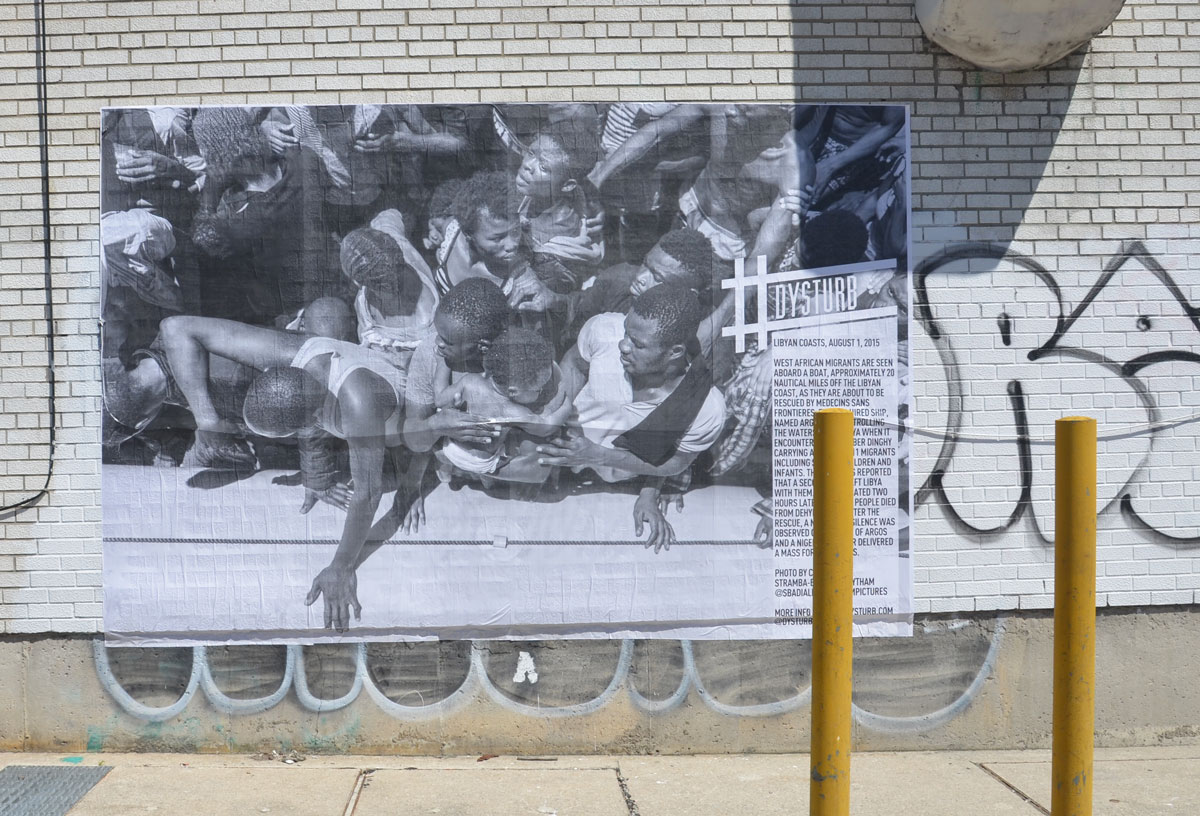
Libyan Coasts, August 1, 2015
Photo by Christophe Stramba-Badiali/Haytham

a large black and white photojournalist picture, part of CONTACT photography festival, pasted on a wall - a boat load of Libyan migrants is being rescued from their rubber dinghy.

West African migrants are seen aboard a boat, approximately 20 nautical miles off the Libyan coast, as they are about to be rescued by Medecins Sans Frontieres. The MSF-hired ship, named Argos, was patrolling the waters off Libya when it encountered one rubber dinghy carrying a total of 111 migrants including several children and infants. “


Barpak, Ghorka District, Nepal, May 9, 2015 ”
Photo by Renaud Philippe/Hans Lucas

a large black and white photojournalist picture, part of CONTACT photography festival, pasted on a wall - children playing in the wind created by a helicopter, Nepal, on a wall in an entraceway.  A man is busking in front, and there are people walking past on the sidewalk

Children play in a cloud of dust and gravel thrown by an Indian army helicopter landing in Barpak Nepal.  The community is at the epicenter of the devastating earthquake that struck April 25, 2015, taking over 8000 lives.  Of Barpak’s 1400 houses, only 20 remain standing.   The rest of the town is a pile of rubble that blends into the rocky landscape.  An archway that somehow survived the quake greets visitors with a rueful ‘Welcome to Barpak’.”


Shaanxi Province, Henan, China, February 27, 2014
Photo by Sim Chi Yin/Vii

a large black and white photojournalist picture, part of CONTACT photography festival, pasted on a wall - an ill Chinese man is being comforted by his wife.  The picture is on a graffiti covered wall and a black car is parked close to it.

Gold miner, He Quangui, battling silicosis, struggles to breathe while cradled in the hands of his wife Mi Shixiu.  After many attempts to stabilize his breathing, in the early hours of the next morning her tried to kill himself to end the suffering.  He contracted the irreversible disease working in illegal gold mines in China’s Henan province.   He is among some six million workers in China who have pneumoconiosis – the country’s most prevalent occupational disease.”


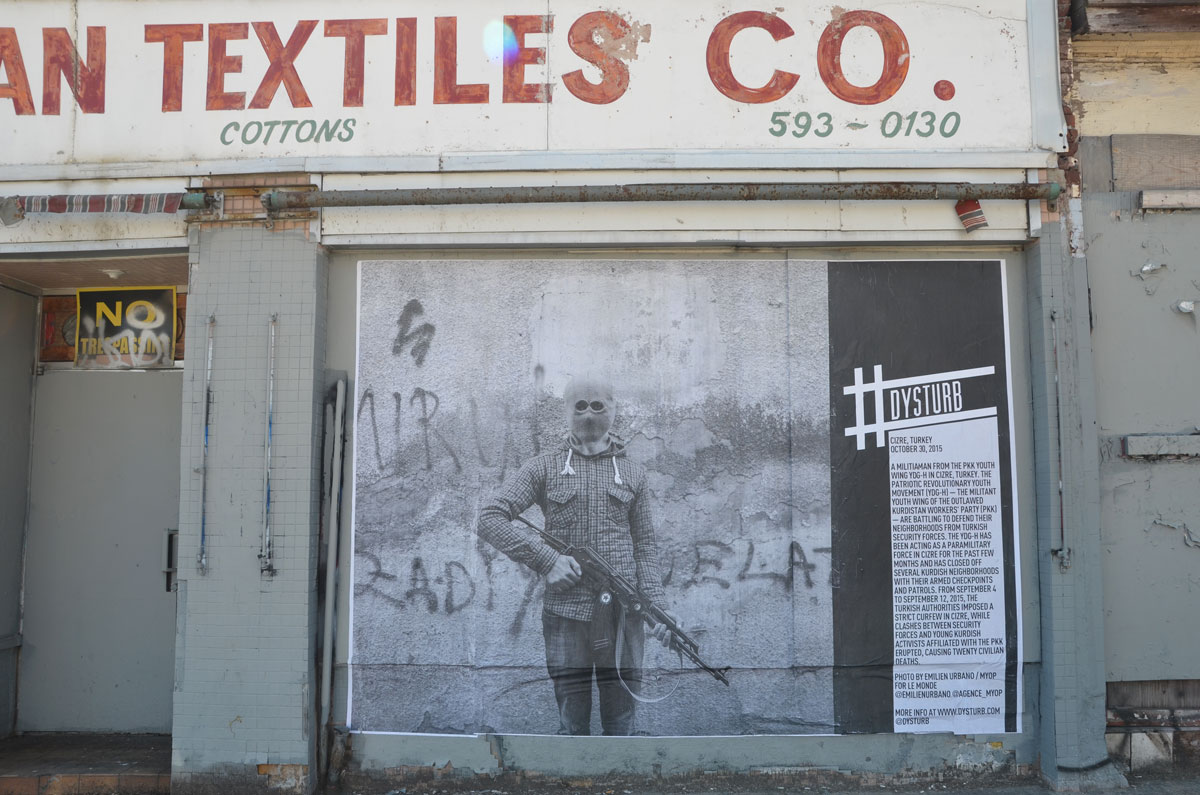
Cizre Turkey, October 30, 2015.
Photo by Emilien Urbano/Myop for Le Monde
NOTE: I took this picture on Friday. Today (Monday) it was gone.

large black and white photo pasted onto a boarded up storefront of European Textiles on Spadina Rd. The photo is part of #Dysturb exhibit at Contact Photography Festival. It shows a hooded man holding an automatic rifle

A militiaman from the PKK Youth wing YDG-H in Cizre Turkey.  The Patriotic Revolutionary Youth Movement (YDG-H) – the militant youth wing of the outlawed Kurdistan Workers’ Party (PKK) – are battling to defend their neighbourhoods from Turkish security forces.  The YDG-H has been acting as a paramilitary force in Cizre for the past few months and has closed off several Kurdish neighbourhoods with their armed checkpoints and patrols.


Fort McKay, Alberta, Canada, August 12, 2015
Photo by Ian Willms/Boreal Collective

a large black and white photojournalist picture, part of CONTACT photography festival, pasted on a wall - a sick boy is lying on a bed, on a wall in the entranceway to a store, sidewalk and street scene in the background

Dez, 7, plays in his bed.  Dez was born with an underdeveloped heart and has received multiple open heart surgeries.  His family and healthcare professionals in Fort McKay believe that his condition was caused by environmental pollution.   Fort McKay is an indigenous community that is surrounded by oil  sands developments.”


Kunduz City, Afghanistan, November 18, 2015.
Photo by Andrew Quilty/Oculi

a large black and white photojournalist picture, part of CONTACT photography festival, pasted on a wall - a mother (covered in a black burka) and her daughter in grief, at a gravesite.  Pasted on an orange wall with an old brown leather sofa in front of it.

Najibah tries to comfort her daughter Zahara, 8, as they weep over the grave of their husband and father, Baynazar.   Baynazar, 43, was wounded by gunfire on his way home fromwork during the Taliban takeover of Kunduz in late 2015.  He was taken to the nearby Doctors Without Borders (MSF) trauma centre.  In the early hours of October 3, during his second operation, a US AC-130 aircraft attacked the hospital for more than half an hour, killing 43 MSF staff, patients and nurses.  Dozens more were wounded.
About #Dysturb

#CONTACT16


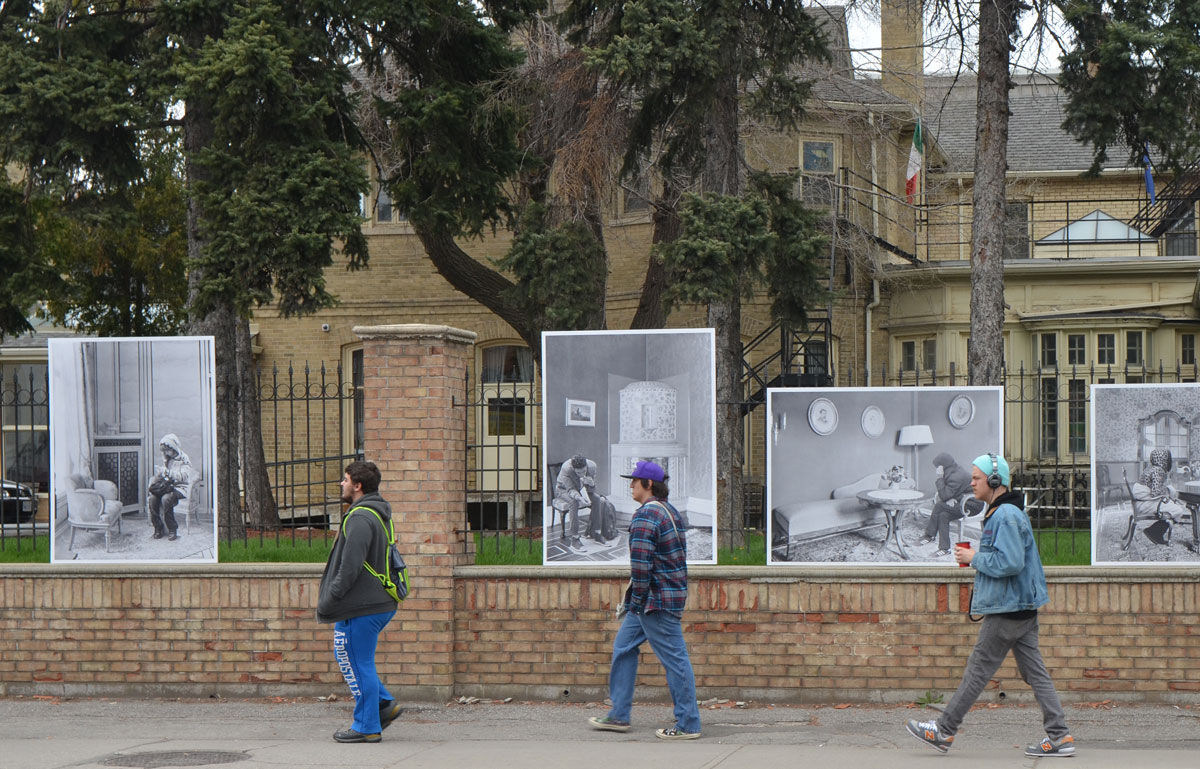
Refugees in a State Apartment, Jens Ullrich,
Photo exhibit, on a fence outside the Italian Consulate, Dundas West at Beverley.

Part of Scotiabank CONTACT Photography Festival

photos mounted along the exterior of a wrought iron fence around the Italian Consulate, right beside the sidewalk. The consulate is on old brick house (mansion) from the 1800's - 3 of the photographs, people walking past

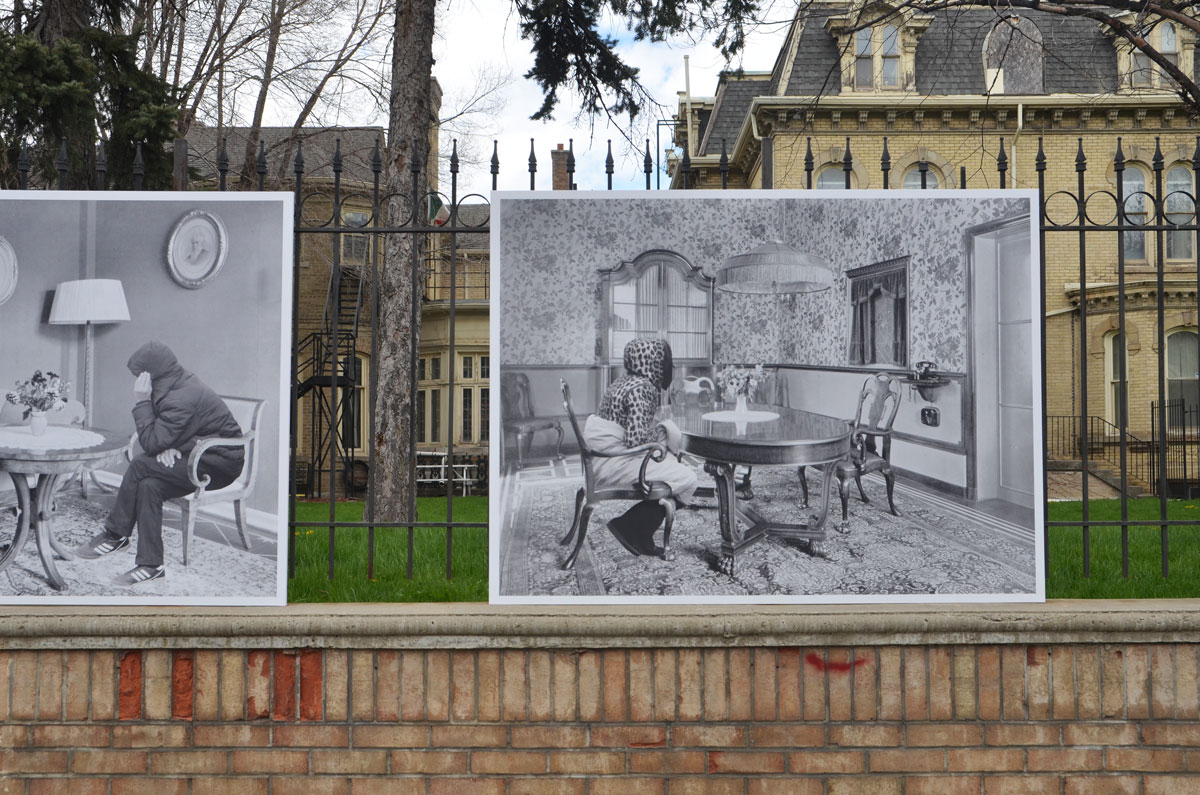
Ullrich has taken found black and white photographs of the interior of a large home near Bremen Germany.  The photos were taken in the late 1920’s.    Each photograph is of a different room in the villa and to each picture Ullrich has added  one person.   If you knew nothing about the series, you wouldn’t know that the subjects were refugees.

In each photomontage, singular individuals are depicted—usually with their faces hidden from the camera—within empty yet elaborately fashioned spaces that emphasize their solitude and unstable status. “

photos mounted along the exterior of a wrought iron fence around the Italian Consulate, right beside the sidewalk. The consulate is on old brick house (mansion) from the 1800's - phot by Jens Ullrich of a woman refugee with her face obscured by clothing, sitting on a chair in the bathroom of a large bathroom. also a photo of a male refugee in another room, looking in a large mirror

One of the concepts behind this series of images was the desire to

respectfully capture the disparate emotions of these individuals and their precarious situations.”

photos mounted along the exterior of a wrought iron fence around the Italian Consulate, right beside the sidewalk. The consulate is on old brick house (mansion) from the 1800's - as seen from across the street with pedestrians walking past and cars driving past

photos mounted along the exterior of a wrought iron fence around the Italian Consulate, right beside the sidewalk. The consulate is on old brick house (mansion) from the 1800's - the photos are of refugees that have been photoshopped into old photos of the interior of the apartment of a wealthy person from the 1920's
#CONTACT16