Posts Tagged ‘CONTACT’

Spread around Kensington and Chinatown are 20 large black and white photos taken by a number of freelance photojournalists who are part of a group called #Dysturb.   One of their goals is to present photojournalism in new ways, including as street art, with the aim of engaging people and encouraging discussion of global issues.   The images are part of an exhibit for the Scotiabank CONTACT Photography Festival.

Kensington has had a problem with taggers for a while.  Often street art gets vandalized in that area.   The #Dysturb photo that was at 56 Kensington (under Mona Lisa) has already been torn down and a couple of others have been ripped.

Pictures of some of the images that are part of the exhibit are shown below.  I have included a partial transcription of the words that accompany each picture.


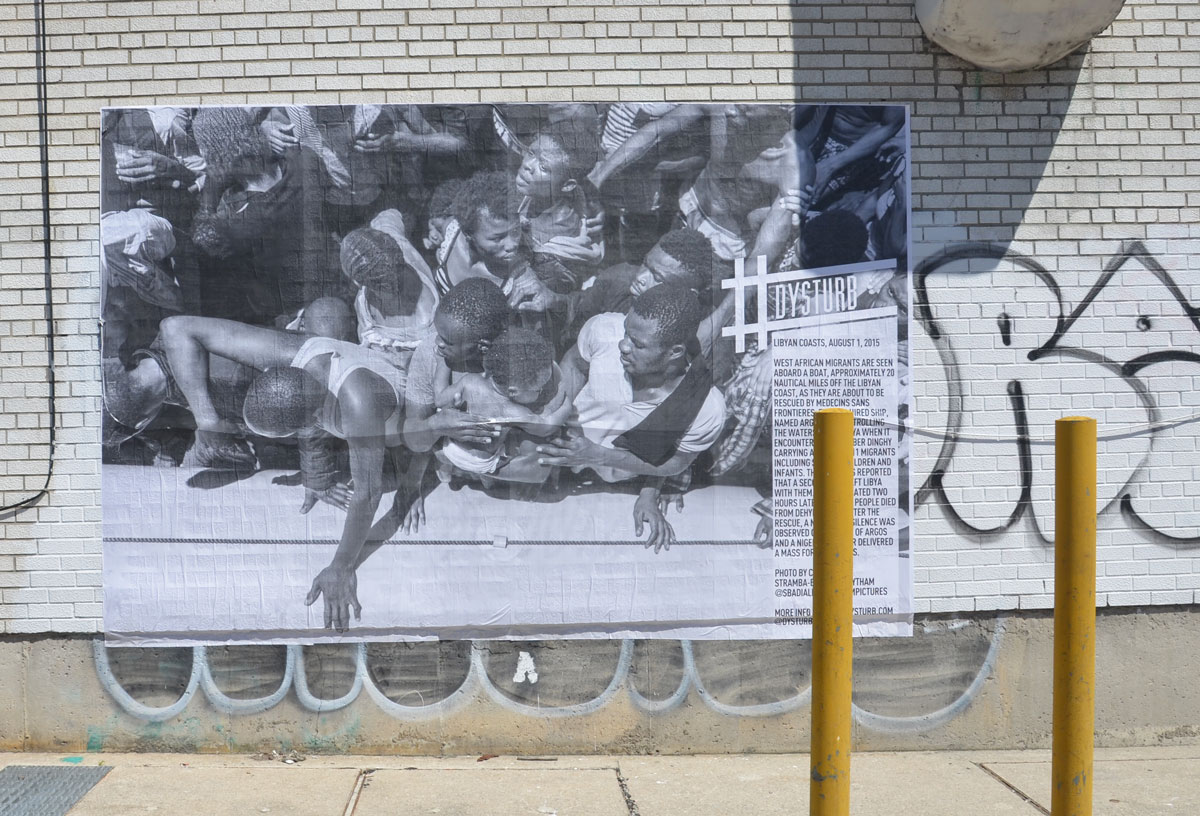
Libyan Coasts, August 1, 2015
Photo by Christophe Stramba-Badiali/Haytham
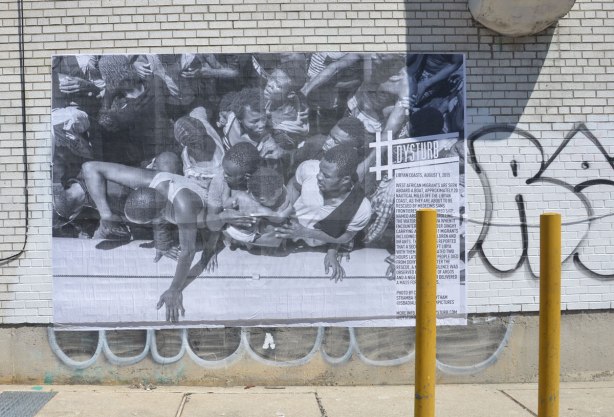
a large black and white photojournalist picture, part of CONTACT photography festival, pasted on a wall - a boat load of Libyan migrants is being rescued from their rubber dinghy.

West African migrants are seen aboard a boat, approximately 20 nautical miles off the Libyan coast, as they are about to be rescued by Medecins Sans Frontieres. The MSF-hired ship, named Argos, was patrolling the waters off Libya when it encountered one rubber dinghy carrying a total of 111 migrants including several children and infants. “


Barpak, Ghorka District, Nepal, May 9, 2015 ”
Photo by Renaud Philippe/Hans Lucas

a large black and white photojournalist picture, part of CONTACT photography festival, pasted on a wall - children playing in the wind created by a helicopter, Nepal, on a wall in an entraceway.  A man is busking in front, and there are people walking past on the sidewalk

Children play in a cloud of dust and gravel thrown by an Indian army helicopter landing in Barpak Nepal.  The community is at the epicenter of the devastating earthquake that struck April 25, 2015, taking over 8000 lives.  Of Barpak’s 1400 houses, only 20 remain standing.   The rest of the town is a pile of rubble that blends into the rocky landscape.  An archway that somehow survived the quake greets visitors with a rueful ‘Welcome to Barpak’.”


Shaanxi Province, Henan, China, February 27, 2014
Photo by Sim Chi Yin/Vii
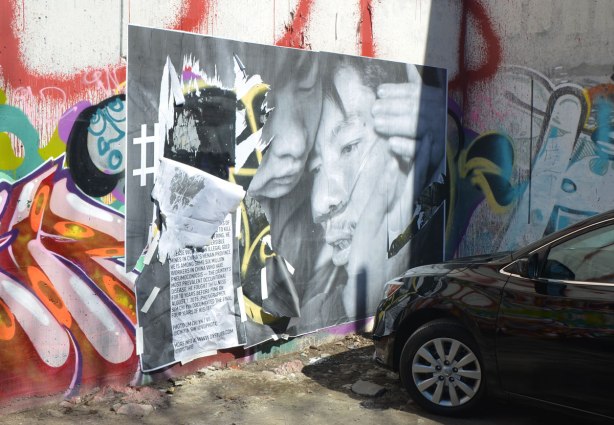
a large black and white photojournalist picture, part of CONTACT photography festival, pasted on a wall - an ill Chinese man is being comforted by his wife.  The picture is on a graffiti covered wall and a black car is parked close to it.

Gold miner, He Quangui, battling silicosis, struggles to breathe while cradled in the hands of his wife Mi Shixiu.  After many attempts to stabilize his breathing, in the early hours of the next morning her tried to kill himself to end the suffering.  He contracted the irreversible disease working in illegal gold mines in China’s Henan province.   He is among some six million workers in China who have pneumoconiosis – the country’s most prevalent occupational disease.”


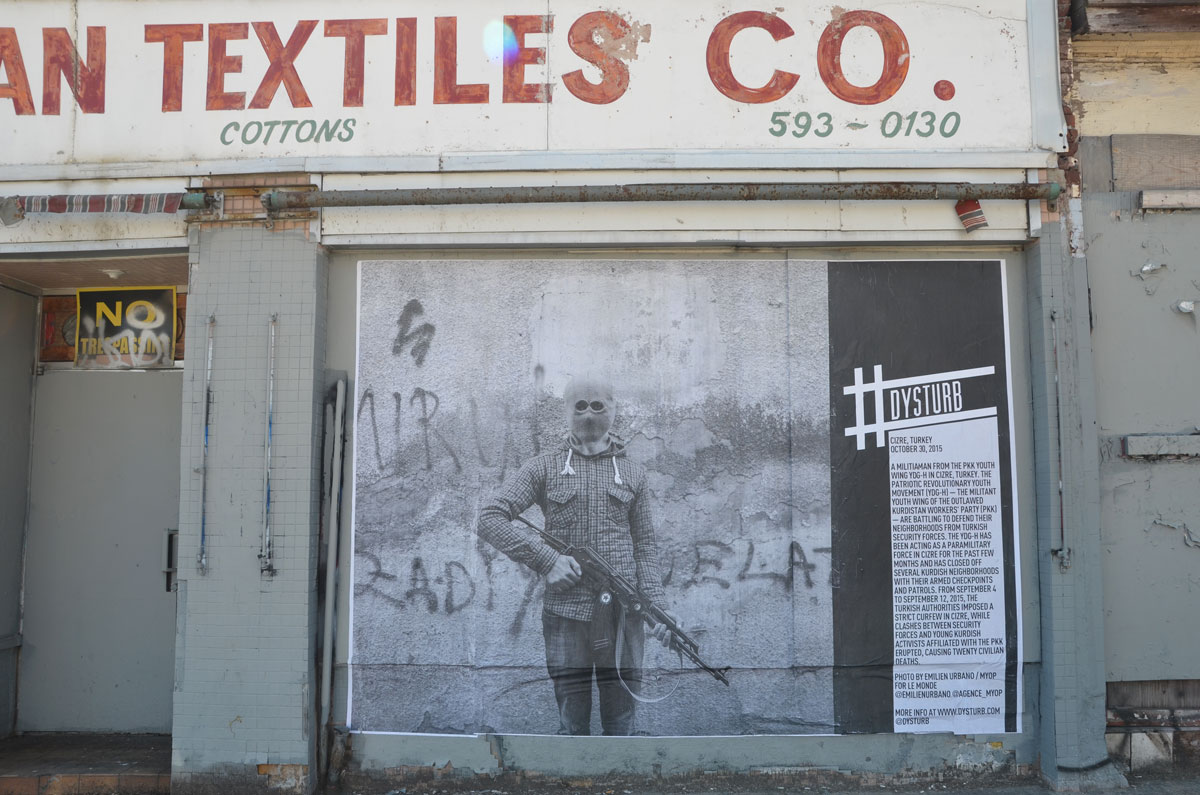
Cizre Turkey, October 30, 2015.
Photo by Emilien Urbano/Myop for Le Monde
NOTE: I took this picture on Friday. Today (Monday) it was gone.
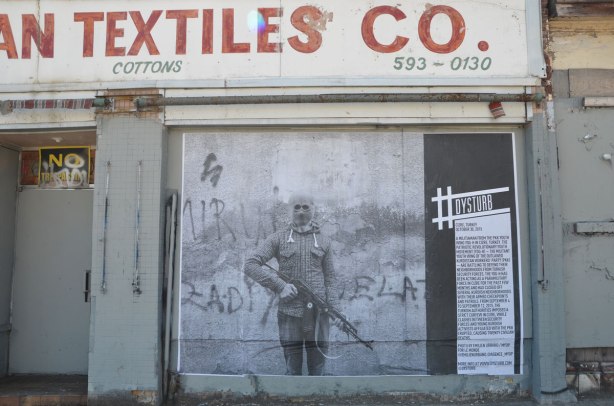
large black and white photo pasted onto a boarded up storefront of European Textiles on Spadina Rd. The photo is part of #Dysturb exhibit at Contact Photography Festival. It shows a hooded man holding an automatic rifle

A militiaman from the PKK Youth wing YDG-H in Cizre Turkey.  The Patriotic Revolutionary Youth Movement (YDG-H) – the militant youth wing of the outlawed Kurdistan Workers’ Party (PKK) – are battling to defend their neighbourhoods from Turkish security forces.  The YDG-H has been acting as a paramilitary force in Cizre for the past few months and has closed off several Kurdish neighbourhoods with their armed checkpoints and patrols.


Fort McKay, Alberta, Canada, August 12, 2015
Photo by Ian Willms/Boreal Collective
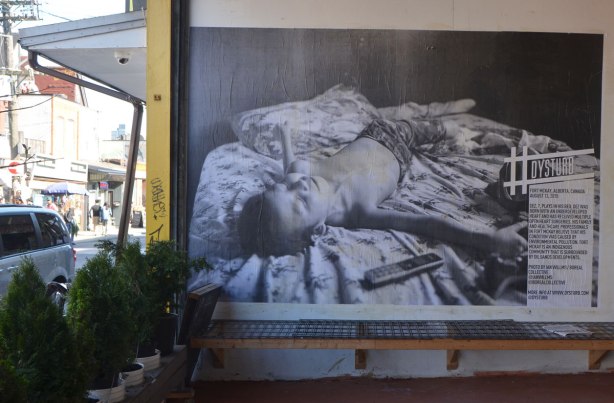
a large black and white photojournalist picture, part of CONTACT photography festival, pasted on a wall - a sick boy is lying on a bed, on a wall in the entranceway to a store, sidewalk and street scene in the background

Dez, 7, plays in his bed.  Dez was born with an underdeveloped heart and has received multiple open heart surgeries.  His family and healthcare professionals in Fort McKay believe that his condition was caused by environmental pollution.   Fort McKay is an indigenous community that is surrounded by oil  sands developments.”


Kunduz City, Afghanistan, November 18, 2015.
Photo by Andrew Quilty/Oculi

a large black and white photojournalist picture, part of CONTACT photography festival, pasted on a wall - a mother (covered in a black burka) and her daughter in grief, at a gravesite.  Pasted on an orange wall with an old brown leather sofa in front of it.

Najibah tries to comfort her daughter Zahara, 8, as they weep over the grave of their husband and father, Baynazar.   Baynazar, 43, was wounded by gunfire on his way home fromwork during the Taliban takeover of Kunduz in late 2015.  He was taken to the nearby Doctors Without Borders (MSF) trauma centre.  In the early hours of October 3, during his second operation, a US AC-130 aircraft attacked the hospital for more than half an hour, killing 43 MSF staff, patients and nurses.  Dozens more were wounded.

About #Dysturb

#CONTACT16


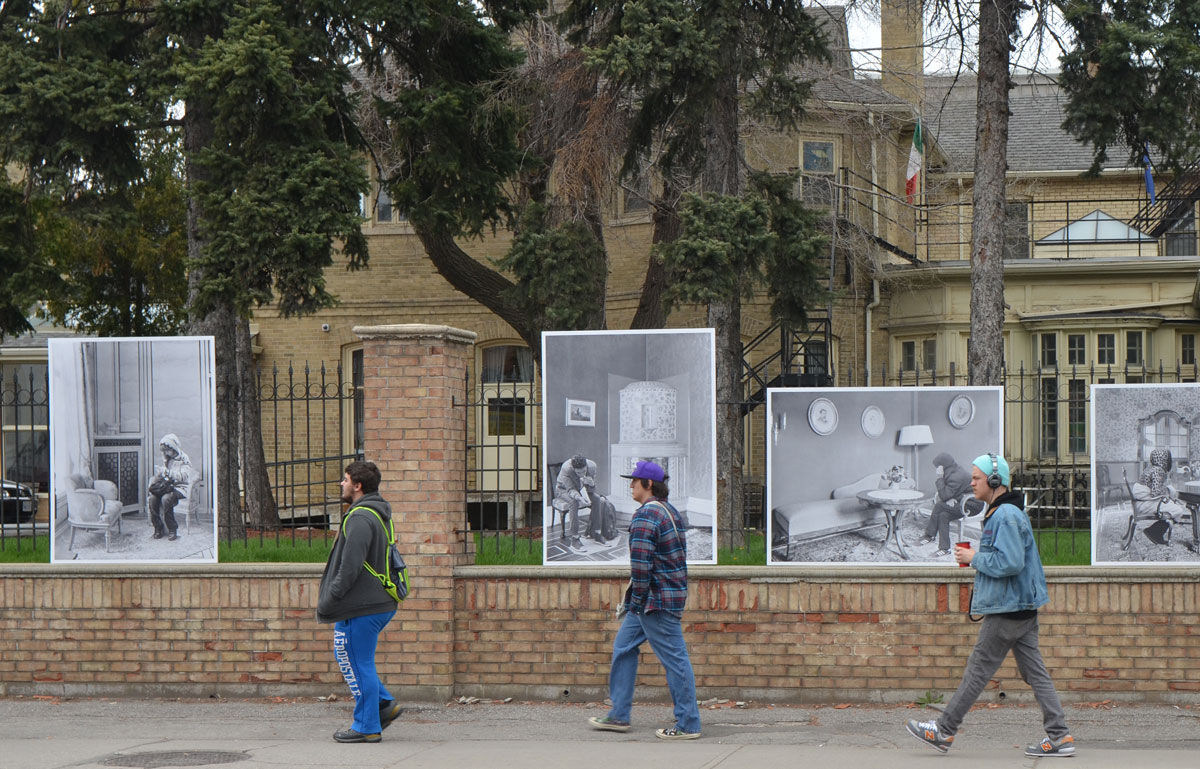
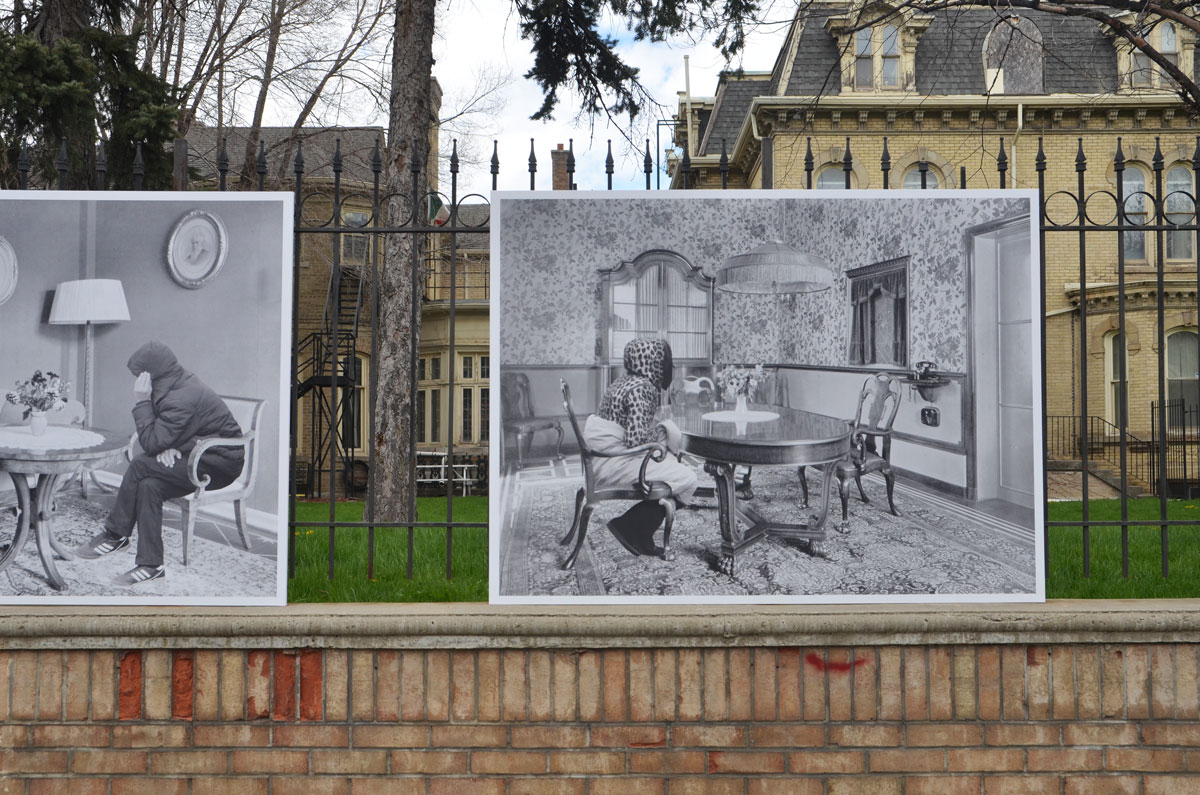
Refugees in a State Apartment, Jens Ullrich,
Photo exhibit, on a fence outside the Italian Consulate, Dundas West at Beverley.

Part of Scotiabank CONTACT Photography Festival

photos mounted along the exterior of a wrought iron fence around the Italian Consulate, right beside the sidewalk. The consulate is on old brick house (mansion) from the 1800's - 3 of the photographs, people walking past

Ullrich has taken found black and white photographs of the interior of a large home near Bremen Germany.  The photos were taken in the late 1920’s.    Each photograph is of a different room in the villa and to each picture Ullrich has added  one person.   If you knew nothing about the series, you wouldn’t know that the subjects were refugees.

In each photomontage, singular individuals are depicted—usually with their faces hidden from the camera—within empty yet elaborately fashioned spaces that emphasize their solitude and unstable status. “

photos mounted along the exterior of a wrought iron fence around the Italian Consulate, right beside the sidewalk. The consulate is on old brick house (mansion) from the 1800's - phot by Jens Ullrich of a woman refugee with her face obscured by clothing, sitting on a chair in the bathroom of a large bathroom. also a photo of a male refugee in another room, looking in a large mirror

One of the concepts behind this series of images was the desire to

respectfully capture the disparate emotions of these individuals and their precarious situations.”

photos mounted along the exterior of a wrought iron fence around the Italian Consulate, right beside the sidewalk. The consulate is on old brick house (mansion) from the 1800's - as seen from across the street with pedestrians walking past and cars driving past

photos mounted along the exterior of a wrought iron fence around the Italian Consulate, right beside the sidewalk. The consulate is on old brick house (mansion) from the 1800's - the photos are of refugees that have been photoshopped into old photos of the interior of the apartment of a wealthy person from the 1920's
#CONTACT16

‘Current Studies’ and ‘Paper Planes’
Two different series of photographs by Sjoerd Knibbeler
Allan Lambert Galleria, Brookfield Place

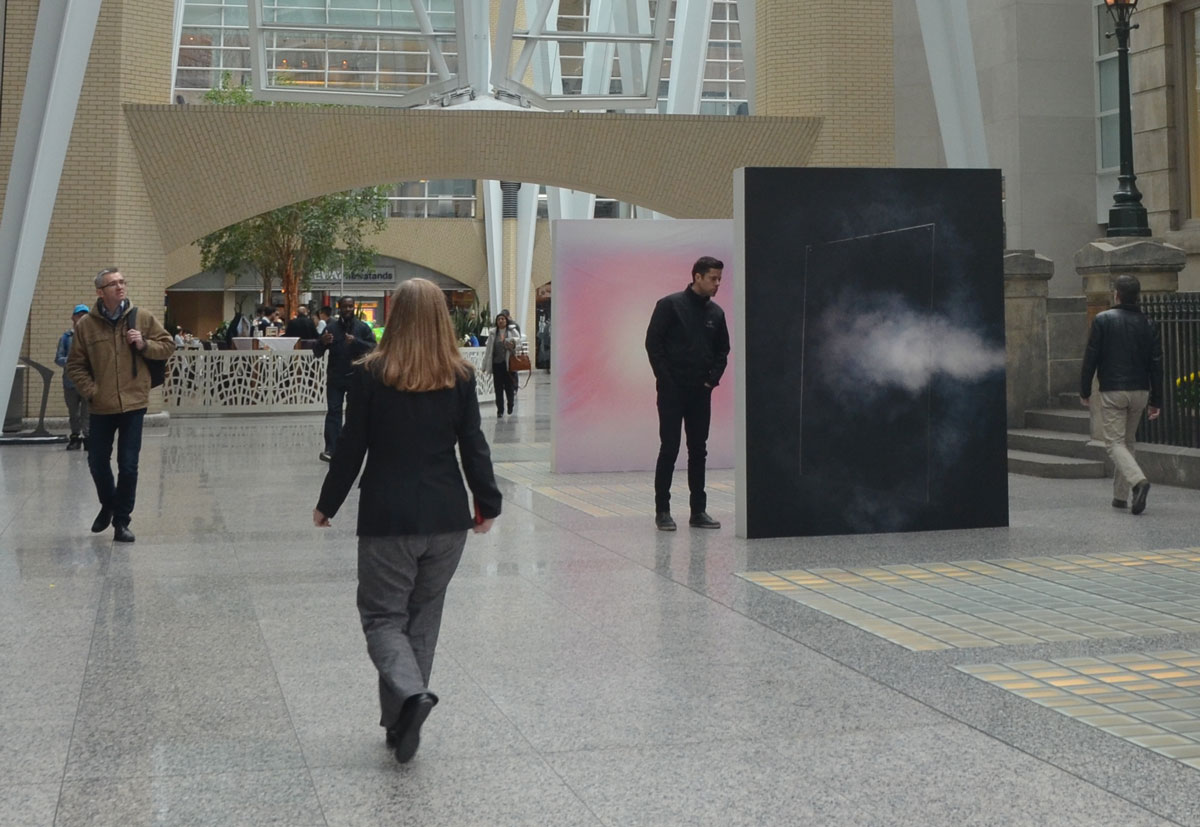
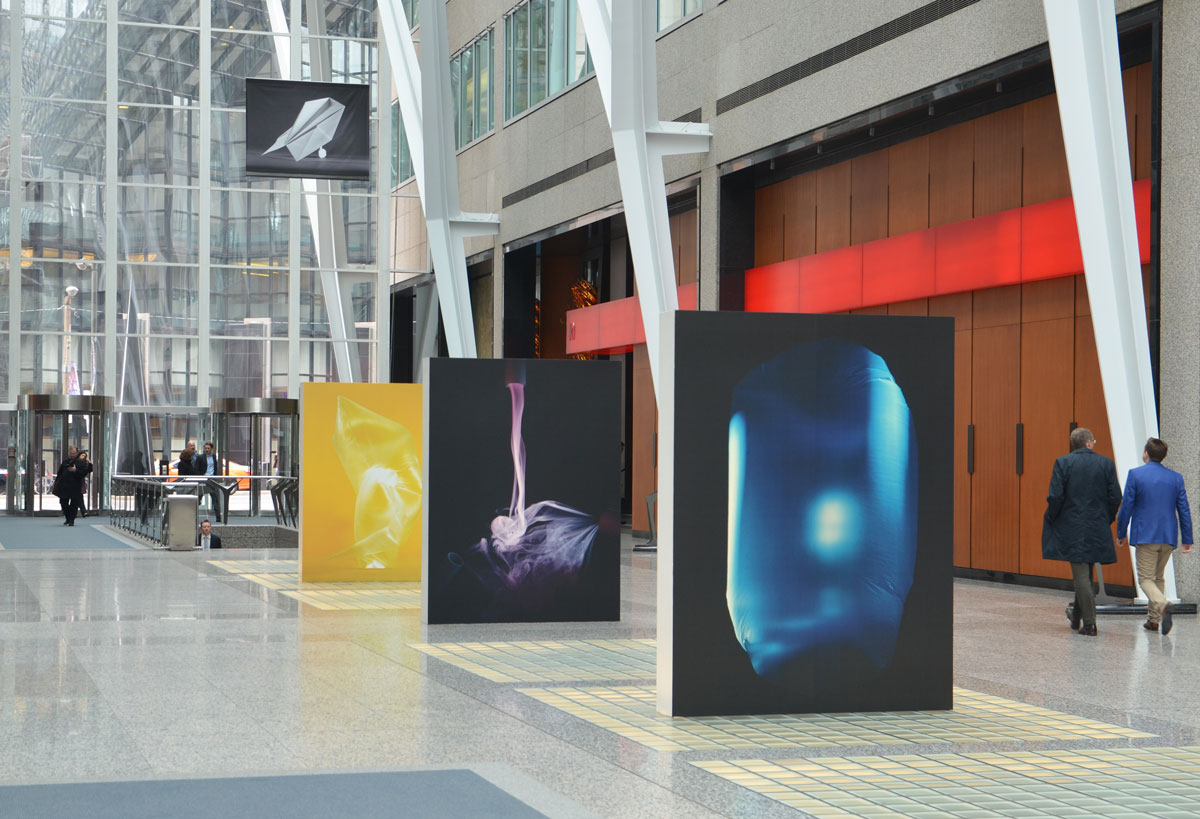
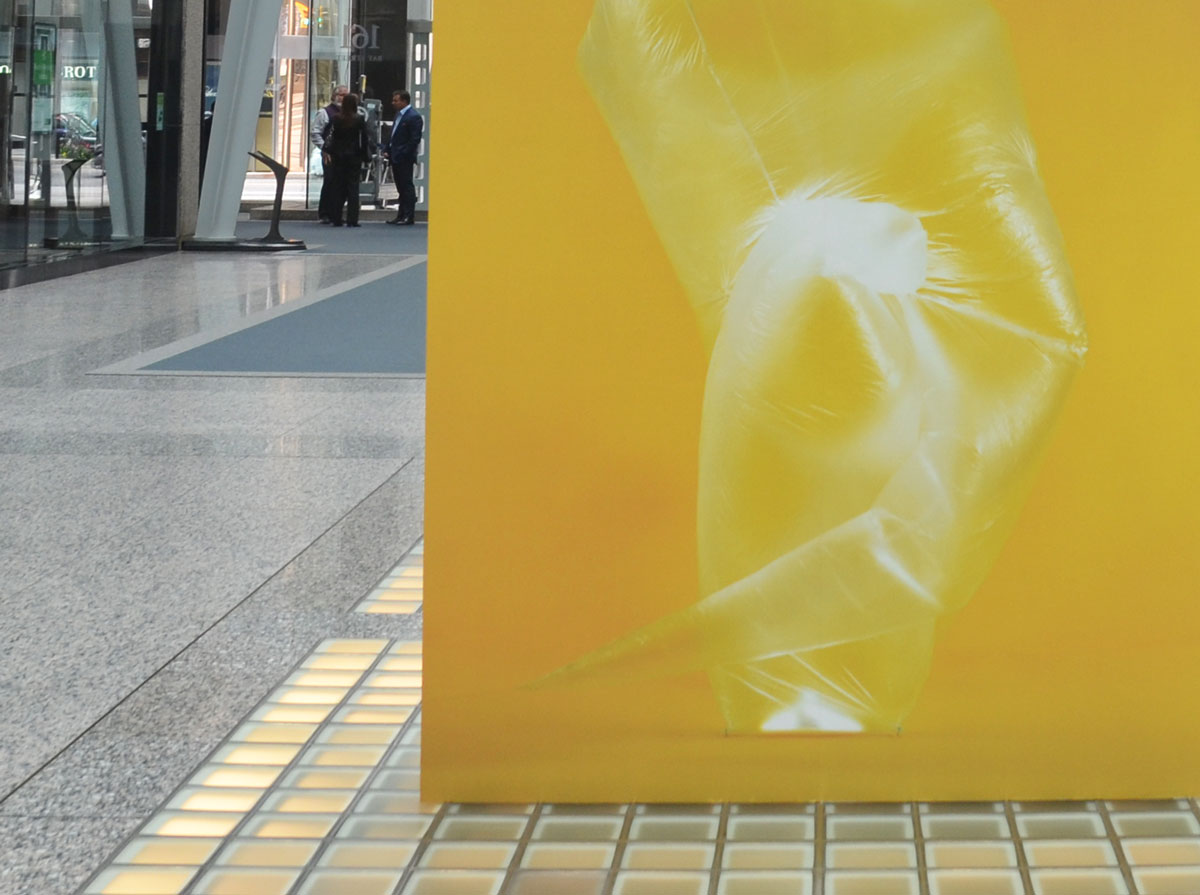
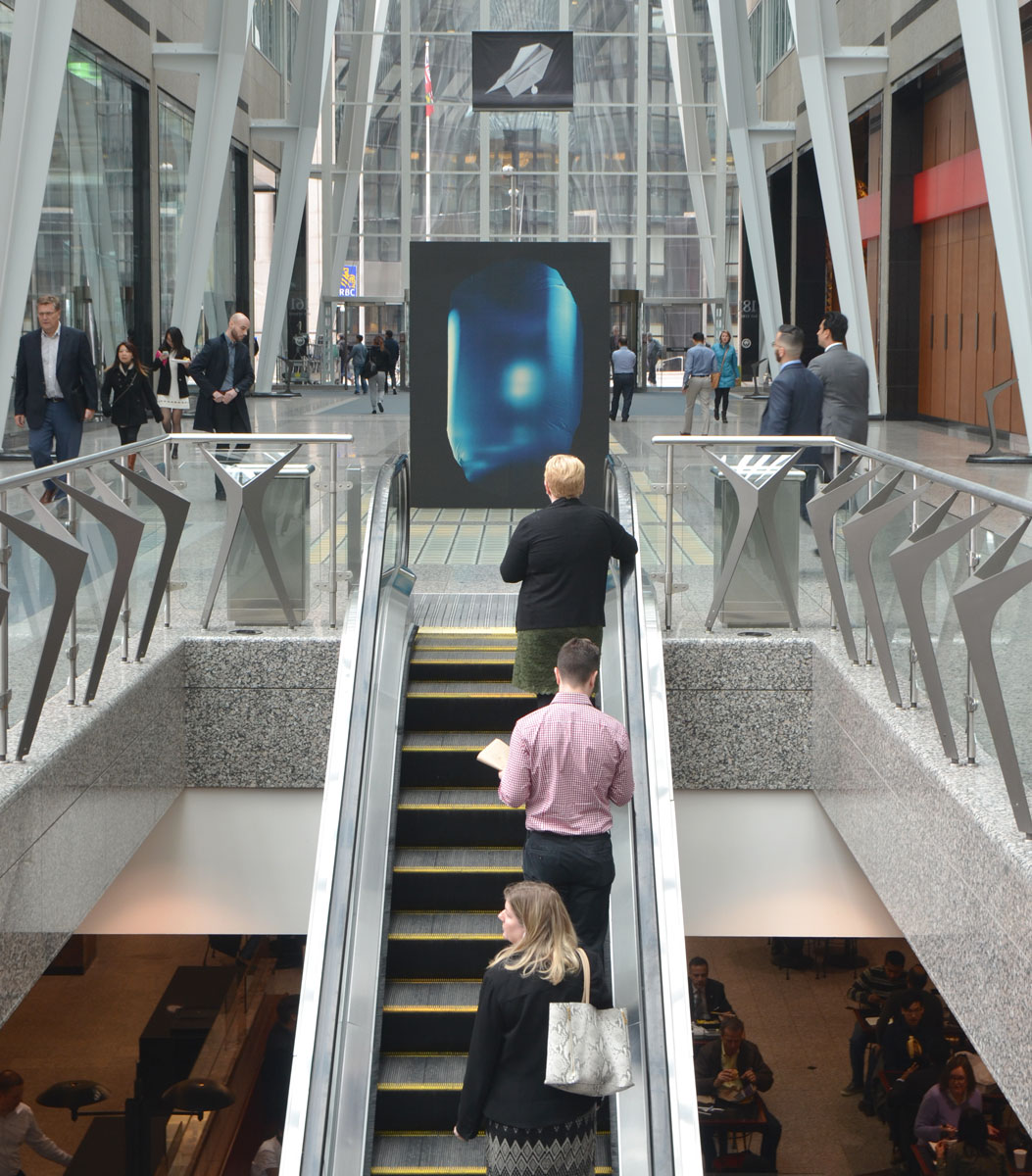
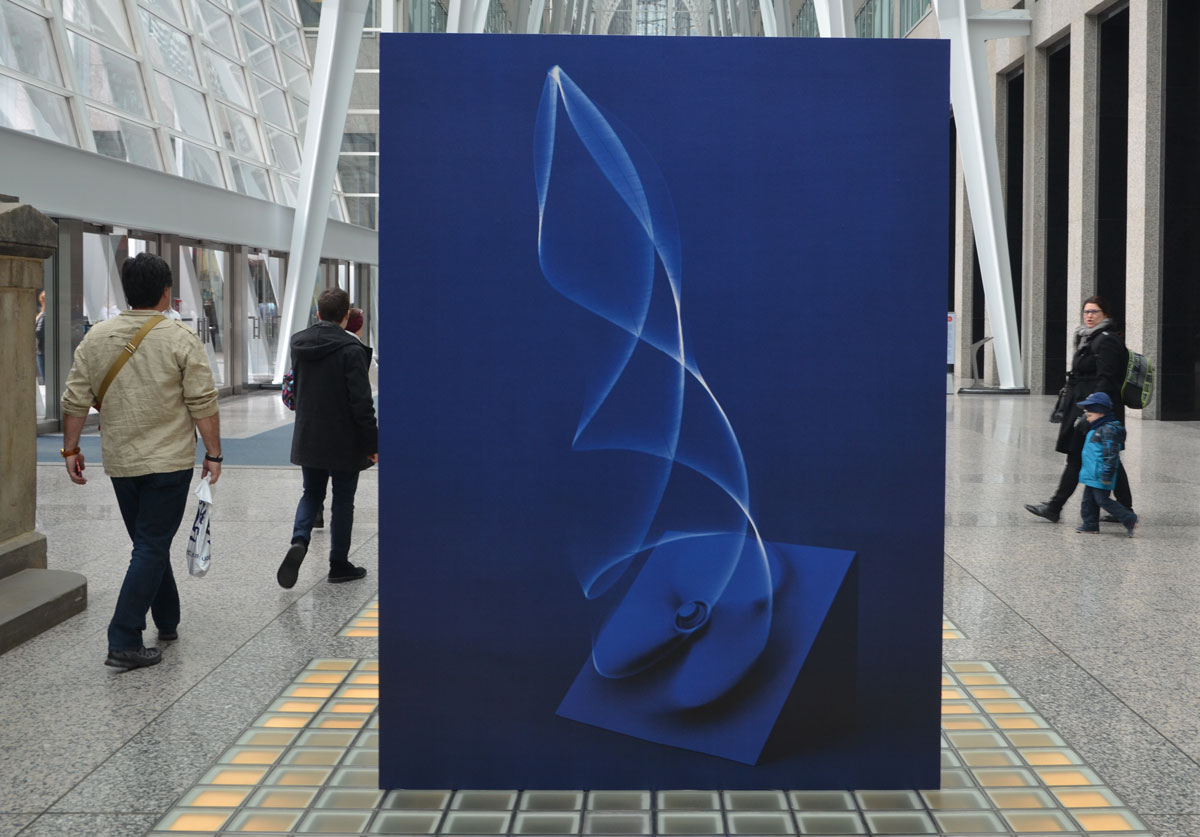
At ground level there are six large freestanding ‘walls” arranged in line, three at each end of the atrium.    Each ‘wall’ is covered by two images, one on either side.  They are photographs that are the result of Knibbeler’s experiments to “ shape, encompass, and capture air currents.”  This is the ‘Current Studies’ part of the installation.

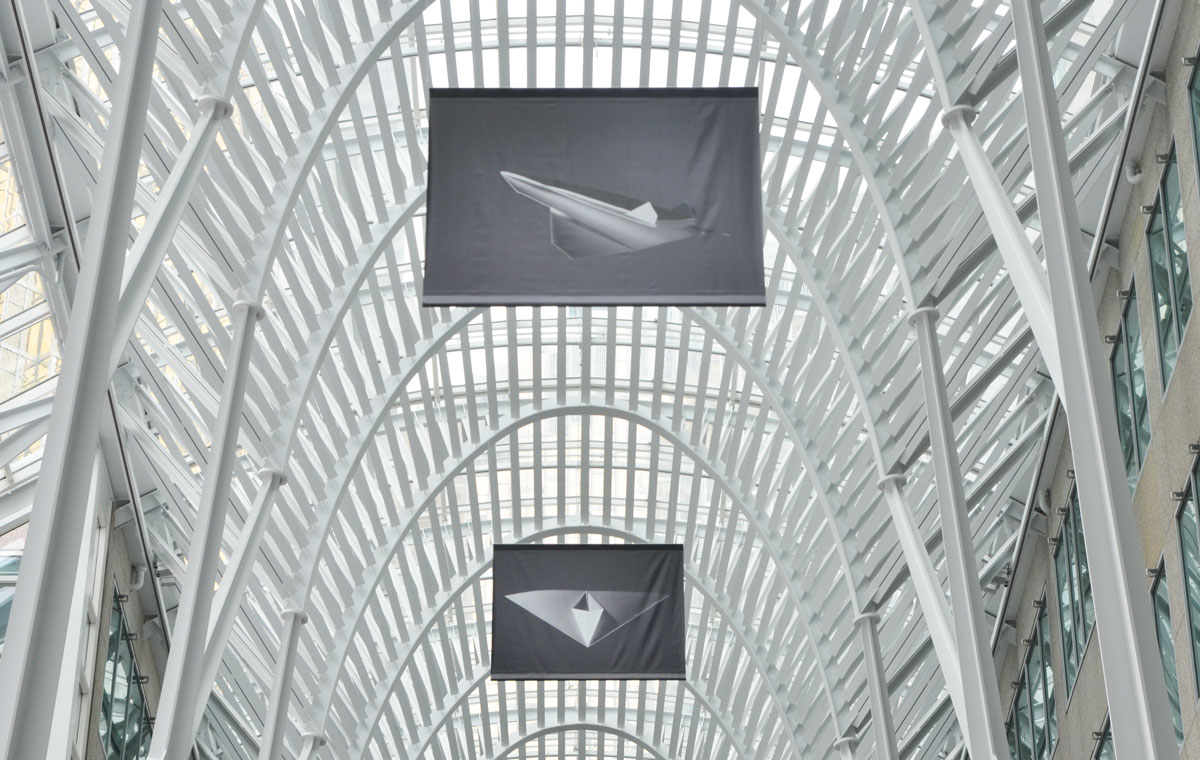
A picture taken inside the Allan Lambert Gallery at Brookfield Place, photos by Sjoerd Knibbeler, a series called Current Study large pictures standing in the middle of the gallery, as well as series called "Paper Planes" which are hung from the ceiling

Suspended from the ceiling are a set of photographs of paper airplanes, the ‘Paper Planes’ part of the installation.    Knibbeler photographed paper airplanes that he made using information that he found online.  He chose military planes that were never produced.

A picture taken inside the Allan Lambert Gallery at Brookfield Place, photos by Sjoerd Knibbeler, a series called Current Study large pictures standing in the middle of the gallery, as well as series called "Paper Planes" which are hung from the ceiling

A picture taken inside the Allan Lambert Gallery at Brookfield Place, photos by Sjoerd Knibbeler, a series called Current Study large pictures standing in the middle of the gallery, as well as series called "Paper Planes" which are hung from the ceiling

A picture taken inside the Allan Lambert Gallery at Brookfield Place, photos by Sjoerd Knibbeler, a series called Current Study large pictures standing in the middle of the gallery, as well as series called "Paper Planes" which are hung from the ceiling

A picture taken inside the Allan Lambert Gallery at Brookfield Place, photos by Sjoerd Knibbeler, a series called Current Study large pictures standing in the middle of the gallery, as well as series called "Paper Planes" which are hung from the ceiling

A picture taken inside the Allan Lambert Gallery at Brookfield Place, photos by Sjoerd Knibbeler, a series called Current Study large pictures standing in the middle of the gallery, as well as series called "Paper Planes" which are hung from the ceiling

A picture taken inside the Allan Lambert Gallery at Brookfield Place, photos by Sjoerd Knibbeler, a series called Current Study large pictures standing in the middle of the gallery, as well as series called "Paper Planes" which are hung from the ceiling

A picture taken inside the Allan Lambert Gallery at Brookfield Place, photos by Sjoerd Knibbeler, a series called Current Study large pictures standing in the middle of the gallery, as well as series called "Paper Planes" which are hung from the ceiling

A picture taken inside the Allan Lambert Gallery at Brookfield Place, photos by Sjoerd Knibbeler, a series called Current Study large pictures standing in the middle of the gallery, as well as series called "Paper Planes" which are hung from the ceiling

#CONTACT16
May is photography month in Toronto.  It is the month when there are numerous exhibits in public spaces and in galleries, all part of the CONTACT Photography Festival.   Over the next few weeks I hope to visit many of the exhibits and blog about some of them.   From past experience I have discovered that a lot of the public installations appear before May 1st so I went exploring yesterday.

below: Looking south from Spadina and Adelaide….  Partially obscured by a building, on the right in this photo, is the first large black and white photo that I saw.

view from the NE corner of Spadina and Richmond streets. a small parking lot is directly across the street, two large billboards loom over the lot. Once is for Lorne's coats showing two people wearing coats. The other is for Maple flavoured iced capp at Tim Hortons.

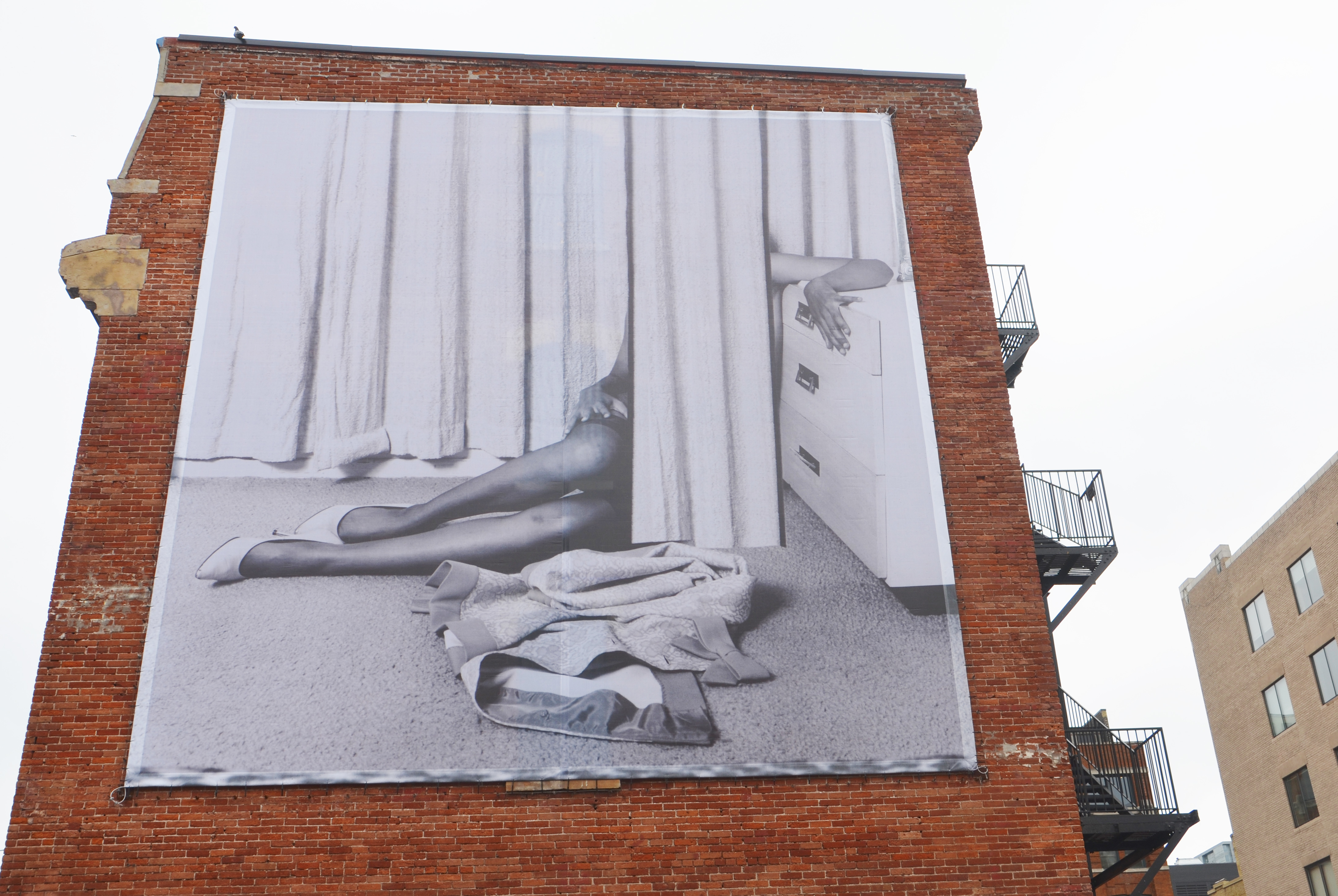
below: Up close,  ‘Drape’ by Eva Stenram.  Stenram has taken a 1960’s pin-up photograph of a woman and manipulated it.  She has brought the background, the drapery, forward and has covered up the original subject in the picture.

large black and white photo by Eva Strenram called 'Drape'. It is mounted on the upper level of a three storey red brick building. It shows a woman sitting on the floor partially obscured by drapery. Her upper body and head can not be seen.

below: Looking west on Wellington from Spadina.  The light grey building is the Old Press Hall (Globe and Mail) which will be demolished in the near future.

looking down the street past parked cars. A large black and white photo is on the side of the building.

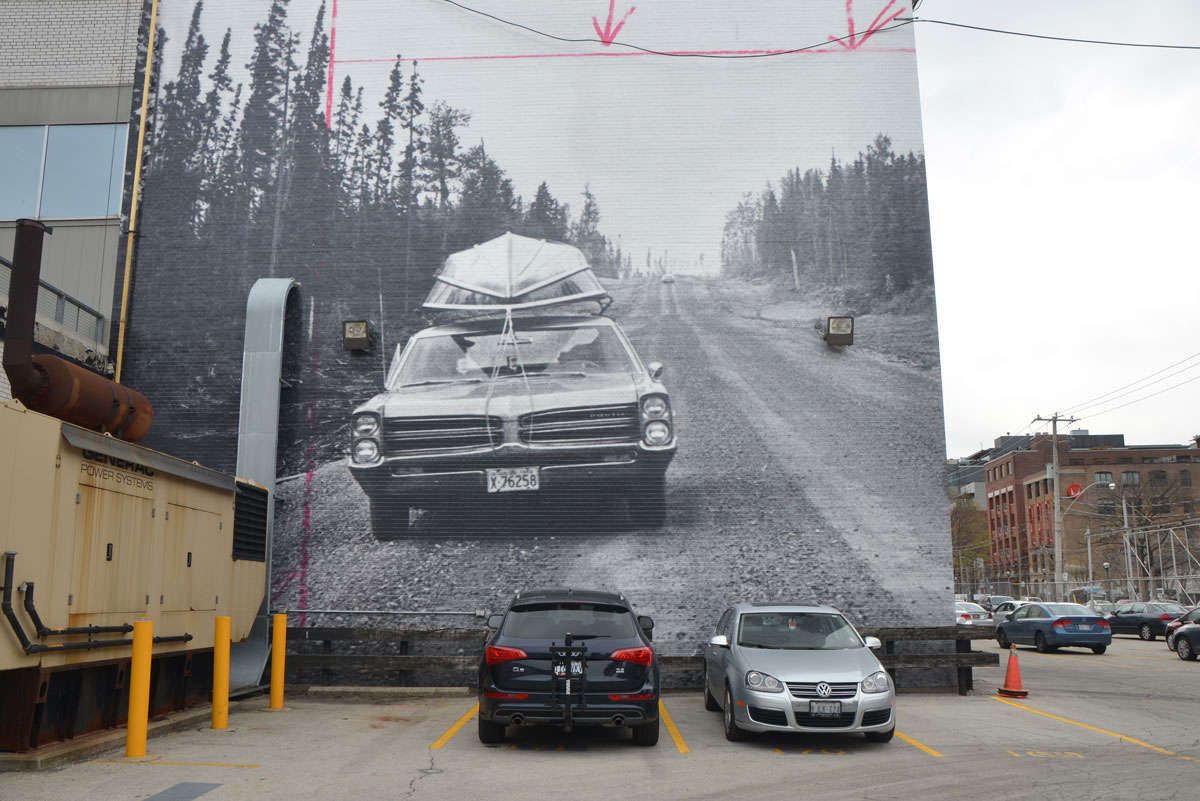
below: Up close, ‘Stopping Point’ by an unknown photographer.  The original title and description was: ‘Along the new Highway, which runs from Smooth Rock Falls to Fraserdale, Ontario, there’s no sign of human habitation apart from one empty lumber camp, c.1966. 

A very large black and white photograph from the 1960's of a car on a two lane road with pine trees on either side. There is a boat tied to the roof of the car. The photo is on the side of the Globe and Mail building with cars parked around it.

The above photograph is one of 750,000 photos in the Globe and Mail’s picture library.   100,000 of their old photos are being digitized to create a new historical archive.  From these, a collection of 20,000 prints will be donated to the newly formed Canadian Photography Institute at the National Gallery of Canada.

More of the photos from the Globe and Mail’s collection are on view inside the Old Press Hall.

I usually take a dim view of conceptual art largely because the importance given to the “words on the wall” has eclipsed the consideration given to the artwork itself.   Mediocrity in technique or creativity hides behind big jargon words and convoluted language in the artist statement.  Often the concept that the artist claims to be exploring is at odds with the end product.

When the art doesn’t live up to words that sound learned and meaningful then it degrades the work and makes the artist, and those curating the exhibit, seem pompous and out of touch.

For example, if you read that certain videos by an artist “cast a hitherto unexampled light on the conventional North American city”,  what would you expect to see?  Would you expect to see a video shot from a helicopter as it circled a city at night?  A video that looks familiar to anyone who has flown over a city after dark.   That’s what you get with Aude Moreau’s ‘The End in the Background of Hollywood 2015’ now showing at The Power Plant gallery.   I don’t have a photo of it but I do have a picture of three of her other photographs also on display.

below: From left to right (discounting the small picture farthest from the camera): 1. ‘Untitled (Hollywood Sign)’ 2015, 2. ‘LAPD (Los Angeles Police Department)’ 2015.  It’s a picture of a tiny helicopter in a large grey sky.  and 3. ‘Waiting for Landing’, airplanes lined up as they approach LAX airport.   Unfortunately, the words on the wall then go on to say, about these three images, “These demonstrate visual strategies that act upon the symbolic representation of the city and the spectacular dimension of the film industry.”  Oh my.

4 pictures hanging in a contemporary art gallery. One is a picture of the Hollywood sign taken just after dark, the next is a grey sky with a tiny dot of a helicopter in the middle, the third is too far away to discern, and the last is a picture of Los Angeles at night taken from a helicopter

And with that I left The Power Plant gallery.  Growling silently to myself and shaking my head with a mix of disdain and and frustration.   Imagine my surprise when once outside I encountered another of Moreau’s photographs.  A very lovely one.

below:  A picture of the Toronto skyline by Aude Moreau mounted on an exterior wall at The Power Plant Contemporary Art Gallery.  A picture with visual impact.

A photograph by Aude Moreau of the Toronto skyline as the sun starts to set, sunlight reflected off the buildings, darkening blue sky. The picture is mounted on an exterior wall and there is a tree in front of it as well as a couple of picnic tables

below:   You can play “spot the building” and test your knowledge of Toronto geography.   You can line up the DBRS building, the Hilton Hotel and the Canada Life building on University Avenue along with the Sheraton Hotel on Queen street.   The blue addition on the AGO is farther north on Dundas.  Can you think of where the photo was taken?  Apparently, it was taken from Toronto Fire Station 315 at College Street and Bellevue Avenue.  It was taken just after sunset but when there was still enough light in the sky to reflect off the taller buildings.   Moreau makes the city sparkle.

A photograph by Aude Moreau of the Toronto skyline as the sun starts to set, sunlight reflected off the buildings, darkening blue sky. The picture is mounted on an exterior wall and there is a tree in front of it

I must have seen this picture very shortly after it was installed.  It is part of the CONTACT photography festival that starts this weekend but there was no accompanying sign, no words that attempted to a explain the image.  Perhaps that was for the best.  In fact, I now have the CONTACT catalogue with their description of the artwork but I think I won’t read them.  I’d rather enjoy the picture just the way it is.

Part of CONTACT photography festival,
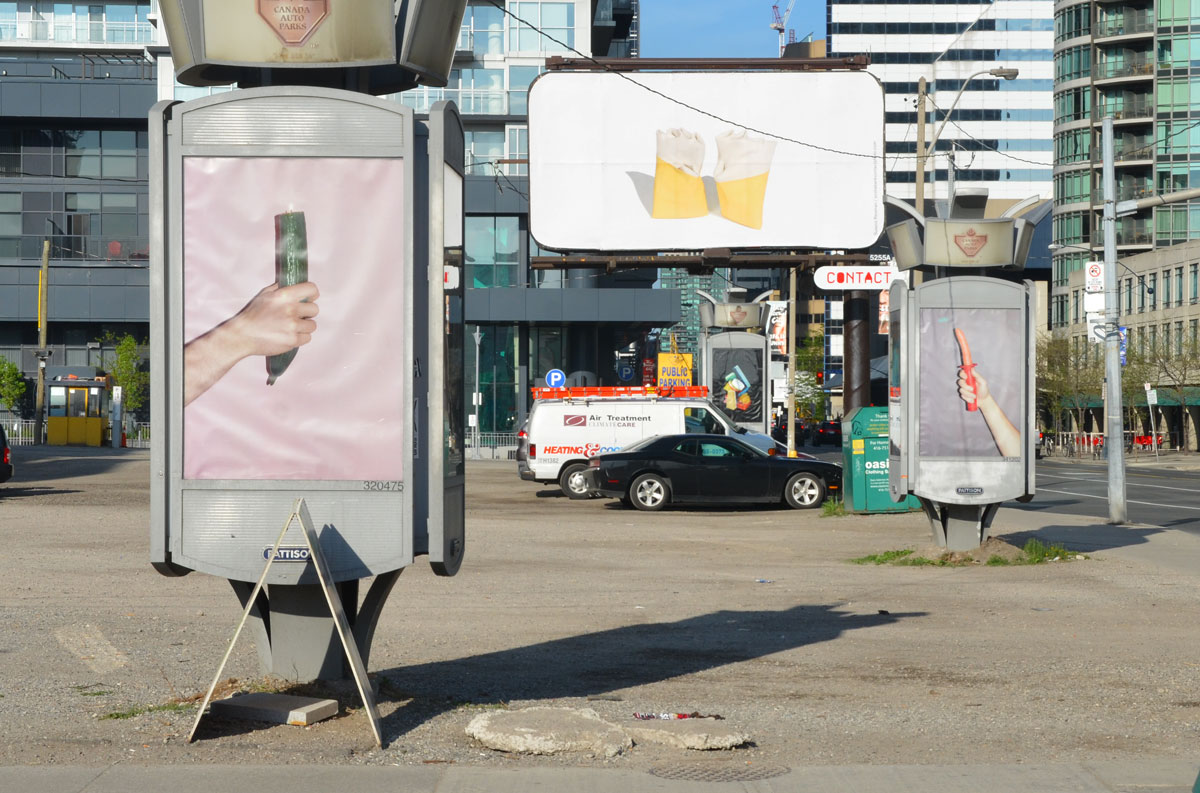
billboard “art” on the NE corner of Spadina and Front streets.

All the billboards are in a parking lot in what was a junky looking space to begin with.

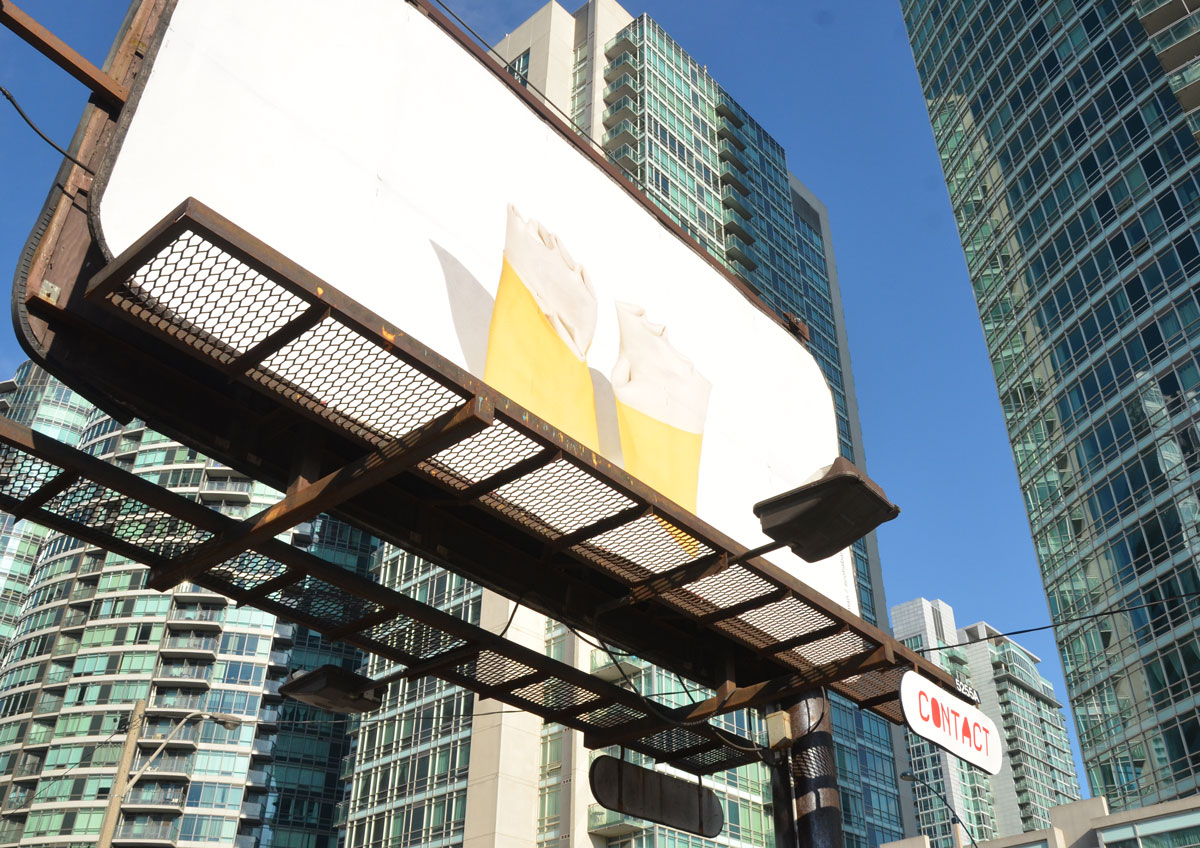
below:  Yellow rubber gloves with the fingers tucked back in…
to look like they’ve just been taken off a pair of hands?

a billboard above a parking lot, condos in the background.   A pair of yellow rubber gloves with the openings turned into a cuff are all that in the image on the board

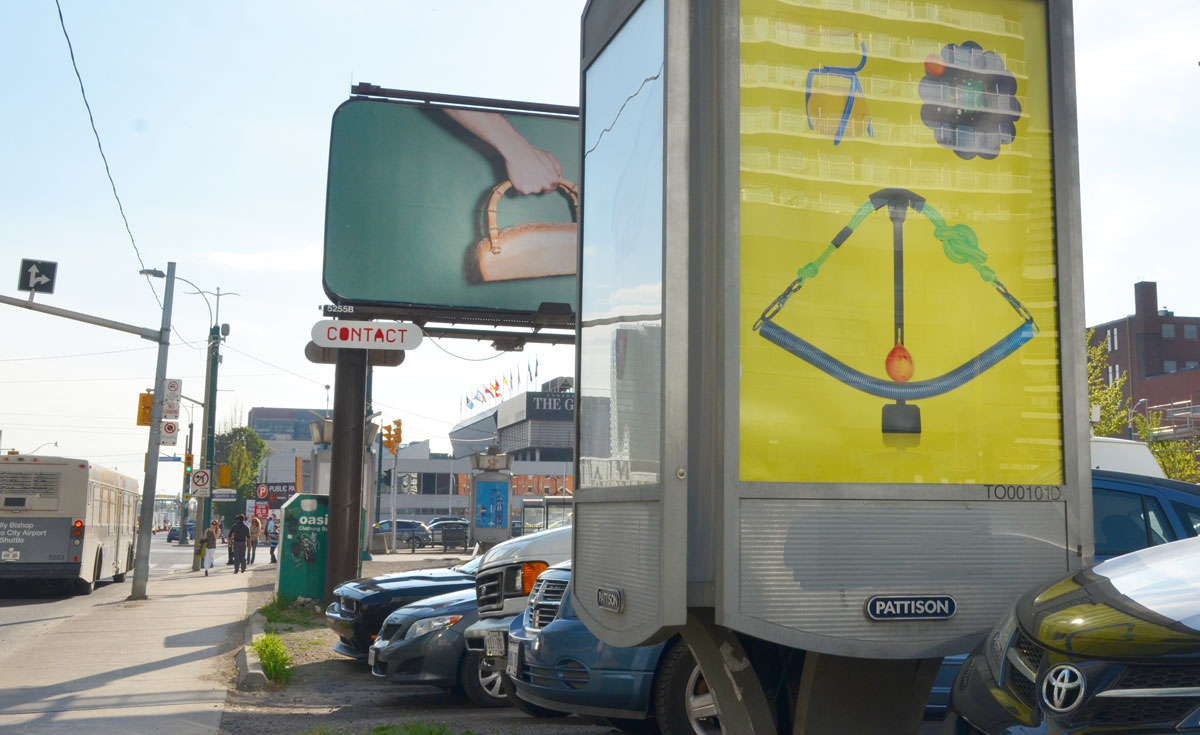
below: The body of the handbag is a loaf of bread.

a small billboard in front and a larger, higher one in the background.   In the background is a woman's hand holding what looks like a handbag but the bag part is made of a loaf of bread.  In the foreground, yellow background with household objects arranged in a face like shape.

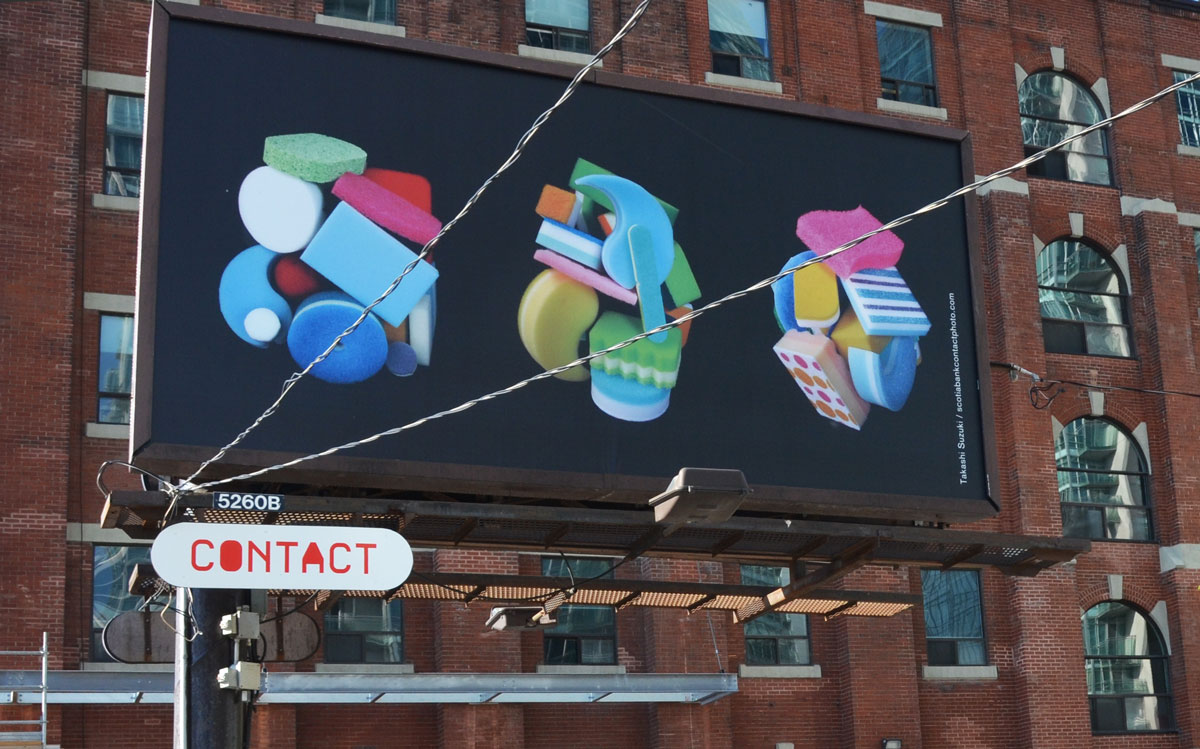
below: Clusters of sponges.  At first I thought they were candies.

billboard art - three clusters of colourful sponges on a black background

three billboards with art images instead of advertisements
Supported by Pattison Outdoor Advertising and Nikon Canada.

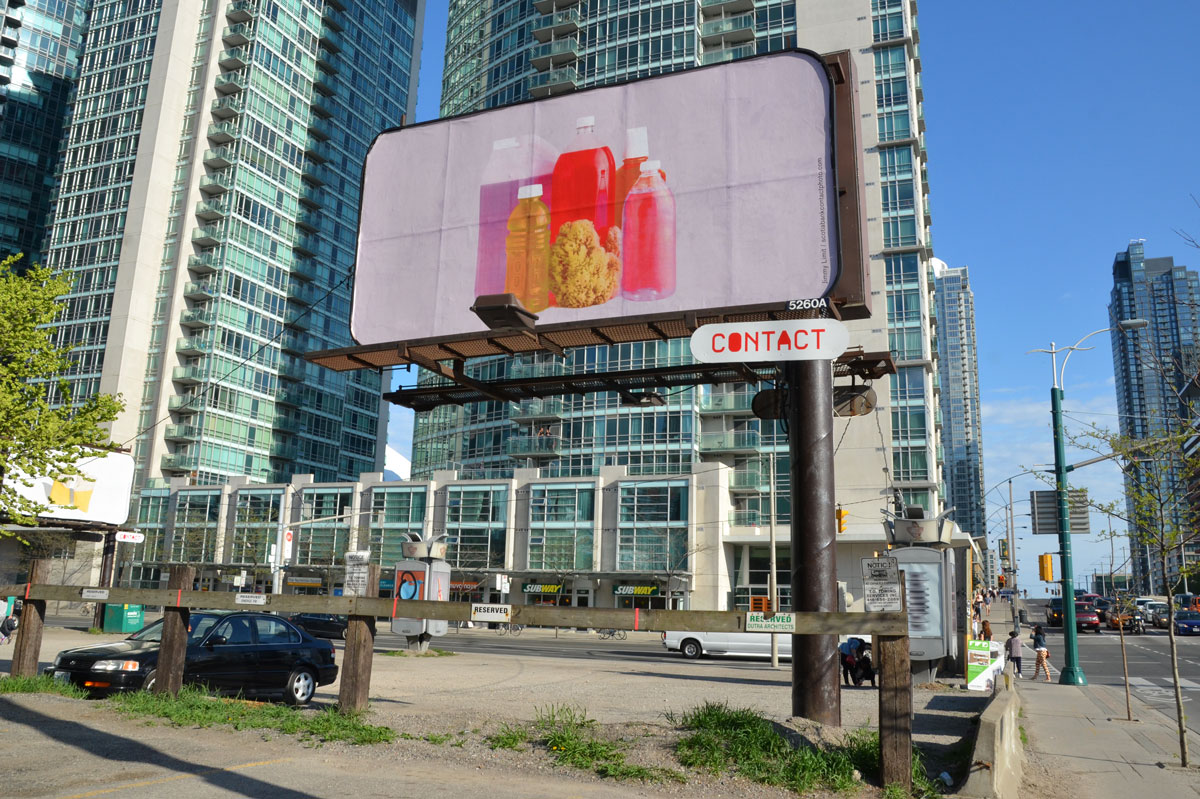
a billboard with a large picture of clear bottles filled with coloured liquids in reds and oranges.

“Challenging how people perceive and interact with images in public spaces”

“Each of the artists destabilizes the conventions of advertising and the cultural codes associated with consumer lifestyles.”

Me?  I’ll call them dull and underwhelming clutter.  Too harsh?  Perhaps.
I’ll leave the verdict up to you.

Part Picture,
an exhibit at MOCCA,
part of CONTACT Photography Festival

Like the introduction of film photography once usurped the role of painters and engravers, the introduction of digital photography has supplanted the photographer of old.  We are all photographers now.  A smartphone.  A little bit of software.  And presto, you have a picture.   Many, many bazillions of pictures.  Photography excels at visually telling stories, documenting events or capturing a moment in time either with a single image or in a series of photos.  The expression ‘a picture paints a thousand words’ comes to mind.  Even a blurry selfie says something.

Photography has always had an uneasy relationship with art (with the fine art, visual artsy stuff in particular).  This art, while also visual, often has a slightly different focus.  It too aims to elicit emotions and reactions but no one expects an artwork to document or to tell a story albeit some do.  But art too is in flux (and probably has been for a while).   What hasn’t already been done?  What rules are left to break?

So what’s a photographer to do?


pictures on a gallery wall.  the picture in the foreground has 4 coloured wires protruding from it, 2 yellow and 2 red.

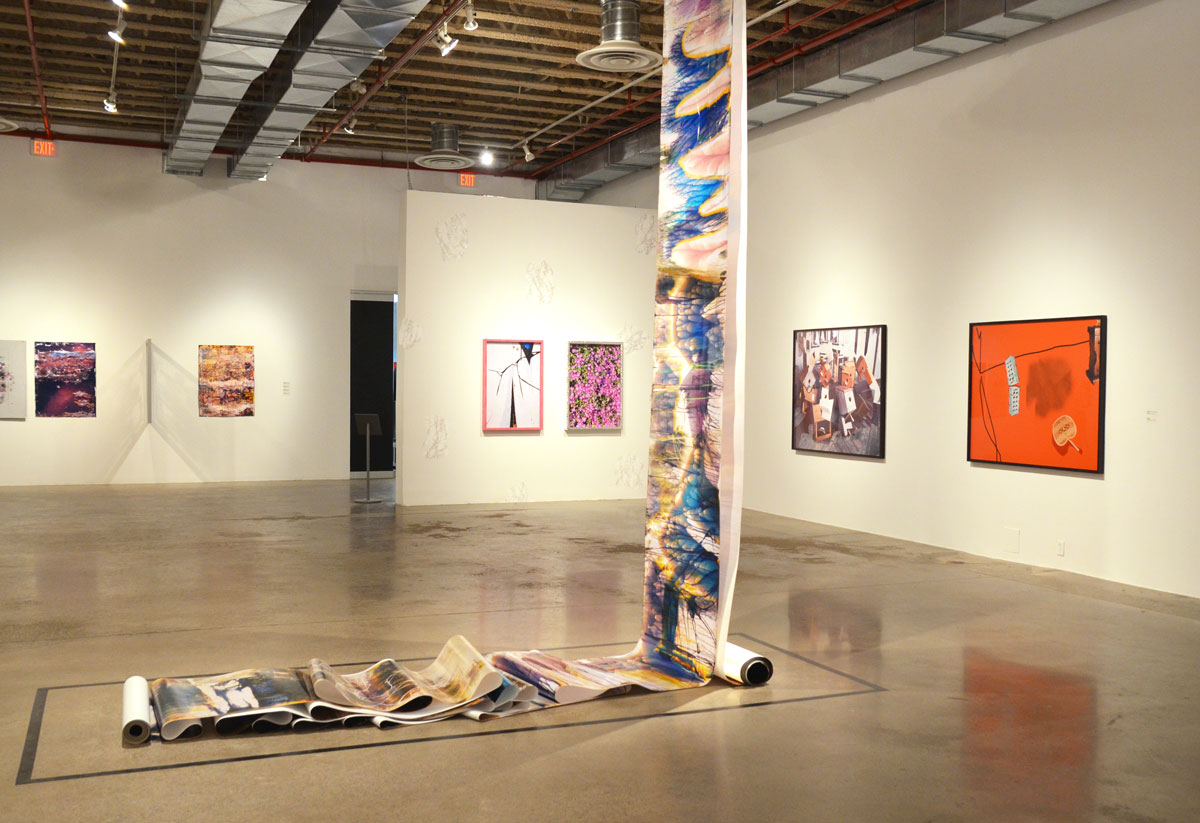
Part of the description of this exhibit states: “placing photography in conversation with other artistic mediums – particularly painting and sculpture – to create hybrid works that are only part picture”.

pictures on an art gallery wall.  In the middle of the room is a large roll of photographic paper that has been developed with streaks of colour.  It hangs from the ceiling and lays on the floor.

Experiments with chemicals on photographic paper; experiments with photoshop artifacts as part of the image;  experiments with how one frames or hangs a picture.  What is photography anyhow?

two pictures on a wall of a gallery.  The one on the right is of pink flowers and is in a metal frame.   The one on the left is an abstract of white and black that looks like cracks in a white surface

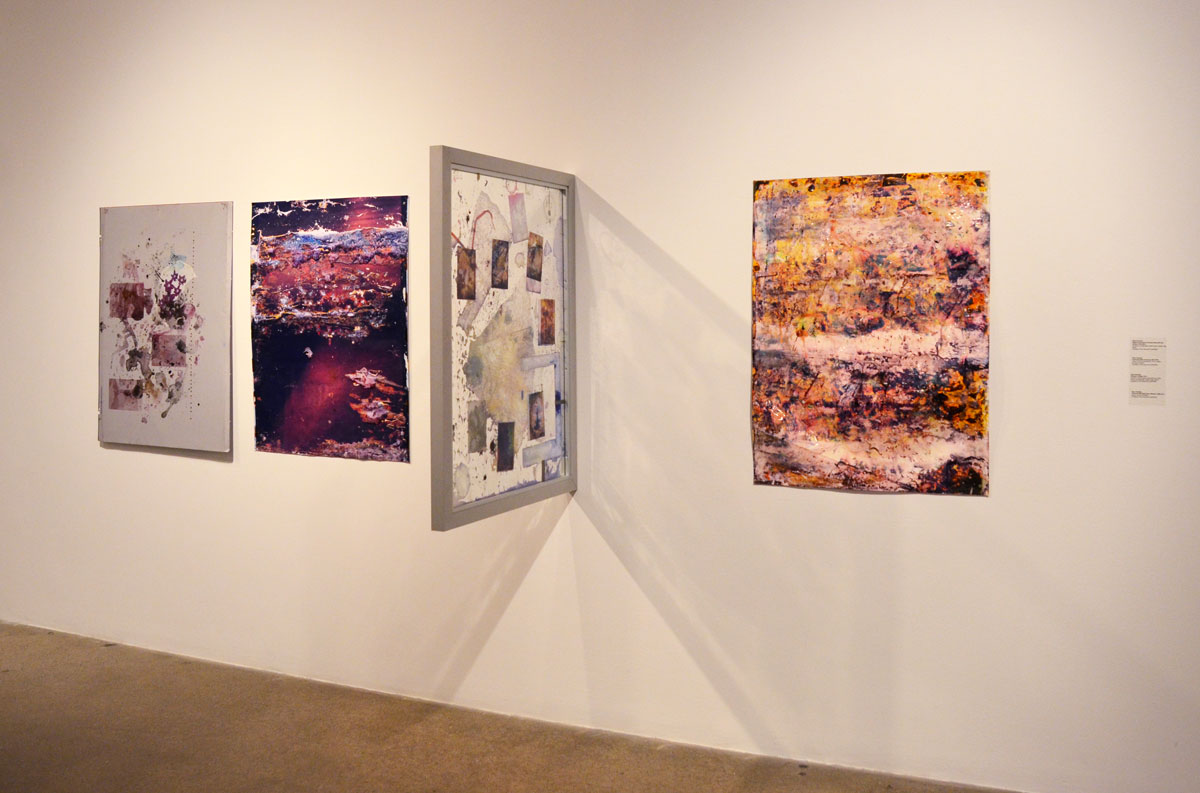
Four pictures on an art gallery wall, all abstract.  One of them protrudes from the wall at a 90 degree angle.

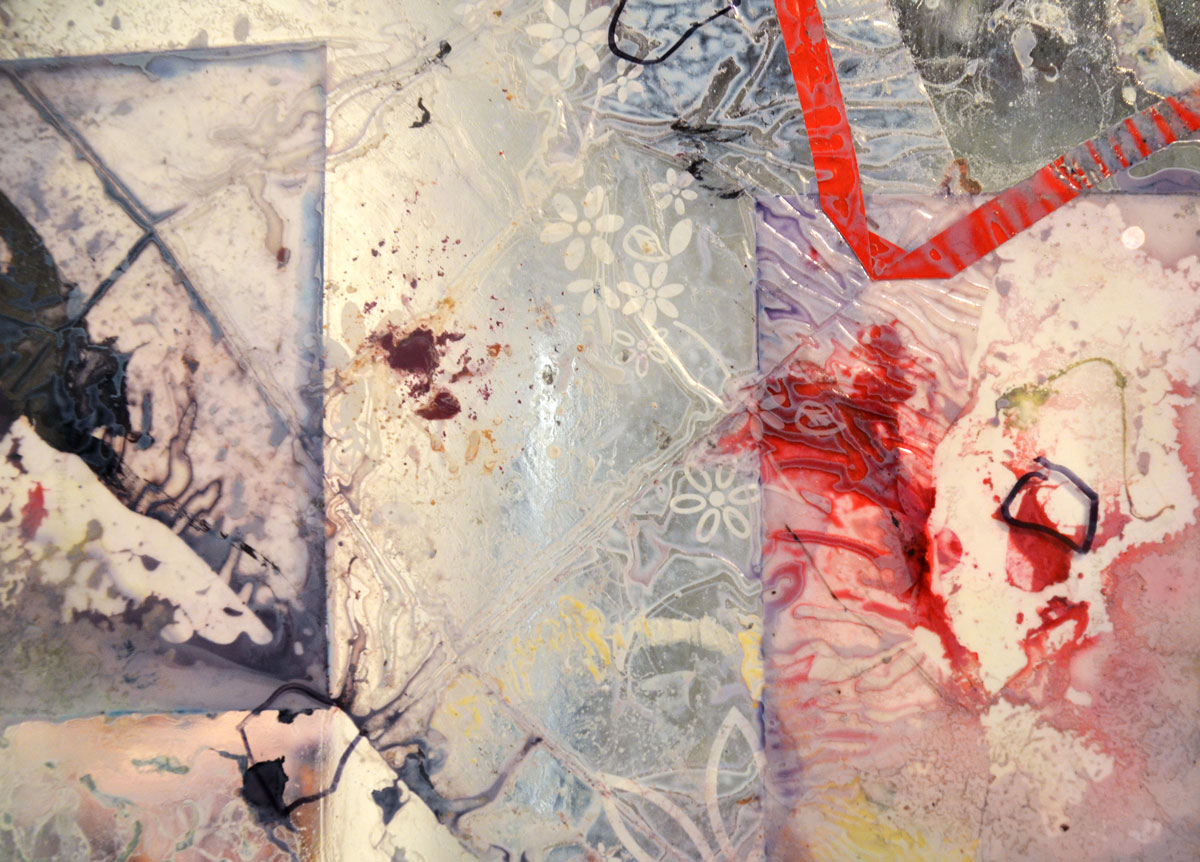
below: close up of part of the picture from above, the one that is hung perpendicular to the wall.

close up of what looks like a collage

Just because something is different doesn’t mean that it’s good just as not all experiments are a success but  kudos to those who try.  I will leave it to you to decide which category (good/bad) these pictures fall into.

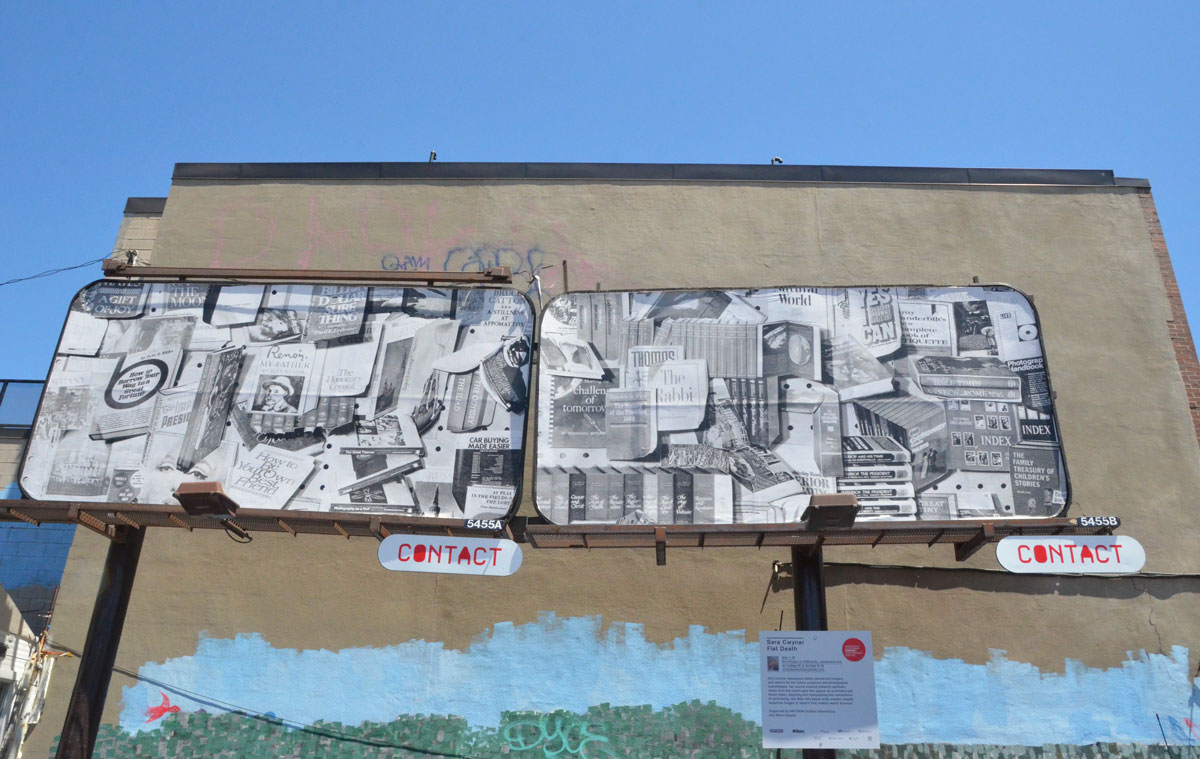
Flat Death and Contemporary Floral Arrangements,
by Sarah Cwynar,
large photographs on billboards on Lansdowne Avenue,
Part of CONTACT Photography Festival.

below: ‘Flat Death’ at Lansdowne and Dundas West.
Black and white photos of books on four billboards.

billboards above a used car lot, 3 billboards with large black and white photos of books.

Two billboards side by side each with a large photo of old books in black and white

bikes parked in a bike stand in the foreground, a used car lot in the background.  Above the car lot is a billboard with a black and white photo of old books.  A Lansdowne TTC bus is on the right hand side.

 below:  ‘Contemporary Floral Arrangements’ on the corner of Lansdowne and College

The foundation for ‘Contemporary Floral Arrangements’ are 1960’s photographs of floral arrangements.  Small objects such as key chains, plastic bits, buttons, spools of thread, etc are then placed on the photos, matching colour and tone.

An building with a 'car wash' sign on it but the windows are covered with a sign for "engima' cond development.  On the roof of the building is a billboard with a large photo of a flower arrangement.

The idea that this is an ad made of things that no one wants may be interesting in theory but in practice it’s just a pretty picture.  Because of the location of the billboard, the details of the picture can’t be seen.

At an intersection, An building with a 'car wash' sign on it but the windows are covered with a sign for "engima' cond development.  On the roof of the building is a billboard with a large photo of a flower arrangement.

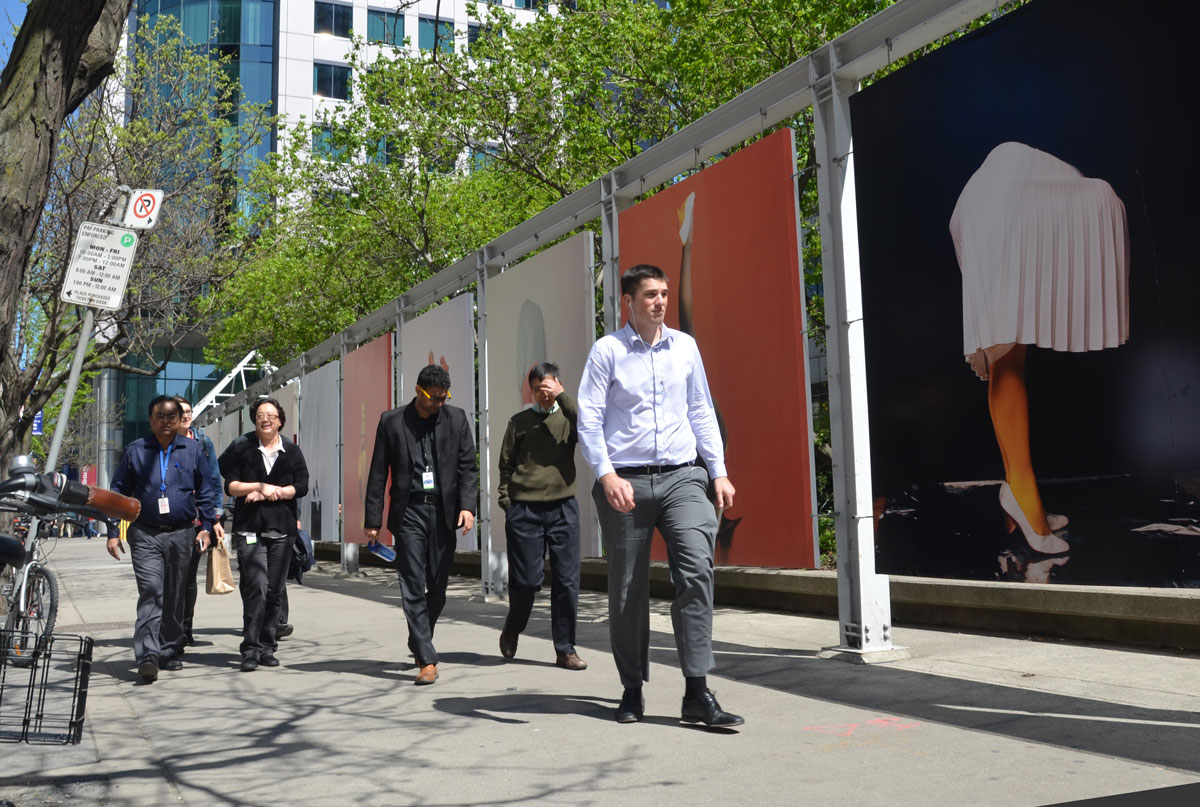
Figures and Models of Surfaces,
by Isabelle Wenzel,
on King St. West at John (by Metro Hall).
Part of CONTACT Photography Festival.

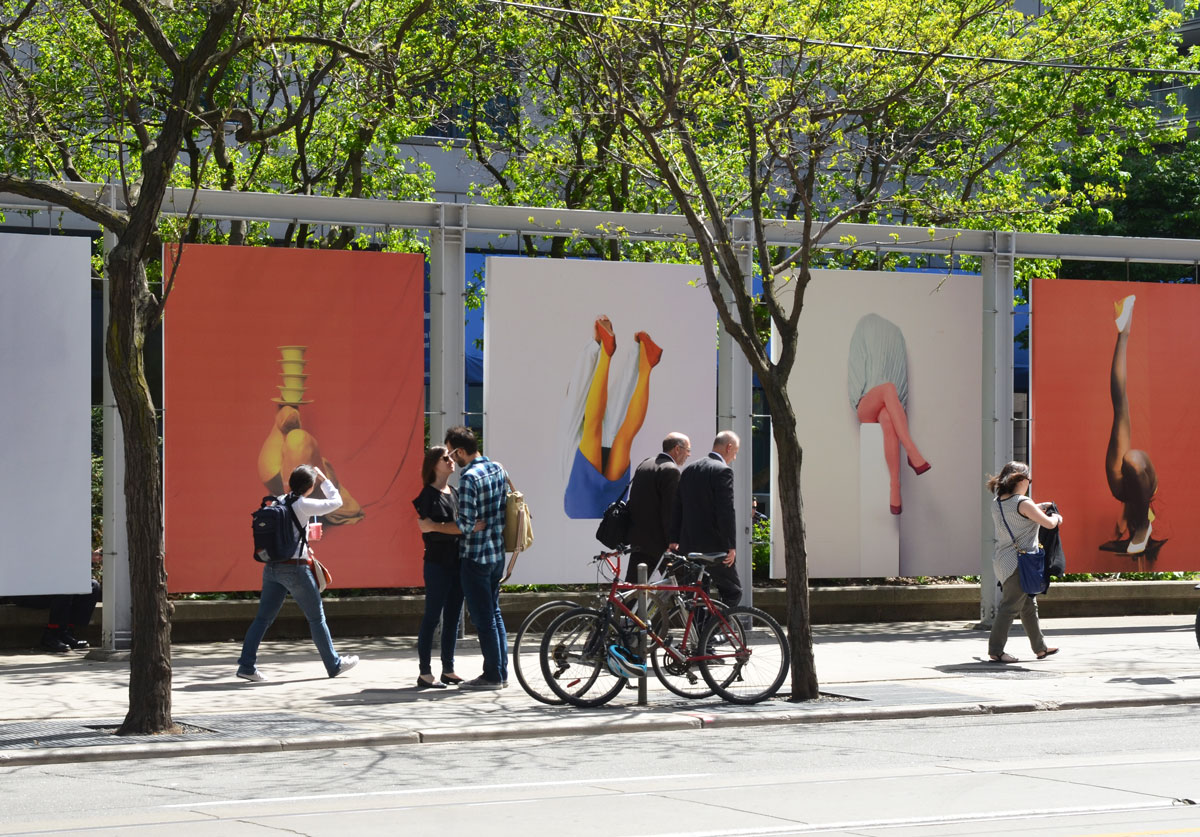
Six people walking on a sidewalk.  They are walking past a row of large pictures of legs in various strange poses on bodies with no upper parts.

“I’ve got two legs from my hips to the ground
And when I move ’em they walk around
And when I lift ’em they climb the stairs
And when I shave ’em they ain’t got hairs.”

 “I’ve Got Two Legs” by Monty Python’s Terry Gilliam

That’s the sort of thing that went through my head as I took these photos.

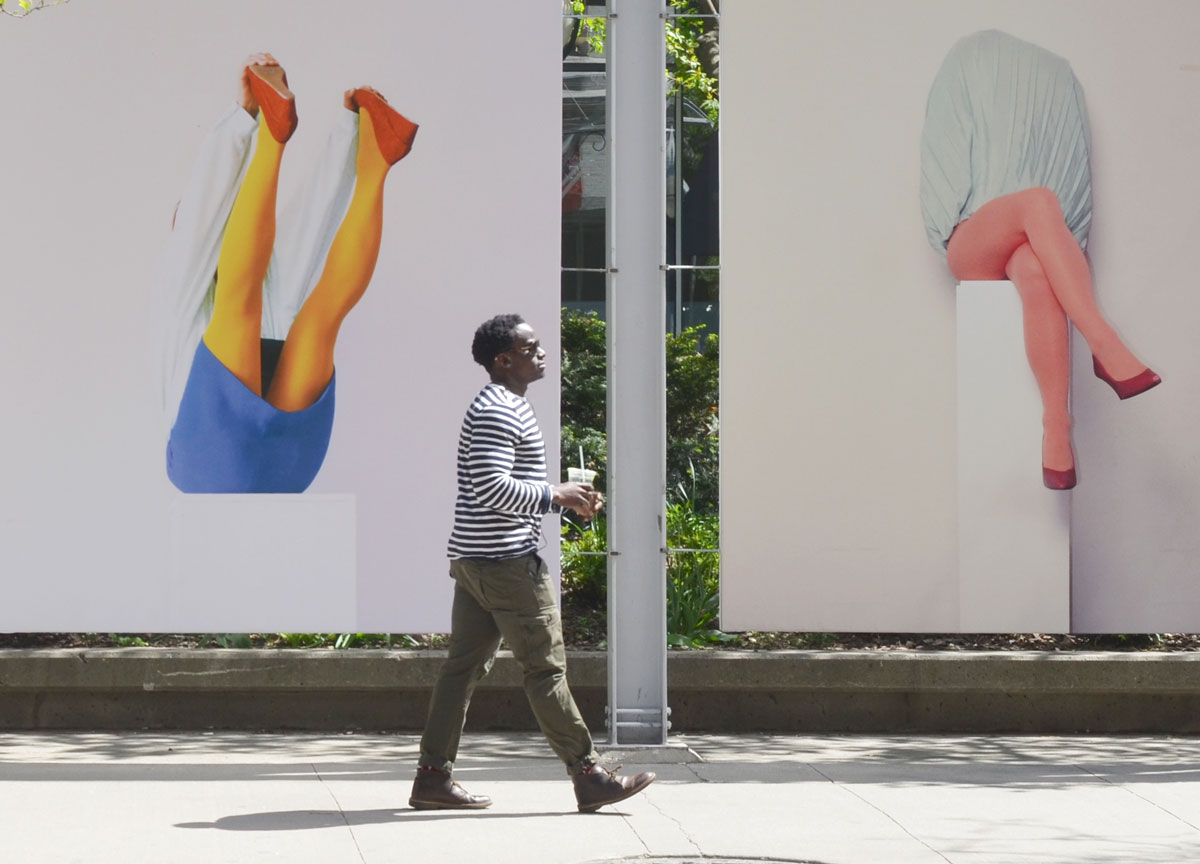
A man in brown pants and a brown and white striped shirt is holding a drink in his hand as he walks past two large pictures of legs.

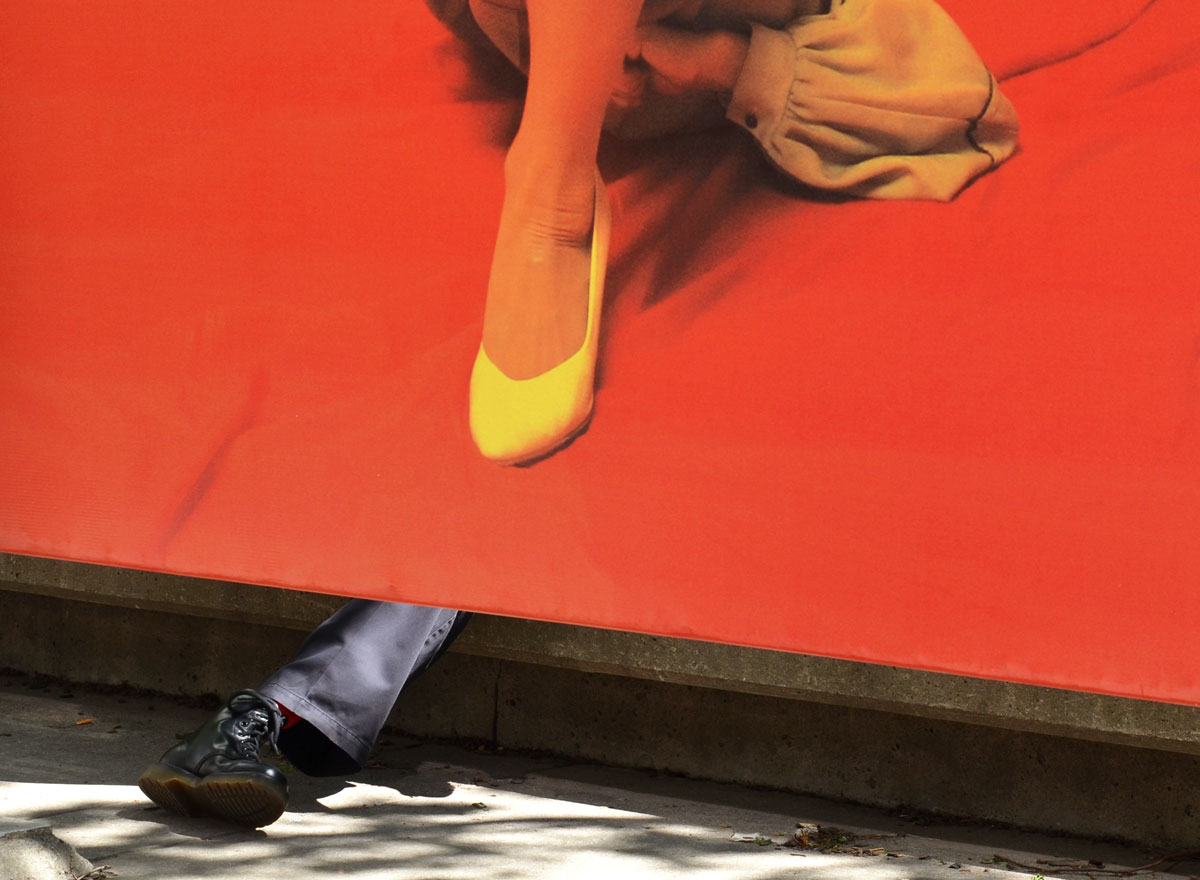
a man's leg and black boot stick out from under a picture of a woman's leg with a yellow shoe, on a bright orange background.  A man is sitting on a ledge behind the photo.

All photos are self-portraits of the photographer.
Legs as sculptural elements – colour, shape and composition.
Legs as objects – objectification of the legs is now complete.

people in front of 4 large photos of legs by Isabelle Wenzel.  A couple are saying goodbye, two men in suits are walking together, a woman is looking at the pictures as she walks past and another woman is walking out of the photo on the right.

These legs were made for walking.  Not.
Just walk on by.
More silly thoughts as I watch people walk past the pictures.

Two young women are alking past a few large, larger than life photos of legs.  The women have their arms up in the air.

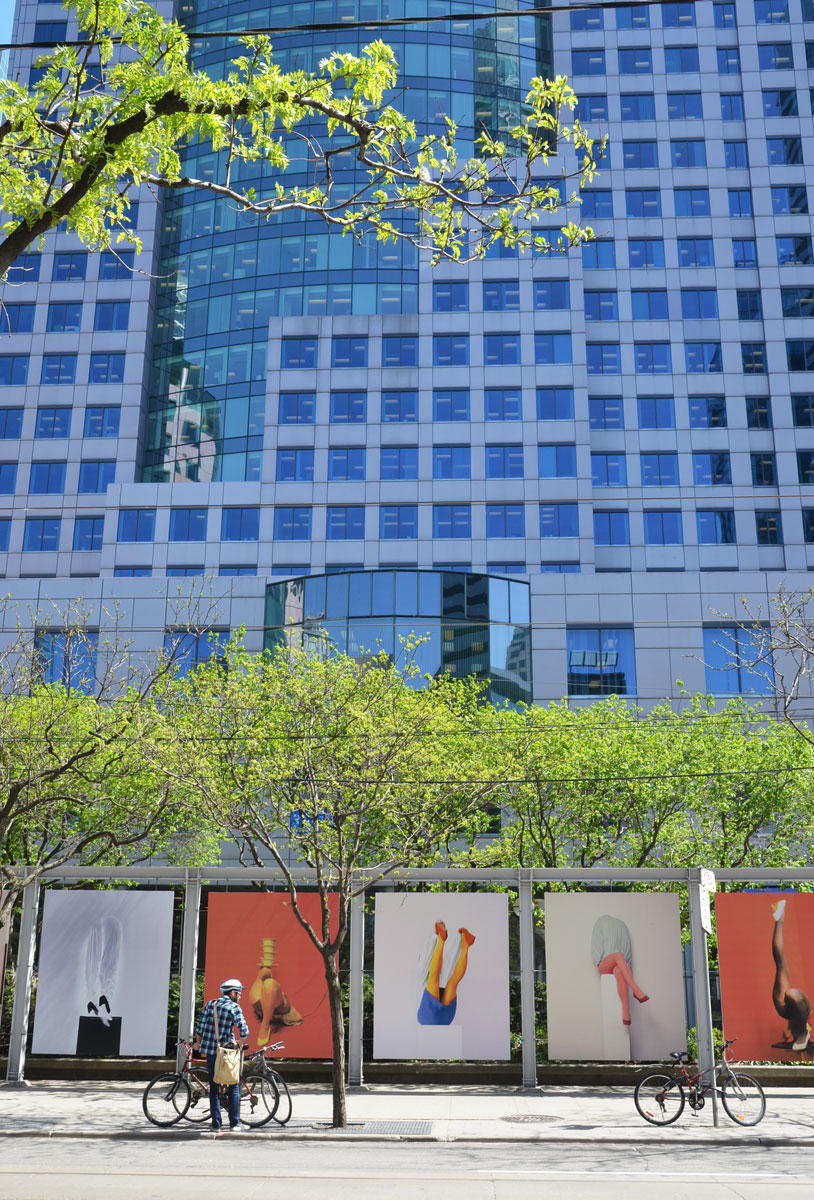
below:  The blue tones of Metro Hall provide a backdrop.

A tall bluish colored glass building with a sidewalk in front.  Along the sidewalk is a row of short young trees with new leaves.  There is also a row of large photos of legs on the sidewalk between the building and the street.

Fun.  Great installation.

Edouard
a CONTACT photography festival exhibit,
VIA Rail Concourse (i.e. where the trains depart from)

Edouard LeBouthillier documented his life in Toronto in the 1970’s and early 1980’s with Polaroid pictures.  On the back of the photos he noted dates and places.  He also took pictures of Toronto buildings and landmarks that were newly constructed or in the process of being torn down (e.g. the old Eatons store at Yonge & Dundas).

There are two exhibits of his work being shown at CONTACT this year.  The first, shown below, is on the east side of the VIA Rail Concourse of Union Station where a number of large prints are on display.  If you have trouble finding them, look for VIA platforms 12 and 13.

A second Edouard exhibit is at Art Metropole (1490 Dundas West) and it consists of some of the original polaroids that show his domestic life.

below:  At new City Hall.
In front of the tulip garden on the left and lying by the fountain on the right.

large photographic prints on display at Union Station

large photographic prints on display at Union Station

below: Edouard was at the CNE on the 17th of August 1977.

large photographic prints on display at Union Station

below: On the left is Ed’s Wacky Wirld store, 1977

large photographic prints on display at Union Station