Posts Tagged ‘photos’

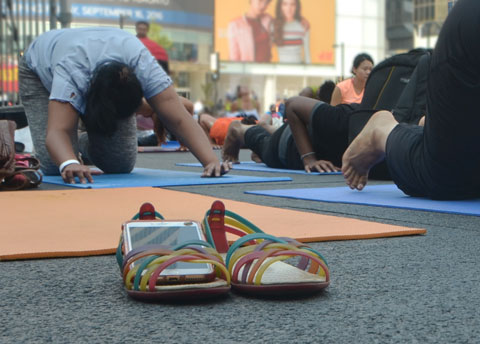
close up of a phone tucked inside a sandal, beside an orange yoga mat. People around are doing yoga outdoors,

5th annual yogathon at Yonge Dundas Square
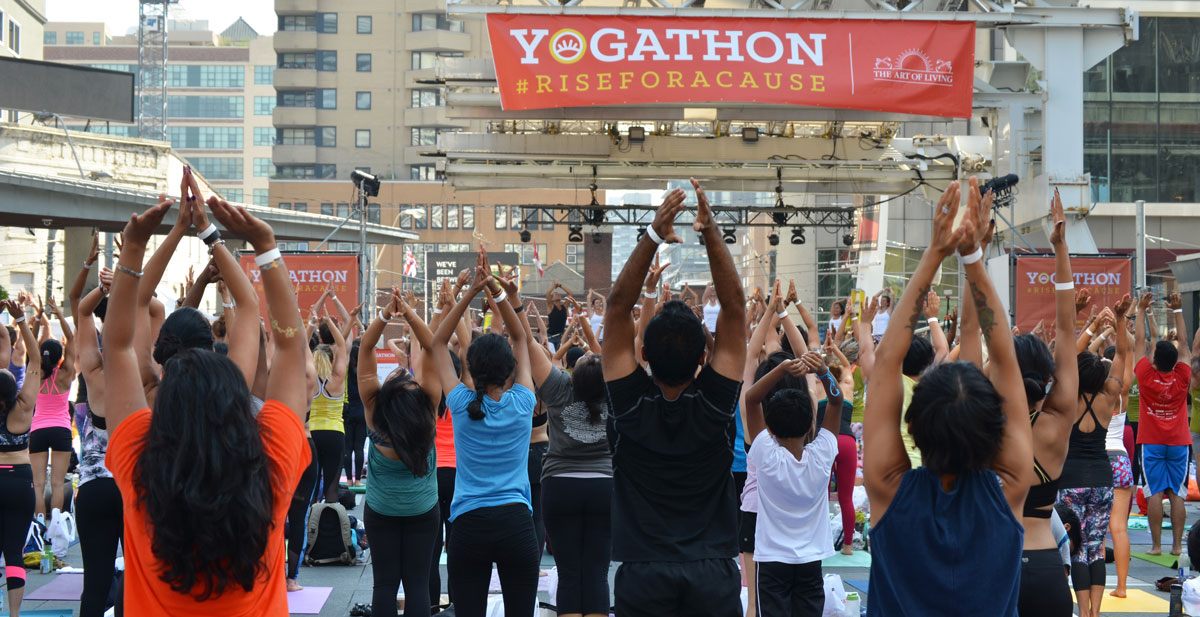
A banner that says Yogathon rise for a cause hangs over a crowd who are standing with their arms in the air as part of the activity

A smiling woman outside, with sunglasses on, in a crowd of people

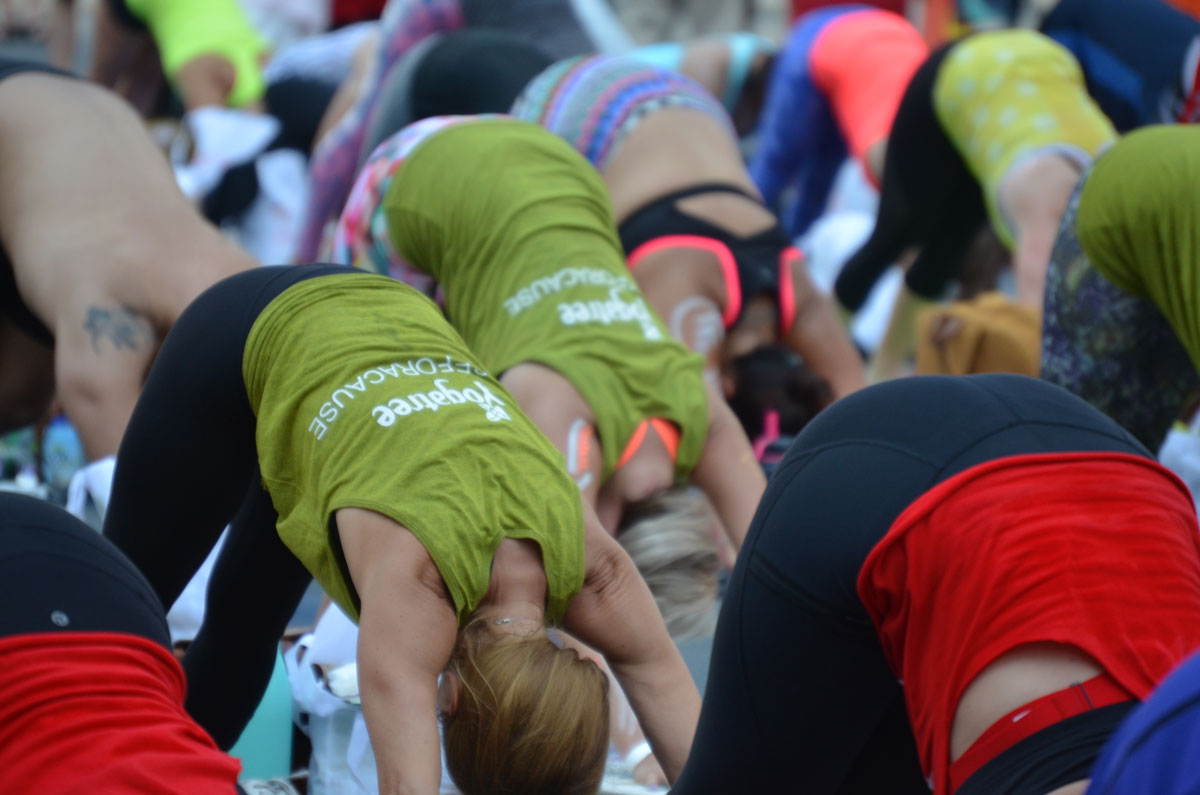
a group od people outside, all with bums up in the upward dog position (I think). All doing yoga in a yogathon

a young Asian man with his arms up in the air, doing yoga positions, with a large group of people

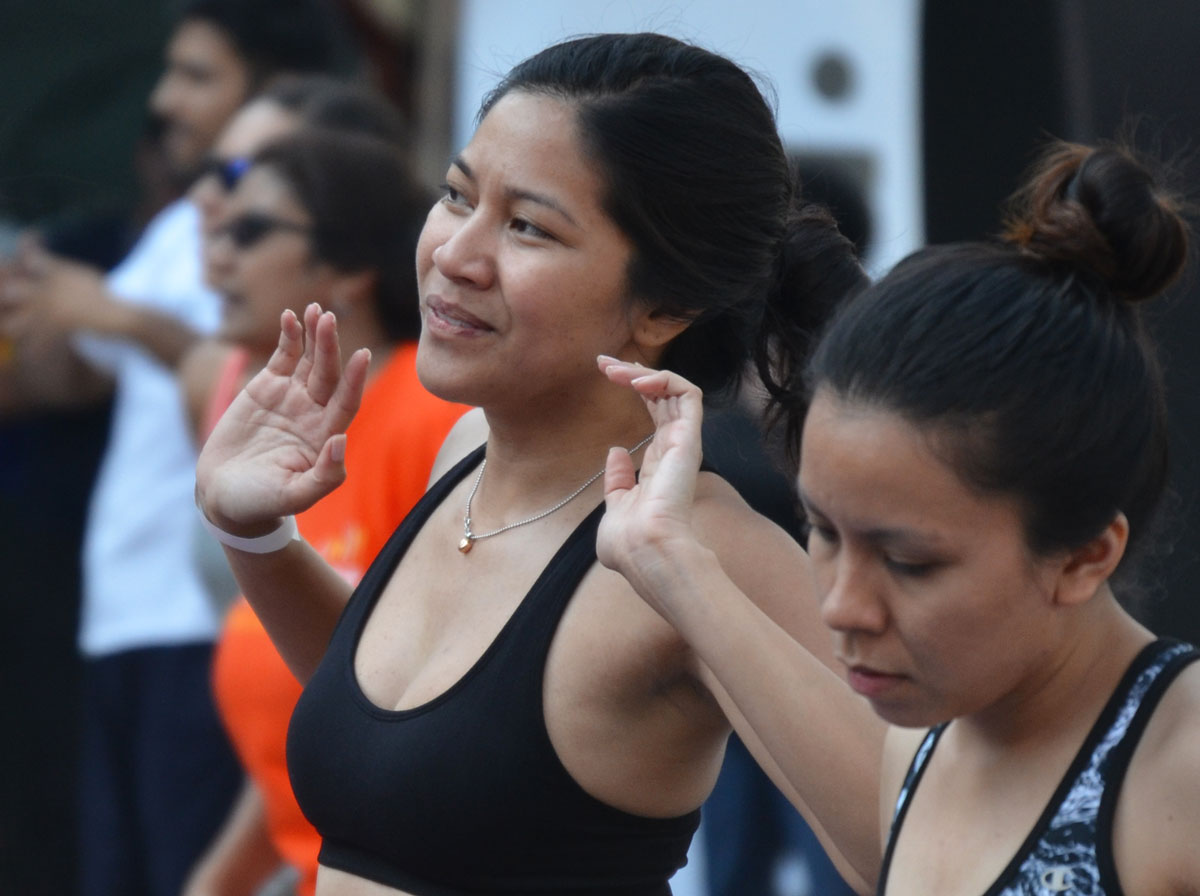
a young Asian woman with big sunglasses, palms together and fingers spread, doing yoga with a group of people outdoors

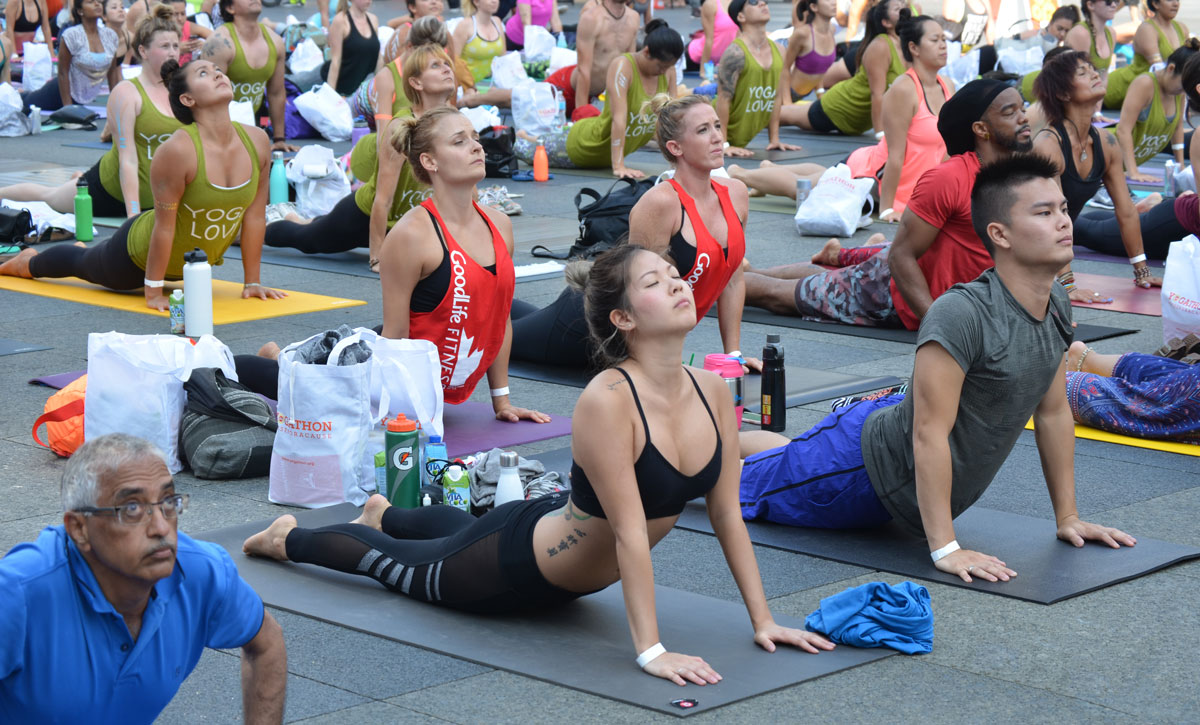
group of people on their mats doing yoga outside together

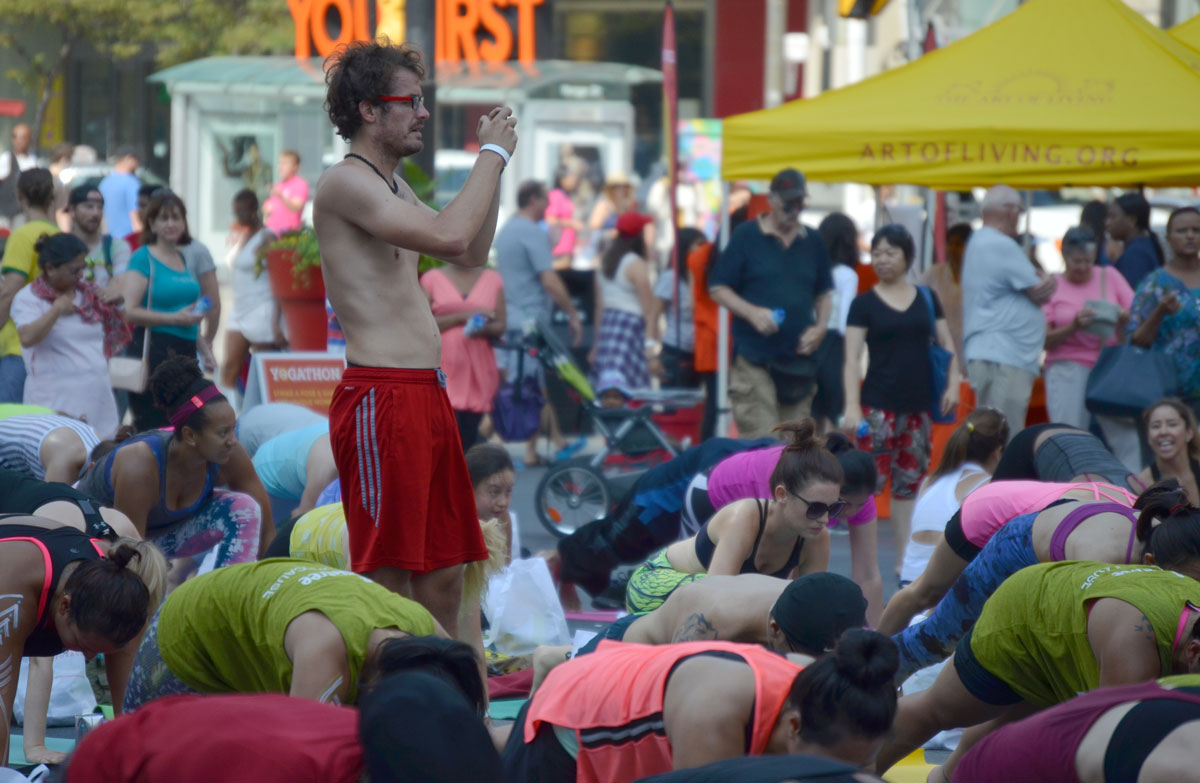
a man stands in the middle of a group taking a picture, the rest of the group is on the ground, on their yoga mats, doing yoga at a yogathon, outdoors,

a woman with her eyes closed in the downward dog yoga position as she participates in a yogathon with many others, outside

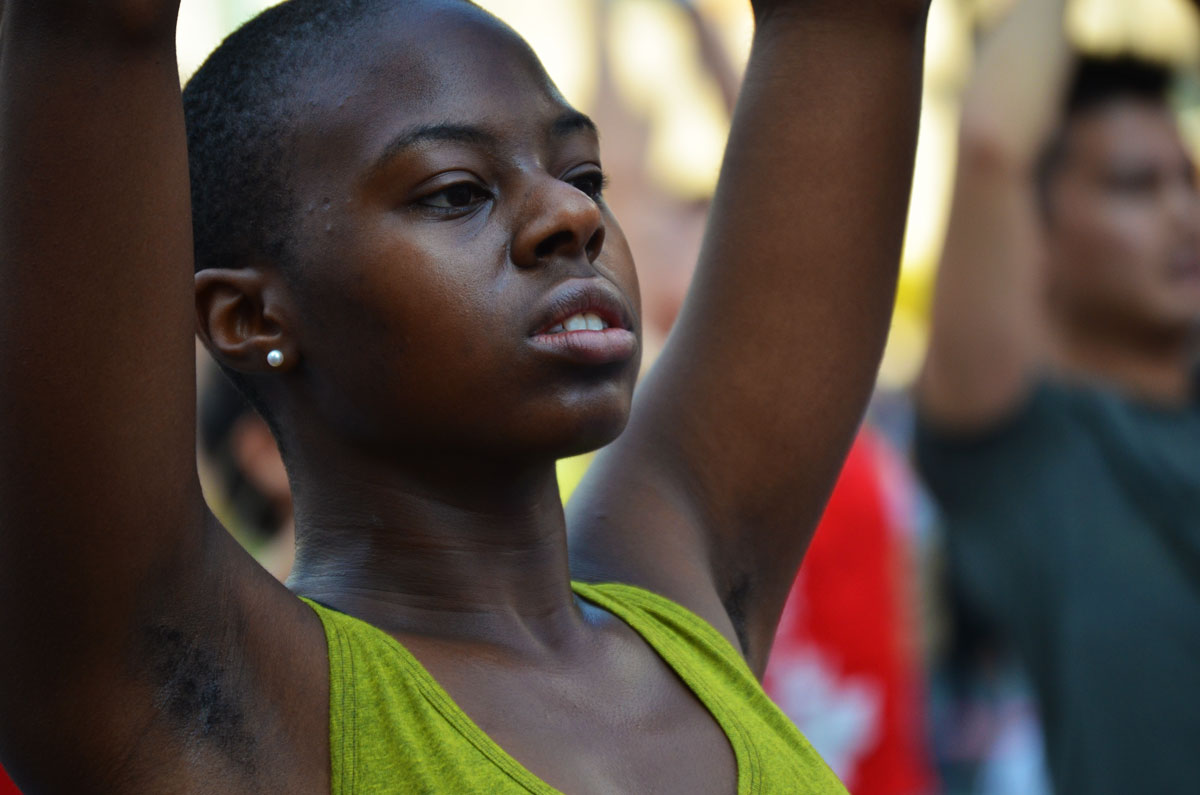
young black woman, close up of head and shoulders, with arms raised doing yoga

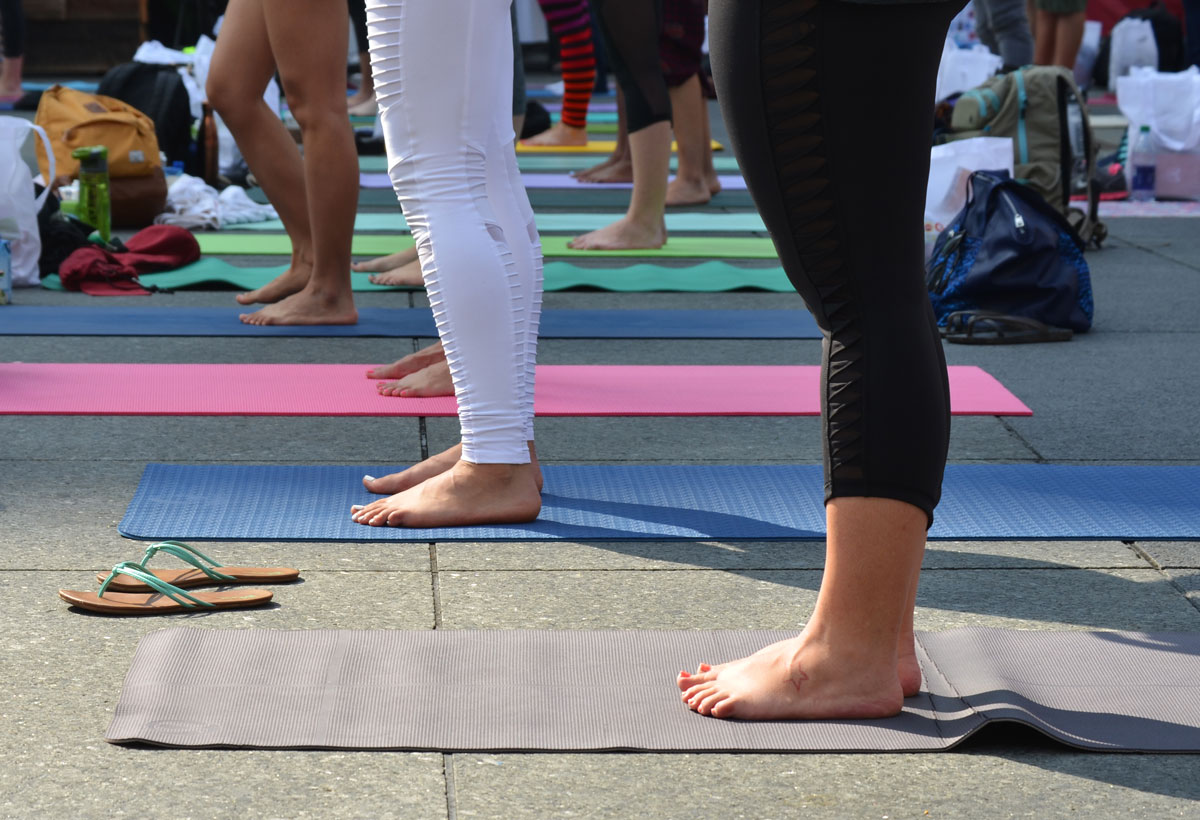
bare feet on yoga mats, legs in leggings, photo cropped so there are no bodies in the picture

a woman with her hands up at chin level, palms facing outwards

a group of people practising yoga outside

young asian man in sunglasses and white t-shirt

Two men, one in focus in the foreground and one fuzzy in the background. they are both wearing orange t-shirts that say yoga warrior on the back.

back of a woman's head, long braid down her back, arm up in air as she does yoga

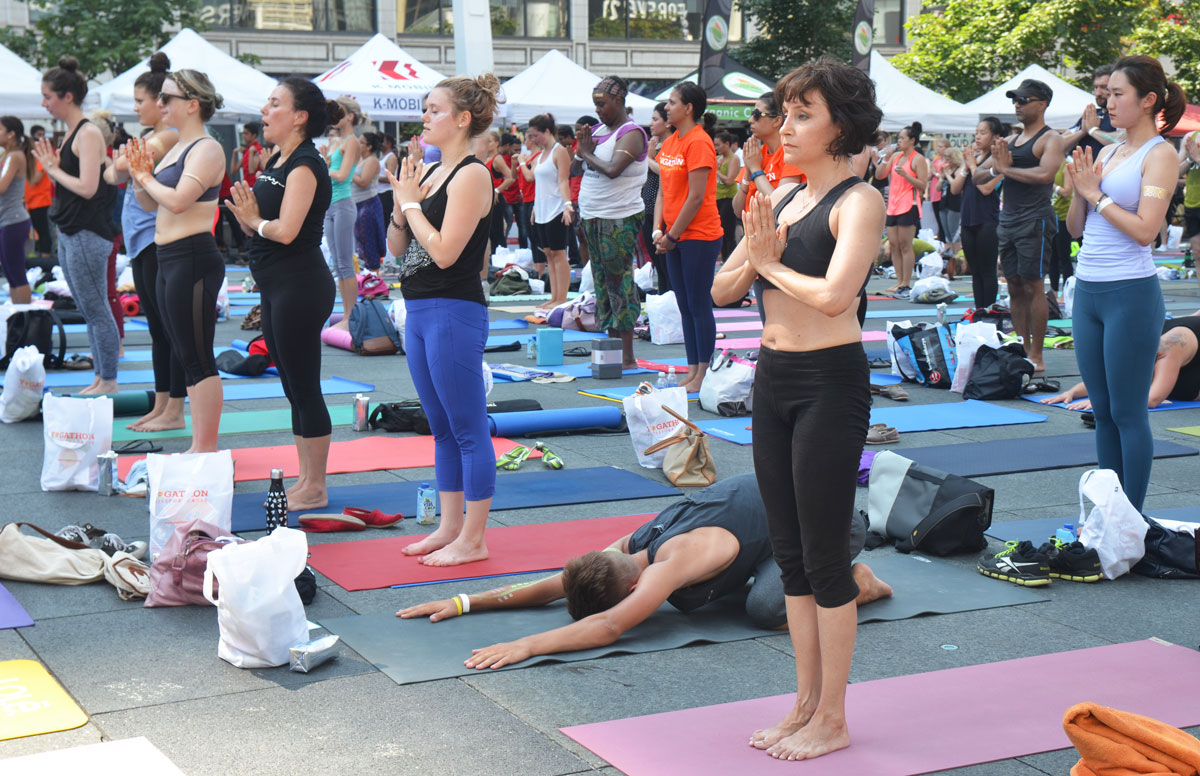
people standing on yoga mats, hands together, palms pressing together looking like they are praying

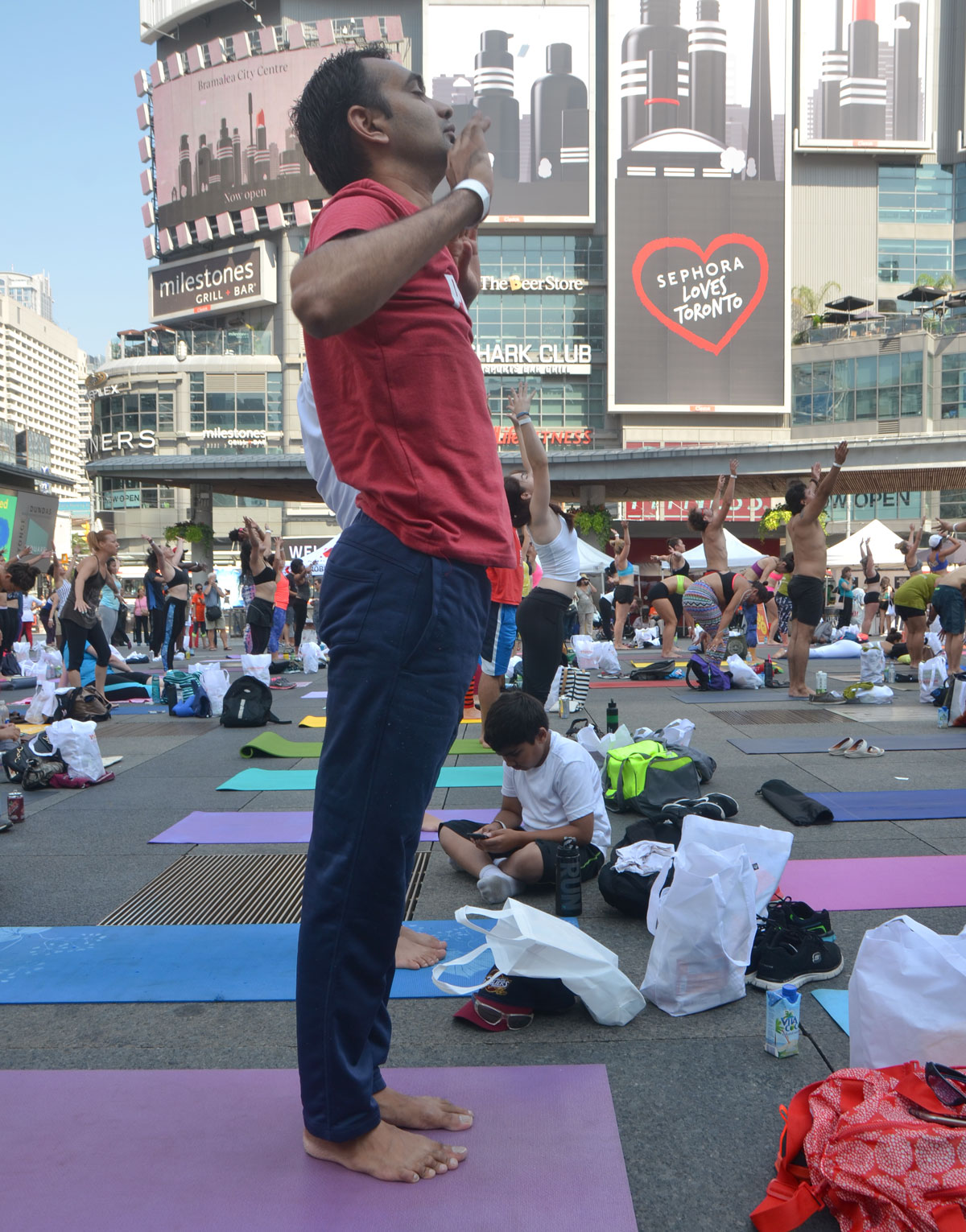
a man in red shirt and blue pants is standing tall, others around him also standing in yoga position, a boy is sitting on the ground with his legs crossed and looking at something in his lap

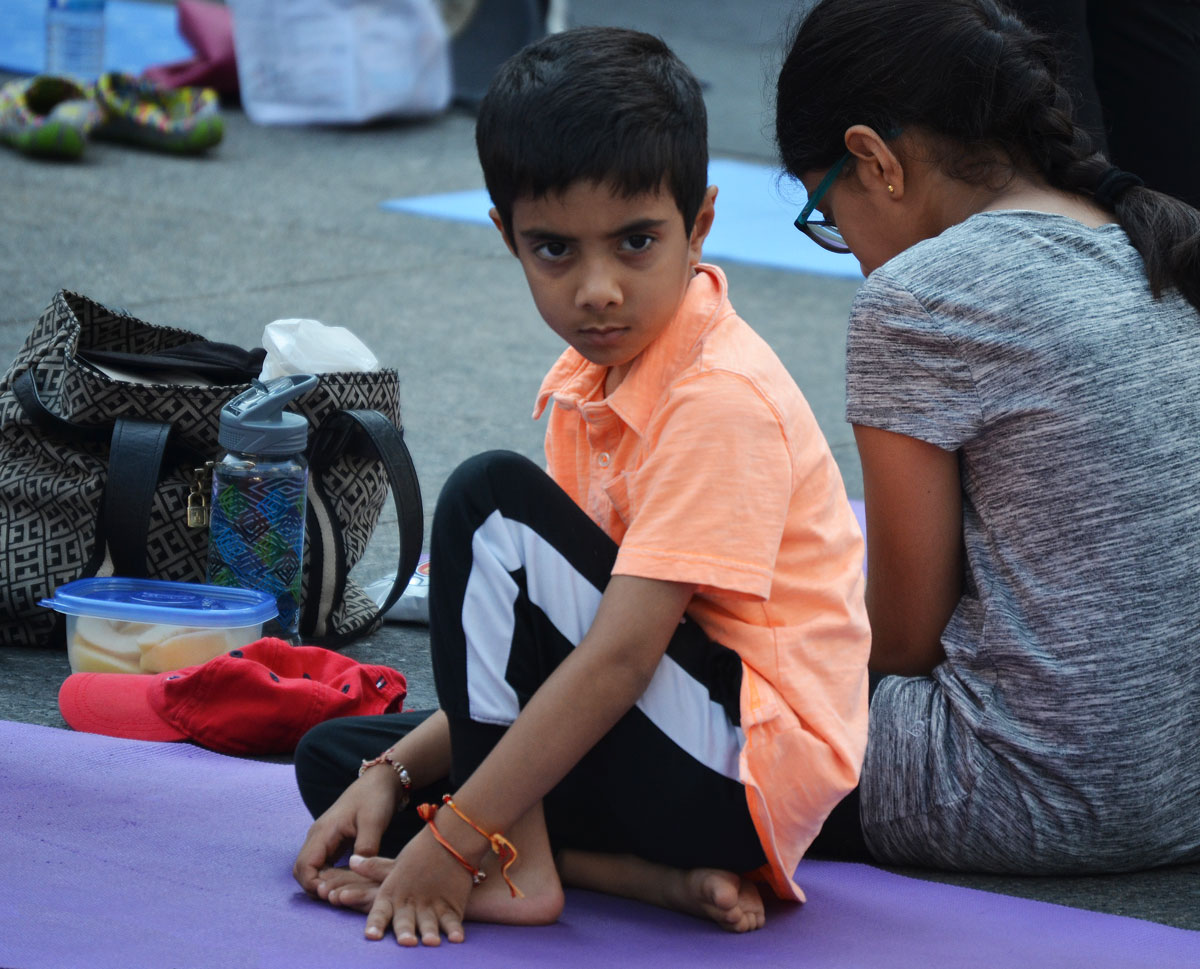
a young boy is staring at something (it was a man and his dog, but those aren't in the picture)

#riseforacause | #yogathontoronto | #riseforacausetoronto

But not a running, or even a jogging, track!  No, yesterday’s walk was an oval-ish loop at walking pace from Dundas West station, up one side of the railway tracks and back down the other.

below: Just past the subway station I saw the mural on “The Friendly Trini’s” which is now closed.  If the mural is telling the truth, they once served butter chicken, curried goat roti, jerk chicken with rice and peas, as well as drinks in coconuts and pineapples.  Feeling hungry already, and I’ve only just begun my walk.

a mural on the side of the Friendly Trinis restaurant that is now closed. Two women are walking on the sidewalk by the restaurant, a sign for Jennys bar and restaurant is in the background. The mural has drinks in coconuts and pineapples as well as a list of some of the food they served

below: Also on Dundas West, the King’z Convenience and Dollar Store which sells Filipino products and delicacies is adjacent to the Slovenija meat & delicatessen.  Multicultural.  I regret not taking pictures of the window of the Slovenian store – juice and beer brands that were unfamiliar to me.

two storefronts on a street, one is a slovenian grocery store and the other is a convenience store

below: Detail, boy riding an old fashioned bike on a little hook above a door.

a decorative ornament hanging high on a brick wall, a hook that extends from the wall about 8 to 10 inches, on top is a flat rendition of a boy on an old fashioned bicycle

below: And someone has decorated their balcony.

a balcony railing has been decorated with different colours of fabric that has woven between the rails

below: Just before I reached the bridge over the railway tracks I saw these words on a wall.

graffiti on a wall, in white paint on grey wall, the words "I have a dream'

below:  The dream theme continues on the metal steps up to the bridge.  This one was small and I almost missed it.  I’m not sure if it was painted black to blend into the background, or if the painting was an attempt to “clean up” the graffiti when prying off the letters proved to be too difficult (the D is broken so maybe someone tried).  Insert words about killing other people’s dreams here.

a raised word, 'dream' in cursive that has been stuck on the side of a set of stairs and then painted black to match the steps

below: From the top of the steps looking south.  The minimalist new Bloor GO and UP (Union Pearson) station is finished, top left of the photo.  Don’t you think we should call it ‘Get UP and GO’?  The street is Dundas West and yes, that mural is new.
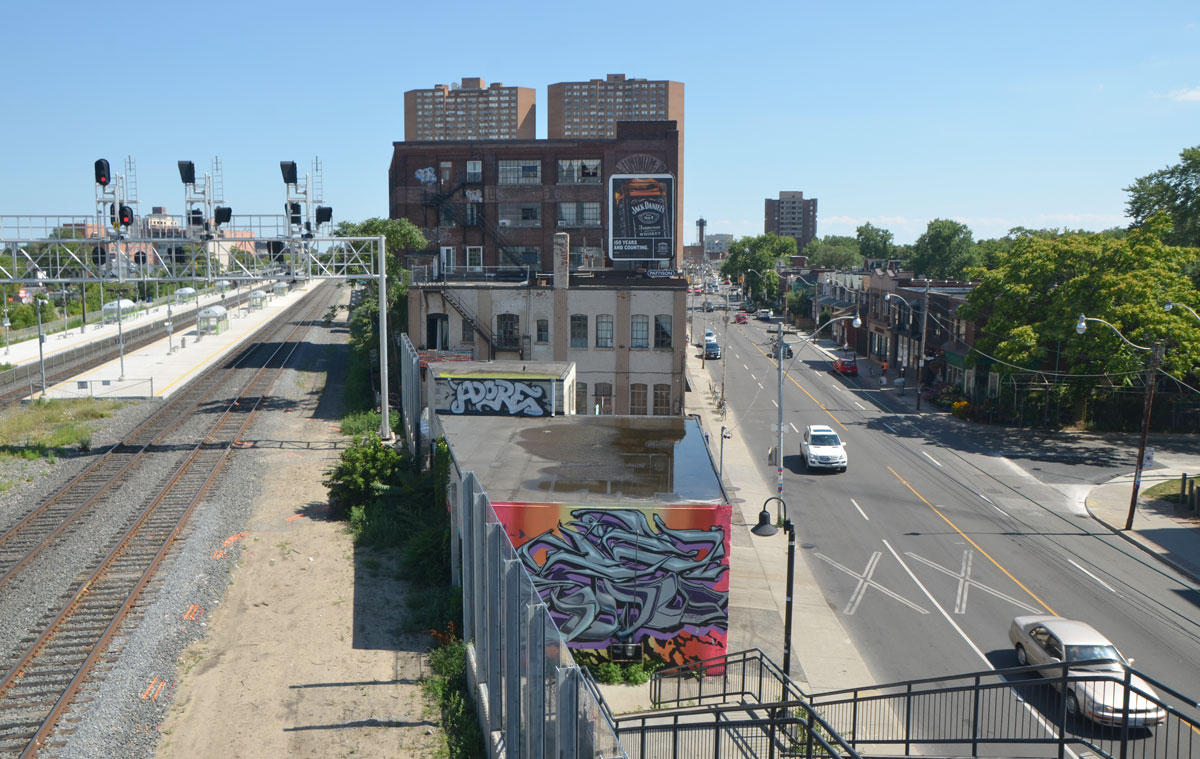
view from a bridge, a street, and a railway and some buildings in between. There is a mural at the bottom of the steps.

below: Helping to hold up the bridge, west side of the tracks.  He’s carrying the weight of the world, or maybe just the bridge, on his shoulders.

mural on the concrete base supporting metal struts bridge supports.

After crossing the bridge, I walked north along the West Toronto Railpath. The fencing along the path has all been upgraded.  There used to be some spots where you could get through the fence (non-railway side) but those are gone.  Between the tracks and the path there is a new clear (glass? plastic?) fence.  Of course it has already been ‘vandalized’ or ‘tagged’ – choose your verb.  Because I was there on a sunny afternoon, the sun was shining through the ‘artwork’ and making interesting designs.  A few thistles and other weeds added some compositional elements.

glass that has been spray painted yellow and orange, with some black that has run, weeds are growing in front of it, the sun is shining from behind it

a bright red heart has been sprayed painted onto a glass wall, weeds growing front, train tracks behind, the sun shining through the glass.

There were quite a few hearts on my route, especially around the Dupont exit of the Railpath.

below: Many hearts on the fence.
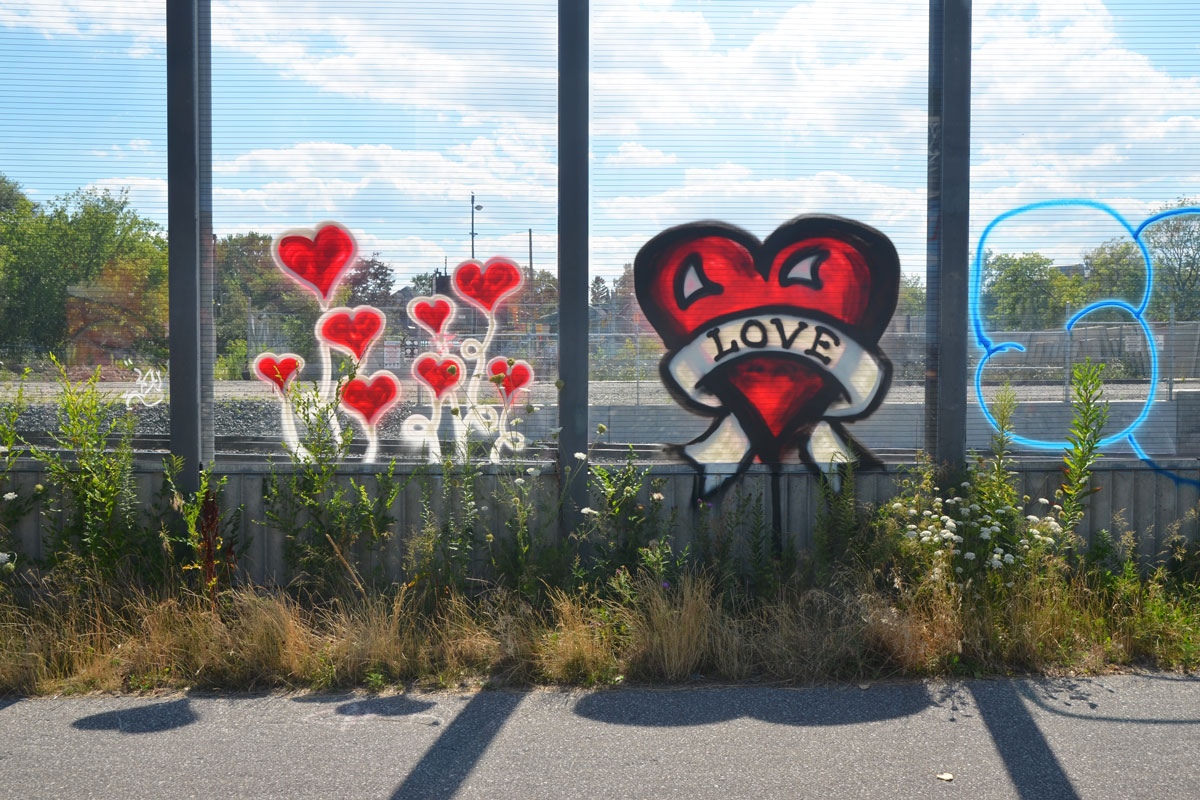
two street art pieces painted on a glass wall. the first is a red and black heart with a white banner across it on which the word love is written. the other is 8 little red hearts on white stems growing from the ground below.

below: A heart for Hex and Nish wherever, and whomever, they may be.

a bright red heart painted on a man made boulder, words hex and nish written on it

below: Three heart balloons on the Dupont sign.  You can get a good view of the fence here.

glass fence beside railway tracks, path, trees, also a metal sign on which three red hearts on white stems have been painted.

below: Part of the West Toronto Railpath runs alongside Planet Storage, an large old brick building.  There used to be a lot of street art along the side of the building but it’s all been painted over.   A few tattle tale remnants remain.
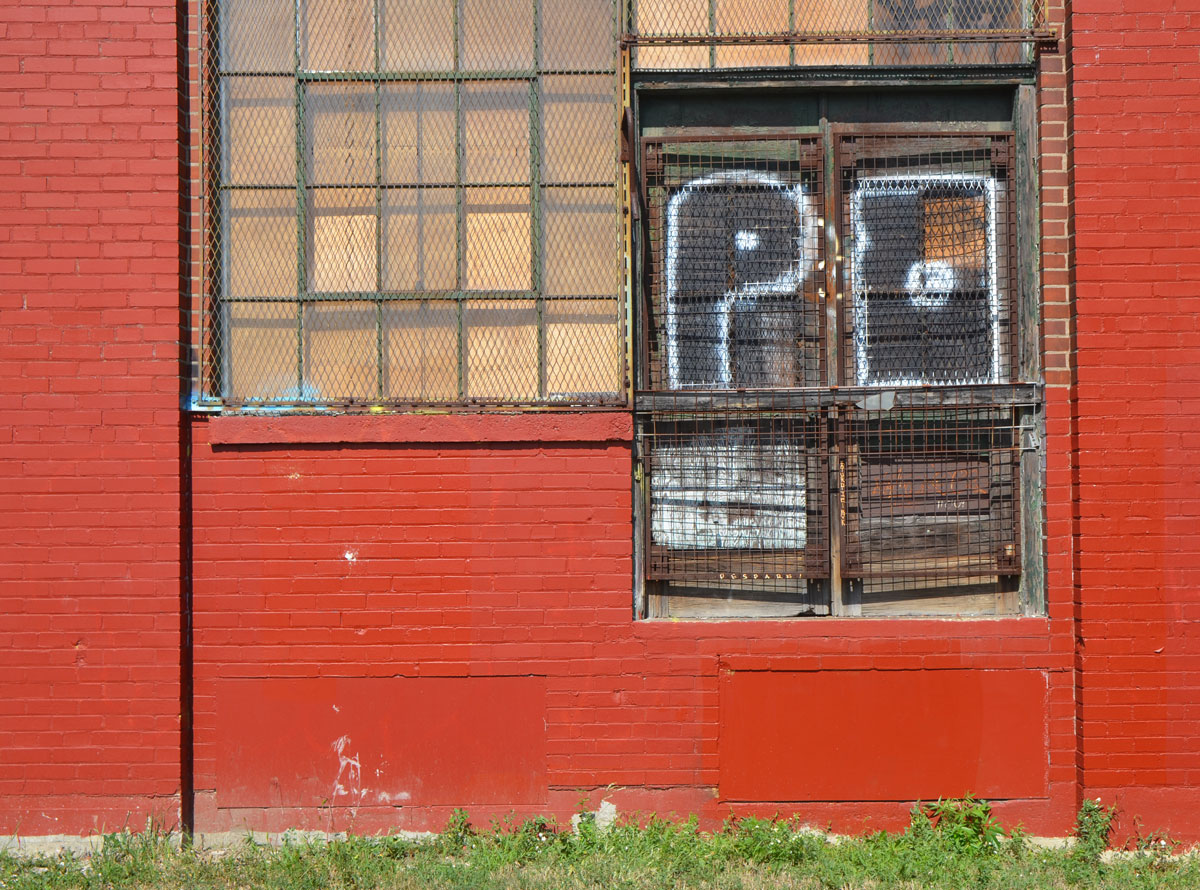
wall, part of an older brick building that has been painted a rust colour, with windows, some of which have metal grilles over them. Remnants of old graffiti on the metal grilles.

below: My favorite, little details like the bright yellow giraffe looking at the clouds.
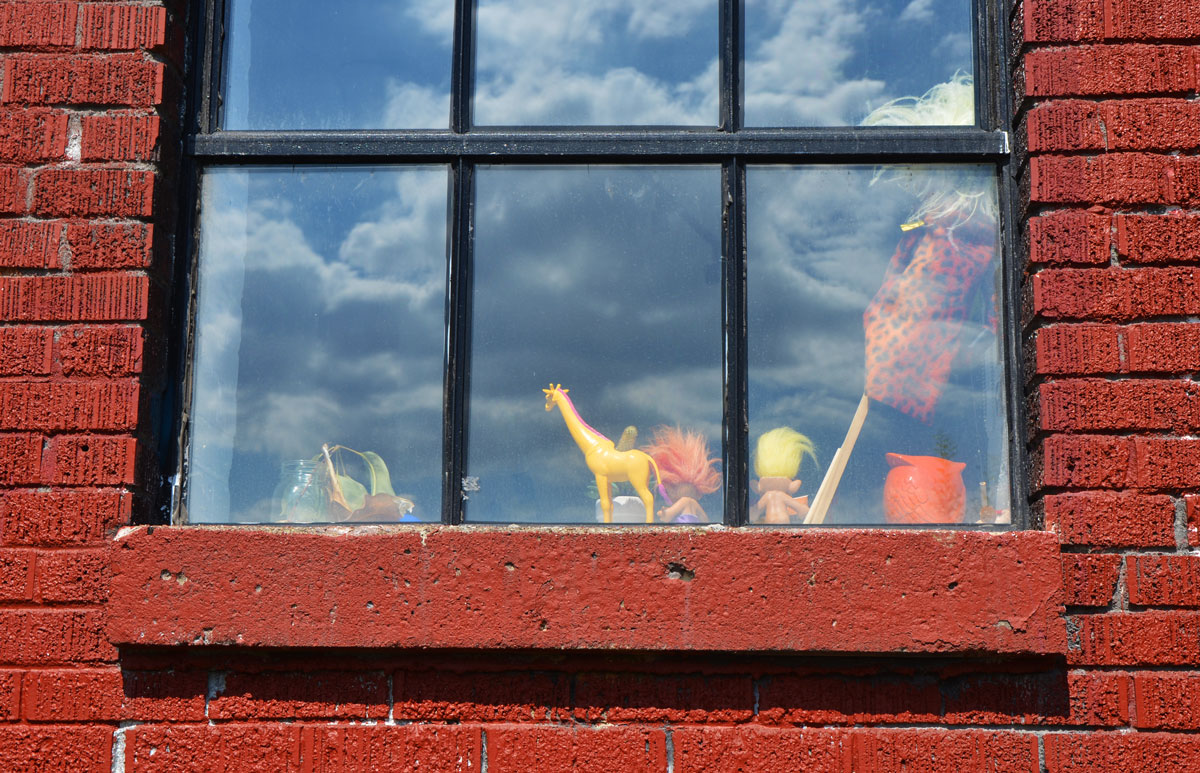
looking into a window, toy yellow giraffe on the window sill as well as two toy trolls, one with yellow hair and the other with orange. Reflections of clouds in the window

below: There is one mural on the Railpath, the back of Osler’s Fish Market is covered with a fish and fishing themed mural.
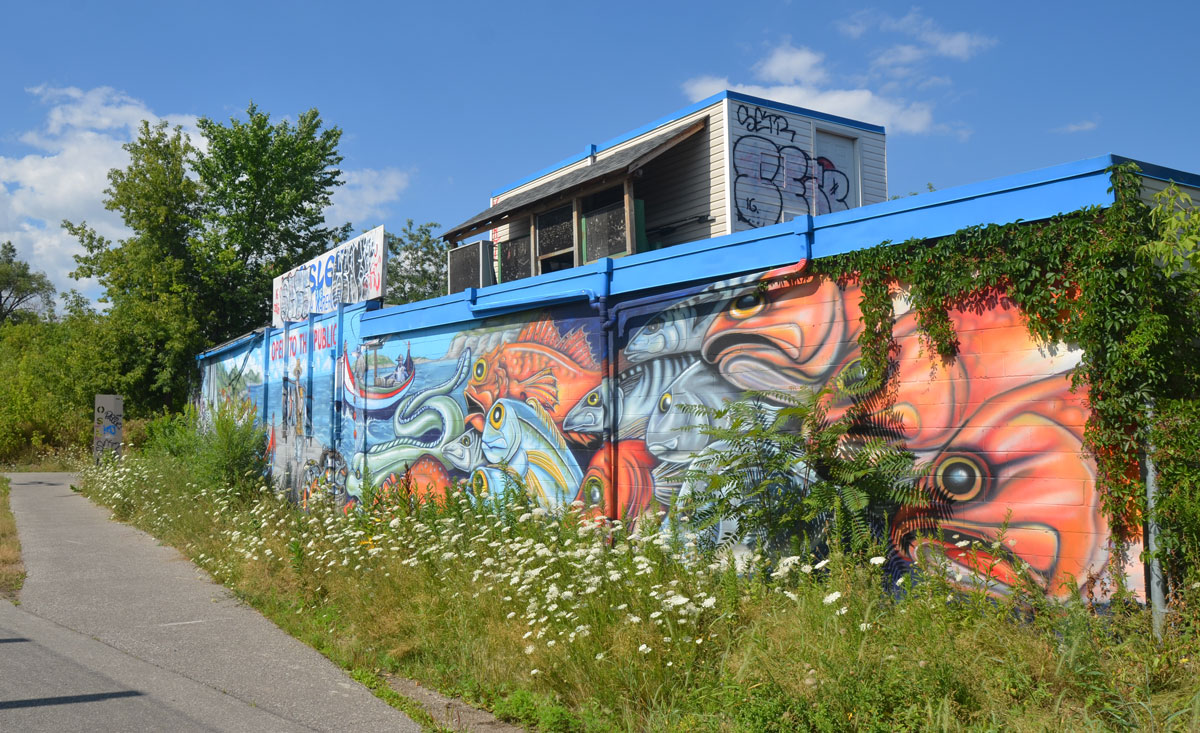
back of Osler Fish Market covered with a fish and fishing mural

below: Fish heads in the weeds.  Queen Anne’s lace, that plant with the white flowers, was growing in abundance along the path.  You might know it by its other name, Wild Carrot.

detail of a mural, fish heads, on a wall with Queens Annes lace and other weeds growing in front.

mural with fisherman bringing in a load of fish to the shore, boat in the background, more fish in the foreground.

mural, man sitting, mending fishing nets, woman on the shore carrying a bundle towards some fishing boats.

below: A splash of red on a street just off the railpath.
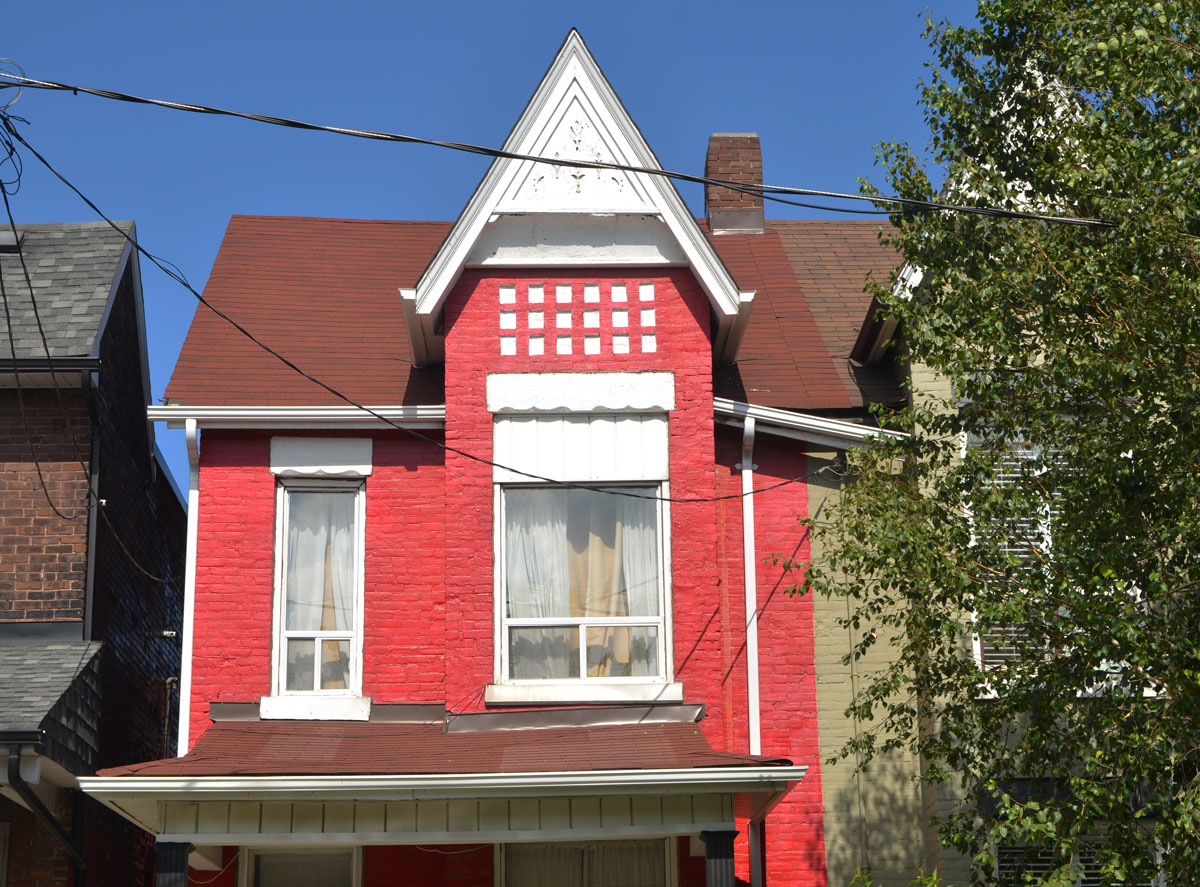
the top part of an old Victorian brick 2 storey house, painted red with white trim

below: The sign on the table says: “Hi! La Witch Cat here.  Enjoy the space, but PLEASE do not litter.  I provided a garbage can. Use it!  This includes cigarette butts.  Put in trash once extinguished.  Thanks!  XXO”.  Marvellous!  I sooo agree with the part about cigarette butts.  Why do people who don’t litter still consider it okay to throw cigarette butts wherever they please?  I smiled but I didn’t stop to rest.

In a veryshady spot, against a metal fence, two old chairs with a white table between them, a sign on the table and a small garbage can to the left.

below: At one point I found myself at this intersection.  What is a pedestrian to do? It’s possible I walked where I shouldn’t have, or at least where foot traffic is rare.  All the roads in the photo are Dundas West; it’s where the street splits as it approaches Dupont and Annette.  There was a small park behind me, called Traffic Island park.  The name sums it up I think.

wide intersection where two roads meet in a V shape. not much else in the picture, only the nose of one car, no other traffic. hydro poles and wires in the picture

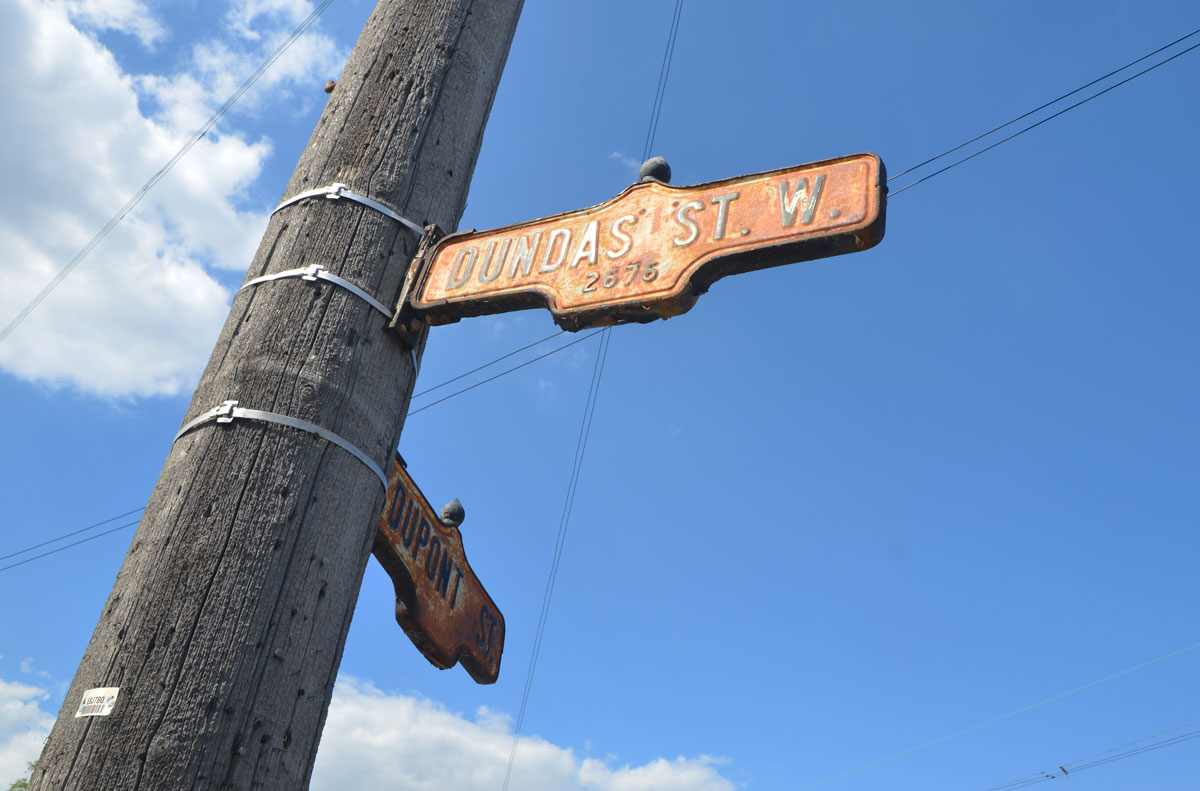
two old Toronto street signs, slightly rusted, on a hydro pole, one for Dundas St. WEst and one for Dupont street

below: A lament for the streetscape.  One more line in an elegy to public spaces.  The result of a half hearted attempt.  Massive hydro poles on the narrow sidewalk.  A large ad. A green space that needs attention.  If you look carefully, you can see  a plaque on a small stand.

sidewalk right beside a road, with hydro poles on the sidewalk, a small stretch of green space (about a metre) befoew a large fence that is concrete on the bottom and glass on the top. A couple of small trees that are dying are in the green space.

below: This is the plaque.  According to the words, this strip of land was replanted in 2001-2003 with a number of native species with the plan that they would spread and “create an oasis in the middle of the city”.   It mentions three plants – Nannyberry tree, Staghorn sumac, and Bottlebrush grass.   Disconnect alert.
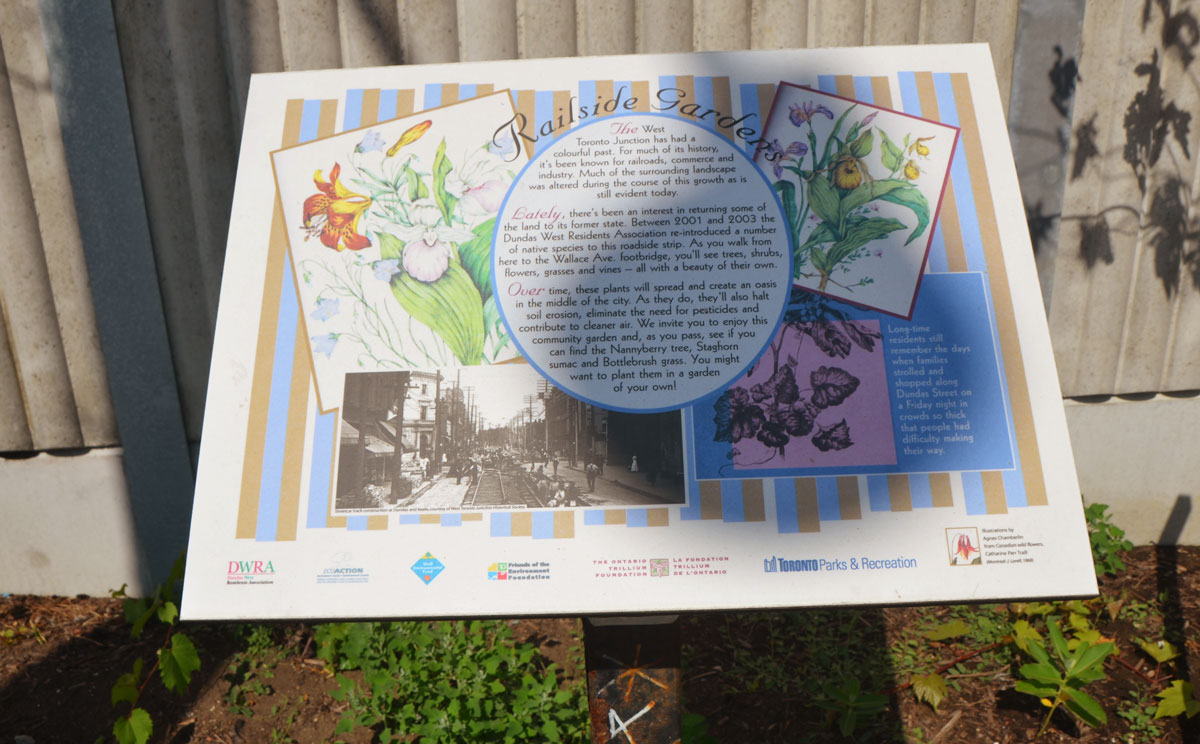
plaque describing the railside garden with words about its history and some picture of the plants that grow there

below: On my way back to the subway station I spotted this 24 hour lovebot.

a lovebot sticker on a TTC bus stop pole, between the sign that says 24 hours and the symbol of a bus, older industrial building behind it.

…. that was where I walked yesterday but before I leave, a few small details.  Ciao!
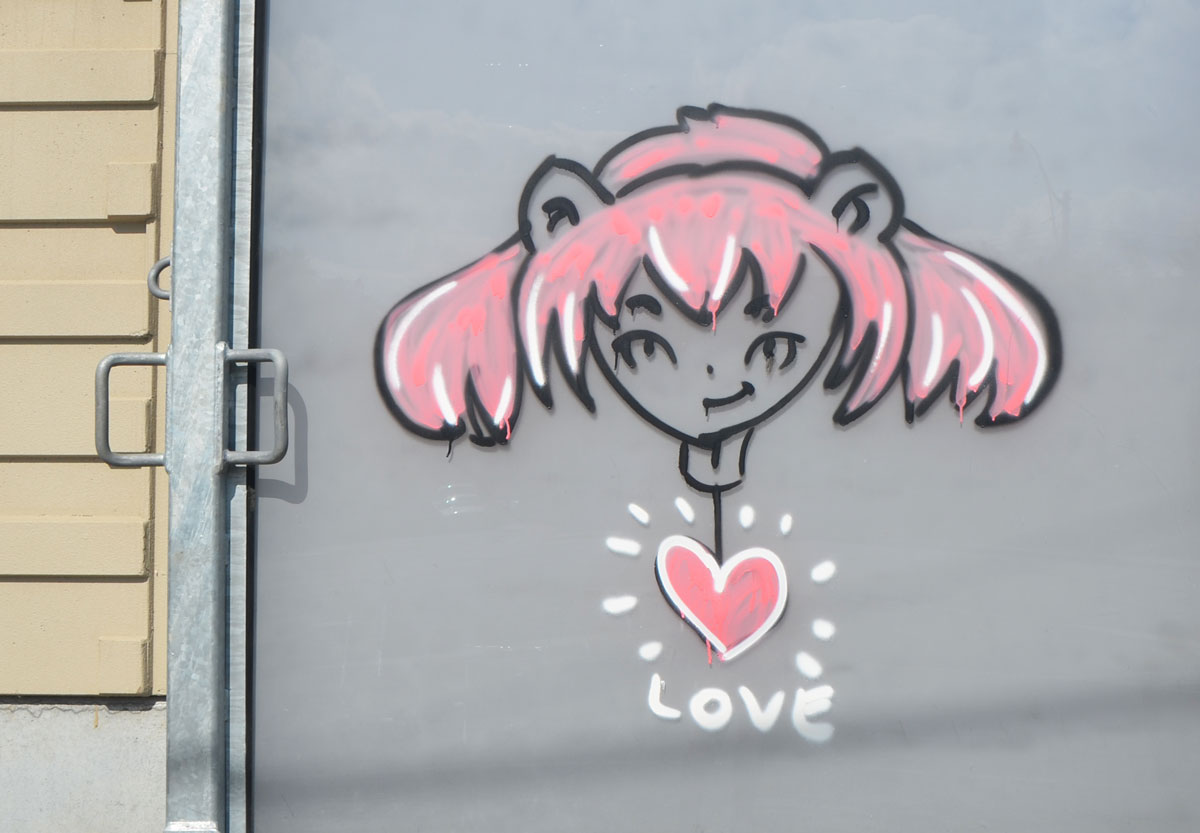
graffiti on a grey metal door of a girl's head with lots of pink hair. A pink heart beneath her with the word love under that

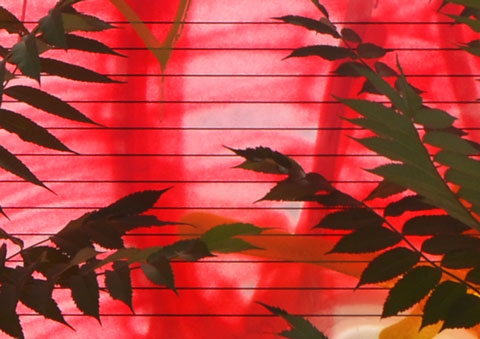
red background, silhouette of sumac leaves

blue background, graffiti drawing of man's head, wearing large crown, sad eyes, heart in word bubble

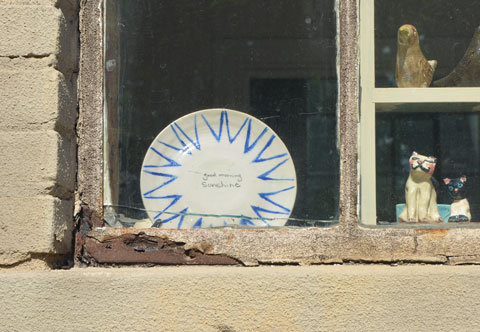
a plate in a window that says Good Morning Sunshine, also two small ceramic figures of cats, and one ceramic dog

There are seven or eight large photographs, portraits of older women, on University Avenue.   They were actually part of the CONTACT Photography Festival and they have been on display outside the Royal Ontario Museum since early May.  The photos are the ‘The Last Tattooed Women of Kalinga”, portraits by Jake Verzosa.

large black and white photo of an older woman with many tattoos, black and white, displayed outside, another portrait in the background

In the villages of the Cordillera mountains of northern Philippines the women have been tattooed with lace-like patterns for centuries.  The tattoos are symbols of stature, beauty, wealth and fortitude and are traditionally applied during rituals.  The tradition is dying out as standards of beauty change and as the old ways are replaced with more modern methods.

Each village once had their own tattooist, or mambabatok, but today only one remains.  Born in 1918, Whang-od (or Fhang-od), is the last person to practice the centuries old technique called batok.  The ink is made of charcoal and water and it is applied by tapping the skin with a thorn.

two older women with their shoulders tattooed, wearing necklaces and a patterned skirt, seated. Black and white

Once the men were also tattooed.  The Kalinga tattoo has evolved from their ancient tradition as warriors and headhunters.  Heads were taken from fights and battles as a trophy; each time a man brought home a head he would receive another tattoo as a reward.  Tattoos were a mark of social status.

Indigenous groups throughout the Philippines practiced tattooing for centuries.   When the Spanish arrived in the 1500’s they called the people ‘pintados’ or ‘painted people’ as it was not uncommon for people to have tattoos covering their whole body.  While some tribes used tattoos to mark status, other tribes believed that tattoos possessed special spiritual or magical powers which gave the individuals strength and protection.  The use of tattoos as protective symbols is an idea that occurs in many cultures.
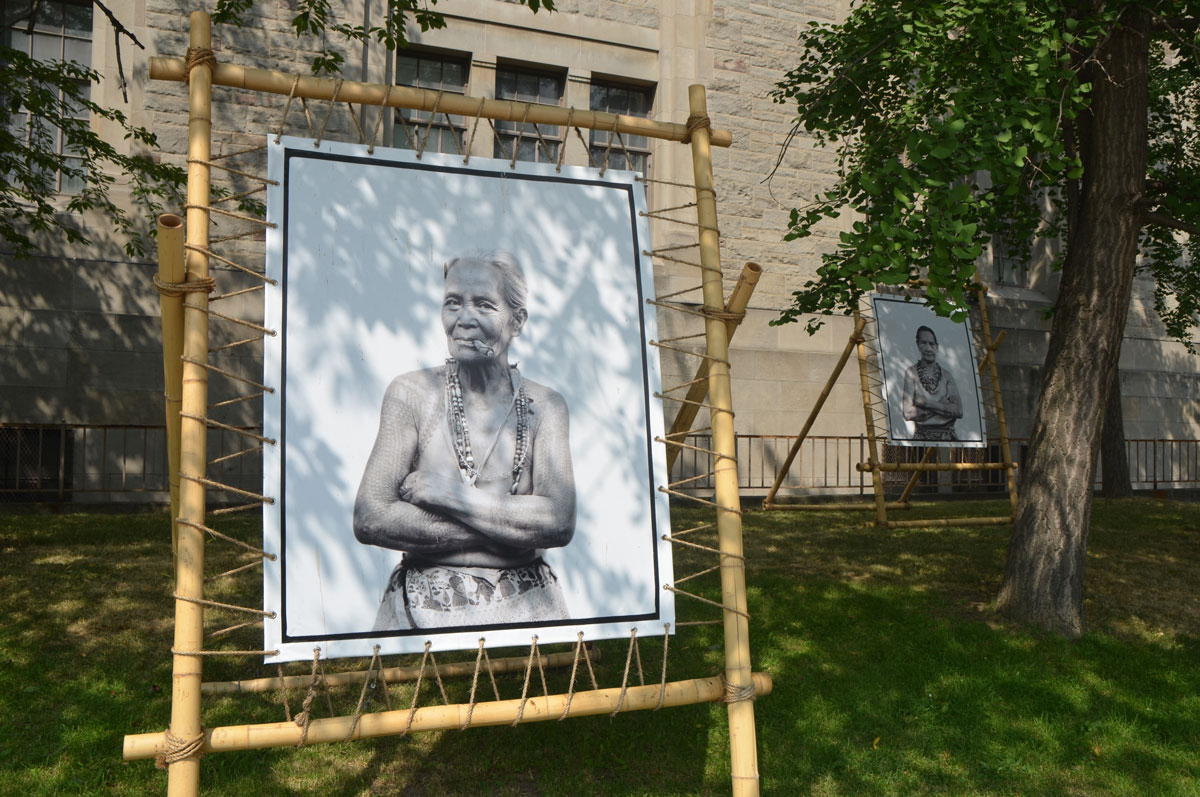
large black and white photo of an older woman with many tattoos, black and white, displayed outside, another portrait in the background

In conjunction with the Kalinga portraits, the ROM is featuring an exhibit that examines the beliefs surrounding tattoos, and the role that they and other forms of body art play in different cultures over the years.  “Tattoos: Ritual, Identity, Obsession, Art” is on view until September 5th.  It is a global tour of tattoos past and present.

One of the cultures that is featured is the Chinese.  For centuries, tattoos were forbidden, or at least taboo, in China.  To be tattooed was to be discriminated against as they were associated with prisoners or vagrants.  Recently that has begun to change.

below: Three large modern picture tattoos by Taiwanese tattoo artist Gao Bin featuring traditional Chinese images, Buddha, lion and dragon.  Tattoos as a cultural expression.  In some countries such as Sri Lanka and Thailand images of Buddha are considered sacred objects of worship.  While it’s not illegal to have such a tattoo, wearing one could get you into trouble.
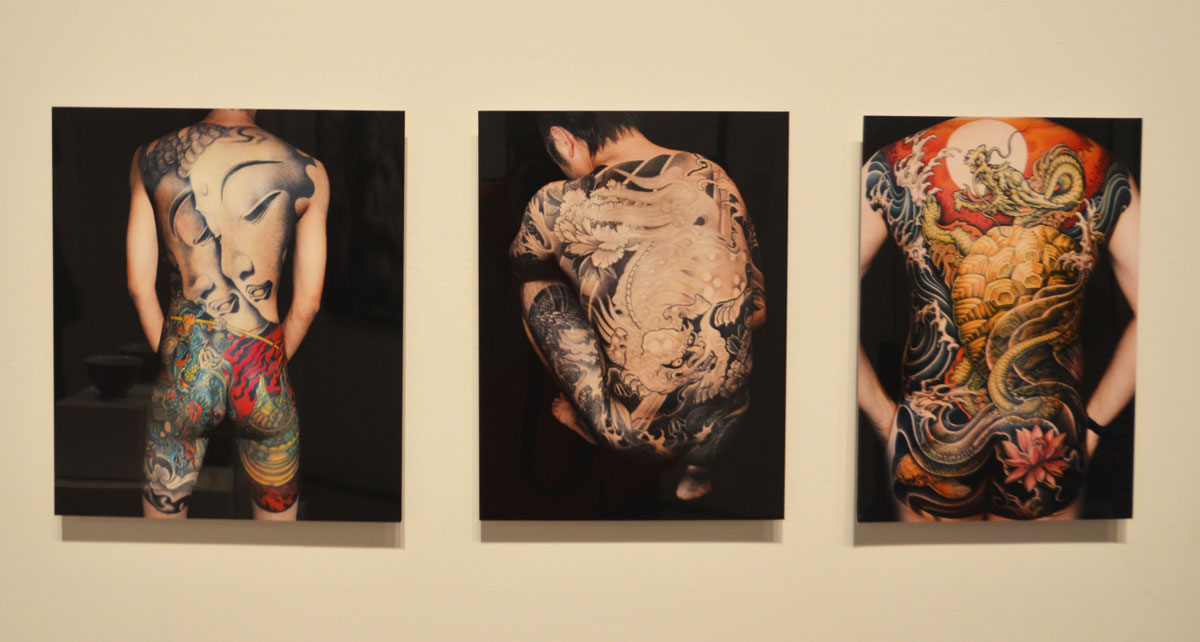
Three pictures of the backsides of men, each with a large picture tattoo from neck to thigh. Chinese art pictures as tattoos

below:  Here is another example of why people get the tattoos that they do.  This is a picture of one photograph in a series by Isabel Munoz.  Munoz spent three weeks inside several prisons in El Salvador and photographed mara gangs.  Gang members wear offensive tattoos to assert their antisocial behaviour and express their loyalty to the gangs.  Tattoos as statement; tattoos as a mark of membership and belonging.  Tribal.

photo of a picture in a museum of a man's face that has been tattooed with gang symbols and words,

below: A silicone arm with a tattoo by Montreal artist Yann Black on display.  This is one of 13 commissioned tattoos on silicone body parts – arms, legs and torsos both male and female that are part of the exhibit.   Tattoos as artwork.  Individuality.

a silicone arm has been tattooed with a design that looks something like a cross between Frank Lloyd Wright and Mondrian. It is in a glass showcase in a museum.

The oldest known tattoos were found on Otzi the Iceman, a natural mummy who was found in the Otzal alps near the Austria – Italy border in 1991.  His tattoos were 61 lines ranging in length between 7 and 40 mm.  The lines were arranged in groups.  Most of his tattoos were on his legs where there were 12 groups of lines.  Otzi is estimated to have died between 3239 BC and 3105 BC.

Tattooed mummies have also been found in other places – Greenland, Alaska, Siberia, Mongolia, western China, Egypt, Sudan, the Philippines, and the Andes in South America.  We will probably never know what significance the tattoos had.  Theories abound of course and they often involve reasons like protection, spiritual, status, tribal, or just for decoration.  Reasons that probably ring true today too.  The methods have changed and some of the images have changed, but human nature remains just that, human nature.


Nuit Rose,
a festival of queer art and performance

On Saturday night events were held at a number of venues that were concentrated in two locations, along Queen St. West and in the Church-Wellesley village area.  I hung out around two parks in the village, Norman Jewison Park which runs east of Yonge and Barbara Hall Park on Church street.  In hindsight, I wish I had had more time, or had been more organized, to get to more of the events.

Red Pepper Spectacle Arts led a Light Parade that started at Norman Jewison park.    A small contingent, most wearing or carrying a light-emitting object, walked through the park, along and then back down Church Street.  From the  – sparklers, glow sticks

people walking in a night time parade for nuit rose, down Church St., one man is holding up a light stick, a woman is holding a sparkler, other people have lanterns and glow sticks.

to the more elaborate

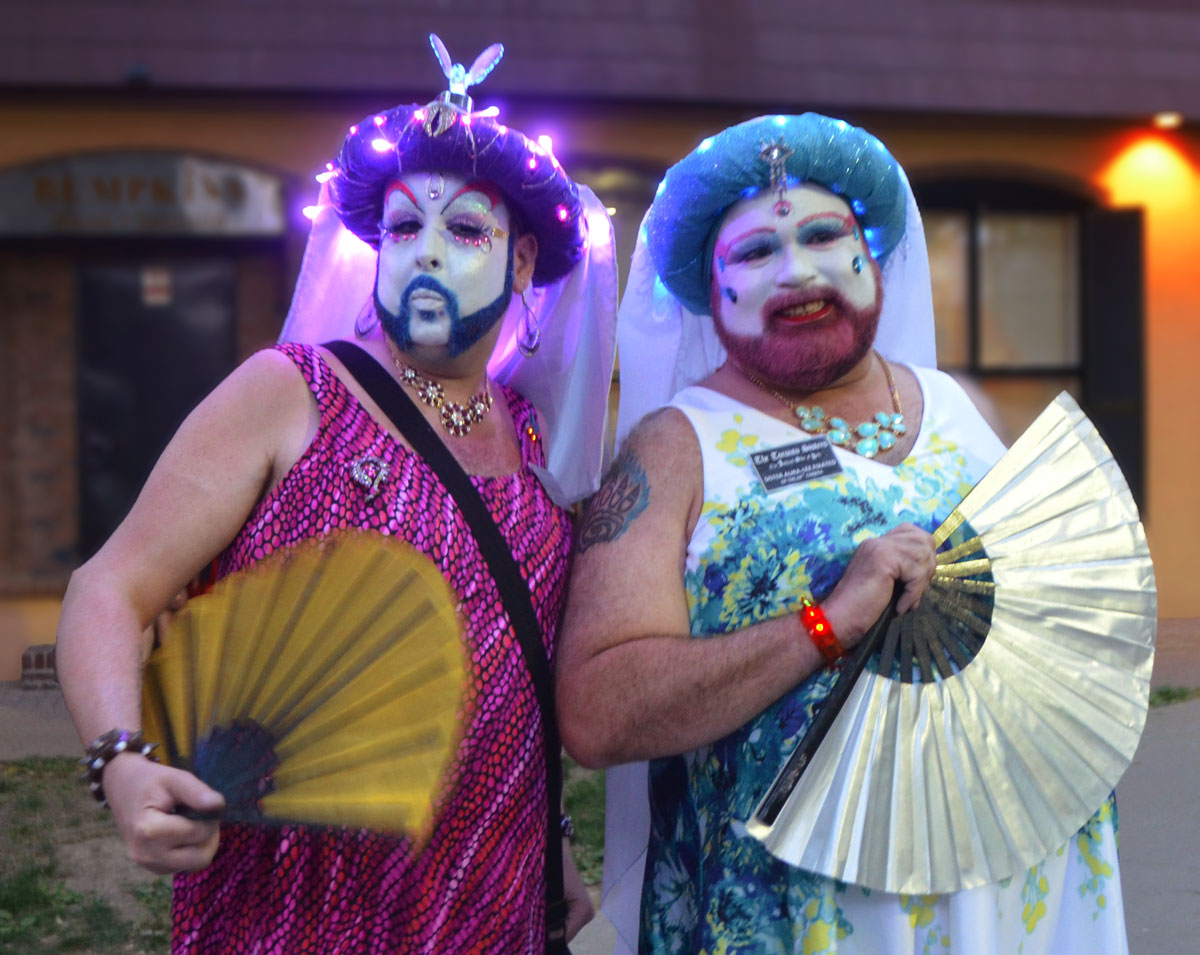
Two guys in drag with lights all over their costume, holding large fans

a man holding a large pole with a bird head on the top of it, with rainbow coloured fabric, meant to be the bird's wings.

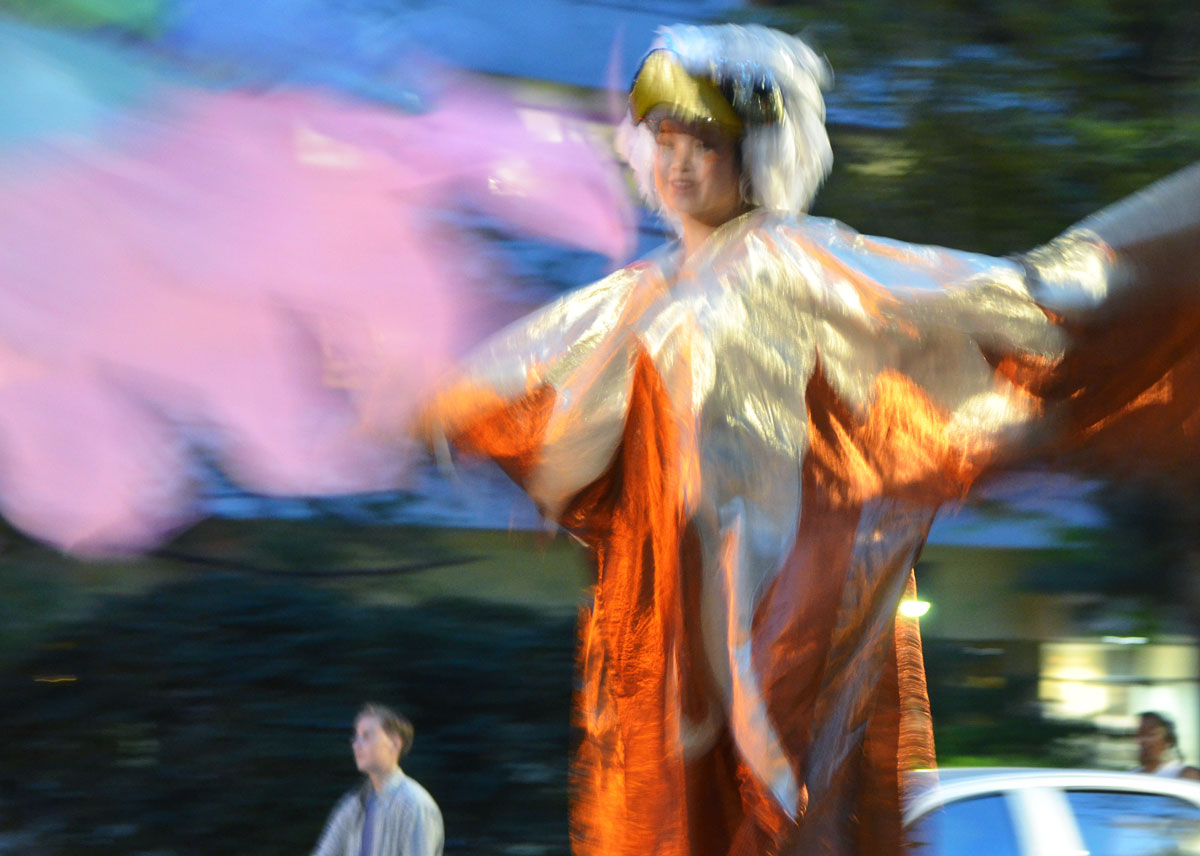
below: and an eagle on stilts

A woman in a flowing costume with eagle head, up on stilts, in a night time parade for nuit rose

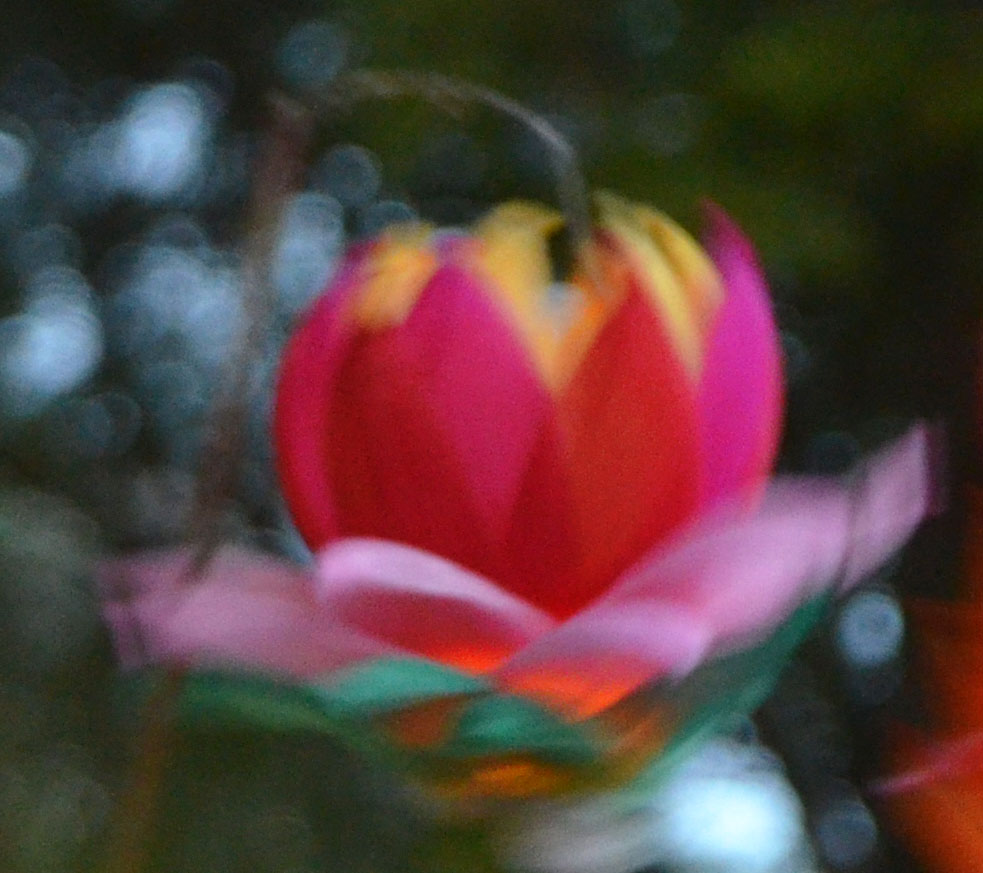
below: Note to self: for night time parades take more photos at the start of the parade because once people start moving it’s more difficult to get them in focus!
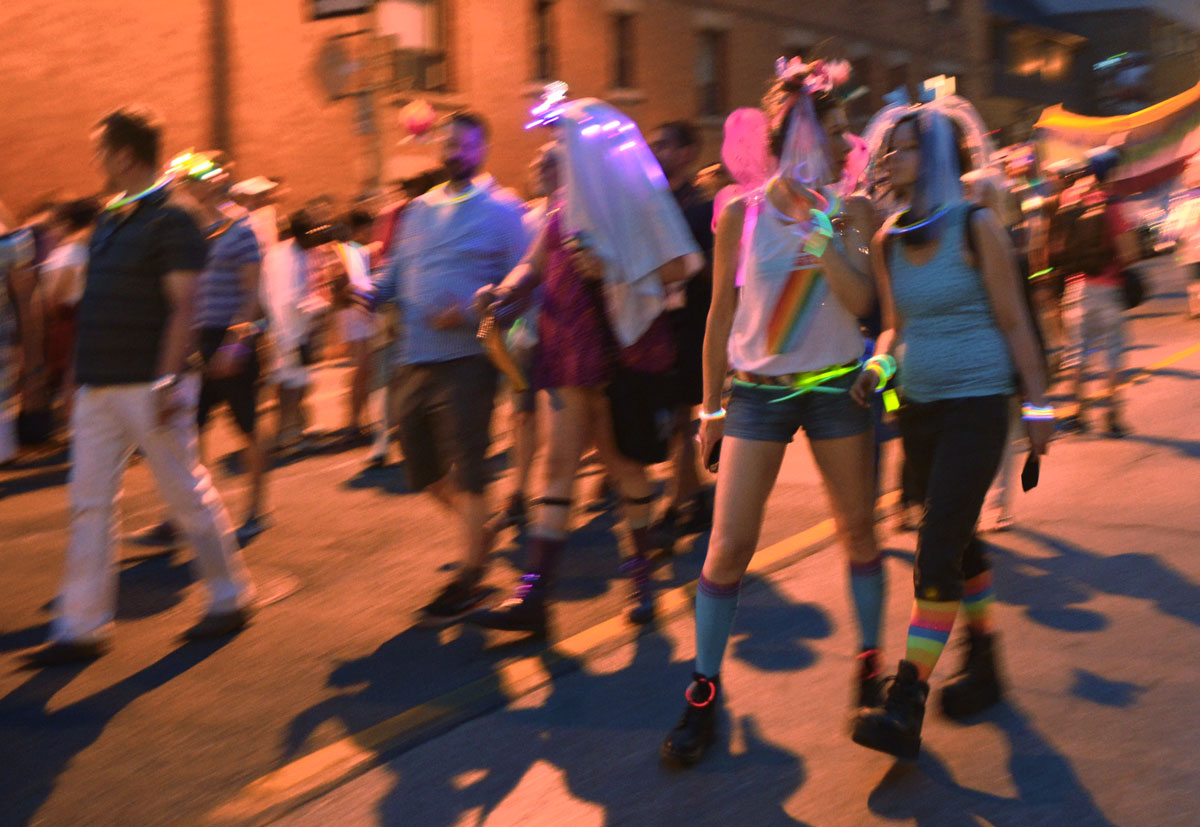
people walking in a parade, glow sticks, some costumes, a woman with pink butterfly wings

a paper lantern in the shape of a floating flower, out of focus

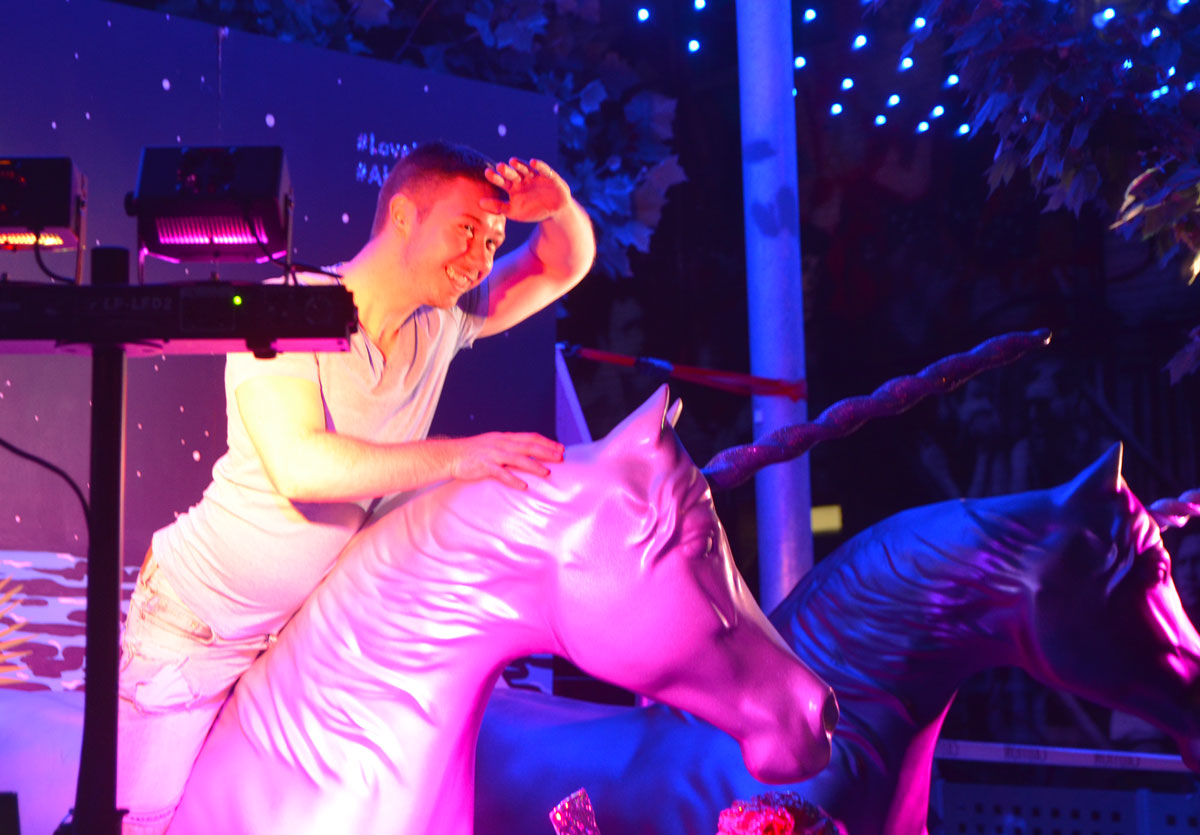
below: Where else would you be able to sit on a unicorn and get your picture taken?
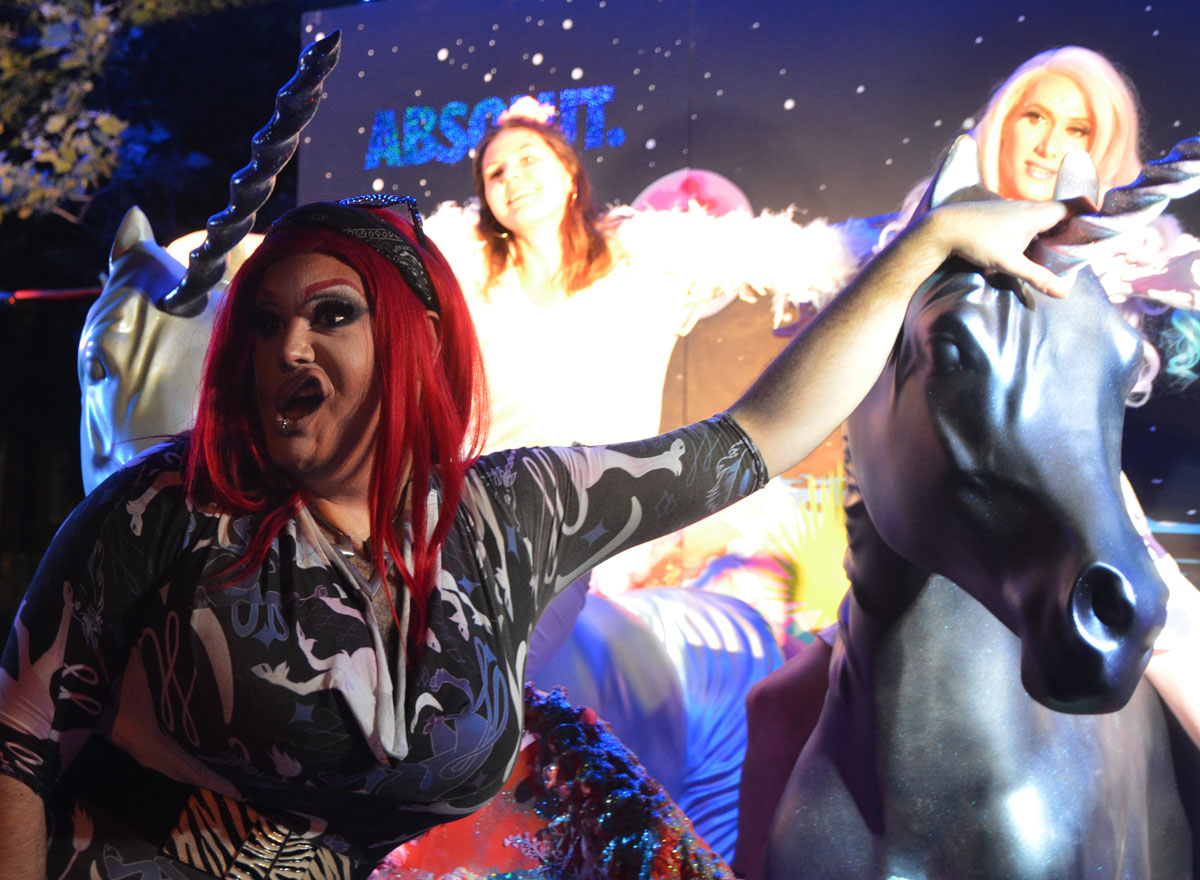
two people sitting on unicorns to have their picture taken with a person in a red wig hamming it up in front of them, nuit rose, night time.

A young man is sitting on a pink unicorn

below: And after a unicorn pose, have your photo taken standing with a well-lit couple.

a man with lights in his shirt poses beside two statues that light up

below: 360 degrees by Iain Downie, 360 stars, 60 in each of the six Pride colours in the garden.

under a tree in a park, with roses in the background, many coloured 3D stick shapes that have been covered with yarn, lie on the ground.

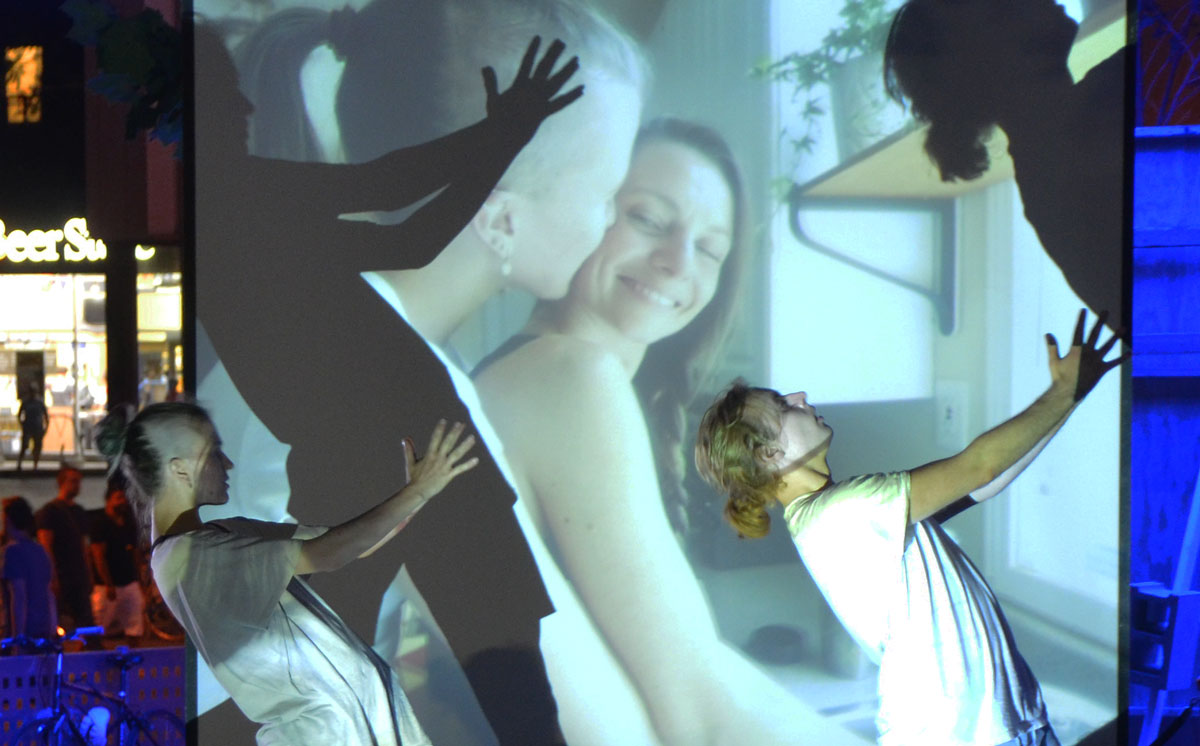
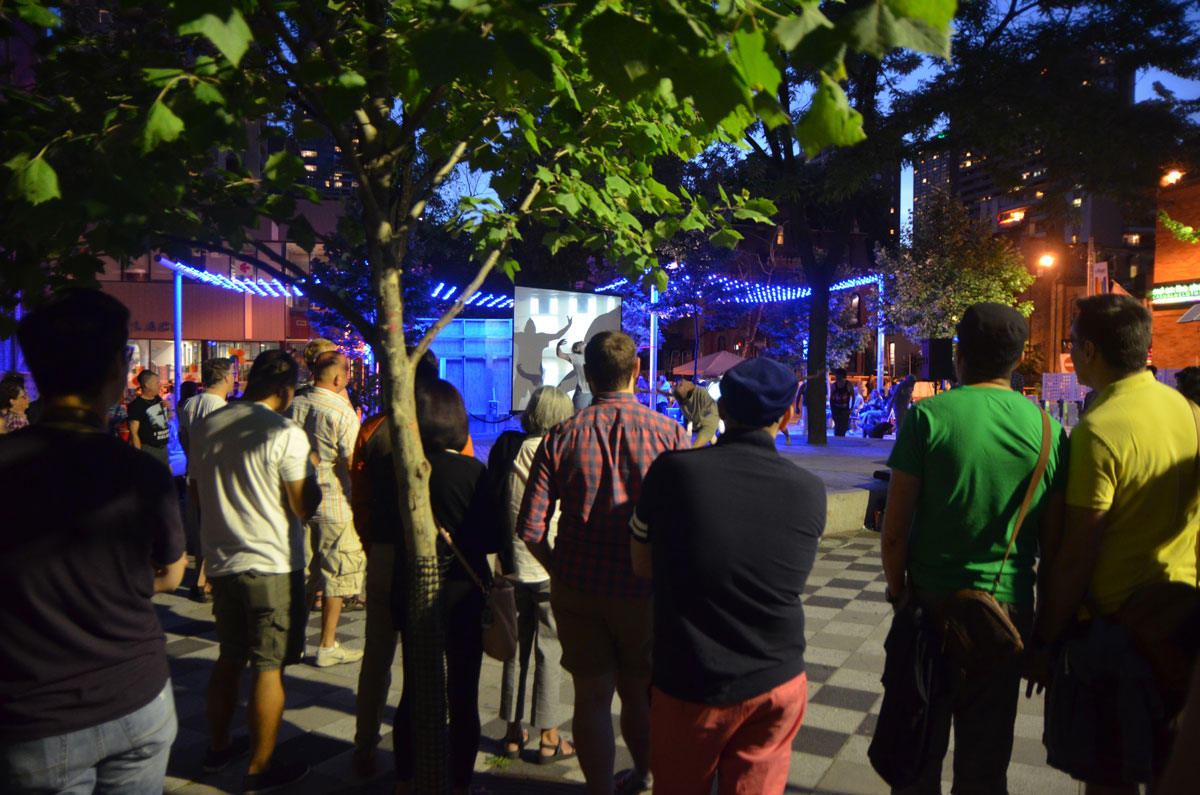
a group of people stand around a stage watching a dance performance

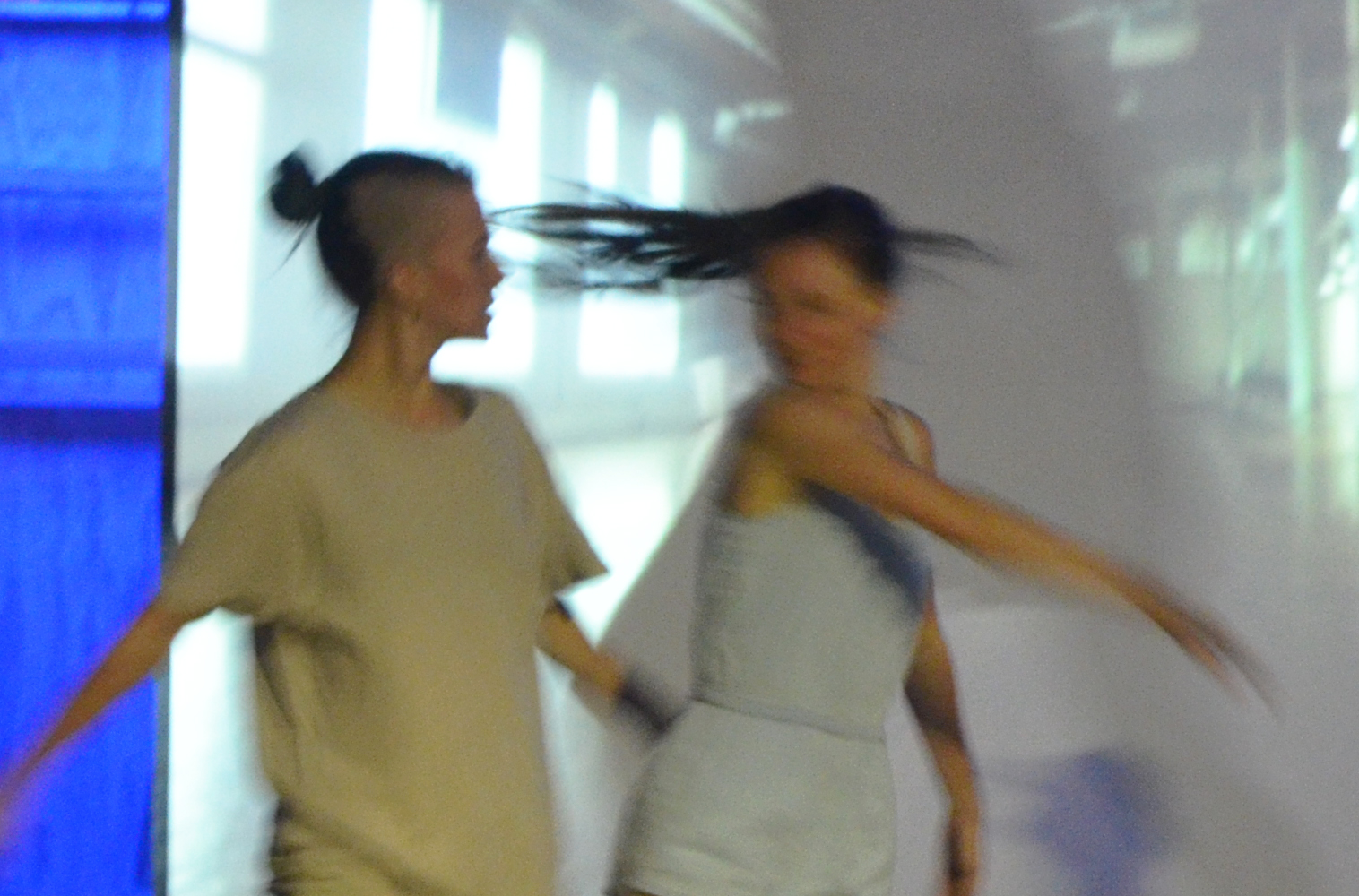
below: Dance performance, ‘By Chance’ by Janessa Pudwell and Tanya Svazas Cronin.

We pass by hundreds of people on a daily basis who we may never see again. Sometimes we share a glance that lasts a bit longer. This piece is about the relationships that could be created if we acted on those glances. These are the fleeting chances, exchanged through our eyes that will never be fully realized. Instead these people may only appear once in our lives as an extra sipping coffee in the background, as a blur of traffic passing on the highway, as a lighted window at dusk.”
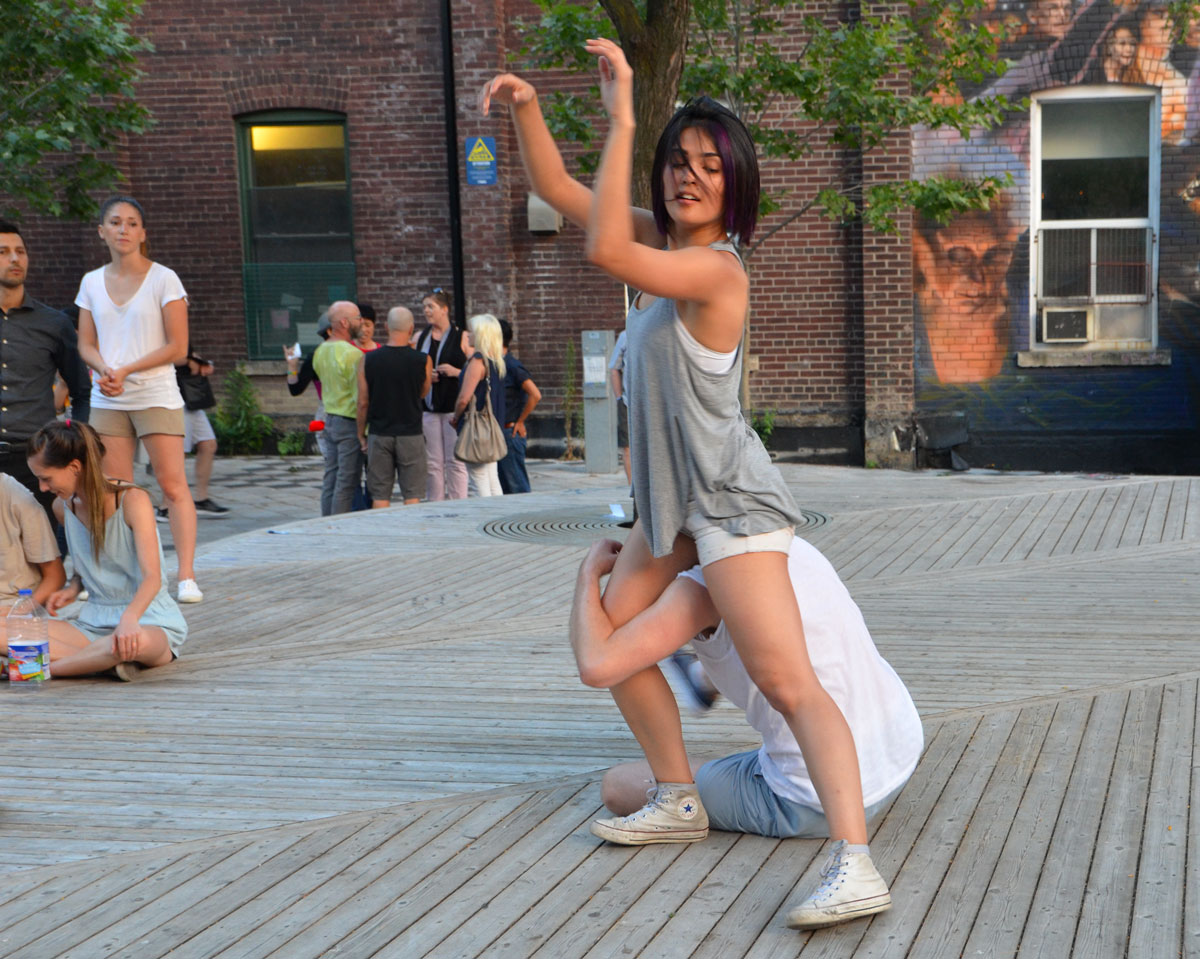
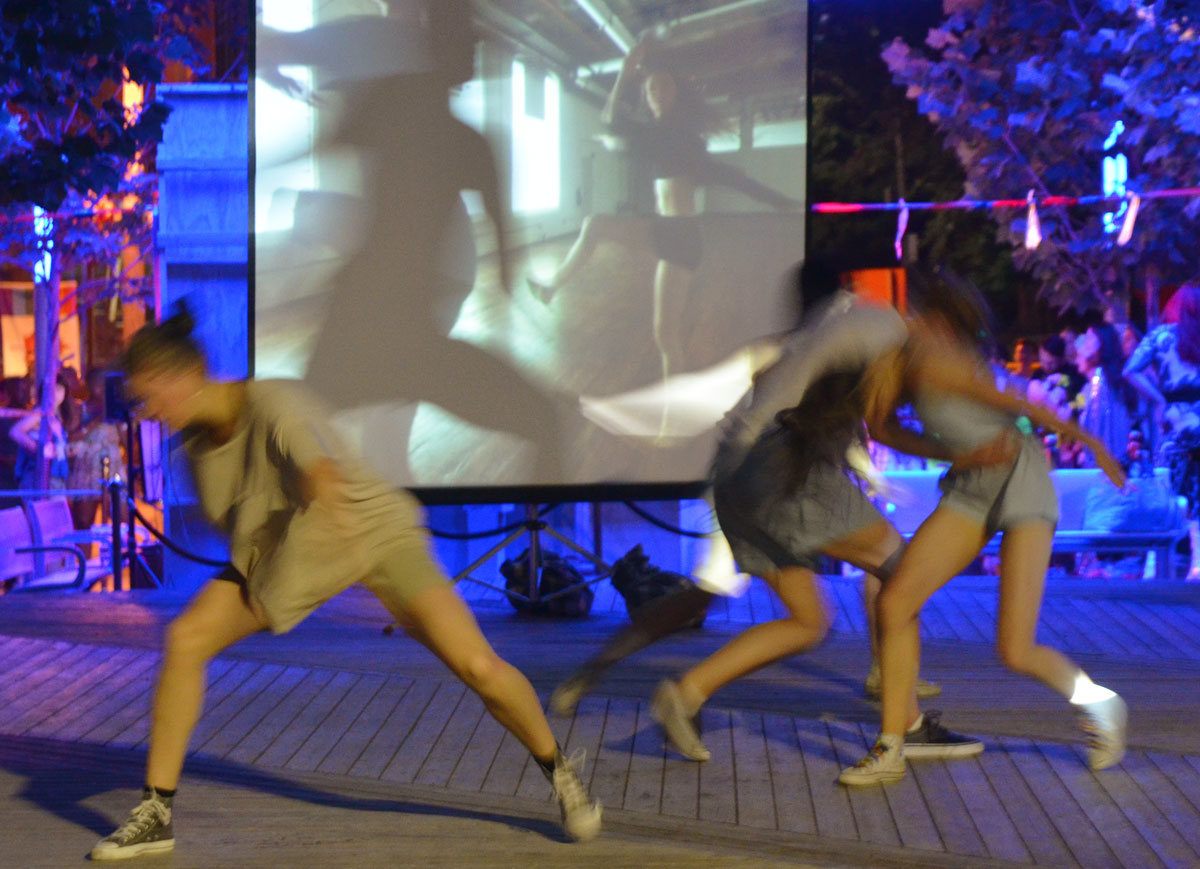
two women performing a dance on a stage., one is seated and the other is standing, some people are sitting beside the stage and watching the show.

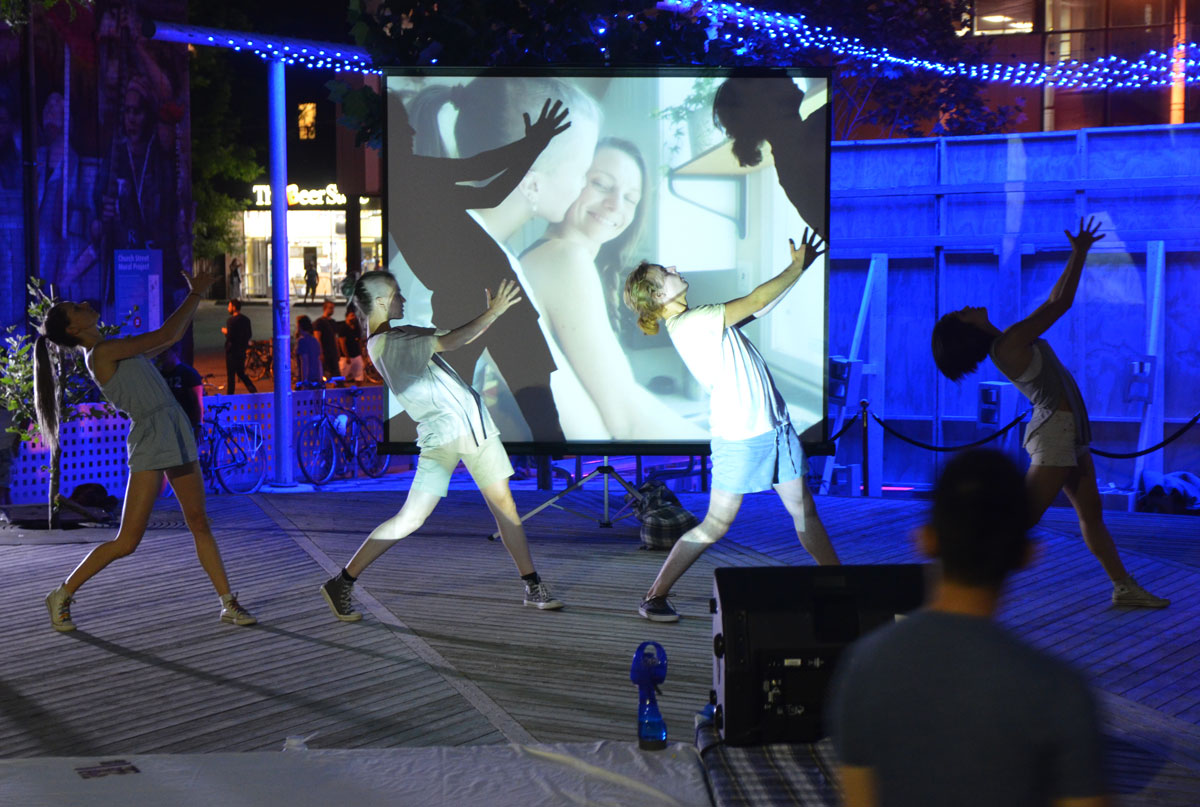
Dancers performing in front of a video playing on a screen, night time performance, some of the dancers are partly blurry

blog_dancers_line

blog_dancers_line_close_up

dancers performing in front a screen that's showing a video, night time, nuit rose performance

a hand holding a camera, two dancers out of focus in the background.

#nuitrose | #nuitroseTO | #nuitrosetoronto

Frank Kovac Lane is a short alley just south of Christie subway station.  Some of the garage doors were painted with murals in past years and, as usual, there were plenty of tags.  Recently, the lane was the scene of a community mural painting session thanks to the 4th Toronto Rangers (Girl Guides), StreetARToronto,  artist Nick Sweetman, and some local residents.  Now some of the tags are gone and more importantly, some more garage doors are home to bright and cheerful murals.  A few of them are included here.

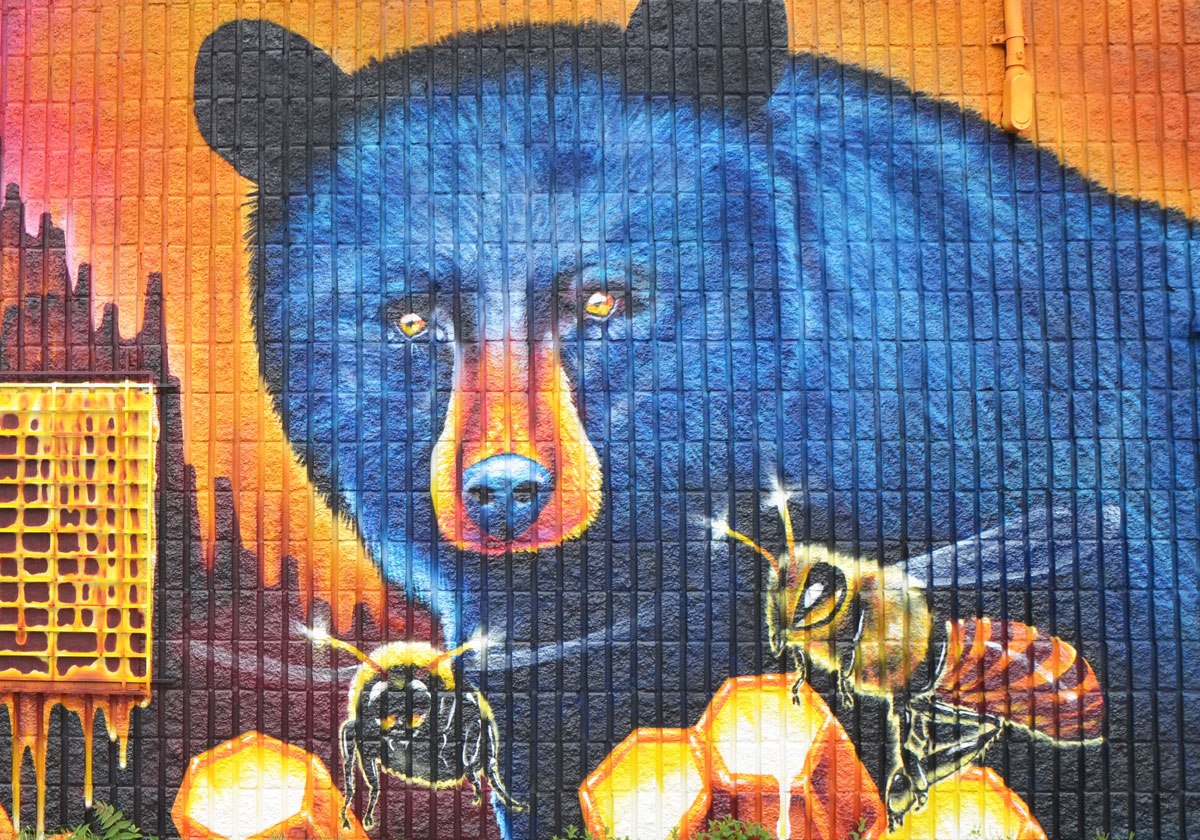
below: At the north end of the lane is this large, colourful mural by Nick Sweetman.
Two large blue bears have found a plethora of honey.  Will the bees share?

large mural by Nick Sweetman on a wall in Frank Kovac Lane, two very large blue bears are eating honey from honeycombs while a few large bees buzz around.

part of a large mural by Nick Sweetman on a wall in Frank Kovac Lane, two very large blue bears are eating honey from honeycombs while a few large bees buzz around - close up of one bear's face

below: The new murals continue the animal theme, “Urban Wildlife”, starting with this fox.
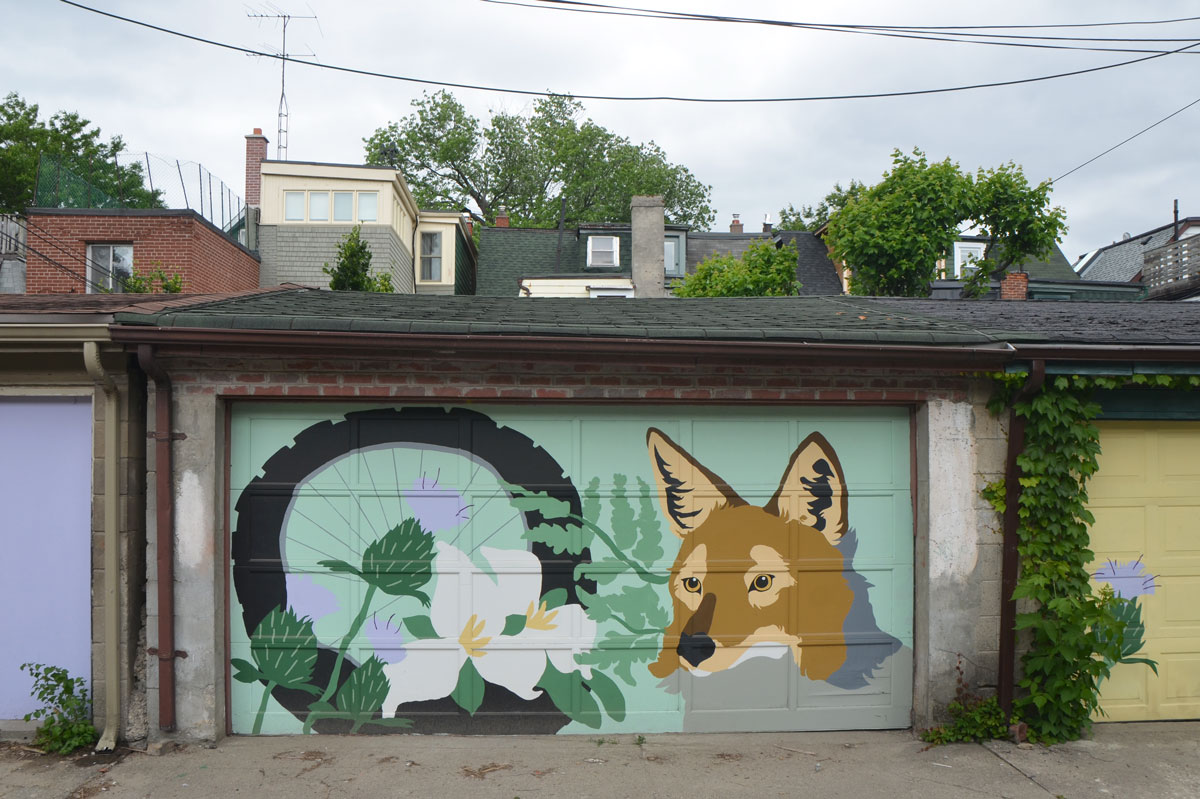
garage door in an alley painted with a mural of a fox head beside a bicycle wheel with trilliums growing up in front of it.

below: A common Toronto animal, a raccoon, beside a red fire hydrant.
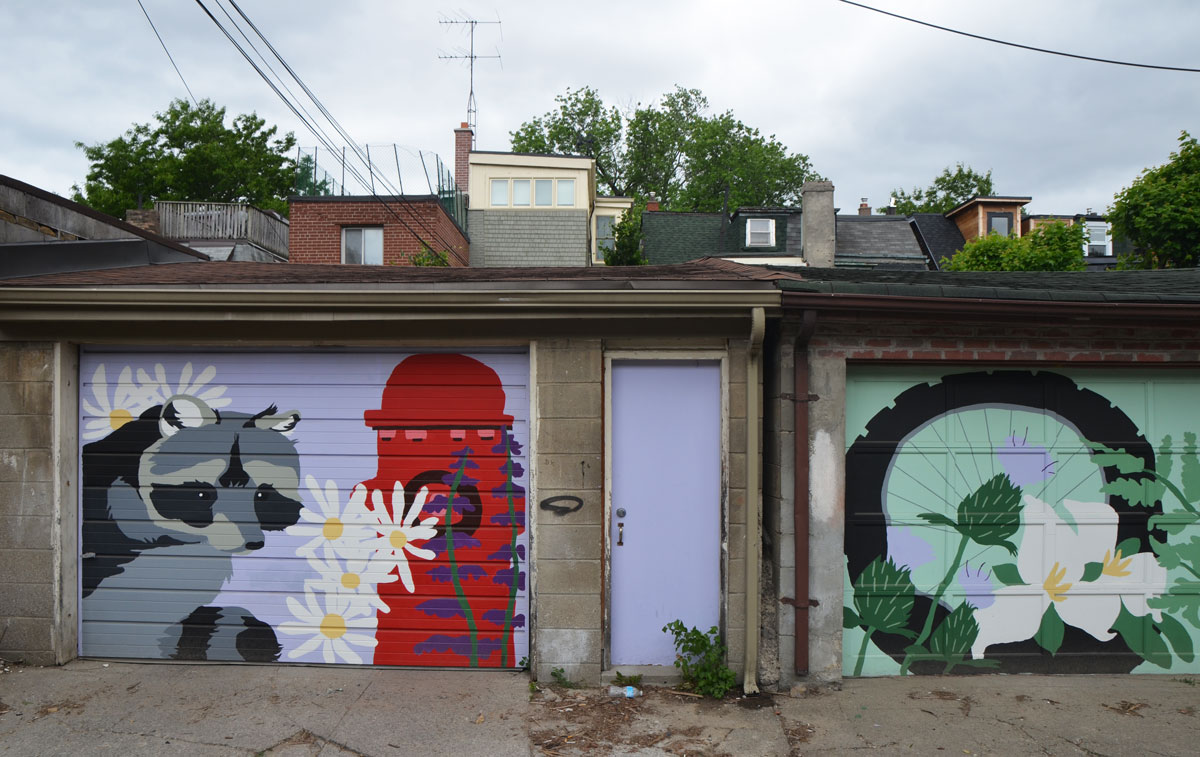
view in an alley, a lavendar coloured door. to the left of the door is a garage door painted with a mural of a raccoon and a red fire hydrant.

below: A blue jay eyes some blueberries.

mural on a pale yellow garage door of a blue jay sitting on hydro wires, also a bunch of wild blueberries is in the image

below: Several monster faces have lived in this alley for a while and they still remain.
This one looks like he needs a hair cut.

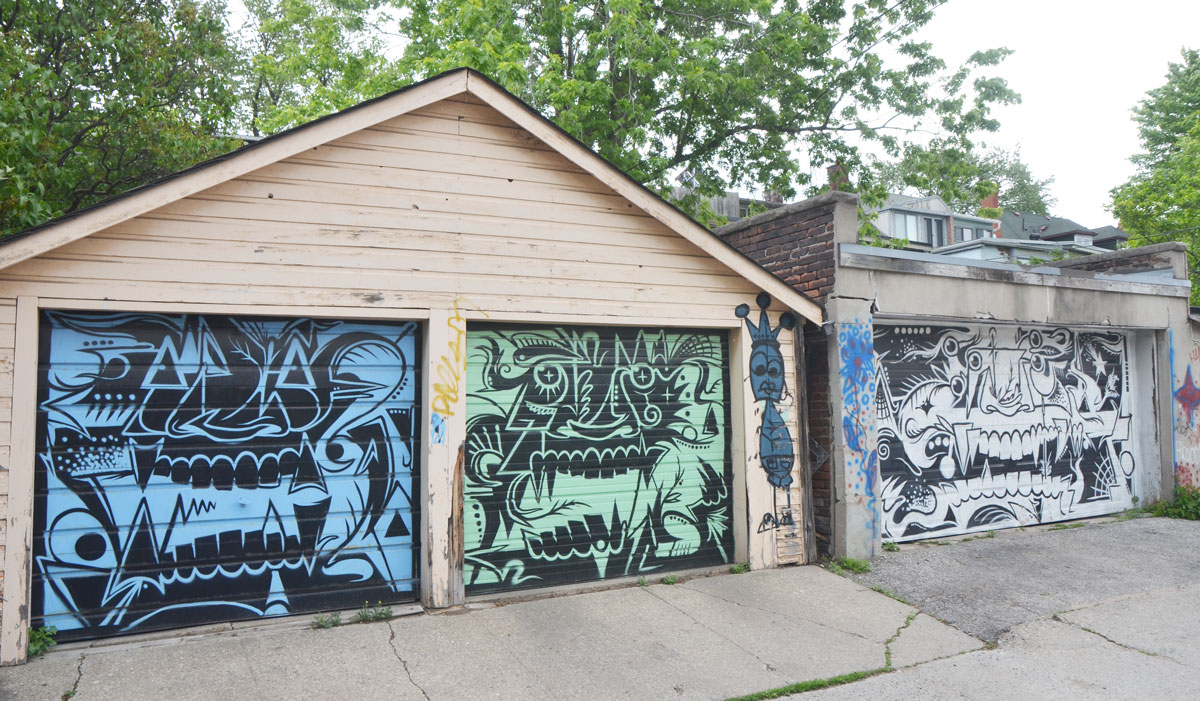
garage door painted with a monster face, big mouth and teeth, orange nose, in tones of blue, grey and orange, ivy is growing over the top of the garage and it looks like green hair.

three garages in a row in an alley, all painted with a large monster face

a skinny blue graffiti figure on the edge of a garage, between two garage doors with stylized and abstract faces painted on them. One is black and green and the other is black and white

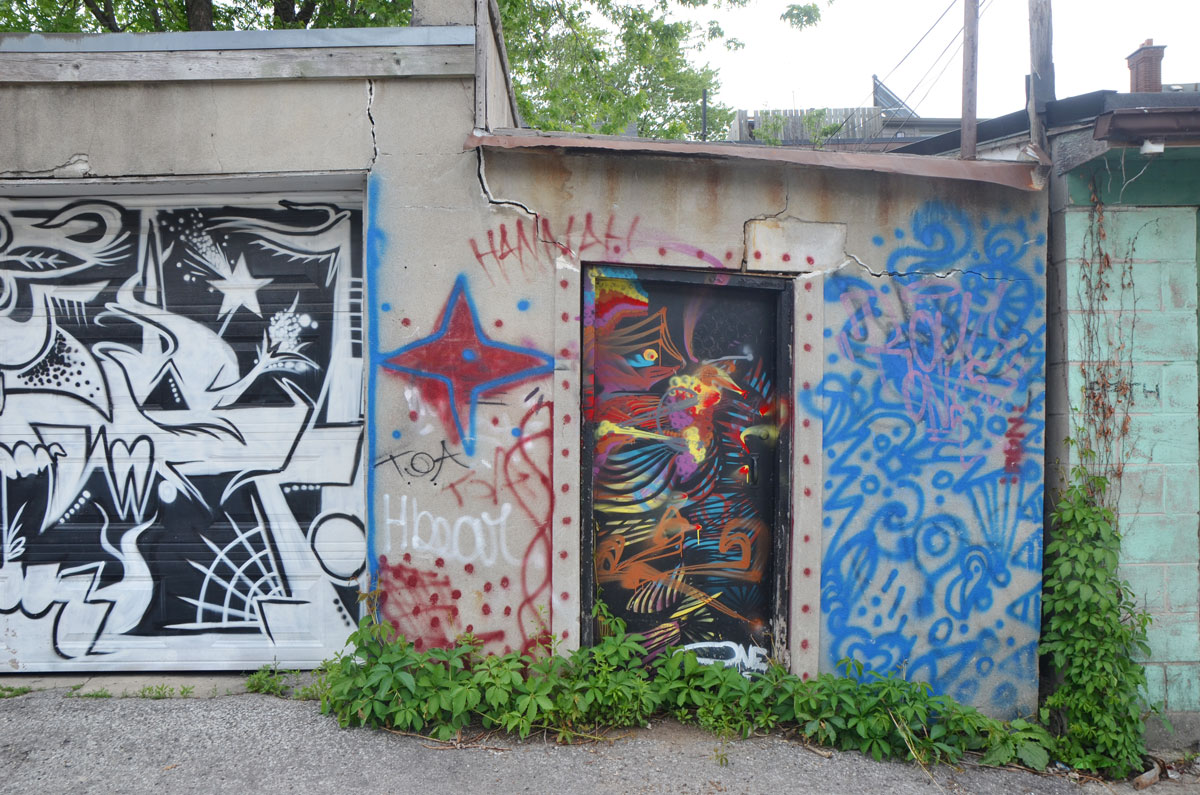
An old garage and concrete fence with a door in it. The fence is cracked above the door. The door is painted black with bright colour scribbles, the garage door has a black and white mural on it

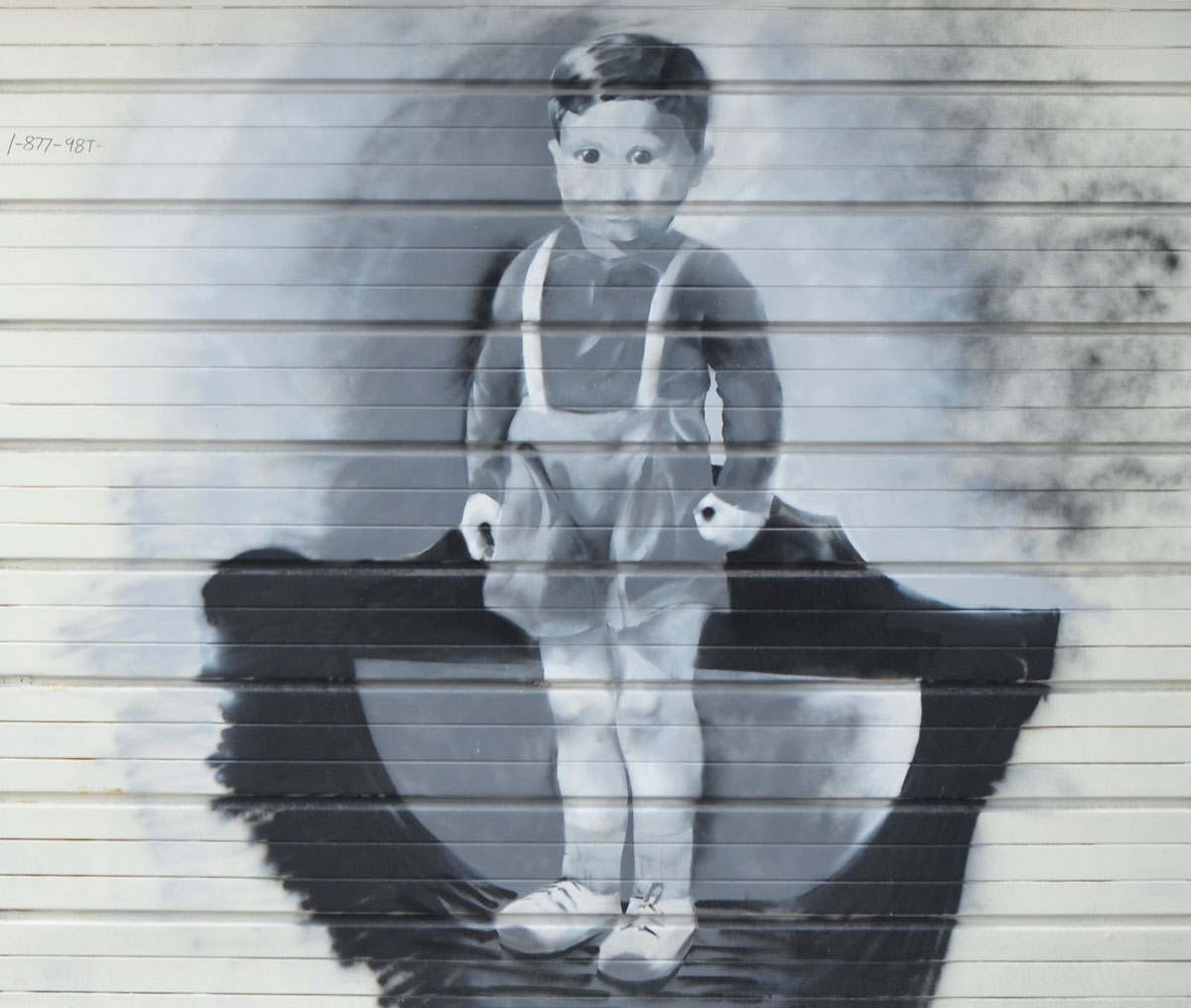
a painting in grey tones of a young boy in old fashioned shorts and long sleeved top, standing.

below: This graffiti is actually on Harbord Street but I couldn’t resist taking a picture of it
– a camera and an “oh snap”

Above Guan's auto service shop, a graffiti on an upper storey wall, a small camera and turquoise lettering and words in pink that say Oh snap. Above that is a red billboard for Bud and Burger

As you all know, the TTC is replacing their older streetcars with new longer Bombardier streetcars.   Or at least they are trying to 🙂  Because they are longer, they don’t fit into existing “garages”, hence the new Leslie Barns facility.  Located on Leslie St., south of Queen, it is the new streetcar “home”.  It is where streetcars are parked, maintained and repaired.  It has been in operation since Nov 2015 but the first chance the public got to peak inside the finished complex was at Doors Open on the 28th of May.

below: While waiting for a streetcar at the corner of Queen and Broadview on the way to visit the Leslie Barns, I saw this renovated TTC streetcar from the 1950’s.
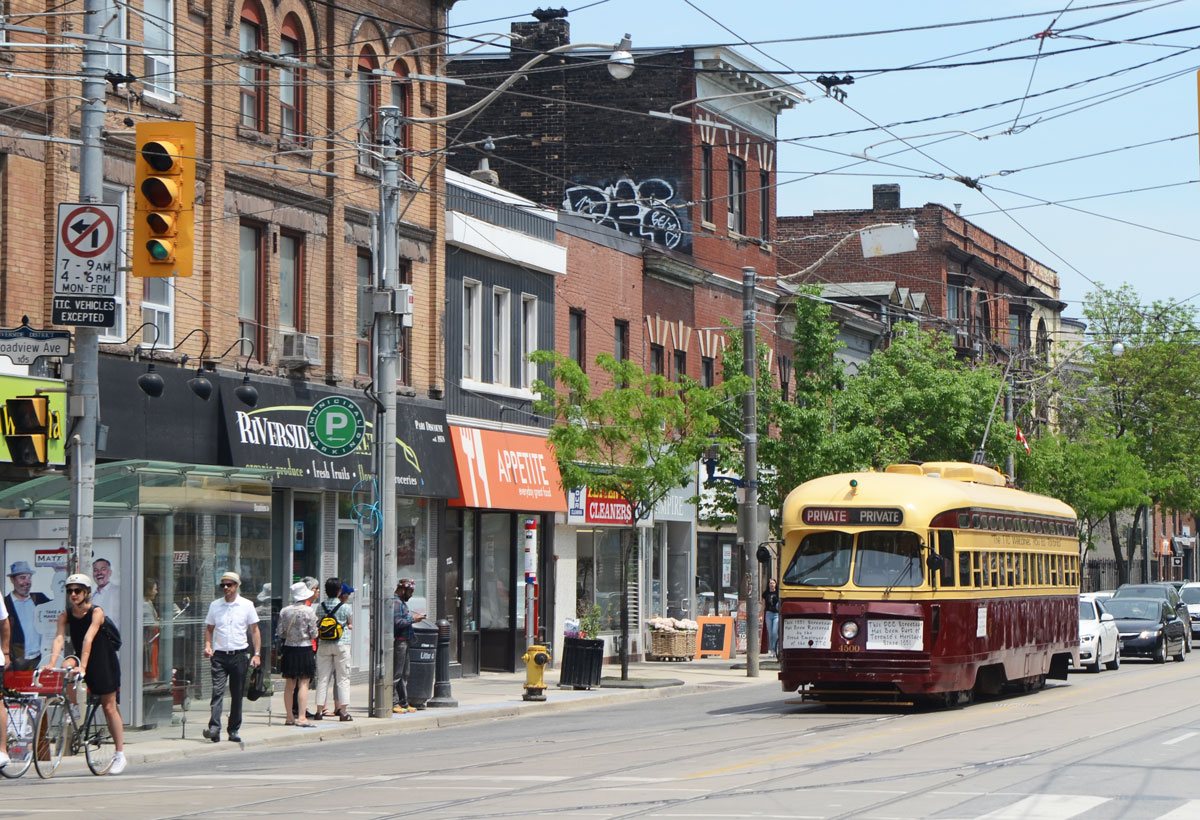
An old restored TTC streetcar, maroon and yellow, on Queen St. East

below:  The streetcar tour involved riding a new streetcar through a maintenance bay in the building and then around the parking lot out back.

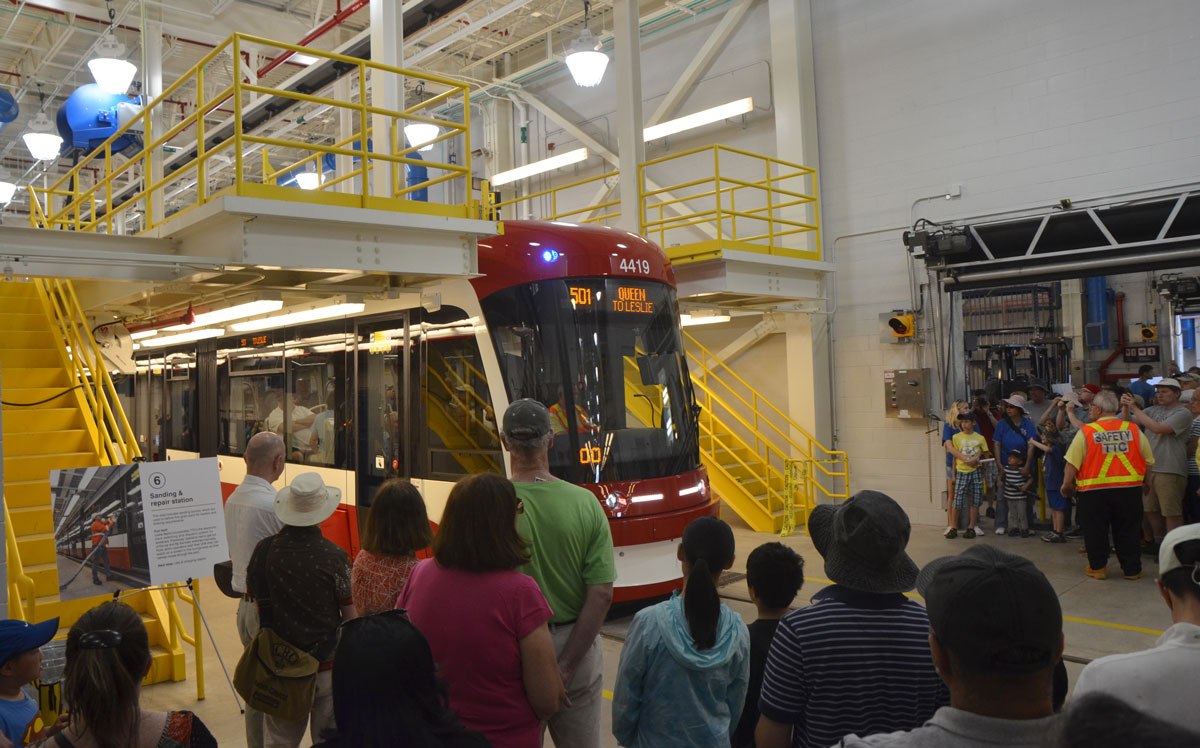
People at Doors Open in TOronto, at the TTC LEslie Barns streetcar facitlity, lining up for , or just getting off of, streetcar tours, riding the new streetcars around Leslie Barns

A group of people inside Leslie Barns streetcar facility, standing aside to make way for a new streetcar that is taking other people on a tour.

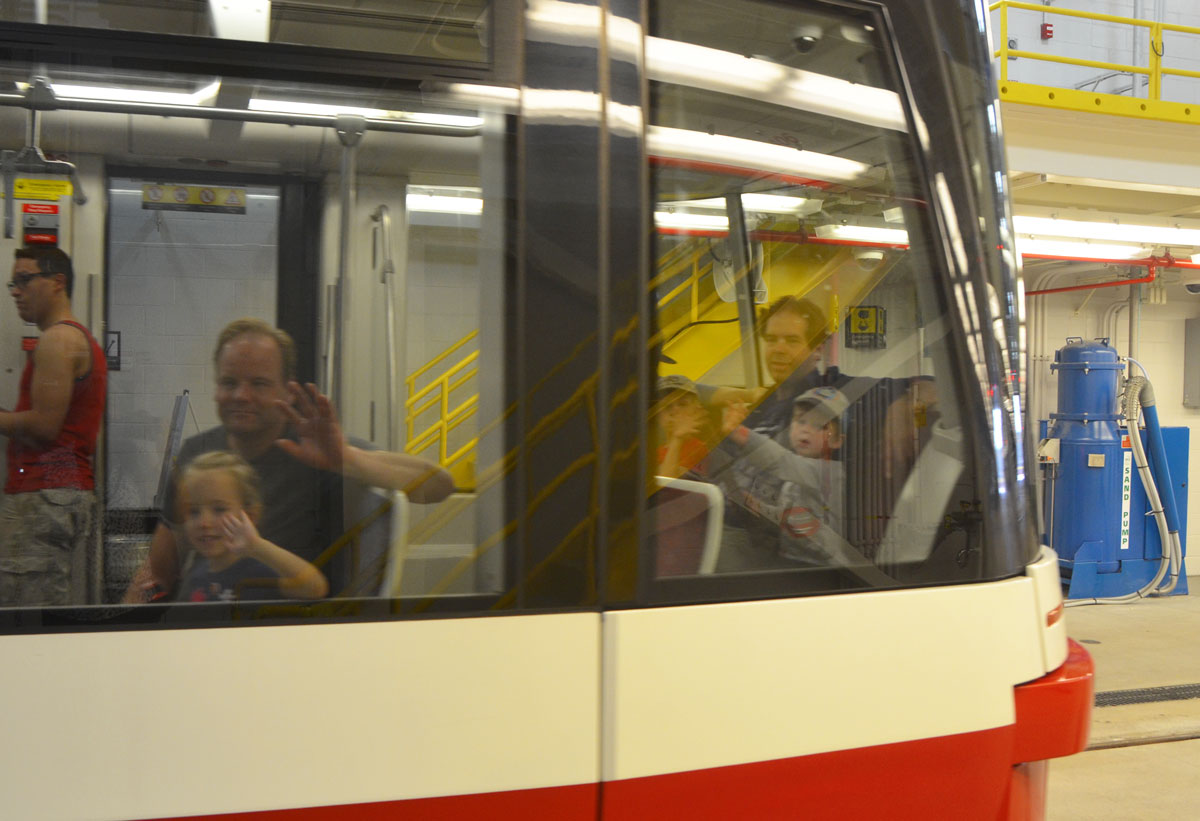
people riding in a new streetcar, photo taken from the outside, most of them are waving

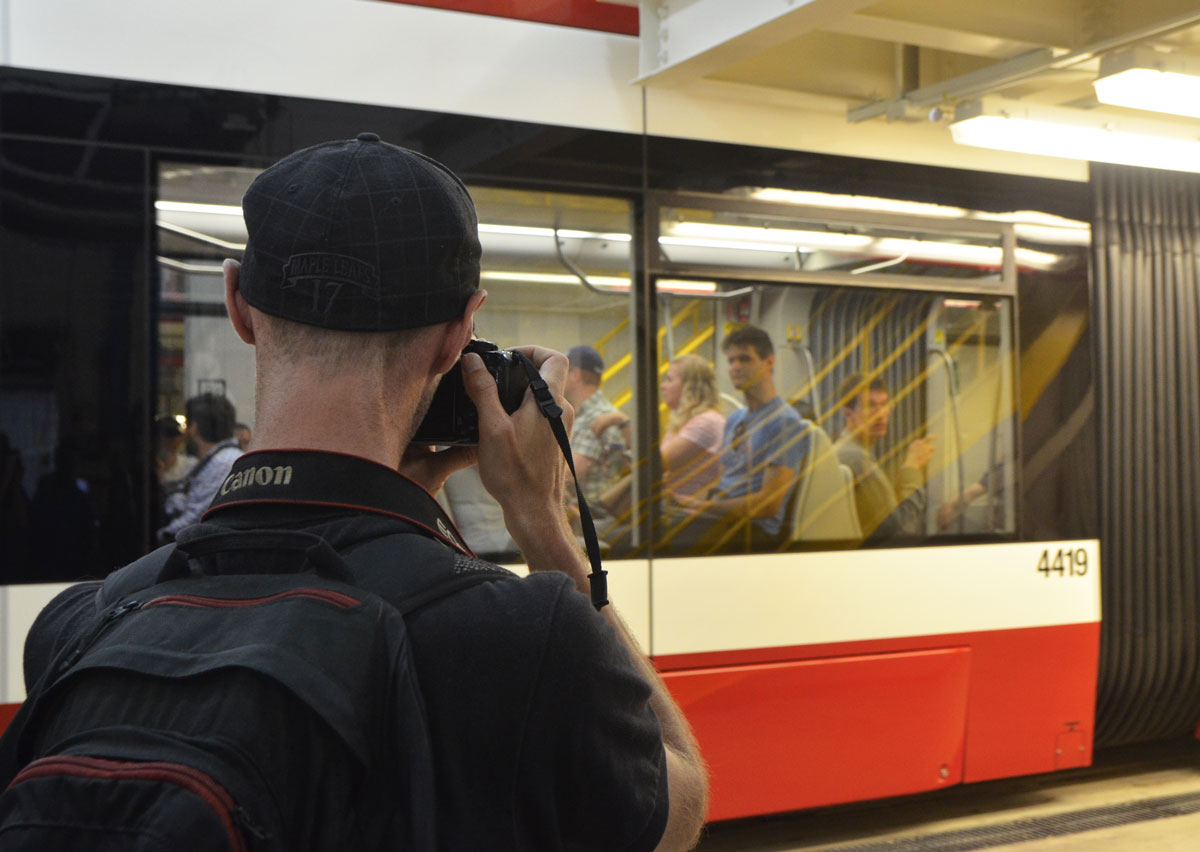
A man in black T-shirt and black cap is taking a picture of people riding in the new streetcar, inside Leslie Barns at Doors Open

below: Exterior, parking space for at least 100 streetcars

the massive concrete parking lot for streetcars with all the overhead wires. The building that houses the workshops and cleaning and office for the ttc is in the background.

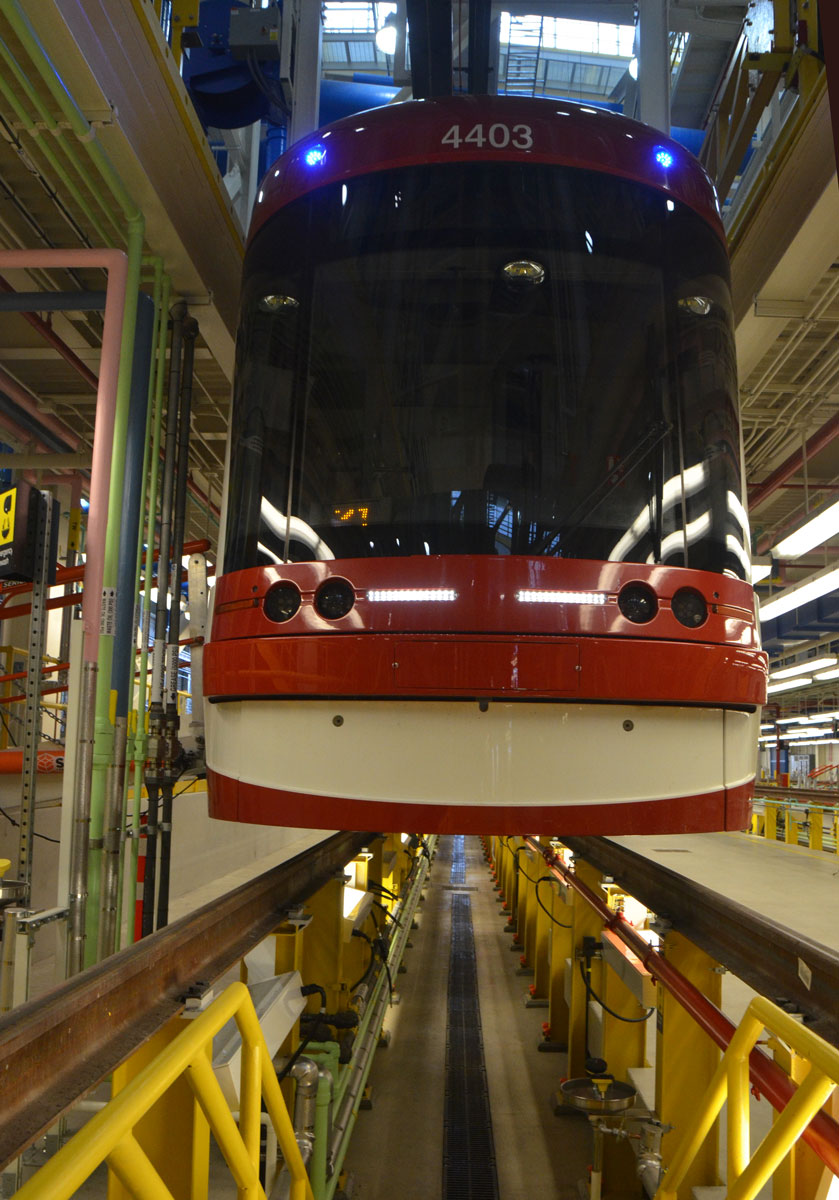
below: Special bays have been constructed with space for workers to access both the underneath and the top of the streetcars.  Because the cars have been designed to ride low, a lot of their workings such as the HVAC and propulsion systems are built into the roof of the car.
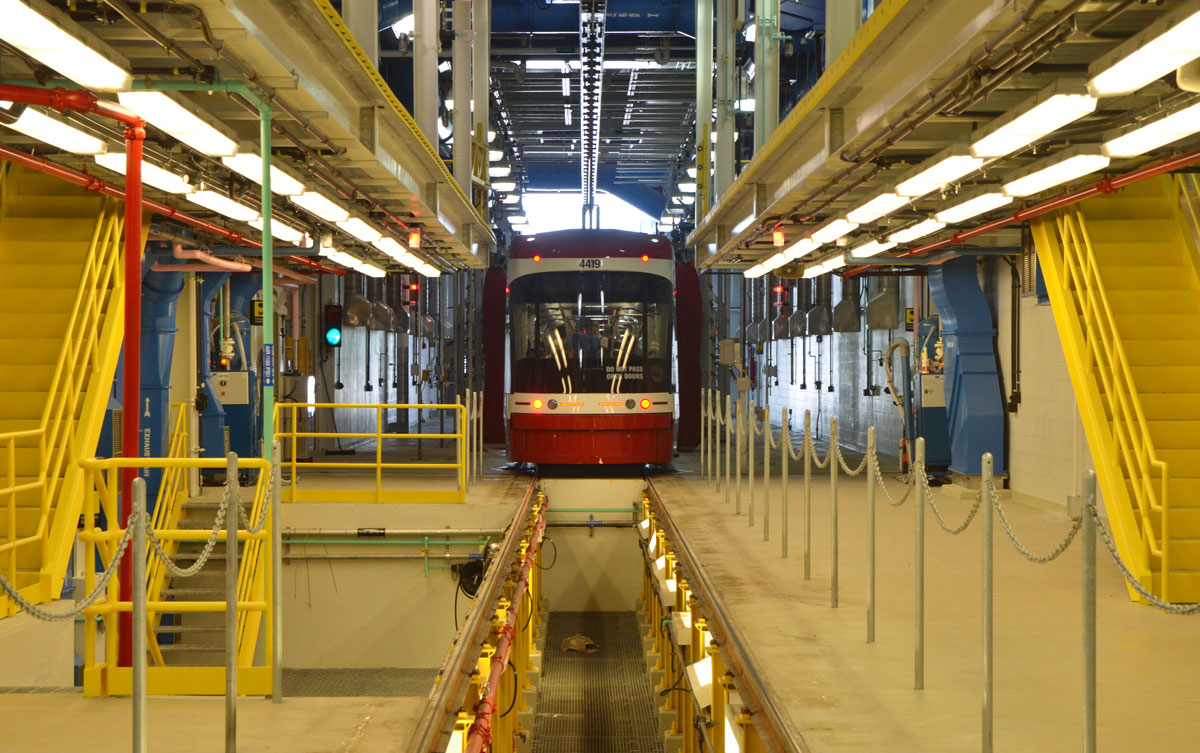
the back of a new streetcar as it passes through interior of Leslie Barns streetcar facility, a large, tall interior space with lots of pipes

A streetcar sits in a repair bay of the Leslie Barns, space underneath the streetcar for workers to go down and work on the underside of the streetcar.

below: It’s a big space!  …. 17,510 square metres (188,500 sq ft) in fact.

interior of Leslie Barns streetcar facility, a large, tall interior space with lots of pipes

below: A spic and span shiny paint room

interior of the paint room at Leslie Barns, where streetcars go to get painted.

below: A myriad of colour coded pipes
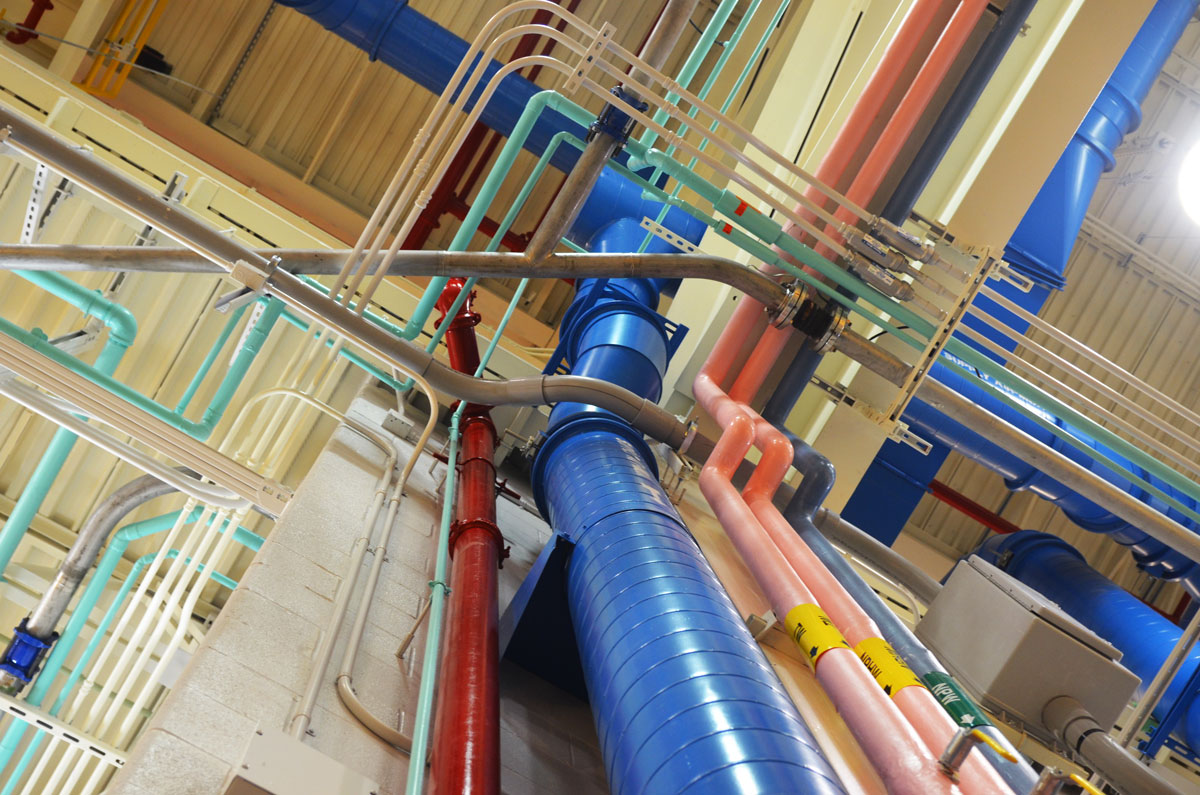
A myriad of pipes running up walls and across the ceiling, blue, pink, red, grey, all colour coded, interior, Leslie Barns

below: There were renovated vintage streetcars on display.  On the left is a 1921 Peter Witt streetcar and next to it is a PCC streetcar from the early 1950’s.
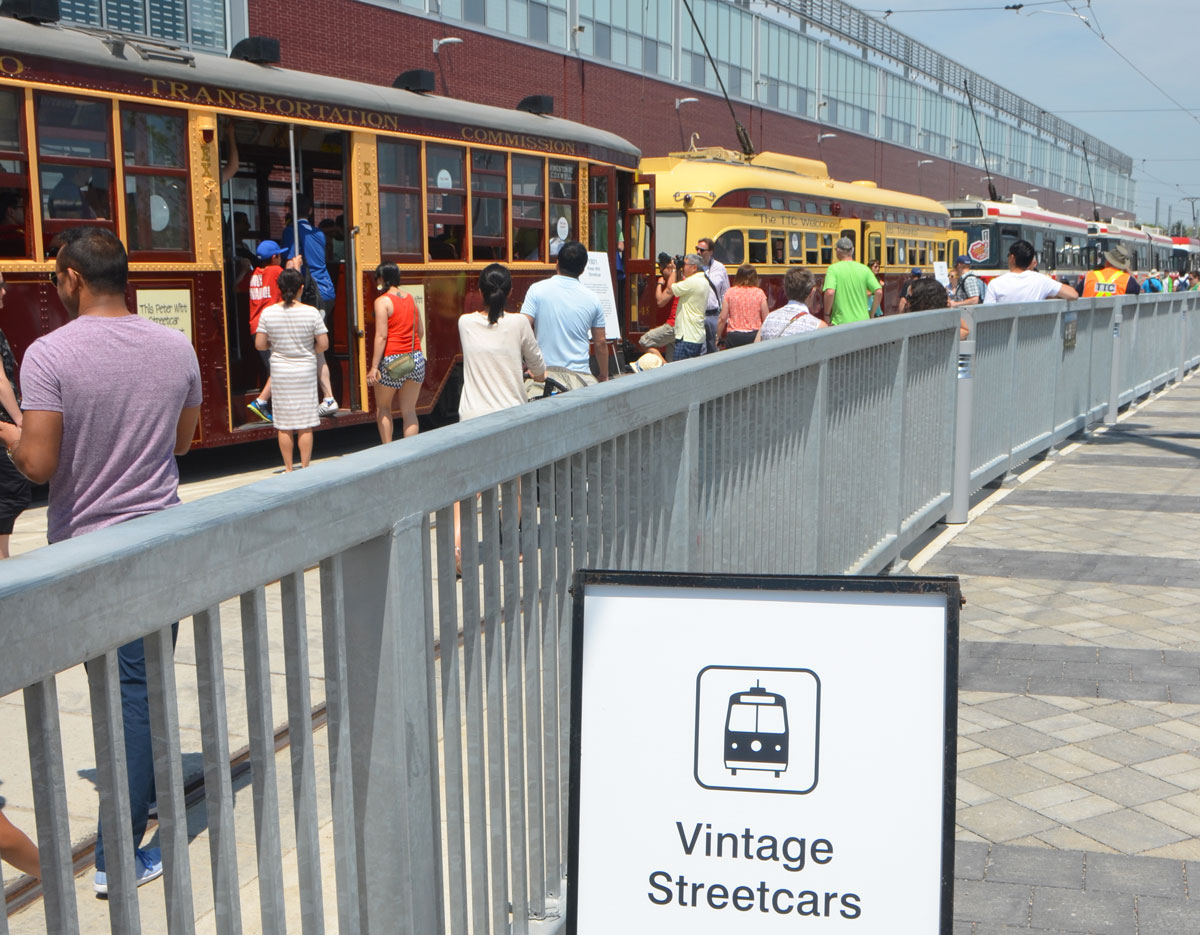
a number of people waiting to go inside old renovated vintage TTC streetcars

below: Interior of a refurbished Peter Witt streetcar with its wood trim.  The Witt cars were built for the newly formed TTC in 1921.  They entered service on Broadview in October of that year.  By 1923 they were operating on seven routes.  The last Witt streetcar was retired in 1963.
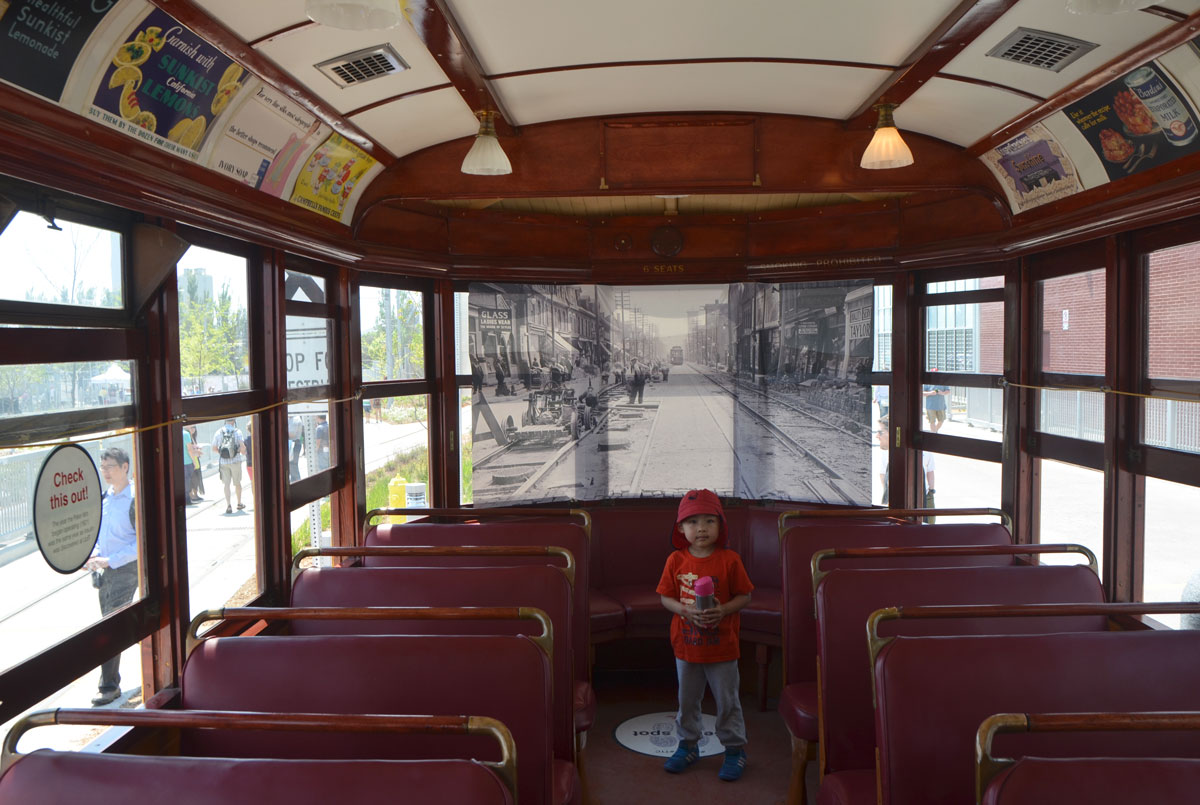
A young boy stands in the back of an old restored ttc streetcar. A black and white picture of an old street scene has been put across the back window to show you what the view out the window might have looked like at the time the streetcar was functional. Old ads on the upper part of the interior, wood trim

below: Looking out the window of a PCC streetcar built in 1951.  PCC stands for Presidents’ Conference Committee, which was a group of operators from the USA and Canada  who got together in 1938 to design a new electric railway car.  By the late 1950s, the TTC owned the largest fleet of PCC’s in the world.  The last one was retired in 1995.

A young boy wearing a hat looks out the window of an old restored streetcar while his father takes a picture out the window

below: Streetcar wire maintenance truck.

a special TTC truck sits outside Leslie Barns TTC facility on Doors Open day, the truck is designed to run on streetcar tracks and is used to repair tracks and wires. There are people looking at the truck

#DOT16 | #TTC

‘Cutlines’, an exhibit of old photographs from the Globe & Mail,
part of the CONTACT Photography Festival
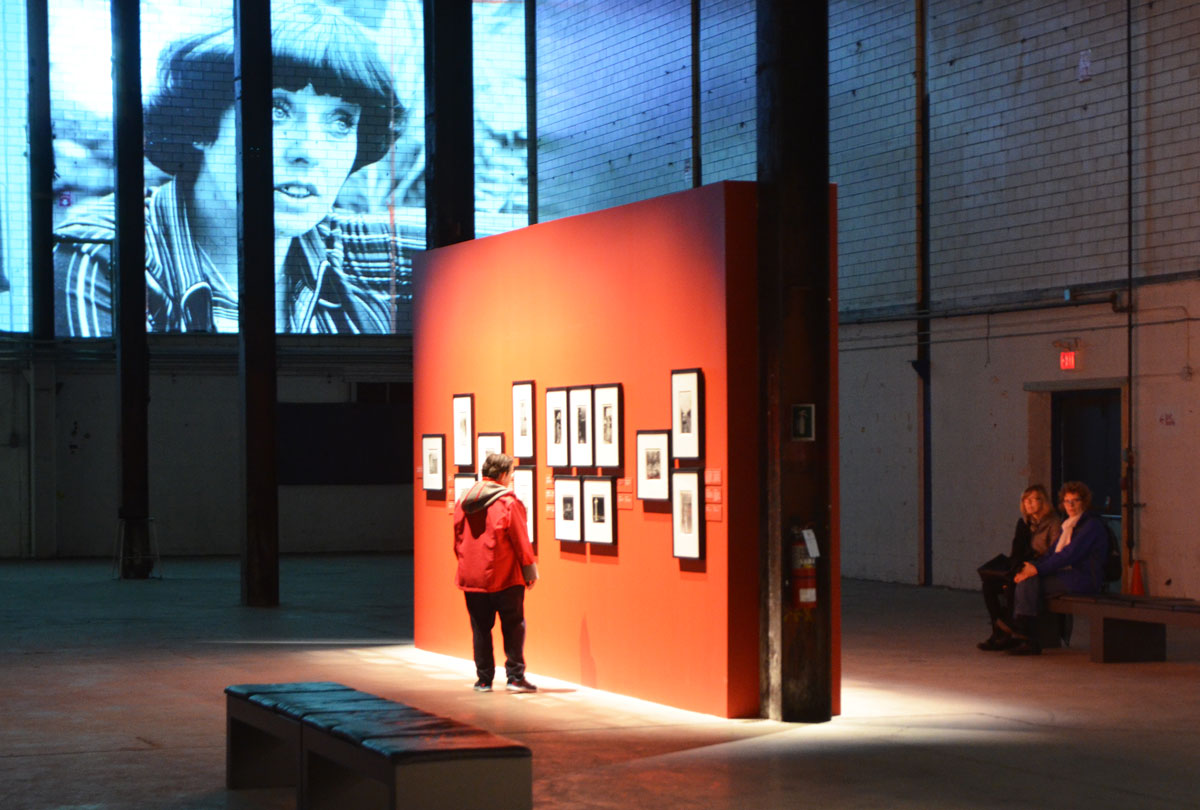
people standing in a large room, the old Press Hall at the Globe and Mail newspaper, looking at an exhibit of old photos. Some photos are being projected onto a wall

below: A small sample of the 175 vintage black and white photos from the vast collection held by the Globe and Mail newspaper on display.
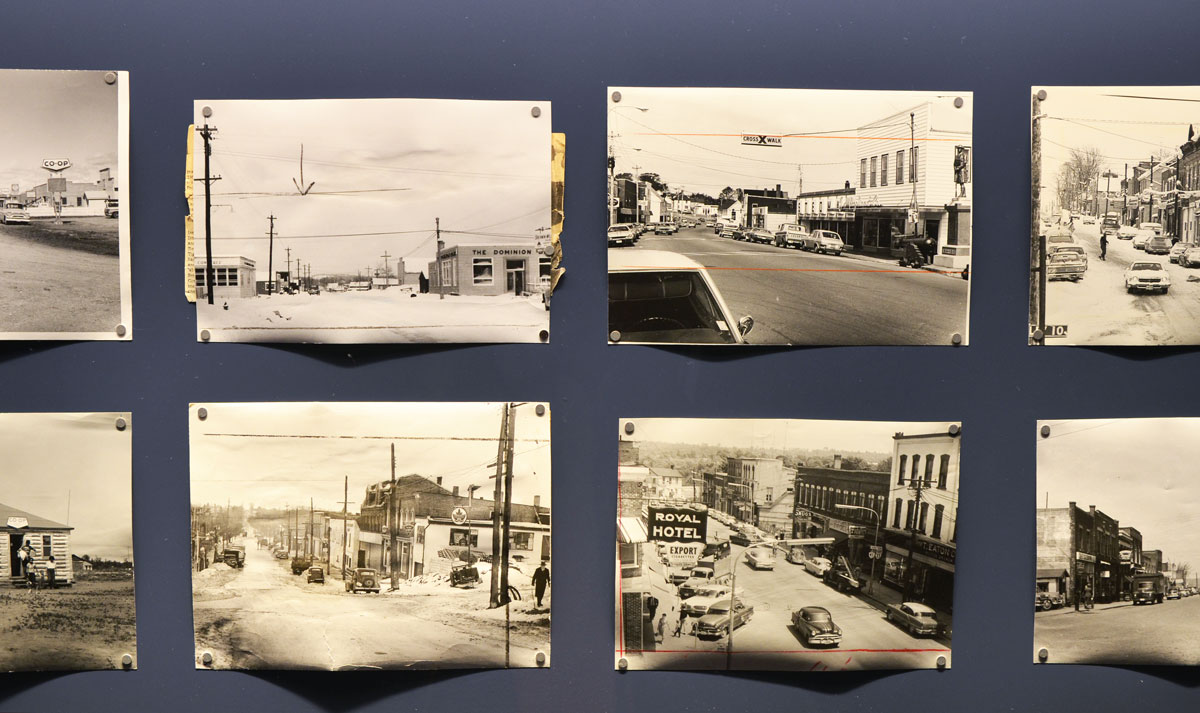
old photographs, black and white, of small towns, in a display case, as part of an exhibit called Cutlines, old photos from the Globe and Mail collection

below:  The exhibit is being held at the Press Hall on Wellington Street (near Spadina).  This old building is slated for demolition in the near future as the Globe and Mail is in the midst of moving to a new home.  Prints were in cabinets in the center of the room while other images were projected high on the walls.
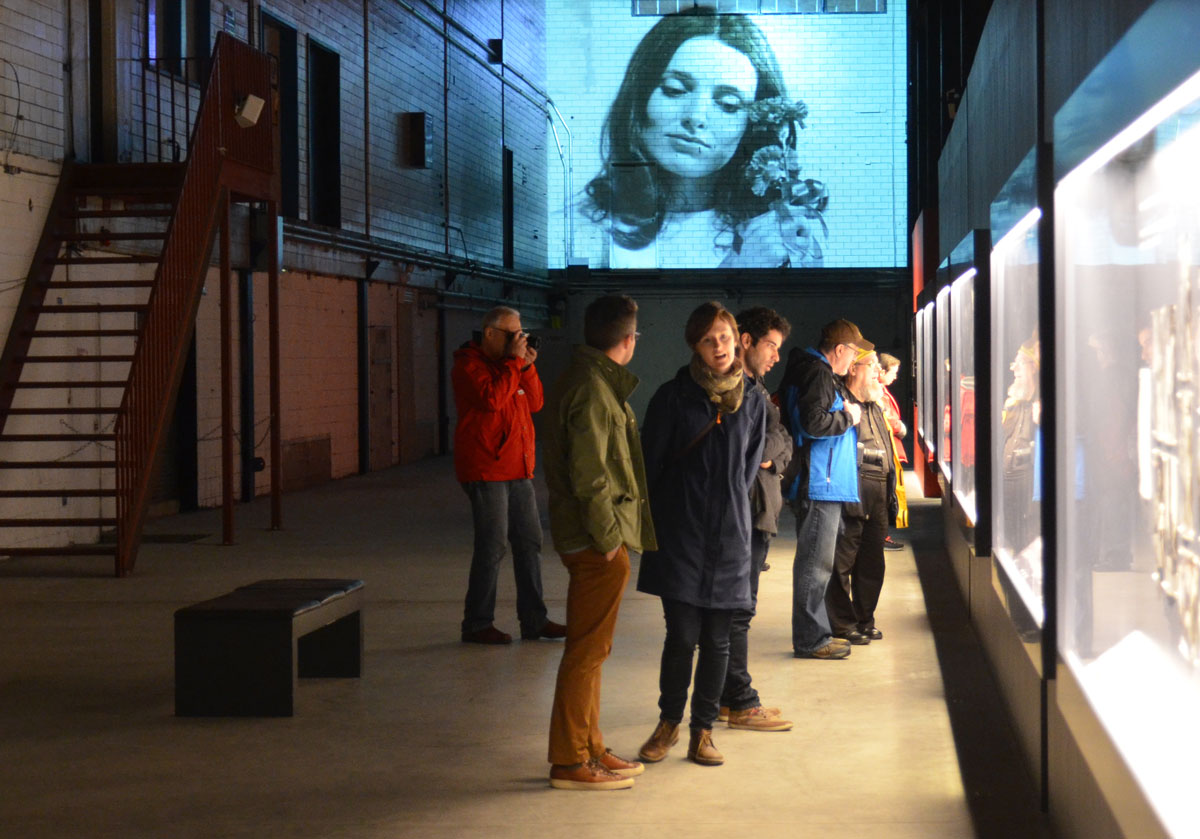
people standing in a large room, the old Press Hall at the Globe and Mail newspaper, looking at an exhibit of old photos. Some photos are being projected onto a wall

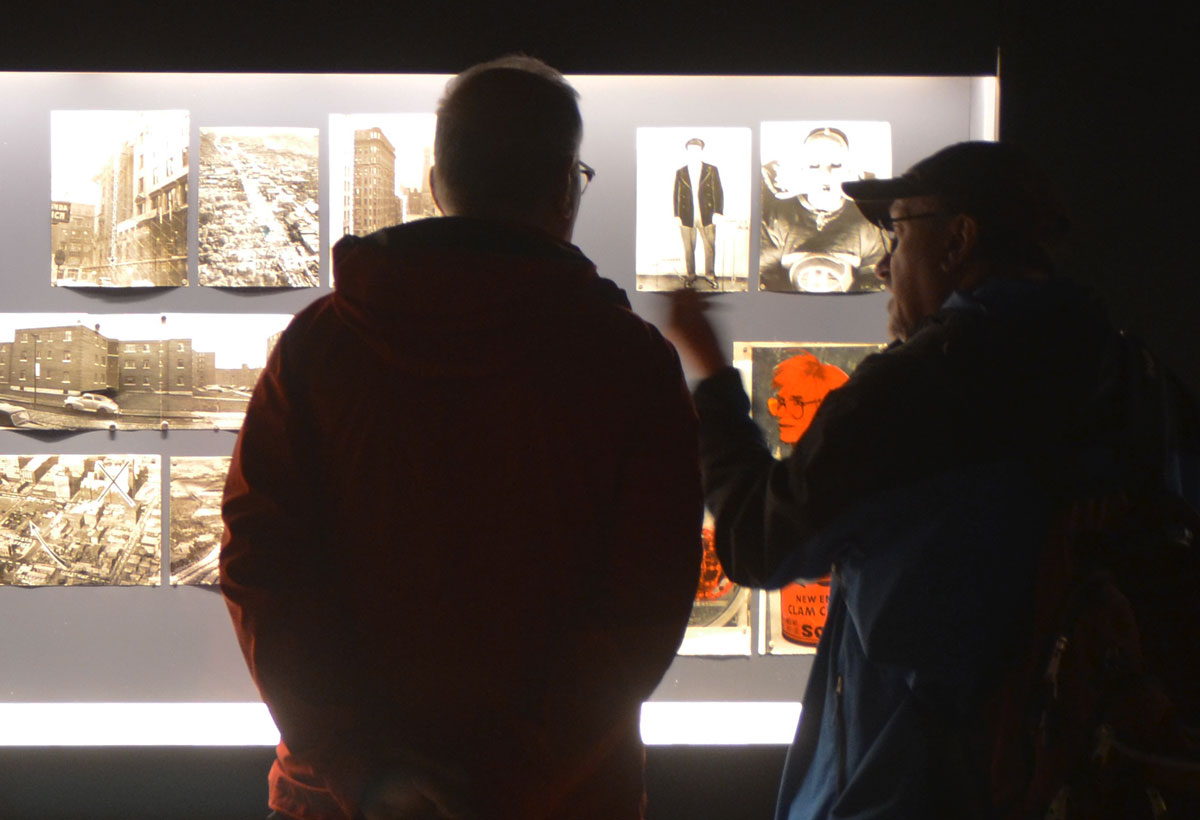
The Globe & Mail has amassed a collection of about 750,000 photographs.  As they transition from print to digital images, they are ‘cleaning house’ with respect to their photo archives.  About 100,000 of the prints are going to be digitized and a portion of those donated to the new Canadian Photography Institute at the National Gallery of Canada in Ottawa.

below: Some of the pictures were covered with red, with what is known as a rubylith mask.  When the images were printed, the portions covered in red remained as they were while the rest of the picture could be changed to suit the needs of the story of the day.
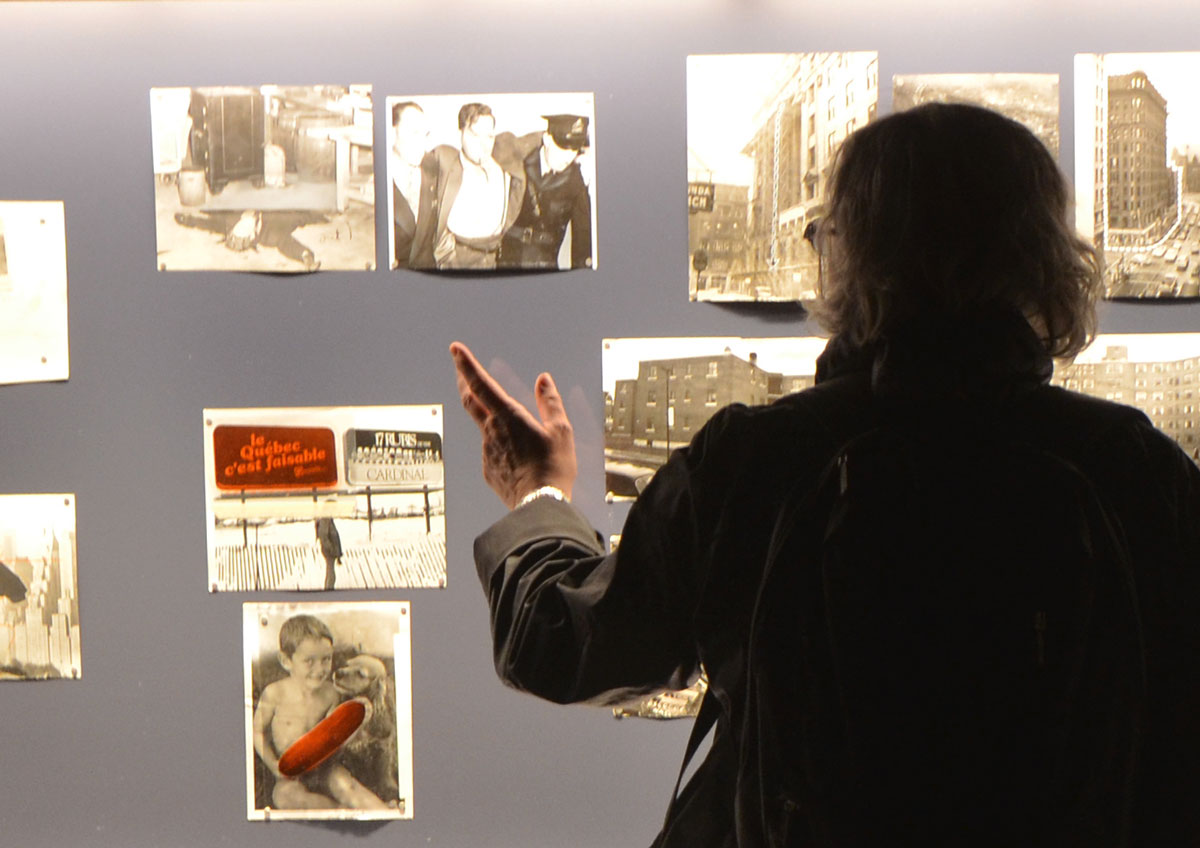
silhouette of a woman standing in front of a lit display case of old photographs

people standing in a large room, the old Press Hall at the Globe and Mail newspaper, looking at an exhibit of old photos. Some photos are being projected onto a wall

people standing in a large room, the old Press Hall at the Globe and Mail newspaper, looking at an exhibit of old photos. Some photos are being projected onto a wall

people standing in a large room, the old Press Hall at the Globe and Mail newspaper, looking at an exhibit of old photos. Some photos are being projected onto a wall

below: The woman with the two trophies, bottom left, is Marilyn Bell who swam across Lake Ontario.  I know that the man beside her is from a story about a cowboy championship of some sort in Calgary and my apologies for not remembering more of the details.
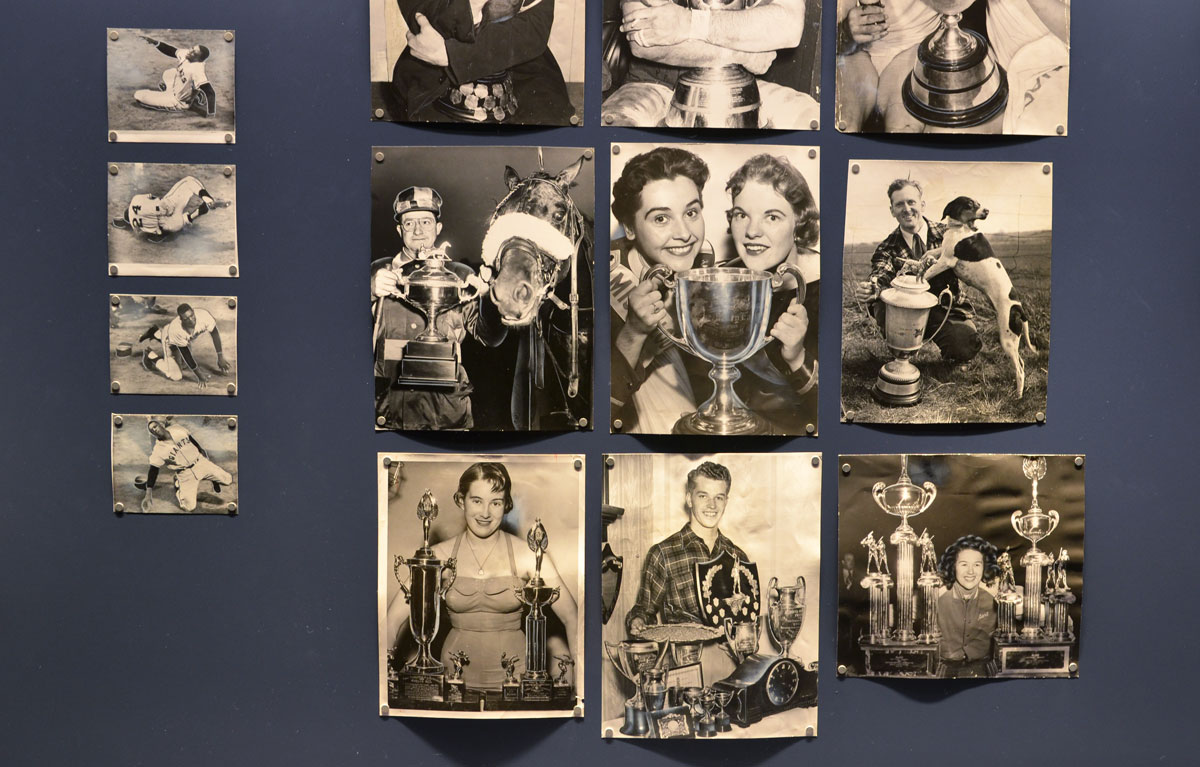
old photographs, black and white, of people with trophies, in a display case, as part of an exhibit called Cutlines, old photos from the Globe and Mail collection

silhouette of two men standing in front of a lit display case of old photographs

On view at 425 Wellington St. West until 26 June 2016

#CONTACT16

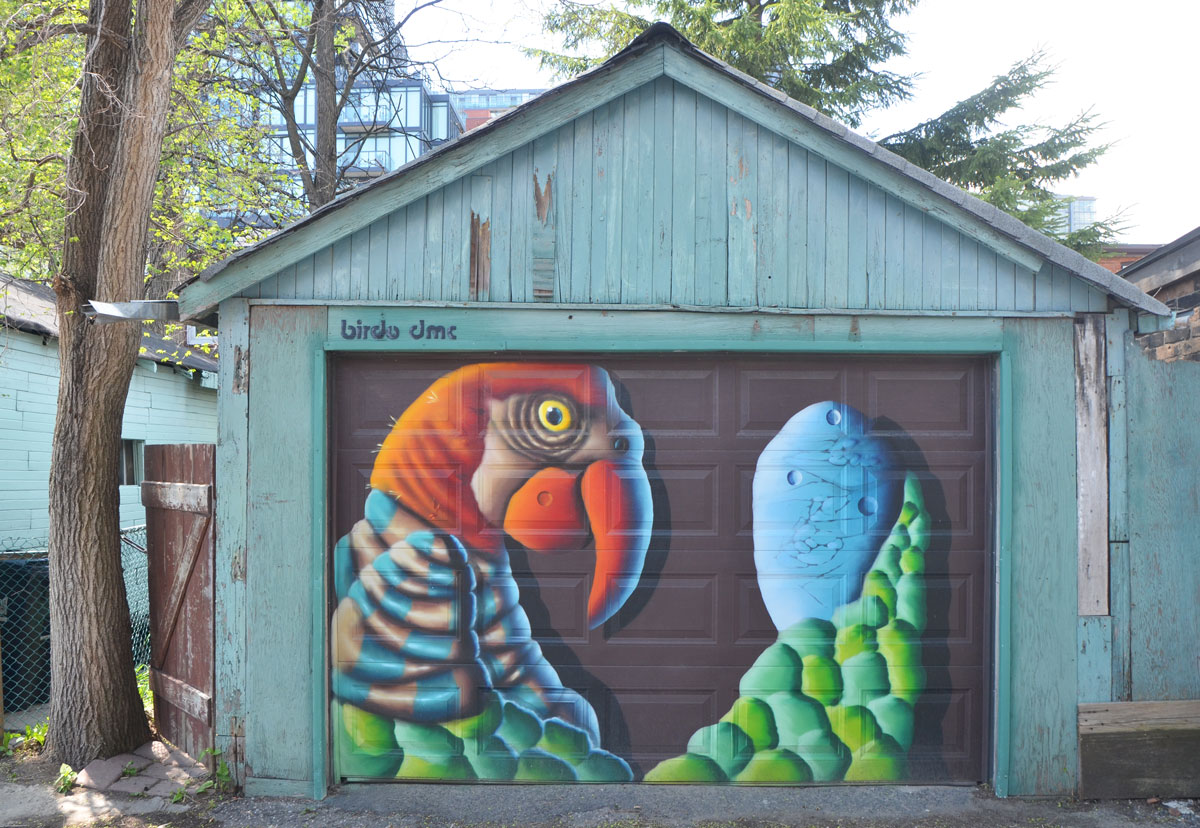
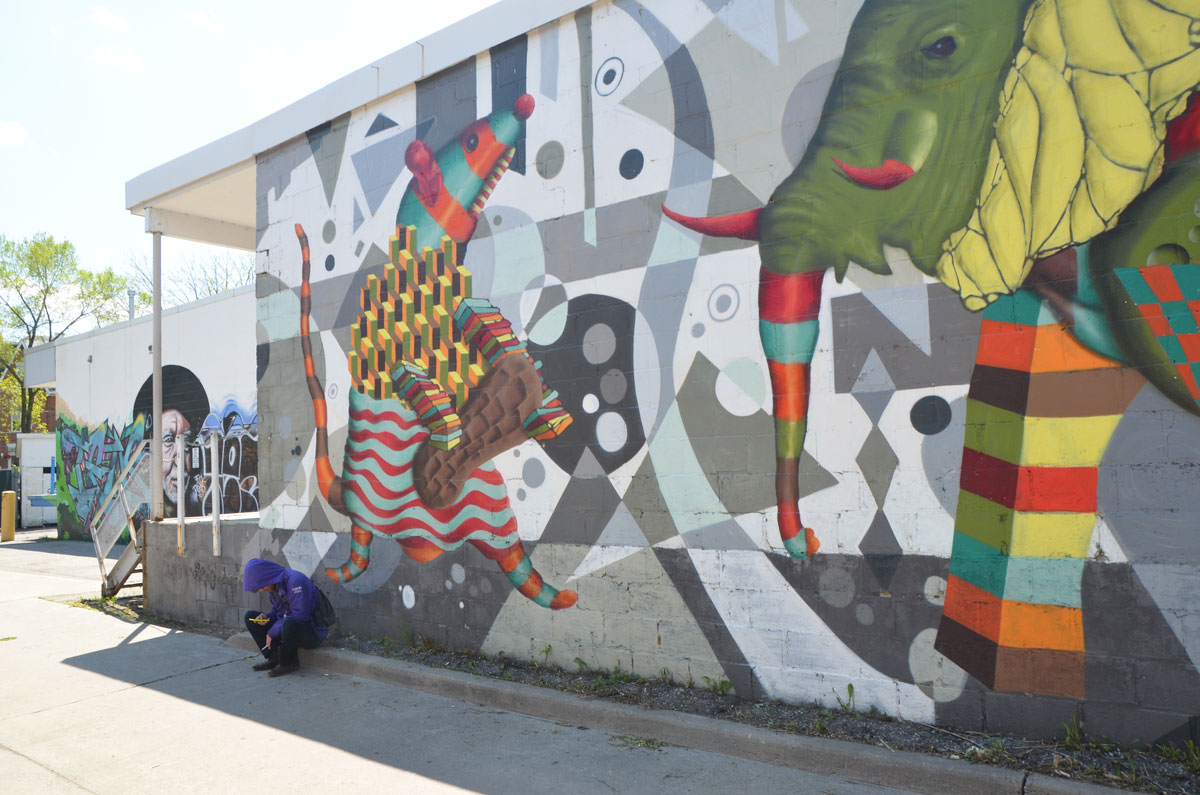
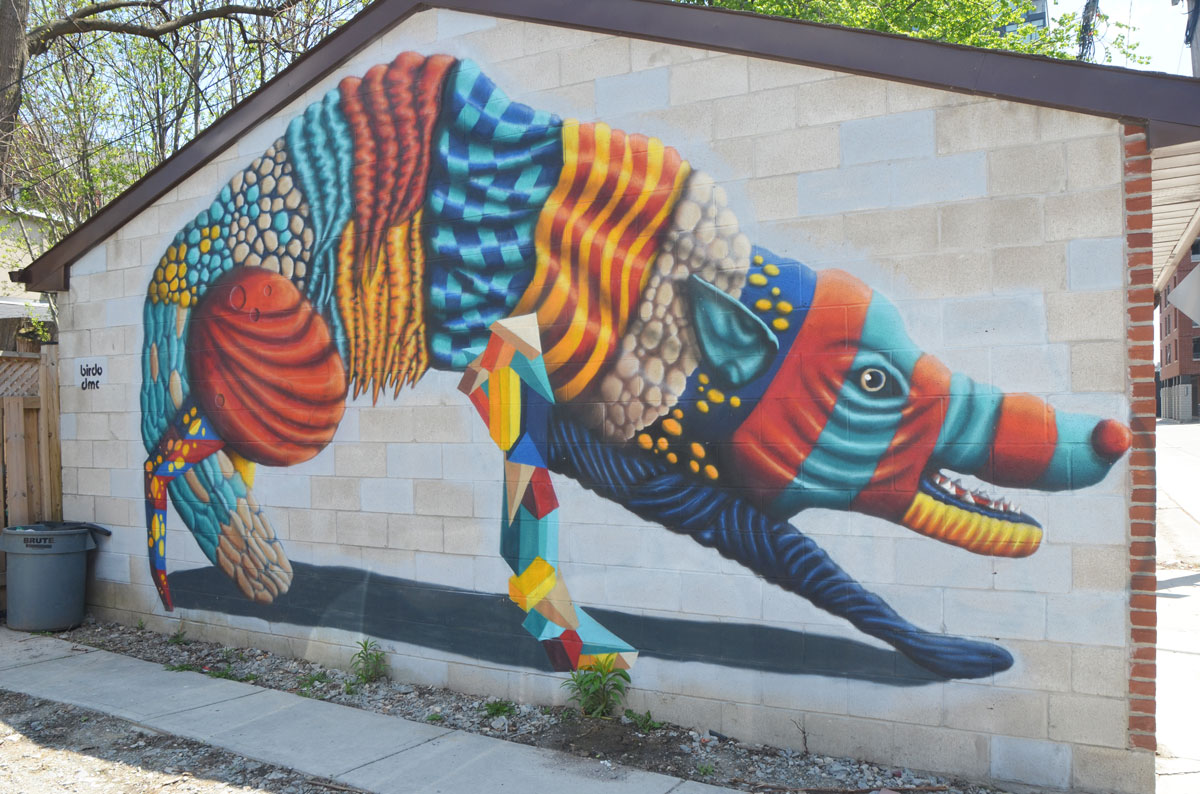
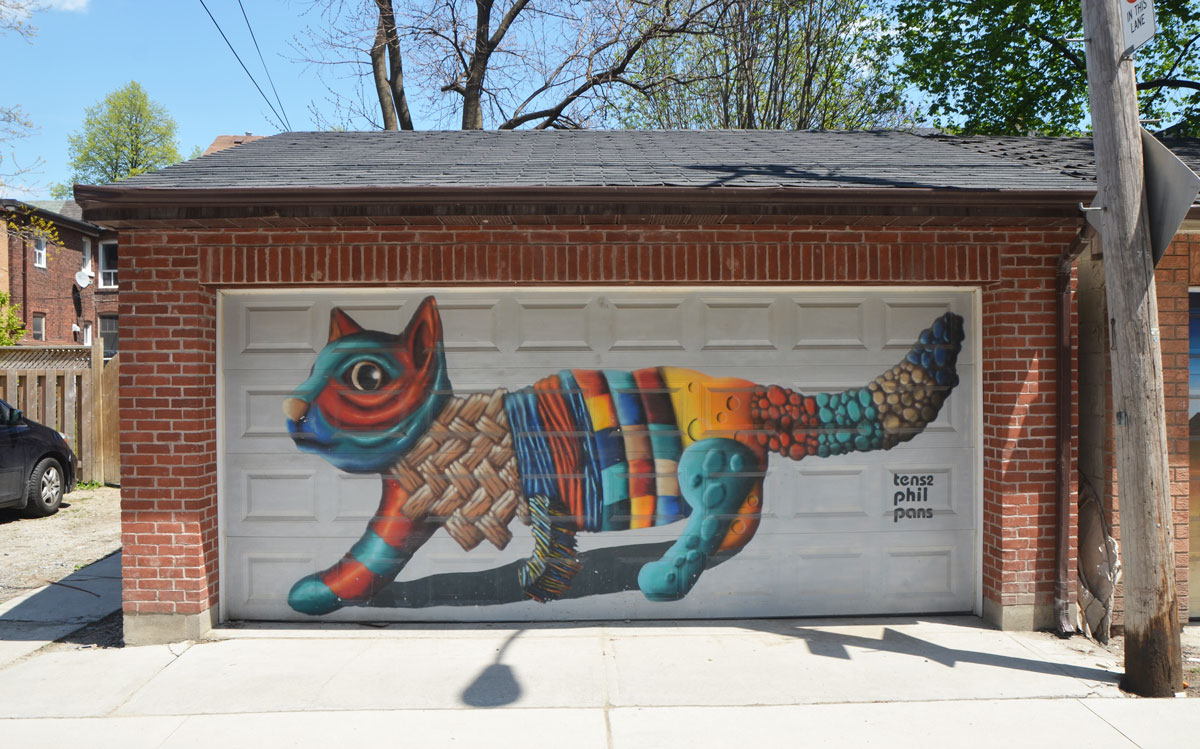
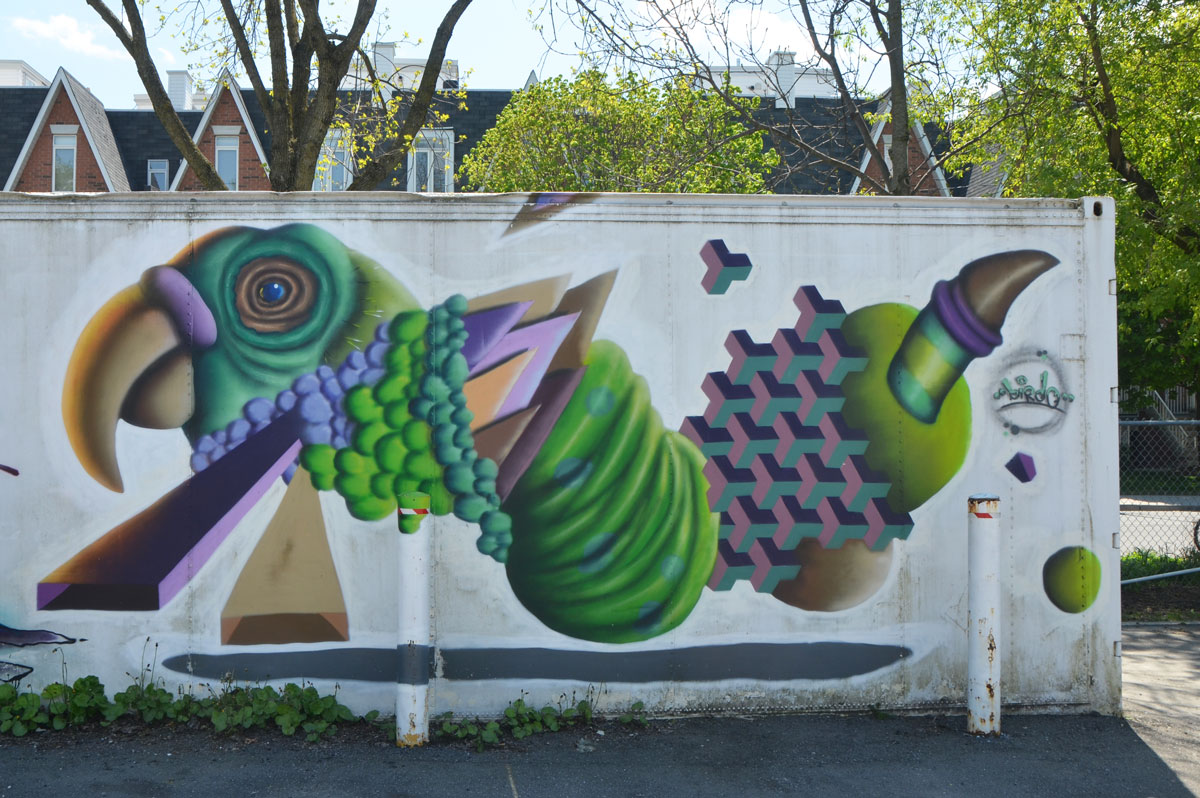
This blog post is about a flock of birdos, meaning that I found a lot of alley garages decorated with paintings by street artist birdo.  Or maybe ‘a menagerie of birdos’ would be a more accurate description as most of the pictures were of different animals such as elephant, cat, dog, coyote, and mouse along with a number of different birds.

These photographs were are all taken in alleys behind the south part of Dovercourt Road (between Queen and Sudbury streets).  The majority of the paintings that I saw were result of birdo’s work but there were examples of  and I have included them in this post too.

 below: Two birdo birds with eggs, with a slice of mushroom and pepperoni pizza by Shalak.

Three garages in an alley, with trees growing between them. The first two have garage doors with birdo murals on them and the third has a pizza street art painting by Shalak

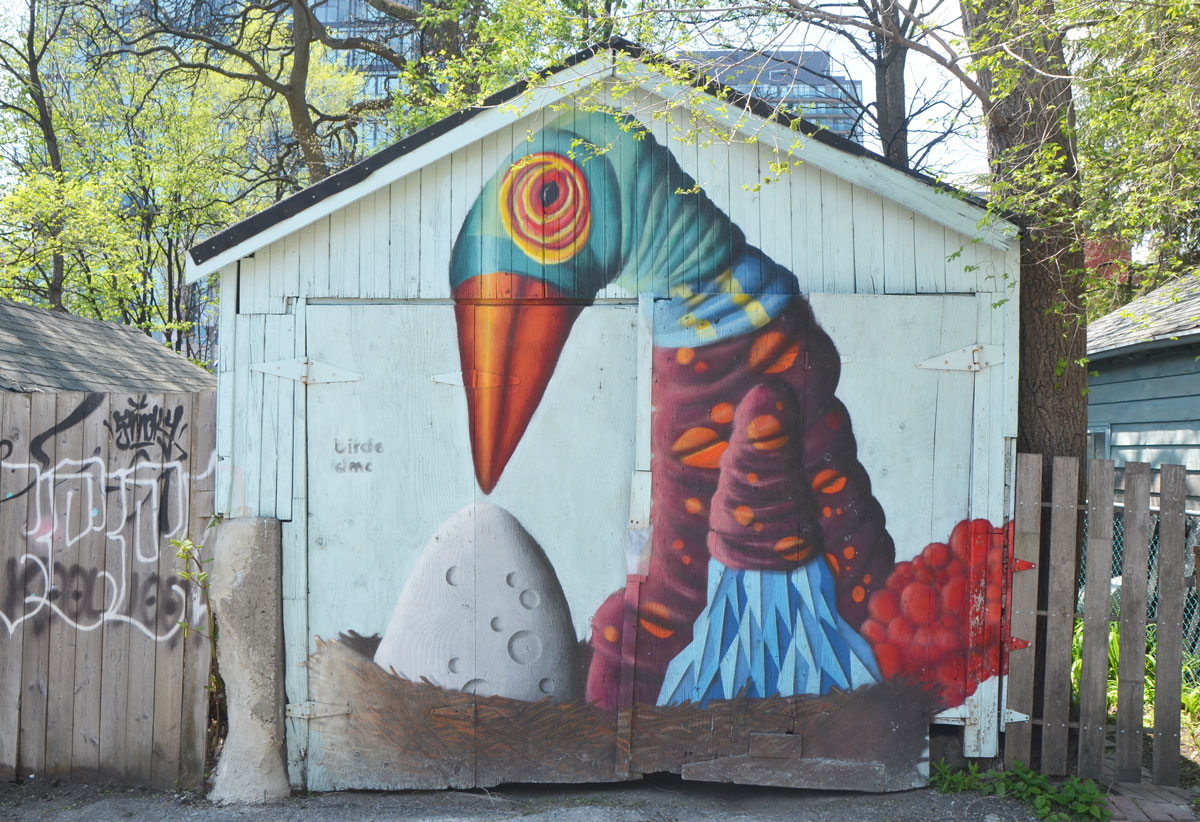
street art mural on a garage door in an alley by birdo - a large bird with blue head and orange beak sitting in a nest looking down at a large white egg

street art mural on a garage door in an alley by birdo - a parrot holding a large blue egg

An old wood garage in an alley that is painted by Shalak, a slice of pizza with pepperoni pieces flying off it (or onto it!)

a person is sitting on a kerb in an alley, beside a wall with a large mural by birdo of an elephant and a mouse

street art mural on a wall in an alley by birdo - an elephant with a green head

below: Howling at the moon, with a cactus and a scorpion too.

street art mural on a garage door in an alley by birdo - a coyote howling at the moon in the desert with a large cactus in the picture as well as a scorpion. words: birdo homes spud

below: Blue dog, pink lava lamp

street art mural on a garage door in an alley by birdo - a blue dog beside a pink lava lamp on a table. words: birdo dmc, phil pans tense

street art mural on a garage door in an alley by birdo - a four legged animal looks to be growling at something

street art mural on a garage door in an alley by birdo - a large multicoloured cat. words: tense phil pans

below:  A rooted turtle and cool owl with sparkly shades

street art mural on a garage door in an alley by birdo - a lavendar turtle and an owl with blue eyes and orange beak

street art mural on a garage door in an alley by birdo - a creature with a green and purple body and head that looks like a parrot

street art mural on a wall in an alley, a girls face, two little brown pigtails, 2 hearts and a turtle head

an old mattress leans against an old brick wall that has two pieces of graffiti on it. One is a blue and yellow egg shape with a blue arm and hand sticking out of a crack in it. The words "It's alive" are written beside it. The other is a small blue creature like shape

On a gararge door in a laneway, painted like the Canadian flag except there is a pineapple in the middle instead of a maple leaf. On the right hand side red stripe are the words "have a nice day"

A mural by bruno smoky on the side of a white container. It is a purple faced creature with blue tag like shapes around it.

below: “Just a robot that doesn’t like technology”

a lovebot on a silver garage door with the words "Just a robot that doesn't like technology, I'd rather be free"- signed Tasha

number 66 in a lane, garage door, door and walls covered with circles and triangles in different colours.

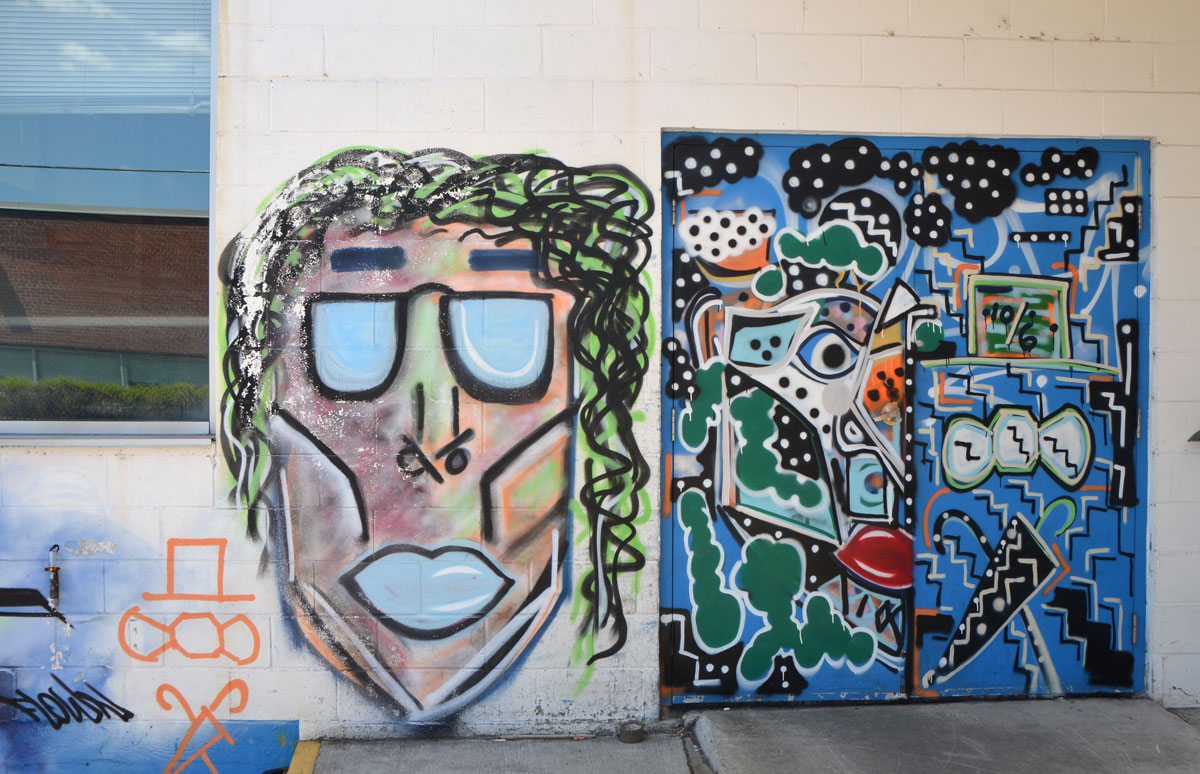
A door covered with a very abstract face painting and another graffiti face beside the door.


Refugees in a State Apartment, Jens Ullrich,
Photo exhibit, on a fence outside the Italian Consulate, Dundas West at Beverley.

Part of Scotiabank CONTACT Photography Festival
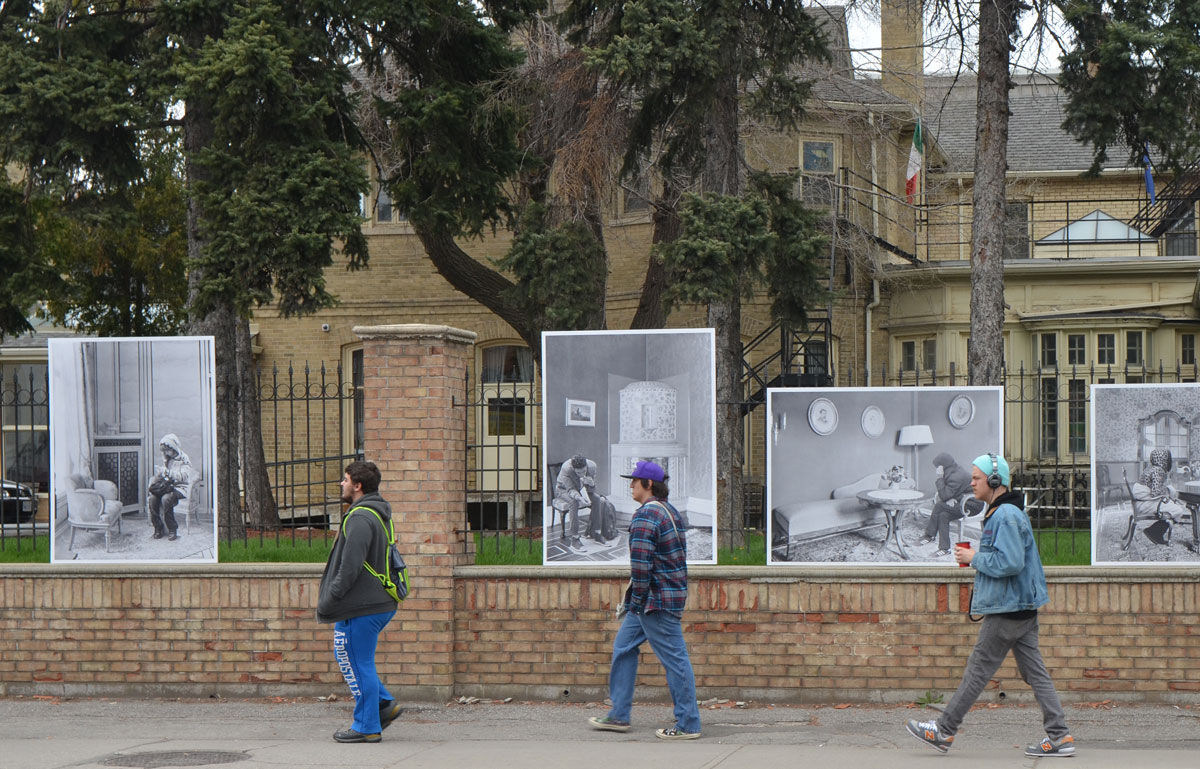
photos mounted along the exterior of a wrought iron fence around the Italian Consulate, right beside the sidewalk. The consulate is on old brick house (mansion) from the 1800's - 3 of the photographs, people walking past

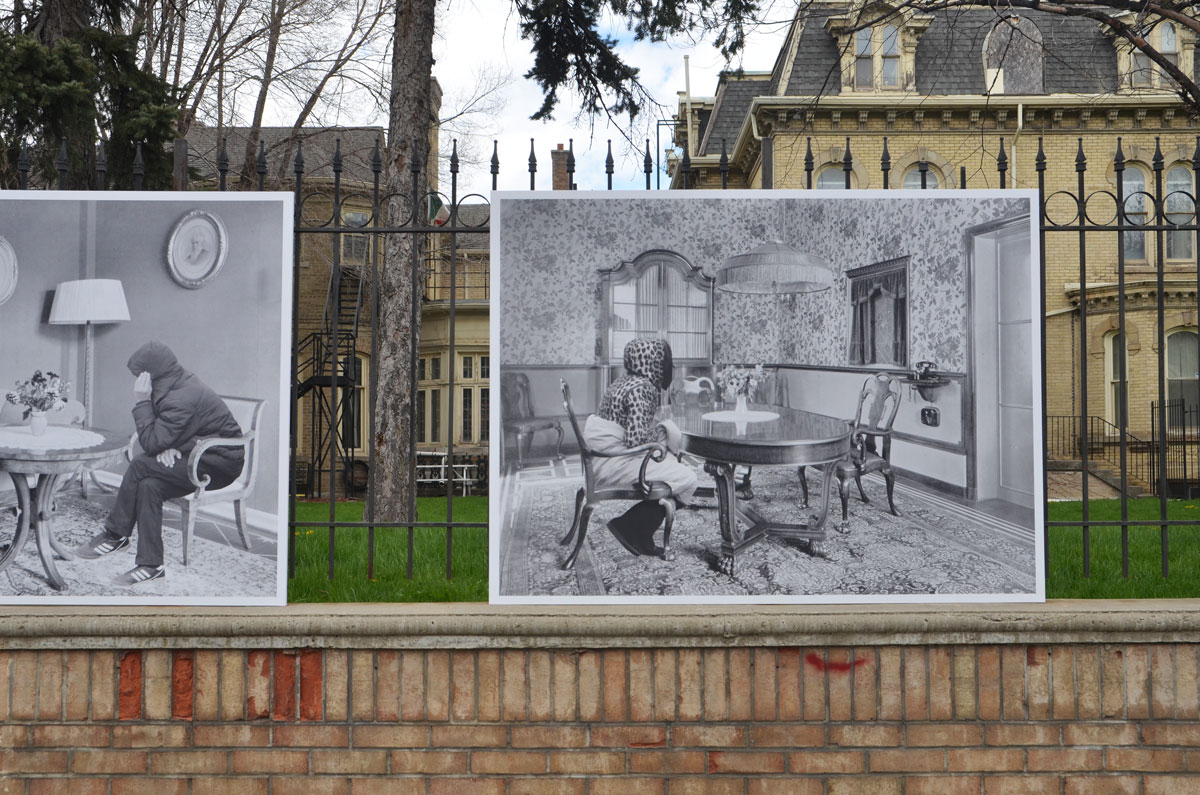
Ullrich has taken found black and white photographs of the interior of a large home near Bremen Germany.  The photos were taken in the late 1920’s.    Each photograph is of a different room in the villa and to each picture Ullrich has added  one person.   If you knew nothing about the series, you wouldn’t know that the subjects were refugees.

In each photomontage, singular individuals are depicted—usually with their faces hidden from the camera—within empty yet elaborately fashioned spaces that emphasize their solitude and unstable status. “

photos mounted along the exterior of a wrought iron fence around the Italian Consulate, right beside the sidewalk. The consulate is on old brick house (mansion) from the 1800's - phot by Jens Ullrich of a woman refugee with her face obscured by clothing, sitting on a chair in the bathroom of a large bathroom. also a photo of a male refugee in another room, looking in a large mirror

One of the concepts behind this series of images was the desire to

respectfully capture the disparate emotions of these individuals and their precarious situations.”

photos mounted along the exterior of a wrought iron fence around the Italian Consulate, right beside the sidewalk. The consulate is on old brick house (mansion) from the 1800's - as seen from across the street with pedestrians walking past and cars driving past

photos mounted along the exterior of a wrought iron fence around the Italian Consulate, right beside the sidewalk. The consulate is on old brick house (mansion) from the 1800's - the photos are of refugees that have been photoshopped into old photos of the interior of the apartment of a wealthy person from the 1920's
#CONTACT16

‘Current Studies’ and ‘Paper Planes’
Two different series of photographs by Sjoerd Knibbeler
Allan Lambert Galleria, Brookfield Place

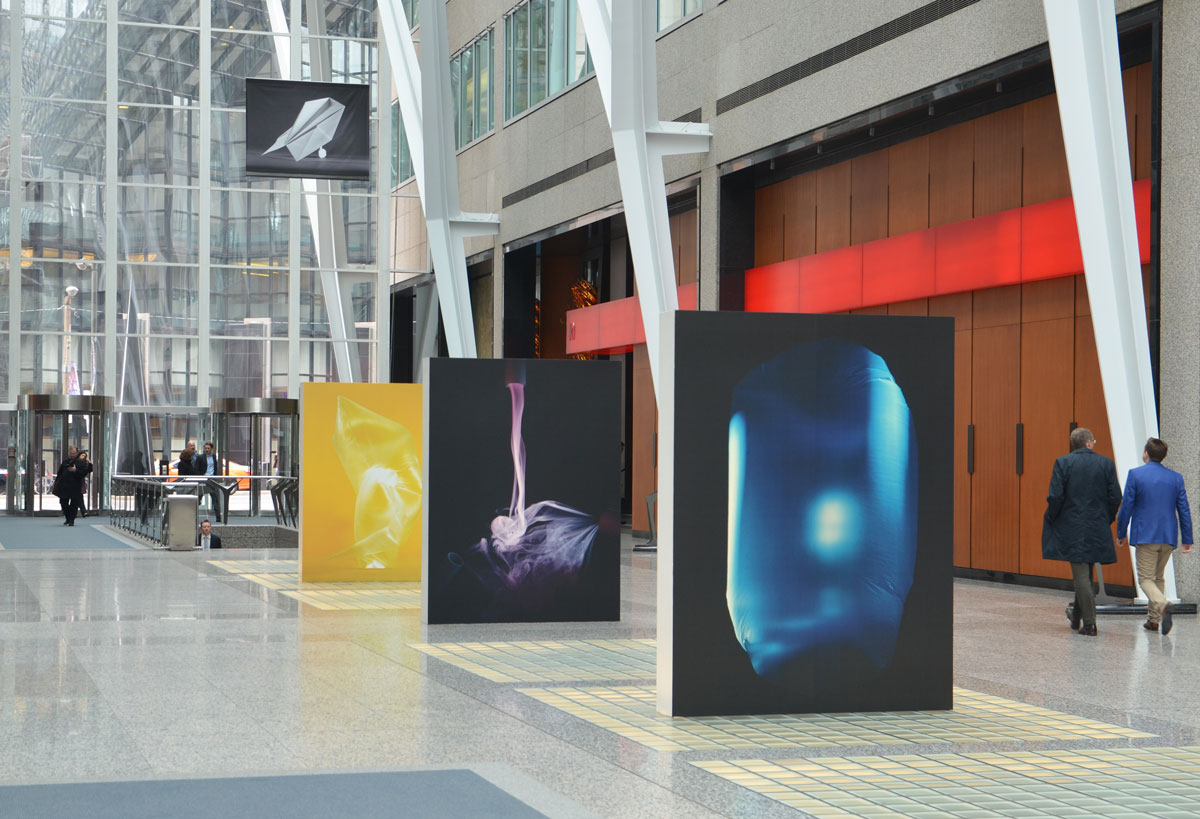
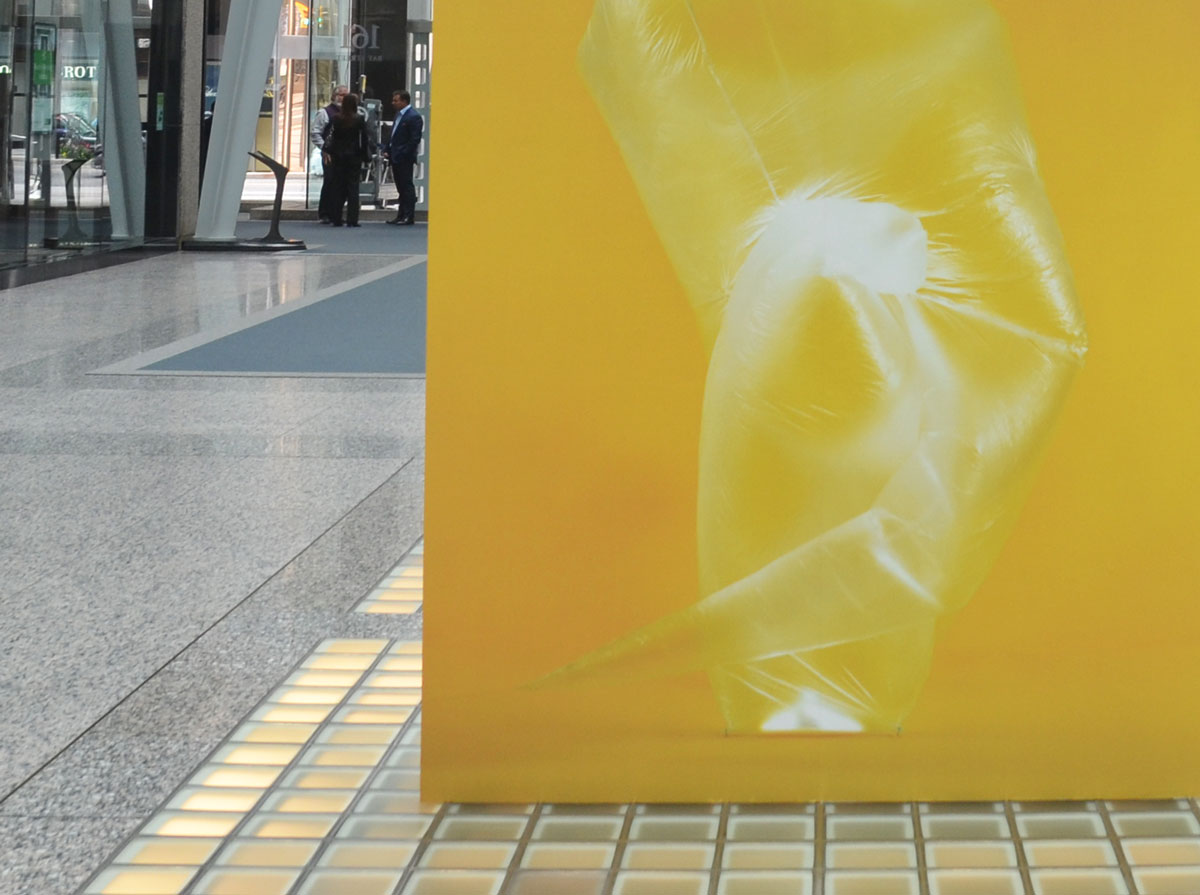
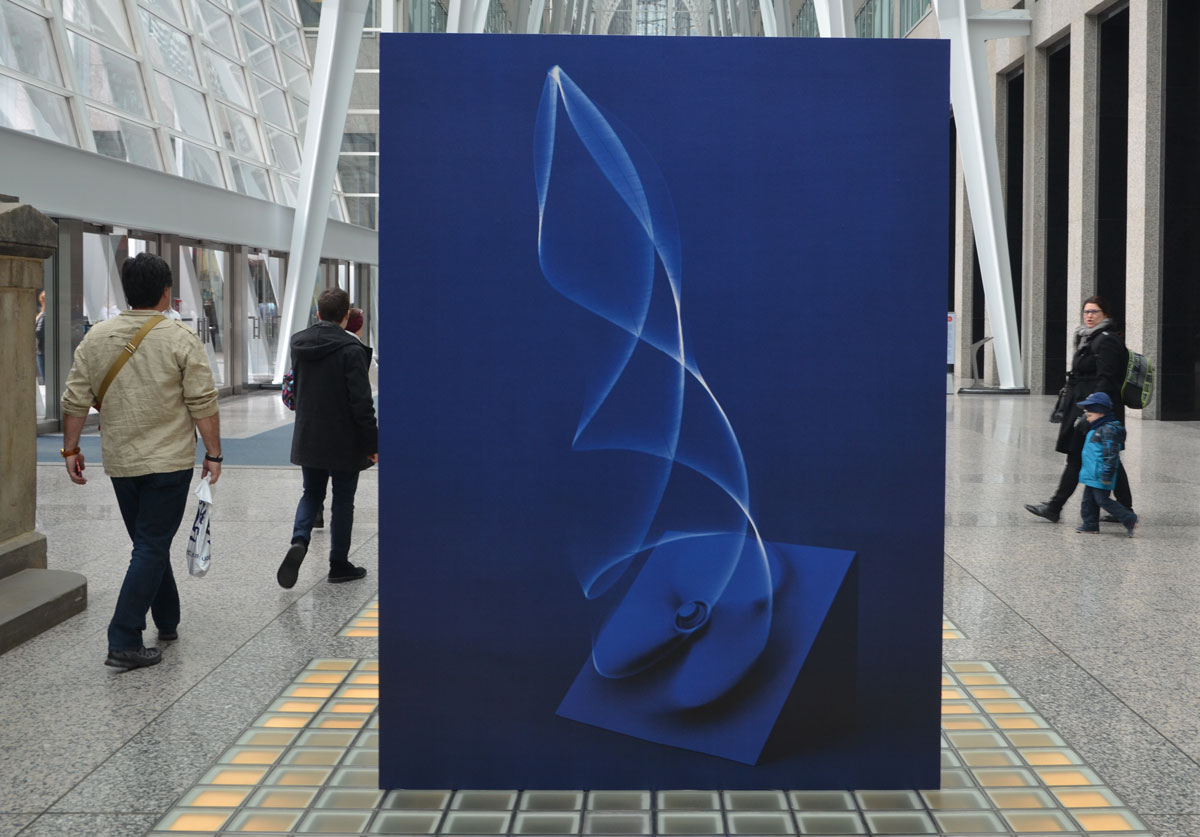
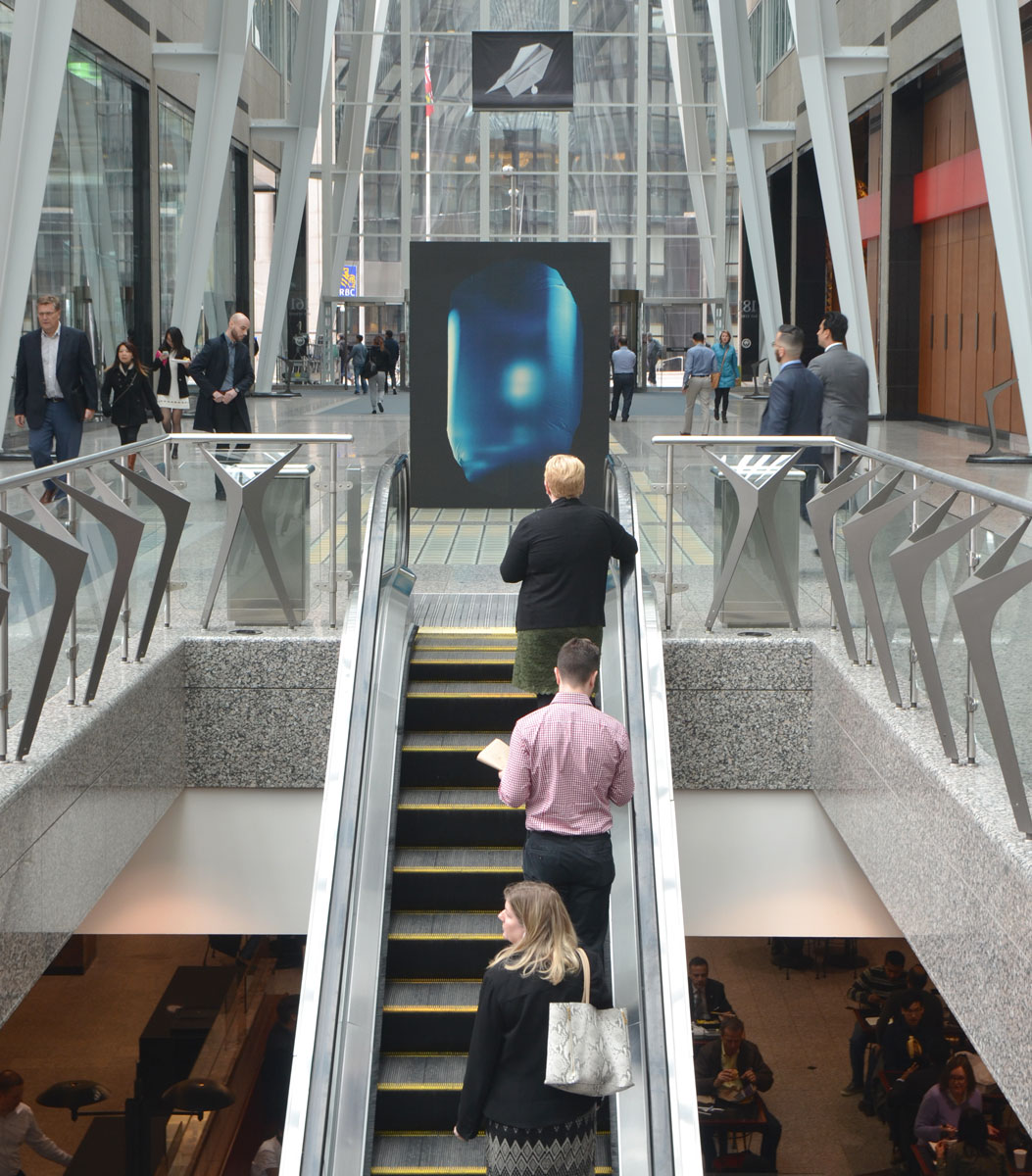
At ground level there are six large freestanding ‘walls” arranged in line, three at each end of the atrium.    Each ‘wall’ is covered by two images, one on either side.  They are photographs that are the result of Knibbeler’s experiments to “ shape, encompass, and capture air currents.”  This is the ‘Current Studies’ part of the installation.
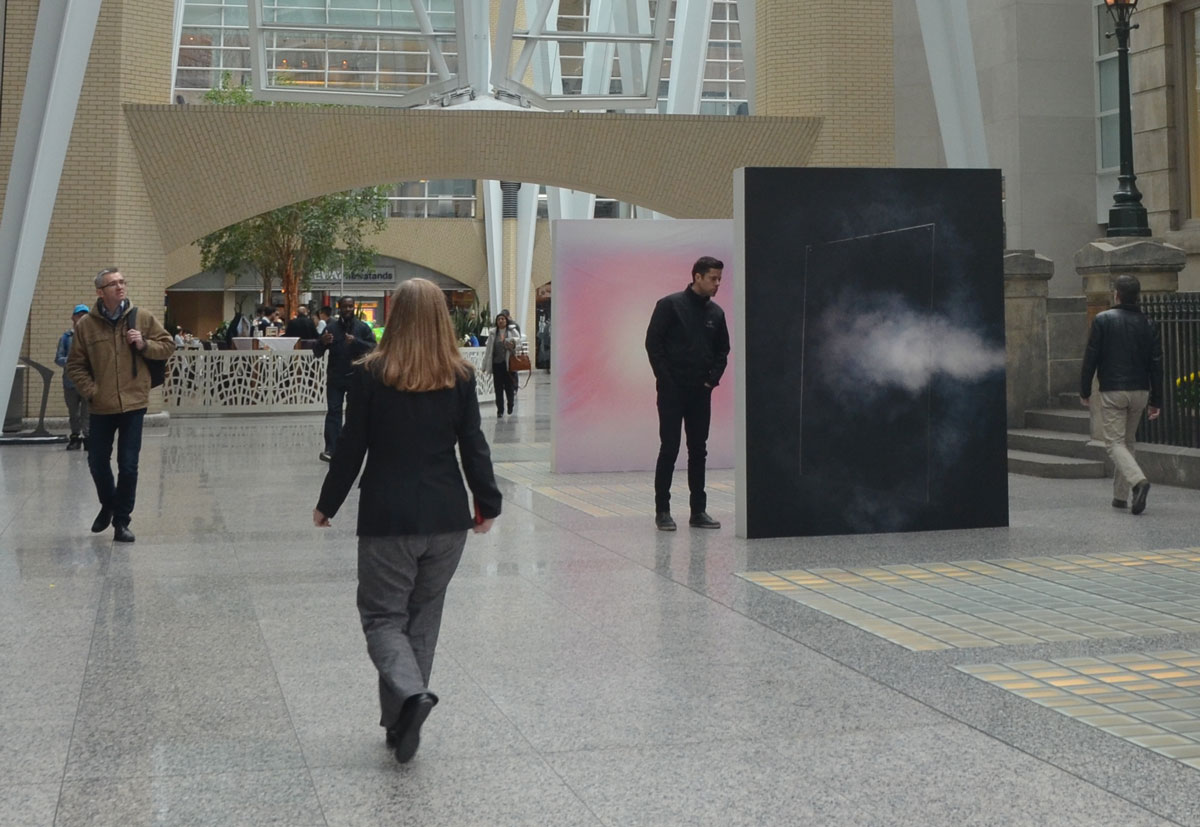
A picture taken inside the Allan Lambert Gallery at Brookfield Place, photos by Sjoerd Knibbeler, a series called Current Study large pictures standing in the middle of the gallery, as well as series called "Paper Planes" which are hung from the ceiling

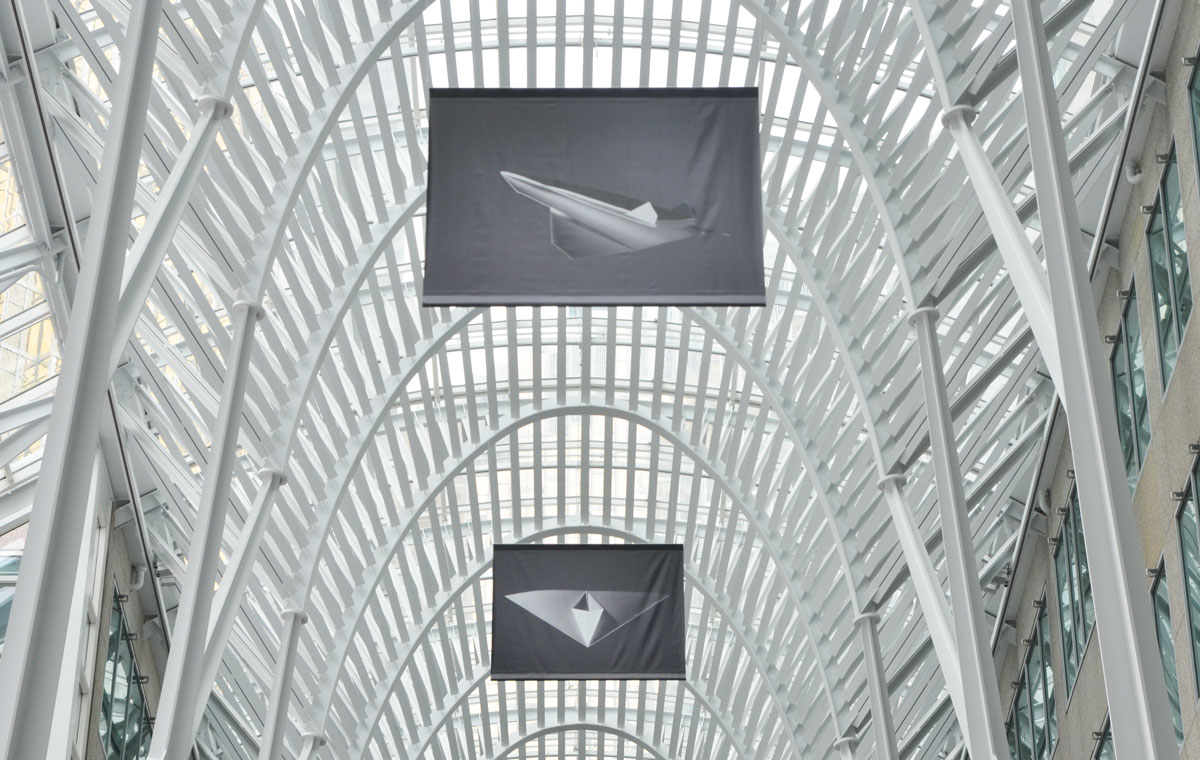
Suspended from the ceiling are a set of photographs of paper airplanes, the ‘Paper Planes’ part of the installation.    Knibbeler photographed paper airplanes that he made using information that he found online.  He chose military planes that were never produced.

A picture taken inside the Allan Lambert Gallery at Brookfield Place, photos by Sjoerd Knibbeler, a series called Current Study large pictures standing in the middle of the gallery, as well as series called "Paper Planes" which are hung from the ceiling

A picture taken inside the Allan Lambert Gallery at Brookfield Place, photos by Sjoerd Knibbeler, a series called Current Study large pictures standing in the middle of the gallery, as well as series called "Paper Planes" which are hung from the ceiling

A picture taken inside the Allan Lambert Gallery at Brookfield Place, photos by Sjoerd Knibbeler, a series called Current Study large pictures standing in the middle of the gallery, as well as series called "Paper Planes" which are hung from the ceiling

A picture taken inside the Allan Lambert Gallery at Brookfield Place, photos by Sjoerd Knibbeler, a series called Current Study large pictures standing in the middle of the gallery, as well as series called "Paper Planes" which are hung from the ceiling

A picture taken inside the Allan Lambert Gallery at Brookfield Place, photos by Sjoerd Knibbeler, a series called Current Study large pictures standing in the middle of the gallery, as well as series called "Paper Planes" which are hung from the ceiling

A picture taken inside the Allan Lambert Gallery at Brookfield Place, photos by Sjoerd Knibbeler, a series called Current Study large pictures standing in the middle of the gallery, as well as series called "Paper Planes" which are hung from the ceiling

A picture taken inside the Allan Lambert Gallery at Brookfield Place, photos by Sjoerd Knibbeler, a series called Current Study large pictures standing in the middle of the gallery, as well as series called "Paper Planes" which are hung from the ceiling

A picture taken inside the Allan Lambert Gallery at Brookfield Place, photos by Sjoerd Knibbeler, a series called Current Study large pictures standing in the middle of the gallery, as well as series called "Paper Planes" which are hung from the ceiling

#CONTACT16