Posts Tagged ‘parking lot’

Well, not really Camden Street, but an alley that runs perpendicular to the street….  If the lane has a name I don’t know what it is.  Google maps doesn’t even include it.  It’s a very short alley that runs both north and south from Camden street and it doesn’t go anywhere.  Both sections were painted with murals 9 or 10 years ago.   Amazingly, they have survived.

Let’s start with the south side of Camden Street.

below: Mural Project, “The walls won’t know what hit them”.  The mural was painted in 2006 youth from the   Harbourfront and Cecil Community Centres as part of the City of Toronto’s Graffiti Transformation Project.
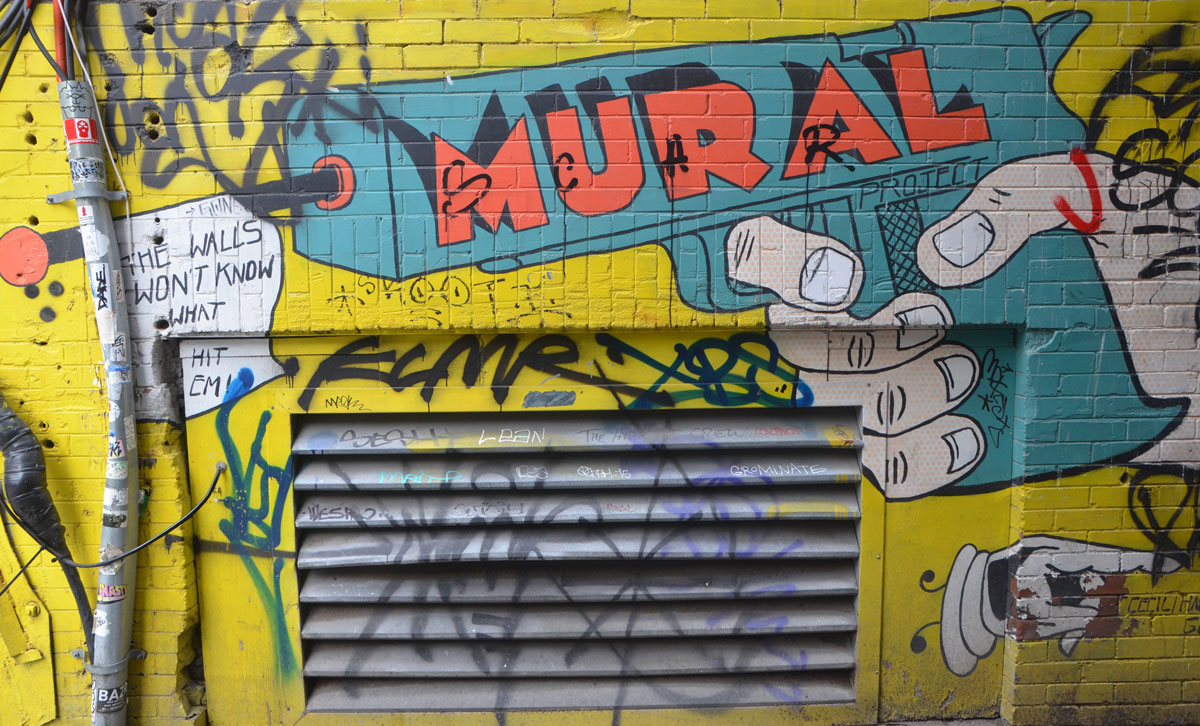
part of a mural in an alley, yellow background, blue pistol with the word mural in large red capital letters, flag at the end of the barrel that says , white hand holding the grip with finger on the trigger.
below: The mural is painted in a quasi cartoon style.

blog_art_or_vandalism_mural

below: She’s upset and she’s expressing her hurt and anger with spray paint seems to be the start of the story.

part of a mural in an alley, a woman with bright yellow hair is spray paint out of a can with a word bubble that says "He crossed me first"

below: My knowledge of slang is limited, and this is 10 years old but this sheezy is cool.  It’s probably as simple as “this sure is cool”, i.e. spray painting graffiti is cool.

This seezy is off the heezy are the words in a word bubble coming out of the mouth of a man painted in a mural, short black hair, wearing a red shirt, and spraying a can of pink spray paint,

below: Oh no! I always laugh when I hear this expression these days… is there anywhere in Toronto where property values are going down? Okay, okay, so it’s part of the story – she’s complaining that someone has sprayed graffiti somewhere nearby, the vandalism part of the story.   The angry young woman or the “sheezy heezy” guy above have been busy in her neighbourhood.

street art, picture of woman with orange hair, wearing white gloves, hands on sides of head, words saying "On no, my property value went down"

below:  As you can see, a couple of things were in the way as I was taking pictures.   I am not sure exactly how the plot of the mural progresses from here because I couldn’t see the whole thing.  There are gaps in the story line.   A few missing pages so to speak.

looking down one wall of an alley, a mural is painted on it, in the foreground is a woman in profile (she's looking down the lane), very yellow hair. Two cars are parked in front of the mural

below: Flesh tones as dots in the face of woman who plays an unknown role in this story – the mystery woman?

part of a woman's face, painted in dots, bright red lipstick, brown hair, looking at the viewer

below:  I suspect that this is the “We’ve got to get rid of the graffiti” part of the story.  Is it improper to make comments about Rob Ford and his anti-graffiti program here?  I don’t want to insult the mural or the project behind it because I think that the Graffiti Transformation Project is an excellent program.
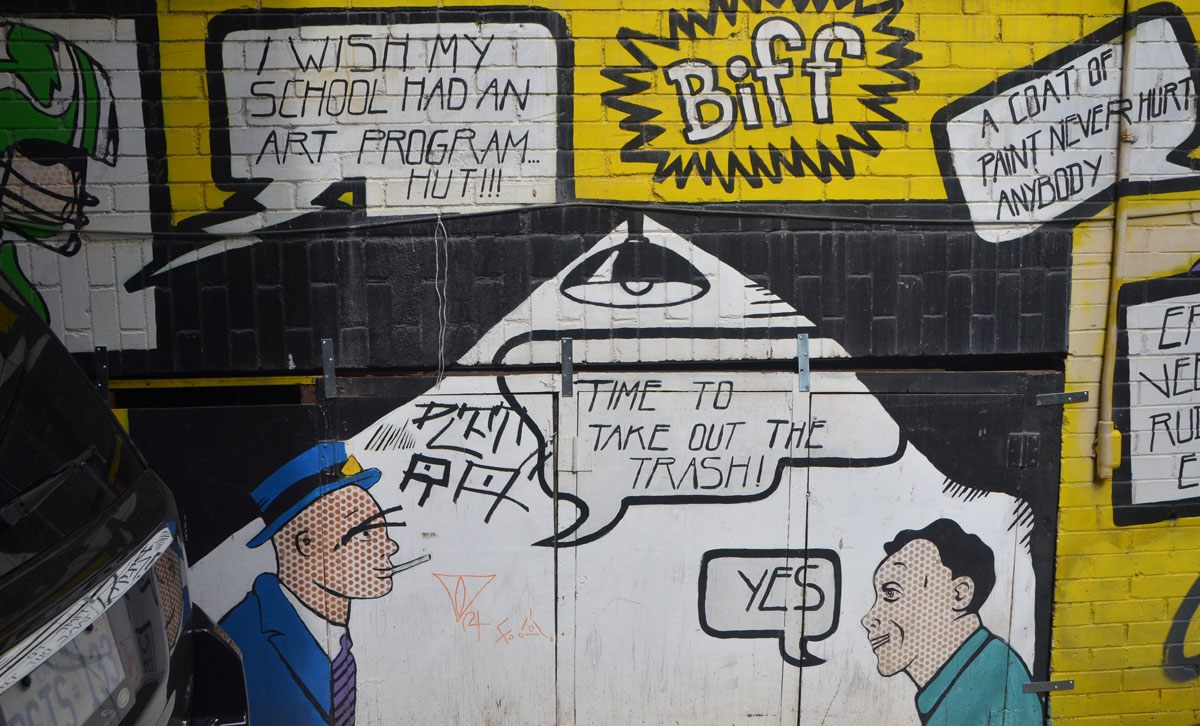
scene in a mural, a football helmet wearing head, with words I wish my school had an art program, also two men talking about how it's time to take out the trash

below:  If there was a mural on the other side of the alley, it’s long gone.
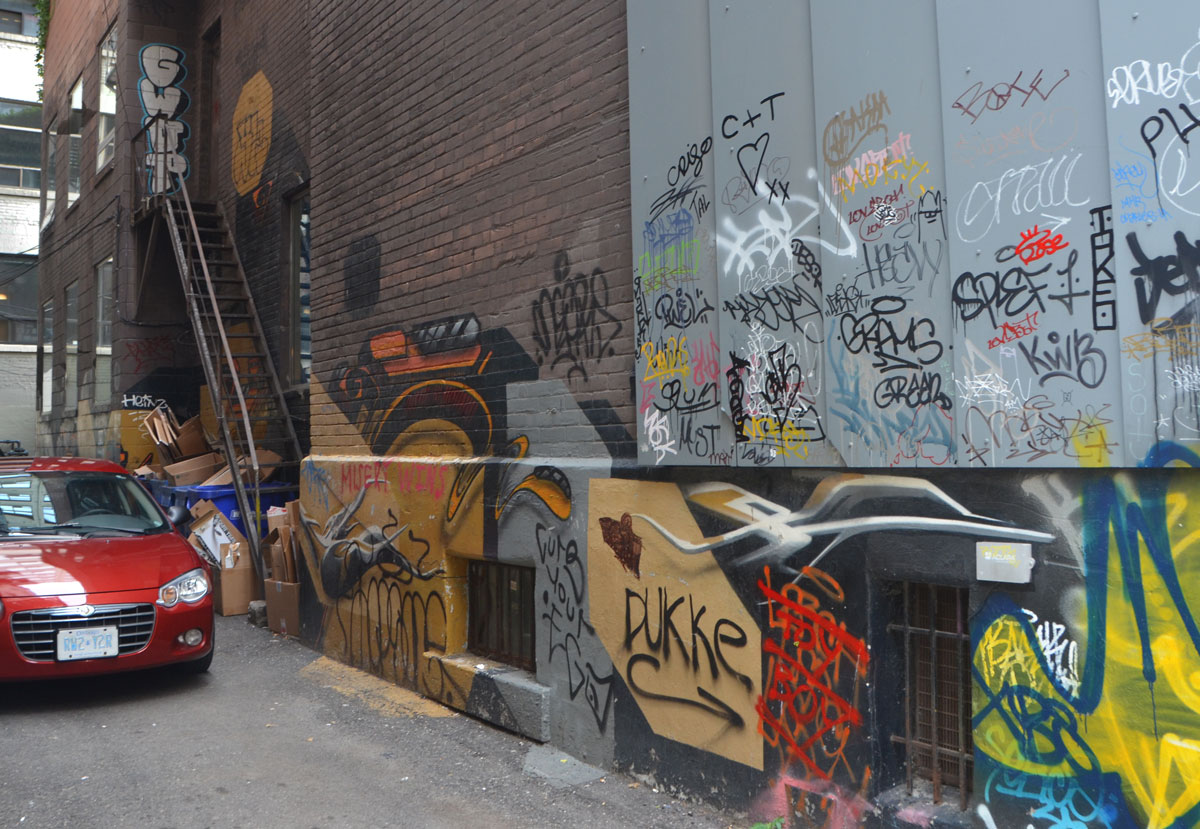
a red car is backed into an alley, and is parked there, along the wall beside the car is a lot of graffiti spray painted and written on the wall. There is a stair case in the back part of the wall.

A short walk across Camden Street to the other half of the alley….

below: You can see the taller buildings on Richmond Street West but you can’t get there from here.
And like most downtown alleys, garbage bins are a dominant feature.

looking down a dead end alley, lots of blue rubbish bins that are slightly overflowing, tall buildings on either side. The back of a two stroey building straight ahead with taller buildings behind

below: At the entrance to the alley.  There are words under the window by the sunflowers that say that this painting is also the work of the Harbourfront/Cecil Community Centre’s Graffiti Transformation Project, 2007.

wall of an alley with a long window with worn painting around it of flowers and sunflowers

below: A very low window with green arrows
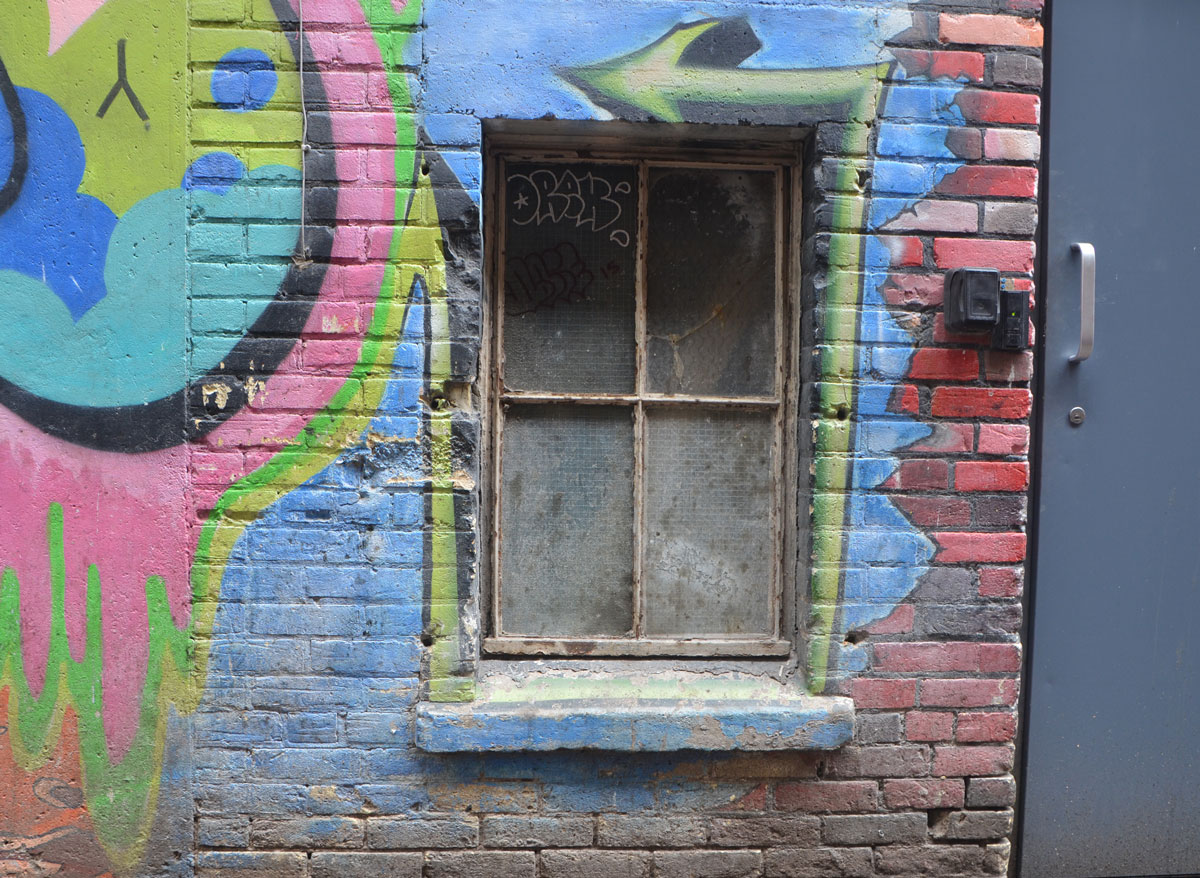
a low window, close to the ground, with a green arrow painted around it.

orange geometric street art, with the words 'stay alive' written in orange beside it

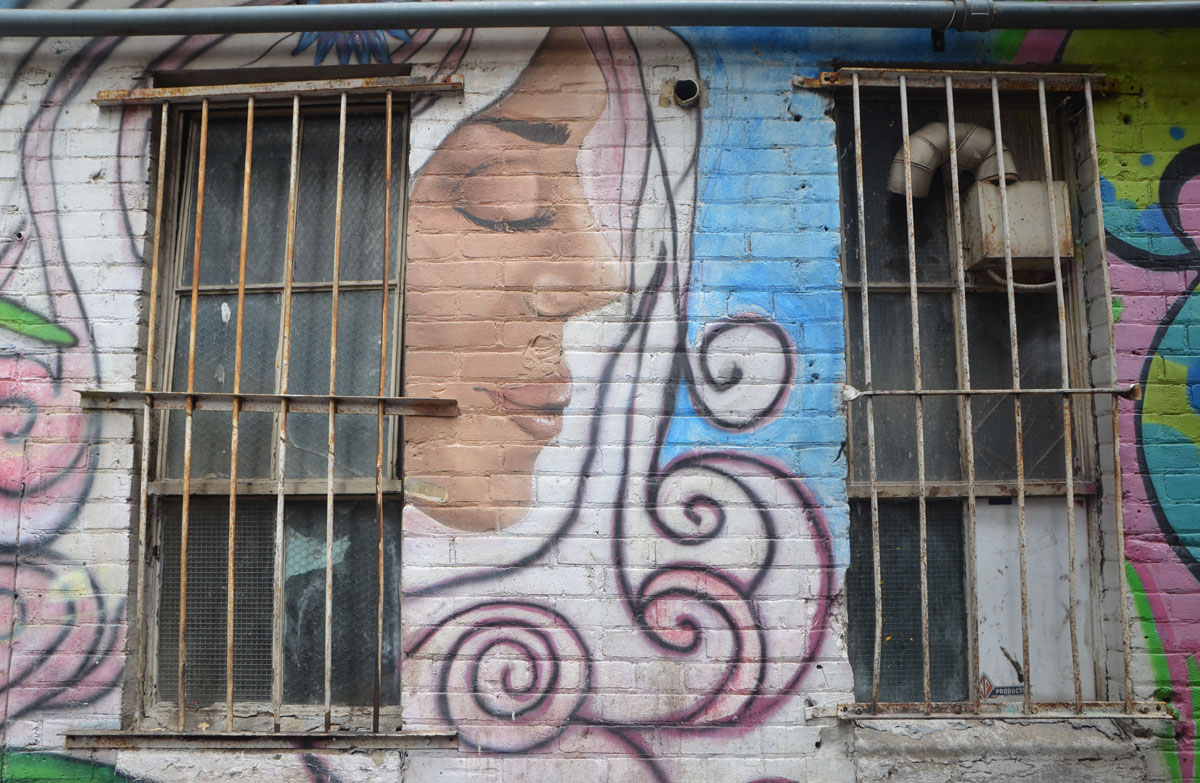
two old windows with rusted and bent metal grille on the windows, a street art painting of a woman in profile with eyes closed is between the windows, White hair

below: And last, I’ll end with a weather comment because we’ve all been talking (complaining?) about it these days – someone’s a bit overdressed for this August weather although it doesn’t seem to bother him.  Maybe he knows something we don’t.   Or maybe it’s just wishful thinking.

street art on a grey brick wall, head of a young man in a fur lined hood of a parka

Stay cool!
This is another post about an exhibit from the CONTACT Photography Festival.   I know that it’s now June and CONTACT was in May, but I wanted to post these photos.  I actually took them early in May as you can probably tell by how many clothes the people in the pictures are wearing.  They’re certainly not dressed for the warmer weather we’ve been having lately.  I have had trouble deciding what to write in this post.

There is a parking lot at the NE corner of Front and Spadina with some billboards in it.   Maybe you saw them as you drove or walked past but maybe you passed by and missed them.   There are so many things on the street vying for our attention and a billboard is just another piece of street ‘furniture’.

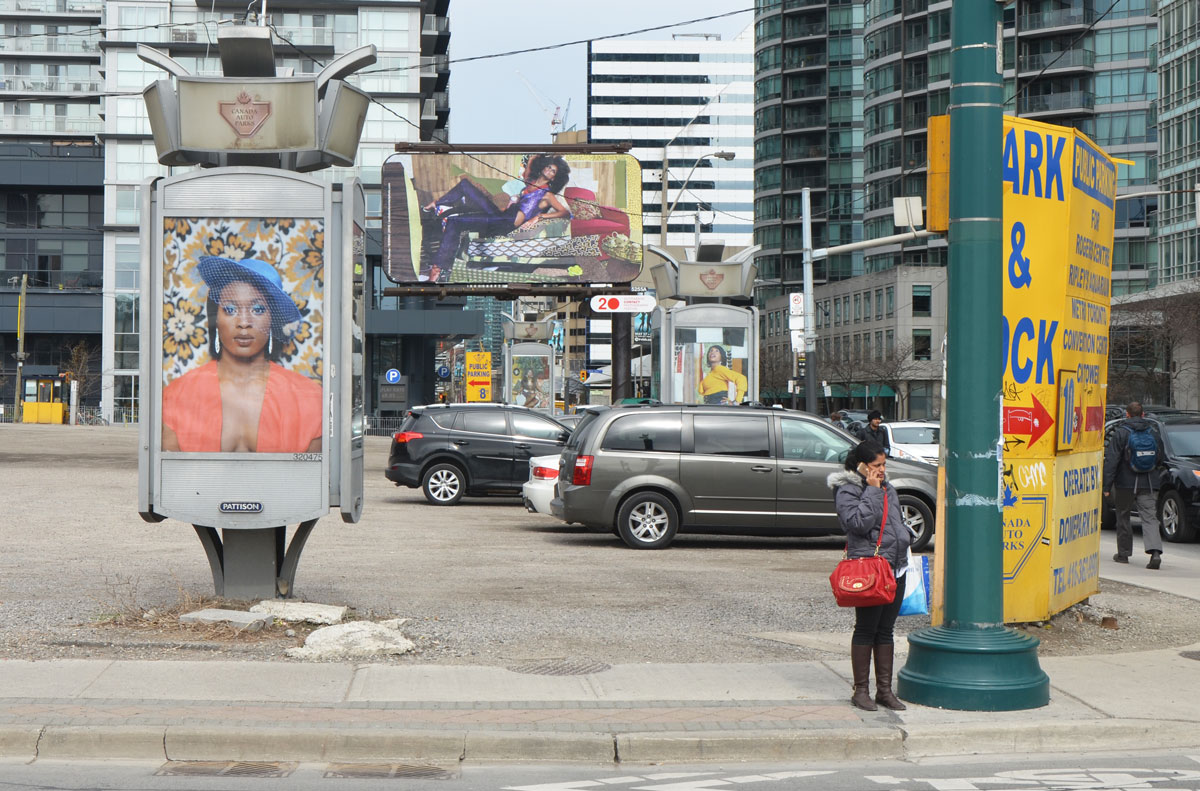
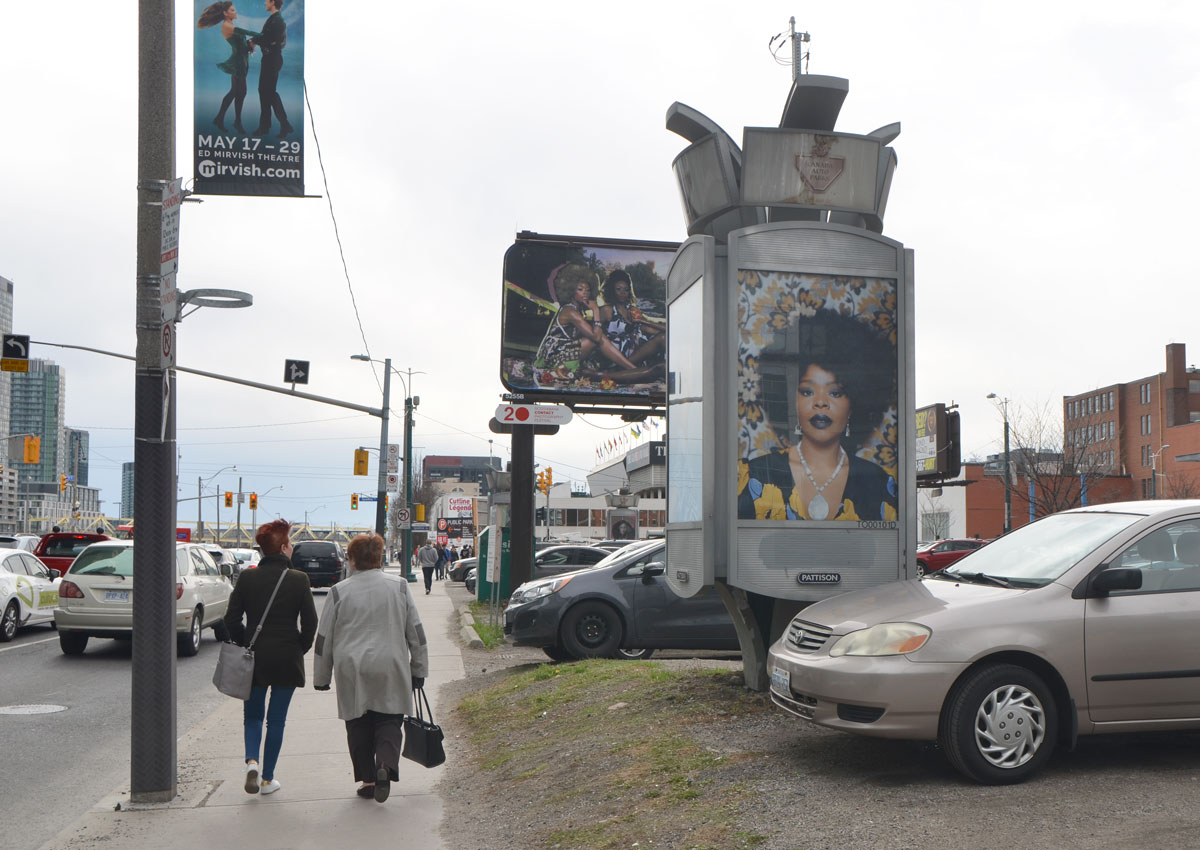
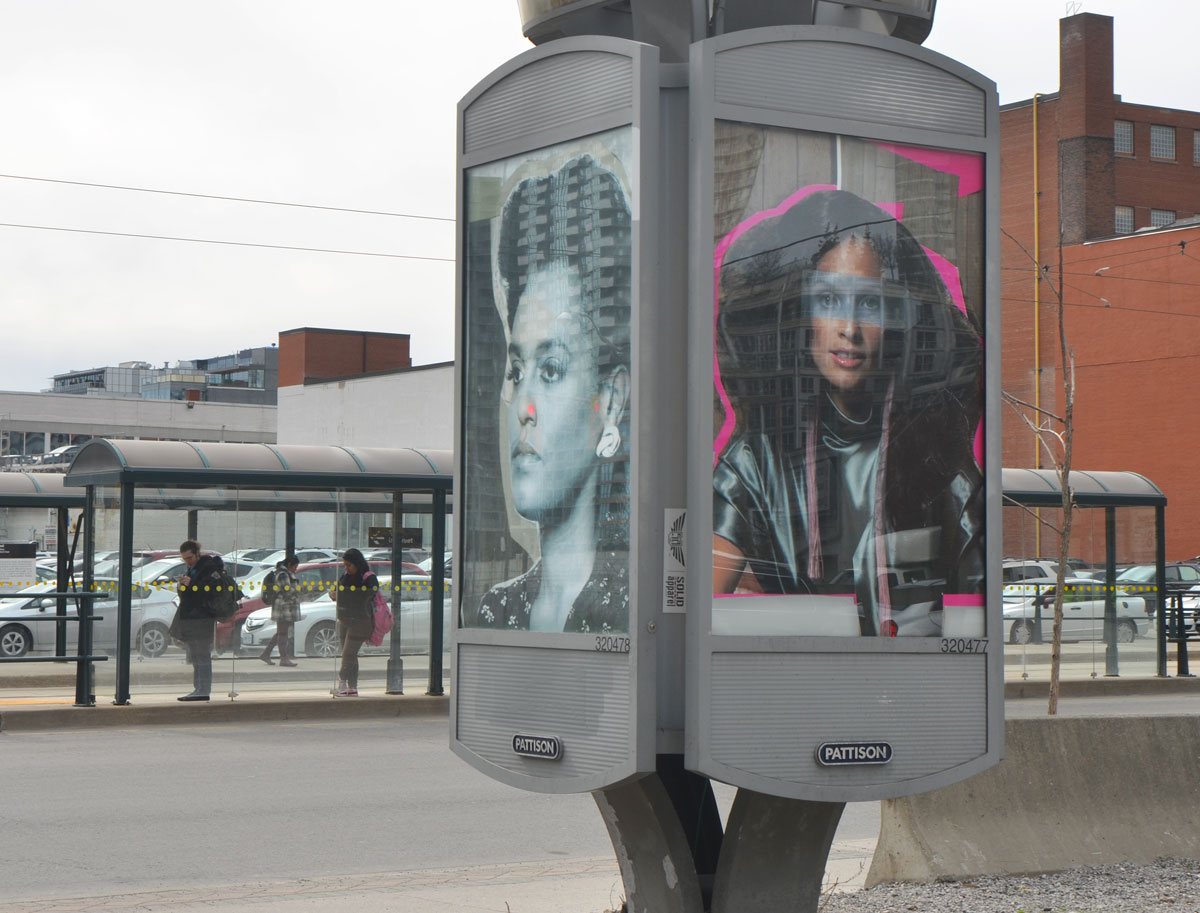
For the month of May, an installation titled ‘What it Means to be Beautiful’  by Mickalene Thomas occupied a number of billboard spaces at the above mentioned corner.   All the images are portraits of women and are “shown within the context of street advertising, where women are constantly bombarded with narrow notions of female beauty.”   A sample of the billboards:


part of an art installation, portrait of a black woman in profile, with a shaved head, on a billboard, by Mickalene Thomas, in a parking lot in downtown Toronto

part of an art installation, portrait of a black woman wearing a blue hat on a billboard, by Mickalene Thomas, in a parking lot in downtown Toronto. A woman stands on the corner talking on her phone. Another, large, billboard is in the background.

Two women walk past part of an art installation, portrait of a black woman on a billboard, by Mickalene Thomas, in a parking lot in downtown Toronto

Two portraits of black women, in a billboard space in a parking lot, with people waiting for a streetcar in glass bus shelters in the background.

part of an art installation, portrait of a black woman on a billboard, by Mickalene Thomas, in a parking lot in downtown Toronto, A group of people wait for a green light at the intersection in the background, tall condos too.

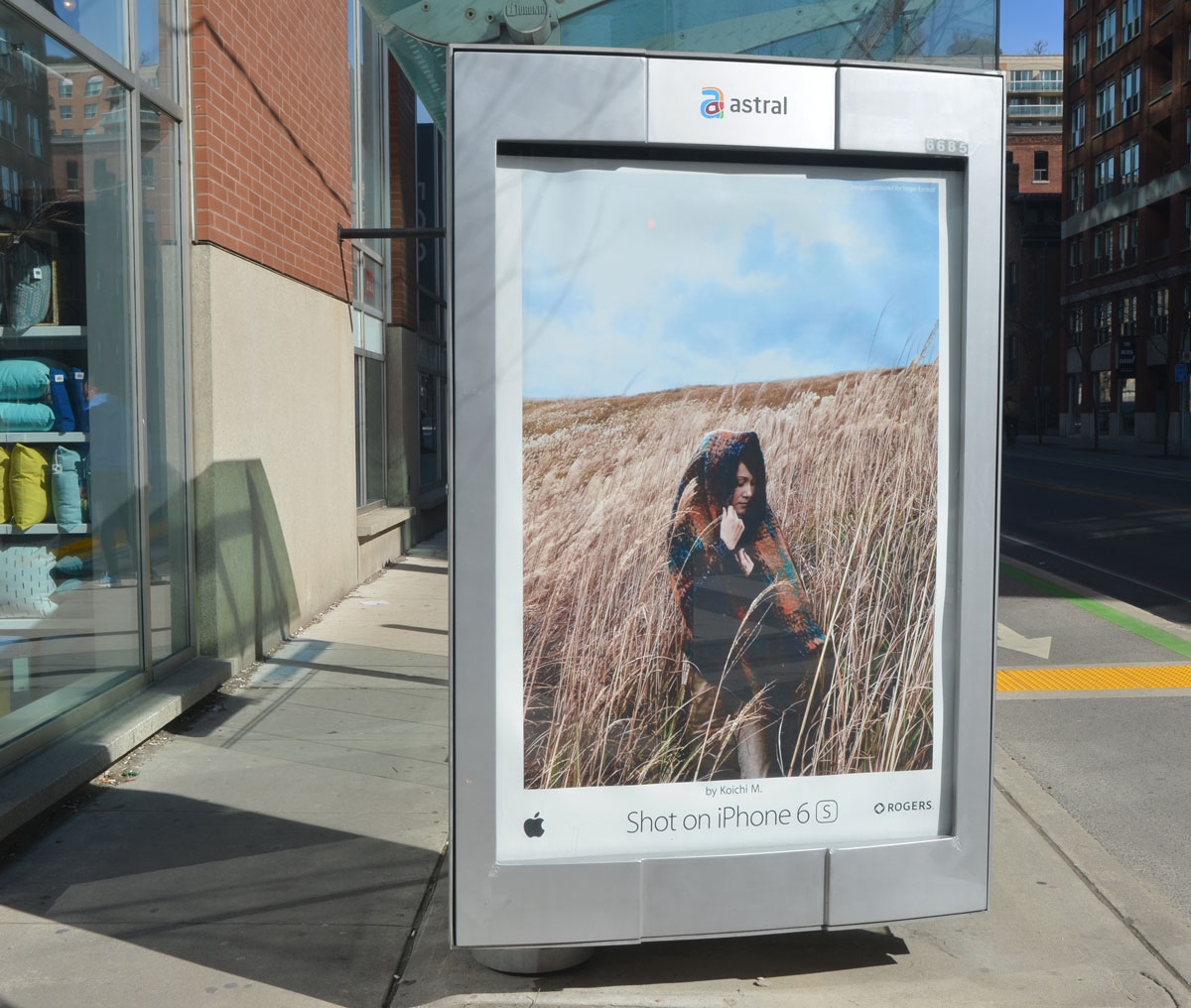
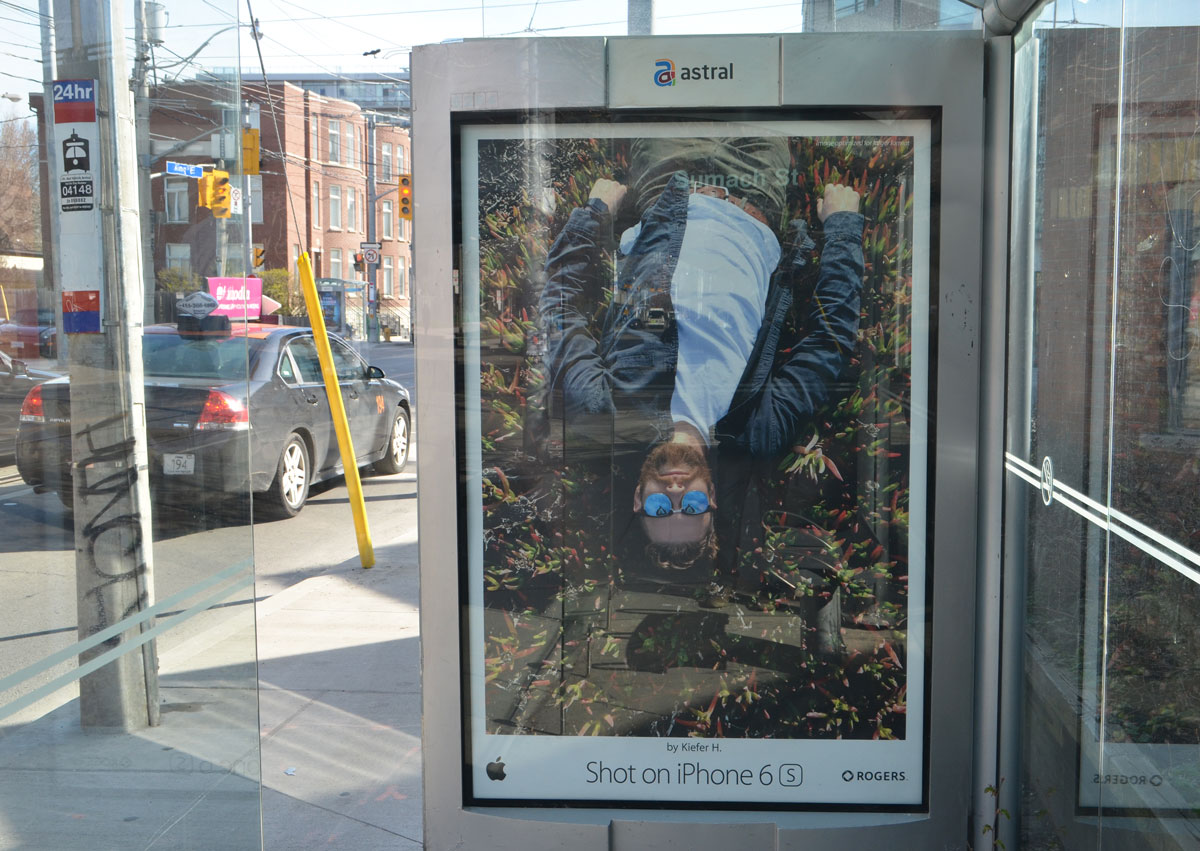
Part of the reason that I hesitated to write this post was the fact that the iphone 6 ad campaign was on at the same time.  It was a campaign that used photos taken with the phone and the ads were very visual and used very few words. In my opinion, they are more eye catching and visually appealing than Thomas’s work. I found a few of them to show here (below).  I know that there were many more but unless I was consciously looking for ads, I didn’t notice them as billboards are one of the things that I block out as I walk.  That led to a few thoughts about what catches a viewer’s attention on the street –   Faces?  Colours?  Contrast?

There is more going on in Thomas’s photos and collages than just visual appeal but I still question the validity of asking the viewer to look at them in the context of street advertising.   Is it fair to compare her images to ads produced by, and in aid of, a large corporation?   Would it have been better to  exhibit her work in different form or a different place?  I don’t have the answers for those questions.  Do you?


iphone ad on a bus stop wall showing a woman in a field

iphone 6 ad on a bus stop wall of a woman lying in a field of pumpkins. Her head is surrounded by pumpkins.

an iphone ad on a bus stop wall of a man lying on the ground. He is upside down in the picture

And now I will go back to ignoring billboards as I walk.

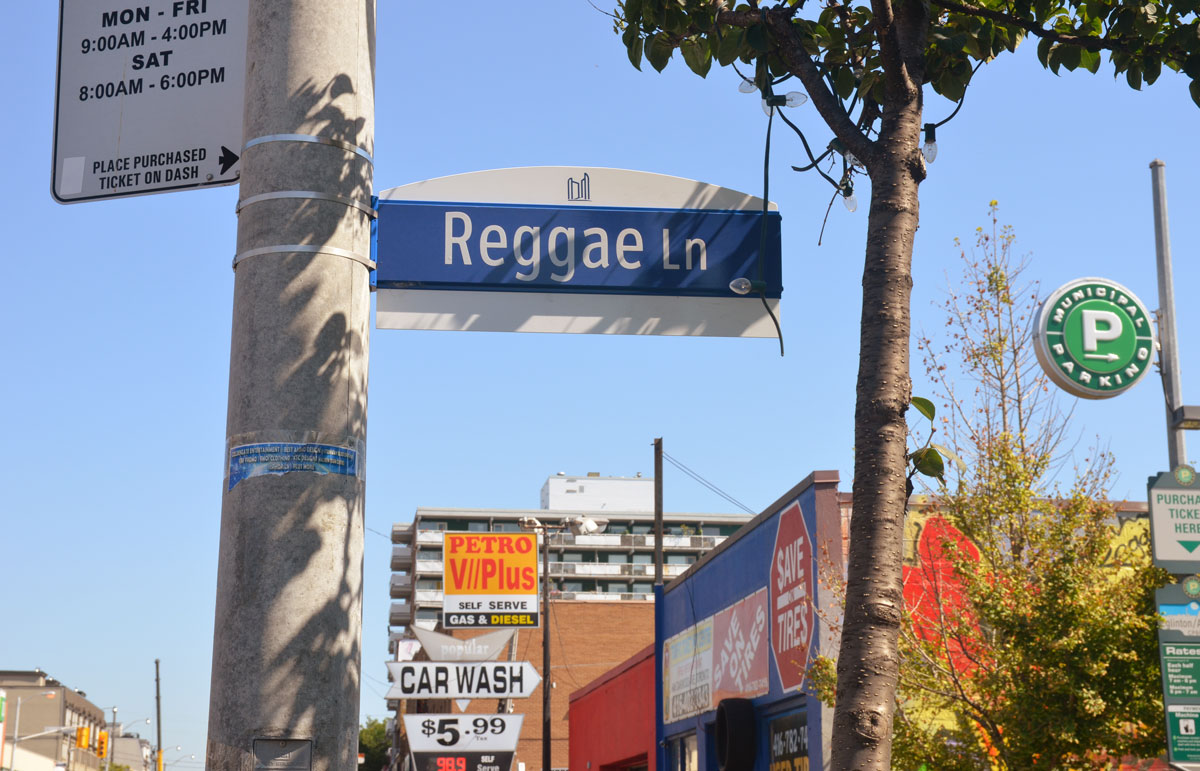
Toronto’s newest street sign

A blue and white Toronto street sign that says Reggae Lane. Some stores and a tree are in the background.

Reggae Lane is a small lane on the south side of Eglinton West, between Marlee and Oakwood.
It is home to a new mural that celebrates the many reggae musicians from Toronto.

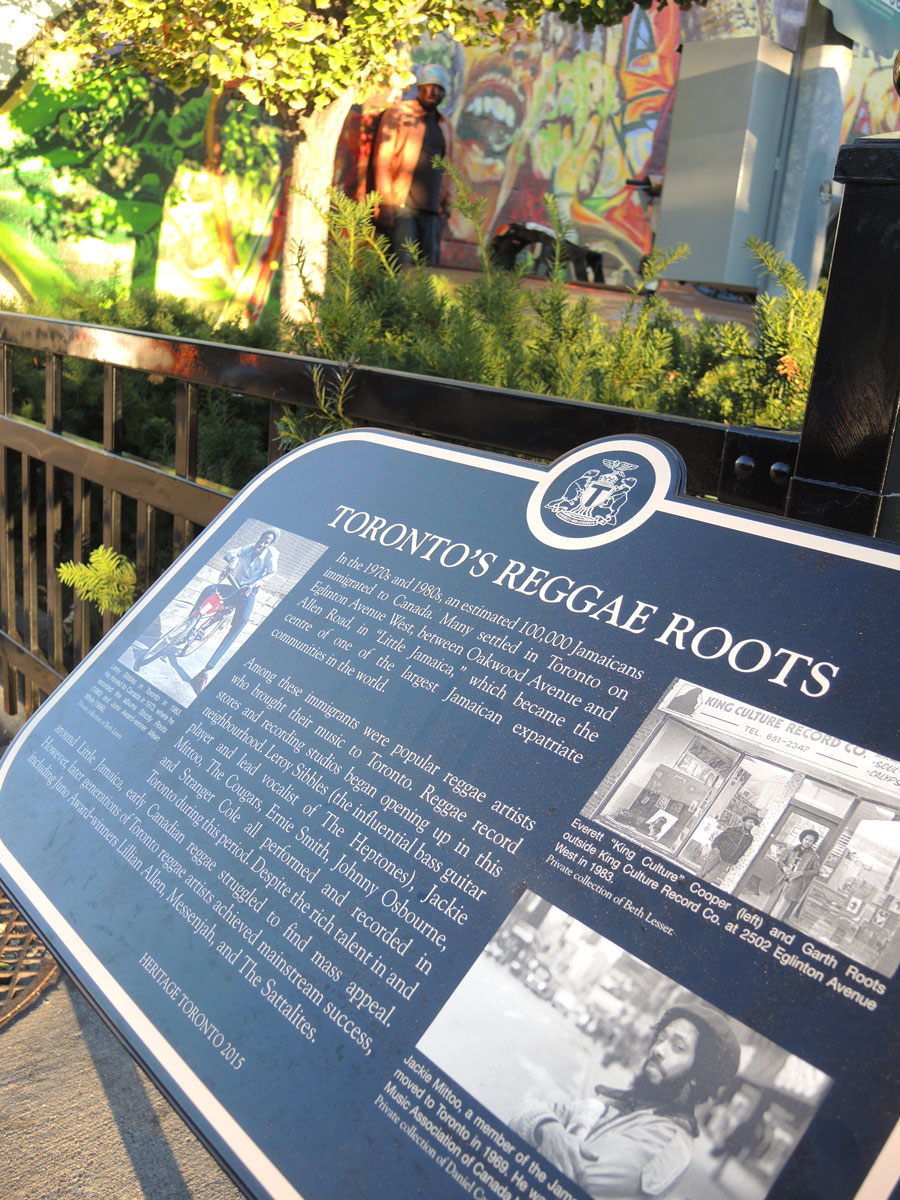
below: A Heritage Toronto plaque marks the spot.  It tells the story of Jamaican immigration and the reggae music they brought to Canada with them.   A transcription of the plaque appears at the bottom of this post.

plaque with the title "Toronto's Reggae Roots" with three photos as well as a story of Jamaican immigrants to Toronto and the story of reggae music in Toronto


The mural was painted over the course of three weeks by Adrian Hayles with the help of some young painters.

below:  Appearing in the mural: Reggae musicians from Toronto – Pluggy Satchmo, Bernie Pitters, Leroy Sibbles, Lord Tanamo, Jay Douglas, Stranger Cole, Johnny Osbourne, Jojo Bennett, Nana McLean, Jackie Mittoo, Leroy Brown, Otis Gayle, Joe Isaacs, and Carol Brown.   Bob Marley is also in the mural as are the Skatalites, one of the groups that started it all; they began recording ska music in the mid 1960s.

View of a 1200 square foot mural by Adrian Hayles that depicts many different reggae musicians. This photo was taken from the second floor of the building next door so the camera is looking down across the parking lot towards the mural. Eglinton Avenue is seen behind the mural.

below: “Reggae, The King’s Music” is a reference to Haile Selassie, the Emperor of Ethiopia (1930-1974) who was born Tafari Makonnen.   Before becoming emperor, he was known as Ras Tafari where Ras means Duke or Prince (depending on the translation).  Hence the name Rastafari.   The Rastafari movement began in Jamaica after the coronation of Haile Selassie.  To them, Selassie was not just a black king, he was the messiah.

Part of a very colourful mural depicting various reggae musicians -

Although it didn’t become a musical genre until the 1960s, reggae also has it’s roots in Jamaica. Reggae and Rasta have become closely linked.   Reggae has spread the Rasta message and Rastafari musicians like Bob Marley have popularized reggae music.

below: The radio station CFRB once had a Sunday evening reggae program.

Part of a very colourful mural depicting various reggae musicians - A large hand with a finger pointing to the right with the letters C F R B above it. Two musicians are also in the picture.

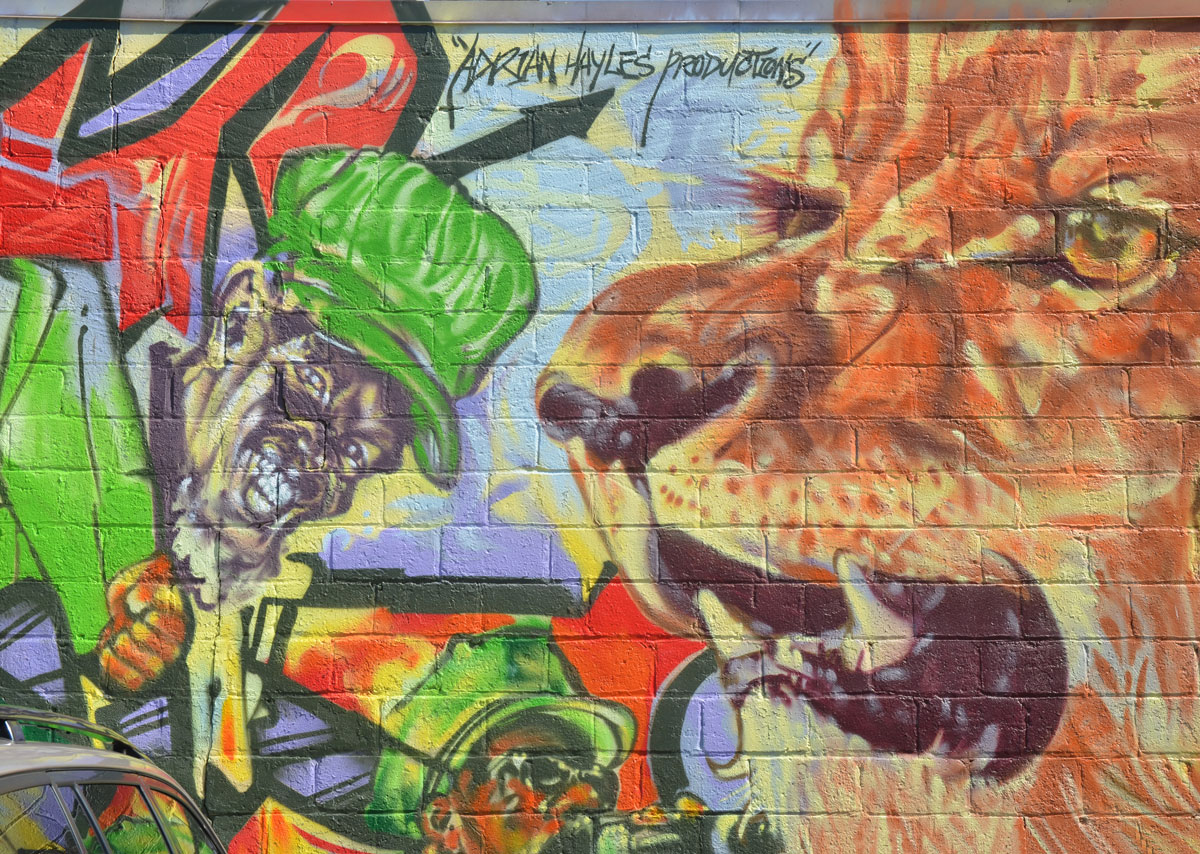
below: The Lion of Juda is a Rastafarian symbol.  It comes from the fact that as Emperor of Ethiopia, Haile Sealssie’s full title was “King of Kings, Lord of Lords, Conquering Lion of the tribe of Judah”.  The lion also appears in the middle of the Ethiopian flag.

Part of a very colourful mural depicting various reggae musicians - a black man in a green hat, a lion's face and the words, Adrian Hayles production

Part of a very colourful mural depicting various reggae musicians - A man wearing headphones and a baseball cap is playing a guitar.

plaque: “Toronto’s Reggae Roots

In the 1970s and 1980s, an estimated 100,000 Jamaicans immigrated to Canada. Many settled in Toronto on Eglinton Avenue West, between Oakwood Avenue and Allen Road, in “Little Jamaica”, which became the centre of one of the largest Jamaican expatriate communities in the world.
Among these immigrants were popular reggae artists who brought their music to Toronto. Reggae record stores and recording studios began opening up in this neighbourhood. Leroy Sibbles (the influential bass guitar player and lead vocalist of The Heptones), Jackie Mittoo, The Cougars, Ernie Smith, Johnny Osborne, and Stranger Cole all performed and recorded in Toronto during this period. Despite the rich talent in and around Little Jamaica, early Canadian reggae struggled to find mass appeal. However, later generations of Toronto reggae artists achieved mainstream success, including Juno Award winners Lillian Allen, Messenjah, and the Sattalites.”


The project was funded by the City of Toronto’s StreetARToronto program, with support from Metrolinx, Councillor Josh Colle’s office, the Macaulay Centre for Child and Youth Development, the Toronto Parking Authority and the York-Eglinton BIA.  It was also supported by the STEPS Initiative.

Piliriqatigiingniq

This mural is on the south wall of Hosteling International on Church St.,
and in a parking lot on Court St.,
just north of King St. East and across from St. James Cathedral.

Painted July 2015

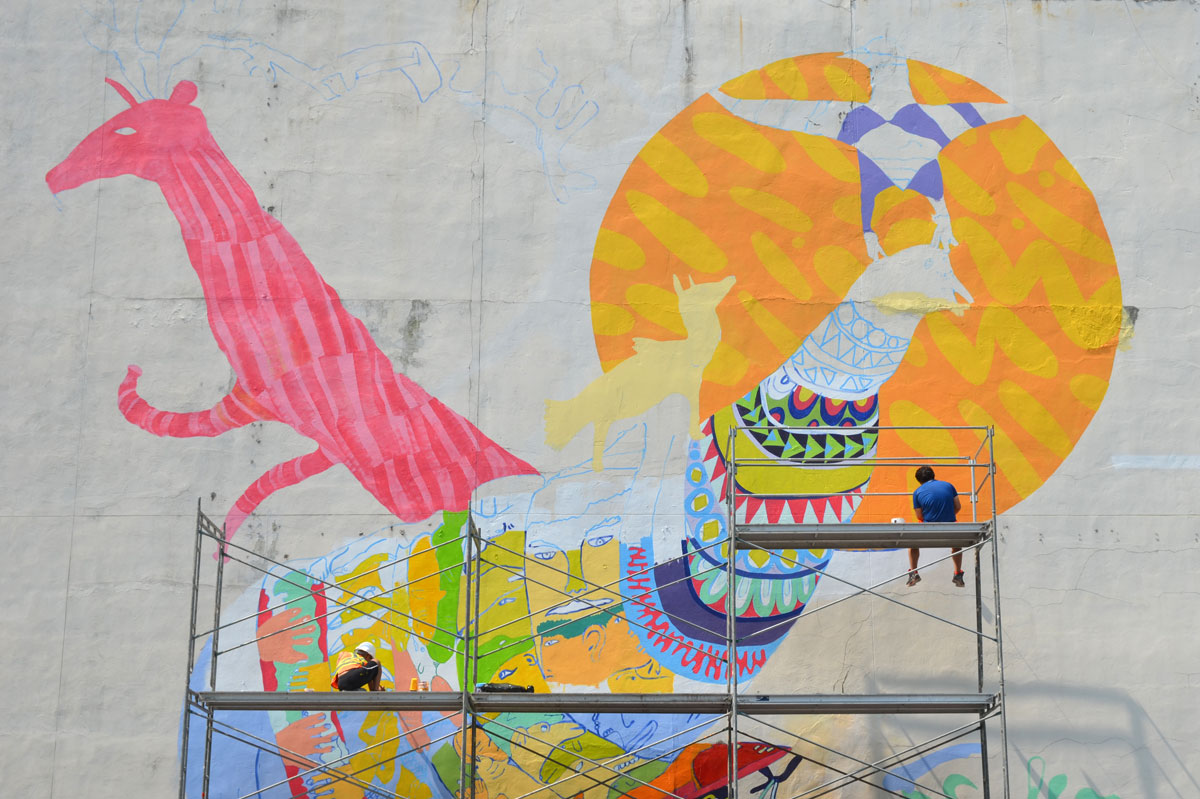
The beginnings of the mural on Court St. in Toronto.  The picture is drawn in blue on the wall, and the bottom part is painted.  Scaffolding is in place but no one is there at that moment.

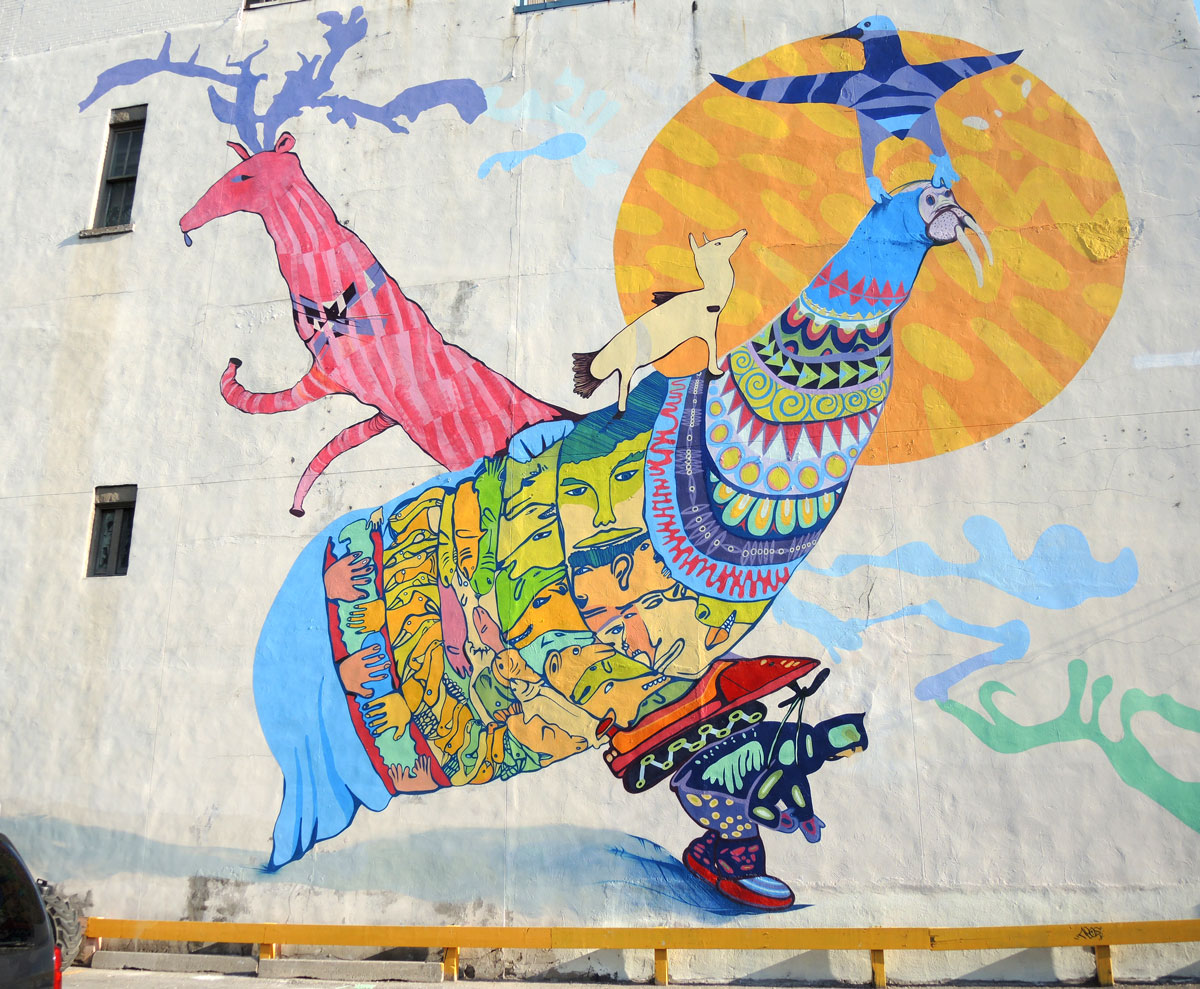
This project was a collaboration between Mural Routes and the Nunavut Arts and Crafts Association.  Artists were youth from Cape Dorset as well as graduates from Toronto’s Oasis Skateboard Factory: Latch Akesuk, Audi Qinnuayuaq, Cie Taqiasuq, Parr Etidloie, Julieta Arias and Moises Frank.

Two people sitting on scaffolding while they paint a mural

A man wearing a hard hat who is sitting on scaffolding and painting a mural on the side of a building.

Completed mural of stylized and symbolic bird and snimal shapes in many bright colours.  It is at least two storeys high.
Close up picture of the mural's bottom center part showing a man in winter clothing with a snowmobile strapped to his back.  He is hunched over as he walks.  On the snowmobile of a very large bird shaped crature with faces covering its body.


Part of CONTACT photography festival,
billboard “art” on the NE corner of Spadina and Front streets.

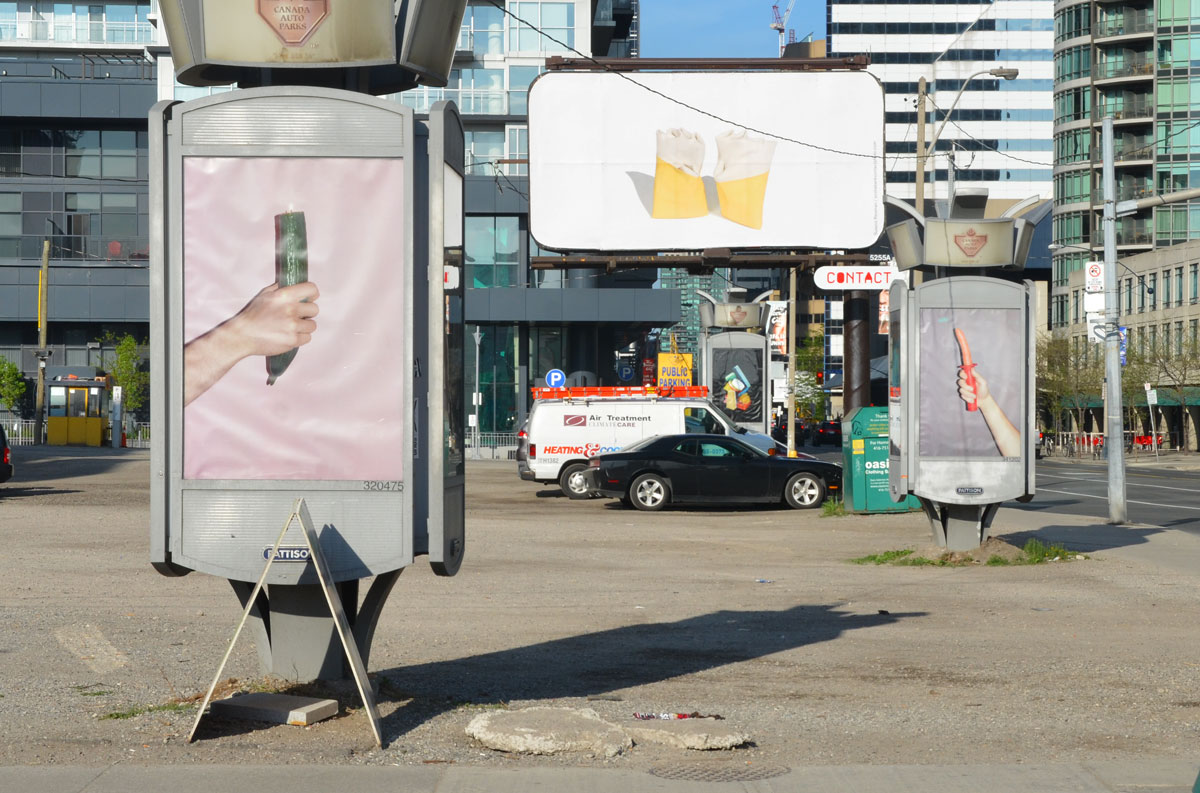
All the billboards are in a parking lot in what was a junky looking space to begin with.

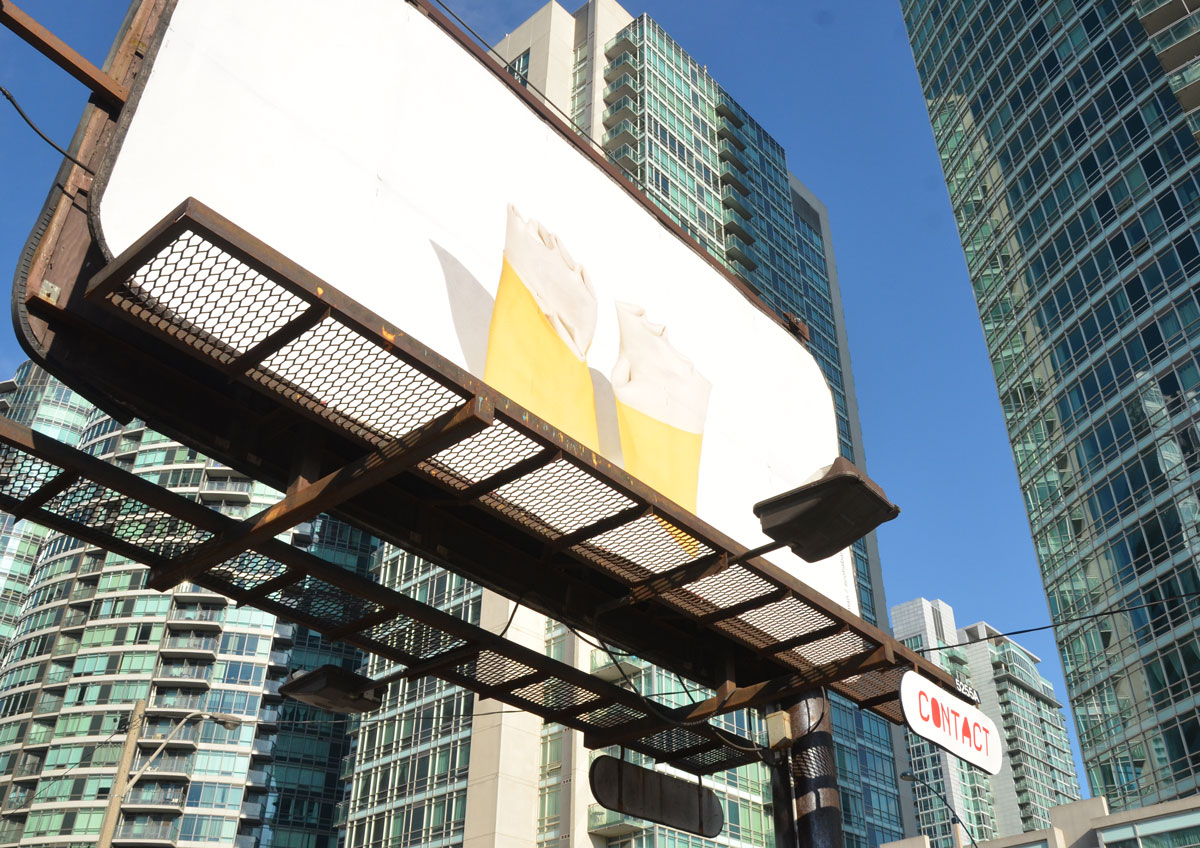
below:  Yellow rubber gloves with the fingers tucked back in…
to look like they’ve just been taken off a pair of hands?

a billboard above a parking lot, condos in the background.   A pair of yellow rubber gloves with the openings turned into a cuff are all that in the image on the board

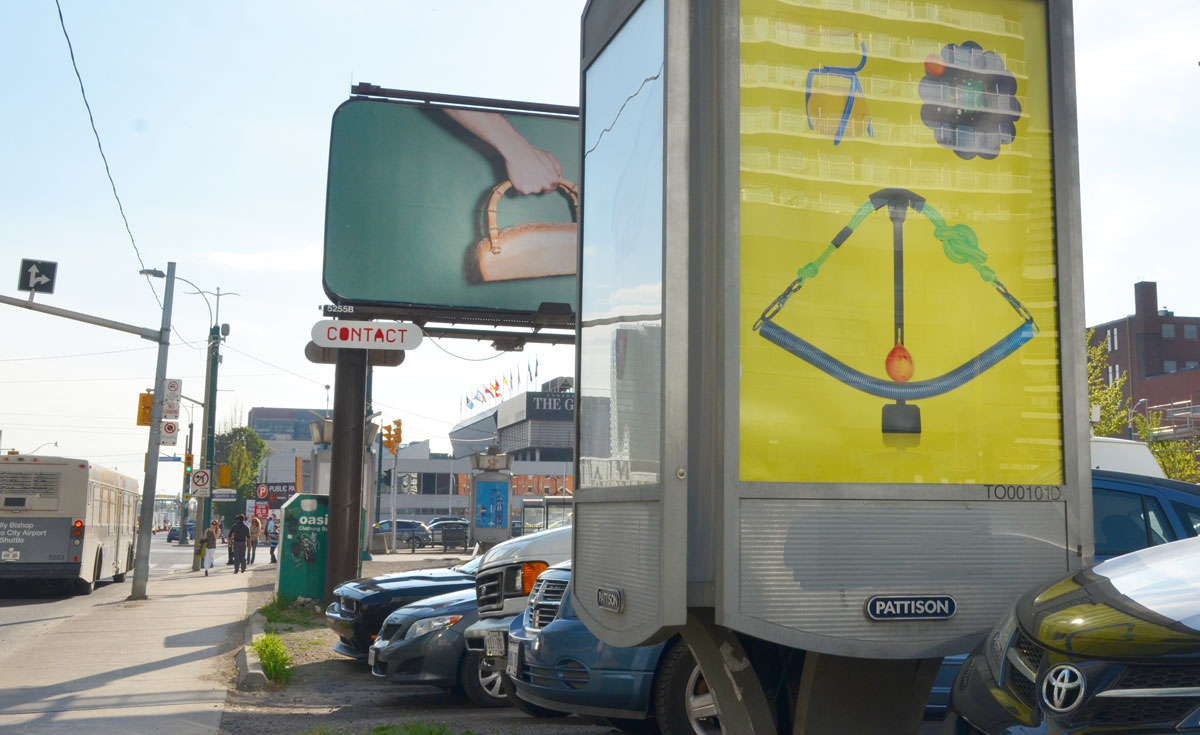
below: The body of the handbag is a loaf of bread.

a small billboard in front and a larger, higher one in the background.   In the background is a woman's hand holding what looks like a handbag but the bag part is made of a loaf of bread.  In the foreground, yellow background with household objects arranged in a face like shape.

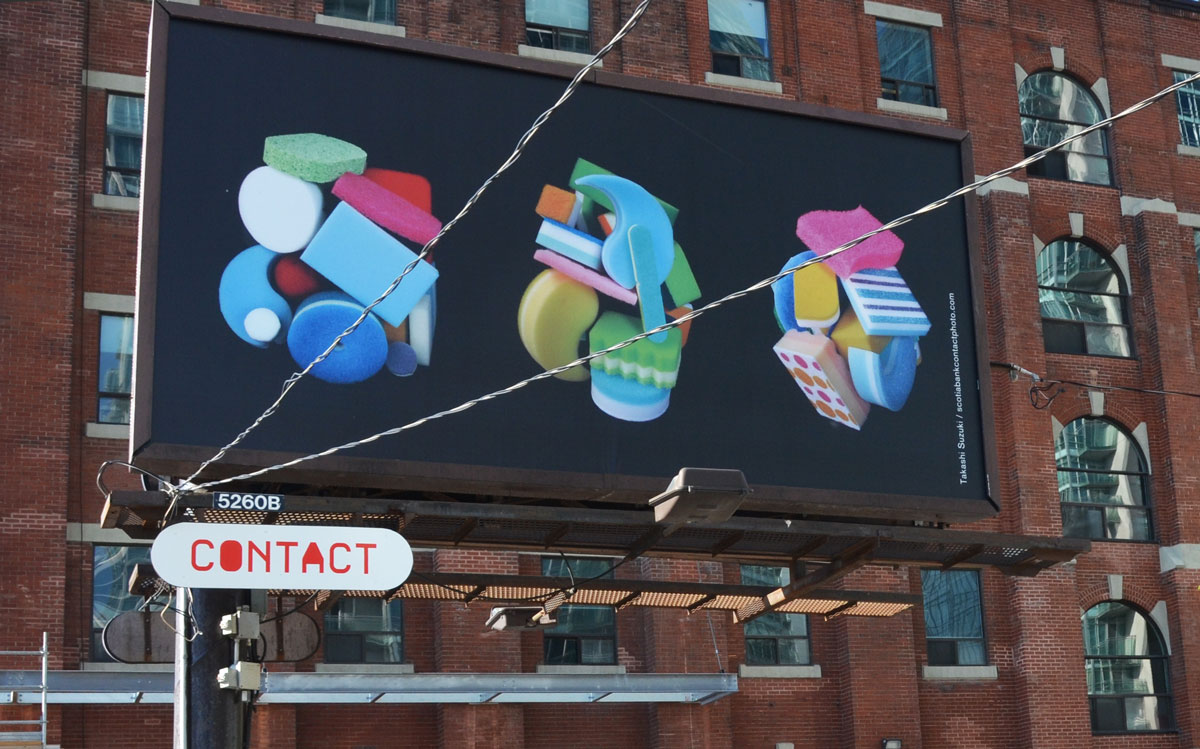
below: Clusters of sponges.  At first I thought they were candies.

billboard art - three clusters of colourful sponges on a black background

three billboards with art images instead of advertisements
Supported by Pattison Outdoor Advertising and Nikon Canada.

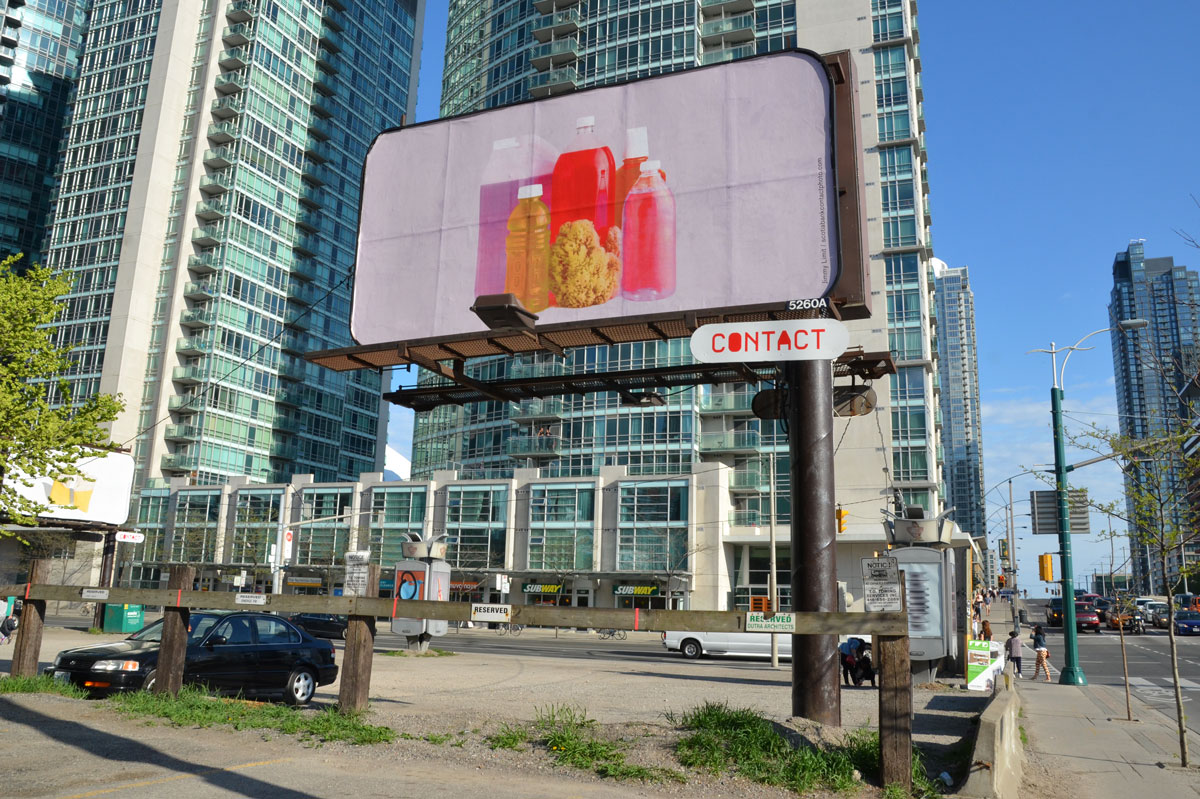
a billboard with a large picture of clear bottles filled with coloured liquids in reds and oranges.

“Challenging how people perceive and interact with images in public spaces”

“Each of the artists destabilizes the conventions of advertising and the cultural codes associated with consumer lifestyles.”

Me?  I’ll call them dull and underwhelming clutter.  Too harsh?  Perhaps.
I’ll leave the verdict up to you.

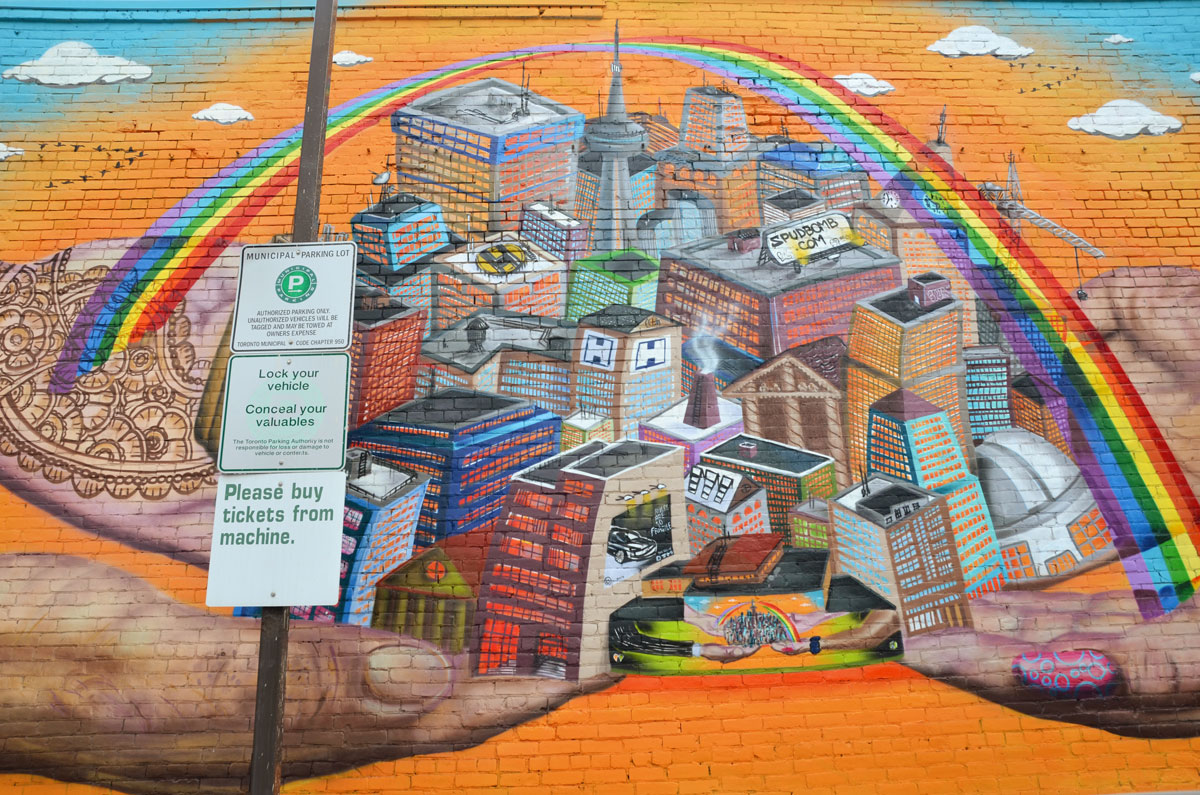
Stand Together,
a mural on Richmond St. East between Church and Jarvis streets.

Stand Together mural on Richmond Street, it is the back of a building as well as the back wall of a parking lot.  Four cars are parked in front of the mural which is 4 large arms and hands.  Together the hands are holding a city that is under a rainbow.

Painted by Spud, 2014

Far right side of mural, behind a low fence, bright green background with a long arm reaching across the photo.  A small tree stands in the corner of the parking lot, on the far right of this picture.  An apartment building is behind.  Spud bomb logo in the bottom right,  Center part of mural showing a city in 3D under a rainbow, on an orange background, and being held up by four large hands. The center part of the mural is a little 3D Toronto under a rainbow.
The CN Tower is there as well as a few cranes.  Perhaps you recognize other buildings?
It even has a painting of the mural in it!

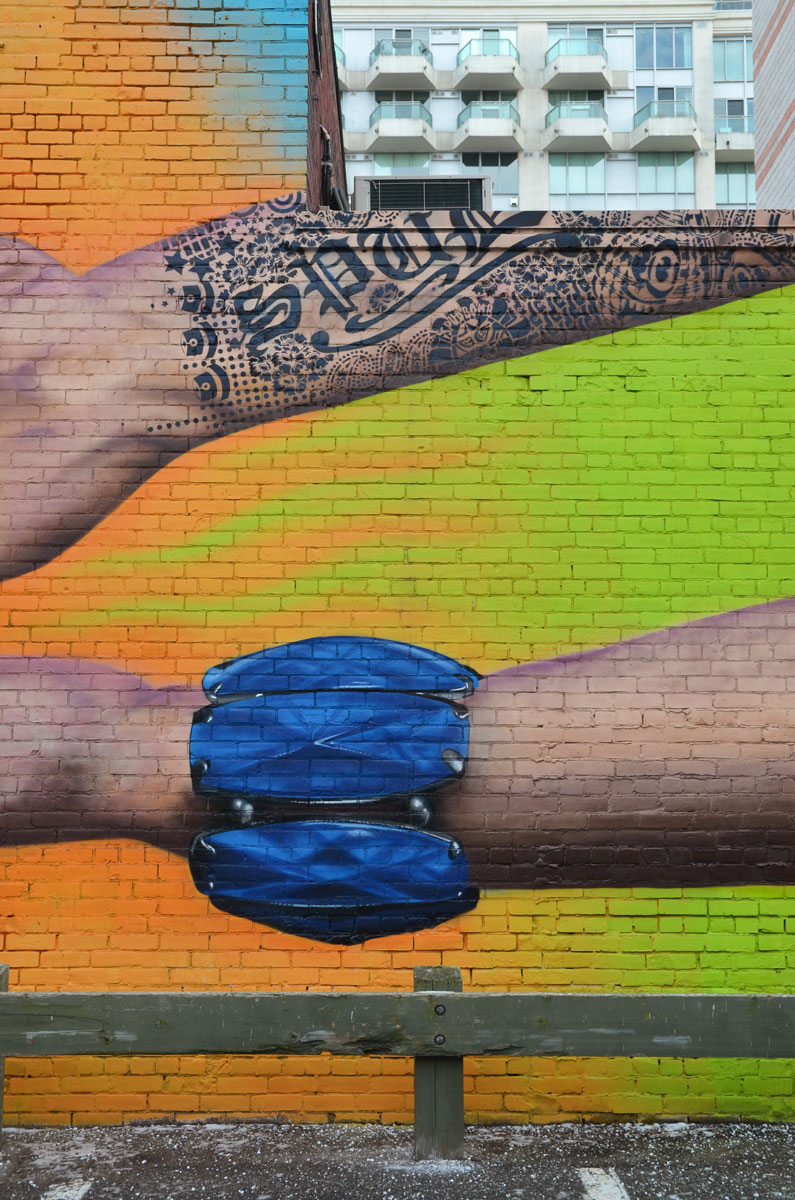
Part of a mural showing wrists of two arms.  The upper arm is tattooed in black ink and the tattoo includes the word SPUD..  The bottom wrist is wearing a large blue bracelet.  The background is bright green and orange.

The whole mural from a close up angle, looking along the mural from right to left.

Honest Eds, a Toronto icon, at the corner of Bathurst and Bloor since 1948

Standing on Bloor street looking south through the alley beside Honest Eds store.  There is a glass covered walkway between the buildings on either side of the alley.  On the side of the wwalkway is a sign that syas 'Honest Ed Alley'.  The alley leads to a parking lot.

Looking south from Bloor Street towards the parking lot behind Honest Eds.

There are a few murals on the buildings that back onto the parking lot.

mural on a two storey light grey brick building showing musicians.

Trumpet players on the back of the Victory Cafe at the corner of  Markham and Lennox Streets

large mural of a woman with boxing gloves on.   Beside her is a picture of a large dog's face.

Woman with boxing gloves has been on the back of Trainers Fitness for a few years.  The newer dog is painted on the back of A Leg Up Pet Services. 

The back of two buildings with a narrow passageway between the two.  Both are two storeys high.  The one on the left is painted light purple and has the words Southern Accent written in yellow letters.  The one on the right is a mural of a man paddling a canoe down a tropical river, with a monkey and a parrot also in the picture.

Purple behind Southern Accent restaurant and a mural painted by Christie Ossington Neighbourhood Centre through their LOFT program. 


The Heritage Trail murals are a series of murals depicting the history of Scarborough.  The project began in 1990 and consists of 12 murals at different locations along Kingston Road (old hwy 2).

Just west of Midland Ave are two of the murals.

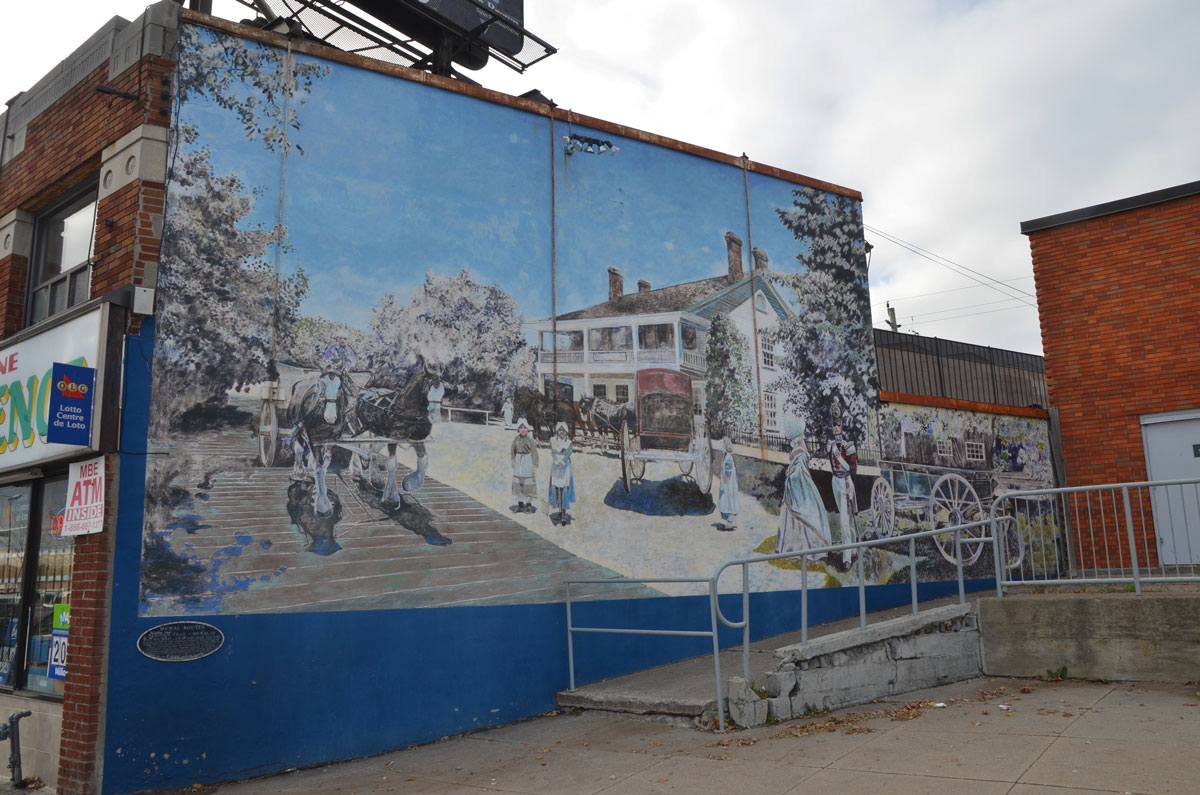
Half Way House painted in 1990 by John Hood at 2052 Kingston Road, the NW corner of Midland & Kingston Rd.  It is a picture of the Half Way House inn (and stage coach stop) that stood at this corner.   It’s name comes from the fact that it was halfway between the village of Dunbarton (now a part of Pickering) and the St. Lawrence Market in Toronto.   In 1965 the building was moved to Black Creek Pioneer village.

A mural that takes up the side of a building.  It is a picture of an old two storey inn.  It is a street scene as well, with people wearing clothes from the late 1800s.

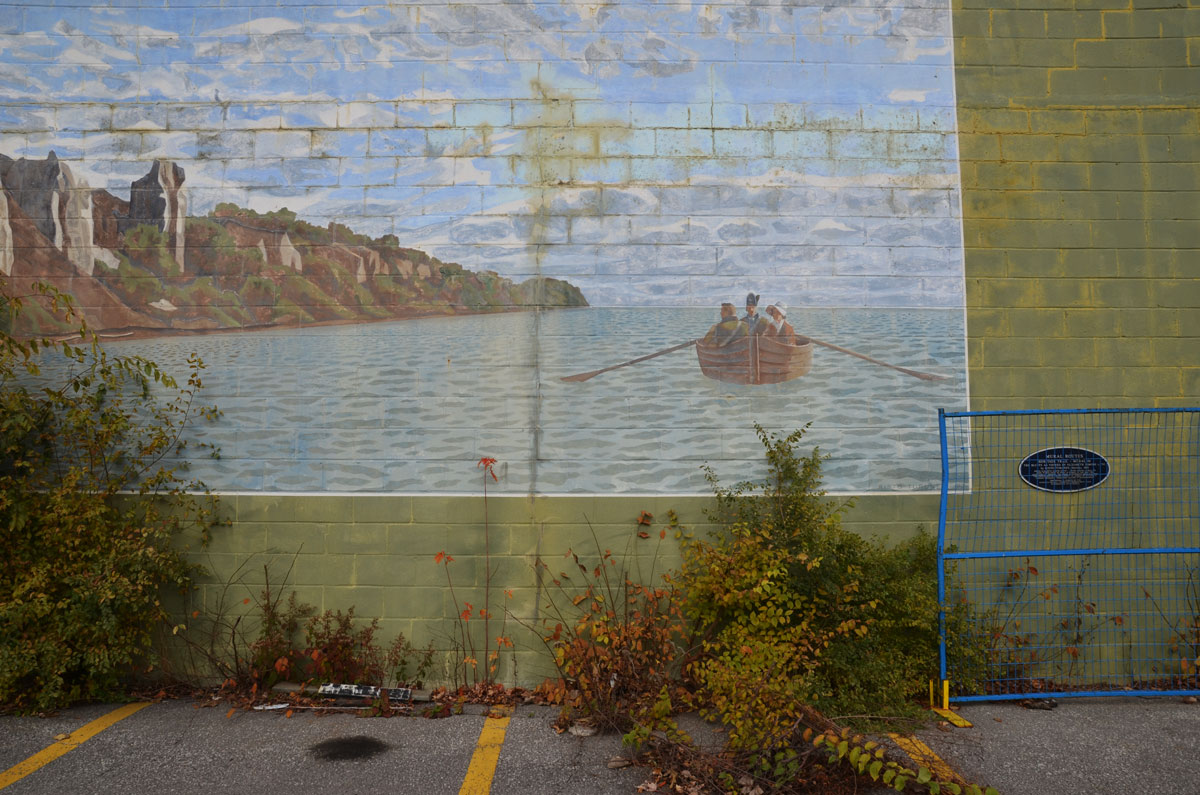
Just farther to the west is another mural.  ‘The Bluffs as Viewed by Elizabeth Simcoe c. 1793’ was painted by Risto Turunen in 1992.  It is on the side of the building located at 2384 Kingston Rd, now Wong’s Martial Arts.  Elizabeth Simcoe was the wife of wife of Lieutenant-Governor John Graves Simcoe, the first Lieutenant Governor of Upper Canada.
mural on the side of building depicting an early scene from Canadian history - a small rowboat with a couple of people in it is passing by the cliffs that are now known as the Scarborough bluffs.

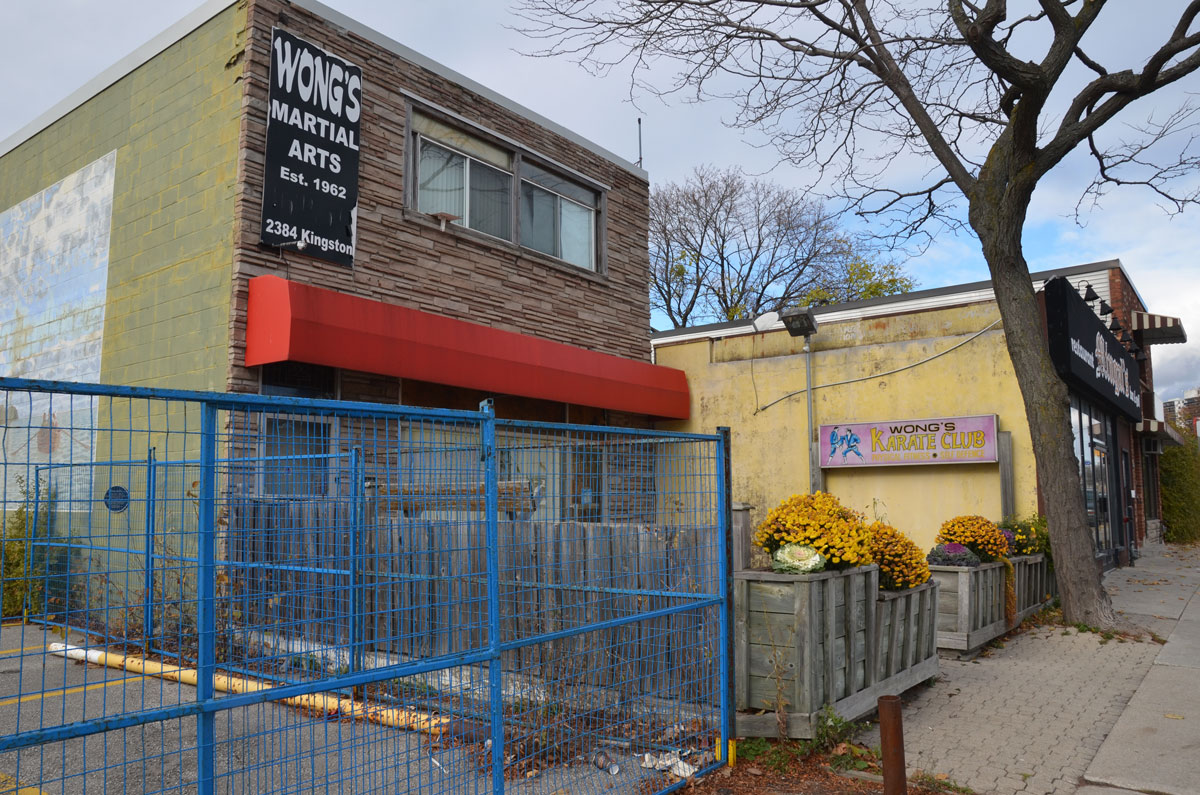
The property beside this mural is now vacant and is enclosed by the type of blue temporary fencing that you see around many construction sites all around Toronto.  If there was a building there, it has been demolished, otherwise there is no work being done there at the moment.

mural on the side of building depicting an early scene from Canadian history - a small rowboat with a couple of people in it is passing by the cliffs that are now known as the Scarborough bluffs.

Wongs Martial Arts building, a nondescript two storey brick building.