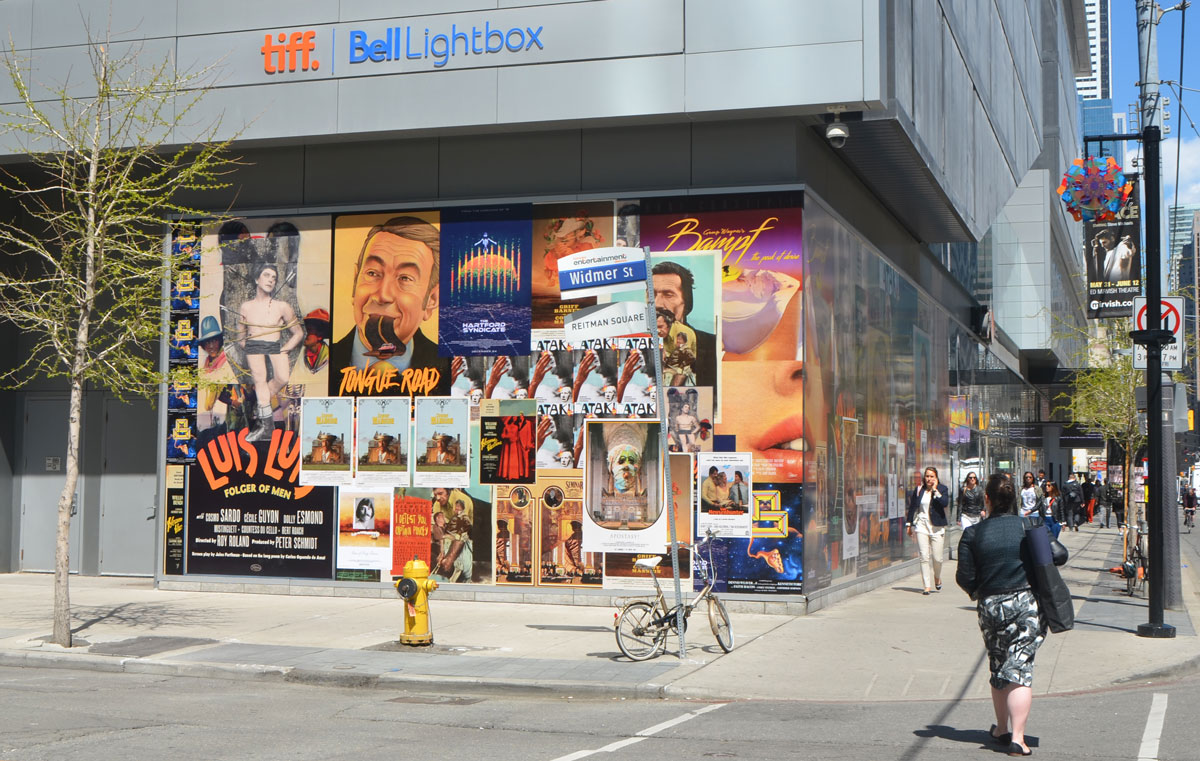
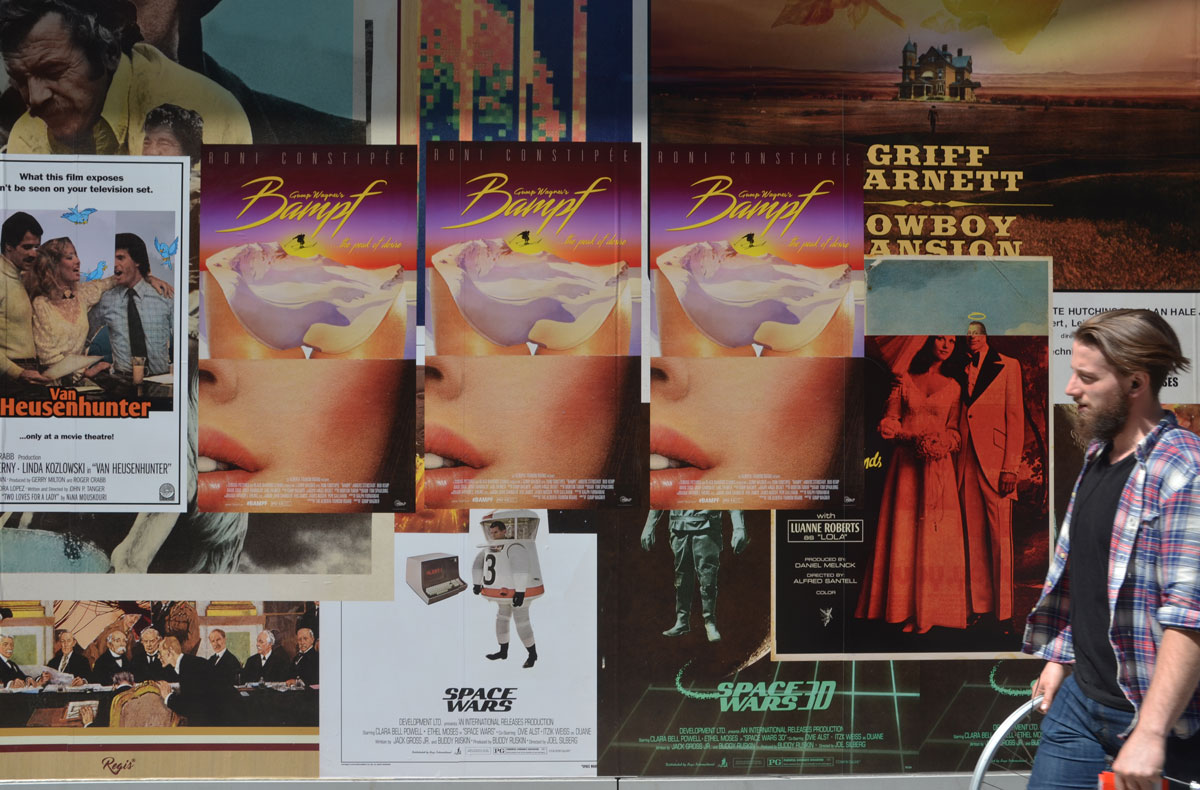
It’s common to see posters pasted on walls so finding movie posters on the walls of the tiff Bell Lightbox didn’t strike me as unusual.    I walked past this display until I noticed the sign that marked this as a CONTACT Photography Festival installation.  Fake movie posters, many designed with a touch of humour, that look just like the real thing.

detail of an art installation that is a wall of fake movie posters made with ads and illustrations from old books and magazines

below: The installation, titled ‘Coming Attractions’ covers the corner windows and wall space.   The posters were designed by ‘Long Weekend’ which is a collective of artists working out of Winnipeg.   They were made from ads and illustrations from old books and magazines.

at the corner of King and another street, the TIFF Bell Lightbox building has an art installation on two sides, walls of fake movie posters. The installation is called 'Coming Attractions' and it is by a collective of artists known as The Long Weekend.

detail of an art installation that is a wall of fake movie posters

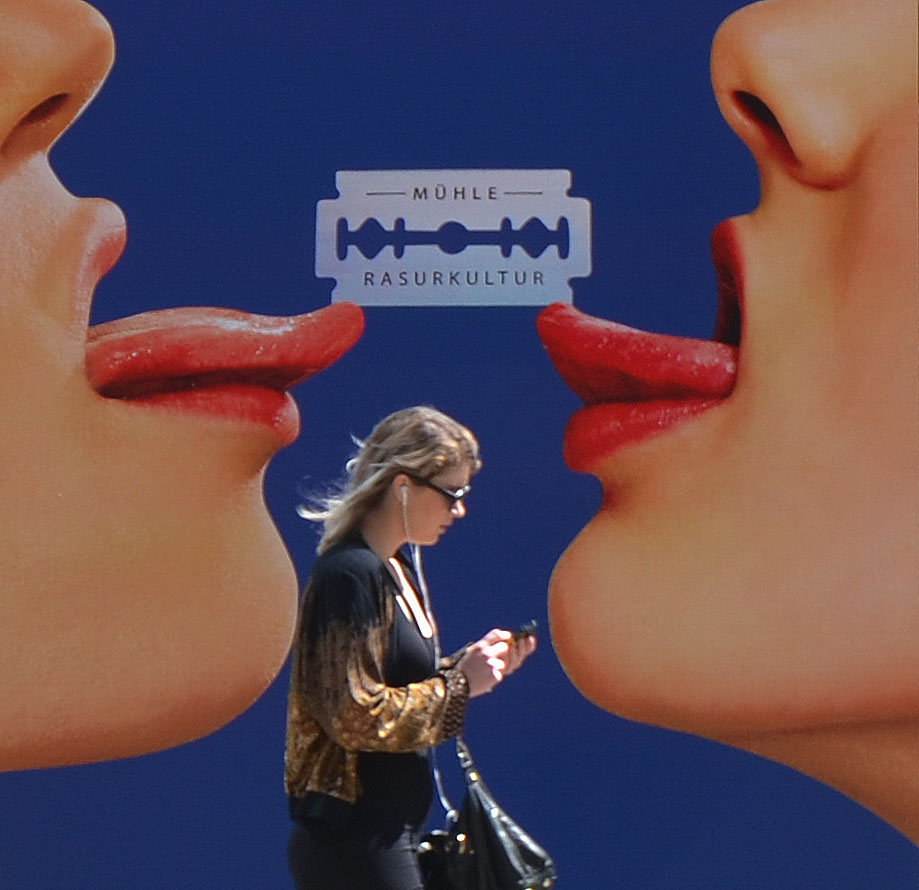
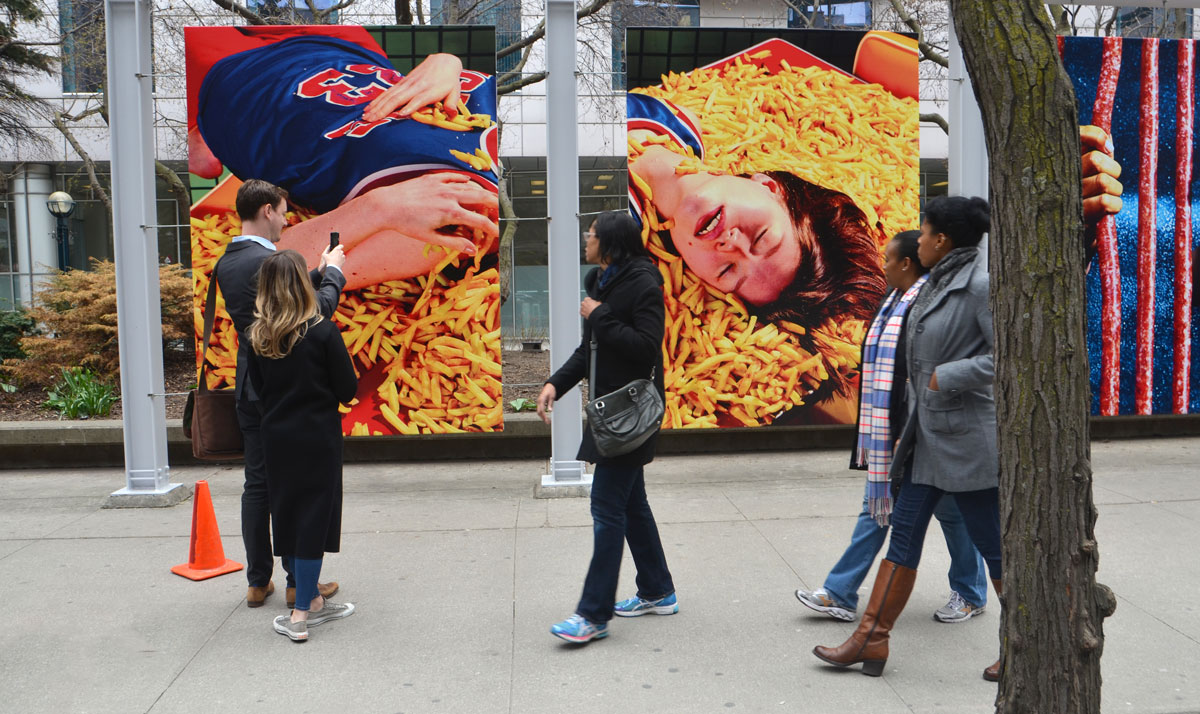
On the other side of King street, and just a but further east, is a series of eleven large images taken from past editions of ‘Toilet Paper’, a biannual magazine founded by Maurizio Cattelan and Pierpaolo Ferrari.   They hint at advertising and they blur the line between fantasy and reality.

below: Muhle is a German company that makes shaving products and one of their blades looks identical to the one in this picture.

A woman with her phone in her hands walks past a large poster of two women face to face where all you can see is their nose, mouth, chin and tongues that are stuck out. A razor blade balances between the two tongues.

People walk past two large posters that show a girl lying on a large pile of french fries.

A man walks past large posters on King St.,

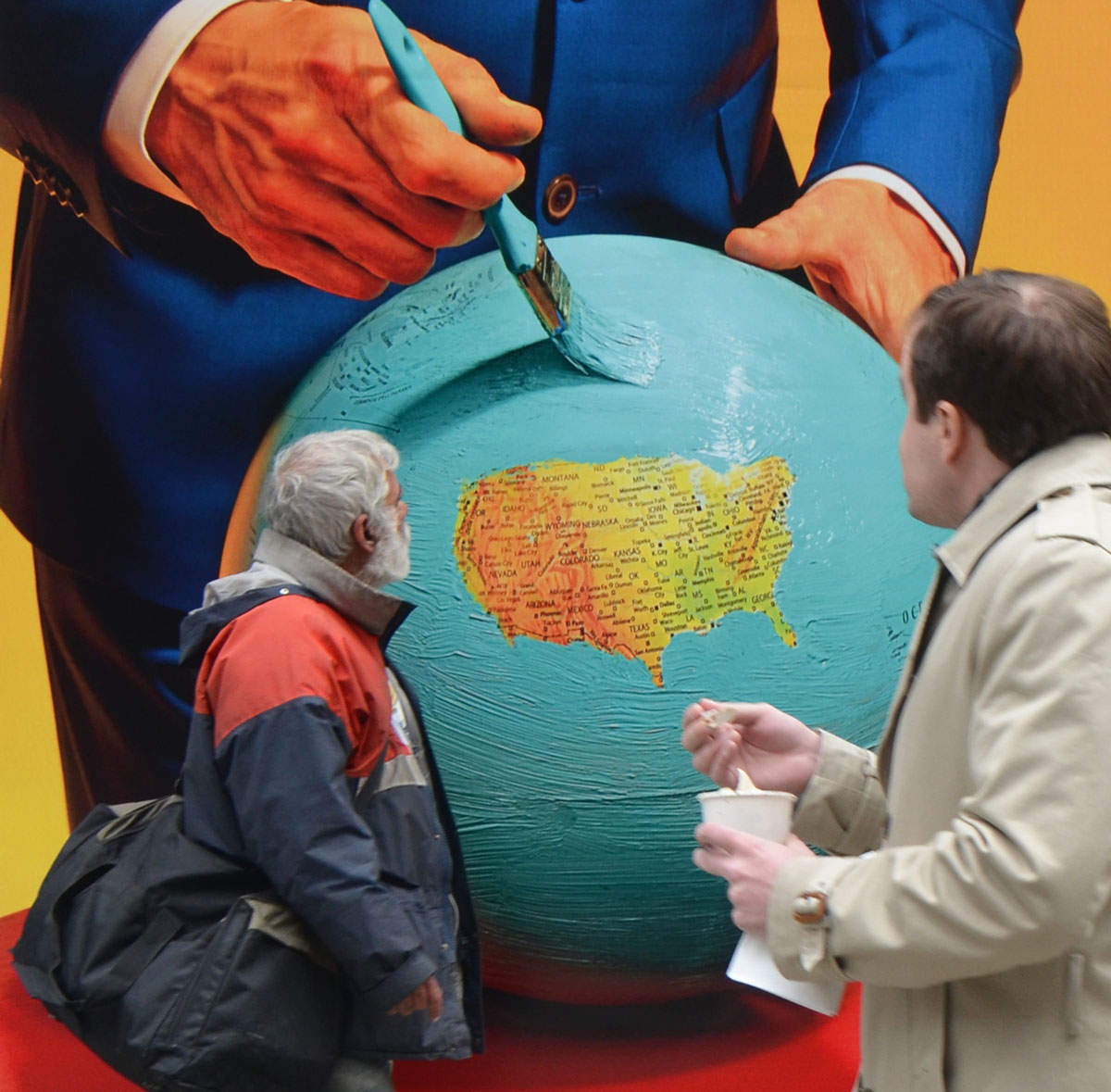
a man stands in front of a picture that is a large globe with everything painted light blue except the USA

a man stands in front of a picture that is a large globe with everything painted light blue except the USA

If you like these images, you might also like Toilet Paper’s website.

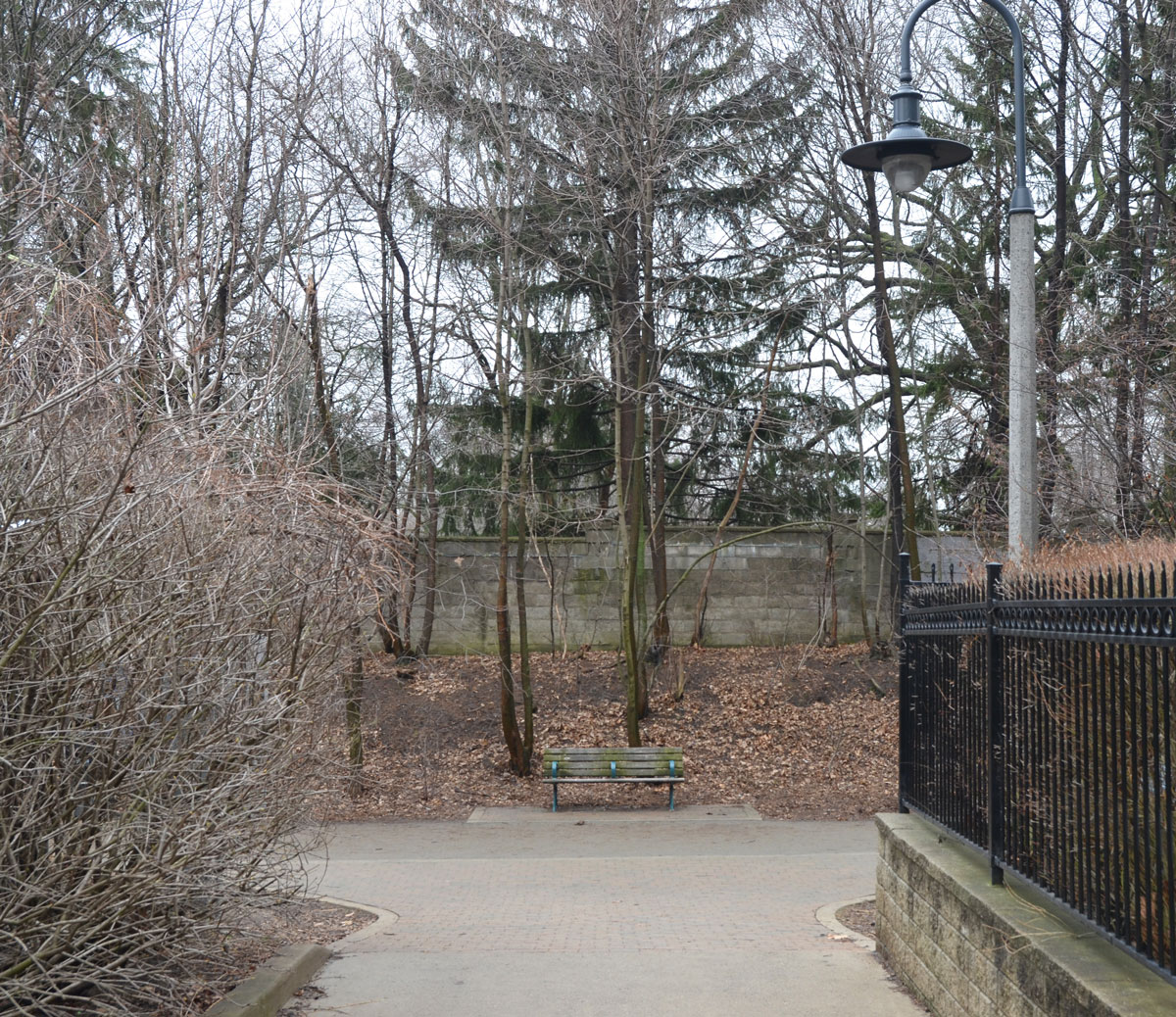
There is time between winter and spring that is a dreary time of greyness and dullness.  It is a time when the the snow is gone but nature hasn’t come out of hibernation.  It is also a time best forgotten.

between winter and spring, the snow has melted, there are no leaves on the trees, the weather is grey, looking down a path that comes to an end in front of a bench. Behind the bench are trees, dead leaves on the ground, and a grey stone fence. dreary, grey

Luckily we don’t have to wait long.

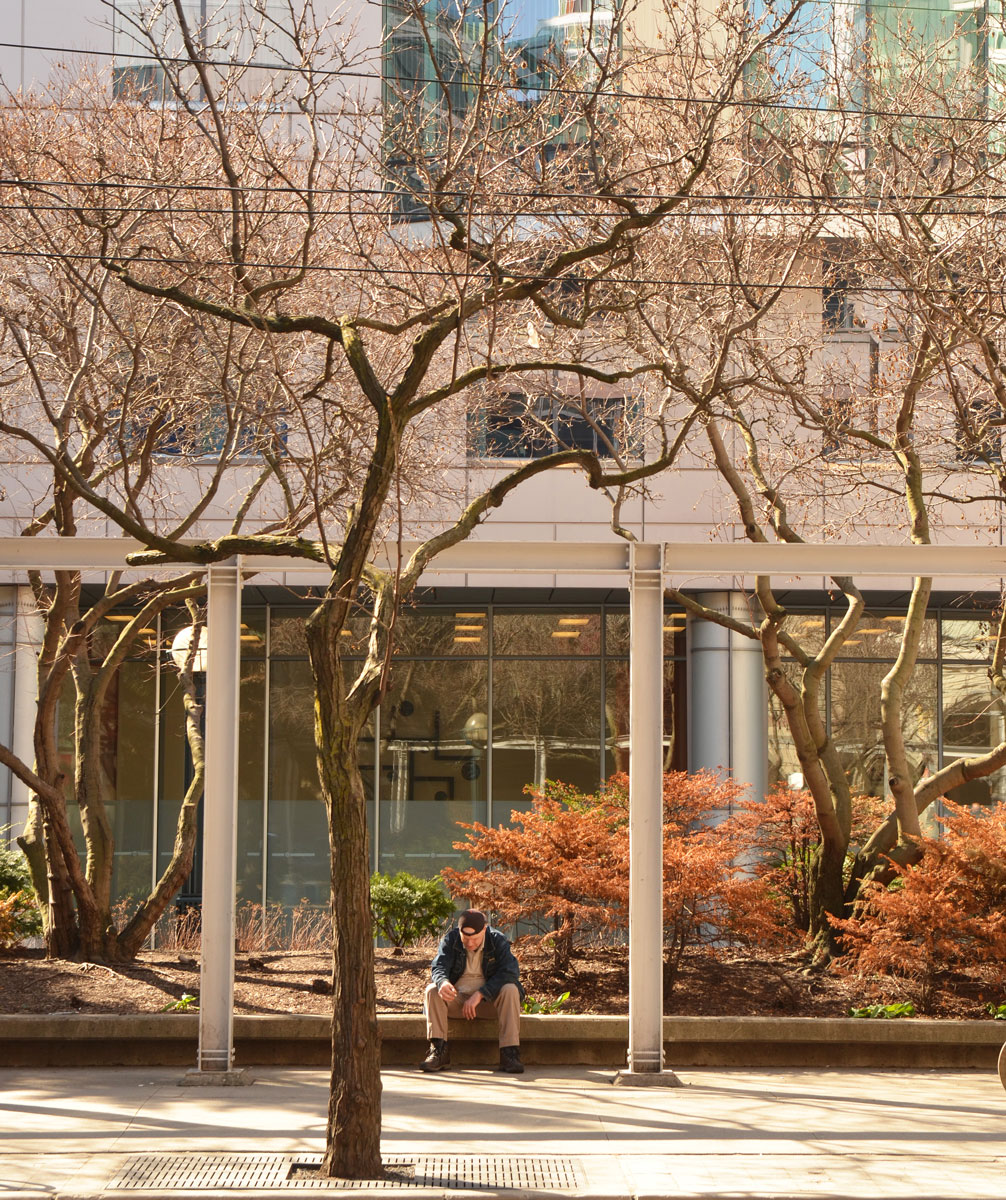
A man sits on the edge of a large planter with trees and shrubs in it in front of Roy Thomson Hall. There are no leaves on the tree yet.

… just a little longer ….

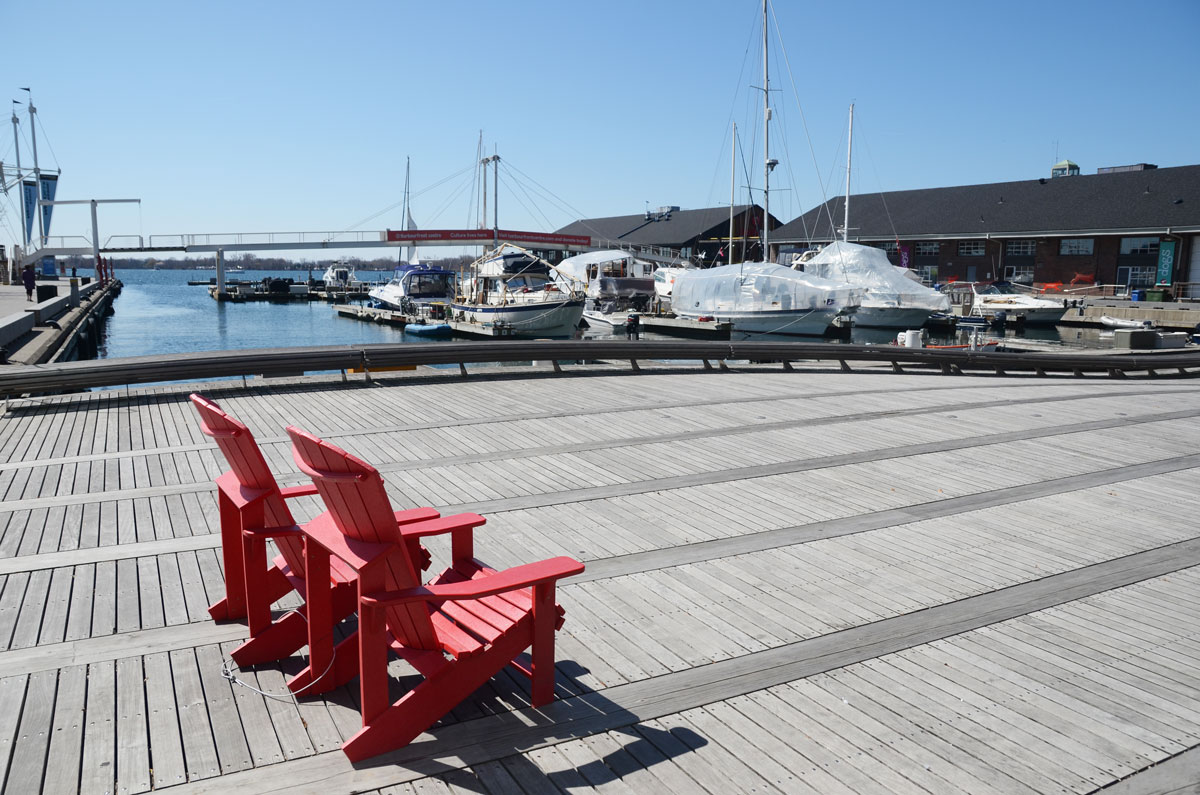
Two red Muskoka chairs sit on the Wave Deck at the waterfront in Toronto. Boats in the harbour are in the background, some with plastic wrap still on them from winter storage.

or if you can’t wait, there’s always plastic!

a garden full of fake flowers, colourful plastic flowers instead of real flowers.

From the time the first spring flowers start to show

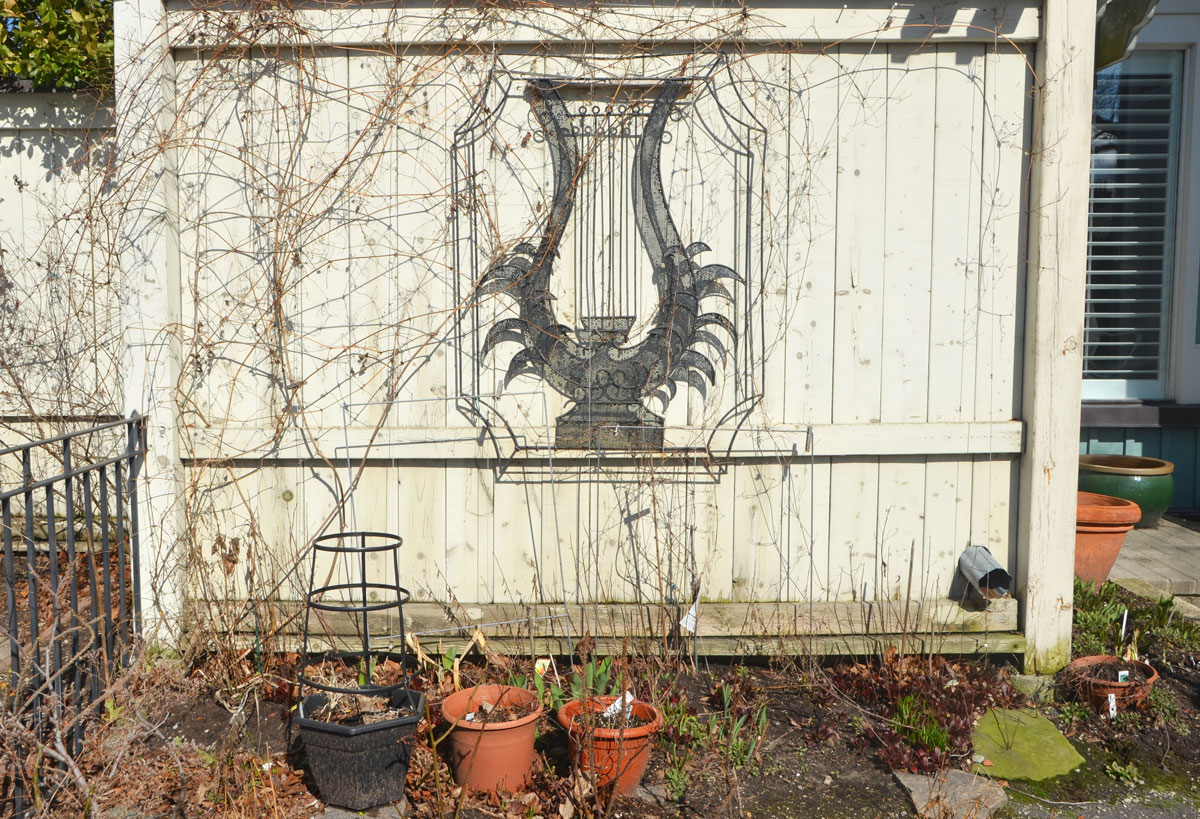
A small white fence with some empty planters in front of it. Old vines are on it (no leaves). There is a frame for plants to cling to in the shape of a lyre that is attached to the fence

until the time they are in full bloom is usually only a matter of days.

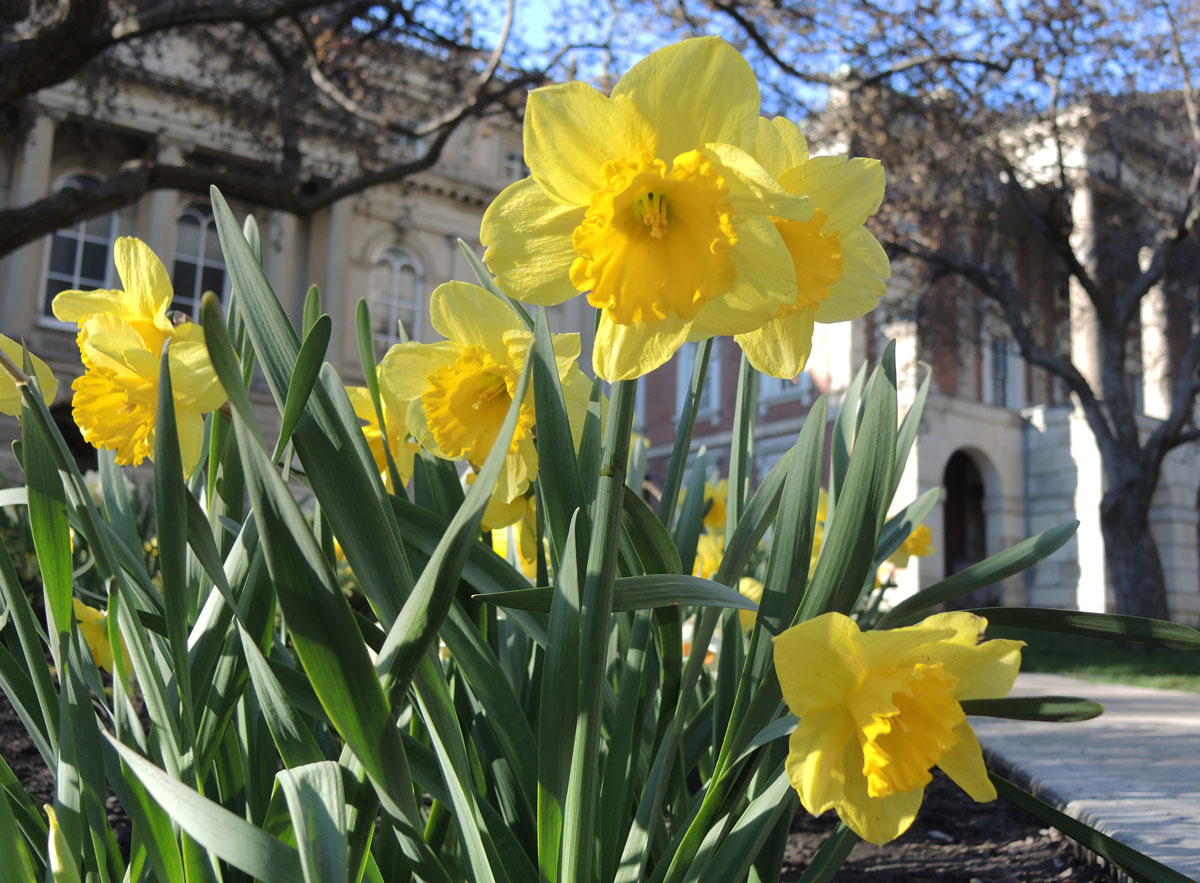
A group of bright yellow daffodils in the sunshine in full bloom with the front of Osgoode Hall on a warm sunny spring day. Blue sky.

Trees too soon show their colours.  The yellows of the willow trees usually appear first.

downtown Toronto, the white curved roof of the Rogers Centre with the CN Tower beside it. WIllow trees and grassy park are in front.
Almost daily the trees are greener…

Budding leaves - The light yellowish green new spring growth on a tree that is growing beside a greenish blue tinted window. Some tree reflections in the window too.

… or full of flowers.

looking upwards from below the branches of a magnolia tree in full bloom. Lots of pink and white flowers, no leaves, on the tree. Bright blue sky in the background. A sunny spring day.

And for another year we forget the last grey days of winter

A rack of geraniums in bloom for sale sitting outside a store. The sidewalk by the store is shaded with white, green and red umbrellas.


Did you know that we share 50% of our DNA with a banana?  Bananas don’t have DNA that codes for eye colour and we probably don’t any genes that produce yellow peels.   What we share is similar basic biochemistry, such things as DNA replication, cell metabolism, and regulation of cell growth, to name a few.  One thing that you can do with banana DNA is easily extract it.  We all know that cells are too small to see and that DNA is even smaller,  BUT if you mash a whole a banana, you can produce enough DNA to make a small clump.   That was one of the activities at Science Rendezvous this past Saturday.

Two young girls are performing an science experiment using beakers and a graduated cylinder. One of them is pouring liquid into the cylinder while the younger one watches.

Science Rendezvous is science outreach festival that occurs across Canada, a day when science hits the streets.  This year it was May 7th.  In Toronto, there were information booths, demonstrations, and activities by students from Ryerson (at Yonge Dundas Square) and students from U of T (St. George Street).

“There’s no place like GenHome” is a project by Ryerson students to break a Guinness World Record by building the longest DNA model.    DNA, or deoxyribonucleic acid,  is a double helix.  Although it is a complex molecule, it can be broken down into components called nucleotides.  Nucleotides consist three parts – deoxyribose which is a sugar molecule, phosphate, and an organic base.  At the risk of being too simplistic (because the chemistry of DNA is way beyond the scope of this blog), the sugar and phosphate of the nucleotides form the backbone of the double helices.  The organic bases are in the space between the two backbones and if they are ordered properly, the bases hold the double helix together.

A couple more things you need to know about DNA.  First, there are four bases, adenine (A), thymine (T), cytosine (C), and guanine (G).  And second, bases come in pairs and only certain pairs can exist if the double helix is to form properly.  Adenine has to pair with thymine and cytosine has to pair with guanine, i.e. A with T and C with G and nothing else.

How would you build a DNA model?  The Ryerson University students wanted to get people involved in the project and if you were at Science Rendezvous, you could have become part of their DNA model.

below: Bases need partners and so do you !  Find a partner and take a spin.
Are the two of you A & T or G & C?

A young woman is standing beside a spinner with AT and GC being the possible landing places. She is talking to a couple who have spun and landed on GC

below: Next, have your picture taken with your base letter.

A young woman has her picture taken with a large orange letter A on a blue square.

A few moments later your picture is printed and ready to attach to the DNA model.

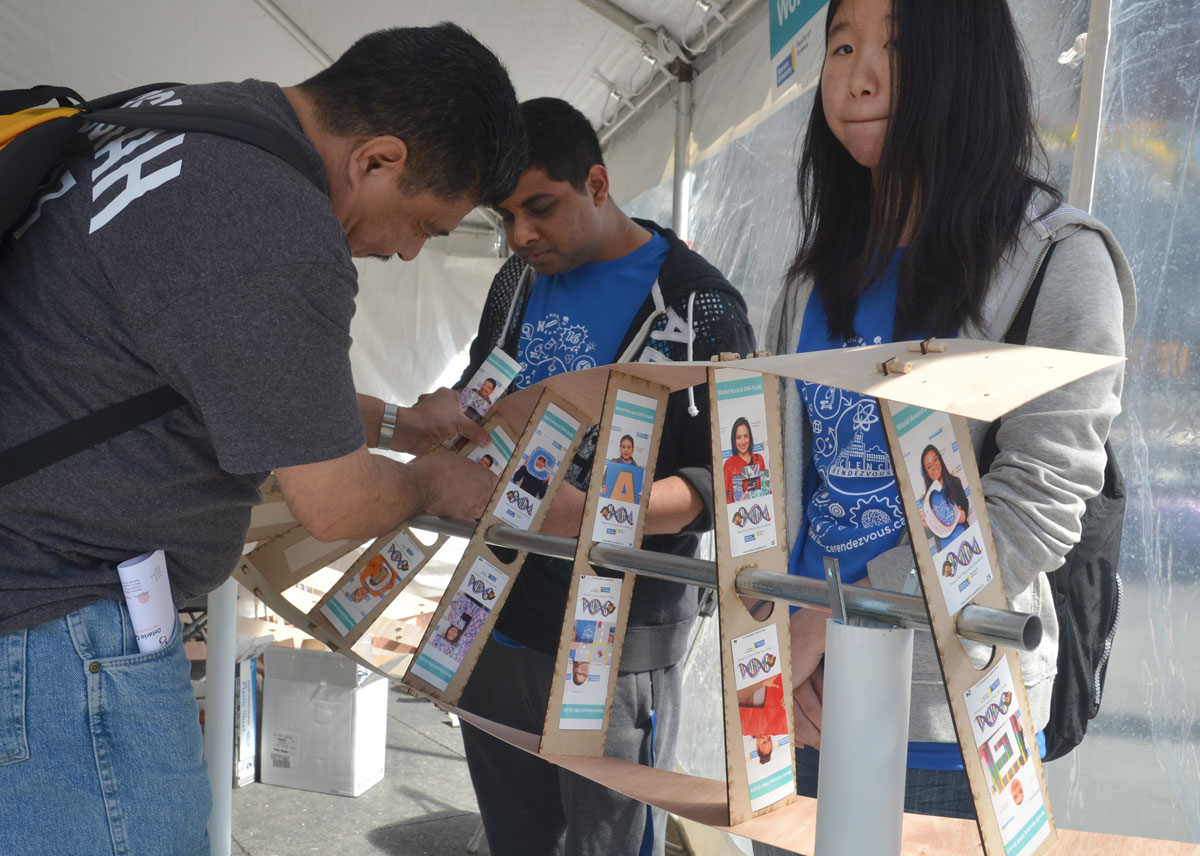
below: My partner for the activity adds his G (toe to toe with my C).

People making a DNA model using photos that volunteers have had taken of themselves with one of the letter of DNA. The four letters are A, C, T, and G. They are the nucleosides that make up DNA

I don’t know how long the DNA model is at this point.  I was hoping that there would be some information online but nothing has shown up yet.

Also, If you want to try extracting the DNA from a banana, the instructions are online at numerous sites including Scientific American.  You will need a banana, water, salt, detergent, rubbing alcohol, and a coffee filter.  Have fun!


***  a little breather after all that molecular biology ***

below:  At Science Rendezvous they were walking together until she saw my camera and then she tried to get away.  Hmmm…. Mr. Scientist Creature (mutant science rodent?!), maybe she was embarrassed? 🙂

A person dressed in a costume that looks like an animal - squirrel? fox? that is wearing a lab coat. An Asian woman who was walking with him before the photo was taken is shyly turning away, she is also laughing


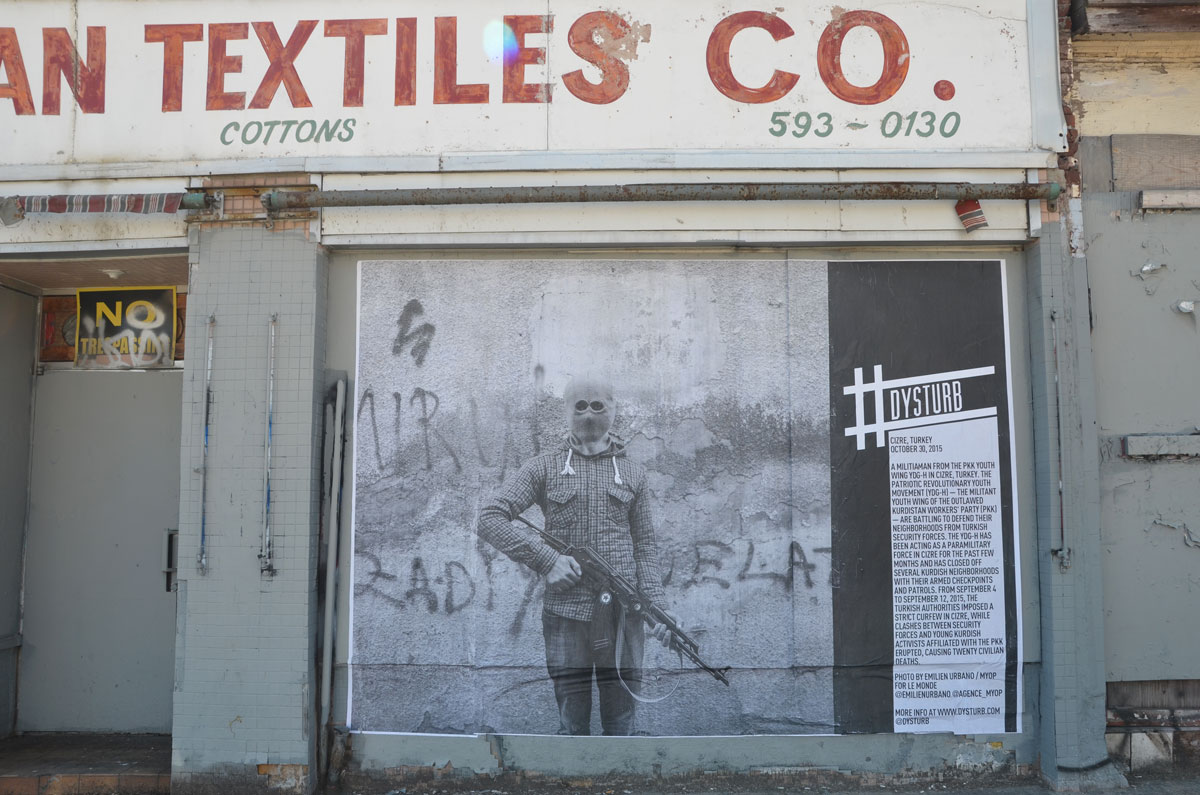
Spread around Kensington and Chinatown are 20 large black and white photos taken by a number of freelance photojournalists who are part of a group called #Dysturb.   One of their goals is to present photojournalism in new ways, including as street art, with the aim of engaging people and encouraging discussion of global issues.   The images are part of an exhibit for the Scotiabank CONTACT Photography Festival.

Kensington has had a problem with taggers for a while.  Often street art gets vandalized in that area.   The #Dysturb photo that was at 56 Kensington (under Mona Lisa) has already been torn down and a couple of others have been ripped.

Pictures of some of the images that are part of the exhibit are shown below.  I have included a partial transcription of the words that accompany each picture.


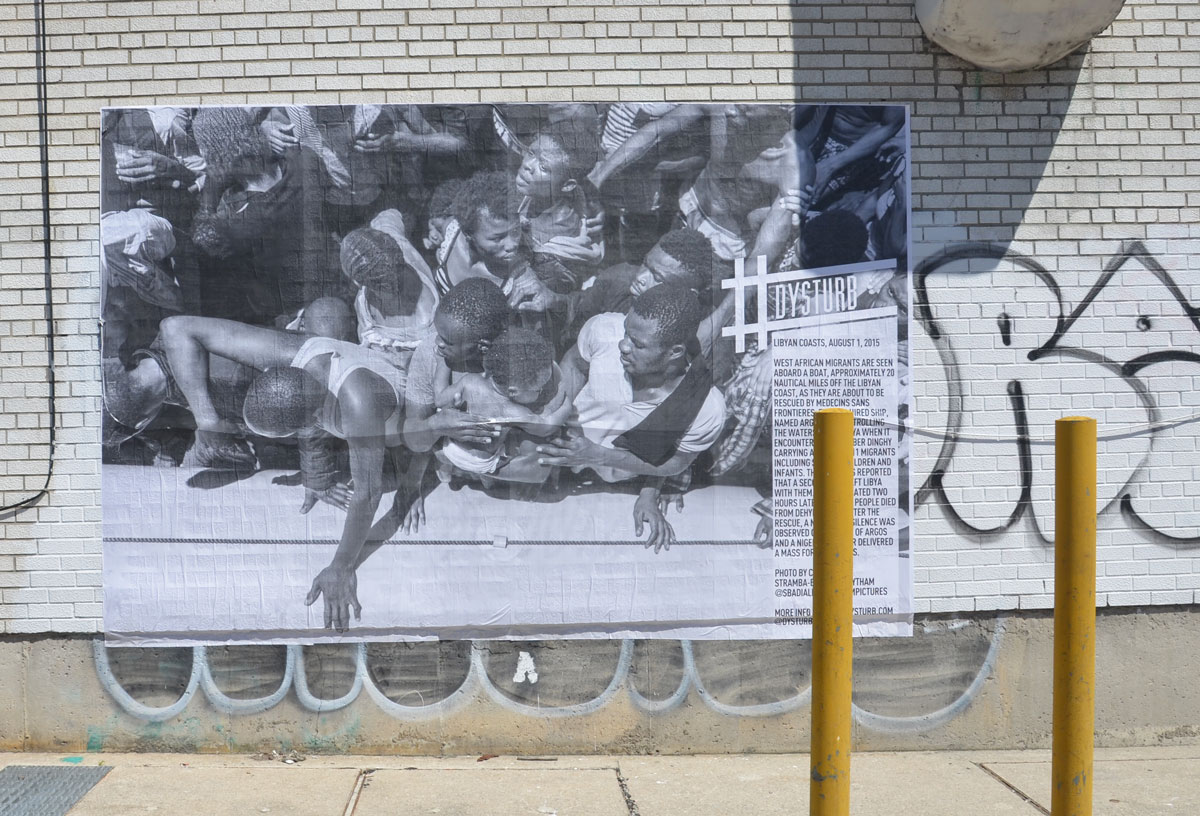
Libyan Coasts, August 1, 2015
Photo by Christophe Stramba-Badiali/Haytham

a large black and white photojournalist picture, part of CONTACT photography festival, pasted on a wall - a boat load of Libyan migrants is being rescued from their rubber dinghy.

West African migrants are seen aboard a boat, approximately 20 nautical miles off the Libyan coast, as they are about to be rescued by Medecins Sans Frontieres. The MSF-hired ship, named Argos, was patrolling the waters off Libya when it encountered one rubber dinghy carrying a total of 111 migrants including several children and infants. “


Barpak, Ghorka District, Nepal, May 9, 2015 ”
Photo by Renaud Philippe/Hans Lucas

a large black and white photojournalist picture, part of CONTACT photography festival, pasted on a wall - children playing in the wind created by a helicopter, Nepal, on a wall in an entraceway.  A man is busking in front, and there are people walking past on the sidewalk

Children play in a cloud of dust and gravel thrown by an Indian army helicopter landing in Barpak Nepal.  The community is at the epicenter of the devastating earthquake that struck April 25, 2015, taking over 8000 lives.  Of Barpak’s 1400 houses, only 20 remain standing.   The rest of the town is a pile of rubble that blends into the rocky landscape.  An archway that somehow survived the quake greets visitors with a rueful ‘Welcome to Barpak’.”


Shaanxi Province, Henan, China, February 27, 2014
Photo by Sim Chi Yin/Vii

a large black and white photojournalist picture, part of CONTACT photography festival, pasted on a wall - an ill Chinese man is being comforted by his wife.  The picture is on a graffiti covered wall and a black car is parked close to it.

Gold miner, He Quangui, battling silicosis, struggles to breathe while cradled in the hands of his wife Mi Shixiu.  After many attempts to stabilize his breathing, in the early hours of the next morning her tried to kill himself to end the suffering.  He contracted the irreversible disease working in illegal gold mines in China’s Henan province.   He is among some six million workers in China who have pneumoconiosis – the country’s most prevalent occupational disease.”


Cizre Turkey, October 30, 2015.
Photo by Emilien Urbano/Myop for Le Monde
NOTE: I took this picture on Friday. Today (Monday) it was gone.

large black and white photo pasted onto a boarded up storefront of European Textiles on Spadina Rd. The photo is part of #Dysturb exhibit at Contact Photography Festival. It shows a hooded man holding an automatic rifle

A militiaman from the PKK Youth wing YDG-H in Cizre Turkey.  The Patriotic Revolutionary Youth Movement (YDG-H) – the militant youth wing of the outlawed Kurdistan Workers’ Party (PKK) – are battling to defend their neighbourhoods from Turkish security forces.  The YDG-H has been acting as a paramilitary force in Cizre for the past few months and has closed off several Kurdish neighbourhoods with their armed checkpoints and patrols.


Fort McKay, Alberta, Canada, August 12, 2015
Photo by Ian Willms/Boreal Collective

a large black and white photojournalist picture, part of CONTACT photography festival, pasted on a wall - a sick boy is lying on a bed, on a wall in the entranceway to a store, sidewalk and street scene in the background

Dez, 7, plays in his bed.  Dez was born with an underdeveloped heart and has received multiple open heart surgeries.  His family and healthcare professionals in Fort McKay believe that his condition was caused by environmental pollution.   Fort McKay is an indigenous community that is surrounded by oil  sands developments.”


Kunduz City, Afghanistan, November 18, 2015.
Photo by Andrew Quilty/Oculi

a large black and white photojournalist picture, part of CONTACT photography festival, pasted on a wall - a mother (covered in a black burka) and her daughter in grief, at a gravesite.  Pasted on an orange wall with an old brown leather sofa in front of it.

Najibah tries to comfort her daughter Zahara, 8, as they weep over the grave of their husband and father, Baynazar.   Baynazar, 43, was wounded by gunfire on his way home fromwork during the Taliban takeover of Kunduz in late 2015.  He was taken to the nearby Doctors Without Borders (MSF) trauma centre.  In the early hours of October 3, during his second operation, a US AC-130 aircraft attacked the hospital for more than half an hour, killing 43 MSF staff, patients and nurses.  Dozens more were wounded.

About #Dysturb

#CONTACT16

Happy Mothers Day!

I didn’t write this blog post specifically for Mothers Day even though it’s about four women, Mary Pickford, Edith Cavell, Florence Wyle, and Frances Loring.  Just because they are women doesn’t mean that they are mothers, in fact only one is.  Mary Pickford adopted two children.  I also didn’t intend to write a blog post on the merits of motherhood vs childlessness so I am going to say nothing further on the subject!

The first woman can be found at the corner of University and Elm.  Here, there is a a bronze portrait bust of Mary Pickford that was sculpted by Eino Gira in 1983.

bust of Mary Pickford with her hand on her cheek, in front of Sick Kids Hospital in Toronto, red brick hospital behind her in the photo

The plaque beside her says:

Born in 1893 in a house which stood near this site, Gladys Marie Smith appeared on stage in Toronto at the age of five.   Her theatrical career took her to Broadway in 1907 where she adopted the name Mary Pickford.  The actress’s earliest film “Her First Biscuits”, was released by the Biograph Company in 1909 and she soon established herself as the international cinema’s first great star.   Her golden curls and children’s roles endeared her to millions as “America’s Sweatheart”.  She was instrumental in founding and directing a major film production company and starred in over fifty feature-length films including “Hearts Adrift”, “Pollyanna” and “Coquette”.  For the last named film she received the 1929 Academy Award as the year’s best actress.

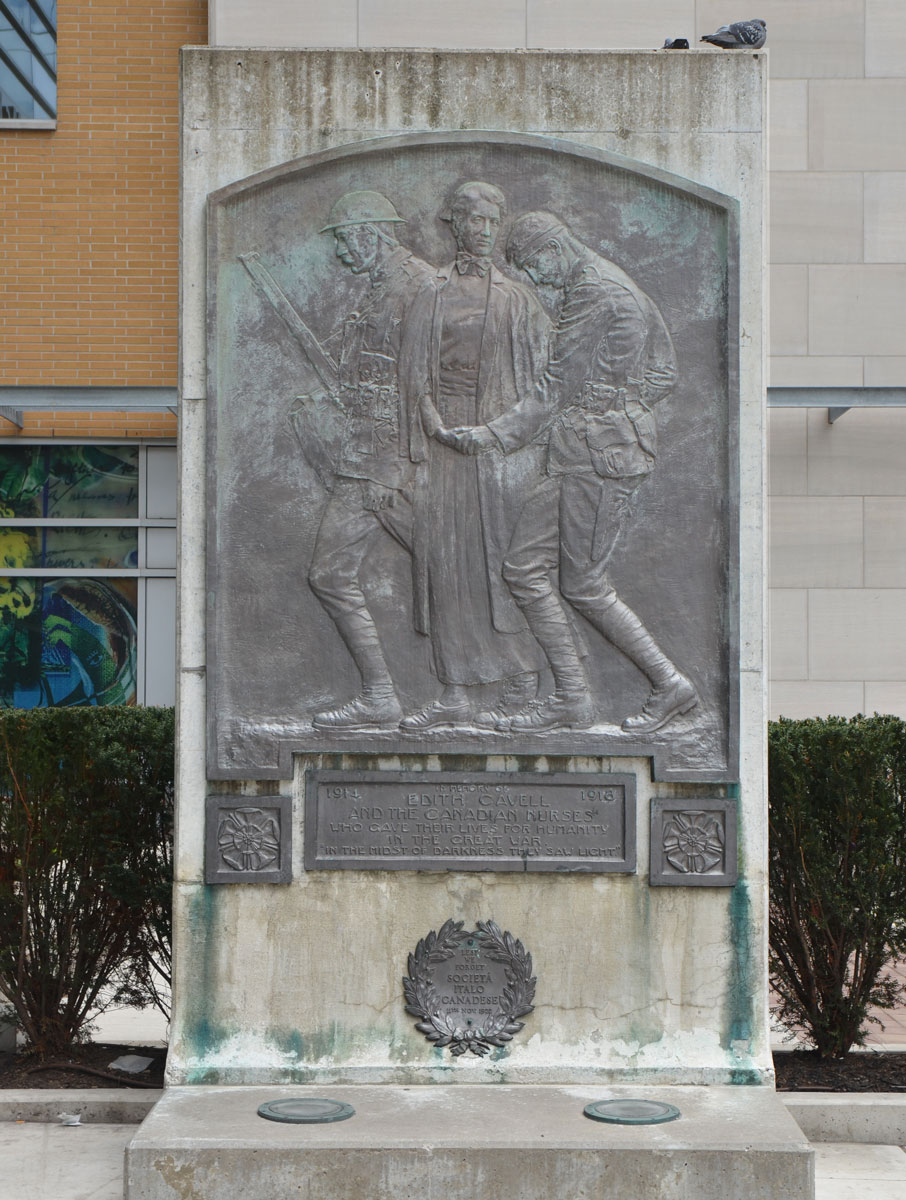
below: Just up the street, next to one of the entrances of Toronto General Hospital, is a memorial to British nurse Edith Cavell (1865-1915) and to all the Canadian women who served as nurses in WW1.  The memorial  was installed at University Ave and College St. in 1921 but later moved to its present location.

A memorial to British nurse Edith Clavell and the Canadian nurses of WW1, a bronze plaque mounted on a stone tablet. Picture of Clavell between two upright but wounded soldiers.

In memory of Edith Cavell and the Canadian nurses who gave their lives for humanity in the Great War.  “In the midst of darkness they saw light”

Cavell had been working in Brussels when WW1 broke out.  After the Germans invaded Belgium, Cavell helped wounded Allied soldiers escape to the Netherlands.  She was caught by the Germans, charged with treason, and executed on 12 October 1915.  She became the most well known woman casualty of WW1.

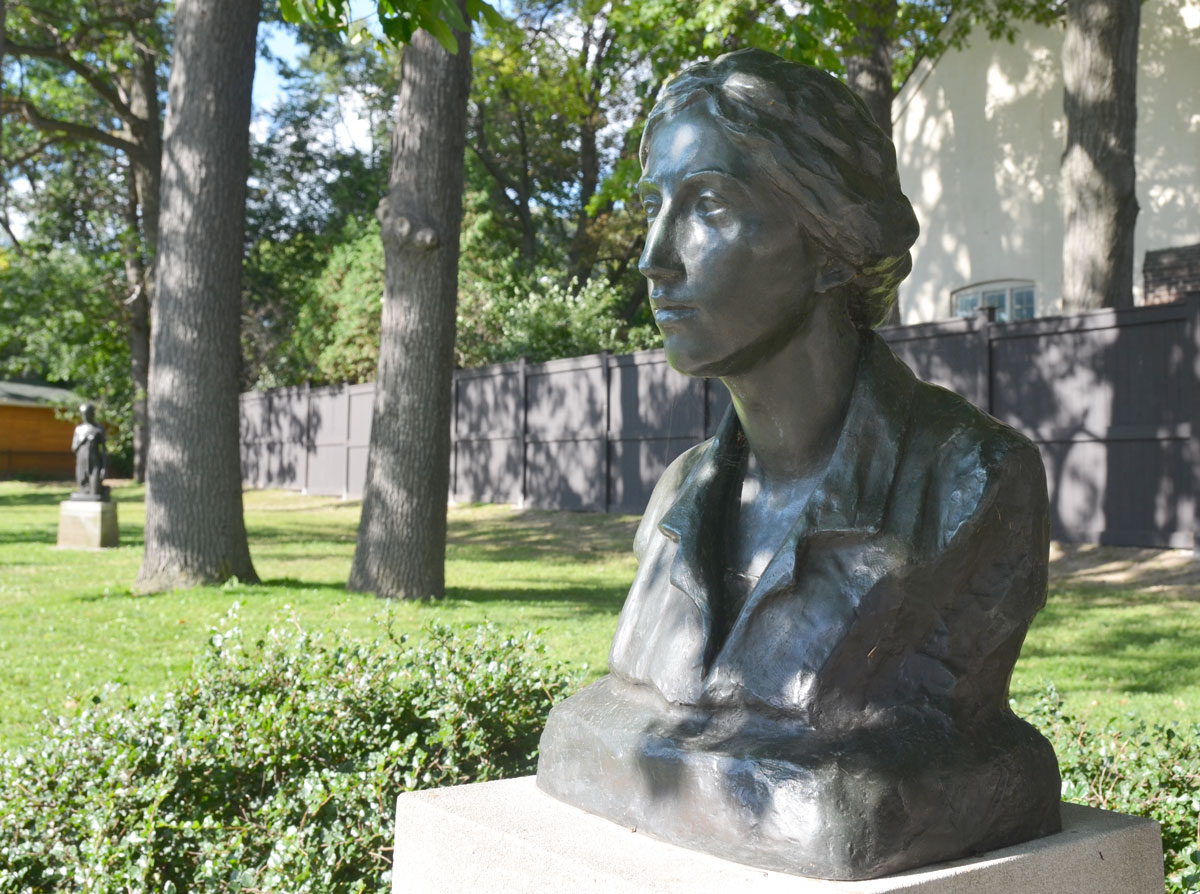
The above memorial was designed by Florence Wyle.  There is a memorial to Wyle and her partner, Frances Loring (also a sculptor), in a small park at the corner of Mt Pleasant and St. Clair.

below: bronze bust of Florence Wyle, by Frances Loring

bust of Florence Wyle, a Canadian sculptor, in a park

below: bronze bust of Frances Loring, by Florence Wyle

bust of Frances Loring, a Canadian sculptor, in a park, in the shade of a large tree

below: There are a couple of small statues by Wyle in the same park, including this one.
“Young Girl”, about 1938.

bronze statue titled "Young girl", showing a girl from the thighs up, holding up a cloth that is wrapped around her body but her breasts are bare

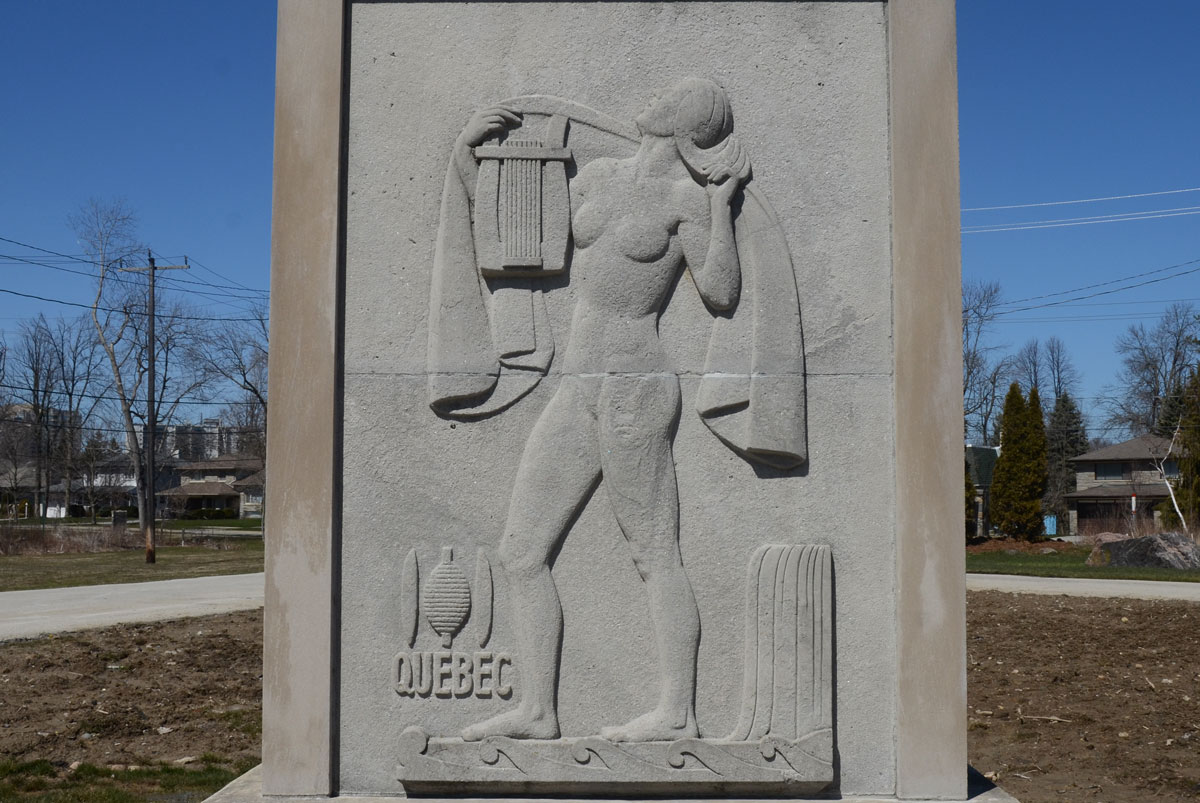
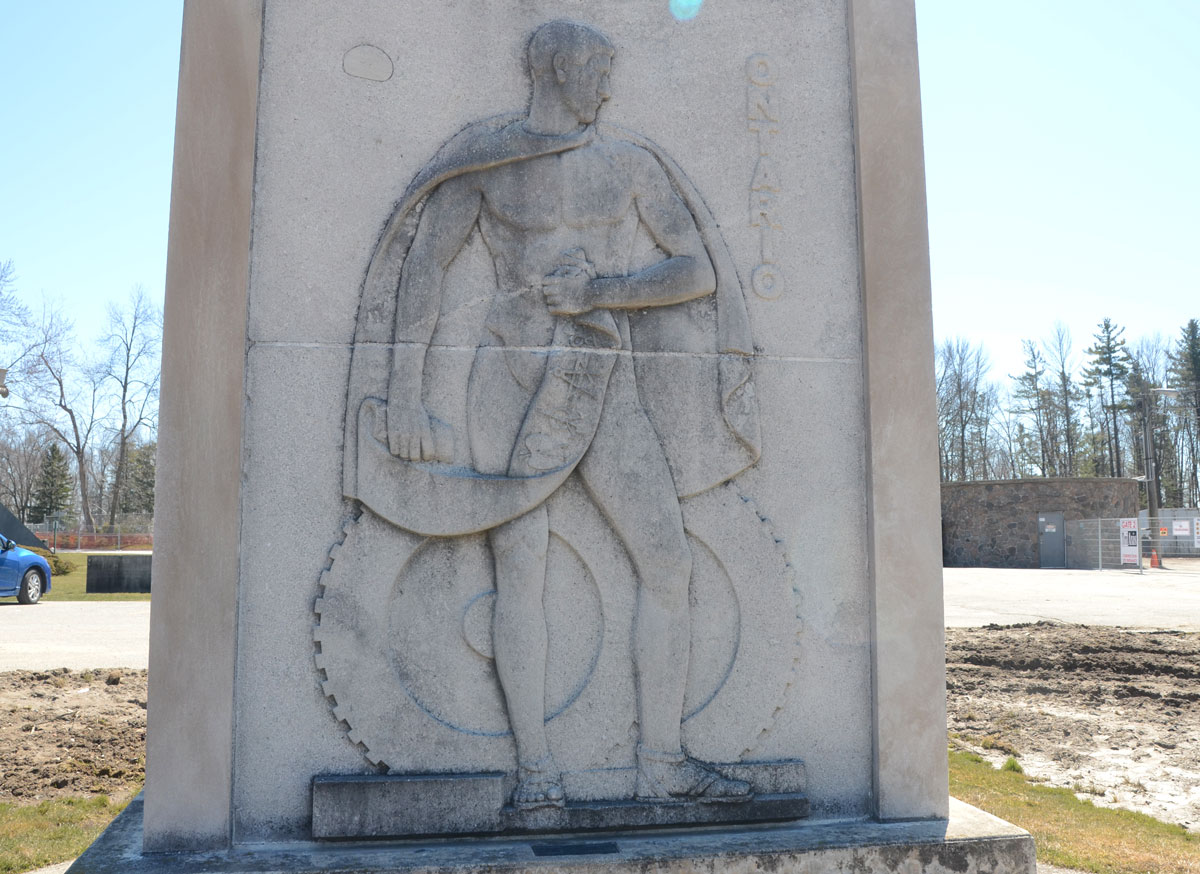
Loring and Wyle are responsible for a number of sculptures around the city.  Two of these used to be on the Bank of Montreal building at the northwest corner of King and Bay. It was built in 1887 by architects Marani and Morris and demolished in 1968.  The building featured a series of sculptures representing the Canadian provinces that were done by a number of artists.  Frances Loring sculpted the panels for Ontario and Quebec.  When the Bank of Montreal building was demolished, all of the panels were moved to the grounds of the Guild Inn in Scarborough where they remain today.

Quebec sculpture - A stone relief sculpture from a series on provinces of Canada, originally on a Bank of Montreal building in Toronto. They were rescued when the bank was demolished and moved to the grounds of the Guild Inn in Scarborough. By Canadian artist Frances Loring. A naked woman upright, with a cloth over her shoulders and looking upwards

A stone relief sculpture from a series on provinces of Canada, originally on a Bank of Montreal building in Toronto. They were rescued when the bank was demolished and moved to the grounds of the Guild Inn in Scarborough. By Canadian artist Frances Loring. Ontario is in the picture, as a man surrounded by symbols of industry such as large gears and architectural plans


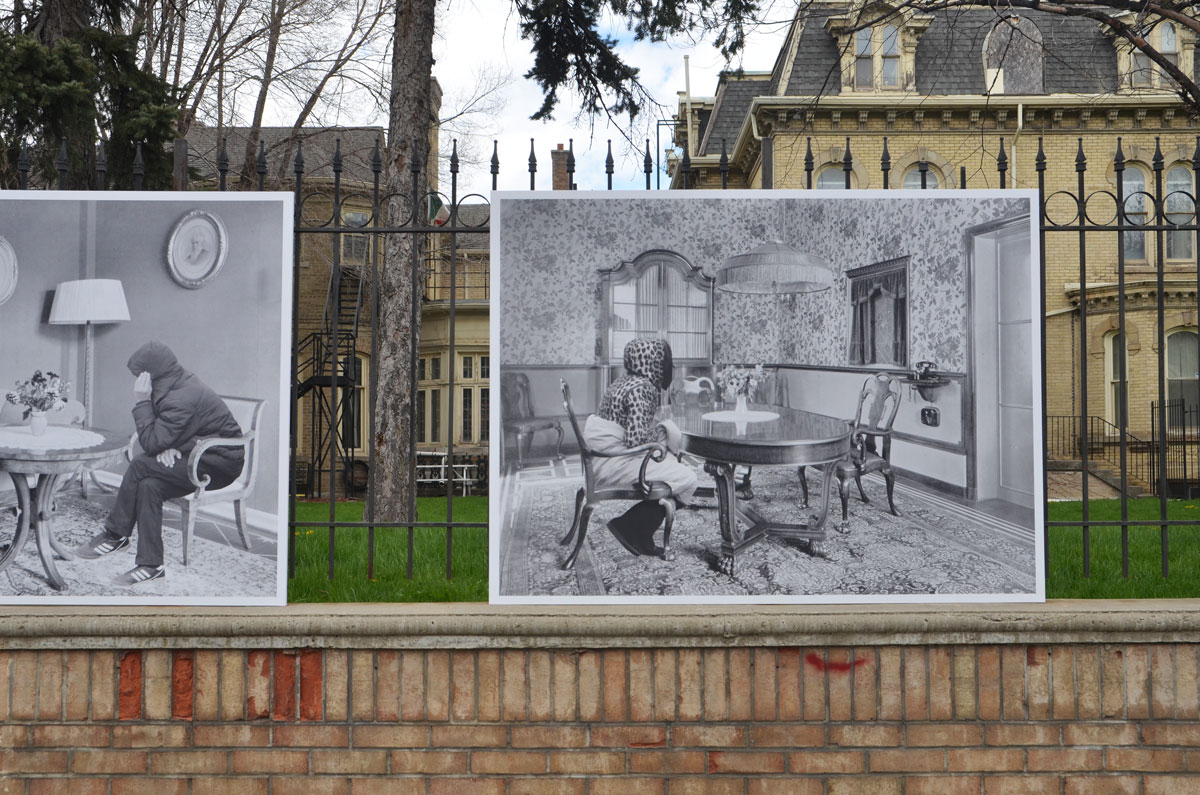
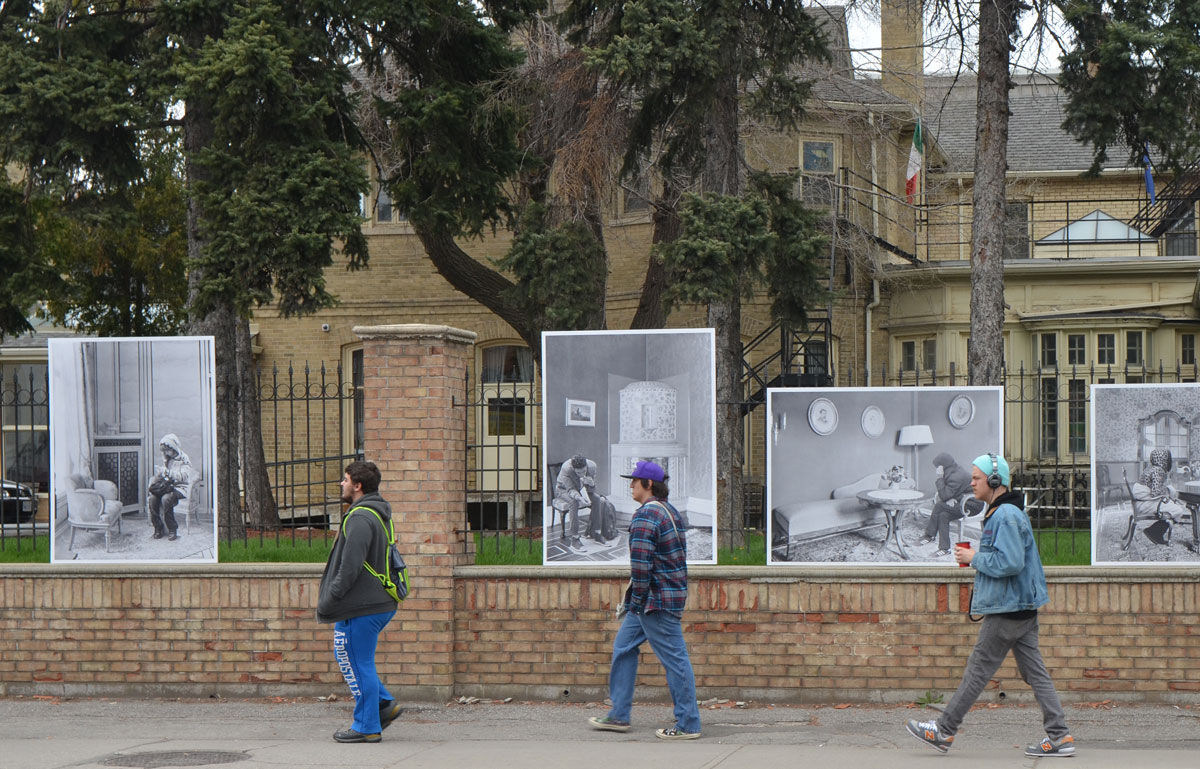
Refugees in a State Apartment, Jens Ullrich,
Photo exhibit, on a fence outside the Italian Consulate, Dundas West at Beverley.

Part of Scotiabank CONTACT Photography Festival

photos mounted along the exterior of a wrought iron fence around the Italian Consulate, right beside the sidewalk. The consulate is on old brick house (mansion) from the 1800's - 3 of the photographs, people walking past

Ullrich has taken found black and white photographs of the interior of a large home near Bremen Germany.  The photos were taken in the late 1920’s.    Each photograph is of a different room in the villa and to each picture Ullrich has added  one person.   If you knew nothing about the series, you wouldn’t know that the subjects were refugees.

In each photomontage, singular individuals are depicted—usually with their faces hidden from the camera—within empty yet elaborately fashioned spaces that emphasize their solitude and unstable status. “

photos mounted along the exterior of a wrought iron fence around the Italian Consulate, right beside the sidewalk. The consulate is on old brick house (mansion) from the 1800's - phot by Jens Ullrich of a woman refugee with her face obscured by clothing, sitting on a chair in the bathroom of a large bathroom. also a photo of a male refugee in another room, looking in a large mirror

One of the concepts behind this series of images was the desire to

respectfully capture the disparate emotions of these individuals and their precarious situations.”

photos mounted along the exterior of a wrought iron fence around the Italian Consulate, right beside the sidewalk. The consulate is on old brick house (mansion) from the 1800's - as seen from across the street with pedestrians walking past and cars driving past

photos mounted along the exterior of a wrought iron fence around the Italian Consulate, right beside the sidewalk. The consulate is on old brick house (mansion) from the 1800's - the photos are of refugees that have been photoshopped into old photos of the interior of the apartment of a wealthy person from the 1920's
#CONTACT16

There is no theme to this blog post.  I never really had a purpose in mind as I walked yesterday.  I walked to enjoy the spring day.  I walked wherever my feet took me…  and they took me on a route that wove between Bay Street and University Avenue and from Grenville south to Dundas.

two women dressed up and walking down the street. One is in a puffy black dress, black tights and black shoes. The other woman has long red hair and a polka dot sweater on.

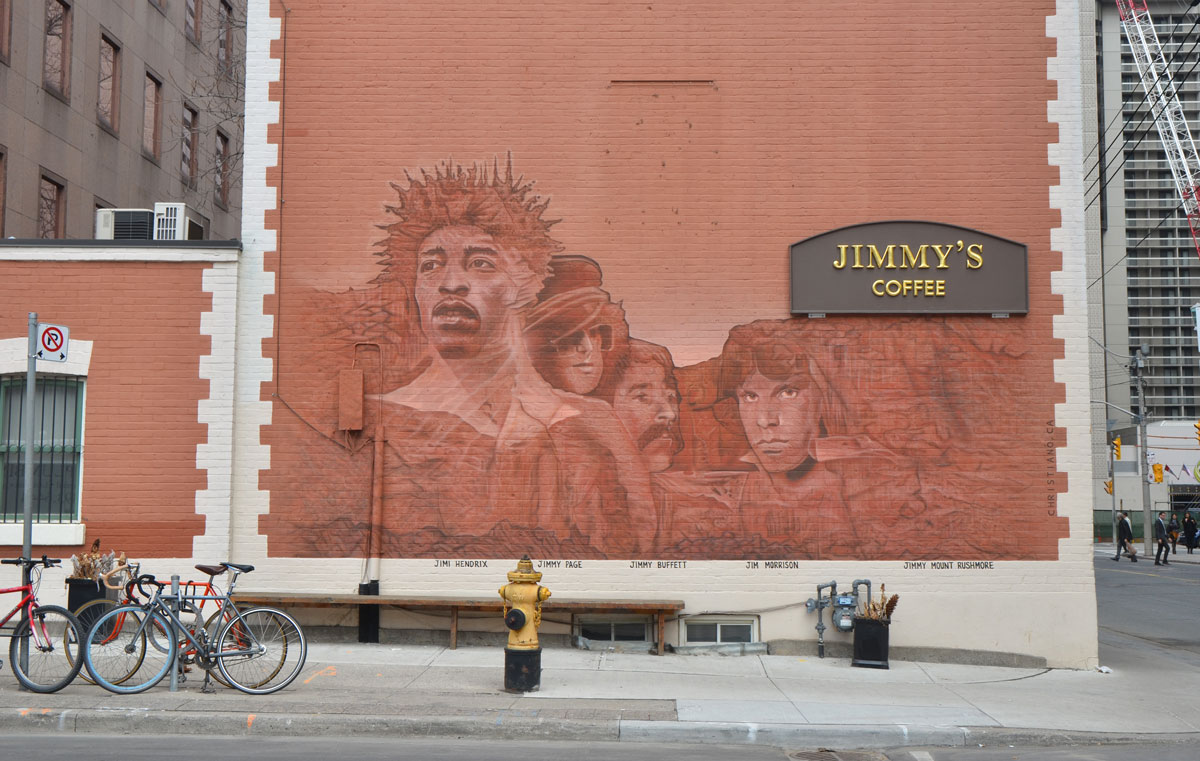
below: “Jimmy Mount Rushmore” mural on the side of Jimmy’s Coffee featuring four famous musical Jimmys: Jimi Hendrix, Jimmy Page, Jimmy Buffet and Jim Morrison.
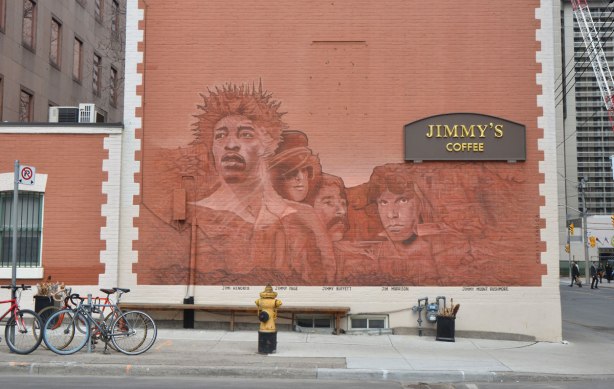
mural on the side of Jimmys coffee, monochromatic in rust, pictures of what Mount Jimmy Rushmore would like, four famous Jimmys, Jimi Hendrix, Jimmy Page, Jimmy Buffett and Jim Morrison

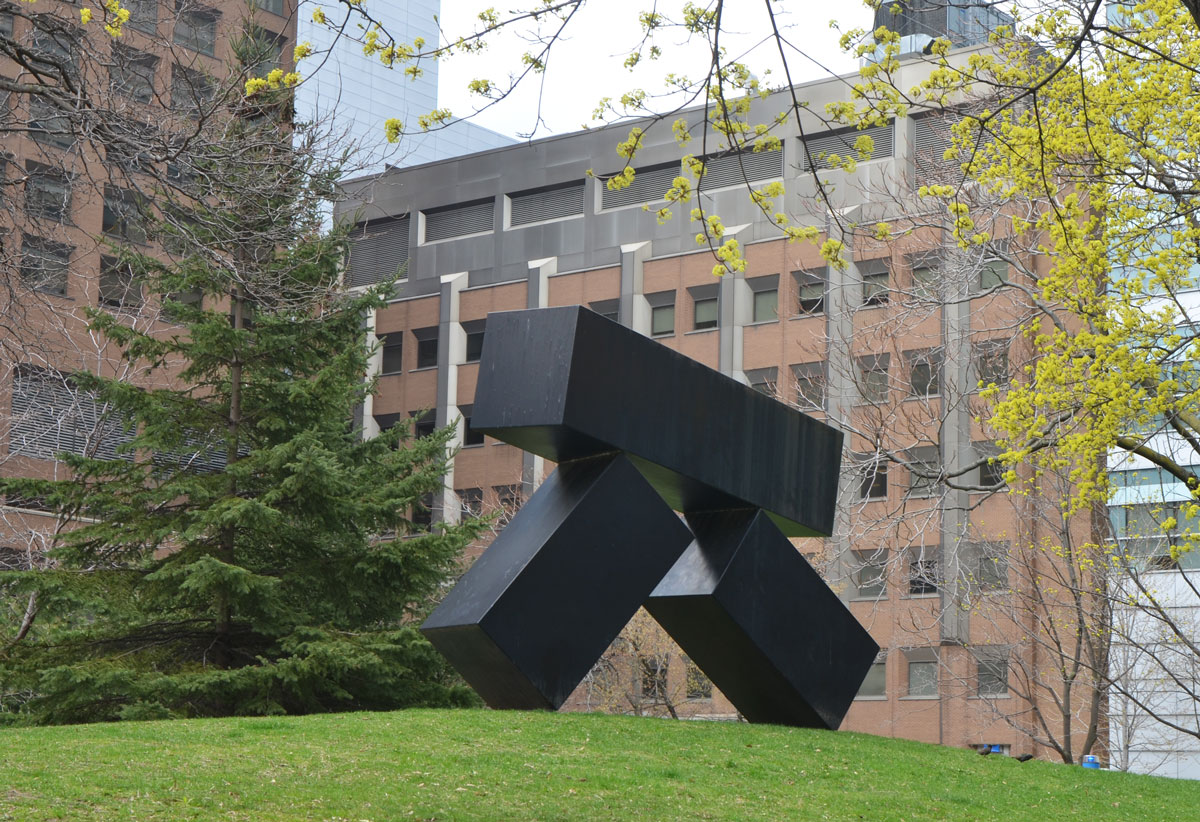
below: ‘Inner City Gate’ by Kosso Eloul.  1978.  A balancing act of stainless steel boxes on the lawn of the R. Fraser Elliott building (part of the old Toronto General Hospital), Elizabeth Street.
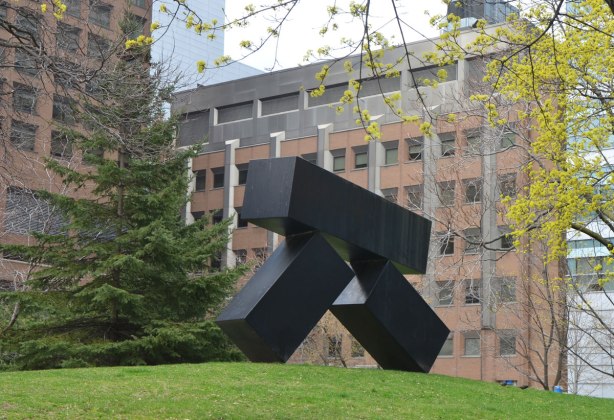
black metal sculpture of three boxes precariously balanced, the upper box is almost horizontal and it is being supported by the other two who are falling down but still balancing

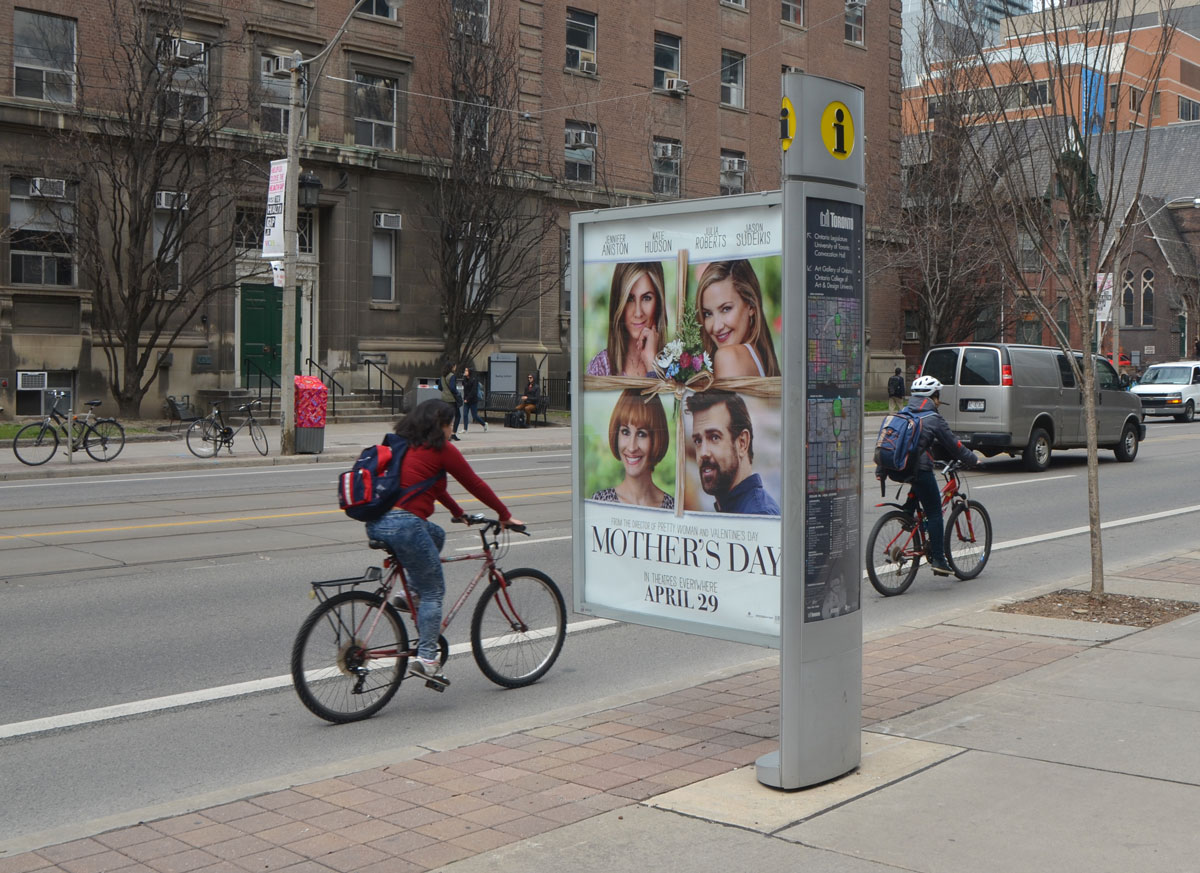
below:  A blight on the sidewalk, so-called information pillars that are really just a sell-out to Astral Media.  They needlessly obstruct the sidewalk and obstruct the view of  cyclists and motorists.  Unfortunately they are part of a 20 year contract that the city has with Astral Media which doesn’t expire until 2027.
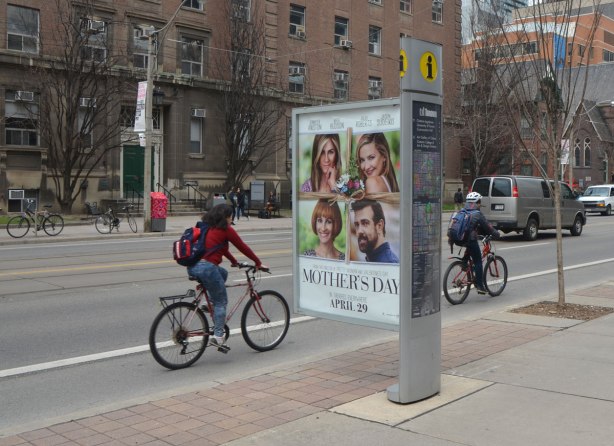
cyclists ride by an information pillar that has a large ad jutting out towards the street.

below: Incised into limestone blocks on the Edward Street side of McClelland House (originally the McLean Hunter building) is half of an artwork by Elizabeth Wynn Wood (1903 – 1966) called “Communication”.  The woman is sending a message to a man who is apparently shown on the other side of the building.  Sadly, I missed the man so there is no photograph of him here.  When the work was completed in 1958, the incised lines were inlayed with gold colour.
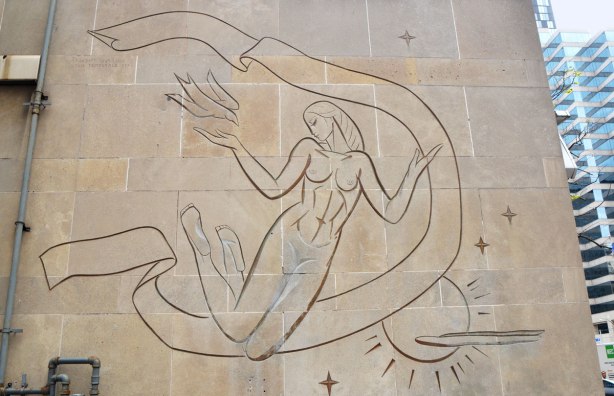
outline drawing of a woman floating in the sky, incised into limestone facade of a building. She is releasing a bird.

below: Across the street from the ‘floating woman’, 480 University Avenue is getting a facelift.
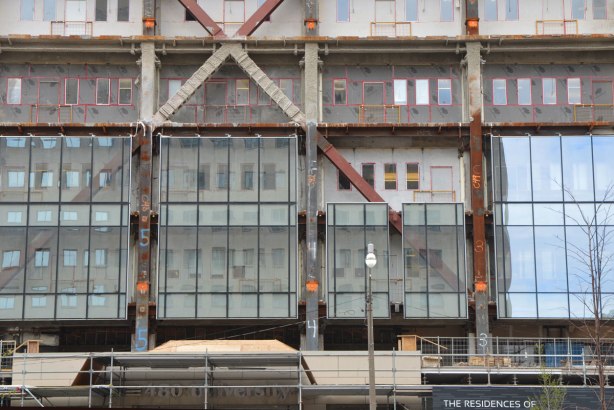
lower part of building have its facade upgraded to glass panels
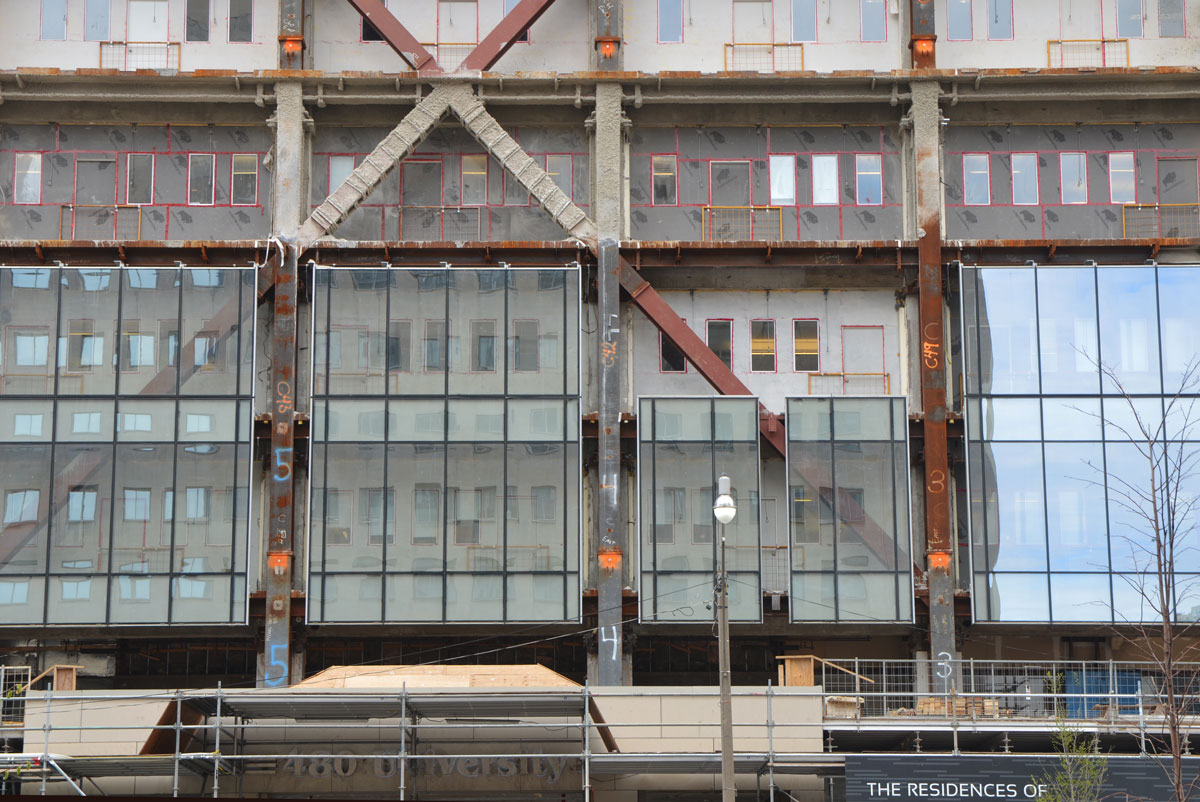
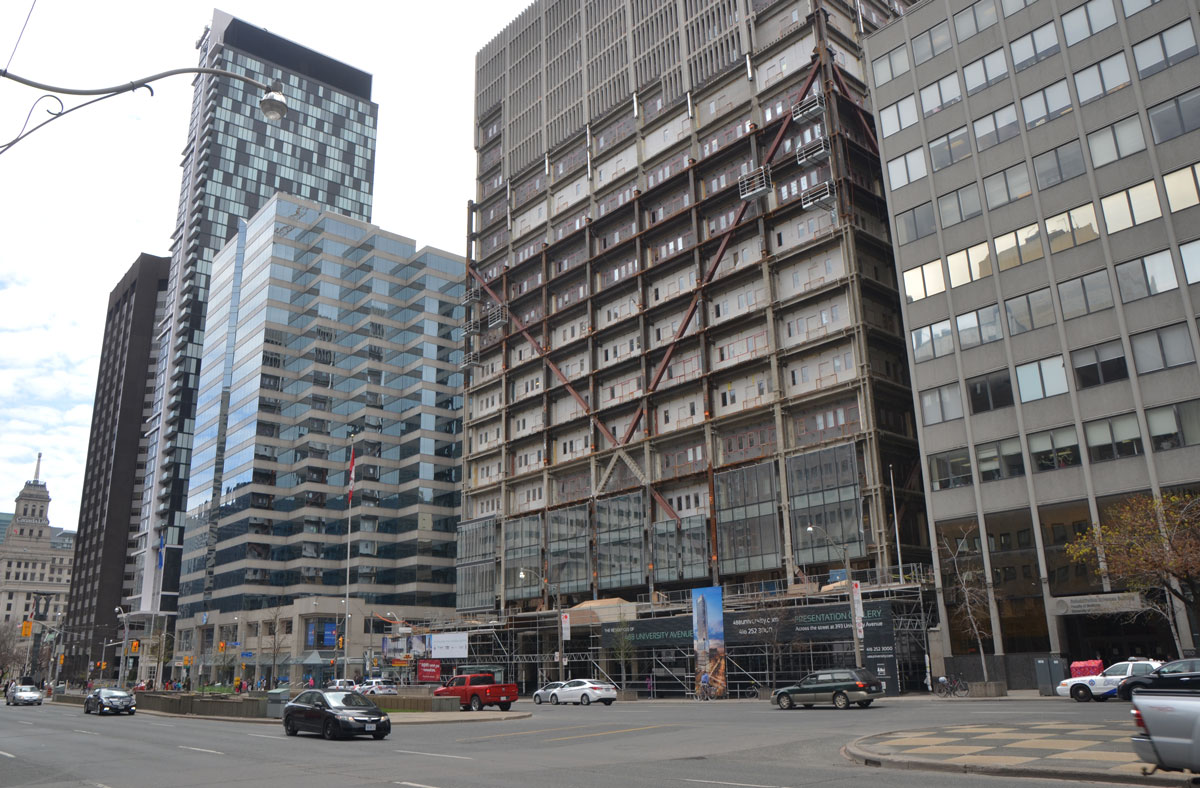
below:  This picture shows most of the front of 480 University and you can see the different stages of the recladding process.  At the top of the building, the precast concrete grille that was part of the original 1968 Global House office tower is still in place while new glass panels have already been installed on the lower floors.   It is interesting to watch the metamorphosis of an 18 storey office building into a 55 storey condo tower.   Four levels of underground parking have also been added to the site and a new indoor entrance to St. Patrick subway station is in the works.
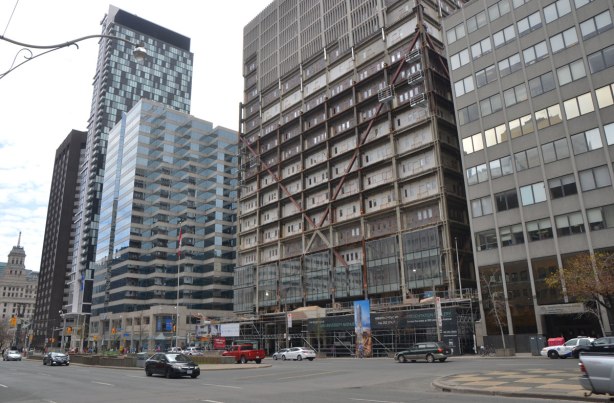
Tall office building is having its concrete facade replaced with glass. The upper floors are still concrete, the middle floors are bare and the lower floors have new glass

below: Abstract in blues and greys

very close detail shot of glass and reflections that make diamond shaped abstract in blue and grey

There is a lot of building and redevelopment in the area where I walked.

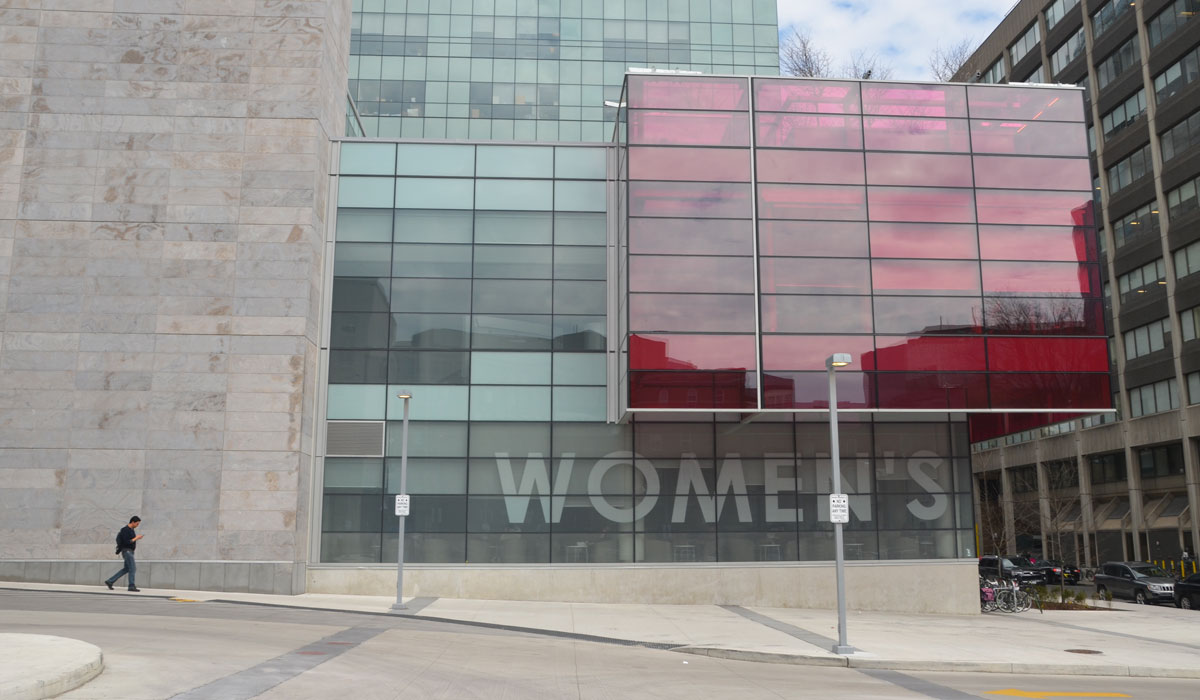
below: Womens College Hospital is totally new.
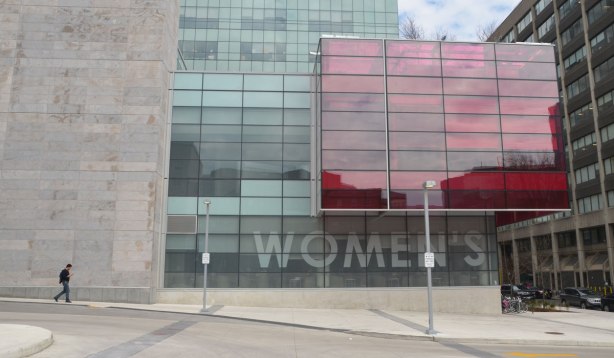
a lone man walks by the new Womens College Hospital building with its light grey stone facade, large glass section, and large pink glass section.

below: The corner of College and Bay, looking southeast, is now a wall of glass.

cyclist rides through the intersection of College and Bay streets. A wall of glass condos in the background.

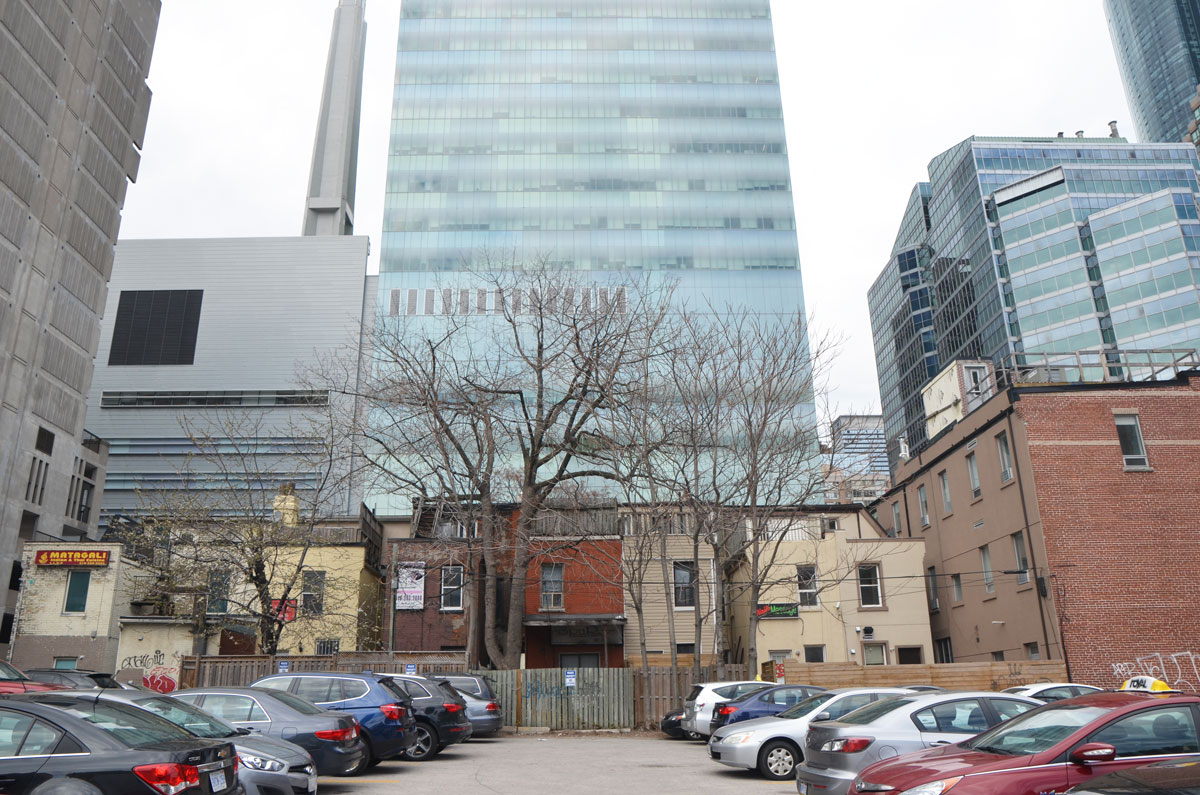
below: The new wing of Sick Kids Hospital dwarfs the older buildings on Elm Street.

view from a parking lot, a row of the back of older two storey brick buildings with some mature trees, then taller modern glass buildings.

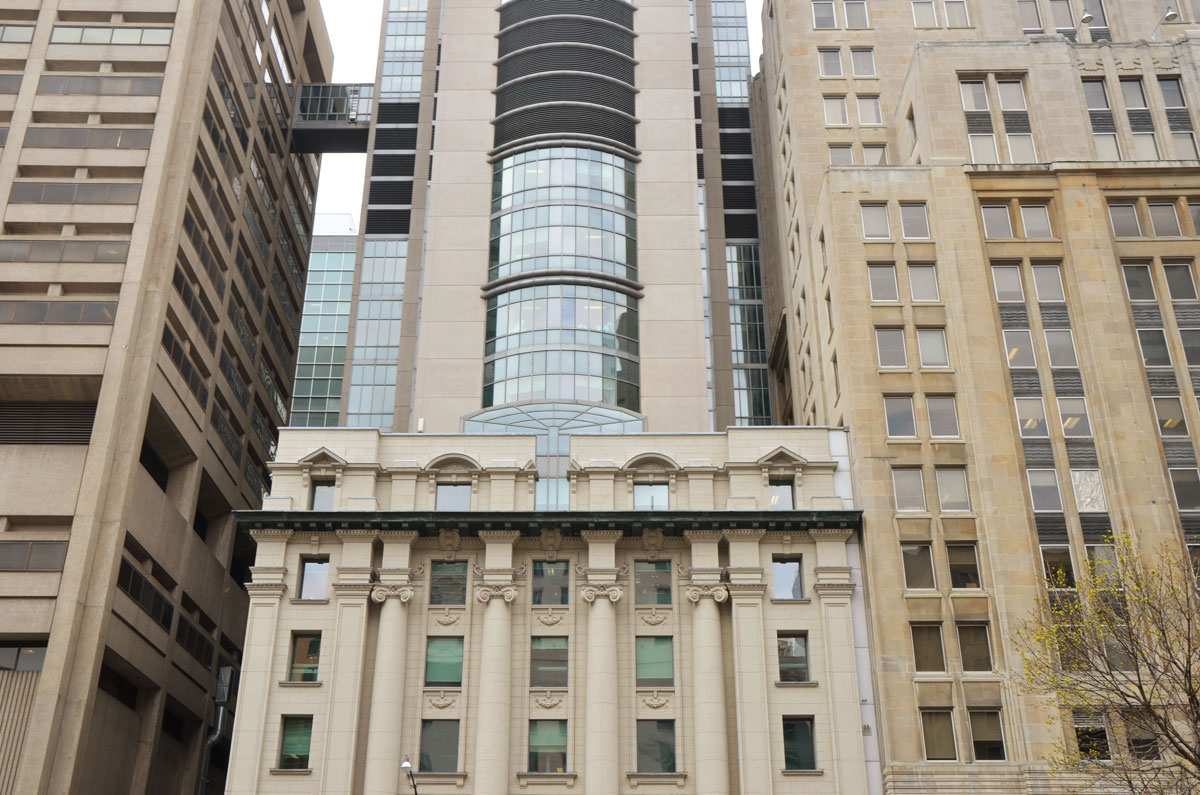
below:  The old and the new integrated into one building, Princess Margaret Hospital.

Princess Margaret Hospital, with the older stone building at the bottom, and the new modern addition above and beside it.

below: Even the street is being redone.  The center of Bay Street from Dundas to Elm is torn up because of  TTC streetcar track replacement.
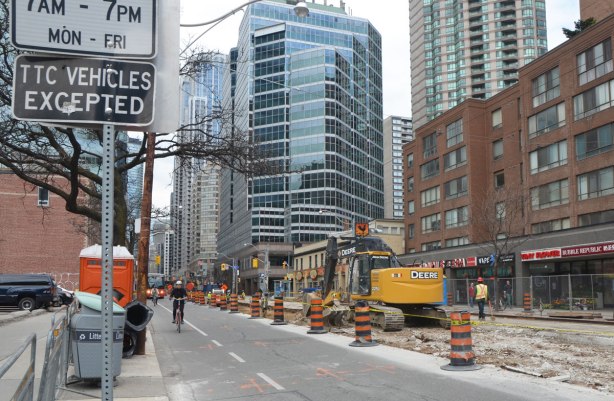
A digger and other equipment working on a torn up section of Bay street.

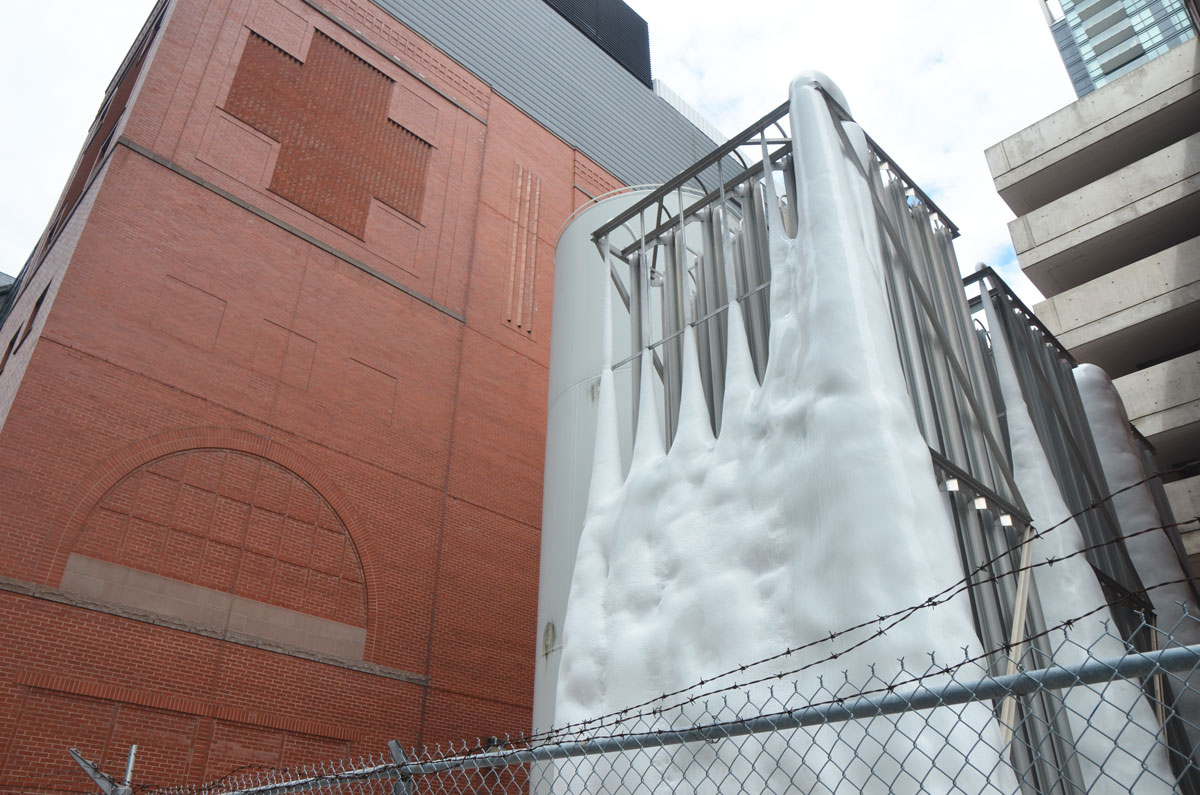
below: Little quirky details:  First, the cross shapes made of contrasting brick on the back of the Red Cross building.  Second, the workings (or barrier?) of the compressed gas tanks that have been made to look like ice.
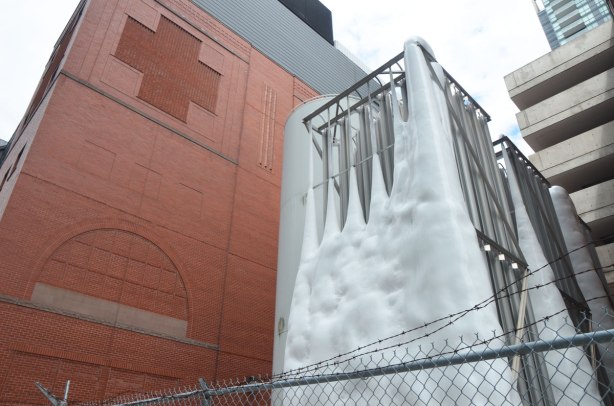
part of the addition that was added to the Red Cross building, two cross shaped features in contrasting brick on the upper levels. In front of that building are large compressed gas tanks.

below:  Another piece of public art, ‘Liquid Echo’ by Catherine Widgery, 1999, is in front of 750 Bay Street.  They look like stiff and lifeless frozen metallic fountains… or maybe just 12 pencils 🙂 .   Circular vent shafts for the underground parking have been incorporated into the artwork.

public art installation outside 750 Bay street

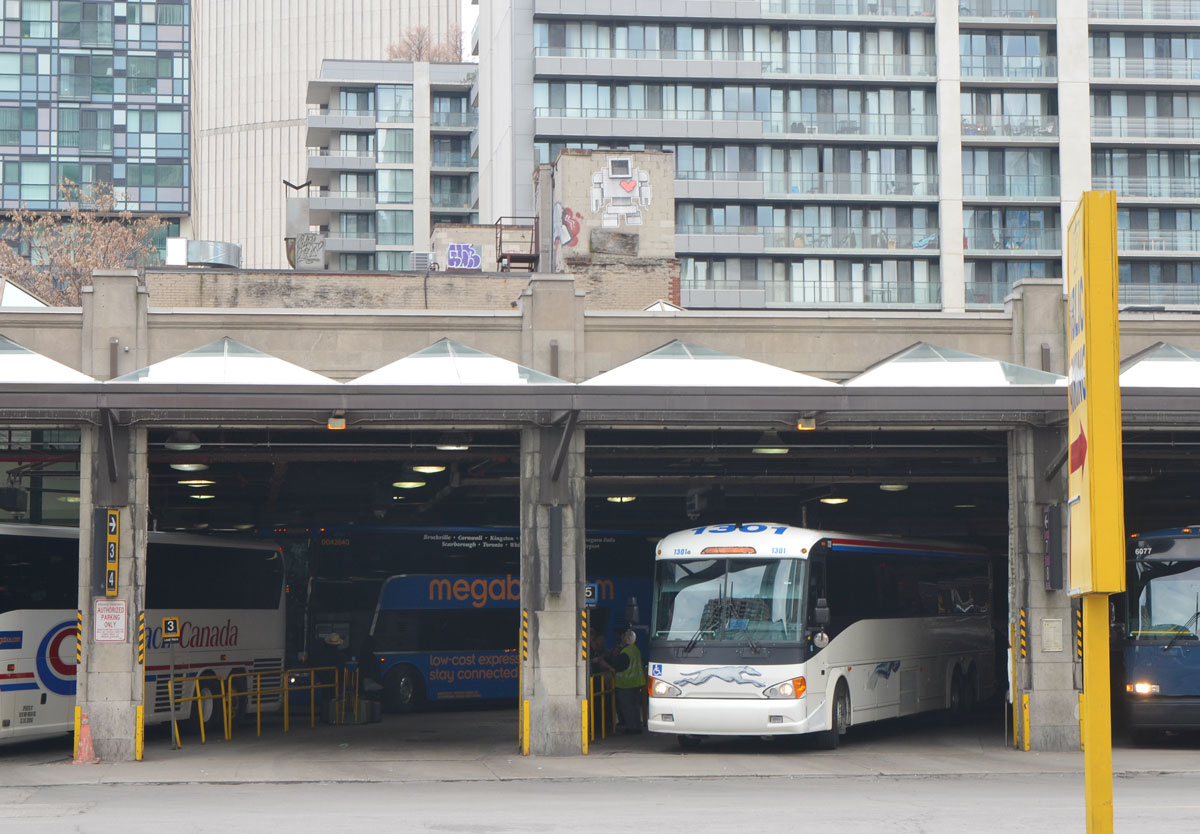
below: A  lovebot watches over the people passing through the bus station, unaware that he is there.
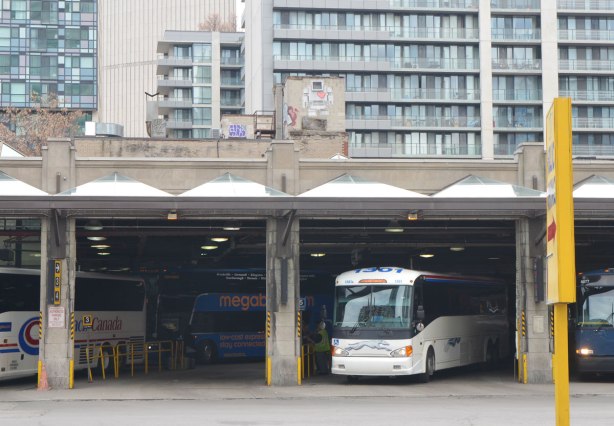
large lovebot wheatepaste paste up above the downtown Toronto bus terminal. A white bus is parked in one of the bus bays. Condos in the background.

below: And last, a colourful collection of squares and rectangles. Blue and green.  Red and white.
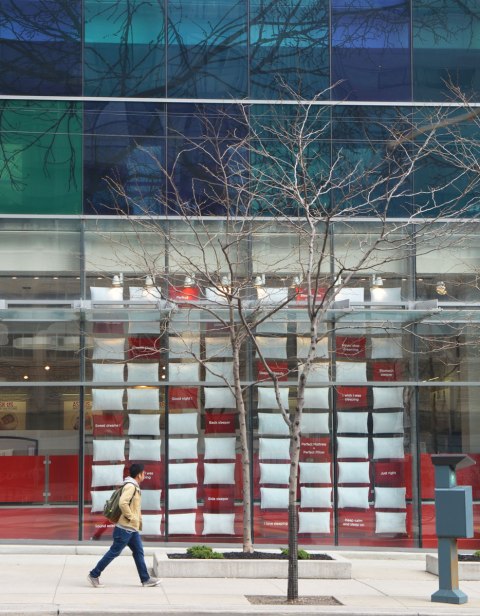
green and blue glass of a building's facade, with a storefront below. The windows of the store are filled with red and white pillows arranged in a grid.

The dapper, larger than life Alexander Wood has stood on his corner at Church and Alexander streets for 11years now.  The bronze statue by Del Newbigging was unveiled in May 2005.

Wood came to Upper Canada from Scotland and settled in Toronto (known as York at the time) in 1797.  He was a successful merchant, magistrate, and lieutenant in the York militia.  The plaque on the granite pedestal tells his story.


statue of Alexander Wood, a young man with long coat, and a hat in his hand. The statue is on a large square pedestal so his feet are close to eye level.  Below the statue is a plaque detailing his life as early settler of York, of being a gay, and of being involved in a scandal in 1810.

“Militia Officer, Businessman, Public Servant, Justice of the Peace, Gay Pioneer

Alexander Wood came to Canada in 1793, settled in York in 1797 and started a mercantile business, one of only three stores in York at that time. Within a year he was a lieutenant in the York Militia; he was appointed magistrate in 1800 and by 1805 was a Commissioner for the Court of Requests (a senior planning officer). He was involved in a homophobic scandal in 1810 and fled to Scotland, but in two years he was back in Canada and resumed his duties. In spite of ridicule and discrimination he had a successful career in public service: he was on the executive of nearly every society in York, often as treasurer; he was manager of several businesses and acted for clients in land transactions. Wood died in 1844 at the age of seventy-two while in Scotland. The British Colonist paper called him one of Toronto’s ‘most respected inhabitants’.”

***

There is another bronze plaque on the back of the pedestal, complete with shiny bits.  This plaque adds more details to the story of the 1810 scandal that Wood got himself into.

plaques on a statue. The top is of a man with his pants lowered, the bottom is the story of the scandal that led to Alexander Wood having to leave Canada.  The bare bum on the plaque is shiny from repeated rubbing by passers by.

“1810 The Scandal
In 1810 a woman reporting a rape to Magistrate Wood said she had scratched her rapist. Wood inspected several suspects privately, requiring them to undress. To avoid the scandal caused by his unconventional behaviour, Wood fled to Scotland. After two years he returned to Canada but suffered ridicule and discrimination for the rest of his life.

Alexander Wood 1772-1844
Militia Officer, Businessman, Public Servant, Justice of the Peace, Gay Pioneer”

***

In 1810, word had spread quickly around the town (of 700) and Wood had become known as the “Inspector General of Private Accounts”.    The worst of the scandal blew over while Wood was in Scotland; he was back in York in 1812 and resumed all his previous occupations, including magistrate. At that time, “molly’ was a derogatory word for a gay man and he was nicknamed Molly Wood.
In 1826 he purchased 50 acres of land east of Yonge St. and north of Carlton St. in the neighbourhood where his statue now stands.  It is also the “Village”.  In Wood’s time it was referred to as ‘Molly Wood’s Bush’.  Wood remained in Toronto until 1842 at which time he returned again to Scotland where he died two years later.

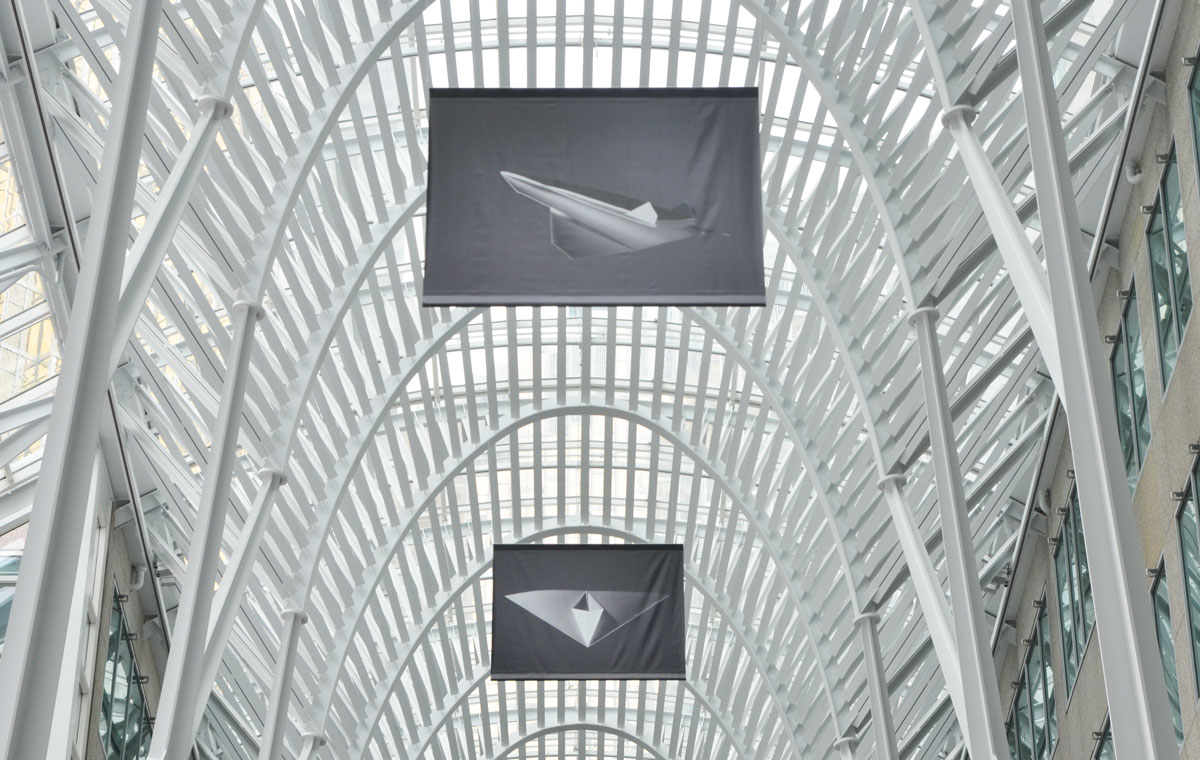
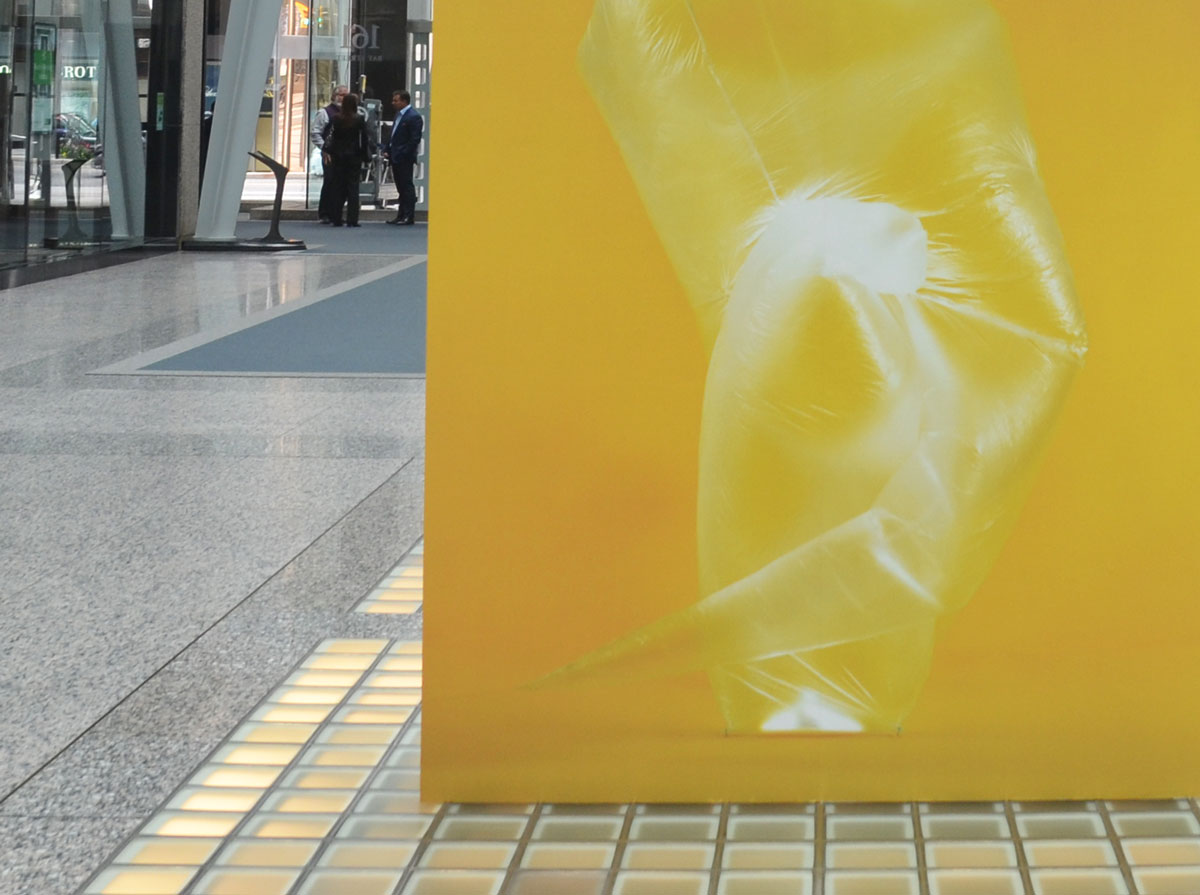
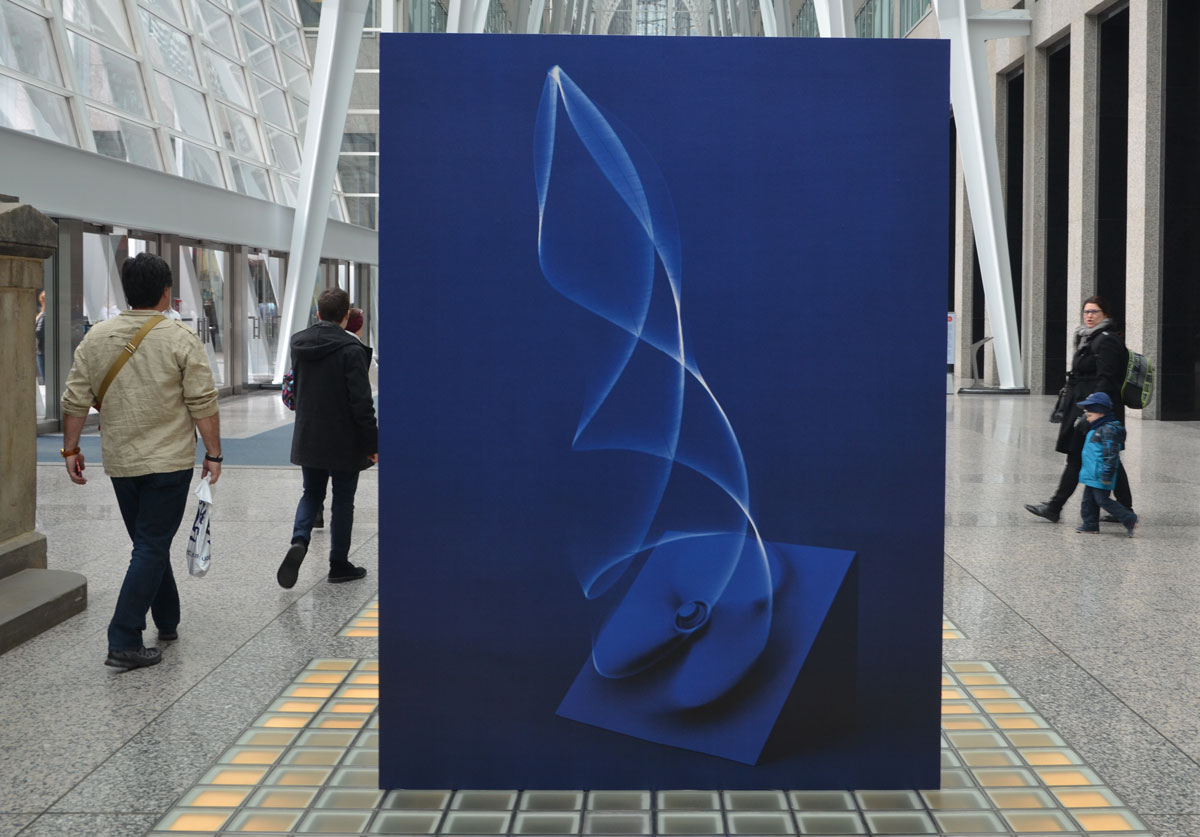
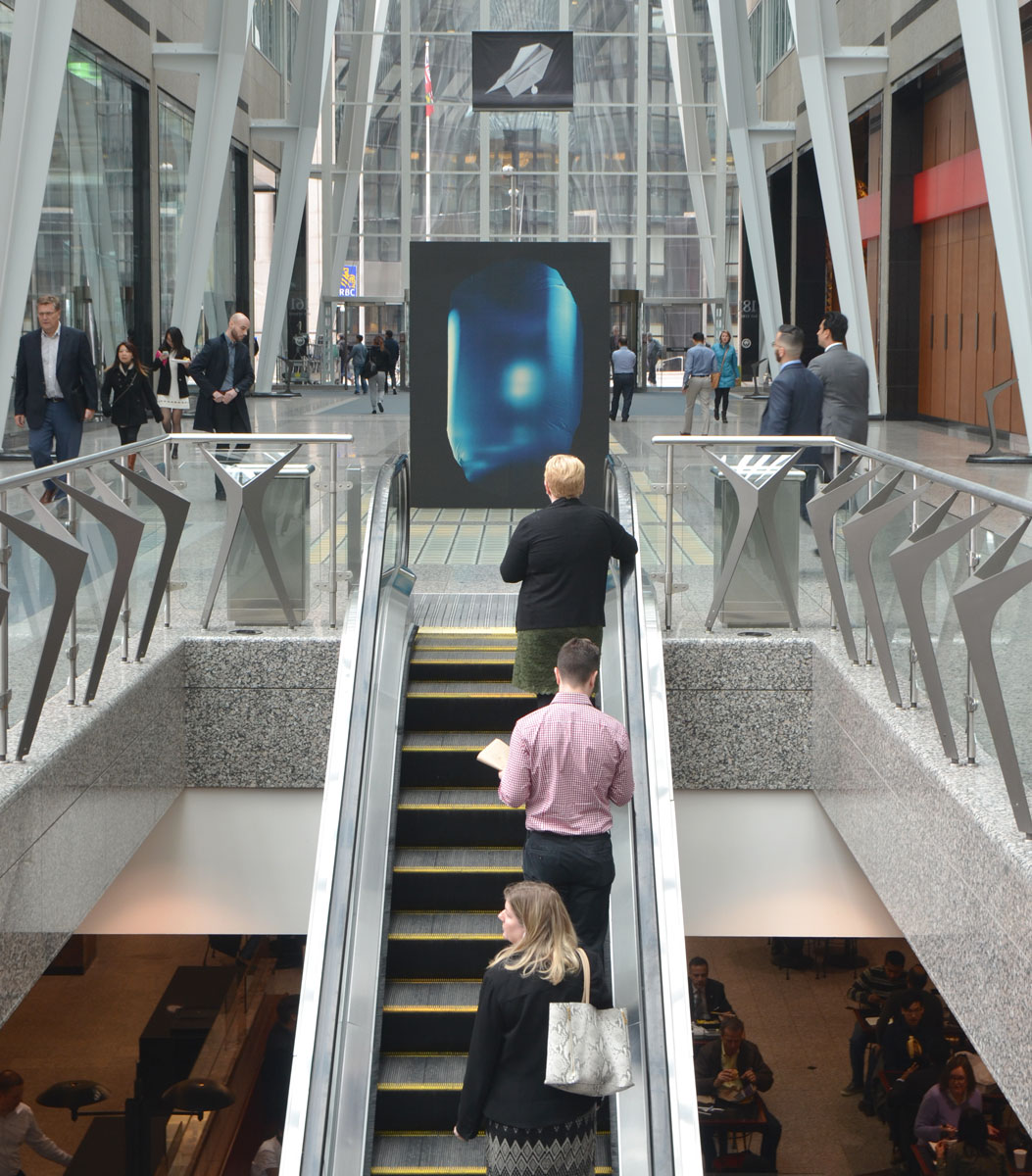
‘Current Studies’ and ‘Paper Planes’
Two different series of photographs by Sjoerd Knibbeler
Allan Lambert Galleria, Brookfield Place

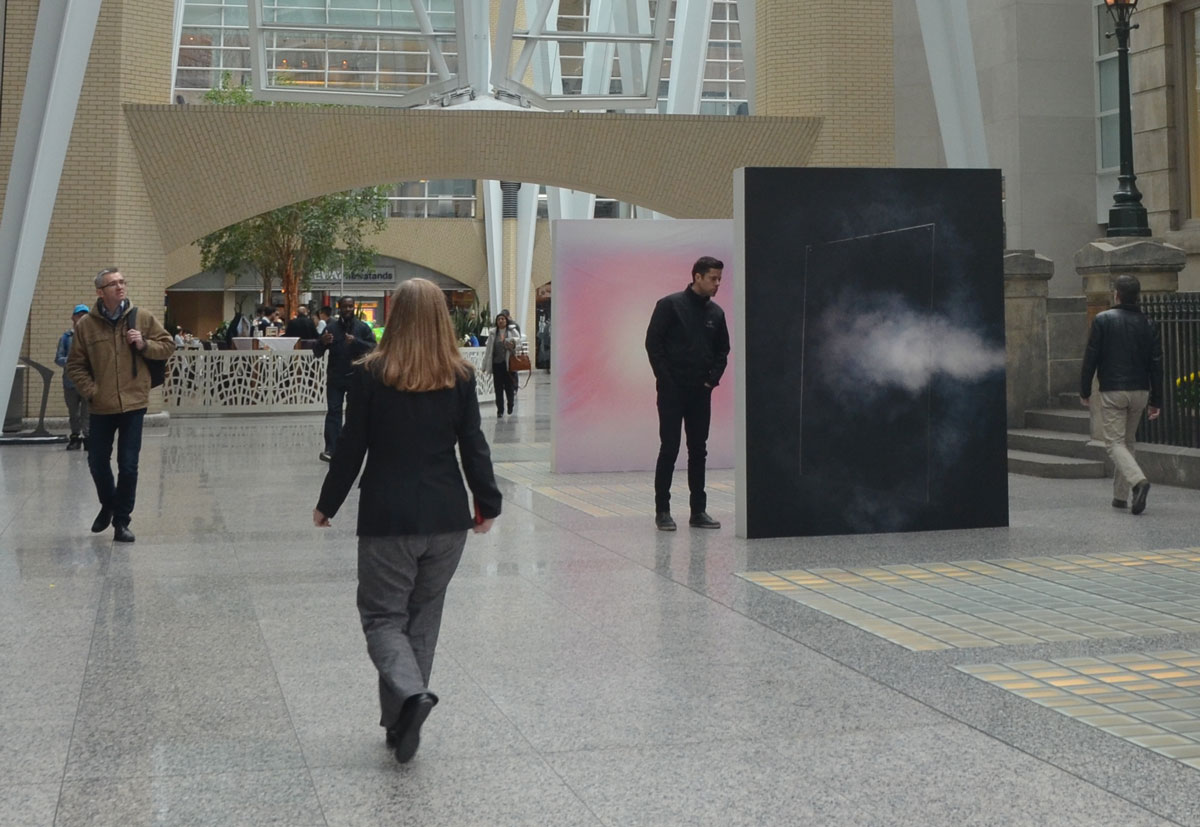
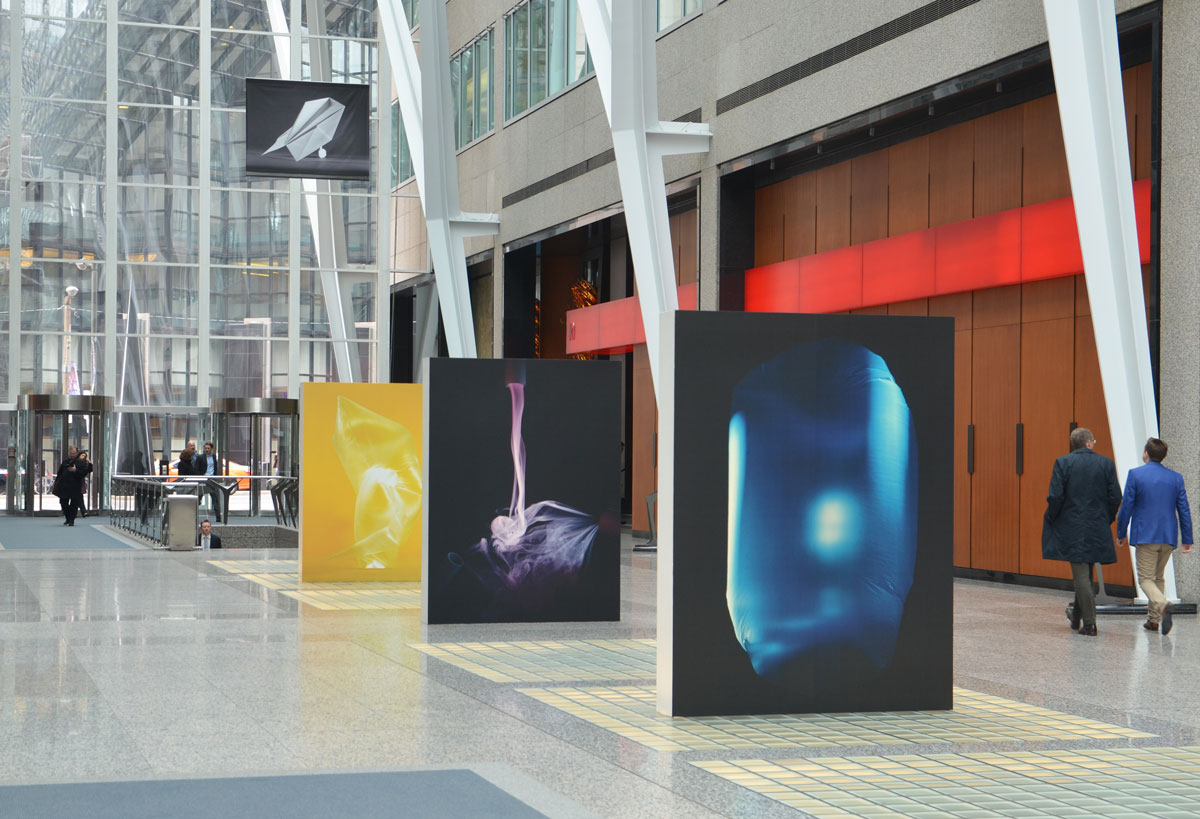
At ground level there are six large freestanding ‘walls” arranged in line, three at each end of the atrium.    Each ‘wall’ is covered by two images, one on either side.  They are photographs that are the result of Knibbeler’s experiments to “ shape, encompass, and capture air currents.”  This is the ‘Current Studies’ part of the installation.
A picture taken inside the Allan Lambert Gallery at Brookfield Place, photos by Sjoerd Knibbeler, a series called Current Study large pictures standing in the middle of the gallery, as well as series called "Paper Planes" which are hung from the ceiling

Suspended from the ceiling are a set of photographs of paper airplanes, the ‘Paper Planes’ part of the installation.    Knibbeler photographed paper airplanes that he made using information that he found online.  He chose military planes that were never produced.

A picture taken inside the Allan Lambert Gallery at Brookfield Place, photos by Sjoerd Knibbeler, a series called Current Study large pictures standing in the middle of the gallery, as well as series called "Paper Planes" which are hung from the ceiling

A picture taken inside the Allan Lambert Gallery at Brookfield Place, photos by Sjoerd Knibbeler, a series called Current Study large pictures standing in the middle of the gallery, as well as series called "Paper Planes" which are hung from the ceiling

A picture taken inside the Allan Lambert Gallery at Brookfield Place, photos by Sjoerd Knibbeler, a series called Current Study large pictures standing in the middle of the gallery, as well as series called "Paper Planes" which are hung from the ceiling

A picture taken inside the Allan Lambert Gallery at Brookfield Place, photos by Sjoerd Knibbeler, a series called Current Study large pictures standing in the middle of the gallery, as well as series called "Paper Planes" which are hung from the ceiling

A picture taken inside the Allan Lambert Gallery at Brookfield Place, photos by Sjoerd Knibbeler, a series called Current Study large pictures standing in the middle of the gallery, as well as series called "Paper Planes" which are hung from the ceiling

A picture taken inside the Allan Lambert Gallery at Brookfield Place, photos by Sjoerd Knibbeler, a series called Current Study large pictures standing in the middle of the gallery, as well as series called "Paper Planes" which are hung from the ceiling

A picture taken inside the Allan Lambert Gallery at Brookfield Place, photos by Sjoerd Knibbeler, a series called Current Study large pictures standing in the middle of the gallery, as well as series called "Paper Planes" which are hung from the ceiling

A picture taken inside the Allan Lambert Gallery at Brookfield Place, photos by Sjoerd Knibbeler, a series called Current Study large pictures standing in the middle of the gallery, as well as series called "Paper Planes" which are hung from the ceiling

#CONTACT16

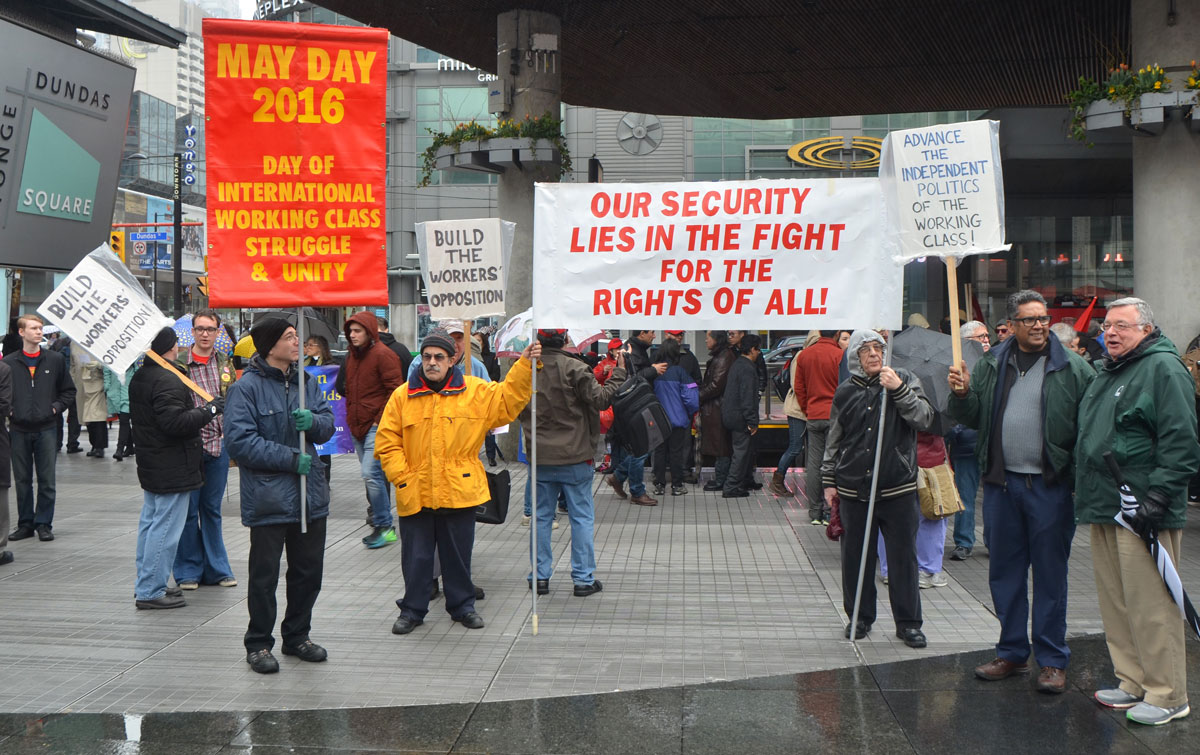
May 1, May Day, International Workers Day
To mark the day, there was a rally at Yonge Dundas Square.
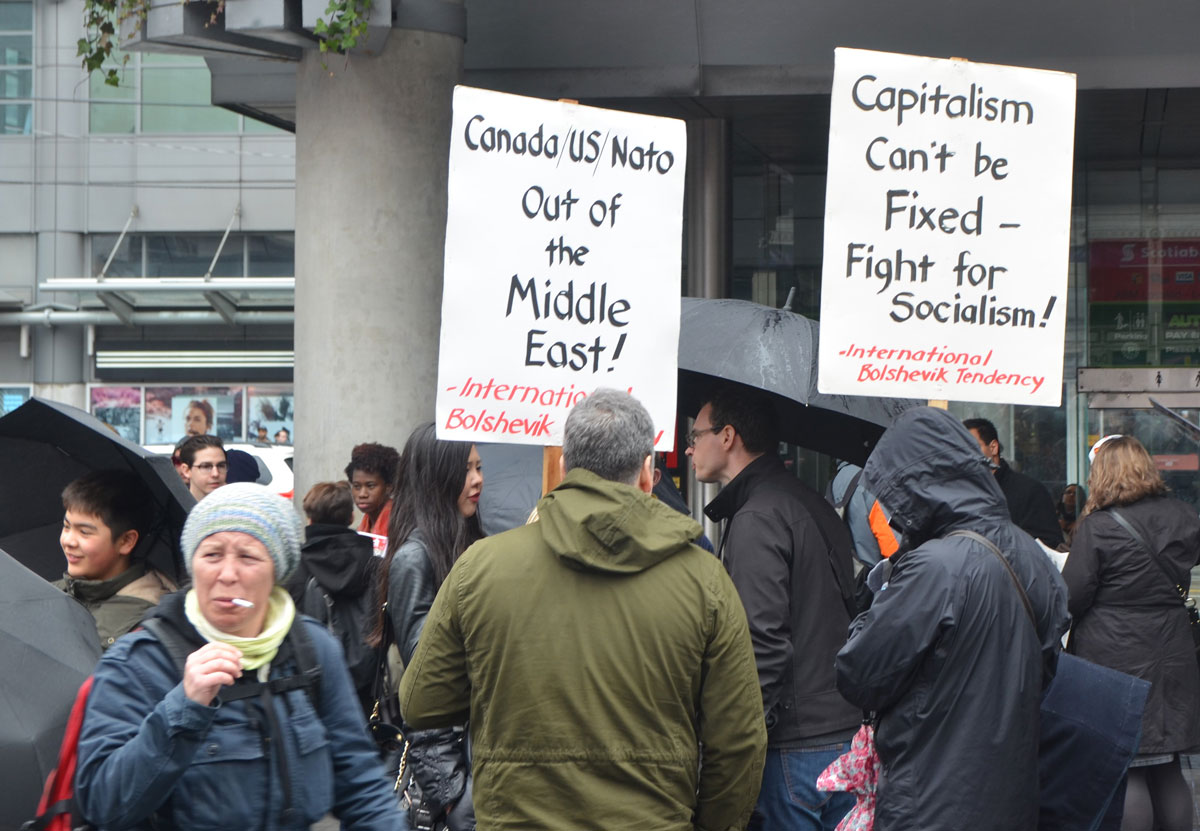
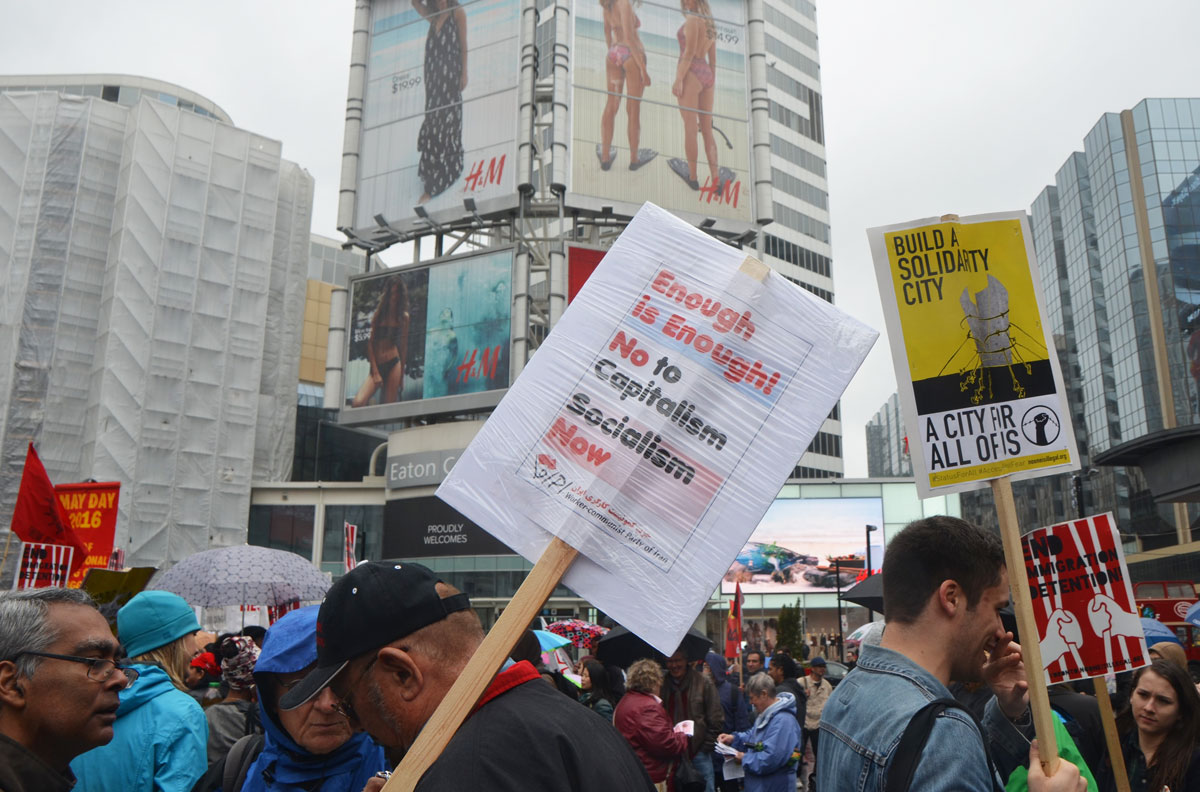
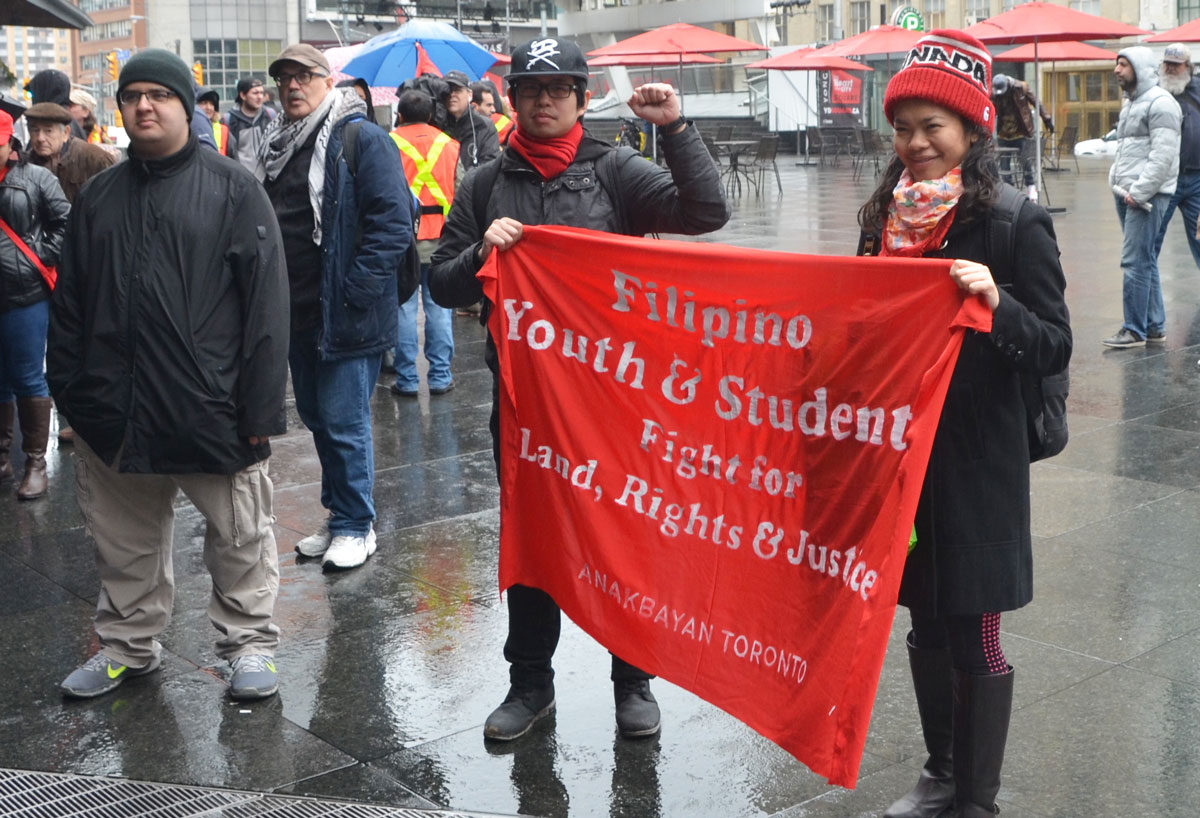
The wet afternoon didn’t dampen the spirits of those who were there with their placards and banners.

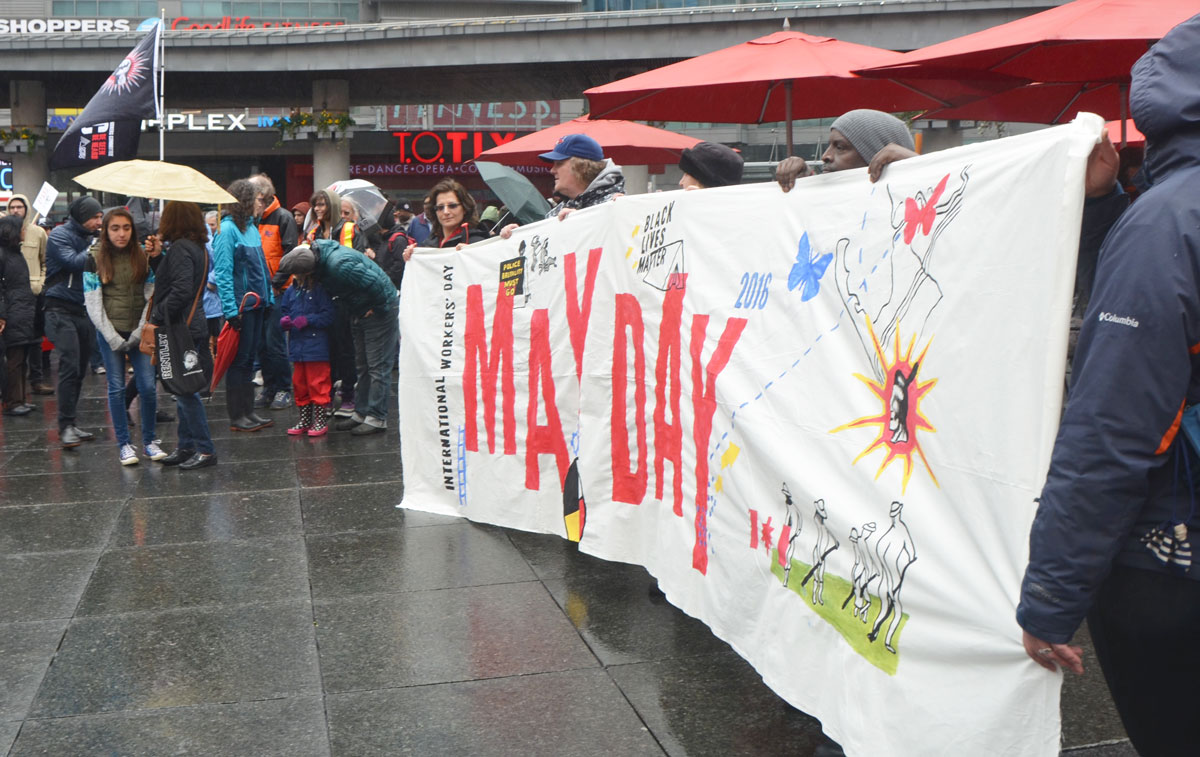
May day, International Workers Day rally at Dundas Square on a rainy day -

Two men holding placards at a rally. One says "Canada US NATO out of the Middle East" and the other says "Capitalism Can't be fixed - Fight for Socialism" , both are from the International Bolshevik Tendency - May day, International Workers Day rally at Dundas Square on a rainy day -

A man holds a placard that says "Enough is enough, No to Capitalism, Socialism now"May day, International Workers Day rally at Dundas Square on a rainy day -

A group of people holding a large rad and white banner with most of the words written in Arabic and English. The English part says "Long Live May Day. Workers of all countries unite"

An older man holds one end of a red banner for the Communist Party of Canada while a young man holds the other end - May day, International Workers Day rally at Dundas Square on a rainy day -

Two students hold a red banner for the Filipino Youth and Students fight for land, rights and justice - May day, International Workers Day rally at Dundas Square on a rainy day -

May day, International Workers Day rally at Dundas Square on a rainy day -

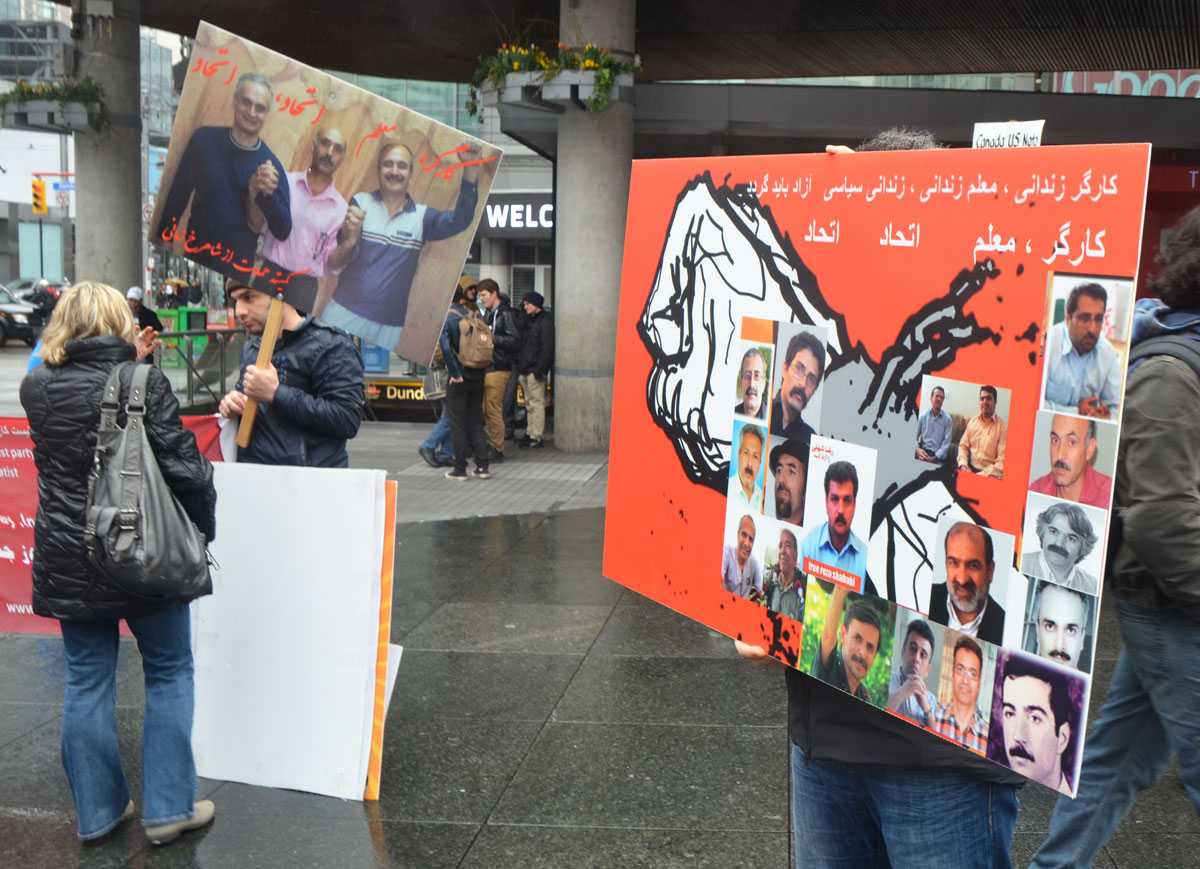
A man holds up a sign written in Arabic about men missing I think. It is red with a picture of a fist on it. On the fist are glued pictures of 16 men . Also in the picture, a man holding a placard with a photo of three men on it, talks to a woman whose back is to the camera.

from under the photographer's umbrella, a scene of people with protest signs - May day, International Workers Day rally at Dundas Square on a rainy day -

A young man is giving out placards at a rally - May day, International Workers Day rally at Dundas Square on a rainy day -

A group of women standing behind and holding up a large white banner for May Day - May day, International Workers Day rally at Dundas Square on a rainy day -

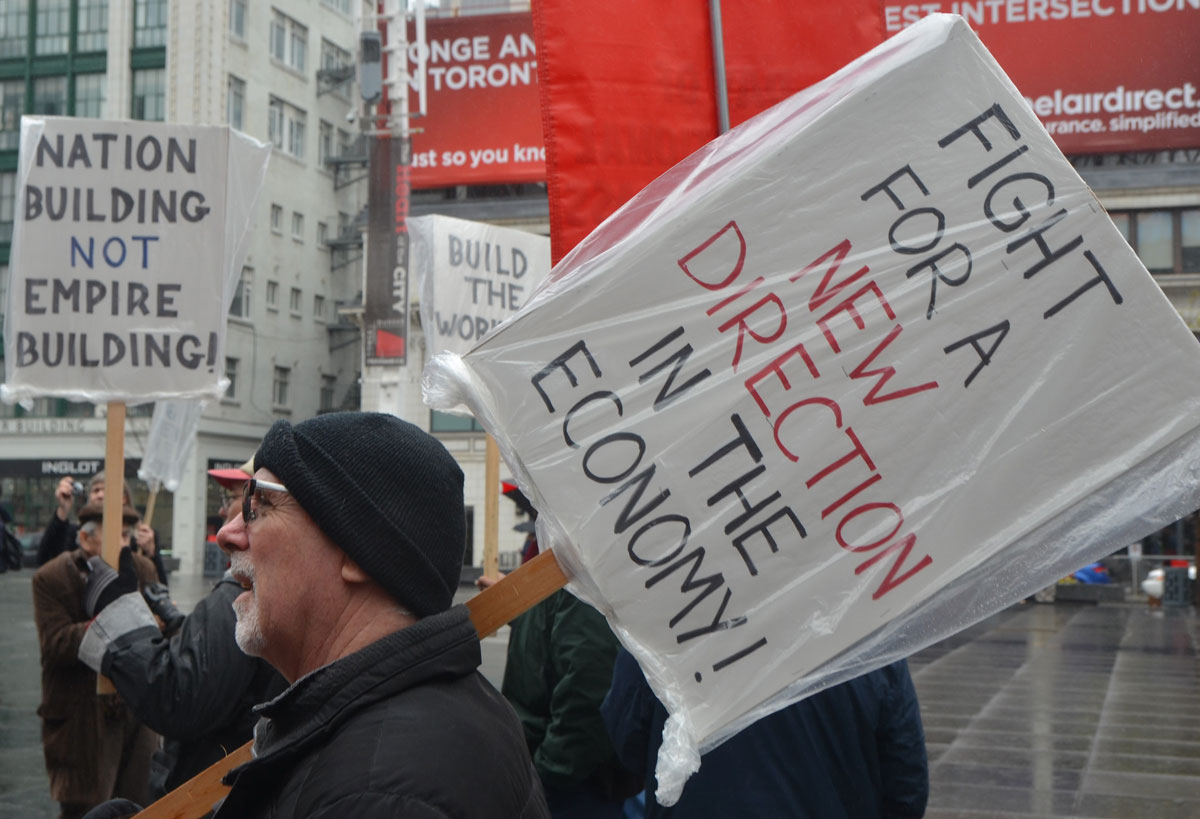
A man holds a sign that says "Time for a new direction in the economy" - May day, International Workers Day rally at Dundas Square on a rainy day -

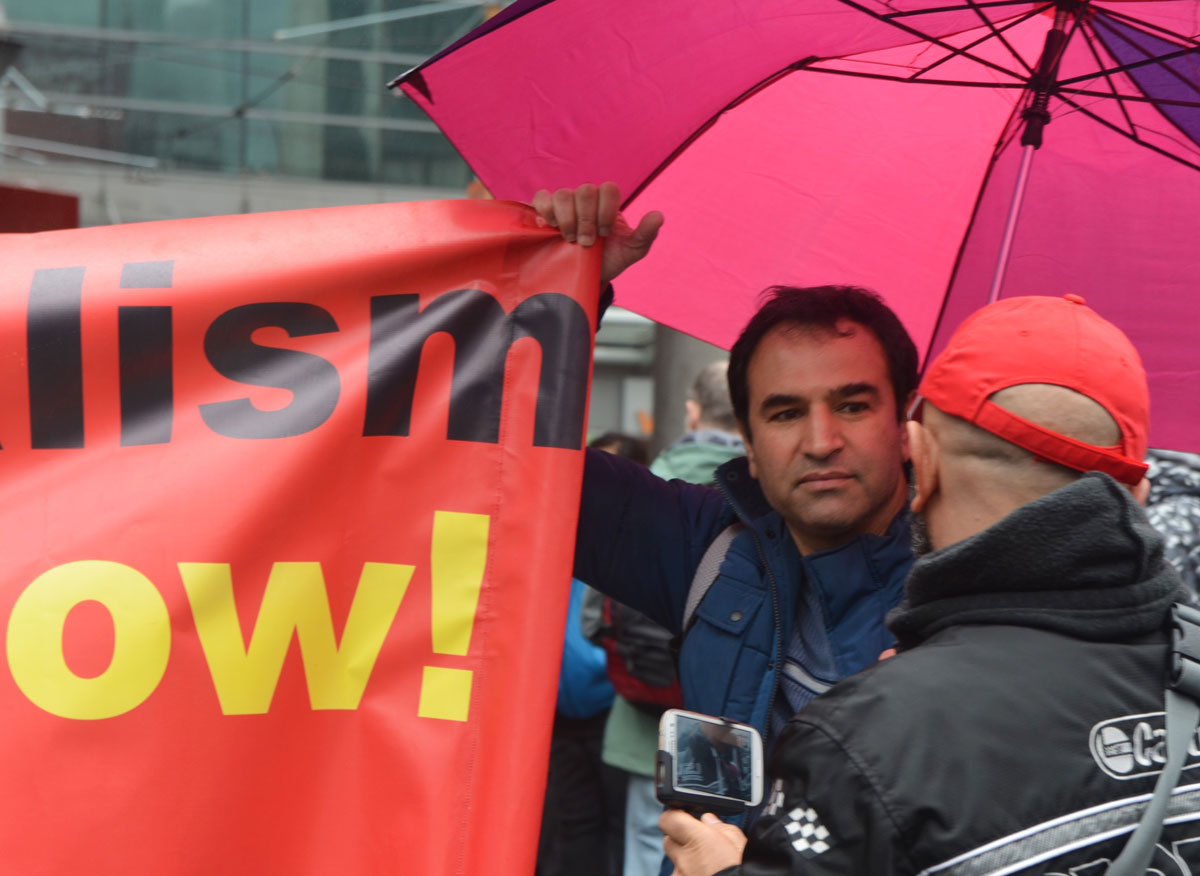
A man under a pink umbrella talks to a man whose back is to the camera - May day, International Workers Day rally at Dundas Square on a rainy day -

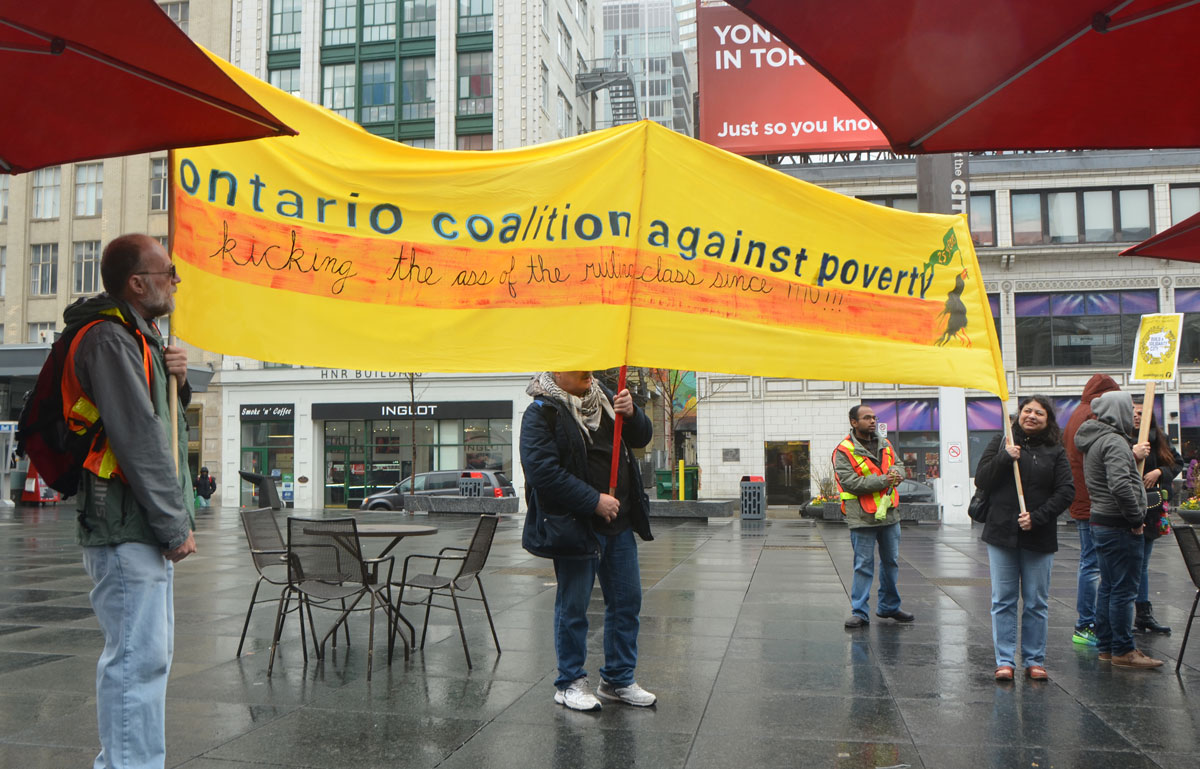
Three people hold a large yellow banner for the Ontario Coalition Against Poverty - May day, International Workers Day rally at Dundas Square on a rainy day -

a bundle of small OCAP placard signs sit on a chair - May day, International Workers Day rally at Dundas Square on a rainy day -

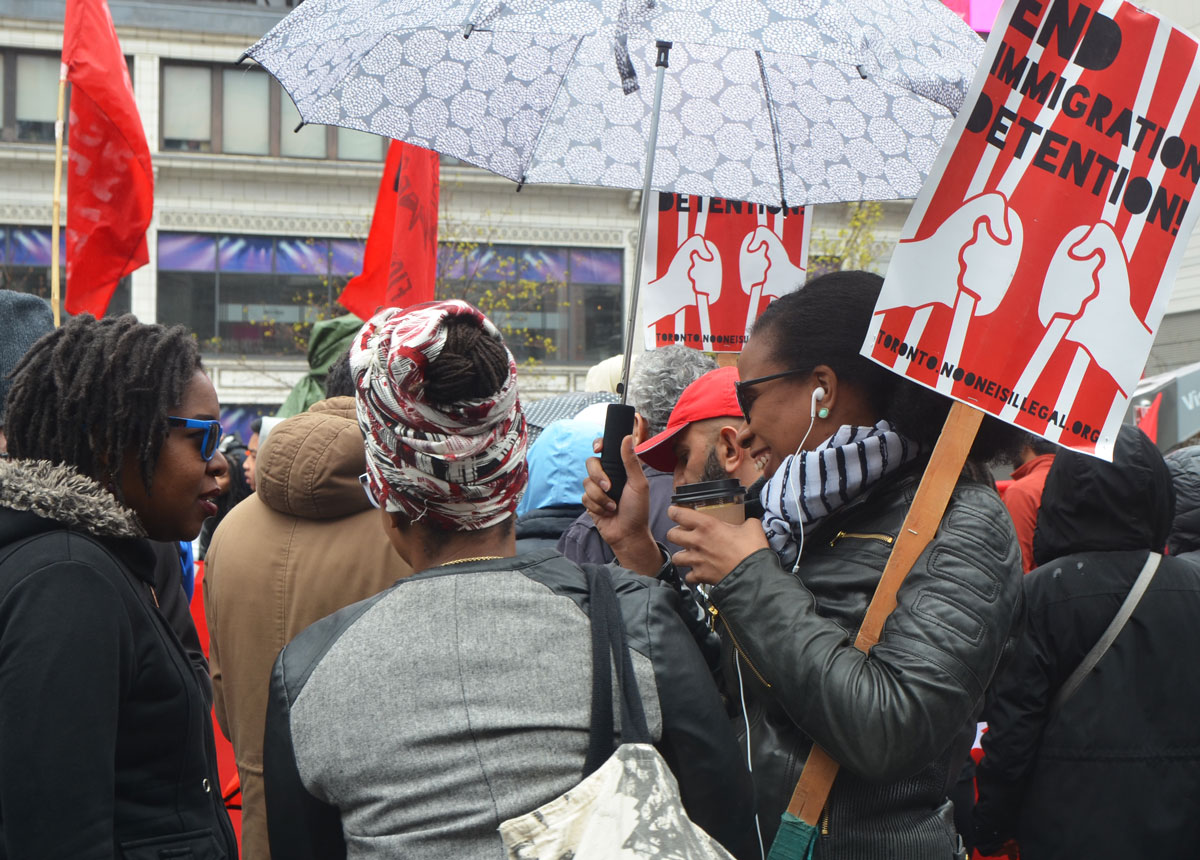
women talking and laughing together at a rally, holding placards that say "End Immigration Detention " and also holding umbrellas

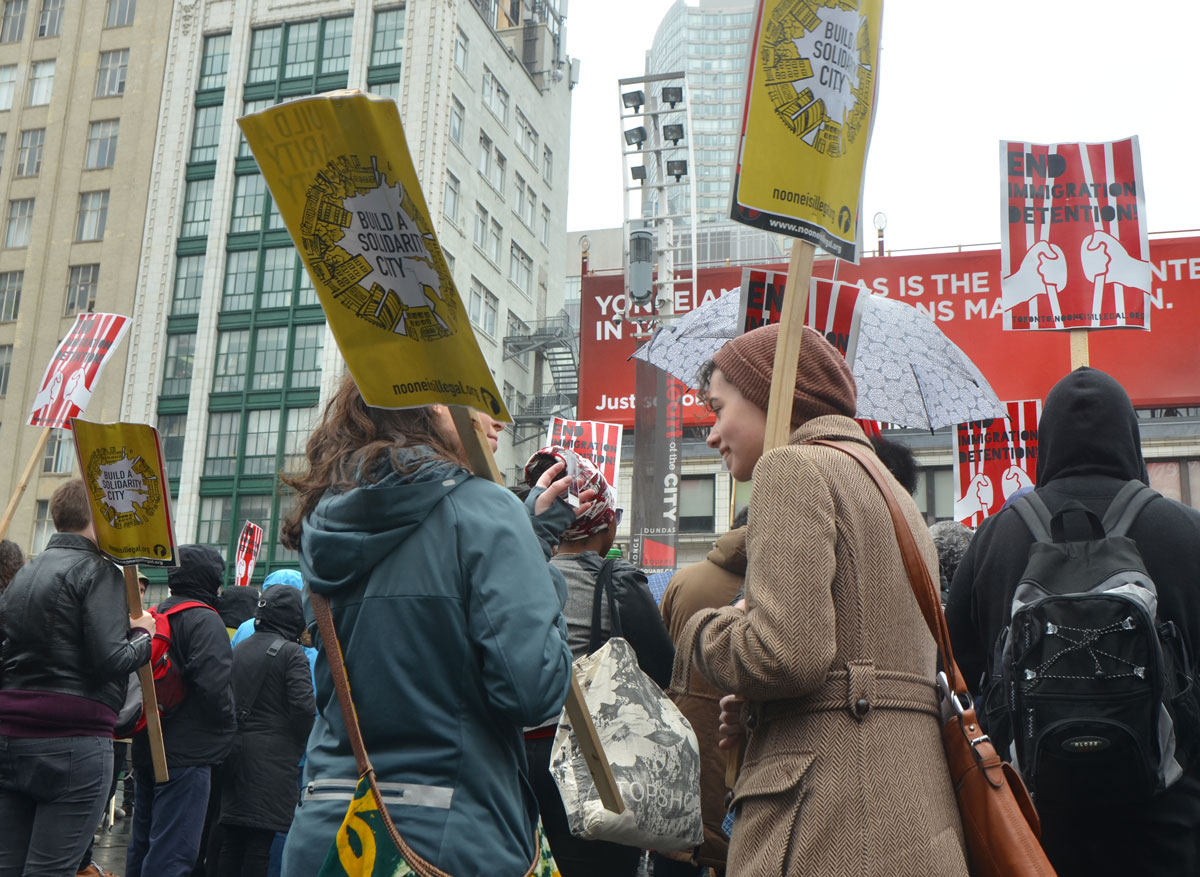
women talking and laughing together at a rally, holding placards that say "Build a Solidarity City"

May day, International Workers Day rally at Dundas Square on a rainy day - a man holds his fist in the air as he stands beside a banner