Archive for the ‘nature’ Category

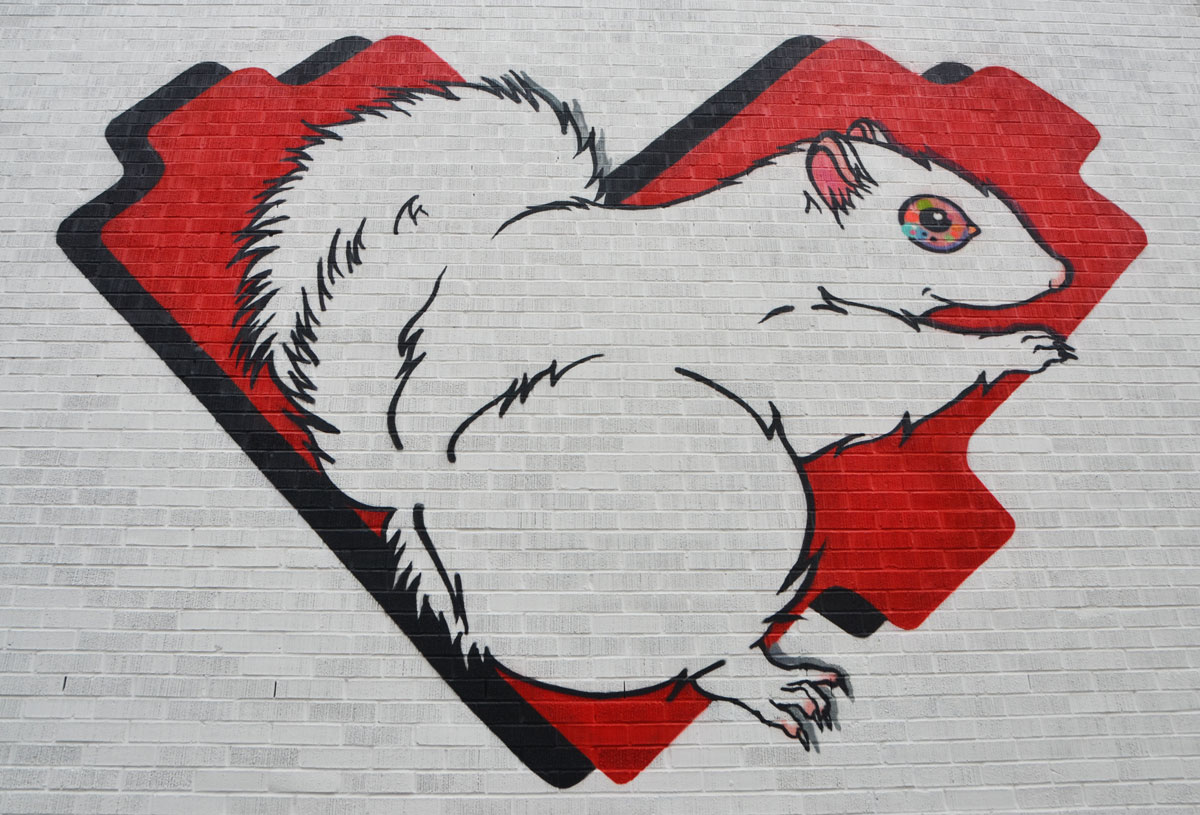
But not just any squirrel.  Toronto has many, many squirrels.  Most of them are black and a few are grey or even a reddish colour.  The rarest squirrels in the city are the albino squirrels.  I’m not sure how many there are but they can most often be seen around Trinity Bellwoods Park.

It is fitting then that this mural is next to the park, in a little lane just north of Queen West that ends at Gore Vale Avenue.  It’s a very large albino squirrel; it looks like it fits comfortably into a lovebot heart.

a large mural on white wall of a red lovebot heart and on the heart is a large albino squirrel (white squirrel) with pinkish eyes and ears.

This is another meandering blog post… a post about being out and about on yet another wonderful autumn day, going wherever my feet and eyes take me.

below: The first picture of my day was this intriguing wall made of old wooden doors.  Bathurst Street.

a tall narrow wall about three storeys high made of old white doors.

below: A small elicser mural tucked away at the end of a parking lot.   The man has his back to the viewer but I can’t figure out what’s behind him or what he might be doing.

small mural on a fence, a man's head is back to the viewer

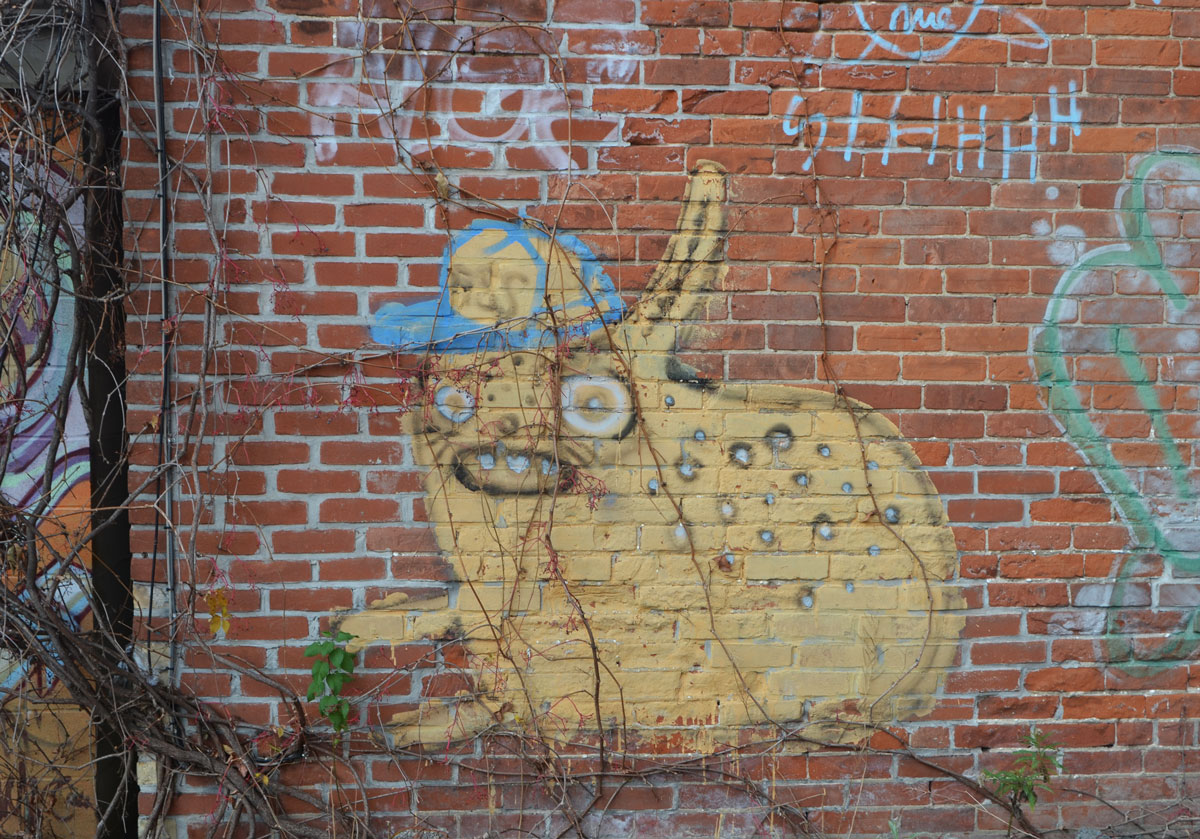
below: The leaves have fallen off the vines to reveal a yellowish creature with his baseball cap askew.

graffiti painting of a yellow animal like creature wearing a blue and yellow baseball cap. The creature is yellow. On a red brick wall, with spots on its back

below: Toronto’s tallest icon framed by a construction crane.

CN Tower in the distance, condo construction in the foreground, with a red crane

below: And on a similar note, a vacant lot cleared and ready for the next stage of its life.

a box beside a fence that has been scrawled over with blue spray paint. Behind it is a fence around a vacant empty lot. There are some small trees growing in front of the fence.

below: No more cranes here (and not many vacant lots either for that matter).  A view showing how much development there has been on the south side of the railway tracks.   Fort York is between the tracks and the condo towers.

a VIA Rail train passes by on one set of many tracks, in the background is Fort York and then a series of new condo buildings.

below: And what’s this? An old blue canoe beached on the tracks?

looking at the scene from a above, a blue canoe has been used to plant plants in. It lies across an old railway track, a chainlink fence separates the canoe from the main railway tracks that still function.

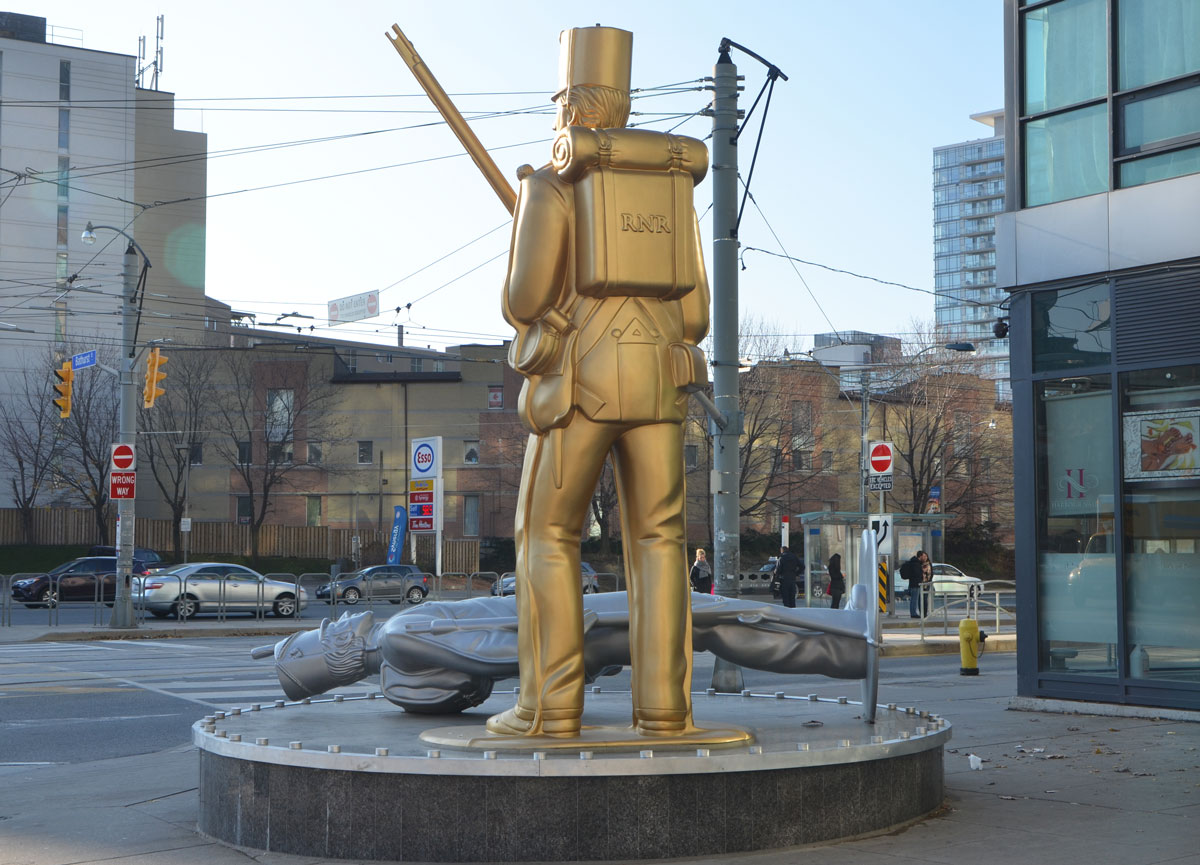
below: Standing guard over Bathurst Street, Fleet street and the Lakeshore, is one larger than life gold replica of a Royal Newfoundland Regiment and his fallen silver American foe. A sculpture by Douglas Copeland entitled “A Monument to the War of 1812”, a nod to nearby Fort York and the history of Toronto.

Douglas Copeland's sculpture of two tin soldiers, a gold one standing with backpack on and rifle in hand, and a silver one lying on its back on the ground, uniforms circa War of 1812, seen from the back, figures are much large than life sized and they are on a corner at an intersection, Bathurst St. and Fleet St.

below: My favorite example of bad grammar still exists!  Off-leash dog area at Coronation Park.

a wood fence around a dog park, in autumn with lots of leaves on the ground, on the fence is a white sign with black letters re the Toronto municipal code 608,

A beautiful day in the park.  A slight November nip was in the air but it was sunny and the sky was a brilliant shade of blue.  Coronation Park is named in honour of the coronation of King George VI who was crowned on 12 May 1937.  At that time nearly 150 trees were planted here.

Apparently, an oak tree was planted to honour the king.  Surrounding it, a ring of silver maples was planted.  This was to symbolize the countries of the British Empire.  I wish I had known that bit of trivia before I walked through the park because now I am curious if these trees are still there.   Some of the trees are quite substantial.

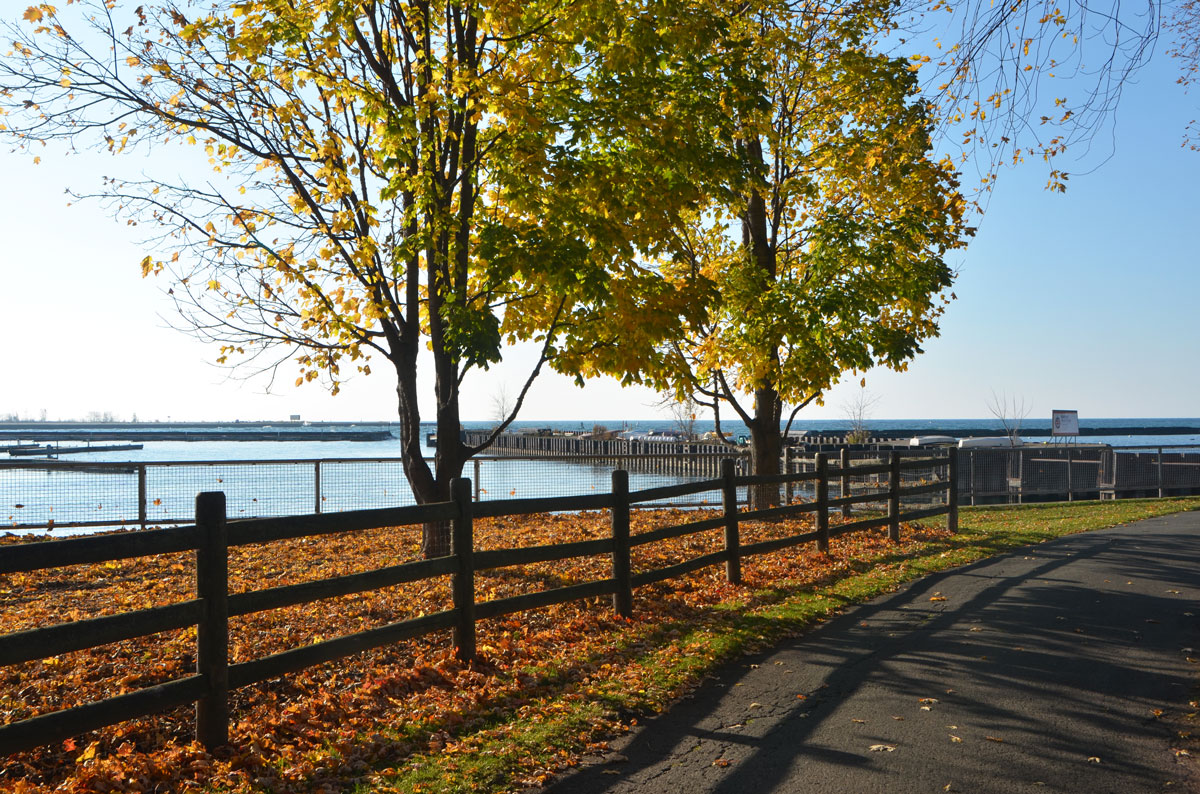
below: Long shadows for the morning sun, low in the sky.

morning in the park, autumn, trees with some leaves still on, many leaves on the ground, wood railing fence, shadows, Lake Ontario, path, Coronation Park.

below: Looking back towards the city center, past the empty docks of the National Yacht Club to the residences on Stadium Road.   A small group of people were making a video in the dog park.

morning in the park, autumn, trees with some leaves still on, many leaves on the ground, wood railing fence, shadows, Lake Ontario, path, Coronation Park. a small group of people in the distance are filming a video

below: This Victory Peace Monument was unveiled on 14 November 1995 to commemorate the 50th anniversary of the end of World War 2 and honour those who died in that war.   It was designed by John McEwen; the bronze pieces resemble the bow of a ship.

Metal partial cylindrical shapes on a concrete circular monument. World War 2 memorial

below: On the inside of one of the bronze pieces is a map of eastern Canada and the Atlantic Ocean.  Each boat on the map represents a ship or U-boat that was sunk during the war.  The Canadian ships are located on the map at “their last known position”.  I hadn’t realized that so many ships were lost so close to North America.

relief map of eastern Canada and the Atlantic Ocean, in bronze on a WW2 memorial. Little ships are shown on the ocean where they were sunk during WW2.

Trees were also planted to represent the four divisions of the Canadian Expeditionary Force (WW1) and its units as well as those who fought in the Fenian Raids of 1866-1870, the Northwest Rebellion of 1885, and the Boer War (1899-1902).  Once upon a time, brass plaques were placed at the foot of each tree to indicate the units the tree stood for.  If any plaques remain, I didn’t see them.

below: Another memorial is close by, a  “Memorial to Lieut. Tommy Hobbs gallant British Canadian soldier in the Great War 1914 – 1918.  Died on active service November 10, 1940.  Beloved and remembered by his comrades.”   Tommy Hobbs was involved in the creation of this park.

a memorial in a park made of a small pile of rocks. The top rock is inscribed, memorial to Tommy Hobbs, died 1940, in Coronation Park

below: A little farther on I noticed another rock, one that was painted red.   The bronze plaque on the rock says that 20 trees have been planted here in commemoration of the G20 Summit held in Toronto in 2010.

a large rock with a bronze plaque on it. The rock has been crudely painted red

below:  A 30 foot tall Inukshuk stands looking out over Lake Ontario.  Approximately 50 tonnes of mountain rose granite was used to create the Inukshuk, which was made by Inuit artist Kellypalik Qimirpik from Cape Dorset, Nunavut.

a tall stone inuksuk on a raised mound of warth

below: Streetcars across the baseball outfield.

Looking across the outfield of a baseball diamond towards a street. A line of mature trees by the street with two red and white TTC streetcars on the street, condo towers behind.

below: A closer look at that brown octagonal structure in the middle of the streetcar loop for the 509 and 511 cars.  Apparently it’s the Queens Wharf lighthouse, one of a pair built in 1861.

a brown structure, the Queens WHarf Lighthouse, sits on a patch of grass beside TTC streetcar tracks in front of a new condo.

The lighthouses marked the entrance to the Toronto Harbour from 1861 until the Western Channel was built in the early 1900’s.   This one stood on Queen’s Wharf which used to be at the foot of Bathurst Street, adjoining Fort York.  The wharf was built by the military; in 1833 it was a pier 42 feet long.    The pier no longer exists; a hundred years ago it was buried under what is now Bathurst Quay.

below:  A picture of an historical map (1886 or 1887) of the area showing Toronto Harbour, Fort York and the railway lands.  Queen’s Wharf is the pier on the left.   At that time, Front Street was the southern most street in this part of the city.   All the present day development south of the train tracks is on reclaimed land.

picture of historical map of part of Toronto Harbour from 1886, showing Fort York, Front St., and Bathurst St., and the railway lands and wharves into Lake Ontario,

below:   Taken from google maps, what the layout of the city looks like now.   As you can see, there have been many changes!

present day map taken from google maps of Coronation Park and Bathurst Quay including Fort York

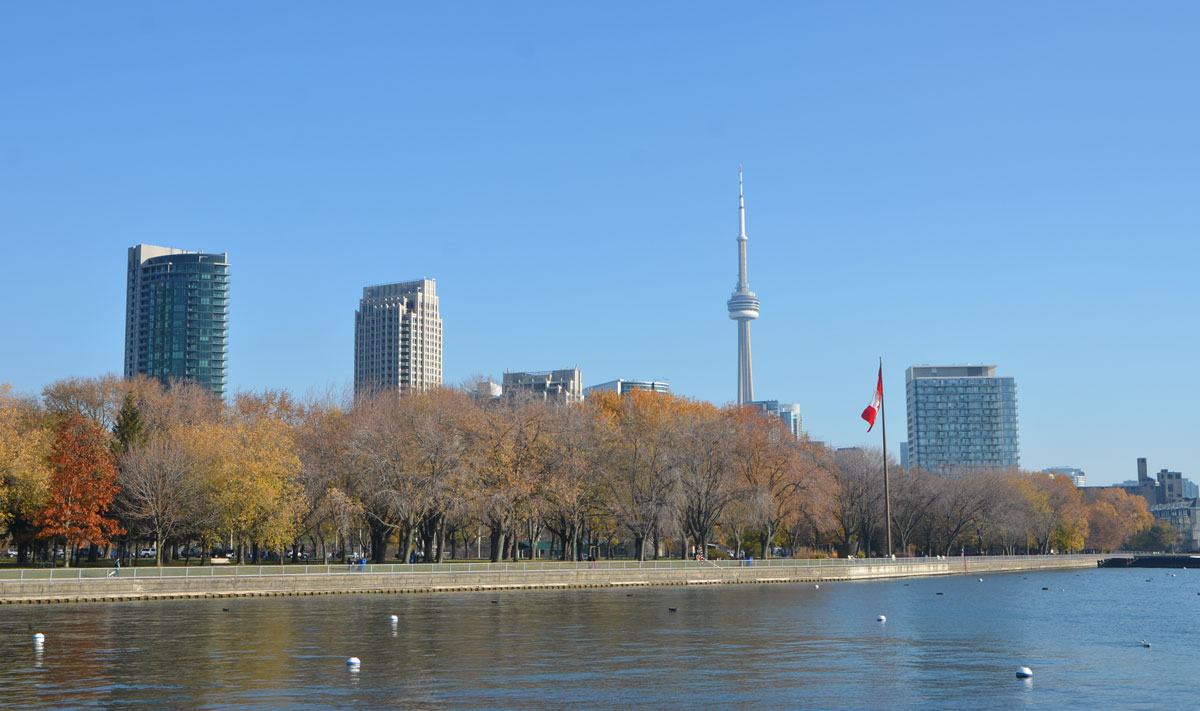
Lake Ontario in the foreground, trees in Coronation Park in the middle and Toronto skyline in the distance with the CN Tower and a large Canadian flag.
a sticker of a rainbow in a heart shape. A small purple heart is in the center, then a blue heart is drawn around it, moving outwards in rainbow colours.

I was going to go looking for autumn but, silly me, I soon realized that I didn’t need to look for it.   It’s all around us.  All you have to do is look out the window, or better yet, step out the door and you’re in the middle of it.  It’s falling in front of you, swirling in the breezes and crunching under your feet.

street scene, large trees with yellow and orange leaves, with a park in the center

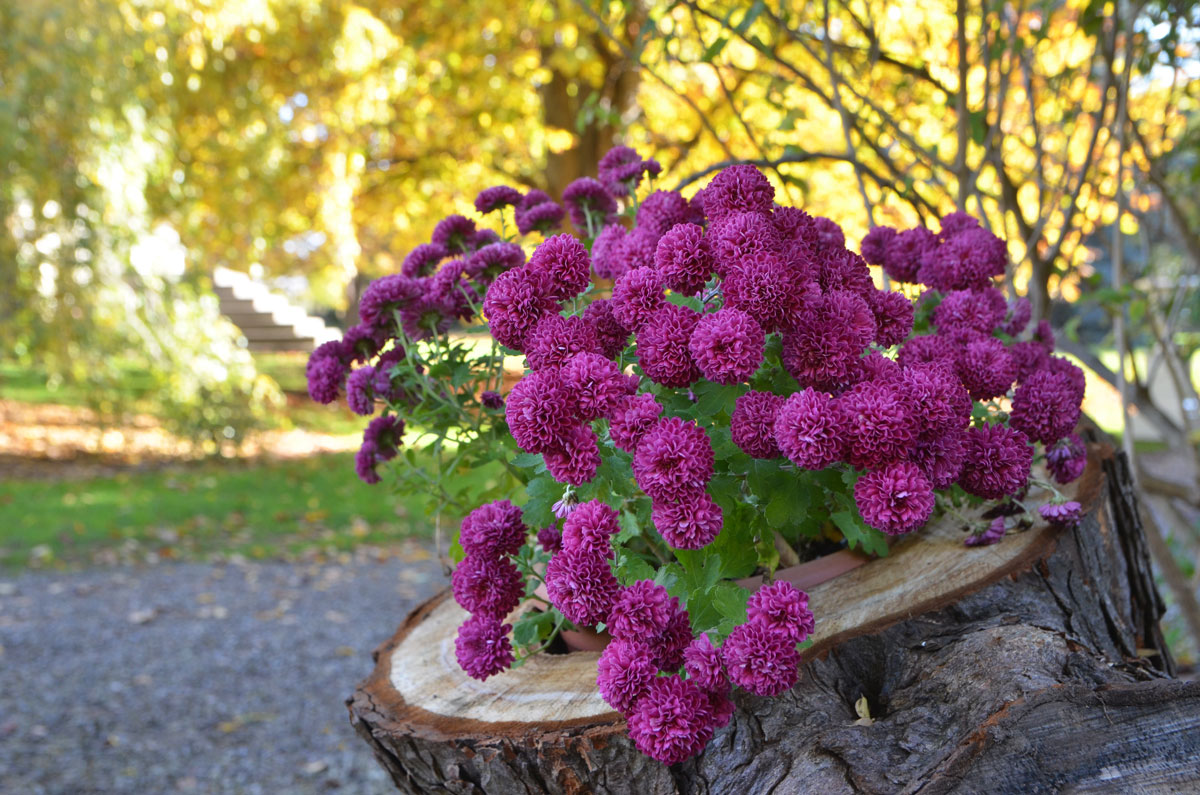
a pot of purple flowers with a yellow tree in the background

a stone fence with a metal gate, large trees, autumn leaves
a branch of yellow leaves, autumn tree with blue sky and the turret of Casa Loma in the background

two storey brick house with large tree in front, smaller trees with yellow leaves in the background.
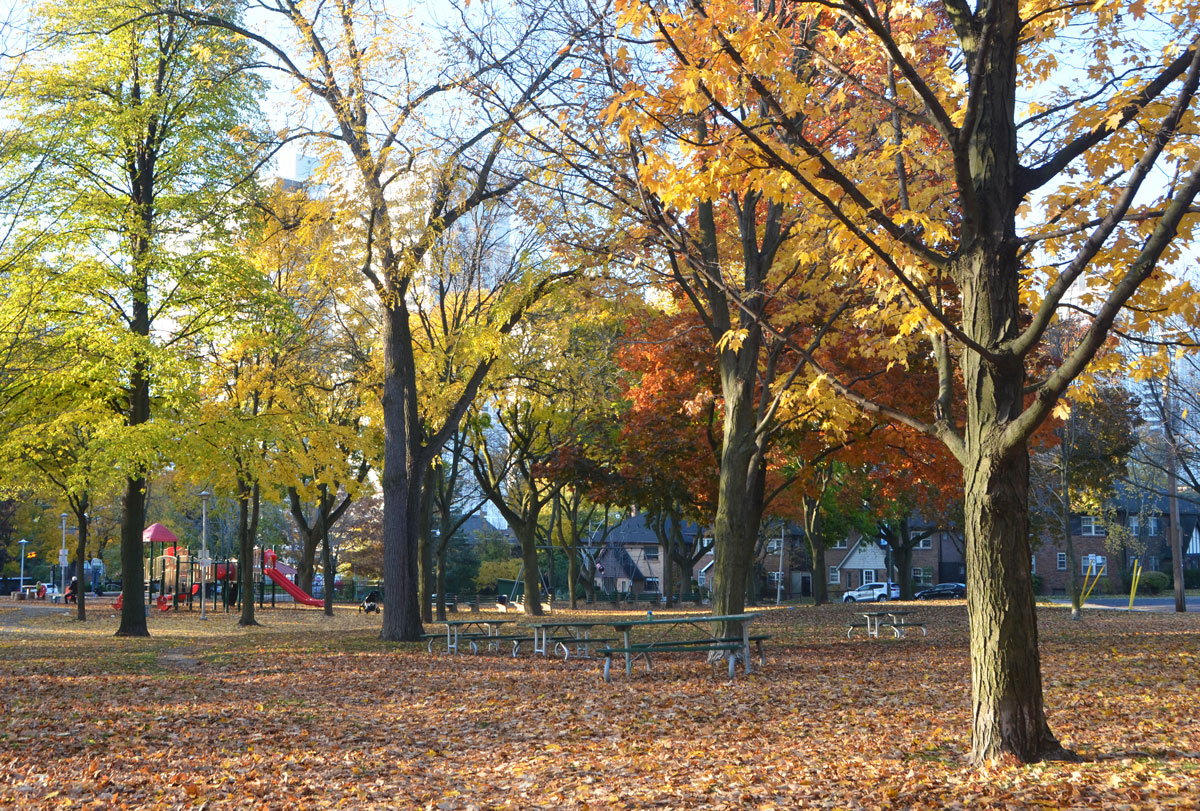
park in the fall, leaves on the ground, trees still with some leaves in oranges, rusts, and yellows, playground in the distance

a metal bench in front of a large tree in a cemetery, tree has yellow leaves, autumn colours, change of season, fallen leaves on the ground around the bench

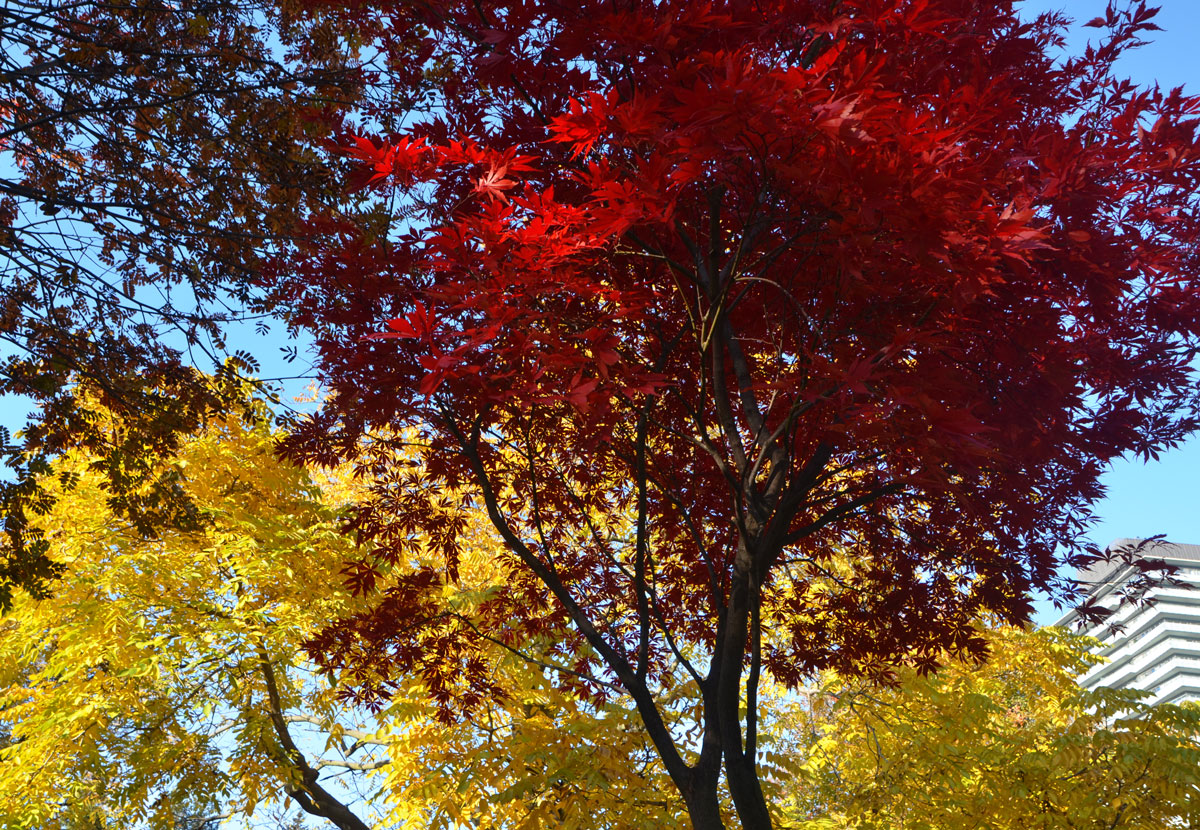
trees in autumn, red leaves and yellow leaves

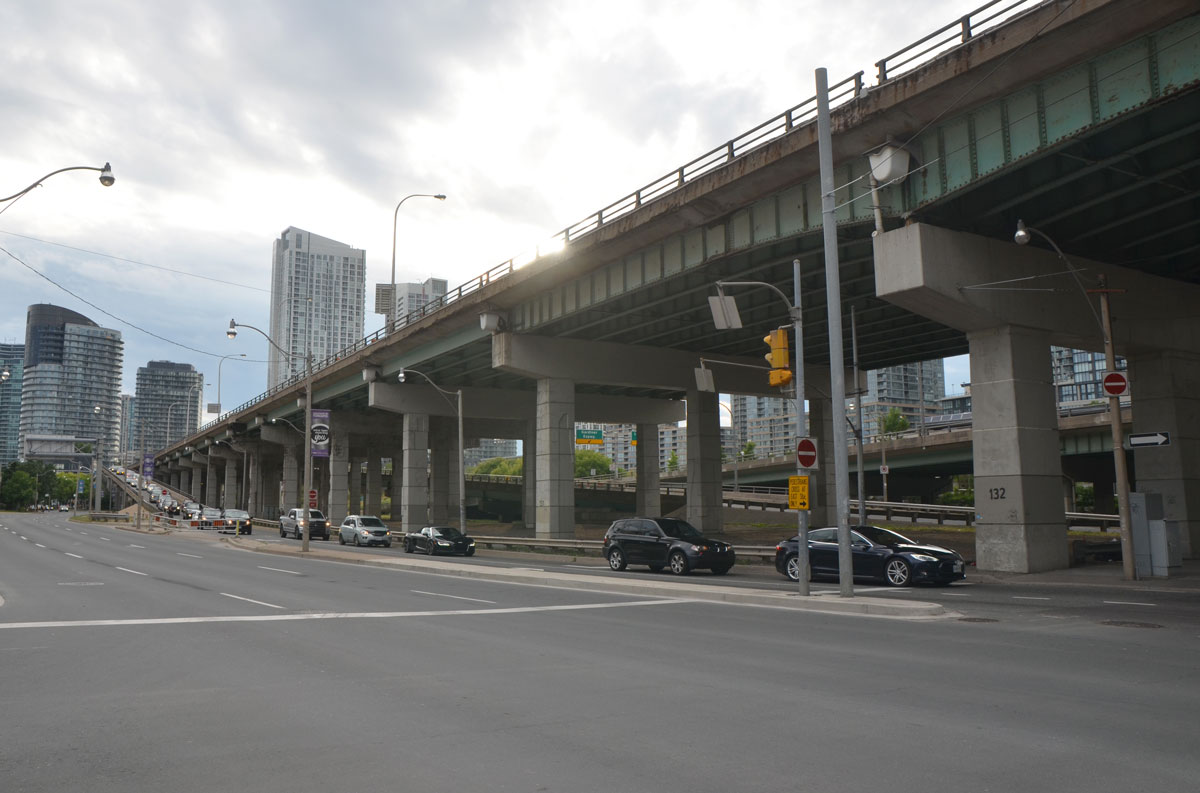
The Frederick G. Gardiner Expressway, commonly just called the Gardiner, has been in the news a lot lately.  This 18 km stretch of road between the city and the lake was completed in 1965 after years of planning and building.  At the time that it was built, Toronto’s waterfront was largely industrial and there wasn’t much objection to having a 4 to 6 lane expressway, with many sections elevated, built there.   The railway had begun the process of dividing the city from its waterfront a hundred years previously.

As the city changes and grows, more and more people live in the downtown core.  Industry has moved out and residents have moved in.  For so long the land south of the Gardiner as well as under the Gardiner was neglected, especially from a city planning point of view.  But now, the city is looking differently at that swath of land.  The far east elevated section between the Don Valley Parkway and Leslie Street was demolished in 2001 and there have been calls for the next section (Jarvis to the DVP) to be demolished as well.   There has been some controversy as to whether to demolish it or move it… and if move it, where to? I am not even sure what the plans are at the moment.   On the other hand, the western section of the elevated expressway (Strachan to Spadina) will remain standing.  Work is underway to refurbish the structure – the city doesn’t want any more stories of pieces of concrete dropping onto cars beneath!  Plans are being implemented to use the land under the Gardiner much more efficiently.  To make it work for the public.

The Bentway is the name that has been given to this new park, or public space, beneath the Gardiner Expressway from Strachan 1.4 kilometres east to Spadina. The first phase is due to open Canada Day 2017 and it involves the stretch between Strachan and Bathurst.  Many of you have probably driven on the Gardiner but do any of you know what is under it now?  Let’s take a look.

below: The Gardiner passes over Strachan Avenue which  in turn passes over the railway tracks.

bridge over a street, many orange and black construction cones down the center of the road, some pedestrians on the sidewalk

below:  On Strachan Ave looking west.   Condo development in this area has extended right to the railway line.  The Exhibition GO train station is in the distance.  You can also see the Gardiner to the left of the tracks.  Here the north side of the under part of the expressway is walled in and the enclosed space is used by Exhibition Place.  At this time there is no plan for the Bentway to extend this far; I have used this photo to provide more context as to the location of the park.

railway tracks in the center of the picture, condos on the right. On the left is the elevated Gardiner expressway, but under it is a concrete wall that makes it look more like a concrete building than a road

below: A closer look at the Gardiner on the west side of Strachan Avenue.  Maybe there is potential to expand the park westward? to Exhibition GO station? And by the way, those concrete structures holding up the expressway – those are called ‘bents’ and that is why the park is called what it is.
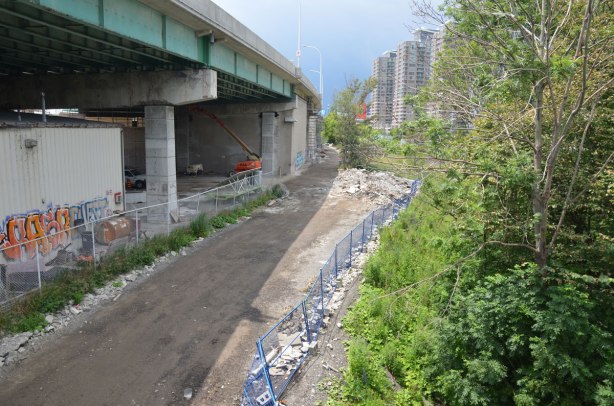
a dirt road runs alongside the Gardiner Expressway, some condos in the distance

below: This photo was taken as I stood on Garrison Common and looking towards Strachan Avenue.  This will be the western end of the new park. You can see the underside of the Gardiner as it passes over Strachan Ave which in turn is also a bridge.  This bridge once crossed the Grand Trunk Railway tracks that were built in the 1850s.  New entrances to the park are planned that incorporate the present sloped embankment of the bridge.

The elevated Gardiner Expressway passes over Strachan Ave which in turn has a bridge over what used to be a rail line. The bottom part of the bridge is covered with graffiti. The whole area is a construction site at the moment.

below: A quick aside:  It’s a slightly different angle, but here is a photo of the Strachan Avenue bridge from 1959, before the Gardiner was built.  I suspect that there has been upgrades made to the bridge since then.  Photo credit: R.L. Kennedy, found online (also a good source for the history of the Grand Trunk Railway in Toronto).  Garrison Common is to the right.
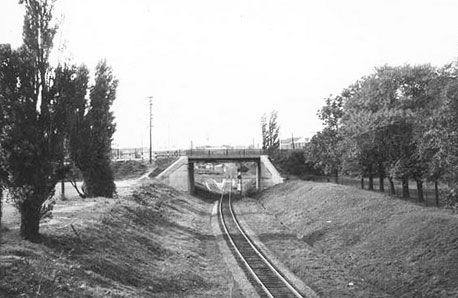
vintage photo from 1959, GTR tracks pass besidde Garrison Common park and under the bridge at Strachan Ave

Garrison Common is the green space surrounding Fort York.  It will abut (be continuous with?) the new Bentway.  Fort York is a National Historic Site and on its 43 acre site are original buildings from the War of 1812 as well as an 1813 battle site.  Did you know that the Americans beat us here in 1813 and controlled the city of York (as Toronto was known then) for a few days?

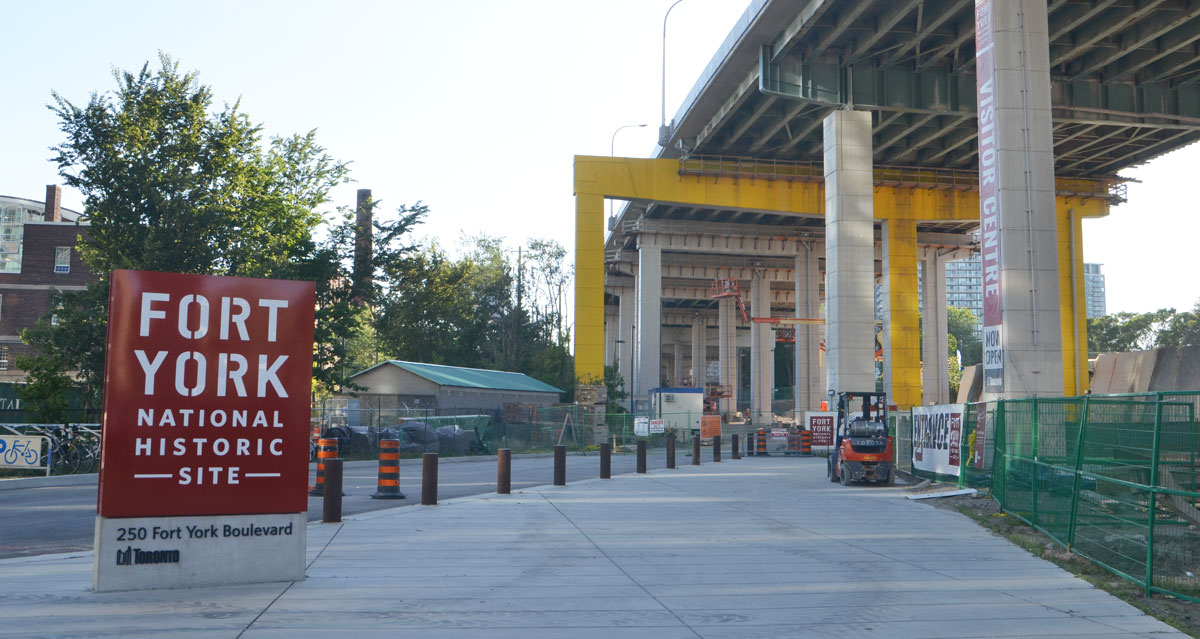
below: The new Fort York Visitors Centre is now open. There is still being work done both inside and outside, but it is open to visitors. For so long the fort was hidden away and difficult to get to; it is nice to see it receiving more attention.

entrance to Fort York, under the Gardiner, still a construction site but nearing completion

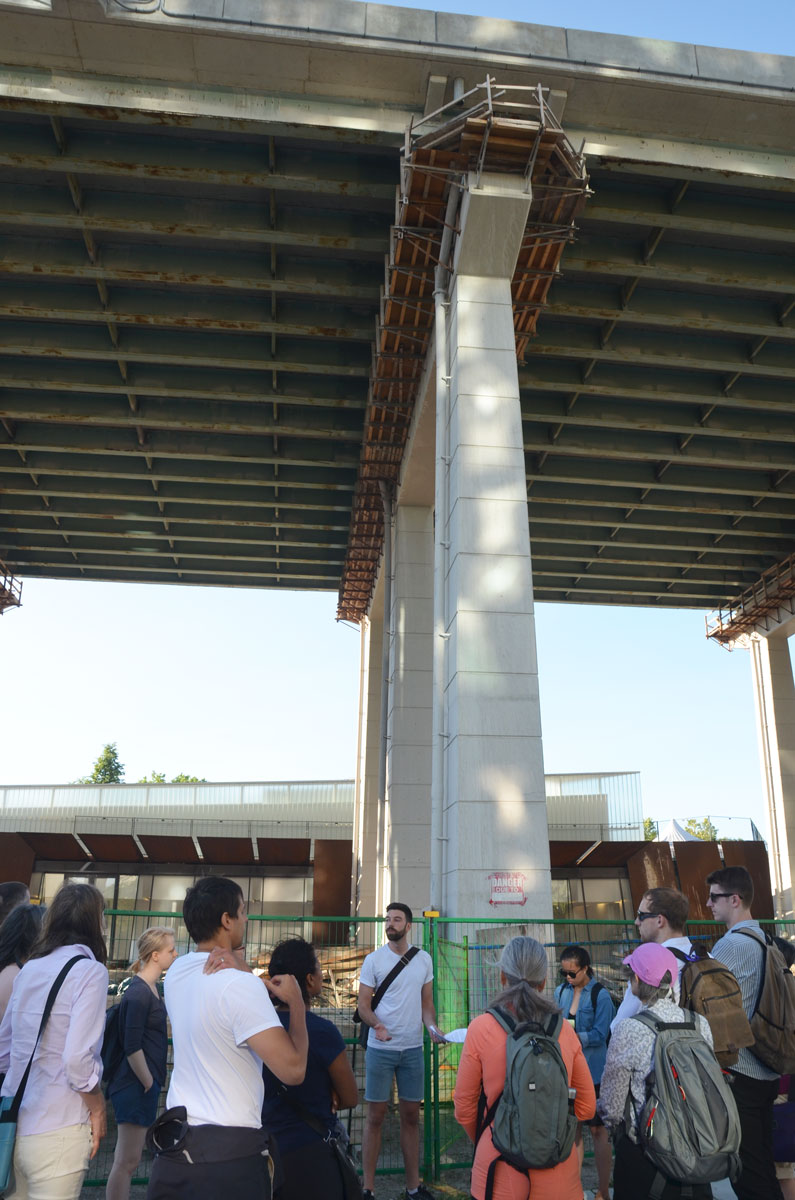
below: Jake from Park People, one of the groups helping to design the new park, stands under the Gardiner as he talks to a group of us on a tour.    Here, by Fort York, the Gardiner is the equivalent of 5 storeys from ground level, the highest it reaches as it crosses the city.
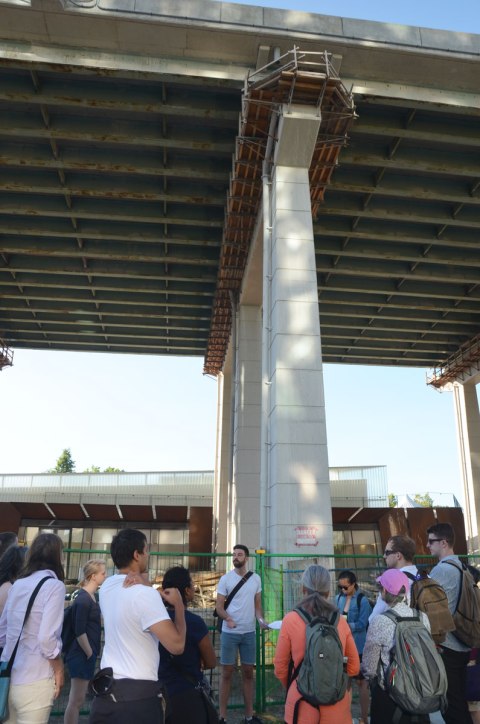
a man is standing in front of a group of people on a walking tour, he is standing under the Gardiner Expressway where it is 5 storeys above ground level.

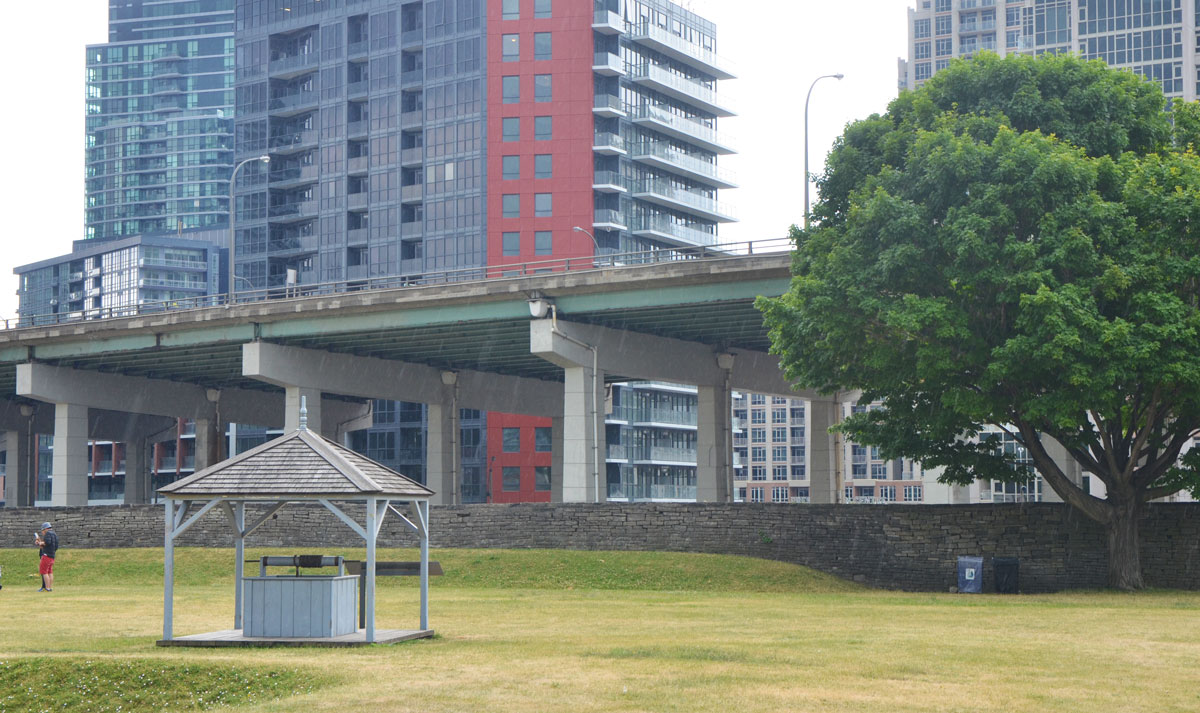
below: Standing on the grounds of Fort York.  The Bentway will be beyond the stone wall.  You can get a good idea of the spacing between the bents.  These spaces are being referred to as ‘rooms’ and there are 55 of them between Strachan and Spadina.
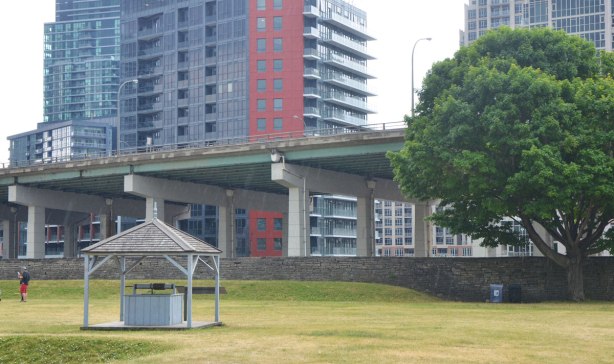
from the grounds of Fort York looking south to the Gardiner and the condos built beyond it. Grass field in the foreground.

below: One obstacle is the fact that Fort York Blvd passes under the Gardiner on a diagonal.  Plans are to build a pedestrian/cycle bridge over the street.  Also in the photo, note the TTC bus – Fort York and vicinity are finally on a bus route.  Route 121 runs between the Portlands and Fort York via Union Station.

fort york blvd is in the foreground, a TTC bus and a car are on it, the Gardiner is to the right and a short condo building is in the background along with the CN tower

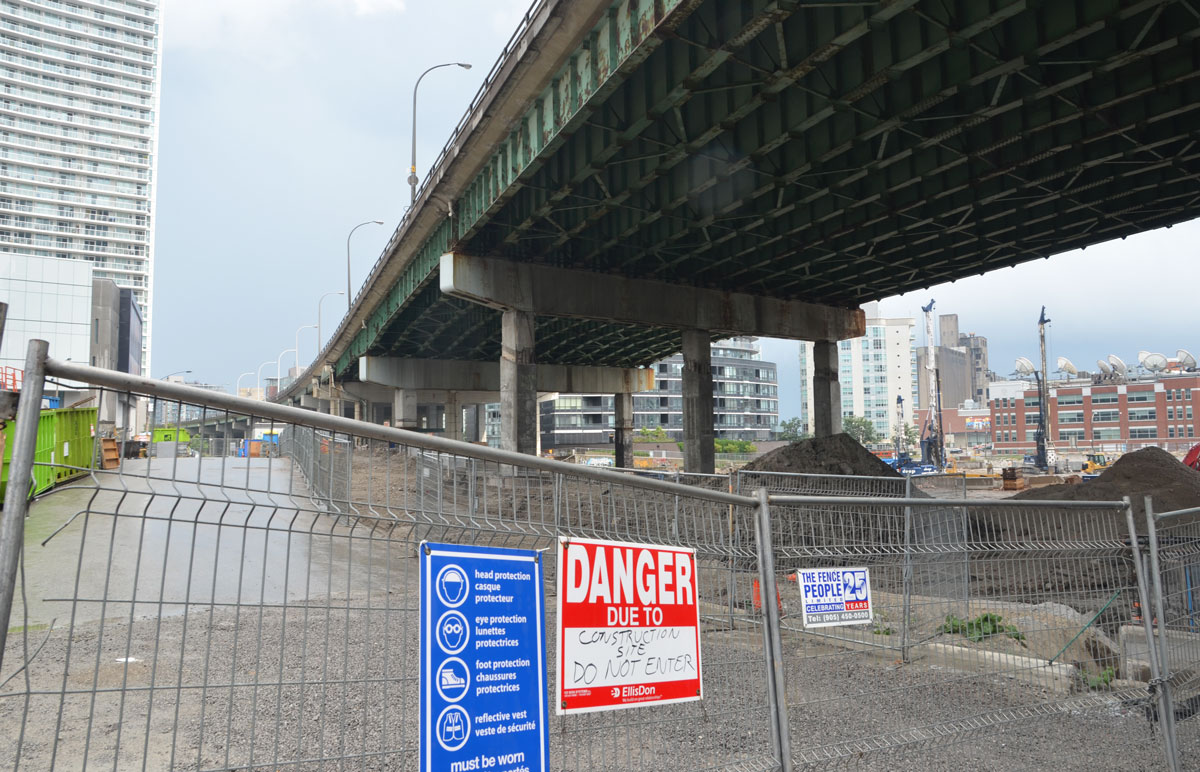
below: The section under the Gardiner Expressway between Bathurst Street and Fort York Blvd is not city owned. It is owned, and has already been developed, by the Onni Group who built the Garrison at Fort York condominiums on either side of it.  This is the eastern end of phase 1.
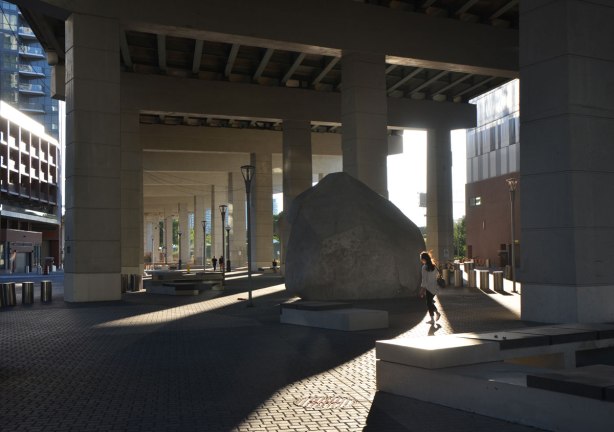
evening, low angle sunlight shines under the Gardiner Expressway where it has been developed with paving stones and some large rocks.

below: Northbound traffic on Bathurst passes under the Gardiner.
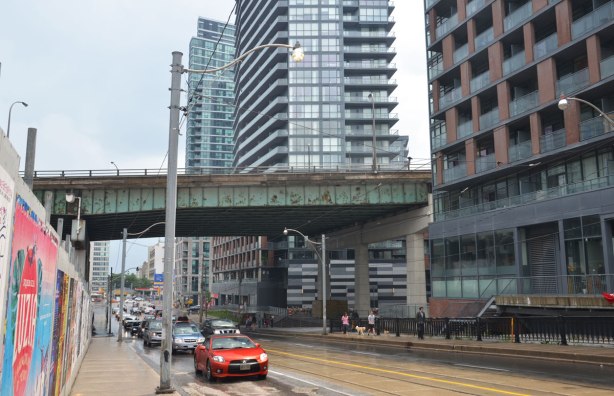
some traffic on Bathurst street on a rainy day, as the street passes under the Gardiner Expressway, condos on the right, construction hoardings on the left.

Phase 2 of the park’s development involves land between Bathurst and Spadina. This is an area that is undergoing a lot of changes at the moment, i.e. a lot of construction.

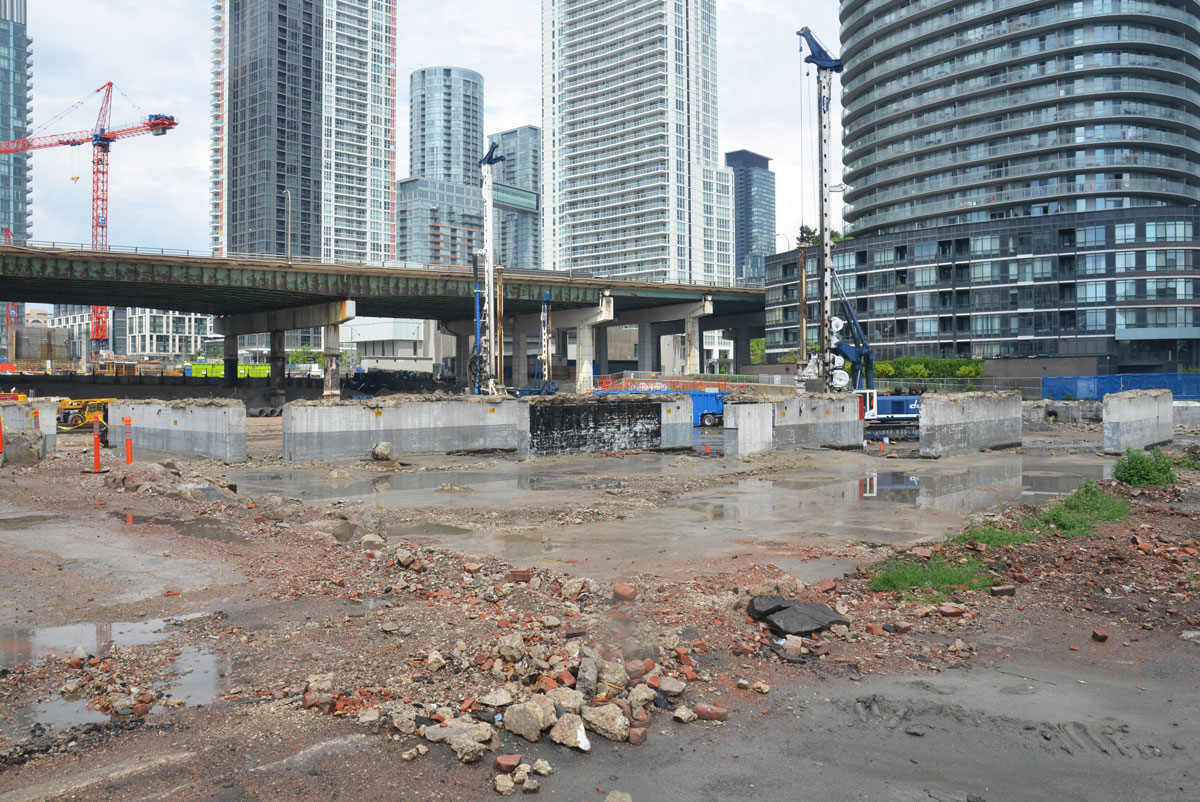
below: Immediately south of the Gardiner on the northeast corner of Bathurst and Lakeshore is a construction site.  Demolition of the old 1928 Loblaws warehouse building is now complete.  The facade of the old building was disassembled rather than demolished; after cleaning and refurbishing of the bricks, it will be rebuilt in its original location.  Two condo towers are planned for the space between Loblaws and the Gardiner.  Yes, more condo towers to face the Gardiner and add to the tunnel effect that you get when you drive on the expressway.

construction site in downtown Toronto, Gardiner Expressway runs behind the site, rubble in the foreground, a few remaining remnants of the old Loblaws building that was there, high rises in the background.

below: The development of this site is a collaboration between a number of developers.  I found a photo of one rendition (source) of what the space under the Gardiner will look like here in the future.  Public space including a cafe are part of the plans.  Check back in a couple of years to see what really happens here!
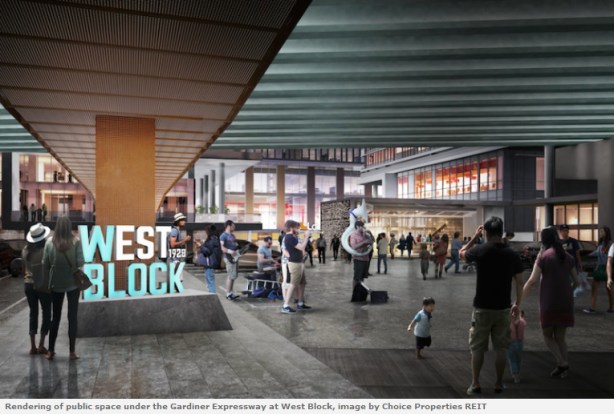
artist's rendering of what a planned development for under the Gardiner would look like, part of a larger condo and retail development.

below:  Standing on Bathurst Street, looking east along what will be Housey Street.  This is just north of where the Loblaws development (above) will be.  As you can see, you can’t walk there yet.

the elevated road, the Gardiner Expressway passes over a construction site on the right, a new street being built on the left.

below: Southeast corner of Bathurst and Fort York Blvd.  This is the section of land just north of Housey Street.  Construction hoardings and cranes – familiar sights in this area.  It also means that taking photos of under the Gardiner here are difficult!
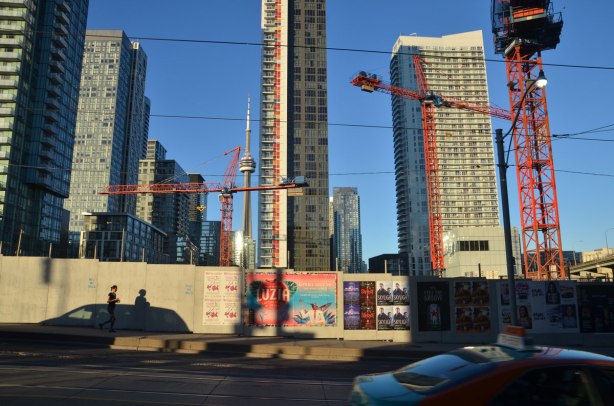
late afternoon, long shadows, yellowish tint to the photo, looking east from Bathurst, south of Front, north of the Gardiner, wood construction hoardings with posters on it, many orange cranes, some condos already built, a woman jogging past, cars on the street.

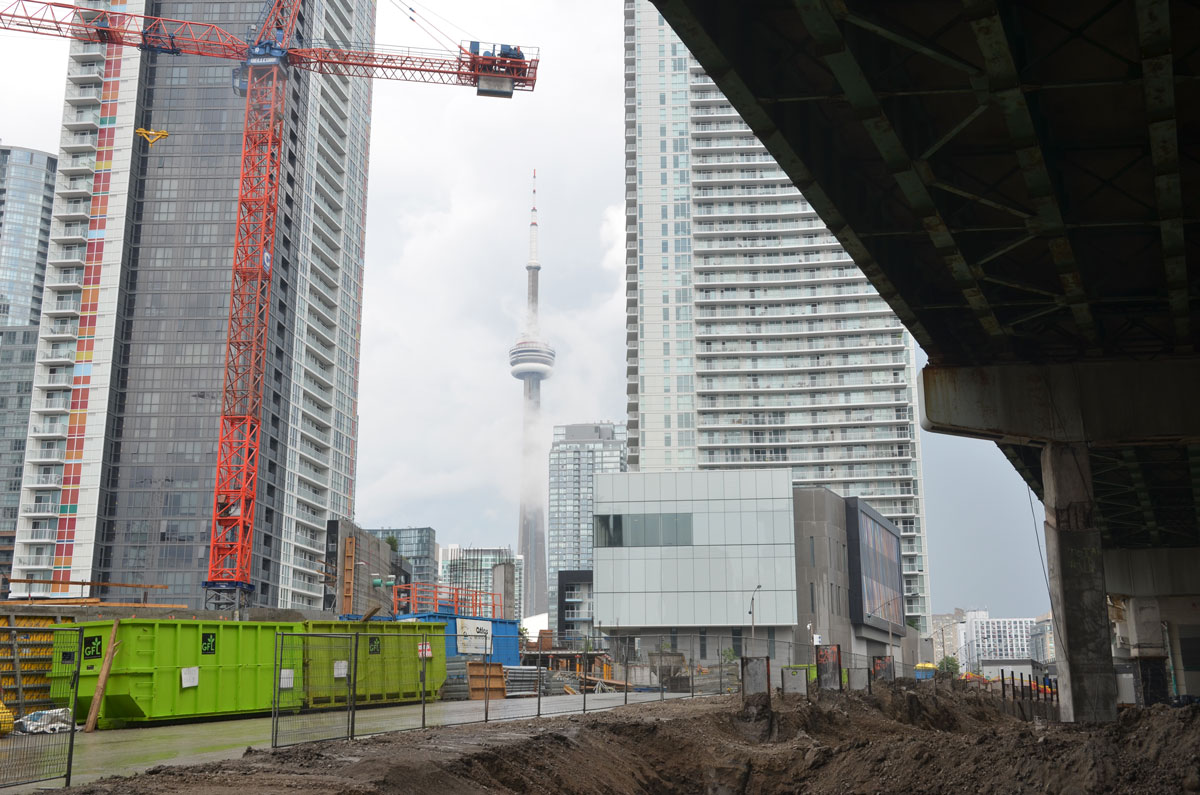
below: Development north of the Gardiner between Bathurst and Dan Leckie Way.
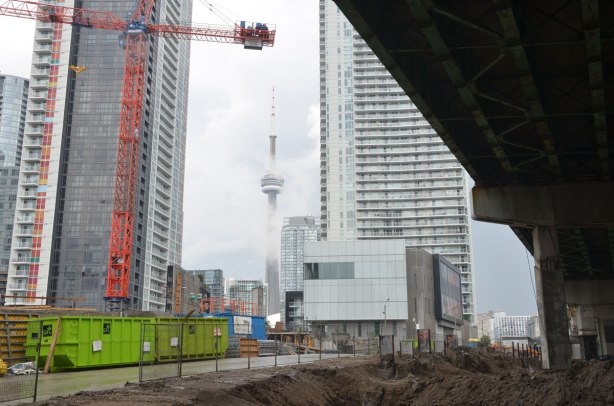
construction site under the Gardiner, cranes and condos being developed on the left, CN tower in the fog in the distance.

Dan Leckie Way is a north-south road that runs under the Gardiner just east of Bathurst.  It is the western boundary of Canoe Landing Park.  This park is north of the Gardiner and the Lakeshore.

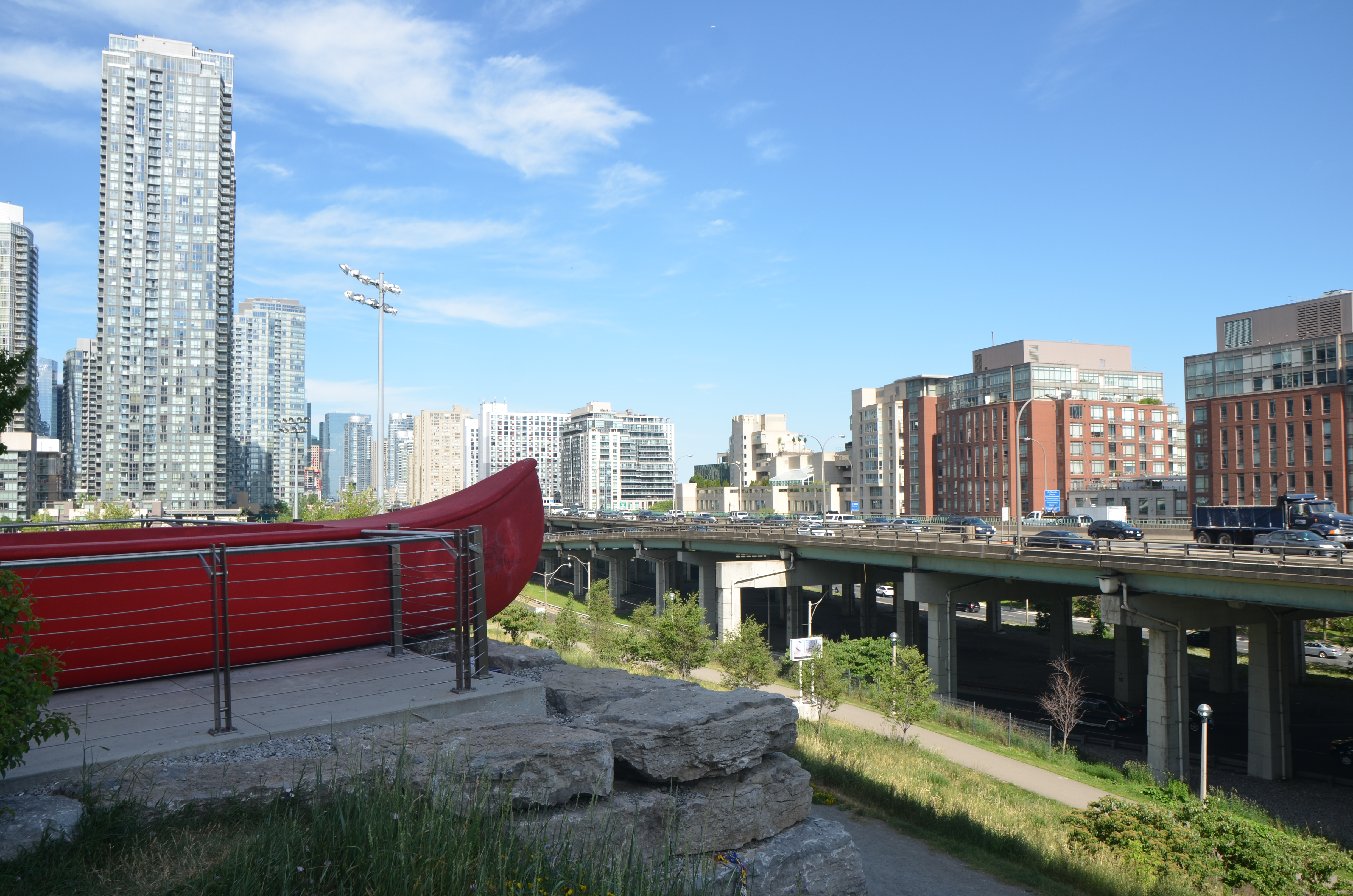
below: ‘Tom Thomson’s Canoe’, by Douglas Coupland sits at the highest point of land in the area; it’s almost at the same level as the Gardiner and is very visible as you drive by.   This park extends down the hill.
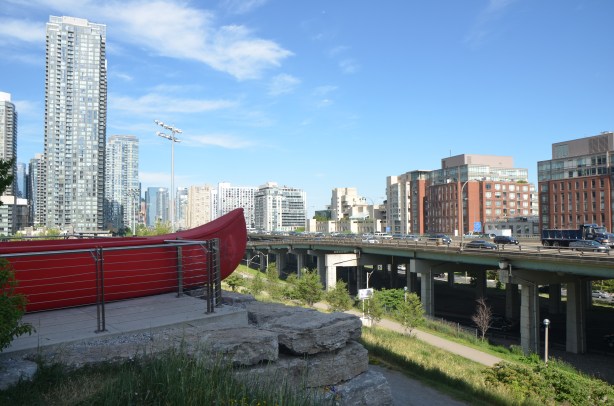
The end of a large red canoe, an artwork by Douglas Coupland called 'Tom Thomson's Canoe' sits in a park, high above the surrounding scenery. Looking southwest towards the elevated Gardiner Expressway and the condo developments south of it.

below: Looking the other way from the same vantage point. The street running under the Gardiner here is Dan Leckie Way . Up until this point the Lakeshore is south of the Gardiner.
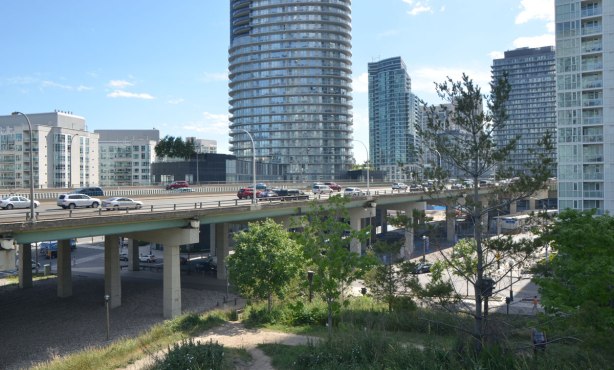
The elevated Gardiner Expressway with traffic is in the middleground, some trees and parkland in the foreground, and condo developments in the background.

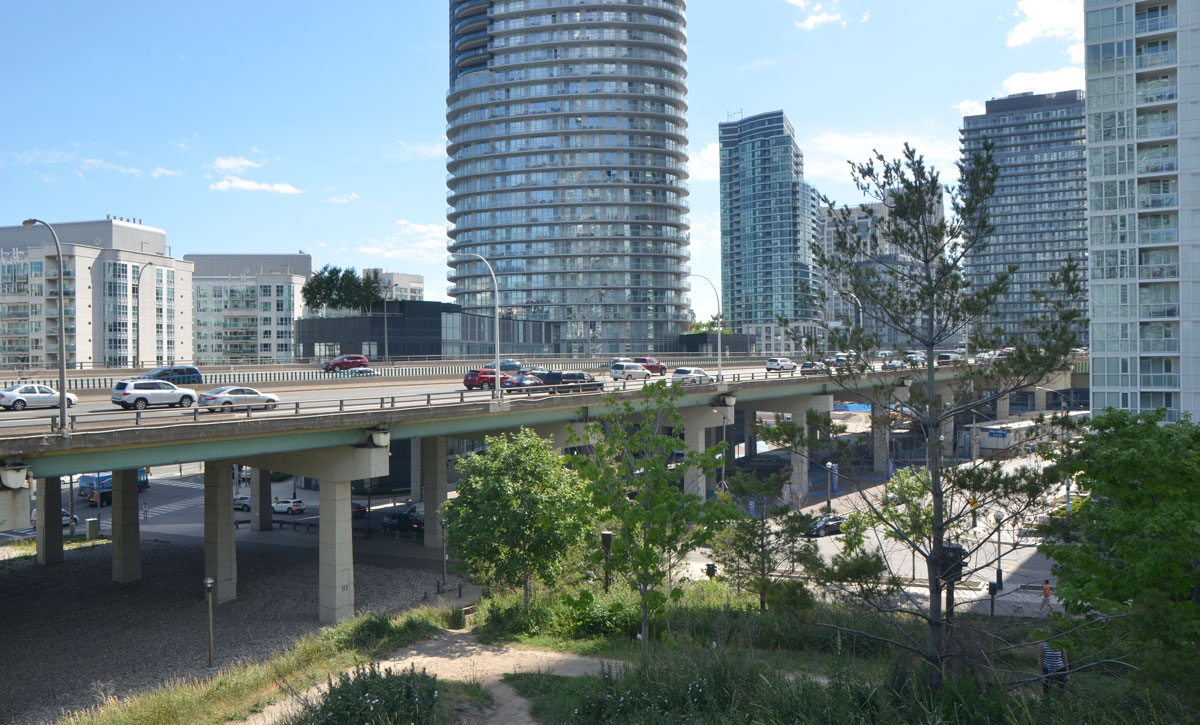
At Dan Leckie Way, the Lakeshore is still south of the Gardiner and the space under the expressway is wide open.   By Spadina, one major block east, the situation changes.   The Lakeshore splits and westbound traffic lanes go north of the Gardiner and eastbound lanes stay south.  Shortly after Spadina, the Lakeshore runs under the Gardiner and there is no room for any further development under the road.

below: Standing on Spadina, just south of the Gardiner and looking west.  Here there is a lot of road to cross for pedestrians on Spadina.  Not only has the Lakeshore split to run on either side of the Gardiner, but there are also ramps between the Gardiner and the Lakeshore.
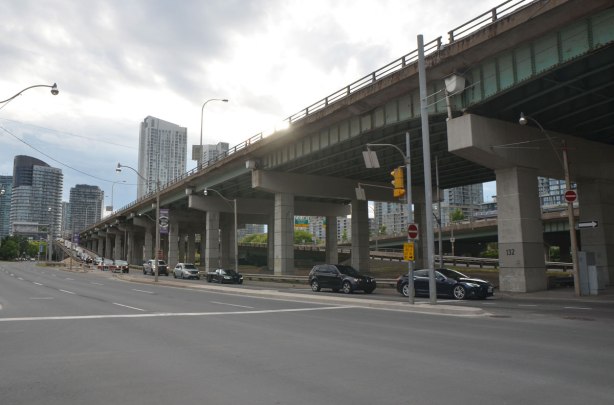
major road with traffic under an elevated expressway in a city, long ramp from the upper level to the lower. Gardiner Expressway and Lakeshore Blvd in Toronto, at Spadina looking west

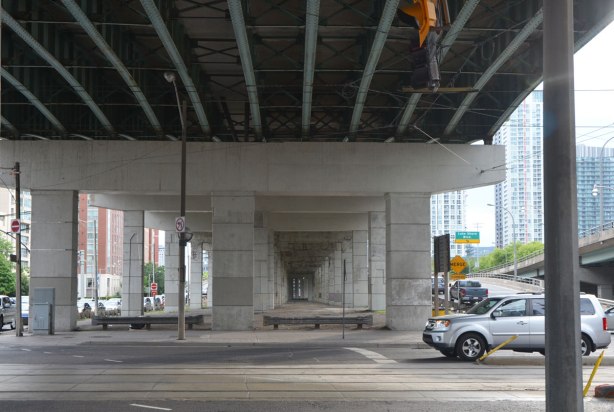
below:   Still on Spadina, and still looking west, but now under the Gardiner.  The space under the road is not as high as it was previously.  Its lower and darker and not as inviting.   It will be interesting to see what phase 2 of the Bentway development will look like in this space.  I am not sure when it will to be finished but I will keep an eye on it!
under an elevated section of the Gardiner Expressway, at Spadina.

As for the eastern Gardiner, what does that look like?  Well, that’s a whole other blog post!

 Project: Under Gardiner  On this site you’ll find detailed maps and diagrams of this area as well as information about the plans for the various sections of the space.


Well, this May 2 4 weekend has been splendidly sunny and fabulously warm!  I hope you’ve had the chance to take advantage of it, whether sitting on a patio with a cold drink and friends, or out enjoying the the greenness that has bloomed all around us.   It’s been a great few days to get up close and take a good look at nature.

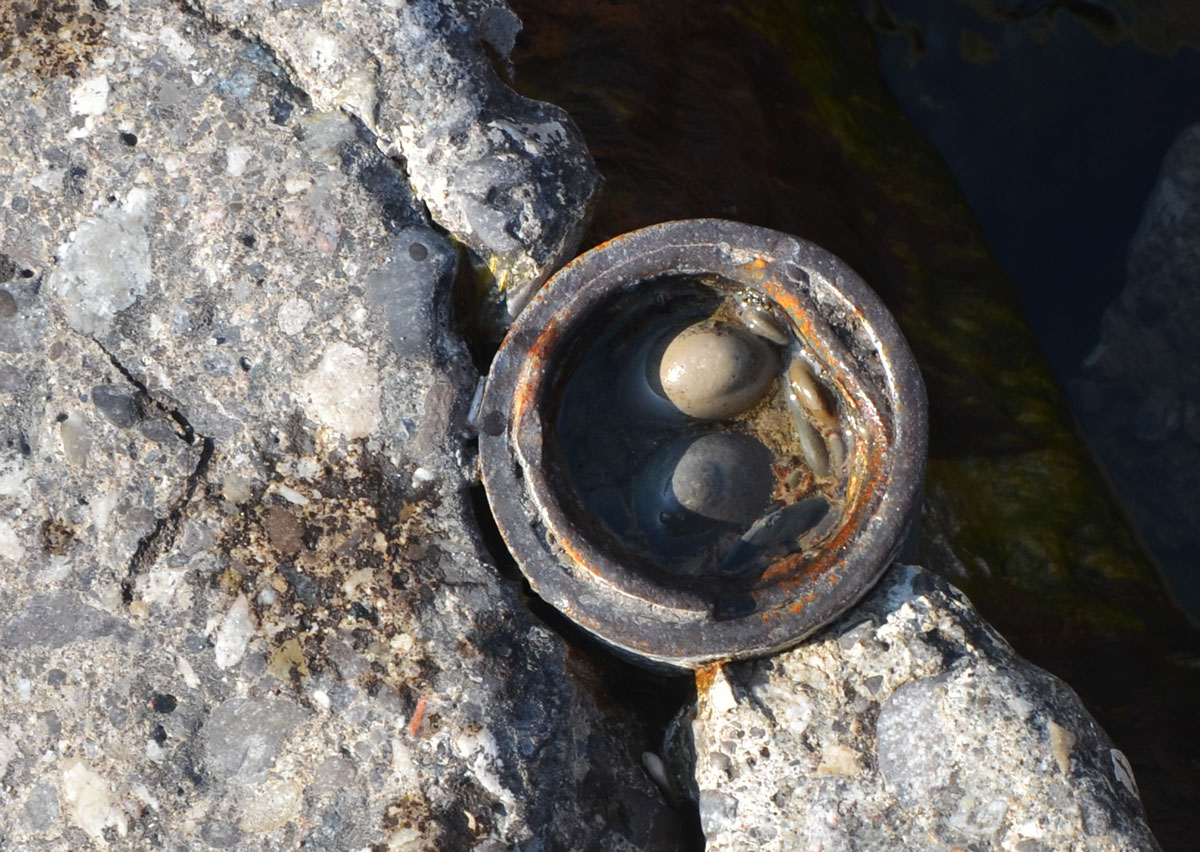
looking down at a piece of concrete at water's edge, in the concrete is a cut off hollow pole, there are pebble and water in the hole.

below: Old moss covered metal seems to reach out of Lake Ontario like claws.

old bent metal embedded in concrete but partially inderwater. Moss is growing over it and making it look green

below: Reflections in the Yellow Creek, Beltline trail.

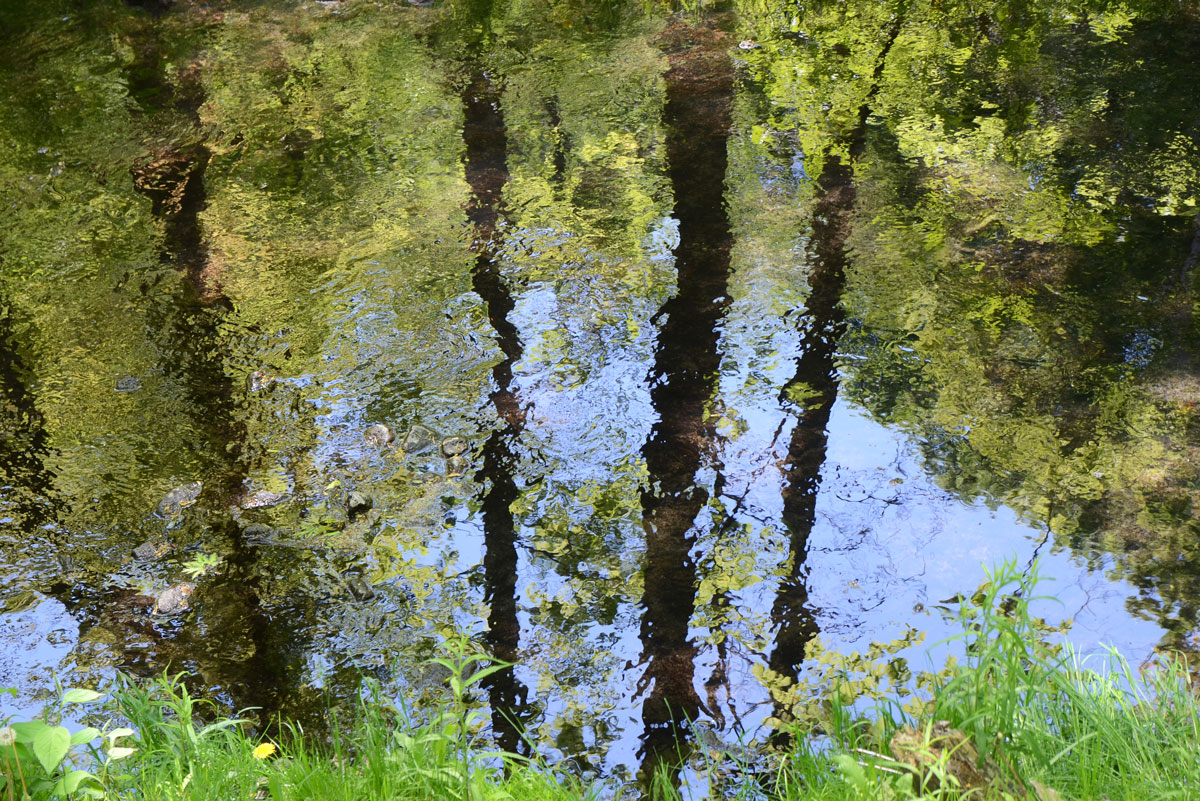
reflections of trees and blue sky in a creek, blue water, dark brown tree trunks and mottled greens of the leaves, in a ravine, in the city

below: Wet pebbles with the beginnings of green moss growing on them shine in the morning sun.

pebbles in greys and browns in the water near the shoreline of Lake Ontario. The pebbles closest to the shore are bright green with the beginnings of moss growth

below: Greater celandine, a yellow flowering plant, blooms along the railing of Milkmans Lane.

yellow flowers in bloom in the ravine, against a railing post, with shadows cast on the wood, large green leaves

below: New growth unfolds in the sunshine.

small maple tree with lots of new red leaves that have just come out. Grey rocks blurry in the background

below: The dark pink blossoms were at their peak this week.

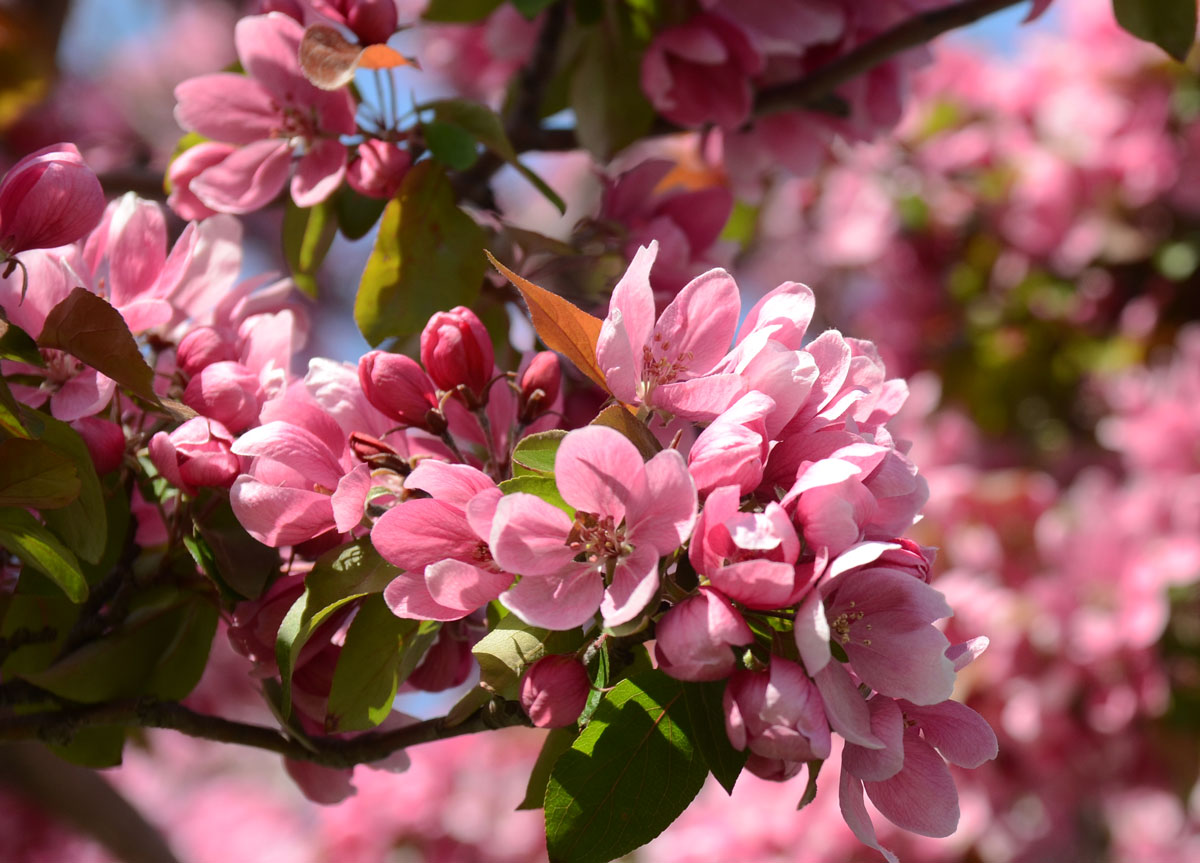
 many pink blossoms on the branch of a tree

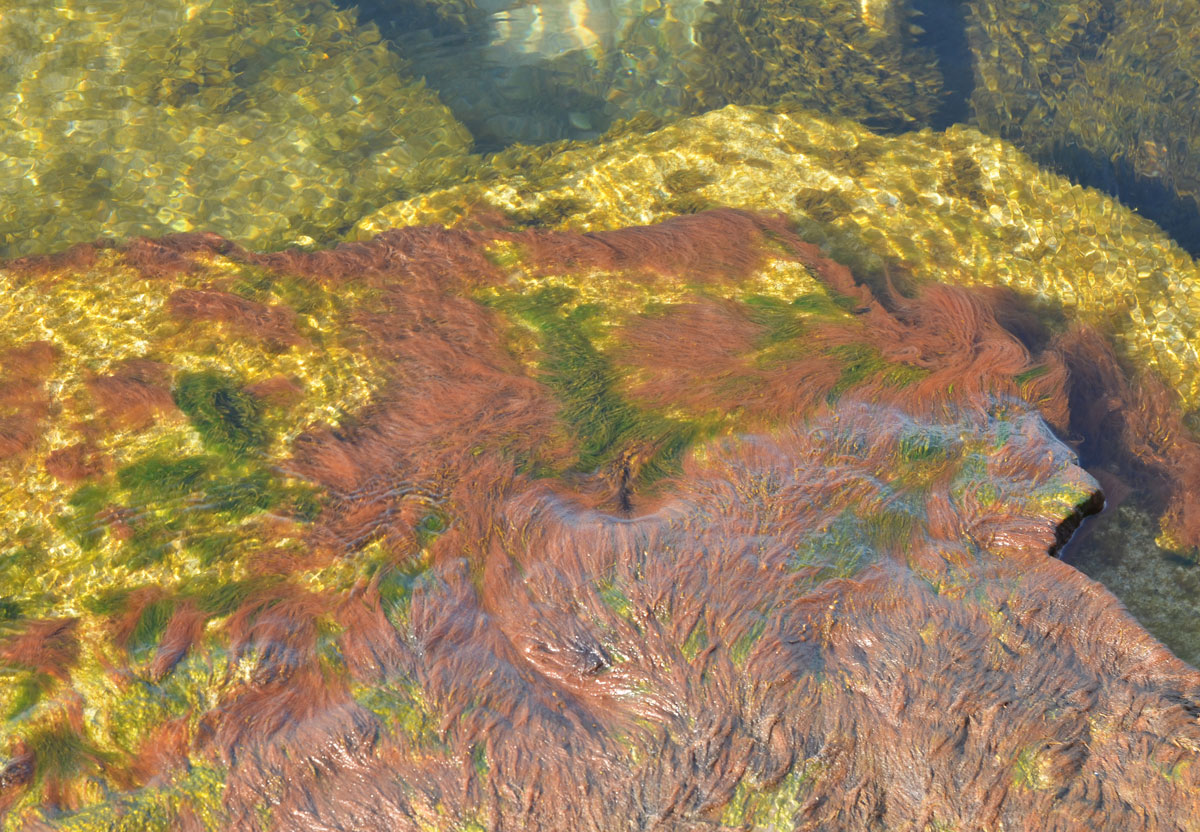
below: Green and brown mosses sway with the water currents along the shore of Lake Ontario.

looking in the water beside some rocks. There is moss and algae in green, yellow, rust and brown swirling in the water of Lake Ontario

the end of a shovel is in the ground, behind a chainlink fence. The sun is shining and making reflections. The reflection of the chainlink fence is on the shovel.

below: The snow fences have been bundled up and put away for the summer.

rolls of wood slat snow fences bundled away for the summer in large rolls. 4 rolls viewed from the end.

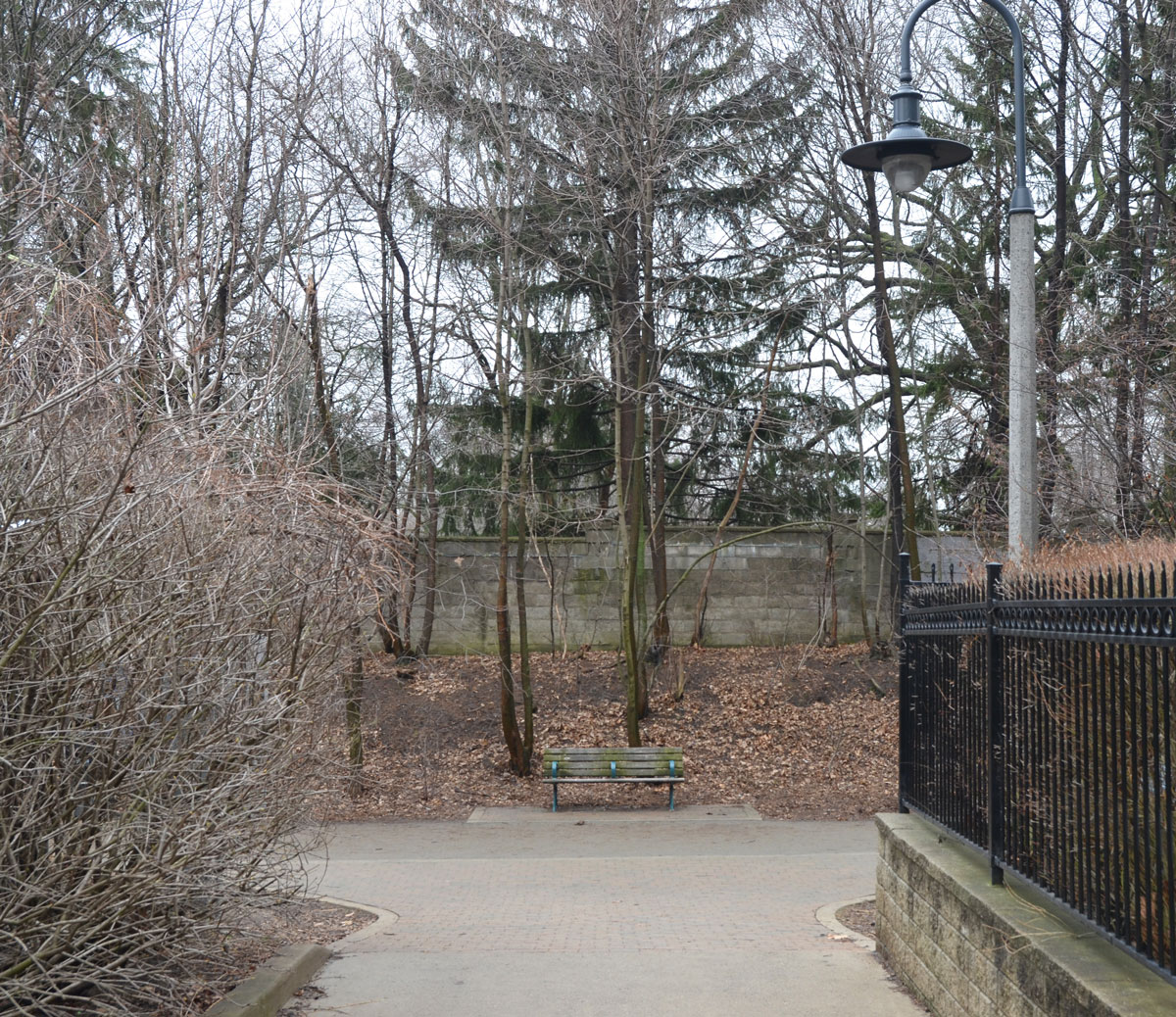
There is time between winter and spring that is a dreary time of greyness and dullness.  It is a time when the the snow is gone but nature hasn’t come out of hibernation.  It is also a time best forgotten.

between winter and spring, the snow has melted, there are no leaves on the trees, the weather is grey, looking down a path that comes to an end in front of a bench. Behind the bench are trees, dead leaves on the ground, and a grey stone fence. dreary, grey

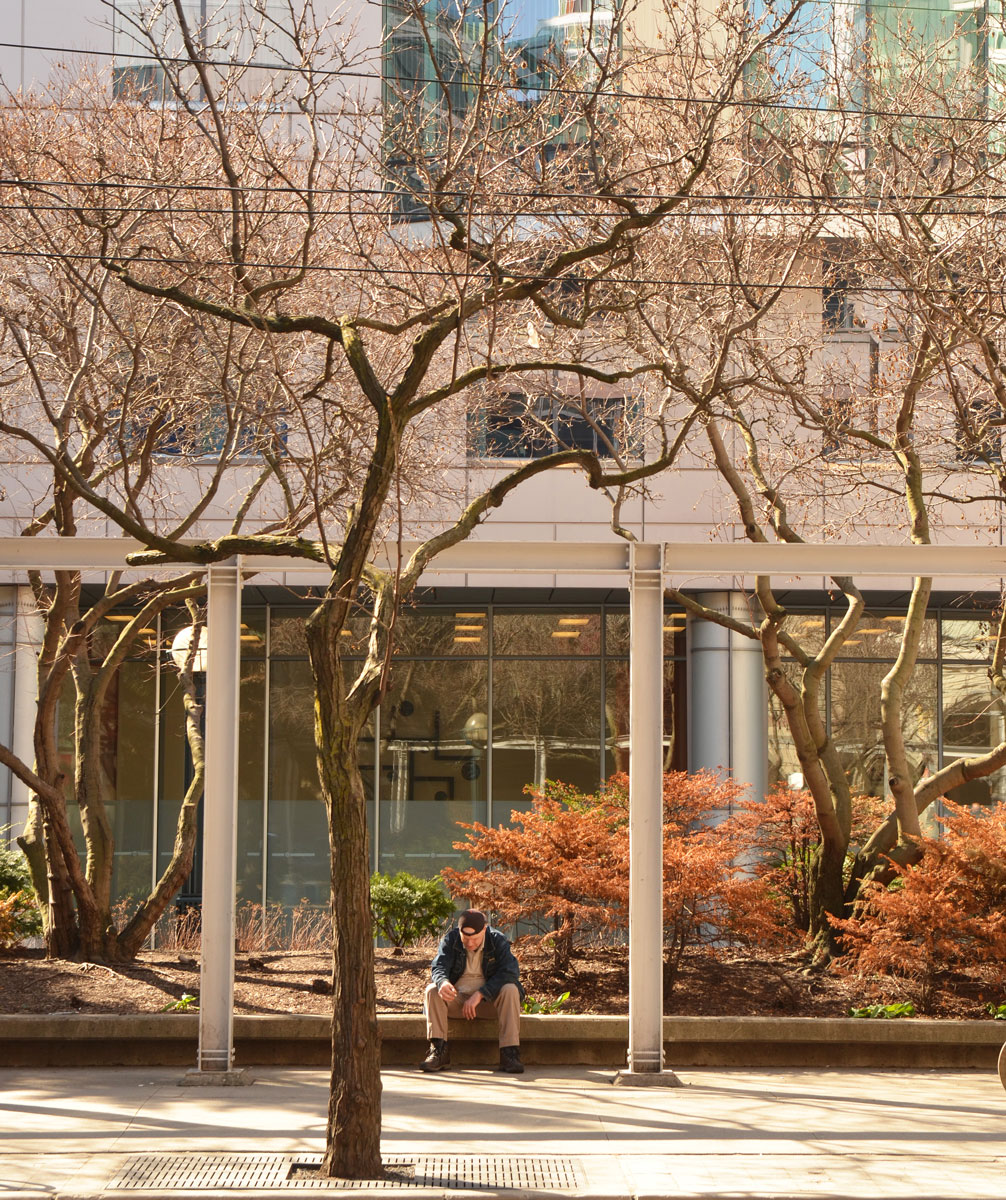
Luckily we don’t have to wait long.
A man sits on the edge of a large planter with trees and shrubs in it in front of Roy Thomson Hall. There are no leaves on the tree yet.

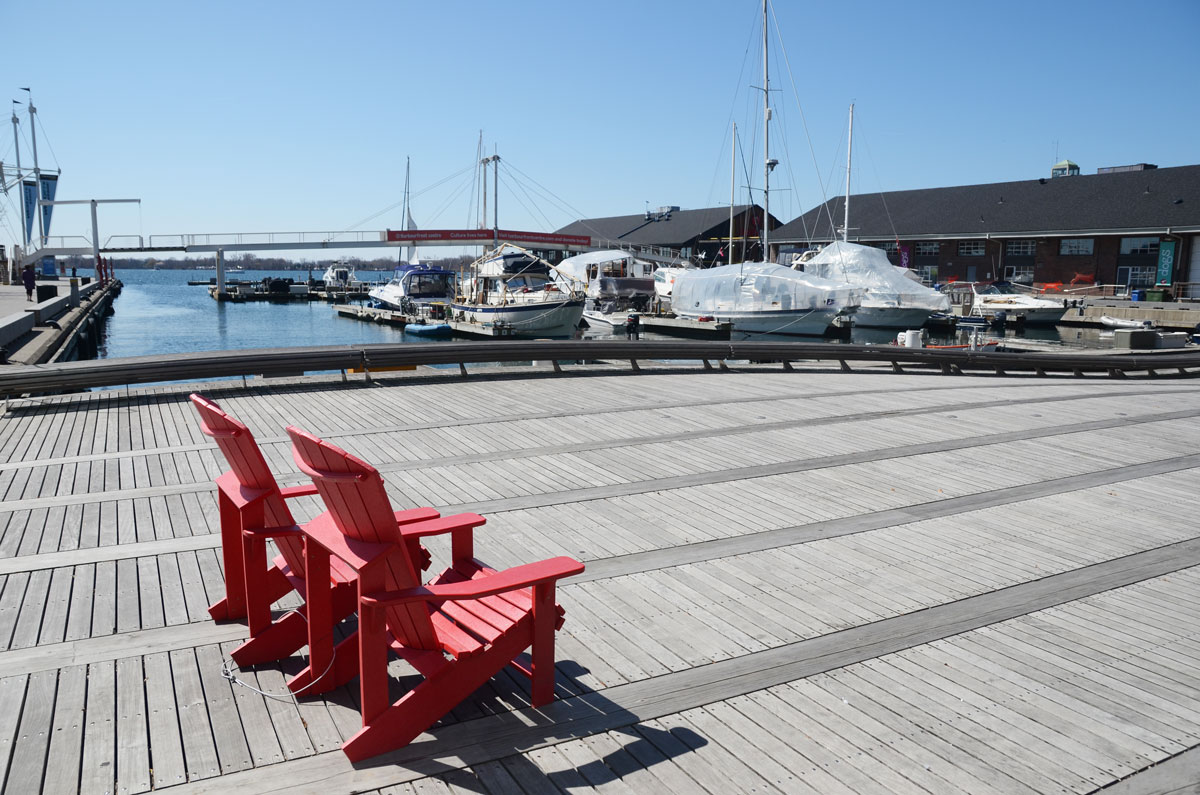
… just a little longer ….

Two red Muskoka chairs sit on the Wave Deck at the waterfront in Toronto. Boats in the harbour are in the background, some with plastic wrap still on them from winter storage.

or if you can’t wait, there’s always plastic!

a garden full of fake flowers, colourful plastic flowers instead of real flowers.

From the time the first spring flowers start to show

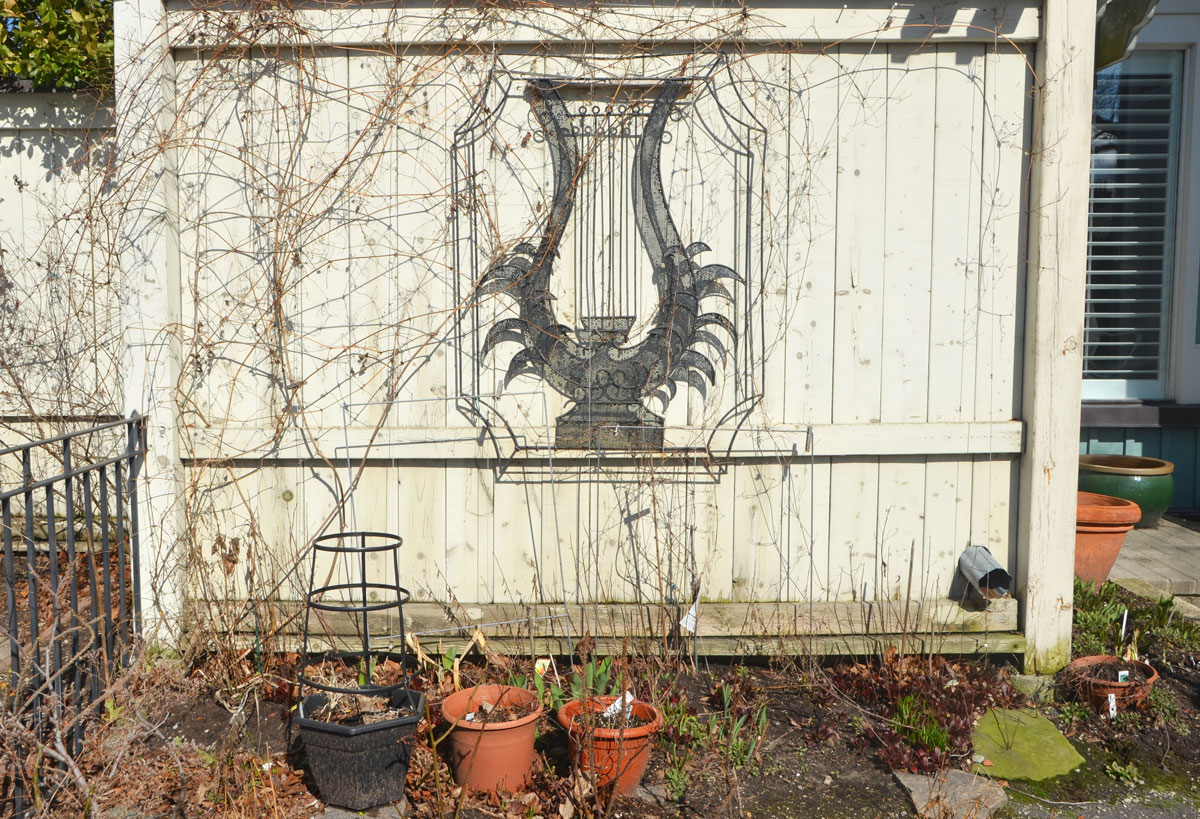
A small white fence with some empty planters in front of it. Old vines are on it (no leaves). There is a frame for plants to cling to in the shape of a lyre that is attached to the fence

until the time they are in full bloom is usually only a matter of days.

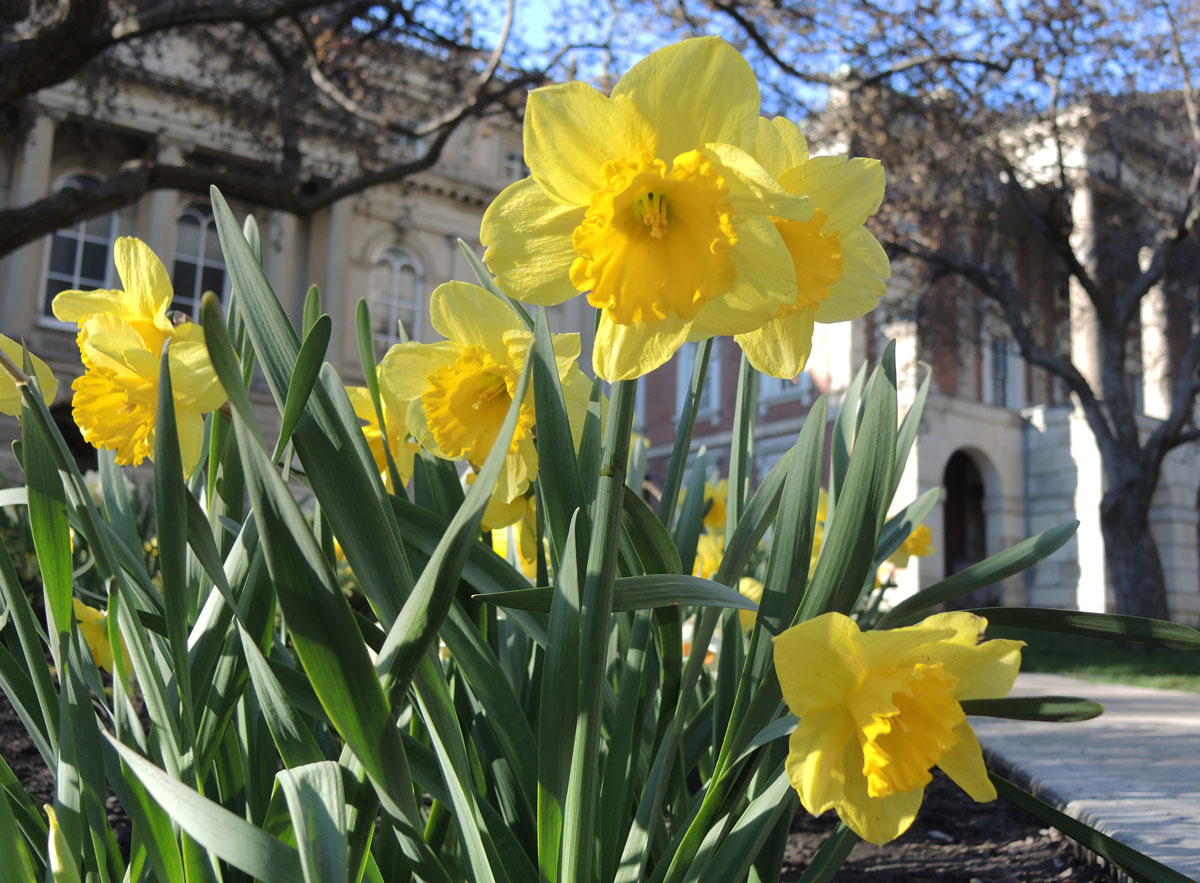
A group of bright yellow daffodils in the sunshine in full bloom with the front of Osgoode Hall on a warm sunny spring day. Blue sky.

Trees too soon show their colours.  The yellows of the willow trees usually appear first.

downtown Toronto, the white curved roof of the Rogers Centre with the CN Tower beside it. WIllow trees and grassy park are in front.
Almost daily the trees are greener…

Budding leaves - The light yellowish green new spring growth on a tree that is growing beside a greenish blue tinted window. Some tree reflections in the window too.

… or full of flowers.

looking upwards from below the branches of a magnolia tree in full bloom. Lots of pink and white flowers, no leaves, on the tree. Bright blue sky in the background. A sunny spring day.

And for another year we forget the last grey days of winter

A rack of geraniums in bloom for sale sitting outside a store. The sidewalk by the store is shaded with white, green and red umbrellas.


Have you ever noticed how many trees there are in this city?
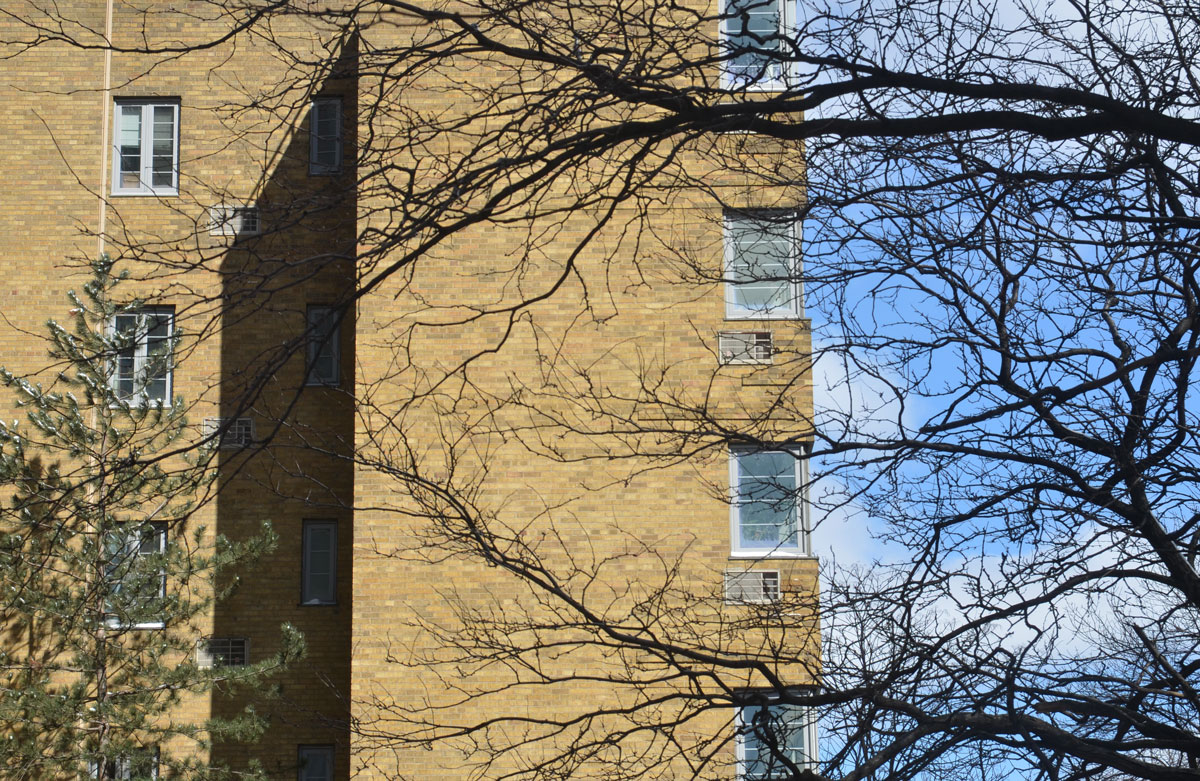
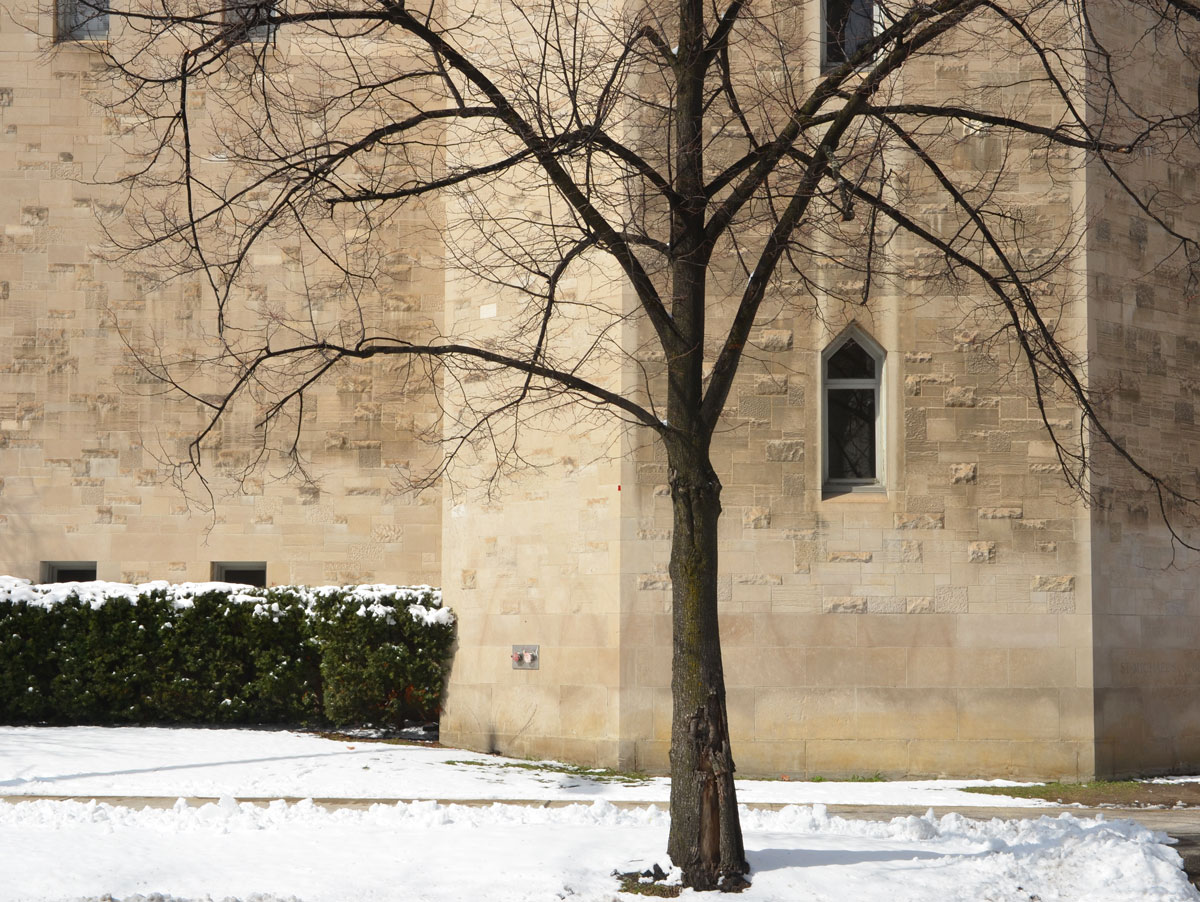
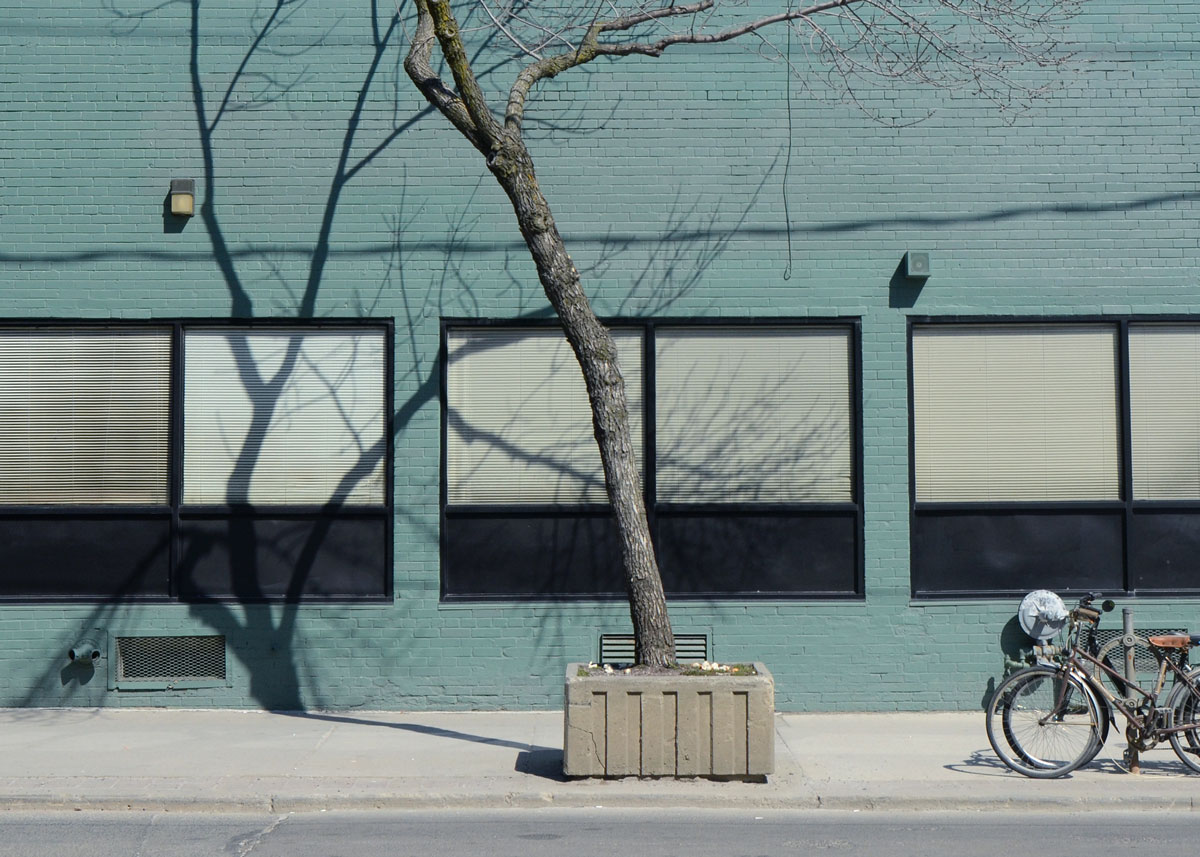
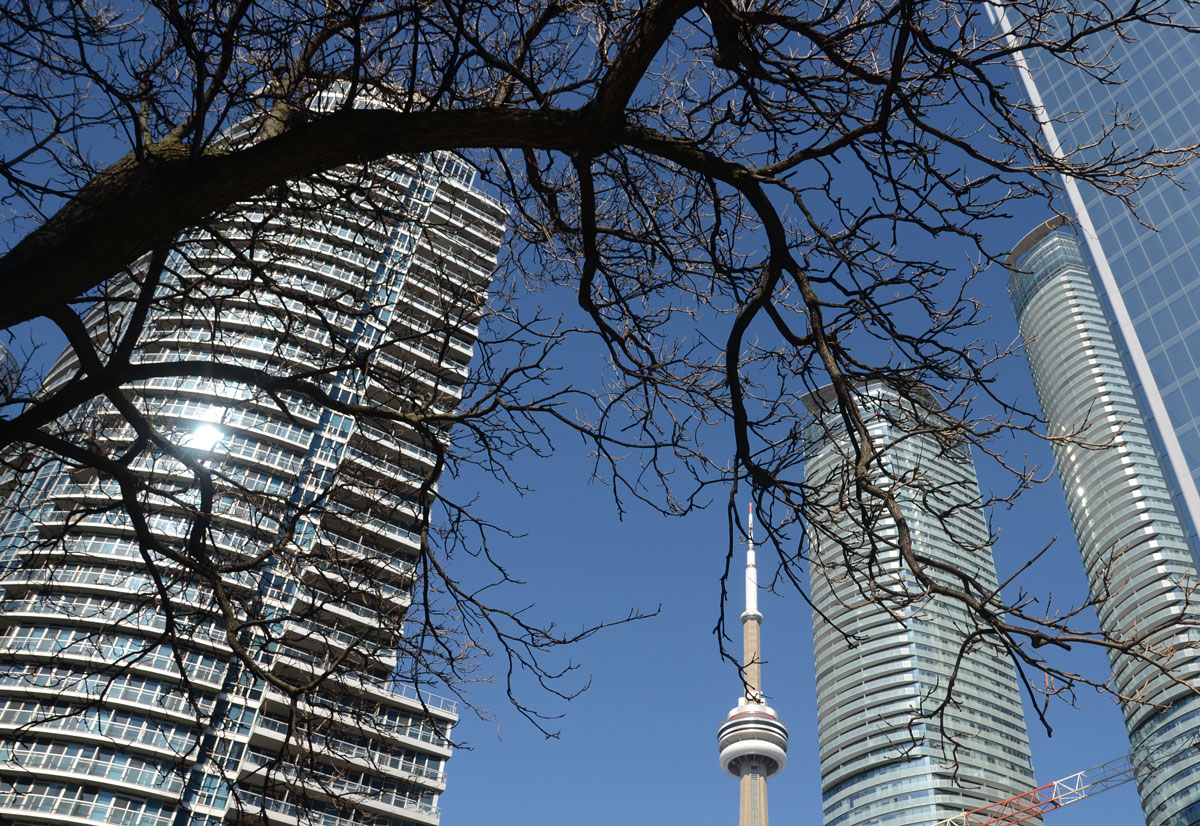
Have you ever stopped to examine the visual relationship between trees and architecture, the patterns of leafless branches superimposed on straight man-made lines?

Horizontal branches of a tree growing in front of a low rise yellowish brown brick apartment building. Balconies, jutting out with the bright blue sky behind.

For the past couple of weeks I have been keeping an eye open for such relationships while I walk.   As it turns out, there are lots to be found…. and some are even interesting  🙂

Part of a mature tree, looking upwards, the greenish steeple of St. Basils church can be seen through the branches. No leaves on the tree. A very tall condo building under construction is also in the picture.

Just for fun I googled “How many trees are there in Toronto?”.  I got answers!  One link was particularly useful:  available in pdf from the City of Toronto’s website is a report titled, “Every Tree Counts: A Portrait of Toronto’s Urban Forest” (updated in 2013).   It is estimated that Toronto has about 10.2 million trees and they provides a tree canopy over between 26% and 28% of the city.

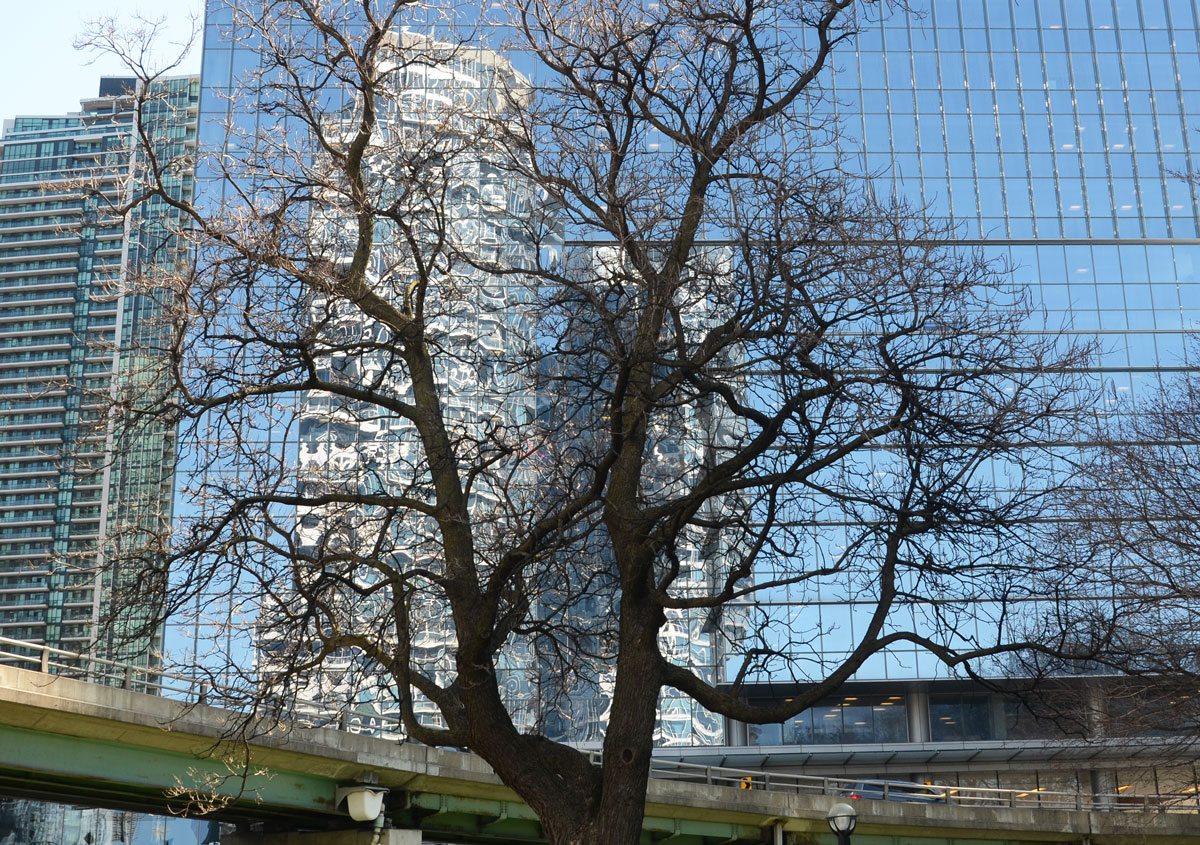
A large mature tree with no leaves, early spring, grows in front of a large glass building that has a reflection of another large building its windows.

There are at least 116 different tree species in the city.  The 10 most common species account for close to 58% of the total.   We have a lot of maple trees – Norway Maple, Sugar Maple, and Manitoba Maple were the top 3 species.  Next in the list were Green Ash, White Spruce, Silver Maple, American Elm, Eastern White Cedar, Austrian Pine, and White Ash.

When Dutch elm disease devastated the city’s elm trees in the 1960s and 1970s many were replaced by Norway maples.  These proved to be hardy but they were also very invasive and damaging to ravines and other natural spaces.  As a result they are rarely planted on city property anymore.  Still, they represent 15% of Toronto’s tree coverage.

A lone smallish sized tree in winter is growing in front of a stone building on the University of Toronto campus, snow on the ground.

Of the total tree population, 6.1 million (60%) trees are on private property, 3.5 million (34%) trees are in parks and ravines, and 0.6 million (6%) trees are on city streets.

A tree in a concrete planter in front of a tral coloured building. It's a sunny day so there is a shadow of the tree on the building.

Trees make a significant contribution to our life.  Not only do they look nice, but they also provide benefits.  They provide shade in the summer and they help improve the air quality.  They help prevent erosion in our ravines and they provide habitat for insects, birds and animals.  Our parks would be poorer places without trees.

A large branch of a tree in the foreground, condos and the CN tower in the background. The curve of the tree branch looks like its wrapping itself around one of the tall condos.

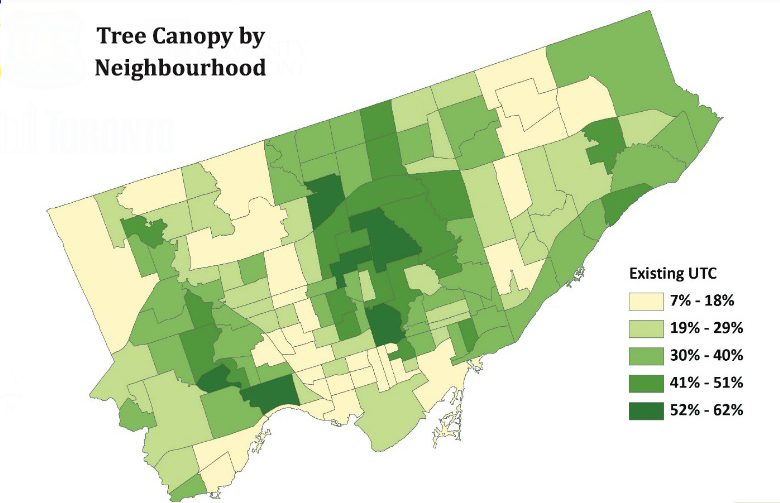
One goal that the city has is to increase the canopy cover over Toronto to 30%.  To this end, between 2004 and 2012 the city and its partners planted almost 100,000 trees per year.   That’s almost 900,000 trees.   Not all survive but progress is being made.  Tree cover increased slightly (1.3%) between 1999 and 2009.

below: A map of Toronto showing the tree canopy in each neighbourhood

A map of Toronto showing the percentage of each neighbourhood covered by tree canopy from almost white (very few trees) to dark green (a lot of trees)

in winter, some snow, part of a large leafless tree in front of an office building with a sloght curve in it.

Take a moment to look at the trees you pass, yes, look up!  Especially in the next week while the branches are still bare.  Better still, look up often and watch the changes unfold as the trees bud and bloom.  At this time of year the trees change quickly and before you know it the city will be transformed.

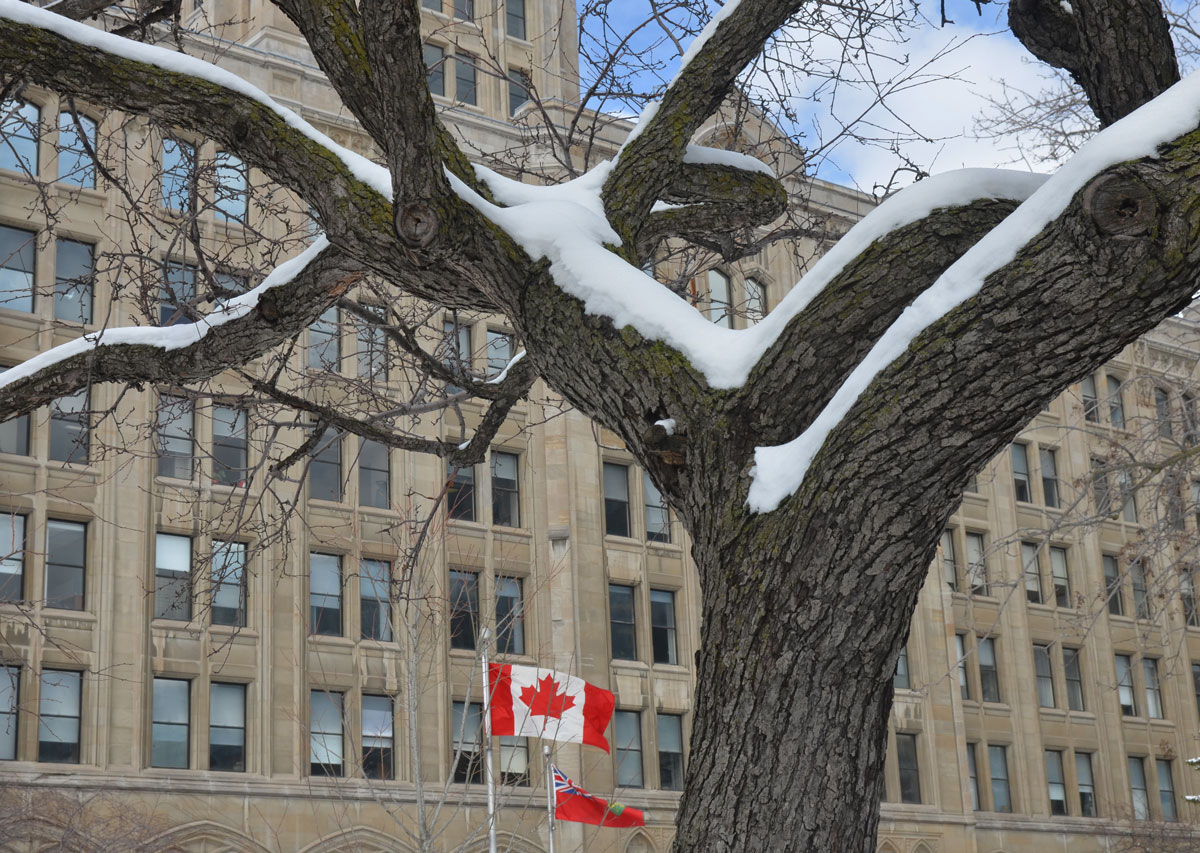
winter tree in front of a stone government building on Queens Park Circle, A Canadian flag and an Ontario flag are flying in front of the building.

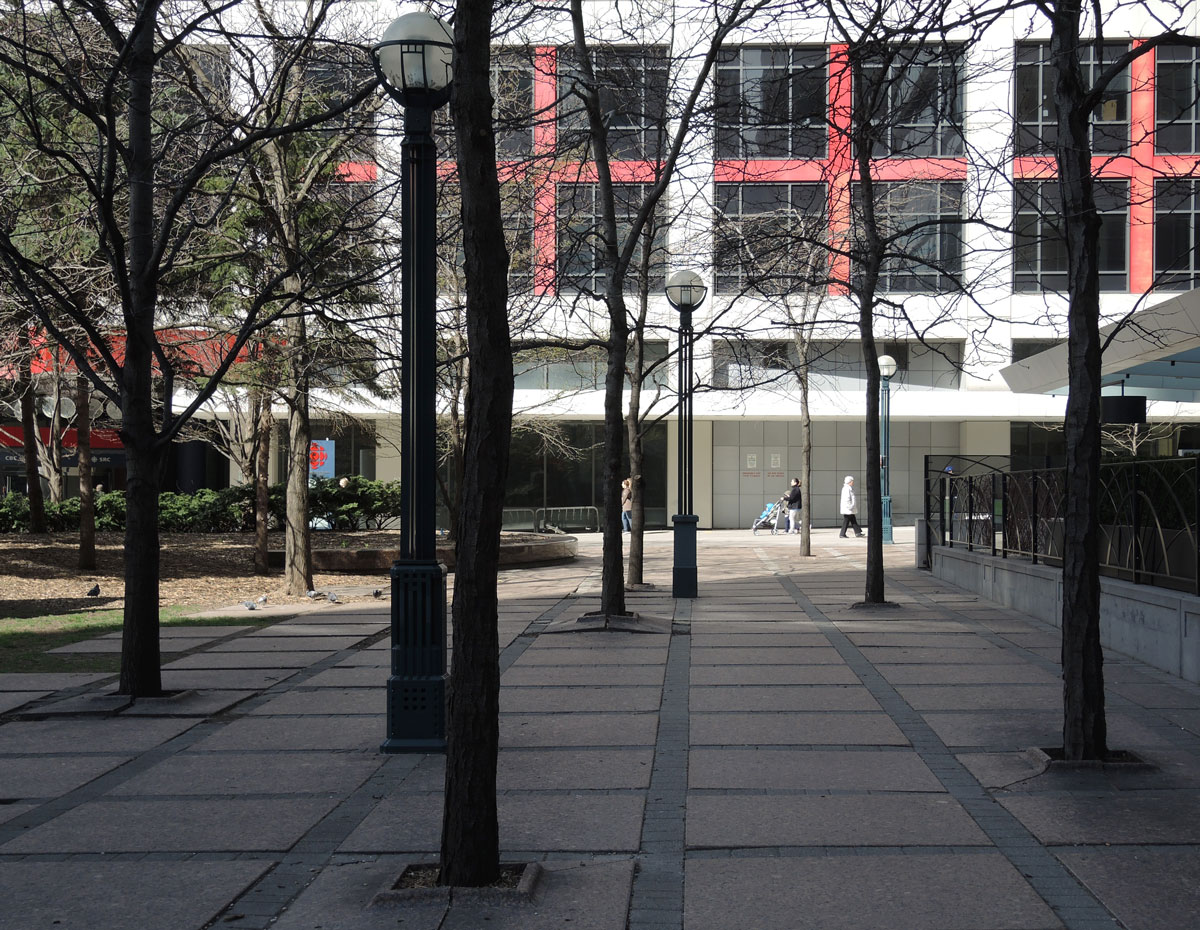
A number of leafless trees and three lamp posts in Simcoe Place, downtown Toronto, with the CBC building in the background

A man's legs as he walks across the pond on Ryerson campus. Very little water is therem lots of reflections of the trees and buildings around. He is wearing jeans and bright orange running shoes.

leafless tree branches above an older red brick house with a mansard black slate roof and a feww yellow brick details

It was a nippy morning at Cherry Beach today. The ice has been off Lake Ontario for a while now and the snow that fell this past week has melted. There was only a small clue that winter is still clinging on.

icicles hang from a stick that is embedded in the sand beside a lake. pebbles, water.

The morning started off grey but it wasn’t long before the sun came out.

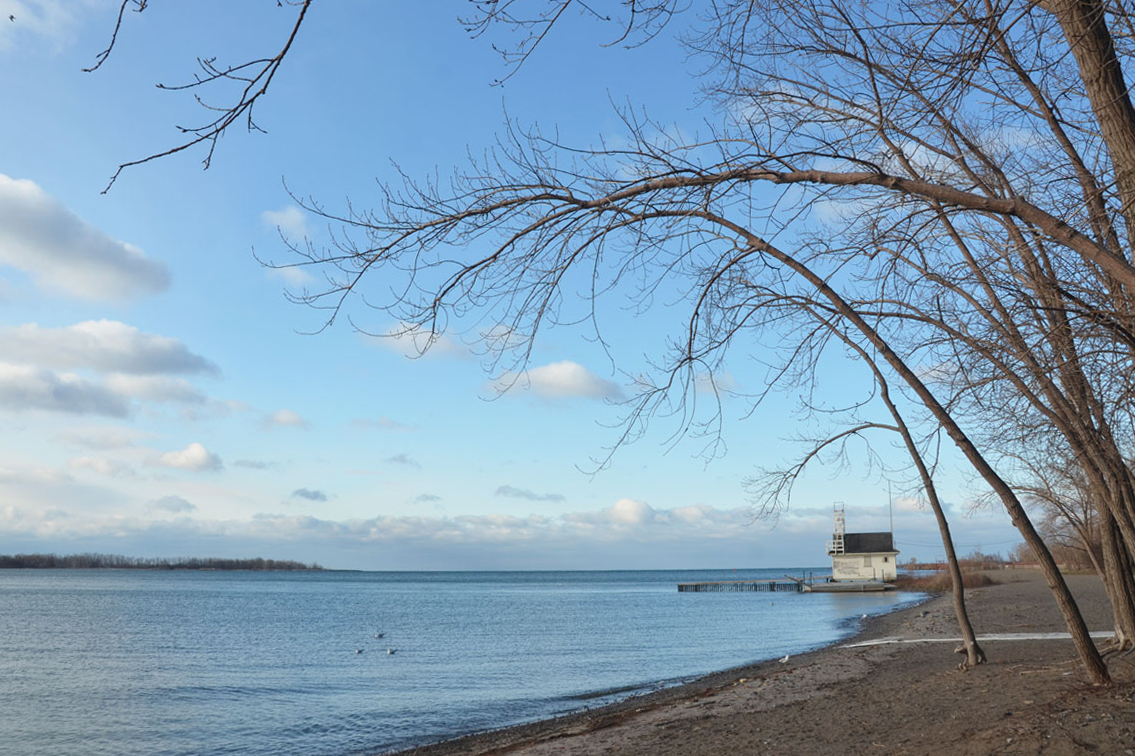
below: Cherry Beach lifesaving station in the distance.

Cherry Beach lifesaving station in the distance, shoreline of Lake Ontario

(Except for a few airplanes and the shouts of a lacrosse tournament in the distance) the only sounds on the beach were the chirps and tweets of birds and the squawking of seagulls.
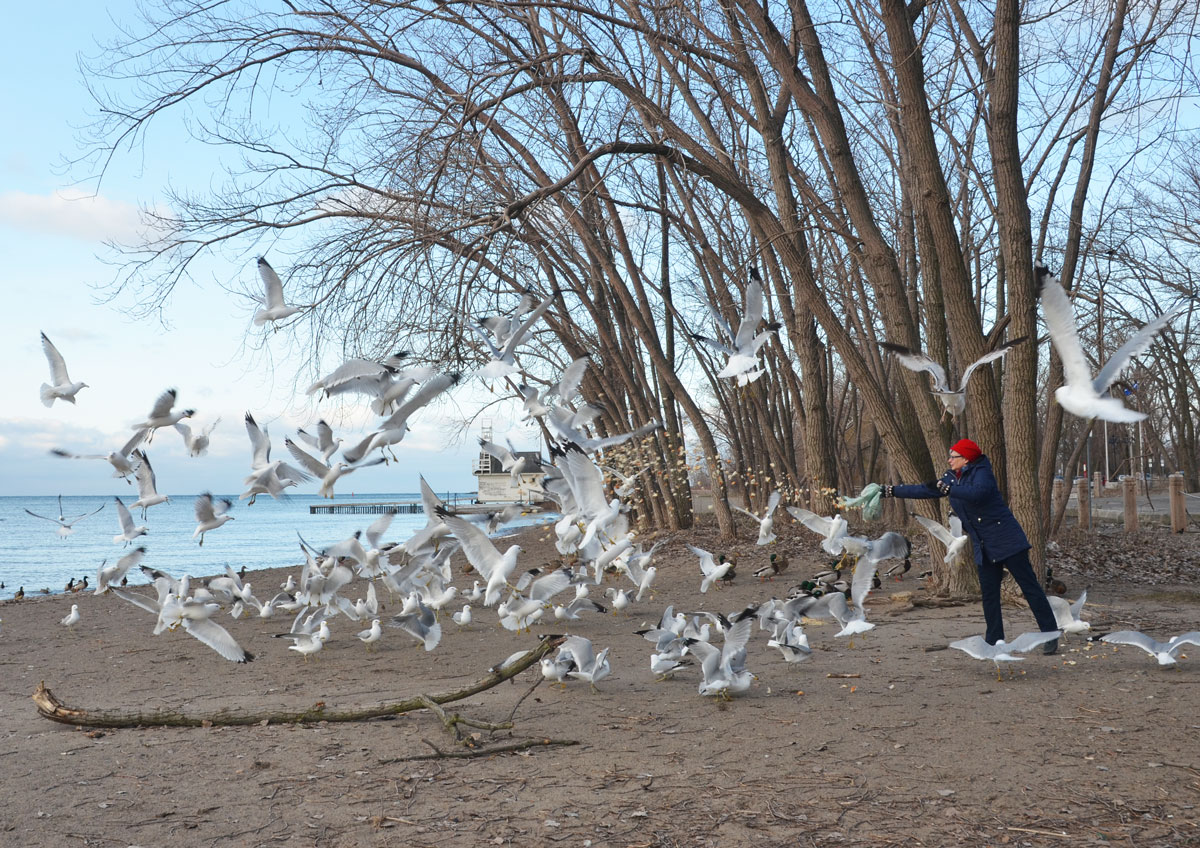
The noises increased when food arrived!

a woman wearing a bright red hat is feeding the seagulls, ducks and other birds at Cherry Beach. sand, water, Lake Ontario. There are lots of seagulls.

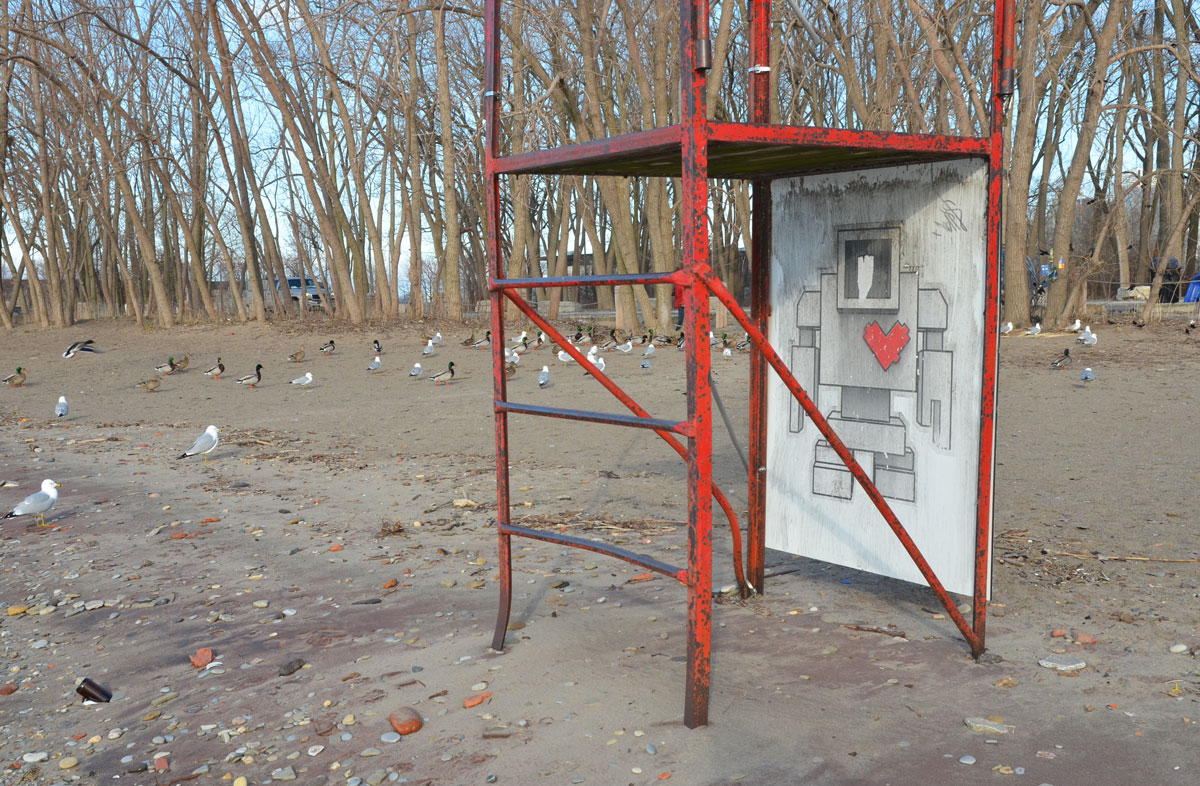
There was even a lovebot hanging out at the beach, standing tall at the lifeguard chair.

an empty red metal frame lifeguard chair on the beach in early spring, no leaves on the trees. Cherry Beach, Lake Ontario. There is a large lovebot wheatpaste on the lifeguard chair.

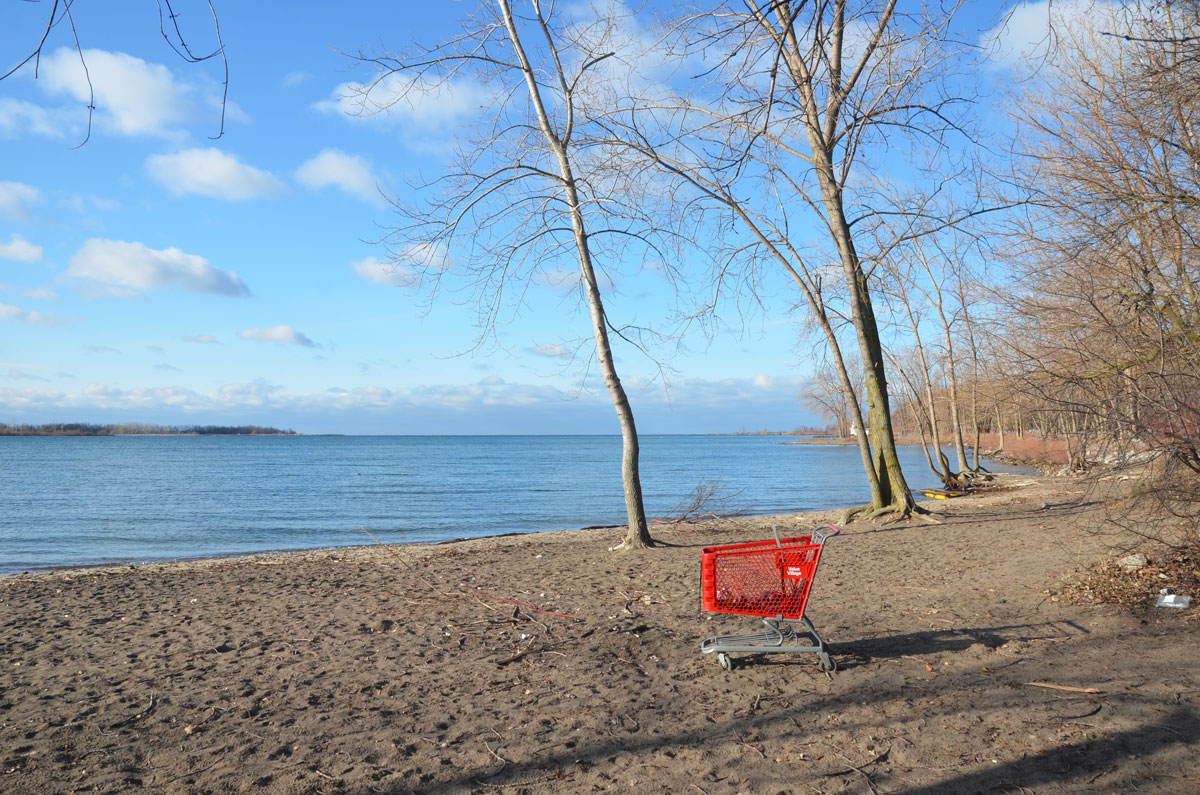
an abandoned red plastic shopping cart with a Value Village label on a beach, long shadows, a few trees, Cherry Beach, Lake Ontario. There are some empty cans in the cart

A spindly leafless tree with knotted gnarly roots above the ground, on the beach beside Lake Ontario. small waves catching the sunlight, morning sun, small rocks and pebbles on the beach

three yellow tires attached to lumber have washed up on the shore and gotten caught in the roots of a shoreline tree, Cherry Beach, Lake Ontario.

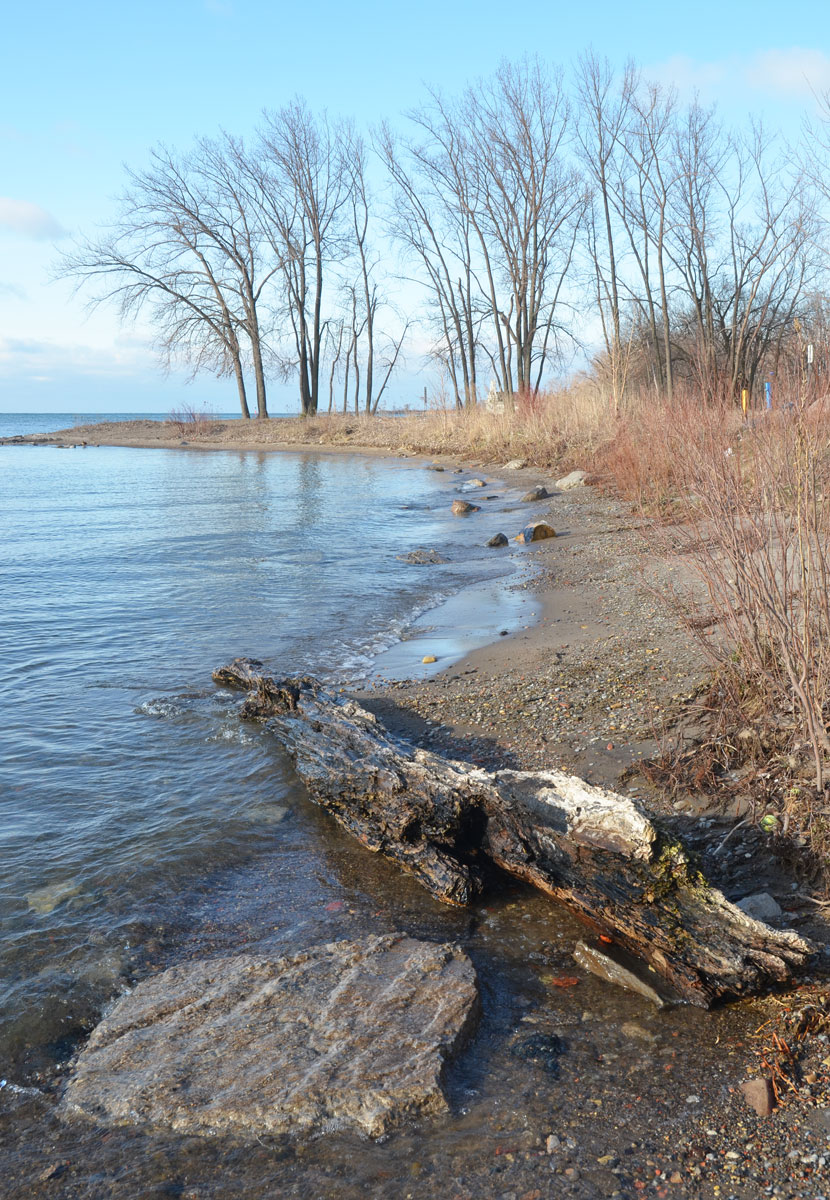
driftwood log, rocks, trees and sand on a beach

shoreline of Lake Ontario, driftwood, sand, trees, shrubs, in spring, no leaves

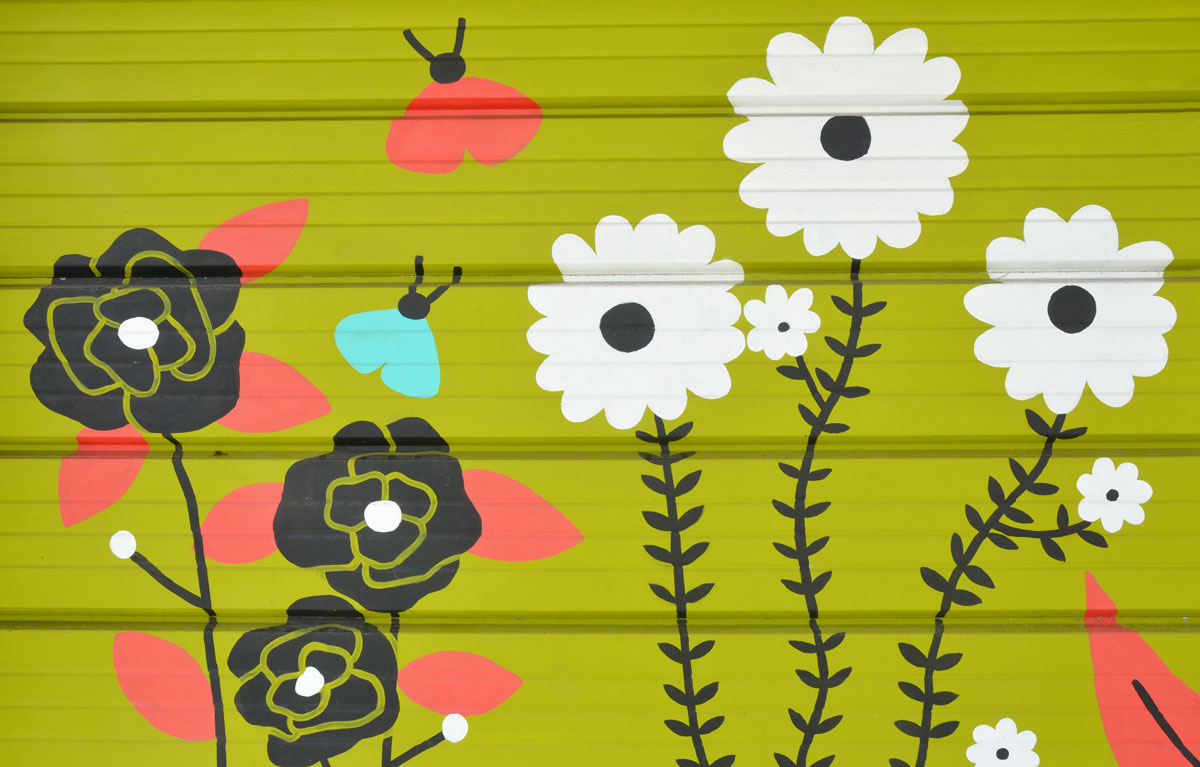
April showers bring May flowers, or so they say.

painted on a garage door, bright green background with black roses with red leaves and white daisies, also with black leaves, a red butterfly and a blue butterfly

BUT, wait just a minute!  You know it always snows in Toronto in April.  Always.

young man's face painted in pink with white features (stylized, not realistic) with orange hair and orange shirt. beside him is the word no written in large pink letters with an exclamation point after it.

And this year is no exception.

drawing of two eyes and a mouth on a grey wall. There is fear in the eyes and the mouth seems to be screaming. Beside the drawing is a window with green metal bars and a small leafless tree growing in front of the window. Snow on the ground.

It’s cold enough that even the poles are wearing scarves.

an old scruffy yellow metal pole in an alley has a black knitted scarf tied around it. There is a bit of snow on the scarf.

But why should that stop us?  There’s always a silver lining and there’s always lemonade to be made.
In this case, it is the opportunity for one last look at the city in winter (we hope!)

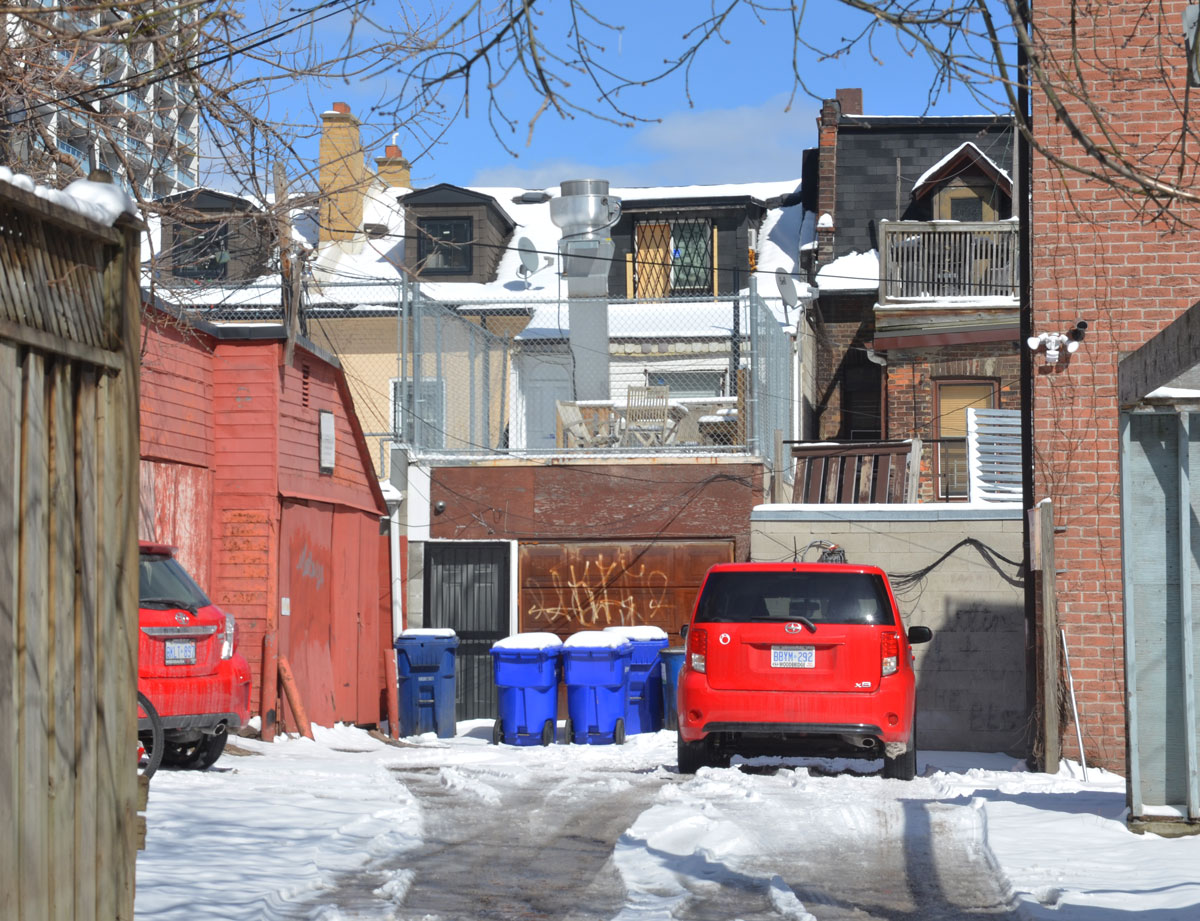
backyard, entrance off alley, little red car parked on snow covered parking lot. blue sky, backs of two storey houses

looking through a backless garage where the garage door is open. The garage is empty. you can see the backyard, covered in snow as well as snow covered steps leading up the second storey

looking down a narrow lane to a large two stroey red brick house across the street, a woman is riding past on a bicycle.. winter scene

The Christmas flower show at Allan Gardens conservatory is back,

which means lots of poinsettias…  over 30 varieties in fact.


many poinsettia plants on display, red ones, white ones and pink poinsettias

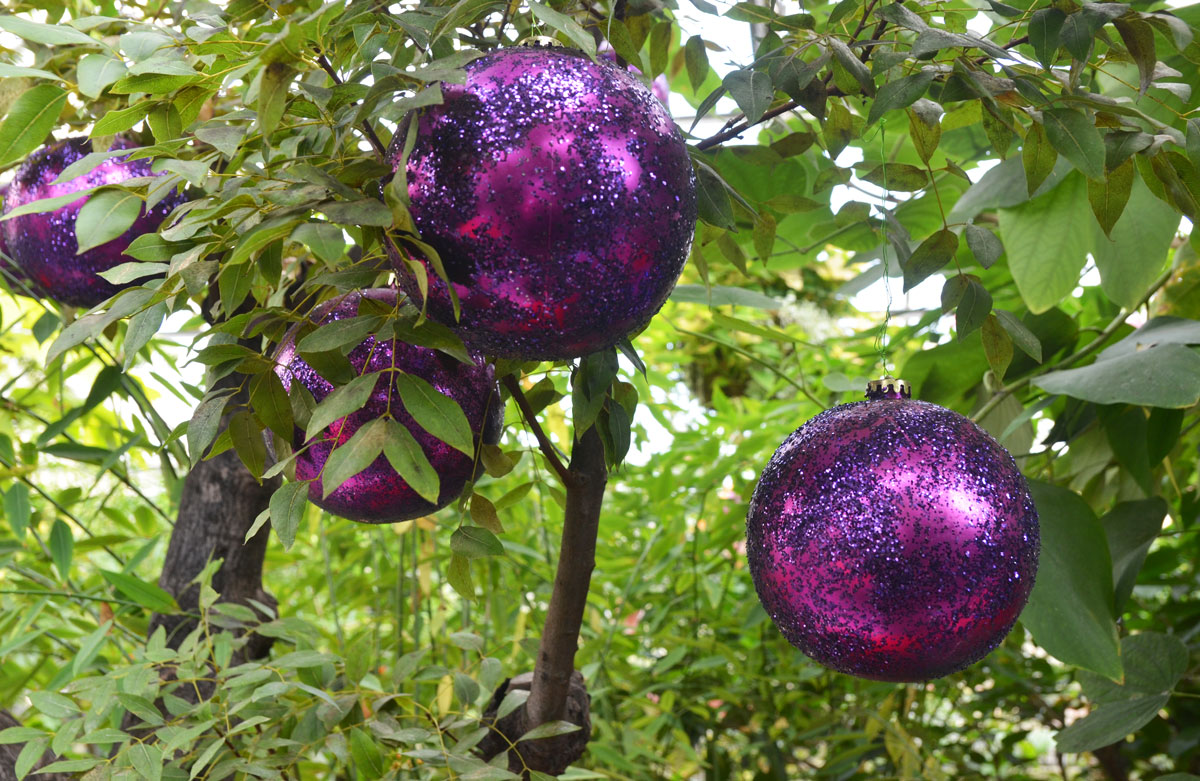
A rare purple glitter ball tree is also in bloom.

large purple Christmas balls with glitter on them, hanging from a tree

below: He has a carrot nose and a corn cob pipe,

cactus and succulents grown on a snowman shape, with a carrot nose and a corn cob pipe in its mouth, and a clay flowerpot for a hat - close up of the head
but he doesn’t look very frosty.  Maybe it’s the red vest that’s keeping the chill away.

cactus and succulents grown on a snowman shape, with a carrot nose and a corn cob pipe in its mouth, and a clay flowerpot for a hat - a vest of red flowering plants and surrounded by a circle of red poinsettias

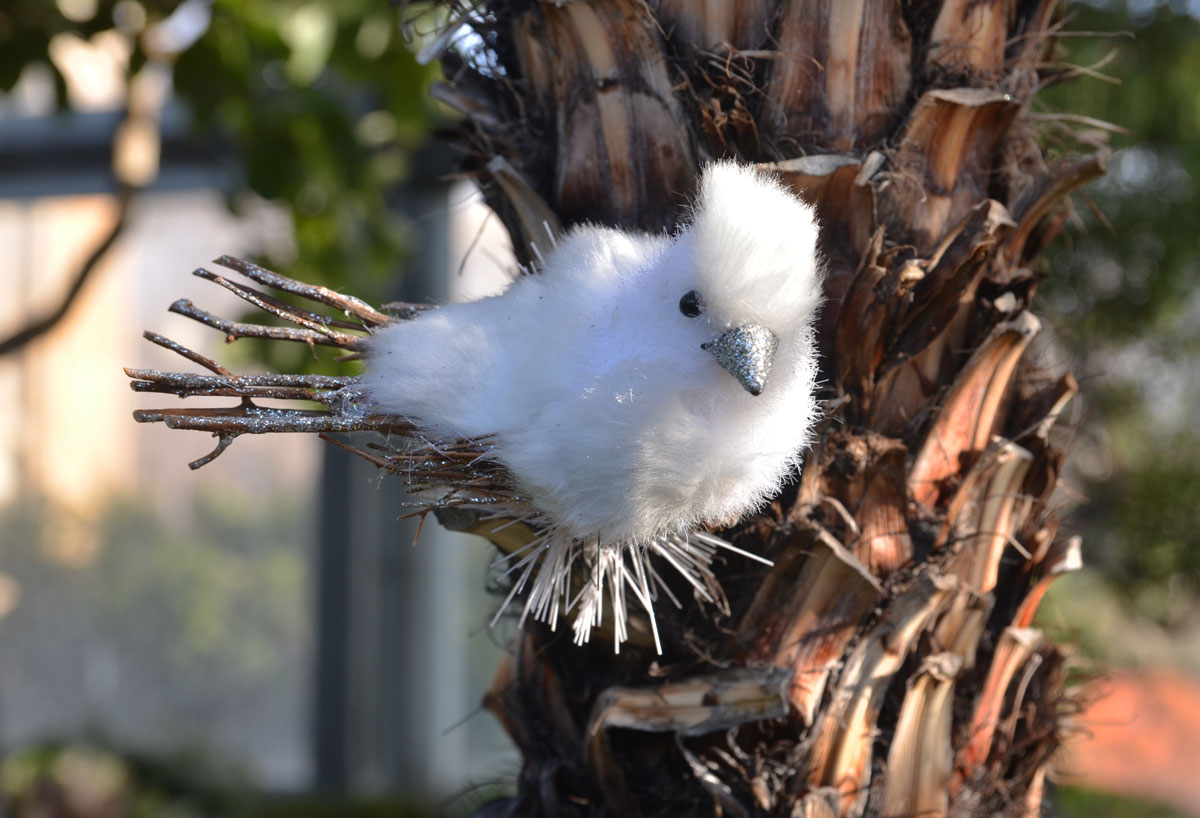
below:  With its silver beak and its twiggy tail, this little fluffy bird perches on a palm tree.

A white bird decoration, not a real bird, with twigs for a tail and for his feet, is perched on the branch of a tree

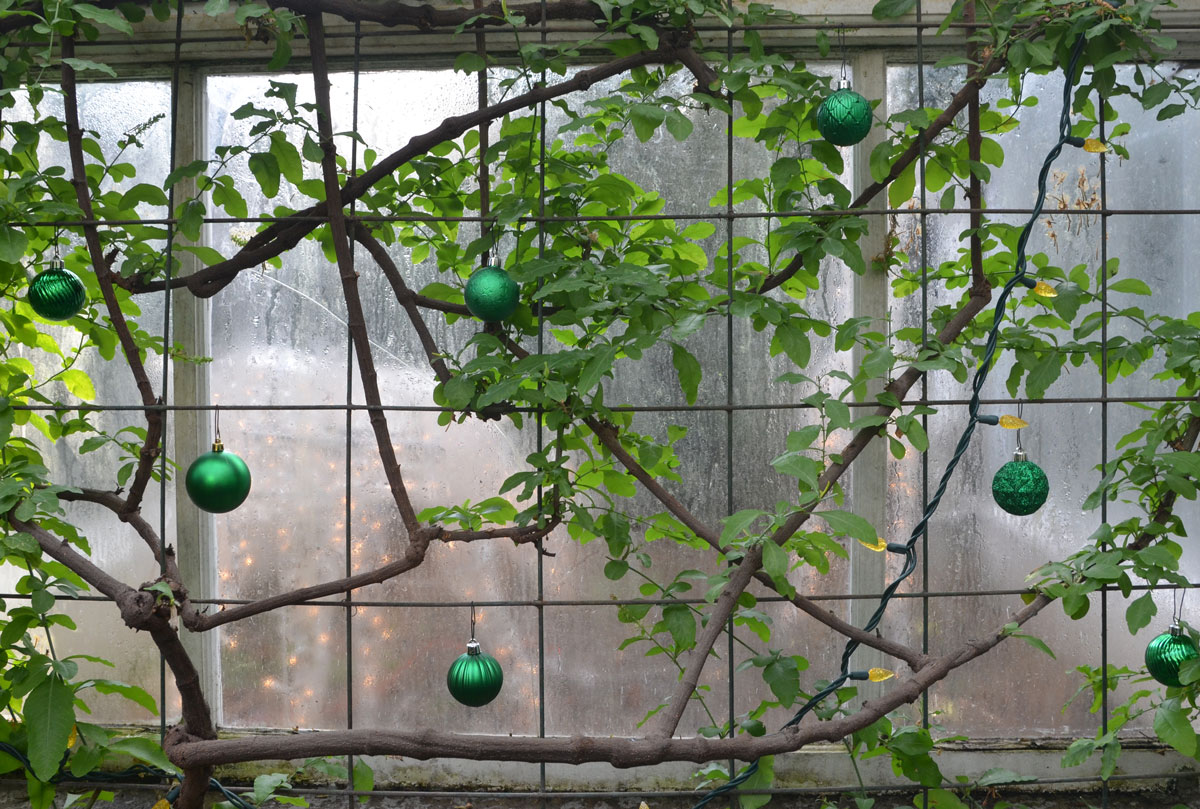
below: Christmas greenery – ever green baubles hang from a vine.

green Christmas balls have been hung from a vine that is growing against the walls of a greenhouse.

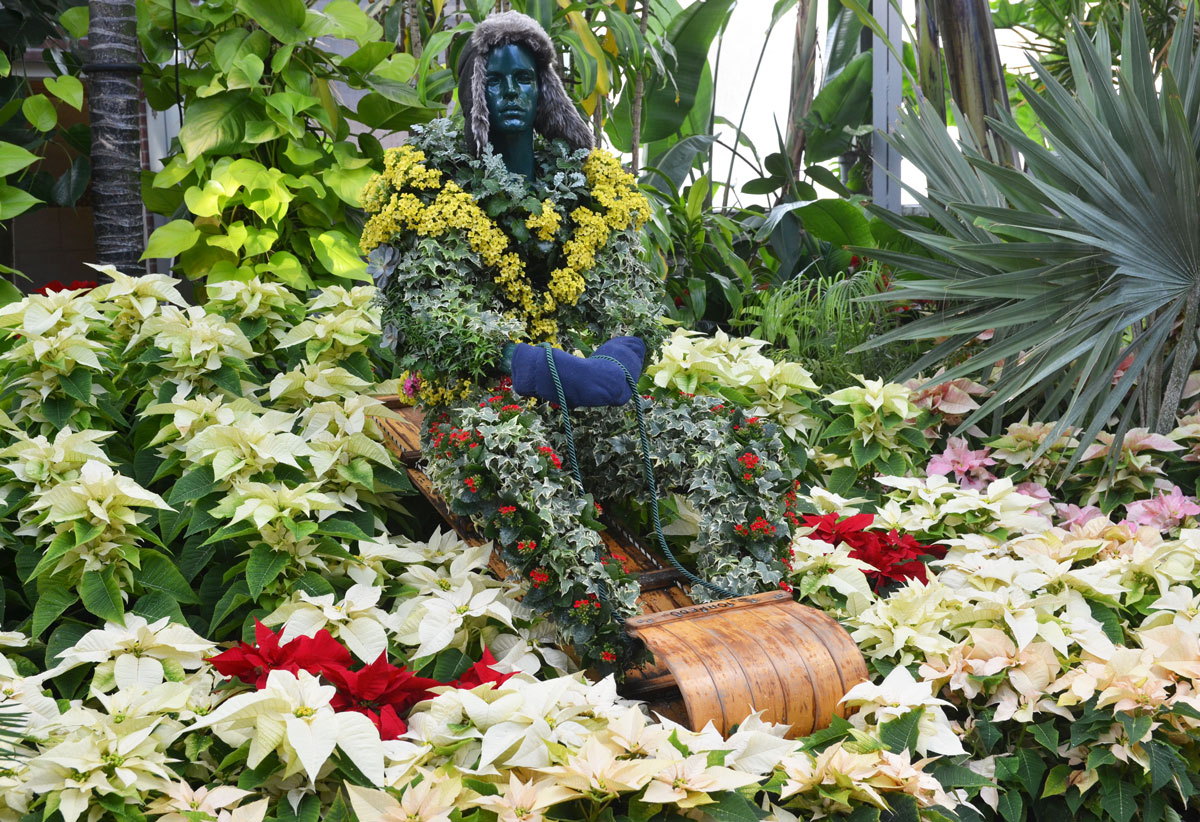
below:  All bundled up for a toboggan ride down a mountain of poinsettias.

topiary in the shape of a person sitting on a wood toboggan, sitting in a pile of poinsettias

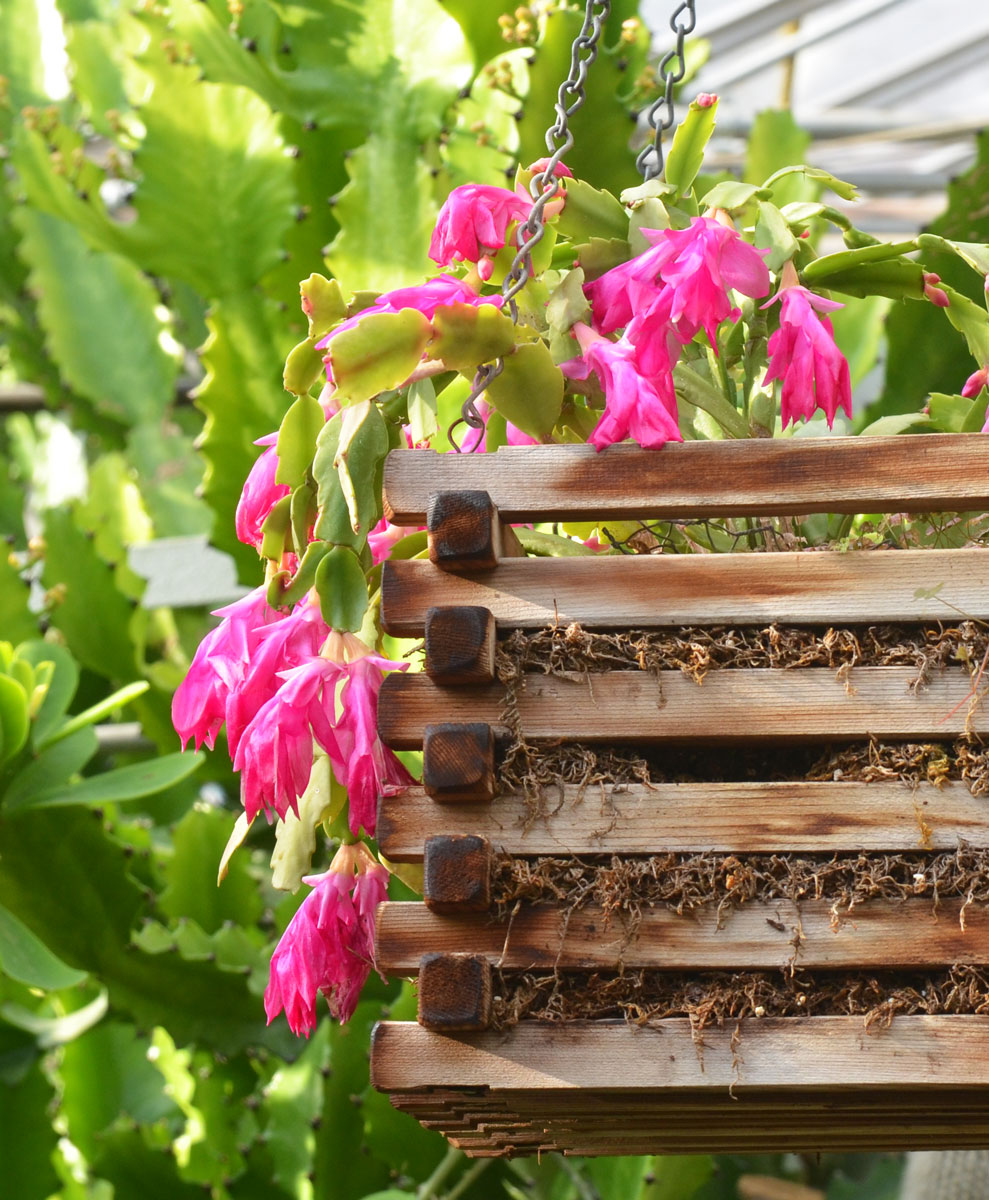
below:  Flowering Christmas cacti hang from the roof.

pink flowers on a Christmas cactus in a wood basket hanging amongst other cacti

In addition to the Christmas plants like poinsettias

close up of a few petals of a white poinsettia plant

and amaryllis,

three red amaryllis blossoms on a plant, standing tall

some of the conservatory’s usual cast of floral characters are on display, such as orchids

two white orchid blossoms in the foreground, red flowers out of focus in the background

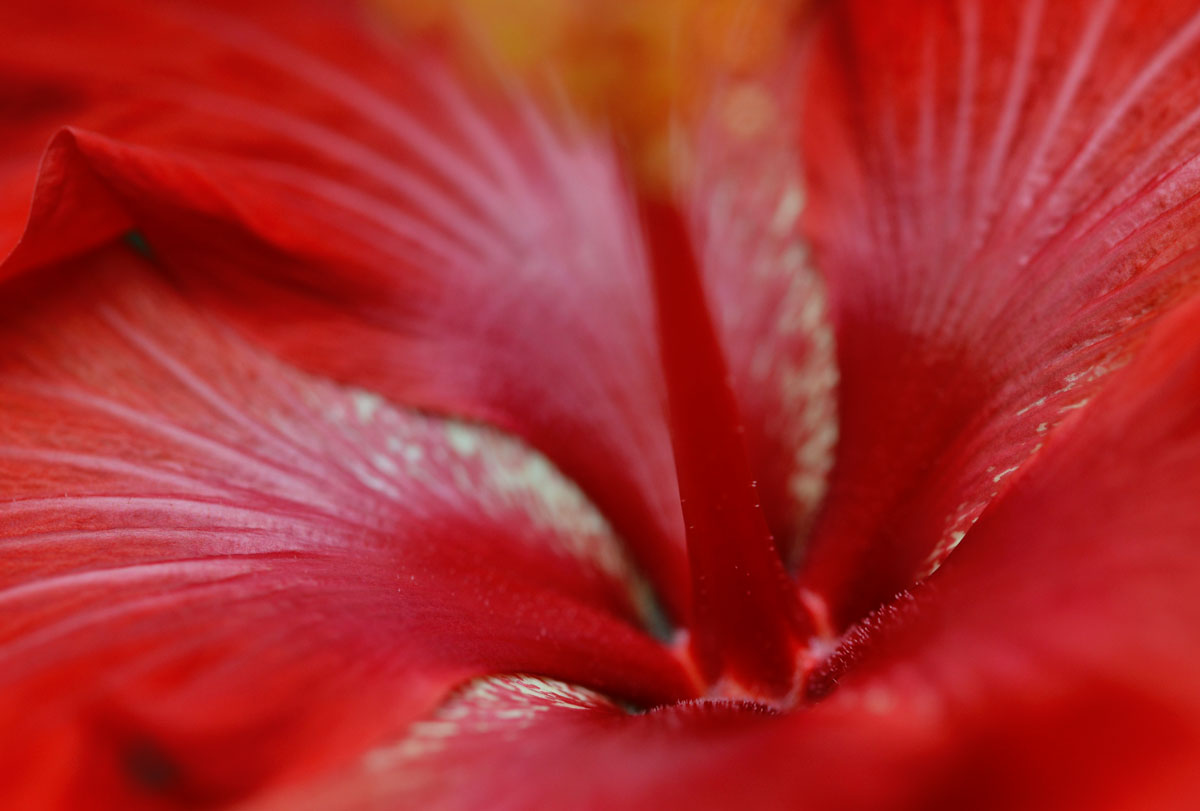
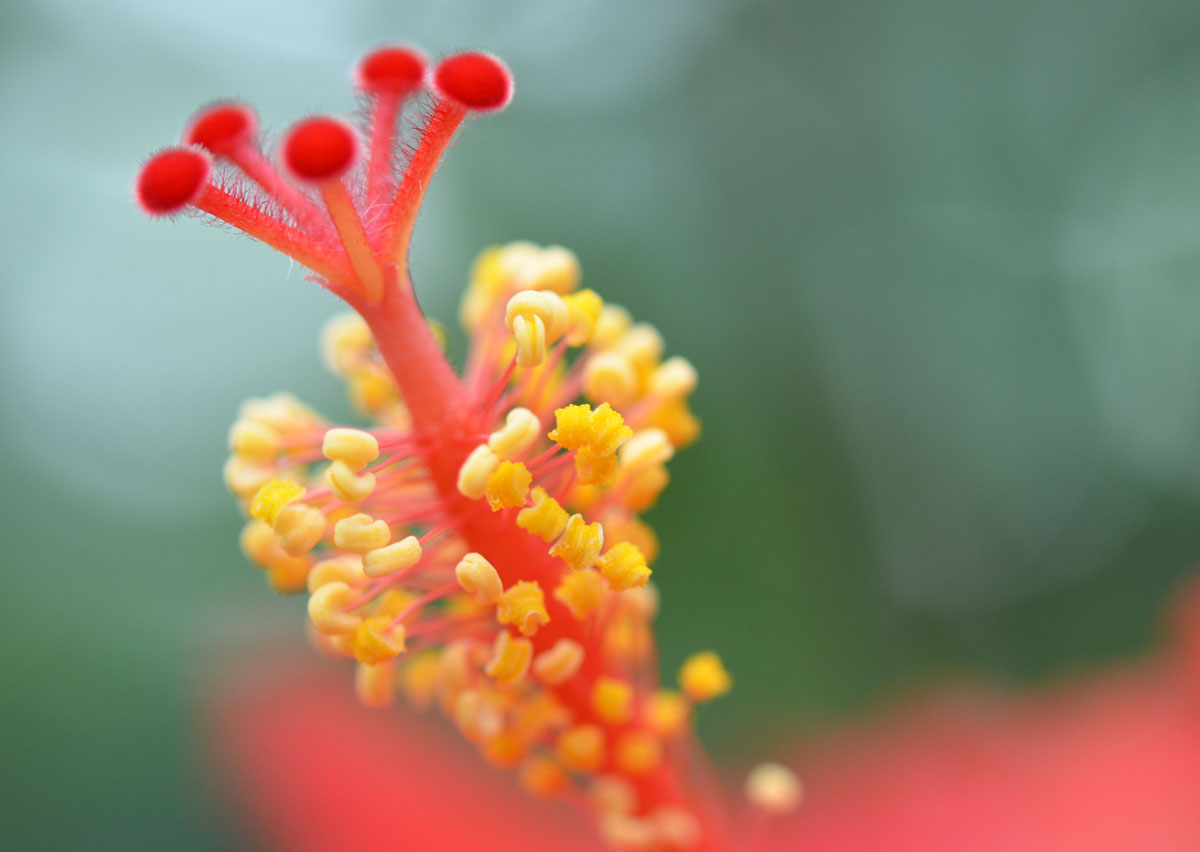
and hibiscus plants.

close up of a red hibiscus flower

close up of a red hibiscus flower

close up of the stamen of an hibiscus plant