Archive for the ‘history’ Category

The first three days of November have been wonderful – three beautiful warm sunny days, perfect fall weather.

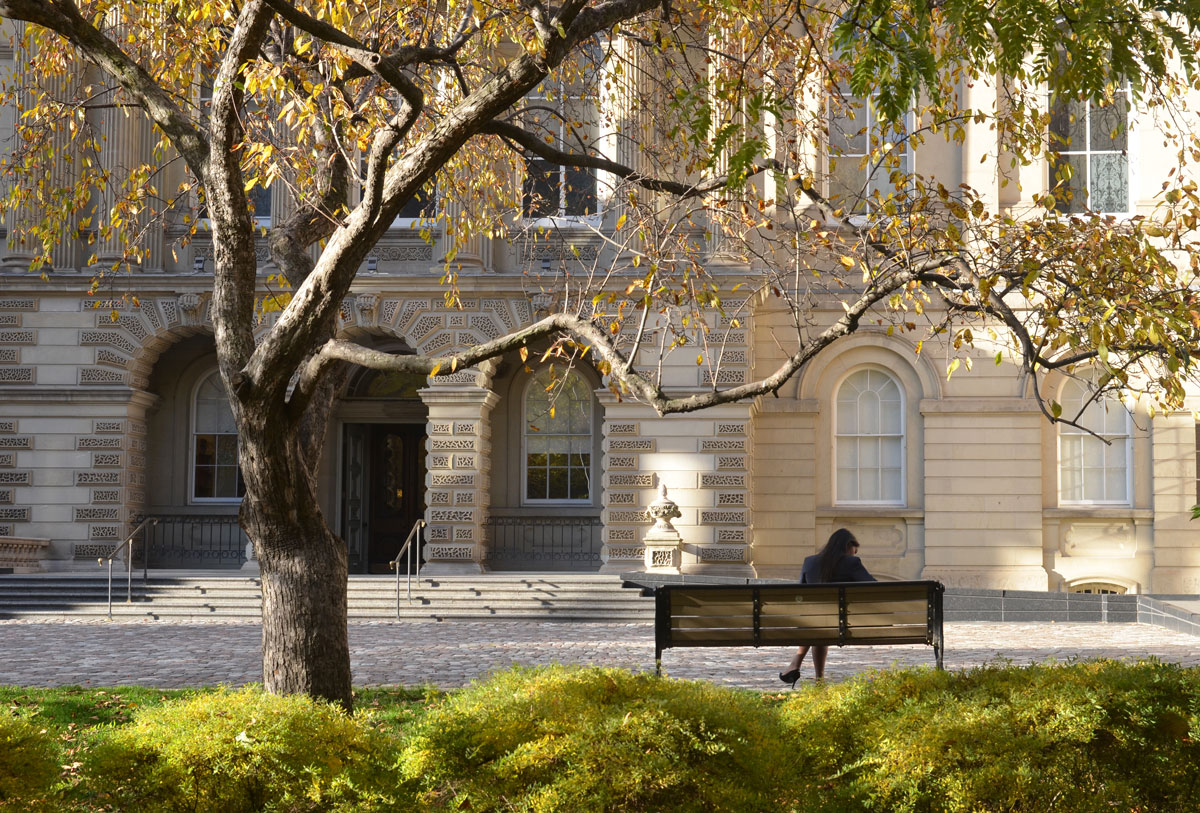
 below: Taking advantage of the warm afternoon in front of Osgoode Hall.

A woman sits on a bench in front of Osgoode Hall, a stone building. Her back is to the camera. A tree with a few yellow leaves frames the picture.

below: On St. George Street in front of Sir Daniel Wilson residence, University College

college on St. George Street, front of the building with black wrought iron fence in front of it along with a few mature trees with some yellow and rust coloured leaves still on them. The clock tower is visible through the tree branches. There are people on the sidewalk in front of the building.

below: Looking across Kings College Circle towards University College

One small tree in the middle of the grass at Kings College circle in front of University College

below: Maple leaves still on the tree.

maple leaves in autumn colours, rust and orange leaves in the foreground, yellow leaves in the background.

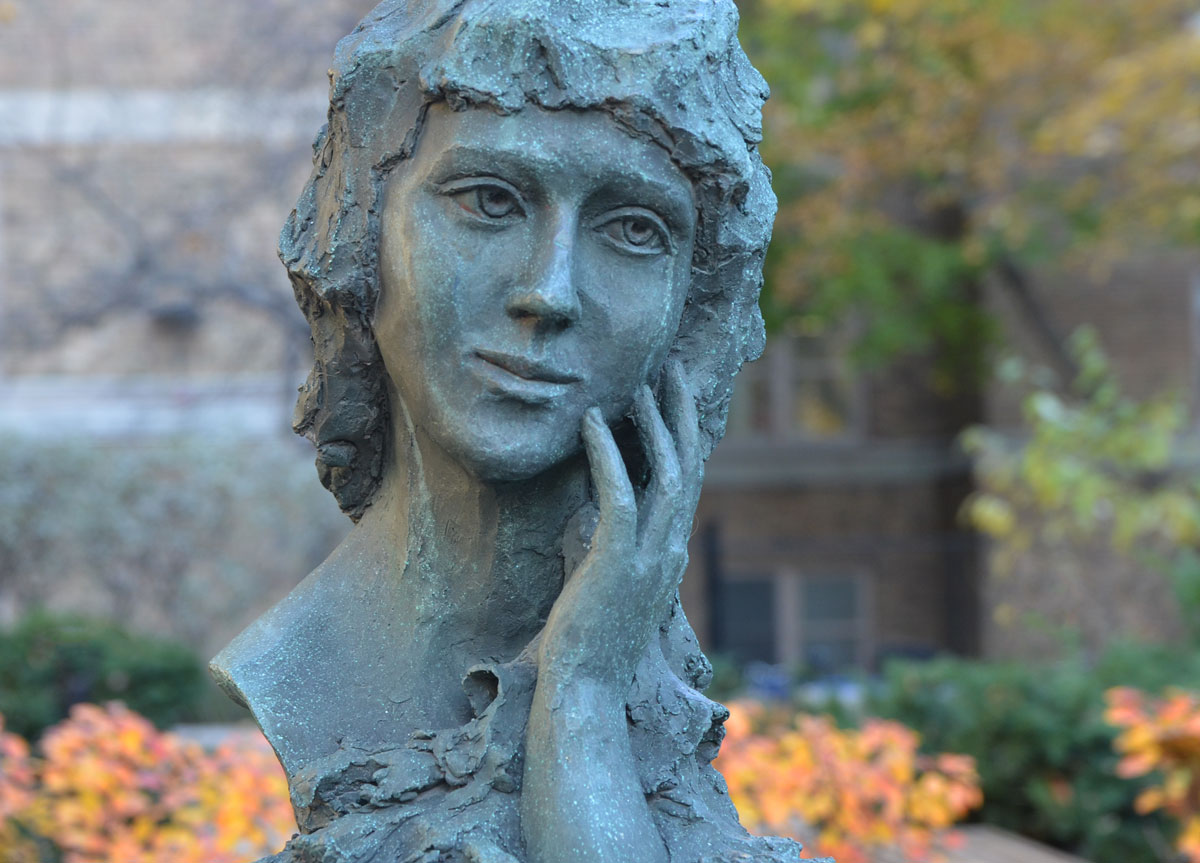
below: Mary Pickford looks over University Avenue.

a bust of Mary Pickford, she is resting her head in one of her hands. In the background is a building along with some bushes and a tree with yellow and orange leaves.

There is an historical plaque beside this statue and it reads: “Born in 1893 in a house which stood near this site, Gladys Marie Smith appeared on stage in Toronto at the age of five. Her theatrical career took her to Broadway in 1907 where she adopted the name Mary Pickford. The actress’s earliest film, “Her First Biscuits”, was released by the Biograph Company in 1909 and she soon established herself as the international cinema’s first great star. Her golden curls and children’s roles endeared her to millions as “America’s Sweetheart”. She was instrumental in founding and directing a major film production company and starred in over fifty feature length films including “Hearts Adrift”, “Pollyanna” and “Coquette”. For the last named film, she received the 1929 Academy Award as the year’s best actress. “

.

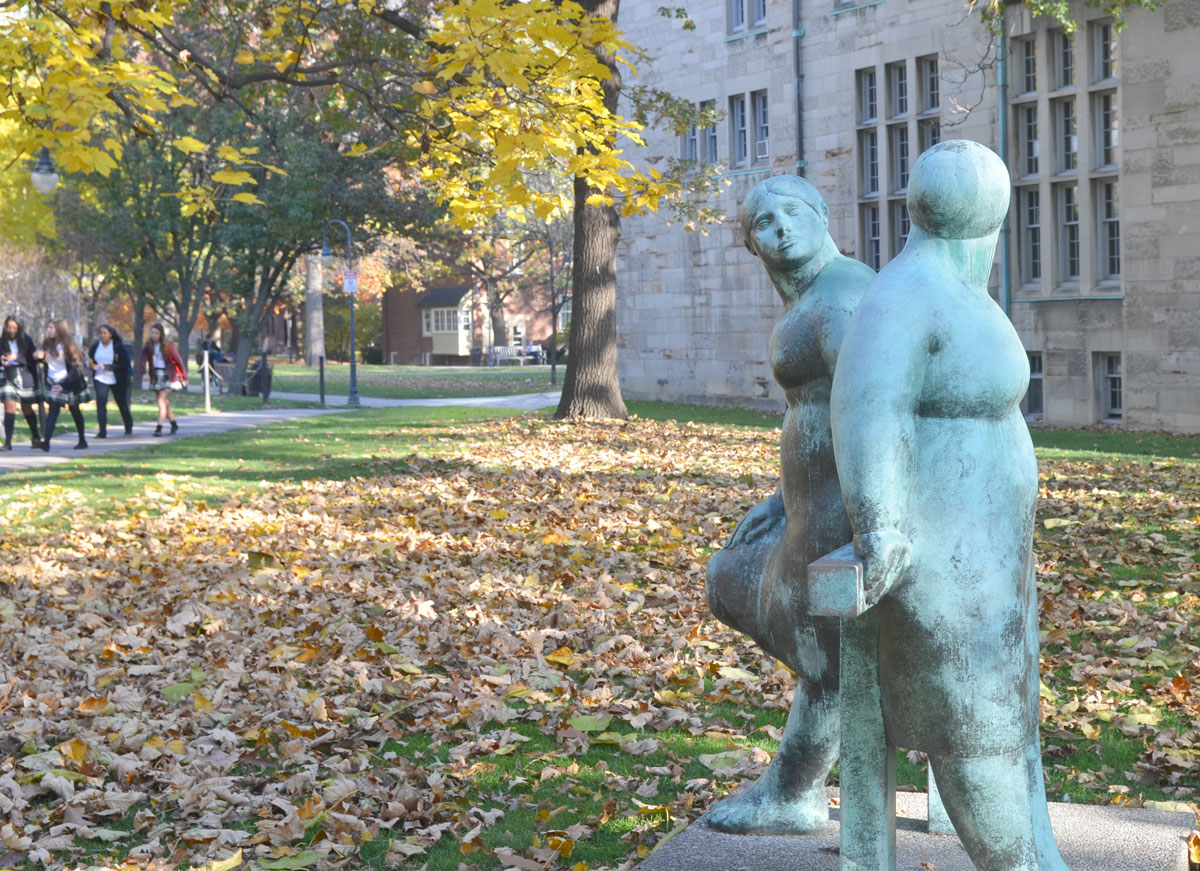
below: Two women outside Emmanuel College, Queens Park Circle

A blueish bronze statue of two overweight women standing facing each other beside a stone building on the University of Toronto campus. It is autumn and there are leaves on the ground. A group of girls is walking in the background.

below: Northrop Frye sits on a bench on the campus of Victoria College (U of T).

A statue of a man, Northrop Frye, sits on a bench with his legs crossed and an open book on his lap. Another book sits beside him on the bench.

This life sized statue was created by Darren Byers and Fred Harrison and was unveiled in October 2012.

.
small purple aster flowers in a garden that is close to being covered with autumn leaves that have fallen off the nearby trees

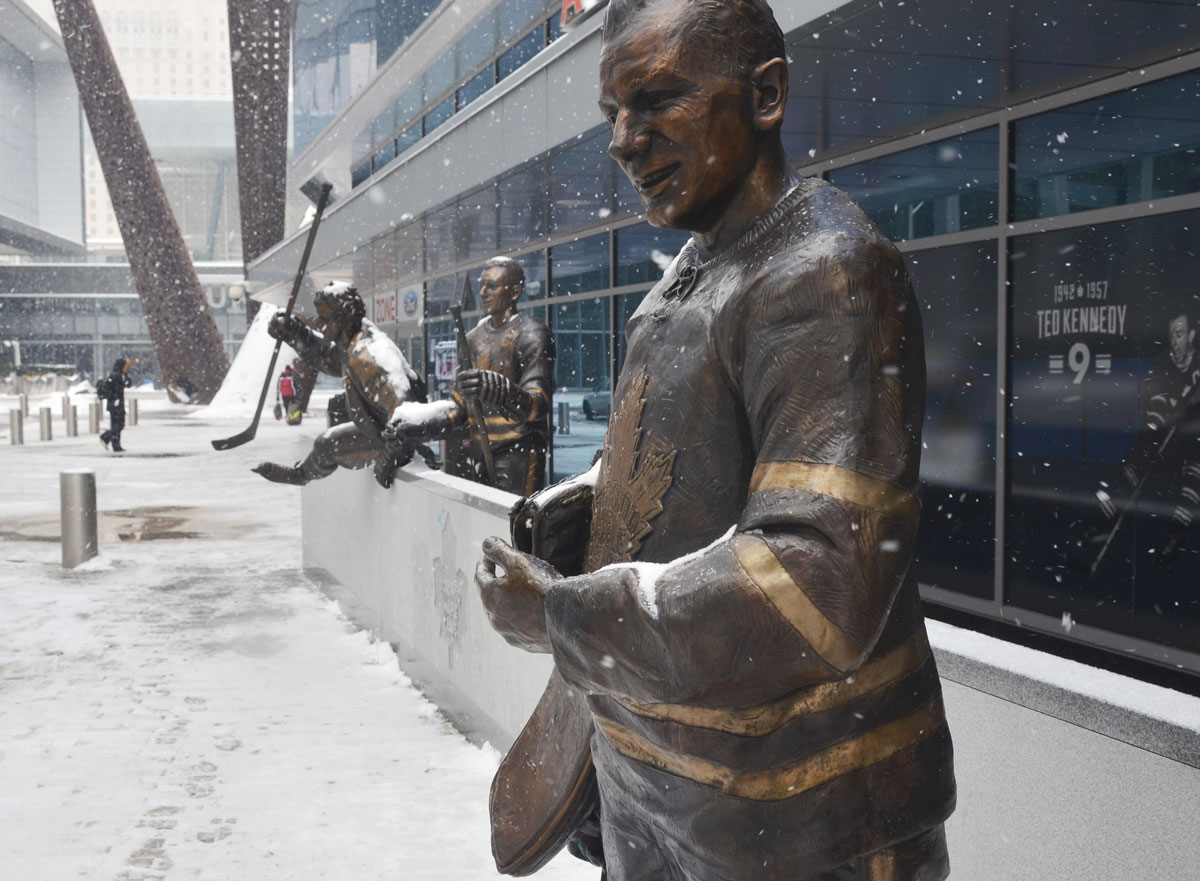
Two new additions to the statues in Legends Row outside the Air Canada Center showed up on this past weekend.  Mats Sundin and Borje Salming have taken their place alongside Darryl Sittler, Ted Kennedy and Johnny Bower.  Salming is cheering from behind the boards while Sundin is on the ice.  I’d say that was Sundin was ready for action but he needs to get his stick on the ice first.  Maybe the game is over and the Maple Leafs have something to celebrate?

Three of the bronze statues of hockey players outside the ACC, Legends Row. Matt Sundin, Borje Salming and Darryl Sittler are in the picture, or at least their statues are.

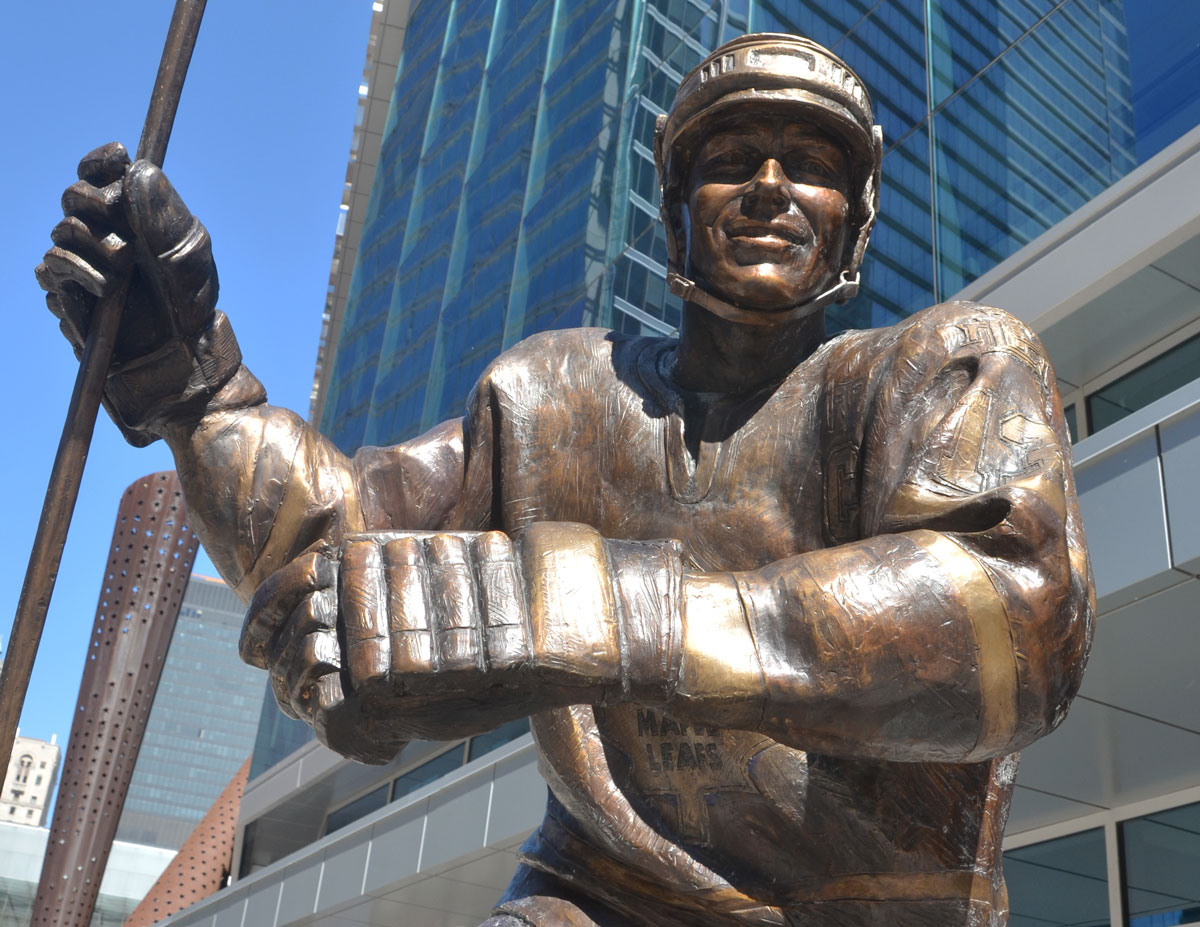
below: Mats Sundin, born in Sweden in 1971.  He joined the Maple Leafs in 1994 and played 13 seasons for them.  He was captain for 11 of those years and with the exception of 2002-03, he led the team in scoring points every year.  He was elected to the Hockey Hall of Fame in 2012.

A close up look of the face and upper body of the statue of ex Toronto Maple Leaf player Matt Sundin

below: Salming cheers while Darryl Sittler goes over the boards.  Borje Salming, also born in Sweden, played defence for the Maple Leafs  between 1973 and 1989.  He played over 1000 games.  He has been a member of the Hockey Hall of Fame since 1996.

A man in a purple t-shirt and jeans is sitting on the boards that are part of the sculpture at Legends Row outside the Air Canada Center. He is sitting beside the statue of Borje Salming

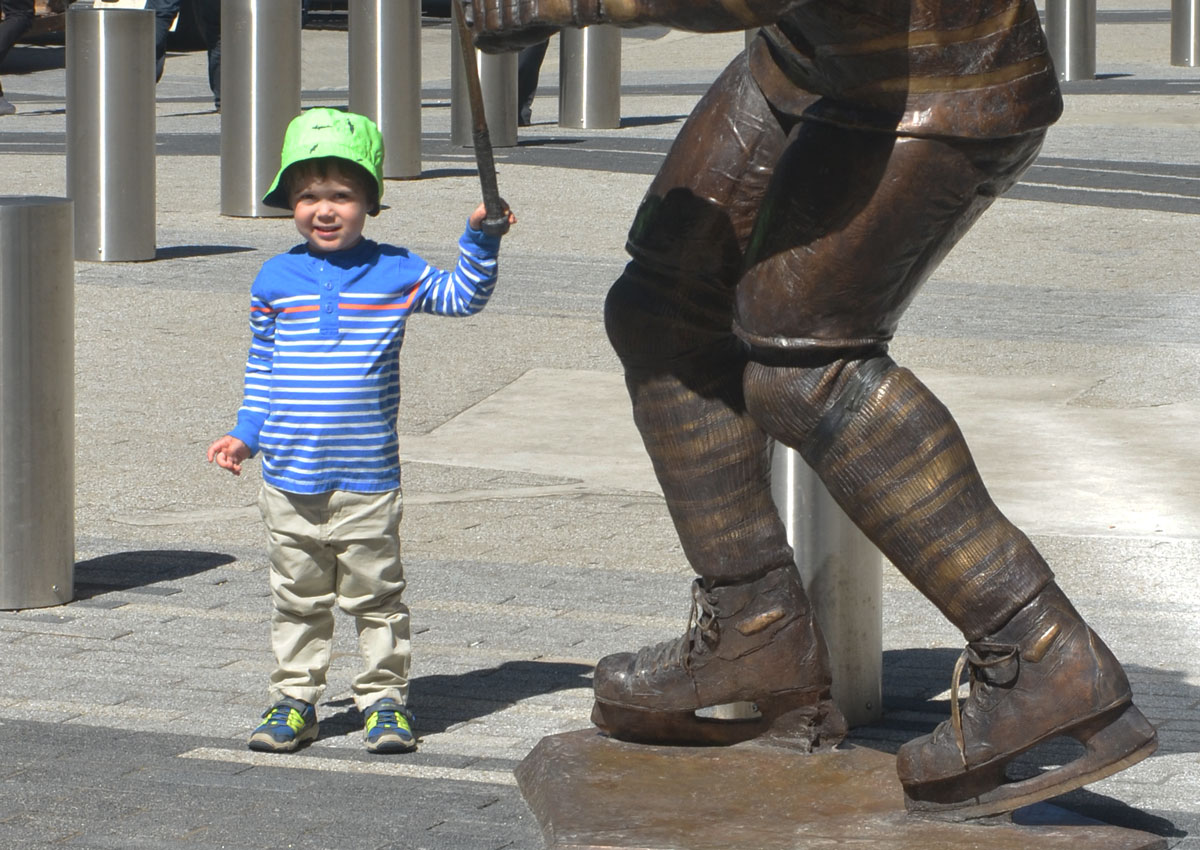
A little boy stands beside a statue of a hockey player where only the legs and skates of the player are in the picture. The boy is holding onto the end of the player's hockey stick

The first three statues, Darryl Sittler, Ted Kennedy and Johnny Bower, were installed earlier this year.

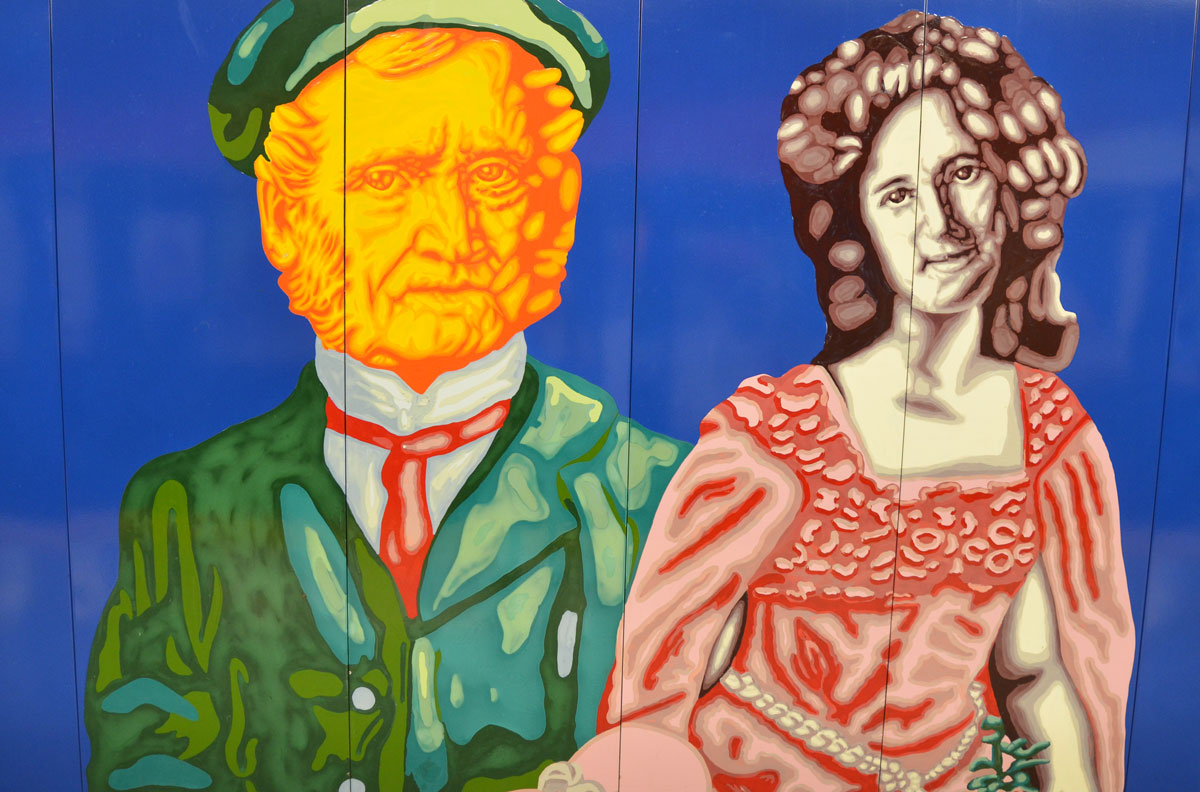
Let’s talk about this couple

mural on a subway wall, close up of a man and a woman. The man has an orange coloured face and is wearing a green jacket and cap. The woman has long black hair and a long pink dress

If you ride the Toronto subway you’ll probably recognize them from the walls of Queen station.

looking across the TTC Queen subway platform and tracks to the opposite wall where there is a mural, enamel on steel, of a couple as well as some buildings. An ad for shoes is blocking part of the mural

A couple of weeks ago I was standing beside them when I overheard a woman telling the man she was with that the people in the mural were Lord and Lady Simcoe.

I was fairly certain that she was wrong so I checked.   This is a picture of John Graves Simcoe.

A portrait of John Graves Simcoe

There could be some resemblance and John Graves Simcoe did play an important part in Toronto’s history.  He was the first Lieutenant Governor of Upper Canada (1761-1790).  He established York (now Toronto) as the capital of Upper Canada in 1793 and he gave us Yonge Street.  But note the military clothing in the above portrait; he was a British army officer after all and I doubt he’d be depicted in a mural wearing a green jacket and matching cap.

There aren’t many pictures his wife Elizabeth, or Lady Simcoe, but suffice it to say that they don’t look like the woman in the mural.

A few minutes online provided the following information:   The title of the mural is “Our Nell” and the people are supposed to be William Lyon McKenzie and Nellie McClung.  Three buildings are shown, the old Simpsons building (now the Bay), City Hall, and the Eaton Centre.  The artist is John B. Boyle.

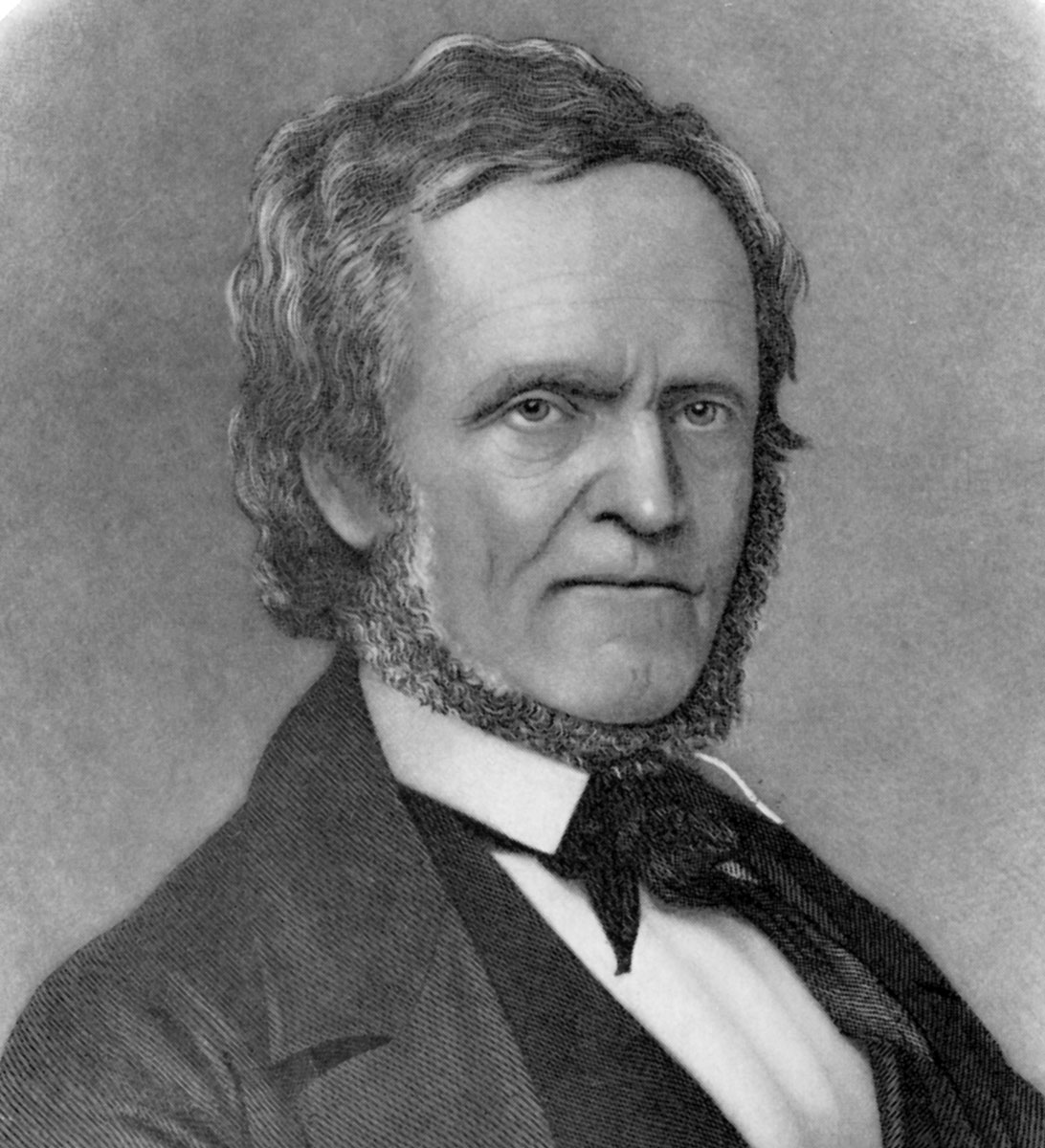
This is a photo of William Lyon McKenzie; I guess there’s a resemblance.
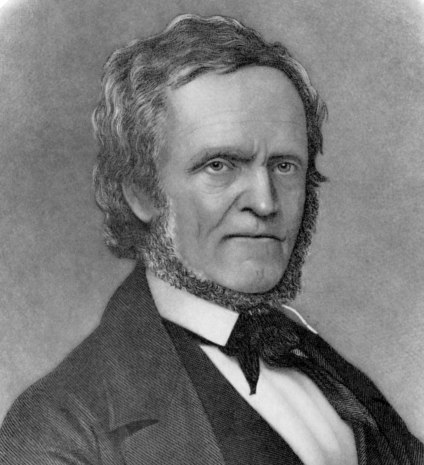
A black and white picture of William Lyon McKenzie

McKenzie was born in Scotland in 1795.  He emigrated to Upper Canada as a young man.  Although he held a number of jobs, he seemed to like writing for newspapers best.  After working for newspapers in Montreal and York, he established his own newspaper, the ‘Colonial Advocate’ in 1824. Although that paper went bankrupt and he fled to New York for a short time to evade his creditors, he used newspapers as a vehicle to promote his political ideas for most of his life.  To a large degree the story of Upper Canada politics of the early 1800’s is a story of the Tory governing elite vs the Reformer upstarts.   McKenzie was solidly on the side of the Reformers.

Toronto was incorporated as a city on 6 March 1834 and the first municipal elections were held later that month.  McKenzie was elected as an alderman.  At that time, the mayor was elected by the aldermen from their own ranks and in 1834 McKenzie was appointed mayor.  He lost the next election in 1835.

McKenzie was also a leader in the Upper Canada Rebellion of 1837.  It was not much of a rebellion, more like a skirmish near Montgomerys Tavern (near Yonge & Eglinton) that the Reformers lost badly.  The rebellion leaders were allowed to flee to New York state.  Once in Buffalo, McKenzie declared himself the head of a provisional government of the Republic of Canada.   He even convinced some Americans to help him invade Upper Canada from Navy Island in the Niagara River.  Bombardment of Navy Island late in December 1837 by the Royal Navy destroyed the S.S. Caroline, an American ship that was helping to supply McKenzie’s followers on Navy Island.  And that was the end of McKenzie’s rebellion.

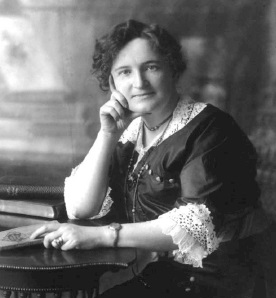
Okay then, that’s the man in the mural.  What about the woman?  I went looking for picture of Nellie McClung as well as information about her.  I recognized her name but I couldn’t remember what her role in Canadian history was.   First, this is her picture:

 black and white picture of a woman, Nellie McClung, sitting at a desk

I didn’t see any pictures of her with long hair or as a younger woman.   Nellie McClung was born as Nellie Mooney in Ontario in 1873 but moved to Manitoba as a child.   One of the causes that she worked on was woman’s suffrage and she helped Manitoba in 1916 to become the first province to allow women the right to vote and to run for public office. By 1922 women could vote federally and in all provinces except Quebec.  Quebec women could vote federally but had to wait until 1940 before they could vote in a provincial election.

McClung was also one of the five women who campaigned to have women recognized as “persons” by the Supreme Court so that they could qualify to sit in the Senate.  In 1930 Cairine Mckay Wilson was appointed Canada’s first female senator, just four months after the “Persons Case” was decided.

Now when you pass through Queen subway station you can think a little about the history that it represents, and not so much about how ugly it is.  Because it is ugly.  Especially this section of the mural:

part of a mural at Queen subwaystation in Toronto, a misshapen Eaton Centre with a grotesque looking woman bending over in her garden in the foreground.

Is that a woman in the foreground?  Or a slug with appendages?

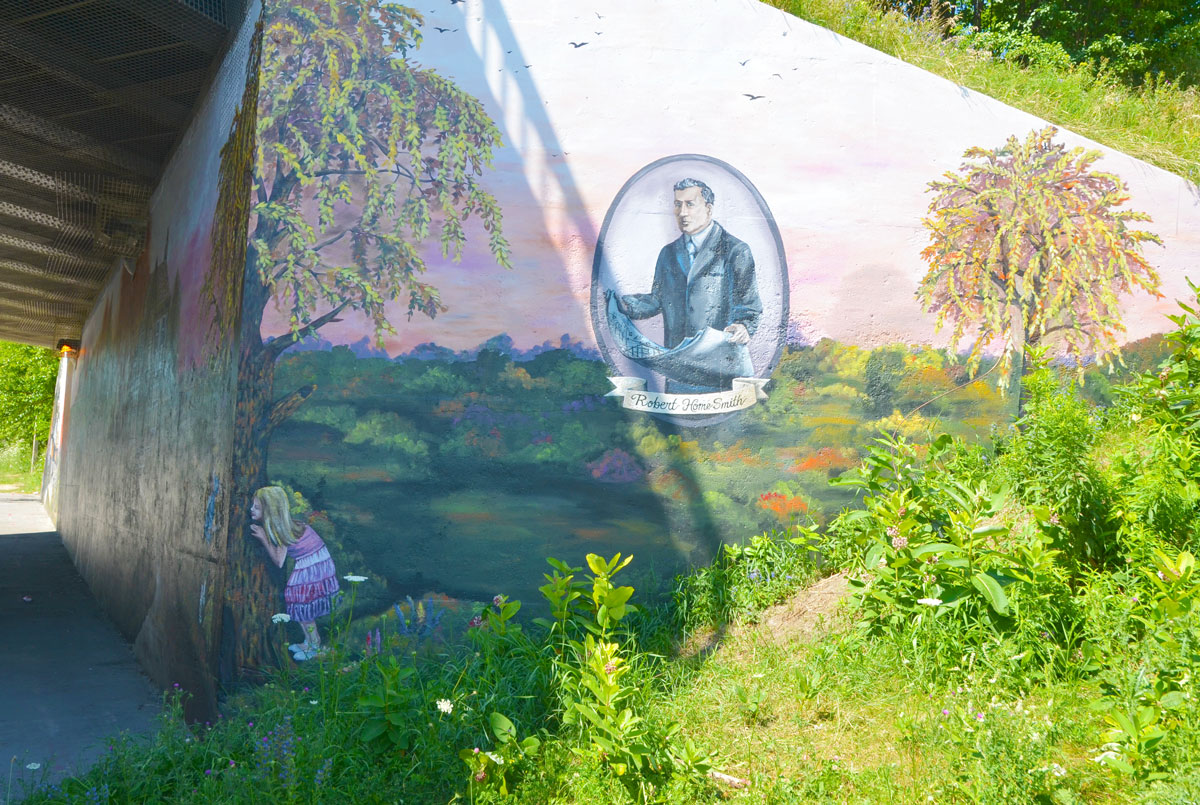
Robert Home Smith (1877 – 1935) was a lawyer, business man, civil servant, and land developer.   In the early 1900’s he acquired 3000 acres of land along the Humber River, from Lake Ontario north to what is now Eglinton Ave. 

 A mural has been painted by Emilia Jajus on Royal York Road as it passes under the train tracks close to Dundas West.  The east side of the underpass is finished and it depicts Robert Home Smith and some of the effects that he had on the area.

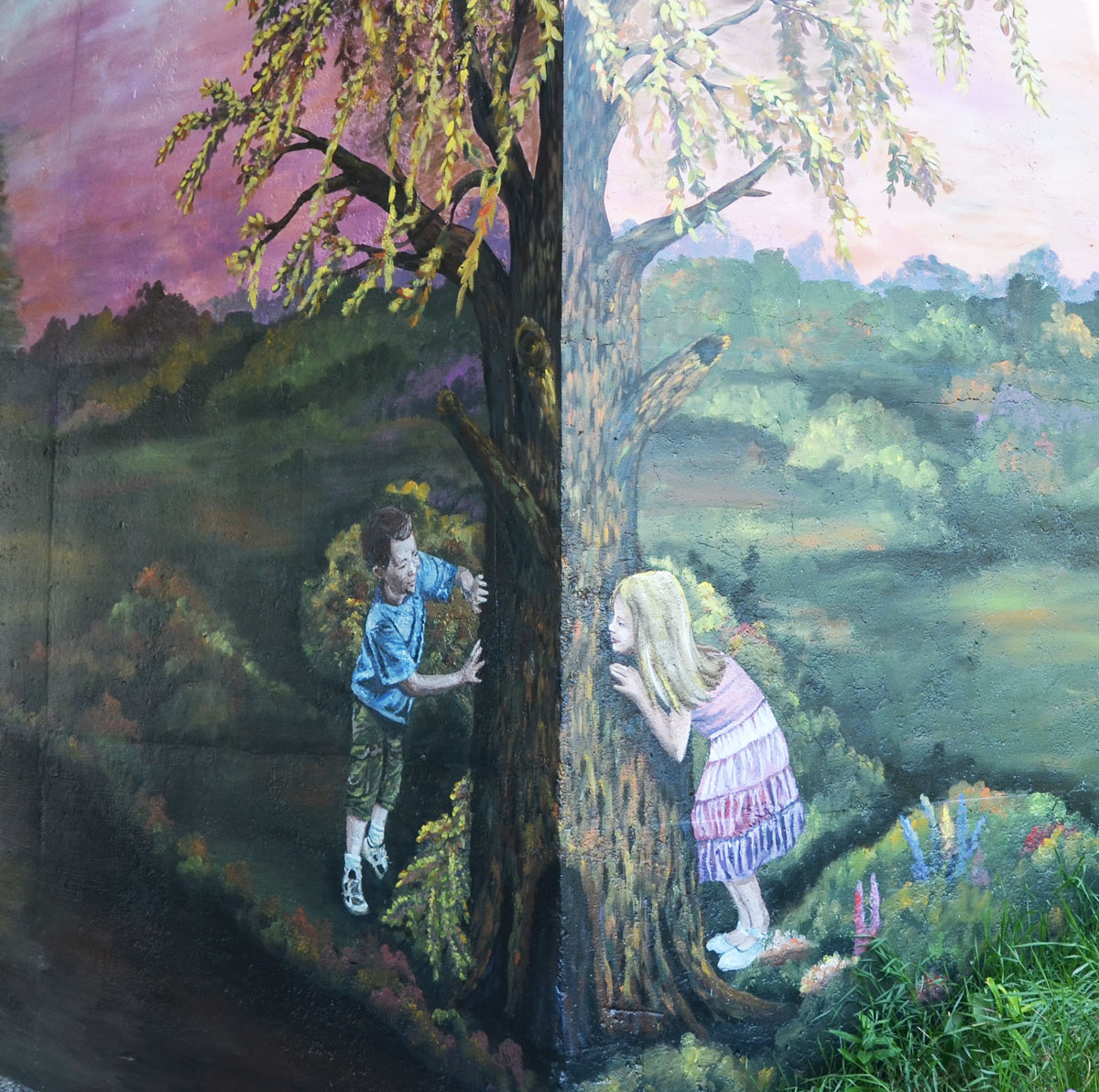
below:  At the south end of the mural there is a portrait of Robert Home Smith.  A young girl can be seen hiding behind the trunk of a large tree.   Because the tree is painted on the corner, you can’t see the young boy who is hiding on the other side of the tree until you get closer to the mural.

part of a mural on an underpass, including a portrait of a man, Robert Home Smith

part of an historical mural on an underpass, two kids are playing, one on either side of a large tree that has been painted on the corner.

 below: Part of the mural, fishing in the Humber River by the bridge at the Old Mill.  The bridge was built in 1916 after an older bridge was washed out in a storm.  It is still there.

part of a mural showing a stone bridge over a river, the Humber River.  A man is fishing in the river from the shore.

Part of the land that he owned was the site of the King’s Mill.  This mill was built in 1793 on orders from Lieutenant Governor John Graves Simcoe.  It was to mill lumber for the proposed town of York.    Here, Home Smith built the Old Mill Hotel as well as the  the Old Mill Tea Room.  The tea room was opened on 4 Aug 1914, the same day that Britain declared war on Germany.

below:  Part of the mural, the Old Mill Hotel

part of a mural that shows the Old Mill hotel, a tudor style two storey building with the lower part being made of stone

below: The Old Mill hotel in 1945

Copy of a 1945 photo of the Old Mill hotel in Toronto

photo from the City of Toronto Archives

Robert Home Smith planned to develop the land on both sides of the Humber River (known as the Humber Valley Surveys) into residential lots that were aimed at affluent buyers.  Although he died before the completion of this project, the neighbourhood of Kingsway as well as parts of Swansea, Baby Point, and Humber Village, still stand.

part of a mural showing a two storey stone house with fake tudor upper storey, in autumn, with tree with orange leaves beside the house.

The parkland that is adjacent to the Humber River as it curves around Baby Point is named Home Smith Park in memory of this man.

below:   A poor quality photo showing a view of the whole mural.   A replacement photo is needed, one taken on a day when there aren’t so many shadows!

picture of a mural painted an the wall of an underpass.

Honest Ed’s

 In 1948 Edwin Mirvish opened his ‘Honest Ed’s Famous Bargain House’ on the southwest corner of Bloor and Bathurst streets.  Honest Ed’s was not only one of the first department stores in the city but also one of the first to offer discount prices on its merchandise.

below: Honest Ed’s, from across the intersection of Bloor and Bathurst streets.

Looking across an intersection of Bloor and Bathurst streets towards Honest Eds store with its big orange, yellow and black signs on grey cladding.  Running around the store, about the level of the top of the first storey, are signs (red lettering on white background) that read "Only the Floors are crooked" , "There's no place like this place, any place", "Come in and Get Lost" and lastly, "A Bargain Centre like this happens only once in a lifetime"

photo taken 25 March 2015


below: The same intersection in 1948 when Honest Ed’s Famous Bargain House opened.  As you can see, the exterior was covered with signs with humorous sayings from the beginning.

historical black and white photo of Honest Eds store at Bloor and Bathurst.

photo from Honest Eds store via a 2013 article in The Grid TO

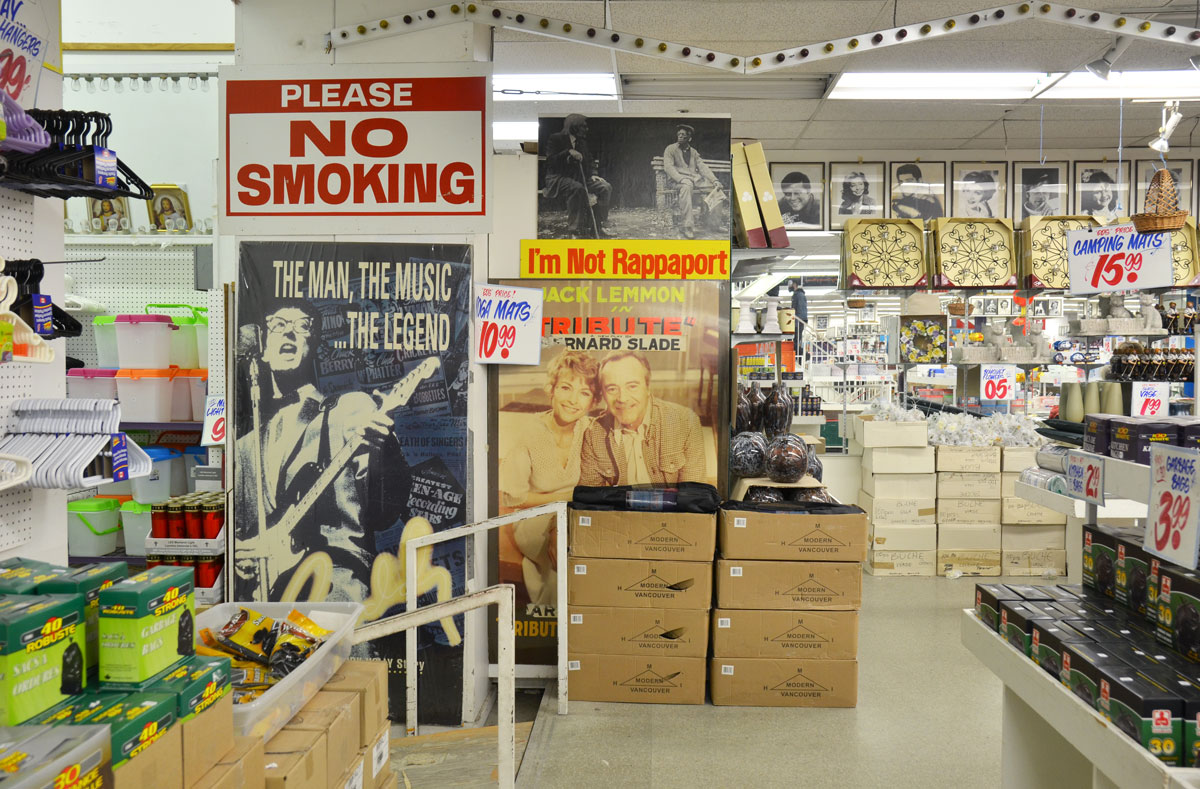
Along with the discount merchandise, Ed Mirvish filled his store with pictures and posters, especially movie posters.   The stairwell walls are covered.

movie posters as well as other kinds of posters in a stairwell at Honest Eds, including a large red poster with a picture of 'Honest Ed Mirvish'.
reflections in a round mirror in a staircase at Honest Eds store showing the stairs, railing and various pictures and posters hanging on the walls

A stairwell at Honest Eds store with a large black and red sign that reads "Honest Ed's an Idiot, his prices are cents-less"
You can buy almost anything at Honest Ed’s!  Clothes, shoes, toys, household items, groceries, hardware, prescriptions, souvenirs, … and so on.

Interior photograph of Honest Eds store with its eclectic mix of merchandise.  Big No Smoking sign on the wall, some old movie posters on the wall too.

aisle in a discount bargain store.  White wooden shelves and bins, lots of red signs, cashier sign as well.  Honest Eds interior, ground floor, kitchen ware,

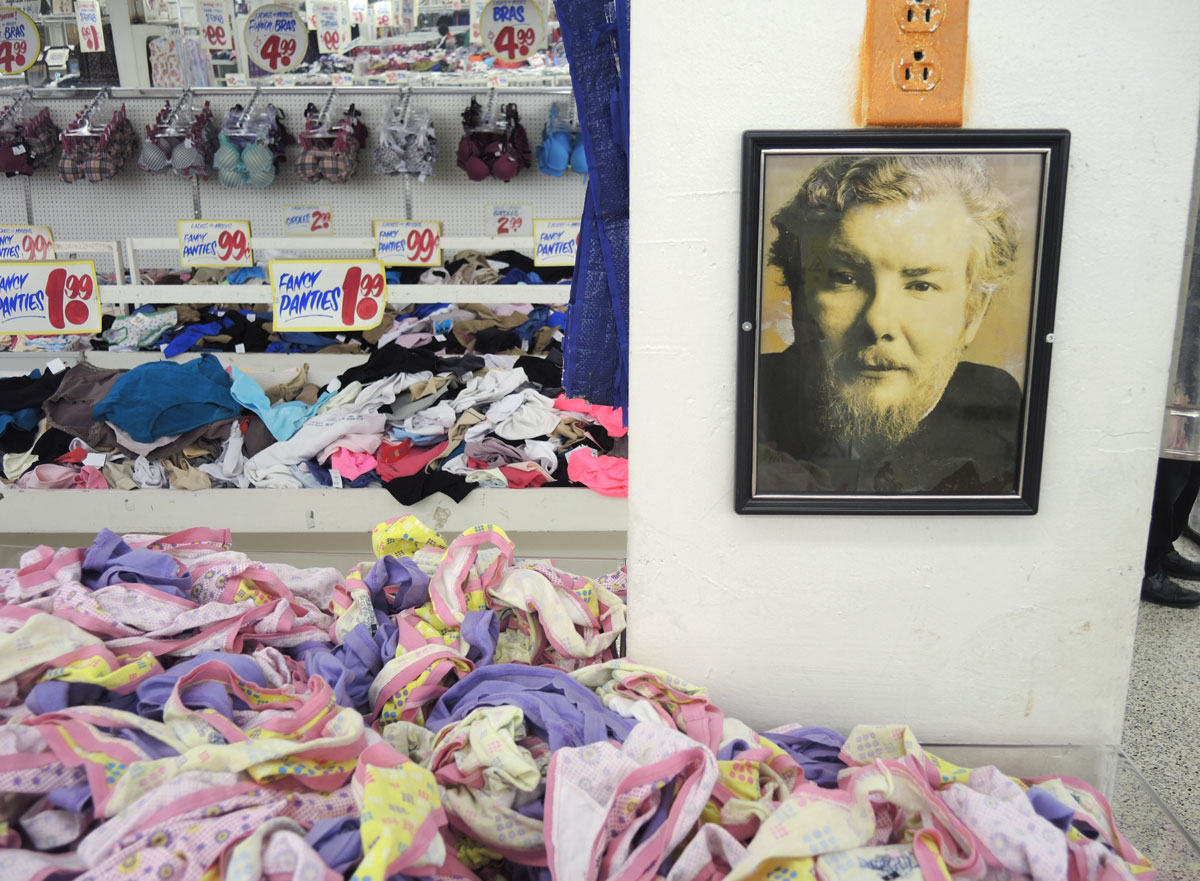
There are hundreds of pictures of actors and other famous (and no so famous!) people.

kitchen wares for sale laid out on white table like shelves.  Large pillar in the middle of the store with a sign warning you that you are on camera.  Seven pictures of movie stars adorn the pillar.  Lots of merchandise for sale in the background.

Jeans for sale, on tables in Honest Eds store.  Large black and white posters on the wall along with a colour full length portrait of a woman in a long dress.

All of the signs in the store are hand painted.  In March 2014, Honest Ed’s had a sale of all their signs and the profits ($17,000) from this sale were donated to Victim Services Toronto.
Another sign sale is scheduled for 11 April 2015 starting at 8 a.m.  If you want to buy a sign, arrive early and expect to wait as it is a very popular event.

Sandals for sale at Honest Eds, on white shelves.  There is a mirror behind and in the reflection is most of the shoe department of the store.

bins of panties for sale, a wall display and long horizontal mirror in the background.  Beside the bin in the foreground is a white pillar on which there is a black and white picture of a man from the shoulders up.

Signs in a store window.  One says "Honet Ed can't cook but his customers never get a raw deal" and the other is a page showing all the special prices available at the store.  It is printed like a newspaper page and there is a lot of information on it.

A bin full of brightly coloured kids running shoes in greens, blues, reds, etc

In October 2013, the property was sold to a developer but as you can see from the sign in the photo below, the store is still open.  It will remain open until the end of 2016.  It’s been open for 67 years and will remain open for another 21 months.
The southeast corner of Markham and Bloor.  The corner of Honest Eds store with its red framed windows and loud garish signs.

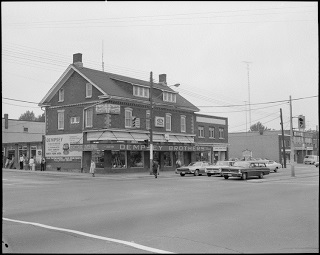
In the early 1900’s brothers George and William Dempsey bought a store on the northwest corner of Yonge and Shepard from the Sheppard family.  It became known as Dempsey Brothers.

 below: The store in the 1960s

An old black and white photo of Dempseys store which was on the NW corner of Yonge & Sheppard.  It was a large 2 storey brick building with a porch across the front of the building.  You can see Yonge St. in this photo and some of the old cars that were stopped at the intersection.

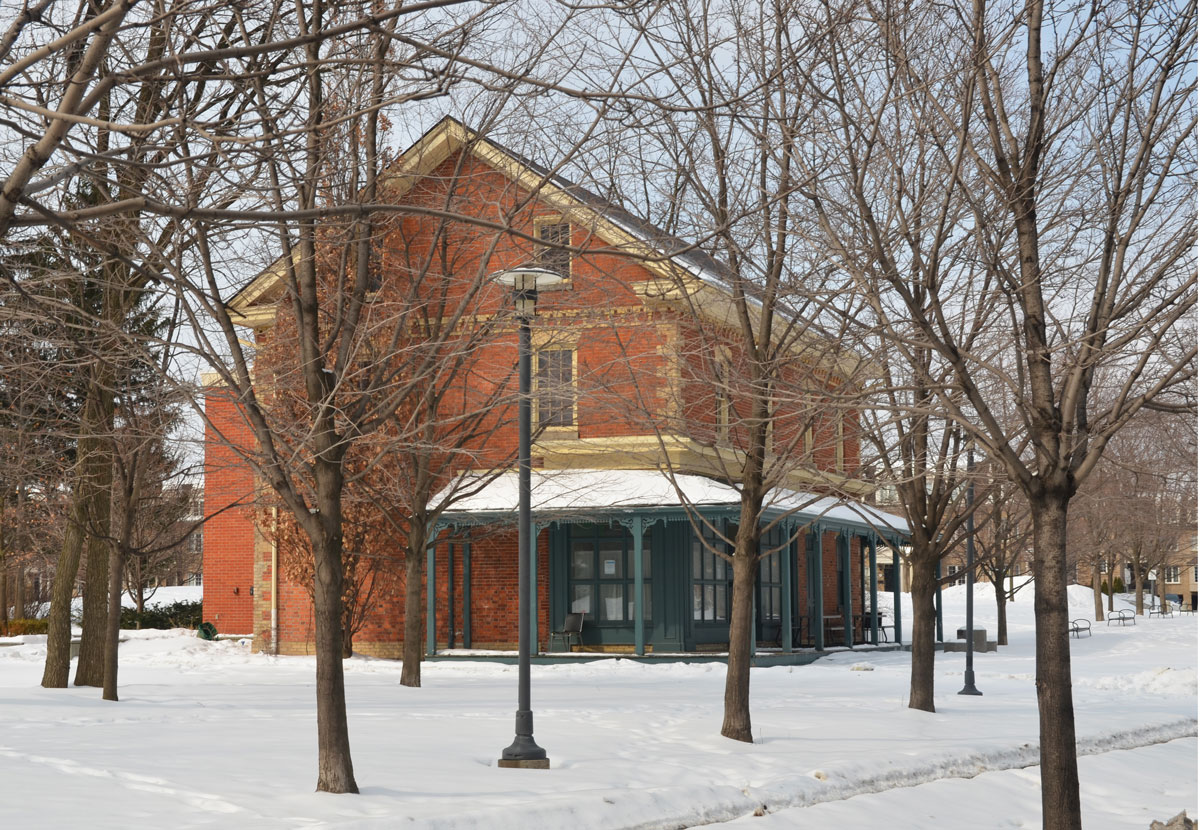
In 1989 the property was sold to developers but the store remained on that corner until 1996.  At that time it was moved a few blocks north to a site on Beecroft Ave; the site is now known as Dempsey Park.  The building was renovated and became the home of the North York Archives, an arrangement that didn’t last long.  In 1998 Mike Harris and the provincial Conservative government of the day amalgamated the old city boroughs into one City of Toronto.  North York ceased to exist and their archives merged with those of the new city.  Instead, the old Demspey Brothers store is home to Beecroft Learning Centre.

old Dempsey store, restored and now in a park setting.  Two storey brick house with some yellow brick trim, porch that wraps around the front of the building.  Surrounded by trees, winter time so no leaves and there is snow on the ground.

The restored Dempsey Brothers store, now at 250 Beecroft Avenue.


Where Dempsey’s once stood, there is now this….

Northwest corner of Yonge and Sheppard in March of 2015, low rise building angled across the corner with McDonalds and 7 11 stores.  Tall apartment building behind.  The intersection is of two 6 lane roads so it is big and wide.

… a 7 Eleven and a McDonalds. I doubt that anyone thinks “nice corner” when they look at it.


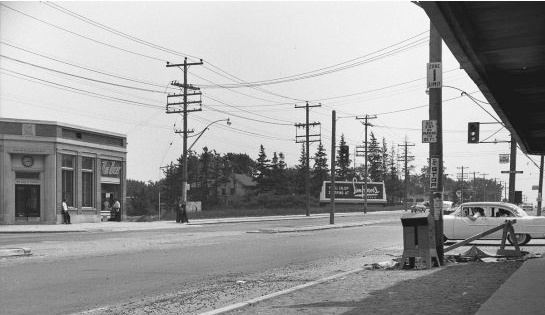
below: Looking southeast from the front of Dempsey Brothers store many years ago.

An old black and white photo from 1955 showing the intersection of Yonge and Sheppard.  Not much development, an old car is waiting at a street light.

The billboard is an ad for Simpsons, a department store that is long gone.


For a long time, a grocery store stood where the billboard is in the above photo.  But now that corner is changing again.


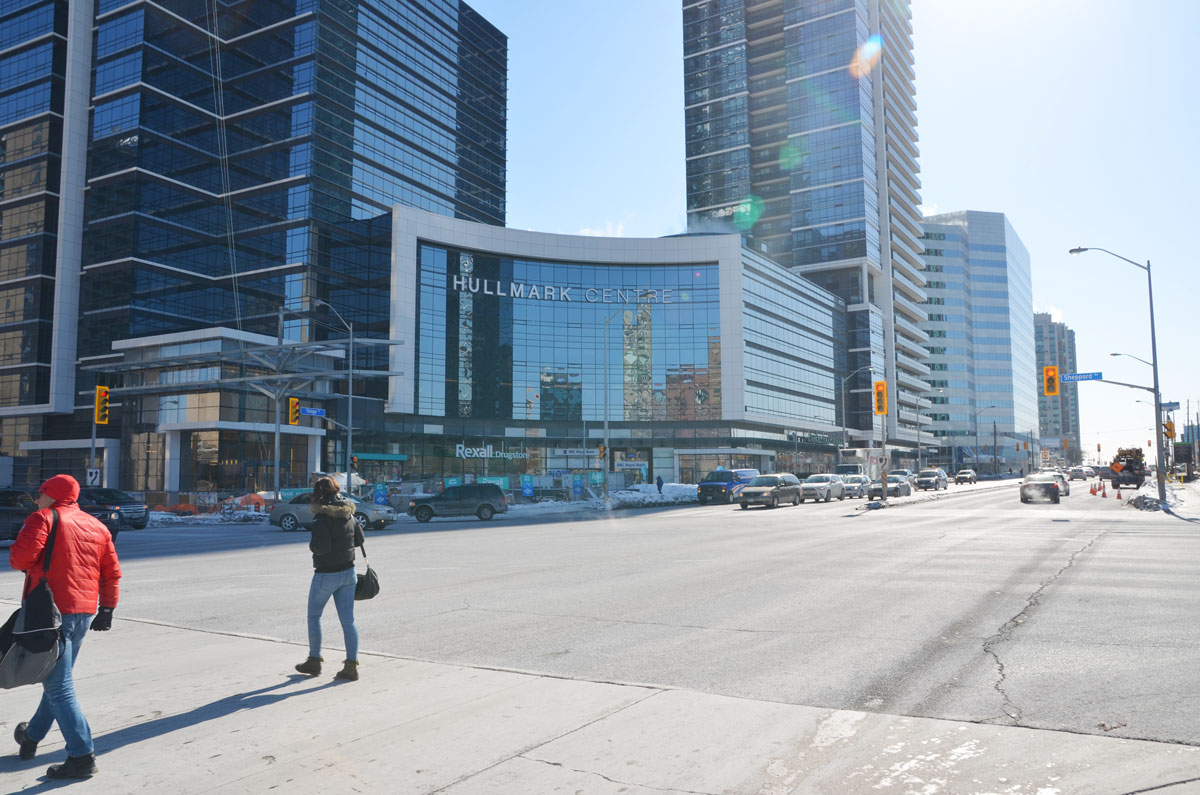
below:  An attempt to replicate the location and angle of the above photo

Looking diagonally across an intersection towards two tall buildings with a midsize building with a curved front in between them.
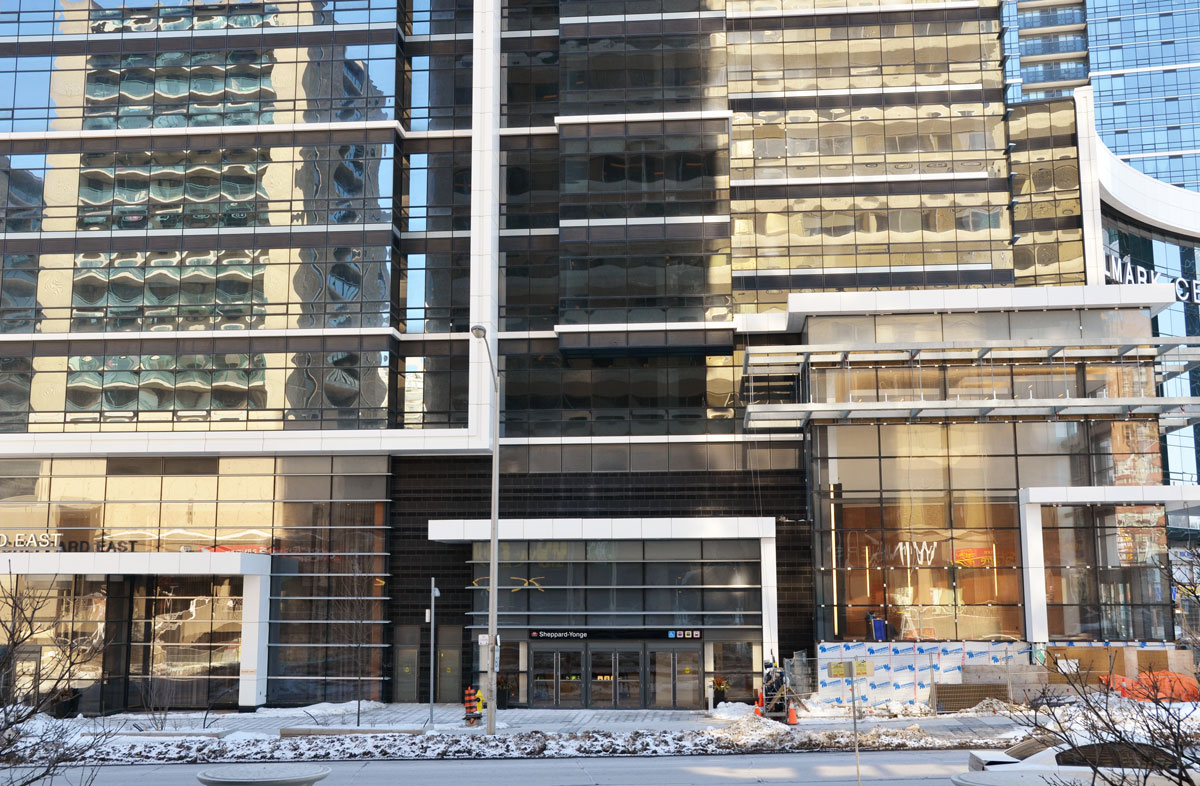
below:  Looking south across Sheppard Ave. East at the north side new Hullmark Centre including the new subway entrance. 

looking at glass buildings where there is a lot of reflections.  An entrance to Sheppard subway station is part of the building.

below:  Looking north up Yonge Street from just south of Sheppard Avenue.
The new Whole Foods store is the first building on the right.

view looking north on Yonge St.  from just south of Sheppard Ave.
The southwest corner is also undergoing major changes.

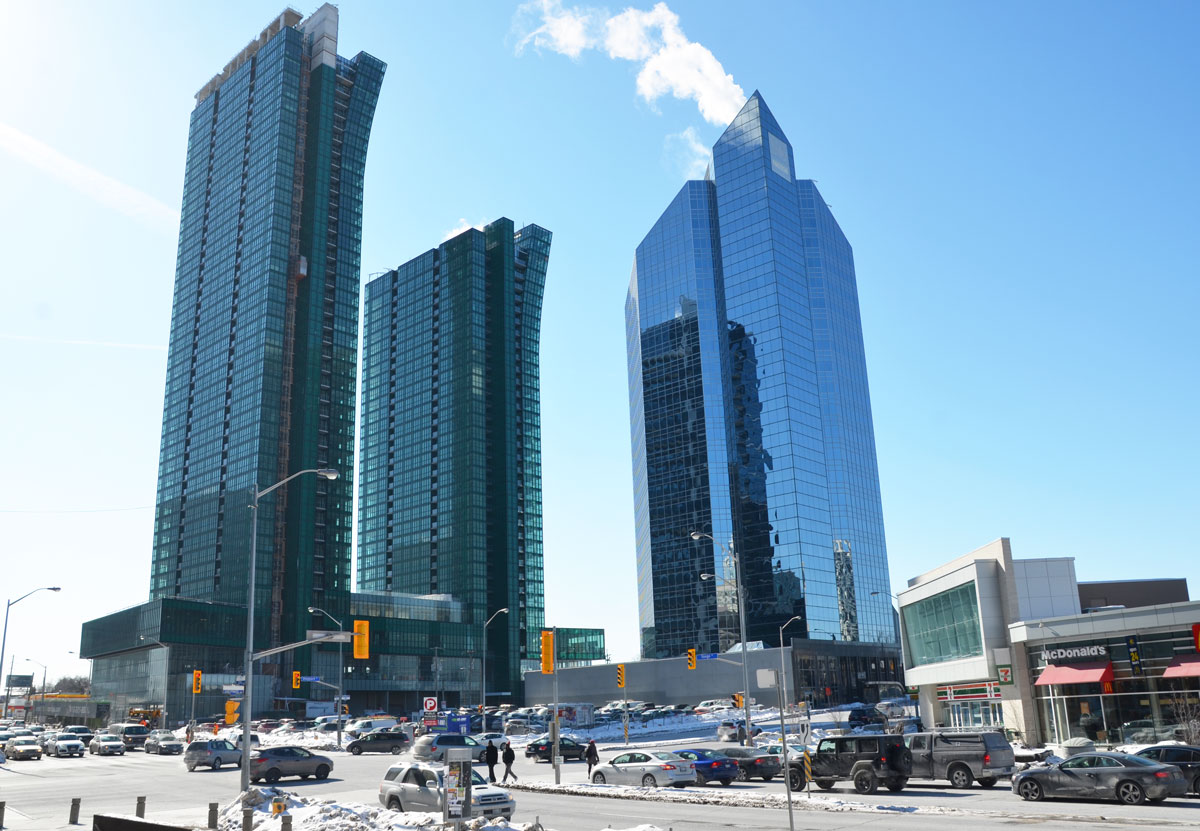
below: The greenish coloured Emerald development is almost complete.  And yes, the tops of the buildings are meant to curve that way!

Two tall condos under construction beside a tall bluish colour commercial building.  The condos are a greenish colour and they are curve outwards a bit at the top.

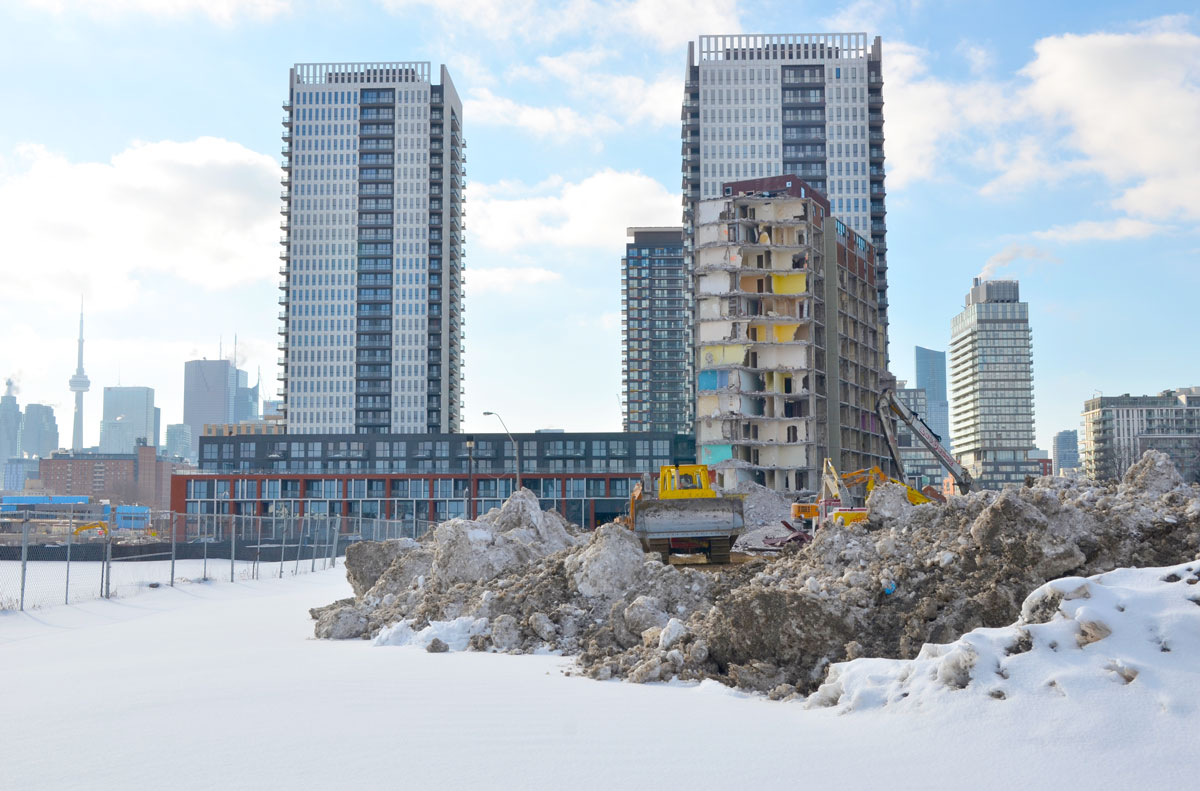
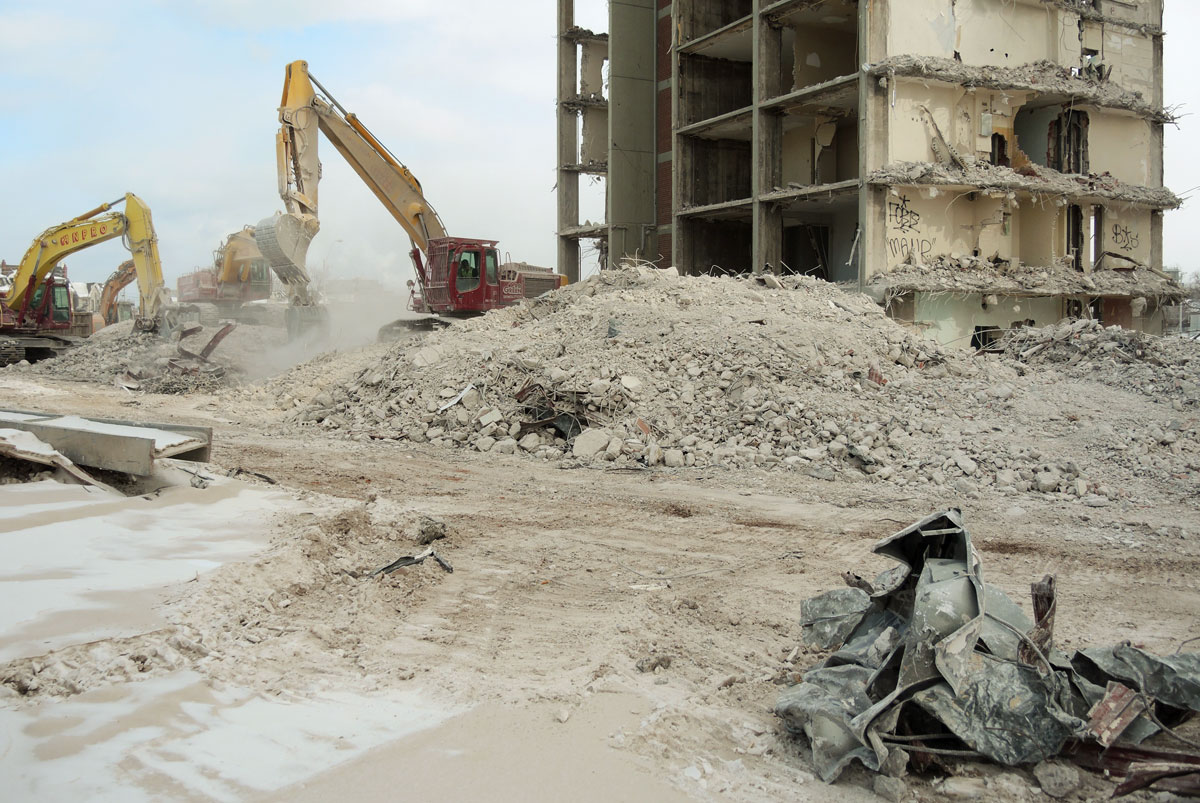
Along with many other people, I have been watching the demolition on the southeast corner of Dundas & Sumach streets, part of the Regent Park redevelopment.  This 14 storey apartment building was designed by Peter Dickinson; it was built in the late 1950s.


January 31st, 2015

I first saw this building being demolished on a grey day at the end of January.
I’m not sure when the demolition actually started.

A large 14 storey brick clad apartment building in the initial stages of being demolished.

Looking north up Sumach Street.


View of the interior of some of the apartments that were exposed when the exterior brick was removed.  Some of the rooms are painted in bright colours, purples, pinks and greens.

The colours of past lives.


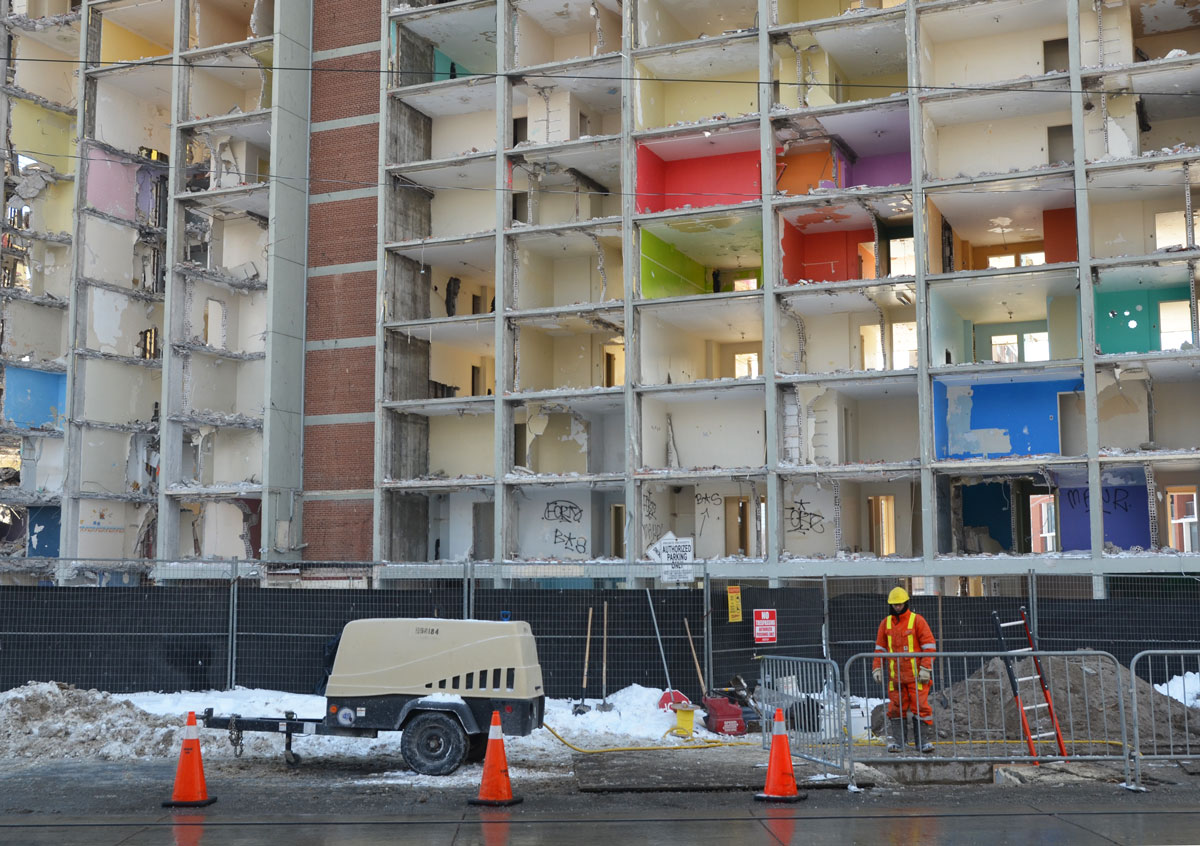
 3 February

A workman dressed in orange coveralls works on the street in front of a building being demolished

It would have been a cold job, working outside during the coldest February on record.


Part of a 14 stprey apartment building that is being demolished.  The exterior walls have been removed and some of the interior walls are buckling.

In the midst of demolition.


blog_demolition


10 February

Two very large cranes are being used to demolish a large apartment building on the corner of Dundas and Sumach streets.  Some men in bright yellow vests are directing traffic as some of the debris is falling towards Sumach street.

Looking across the intersection of Dundas and Sumach.


A purple and yellow sign against a metal fence that says Regent Park Revitalization Phase 3 has started.  Demolition of an apartment in the background.

A view from the south.


Hydraulic crane and truck and other machinery used in the demolition of the building.

Looking west from River Street.


Vacant lot in the forground with demolition of a building in the middle.  In the background are the new buildings that have been built in that area

Another view from River Street.


12 February

Two large cranes are demolishing an apartment building.


17 February

A lot of rubble, concrete, metal and brick, from the demolition of a building lies in front of the partially demolished building.

Looking into the remains of a partially demolished building.  The pipes that used to run between the walls vertically are now exposed.


23 February

Machinery is being used to sift through the debris and rubble from a building demolition

27 February

A man is taking a picture of a demolition in progress of an apartment building.

There were always a number of people taking pictures whenever I was there.


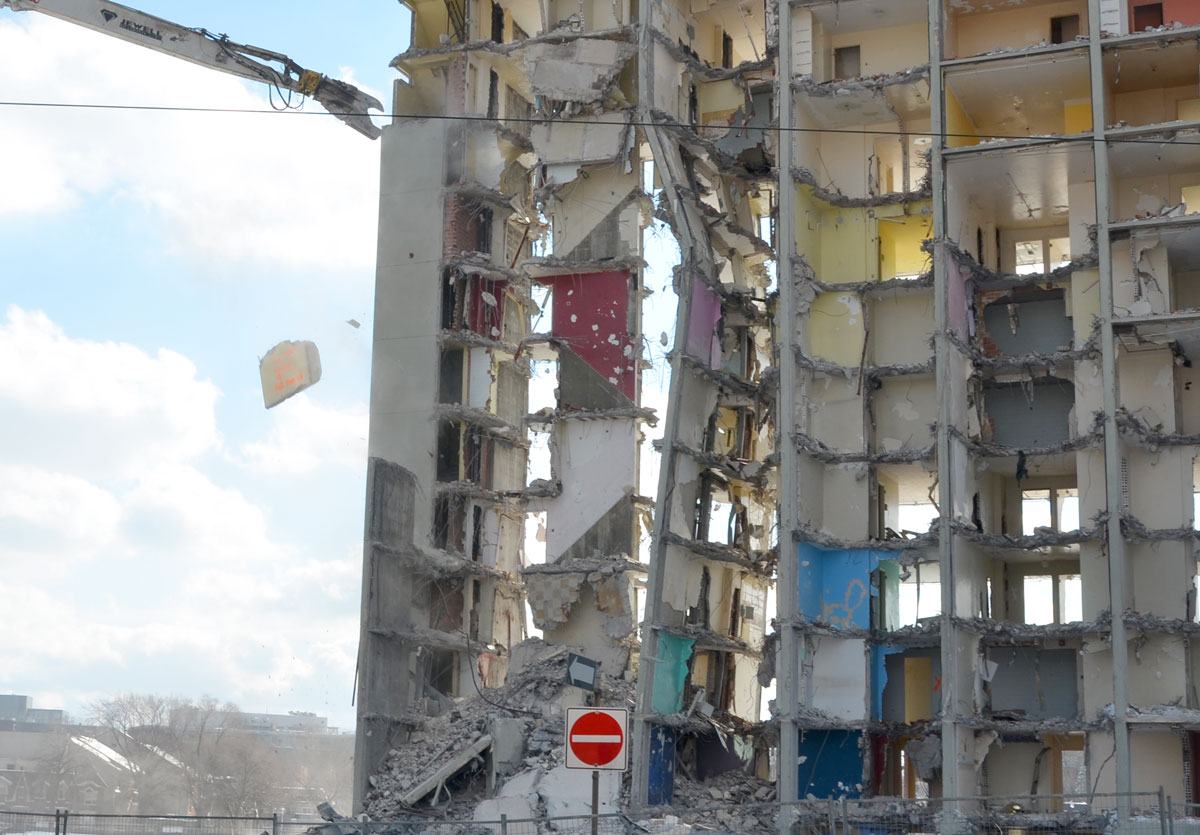
As part of the upper stories of an apartment are brought down, a cloud of dust forms as the debris hits the ground.

dust storm in the sunlight


28 February

vacant lot, truck, and remains of a building being demolished

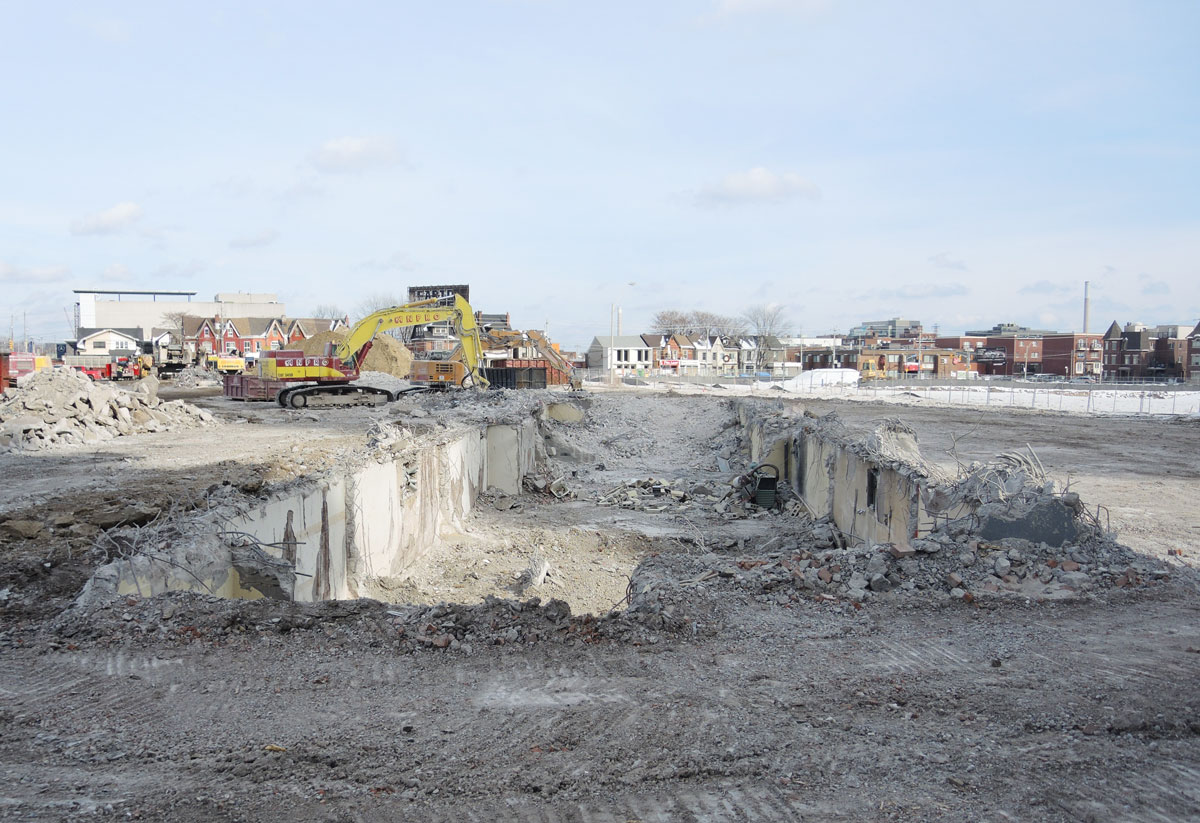
… after 5 weeks, 6 March

A large hole in the ground where a building once stood, vacant land is around it.  A street of houses in the distance, machinery to one side.

Just another hole in the ground.

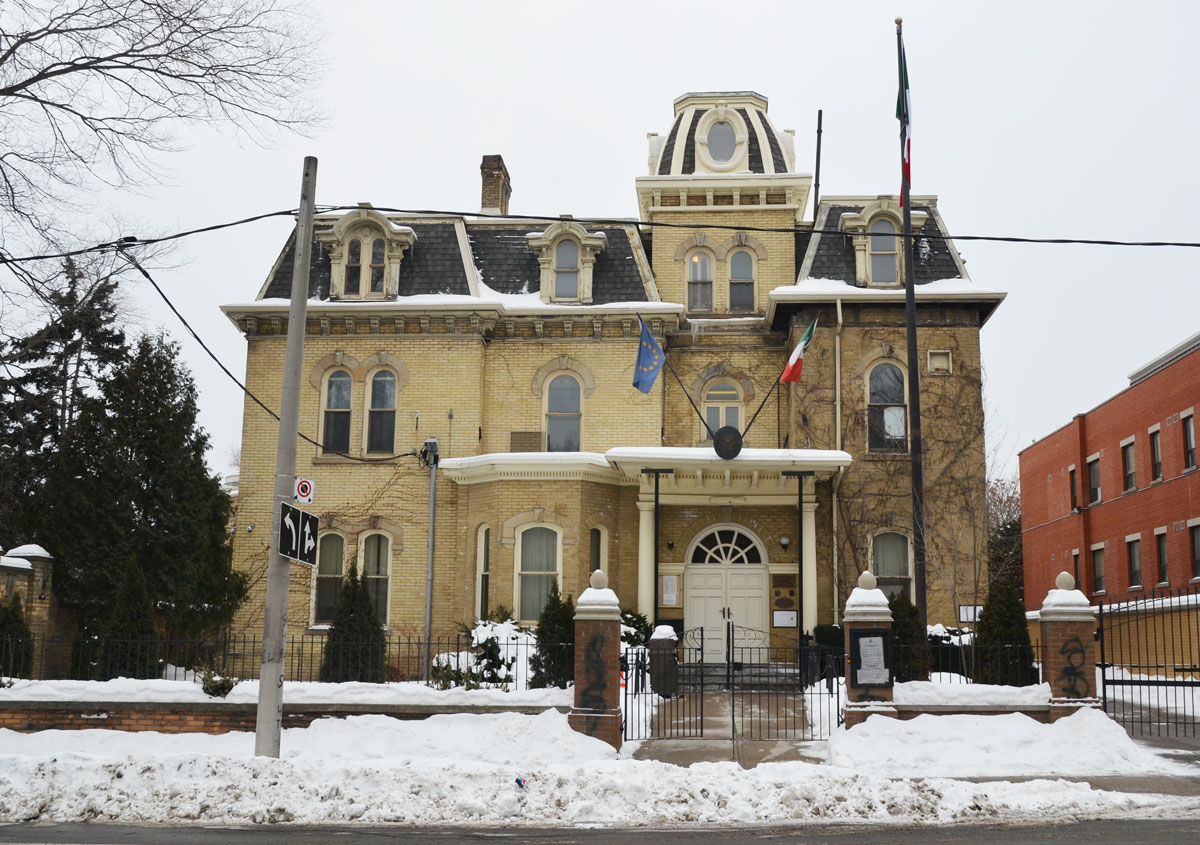
A couple of weeks ago I was at the AGO with some friends.   As we looked out over Dundas Street, one of them asked me if I knew anything about the building that we could see at the northwest corner of Beverley St. and Dundas.  I had to admit that I knew nothing about except that I thought it was the Italian Consulate (it does have an Italian flag flying in the front after all).

Then I thought nothing about it.  Flash forward about a week.  I was at the St. Lawrence Market, sitting in the lower level eating my lunch when I happened to notice some posters on the wall.  The posters were about the history of the area, especially the architecture.  Right beside me was a picture of the house at 136 Beverley St., the Italian Consulate.  Apparently it was called ‘Chudleigh’ and it was built in 1872.

So back I went to take some pictures.

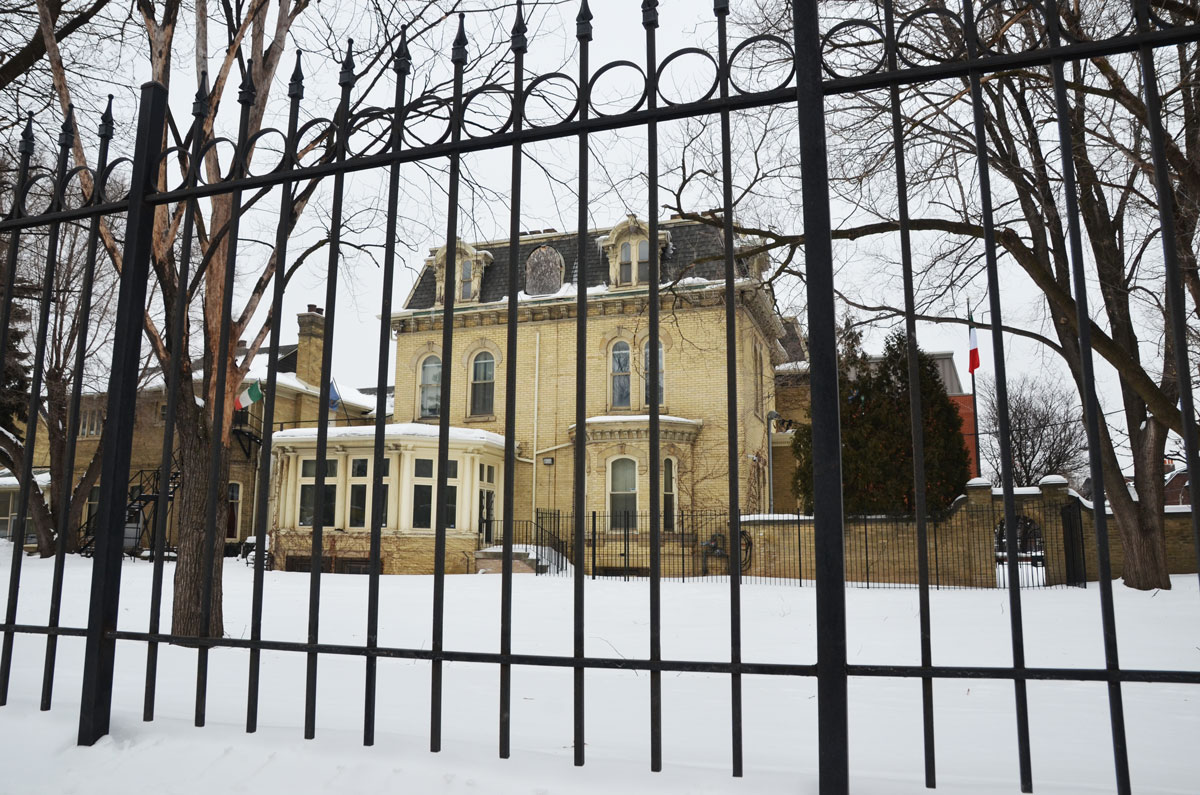
 Winter time, snow and large trees.  Chudleigh, a large yellow brick house built in 1872, viewed from the side (looking through the bars of the fence)

Apparently the house is a fine example of the Second Empire style of architecture, a style that was popular between 1865 and 1880.  Features of this style found in ‘Chudleigh’ are the steep mansard roof, the ‘tower’ portion of the house, and the asymmetry of the design.

blog_beardmore_chudleigh

This 35 room house was built by George Beardmore, a tanner from Chudleigh Devon England.  It remained in the family until 1934.  In 1937 it became the Italian Consulate.   During World War 2 the Canadian government confiscated the property and used it as local headquarters for the RCMP.  In 1961 it was returned to the Italians who used it as a center for Italian immigrants before renovating it and turning it back into the Italian Consulate in 1978.

Chudleigh, a large yellow brick house built in 1872, viewed from the side (looking through at the bars of the fence in the foreground.)  Winter time, snow and large trees

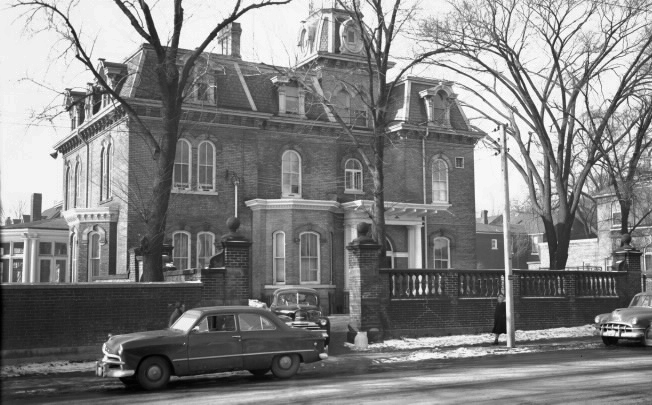
Chudleigh in 1952

Chudleigh, an old house built in 1872 as seen in a 1952 black and white photo.

photo credit: torontopubliclibrary.ca

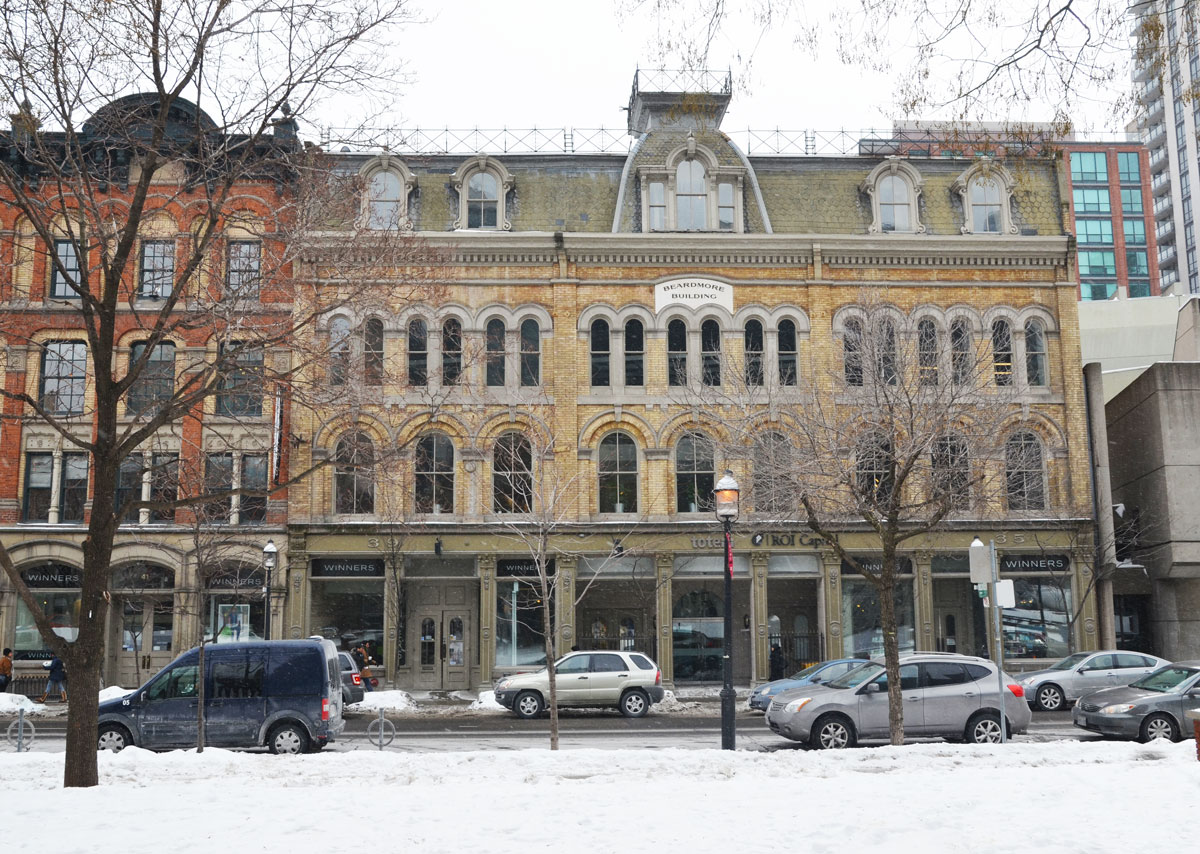
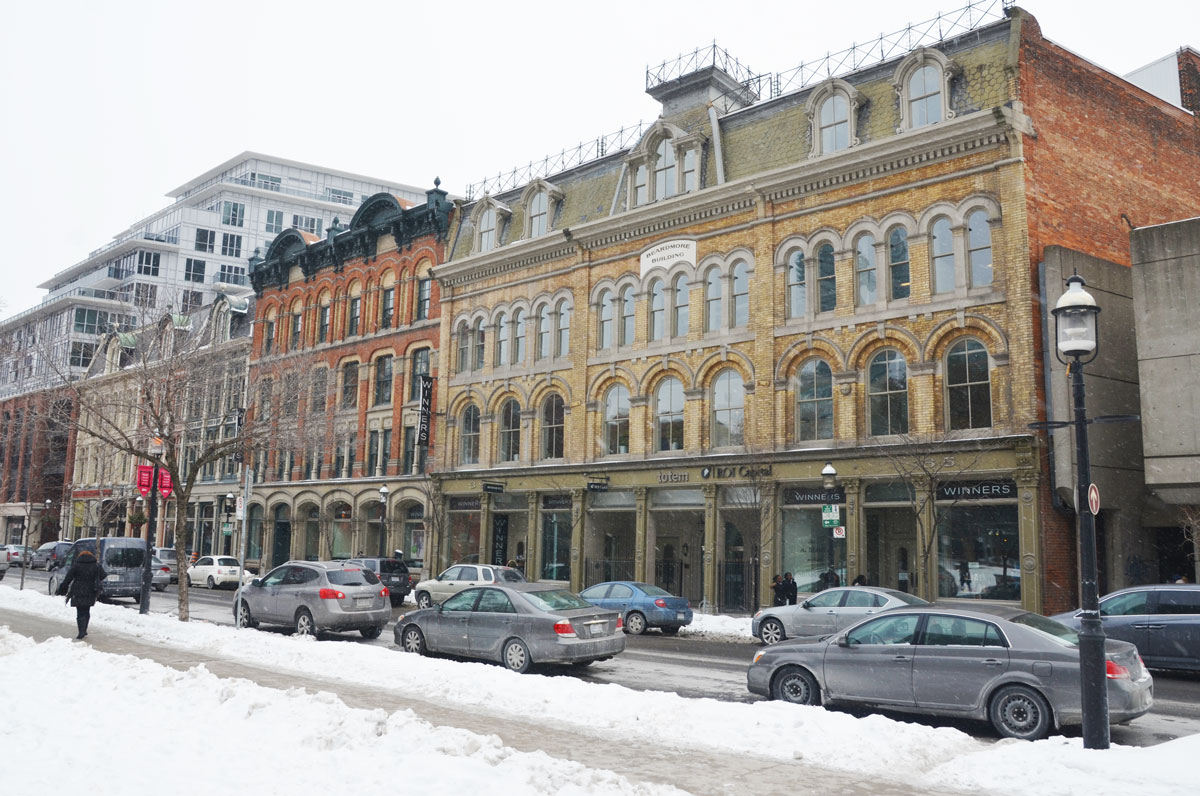
When George Lissant Beardmore first came to Canada in 1844, he set up a tannery in Hamilton Ontario.    A few years later, this tannery was destroyed in a fire.  Rather than rebuild in Hamilton, Beardmore built a warehouse in Toronto and bought a tannery in Guelph to supply the leather from which he made shoes.   The Toronto warehouse, the Beardmore Building, was at 35 – 39 Front Street East and the building is still there today.  A Winners store occupies part of the building.

Four storey tall brick building with arched windows and mansard roof, yellowish brick.  White and black stone sign built into the building at the level of the third floor that says 'Beardmore Building'.

A row of 4 storey brick buildings built in the late 1880's along the south side of Front Street, taken on a winter day with snow on the ground.  Cars parked on the street in front of the builings.  Arched windows, mansard roofs.

In 1967 Beardmore & Co. are the largest tanners of leather in Canada. Their buildings and properties cover an area of over 500 acres, including a tannery in Acton that Beardmore purchased in 1865.  They employed about 600 people.

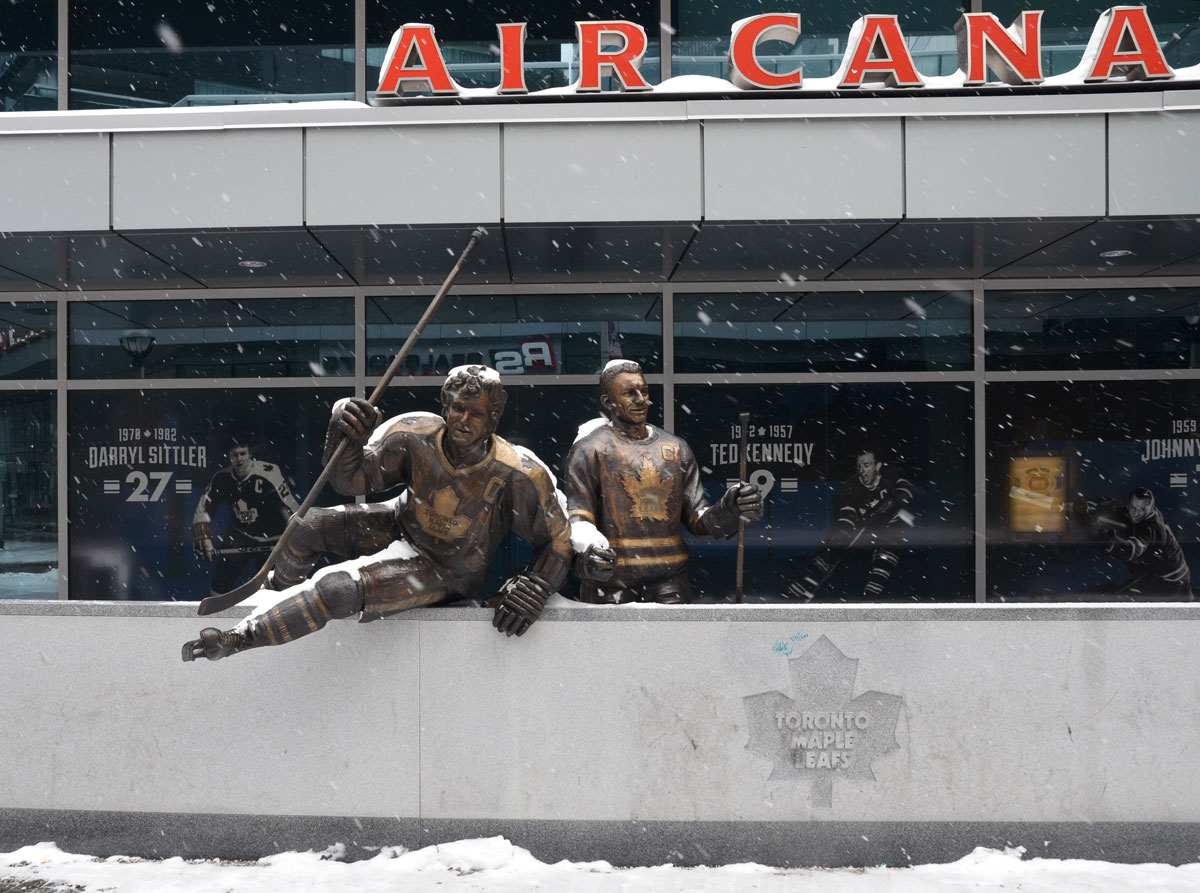
Legends Row, Maple Leaf Square
in front of the Air Canada Centre

statues of  former Toronto Maple Leaf players,
Ted Kennedy, Johnny Bower and Darryl Sittler

Bronze statues of Maple Leafs Darryl Sittler and Ted Kennedy in front of the Air Canada Center.
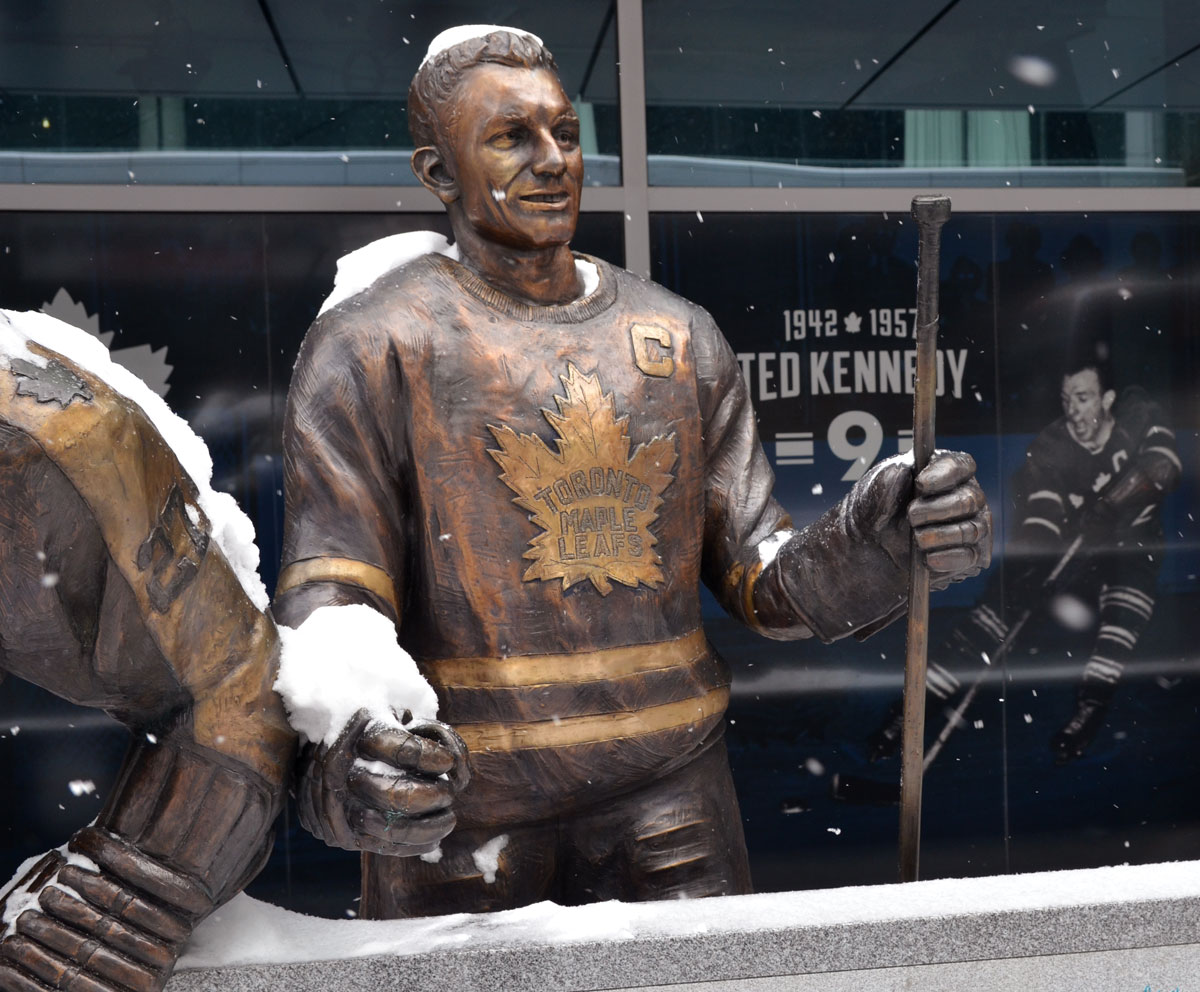
below: Ted Kennedy played hockey for 14 seasons (1942-1957), all of which as a Toronto Maple Leaf. In those 14 years, the Leafs won five Stanley Cups.

Bronze statue of Maple Leaf hockey player Ted Kennedy, standing behind what is supposed to be the boards between the players bench and the ice.

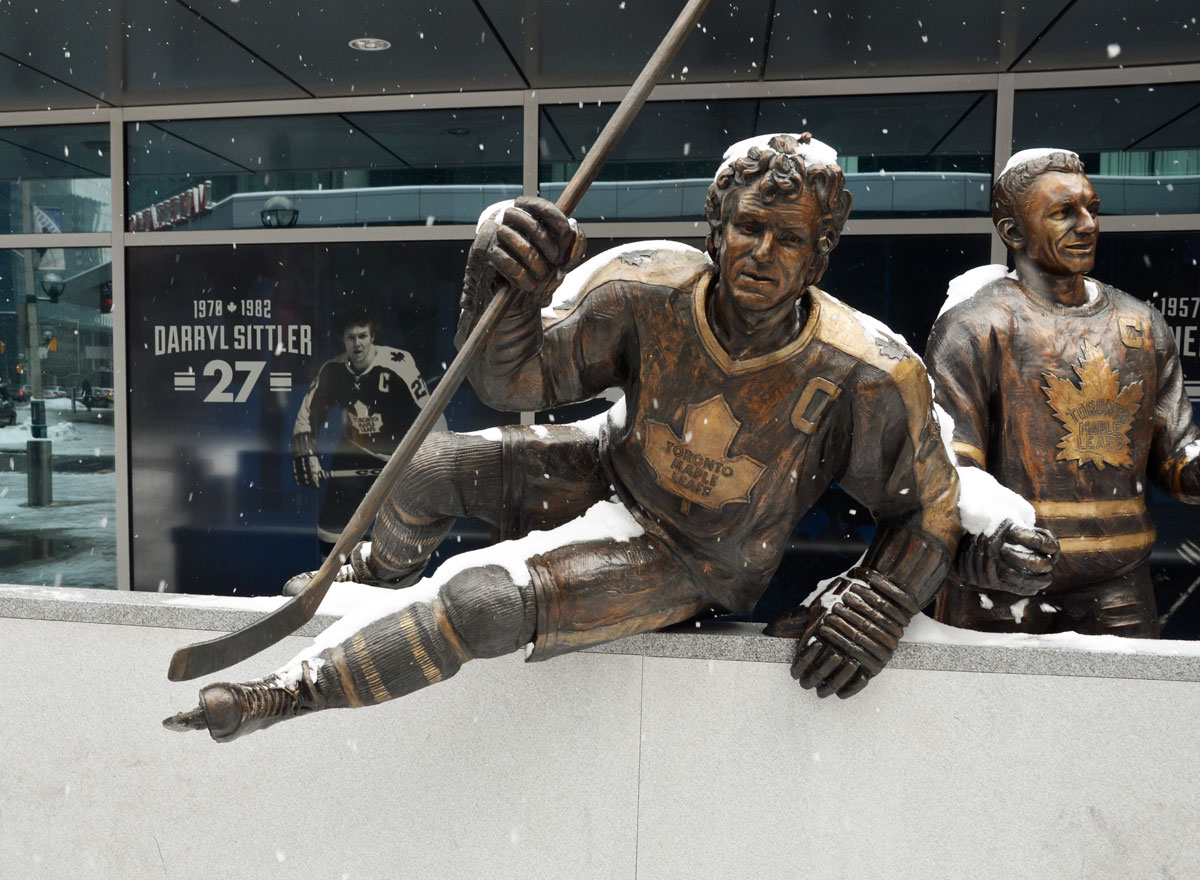
below:  Sittler – One of Darryl Sittler’s claims to fame was in 1976 when he scored ten points in a singlemgame.  On 7 Feb 1976 the Leafs beat the Boston Bruins 11-4.   Sittler scored six of those goals and assisted on four others.

A bronze statue of Toronto Maple Leaf hockey player Darryl Sittler as he jumps over the boards and onto the ice, hockey stick in hand

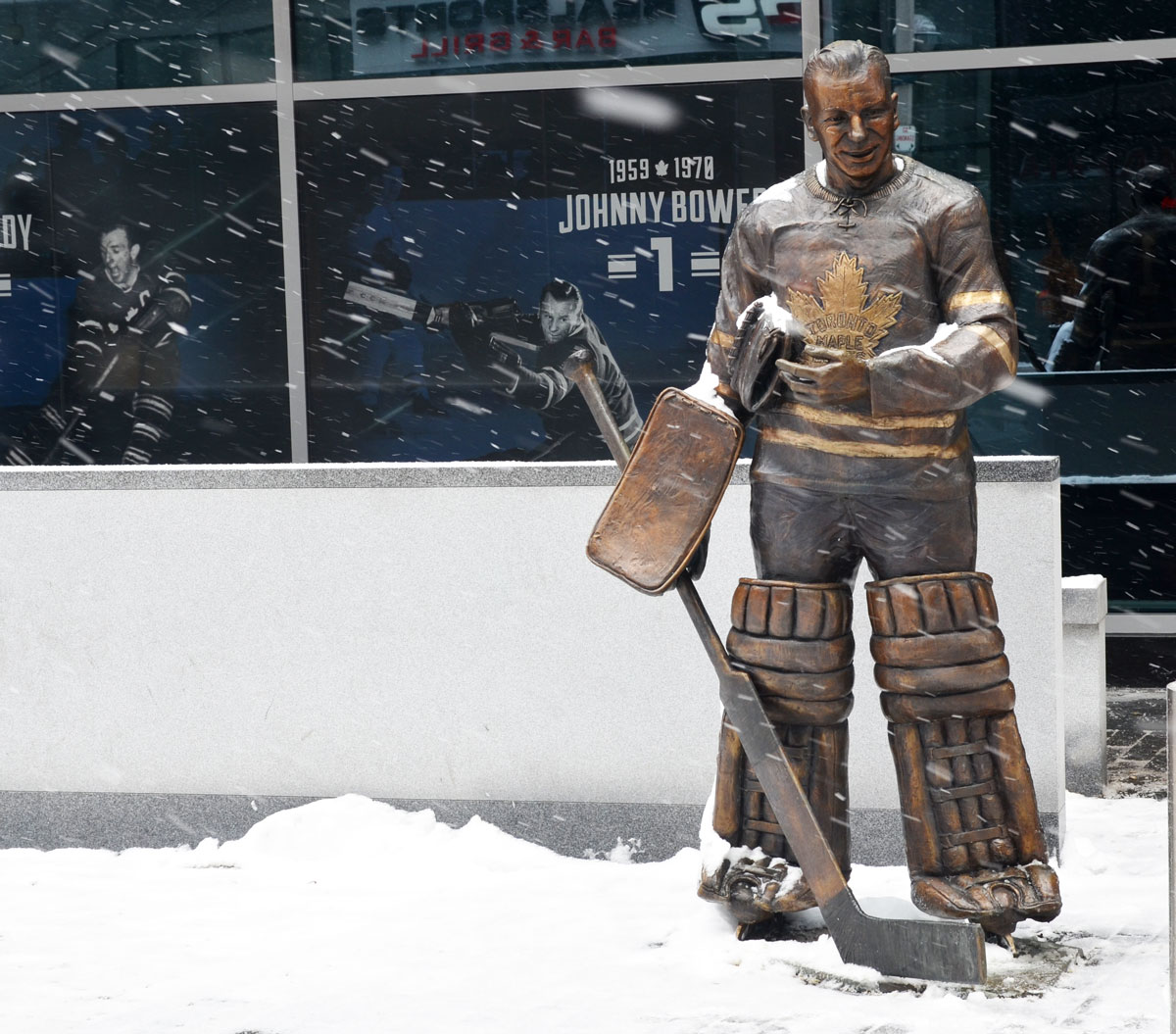
below:  Johnny Bower was a Maple Leaf goalie from 1959 to 1978.  Often he was the oldest man on the team and at the end of his career he was the oldest player in the NHL.

bronze statue of Maple Leaf goalie Johnny Bower in his goalie uniform

Looking at the Legends Row statues from the side with Johnny Bower standing in the foreground.  Ted Kennedy and Darry Sittler are in the background

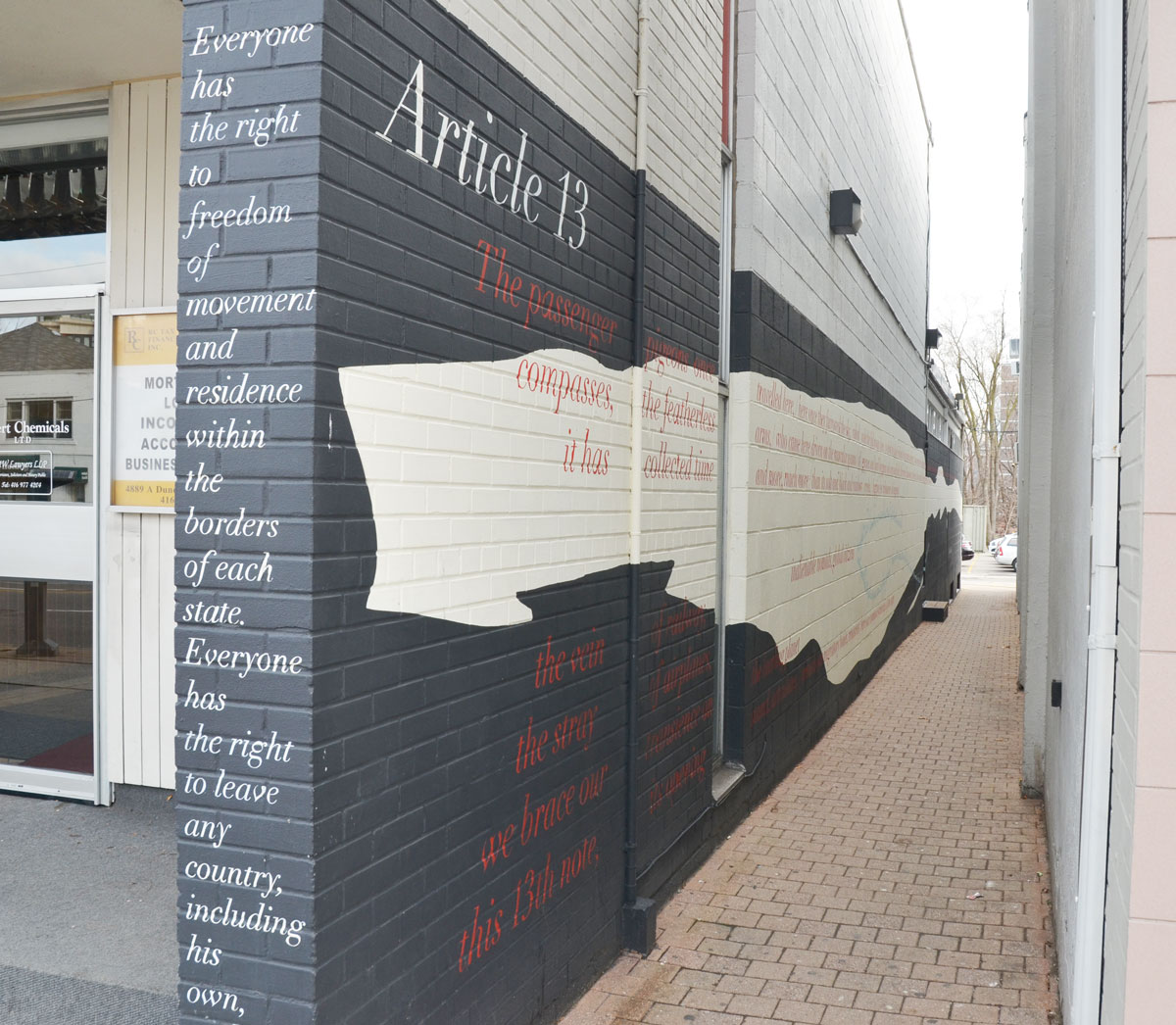
Amnesty International Toronto Organization is a group that works in the to raise public awareness of human rights issues. One of the projects that it supports is  Urban Canvas.  Thirty murals were planned, each based on one of the thirty articles of the Universal Declaration of Human Rights.

The Art Alley Mural Project produced by Arts Etobicoke in 2010 was designed by  Susan Rowe Harrison and painted by William Lazos.  It incorporates a poem by Dionne Brand, Toronto’s Poet Laureate  in 2010 that is based on Article 13.   This article states: “Everyone has the right to freedom of movement and residence within the borders of each state.”

A narrow lane, or pedestrian walkway, between two buildings.  On the left hand side wall there is a mural with a black and white background, and red letters.  The words are a poem about freedom of movement as stated in article 13 of the Declaration of Human Rights.

The mural is on the wall of 4893A Dundas St. West, alongside a narrow pedestrian walkway.


See also a previous post on two of Urban Canvas project murals at Parma Court 

Also, a mural celebrating education, article 26.