Archive for the ‘galleries’ Category

‘Space’ is a series of commissioned works for Mercer Union Centre for Contemporary Art.  These works appear in the billboard space on the side of their building on St. Clarens Ave (at the corner of Bloor Street West).   At the moment, the 4th in the series, ‘Many Maids Make Much Noise’ by Olivia Plender is on display.

words in dark blue written on a white board that is fastened to a brick wall, behind a rust coloured metal fence

Transcription (wordpress has trouble with the formatting I’m afraid):

“1) Imagine you are chewing a piece of very tough meat. Begin
to chew grossly and use the full movements as if trying to break down a gristly lump.

2) Maintain the chewing action whilst repeating the following sentences:
Mutton makes a meaty meal
Militant miners means more money
Many maids make much noise

3) Now try it in a group and repeat several times a day.
Many maids make much noise
Many maids make much
Many maids make
Many maids
Many

[repeat]”

The words are the instructions for making sounds, especially the sound of the letter m. This seemingly mundane exercise is given political overtones by the choice of the sentences chosen to practice on.

This billboard is scheduled to remain until January 2016

Mercer Union website

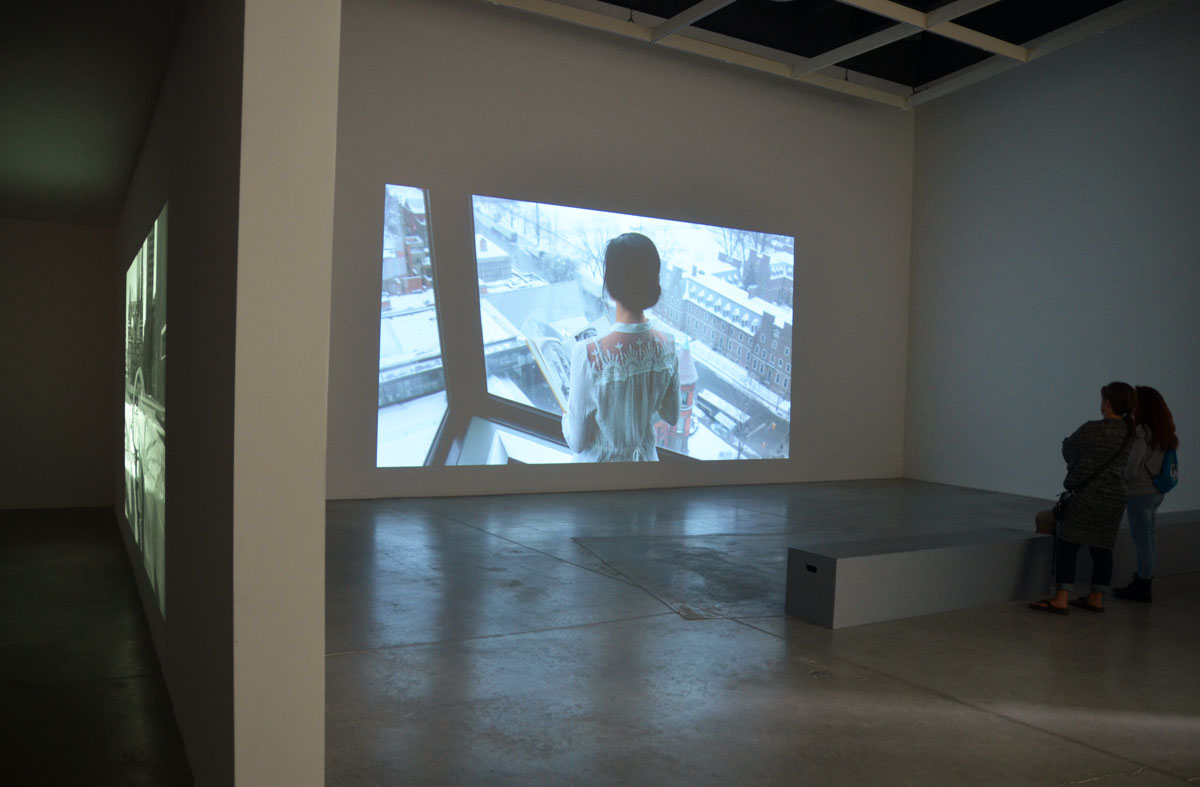
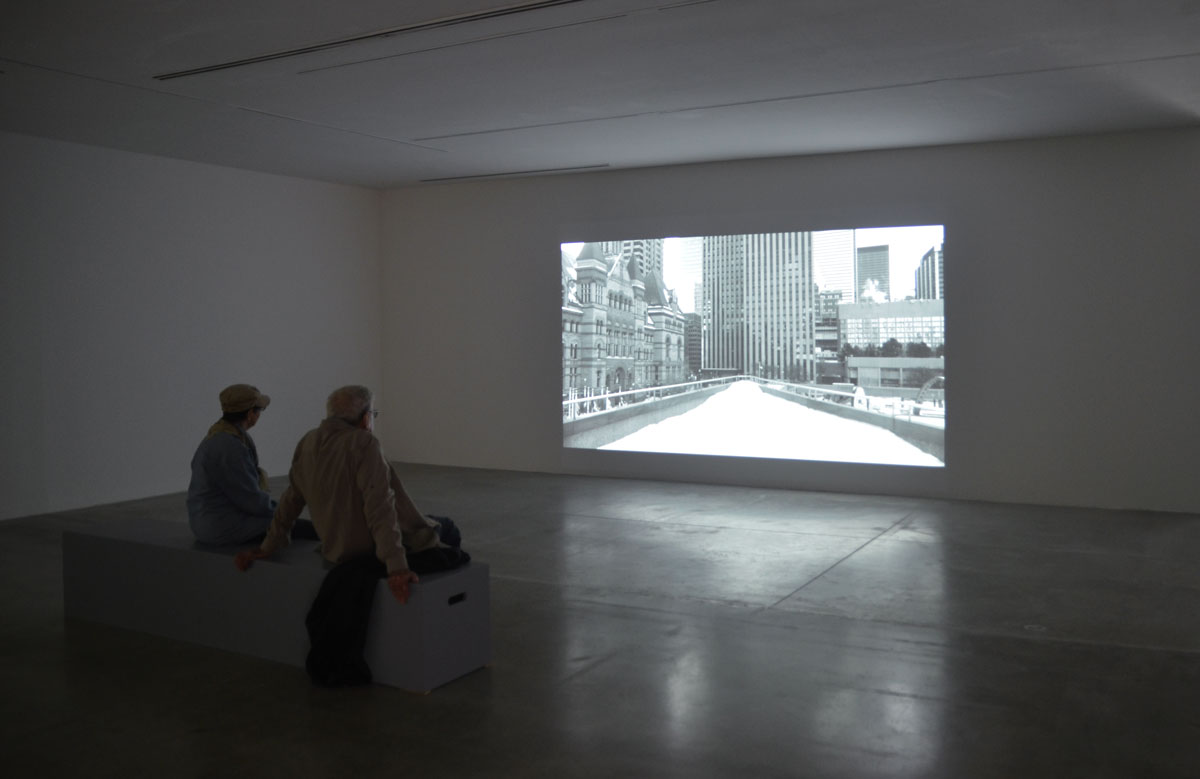
The title of the exhibit is ‘Surrender’ and the words on the wall say this:

“Liz Magor’s art invites us to reconsider our relationships with the things we encounter every day.  Through subtle shifts in materiality and context, her works reveal the important role that objects play in our lives: they can allow us to conceal ourselves or to express our identities.  In her sculptures and photographs, Magor explores how we depend on domestic materials to develop a sense of self.”

Nothing is mentioned about surrendering, or why the exhibit has the title that it does.

In the first room there are boxes on the wall.  Each box looks like a carefully wrapped sweater or jacket that has just been purchased.  I can envision a middle aged saleslady taking her time to package your purchase, like in an Eatons store thirty or forty years ago.

art installation at the Art Gallery of Ontario by Liz Magor - two walls with many open boxes on them. The boxes are made to look like they've just been opened to reveal a sweater or top folded neatly inside, including the tissue paper that often accompanies a new purchase. The clothes have all been decorated with different objects.

On closer look, most boxes also have a hand print, or shape of a hand with index finger pointing at something and little details are amiss…  a ketchup package for example.

blog_liz_magor_cornhuskers

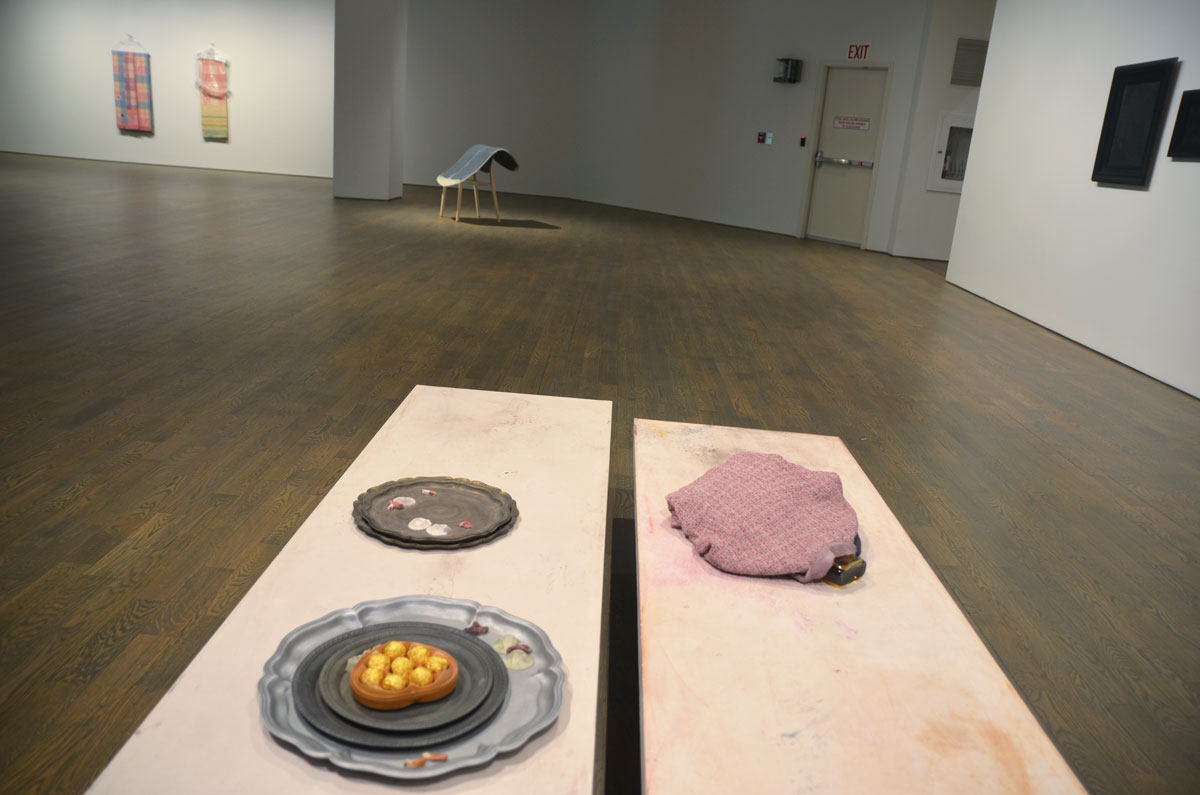
The second room has a number of smaller installations.

A garment bag left over a chair.
Neatly folded blankets hanging on a wall.
A platter of chocolates and left overs.
A tweed jacket on top of a liquor bottle.

art installation at the Art Gallery of Ontario by Liz Magor - in the foreground are two long narrow tables. On one of them is a platter with chocolates and a platter with the remains of cheese and crackers.

A husky under a blanket (of snow?  on a bed?)
A coat and purse hanging on a hook.
The contents of a room boxed and ready to move.

art installation at the Art Gallery of Ontario by Liz Magor - 3 pieces. First, a pile of moving boxes and other items that look like they are in the midst of getting ready for the movers. Second, a large white blanket bed sized that has a hole in the middle of where the pillows should be but instead there is a wolf curled up inside the whole. Third, what looks like a jacket hanging from a hook on the wall

art installation at the Art Gallery of Ontario by Liz Magor - two hangers with plaid blankets folded over them hanging from hooks on a wall. One of the blankets has a clear plastic Creeds bag over the top part of it

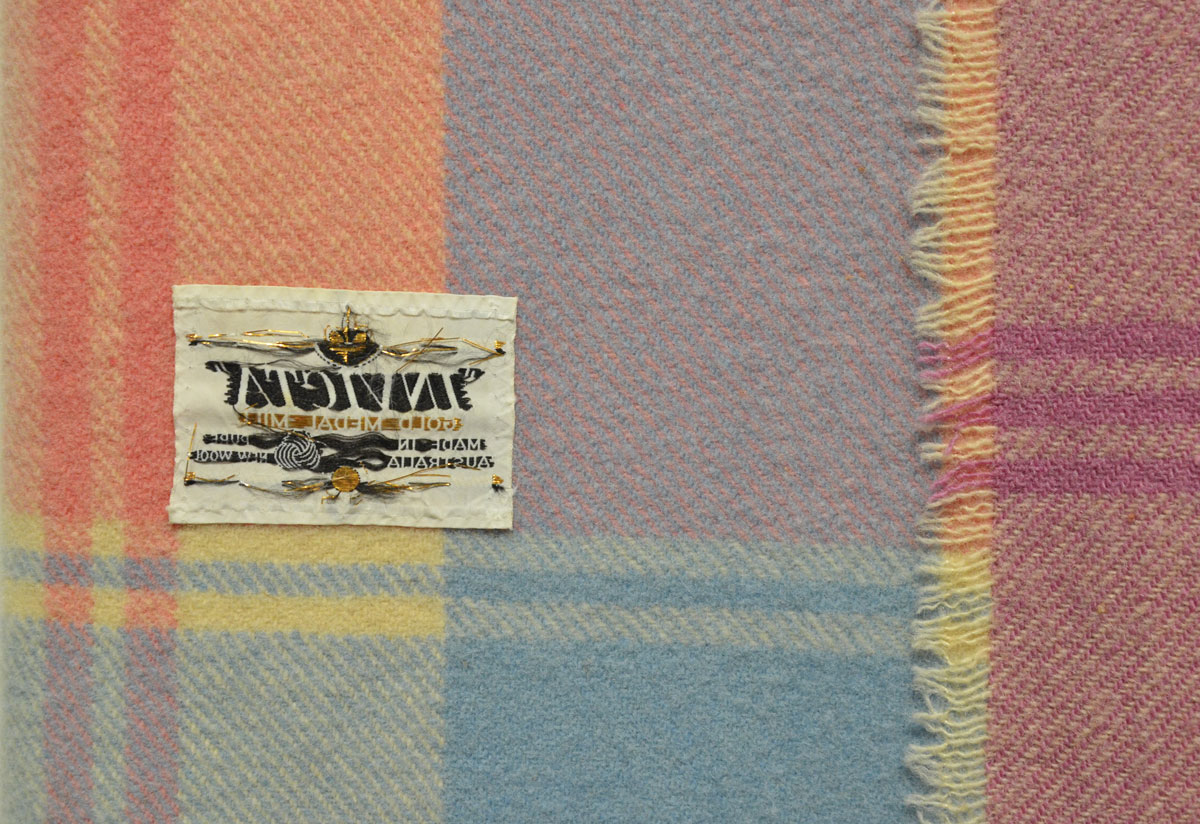
On closer look, some of the details on the blankets are wrong
including the labels that are sewn on back to front.

The label on a plaid blanket is sewn on backwards so that the writing on the label faces the blanket.

I was interested in what people’s reactions were to this exhibit so I had a chat with a couple of the employees about it.  According to them,  there was no reaction.  Most people showed interest in the boxes but when they walked into the second room they rarely stopped to take a closer look.

blog_liz_magor_rose

As for surrender, I did find reference to it in the description of the exhibit on the AGO website, ” In this exhibition, everyday objects and forms, as well as the natural world, function allegorically by evoking the human need to surrender to desires, compulsions, fantasies.”  Once again, I will leave it to you to decide if this description fits.

Exhibit continues until 29th November.

Silent Knight by Ekow Nimako,
a sculpture of a barn owl using more than 50,000 pieces of LEGO,
on display in front of the Gardiner Museum as an extended Nuit Blanche exhibit

sculpture of a barn owl taking flight made of white lego, on a black pedestal (also made of lego) in front of the gardiner museum

close up of the wings and the lego blocks used to make the sculpture of a barn owl

close up of a foot and talons of the barn owl sculpture that is made of lego

#snbTO

At Allan Lambert Gallery, Brookfield Place,
winning photos from the 58th World Press Photo Contest

Winning images chosen from 97,912 photographs taken by 5,692 photographers from 131 countries.

Three people are looking at a series of photographs on display. One of the photos is a boat carrying refugees, taken from above, the boat is packed full

below:  Taken by Andy Rocchelli of Italy, part of his series of ‘Russian Interiors’ portraits. There were 10 photographs in the series, three of which are shown here (well, two and a half).  All were of women.

Three pictures on white board on display in the Allan Lambert gallery in Brookfield Place. Behind the board is the stone facade of the old bank building.

below:  One of the multitude of Chinese migrant laborers, a factory worker in in Yiwu China. His job is to coat polystyrene snowflakes with red powder.  There are 600 factories in Yiwu and they produce 60% of the world’s Christmas decorations.  Photo by Ronghui Chen, second prize winner in the Contemporary Issues category.

A picture of a photograph taken in a red room of a young man wearing a Santa Claus hat and a blue jacket.


below: The three winning photographs from the Sports (Singles) category.  The predominant photo is the second prize photo; it is a photo of Odell Beckham of the New York Giants making a one handed touchdown catch, taken by Al Bello.  The winning sports photo is the one on the far left.  It is a photo of Argentine football player Lionel Messi receiving the Golden Ball trophy at the World Cup in Brazil, taken by Bao Tailiang.   In the middle is a picture of Philip Hughes, a cricket batsman who was hit on the head by a ball during a game, taken by Mark Metcalfe.

Picture taken at night. The light source is from lights in the floor. Three photographs are on display, part of a larger exhibit of winning photography from around the world. The three shown here are sports photos. The main one being a football player catching a pass.

people looking at photographs, the winning pictures from the World Press Photo contest, on display at Brookfield Place

people looking at photographs, the winning pictures from the World Press Photo contest, on display at Brookfield Place

people looking at photographs, the winning pictures from the World Press Photo contest, on display at Brookfield Place

World Press Photo contest winners, sign cautioning people that the section they are about to enter has some disturbing images in it.

people looking at photographs, the winning pictures from the World Press Photo contest, on display at Brookfield Place

below: The winning photo, by Danish photographer, Mads Nissen of Jon and Alex, a gay couple, sharing an intimate moment at Alex’s home, a small apartment in St Petersburg, Russia. (It looks better in real life!)

A photo by Mads Nissen, the winning photograph of the 58th World Press Photography Contest, Jon and Alex , two men, one lyng on his back and the other sitting beside him. The greenish curtains in the background dominate the picture.

The exhibit is called ‘Black Cloud’ and it consists of thirty thousand black moths, each one individually attached to the walls and ceiling of the clerestory of the The Power Plant Gallery.   Artist Carlos Amorales has reproduced the shapes and sizes of thirty six different species of moth with black paper.  They swarm towards the lights and they congregate in the corners.  It’s a fascinating display both in the overall composition and in the attention to small details.   This installation first appeared at an art gallery in Paris in 2007.

A wall covered with black paper moths, part of an art installation called Black Cloud by Carlos Amorales

A wall covered with black paper moths, part of an art installation called Black Cloud by Carlos Amorales where 30,000 black paper moths are stuck to the walls and ceilings of a hallway - looking up at all the moths on the ceiling

A wall covered with black paper moths, part of an art installation called Black Cloud by Carlos Amorales where 30,000 black paper moths are stuck to the walls and ceilings of a hallway - looking at the corner of the hall, where the wall meets the ceiling

A wall covered with black paper moths, part of an art installation called Black Cloud by Carlos Amorales where 30,000 black paper moths are stuck to the walls and ceilings of a hallway - this picture is a close up of some of the moths

As much as I liked the display, I was glad they weren’t real moths!

A hallway covered with black paper moths, part of an art installation called Black Cloud by Carlos Amorales where 30,000 black paper moths are stuck to the walls and ceilings of a hallway

#PPBlackCloud

Camera Atomica
a photography exhibit at the Art Gallery of Ontario

below: The first photograph of the bones of the hand, by Wilhelm Rontgen in 1895.    Rontgen was a German physicist who discovered x-rays (or Rontgen rays) in 1895 and he produced this image of his wife’s hand shortly after.  The green in the picture below is a reflection of the chandelier that the AGO has hanging in the room where this exhibit is being shown.

An xray picture of a hand.

The exhibit consists of more than 200 works that all fall under the category of nuclear – topics such as atomic weapons, Cold War politics, nuclear energy, and the mining of uranium.  The photographs cover the history of these topics from 1945 to the present, from the development of the atomic bomb to the meltdown at Fukushima Daiichi in Japan in 2011.

below: Hiroshima Japan, photo by Yoshito Matsushige, taken 6 August 1945.
The first atomic bomb was detonated at the Trinity test site in New Mexico USA on 14 July 1945.  Shortly after, American bombers dropped two atomic bombs on Japan.  The first bomb was dropped 6th August 1945 on the city of  Hiroshima and second one three days later on Nagasaki.

An old black and white photo taken in Hiroshima after the dropping of the atomic bomb during WW2

below: Photo by Dean Loomis, 7 May 1955 of scorched male mannequin standing in the desert 7,000 feet from the 44th nuclear test explosion at Yucca Flat Nevada.  Photo taken the day after the blast.  Apparently mannequins were used to test the effects of the nuclear blasts on people and this photo shows that people at 7000 feet from a blast could be burnt but alive.

Picture of a black and white silver gelatin print from 1955 by Dean Loomis showing a male mannequin in a black suit who has been partially knocked over by a nuclear test blast in the Nevada desert.

below: Mushroom clouds on a wall

A collage of photos of nuclear blast mushroom clouds. There are about 25 colour and black and white photos hanging on a wall of the Art Gallery of Ontario

below:  Part of  ‘Uranium Tailings #2, Elliot Lake Ontario’ a photograph by Edward Burtynsky.

Eliot Lake was established in 1955 as a mining town after uranium was discovered in the area.  In the early 1990’s the mines closed because of depleted reserves and low prices for uranium.

Tailings are the materials left over after the valuable part of an ore has been removed.  The uranium ore found at Eliot Lake had very little uranium in it, only about 0.1% of the ore was uranium.

Close up of part of a photograph by Edward Burtynsky titled Uranium Tailings #2, Elliot Lake Ontario. It is a picture of a desolate swampy looking terrain where all the vegetation is dead. The trees have been reduced to dead poles.

below:  Inkjet prints by David McMillan, part of four on display from his series of photographs of places abandoned because of the Chernobyl disaster in 1986.   The photograph on the right is of the nursery at Pripyat Hospital taken in 1997.   Beside it is a picture of a classroom in a Pripyat nursery school.

Pripyat is an abandoned city in northern Ukraine.  It was built in 1970 to service the Chernobyl Nuclear power plant.  Following the explosion and fire at Chernobyl on 26 April 1986, the city’s 49,000 people were evacuated

Two photographs on a wall. The one in the foreground shows an abandoned hospital nursery in Pripyat Ukraine, abandoned after the Chernobyl nuclear disaster.

A young man is half squatting as he leans back to get a better look at the words on the wall of an art gallery that accompany three black and white photographs.

The exhibit continues until 15th November.

#atomicAGO

The fifth floor of the Art Gallery of Ontario is devoted to contemporary art.

Three of the present exhibits are best described as conceptual art.  Conceptual art is art where the idea is more important that the look.  The story behind the work trumps aesthetics.

This blog post has taken me many days to write as I struggle with the love hate relationship that I have with conceptual art.   My biggest complaint about conceptual art is that skill too often gets thrown out the window;  God forbid that something like artistic merit should impede the artist.  I can empathize with causes and I can support ideas without liking the end product.  In other words, just because I don’t the ‘art’ doesn’t mean I don’t “get it”.

Anyhow, on to the exhibits.

First, ‘Gustav’s Wing’ is an exhibit by Danh Vo, a man born in Vietnam but raised in Denmark.  Using his nephew as a model, Vo had a bronze of cast of the boy’s body made in six pieces.  The pieces are then arranged within a room.  “The resulting installation gives a fragmented and evocative portrait of a boy whose Danish and Vietnamese heritage echoes that of the artist, but who represents the next stage in the family’s story – that of the first-generation Danish citizen”, according to the description of the exhibit.

Looking into a white room, photo taken from the doorway, pieces of metal cast from a boy's body lie on the floor, scattered, part of an art installation at the Art Gallery of Ontario

Close up of a metal cast of a boy's foot. Part of an art installation by Danh Vo at the Art Gallery of Ontario

Three of the metal pieces from Gustave's WIng, an art installation by Danh Vo, pieces of body cast in metal

Second, there are three totem poles by Brian Jungen entitled ‘1960’, ‘1970’, and ‘1980’.  All three were made in 2007.  The words in the artist’s statement about this piece say “The towering works recall the complex social and political tensions that can result from First Nations land claims.”  Part of the artist’s reasoning is that golf courses are manicured and their use is quite different from the way land is used by First Nations.


A group of women looks at an art installation of three large totem poles made of golf bags on display in an art gallery (Art Gallery of Ontario)

below: Anther piece by Brian Jungen, this one is called ‘Wieland’ and it is made of red women’s leather gloves.  It is supposed to be an upside down maple leaf, i.e. a Canadian symbol turned on its head.  When I first saw it, I saw an eagle with its wings spread but maybe that’s just me.

The words on the wall for this piece: “Its title celebrates Canadian artist Joyce Wieland (1931-1998) whose work in the 1960s and 1970s proposed a gendered patriotism in which indigenous art and culture were given only tokenistic inclusion. With Wieland, Jungen positions himself as part of and against an established narrative of Canadian art history.”

In Wieland’s opinion Canada was female I guess that that is what “gendered patriotism” means.  Otherwise, you will have to figure this one out for yourself.

Upside down rd maple leaf made of women's gloves. It also looks a bit like a large bird with outstretched wings. Part of an art installation at the art gallery of Ontario

Lastly, there is an installation by Duane Linklater.  Each garment rack is piece and they have names like “My brother-in-law, my sister” and  “The marks left behind”.  Furs of different animals such as fox and skunk hang from the garment racks.  One has an old T-shirt and one has a piece of orange fabric.   “The evocative titles of the pieces speak to family ties, articulating a sense of personal loss” according to the description of the work found on the gallery wall.


A woman is in a large room at the Art Gallery of Ontario, she is looking at an art installation that involves skins of dead animals hanging from garment racks. A pink picture of a woman hangs on the wall.

in an art gallery, an art installation that involves skins of dead animals hanging from garment racks. A pink picture of a woman hangs on the wall.

The two pink pictures on the wall are each a half of a portrait of a woman called Anna Mae Aquash who died in 1976. Together they form ‘Family Photograph’.  Aquash was a Miqmaq woman who was involved as a “radical activist” in the American Indian Movement of the early 1970s.  She was murdered.    If you read the description of the work on the gallery wall, you will read these words: “By including her image, Linklater expresses a sense of familial connection with Aquash and establishes a symbolic relationship with the previous generation while asserting himself in the present. ”   Pardon?

The words on the wall don’t tell you that she was murdered by her own people because they thought she was an FBI informant.  So what relationship is the artist trying to establish?  How does this even remotely lead to “asserting himself in the present”?  Sorry, but empty jargonish words leave me cold. This isn’t art.  Linklater may have a valid idea but that doesn’t make it art.

A group of people in an art gallery, they are looking at an art installation that involves skins of dead animals hanging from garment racks. Two pink picture of women hangs on the wall.


Stephen Andrews POV
an exhibit at the Art Gallery of Ontario

Stephen Andrews is a Toronto artist whose career began in photography and the exhibit now on at the AGO does include a few excellent 8×10 photographs.  The main part of the exhibit though are approximately 20 (mostly large) paintings of his.

A room in an art gallery with white walls and three large paintings on it. A woman is taking a picture of one of them with a camera. The paintings consist of large rectangles
  below: ‘X-men at Union’, 2013, oil on canvas
Construction workers at Union Station, Toronto

rtwork picture of two construction workers wearing orange and yellow safety vests as they walk into a building that is being renovated

below: ‘After Before/After After’ oil on wood panels
The two paintings on the wall were based on landscapes by J.M.W. Turner that depicted scenes before and after the flood described in the bible (or before and after chaos).  Andrews has painted his with dots in only four colours, yellow, magenta, cyan and black

An open book on a pedestal, a large picture of a painting on each page. Two paintings on a wall directly behind the book. The paintings on the wall are replicas of the ones in the book .

below: detail from ‘Crossing’, 2011, oil on canvas

close up of a painting of a large number of railway crossing signs.

below: close up of part of ‘Entrance/Exit’, 2014, oil on canvas

close up of a slightly abstract painting of a person about to go through a revolving door in a glass wall

 Planet IndigenUS is a ten day festival co-produced by the Harbourfront Centre in Toronto and the Woodland Cultural Centre in Brantford. It features 300 artists with dance and music performances as well as visual art exhibits at a number of venues.  One of the venues is the gallery at Harbourfront Centre where a number of artists of Anishnabe heritage are showing their work.  Two of the artists are Christian Chapman and Scott Benesiinaabandan, and a sample of their work is presented here.


 Screenprints by Christian Chapman

print of an evergreen forest, a text in Ashishnabe language on top of the trees, hanging on a gallery wall gaawiin wiikaa ji gwerina-ka-nawich
miskwadessi opixwanak misa oi kitimagia
miskwadessi wag dash awessiwag
ji manaadji-a-ka-ni-watch

 never turn a turtle on its back so that it is helpless
turtles and all other animals are to be accorded respect


print of asky with clouds in red and orange tones, a text in Ashishnabe language on top of the trees, hanging on a gallery wall gaawiin wiikaa zaagi-dandaweken
wassetchiganatikong wayti-endaian
ai anike dibadjimowin eta ga nibodwach
sa gitinacasowug

never climb out a window in your house,
traditionally, only dead people are brought out like that

***

below: ‘God Save the Queen’ by Scott Benesiinaabandan
a series of photos in which the queen is partially covered by the artist’s Solidarity Flag

In an art gallery, a series of three large photographs of a statue of Queen Victoria.  THe first picture is just the statue, the middle picture is a man starting to put a  flag over the bottom part of the statue and the third picture is the flag on the statue.  Flag is solidarity flag created by Scott Benesiinaabandan, black and blue background, red circle in the middle, yellow sun in the red circle


The art of CubeWorks
now showing at Art/Exp gallery in the Distillery District

 CubeWorks is a group of artists that use unconventional materials to create images.  They are known for the art that they create using Rubik’s cubes but they also use crayons, lego blocks, records, dice, guitar picks, spools of thread, and other mixed media. The pictures below are just a sample.

below: A copy of ‘The Creation of Adam’ that Michaelangelo painted on the Vatican’s Sistine Chapel ceiling in the early 1500’s.  This image is made with 12,090 hand twisted Rubik’s cubes.

A copy of Michaelangelo's painting on the Sistine Chapel ceiling, The Creation of Adam where God is giving life to man with the meeting of finger tips.

below: On a smaller scale, Space Invaders made with 20 cubes.

Little green space invaders from the old video game made of Rubiks cubes, green space invaders on blue background.

below: Artworks made of crayons, LOVE and a smoking gun.
Each square is 12″ x 12″ and contains just over 1000 crayons.

An image of the famous LOVE red letters in a black and blue square, this one is made of red, black and blue crayons on end.

An image of a smoking revolver that is pointed at the viewer.  It is made from 9 squares and each square is filled with crayons on their ends.  The background is red crayons, the smoke is yellow crayons.

An image of a smoking revolver that is pointed at the viewer.  It is made from 9 squares and each square is filled with crayons on their ends.  The background is red crayons, the smoke is yellow crayons.  A close up of some of the squares to show the crayons more clearly.

below:  The Joker’s face, made with spools of thread, hangs from the ceiling.

An image of the Joker's face made with spools of thread hangs from the ceiling.

below: Images made with old broken record albums, Amy Winehouse and Jim Morrison

image of Amy Winehouse made from broken records on a background that is a collage of newpaper pieces.

image of Jim Morrison, the guitar player from Doors, his head with facial features painted in black but his hair is made with broken records.

Gallery sign on the exterior of a brick building, square sign with purplish background.  Art Exp is the name of the gallery

More information on CubeWorks