


Toronto Outdoor Art Fair 2018,
Nathan Phillips Square
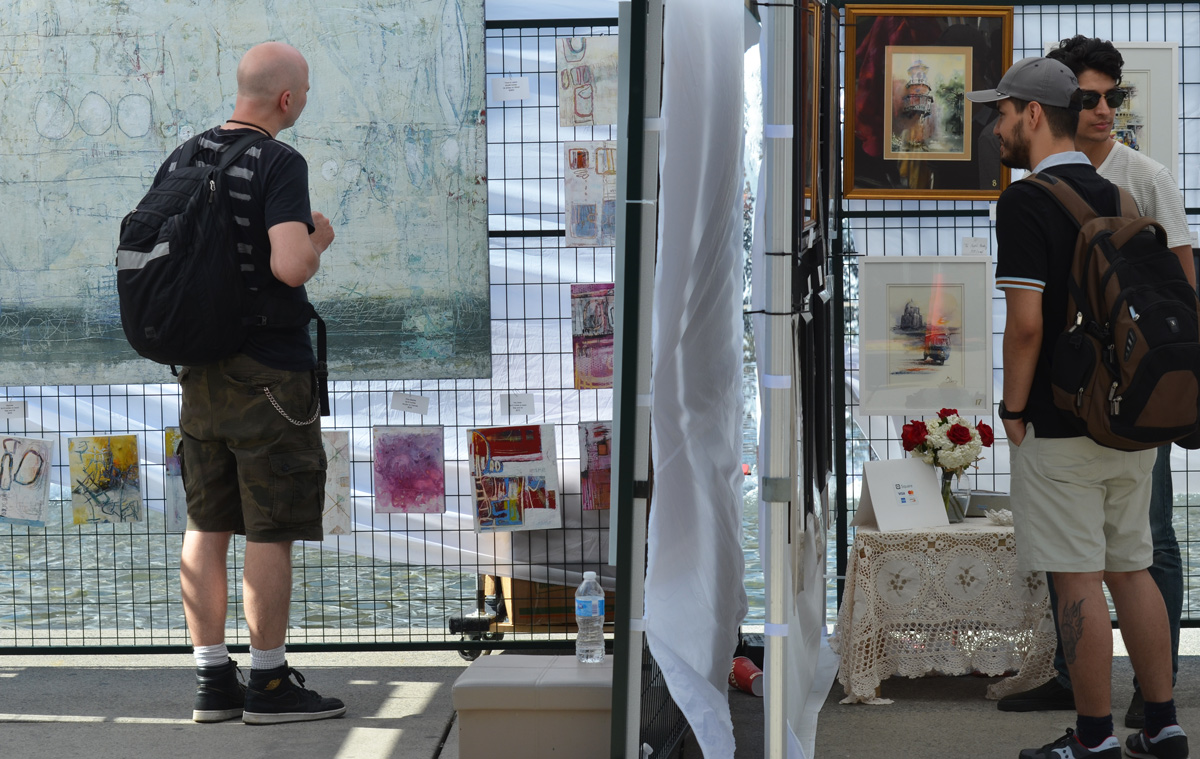
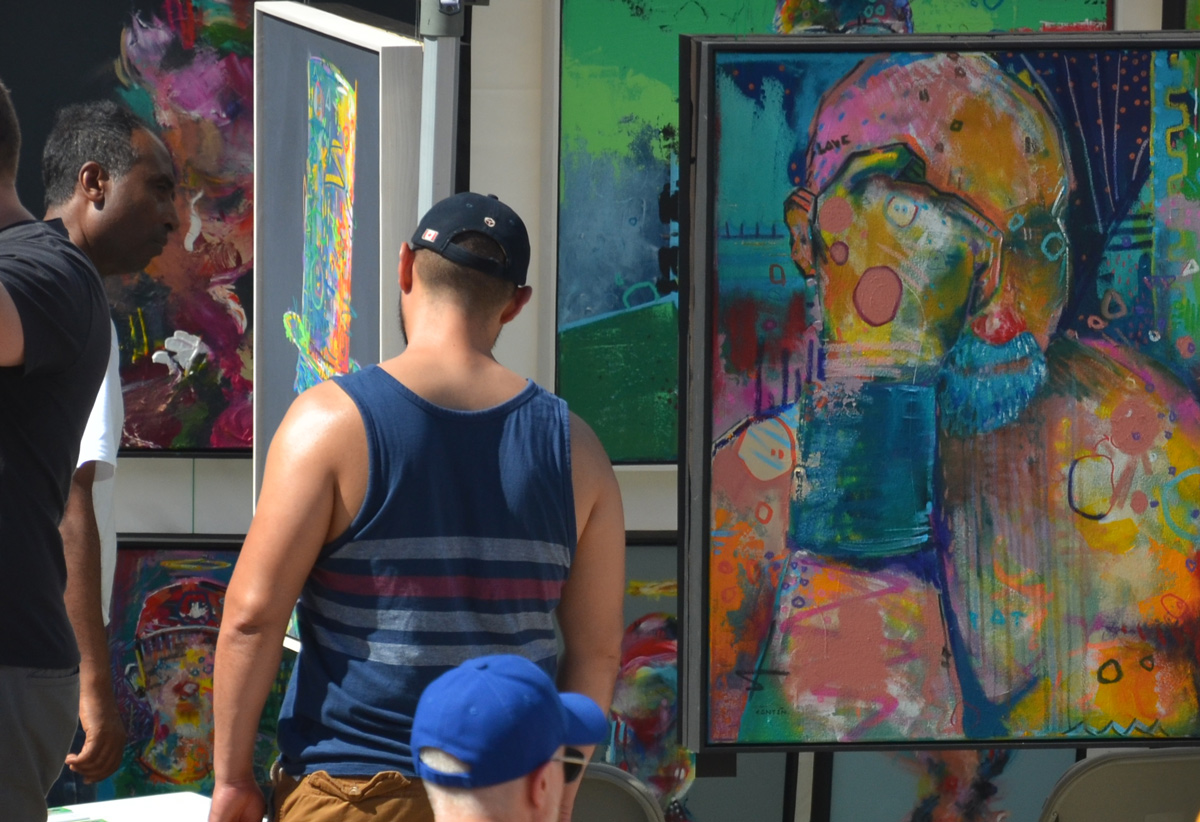
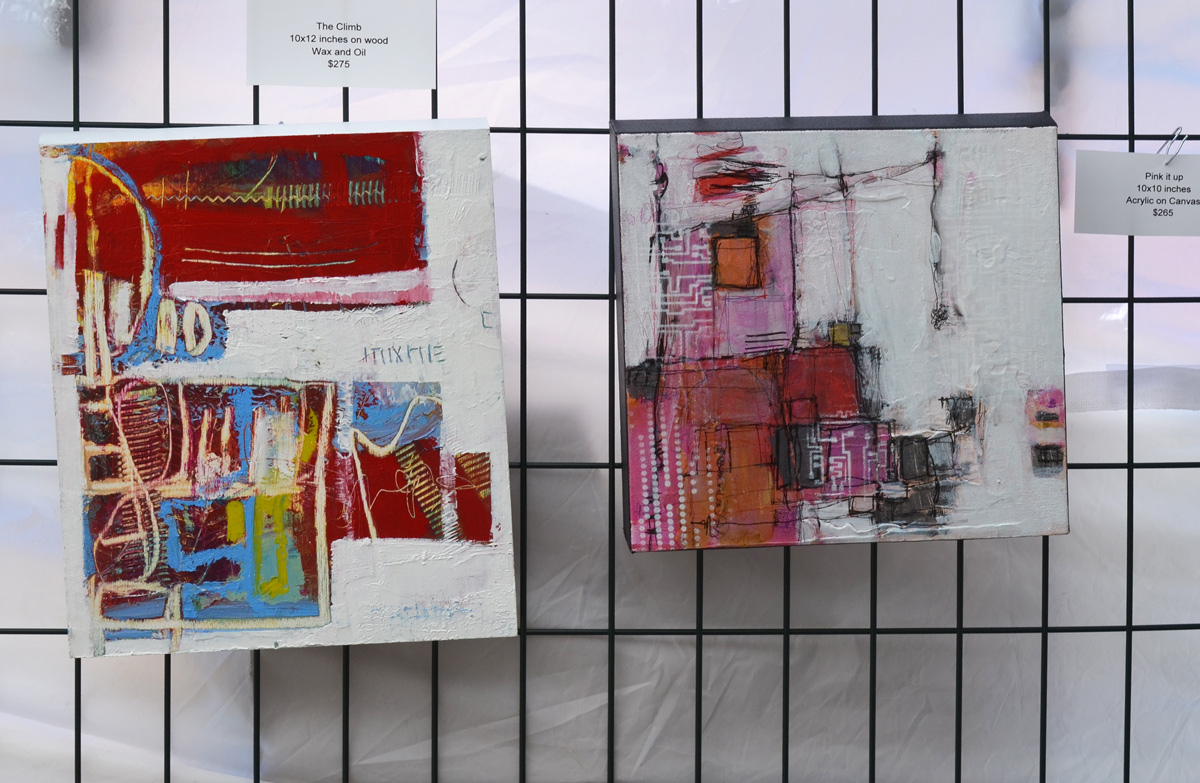
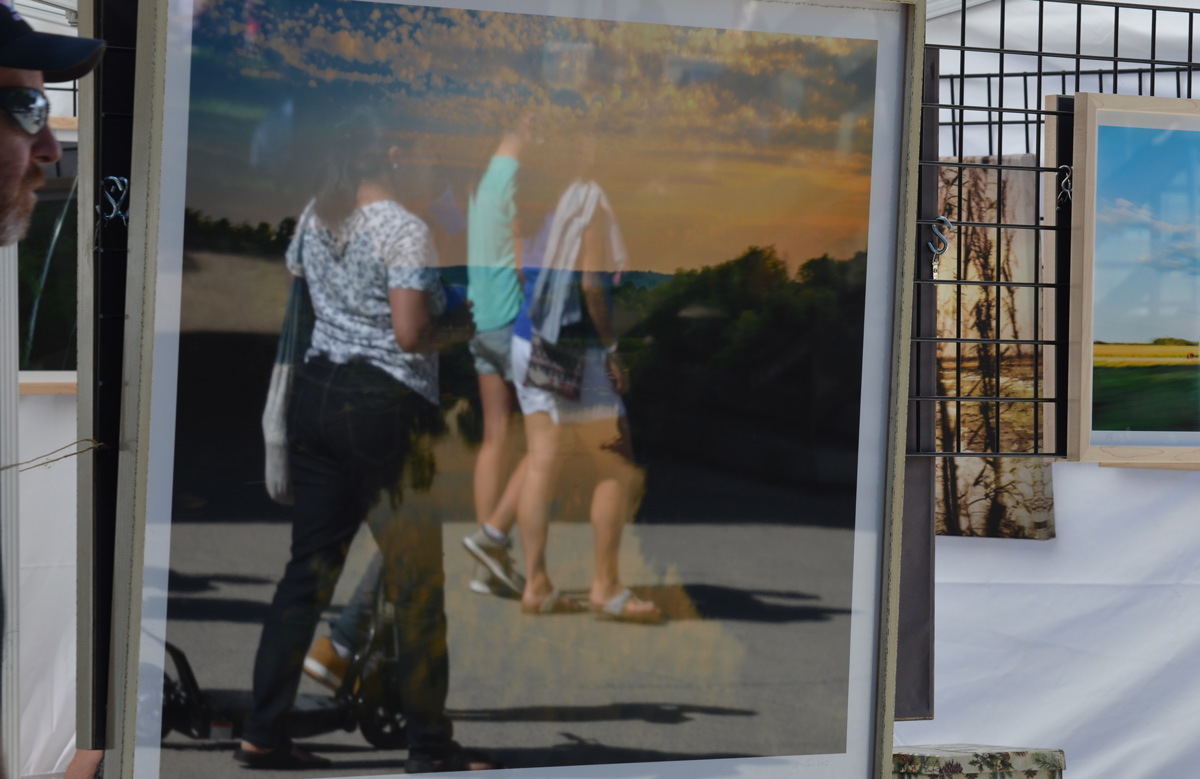
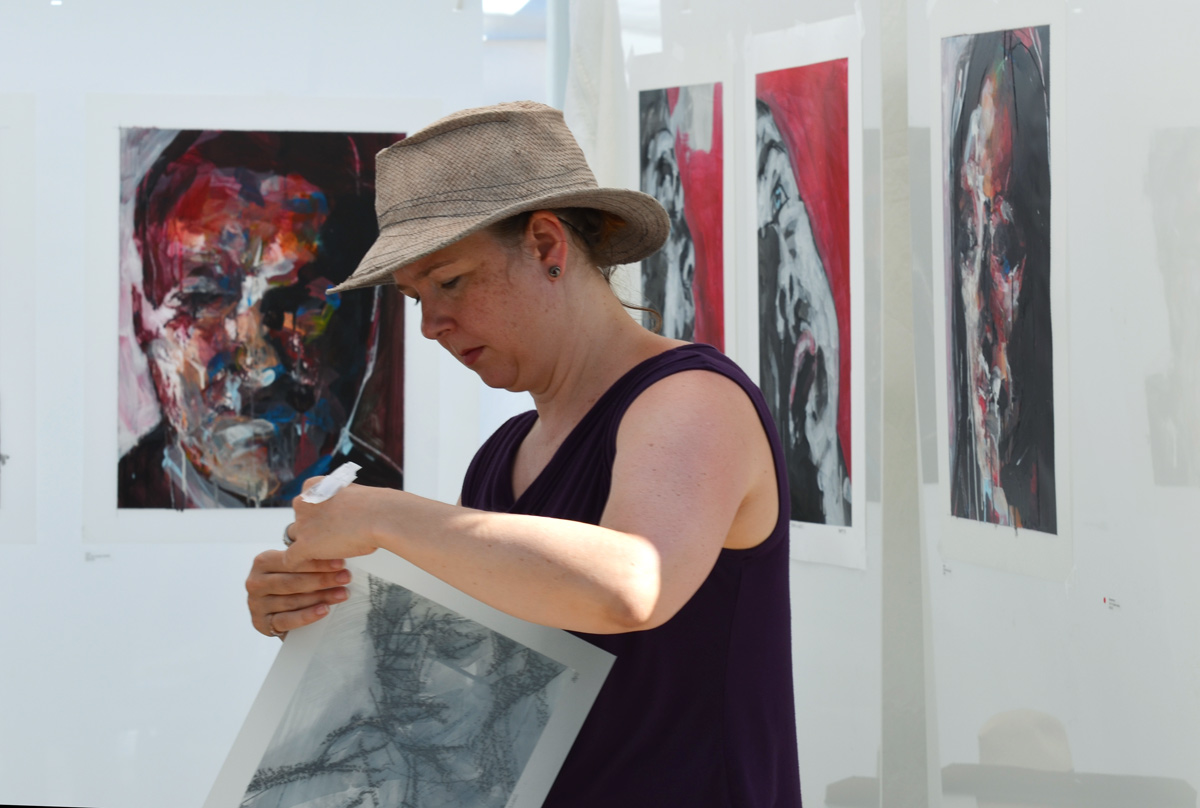
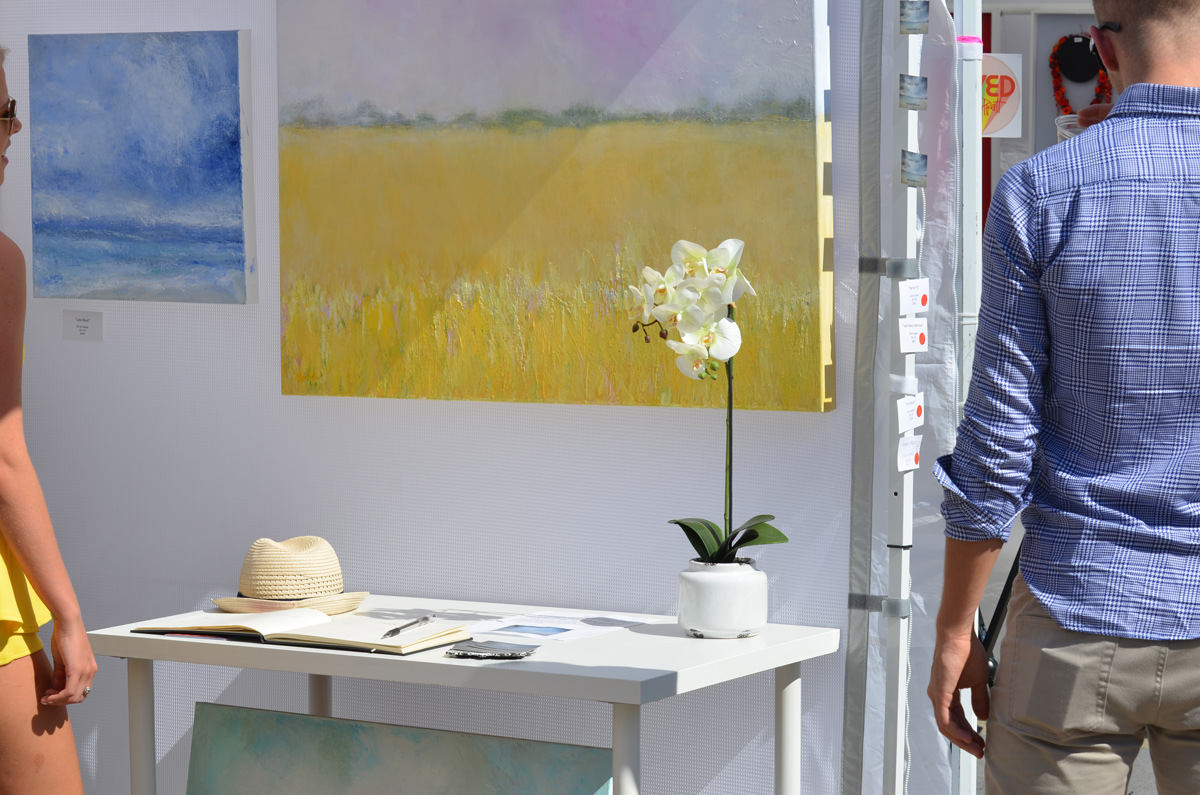


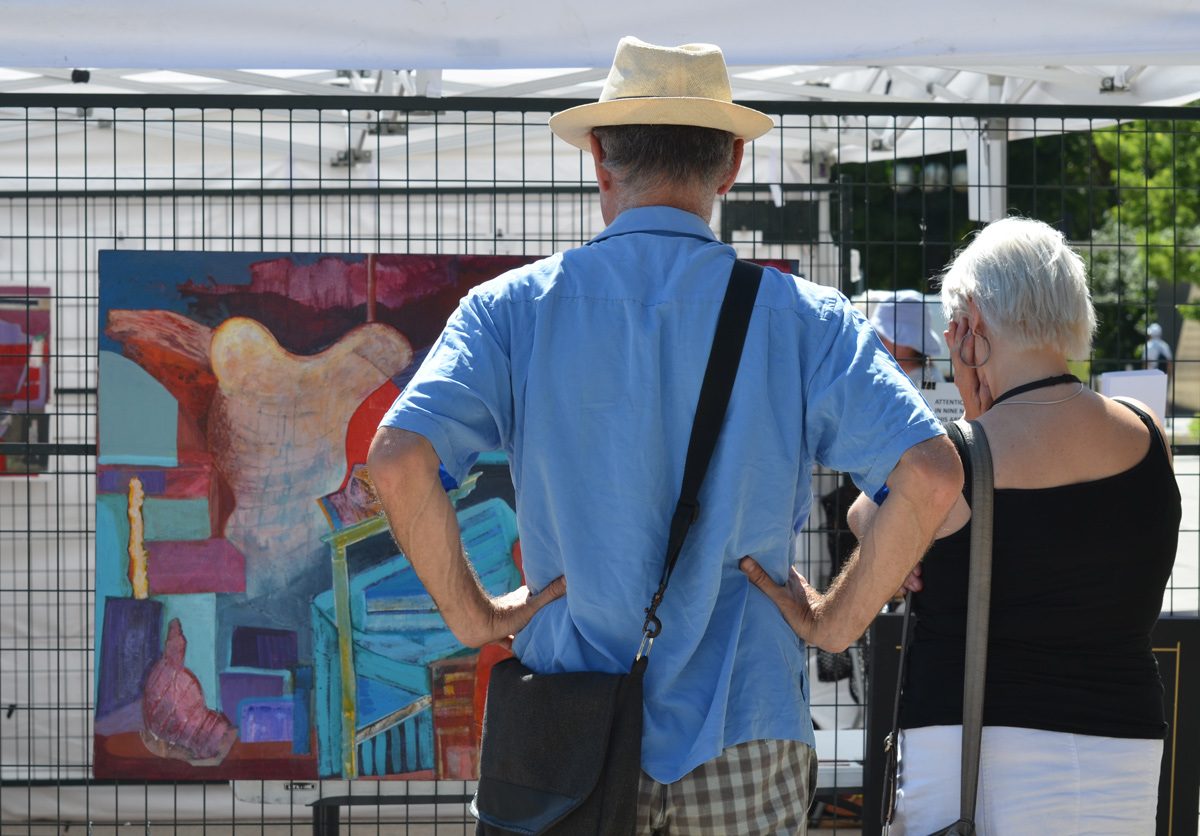
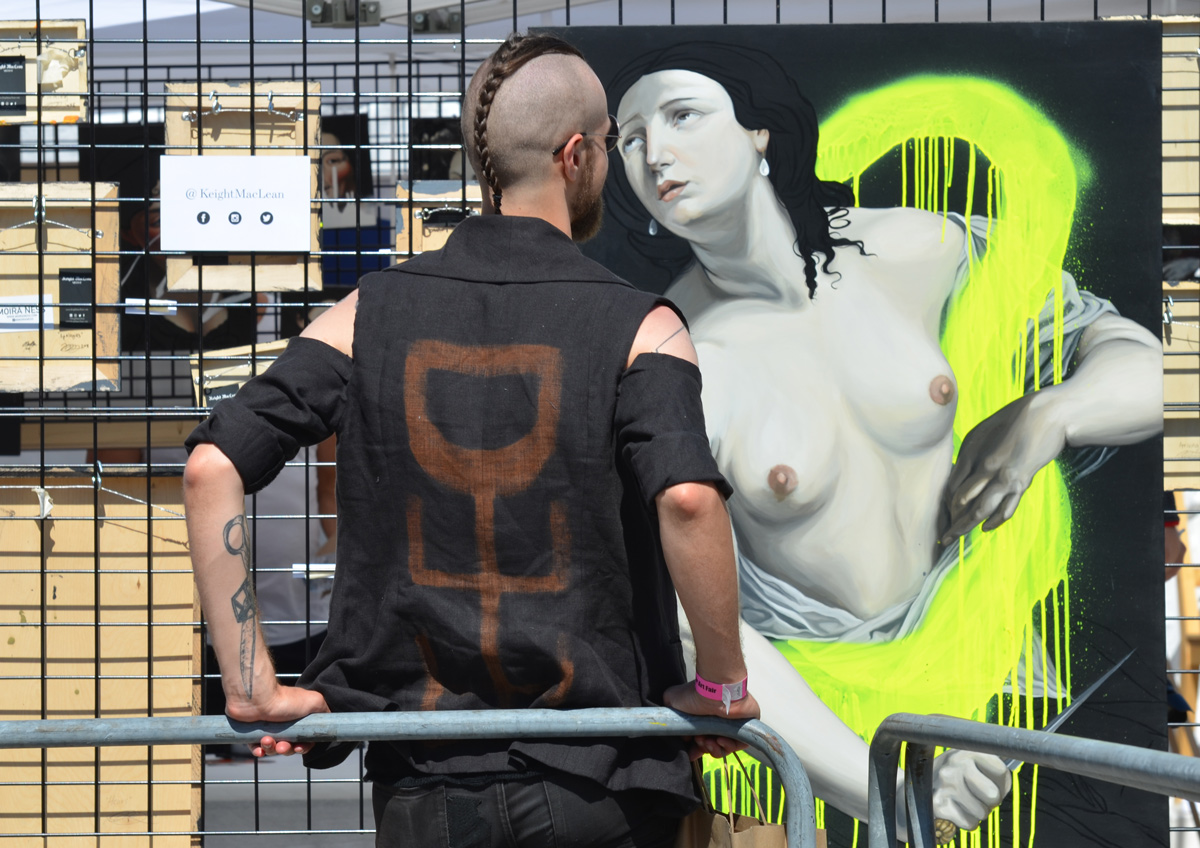
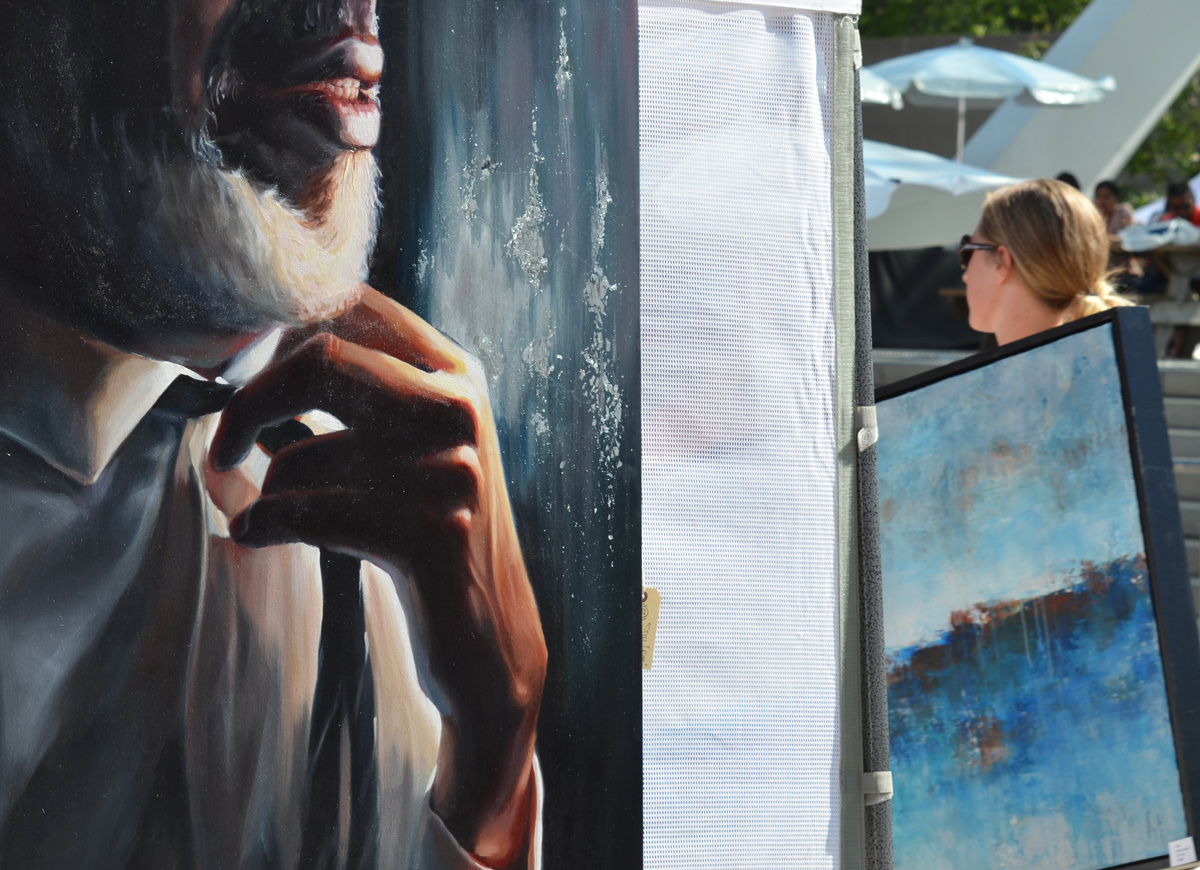


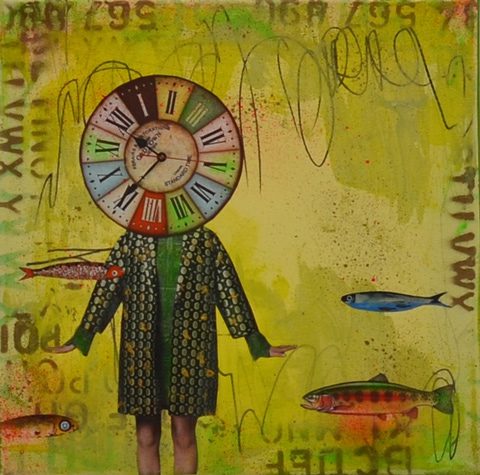
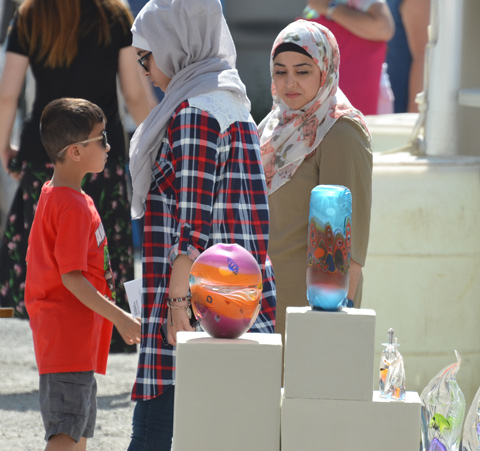
Toronto Outdoor Art Fair 2018,
Nathan Phillips Square
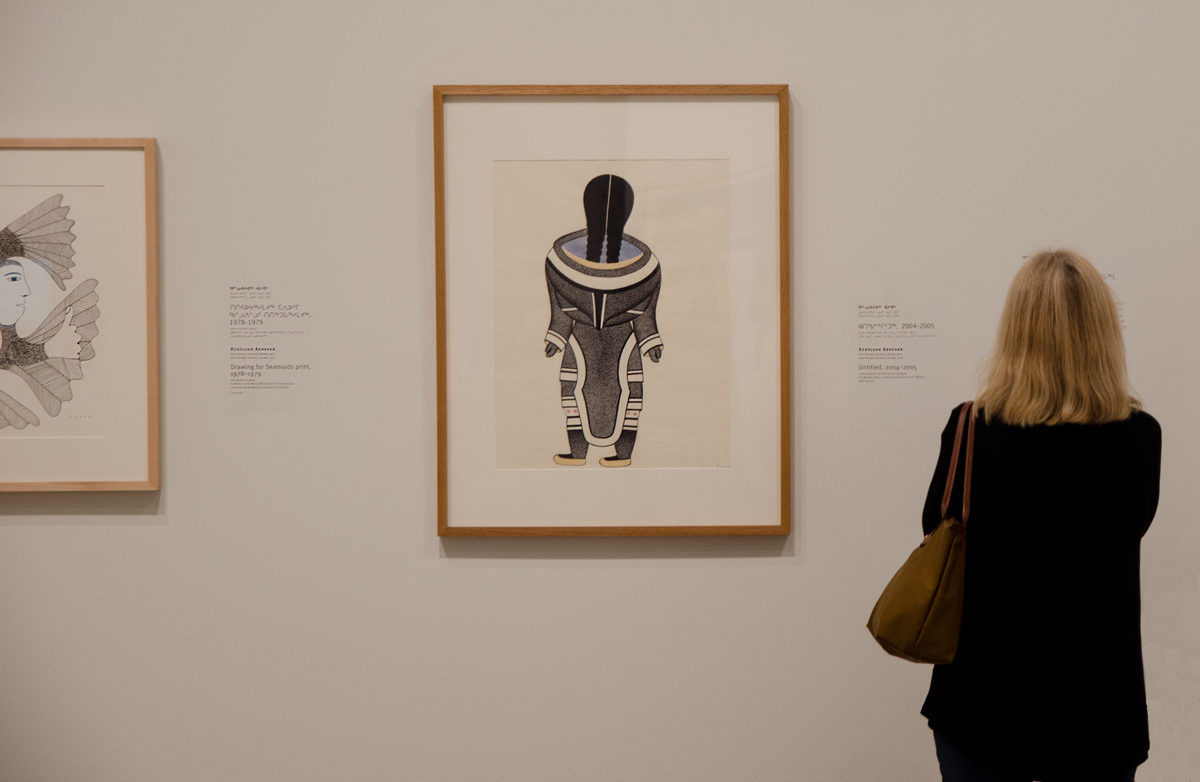
Tinirrusiangit is an Inuktitut word that means “their gifts” or “what they gave”. It is the name of the latest exhibit at the Art Gallery of Ontario features the work of two Inuit artists, Kenojuak Ashevak (1927-2013) and her nephew Tim Pitsiulak (1967-2016). Ashevak (1927-2013) was born in southern Baffin Island although she grew up on the land in the traditional, semi-nomadic hunting lifestyle, living in igloos and skin tents.
In the 1950’s she developed TB and ended up, against her will, in a hospital in Quebec City This was not a happy time in her life. She had just given birth when she was forcibly transferred; the baby was adopted by a neighbouring family. Several of Kenojuak’s children died while she was in the hospital. One of the ways of passing time at the hospital was making arts and crafts such as beading and doll making.
When she returned to Kinngait Nunavut (previously Cape Dorset), she learned printmaking. She was also one of the early members of the West Baffin Eskimo Collective which became Kinngait Studios.
Ashevak was the first internationally known Inuit artist. Her most famous piece, ‘The Enchanted Owl’ 1960, was used on a Canadian postage stamp in 1970 in honour of the Northwest Territories centennial. Owls were one of her favorite subjects.
below: Ravens and Owl, 1979, stonecut and stencil on paper, by Kenojuak Ashevak

below: Happy Little Owl, 1969, stonecut on paper, by Kenojuak Ashevak

below: Untitled, 2004-5, pencil and felt tip marker on paper, by Kenojuak Ashevak
Tim Pitsiulak, born in Kimmirut Nunavut, was a hunter and a painter. He started drawing as a young boy and although he tried carving and jewelry making, most of his artwork centers around depicting everyday life in drawings and paintings.
below: GoPro Hydrophone, 2016, pastel on black paper, by Tim Pitsiulak. Here, the artist (the hunter) throws a GoPro camera into the water to record the sounds and images of the animals in the water.
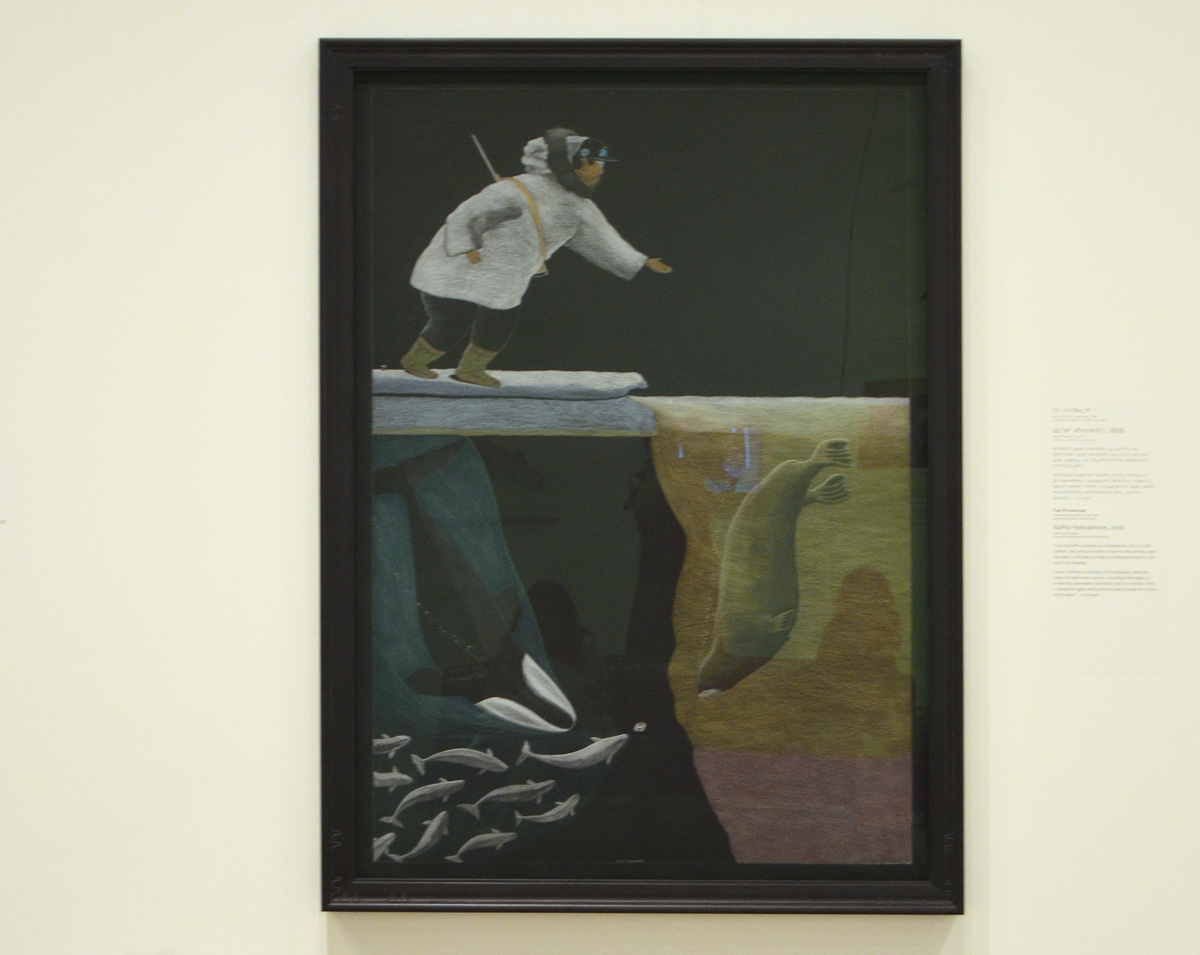
“What more could I ask for, than for people to notice what we have up here? This is the best thing about being and artist and a hunter.” Tim Pitsiulak quote on the wall at the AGO.
below: Swimming with Giants, 2015, by Tim Pitsiulak. Beluga whales swimming with a bowhead whale.
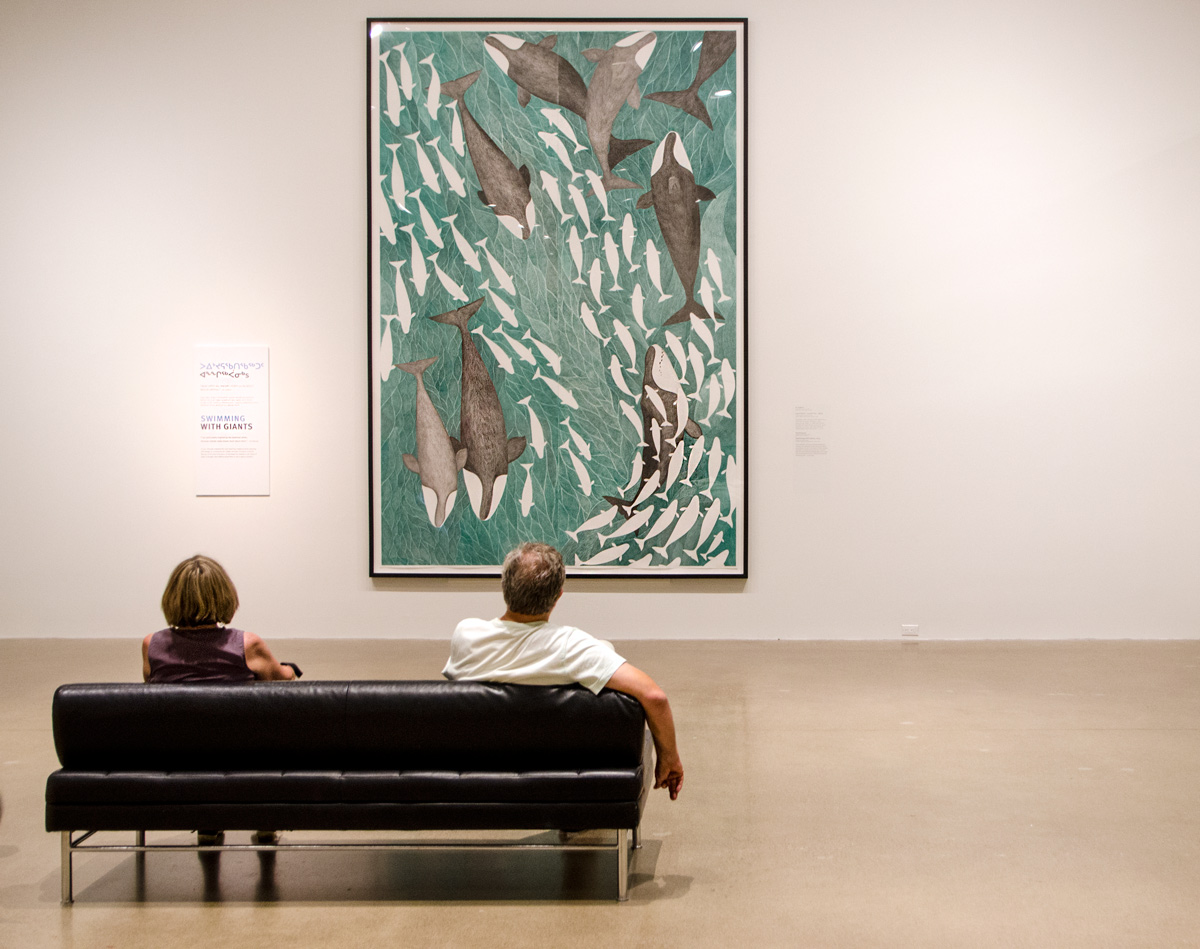
The exhibit continues until 12 August 2018
Dots, dots, dots. Millions of dots? Dots and lights worth waiting for.
‘Infinity Mirrors’, Yayoi Kusama, AGO

Kusama’s polka-dot paintings were based on visual hallucinations she has experienced throughout her life, often based on “a miserable childhood as an unwanted child born of unloving parents.” These hallucinations often involve repeating patterns that engulf her field of vision, a process she refers to as “obliteration”. Painting has helped to keep her demons at bay, to obliterate her anxieties.
In 1968 she returned to Japan. In 1977 she checked herself into the Tokyo mental hospital where she has lived ever since. She has a studio where she works during the day but she returns to the hospital at night.
below: In an effort to keep the waiting times down, the AGO is letting three people at a time into the rooms. I’m not sure who the man is, but he seemed to put up with Joanne and I and our cameras! This was the first room in the exhibit and it was a bit of a let down – it was the only one that wasn’t impressive. Minor gripe – why not a mirror on the ceiling?
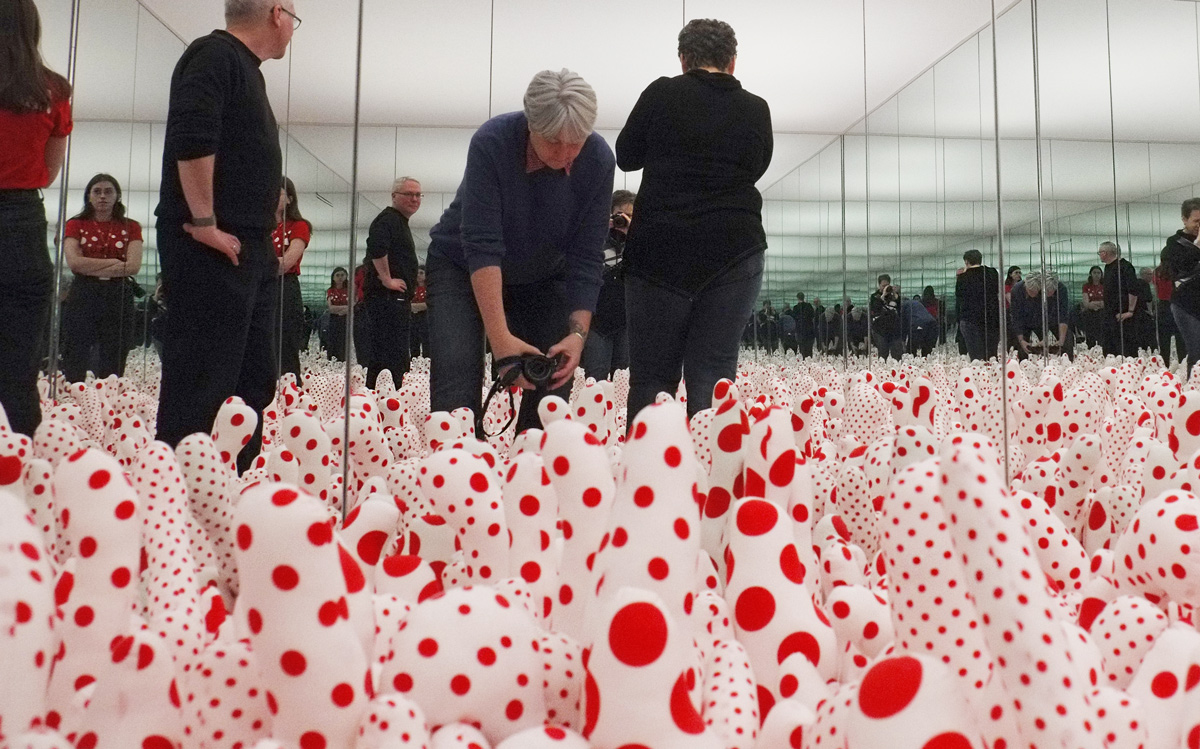
below: 30 seconds per visit. All timed – note the stopwatch!

below: Stars and planets into infinite. Small specks in the vastness of the universe. Obliteration of the self as we become just a very tiny, minuscule dot in the infinite of space. This exhibit is “The Souls of Millions of Light Years Away” and is made with hundreds of hanging LED lights.

below: The words on the wall say, “The souls of millions of light years away”. This is the line-up for the room above. It was one of the shorter lines.

Kusama was born in Japan in 1929 and trained originally in traditional Japanese painting. One of the only American painters that she knew of was Georgia O’Keefe, having seen her work in an art book. She wrote to Georgia O’Keefe asking for advice on how to break into the New York art world. In 1958 she moved to New York City where she became part of the avant-garde art scene. She was into pop art and hippie counterculture. She organized a series of anti-war public performances featuring naked people who were painted with brightly colored polka dots.
below: This room was fun especially since I got to spend a few seconds alone in it. Dancing with pink balls.

below: Looking into “Love Forever” – a small hexagonal box with some mirrors on the outside and two small windows (peepholes!) as seen from the outside. This structure/exhibit was first shown in 1966.

below: Looking in the window…. It’s amazing what can be done with mirrors and lights in a small space. Mirrors combined with the technology of LED lights that can change colours with computer controlled programs made for an impressive display. An endless repetition of patterns.
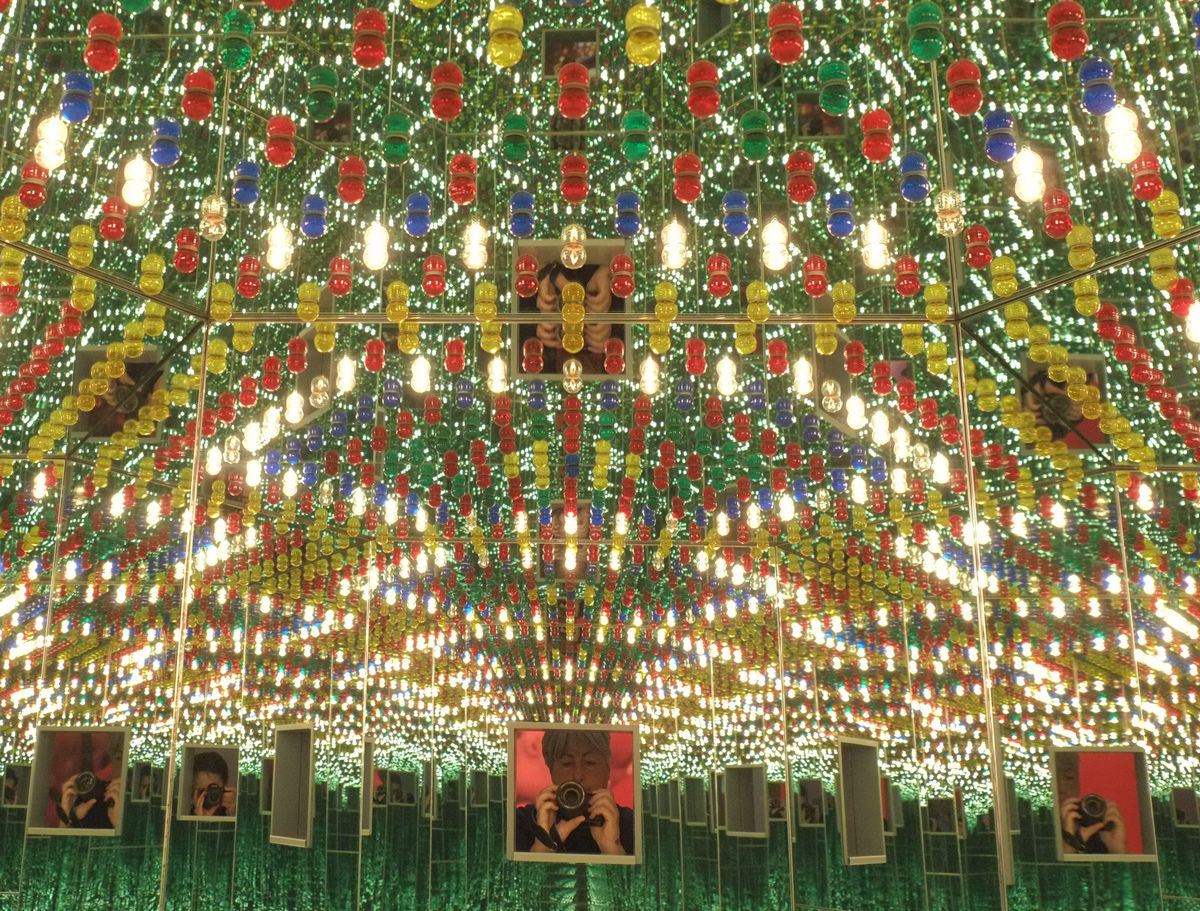
below: Same room, different colours

below: Obliteration Room – multicoloured stickers that people have added to an all white room with all white furniture and accessories like wine glasses and dog dishes. As more people pass through, the more colourful the room becomes. The dots make it difficult to see the details in the room. Can you tell what is on the table?

Kusama also paints and makes sculptures.
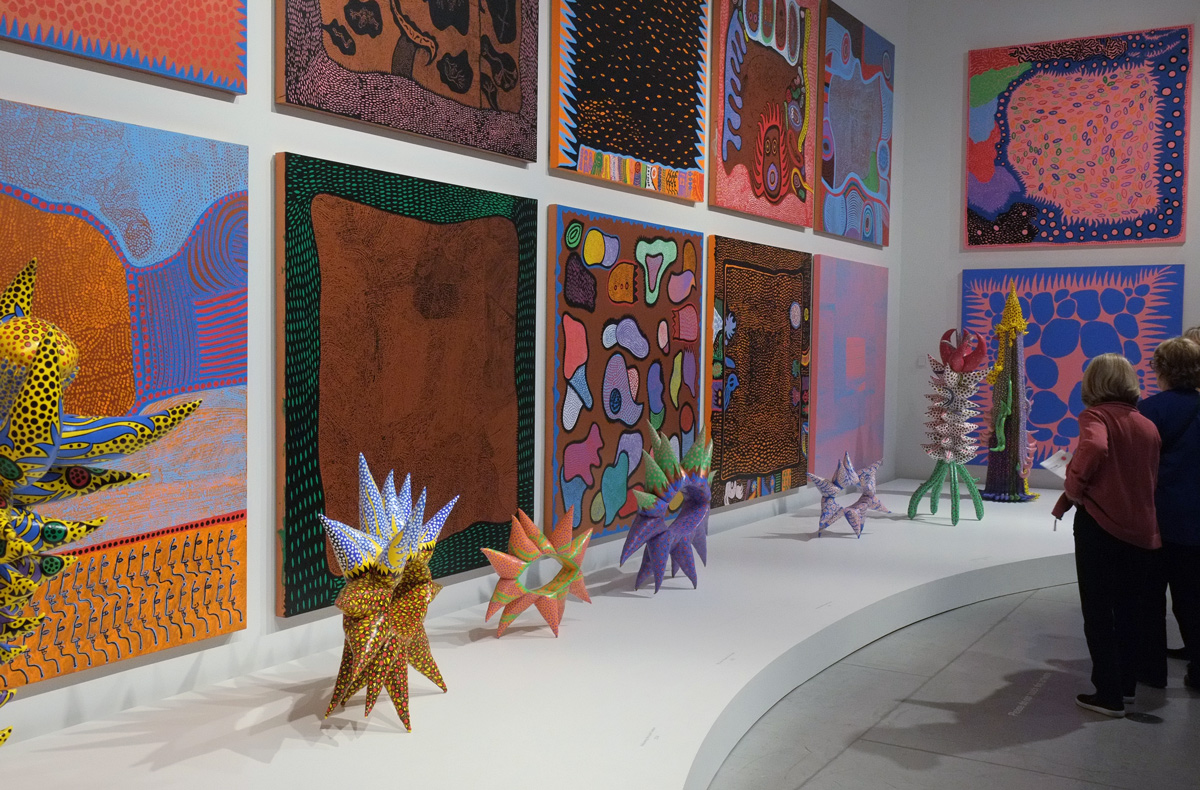
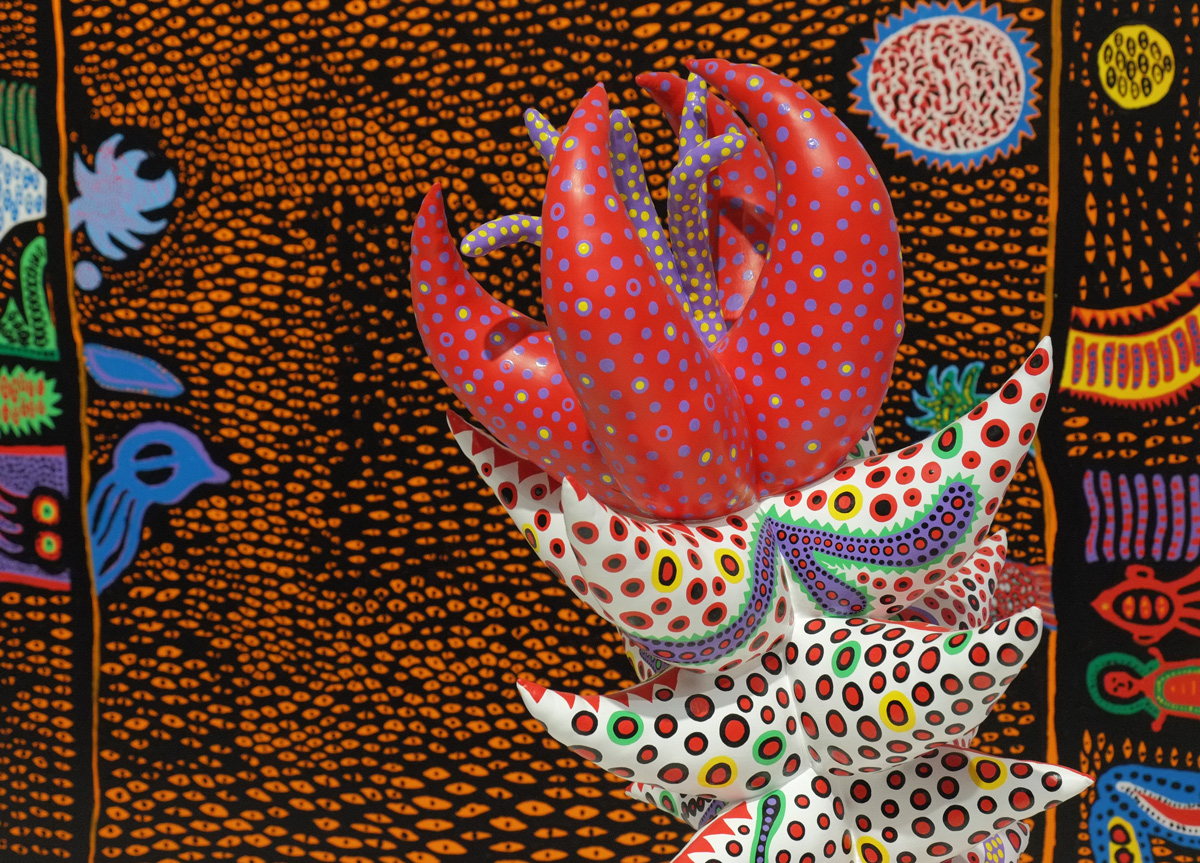

Thanks to Joanne of My Live Lived Full for playing with me!
A return to St. Helens Avenue and the galleries there.
A few galleries devoted to contemporary art can be found on St. Helens Ave. I know that I have mentioned some of their past exhibits in previous blog posts. Exhibits change and so back we go. The three exhibits that I saw today have little in common with each other. Three artists with different views; three men trying to turn their thoughts and ideas into something visual. The first gallery that I visited today is the Clint Roenisch Gallery where the exhibit is “Hot Takes, No Sax”, by Torontonian Niall McClelland. It will be there until 21st April.
From Wiktionary: “Noun[edit]. hot take (plural hot takes). A bold, broad, and subjective moral generalization on a situation, with little or no original analysis or insight, especially by a journalist.” Something written quickly and without much thought put into it. Although some people associate it with journalism, you could also apply it to a lot of things online – think about the comments section after a news article, or something on your facebook or twitter feed. Sometimes I think that that expression applies well to contemporary art – thrown together to provoke but not much actually went into it.
below: Running diagonally across the room is a line of trunks and metal cases that are covered with bumper stickers. On the wall are 4 images, each with a black and white background. The frames are covered with more bumper stickers. This is only part of the exhibit.

below: These are the three images on the wall in the photo above. The frame on one side of the image on the left has the names of four American politicians from the not so recent past – Nixon, Goldwater, McGovern, and Carter. Some of the images may be familiar to you as well.

below: More of the stickers. Is there a theme to them? How do these relate to hot takes? Which side is the artist on? “Urban farmer”, “When you sit down for dinner, thank a farmer”, “Impeach Trump”, “Give a hoot”, “The times they are a changin”, “Be green”, “Bio fuels: no war required”, “Who’s your farmer?”, “I’d rather be gardening”, “Nasty woman”, “Break the chains, shop at independent stores”, “Saving seed is a basic human need”, “Localvore”, “Whatever happens to the water, happens to the people”, “What is the proper way to fold an anarchist flag?”

Next is Douglas Coupland’s “Tsunami” at Daniel Faria Gallery, until 28th April. Trashy in a certain way. Coupland has collected, cleaned and painted various plastic containers and other disposable items he found along the shore in British Columbia. A number of the items probably crossed the Pacific Ocean after the earthquake and tsunami in Japan in 2011. Trash on display? We’ve all heard the expression “reduce, reuse, recycle” which may be facetious here? Is it too pretty to be a statement about the environmental impact of plastics?

below: The large gold piece is a collection of more debris that Coupland has amassed and painted. Another one, all in black, is on a different wall (not shown here).

This spring, Coupland will transform the Vancouver Aquarium into a vision of the Great Pacific Garbage Patch by filling aquarium tanks with some of the trash that Coupland has collected – by some I mean 20 tons of it. Twenty tons of found rubbish. Twenty tons of plastic and other debris. Jet streams will simulate ocean currents and the garbage will “float, bounce, disperse and gather along the tank, fragments flowing into one another like an overwhelming and exhausted assemblage”.
below: Tucked away in the back room of the gallery are four paintings like this, also by Douglas Coupland.

Part three is the exhibit “Raw War” by Bruce Eves that is on at the Robert Kananaj Gallery until 21st April. Eves was just given one of the 2018 Governor General’s Awards in Visual and Media Arts.
“taps into a zeitgeist fraught with peril”
below: Part of Work #901 by Bruce Eves. There are seven panels in total. Every hour for a week in February 2014 he took his heart rate. The numbers in the squares are his heart rate. It’s difficult to see in this picture, but each square also has the date and time. In addition, each panel is a day. Something happened on Friday February 14th at 16:00 to elevate his heart rate to 123 beats/minute!

Eves has also painted a sequence of numbers that are actually nine blood pressure readings. It was after he learned that he had a heart condition that Eves started using his health (and the monitoring thereof) as subject matter. A self-portrait based on data about oneself, so to speak. How his doctor sees him.
A few things to think about?
(P.S. My apologies for the title)
Lots of shiny silver balls, like bowling balls with bling, and lots of paint on large canvases…. on the surface these two things don’t really have anything in common. But because they are two things that I saw at the Art Gallery of Ontario, I’m going to throw them together in this blog post. The shiny spheres are part of a display by Yayoi Kusama while the paintings I refer to are those by J.P. Riopelle and Joan Mitchell.
I saw the balls first. There has been a lot of hype and publicity for the latest AGO exhibit, “Infinity Mirrors” by Yayoi Kusama that just opened this past weekend. You’ve probably seen the all the red and white polka dots on the TTC and elsewhere around the city. Last week when I was at the AGO I noticed that another Kusama exhibit was in the works, one that didn’t involve buying a “hard to get” ticket. I was curious. I’ve seen some photos of “Infinity Mirrors” so I went with great expectations. Maybe that was my mistake.
below: “Narcissus Garden” consists of a large room with hundreds of shiny silver spheres laid out on the floor.

“Narcissus Garden” dates back to 1966 when it was a performance piece by Kusama at the Venice Bienalle. She walked among the balls, picking them up, and looking at herself in them. Here, at the AGO, they lie on the floor. The ceiling is reflected over and over again. It’s a dull ceiling. The balls are scuffed up. You might be able to lie on the floor to get a good look at the reflections bouncing around and that might be interesting. As it is, “listless” is the word that I would use to describe it. It’s the tag along mangy mutt to the main event.
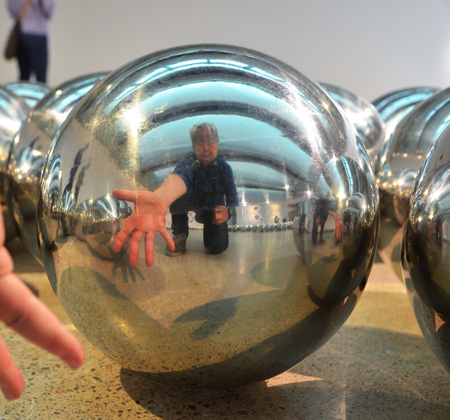
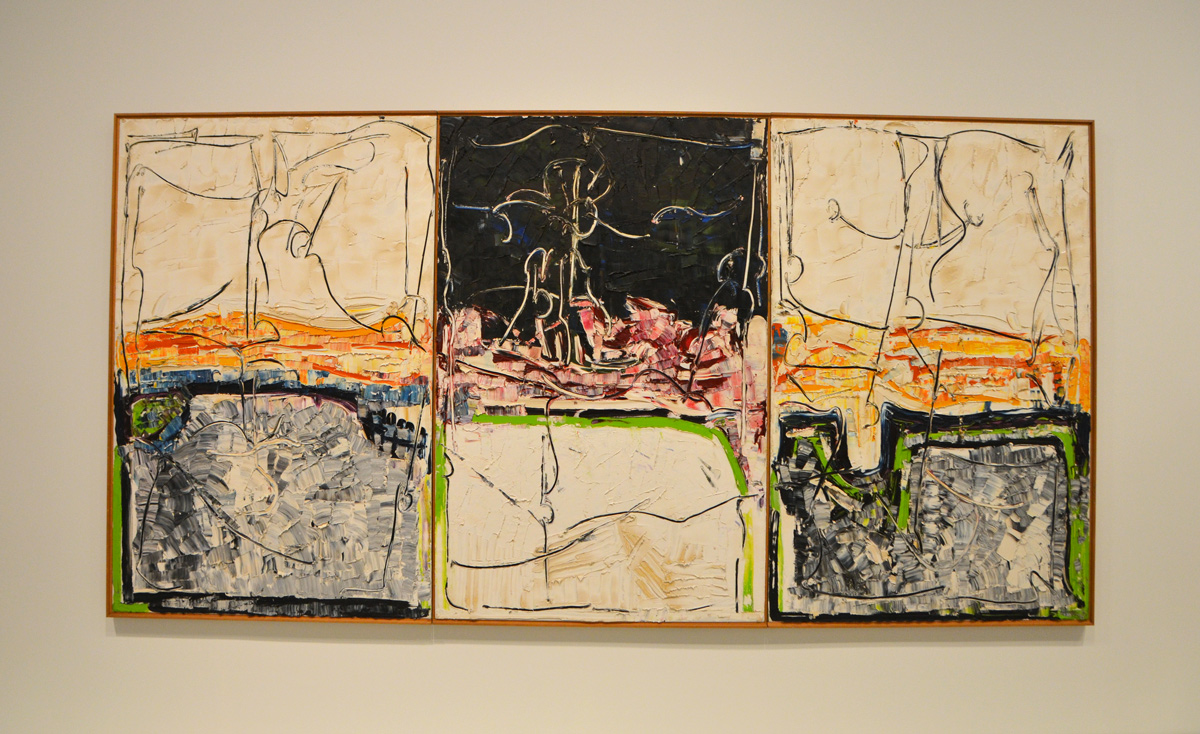
I spent a few minutes trying to figure out how to improve the presentation but, meh, no. Instead I went upstairs to take a second look at the lesser known “new” exhibit at the AGO, the marvellous Mitchell and Riopelle show, “Nothing in Moderation”. American abstract painter Joan Mitchell (1925 -1992) and Canadian abstract painter Jean Paul Riopelle (1923-2002) met in Paris in 1955. For 24 years they were colleagues, friends, and lovers. This exhibit consists of more than 50 of their works on loan from collectors around the world and shown together.
below: Looking at (part of) ” Tilleul (the Linden Tree)”, 1992 by Mitchell.

below: Three degrees of interest in “Chasse Interdit (Hunting Prohibited)” by Mitchell, 1973. On loan from the George Pompidou Centre in Paris. The title of the painting refers to a ban on hunting – apparently Riopelle loved hunting and Mitchell loathed it.

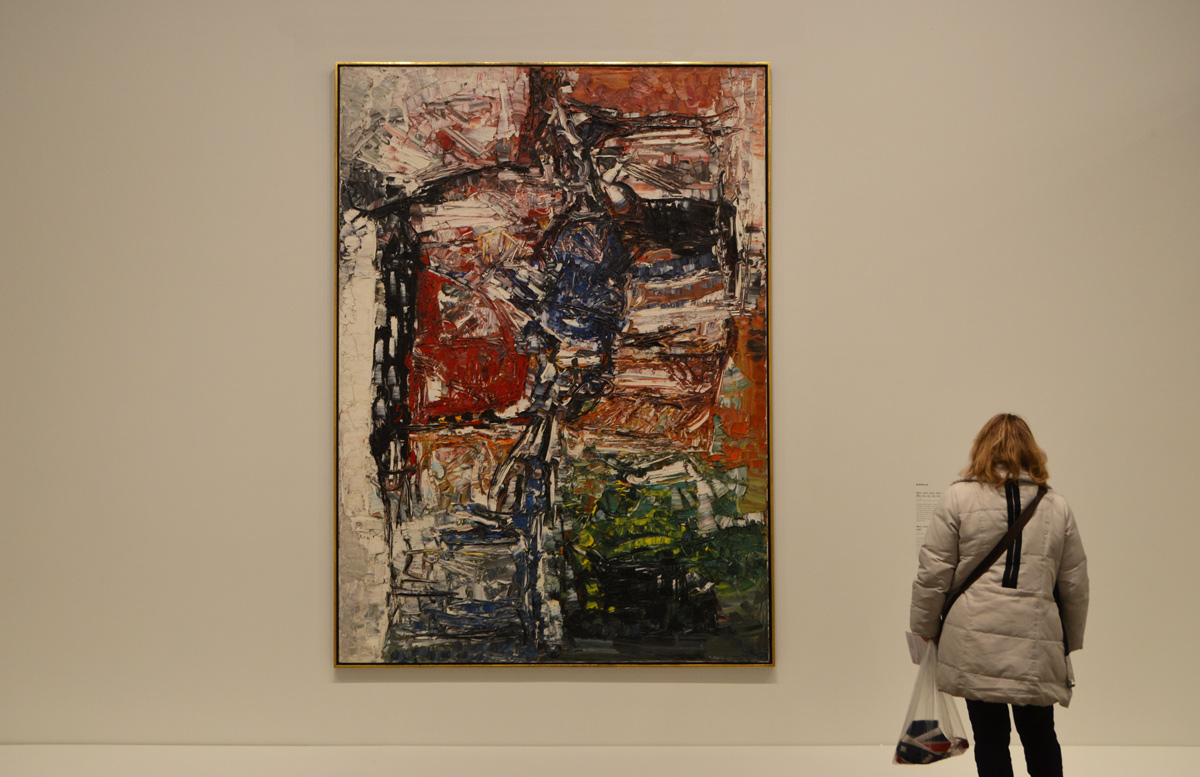
below: The painting here is “Avatac” by Riopelle, 1971. It is acrylic paint on top of lithographs on canvas

below: This is a photo of a small part of the above painting. If you look closely, you can see the lithograph peeping through. I can see a small animal head near the top left (a cat?) and there seems to be another lower down.

below: One thing that intrigued me about Riopelle’s painting was that even though there is a lot of paint (palette knife?), there are still some places where the canvas is visible. Just small bits.
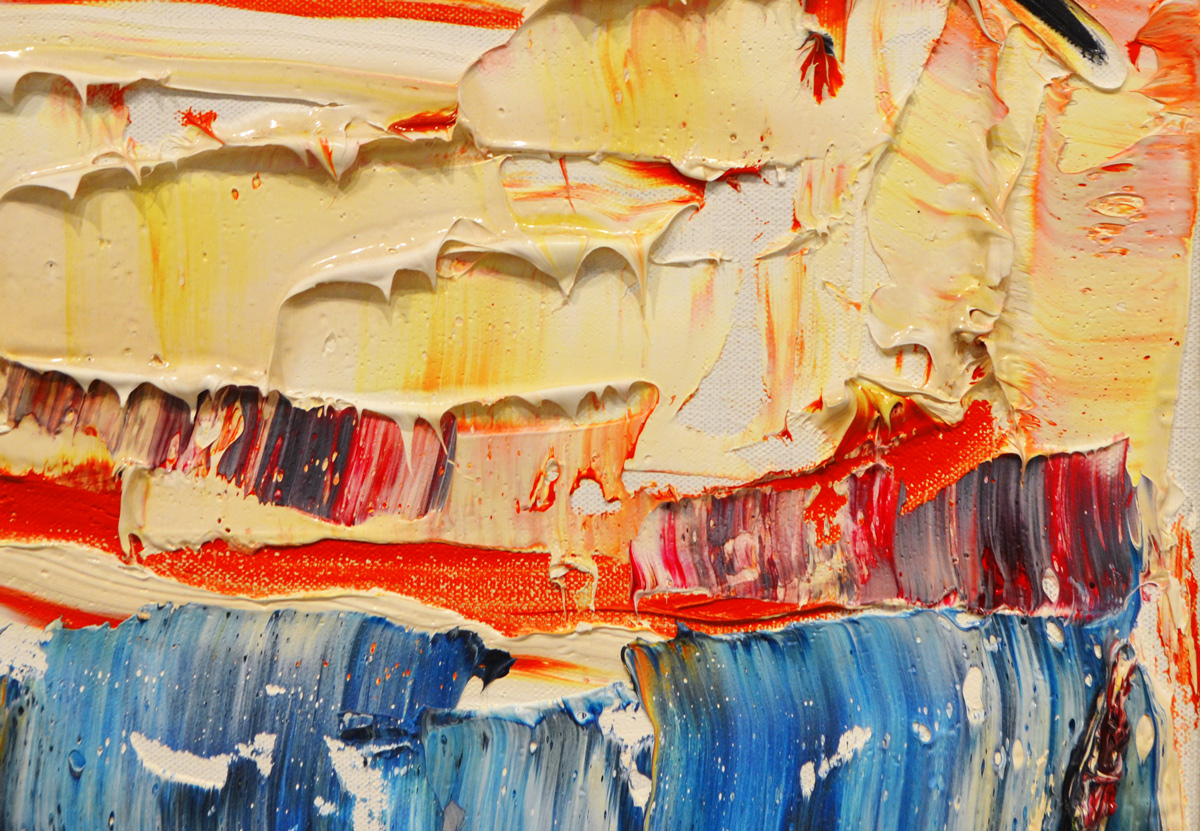
below: The details in the above photo are from the top left square in ” Mitchikanabikong ” by Riopelle.
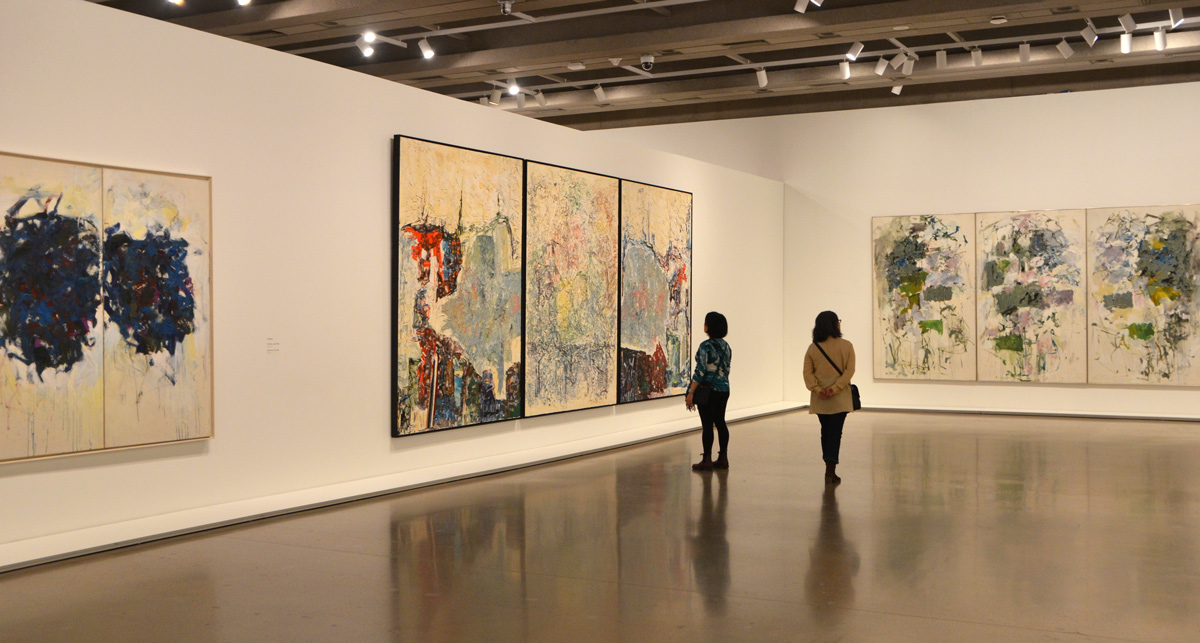
below: The gallery was quiet on Wednesday morning. Both of these paintings are by Joan Mitchell. On the left, on loan from the Smithsonian American Art Museum in Washington DC is “Marlin”, 1960. The other is “Untitled” from 1961 and it is on loan from the Joan Mitchell Foundation in New York.

And to end, a couple more for you to enjoy.
Florine Stettheimer: Painting Poetry,
an exhibit at the Art Gallery of Ontario
Florine Stettheimer (1871-1944) was the 4th child of five, daughter of Joseph and Rosetta. Joseph, a banker, abandoned the family early on and was never mentioned again. Older siblings Walter and Stella married and moved out while the younger three girls, Ettie, Florine and Carrie remained in the same household with their mother until their deaths. They became known as “the Stetties”. They hosted salons in Manhattan and lived a life of leisure and artistic pleasure.
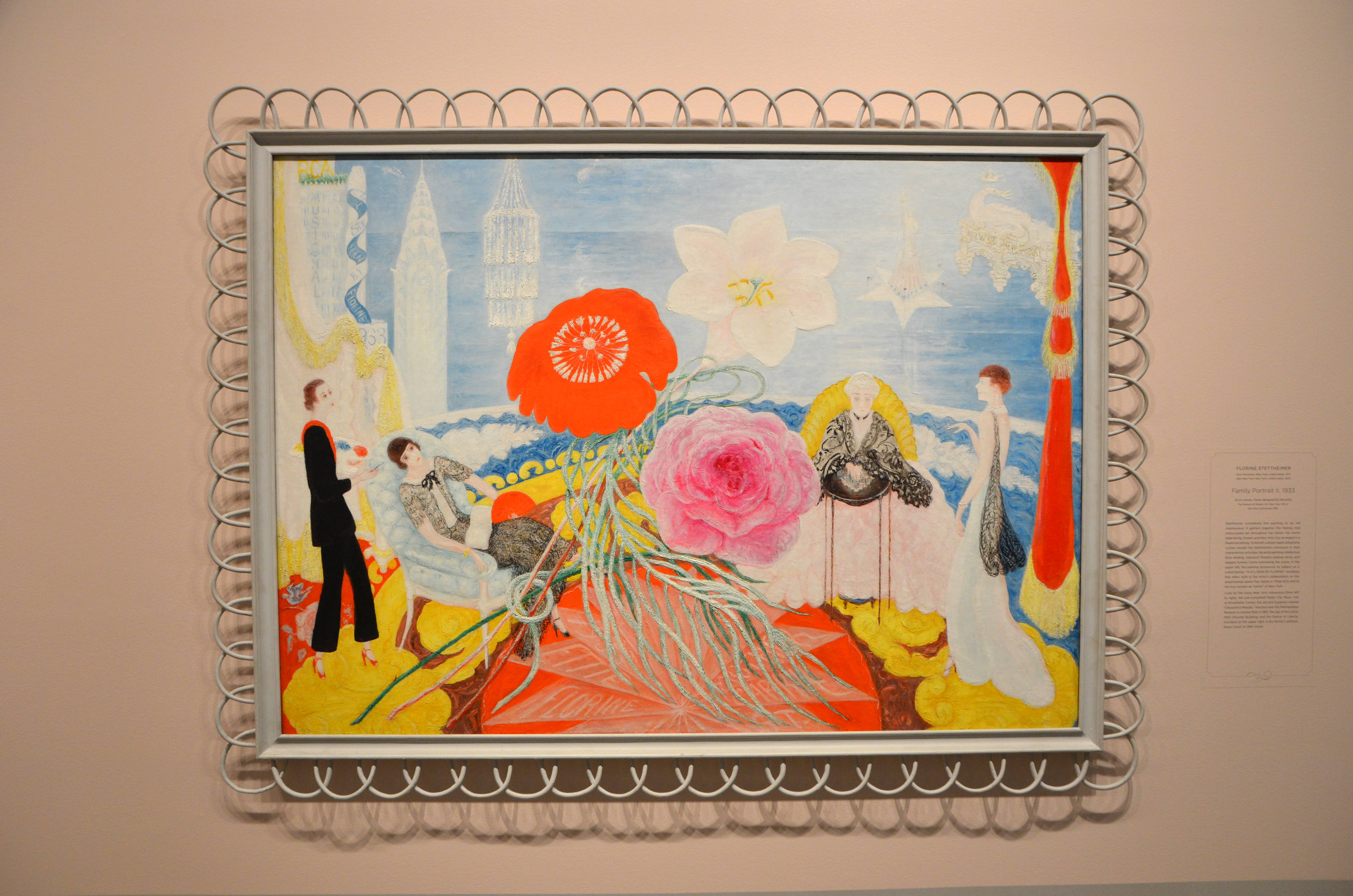
below: Family Portrait II, 1933, This painting has flowers, New York City references, and Florine Stettheimer’s immediate family portrayed in a theatrical setting/arrangement. These are themes that occur over and over again in Stettheimer’s work. Here Ettie is reading, Rosetta is playing cards, Florine is painting, and Carrie is playing hostess.
The Stettheimer children were born in Rochester NY. Between 1906 and 1914 Florine and her mother and sisters lived in Europe before settling in Manhattan.
A portion of the exhibit features a collection of designs for costumes for a ballet that Florine wrote while she was in Paris in 1912. ‘Orphee of the Quat-z-Arts’ (or ‘Revellers of the Four Arts Ball’) was based on a costume parade organized by Parisian art students and in it the main character, Georgette, encounters the ancient Greek minstrel Orpheus and a parade of mythical creatures, as she and her father walk down the Champs Elysee. The ballet was never performed.
below: One of 42 sketches and 9 relief maquettes, Georgette.

below: People, both men and women, were painted with elongated willowy shaped bodies.
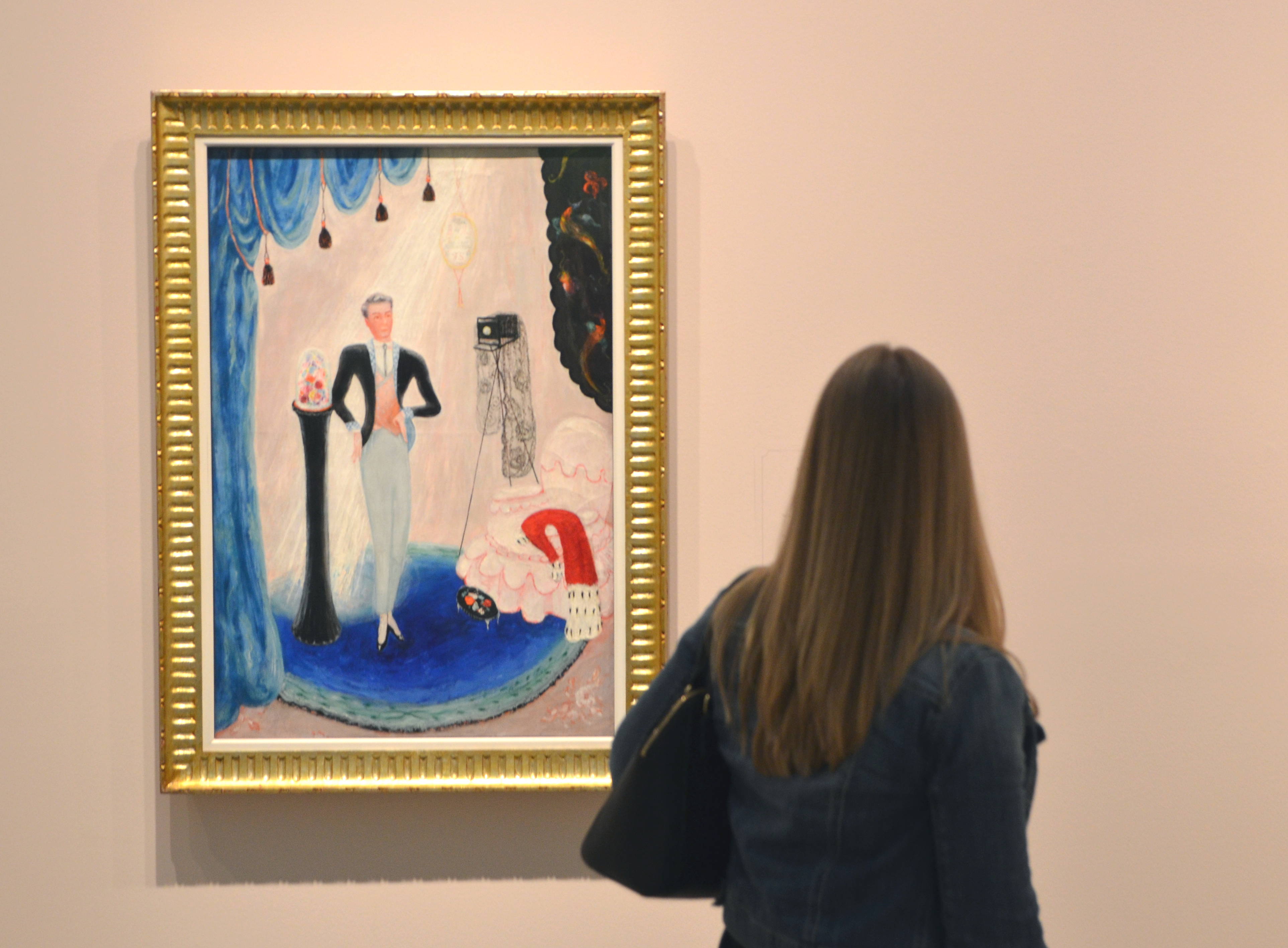
Florine also wrote poetry and she liked to send her poems to her friends. In 1949 her sister Ettie published a book of Florine’s poems titled ‘Crystal Flowers’. This is one of the poems:
And Things I Loved
a poem by Florine Stettheimer
Mother in a low-cut dress
Her neck like alabaster
A laced up bodice of Veronese green
A skirt all puffs of deeper shades
With flounces of point lace
Shawls of Blonde and Chantilly
Fichues of Honeton and Point d’Espirit
A silk jewel box painted with morning glories
Filled with ropes of Roman pearls
Mother playing the Beautiful Blue Danube
We children dancing to her tunes
Embroidered dresses of White Marseilles
Adored sashes of pale watered silk
Ribbons with gay Roman stripes
A carpet strewn with flower bouquets
Sevres vases and gilt console tables
When sick in bed with childhood ills –
All loved and unforgettable thrills.
below: The painting in the foreground of this picture is ‘Self-Portrait with Palette (Painter and Faun)’, 1910s. According to the words that accompany the painting, the faun behind her symbolizes a memory inspired by Russian ballet star Vaslav Nijinsky whom she saw perform in Paris in 1912. After the performance, Florine wrote: “Nijinsky the faun was marvelous. He seemed to be truly half beast… He knew not civilization – he was archaic – so were the nymphs. He is the most wonderful male dancer I have seen”.

below: Self-portrait, 1933
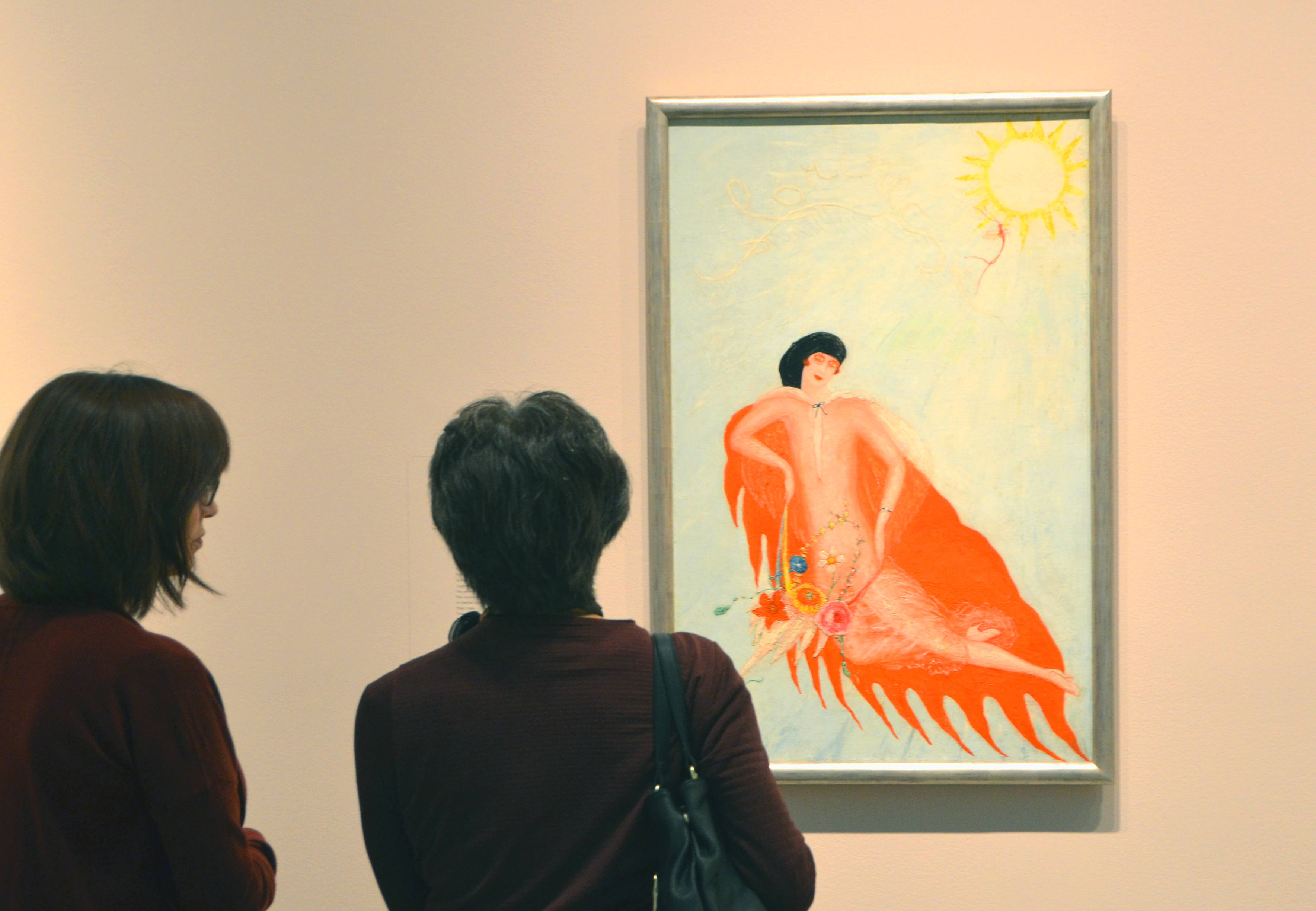
“For a long time
I gave myself
To the arrested moment
To the unfulfilled moment
To the moment of quiet expectation
I painted the trance moment
The promise moment
The moment in the balance
In mellow golden tones…
Then I saw
Time
Noise
Color
Outside me
Around me
Knocking me
Jarring me
Hurting me
Rousing me
Smiling
Singing
Forcing me in joy to paint them…”
This exhibit continues at the AGO until 28 January 2018
‘Room for Mystics’
An exhibit at the Art Gallery of Ontario by Sandra Meigs and Christopher Butterfield.
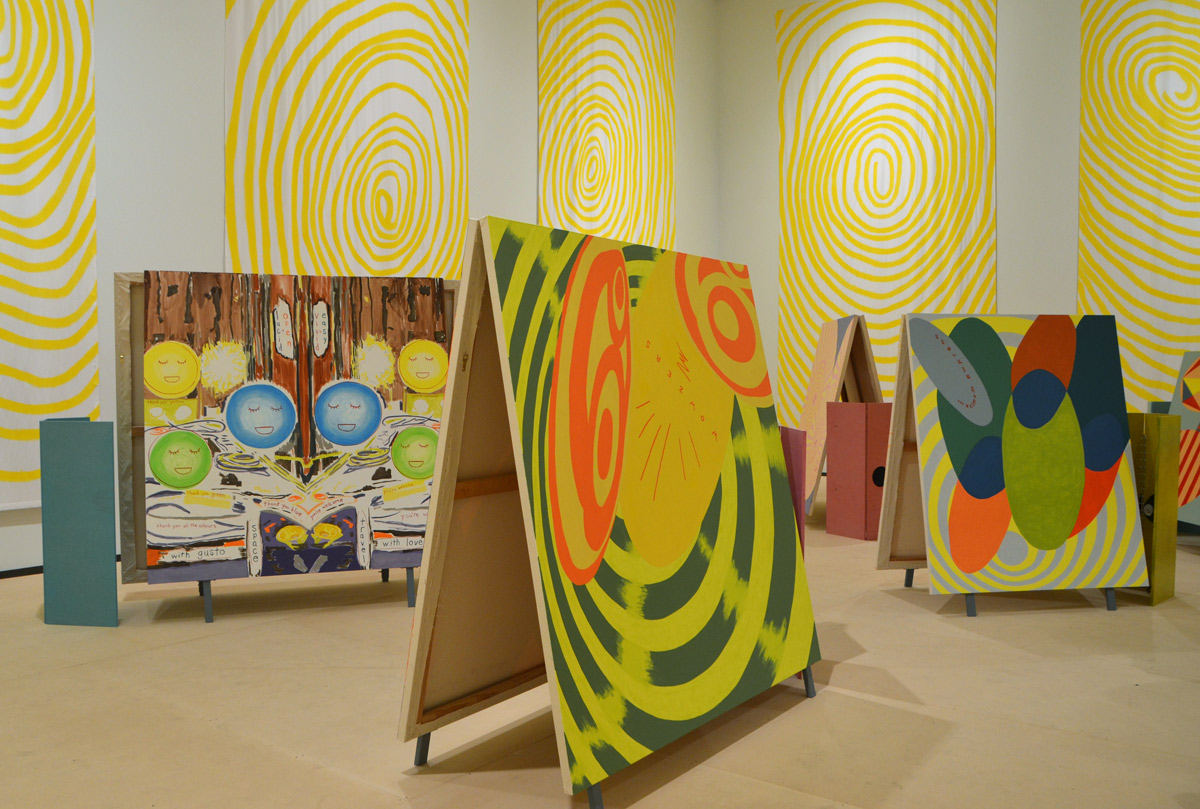
Scattered around the room are bright coloured, simple paintings that are displayed back to back. Banners with concentric yellow circles hang on the walls. The solid colour boxes beside the paintings hide speakers.
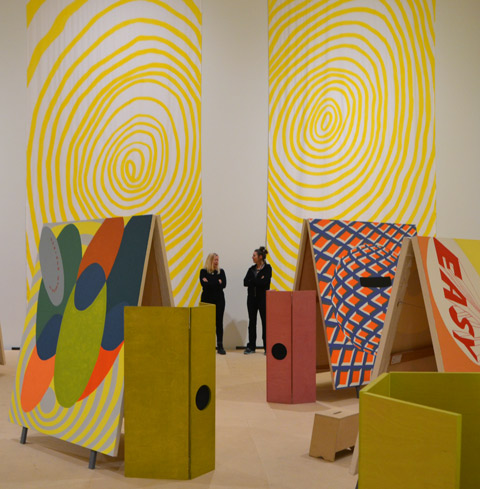
A large red mobile hangs from the ceiling, happiness with closed eyes. Happiness and joy are two of the emotions that this room evokes. Walking through the room is definitely a positive experience! You can’t help but smile.
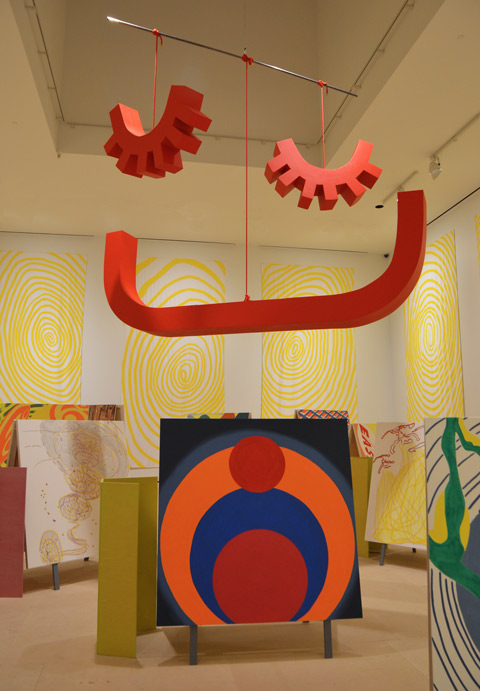
The paintings and mobile are the work of Sandra Meigs, a Canadian artist based in British Columbia. Accompanying the exhibit is a ‘sound installation’ composed by Christopher Butterfield.
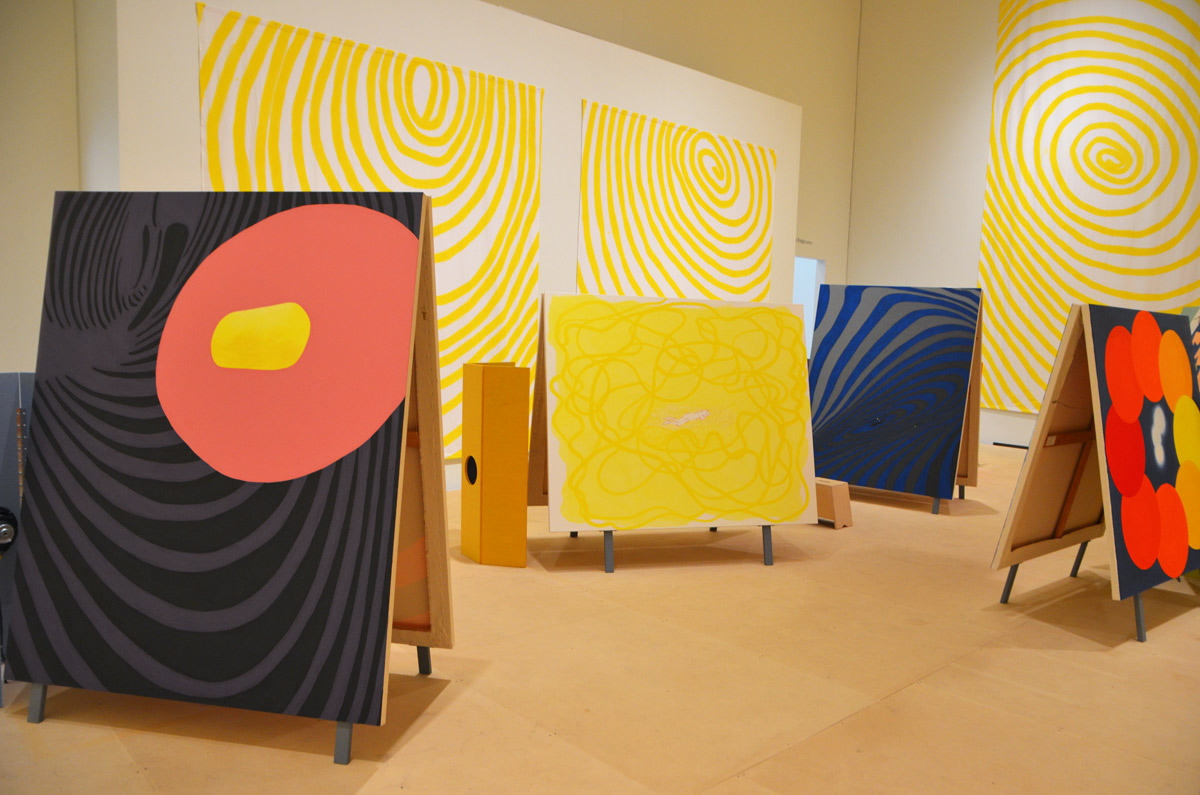

The exhibit continues until 14 January 2018
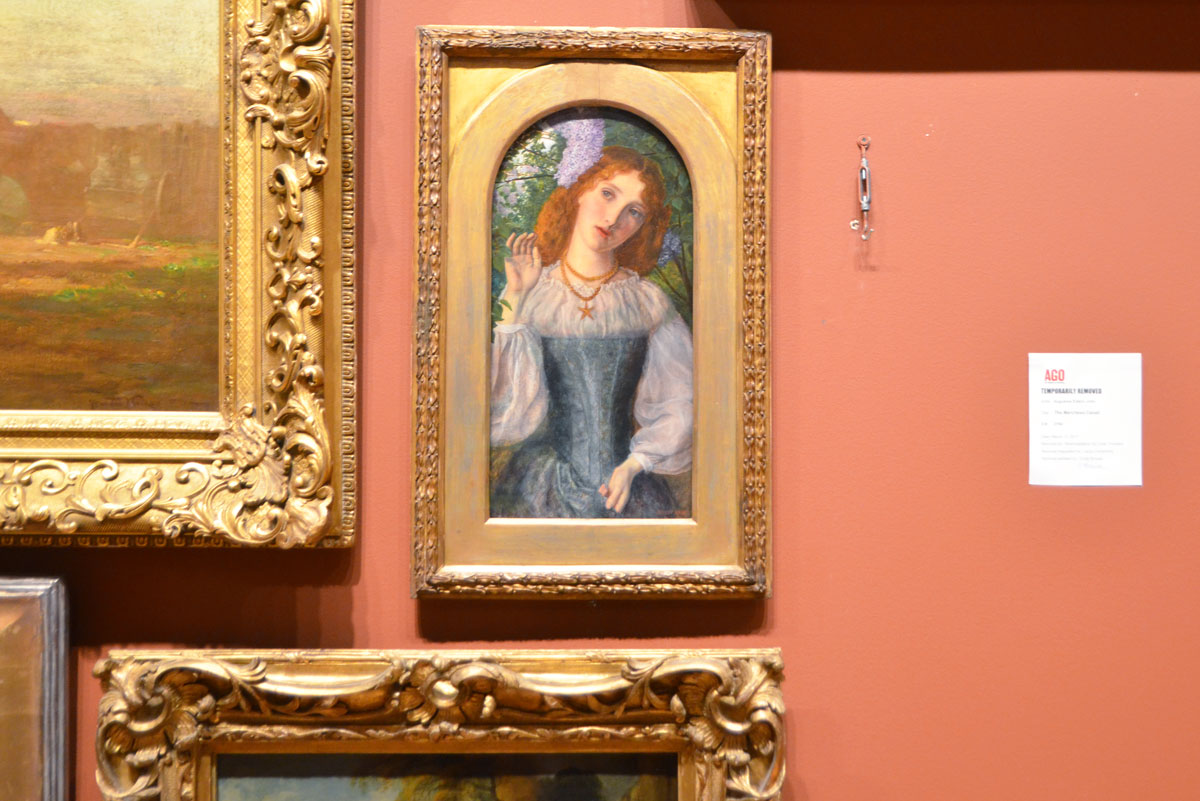
All kinds of thoughts went through my head as I stood and looked at this painting at the Art Gallery of Ontario (AGO). A little ho hum and a little melancholy and a little well what next. There were no new exhibits since the last time that I visited the AGO and quite a few galleries were being prepared for new showings (i.e. closed). A little bit of that’s a waste of time. Even here there’s a painting missing. … no, it’s only a waste of time if I let it be.
I stood and studied her face, the expression on her face, the tilt of her head and one hand held up. What was going through her head? Was the artist trying to tell us something about her? Or was he just playing with composition in a limited space? And that’s when the game began – what expressions hang on the walls of the AGO? A sample:
below: part of “Time Dissolve” created around 1992 by Carl Beam (M’Chigeeng Ontario 1943-2000) using photo emulsion, acrylic and pencil on canvas.
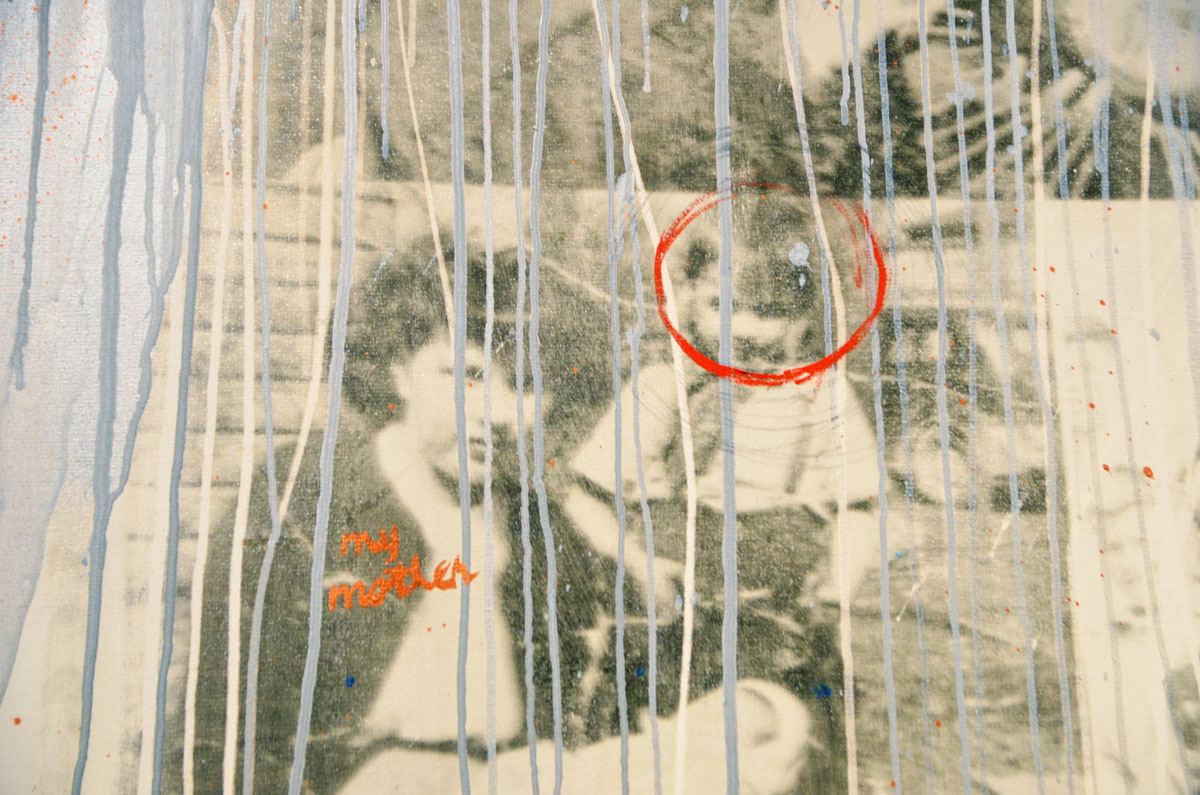
below: manipulating a series of portraits by Will Gorlitz (b. Argentina 1952). The paintings were done in 1984 and are called Genre IV, Genre XVI, etc. Nameless. Unless her name was Genre and he’s painted her 6 times (one of the paintings in the row is not included here).

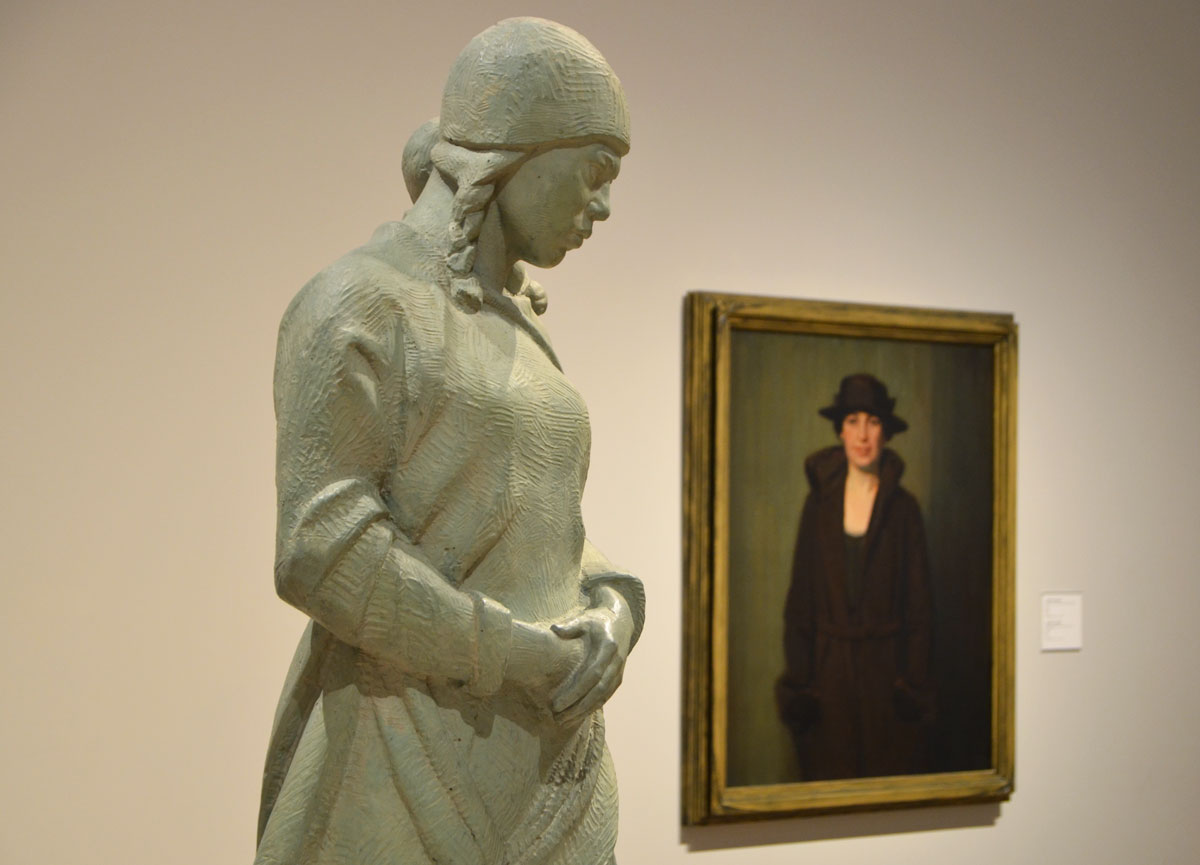
below: Two pieces. A sculpture called “Eskimo Mother and Child” (about 1938) by Frances Loring and the portrait “Bess” by Canadian painter Lawren Harris. I have talked about Loring in a previous post.
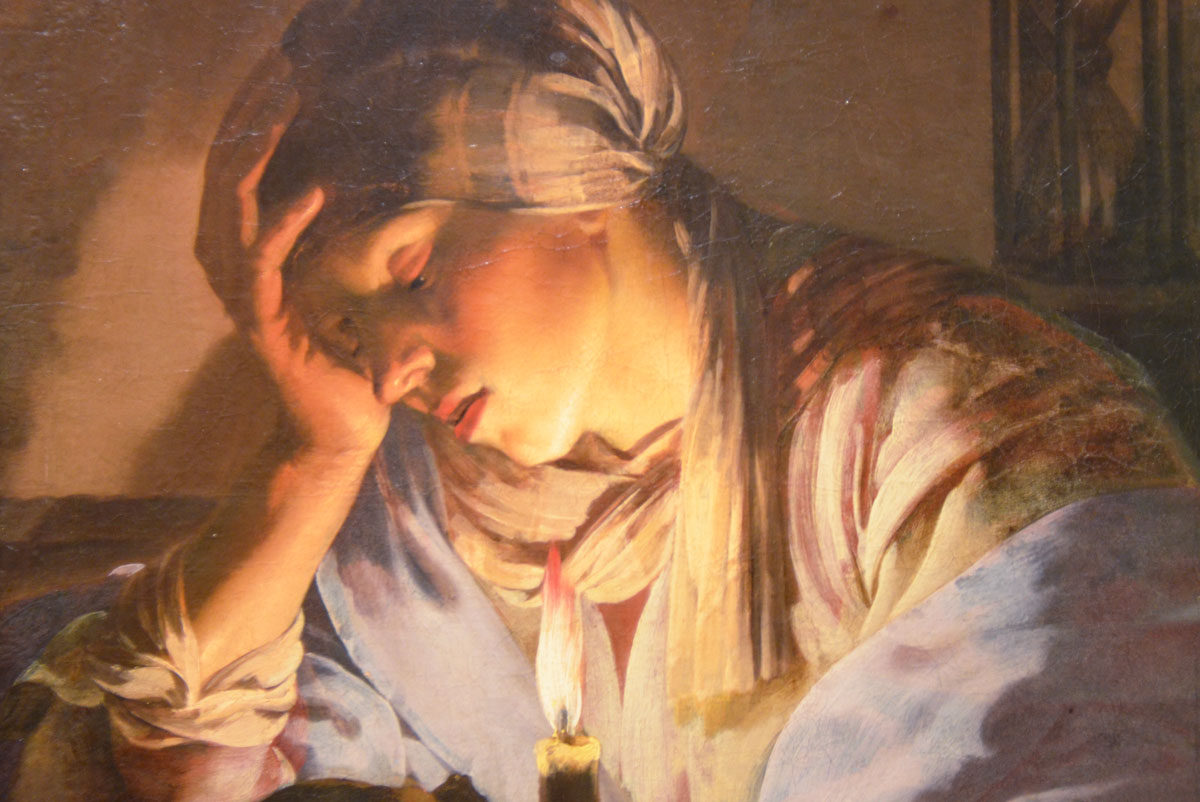
below: part of “Melancholy”, oil on canvas, by Hendrick Terbrugghen (The Netherlands, 1588-1629)
below: part of “Waitress”, oil on canvas, by Shelley Niro, 1986 (b. USA 1954)

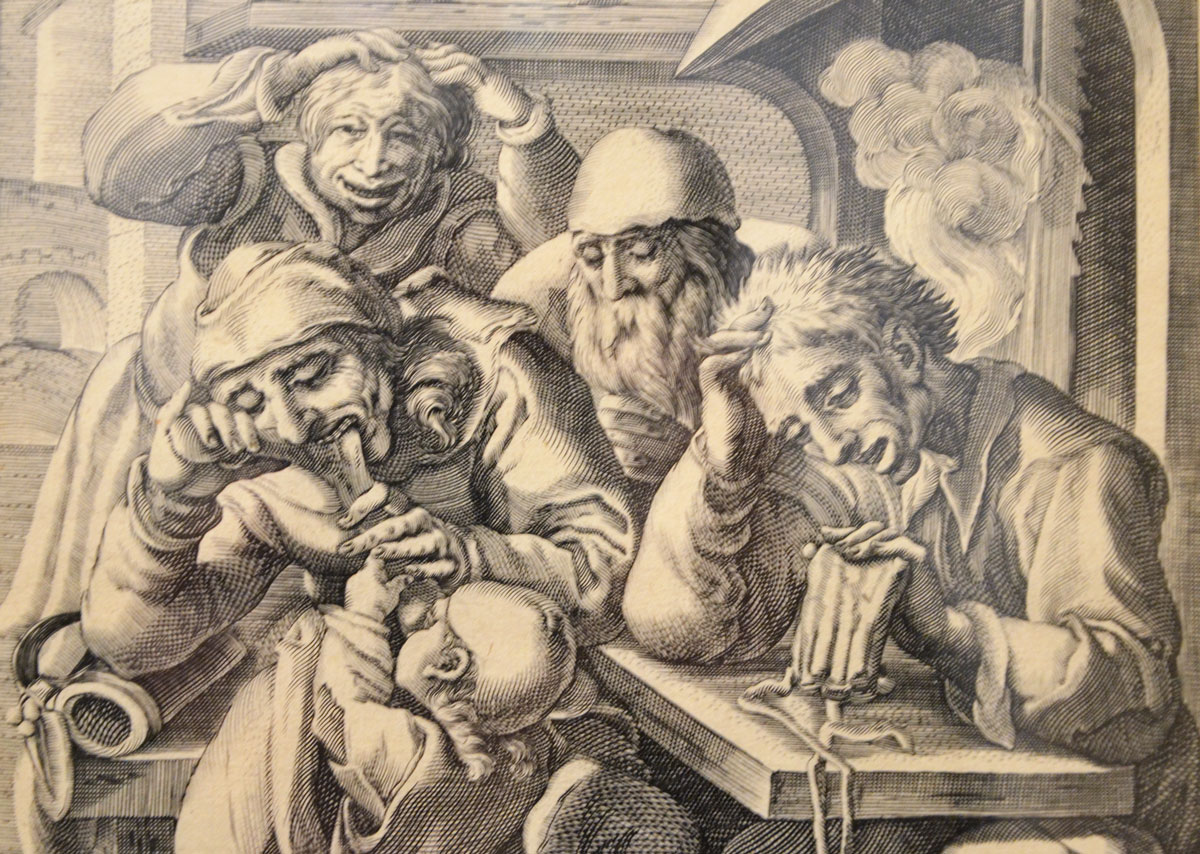
below: Engraving on paper, “Drunken Men at a Table” by Gillis Van Breen, Dutch, around 1600.
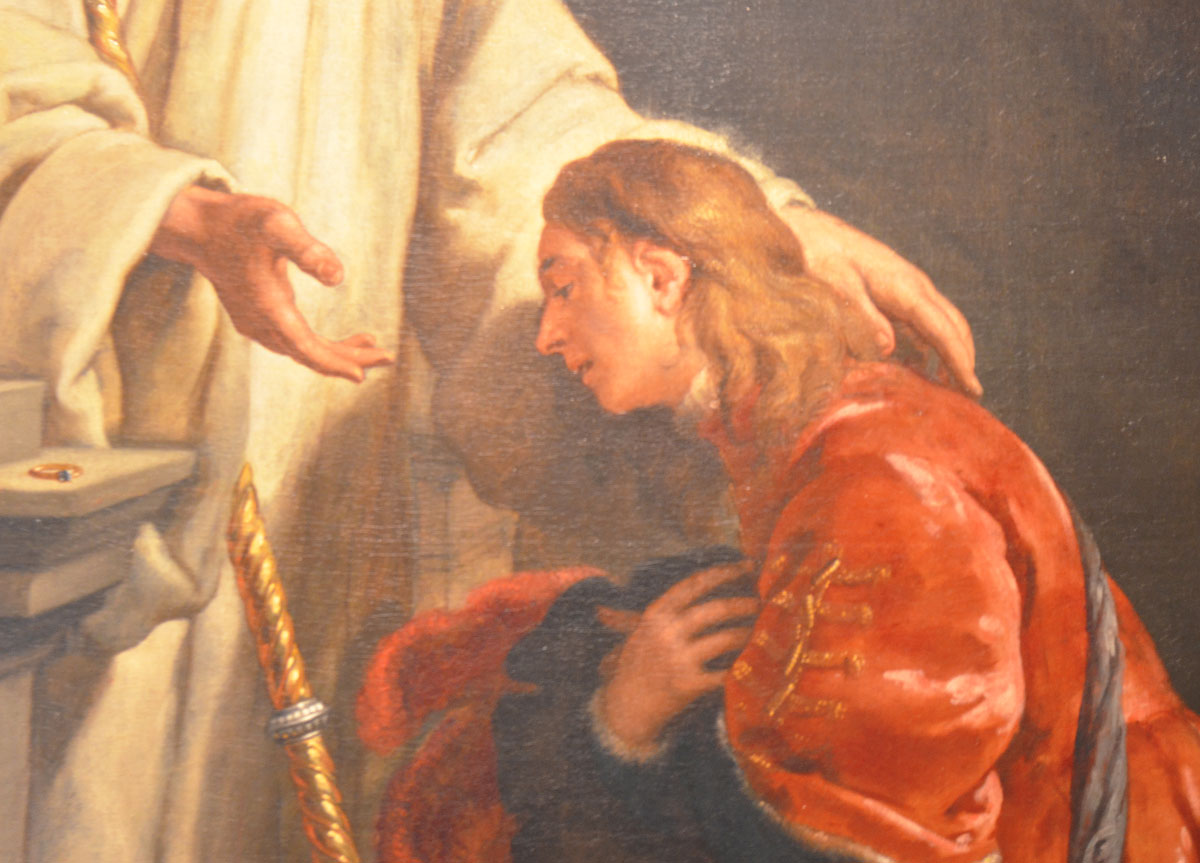
below: The last picture is obviously from a painting with a religious theme. Unfortunately, the photo that I took of the tag with the artist’s name is too blurry to read. I tried a google search on the image and the first hit was the Wikipedia page for Paul Bernardo. Oh dear, Google that’s a fail… apparently it’s similar to a figure in a painting by Bernardo Carbone who was a painter in the 1600’s. So Google put 2 and 2 together and got 17. Hopefully you (and I) don’t get many 17’s!
A few weeks ago I posted some pictures of the fence along Craven Road that has been decorated with artwork and old artifacts. I was south of Gerrard Street when I took the photos. I didn’t realize at the time that I missed another outdoor gallery on the other side of Gerrard. Today I took some pictures of those on display on the north side. Here they are in no particular order:
below: Looking north up Craven Road along the fence.
That tropical sunset on the left looks very inviting!


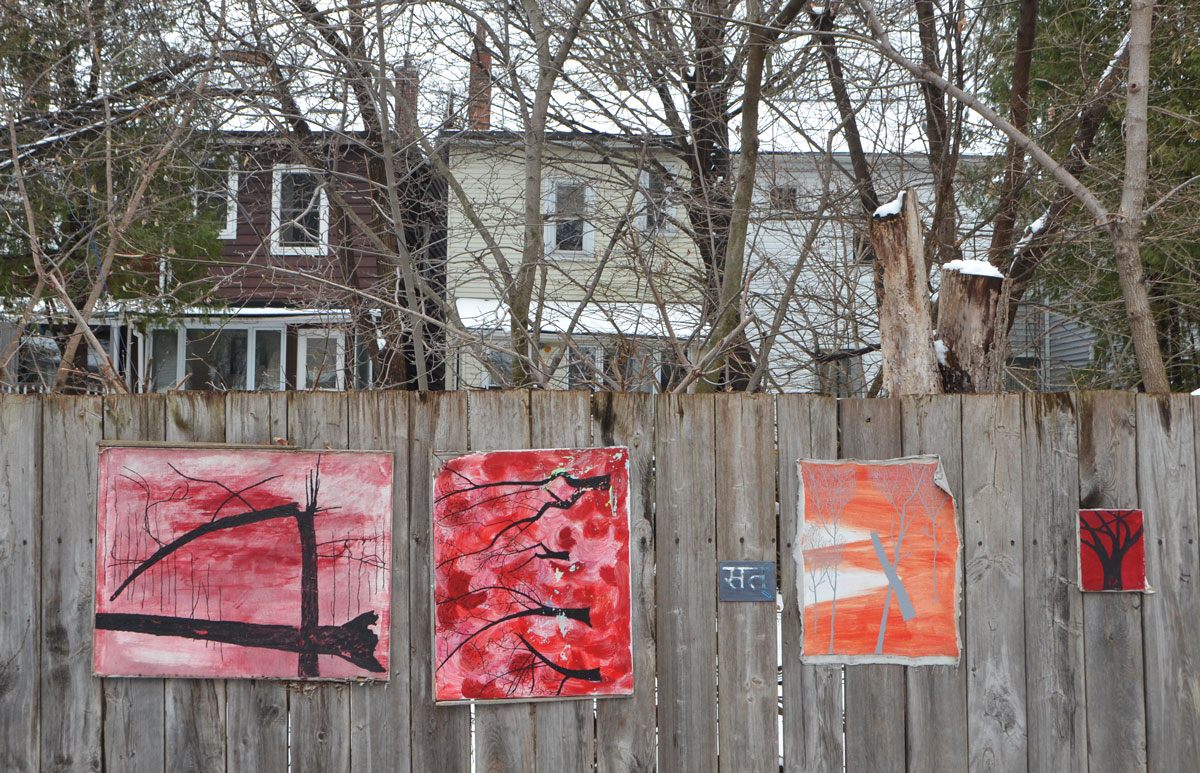

below: Some of the paintings are small words in another language and another alphabet. Can anyone translate for me?


By now I’m very curious about this street and this fence. I found a long, detailed, and interesting history written by local historian Joanne Doucette that you can read here.
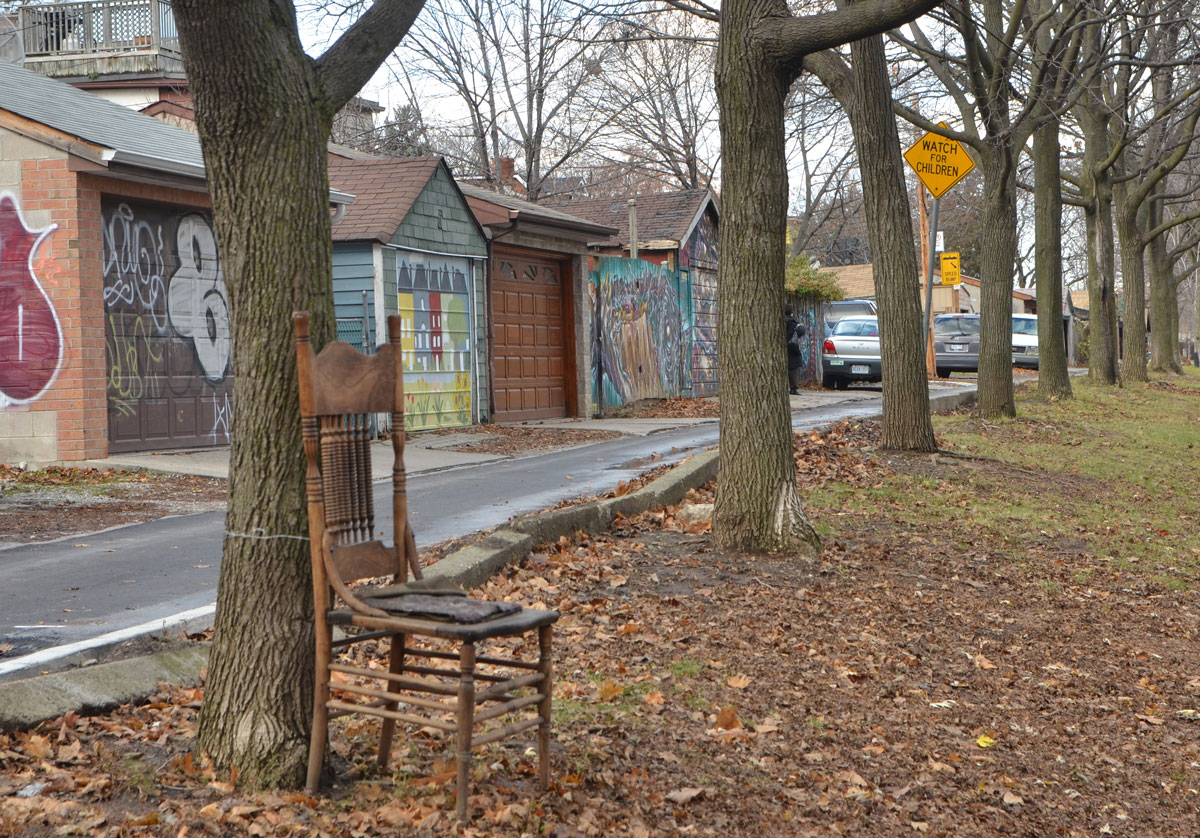
Peperonata Lane runs north from Harbord Street. Most of the garage doors in the alley have been painted. Some were painted as part of a Wallnoize project in 2013.

below: Take a seat… and see what kind of street art there is here.
below: A woman feeds the chickens.

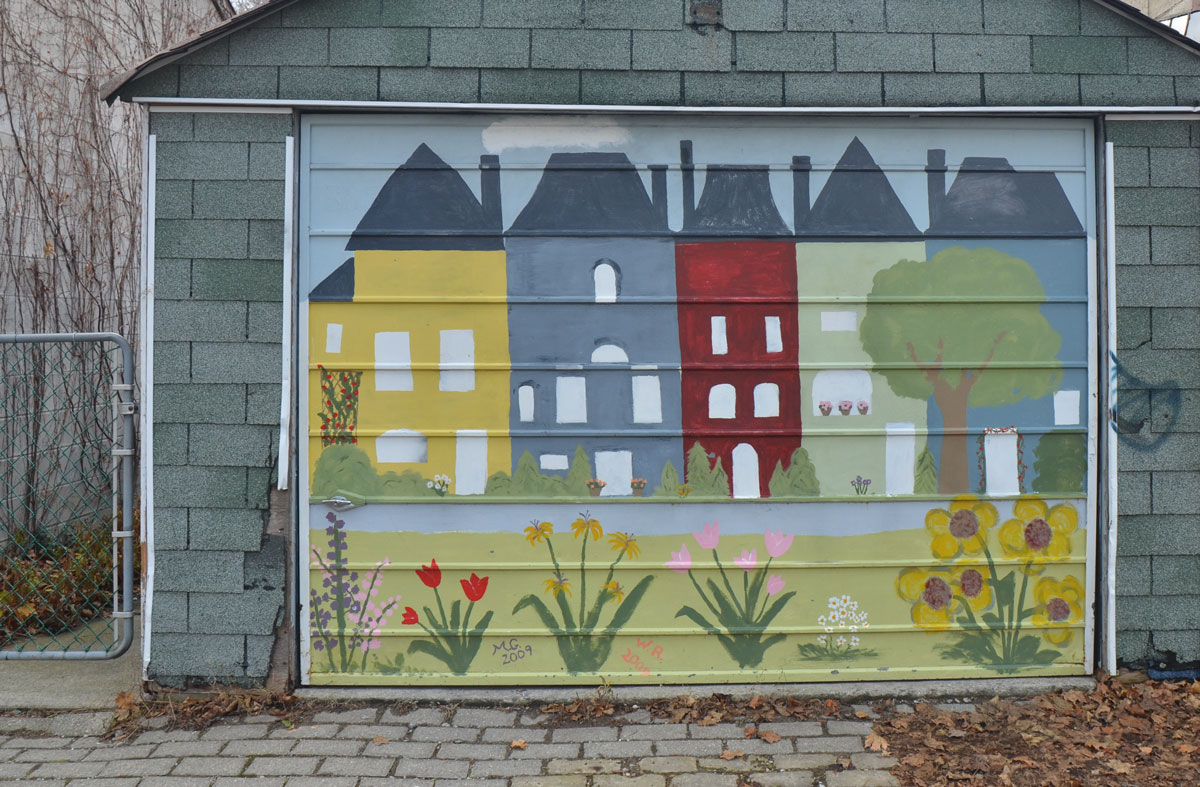
below: This mural, done in 2009, is one of the older ones in the lane.
below: A deer and a hawk

below: Elicser people and a text painting by poise.
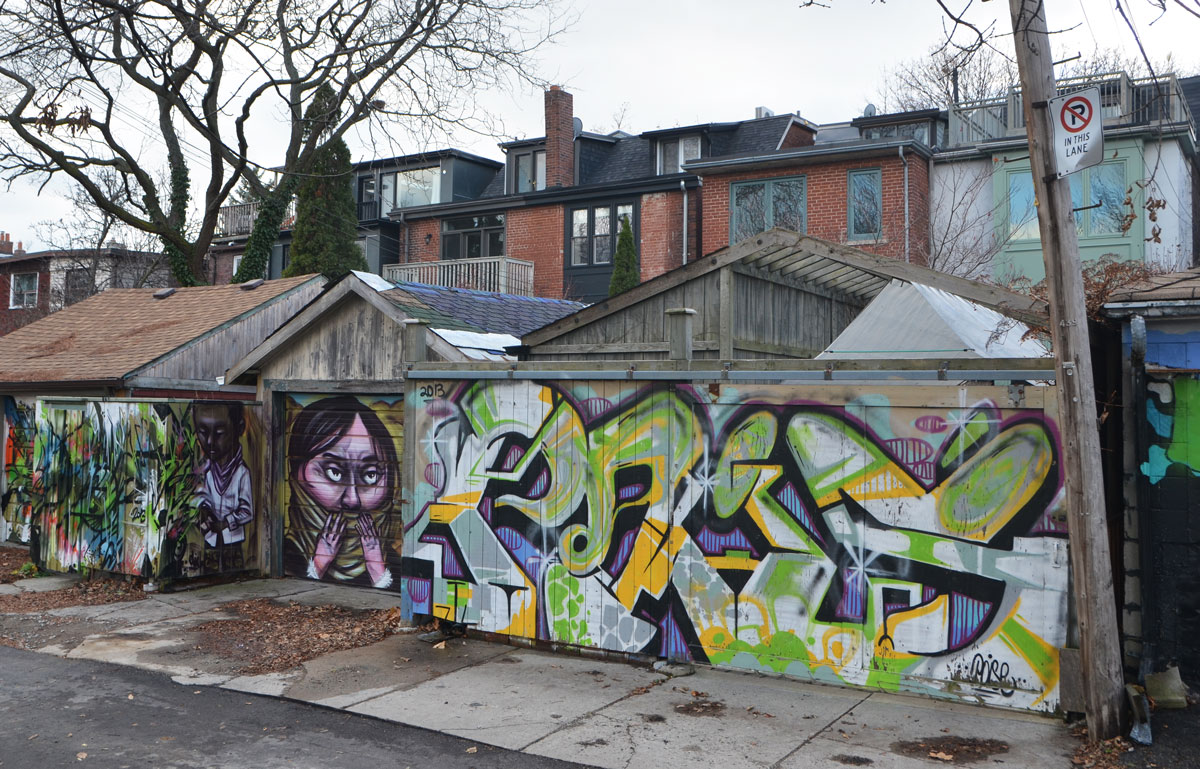
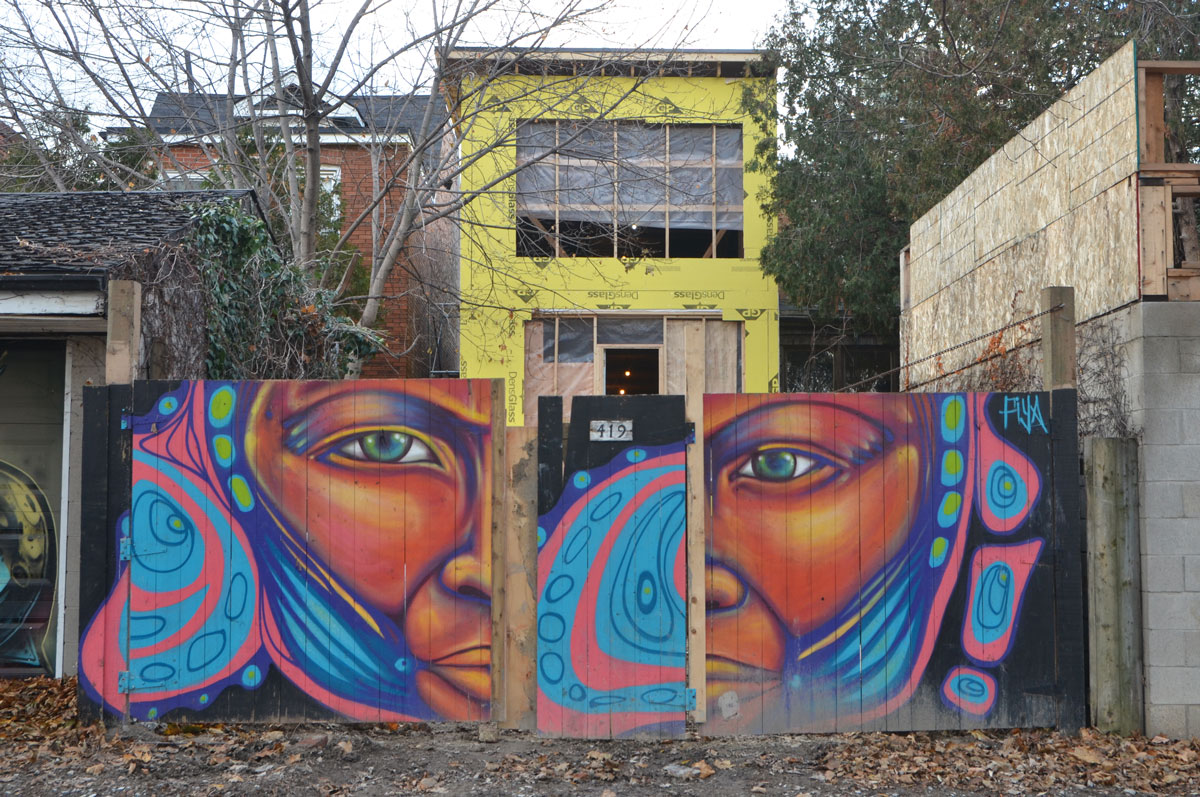
below: Split face on a fence, by fiya
below: A poser bunny
below: Multicoloured grumpy cat by shalak and clandestinos.

below: Wrinkled man with fish in hand, by smoky

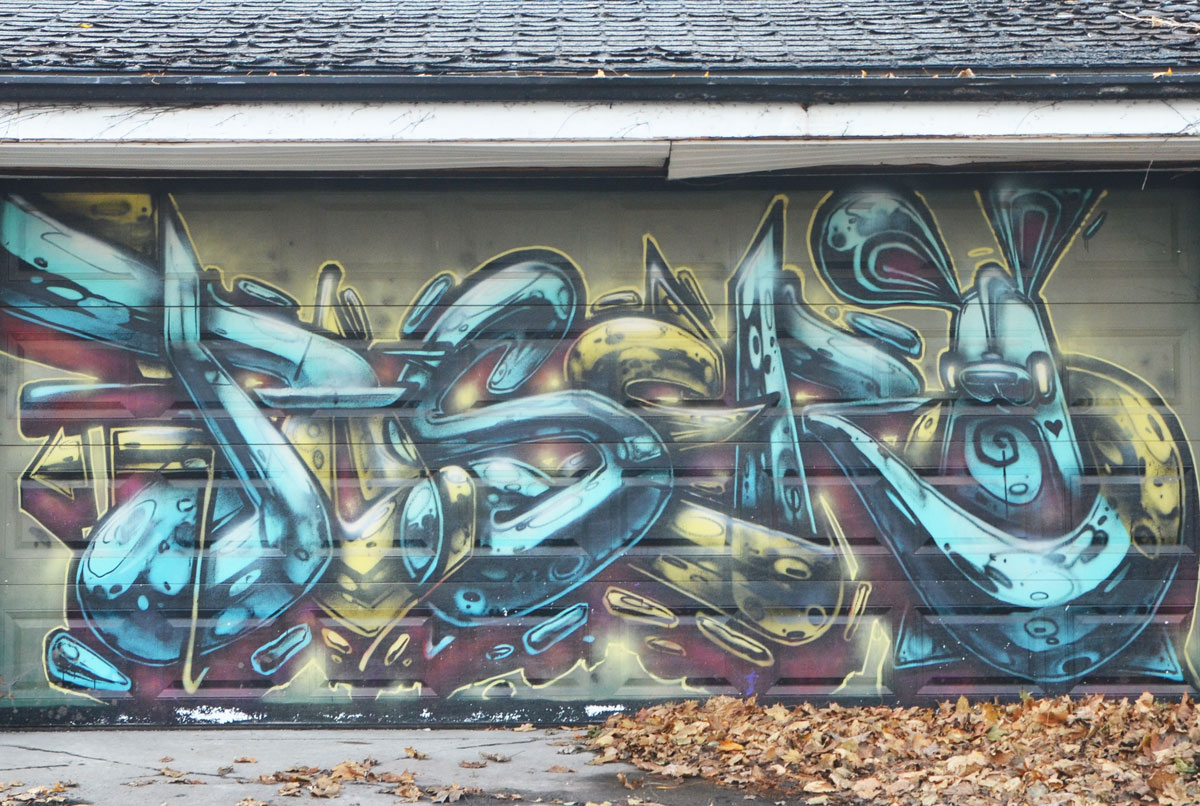
below: A garage door painted by miles.

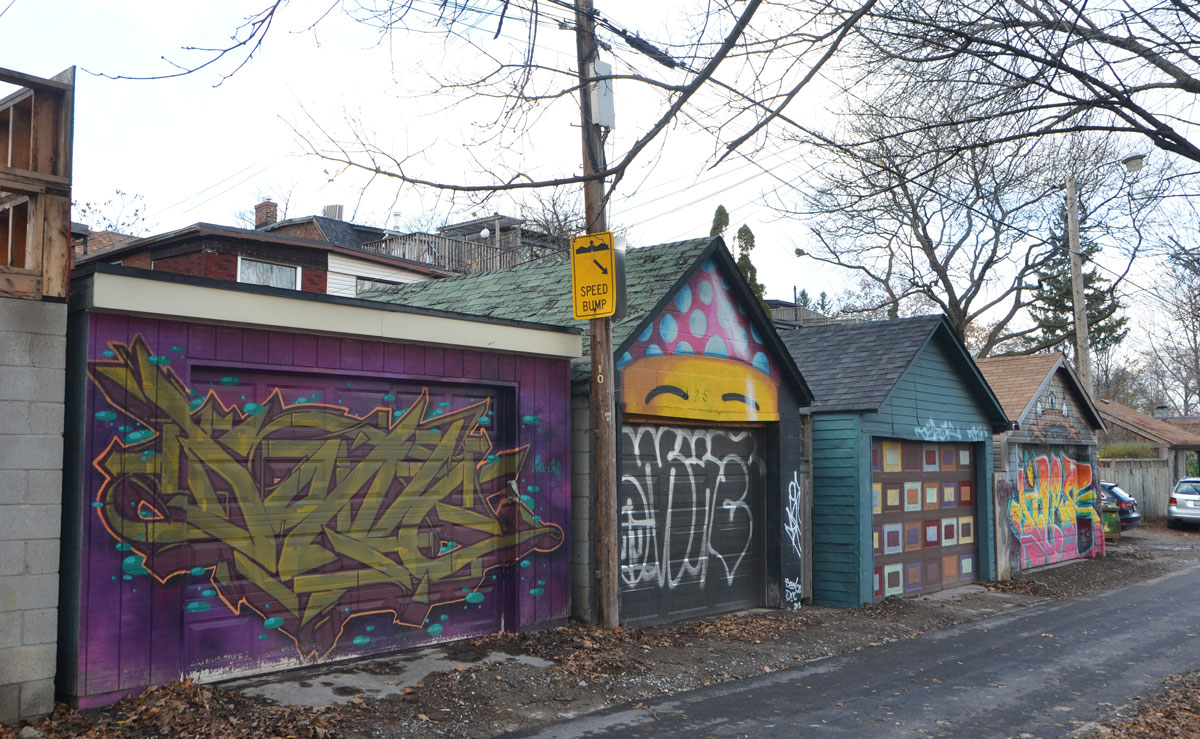
From City of Toronto documentation on the naming of Peperonata Lane, November 2012:

