


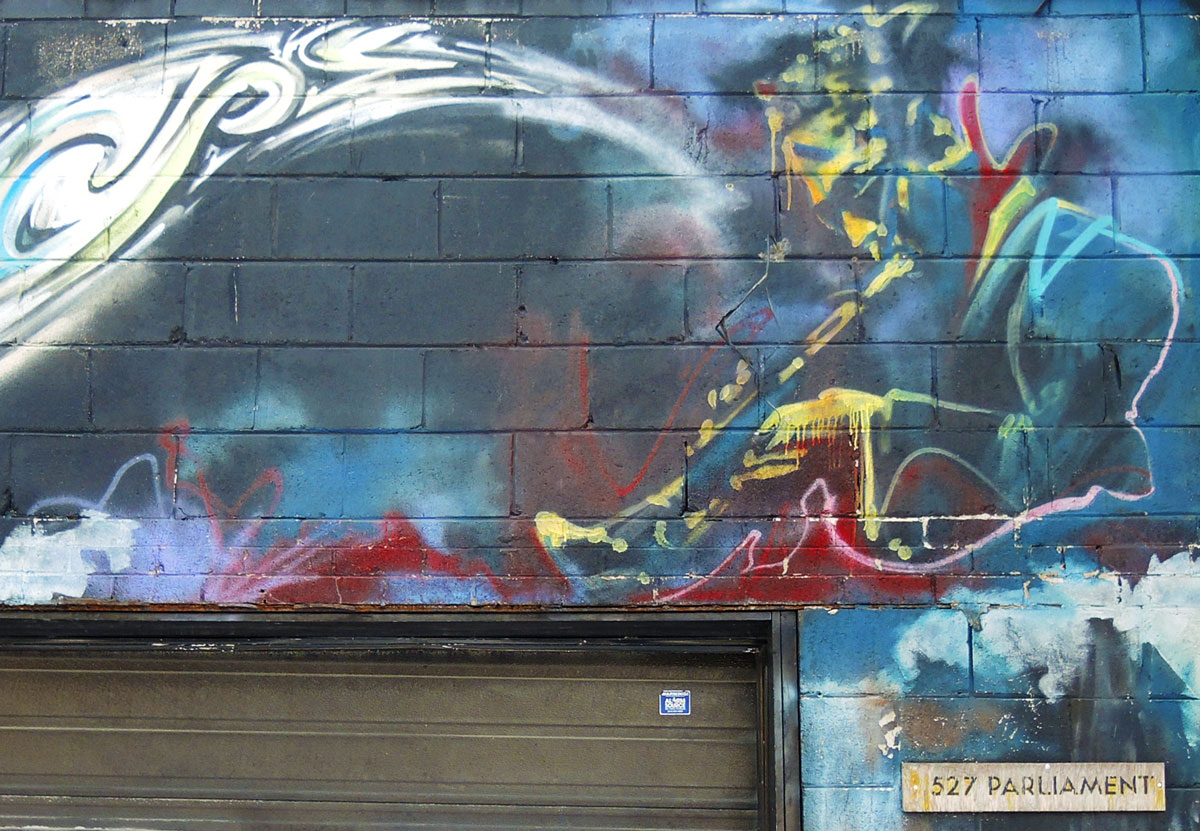
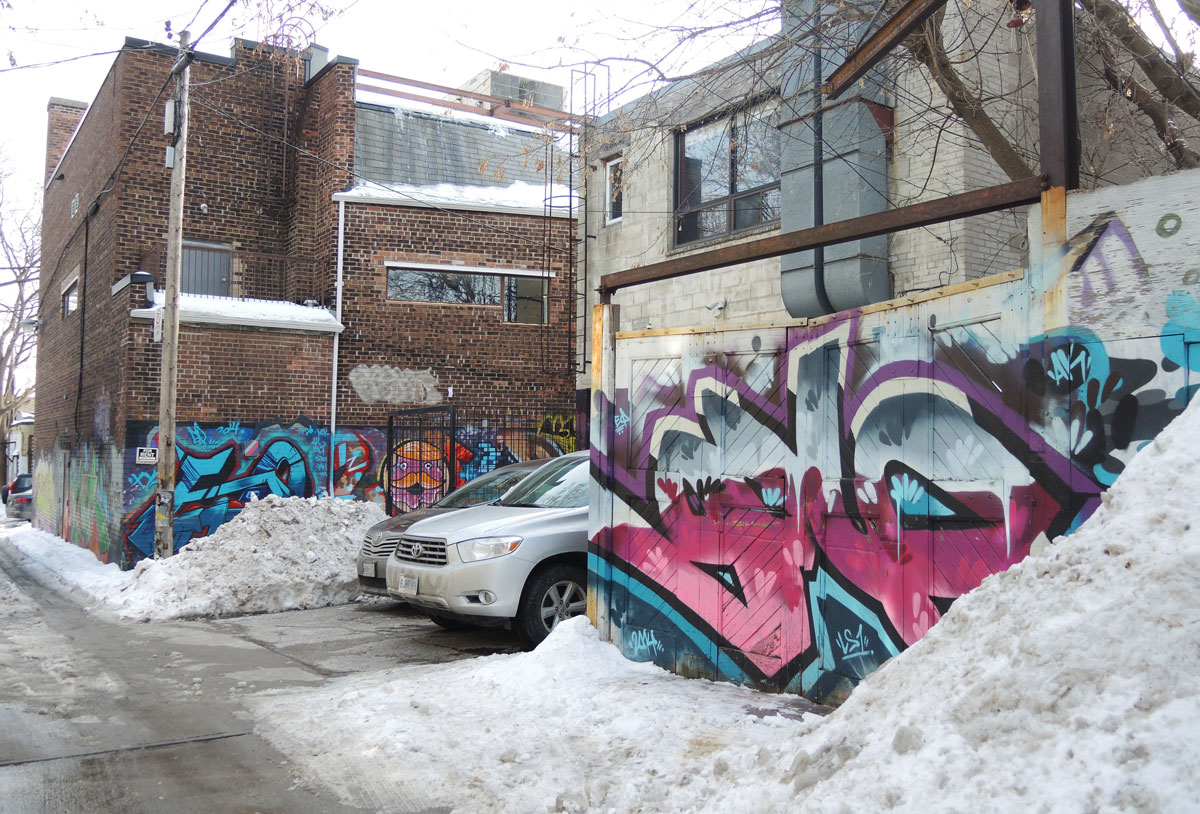
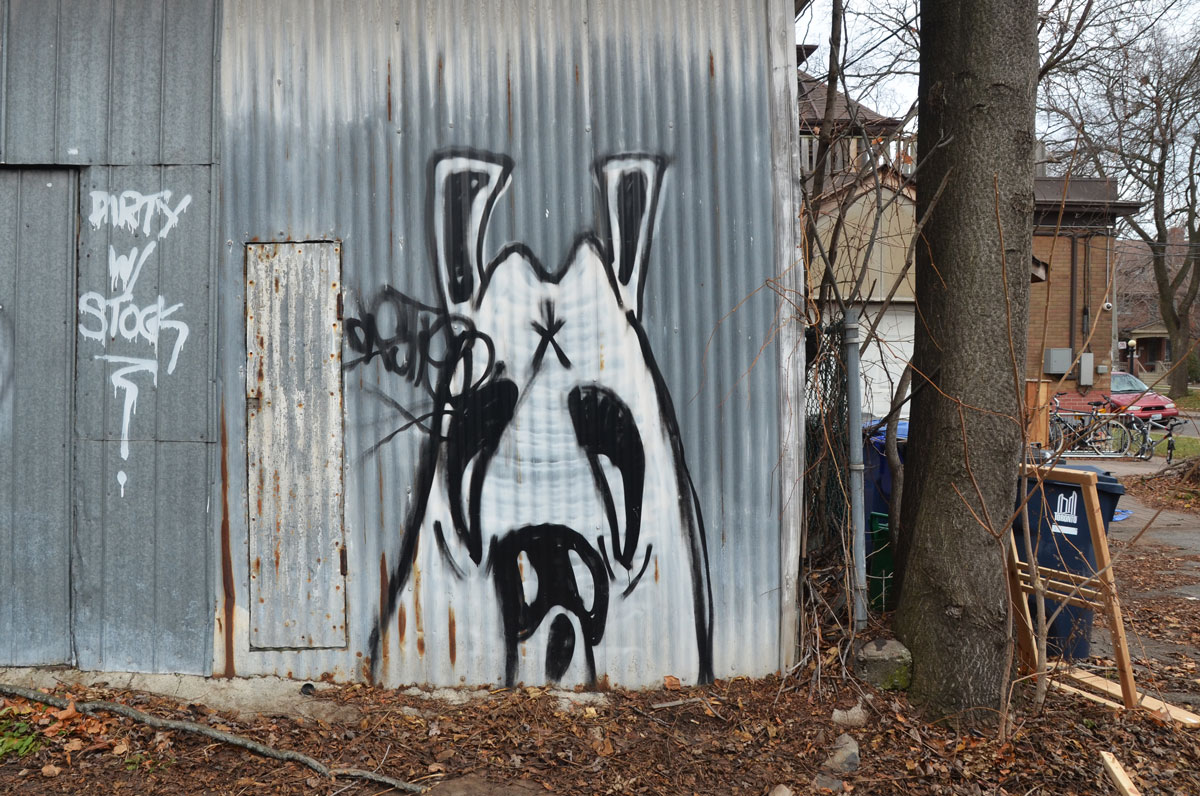
Graffiti in a Cabbagetown lane.


 .
.


Behind 509 Dance, Canadian Contemporary Dance Theatre on Parliament Street.
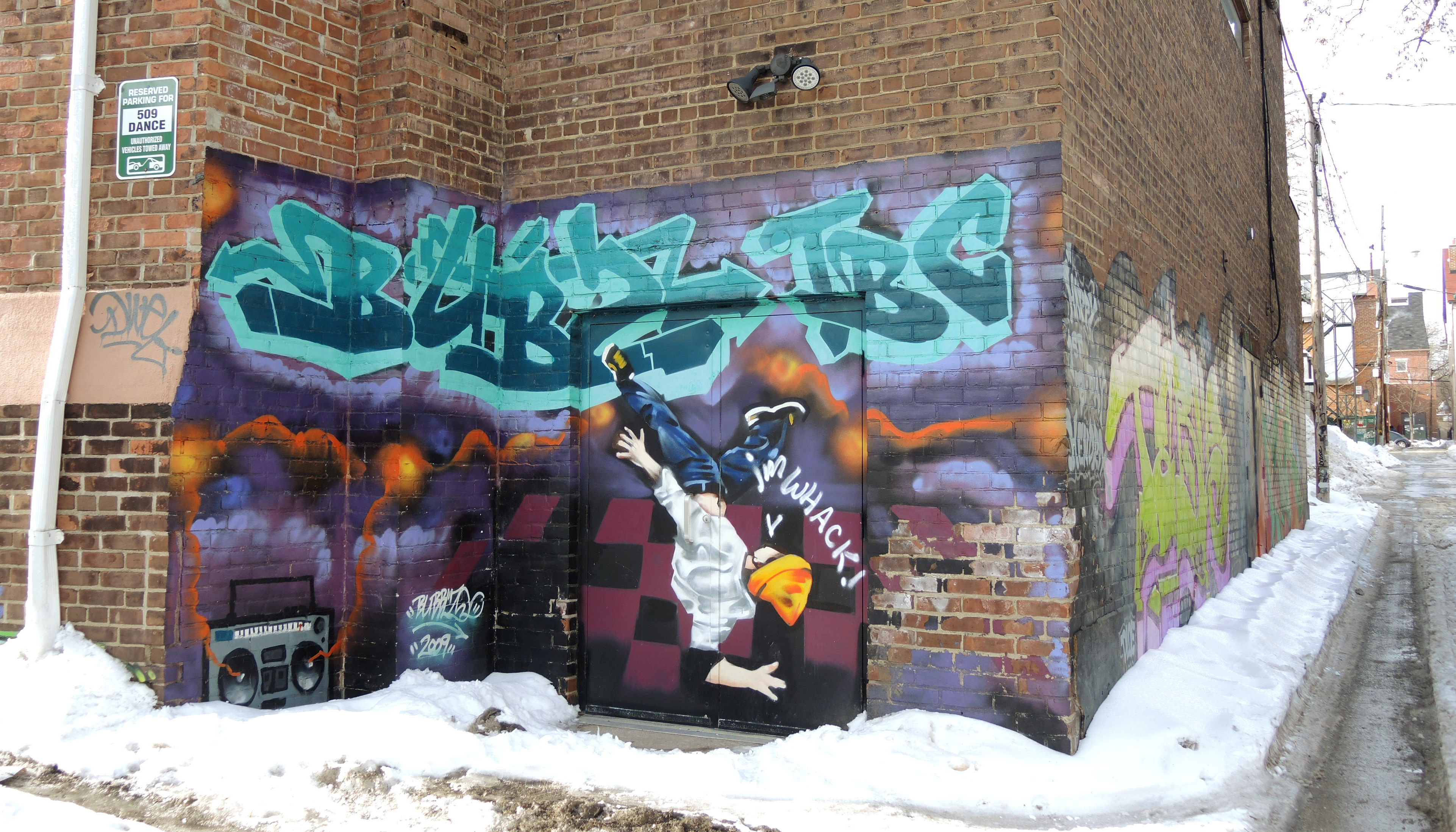
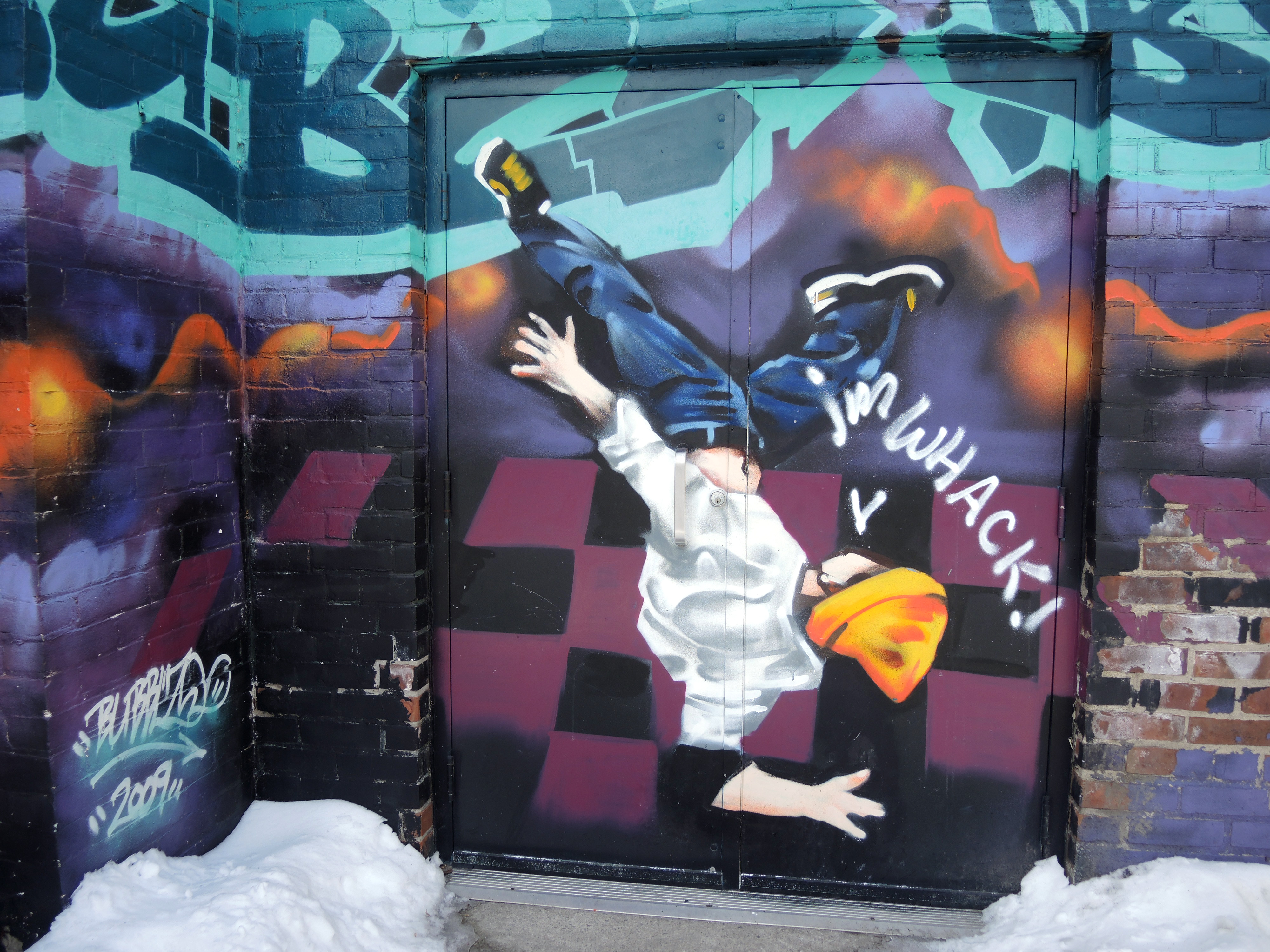
Graffiti in a Cabbagetown lane.
.
Behind 509 Dance, Canadian Contemporary Dance Theatre on Parliament Street.
The Bathhouse Raids by Christiano De Araujo is a mural on Church Street just south of Carlton.
Completed in the fall of 2013, it was the largest of the Church St. Mural Project pieces commissioned for WorldPride 2014.
The following photos were taken with a very wide angle lens
because of the size of the mural and because there are always cars parked in front of it.
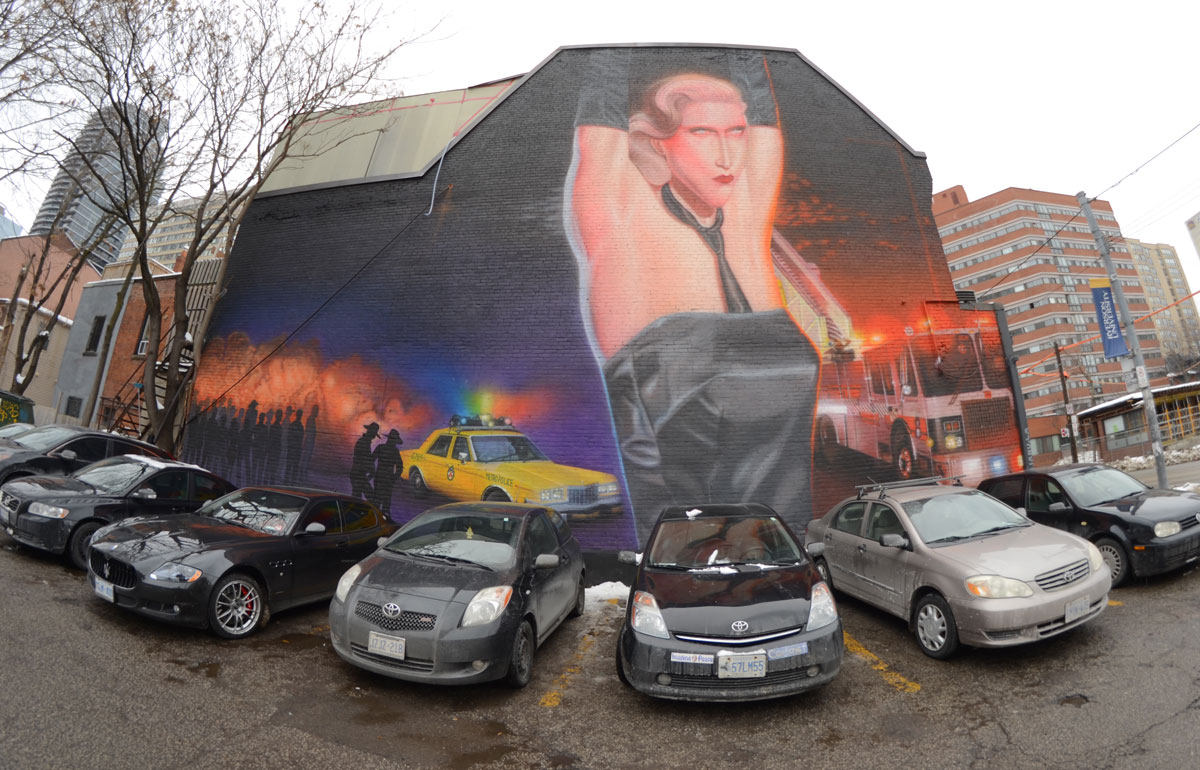
On the 5th of February, 1981, Toronto police raided four bathhouses in what was known as ‘Operation Soap’.
Around 300 men were arrested. Most charges connected to the incident were eventually dropped or discharged, although some bathhouse owners were fined.
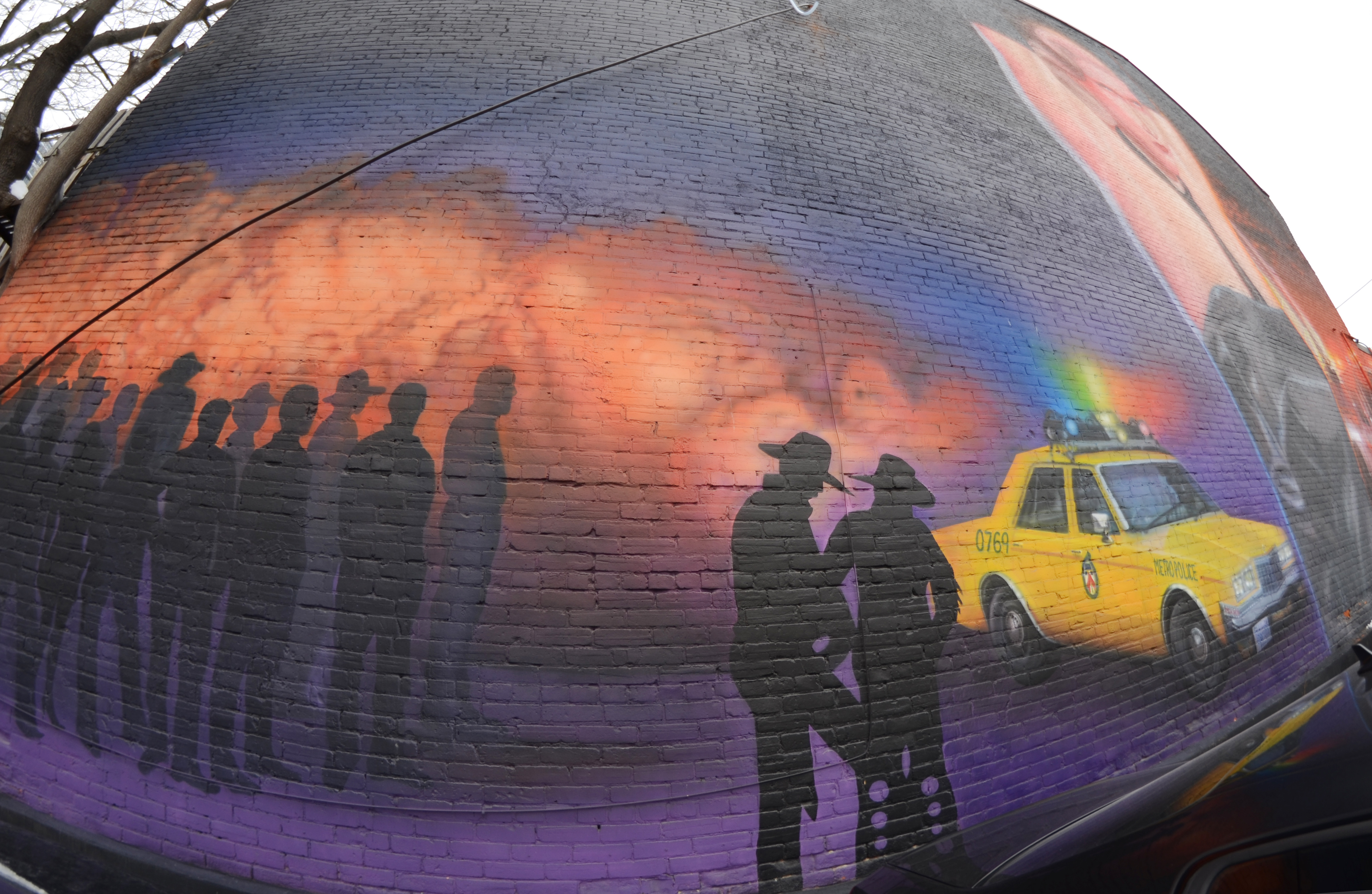

The event marked a major turning point in the history of the LGBT community in Canada.
The raids led to protests – the night after the raids, 3,000 people marched on 52 Division police headquarters and on Queen’s Park, smashing car windows and setting fires. That spring the city held its first Pride Parade.

The Ontario Bread Company is located near Dundas and Ossington.
It had an Ossington Ave address but it is surrounded by lanes.
In September of 2013 it went out of business. The building is still there but it is empty.
 .
.

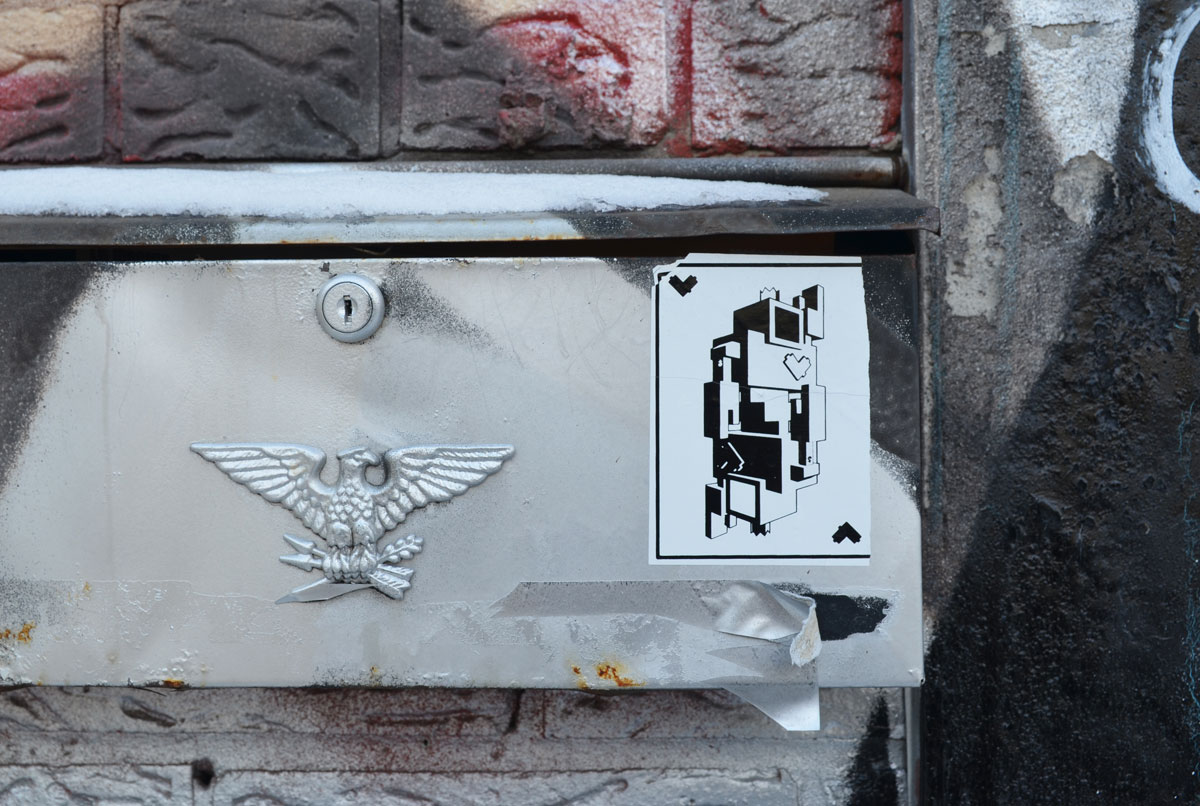
Lovebot is now on their mailbox!
The bakery was founded in 1935 by Polish immigrants and they specialized in Polish, and other Eastern European, breads. BlogTO did an interesting piece about the bakery in August 2013.
There is a lumber yard adjacent to the bakery on the same lane.
What follows are some of the photos that I took as I walked the “block” of lanes around the bakery and the lumber yard. Some of the graffiti has been there for a few years.

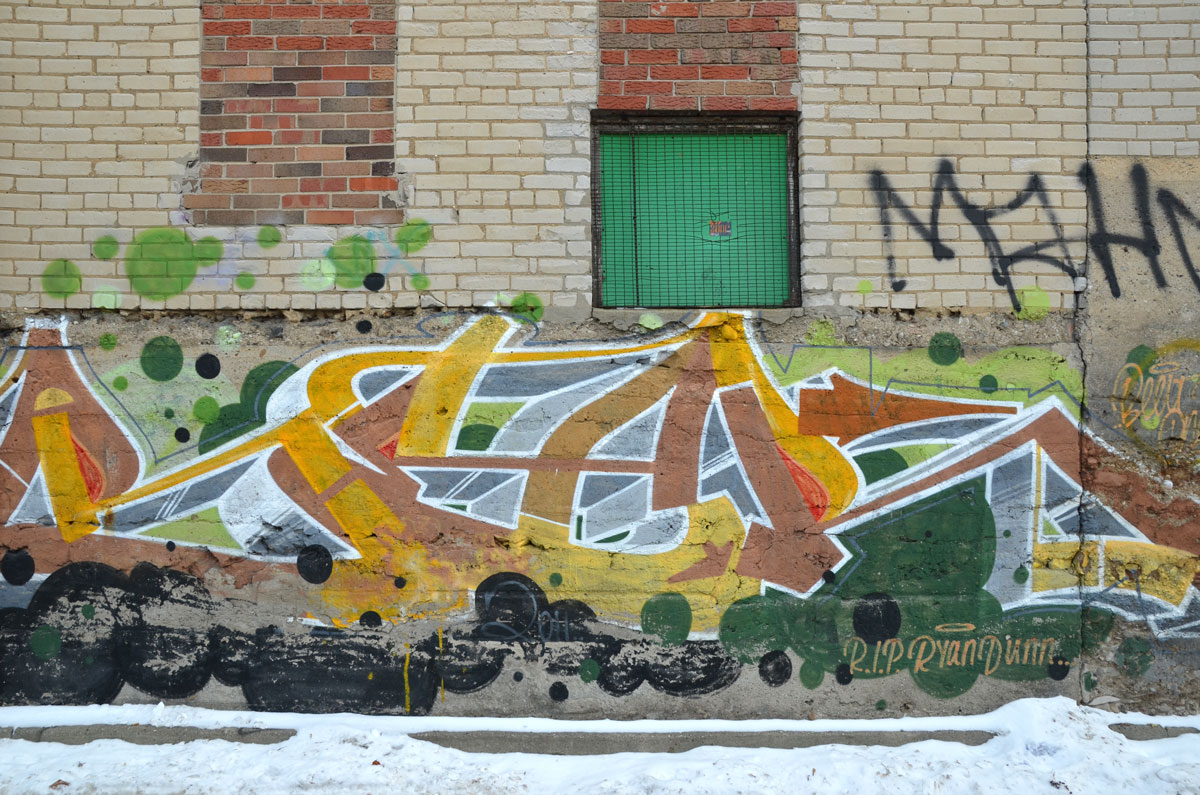

A view of the back wall.

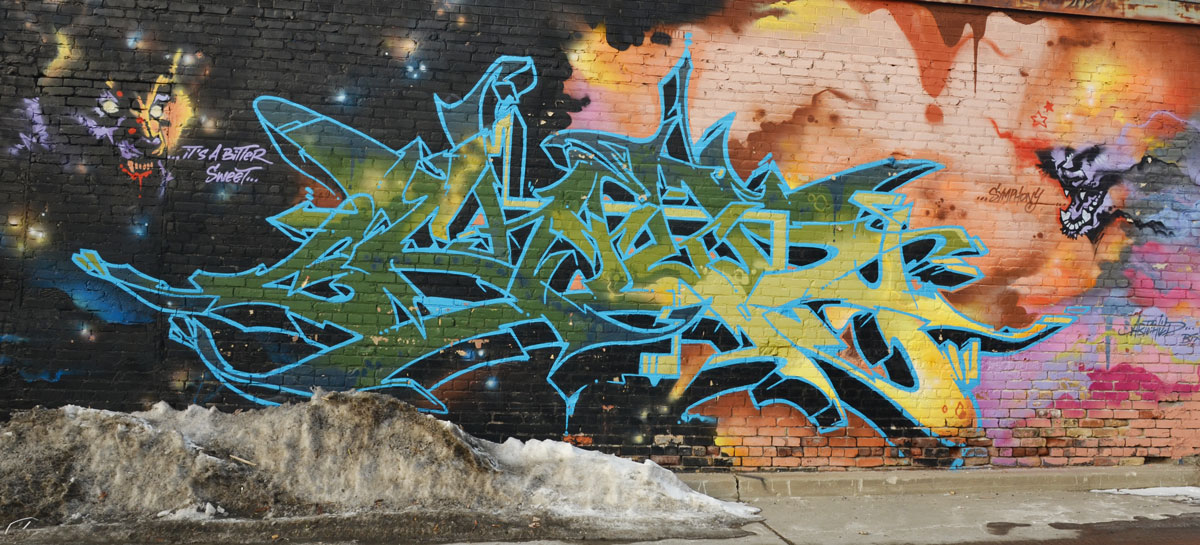
The words on this one say “It’s a bittersweet symphony”
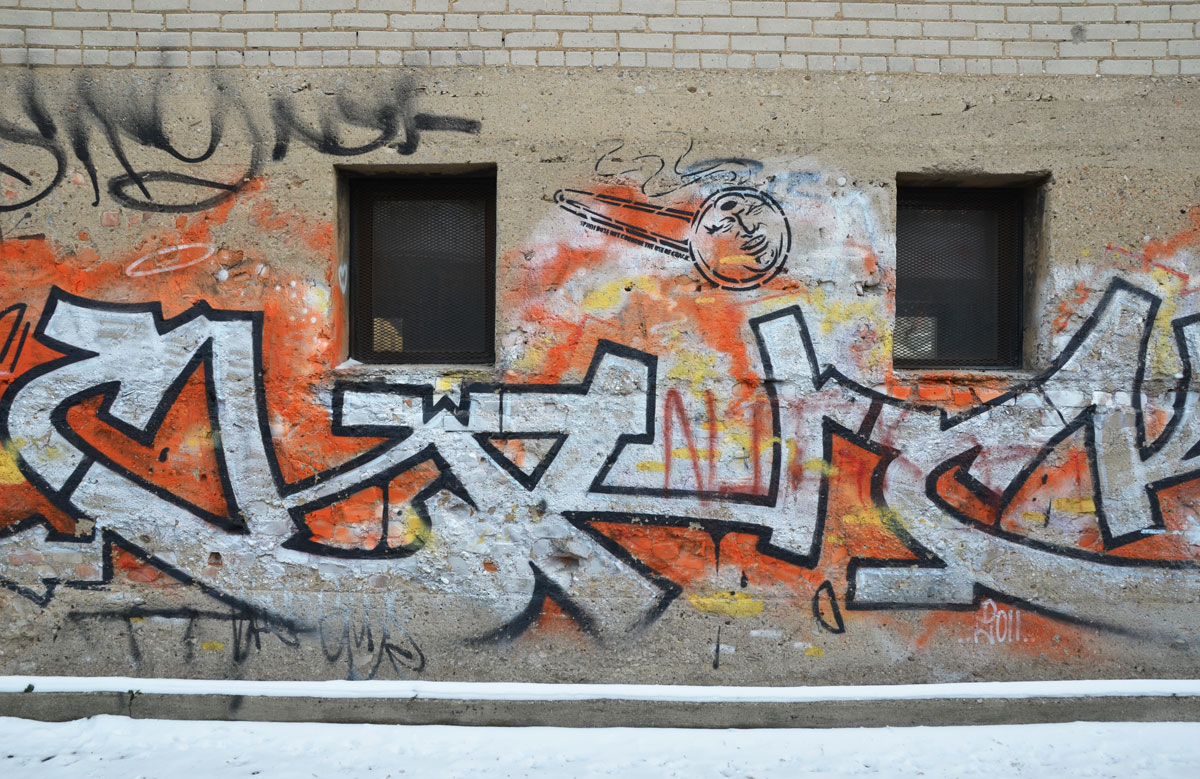
This pair stands under the shower in a quiet corner.

Rob Ford may no longer be mayor, but his legacy lives on …. in the form of anti-Ford graffiti.


This piece is on Rolyat Street, just north of the Ontario Bread Co.
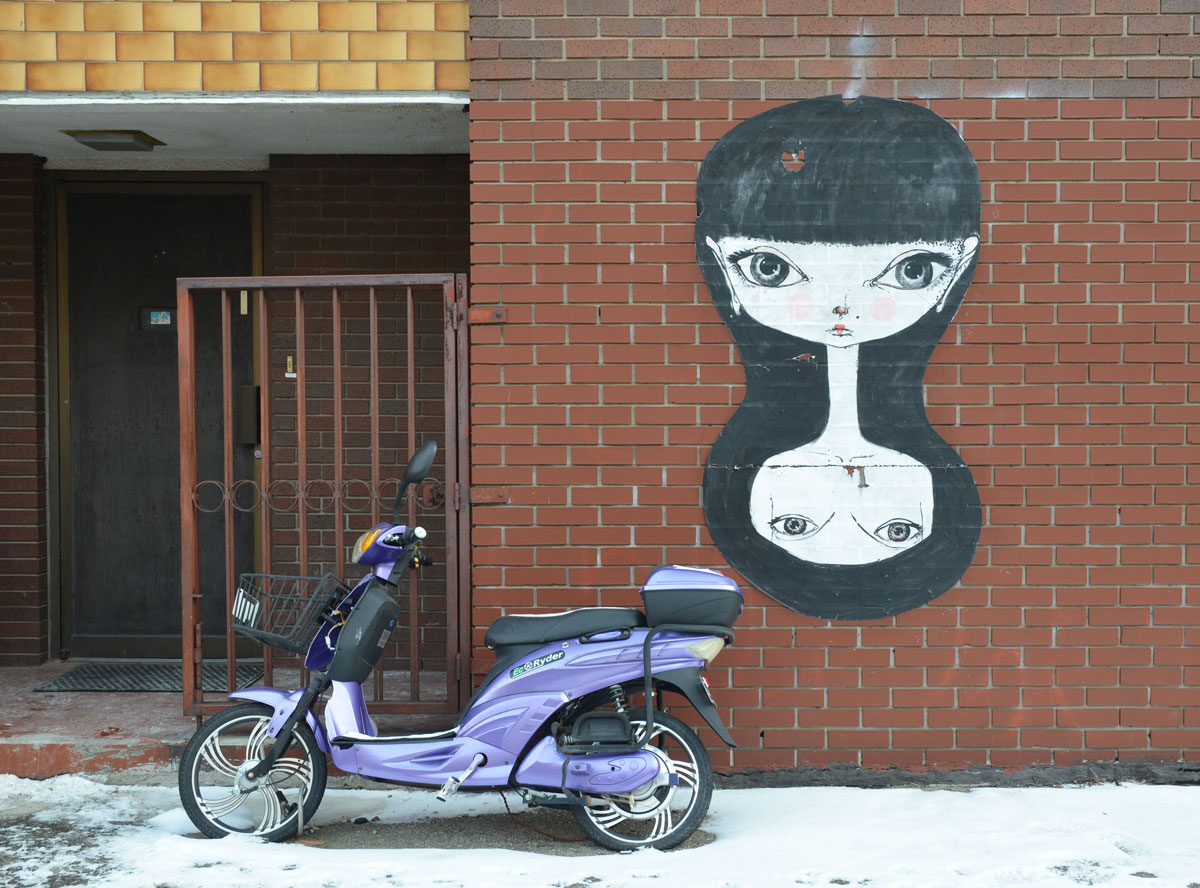
The last two pieces of street art are in a neighbouring lane, just to the northwest.


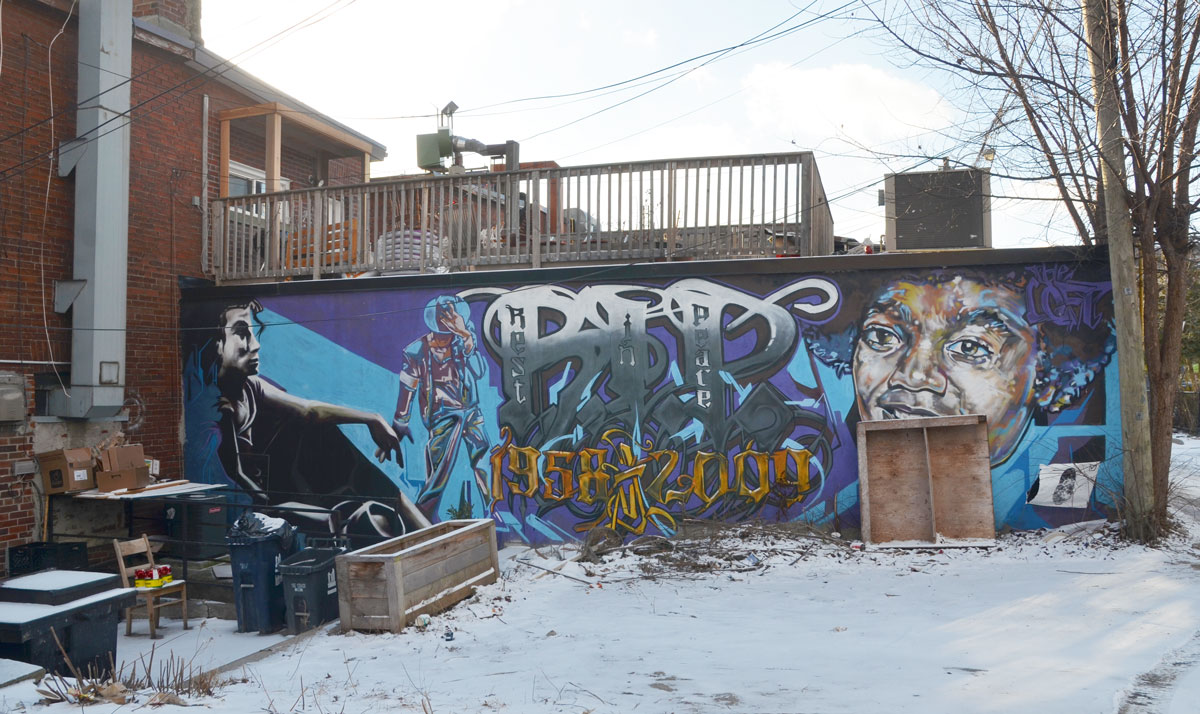
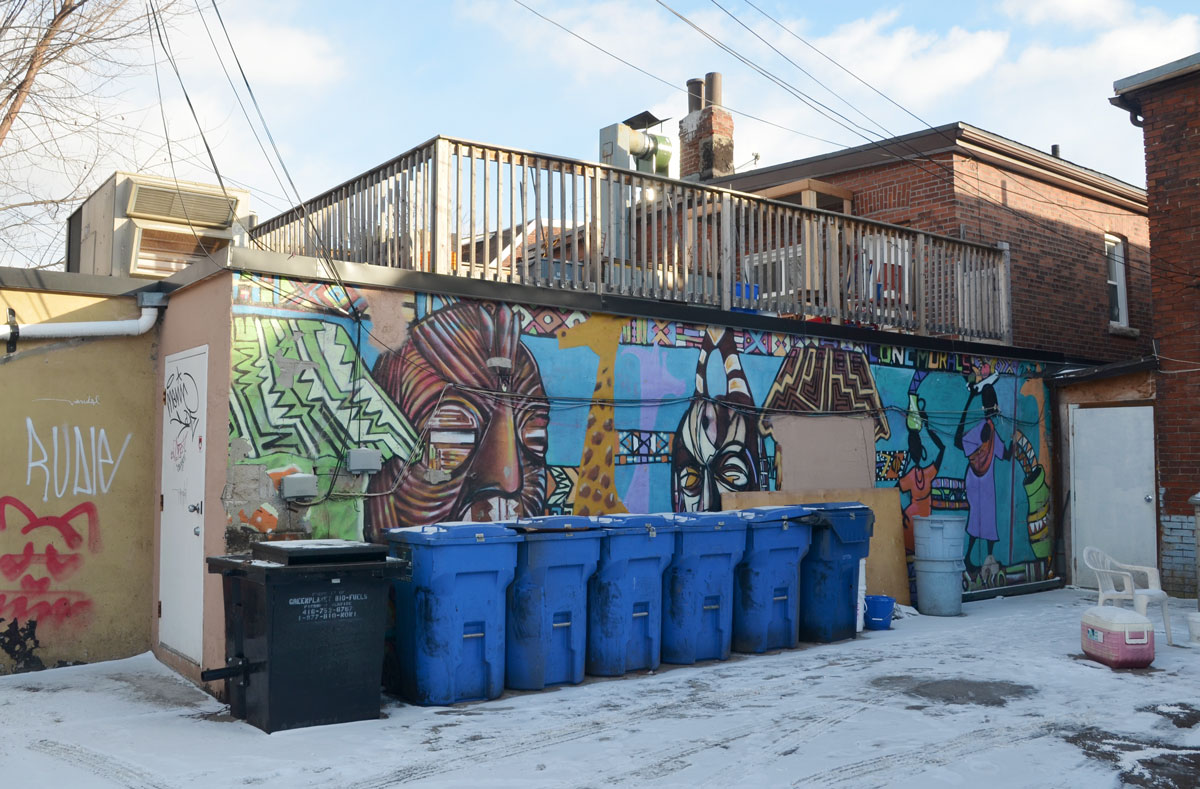
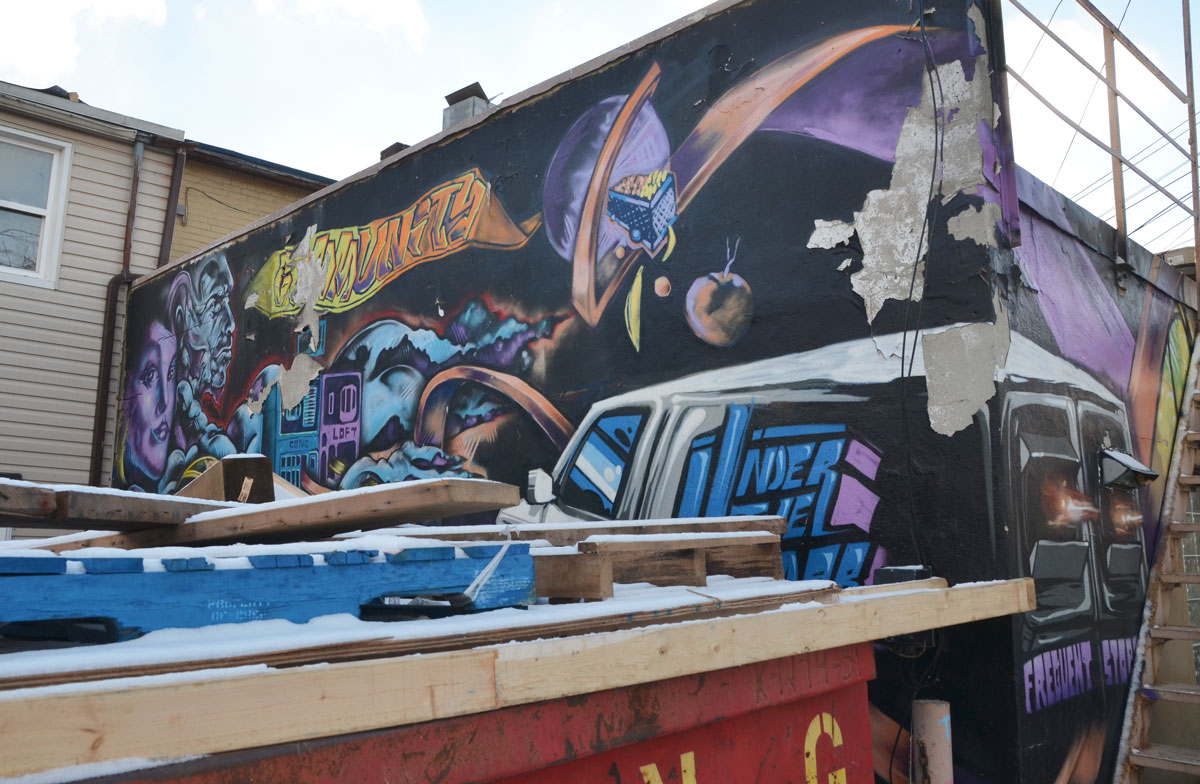
Irene Ave. is a short street that runs behind the north side of Bloor Street West between Carling and Shaw streets, just east of Ossington Avenue. Irene Avenue Parkette takes up most of the south side of Irene Avenue. There is an alley that runs between the park and the back of the stores on Bloor West.
The Christie Ossington Neighbourhood Centre, through the Graffiti Arts portion of their LOFT program, has sponsored a number of murals in this alley.
This is what it looked like on a cold afternoon last week.

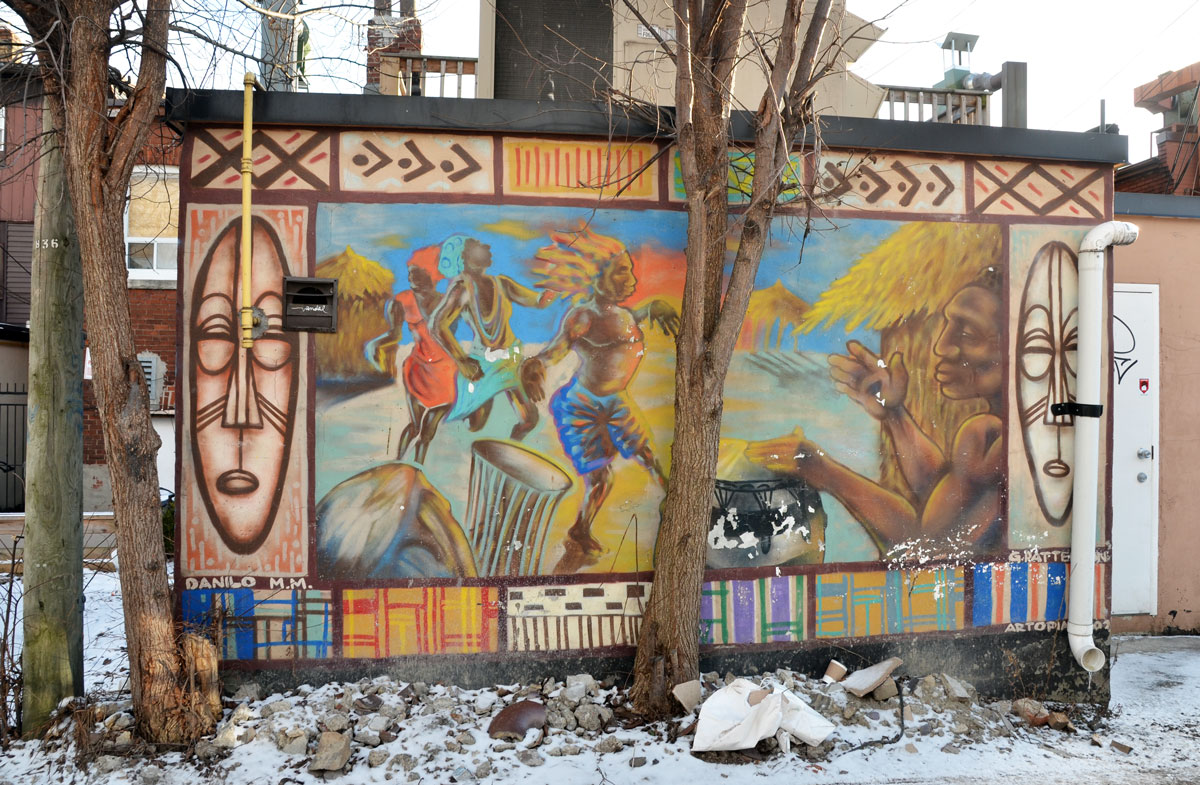


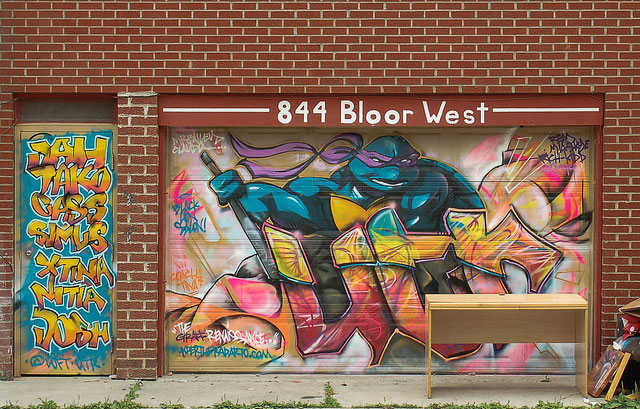
The next picture was taken in June of 2012.
The mural is still there but I couldn’t take a proper photo of it last week as there was a car parked too close.
When I walked around the block to check out the fronts of these buildings, this is what I found

A mural by Elicser and to the right the LOFT Youth Centre for Social Enterprise and Innovation.
Honest Eds, a Toronto icon, at the corner of Bathurst and Bloor since 1948

Looking south from Bloor Street towards the parking lot behind Honest Eds.
There are a few murals on the buildings that back onto the parking lot.

Trumpet players on the back of the Victory Cafe at the corner of Markham and Lennox Streets

Woman with boxing gloves has been on the back of Trainers Fitness for a few years. The newer dog is painted on the back of A Leg Up Pet Services.

Purple behind Southern Accent restaurant and a mural painted by Christie Ossington Neighbourhood Centre through their LOFT program.
Along Dundas St. West between Islington and Kipling there are a series of more than twenty murals that depict scenes from the history of the area.
In 1793, Simcoe’s Queen’s Rangers cut a route through the forest for Dundas Street. It was meant to serve both as a military route in case of war with the U.S. and as a route to increase settlement in the area. Settlement of what became the village of Islington began a few years later with the arrival of the Johnston family in 1808.
The first mural was a picture of the Methodist church painted on plywood. It no longer exists.
mural 2 – The Way We Were, part 1 by John Kuna, 2005.
Looking east along Dundas St. towards Cordova Ave in 1912. It includes Hopkins store and the Methodist church.
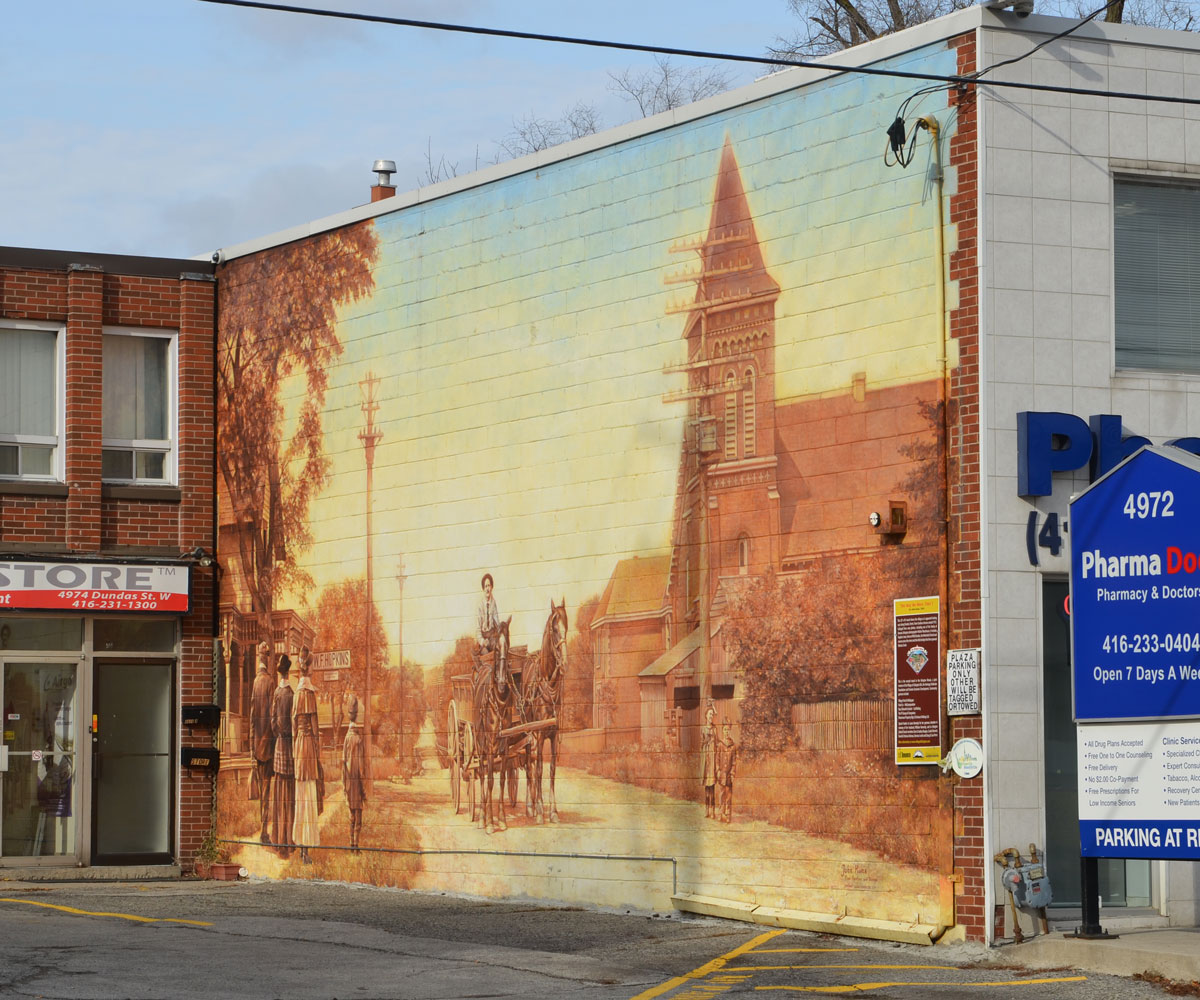

mural 3 – They Way We Were part 2, 1912, by John Kuna, 2006.
Because of the car that was parked next to it, I don’t have a good photo of the whole mural.

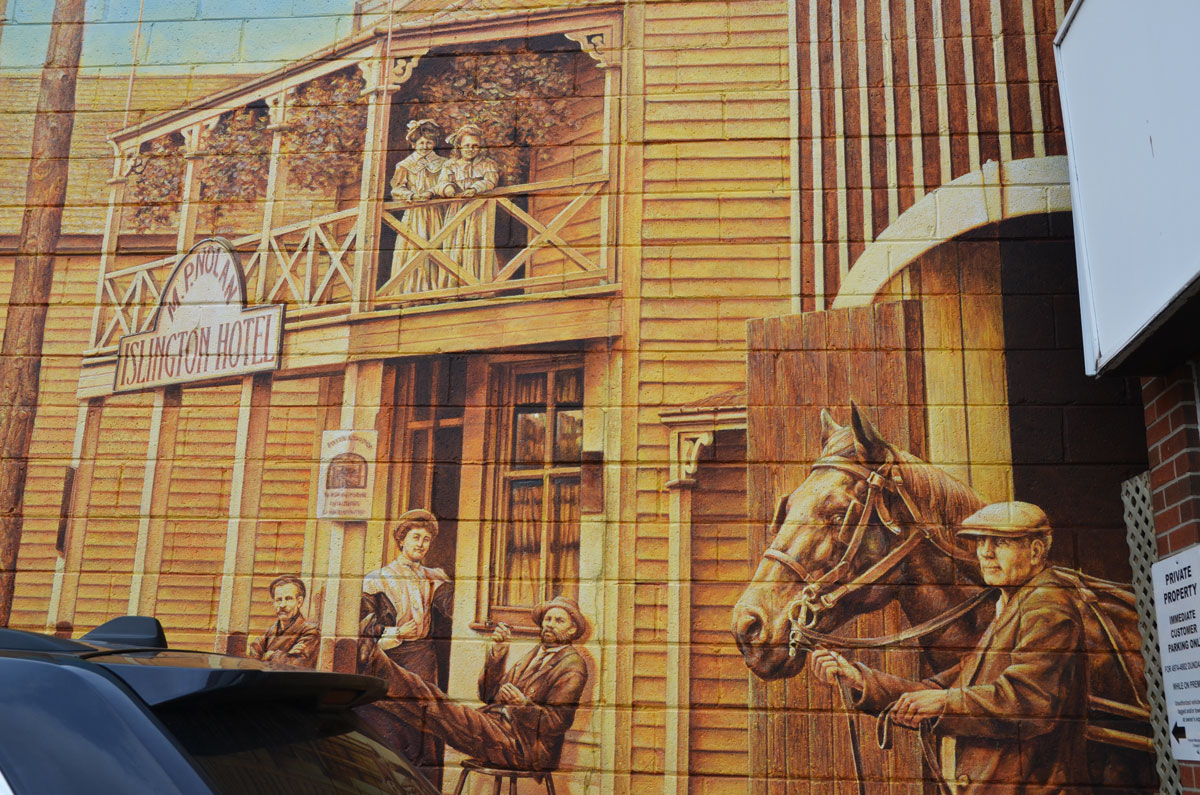
mural 4 – Timeline: Islington Then and Now, by John Kuna, 2006.
Showing Dunn’s store (NE corner of Dundas & Burnhamthorpe Cres) as well as the flowering catalpa trees that used to line the street (on the right in the picture)
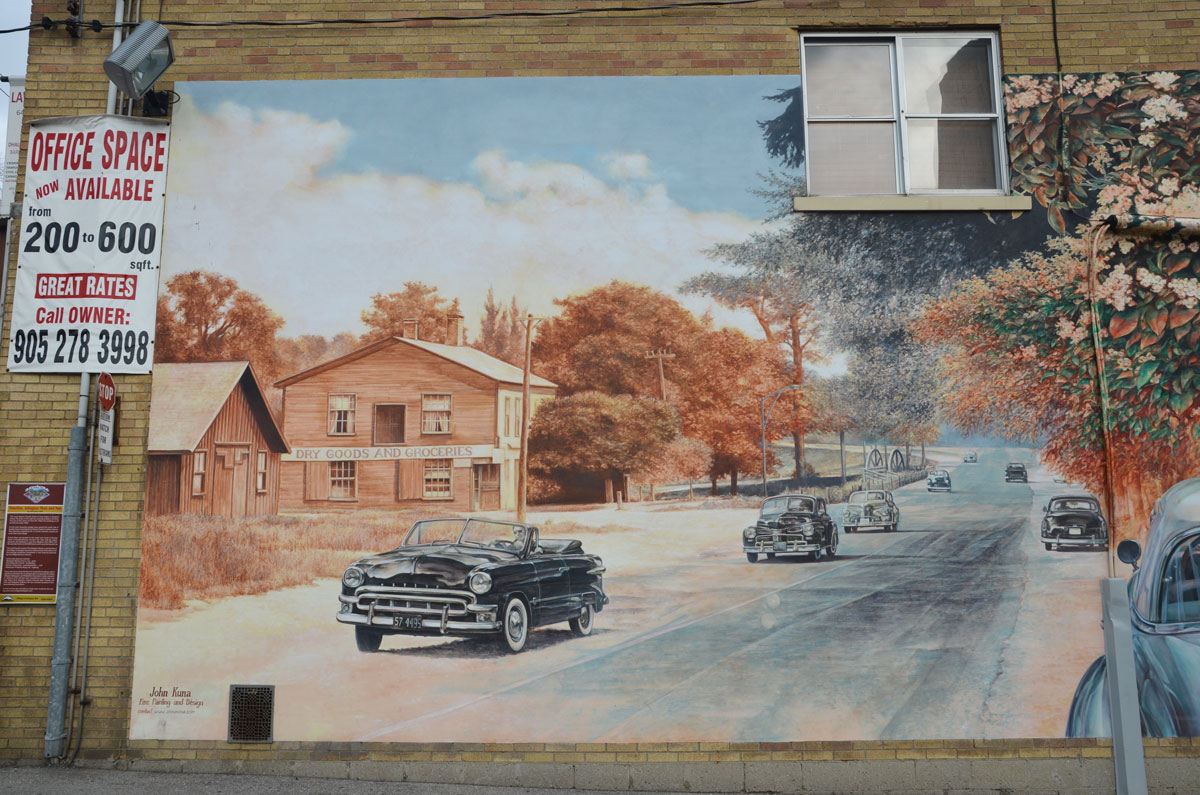
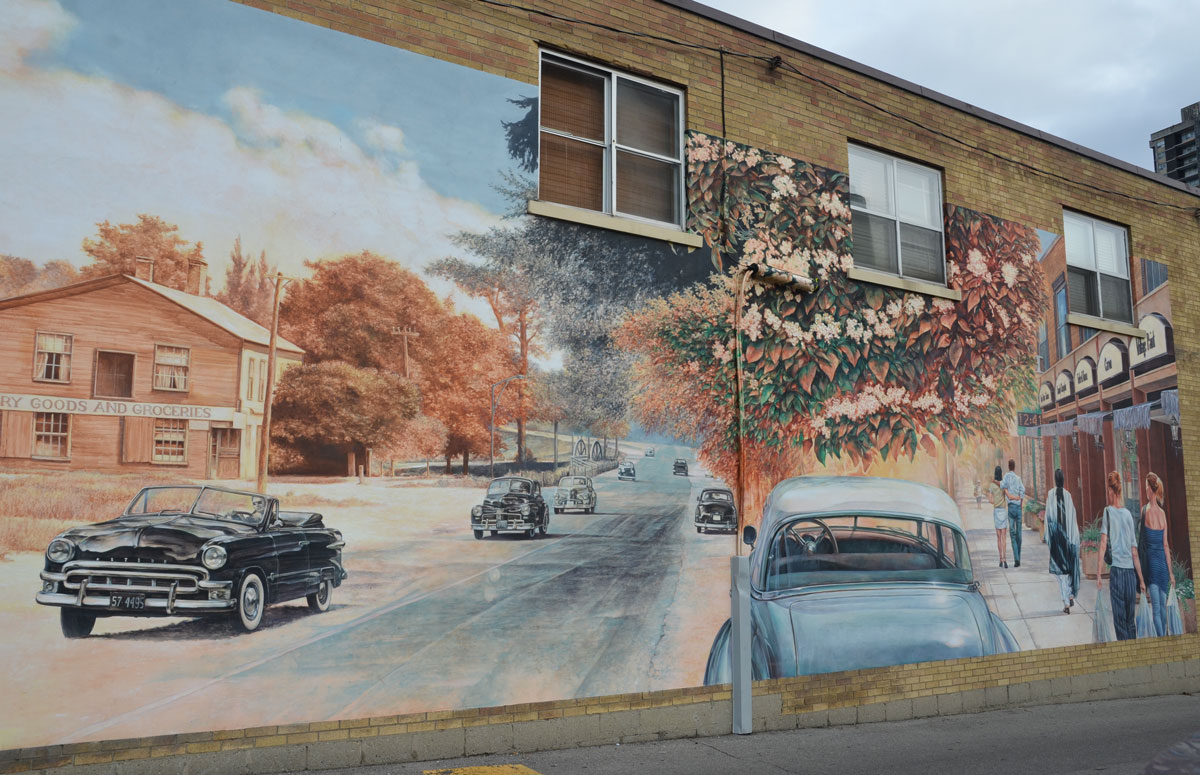
mural 5 — Honouring Islington’s Volunteer Fire Brigade, by John Kuna, 2007.
Islington had its first motorized fire truck in 1931. In the 1940s and 1950s the volunteer firefighters would use water from the Mimico creek to flood part of Central Park, on the west side of the creek, to create a skating rink.

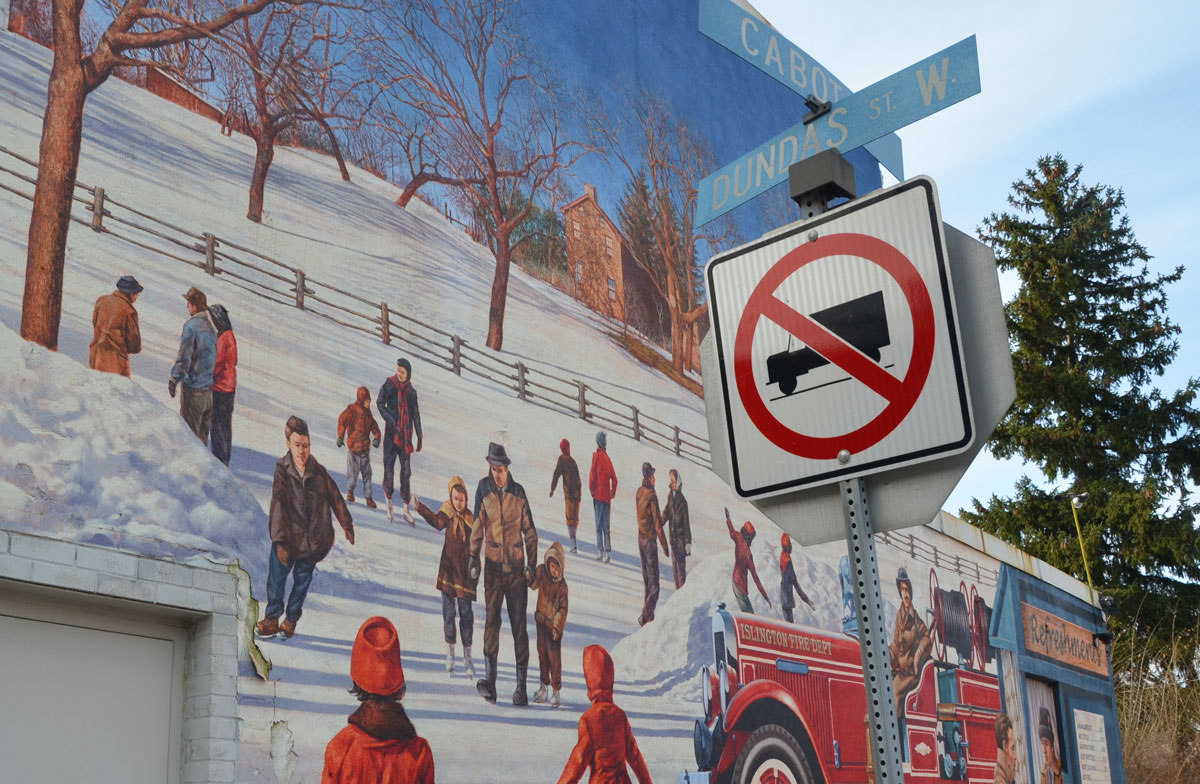
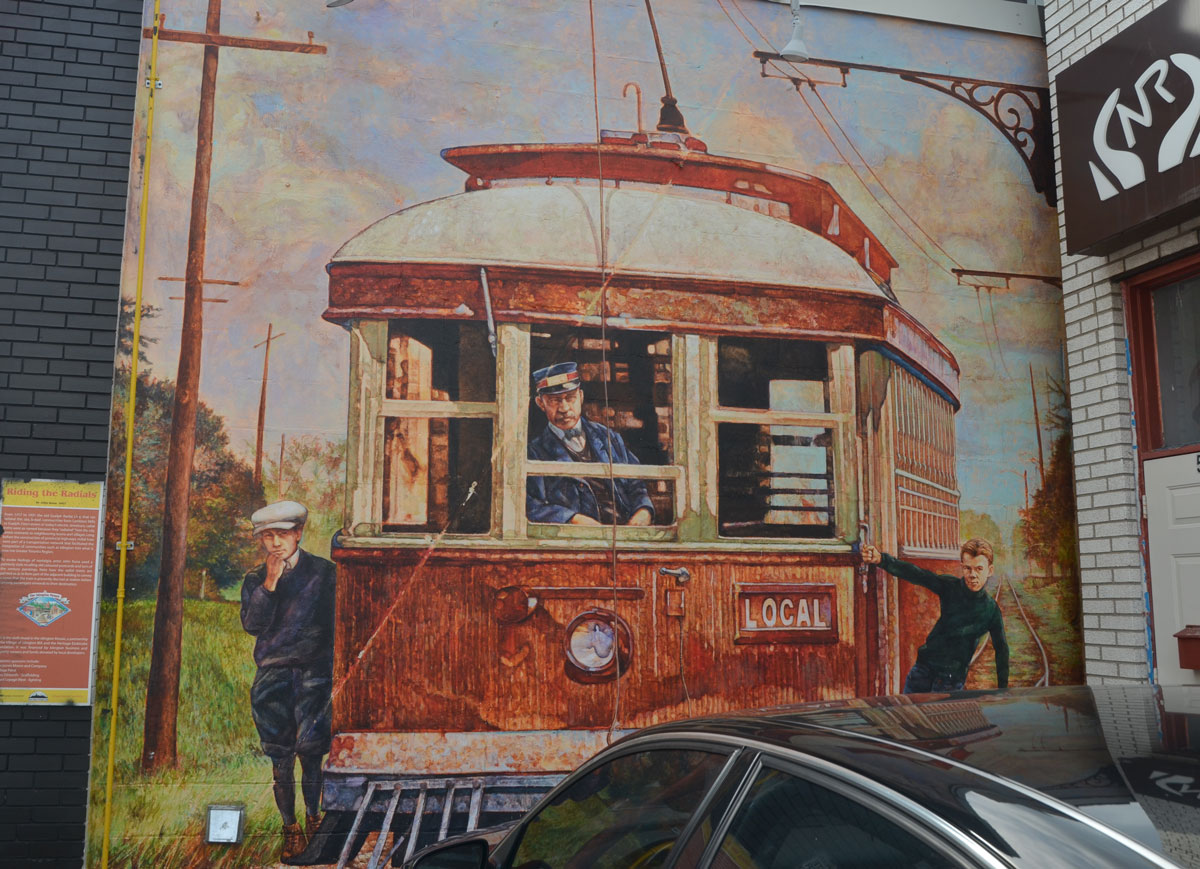
mural 6 – Riding the Radials, by John Kuna, 2007.
From 1917 to 1931 the old Guelph Radial Line (or Toronto Suburban Railway) ran close by this site. It was an electric rail line between Toronto and Guelph.
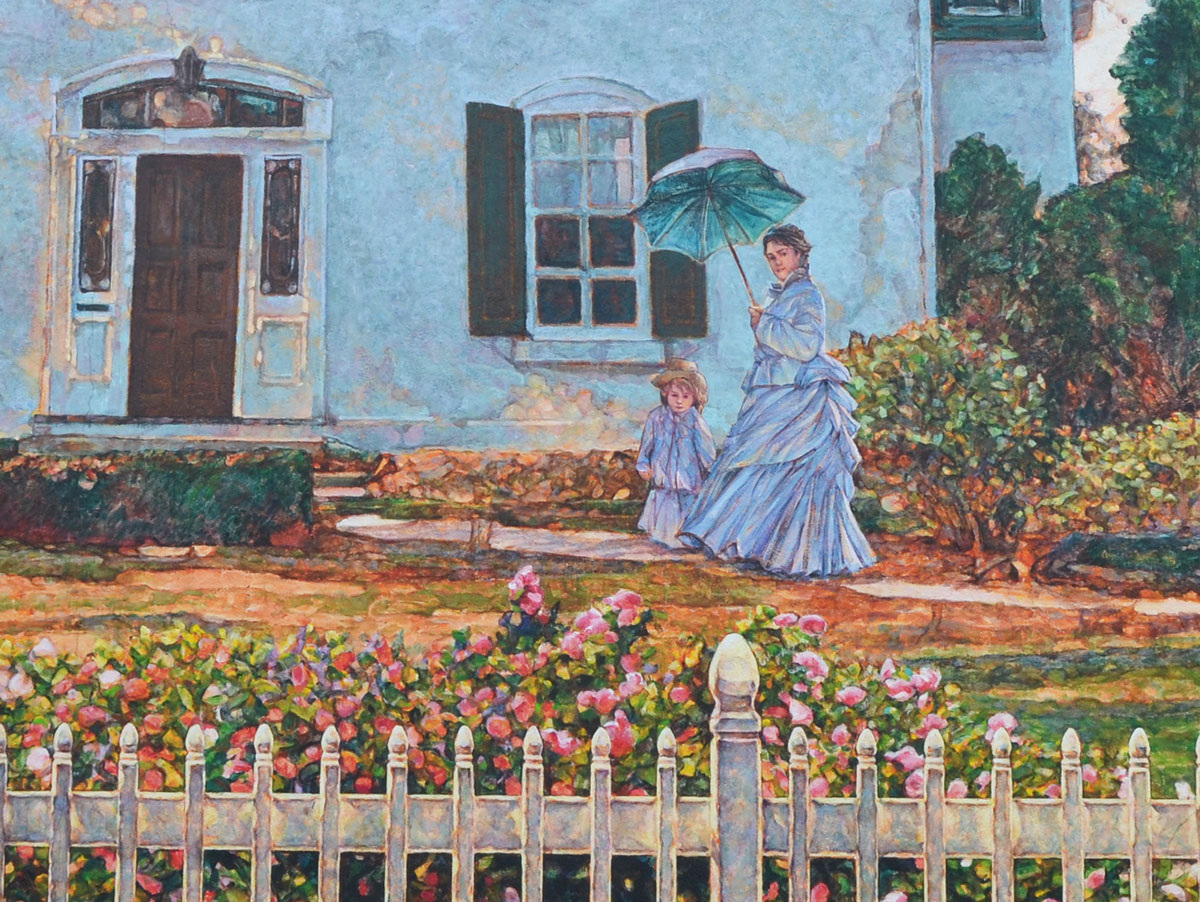
mural 7 – Briarly, Gone but not Forgotten, by John Kune, 2007.
Briarly, also known as Gunn House was built in 1840s. From 1870 to 1985 it was owned by the Montgomery family and their descendents.

mural 9 – Harold G. Shipp’s Firt High Flier, by John Kuna, 2008.
The story behind this mural: “In 1944 Harold Shipp convinced a Lancaster bomber pilot who ferried supplies from Toronto to England during the war, to fly over the school’s football field and drop hundreds of leaflets, a few of which could be traded for tickets to the school dance. Unfortunately, a rogue wind scattered the leaflets across the Chinese market gardens near Montgomery’s Inn. In the ensuing mayhem, excited football fans frantic to secure a winning ticket, stormed the field and trampled the carefully tended cabbages”


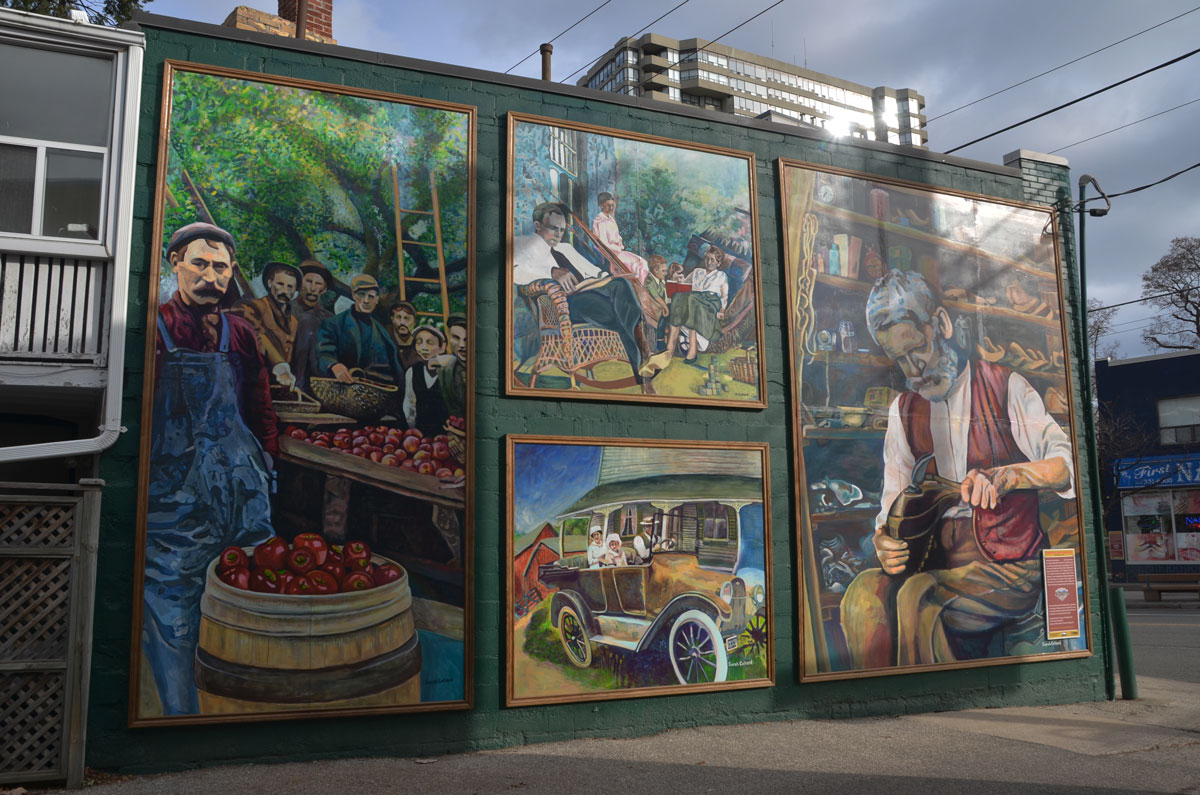
mural 10 – Portraits from our Past by Sarah Collard, 2008.
Inspired by pictures taken in the early 1900’s. “These include: Apple Packers at Bigham family orchards, Rathburn and Martingrove ~1917; Sunday Afternoon, a scene showing the family of famous Islington photographer Walter Moorhouse on their veranda at 34 MacPherson Ave. (now Aberfoyle); Islington’s First Car, a 1917 Chevrolet owned by the Appleby family; and the Village Shoemaker, Mr. Nelson in the 20th century.”
mural 11 – Mimico Creek in Fall, ca 1920, by John Kuna, 2008.
Looking north towards the Dundas Street bridge.
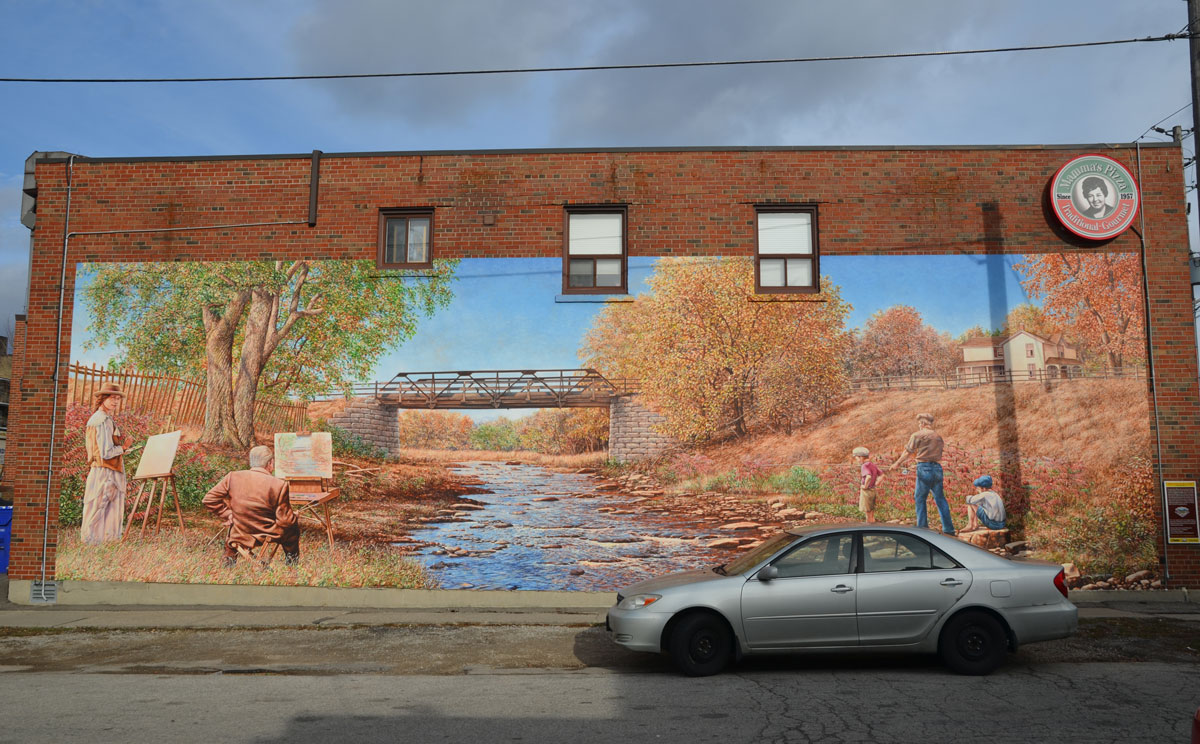
Gordon’s Dairy, by John Kuna, 2008.

mural 13 – The Old Swimming Hole by June Kuna, 2009.
Swimmers at the mill pond.


mural 14 – The Pub with no Beer, by June Kuna, 2009.
A scene from the Prohibition Era in the late 1920’s. Men collecting empty pop bottles from outside the Islington Hotel.
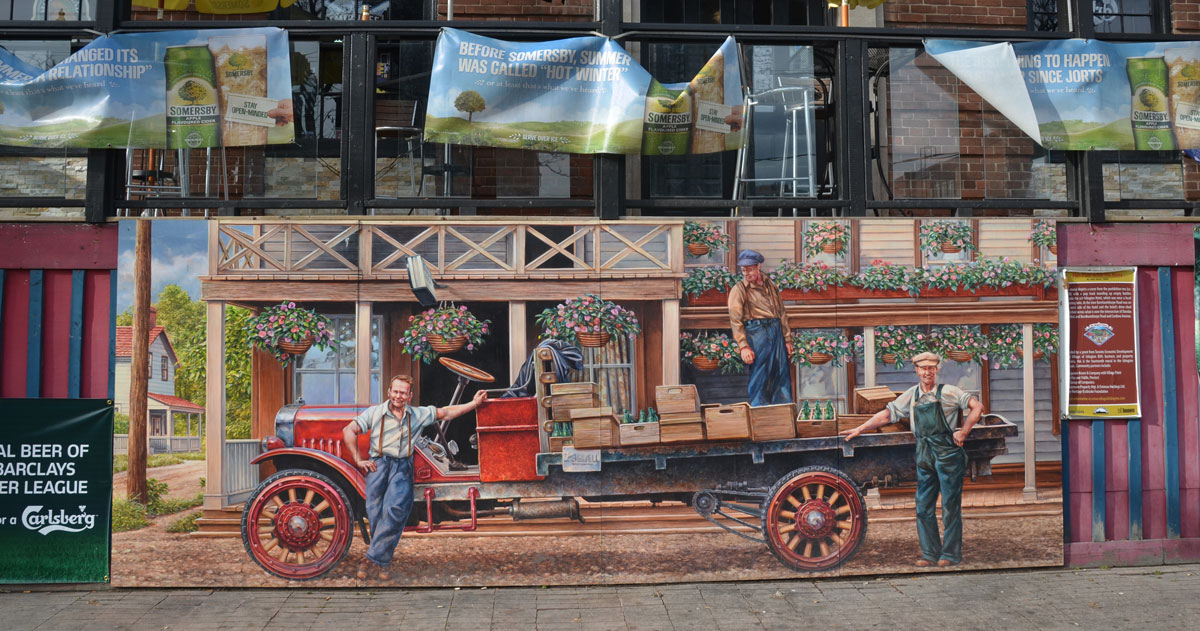

mural 15, Faith of Our Fathers, part 2, by John Kuna

mural 16 – The Manse Committee by John Kuna 2010

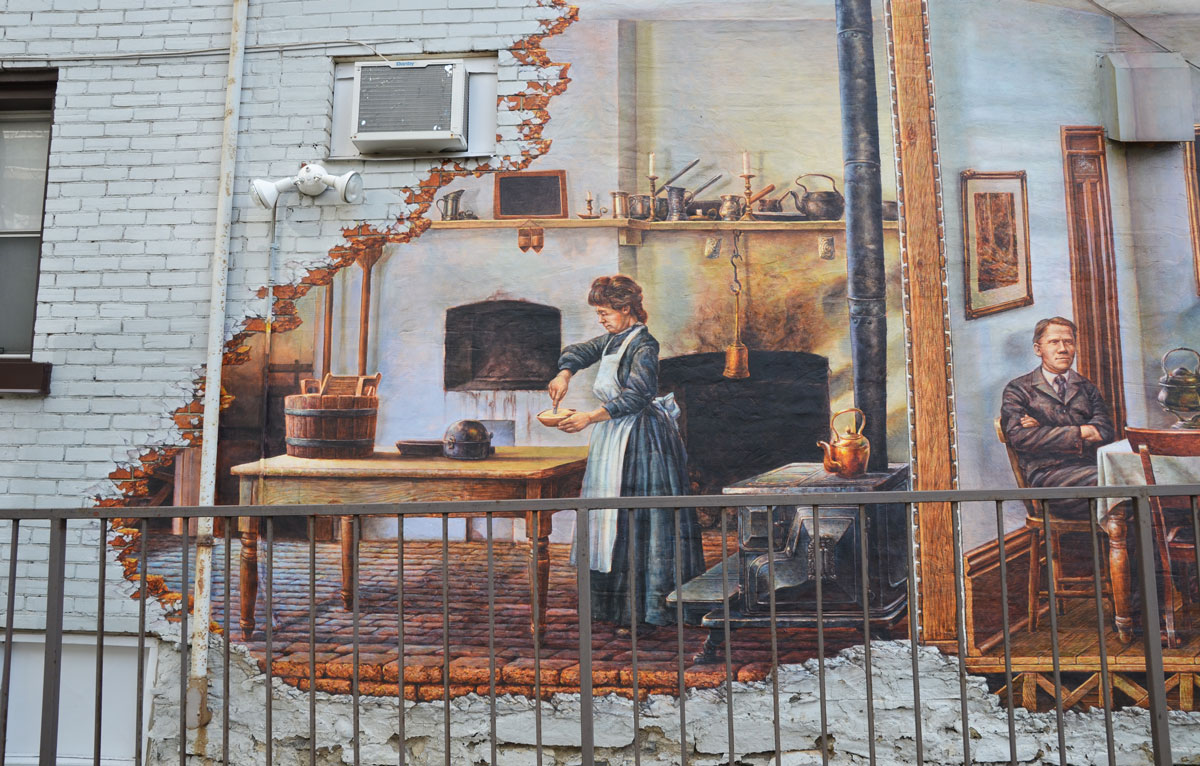
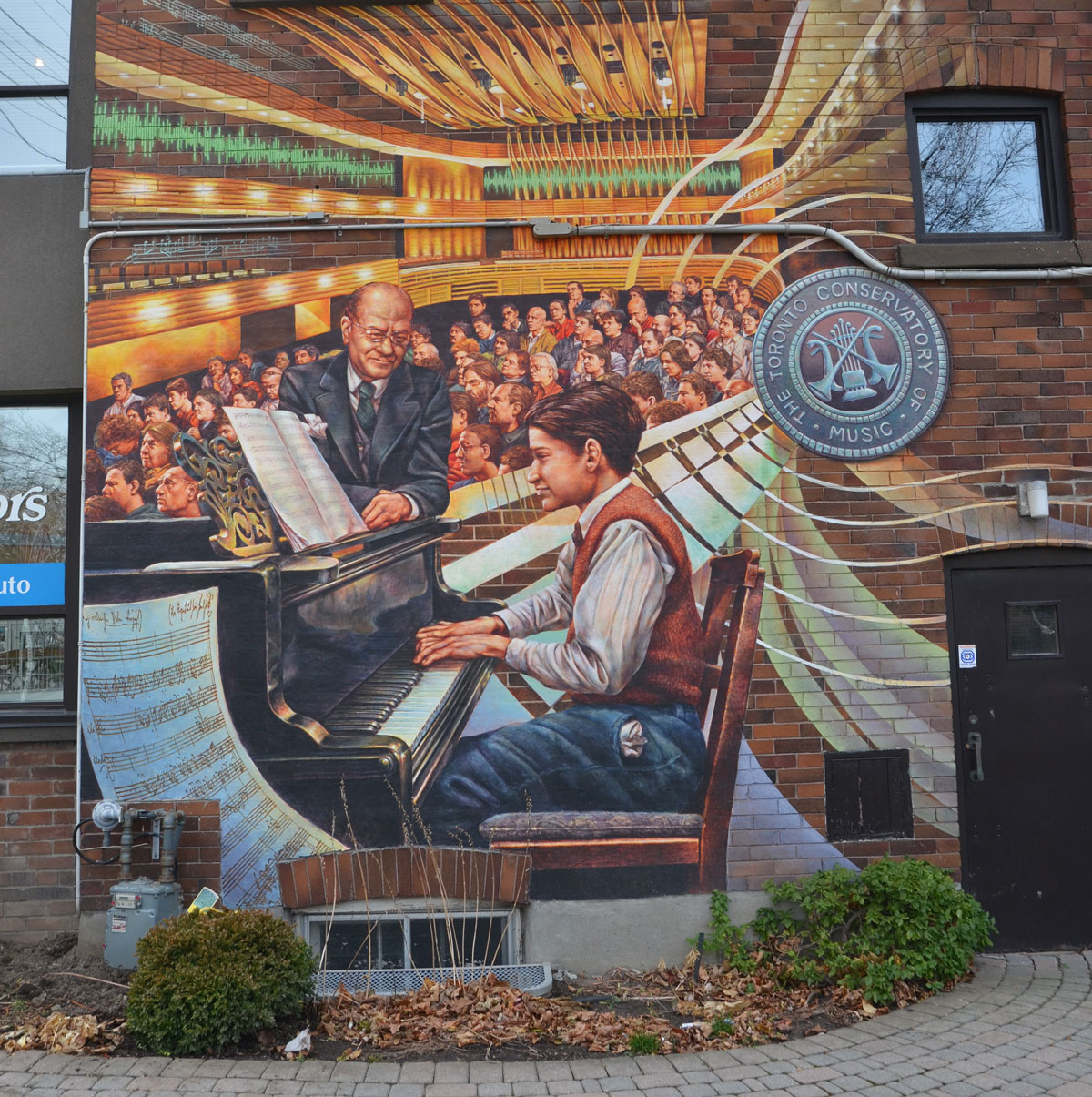
The Prodigy, by John Kuna, 2011
A satellite branch of the Royal Conservatory of Music was located in this building from the 1950s through the 1980s.
mural 19 – Aftermath by John Kuna, 2011.
After Hurricane Hazel on 15 Oct 1854, most of Islington Golf Course and the low lying areas around Mimico Creek were flooded.

mural 20 – Ontario Gothic, by John Kuna, 2011

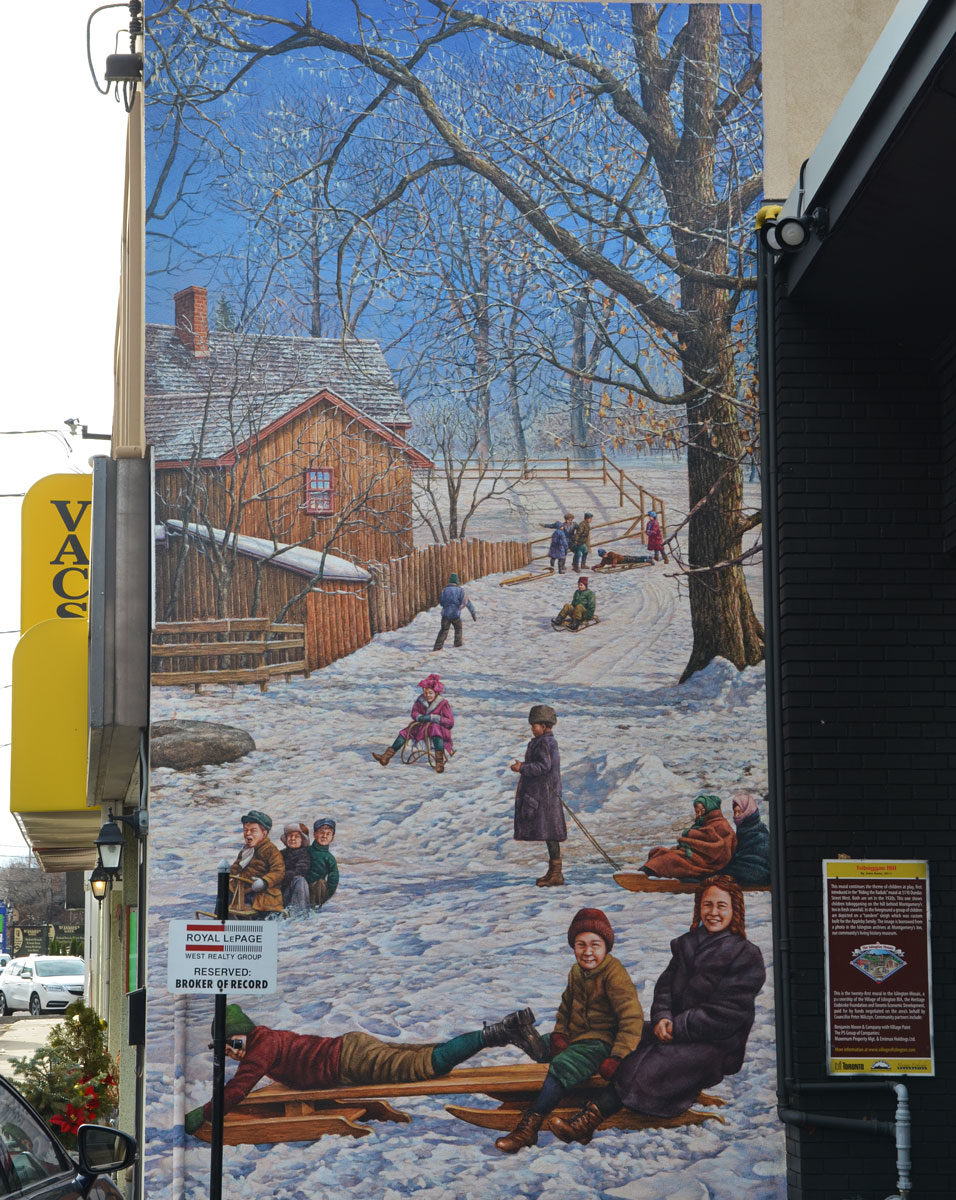
mural 21 – Toboggan Hill, by John Kuna, 2011

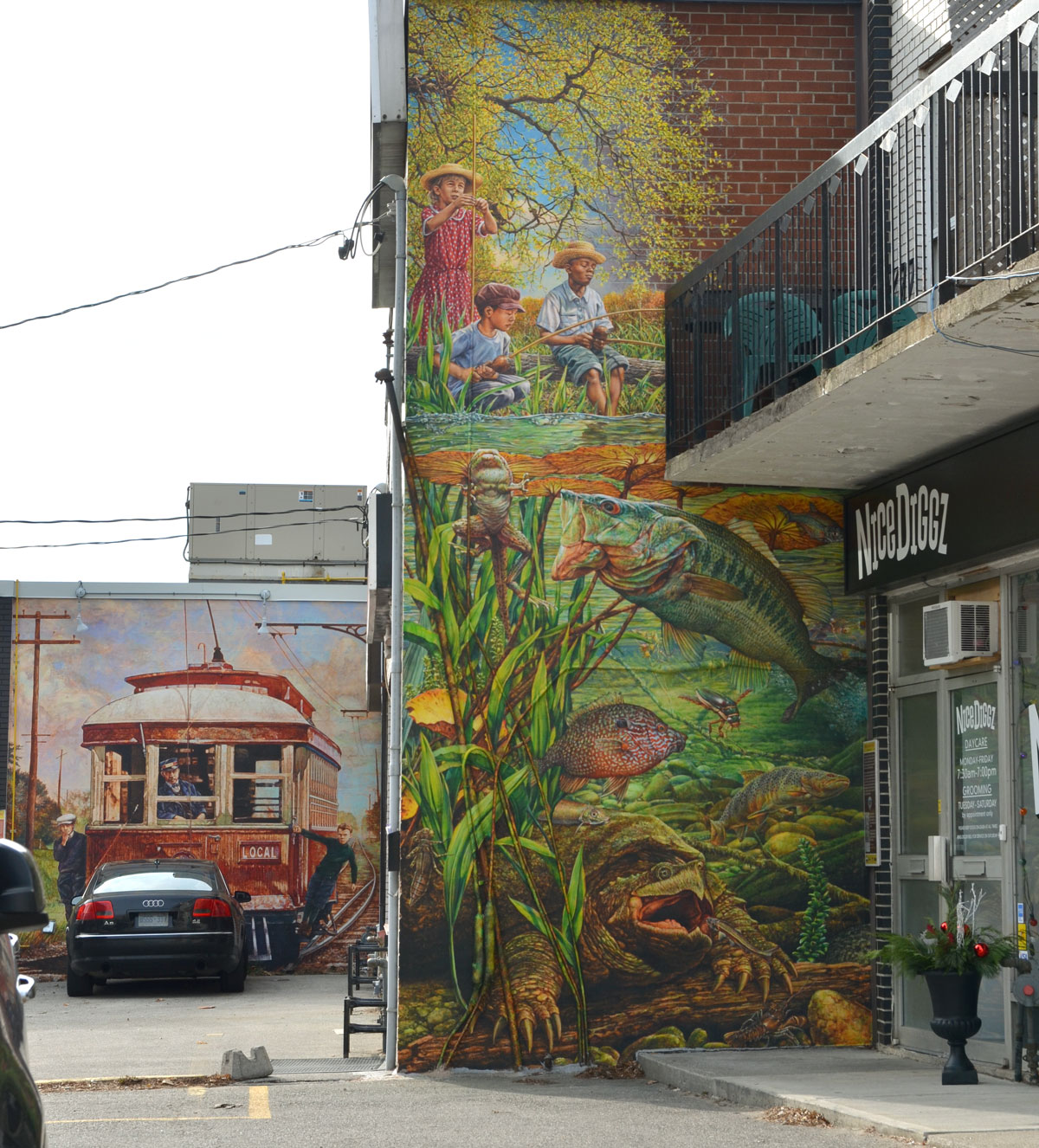
Fishing in Mimico Creek, by John Kuna, 2012,
with Riding the Radials seen in the background.
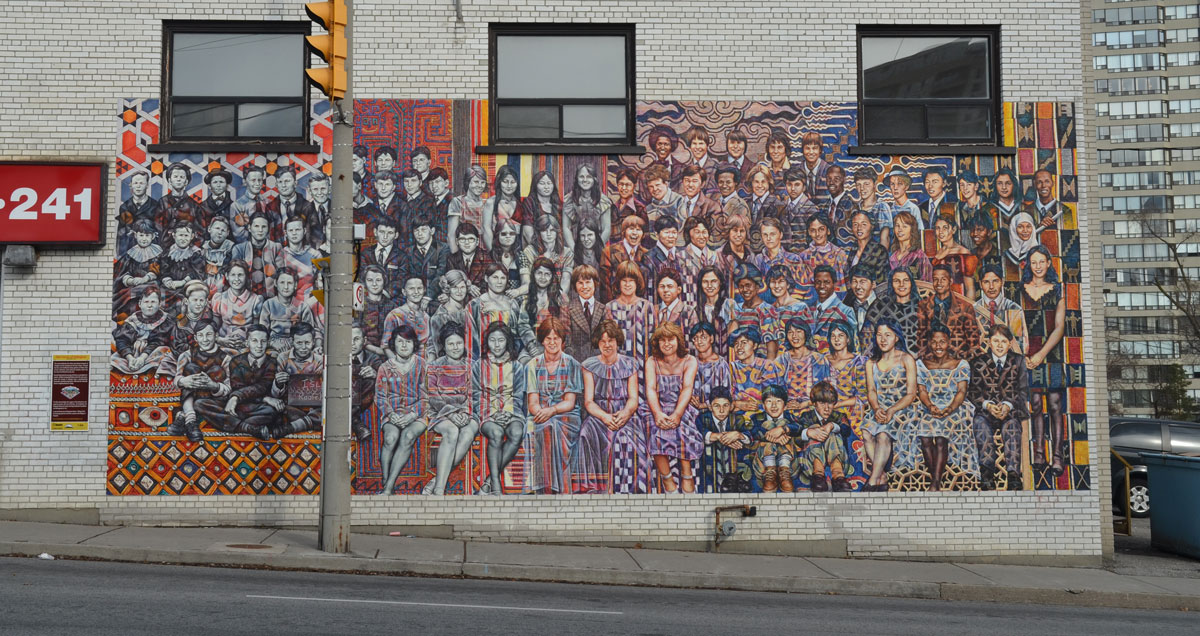
The Faces of Islington, by John Kuna, 2013

the mural with no sign

more information – village of Islington murals website
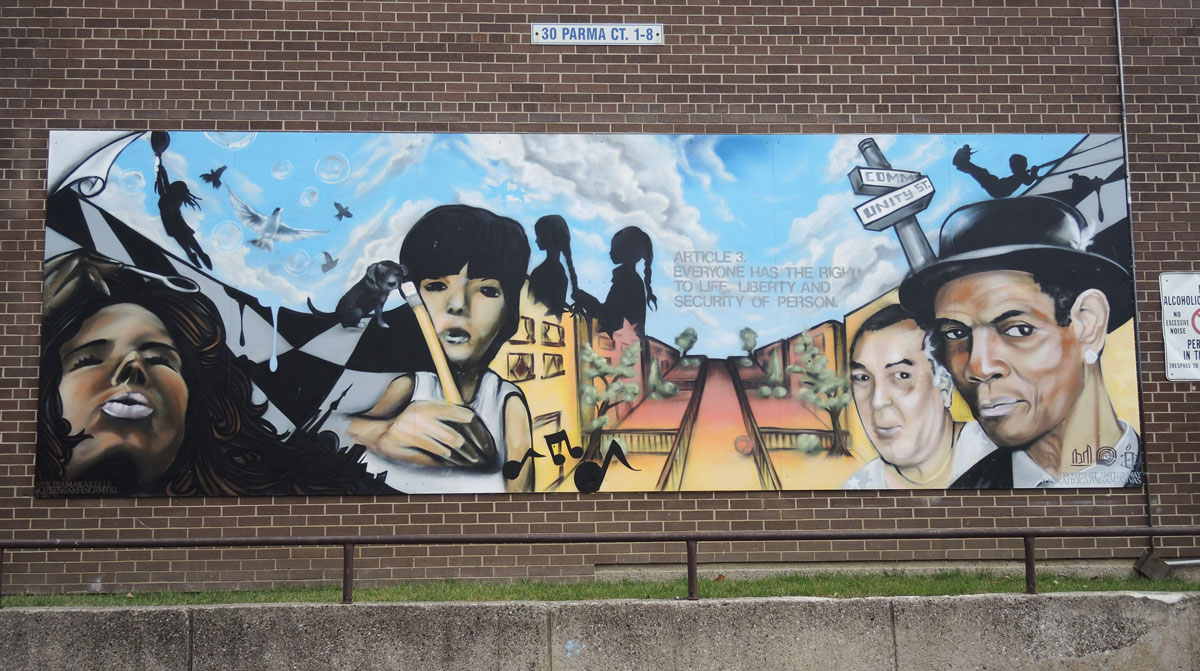
Amnesty International Toronto Organization is a group that works in the to raise public awareness of human rights issues. One of the projects that it supports is ‘Project: Urban Canvas’. This project involves 30 murals. One mural for each of the articles in the Universal Declaration of Human Rights (UDHR), a United Nations
Urban Canvas was begun in 2008 which was the 60th anniversary of the UDHR. Not all of the murals are complete yet. Two of those that are finished are located on Parma Court near Victoria Park and O’Connor.
One celebrates Article 19 which states: “Everyone has the right to freedom of opinion and expression; this right includes freedom to hold opinions without interference and to seek, receive and impart information and ideas through any media and regardless of frontiers.”
 painted by Michael Reyes as well as Fozi, Humera, and Sabeehah
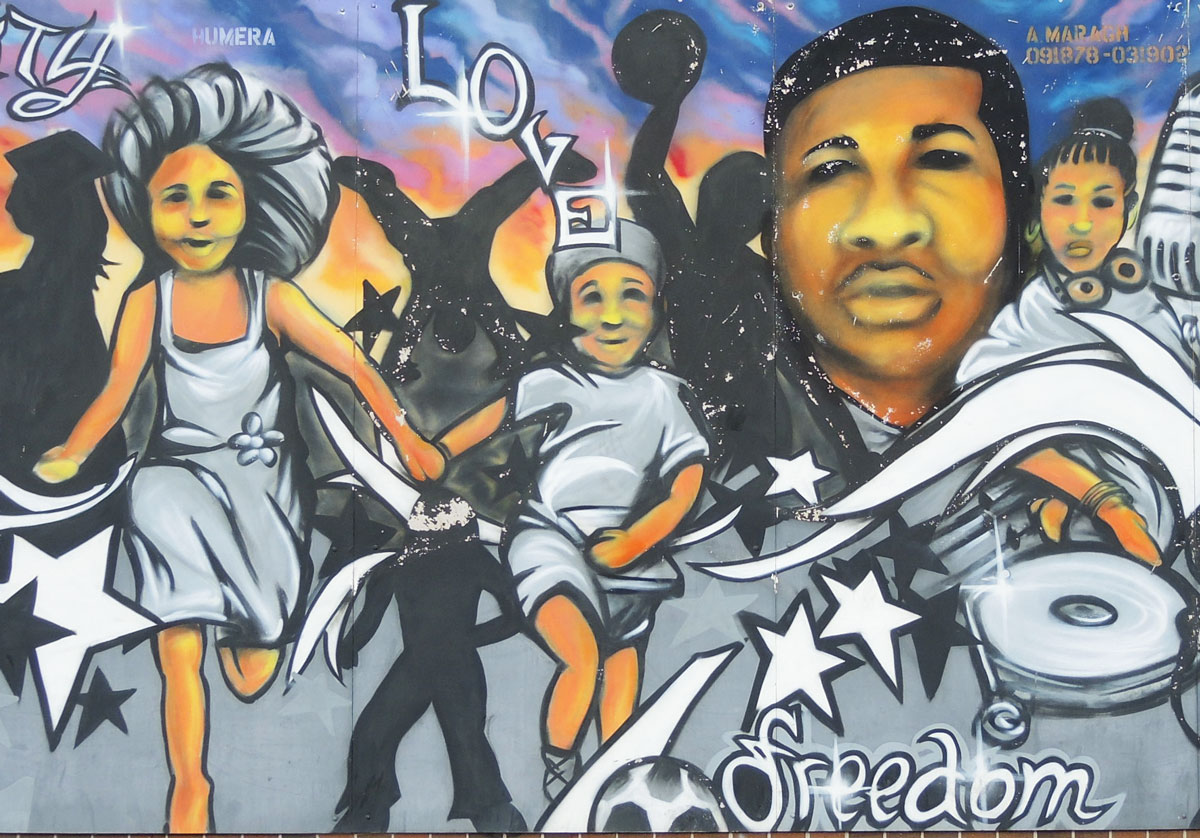
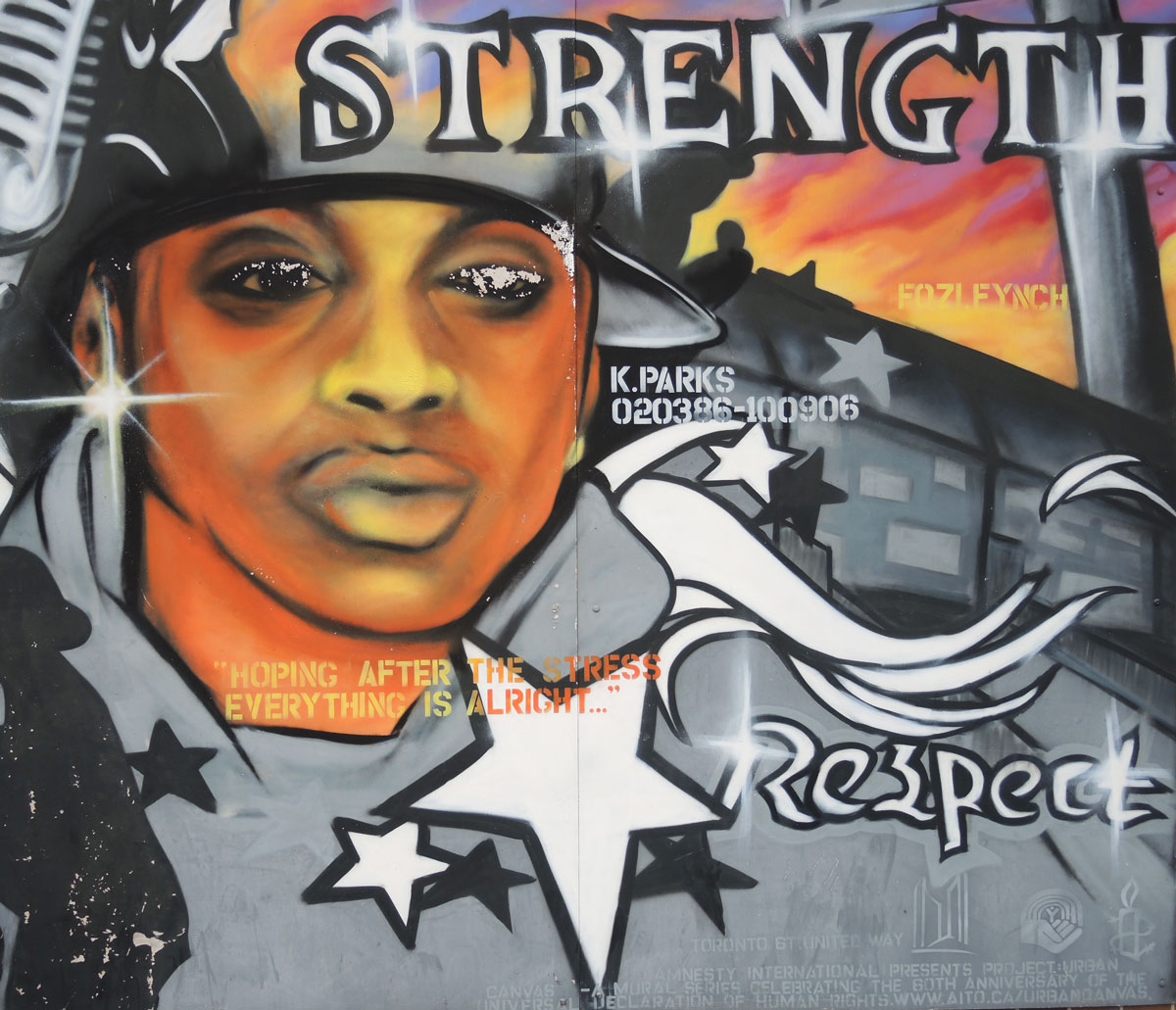
The words say “hoping after the stress everything is okay.”
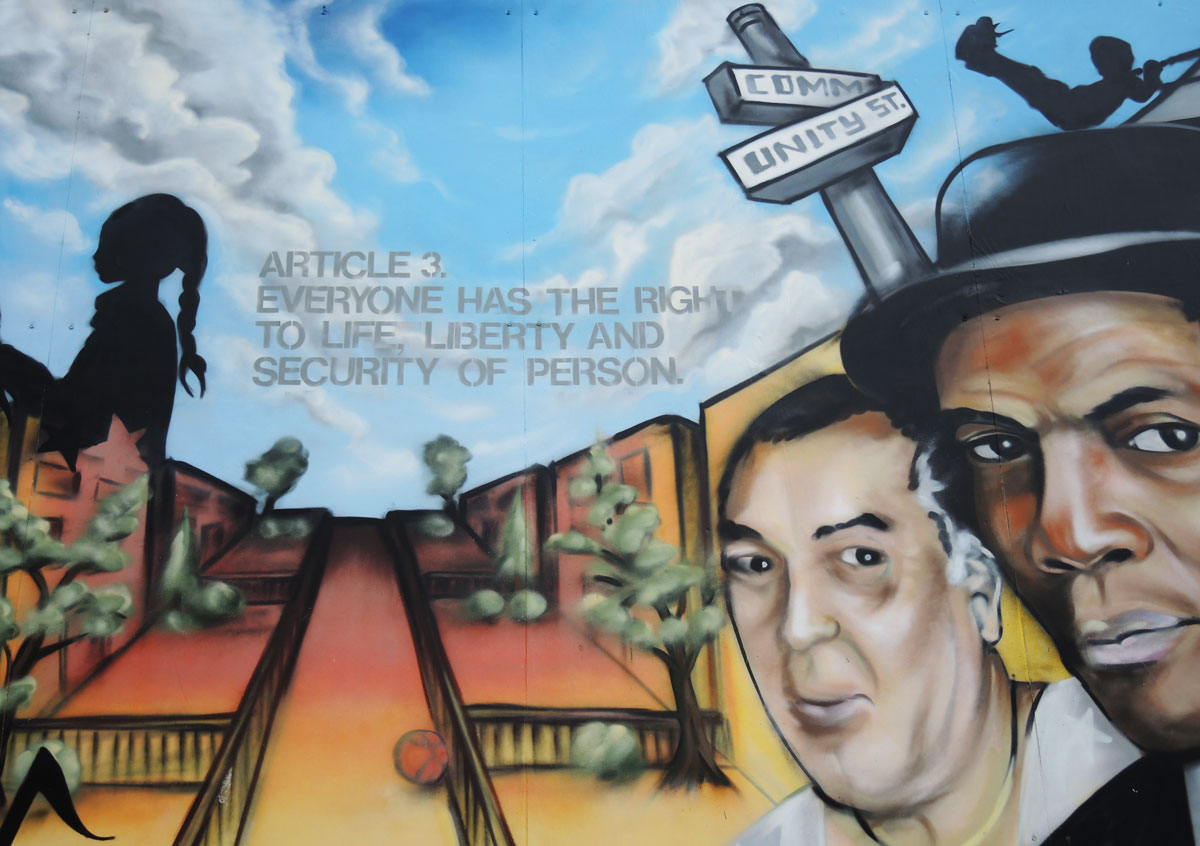
The other mural celebrates Article 3 of the UDHR.
“Everyone has the right to life, liberty and security of person.”
website for Amnesty International Toronto Organization Urban Canvas project
This project is also supported by the Working Women Community Centre, the United Way, and the city of Toronto.
Other murals in this project on this blog:
Yesterday I came across some interesting colourful garage doors on Scarfo Lane that I have not seen before. I didn’t see any signature on them so I don’t know who painted them.
Walking south from Herrick Street…..


and then walking north from Herrick St…..
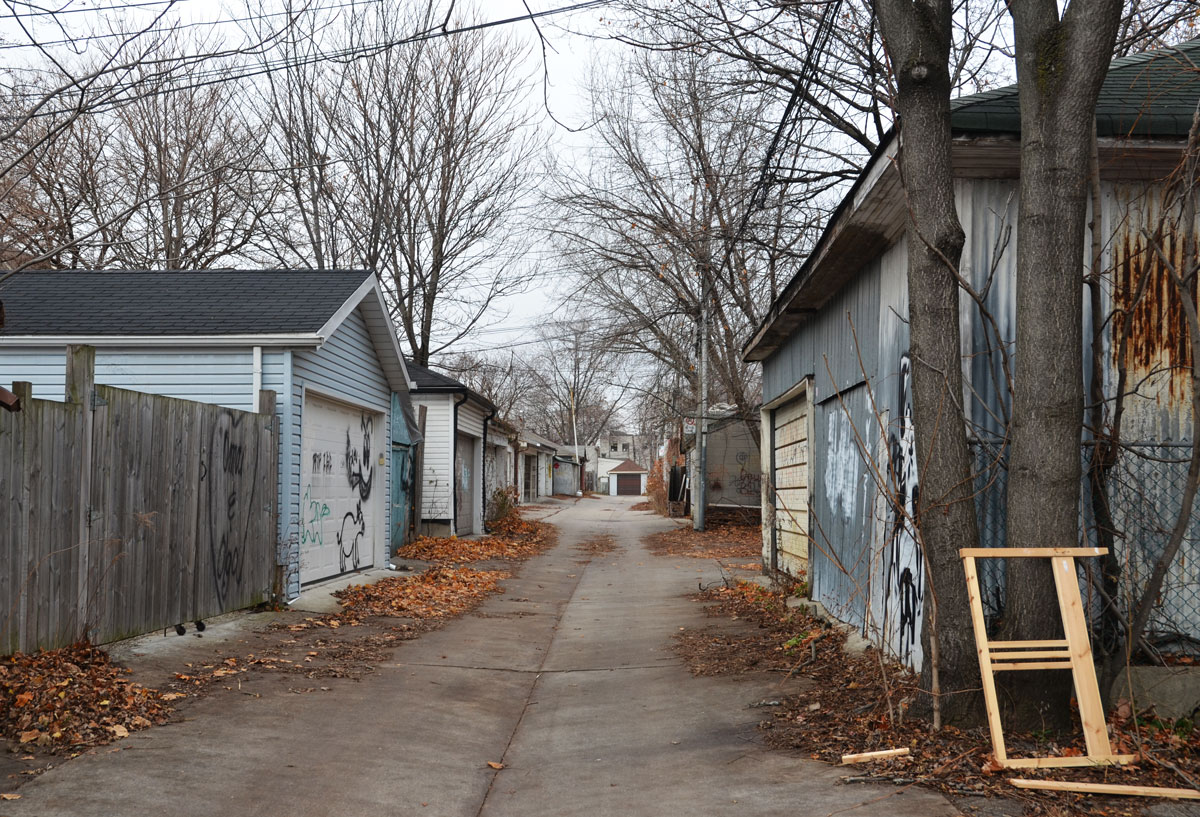
Looking north from Herrick St.
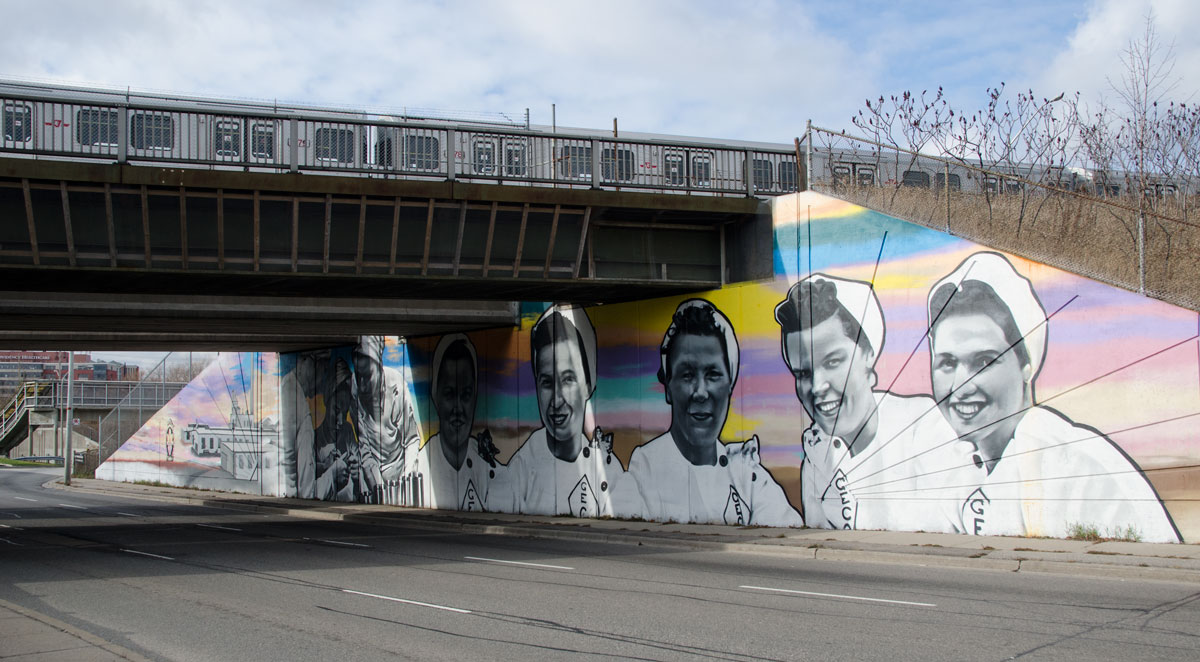
Another new pair of murals painted under a bridge.
This time, they’re close to Warden subway station.

Warden subway station is on the southeast corner of Warden and St. Clair. Just east of that intersection the subway passes over St. Clair.
The north side of the underpass
The north side of the underpass is dedicated to the woman who worked filling fuses for the General Engineering Company (Canada) Ltd., a WW2 munitions plant that was located nearby. More about the history of GECO.

The south side of the underpass
The south side portrays the establishment of Scarborough Junction in 1873. This was when a second rail line and commercial hub was built in the area.

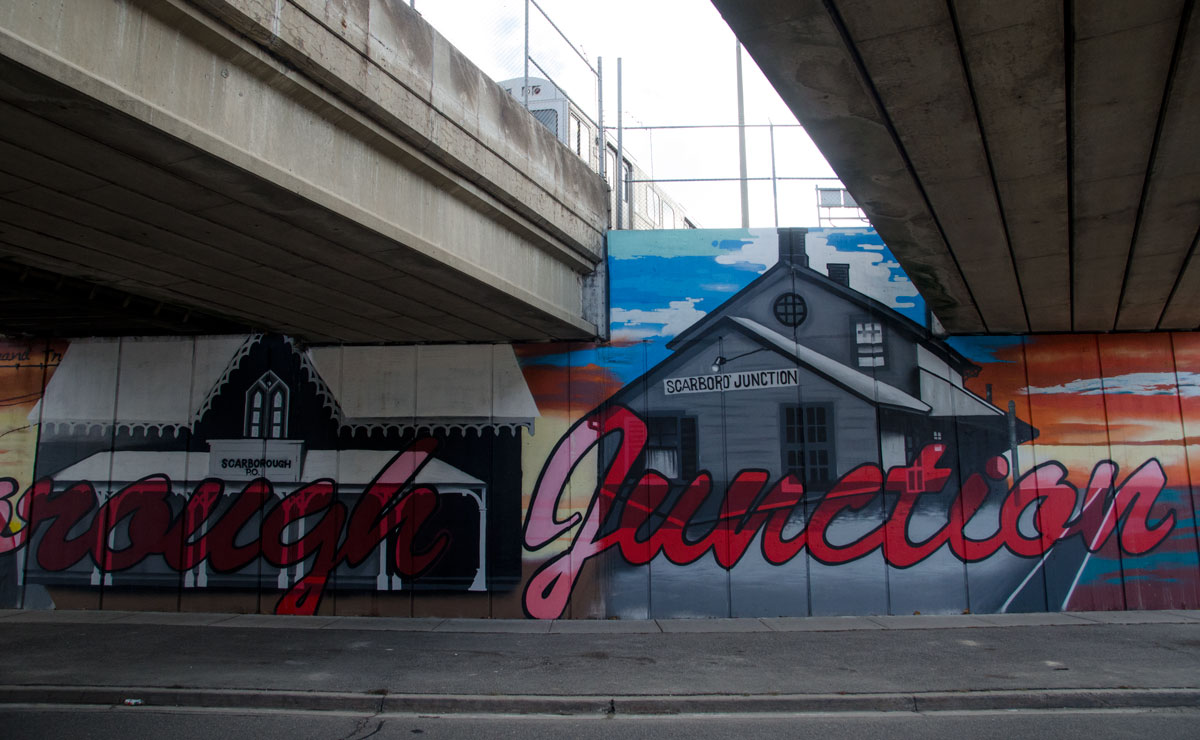
Scarborough post office and Everest & Sons’ General store. The latter was built in 1873 in Scarborough Junction.


The murals were painted by Montreal-based street artist Omen. They are also the result of a collaboration between the city-led art program StreetARToronto, not-for-profit arts organization Mural Routes, local historians and city councillor Michelle Berardinetti.
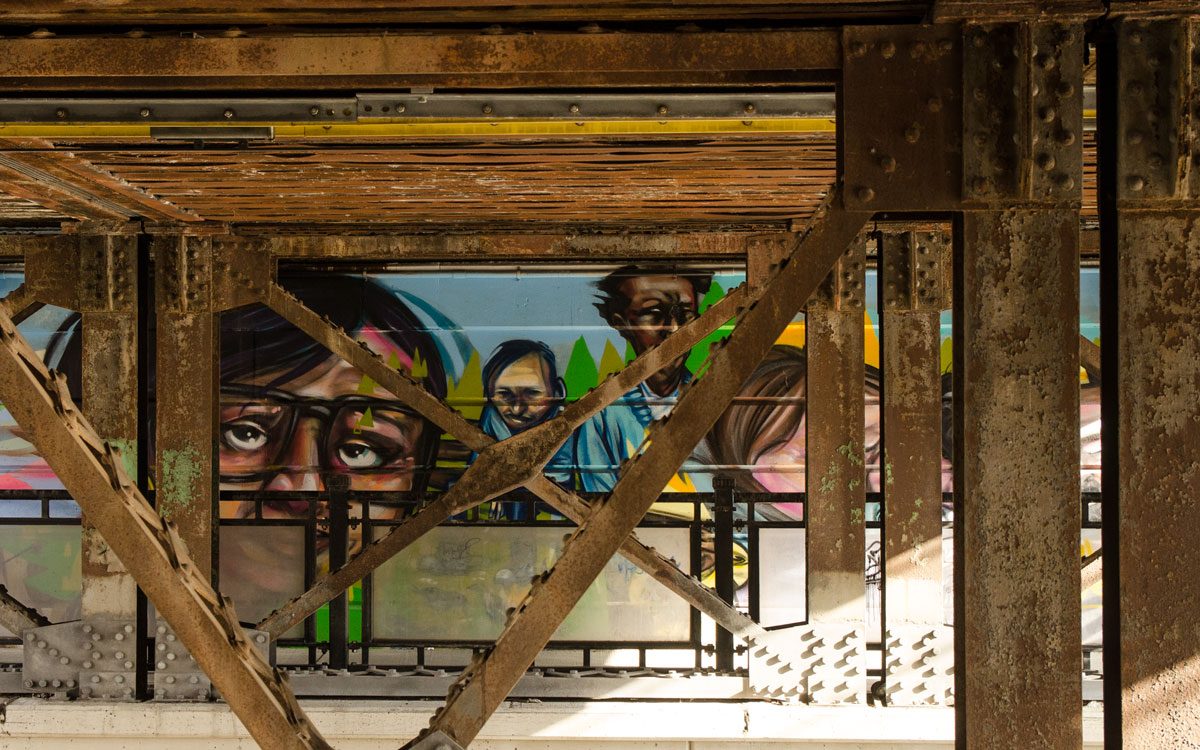
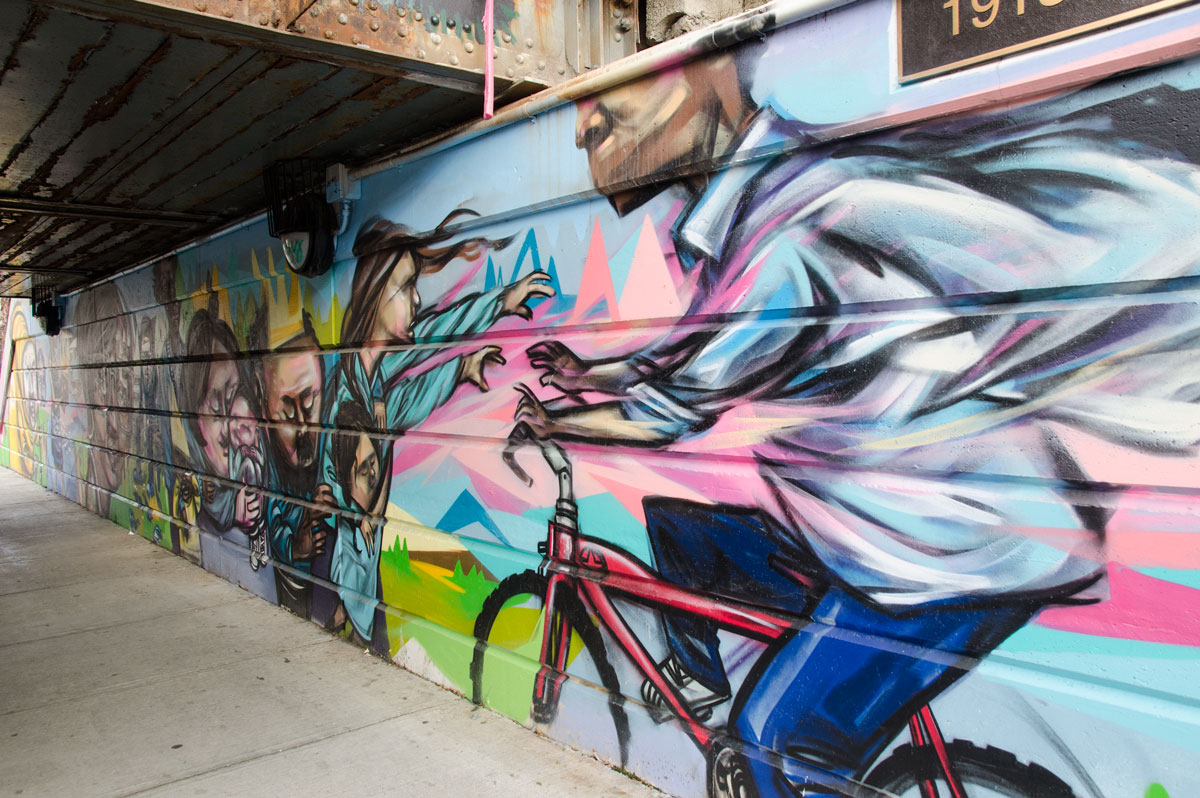
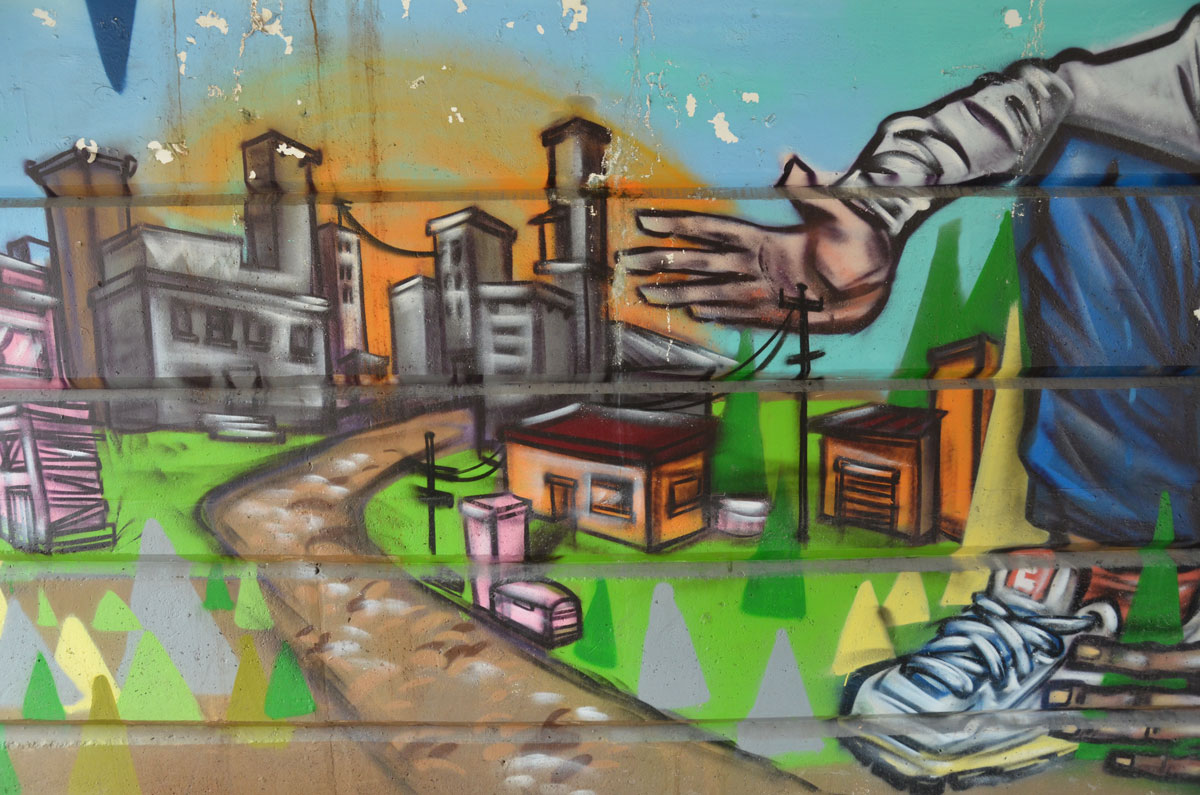
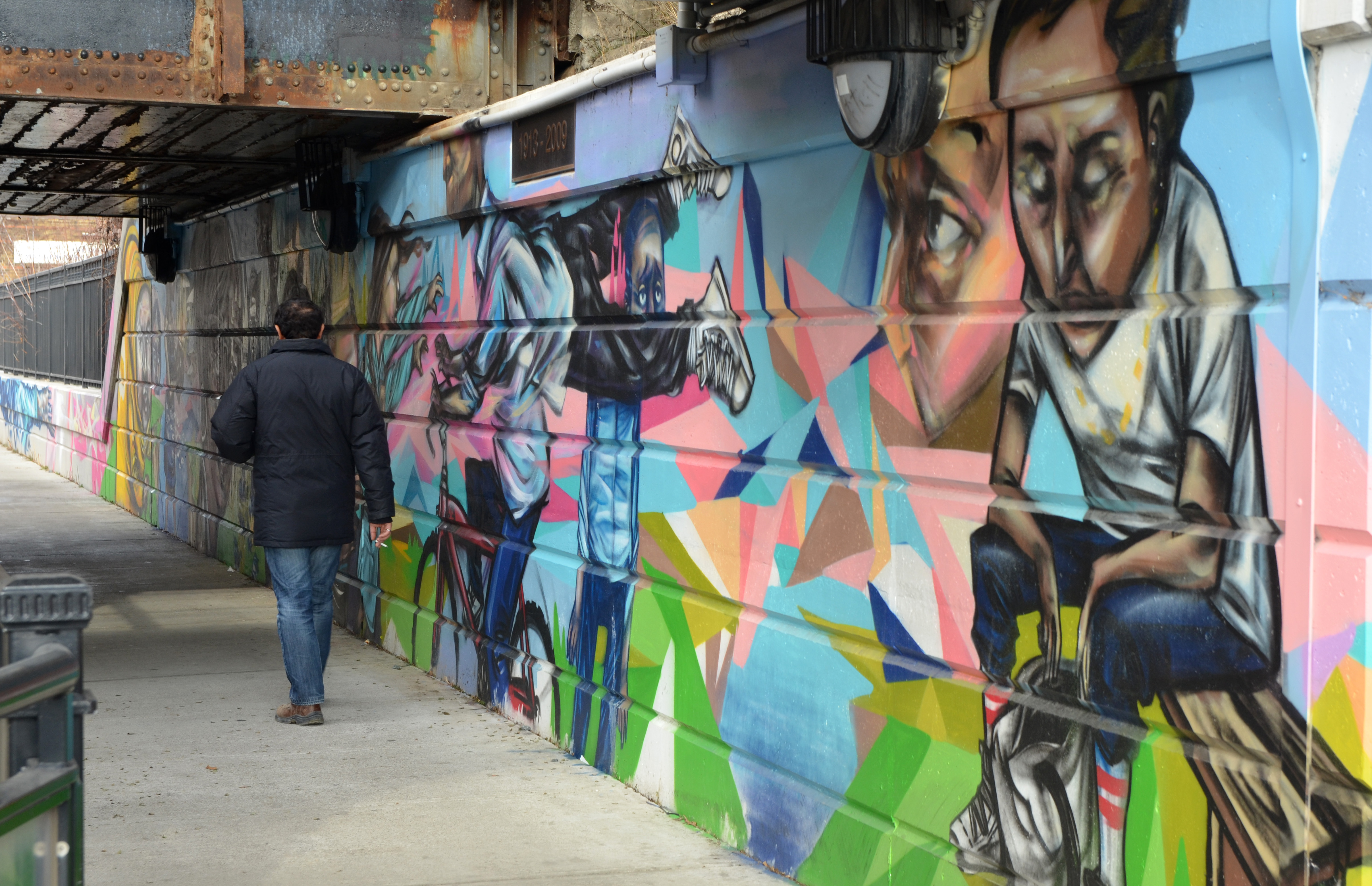
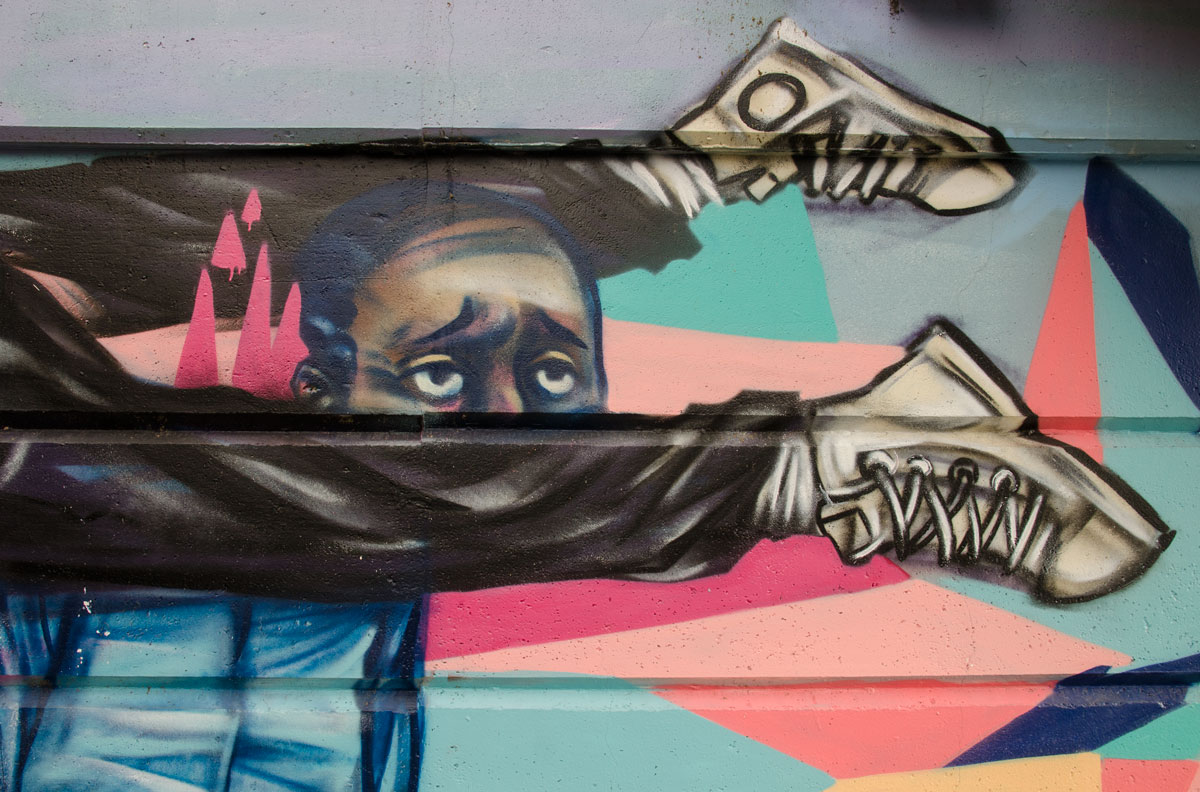
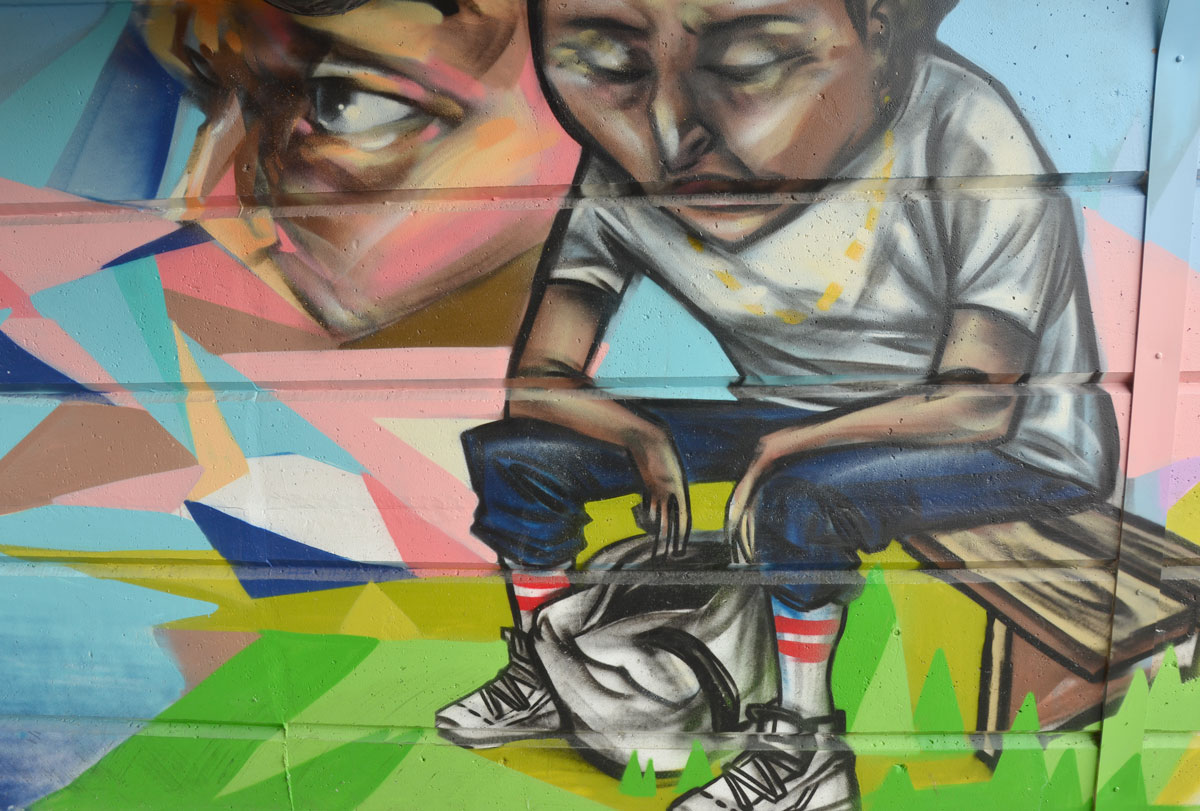
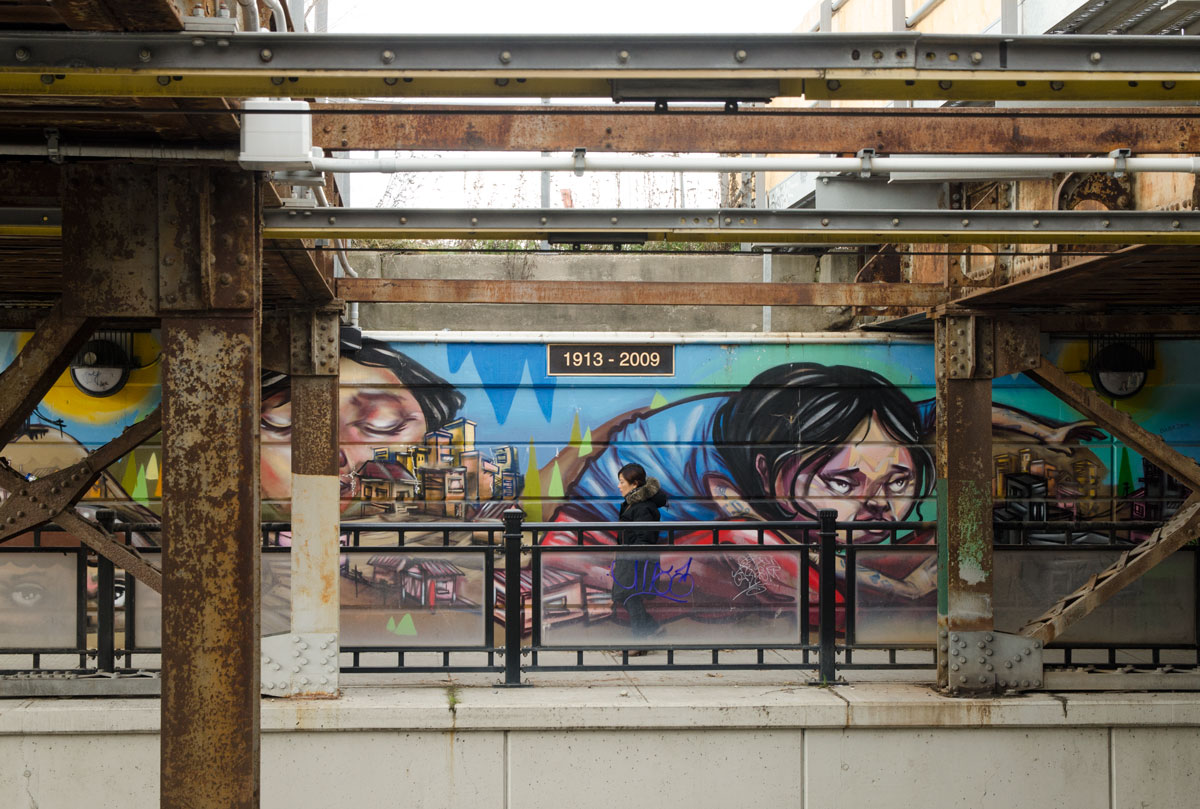
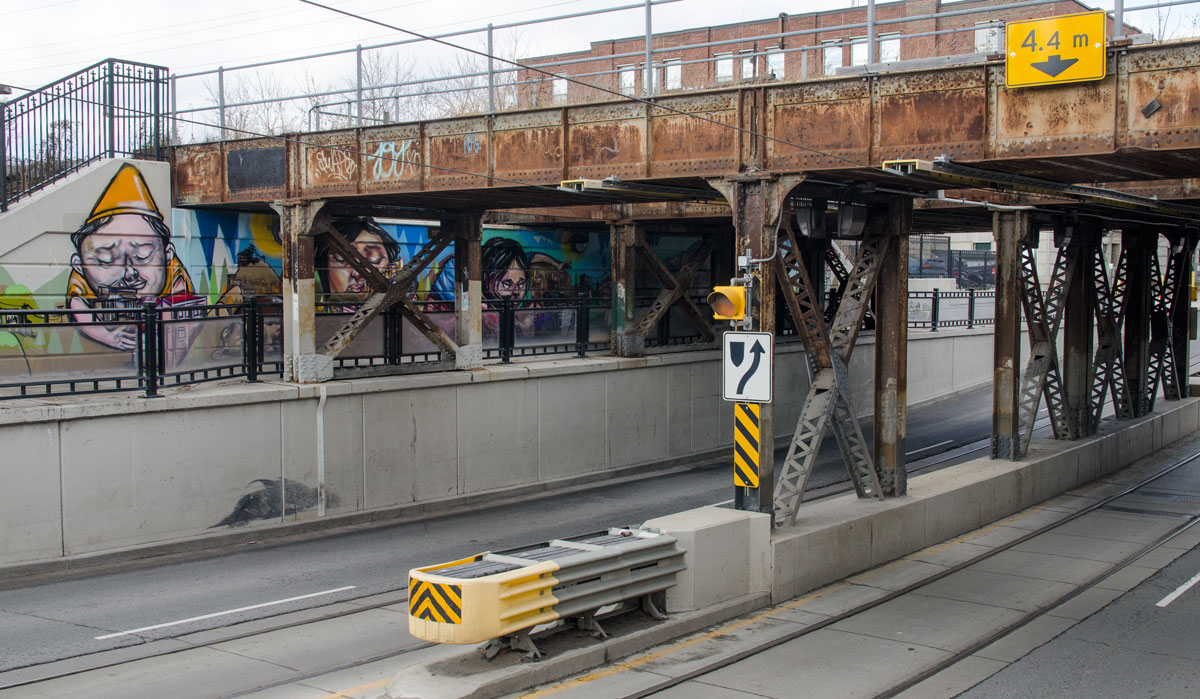
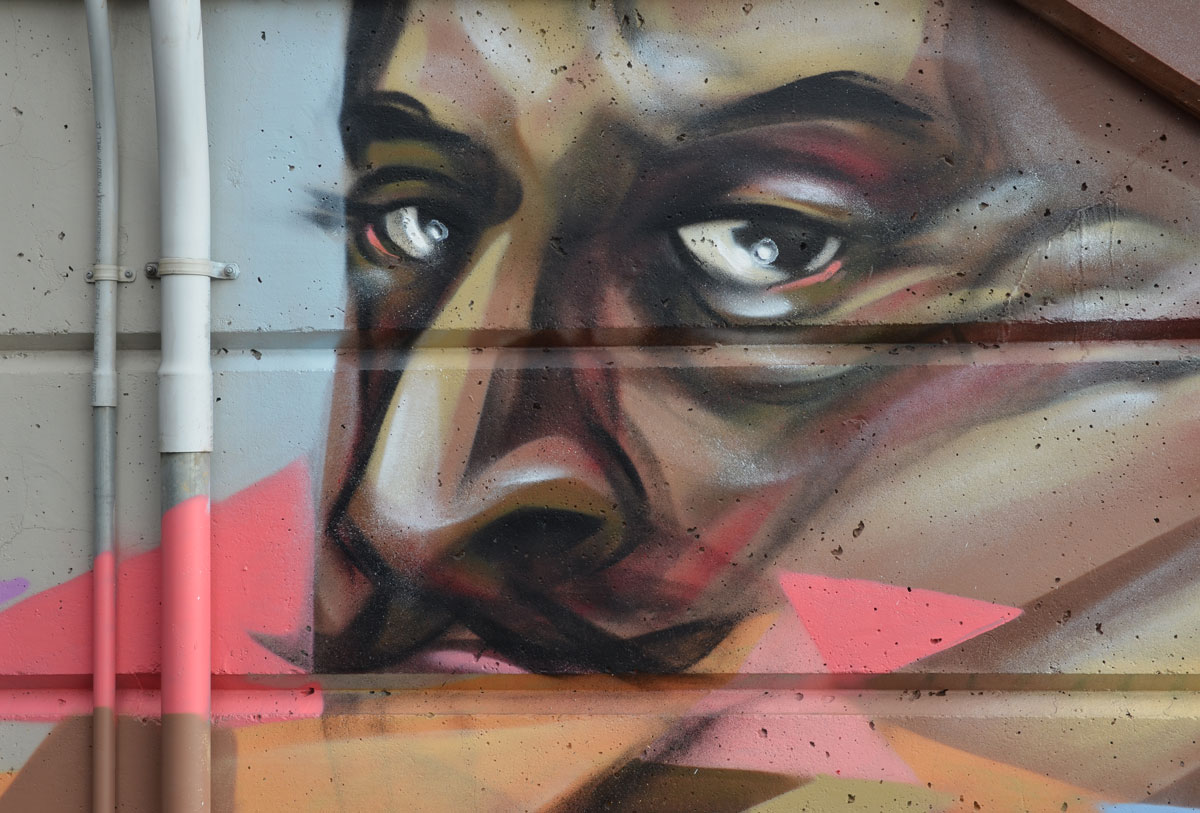
Murals painted by Elicser in 2014, under the railway bridge on Bathurst St., just north of Dupont.
It is difficult to do justice to the paintings with a camera because of the structure of the bridge. The following images are ones that I took yesterday. Yes, there are many!






 as I walk Toronto