Posts Tagged ‘gallery’

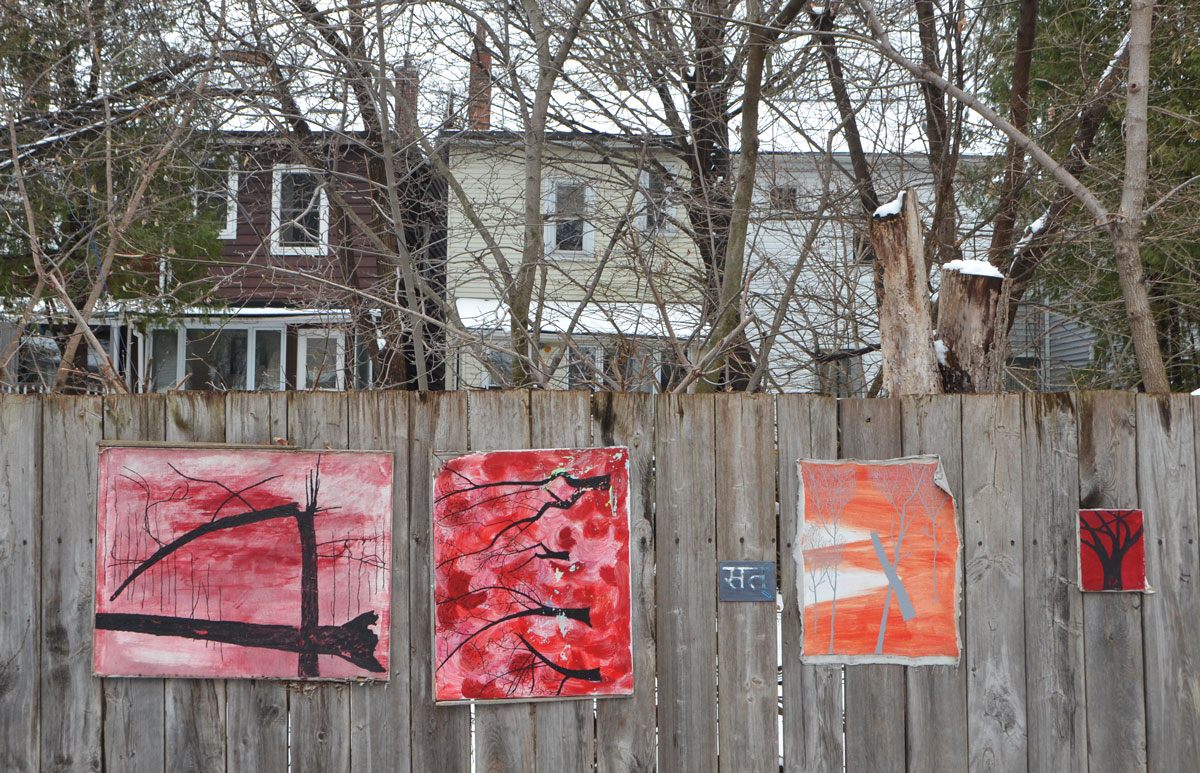
A few weeks ago I posted some pictures of the fence along Craven Road that has been decorated with artwork and old artifacts.  I was south of Gerrard Street when I took the photos.   I didn’t realize at the time that I missed another outdoor gallery on the other side of  Gerrard.  Today I took some pictures of those on display on the north side.   Here they are in no particular order:

below: Looking north up Craven Road along the fence.
That tropical sunset on the left looks very inviting!

small amateur paintings displayed on a wood fence, with trees and houses in the background, snowy day, looking down the length of most of the gallery, small pile of snow against the fence, painting in the foreground is warm Caribbean sun on beach with palm tree, Craven Road

small amateur paintings displayed on a wood fence, with trees and houses in the background, snowy day, an evergreen bough hangs over the top of the fence, above a painting of trees in a forest in winter, low sun, and long blue shadows.

small amateur paintings displayed on a wood fence, with trees and houses in the background, snowy day, Craven Road in Toronto, two paintings of black trees (no leaves) on red, and one grey tree on orange background,

small amateur paintings displayed on a wood fence, with trees and houses in the background, snowy day, a black tree on a blue background. Snow has been blown against the wood fence and some of it has stuck to the fence, Craven Road

below: Some of the paintings are small words in another language and another alphabet.  Can anyone translate for me?

small amateur paintings displayed on a wood fence, with trees and houses in the background, snowy day, four paintings. One black tree on light brown paper, and three small paintings with words in a different language with a different alphabet, Bengali perhaps

small amateur paintings displayed on a wood fence, with trees and houses in the background, snowy day, Craven Road, trees on blue and green background
small amateur paintings displayed on a wood fence, with trees and houses in the background, snowy day, three paintings, one is a fish

By now I’m very curious about this street and this fence.  I found a long, detailed, and interesting history written by local historian Joanne Doucette that you can read here.


I usually take a dim view of conceptual art largely because the importance given to the “words on the wall” has eclipsed the consideration given to the artwork itself.   Mediocrity in technique or creativity hides behind big jargon words and convoluted language in the artist statement.  Often the concept that the artist claims to be exploring is at odds with the end product.

When the art doesn’t live up to words that sound learned and meaningful then it degrades the work and makes the artist, and those curating the exhibit, seem pompous and out of touch.

For example, if you read that certain videos by an artist “cast a hitherto unexampled light on the conventional North American city”,  what would you expect to see?  Would you expect to see a video shot from a helicopter as it circled a city at night?  A video that looks familiar to anyone who has flown over a city after dark.   That’s what you get with Aude Moreau’s ‘The End in the Background of Hollywood 2015’ now showing at The Power Plant gallery.   I don’t have a photo of it but I do have a picture of three of her other photographs also on display.

below: From left to right (discounting the small picture farthest from the camera): 1. ‘Untitled (Hollywood Sign)’ 2015, 2. ‘LAPD (Los Angeles Police Department)’ 2015.  It’s a picture of a tiny helicopter in a large grey sky.  and 3. ‘Waiting for Landing’, airplanes lined up as they approach LAX airport.   Unfortunately, the words on the wall then go on to say, about these three images, “These demonstrate visual strategies that act upon the symbolic representation of the city and the spectacular dimension of the film industry.”  Oh my.

4 pictures hanging in a contemporary art gallery. One is a picture of the Hollywood sign taken just after dark, the next is a grey sky with a tiny dot of a helicopter in the middle, the third is too far away to discern, and the last is a picture of Los Angeles at night taken from a helicopter

And with that I left The Power Plant gallery.  Growling silently to myself and shaking my head with a mix of disdain and and frustration.   Imagine my surprise when once outside I encountered another of Moreau’s photographs.  A very lovely one.

below:  A picture of the Toronto skyline by Aude Moreau mounted on an exterior wall at The Power Plant Contemporary Art Gallery.  A picture with visual impact.

A photograph by Aude Moreau of the Toronto skyline as the sun starts to set, sunlight reflected off the buildings, darkening blue sky. The picture is mounted on an exterior wall and there is a tree in front of it as well as a couple of picnic tables

below:   You can play “spot the building” and test your knowledge of Toronto geography.   You can line up the DBRS building, the Hilton Hotel and the Canada Life building on University Avenue along with the Sheraton Hotel on Queen street.   The blue addition on the AGO is farther north on Dundas.  Can you think of where the photo was taken?  Apparently, it was taken from Toronto Fire Station 315 at College Street and Bellevue Avenue.  It was taken just after sunset but when there was still enough light in the sky to reflect off the taller buildings.   Moreau makes the city sparkle.

A photograph by Aude Moreau of the Toronto skyline as the sun starts to set, sunlight reflected off the buildings, darkening blue sky. The picture is mounted on an exterior wall and there is a tree in front of it

I must have seen this picture very shortly after it was installed.  It is part of the CONTACT photography festival that starts this weekend but there was no accompanying sign, no words that attempted to a explain the image.  Perhaps that was for the best.  In fact, I now have the CONTACT catalogue with their description of the artwork but I think I won’t read them.  I’d rather enjoy the picture just the way it is.

Invention, an installation at The Power Plant gallery, by Mark Lewis.

The main part of the exhibit consists of 3 short films shot in Toronto.
When I first saw it, I thought that the films were older, perhaps from the 60s or 70s.

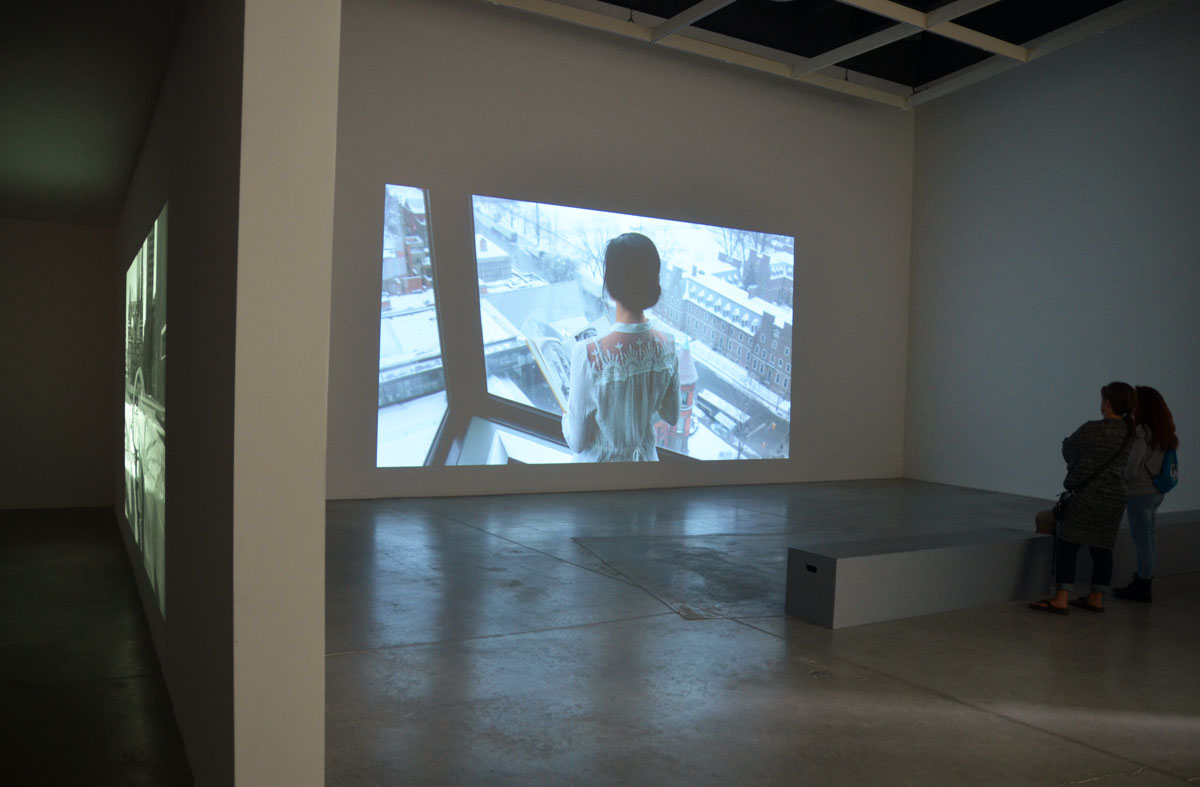
below:  A short film begins with a pan over part of downtown Toronto.  It circles back to the Robarts Library and focuses on a woman standing in the window of one of the upper floors.  After zooming in on the woman, the film “enters” the room she’s in and turns back to focus on what her view out the window looks like.

Two women are standing in the semi darkness in a room in an art gallery, watching a black and white film that is showing on a large screen in front of them. The image on the screen is the back of the upper part of a woman as she stands in front of a window in the Robarts Library in Toronto. The scene outside the window is clearly visible, winter time, University of Torotno campus. She is holding a book in her hands.

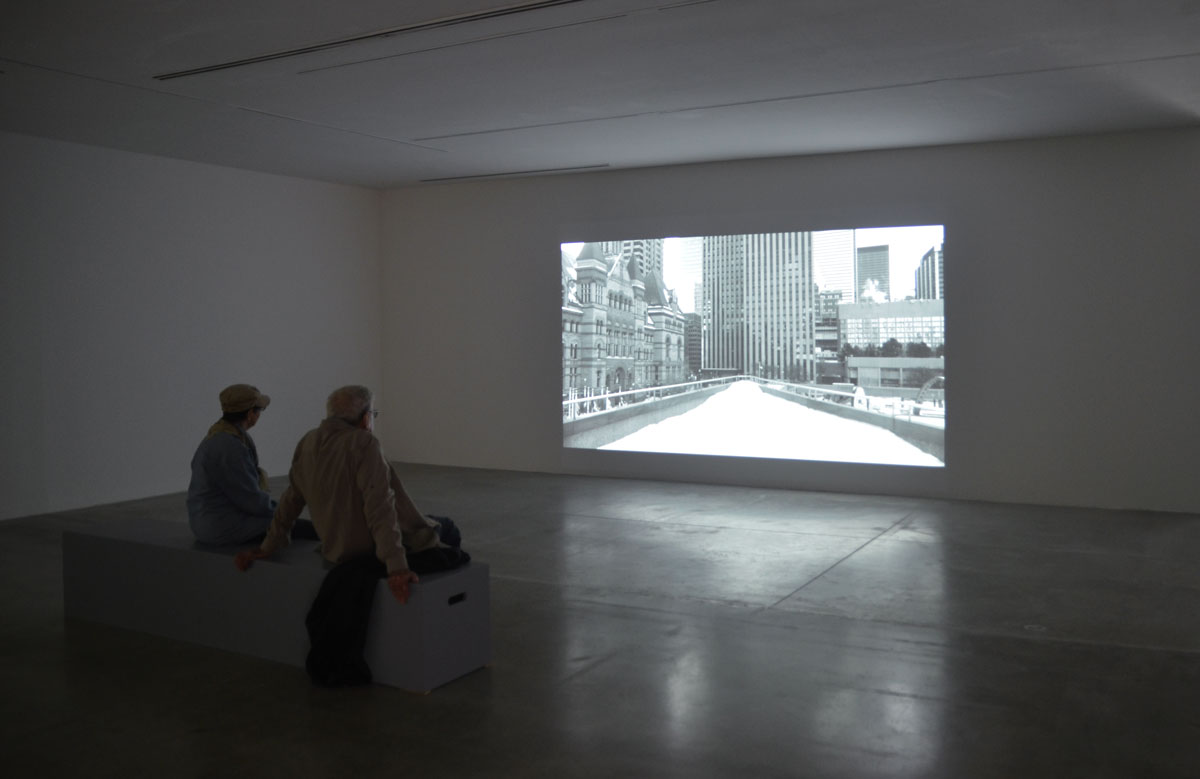
below:  Another exhibit is a film comprised of segments filmed at a number of locations around City Hall this past winter.   The image below is shot from the upper ramp at Nathan Phillips Square, looking south.   Old City hall is on the left.   There are no people in the picture.  There are also no commercial images such as billboards or signs on the buildings.  Slow moving, quiet.

An older couple are sitting on a bench at an art gallery. They are watching a black and white film that is showing on a large screen in front of them. The image on the screen is a shot of the upper ramp at Nathan Phillips Square, looking south, in the winter with snow on the ground. There are no people in the picture on the screen.

It wasn’t until I looked more closely at the images that I realized that the films had to have been made recently… for example, the recently built stage area in Nathan Phillips Square.  So I watched the films again looking for details.

One of the images shown in an art installation on a large wall screen, a black and white picture overlooking Nathan Phillips Square in the winter.

A little perplexed, I tried to find out why Lewis made these films, and why they were considered to be “art”. It wasn’t easy; it was probably made more difficult by my love/hate relationship with contemporary art.  The title of this post comes from a paragraph I found on The Power Plant website description of this installation: “Together, the elements that make up Mark Lewis’ films culminate in a body of work that is as astute as it is elegiac in its contemplation of the quotidian, offering an experience of the flux of time that is as elating in its duration as it is haunting for its sense of passing.”  Well, um, okay.

It also wasn’t easy because of the scope of the questions that Lewis seems to be tackling.  One of his interest lies in discovering what it might have felt like when film revolutionized they way we looked at ourselves and at the world around us.   That’s a tough one.  We are a society that is immersed in moving images of all kinds. Movies and TV have been part of our lives for many generations.  Can anyone truly imagine what it might have been like to see a film for the first time?

As we all know, digital technology has put video production into the hands of anyone with a cellphone.   Even my three year old granddaughter asks me to make videos of her and I’m sure it won’t be long before she’s producing them.  And that leads to another question that Lewis is interested in examining – what are the implications of these technological changes?  Not only can see video, we can be in control of making our own whenever we want.

But that’s not all.  Lewis is also interested in architectural surfaces so walls, windows, pavements and reflective glass amongst others play a role in his films.   Urban architecture; urban landscapes.  Cinema made of the ordinary everyday life of living in the city and everyday life in the city is cinema.  24/7 movie making.  You are part of the cast; you are the camera.

What I have presented here are just three pictures and I’m not sure the pictures do the films justice.   If you want to see these films, they are at The Power Plant gallery until 3 Jan 2016.

#PPInvention

The fifth floor of the Art Gallery of Ontario is devoted to contemporary art.

Three of the present exhibits are best described as conceptual art.  Conceptual art is art where the idea is more important that the look.  The story behind the work trumps aesthetics.

This blog post has taken me many days to write as I struggle with the love hate relationship that I have with conceptual art.   My biggest complaint about conceptual art is that skill too often gets thrown out the window;  God forbid that something like artistic merit should impede the artist.  I can empathize with causes and I can support ideas without liking the end product.  In other words, just because I don’t the ‘art’ doesn’t mean I don’t “get it”.

Anyhow, on to the exhibits.

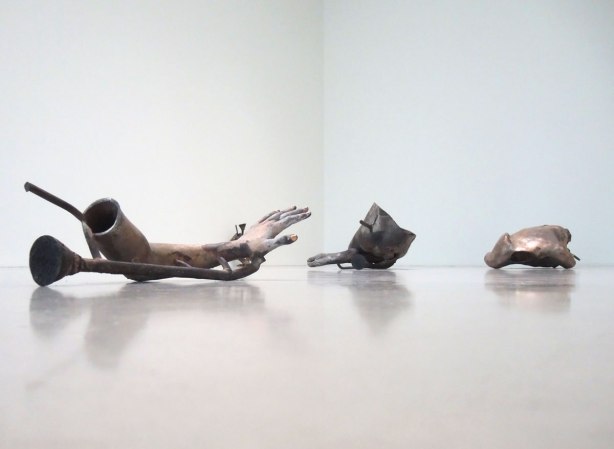
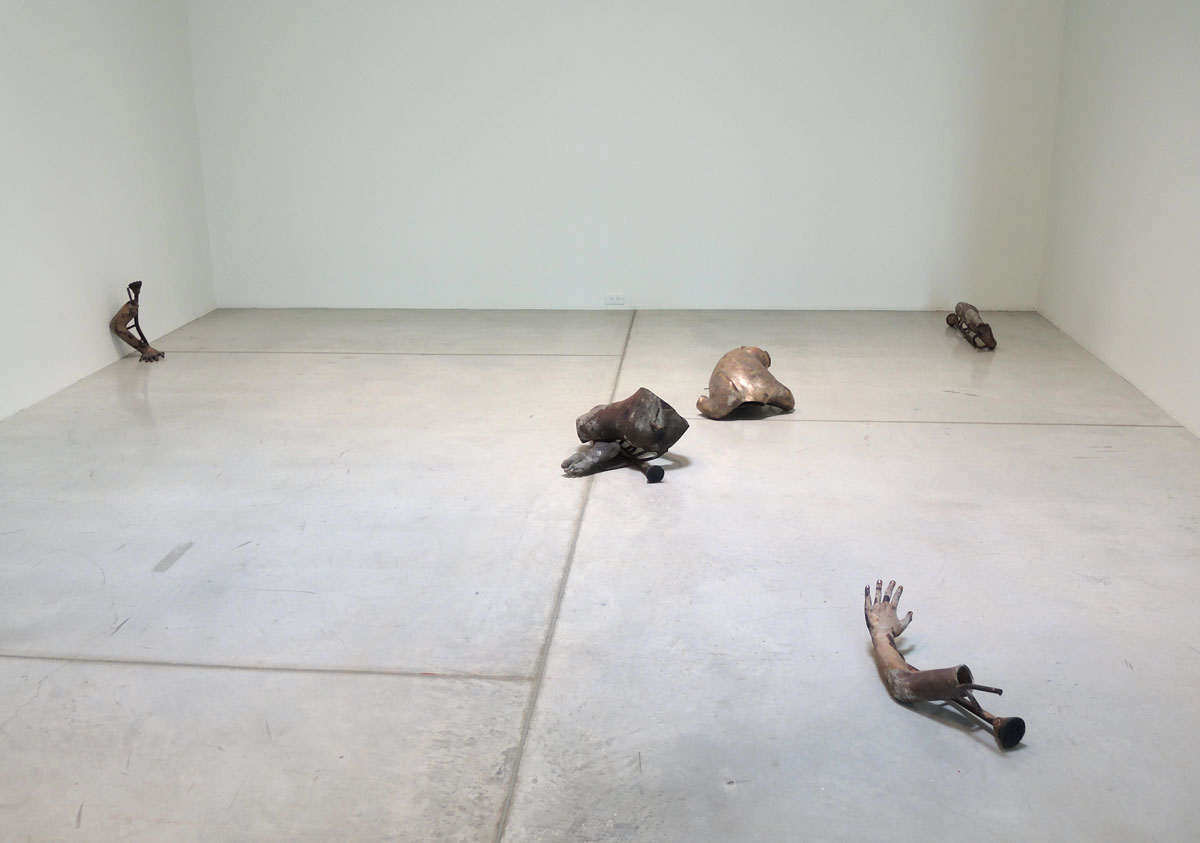
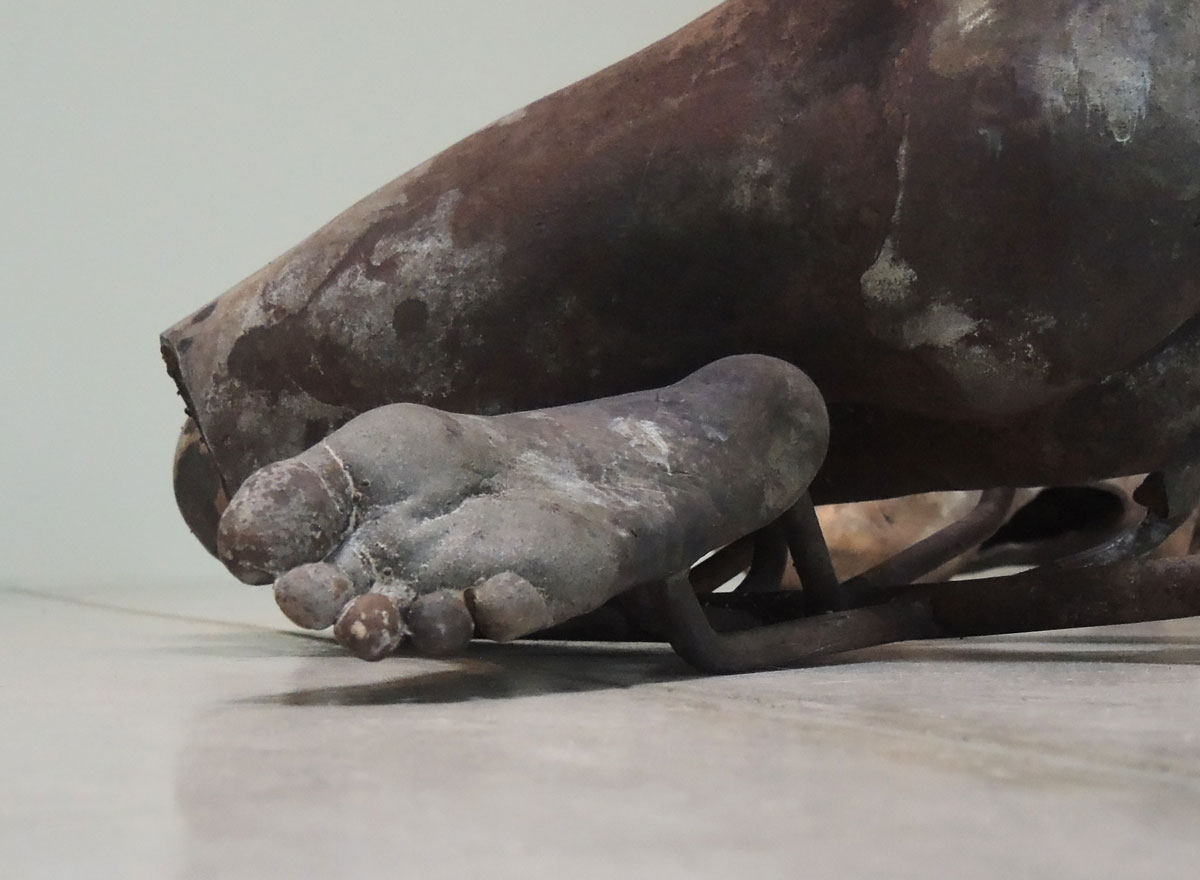
First, ‘Gustav’s Wing’ is an exhibit by Danh Vo, a man born in Vietnam but raised in Denmark.  Using his nephew as a model, Vo had a bronze of cast of the boy’s body made in six pieces.  The pieces are then arranged within a room.  “The resulting installation gives a fragmented and evocative portrait of a boy whose Danish and Vietnamese heritage echoes that of the artist, but who represents the next stage in the family’s story – that of the first-generation Danish citizen”, according to the description of the exhibit.

Looking into a white room, photo taken from the doorway, pieces of metal cast from a boy's body lie on the floor, scattered, part of an art installation at the Art Gallery of Ontario

Close up of a metal cast of a boy's foot. Part of an art installation by Danh Vo at the Art Gallery of Ontario

Three of the metal pieces from Gustave's WIng, an art installation by Danh Vo, pieces of body cast in metal

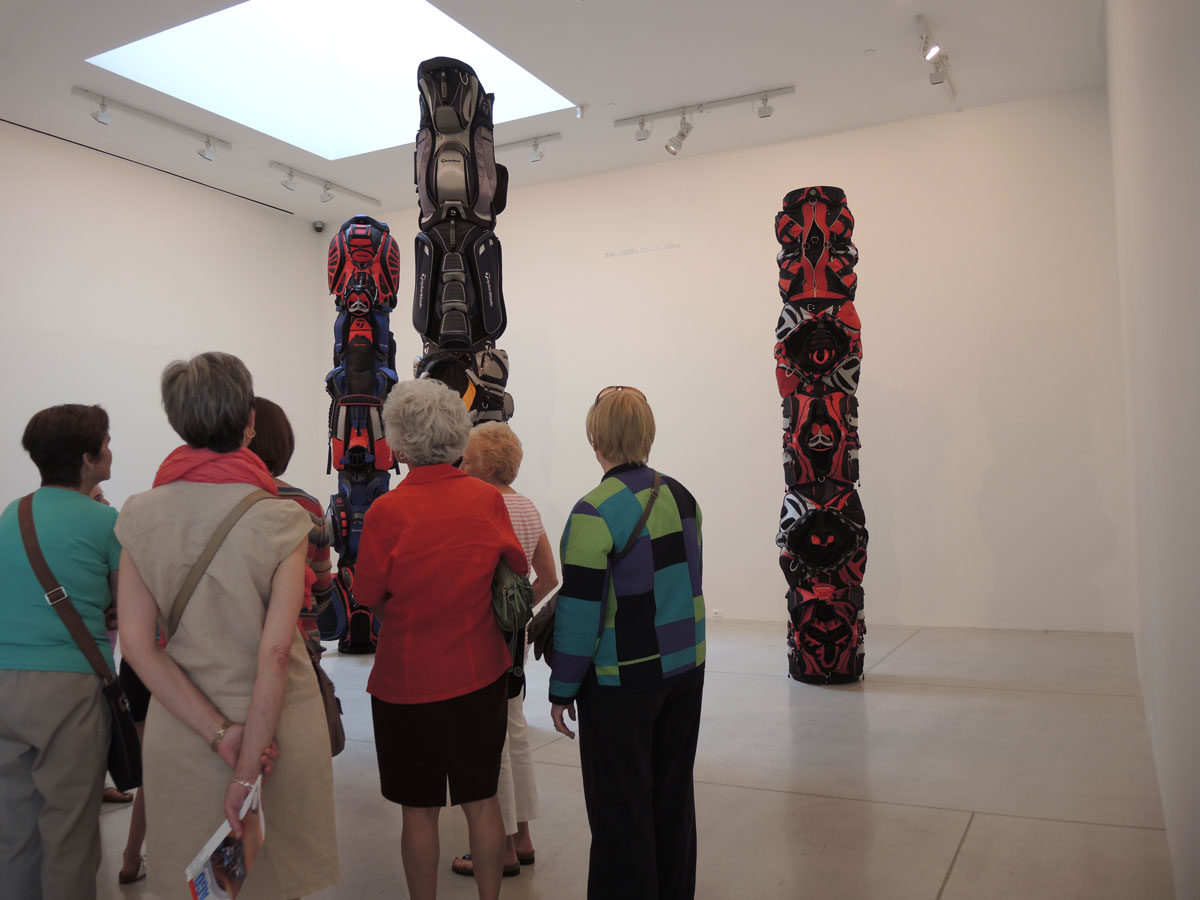
Second, there are three totem poles by Brian Jungen entitled ‘1960’, ‘1970’, and ‘1980’.  All three were made in 2007.  The words in the artist’s statement about this piece say “The towering works recall the complex social and political tensions that can result from First Nations land claims.”  Part of the artist’s reasoning is that golf courses are manicured and their use is quite different from the way land is used by First Nations.
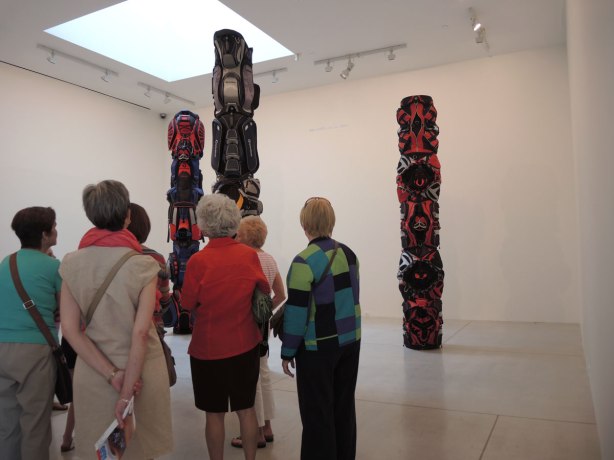
 

A group of women looks at an art installation of three large totem poles made of golf bags on display in an art gallery (Art Gallery of Ontario)

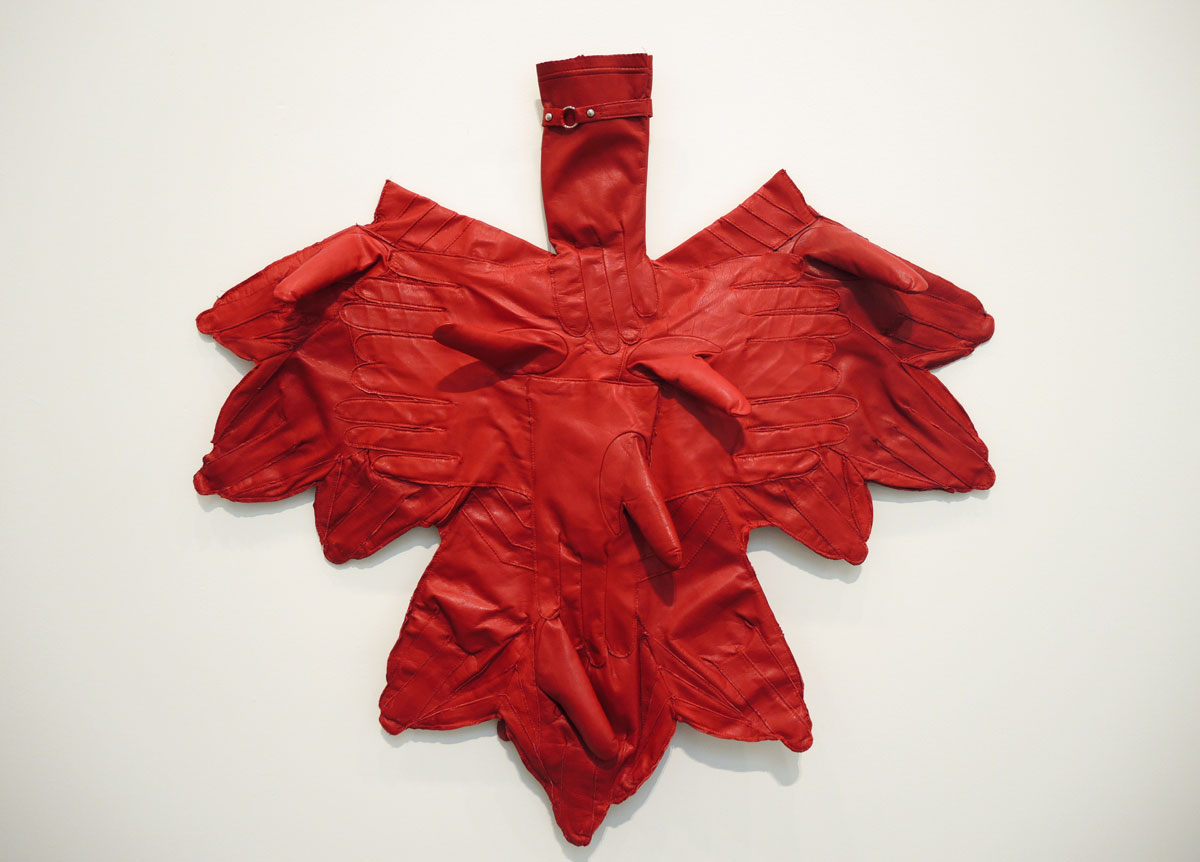
below: Anther piece by Brian Jungen, this one is called ‘Wieland’ and it is made of red women’s leather gloves.  It is supposed to be an upside down maple leaf, i.e. a Canadian symbol turned on its head.  When I first saw it, I saw an eagle with its wings spread but maybe that’s just me.

The words on the wall for this piece: “Its title celebrates Canadian artist Joyce Wieland (1931-1998) whose work in the 1960s and 1970s proposed a gendered patriotism in which indigenous art and culture were given only tokenistic inclusion. With Wieland, Jungen positions himself as part of and against an established narrative of Canadian art history.”

In Wieland’s opinion Canada was female I guess that that is what “gendered patriotism” means.  Otherwise, you will have to figure this one out for yourself.

Upside down rd maple leaf made of women's gloves. It also looks a bit like a large bird with outstretched wings. Part of an art installation at the art gallery of Ontario

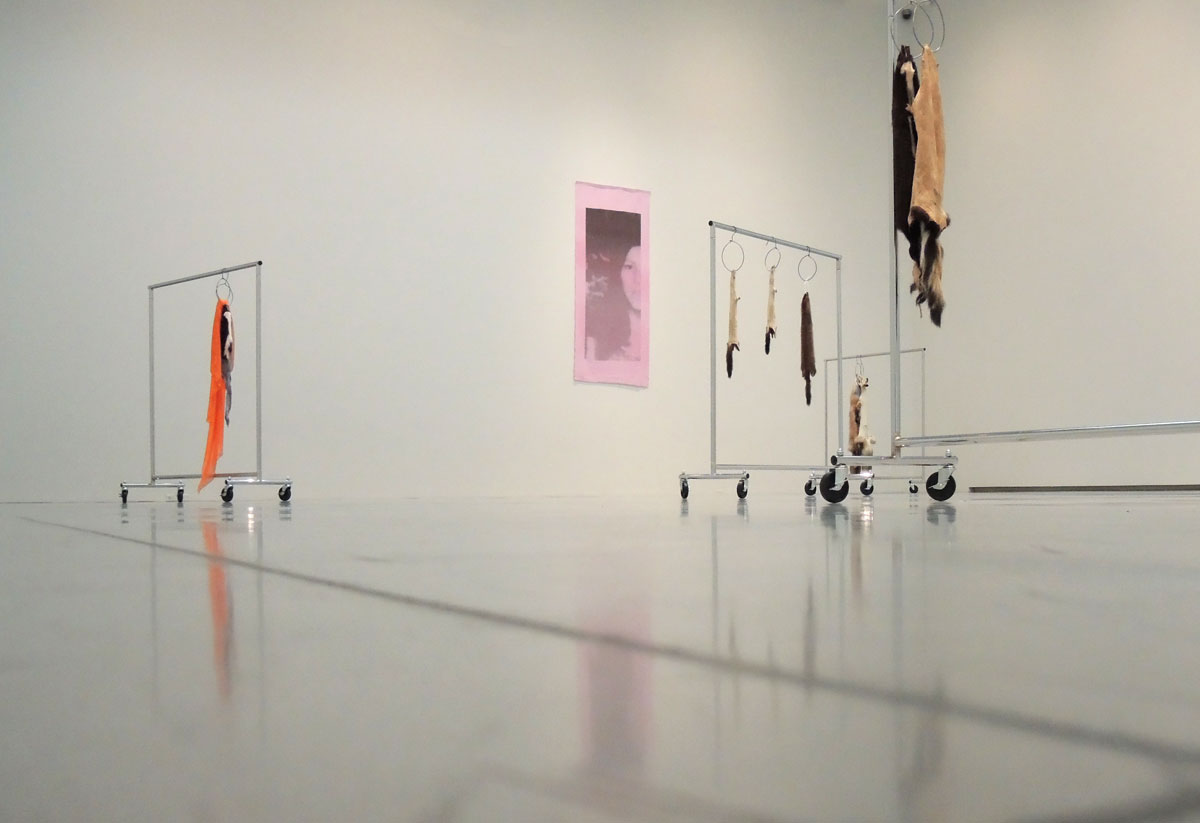
Lastly, there is an installation by Duane Linklater.  Each garment rack is piece and they have names like “My brother-in-law, my sister” and  “The marks left behind”.  Furs of different animals such as fox and skunk hang from the garment racks.  One has an old T-shirt and one has a piece of orange fabric.   “The evocative titles of the pieces speak to family ties, articulating a sense of personal loss” according to the description of the work found on the gallery wall.
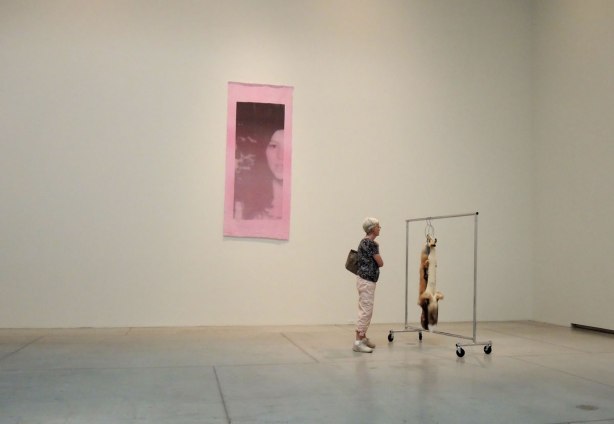
 

A woman is in a large room at the Art Gallery of Ontario, she is looking at an art installation that involves skins of dead animals hanging from garment racks. A pink picture of a woman hangs on the wall.

in an art gallery, an art installation that involves skins of dead animals hanging from garment racks. A pink picture of a woman hangs on the wall.

The two pink pictures on the wall are each a half of a portrait of a woman called Anna Mae Aquash who died in 1976. Together they form ‘Family Photograph’.  Aquash was a Miqmaq woman who was involved as a “radical activist” in the American Indian Movement of the early 1970s.  She was murdered.    If you read the description of the work on the gallery wall, you will read these words: “By including her image, Linklater expresses a sense of familial connection with Aquash and establishes a symbolic relationship with the previous generation while asserting himself in the present. ”   Pardon?

The words on the wall don’t tell you that she was murdered by her own people because they thought she was an FBI informant.  So what relationship is the artist trying to establish?  How does this even remotely lead to “asserting himself in the present”?  Sorry, but empty jargonish words leave me cold. This isn’t art.  Linklater may have a valid idea but that doesn’t make it art.

A group of people in an art gallery, they are looking at an art installation that involves skins of dead animals hanging from garment racks. Two pink picture of women hangs on the wall.


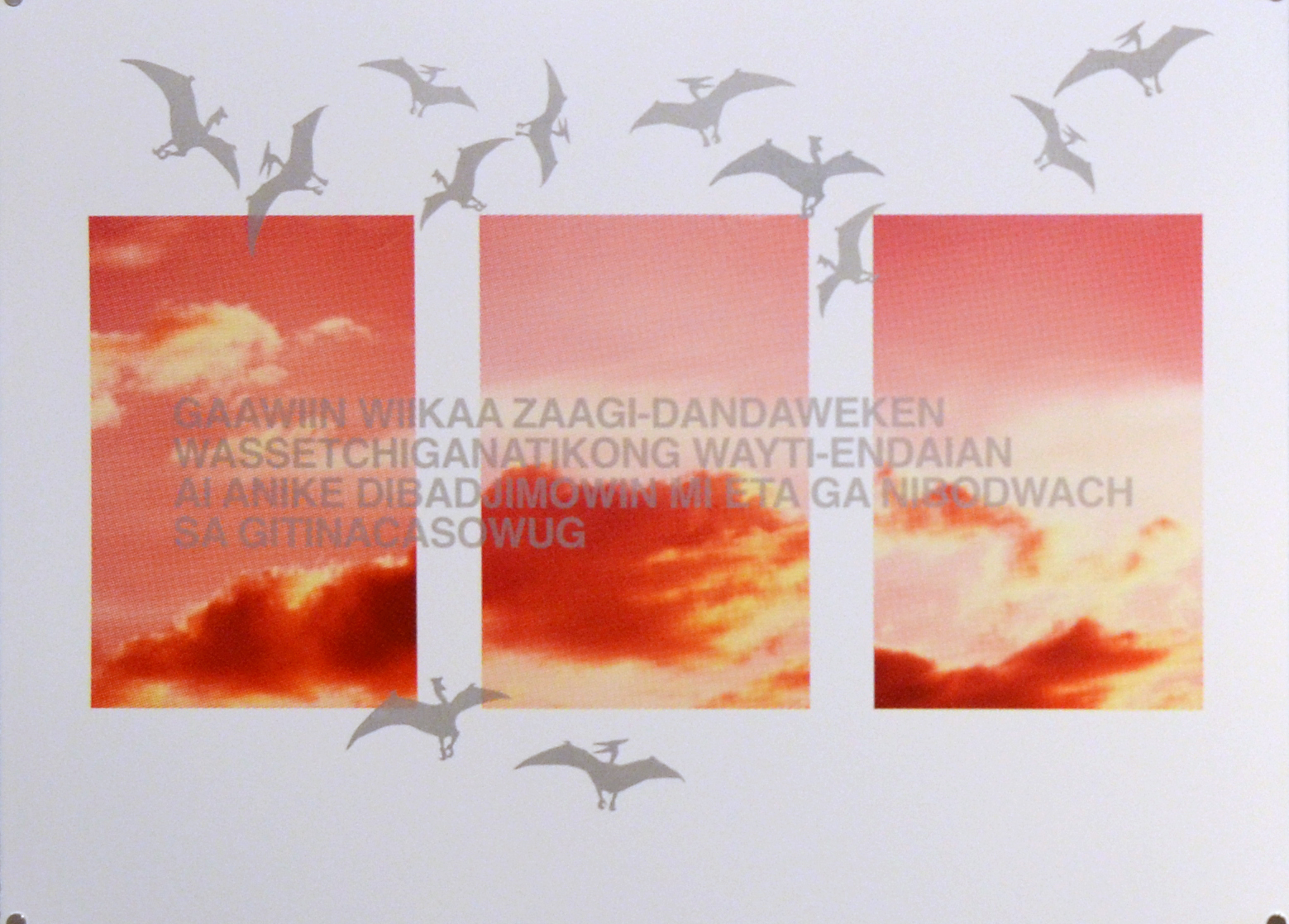
 Planet IndigenUS is a ten day festival co-produced by the Harbourfront Centre in Toronto and the Woodland Cultural Centre in Brantford. It features 300 artists with dance and music performances as well as visual art exhibits at a number of venues.  One of the venues is the gallery at Harbourfront Centre where a number of artists of Anishnabe heritage are showing their work.  Two of the artists are Christian Chapman and Scott Benesiinaabandan, and a sample of their work is presented here.


 Screenprints by Christian Chapman

print of an evergreen forest, a text in Ashishnabe language on top of the trees, hanging on a gallery wall gaawiin wiikaa ji gwerina-ka-nawich
miskwadessi opixwanak misa oi kitimagia
miskwadessi wag dash awessiwag
ji manaadji-a-ka-ni-watch

 never turn a turtle on its back so that it is helpless
turtles and all other animals are to be accorded respect


print of asky with clouds in red and orange tones, a text in Ashishnabe language on top of the trees, hanging on a gallery wall gaawiin wiikaa zaagi-dandaweken
wassetchiganatikong wayti-endaian
ai anike dibadjimowin eta ga nibodwach
sa gitinacasowug

never climb out a window in your house,
traditionally, only dead people are brought out like that

***

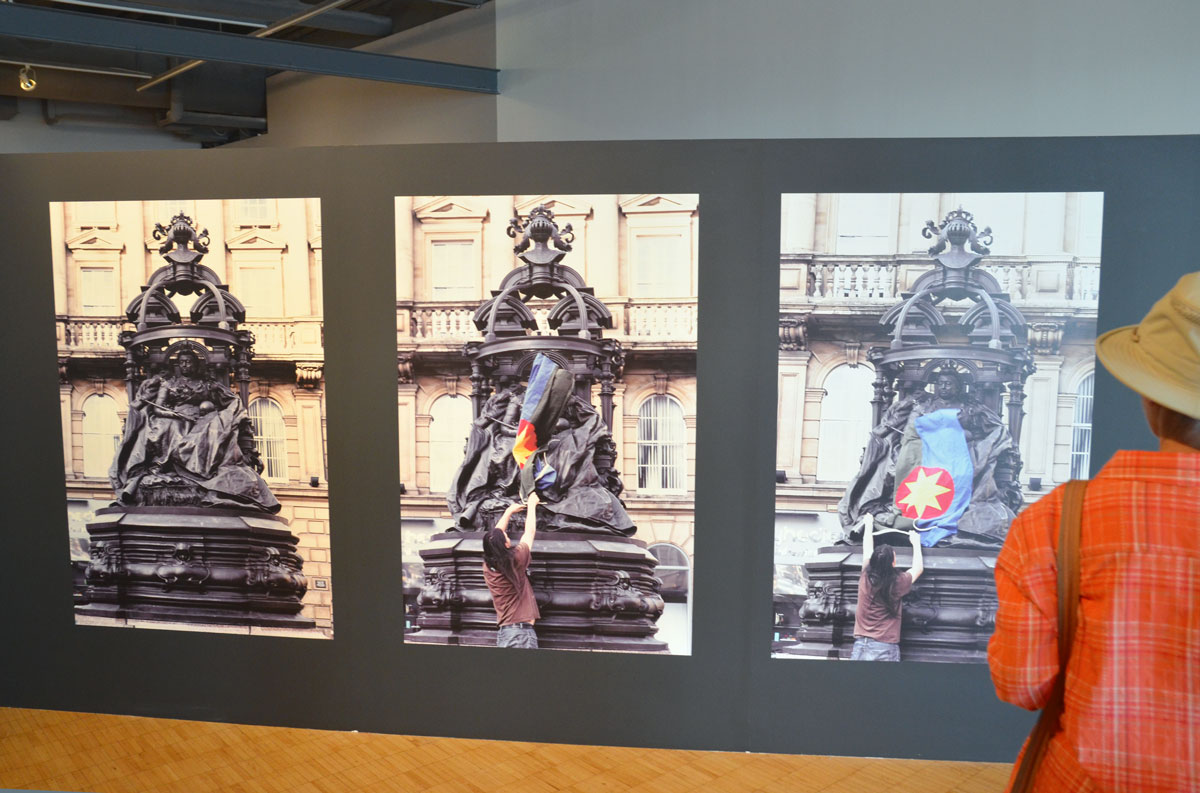
below: ‘God Save the Queen’ by Scott Benesiinaabandan
a series of photos in which the queen is partially covered by the artist’s Solidarity Flag

In an art gallery, a series of three large photographs of a statue of Queen Victoria.  THe first picture is just the statue, the middle picture is a man starting to put a  flag over the bottom part of the statue and the third picture is the flag on the statue.  Flag is solidarity flag created by Scott Benesiinaabandan, black and blue background, red circle in the middle, yellow sun in the red circle


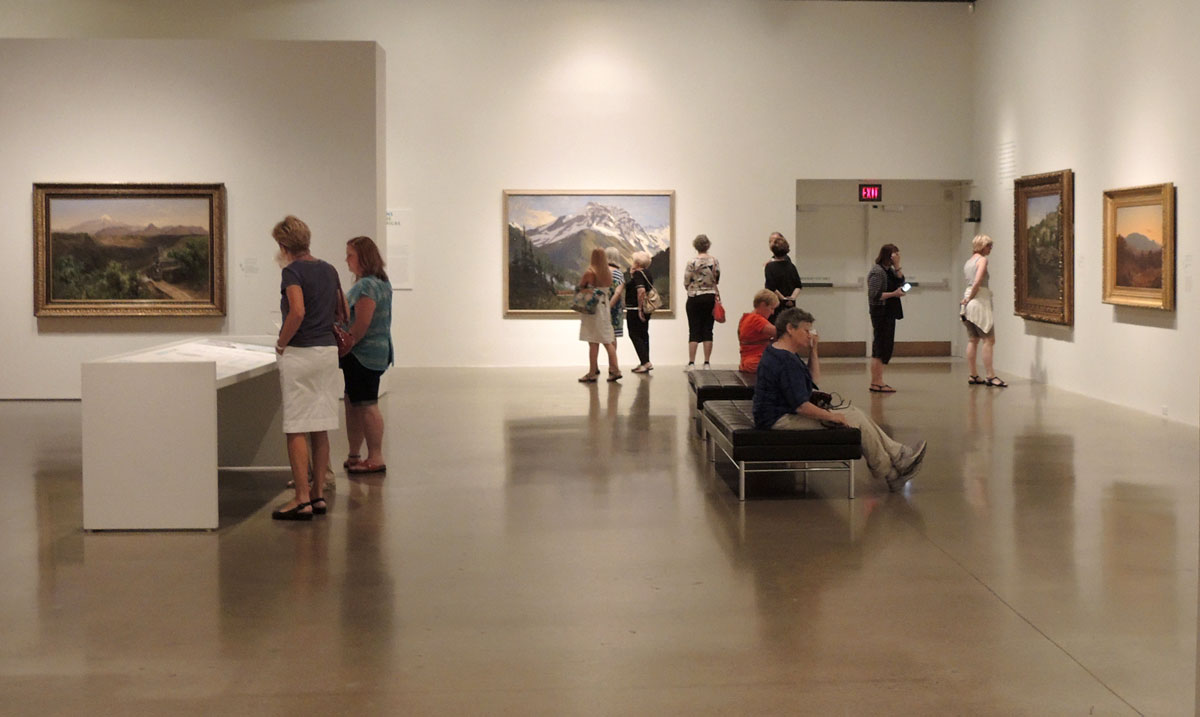
Landscape paintings depicting scenes from the top of North America to the tip of South America
are on display at the Art Gallery of Ontario until Sept 2015.   The collection centers on just over 100 works that were painted between the early 1800s and the eary 1900s.

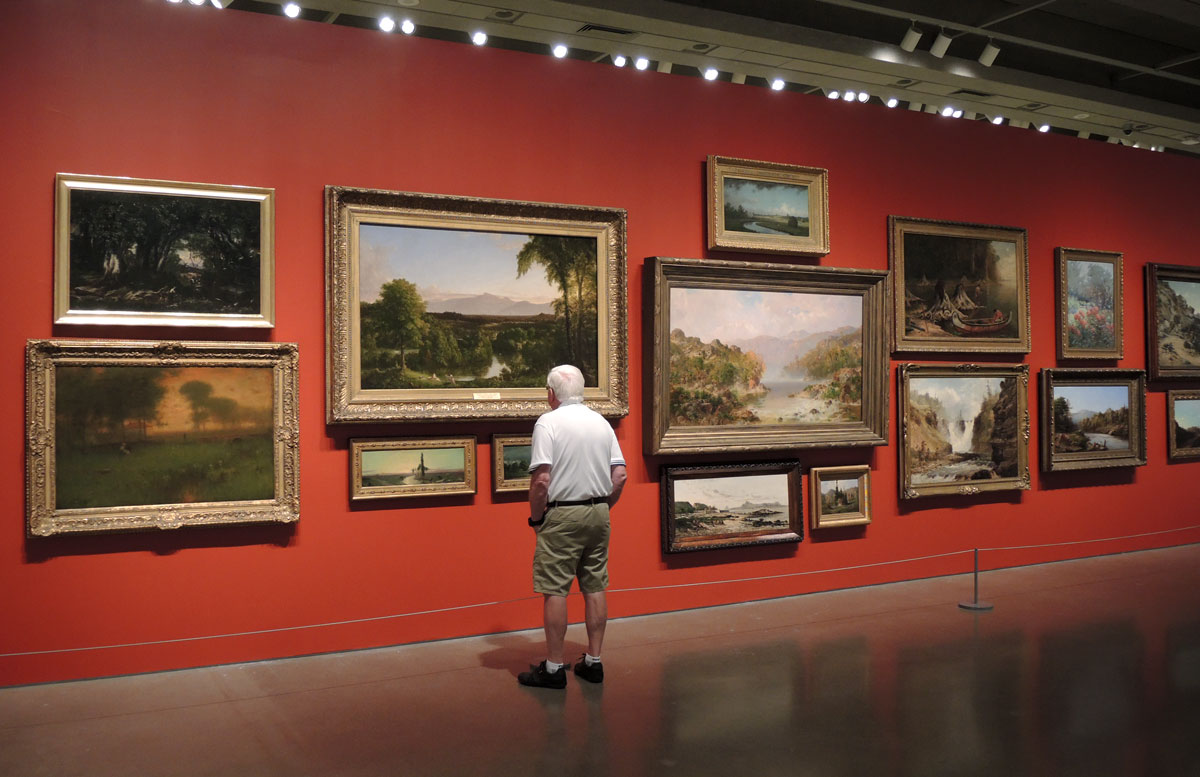
7 or 8 people in an art gallery looking at paintings that are hanging on the walls

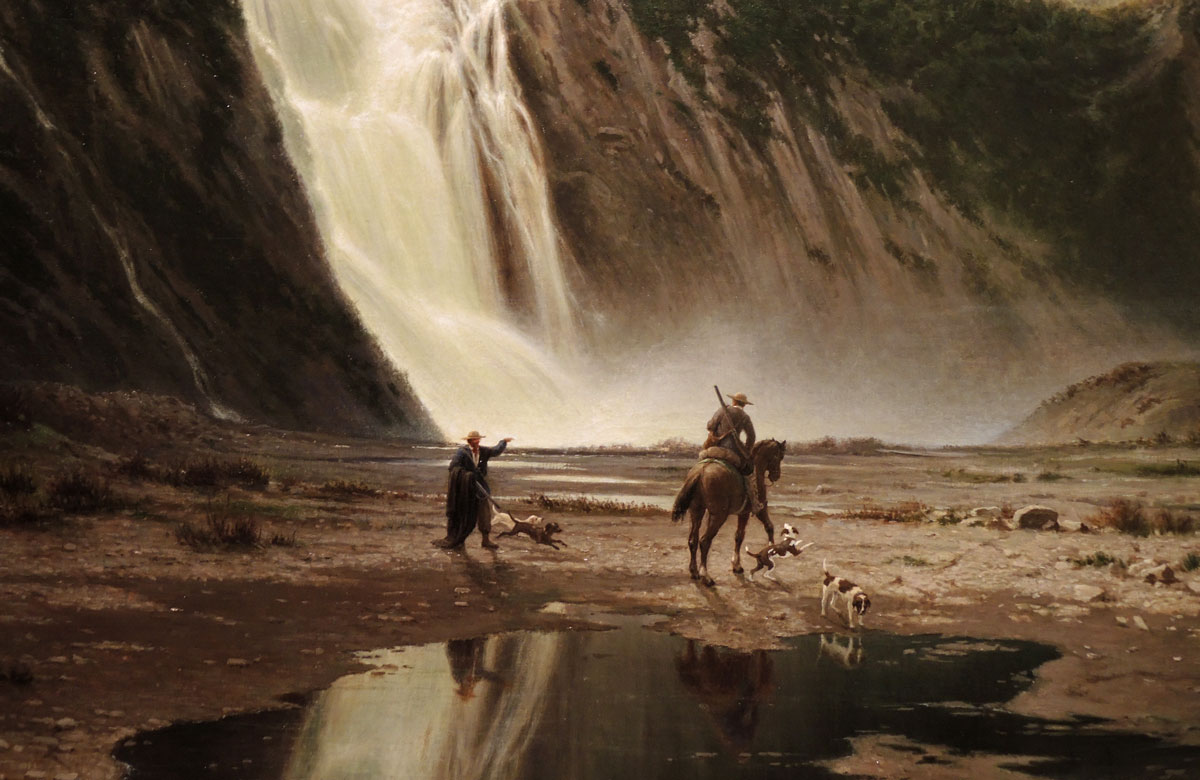
below:  part of a painting, ‘Montmorency Falls’ by Guido Carmignani (Parma Italy 1838-1909)
oil on canvas,  1869

close up of part of a painting - Montmorency Falls by Guido Carmignani 1869, Italian hunters at the base of the falls (even though they are in Quebec) in summer time.

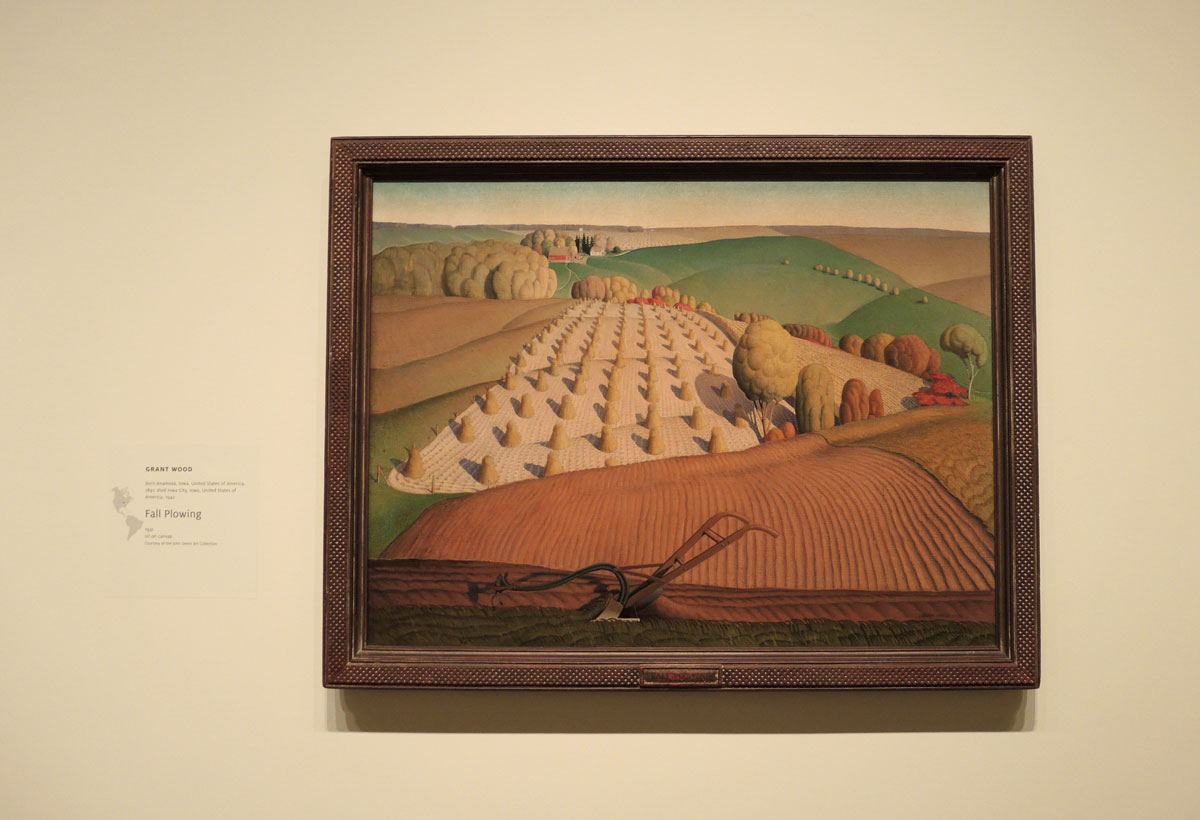
below: Fall Plowing, by Grant Wood (b. and d. Iowa USA),  1931, oil on canvas

painting on a wall in an art gallery of fields being harvested by Grant Wood


A man is looking at a wall of paintings. The wall is painted red. It is in an art gallery

close up of part of a painting including part of the intricately carved frame.  THree men getting into a boat at the edge of a river

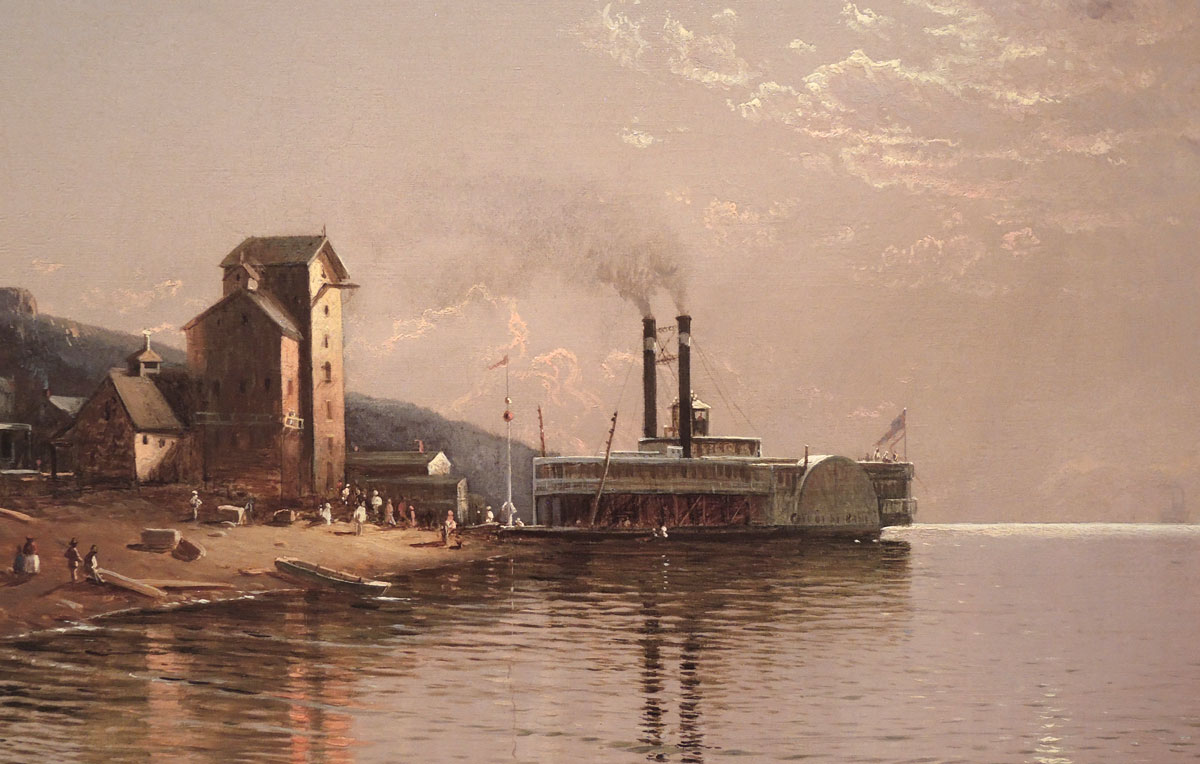
 below: part of “The Sidewheeler, the ‘City of St. Paul’ on the Mississippi River, Dubuque Iowa”
by Alfred Thompson Bricher (American), oil on canvas,  1872

close up of part of an oil painting showing an old paddle wheel steam boat on a river

Andy Warhol Revisited
presented by Revolver Gallery,
on display at 77 Bloor St. West

below:  Three Andy Warhol’s watch the passersby on Bloor Street.

statues of Andy Warhol, one pink, one yellow and one blue, in a window of an art gallery,  He's dressed in black, with black rimmed glasses and his hands are folded over his chest in all three statues.  Life sized.

below:  Three prints from Warhol’s Mohammad Ali series

Two women are sitting ona silver couch in an art gallery.  On the wall in front of them are 3 silkscreen Andy Warhol prints of Mohammad Ali.

 below:  Iconic Campbells soup cans on black and white stripes.  To the left, a young Lucille Ball and a young Ronald Regan amongst other cultural references.

prints of three Campbells soup cans on a black and white striped wall, cheddar cheese, old fashioned vegetable, and hot dog bean.  To the left a woman is looking at other Andy Warhol prints on a wall including a print of Mickey Mouse, Lucille Ball and a young Ronald Regan.

below:  Prints from Warhol’s Cowboys and Indians series.

Some of Warhol's Cowboys and Indians series prints hang on a gallery wall as two young Asian men walk past. There is also a couple sitting on a silver coloured couch in the right side of the photo.

The exhibition continues until the end of December 2015 although apparently a new set of pictures will be shown starting sometime in October.

A collage of photos of Andy Warhol, many photos, about 100 or more

Part Picture,
an exhibit at MOCCA,
part of CONTACT Photography Festival

Like the introduction of film photography once usurped the role of painters and engravers, the introduction of digital photography has supplanted the photographer of old.  We are all photographers now.  A smartphone.  A little bit of software.  And presto, you have a picture.   Many, many bazillions of pictures.  Photography excels at visually telling stories, documenting events or capturing a moment in time either with a single image or in a series of photos.  The expression ‘a picture paints a thousand words’ comes to mind.  Even a blurry selfie says something.

Photography has always had an uneasy relationship with art (with the fine art, visual artsy stuff in particular).  This art, while also visual, often has a slightly different focus.  It too aims to elicit emotions and reactions but no one expects an artwork to document or to tell a story albeit some do.  But art too is in flux (and probably has been for a while).   What hasn’t already been done?  What rules are left to break?

So what’s a photographer to do?


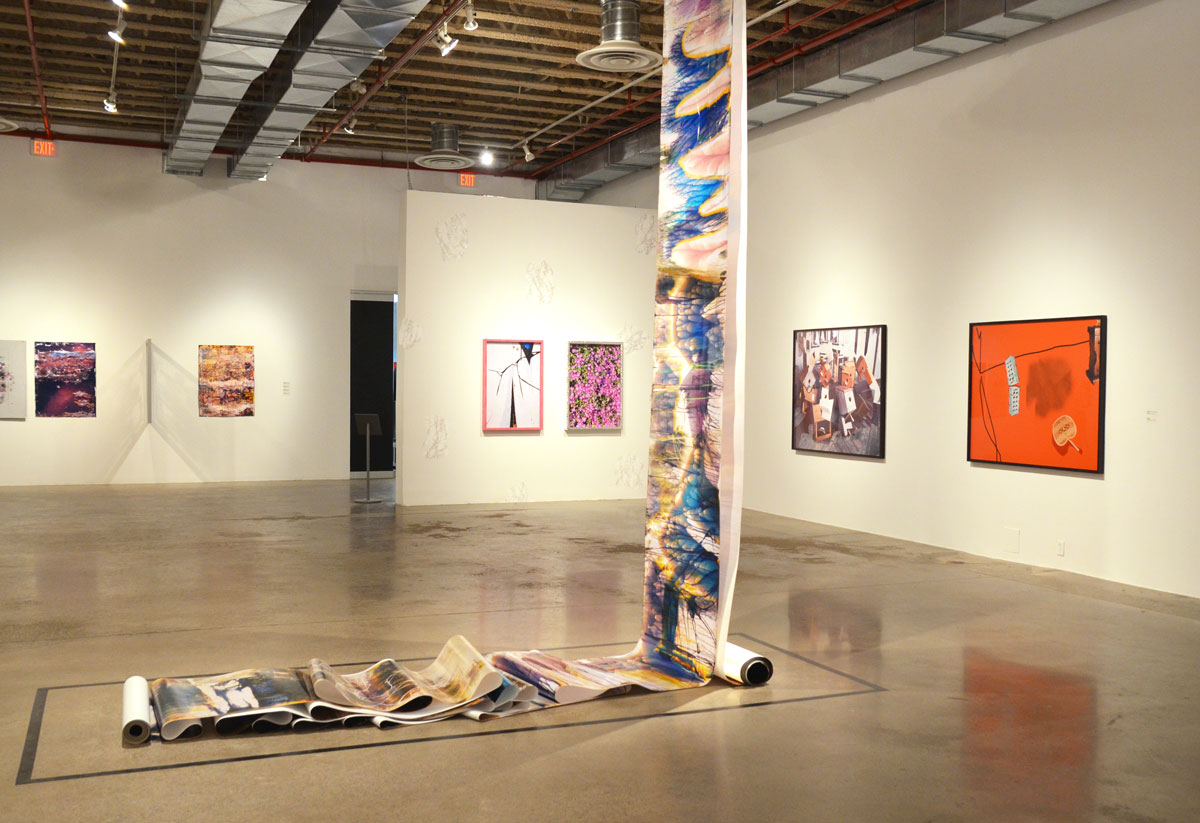
pictures on a gallery wall.  the picture in the foreground has 4 coloured wires protruding from it, 2 yellow and 2 red.

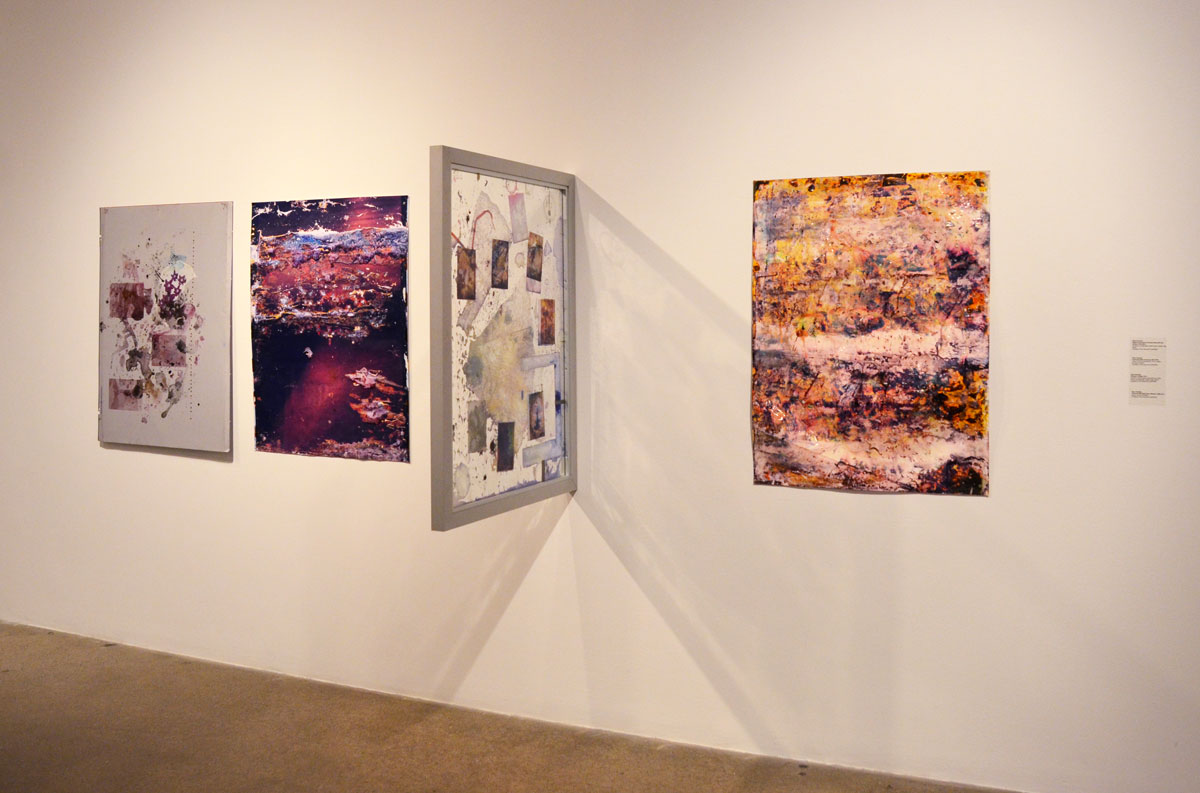
Part of the description of this exhibit states: “placing photography in conversation with other artistic mediums – particularly painting and sculpture – to create hybrid works that are only part picture”.

pictures on an art gallery wall.  In the middle of the room is a large roll of photographic paper that has been developed with streaks of colour.  It hangs from the ceiling and lays on the floor.

Experiments with chemicals on photographic paper; experiments with photoshop artifacts as part of the image;  experiments with how one frames or hangs a picture.  What is photography anyhow?

two pictures on a wall of a gallery.  The one on the right is of pink flowers and is in a metal frame.   The one on the left is an abstract of white and black that looks like cracks in a white surface

Four pictures on an art gallery wall, all abstract.  One of them protrudes from the wall at a 90 degree angle.

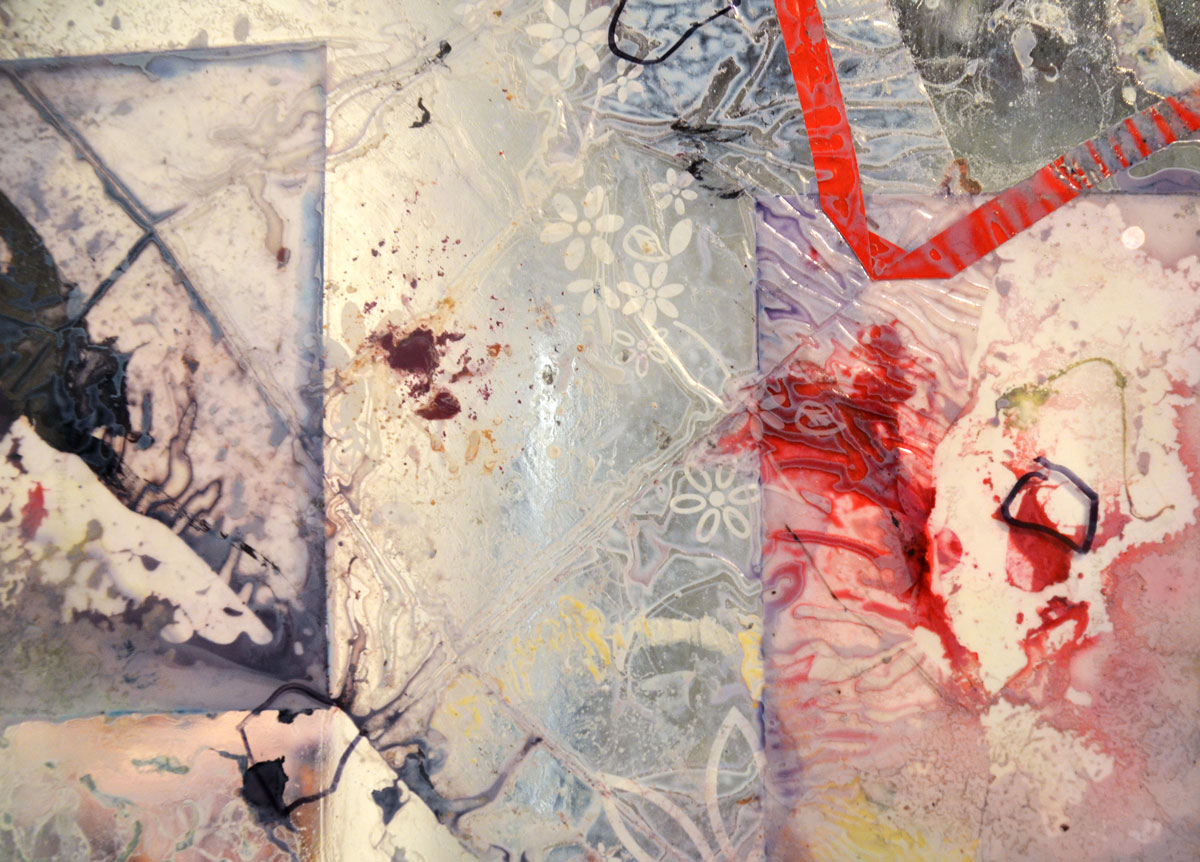
below: close up of part of the picture from above, the one that is hung perpendicular to the wall.

close up of what looks like a collage

Just because something is different doesn’t mean that it’s good just as not all experiments are a success but  kudos to those who try.  I will leave it to you to decide which category (good/bad) these pictures fall into.

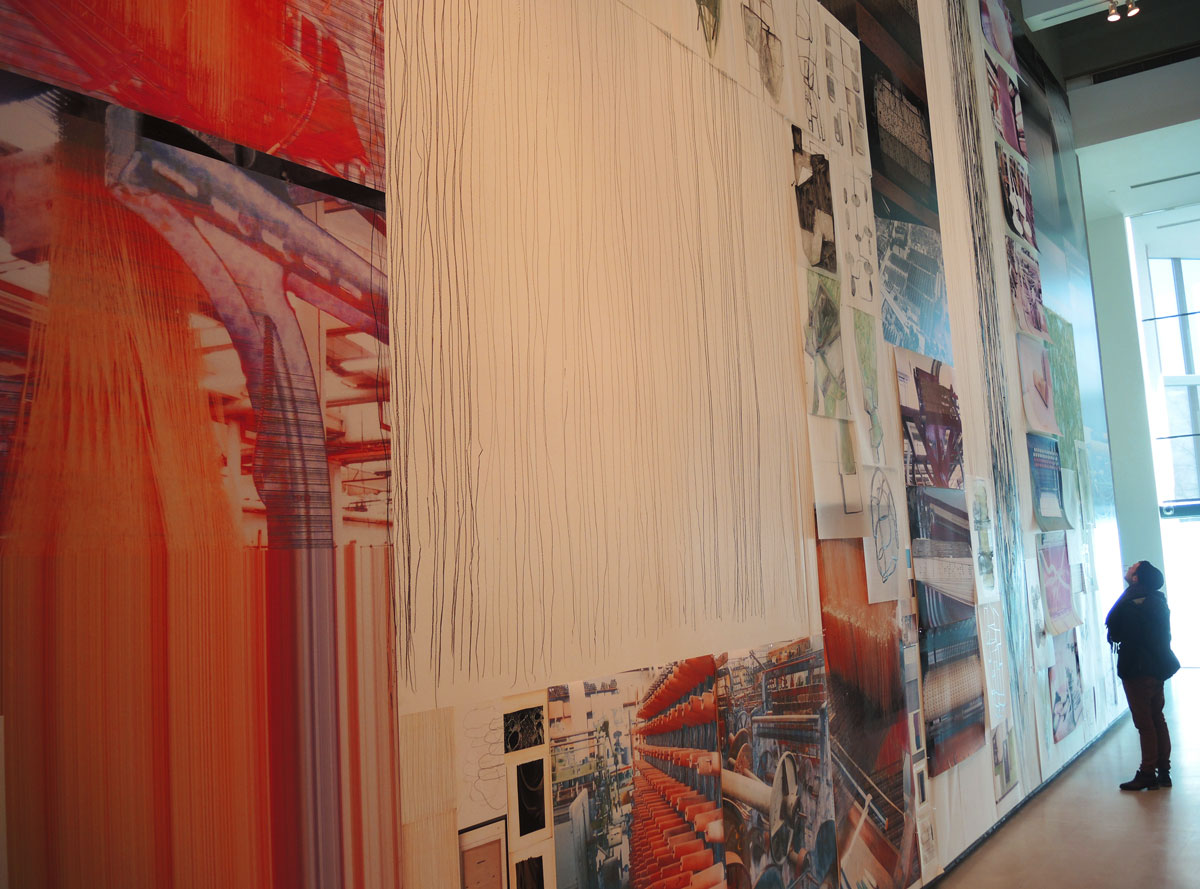
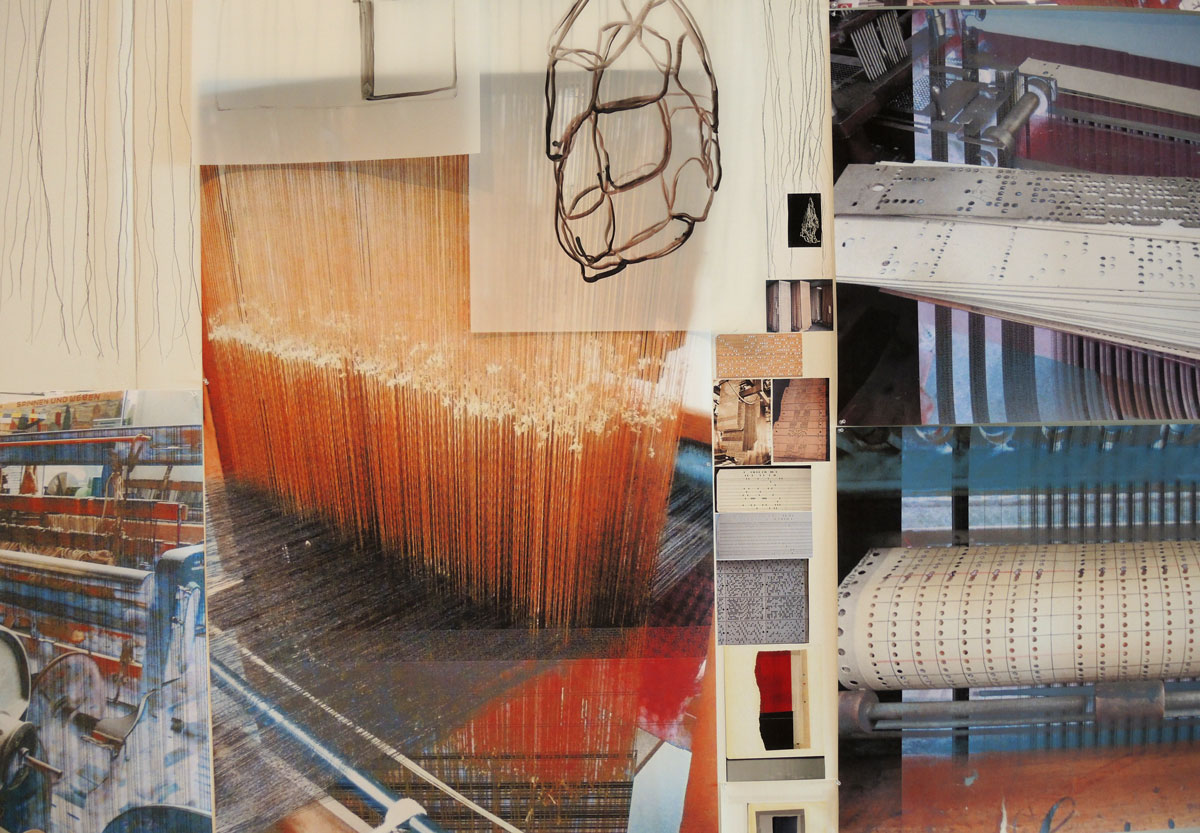
Obsolescence, by Shelagh Keeley, 2014
at The Power Plant, Harbourfront Centre

A man is looking at a large art piece on a wall.   A collage called Obsolescence by Shelagh Keeley,

The piece covers a wall that is 25 x 40 feet in a room that is only 10 feet wide.

close up of part of a large collage art piece on a wall

The large collage includes photographs taken inside an abandoned textile factory in Monchengladbach Germany.

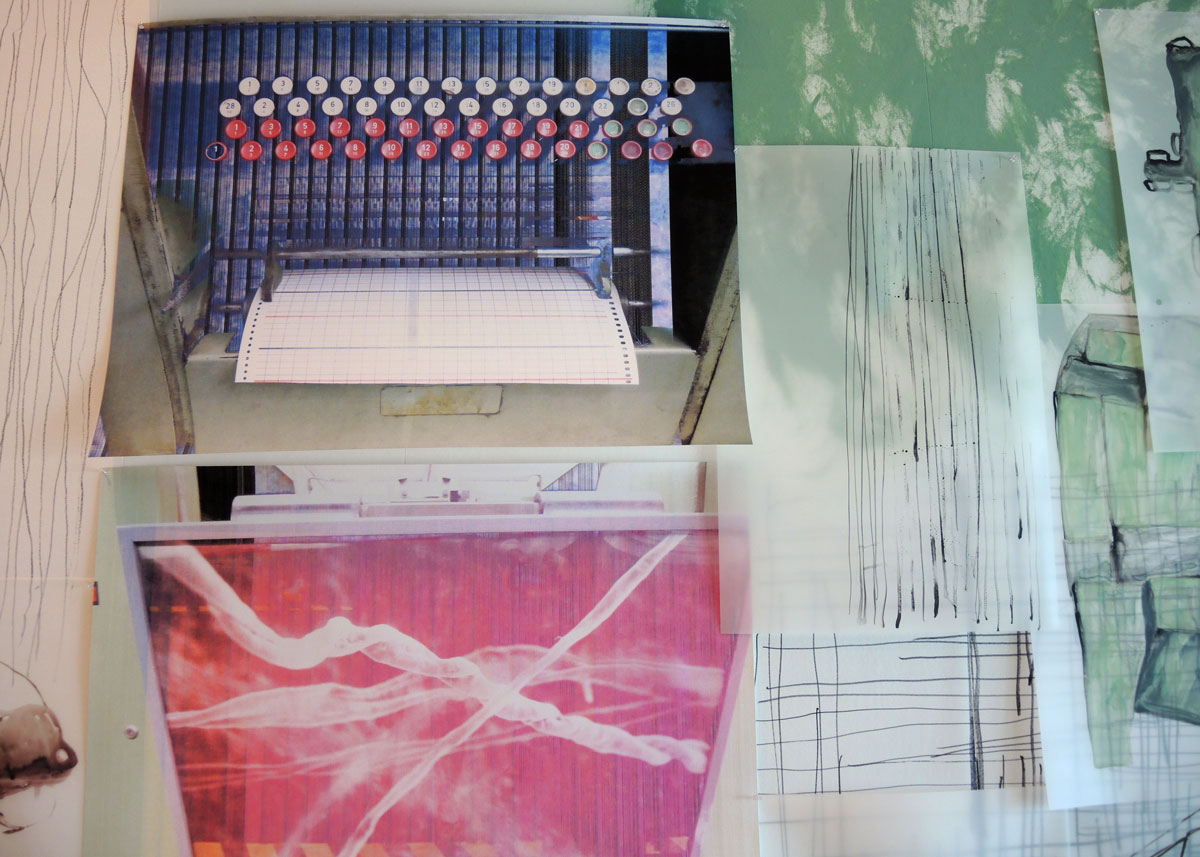
close up of part of a large collage art piece on a wall.  One of the pictures is of a typewriter

A dictionary definition: “Obsolescence: being in the process of passing out of use or usefulness; becoming obsolete.

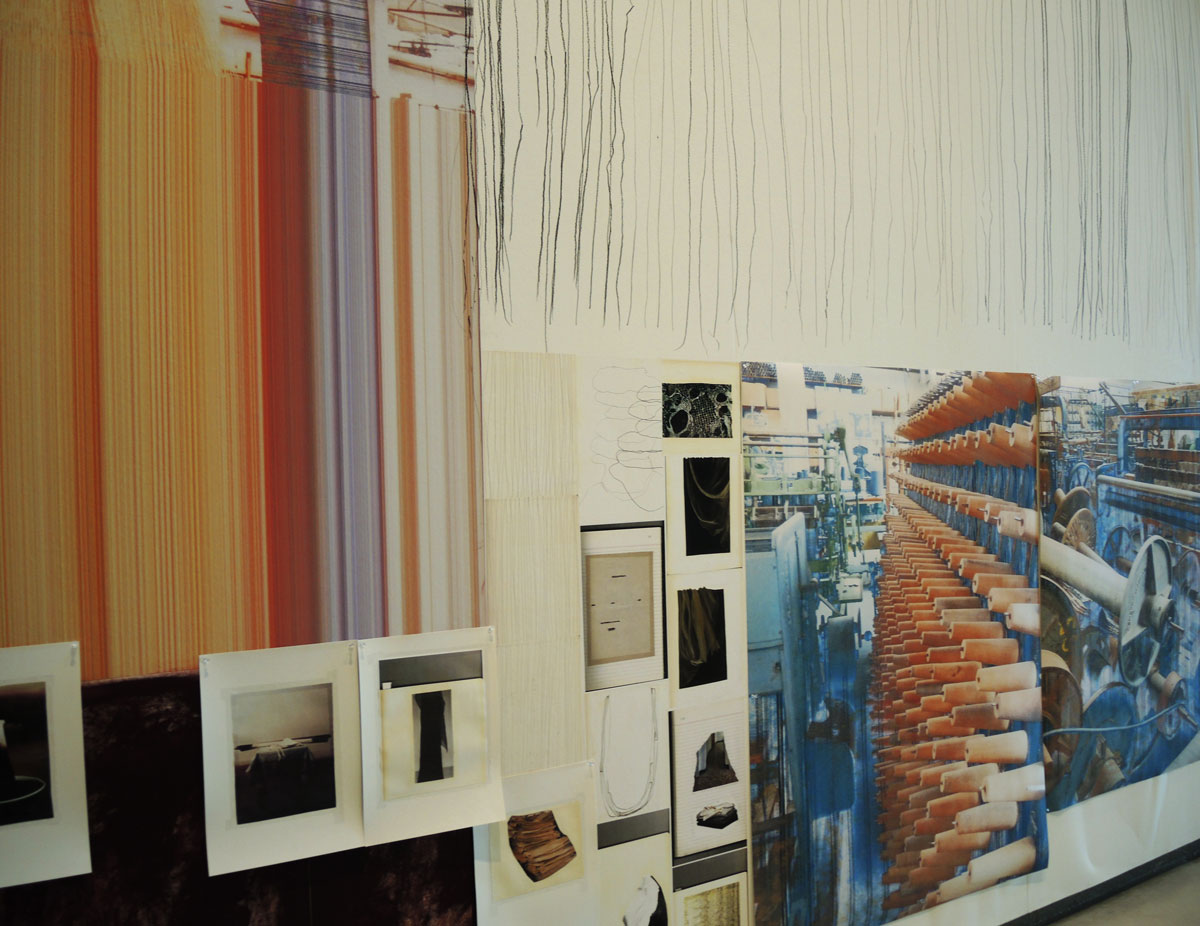
close up of part of a large collage art piece on a wall

One of the inspirations for this piece was Marshall McLuhan’s 1970 “Notes on Obsolescence” which opens with the lines:  “When print or the motor car is referred to as “obsolete” many people assume that it is therefore doomed to speedy extinction. A casual glance at the historical record indicates the contrary. Gutenberg did not discourage handwriting. There is a great deal more handwriting done even in the age of the typewriter than was ever done before printing”.

And it ends with: “Obsolescence is a very large and mysterious subject that has had very little attention in relation to its importance.” The present paper may … thus help awareness of the role of obsolescence in sparking creativity and the invention of new order.”

A woman is looking at a large art piece on a wall.  A collage called Obsolescence by Shelagh Keeley,

Like all art, it is subjective.   Like good art, it has the potential to make you want to linger in front of it and even to reflect and think.

The upper part of a collage by Shelagh Keeley at The Power Plant gallery.  This is the top part of the piece which is 25 feet high.

This piece is scheduled to remain at The Power Plant until 17 May 2015.

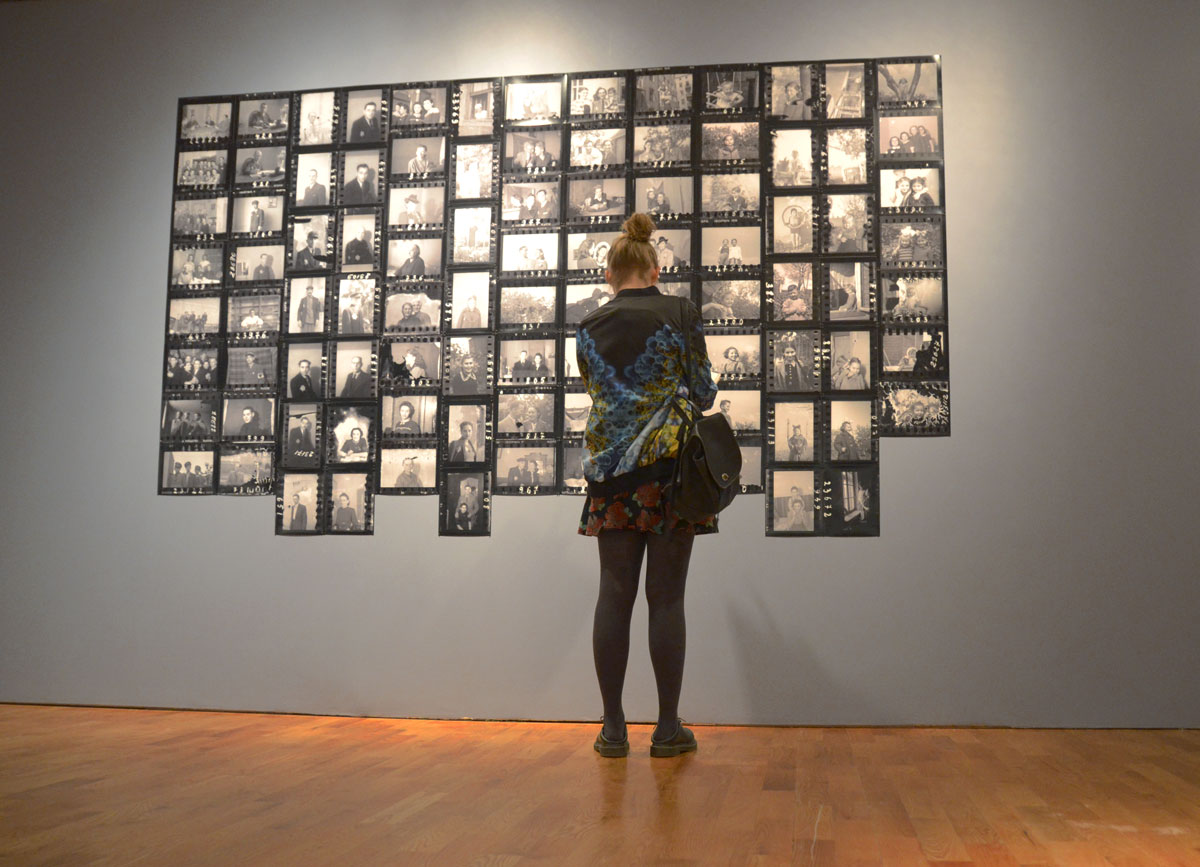
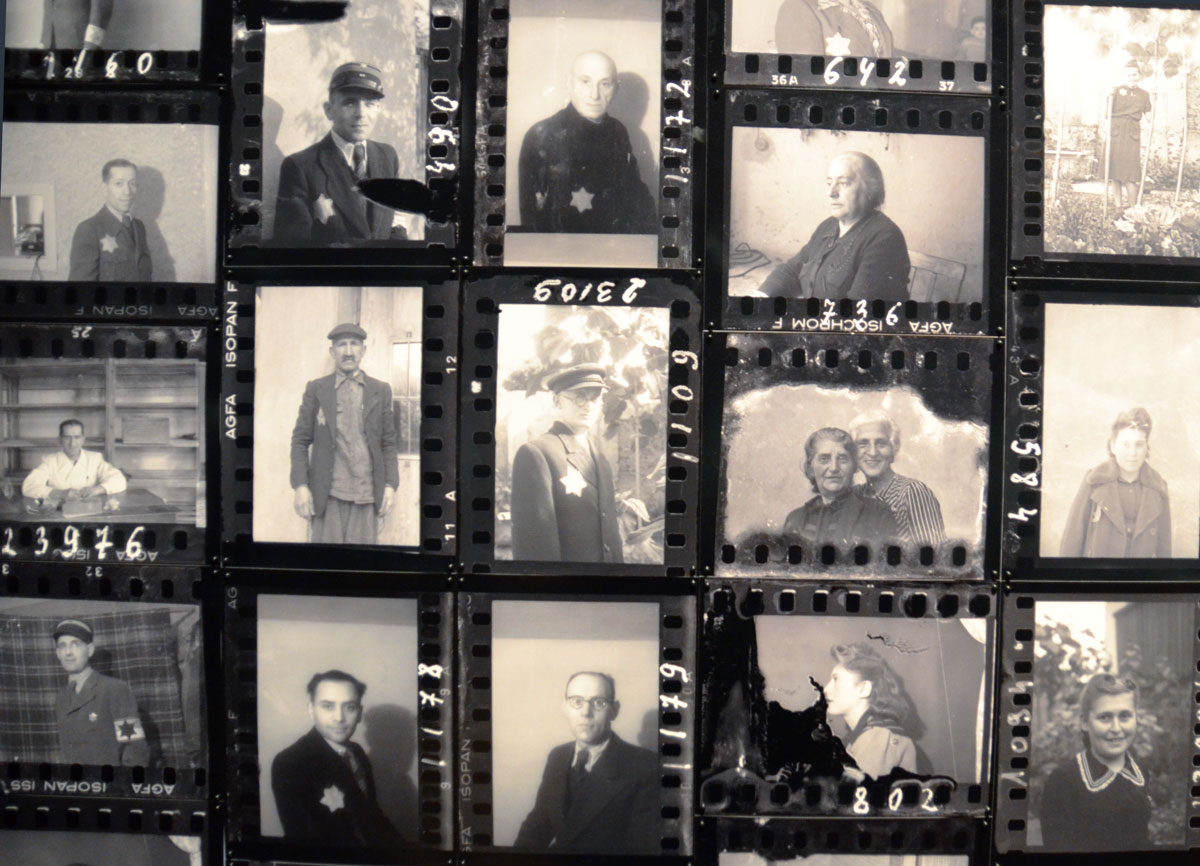
Photographs of the Lodz Ghetto (Poland 1940-1945)
by Henryk Ross,
at the Art Gallery of Ontario until 14 June 2015

Ross was a Polish Jewish photographer and one of the official Lodz ghetto photographers under the Nazi regime.

A girl is standing in front a photography exhibit where many black and white photos are grouped together to form one big picture.

In the autumn of 1944 as the Lodz ghetto was being shut down, Ross buried his 6000 negatives in jars.  The Red Army liberated Lodz in January of 1945 after which Ross unearthed his negatives.  Water damaged about half of them.  Of the surviving 3000 negatives, about 200 form the ‘Memory Unearthed’ exhibit.

Close up of photo display showing black and white photos of people in portrait like photos.

Some of the photos are ordinary pictures – portraits of people, children playing.  Other photos look ordinary until you learn the context, what is really happening in the picture.  Many photos document suffering and despair.  They elicit a lot of uncomfortable emotions but as an historical record the collection is excellent as well as much needed.