


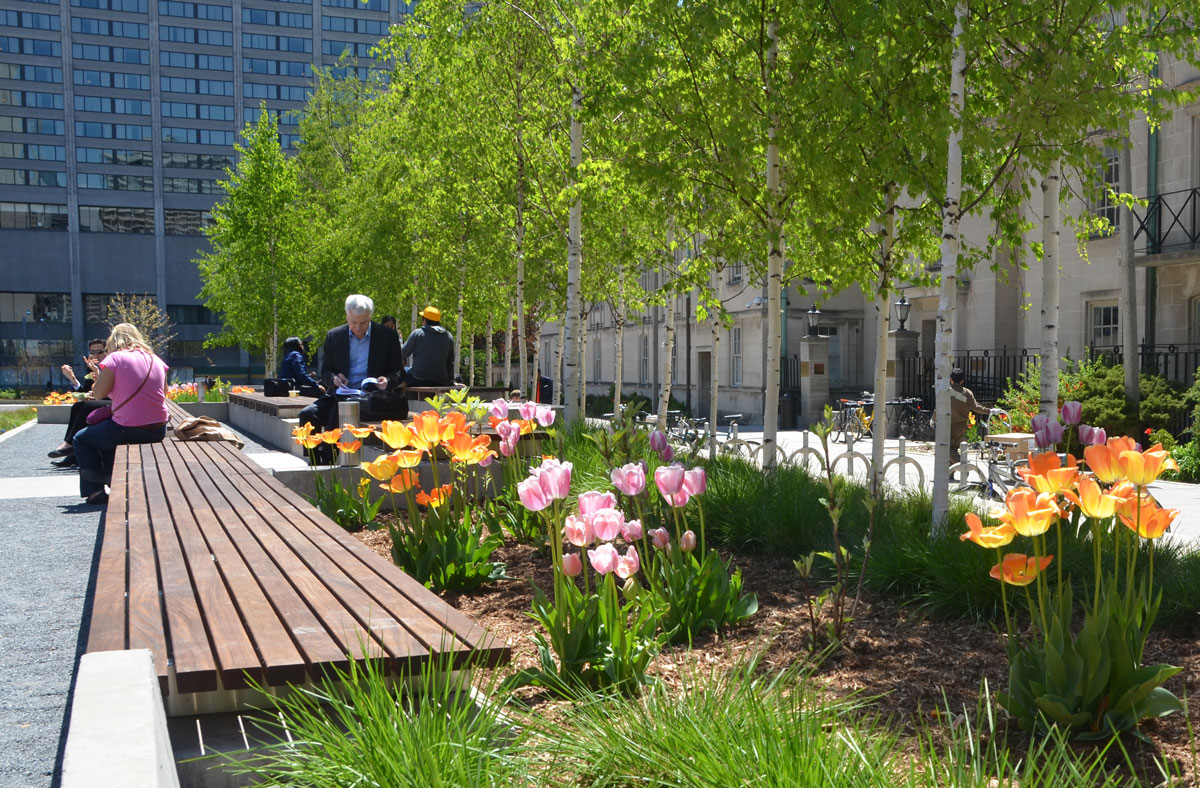
Spring is in the air.

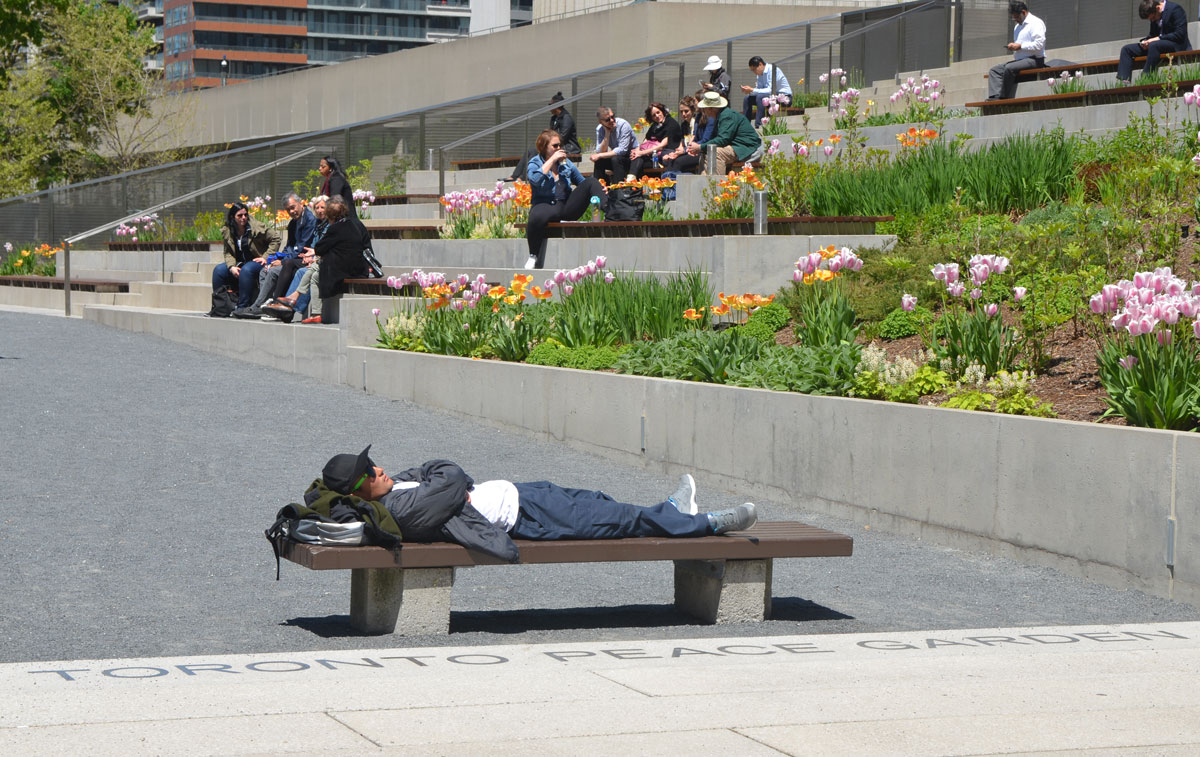
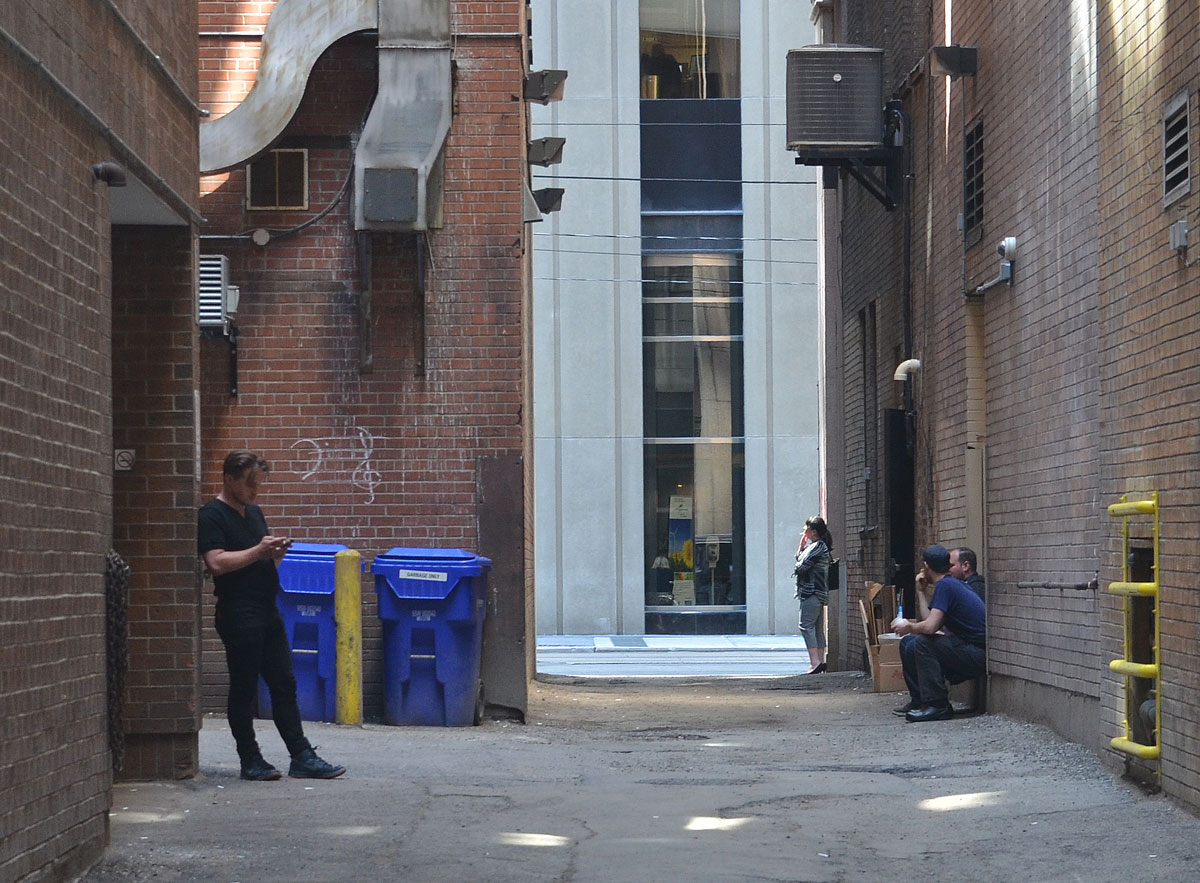


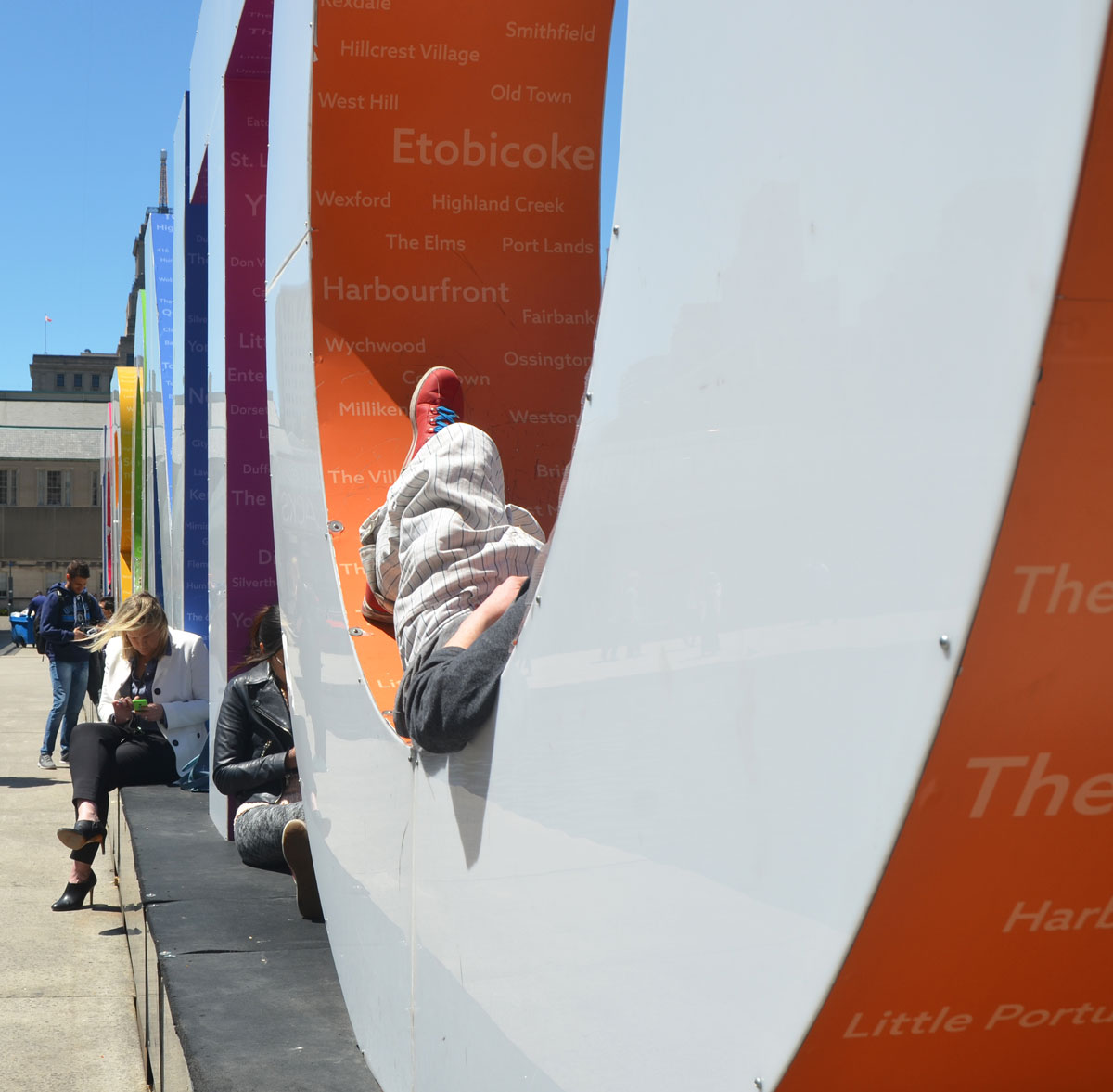
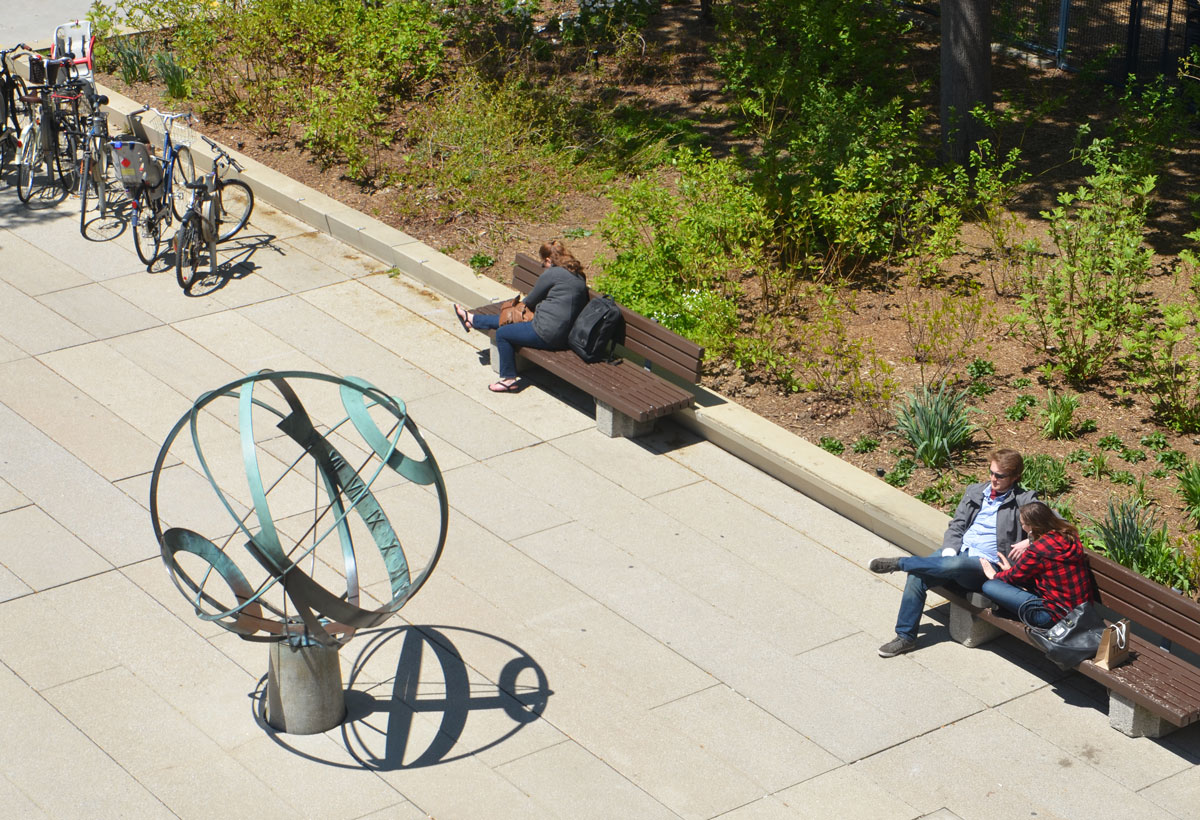
I’ll be lazing on a sunny
lazing on a sunny
lazing on a sunny afternoon.
(with apologies to Queen)
Spring is in the air.
I’ll be lazing on a sunny
lazing on a sunny
lazing on a sunny afternoon.
(with apologies to Queen)
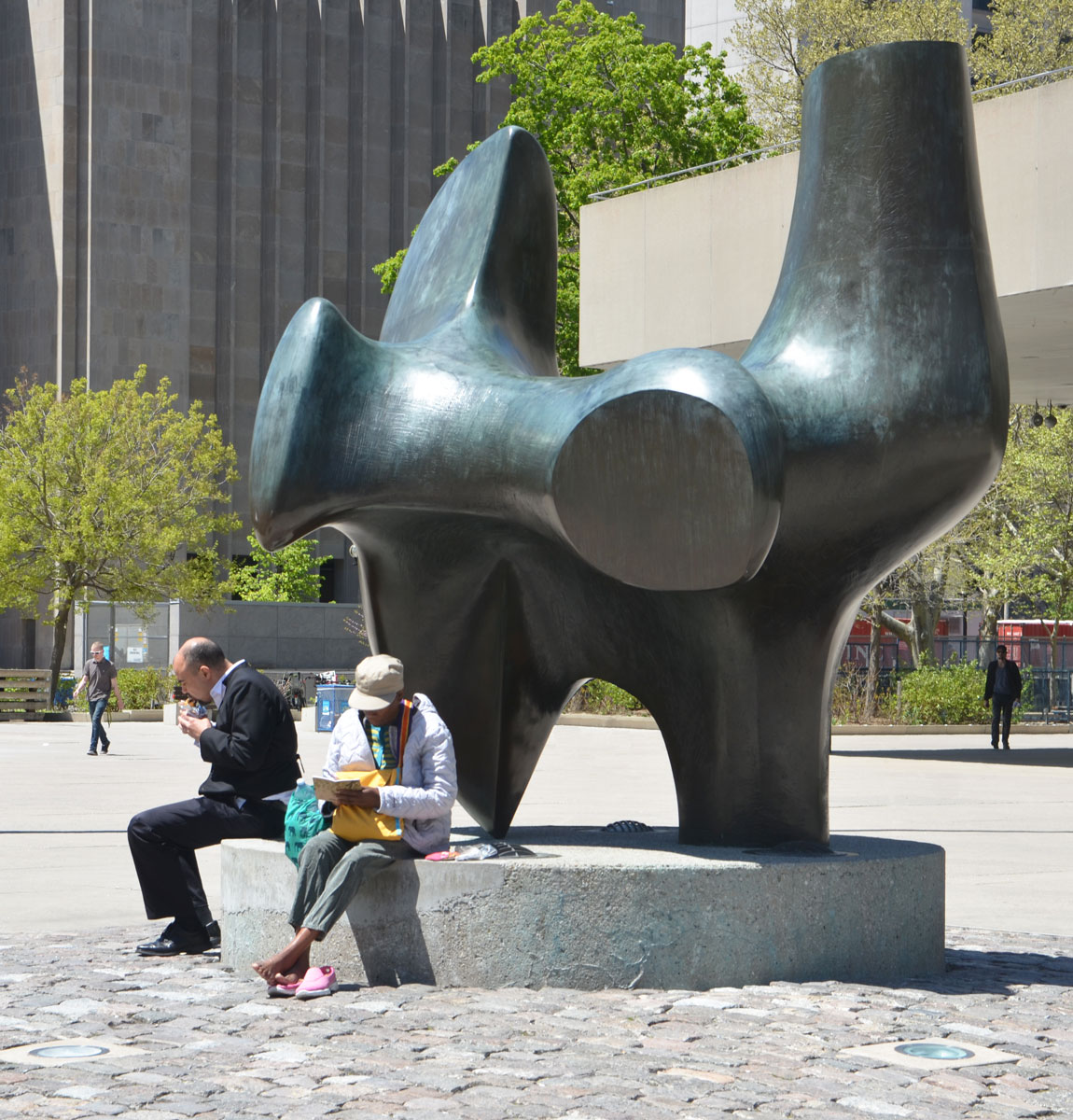
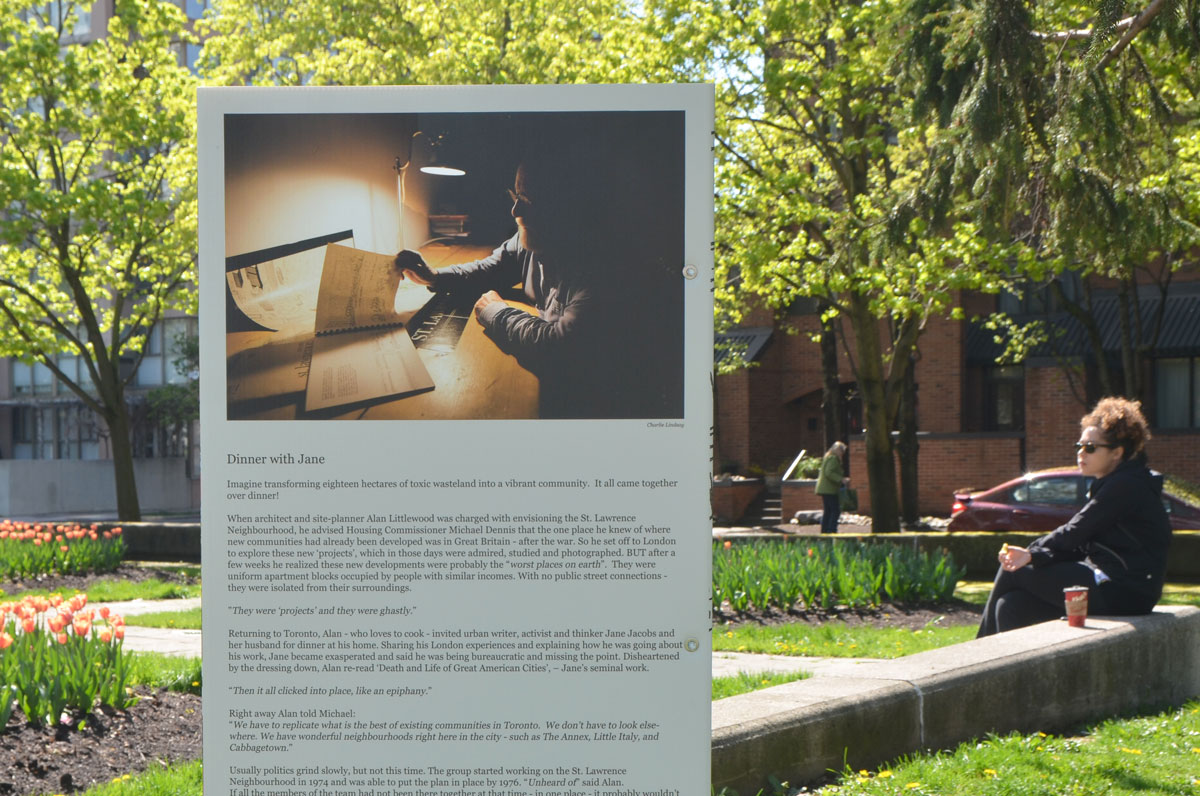
On Friday morning, my original goal was to find ‘Residents of the Esplanade’, a CONTACT Photography Festival outdoor exhibit at David Crombie Park but it was such a beautiful morning that I didn’t stop there. I found more than just the ‘Residents’.
Forty years ago, May 1976, the site plan for The Esplanade neighbourhood was approved. Since then, it has become home to a very diverse group of people. And it is those people that this installation celebrates on the 40th anniversary of the founding of the neighbourhood.
Crombie Park runs along the south side of The Esplanade between Berkeley street and Lower Jarvis. The installation consists of a number of small white rectangular pillars with the picture and story of person on either side.


People were out enjoying the morning; school kids were playing basketball at recess.

Flowers were blooming.

below: Looking towards Lower Jarvis Street and downtown Toronto.

below: One street beyond Lower Jarvis is Market Street. It dead ends at the railway tracks. The long structure on the right is a parking garage.
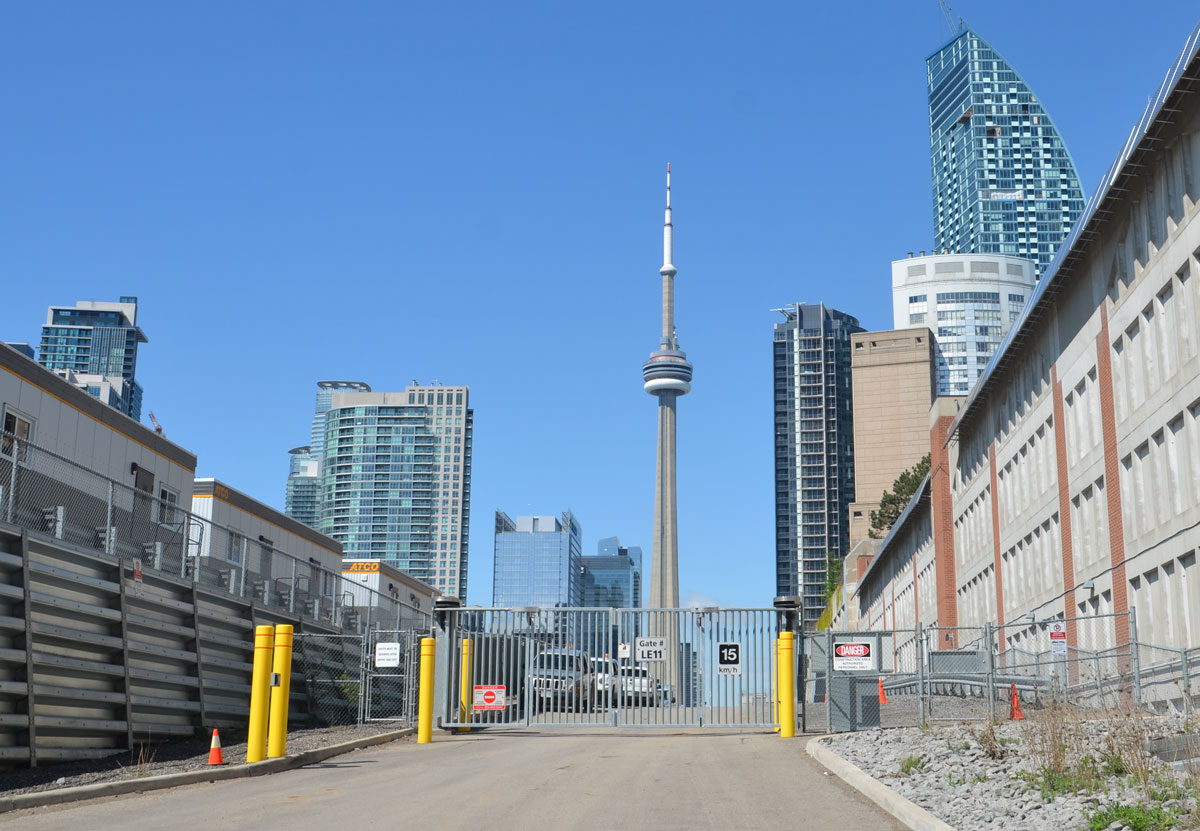
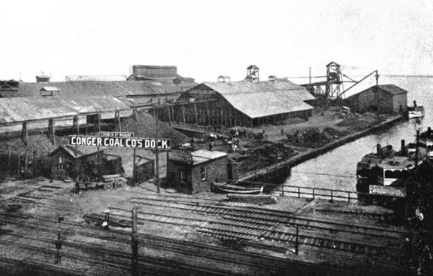
below: After a small backtrack up Market Street, I went through Conger Coal Lane to Church Street. I don’t think I have walked this way before. The lane was named in commemoration of the Conger Coal Company whose yard and wharf was nearby. It was one of the many companies that provided Toronto with coal back in the day when coal fueled the city. It was started in 1870 by Mr. P.D. Conger. In 1913, Sterling Coal company bought Conger and the name was changed to Conger Lehigh Coal Co.

below: A very old photo of the Conger Coal Company dock at the foot of Church Street, back when Church street ended at Lake Ontario
below: Tucked into a corner on Church street immediately south of Front Street, is an art installation by Paul Raff called ‘Shoreline Commemorative’. A topography of limestone forms the base of the work. A glass ball representing the line between sky and water sits on top of a tripod that tries to evoke a land surveyor’s tripod. The words on the wall say “For 10,000 years this was the location of Lake Ontario’s shoreline. This brick wall stands where water and land met, with a vista horizon”

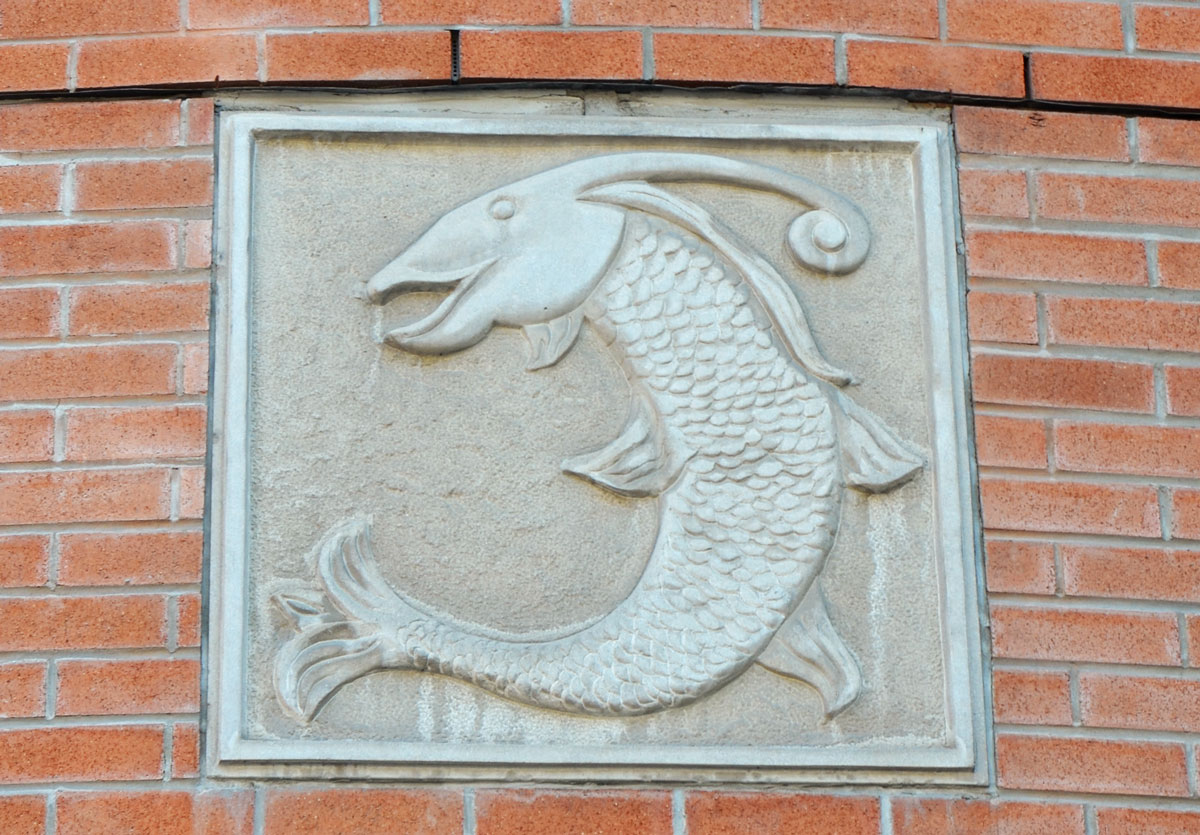
below: Continuing the lake theme, a little fish out of water, jumping over the entrance to a condo.
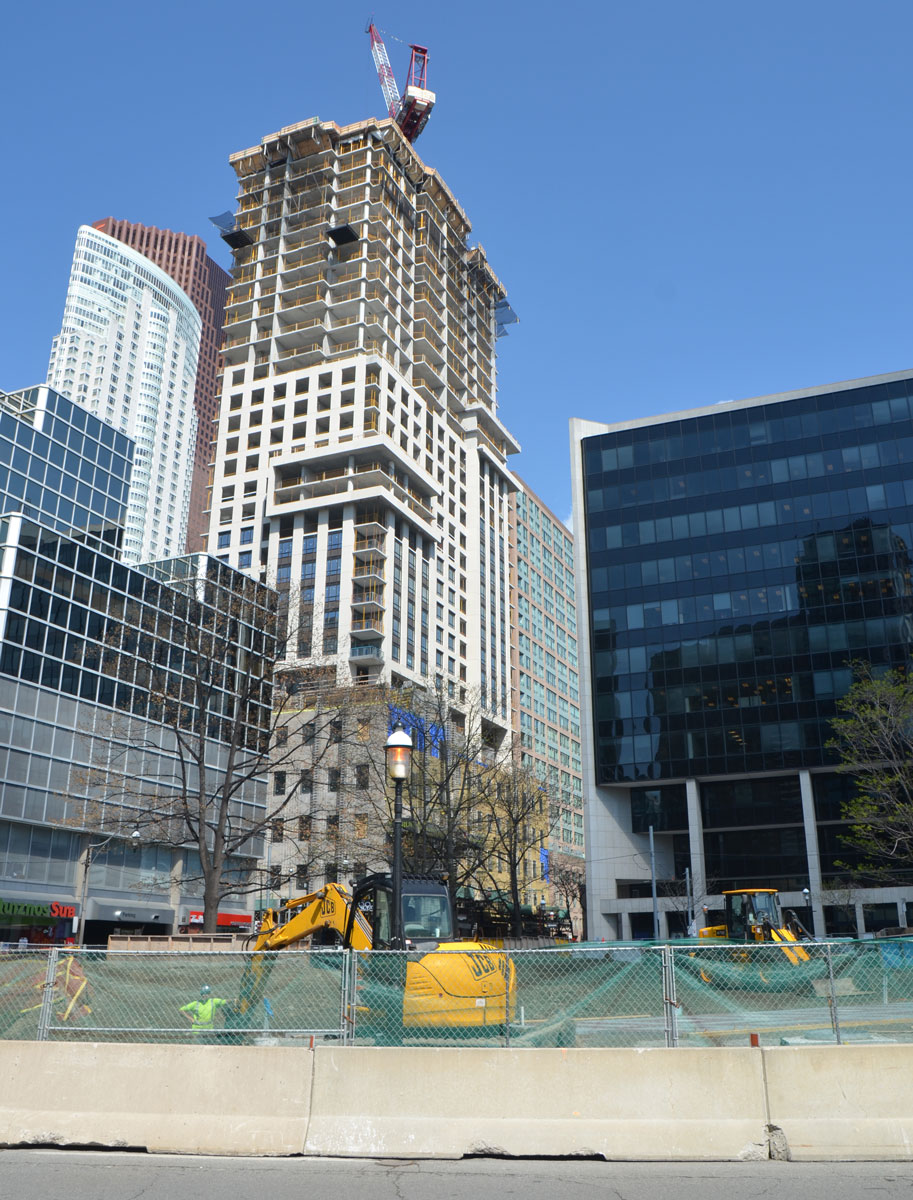
below: From the lake theme to another common theme in the city, construction. Spring is the beginning of construction season and here Berczy Park is being upgraded. In the background a new condo is being built but as we all know condo construction ‘season’ never ends. In fact, the challenge might be to find a place in this city where there isn’t a condo being built.
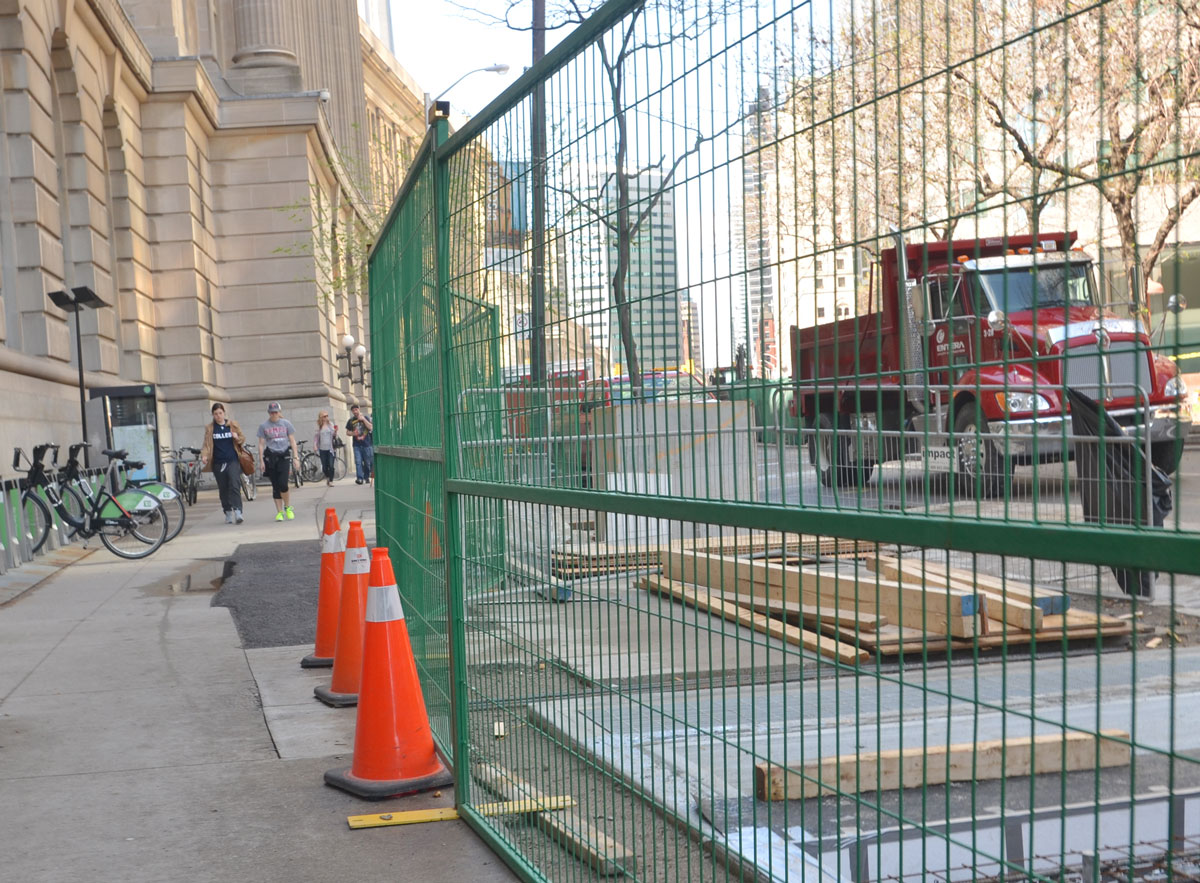
below: I walked past the never ending Front Street construction. Construction in front of Union station seems to be finished, but this stretch of Front Street just west of the station is still being worked on. There have been fences here so long that I can’t remember a time when they weren’t here.

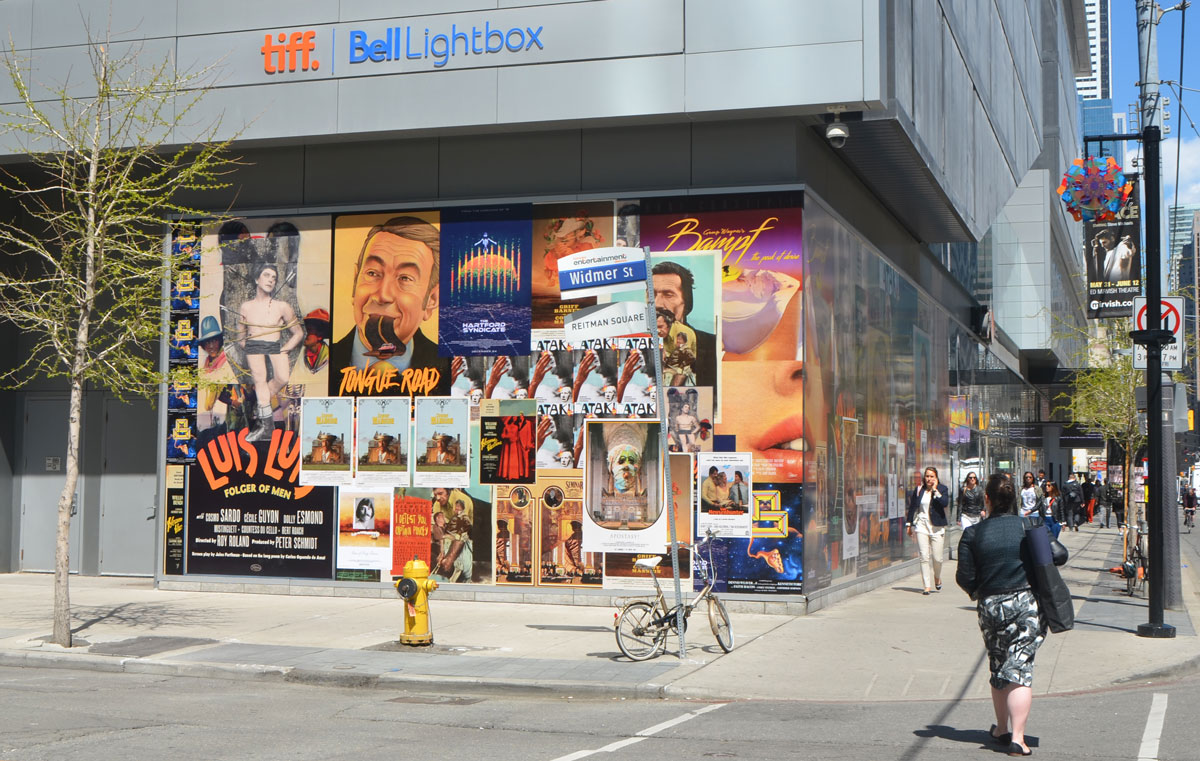
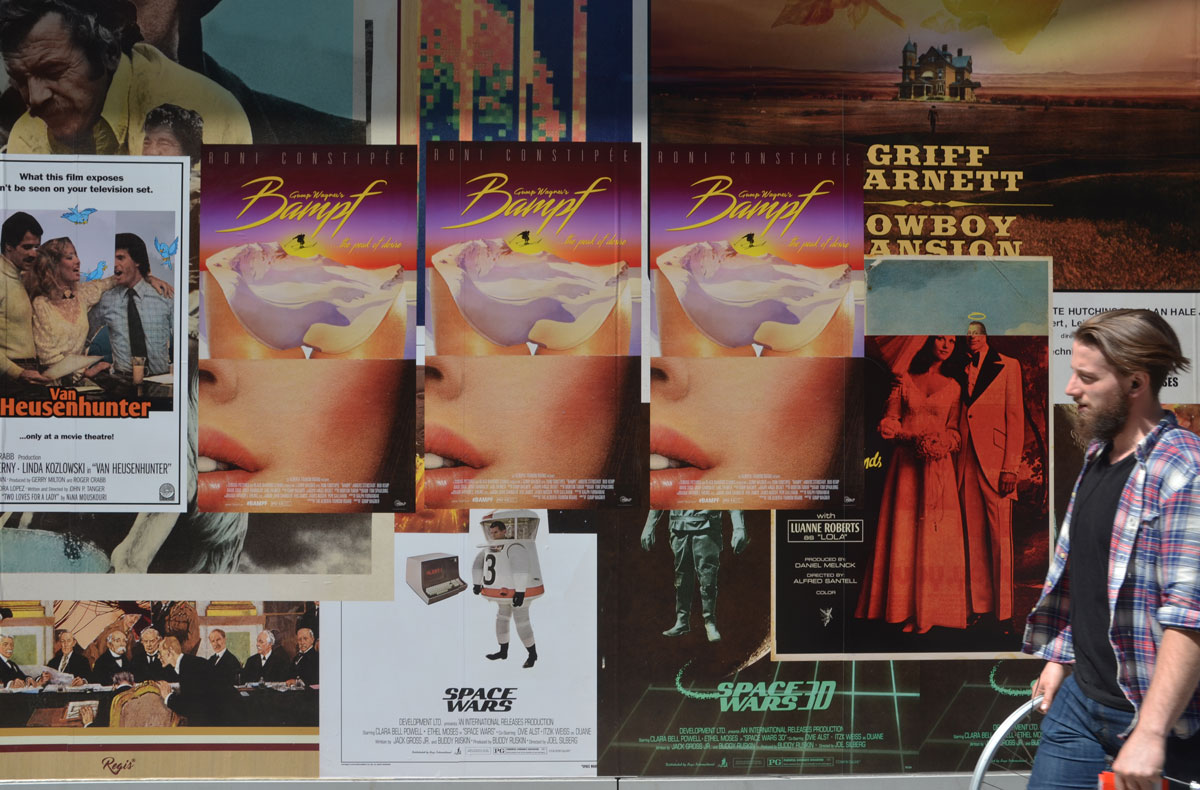
It’s common to see posters pasted on walls so finding movie posters on the walls of the tiff Bell Lightbox didn’t strike me as unusual. I walked past this display until I noticed the sign that marked this as a CONTACT Photography Festival installation. Fake movie posters, many designed with a touch of humour, that look just like the real thing.

below: The installation, titled ‘Coming Attractions’ covers the corner windows and wall space. The posters were designed by ‘Long Weekend’ which is a collective of artists working out of Winnipeg. They were made from ads and illustrations from old books and magazines.
On the other side of King street, and just a but further east, is a series of eleven large images taken from past editions of ‘Toilet Paper’, a biannual magazine founded by Maurizio Cattelan and Pierpaolo Ferrari. They hint at advertising and they blur the line between fantasy and reality.
below: Muhle is a German company that makes shaving products and one of their blades looks identical to the one in this picture.
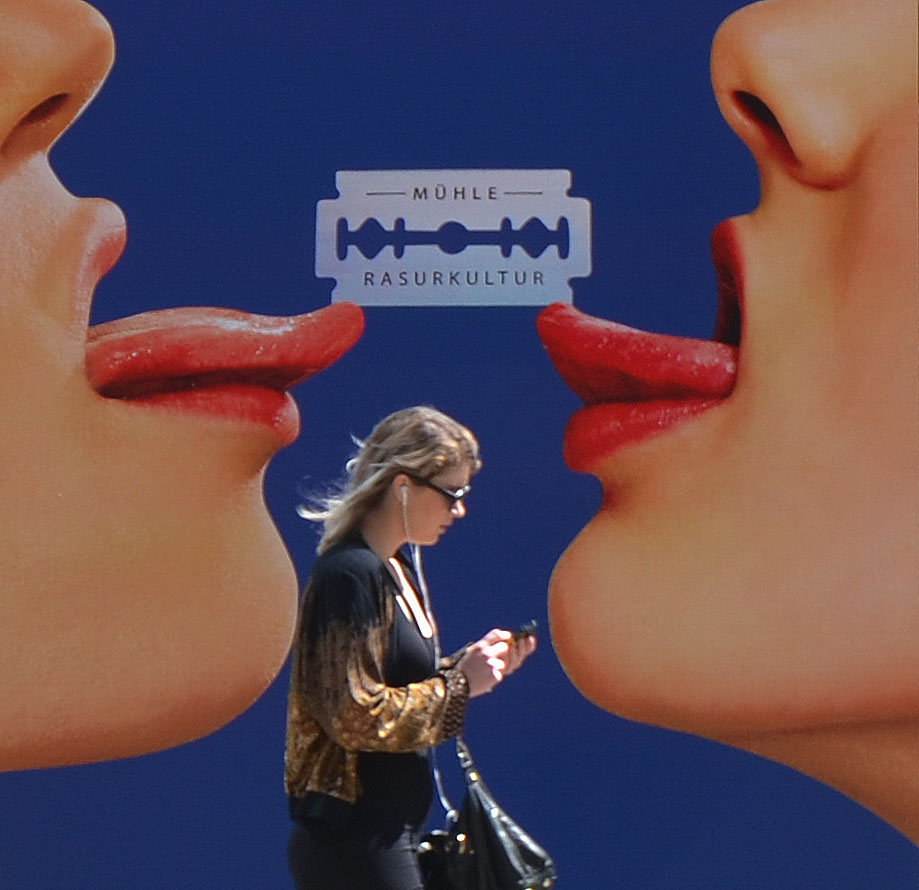
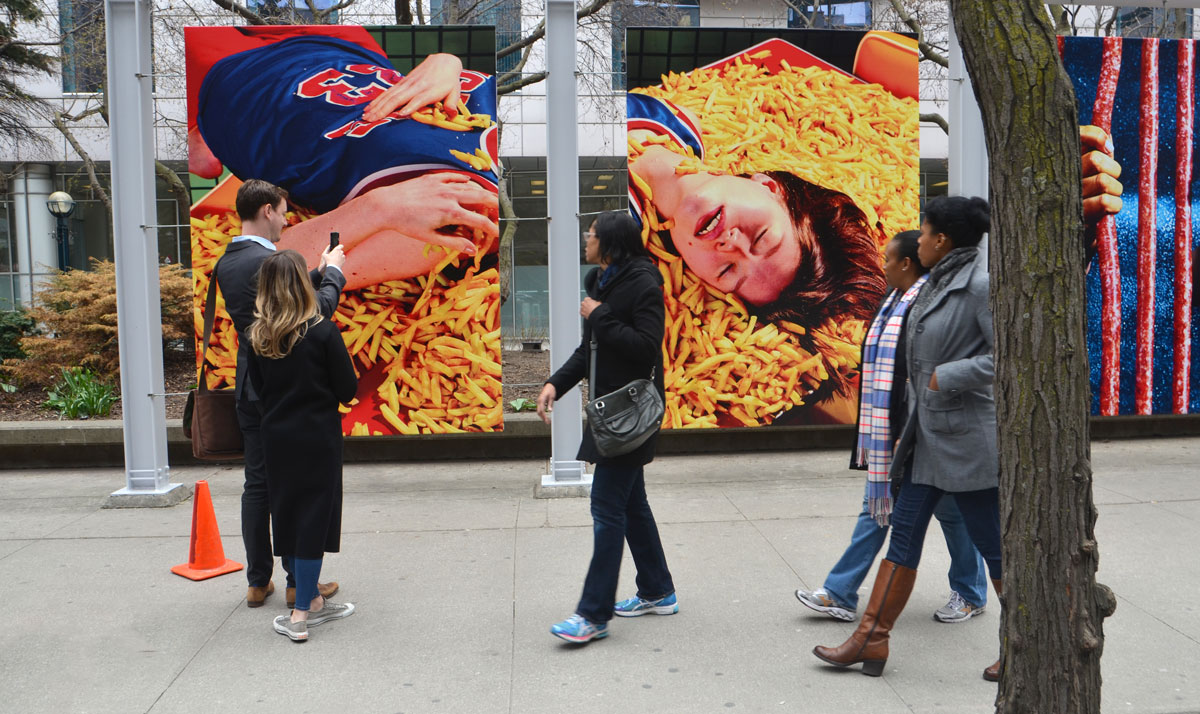


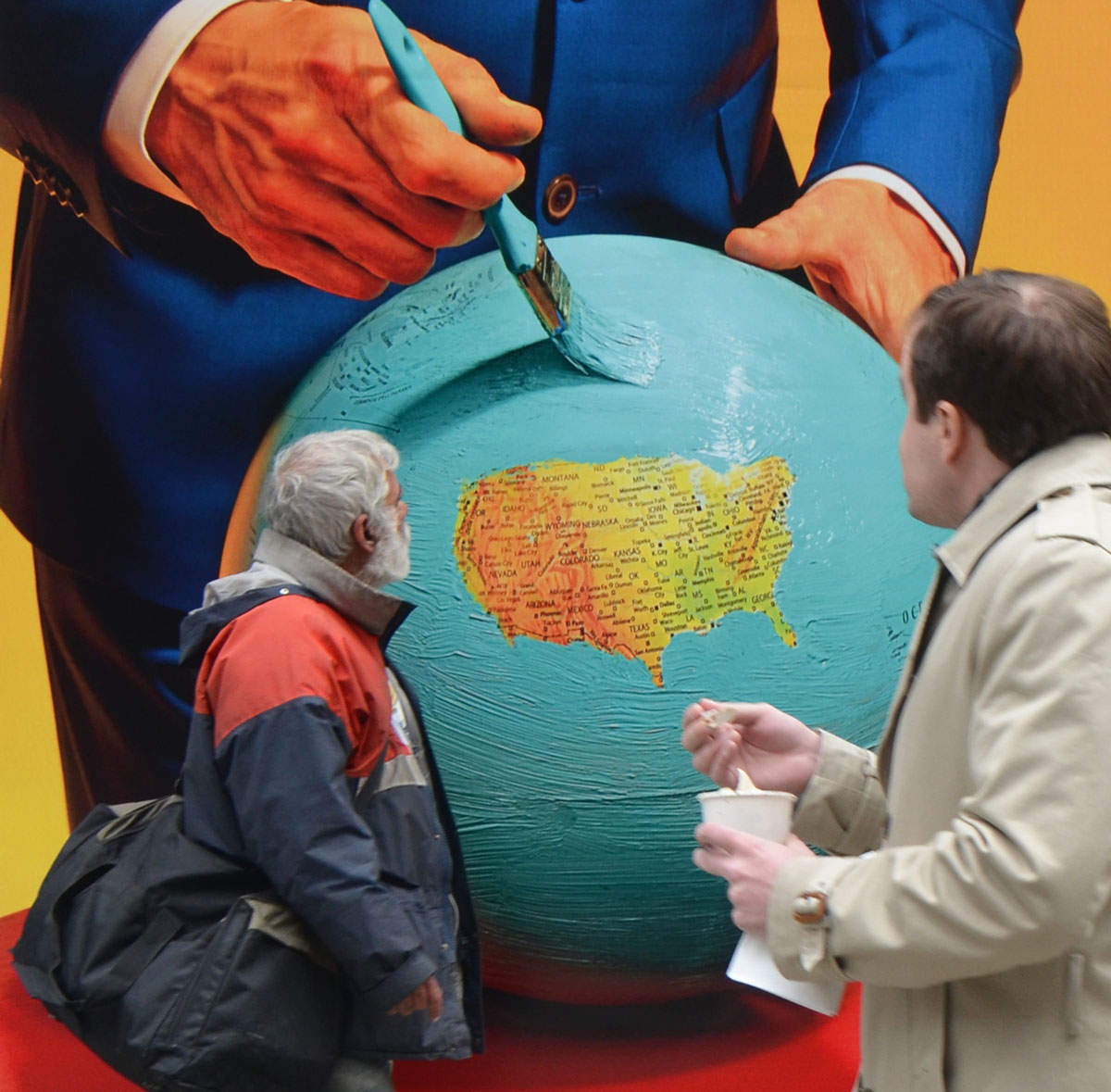

If you like these images, you might also like Toilet Paper’s website.
Spread around Kensington and Chinatown are 20 large black and white photos taken by a number of freelance photojournalists who are part of a group called #Dysturb. One of their goals is to present photojournalism in new ways, including as street art, with the aim of engaging people and encouraging discussion of global issues. The images are part of an exhibit for the Scotiabank CONTACT Photography Festival.
Kensington has had a problem with taggers for a while. Often street art gets vandalized in that area. The #Dysturb photo that was at 56 Kensington (under Mona Lisa) has already been torn down and a couple of others have been ripped.
Pictures of some of the images that are part of the exhibit are shown below. I have included a partial transcription of the words that accompany each picture.
Libyan Coasts, August 1, 2015
Photo by Christophe Stramba-Badiali/Haytham
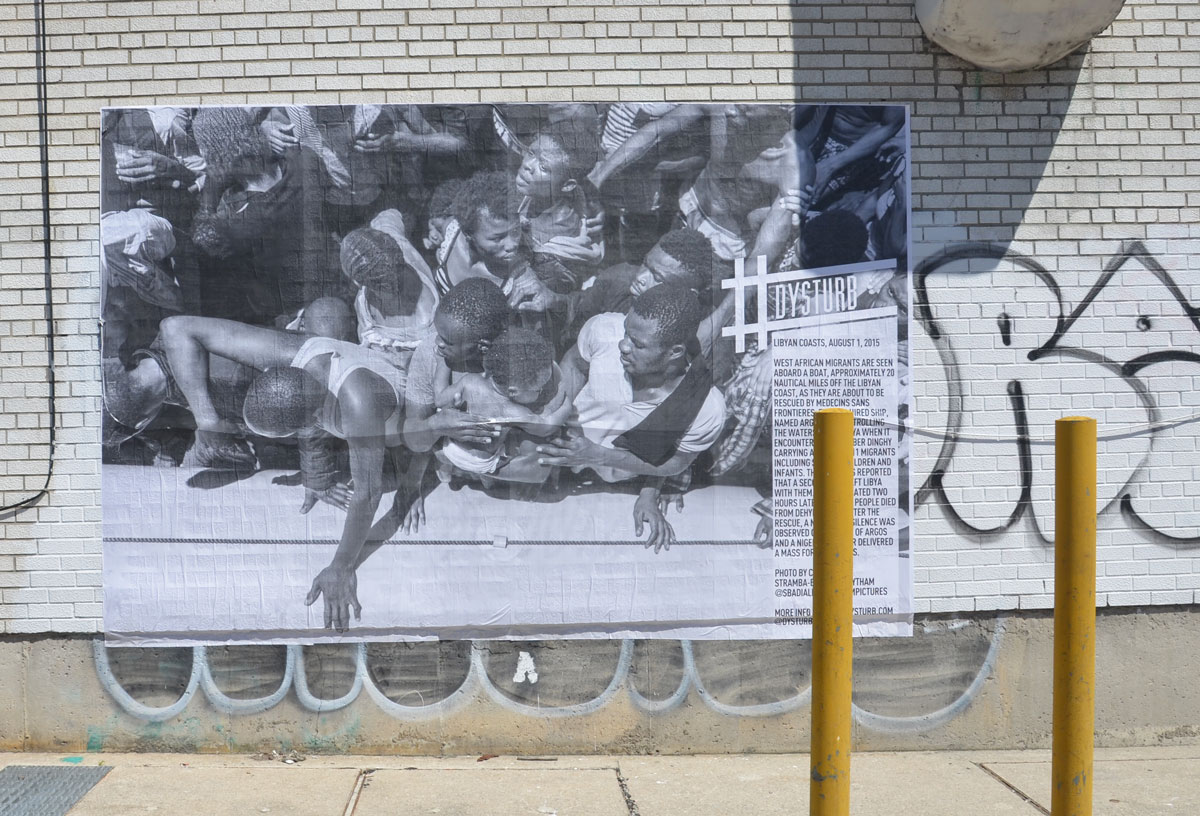
West African migrants are seen aboard a boat, approximately 20 nautical miles off the Libyan coast, as they are about to be rescued by Medecins Sans Frontieres. The MSF-hired ship, named Argos, was patrolling the waters off Libya when it encountered one rubber dinghy carrying a total of 111 migrants including several children and infants. “
Barpak, Ghorka District, Nepal, May 9, 2015 ”
Photo by Renaud Philippe/Hans Lucas

Children play in a cloud of dust and gravel thrown by an Indian army helicopter landing in Barpak Nepal. The community is at the epicenter of the devastating earthquake that struck April 25, 2015, taking over 8000 lives. Of Barpak’s 1400 houses, only 20 remain standing. The rest of the town is a pile of rubble that blends into the rocky landscape. An archway that somehow survived the quake greets visitors with a rueful ‘Welcome to Barpak’.”
Shaanxi Province, Henan, China, February 27, 2014
Photo by Sim Chi Yin/Vii

Gold miner, He Quangui, battling silicosis, struggles to breathe while cradled in the hands of his wife Mi Shixiu. After many attempts to stabilize his breathing, in the early hours of the next morning her tried to kill himself to end the suffering. He contracted the irreversible disease working in illegal gold mines in China’s Henan province. He is among some six million workers in China who have pneumoconiosis – the country’s most prevalent occupational disease.”
Cizre Turkey, October 30, 2015.
Photo by Emilien Urbano/Myop for Le Monde
NOTE: I took this picture on Friday. Today (Monday) it was gone.
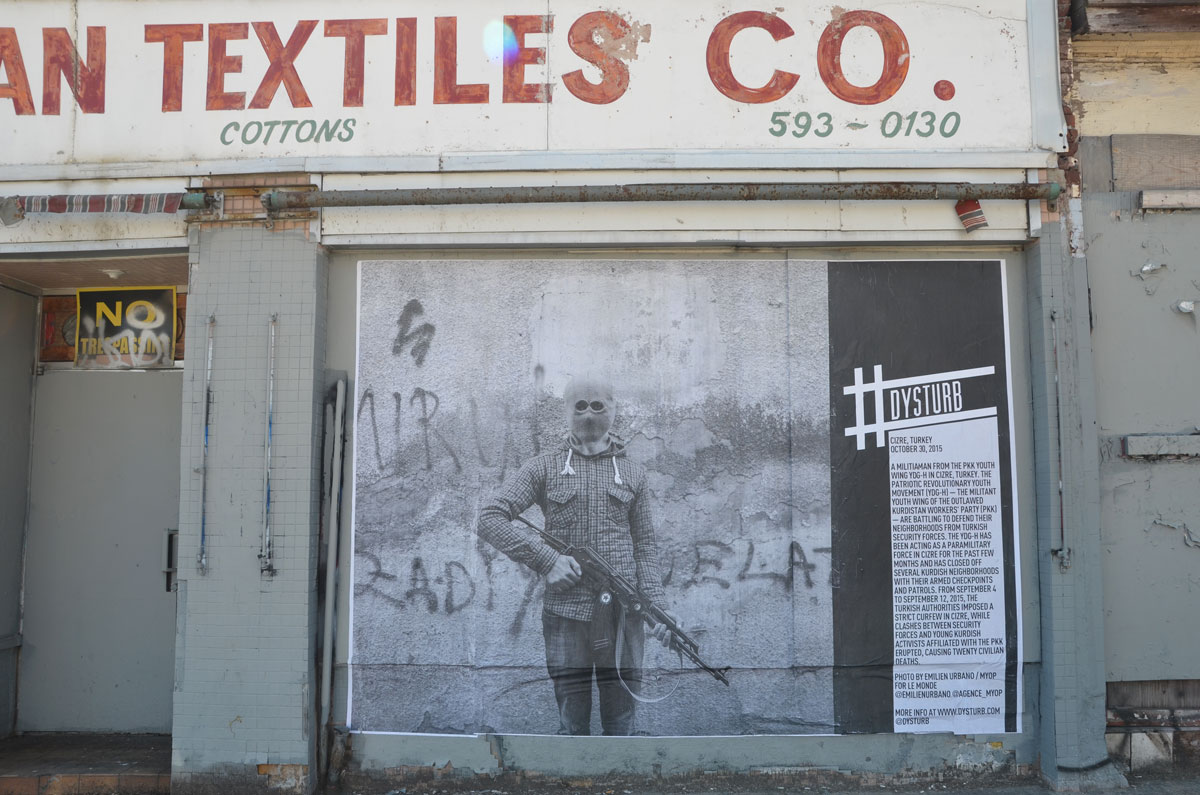
A militiaman from the PKK Youth wing YDG-H in Cizre Turkey. The Patriotic Revolutionary Youth Movement (YDG-H) – the militant youth wing of the outlawed Kurdistan Workers’ Party (PKK) – are battling to defend their neighbourhoods from Turkish security forces. The YDG-H has been acting as a paramilitary force in Cizre for the past few months and has closed off several Kurdish neighbourhoods with their armed checkpoints and patrols.
Fort McKay, Alberta, Canada, August 12, 2015
Photo by Ian Willms/Boreal Collective

Dez, 7, plays in his bed. Dez was born with an underdeveloped heart and has received multiple open heart surgeries. His family and healthcare professionals in Fort McKay believe that his condition was caused by environmental pollution. Fort McKay is an indigenous community that is surrounded by oil sands developments.”
Kunduz City, Afghanistan, November 18, 2015.
Photo by Andrew Quilty/Oculi

Najibah tries to comfort her daughter Zahara, 8, as they weep over the grave of their husband and father, Baynazar. Baynazar, 43, was wounded by gunfire on his way home fromwork during the Taliban takeover of Kunduz in late 2015. He was taken to the nearby Doctors Without Borders (MSF) trauma centre. In the early hours of October 3, during his second operation, a US AC-130 aircraft attacked the hospital for more than half an hour, killing 43 MSF staff, patients and nurses. Dozens more were wounded.
#CONTACT16
May is photography month in Toronto. It is the month when there are numerous exhibits in public spaces and in galleries, all part of the CONTACT Photography Festival. Over the next few weeks I hope to visit many of the exhibits and blog about some of them. From past experience I have discovered that a lot of the public installations appear before May 1st so I went exploring yesterday.
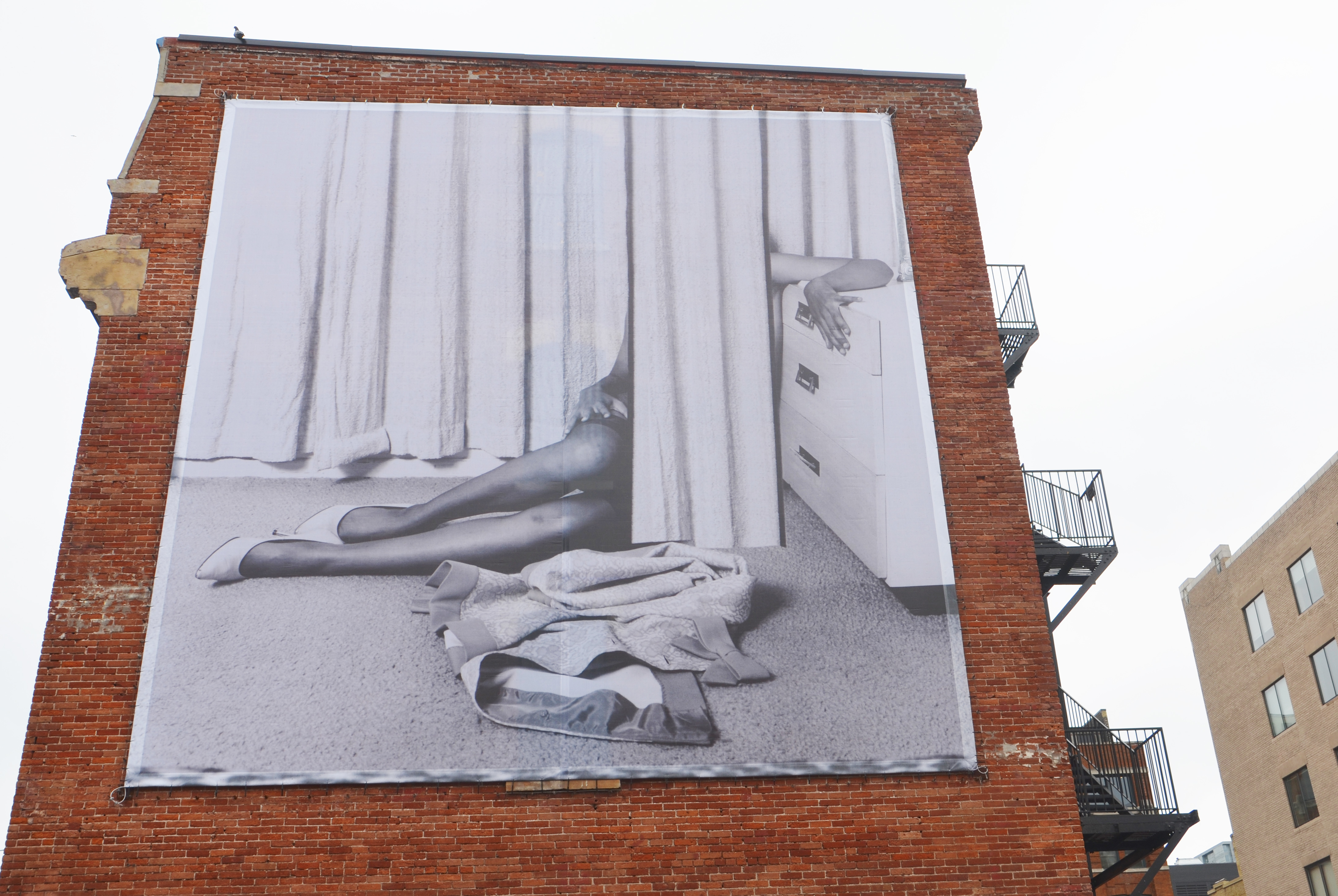
below: Looking south from Spadina and Adelaide…. Partially obscured by a building, on the right in this photo, is the first large black and white photo that I saw.

below: Up close, ‘Drape’ by Eva Stenram. Stenram has taken a 1960’s pin-up photograph of a woman and manipulated it. She has brought the background, the drapery, forward and has covered up the original subject in the picture.
below: Looking west on Wellington from Spadina. The light grey building is the Old Press Hall (Globe and Mail) which will be demolished in the near future.

below: Up close, ‘Stopping Point’ by an unknown photographer. The original title and description was: ‘Along the new Highway, which runs from Smooth Rock Falls to Fraserdale, Ontario, there’s no sign of human habitation apart from one empty lumber camp, c.1966.
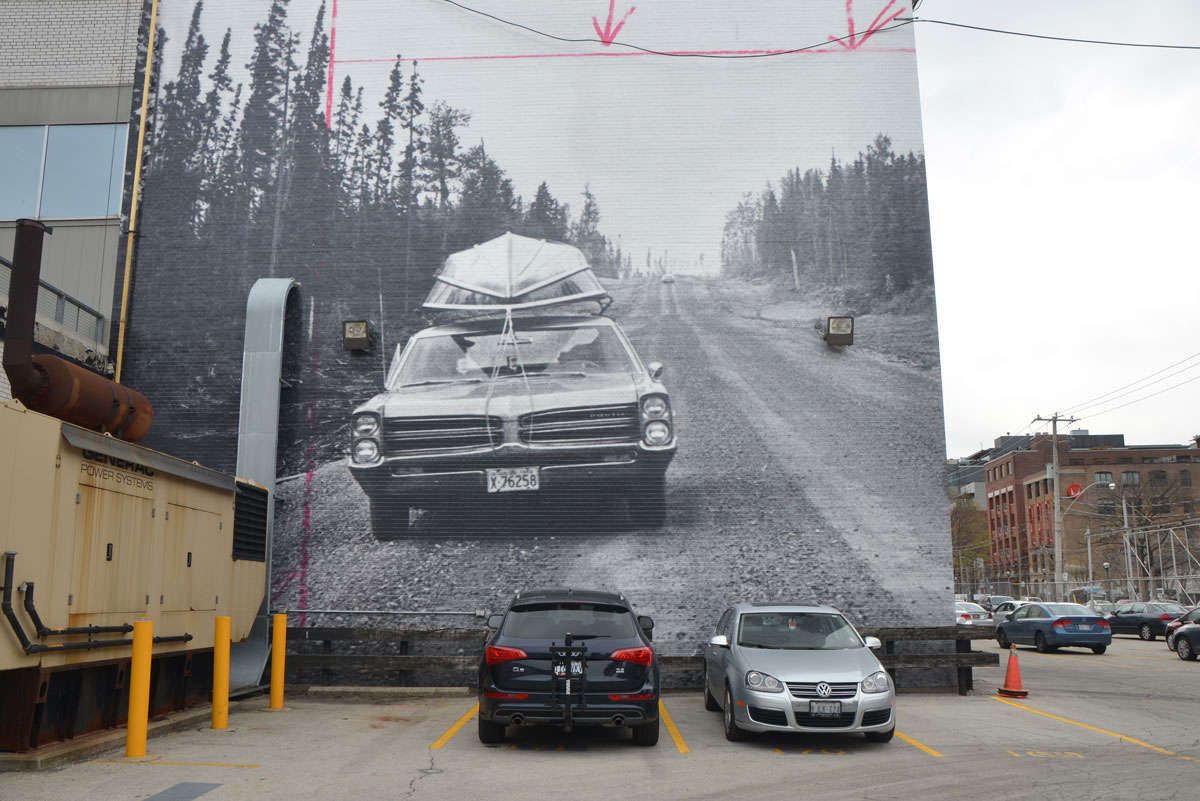
The above photograph is one of 750,000 photos in the Globe and Mail’s picture library. 100,000 of their old photos are being digitized to create a new historical archive. From these, a collection of 20,000 prints will be donated to the newly formed Canadian Photography Institute at the National Gallery of Canada.
More of the photos from the Globe and Mail’s collection are on view inside the Old Press Hall.
Rob Ford
City councillor and former Mayor of Toronto
May 1969 – March 2016,
Funeral procession from City Hall to St. James Cathedral, 30 March
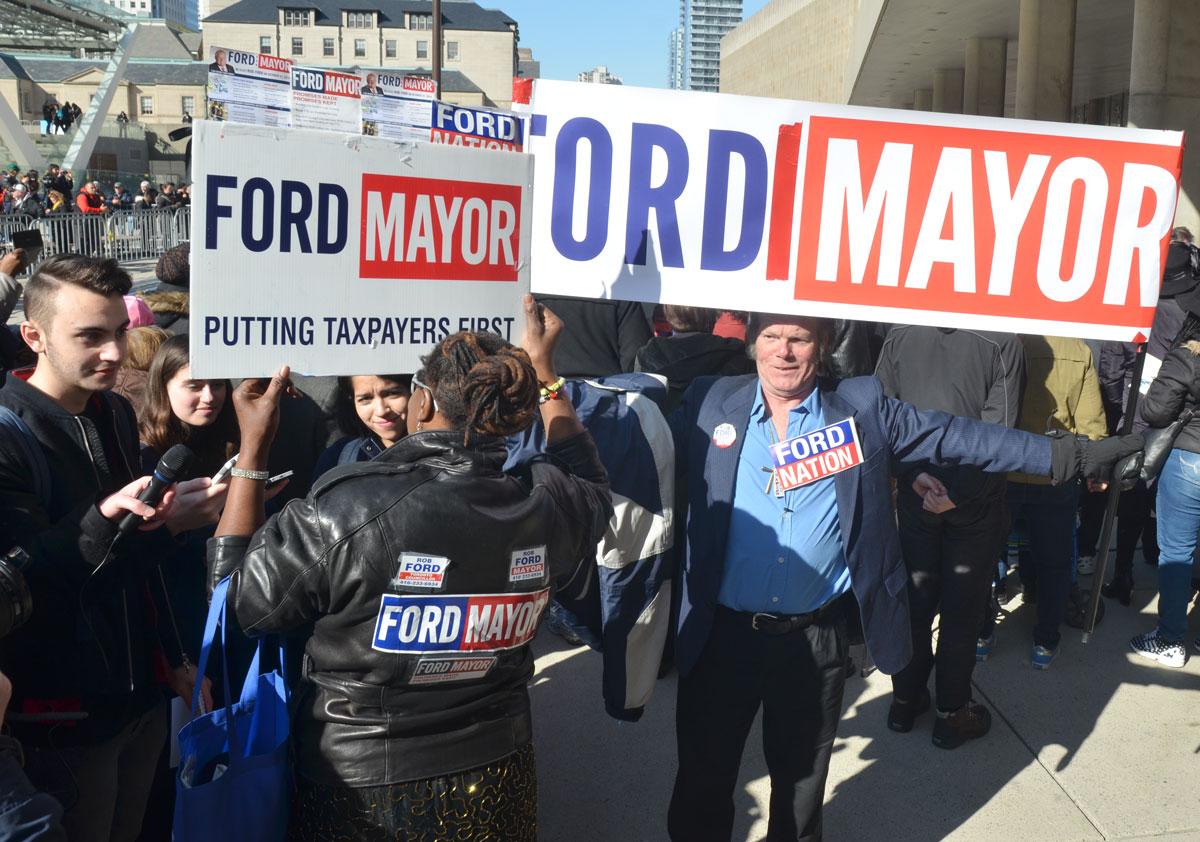
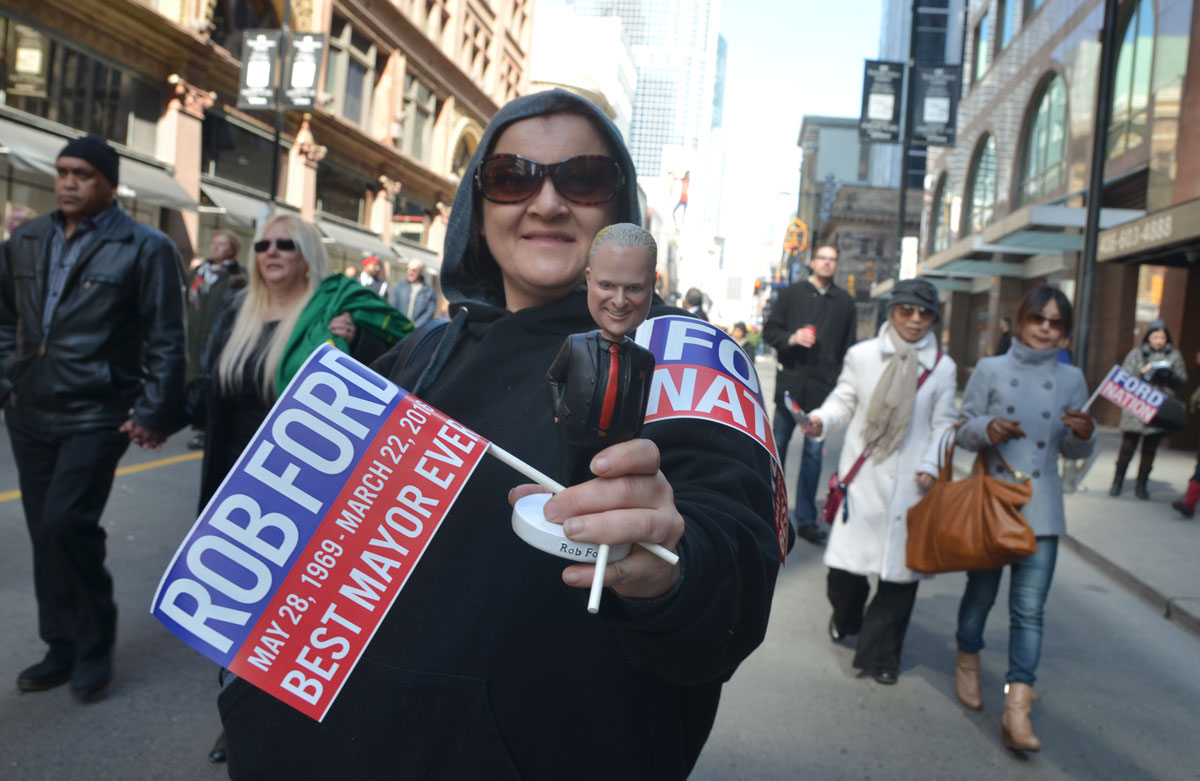
below: For two days Rob Ford lay in repose at City Hall where people could pay their respects. And many did. Yesterday, the line up wound around the corner of City Hall as people waited their turn. Some people loved him; some people hated him. Possibly there were those who were indifferent.

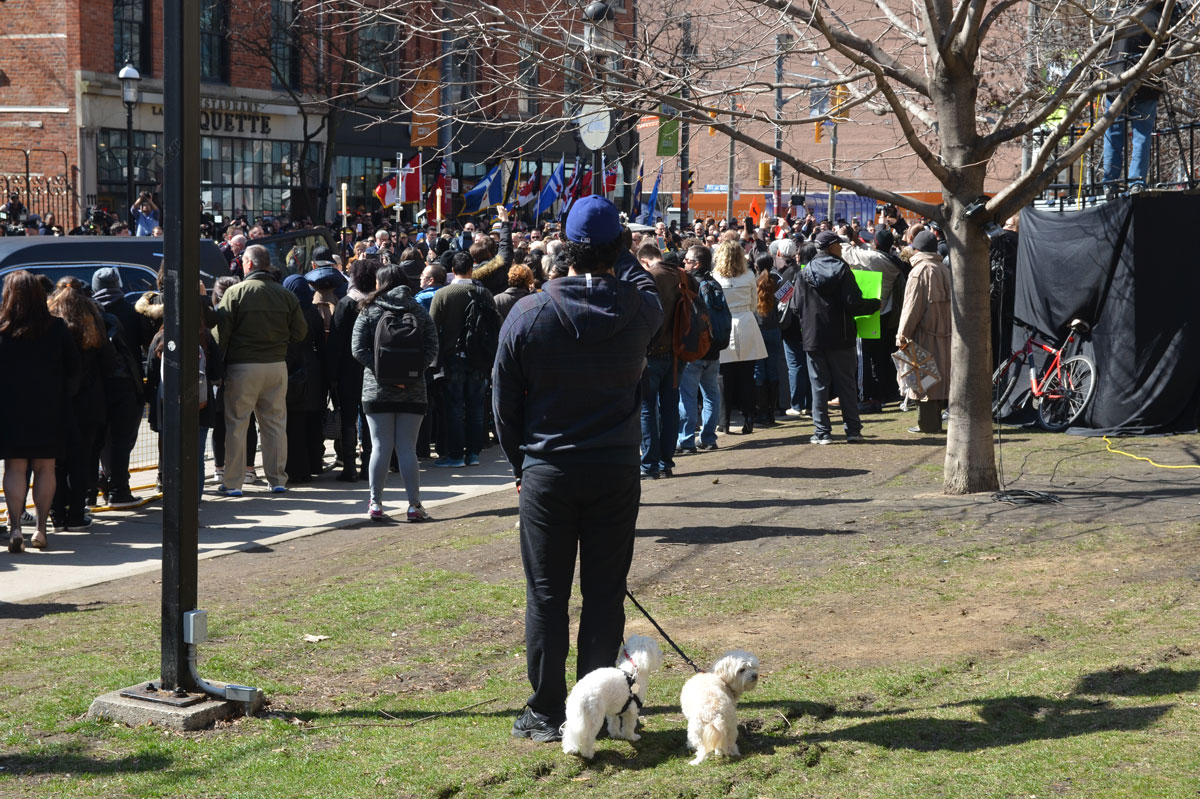
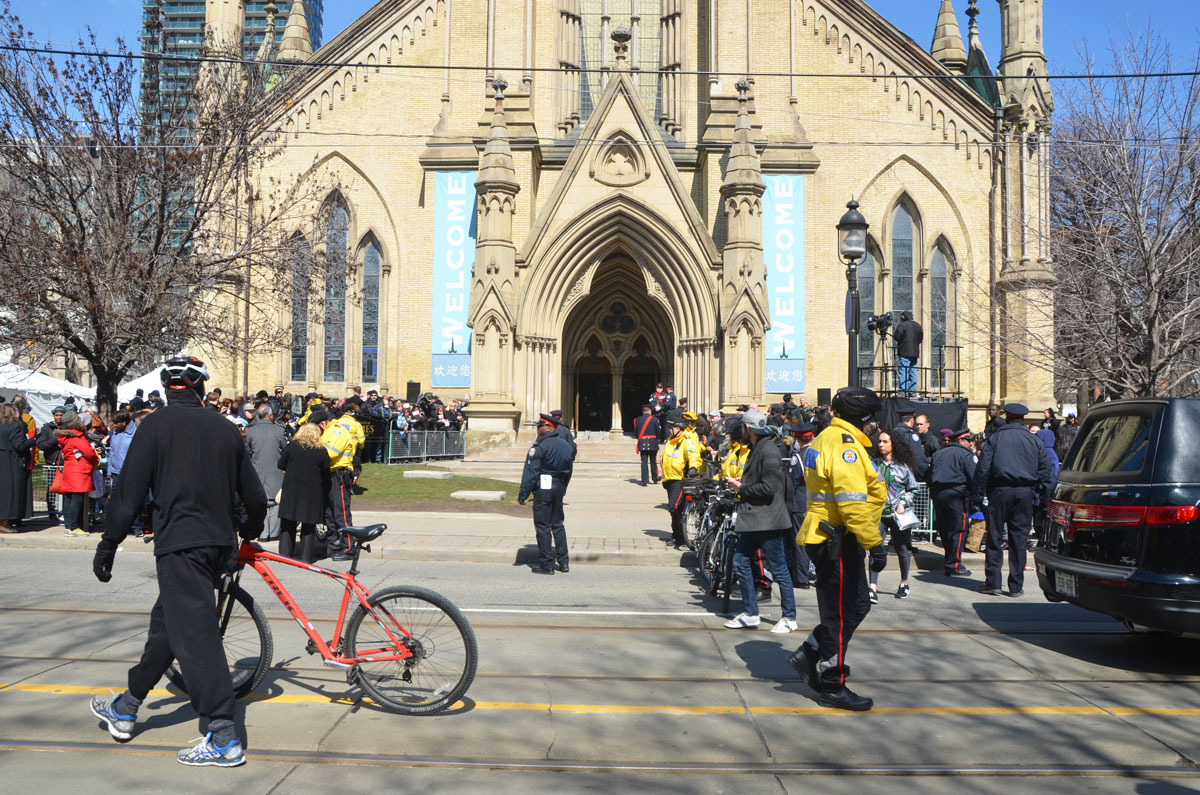
This morning there was a short procession from City Hall to the noontime funeral at St. James Cathedral.
below: After arriving at City Hall, Doug Ford greets the crowd.

Although the procession was scheduled to begin at 10:30, it didn’t start until close to 11:30. A group of people waited at Nathan Phillips Square including some of Rob Ford’s supporters. I overheard a conversation between two men who were discussing what they thought of politics and politicians, most of it negative. At one point they declared that all career politicians should be kicked out of office. I thought to myself, you mean guys like Rob Ford? Wasn’t he a career politician?


About 20 or so people were holding a large flag made of a couple of Canadian flags and all the provincial flags stitched together. It was a very diverse group of people, diverse in age as well as in ethnic background. They were joking about whether or not they were going to be on the front page of the ‘Sun’. We shall see!

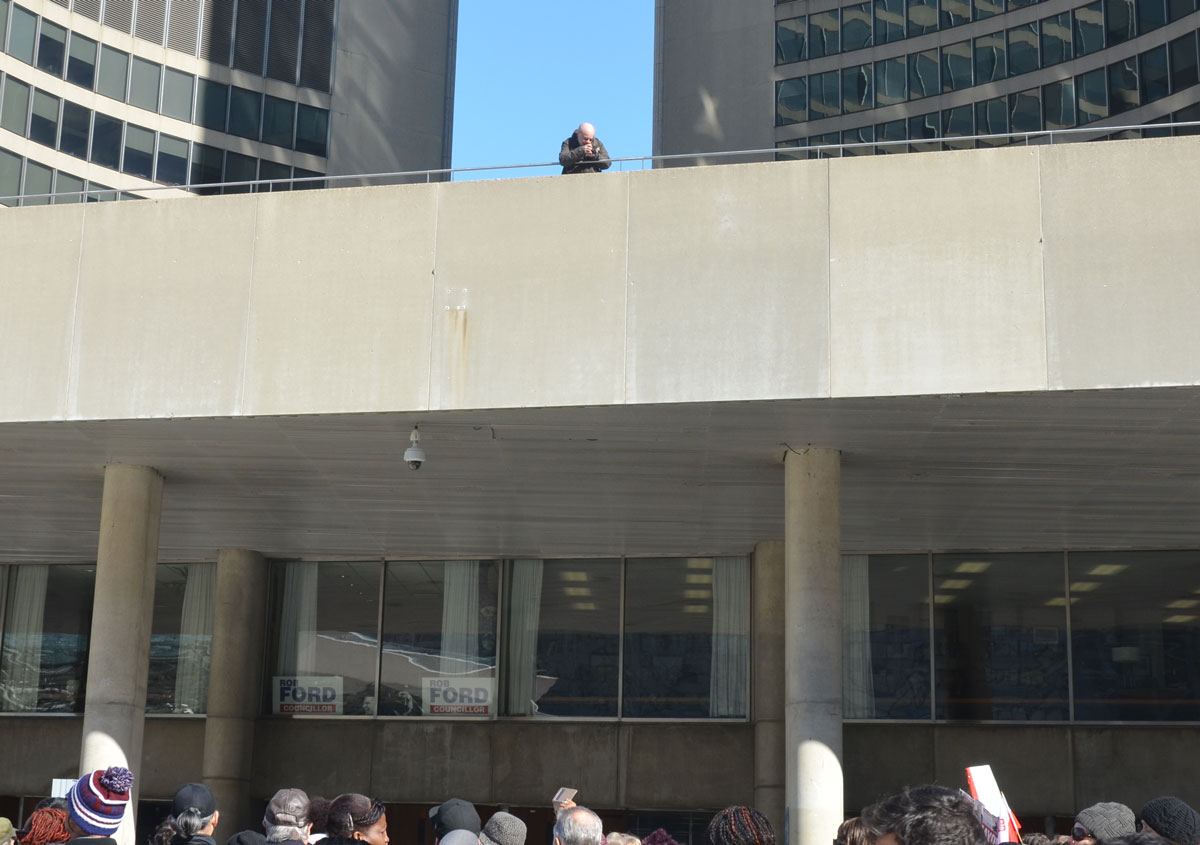
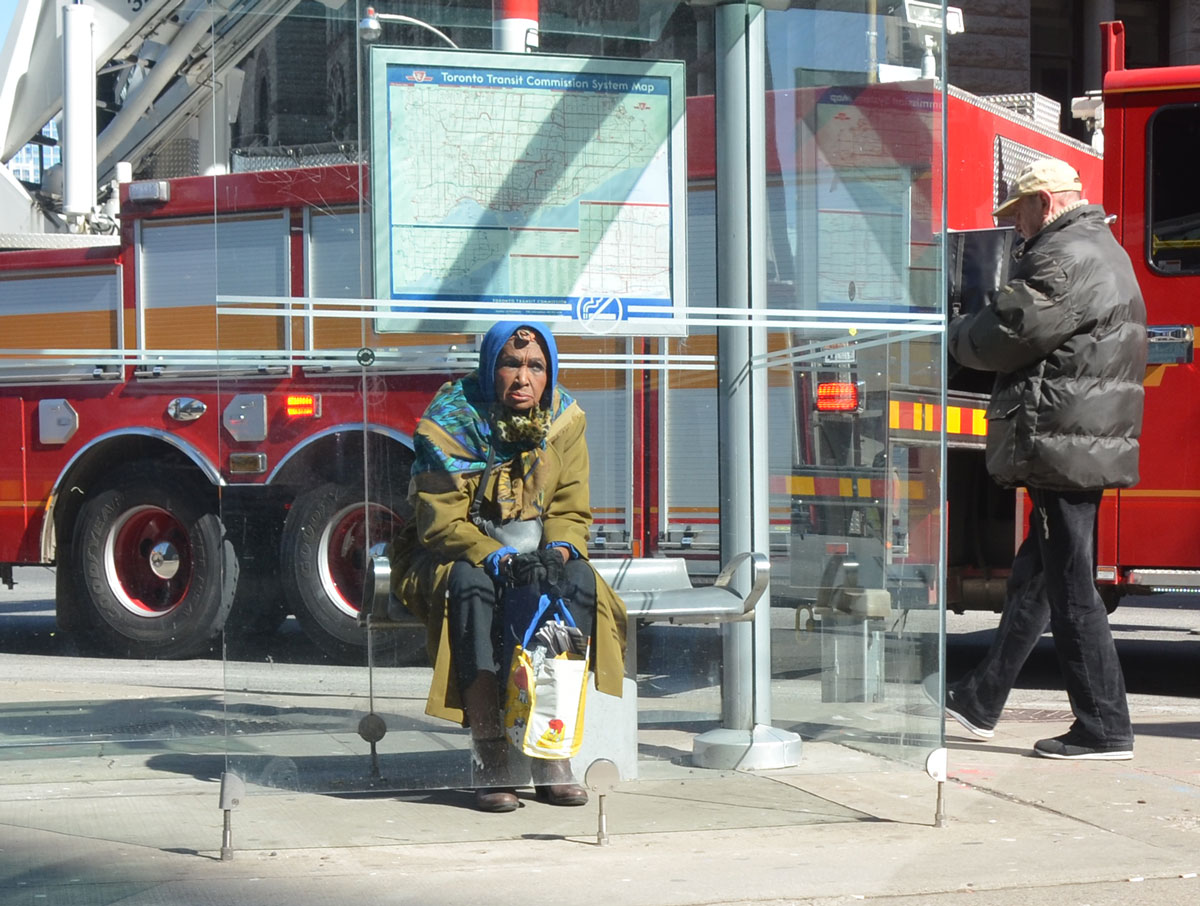
below: A woman finds a quiet place to sit and wait.
below: The police were in position, ready to start, long before the procession began. So was the media and it was a very large media presence indeed.

below: The Toronto Fire Department had a large Canadian flag on display at Queen and Bay streets, near the beginning of the procession route.
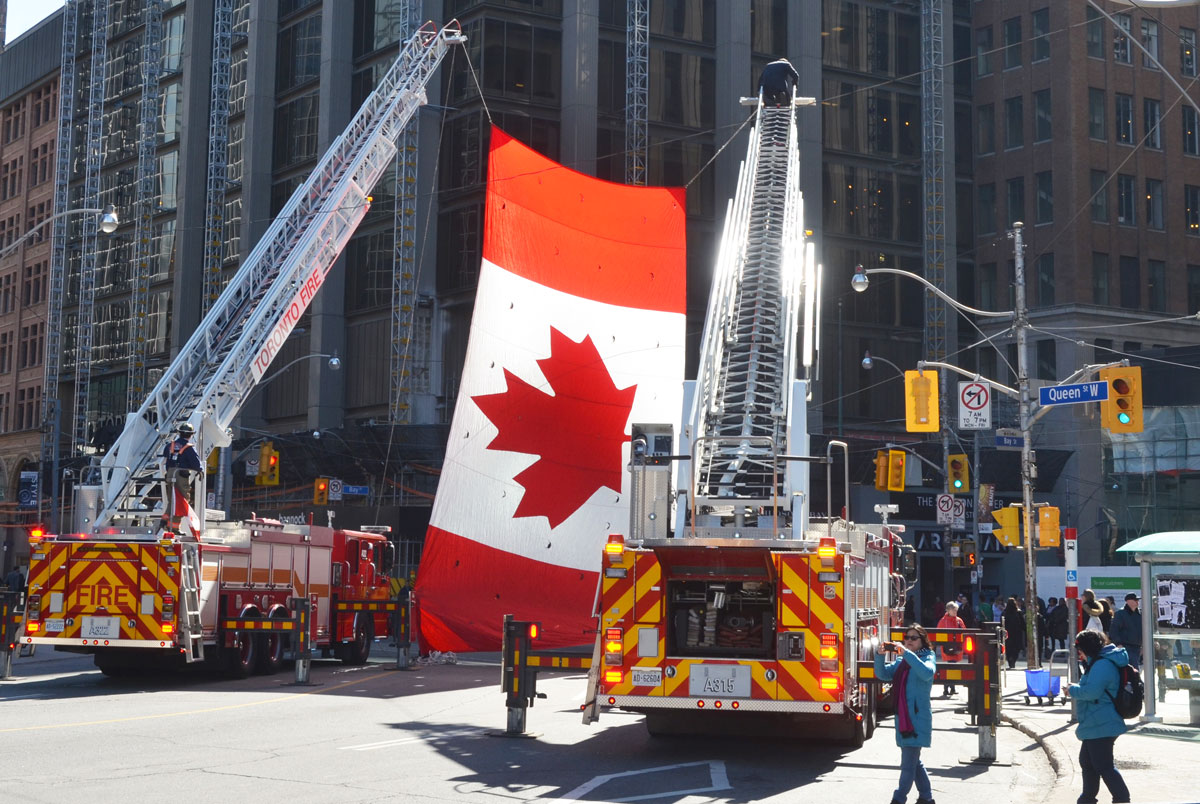


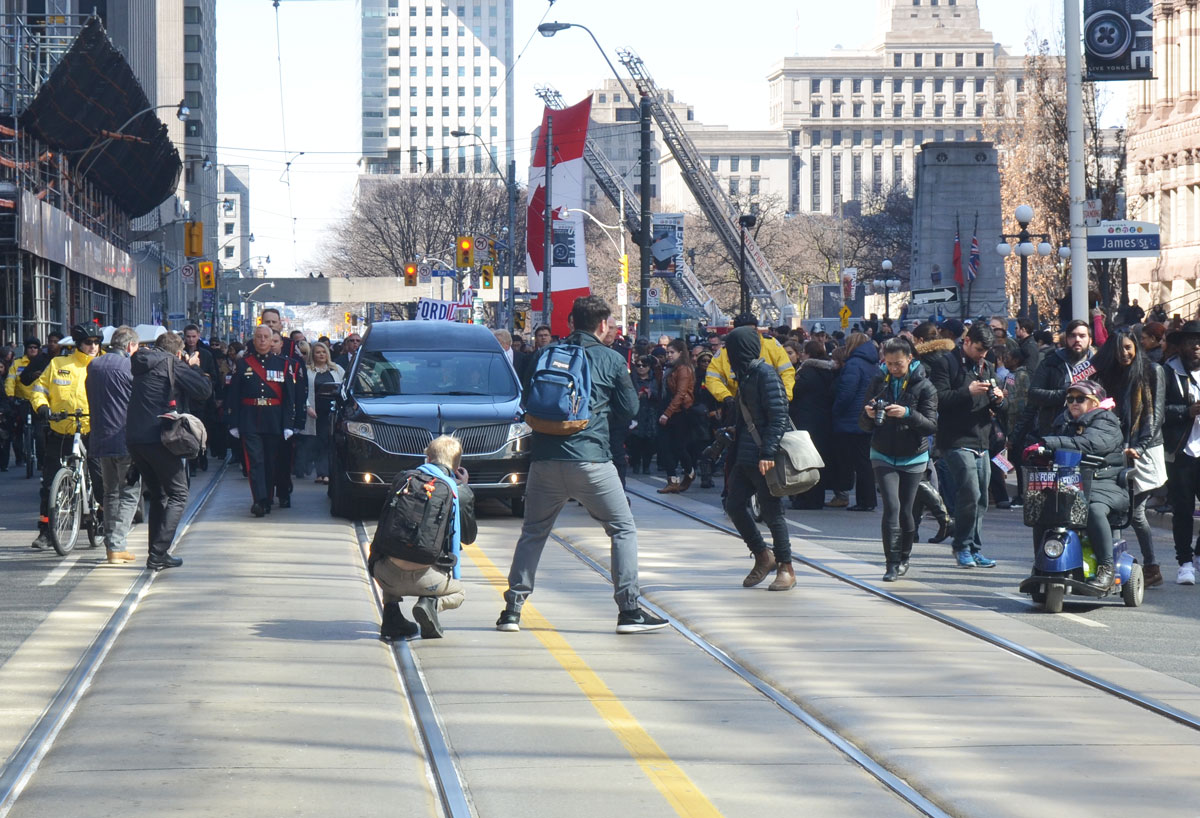



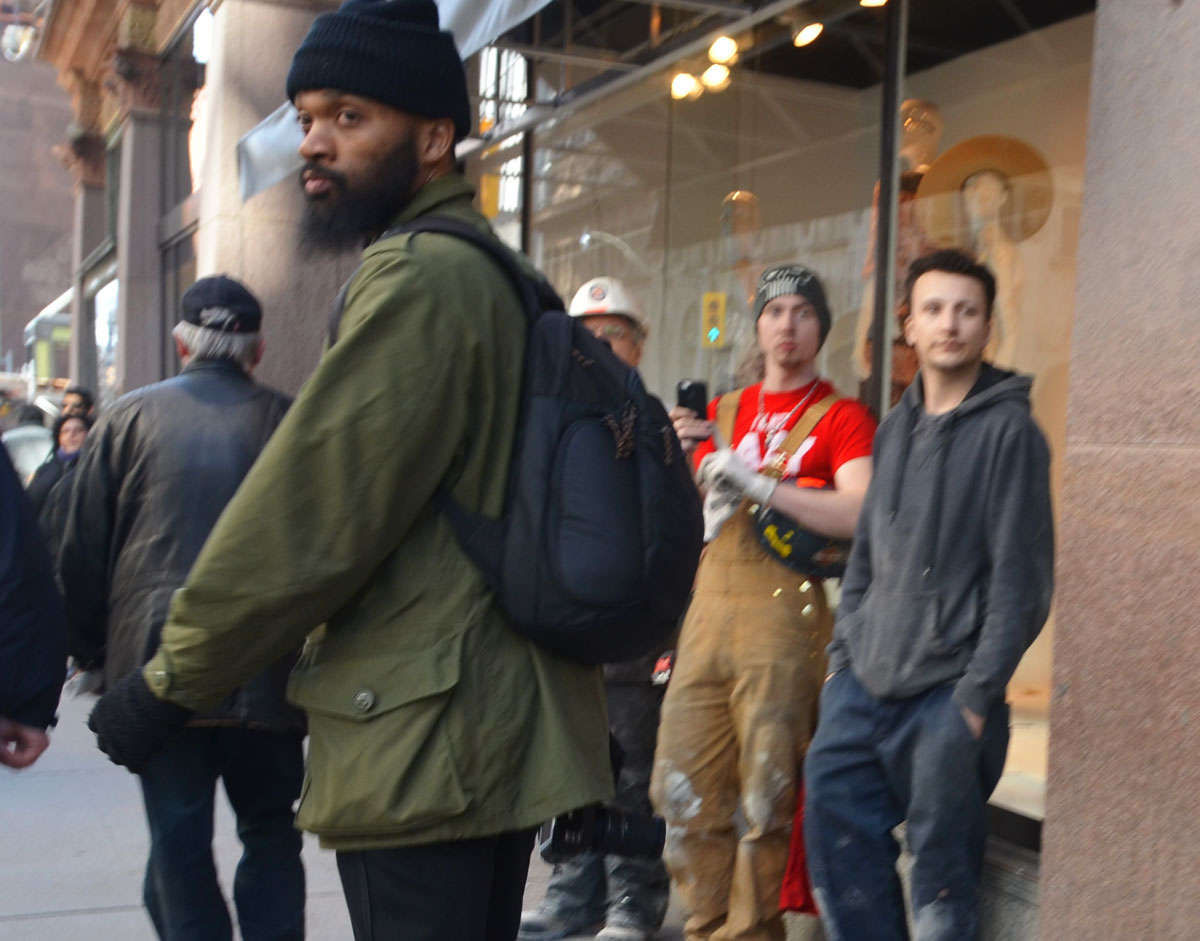
below: Trying to keep the people, most with cameras, off the streets.

below: This guy may have been filming the crowd (and me) but he didn’t look away from his phone.
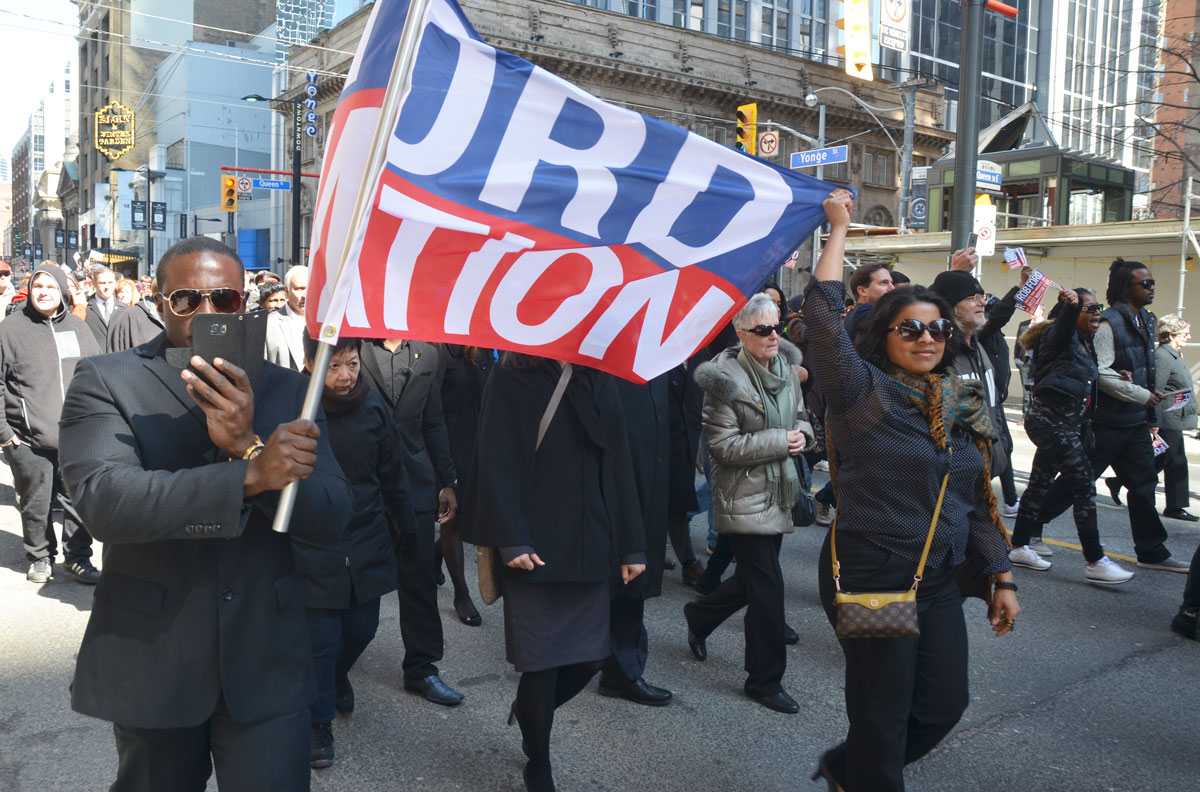
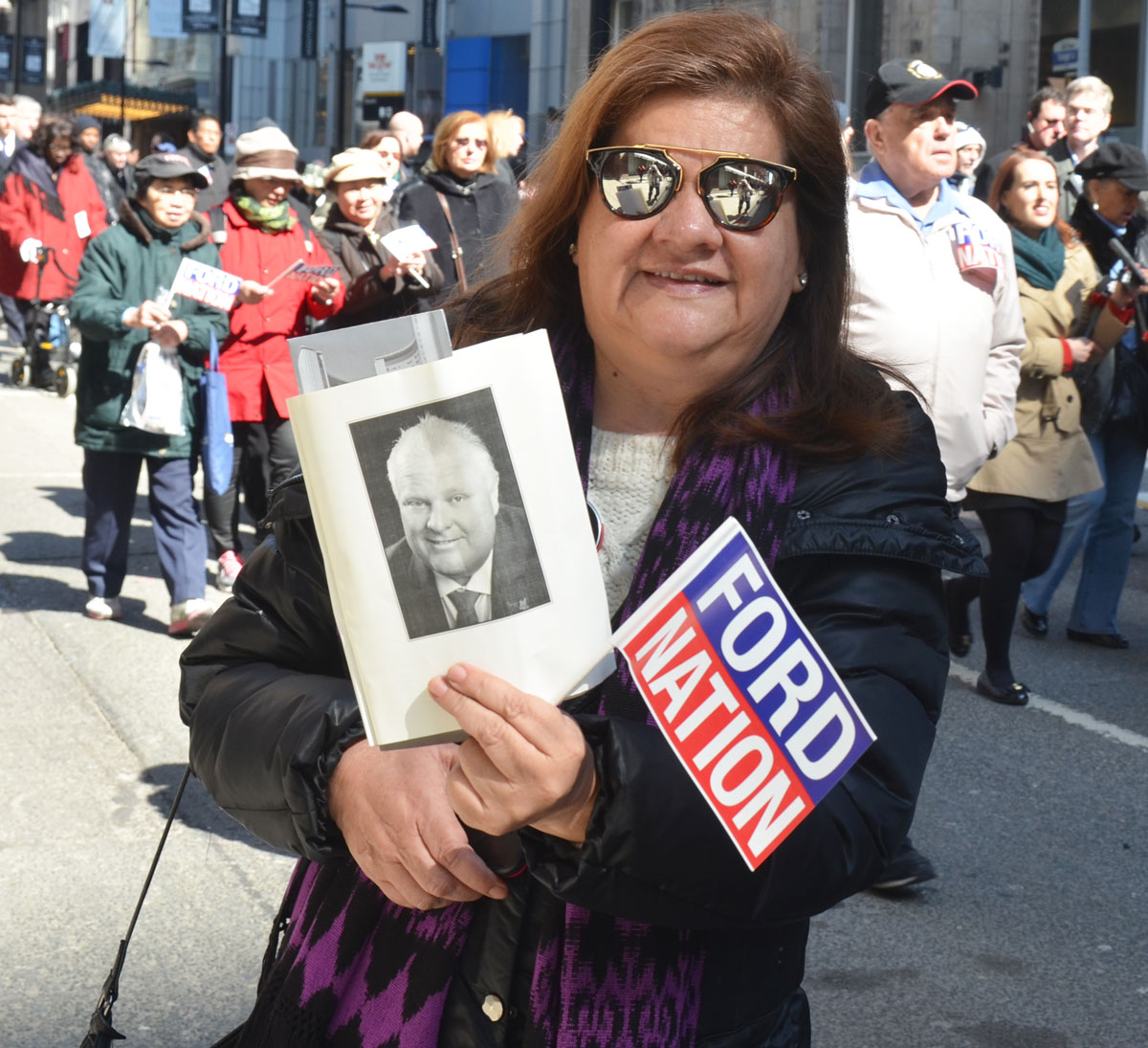
below: The crowd in front of St. James cathedral




As I was walking away from the cathedral, a woman approached me.
She pointed towards the church asked me if I knew what was going on there.
added later: I was going to discard this photo but then I noticed the man in the mask.
Who wears a mask to a funeral procession?

Sometimes when I walk I find a view or a photo that suggests a theme for the day; something that summarizes the area that I’ve been walking through. On Saturday, this was the photo, a construction site on Wellesley Street -a massive hole in the ground amongst a growing number of high rise buildings.

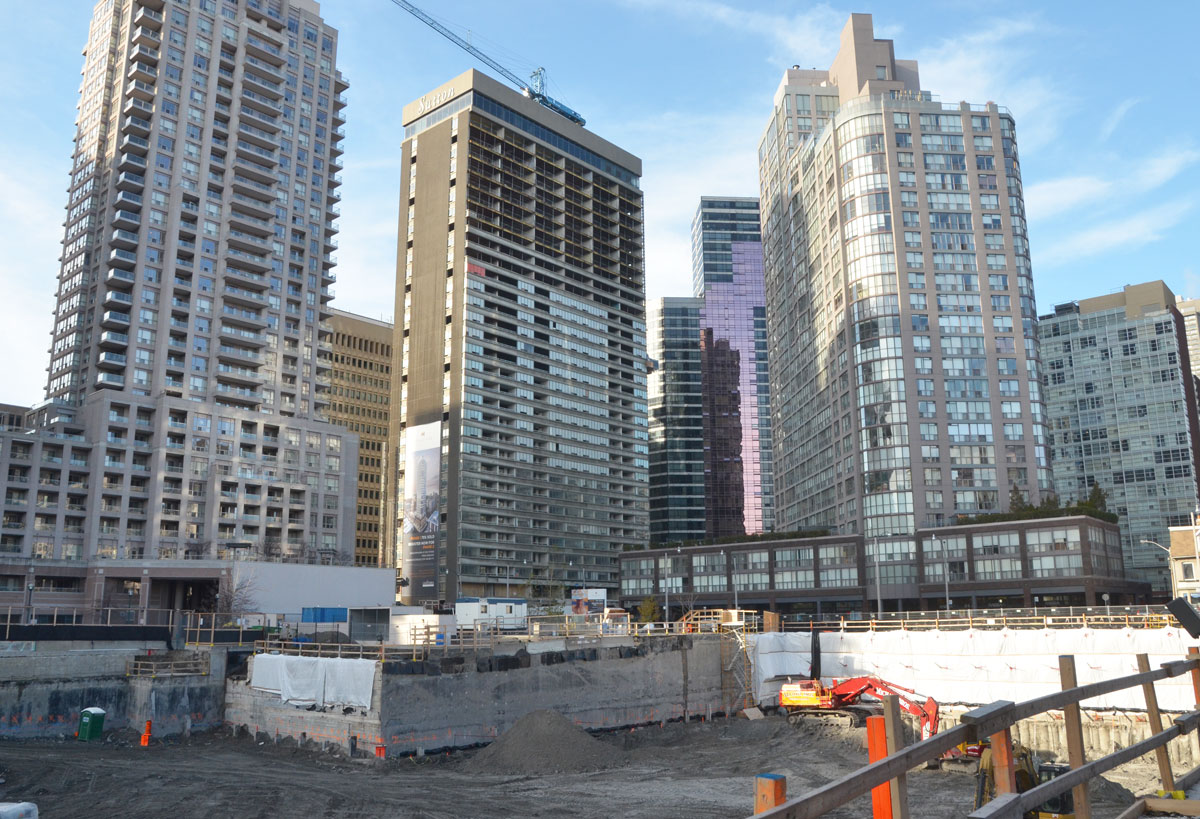
This piece of property, between Wellesley and Breadalbane streets, had been vacant for a number of years. It was once owned by the province; back in the 1980s there were plans to build a ballet and opera house there. Those plans fell through and the land remained vacant while community groups lobbied for a park to be developed there.
When I first walked the area in April 2013, there was a blue fence around the site.

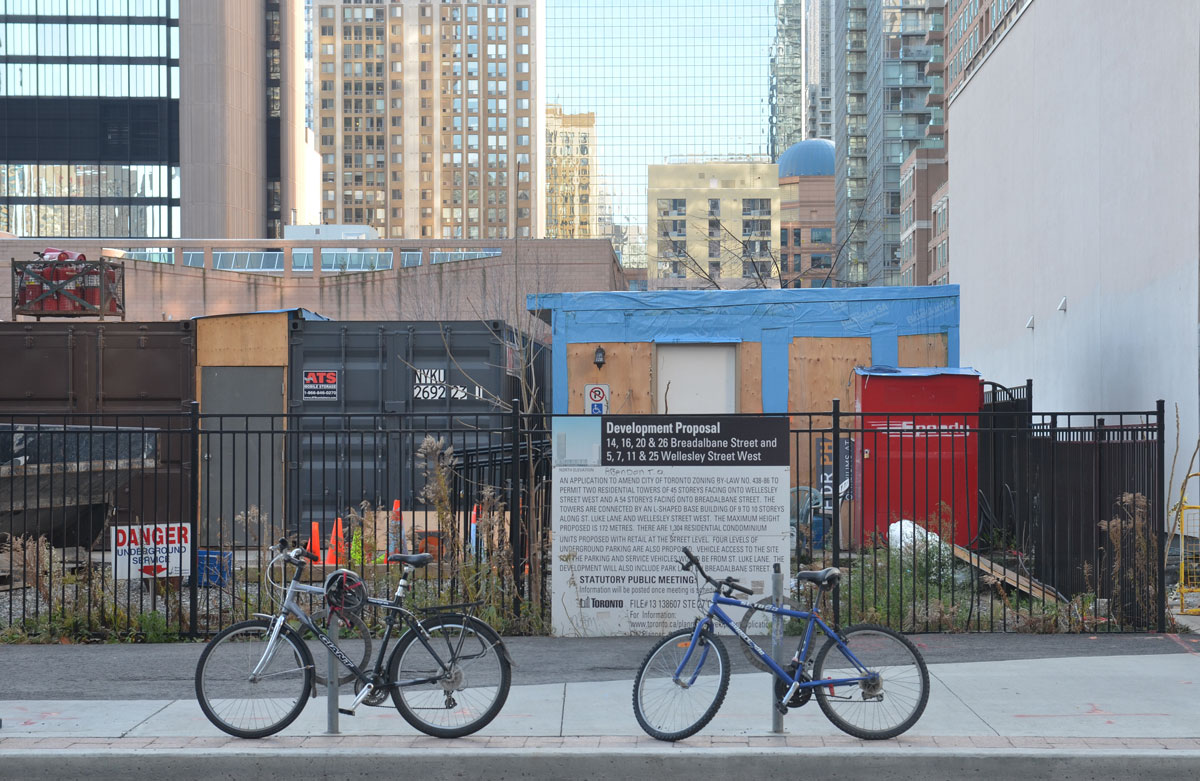
The blue fence is gone. According to the development proposal sign, two towers are being built here with a combined height of 99 floors. A nine or ten storey L-shaped podium will run along St. Luke Lane and Wellesley Street to join the towers. The plan also allows for park land on Breadalbane. When I checked the website for the development, 11 Wellesley aka Wellesley on the Park, there is only one tower pictured and it doesn’t look like the description on the sign.
Ah, a little light bulb goes on. The sign describes the developers’ original plan. A change in the plan doesn’t mean a change in the sign. So… this seems to be the future home of one 60 storey condo tower on one third of the land and a 1.6 acre park on the remainder.
My Saturday walk had actually started close to Yonge and College. I was drawn to the nondescript block of stores that are now boarded up in preparation to be demolished.
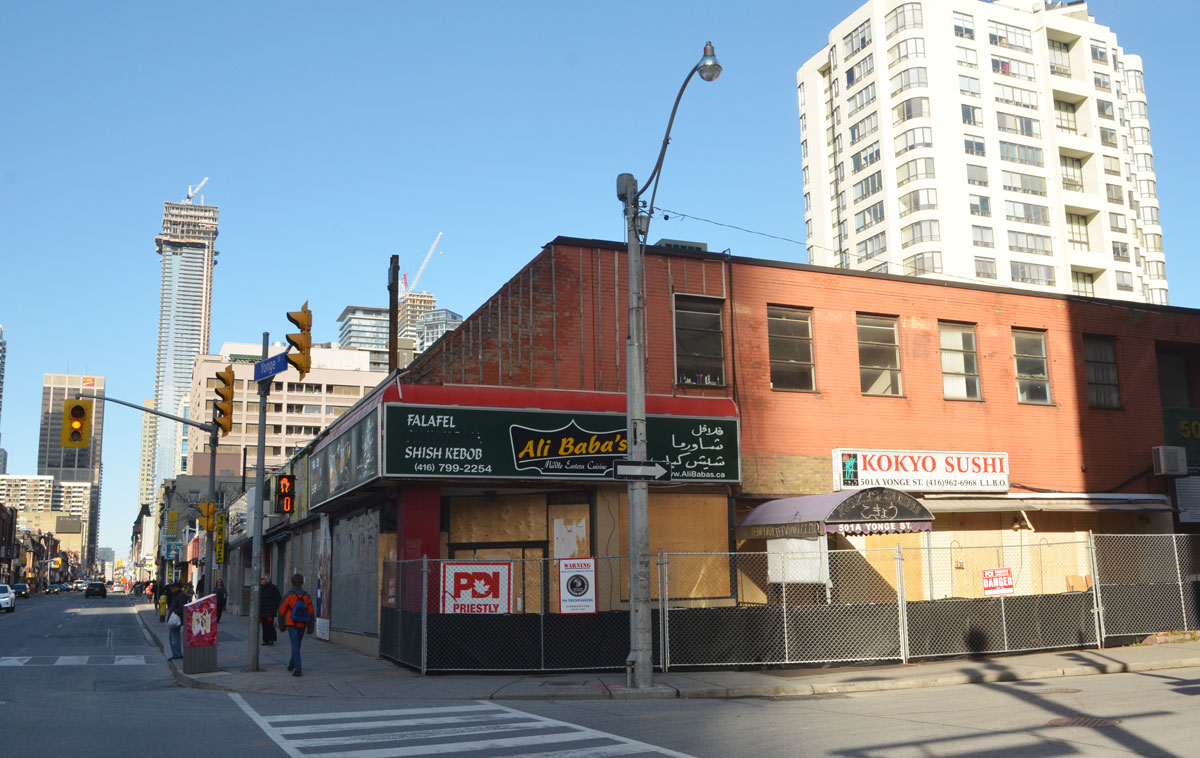
I’m wishing that I had taken pictures previously of these stores just to document the history of that part of Yonge Street. I had many chances to do so, but the building never seemed interesting enough.

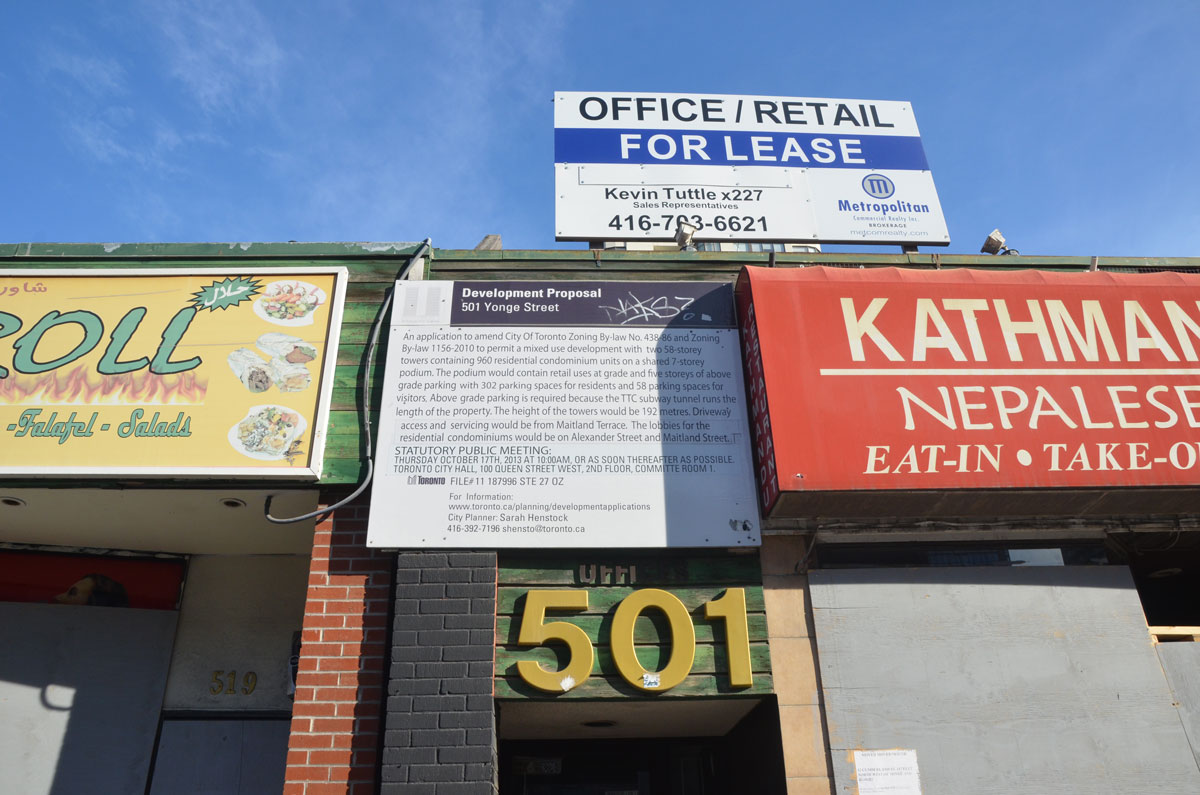
Whether or not you think that two 58 storey towers with a shared 7 storey podium is an improvement is an entirely different question. It will contain 960 condo units and 5 storeys of above grade parking (because the subway runs underneath) with 320 parking spots. Lobby access for the buildings will be from Maitland and Alexander Streets on the north and south sides of the property. Or at least that’s what’s on the sign. But fool me once, so I checked the website for the condo (TeaHouse Condos in this case) and once again the information doesn’t match. According to the website there will be two towers but the north one will be 25 storeys and the south one will be 53 storeys. Whatever the end result, it will be different from what’s there now!
At least one person had an objection.

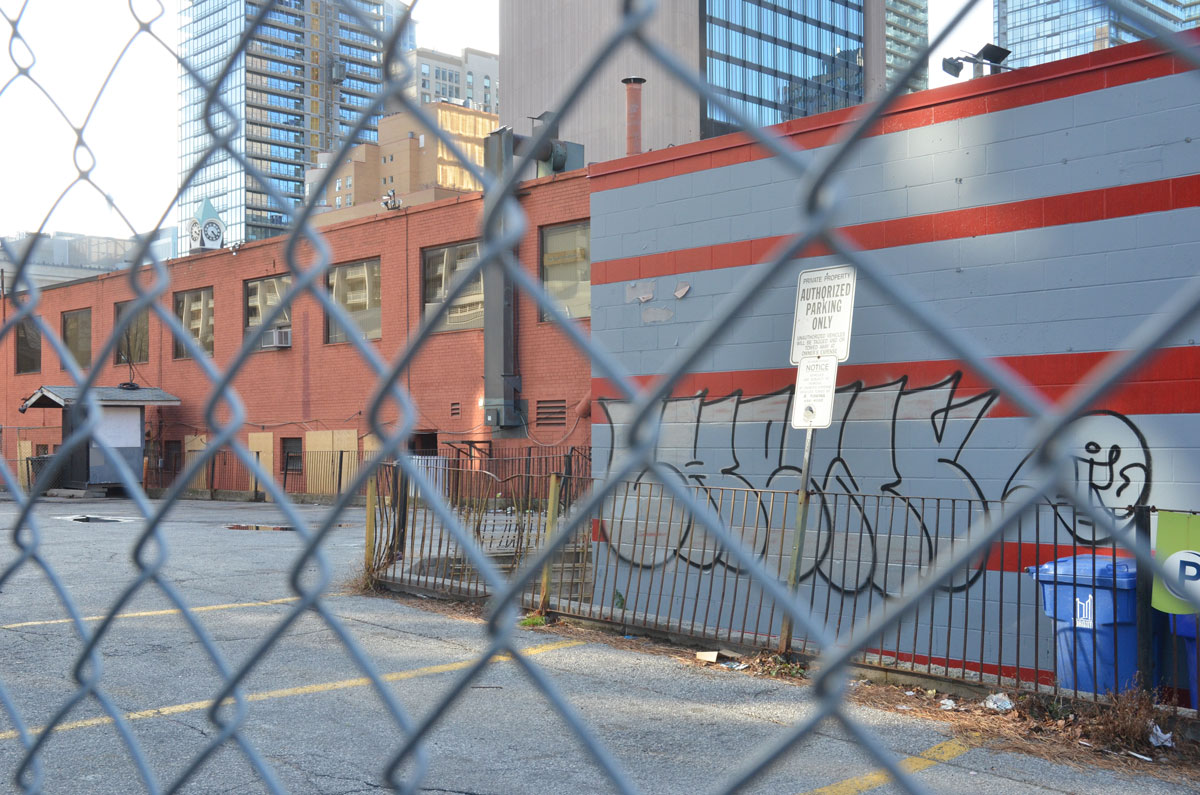
A walk around the back of the building shows that we aren’t losing much there either.
The next site that I explored is just to the south where a hole is already in progress on the SW corner of Yonge and Grenville.

Photo taken from St. Lukes Lane
.
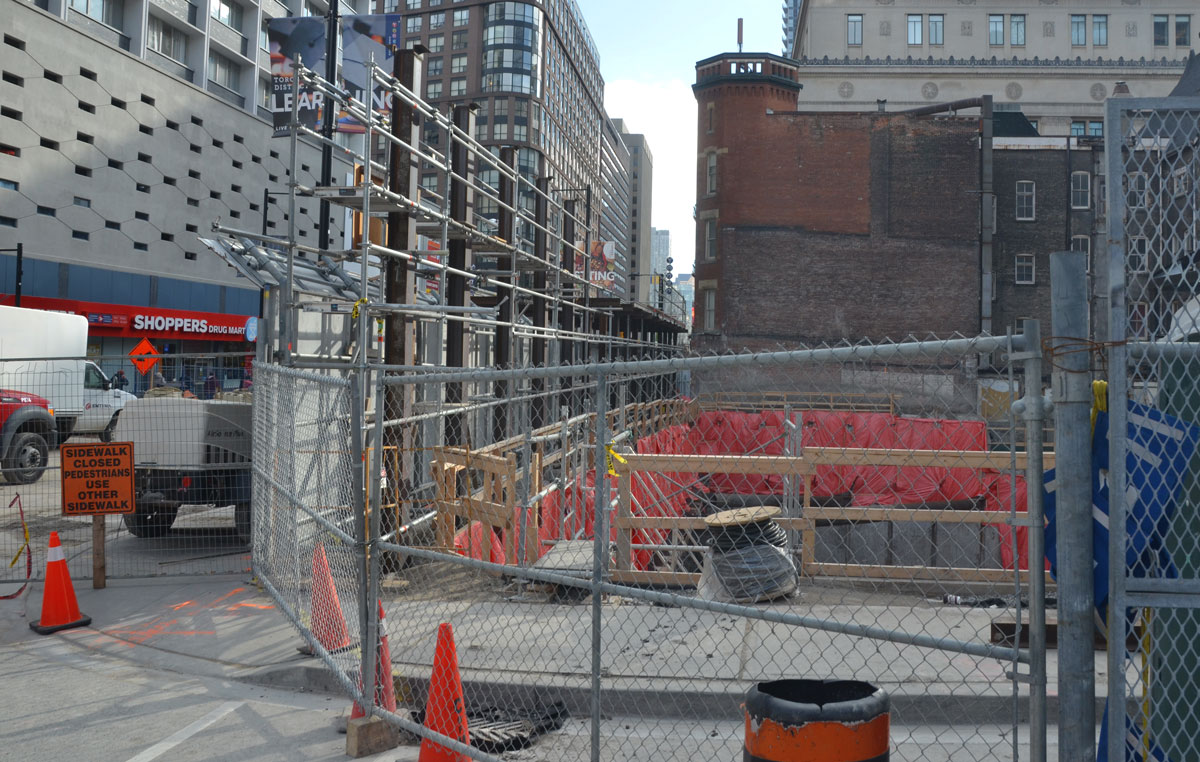
below: This hole has exposed the north wall of the brown brick Oddfellows’ Hall as this view shows. This is looking south, with College Park in the background (built by the T. Eaton Co. and opened as a 6 storey Eatons store on 30 October 1930). Behind the chain link fence is St. Luke Lane.
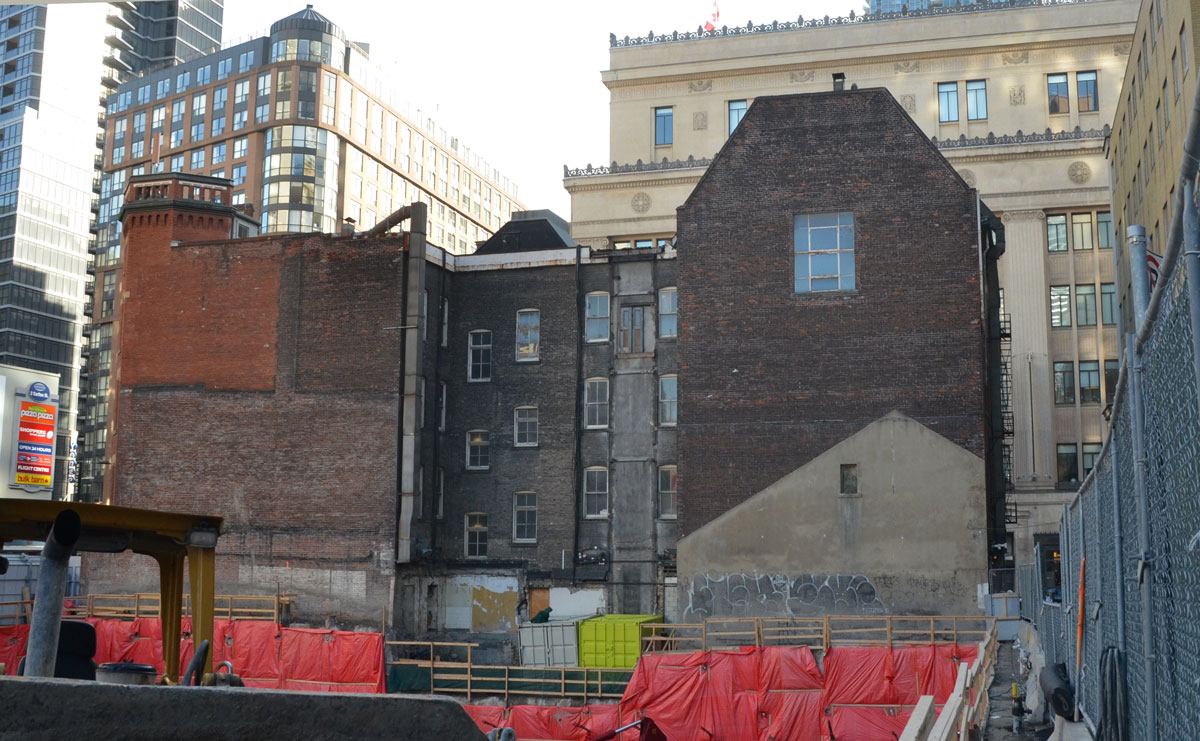
Now you see it… soon you won’t. The condo tower here will be 66 storeys high.
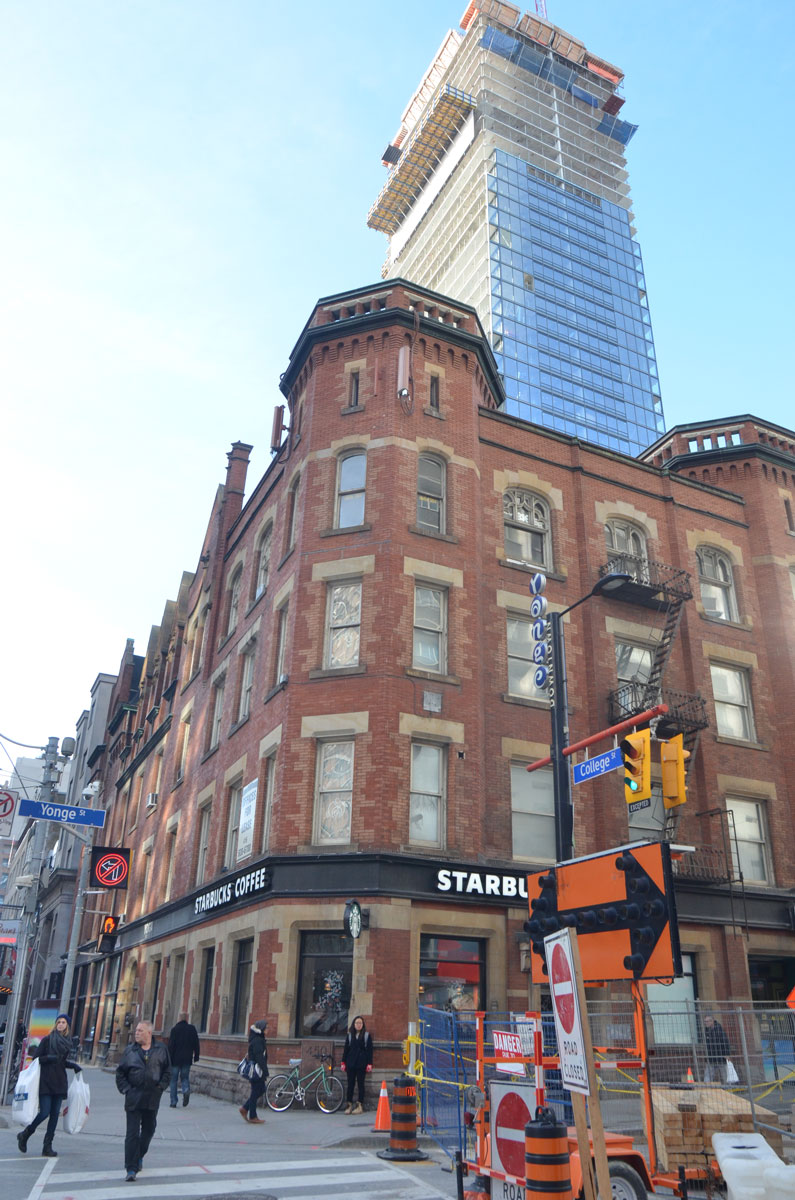
Oddfellow’s Hall was built in 1891 and 1892 by architects Norman B. Dick and Frank W. Wickson for the Independent Order of Oddfellows. It has two octagonal turrets and is a playful mix of Romanesque and Gothic styles. The building had a 20’ x 46’ long grand hall for IOOF private meetings as well as offices and storefronts.
below: Looking north up Yonge Street at College Street, about 1970. The Bank of Commerce (later Canadian Imperial Bank of Commerce and now CIBC) was an early tenant of the building. Also in the picture is the old fire hall tower but more about that later.

Photo found online, original source was City of Toronto Archives
.
below: Most people will recognize the building as Starbucks.

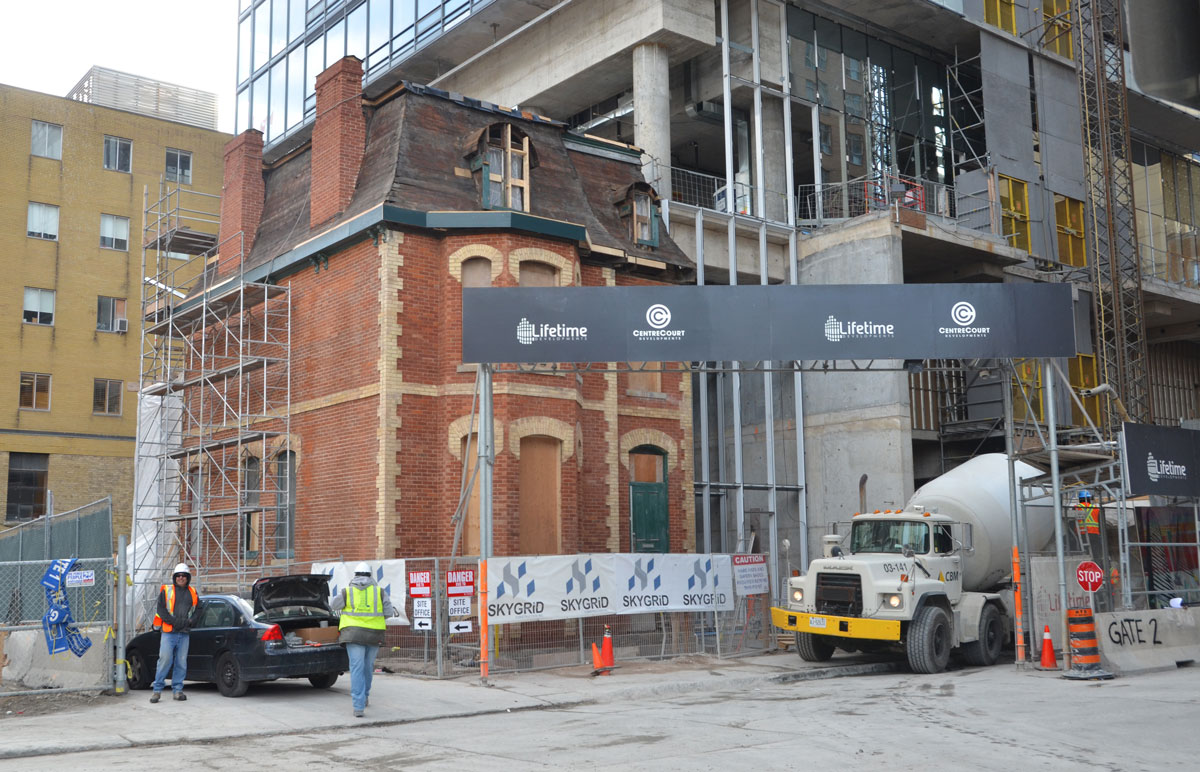
Back to Grenville Street where there is yet another development. On the west side of St. Luke Lane is a partially completed condo that has incorporated the facade of what is known as the John Irwin house. It is one of the oldest surviving residential buildings in the area; in 1873 it was recorded as being owned by a John Irwin.
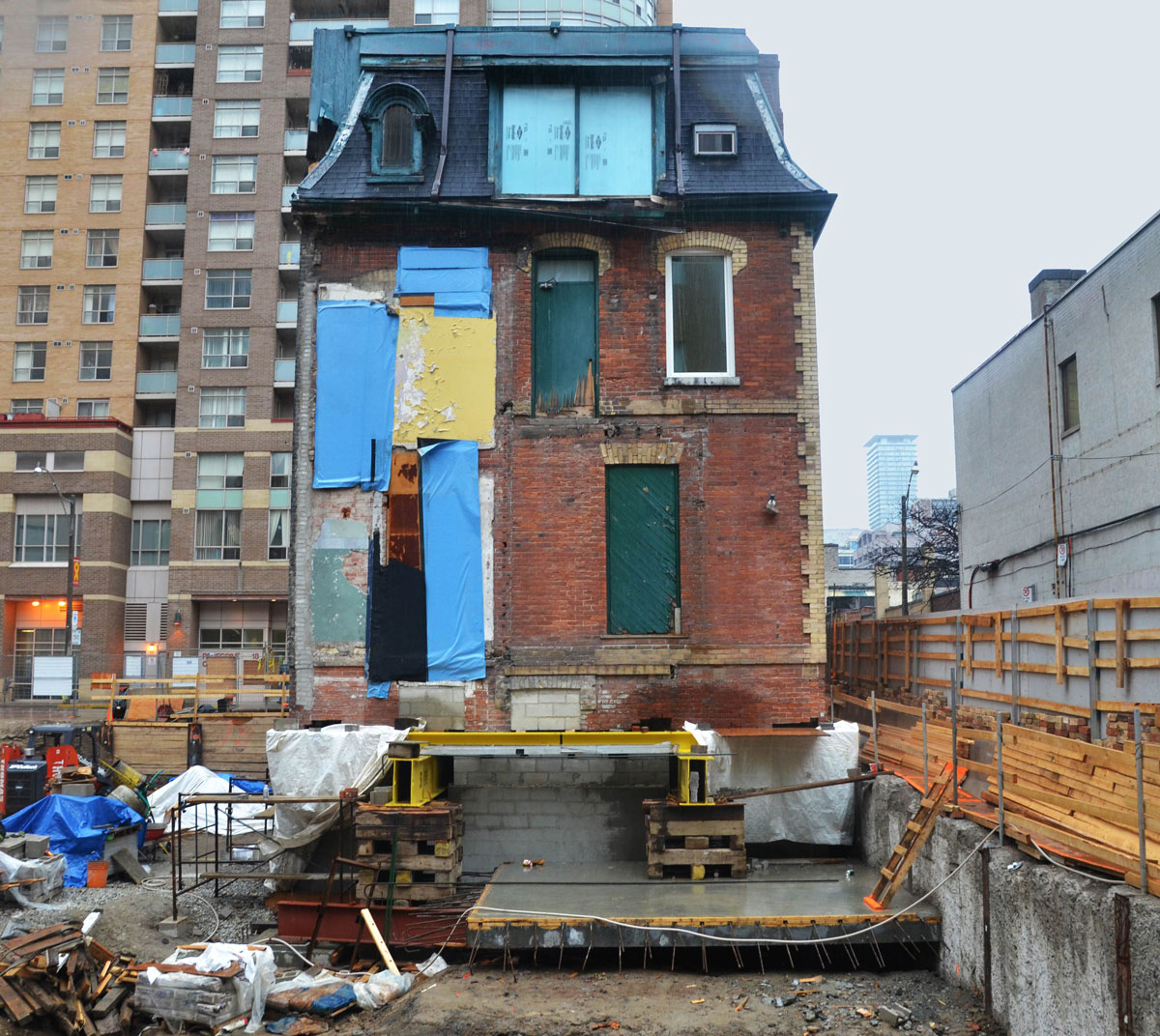
This house wasn’t always in this location though. It was moved a few metres east along Grenville, from one side of the condo development to the other. I found a photo that I took in April 2013, just after the house had been moved. Here you can see the back of the house as well as St. Luke Lane to the right.
Does your head hurt yet? Because there is more…..
But first, a break. A few other pictures from the area.
below: No Parking in St. Luke Lane, twice.


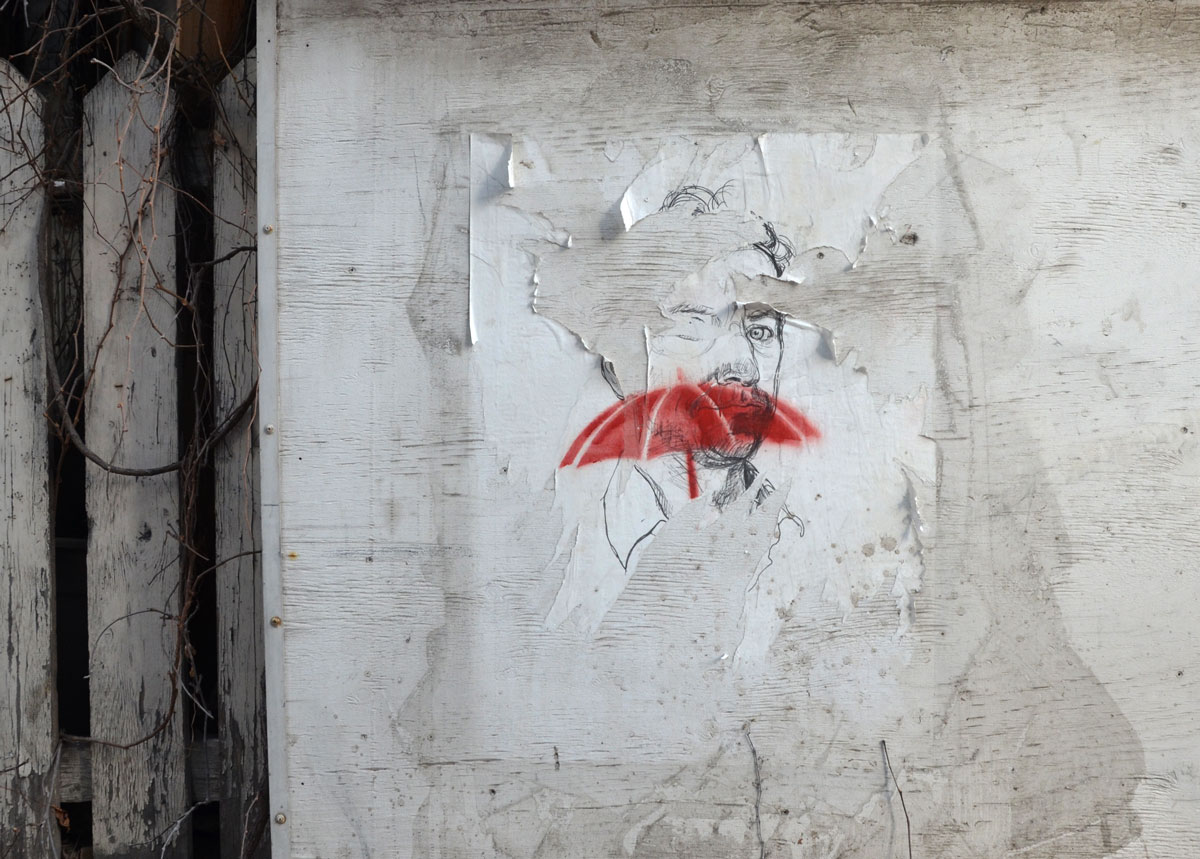
below: And a man (Van Gogh? someone else?) with a red umbrella but more remarkably, a white picket fence almost hidden under vines by Wellesley Street.
below: Also in St. Luke Lane, a mural commemorating the Highway of Heroes.

And back to the program….
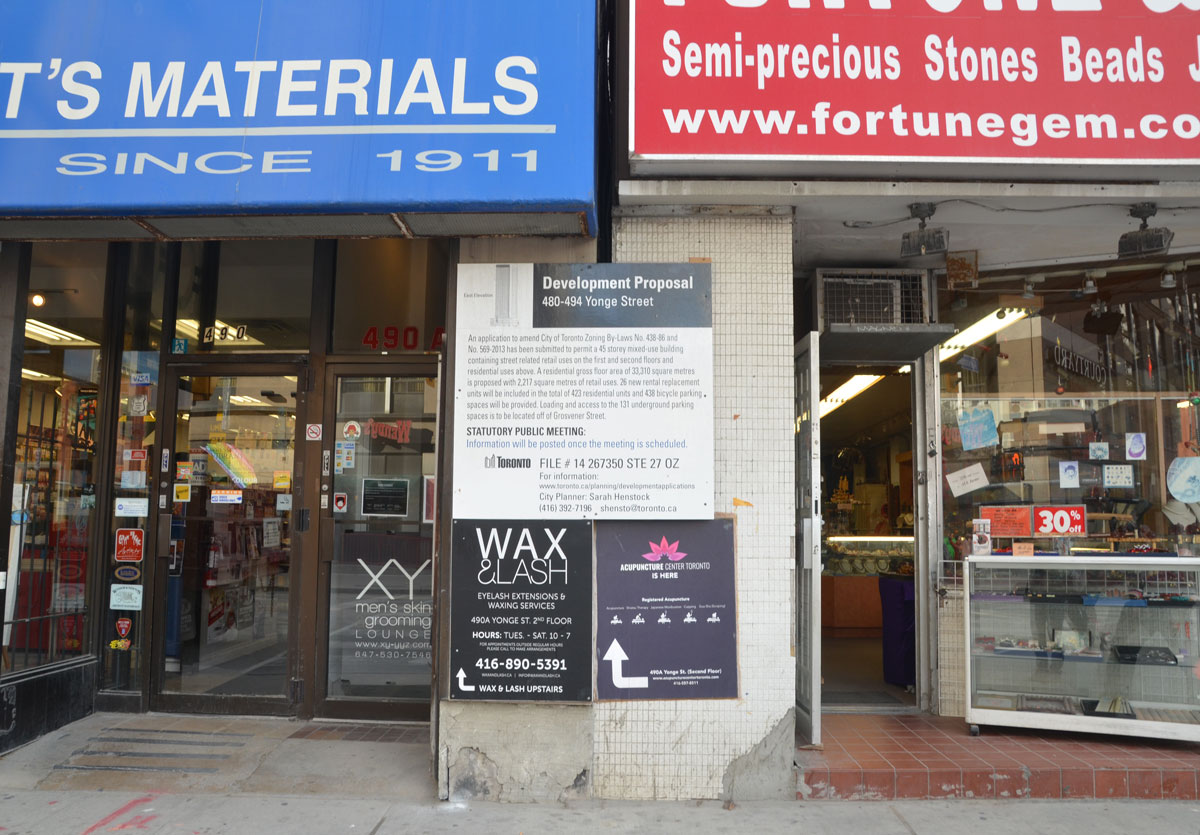
So far we have two holes in the ground, a partially finished condo, and a block that has just begun to be demolished. The last development that I saw in the area was one that is still in the planning stages. The development proposal sign posted beside Currys Art Supplies (the blue awning) is a clue that changes are imminent at 480-494 Yonge Street. This building is on the SW corner of Yonge and Grosvenor. The sign says one 45 storey tower but by now I don’t believe the signs!
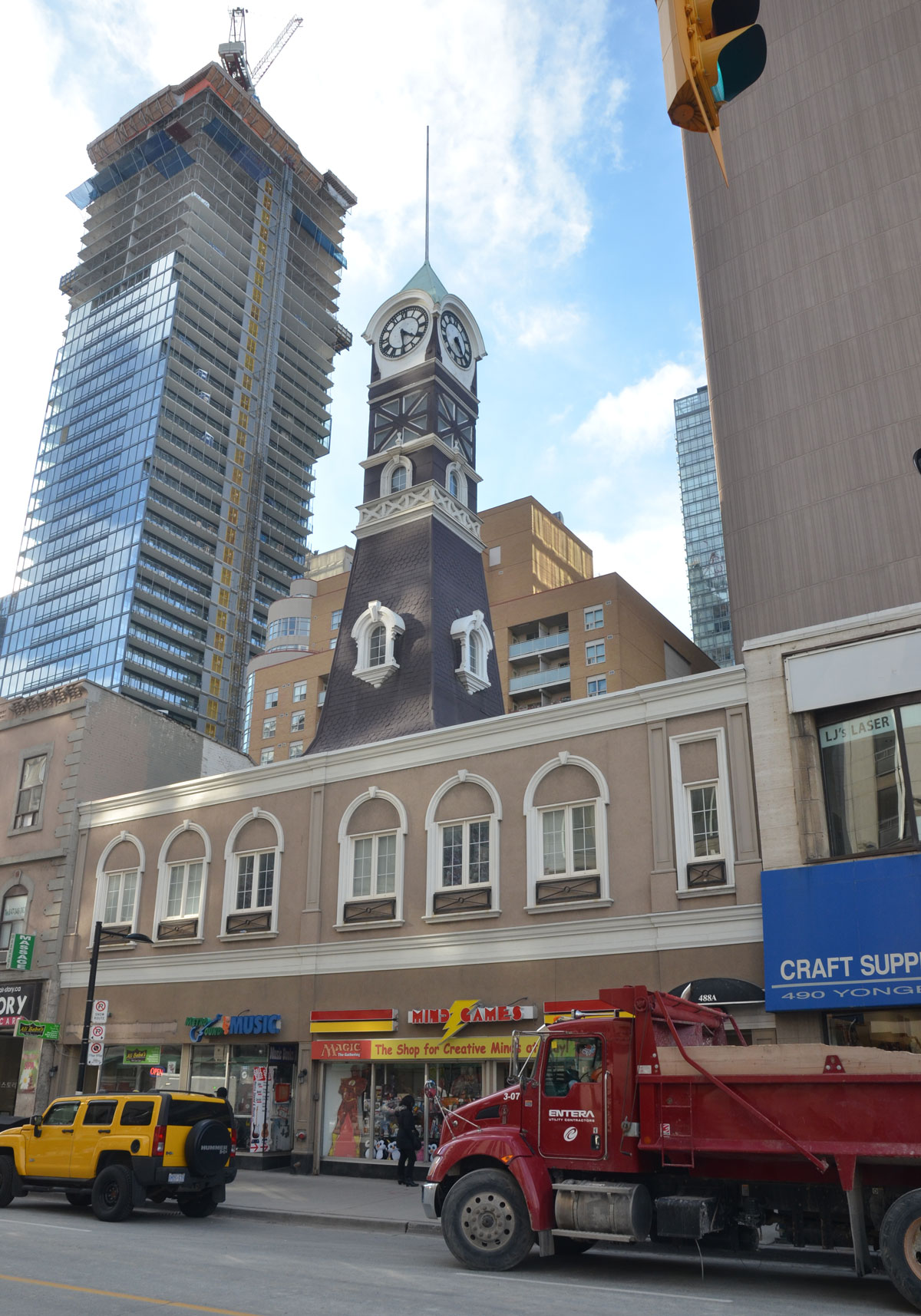
480 Yonge Street is a heritage building as is the old fire hall (1872). The top corner of 480 Yonge is just visible in the bottom left of this picture. It is to be incorporated into the new development if it goes ahead. The fire hall tower is going to be preserved but the building in front of it will be removed. The sidewalk will also be widened as a result. That’s the opening act of this story; there may be changes before the final curtain. The developers applied for a zoning amendment (increased height and density) earlier this year but I do not know the results of that.
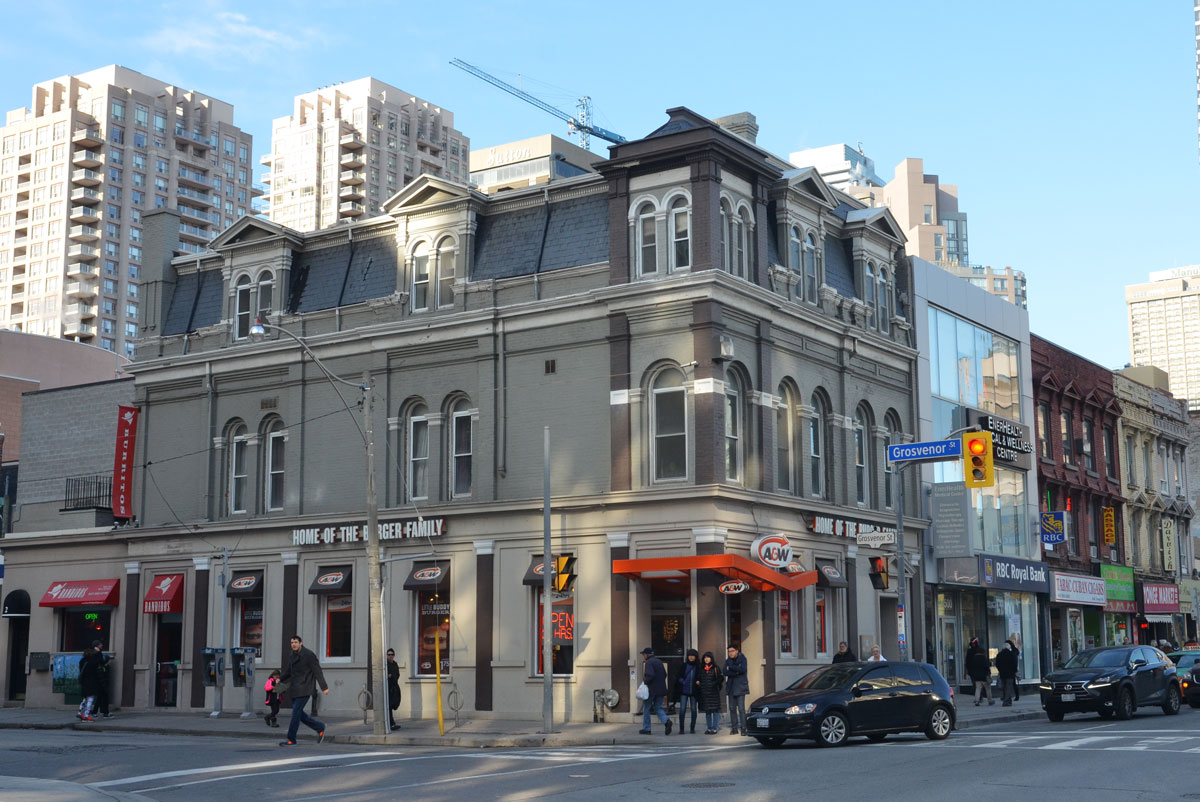
below: On the NW corner of Yonge and Grosvenor is this building. I don’t know if there are any plans in the works to redo this stretch of Yonge Street but after seeing all the new developments, I’m starting to get a bit sentimental about the old buildings. So here is documentation of what remains, starting with A & W Home of the Burger Family at 496 Yonge.
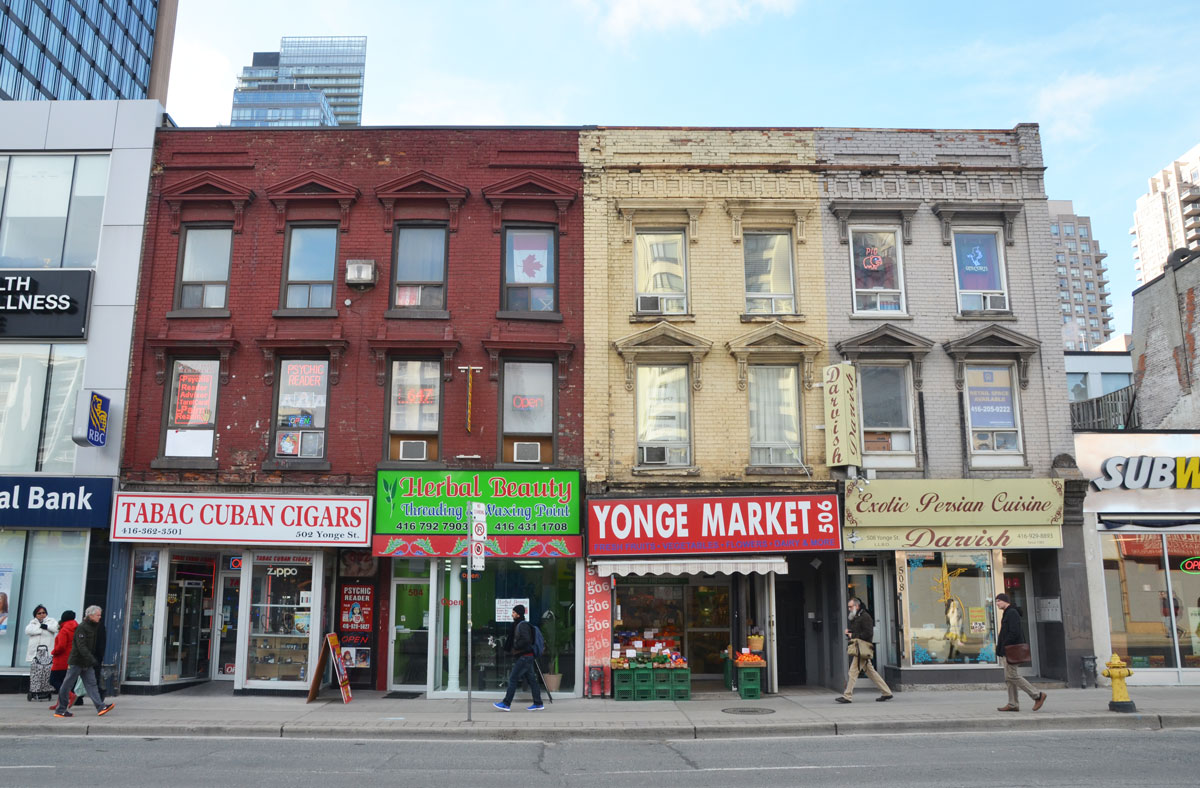
below: between Grosvenor and Breadalbane – Cuban cigars and Persian food
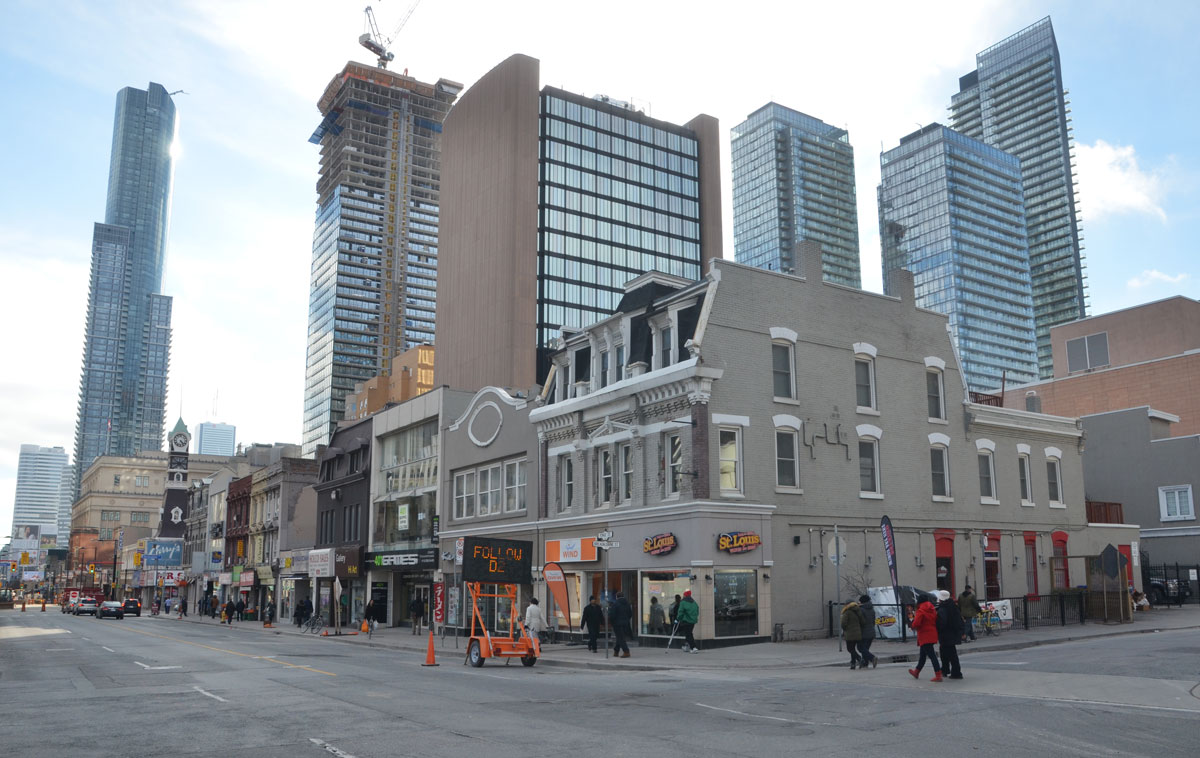
below: SW corner of Yonge & Breadalbane – old and new, short and tall
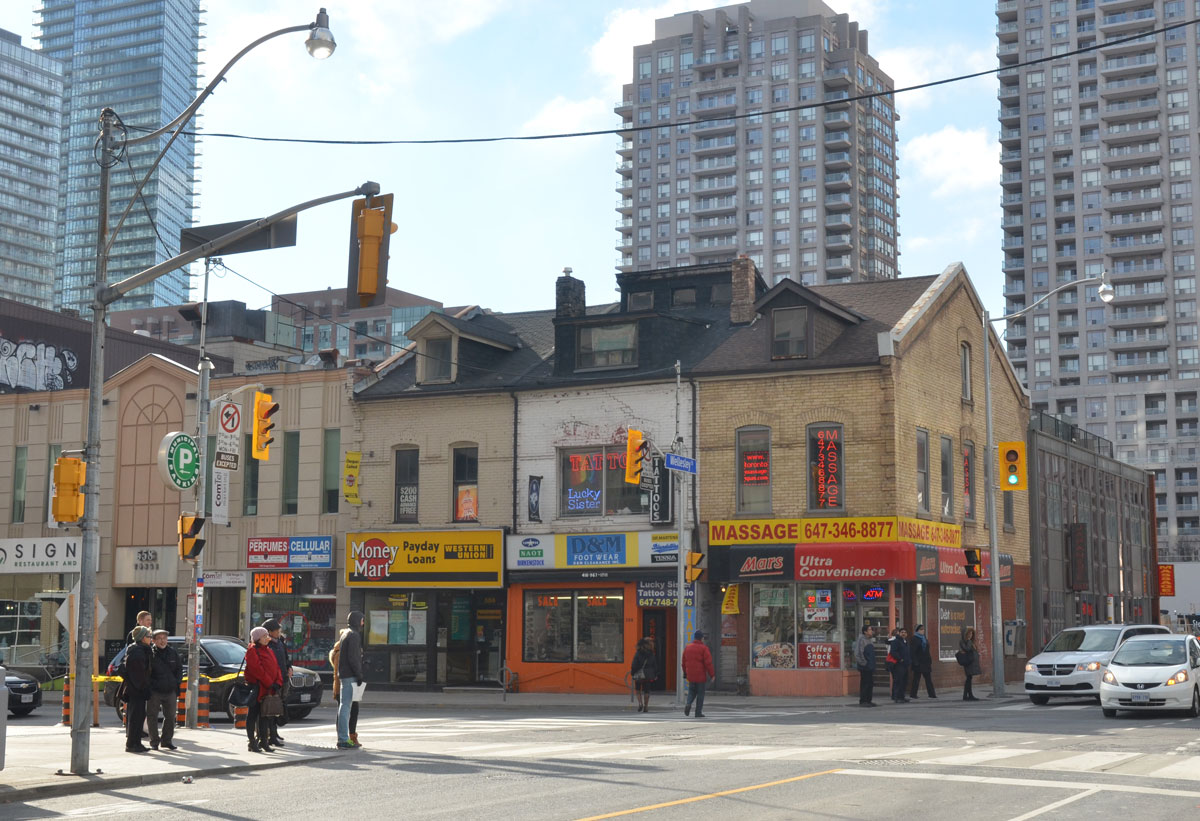
below: SW corner of Yonge & Wellesley – tattoos, massages, and payday loans.
below: NW corner of Yonge & Wellesley – Not just noodles

The other day I came across an interesting mosaic of which the picture below is just one part. There is a plaque beside it which says “Seen at a disance the mosaic reveals a crowd of people sheering and clapping, people of all backgrounds, which is the unique mix of Toronto. Up close, the images dissolve into abstract patterns of colour and light.”.

The mural is called ‘A Small Piece of Something Larger’ and it was designed by Stephen Andrews and fabricated in Montreal by Mosaika Art. It is made of smalti (hand cut mosaic glass), gold tiles and hand glazed ceramic tiles.
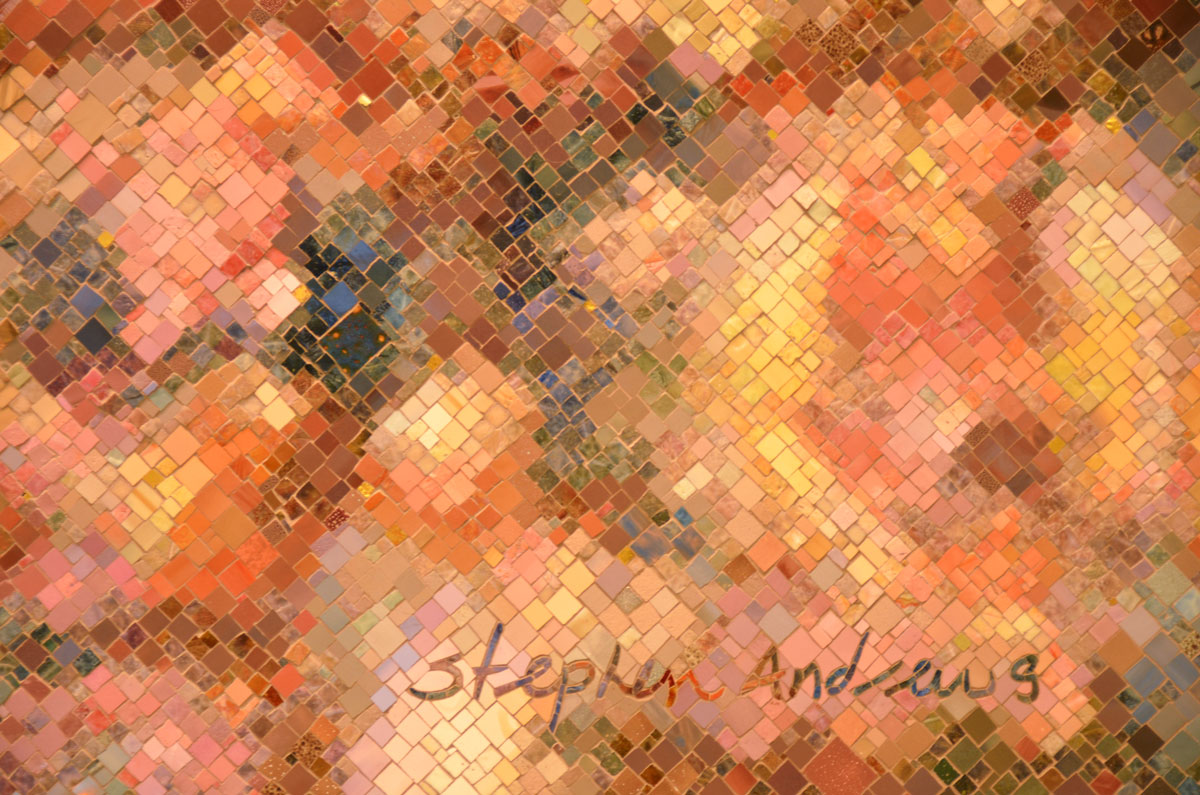
I’d love to show you a picture of the whole thing but I can’t. The piece is located in the taxi drop off and valet parking area of the Trump International Hotel. I dodged cars while I took these photos. The wall that it is on looks cheap, especially with the dreary doorway that cuts into the mosaic. Another strike against this piece is the very yellow nature of the lighting in this space. I played with the colour balance on the photo below to try to capture the true colour of the artwork.

It really deserves a better location.
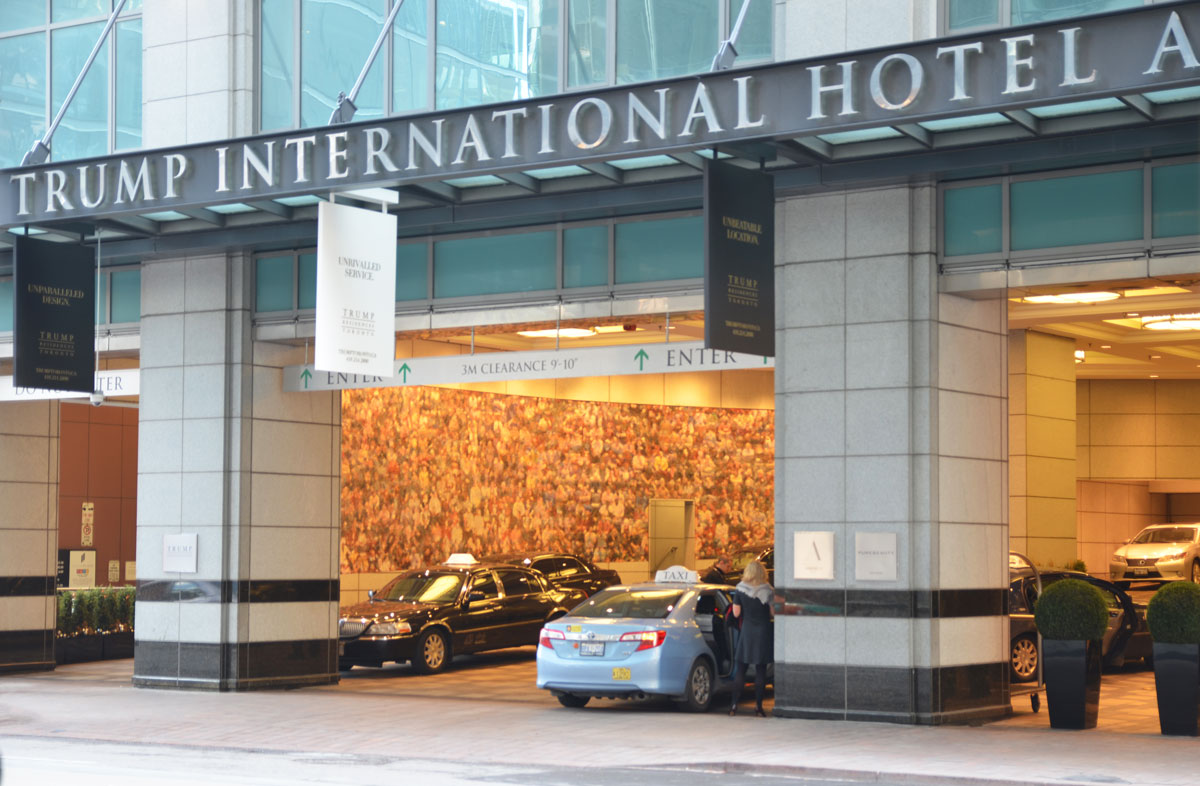
The above picture was taken from the NE corner of Bay and Adelaide.
Just a few steps west on Adelaide is this mosiac (look up!):
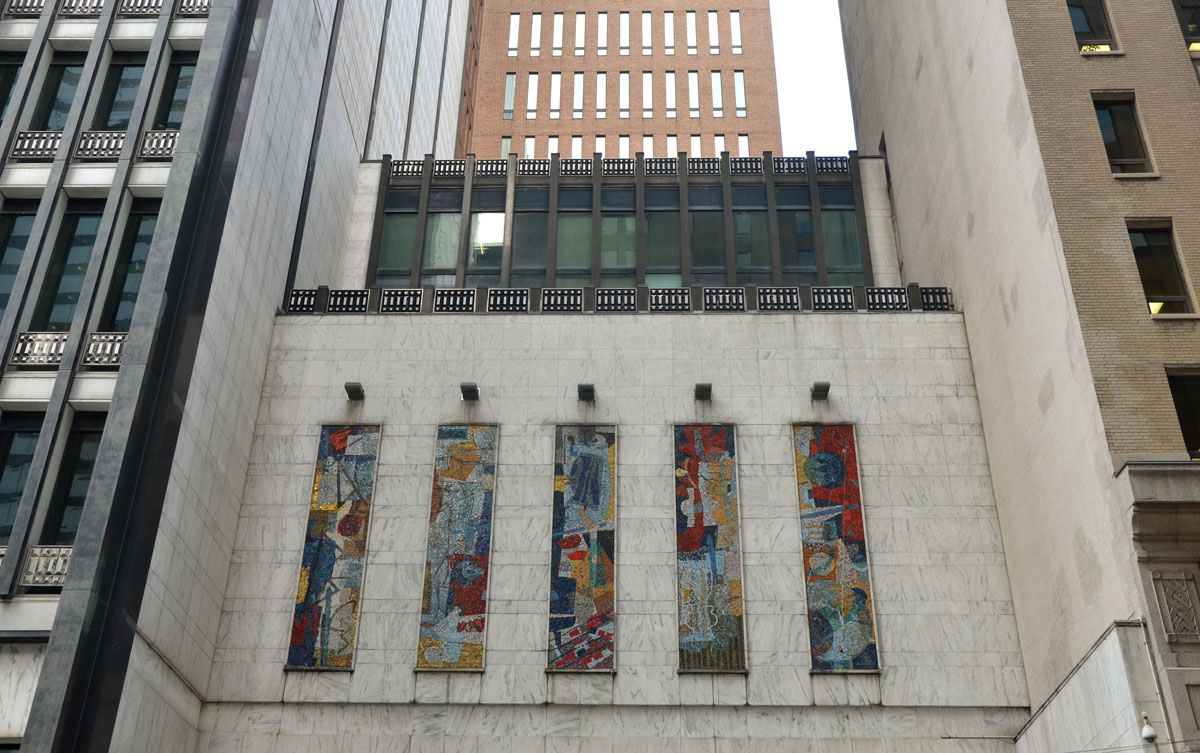
It is above the entrance to the Bell Canada Building at 76 Adelaide West. Five panels, each twenty feet tall and five feet high, of glass mosaic tile are embedded in the cement of the building. It was designed by York Wilson and installed in 1965 when the building was constructed.
The theme of the piece is communication and each panel represents a different form of communication. From left to right: writing, drawing, music, voice, and satellites.

Staying on Adelaide, walk east again but continue to Yonge Street. Here you can find another hidden, almost secret, mosaic that many people have walked past and never seen. Find the silly little entrance way to what is called the Dynamic Funds Tower on the SE corner of Yonge and Adelaide. Stand outside the entrance but don’t go in. Now look up.

Three very different mosaics all within a few steps of each other.
….and there’s one last stop on our mosaic tour. It’s not a mosaic but looking at Stephen Andrews’ work at the Trump Hotel reminded me of a sculpture. If you walk down Yonge Street, just south of the railway tracks you’ll find a bronze ‘Immigrant Family’ by Tom Otterness.

A roly poly mother, father and baby in arms. A bit cartoonish but vague enough that they represent no one immigrant group. They could be any piece in the mosaic that is Toronto.

With a shoutout to Penny at Walking Woman since it was because of her blog post that I learned about the Otterness sculpture.
Other links:
Some of the art installations from Nuit Blanche remain available for viewing this week.
Two of them are near Jarvis and Gerrard.
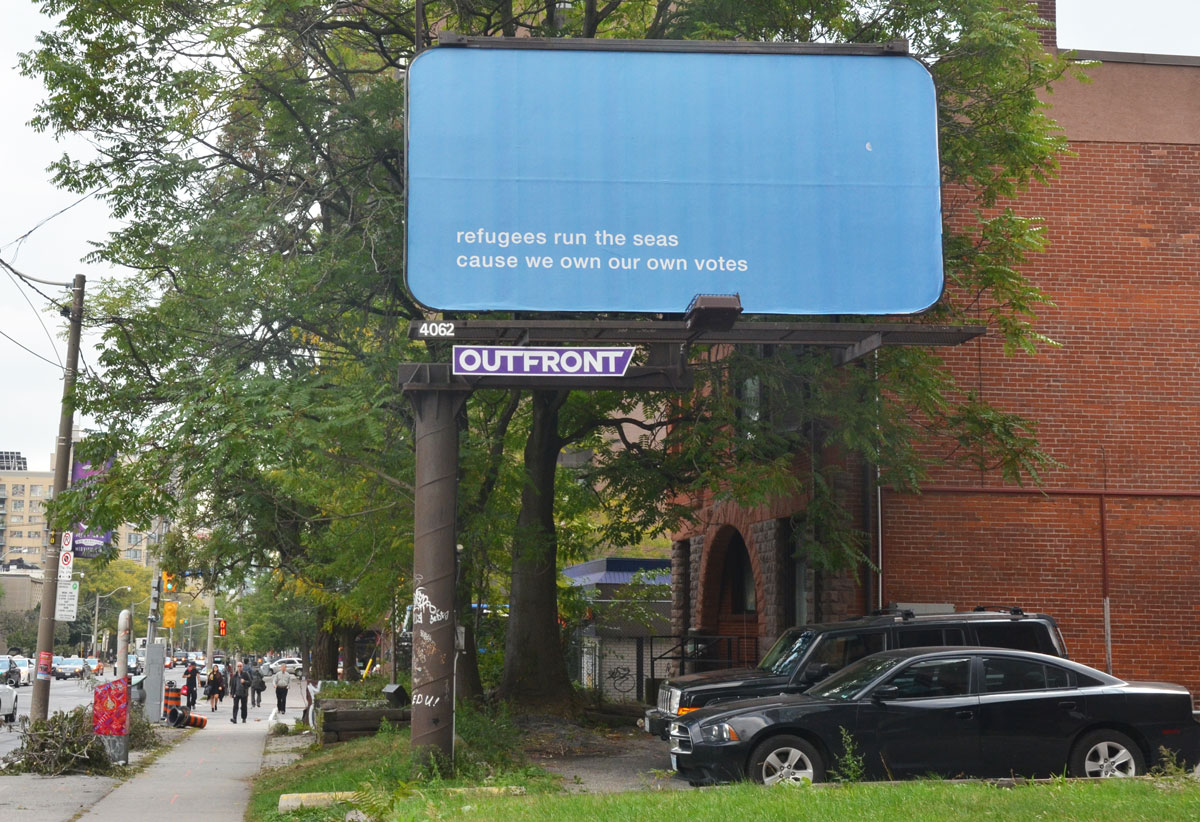
below: As you travel south on Jarvis Street, just before Gerrard, you can see a billboard art installation, ‘Refugees run the seas’ by Francisco Fernandos Granados. The accompanying sign says: “‘Refugees run the seas’ draws and diverts from pop culture as a way to invite the viewer to imagine a future where justice for migrants exists. The work evokes past and present scenes of harrowing escape while allowing the possibility of a time to come when those seeking refuge will be agents of movement, rather than victims.”
“Refugees run the seas ’cause we own our own boats” is a line from Wyclef Jean’s rap in Shakira’s song ‘Hips Don’t Lie’ in case you were wondering how this billboard “draws and diverts from” pop culture.
below: In the Children’s Conservatory at Allan Gardens is another installation. This one is titled “Sphinx” and it is by Luis Jacob of Toronto. According to the Nuit Blanche sign: “Toronto is changing before our eyes. Neighbourhoods and skylines are transformed seemingly overnight while the social fabric of the city is altered in ways that are difficult to discern. Come in and see the ‘Sphinx’, who poses questions that we want ardently to ask.”
The hands and fingers of this tall and imposing headless man are forming a frame that is apparently supposed to capture our attention. When you walk into the conservatory it’s definitely not the hands that you notice. The hands are way above the line of sight. Of course, one could ask why he has no clothes and does having no head enhance the artwork. Can you ask questions if you have no mouth, no voice? And are the questions ardently wanted or ardently asked? hmmm….
There are books and pamphlets in display cases around the room. These publications are all about Toronto and they date back as far as 50 years ago. No, you can’t access the books, you can’t open or read them. I’m not sure what information they are supposed to add to the exhibit.

#snbTO
Renfrew Place, near Queen Street West and University Avenue.
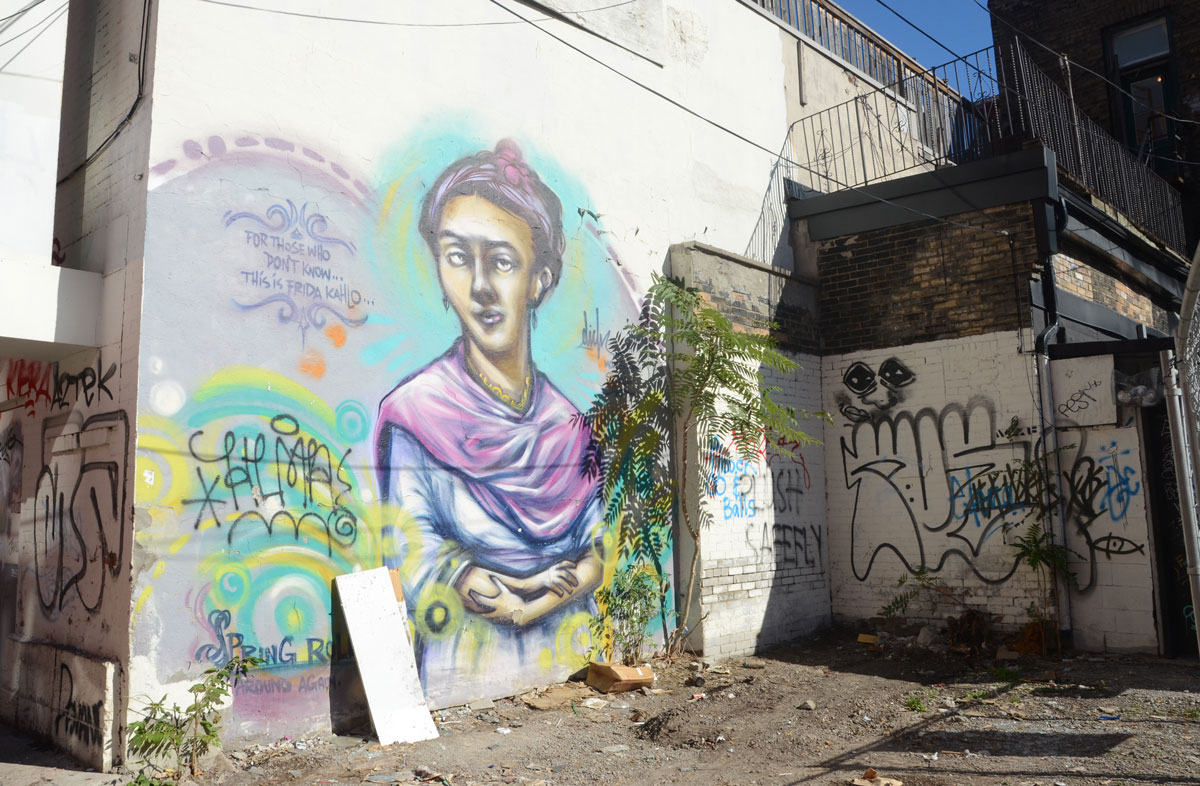
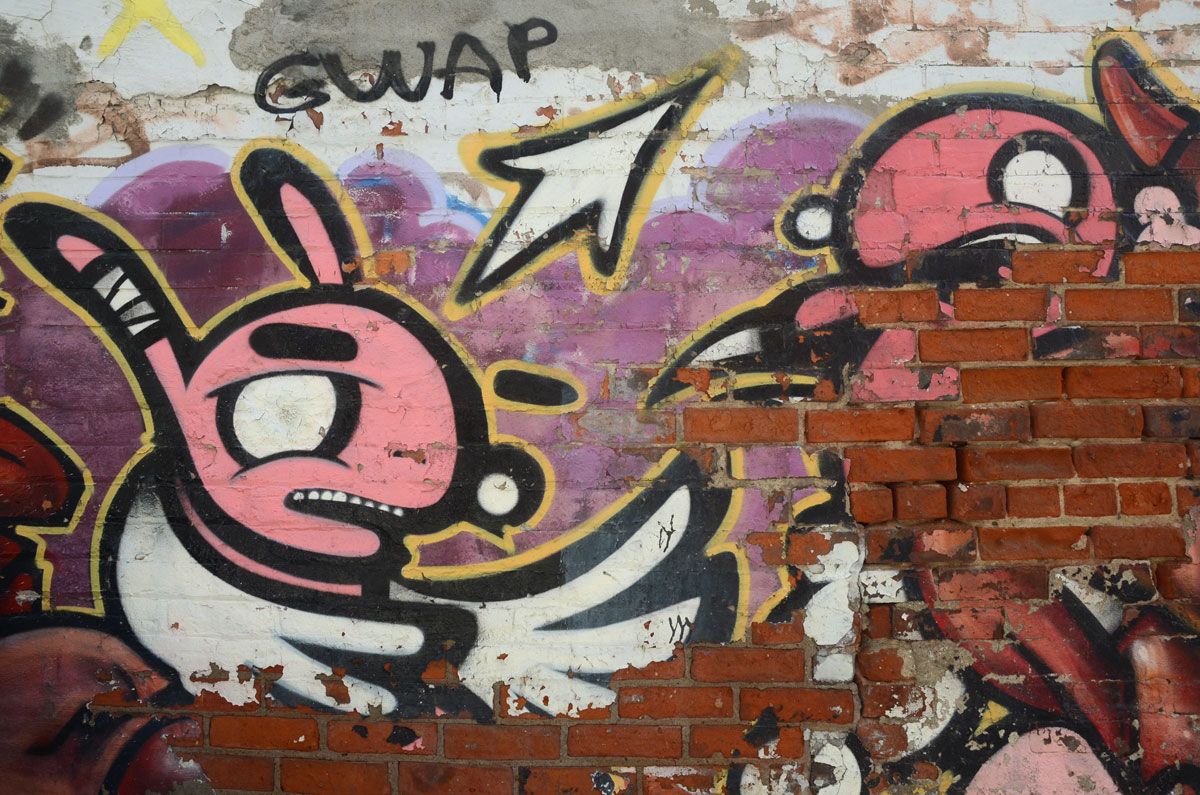
Another alley, another collection of graffiti and street art.
below: Lovebot strides over speed bump warnings.


below: The Korean Grill House restaurant is at the corner of Queen West and McCaul.

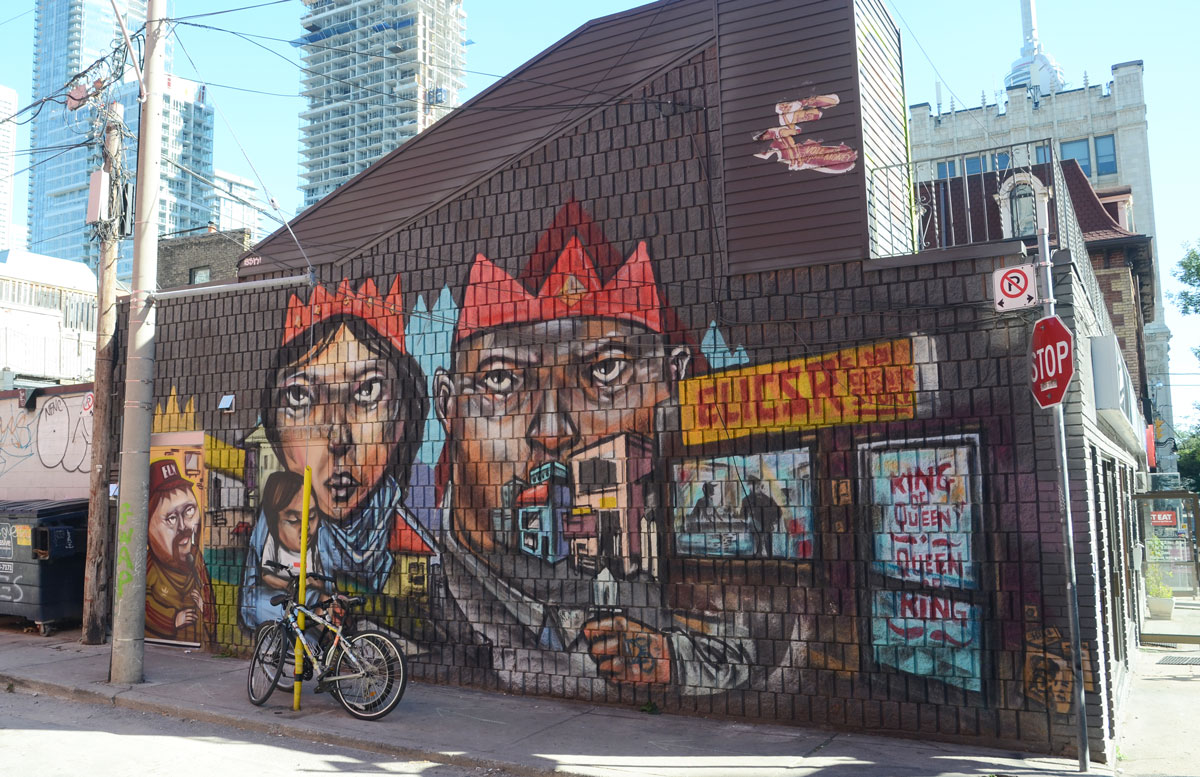
below: This mural by elicsr is on the corner of Renfrew Place and John Street.




 as I walk Toronto