Posts Tagged ‘doors’

Traces left behind, reminders of the past

oldworn sign painted above the door to a store


Along Spadina on a cold November day – from King to College.

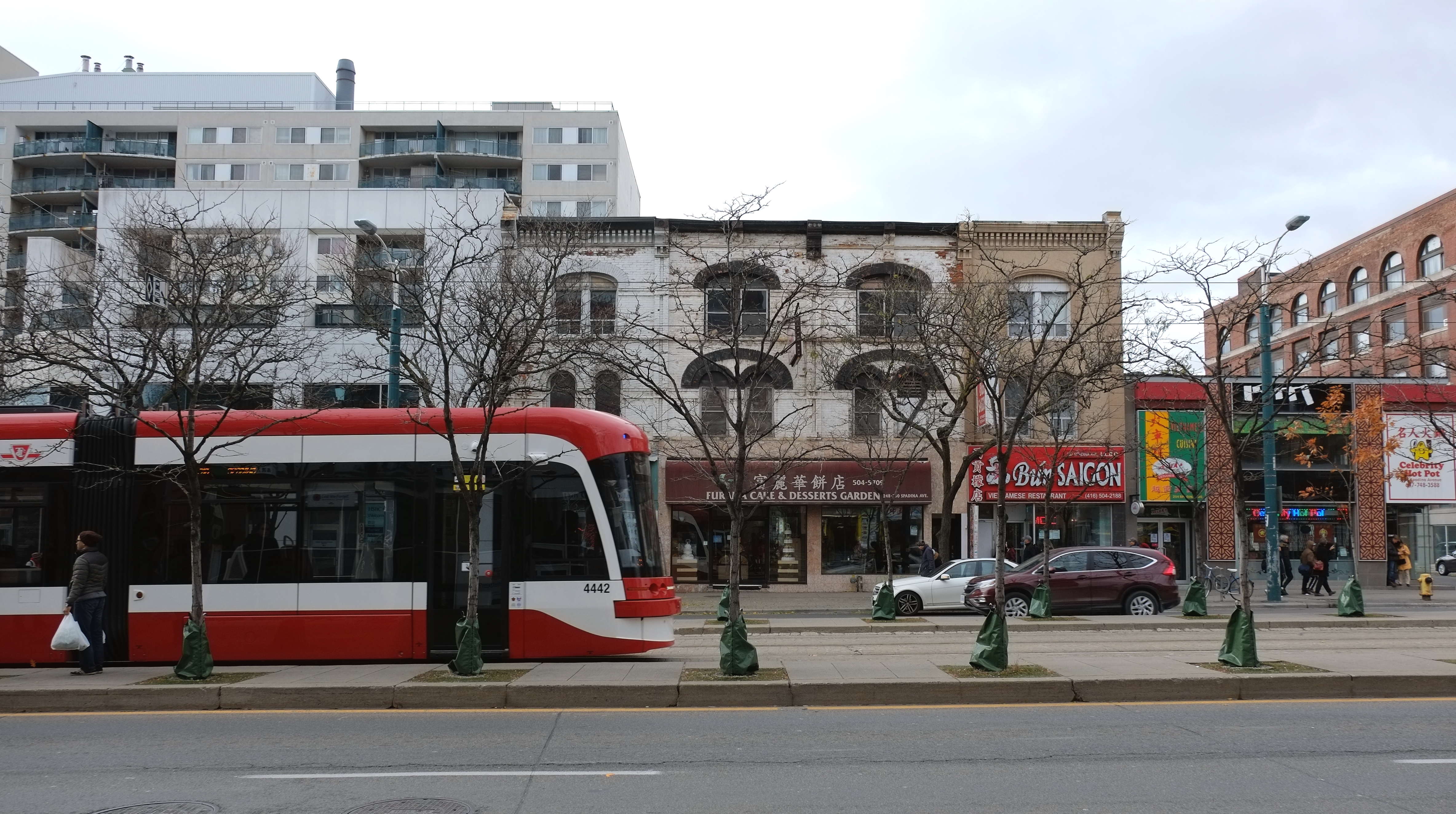
below: A streetcar passes by, down the middle of the road with young trees growing alongside the tracks.  In the background is an old white brick building  with rounded brown arches over the upper windows that now houses the Furama Cake & Dessert Garden – one of the many restaurants, coffee shops and bakeries along this stretch of Spadina.
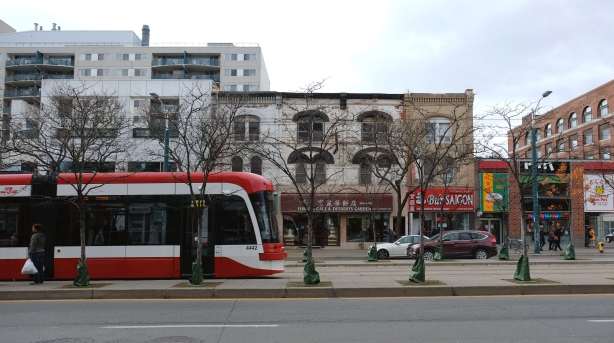
a new ttc streetcar on Spadina, down the middle of the street, with young trees growing along side the tracks, old brck building in the background, some cars,

 Construction of Spadina Avenue began in 1815.  It was always a wide street, running between Bloor and Queen.

Spadina, and neighbouring Kensington market, was the center of Jewish life in Toronto in the early 1900’s with synagogues, delis, tailors, a Yiddish theatre, and more.  About 80% of Toronto’s Jews lived in the area.   It was also home to the garment district (also known as the fashion district) with its numerous furriers, clothing factories and warehouses – what we’d probably call sweat shops today.

below: The northeast corner of Dundas and Spadina, June 1930 showing the sign over the door of ‘The Standard’ a Yiddish theatre that opened in 1921.  It was converted into a (mainstream) cinema in 1934 and renamed ‘The Strand’.   Another renaming occurred in 1941 when it became ‘The Victory’.  Twenty years later it became the Victory Burlesque.  The doors closed permanently in 1975.  Photo found on Bygone Theatre website.
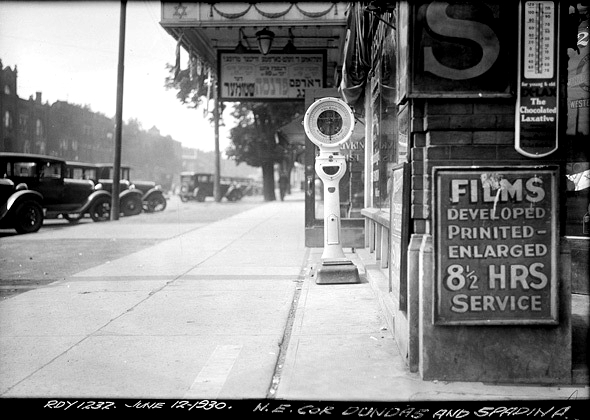
vintage black and white phot of the sidewalk and front of Jewish cinema at the corner of Dundas and Spadina in 1930. old cars parked in front,

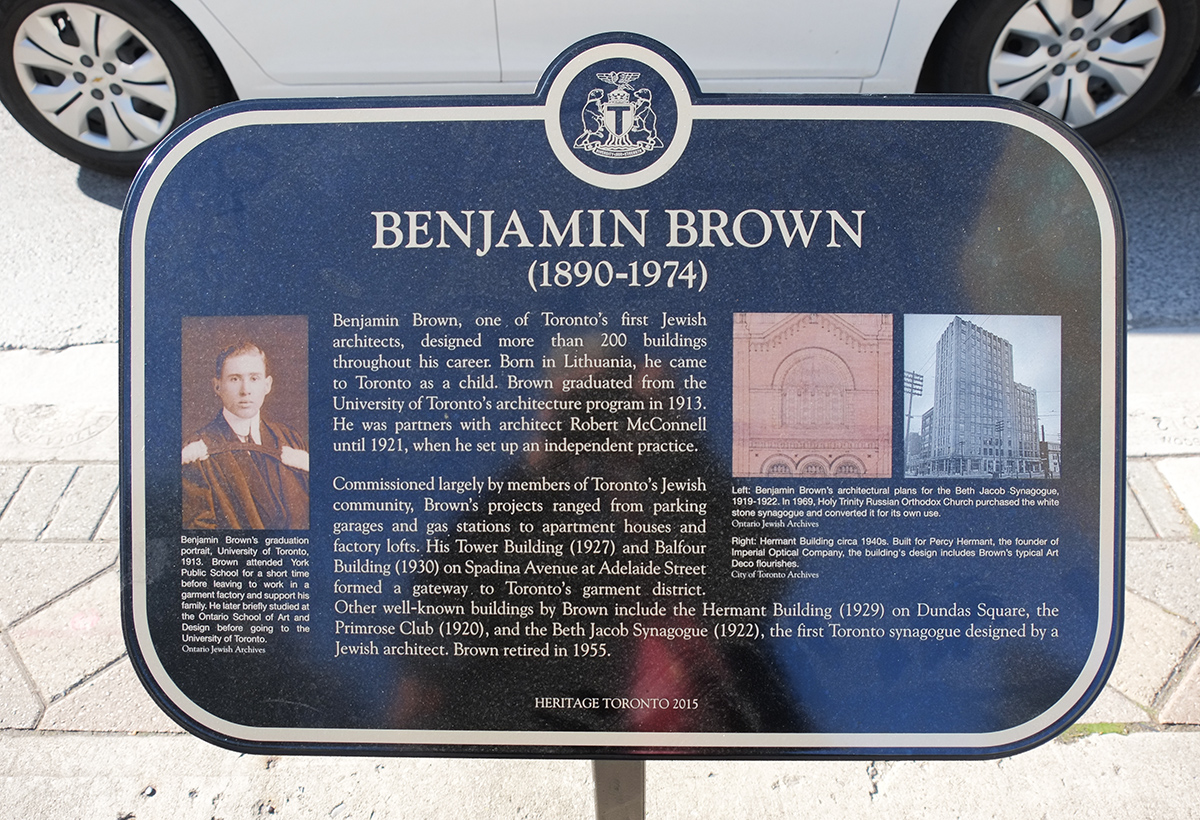
below: This plaque is on the west side of Spadina, just north of King Street.  It describes the contributions of Benjamin Brown (1890-1974), architect, to the area.

Benjamin Brown, one of Toronto’s first Jewish architects, designed more than 200 buildings throughout his career.  Born in Lithuania, he came to Canada as a child.  Brown graduated from the University of Toronto’s architecture program in 1913.  He was partners with architect Robert McConnell until 1921, when he set up an independent practice.

Commissioned largely by members of Toronto’s Jewish community, Brown’s projects ranged from parking garages and gas stations to apartment houses and factory lofts.   His Tower Building (1927) and Balfour Building (1930) on Spadina Avenue at Adelaide Street formed a gateway to Toronto’s garment district.  Other well known buildings by Brown include the Hermant Building (1929 on Dundas Square, the Primrose Club (1920) and the Beth Jacob Synagogue (1922), the first Toronto synagogue designed by a Jewish architect.  Brown retired in 1955.

toronto historic sites plaque to benjamin brown

Both the Tower Building and the Balfour Building still stand.  The later, pictured on the plaque is on the NE corner of Spadina & Adelaide.  It was named for Arthur J. Balfour, British statesman, the author of the 1917 Balfour Declaration that pledged British support for a Jewish homeland in Palestine.

below:  This is ‘Uniform Measure/Stack’ by Stephen Cruise and it includes that giant thimble on a stack of buttons,  a few button shaped tree planters, and a tape measure carved into the sidewalk as it goes around the corner (you can see a bit of it at the bottom right of the photo).  This tribute to the garment district, or rag trade if you want to call it that,  dates back to 1997.   A few years ago the tape measure was painted yellow – but not by the artist.  It has since been cleaned up.  Recent sidewalk work has scarred the tape measure but most of it remains intact.

public art on the corner of Richmond and Spadina, giant thimble and giant buttons

below: Another piece of garment district history – an old Singer sewing machine as an ornament above a narrow alley between two buildings.
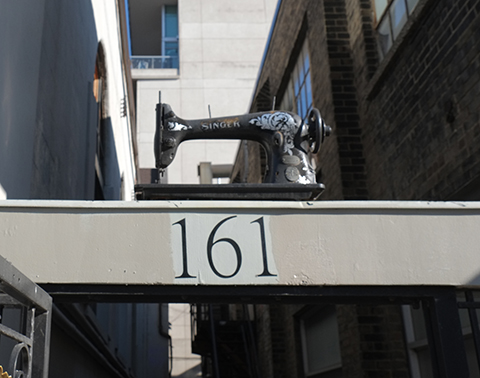
an old SInger sewing machine sits on a beam that crosses a small alley bewteen two buildings, it's about 8 feet above the street level

In the 1960s and 70s, the Jewish population moved out and the Chinese moved in.  In keeping with the changes that were occurring on Spadina, The Victory was sold in 1975 and subdivided  into shops on the main floor and a Chinese language cinema upstairs, first named the Golden Harvest and then the Mandarin. This cinema closed in 1994.

In the late 60s and early 70s, the city demolished a large section of land to make way for the new city hall.  At that time, Chinatown was centered around Dundas and Elizabeth streets.  Many of the Chinese who were displaced by the construction moved west along Dundas to Spadina.  Although many of the Chinese businesses and residents have moved north to Markham & vicinity, this stretch of Spadina is still considered to be Chinatown.

below: A panda eating bamboo, painted by Murals by Marg with support from Chinatown BIA & StreetARToronto.

mural on a wall of a panda bear sitting on the ground and chewing on bamboo

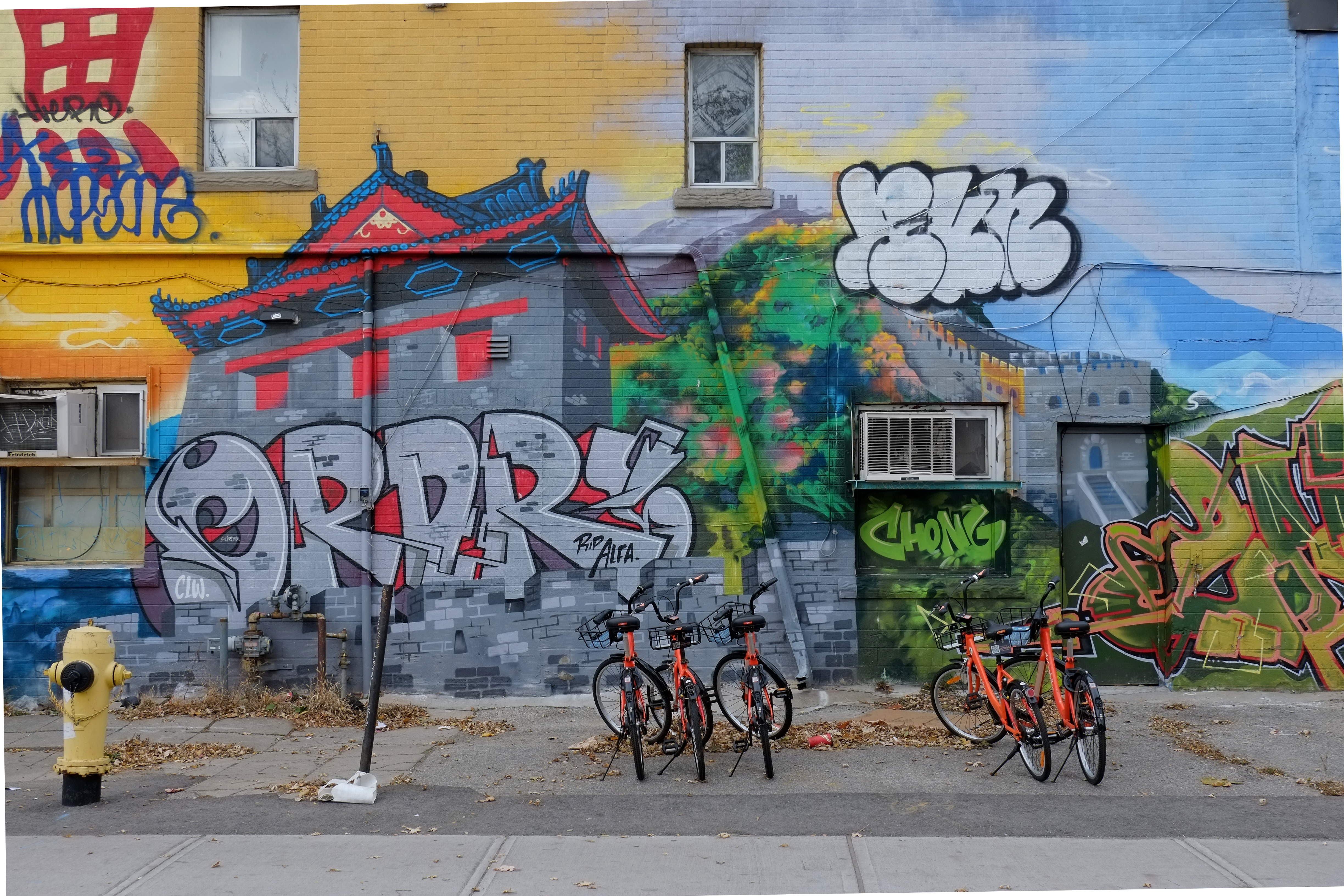
below: Another Chinese themed mural, with tags unfortunately.

orange bikes parked outside a building that had a mural of a Chinese scene that has been tagged over.

below: This caught my attention – Does it look like fresh ginger?   And no, there was nothing in front of the sign either.  Smile.

box of pineapples for sale outside a Chinese grocery store, the sign by the box says fresh ginger

below: Even on cold days you can buy fruits and vegetables on the sidewalk outside the Chinese grocery stores.
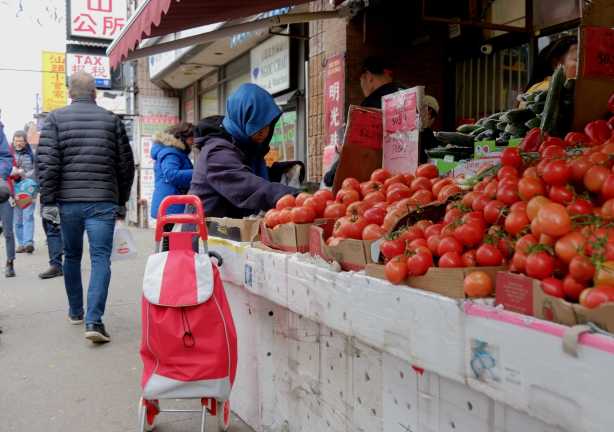
a woman is buying tomatos from a vendor with a large table of tomatoes outside a Chinese grocery store on Spadina, in CHinatown.

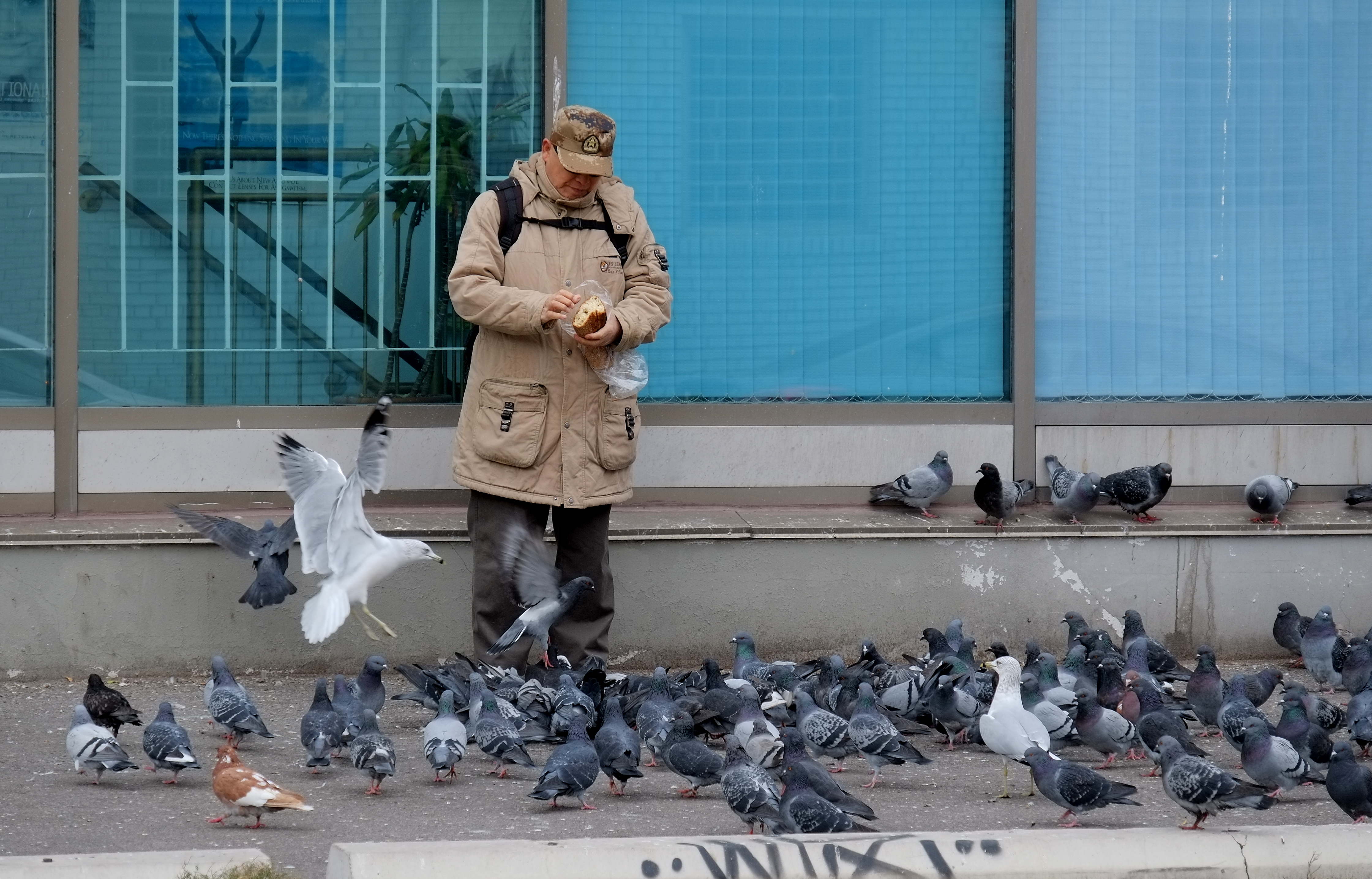
below: Feeding the pigeons.

a man is feeding pigeons outside on a cold day. He is wearing a heavy coat and a hat.

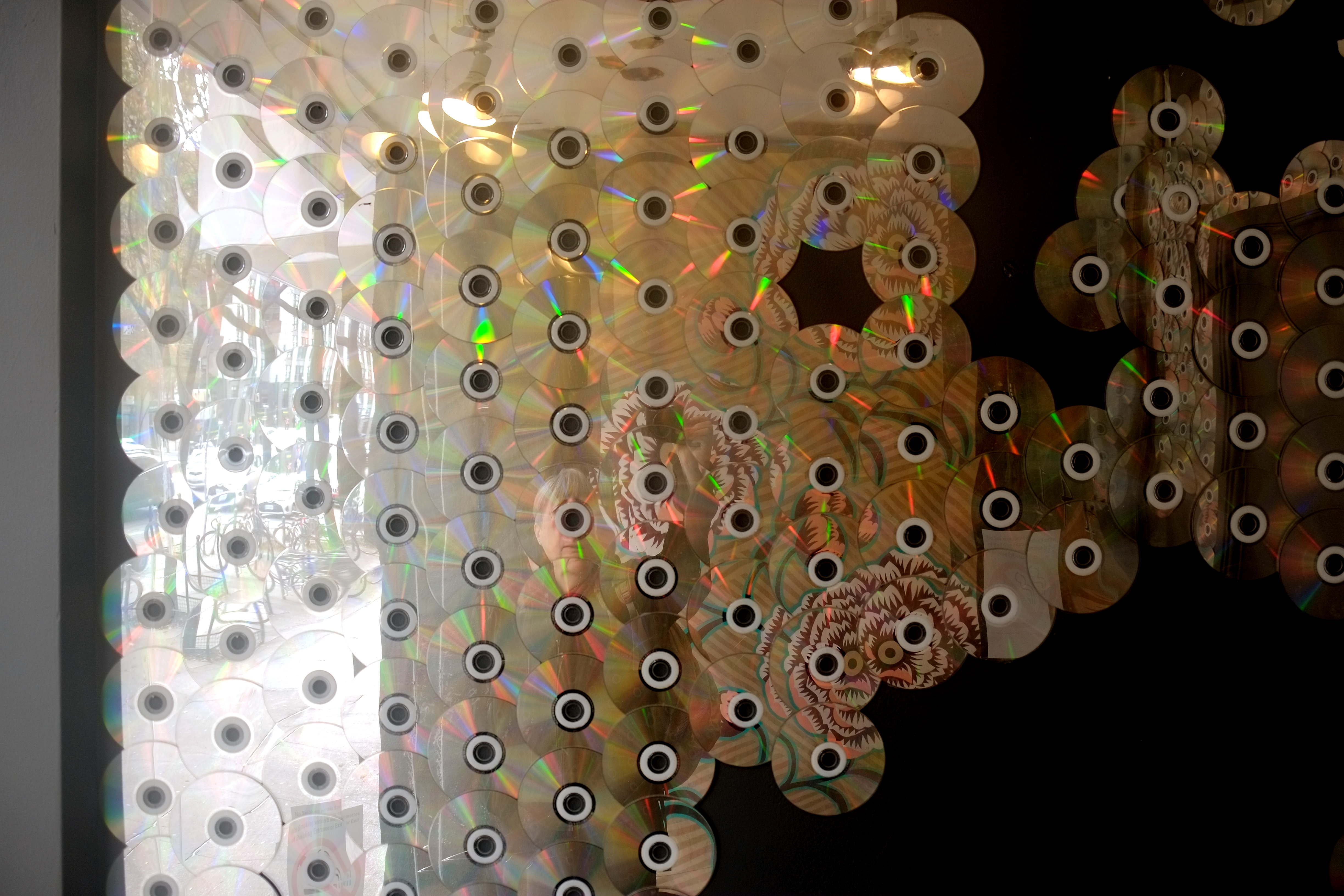
below:  This is an old display of CD’s mounted on a wall inside a window of an empty store.  The window is dirty but if you step into the recess of the entrance way, you can see the possibility of reflection, light and colour playing together.   This was actually the first picture that I took when I walked up Spadina the other day.   After I saw this window I started paying closer attention to other empty stores.
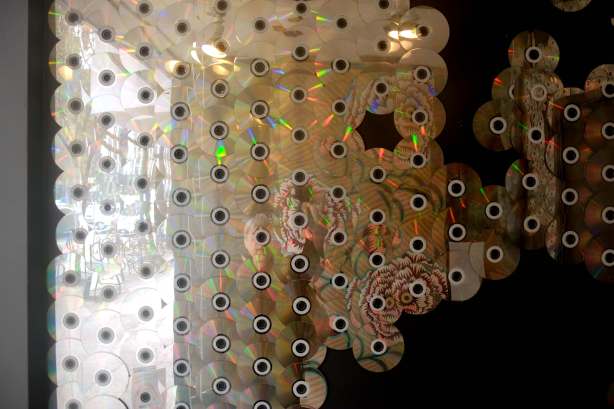
design and pattern made with many old CD's mounted on a wall inside the window of an empty store.

There are quite a few empty stores and sections of Spadina are quite grubby looking.  As I mentioned above, many of the Chinese businesses have move on and once again the area is the middle of a change.

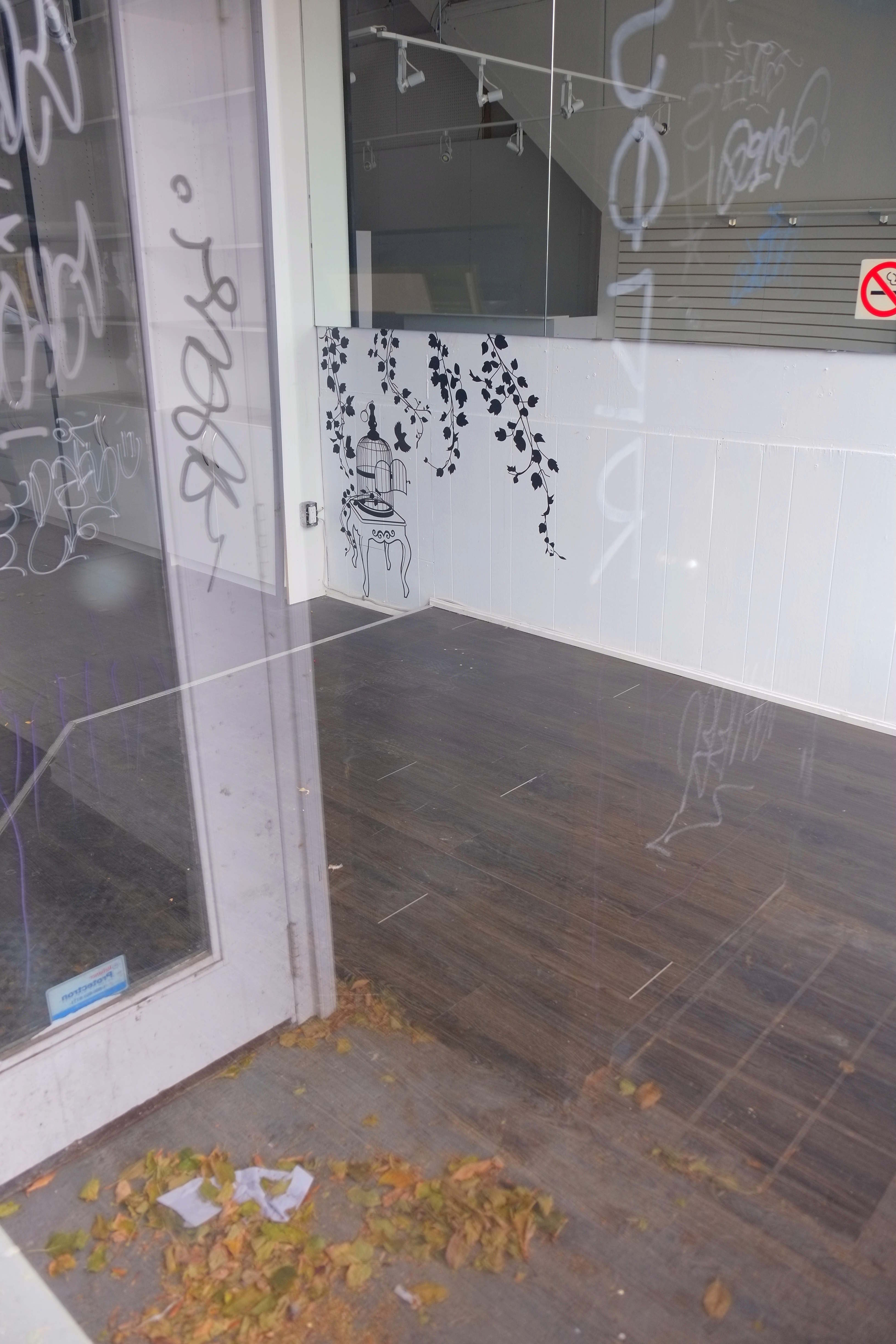
below: Someone cared enough to paint this delicate birdcage and ivy scene on the wall.  Doesn’t it make you wonder who did it?  and why?  and what happened to them?

looking through a window into an abandoned and empty store, leaves have blown in and are on the floor.

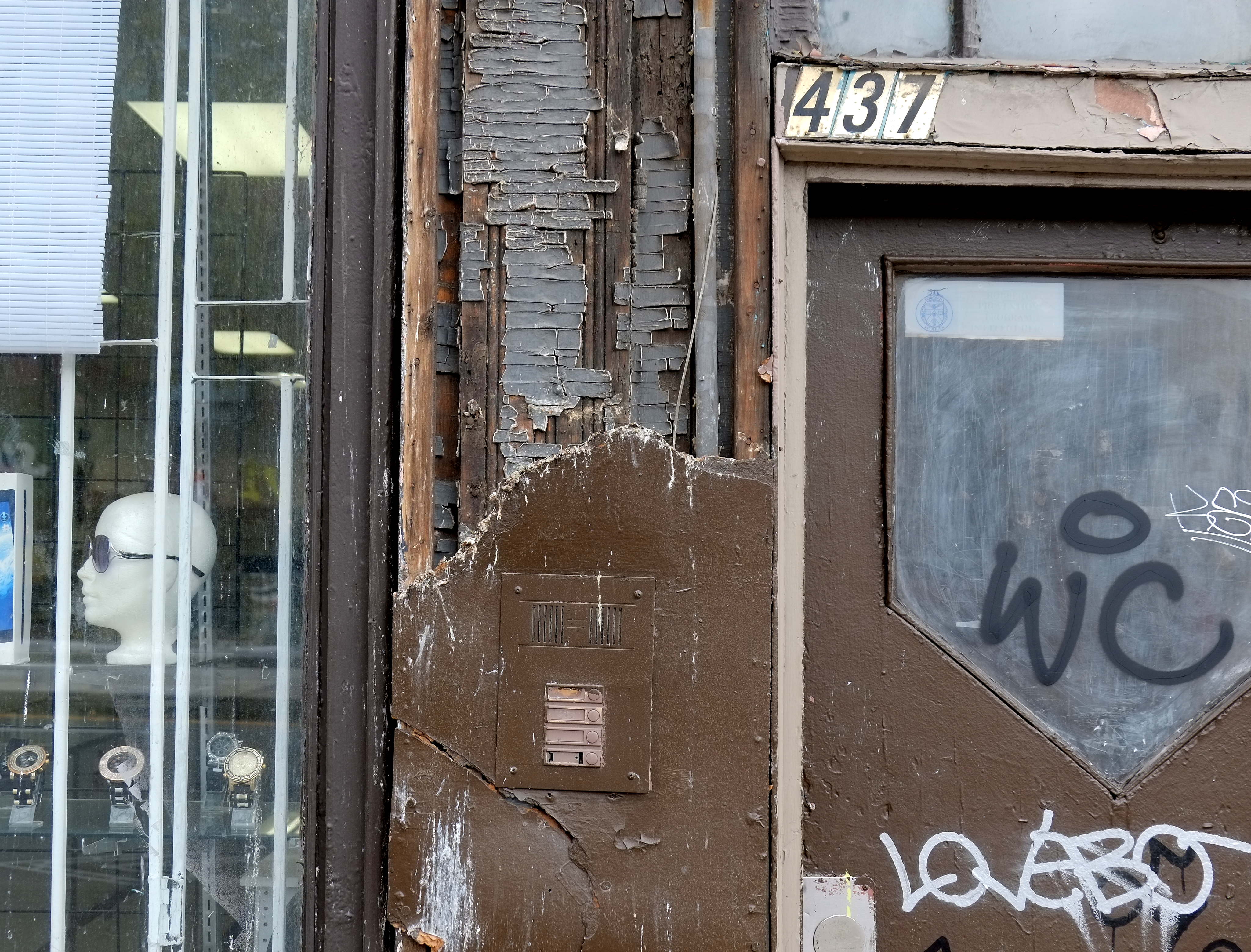
below: A painted over intercom –  a remnant of the past.  But the plywood that the intercom was mounted on is partially torn away to reveal an even older, more hidden, past.     Does anyone live or work at 437 anymore?  What lies behind the door?
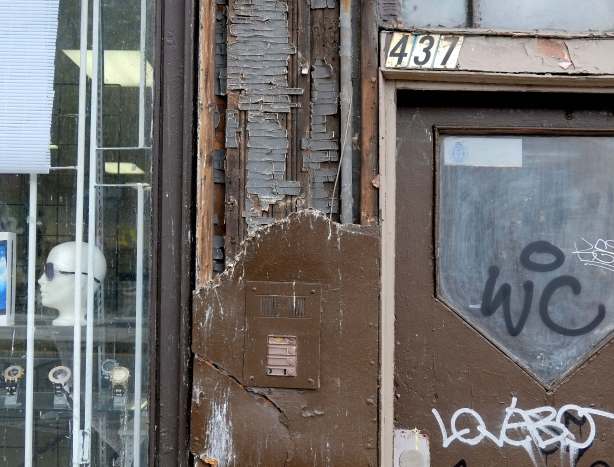
exterior wall, brown paint, number of 437 above the door, cracked wood plywood beside the door, old and broken intercom system that has been painted over, next door window is a store, with mannequin head on a shelf

below: This little place had a short life as a store – but for the life of me I can’t remember what it was.   I think that once upon a time it was an 8 Eleven (play on 7 Eleven stores) but that was long ago and I know that it closed before I first saw this space.    How easy it is to forget.

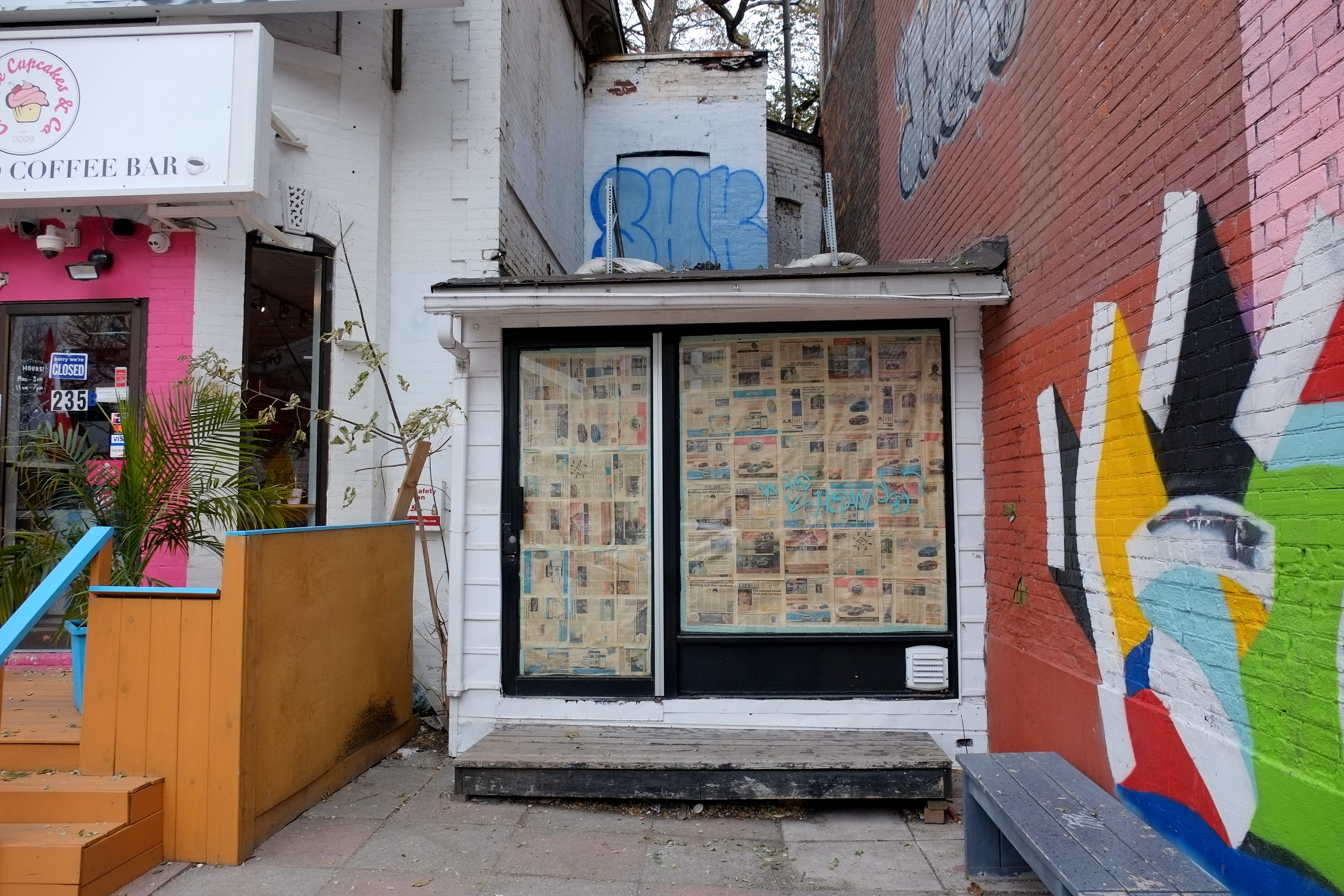
very small building with door and window papered over.

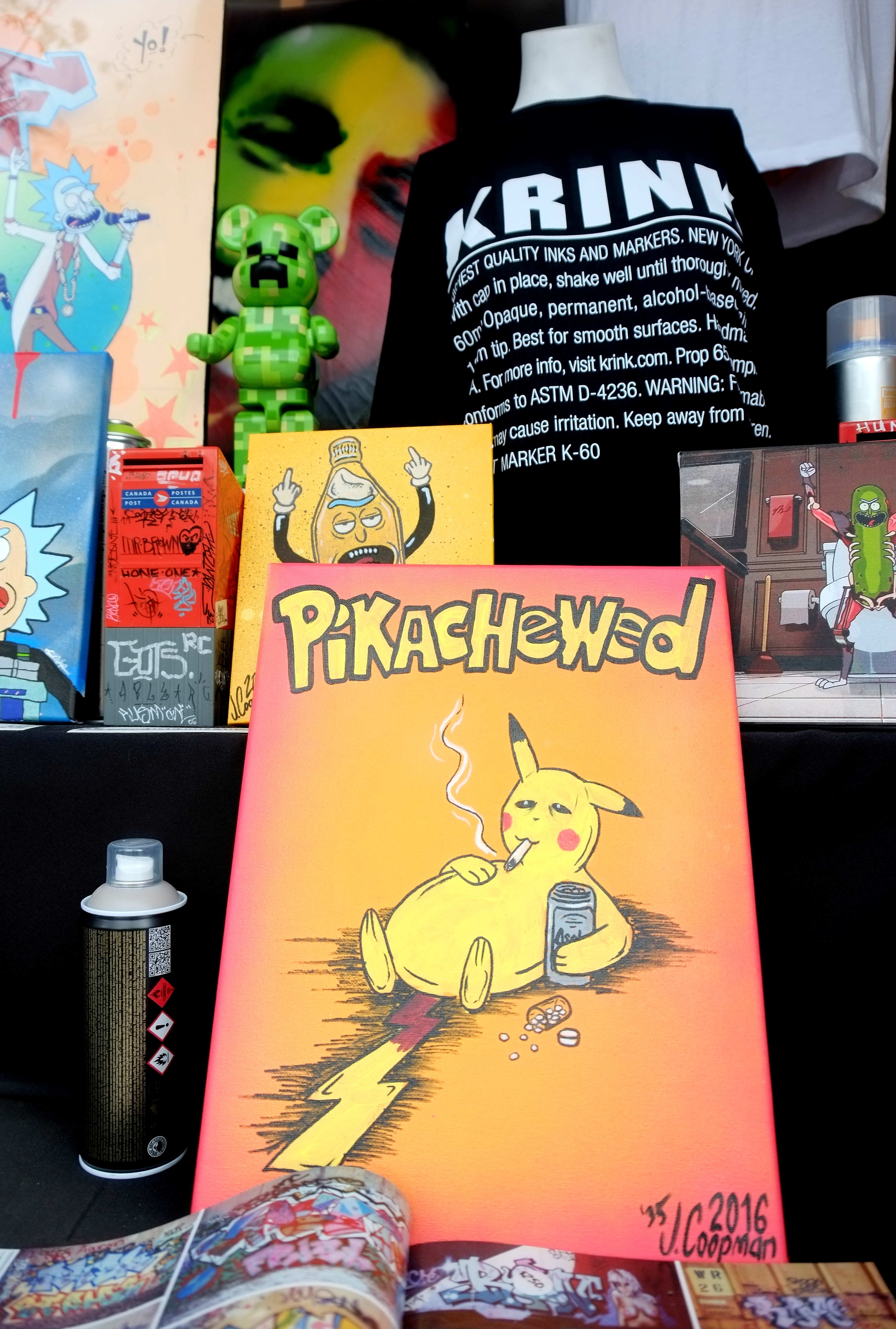
below:  As I passed by this window, I thought to myself “How cute, pikachu.”  Then I stopped and went back.  No, not pikachu.  Part of the seedier side of Spadina Avenue.

articles for sale in the window of a store

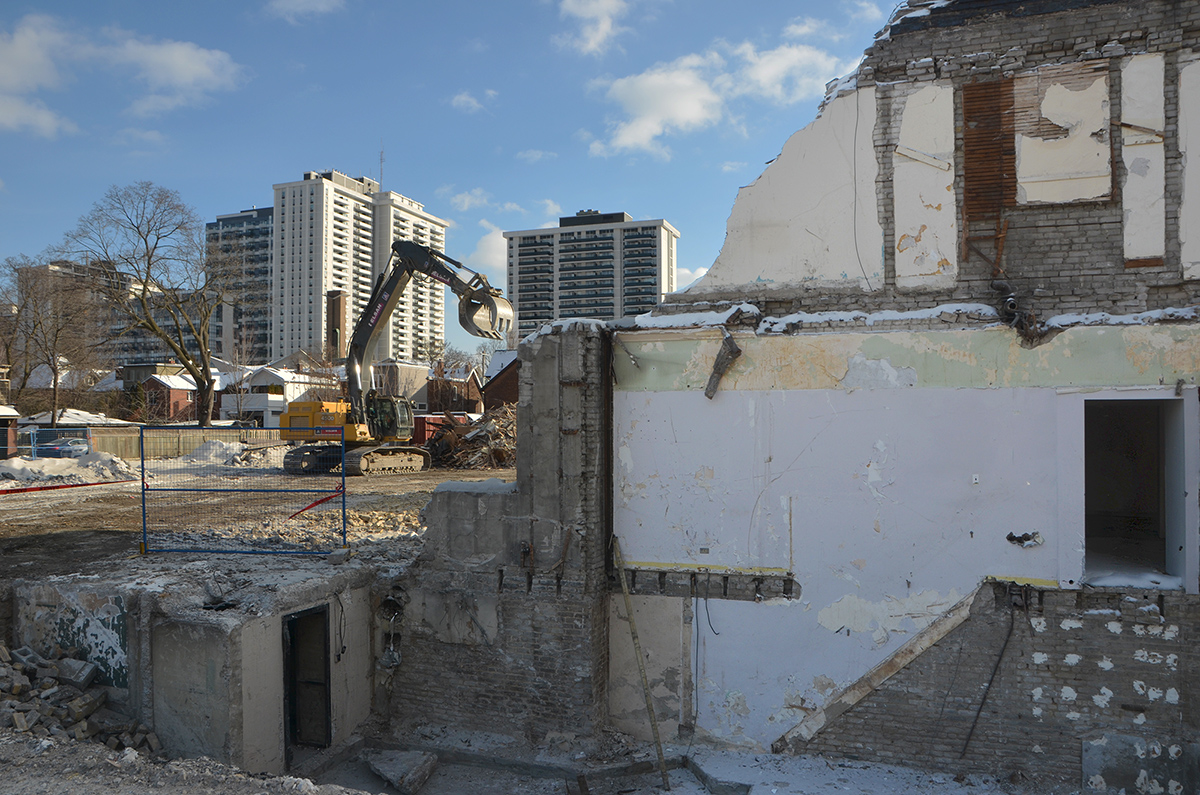
below:  Layers.  On the left, hoardings around an old building being demolished and on the right, a staid brick building.  Behind them is a newer development with its bright east wall.

street scene, Kensington, with hoardings for demolition, a building from the70's and a newer apartment building in the background with bright coloured squares on the side.

cracked brick wall and decorative carving, on upper storey of an old building

a pair of Bell telephone boxeswith a grey wall behind


This post features some of the doors that caught my eye as I walked a few alleys this past week.

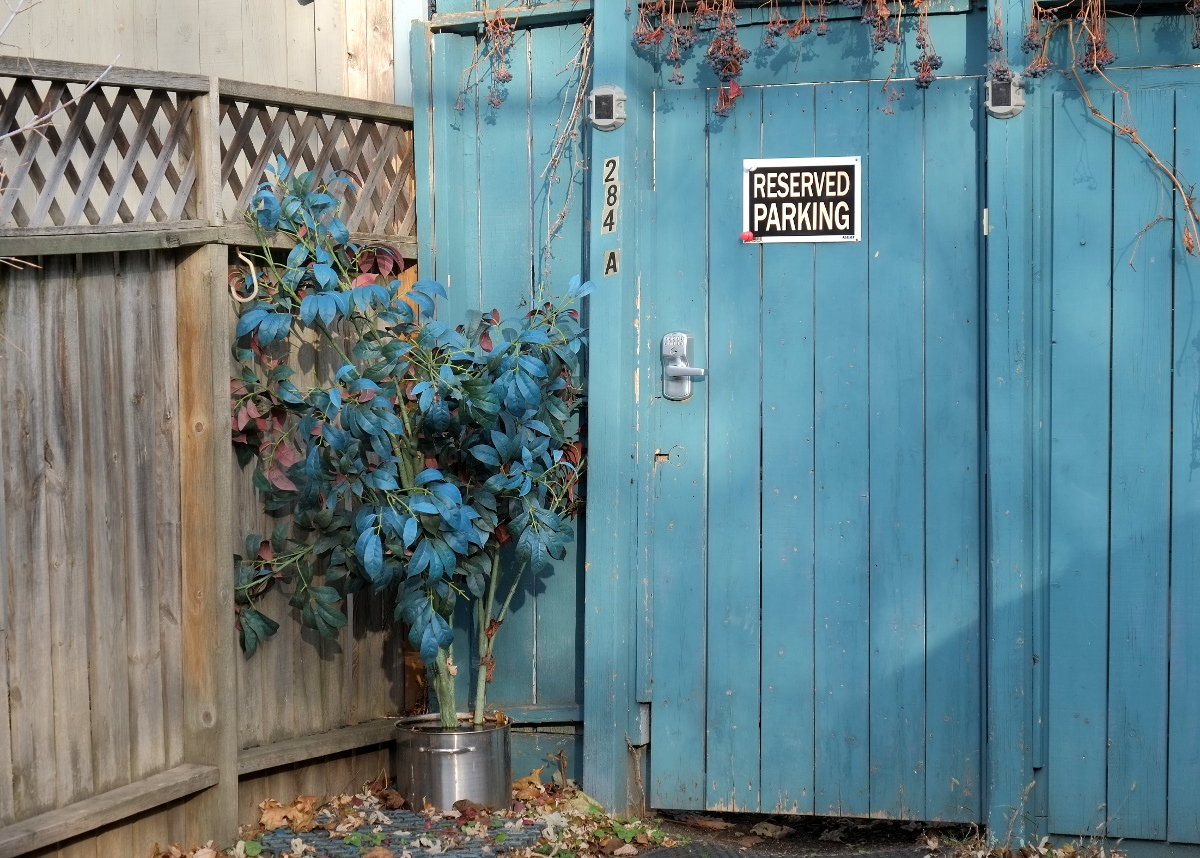
below: It was the colour of the plant outside the gate that I liked –  It’s almost a perfect match with the colour of the fence.

apotted plant, small tree with dark green leaves and teal leaves sits outside beside a teal blue fence and gate

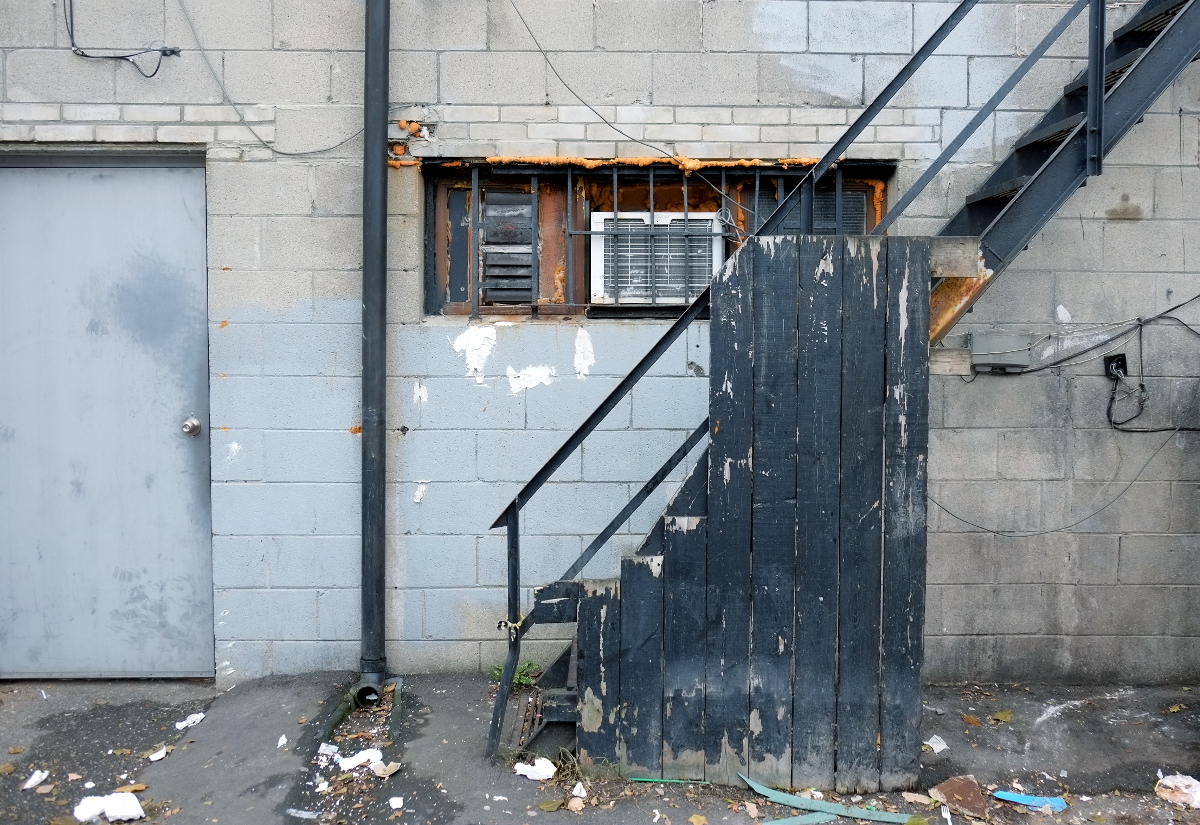
below: These grey metal doors are a common sight as are metal staircases.  Were the boards an attempt at a wall?  A hiding place under the stairs?

back of a concrete block building in an alley, steel grey door, also small horizontal window with metal grille and air conditioner, metal stairs to upper story painted black, with some black pieces of wood making partial wall beside the stairs.

below: You can get your laundry done in this alley. There is even a bench to sit on while you wait.

lane entrance to a coin laundry, two grey doors, white bench outside the doors.

below: At first I thought that this was a strange place to put a door. Very awkward! Then I realized that it was probably just an old door that was being used to fill in the gap between the garage and the neighbouring building.

an old white wood door used as part of a fence

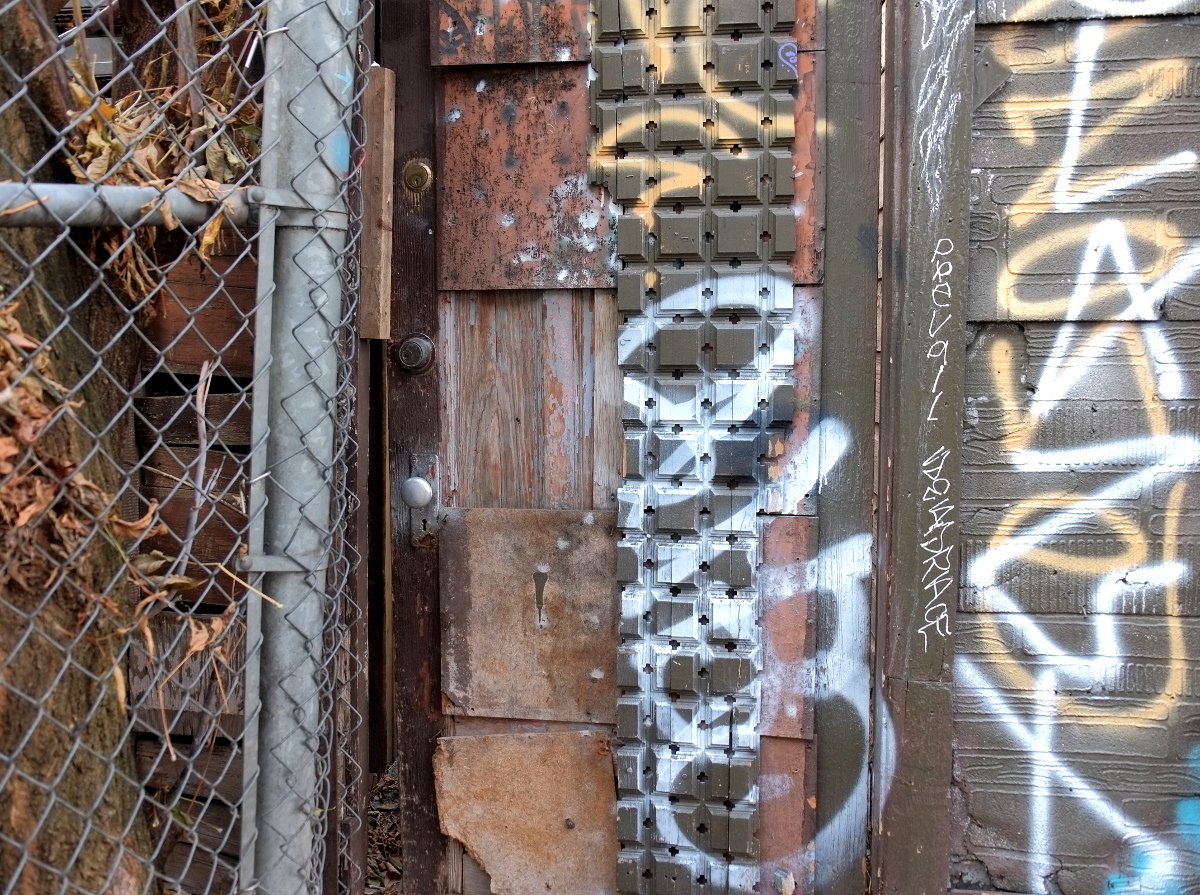
below: An interesting texture

brown wood door, beside chain link fence. textured wood panel beside the door.

below: And last, another common sight, scrawls on the wall.
pink brick building with grey metal door, lots of scrawl graffiti on the walls, one litle blue man roughly drawn by the door

It’s been a few months since I did a blog post about doors.  If you like doors, you might want to check out a couple of previous posts:

  1. Spadina Open Doors
  2. Late doors (of Mt Pleasant cemetery)

If you go to Norm 2.0’s blog feature Thursday Doors,  there are links to even more doors that other people have blogged about.   Check them out!

Sunny September days make good walking in the alleys days.   Here are some of the walls I saw and the compositions that they make.  The textures of wood and metal, bright colours as well as subdued ones, the effects of light and shadow, as well as shapes and patterns – these are some of the things that catch my eye and make me stop.  Throw a little nature into the mix and the following photos are the result.

part of an old wood door that is part dark turquoise and part blue, with a rusted latch holding the two doors together and closed

a vine with two red leaves hangs in front of a grey wall, sunny day so there are shadows on the wall fromother plants that aren't in the picture

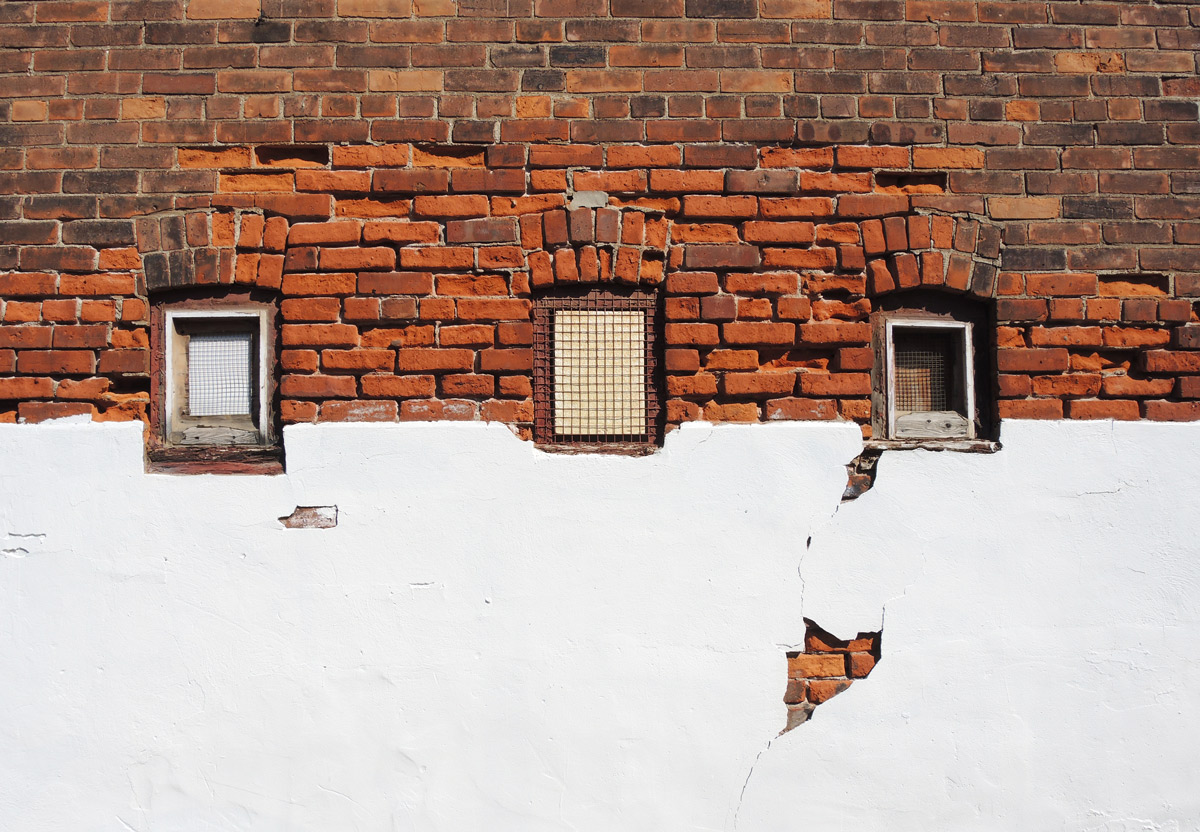
three small windows in a wall, the top part of the wall is brick and the bottom is plaster that has been painted white

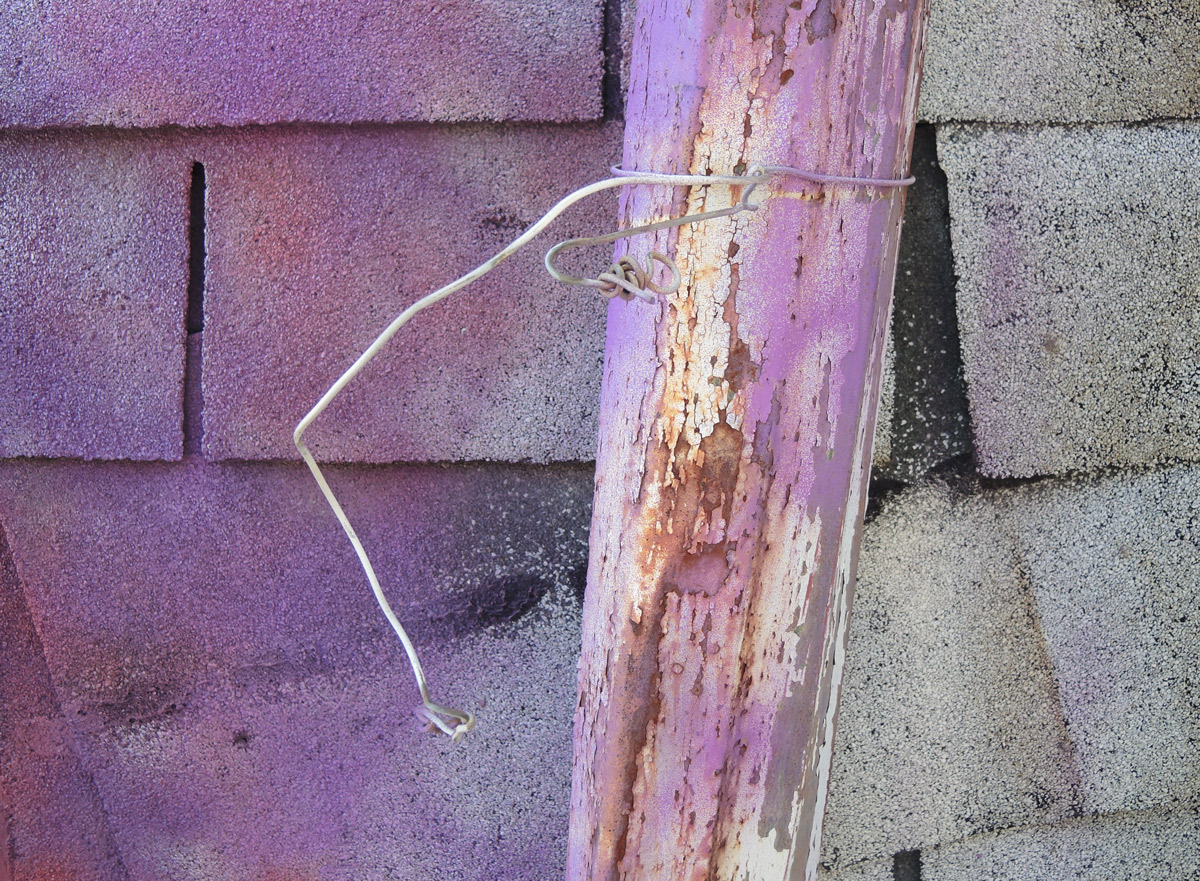
old rusty downspout with part of a wire coat hanger wrapped around ut, in front of a grey shingle covered wall that has been partially covered with purple spray paint

trunks of three trees growing in front of an old white building with a green door. windows in door are covered with plywod and a piece of plywood is nailed over parts of the lower half of the doors to keep them closed.

a bashed up grey metal door with splotches of light and shadow

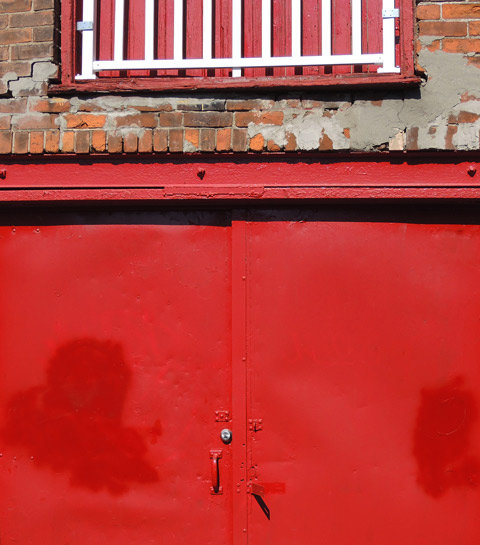
part of a bright red double metal door in a brick building

a bright turquoise door in a building that has been painted white - some of the old brick shows throw the peeling paint.

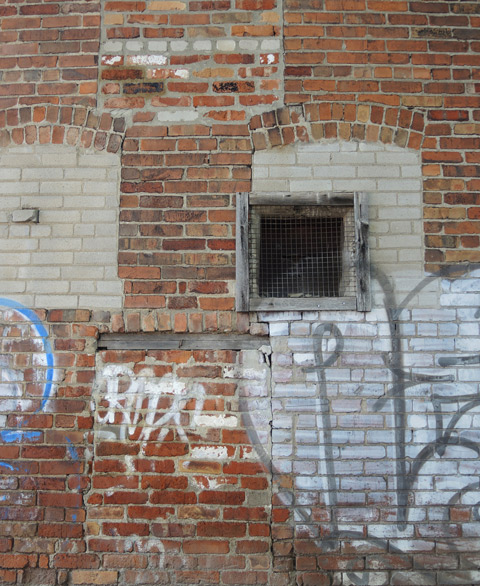
part of a brick wall that has old windows bricked over in a different brick, an old window with old wood frame, unpainted, some graffiti on the wall

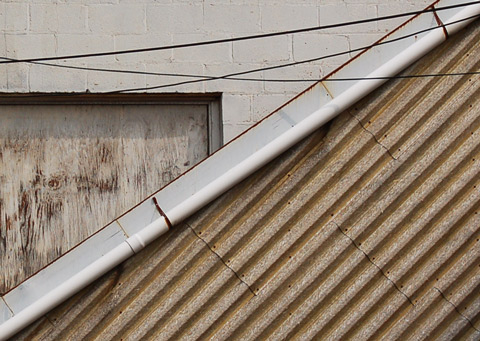
corrugated plastic panels on angle in front of concrete block wall with window covered with plywood

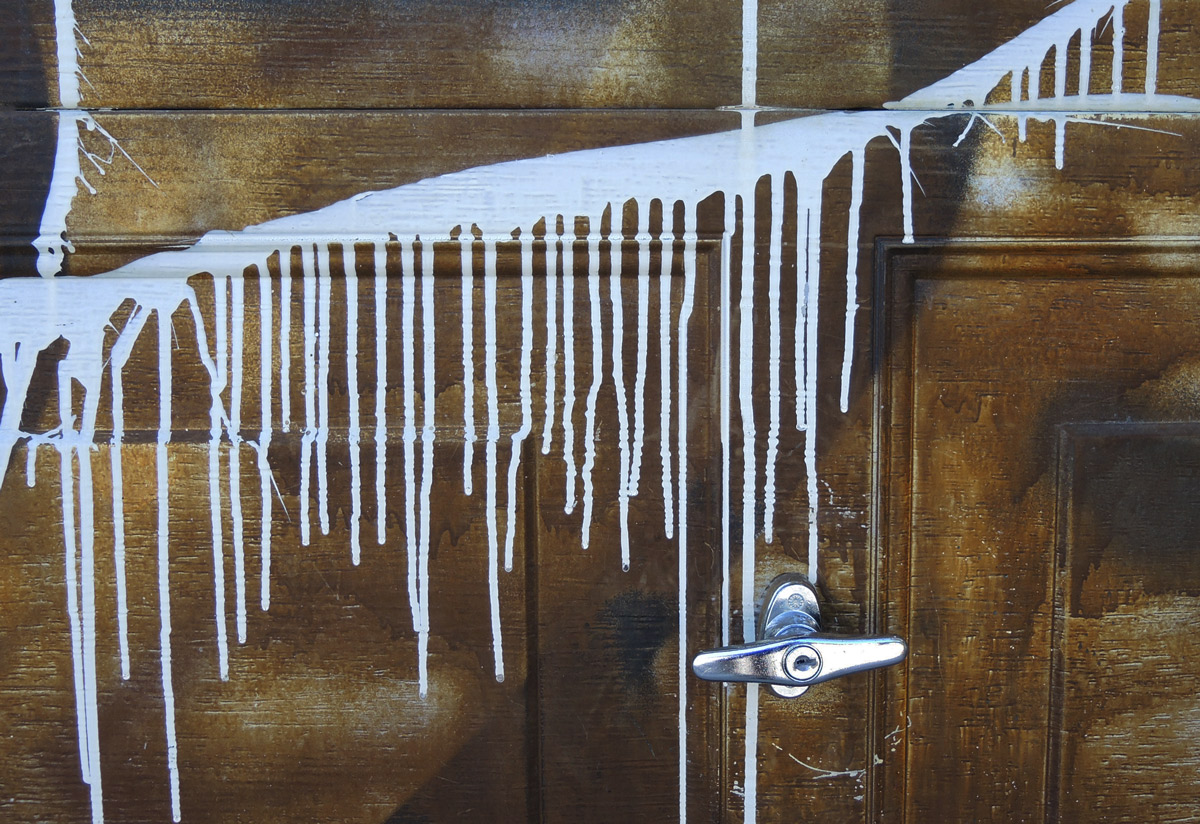
white drips of paint on a wood garage door, metal door handle

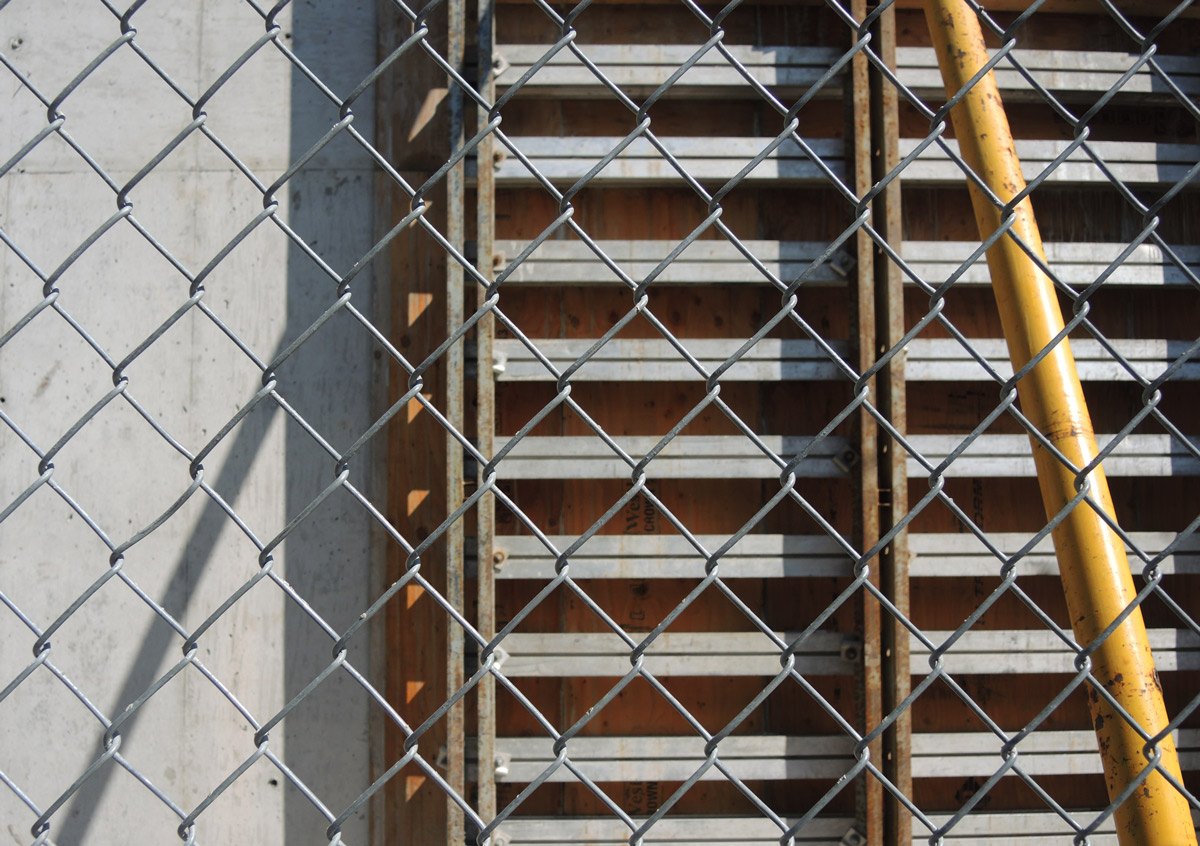
chainlink fence in front of rows of construction equipment

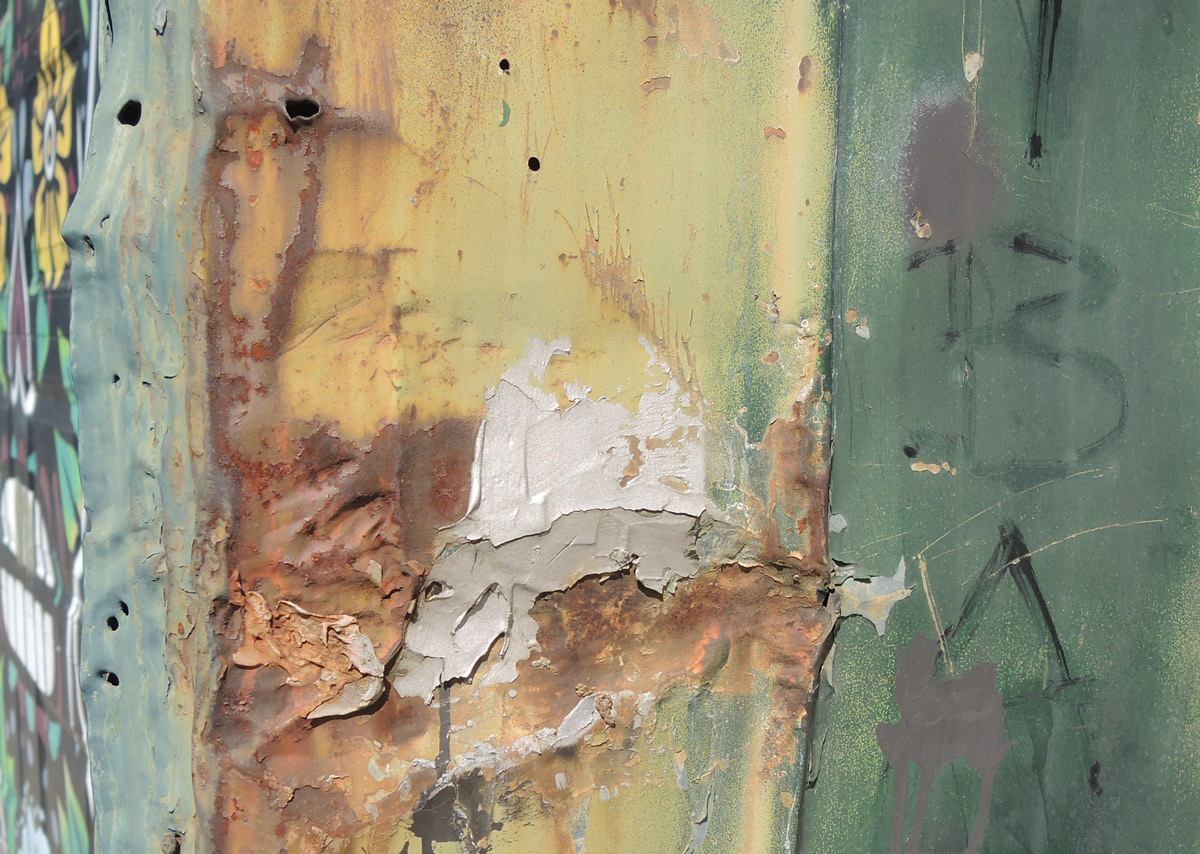
a grey plaster attempt to patch a broken rusted metal panel on the side of a garage - rust in shades of yellow and brown, a painted green stripe

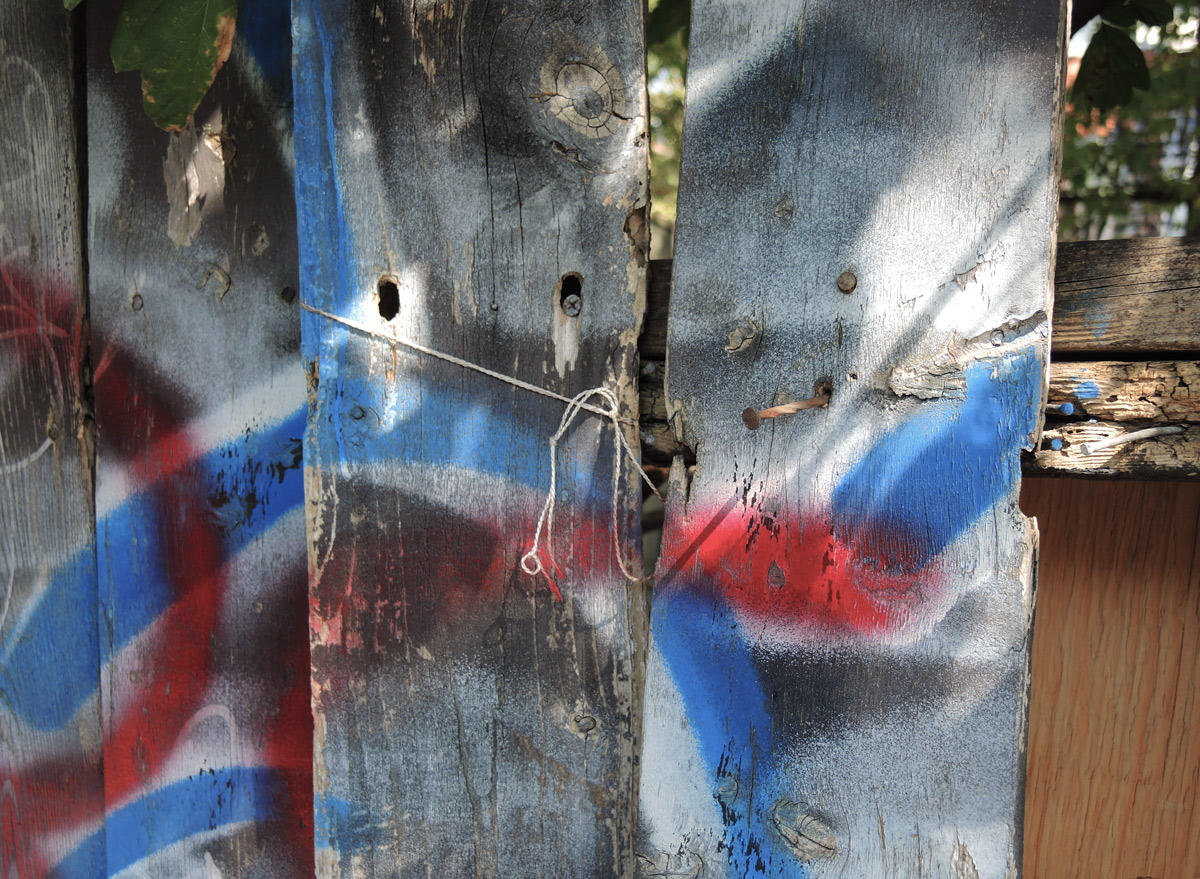
red, white, and blue spray paint on three wood slats of a fence, tied together with string, some nails sticking out

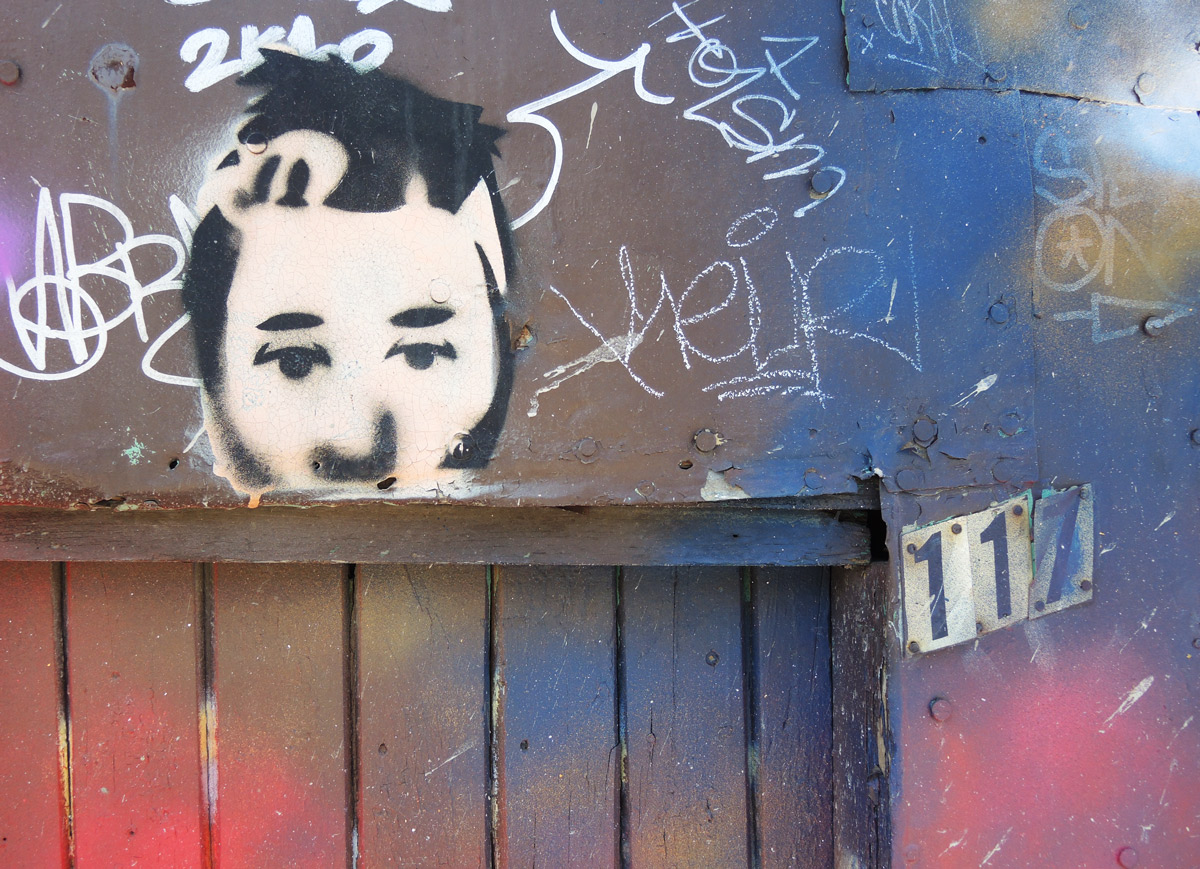
paste up of a man's face over a wood door, door and wall have blue and red splotchy spray paint on them

I’m talking to you….

Well, I’m not the one doing the talking.  In fact, no one is talking, or shouting for that matter.  The words are silent, present..  but quiet.  They are written on the walls; scrawled on the walls.  They’re rarely beautiful and they’d rarely qualify as being profound.

below: But “Sometimes it doesn’t matter”.  I love the ambiguity and flexibility of the word ‘it’ in this context.  Write your own story. Develop your own plot.

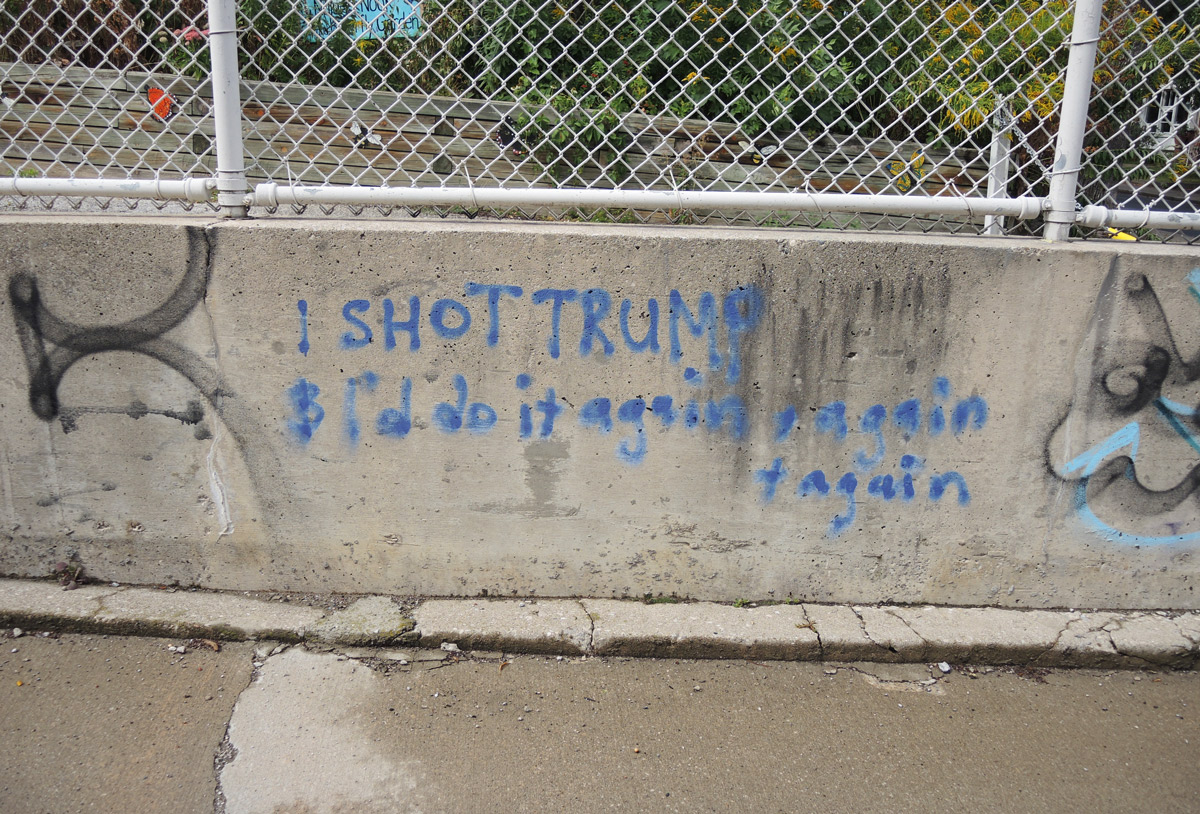
below: … even if the plot doesn’t make sense, like Trump himself.

blue spray paint graffiti words on concrete by a chainlink fence surrounding a school playground and parking lot that say I shot Trump and I'd do it again and again and again

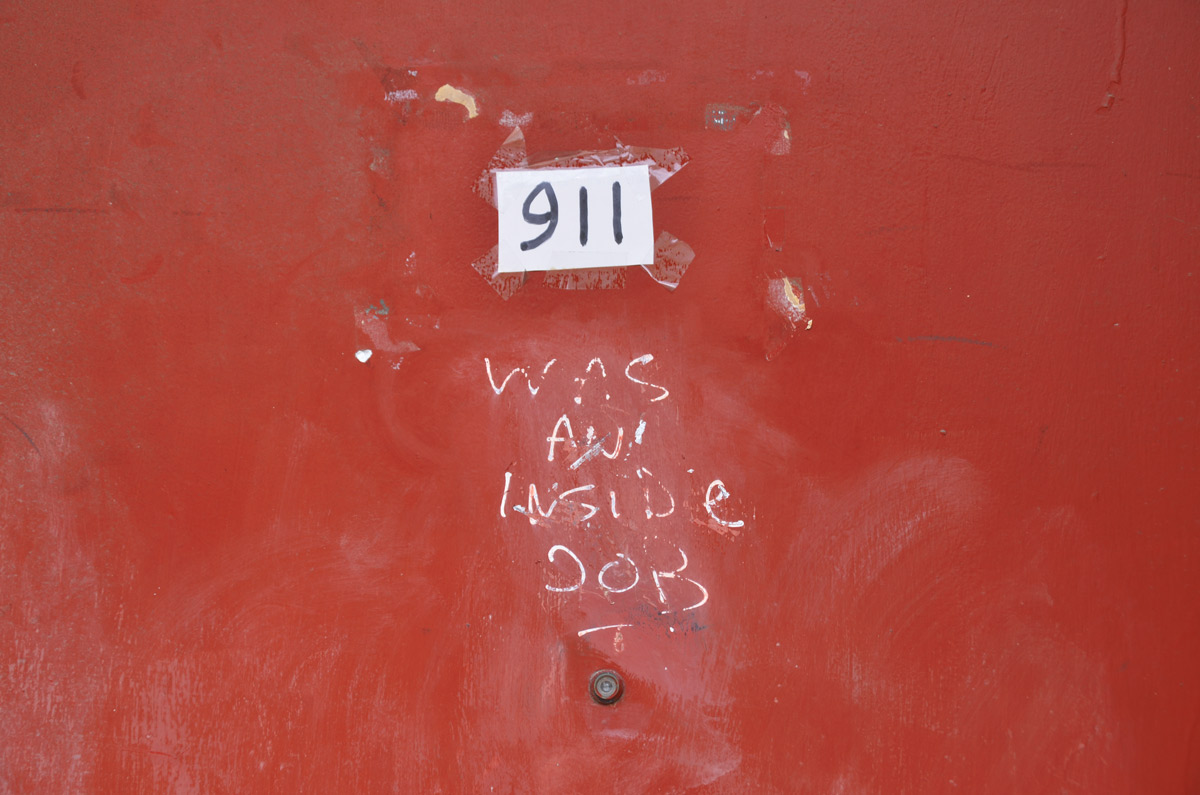
below: From Trump we jump to conspiracy theories.  That was easy wasn’t it?

on a red door, number 911, someone has added in white letters, was an inside job

below: I have no segue for 911 conspiracies to love.   A jump in the plot?

blue spray paint graffiti words on concrete by a chainlink fence surrounding a school playground and parking lot that say Love Yourself Kids

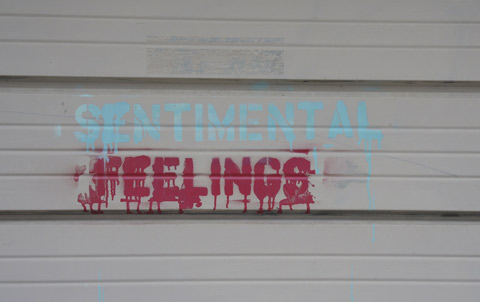
below: Sentimental feelings – dripping with sentiment.  Oh dear.

graffiti words stenciled on a garage door that say sentimental feelings.

below: .. or wishes for feelings of being loved

small square around these words, love me plz, written with black paint on a white garage door,

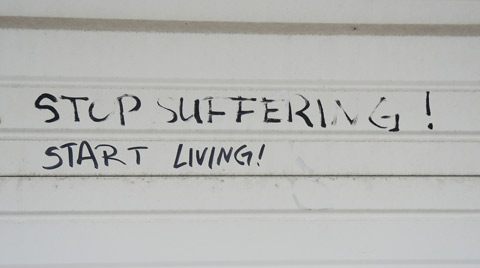
below: Pull yourself together and get it together….  But.. but..  Buddha once said: “Life is suffering; suffering is just part of life.”  Sooooo if you start suffering do you stop living?  Yes, I can be insufferable, just like philosophy and psychology and a few other ologies.

below: Did I mention that sometimes the words make no sense?

black sharpie words on a concrete utility pole, says Virgin Armour

below: These words, on the other hand, make sense: Bew Are!  (not technically graffiti but my editor didn’t question it!)

And that’s the end.   No more words.  I have no more words. Fini.

Elvis has left the building.

a man is walking past a wall with street art, a construction sign is leaning backwards against the wall blocking part of the art. THe picture can't be seen but the words that went with the picture are still visible. They say The artist isn't present

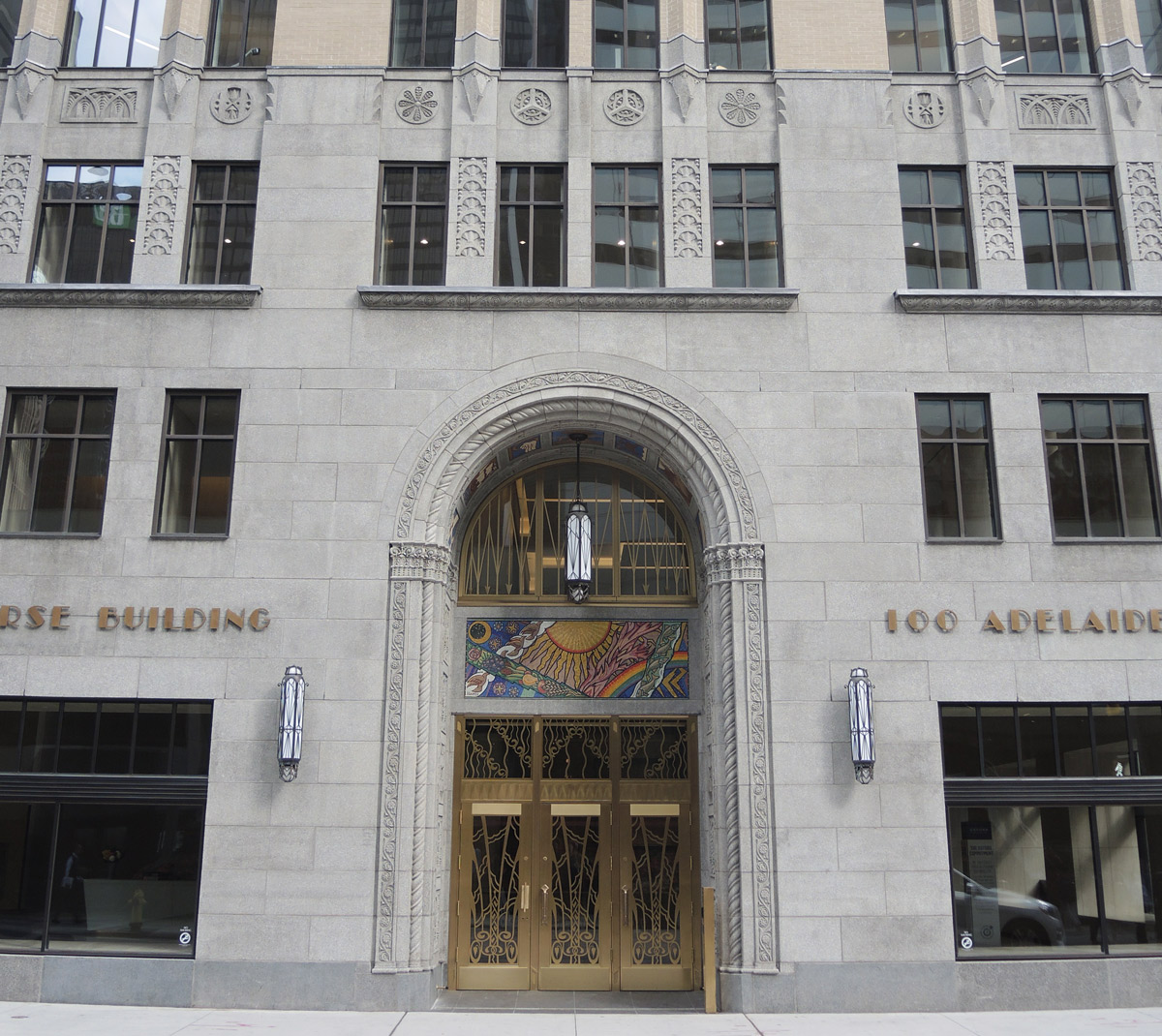
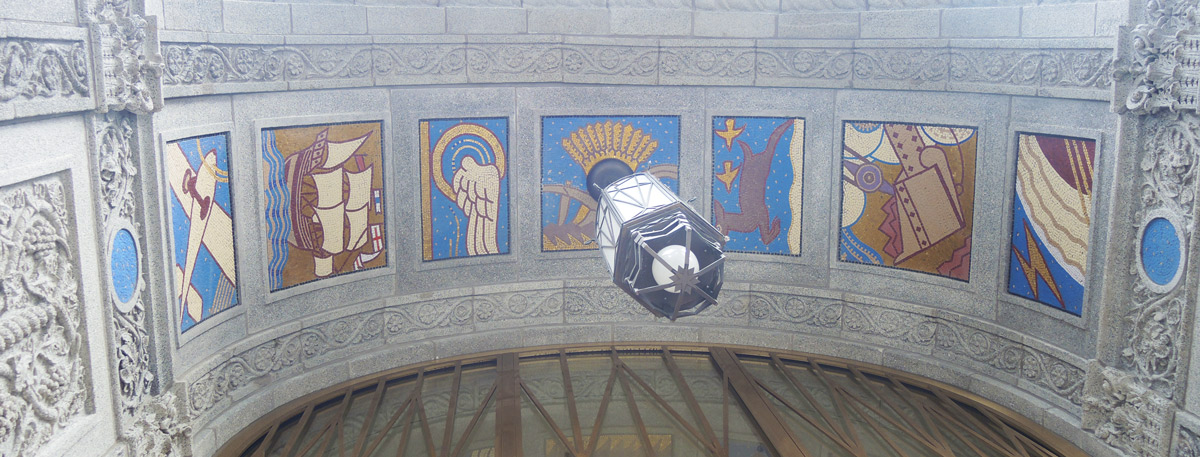
The 16 storey Concourse Building at 100 Adelaide Street West was built in 1928. It was an Art Deco building designed by Martin, Baldwin and Green.  Recently, the building as amalgamated into a new 40 storey office tower.  The Concourse Building was gutted but the south and east facades were saved.  Also saved was the entranceway (portal) that was designed by J.E.H. MacDonald, one of Canada’s Group of Seven painters.

entrance to 100 Adelaide West, a stone building, with brass decorated doors and mosaic pictures decorating it. The concourse building, with stone relief work between the third and fourth storey windows as well

below: The entrance is 2 storeys high, topped with a Roman arch.   The rectangular panel above the door contains the four elements, earth (produce from the fields), air (stars and birds), fire, and water (fish swimming).

entrance to 100 Adelaide West, a stone building, with brass decorated doors and mosaic pictures decorating it.

below: The mosaics under the arch represent Canadian industry and nature.   Here, ship building and aircraft are depicted.

two of the panels designed by J.E. H. MacDonald on the Concourse building, a ship with sails, and an airplane

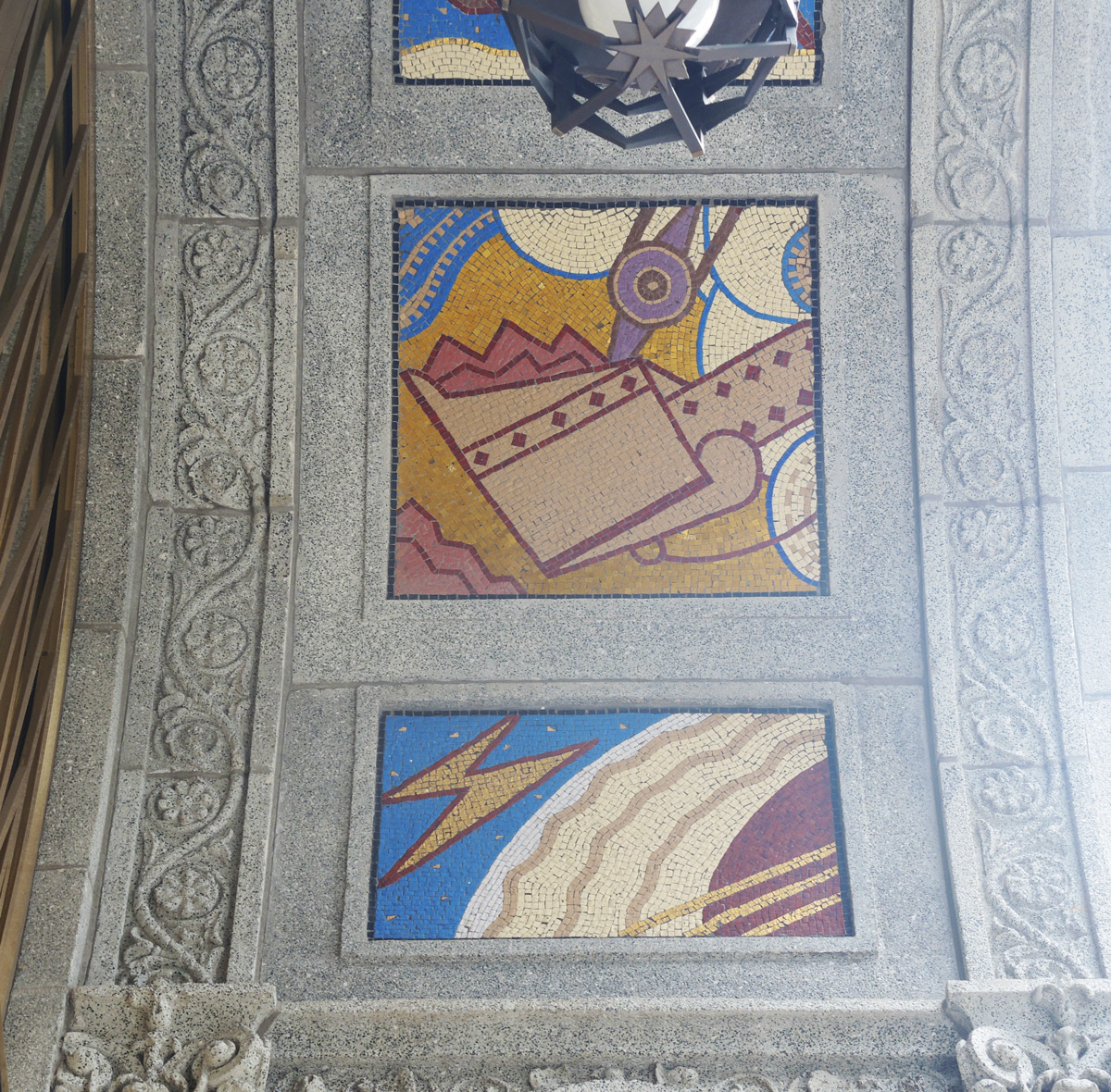
below: On the other side, a steam shovel and what looks like lightning in the sky.

two of the panels designed by J.E. H. MacDonald on the Concourse building, a steam shovel in action, and a panel with a lightning bolt

below: The stone panels surrounding the door are carved with motifs of grapes and grape vines.

a square panel of stone carved with grapes and grape vines

below: All seven mosaic pictures under the arch.

the panel of mosaic pictures under the arch, a lamp hanging down from the center,

This is a #Thursdaydoors post.  Lots of other blogs participate so if you are interested in doors of all kinds, check out this link.


side entrance to a large brown building (a bike shop) that has a large white line drawing of a bike on it. The door is in the middle of the front wheel. A structure that looks like the handlebars of the bike is on the roof

Let’s take a ride up the south end of Rhodes Ave.  Why Rhodes?  In a two block stretch (from Queen to Gerrard) there are mostly residences but there are some interesting other things sprinkled amongst the houses.  The photo above is the side entrance to Velotique, a bike store, on the corner of Rhodes and Queen St. East.

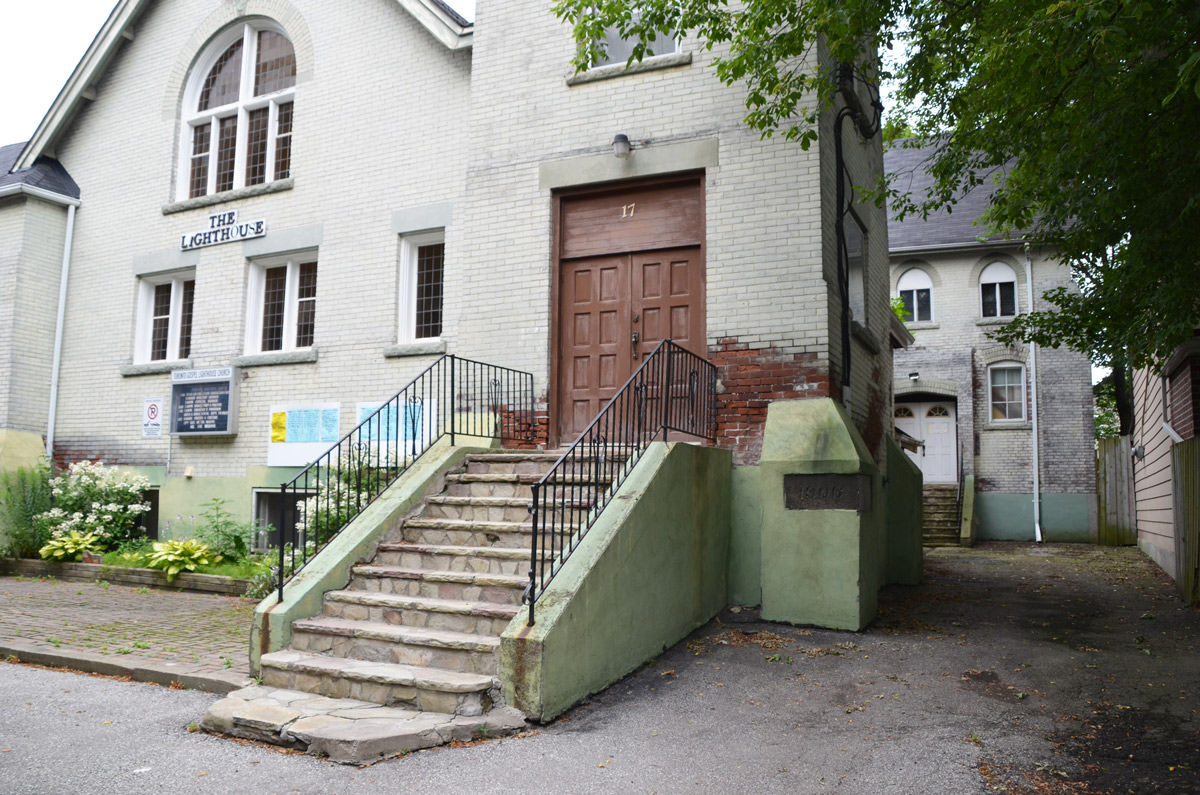
below: Just north of Queen Street is the Toronto Gospel Lighthouse Church which has been on this site for about 50 years.

steps up to a large brown door, one of the entrances of the Toronto Gospel Lighthouse church, a greyish white building with another building behind.

below: I am not sure if this is still a working church. Their facebook page hasn’t been updated in over a year.   Also, the yellow paper on the wall is an application for consent to divide the lot into 6 smaller lots and build houses on them. The six blue notices are applications for minor variances from the zoning bylaws, one for each dwelling. By the looks of it, the plan is to build 6 three storey semi-divided houses here. Each house required 29 minor variances – the house is a little higher, the driveway a little narrower, the front yard a little smaller, etc than the present bylaws. The case was heard at the end of January but I don’t know what the verdict was.

exterlior side wall of the Gospel Lighthouse church, small garden in ront with shrubs and hostas, also blue notices tacked to the wall, re application for variances to the zoning code.

Farther up Rhodes Avenue is an old building that was once the home of the local chapter of the Orange Order, a Protestant fraternal organization.  It was put up for sale in 1969 and subsequently purchased by the Islamic Foundation of Toronto and turned into a mosque.

below: The Fatih Mosque (when I first saw it I thought it said Faith Mosque!) with it’s two small minarets topped with gold cresents that adorn the front entrance.

front of Fatih mosque, a light blue building with a small porch, two short minarets with gold cresents on top, a brown door,

below: Right beside the mosque is house with no working front door.   It also has a sign in the window – a building permit of course.  There is will soon be a three storey building with three apartments if the sign is correct.  Here the development process is farther along than at the church down the road as this site already has a protective fence around the tree that’s growing city property.

looking across a street, sidewalk, large tree with orange plastic fence around it to protect it during construction, a pale blue building that is a mosque and a small single storey house that is about to be demolished.

A church, a mosque… and a Buddhist church.  I thought Buddhists had temples but this one is a church.  Is there a difference?  Or is it just a translation thing?  Ahhhhh, online they are a temple.  This is the home of the Blooming Forest Bhikkhuni Buddhist Association.   The “about us” page on their website is a pdf written in Vietnamese so I can’t tell you much about them!

brick building with yellow trim, yellow fence around it, sign says Chua Hue Lam Buddhist Church

below: At the corner of Rhodes and Gerrard is the Flying Pony Coffee Shop with its bright and colourful doors both in the front…..

front entrance of the Flying Pony coffee shop, bright blue door frame, yellow door, orange and purple squares on the door frame
below: … and at the back.

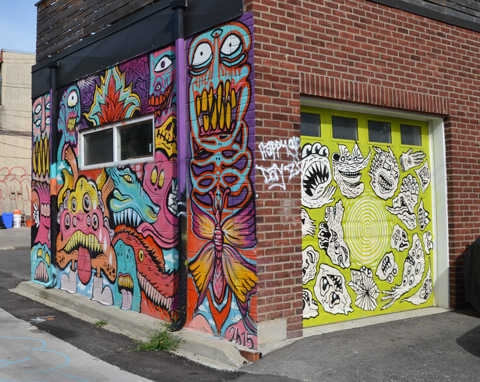
street art on a garage door, bright yellowish green with black and white faces

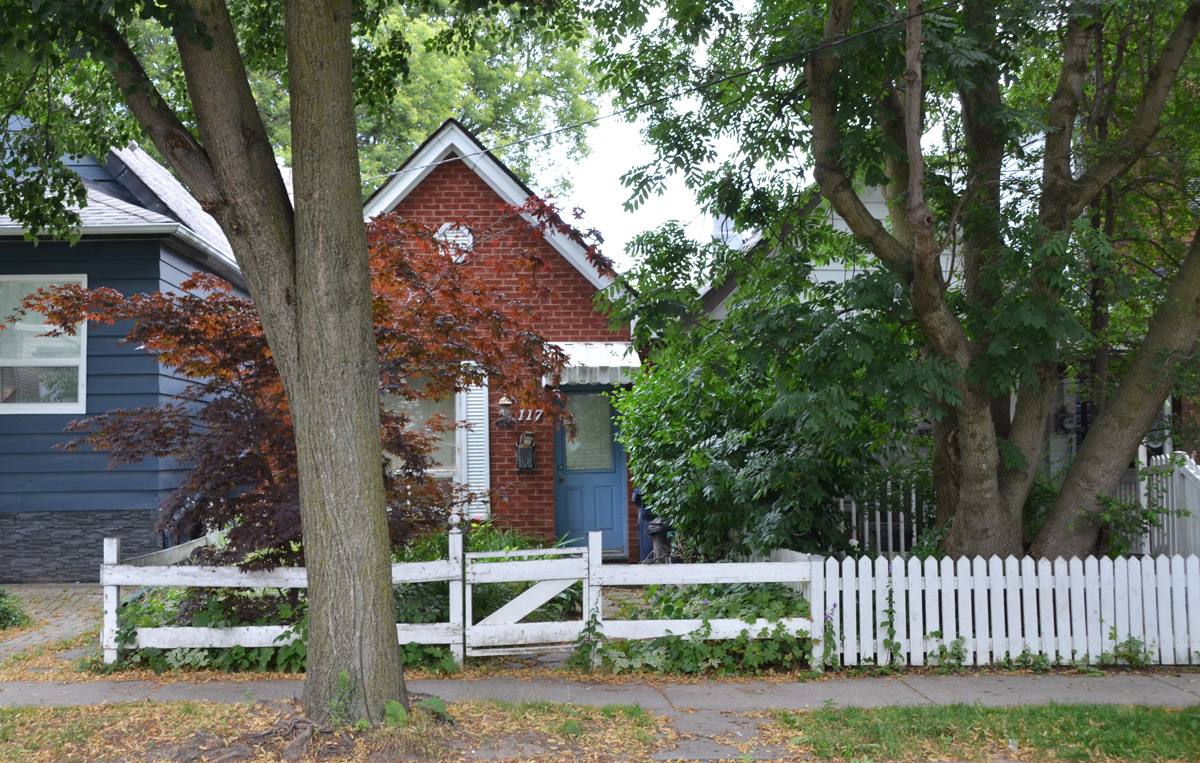
The houses on the street are a mix of large and small, old and newly renovated.   Here is a selection of them, and of their doors….

below: … and a picket fence too.

a white fence in front of two small bungalows. On the right it's a picket fence

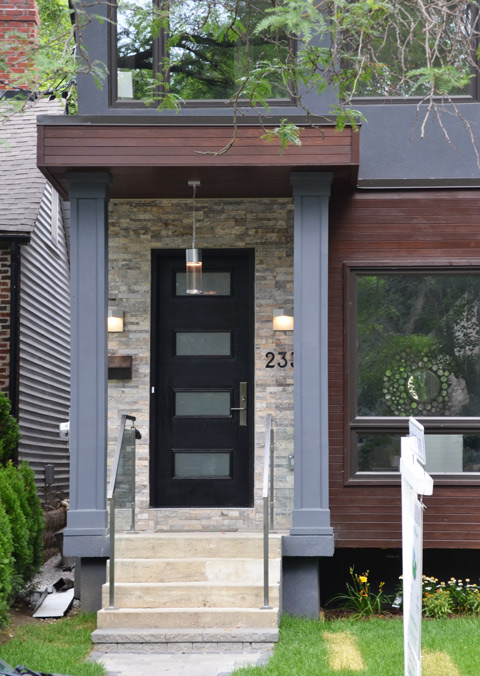
modern entranceway in a house that has just been renovated

turquoise blue front door with a window in it, on a beige stucco house

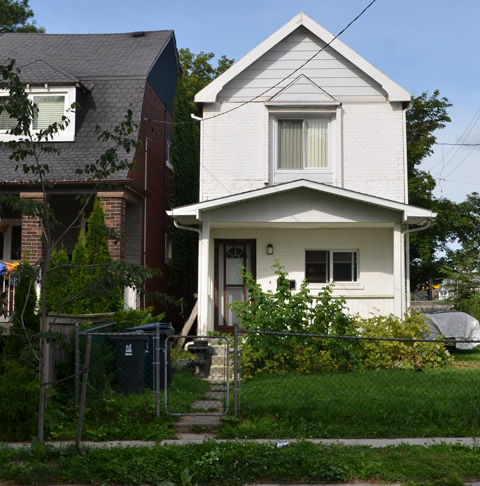
small two storey white house

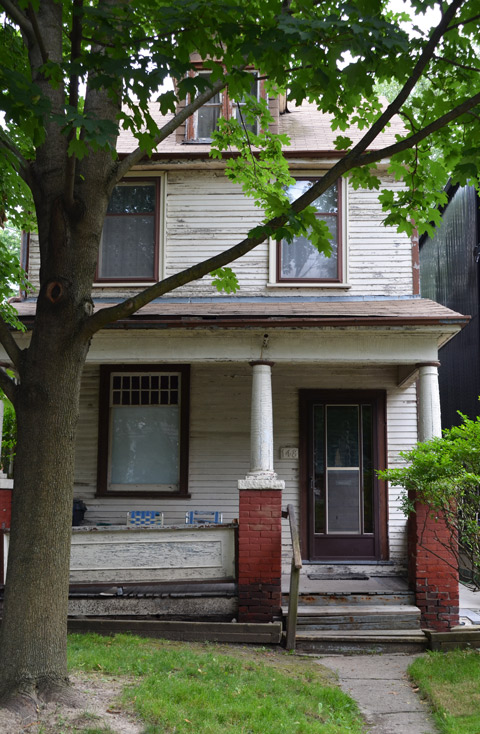
two storey wood frame house with a large porch across the front, pillars by the front steps

yellow front door on a greyhouse, with lots of flowers in front including purple butterfly bush

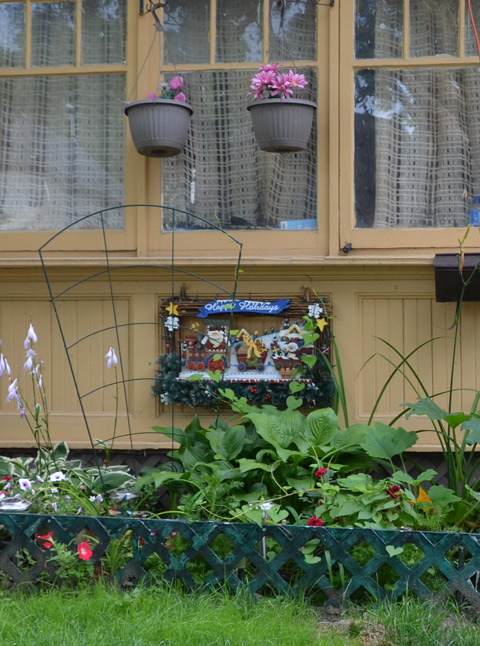
below: And at the last house, I leave you “Happy Holidays” greetings from Santa and myself.   Santa’s busy already, driving the train around toy town in preparation for another Christmas!

a happy holiday Christmas decoration on the wall at the front of a house, summer flowers growing in front of it.

wooden plaque ornament on a wood fence, shape of a house with large window and little red door

Are you a fan of photos of doors?  Check out the blog Norm 2.0 for links to many more!

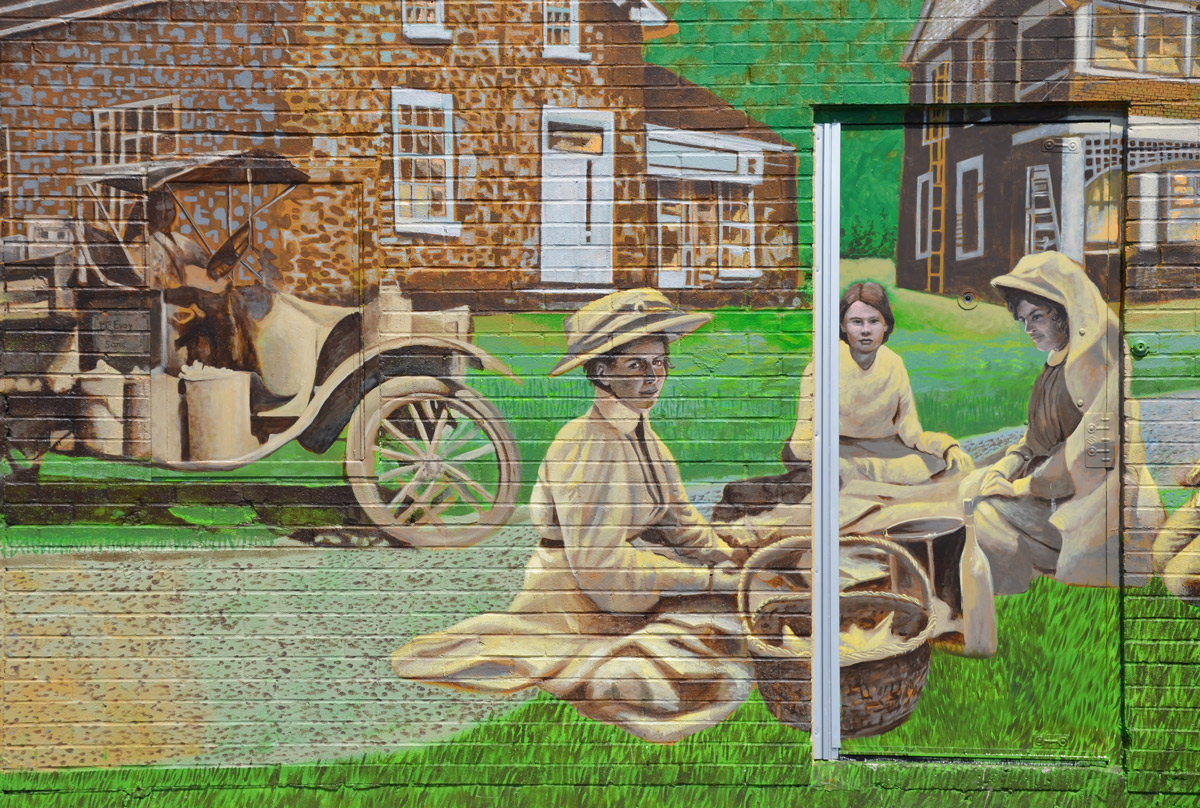
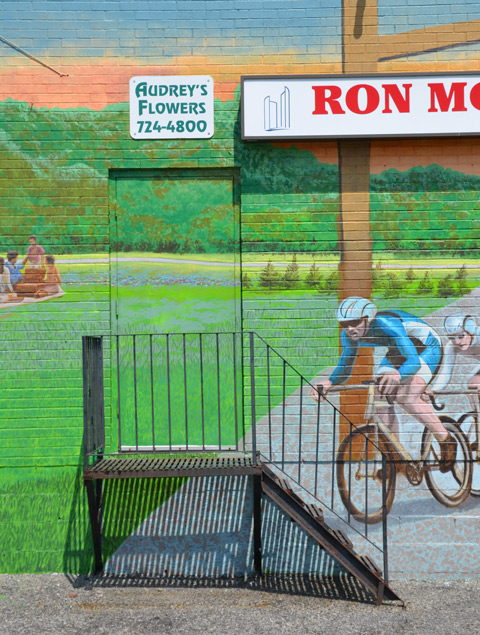
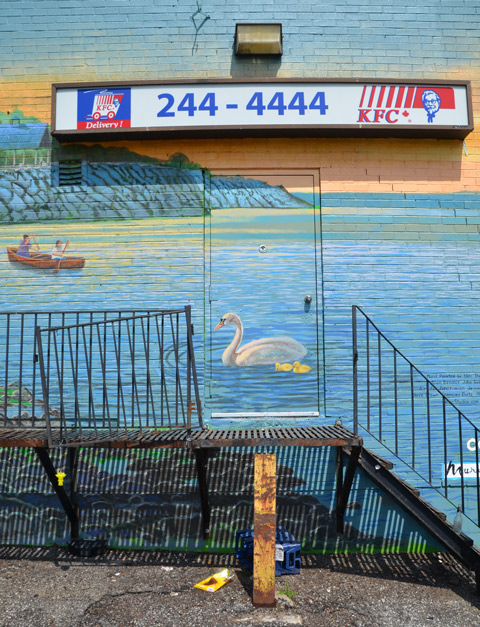
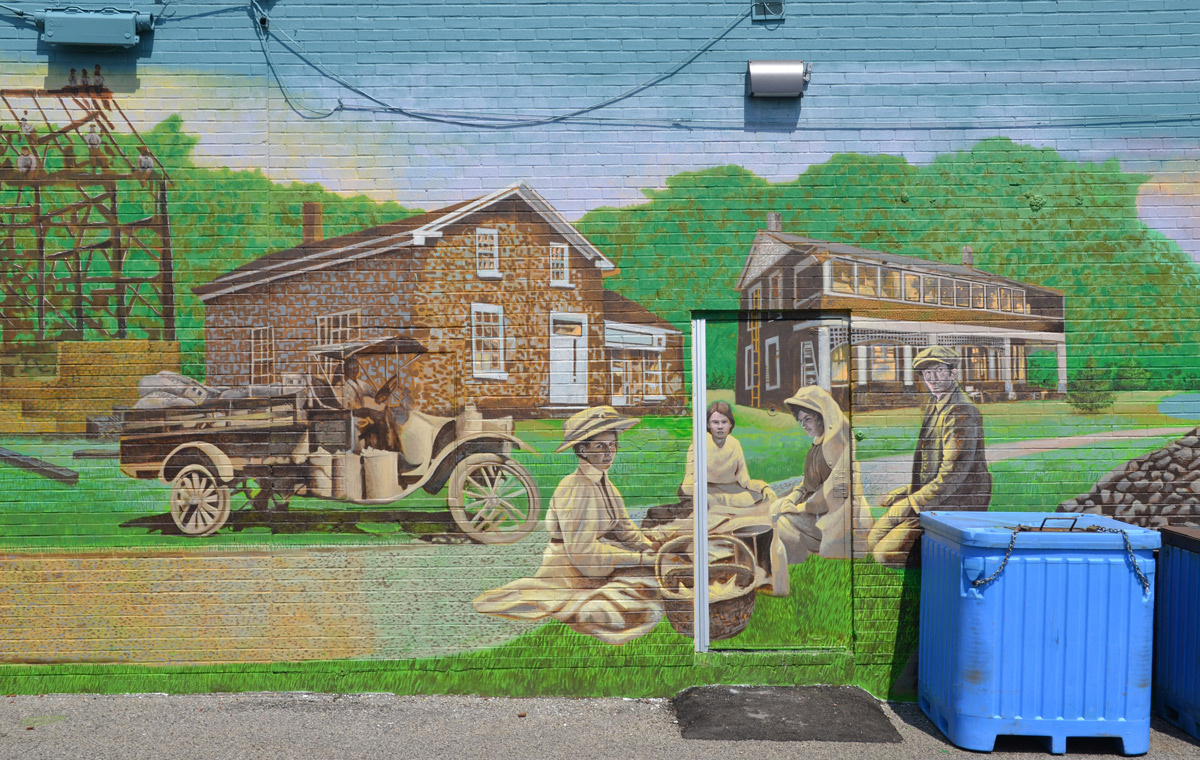
Across the back of a row of stores in Port Union there are some doors that have been painted over with a mural.  These are some of them:

a maural painted on a wall and door, historic scene, women in period costume (early 1900s?) sitting on the grass with some baskets, old fashioned car behind them.

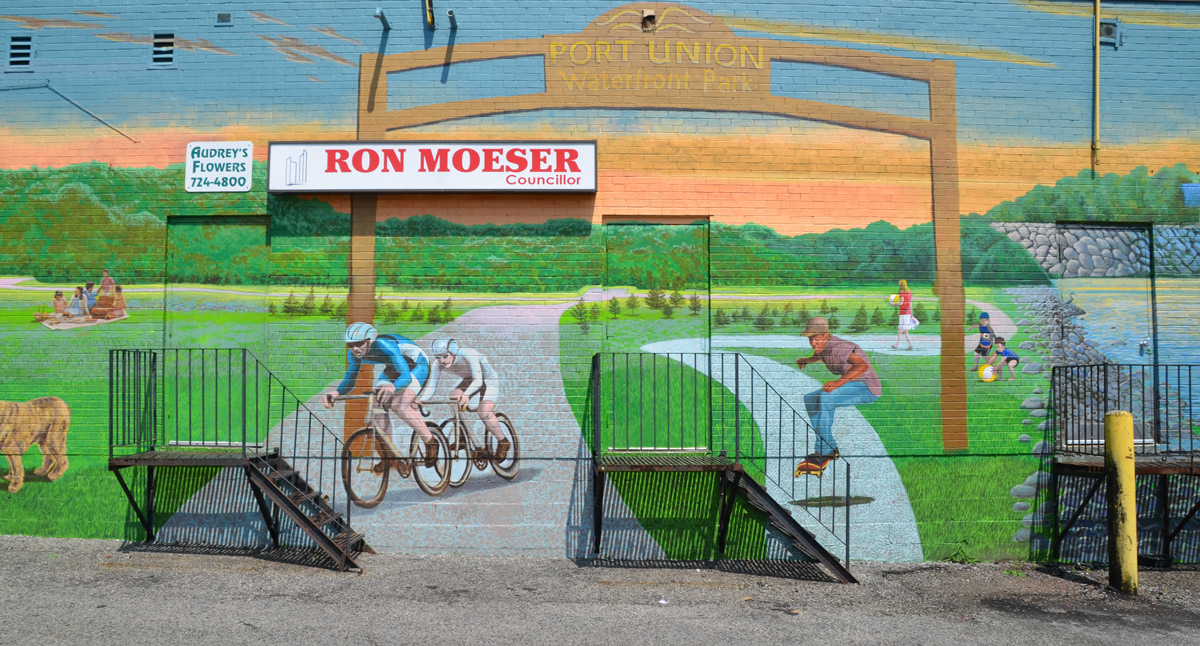
door at back of store covered with mural, grass, people on bikes, looks like bikes are headed to the door

 swan swimming in the lake, a mural on the back door of a KFC restaurant

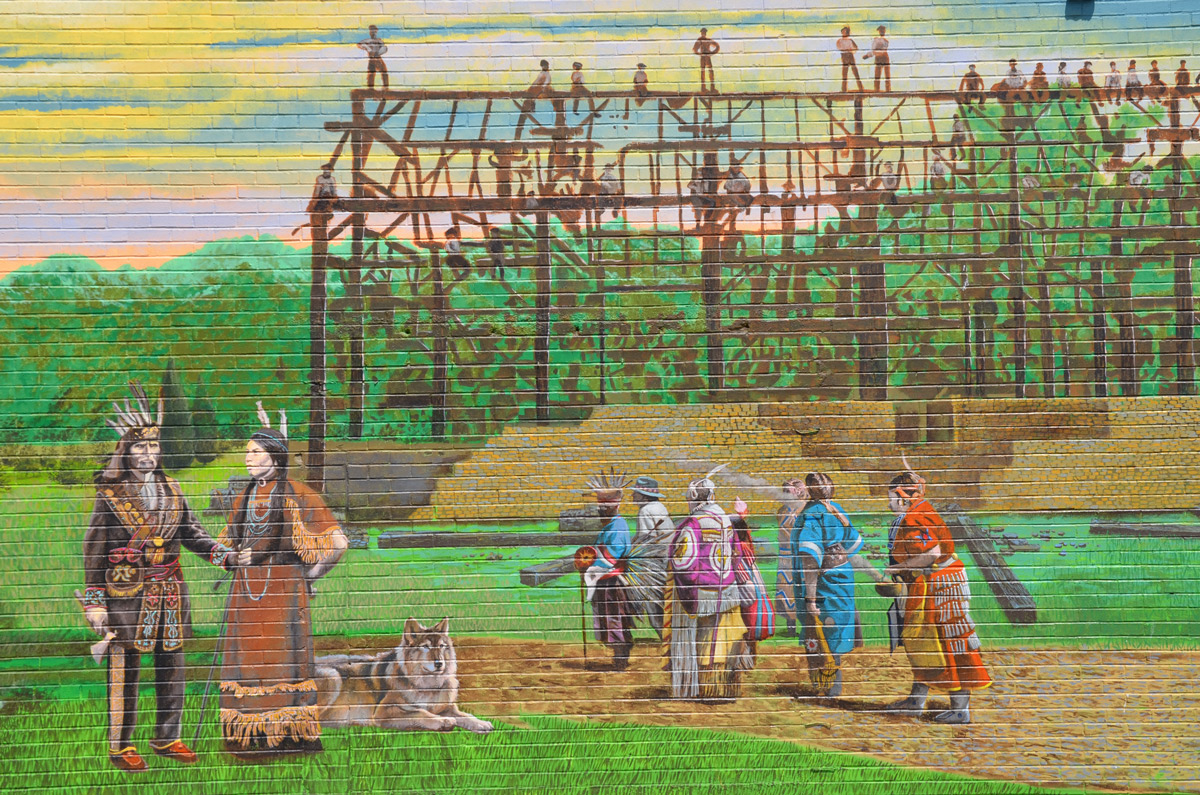
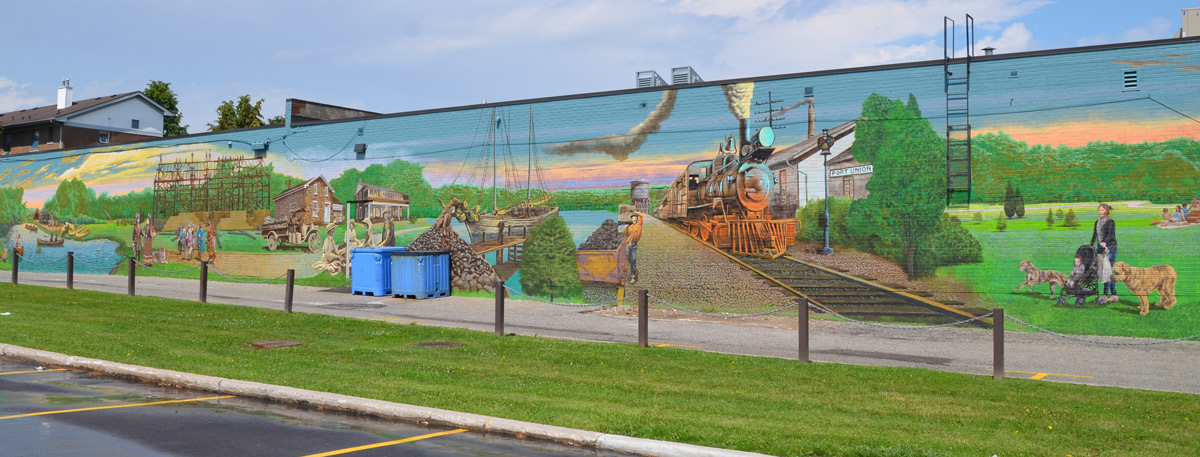
They are all part of the same mural.  The mural is so big that I couldn’t get a picture of the whole thing unless I made a very long skinny panorama – which I decided against.   I think that you should get a good idea of what the whole mural looks like from the following set of photos.

below: The mural tells the story of Port Union starting with a First Nations settlement in the area.

part of a larger mural showing the story of Port Union - First Nations people in canoes on the river with teepees and people on the shore

part of a larger mural showing the story of Port Union - two brick buildings, houses, a group of women sitting outside with baskets on the ground, a vintage car

part of a larger mural showing the story of Port Union -

below: North end of the Port Union mural.  The mural faces the parking lot of a complex consisting of the Port Union Community Centre plus a library and Charlottetown park.

left side of a large mural showing the history of Port Union, first nations, first white settlers, up to the early 1900s

below: The railway comes to town.

part of a larger mural showing the story of Port Union - a steam engine pulls a train into the station

a woman pushing a stroller with a toddler in it, with 2 dogs on leashes walking in the park, a group is having a picnic in the background

part of a larger mural showing the story of Port Union - this time, the Port Union waterfront park is featured, cyclists on the bike path, a skateboarder, people enjoying the park, 3 entrances to the backs of stores, including Audreys flowers and Councillor Ron Moeser's office. a

below: And that brings us back to the swan and KFC at the south end of the mural.

two doors at the back of a KFC restaurant, lake side scene, a large white swan on one of the doors

two doors at the back of a KFC restaurant, lake side scene, a large white swan on one of the doors

This mural was painted by Blinc Studios and was part of Mural Routes.  Artists are: Allan Bender, John Nobrega, Azadeh Pirazimian, Jesse McCuaig, Chris Brown, Frances Potts, and Melissa Bessey.

Other blogs that feature doors can be found at Thursday Doors, courtesy of Norm 2.0.  (see the little blue link between the end of the blog post and the comments section).


Relentless

Ubiquitous

These are two apt words to describe construction in Toronto, or to be more precise, the tearing down of  older houses and building smaller condo units or townhouses in their place.  We are experiencing the downsizing of living space as land values continue climbing upwards.

I drove past this Bayview Avenue house on the weekend and was intrigued by the look of it – a pale yellow,  once grand older house now sitting empty.   Many of the mature trees that were in its front yard have been cut down so the house is now easily visible from the street.  I went back to that section of Bayview Avenue with my camera yesterday morning.

older two storey house, pale yellow, with black and white trim and black front door, mature trees in the front yard.

There wasn’t much of a chain across the front yard so it was easy to walk up to the house.  It looks like the front door hasn’t been used in quite some time.   The window appears to have an old fashioned storm window on the outside although the shutters look more modern.   I’d love to know the history of the house (How old is it?  I suspect that it was built when this section of Bayview was still on the fringes of the city and before Bayview became 5 lanes wide but I don’t know for sure.)

front door of an older house, number 2450, pale yellow walls, white frames around door and window, black door, black shutters,

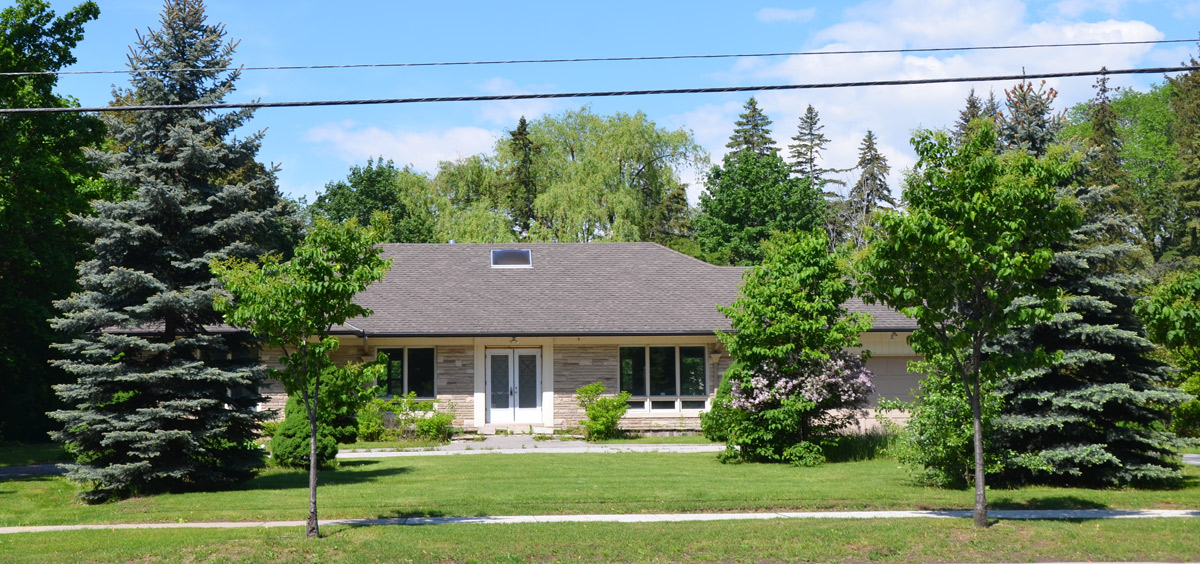
Right next door is this large bungalow:

large bungalow set back from the street behind a few pine trees, brown roof, stone facing on the exterior, large lawn,

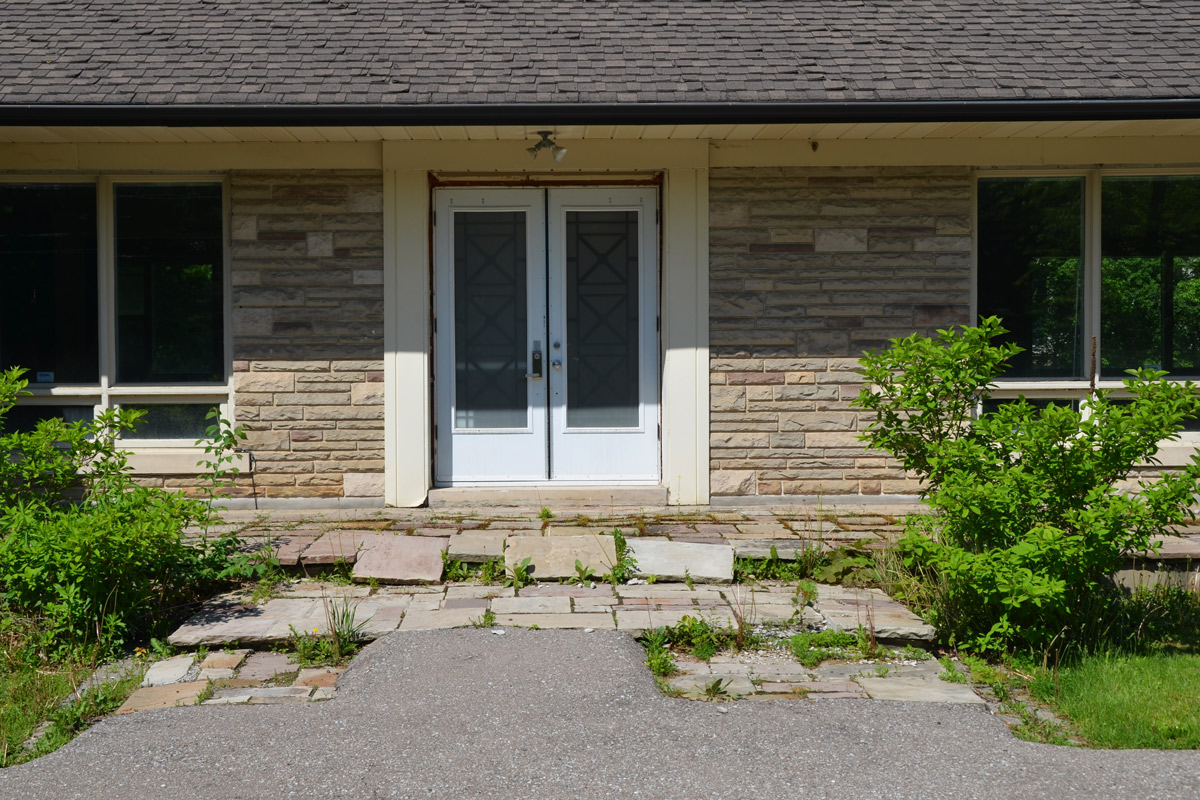
Originally built as a family home, this became the Bayview Hebrew School of the Arts in 2008.  The school is relocating and the building now sits empty.

nonsdescript white double doors as front entranceway of a house, flagstone steps and porch are buckling as is the ashphalt walkway leading to the front door.

looking through the front window into an empty building, looking through the back windows to the yard beyond.

Just up the street was this house.  It looks empty but there was a recycling bin beside the garage and some curtains in the windows so I didn’t wander up to the front door…. even though I really like that red door!  There was no chain across the driveway, nor were there any “keep out” signs.   Neither of those things would stop me, but they are good indicators that no one lives there anymore.   Google street view of this address is from August 2015 and at that time there was a for sale sign on the property.

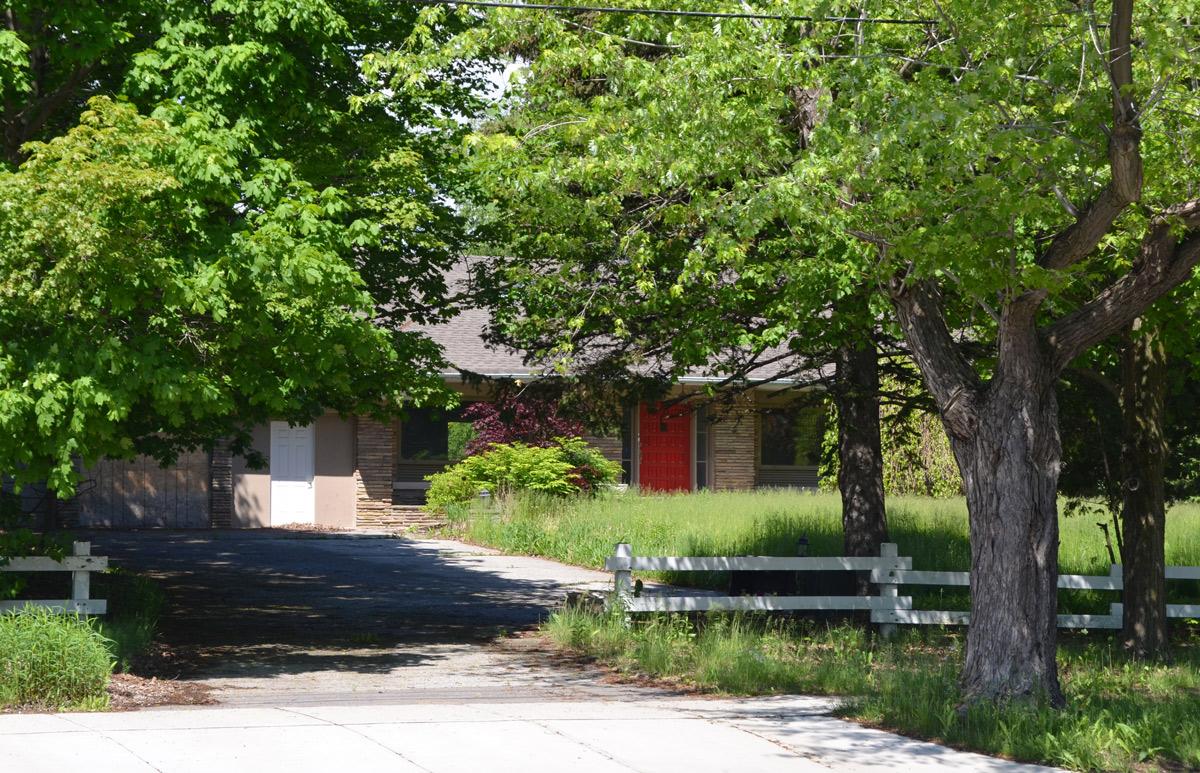
bungalow set back from the street, large front yard with uncut long grass and a few mature trees, also a low wood fence,

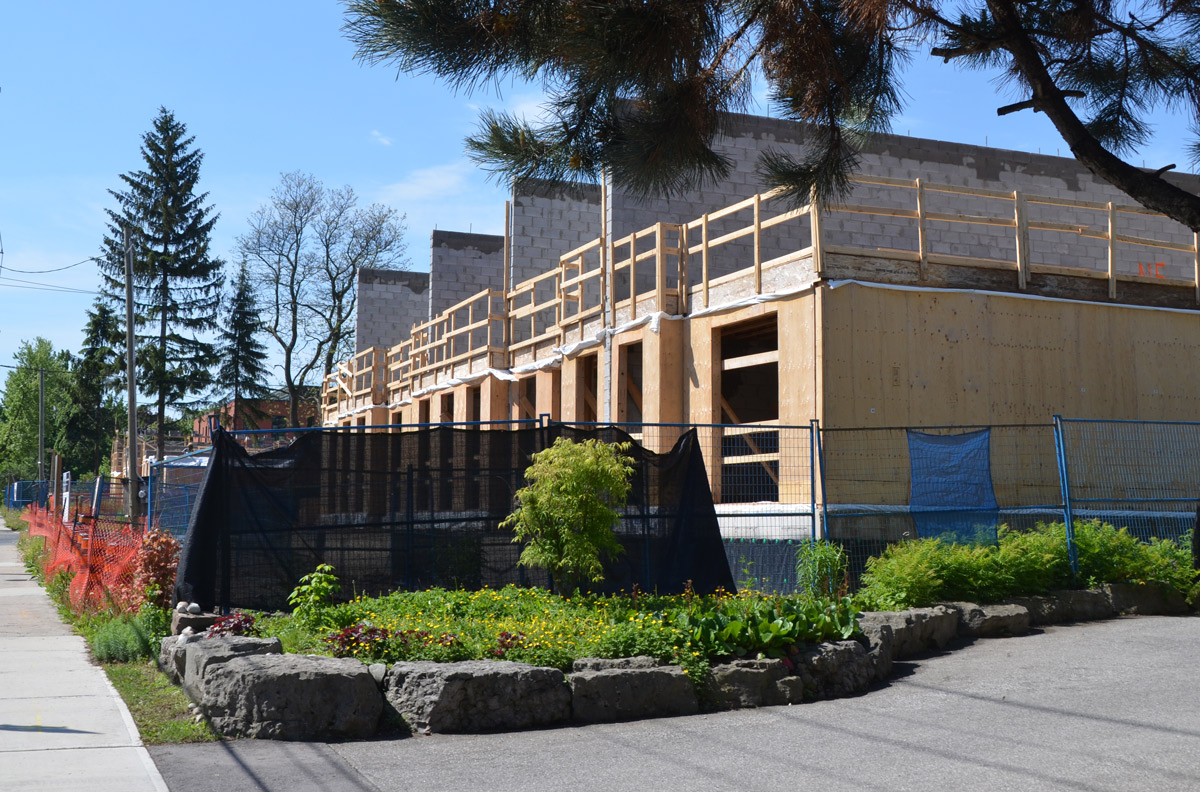
The above are the “going” half of the title of this blog post.  The “coming” are these doors under construction; they too are on this part of Bayview Avenue.   Side by side front doors with a concrete layer between them – two of a row of five townhouses.  One day (soon?) someone will be able to walk in their front door and go up a level or two, to floors that haven’t yet been built.

from the front, street view, two of a row of townhouses under construction, plywood exterior with holes where the doors and windows are going to be.

This is the development that caused an uproar a year ago when they illegally clear cut two lots – cutting down about 30 large trees including a linden tree that was close to 150 years old in the process.  According to the City of Toronto Municipal Code Chapter 813, Article III, conviction for cutting down a mature tree  results in a “minimum fine of $500.00 and a maximum fine of $100,000.00 per tree involved in an offense; a special supplementary fine of $100,000.00 is also possible.” (source).

In October 2016, Format Group (the developers involved) paid a fine of $155,064.  This amount includes $657.30 per tree to cover city inspection costs and $116,600 for the planting of 200 new trees — mostly at other sites.

The two lots will be developed into 11 3-storey townhouses and 4 single family houses.  All units have already sold.

a row of townhouses being built, the lower floors are framed with plywood, the upper storey hasn't been started yet.

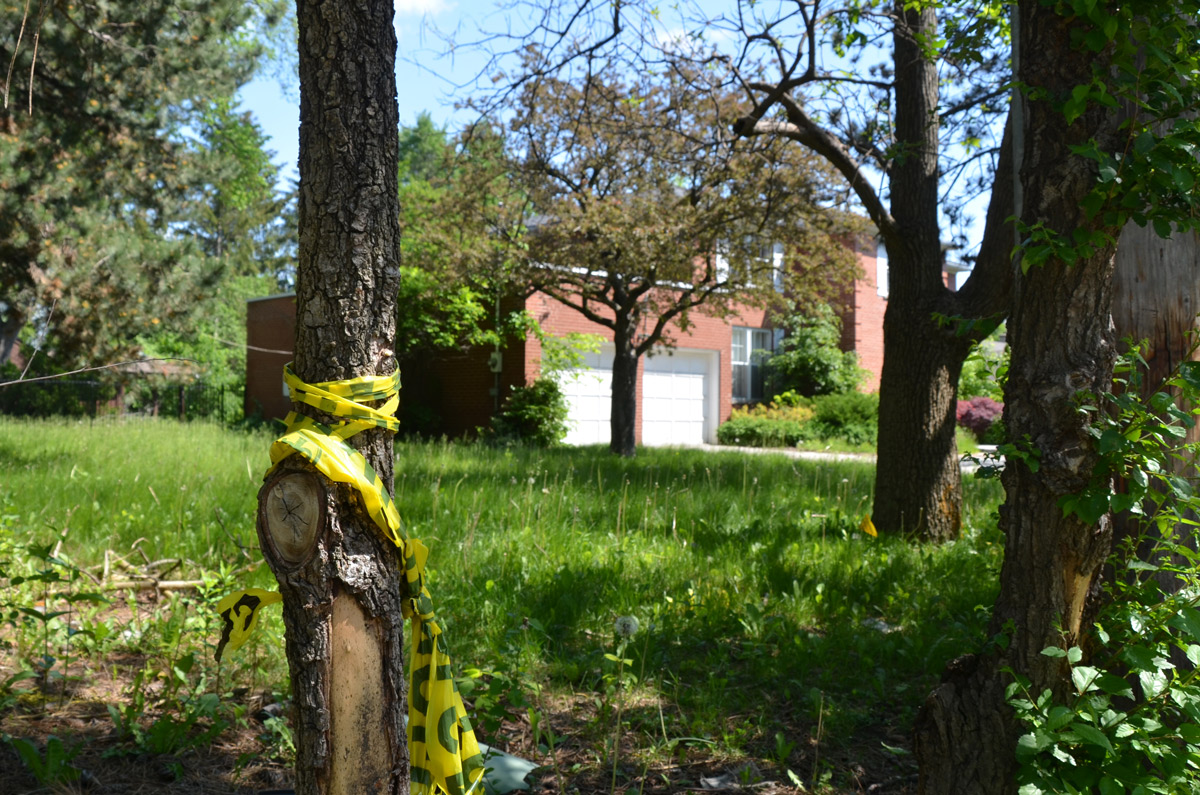
Before I leave the area, there is something similar going on across the street.

tree with yellow caution tape in front of an empty lawn with empty house in the background

First – there is this empty house sitting on a corner lot at Bayview and Wilket.  This one property is the future home of seven 3-storey townhouses as well as one single detached house.   Does anyone want to do the math on the potential profit – one house for 8 units in a time where even a townhouse sells for more than a million.

driveway and entranceway of a brick house that is now empty

Second – this sign has also appeared nearby. When I checked their website I found this description: “Located in north Toronto, The Bridle Path is synonymous with prestige and exclusive luxury. Known for its spectacular homes and refined neighbourhood character, it’s no wonder that this is the place that Toronto’s discerning elite prefer to call home. Now, on Bayview Ave. in the heart of the Bridle Path neighbourhood, Kingsmen Group is excited to introduce a new luxury townhome community that embodies the very essence of refined prestige living. Register today for more information coming soon.”

There is so much wrong with that paragraph.  I wouldn’t call this part of Bayview a part of the Bridle Path neighbourhood; you might be able to make an argument that it’s on the fringes of said neighbourhood but that would be stretching it.  “Prestige” and “luxury” are words that are so overused that they are almost meaningless with respect to Toronto real estate.   It seems silly to compare a townhouse on Bayview with the homes on the Bridle Path but I guess that’s what sells.  Actually, you could probably sell them without such a comparison!

sign advertising new townhouse devlopment by kingsmen Group inc.

Oh dear, I want to call this a Thursday Doors post so I’d best call it quits here.  I’ve probably already strayed too far off topic!  For more information on the Thursday Doors project see here.

I was out earlier this evening, venturing out to a gallery opening on Avenue Road near Dupont.  It wasn’t meant to be a photo taking adventure but it was a sunny evening and rather than wait for a bus on Avenue Road, I started to walk.   It didn’t take long before the camera came out (yes, I usually have it with me!).  Have I walked here before?

a yellow traffic sign in front of a store window. Window is lit and has two female mannequins in it. Sign says Turning traffic must yield to pedestrians.

On Avenue Road just south of St. Clair West there are quite a few older apartment buildings and most are in good shape.

below: It’s nice to see that this building is being renovated.

old 6 storey brick apartment building that is undergoing renovations, bottom few storeys are covered in scaffolding.

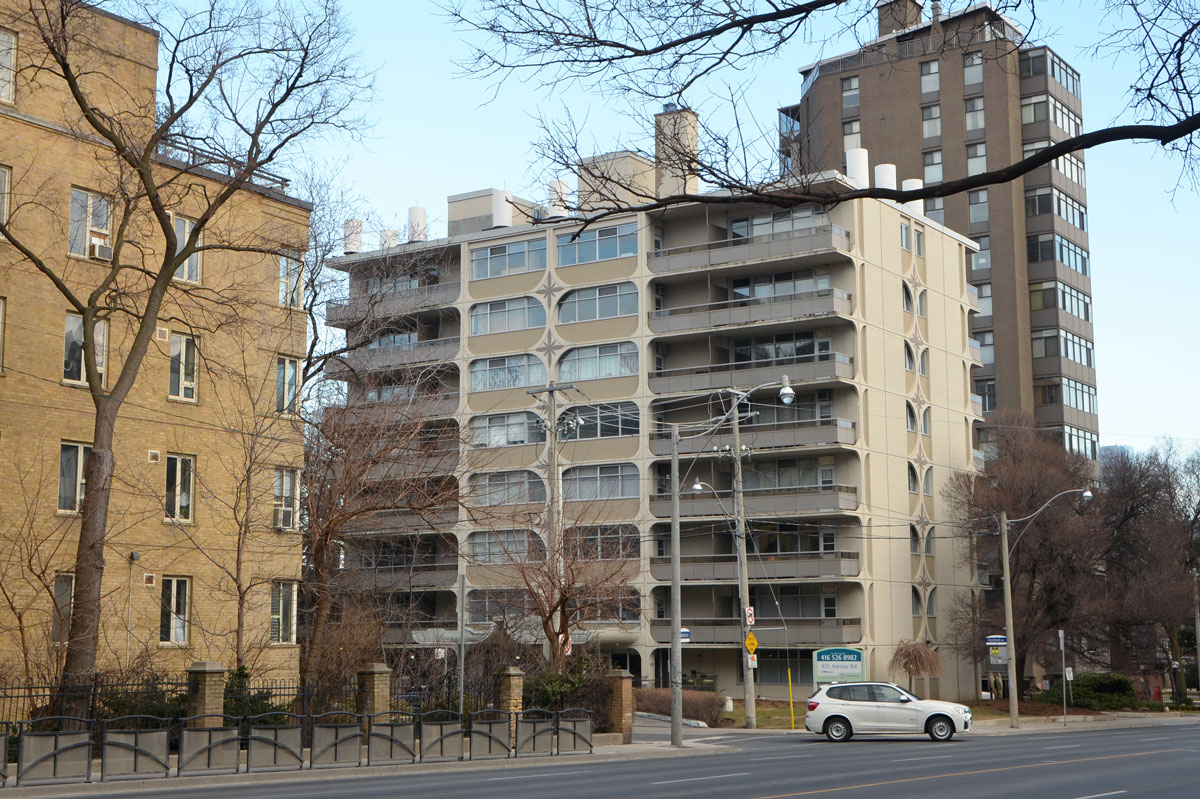
below: Most of the apartment buildings in the area are mid to low rise.   If I remember correctly, the building on the right is the tallest  (and newest?)

three midrise apartment buildings.

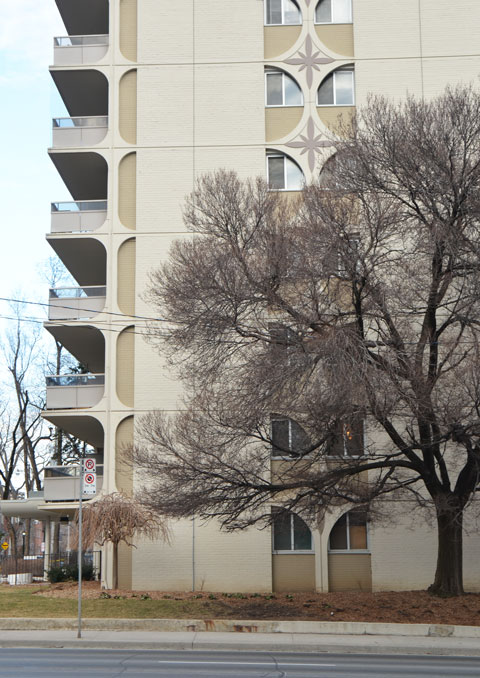
side of an apartment building with a decorative panel running up the center.

below: You don’t see brickwork or stone details like these on newer buildings.

detail of the brick and stone work on an older apartment building. There are three stone women lying under each oriel window, diamond patterns in the brick on the exterior as well

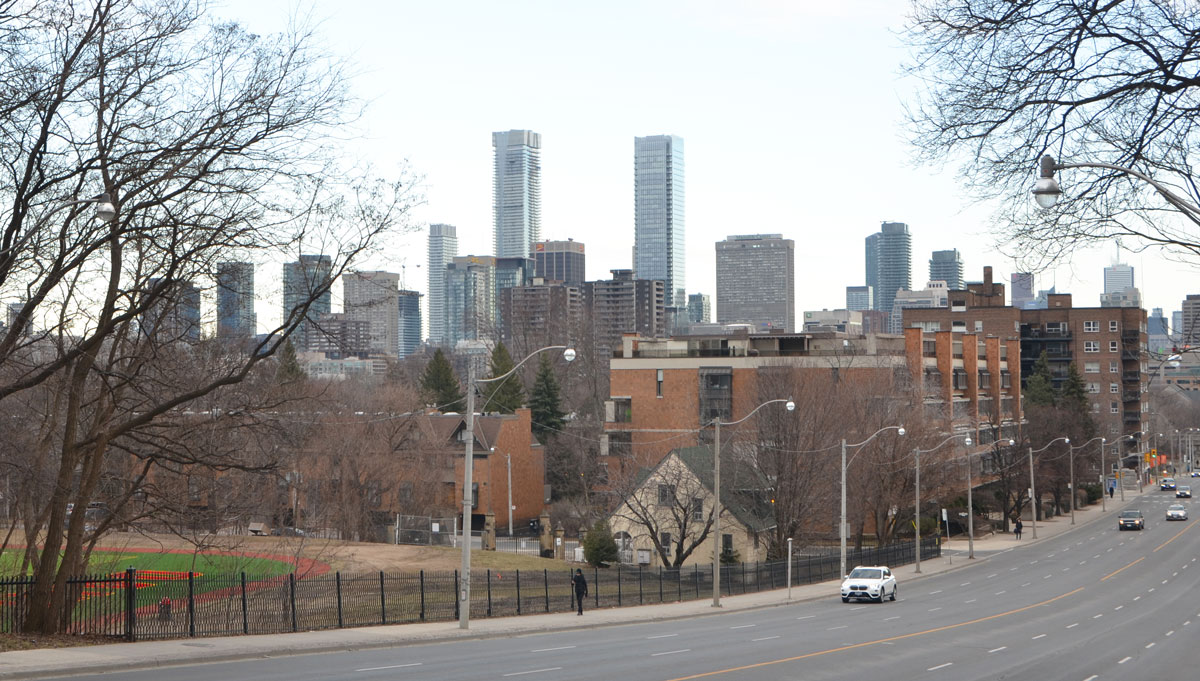
below: Looking southeast, generally towards downtown, as you come down the hill on Avenue Road.  The bright green and red on the left is the De Lasalle College playing field.

view of downtown Toronto skyline from Avenue Road, just south of St. Clair.

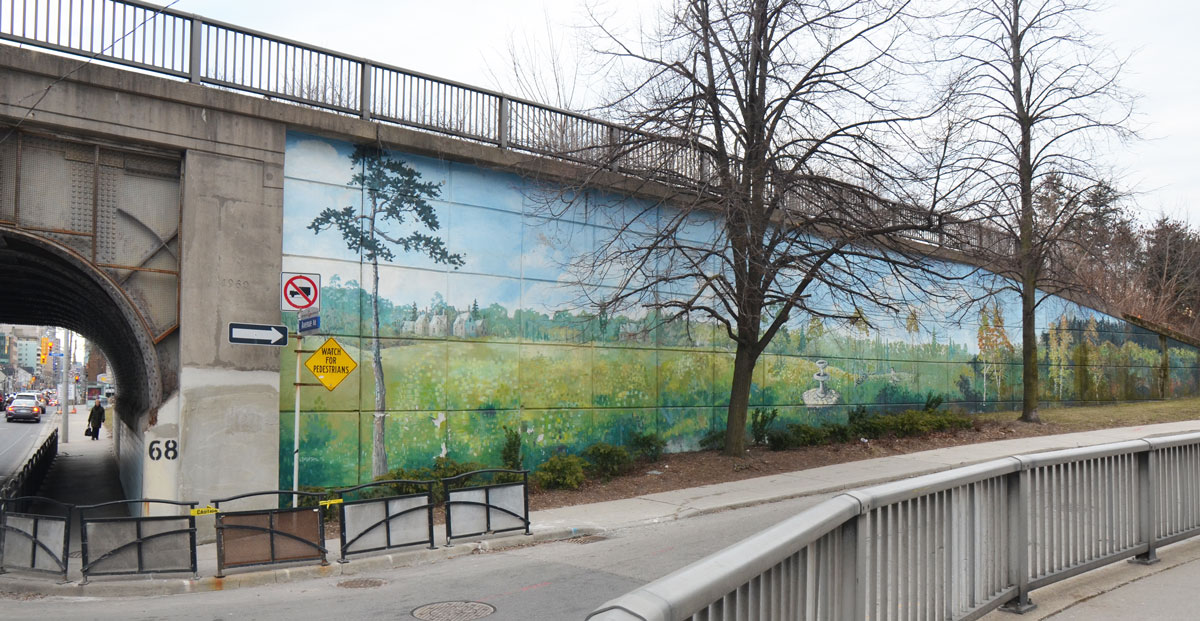
below: Mural along the side of the lead up to the railway bridge.
The signature is Leventhal ’96

mural painted along the side of a wall that is part of the embankment for a railway bridge Mural is a country scene, grass and fields, a farm in the distance and a couple of trees.

below: Under the railway tracks.   I thought that the blue tiles were a nice feature – are there other tiles like this under any other Toronto bridges?

under a railway bridge, steel girders above, street passes under, across the street the lower part of the wall is blue tile, a man on a bicycle is passing by

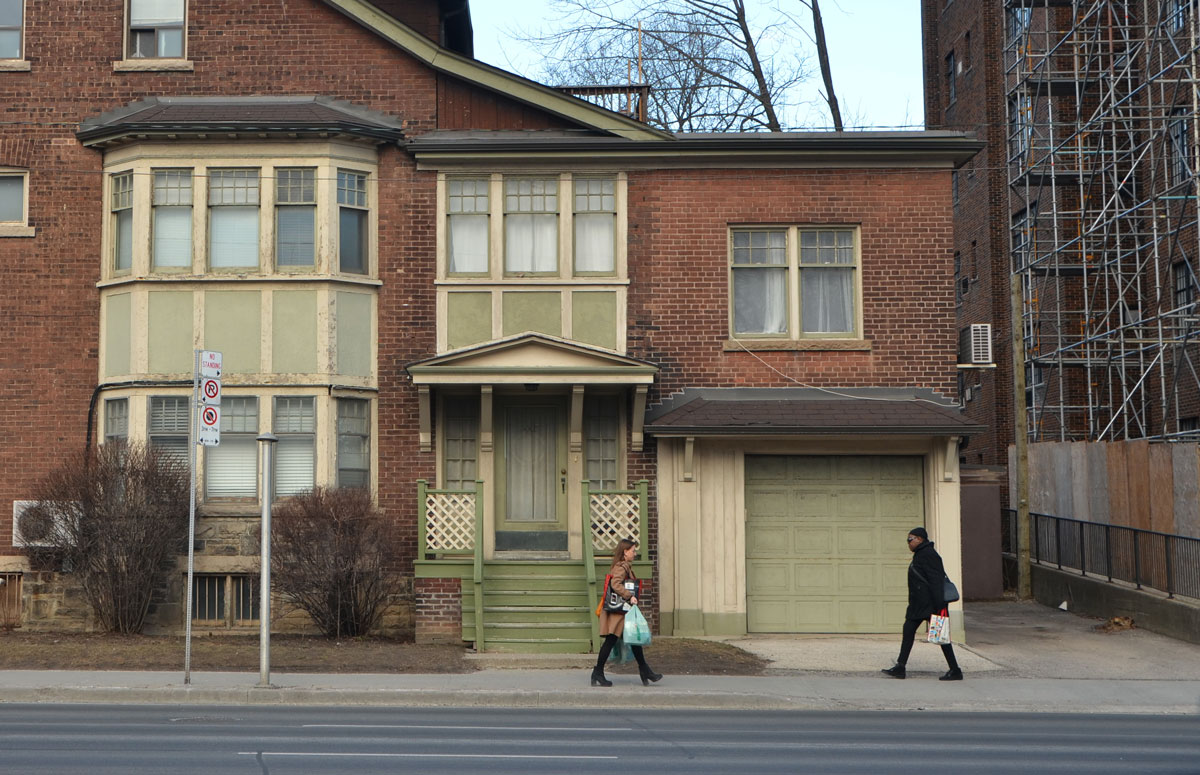
two women walk past a brick house with green wood features, porch, windows, garage door.

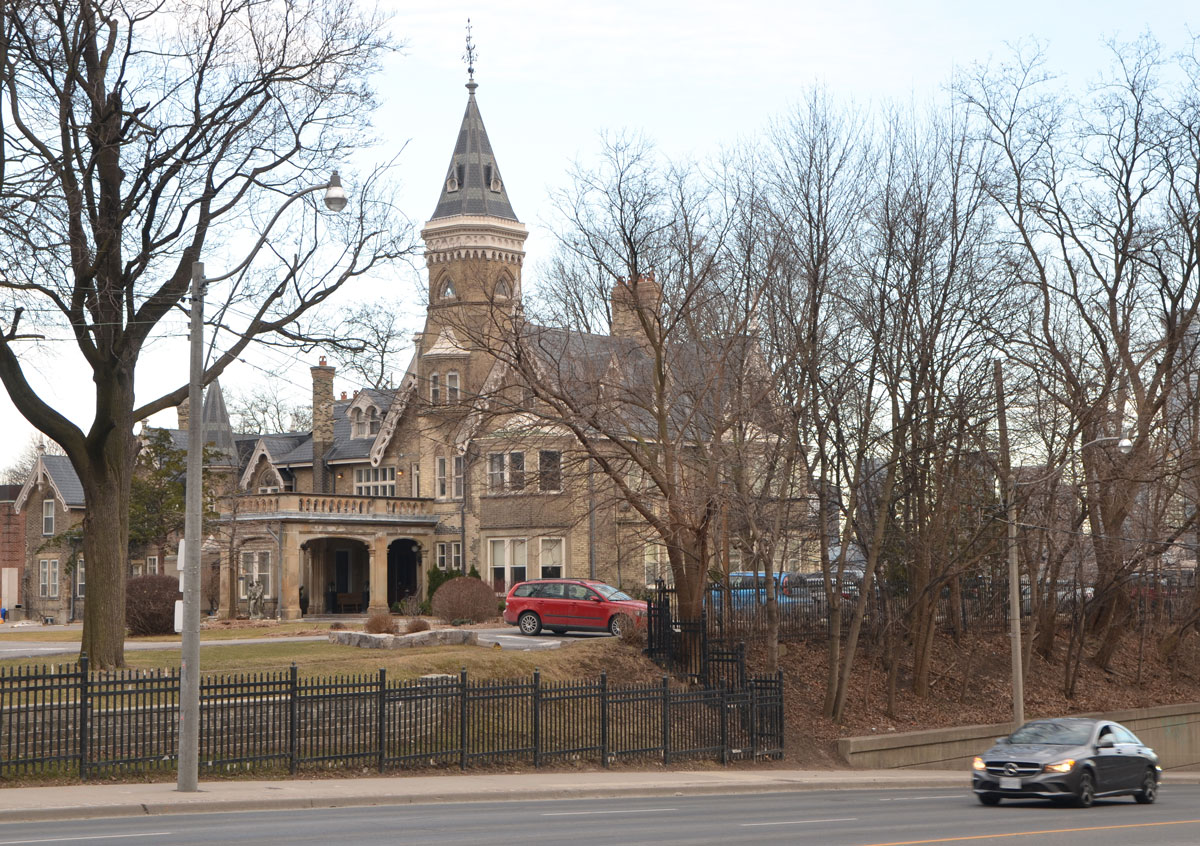
below: The turret (steeple?) of De Lasalle College

De Lasalle Callege building, an old brick house with a turret , trees, lawn,

below: One of the entrances to the Mayfair Apartments.

decorative entranceway for the Mayfair apartment building. Woood doors, carved stone above and beside the door

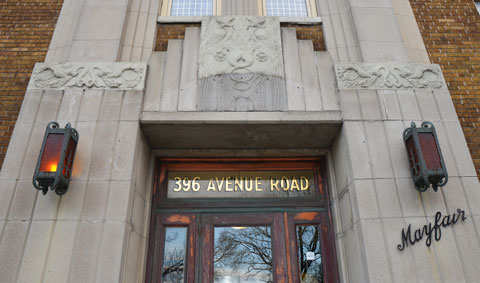
below: Another of the entrances (there was at least one more).  The stonework is similar but the old light fixtures are still in place.  In the picture above, you can see the holes  where the lights once were.

entrance to the mayfair apartments. 396 Avenue Road, stone work and old light fixtures

below: Old wood door on Avenue Road.

old wood door with mailbox and number 280

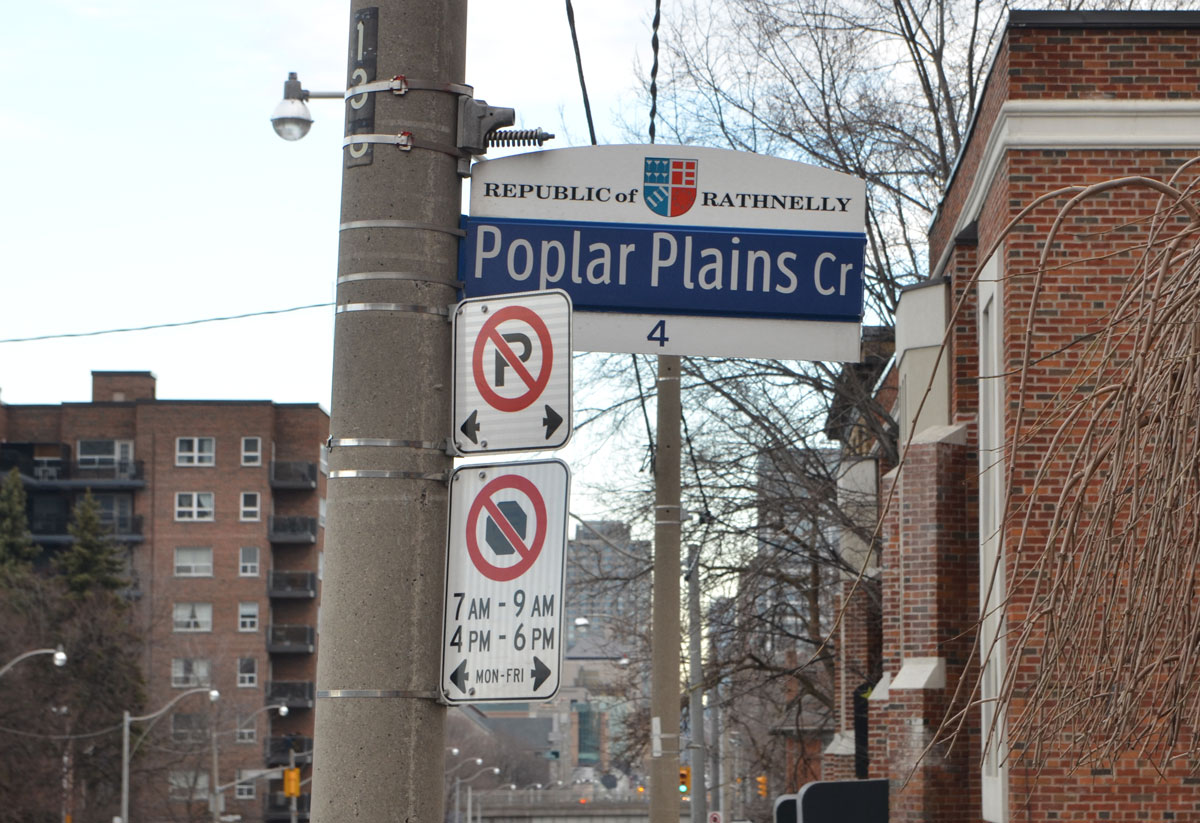
below:  The first signs of a republic… I had heard about the Republic of Rathnelly  but I didn’t know anything about it, including its location.    Back in 1967  the residents of the officially seceded from the rest of Canada, originally as a form of protest against the proposed Spadina Expressway that would have physically divided the community.    The founders named their republic after Rathnelly Avenue which runs parallel to Avenue, one street to the west.   Rathnelly Avenue was named after William McMaster’s birthplace of Rathnelly, Ireland.  (McMaster Avenue is there too).  William McMaster (1811-1887) was a founding president of the Canadian Bank of Commerce between 1867 and 1887.  He was also a senator.   The special street signs were designed in 2012.

Toronto street sign that says Poplar Plains Cr and also says Republic of Rathnelly

below: A painted sign on the side of The Avenue Diner (at Davenport Road).  It was closed when I walked by so I’ve made a note to myself to go back and see if the interior has changed much since 1944.

old faded mural painted on wood on the exterior side wall of the Avenue Diner. shows people sitting at a lunch counter with an employee behind

below: Across the street from The Avenue Diner is the Havana Coffee Bar. The old building still has a ghost ‘Tamblyn’ sign on it.  To me, Tamblyns was a drug store but was it something else prior to that?  I can’t read the smaller word below ‘Tamblyn’ on the building.  …. A quick check and the answer is ‘no’ – Gordon Tamblyn opened his first pharmacy in 1904 and by the time he died in 1933, he had a chain of about 60 stores.

old building with ghost sign on the upper storey, Tamblyns, bottom part now a dry cleaners and the Havana bar and grill.  A bus shelter is beside the building and some people are waiting for a bus.
…and then I found myself in Yorkville but that’s a whole different story!

a very large fake diamond ring, single stone, sculpture size, about 3 feet in diameter, stands in front of an old fashioned clock in front of some stores

Last week I visited what remains of Mirvish Village, that stretch of Markham Street just south of Bloor Street next to Honest Ed’s store.  As most of you know, Honest Ed’s closed at the end of 2016.  All the stores and businesses in the first block of Markham Street have now closed too.  The buildings still remain although they are empty and a blue temporary fence now separates them from the sidewalk.   I am not sure if they are going to be demolished, or the facades retained, when that area is redeveloped in the near future.   I was interested in documenting what remains and/or what is going to disappear as Markham Street undergoes yet another transition in its long and storied life.
Some of the photos that I took were of doors.  For a few weeks now I have been following the blog My Life Lived Full .  Joanne (the author of said blog) participates in “Thursday Doors” which is a weekly photo feature hosted by Norm Frampton at Norm 2.0.  I like doors and have many photos of doors.  I’m not sure I’ll be a regular contributor to “Thursday Doors” but I thought that I would add my collection of Mirvish Village doors to this weeks feature.  The following door pics were either taken last week when everything was empty or on the last day of 2016 when businesses were winding down.

below: The upper level was a gallery.  The words ‘No Man’ are still on the door.

a pile of green chairs in front of the steps up to a pale blue building, lower level is painted yellow.

feench doors painted blue with a small blue picket fence in front, two white chairs upside down in front of the door

single door with large pane of glass, reflections in the glass, snow on the porch, a pigeon standing in the snow

below: This is one of the photos from the 31st of December. Tintin is no longer there.

the door of a book store, with a cut out of Tintin beside it and a drawing of a creature with 4 legs and 4 arms, the hands are all holding something

grey door, white porch, crooked grey steps

two doors on a brightly painted buidling. a flower is painted around the door, blue paint,

the doors at the entrance to the Apiecalyps Vegan restaurant, whose symbol is a raccoon. glass doors, steps down from street level to the entrance

below: Entrance to the Victory Cafe with the Christmas lights still wrapped around the post and a clipboard in one of the windows.

two purple doors side by side at the top of 6 stairs, on a red brick building

below: The back of one of the buildings on Markham Street.  This photo was taken from the parking lot behind Honest Eds.

grey metal door at the top of a steep staircase, back door, upper storey of a beige building with windows covered with stuff on the inside

below: Honest Ed’s exit onto Markham Street with its overlapping and out of date shopping hours sign over the door.

exit doors of Honest Eds store, 2 sets of glass double doors, red walls beside, store opening hours painted above the door. Galss is covered from the inside