A few weeks ago I posted some pictures of the fence along Craven Road that has been decorated with artwork and old artifacts.  I was south of Gerrard Street when I took the photos.   I didn’t realize at the time that I missed another outdoor gallery on the other side of  Gerrard.  Today I took some pictures of those on display on the north side.   Here they are in no particular order:

below: Looking north up Craven Road along the fence.
That tropical sunset on the left looks very inviting!

small amateur paintings displayed on a wood fence, with trees and houses in the background, snowy day, looking down the length of most of the gallery, small pile of snow against the fence, painting in the foreground is warm Caribbean sun on beach with palm tree, Craven Road

small amateur paintings displayed on a wood fence, with trees and houses in the background, snowy day, an evergreen bough hangs over the top of the fence, above a painting of trees in a forest in winter, low sun, and long blue shadows.

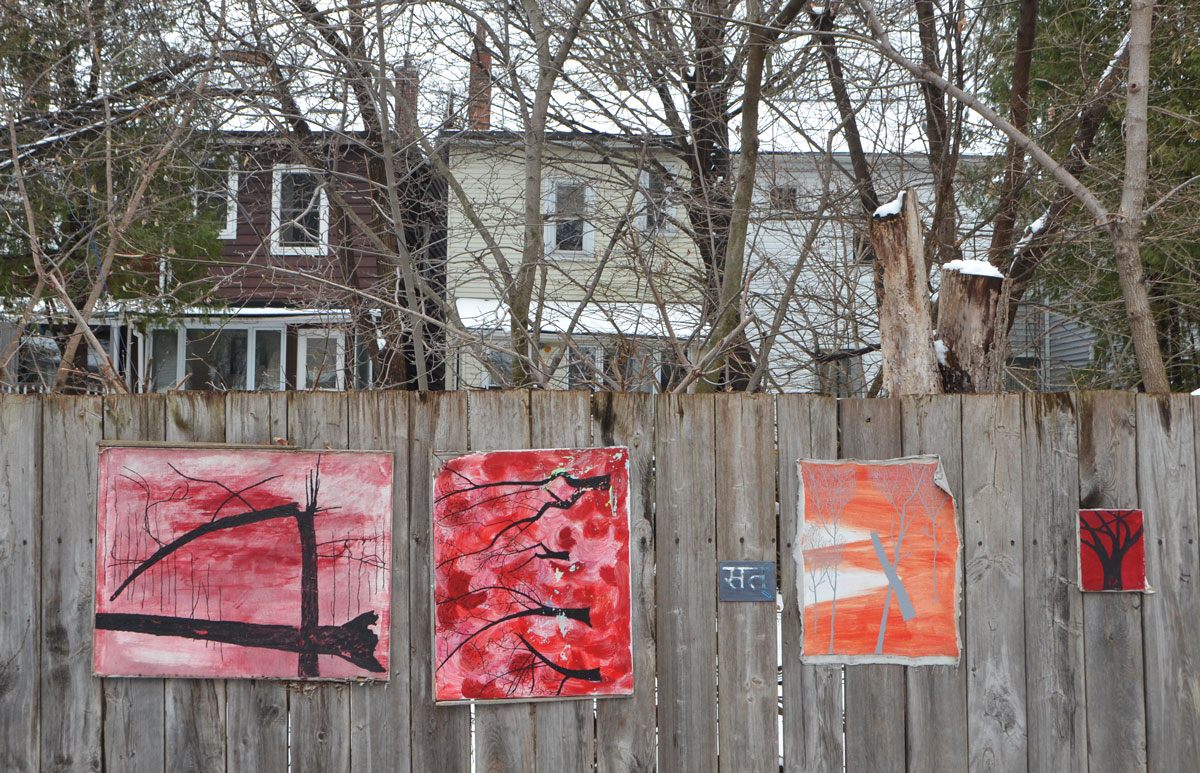
small amateur paintings displayed on a wood fence, with trees and houses in the background, snowy day, Craven Road in Toronto, two paintings of black trees (no leaves) on red, and one grey tree on orange background,

small amateur paintings displayed on a wood fence, with trees and houses in the background, snowy day, a black tree on a blue background. Snow has been blown against the wood fence and some of it has stuck to the fence, Craven Road

below: Some of the paintings are small words in another language and another alphabet.  Can anyone translate for me?

small amateur paintings displayed on a wood fence, with trees and houses in the background, snowy day, four paintings. One black tree on light brown paper, and three small paintings with words in a different language with a different alphabet, Bengali perhaps

small amateur paintings displayed on a wood fence, with trees and houses in the background, snowy day, Craven Road, trees on blue and green background
small amateur paintings displayed on a wood fence, with trees and houses in the background, snowy day, three paintings, one is a fish

By now I’m very curious about this street and this fence.  I found a long, detailed, and interesting history written by local historian Joanne Doucette that you can read here.


me a visitor, a looker, and and a skeptic.

I happened upon a gallery yesterday, the Robert Kananaj Gallery, on the second last day of a show by Oscar Figueroa called ‘me a talker’.    As I type this, the show should be wrapping up.  So you’ve missed it.  I’m not sure what you’ve missed.

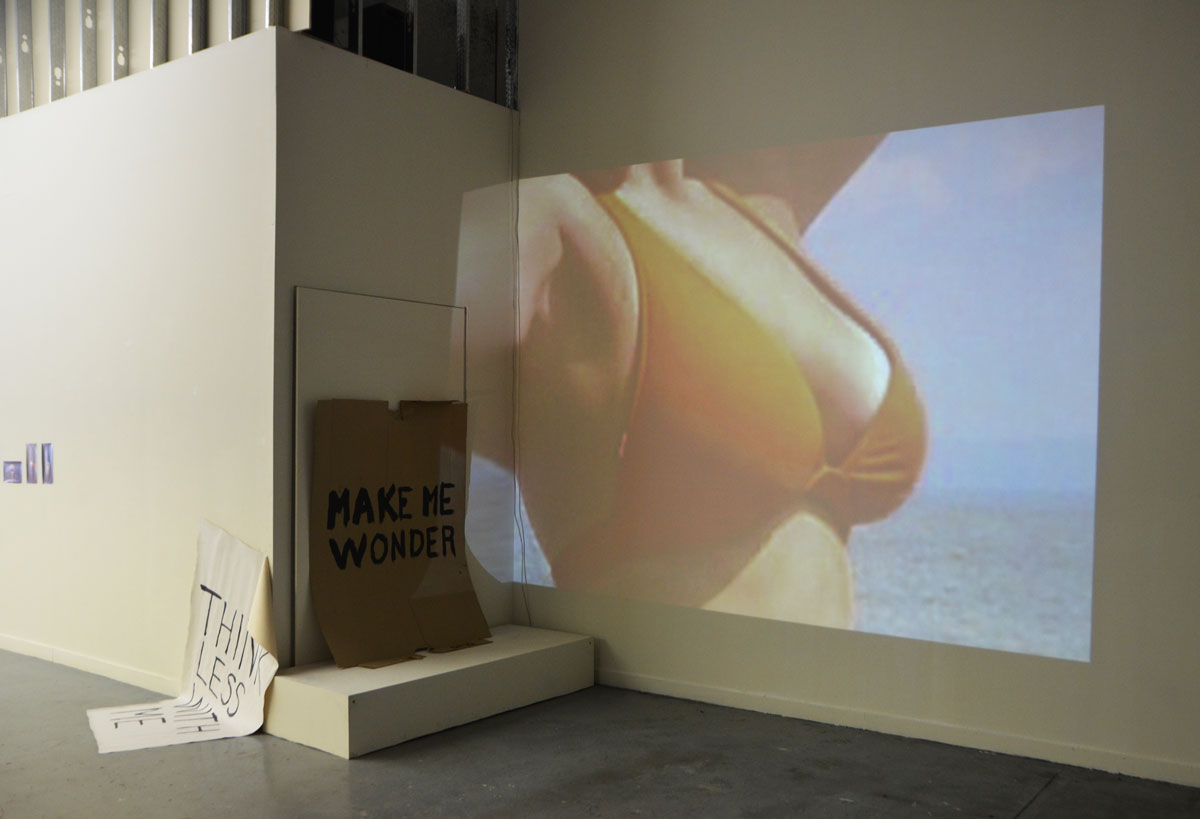
below: The paper that is half on the floor and half propped up by the wall has the words “Think Less With Me” written on it.  This summarizes a lot of Figueroa’s work in that it is a rejection of the verbose and often jargon filled ‘artist statements’ found in contemporary art and especially conceptual art where the words on the wall are more important than the technical or visual aspects of the work.   The gallery website says this: “What if instead of a logical artist statement we decided to write thoughts, or sentences, that go through our heads when making art. This is not poetry per se, this is a form of idea communication, just as the conventional artist statement was intended.”  Does it make you wonder?

walls of a n art gallery with some of the work of Oscar Figueroa. A projection of a woman's chest in a bikini top, a piece of brown cardboard with the words 'Make me wonder' and a piece of paper, large white paper, half on the floor and half propped up on the wall that says

I want to cheer him on for trying to reject the overthought concept behind art these days.  I appreciate the fact that he does not confront me with an essay that bears no relationship to the artwork.  But all is not well.  He wants us to think that his art is special because he rejects the mainstream thinking. Too bad it also rejects all attempts at, well, everything.  The gallery looks like a space that someone has just moved out of but neglected to take their garbage with them.

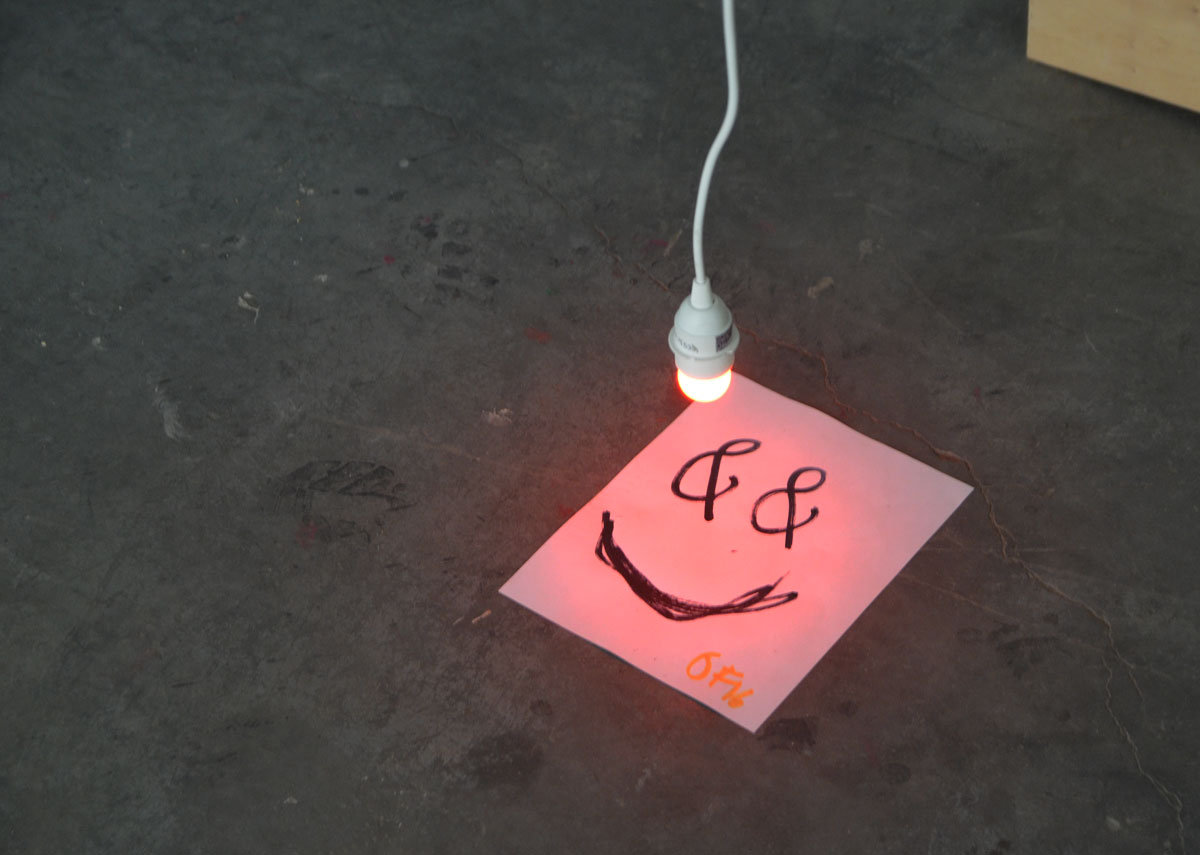
a piece of paper with a happy face drawn on it, with ampersands for eyes, and a single red light bulb hangng from the ceiling and stopping just above the paper.

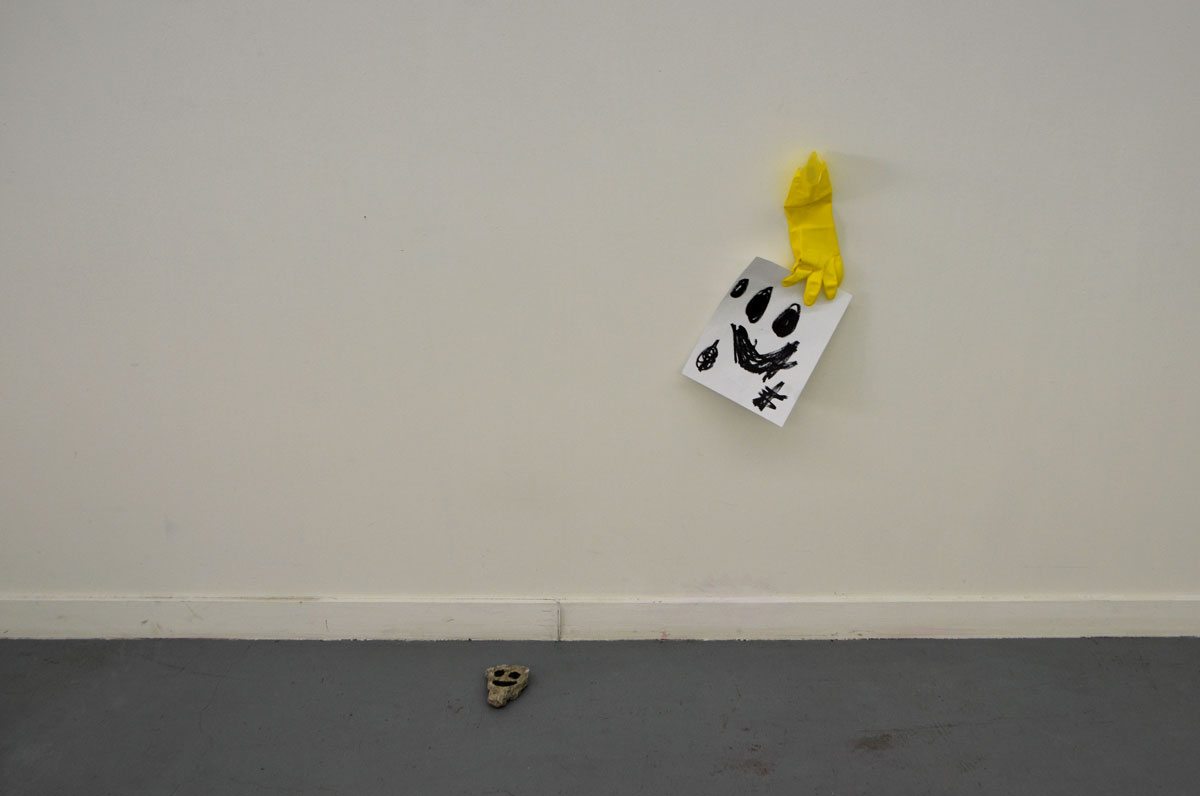
below: A yellow rubber glove taped to the wall, a happy rock on floor.  Does it talk to you?

a black happy face scrawled on a piece of paper, a yellow rubber gloved taped to the wall that is holding the paper. A small rock on the floor with a happy face painted on it.

I found it all rather depressing.   There could be more to it than this.  No, make that: there should be more to it.

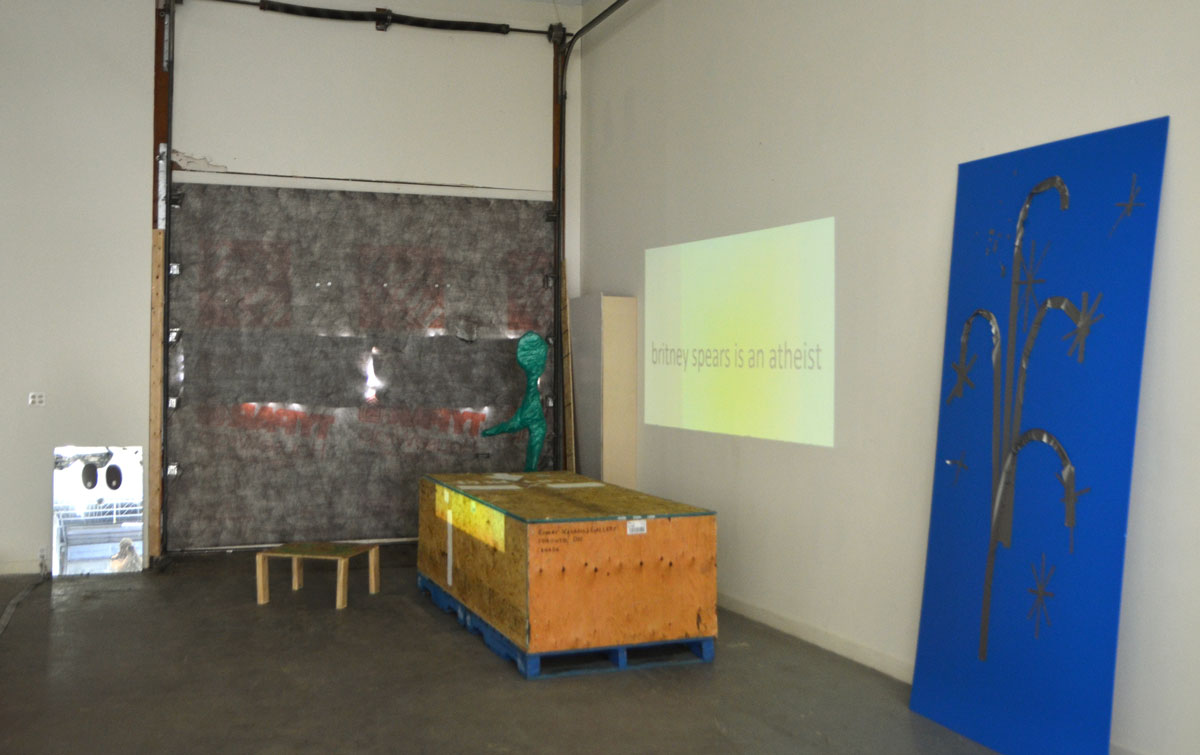
blog_britney_spears_athiest

below:  him: “Be a sidewalk or be a balloon, there’s no fucking difference.”
me: Be a piece of art or a piece of garbage, there’s no fucking difference.

4 pieces of art in a gallery. a white happy face on black paper, a shiny piece of paper with a corner ripped off with the word picturesque written on it.

Yesterday afternoon I wandered into The Power Plant Art Gallery.  It was late enough in the day that the sun was already low in the sky.  It shone through the large windows in the main gallery and cast a warm glow on the current exhibit, works by Yto Barrada titled ‘Faux Guide’ .

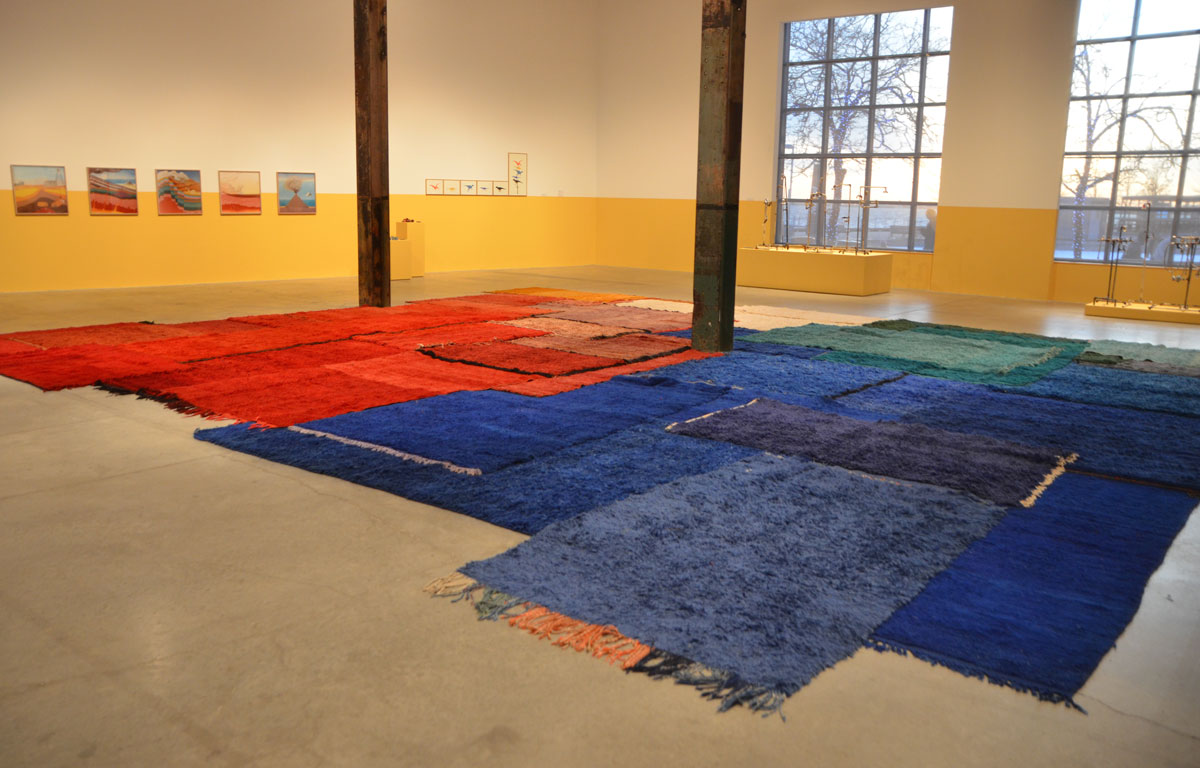
The first thing you see when you enter the rooms is a collection of carpets.  This is ‘Geological Time Scale’ and it consists of bright and bold red, blue, and green carpets – Beni Mguild, Marmoucha and Ait Sgougou pile rugs from Western Central, Middle Atlas, Morocco.   It’s definitely eye catching and it definitely draws the viewer into the exhibit.

main exhibit room of The Power Plant Contemporary Art Gallery, large room with two large windows in which the low afternoon sun is shining. Exhibit by Yto Barrada consisting of red, green and blue carpets on the floor. some framed pictures on the far wall, walls have been painted yellow up to about 4 feet from the floor.

A series of  small exhibits are arranged around the room and most of them are the result of the artist’s research on Moroccan dinosaurs, fossils, and the industry that has built up around them including the trade in fake fossils sold to tourists and museums.   I have not shown most of these exhibits – I will leave it up to you to discover them.

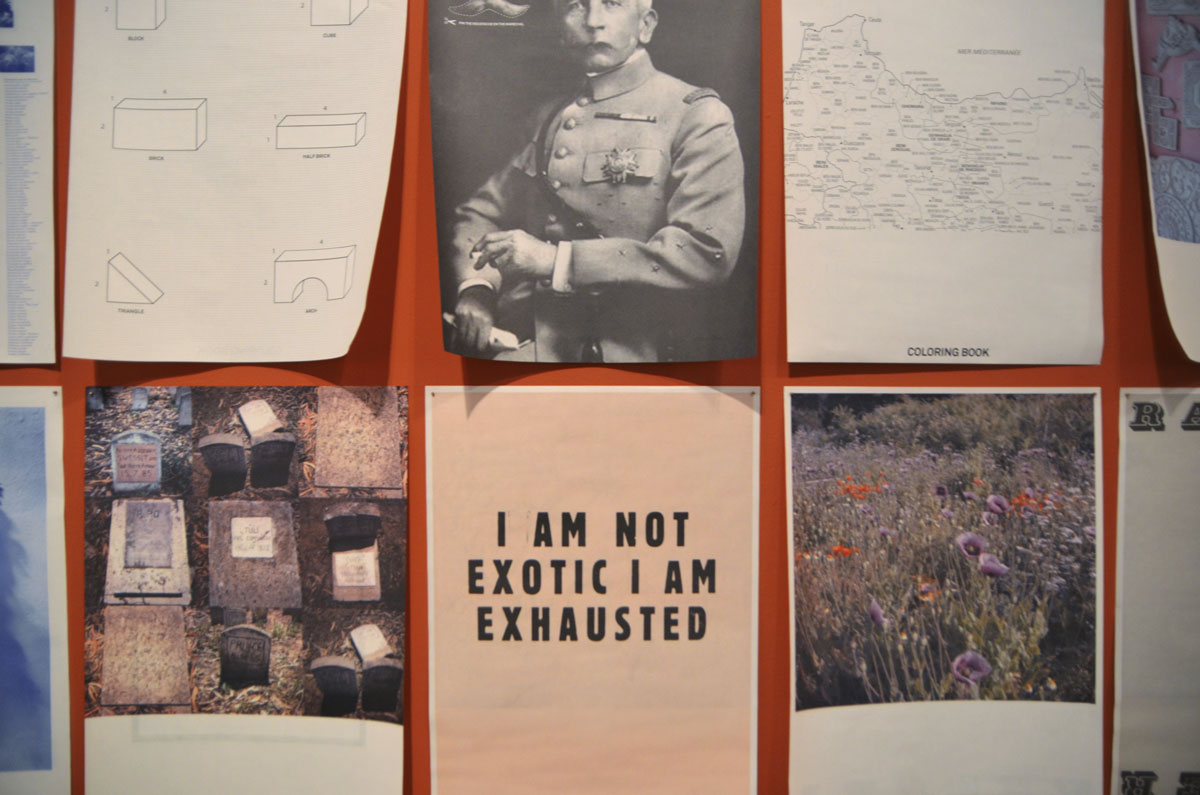
below: “I am not exotic I am exhausted”.  I suspect that this comes as Barrada’s response to living in a place (Tangiers Morroco) where tourists come to see “exotic things”.  But it is also the lament of anyone trying to live and work in a place that is also a “tourist attraction”.

Part of an exhibit by Yto Barrada of a series of posters printed on paper and loosely tacked to the wall, of images and words. 6 shown in this photo. Including one that only has a few word on it, I am not exotic I am exhausted.

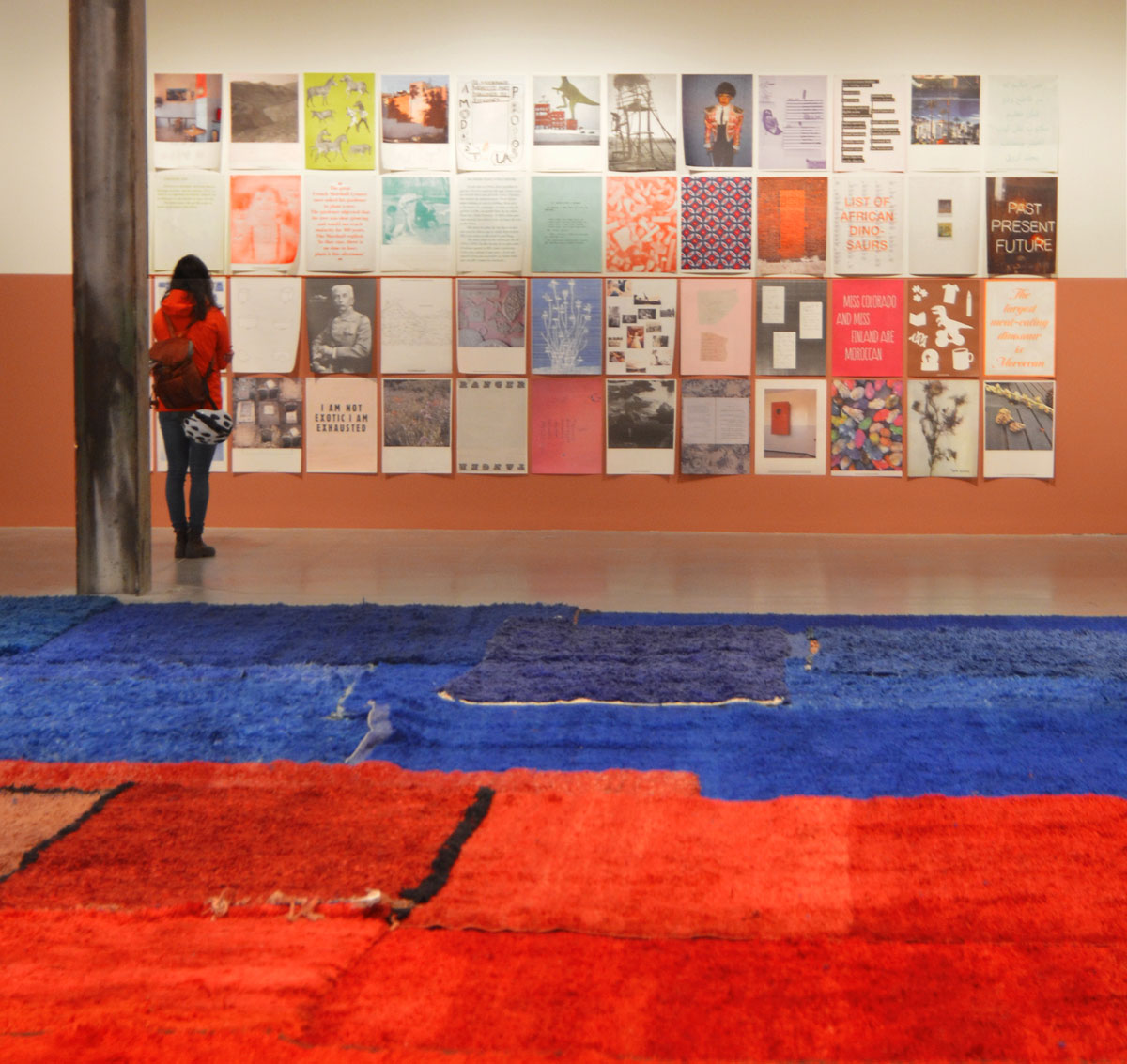
below: The whole of ‘A Modest Proposal’ and ‘Faux Guide’, 2015.  A set of 48 posters loosely tacked to the wall.  A mix of humorous and poignant.  One is an alphabetical listing of all the types of dinosaurs found in Morocco.  One says “Miss Colorado and Miss Finland are Moroccan” – which did happen in 2012.

Part of an exhibit by Yto Barrada of a series of posters printed on paper and loosely tacked to the wall, of images and words. They are arranged in a grid of 12 x 8 pictures. A woman is standing in front of them, reading the words on one. Blue and red carpets are on the floor in the foreground.

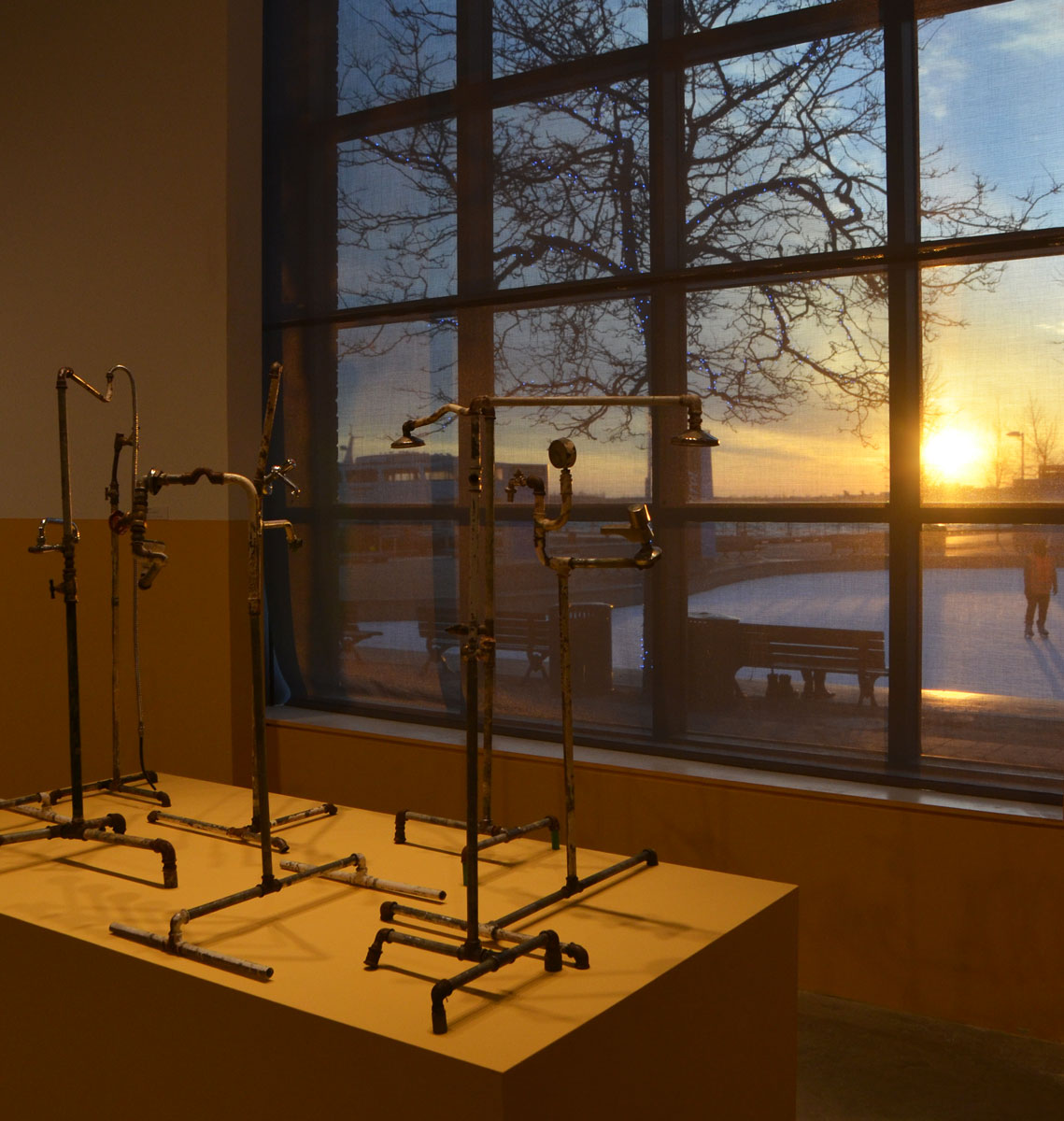
below: ‘Plumber Assemblage’ by the window, with skaters outside in the fading light.

plumber assemblage, an artwork by Yto Barrada consisting of a few sculpture like pieces made from pipes, faucets, taps, shower heads and other plumbing things.
There are many, many things that you can take from this exhibit.  Many things to think about.

An article in the  Toronto Star claims that Barrada  “explores the cultural heritage of her homeland through a colonial lens” and how that heritage has been used to make money from tourists.   But….   Is this the making of money by exploiting one’s culture and history?  Or the exploiting of Moroccan culture and history by the tourists?

Tourists go searching for the foreign and the exotic.  Many of them are souvenir hunters – Sometimes it’s a selfie in front of every “famous” place (or interesting building or whatever) and sometimes it’s a “find”.  But we live in a world that is full of  ‘made in China’ souvenirs and we are a people that don’t care to distinguish between the real and the fake.  We just want a story to tell the folks back home.

There were once dinosaurs living in a tropical land in what is now Morocco….  how the world has changed, and is changing.   Insert your opinions on climate change here.

Because it is a collection of exhibits under one umbrella, it has been compared to a museum.  Very trendy.   One description of the exhibit claims that it is “Meant to make us question the ways in which museums confer value on things”.  Can I take that one step further by asking, how do art galleries confer status on art and artists?  Museums make curatorial choices and so do art galleries.  Barrada too has surely made choices as have I.
You are probably wondering what carpets on the floor have to do with all those words that I just wrote.  Good question.  I think that Yto Barrada is on to something – an exhibit that has visual appeal, offends no one, and is flexible in its interpretation (i.e. it says something different to everyone and fits nicely into most people’s narratives).   You can agree with me, or disagree.  Best to go and see it for yourself and form your own opinions…. mine just might be fake.

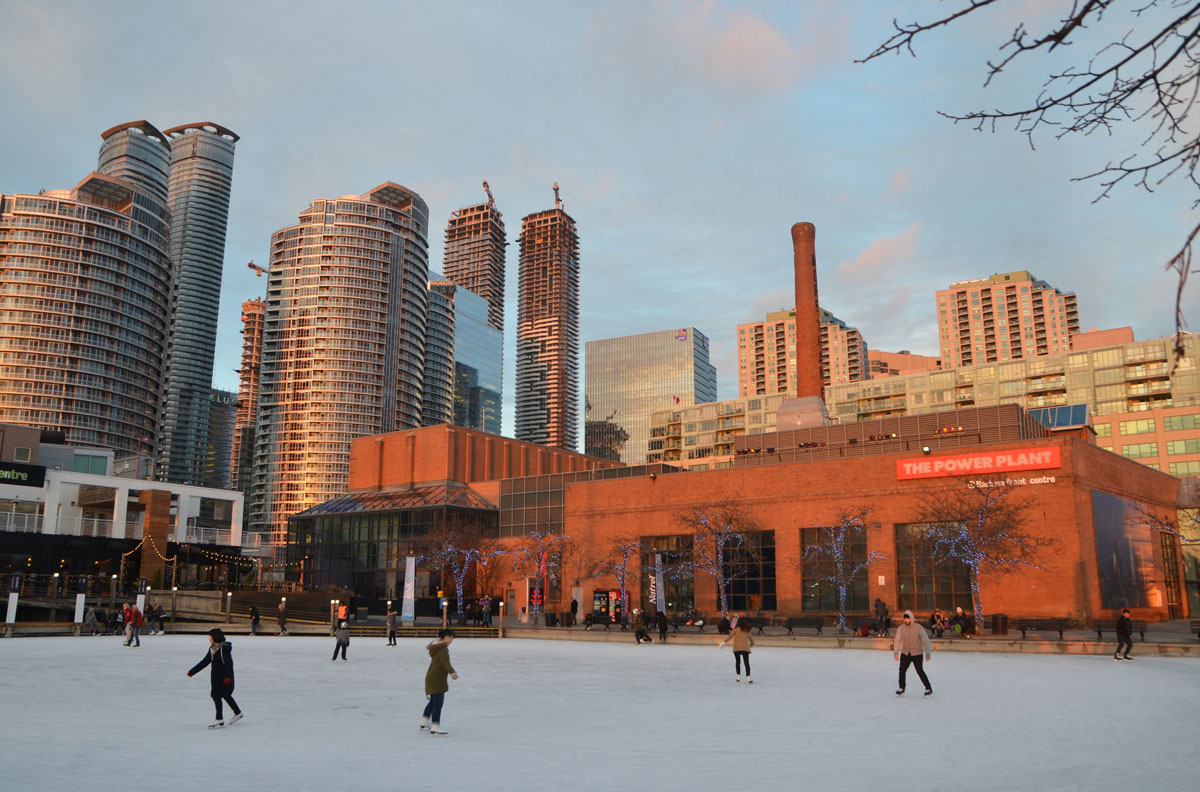
below: People skating on the frozen Natrel Pond beside The Power Plant.

late afternoon with the sun low in the sky casting yellowish glow on the world, Toronto skyline in the background with its condos and construction cranes, also The Power Plant Center and art gallery. In the foreground is the frozen Natrel Pond of Harbourfront and on it people are skating.

Yto Barrada’s exhibit will be on at The Power Plant until the 2nd of January.

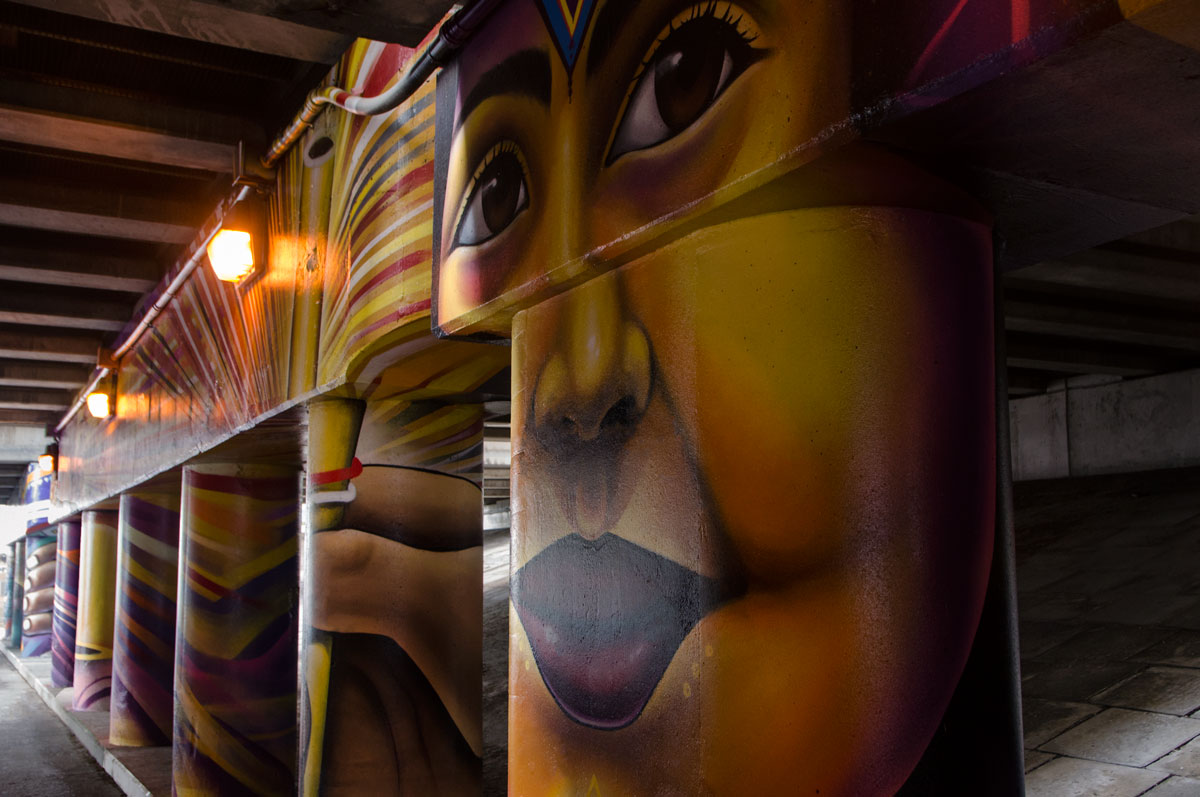
Back in mid October I blogged about the new murals on the south side Wilson Ave as it passes under the Allen Expressway (where Wilson subway station is).

below: Looking across Wilson Avenue to part of the mural on the south side.

looking across Wilson Avenue, under the Allen Expressway towards a mural that has been painted on the pillars and supports on the other side. A face is painted there.

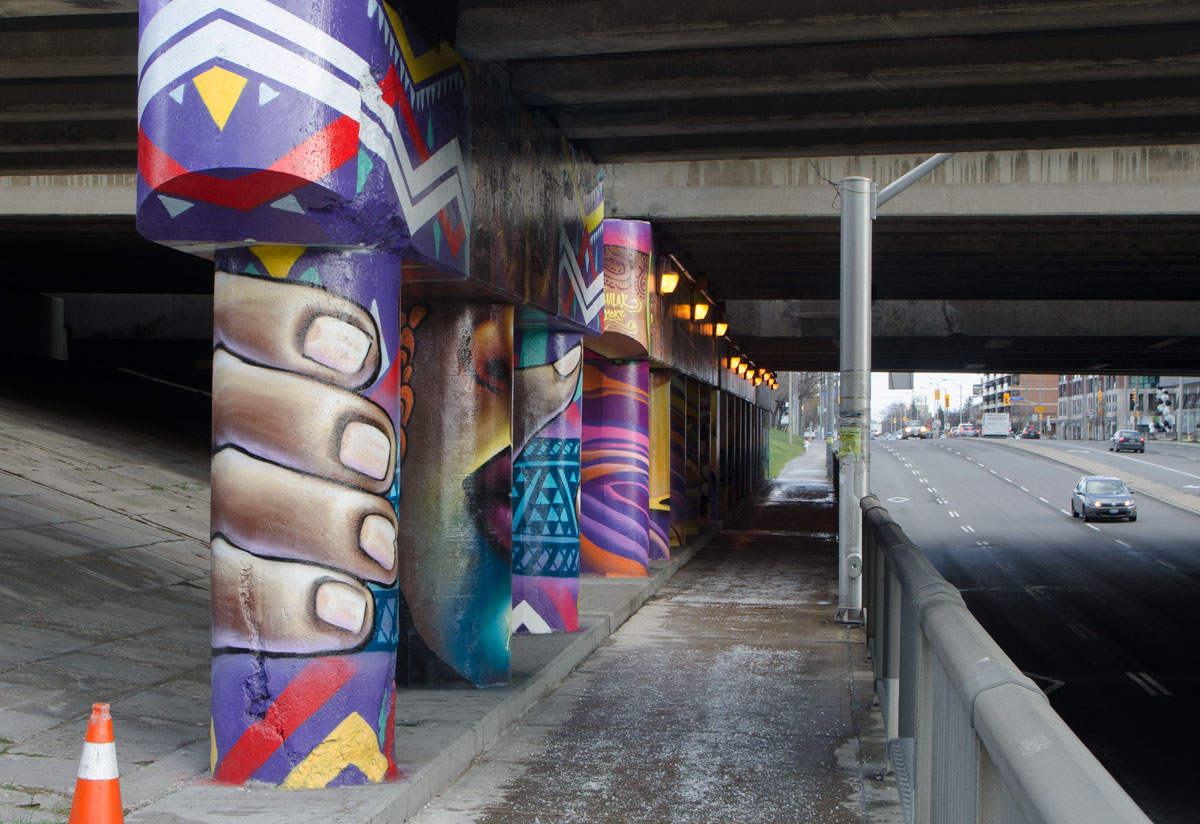
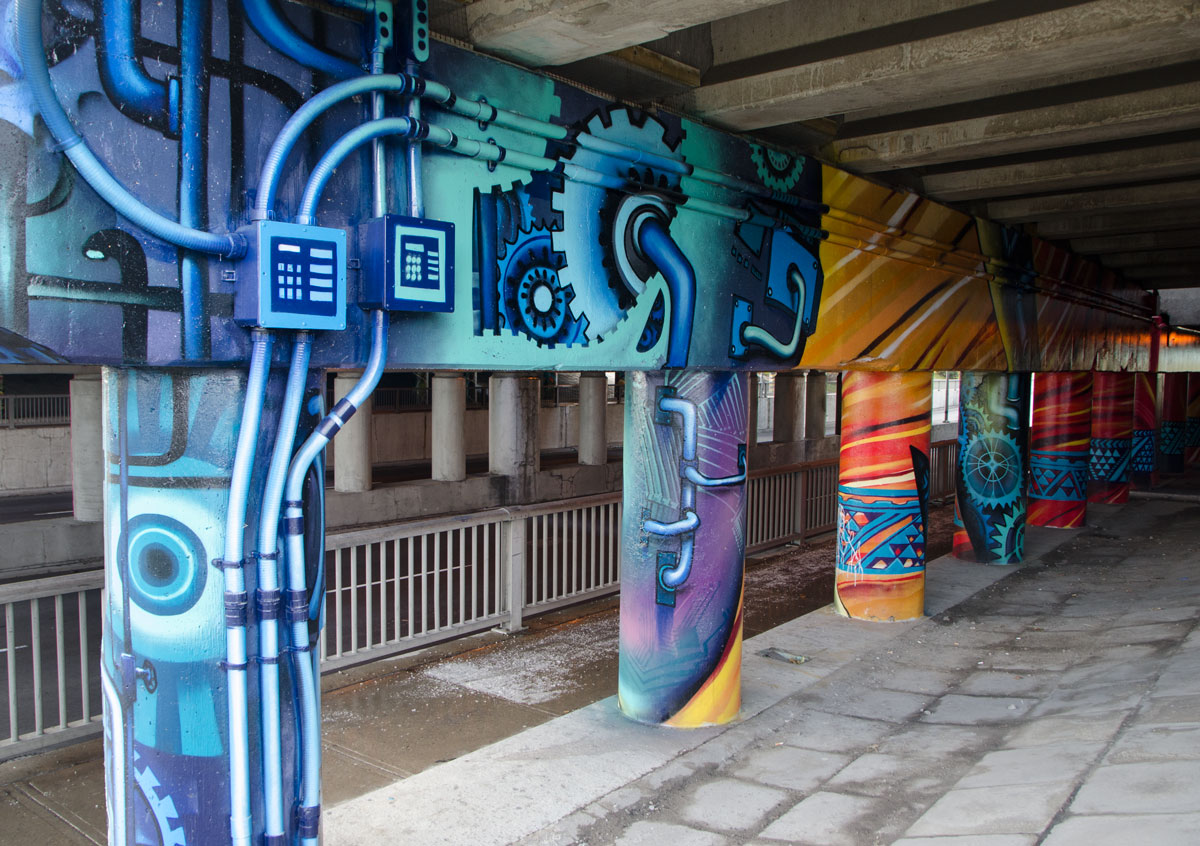
When I was there last,  the murals on the north side were not completed.   The other day I remembered that I hadn’t seen the finished work, so I took the subway back to Wilson station to see what the pillars on the north side look like.   There is more light on the north side as there are entrances to the subway along the sidewalk here.   There is also more pedestrian traffic.

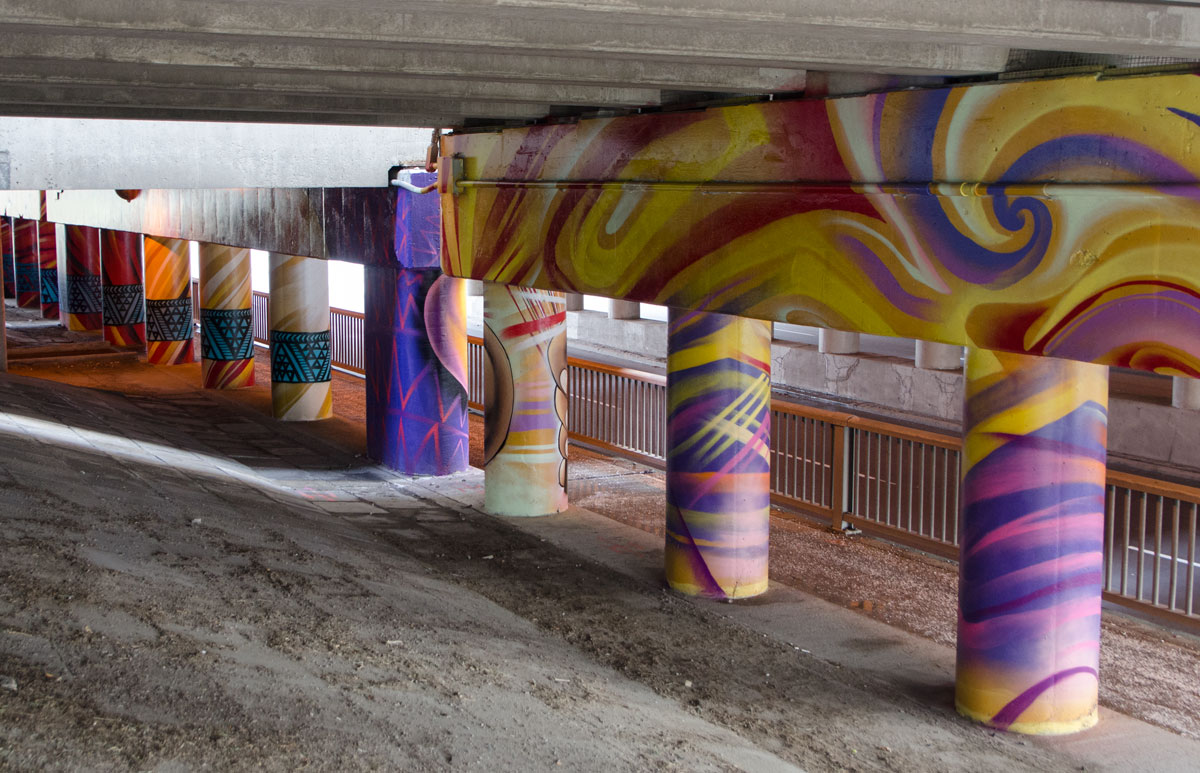
pillars and supports under an overpass that have been painted in bright colours by smoky and shalak

This side was also painted by shalak and smoky (as was the south side).

pillars and supports under an overpass that have been painted in bright colours by smoky and shalak - swirls of purples and yellows

below: In the center by one of the well-lit subway entrances.

pillars and supports under an overpass that have been painted in bright colours by smoky and shalak - red pillars with blue geometric patterns in a band around it near the bottom

pillars and supports under an overpass that have been painted in bright colours by smoky and shalak

pillars and supports under an overpass that have been painted in bright colours by smoky and shalak - a face showing eyes and top of nose

below: Looking east along Wilson Avenue.
pillars and supports under an overpass that have been painted in bright colours by smoky and shalak - a large face in the center pillar, with hands gripping the outer pillars on each side of the face

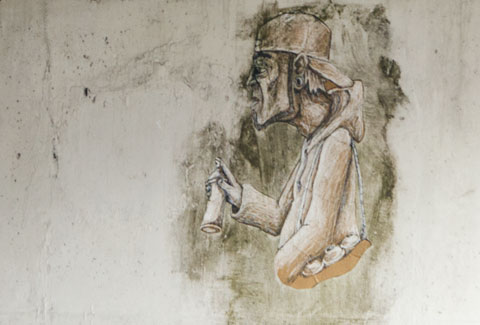
below: A little street artist with his can of spray paint has been left in a corner.
He’s not easily spotted.

a grey tones painting of a man with a spray can in his hand, from the waist up


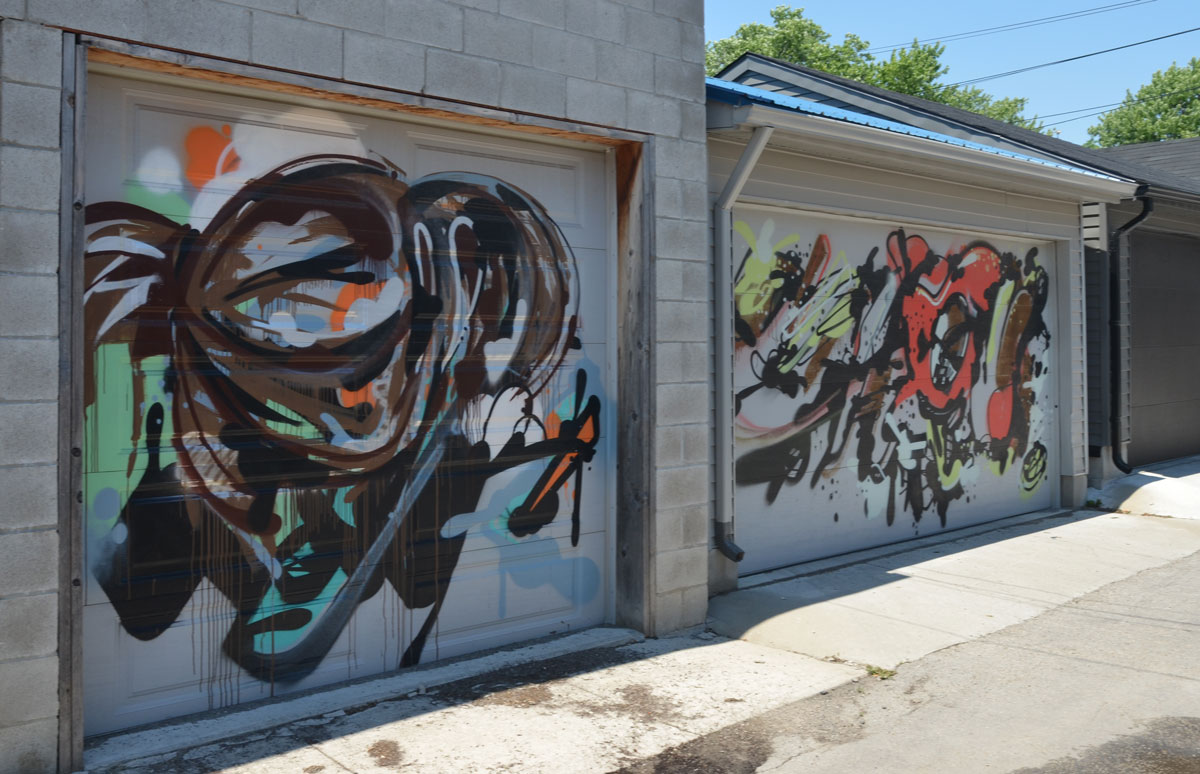
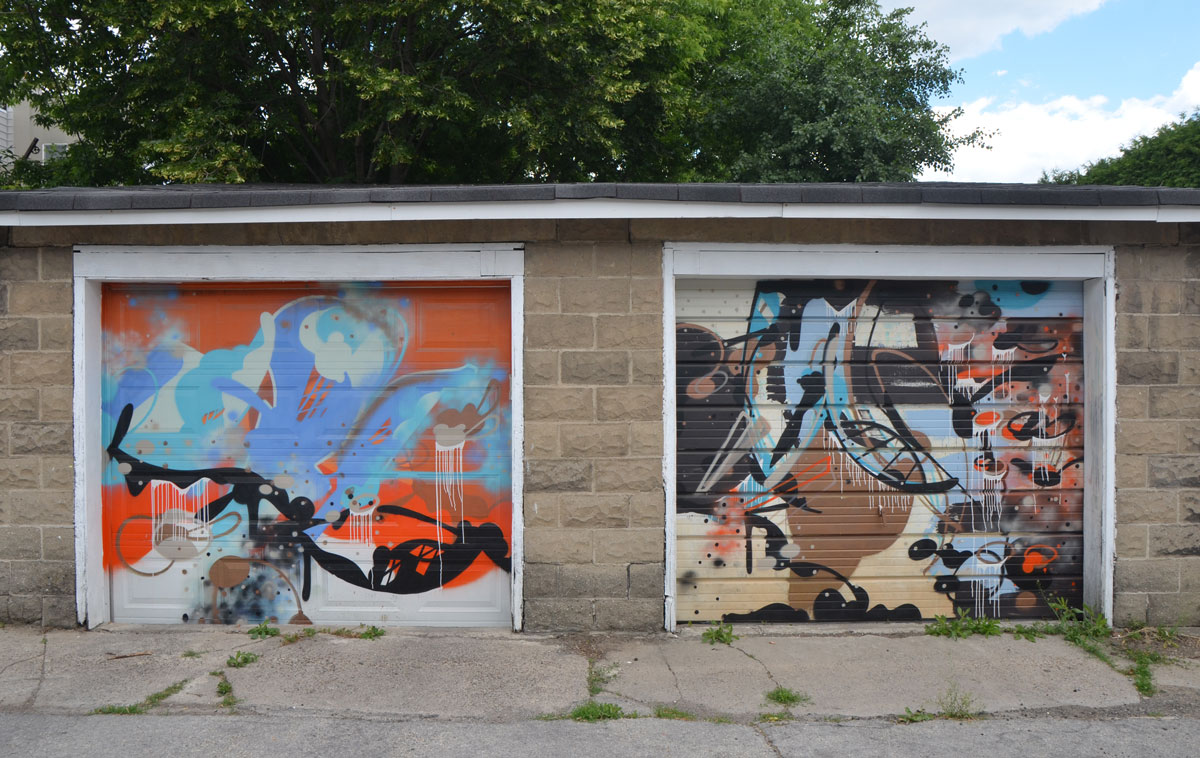
Peperonata Lane runs north from Harbord Street.    Most of the garage doors in the alley have been painted.  Some were painted as part of a Wallnoize project in 2013.

a lane running parallel to a park with garages on the other side, a line of large trees by the garages. Most of the garage doors are covered with street art

below: Take a seat… and see what kind of street art there is here.

a wooden chair is tied to a tree, autumn leaves on the ground, a row of garages in the background, a number of large trees,

below: A woman feeds the chickens.

mural on a garage door of a woman feeding some chickens in a yard with colourful laundry hanging out to dry, houses in the background, mural on a garage door.

below: This mural, done in 2009, is one of the older ones in the lane.

blog_mural_simple_houses_garage

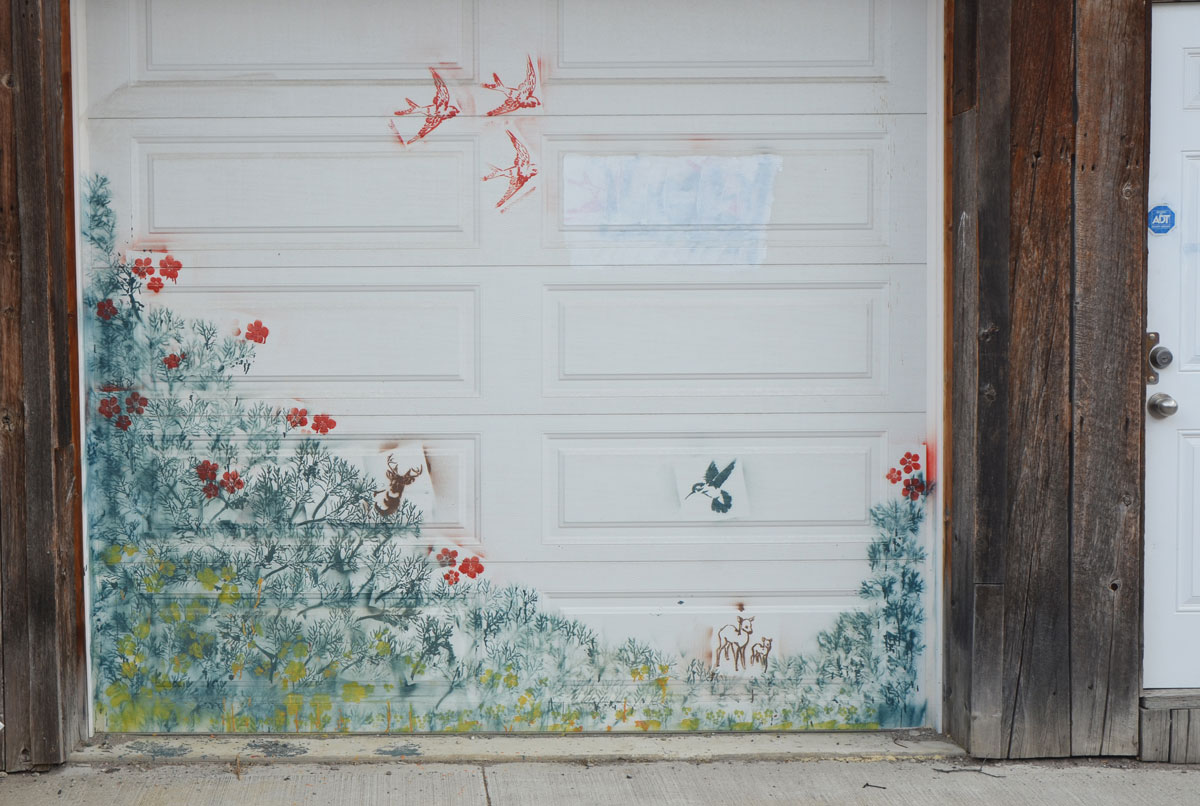
below: A deer and a hawk

mural on a garage door, a deer and a hawk

below: Elicser people and a text painting by poise.

street art on a garage and fence by elicser and poise in a lane,

below: Split face on a fence, by fiya

blog_face_gate_halves_split

below: A poser bunny

a poser bunny and tag on a garage door in an alley

below: Multicoloured grumpy cat by shalak and clandestinos.

shalak and clandestinos painting of a colourful cat face and paw with claws, on a garage door and fence in a lane

below: Wrinkled man with fish in hand, by smoky

painting by street artist smoky of a wrinkled old man holding an ugly fish in his hand.

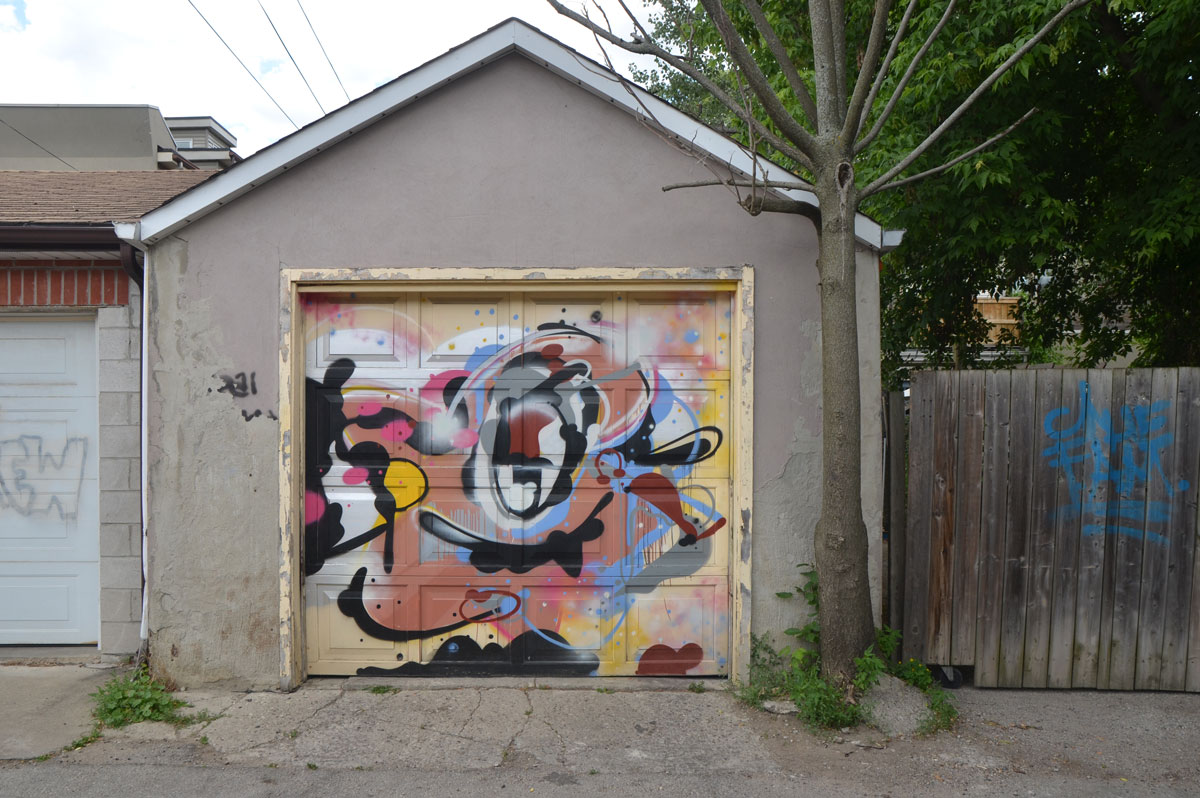
below: A garage door painted by miles.

street artist miles tag and colourful street art on a garage door

garage doors in a lane alleyway that have been painted with street art


From City of Toronto documentation on the naming of Peperonata Lane, November 2012:

“The residents whose properties border on the lane have provided the following background information on the proposed name:”
” …throughout each year, the Galle family, who’ve lived at 441Montrose (the east side) since 1972, includes many Montrose residents in their annual celebration of making the “sugo” or tomato sauce, the roasted peppers and peperonata party, and the spirited soppressata contest, which they bring from their home country of Italy. Everyone learns the old world techniques and celebrates their new life in our Canadian context.
To commemorate how our lives have been enriched by the Galles welcoming and generous spirits, and in keeping with the traditions they’ve taught us and that we’ve now made our own, we propose the lane be named “Peperonata Lane” as a way of celebrating their unsung contribution to our neighbourhood”.

On Beatrice Street just south of College there is a small parking lot.  The walls of the buildings on the north and east sides have been painted with a large mural called ‘A Stroll by Garrison Creek’ .

below: On the east side of the parking lot is a painting that represents Emily Bickford and her two daughters, Beatrice and Grace.  The street that the parking lot is on was named for Beatrice Bickford.  The next street parallel to Beatrice is Grace, named for Grace Bickford.   You might recognize the name Bickford if you are familiar with the area – Bickford Park is just south of Christie Pits.  Emily Bickford was responsible for donating some of her family’s land to the city to be used for parkland.

mural on the side of a brick building. Large. Three woman walking through long grass and chasing butterflies. A Stroll along Garrison Creek. Representing Emily Bickford and her daughters Beatrice and Grace.

below: You may have spotted the words Spud Bomb in the picture below.  Also, you might recognize the shapes in the dress that she wears as being similar to shapes seen in a lot of street art in Toronto.  They are the work of Pascal Paquette.  Both Paquette and Spud1 collaborated on this mural along with artist Artchild.

part of a larger mural, a young woman with her back to the viewer, walking through long grass

below: A large chickadee dominates the mural on the north side of the parking lot.

large mural of a chickadee, flowers, and butterflies

This mural was a StreetARToronto (StART) project, with help from VIBE Arts and the Toronto Parking Authority.   It was completed a couple of months ago, September 2016.


a monarch butterfly in a mural along with many pink and purple flowers

part of a larger mural, geometric and abstract shapes in many colours.


In the lead role, the hero of our story, the Tim Hortons coffee cup, a bright red Canadian icon with its usual black top and brown sleeve.  He gets around.  The city is his playground.  Whether it’s standing out against a minimalist black and white background….

an empty red Tim Hortons coffee cup sits on a white ledge on a white wall with a black door on either side of it.

or trying hard to fit into the colours of the city.

painting of stems with leaves, stylized, with a red Tim Hortons coffee cup at the bottom of one of the stems.

There are times when he’s on top of the world. King of the castle so to speak.

a red tim horton cup on a grey metal box on the street, traffic including a TTC streetcar are in the background

.. and he rides in style with his private seat on the TTC.

an empty red tim hortons coffee cup lies on a red TTC streetcar seat. No one is sitting there.

But it’s not always an easy life. Sometimes he’s down in the dumps facing hurdles that are too high.   He’s left feeling abandoned and neglected.  Vacant.

a tim hortons cup discarded onto a gravel section of a vacant lot, behind a chainlink fence

And he has even considered ending it all.

a red tim hortons cup standing on the ground beside a green rubbish bin

But he’s an urban guy.   He knows that life is what you make of it.

a red ti hortons coffee cup sits on a ledge, people around it, all with their backs to the cup

 And there are always others just like him that he can count on for a chat or for a shoulder to cry on.

Two red Tim Hortons coffee cups beside two water supply

He has many fine traits.  He can be a curious fellow but he knows his limits.

an empty red tim hortons cup lies discarded on the ground, beside yellow police tape

He knows that sometimes you have to be patient… but that doors usually open.

a red tim hortons coffee cup sits on the stone step in front of a double set of doors. on a street

He’s frequently warm and often ready to lend a hand.  In case of fire, he’s there!

a red tim hortons cup sits on a red shelf beside fire emergency equipment

You’ll find him in many places around the city, watching, waiting, and keeping an eye on the situation in his own quiet way.  He too is part of this city.

a red tim hortons coffee cup sits on top of a grey Honeywell meter outdoors

Casting by Tim Hortons.
No cups were disturbed in the making of this story.
Look for the sequel, ‘A Tim’s Christmas’ playing in a street near you.


Queen and Sherbourne – It’s a grubby corner.

below: Built in 1897 on the southwest corner and a major part of the intersection since then, is the Kormann House Hotel named for its hotel keeper in 1898, Franz J. Kormann.  The Torontoist described the building in 2008 as “Though vacant for the past few years, this old watering hole will open its doors once again as part of an upcoming condo development.”  That was 8 1/2 years ago.  It is still vacant.   The projected renovations and mid-rise condo development never got off the ground.

old brick 3 storey building on the corner of an intersection. Top part is white, bottom part is grey. Boarded up and vacant.

below: Diagonally opposite is now the Moss Park Discount Store.

building on the corner of an intersection, Moss Park Discount Store on the corner of Queen East and Sherbourne. People on the sidewalk outside the building. 3 storey brick,

below: The same corner as above but from a slightly different angle as it looked about a hundred years ago.  Note the cobbled streets, streetcar tracks on both Queen and Sherbourne, and the lack of traffic lights.   Photo found on Lost Toronto blog

old black and white photo of the northeast corner of Queen East and Sherbourne

Adding a bit of colour to the intersection is the new mural on Sherbourne Street, on the side of building that houses the Moss Park Discount Store.   It features a young man in a baseball cap adorned with the Brazilian flag.  Three parrots are also in the mural.

mural on the side of a red brick building, a young man in a baseball cap and three parrots. on the exterior wall of the Moss Park Discount Store.

Close ups of parts of the mural:

part of a larger mural, a green hand is reaching out and the forefinger is rubbing the top of a parrot's head.

part of a larger mural of a parrot like bird upright, wearing a sleeveless T-shirt with the number 16 on it.

part of a large mural, a parrot head, and the signatures of the street artists who created the mural - Smoky, Cens and Vemo

Just north of Queen, there is a small dead end alley that runs east off Sherbourne.  At the end of the alley is a mural by Vorteks….  she’s come to save someone (the world?) from an orange creature.

two murals in an alley. At the end, on a fence is a mural by vorteks, text with his signature using an eyeball for the letter O. An orange creature with an eye, most of which is behind the text, as well as a scantily clad woman who looks like a superhero.

This birdo is still looking good.  It’s just east of Sherbourne.

mural by birdo, bright green background with abstract colourful animals painted on it, tall large animals

below: On the north side of Queen Street East, looking towards Sherbourne Street from Kim’s Convenience (with the birdo mural on the wall).  I was going to write something about it ha ha having the same name as the CBC TV series “Kim’s Convenience”.  Luckily I looked it up before writing because lo and behold it is the same store!  The store was up until recently called Mimi Variety.  The new name and new signs are leftovers from filming the TV shows.   Most of the buildings in this block are heritage listed sites, especially those towards Sherbourne Street.

blog_kims_convenience_queen_east

A few more little details to end the post with:

below: A triptych with the center panel missing or a diptych with a mystery middle.

a painting in three panels of a vase of pink and red flowers, on a wooded fence outside, but the middle panel is missing.

below: On a pole, a grominator lovebot hybrid with its long red tongue.  The other little guy’s tongue just can’t compare.

two stickers on a pole. The top one is a lovebot grominator joint venture hybrid character with a very long red tongue. The other is a little round faced guy with his tongue sticking out.

below: A dying breed, three Saabs in a row.  It’s not just old buildings that catch my eye.
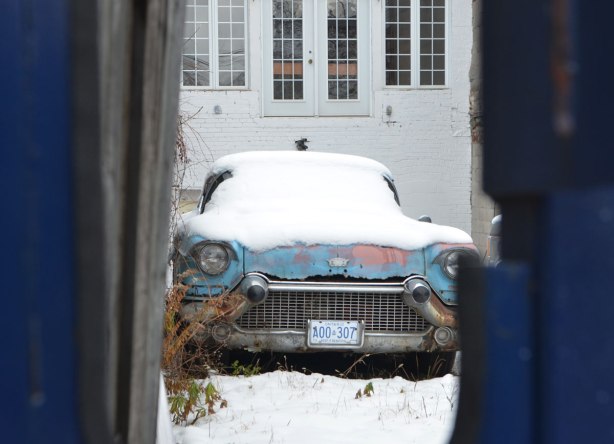
Perhaps the one on the right has been cannibalized?

three saabs parked side by side. The one on the right is missing a large portion of its front bumper, headlights and other front end pieces.

below: And last, hearts seen on a Queen St. East building.

pink hearts on a cyan coloured window beside a heart on a brick wall graffiti


The other day when I was walking through the east part of Riverdale Park I wandered over to a statue I hadn’t noticed before.  He stands amongst trees a distance from Broadview Avenue.  With the leaves gone from the trees he’s much more visible now.

below: A grey Dr. Sun Yat-Sen stands in the park on a grey November day.
It was commissioned by the Chinese Canadian Commission and  sculpted by Joe Rosenthal in 1984/5.

statue in a park on a grey November day, trees have lost their leaves, dead leaves on the ground, some green grass in the background, statue is of Dr. Sun Yat-Sen, a Chinese man

The transcription of the English portion of the brass plaque that accompanies the statue:

“Dr. Sun Yat-Sen (1866-1925)

Dr. Sun Yat-Sen, also known as Sun Wen, was a native of Tsu-Heng village Chung Shan District in Kwantung Province.  A devout Christian, he studied medicine in Hong Kong and took upon himself the task of overthrowing the tyranic Ch’ing Dynasty and of establishing a republic of democracy and freedom.  Having completed his studies, he practised medicine for a few years, since 1893, he devoted himself to the above political ideal and wrote his famous works “Three Principles of the People”, “The Five-Power Constitution”, “Plans For National Reconstruction”, and “Fundamentals for National Reconstruction”.  He planned and led no less than ten uprisings until the Wuchang Uprising in October 1911 brought about the success of the revolution.  He was elected provisional president but resigned soon afterwards and still devoted himself to the cause of the National Revolution.  On March 12, 1925 he died in Peiping and was given a state burial at Nanking in June 1929.”

Why does he stand here?  A political figure with no known ties to Canadian history.  There aren’t too many statues of such people here in Toronto.   Part of the answer probably lies on the back of the statue where there is a list of the names of those who donated to the building of the statue.  Most of them are Chinese, members of the Chinese diaspora in Toronto.   Added note: it was interesting to learn that Yat-Sen had visited Toronto to raise money for his fight in China.

When I was walking toward the statue, I stumbled upon an old cannon in the park.  It’s aimed over the DVP towards the Bloor Viaduct.  Another little surprise on a grey day.

An old cannon from the 1800's stands in a park surround by trees on a grey November day.

Why is there a cannon here I wondered?  Of course the internet has the answer to all questions.  Apparently, “When the Hon. A.P. Caron, Minister of Militia and Defence, made a visit to Toronto in 1881, a local Alderman asked him for cannons with which to decorate Riverdale Park.”  (I assume the Hon. A.P. Caron was a federal minister in Ottawa).   Five were delivered from Quebec City to Riverdale Park where “they were set up on a wooden platform in battery-like formation.”     In 1886 one of those five was moved to its present location on the Broadview side of the park.  (source)

below: This 32 pound cannon bears the cypher of King George III on the top of the cannon.  King George III ruled from 1760 until 1820 for a total of 59 years and 96 days.  He was the third longest reigning British monarch – behind Queen Victoria (63 years and 216 days) and Queen Elizabeth II (64 years and counting).

the insignia on the top of a cannon from the 1880's, markings in the brass of the cannon , royal insignia

Two pieces of history located within a stone’s throw of each other in a quiet Toronto park.  Two very diverse, and different, histories but both part of the political and social history of this city.

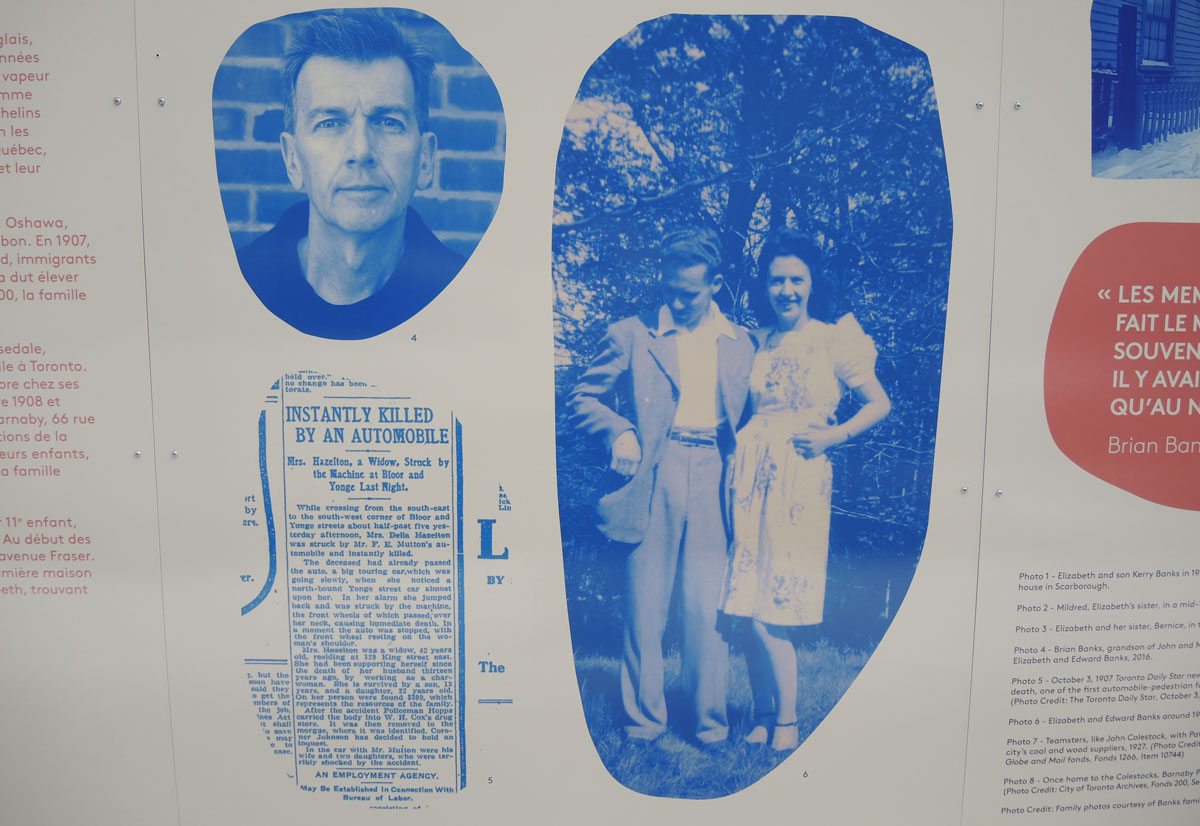
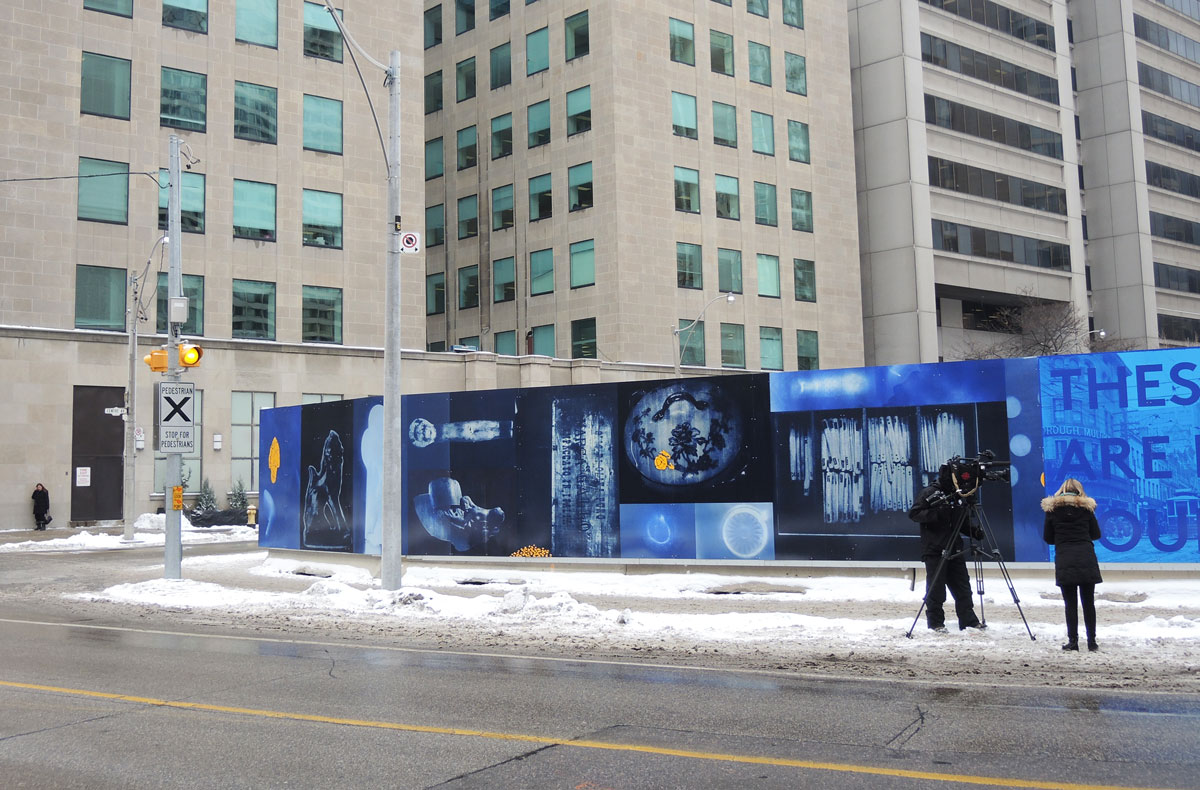
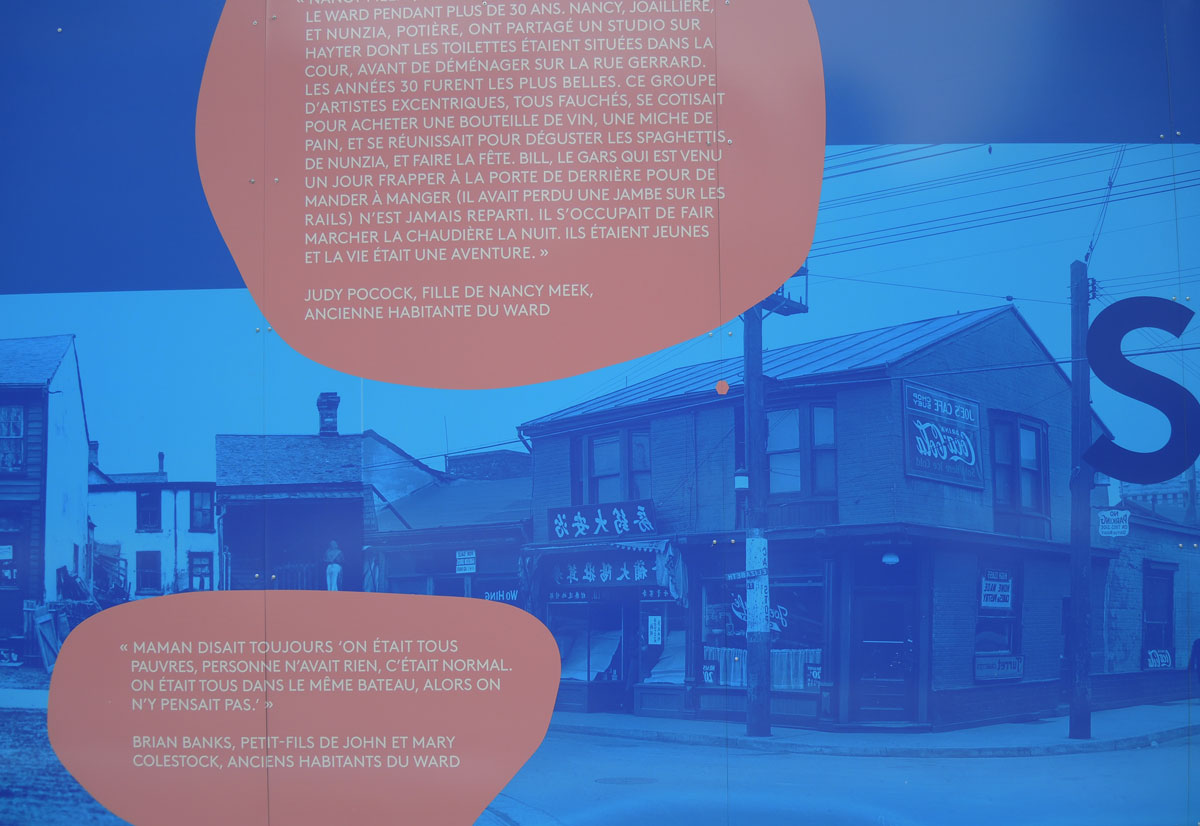
Just over a year ago, I posted some pictures of the art work hanging on a fence along Craven Road.
Some of it is still there, especially some cat pictures like this one:

painting of a beige and light brown cat, lying with its head up and tail wrapped around its body, painted on a wooden fence outside

below: Quite a few little planters have been mounted on the wall.  Because it’s now cold November, most of the plants have died.   These are two exceptions.

4 small wood boxes have been mounted on the side of fence, as planters, a couple still have purple flowers even though it's November and most of the trees have lost their leaves,

below: Some of the things that are now on the fence.   Because there are no houses on the west side of the street, the fence can serve as a gallery wall.

decorated wooden fence on Craven Road, a road with houses only on one side of the street, fence is decorated with a faded Canadian flag, a picture of Queen Elizabeth I, some wood planters, a painting of birch trees in autumn, old shoes, and a sign that says Craven road FEnce, 100 years, 1916 to 2016

below: A close up picture of the “Celebrating 100 years” sign as well as the picture of Queen Elizabeth I, engraved by Crispin van de Passe the Elder, after a drawing by Isaac Oliver.

closer view of the fence with its Celebrating 100 years, Craven Road fence, 1916 to 2016 sign as well as an engraving of Queen Elizabeth I. Planters with dead plants and painted pine cones on sticks, painted red, silver and gold.

below: Andy Warhol’s Marilyn Munroe beside many shoes in twos, knee pads and a walking cast.

a wooden fence with many things hanging on it - an Andy Warhol Marilyn Munroe print, a painting of autumn birch trees, and many old shoes

below: Mirror, mirror on the wall…  Bird pictures to the left and trees and sticks to the right.
Scattered among them are a few glow in the dark stars.

An oval mirror with an ornate wood frame is mounted on an outdoor fence, wood, three small framed pictures hang on both sides of it.

below: Artfully arrange artifacts… mask, hockey stick, dog pictures, toy helicopter….

all kin mounted artfully on a wood fence on Craven Road - hockey stick, football, picture of Charlie Chaplin, ds of things

below:  A woman with three wolves, a young boy and dragonflies listening to your heart.

old black and white photo of a boy, a small statuette of a woman and three wolves, dragonflies on a picture frame with a photo of the word love

below: A composition of found items.  A still life made of remnants of the past.

things on a fence as decoration, guitar, pictures, clock, boxes,

below: And lastly, a couple of pictures of some of the original paintings.

two painting on a fence. One is of a cat and the other is of white flowers

a painting of a line of white sheep on a snowy field, on a fence, outdoors, with houses and backyards beyond the fence, some trees too but they have lost their leaves because it is late autumn