Happy New Year greetings to one and all!
May you walk many miles and explore many places.

Happy New Year greetings to one and all!
May you walk many miles and explore many places.
As the year draws to a close many people like to look back and remember the year that was. Me, I go through files and although I find memories, I also find partially finished blog posts. I find ideas that I started to explore but there’s never enough time in a day to do everything you want. If only I could stop the clocks for a while and catch up!
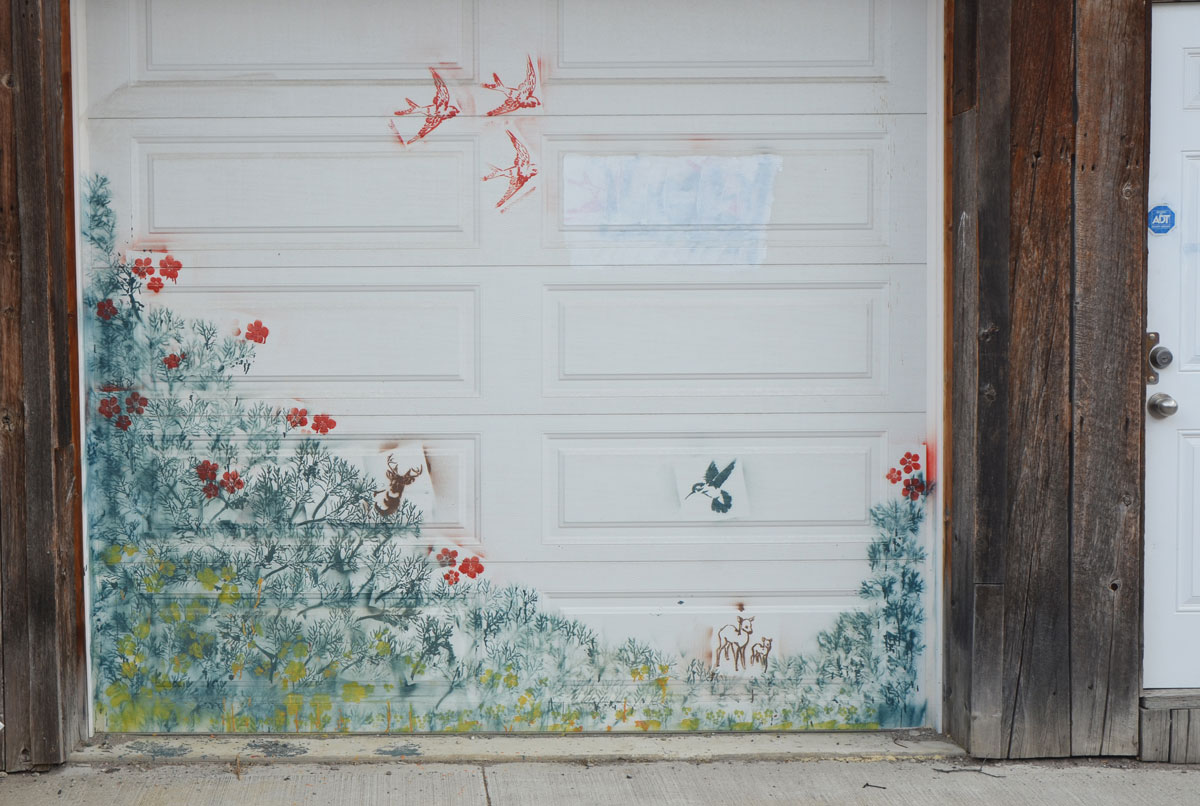
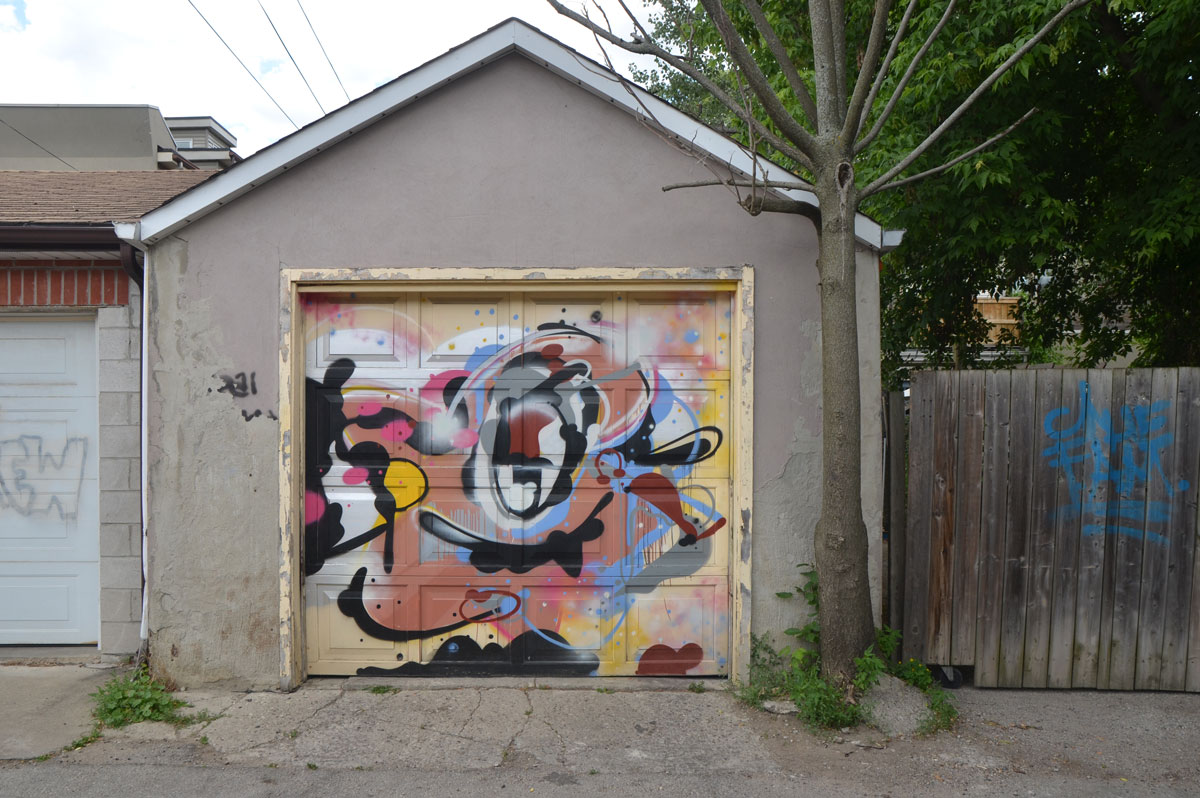
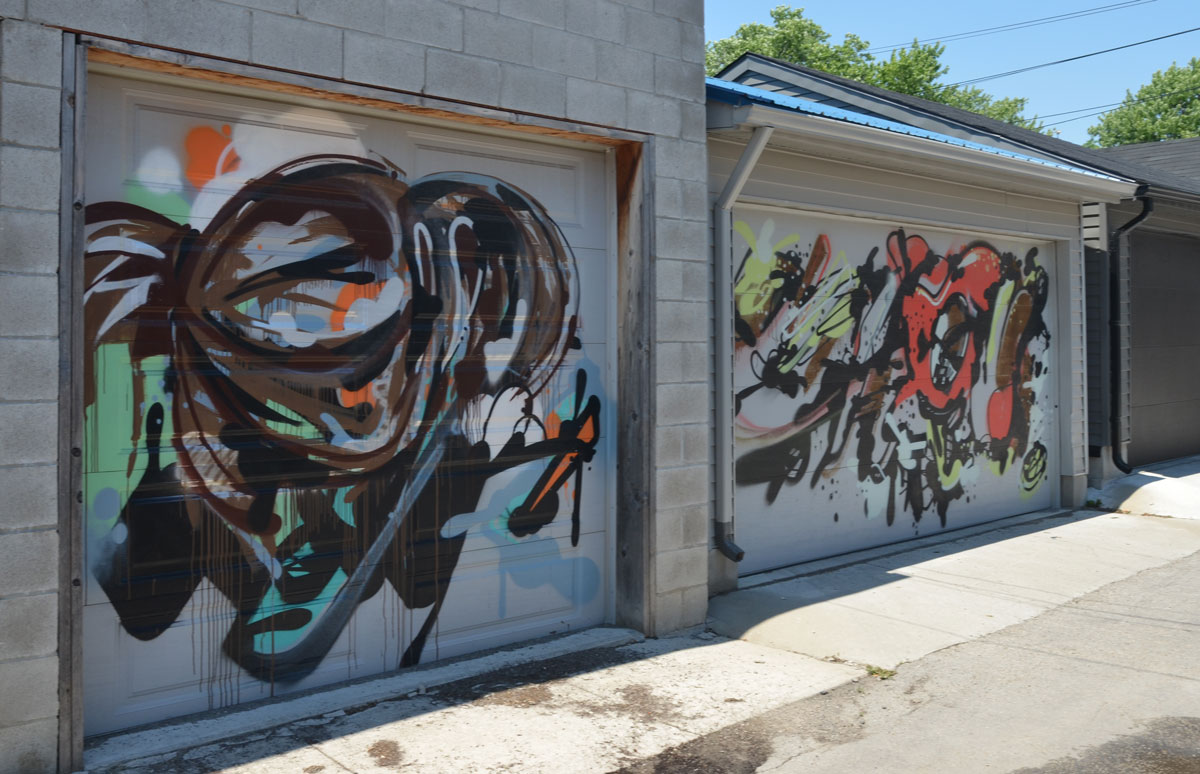
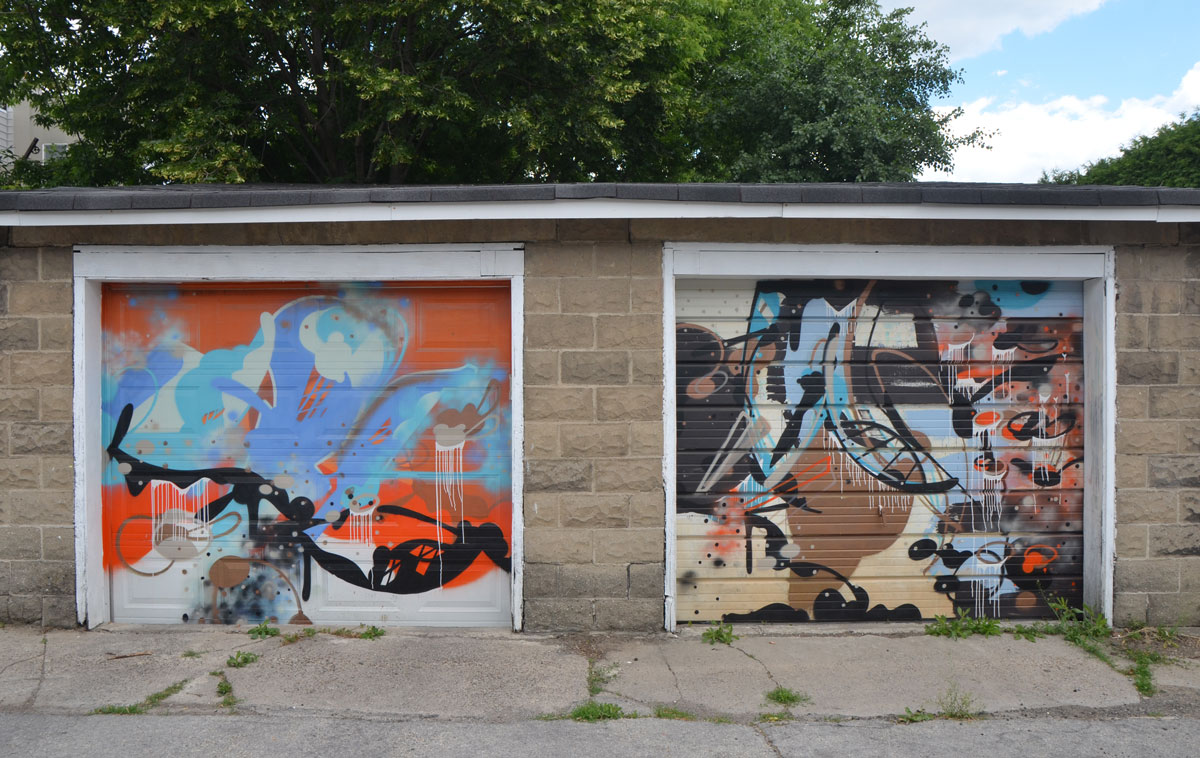
This is one of the blog posts that didn’t see the light of day earlier in the year. These pictures were taken back in June, back when the leaves were green and people were wearing shorts. This is the street art on the garage doors of Perly Family Lane.
below: … as well as one little stencil black bird high on a pole.

below: An intricate stenciled painting of deer among the trees, plants, and flowers with a humming bird hovering overhead and three swallows flying past.
below: A colourful door by Manik I think.

below: The rest of the photos are paintings by Pascal Paquette.
They are abstract swirls and blobs of colour.


I suspect that there will be a few more posts like this as I try to clear out the backlog that has accumulated over the year. Thanks for taking the time to look at my blog…. and please come back and see what happens as we move into a new year!
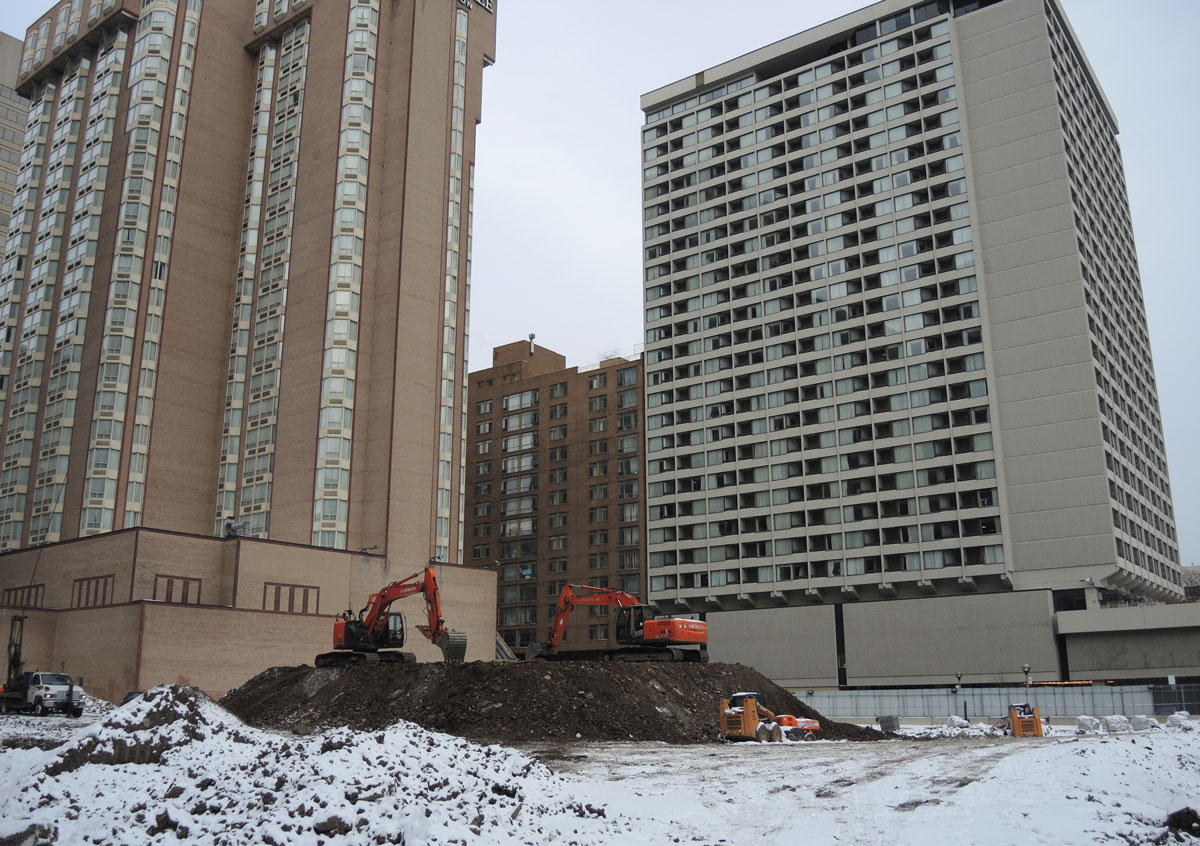
Tucked into a space between City Hall and the Court House, is a construction site. Up until recently it was a parking lot. Soon it will be a new Court House. Like all construction sites in Toronto, it is surrounded by hoardings to separate it from the streets and sidewalks.
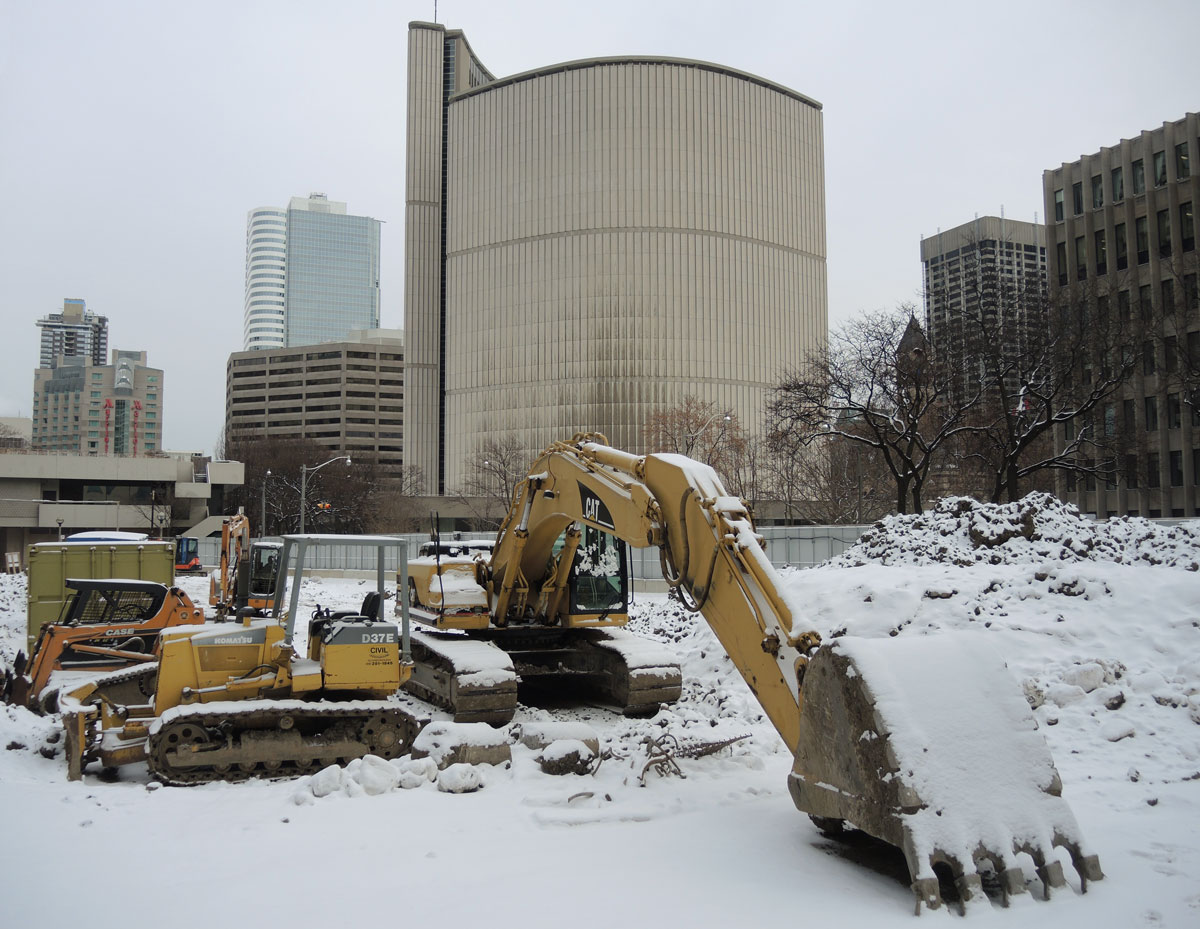
On two sides of the lot, the hoardings have been covered with a mural that was commissioned by Infrastructure Ontario. It is “Picturing the Ward”and it is an exhibit about the area that once existed here, The Ward. It was an area where many immigrants first settled. It was roughly in the rectangle formed by College St., Yonge St., Queen St., and University Ave. In the 1830’s it was home to Blacks escaping slavery, it saw waves of Irish, Eastern European Jews, Italians, and Chinese to name a few.
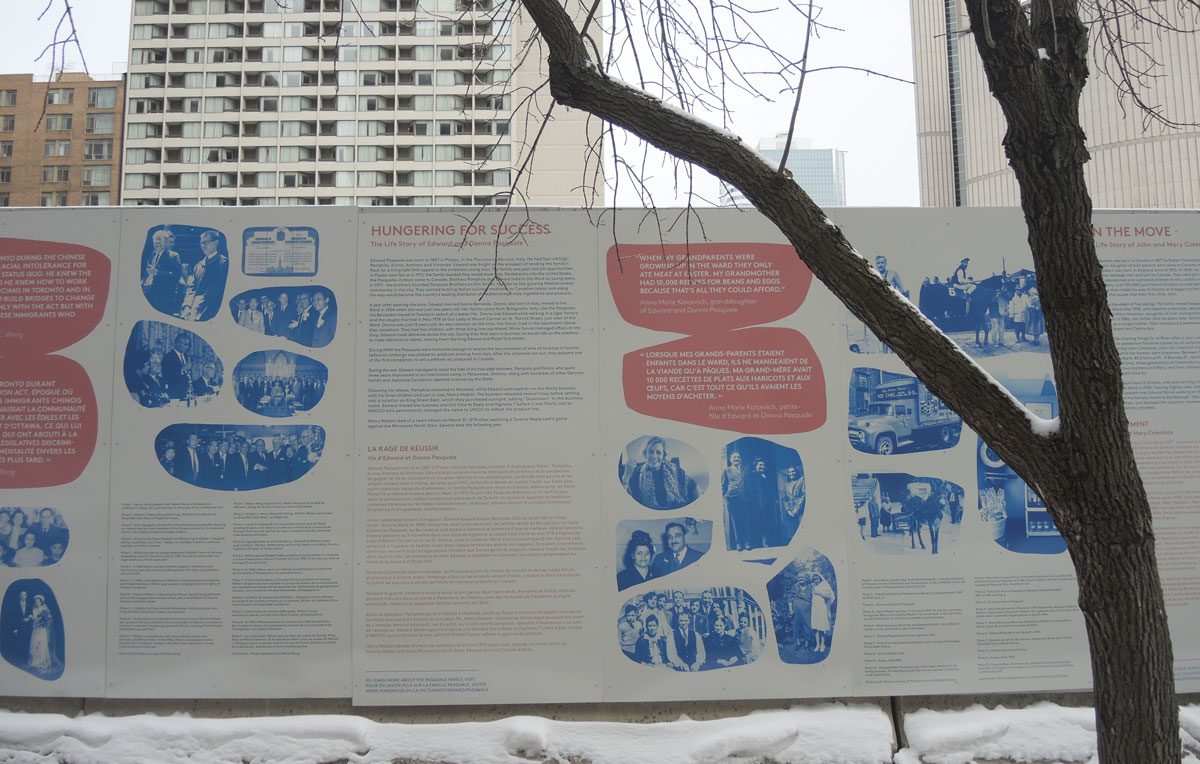
On the west side (along Centre Avenue), there are old photos, newspaper clippings, and stories of individuals who once lived in the area. The content was collected and curated by the Toronto Ward Museum, a new ‘museum without walls’ in the city. PATCH (part of The STEPS Initiative) designed and installed the mural. The stories are in both English and French.
below: A segment of the mural with a story titled “Hungering for Success”. It is the story of Edward and Donna Pasquale nee Bernardo. Both were born in Italy and both were brought to the Ward by their parents. They met here and married in 1918. Edward and his brother Pamphilo founded Pasquale Brothers store on Elm Street. During WW2 Pamphilo spent three years imprisoned in an internment camp in Petawawa along with other Italian, German, and Japanese Canadians that the government considered enemies of the state. Edward remained in Toronto running the store.
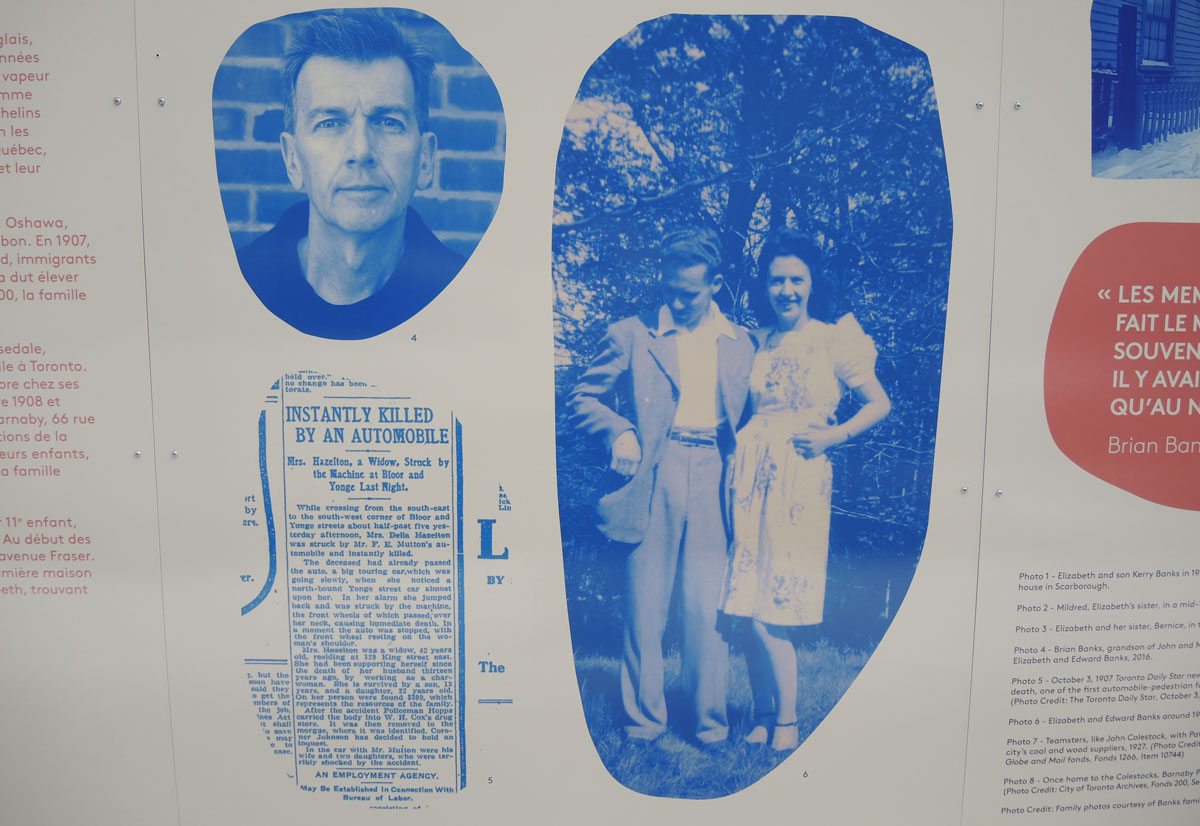
below: The newspaper story from ‘The Toronto Star’ of 3rd October 1907 describes the death of Mrs. Hazleton, a widow with two children, who was hit by a car at Yonge & Bloor. The car was driven by Mr. F.E. Mutton. Yes, back then the driver of the car was named in the newspaper.
below: The middle section is a collage of cyanotypes (an old photographic process which results in blue pictures) produced by PA System (aka Alexa Hatanaka and Patrick Thompson) . The images are of artifacts uncovered during the excavation of the area along with some heirlooms contributed by former Ward residents. A couple of CBC people were braving the cold that day too!
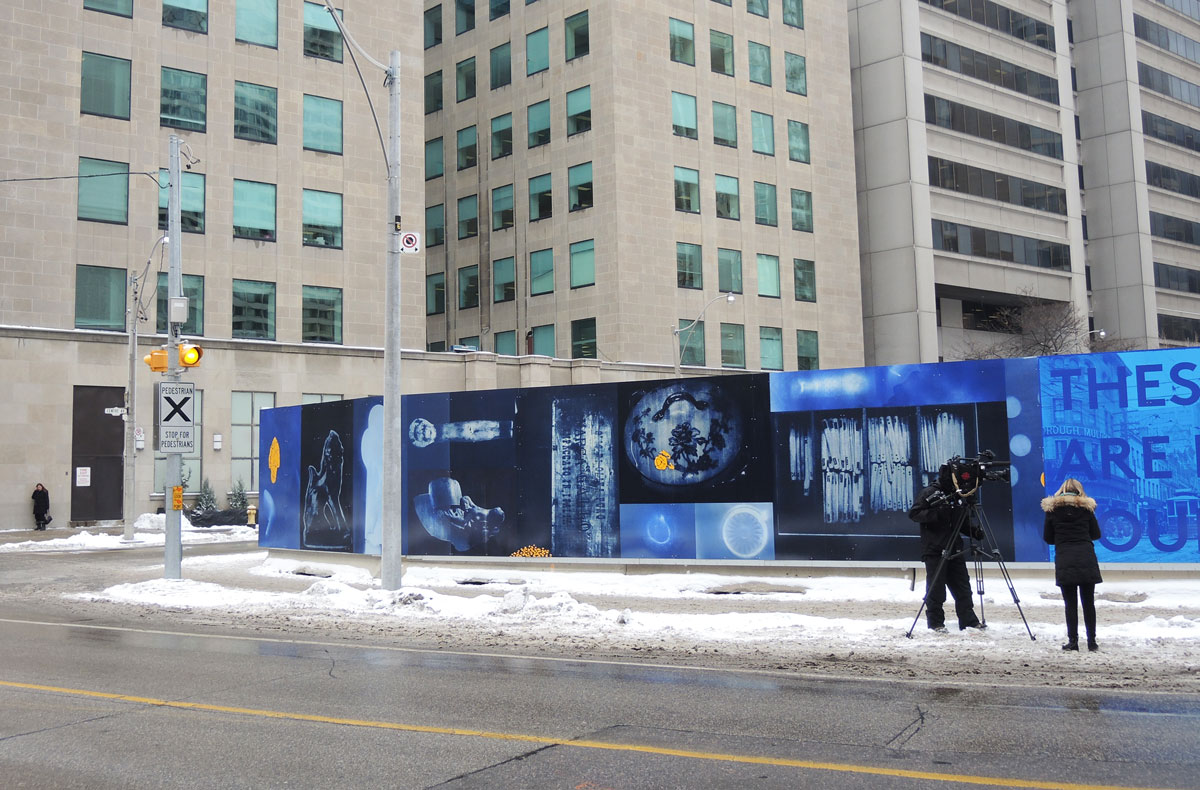
below: The south side of the hoardings are along Armoury Street. This section is called, These Stories Are Not Unlike Your Stories. Old photographs of the area have been reproduced in shades of blue. Orange ‘bubbles’ contain stories. Most of the photographs are from the City of Toronto Archives although some come from private sources.

below: On one side, the pictures are printed in reverse and the accompanying words are in French. The French stories are translations of the English ones.
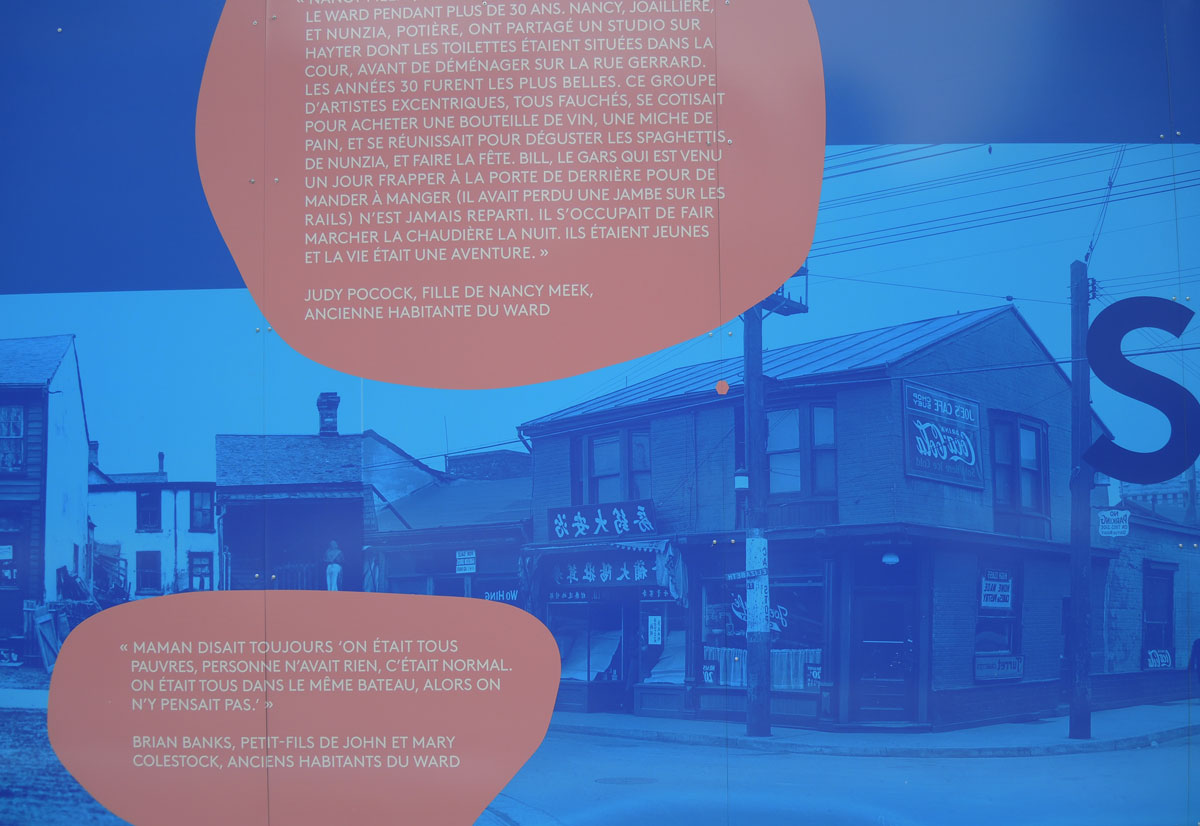
below: The people who lived in The Ward were poor and their housing was sub-standard. In 1911 a report by the city’s Department of Health described how bad the living conditions were for the people here. Largely because of that report, demolition of the area started soon after to make space for office towers and government buildings. I’m not sure how long parts of The Ward survived, but it was in the 1950’s that the original Chinatown along Elizabeth Street was demolished to make way for Nathan Phillips Square.

below: Some of the orange bubbles contain quotes from descendants of former residents of the area. The bottom quote is: “My mom use to say, ‘We were all poor. No one had anything. It was normal. Everyone was in the same position so we didn’t worry about it too much.'” by Brian Banks, grandson of John & Mary Colestock, former residents.

below: There is still a lot of work to be done on the site! The mural will be on view until at least October of next year. If you are interested in the details of the mural, more about the people featured, or the events described, then the best place to start looking is the section of the Toronto Ward Museum website that is devoted to this project.
If By Dull Rhymes
an exhibit by David Armstrong Six and Kristan Horton
Clint Roenisch Gallery, St. Helens Ave
Dull rhymes may not be the best title as there was nothing dull about the exhibit.
This exhibit features two Canadian-born artists. The sculptures that you see are by David Armstrong Six. They are playful mashups of broken and cast off pieces and many resemble the human form in one way or another. You can imagine them dancing around the room when the lights are off and everyone’s gone home. For now, their dance is frozen in time as they await tonight’s revelry. The two works on the wall are by Kristan Horton.
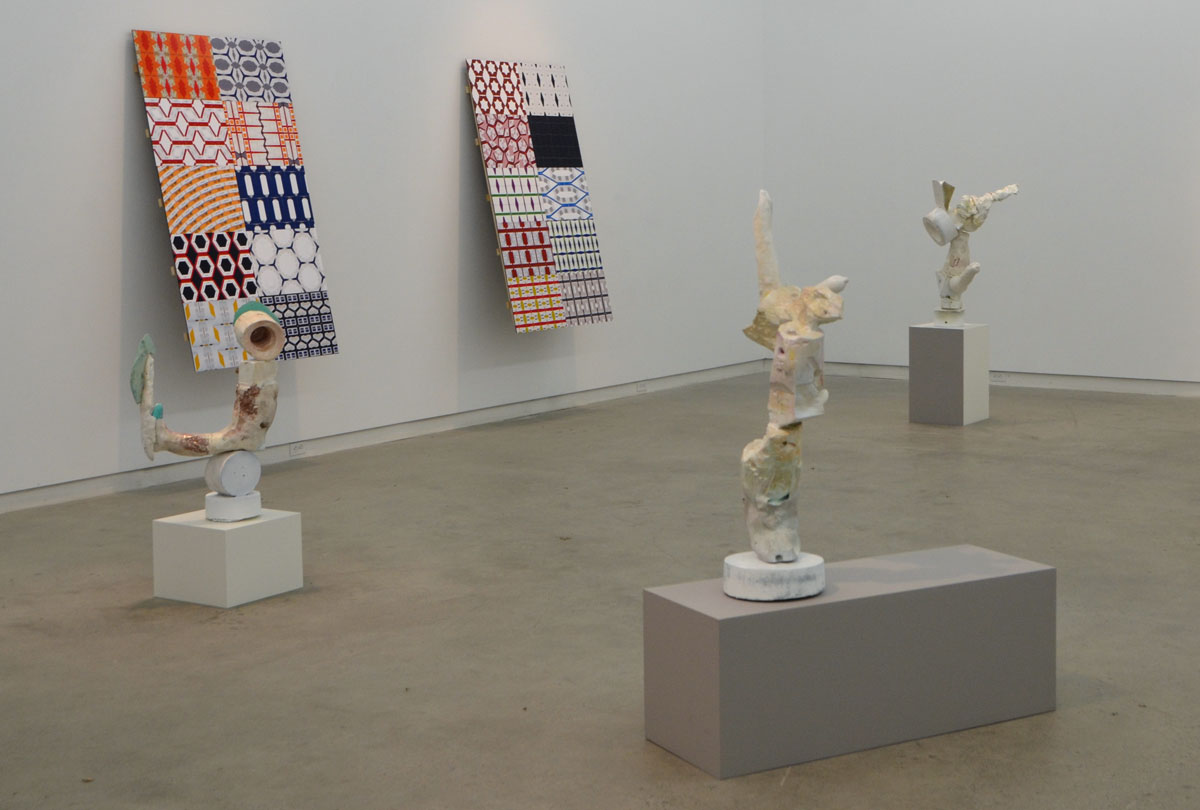
below: Close up of one of the panels. Details. Eye catching. Mesmerizing. Geometric Patterns. Each section is made with a single part of a piece of packaging that has been manipulated (rotated, flipped, etc) to make a repeating pattern.
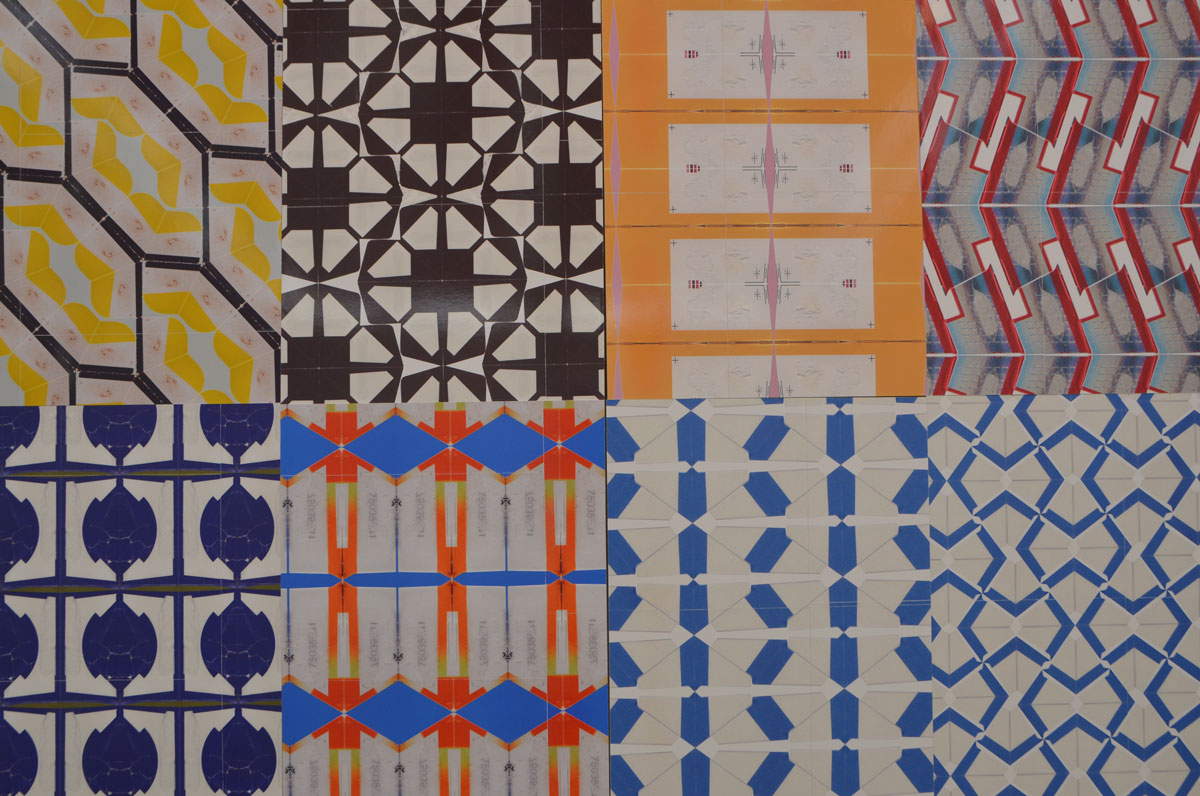
below: Here you can see the barcode from a box of something. The number 2729 appears with the barcode – sometimes it in the ‘correct’ orientation and sometimes it’s the mirror image.


This is only a sample of the works on display. There is a lot more information on by Kristan Horton‘s website. I haven’t found a website for David Armstrong Six, but there are images of some of his other work online if you are interested.

The exhibit is only on until the 17th of December.
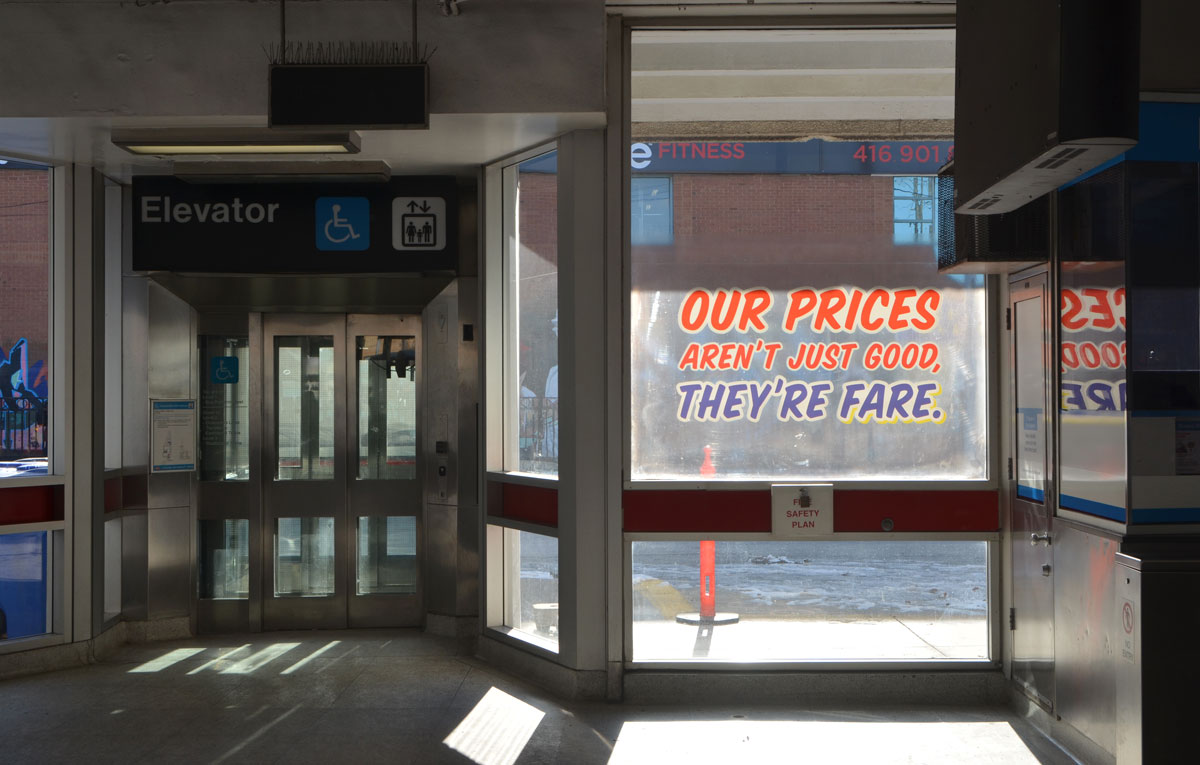
Someone has redone the signs in Bathurst subway station….
now they look like they belong at Honest Eds store!

… and when I came up to street level I discovered that the station has been decorated with Honest Eds type ‘adverts’ complete with awful puns
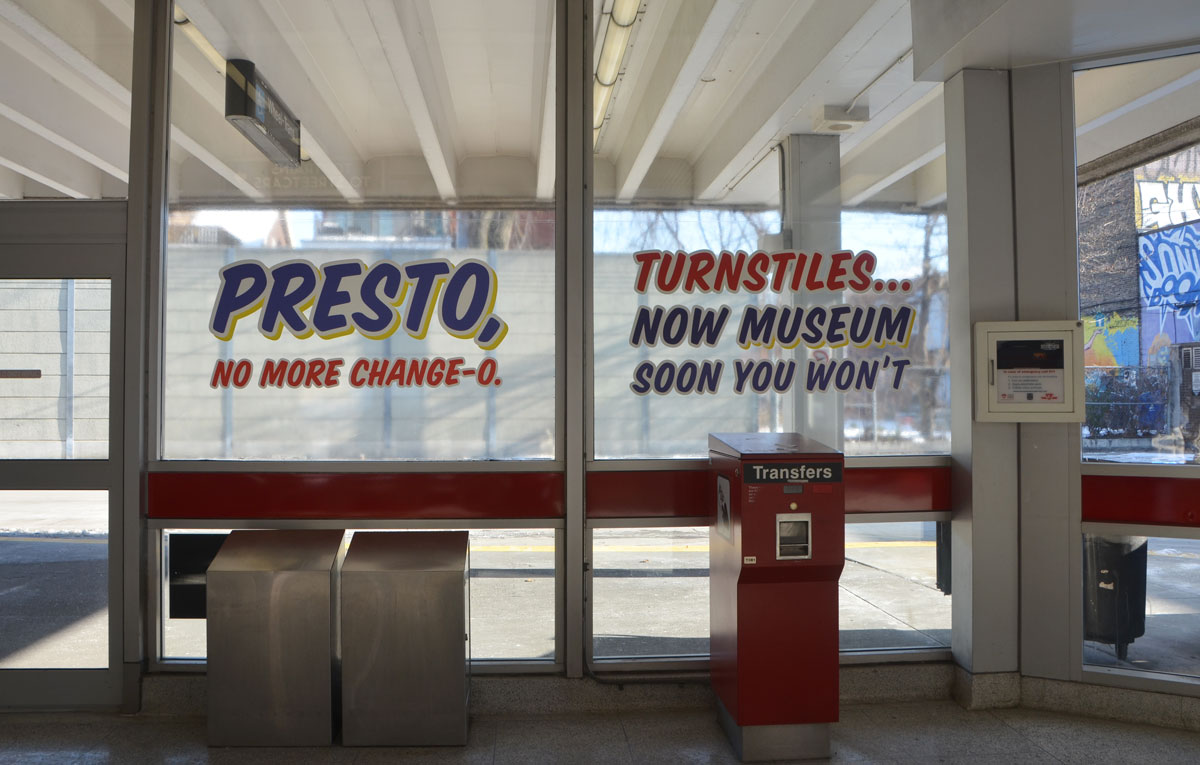
…. including word play based on subway station names such as “Turnstiles, now museum, soon you won’t”. Groan. Smile.
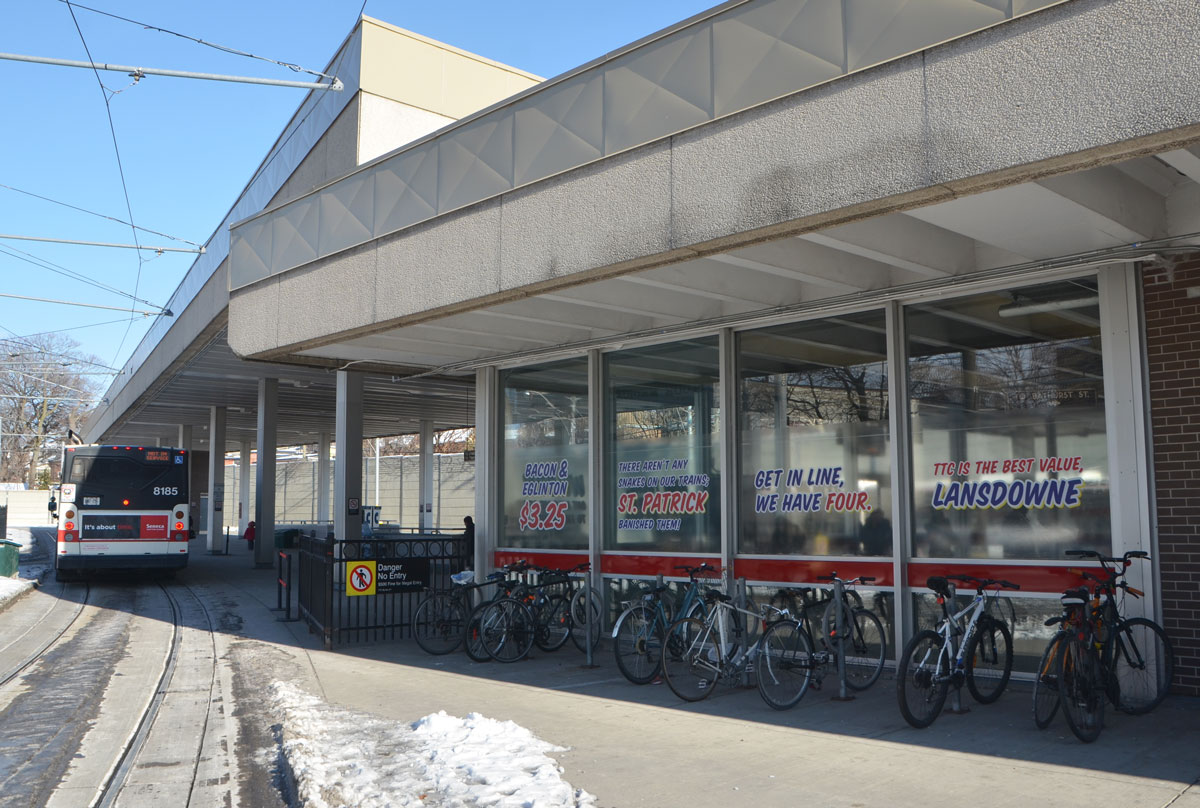
below: The main entrance to the station now looks like an Honest Eds window.

below: They aren’t too easy to read in this picture, but the two signs on the left are, first, “Bacon & Eglinton $3.25” and second, “There aren’t any snakes on our tracks, St. Patrick banished them”. Were you expecting better? [laughing]
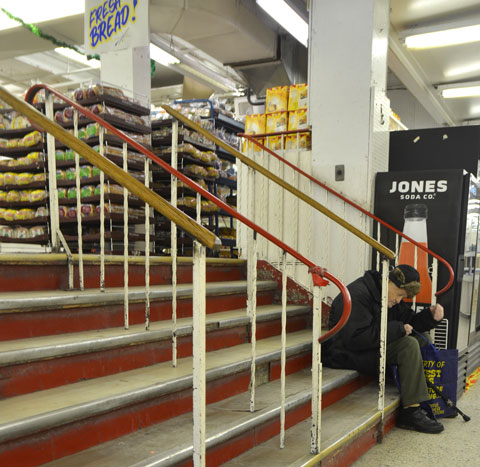
Nearby is the real Honest Ed’s store, a landmark for many years. Eighteen months ago, I posted some pictures of the store and at the end of that post I mentioned that the store was scheduled to close at the end of 2016. Well, the end of 2016 is drawing nigh and Honest Ed’s is slowly winding down. The decorating of Bathurst Station is part of the good-bye process.
At the moment, the interior of the store is a shadow of its former self. It is still in business but the goods are getting scarce. There are definitely still bargains to be had. I have a new hat that I bought there today, red polar fleece, that set me back 50 cents… plus tax.


below: Ed Mirvish and a crowd of shoppers back in the day.
The picture still hangs in one of the many corners of the store.


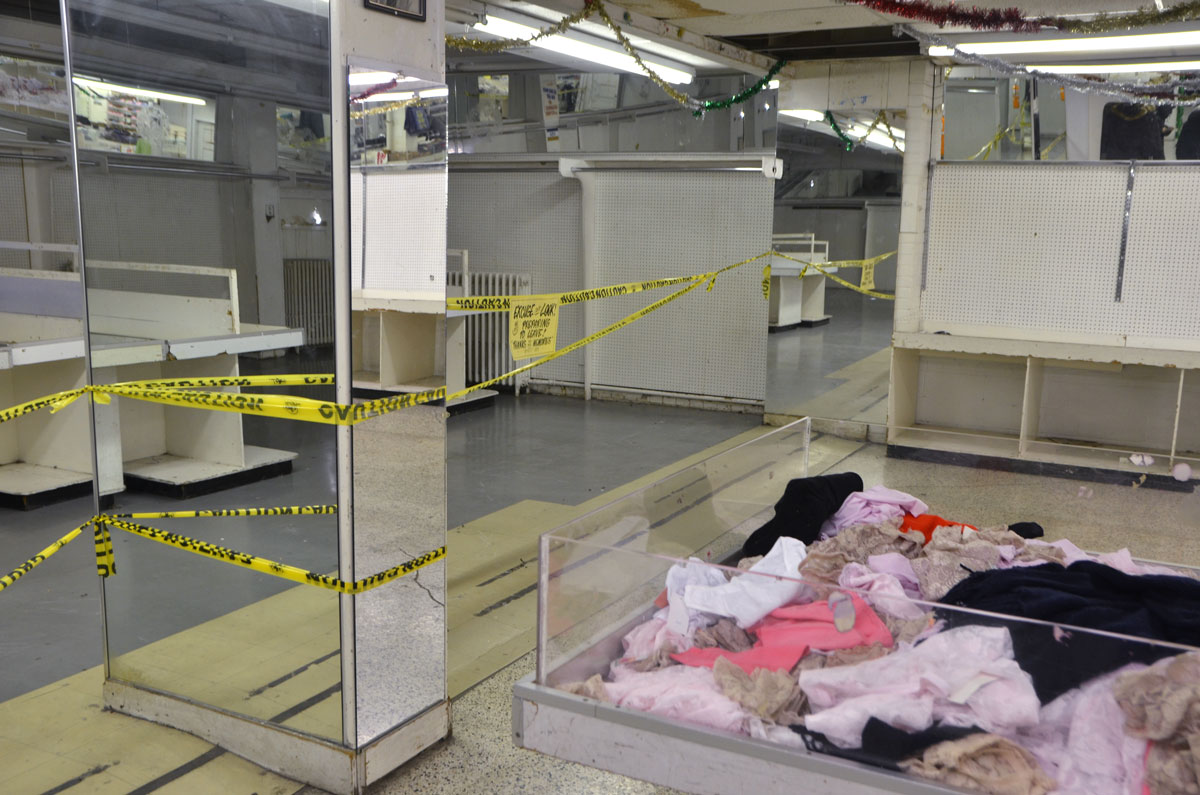

below: Photo taken from the walkway between the two buildings that make up Honest Ed’s store. Looking south.

below: From the same vantage point, but looking north. From here I spotted a new mural.
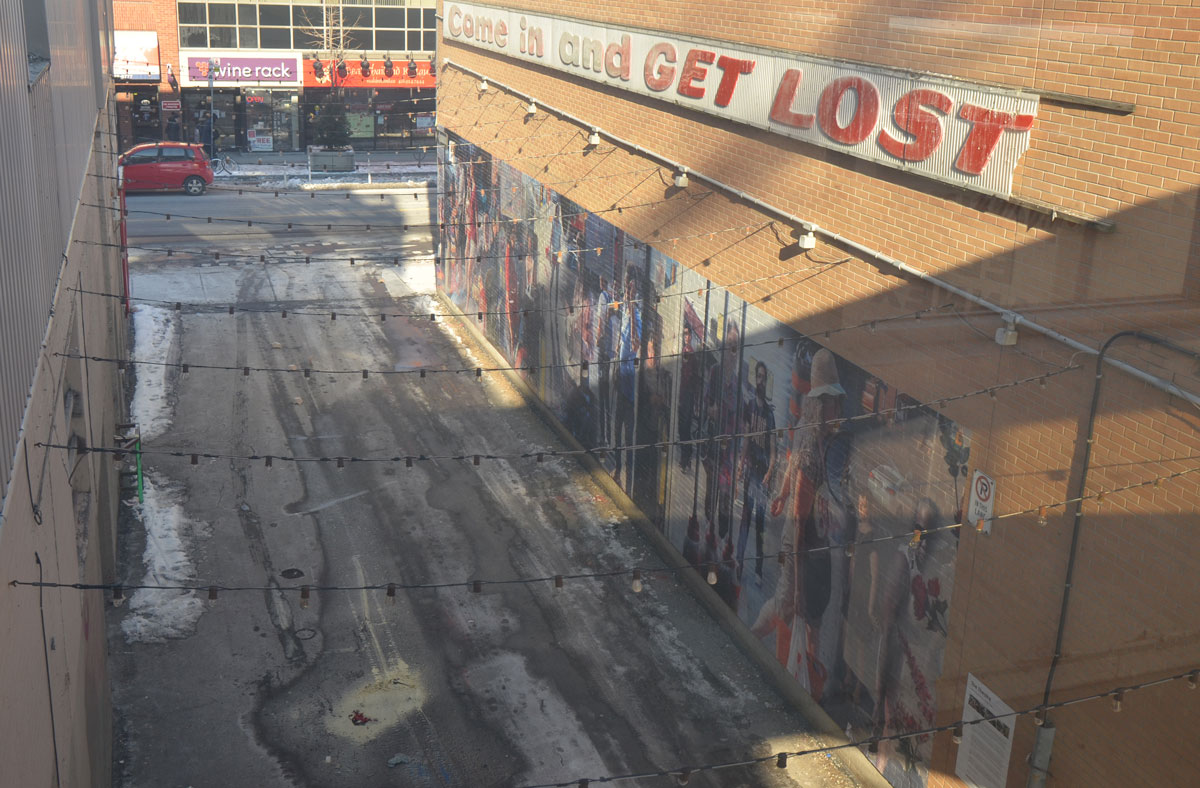
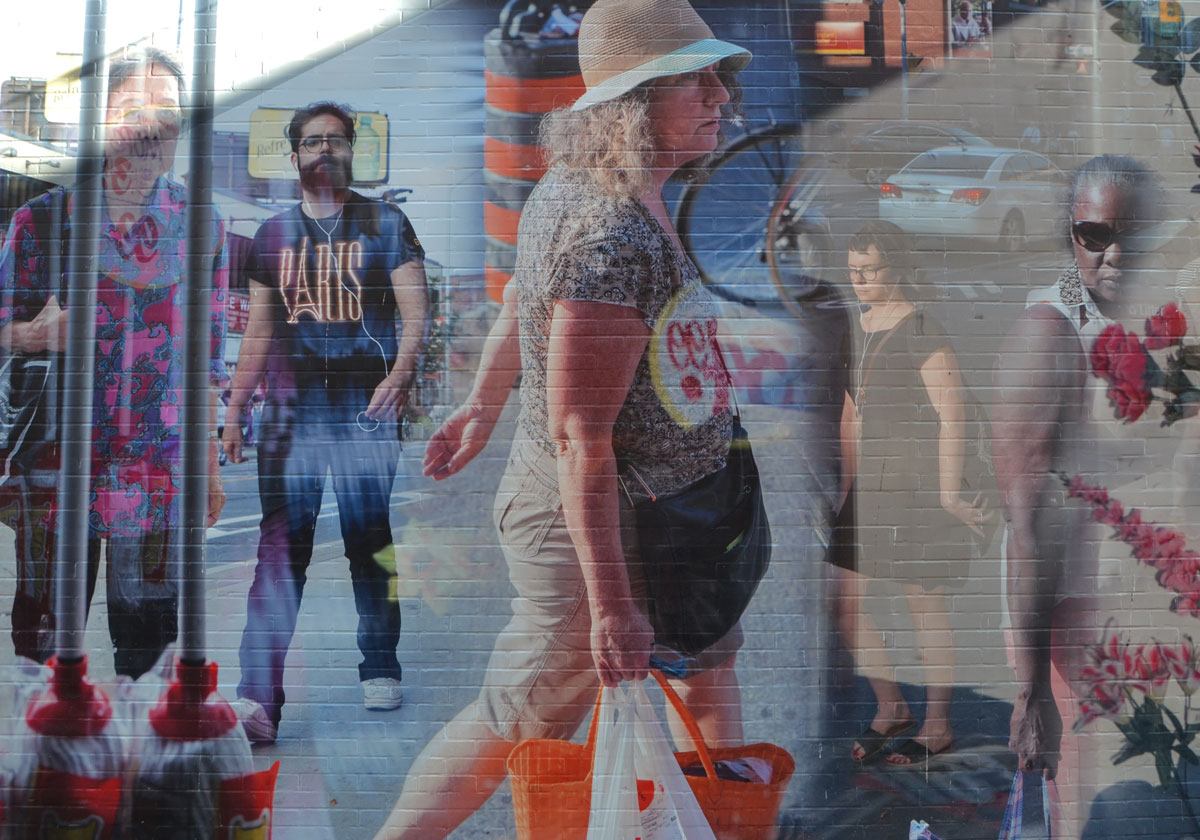
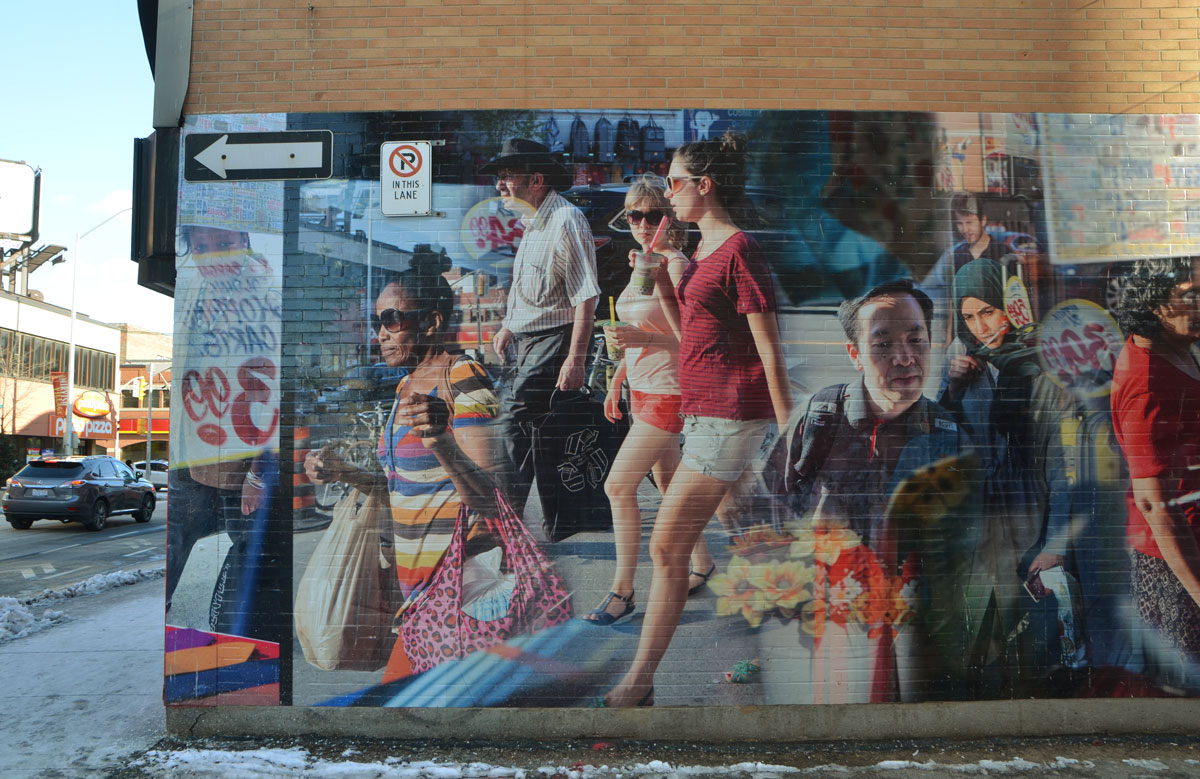
below: The mural is a large scale photo montage of people passing by the Bloor Street windows of Honest Ed’s. It catches the reflections of both the window contents and the life on the street. It is “The Theatre” and it is the creation of Matthew Monteith.

You’ve probably never heard the word asafo before. You probably have no idea what it means.
Until last week I didn’t know the word existed either.
I went to the Royal Ontario Museum to see the Wildlife Photographer of the Year exhibit. There were 100 excellent pictures of insects, animals, marine life, the sort of thing you’d expect. There was no photography allowed in that exhibit so I have no photos of the images on display. You’ll have to take my word for it that I was there.
I can appreciate the skill and patience that it takes to capture rabbits in the snow or a school of fish in a certain light underwater but those kind of pictures don’t excite me. That’s not to diminish the work of the photographers, it was all very high caliber both technically and visually. What I think I’m trying to say is that I left the exhibit wanting more, something more from my visit to the ROM.
Luckily I didn’t have to look far. In the next room was Art, Honour, and Ridicule: Asafo Flags from Southern Ghana.
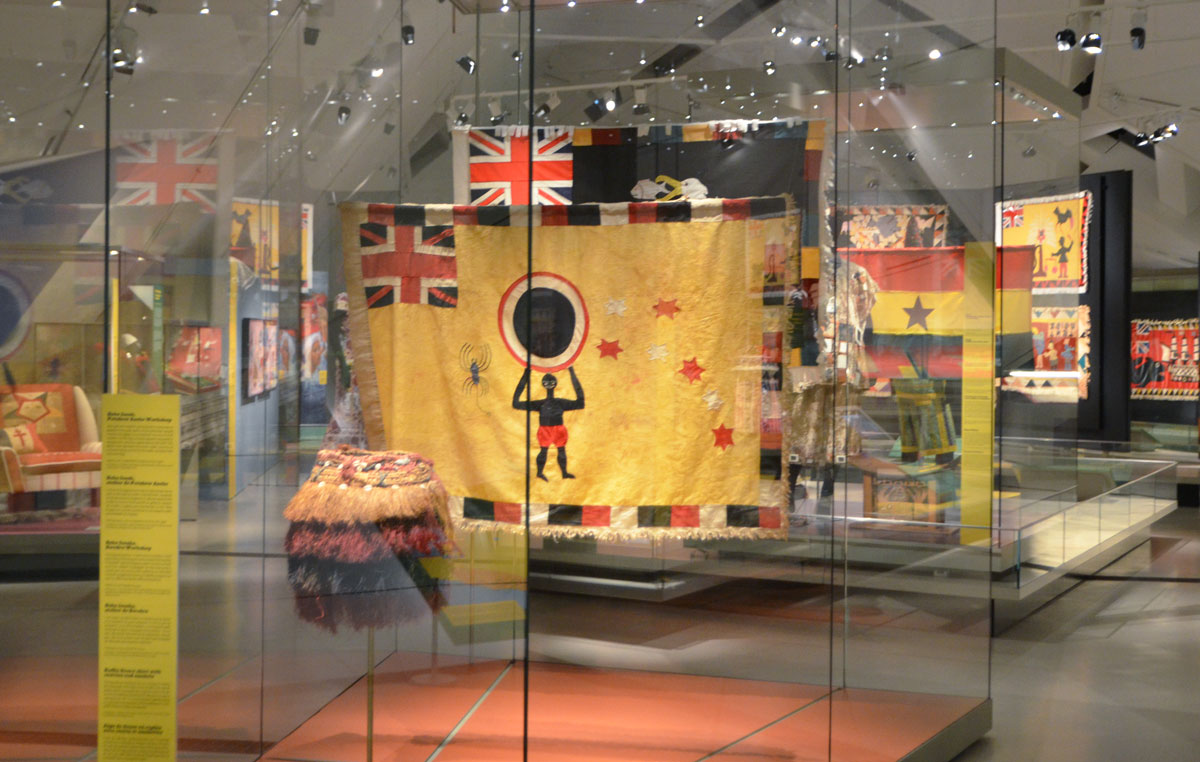
Colour, lots of colour. And a subject that I knew nothing about, asafo flags. I wasn’t even sure what part of Africa Ghana is in (It’s on the south coast of Western Africa between Togo and the Ivory Coast as it turns out.).
The flags are hand made with an assortment of different motifs. The British Jack in the upper left corner is a very common feature. That’s a clue. Yes, Ghana was a British colony. Reading the history of Ghana is like reading the colonial history of large parts of Africa. The Portuguese built a fortress at Elmina in 1482. Interest in the region was piqued by the presence of gold, hence the name Gold Coast. By the early 17th century the first African state, Akwamu, controlled an extensive part of the coast. They were displaced by the Ashanti who were very involved in the slave trade, especially in trading slaves for weapons. When European countries outlawed trading in slaves in the early 1800’s, Ashanti power suffers. Some tussles ensue, a few battles, some back and forth, and by 1902 what was Ashanti becomes is a British colony. It remained a colony until 1957.

I’m not going to pretend to know or understand African history. I’m only trying to give some context to the flags. First, jump back to my mention of Elmina and the Portuguese. When the Portuguese arrived in this area in the 15th century, it was the Fante (or Fanti) people that they encountered. Both the Fante and the Ashanti belong to the Akan people. The Fante prevented them from venturing inland and leased properties for Portuguese trading missions. But when the Portuguese objected to Fante rules and regulations the Fante expelled them. Soon after, the Dutch arrived. The Fante served as middlemen in the commerce between the interior and Dutch traders on the coast.
Around 1724 the Dutch either established or made important a number of militia groups of local Fante. These are the Asafo companies. Historically, Asafo companies were in charge of the safety and protection of the local community. At the height of the slave trade they protected individuals and communities. They exerted power, exercise political influence and maintain codes of conduct within Fante communities. Each company has a flag and that flag has many roles. They represent proverbs and depict narratives of pride and wisdom. They accompany oral history and provide a means to preserve customs and traditions.
below:
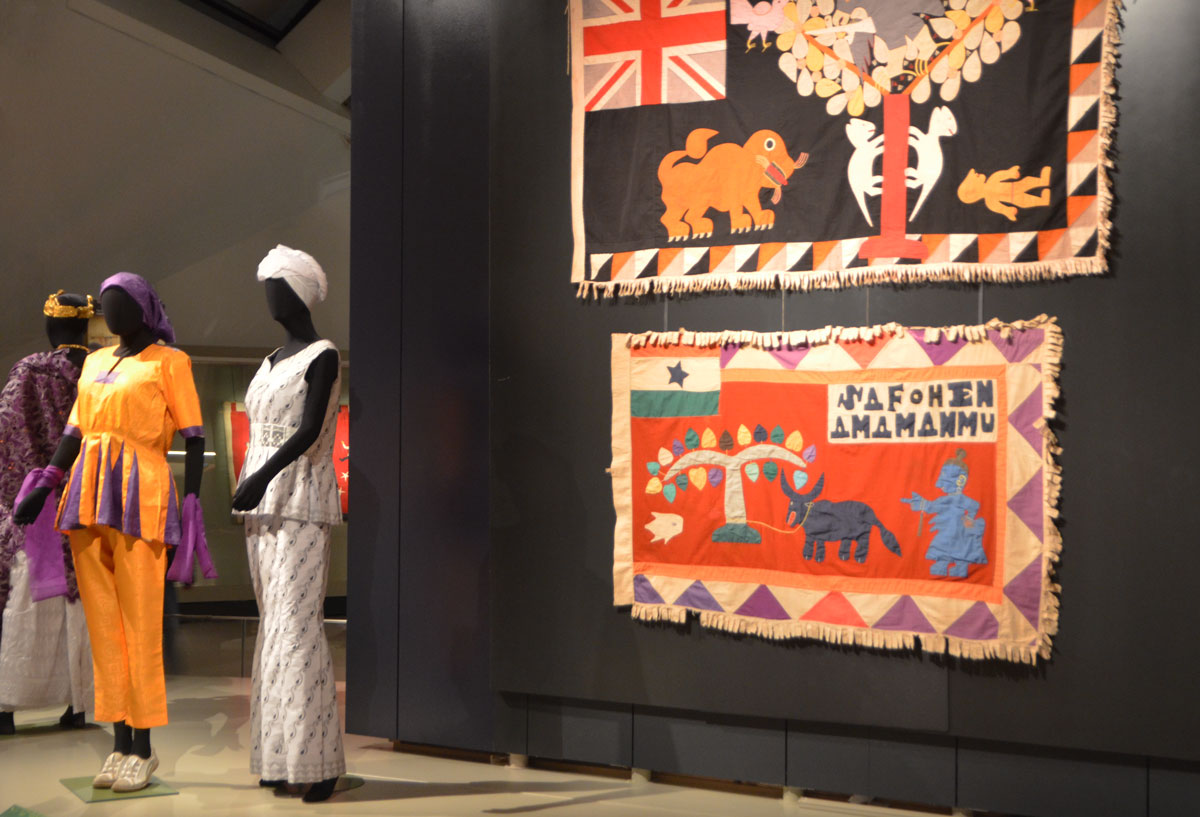
below:
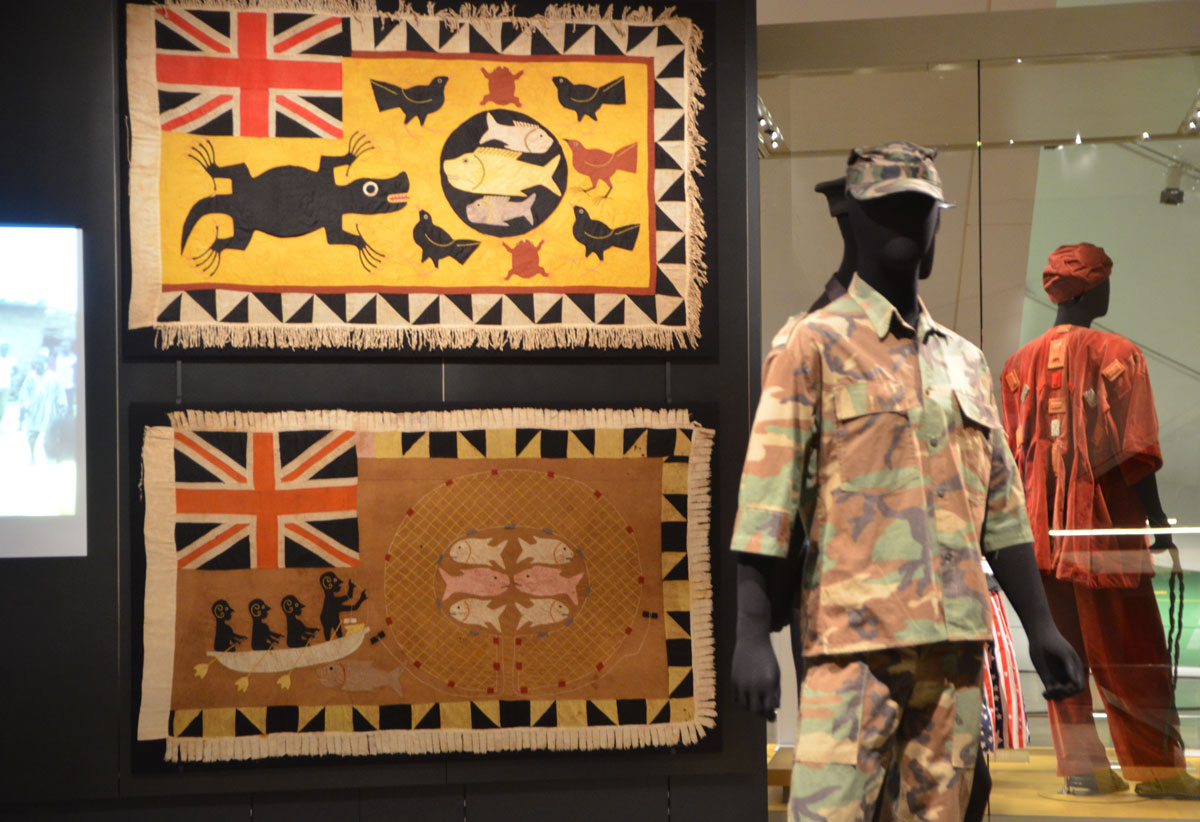
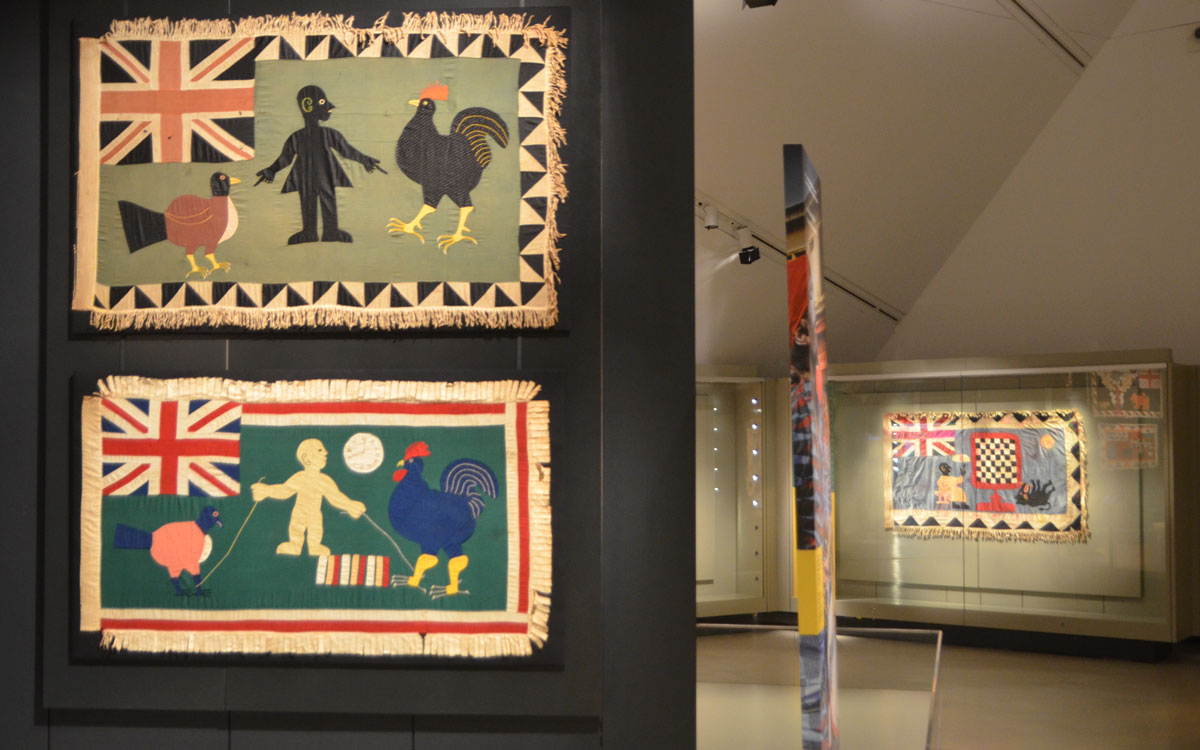


Patricia Harris Gallery of Textiles and Costumes,
ROM, 4th floor,
until March 2017.
The Roden in the title of this blog post refers to Roden Public School. In their schoolyard they have this colourful mural, a fairly accurate map of the area with the school in the center. The original school on this site was built in 1907-1908 as Ashdale School. In 1910 it was renamed to honour Mr. E.P. Roden a long time school trustee. The present school was built in 1969.

below: The school is just north of Gerrard St., between Coxwell and Greenwood, and south of the railway tracks. I suspect that the 100 in the circle that marks the school has to do with the 100th anniversary of the school although I haven’t been able to find any information about the mural online.
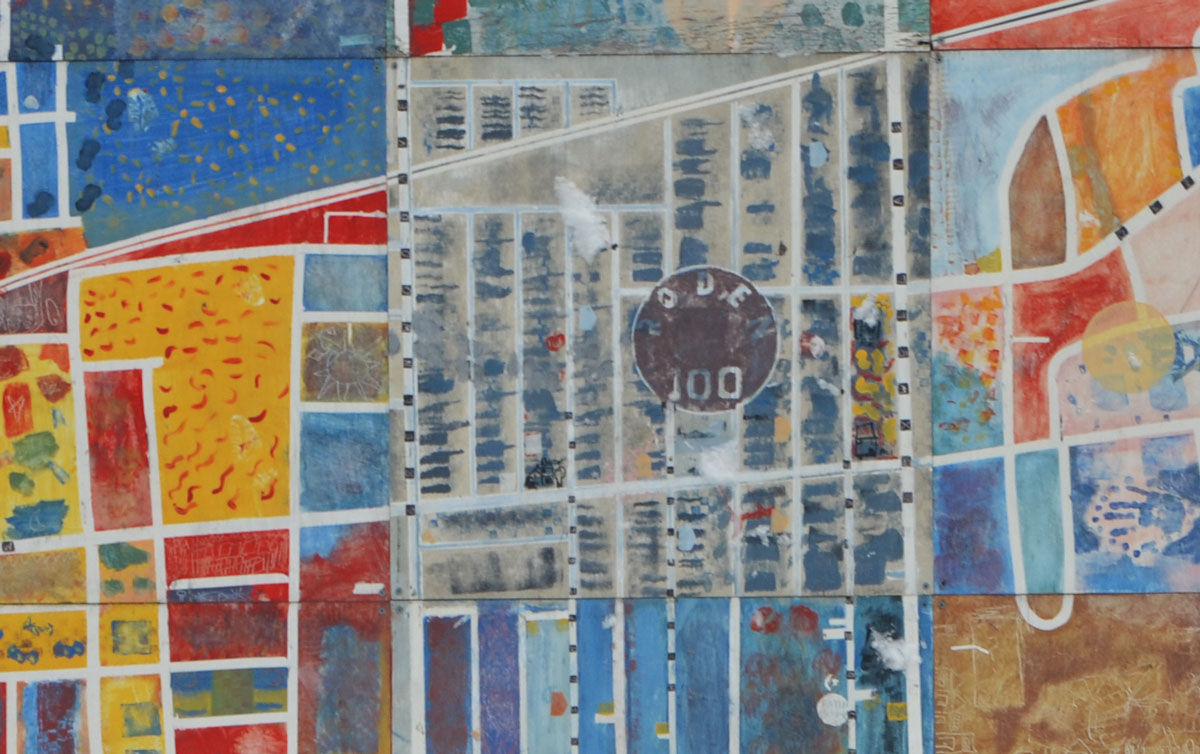
All day Sunday, and well into the early hours of Monday morning, it snowed. It’s been many months since I’ve walked on a snowy day. It was a bit grey and there wasn’t a lot of contrast (as in light and shadow) in the scenery yesterday afternoon when I walked, but the novelty of white snow kept me interested (and warm!). From Roden school I wandered westward.
below: Walking home after school.

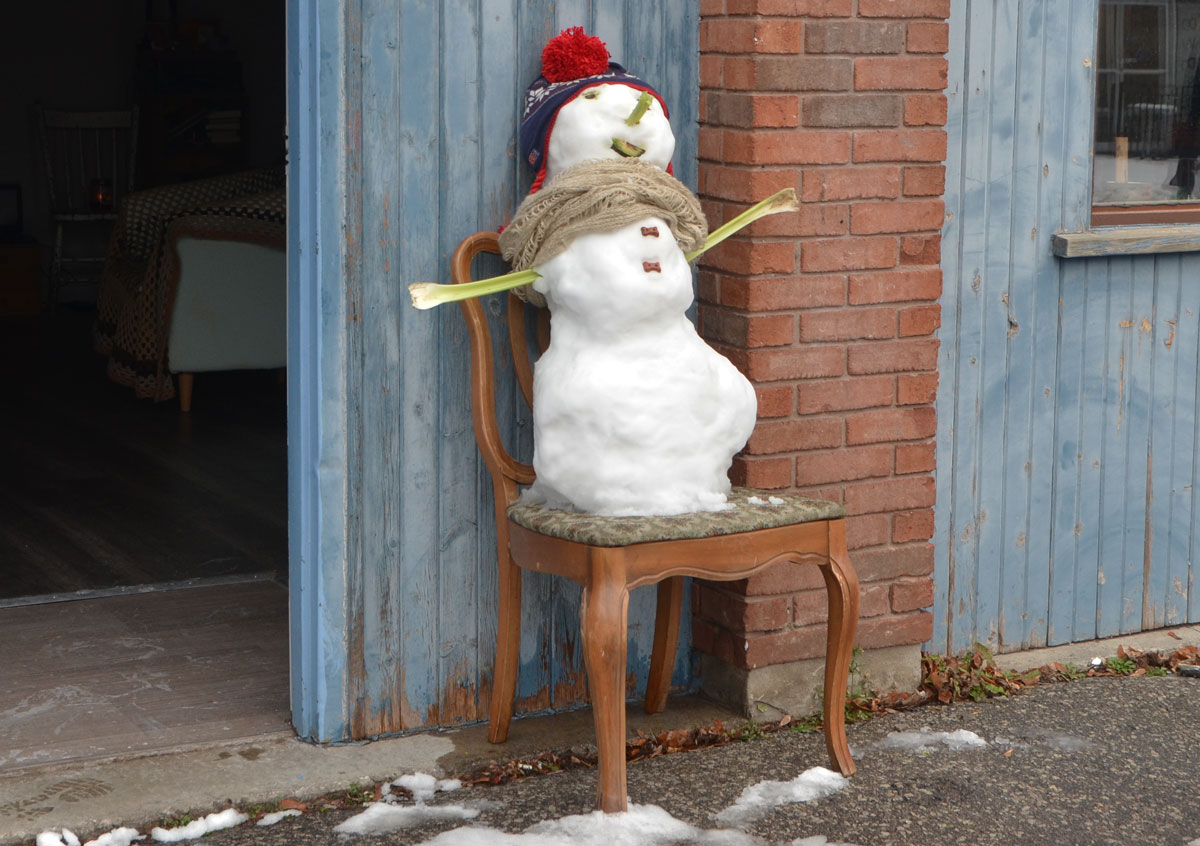
below: A cosy brown scarf and red hat, an avocado smile, celery arms are two doggie treat buttons on his tummy – a snowman living the easy life. No standing around in the snow for him!
below: This was my friend who accompanied me for part of my walk, meowing loudly most of the time. I’m not sure what it was trying to tell me. Maybe it was out enjoying the snow? More likely it was looking for a warm place to snuggle.

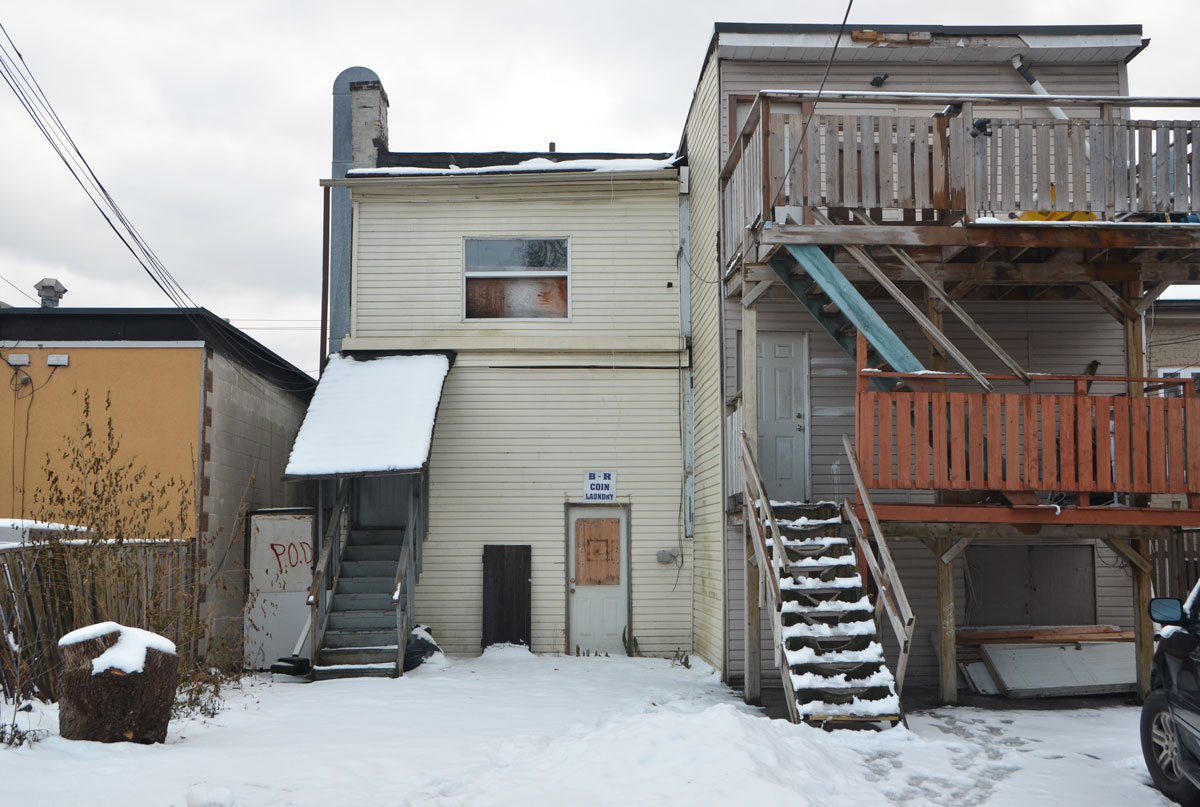
below: Busy steps, quiet steps.
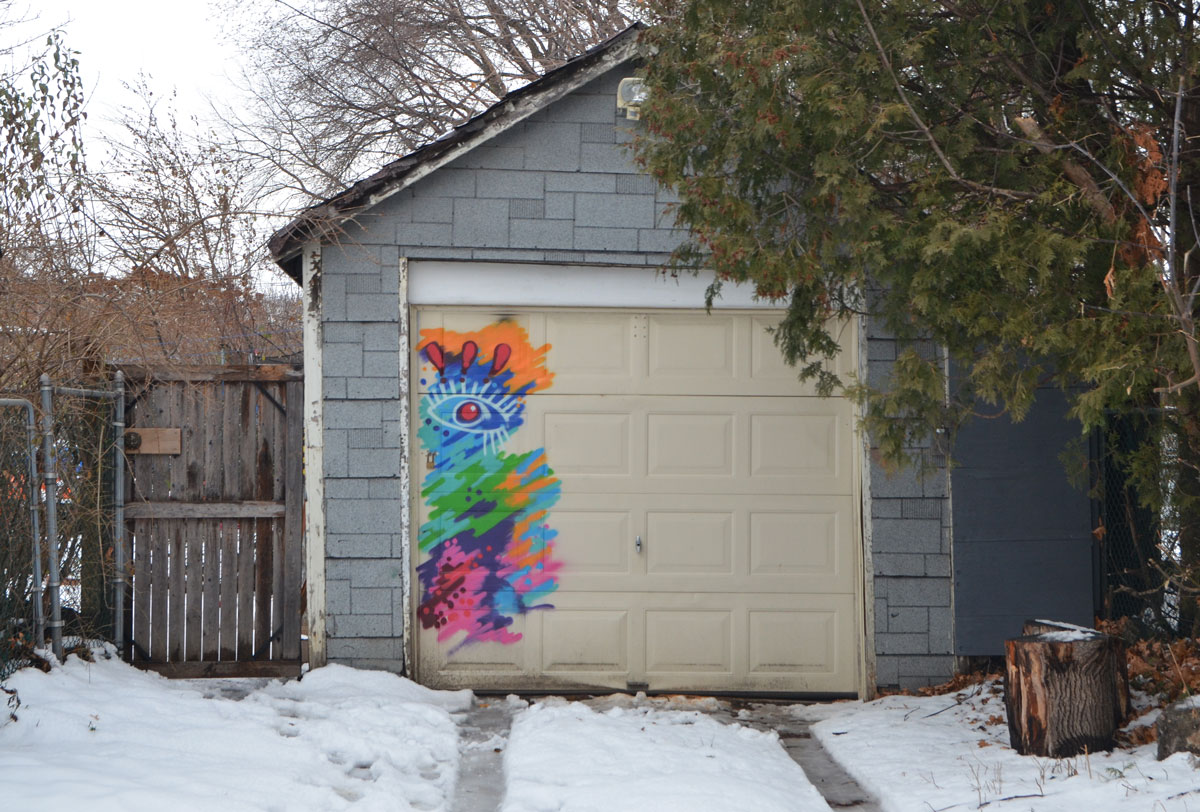
below: Keeping an eye on the garage. Eye spy!
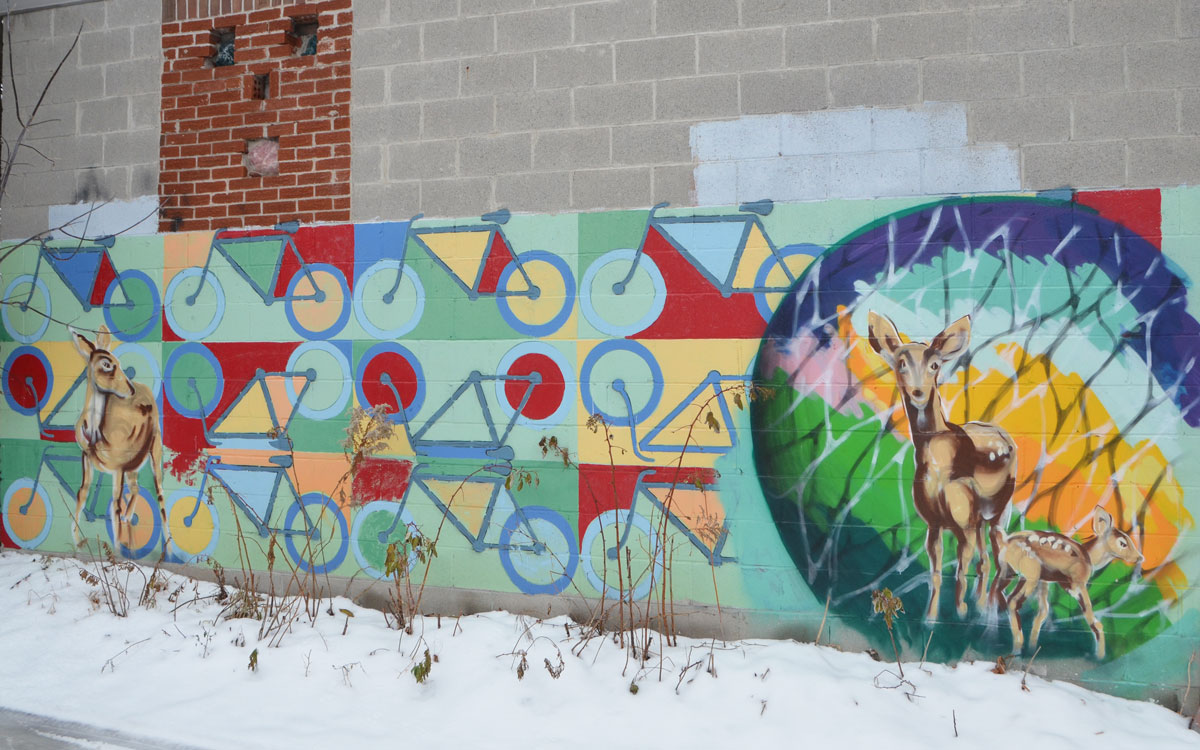
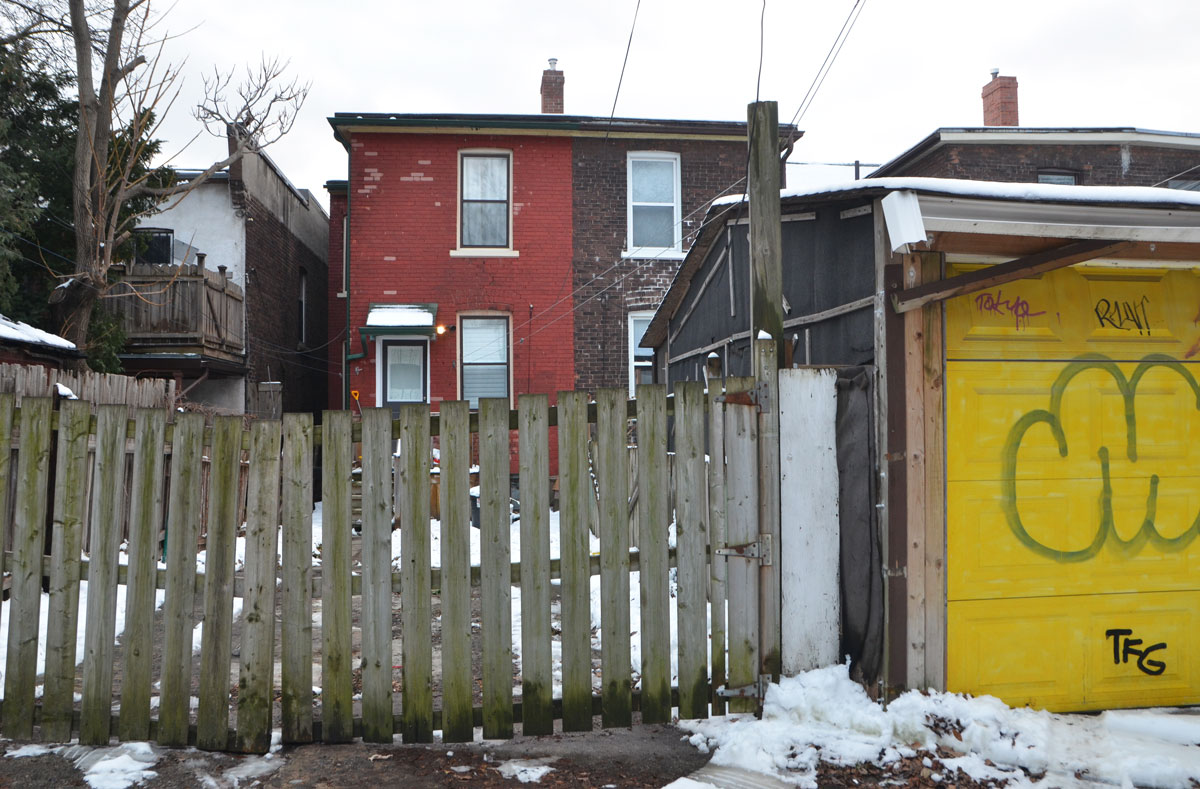
below: Bikes and deer in the alley. A mother deers keeps watch over her fawn.
below: On one hand, I want to say that for those who want to look, there are many little surprises to be found in the lanes and alleys of this city. But on the other hand, there are an incredible number of old cars parked in city backyards. Some are neglected and clearly not roadworthy while others still have some life left in them.
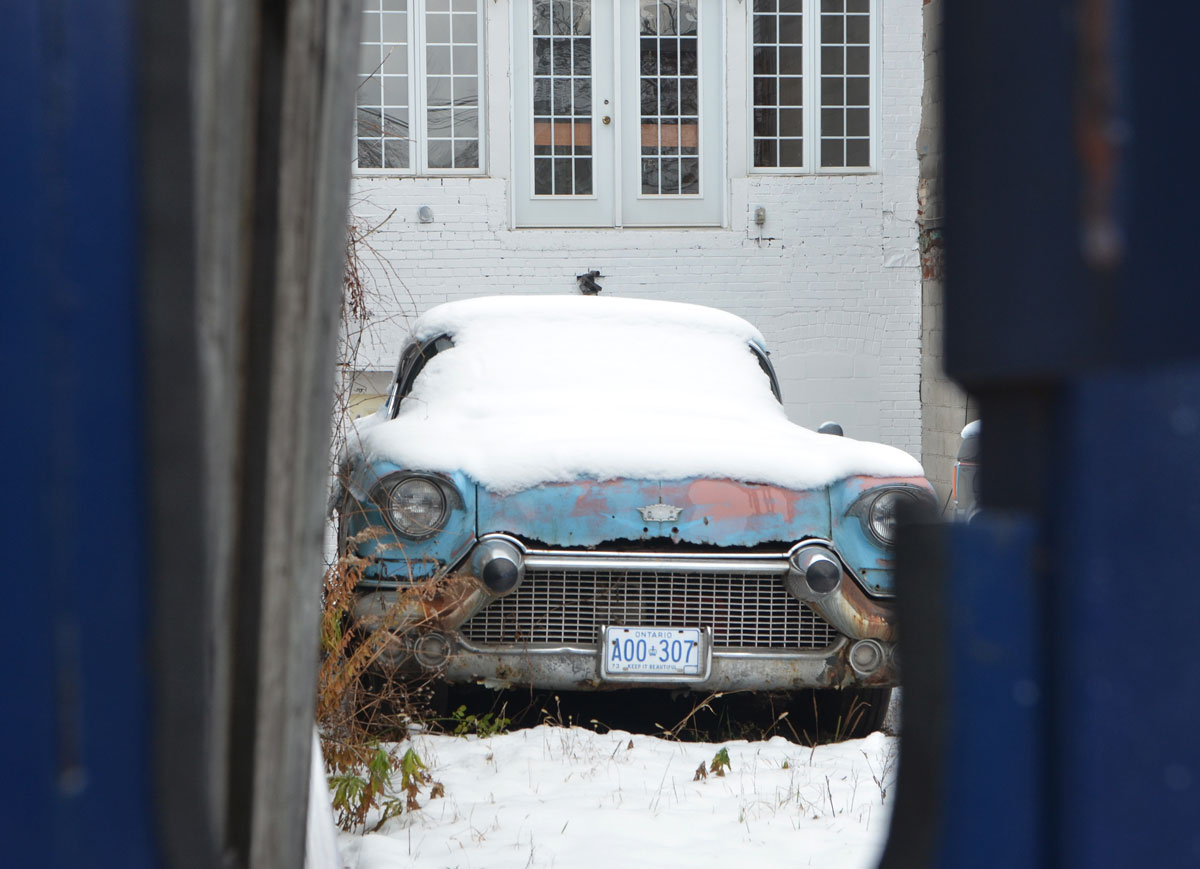
below: Another car.
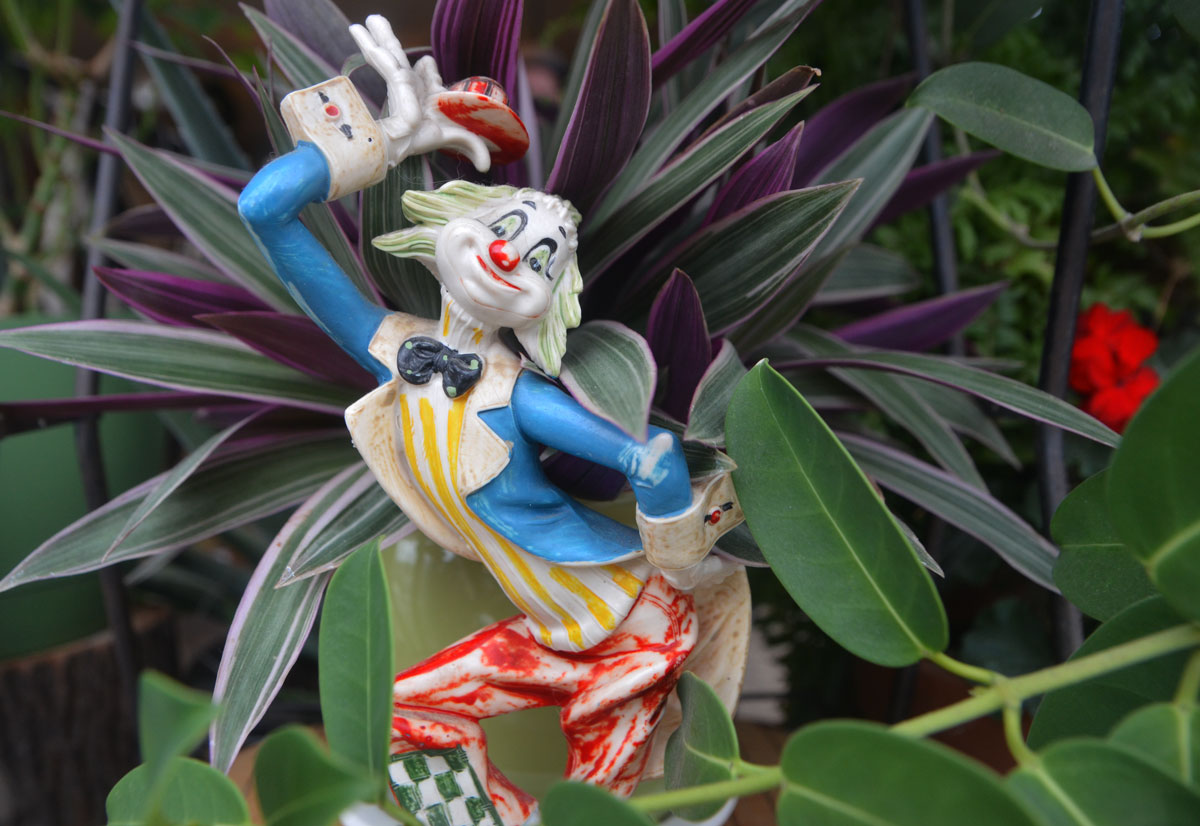
below: Clowning around in a window.
below: I think it’s dub monkey, duh?

below: Looking south to Gerrard Street. Snow and slush, very Toronto in the winter. The orange construction sign is also very Toronto, but in all seasons these days.

below: Someone added some colour to the alley when they shouldn’t have.

below: A mural by kairo, on a pink that packs a punch on a grey winter day.

below: More alley colour to brighten the day.
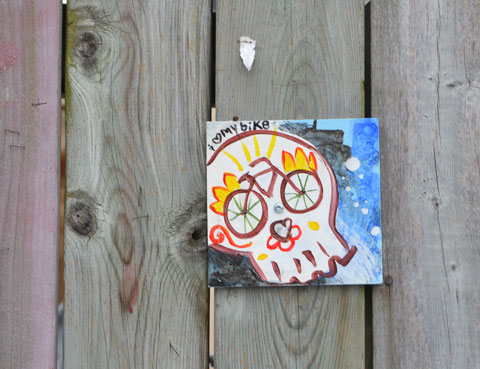
below: Someone loves their bike. I find it a bit creepy that the picture is a skull.
below: Wall art of another kind. Shades of yellow.

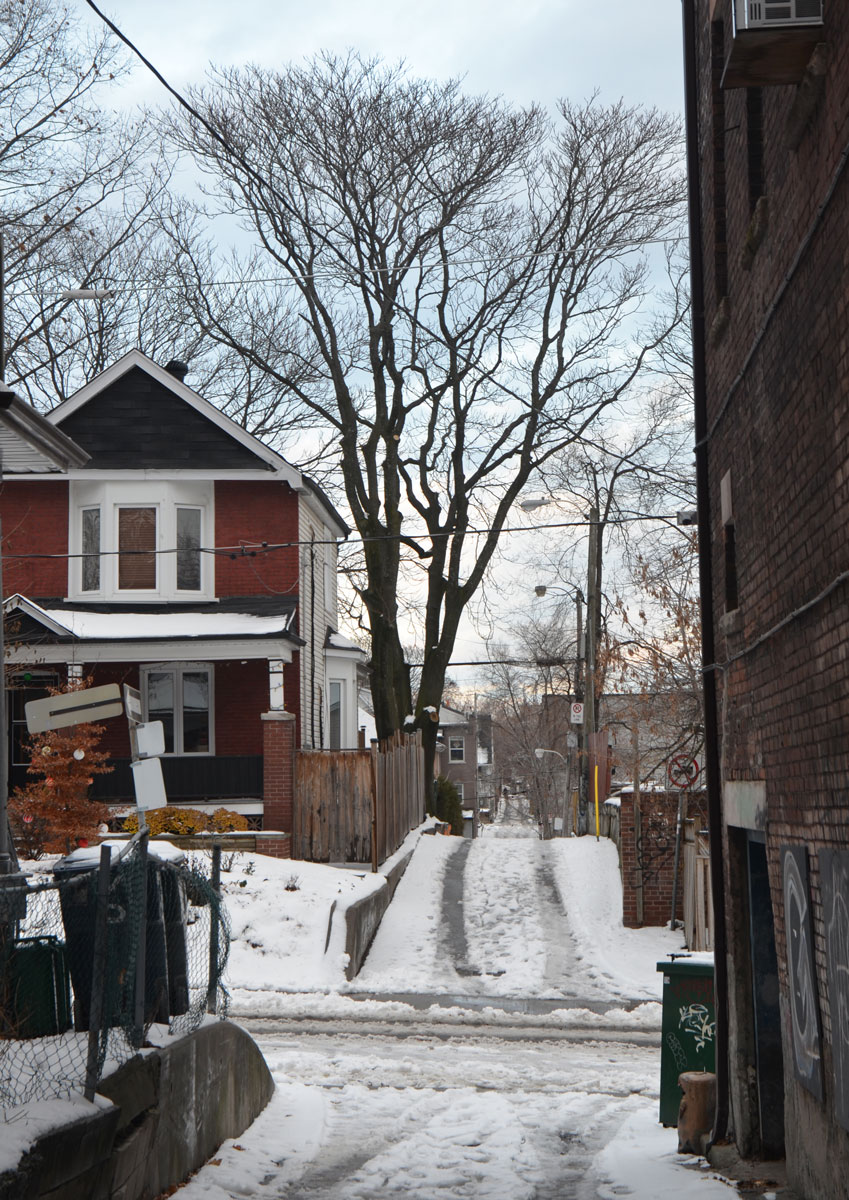
below: Little ups and downs in the lane. A large majestic winter tree stands over the lane.
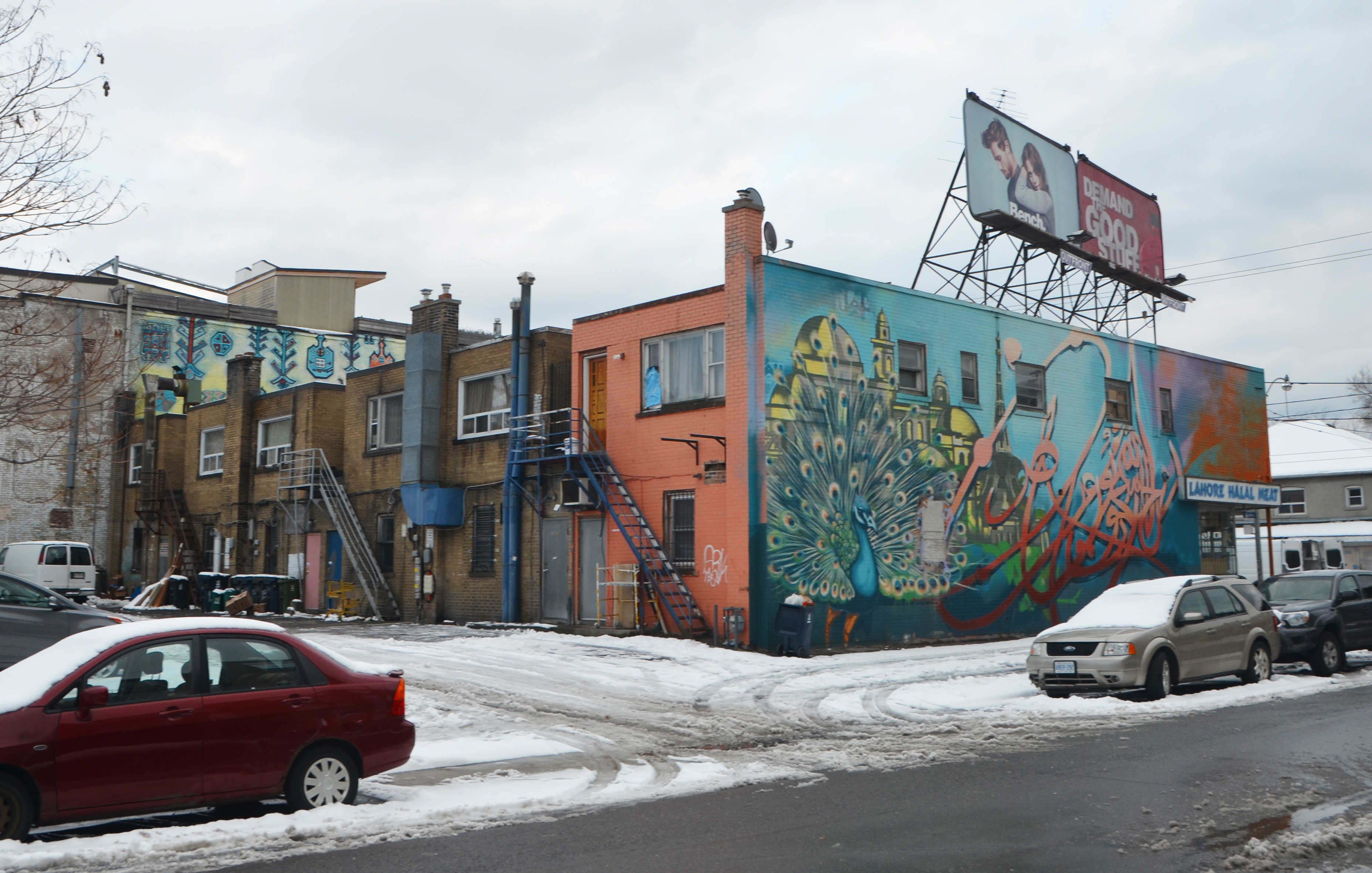
below: A peacock mural. Lahore Halal Meat store on the corner of Gerrard is a reminder that this part of Gerrard was/is referred to as Little India because of the large number of Indian (Southeast Asian) shops and restaurants.
below: This photo is from the entrance to Lahore Halal Meat store in the above photo. The material on the inside features brides and grooms within heart shapes and surrounded by white flowers. Not what you’d expect in a meat shop!

below: Textured concrete, broken bricks, and the remnants of a black stencil.

below: Sunflowers reach for a sunny place.
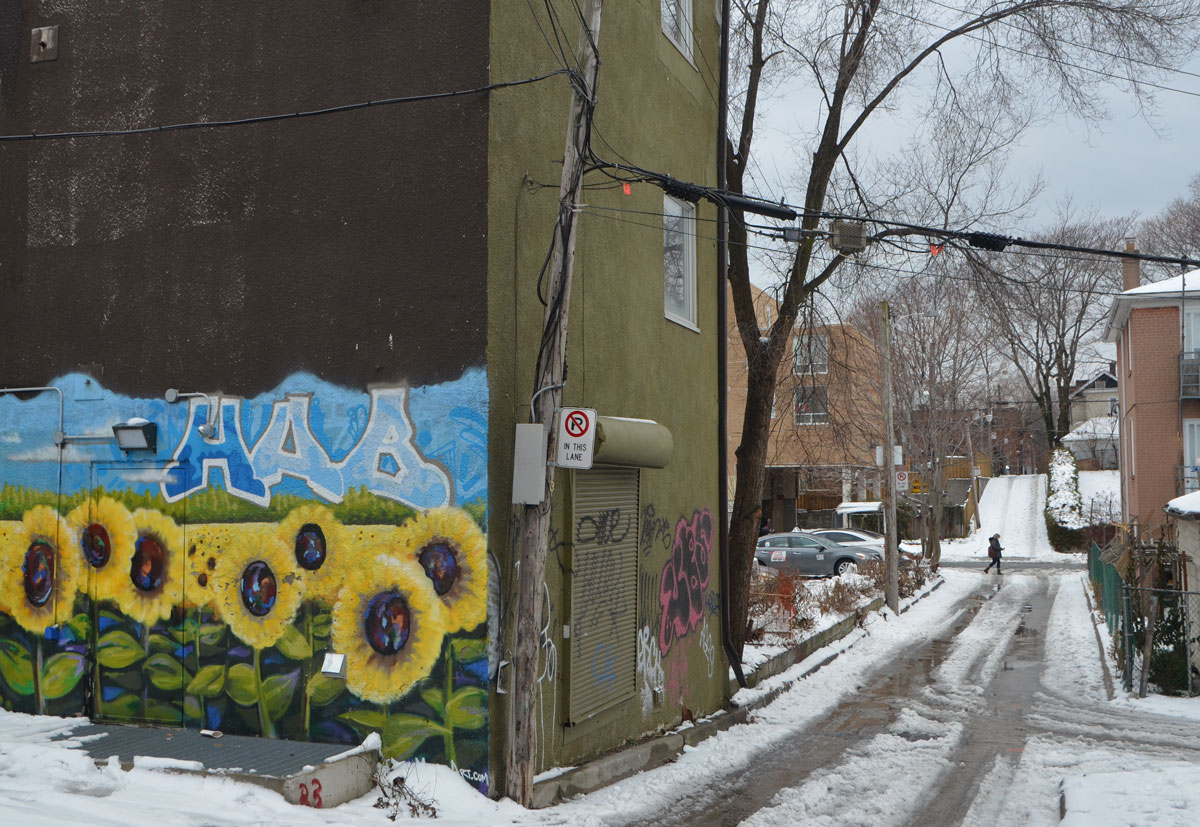
below: A fork in the alley. A jumble of lines.
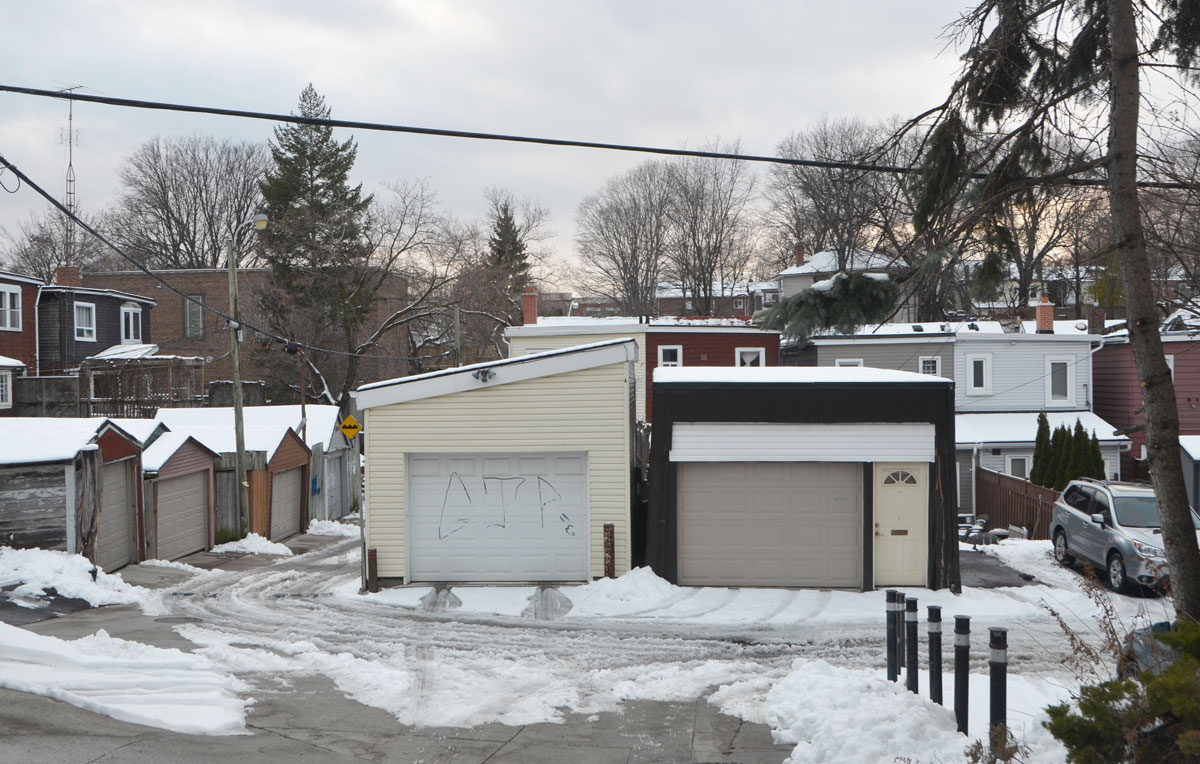

A few weeks ago I posted some pictures of the fence along Craven Road that has been decorated with artwork and old artifacts. I was south of Gerrard Street when I took the photos. I didn’t realize at the time that I missed another outdoor gallery on the other side of Gerrard. Today I took some pictures of those on display on the north side. Here they are in no particular order:
below: Looking north up Craven Road along the fence.
That tropical sunset on the left looks very inviting!


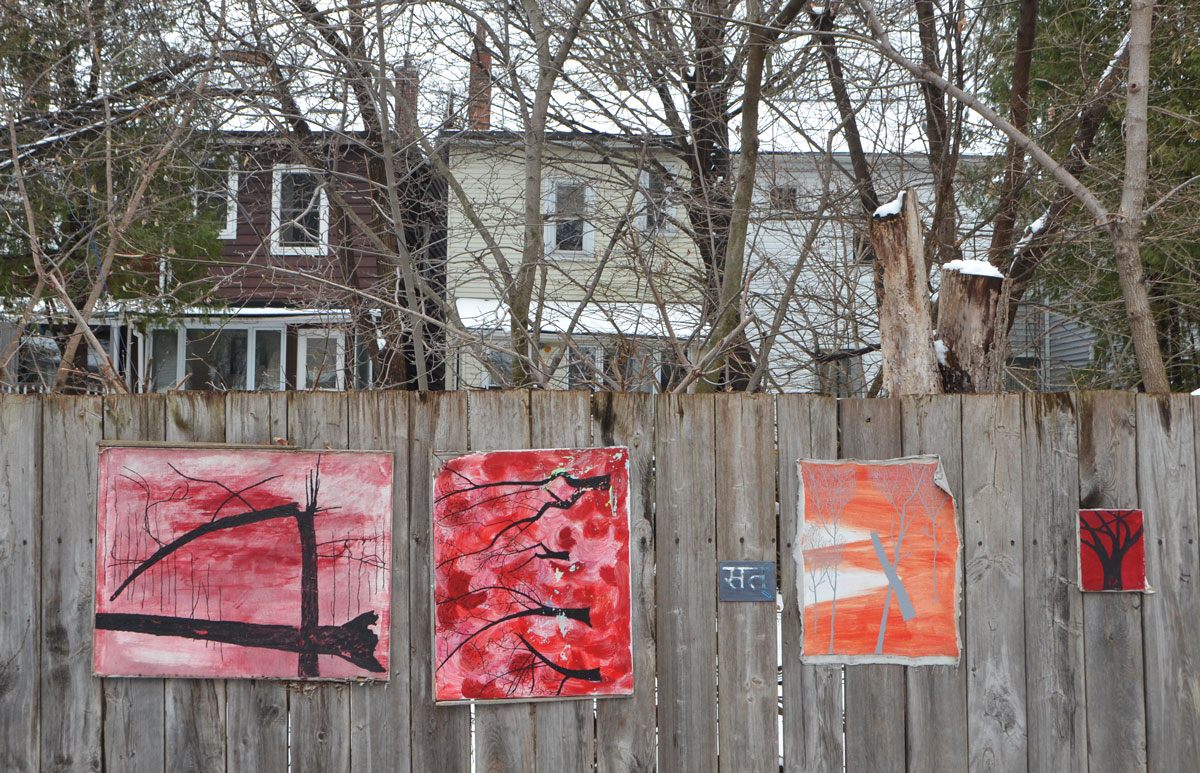

below: Some of the paintings are small words in another language and another alphabet. Can anyone translate for me?


By now I’m very curious about this street and this fence. I found a long, detailed, and interesting history written by local historian Joanne Doucette that you can read here.
me a visitor, a looker, and and a skeptic.
I happened upon a gallery yesterday, the Robert Kananaj Gallery, on the second last day of a show by Oscar Figueroa called ‘me a talker’. As I type this, the show should be wrapping up. So you’ve missed it. I’m not sure what you’ve missed.
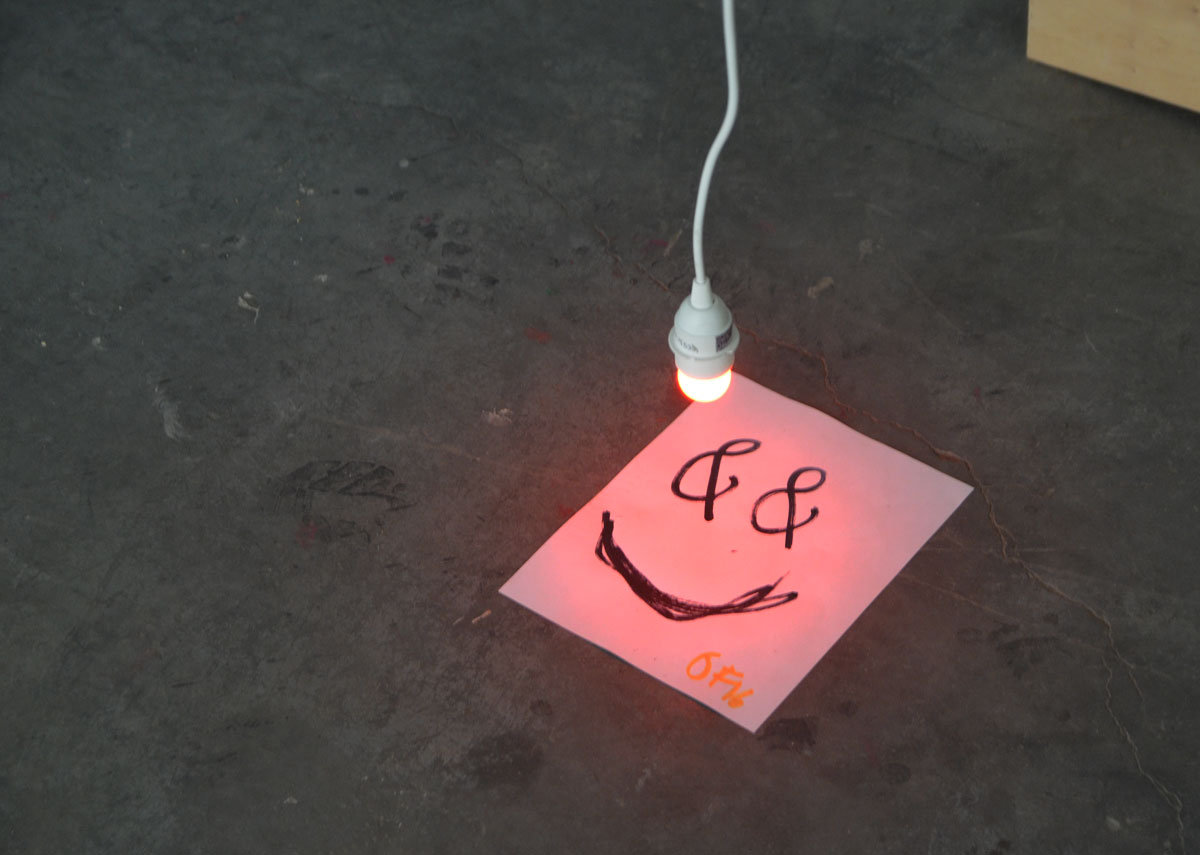
below: The paper that is half on the floor and half propped up by the wall has the words “Think Less With Me” written on it. This summarizes a lot of Figueroa’s work in that it is a rejection of the verbose and often jargon filled ‘artist statements’ found in contemporary art and especially conceptual art where the words on the wall are more important than the technical or visual aspects of the work. The gallery website says this: “What if instead of a logical artist statement we decided to write thoughts, or sentences, that go through our heads when making art. This is not poetry per se, this is a form of idea communication, just as the conventional artist statement was intended.” Does it make you wonder?
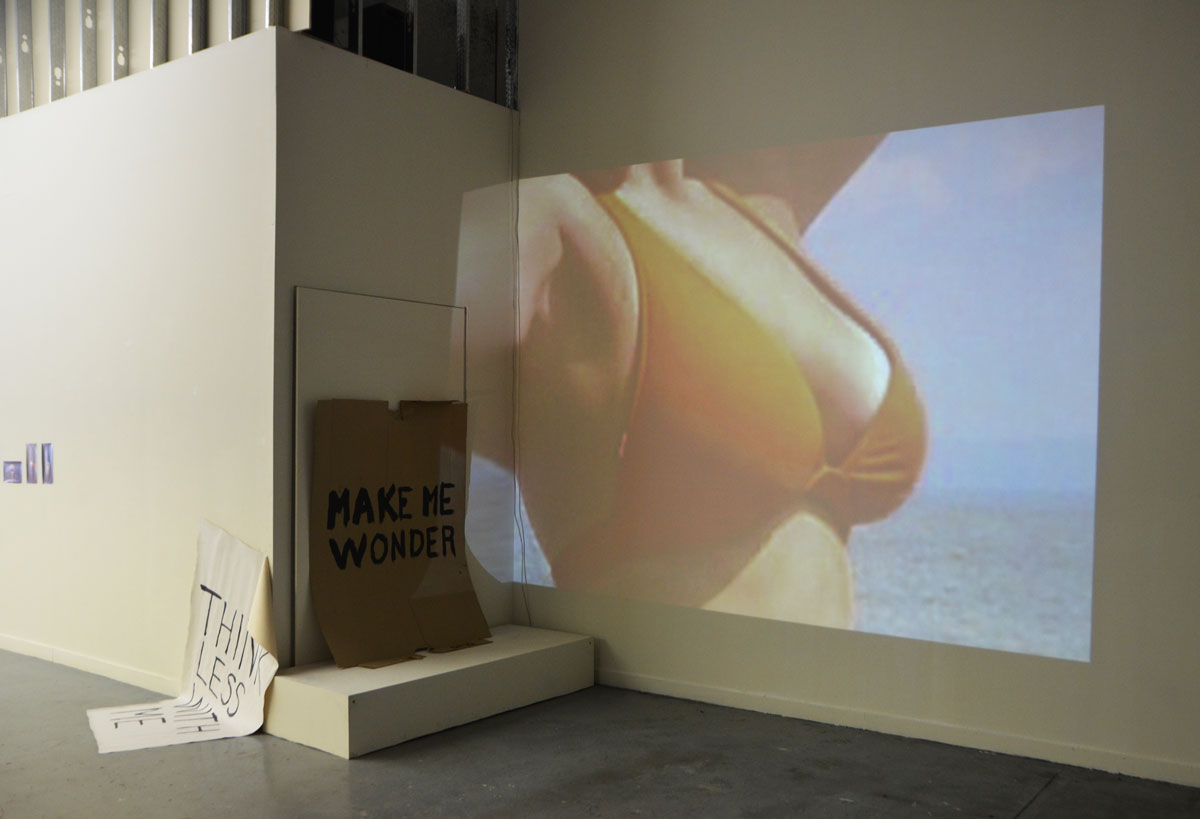
I want to cheer him on for trying to reject the overthought concept behind art these days. I appreciate the fact that he does not confront me with an essay that bears no relationship to the artwork. But all is not well. He wants us to think that his art is special because he rejects the mainstream thinking. Too bad it also rejects all attempts at, well, everything. The gallery looks like a space that someone has just moved out of but neglected to take their garbage with them.
below: A yellow rubber glove taped to the wall, a happy rock on floor. Does it talk to you?
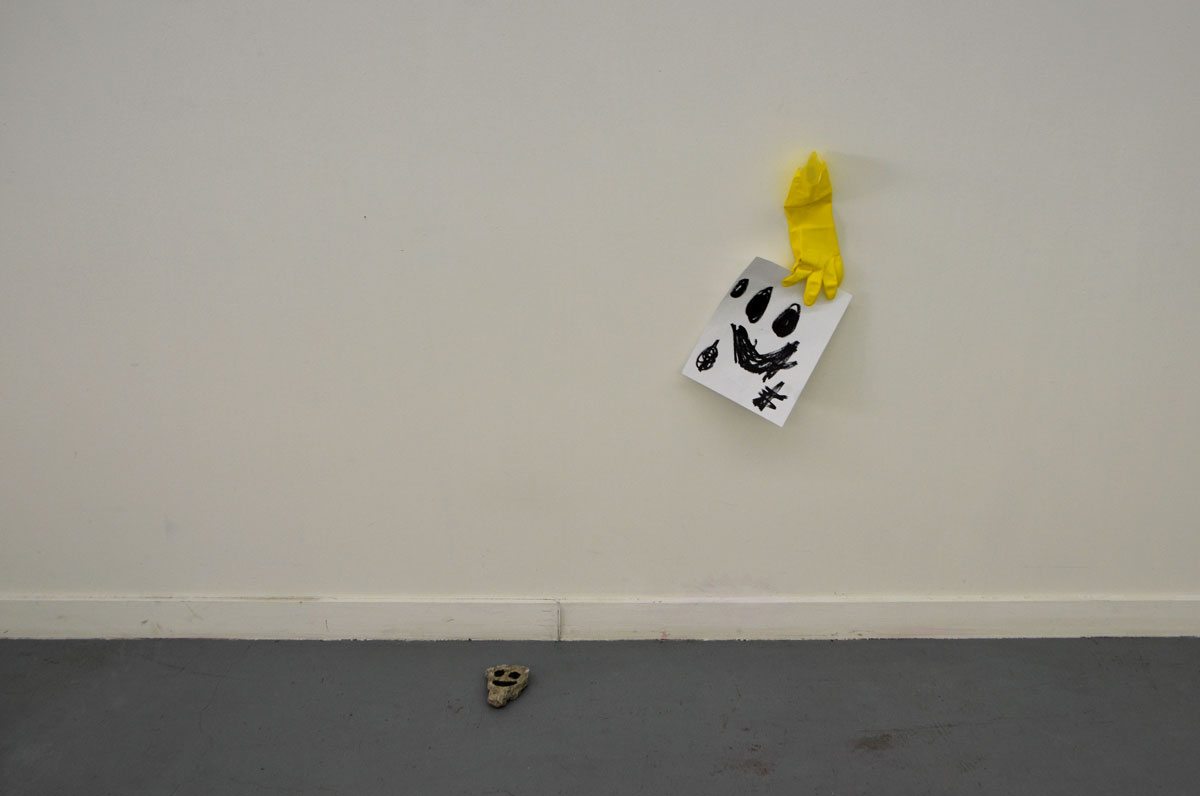
I found it all rather depressing. There could be more to it than this. No, make that: there should be more to it.
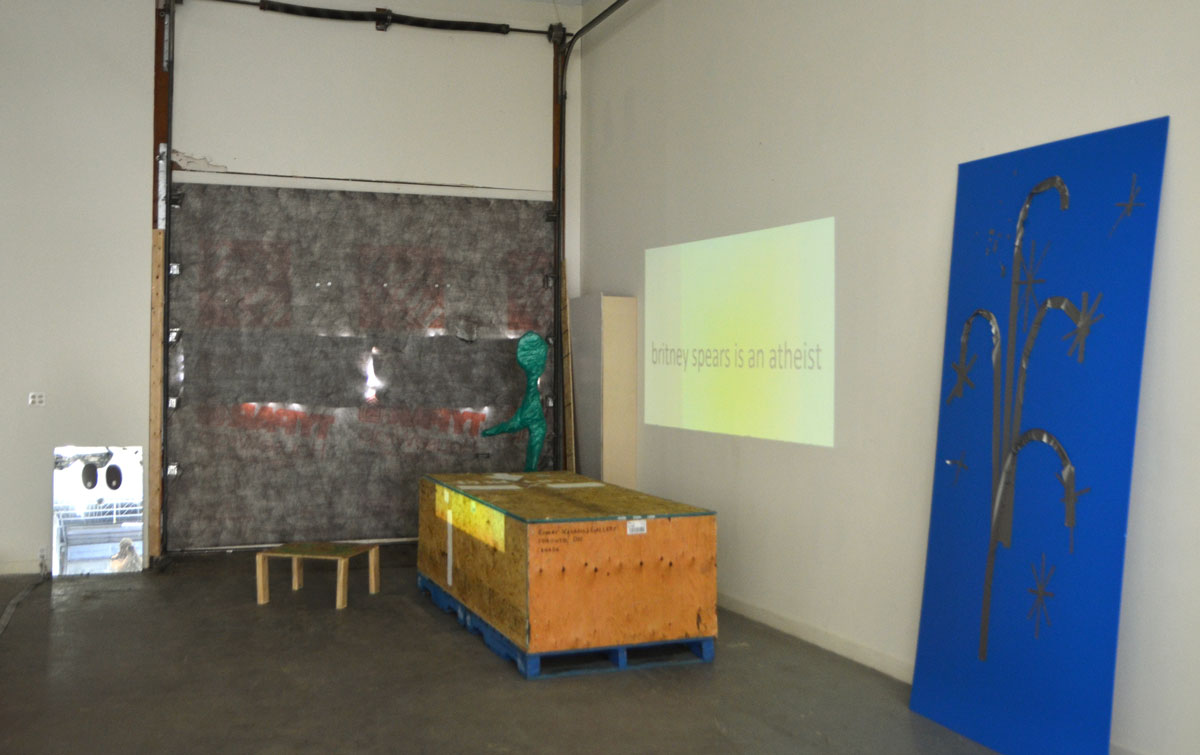
below: him: “Be a sidewalk or be a balloon, there’s no fucking difference.”
me: Be a piece of art or a piece of garbage, there’s no fucking difference.

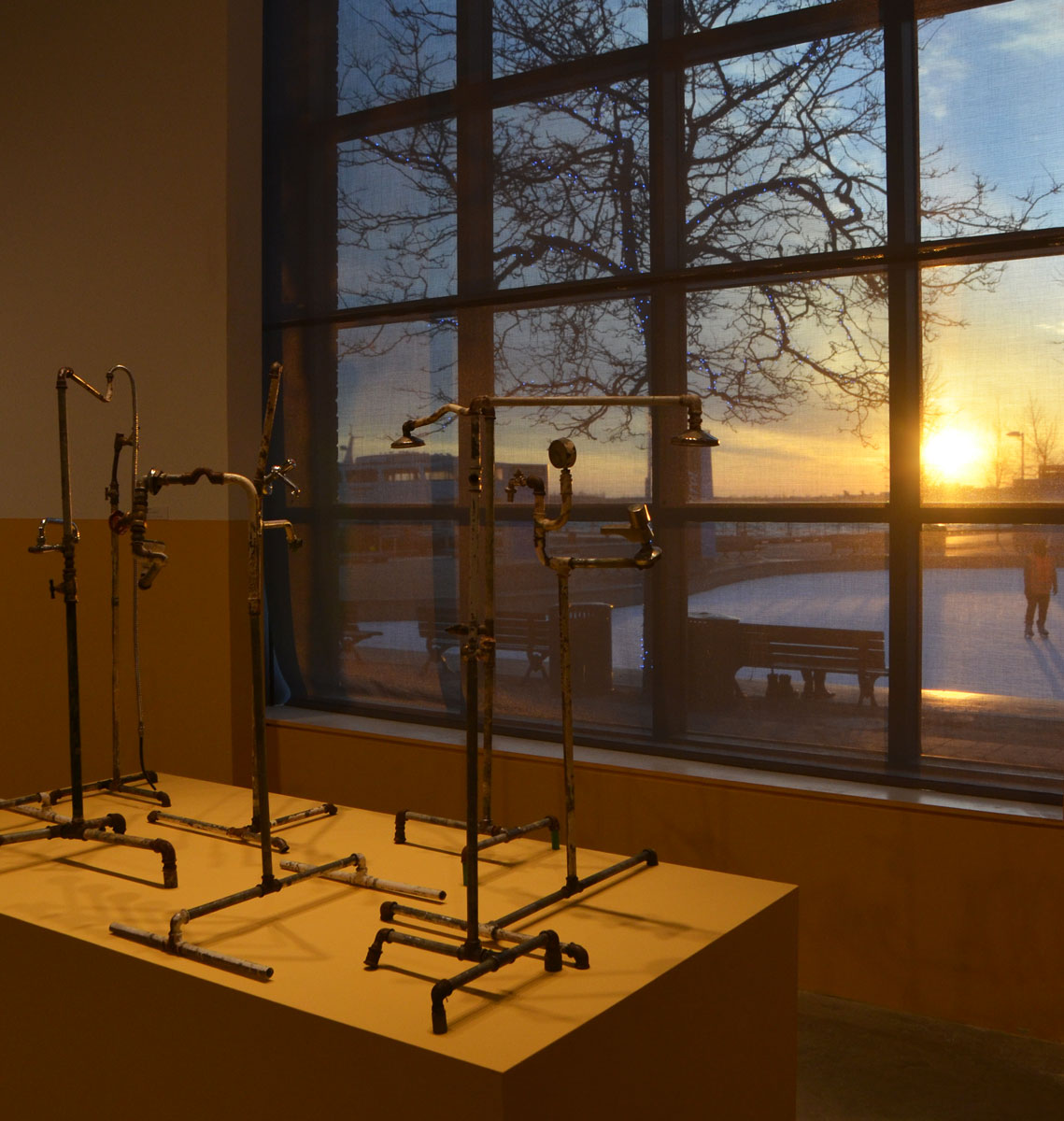
Yesterday afternoon I wandered into The Power Plant Art Gallery. It was late enough in the day that the sun was already low in the sky. It shone through the large windows in the main gallery and cast a warm glow on the current exhibit, works by Yto Barrada titled ‘Faux Guide’ .
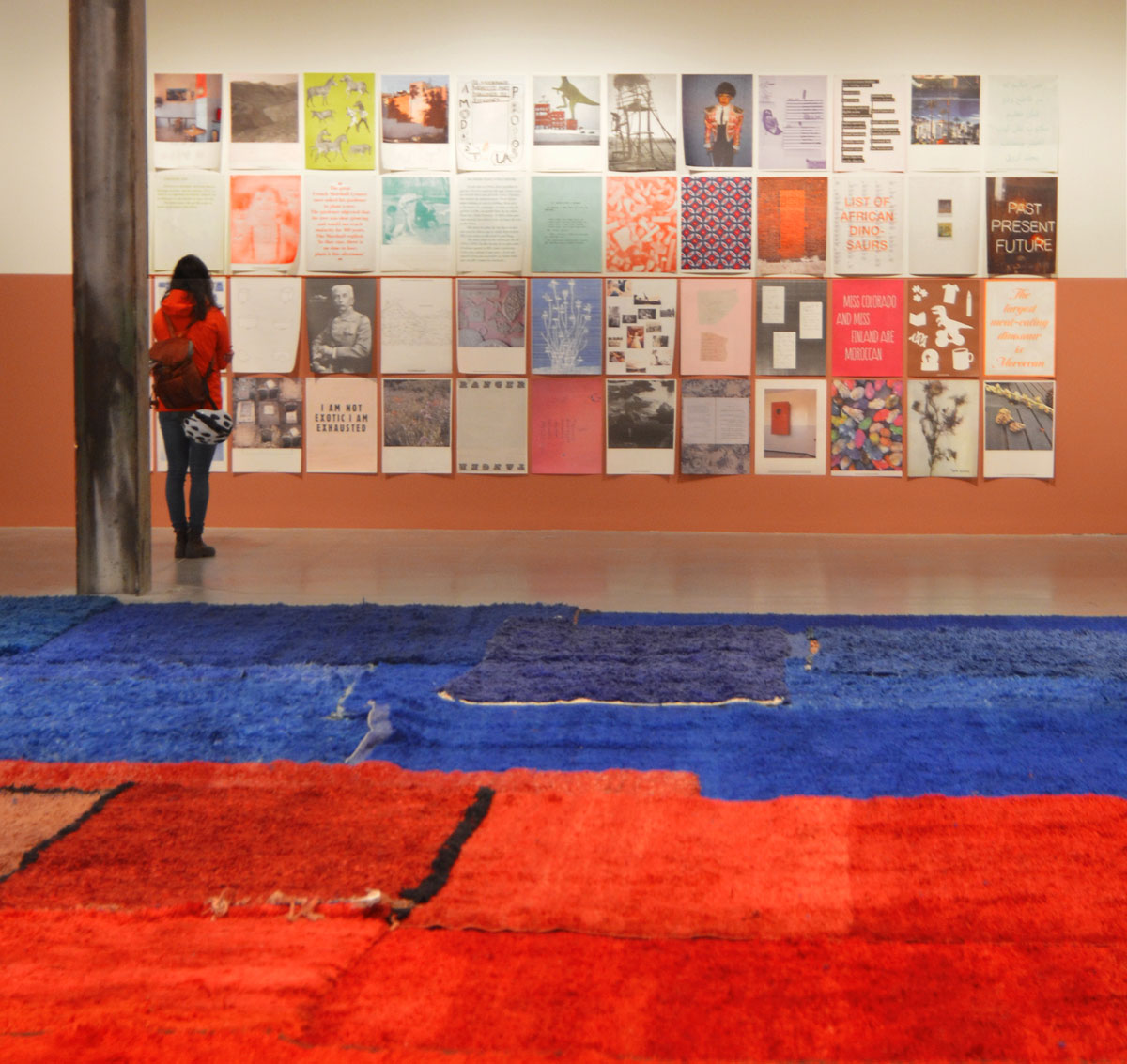
The first thing you see when you enter the rooms is a collection of carpets. This is ‘Geological Time Scale’ and it consists of bright and bold red, blue, and green carpets – Beni Mguild, Marmoucha and Ait Sgougou pile rugs from Western Central, Middle Atlas, Morocco. It’s definitely eye catching and it definitely draws the viewer into the exhibit.
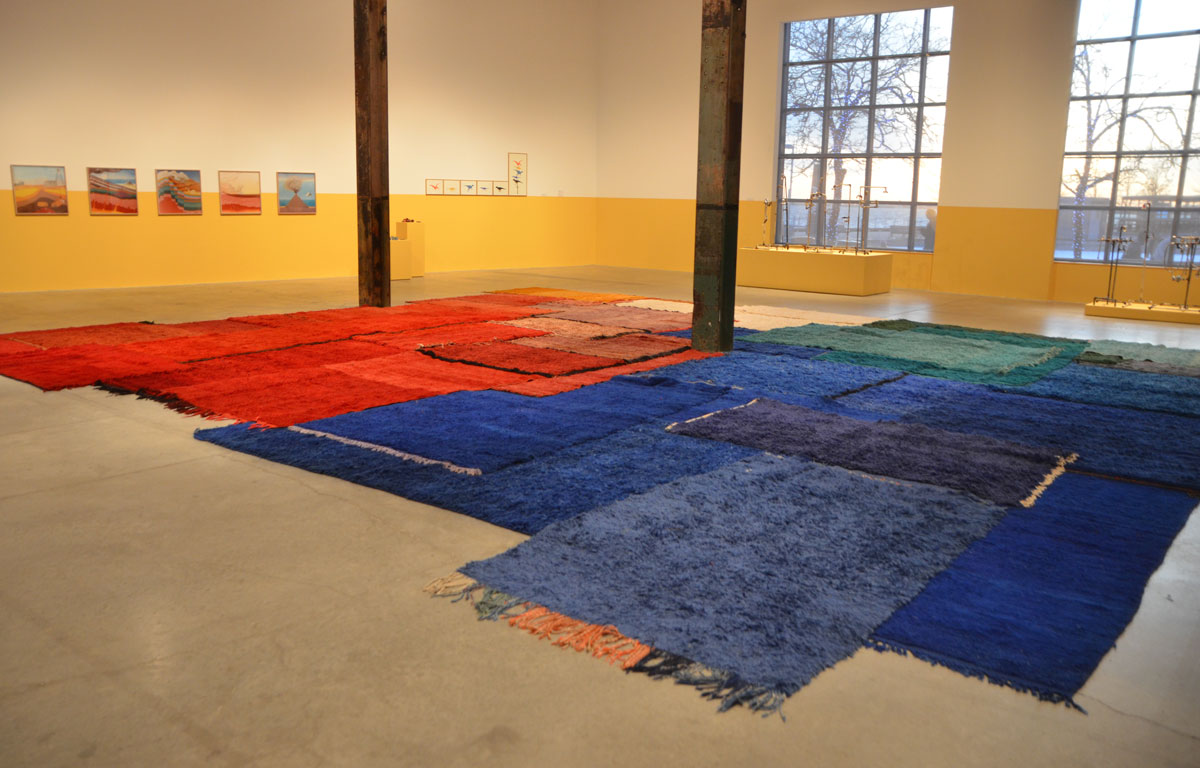
A series of small exhibits are arranged around the room and most of them are the result of the artist’s research on Moroccan dinosaurs, fossils, and the industry that has built up around them including the trade in fake fossils sold to tourists and museums. I have not shown most of these exhibits – I will leave it up to you to discover them.
below: “I am not exotic I am exhausted”. I suspect that this comes as Barrada’s response to living in a place (Tangiers Morroco) where tourists come to see “exotic things”. But it is also the lament of anyone trying to live and work in a place that is also a “tourist attraction”.
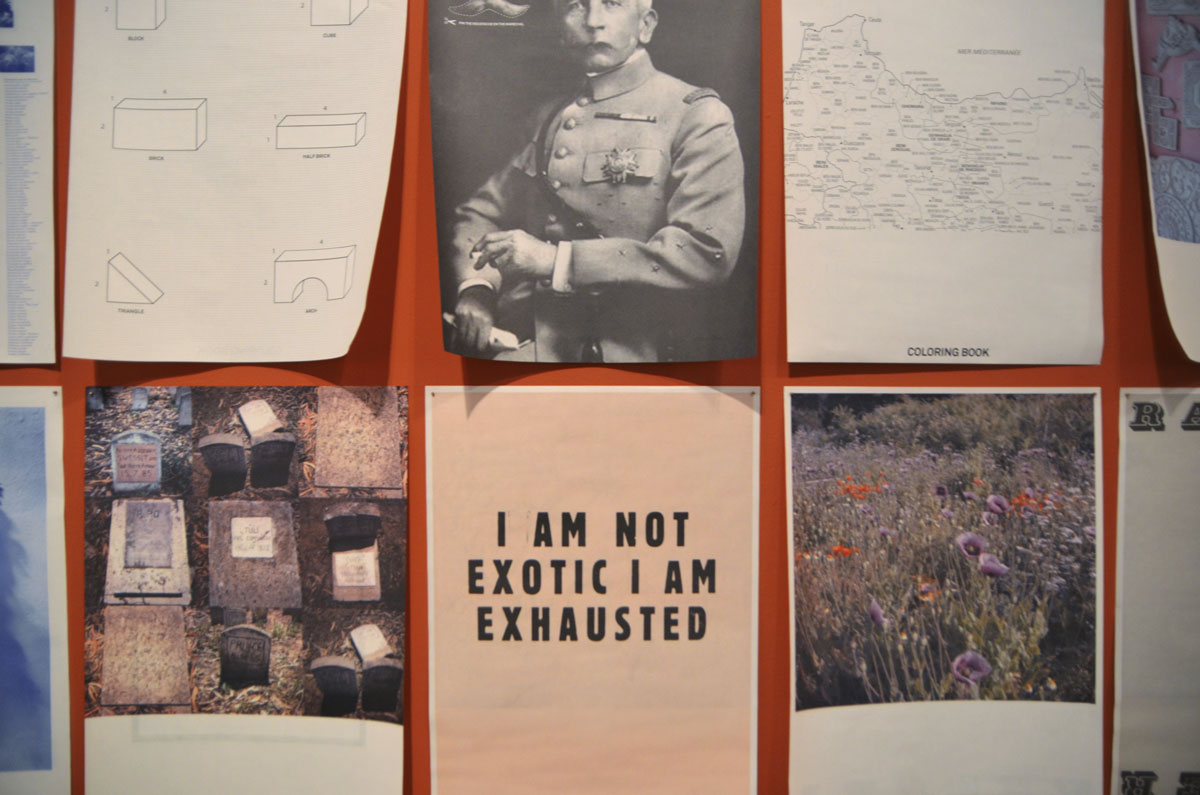
below: The whole of ‘A Modest Proposal’ and ‘Faux Guide’, 2015. A set of 48 posters loosely tacked to the wall. A mix of humorous and poignant. One is an alphabetical listing of all the types of dinosaurs found in Morocco. One says “Miss Colorado and Miss Finland are Moroccan” – which did happen in 2012.
below: ‘Plumber Assemblage’ by the window, with skaters outside in the fading light.
There are many, many things that you can take from this exhibit. Many things to think about.
An article in the Toronto Star claims that Barrada “explores the cultural heritage of her homeland through a colonial lens” and how that heritage has been used to make money from tourists. But…. Is this the making of money by exploiting one’s culture and history? Or the exploiting of Moroccan culture and history by the tourists?
Tourists go searching for the foreign and the exotic. Many of them are souvenir hunters – Sometimes it’s a selfie in front of every “famous” place (or interesting building or whatever) and sometimes it’s a “find”. But we live in a world that is full of ‘made in China’ souvenirs and we are a people that don’t care to distinguish between the real and the fake. We just want a story to tell the folks back home.
There were once dinosaurs living in a tropical land in what is now Morocco…. how the world has changed, and is changing. Insert your opinions on climate change here.
Because it is a collection of exhibits under one umbrella, it has been compared to a museum. Very trendy. One description of the exhibit claims that it is “Meant to make us question the ways in which museums confer value on things”. Can I take that one step further by asking, how do art galleries confer status on art and artists? Museums make curatorial choices and so do art galleries. Barrada too has surely made choices as have I.
You are probably wondering what carpets on the floor have to do with all those words that I just wrote. Good question. I think that Yto Barrada is on to something – an exhibit that has visual appeal, offends no one, and is flexible in its interpretation (i.e. it says something different to everyone and fits nicely into most people’s narratives). You can agree with me, or disagree. Best to go and see it for yourself and form your own opinions…. mine just might be fake.
below: People skating on the frozen Natrel Pond beside The Power Plant.
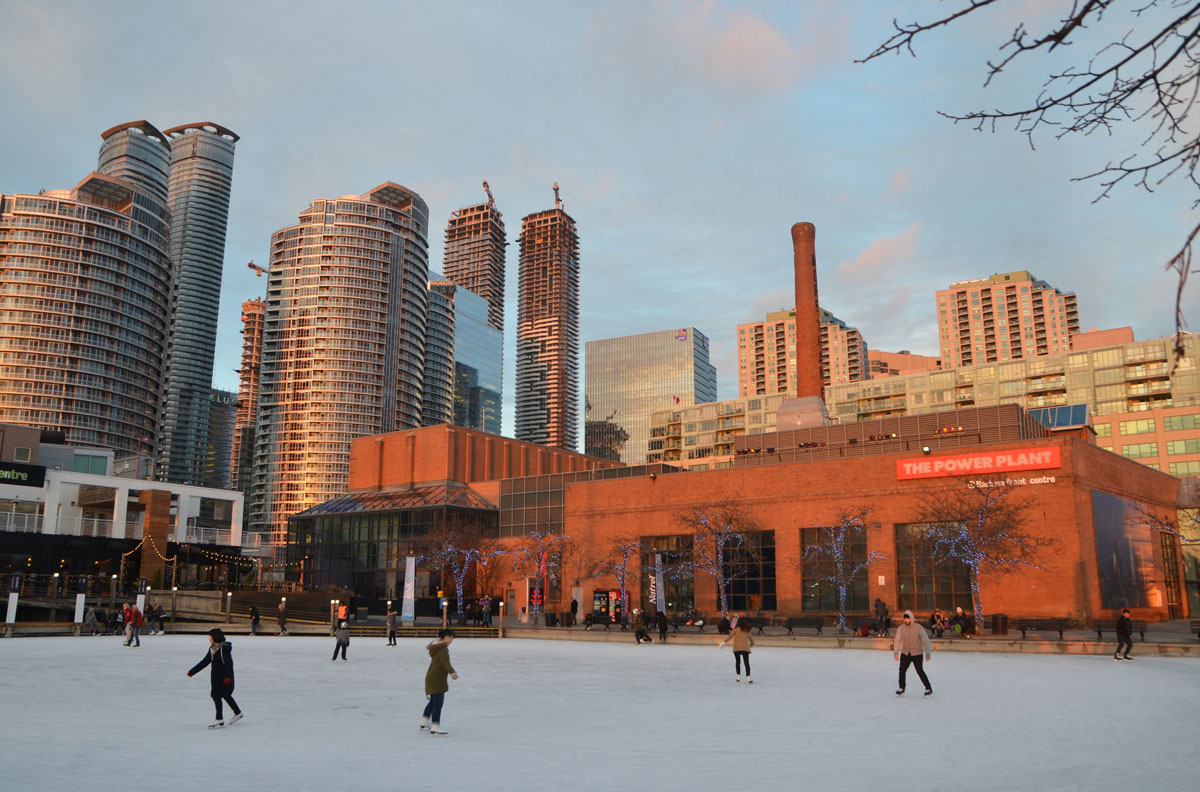
Yto Barrada’s exhibit will be on at The Power Plant until the 2nd of January.
 as I walk Toronto