Archive for the ‘public art’ Category

mosaic artwork in greens and yellows

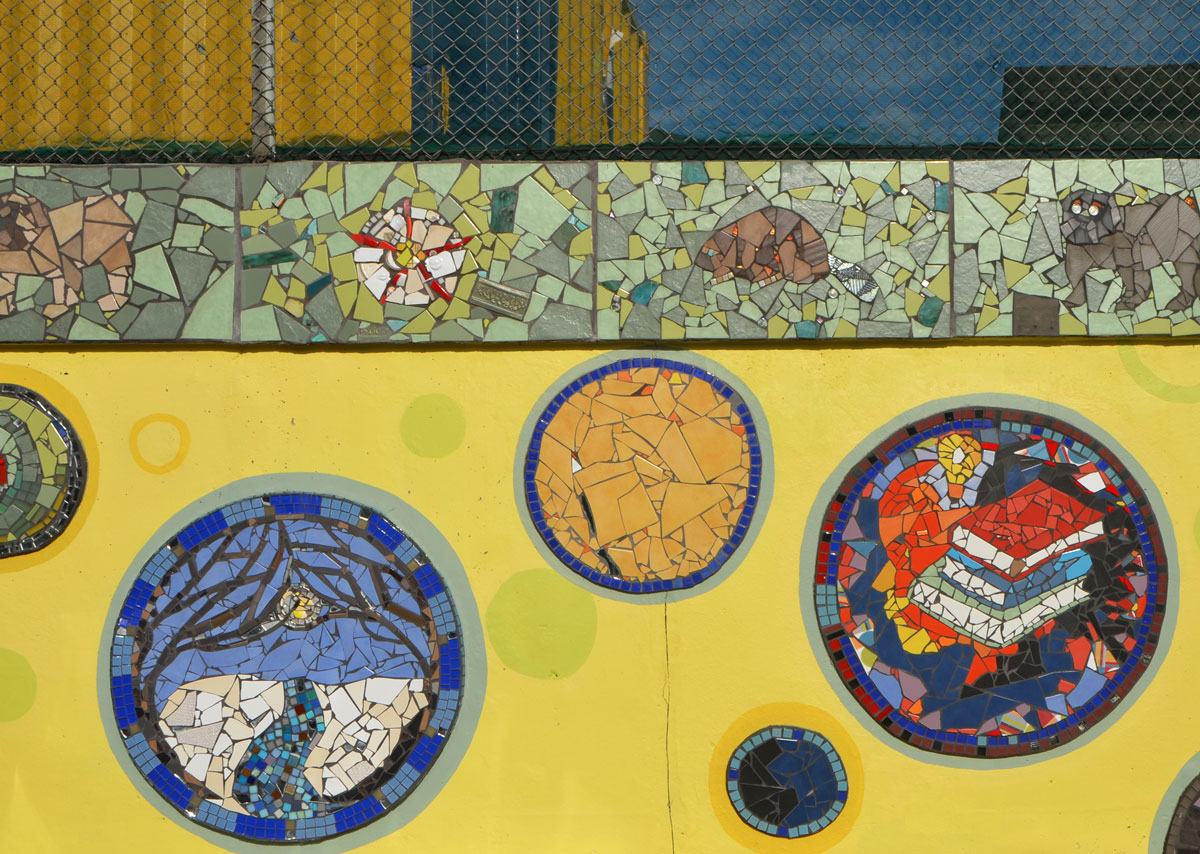
Coxwell subway station is still in the midst of its renovations and upgrades.  As part of the project, the wall on the west and south sides of the station have been painted a bright yellow.   This yellow was then the canvas for a large number of mosaic creations.

some of the mosaic medallions on the Coxwell mosaic mural

below: The new mosaic mural covers the wall alongside the pathway that leads from Coxwell station to the Danforth.  The murals painted on the side of the Sunset Grill restaurant, on the opposite wall of the path, were there previously.

yellow Coxwell pathway mosiac mural with the murals from the restaurants beside the pathway

below: A beaver made from bits and pieces – with round eye and two large teeth.

a beaver made with mosaic tiles and pieces of glass

below: At the corners of the mural are seed pods that have released their seeds to the wind.

mosaic representation of a large seed pod that hs released its seeds.

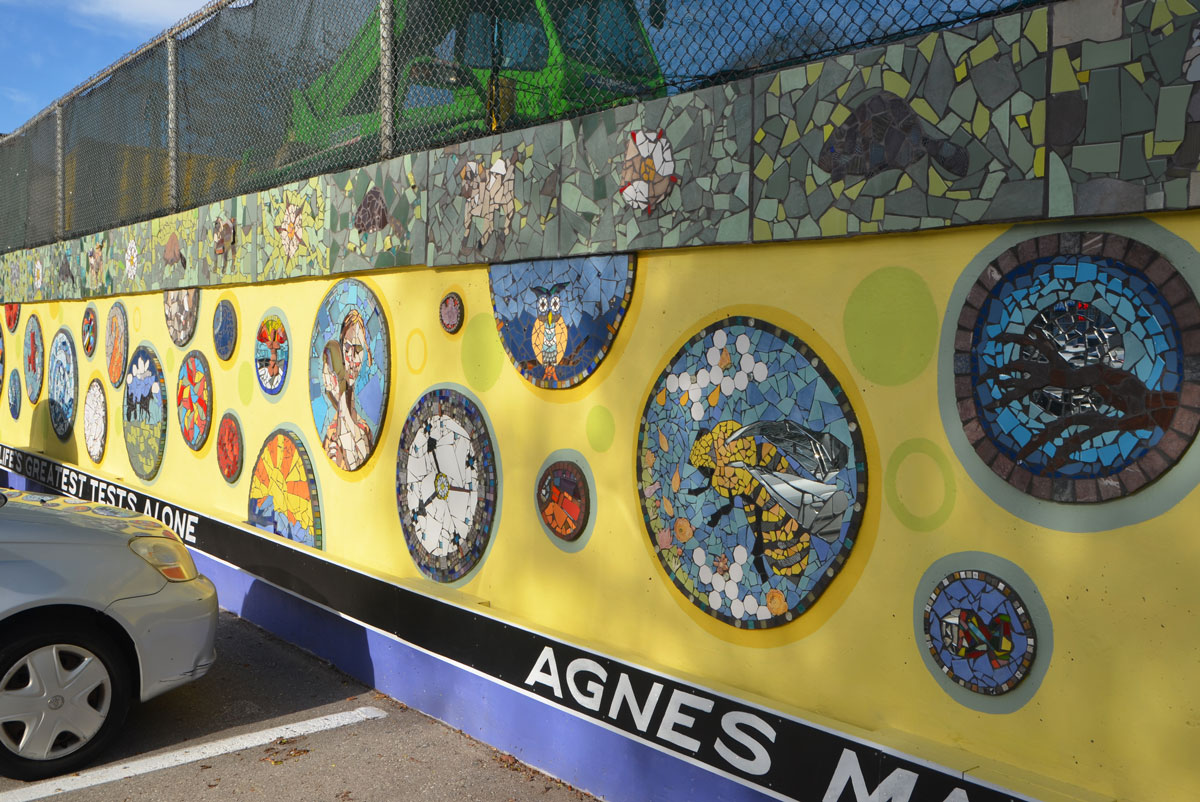
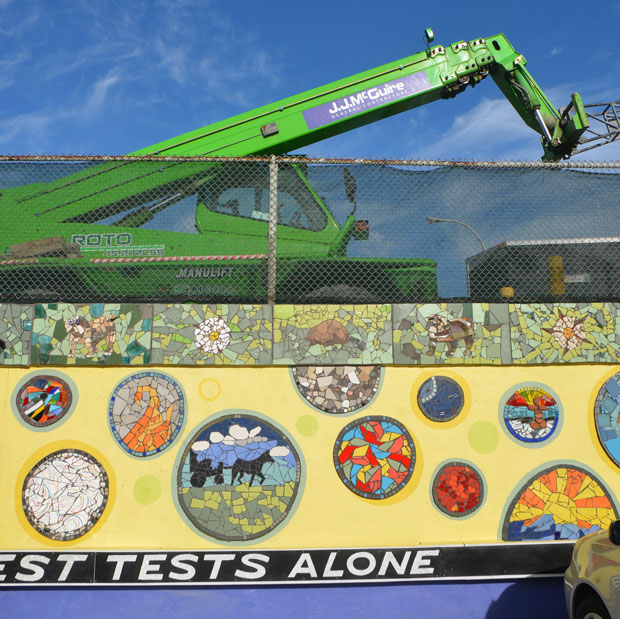
below: The south side of the subway station is adjacent to a Green P parking lot on Danforth.  Along this wall, a quote by Agnes MacPhail has been added below the mural.  “We meet all life’s greatest tests alone”.  Agnes MacPhail (1890-1954) was the first woman to be elected to the Canadian House of Commons where she served from 1921 to 1940.  After her time in federal politics, she represented the provincial riding of York East in the Ontario Legislature.  In 1951 she was responsible for Ontario’s first equal pay legislation.

A wall with a chainlink fence above it, a large green construction crane is behind the wire fence. The wall has been covered with a mural, yellow background and mosaic pictures on it. A quote runs along the bottom at ground level, white letters on black background, quote by Agnes MacPhail

A wall with a chainlink fence above it, a large green construction crane is behind the wire fence. The wall has been covered with a mural, yellow background and mosaic pictures on it. A quote runs along the bottom at ground level, white letters on black background,

below: West side of the wall, looking towards Strathmore Blvd.

west side of the mural, yellow wall, Coxwell station, mosaic pictures

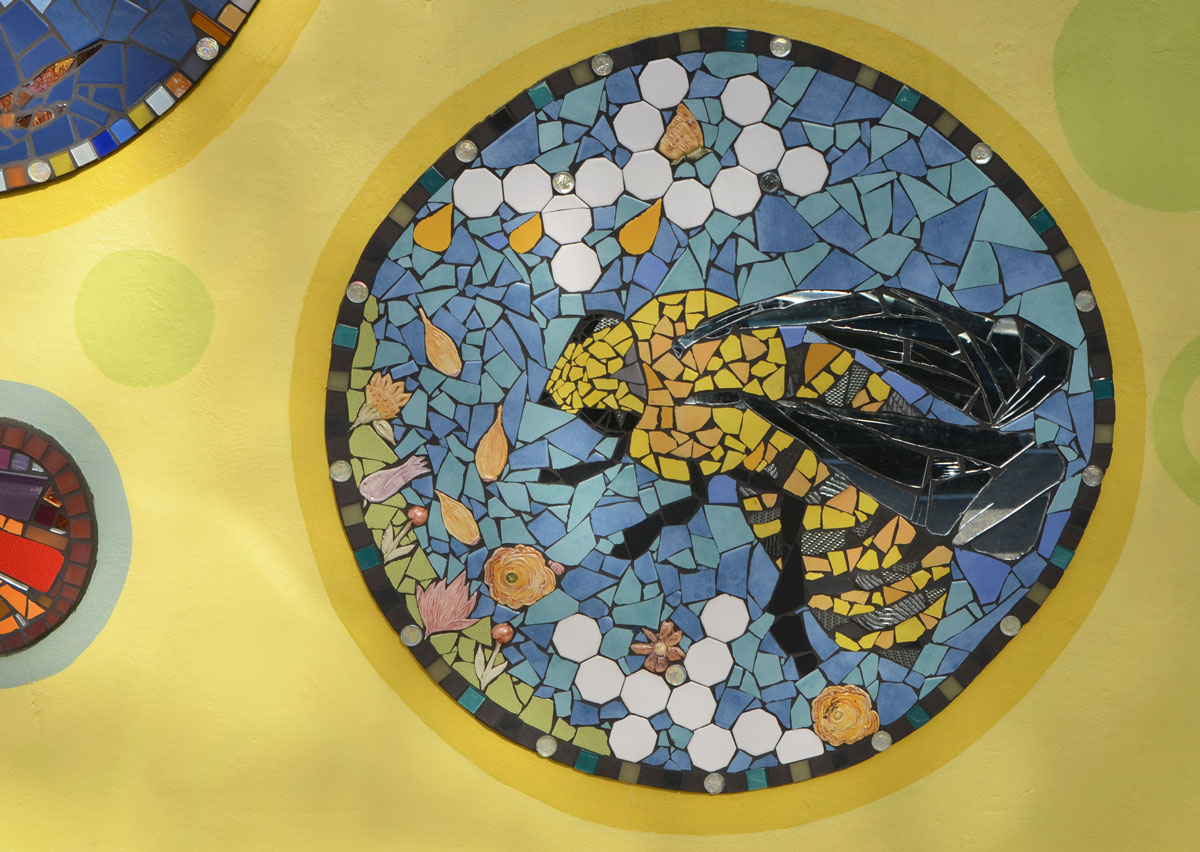
below: A mosiac bee amongst the flowers…

a circular mosaic picture of a bee amongst white and orange flowers on a blue background, all on a yellow wall. Part of a larger mural

below: … and a real bee sitting beside a mosaic red rose.

mosaic picture of a red rose with green foilage, with a real wasp sitting on it.

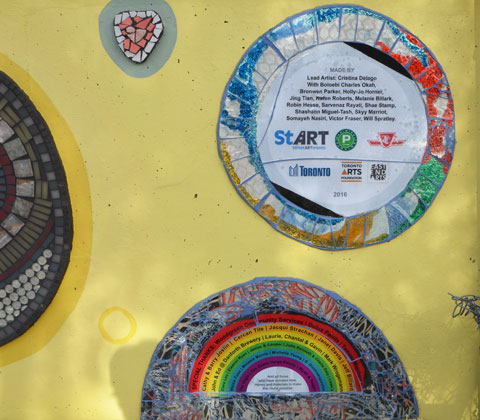
below: Two mosaic pieces, a circle with the names of the artists and a semi-circle rainbow with the names of those who contributed to the creation of the mural.  The transcription of the words is given below.

on a yellow wall, some circles made of mosaics. One is the list of people who made the whole mosaic mural and the other is a semi-circle, rainbow colours, of people of contributed to the mural

Lead Artist: Cristina Delago,
With Boloebi Charles Okah, Bronwen Parker, Holly-Jo Horner, Jing Tian, Karen Roberts, Melanie Billark, Robin Hesse, Sarvenaz Rayati, Shae Stamp, Shashann Miguel-Tash, Skyy Marriot, Somayeh Nasiri, Victor Fraser, Will Spratley.

Special Thanks: Woodgreen Community Services, Dulux Painter, Tomasz Majcherczyn, Cathy & Barry Joslin, Cercan Tile, Jacqui Strachan, City Councillor Janet Davis, Jeff Billiard, John & Ed at Danforth Brewery, Mark Wrogemann, Clara Lou, Eleanor Ryan, James & Cooper, John Kenneth & Cherie Daly, Lowe’s, Maisie Fuss, Melanie Morris, Michelle Yeung, S. Dimitrakpoulos,  The Vogls, The Zeelie-Varga Family, Wyatt & Teagan, as well as Laurie, Chantal and Gavin

blog_small_details_mosaic

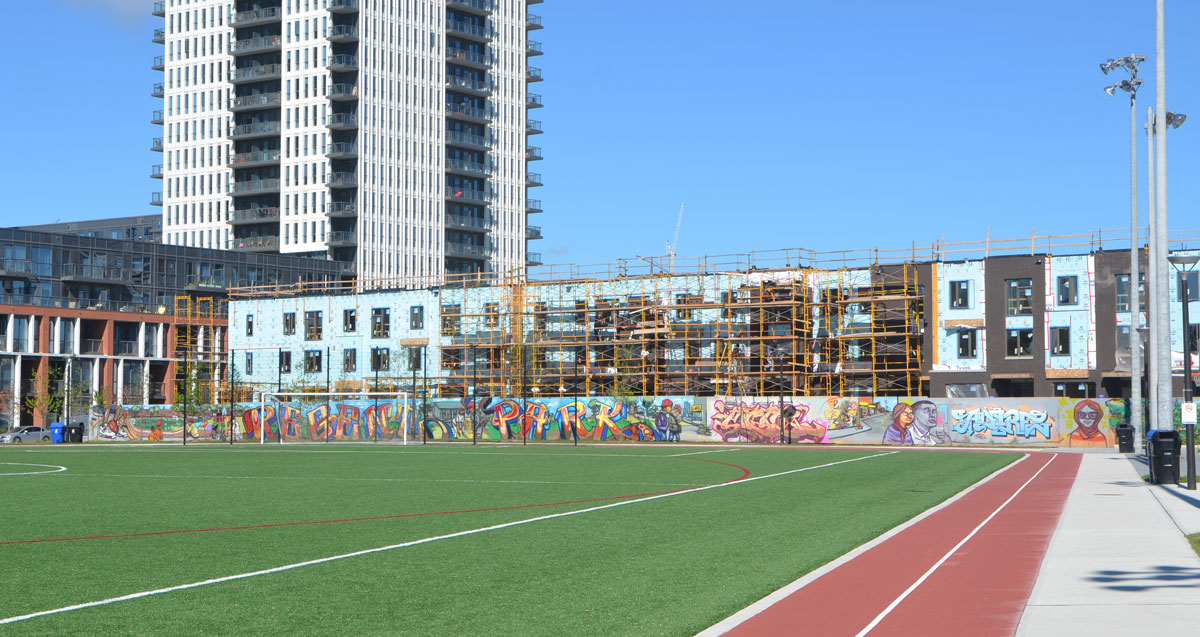
At one end of the new sports field at Regent Park, there is a large mural by elicser.

green soccer field and clay track in the foreground, small trees and a mural along the end of the field, new apartments being constructed in the background.

below: The west end of the mural, waiting on the sidelines with basketball at the ready as well as watching the soccer game.

mural by elicser elliott on a fence between grassy field and new apartments being built, people watching a soccer game, a person sits on a bench with a basketball between their feet.

part of a large mural, large letters that spell Regent Park

below: The cricket players are between the words ‘Regent’ and ‘Park’ as seen above.

mural showing two male cricket players

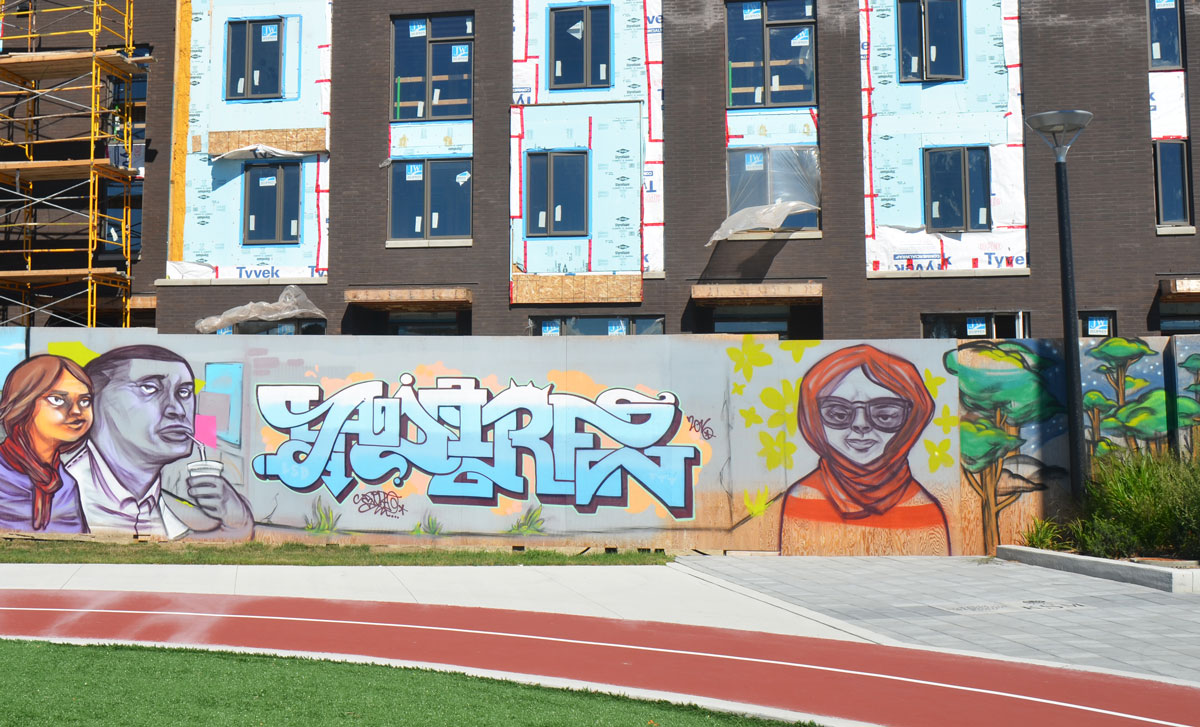
part of a larger mural, a man and a woman walking on a street, the man is drinking with a straw

blog_mural_woman_head_scarf

below: The mural continues behind the basketball court.

outdoor basketball court, with a mural in the background, and construction beyond that.

below: Basketball players both on and off the court.

mural of basketball players playing, mural is behind a basketball court, also mural of close up of players feet with running shoes on

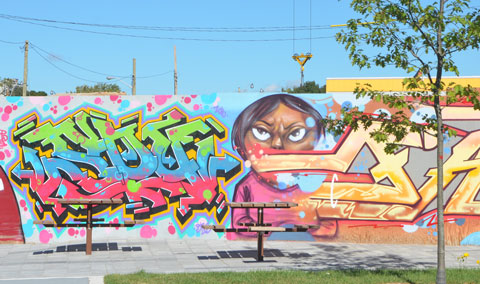
mural of a woman, and some text, on a fence behind some outdoor picnic tables

below: The east end of the mural

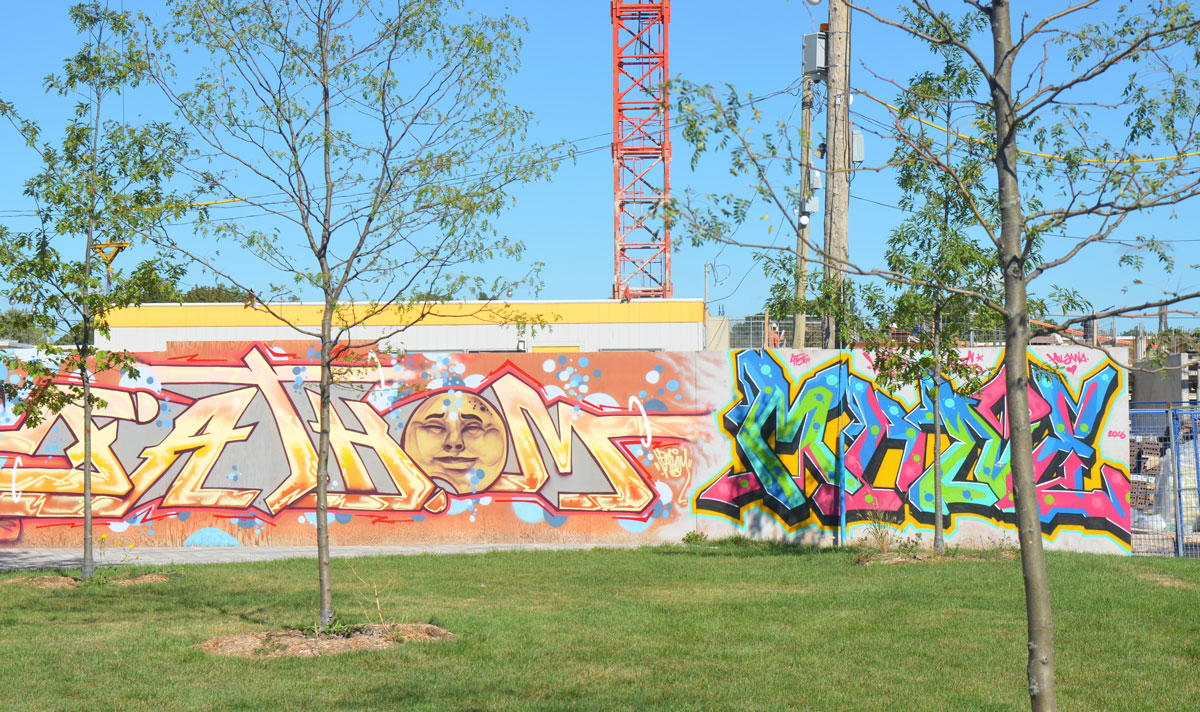
two text street art pieces, one in yellows and oranges with the man in the moon in the middle


It’s been a beautiful October to be walking around the city!  With lots of sunny days and above normal temperatures, it’s been a great autumn to be outside…. outside exploring or just sitting contentedly enjoying the sunshine.

below: Life size statue of Dr. Norman Bethune sitting outside the Medical Sciences Building at the University of Toronto (close to Queens Park Circle).   It is the work of Canadian artist David Pelletier.  Bethune is depicted writing in his journal.  Across the bottom of his apron these words are written:

I am content
I am doing what I want to do
Why shouldn’t I be happy – see what my riches
consist of.  First, I have important work that fully
occupies every minute of my time.  I am needed.

a statue of a man sitting is beside a rock and a light post, they are in front of a large tree and an old stone building, on the University of Toronto campus.

Norman Bethune was born in Gravenhurst in 1890.  He graduated from medical school at U of T in 1919, after taking some time off to serve in WW1.    He also served as a doctor during the Spanish Civil War in 1936 and 1937.   The following year, 1938,  he went to China  help the Communist Eighth Route Army during the Second Sino-Japanese war.  It was here that he died of septicemia in November of 1939.   He is credited with helping to bring modern medicine to rural China during his brief stay in that country.

line of statues of hockey players in front of the Air Canada Centre, Legends Row in Toronto, a few people are standing in front of the statues.

Legends Row in Maple Leaf Square is growing.  Last week, three more statues of Leafs players were added to the line up of statues already there.  This is the fourth installment and now Turk Broda, Dave Keon, and Tim Horton have now taken their place outside the Air Canada Centre.

The unveiling of the latest statues coincided with the opening ceremonies for the 100th season of NHL hockey in Toronto.   That first year, the Toronto team was the Toronto Arenas and their only competition were the Montreal Canadiens and the Ottawa Senators.   The Arenas didn’t last very long; they folded because of financial problems.  For the 1919-20 season, the Toronto team was the St. Pats and their uniforms were green and white.   They remained the St. Pats until 1927 when Conn Smythe bought the team and changed the name to the Maple Leafs.    (The NHL was formed Nov 26, 1917 so technically we may have jumped the gun by a year, but we can fudge that and call it the 100th season!).

below: Goalies Turk Broda (right) and Johnny Bower (left) have a chat while George Armstrong stands in the background.  Broda (1914-1972) played goal and spent his whole NHL career with the Maple Leafs during which time they won the Stanley Cup five times.

three statues of former Toronto Maple Leaf players in Legends row in Toronto, goalies Turk Broda on the right and Johnny Bower on the left, are standing, George Armstrong is in the background.

below: Dave Keon, number 14, stands behind the bench with his teammates.   Keon (b.1940) pl ayed for the Maple Leafs for 15 years during a career that lasted from 1960 to 1982.  He won the Calder trophy his first year and he was the team’s top goal scorer for many years.

statues of hockey players lined up behind the boards as if they were in a rink, some of the players in the background are jumping over the boards. Number 14 for the Toronto Maple Leafs is in the foreground, Dave Keon.

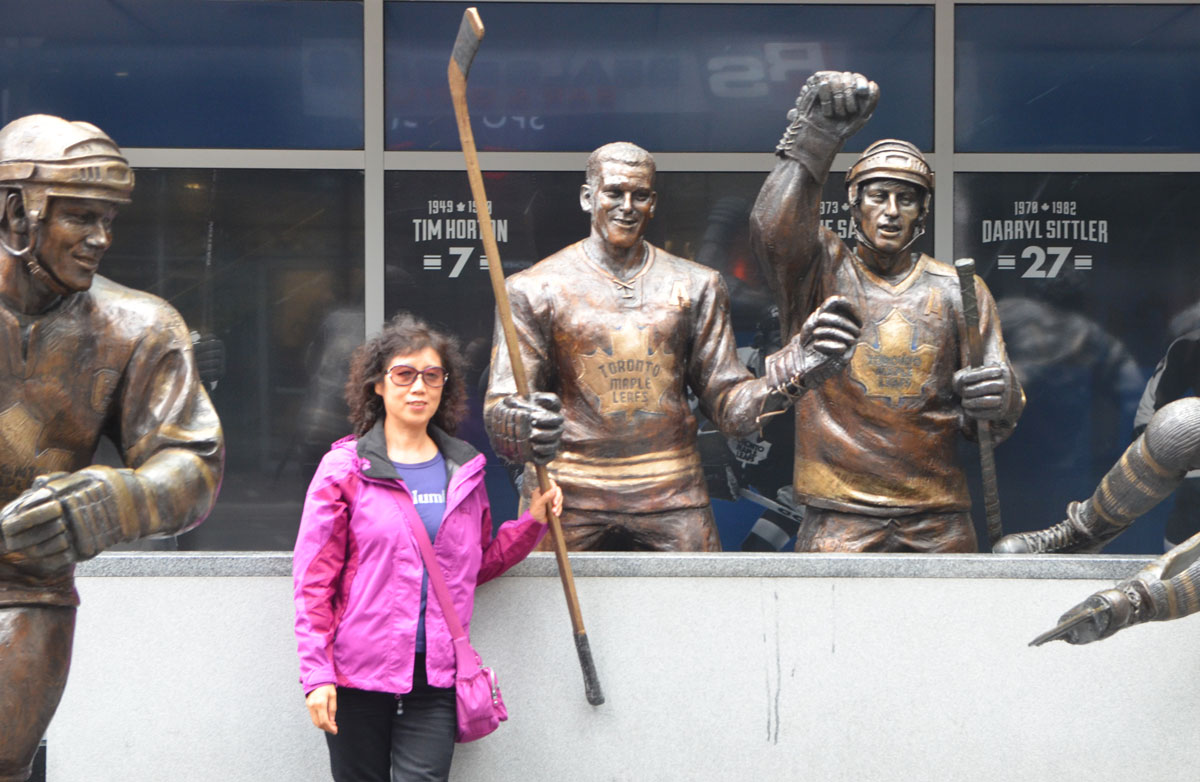
below: It looks like Tim Horton may have to share his stick.  I suspect that he’s going to have the problem fairly often!  Tim Horton (1930 – 1974) was a defenceman who played for the Leafs during the 1960’s when they won the Stanley Cup four times.  Also during this period he set the record for playing in consecutive regular season games, 486.

a woman in a pink jacket stands in front of a statue of a hockey player, Tim Horton.  She is holding onto his hockey stick.  There are a couple of other statues in the picture too.

a woman poses for a photo with a line of statues of hockey players

Previous Legends Row posts

  1. Over the boards when the first three statues were installed. (Sittler, Kennedy and Bower)
  2. Leafs expansion, two Swedes, (Salming and Sundin)
  3. Two number tens (Apps and Armstrong)

First I heard a rumour that the Art Gallery of Ontario was going to remove that sculpture from the corner of Dundas & McCaul, you know, the one that everyone climbs on and takes their picture with, the one near the AGO entrance.

Then I read about in a newspaper.

You know, that curvy bulky slippery thing by Henry Moore, the one with a title that’s almost as shapeless as the sculpture, “Large Two Forms” although no one calls it that.   Oh, what do they call it anyhow?

Then I read about it online.

people are walking on the sidewalk, a woman is sitting by a sculpture by Henry Moore, the Art Gallery Of Ontario is beside the sculpture, street and other buildings in the background, street scene,

It’s sat on that corner since 1974.  That’s 42 years.  Longer than the average Torontonian has been alive.
Can you say synonymous? …. as in synonymous with the corner of Dundas and McCaul.

Apparently it’s going to be moved to Grange Park.  That’s the park behind the AGO, the one that is being renovated.

The expression “Rob Peter to Pay Paul” comes to mind.
How about new public art for a renewal of the park?

fence around a construction site, a park that is being renovated

fence around a construction site, a park that is being renovated, the blue wall of the Art Gallery of Ontario is in the background.

But walking the site and looking at the plans made me start to think.  The sculpture is being moved into its own space in the park and as I looked at the drawings and the artist rendition of the future space, it dawned on me that the redesign of Grange Park was possibly (probably?) done specifically to accommodate the sculpture.  The Art Gallery owns Grange Park after all.  Toronto does a lousy job of placement of their public art so maybe I shouldn’t complain about this?

Maybe.

As I tried to take photos of the sculpture where it is, I was reminded of how the streetscape in Toronto gets short shrift.

blog_art_gallery_corner

Henry Moore competes with old poles as well as bus shelters that are designed to maximize Astral Media ads.  At least there isn’t a ghastly trash bin beside the sculpture.  And at least the art is solid enough and strong enough to hold its own.

But this is going to be a problem for any artwork that gets put on that corner.
Oh dear, assuming that something will replace Henry Moore?

Don’t mess it up even more AGO, don’t leave the corner empty.
We have more of a cultural memory than you give us credit for.

beige wall on top, rust coloured wall below, with orange splotches. Orange metal trash bin on ground, two window in upper part, both recessed. One with a bike and one with flower pots.

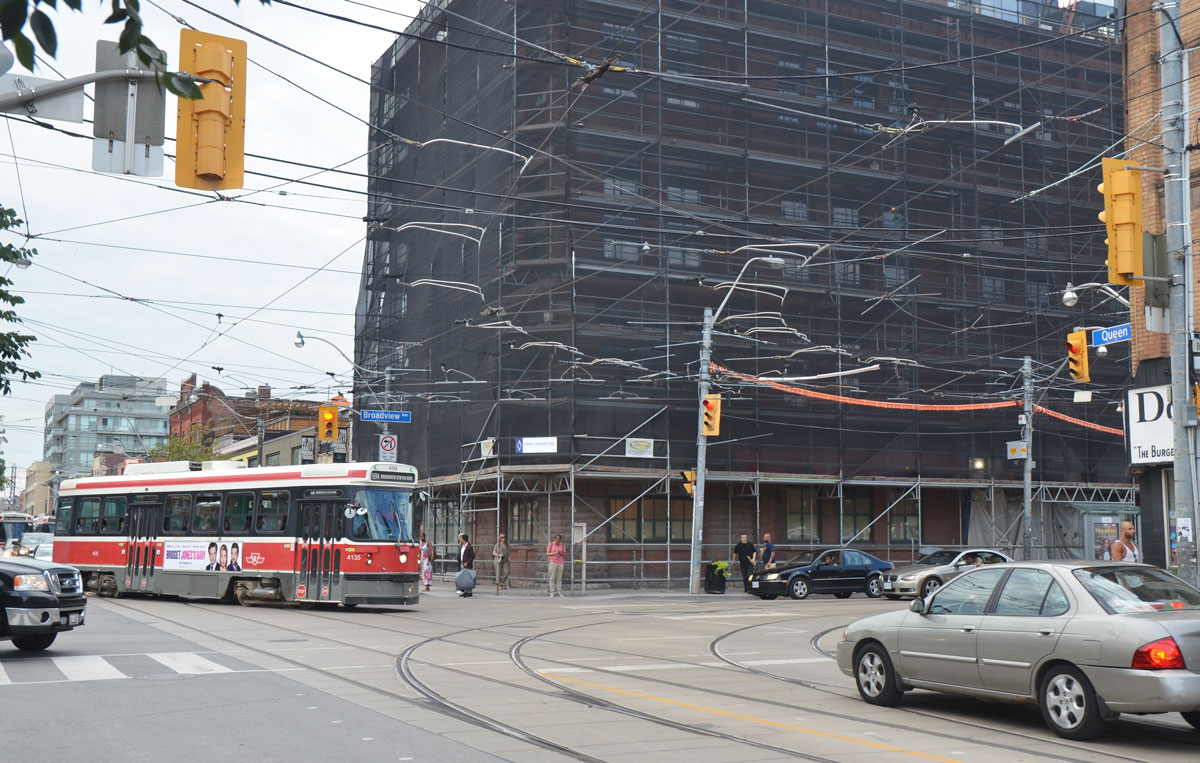
Let’s start with the intersection itself.   It’s where the 504 King car turns north to Broadview station and it’s where Jillys dominated the corner for many many years, more than 30 years in fact.    Does anyone admit to lamenting the loss of Jillys 2 years ago?  The building has stood on the corner for 124 years and was also home to the Broadview Hotel although I doubt it was the kind of hotel you’d book your mother into (well, at least not my mother!).   Believe it or not, this isn’t a condo development.

intersection, TTC street car turning left, a grey car near the intersection, a few pedestrians, a large building wrapped in black netting as the building is being cleaned and renovated.

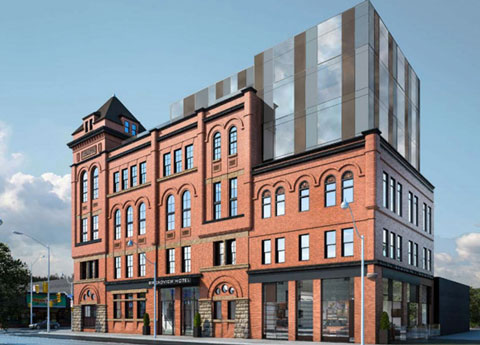
below: Instead, the New Broadview Hotel, built by Streetcar Developments, will have 57 rooms, a rooftop bar and a ground floor restaurant.   It will look approximately like this (from Broadview):

drawing of the New Broadview Hotel being renovated to incorporate an 124 year old brick building, new glass portion at the top of the building.

There was a reason I chose this intersection, and it wasn’t Jillys.  I went looking for a new mural but I didn’t know exactly where it was.   While I was looking, I explored and took some pictures because that’s what I do.

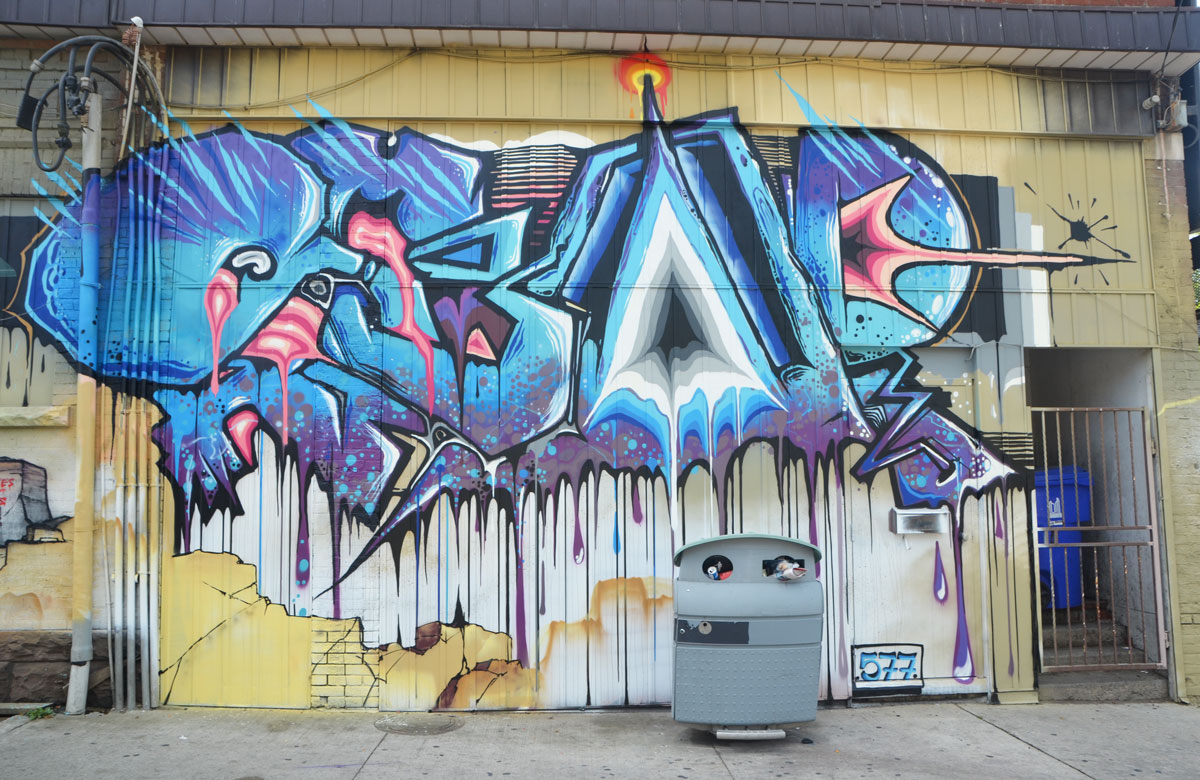
It wasn’t this street art painting I saw in an alley,

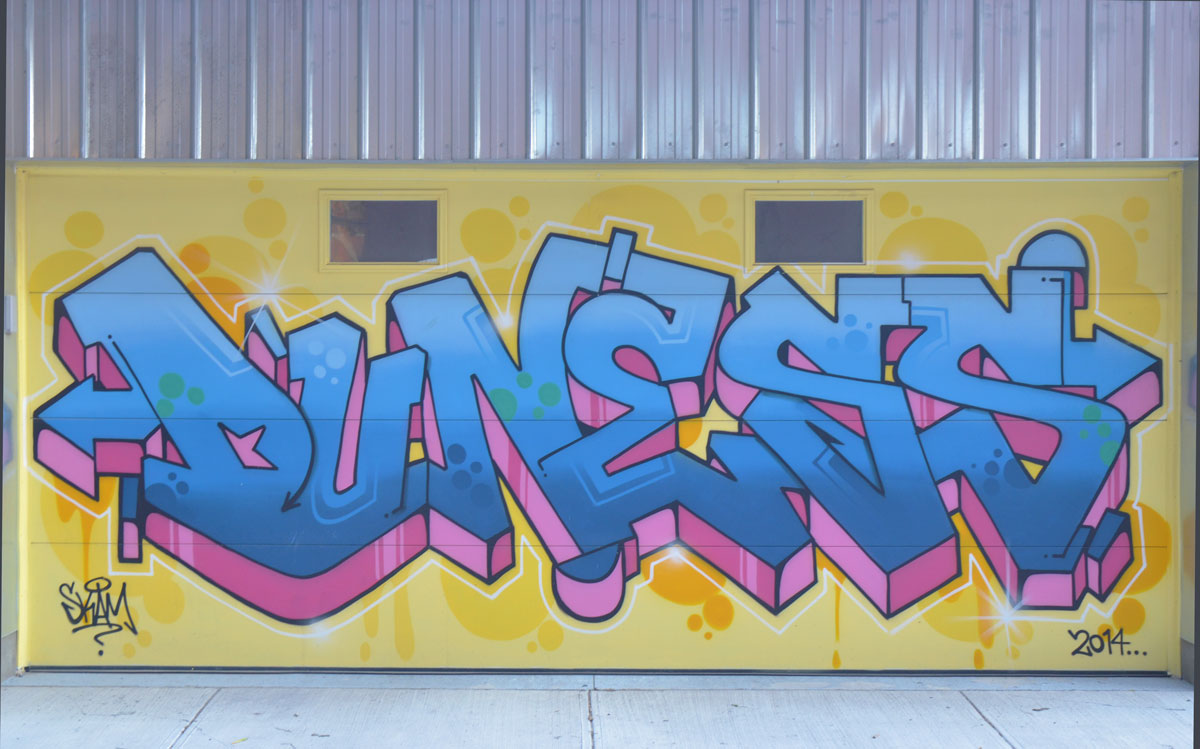
text street art painted on a garage door

or this painting way up high beside a parking lot,

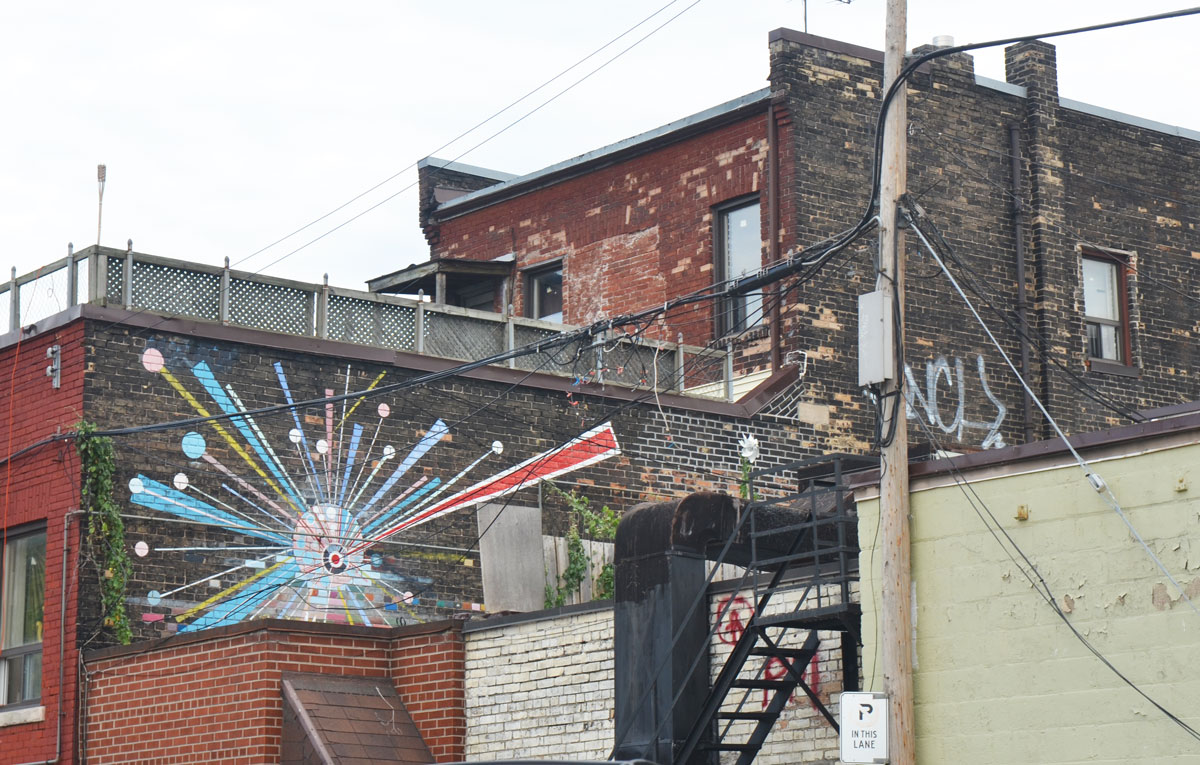
upper level of a store, backing onto a parking lot, painting on the exterior wall of rays eminating from a center circular source

or this woman in a lane.

streeet art picture of a woman in pink and purple

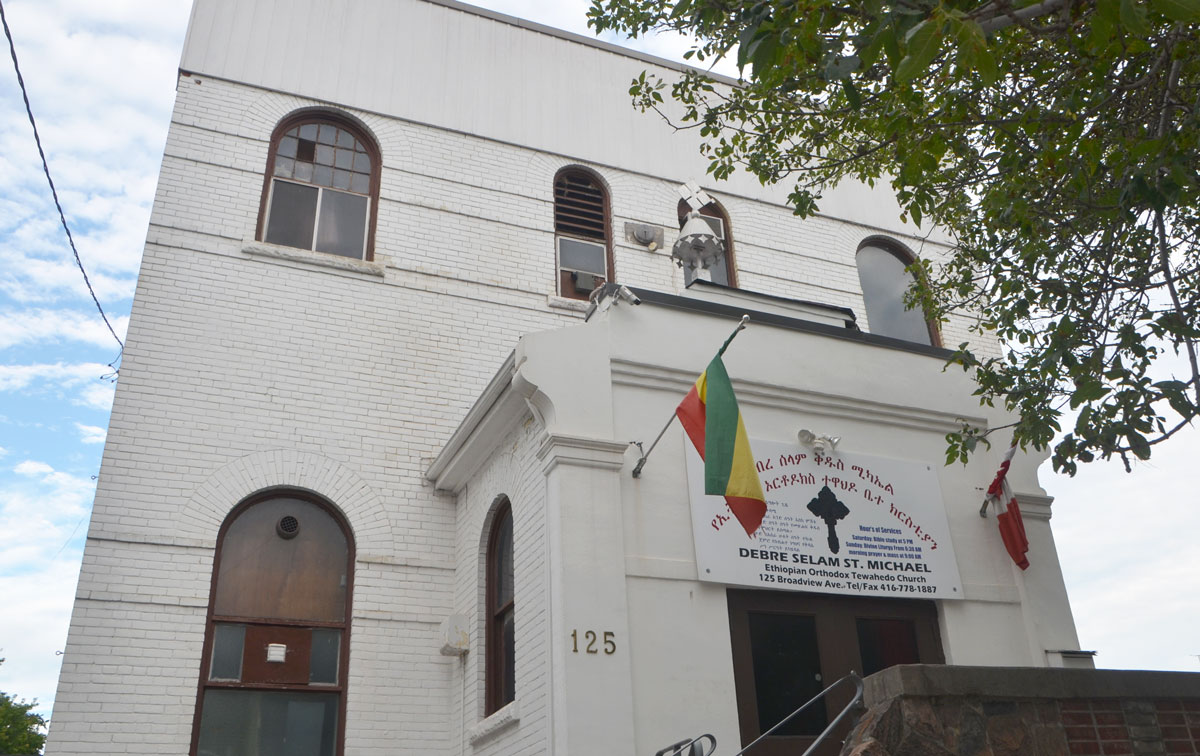
I passed by Debre Selam St. Michael Ethiopian Orthodox Tewahedo Church.  Such a long name!  All over Toronto there are churches, temples, mosques and other places of worship for a lot of different religions.  I am not sure how many there are but I’d love to find out.  This Orthodox religion was new to me so of course I had to look it up.  I learned that it was once part of the Coptic Orthodox Church which has existed since the 4th century.  It split off in 1959 but remains a member of the Oriental Orthodox family.  The church has 38 million members in Ethiopia.  This church on Broadview is not the only one in Toronto, there are at least 2 others.  I’m not sure how many people in Toronto are members of the church, or attend services here. (additional note:  It’s located beside the Royal Canadian Curling Club which I think is a great juxtaposition).

front of a white building, two storeys, with round top windows, two flags flying by the door. Sign says Debre Selam St. Michael Ethiopian Orthodox Tewahedo Church. Small cross above the entranceway

The Royal Antediluvian Order of Buffaloes have their building just up Broadview from the Ethiopian church.  They aren’t a religion but I had no idea what they were.  When I think of “orders” of buffaloes I think of Fred Flintstone and Barney Rubble and their Loyal Order of Water Buffalo.   Apparently the “Buffs” have been an organization since 1882, originating in London England.   According to Wikipedia, “Membership is open to all males over the age of 18 who are willing to declare that they are “true and loyal supporters of the British Crown and Constitution”. Discussion of politics or religion is strictly forbidden at gatherings, as is gambling.”  The building looks like it was once a school…. looking for ideas where to start looking for its history?  Oh, that word ‘antediluvian’ – it means ‘before the flood’ as in the flood in the Old Testament, that one with Noah’s Ark.

brown brick builgin, one storey with peak roof, small veranda in front, blur front door, Canadian flag out front, sign above door says Royal Antidiluvian Order of Buffaloes.

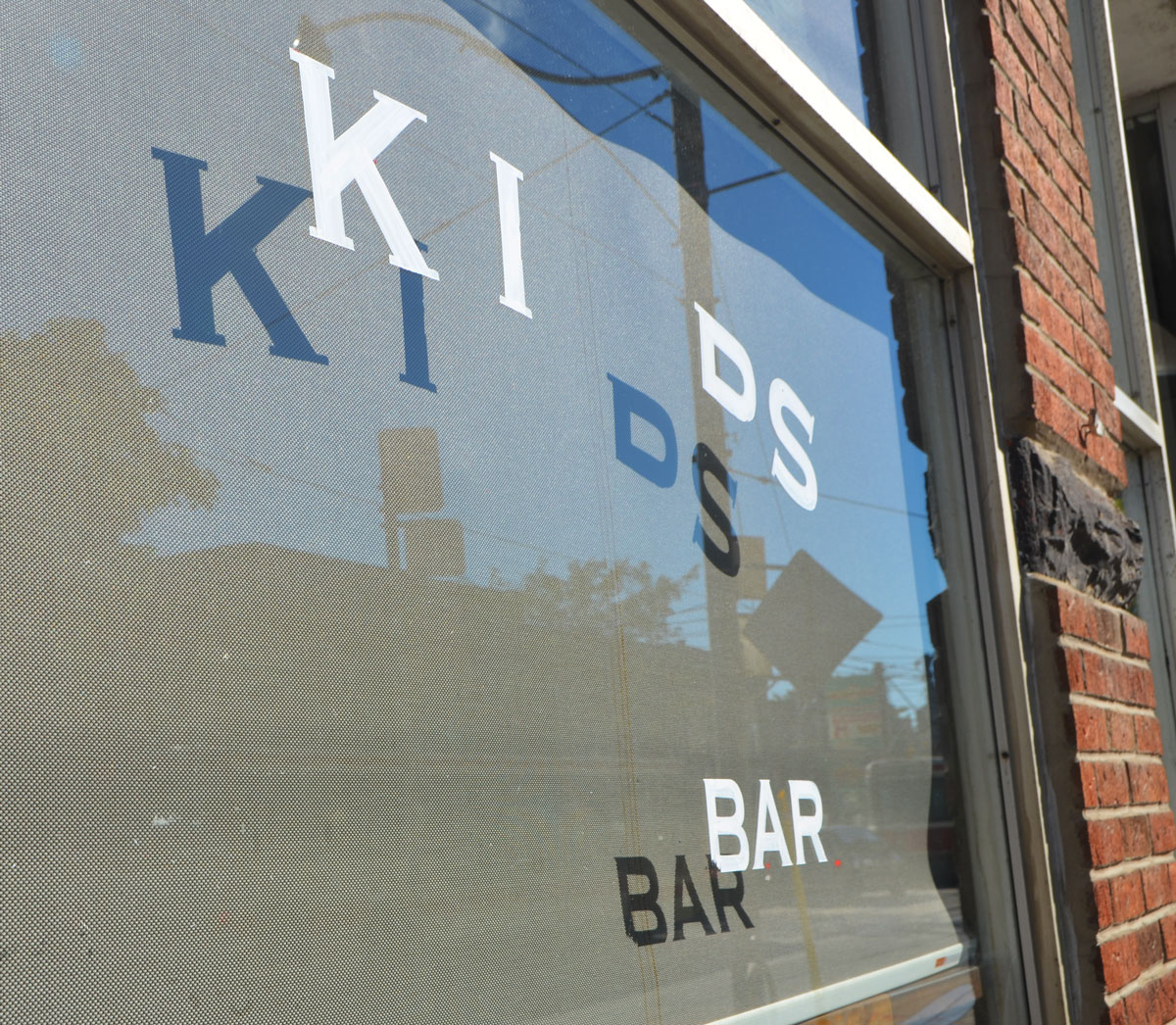
I noticed some quirky things like this window.  Any guesses as to what it used to be?

window of a coffee shop where some of the letters have been removed. It now says Kids Bar. Shadows of the letters are on the blind that covers the inside of the window of the now closed shop

Dark Horse Expresso Bar

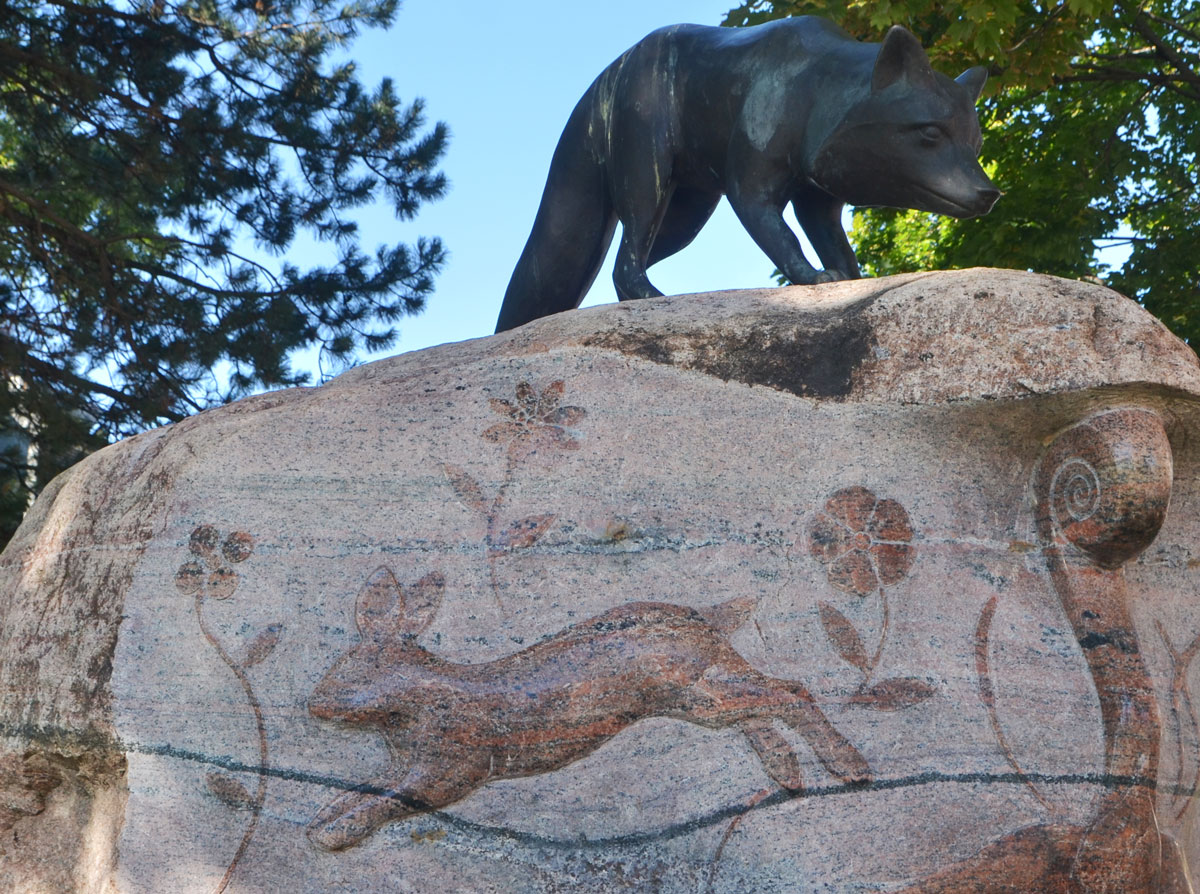
I walked through Joel Weeks park where I came face to face with a fox.

a small sculpture of a fox on top of a rock. The fox seems to be looking right into the camera

We exchanged glances for a moment or two but its interest was elsewhere ….
perhaps this rabbit?

sculpture of a fox on top of a rocl. Carved into the rock is a relief picture of a rabbit and some flowers

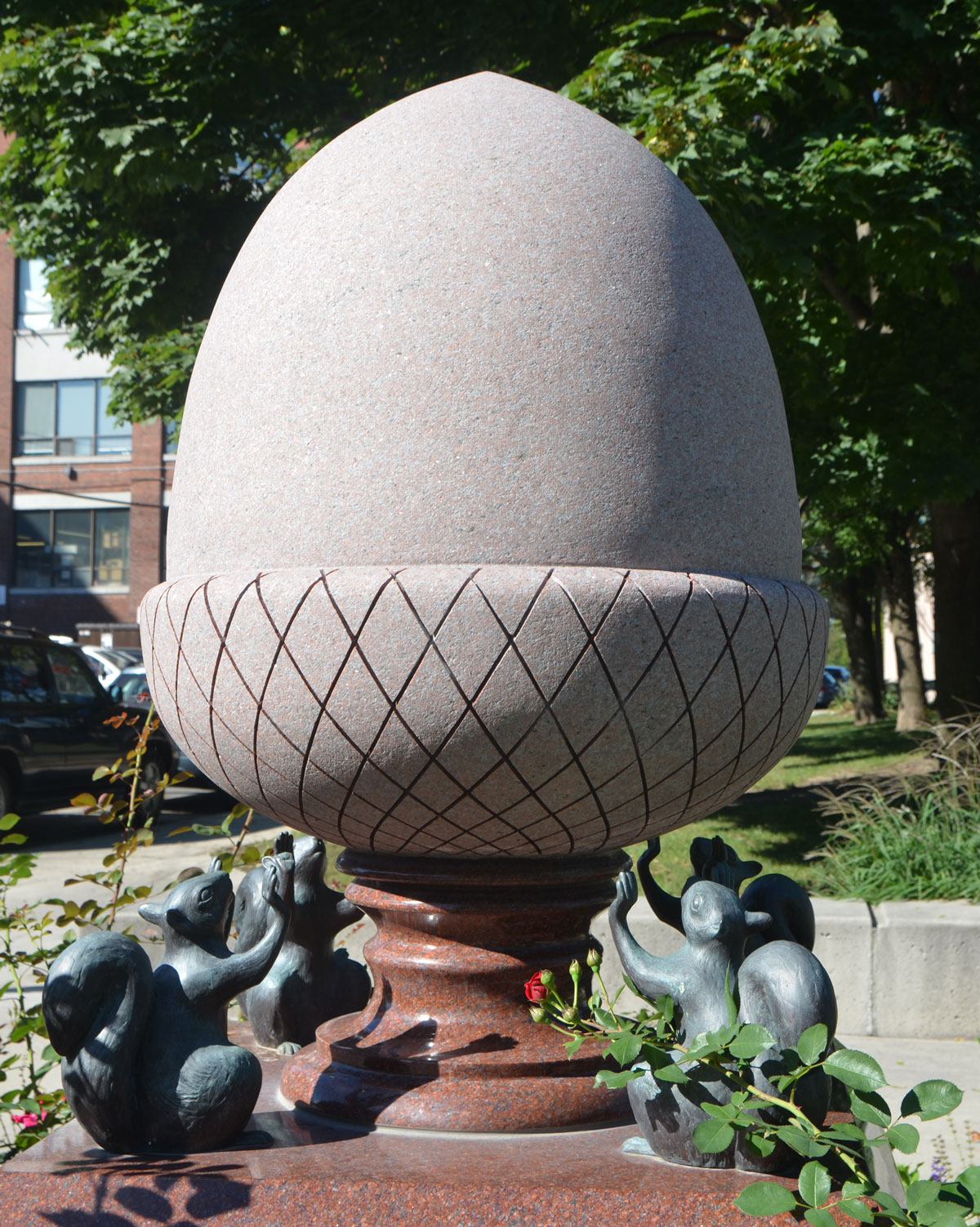
Also in the park, four little squirrels with a giant acorn!

a sculpture in a park of a giant acorn with the point pointing upwards, 4 small squirrels are at the bas of the acorn trying to hold it up

All it needs is a Scrat to come along and steal it!

cartoon character Scrat from the movie 'ice age' holding onto an acorn

Whoa, a little off track!

When I still couldn’t find the mural, I bought a cup of coffee and a bite to eat at Merchants of Green Coffee (no picture I’m afraid) and did the research I should have done previously.   Coffee finished, then mural found.

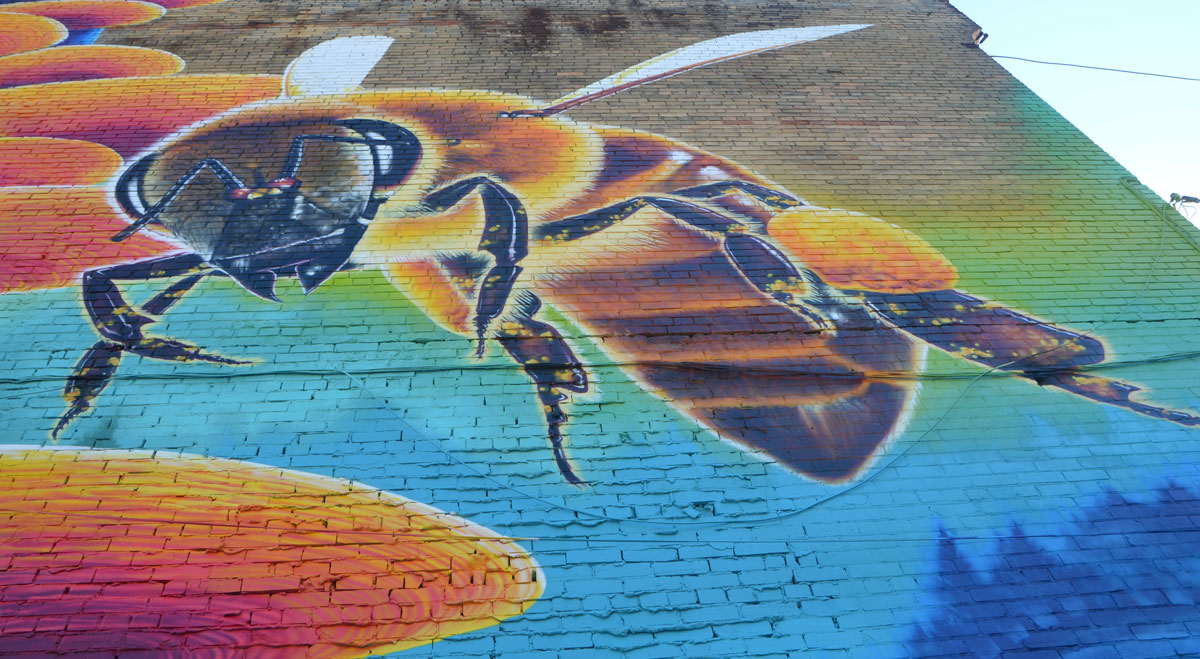
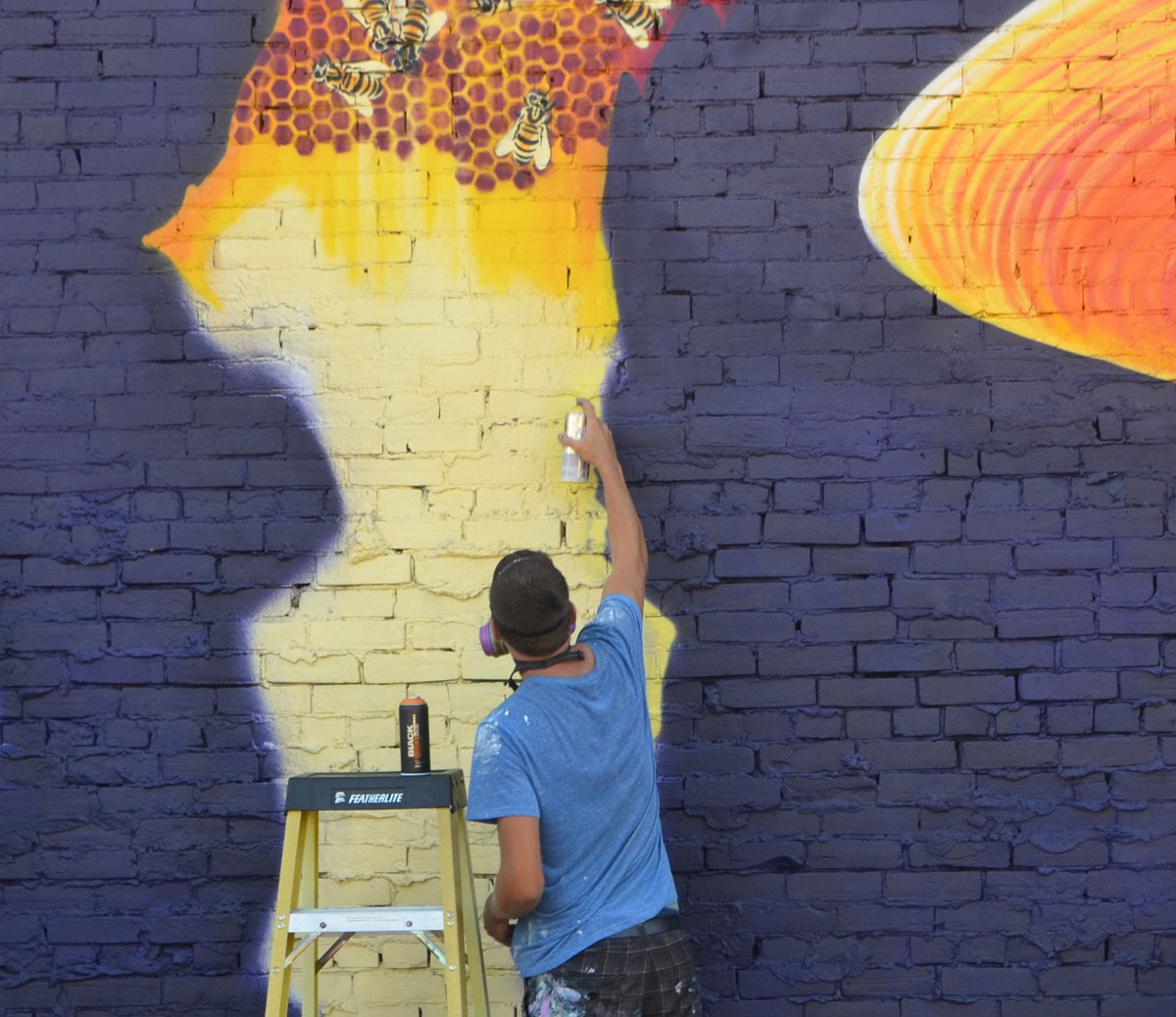
below: Riverside Pollinator Mural by Nick Sweetman.  (3 photos)

part of a mural, a large bee

a man is painting a mural, this part is a honeycomb with some bees on it. Dark blue background.

large mural, Riverside Pollinator mural, by Nick Sweetman, of a large bee, a clock, clock gears, a few small bees, a honeycomb and a flower and a very large tree

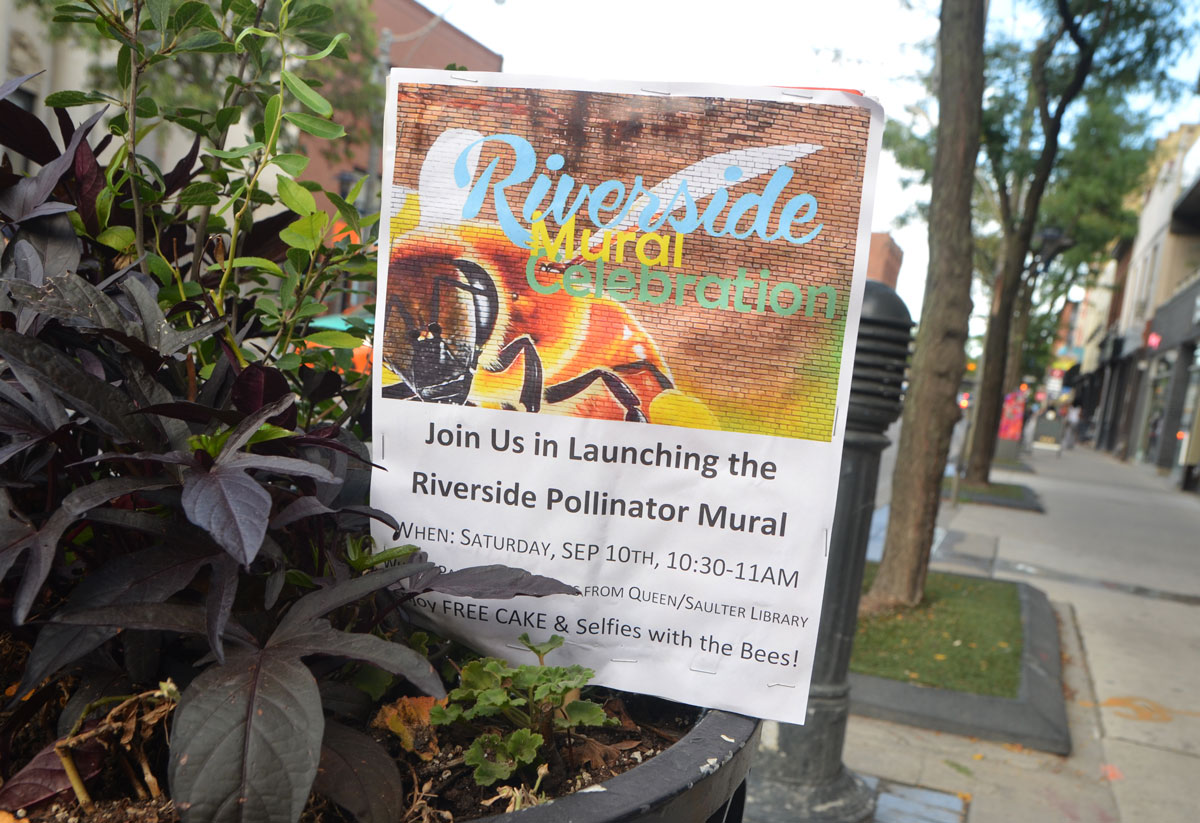
below: I also noticed this.  I know that that’s tomorrow but for those of you who are keen and read this blog soon after it was published, you may still have time to get there!   Free cake too!  It’s at 777 Queen Street East.

a poster is stuck into a sidewalk planter, advertising a launch of a mural on Saturday 10th September.

As I walked north towards Dundas Street, I found myself on the grounds of Queen Alexandra Senior Public School and Seed Alternative School.  Here is door 5.   An excellent example of unkempt 1950’s and 1960’s public building architecture.  I don’t mean to belittle the school and the people involved in making it work.  I just think that it’s a sad looking place; schools should be inviting.

blue double doors in a drab brown brick building, with brown metal inserts covering what was once a large window above the door. Two small windows remain.

One could probably do a photoessay on the condition of the building and what it says about Toronto’s attitudes to school construction and maintenance, and perhaps by extension, what it says about Toronto’s attitudes to public buildings in general.

three windows arrange horizontally in a brick wall. windows are not high

a box in front of a wall of a school has been painted with the word choose and two white hands.

While we’re on the subject of architecture, there is a mix of lots of types in this area of the city.  There are still lots of older houses, many of which have been renovated.

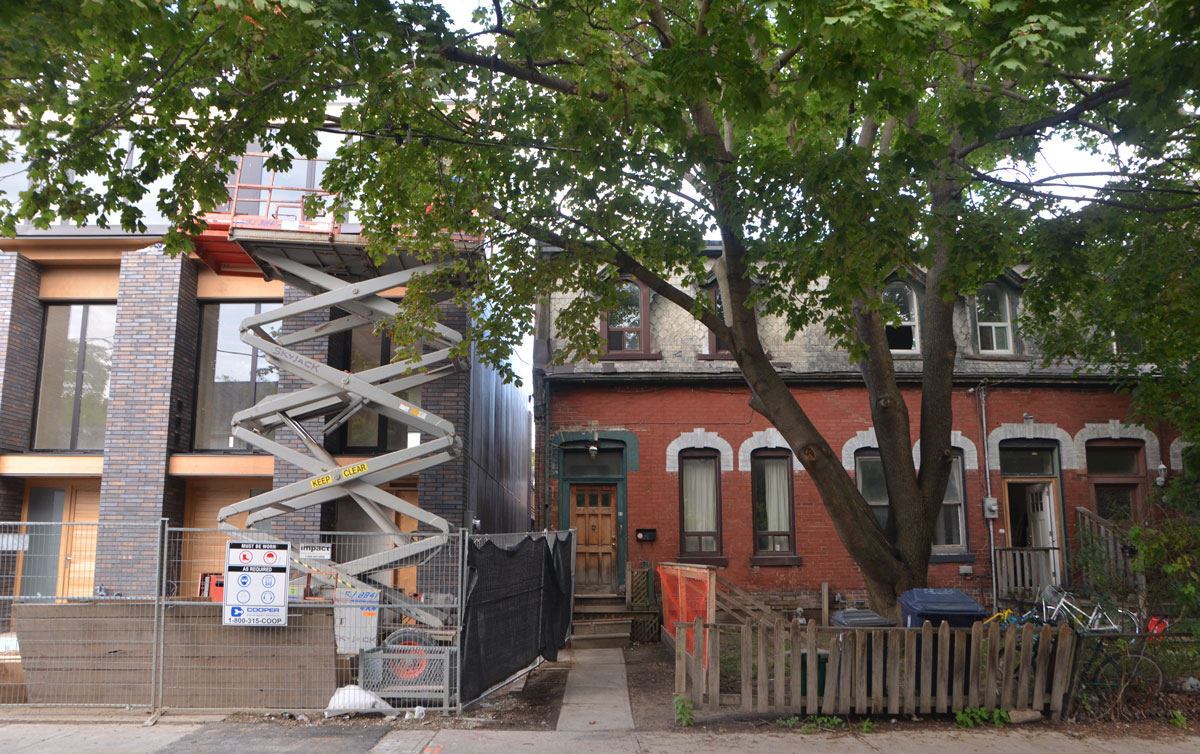
below: Side by side, old and new.  ‘Second Empire’ architecture featured mansard roofs and dormer windows, both of which are seen in these old rowhouses.  This style originated in France and arrived in Canada in the mid 1800’s where it seemed to remain popular for some time.

old brick rowhouses to the right, with a large tree in front, and new construction of row houses on the left.

below: This house is a variation on the Workers Cottage (or Gothic Cottage style).   A peaked roof over a central front door with one window on either side is the characteristic look of this style.   This one is interesting in that it is actually the end one in a row of three.

workers cottage, or gothic cottage, behind a large hedge

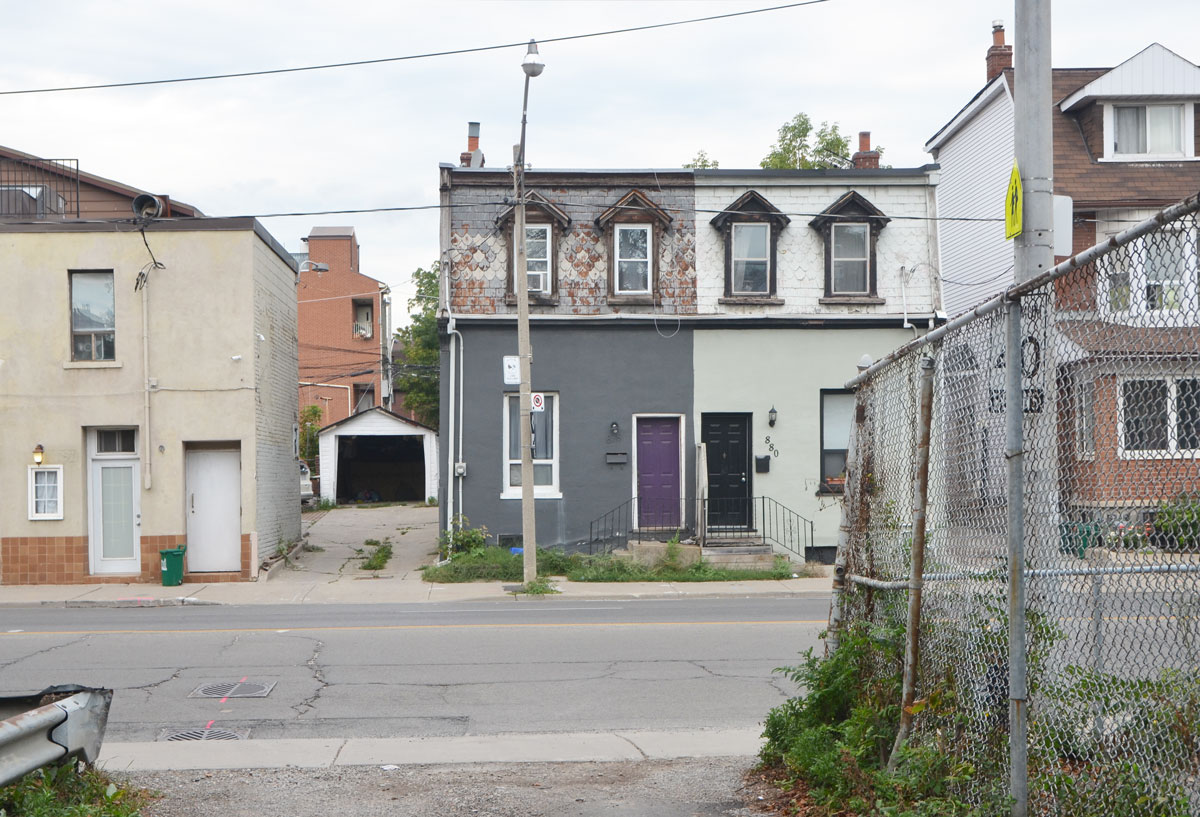
below: I could go on and on about architecture.  Instead, here’s one last picture of a jumble of styles (or non-styles!).  Take a look around at the buildings that you see.  Toronto doesn’t have much variation when it comes to the structure of the buildings, especially the older ones.  We do know how to make them look unique though!

two semi detached houses with mansard roofs, one with a purple front door and one with a black front door.

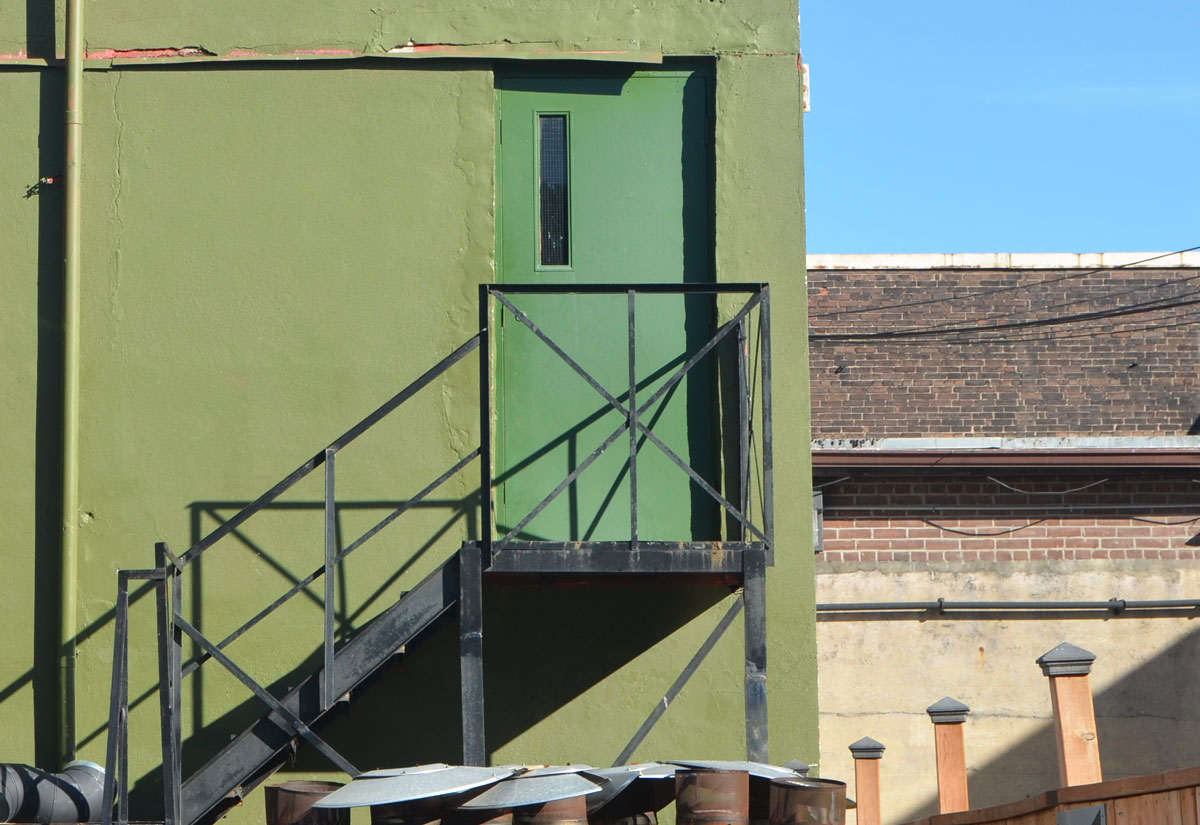
green second story door at top of metal exterior staircase, on a wall that is a different shade of green

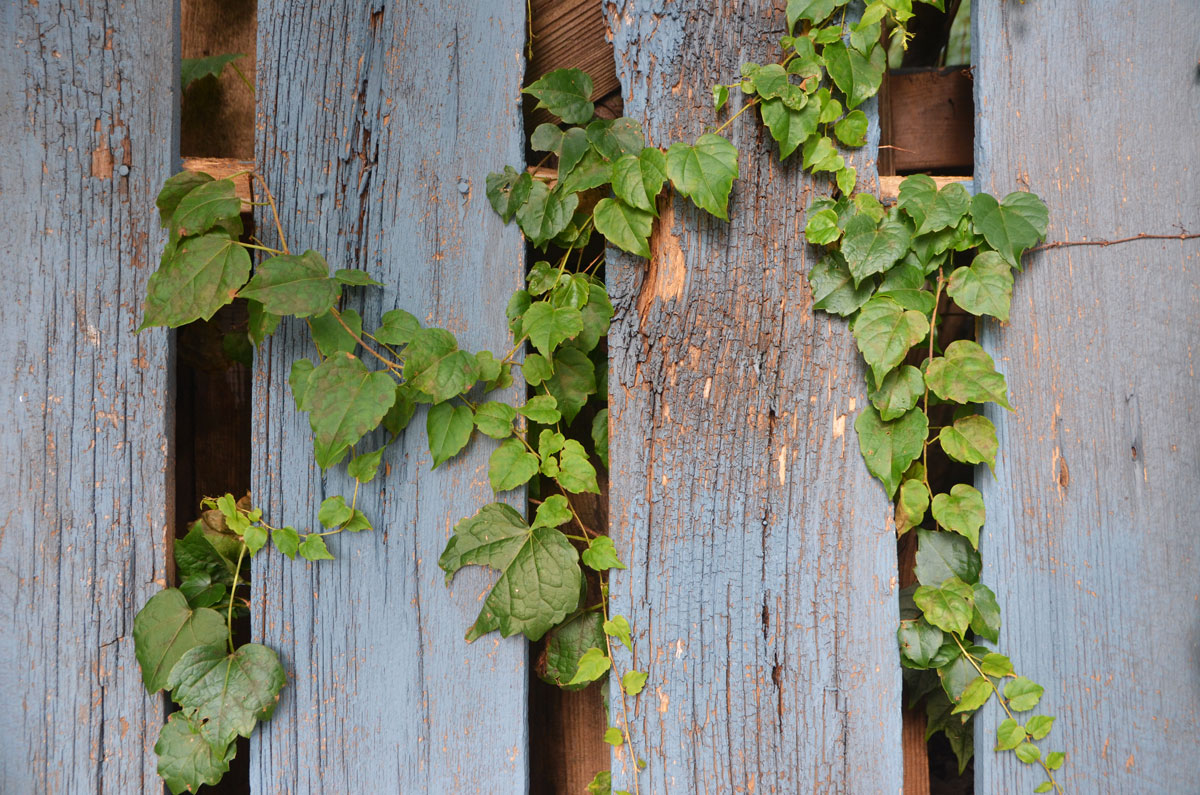
green ivy leaves poke their way through the gaps in a blue weathered wooden fence

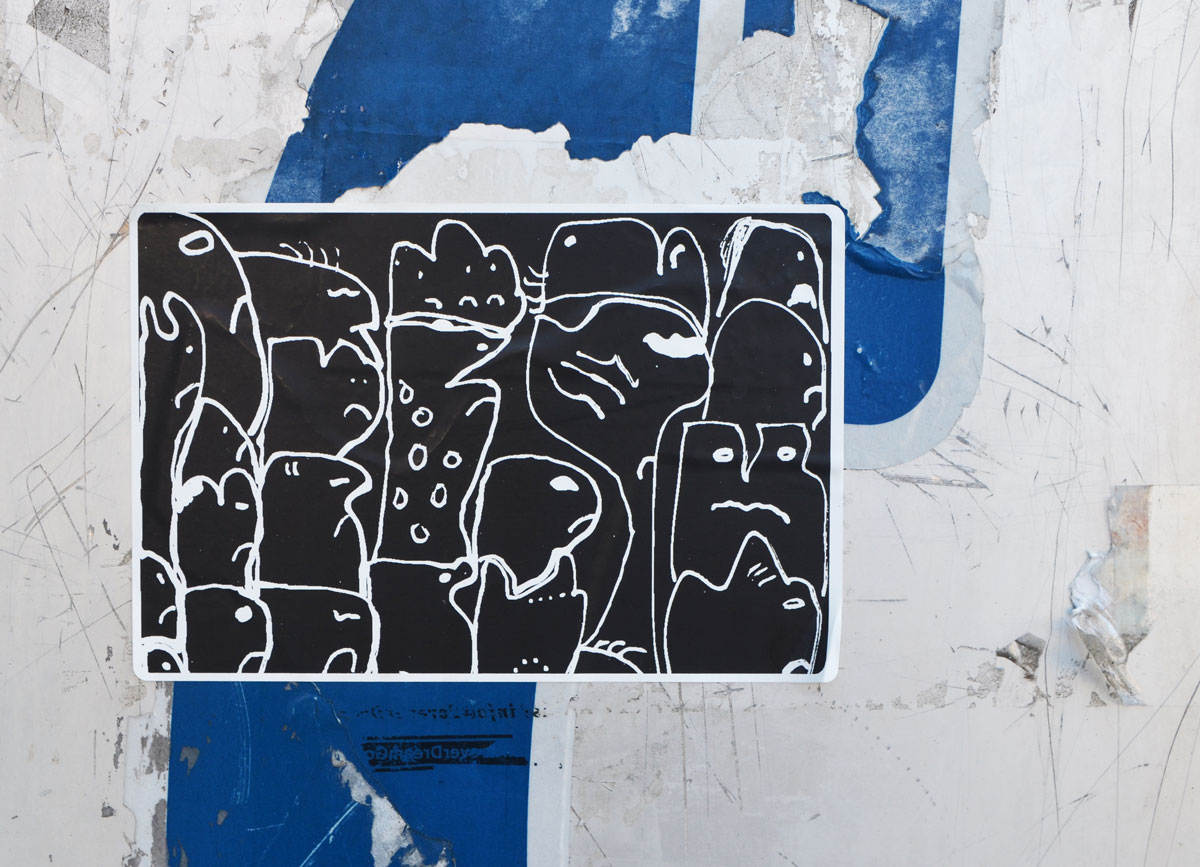
black and white sticker graffiti on the side of a Bell telephone box

in never never land

Posted: September 1, 2016 in public art
Tags: , , , , , , ,

Hiding in a park, dappled by the sunlight filtering through large leafy trees, stands Peter Pan.  At least the sign says that he’s Peter Pan; he looks like a boy with a flute standing on a lumpy pedestal.   He’s a replica of one that resides in London’s Kensington Gardens that was sculpted by Sir George Frampton in 1912.   He’s been standing near the NW corner of Avenue Road and St. Clair  since 1929 when the city acquired this piece of land.   At that time the College Heights Association raised the money to purchase the statue for this “children’s garden”, a statue dedicated “to the spirit of children at play”.

a statue of a boy on top of a large pile that is composed of fairies and forest animals such as squirrels, mice and rabbits, under the shade of a large tree, in a park, playground behind

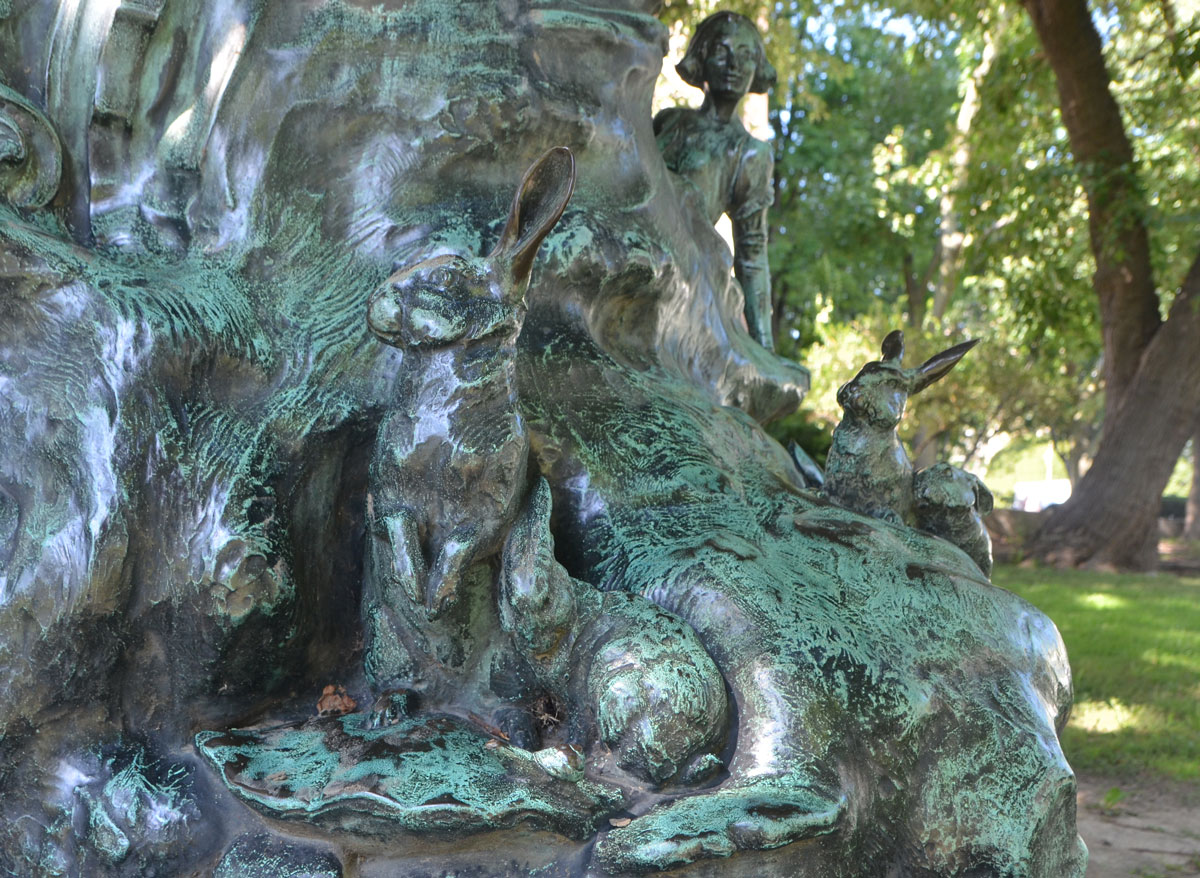
There are no pirates or lost boys here though, just fairies and woodland animals – rabbits, mice and squirrels.  There’s even a tiny snail if you look closely enough.  What looks like a nondescript lump from a distance turns out to be an interesting game of find the creatures.

part of a sculpture, a squirrel is sitting on its back legs, looking at two fairies (women with large wings) who are looking back at the squirrel

sculpture, close up of the faces of two women, two hands, bronze, weathered

part of a sculpture, some rabbits, a fairy poking her head up

Once upon a time this was Peter Pan park but now it is Glenn Gould park (he once lived nearby).


Updated 2 September

The latest StreetARToronto (StART) summer project has just wrapped up.  Seven new murals around Broadview and Gerrard East, each one depicting a famous landmark, make up this project which is now called ‘Around the World in East Chinatown’.  Although it was largely funded and organized by StART, other partners include the Toronto Parking Authority, 55 Division police, and the Chinese Chamber of Commerce (East Toronto).

A crew of more than 20 artists headed by Mike Kennedy worked for about 2 weeks to complete the murals.  Each mural includes the ‘signature’ of the artists.  I am not very good are deciphering (or remembering) the graffiti writing but I’ve had some help identifying the artists.

below: Christ the Redeemer now watches over Gerrard East.  Painted by bacon.  This is the statue built high on a hill overlooking Rio de Janeiro.  If you watched any coverage of this summer’s Olympics you probably saw this statue from every possible angle.   The statue was designed by a Frenchman, Paul Landowski and built by a  Brazilian engineer, Heitor da Silva Costa, between 1922 and 1931.   Made of soapstone and reinforced concrete the statue stands 30m tall and has an arm span of 28m.  He stands on an 8m high pedestal.

a mural of the famous Rio de Janeiro statue, Christ the Redeemer, high on a brick wall, with background in sky blue and yellow

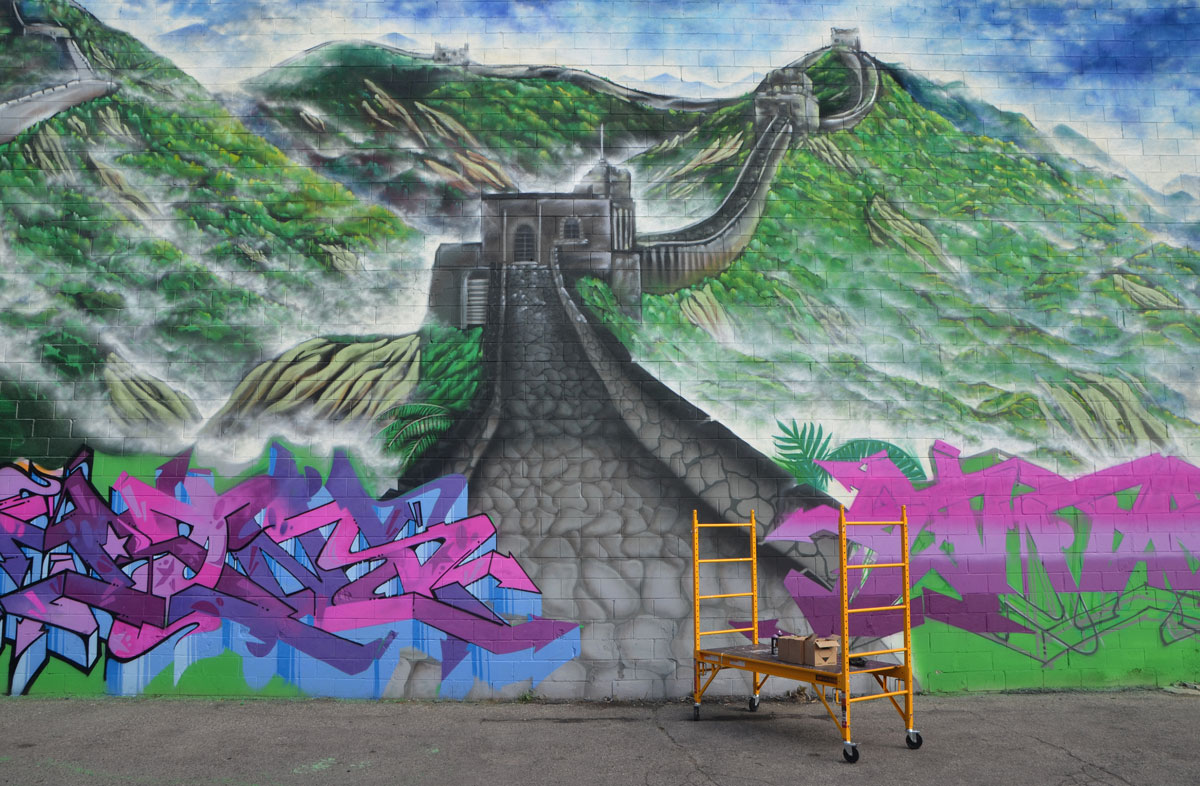
below: Putting the finishing touches on The Great Wall of China, a collaborative effort by Nick Sweetman, Wuns, Rons, Tens, Braes and Wales.   The actual wall was built in sections over many centuries and includes walls, trenches and natural elements such as hills and rivers.  Parts of the wall are in better repair than others – around Beijing where more tourists visit, the wall has been fixed up and is well maintained.  Measurement of the wall varies but if all the branches of the wall are taken into consideration, the total length is about 21,000 km.

a yellow cart with cans of spray paint on it sits in front of a mural of the great wall of China

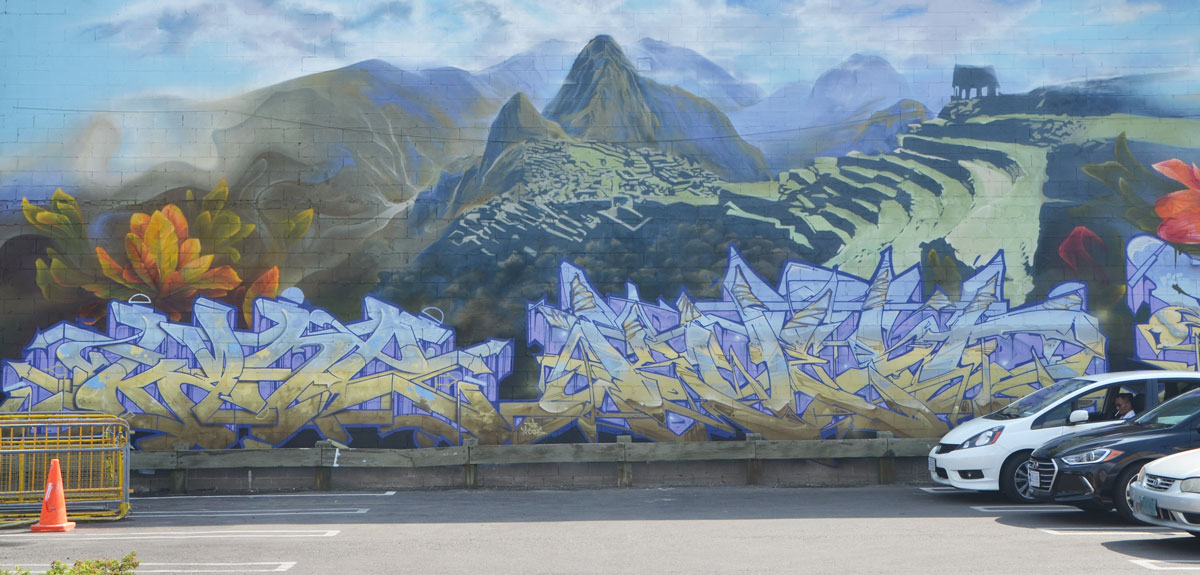
below: A hummingbird flies over Machu Picchu in the next mural.   Machu Picchu was built by the Incas in the 15th century in what is now Peru.  It is on a mountain ridge, 2430m above sea level.

full mural of Machu Picchu along he wall of a building at the edge of a parking lot, scene of Machu Picchu with a humming bird in the foreground.

below: Machu Picchu.  Painted by Bacon, Kwest, Kane and Rath.
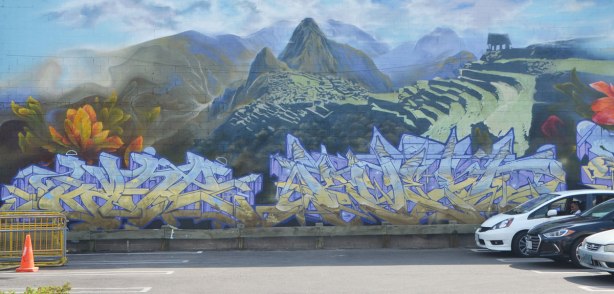
a mural with a panoramic scene of Machu Picchu, with graffiti writing signatues below.

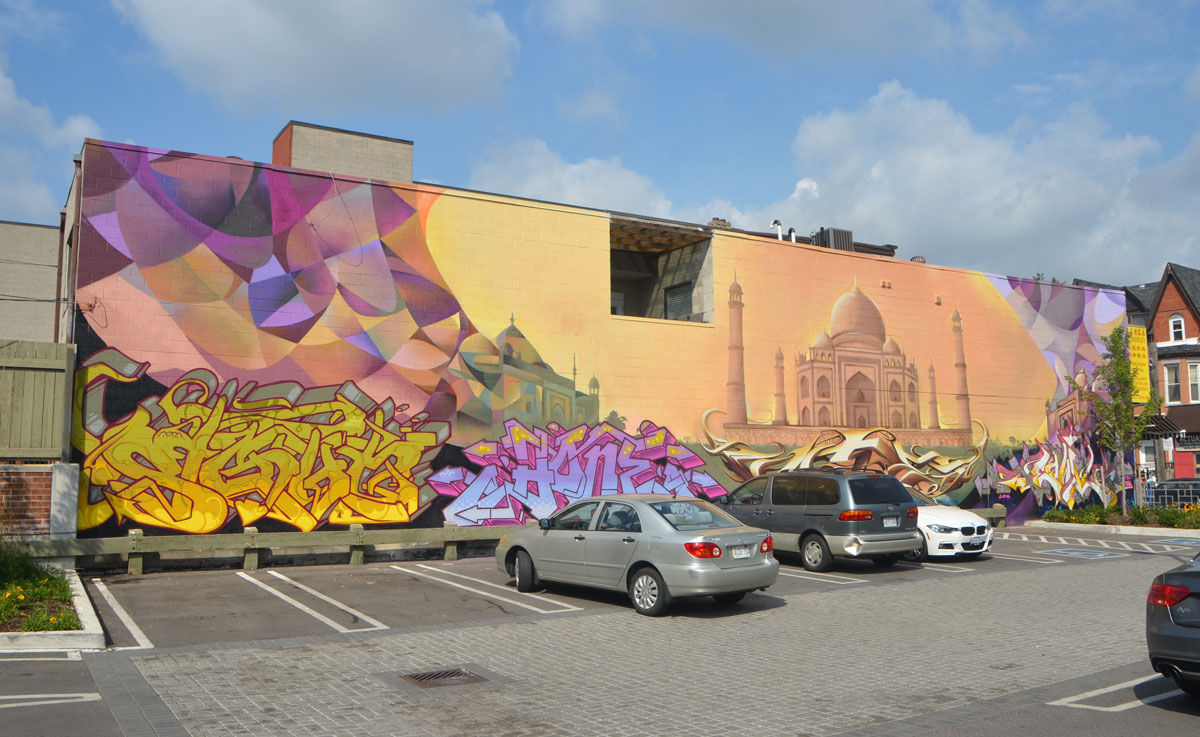
below: In the same parking lot as Machu Picchu but on the other side, is a very large mural centered around an image of the Taj Mahal.  Painted by Sight, Hone, Water, Equal and Tenser.

a laong horizontal mural featuring an image of the Taj Mahal.

below: Commissioned in 1632 by the Mogul Emperor, Shah Jahan, the Taj Mahal was built as a mausoleum for his favorite wife Mumtaz Mahal.  She was born Arjumand Banu Begum, a daughter of Persian nobility in Agra India.  In 1613, when she was 19, she married Prince Khurram (later he became Shah Jahan) as his 3rd or 4th wife.    She died in June of 1631 while giving birth to their 14th child.   If my math is correct, that’s 14 children in 18 years.   After the Shah died in 1666, he was buried here too.  Anyhow, many centuries later, the Taj Mahal is still standing in Agra India and it is visited by millions every year.

An image of the Taj Mahal in a mural in warm muted orange and brown tones, with a graffiti writing signature underneath it. On a wall in a parking lot.

below: Teeny tiny people dwarfed by the doors of Petra, Jordan.  Petra is an ancient city with immense buildings cut out of the sandstone cliffs and hills.  It was once a thriving trading center and the capital of the Nabataean empire between 400 B.C. and A.D. 106 when it was called Raqmu.  The Nabateans were a nomadic Arab tribe.  Their empire came to an end when they were conquered by the Romans and their land annexed into the Roman Empire.

mural showing entrance in the stone cliffs to Petra in Jordan, camel head in the bottom left corner, mural on the side of a store, brick wall,

below: The whole Petra mural on the walls of an alley tucked in between the Ka Ka Lucky Seafood BBQ Restaurant and Paradise Spa on Broadview Avenue.  This mural was painted by Hemps.

Chinese restaurant, Ka Ka Lucky Barbeue Restaurant, with an alley on one side. On the wall in the alley there is a mural showing the stone town of Petra Jordan.

below: The Roman Coliseum (Rome) is now on the corner of Broadview and Gerrard.  This is half of the mural and when the photo was taken it was incomplete.  It is now finished – a second visit for a photo is in my future!  The Coliseum (or Colosseum) is in Rome and it was built by 80 A.D, just before the Roman Empire swallowed up the Nabateans.   It was built as an amphitheatre and could hold at least 50,000 spectators – people who came to watch gladiator fights, enactments of classical dramas, or other forms of entertainment.

A mural showing the Coliseum in Rome painted on the side of Chino Locos Mexican restautant.

below: The right hand side of the mural with the graffiti writing signature of the artist. If I could only easily photoshop out that garbage bin.  Mural painted by Sewp, Poser and Frens.

graffiti writing signature on a wall, dripping blue paint, and a garbage bin in front of it.

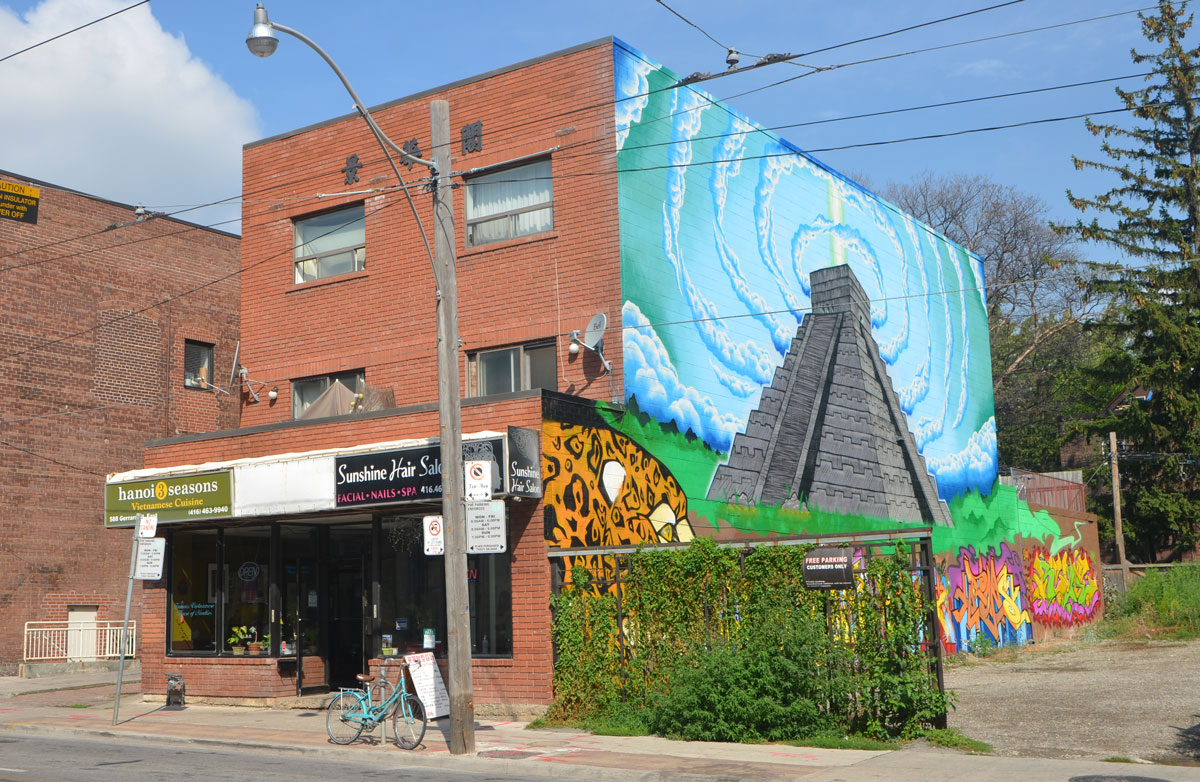
below: Chichen Itza ruins in Yucatan Mexico and a jaguar on the side of the Sunshine Hair Studio, partially obscured by greenery.  Painted by Cruz, Rons, Sadar and  Rcade.  Chichen Itza was the largest Mayan city covering about 5 square km.  It flourished between 900 and 1050.   The mural depicts El Castillo, or the Temple of Kukulcan, the building at the center of Chichen Itza that dominates the site.
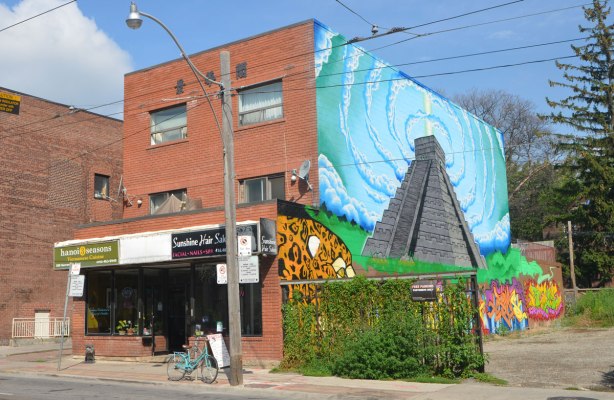
mural on the side of building on Gerrard East, a picture of an ancient stone temple, Chichen Itza in Yucatan Mexico.

And that concludes the seven new murals – Christ the Redeemer statue, The Great Wall of China, Machu Picchu, Taj Mahal, Petra, the Roman Coliseum, and Chichen Itza.

This mural project follows the success of last year’s Project Picasso in the same area.   Graffiti from some of the lanes was cleaned up and a Chinese themed mural was painted on the brick wall at the back of the parking lot on Gerrard Street East, just west of Broadview Avenue.  Riverdale Collegiate students helped with the graffiti clean up and contributed ideas for the mural.

below: Chinatown East mural by ACK crew, bacon, wunder, tensoe 2, and cruz1
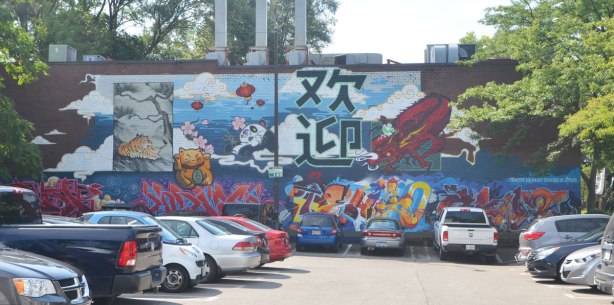
large mural across the side of a building at the back of a parking lot, Chinese characters and icons, panda bear, tiger, bamboo forest, lucky cat, chinese lantern, dragon

below: Chinese icons painted in the mural – a resting tiger, cherry blossoms,  red Chinese lanterns floating by, a lucky cat with its paws up,  and a panda munching on a piece of bamboo.


part of a mural in Chinatown East, pink cherry blossoms, red chinese lantern, panda chewing on bamboo, tiger, lucky cat

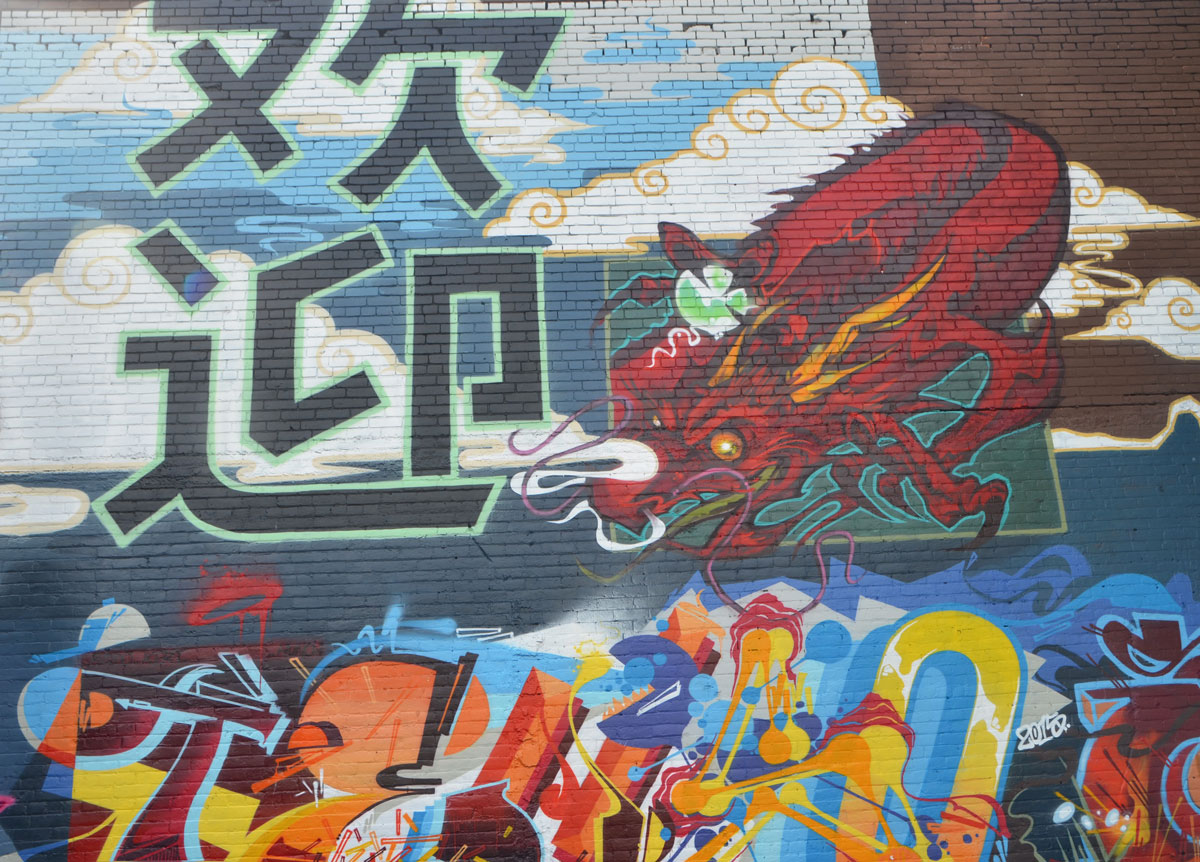
below: A red dragon beside some Chinese characters.  Does anyone know what it says?
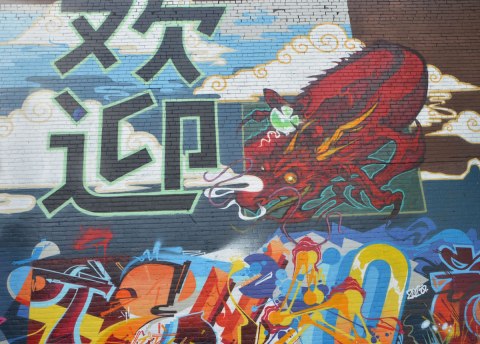
part of a mural in Chinatown East, chinese characters and a red dragon


They aren’t easily seen from any street but there are now 20 colourful figures leaping and dancing their way along the west side of Bridgepoint Hospital.   You will encounter them if you walk on the path that runs between Gerrard East and Riverdale Park.

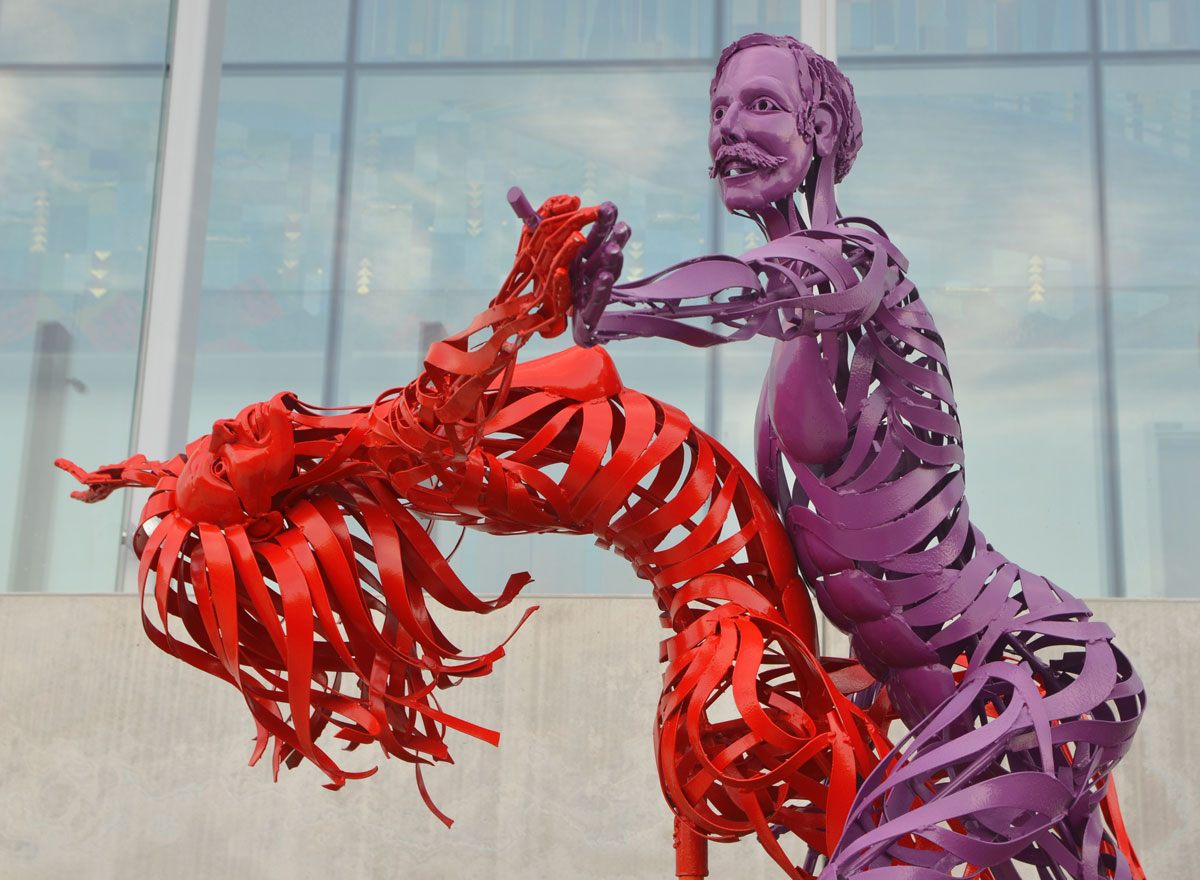
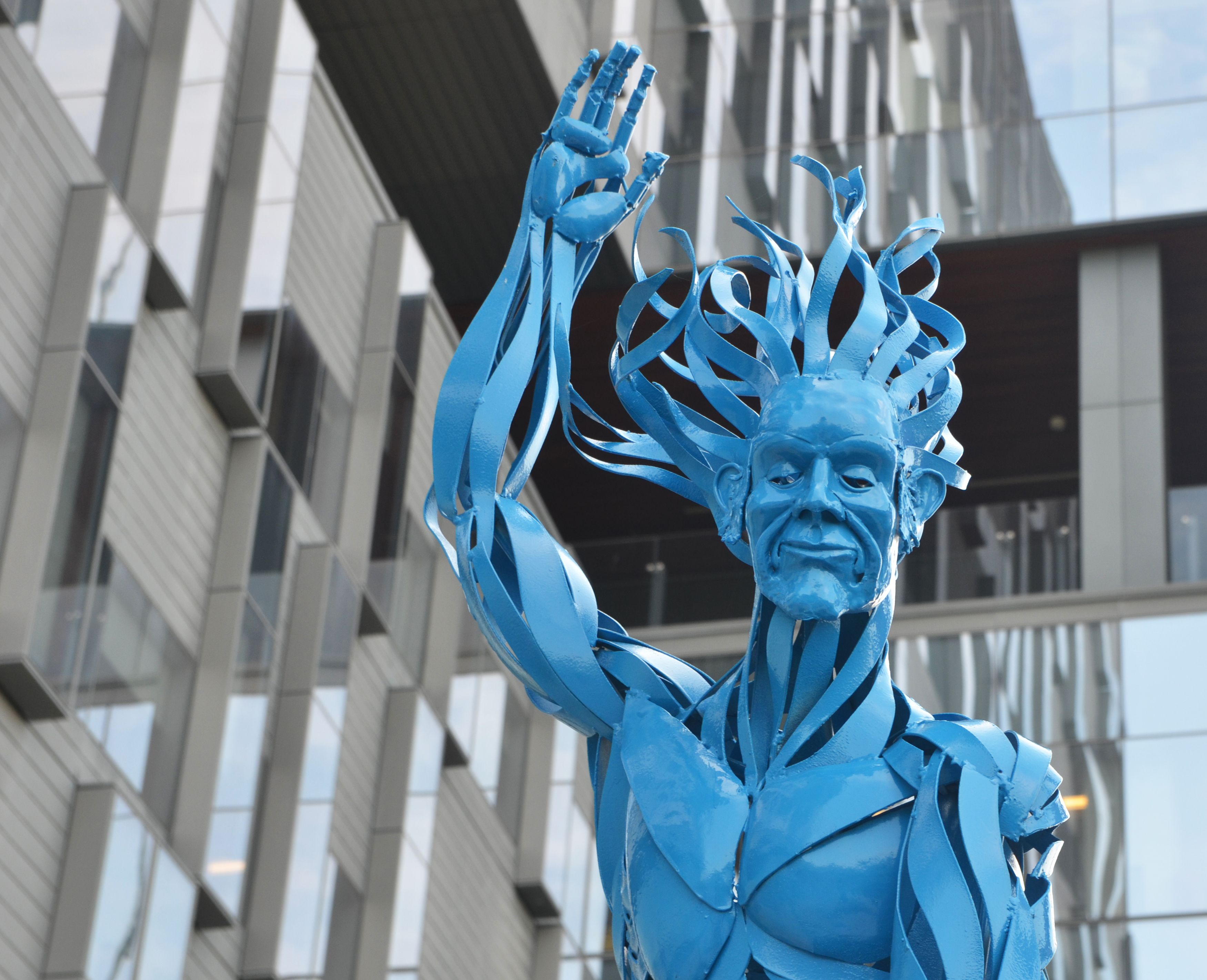
below:  Perched high above the Don Valley, they run, jump, leap, dance and celebrate movement of the human form.  They are sculptures by Canadian artist Bill Lishman (with help from Richard Vanheuvelan).

brightly coloured sculptures of figures in various active poses, made of loosely woven metal, a purple woman leaping, an orange man on his back about to catch of blue woman who is leaping head first through the air, and others as well, along the side of a building, the DVP runs beside in the background and the Bloor Viaduct bridge across the valley is in the distance

below: A yellow goggle-wearing snowboarder leaping over the bushes is the first sculpture you come across if you are walking up the path from Riverdale Park.

yellow metal sculpture of a young man in goggles

below: Two of the twenty different figures form ‘The Lambada’ (a dance style originating in Brazil in the 1980’s) by Richard Vanheuvelan.

a purple male figure in metal sculpture is dancing with a woman made of red metal, she is bending backwards while he supports her.

below: More dance, this time ballet in red, blue and purple.   Strength and grace.

sculptures of three figures in ballet poses, one in blue metal, one in red metal and one in purple. Dancing in a garden outdoors

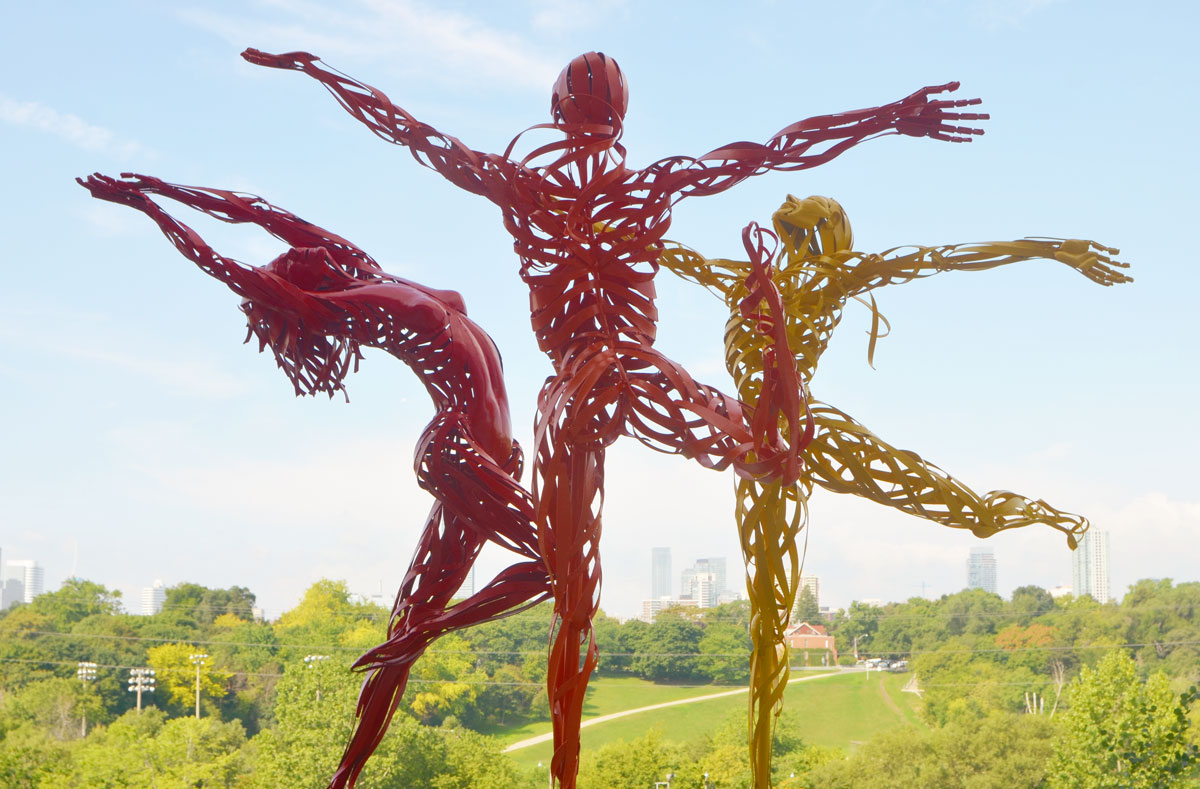
below: ‘The Three Muses’ pose overlooking the city.

outdoor sculptures of three women dancing, one is red metal, one is orange metal and the last is yellow metal. Downtown TOronto skyline is in the distance

top part of a blue metal sculpture of a man, showing his head, with long hair flowing out behind, one arm raised. The glass windows of a building are behind him, outdoors,

The sculptures were a generous gift from the Tauba and Solomon Spiro Foundation and were originally designed in memory of businessman and philanthropist, Max Tanenbaum (1909-1983).


There is a mural on Richmond Street West of a boy lying on his stomach, feet in the air, as he searches on what looks to be a smart phone.  Not long after this mural was painted, it was tagged with ugly black markings.  There was only one tag but it ruined the picture.   Sometime in the recent past, the mural has been cleaned up and/or re-painted.   It’s great to see it restored and looking terrific!

mural of a boy lying on his stomace, with his feet in the air. He islooking at an electronic device

The painting is by Mikha.  Other images of his work can be found on his instagram page.